US12076913B2 - Feed material for three-dimensional printing containing a polyoxymethylene polymer - Google Patents
Feed material for three-dimensional printing containing a polyoxymethylene polymer Download PDFInfo
- Publication number
- US12076913B2 US12076913B2 US17/125,160 US202017125160A US12076913B2 US 12076913 B2 US12076913 B2 US 12076913B2 US 202017125160 A US202017125160 A US 202017125160A US 12076913 B2 US12076913 B2 US 12076913B2
- Authority
- US
- United States
- Prior art keywords
- polymer
- feed material
- weight
- polymer composition
- dimensional
- Prior art date
- Legal status (The legal status is an assumption and is not a legal conclusion. Google has not performed a legal analysis and makes no representation as to the accuracy of the status listed.)
- Active, expires
Links
Images


Classifications
-
- B—PERFORMING OPERATIONS; TRANSPORTING
- B29—WORKING OF PLASTICS; WORKING OF SUBSTANCES IN A PLASTIC STATE IN GENERAL
- B29C—SHAPING OR JOINING OF PLASTICS; SHAPING OF MATERIAL IN A PLASTIC STATE, NOT OTHERWISE PROVIDED FOR; AFTER-TREATMENT OF THE SHAPED PRODUCTS, e.g. REPAIRING
- B29C64/00—Additive manufacturing, i.e. manufacturing of three-dimensional [3D] objects by additive deposition, additive agglomeration or additive layering, e.g. by 3D printing, stereolithography or selective laser sintering
- B29C64/10—Processes of additive manufacturing
- B29C64/106—Processes of additive manufacturing using only liquids or viscous materials, e.g. depositing a continuous bead of viscous material
- B29C64/118—Processes of additive manufacturing using only liquids or viscous materials, e.g. depositing a continuous bead of viscous material using filamentary material being melted, e.g. fused deposition modelling [FDM]
-
- B—PERFORMING OPERATIONS; TRANSPORTING
- B29—WORKING OF PLASTICS; WORKING OF SUBSTANCES IN A PLASTIC STATE IN GENERAL
- B29C—SHAPING OR JOINING OF PLASTICS; SHAPING OF MATERIAL IN A PLASTIC STATE, NOT OTHERWISE PROVIDED FOR; AFTER-TREATMENT OF THE SHAPED PRODUCTS, e.g. REPAIRING
- B29C64/00—Additive manufacturing, i.e. manufacturing of three-dimensional [3D] objects by additive deposition, additive agglomeration or additive layering, e.g. by 3D printing, stereolithography or selective laser sintering
- B29C64/20—Apparatus for additive manufacturing; Details thereof or accessories therefor
- B29C64/255—Enclosures for the building material, e.g. powder containers
-
- B—PERFORMING OPERATIONS; TRANSPORTING
- B33—ADDITIVE MANUFACTURING TECHNOLOGY
- B33Y—ADDITIVE MANUFACTURING, i.e. MANUFACTURING OF THREE-DIMENSIONAL [3D] OBJECTS BY ADDITIVE DEPOSITION, ADDITIVE AGGLOMERATION OR ADDITIVE LAYERING, e.g. BY 3D PRINTING, STEREOLITHOGRAPHY OR SELECTIVE LASER SINTERING
- B33Y10/00—Processes of additive manufacturing
-
- B—PERFORMING OPERATIONS; TRANSPORTING
- B33—ADDITIVE MANUFACTURING TECHNOLOGY
- B33Y—ADDITIVE MANUFACTURING, i.e. MANUFACTURING OF THREE-DIMENSIONAL [3D] OBJECTS BY ADDITIVE DEPOSITION, ADDITIVE AGGLOMERATION OR ADDITIVE LAYERING, e.g. BY 3D PRINTING, STEREOLITHOGRAPHY OR SELECTIVE LASER SINTERING
- B33Y30/00—Apparatus for additive manufacturing; Details thereof or accessories therefor
-
- B—PERFORMING OPERATIONS; TRANSPORTING
- B33—ADDITIVE MANUFACTURING TECHNOLOGY
- B33Y—ADDITIVE MANUFACTURING, i.e. MANUFACTURING OF THREE-DIMENSIONAL [3D] OBJECTS BY ADDITIVE DEPOSITION, ADDITIVE AGGLOMERATION OR ADDITIVE LAYERING, e.g. BY 3D PRINTING, STEREOLITHOGRAPHY OR SELECTIVE LASER SINTERING
- B33Y70/00—Materials specially adapted for additive manufacturing
-
- C—CHEMISTRY; METALLURGY
- C08—ORGANIC MACROMOLECULAR COMPOUNDS; THEIR PREPARATION OR CHEMICAL WORKING-UP; COMPOSITIONS BASED THEREON
- C08K—Use of inorganic or non-macromolecular organic substances as compounding ingredients
- C08K5/00—Use of organic ingredients
- C08K5/36—Sulfur-, selenium-, or tellurium-containing compounds
- C08K5/43—Compounds containing sulfur bound to nitrogen
- C08K5/435—Sulfonamides
-
- C—CHEMISTRY; METALLURGY
- C08—ORGANIC MACROMOLECULAR COMPOUNDS; THEIR PREPARATION OR CHEMICAL WORKING-UP; COMPOSITIONS BASED THEREON
- C08L—COMPOSITIONS OF MACROMOLECULAR COMPOUNDS
- C08L59/00—Compositions of polyacetals; Compositions of derivatives of polyacetals
- C08L59/04—Copolyoxymethylenes
-
- C—CHEMISTRY; METALLURGY
- C09—DYES; PAINTS; POLISHES; NATURAL RESINS; ADHESIVES; COMPOSITIONS NOT OTHERWISE PROVIDED FOR; APPLICATIONS OF MATERIALS NOT OTHERWISE PROVIDED FOR
- C09D—COATING COMPOSITIONS, e.g. PAINTS, VARNISHES OR LACQUERS; FILLING PASTES; CHEMICAL PAINT OR INK REMOVERS; INKS; CORRECTING FLUIDS; WOODSTAINS; PASTES OR SOLIDS FOR COLOURING OR PRINTING; USE OF MATERIALS THEREFOR
- C09D11/00—Inks
- C09D11/02—Printing inks
- C09D11/10—Printing inks based on artificial resins
- C09D11/102—Printing inks based on artificial resins containing macromolecular compounds obtained by reactions other than those only involving unsaturated carbon-to-carbon bonds
-
- C—CHEMISTRY; METALLURGY
- C09—DYES; PAINTS; POLISHES; NATURAL RESINS; ADHESIVES; COMPOSITIONS NOT OTHERWISE PROVIDED FOR; APPLICATIONS OF MATERIALS NOT OTHERWISE PROVIDED FOR
- C09D—COATING COMPOSITIONS, e.g. PAINTS, VARNISHES OR LACQUERS; FILLING PASTES; CHEMICAL PAINT OR INK REMOVERS; INKS; CORRECTING FLUIDS; WOODSTAINS; PASTES OR SOLIDS FOR COLOURING OR PRINTING; USE OF MATERIALS THEREFOR
- C09D159/00—Coating compositions based on polyacetals; Coating compositions based on derivatives of polyacetals
- C09D159/02—Polyacetals containing polyoxymethylene sequence only
-
- C—CHEMISTRY; METALLURGY
- C09—DYES; PAINTS; POLISHES; NATURAL RESINS; ADHESIVES; COMPOSITIONS NOT OTHERWISE PROVIDED FOR; APPLICATIONS OF MATERIALS NOT OTHERWISE PROVIDED FOR
- C09D—COATING COMPOSITIONS, e.g. PAINTS, VARNISHES OR LACQUERS; FILLING PASTES; CHEMICAL PAINT OR INK REMOVERS; INKS; CORRECTING FLUIDS; WOODSTAINS; PASTES OR SOLIDS FOR COLOURING OR PRINTING; USE OF MATERIALS THEREFOR
- C09D7/00—Features of coating compositions, not provided for in group C09D5/00; Processes for incorporating ingredients in coating compositions
- C09D7/40—Additives
- C09D7/65—Additives macromolecular
-
- B—PERFORMING OPERATIONS; TRANSPORTING
- B29—WORKING OF PLASTICS; WORKING OF SUBSTANCES IN A PLASTIC STATE IN GENERAL
- B29K—INDEXING SCHEME ASSOCIATED WITH SUBCLASSES B29B, B29C OR B29D, RELATING TO MOULDING MATERIALS OR TO MATERIALS FOR MOULDS, REINFORCEMENTS, FILLERS OR PREFORMED PARTS, e.g. INSERTS
- B29K2023/00—Use of polyalkenes or derivatives thereof as moulding material
- B29K2023/04—Polymers of ethylene
- B29K2023/06—PE, i.e. polyethylene
-
- B—PERFORMING OPERATIONS; TRANSPORTING
- B29—WORKING OF PLASTICS; WORKING OF SUBSTANCES IN A PLASTIC STATE IN GENERAL
- B29K—INDEXING SCHEME ASSOCIATED WITH SUBCLASSES B29B, B29C OR B29D, RELATING TO MOULDING MATERIALS OR TO MATERIALS FOR MOULDS, REINFORCEMENTS, FILLERS OR PREFORMED PARTS, e.g. INSERTS
- B29K2071/00—Use of polyethers, e.g. PEEK, i.e. polyether-etherketone or PEK, i.e. polyetherketone or derivatives thereof, as moulding material
- B29K2071/02—Polyalkylene oxides, e.g. PEO, i.e. polyethylene oxide, or derivatives thereof
-
- B—PERFORMING OPERATIONS; TRANSPORTING
- B29—WORKING OF PLASTICS; WORKING OF SUBSTANCES IN A PLASTIC STATE IN GENERAL
- B29K—INDEXING SCHEME ASSOCIATED WITH SUBCLASSES B29B, B29C OR B29D, RELATING TO MOULDING MATERIALS OR TO MATERIALS FOR MOULDS, REINFORCEMENTS, FILLERS OR PREFORMED PARTS, e.g. INSERTS
- B29K2075/00—Use of PU, i.e. polyureas or polyurethanes or derivatives thereof, as moulding material
-
- C—CHEMISTRY; METALLURGY
- C08—ORGANIC MACROMOLECULAR COMPOUNDS; THEIR PREPARATION OR CHEMICAL WORKING-UP; COMPOSITIONS BASED THEREON
- C08L—COMPOSITIONS OF MACROMOLECULAR COMPOUNDS
- C08L2205/00—Polymer mixtures characterised by other features
- C08L2205/14—Polymer mixtures characterised by other features containing polymeric additives characterised by shape
Definitions
- Additive manufacturing technologies or three-dimensional printing involve various different techniques and methods to produce three-dimensional articles.
- Additive manufacturing technologies for instance, includes binder jetting, directed energy deposition, material extrusion, material jetting, powder bed fusion, and the like.
- One of the most widely used methods of additive manufacturing is material extrusion.
- a heated nozzle ejects a molten thermoplastic material onto a deposition surface.
- the thermoplastic material is deposited in thin layers, one on top of another, onto a print bed eventually forming a three-dimensional printed article.
- the nozzle, the deposition surface, or both are moved while the thermoplastic is being extruded through the nozzle.
- the nozzle for instance, can be placed in communication with a computer for producing a computer-aided design (“CAD”).
- CAD computer-aided design
- Each layer of the thermoplastic material generally attaches to each adjacent layer through thermal bonding.
- Material extrusion is one of the more popular additive manufacturing techniques. For instance, material extrusion is relatively inexpensive in comparison to many other methods and is scalable. The only constraint in size of the finished three-dimensional article, for instance, is the build area and the movement of each device. The system also makes it relatively easy to switch from one thermoplastic polymer to another. In addition, different thermoplastic polymers can be used to produce a single article.
- Thermoplastic polymers that have been used in the past in material extrusion include polyethylene, polyethylene terephthalate, polystyrene, and polyphenylsulfone.
- the process requires that the thermoplastic polymer be capable of thermally bonding together with a relatively large operating window to allow for the deposition of each layer.
- Polyacetal polymers which are commonly referred to as polyoxymethylene polymers, have been used sparingly in material extrusion. Although the polymers have excellent mechanical properties, fatigue resistance, abrasion resistance, and chemical resistance, polyoxymethylene polymers can have relatively short operating windows and have high stiffness and shrinkage, which can result in cracking.
- the present disclosure is directed to a polymer composition containing a polyoxymethylene polymer that is well suited for use in a material extrusion process for producing three-dimensional articles.
- the present disclosure is also directed to a feed material for a three-dimensional extrusion printing system.
- the polymer composition containing the polyoxymethylene polymer is formulated to display low shrinkage characteristics.
- the polymer composition can be formulated to have a wide operating window so that different operating temperatures can be used during the material extrusion method in addition to allowing for extended periods of time for the different layers to thermally bond together during the process of building the product.
- the present disclosure is directed to a feed material for a three-dimensional extrusion printing system.
- the feed material may comprise a continuous filament or a polymeric pellet.
- the filament can have a filament diameter of from about 0.5 mm to about 5 mm, such as from about 1.5 mm to about 3.5 mm.
- the polymeric pellet can have a diameter of from about 0.5 mm to about 2 mm and can have a length of from about 1 mm to about 20 mm.
- the continuous filament or polymeric pellet is comprised of a polymer composition containing a polyoxymethylene polymer in an amount greater than about 30% by weight.
- the polymer composition can contain the polyoxymethylene polymer in an amount greater than about 50% by weight, such as in an amount greater than about 60% by weight, such as in an amount greater than about 70% by weight.
- the polyoxymethylene polymer can be a polyoxymethylene copolymer.
- the polyoxymethylene polymer can be made with a comonomer comprising a cyclic ether, such as dioxolane.
- the polyoxymethylene copolymer can have relatively low amounts of comonomer which has been found to dramatically improve the operating window of the polymer.
- the polyoxymethylene copolymer may contain the comonomer in an amount less than about 2% by weight, such as in an amount less than about 1.5% by weight, such as in an amount less than about 1.25% by weight, such as in an amount less than about 1% by weight, such as in an amount less than about 0.75% by weight, such as in an amount less than about 0.7% by weight.
- the comonomer content is generally greater than about 0.1% by weight, such as greater than about 0.3% by weight.
- the polyoxymethylene polymer is blended with at least one dimensional stabilizing agent. The resulting blend displays a shrinkage of 1.5% or less, such as 1.3% or less, such as 1.2% or less, such as 1.1% or less, when tested according to ISO Test 294-4, 2577.
- the dimensional stabilizing agent may comprise an amorphous polymer.
- the dimensional stabilizing agent can be an elastomeric polymer.
- Particular dimensional stabilizing agents that may be used include a methacrylate butadiene styrene, a styrene acrylonitrile, a polycarbonate, a polyphenylene oxide, an acrylonitrile butadiene styrene, a methyl methacrylate, a polylactic acid, a copolyester elastomer, a styrene-ethylene-butylene-styrene block copolymer, a thermoplastic vulcanizate, an ethylene copolymer or terpolymer, an ethylene-propylene copolymer or terpolymer, a polyalkylene glycol, a silicone elastomer, an ethylene acrylate, high density polyethylene, a sulfonamide, or mixtures thereof.
- the dimensional stabilizing agent comprises a thermoplastic elastomer, such as a thermoplastic polyurethane elastomer.
- the thermoplastic polyurethane elastomer can be present in the polymer composition in an amount from about 4% to about 40% by weight.
- the polymer composition can also contain a coupling agent that couples the polyoxymethylene polymer to the dimensional stabilizing agent.
- the coupling agent for instance, can be a polyisocyanate.
- the coupling agent may couple to terminal hydroxyl groups on the polyoxymethylene polymer and in turn couple to other end groups or functional groups on the dimensional stabilizing agent.
- the polyoxymethylene polymer for instance, can be manufactured to have a relatively high content of terminal hydroxyl groups.
- the terminal hydroxyl groups can be present on the polyoxymethylene polymer in an amount greater than 15 mmol/kg, such as greater than about 20 mmol/kg, such as greater than about 25 mmol/kg, such as greater than about 30 mmol/kg, and generally in an amount less than about 300 mmol/kg, such as less than about 100 mmol/kg.
- the dimensional stabilizing agent may comprise a filler, such as filler particles or fibers.
- the filler may comprise a metallic powder, metallic fibers, glass fibers, mineral fibers, mineral particles, glass beads, hollow glass beads, glass flakes, polytetrafluoroethylene particles, graphite, boron nitride, or mixtures thereof.
- the filler can generally be present in the polymer composition in an amount from about 5% to about 60% by weight.
- a filler, such as glass fibers can be present with a polymer additive, such as a high density polyethylene.
- the polymer composition can have a crystallinity temperature and a melting temperature wherein the difference between the melting temperature and the crystallinity temperature is at least 10° C., such as at least 12° C., such as at least 14° C., such as at least 16° C., such as at least 18° C., such as at least 20° C.
- the melting temperature can generally be less than about 180° C. while the crystallinity temperature can generally be greater than about 130° C.
- the present disclosure is also directed to a printer cartridge for three-dimensional extrusion printing.
- the printer cartridge contains a feed material as described above.
- the feed material can be contained in the printer cartridge wound around a spool.
- the polymeric pellets can be contained in a dispensing container within the printer cartridge.
- the present disclosure is also directed to a three-dimensional printing system comprising a three-dimensional printing device and a printer cartridge as described above.
- the present disclosure is also directed to a three-dimensional article formed layer by layer in a material extrusion process.
- the present disclosure is also directed to a material extrusion method comprising selectively forming a three-dimensional structure from the feed material as described above.
- FIG. 1 is a plan view of one embodiment of a material extrusion system that may be used in accordance with the present disclosure.
- FIG. 2 is a perspective view of one embodiment of a printer cartridge that may be used in accordance with the present disclosure.
- the present disclosure is directed to a polymer composition or feed material for additive manufacturing, particularly for use in a three-dimensional extrusion printing system.
- the present disclosure is also directed to a printing cartridge, a three-dimensional printing system, and a method for forming three-dimensional articles from the feed material.
- the feed material or polymer composition contains a polyoxymethylene polymer.
- the polyoxymethylene polymer is combined with one or more dimensional stabilizing agents that significantly and dramatically improve the ability to process the polymer composition in three-dimensional printing systems.
- the polymer composition of the present disclosure is capable of being employed as the feed material in a three-dimensional printer system, particularly a printer system that uses material extrusion.
- the polymer composition is flexible, yet also capable of retaining its shape, which allows the material to be more readily printed into complex shapes. This unique combination of dimensional stability and shape retention properties are achieved through selective control over the way the polymer composition is formulated.
- the polymer composition is formed from a polyoxymethylene polymer that forms a continuous phase or, in other words, serves as the matrix polymer.
- the polyoxymethylene polymer is then combined with one or more dimensional stabilizing agents that dramatically improve the shrinkage properties of the polyoxymethylene polymer thus making the polymer dimensionally stable for use in three-dimensional printing operations.
- the one or more dimensional stabilizing agents can be incorporated into the polyoxymethylene polymer for reducing shear regions and/or stress intense regions during formation of a three-dimensional article.
- the polymer composition containing the polyoxymethylene polymer can be used to form precise three-dimensional articles with high tolerances.
- the polyoxymethylene polymer incorporated into the polymer composition can comprise a polyoxymethylene homopolymer or a polyoxymethylene copolymer.
- the preparation of the polyoxymethylene polymer can be carried out by polymerization of polyoxymethylene-forming monomers, such as trioxane or a mixture of trioxane and a cyclic acetal such as dioxolane in the presence of a molecular weight regulator, such as a glycol.
- the polyoxymethylene is a homo- or copolymer which comprises at least 50 mol. %, such as at least 75 mol. %, such as at least 90 mol. % and such as even at least 97 mol. % of —CH 2 O-repeat units.
- a polyoxymethylene copolymer is used.
- the copolymer can contain from about 0.1 mol. % to about 20 mol. % and in particular from about 0.5 mol. % to about 10 mol. % of repeat units that comprise a saturated or ethylenically unsaturated alkylene group having at least 2 carbon atoms, or a cycloalkylene group, which has sulfur atoms or oxygen atoms in the chain and may include one or more substituents selected from the group consisting of alkyl cycloalkyl, aryl, aralkyl, heteroaryl, halogen or alkoxy.
- a cyclic ether or acetal is used that can be introduced into the copolymer via a ring-opening reaction.
- Preferred cyclic ethers or acetals are those of the formula:
- R 2 is a C 2 -C 4 -alkylene group which, if appropriate, has one or more substituents which are C 1 -C 4 -akyl groups, or are C 1 -C 4 -alkoxy groups, and/or are halogen atoms, preferably chlorine atoms.
- ethylene oxide propylene 1,2-oxide, butylene 1,2-oxide, butylene 1,3-oxide, 1,3-dioxane, 1,3-dioxolane, and 1,3-dioxepan as cyclic ethers, and also of linear oligo- or polyformals, such as polydioxolane or polydioxepan, as comonomers.
- copolymers composed of from 99.5 to 95 mol. % of trioxane and of from 0.5 to 5 mol. %, such as from 0.5 to 4 mol. %, of one of the above-mentioned comonomers.
- the dimensional stabilizing agent is a thermoplastic elastomer.
- Thermoplastic elastomers well suited for use in the present disclosure are polyester elastomers (TPE-E), thermoplastic polyamide elastomers (TPE-A) and in particular thermoplastic polyurethane elastomers (TPE-U).
- TPE-E polyester elastomers
- TPE-A thermoplastic polyamide elastomers
- TPE-U thermoplastic polyurethane elastomers
- the above thermoplastic elastomers have active hydrogen atoms which can be reacted with a coupling reagent and/or the polyoxymethylene polymer. Examples of such groups are urethane groups, amido groups, amino groups or hydroxyl groups.
- terminal polyester diol flexible segments of thermoplastic polyurethane elastomers have hydrogen atoms which can react, for example, with isocyanate groups.
- Suitable chain extenders are C 2 -C 6 aliphatic dials such as ethylene glycol, 1,4-butanediol, 1,6-hexanedial and neopentyl glycol.
- a thermoplastic polyurethane is characterized as essentially poly(adipic acid-co-butylene glycol-co-diphenylmethane diisocyanate).
- the dimensional stabilizing agent may comprise a non-aromatic polymer, which refers to a polymer that does not include any aromatic groups on the backbone of the polymer.
- a non-aromatic polymer refers to a polymer that does not include any aromatic groups on the backbone of the polymer.
- Such polymers include acrylate polymers and/or graft copolymers containing an olefin.
- an olefin polymer can serve as a graft base and can be grafted to at least one vinyl polymer or one ether polymer.
- the graft copolymer can have an elastomeric core based on polydienes and a hard or soft graft envelope composed of a (meth)acrylate and/or a (meth)acrylonitrile.
- a dimensional stabilizing agent can include a random terpolymer of ethylene, methylacrylate, and glycidyl methacrylate.
- the terpolymer can have a glycidyl methacrylate content of from about 5% to about 20%, such as from about 6% to about 10%.
- the terpolymer may have a methylacrylate content of from about 20% to about 30%, such as about 24%.
- the dimensional stabilizing agent may be a linear or branched, homopolymer or copolymer (e.g., random, graft, block, etc.) containing epoxy functionalization, e.g., terminal epoxy groups, skeletal oxirane units, and/or pendent epoxy groups.
- the dimensional stabilizing agent may be a copolymer including at least one monomer component that includes epoxy functionalization.
- the monomer units of the dimensional stabilizing agent may vary.
- the dimensional stabilizing agent can include epoxy-functional methacrylic monomer units.
- the dimensional stabilizing agent can be a random copolymer of ethylene, ethyl acrylate and maleic anhydride having the following structure:
- the relative proportion of the various monomer components of a copolymeric dimensional stabilizing agent is not particularly limited.
- the epoxy-functional methacrylic monomer components can form from about 1 wt. % to about 25 wt. %, or from about 2 wt. % to about 20 wt % of a copolymeric dimensional stabilizing agent.
- An ⁇ -olefin monomer can form from about 55 wt. % to about 95 wt. %, or from about 60 wt. % to about 90 wt. %, of a copolymeric dimensional stabilizing agent.
- the above dimensional stabilizing agent may be present in the composition in varying amounts depending on the application.
- the dimensional stabilizing agent can be present in an amount of 5% or greater of the thermoplastic composition, for instance from 15% to about 40% by weight, from about 18% to about 37% by weight, or from about 20% to about 35% by weight in some embodiments.
- dimensional stabilizing agents that may be used in accordance with the present disclosure include polyepoxides, polyurethanes, polybutadiene, acrylonitrile-butadiene-styrene, polysiloxanes, polyamides, block copolymers (e.g., polyether-polyamide block copolymers), etc., as well as mixtures thereof.
- the dimensional stabilizing agent may include a polyepoxide that contains at least two oxirane rings per molecule.
- the polyepoxide may be a linear or branched, homopolymer or copolymer (e.g., random, graft, block, etc.) containing terminal epoxy groups, skeletal oxirane units, and/or pendent epoxy groups.
- the monomers employed to form such polyepoxides may vary.
- the polyepoxide modifier contains at least one epoxy-functional (meth)acrylic monomeric component.
- (meth)acrylic includes acrylic and methacrylic monomers, as well as salts or esters thereof, such as acrylate and methacrylate monomers.
- Suitable epoxy-functional (meth)acrylic monomers may include, but are not limited to, those containing 1,2-epoxy groups, such as glycidyl acrylate and glycidyl methacrylate.
- Other suitable epoxy-functional monomers include allyl glycidyl ether, glycidyl ethacrylate, and glycidyl itoconate.
- the dimensional stabilizing agent may include a block copolymer in which at least one phase is made of a material that is hard at room temperature but fluid upon heating and another phase is a softer material that is rubber-like at room temperature.
- the block copolymer may have an A-B or A-B-A block copolymer repeating structure, where A represents hard segments and B is a soft segment.
- the block copolymer may have alternating blocks of polyamide and polyether.
- the polyamide blocks may be derived from a copolymer of a diacid component and a diamine component, or may be prepared by homopolymerization of a cyclic lactam.
- the polyether block may be derived from homo- or copolymers of cyclic ethers such as ethylene oxide, propylene oxide, and tetrahydrofuran.
- the dimensional stabilizing agent may comprise a silicone elastomer.
- the position of the alkenyl functionality is not critical and it may be bonded at the molecular chain terminals, in non-terminal positions on the molecular chain, or at both positions.
- the alkenyl functionality can be present at a level of 0.001 to 3 weight percent, preferably 0.01 to 1 weight percent, of the silicone elastomer.
- the silicone elastomer dimensional stabilizing agent is a polydimethylsiloxane homopolymer that is terminated with a hydroxyl or a vinyl group at each end and optionally that also contains at least one vinyl group along its main chain.
- Other organic groups of the silicone elastomer dimensional stabilizing agent can be independently selected from hydrocarbon or halogenated hydrocarbon groups that contain no aliphatic unsaturation. These can be exemplified by alkyl groups having 1 to 20 carbon atoms, such as methyl, ethyl, propyl, butyl, pentyl and hexyl; cycloalkyl groups, such as cyclohexyl and cycloheptyl; and halogenated alkyl groups having 1 to 20 carbon atoms, such as 3,3,3-trifluoropropyl and chloromethyl. It will be understood that these groups are selected such that the silicone elastomer has a glass transition temperature (or melt point) that is below room temperature and as such is therefore elastomeric.
- the silicone elastomer dimensional stabilizing agent can be a homopolymer or a copolymer.
- the molecular structure is also not critical and is exemplified by straight-chain and partially branched straight-chains.
- the dimensional stabilizing agent is a polyalkylene glycol.
- Polyalkylene glycols particularly well suited for use in the polymer composition include polyethylene glycols, polypropylene glycols, and mixtures thereof.
- the dimensional stabilizing agent incorporated into the polymer composition is a polyethylene glycol.
- the molecular weight of the polyalkylene glycol can vary depending upon various factors including the characteristics of the polyoxymethylene polymer and the process conditions for producing shaped articles.
- the polyalkylene glycol such as the polyethylene glycol
- the molecular weight can be less than about 10,000 g/mol, such as less than about 8,000 g/mol, such as less than about 6,000 g/mol, such as less than about 4,000 g/mol, and generally greater than about 1000 g/mol, such as greater than about 2000 g/mol.
- a polyethylene glycol plasticizer is incorporated into the polymer composition that has a molecular weight of from about 2000 g/mol to about 5000 g/mol.
- a polyalkylene glycol such as the polyethylene glycol
- the molecular weight of the polyalkylene glycol can be about 10,000 g/mol or greater, such as greater than about 20,000 g/mol, such as greater than about 30,000 g/mol, such as greater than about 35,000 g/mol, and generally less than about 100,000 g/mol, such as less than about 50,000 g/mol, such as less than about 45,000 g/mol, such as less than about 40,000 g/mol.
- the dimensional stabilizing agent are high density polyethylene particles, such as ultrahigh-molecular-weight polyethylene (UHMW-PE) particles.
- UHMW-PE ultrahigh-molecular-weight polyethylene
- UHMW-PE ultrahigh-molecular-weight polyethylene
- UHMW-PE ultrahigh-molecular-weight polyethylene
- UHMW-PE ultrahigh-molecular-weight polyethylene
- UHMW-PE can be employed as a powder, in particular as a micro-powder.
- the UHMW-PE can have an average molecular weight of higher than about 300,000 g/mol, such as greater than about 500,000 g/mol, such as greater than about 1.0.106 g/mol, such as higher than 2.0.106 g/mol, such as higher than 4.0.106 g/mol, such as ranging from 1.0.106 g/mol to 15.0.106 g/mol, such as from 3.0.106 g/mol to 12.0.106 g/mol, determined by viscosimetry and the Margolies equation.
- the viscosity number of the UHMW-PE is higher than 1000 ml/g, such as higher than 1500 ml/g, such as ranging from 1800 ml/g to 5000 ml/g, such as ranging from 2000 ml/g to 4300 ml/g (determined according to ISO 1628, part 3; concentration in decahydronaphthalin: 0.0002 g/ml).
- the dimensional stabilizing agent is a sulfonamide.
- the sulfonamide can be an ortho-para-toluene sulfonamide (35-45% ortho content).
- the toluene sulfonamide can have a relatively low melting point.
- the melting point of the sulfonamide can be less than about 120° C., such as less than about 115° C.
- the melting point is generally greater than about 50° C., such as greater than about 60° C., such as greater than about 75° C.
- the toluene sulfonamide can be in the form of a solid when combined with the other ingredients.
- the sulfonamide can be is an aromatic benzene sulfonamide represented by the general formula (I):
- R1 represents a hydrogen atom, a C1-C4 alkyl group or a C1-C4 alkoxy group
- X represents a linear or branched C2-C10 alkylene group, or an alkyl group, or a methylene group, or a cycloaliphatic group, or an aromatic group
- Y represents one of the groups H, OH or
- R2 represents a C1-C4 alkyl group or an aromatic group, these groups optionally themselves being substituted by an OH or C1-C4 alkyl group.
- the preferred aromatic benzenesulphonamides of formula (I) are those in which: R1 represents a hydrogen atom or a methyl or methoxy group, X represents a linear or branched C2-C10 alkylene group or a phenyl group, Y represents an H, OH or —O—CO—R2 group, R2 representing a methyl or phenyl group, the latter being themselves optionally substituted by an OH or methyl group.
- the dimensional stabilizing agent comprises a polymer component
- the dimensional stabilizing agent can be present in the polymer composition (in addition to amounts provided above) in an amount generally greater than about 3% by weight, such as in an amount greater than about 5% by weight, such as in an amount greater than about 8% by weight, such as in an amount greater than about 10% by weight, such as in an amount greater than about 12% by weight, such as in an amount greater than about 15% by weight, and generally less than about 60% by weight, such as less than about 40% by weight, such as less than about 30% by weight, such as less than about 25% by weight.
- the dimensional stabilizing agent may also comprise a filler material.
- the filler material can be non-metallic or metallic.
- fillers that may serve as the dimensional stabilizing agent include a metallic powder, metallic fibers, glass fibers, mineral fibers, mineral particles, glass beads, hollow glass beads, glass flakes, polytetrafluoroethylene particles, graphite, boron nitride, or mixtures thereof.
- Clay minerals may be particularly suitable for use as non-metallic fillers in the present invention.
- examples of such clay minerals include, for instance, talc (Mg 3 Si 4 O 10 (OH) 2 ), halloysite (Al 2 Si 2 O 5 (OH) 4 ), kaolinite (Al 2 Si 2 O 5 (OH) 4 ), illite ((K, H 3 O)(Al, Mg, Fe) 2 (Si,Al) 4 O 10 [(OH) 2 , (H 2 O)]), montmorillonite (Na, Ca) 0.33 (Al, Mg) 2 Si 4 O 10 (OH) 2 ⁇ nH 2 O), vermiculite ((MgFe, Al) 3 (Al, Si) 4 O 10 (OH) 2 ⁇ 4H 2 O), palygorskite ((Mg, Al) 2 Si 4 O 10 (OH) ⁇ 4(H 2 O)), pyrophyllite (Al 2 Si 4 O 10 (OH) 2 ), etc., as
- silicate fillers may also be employed, such as calcium silicate, aluminum silicate, mica, diatomaceous earth, wollastonite, and so forth. Mica, for instance, may be a particularly suitable mineral for use in the present invention. There are several chemically distinct mica species with considerable variance in geologic occurrence but all have essentially the same crystal structure.
- the term “mica” is meant to generically include any of these species, such as muscovite (KAl 2 (AlSi 3 )O 10 (OH) 2 ), biotite (K(Mg,Fe) 3 (AlSi 3 )O 10 (OH) 2 ), phlogopite (KMg 3 (AlSi 3 )O 10 (OH) 2 ), lepidolite (K(Li,Al) 2-3 (AlSi 3 )O 10 (OH) 2 ), glauconite (K, Na)(Al, Mg, Fe) 2 (Si, Al) 4 O 10 (OH) 2 ), etc., as well as combinations thereof.
- muscovite K(Mg,Fe) 3 (AlSi 3 )O 10 (OH) 2 )
- phlogopite KMg 3 (AlSi 3 )
- Fibers may also be employed as a non-metallic filler to further improve the mechanical properties.
- Such fibers generally have a high degree of tensile strength relative to their mass.
- the ultimate tensile strength of the fibers is typically from about 1,000 to about 15,000 Megapascals (“MPa”), in some embodiments from about 2,000 to about 10,000 MPa, and in some embodiments, from about 3,000 to about 6,000 MPa.
- Such fibrous fillers may include those formed from glass, carbon, ceramics (e.g., alumina or silica), aramids (e.g., Kevlar® marketed by E.I.
- Glass fibers are particularly suitable, such as E-glass, A-glass, C-glass, D-glass, AR-glass, R-glass, S2-glass, etc., as well as combinations thereof.
- Other configurations of glass fillers include beads, flakes, and microspheres.
- the volume average length of the fibers may be from about 5 to about 400 micrometers, in some embodiments from about 8 to about 250 micrometers, in some embodiments from about 10 to about 200 micrometers, and in some embodiments, from about 12 to about 180 micrometers.
- the fibers may also have a narrow length distribution. That is, at least about 70% by volume of the fibers, in some embodiments at least about 80% by volume of the fibers, and in some embodiments, at least about 90% by volume of the fibers have a length within the range of from about 5 to about 400 micrometers.
- the fibers may also have a relatively high aspect ratio (average length divided by nominal diameter) to help improve the mechanical properties of the resulting polymer composition.
- the fibers may have an aspect ratio of from about 2 to about 50, in some embodiments from about 4 to about 40, and in some embodiments, from about 5 to about 20 are particularly beneficial.
- the fibers may, for example, have a nominal diameter of about 10 to about 35 micrometers, and in some embodiments, from about 15 to about 30 micrometers.
- the dimensional stabilizing agent may also be made up of a polytetrafluoroethylene, such as polytetrafluroethylene particles.
- the polytetrafluoroethylene particles can have an average particle size of less than about 15 microns, such as less than about 12 microns, such as less than about 10 microns, such as less than about 8 microns.
- the average particle size of the polytetrafluoroethylene particles is generally greater than about 0.5 microns, such as greater than about 1 micron, such as greater than about 2 microns, such as greater than about 3 microns, such as greater than about 4 microns, such as greater than about 5 microns. Average particle size can be measured according to ISO Test 13321.
- the polytetrafluoroethylene particles can have a relatively low molecular weight.
- the polytetrafluoroethylene polymer may have a density of from about 300 g/l to about 450 g/l, such as from about 325 g/l to about 375 g/l when tested according to ASTM Test D4895.
- the polytetrafluoroethylene particles can have a specific surface area of from about 5 m 2 /g to about 15 m 2 /g, such as from about 8 m 2 /g to about 12 m 2 /g when tested according to Test DIN66132.
- the melt flow rate of the polytetrafluoroethylene polymer can be less than about 3 g/10 min, such as less than about 2 g/10 min when tested according to ISO Test 1133 when carried out at 372° C. with a load of 10 kg.
- the polytetrafluoroethylene particles can be present in the polymer composition in an amount greater than about 0.5% by weight, such as in an amount greater than about 1% by weight, such as in an amount greater than about 5% by weight, such as in an amount greater than about 8% by weight.
- the polytetrafluoroethylene polymer is generally present in the polymer composition in an amount less than about 40% by weight, such as in an amount less than about 20% by weight, such as in an amount less than about 10% by weight, such as in an amount less than about 8% by weight.
- the polymer composition may also contain at least one metallic filler.
- metallic fillers may include stainless steel, ferrous materials such as black iron oxide (Fe 3 O 4 ), magnetite, carbonyl iron, copper, aluminum, nickel, permalloy, etc., as well as mixtures thereof.
- Particularly suitable are stainless steel fibers or powders, which may have a ferromagnetic content of about 90 wt. % or more, in some embodiments about 95 wt. % or more, and in some embodiments, from about 98 wt. % to 100 wt. %.
- Suitable stainless steel fillers include those comprised of a grade 300-series austenitic or grade 400-series ferritic or martensitic stainless steels, or combinations thereof, as defined by the American Iron and Steel Institute (AISI).
- Suitable commercially available magnetic fillers include those such as POLYMAG from Eriez Magnetics; Beki-Shield BU08/5000 CR E, Beki-Shield BU08/12000 CR E, and/or BU11/7000 CR E P-BEKRT from Bekaert; PPO-1200-NiCuNi, PPO-1200-NiCu, and/or PPO-1200-Ni from Composite Material; G30-500 12K A203 MC from Toho Carbon Fiber; INCOFIBER® 12K20 and/or INCOFIBER® 12K50 from Inco Special Products; Novamet Stainless Steel Flakes from Novamet Specialty Products.
- the mean particle size may be from about 0.5 microns to about 100 microns, in some embodiments from about 0.7 microns to about 75 microns, and in some embodiments, from about 1 micron to about 50 microns.
- the particles may have a mean particle size such that at least about 90% of the particles pass through a 150 mesh (105 microns), in some embodiments at least about 95%, and in some embodiments, at least about 98%.
- Stainless steel particles may have a mean particle size such that at least about 90% of the particles pass through a 325 mesh (44 microns), in some embodiments at least about 95%, and in some embodiments, at least about 98%.
- the flakes may have a thickness of from about 0.4 to about 1.5 microns, in some embodiments from about 0.5 to about 1 micron, and in some embodiments, from about 0.6 to 0.9 microns.
- the flakes may have a size such that at least about 85% of the particles pass through a 325 mesh (44 microns), in some embodiments at least about 90%, and in some embodiments, at least about 95%.
- metallic fibers may also have a diameter of from about 1 micron to about microns, in some embodiments from about 2 to about 15 microns, and in some embodiments, from about 3 to about 10 microns.
- the fibers may also have an initial length of from about 2 to about 30 mm, in some embodiments from about 3 to about 25 mm, and in some embodiments from about 4 to about 20 mm.
- the one or more fillers can be present in the polymer composition in an amount greater than about 3% by weight, such as in an amount greater than about 5% by weight, such as in an amount greater than about 8% by weight, such as in an amount greater than about 10% by weight, such as in an amount greater than about 12% by weight, such as in an amount greater than about 15% by weight, and generally in an amount less than about 60% by weight, such as in an amount less than about 50% by weight, such as in an amount less than about 40% by weight, such as in an amount less than about 30% by weight, such as in an amount less than about 25% by weight, such as in an amount less than about 20% by weight.
- the polymer composition in addition to one or more dimensional stabilizing agents, can contain a coupling agent.
- the coupling agent can be used to compatibilize the different components.
- the coupling agent can couple to the polyoxymethylene polymer and to the one or more dimensional stabilizing agents, even if the stabilizing agent is a polymer or filler.
- the filler can be coated with a sizing agent that can couple to the coupling agent.
- the coupling agent comprises a polyisocyanate, such as a diisocyanate, such as an aliphatic, cycloaliphatic and/or aromatic diisocyanate.
- the coupling agent may be in the form of an oligomer, such as a trimer or a dimer.
- the coupling agent comprises a diisocyanate or a triisocyanate which is selected from 2,2′-, 2,4′-, and 4,4′-diphenylmethane diisocyanate (MDI); 3,3′-dimethyl-4,4′-biphenylene diisocyanate (TODD; toluene diisocyanate (TDI); polymeric MDI; carbodiimide-modified liquid 4,4′-diphenylmethane diisocyanate; para-phenylene diisocyanate (PPDI); meta-phenylene diisocyanate (MPDI); triphenyl methane-4,4′- and triphenyl methane-4,4′′-triisocyanate; naphthylene-1,5-diisocyanate; 2,4′-, 4,4′-, and 2,2-biphenyl diisocyanate; polyphenylene polymethylene polyisocyanate (PMDI) (also known as polymeric PMDI)
- an aromatic polyisocyanate such as 4,4′-diphenylmethane diisocyanate (MDI).
- MDI 4,4′-diphenylmethane diisocyanate
- the coupling agent can be present in the composition in an amount generally from about 0.1% to about 5% by weight. In one embodiment, for instance, the coupling agent can be present in an amount from about 0.1% to about 2% by weight, such as from about 0.2% to about 1% by weight. In an alternative embodiment, the coupling agent can be added to the polymer composition in molar excess amounts when comparing the reactive groups on the coupling agent with the amount of functional groups on the polyoxymethylene polymer.
- the polymer composition of the present disclosure can also optionally contain a stabilizer and/or various other additives.
- additives can include, for example, antioxidants, acid scavengers, UV stabilizers or heat stabilizers.
- the polymer composition may contain processing auxiliaries, for example adhesion promoters, lubricants, or antistatic agents.
- an ultraviolet light stabilizer may be present.
- the ultraviolet light stabilizer may comprise a benzophenone, a benzotriazole, or a benzoate.
- Particular examples of ultraviolet light stabilizers include 2,4-dihydroxy benzophenone, 2-hydroxy-4-methoxybenzophenone, 2-(2′-hydroxy-3′,5′-di-t-butylphenyl)benzotriazole, 2-(2′-hydroxy-3′-t-butyl-5′-methylphenyl)-5-chlorobenzotriazole, 2,4-dihydroxybenzophenone, 2-hydroxy-4-methoxybenzophenone, 2-hydroxy-4-octoxybenzophenone, and 5,5′-methylene bis(2-hydroxy-4-methoxybenzophenone); 2-(2′-hydroxyphenyl)benzotriazoles, e.g., 2-(2′-hydroxy-5′-methylphenyl)benzotriazole, 2-(2′-hydroxy-5′-t-octyl
- UV 234 is a high molecular weight ultraviolet light absorber of the hydroxyl phenyl benzotriazole class.
- the UV light absorber when present, can be present in the polymer composition in an amount ranging from about 0.1% by weight to about 2% by weight, such as in an amount ranging from about 0.25% by weight to about 1% by weight based on the total weight of the polymer composition.
- the polymer composition may also include a formaldehyde scavenger, such as a nitrogen-containing compound.
- a formaldehyde scavenger such as a nitrogen-containing compound.
- these are heterocyclic compounds having at least one nitrogen atom as hetero atom which is either adjacent to an amino-substituted carbon atom or to a carbonyl group, for example pyridine, pyrimidine, pyrazine, pyrrolidone, aminopyridine and compounds derived therefrom.
- Advantageous compounds of this nature are aminopyridine and compounds derived therefrom. Any of the aminopyridines is in principle suitable, for example 2,6-diaminopyridine, substituted and dimeric aminopyridines, and mixtures prepared from these compounds.
- Suitable pyrrolidones are imidazolidinone and compounds derived therefrom, such as hydantoines, derivatives of which are particularly advantageous, and those particularly advantageous among these compounds are allantoin and its derivatives.
- Other particularly advantageous compounds are triamino-1,3,5-triazine(melamine) and its derivatives, such as melamine-formaldehyde condensates and methylol melamine.
- Oligomeric polyamides are also suitable in principle for use as formaldehyde scavengers. The formaldehyde scavenger may be used individually or in combination.
- the formaldehyde scavenger can be a guanidine compound which can include an aliphatic guanamine-based compound, an alicyclic guanamine-based compound, an aromatic guanamine-based compound, a hetero atom-containing guanamine-based compound, or the like.
- the formaldehyde scavenger can pe present in the polymer composition in an amount ranging from about 0.005% by weight to about 2% by weight, such as in an amount ranging from about 0.0075% by weight to about 1% by weight based on the total weight of the polymer composition.
- Still another additive that may be present in the composition is a sterically hindered phenol compound, which may serve as an antioxidant.
- a sterically hindered phenol compound which may serve as an antioxidant.
- examples of such compounds which are available commercially, are pentaerythrityl tetrakis[3-(3,5-di-tert-butyl-4-hydroxyphenyl)propionate] (IRGANOX® 1010, BASF), triethylene glycol bis[3-(3-tert-butyl-4-hydroxy-5-methylphenyl)propionate] (IRGANOX® 245, BASF), 3,3′-bis[3-(3,5-di-tert-butyl-4-hydroxyphenyl)propionohydrazide] (IRGANOX® MD 1024, BASF), hexamethylene glycol bis[3-(3,5-di-cert-butyl-4-hydroxyphenyl)propionate] (IRGANOX® 259, BASF),
- the polymer composition of the present disclosure contains significant amounts of antioxidant and other stabilizers.
- the polymer composition can be formulated so as to contain one or more sterically hindered phenol compounds in an amount greater than about 0.3% by weight, such as in an amount greater than about 0.4% by weight, such as in an amount greater than about 0.45% by weight, and generally in an amount less than about 5% by weight, such as in an amount less than about 2% by weight.
- Including greater amounts of antioxidant can increase the thermal stability of the polymer composition.
- the polymer composition may experience a weight loss of only less than about 1% by weight, such as less than about 0.8% by weight, such as less than about 0.6% by weight, such as less than about 0.5% by weight.
- Light stabilizers that may be present in addition to the ultraviolet light stabilizer in the composition include sterically hindered amines.
- Hindered amine light stabilizers that may be used include oligomeric compounds that are N-methylated.
- another example of a hindered amine light stabilizer comprises ADK STAB LA-63 light stabilizer available from Adeka Palmarole.
- the light stabilizers, when present, can be present in the polymer composition in an amount ranging from about 0.1% by weight to about 2% by weight, such as in an amount ranging from about 0.25% by weight to about 1% by weight based on the total weight of the polymer composition.
- the composition may also contain one or more lubricants.
- the lubricant may comprise a polymer wax composition.
- Lubricants that may be included in the composition include, for instance, N, N′-ethylene bisstearamide or ethylene bis-stearamide (EBS) wax, which is based on monocarboxylic acids derived from naturally occurring vegetable oils.
- a polyethylene glycol polymer may be present in the composition.
- the polyethylene glycol for instance, may have a molecular weight of from about 1000 to about 5000, such as from about 3000 to about 4000. In one embodiment, for instance, PEG-75 may be present.
- Lubricants can generally be present in the polymer composition in an amount ranging from about 0.005% by weight to about 2% by weight, such as in an amount ranging from about 0.0075% by weight to about 1% by weight, such as in an amount ranging from about 0.01% by weight to about 0.5% by weight based on the total weight of the polymer composition.
- the polymer composition may also contain an acid scavenger.
- the acid scavenger may comprise, for instance, an alkaline earth metal salt.
- the acid scavenger may comprise a calcium salt, such as a calcium citrate.
- the acid scavenger may be present in an amount ranging from about 0.01% by weight to about 1% by weight based on the total weight of the polymer composition.
- each additive is present in the polymer composition in an amount less than about 5% by weight, such as in an amount ranging from about 0.005% by weight to about 2% by weight, such as in an amount ranging from about 0.0075% by weight to about 1% by weight, such as from about 0.01% by weight to about 0.5% by weight based on the total weight of the polymer composition.
- the polymer composition is free of any nucleants that may increase the crystallinity of the polyoxymethylene polymer.
- the polymer composition may be free or contain no oxymethylene terpolymers, talc particles, or the like.
- a mixture of components as described above can be blended together and extruded into a filament or into pellets.
- a continuous filament can be formed having a diameter of greater than about 0.5 mm, such as greater than about 1 mm, such as greater than about 1.5 mm, and generally less than about 5 mm, such as less than about 4 mm, such as less than about 3.5 mm.
- the filament can have a diameter of about 1.75 mm. In an alternative embodiment, the filament can have a diameter of about 3 mm.
- the pellets When formed into polymeric pellets, the pellets can generally have a diameter of greater than about 0.25 mm, such as greater than about 0.5 mm, such as greater than about 0.75 mm, such as greater than about 1 mm, such as greater than about 1.25 mm, and less than about 2.5 mm, such as less than about 2.25 mm, such as less than about 2 mm, such as less than about 1.75 mm.
- the pellets can have a length of generally greater than about 1 mm, such as greater than about 4 mm, such as greater than about 6 mm, such as greater than about 8 mm, such as greater than about 10 mm, such as greater than about 12 mm, and less than about 20 mm, such as less than about 18 mm, such as less than about 16 mm, such as less than about 14 mm.
- the polymer composition can be formulated so as to display dramatically improved dimensional stability in relation to the polyoxymethylene polymer by itself.
- Dimensional stability can be measured by determining mold shrinkage of a molded specimen in accordance with ISO Test 294-4, 2577.
- One or more dimensional stabilizing agents can be blended with the polyoxymethylene polymer such that shrinkage can be reduced by at least about 10%, such as at least about 15%, such as at least about 20%, such as at least about 25%, such as at least about 30%, such as at least about 35%, such as at least about 40%, such as at least about 45%, such as at least about 50% in relation to the shrinkage characteristics of the polyoxymethylene polymer tested by itself.
- the polymer composition can have a shrinkage of 3% or less, such as 2% or less, such as 1.5% or less, such as 1.3% or less, such as 1.1% or less, such as 0.9% or less.
- the polymer composition in one embodiment, whether in the form of a filament or polymeric pellets, can be incorporated into a printer cartridge that is readily adapted for incorporation into a three-dimensional printer system.
- a printer cartridge 10 is illustrated.
- the printer cartridge 10 includes a spool 12 .
- the filament can be wound around the spool 12 .
- the spool 12 can define a central bore which fits around an axle 14 within the printer cartridge 10 .
- the spool 12 can be enclosed within a housing 16 that protects the filament from the exterior environment prior to use.
- the printer cartridge 10 can have a shape and configuration well suited for use in a particular type of printing system.
- the printer cartridge 10 can include an identifying device 18 that allows a printer system to identify the printer cartridge.
- the identifying device 18 may comprise a machine readable component, such as a machine readable chip.
- the printer cartridge 10 can include a dispensing container contained within the housing 16 .
- the dispensing container can be for feeding the polymeric pellets into the three-dimensional printer system.
- any of a variety of three-dimensional printer systems can be employed in the present disclosure to produce three-dimensional articles.
- the printer system 30 includes a pair of feed rollers 32 that engage a feed material 34 .
- the feed material 34 is made from the polymer composition of the present disclosure.
- the feed material 34 is in the form of a filament.
- the feed rollers 32 can rotate clockwise and/or counterclockwise at a desired rate in order to feed and retract the filament 34 in very precise amounts into the downstream process.
- the filament 34 is fed to a heating device 36 positioned upstream from a nozzle 38 .
- the heating device 36 melts the filament to a useable temperature.
- the nozzle 38 extrudes the filament 34 onto a platform 40 .
- the feed material 34 exits the nozzle 38 at a diameter smaller than the filament that is fed to the nozzle.
- the nozzle 38 and/or the platform 40 are then moved in a pattern in order to form a three-dimensional article in a layer by layer manner. In one embodiment, the nozzle 38 and/or the platform 40 are moved not only in the X and Y plane but also in the Z plane.
- the printing system 30 can also include a controller 42 which may comprise one or more programmable devices or microprocessors.
- the controller 42 can store a particular pattern and then control the printing system 30 in order to deposit the feed material onto the platform 40 in a desired manner for forming a three-dimensional article 50 .
- the feed material 34 is heated to a molten state.
- the filament deposits onto the platform 40 in a layer by layer manner and thermally bonds with each successive layer.
- the polymer composition optimally has an enlarged operating window.
- the one or more dimensional stabilizing agents of the present disclosure can not only provide dimensional stability but can also improve the operating window of the polyoxymethylene polymer.
- the polymer composition of the present disclosure has a crystallinity temperature and has a melting temperature and wherein the difference between the melting temperature and the crystallinity temperature is at least 10° C., such as at least 12° C., such as at least 14° C., such as at least 16° C., such as at least 18° C., such as at least 20° C., such as at least 22° C., such as at least 24° C., such as at least 30° C., and generally less than about 50° C., such as less than about 40° C., such as less than about 35° C.
- the polymer composition can have a melting temperature of less than about 185° C., such as less than about 180° C., such as less than about 175° C., such as less than about 170° C. and generally greater than 150° C.
- the polymer composition can also have a crystallinity temperature of greater than about 135° C., such as greater than about 140° C., such as greater than about 145° C., and generally less than about 150° C.
- the melting temperature and the crystallinity temperature are the extrapolated onset temperatures for melting and crystallization determined according to ISO Test 11357 or 11357-1 (2016).
- the following table includes the polymer compositions that were formulated and the physical properties that were obtained.
- a polyoxymethylene copolymer was combined with various different dimensional stabilizing agents in order to demonstrate the improvements in shrinkage control.
- the polymer compositions were compared to a composition that only contained a polyoxymethylene polymer (Sample No. 6).
- the following polymer compositions were tested:
Landscapes
- Chemical & Material Sciences (AREA)
- Engineering & Computer Science (AREA)
- Materials Engineering (AREA)
- Manufacturing & Machinery (AREA)
- Organic Chemistry (AREA)
- Chemical Kinetics & Catalysis (AREA)
- Optics & Photonics (AREA)
- Mechanical Engineering (AREA)
- Physics & Mathematics (AREA)
- Life Sciences & Earth Sciences (AREA)
- Wood Science & Technology (AREA)
- Health & Medical Sciences (AREA)
- Medicinal Chemistry (AREA)
- Polymers & Plastics (AREA)
- Compositions Of Macromolecular Compounds (AREA)
Abstract
Description

in which x is 0 or 1 and R2 is a C2-C4-alkylene group which, if appropriate, has one or more substituents which are C1-C4-akyl groups, or are C1-C4-alkoxy groups, and/or are halogen atoms, preferably chlorine atoms. Merely by way of example, mention may be made of ethylene oxide, propylene 1,2-oxide, butylene 1,2-oxide, butylene 1,3-oxide, 1,3-dioxane, 1,3-dioxolane, and 1,3-dioxepan as cyclic ethers, and also of linear oligo- or polyformals, such as polydioxolane or polydioxepan, as comonomers. It is particularly advantageous to use copolymers composed of from 99.5 to 95 mol. % of trioxane and of from 0.5 to 5 mol. %, such as from 0.5 to 4 mol. %, of one of the above-mentioned comonomers.
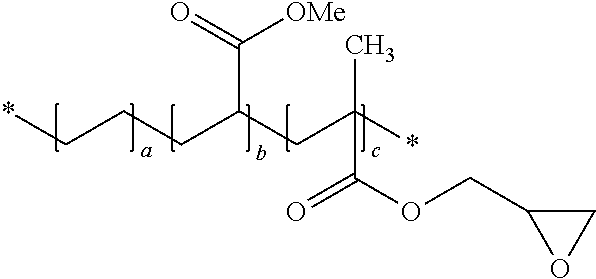
wherein, a, b, and c are 1 or greater.

wherein x, y and z are 1 or greater.

in which R1 represents a hydrogen atom, a C1-C4 alkyl group or a C1-C4 alkoxy group, X represents a linear or branched C2-C10 alkylene group, or an alkyl group, or a methylene group, or a cycloaliphatic group, or an aromatic group, and Y represents one of the groups H, OH or

in which R2 represents a C1-C4 alkyl group or an aromatic group, these groups optionally themselves being substituted by an OH or C1-C4 alkyl group.
- N-(2-hydroxyethyl)benzenesulphonamide (L),
- N-(3-hydroxypropyl)benzenesulphonamide (L),
- N-(2-hydroxyethyl)-p-toluenesulphonamide (S),
- N-(4-hydroxyphenyl)benzenesulphonamide (S),
- N-[(2-hydroxy-1-hydroxymethyl-1-methyl)ethyl]benzenesulphonamide (L),
- N-[5-hydroxy-1,5-dimethylhexyl]benzenesulphonamide (S),
- N-(2-acetoxyethyl)benzenesulphonamide (S),
- N-(5-hydroxypentyl)benzenesulphonamide (L),
- N-[2-(4-hydroxybenzoyloxy)ethyl]benzene-sulphonamide (S),
- N-[2-(4-methylbenzoyloxy)ethyl]benzenesulphonamide (S),
- N-(2-hydroxyethyl)-p-methoxybenzenesulphonamide (S) and
- N-(2-hydroxypropyl)benzenesulphonamide (L).
One particular sulfonamide, for example, is N-(n-butyl)benzene sulfonamide.
| Sample | Sample | Sample | Sample | Sample | |
| No. 1 | No. 2 | No. 3 | No. 4 | No. 5 | |
| Polyoxymethylene | 99.18 | ||||
| Polymer | |||||
| (comonomer | |||||
| content 3.4 wt %, | |||||
| melt flow rate | |||||
| 46 cm3/10 min) | |||||
| Polyoxymethylene | 99.35 | ||||
| Polymer | |||||
| (comonomer | |||||
| content 0.7 wt %, | |||||
| melt flow rate | |||||
| 2.1 cm3/10 min) | |||||
| Polyoxymethylene Polymer | 98.95 | 99.35 | 79.35 | ||
| (comonomer | |||||
| content 1.5 wt %, | |||||
| melt flow rate | |||||
| 13.7 cm3/10 min) | |||||
| Phenolic antioxidant | 0.5 | 0.25 | 0.5 | 0.5 | 0.5 |
| Ethylene copolymer, | 0.15 | 0.15 | 0.15 | 0.15 | |
| calcium acetate, | |||||
| Surlyn compatibilizer, | |||||
| Elvamide polyamide | |||||
| Calcium 12 hydroxy stearate | 0.07 | ||||
| Allantoin | 0.1 | ||||
| Polyoxymethylene polymer | 20 | ||||
| Polyoxymethylene | 0.5 | ||||
| terpolymer | |||||
| Ethylene bisstearamide | 0.2 | ||||
| Tricalcium citrate | 0.05 | ||||
| Copolyamide | 0.05 | ||||
| Total (%) | 100 | 100 | 100 | 100 | |
| MI (ISO 1133) | 46 | 13.71 | 13.98 | 16.3 | 2.11 |
| KD | 0 | 0.008 | 0.007 | 0.006 | |
| Vol | 0.063 | 0.098 | 0.063 | 0.01 | |
| Flex modulus(Mpa) | 2509 | 2691 | 2539 | 2214 | 2468 |
| ISO 178 | |||||
| Flex strength(Mpa) | 66.6 | 71.97 | 66.53 | 58.39 | 64.6 |
| ISO 527-2/1A | |||||
| Tensile Modulus (MPa) | 2721 | 2988.00 | 2754.00 | 2390.00 | 2631.00 |
| ISO 527-2/1A | |||||
| Yield Stress (MPa) | 62.91 | 67.58 | 65.29 | 59.31 | 64.68 |
| ISO 527-2/1A | |||||
| Yield Strain (%) | 7.98 | 10.91 | 12.95 | 12.29 | 21.53 |
| ISO 527-2/1A | |||||
| Break Stress (MPa) | 63.2 | 64.1 | 51.45 | 62.2 | |
| ISO 527-2/1A | |||||
| Break Strain (%) | 17.72 | 31.23 | 22.97 | 51.4 | 46.69 |
| ISO 527-2/1A2 | |||||
| Charpy notched (KJ/m2) | 3.1 | 7.7 | 7.1 | 10 | 13.6 |
| ISO 179/1eA | |||||
| Unnotched Charpy (KJ/m2) | 90.4 | 226.5 | 257.1 | 271 | 239.8 |
| Process Window (Tm-Tc) | 23.0 | 24.0 | 23.5 | 23.8 | 27.8 |
-
- Sample No. 6: Polyoxymethylene copolymer having an MFR of 9 g/10 min;
- Sample No. 7: Polyoxymethylene copolymer combined with 9% by weight of a thermoplastic polyurethane elastomer;
- Sample No. 8: Polyoxymethylene copolymer combined with 18% by weight of a thermoplastic polyurethane elastomer;
- Sample No. 9: Polyoxymethylene copolymer combined with 15% by weight glass fibers and 7% by weight high density polyethylene particles (4.5 million g/mol); and
- Sample No. 10: Polyoxymethylene copolymer combined with 15% by weight N-butylbenzene sulfonamide.
| Sample No. | 6 | 7 | 8 | 9 | 10 | ||
| Physical properties | Value | Value | Value | Value | Value | Unit | Test |
| Standard | |||||||
| ISO | |||||||
| Density | 1410 | 1380 | 1360 | 1460 | 1350 | kg/m3 | ISO 1183 |
| Melt volume rate, MVR | 8 | 5.5 | 4 | 1.1 | 2 | cm3/10 min | ISO 1133 |
| MVR temperature | 190 | 190 | 190 | 190 | 190 | ° C. | ISO 1133 |
| MVR load | 2.16 | 2.16 | 2.16 | 2.16 | 2.16 | kg | ISO 1133 |
| Molding shrinkage, | 2.0 | 1.8 | 1.6 | 1.1 | 1.5 | % | ISO 294-4, |
| parallel | 2577 | ||||||
| Molding shrinkage, | 1.9 | 1.6 | 1.5 | 0.9 | 1.6 | % | ISO 294-4, |
| normal | 2577 | ||||||
| Water Absorption, | 0.75 | 0.8 | 0.8 | — | 0.3 | % | ISO 62 |
| 23° C.-sat | |||||||
| Humidity absorption, | 0.2 | 0.25 | 0.25 | — | — | % | ISO 62 |
| 23° C./50% RH | |||||||
Claims (16)
Priority Applications (1)
| Application Number | Priority Date | Filing Date | Title |
|---|---|---|---|
| US17/125,160 US12076913B2 (en) | 2019-12-17 | 2020-12-17 | Feed material for three-dimensional printing containing a polyoxymethylene polymer |
Applications Claiming Priority (2)
| Application Number | Priority Date | Filing Date | Title |
|---|---|---|---|
| US201962949036P | 2019-12-17 | 2019-12-17 | |
| US17/125,160 US12076913B2 (en) | 2019-12-17 | 2020-12-17 | Feed material for three-dimensional printing containing a polyoxymethylene polymer |
Publications (2)
| Publication Number | Publication Date |
|---|---|
| US20210206051A1 US20210206051A1 (en) | 2021-07-08 |
| US12076913B2 true US12076913B2 (en) | 2024-09-03 |
Family
ID=76476713
Family Applications (1)
| Application Number | Title | Priority Date | Filing Date |
|---|---|---|---|
| US17/125,160 Active 2041-05-06 US12076913B2 (en) | 2019-12-17 | 2020-12-17 | Feed material for three-dimensional printing containing a polyoxymethylene polymer |
Country Status (4)
| Country | Link |
|---|---|
| US (1) | US12076913B2 (en) |
| EP (1) | EP4077375A4 (en) |
| CN (1) | CN115135668A (en) |
| WO (1) | WO2021127102A1 (en) |
Families Citing this family (5)
| Publication number | Priority date | Publication date | Assignee | Title |
|---|---|---|---|---|
| CN115151403A (en) | 2019-12-17 | 2022-10-04 | 提克纳有限责任公司 | 3D printing system using thermotropic liquid crystal polymers |
| US12234364B2 (en) | 2019-12-17 | 2025-02-25 | Ticona Llc | Three-dimensional printing system employing a thermally conductive polymer composition |
| CN117999322A (en) * | 2021-10-14 | 2024-05-07 | Sika技术股份公司 | Polymer materials used in 3D printing methods |
| WO2024063137A1 (en) * | 2022-09-22 | 2024-03-28 | ポリプラスチックス株式会社 | Filament for three-dimensional molding, method for producing three-dimensional molded article, and three-dimensional molded article |
| TW202546079A (en) * | 2024-04-19 | 2025-12-01 | 日商寶理塑料股份有限公司 | A method for manufacturing three-dimensional objects based on fused wire bonding and a wire used in the method for manufacturing three-dimensional objects based on fused wire bonding. |
Citations (35)
| Publication number | Priority date | Publication date | Assignee | Title |
|---|---|---|---|---|
| US5318813A (en) * | 1989-10-12 | 1994-06-07 | E. I. Du Pont De Nemours And Company | Polyoxymethylene/thermoplastic polyurethane/amorphous thermoplastic polymer blends |
| US5889102A (en) * | 1996-02-23 | 1999-03-30 | Ticona Gmbh | Plastic Molding compositions with low wear |
| US20060235119A1 (en) * | 2005-04-15 | 2006-10-19 | Ticona Gmbh | Polyoxymethylene compositions, their preparation and use |
| US7569273B2 (en) | 2003-05-21 | 2009-08-04 | Z Corporation | Thermoplastic powder material system for appearance models from 3D printing systems |
| US20130136881A1 (en) * | 2011-11-29 | 2013-05-30 | E. I. Du Pont De Nemours And Company | Polyoxymethylene modified with imidized acrylic resins |
| US20130331488A1 (en) * | 2010-10-14 | 2013-12-12 | Ticona Gmbh | Coupled Glass-Fiber Reinforced Polyoxymethylene |
| CN103881289A (en) | 2014-04-01 | 2014-06-25 | 上海材料研究所 | Modified polyformaldehyde supporting material for 3D printing and preparation method thereof |
| CN103980445A (en) | 2014-04-30 | 2014-08-13 | 中国科学院化学研究所 | 3D printing high-molecular polyformaldehyde powder and preparation method |
| CN104163634A (en) | 2014-07-02 | 2014-11-26 | 中国电子科技集团公司第五十五研究所 | A thermoplastic material used for three-dimensional printing and an application method thereof |
| CN104177551A (en) | 2014-08-26 | 2014-12-03 | 太仓碧奇新材料研发有限公司 | Polyoxymethylene homopolymer composite material for 3D printing and preparation method of composite material |
| US20150184110A1 (en) * | 2013-12-31 | 2015-07-02 | Hyundai Motor Company | Polyoxymethylene resin composition |
| US20150367605A1 (en) * | 2013-01-18 | 2015-12-24 | Nisshin Steel Co., Ltd. | Shaped and coated metallic material, composite, and method for manufacturing shaped and coated metallic materialand composite |
| US20160024293A1 (en) | 2014-07-22 | 2016-01-28 | Basf Se | Mixture for use in a fused filament fabrication process |
| CN105504662A (en) | 2015-12-30 | 2016-04-20 | 成都新柯力化工科技有限公司 | Polyformaldehyde wire material for 3D printing and preparation method thereof |
| WO2016080573A1 (en) | 2014-11-19 | 2016-05-26 | 퓨처사이버 주식회사 | Filament composition for 3d printer |
| US20170157845A1 (en) * | 2014-06-16 | 2017-06-08 | Sabic Global Technologies B.V. | Method and apparatus for increasing bonding in material extrusion additive manufacturing |
| CN106832838A (en) | 2017-03-17 | 2017-06-13 | 金旸(厦门)新材料科技有限公司 | It is a kind of to polish in the 3D printing material and methods for making and using same of metal appearance |
| WO2017100447A1 (en) | 2015-12-11 | 2017-06-15 | Sabic Global Technologies B.V. | Addition of plasticizers to improve interlayer adhesion in additive manufacturing processes |
| WO2017130469A1 (en) * | 2016-01-26 | 2017-08-03 | 鉦則 藤田 | Method for producing three-dimensionally shaped product, and filament for use in production of three-dimensionally shaped product |
| CN107674282A (en) | 2017-10-18 | 2018-02-09 | 安徽天易金属新材料有限公司 | A kind of aluminium pigment for 3D printing high polymer material and preparation method thereof |
| US20180087189A1 (en) | 2015-03-27 | 2018-03-29 | U.S. Army Research Laboratory Attn: Rdrl-Loc-I | Multi-material polymer filament for three-dimensional printing co-drawn with functional or structural thread |
| WO2018129525A1 (en) | 2017-01-09 | 2018-07-12 | Sabic Global Technologies B.V. | Method of making multi-part article |
| US20180202076A1 (en) | 2015-07-14 | 2018-07-19 | Basf Se | Filaments based on a coated core material |
| WO2018146281A1 (en) | 2017-02-10 | 2018-08-16 | Sabic Global Technologies B.V. | Additive manufacturing powder compositions including amorphous and semi-crystalline components |
| US20180361657A1 (en) | 2015-12-11 | 2018-12-20 | Sabic Global Technologies B.V. | Method of additive manufacturing to make objects having improved and tailored properties |
| US20180361658A1 (en) | 2015-12-11 | 2018-12-20 | Sabic Global Technologies B.V. | Adhesion promoting layer to improve interlayer adhesion in additive manufacturing processes |
| CN109093109A (en) | 2018-10-24 | 2018-12-28 | 南京惟初信息科技有限公司 | A kind of 3D printing material and the printing shaping method using the 3D printing material |
| WO2019025472A1 (en) | 2017-08-02 | 2019-02-07 | Basf Se | A process for producing a three-dimensional green body by a fused filament fabrication (fff) process |
| WO2019053237A1 (en) | 2017-09-18 | 2019-03-21 | Solvay Specialty Polymers Usa, Llc | Additive manufacturing method for making a three-dimensional object using selective laser sintering |
| GB2566934A (en) | 2017-09-20 | 2019-04-03 | Bae Systems Plc | Material for 3D printing and a 3D printed device |
| WO2019132402A1 (en) | 2017-12-28 | 2019-07-04 | 효성중공업 주식회사 | Method for manufacturing solid insulation member and insulation member thereof |
| CN110117402A (en) | 2019-05-22 | 2019-08-13 | 唐山开滦化工科技有限公司 | A kind of preparation method of POM/PLA alloy 3D printing consumptive material |
| WO2019164966A1 (en) | 2018-02-20 | 2019-08-29 | Greenheck Fan Corporation | Metal-based pellet extrusion additive manufacturing system and method of using same |
| US20190352804A1 (en) | 2016-12-13 | 2019-11-21 | Basf Se | Filaments for use as a support material in fused deposition modeling |
| US20210060851A1 (en) | 2016-01-22 | 2021-03-04 | Mitsubishi Gas Chemical Company, Inc. | Method for manufacturing three-dimensional structure, and 3d printer filament |
Family Cites Families (1)
| Publication number | Priority date | Publication date | Assignee | Title |
|---|---|---|---|---|
| EP3970945A1 (en) * | 2013-11-19 | 2022-03-23 | Guill Tool & Engineering | Filament for use in a 3d printer and method for producing the same |
-
2020
- 2020-12-17 WO PCT/US2020/065491 patent/WO2021127102A1/en not_active Ceased
- 2020-12-17 US US17/125,160 patent/US12076913B2/en active Active
- 2020-12-17 EP EP20903411.5A patent/EP4077375A4/en not_active Withdrawn
- 2020-12-17 CN CN202080096909.5A patent/CN115135668A/en active Pending
Patent Citations (36)
| Publication number | Priority date | Publication date | Assignee | Title |
|---|---|---|---|---|
| US5318813A (en) * | 1989-10-12 | 1994-06-07 | E. I. Du Pont De Nemours And Company | Polyoxymethylene/thermoplastic polyurethane/amorphous thermoplastic polymer blends |
| US5889102A (en) * | 1996-02-23 | 1999-03-30 | Ticona Gmbh | Plastic Molding compositions with low wear |
| US7569273B2 (en) | 2003-05-21 | 2009-08-04 | Z Corporation | Thermoplastic powder material system for appearance models from 3D printing systems |
| US20060235119A1 (en) * | 2005-04-15 | 2006-10-19 | Ticona Gmbh | Polyoxymethylene compositions, their preparation and use |
| US20130331488A1 (en) * | 2010-10-14 | 2013-12-12 | Ticona Gmbh | Coupled Glass-Fiber Reinforced Polyoxymethylene |
| US20130136881A1 (en) * | 2011-11-29 | 2013-05-30 | E. I. Du Pont De Nemours And Company | Polyoxymethylene modified with imidized acrylic resins |
| US20150367605A1 (en) * | 2013-01-18 | 2015-12-24 | Nisshin Steel Co., Ltd. | Shaped and coated metallic material, composite, and method for manufacturing shaped and coated metallic materialand composite |
| US20150184110A1 (en) * | 2013-12-31 | 2015-07-02 | Hyundai Motor Company | Polyoxymethylene resin composition |
| CN103881289A (en) | 2014-04-01 | 2014-06-25 | 上海材料研究所 | Modified polyformaldehyde supporting material for 3D printing and preparation method thereof |
| CN103980445A (en) | 2014-04-30 | 2014-08-13 | 中国科学院化学研究所 | 3D printing high-molecular polyformaldehyde powder and preparation method |
| US20170157845A1 (en) * | 2014-06-16 | 2017-06-08 | Sabic Global Technologies B.V. | Method and apparatus for increasing bonding in material extrusion additive manufacturing |
| CN104163634A (en) | 2014-07-02 | 2014-11-26 | 中国电子科技集团公司第五十五研究所 | A thermoplastic material used for three-dimensional printing and an application method thereof |
| US20160024293A1 (en) | 2014-07-22 | 2016-01-28 | Basf Se | Mixture for use in a fused filament fabrication process |
| CN104177551A (en) | 2014-08-26 | 2014-12-03 | 太仓碧奇新材料研发有限公司 | Polyoxymethylene homopolymer composite material for 3D printing and preparation method of composite material |
| WO2016080573A1 (en) | 2014-11-19 | 2016-05-26 | 퓨처사이버 주식회사 | Filament composition for 3d printer |
| US20180087189A1 (en) | 2015-03-27 | 2018-03-29 | U.S. Army Research Laboratory Attn: Rdrl-Loc-I | Multi-material polymer filament for three-dimensional printing co-drawn with functional or structural thread |
| US20180202076A1 (en) | 2015-07-14 | 2018-07-19 | Basf Se | Filaments based on a coated core material |
| WO2017100447A1 (en) | 2015-12-11 | 2017-06-15 | Sabic Global Technologies B.V. | Addition of plasticizers to improve interlayer adhesion in additive manufacturing processes |
| US20180361658A1 (en) | 2015-12-11 | 2018-12-20 | Sabic Global Technologies B.V. | Adhesion promoting layer to improve interlayer adhesion in additive manufacturing processes |
| US20180361657A1 (en) | 2015-12-11 | 2018-12-20 | Sabic Global Technologies B.V. | Method of additive manufacturing to make objects having improved and tailored properties |
| CN105504662A (en) | 2015-12-30 | 2016-04-20 | 成都新柯力化工科技有限公司 | Polyformaldehyde wire material for 3D printing and preparation method thereof |
| US20210060851A1 (en) | 2016-01-22 | 2021-03-04 | Mitsubishi Gas Chemical Company, Inc. | Method for manufacturing three-dimensional structure, and 3d printer filament |
| WO2017130469A1 (en) * | 2016-01-26 | 2017-08-03 | 鉦則 藤田 | Method for producing three-dimensionally shaped product, and filament for use in production of three-dimensionally shaped product |
| US20190030790A1 (en) * | 2016-01-26 | 2019-01-31 | Masanori Fujita | Method for producing three-dimensional shaped article, and filament for producing three-dimensional shaped article |
| US20190352804A1 (en) | 2016-12-13 | 2019-11-21 | Basf Se | Filaments for use as a support material in fused deposition modeling |
| WO2018129525A1 (en) | 2017-01-09 | 2018-07-12 | Sabic Global Technologies B.V. | Method of making multi-part article |
| WO2018146281A1 (en) | 2017-02-10 | 2018-08-16 | Sabic Global Technologies B.V. | Additive manufacturing powder compositions including amorphous and semi-crystalline components |
| CN106832838A (en) | 2017-03-17 | 2017-06-13 | 金旸(厦门)新材料科技有限公司 | It is a kind of to polish in the 3D printing material and methods for making and using same of metal appearance |
| WO2019025472A1 (en) | 2017-08-02 | 2019-02-07 | Basf Se | A process for producing a three-dimensional green body by a fused filament fabrication (fff) process |
| WO2019053237A1 (en) | 2017-09-18 | 2019-03-21 | Solvay Specialty Polymers Usa, Llc | Additive manufacturing method for making a three-dimensional object using selective laser sintering |
| GB2566934A (en) | 2017-09-20 | 2019-04-03 | Bae Systems Plc | Material for 3D printing and a 3D printed device |
| CN107674282A (en) | 2017-10-18 | 2018-02-09 | 安徽天易金属新材料有限公司 | A kind of aluminium pigment for 3D printing high polymer material and preparation method thereof |
| WO2019132402A1 (en) | 2017-12-28 | 2019-07-04 | 효성중공업 주식회사 | Method for manufacturing solid insulation member and insulation member thereof |
| WO2019164966A1 (en) | 2018-02-20 | 2019-08-29 | Greenheck Fan Corporation | Metal-based pellet extrusion additive manufacturing system and method of using same |
| CN109093109A (en) | 2018-10-24 | 2018-12-28 | 南京惟初信息科技有限公司 | A kind of 3D printing material and the printing shaping method using the 3D printing material |
| CN110117402A (en) | 2019-05-22 | 2019-08-13 | 唐山开滦化工科技有限公司 | A kind of preparation method of POM/PLA alloy 3D printing consumptive material |
Non-Patent Citations (4)
| Title |
|---|
| "Polyisobutylene" (Polymer Science learning Center) Feb. 19, 2021 (Feb. 19, 2021) [Retrieved on Feb. 18, 2021] Retrieved from the Internet <URL:https://pslc.ws/macrog/pib.htm>. |
| Celcon M25-04 data sheet, downloaded Jan. 13, 2023. (Year: 2023). * |
| European Search Report Corresponding to Application No. 20903411.5 on Nov. 16, 2024. |
| International Search Report and The Written Opinion of the International Searching Authority, or the Declaration PCT/US20/65491 on Mar. 12, 2021. |
Also Published As
| Publication number | Publication date |
|---|---|
| WO2021127102A1 (en) | 2021-06-24 |
| CN115135668A (en) | 2022-09-30 |
| EP4077375A1 (en) | 2022-10-26 |
| EP4077375A4 (en) | 2023-12-20 |
| US20210206051A1 (en) | 2021-07-08 |
Similar Documents
| Publication | Publication Date | Title |
|---|---|---|
| US12076913B2 (en) | Feed material for three-dimensional printing containing a polyoxymethylene polymer | |
| US20210179846A1 (en) | Powder Composition For Three-Dimensional Printing Containing A Polyoxymethylene Polymer | |
| EP2652001B1 (en) | Coupled glass-fiber reinforced polyoxymethylene | |
| US8865805B2 (en) | Tribologically modified glass-fiber reinforced polyoxymethylene | |
| EP2505609B1 (en) | High impact resistant polyoxymethylene for extrusion blow molding | |
| JPH0439497B2 (en) | ||
| EP2441786B1 (en) | Glass-fiber reinforced polyoxymethylene | |
| US20230055930A1 (en) | Low Noise Polymer Composition | |
| US20160177219A1 (en) | Polyoxymethylene polymer composition having low friction | |
| US20140137975A1 (en) | Plasticized, Conductive Polyoxymethylene for Fuel Applications | |
| US20150065654A1 (en) | Tribologically Modified Polyoxymethylene | |
| US20150175798A1 (en) | Polyoxymethylene polymer with plasticizer and impact modifier | |
| US9991021B2 (en) | Laser-weldable electrostatically dissipative polyoxymethylene based on stainless steel fibers | |
| US20220356341A1 (en) | Polyoxymethylene Polymer Composition For Rotational Molding Applications | |
| US11015031B2 (en) | Reinforced polyoxymethylene composition with low emissions | |
| WO2025235718A1 (en) | Reinforced polyoxymethylene polymer compositions | |
| US20140127481A1 (en) | Polyoxymethylene with Improved Printability |
Legal Events
| Date | Code | Title | Description |
|---|---|---|---|
| FEPP | Fee payment procedure |
Free format text: ENTITY STATUS SET TO UNDISCOUNTED (ORIGINAL EVENT CODE: BIG.); ENTITY STATUS OF PATENT OWNER: LARGE ENTITY |
|
| STPP | Information on status: patent application and granting procedure in general |
Free format text: APPLICATION DISPATCHED FROM PREEXAM, NOT YET DOCKETED |
|
| STPP | Information on status: patent application and granting procedure in general |
Free format text: DOCKETED NEW CASE - READY FOR EXAMINATION |
|
| STPP | Information on status: patent application and granting procedure in general |
Free format text: NON FINAL ACTION MAILED |
|
| STPP | Information on status: patent application and granting procedure in general |
Free format text: RESPONSE TO NON-FINAL OFFICE ACTION ENTERED AND FORWARDED TO EXAMINER |
|
| STPP | Information on status: patent application and granting procedure in general |
Free format text: RESPONSE TO NON-FINAL OFFICE ACTION ENTERED AND FORWARDED TO EXAMINER |
|
| STPP | Information on status: patent application and granting procedure in general |
Free format text: FINAL REJECTION MAILED |
|
| STPP | Information on status: patent application and granting procedure in general |
Free format text: DOCKETED NEW CASE - READY FOR EXAMINATION |
|
| STPP | Information on status: patent application and granting procedure in general |
Free format text: NON FINAL ACTION MAILED |
|
| STPP | Information on status: patent application and granting procedure in general |
Free format text: RESPONSE TO NON-FINAL OFFICE ACTION ENTERED AND FORWARDED TO EXAMINER |
|
| STPP | Information on status: patent application and granting procedure in general |
Free format text: NOTICE OF ALLOWANCE MAILED -- APPLICATION RECEIVED IN OFFICE OF PUBLICATIONS |
|
| AS | Assignment |
Owner name: TICONA LLC, KENTUCKY Free format text: ASSIGNMENT OF ASSIGNORS INTEREST;ASSIGNORS:PETERSON, CRAIG;MARKGRAF, KIRSTEN;ZHANG, XIAOWEI;SIGNING DATES FROM 20210129 TO 20210406;REEL/FRAME:067262/0452 |
|
| ZAAB | Notice of allowance mailed |
Free format text: ORIGINAL CODE: MN/=. |
|
| STPP | Information on status: patent application and granting procedure in general |
Free format text: NOTICE OF ALLOWANCE MAILED -- APPLICATION RECEIVED IN OFFICE OF PUBLICATIONS |
|
| STPP | Information on status: patent application and granting procedure in general |
Free format text: PUBLICATIONS -- ISSUE FEE PAYMENT VERIFIED |
|
| STCF | Information on status: patent grant |
Free format text: PATENTED CASE |