US12071422B2 - Process for synthesis of quinazoline compounds - Google Patents
Process for synthesis of quinazoline compounds Download PDFInfo
- Publication number
- US12071422B2 US12071422B2 US18/164,302 US202318164302A US12071422B2 US 12071422 B2 US12071422 B2 US 12071422B2 US 202318164302 A US202318164302 A US 202318164302A US 12071422 B2 US12071422 B2 US 12071422B2
- Authority
- US
- United States
- Prior art keywords
- compound
- formula
- contacting
- synthesizing
- unsubstituted
- Prior art date
- Legal status (The legal status is an assumption and is not a legal conclusion. Google has not performed a legal analysis and makes no representation as to the accuracy of the status listed.)
- Active
Links
Images
Classifications
-
- C—CHEMISTRY; METALLURGY
- C07—ORGANIC CHEMISTRY
- C07D—HETEROCYCLIC COMPOUNDS
- C07D401/00—Heterocyclic compounds containing two or more hetero rings, having nitrogen atoms as the only ring hetero atoms, at least one ring being a six-membered ring with only one nitrogen atom
- C07D401/02—Heterocyclic compounds containing two or more hetero rings, having nitrogen atoms as the only ring hetero atoms, at least one ring being a six-membered ring with only one nitrogen atom containing two hetero rings
- C07D401/04—Heterocyclic compounds containing two or more hetero rings, having nitrogen atoms as the only ring hetero atoms, at least one ring being a six-membered ring with only one nitrogen atom containing two hetero rings directly linked by a ring-member-to-ring-member bond
-
- C—CHEMISTRY; METALLURGY
- C07—ORGANIC CHEMISTRY
- C07D—HETEROCYCLIC COMPOUNDS
- C07D401/00—Heterocyclic compounds containing two or more hetero rings, having nitrogen atoms as the only ring hetero atoms, at least one ring being a six-membered ring with only one nitrogen atom
- C07D401/14—Heterocyclic compounds containing two or more hetero rings, having nitrogen atoms as the only ring hetero atoms, at least one ring being a six-membered ring with only one nitrogen atom containing three or more hetero rings
-
- A—HUMAN NECESSITIES
- A61—MEDICAL OR VETERINARY SCIENCE; HYGIENE
- A61K—PREPARATIONS FOR MEDICAL, DENTAL OR TOILETRY PURPOSES
- A61K31/00—Medicinal preparations containing organic active ingredients
- A61K31/33—Heterocyclic compounds
- A61K31/395—Heterocyclic compounds having nitrogen as a ring hetero atom, e.g. guanethidine or rifamycins
- A61K31/495—Heterocyclic compounds having nitrogen as a ring hetero atom, e.g. guanethidine or rifamycins having six-membered rings with two or more nitrogen atoms as the only ring heteroatoms, e.g. piperazine or tetrazines
- A61K31/505—Pyrimidines; Hydrogenated pyrimidines, e.g. trimethoprim
- A61K31/517—Pyrimidines; Hydrogenated pyrimidines, e.g. trimethoprim ortho- or peri-condensed with carbocyclic ring systems, e.g. quinazoline, perimidine
-
- A—HUMAN NECESSITIES
- A61—MEDICAL OR VETERINARY SCIENCE; HYGIENE
- A61P—SPECIFIC THERAPEUTIC ACTIVITY OF CHEMICAL COMPOUNDS OR MEDICINAL PREPARATIONS
- A61P35/00—Antineoplastic agents
-
- B—PERFORMING OPERATIONS; TRANSPORTING
- B01—PHYSICAL OR CHEMICAL PROCESSES OR APPARATUS IN GENERAL
- B01J—CHEMICAL OR PHYSICAL PROCESSES, e.g. CATALYSIS OR COLLOID CHEMISTRY; THEIR RELEVANT APPARATUS
- B01J23/00—Catalysts comprising metals or metal oxides or hydroxides, not provided for in group B01J21/00
- B01J23/38—Catalysts comprising metals or metal oxides or hydroxides, not provided for in group B01J21/00 of noble metals
- B01J23/40—Catalysts comprising metals or metal oxides or hydroxides, not provided for in group B01J21/00 of noble metals of the platinum group metals
- B01J23/44—Palladium
-
- B—PERFORMING OPERATIONS; TRANSPORTING
- B01—PHYSICAL OR CHEMICAL PROCESSES OR APPARATUS IN GENERAL
- B01J—CHEMICAL OR PHYSICAL PROCESSES, e.g. CATALYSIS OR COLLOID CHEMISTRY; THEIR RELEVANT APPARATUS
- B01J23/00—Catalysts comprising metals or metal oxides or hydroxides, not provided for in group B01J21/00
- B01J23/70—Catalysts comprising metals or metal oxides or hydroxides, not provided for in group B01J21/00 of the iron group metals or copper
- B01J23/74—Iron group metals
- B01J23/755—Nickel
Definitions
- the configuration at a biaryl axis often plays an important role for pharmacological properties of bioactive compounds and is a fundamental basis for useful reagents and catalysts in asymmetric synthesis.
- scale up of such processes to commercial/industrial scale can often lead to unforeseen and unexpected difficulties with process and synthesis.
- the present disclosure provides improved processes for the atroposelective synthesis of aminopyridinyl-quinazolinyl compounds via Negishi coupling utilizing a chiral ligand such as chiraphite.
- a process for the synthesis of a compound of formula (I) as described herein comprising (a) contacing a compound fo formula (II) as described herein with an organomagnesium compound thereby forming a compound of formula (IIa) as described herein; (b) transferring the compound of formula (IIa) of step (a) to a continuous stirred tank reactor (CSTR) comprising a zinc compound thereby synthesizing a compound of formula (IIb) as described herein; and contacting the compound (IIb) of step (b) with a compound of formula (III) as described herein, a transition metal catalyst precursor as described herein, and a chiral ligand as described herein, thereby synthesizing a compound of formula (I).
- CSTR continuous stirred tank reactor
- the compound of formula (II) is prepared according to the process P2 as described herein.
- the compound of formula (III) is prepared according to the process P4 as described herein.
- formula (I) comprises a compound of formula (Ia), (Ib), (Ic), or (Id) as described herein.
- formula (I) comprises a compound of formula (1) as described herein.
- a process (P5) for the synthesis of a compound of formula (2) as described herein comprising (a) contacting a compound of formula (4a) as described herein with i-PrMgCl followed by hydroxylamine, thereby synthesizing the compound of formula (4c) as described herein; (b) contacting the compound of formula (4c) as described herein with TFAA and triethylamine in acetonitrile followed by ammonia, thereby synthesizing the compound of formula (4e) as described herein; contacting the compound of (4e) as described herein with a chlorinating agent, thereby synthesizing the compound of formula (4) as described herein; contacting the compound of (4) as described herein with CO 2 in the presence of DBU, thereby synthesizing the compound of formula (5); contacting the compound of formula (5) as described herein with POCl 3 and DIPEA followed by tert-butyl (S)-3-methylpiperazine-1-carboxy
- a process (P7) comprising the synthesis of a compound of formula (G) or a tautomer, stereoisomer, atropisomer, or pharmaceutically acceptable salt thereof as described herein, comprising contacting the compound of formula (I) or a solvate, tautomer, stereoisomer, atropisomer, or salt thereof with a moiety comprising X A as described herein in the presence of base as described herein and an activating agent as described herein, thereby synthesizing a compound of formula (G1) as described herein; removing the PG groups and optionally R 1 from the compound of formula (G1); and contacting the compound of step (b) with a compound of formula (VII) as described herein in the presence of an activating agent as described herein, followed by contacting with a base as described herein, thereby making a compound of formula (G) or a tautomer, stereoisomer, atropisomer, or pharmaceutically acceptable salt thereof.
- a process (P8) for the synthesis of a compound of formula (1) or a pharmaceutically acceptable salt thereof as described herein comprising: contacting a precooled solution comprising a compound of formula (2) or a salt thereof as described herein with a pre-cooled solution comprising i-PrMgCl ⁇ LiCl using a flow rate resulting in a residence time of about 15-150 seconds for the Mg—Br exchange thereby synthesizing a compound of formula (2a) as described herein; transferring the compound of formula (2a) of step (a) to a continuous stirred tank reactor (CSTR) comprising a solution of ZnCl 2 or Zn(OPiv) 2 and maintaining a constant residence time of about 3-7 minutes at about ⁇ 20° C.
- CSTR continuous stirred tank reactor
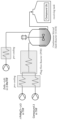
- FIG. 1 depicts an exemplary hardware setup for the continuous flow reactions described herein.
- the equivalent dose, amount, or weight percent can be within 30%, 20%, 15%, 10%, 5%, 1%, or less of the specified dose, amount, or weight percent.
- the term “residence time” refers to the residence time distribution (RTD) of a continuous flow system and is a probability distribution function that describes the amount of time a molecule or compound could spend inside the reactor setup.
- halogen and “halo” are used interchangeably herein and refer to F, Cl, Br, or I.
- alkyl refers to a saturated linear or branched-chain monovalent hydrocarbon group.
- the alkyl group is one to eighteen carbon atoms (C 1-18 ).
- the alkyl group is C 1-12 , C 1-10 , C 1-8 , C 1-6 , C 1-5 , C 1-4 , or C 1-3 .
- alkyl groups include methyl (Me, —CH 3 ), ethyl (Et, —CH 2 CH 3 ), 1-propyl (n-Pr, n-propyl, —CH 2 CH 2 CH 3 ), 2-propyl (i-Pr, i-propyl, —CH(CH 3 ) 2 ), 1-butyl (n-Bu, n-butyl, —CH 2 CH 2 CH 2 CH 3 ), 2-methyl-1-propyl (i-Bu, i-butyl, —CH 2 CH(CH 3 ) 2 ), 2-butyl (s-Bu, s-butyl, —CH(CH 3 )CH 2 CH 3 ), 2-methyl-2-propyl (t-Bu, t-butyl, —C(CH 3 ) 3 ), 1-pentyl (n-pentyl, —CH 2 CH 2 CH 2 CH 3 ), 2-pentyl (—CH(CH 3 )CH 2 CH 2 CH 2 CH
- haloalkyl refers to an alkyl chain in which one or more hydrogen has been replaced by a halogen. Examples of haloalkyls are trifluoromethyl, difluoromethyl, and fluoromethyl. A “fluoroalkyl” refers to an alkyl chain in which one or more hydrogen has been replaced by F.
- amino refers to —NH 2 .
- cyano and “nitrile” are used interchangeably herein and refer to —C ⁇ N or —CN.
- cyanoalkyl refers to alkyl substituted with one cyano substituent.
- hydroxy refers to —OH.
- “Fused” refers to any ring structure described herein that shares one or more atoms (e.g., carbon or nitrogen atoms) with an existing ring structure in the compounds of the invention.
- a “halogenating agent” as used herein refers to any reagent that adds one or more halogens to a compound described herein.
- a “chlorinating agent” as used herein refers to any reagent that adds one or more chlorine (Cl) atoms to a compound described herein. In one embodiment, the chlorinating agent is NCS or DCH as described herein.
- a “brominating” or “iodination” agent as used herein refers to any reagent that adds one or more bromine (Br) or iodine (I) atoms, respectively, to a compound described herein.
- haloalkylation agent refers to any reagent that adds one or more haloalkyl groups (e.g. CF 3 ) to a compound described herein.
- fluoroalkylation agent refers to a reagent that adds one or more fluoroalkyl groups to a compound described herein.
- organomagnesium compound is organometallic compound in which the metal is magnesium.
- Compounds of the invention may contain one or more chiral carbon atoms. Accordingly, the compounds may exist as diastereomers, enantiomers or mixtures thereof.
- the syntheses of the compounds may employ racemates, diastereomers or enantiomers as starting materials or as intermediates. Mixtures of particular diastereomeric compounds may be separated, or enriched in one or more particular diastereomers, by chromatographic or crystallization methods. Similarly, enantiomeric mixtures may be separated, or enantiomerically enriched, using the same techniques or others known in the art.
- Each of the asymmetric carbon or nitrogen atoms may be in the R or S configuration and both of these configurations are within the scope of the invention.
- stereochemistry of any particular chiral atom is not specified, then all stereoisomers are contemplated and included as the compounds of the invention. Where stereochemistry is specified by a solid wedge or dashed line representing a particular configuration, then that stereoisomer is so specified and defined. Unless otherwise specified, if solid wedges or dashed lines are used, relative stereochemistry is intended.
- stereoisomers refer to compounds that have identical chemical constitution, but differ with regard to the arrangement of the atoms or groups in space. Stereoisomers include diastereomers, enantiomers, atropisomers, conformers, and the like.
- chiral refers to molecules which have the property of non-superimposability of the mirror image partner, while the term “achiral” refers to molecules which are superimposable on their mirror image partner.
- diastereomer refers to a stereoisomer with two or more centers of chirality and whose molecules are not mirror images of one another. Diastereomers have different physical properties, e.g., melting points, boiling points, spectral properties or biological activities. Mixtures of diastereomers may separate under high resolution analytical procedures such as electrophoresis and chromatography such as HPLC.
- enantiomers refer to two stereoisomers of a compound which are non-superimposable mirror images of one another.
- “Atropisomers” are stereoisomers arising because of hindered rotation around a single bond or axis, where energy differences due to steric strain or other contributors create a barrier to rotation that is high enough to allow for isolation of individual conformers.
- d and l or (+) and ( ⁇ ) are employed to designate the sign of rotation of plane-polarized light by the compound, with ( ⁇ ) or l meaning that the compound is levorotatory.
- a compound prefixed with (+) or d is dextrorotatory.
- these stereoisomers are identical except that they are mirror images of one another.
- a specific stereoisomer may also be referred to as an enantiomer, and a mixture of such isomers is often called an enantiomeric mixture.
- a 50:50 mixture of enantiomers is referred to as a racemic mixture or a racemate, which may occur where there has been no stereoselection or stereospecificity in a chemical reaction or process.
- the terms “racemic mixture” and “racemate” refer to an equimolar mixture of two enantiomeric species, devoid of optical activity.
- tautomer or “tautomeric form” refers to structural isomers of different energies which are interconvertible via a low energy barrier.
- proton tautomers also known as prototropic tautomers
- Valence tautomers include interconversions by reorganization of some of the bonding electrons.
- amino-protecting group refers to a derivative of the groups commonly employed to block or protect an amino group while reactions are carried out on other functional groups on the compound.
- protecting groups include carbamates, amides, alkyl and aryl groups, and imines, as well as many N-heteroatom derivatives which can be removed to regenerate the desired amine group.
- amino protecting groups are PMB (p-methoxybenzyl), Boc (tert-butyloxycarbonyl), Fmoc (9-fluorenylmethyloxycarbonyl), Cbz (carbobenzyloxy), Ac (acetyl), trifluoroacetyl, phthalimide, Bn (benzyl), Tr (triphenylmethyl or trityl), benzylidenyl, p-toluenesulfonyl, or DMB (dimethoxybenzyl).
- an amino protecting group can be a group used to block or protect an amino group which results from cyclization of groups attached to the amino group but which can be later removed or replaced.
- Such examples include 1,3,5-dioxazinane, 2,4-dimethyl-1,3,5-dioxazinane, 2,2,5,5-tetramethyl-1,2,5-azadisilolidine, and isoindoline-1,3-dione.
- amino-protecting groups are found in T. W. Greene and P. G. M. Wuts, “Protecting Groups in Organic Synthesis, 3 rd ed., John Wiley & Sons, Inc., 1999.
- protected amino refers to an amino group substituted with one of the above amino-protecting groups.
- leaving group refers to a portion of a first reactant in a chemical reaction that is displaced from the first reactant in the chemical reaction.
- Examples of leaving groups include, but are not limited to, halogen atoms, alkoxy and sulfonyloxy groups.
- Example sulfonyloxy groups include, but are not limited to, alkylsulfonyloxy groups (for example methyl sulfonyloxy (mesylate group) and trifluoromethylsulfonyloxy (triflate group)) and arylsulfonyloxy groups (for example p-toluenesulfonyloxy (tosylate group) and p-nitrosulfonyloxy (nosylate group)).
- alkylsulfonyloxy groups for example methyl sulfonyloxy (mesylate group) and trifluoromethylsulfonyloxy (triflate group)
- arylsulfonyloxy groups for example p-toluenesulfonyloxy (tosylate group) and p-nitrosulfonyloxy (nosylate group)
- inhibiting includes any measurable decrease or complete inhibition to achieve a desired result. For example, there may be a decrease of about, at most about, or at least about 5%, 10%, 15%, 20%, 25%, 30%, 35%, 40%, 45%, 50%, 55%, 60%, 65%, 70%, 75%, 80%, 85%, 90%, 95%, 99%, or more, or any range derivable therein, reduction of activity compared to normal.
- antagonists are used interchangeably, and they refer to a compound having the ability to inhibit a biological function of a target protein, whether by inhibiting the activity or expression of the protein, such as K-Ras, H-Ras or N-Ras G12C. Accordingly, the terms “antagonist” and “inhibitors” are defined in the context of the biological role of the target protein. While preferred antagonists herein specifically interact with (e.g., bind to) the target, compounds that inhibit a biological activity of the target protein by interacting with other members of the signal transduction pathway of which the target protein is a member are also specifically included within this definition. A preferred biological activity inhibited by an antagonist is associated with the development, growth, or spread of a tumor.
- agonist refers to a compound having the ability to initiate or enhance a biological function of a target protein, whether by inhibiting the activity or expression of the target protein. Accordingly, the term “agonist” is defined in the context of the biological role of the target polypeptide. While preferred agonists herein specifically interact with (e.g., bind to) the target, compounds that initiate or enhance a biological activity of the target polypeptide by interacting with other members of the signal transduction pathway of which the target polypeptide is a member are also specifically included within this definition.
- cancer and “cancerous”, “neoplasm”, and “tumor” and related terms refer to or describe the physiological condition in mammals that is typically characterized by unregulated cell growth.
- a “tumor” comprises one or more cancerous cells. Examples of cancer include carcinoma, blastoma, sarcoma, seminoma, glioblastoma, melanoma, leukemia, and myeloid or lymphoid malignancies. More particular examples of such cancers include squamous cell cancer (e.g., epithelial squamous cell cancer) and lung cancer including small-cell lung cancer, non-small cell lung cancer (“NSCLC”), adenocarcinoma of the lung and squamous carcinoma of the lung.
- NSCLC non-small cell lung cancer
- cancers include skin, keratoacanthoma, follicular carcinoma, hairy cell leukemia, buccal cavity, pharynx (oral), lip, tongue, mouth, salivary gland, esophageal, larynx, hepatocellular, gastric, stomach, gastrointestinal, small intestine, large intestine, pancreatic, cervical, ovarian, liver, bladder, hepatoma, breast, colon, rectal, colorectal, genitourinary, biliary passage, thyroid, papillary, hepatic, endometrial, uterine, salivary gland, kidney or renal, prostate, testis, vulval, peritoneum, anal, penile, bone, multiple myeloma, B-cell lymphoma, diffuse large B-Cell lymphoma (DLBCL), central nervous system, brain, head and neck, Hodgkin's, and associated metastases.
- DLBCL diffuse large B-Cell lymphoma
- neoplastic disorders include myeloproliferative disorders, such as polycythemia vera, essential thrombocytosis, myelofibrosis, such as primary myelofibrosis, and chronic myelogenous leukemia (CML).
- myeloproliferative disorders such as polycythemia vera, essential thrombocytosis, myelofibrosis, such as primary myelofibrosis, and chronic myelogenous leukemia (CML).
- myeloproliferative disorders such as polycythemia vera, essential thrombocytosis, myelofibrosis, such as primary myelofibrosis, and chronic myelogenous leukemia (CML).
- CML chronic myelogenous leukemia
- chemotherapeutic agent is an agent useful in the treatment of a given disorder, for example, cancer or inflammatory disorders.
- chemotherapeutic agents are well-known in the art and include examples such as those disclosed in U.S. Publ. Appl. No. 2010/0048557, incorporated herein by reference. Additionally, chemotherapeutic agents include pharmaceutically acceptable salts, acids or derivatives of any of chemotherapeutic agents, as well as combinations of two or more of them.
- treatment refers to clinical intervention designed to alter the natural course of the patient or cell being treated during the course of clinical pathology. Desirable effects of treatment include decreasing the rate of disease progression, ameliorating or palliating the disease state, and remission or improved prognosis.
- a patient is successfully “treated” if one or more symptoms associated with a breast cancer described herein are mitigated or eliminated, including, but are not limited to, reducing the proliferation of (or destroying) cancerous cells, decreasing symptoms resulting from the disease, increasing the quality of life of those suffering from the disease, decreasing the dose of other medications required to treat the disease, and/or prolonging survival of patients.
- the term “delaying progression” of a disease refers to deferring, hindering, slowing, retarding, stabilizing, and/or postponing development of a breast cancer described herein. This delay can be of varying lengths of time, depending on the history of the cancer and/or patient being treated. As is evident to one skilled in the art, a sufficient or significant delay can, in effect, encompass prevention, in that the patient does not develop cancer.
- an “effective amount” is at least the minimum amount required to effect a measurable improvement or prevention of a breast cancer described herein.
- An effective amount herein may vary according to factors such as the disease state, age, sex, and weight of the patient, and the ability of the agent to elicit a desired response in the patient.
- An effective amount is also one in which any toxic or detrimental effects of the treatment are outweighed by the therapeutically beneficial effects.
- Beneficial or desired results include results such as eliminating or reducing the risk, lessening the severity, delaying the onset of the disease (including biochemical, histological and/or behavioral symptoms of the disease, its complications and intermediate pathological phenotypes presenting during development of the disease), decreasing one or more symptoms resulting from the disease, increasing the quality of life of those suffering from the disease, decreasing the dose of other medications required to treat the disease, enhancing effect of another medication such as via targeting, delaying the progression of the disease, and/or prolonging survival.
- an effective amount of the drug may have the effect in reducing the number of cancer cells; reducing the tumor size; inhibiting (i.e., slow or stop) cancer cell infiltration into peripheral organs; inhibit (i.e., slow or stop) tumor metastasis; inhibiting (i.e., slow or stop) tumor growth; and/or relieving one or more of the symptoms associated with the disorder.
- An effective amount can be administered in one or more administrations.
- An effective amount of drug, compound, pharmaceutical composition, or combination therapy described herein can be an amount sufficient to accomplish therapeutic treatment either directly or indirectly.
- an effective amount of a drug, compound, or pharmaceutical composition may or may not be achieved in conjunction with another drug, compound, or pharmaceutical composition, or combination therapy.
- an “effective amount” may be considered in the context of administering one or more therapeutic agents, and a single agent may be considered to be given in an effective amount if, in conjunction with one or more other agents, a desirable result may be or is achieved.
- any limitation discussed with respect to one embodiment of the invention may apply to any other embodiment of the invention.
- any compound or composition of the invention may be used in any method of the invention, and any method of the invention may be used to produce or to utilize any compound or composition of the invention.
- X 1 is halogen. In one such embodiment, X 1 is F or Cl. In one embodiment, X 3 is halogen. In one such embodiment, X 3 is F or Cl. In another embodiment, both X 1 and X 3 are independently halogen. In one such embodiment, X 1 is F and X 3 is halogen. In one such embodiment, X 3 is Cl and X 1 is halogen. In one such embodiment, X 1 is F and X 3 is Cl.
- the compound of formula (IIb) is:
- X 2 is Cl, Br, or OPiv. In one embodiment, X 2 is Cl or Br. In one embodiment, X 2 is Br. In one embodiment, X 2 is Cl.
- X 2 is Cl, m is 1 or 2, and p is 1. In one embodiment of the compound of formula (IIb), X 2 is Cl, m is 1 or 2, and p is 2. In one embodiment of the compound of formula (IIb), X 2 is Cl, m is 1 or 2, and p is 3.
- X 2 is Cl, m is 0 and p is 2. In one embodiment of the compound of formula (IIb), X 2 is Cl, m is 0 and p is 3.
- X 2 is Cl, m is 1, and p is 1. In one embodiment of the compound of formula (IIb), X 2 is Cl, m is 1, and p is 2. In one embodiment of the compound of formula (IIb), X 2 is Cl, m is 1, and p is 3.
- X 2 is Cl, m is 2, and p is 1. In one embodiment of the compound of formula (IIb), X 2 is Cl, m is 2, and p is 2. In one embodiment of the compound of formula (IIb), X 2 is Cl, m is 2, and p is 3.
- X 2 is Br, m is 1 or 2, and p is 1. In one embodiment of the compound of formula (IIb), X 2 is Br, m is 1 or 2, and p is 2. In one embodiment of the compound of formula (IIb), X 2 is Br, m is 1 or 2, and p is 3.
- X 2 is Br, m is 0 and p is 2. In one embodiment of the compound of formula (IIb), X 2 is Br, m is 0 and p is 3.
- X 2 is Br, m is 1, and p is 1. In one embodiment of the compound of formula (IIb), X 2 is Br, m is 1, and p is 2. In one embodiment of the compound of formula (IIb), X 2 is Cl, m is 1, and p is 3.
- X 2 is Br, m is 2, and p is 1. In one embodiment of the compound of formula (IIb), X 2 is Br, m is 2, and p is 2. In one embodiment of the compound of formula (IIb), X 2 is Br, m is 2, and p is 3.
- X 2 is OPiv, m is 1 or 2, and p is 1. In one embodiment of the compound of formula (IIb), X 2 is OPiv, m is 1 or 2, and p is 2.
- X 2 is OPiv, m is 1 or 2, and p is 3.
- X 2 is OPiv, m is 0 and p is 2.
- X 2 is OPiv, m is 0 and p is 3.
- X 2 is OPiv, m is 1, and p is 1.
- X 2 is OPiv, m is 1, and p is 2. In one embodiment of the compound of formula (IIb), X 2 is OPiv, m is 1, and p is 3.
- X 2 is OPiv, m is 2, and p is 1. In one embodiment of the compound of formula (IIb), X 2 is OPiv, m is 2, and p is 2. In one embodiment of the compound of formula (IIb), X 2 is OPiv, m is 2, and p is 3.
- the compound of formula (IIb) has formula:
- X 2 is Cl when the zinc compound comprises Cl.
- X 2 is OPiv when the zinc compound comprises OPiv.
- compound 2b is a mixture of compounds wherein one or more of X 2 , m, and p are different.
- compound 2b comprises at least 2 or 3 different species. In one such embodiment, such species can interconvert.
- R 1 is PG 1 , where PG 1 is as described herein.
- PG 1 is Ac (acetyl), trifluoroacetyl, Bn (benzyl), Tr (triphenylmethyl or trityl), benzylidenyl, p-toluenesulfonyl, PMB (p-methoxybenzyl), Boc (tert-butyloxycarbonyl), Fmoc (9-fluorenylmethyloxycarbonyl) or Cbz (carbobenzyloxy).
- PG 1 is an acid-labile amino protecting group.
- PG 1 is tert-Butyloxycarbonyl (Boc).
- each R 2 is independently halogen or cyano. In another such embodiment, each R 2 is independently unsubstituted C 1-6 alkyl, unsubstituted C 1-6 cyanoalkyl, or unsubstituted C 1-6 haloalkyl. In one embodiment, each R 2 is independently unsubstituted C 1-3 alkyl. In one such embodiment, each R 2 is independently methyl or ethyl. In one embodiment, each R 2 is independently methyl. In one such embodiment, R 2 is methyl and n is 1. In one such embodiment, each R 2 is independently methyl or ethyl and n is 1.
- each R 2 is independently unsubstituted C 1-3 cyanoalkyl or unsubstituted C 1-3 haloalkyl.
- unsubstituted C 1-6 cyanoalkyl, or unsubstituted C 1-6 haloalkyl CH 2 F, CHF 2 , CF 3 , CH 2 CH 2 F, CH 2 CHF 2 , CH 2 CF 3 , CH 2 CN, or CH 2 CH 2 CN.
- unsubstituted C 1-6 cyanoalkyl, or unsubstituted C 1-6 haloalkyl CH 2 F, CHF 2 , CF 3 , CH 2 CH 2 F, CH 2 CHF 2 , CH 2 CF 3 , CH 2 CN, or CH 2 CH 2 CN, where n is 1.
- R 2 is unsubstituted C 1-6 alkyl or unsubstituted C 1-6 cyanoalkyl.
- R 3 is hydrogen, halogen, or R 3A -substituted or unsubstituted C 1 . 3 alkyl. In one embodiment, R 3 is R 3A -substituted or unsubstituted C 1-3 haloalkyl, or R 3A -substituted or unsubstituted cyclopropyl. In one embodiment, R 3 is hydrogen or R 3A -substituted or unsubstituted C 1-3 alkyl. In one embodiment, R 3 is hydrogen or methyl. In one embodiment, R 3 is methyl. In one embodiment, R 3 is hydrogen and R 4 is CF 3 . In another embodiment, R 3 is methyl and R 4 is CF 3 .
- R 4 is CF 3 , CHF 2 , or CH 2 F.
- each PG is independently a protecting group selected from the group consisting of Ac (acetyl), trifluoroacetyl, phthalimide, Bn (benzyl), Tr (triphenylmethyl or trityl), benzylidenyl, p-toluenesulfonyl, DMB (dimethoxybenzyl), PMB (p-methoxybenzyl), Boc (tert-butyloxycarbonyl), Fmoc (9-fluorenylmethyloxycarbonyl) or Cbz (carbobenzyloxy).
- each PG is the same. Where each PG is the same, in one such embodiment, each PG is PMB.
- the organomagnesium compound can be, for example, a grignard reagent.
- the organomagnesium compound is selected from the group consisting of isopropylmagnesium chloride, isopropylmagnesium bromide, isopropylmagnesium iodide, isopropylmagnesium chloride lithium chloride complex, sec-butylmagnesium chloride, lithium tri-n-butylmagnesiate, lithium triisopropylmagnesiate, and lithium (isopropyl)(di-n-butyl)magnesiate).
- the organomagnesium compound is i-PrMgCl ⁇ LiCl.
- the Zn compound is selected from the group consisting of ZnCl 2 , ZnBr 2 , ZnI 2 , Zn(TFA) 2 , Zn(OAc) 2 , and Zn(OPiv) 2 , including LiCl or LiTFA salts thereof.
- the Zn compound is ZnCl 2 , ZnBr 2 , or ZnI 2 .
- the Zn compound is ZnCl 2 , ZnBr 2 , or Zn(OPiv) 2 .
- the Zn compound is ZnCl 2 or Zn(OPiv) 2 .
- the Zn compound is ZnCl 2 .
- the Zn compound is ZnCl 2 ⁇ LiCl. In one embodiment, the Zn compound is Zn(OPiv) 2 . In one embodiment, the Zn compound is a salt and is Zn(OPiv) 2 ⁇ LiCl.
- the transition metal catalyst precursor is a Pd or Ni catalyst precursor.
- the transition metal catalyst precursor is a Pd or Ni catalyst precursor is selected from the group consisting of Pd(OAc) 2 , PdCl 2 , PdCl 2 (MeCN) 2 , Pd(benzonitrile) 2 Cl 2 , Pd(dba) 2 , Pd 2 (dba) 3 , Pd(PPh 3 ) 4 , Pd(PCy 3 ) 2 , Pd(PtBu 3 ) 2 , Pd(TFA) 2 , [Pd(allyl)Cl] 2 , [Pd(cinammyl)Cl] 2 , [PdCl(crotyl)] 2 , PdCl( ⁇ 5-cyclopentadienyl), [( ⁇ 3-allyl)( ⁇ 5-cyclopentadienyl)palladium(II)], [Ni( ⁇ 5-cyclopentadienyl
- the Pd or Ni catalyst precursor is a Pd catalyst precursor.
- the Pd catalyst precursor is Pd(OAc) 2 , PdCl 2 , PdCl 2 (MeCN) 2 , Pd(dba) 2 , Pd 2 (dba) 3 , Pd(TFA) 2 , [Pd(allyl)Cl] 2 , [Pd(cinammyl)Cl] 2 , [PdCl(crotyl)] 2 , PdCl( ⁇ 5-cyclopentadienyl), or [( ⁇ 3-allyl)( ⁇ 5-cyclopentadienyl)palladium(II)].
- the Pd catalyst precursor is Pd(OAc) 2 , or PdCl 2 .
- the Pd catalyst precursor is [PdCl(crotyl)] 2 , PdCl( ⁇ 5-cyclopentadienyl), PdCl 2 (MeCN) 2 , Pd(dba) 2 , Pd 2 (dba) 3 , or Pd(TFA) 2 .
- the Pd catalyst precursor is [Pd(allyl)Cl] 2 , [Pd(cinammyl)Cl] 2 , or ( ⁇ 3-allyl)( ⁇ 5-cyclopentadienyl)palladium(II).
- the Pd catalyst precursor is [Pd(allyl)Cl] 2 or [Pd(cinammyl)Cl] 2 .
- the Pd catalyst precursor is [Pd(cinammyl)Cl] 2 .
- the Pd or Ni catalyst precursor is a Ni catalyst precursor.
- the Ni catalyst precursor is NiCp(allyl), bis(1,5-cyclooctadiene)nickel(0), NiCl 2 , NiBr 2 , Ni(OAc) 2 , or Nickel(II) acetylacetonate.
- the Ni catalyst precursor is NiCl 2 , NiBr 2 , or Ni(OAc) 2 .
- the Ni catalyst precursor is NiCp(allyl), bis(1,5-cyclooctadiene)nickel(0), or Nickel(II) acetylacetonate.
- a Pd precursor described herein and a chiral ligand described herein are contacted to form a Pd-ligand complex in situ.
- a Pd precursor described herein is treated with a chiral ligand described herein to form a Pd-ligand complex that can be isolated before use in a process described herein.
- the Pd catalyst precursor is [Pd(cinammyl)Cl] 2 and the zinc compound is ZnCl 2 or Zn(OPiv) 2 .
- the chiral ligand is a compound of formula:
- R 7 and R 8 are the same. In one such embodiment, R 7 and R 8 are each independently methyl, ethyl, or phenyl. In one embodiment, R 7 and R 8 are each methyl (e.g. (R,R)-chiraphite). In one embodiment, R 7 and R 8 are each ethyl. In one embodiment of the processes described herein, the chiral ligand is (R,R)-chiraphite.
- step (a) is performed using pre-cooled solutions respectively comprising the compound of formula (II) as described herein and the organomagnesium compound as described herein.
- the pre-cooled temperature is about: ⁇ 30° C. to about 20° C.; ⁇ 30° C. to about 15° C.; ⁇ 30° C. to about 10° C.; ⁇ 30° C. to about 5° C.; ⁇ 30° C. to about 0° C.; ⁇ 25° C. to about 20° C.; ⁇ 25° C. to about 15° C.; ⁇ 25° C. to about 10° C.; ⁇ 25° C. to about 5° C.; ⁇ 25° C.
- the compound of formula (IIb) is isolated (and optionally stored) prior to step (b). In one such embodiment, the compound of formula (IIa) is stable for at least 1, 2, 3, 4, 5, or 6 weeks.
- the organomagnesium compound as described herein is present at a molar equivalent of about 0.9-1.50; 0.9-1.45; 0.9-1.40; 0.9-1.35; 0.9-1.30; 0.9-1.25; 0.9-1.20; 0.9-1.15; 0.9-1.10; 0.9-1.05; 0.9-1.02; 0.9-1.00; 0.95-1.50; 0.95-1.45; 0.95-1.40; 0.95-1.35; 0.95-1.30; 0.95-1.25; 0.95-1.20; 0.95-1.15; 0.95-1.10; 0.95-1.08; 0.95-1.05; 0.95-1.03; 0.95-1.02; 0.95-1.01; 0.95-1.00; 1.00-1.15; 1.00-1.12; 1.00-1.11; 1.00-1.10; 1.00-1.09; 1.00-1.08; 1.00-1.07; 1.00-1.06; 1.00-1.05; 1.00-1.03; or 1.00-1.02 relative to the
- step (b) is performed at a temperature of about: ⁇ 30° C. to about 20° C.; ⁇ 30° C. to about 15° C.; ⁇ 30° C. to about 10° C.; ⁇ 30° C. to about 5° C.; ⁇ 30° C. to about 0° C.; ⁇ 25° C. to about 20° C.; ⁇ 25° C. to about 15° C.; ⁇ 25° C. to about 10° C.; ⁇ 25° C. to about 5° C.; ⁇ 25° C. to about 0° C.; ⁇ 20° C. to about 20° C.; ⁇ 20° C. to about 15° C.; ⁇ 20° C.
- step (b) is performed at a temperature of about: ⁇ 30° C., ⁇ 25° C., ⁇ 20° C., ⁇ 15° C., ⁇ 10° C., ⁇ 5° C., 0° C., 5° C., or 10° C. In one such embodiment, step (b) is performed at a temperature of about ⁇ 5° C., 0° C. or 5° C.
- the Zn compound as described herein is present at a molar equivalent of about 0.3-1.50, 0.3-1.45, 0.3-1.40, 0.3-1.35; 0.3-1.30; 0.3-1.25; 0.3-1.20; 0.3-1.15; 0.3-1.10; 0.3-1.05; 0.3-1.02; 0.3-1.00; 0.3-0.95, 0.3-0.90, 0.3-0.8, 0.3-0.75, or 0.3-0.6 relative to the compound of formula (IIa) in step (a) of process (P1).
- the Zn compound as described herein is present at a molar equivalent of about 0.4-1.50, 0.4-1.45, 0.4-1.40, 0.4-1.35; 0.4-1.30; 0.4-1.25; 0.4-1.20; 0.4-1.15; 0.4-1.10; 0.4-1.05; 0.4-1.02; 0.4-1.00; 0.4-0.95, or 0.4-0.90 relative to the compound of formula (IIa) in step (a) of process (P1).
- the Zn compound as described herein is present at a molar equivalent of about 0.6-1.75, 0.6-1.70, 0.6-1.65, 0.6-1.60, 0.6-1.55, 0.6-1.50, 0.6-1.45, 0.6-1.40, 0.6-1.35; 0.6-1.30; 0.6-1.25; 0.6-1.20; 0.6-1.15; 0.6-1.10; 0.6-1.05; 0.6-1.02; 0.6-1.00; 0.6-0.95, or 0.6-0.90 relative to the compound of formula (IIa) in step (a) of process (P1).
- the Zn compound as described herein is present at a molar equivalent of about 0.3-0.6, 0.6-0.9, or 0.9-1.5 relative to the compound of formula (IIa) in step (a) of process (P1). In one embodiment, the Zn compound as described herein is present at a molar equivalent of about 0.3-0.6 or 0.6-0.9 relative to the compound of formula (IIa) in step (a) of process (P1).
- the Zn compound as described herein is present at a molar equivalent of about 0.95-1.50; 0.95-1.45; 0.95-1.40; 0.95-1.35; 0.95-1.30; 0.95-1.25; 0.95-1.20; 0.95-1.15; 0.95-1.10; 0.95-1.08; 0.95-1.05; 0.95-1.03; 0.95-1.02; 0.95-1.01; 0.95-1.00; 1.00-1.15; 1.00-1.12; 1.00-1.11; 1.00-1.10; 1.00-1.09; 1.00-1.08; 1.00-1.07; 1.00-1.06; 1.00-1.05; 1.00-1.03; or 1.00-1.02 relative to the compound of formula (IIa) in step (a) of process (P1).
- the Zn compound as described herein is present at a molar equivalent of about 0.9-1.75, 0.9-1.70, 0.9-1.65, 0.9-1.60, 0.9-1.55, 0.9-1.50, 0.9-1.45, 0.9-1.40, 0.9-1.35; 0.9-1.30; 0.9-1.25; 0.9-1.20; 0.9-1.15; 0.9-1.10; 0.9-1.05; 0.9-1.02; 0.9-1.00; 0.95-1.50; 0.95-1.45; 0.95-1.40; 0.95-1.35; 0.95-1.30; 0.95-1.25; 0.95-1.20; 0.95-1.15; 0.95-1.10; 0.95-1.08; 0.95-1.05; 0.95-1.03; 0.95-1.02; 0.95-1.01; 0.95-1.00; 1.00-1.15; 1.00-1.12; 1.00-1.11; 1.00-1.10; 1.00-1.09; 1.00-1.08; 1.00-1.07;
- the compound of formula (III) as described herein is present at a molar equivalent of about 0.9-1.50; 0.9-1.45; 0.9-1.40; 0.9-1.35; 0.9-1.30; 0.9-1.25; 0.9-1.20; 0.9-1.15; 0.9-1.10; 0.9-1.05; 0.9-1.02; 0.9-1.00; 0.95-1.50; 0.95-1.45; 0.95-1.40; 0.95-1.35; 0.95-1.30; 0.95-1.25; 0.95-1.20; 0.95-1.15; 0.95-1.10; 0.95-1.08; 0.95-1.05; 0.95-1.03; 0.95-1.02; 0.95-1.01; 0.95-1.00; 1.00-1.15; 1.00-1.12; 1.00-1.11; 1.00-1.10; 1.00-1.09; 1.00-1.08; 1.00-1.07; 1.00-1.06; 1.00-1.05; 1.00-1.03; or 1.00-1.02 relative to the
- the compound of formula (II) is prepared according to the process (P2):
- the base is 1,8-diazabicyclo[5.4.0]undec-7-ene (DBU).
- DBU 1,8-diazabicyclo[5.4.0]undec-7-ene
- the base is DBN (1,5-Diazabicyclo[4.3.0]non-5-ene), MTBD (7-Methyl-1,5,7-triazabicyclo(4.4.0)dec-5-ene), or TBD (1,5,7-triazabicyclo(4.4.0)dec-5-ene).
- the base is a carbonate bases, such as, Na 2 CO 3 , K 2 CO 3 , or Cs 2 CO 3 ) where the solvent of the reaction is water, also work in water as solvent.
- the chlorinating agent of step (b) POCl 3 , PCl 3 , PCl 5 , or SOCl 2 .
- the chlorinating agent of step (b) is POCl 3 .
- the base of step (c) is N-ethyl morpholine (NEM), triethylamine (TEA), tri(n-propyl)amine (TPA), N,N-diisopropylethylamine (DIPEA), N-methylmorpholine (NMM), N-methylimidazole (NMI), DBU, tri(n-butyl)amine, pyridine, 2,6-lutidine, or 2,4,6-collidine.
- the base of step (c) is DIPEA.
- the base of step (c) is N-ethyl morpholine (NEM), triethylamine (TEA), or tri(n-propyl)amine (TPA).
- the base of step (c) is N-methylmorpholine (NMM), N-methylimidazole (NMI), DBU, or tri(n-butyl)amine.
- the base of step (c) is pyridine, 2,6-lutidine, or 2,4,6-collidine.
- the fluorinating agent of step (d) is KF. In another embodiment of the process (P2) the fluorinating agent of step (d) is CsF or NaF. In another embodiment of the process (P2) the base is DABCO (1,4-diazabicyclo[2.2.2]octane). In one such embodiment, DABCO is present at a catalyic amount. In another such embodiment, step (d) of the process (P2) further comprises MsOH as an additive.
- Compound (IV) of the process (P2) can be synthesized according to process (P3) as described herein, where the compound of formula (IV) is prepared according to the process (P3) comprising:
- the base of step (c) is a tertiary amine.
- the base of step (c) is N-ethyl morpholine (NEM), triethylamine (TEA), tri(n-propyl)amine (TPA), N,N-diisopropylethylamine (DIPEA), N-methylmorpholine (NMM), N-methylimidazole (NMI), 1,8-diazabicyclo[5.4.0]undec-7-ene (DBU), or tri(n-butyl)amine.
- the base is triethylamine.
- the base of step (c) is pyridine or DBU.
- the base of step (c) is an inorganic base such as, for example, K 2 CO 3 , NaOAc, NaOH, or KOH could potentially be used as well
- the dehydratization agent of step (c) is trifluoroacetic anhydride (TFAA), acetic anhydride (Ac2O), methanesulfonic anhydride (Ms2O), p-toluenesulfonic anhydride (Ts2O), trifluoromethanesulfonic anhydride (Tf2O), propanephosphonic anhydride (T3P), methanesulfonyl chloride (MsCI), toluenesulfonyl chloride (TsCI), SOCl 2 , POCl 3 , or carbonyl diimidiazole (CDI).
- TFAA trifluoroacetic anhydride
- Ac2O acetic anhydride
- Ms2O methanesulfonic anhydride
- Ts2O p-toluenesulfonic anhydride
- Tf2O trifluoromethanesulfonic anhydride
- T3P propanephosphonic anhydr
- the dehydratization agent is trifluoroacetic anhydride (TFAA) or acetic anhydride (Ac2O).
- the dehydratization agent of step (c) is trifluoroacetic anhydride (TFAA), acetic anhydride (Ac2O), methanesulfonic anhydride (Ms2O), p-toluenesulfonic anhydride (Ts2O), trifluoromethanesulfonic anhydride (Tf2O), or propanephosphonic anhydride (T3P).
- the dehydratization agent of step (c) is trifluoroacetic anhydride (TFAA), acetic anhydride (Ac2O), or trifluoromethanesulfonic anhydride (Tf2O). In another such embodiment, the dehydratization agent is trifluoroacetic anhydride (TFAA).
- the halogenating agent of step (e) is 1,3-Dichloro-5,5-dimethylhydantoin (DCDMH or DCH), SO 2 Cl 2 , TCCA (trichloroisocyanuric acid), N-chlorosaccharin, or N-chlorosuccinimide (NCS).
- the halogenating agent is NCS.
- step (e) further comprises a substoichiometric amound of acid.
- the acid is HCl.
- the compound of formula (III) is prepared according to the process (P4);
- each X 6 is the same. In one embodiment of the process (P4), each X 6 is Cl. In one embodiment of the process (P4), the halogenating agent of step (a) is SF 4 in HF.
- the bromination of step (b) is performed using HBr in an acid.
- the acid is acetic acid.
- the acid is trifluoroacetic acid.
- the compound of formula (III) has formula:
- the compound of formula (III) has formula:
- Compound (3) can be synthesized according to the processes described herein (e.g. process (P4)).
- the compound of formula (III) has formula (3) and wherein the compound of formula (3) is synthesized according a process (P6) comprising:
- the compound of formula (I) has formula:
- R 2 is methyl.
- X 3 is halo. In one such embodiment, X 3 is Cl.
- the compound of formula (I) has formula:
- the compound of formula (I) has formula:
- step (a) of the process (P5) is performed in DMF as a solvent.
- process (P1) further comprises synthesizing a compound of formula (G) according to the process (P7):
- X A is selected from the group consisting of
- R 5 is unsubstituted C 1-6 alkyl or phenyl, in the presence of a an activating agent, followed by contacting with a base, thereby making a compound of formula (G) or a tautomer, stereoisomer, atropisomer, or pharmaceutically acceptable salt thereof.
- R 5 is phenyl.
- R 5 is methyl, ethyl, propyl, or t-butyl.
- the compound of formula (VII) has formula:
- the X A is
- X A is
- X A is
- X A is
- the residence time of step (a) of process (P8) is about: 15-45 seconds, 15-60 seconds, 15-90 seconds, 15-100 seconds, or 15-120 seconds. In one embodiment, the residence time of step (a) of process (P8) is about: 30-45 seconds, 30-60 seconds, 30-90 seconds, 30-120 seconds or 30-150 seconds. In still another embodiment, the residence time of step (a) of process (P8) is about: 15-45 seconds or 60-90 seconds. In one embodiment, the residence time of step (a) of process (P8) is about 15-45 seconds. In one embodiment, the residence time of step (a) of process (P8) is about 60-90 seconds. In one embodiment, the residence time of step (a) of process (P8) is about 60-150 seconds. In one embodiment, the residence time of step (a) of process (P8) is about 90-150 seconds.
- the precooled solution of ZnCl 2 or Zn(OPiv) 2 further comprises LiCl.
- the precooled solution comprises Zn(OPiv) 2 ⁇ LiCl.
- compound 2b is as described herein.
- p is 1
- m is 1
- X 2 is halogen (e.g. Cl or Br).
- compound 2b is a mixture where one or more of X 2 , m, and p are different.
- compound 2b comprises at least 2 or 3 different species.
- the number of species is dependent upon the number of equivalents of the zinc compound used.
- a greater number of equivalents of zinc compound compared to compound 2a results in a greater number of species.
- the species can interconvert without effect on kinetics of the next reaction.
- the species comprises X 2 as Br only where m is 1.
- the compound of formula (2) is prepared according to the process (P5) as described herein. In one embodiment, the compound of formula (3) is prepared according to the process (P6).
- the residence time of step (a) of process (P9) is about: 15-45 seconds, 15-60 seconds, 15-90 seconds, 15-100 seconds, or 15-120 seconds. In one embodiment, the residence time of step (a) of process (P9) is about: 30-45 seconds, 30-60 seconds, 30-90 seconds, 30-120 seconds or 30-150 seconds. In still another embodiment, the residence time of step (a) of process (P9) is about: 15-45 seconds or 60-90 seconds. In one embodiment, the residence time of step (a) of process (P9) is about 15-45 seconds. In one embodiment, the residence time of step (a) of process (P9) is about 60-90 seconds. In one embodiment, the residence time of step (a) of process (P9) is about 60-150 seconds. In one embodiment, the residence time of step (a) of process (P9) is about 90-150 seconds.
- the precooled solution of ZnCl 2 or Zn(OPiv) 2 further comprises LiCl.
- the precooled solution comprises Zn(OPiv) 2 ⁇ LiCl.
- the precooled solution comprises Zn(OPiv) 2 ⁇ LiCl and the residence time of step (a) of process (P9) is about 60-90 seconds or about 60-150 seconds.
- the compound of formula (2) is prepared according to the process (P5) as described herein. In one embodiment, the compound of formula (3) is prepared according to the process (P6).
- Continuous flow refers to a chemical reaction that is run in a continuously flowing stream rather than in batch production.
- pumps move fluid into a flow system, wherein the fluids contact one another and a reaction occurs.
- microreactors are used.
- tubular or plug flow reactors PFR
- continuous stirred tank reactors CSTR are used.
- the reactors can be cooled prior to the transfer of agents or reactions therein.
- the continuous flow reactions described herein removes the need for low temperatures (e.g. ⁇ 78° C.) typically used for such reactions. Such removal of the need for low temperatures increases reaction efficiency and allows for more robust scale up to commercial scale amounts of product.
- the continuous flow reactions described herein improve process robustness and controllability of the conditions of the reaction. The processes described herein result in better purity of the intermediates and compounds synthesized and reduce times needed for reactions and compound (1) production.
- Compound 1 or a pharmaceutically acceptable salt thereof can be administered to the patient in an effective amount (e.g. an amount as described herein) for treating cancer mediated by a KRas G12C mutation.
- the cancer is a solid tumor (e.g. lung cancer, CRC, or pancreatic cancer). It is to be understood that the methods described herein also include treatment with a pharmaceutical composition as described herein comprising Compound 1 or a pharmaceutically acceptable salt thereof as described herein.
- In one embodiment is a method of treating lung cancer mediated by a KRas G12C mutation in a patient having such a cancer, the method comprising administering an effective amount of Compound 1 or a pharmaceutically acceptable salt thereof to the patient having cancer.
- the lung cancer is non-small cell lung cancer (NSCLC) comprising KRas G12C mutations.
- NSCLC non-small cell lung cancer
- the lung cancer is adenocarcinoma, squamous-cell lung carcinoma or large-cell lung carcinoma.
- the cancer is lung adenocarcinoma.
- the lung cancer is a small cell lung carcinoma.
- the lung cancer is small cell lung carcinoma.
- the lung cancer is glandular tumors, carcinoid tumors or undifferentiated carcinomas.
- the lung cancer can be stage I or II lung cancer.
- the lung cancer is stage III or IV lung cancer.
- Also provided herein is a method of treating colorectal cancer mediated by a KRas G12C mutation in a patient having such a cancer, the method comprising administering an effective amount of Compound 1 or a pharmaceutically acceptable salt thereof to the patient having cancer.
- pancreatic cancer mediated by a KRas G12C mutation in a patient having such a cancer, the method comprising administering an effective amount of Compound 1 or a pharmaceutically acceptable salt thereof as described herein to the patient having cancer.
- the method comprising treating tumor agnostic cancer comprising a KRas G12C mutation in a patient having such a cancer by
- Compound 1 or a pharmaceutically acceptable salt thereof is administered as a fixed dose QD administration.
- the administration is oral (PO), where Compound 1 or a pharmaceutically acceptable salt thereof is formulated as a tablet or capsule.
- Compound 1 or a pharmaceutically acceptable salt thereof is administered at an amount of 5 mg-600 mg, 5 mg-500 mg, 5 mg-400 mg, 5 mg-300 mg, 5 mg-250 mg, 5 mg-200 mg, 5 mg-150 mg, 5 mg-100 mg, 5 mg-50 mg, 5 mg-25 mg, 25 mg-600 mg, 25 mg-500 mg, 25 mg-400 mg, 25 mg-300 mg, 25 mg-250 mg, 25 mg-200 mg, 25 mg-150 mg, 25 mg-100 mg, 25 mg-50 mg, 50 mg-600 mg, 50 mg-500 mg, 50 mg-400 mg, 50 mg-300 mg, 50 mg-250 mg, 50 mg-200 mg, 50 mg-150 mg, or 50 mg-100 mg QD.
- Compound 1 or a pharmaceutically acceptable salt thereof is administered at an amount of about 5 mg, 25 mg, 50 mg, 100 mg, 150 mg, 200 mg, 250 mg, 300 mg, 400 mg or 500 mg.
- Embodiment 1 A process for the synthesis of a compound of formula (I);
- Embodiment 2 The process of embodiment 1, wherein X 2 is Br, Cl, or OPiv.
- Embodiment 3 The process of embodiment 1 or 2, wherein the compound of formula (II) is prepared according to the process (P2):
- Embodiment 4 The process of embodiment 3, wherein the base of step (a) is DBU.
- Embodiment 5 The process of embodiment 3, wherein the chlorinating agent of step (b) is POCl 3 .
- Embodiment 6 The process of embodiment 3, wherein the base of step (c) is DIPEA.
- Embodiment 7 The process of embodiment 3, wherein the fluorinating agent of step (d) is KF.
- Embodiment 8 The process of any one of embodiments 3-7, wherein the compound of formula (IV) is prepared according to the process (P3) comprising:
- Embodiment 9 The process of embodiment 1, wherein the compound of formula (III) is prepared according to the process (P4) comprising:
- Embodiment 10 The process of embodiment 9, wherein X 6 is Cl.
- Embodiment 11 The process of embodiment 9, wherein the halogenating agent is SF 4 in HF.
- Embodiment 12 The process of embodiment 9, wherein the bromination is performed using HBr in an acid.
- Embodiment 13 The process of any one of embodiments 9-12, wherein the compound of formula (III) has formula:
- Embodiment 14 The process of any one of embodiments 1-13, wherein X 1 is halogen.
- Embodiment 15 The process of any one of embodiments 1-13, wherein X 1 is F or Cl.
- Embodiment 16 The process of any one of embodiments 1-13, wherein X 3 is halogen.
- Embodiment 17 The process of any one of embodiments 1-13, wherein X 3 is F or Cl.
- Embodiment 18 The process of any one of embodiments 1-17, wherein R 1 is PG 1 .
- Embodiment 19 The process of any one of embodiments 1-18, wherein PG 1 is Ac (acetyl), trifluoroacetyl, Bn (benzyl), Tr (triphenylmethyl or trityl), benzylidenyl, p-toluenesulfonyl, PMB (p-methoxybenzyl), Boc (tert-butyloxycarbonyl), Fmoc (9-fluorenylmethyloxycarbonyl) or Cbz (carbobenzyloxy).
- PG 1 is Ac (acetyl), trifluoroacetyl, Bn (benzyl), Tr (triphenylmethyl or trityl), benzylidenyl, p-toluenesulfonyl, PMB (p-methoxybenzyl), Boc (tert-butyloxycarbonyl), Fmoc (9-fluorenylmethyloxycarbonyl) or Cbz (carbobenzyl
- Embodiment 20 The process of any one of embodiments 1-19, wherein R 1 is Boc (tert-butyloxycarbonyl).
- Embodiment 21 The process of any one of embodiments 1-20, wherein R 2 is unsubstituted C 1-6 alkyl or unsubstituted C 1-6 cyanoalkyl.
- Embodiment 22 The process of any one of embodiments 1-21, wherein R 2 is methyl.
- Embodiment 23 The process of any one of embodiments 1-22, wherein R 3 is hydrogen or R 3A -substituted or unsubstituted C 1-3 alkyl.
- Embodiment 24 The process of any one of embodiments 1-23, wherein R 3 is methyl.
- Embodiment 25 The process of any one of embodiments 1-24, wherein R 4 is CF 3 , CHF 2 , or CH 2 F.
- Embodiment 26 The process of any one of embodiments 1-25, wherein R 3 is methyl and R 4 is CF 3 .
- Embodiment 27 The process of any one of embodiments 1-26, wherein each PG is independently a protecting group selected from the group consisting of Ac (acetyl), trifluoroacetyl, phthalimide, Bn (benzyl), Tr (triphenylmethyl or trityl), benzylidenyl, p-toluenesulfonyl, DMB (dimethoxybenzyl), PMB (p-methoxybenzyl), Boc (tert-butyloxycarbonyl), Fmoc (9-fluorenylmethyloxycarbonyl) or Cbz (carbobenzyloxy).
- each PG is independently a protecting group selected from the group consisting of Ac (acetyl), trifluoroacetyl, phthalimide, Bn (benzyl), Tr (triphenylmethyl or trityl), benzylidenyl, p-toluenesulfonyl, DMB (dimethoxy
- Embodiment 28 The process of embodiment 27, wherein each PG is p-methoxybenzyl.
- Embodiment 29 The process of any one of embodiments 1-28, wherein the organomagnesium compound is selected from the group consisting of isopropylmagnesium chloride, isopropylmagnesium bromide, isopropylmagnesium iodide, isopropylmagnesium chloride lithium chloride complex, sec-butylmagnesium chloride, lithium tri-n-butylmagnesiate, lithium triisopropylmagnesiate, and lithium (isopropyl)(di-n-butyl)magnesiate).
- the organomagnesium compound is selected from the group consisting of isopropylmagnesium chloride, isopropylmagnesium bromide, isopropylmagnesium iodide, isopropylmagnesium chloride lithium chloride complex, sec-butylmagnesium chloride, lithium tri-n-butylmagnesiate, lithium triisopropylmagnesiate, and lithium (is
- Embodiment 30 The process of embodiment 29, wherein the organomagnesium compound is i-PrMgCl ⁇ LiCl.
- Embodiment 31 The process of any one of embodiments 1-30, wherein the zinc compound is selected from the group consisting of ZnCl 2 , ZnBr 2 , ZnI 2 , Zn(TFA) 2 , Zn(OAc) 2 , and Zn(OPiv) 2 .
- Embodiment 32 The process of embodiment 31, wherein the zinc compound is Zn(OPiv) 2 ⁇ LiCl.
- Embodiment 33 The process of any one of embodiments 1-31, wherein the transition metal catalyst precursor is a Pd or Ni catalyst precursor is selected from the group consisting of Pd(OAc) 2 , PdCl 2 , PdCl 2 (MeCN) 2 , Pd(benzonitrile) 2 Cl 2 , Pd(dba) 2 , Pd 2 (dba) 3 , Pd(PPh 3 ) 4 , Pd(PCy 3 ) 2 , Pd(PtBu 3 ) 2 , Pd(TFA) 2 , [Pd(allyl)Cl] 2 , [Pd(cinammyl)Cl] 2 , [PdCl(crotyl)] 2 , PdCl( ⁇ 5-cyclopentadienyl), [( ⁇ 3-allyl)( ⁇ 5-cyclopentadienyl)palladium(II)], [Ni( ⁇ 5-cyclopentadienyl)(allyl
- Embodiment 34 The process of any one of embodiments 1-32, wherein the chiral ligand is
- Embodiment 35 The process of embodiment 33, wherein R 7 and R 8 are the same.
- Embodiment 36 The process of embodiment 33, wherein R 7 and R 8 are each independently methyl, ethyl, or phenyl.
- Embodiment 37 The process of any one of embodiments 1-33, wherein the chiral ligand is (R,R)-chiraphite ligand.
- Embodiment 38 The process of any one of embodiments 1-34, wherein the zinc compound is Zn(OPiv) 2 ⁇ LiCl, the Pd catalyst precursor is [Pd(cinammyl)Cl] 2 , and the chiral ligand is (R,R)-chiraphite ligand.
- Embodiment 39 The process of embodiment 1, wherein the compound of formula (I) has formula:
- Embodiment 40 The process of embodiment 1, wherein the compound of formula (I) has formula:
- Embodiment 41 The process of embodiment 1, wherein the compound of formula (I) has formula:
- Embodiment 42 A process (P5) for the synthesis of a compound of formula (2),
- Embodiment 43 The process of embodiment 1, wherein the compound of formula (III) has formula:
- Embodiment 44 The process of embodiment 1, wherein the process further comprises synthesizing a compound of formula (G) according to the process (P7),
- Embodiment 45 A process (P9) for the synthesis of a compound of formula (1):
- Embodiment 46 The process of embodiment 45, wherein the acid of step (f) is AcOH, trifluoroacetic acid, chlorosulfonic acid, sulfuric acid, HCl, HBr, p-toluenesulfonic acid, or trifluoromethanesulfonic acid.
- Embodiment 47 The process of embodiment 45, wherein compound (2) is synthesized according to the process of embodiment 42.
- Embodiment 48 The process of embodiment 45, wherein the precooled solution of step (b) comprises Zn(OPiv) 2 ⁇ LiCl.
- Example 1 Compound 2: tert-butyl (S)-4-(7-bromo-6-chloro-2,8-difluoroquinazolin-4-yl)-3-methylpiperazine-1-carboxylate
- a suspension of 4 (50 g) in DMSO (150 mL) was stirred under CO 2 atmosphere for 15 min at 25° C. before DBU (33.6 g) was added. After stirring for 1 h at 25° C. the reaction was heated to 70° C. and stirred for further 6 h (IPC: 4 ⁇ 1.0%-a/a). Then, acetic acid (14.4 g) was added over at least 1 h. The mixture was stirred at 70° C. for at least 1 h before water (50 mL) was added over at least 2 h. The resulting suspension was aged for 3 h at 70° C., then cooled to 25° C. over at least 3 h and further stirred at that temperature for 1 h.
- the biphasic mixture was stirred for at least 30 min before it was filtered through Harborlite 800 (10.3 g).
- the filter cake was rinsed with toluene (25 mL) before the phases were separated.
- the organic phase was washed with brine (20%-w/w in water, 100 mL) and reduced to 160 mL by vacuum distillation.
- step 7 the solution of step 7 was telescoped and cooled to 25° C. and (S)-1-Boc-3-methylpiperazine (34.1 g) was added in five portions over at least 1 h. After stirring for 30 min DIPEA (24.2 g) was added within 1 h and the resulting suspension was stirred for 30 min (IPC: 5a ⁇ 0.4%-a/a). The mixture was heated to 40° C. and stirred for 1 h before heptane was added over at least 1 h. After additional stirring for 1 h at 40° C., the suspension was cooled to 25° C. over at least 1 h and aged for at least 2 h.
- the suspension was filtered and washed with heptane/toluene (2:1, 50 mL).
- the filter cake was suspended in IPA/water (2:1, 200 mL) and stirred over at least 30 min, filtered, washed twice with IPA/water (2:1, 100 mL), and dried in the vacuum oven at 45° C. to obtain 74.1 g of 5b (88% o.th.).
- Feed 1 273 g of 2 was dissolved in 1166 g THF to give 1500 mL solution (0.38 M) with the density of 0.96.
- Feed 2 i-PrMgCl ⁇ LiCl was used as a 1.20 M solution in THF (assay corrected based on CoA).
- ZnCl 2 was used as a 2.00 M (25.8 wt %) solution in 2-MeTHF (assay corrected based on CoA).
- FIG. 1 Setup of the system described above is provided in FIG. 1 .
- Feed 1 comprising compound 2 (1.00 equiv) and Feed 2 comprising i-PrMgCl ⁇ LiCl (1.05 equiv) were precooled and continuously dosed a suitable flow reactor at Jacket Temperature (JT) between ⁇ 20 to 0° C. The flow rates of the two feeds were adjusted to result in a residence time of approximately 30 s for the Mg—Br exchange.
- JT Jacket Temperature
- the exiting reaction mixture (Compound 2a) was directed to a continuous stirred tank reactor (CSTR) where a solution of ZnCl 2 was simultaneously added (1.15 equiv), maintaining a constant residence time of approximately 5 min.
- the temperature was kept constant at an internal temperature (IT) between ⁇ 10 to 0° C.
- Compound 2b was collected in a receiving tank at IT between 0-25° C. Compound 2b was found to be stable at ⁇ 20 to 25° C. for several weeks.
- Feed 1 117 g of 2 was dissolved in 783 g THF to give 959.5 mL solution (0.25 M) with the density of 0.94.
- Feed 2 i-PrMgCl ⁇ LiCl was used as a 1.20 M solution in THF (assay corrected based on CoA).
- Zn(OPiv) 2 ⁇ LiCl was used as a 0.67 M (20.0 wt %) solution in 2-MeTHF (assay corrected based on CoA).
- FIG. 1 Setup of the system described above is provided in FIG. 1 .
- Feed 1 comprising compound 2 (1.00 equiv) and Feed 2 comprising i-PrMgCl ⁇ LiCl (1.15 equiv) were precooled and continuously dosed a suitable flow reactor at Jacket Temperature (JT) between ⁇ 20 to 0° C. The flow rates of the two feeds were adjusted to result in a residence time of approximately 45 s for the Mg—Br exchange.
- JT Jacket Temperature
- the exiting reaction mixture (Compound 2a) was directed to a continuous stirred tank reactor (CSTR) where a solution of Zn(OPiv) 2 ⁇ LiCl was simultaneously added (0.75 equiv), maintaining a constant residence time of approximately 5 min.
- the temperature was kept constant at an internal temperature (IT) between ⁇ 5 to 5° C.
- Compound 2b was collected in a receiving tank at IT between 0-30° C. Compound 2b was found to be stable at ⁇ 20 to 30° C. for several weeks.
- the Des-Bromo-Compound 2a was found as another compound present in the spectra and originates from the proton quenched reaction due to residual moisture in the NMR solvent.
- a first reactor under an argon atmosphere with its jacket temperature (TJ) at 10° C. was charged with Compound 2b in suspension (32 mmol, 1.1 equiv.).
- NaTFA (11.8 g, 86.8 mmol, 3.00 equiv.) was added in three portions over 30 min.
- the resulting suspension was heated to an internal temperature (IT) of 50° C. over 40 min (1° C./min).
- Compound 3 (14.4 g, 29.0 mmol, 1.00 equiv.) was added and the reactor was purged with argon for 10 min.
- Degassed THF 26 mL was added and the resulting solution was obtained after stirring for 10 min.
- the solution was transferred into the first reactor via a pump over 5 min. Then, a solution of palladium( ⁇ -cinnamyl) chloride dimer (75.1 mg, 0.005 eq.) and (R,R)-Chiraphite (279.8 mg, 0.011 eq) in THF (8.0 mL) was transferred into the first reactor via syringe. The resulting solution was stirred at an IT of 50° C. until full conversion was obtained (typically 15 h). The reaction mixture was cooled down to room temperature (rt).
- aqueous sodium citrate tribasic (20% w/w, 110 g) and toluene (72 mL). Then, the reaction mixture in the second reactor was transferred to the third reactor over 10 min. The biphasic mixture was stirred for 15 min and then the lower aqueous layer was drained from the third reactor. Then, aqueous sodium citrate tribasic (20% w/w, 110 g) was added into the third reactor. The biphasic mixture was stirred for 15 min and then the lower aqueous layer was drained from the third reactor.
- aqueous sodium chloride (10% w/w, 36.5 g) was added into the third reactor.
- the biphasic mixture was stirred for 15 min and then the lower aqueous layer was drained from the third reactor.
- the organic layer was concentrated under reduced pressure at TJ 50° C. to a volume of ca. 140 mL.
- distillation under reduced pressure at constant volume typically 64 g of toluene is exchanged
- the resulting solution was pumped over a heated charcoal filter over 45-60 min into a fourth reactor under an argon atmosphere.
- the third reactor and the filter were rinsed with toluene (50 mL) and added to the fourth reactor.
- the resulting solution was concentrated under reduced pressure at TJ 50° C. to a volume of ca. 75 mL.
- the solution was cooled down to IT 20° C., n-heptane (14 mL) was added over 10 min and seeding was performed. The suspension was aged for 1 h and n-heptane (160 mL) was added over 2 h. The suspension was further stirred overnight. The crystals were filtered off, washed with a solution of toluene/n-heptane (1:1 v/v) and dried under reduced pressure for 1 h to obtain the crude product (24.0 g) as a solid. The crude product (24.0 g) was suspended in toluene (100 mL). The suspension was stirred at TJ 50° C. until a solution was obtained. The solution was concentrated under reduced pressure until a volume of ca.
- a first reactor under an argon atmosphere with its jacket temperature (TJ) at 20° C. was charged with NaTFA (15.5 g, 114.3 mmol, 3.00 equiv.).
- a solution of Compound 2b in THF and 2-Me-THF (41.9 mmol, 1.10 equiv., 230 g) was added.
- the resulting suspension was heated to an internal temperature (IT) of 50° C. over 40 min (1° C./min).
- Compound 3 (18.9 g, 38.1 mmol, 1.00 equiv.) was added and the reactor was purged with argon for 10 min.
- Degassed THF (30.5 g) was added and the resulting solution was obtained after stirring for 10 min.
- the solution was transferred into the first reactor via a pump over 5 min. THF (8.9 g) was used to rinse the lines. Then, a solution of palladium( ⁇ -cinnamyl) chloride dimer (148 mg, 0.0075 eq.) and (R,R)-Chiraphite (551, 0.0165 eq) in THF (11.6 g) was transferred into the first reactor via syringe. The resulting solution was stirred at an IT of 50° C. until full conversion was obtained (typically 10 h). The reaction mixture was cooled down to room temperature (rt).
- aqueous sodium citrate tribasic (20% w/w, 150 g) and toluene (82.4 g). Then, the reaction mixture in the second reactor was transferred to the third reactor over 10 min. The biphasic mixture was stirred for 15 min and then the lower aqueous layer was drained from the third reactor. Then, aqueous sodium citrate tribasic and sodium carbonate (20% and 5% w/w respectively, 150 g) was added into the third reactor. The biphasic mixture was stirred for 15 min and then the lower aqueous layer was drained from the third reactor.
- aqueous sodium chloride (10% w/w, 50.1 g) was added into the third reactor.
- the biphasic mixture was stirred for 15 min and then the lower aqueous layer was drained from the third reactor.
- the organic layer was concentrated under reduced pressure at TJ 50° C. to a volume of ca. 140 mL.
- distillation under reduced pressure at constant volume of the toluene layer was performed until the desired solvent composition was obtained (typically 120 g of toluene is exchanged).
- the resulting solution was pumped over a heated charcoal filter over 45-60 min into a fourth reactor under an argon atmosphere.
- the third reactor and the filter were rinsed with toluene (32.7 g) and added to the fourth reactor.
- the resulting solution was concentrated under reduced pressure at TJ 50° C. to a volume of ca. 140 mL.
- 2,6-dichloro-4-methyl-pyridine-3-carboxylic acid (1.0 eq., 22 kg) was charged to an autoclave at ambient temperature.
- the autoclave was cooled to ⁇ 20° C. and HF (1.37 rel. weight) was charged then further cooled to ⁇ 78° C. and SF 4 (2.5 eq.) was charged.
- the autoclave was sealed and the reaction mixture allowed to warm to ambient temperature then slowly heated to 70-80° C. and stirred at same temperature.
- the product was purified as follows. To a MeCOH solution of product was added DM water (1.3 rel. volume) in 60 min ( ⁇ 4.5 ml/min) at 20-30° C. then stirred at same temperature for 20 min. Pure product was seeded in to above solution and stirred at 20-30° C. for 20 min. Slowly cooled to ⁇ 4 to 2° C. in 4 h. 0.7+0.5+0.5 rel. volume of (i.e., total 1.7 rel. volume) of DM water was added in 30 min ( ⁇ 6 ml/min) at ⁇ 4 to 2° C. (after addition of every lot of water supernatant liquid sample checked for solid precipitation) and stirred at same temperature for 3 h. The resulting solid was filtered and washed with chilled DM water.
- 2,6-dichloro-4-methyl-5-(trifluoromethyl)pyridine (5.00 kg, 1.00 ⁇ , 1.00 equiv) and hydrobromic acid in acetic acid (21.0 kg) were added into a 3000 L-GL reactor.
- the reactor was adjusted to 110-120° C., hydrobromic acid in acetic acid (56.8 kg) was added into the reactor in portions over 20 h.
- the mixture was adjusted to 35-45° C.
- the mixture was stirred and bubbled with nitrogen at 35-45° C. for 1-2 h.
- the temperature of the reactor was adjusted to 110-120° C., hydrobromic acid in acetic acid (7.0 kg) was added into the reactor.
- the mixture was adjusted to 35-45° C.
- Process water (72 kg) and MTBE (43 kg) were added into the reactor at 15-25° C. and stirred for 0.5-1.5 h.
- the organic layer was collected by separation and aqueous layer was extracted with MTBE (12 kg). All organic layers were combined and adjusted to 0-10° C., then the organic layer was washed with 30% NaOH solution (68 kg) and the pH of mixture was adjusted to 7-8.
- Water (10 kg) was added.
- the organic layer was obtained by separation, and washed with 2% NaHCO 3 aqueous solution (38 kg) and process water (12 kg).
- the organic layer was removed water by re-circulate via F909 with molecular sieves (6 kg) for 3-5 h, and the molecular sieves was washed with MTBE (20 kg) after drying.
- the organic solution was concentrated to 2-3 ⁇ below 50° C. under reduced pressure, NBP (33 kg) was added.
- the mixture was concentrated below 50° C. under reduced pressure to remove MTBE ( ⁇ 0.2%, sepc.: ⁇ 2.0%). 6.16 kg (99.0 A % purity) of product as NBP solution was obtained in 90.1% yield.
- Step 3 6-bromo-N,N-bis(4-methoxybenzyl)-4-methyl-5-(trifluoromethyl)pyridin-2-amine
- the mixture was adjusted to 15-25° C. for 1-2 h, the wet cake was isolated by centrifuge and rinsed with process water (30 kg) and Methanol (11 kg), 7.15 kg of wet cake was obtained. After drying at 20-30° C. for 20 h under vacuum, 7.15 kg of crude product was obtained.
- the reactor was adjusted to 0° C. over 2 h and stirred for 18 h, the wet cake was isolated by filter and rinsed with methanol (11.30 kg) and heptane (4.86 kg) successively. After drying at 45° C. for 18 h under vacuum, 6.75 kg dried crude was obtained.
- the above 6.75 kg dried crude and heptane (20.4 kg) was added into the reactor.
- the suspension solution was adjusted to 50° C., and stirred at 50° C. for 2 h, then cooled to 0° C. over 1 h, and stirred at 0° C. for 16 h.
- the suspension was filtered and rinsed with heptane (9.18 kg) to obtain wet cake. Drying wet cake in single cone under reduced pressure at 50 ⁇ 55° C. for 26 h to obtain 6.2 kg of pure product.
- the biphasic mixture was stirred for 1-2 h at 25° C. and the layers separated.
- the organic layer was further washed with potassium carbonate (100 g, 10% w/w aqueous solution) and then the organic layer was concentrated under reduced pressure (235 mbar) to a 250 mL solution, cooled down to 20-40° C. and polish filtered.
- the filtrate was further concentrated under reduced pressure (235 mbar) to a 175 mL solution.
- 1-PrOH (100 g) was added and a continuous exchange of 2-Me-THF to 1-PrOH was performed under reduced pressure (150 to 60 mbar). Then, water (100 g) was added at 50° C. and the solution was seeded at this temperature.
- the resulting mixture was further stirred at this temperature for at least 2 h and water (100 g) was added over at least 2 h.
- the crystal slurry was cooled down to 20° C. over at least 3 h and further stirred at this temperature for at least 5 h.
- the crystals were filtered off, washed with a solution of 1-PrOH/water and dried under reduced pressure until constant weight was attained.
- the title compound is isolated in 96% yield (47.5 g) as crystals.
- reaction mixture was then heated to 52° C. until full conversion is achieved (typically 2 h). Then, the reaction mixture was cooled down to 25° C. and the layers separated. The acidic layer slowly quenched (typically over 1 h) over a mixture of aqueous sodium hydroxide (211.5 g, 28% w/w), water (80.0 g) and toluene (121.4 g) at 40-55° C. Upon completion of the quench, acetic acid (10.0 g) added to rinse the line. The biphasic mixture was warmed up to 50° C. and the layers separated. The organic layer was washed two times with aqueous sodium hydroxide (2 ⁇ 90.0 g, 0.1N solution).
- the crystal slurry was further stirred at this temperature for at least 42 h and the crystals were filtered off, washed with a solution of acetonitrile/water (3:7 v/v), washed with water and then dried under reduced pressure until constant weight was attained.
- the title compound was isolated in 91% yield (45.6 g) as crystals.
- N-methylmorpholine (10.67 g, 1.65 equiv) was added to a solution of 3-(phenylsulfonyl)propionic acid (18.91 g, 1.38 equiv.) in 2-Me-THF (136.6 g) at 20° C.
- Pivaloyl chloride (9.56 g, 1.24 equiv) was dosed over 30 min keeping the internal temperature at ⁇ 20-0° C. The reaction mixture was further stirred for 1 h at this temperature.
- the reaction mixture was stirred at 20-30° C. until full conversion to Compound 1 was achieved (typically 2.5 h) and aqueous sodium chloride was added (46.0 g, 20% w/w solution). The layers were separated. The organic layer was successively washed with aqueous sodium bicarbonate (82.4 g, 5% w/w) and sodium chloride (82.4, 5% w/w). The organic layer was then concentrated under reduced pressure to a volume of 200 mL and 2-Me-THF was exchanged until the desired water content was achieved and then cooled down to 20° C. After polish filtration, the resulting 2-Me-THF solution was concentrated under reduced pressure to a 100 mL solution. 2-BuOH (307.9 g) was added at 35-45° C.
- adipic acid (10.28 g, 1.10 equiv.) was added at this temperature and a solution was obtained.
- the solution was seeded at 30-40° C. and further aged at this temperature for 1.5 h.
- n-Heptane (161.4 g) was added to the crystal slurry at 30-40° C. over 30 min.
- the crystallization mixture was further aged at this temperature for at least 2 h, and cooled down to 0° C. over at least 6 h. After aging for at least at 0° C. for at least 6 h, the crystals were filtered off, washed with a solution of 2-BuOH/n-Heptane (1:1 v/v) and dried under reduced pressure until constant weight was attained.
- the reaction mixture was stirred at 20-30° C. until full conversion to Compound 1 was achieved (typically 1 h) and aqueous sodium chloride was added (46.0 g, 20% w/w solution). The layers were separated. The organic layer was successively washed with aqueous sodium bicarbonate (82.4 g, 5% w/w) and sodium chloride (82.4, 5% w/w). The organic layer was then concentrated under reduced pressure to a volume of 200 mL and 2-Me-THF was exchanged until the desired water content was achieved and then cooled down to 20° C. After polish filtration, the resulting 2-Me-THF solution was concentrated under reduced pressure to a 100 mL solution. 2-BuOH (307.9 g) was added at 35-45° C.
- adipic acid (10.28 g, 1.10 equiv.) was added at this temperature and a solution was obtained.
- the solution was seeded at 30-40° C. and further aged at this temperature for 1.5 h.
- n-Heptane (161.4 g) was added to the crystal slurry at 30-40° C. over 30 min.
- the crystallization mixture was further aged at this temperature for at least 2 h, and cooled down to 0° C. over at least 6 h. After aging for at least at 0° C. for at least 6 h, the crystals were filtered off, washed with a solution of 2-BuOH/n-Heptane (1:1 v/v) and dried under reduced pressure until constant weight was attained.
- the suspension was cooled to approx. 0° C. and stirred for at least 5 hours.
- the solid was isolated by solid/liquid separation and rinsed with a mixture of 2-butanol/n-heptane followed by n-heptane.
- the solid was dried at approx. 40° C. under reduced pressure to yield a powder in a yield of 88-95%.
- the seeding equipment was rinsed with solvent (n-heptane, or 2-butanol/n-heptane mixtures, or 2-butanol, respectively) which then was added to the seeded suspension.
- solvent n-heptane, or 2-butanol/n-heptane mixtures, or 2-butanol, respectively
- N-Heptane was added at the seeding temperature or at a lower temperature (typically, at approx. 25° C.) for about 15-30 min.
- the suspension was stirred at the temperature of n-heptane addition for at least 3 hours.
- the suspension was cooled to approx. 0° C. and stirred for at least 5 hours.
- the solid was isolated by solid/liquid separation and rinsed with a mixture of 2-butanol/n-heptane followed by n-heptane.
- the solid was dried at approx. 40° C. under reduced pressure to yield a powder in a yield of 88-95%.
- Compound 1 adipate was dissolved in 2-butanol and 2-methyltetrahydrofuran upon heating, to about 67° C. The polish-filtered solution was cooled to the seeding temperature (about 45° C.). For seeding, wet-milled Compound 1 adipate was used. Compound 1 adipate was wet-milled in a solvent (n-heptane, or 2-butanol/n-heptane mixtures). This suspension was used for seeding at the seeding temperature. The seeding equipment was rinsed with solvent (n-heptane, or 2-butanol/n-heptane mixtures, respectively) which then was added to the seeded suspension. Pre-cooled n-Heptane (approx.
Landscapes
- Chemical & Material Sciences (AREA)
- Organic Chemistry (AREA)
- Health & Medical Sciences (AREA)
- Chemical Kinetics & Catalysis (AREA)
- Engineering & Computer Science (AREA)
- Materials Engineering (AREA)
- Life Sciences & Earth Sciences (AREA)
- Public Health (AREA)
- Veterinary Medicine (AREA)
- Pharmacology & Pharmacy (AREA)
- Medicinal Chemistry (AREA)
- Animal Behavior & Ethology (AREA)
- General Health & Medical Sciences (AREA)
- General Chemical & Material Sciences (AREA)
- Nuclear Medicine, Radiotherapy & Molecular Imaging (AREA)
- Epidemiology (AREA)
- Plural Heterocyclic Compounds (AREA)
- Pharmaceuticals Containing Other Organic And Inorganic Compounds (AREA)
- Low-Molecular Organic Synthesis Reactions Using Catalysts (AREA)
- Organic Low-Molecular-Weight Compounds And Preparation Thereof (AREA)
Abstract
Description

and a base as described herein thereby synthesizing a compound of formula (Ib) or a solvate or pharmaceutically acceptable salt thereof as described herein; contacting the compound of formula (Ib) with MsOH in an acid thereby synthesizing a compound of formula (Ia) or a solvate or pharmaceutically acceptable salt thereof as described herein; and contacting the compound of formula (Ia) or a solvate or pharmaceutically acceptable salt thereof with

in the presence of an activating agent, followed by contacting with a base, thereby making a compound of formula (1) or a pharmaceutically acceptable salt thereof.

- or a solvate, tautomer, stereoisomer, atropisomer, or salt thereof.

- or a solvate, tautomer, stereoisomer, atropisomer, or salt thereof, wherein
- X1 and X3 are each independently hydrogen or halogen;
- R1 is hydrogen or PG1;
- each R2 is independently halogen, cyano, unsubstituted C1-6 alkyl, unsubstituted C1-6 cyanoalkyl, or unsubstituted C1-6 haloalkyl;
- R3 is hydrogen, halogen, R3A-substituted or unsubstituted C1-3 alkyl, R3A-substituted or unsubstituted C1-3 haloalkyl, or R3A-substituted or unsubstituted cyclopropyl;
- R3A is halogen, OH, CN, unsubstituted C1-3 alkyl or unsubstituted C1-3 haloalkyl;
- R4 is R4A-substituted or unsubstituted C1-3 haloalkyl;
- R4A is unsubstituted C1-3 alkyl;
- n is 1 or 2;
- each PG is independently an amino protecting group; and
- PG1 is an amino protecting group;
- wherein the process comprises
- (a) contacting a compound of formula (II)

- wherein X2 is halogen;
- with an organomagnesium compound thereby forming a compound of formula (IIa):

-
- (b) transferring the compound of formula (IIa) of step (a) to a continuous stirred tank reactor (CSTR) comprising a zinc compound thereby synthesizing a compound of formula (IIb); and

-
- wherein m is 0, 1, or 2;
- p is 1, 2, or 3; and
- X2 is halogen or OPiv;
- (c) contacting the compound (IIb) of step (b) with a compound of formula (III),

- wherein X4 is halogen,
- a transition metal catalyst precursor, and a chiral ligand, thereby synthesizing a compound of formula (I).

- wherein X1, X2, X3, R1, R2, and n are as described herein.

where p and m are as described herein. In one embodiment, X2 is Cl when the zinc compound comprises Cl. In one embodiment, X2 is OPiv when the zinc compound comprises OPiv. In one embodiment,

- wherein
- Y is O or NR7; and
- R7 and R8 are independently unsubstituted C1-6 alkyl.
-
- (a) cyclizing a compound of formula (IV)

under CO2 in the presence of a base to a compound of formula (V)

-
- (b) contacting the compound of formula (V) with a chlorinating agent thereby synthesizing a compound of formula (Va)

-
- (c) contacting the compound of step (b) with a piperazinyl moiety having formula

-
- in the presence of a base, thereby synthesizing a compound of formula (Vb)

and
-
- (d) contacting the compound of step (c) with a fluorinating agent in the presence of a base thereby synthesizing a compound of formula (II).
-
- (a) contacting a compound of formula (IVa)

with i-PrMgCl thereby synthesizing a compound of formula (IVb)

-
- (b) contacting the compound of step (a) with hydroxylamine (NH2OH) thereby synthesizing a compound of formula (IVc)

-
- (c) contacting the compound of step (b) with a base and a dehydratization agent as described herein in acetonitrile thereby synthesizing a compound of formula (IVd)

-
- (d) contacting the compound of step (c) with ammonia thereby synthesizing a compound of formula (IVe)

and
-
- (e) contacting the compound of step (d) with a halogenating agent thereby synthesizing the compound of formula (IV). In one embodiment, the halogenating agent is a chlorinating agent and X3 is Cl.
-
- (a) contacting a compound of formula (VIa)

wherein X6 is Cl or I, with a halogenating agent to form a compound of formula (VIb)

-
- (b) brominating the compound of formula (VIb) to form a compound of formula (VI)

and
-
- (c) contacting the compound of formula (VI) with a compound having formula NH(PG)2 thereby making a compound of formula (III).


Compound (3) can be synthesized according to the processes described herein (e.g. process (P4)).
-
- (a) contacting a compound of formula (6a)

with SF4 and HF thereby synthesizing a compound of formula (6b)

-
- (b) contacting the compound of formula (6b) with HBr in AcOH to form a compound of formula (6)

-
- (c) contacting the compound of formula (6) with NH(PMB)2, triethylamine, and N-butylpyrrolidinone (NBP), thereby synthesizing the compound of formula (3).


- wherein X3 is halo.


-
- (a) contacting a compound of formula (4a)

with i-PrMgCl followed by hydroxylamine (NH2OH), thereby synthesizing the compound of formula (4c)

-
- (b) contacting the compound of formula (4c) with TFAA and triethylamine in acetonitrile followed by ammonia, thereby synthesizing the compound of formula (4e)

-
- (c) contacting the compound of (4e) with a chlorinating agent, thereby synthesizing the compound of formula (4)

-
- (d) contacting the compound of (4) with CO2 in the presence of 1,8-diazabicyclo[5.4.0]undec-7-ene (DBU), thereby synthesizing the compound of formula (5)

-
- (e) contacting the compound of formula (5) with POCl3 and DIPEA followed by tert-butyl (S)-3-methylpiperazine-1-carboxylate and DIPEA, thereby synthesizing the compound of formula (5b)

and
-
- (f) contacting the compound of (5b) with KF, 1,4-diazabicyclo[2.2.2]octane (DABCO), and MsOH, thereby forming the compound of formula (2).

or a tautomer, stereoisomer, atropisomer, or pharmaceutically acceptable salt thereof, wherein;
XA is selected from the group consisting of


the process comprising:
-
- (a) contacting the compound of formula (I) or a solvate, tautomer, stereoisomer, atropisomer, or salt thereof synthesized as described herein with a moiety comprising XA in the presence of base and an activating agent, thereby synthesizing a compound of formula (G1);

-
- (b) removing the PG groups and optionally R1 from the compound of formula (G1); and
- (c) contacting the compound of step (b) with a compound of formula (VII)

where R5 is unsubstituted C1-6alkyl or phenyl, in the presence of a an activating agent, followed by contacting with a base, thereby making a compound of formula (G) or a tautomer, stereoisomer, atropisomer, or pharmaceutically acceptable salt thereof. In one embodiment, R5 is phenyl. In one embodiment, R5 is methyl, ethyl, propyl, or t-butyl.


In one such embodiment, XA is


or a pharmaceutically acceptable salt thereof, the process comprising:
-
- (a) contacting a precooled solution comprising a compound of formula (2)

or a salt thereof with a pre-cooled solution comprising i-PrMgCl·LiCl using a flow rate resulting in a residence time of about 15-150 seconds for the Mg—Br exchange thereby synthesizing a compound of formula (2a);

-
- (b) transferring the compound of formula (2a) of step (a) to a continuous stirred tank reactor (CSTR) comprising a precooled solution of ZnCl2 or Zn(OPiv)2 and maintaining a constant residence time of about 3-7 minutes at about −20° C. to 20° C. thereby synthesizing a compound of formula (2b);

-
- (c) contacting the compound of formula (2b) with NaTFA and a compound of formula (3)

-
- (d) contacting the mixture of step (c) or a salt thereof with a Pd or Ni catalyst precursor and a chiral ligand thereby synthesizing a compound of formula (11);

-
- or a solvate or salt thereof,
- (e) contacting the compound of formula (11) or a solvate or salt thereof, with a compound of formula HO—XA, wherein XA has formula

and a base thereby synthesizing a compound of formula (1b);

-
- or a solvate or pharmaceutically acceptable salt thereof;
- (f) contacting the compound of formula (1 b) with MsOH in an acid thereby synthesizing a compound of formula (1a);

-
- or a solvate or pharmaceutically acceptable salt thereof; and
- (g) contacting the compound of formula (Ia) or a solvate or pharmaceutically acceptable salt thereof with

in the presence of an activating agent, followed by contacting with a base, thereby making a compound of formula (1) or a pharmaceutically acceptable salt thereof.

or a pharmaceutically acceptable salt thereof, the process comprising:
-
- (a) contacting a precooled solution comprising a compound of formula (2)

or a salt thereof with a pre-cooled solution comprising i-PrMgCl·LiCl using a flow rate resulting in a residence time of about 15-150 seconds for the Mg—Br exchange;
-
- (b) transferring the mixture of step (a) to a continuous stirred tank reactor (CSTR) comprising a precooled solution of ZnCl2 or Zn(OPiv)2 and maintaining a constant residence time of about 3-7 minutes at about −20° C. to 20° C.;
- (c) contacting the mixture of step (b) with NaTFA and a compound of formula (3)

-
- (d) contacting the mixture of step (c) or a salt thereof with a Pd or Ni catalyst precursor and a chiral ligand thereby synthesizing a compound of formula (11);

-
- or a solvate or salt thereof,
- (e) contacting the compound of formula (11) or a solvate or salt thereof, with a compound of formula HO—XA, wherein XA has formula

and a base thereby synthesizing a compound of formula (1b);

-
- or a solvate or pharmaceutically acceptable salt thereof;
- (f) contacting the compound of formula (1b) with MsOH in an acid thereby synthesizing a compound of formula (1a);

-
- or a solvate or pharmaceutically acceptable salt thereof; and
- (g) contacting the compound of formula (Ia) or a solvate or pharmaceutically acceptable salt thereof with

in the presence of an activating agent, followed by contacting with a base, thereby making a compound of formula (1) or a pharmaceutically acceptable salt thereof.
-
- (a) determining the absence or presence of a KRasG12C mutation in a sample taken from a patient with a suspected diagnosed cancer; and
- (b) administering to the patient an effective amount of Compound 1 or a pharmaceutically acceptable salt thereof as described herein.

- or a solvate, tautomer, stereoisomer, atropisomer, or salt thereof, wherein
- X1 and X3 are each independently hydrogen or halogen;
- R1 is hydrogen or PG1;
- each R2 is independently halogen, cyano, unsubstituted C1-6 alkyl, unsubstituted C1-6 cyanoalkyl, or unsubstituted C1-6 haloalkyl;
- R3 is hydrogen, halogen, R3A-substituted or unsubstituted C1-3 alkyl, R3A-substituted or unsubstituted C1-3 haloalkyl, or R3A-substituted or unsubstituted cyclopropyl;
- R3A is halogen, OH, CN, unsubstituted C1-3 alkyl or unsubstituted C1-3 haloalkyl;
- R4 is R4A-substituted or unsubstituted C1-3 haloalkyl;
- R4A is unsubstituted C1-3 alkyl;
- n is 1 or 2;
- each PG is independently an amino protecting group; and PG1 is an amino protecting group;
- wherein the process comprises
- (a) contacting a compound of formula (II)

- wherein X2 is halogen;
- with an organomagnesium compound thereby forming a compound of formula (IIa):

-
- (b) transferring the compound of formula (IIa) of step (a) to a continuous stirred tank reactor (CSTR) comprising a zinc compound thereby synthesizing a compound of formula (IIb); and

-
- wherein m is 0, 1, or 2;
- p is 1, 2, or 3; and
- X2 is halogen or OPiv;
- (c) contacting the compound (IIb) of step (b) with a compound of formula (III),

-
- wherein X4 is halogen,
- a transition metal catalyst precursor, and a chiral ligand, thereby synthesizing a compound of formula (I).
-
- (a) cyclizing a compound of formula (IV)

under CO2 in the presence of a base to a compound of formula (V)

-
- (b) contacting the compound of formula (V) with a chlorinating agent thereby synthesizing a compound of formula (Va)

-
- (c) contacting the compound of step (b) with a piperazinyl moiety having formula

in the presence of a base, thereby synthesizing a compound of formula (Vb)

and
-
- (d) contacting the compound of step (c) with a fluorinating agent in the presence of a base thereby synthesizing a compound of formula (II).
-
- (a) contacting a compound of formula (IVa)

with i-PrMgCl thereby synthesizing a compound of formula (IVb)

-
- (b) contacting the compound of step (a) with hydroxylamine thereby synthesizing a compound of formula (IVc)

-
- (c) contacting the compound of step (b) with a base and a dehydratization agent in acetonitrile thereby synthesizing a compound of formula (IVd)

-
- (d) contacting the compound of step (c) with ammonia thereby synthesizing a compound of formula (IVe)

and
-
- (e) contacting the compound of step (d) with a chlorinating agent thereby synthesizing the compound of formula (IV).
-
- (a) contacting a compound of formula (VIa)

wherein X6 is Cl or I, with a halogenating agent to form a compound of formula (VIb)

-
- (b) brominating the compound of formula (VIb) to form a compound of formula (VI)

and
-
- (c) contacting the compound of formula (VI) with a compound having formula NH(PG)2 thereby making a compound of formula (III).


- wherein
- Y is O or NR7; and
- R7 and R8 are independently unsubstituted C1-6 alkyl.

- wherein X3 is halo.


- the process comprising the steps:

-
- (a) contacting a compound of formula (4a)

with i-PrMgCl followed by hydroxylamine, thereby synthesizing the compound of formula (4c)

-
- (b) contacting the compound of formula (4c) with TFAA and triethylamine in acetonitrile followed by ammonia, thereby synthesizing the compound of formula (4e)

-
- (c) contacting the compound of (4e) with a chlorinating agent, thereby synthesizing the compound of formula (4)

-
- (d) contacting the compound of (4) with CO2 in the presence of DBU, thereby synthesizing the compound of formula (5)

-
- (e) contacting the compound of formula (5) with POCl3 and DIPEA followed by tert-butyl (S)-3-methylpiperazine-1-carboxylate in DIPEA, thereby synthesizing the compound of formula (5b)

and
-
- (f) contacting the compound of (5b) with KF, DABCO, and MsOH, thereby forming the compound of formula (2).

- and wherein the compound of formula (3) is synthesized according a process (P6) comprising:
- (a) contacting a compound of formula (6a)

with SF4 and HF thereby synthesizing a compound of formula (6b)

-
- (b) contacting the compound of formula (6b) with HBr in AcOH to form a compound of formula (6)

-
- (c) contacting the compound of formula (6) with (PMB)2NH, triethylamine, and NBP, thereby synthesizing the compound of formula (III).

- or a tautomer, stereoisomer, atropisomer, or pharmaceutically acceptable salt thereof, wherein;
- XA is selected from the group consisting of


- the process comprising:
- (a) contacting the compound of formula (I) or a solvate, tautomer, stereoisomer, atropisomer, or salt thereof with a moiety comprising XA in the presence of base and an activating agent, thereby synthesizing a compound of formula (G1);

-
- (b) removing the PG groups and optionally R1 from the compound of formula (G1); and
- (c) contacting the compound of step (b) with a compound of formula (VII)

in the presence of an activating agent, followed by contacting with a base, thereby making a compound of formula (G) or a tautomer, stereoisomer, atropisomer, or pharmaceutically acceptable salt thereof.

- or a pharmaceutically acceptable salt thereof, the process comprising:
- (a) contacting a precooled solution comprising a compound of formula (2)

or a salt thereof with a pre-cooled solution comprising i-PrMgCl·LiCl using a flow rate resulting in a residence time of about 15-150 seconds for the Mg—Br exchange;
-
- (b) transferring the mixture of step (a) to a continuous stirred tank reactor (CSTR) comprising a precooled solution of ZnCl2 or Zn(OPiv)2 and maintaining a constant residence time of about 3-7 minutes at about −20° C. to 20° C.;
- (c) contacting the mixture of step (b) with NaTFA and a compound of formula (3)

-
- (d) contacting the mixture of step (c) or a salt thereof with a Pd or Ni catalyst precursor and a chiral ligand thereby synthesizing a compound of formula (11);

- or a solvate or salt thereof,
- (e) contacting the compound of formula (11) or a solvate or salt thereof, with a compound of formula HO—XA, wherein XA has formula

and a base thereby synthesizing a compound of formula (1b);

- or a solvate or pharmaceutically acceptable salt thereof;
- (f) contacting the compound of formula (1 b) with MsOH in an acid thereby synthesizing a compound of formula (1a);

- or a solvate or pharmaceutically acceptable salt thereof; and
- (g) contacting the compound of formula (Ia) or a solvate or pharmaceutically acceptable salt thereof with

in the presence of an activating agent, followed by contacting with a base, thereby making a compound of formula (1) or a pharmaceutically acceptable salt thereof.


Step 1


Feed Preparation:

Feed Preparation:


Claims (48)


Priority Applications (2)
| Application Number | Priority Date | Filing Date | Title |
|---|---|---|---|
| US18/164,302 US12071422B2 (en) | 2022-02-07 | 2023-02-03 | Process for synthesis of quinazoline compounds |
| US18/776,585 US20250059155A1 (en) | 2022-02-07 | 2024-07-18 | Process for synthesis of quinazoline compounds |
Applications Claiming Priority (2)
| Application Number | Priority Date | Filing Date | Title |
|---|---|---|---|
| US202263307529P | 2022-02-07 | 2022-02-07 | |
| US18/164,302 US12071422B2 (en) | 2022-02-07 | 2023-02-03 | Process for synthesis of quinazoline compounds |
Related Child Applications (1)
| Application Number | Title | Priority Date | Filing Date |
|---|---|---|---|
| US18/776,585 Continuation US20250059155A1 (en) | 2022-02-07 | 2024-07-18 | Process for synthesis of quinazoline compounds |
Publications (2)
| Publication Number | Publication Date |
|---|---|
| US20230250074A1 US20230250074A1 (en) | 2023-08-10 |
| US12071422B2 true US12071422B2 (en) | 2024-08-27 |
Family
ID=86054126
Family Applications (2)
| Application Number | Title | Priority Date | Filing Date |
|---|---|---|---|
| US18/164,302 Active US12071422B2 (en) | 2022-02-07 | 2023-02-03 | Process for synthesis of quinazoline compounds |
| US18/776,585 Pending US20250059155A1 (en) | 2022-02-07 | 2024-07-18 | Process for synthesis of quinazoline compounds |
Family Applications After (1)
| Application Number | Title | Priority Date | Filing Date |
|---|---|---|---|
| US18/776,585 Pending US20250059155A1 (en) | 2022-02-07 | 2024-07-18 | Process for synthesis of quinazoline compounds |
Country Status (12)
| Country | Link |
|---|---|
| US (2) | US12071422B2 (en) |
| EP (1) | EP4476205A1 (en) |
| JP (2) | JP7749857B2 (en) |
| KR (1) | KR20240134985A (en) |
| CN (1) | CN118574820A (en) |
| AR (1) | AR128449A1 (en) |
| AU (1) | AU2023216261B2 (en) |
| CA (1) | CA3250773A1 (en) |
| IL (1) | IL314604A (en) |
| MX (1) | MX2024009215A (en) |
| TW (1) | TWI895686B (en) |
| WO (1) | WO2023150653A1 (en) |
Families Citing this family (4)
| Publication number | Priority date | Publication date | Assignee | Title |
|---|---|---|---|---|
| JP2025505655A (en) * | 2022-02-07 | 2025-02-28 | ジェネンテック, インコーポレイテッド | Solid forms of 1-((S)-4-((R)-7-(6-amino-4-methyl-3-(trifluoromethyl)pyridin-2-yl)-6-chloro-8-fluoro-2-(((S)-1-methylpyrrolidin-2-yl)methoxy)quinazolin-4-yl)-3-methylpiperazin-1-yl)prop-2-en-1-one |
| US12383557B2 (en) | 2022-04-06 | 2025-08-12 | Genentech, Inc. | Treatment of cancer using combination therapies comprising GDC-6036 and GDC-0077 |
| US20250000802A1 (en) | 2023-06-09 | 2025-01-02 | Hoffmann-La Roche Inc. | Solid formulations comprising an inhibitor of the k-ras protein having a g12c mutation, and a process for preparing |
| CN119751344B (en) * | 2024-12-30 | 2026-02-17 | 上海恩氟佳科技有限公司 | Preparation method of 4-bromo-2-trifluorotert-butylpyridine |
Citations (2)
| Publication number | Priority date | Publication date | Assignee | Title |
|---|---|---|---|---|
| WO2020097537A2 (en) | 2018-11-09 | 2020-05-14 | Genentech, Inc. | Fused ring compounds |
| WO2022035790A1 (en) | 2020-08-12 | 2022-02-17 | Genentech, Inc. | Synthesis of quinazoline compounds |
Family Cites Families (4)
| Publication number | Priority date | Publication date | Assignee | Title |
|---|---|---|---|---|
| CN102131389A (en) | 2008-06-20 | 2011-07-20 | 健泰科生物技术公司 | Triazolopyridine JAK inhibitor compounds and methods |
| EP3055290B1 (en) | 2013-10-10 | 2019-10-02 | Araxes Pharma LLC | Inhibitors of kras g12c |
| US9988357B2 (en) * | 2015-12-09 | 2018-06-05 | Araxes Pharma Llc | Methods for preparation of quinazoline derivatives |
| CN115803030A (en) | 2020-04-06 | 2023-03-14 | 阿维纳斯企业公司 | Compounds and methods for targeted degradation of KRAS |
-
2023
- 2023-02-03 US US18/164,302 patent/US12071422B2/en active Active
- 2023-02-03 TW TW112103822A patent/TWI895686B/en active
- 2023-02-03 KR KR1020247027482A patent/KR20240134985A/en active Pending
- 2023-02-03 MX MX2024009215A patent/MX2024009215A/en unknown
- 2023-02-03 JP JP2024546371A patent/JP7749857B2/en active Active
- 2023-02-03 CN CN202380017237.8A patent/CN118574820A/en active Pending
- 2023-02-03 WO PCT/US2023/061895 patent/WO2023150653A1/en not_active Ceased
- 2023-02-03 AU AU2023216261A patent/AU2023216261B2/en active Active
- 2023-02-03 CA CA3250773A patent/CA3250773A1/en active Pending
- 2023-02-03 EP EP23718539.2A patent/EP4476205A1/en active Pending
- 2023-02-03 AR ARP230100269A patent/AR128449A1/en unknown
- 2023-02-03 IL IL314604A patent/IL314604A/en unknown
-
2024
- 2024-07-18 US US18/776,585 patent/US20250059155A1/en active Pending
-
2025
- 2025-09-24 JP JP2025158594A patent/JP2026016384A/en active Pending
Patent Citations (3)
| Publication number | Priority date | Publication date | Assignee | Title |
|---|---|---|---|---|
| WO2020097537A2 (en) | 2018-11-09 | 2020-05-14 | Genentech, Inc. | Fused ring compounds |
| WO2022035790A1 (en) | 2020-08-12 | 2022-02-17 | Genentech, Inc. | Synthesis of quinazoline compounds |
| US20220081413A1 (en) | 2020-08-12 | 2022-03-17 | Genentech, Inc. | Synthesis of quinazoline compounds |
Non-Patent Citations (1)
| Title |
|---|
| International Search Report with Written Opinion—PCT/US2023/061895 mailed Jun. 23, 2023, pp. 1-13. |
Also Published As
| Publication number | Publication date |
|---|---|
| TW202342452A (en) | 2023-11-01 |
| TWI895686B (en) | 2025-09-01 |
| CN118574820A (en) | 2024-08-30 |
| AU2023216261A1 (en) | 2024-06-13 |
| AU2023216261B2 (en) | 2026-02-12 |
| US20230250074A1 (en) | 2023-08-10 |
| JP7749857B2 (en) | 2025-10-06 |
| IL314604A (en) | 2024-09-01 |
| US20250059155A1 (en) | 2025-02-20 |
| WO2023150653A1 (en) | 2023-08-10 |
| AR128449A1 (en) | 2024-05-08 |
| KR20240134985A (en) | 2024-09-10 |
| JP2025505192A (en) | 2025-02-21 |
| CA3250773A1 (en) | 2023-08-10 |
| EP4476205A1 (en) | 2024-12-18 |
| JP2026016384A (en) | 2026-02-03 |
| MX2024009215A (en) | 2024-08-30 |
Similar Documents
| Publication | Publication Date | Title |
|---|---|---|
| US12071422B2 (en) | Process for synthesis of quinazoline compounds | |
| US20230322732A1 (en) | RIP1 Inhibitory Compounds and Methods for Making and Using the Same | |
| US12172982B2 (en) | Synthesis of quinazoline compounds | |
| US10294237B2 (en) | Bicyclic heterocyclic amide derivative | |
| CN118221698A (en) | KRAS G12D inhibitors | |
| MX2015002090A (en) | New bicyclic derivatives. | |
| US20220347175A1 (en) | Pyridazinone derivative | |
| US11292802B2 (en) | Substituted tetrahydropyrrolo[1,2-a]pyrazines as alpha v integrin inhibitors | |
| US20170233395A1 (en) | 2,4-disubstituted 7h-pyrrolo[2,3-d]pyrimidine derivative, preparation method and medicinal use thereof | |
| CN114364677A (en) | Imidazo [4,5-C ] pyridine derivatives as TOLL-like receptor agonists | |
| JP6837072B2 (en) | 6,7-Dihydro-5H-pyrazolo [5,1-b] [1,3] Oxazine-2-carboxamide compound | |
| TWI633104B (en) | 6,7,8,9-tetrahydro-5H-pyrido[2,3-d]azaindole dopamine D3 ligand | |
| US20150336949A1 (en) | 3-(Pyrazolyl)-1H-Pyrrolo[2,3-b]Pyridine Derivatives as Kinase Inhibitors | |
| US11046679B2 (en) | Indoleamine 2,3-dioxygenase inhibitor and application | |
| US20260070924A1 (en) | Indazole macrocycles and their use | |
| US20260028351A1 (en) | Kcc2 potentiators and uses thereof | |
| US11970485B2 (en) | RET kinase inhibitors | |
| CN102443009B (en) | Fused ring kinase inhibitor | |
| RU2847439C2 (en) | Method for synthesis of quinazoline compounds | |
| WO2023177351A1 (en) | Nf қb inducing kinase inhibitors and methods thereof | |
| US20200190090A1 (en) | Orexin receptor antagonists | |
| HK40111139A (en) | Process for synthesis of quinazoline compounds | |
| US20250255848A1 (en) | Substituted 6,7-dihydro-5h-benzo[7]annulene derivatives, processes for their preparation and therapeutic uses thereof | |
| HK40072488A (en) | Imidazo[4,5-c]pyridine derivatives as toll-like receptor agonists | |
| HK1254492B (en) | Diaryl macrocycle polymorph |
Legal Events
| Date | Code | Title | Description |
|---|---|---|---|
| FEPP | Fee payment procedure |
Free format text: ENTITY STATUS SET TO UNDISCOUNTED (ORIGINAL EVENT CODE: BIG.); ENTITY STATUS OF PATENT OWNER: LARGE ENTITY |
|
| AS | Assignment |
Owner name: GENENTECH, INC., CALIFORNIA Free format text: ASSIGNMENT OF ASSIGNORS INTEREST;ASSIGNORS:LIM, NGIAP KIE;SHEN, JEFF;SIROIS, LAUREN ELIZABETH;AND OTHERS;SIGNING DATES FROM 20220613 TO 20220615;REEL/FRAME:062760/0575 |
|
| STPP | Information on status: patent application and granting procedure in general |
Free format text: DOCKETED NEW CASE - READY FOR EXAMINATION |
|
| STPP | Information on status: patent application and granting procedure in general |
Free format text: NON FINAL ACTION MAILED |
|
| STPP | Information on status: patent application and granting procedure in general |
Free format text: RESPONSE TO NON-FINAL OFFICE ACTION ENTERED AND FORWARDED TO EXAMINER |
|
| STPP | Information on status: patent application and granting procedure in general |
Free format text: NOTICE OF ALLOWANCE MAILED -- APPLICATION RECEIVED IN OFFICE OF PUBLICATIONS |
|
| STPP | Information on status: patent application and granting procedure in general |
Free format text: PUBLICATIONS -- ISSUE FEE PAYMENT RECEIVED |
|
| STPP | Information on status: patent application and granting procedure in general |
Free format text: PUBLICATIONS -- ISSUE FEE PAYMENT VERIFIED |
|
| STCF | Information on status: patent grant |
Free format text: PATENTED CASE |