US12071240B2 - Dual ISR-payload capable UAV - Google Patents
Dual ISR-payload capable UAV Download PDFInfo
- Publication number
- US12071240B2 US12071240B2 US17/246,133 US202117246133A US12071240B2 US 12071240 B2 US12071240 B2 US 12071240B2 US 202117246133 A US202117246133 A US 202117246133A US 12071240 B2 US12071240 B2 US 12071240B2
- Authority
- US
- United States
- Prior art keywords
- unit
- modular
- isr
- cargo
- fuselage
- Prior art date
- Legal status (The legal status is an assumption and is not a legal conclusion. Google has not performed a legal analysis and makes no representation as to the accuracy of the status listed.)
- Active, expires
Links
Images




Classifications
-
- G—PHYSICS
- G06—COMPUTING OR CALCULATING; COUNTING
- G06Q—INFORMATION AND COMMUNICATION TECHNOLOGY [ICT] SPECIALLY ADAPTED FOR ADMINISTRATIVE, COMMERCIAL, FINANCIAL, MANAGERIAL OR SUPERVISORY PURPOSES; SYSTEMS OR METHODS SPECIALLY ADAPTED FOR ADMINISTRATIVE, COMMERCIAL, FINANCIAL, MANAGERIAL OR SUPERVISORY PURPOSES, NOT OTHERWISE PROVIDED FOR
- G06Q10/00—Administration; Management
- G06Q10/08—Logistics, e.g. warehousing, loading or distribution; Inventory or stock management
- G06Q10/083—Shipping
- G06Q10/08355—Routing methods
-
- B—PERFORMING OPERATIONS; TRANSPORTING
- B64—AIRCRAFT; AVIATION; COSMONAUTICS
- B64C—AEROPLANES; HELICOPTERS
- B64C29/00—Aircraft capable of landing or taking-off vertically, e.g. vertical take-off and landing [VTOL] aircraft
- B64C29/0008—Aircraft capable of landing or taking-off vertically, e.g. vertical take-off and landing [VTOL] aircraft having its flight directional axis horizontal when grounded
- B64C29/0016—Aircraft capable of landing or taking-off vertically, e.g. vertical take-off and landing [VTOL] aircraft having its flight directional axis horizontal when grounded the lift during taking-off being created by free or ducted propellers or by blowers
-
- B—PERFORMING OPERATIONS; TRANSPORTING
- B64—AIRCRAFT; AVIATION; COSMONAUTICS
- B64D—EQUIPMENT FOR FITTING IN OR TO AIRCRAFT; FLIGHT SUITS; PARACHUTES; ARRANGEMENT OR MOUNTING OF POWER PLANTS OR PROPULSION TRANSMISSIONS IN AIRCRAFT
- B64D1/00—Dropping, ejecting, releasing or receiving articles, liquids, or the like, in flight
- B64D1/02—Dropping, ejecting, or releasing articles
- B64D1/08—Dropping, ejecting, or releasing articles the articles being load-carrying devices
-
- B—PERFORMING OPERATIONS; TRANSPORTING
- B64—AIRCRAFT; AVIATION; COSMONAUTICS
- B64D—EQUIPMENT FOR FITTING IN OR TO AIRCRAFT; FLIGHT SUITS; PARACHUTES; ARRANGEMENT OR MOUNTING OF POWER PLANTS OR PROPULSION TRANSMISSIONS IN AIRCRAFT
- B64D1/00—Dropping, ejecting, releasing or receiving articles, liquids, or the like, in flight
- B64D1/02—Dropping, ejecting, or releasing articles
- B64D1/08—Dropping, ejecting, or releasing articles the articles being load-carrying devices
- B64D1/10—Stowage arrangements for the devices in aircraft
-
- B—PERFORMING OPERATIONS; TRANSPORTING
- B64—AIRCRAFT; AVIATION; COSMONAUTICS
- B64D—EQUIPMENT FOR FITTING IN OR TO AIRCRAFT; FLIGHT SUITS; PARACHUTES; ARRANGEMENT OR MOUNTING OF POWER PLANTS OR PROPULSION TRANSMISSIONS IN AIRCRAFT
- B64D1/00—Dropping, ejecting, releasing or receiving articles, liquids, or the like, in flight
- B64D1/22—Taking-up articles from earth's surface
-
- B—PERFORMING OPERATIONS; TRANSPORTING
- B64—AIRCRAFT; AVIATION; COSMONAUTICS
- B64D—EQUIPMENT FOR FITTING IN OR TO AIRCRAFT; FLIGHT SUITS; PARACHUTES; ARRANGEMENT OR MOUNTING OF POWER PLANTS OR PROPULSION TRANSMISSIONS IN AIRCRAFT
- B64D37/00—Arrangements in connection with fuel supply for power plant
- B64D37/005—Accessories not provided for in the groups B64D37/02 - B64D37/28
-
- B—PERFORMING OPERATIONS; TRANSPORTING
- B64—AIRCRAFT; AVIATION; COSMONAUTICS
- B64D—EQUIPMENT FOR FITTING IN OR TO AIRCRAFT; FLIGHT SUITS; PARACHUTES; ARRANGEMENT OR MOUNTING OF POWER PLANTS OR PROPULSION TRANSMISSIONS IN AIRCRAFT
- B64D47/00—Equipment not otherwise provided for
- B64D47/08—Arrangements of cameras
-
- B—PERFORMING OPERATIONS; TRANSPORTING
- B64—AIRCRAFT; AVIATION; COSMONAUTICS
- B64U—UNMANNED AERIAL VEHICLES [UAV]; EQUIPMENT THEREFOR
- B64U20/00—Constructional aspects of UAVs
- B64U20/40—Modular UAVs
-
- B—PERFORMING OPERATIONS; TRANSPORTING
- B64—AIRCRAFT; AVIATION; COSMONAUTICS
- B64U—UNMANNED AERIAL VEHICLES [UAV]; EQUIPMENT THEREFOR
- B64U20/00—Constructional aspects of UAVs
- B64U20/80—Arrangement of on-board electronics, e.g. avionics systems or wiring
- B64U20/87—Mounting of imaging devices, e.g. mounting of gimbals
-
- B—PERFORMING OPERATIONS; TRANSPORTING
- B64—AIRCRAFT; AVIATION; COSMONAUTICS
- B64C—AEROPLANES; HELICOPTERS
- B64C2211/00—Modular constructions of airplanes or helicopters
-
- B—PERFORMING OPERATIONS; TRANSPORTING
- B64—AIRCRAFT; AVIATION; COSMONAUTICS
- B64U—UNMANNED AERIAL VEHICLES [UAV]; EQUIPMENT THEREFOR
- B64U10/00—Type of UAV
- B64U10/20—Vertical take-off and landing [VTOL] aircraft
-
- B—PERFORMING OPERATIONS; TRANSPORTING
- B64—AIRCRAFT; AVIATION; COSMONAUTICS
- B64U—UNMANNED AERIAL VEHICLES [UAV]; EQUIPMENT THEREFOR
- B64U2101/00—UAVs specially adapted for particular uses or applications
- B64U2101/30—UAVs specially adapted for particular uses or applications for imaging, photography or videography
-
- B—PERFORMING OPERATIONS; TRANSPORTING
- B64—AIRCRAFT; AVIATION; COSMONAUTICS
- B64U—UNMANNED AERIAL VEHICLES [UAV]; EQUIPMENT THEREFOR
- B64U2101/00—UAVs specially adapted for particular uses or applications
- B64U2101/60—UAVs specially adapted for particular uses or applications for transporting passengers; for transporting goods other than weapons
Definitions
- the present disclosure relates generally to drone aircraft, and more particularly to unmanned aerial vehicles (“UAVs”) having surveillance systems.
- UAVs unmanned aerial vehicles
- UAVs also known as drones
- UAVs can be useful in a variety of utility functions.
- VTOL vertical take off and landing
- drone aircraft can be especially useful in delivering a payload or other cargo due to the ability of these drones to land vertically for delivery in a relatively small space.
- drone aircraft of various types are sometimes used for intelligence, surveillance, and reconnaissance (“ISR”) type missions.
- ISR intelligence, surveillance, and reconnaissance
- Other functions for drone aircraft can include weather forecasting, traffic monitoring, advertising, and military combat use, among many other examples.
- the disclosed features, apparatuses, systems, and methods provide dual use drone solutions that involve greater flexibility over existing drones. These advantages can be accomplished in multiple ways, such as by having modular units that provide specific drone functions, which modular units can be interactive during drone flight to result in enhanced operations.
- the dual use drone modular units can include an ISR unit and a cargo unit.
- a dual use drone can include a fuselage, an electrical power source (e.g., a battery) and a primary processor powered by the electrical power source located at the fuselage, a video camera removably coupled to the fuselage, and a cargo pod removably coupled to the fuselage.
- the video camera can be part of a modular ISR unit that is in communication with the primary processor
- the cargo pod can be part of a modular cargo unit that is in communication with the primary processor.
- the modular ISR unit can interact with the modular cargo unit while the dual use drone is in flight.
- the modular cargo unit may include a cargo pod, and the cargo pod may be deployed separately from the modular cargo unit.
- the modular cargo unit itself with a storage area may be released from an interface with the fuselage of the drone.
- the primary processor can coordinate the interaction between the modular ISR unit and the modular cargo unit.
- another processor or controller can coordinate this interaction.
- the modular ISR unit can utilize its video camera to identify a delivery location for delivery of the cargo pod of the modular cargo unit, which delivery location may be unspecified prior to its identification by the modular ISR unit.
- the primary processor can direct the flight of the dual use drone to arrive at the delivery location.
- the modular cargo unit can release its cargo pod when the dual use drone is at the delivery location.
- the modular ISR unit can identify the delivery location automatically without any human input.
- a modular drone can include a fuselage, a primary processor located at the fuselage, a first modular unit removably coupled to the fuselage, and a second modular unit removably coupled to the fuselage. Both the first modular unit and second modular unit can be electronically controlled and in communication with the primary processor. Also, the first modular unit can interact with the second modular unit to provide an enhanced operation while the modular drone is in flight.
- the first modular unit can be a primary ISR unit having at least a first camera.
- the enhanced operation can include the second modular unit interacting with the primary ISR unit to obtain precise location information for a function of the second modular unit.
- the second modular unit can be a cargo unit, a cargo fuel pod unit, a secondary ISR unit, or a robotic arm assembly.
- a fuel interface can allow the modular drone to draw fuel from a cargo fuel pod unit, and the modular drone can be configured to use some of the fuel from the cargo fuel pod unit before possibly delivering the cargo fuel pod unit with a remaining amount of fuel therein.
- a secondary ISR unit can have a second camera, a radar assembly, a lidar assembly, an optical sensor, and/or a communications assembly.
- a robotic arm assembly can be configured to retrieve a foreign object in the field for transport by the modular drone.
- the modular drone can also include a first standardized interface coupled to the fuselage and the first modular unit, and also a second standardized interface coupled to the fuselage and the second modular unit.
- the first standardized interface can be configured to release the first modular unit and accept coupling of a third modular unit, while the second standardized interface can be configured to release the second modular unit and accept coupling of a fourth modular unit.
- the second and fourth modular units can be different types of units that perform substantially different functions.
- various methods of operating a dual use drone can include coupling a first modular unit to a fuselage of the dual use drone, coupling a second modular unit to the fuselage, configuring a primary processor of the dual use drone, and confirming that the first modular unit is configured to interact with the second modular unit to provide an enhanced operation while the modular drone is in flight.
- the first modular unit can be electronically controlled and configured to perform a first substantial function while the dual use drone is in flight
- the second modular unit can be electronically controlled and configured to perform a second substantial function while the dual use drone is in flight
- Configuring the primary processor can be for operability with the first modular unit and the second modular unit.
- Further method steps can include performing the first substantial function by the first modular unit while the dual use drone is in flight and performing the second substantial function by the second modular unit while the dual use drone is in flight.
- Performing the second substantial function can be interactive with performing the first substantial function to provide the enhanced operation.
- FIG. 1 illustrates in front perspective view an example dual use drone having ISR and cargo delivery capabilities according to one embodiment of the present disclosure.
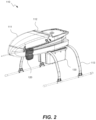
- FIG. 2 illustrates in side perspective view an example fuselage for a dual use drone with an ISR module and cargo pod module attached according to one embodiment of the present disclosure.
- FIG. 3 A illustrates in side elevation view an example fuselage body for a dual use drone with no modules attached according to one embodiment of the present disclosure.
- FIG. 3 B illustrates in bottom plan view the fuselage body of FIG. 3 A according to one embodiment of the present disclosure.
- FIG. 4 illustrates in side elevation view an example fuselage for a dual use drone with a first ISR module and a second ISR module attached according to one embodiment of the present disclosure.
- FIG. 5 illustrates in side elevation view an example fuselage for a dual use drone with an ISR module and a cargo fuel pod module attached according to one embodiment of the present disclosure.
- FIG. 6 illustrates in side elevation view an example fuselage for a dual use drone with an ISR module and a robotic arm module attached according to one embodiment of the present disclosure.
- FIG. 7 illustrates a block diagram of an example computing architecture for a dual use drone according to one embodiment of the present disclosure.
- FIG. 8 illustrates a flowchart of an example method of configuring a dual use drone according to one embodiment of the present disclosure.
- FIG. 9 illustrates a flowchart of an example method of coordinating disparate functions during flight in a dual use drone according to one embodiment of the present disclosure.
- the present disclosure relates in various embodiments to features, apparatuses, systems, and methods for dual use drones having multiple substantial functionalities, such as both ISR and secondary function capabilities.
- the disclosed embodiments can be modular in nature, such that a single drone can be configured to have multiple different types of use modules.
- a drone fuselage can include at least two standardized interfaces that allow the ready coupling and removal of disparate modular units that are electronically controlled and have substantial drone functions.
- the disparate modular units can operate independently from each other, but can also interact while the dual use drone is in flight to provide an enhanced operation.
- the disclosed dual use drones can involve coupling an ISR unit and a cargo unit to the drone fuselage, giving the drone simultaneous ISR and cargo delivery abilities.
- the drone can thus conduct cargo delivery missions while simultaneously providing video recording or other forms of surveillance.
- the ISR and cargo systems (or alternative secondary systems) combined can provide a 360-degree field of view for precision cargo delivery or other secondary system function.
- the secondary (e.g., cargo pod) unit coupling can involve a unique interface allowing both high speed data and fuel to be connected. This interface can be a modular design that is able to support alternative secondary units, such as a cargo fuel tank, a communications antenna array, a secondary ISR module, a winch, or a robotic arm assembly, among other possible units.
- VTOL configured dual use drone that includes a modular primary ISR unit and a modular secondary unit
- the disclosed features, apparatuses, systems, and methods can similarly be used for any relevant drone aircraft of different configurations.
- a drone aircraft that is not VTOL configured may also use the disclosed components and systems.
- Dual uses that involve modular units other than ISR and cargo units may also be applied.
- More than two modular units may also be used, such that the drone is multi use rather than just “dual use.” and these two or more modular units may couple to the drone at locations other than the fuselage.
- Other applications, arrangements, and extrapolations beyond the illustrated embodiments are also contemplated.
- Drone 100 can be a modular VTOL configured drone that includes a center wing 101 , two outer wings 102 , two booms 103 having multiple propellers 104 , an empennage assembly 105 , an engine 106 , and a fuselage 110 , among other possible components.
- Each of these items can be a self-contained module that is readily removable and interchangeable with other similar modules. While the embodiment shown here for purposes of illustration includes four propellers 104 on each boom 103 for a total of eight propellers, it will be readily appreciated that alternative numbers of propellers could be used. For example, a similar drone configuration might utilize only four propellers to form a quadcopter.
- Fuselage 110 which again can be a self-contained module that is interchangeable with different sets of wings, booms, engines, and empennage assemblies, can include a body 111 , a fuselage module to center wing module interface 112 , and landing gear 113 , among other possible features.
- Fuselage 110 can also include multiple modular units coupled to the modular fuselage itself. In the illustrative non-limiting example shown in FIG. 2 , these can be a video camera 120 and a cargo pod 130 .
- Video camera 120 can be part of an overall modular ISR unit, while cargo pod 130 can be part of an overall modular cargo unit. Different sizes of cargo pods 130 can be used depending upon the payload or cargo being transported.
- fuselage 110 is shown as having a modular ISR unit and modular cargo unit, different types of units may alternatively be included.
- the dual use drone disclosed herein can have a primary ISR unit as its first modular unit and an interchangeable secondary unit as its second modular unit.
- the primary ISR unit can include a camera system that is designed to provide a 360-degree view around the drone. This camera system can be interfaced with an on-board computer (e.g., primary processor) to provide visual input.
- the camera system can provide full motion video and transmit encrypted data signals to ground operators.
- Other components such as for example, radar, lidar, visual sensors, and a communications relay may also be included with the primary ISR unit, as will be readily appreciated.
- the secondary modular unit can be a cargo system.
- a cargo system can be designed as a multi-functional system where different cargo solutions can be attached to the drone.
- Each of the cargo pods or overall cargo module units can be remotely deployed, either on the ground or in-flight.
- An on ground delivery can involve the drone landing at a target identified by a camera of the primary ISR unit and then a release of the cargo pod once the camera confirms that the landing gear of the drone are firmly in place on the target.
- An in-flight delivery can involve a release of the cargo pod once the camera has confirmed an appropriate location for release.
- a parachute attached to the cargo pod can be deployed after the cargo pod has been released.
- Timing for a remote deployment of the parachute can involve the camera capturing the cargo pod as it is released and maintaining vision of the cargo pod until a proper time and/or location of the cargo pod has been achieved. The camera can continue to follow the cargo pod until it lands to confirm its descent and landing and to provide imagery of the cargo pod as delivered.
- a cargo pod can include an outer shell into which a multitude of items can be placed.
- a standardized interface between the fuselage and the cargo unit can include a data network and a power interface where the temperature can be monitored and controlled within the cargo pod.
- a dual use interface system can enable the first and second modular units to interact with each other to enhance the functionality of both systems.
- an on-board computer can use a primary ISR unit to identify and track objects of interest, as well as to provide information that is used by the secondary unit.
- the dual use interface system can use machine learning algorithms to manage and predict landing environments if the secondary unit is a cargo system.
- the on-board computer can then direct a release of the cargo pod at a location that is determined by the ISR unit.
- ISR functionality can enhance the ability to target release the cargo pod on a specific moving target in which either a pre-defined target has been uploaded or a set of parameters that matches intended target.
- the ISR unit can find a life raft in the middle of the ocean and identify this as a delivery target. This information can then be used to direct the drone to the exact location of the life raft and release the payload (i.e., cargo pod) at the identified location.
- the ISR unit can also be used to visually confirm target delivery and to relay target information and imaging data to an internal database.
- the ISR unit can automatically determine if a delivery target or landing zone is clear of obstructions and can also sense and avoid items dynamically as situations change in real time.
- the dual use interface system can allow for functionalities of tracking multiple moving targets while simultaneously having the aircraft flying in different directions and also alternating or adjusting a delivery target or zone.
- the ISR camera can behave differently depending upon the secondary modular unit. For example, when the secondary modular unit includes a large cargo pod, the ISR camera can tilt downward when rotated in the direction of the cargo pod when it might otherwise obtain a field of view directly beyond the cargo pod.
- the ISR modular unit can be configured to identify a cargo pod type (or other secondary modular unit type) and automatically configure, adjust, and recalibrate the applicable field of view for the ISR camera based on the physical dimensions of the cargo pod or other secondary modular unit. Such reconfiguration and recalibration of the camera field of view can result in full imagery that is unobstructed by the cargo pod or other secondary modular unit.
- Other interactive functions can exist between an ISR unit and a cargo unit, as well as for other possible secondary units.
- FIGS. 3 A and 3 B depict an example fuselage body for a dual use drone with no modules attached in a side elevation and bottom plan views respectively.
- Fuselage body 111 can include a fuselage module to center wing module interface 112 , a first standardized interface 114 for a first removably attached modular unit, and a second standardized interface 115 for a second removably attached modular unit.
- the second standardized interface 115 can include a power interface 116 and a data interface 117 that can couple to various different types of removable modular units.
- the first standardized interface 114 can also include its own power interface and data interface for a first removably attached modular unit.
- Both sets of power and data interfaces can involve the use of blind mate electrical connectors as well as floating connectors to facilitate the ready coupling and decoupling of different modular units.
- the fuselage having a forward positioned interface on a bottom area of the fuselage, and a rearward positioned interface on the bottom area of the fuselage.
- the first and second interface 114 , 115 may have a frame integrally formed with the body of the fuselage.
- the frame may have one or more electric connectors to receive from and transmit data a modular unit that is connected to the frame.
- the frame of the first interface is a smaller size than the second interface, thus allowing smaller form factor module units to be removeably connected to the first frame, and larger form factor modular units to be removeably connected to the second frame.
- Connecting larger (e.g., heavier) modular units to the second interface also provides UAV flight stability with the larger form factor modular unit positioned closer to the UAV's center of gravity.
- First standardized interface 114 can also include a detachable mounting plate to facilitate the mechanical coupling of various disparate modular units, which can include a primary ISR unit as well as other types of units.
- second standardized interface 115 can include a modular cargo interface 118 , which can facilitate the mechanical coupling of a cargo unit in particular.
- This modular cargo interface 118 may remain with the fuselage body 111 or can be removed together with a modular cargo unit when the modular cargo unit is removed.
- other types of removably attached modular units may also be able to attach to modular cargo interface 118 .
- other types of removably attached modular units may have different types of adapter interfaces or may attach directly to the second standardized interface 115 .
- a dual use drone has been described as having an ISR unit and a cargo unit. It is specifically contemplated, however, that multiple different types of modular units can be used for the disclosed dual use drones.
- the first type of unit can be a primary ISR unit such as that which is provided above, while the second type of unit can be a cargo unit, a secondary ISR unit, a cargo fuel pod unit, a robotic arm unit, an expanded data, communication, and power feed unit, or any other suitable secondary unit.
- These dual use units can be modular, such that the same drone can be used with different dual use units as may be desired. Accordingly, both of these dual use units can be mixed and matched as desired for the specific needs of a given drone mission. Some configurations may not even utilize an ISR unit depending upon particular circumstances.
- Fuselage variation 110 a can be similar to fuselage 110 above, and as such includes a camera 120 as part of a primary ISR unit. Rather than have a cargo unit as the second modular unit, however, fuselage variation 110 a has a second camera 140 as part of a secondary ISR unit that operates in conjunction with the primary ISR unit. The same second standardized interface and power interface 116 can be used for this secondary ISR unit.
- Camera 140 can be the same type of camera as camera 120 on the primary ISR unit or may be different in some regards to optimize the abilities of both cameras 120 and 140 working together. For example, some arrangements may have one camera depicting a wide field of view while the other camera zooms in to show a particular target or various items of interest.
- both cameras 120 , 140 may rotate constantly about respective gimbals to provide an overall field of view that is very wide.
- the relative motions of cameras 120 , 140 may be coordinated such that both cameras face in opposite directions at all times, or in other coordinated directions as may be desired.
- An enhanced operation of the combined functions of both cameras can involve video feeds from both cameras being stitched together by the onboard computing system in real time to provide a constant very wide field of view in all directions. Feeds from both cameras can be used to create a combined frame capture by stitching frames from both cameras together to form a single wide or enlarged image. This frame stitching can be repeated rapidly for each pair of frames to result in a combined video output that is greater than any output possible by either camera individually.
- FIG. 5 illustrates in side elevation view an example fuselage for a dual use drone with an ISR module and a cargo fuel pod module attached.
- Fuselage variation 110 b can be similar to fuselage 110 and fuselage variation 110 a above, and as such again includes a camera 120 as part of a primary ISR unit. Rather than have a cargo unit or additional ISR unit as the second modular unit, however, fuselage variation 110 b can have a specialized cargo fuel pod 150 .
- This cargo fuel pod 150 can have a bladder or other internal component that is adapted to contain and electrically insulate fuel or any other flammable liquid. Again, the same second standardized interface 115 and power interface 116 can be used for this modular cargo fuel unit.
- a fuel interface 119 can couple the cargo fuel unit to an active fuel line in the fuselage, such that fuel in the cargo fuel pod 150 can be used by the drone during flight if such use becomes necessary.
- fuel in the cargo fuel pod 150 can be accessed to provide additional fuel that can extend the flight range of the drone.
- the cargo fuel pod 150 can also be delivered to a target in the field to provide fuel to the target. In instances where the drone used some of this fuel, then the payload drop becomes the remainder of the fuel in cargo fuel pod 150 .
- the cargo unit may also be configured to hold a cargo of various items. While in flight, the cargo unit may be released from the interface to which it is connected under the fuselage of the drone.
- the cargo unit may have a parachute that is deployed shortly after the cargo unit is released from the drone.
- the drone may utilize an attached module ISR unit having a video camera to monitor and record the release of the cargo.
- the processor of the drone may track the trajectory of the released cargo until the cargo lands onto the ground.
- the drone may receive a communication from the cargo unit, where the communication include a geo-spatial location of where the cargo unit landed (for example, the cargo unit may have on-board GPS or other location determination systems).
- the drone may compute the tracked trajectory of the cargo, and compute an estimated geo-spatial location of where the cargo unit landed.
- Fuselage variation 110 c can be similar to the foregoing fuselage variations, with this variation specifically including a video camera 120 for a primary ISR unit and a robotic arm 160 for a robotic arm assembly unit as the secondary modular unit.
- the same power interface 116 can be used to provide power to the robotic arm assembly unit
- Robotic arm 160 can be configured to grab and control one or more foreign items during operation of the drone, either in flight or after landing.
- the robotic arm assembly unit can operate interactively with the other modular unit.
- video camera 120 can provide a video feed that identifies a target or various objects for the robotic arm 160 to grasp, carry, or manipulate.
- the modular robotic arm assembly unit can use data from the video feed to assist in such grasping, carrying, or manipulating operations. This can be particularly useful where a target object is a complex item or is in motion, for example.
- Computing architecture 200 can include a variety of items, some or all of which are included at the fuselage 210 , first modular unit 220 and second modular unit 230 of a drone.
- a primary processor 212 can be an onboard computer powered by a battery 214 or other power source.
- a configuration module 216 can be part of or operate with the primary processor 212 to configure the onboard computing system based upon the specific modular units that are coupled to the drone.
- An internal communications module 218 can coordinate communications within the drone, while an external communication module 219 can facilitate communications between the drone and one or more outside devices or systems, such as a remote database or monitor.
- a first modular unit 220 can be removably coupled to the fuselage, and this unit can be an ISR unit or other suitable modular unit configured to perform a first substantial function for the drone.
- First modular unit 220 can have a localized first controller 222 that can communicate with the primary processor 212 located at the fuselage.
- Configuration data 224 can be data specific to the first modular unit and stored on a localized module or chip, while an interactive functions module 226 can provide specifics regarding activities that the first modular unit 220 may perform in coordinated fashion with the second modular unit 230 .
- Second modular unit 230 can also be removably coupled to the fuselage, and this unit can be a cargo unit or other secondary unit configured to perform a second substantial function for the drone.
- Second modular unit 230 can similarly have a second localized controller that can communicate with the primary processor 212 , configuration data 234 specific to the second modular unit, and an interactive functions module 236 that can provide specifics regarding activities that the second modular unit 230 may perform in coordinated fashion with the first modular unit 220 .
- both the first modular unit 220 and second modular unit 230 can be autonomous and independent from each other, such that each can retain full functionality without input or interference from the other.
- input from the other modular unit can be used in some instances to provide an enhanced operation for the overall drone.
- computing architecture 200 is depicted with various units in direct communication with primary processor 212 , other or additional coupling arrangements are also possible. For example, some or all other units may also be in direct communication with each other.
- the standardized interfaces for both of the first and second modular units can be coupled to a common bus. This can allow direct communications between the first and second modular units in addition to various communications with the primary processor 212 as it directs overall activities on the drone. Accordingly, a conceptual direct communication line is shown in FIG. 7 between first controller 222 of first modular unit 220 and second controller 232 of second modular unit 230 . Such direct communications between the first modular unit 220 and second modular unit can actually take place along the common bus without a need for intervention by primary processor 212 .
- a flowchart 300 of an example method of configuring a dual use drone is provided in FIG. 8 .
- a first modular unit can be coupled to the fuselage at a process step 304 .
- this can be a primary ISR unit having a video camera, for example.
- a second modular unit can be coupled to the fuselage.
- This can be a cargo unit, for example.
- this can be a secondary ISR unit, a cargo fuel tank unit, a robotic arm unit, or some other secondary modular unit.
- a primary processor can be configured at the next process step 308 . This can include configuring an onboard computer or primary processor at the fuselage to be operable with respect to both of the first and second modular units. Configuration can include reading configuration data and other historical data from both modular units, as well as adjusting processes within the primary processor to adapt to the specific functions of each modular unit.
- interactivity between the first and second modular units can be confirmed. This can include ensuring that the functions of one or both of the modular units can be accomplished using input or other data obtained from the other modular unit during operation. For example, confirmation can be made that input from an ISR unit is usable while performing the functions of a cargo unit or other secondary unit. The method then ends at end step 312 .
- FIG. 9 illustrates a flowchart 400 of an example method of coordinating disparate functions during flight in a dual use drone.
- the drone can be put into flight at a process step 404 .
- a first function can be performed at a first modular unit on the drone while the drone is in flight. For example, this can involve the capture of video by a primary ISR unit on the drone.
- an input from the first function can be provided to the second modular unit.
- such an input can be video footage or a target determination made by a primary ISR unit.
- a second function can be performed at the second modular unit.
- This second function can be performed using the input provided at previous process step 408 .
- delivery of a cargo pod can be the second function.
- This cargo pod delivery can be performed using a delivery target that was identified as the first function by a primary ISR unit, which this delivery target identification being the first function input that was delivered to the cargo unit as the second modular unit.
- a primary ISR unit which this delivery target identification being the first function input that was delivered to the cargo unit as the second modular unit.
- Other second functions and second modular units are also possible, and other forms of input from a primary ISR unit or other first modular unit are also possible.
- the method then ends at end step 412 .
- step 306 may be performed before step 304 in some arrangements.
- Alternative steps may also be substituted in place of any of the disclosed steps.
- the UAV may identify the type of unit attached to ISR or payload attached to the first or second standard interface 114 , 115 .
- the UAV processor may identify the type of attachment, and perform operations based on the type of attachment. For example, the UAV processor may detect that a ISR with a camera is attached to the first standard interface 114 and that a payload is attached to the second standard interface 115 .
- the UAV may deploy the payload, and then using the ISR with the camera, track and obtain video footage of the payload as its being deployed.
- the processor may determine the approximate ground location of where the payload would land, and provide a transmission of the landing location with geospatial data. Additionally, the UAV may continue to fly or hover about the landing area, and the processor may determine that the payload has landed. Based on the determined landing of the payload, the UAV may then continue flying back to a return location or continue with its mission.
- two ISR units with cameras may be attached to the first and second standard interfaces 114 , 115 .
- the UAV process may control the cameras such that the first forward attached camera is synchronized with the imagery taken by the second rear attached camera (or vice versa).
- the forward camera for example, may be zoomed into to a particular location, while the rearward camera may be zoom out and obtains a broader field of view the imagery.
- the ISR unit has electronic connectors about the interface for providing electronic communication between the ISR unit and the UAV processor.
- the ISR unit may communicate information via the interface 114 , 115 to the UAV, and the UAV will operate in accordance with the type of ISR unit attached.
- An ISR unit may communicate the weight of the ISR unit to the UAV processor.
- the UAV processor then may adjust the flight characteristics of the UAV, such adjust power and rotation speed of one or more rotors to adjust to the weight attached to a forward and/or rear interfaces. This may be important especially where the weight has a significant impact on the weight/balance of the UAV.
- the UAV processor may determine an amount available flight time to reach a particular way point or destination. In some circumstances, the UAV may determine that the UAV does not have enough energy or fuel tor reach its destination. The UAV processor may eject an ISR unit to achieve a longer flight time, especially where the ISR Unit includes a heavy payload.
- the ISR unit may communicate the type of attachment to the UAV processor.
- the front interface receive an attachment an ISR unit with a standard camera, a infrared camera, a LiDar unit, etc.
- the UAV processor may then may automatically perform flight operations due to the type of ISR unit attached.
- the UAV may automatically limit its maximum speed or altitude such that the sensor or camera may obtain a particular quality of sensor information.
- the camera speed may be taken into consideration by the UAV processor so the UAV may obtain non-blurry imagery for moving forward.
- the UAV processor may also use a database or other stored information to lookup the maximum forward flight speed of the UAV with regard to a particular type of ISR unit that is attached.
- the UAV may have two ISR units attached, and the UAV would use the slowest maximum forward flight speed of the two ISR units.
Landscapes
- Engineering & Computer Science (AREA)
- Aviation & Aerospace Engineering (AREA)
- Mechanical Engineering (AREA)
- Remote Sensing (AREA)
- Business, Economics & Management (AREA)
- Economics (AREA)
- Marketing (AREA)
- Strategic Management (AREA)
- Entrepreneurship & Innovation (AREA)
- Human Resources & Organizations (AREA)
- Microelectronics & Electronic Packaging (AREA)
- Operations Research (AREA)
- Quality & Reliability (AREA)
- Development Economics (AREA)
- Tourism & Hospitality (AREA)
- Physics & Mathematics (AREA)
- General Business, Economics & Management (AREA)
- General Physics & Mathematics (AREA)
- Theoretical Computer Science (AREA)
- Control Of Position, Course, Altitude, Or Attitude Of Moving Bodies (AREA)
Abstract
Description
Claims (5)
Priority Applications (1)
| Application Number | Priority Date | Filing Date | Title |
|---|---|---|---|
| US17/246,133 US12071240B2 (en) | 2020-04-30 | 2021-04-30 | Dual ISR-payload capable UAV |
Applications Claiming Priority (2)
| Application Number | Priority Date | Filing Date | Title |
|---|---|---|---|
| US202063018390P | 2020-04-30 | 2020-04-30 | |
| US17/246,133 US12071240B2 (en) | 2020-04-30 | 2021-04-30 | Dual ISR-payload capable UAV |
Publications (2)
| Publication Number | Publication Date |
|---|---|
| US20210339859A1 US20210339859A1 (en) | 2021-11-04 |
| US12071240B2 true US12071240B2 (en) | 2024-08-27 |
Family
ID=78292497
Family Applications (1)
| Application Number | Title | Priority Date | Filing Date |
|---|---|---|---|
| US17/246,133 Active 2041-10-15 US12071240B2 (en) | 2020-04-30 | 2021-04-30 | Dual ISR-payload capable UAV |
Country Status (3)
| Country | Link |
|---|---|
| US (1) | US12071240B2 (en) |
| EP (1) | EP4143089B1 (en) |
| WO (1) | WO2021222796A1 (en) |
Cited By (1)
| Publication number | Priority date | Publication date | Assignee | Title |
|---|---|---|---|---|
| US12479608B2 (en) * | 2023-01-10 | 2025-11-25 | Skydio, Inc. | Attachment interface and attachments for an unmanned aerial vehicle |
Families Citing this family (11)
| Publication number | Priority date | Publication date | Assignee | Title |
|---|---|---|---|---|
| US12378014B2 (en) * | 2019-04-02 | 2025-08-05 | Rhoman Aerospace Corporation | Modular apparatus, design, concept for modules, connection, attachment and capability adding structural add ons for vehicles, structures |
| USD1009696S1 (en) * | 2020-02-18 | 2024-01-02 | Aurora Flight Sciences Corporation, a subsidiary of The Boeing Company | Aircraft |
| US12509252B2 (en) * | 2021-11-17 | 2025-12-30 | Outpost Technologies Corporation | Space vehicles with paraglider re-entry, and associated systems and methods |
| CN114212237B (en) * | 2021-12-23 | 2024-05-24 | 中国航空工业集团公司西安飞机设计研究所 | A precision airdrop/airborne power device |
| CN114348263A (en) * | 2022-01-27 | 2022-04-15 | 湖南千智机器人科技发展有限公司 | Unmanned aerial vehicle collection system |
| US12172765B2 (en) * | 2023-02-08 | 2024-12-24 | Anduril Industries, Inc. | Dissassembly for dual engine vertical take off and landing collapsible fixed wing aircraft |
| CN116062205B (en) * | 2023-03-07 | 2023-06-30 | 四川腾盾科技有限公司 | Unmanned aerial vehicle with integral fuselage cargo hold throwing and recycling device and throwing method |
| CN116853501B (en) * | 2023-06-29 | 2026-01-06 | 深圳市道通智能航空技术股份有限公司 | Methods for throwing projectiles, drone components, and drone components |
| WO2025019615A1 (en) * | 2023-07-17 | 2025-01-23 | Robbins Rothman Asher Mendel | Vision systems for unmanned aerial vehicles |
| US12699372B2 (en) * | 2023-08-22 | 2026-08-04 | Tomahawk Robotics, Inc. | Universal multimodal payload control |
| CN118811138B (en) * | 2024-09-19 | 2024-11-19 | 漳州兔八哥信息技术有限公司 | Internet of things monitoring equipment for monitoring unmanned aerial vehicle |
Citations (11)
| Publication number | Priority date | Publication date | Assignee | Title |
|---|---|---|---|---|
| US20160229536A1 (en) * | 2014-03-27 | 2016-08-11 | Northrop Grumman Systems Corporation | Near belly-tangent pod system for an aircraft |
| US9580173B1 (en) | 2014-08-28 | 2017-02-28 | X Development Llc | Translational correction of payload-release device based on tracked position |
| US20180002015A1 (en) | 2016-07-01 | 2018-01-04 | Bell Helicopter Textron Inc. | Transportation Method for Selectively Attachable Pod Assemblies |
| US20190100313A1 (en) | 2017-10-04 | 2019-04-04 | Bell Helicopter Textron Inc. | Tiltrotor Aircraft having Interchangeable Payload Modules |
| US20190161190A1 (en) | 2016-04-29 | 2019-05-30 | United Parcel Service Of America, Inc. | Methods of photo matching and photo confirmation for parcel pickup and delivery |
| US10435143B1 (en) * | 2017-01-25 | 2019-10-08 | Amazon Technologies, Inc. | Unmanned aerial vehicle with ports configured to receive swappable components |
| US20190321971A1 (en) | 2018-04-19 | 2019-10-24 | Aurora Flight Sciences Corporation | End-Effector for Workpiece Manipulation System |
| US20190373173A1 (en) | 2017-02-24 | 2019-12-05 | SZ DJI Technology Co., Ltd. | Multi-gimbal assembly |
| US10583922B1 (en) | 2016-12-20 | 2020-03-10 | Amazon Technologies, Inc. | Swappable avionics for unmanned aerial vehicle |
| US20200317324A1 (en) * | 2019-04-02 | 2020-10-08 | Thomas Andrew Youmans | Modular apparatus, design, concept for modules, connection, attachment and capability adding structural add ons for vehicles, structures |
| US20200354084A1 (en) * | 2016-06-10 | 2020-11-12 | ETAK Systems, LLC | Drone Package Loading Based on Package Characterization |
-
2021
- 2021-04-30 EP EP21797126.6A patent/EP4143089B1/en active Active
- 2021-04-30 US US17/246,133 patent/US12071240B2/en active Active
- 2021-04-30 WO PCT/US2021/030244 patent/WO2021222796A1/en not_active Ceased
Patent Citations (11)
| Publication number | Priority date | Publication date | Assignee | Title |
|---|---|---|---|---|
| US20160229536A1 (en) * | 2014-03-27 | 2016-08-11 | Northrop Grumman Systems Corporation | Near belly-tangent pod system for an aircraft |
| US9580173B1 (en) | 2014-08-28 | 2017-02-28 | X Development Llc | Translational correction of payload-release device based on tracked position |
| US20190161190A1 (en) | 2016-04-29 | 2019-05-30 | United Parcel Service Of America, Inc. | Methods of photo matching and photo confirmation for parcel pickup and delivery |
| US20200354084A1 (en) * | 2016-06-10 | 2020-11-12 | ETAK Systems, LLC | Drone Package Loading Based on Package Characterization |
| US20180002015A1 (en) | 2016-07-01 | 2018-01-04 | Bell Helicopter Textron Inc. | Transportation Method for Selectively Attachable Pod Assemblies |
| US10583922B1 (en) | 2016-12-20 | 2020-03-10 | Amazon Technologies, Inc. | Swappable avionics for unmanned aerial vehicle |
| US10435143B1 (en) * | 2017-01-25 | 2019-10-08 | Amazon Technologies, Inc. | Unmanned aerial vehicle with ports configured to receive swappable components |
| US20190373173A1 (en) | 2017-02-24 | 2019-12-05 | SZ DJI Technology Co., Ltd. | Multi-gimbal assembly |
| US20190100313A1 (en) | 2017-10-04 | 2019-04-04 | Bell Helicopter Textron Inc. | Tiltrotor Aircraft having Interchangeable Payload Modules |
| US20190321971A1 (en) | 2018-04-19 | 2019-10-24 | Aurora Flight Sciences Corporation | End-Effector for Workpiece Manipulation System |
| US20200317324A1 (en) * | 2019-04-02 | 2020-10-08 | Thomas Andrew Youmans | Modular apparatus, design, concept for modules, connection, attachment and capability adding structural add ons for vehicles, structures |
Non-Patent Citations (1)
| Title |
|---|
| International Search Report in PCT International Application No. PCT/US2021/030244, mailed Jul. 28, 2021. |
Cited By (1)
| Publication number | Priority date | Publication date | Assignee | Title |
|---|---|---|---|---|
| US12479608B2 (en) * | 2023-01-10 | 2025-11-25 | Skydio, Inc. | Attachment interface and attachments for an unmanned aerial vehicle |
Also Published As
| Publication number | Publication date |
|---|---|
| WO2021222796A1 (en) | 2021-11-04 |
| US20210339859A1 (en) | 2021-11-04 |
| EP4143089B1 (en) | 2025-08-27 |
| EP4143089A1 (en) | 2023-03-08 |
| EP4143089A4 (en) | 2024-05-29 |
| EP4143089C0 (en) | 2025-08-27 |
Similar Documents
| Publication | Publication Date | Title |
|---|---|---|
| EP4143089B1 (en) | Dual isr-payload capable uav | |
| US11034449B2 (en) | Systems and methods for UAV transport and data acquisition | |
| EP3601042B1 (en) | Multi-architecture modular unmanned aerial system | |
| US6626398B1 (en) | Unmanned biplane for airborne reconnaissance and surveillance having staggered and gapped wings | |
| US11884391B2 (en) | Mission pod for unattended UAV operations | |
| EP2147858B1 (en) | Ducted fan core for use with an unmanned aerial vehicle | |
| TWI542811B (en) | Oblique spherical turntable that avoids ring lock | |
| EP3867150B1 (en) | Ruggedized autonomous helicopter platform | |
| US6840480B2 (en) | Miniature, unmanned aircraft with interchangeable data module | |
| EP3638585B1 (en) | System and method for launching an unmanned aerial vehicle | |
| CN115649439B (en) | Multi-cradle head assembly | |
| US20190176986A1 (en) | Multi-craft uav carrier system and airframe | |
| US20170225802A1 (en) | Systems and methods for deployment and operation of vertical take-off and landing (vtol) unmanned aerial vehicles | |
| US20170073070A1 (en) | Amphibious vertical takeoff and landing unmanned device with artificial intelligence (AI) and method and system for managing a crisis environment and controlling one or more targets | |
| US20160286128A1 (en) | Amphibious vtol super drone camera in a mobile case (phone case) with multiple aerial and aquatic flight modes for capturing panoramic virtual reality views, selfie and interactive video | |
| US6615165B2 (en) | Cable connections between an unmanned aircraft and a detachable data handling module | |
| CN103770947B (en) | Investigation irradiation system and method for unmanned helicopter | |
| US11643207B1 (en) | Aircraft for transporting and deploying UAVs | |
| JP2010036889A (en) | Modular pod used for unmanned aircraft | |
| EP4011773A1 (en) | Detect and avoid sensor integration | |
| US12252279B1 (en) | Drone satellite | |
| CN106945835A (en) | A kind of unmanned vehicle | |
| US20060102798A1 (en) | Unmanned biplane for airborne reconnaissance and surveillance having staggered and gapped wings | |
| WO2017208199A1 (en) | Amphibious vtol super drone camera in mobile case (phone case) with multiple aerial and aquatic flight modes for capturing panoramic virtual reality views, selfie and interactwe video | |
| IL266249A (en) | A system and method for drone release detection |
Legal Events
| Date | Code | Title | Description |
|---|---|---|---|
| AS | Assignment |
Owner name: VOLANSI, INC., CALIFORNIA Free format text: ASSIGNMENT OF ASSIGNORS INTEREST;ASSIGNORS:AGOSTINO, EMILY;LEO, CURTIS;MORRIS, STEPHEN;SIGNING DATES FROM 20200430 TO 20200501;REEL/FRAME:056102/0307 |
|
| FEPP | Fee payment procedure |
Free format text: ENTITY STATUS SET TO UNDISCOUNTED (ORIGINAL EVENT CODE: BIG.); ENTITY STATUS OF PATENT OWNER: LARGE ENTITY |
|
| FEPP | Fee payment procedure |
Free format text: ENTITY STATUS SET TO SMALL (ORIGINAL EVENT CODE: SMAL); ENTITY STATUS OF PATENT OWNER: LARGE ENTITY |
|
| STPP | Information on status: patent application and granting procedure in general |
Free format text: DOCKETED NEW CASE - READY FOR EXAMINATION |
|
| AS | Assignment |
Owner name: SILICON VALLEY BANK, CALIFORNIA Free format text: SECURITY INTEREST;ASSIGNOR:VOLANSI, INC.;REEL/FRAME:060609/0647 Effective date: 20220720 |
|
| AS | Assignment |
Owner name: IRONMAN VENTURES LLC, OREGON Free format text: SECURITY INTEREST;ASSIGNOR:VOLANSI, INC.;REEL/FRAME:061386/0927 Effective date: 20220509 Owner name: OUTBOUND CAPITAL I, LP, OREGON Free format text: SECURITY INTEREST;ASSIGNOR:VOLANSI, INC.;REEL/FRAME:061386/0927 Effective date: 20220509 Owner name: HAPI314159 HOLDINGS, LLC, OREGON Free format text: SECURITY INTEREST;ASSIGNOR:VOLANSI, INC.;REEL/FRAME:061386/0927 Effective date: 20220509 |
|
| AS | Assignment |
Owner name: SIERRA NEVADA CORPORATION, NEVADA Free format text: TRANSFER STATEMENT;ASSIGNOR:SILICON VALLEY BANK;REEL/FRAME:061954/0884 Effective date: 20220930 |
|
| STPP | Information on status: patent application and granting procedure in general |
Free format text: NON FINAL ACTION MAILED |
|
| STPP | Information on status: patent application and granting procedure in general |
Free format text: FINAL REJECTION MAILED |
|
| FEPP | Fee payment procedure |
Free format text: ENTITY STATUS SET TO UNDISCOUNTED (ORIGINAL EVENT CODE: BIG.); ENTITY STATUS OF PATENT OWNER: LARGE ENTITY |
|
| AS | Assignment |
Owner name: BANK OF AMERICA, N.A., AS ADMINISTRATIVE AGENT, NORTH CAROLINA Free format text: SECURITY INTEREST;ASSIGNOR:SIERRA NEVADA CORPORATION;REEL/FRAME:064179/0058 Effective date: 20230629 |
|
| STPP | Information on status: patent application and granting procedure in general |
Free format text: DOCKETED NEW CASE - READY FOR EXAMINATION |
|
| STPP | Information on status: patent application and granting procedure in general |
Free format text: NON FINAL ACTION MAILED |
|
| STPP | Information on status: patent application and granting procedure in general |
Free format text: RESPONSE TO NON-FINAL OFFICE ACTION ENTERED AND FORWARDED TO EXAMINER |
|
| STPP | Information on status: patent application and granting procedure in general |
Free format text: FINAL REJECTION MAILED |
|
| AS | Assignment |
Owner name: SIERRA NEVADA COMPANY, LLC, NEVADA Free format text: CHANGE OF NAME;ASSIGNOR:SIERRA NEVADA CORPORATION;REEL/FRAME:067096/0337 Effective date: 20230901 |
|
| STPP | Information on status: patent application and granting procedure in general |
Free format text: DOCKETED NEW CASE - READY FOR EXAMINATION |
|
| STPP | Information on status: patent application and granting procedure in general |
Free format text: NOTICE OF ALLOWANCE MAILED -- APPLICATION RECEIVED IN OFFICE OF PUBLICATIONS |
|
| STPP | Information on status: patent application and granting procedure in general |
Free format text: PUBLICATIONS -- ISSUE FEE PAYMENT VERIFIED |
|
| STCF | Information on status: patent grant |
Free format text: PATENTED CASE |