US12069950B2 - Materials for electronic devices - Google Patents

Materials for electronic devices Download PDF

Info

Publication number
US12069950B2
US12069950B2 US17/415,980 US201917415980A US12069950B2 US 12069950 B2 US12069950 B2 US 12069950B2 US 201917415980 A US201917415980 A US 201917415980A US 12069950 B2 US12069950 B2 US 12069950B2
Authority
US
United States
Prior art keywords
atoms
groups
aromatic ring
alkyl
ring systems
Prior art date
Legal status (The legal status is an assumption and is not a legal conclusion. Google has not performed a legal analysis and makes no representation as to the accuracy of the status listed.)
Active, expires
Application number
US17/415,980
Other versions
US20220158101A1 (en
Inventor
Elvira Montenegro
Teresa Mujica-Fernaud
Florian Maier-Flaig
Frank Voges
Current Assignee (The listed assignees may be inaccurate. Google has not performed a legal analysis and makes no representation or warranty as to the accuracy of the list.)
Merck Patent GmbH
Merck Performance Materials GmbH
Merck KGaA
Original Assignee
Merck KGaA
Priority date (The priority date is an assumption and is not a legal conclusion. Google has not performed a legal analysis and makes no representation as to the accuracy of the date listed.)
Filing date
Publication date
Application filed by Merck KGaA filed Critical Merck KGaA
Publication of US20220158101A1 publication Critical patent/US20220158101A1/en
Assigned to MERCK PATENT GMBH reassignment MERCK PATENT GMBH ASSIGNMENT OF ASSIGNORS INTEREST (SEE DOCUMENT FOR DETAILS). Assignors: MERCK PERFORMANCE MATERIALS GERMANY GMBH
Assigned to MERCK PERFORMANCE MATERIALS GERMANY GMBH reassignment MERCK PERFORMANCE MATERIALS GERMANY GMBH ASSIGNMENT OF ASSIGNORS INTEREST (SEE DOCUMENT FOR DETAILS). Assignors: MERCK KGAA
Assigned to MERCK KGAA reassignment MERCK KGAA ASSIGNMENT OF ASSIGNORS INTEREST (SEE DOCUMENT FOR DETAILS). Assignors: VOGES, FRANK, MUJICA-FERNAUD, TERESA, MONTENEGRO, ELVIRA, MAIER-FLAIG, Florian
Application granted granted Critical
Publication of US12069950B2 publication Critical patent/US12069950B2/en
Active legal-status Critical Current
Adjusted expiration legal-status Critical

Links

Classifications

    • CCHEMISTRY; METALLURGY
    • C07ORGANIC CHEMISTRY
    • C07DHETEROCYCLIC COMPOUNDS
    • C07D307/00Heterocyclic compounds containing five-membered rings having one oxygen atom as the only ring hetero atom
    • C07D307/77Heterocyclic compounds containing five-membered rings having one oxygen atom as the only ring hetero atom ortho- or peri-condensed with carbocyclic rings or ring systems
    • C07D307/91Dibenzofurans; Hydrogenated dibenzofurans
    • CCHEMISTRY; METALLURGY
    • C07ORGANIC CHEMISTRY
    • C07DHETEROCYCLIC COMPOUNDS
    • C07D333/00Heterocyclic compounds containing five-membered rings having one sulfur atom as the only ring hetero atom
    • C07D333/50Heterocyclic compounds containing five-membered rings having one sulfur atom as the only ring hetero atom condensed with carbocyclic rings or ring systems
    • C07D333/76Dibenzothiophenes
    • CCHEMISTRY; METALLURGY
    • C07ORGANIC CHEMISTRY
    • C07DHETEROCYCLIC COMPOUNDS
    • C07D405/00Heterocyclic compounds containing both one or more hetero rings having oxygen atoms as the only ring hetero atoms, and one or more rings having nitrogen as the only ring hetero atom
    • C07D405/02Heterocyclic compounds containing both one or more hetero rings having oxygen atoms as the only ring hetero atoms, and one or more rings having nitrogen as the only ring hetero atom containing two hetero rings
    • C07D405/10Heterocyclic compounds containing both one or more hetero rings having oxygen atoms as the only ring hetero atoms, and one or more rings having nitrogen as the only ring hetero atom containing two hetero rings linked by a carbon chain containing aromatic rings
    • CCHEMISTRY; METALLURGY
    • C07ORGANIC CHEMISTRY
    • C07DHETEROCYCLIC COMPOUNDS
    • C07D405/00Heterocyclic compounds containing both one or more hetero rings having oxygen atoms as the only ring hetero atoms, and one or more rings having nitrogen as the only ring hetero atom
    • C07D405/02Heterocyclic compounds containing both one or more hetero rings having oxygen atoms as the only ring hetero atoms, and one or more rings having nitrogen as the only ring hetero atom containing two hetero rings
    • C07D405/12Heterocyclic compounds containing both one or more hetero rings having oxygen atoms as the only ring hetero atoms, and one or more rings having nitrogen as the only ring hetero atom containing two hetero rings linked by a chain containing hetero atoms as chain links
    • CCHEMISTRY; METALLURGY
    • C07ORGANIC CHEMISTRY
    • C07DHETEROCYCLIC COMPOUNDS
    • C07D405/00Heterocyclic compounds containing both one or more hetero rings having oxygen atoms as the only ring hetero atoms, and one or more rings having nitrogen as the only ring hetero atom
    • C07D405/14Heterocyclic compounds containing both one or more hetero rings having oxygen atoms as the only ring hetero atoms, and one or more rings having nitrogen as the only ring hetero atom containing three or more hetero rings
    • CCHEMISTRY; METALLURGY
    • C07ORGANIC CHEMISTRY
    • C07DHETEROCYCLIC COMPOUNDS
    • C07D407/00Heterocyclic compounds containing two or more hetero rings, at least one ring having oxygen atoms as the only ring hetero atoms, not provided for by group C07D405/00
    • C07D407/02Heterocyclic compounds containing two or more hetero rings, at least one ring having oxygen atoms as the only ring hetero atoms, not provided for by group C07D405/00 containing two hetero rings
    • C07D407/12Heterocyclic compounds containing two or more hetero rings, at least one ring having oxygen atoms as the only ring hetero atoms, not provided for by group C07D405/00 containing two hetero rings linked by a chain containing hetero atoms as chain links
    • CCHEMISTRY; METALLURGY
    • C07ORGANIC CHEMISTRY
    • C07DHETEROCYCLIC COMPOUNDS
    • C07D407/00Heterocyclic compounds containing two or more hetero rings, at least one ring having oxygen atoms as the only ring hetero atoms, not provided for by group C07D405/00
    • C07D407/14Heterocyclic compounds containing two or more hetero rings, at least one ring having oxygen atoms as the only ring hetero atoms, not provided for by group C07D405/00 containing three or more hetero rings
    • CCHEMISTRY; METALLURGY
    • C07ORGANIC CHEMISTRY
    • C07DHETEROCYCLIC COMPOUNDS
    • C07D409/00Heterocyclic compounds containing two or more hetero rings, at least one ring having sulfur atoms as the only ring hetero atoms
    • C07D409/02Heterocyclic compounds containing two or more hetero rings, at least one ring having sulfur atoms as the only ring hetero atoms containing two hetero rings
    • C07D409/10Heterocyclic compounds containing two or more hetero rings, at least one ring having sulfur atoms as the only ring hetero atoms containing two hetero rings linked by a carbon chain containing aromatic rings
    • CCHEMISTRY; METALLURGY
    • C07ORGANIC CHEMISTRY
    • C07DHETEROCYCLIC COMPOUNDS
    • C07D409/00Heterocyclic compounds containing two or more hetero rings, at least one ring having sulfur atoms as the only ring hetero atoms
    • C07D409/02Heterocyclic compounds containing two or more hetero rings, at least one ring having sulfur atoms as the only ring hetero atoms containing two hetero rings
    • C07D409/12Heterocyclic compounds containing two or more hetero rings, at least one ring having sulfur atoms as the only ring hetero atoms containing two hetero rings linked by a chain containing hetero atoms as chain links
    • CCHEMISTRY; METALLURGY
    • C07ORGANIC CHEMISTRY
    • C07DHETEROCYCLIC COMPOUNDS
    • C07D409/00Heterocyclic compounds containing two or more hetero rings, at least one ring having sulfur atoms as the only ring hetero atoms
    • C07D409/14Heterocyclic compounds containing two or more hetero rings, at least one ring having sulfur atoms as the only ring hetero atoms containing three or more hetero rings
    • CCHEMISTRY; METALLURGY
    • C07ORGANIC CHEMISTRY
    • C07DHETEROCYCLIC COMPOUNDS
    • C07D413/00Heterocyclic compounds containing two or more hetero rings, at least one ring having nitrogen and oxygen atoms as the only ring hetero atoms
    • C07D413/02Heterocyclic compounds containing two or more hetero rings, at least one ring having nitrogen and oxygen atoms as the only ring hetero atoms containing two hetero rings
    • C07D413/10Heterocyclic compounds containing two or more hetero rings, at least one ring having nitrogen and oxygen atoms as the only ring hetero atoms containing two hetero rings linked by a carbon chain containing aromatic rings
    • HELECTRICITY
    • H10SEMICONDUCTOR DEVICES; ELECTRIC SOLID-STATE DEVICES NOT OTHERWISE PROVIDED FOR
    • H10KORGANIC ELECTRIC SOLID-STATE DEVICES
    • H10K50/00Organic light-emitting devices
    • H10K50/10OLEDs or polymer light-emitting diodes [PLED]
    • H10K50/14Carrier transporting layers
    • H10K50/15Hole transporting layers
    • HELECTRICITY
    • H10SEMICONDUCTOR DEVICES; ELECTRIC SOLID-STATE DEVICES NOT OTHERWISE PROVIDED FOR
    • H10KORGANIC ELECTRIC SOLID-STATE DEVICES
    • H10K50/00Organic light-emitting devices
    • H10K50/10OLEDs or polymer light-emitting diodes [PLED]
    • H10K50/18Carrier blocking layers
    • H10K50/181Electron blocking layers
    • HELECTRICITY
    • H10SEMICONDUCTOR DEVICES; ELECTRIC SOLID-STATE DEVICES NOT OTHERWISE PROVIDED FOR
    • H10KORGANIC ELECTRIC SOLID-STATE DEVICES
    • H10K85/00Organic materials used in the body or electrodes of devices covered by this subclass
    • H10K85/60Organic compounds having low molecular weight
    • H10K85/615Polycyclic condensed aromatic hydrocarbons, e.g. anthracene
    • HELECTRICITY
    • H10SEMICONDUCTOR DEVICES; ELECTRIC SOLID-STATE DEVICES NOT OTHERWISE PROVIDED FOR
    • H10KORGANIC ELECTRIC SOLID-STATE DEVICES
    • H10K85/00Organic materials used in the body or electrodes of devices covered by this subclass
    • H10K85/60Organic compounds having low molecular weight
    • H10K85/615Polycyclic condensed aromatic hydrocarbons, e.g. anthracene
    • H10K85/626Polycyclic condensed aromatic hydrocarbons, e.g. anthracene containing more than one polycyclic condensed aromatic rings, e.g. bis-anthracene
    • HELECTRICITY
    • H10SEMICONDUCTOR DEVICES; ELECTRIC SOLID-STATE DEVICES NOT OTHERWISE PROVIDED FOR
    • H10KORGANIC ELECTRIC SOLID-STATE DEVICES
    • H10K85/00Organic materials used in the body or electrodes of devices covered by this subclass
    • H10K85/60Organic compounds having low molecular weight
    • H10K85/631Amine compounds having at least two aryl rest on at least one amine-nitrogen atom, e.g. triphenylamine
    • H10K85/633Amine compounds having at least two aryl rest on at least one amine-nitrogen atom, e.g. triphenylamine comprising polycyclic condensed aromatic hydrocarbons as substituents on the nitrogen atom
    • HELECTRICITY
    • H10SEMICONDUCTOR DEVICES; ELECTRIC SOLID-STATE DEVICES NOT OTHERWISE PROVIDED FOR
    • H10KORGANIC ELECTRIC SOLID-STATE DEVICES
    • H10K85/00Organic materials used in the body or electrodes of devices covered by this subclass
    • H10K85/60Organic compounds having low molecular weight
    • H10K85/631Amine compounds having at least two aryl rest on at least one amine-nitrogen atom, e.g. triphenylamine
    • H10K85/636Amine compounds having at least two aryl rest on at least one amine-nitrogen atom, e.g. triphenylamine comprising heteroaromatic hydrocarbons as substituents on the nitrogen atom
    • HELECTRICITY
    • H10SEMICONDUCTOR DEVICES; ELECTRIC SOLID-STATE DEVICES NOT OTHERWISE PROVIDED FOR
    • H10KORGANIC ELECTRIC SOLID-STATE DEVICES
    • H10K85/00Organic materials used in the body or electrodes of devices covered by this subclass
    • H10K85/60Organic compounds having low molecular weight
    • H10K85/649Aromatic compounds comprising a hetero atom
    • H10K85/657Polycyclic condensed heteroaromatic hydrocarbons
    • H10K85/6572Polycyclic condensed heteroaromatic hydrocarbons comprising only nitrogen in the heteroaromatic polycondensed ring system, e.g. phenanthroline or carbazole
    • HELECTRICITY
    • H10SEMICONDUCTOR DEVICES; ELECTRIC SOLID-STATE DEVICES NOT OTHERWISE PROVIDED FOR
    • H10KORGANIC ELECTRIC SOLID-STATE DEVICES
    • H10K85/00Organic materials used in the body or electrodes of devices covered by this subclass
    • H10K85/60Organic compounds having low molecular weight
    • H10K85/649Aromatic compounds comprising a hetero atom
    • H10K85/657Polycyclic condensed heteroaromatic hydrocarbons
    • H10K85/6574Polycyclic condensed heteroaromatic hydrocarbons comprising only oxygen in the heteroaromatic polycondensed ring system, e.g. cumarine dyes
    • HELECTRICITY
    • H10SEMICONDUCTOR DEVICES; ELECTRIC SOLID-STATE DEVICES NOT OTHERWISE PROVIDED FOR
    • H10KORGANIC ELECTRIC SOLID-STATE DEVICES
    • H10K85/00Organic materials used in the body or electrodes of devices covered by this subclass
    • H10K85/60Organic compounds having low molecular weight
    • H10K85/649Aromatic compounds comprising a hetero atom
    • H10K85/657Polycyclic condensed heteroaromatic hydrocarbons
    • H10K85/6576Polycyclic condensed heteroaromatic hydrocarbons comprising only sulfur in the heteroaromatic polycondensed ring system, e.g. benzothiophene
    • HELECTRICITY
    • H10SEMICONDUCTOR DEVICES; ELECTRIC SOLID-STATE DEVICES NOT OTHERWISE PROVIDED FOR
    • H10KORGANIC ELECTRIC SOLID-STATE DEVICES
    • H10K50/00Organic light-emitting devices
    • H10K50/10OLEDs or polymer light-emitting diodes [PLED]
    • H10K50/17Carrier injection layers
    • HELECTRICITY
    • H10SEMICONDUCTOR DEVICES; ELECTRIC SOLID-STATE DEVICES NOT OTHERWISE PROVIDED FOR
    • H10KORGANIC ELECTRIC SOLID-STATE DEVICES
    • H10K50/00Organic light-emitting devices
    • H10K50/10OLEDs or polymer light-emitting diodes [PLED]
    • H10K50/18Carrier blocking layers
    • YGENERAL TAGGING OF NEW TECHNOLOGICAL DEVELOPMENTS; GENERAL TAGGING OF CROSS-SECTIONAL TECHNOLOGIES SPANNING OVER SEVERAL SECTIONS OF THE IPC; TECHNICAL SUBJECTS COVERED BY FORMER USPC CROSS-REFERENCE ART COLLECTIONS [XRACs] AND DIGESTS
    • Y02TECHNOLOGIES OR APPLICATIONS FOR MITIGATION OR ADAPTATION AGAINST CLIMATE CHANGE
    • Y02EREDUCTION OF GREENHOUSE GAS [GHG] EMISSIONS, RELATED TO ENERGY GENERATION, TRANSMISSION OR DISTRIBUTION
    • Y02E10/00Energy generation through renewable energy sources
    • Y02E10/50Photovoltaic [PV] energy
    • Y02E10/549Organic PV cells

Definitions

  • the present application relates to a fluorene amine compound which is suitable for use in electronic devices, in particular organic electroluminescent devices (OLEDs).
  • OLEDs organic electroluminescent devices
  • Organic electronic devices in the context of this application are understood to mean what are called organic electronic devices, which contain organic semiconductor materials as functional materials. More particularly, these are understood to mean OLEDs.
  • OLEDs in which organic compounds are used as functional materials are common knowledge in the prior art.
  • OLEDs is understood to mean electronic devices which have one or more layers comprising organic compounds and emit light on application of electrical voltage.
  • a great influence on the performance data of electronic devices is possessed by layers having a hole-transporting function, for example hole-injecting layers, hole transport layers, electron blocking layers and also emitting layers. For use in these layers, there is a continuous search for new materials having hole-transporting properties.
  • fluorene amine compounds which have a dibenzofuran group or similar group bonded via a spacer group to the bridgehead position of the fluorene, are very well suited for use as materials with hole transporting function, in particular for use as materials of the hole transport layer, the electron blocking layer and/or the emitting layer, more particularly for use in the hole transport layer and/or the electron blocking layer.
  • An electron blocking layer is understood in this context to be a layer which is directly adjacent to the emitting layer on the anode side, and which serves to block electrons which are present in the emitting layer from entering the hole transport layers of the OLED.
  • the compounds are also characterized by very good hole-conducting properties, very good electron-blocking properties, high glass transition temperature, high oxidation stability, good solubility, high thermal stability, and low sublimation temperature.
  • the present application therefore relates to a compound of a formula (I)
  • An aryl group here is taken to mean either a single aromatic ring, for example benzene, or a condensed aromatic polycycle, for example naphthalene, phenanthrene, or anthracene.
  • a condensed aromatic polycycle in the sense of the present application consists of two or more single aromatic rings which are condensed with one another.
  • An aryl group in the sense of this invention contains 6 to 40 aromatic ring atoms, of which none is a heteroatom.
  • a heteroaryl group here is taken to mean either a single heteroaromatic ring, such as pyridine, pyrimidine or thiophene, or a condensed heteroaromatic polycycle, such as quinoline or carbazole.
  • a condensed heteroaromatic polycycle in the sense of the present application consists of two or more single aromatic or heteroaromatic rings, which are condensed with one another, where at least one of the two or more single aromatic or heteroaromatic rings is a heteroaromatic ring.
  • a heteroaryl group in the sense of this invention contains 5 to 40 aromatic ring atoms, at least one of which is a heteroatom. The heteroatoms are preferably selected from N, O and S.
  • An aryl or heteroaryl group which may in each case be substituted by the above-mentioned radicals, is taken to mean, in particular, a group derived from benzene, naphthalene, anthracene, phenanthrene, pyrene, dihydropyrene, chrysene, perylene, fluoranthene, benzanthracene, benzophenanthrene, tetracene, pentacene, benzopyrene, furan, benzofuran, isobenzofuran, dibenzofuran, thiophene, benzothiophene, isobenzothiophene, dibenzothiophene, pyrrole, indole, isoindole, carbazole, pyridine, quinoline, isoquinoline, acridine, phenanthridine, benzo-5,6-quinoline, benzo-6,7-quinoline, benzo-7,8-quinoline,
  • An aromatic ring system in the sense of this invention is a system which does not necessarily contain only aryl groups, but which may additionally contain one or more non-aromatic rings, which are condensed with at least one aryl group. Such non-aromatic rings contain exclusively carbon atoms as ring atoms. Examples of groups embraced by such definition are tetrahydronaphthalene, fluorene, and spirobifluorene.
  • aromatic ring system is understood to embrace systems consisting of two or more aromatic ring systems which are connected to each other via single bonds, such as biphenyl, terphenyl, 7-phenyl-2-fluorenyl and quaterphenyl.
  • An aromatic ring system in the sense of this invention contains 6 to 40 C atoms and no heteroatoms as ring atoms of the ring system.
  • An aromatic ring system in the sense of this application does not comprise any heteroaryl groups, as defined above.
  • a heteroaromatic ring system is defined in analogy to the aromatic ring system above, but with the difference that it must obtain at least one heteroatom as one of the ring atoms.
  • the aromatic ring system does not necessarily contain only aryl and heteroaryl groups, but it may additionally contain one or more non-aromatic rings, which are condensed with at least one aryl or heteroaryl group.
  • the non-aromatic rings may contain only carbon atoms as ring atoms, or they may contain additionally one or more heteroatoms, where the heteroatoms are preferably selected from N, O and S.
  • An example for such a heteroaromatic ring system is benzpyranyl.
  • heteroaromatic ring system is understood to embrace systems consisting of two or more aromatic or heteroaromatic ring systems, which are connected to each other via single bonds, such as 4,6-diphenyl-2-triazinyl.
  • a heteroaromatic ring system in the sense of this invention contains 5 to 40 ring atoms, which are selected from carbon and heteroatoms, where at least one of the ring atoms is a heteroatom.
  • the heteroatoms are preferably selected from N, O or S.
  • heteromatic ring system and “aromatic ring system” according to the definition of the present application differ from each other by the fact that the aromatic ring system cannot comprise any heteroatom as ring atom, whereas the heteroaromatic ring system must comprise at least one heteroatom as ring atom.
  • Such heteroatom may be present as a ring atom of a non-aromatic heterocyclic ring of the system, or as a ring atom of an aromatic heterocyclic ring of the system.
  • any aryl group, as defined above, is embraced by the term “aromatic ring system”, as defined above, and any heteroaryl group, as defined above, is embraced by the term “heteroaromatic ring system”, as defined above.
  • An aromatic ring system having 6 to 40 aromatic ring atoms or a heteroaromatic ring system having 5 to 40 aromatic ring atoms is in particular a group which is derived from the above mentioned aryl or heteroaryl groups, or from biphenyl, terphenyl, quaterphenyl, fluorene, spirobifluorene, dihydrophenanthrene, dihydropyrene, tetrahydropyrene, indenofluorene, truxene, isotruxene, spirotruxene, spiroisotruxene, and indenocarbazole, or from any combinations of these groups.
  • a straight-chain alkyl group having 1 to 20 C atoms or a branched or cyclic alkyl group having 3 to 20 C atoms or an alkenyl or alkynyl group having 2 to 20 C atoms in which, in addition, individual H atoms or CH 2 groups may be substituted by the groups mentioned above under the definition of the radicals, is preferably taken to mean the radicals methyl, ethyl, n-propyl, i-propyl, n-butyl, i-butyl, s-butyl, t-butyl, 2-methylbutyl, n-pentyl, s-pentyl, cyclopentyl, neopentyl, n-hexyl, cyclohexyl, neohexyl, n-heptyl, cycloheptyl, n-octyl, cyclooctyl, cyclooct
  • An alkoxy or thioalkyl group having 1 to 20 C atoms is preferably taken to mean methoxy, trifluoromethoxy, ethoxy, n-propoxy, i-propoxy, n-butoxy, i-butoxy, s-butoxy, t-butoxy, n-pentoxy, s-pentoxy, 2-methylbutoxy, n-hexoxy, cyclohexyloxy, n-heptoxy, cycloheptyloxy, n-octyloxy, cyclooctyl-oxy, 2-ethylhexyloxy, pentafluoroethoxy, 2,2,2-trifluoroethoxy, methylthio, ethylthio, n-propylthio, i-propylthio, n-butylthio, i-butylthio, s-butylthio, t-butylthio, n-pent
  • two or more radicals may be connected to each other to form a ring” shall be understood to include the case that the two radicals are connected by a chemical bond. Additionally, the phrase shall be understood to include the case that one of the two radicals is H, this radical H is removed, and the other of the two radicals forms a ring by being connected to the position, to which this radical H was initially bonded. Additionally, this phrase shall be understood to include the case that both of the two radicals are H, they are both removed, and the positions to which the two radicals H were bonded are connected by a single bond to form a ring.
  • a group is depicted as bonded to a ring having multiple bonding positions, and the group has an index which is an integer, this means that the respective group is present multiple times on the ring.
  • a group —[R 1 ] 4 is shown in a formula, bonded to an aromatic ring of the fluorene moiety of the formula, this means that all four positions on that aromatic ring are substituted with R 1 .
  • the compound according to formula (I) is preferably a monoamine.
  • a monoamine is understood to be a compound which has only one triarylamine group, preferably a compound which has only one amine group.
  • the group —[Ar 2 ] n -A can be bonded in any of positions 1, 2, 3 and 4 on the fluorene sub-structure of formula (I). Preferably, it is bonded in position 2 or 4, more preferably, in position 2.
  • Z is C, if a group —[Ar 2 ] n -A is bonded to it; and Z is CR 1 , if no group —[Ar 2 ] n -A is bonded to it.
  • Y is C, if a group Ar 1 is bonded to it; and Z is CR 1 , if no group Ar 1 is bonded to it.
  • X is O.
  • Ar 1 is selected from divalent groups derived from phenyl, biphenyl, terphenyl, naphthalene, fluorene, indenofluorene, indenocarbazole, spirobifluorene, dibenzofuran, dibenzothiophene, and carbazole, which are optionally substituted with one or more radicals R 4 , more preferably selected from divalent groups derived from phenyl, biphenyl and fluorene, which are optionally substituted with one or more radicals R 4 , most preferably selected from 1,2-phenylene, 1,3-phenylene and 1,4-phenylene, of which 1,4-phenylene is preferred, where the phenylene groups are optionally substituted with one or more radicals R 4 and are preferably unsubstituted.
  • Index m is preferably 1 or 2, most preferably 1.
  • Preferred groups Ar 2 are selected from divalent groups derived from phenyl, biphenyl, terphenyl, naphthalene, fluorene, indenofluorene, indenocarbazole, spirobifluorene, dibenzofuran, dibenzothiophene, and carbazole, which are substituted with radicals R 5 , more preferably selected from divalent groups derived from phenyl, biphenyl and fluorene, which are substituted with radicals R 5 .
  • index n is 0, so that the group Ar 2 is not present, and the fluorene moiety and the amine nitrogen in formula (I) are directly connected to each other.
  • index n is 1 or 2, preferably 1.
  • the groups Ar 3 and Ar 4 in group A are not linked to each other by a group T, i.e. k is 0.
  • the groups Ar 3 and Ar 4 are linked to each other by a group T, i.e. k is 1.
  • T is preferably a single bond.
  • Ar 3 and Ar 4 are selected, identically or differently, from monovalent groups derived from benzene, biphenyl, terphenyl, quaterphenyl, naphthalene, fluorene, particularly 9,9′-dimethylfluorene and 9,9′-diphenylfluorene, 9-sila-fluorene, particularly 9,9′-dimethyl-9-silafluorene and 9,9′-diphenyl-9-silafluorene, benzofluorene, spirobifluorene, indenofluorene, indenocarbazole, dibenzofuran, dibenzothiophene, benzocarbazole, carbazole, benzofuran, benzothiophene, indole, quinoline, pyridine, pyrimidine, pyrazine, pyridazine, and triazine, where each of the monovalent groups is substituted with radicals R
  • groups Ar 3 and Ar 4 are selected, identically or differently, from combinations of 2 to 4 groups, preferably 2 groups derived from benzene, biphenyl, terphenyl, quaterphenyl, naphthalene, fluorene, particularly 9,9′-dimethylfluorene and 9,9′-diphenylfluorene, 9-sila-fluorene, particularly 9,9′-dimethyl-9-silafluorene and 9,9′-diphenyl-9-silafluorene, benzofluorene, spirobifluorene, indenofluorene, indenocarbazole, dibenzofuran, dibenzothiophene, benzocarbazole, carbazole, benzofuran, benzothiophene, indole, quinoline, pyridine, pyrimidine, pyrazine, pyridazine, and triazine, where each of the groups
  • Ar 3 and Ar 4 are selected, identically or differently, from phenyl, biphenyl, terphenyl, quaterphenyl, naphthyl, fluorenyl, particularly 9,9′-dimethylfluorenyl and 9,9′-diphenylfluorenyl, benzofluorenyl, spirobifluorenyl, indenofluorenyl, indenocarbazolyl, dibenzofuranyl, dibenzothiophenyl, carbazolyl, benzofuranyl, benzothiophenyl, benzo-condensed dibenzofuranyl, benzo-condensed dibenzothiophenyl, phenyl substituted with naphthyl, phenyl substituted with fluorenyl, phenyl substituted with spirobifluorenyl, phenyl substituted with dibenzofuranyl, phenyl substituted with dibenzothiophene, phenyl
  • Ar-1 Ar-1, Ar-2, Ar-4, Ar-5, Ar-50, Ar-74, Ar-78, Ar-82, Ar-107, Ar-108, Ar-117, Ar-134, Ar-139, Ar-150, and Ar-172.
  • R 1 is selected, identically or differently, from H, D, F, CN, Si(R 6 ) 3 , N(R 6 ) 2 , straight-chain alkyl or alkoxy groups having 1 to 20 C atoms, branched or cyclic alkyl or alkoxy groups having 3 to 20 C atoms, aromatic ring systems having 6 to 40 aromatic ring atoms, and heteroaromatic ring systems having 5 to 40 aromatic ring atoms; where the said alkyl and alkoxy groups and the said aromatic and heteroaromatic ring systems are substituted by radicals R 6 , and where one or more CH 2 groups in the said alkyl and alkoxy groups may in each case be replaced by —C ⁇ C—, —R 6 C ⁇ CR 6 —, Si(R 6 ) 2 , C ⁇ O, C ⁇ NR 6 , —NR 6 —, —O—, —S—, —C( ⁇ O)O— or —C( ⁇ O)NR 6 —.
  • R 1 is not N(R 6 ) 2 .
  • R 1 does not comprise any amine group.
  • R 1 is selected, identically or differently, from H, D, F, CN, Si(R 6 ) 3 , straight-chain alkyl groups having 1 to 20 C atoms, which are optionally deuterated and/or fluorinated, branched or cyclic alkyl groups having 3 to 20 C atoms, which are optionally deuterated and/or fluorinated, aromatic ring systems having 6 to 40 aromatic ring atoms, and heteroaromatic ring systems having 5 to 40 aromatic ring atoms; where the said alkyl groups and the said aromatic and heteroaromatic ring systems are substituted by radicals R 6 .
  • R 1 is H.
  • R 1 Preferred embodiments of R 1 are selected from the following groups:
  • R 2 is F, Si(R 6 ) 3 , a straight-chain alkyl group having 1 to 20 C atoms, a branched or cyclic alkyl group having 3 to 20 C atoms, an aromatic ring system having 6 to 40 aromatic ring atoms, or a heteroaromatic ring system having 5 to 40 aromatic ring atoms; where the said alkyl group and the said aromatic or heteroaromatic ring system are substituted by radicals R 6 . More preferably, R 2 is an aromatic ring system having 6 to 40 aromatic ring atoms, which is substituted by radicals R 6 .
  • R 2 is phenyl, biphenyl, terphenyl, phenyl substituted with dibenzofuran, or phenyl substituted with dibenzothiophene, where each of the groups is substituted with radicals R 6 , which are in this case preferably H.
  • R 2 is phenyl, which is substituted with radicals R 6 , which are in this case preferably H.
  • R 3 is selected, identically or differently, from H, D, F, CN, Si(R 6 ) 3 , N(R 6 ) 2 , straight-chain alkyl or alkoxy groups having 1 to 20 C atoms, branched or cyclic alkyl or alkoxy groups having 3 to 20 C atoms, aromatic ring systems having 6 to 40 aromatic ring atoms, and heteroaromatic ring systems having 5 to 40 aromatic ring atoms; where the said alkyl and alkoxy groups and the said aromatic and heteroaromatic ring systems are substituted by radicals R 6 , and where one or more CH 2 groups in the said alkyl and alkoxy groups may in each case be replaced by —C ⁇ C—, —R 6 C ⁇ CR 6 —, Si(R 6 ) 2 , C ⁇ O, C ⁇ NR 6 , —NR 6 —, —O—, —S—, —C( ⁇ O)O— or —C( ⁇ O)NR 6 —.
  • R 3 is selected, identically or differently, from H, D, F, CN, Si(R 6 ) 3 , straight-chain alkyl groups having 1 to 20 C atoms, branched or cyclic alkyl groups having 3 to 20 C atoms, aromatic ring systems having 6 to 40 aromatic ring atoms, and heteroaromatic ring systems having 5 to 40 aromatic ring atoms; where the said alkyl groups and the said aromatic and heteroaromatic ring systems are substituted by radicals R 6 .
  • R 3 is H.
  • R 4 is selected, identically or differently, from H, D, F, CN, Si(R 6 ) 3 , N(R 6 ) 2 , straight-chain alkyl or alkoxy groups having 1 to 20 C atoms, branched or cyclic alkyl or alkoxy groups having 3 to 20 C atoms, aromatic ring systems having 6 to 40 aromatic ring atoms, and heteroaromatic ring systems having 5 to 40 aromatic ring atoms; where the said alkyl and alkoxy groups and the said aromatic and heteroaromatic ring systems are substituted by radicals R 6 , and where one or more CH 2 groups in the said alkyl and alkoxy groups may in each case be replaced by —C ⁇ C—, —R 6 C ⁇ CR 6 —, Si(R 6 ) 2 , C ⁇ O, C ⁇ NR 6 , —NR 6 —, —O—, —S—, —C( ⁇ O)O— or —C( ⁇ O)NR 6 —.
  • R 4 is selected, identically or differently, from H, D, F, CN, Si(R 6 ) 3 , straight-chain alkyl groups having 1 to 20 C atoms, branched or cyclic alkyl groups having 3 to 20 C atoms, aromatic ring systems having 6 to 40 aromatic ring atoms, and heteroaromatic ring systems having 5 to 40 aromatic ring atoms; where the said alkyl groups and the said aromatic and heteroaromatic ring systems are substituted by radicals R 6 .
  • R 4 is selected, identically or differently, from H, alkyl groups having 1 to 10 C atoms, preferably methyl, iso-propyl and tert-butyl, and aromatic ring systems having 6 to 40 aromatic ring atoms, which are substituted with groups R 6 , preferably phenyl.
  • R 5 is selected, identically or differently, from H, D, F, CN, Si(R 6 ) 3 , N(R 6 ) 2 , straight-chain alkyl or alkoxy groups having 1 to 20 C atoms, branched or cyclic alkyl or alkoxy groups having 3 to 20 C atoms, aromatic ring systems having 6 to 40 aromatic ring atoms, and heteroaromatic ring systems having 5 to 40 aromatic ring atoms; where the said alkyl and alkoxy groups and the said aromatic and heteroaromatic ring systems are substituted by radicals R 6 , and where one or more CH 2 groups in the said alkyl and alkoxy groups may in each case be replaced by —C ⁇ C—, —R 6 C ⁇ CR 6 —, Si(R 6 ) 2 , C ⁇ O, C ⁇ NR 6 , —NR 6 —, —O—, —S—, —C( ⁇ O)O— or —C( ⁇ O)NR 6 —.
  • R 5 is selected, identically or differently, from H, D, F, CN, Si(R 6 ) 3 , straight-chain alkyl groups having 1 to 20 C atoms, branched or cyclic alkyl groups having 3 to 20 C atoms, aromatic ring systems having 6 to 40 aromatic ring atoms, and heteroaromatic ring systems having 5 to 40 aromatic ring atoms; where the said alkyl groups and the said aromatic and heteroaromatic ring systems are substituted by radicals R 6 .
  • R 5 is selected, identically or differently, from H, alkyl groups having 1 to 10 C atoms, preferably methyl, iso-propyl and tert-butyl, and aromatic ring systems having 6 to 40 aromatic ring atoms, which are substituted with groups R 6 , preferably phenyl.
  • R 6 is selected, identically or differently, from H, D, F, CN, Si(R 7 ) 3 , straight-chain alkyl groups having 1 to 20 C atoms, branched or cyclic alkyl groups having 3 to 20 C atoms, aromatic ring systems having 6 to 40 aromatic ring atoms, and heteroaromatic ring systems having 5 to 40 aromatic ring atoms; where the said alkyl groups and the said aromatic and heteroaromatic ring systems are substituted by radicals R 7 .
  • R 7 is H.
  • variable groups and indices are defined as above, and preferably conform to their preferred embodiments mentioned above.
  • moiety —[Ar 1 ] m — is phenylene, preferably p-phenylene, or biphenylene, preferably para-biphenylene, each of which is substituted with radicals R 4 , which are preferably H.
  • —[Ar 1 ] m — is phenylene, preferably p-phenylene, each of which is substituted by radicals R 4 , which are preferably H.
  • formulae (I-A) to (I-D) are preferred, particularly formulae (I-B) and (I-D), most preferred is formula (I-B).
  • Ar 3 and Ar 4 are selected, identically or differently, from phenyl, fluorenyl, carbazolyl, dibenzofuranyl and dibenzothiophenyl, each of which is substituted with radicals R 5 . Furthermore, it is preferred that the groups Ar 3 and Ar 4 are connected by the single bond in a position which is ortho to their bond to the amine nitrogen, so that a five-ring containing the nitrogen atom is formed.
  • the two embodiments occur in combination, so that carbazole, indenocarbazole, indolocarbazole, benzofuran-condensed carbazole or benzothiophene-condensed carbazole are formed by the group
  • R 2 conforms to the above-mentioned formulae (R 2 -1) to (R 2 -4).
  • Ar 2 is selected from divalent groups derived from phenyl, biphenyl, terphenyl, naphthalene, fluorene, indenofluorene, indenocarbazole, spirobifluorene, dibenzofuran, dibenzothiophene, and carbazole, which are substituted with radicals R 5 , more preferably selected from divalent groups derived from phenyl, naphthyl, biphenyl and fluorene, which are substituted with radicals R 5 .
  • R 2 conforms to the above-mentioned formulae (R 2 -1) to (R 2 -4).
  • variable groups and indices are defined as above, and preferably conform to their preferred embodiments mentioned above.
  • X is, identically or differently, O or S. Particularly preferably, index n is 0, or index n is 1.
  • —[Ar 2 ] n — is selected from divalent groups derived from phenyl, biphenyl, terphenyl, naphthalene, fluorene, indenofluorene, indenocarbazole, spirobifluorene, dibenzofuran, dibenzothiophene, and carbazole, which are substituted with radicals R 5 , more preferably selected from divalent groups derived from phenyl, naphthyl, biphenyl and fluorene, which are substituted with radicals R 5 .
  • X is O.
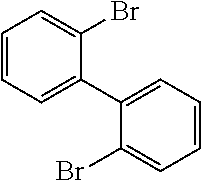
  • a biphenyl compound which is substituted with a reactive group V 1 in the position ortho to the connecting bond between the two phenyl groups, and a further reactive group V 2 , is metalated in the position of the group V 1 .
  • the metalation reaction is preferably a lithiation reaction or a Grignard reaction.
  • the metalated intermediate is then reacted with a carbonyl derivative, which has the dibenzofuran or dibenzothiophene group bonded via a spacer.
  • the resulting tertiary alcohol is cyclized to a fluorene under acidic and/or lewis acidic conditions.
  • the resulting fluorene derivative which has a reactive group V 2 bonded to it, is then further reacted in a Buchwald reaction, resulting in the corresponding amine or carbazolyl derivative of the fluorene, or it is further reacted in a Suzuki reaction, resulting in the corresponding amine or carbazolyl derivative of the fluorene, which has an aromatic group as a spacer between the amine nitrogen and the fluorene.
  • a Suzuki reaction with a group V 3 —Ar—V 4 can be performed, followed by a Buchwald reaction with a group H—NAr 2 .
  • the present application thus relates to a method for preparation of a compound according to formula (I), characterized in that a biphenyl derivative which is substituted with two reactive groups, of which at least one is present in the ortho-position to the phenyl-phenyl bond of the biphenyl derivative, is metalated.
  • the metalation reaction is preferably a lithiation reaction or a Grignard reaction.
  • the metalated biphenyl derivative is added to a carbonyl derivative, which has a dibenzofuran or dibenzothiophene group bonded to the carbonyl group via a spacer.
  • the resulting intermediate is cyclized to a fluorene derivative.
  • the cyclization reaction preferably takes place under acidic and/or Lewis-acidic conditions, most preferably by addition of a strong organic acid, such as para-toluenesulfonic acid.
  • a strong organic acid such as para-toluenesulfonic acid.
  • the fluorene derivative is further reacted in a Buchwald reaction, or in a Suzuki reaction.
  • the above-described first to fourth step are preferably consecutive, meaning that there are no intermediate steps between the first and the second, the second and the third, and the third and the fourth step.
  • the compounds according to the present application especially compounds substituted by reactive leaving groups, such as bromine, iodine, chlorine, boronic acid or boronic ester, may find use as monomers for production of corresponding oligomers, dendrimers or polymers.
  • reactive leaving groups such as bromine, iodine, chlorine, boronic acid or boronic ester
  • Suitable reactive leaving groups are, for example, bromine, iodine, chlorine, boronic acids, boronic esters, amines, alkenyl or alkynyl groups having a terminal C—C double bond or C—C triple bond, oxiranes, oxetanes, groups which enter into a cycloaddition, for example a 1,3-dipolar cycloaddition, for example dienes or azides, carboxylic acid derivatives, alcohols and silanes.
  • the invention therefore further provides oligomers, polymers or dendrimers containing one or more compounds of formula (I), wherein the bond(s) to the polymer, oligomer or dendrimer may be localized at any desired positions substituted by R 1 , R 2 , R 3 , R 4 , or R 5 in the formulae.
  • the compound is part of a side chain of the oligomer or polymer or part of the main chain.
  • An oligomer in the context of this invention is understood to mean a compound formed from at least three monomer units.
  • a polymer in the context of the invention is understood to mean a compound formed from at least ten monomer units.
  • the polymers, oligomers or dendrimers of the invention may be conjugated, partly conjugated or nonconjugated.
  • the oligomers or polymers of the invention may be linear, branched or dendritic.
  • the units of the above formulae may be joined directly to one another, or they may be joined to one another via a bivalent group, for example via a substituted or unsubstituted alkylene group, via a heteroatom or via a bivalent aromatic or heteroaromatic group.
  • branched and dendritic structures it is possible, for example, for three or more units of the above formulae to be joined via a trivalent or higher-valency group, for example via a trivalent or higher-valency aromatic or heteroaromatic group, to give a branched or dendritic oligomer or polymer.
  • the monomers of the invention are homopolymerized or copolymerized with further monomers.
  • Suitable and preferred comonomers are chosen from fluorenes, spirobifluorenes, paraphenylenes, carbazoles, thiophenes, dihydrophenanthrenes, cis- and trans-indenofluorenes, ketones, phenanthrenes or else a plurality of these units.
  • the polymers, oligomers and dendrimers typically contain still further units, for example emitting (fluorescent or phosphorescent) units, for example vinyltriarylamines or phosphorescent metal complexes, and/or charge transport units, especially those based on triarylamines.
  • emitting fluorescent or phosphorescent
  • vinyltriarylamines or phosphorescent metal complexes for example vinyltriarylamines or phosphorescent metal complexes
  • charge transport units especially those based on triarylamines.
  • formulations of the compounds according to the present application are required. These formulations may, for example, be solutions, dispersions or emulsions. For this purpose, it may be preferable to use mixtures of two or more solvents.
  • the invention therefore further provides a formulation, especially a solution, dispersion or emulsion, comprising at least one compound according to the present application and at least one solvent, preferably an organic solvent.
  • a formulation especially a solution, dispersion or emulsion, comprising at least one compound according to the present application and at least one solvent, preferably an organic solvent.
  • the invention therefore further provides for the use of the compound in an electronic device.
  • This electronic device is preferably selected from the group consisting of organic integrated circuits (OICs), organic field-effect transistors (OFETs), organic thin-film transistors (OTFTs), organic light-emitting transistors (OLETs), organic solar cells (OSCs), organic optical detectors, organic photoreceptors, organic field-quench devices (OFQDs), organic light-emitting electrochemical cells (OLECs), organic laser diodes (O-lasers) and more preferably organic electroluminescent devices (OLEDs).
  • OICs organic integrated circuits
  • OFETs organic field-effect transistors
  • OFTs organic thin-film transistors
  • OLETs organic light-emitting transistors
  • OSCs organic solar cells
  • OFQDs organic field-quench devices
  • OLEDs organic light-emitting electrochemical cells
  • O-lasers organic laser diodes
  • the invention further provides, as already set out above, an electronic device comprising at least one compound according to the present application.
  • This electronic device is preferably selected from the abovementioned devices.
  • an organic electroluminescent device comprising anode, cathode and at least one emitting layer, characterized in that at least one organic layer, which may be an emitting layer, a hole transport layer or another layer, preferably an emitting layer or a hole transport layer, particularly preferably a hole transport layer, comprises at least one compound according to the present application.
  • OLED organic electroluminescent device
  • the sequence of the layers of the organic electroluminescent device comprising the compound of the above formulae is preferably as follows: anode-hole injection layer-hole transport layer-optionally further hole transport layer(s)-optionally electron blocking layer-emitting layer-optionally hole blocking layer-electron transport layer-electron injection layer-cathode. It is additionally possible for further layers to be present in the OLED.
  • the organic electroluminescent device of the invention may contain two or more emitting layers. More preferably, these emission layers in this case have several emission maxima between 380 nm and 750 nm overall, such that the overall result is white emission; in other words, various emitting compounds which may fluoresce or phosphoresce and which emit blue, green, yellow, orange or red light are used in the emitting layers. Especially preferred are three-layer systems, i.e. systems having three emitting layers, where the three layers show blue, green and orange or red emission.
  • the compounds according to the present application are preferably present in the hole transport layer, hole injection layer, electron blocking layer and emitting layer. In case they are present in the emitting layer, they are preferably present as host materials.
  • phosphorescent emitting compounds typically encompasses compounds where the emission of light is effected through a spin-forbidden transition, for example a transition from an excited triplet state or a state having a higher spin quantum number, for example a quintet state.
  • Suitable phosphorescent emitting compounds are especially compounds which, when suitably excited, emit light, preferably in the visible region, and also contain at least one atom of atomic number greater than 20, preferably greater than 38, and less than 84, more preferably greater than 56 and less than 80. Preference is given to using, as phosphorescent emitting compounds, compounds containing copper, molybdenum, tungsten, rhenium, ruthenium, osmium, rhodium, iridium, palladium, platinum, silver, gold or europium, especially compounds containing iridium, platinum or copper.
  • all luminescent iridium, platinum or copper complexes are considered to be phosphorescent emitting compounds.
  • all phosphorescent complexes as used for phosphorescent OLEDs according to the prior art and as known to those skilled in the art in the field of organic electroluminescent devices are suitable. It is also possible for the person skilled in the art, without exercising inventive skill, to use further phosphorescent complexes in combination with the compounds according to the present application in organic electroluminescent devices. Further examples are listed in a table which follows.
  • the compounds according to the present application are used as hole-transporting material.
  • the compounds are preferably present in a hole transport layer, an electron blocking layer or a hole injection layer. Particular preference is given to use in an electron blocking layer or in a hole transport layer.
  • a hole transport layer according to the present application is a layer having a hole-transporting function between the anode and emitting layer.
  • Hole injection layers and electron blocking layers are understood in the context of the present application to be specific embodiments of hole transport layers.
  • a hole injection layer in the case of a plurality of hole transport layers between the anode and emitting layer, is a hole transport layer which directly adjoins the anode or is separated therefrom only by a single coating of the anode.
  • An electron blocking layer in the case of a plurality of hole transport layers between the anode and emitting layer, is that hole transport layer which directly adjoins the emitting layer on the anode side.
  • the OLED of the invention comprises two, three or four hole-transporting layers between the anode and emitting layer, at least one of which preferably contains a compound according to the present application, and more preferably exactly one or two contain a such compound.
  • the compound according to the present application is used as hole transport material in a hole transport layer, a hole injection layer or an electron blocking layer, the compound can be used as pure material, i.e. in a proportion of 100%, in the hole transport layer, or it can be used in combination with one or more further compounds.
  • the organic layer comprising the compound of one of the above-mentioned formulae then additionally contains one or more p-dopants.
  • p-Dopants used according to the present invention are preferably those organic electron acceptor compounds capable of oxidizing one or more of the other compounds in the mixture. Such p-dopants are preferably present in the hole-injection layer and/or hole transporting layer of the device.
  • the electron-blocking layer preferably does not comprise any p-dopants.
  • Particularly preferred p-dopants are quinodimethane compounds, azaindenofluorenediones, azaphenalenes, azatriphenylenes, 12, metal halides, preferably transition metal halides, metal oxides, preferably metal oxides containing at least one transition metal or a metal of main group 3, and transition metal complexes, preferably complexes of Cu, Co, Ni, Pd and Pt with ligands containing at least one oxygen atom as bonding site.
  • transition metal oxides as dopants, preferably oxides of rhenium, molybdenum and tungsten, more preferably Re 2 O 7 , MoO 3 , WO 3 and ReO 3 .
  • Further preferable p-dopants are selected from Bi(III)-containing metal complexes, in particular Bi(III) complexes of benzoic acid or benzoic acid derivatives.
  • the p-dopants are preferably in substantially homogeneous distribution in the p-doped layers. This can be achieved, for example, by coevaporation of the p-dopant and the hole transport material matrix.
  • Preferred p-dopants are especially the following compounds:
  • the compound is used as hole transport material in a hole transporting layer, and there is a layer (called hole injection layer) present between anode and this hole transporting layer, which comprises an electron accepting material.
  • this electron accepting material is selected from the compound classes mentioned above for use as p-dopants, particularly preferably from the compounds (D-1) to (D-14) mentioned above, most preferably from the compounds (D-6), (D-7) and (D-14).
  • the above-mentioned hole injection layer comprises one of the above-mentioned compounds in non-doped form, and with no other compounds admixed. Most preferably, it consists of only one of the above-mentioned compounds and comprises no other compound.
  • a hole transporting or hole injection layer of the device comprises two or more, preferably two, different hole transporting materials (mixed layer).
  • the two or more different hole transporting materials are preferably selected from triarylamine compounds, particularly preferred from mono-triarylamine compounds, more particularly preferably from the compounds listed below as preferred hole-transporting compounds.
  • each of them is preferably present in a proportion of at least 10% by volume, preferably in a proportion of at least 20% by volume.
  • the above-mentioned mixed layers preferably comprise one or more compounds according to the present application.
  • the compound is used in an emitting layer as matrix material in combination with one or more emitting compounds, preferably phosphorescent emitting compounds.
  • the proportion of the matrix material in the emitting layer in this case is between 50.0% and 99.9% by volume, preferably between 80.0% and 99.5% by volume, and more preferably between 92.0% and 99.5% by volume for fluorescent emitting layers and between 85.0% and 97.0% by volume for phosphorescent emitting layers.
  • the proportion of the emitting compound is between 0.1% and 50.0% by volume, preferably between 0.5% and 20.0% by volume, and more preferably between 0.5% and 8.0% by volume for fluorescent emitting layers and between 3.0% and 15.0% by volume for phosphorescent emitting layers.
  • An emitting layer of an organic electroluminescent device may also comprise systems comprising a plurality of matrix materials (mixed matrix systems) and/or a plurality of emitting compounds.
  • the emitting compounds are generally those compounds having the smaller proportion in the system and the matrix materials are those compounds having the greater proportion in the system.
  • the proportion of a single matrix material in the system may be less than the proportion of a single emitting compound.
  • the compound is used as a component of mixed matrix systems.
  • the mixed matrix systems preferably comprise two or three different matrix materials, more preferably two different matrix materials.
  • one of the two materials is a material having hole-transporting properties and the other material is a material having electron-transporting properties.
  • the compound is preferably the matrix material having hole-transporting properties.
  • the desired electron-transporting and hole-transporting properties of the mixed matrix components may, however, also be combined mainly or entirely in a single mixed matrix component, in which case the further mixed matrix component(s) fulfill(s) other functions.
  • the two different matrix materials may be present in a ratio of 1:50 to 1:1, preferably 1:20 to 1:1, more preferably 1:10 to 1:1 and most preferably 1:4 to 1:1. Preference is given to using mixed matrix systems in phosphorescent organic electroluminescent devices.
  • the mixed matrix systems may comprise one or more emitting compounds, preferably one or more phosphorescent emitting compounds.
  • mixed matrix systems are preferably used in phosphorescent organic electroluminescent devices.
  • Particularly suitable matrix materials which can be used in combination with the compounds according to the present application as matrix components of a mixed matrix system are selected from the preferred matrix materials specified below for phosphorescent emitting compounds or the preferred matrix materials for fluorescent emitting compounds, according to what type of emitting compound is used in the mixed matrix system.
  • Preferred phosphorescent emitting compounds for use in mixed matrix systems are the same as detailed further up as generally preferred phosphorescent emitter materials.
  • Preferred phosphorescent emitting compounds are the following ones:
  • Preferred fluorescent emitting compounds are selected from the class of the arylamines.
  • An arylamine or an aromatic amine in the context of this invention is understood to mean a compound containing three substituted or unsubstituted aromatic or heteroaromatic ring systems bonded directly to the nitrogen.
  • at least one of these aromatic or heteroaromatic ring systems is a fused ring system, more preferably having at least 14 aromatic ring atoms.
  • Preferred examples of these are aromatic anthracenamines, aromatic anthracenediamines, aromatic pyrenamines, aromatic pyrenediamines, aromatic chrysenamines or aromatic chrysenediamines.
  • aromatic anthracenamine is understood to mean a compound in which a diarylamino group is bonded directly to an anthracene group, preferably in the 9 position.
  • aromatic anthracenediamine is understood to mean a compound in which two diarylamino groups are bonded directly to an anthracene group, preferably in the 9,10 positions.
  • Aromatic pyrenamines, pyrenediamines, chrysenamines and chrysenediamines are defined analogously, where the diarylamino groups are bonded to the pyrene preferably in the 1-position or 1,6-positions.
  • emitting compounds are indenofluorenamines and -fluorenediamines, benzoindenofluorenamines and -fluorenediamines, dibenzoindenofluoreneamines and -diamines, and indenofluorene derivatives having fused aryl groups.
  • pyrenearylamines are preferred.
  • Useful matrix materials include materials of various substance classes.
  • Preferred matrix materials are selected from the classes of the oligoarylenes (e.g. 2,2′,7,7′-tetraphenylspirobifluorene or dinaphthylanthracene), especially of oligoarylenes containing fused aromatic groups, oligoarylenevinylenes (e.g. DPVBi or spiro-DPVBi), polypodal metal complexes, hole-conducting compounds, electron-conducting compounds, especially ketones, phosphine oxides, and sulphoxides, and atropisomers, boronic acid derivatives or benzanthracenes.
  • oligoarylenes e.g. 2,2′,7,7′-tetraphenylspirobifluorene or dinaphthylanthracene
  • oligoarylenevinylenes e.g. DPVBi or spiro-DPVBi
  • Particularly preferred matrix materials are selected from the classes of the oligoarylenes comprising naphthalene, anthracene, benzanthracene and/or pyrene or atropisomers of these compounds, the oligoarylenevinylenes, the ketones, the phosphine oxides and the sulphoxides.
  • Very particularly preferred matrix materials are selected from the classes of the oligoarylenes comprising anthracene, benzanthracene, benzophenanthrene and/or pyrene or atropisomers of these compounds.
  • An oligoarylene in the context of this invention shall be understood to mean a compound in which at least three aryl or arylene groups are bonded to one another.
  • Preferred matrix materials for phosphorescent emitting compounds are, as well as the compounds of the present application, aromatic ketones, aromatic phosphine oxides or aromatic sulphoxides or sulphones, triarylamines, carbazole derivatives, e.g.
  • CBP N,N-biscarbazolylbiphenyl
  • carbazole derivatives indolocarbazole derivatives, indenocarbazole derivatives, azacarbazole derivatives, bipolar matrix materials, silanes, azaboroles or boronic esters, triazine derivatives, zinc complexes, diazasilole or tetraazasilole derivatives, diazaphosphole derivatives, bridged carbazole derivatives, triphenylene derivatives, or lactams.
  • Suitable charge transport materials as usable in the hole injection or hole transport layer or electron blocking layer or in the electron transport layer of the electronic device of the invention are, other than the compounds of the present application, for example, the compounds disclosed in Y. Shirota et al., Chem. Rev. 2007, 107(4), 953-1010, or other materials as used in these layers according to the prior art.
  • Preferred anodes are materials having a high work function.
  • the anode has a work function of greater than 4.5 eV versus vacuum.
  • metals having a high redox potential are suitable for this purpose, for example Ag, Pt or Au.
  • metal/metal oxide electrodes e.g. Al/Ni/NiO x , Al/PtO x
  • at least one of the electrodes has to be transparent or partly transparent in order to enable the irradiation of the organic material (organic solar cell) or the emission of light (OLED, O-laser).
  • Preferred anode materials here are conductive mixed metal oxides.
  • ITO indium tin oxide
  • IZO indium zinc oxide
  • conductive doped organic materials especially conductive doped polymers.
  • the anode may also consist of two or more layers, for example of an inner layer of ITO and an outer layer of a metal oxide, preferably tungsten oxide, molybdenum oxide or vanadium oxide.
  • LITI light-induced thermal imaging, thermal transfer printing
  • soluble compounds are needed. High solubility can be achieved by suitable substitution of the compounds.
  • the filtrate is evaporated in vacuo, and the residue is crystallised from toluene/heptane.
  • the crude product is extracted in a Soxhlet extractor (toluene) and purified by zone sublimation in vacuo twice.
  • the product is isolated in the form of an off-white solid (11 g, 40% of theory).
  • the filtrate is evaporated in vacuo, and the residue is crystallised from heptane.
  • the crude product is extracted in a Soxhlet extractor (toluene) and purified by zone sublimation in vacuo twice.
  • the product is isolated in the form of a white solid (46 g, 50% of theory).
  • OLEDs comprising compounds according to the present application are prepared by the following general process:
  • the substrates used are glass plates coated with structured ITO (indium tin oxide) in a thickness of 50 nm.
  • the OLEDs have the following layer structure: substrate/hole-injection layer (HIL)/hole-transport layer (HTL)/electron-blocking layer (EBL)/emission layer (EML)/electron-transport layer (ETL)/electron-injection layer (EIL) and finally a cathode.
  • the cathode is formed by an aluminium layer with a thickness of 100 nm.
  • Tables 1a to 1c The specific device setup of the OLEDs is shown in Tables 1a to 1c, and the materials for the various layers of the OLEDs are shown in Table 3.
  • the emission layer here always consists of at least one matrix material (host material) and an emitting dopant (emitter), which is admixed with the matrix material or matrix materials in a certain proportion by volume by coevaporation.
  • An expression such as H:SEB (5%) here means that material H is present in the layer in a proportion by volume of 95% and SEB is present in the layer in a proportion by volume of 5%.
  • other layers may also consist of a mixture of two or more materials.
  • the OLEDs are characterised by standard methods. For this purpose, the electroluminescence spectra and the external quantum efficiency (EQE, measured in percent) as a function of the luminous density, calculated from current/voltage/luminous density characteristic lines (IUL characteristic lines) assuming Lambert emission characteristics, and the lifetime are determined.
  • the expression EQE @ 10 mA/cm 2 denotes the external quantum efficiency at an operating current density of 10 mA/cm 2 .
  • LT80 @ 60 mA/cm 2 is the lifetime until at a current density of 60 mA/cm 2 , the OLED has dropped from its initial luminance of e.g. 5000 cd/m 2 to 80% of the initial intensity, i.e. to 4000 cd/m 2 without using any acceleration factor.
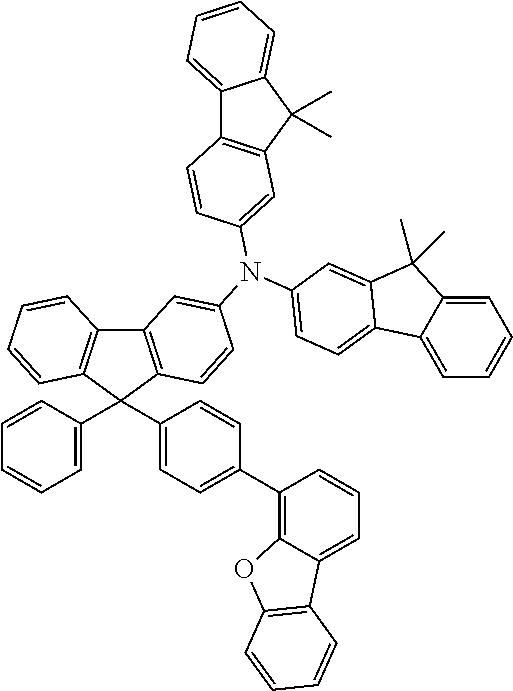
  • the compounds HTM-1 to HTM-3 according to the present application are used in the EBL of a blue fluorescent OLED stack, as shown below in Table 1a.
  • the compounds HTM-1 to HTM-4 according to the present application are used in the EBL of a blue fluorescent OLED stack, as shown below in Table 1b.
  • the compounds HTM-2 and HTM-3 according to the present application are used in the HTL of a blue fluorescent OLED stack, as shown below in Table 1c.

Landscapes

  • Chemical & Material Sciences (AREA)
  • Organic Chemistry (AREA)
  • Physics & Mathematics (AREA)
  • Spectroscopy & Molecular Physics (AREA)
  • Engineering & Computer Science (AREA)
  • Materials Engineering (AREA)
  • Optics & Photonics (AREA)
  • Electroluminescent Light Sources (AREA)
  • Heterocyclic Carbon Compounds Containing A Hetero Ring Having Oxygen Or Sulfur (AREA)
  • Low-Molecular Organic Synthesis Reactions Using Catalysts (AREA)
  • Nitrogen And Oxygen Or Sulfur-Condensed Heterocyclic Ring Systems (AREA)
  • Nitrogen Condensed Heterocyclic Rings (AREA)
  • Furan Compounds (AREA)
  • Devices For Indicating Variable Information By Combining Individual Elements (AREA)

Abstract

The present application concerns compounds for use in electronic devices, processes for preparing the compounds, and electronic devices comprising the compounds.

Description

CROSS-REFERENCE TO RELATED APPLICATIONS
This application is a national stage application (under 35 U.S.C. § 371) of PCT/EP2019/085642, filed Dec. 17, 2019, which claims benefit of European Application No. 18214576.3, filed Dec. 20, 2018, both of which are incorporated herein by reference in their entirety.
The present application relates to a fluorene amine compound which is suitable for use in electronic devices, in particular organic electroluminescent devices (OLEDs).
Electronic devices in the context of this application are understood to mean what are called organic electronic devices, which contain organic semiconductor materials as functional materials. More particularly, these are understood to mean OLEDs.
The construction of OLEDs in which organic compounds are used as functional materials is common knowledge in the prior art. In general, the term OLEDs is understood to mean electronic devices which have one or more layers comprising organic compounds and emit light on application of electrical voltage.
In electronic devices, especially OLEDs, there is great interest in improving the performance data, especially lifetime, efficiency and operating voltage. In these aspects, it has not yet been possible to find any entirely satisfactory solution.
A great influence on the performance data of electronic devices is possessed by layers having a hole-transporting function, for example hole-injecting layers, hole transport layers, electron blocking layers and also emitting layers. For use in these layers, there is a continuous search for new materials having hole-transporting properties.
In the course of the present invention, it has been found that fluorene amine compounds which have a dibenzofuran group or similar group bonded via a spacer group to the bridgehead position of the fluorene, are very well suited for use as materials with hole transporting function, in particular for use as materials of the hole transport layer, the electron blocking layer and/or the emitting layer, more particularly for use in the hole transport layer and/or the electron blocking layer. An electron blocking layer is understood in this context to be a layer which is directly adjacent to the emitting layer on the anode side, and which serves to block electrons which are present in the emitting layer from entering the hole transport layers of the OLED.
When used in electronic devices, in particular in OLEDs, they lead to excellent results in terms of lifetime, operating voltage and quantum efficiency of the devices. The compounds are also characterized by very good hole-conducting properties, very good electron-blocking properties, high glass transition temperature, high oxidation stability, good solubility, high thermal stability, and low sublimation temperature.
The present application therefore relates to a compound of a formula (I)
Figure US12069950-20240820-C00001
    • where the following applies to the variable groups:
    • Z is C, if a group —[Ar2]n-A is bonded to it; and Z is selected, identically or differently at each occurrence, from CR1 and N, if no group —[Ar2]n-A is bonded to it;
    • Y is C, if a group Ar1 is bonded to it; and Y is selected, identically or differently on each occurrence, from CR3 and N, if no group Ar1 is bonded to it;
    • X is O or S;
    • Ar1 is, identically or differently at each occurrence, selected from aromatic ring systems having 6 to 40 aromatic ring atoms, which are substituted by radicals R4, and heteroaromatic ring systems having 5 to 40 aromatic ring atoms, which are substituted by radicals R4;
    • Ar2 is, identically or differently at each occurrence, selected from aromatic ring systems having 6 to 40 aromatic ring atoms, which are substituted by radicals R5, and heteroaromatic ring systems having 5 to 40 aromatic ring atoms, which are substituted by radicals R5;
    • A corresponds to the following formula
Figure US12069950-20240820-C00002
    • which is bonded via the dotted line;
    • Ar3 and Ar4 are, identically or differently at each occurrence, selected from aromatic ring systems having 6 to 40 aromatic ring atoms, which are substituted by radicals R5, and heteroaromatic ring systems having 5 to 40 aromatic ring atoms, which are substituted by radicals R5;
    • T is a single bond or a divalent group selected from C(R5)2, Si(R5)2, N(R5), O, and S;
    • k is 0 or 1, where k=0 means that T does not occur and the groups Ar3 and Ar4 are not connected;
    • R1 is selected, identically or differently at each occurrence, from H, D, F, Cl, Br, I, C(═O)R6, CN, Si(R6)3, N(R6)2, P(═O)(R6)2, OR6, S(═O)R6, S(═O)2R6, straight-chain alkyl or alkoxy groups having 1 to 20 C atoms, branched or cyclic alkyl or alkoxy groups having 3 to 20 C atoms, alkenyl or alkynyl groups having 2 to 20 C atoms, aromatic ring systems having 6 to 40 aromatic ring atoms, and heteroaromatic ring systems having 5 to 40 aromatic ring atoms; where two or more radicals R1 may be connected to each other to form a ring; where the said alkyl, alkoxy, alkenyl and alkynyl groups and the said aromatic and heteroaromatic ring systems are in each case substituted by radicals R6, and where one or more CH2 groups in the said alkyl, alkoxy, alkenyl and alkynyl groups may in each case be replaced by —R6C═CR6—, —C≡C—, Si(R6)2, C═O, C═NR6, —C(═O)O—, —C(═O)NR6—, NR6, P(═O)(R6), —O—, —S—, SO or SO2;
    • R2 is selected, identically or differently at each occurrence, from H, D, F, Cl, Br, I, CN, Si(R6)3, N(R6)2, straight-chain alkyl or alkoxy groups having 1 to 20 C atoms, branched or cyclic alkyl or alkoxy groups having 3 to 20 C atoms, alkenyl or alkynyl groups having 2 to 20 C atoms, aromatic ring systems having 6 to 40 aromatic ring atoms, and heteroaromatic ring systems having 5 to 40 aromatic ring atoms; where the said alkyl, alkoxy, alkenyl and alkynyl groups and the said aromatic and heteroaromatic ring systems are in each case substituted by radicals R6, and where one or more CH2 groups in the said alkyl, alkoxy, alkenyl and alkynyl groups may in each case be replaced by —R6C═CR6—, —C≡C—, Si(R6)2, C═O, C═NR6, —C(═O)O—, —C(═O)NR6—, NR6, P(═O)(R6), —O—, —S—, SO or SO2;
    • R3 is selected, identically or differently at each occurrence, from H, D, F, Cl, Br, I, C(═O)R6, CN, Si(R6)3, N(R6)2, P(═O)(R6)2, OR6, S(═O)R6, S(═O)2R6, straight-chain alkyl or alkoxy groups having 1 to 20 C atoms, branched or cyclic alkyl or alkoxy groups having 3 to 20 C atoms, alkenyl or alkynyl groups having 2 to 20 C atoms, aromatic ring systems having 6 to 40 aromatic ring atoms, and heteroaromatic ring systems having 5 to 40 aromatic ring atoms; where two or more radicals R3 may be connected to each other to form a ring; where the said alkyl, alkoxy, alkenyl and alkynyl groups and the said aromatic and heteroaromatic ring systems are in each case substituted by radicals R6, and where one or more CH2 groups in the said alkyl, alkoxy, alkenyl and alkynyl groups may in each case be replaced by —R6C═CR6—, —C≡C—, Si(R6)2, C═O, C═NR6, —C(═O)O—, —C(═O)NR6—, NR6, P(═O)(R6), —O—, —S—, SO or SO2;
    • R4 is selected, identically or differently at each occurrence, from H, D, F, Cl, Br, I, C(═O)R6, CN, Si(R6)3, N(R6)2, P(═O)(R6)2, OR6, S(═O)R6, S(═O)2R6, straight-chain alkyl or alkoxy groups having 1 to 20 C atoms, branched or cyclic alkyl or alkoxy groups having 3 to 20 C atoms, alkenyl or alkynyl groups having 2 to 20 C atoms, aromatic ring systems having 6 to 40 aromatic ring atoms, and heteroaromatic ring systems having 5 to 40 aromatic ring atoms; where two or more radicals R4 may be connected to each other to form a ring; where the said alkyl, alkoxy, alkenyl and alkynyl groups and the said aromatic and heteroaromatic ring systems are in each case substituted by radicals R6, and where one or more CH2 groups in the said alkyl, alkoxy, alkenyl and alkynyl groups may in each case be replaced by —R6C═CR6—, —C≡C—, Si(R6)2, C═O, C═NR6, —C(═O)O—, —C(═O)NR6—, NR6, P(═O)(R6), —O—, —S—, SO or SO2;
    • R5 is selected, identically or differently at each occurrence, from H, D, F, Cl, Br, I, C(═O)R6, CN, Si(R6)3, N(R6)2, P(═O)(R6)2, OR6, S(═O)R6, S(═O)2R6, straight-chain alkyl or alkoxy groups having 1 to 20 C atoms, branched or cyclic alkyl or alkoxy groups having 3 to 20 C atoms, alkenyl or alkynyl groups having 2 to 20 C atoms, aromatic ring systems having 6 to 40 aromatic ring atoms, and heteroaromatic ring systems having 5 to 40 aromatic ring atoms; where two or more radicals R5 may be connected to each other to form a ring; where the said alkyl, alkoxy, alkenyl and alkynyl groups and the said aromatic and heteroaromatic ring systems are in each case substituted by radicals R6, and where one or more CH2 groups in the said alkyl, alkoxy, alkenyl and alkynyl groups may in each case be replaced by —R6C═CR6—, —C≡C—, Si(R6)2, C═O, C═NR6, —C(═O)O—, —C(═O)NR6—, NR6, P(═O)(R6), —O—, —S—, SO or SO2;
    • R6 is selected, identically or differently at each occurrence, from H, D, F, Cl, Br, I, C(═O)R7, CN, Si(R7)3, N(R7)2, P(═O)(R7)2, OR7, S(═O)R7, S(═O)2R7, straight-chain alkyl or alkoxy groups having 1 to 20 C atoms, branched or cyclic alkyl or alkoxy groups having 3 to 20 C atoms, alkenyl or alkynyl groups having 2 to 20 C atoms, aromatic ring systems having 6 to 40 aromatic ring atoms, and heteroaromatic ring systems having 5 to 40 aromatic ring atoms; where two or more radicals R6 may be connected to each other to form a ring; where the said alkyl, alkoxy, alkenyl and alkynyl groups and the said aromatic and heteroaromatic ring systems are in each case be substituted by radicals R7, and where one or more CH2 groups in the said alkyl, alkoxy, alkenyl and alkynyl groups may in each case be replaced by —R7C═CR7—, —C≡C—, Si(R7)2, C═O, C═NR7, —C(═O)O—, —C(═O)NR7—, NR7, P(═O)(R7), —O—, —S—, SO or SO2;
    • R7 is selected, identically or differently at each occurrence, from H, D, F, Cl, Br, I, CN, alkyl groups having 1 to 20 C atoms, aromatic ring systems having 6 to 40 C atoms, or heteroaromatic ring systems having 5 to 40 aromatic ring atoms; where the said alkyl groups, aromatic ring systems and heteroaromatic ring systems may be substituted by one or more radicals selected from F and CN;
    • m is 1, 2, 3, or 4;
    • n is 0, 1, 2, 3, or 4.
The following definitions apply to the chemical groups used as general definitions. They apply insofar as no more specific definitions are given.
An aryl group here is taken to mean either a single aromatic ring, for example benzene, or a condensed aromatic polycycle, for example naphthalene, phenanthrene, or anthracene. A condensed aromatic polycycle in the sense of the present application consists of two or more single aromatic rings which are condensed with one another. An aryl group in the sense of this invention contains 6 to 40 aromatic ring atoms, of which none is a heteroatom.
A heteroaryl group here is taken to mean either a single heteroaromatic ring, such as pyridine, pyrimidine or thiophene, or a condensed heteroaromatic polycycle, such as quinoline or carbazole. A condensed heteroaromatic polycycle in the sense of the present application consists of two or more single aromatic or heteroaromatic rings, which are condensed with one another, where at least one of the two or more single aromatic or heteroaromatic rings is a heteroaromatic ring. A heteroaryl group in the sense of this invention contains 5 to 40 aromatic ring atoms, at least one of which is a heteroatom. The heteroatoms are preferably selected from N, O and S.
An aryl or heteroaryl group, which may in each case be substituted by the above-mentioned radicals, is taken to mean, in particular, a group derived from benzene, naphthalene, anthracene, phenanthrene, pyrene, dihydropyrene, chrysene, perylene, fluoranthene, benzanthracene, benzophenanthrene, tetracene, pentacene, benzopyrene, furan, benzofuran, isobenzofuran, dibenzofuran, thiophene, benzothiophene, isobenzothiophene, dibenzothiophene, pyrrole, indole, isoindole, carbazole, pyridine, quinoline, isoquinoline, acridine, phenanthridine, benzo-5,6-quinoline, benzo-6,7-quinoline, benzo-7,8-quinoline, phenothiazine, phenoxazine, pyrazole, indazole, imidazole, benzimidazole, benzimidazolo[1,2-a]benzimidazole, naphthimidazole, phenanthrimidazole, pyridimidazole, pyrazinimidazole, quinoxalinimidazole, oxazole, benzoxazole, naphthoxazole, anthroxazole, phenanthroxazole, isoxazole, 1,2-thiazole, 1,3-thiazole, benzothiazole, pyridazine, benzopyridazine, pyrimidine, benzopyrimidine, quinoxaline, pyrazine, phenazine, naphthyridine, azacarbazole, benzocarboline, phenanthroline, 1,2,3-triazole, 1,2,4-triazole, benzotriazole, 1,2,3-oxadiazole, 1,2,4-oxadiazole, 1,2,5-oxadiazole, 1,3,4-oxadiazole, 1,2,3-thiadiazole, 1,2,4-thiadiazole, 1,2,5-thiadiazole, 1,3,4-thiadiazole, 1,3,5-triazine, 1,2,4-triazine, 1,2,3-triazine, tetrazole, 1,2,4,5-tetrazine, 1,2,3,4-tetrazine, 1,2,3,5-tetrazine, purine, pteridine, indolizine and benzothiadiazole.
An aromatic ring system in the sense of this invention is a system which does not necessarily contain only aryl groups, but which may additionally contain one or more non-aromatic rings, which are condensed with at least one aryl group. Such non-aromatic rings contain exclusively carbon atoms as ring atoms. Examples of groups embraced by such definition are tetrahydronaphthalene, fluorene, and spirobifluorene. Furthermore, the term aromatic ring system is understood to embrace systems consisting of two or more aromatic ring systems which are connected to each other via single bonds, such as biphenyl, terphenyl, 7-phenyl-2-fluorenyl and quaterphenyl. An aromatic ring system in the sense of this invention contains 6 to 40 C atoms and no heteroatoms as ring atoms of the ring system. An aromatic ring system in the sense of this application does not comprise any heteroaryl groups, as defined above.
A heteroaromatic ring system is defined in analogy to the aromatic ring system above, but with the difference that it must obtain at least one heteroatom as one of the ring atoms. As it is the case for the aromatic ring system, it does not necessarily contain only aryl and heteroaryl groups, but it may additionally contain one or more non-aromatic rings, which are condensed with at least one aryl or heteroaryl group. The non-aromatic rings may contain only carbon atoms as ring atoms, or they may contain additionally one or more heteroatoms, where the heteroatoms are preferably selected from N, O and S. An example for such a heteroaromatic ring system is benzpyranyl. Furthermore, the term heteroaromatic ring system is understood to embrace systems consisting of two or more aromatic or heteroaromatic ring systems, which are connected to each other via single bonds, such as 4,6-diphenyl-2-triazinyl. A heteroaromatic ring system in the sense of this invention contains 5 to 40 ring atoms, which are selected from carbon and heteroatoms, where at least one of the ring atoms is a heteroatom. The heteroatoms are preferably selected from N, O or S.
The terms “heteroaromatic ring system” and “aromatic ring system” according to the definition of the present application differ from each other by the fact that the aromatic ring system cannot comprise any heteroatom as ring atom, whereas the heteroaromatic ring system must comprise at least one heteroatom as ring atom. Such heteroatom may be present as a ring atom of a non-aromatic heterocyclic ring of the system, or as a ring atom of an aromatic heterocyclic ring of the system.
According to the above, any aryl group, as defined above, is embraced by the term “aromatic ring system”, as defined above, and any heteroaryl group, as defined above, is embraced by the term “heteroaromatic ring system”, as defined above.
An aromatic ring system having 6 to 40 aromatic ring atoms or a heteroaromatic ring system having 5 to 40 aromatic ring atoms is in particular a group which is derived from the above mentioned aryl or heteroaryl groups, or from biphenyl, terphenyl, quaterphenyl, fluorene, spirobifluorene, dihydrophenanthrene, dihydropyrene, tetrahydropyrene, indenofluorene, truxene, isotruxene, spirotruxene, spiroisotruxene, and indenocarbazole, or from any combinations of these groups.
For the purposes of the present invention, a straight-chain alkyl group having 1 to 20 C atoms or a branched or cyclic alkyl group having 3 to 20 C atoms or an alkenyl or alkynyl group having 2 to 20 C atoms, in which, in addition, individual H atoms or CH2 groups may be substituted by the groups mentioned above under the definition of the radicals, is preferably taken to mean the radicals methyl, ethyl, n-propyl, i-propyl, n-butyl, i-butyl, s-butyl, t-butyl, 2-methylbutyl, n-pentyl, s-pentyl, cyclopentyl, neopentyl, n-hexyl, cyclohexyl, neohexyl, n-heptyl, cycloheptyl, n-octyl, cyclooctyl, 2-ethylhexyl, trifluoromethyl, pentafluoroethyl, 2,2,2-trifluoroethyl, ethenyl, propenyl, butenyl, pentenyl, cyclopentenyl, hexenyl, cyclohexenyl, heptenyl, cycloheptenyl, octenyl, cyclooctenyl, ethynyl, propynyl, butynyl, pentynyl, hexynyl or octynyl.
An alkoxy or thioalkyl group having 1 to 20 C atoms is preferably taken to mean methoxy, trifluoromethoxy, ethoxy, n-propoxy, i-propoxy, n-butoxy, i-butoxy, s-butoxy, t-butoxy, n-pentoxy, s-pentoxy, 2-methylbutoxy, n-hexoxy, cyclohexyloxy, n-heptoxy, cycloheptyloxy, n-octyloxy, cyclooctyl-oxy, 2-ethylhexyloxy, pentafluoroethoxy, 2,2,2-trifluoroethoxy, methylthio, ethylthio, n-propylthio, i-propylthio, n-butylthio, i-butylthio, s-butylthio, t-butylthio, n-pentylthio, s-pentylthio, n-hexylthio, cyclohexylthio, n-heptyl-thio, cycloheptylthio, n-octylthio, cyclooctylthio, 2-ethylhexylthio, trifluoro-methylthio, pentafluoroethylthio, 2,2,2-trifluoroethylthio, ethenylthio, propenylthio, butenylthio, pentenylthio, cyclopentenylthio, hexenylthio, cyclohexenylthio, heptenylthio, cycloheptenylthio, octenylthio, cyclooctenyl-thio, ethynylthio, propynylthio, butynylthio, pentynylthio, hexynylthio, heptynylthio or octynylthio.
The phrase “two or more radicals may be connected to each other to form a ring” shall be understood to include the case that the two radicals are connected by a chemical bond. Additionally, the phrase shall be understood to include the case that one of the two radicals is H, this radical H is removed, and the other of the two radicals forms a ring by being connected to the position, to which this radical H was initially bonded. Additionally, this phrase shall be understood to include the case that both of the two radicals are H, they are both removed, and the positions to which the two radicals H were bonded are connected by a single bond to form a ring.
For the purposes of the present application, if a group is depicted as bonded to a ring having multiple bonding positions, and the group has an index which is an integer, this means that the respective group is present multiple times on the ring. E.g. if a group —[R1]4 is shown in a formula, bonded to an aromatic ring of the fluorene moiety of the formula, this means that all four positions on that aromatic ring are substituted with R1.
The compound according to formula (I) is preferably a monoamine. A monoamine is understood to be a compound which has only one triarylamine group, preferably a compound which has only one amine group.
The group —[Ar2]n-A can be bonded in any of positions 1, 2, 3 and 4 on the fluorene sub-structure of formula (I). Preferably, it is bonded in position 2 or 4, more preferably, in position 2.
The positions on the fluorene sub-structure of formula (I) are numbered as follows:
Figure US12069950-20240820-C00003
The group
Figure US12069950-20240820-C00004

of formula (I) is preferably bonded in the following position to the rest of the formula (I):
Figure US12069950-20240820-C00005

where the dotted bond is the bond which connects the group to the rest of the formula.
According to a preferred embodiment, Z is C, if a group —[Ar2]n-A is bonded to it; and Z is CR1, if no group —[Ar2]n-A is bonded to it.
According to a preferred embodiment, Y is C, if a group Ar1 is bonded to it; and Z is CR1, if no group Ar1 is bonded to it.
According to a preferred embodiment, X is O.
According to a preferred embodiment, Ar1 is selected from divalent groups derived from phenyl, biphenyl, terphenyl, naphthalene, fluorene, indenofluorene, indenocarbazole, spirobifluorene, dibenzofuran, dibenzothiophene, and carbazole, which are optionally substituted with one or more radicals R4, more preferably selected from divalent groups derived from phenyl, biphenyl and fluorene, which are optionally substituted with one or more radicals R4, most preferably selected from 1,2-phenylene, 1,3-phenylene and 1,4-phenylene, of which 1,4-phenylene is preferred, where the phenylene groups are optionally substituted with one or more radicals R4 and are preferably unsubstituted.
Index m is preferably 1 or 2, most preferably 1.
Preferred groups —[Ar1]m— for the case of m=1 are selected from divalent groups derived from phenyl, biphenyl, terphenyl, naphthalene, fluorene, indenofluorene, indenocarbazole, spirobifluorene, dibenzofuran, dibenzothiophene, and carbazole, which are substituted with radicals R4, more preferably selected from divalent groups derived from phenyl, biphenyl and fluorene, which are substituted with radicals R4, most preferably selected from 1,2-phenylene, 1,3-phenylene and 1,4-phenylene, of which 1,4-phenylene is preferred, where the phenylene groups are substituted with radicals R4, where in such case, radicals R4 are preferably H.
Preferred groups Ar2 are selected from divalent groups derived from phenyl, biphenyl, terphenyl, naphthalene, fluorene, indenofluorene, indenocarbazole, spirobifluorene, dibenzofuran, dibenzothiophene, and carbazole, which are substituted with radicals R5, more preferably selected from divalent groups derived from phenyl, biphenyl and fluorene, which are substituted with radicals R5.
According to a preferred embodiment, index n is 0, so that the group Ar2 is not present, and the fluorene moiety and the amine nitrogen in formula (I) are directly connected to each other.
According to an alternative preferred embodiment, index n is 1 or 2, preferably 1.
Preferred groups —[Ar2] n— for the case that n=1 are selected from divalent groups derived from phenyl, biphenyl, terphenyl, naphthalene, fluorene, indenofluorene, indenocarbazole, spirobifluorene, dibenzofuran, dibenzothiophene, and carbazole, which are substituted with radicals R5, more preferably selected from divalent groups derived from phenyl, naphthyl, biphenyl and fluorene, which are substituted with radicals R5.
Particularly preferred groups —[Ar2]n— for the case that n=1 are selected from the following groups
Figure US12069950-20240820-C00006
Figure US12069950-20240820-C00007
Figure US12069950-20240820-C00008
Figure US12069950-20240820-C00009
Figure US12069950-20240820-C00010
Figure US12069950-20240820-C00011
Figure US12069950-20240820-C00012
Figure US12069950-20240820-C00013
Figure US12069950-20240820-C00014
Figure US12069950-20240820-C00015
Figure US12069950-20240820-C00016
Figure US12069950-20240820-C00017

where the dotted bonds are the bonds to the rest of the formula (I), and the groups are substituted with radicals R5 at all free positions.
Among the above-mentioned groups, groups according to formulae (Ar2-1), (Ar2-2), (Ar2-3), (Ar2-4), (Ar2-15), (Ar2-20), (Ar2-25) and (Ar2-36) are particularly preferred.
According to one preferred embodiment of the invention, the groups Ar3 and Ar4 in group A are not linked to each other by a group T, i.e. k is 0.
According to another preferred embodiment, the groups Ar3 and Ar4 are linked to each other by a group T, i.e. k is 1. In this case, T is preferably a single bond. Preferred embodiments of group A for the case k=1 are shown in the following:
Figure US12069950-20240820-C00018
Figure US12069950-20240820-C00019
Figure US12069950-20240820-C00020
Figure US12069950-20240820-C00021
Figure US12069950-20240820-C00022
Figure US12069950-20240820-C00023

where the dotted line is the bond to the rest of formula (I).
According to a preferred embodiment, Ar3 and Ar4 are selected, identically or differently, from monovalent groups derived from benzene, biphenyl, terphenyl, quaterphenyl, naphthalene, fluorene, particularly 9,9′-dimethylfluorene and 9,9′-diphenylfluorene, 9-sila-fluorene, particularly 9,9′-dimethyl-9-silafluorene and 9,9′-diphenyl-9-silafluorene, benzofluorene, spirobifluorene, indenofluorene, indenocarbazole, dibenzofuran, dibenzothiophene, benzocarbazole, carbazole, benzofuran, benzothiophene, indole, quinoline, pyridine, pyrimidine, pyrazine, pyridazine, and triazine, where each of the monovalent groups is substituted with radicals R5. According to an alternative preferred embodiment, groups Ar3 and Ar4 are selected, identically or differently, from combinations of 2 to 4 groups, preferably 2 groups derived from benzene, biphenyl, terphenyl, quaterphenyl, naphthalene, fluorene, particularly 9,9′-dimethylfluorene and 9,9′-diphenylfluorene, 9-sila-fluorene, particularly 9,9′-dimethyl-9-silafluorene and 9,9′-diphenyl-9-silafluorene, benzofluorene, spirobifluorene, indenofluorene, indenocarbazole, dibenzofuran, dibenzothiophene, benzocarbazole, carbazole, benzofuran, benzothiophene, indole, quinoline, pyridine, pyrimidine, pyrazine, pyridazine, and triazine, where each of the groups is substituted with radicals R5.
Particularly preferred groups Ar3 and Ar4 are selected, identically or differently, from phenyl, biphenyl, terphenyl, quaterphenyl, naphthyl, fluorenyl, particularly 9,9′-dimethylfluorenyl and 9,9′-diphenylfluorenyl, benzofluorenyl, spirobifluorenyl, indenofluorenyl, indenocarbazolyl, dibenzofuranyl, dibenzothiophenyl, carbazolyl, benzofuranyl, benzothiophenyl, benzo-condensed dibenzofuranyl, benzo-condensed dibenzothiophenyl, phenyl substituted with naphthyl, phenyl substituted with fluorenyl, phenyl substituted with spirobifluorenyl, phenyl substituted with dibenzofuranyl, phenyl substituted with dibenzothiophene, phenyl substituted with carbazolyl, phenyl substituted with pyridyl, phenyl substituted with pyrimidyl, and phenyl substituted with triazinyl, where the groups are each substituted with radicals R5.
Preferred embodiments of groups Ar3 and Ar4 are shown in the following:
Figure US12069950-20240820-C00024
Figure US12069950-20240820-C00025
Figure US12069950-20240820-C00026
Figure US12069950-20240820-C00027
Figure US12069950-20240820-C00028
Figure US12069950-20240820-C00029
Figure US12069950-20240820-C00030
Figure US12069950-20240820-C00031
Figure US12069950-20240820-C00032
Figure US12069950-20240820-C00033
Figure US12069950-20240820-C00034
Figure US12069950-20240820-C00035
Figure US12069950-20240820-C00036
Figure US12069950-20240820-C00037
Figure US12069950-20240820-C00038
Figure US12069950-20240820-C00039
Figure US12069950-20240820-C00040
Figure US12069950-20240820-C00041
Figure US12069950-20240820-C00042
Figure US12069950-20240820-C00043
Figure US12069950-20240820-C00044
Figure US12069950-20240820-C00045
Figure US12069950-20240820-C00046
Figure US12069950-20240820-C00047
Figure US12069950-20240820-C00048
Figure US12069950-20240820-C00049
Figure US12069950-20240820-C00050
Figure US12069950-20240820-C00051
Figure US12069950-20240820-C00052
Figure US12069950-20240820-C00053
Figure US12069950-20240820-C00054
Figure US12069950-20240820-C00055
Figure US12069950-20240820-C00056
Figure US12069950-20240820-C00057
Figure US12069950-20240820-C00058
Figure US12069950-20240820-C00059
Figure US12069950-20240820-C00060
Figure US12069950-20240820-C00061
Figure US12069950-20240820-C00062
Figure US12069950-20240820-C00063
Figure US12069950-20240820-C00064
Figure US12069950-20240820-C00065
Figure US12069950-20240820-C00066
Figure US12069950-20240820-C00067
Figure US12069950-20240820-C00068
Figure US12069950-20240820-C00069
Figure US12069950-20240820-C00070
Figure US12069950-20240820-C00071

where the dotted lines are the bonds to the nitrogen atom of the group A.
Particularly preferred among the above formulae are formulae Ar-1, Ar-2, Ar-4, Ar-5, Ar-50, Ar-74, Ar-78, Ar-82, Ar-107, Ar-108, Ar-117, Ar-134, Ar-139, Ar-150, and Ar-172.
Preferably, R1 is selected, identically or differently, from H, D, F, CN, Si(R6)3, N(R6)2, straight-chain alkyl or alkoxy groups having 1 to 20 C atoms, branched or cyclic alkyl or alkoxy groups having 3 to 20 C atoms, aromatic ring systems having 6 to 40 aromatic ring atoms, and heteroaromatic ring systems having 5 to 40 aromatic ring atoms; where the said alkyl and alkoxy groups and the said aromatic and heteroaromatic ring systems are substituted by radicals R6, and where one or more CH2 groups in the said alkyl and alkoxy groups may in each case be replaced by —C≡C—, —R6C═CR6—, Si(R6)2, C═O, C═NR6, —NR6—, —O—, —S—, —C(═O)O— or —C(═O)NR6—. Preferably, R1 is not N(R6)2. Particularly preferably, R1 does not comprise any amine group. More preferably, R1 is selected, identically or differently, from H, D, F, CN, Si(R6)3, straight-chain alkyl groups having 1 to 20 C atoms, which are optionally deuterated and/or fluorinated, branched or cyclic alkyl groups having 3 to 20 C atoms, which are optionally deuterated and/or fluorinated, aromatic ring systems having 6 to 40 aromatic ring atoms, and heteroaromatic ring systems having 5 to 40 aromatic ring atoms; where the said alkyl groups and the said aromatic and heteroaromatic ring systems are substituted by radicals R6. Most preferably, R1 is H.
Preferred embodiments of R1 are selected from the following groups:
Figure US12069950-20240820-C00072
Figure US12069950-20240820-C00073
Figure US12069950-20240820-C00074
Figure US12069950-20240820-C00075
Figure US12069950-20240820-C00076
Figure US12069950-20240820-C00077
Figure US12069950-20240820-C00078
Figure US12069950-20240820-C00079
Figure US12069950-20240820-C00080
Figure US12069950-20240820-C00081
Figure US12069950-20240820-C00082
Figure US12069950-20240820-C00083
Figure US12069950-20240820-C00084
Figure US12069950-20240820-C00085
Figure US12069950-20240820-C00086
Figure US12069950-20240820-C00087
Figure US12069950-20240820-C00088
Figure US12069950-20240820-C00089
Figure US12069950-20240820-C00090
Figure US12069950-20240820-C00091
Figure US12069950-20240820-C00092
Figure US12069950-20240820-C00093
Figure US12069950-20240820-C00094
Figure US12069950-20240820-C00095

where the dotted bond is the bond to the rest of formula (I).
Preferably, R2 is F, Si(R6)3, a straight-chain alkyl group having 1 to 20 C atoms, a branched or cyclic alkyl group having 3 to 20 C atoms, an aromatic ring system having 6 to 40 aromatic ring atoms, or a heteroaromatic ring system having 5 to 40 aromatic ring atoms; where the said alkyl group and the said aromatic or heteroaromatic ring system are substituted by radicals R6. More preferably, R2 is an aromatic ring system having 6 to 40 aromatic ring atoms, which is substituted by radicals R6. Most preferably, R2 is phenyl, biphenyl, terphenyl, phenyl substituted with dibenzofuran, or phenyl substituted with dibenzothiophene, where each of the groups is substituted with radicals R6, which are in this case preferably H. The strongest preference is that R2 is phenyl, which is substituted with radicals R6, which are in this case preferably H.
Furthermore, preferably, R2 is selected from the following groups
Figure US12069950-20240820-C00096

where the dotted bond represents the bond to the rest of the formula.
Preferably, R3 is selected, identically or differently, from H, D, F, CN, Si(R6)3, N(R6)2, straight-chain alkyl or alkoxy groups having 1 to 20 C atoms, branched or cyclic alkyl or alkoxy groups having 3 to 20 C atoms, aromatic ring systems having 6 to 40 aromatic ring atoms, and heteroaromatic ring systems having 5 to 40 aromatic ring atoms; where the said alkyl and alkoxy groups and the said aromatic and heteroaromatic ring systems are substituted by radicals R6, and where one or more CH2 groups in the said alkyl and alkoxy groups may in each case be replaced by —C≡C—, —R6C═CR6—, Si(R6)2, C═O, C═NR6, —NR6—, —O—, —S—, —C(═O)O— or —C(═O)NR6—. More preferably, R3 is selected, identically or differently, from H, D, F, CN, Si(R6)3, straight-chain alkyl groups having 1 to 20 C atoms, branched or cyclic alkyl groups having 3 to 20 C atoms, aromatic ring systems having 6 to 40 aromatic ring atoms, and heteroaromatic ring systems having 5 to 40 aromatic ring atoms; where the said alkyl groups and the said aromatic and heteroaromatic ring systems are substituted by radicals R6. Most preferably, R3 is H.
Preferably, R4 is selected, identically or differently, from H, D, F, CN, Si(R6)3, N(R6)2, straight-chain alkyl or alkoxy groups having 1 to 20 C atoms, branched or cyclic alkyl or alkoxy groups having 3 to 20 C atoms, aromatic ring systems having 6 to 40 aromatic ring atoms, and heteroaromatic ring systems having 5 to 40 aromatic ring atoms; where the said alkyl and alkoxy groups and the said aromatic and heteroaromatic ring systems are substituted by radicals R6, and where one or more CH2 groups in the said alkyl and alkoxy groups may in each case be replaced by —C≡C—, —R6C═CR6—, Si(R6)2, C═O, C═NR6, —NR6—, —O—, —S—, —C(═O)O— or —C(═O)NR6—. More preferably, R4 is selected, identically or differently, from H, D, F, CN, Si(R6)3, straight-chain alkyl groups having 1 to 20 C atoms, branched or cyclic alkyl groups having 3 to 20 C atoms, aromatic ring systems having 6 to 40 aromatic ring atoms, and heteroaromatic ring systems having 5 to 40 aromatic ring atoms; where the said alkyl groups and the said aromatic and heteroaromatic ring systems are substituted by radicals R6. Most preferably, R4 is selected, identically or differently, from H, alkyl groups having 1 to 10 C atoms, preferably methyl, iso-propyl and tert-butyl, and aromatic ring systems having 6 to 40 aromatic ring atoms, which are substituted with groups R6, preferably phenyl.
Preferably, R5 is selected, identically or differently, from H, D, F, CN, Si(R6)3, N(R6)2, straight-chain alkyl or alkoxy groups having 1 to 20 C atoms, branched or cyclic alkyl or alkoxy groups having 3 to 20 C atoms, aromatic ring systems having 6 to 40 aromatic ring atoms, and heteroaromatic ring systems having 5 to 40 aromatic ring atoms; where the said alkyl and alkoxy groups and the said aromatic and heteroaromatic ring systems are substituted by radicals R6, and where one or more CH2 groups in the said alkyl and alkoxy groups may in each case be replaced by —C≡C—, —R6C═CR6—, Si(R6)2, C═O, C═NR6, —NR6—, —O—, —S—, —C(═O)O— or —C(═O)NR6—. More preferably, R5 is selected, identically or differently, from H, D, F, CN, Si(R6)3, straight-chain alkyl groups having 1 to 20 C atoms, branched or cyclic alkyl groups having 3 to 20 C atoms, aromatic ring systems having 6 to 40 aromatic ring atoms, and heteroaromatic ring systems having 5 to 40 aromatic ring atoms; where the said alkyl groups and the said aromatic and heteroaromatic ring systems are substituted by radicals R6. Most preferably, R5 is selected, identically or differently, from H, alkyl groups having 1 to 10 C atoms, preferably methyl, iso-propyl and tert-butyl, and aromatic ring systems having 6 to 40 aromatic ring atoms, which are substituted with groups R6, preferably phenyl.
Preferably, R6 is selected, identically or differently, from H, D, F, CN, Si(R7)3, N(R7)2, straight-chain alkyl or alkoxy groups having 1 to 20 C atoms, branched or cyclic alkyl or alkoxy groups having 3 to 20 C atoms, aromatic ring systems having 6 to 40 aromatic ring atoms, and heteroaromatic ring systems having 5 to 40 aromatic ring atoms; where the said alkyl and alkoxy groups and the said aromatic and heteroaromatic ring systems are substituted by radicals R7, and where one or more CH2 groups in the said alkyl and alkoxy groups may in each case be replaced by —C≡C—, —R7C═CR7—, Si(R7)2, C═O, C═NR7, —NR′—, —O—, —S—, —C(═O)O— or —C(═O)NR7—. More preferably, R6 is selected, identically or differently, from H, D, F, CN, Si(R7)3, straight-chain alkyl groups having 1 to 20 C atoms, branched or cyclic alkyl groups having 3 to 20 C atoms, aromatic ring systems having 6 to 40 aromatic ring atoms, and heteroaromatic ring systems having 5 to 40 aromatic ring atoms; where the said alkyl groups and the said aromatic and heteroaromatic ring systems are substituted by radicals R7.
Preferably, R7 is H.
Preferred embodiments according to formula (I) conform to the following formulae (I-A) to (I-H)
Figure US12069950-20240820-C00097
Figure US12069950-20240820-C00098

where the variable groups and indices are defined as above, and preferably conform to their preferred embodiments mentioned above.
Particularly preferably, in the above formulae, moiety —[Ar1]m— is phenylene, preferably p-phenylene, or biphenylene, preferably para-biphenylene, each of which is substituted with radicals R4, which are preferably H. Most preferably, —[Ar1]m— is phenylene, preferably p-phenylene, each of which is substituted by radicals R4, which are preferably H.
Among the above formulae, formulae (I-A) to (I-D) are preferred, particularly formulae (I-B) and (I-D), most preferred is formula (I-B).
In the case of formulae (I-E) to (I-H), it is preferred that Ar3 and Ar4 are selected, identically or differently, from phenyl, fluorenyl, carbazolyl, dibenzofuranyl and dibenzothiophenyl, each of which is substituted with radicals R5. Furthermore, it is preferred that the groups Ar3 and Ar4 are connected by the single bond in a position which is ortho to their bond to the amine nitrogen, so that a five-ring containing the nitrogen atom is formed. Particularly preferably, the two embodiments occur in combination, so that carbazole, indenocarbazole, indolocarbazole, benzofuran-condensed carbazole or benzothiophene-condensed carbazole are formed by the group
Figure US12069950-20240820-C00099
Preferably, R2 conforms to the above-mentioned formulae (R2-1) to (R2-4).
Furthermore, preferred embodiments of formula (I) conform to one of the following formulae
Figure US12069950-20240820-C00100
Figure US12069950-20240820-C00101

where X is selected, identically or differently, from O and S, and X is preferably O, and where the further variable groups and indices are defined as above, and preferably conform to their preferred embodiments. It is preferred that Ar2 is selected from divalent groups derived from phenyl, biphenyl, terphenyl, naphthalene, fluorene, indenofluorene, indenocarbazole, spirobifluorene, dibenzofuran, dibenzothiophene, and carbazole, which are substituted with radicals R5, more preferably selected from divalent groups derived from phenyl, naphthyl, biphenyl and fluorene, which are substituted with radicals R5. Furthermore, it is preferred that the group Ar2 or the amine nitrogen bond to the position 2 or 4, preferably 2 of the fluorene moiety. Preferably, R2 conforms to the above-mentioned formulae (R2-1) to (R2-4).
Particularly preferred embodiments of formula (I) conform to the following formulae
Figure US12069950-20240820-C00102
Figure US12069950-20240820-C00103
Figure US12069950-20240820-C00104
Figure US12069950-20240820-C00105

where the variable groups and indices are defined as above, and preferably conform to their preferred embodiments mentioned above. X is, identically or differently, O or S. Particularly preferably, index n is 0, or index n is 1.
For the case of index n being 1, it is preferred that —[Ar2]n— is selected from divalent groups derived from phenyl, biphenyl, terphenyl, naphthalene, fluorene, indenofluorene, indenocarbazole, spirobifluorene, dibenzofuran, dibenzothiophene, and carbazole, which are substituted with radicals R5, more preferably selected from divalent groups derived from phenyl, naphthyl, biphenyl and fluorene, which are substituted with radicals R5. Furthermore, it is preferred that X is O.
Preferred embodiments of compounds according to formula (I) are shown below:
Figure US12069950-20240820-C00106
Figure US12069950-20240820-C00107
Figure US12069950-20240820-C00108
Figure US12069950-20240820-C00109
Figure US12069950-20240820-C00110
Figure US12069950-20240820-C00111
Figure US12069950-20240820-C00112
Figure US12069950-20240820-C00113
Figure US12069950-20240820-C00114
Figure US12069950-20240820-C00115
Figure US12069950-20240820-C00116
Figure US12069950-20240820-C00117
Figure US12069950-20240820-C00118
Figure US12069950-20240820-C00119
Figure US12069950-20240820-C00120
Figure US12069950-20240820-C00121
Figure US12069950-20240820-C00122
Figure US12069950-20240820-C00123
Figure US12069950-20240820-C00124
Figure US12069950-20240820-C00125
Figure US12069950-20240820-C00126
Figure US12069950-20240820-C00127
Figure US12069950-20240820-C00128
Figure US12069950-20240820-C00129
Figure US12069950-20240820-C00130
The compounds according to formula (I) are synthetically accessible for the person skilled in the art, based on the following information.
A preferred synthetic method for preparing a compound according to formula (I) is shown in Scheme 1 below. Although not shown in the scheme for reasons of simplification, the structures may be substituted with organic radicals.
Figure US12069950-20240820-C00131
    • V1=Halogen, preferably Br or I
    • V2=reactive group, preferably CI or Br
    • V3=reactive group, preferably boronic acid or boronic ester
    • Ar=aromatic group
    • HetAr=optionally substituted dibenzofuran or dibenzothiophene
    • R=organic radical, preferably alkyl or aromatic ring system
    • T=single bond or organic linking group, preferably, O, S, CR2 or SiR2
    • k=0 or 1, where for k=0, the groups Ar are not linked to each other
In a first step, a biphenyl compound which is substituted with a reactive group V1 in the position ortho to the connecting bond between the two phenyl groups, and a further reactive group V2, is metalated in the position of the group V1. The metalation reaction is preferably a lithiation reaction or a Grignard reaction. The metalated intermediate is then reacted with a carbonyl derivative, which has the dibenzofuran or dibenzothiophene group bonded via a spacer. The resulting tertiary alcohol is cyclized to a fluorene under acidic and/or lewis acidic conditions. The resulting fluorene derivative, which has a reactive group V2 bonded to it, is then further reacted in a Buchwald reaction, resulting in the corresponding amine or carbazolyl derivative of the fluorene, or it is further reacted in a Suzuki reaction, resulting in the corresponding amine or carbazolyl derivative of the fluorene, which has an aromatic group as a spacer between the amine nitrogen and the fluorene. As an alternative to the Suzuki reaction shown above with a group V3—Ar—NAr2, a Suzuki reaction with a group V3—Ar—V4 can be performed, followed by a Buchwald reaction with a group H—NAr2.
The present application thus relates to a method for preparation of a compound according to formula (I), characterized in that a biphenyl derivative which is substituted with two reactive groups, of which at least one is present in the ortho-position to the phenyl-phenyl bond of the biphenyl derivative, is metalated. The metalation reaction is preferably a lithiation reaction or a Grignard reaction. Then, in a second step, the metalated biphenyl derivative is added to a carbonyl derivative, which has a dibenzofuran or dibenzothiophene group bonded to the carbonyl group via a spacer. In a third step, the resulting intermediate is cyclized to a fluorene derivative. The cyclization reaction preferably takes place under acidic and/or Lewis-acidic conditions, most preferably by addition of a strong organic acid, such as para-toluenesulfonic acid. In a fourth step, the fluorene derivative is further reacted in a Buchwald reaction, or in a Suzuki reaction.
The above-described first to fourth step are preferably consecutive, meaning that there are no intermediate steps between the first and the second, the second and the third, and the third and the fourth step.
The compounds according to the present application, especially compounds substituted by reactive leaving groups, such as bromine, iodine, chlorine, boronic acid or boronic ester, may find use as monomers for production of corresponding oligomers, dendrimers or polymers. Suitable reactive leaving groups are, for example, bromine, iodine, chlorine, boronic acids, boronic esters, amines, alkenyl or alkynyl groups having a terminal C—C double bond or C—C triple bond, oxiranes, oxetanes, groups which enter into a cycloaddition, for example a 1,3-dipolar cycloaddition, for example dienes or azides, carboxylic acid derivatives, alcohols and silanes.
The invention therefore further provides oligomers, polymers or dendrimers containing one or more compounds of formula (I), wherein the bond(s) to the polymer, oligomer or dendrimer may be localized at any desired positions substituted by R1, R2, R3, R4, or R5 in the formulae. According to the linkage of the compound, the compound is part of a side chain of the oligomer or polymer or part of the main chain. An oligomer in the context of this invention is understood to mean a compound formed from at least three monomer units. A polymer in the context of the invention is understood to mean a compound formed from at least ten monomer units. The polymers, oligomers or dendrimers of the invention may be conjugated, partly conjugated or nonconjugated. The oligomers or polymers of the invention may be linear, branched or dendritic. In the structures having linear linkage, the units of the above formulae may be joined directly to one another, or they may be joined to one another via a bivalent group, for example via a substituted or unsubstituted alkylene group, via a heteroatom or via a bivalent aromatic or heteroaromatic group. In branched and dendritic structures, it is possible, for example, for three or more units of the above formulae to be joined via a trivalent or higher-valency group, for example via a trivalent or higher-valency aromatic or heteroaromatic group, to give a branched or dendritic oligomer or polymer.
For the repeat units of the above formulae in oligomers, dendrimers and polymers, the same preferences apply as described above for the compounds of the above formulae.
For preparation of the oligomers or polymers, the monomers of the invention are homopolymerized or copolymerized with further monomers. Suitable and preferred comonomers are chosen from fluorenes, spirobifluorenes, paraphenylenes, carbazoles, thiophenes, dihydrophenanthrenes, cis- and trans-indenofluorenes, ketones, phenanthrenes or else a plurality of these units. The polymers, oligomers and dendrimers typically contain still further units, for example emitting (fluorescent or phosphorescent) units, for example vinyltriarylamines or phosphorescent metal complexes, and/or charge transport units, especially those based on triarylamines.
The polymers and oligomers of the invention are generally prepared by polymerization of one or more monomer types, of which at least one monomer leads to repeat units of the above formulae in the polymer. Suitable polymerization reactions are known to those skilled in the art and are described in the literature. Particularly suitable and preferred polymerization reactions which lead to formation of C—C or C—N bonds are the Suzuki polymerization, the Yamamoto polymerization, the Stille polymerization and the Hartwig-Buchwald polymerization.
For the processing of the compounds according to the present application from a liquid phase, for example by spin-coating or by printing methods, formulations of the compounds according to the present application are required. These formulations may, for example, be solutions, dispersions or emulsions. For this purpose, it may be preferable to use mixtures of two or more solvents. Suitable and preferred solvents are, for example, toluene, anisole, o-, m- or p-xylene, methyl benzoate, mesitylene, tetralin, veratrole, THF, methyl-THF, THP, chlorobenzene, dioxane, phenoxytoluene, especially 3-phenoxytoluene, (−)-fenchone, 1,2,3,5-tetramethylbenzene, 1,2,4,5-tetramethylbenzene, 1-methylnaphthalene, 2-methylbenzothiazole, 2-phenoxyethanol, 2-pyrrolidinone, 3-methylanisole, 4-methylanisole, 3,4-dimethylanisole, 3,5-dimethylanisole, acetophenone, α-terpineol, benzothiazole, butyl benzoate, cumene, cyclohexanol, cyclohexanone, cyclohexylbenzene, decalin, dodecylbenzene, ethyl benzoate, indane, methyl benzoate, NMP, p-cymene, phenetole, 1,4-diisopropylbenzene, dibenzyl ether, diethylene glycol butyl methyl ether, triethylene glycol butyl methyl ether, diethylene glycol dibutyl ether, triethylene glycol dimethyl ether, diethylene glycol monobutyl ether, tripropylene glycol dimethyl ether, tetraethylene glycol dimethyl ether, 2-isopropylnaphthalene, pentylbenzene, hexylbenzene, heptylbenzene, octylbenzene, 1,1-bis(3,4-dimethylphenyl)ethane or mixtures of these solvents.
The invention therefore further provides a formulation, especially a solution, dispersion or emulsion, comprising at least one compound according to the present application and at least one solvent, preferably an organic solvent. The way in which such solutions can be prepared is known to those skilled in the art and is described, for example, in WO 2002/072714, WO 2003/019694 and the literature cited therein.
The compounds according to the present application are suitable for use in electronic devices, especially in organic electroluminescent devices (OLEDs). Depending on the substitution, the compounds are used in different functions and layers.
The invention therefore further provides for the use of the compound in an electronic device. This electronic device is preferably selected from the group consisting of organic integrated circuits (OICs), organic field-effect transistors (OFETs), organic thin-film transistors (OTFTs), organic light-emitting transistors (OLETs), organic solar cells (OSCs), organic optical detectors, organic photoreceptors, organic field-quench devices (OFQDs), organic light-emitting electrochemical cells (OLECs), organic laser diodes (O-lasers) and more preferably organic electroluminescent devices (OLEDs).
The invention further provides, as already set out above, an electronic device comprising at least one compound according to the present application. This electronic device is preferably selected from the abovementioned devices.
It is more preferably an organic electroluminescent device (OLED) comprising anode, cathode and at least one emitting layer, characterized in that at least one organic layer, which may be an emitting layer, a hole transport layer or another layer, preferably an emitting layer or a hole transport layer, particularly preferably a hole transport layer, comprises at least one compound according to the present application.
Apart from the cathode, anode and emitting layer, the organic electroluminescent device may also comprise further layers. These are selected, for example, from in each case one or more hole injection layers, hole transport layers, hole blocking layers, electron transport layers, electron injection layers, electron blocking layers, exciton blocking layers, interlayers, charge generation layers and/or organic or inorganic p/n junctions.
The sequence of the layers of the organic electroluminescent device comprising the compound of the above formulae is preferably as follows: anode-hole injection layer-hole transport layer-optionally further hole transport layer(s)-optionally electron blocking layer-emitting layer-optionally hole blocking layer-electron transport layer-electron injection layer-cathode. It is additionally possible for further layers to be present in the OLED.
The organic electroluminescent device of the invention may contain two or more emitting layers. More preferably, these emission layers in this case have several emission maxima between 380 nm and 750 nm overall, such that the overall result is white emission; in other words, various emitting compounds which may fluoresce or phosphoresce and which emit blue, green, yellow, orange or red light are used in the emitting layers. Especially preferred are three-layer systems, i.e. systems having three emitting layers, where the three layers show blue, green and orange or red emission. The compounds according to the present application are preferably present in the hole transport layer, hole injection layer, electron blocking layer and emitting layer. In case they are present in the emitting layer, they are preferably present as host materials.
It is preferable in accordance with the invention when the compound according to the present application is used in an electronic device comprising one or more phosphorescent emitting compounds. In this case, the compound may be present in different layers, preferably in a hole transport layer, an electron blocking layer, a hole injection layer or in an emitting layer.
The term “phosphorescent emitting compounds” typically encompasses compounds where the emission of light is effected through a spin-forbidden transition, for example a transition from an excited triplet state or a state having a higher spin quantum number, for example a quintet state.
Suitable phosphorescent emitting compounds (=triplet emitters) are especially compounds which, when suitably excited, emit light, preferably in the visible region, and also contain at least one atom of atomic number greater than 20, preferably greater than 38, and less than 84, more preferably greater than 56 and less than 80. Preference is given to using, as phosphorescent emitting compounds, compounds containing copper, molybdenum, tungsten, rhenium, ruthenium, osmium, rhodium, iridium, palladium, platinum, silver, gold or europium, especially compounds containing iridium, platinum or copper. In the context of the present invention, all luminescent iridium, platinum or copper complexes are considered to be phosphorescent emitting compounds. In general, all phosphorescent complexes as used for phosphorescent OLEDs according to the prior art and as known to those skilled in the art in the field of organic electroluminescent devices are suitable. It is also possible for the person skilled in the art, without exercising inventive skill, to use further phosphorescent complexes in combination with the compounds according to the present application in organic electroluminescent devices. Further examples are listed in a table which follows.
It is also possible in accordance with the invention to use the compound according to the present application in an electronic device comprising one or more fluorescent emitting compounds.
In a preferred embodiment of the invention, the compounds according to the present application are used as hole-transporting material. In that case, the compounds are preferably present in a hole transport layer, an electron blocking layer or a hole injection layer. Particular preference is given to use in an electron blocking layer or in a hole transport layer.
A hole transport layer according to the present application is a layer having a hole-transporting function between the anode and emitting layer.
Hole injection layers and electron blocking layers are understood in the context of the present application to be specific embodiments of hole transport layers. A hole injection layer, in the case of a plurality of hole transport layers between the anode and emitting layer, is a hole transport layer which directly adjoins the anode or is separated therefrom only by a single coating of the anode. An electron blocking layer, in the case of a plurality of hole transport layers between the anode and emitting layer, is that hole transport layer which directly adjoins the emitting layer on the anode side. Preferably, the OLED of the invention comprises two, three or four hole-transporting layers between the anode and emitting layer, at least one of which preferably contains a compound according to the present application, and more preferably exactly one or two contain a such compound.
If the compound according to the present application is used as hole transport material in a hole transport layer, a hole injection layer or an electron blocking layer, the compound can be used as pure material, i.e. in a proportion of 100%, in the hole transport layer, or it can be used in combination with one or more further compounds. In a preferred embodiment, the organic layer comprising the compound of one of the above-mentioned formulae then additionally contains one or more p-dopants. p-Dopants used according to the present invention are preferably those organic electron acceptor compounds capable of oxidizing one or more of the other compounds in the mixture. Such p-dopants are preferably present in the hole-injection layer and/or hole transporting layer of the device. The electron-blocking layer preferably does not comprise any p-dopants.
Particularly preferred p-dopants are quinodimethane compounds, azaindenofluorenediones, azaphenalenes, azatriphenylenes, 12, metal halides, preferably transition metal halides, metal oxides, preferably metal oxides containing at least one transition metal or a metal of main group 3, and transition metal complexes, preferably complexes of Cu, Co, Ni, Pd and Pt with ligands containing at least one oxygen atom as bonding site. Preference is further given to transition metal oxides as dopants, preferably oxides of rhenium, molybdenum and tungsten, more preferably Re2O7, MoO3, WO3 and ReO3. Further preferable p-dopants are selected from Bi(III)-containing metal complexes, in particular Bi(III) complexes of benzoic acid or benzoic acid derivatives.
The p-dopants are preferably in substantially homogeneous distribution in the p-doped layers. This can be achieved, for example, by coevaporation of the p-dopant and the hole transport material matrix.
Preferred p-dopants are especially the following compounds:
Figure US12069950-20240820-C00132
Figure US12069950-20240820-C00133
Figure US12069950-20240820-C00134
Figure US12069950-20240820-C00135
In a further preferred embodiment of the invention, the compound is used as hole transport material in a hole transporting layer, and there is a layer (called hole injection layer) present between anode and this hole transporting layer, which comprises an electron accepting material. Preferably, this electron accepting material is selected from the compound classes mentioned above for use as p-dopants, particularly preferably from the compounds (D-1) to (D-14) mentioned above, most preferably from the compounds (D-6), (D-7) and (D-14). Preferably, the above-mentioned hole injection layer comprises one of the above-mentioned compounds in non-doped form, and with no other compounds admixed. Most preferably, it consists of only one of the above-mentioned compounds and comprises no other compound.
According to a preferred embodiment, a hole transporting or hole injection layer of the device comprises two or more, preferably two, different hole transporting materials (mixed layer). In such case, the two or more different hole transporting materials are preferably selected from triarylamine compounds, particularly preferred from mono-triarylamine compounds, more particularly preferably from the compounds listed below as preferred hole-transporting compounds. In case two or more different compounds are present in the layer, each of them is preferably present in a proportion of at least 10% by volume, preferably in a proportion of at least 20% by volume.
In this application, proportions are given as percent by volume. If the mixtures are applied from solution, this corresponds to percent by mass.
The above-mentioned mixed layers preferably comprise one or more compounds according to the present application.
In a further embodiment of the present invention, the compound is used in an emitting layer as matrix material in combination with one or more emitting compounds, preferably phosphorescent emitting compounds.
The proportion of the matrix material in the emitting layer in this case is between 50.0% and 99.9% by volume, preferably between 80.0% and 99.5% by volume, and more preferably between 92.0% and 99.5% by volume for fluorescent emitting layers and between 85.0% and 97.0% by volume for phosphorescent emitting layers.
Correspondingly, the proportion of the emitting compound is between 0.1% and 50.0% by volume, preferably between 0.5% and 20.0% by volume, and more preferably between 0.5% and 8.0% by volume for fluorescent emitting layers and between 3.0% and 15.0% by volume for phosphorescent emitting layers.
An emitting layer of an organic electroluminescent device may also comprise systems comprising a plurality of matrix materials (mixed matrix systems) and/or a plurality of emitting compounds. In this case too, the emitting compounds are generally those compounds having the smaller proportion in the system and the matrix materials are those compounds having the greater proportion in the system. In individual cases, however, the proportion of a single matrix material in the system may be less than the proportion of a single emitting compound.
It is preferable that the compound is used as a component of mixed matrix systems. The mixed matrix systems preferably comprise two or three different matrix materials, more preferably two different matrix materials. Preferably, in this case, one of the two materials is a material having hole-transporting properties and the other material is a material having electron-transporting properties. The compound is preferably the matrix material having hole-transporting properties. The desired electron-transporting and hole-transporting properties of the mixed matrix components may, however, also be combined mainly or entirely in a single mixed matrix component, in which case the further mixed matrix component(s) fulfill(s) other functions. The two different matrix materials may be present in a ratio of 1:50 to 1:1, preferably 1:20 to 1:1, more preferably 1:10 to 1:1 and most preferably 1:4 to 1:1. Preference is given to using mixed matrix systems in phosphorescent organic electroluminescent devices.
The mixed matrix systems may comprise one or more emitting compounds, preferably one or more phosphorescent emitting compounds. In general, mixed matrix systems are preferably used in phosphorescent organic electroluminescent devices.
Particularly suitable matrix materials which can be used in combination with the compounds according to the present application as matrix components of a mixed matrix system are selected from the preferred matrix materials specified below for phosphorescent emitting compounds or the preferred matrix materials for fluorescent emitting compounds, according to what type of emitting compound is used in the mixed matrix system.
Preferred phosphorescent emitting compounds for use in mixed matrix systems are the same as detailed further up as generally preferred phosphorescent emitter materials.
Preferred embodiments of the different functional materials in the electronic device are listed hereinafter.
Preferred phosphorescent emitting compounds are the following ones:
Figure US12069950-20240820-C00136
Figure US12069950-20240820-C00137
Figure US12069950-20240820-C00138
Figure US12069950-20240820-C00139
Figure US12069950-20240820-C00140
Figure US12069950-20240820-C00141
Figure US12069950-20240820-C00142
Figure US12069950-20240820-C00143
Figure US12069950-20240820-C00144
Figure US12069950-20240820-C00145
Figure US12069950-20240820-C00146
Figure US12069950-20240820-C00147
Figure US12069950-20240820-C00148
Figure US12069950-20240820-C00149
Figure US12069950-20240820-C00150
Figure US12069950-20240820-C00151
Figure US12069950-20240820-C00152
Figure US12069950-20240820-C00153
Figure US12069950-20240820-C00154
Figure US12069950-20240820-C00155
Figure US12069950-20240820-C00156
Figure US12069950-20240820-C00157
Figure US12069950-20240820-C00158
Figure US12069950-20240820-C00159
Figure US12069950-20240820-C00160
Figure US12069950-20240820-C00161
Figure US12069950-20240820-C00162
Preferred fluorescent emitting compounds are selected from the class of the arylamines. An arylamine or an aromatic amine in the context of this invention is understood to mean a compound containing three substituted or unsubstituted aromatic or heteroaromatic ring systems bonded directly to the nitrogen. Preferably, at least one of these aromatic or heteroaromatic ring systems is a fused ring system, more preferably having at least 14 aromatic ring atoms. Preferred examples of these are aromatic anthracenamines, aromatic anthracenediamines, aromatic pyrenamines, aromatic pyrenediamines, aromatic chrysenamines or aromatic chrysenediamines. An aromatic anthracenamine is understood to mean a compound in which a diarylamino group is bonded directly to an anthracene group, preferably in the 9 position. An aromatic anthracenediamine is understood to mean a compound in which two diarylamino groups are bonded directly to an anthracene group, preferably in the 9,10 positions. Aromatic pyrenamines, pyrenediamines, chrysenamines and chrysenediamines are defined analogously, where the diarylamino groups are bonded to the pyrene preferably in the 1-position or 1,6-positions. Further preferred emitting compounds are indenofluorenamines and -fluorenediamines, benzoindenofluorenamines and -fluorenediamines, dibenzoindenofluoreneamines and -diamines, and indenofluorene derivatives having fused aryl groups. Likewise preferred are pyrenearylamines. Likewise preferred are benzoindenofluorenamines, benzofluorenamines, extended benzoindenofluorenes, phenoxazines, and fluorene derivatives bonded to furan units or to thiophene units.
Useful matrix materials, preferably for fluorescent emitting compounds, include materials of various substance classes. Preferred matrix materials are selected from the classes of the oligoarylenes (e.g. 2,2′,7,7′-tetraphenylspirobifluorene or dinaphthylanthracene), especially of oligoarylenes containing fused aromatic groups, oligoarylenevinylenes (e.g. DPVBi or spiro-DPVBi), polypodal metal complexes, hole-conducting compounds, electron-conducting compounds, especially ketones, phosphine oxides, and sulphoxides, and atropisomers, boronic acid derivatives or benzanthracenes. Particularly preferred matrix materials are selected from the classes of the oligoarylenes comprising naphthalene, anthracene, benzanthracene and/or pyrene or atropisomers of these compounds, the oligoarylenevinylenes, the ketones, the phosphine oxides and the sulphoxides. Very particularly preferred matrix materials are selected from the classes of the oligoarylenes comprising anthracene, benzanthracene, benzophenanthrene and/or pyrene or atropisomers of these compounds. An oligoarylene in the context of this invention shall be understood to mean a compound in which at least three aryl or arylene groups are bonded to one another.
Preferred matrix materials for phosphorescent emitting compounds are, as well as the compounds of the present application, aromatic ketones, aromatic phosphine oxides or aromatic sulphoxides or sulphones, triarylamines, carbazole derivatives, e.g. CBP (N,N-biscarbazolylbiphenyl) or carbazole derivatives, indolocarbazole derivatives, indenocarbazole derivatives, azacarbazole derivatives, bipolar matrix materials, silanes, azaboroles or boronic esters, triazine derivatives, zinc complexes, diazasilole or tetraazasilole derivatives, diazaphosphole derivatives, bridged carbazole derivatives, triphenylene derivatives, or lactams.
Suitable charge transport materials as usable in the hole injection or hole transport layer or electron blocking layer or in the electron transport layer of the electronic device of the invention are, other than the compounds of the present application, for example, the compounds disclosed in Y. Shirota et al., Chem. Rev. 2007, 107(4), 953-1010, or other materials as used in these layers according to the prior art.
Particularly preferable materials for use in a hole transporting layer in the OLED are shown below:
Figure US12069950-20240820-C00163
Figure US12069950-20240820-C00164
Figure US12069950-20240820-C00165
Figure US12069950-20240820-C00166
Figure US12069950-20240820-C00167
Figure US12069950-20240820-C00168
Figure US12069950-20240820-C00169
Figure US12069950-20240820-C00170
Figure US12069950-20240820-C00171
Figure US12069950-20240820-C00172
Figure US12069950-20240820-C00173
Figure US12069950-20240820-C00174
Figure US12069950-20240820-C00175
Preferably, the inventive OLED comprises two or more different hole-transporting layers. The compound according to the present application may be used here in one or more of or in all the hole-transporting layers. In a preferred embodiment, the compound is used in exactly one or exactly two hole-transporting layers, and other compounds, preferably aromatic amine compounds, are used in the further hole-transporting layers present. Further compounds which are used alongside the compounds according to the present application, preferably in hole-transporting layers of the OLEDs of the invention, are especially indenofluorenamine derivatives, hexaazatriphenylene derivatives, amine derivatives with fused aromatics, monobenzoindenofluorenamines, dibenzoindenofluorenamines, spirobifluorenamines, fluorenamines, spirodibenzopyranamines, dihydroacridine derivatives, spirodibenzofurans and spirodibenzothiophenes, phenanthrenediarylamines, spirotribenzotropolones, spirobifluorenes with meta-phenyldiamine groups, spirobisacridines, xanthenediarylamines, and 9,10-dihydroanthracene spiro compounds with diarylamino groups.
Very particular preference is given to the use of spirobifluorenes substituted by diarylamino groups in the 4 position as hole-transporting compounds, and to the use of spirobifluorenes substituted by diarylamino groups in the 2 position as hole-transporting compounds.
Materials used for the electron transport layer may be any materials as used according to the prior art as electron transport materials in the electron transport layer. Especially suitable are aluminum complexes, for example Alq3, zirconium complexes, for example Zrq4, lithium complexes, for example Liq, benzimidazole derivatives, triazine derivatives, pyrimidine derivatives, pyridine derivatives, pyrazine derivatives, quinoxaline derivatives, quinoline derivatives, oxadiazole derivatives, aromatic ketones, lactams, boranes, diazaphosphole derivatives and phosphine oxide derivatives.
Particularly preferably electron transporting material for use in the OLEDs are shown below:
Figure US12069950-20240820-C00176
Figure US12069950-20240820-C00177
Figure US12069950-20240820-C00178
Figure US12069950-20240820-C00179
Figure US12069950-20240820-C00180
Figure US12069950-20240820-C00181
Figure US12069950-20240820-C00182
Preferred cathodes of the electronic device are metals having a low work function, metal alloys or multilayer structures composed of various metals, for example alkaline earth metals, alkali metals, main group metals or lanthanoids (e.g. Ca, Ba, Mg, Al, In, Mg, Yb, Sm, etc.). Additionally suitable are alloys composed of an alkali metal or alkaline earth metal and silver, for example an alloy composed of magnesium and silver. In the case of multilayer structures, in addition to the metals mentioned, it is also possible to use further metals having a relatively high work function, for example Ag or Al, in which case combinations of the metals such as Ca/Ag, Mg/Ag or Ba/Ag, for example, are generally used. It may also be preferable to introduce a thin interlayer of a material having a high dielectric constant between a metallic cathode and the organic semiconductor. Examples of useful materials for this purpose are alkali metal or alkaline earth metal fluorides, but also the corresponding oxides or carbonates (e.g. LiF, Li2O, BaF2, MgO, NaF, CsF, Cs2CO3, etc.). It is also possible to use lithium quinolinate (LiQ) for this purpose. The layer thickness of this layer is preferably between 0.5 and 5 nm.
Preferred anodes are materials having a high work function. Preferably, the anode has a work function of greater than 4.5 eV versus vacuum. Firstly, metals having a high redox potential are suitable for this purpose, for example Ag, Pt or Au. Secondly, metal/metal oxide electrodes (e.g. Al/Ni/NiOx, Al/PtOx) may also be preferred. For some applications, at least one of the electrodes has to be transparent or partly transparent in order to enable the irradiation of the organic material (organic solar cell) or the emission of light (OLED, O-laser). Preferred anode materials here are conductive mixed metal oxides. Particular preference is given to indium tin oxide (ITO) or indium zinc oxide (IZO). Preference is further given to conductive doped organic materials, especially conductive doped polymers. In addition, the anode may also consist of two or more layers, for example of an inner layer of ITO and an outer layer of a metal oxide, preferably tungsten oxide, molybdenum oxide or vanadium oxide.
The device is structured appropriately (according to the application), contact-connected and finally sealed, in order to rule out damaging effects by water and air.
In a preferred embodiment, the electronic device is characterized in that one or more layers are coated by a sublimation process. In this case, the materials are applied by vapour deposition in vacuum sublimation systems at an initial pressure of less than 10−5 mbar, preferably less than 10−6 mbar. In this case, however, it is also possible that the initial pressure is even lower, for example less than 10−7 mbar.
Preference is likewise given to an electronic device, characterized in that one or more layers are coated by the OVPD (organic vapour phase deposition) method or with the aid of a carrier gas sublimation. In this case, the materials are applied at a pressure between 10−5 mbar and 1 bar. A special case of this method is the OVJP (organic vapour jet printing) method, in which the materials are applied directly by a nozzle and thus structured (for example M. S. Arnold et al., Appl. Phys. Lett. 2008, 92, 053301).
Preference is additionally given to an electronic device, characterized in that one or more layers are produced from solution, for example by spin-coating, or by any printing method, for example screen printing, flexographic printing, nozzle printing or offset printing, but more preferably LITI (light-induced thermal imaging, thermal transfer printing) or inkjet printing. For this purpose, soluble compounds are needed. High solubility can be achieved by suitable substitution of the compounds.
It is further preferable that an electronic device of the invention is produced by applying one or more layers from solution and one or more layers by a sublimation method.
According to the invention, the electronic devices comprising one or more compounds according to the present application can be used in displays, as light sources in lighting applications and as light sources in medical and/or cosmetic applications.
EXAMPLES A) Synthesis Examples
The following syntheses are carried out under a protective-gas atmosphere, unless indicated otherwise. The starting materials are commercially available. The numbers in square brackets in the case of the starting materials known from the literature are the corresponding CAS numbers.
Synthesis of 6-[4-(2-chloro-9-phenyl-9H-fluoren-9-yl)phenyl]-8-oxatricyclo[7.4.0.02,7]trideca-1(13),2,4,6,9,11-hexaene 2a
Figure US12069950-20240820-C00183
Synthesis of 6-(4-benzoylphenyl)-8-oxatricyclo[7.4.0.02,7]trideca-1(13),2,4,6,9,11-hexaene 1a
Figure US12069950-20240820-C00184
50 g (191.5 mmol) of (4-bromo-phenyl)-phenyl-methanone and 50.7 g (239.4 mmol) of dibenzofuran-4-yl-boronic acid, 26.5 g (23 mmol, 0.12 eq.) of Pd(P(Ph3))4, and 680 mL 2M solution (1365 mmol, 7 eq.) of Na2CO3 are dissolved in 1300 mL of ethylenglycoldiethylether. The reaction mixture is stirred under reflux and agitated under an argon atmosphere for 12 hours. After cooling to room temperature, the mixture is extracted with ethyl acetate. The organic phase is dried with Na2SO4 and the filtrate is evaporated in vacuo, and the residue is purified by chromatography (mixture heptane/AcOEt). The product is isolated in the form of an off-white solid (46 g, 68% of theory).
The synthesis of further derivatives is carried out analogously:
Ex. Boronic acid Bromide Product Yield
1b
Figure US12069950-20240820-C00185
Figure US12069950-20240820-C00186
Figure US12069950-20240820-C00187
76%
1c
Figure US12069950-20240820-C00188
Figure US12069950-20240820-C00189
Figure US12069950-20240820-C00190
74%
1d
Figure US12069950-20240820-C00191
Figure US12069950-20240820-C00192
Figure US12069950-20240820-C00193
80%
1f
Figure US12069950-20240820-C00194
Figure US12069950-20240820-C00195
Figure US12069950-20240820-C00196
70%
1g
Figure US12069950-20240820-C00197
Figure US12069950-20240820-C00198
Figure US12069950-20240820-C00199
86%
1h
Figure US12069950-20240820-C00200
Figure US12069950-20240820-C00201
Figure US12069950-20240820-C00202
71%
1i
Figure US12069950-20240820-C00203
Figure US12069950-20240820-C00204
Figure US12069950-20240820-C00205
77%
1j
Figure US12069950-20240820-C00206
Figure US12069950-20240820-C00207
Figure US12069950-20240820-C00208
65%
1k
Figure US12069950-20240820-C00209
Figure US12069950-20240820-C00210
Figure US12069950-20240820-C00211
81%
1l
Figure US12069950-20240820-C00212
Figure US12069950-20240820-C00213
Figure US12069950-20240820-C00214
70%
1ll
Figure US12069950-20240820-C00215
Figure US12069950-20240820-C00216
Figure US12069950-20240820-C00217
71%
1m
Figure US12069950-20240820-C00218
Figure US12069950-20240820-C00219
Figure US12069950-20240820-C00220
76%
1n
Figure US12069950-20240820-C00221
Figure US12069950-20240820-C00222
Figure US12069950-20240820-C00223
81%
1o
Figure US12069950-20240820-C00224
Figure US12069950-20240820-C00225
Figure US12069950-20240820-C00226
68%
Figure US12069950-20240820-C00227
1p
Figure US12069950-20240820-C00228
Figure US12069950-20240820-C00229
Figure US12069950-20240820-C00230
80%
Synthesis of Synthesis of 6-[4-(2-chloro-9-phenyl-9H-fluoren-9-yl)phenyl]-8-oxatricyclo[7.4.0.02,7]trideca-1(13),2,4,6,9,11-hexaene 2a
Figure US12069950-20240820-C00231
A solution of 2-bromo-4′-chloro-biphenyl (43 g, 158 mmol) in THF (465 ml) is treated with 58 mL of n-BuLi (2.2 M in hexane, 144 mmol) under argon at −78° C. The mixture is stirred for 30 minutes. A solution of 1a (50 g, 144 mmol) in 230 mL THF is added dropwise. The reaction proceeds at −78° C. for 30 minutes and then is stirred at room temperature overnight. The reaction is quenched with water and the solid is filtered. Without further purification, a solution of the alcohol in 700 mL toluene and 2.9 g p-toluenesulfonic acid is refluxed overnight. After cooling, the organic phase is washed with water and the solvent is removed under vacuum. The product is isolated in the form of a white solid (55 g, 74% of theory).
The following compounds are synthesized analogously:
Ex. Ketone Halogen Product Yield
2b
Figure US12069950-20240820-C00232
Figure US12069950-20240820-C00233
Figure US12069950-20240820-C00234
81%
2c
Figure US12069950-20240820-C00235
Figure US12069950-20240820-C00236
Figure US12069950-20240820-C00237
72%
2d
Figure US12069950-20240820-C00238
Figure US12069950-20240820-C00239
Figure US12069950-20240820-C00240
33%
2e
Figure US12069950-20240820-C00241
Figure US12069950-20240820-C00242
Figure US12069950-20240820-C00243
82%
2f
Figure US12069950-20240820-C00244
Figure US12069950-20240820-C00245
Figure US12069950-20240820-C00246
80%
2g
Figure US12069950-20240820-C00247
Figure US12069950-20240820-C00248
Figure US12069950-20240820-C00249
75%
2h
Figure US12069950-20240820-C00250
Figure US12069950-20240820-C00251
Figure US12069950-20240820-C00252
75%
2i
Figure US12069950-20240820-C00253
Figure US12069950-20240820-C00254
Figure US12069950-20240820-C00255
64%
2j
Figure US12069950-20240820-C00256
Figure US12069950-20240820-C00257
Figure US12069950-20240820-C00258
60%
2k
Figure US12069950-20240820-C00259
Figure US12069950-20240820-C00260
Figure US12069950-20240820-C00261
70%
2l
Figure US12069950-20240820-C00262
Figure US12069950-20240820-C00263
Figure US12069950-20240820-C00264
80%
2m
Figure US12069950-20240820-C00265
Figure US12069950-20240820-C00266
Figure US12069950-20240820-C00267
75%
2n
Figure US12069950-20240820-C00268
Figure US12069950-20240820-C00269
Figure US12069950-20240820-C00270
80%
2o
Figure US12069950-20240820-C00271
Figure US12069950-20240820-C00272
Figure US12069950-20240820-C00273
77%
2p
Figure US12069950-20240820-C00274
Figure US12069950-20240820-C00275
Figure US12069950-20240820-C00276
82%
2q
Figure US12069950-20240820-C00277
Figure US12069950-20240820-C00278
Figure US12069950-20240820-C00279
84%
2r
Figure US12069950-20240820-C00280
Figure US12069950-20240820-C00281
Figure US12069950-20240820-C00282
78%
2s
Figure US12069950-20240820-C00283
Figure US12069950-20240820-C00284
Figure US12069950-20240820-C00285
74%
2t
Figure US12069950-20240820-C00286
Figure US12069950-20240820-C00287
Figure US12069950-20240820-C00288
70%
Synthesis of N-{[1,1′-biphenyl]-4-yl}-N-(9,9-dimethyl-9H-fluoren-2-yl)-9-(4-{8-oxatricyclo[7.4.0.02,7]tridecal (9),2,4,6,10,12-hexaen-6-yl}phenyl)-9-phenyl-9H-fluoren-2-amine 4a
Figure US12069950-20240820-C00289
S-Phos (0.645 g, 1.6 mmol), Pd2(dba)3 (0.72 g, 0.8 mmol) and sodium tert-butoxide (5 g, 52.4 mmol) are added to a solution of biphenyl-4-yl-(9,9-dimethyl-9H-fluoren-2-yl)-amine (9.5 g, 26.2 mmol) and fluorene 3a (9.5 g, 26.2 mmol) in degassed toluene (140 ml), and the mixture is heated under reflux for 10 h. The reaction mixture is cooled to room temperature, extended with toluene and filtered through Celite. The filtrate is evaporated in vacuo, and the residue is crystallised from toluene/heptane. The crude product is extracted in a Soxhlet extractor (toluene) and purified by zone sublimation in vacuo twice. The product is isolated in the form of an off-white solid (11 g, 40% of theory).
The following compounds are obtained analogously:
Halogenated
Ex. Fluorene Amine Product Yield
4b
Figure US12069950-20240820-C00290
Figure US12069950-20240820-C00291
Figure US12069950-20240820-C00292
53%
4c
Figure US12069950-20240820-C00293
Figure US12069950-20240820-C00294
Figure US12069950-20240820-C00295
65%
4d
Figure US12069950-20240820-C00296
Figure US12069950-20240820-C00297
Figure US12069950-20240820-C00298
51%
4e
Figure US12069950-20240820-C00299
Figure US12069950-20240820-C00300
Figure US12069950-20240820-C00301
62%
4f
Figure US12069950-20240820-C00302
Figure US12069950-20240820-C00303
Figure US12069950-20240820-C00304
58%
4g
Figure US12069950-20240820-C00305
Figure US12069950-20240820-C00306
Figure US12069950-20240820-C00307
63%
4h
Figure US12069950-20240820-C00308
Figure US12069950-20240820-C00309
Figure US12069950-20240820-C00310
55%
4i
Figure US12069950-20240820-C00311
Figure US12069950-20240820-C00312
Figure US12069950-20240820-C00313
77%
4j
Figure US12069950-20240820-C00314
Figure US12069950-20240820-C00315
Figure US12069950-20240820-C00316
76%
4k
Figure US12069950-20240820-C00317
Figure US12069950-20240820-C00318
Figure US12069950-20240820-C00319
65%
4l
Figure US12069950-20240820-C00320
Figure US12069950-20240820-C00321
Figure US12069950-20240820-C00322
52%
4m
Figure US12069950-20240820-C00323
Figure US12069950-20240820-C00324
Figure US12069950-20240820-C00325
73%
4n
Figure US12069950-20240820-C00326
Figure US12069950-20240820-C00327
Figure US12069950-20240820-C00328
59%
4o
Figure US12069950-20240820-C00329
Figure US12069950-20240820-C00330
Figure US12069950-20240820-C00331
55%
4p
Figure US12069950-20240820-C00332
Figure US12069950-20240820-C00333
Figure US12069950-20240820-C00334
55%
4q
Figure US12069950-20240820-C00335
Figure US12069950-20240820-C00336
Figure US12069950-20240820-C00337
75%
4r
Figure US12069950-20240820-C00338
Figure US12069950-20240820-C00339
Figure US12069950-20240820-C00340
70%
4s
Figure US12069950-20240820-C00341
Figure US12069950-20240820-C00342
Figure US12069950-20240820-C00343
72%
4t
Figure US12069950-20240820-C00344
Figure US12069950-20240820-C00345
Figure US12069950-20240820-C00346
62%
4u
Figure US12069950-20240820-C00347
Figure US12069950-20240820-C00348
Figure US12069950-20240820-C00349
45%
4v
Figure US12069950-20240820-C00350
Figure US12069950-20240820-C00351
Figure US12069950-20240820-C00352
66%
4w
Figure US12069950-20240820-C00353
Figure US12069950-20240820-C00354
Figure US12069950-20240820-C00355
66%
4x
Figure US12069950-20240820-C00356
Figure US12069950-20240820-C00357
Figure US12069950-20240820-C00358
71%
4y
Figure US12069950-20240820-C00359
Figure US12069950-20240820-C00360
Figure US12069950-20240820-C00361
49%
4z
Figure US12069950-20240820-C00362
Figure US12069950-20240820-C00363
Figure US12069950-20240820-C00364
65%
4aa
Figure US12069950-20240820-C00365
Figure US12069950-20240820-C00366
Figure US12069950-20240820-C00367
73%
4ab
Figure US12069950-20240820-C00368
Figure US12069950-20240820-C00369
Figure US12069950-20240820-C00370
70%
4ac
Figure US12069950-20240820-C00371
Figure US12069950-20240820-C00372
Figure US12069950-20240820-C00373
80%
4ad
Figure US12069950-20240820-C00374
Figure US12069950-20240820-C00375
Figure US12069950-20240820-C00376
75%
4ae
Figure US12069950-20240820-C00377
Figure US12069950-20240820-C00378
Figure US12069950-20240820-C00379
50%
4af
Figure US12069950-20240820-C00380
Figure US12069950-20240820-C00381
Figure US12069950-20240820-C00382
40%
4ag
Figure US12069950-20240820-C00383
Figure US12069950-20240820-C00384
Figure US12069950-20240820-C00385
76%
4ah
Figure US12069950-20240820-C00386
Figure US12069950-20240820-C00387
Figure US12069950-20240820-C00388
54%
4ai
Figure US12069950-20240820-C00389
Figure US12069950-20240820-C00390
Figure US12069950-20240820-C00391
47%
4aj
Figure US12069950-20240820-C00392
Figure US12069950-20240820-C00393
Figure US12069950-20240820-C00394
40%
4ak
Figure US12069950-20240820-C00395
Figure US12069950-20240820-C00396
Figure US12069950-20240820-C00397
37%
4al
Figure US12069950-20240820-C00398
Figure US12069950-20240820-C00399
Figure US12069950-20240820-C00400
42%
4am
Figure US12069950-20240820-C00401
Figure US12069950-20240820-C00402
Figure US12069950-20240820-C00403
51%
4an
Figure US12069950-20240820-C00404
Figure US12069950-20240820-C00405
Figure US12069950-20240820-C00406
47%
Synthesis of N-{[1,1′-biphenyl]-4-yl}-9,9-di methyl-N-{4-[9-(4-{8-oxatricyclo[7.4.0.02,7]tridecal (13),2(7),3,5,9,11-hexaen-6-yl}phenyl)-9-phenyl-9H-fluoren-2-yl]phenyl}-9H-fluoren-2-amine 5a
Figure US12069950-20240820-C00407
59.1 g (101.8 mmol) of Biphenyl-4-yl-(9,9-dimethyl-9H-fluoren-2-yl (4,4,5,5-tetramethyl-[1,3,2]dioxaborolan-2-yl)-phenyl]-amine, 52.8 g (101.8 mmol) fluorene 3a, 3.88 g (5.14 mmol) of PdCl2(Cy)3, 31.2 g (205.6 mmol) of cesium fluoride are dissolved in 800 mL of toluene. The reaction mixture is refluxed and agitated under an argon atmosphere for 12 hours and after cooling to room temperature, the mixture is filtered through Celite. The filtrate is evaporated in vacuo, and the residue is crystallised from heptane. The crude product is extracted in a Soxhlet extractor (toluene) and purified by zone sublimation in vacuo twice. The product is isolated in the form of a white solid (46 g, 50% of theory).
The following compounds are synthesized analogously:
Halogenated
Ex. fluorene Amine Product Yield
5b
Figure US12069950-20240820-C00408
Figure US12069950-20240820-C00409
Figure US12069950-20240820-C00410
53%
5c
Figure US12069950-20240820-C00411
Figure US12069950-20240820-C00412
Figure US12069950-20240820-C00413
65%
5d
Figure US12069950-20240820-C00414
Figure US12069950-20240820-C00415
Figure US12069950-20240820-C00416
50%
5e
Figure US12069950-20240820-C00417
Figure US12069950-20240820-C00418
Figure US12069950-20240820-C00419
53%
5f
Figure US12069950-20240820-C00420
Figure US12069950-20240820-C00421
Figure US12069950-20240820-C00422
60%
5g
Figure US12069950-20240820-C00423
Figure US12069950-20240820-C00424
Figure US12069950-20240820-C00425
55%
5h
Figure US12069950-20240820-C00426
Figure US12069950-20240820-C00427
Figure US12069950-20240820-C00428
65%
5i
Figure US12069950-20240820-C00429
Figure US12069950-20240820-C00430
Figure US12069950-20240820-C00431
54%
5j
Figure US12069950-20240820-C00432
Figure US12069950-20240820-C00433
Figure US12069950-20240820-C00434
65%
5k
Figure US12069950-20240820-C00435
Figure US12069950-20240820-C00436
Figure US12069950-20240820-C00437
45%
5l
Figure US12069950-20240820-C00438
Figure US12069950-20240820-C00439
Figure US12069950-20240820-C00440
80%
5m
Figure US12069950-20240820-C00441
Figure US12069950-20240820-C00442
Figure US12069950-20240820-C00443
67%
5n
Figure US12069950-20240820-C00444
Figure US12069950-20240820-C00445
Figure US12069950-20240820-C00446
60%
5o
Figure US12069950-20240820-C00447
Figure US12069950-20240820-C00448
Figure US12069950-20240820-C00449
50%
5p
Figure US12069950-20240820-C00450
Figure US12069950-20240820-C00451
Figure US12069950-20240820-C00452
62%
5q
Figure US12069950-20240820-C00453
Figure US12069950-20240820-C00454
Figure US12069950-20240820-C00455
55%
5r
Figure US12069950-20240820-C00456
Figure US12069950-20240820-C00457
Figure US12069950-20240820-C00458
66%
5s
Figure US12069950-20240820-C00459
Figure US12069950-20240820-C00460
Figure US12069950-20240820-C00461
52%
5t
Figure US12069950-20240820-C00462
Figure US12069950-20240820-C00463
Figure US12069950-20240820-C00464
47%
5u
Figure US12069950-20240820-C00465
Figure US12069950-20240820-C00466
Figure US12069950-20240820-C00467
53%
B) Device Examples B-1) General Preparation and Characterization Methods
OLEDs comprising compounds according to the present application are prepared by the following general process: The substrates used are glass plates coated with structured ITO (indium tin oxide) in a thickness of 50 nm. The OLEDs have the following layer structure: substrate/hole-injection layer (HIL)/hole-transport layer (HTL)/electron-blocking layer (EBL)/emission layer (EML)/electron-transport layer (ETL)/electron-injection layer (EIL) and finally a cathode. The cathode is formed by an aluminium layer with a thickness of 100 nm. The specific device setup of the OLEDs is shown in Tables 1a to 1c, and the materials for the various layers of the OLEDs are shown in Table 3.
All materials are applied by thermal vapour deposition in a vacuum chamber. The emission layer here always consists of at least one matrix material (host material) and an emitting dopant (emitter), which is admixed with the matrix material or matrix materials in a certain proportion by volume by coevaporation. An expression such as H:SEB (5%) here means that material H is present in the layer in a proportion by volume of 95% and SEB is present in the layer in a proportion by volume of 5%. Analogously, other layers may also consist of a mixture of two or more materials.
The OLEDs are characterised by standard methods. For this purpose, the electroluminescence spectra and the external quantum efficiency (EQE, measured in percent) as a function of the luminous density, calculated from current/voltage/luminous density characteristic lines (IUL characteristic lines) assuming Lambert emission characteristics, and the lifetime are determined. The expression EQE @ 10 mA/cm2 denotes the external quantum efficiency at an operating current density of 10 mA/cm2. LT80 @ 60 mA/cm2 is the lifetime until at a current density of 60 mA/cm2, the OLED has dropped from its initial luminance of e.g. 5000 cd/m2 to 80% of the initial intensity, i.e. to 4000 cd/m2 without using any acceleration factor.
B-2) Use of the Compounds in the EBL of Blue Fluorescent OLEDs
The compounds HTM-1 to HTM-3 according to the present application are used in the EBL of a blue fluorescent OLED stack, as shown below in Table 1a.
TABLE 1a
Device Setup
HTL EBL ETL EIL
HIL Thickness/ Thickness/ EML Thickness/ Thickness/
Ex. Thickness/nm nm nm Thickness/nm nm nm
E1 HTM: p-dopant (5%) HTM HTM-1 H: SEB(5%) ETM: LiQ(50%) LiQ
20 nm 180 nm 10 nm 20 nm 30 nm 1 nm
E2 HTM: p-dopant (5%) HTM HTM-2 H: SEB(5%) ETM: LiQ(50%) LiQ
20 nm 180 nm 10 nm 20 nm 30 nm 1 nm
E3 HTM: p-dopant (5%) HTM HTM-3 H: SEB(5%) ETM: LiQ(50%) LiQ
20 nm 180 nm 10 nm 20 nm 30 nm 1 nm
In such device setup, very good results for EQE, lifetime and voltage are obtained with the compounds, as shown in the table below.
TABLE 2a
Data for the OLEDs
U @ 10 EQE @ 10 LT80 @ 60
Ex. mA/cm2 (V) mA/cm2 (%) mA/cm2 ( h)
E1 4.1 9.1 230
E2 3.8 8.2 230
E3 3.9 8.5 270
B-3) Use of the Compounds in the EBL of Green Phosphorescent OLEDs
The compounds HTM-1 to HTM-4 according to the present application are used in the EBL of a blue fluorescent OLED stack, as shown below in Table 1b.
TABLE 1b
Device Setup
HTL EBL ETL EIL
HIL Thickness/ Thickness/ EML Thickness/ Thickness/
Ex. Thickness/nm nm nm Thickness/nm nm nm
E4 HTM: p-dopant (5%) HTM HTM-1 TMM-1: TMM-2 ETM: LiQ(50%) LiQ
20 nm 220 nm 10 nm (28%):TEG(12%) 30 nm 1 nm
30 nm
E5 HTM: p-dopant (5%) HTM HTM-2 TMM-1: TMM-2 ETM: LiQ(50%) LiQ
20 nm 220 nm 10 nm (28%):TEG(12%) 30 nm 1 nm
30 nm
E6 HTM: p-dopant (5%) HTM HTM-3 TMM-1: TMM-2 ETM: LiQ(50%) LiQ
20 nm 220 nm 10 nm (28%):TEG(12%) 30 nm 1 nm
30 nm
E7 HTM: p-dopant (5%) HTM HTM-4 TMM-1: TMM-2 ETM: LiQ(50%) LiQ
20 nm 220 nm 10 nm (28%):TEG(12%) 30 nm 1 nm
30 nm
In such device setup, very good results for EQE, lifetime and voltage are obtained with the compounds, as shown in the table below.
TABLE 2b
Data for the OLEDs
U @ 10 EQE @ 10 LT80 @ 40
Ex. mA/cm2 (V) mA/cm2 (%) mA/cm2 (h)
E4 4.2 18.0 300
E5 3.8 16.1 350
E6 3.9 16.8 320
E7 4.3 16.7 280
B-4) Use of the Compounds in the HTL of Blue Fluorescent OLEDs
The compounds HTM-2 and HTM-3 according to the present application are used in the HTL of a blue fluorescent OLED stack, as shown below in Table 1c.
TABLE 1c
Device Setup
HTL EBL ETL EIL
HIL Thickness/ Thickness/ EML Thickness/ Thickness/
Ex. Thickness/nm nm nm Thickness/nm nm nm
E8 HTM-2: p-dopant (5%) HTM-2 EBM H: SEB(5%) ETM: LiQ(50%) LiQ
20 nm 180 nm 10 nm 20 nm 30 nm 1 nm
E9 HTM-3: p-dopant (5%) HTM-3 EBM H: SEB(5%) ETM: LiQ(50%) LiQ
20 nm 180 nm 10 nm 20 nm 30 nm 1 nm
In such device setup, very good results for EQE, lifetime and voltage are obtained with the compounds, as shown in the table below.
TABLE 2c
Data for the OLEDs
U @ 10 EQE @ 10 LT80 @ 60
Ex. mA/cm2 (V) mA/cm2 (%) mA/cm2 (h)
E8 4.3 8.9 220
E9 4.2 8.2 300
TABLE 3
Materials for the OLEDs
Figure US12069950-20240820-C00468
p-dopant
Figure US12069950-20240820-C00469
HTM
Figure US12069950-20240820-C00470
EBM
Figure US12069950-20240820-C00471
H
Figure US12069950-20240820-C00472
SEB
Figure US12069950-20240820-C00473
TMM-1
Figure US12069950-20240820-C00474
TMM-2
Figure US12069950-20240820-C00475
TEG
Figure US12069950-20240820-C00476
ETM
Figure US12069950-20240820-C00477
LiQ
Figure US12069950-20240820-C00478
HTM-1
Figure US12069950-20240820-C00479
HTM-2
Figure US12069950-20240820-C00480
HTM-3
Figure US12069950-20240820-C00481
HTM-4

Claims (20)

The invention claimed is:
1. A compound of formula (I)
Figure US12069950-20240820-C00482
where the following applies to the variable groups:
Z is C, if a group —[Ar2]n-A is bonded to it; and Z is selected, identically or differently at each occurrence, from CR1 and N, if no group —[Ar2]n-A is bonded to it;
Y is C, if a group Ar1 is bonded to it; and Y is selected, identically or differently on each occurrence, from CR3 and N, if no group Ar1 is bonded to it;
X is O or S;
Ar1 is, identically or differently at each occurrence, selected from aromatic ring systems having 6 to 40 aromatic ring atoms, which are substituted by radicals R4, and heteroaromatic ring systems having 5 to 40 aromatic ring atoms, which are substituted by radicals R4;
Ar2 is, identically or differently at each occurrence, selected from aromatic ring systems having 6 to 40 aromatic ring atoms, which are substituted by radicals R5, and heteroaromatic ring systems having 5 to 40 aromatic ring atoms, which are substituted by radicals R5;
A corresponds to the following formula
Figure US12069950-20240820-C00483
which is bonded via the dotted line;
Ar3 and Ar4 are, identically or differently at each occurrence, selected from aromatic ring systems having 6 to 40 aromatic ring atoms, which are substituted by radicals R5, and heteroaromatic ring systems having 5 to 40 aromatic ring atoms, which are substituted by radicals R5;
T is a single bond or a divalent group selected from C(R5)2, Si(R5)2, N(R5), O, and S;
k is 0 or 1, where k=0 means that T does not occur and the groups Ar3 and Ar4 are not connected;
R1 is selected, identically or differently at each occurrence, from H, D, F, Cl, Br, I, C(═O)R6, CN, Si(R6)3, N(R6)2, P(═O)(R6)2, OR6, S(═O)R6, S(═O)2R6, straight-chain alkyl or alkoxy groups having 1 to 20 C atoms, branched or cyclic alkyl or alkoxy groups having 3 to 20 C atoms, alkenyl or alkynyl groups having 2 to 20 C atoms, aromatic ring systems having 6 to 40 aromatic ring atoms, and heteroaromatic ring systems having 5 to 40 aromatic ring atoms; where two or more radicals R1 may be connected to each other to form a ring; where the said alkyl, alkoxy, alkenyl and alkynyl groups and the said aromatic and heteroaromatic ring systems are in each case substituted by radicals R6, and where one or more CH2 groups in the said alkyl, alkoxy, alkenyl and alkynyl groups may in each case be replaced by —R6C═CR6—, —C≡C—, Si(R6)2, C═O, C═NR6, —C(═O)O—, —C(═O)NR6—, NR6, P(═O)(R6), —O—, —S—, SO or SO2;
R2 is selected, identically or differently at each occurrence, from H, D, F, Cl, Br, I, CN, Si(R6)3, N(R6)2, straight-chain alkyl or alkoxy groups having 1 to 20 C atoms, branched or cyclic alkyl or alkoxy groups having 3 to 20 C atoms, alkenyl or alkynyl groups having 2 to 20 C atoms, aromatic ring systems having 6 to 40 aromatic ring atoms, and heteroaromatic ring systems having 5 to 40 aromatic ring atoms; where the said alkyl, alkoxy, alkenyl and alkynyl groups and the said aromatic and heteroaromatic ring systems are in each case substituted by radicals R6, and where one or more CH2 groups in the said alkyl, alkoxy, alkenyl and alkynyl groups may in each case be replaced by —R6C═CR6—, —C≡C—, Si(R6)2, C═O, C═NR6, —C(═O)O—, —C(═O)NR6—, NR6, P(═O)(R6), —O—, —S—, SO or SO2;
R3 is selected, identically or differently at each occurrence, from H, D, F, Cl, Br, I, C(═O)R6, CN, Si(R6)3, N(R6)2, P(═O)(R6)2, OR6, S(═O)R6, S(═O)2R6, straight-chain alkyl or alkoxy groups having 1 to 20 C atoms, branched or cyclic alkyl or alkoxy groups having 3 to 20 C atoms, alkenyl or alkynyl groups having 2 to 20 C atoms, aromatic ring systems having 6 to 40 aromatic ring atoms, and heteroaromatic ring systems having 5 to 40 aromatic ring atoms; where two or more radicals R3 may be connected to each other to form a ring; where the said alkyl, alkoxy, alkenyl and alkynyl groups and the said aromatic and heteroaromatic ring systems are in each case substituted by radicals R6, and where one or more CH2 groups in the said alkyl, alkoxy, alkenyl and alkynyl groups may in each case be replaced by —R6C═CR6—, —C≡C—, Si(R6)2, C═O, C═NR6, —C(═O)O—, —C(═O)NR6—, NR6, P(═O)(R6), —O—, —S—, SO or SO2;
R4 is selected, identically or differently at each occurrence, from H, D, F, Cl, Br, I, C(═O)R6, CN, Si(R6)3, N(R6)2, P(═O)(R6)2, OR6, S(═O)R6, S(═O)2R6, straight-chain alkyl or alkoxy groups having 1 to 20 C atoms, branched or cyclic alkyl or alkoxy groups having 3 to 20 C atoms, alkenyl or alkynyl groups having 2 to 20 C atoms, aromatic ring systems having 6 to 40 aromatic ring atoms, and heteroaromatic ring systems having 5 to 40 aromatic ring atoms; where two or more radicals R4 may be connected to each other to form a ring; where the said alkyl, alkoxy, alkenyl and alkynyl groups and the said aromatic and heteroaromatic ring systems are in each case substituted by radicals R6, and where one or more CH2 groups in the said alkyl, alkoxy, alkenyl and alkynyl groups may in each case be replaced by —R6C—CR6—, —C≡C—, Si(R6)2, C═O, C═NR6, —C(═O)O—, —C(═O)NR6—, NR6, P(═O)(R6), —O—, —S—, SO or SO2;
R5 is selected, identically or differently at each occurrence, from H, D, F, Cl, Br, I, C(═O)R6, CN, Si(R6)3, N(R6)2, P(═O)(R6)2, OR6, S(═O)R6, S(═O)2R6, straight-chain alkyl or alkoxy groups having 1 to 20 C atoms, branched or cyclic alkyl or alkoxy groups having 3 to 20 C atoms, alkenyl or alkynyl groups having 2 to 20 C atoms, aromatic ring systems having 6 to 40 aromatic ring atoms, and heteroaromatic ring systems having 5 to 40 aromatic ring atoms; where two or more radicals R5 may be connected to each other to form a ring; where the said alkyl, alkoxy, alkenyl and alkynyl groups and the said aromatic and heteroaromatic ring systems are in each case substituted by radicals R6, and where one or more CH2 groups in the said alkyl, alkoxy, alkenyl and alkynyl groups may in each case be replaced by —R6C═CR6—, —C≡C—, Si(R6)2, C═O, C═NR6, —C(═O)O—, —C(═O)NR6—, NR6, P(═O)(R6), —O—, —S—, SO or SO2;
R6 is selected, identically or differently at each occurrence, from H, D, F, Cl, Br, I, C(═O)R7, CN, Si(R7)3, N(R7)2, P(═O)(R7)2, OR7, S(═O)R7, S(═O)2R7, straight-chain alkyl or alkoxy groups having 1 to 20 C atoms, branched or cyclic alkyl or alkoxy groups having 3 to 20 C atoms, alkenyl or alkynyl groups having 2 to 20 C atoms, aromatic ring systems having 6 to 40 aromatic ring atoms, and heteroaromatic ring systems having 5 to 40 aromatic ring atoms; where two or more radicals R6 may be connected to each other to form a ring; where the said alkyl, alkoxy, alkenyl and alkynyl groups and the said aromatic and heteroaromatic ring systems are in each case be substituted by radicals R7, and where one or more CH2 groups in the said alkyl, alkoxy, alkenyl and alkynyl groups may in each case be replaced by —R7C═CR7—, —C≡C—, Si(R7)2, C═O, C═NR7, —C(═O)O—, —C(═O)NR7—, NR7, P(═O)(R7), —O—, —S—, SO or SO2;
R7 is selected, identically or differently at each occurrence, from H, D, F, Cl, Br, I, CN, alkyl groups having 1 to 20 C atoms, aromatic ring systems having 6 to 40 C atoms, or heteroaromatic ring systems having 5 to 40 aromatic ring atoms; where the said alkyl groups, aromatic ring systems and heteroaromatic ring systems may be substituted by one or more radicals selected from F and CN;
m is 1, 2, 3, or 4;
n is 0, 1, 2, 3, or 4.
2. The compound according to claim 1, wherein it is a monoamine.
3. The compound according to claim 1, wherein the group —[Ar2]n-A is bonded in position 2 or 4, on the fluorene sub-structure of formula (I).
4. The compound according to claim 1, wherein X is O.
5. The compound according to claim 1, wherein m is 1 or 2.
6. The compound according to claim 1, wherein groups —[Ar1]m— for the case of m=1 are selected from 1,2-phenylene, 1,3-phenylene and 1,4-phenylene, where the phenylene groups are substituted with radicals R4.
7. The compound according to claim 1, wherein n is 0, so that the group Ar2 is not present, and the fluorene moiety and the amine nitrogen in formula (I) are directly connected to each other.
8. The compound according to claim 1, wherein n is 1.
9. The compound according to claim 8, wherein group —[Ar2]n— is selected from divalent groups derived from phenyl, biphenyl, terphenyl, naphthalene, fluorene, indenofluorene, indenocarbazole, spirobifluorene, dibenzofuran, dibenzothiophene, and carbazole, which are substituted with radicals R5.
10. The compound according to claim 1, wherein k=0, i.e. groups Ar3 and Ar4 in group A are not linked to each other by a group T.
11. The compound according to claim 1, wherein Ar3 and Ar4 are selected, identically or differently, from phenyl, biphenyl, terphenyl, quaterphenyl, naphthyl, fluorenyl, 9,9′-dimethylfluorenyl and 9,9′-diphenylfluorenyl, benzofluorenyl, spirobifluorenyl, indenofluorenyl, indenocarbazolyl, dibenzofuranyl, dibenzothiophenyl, carbazolyl, benzofuranyl, benzothiophenyl, benzo-condensed dibenzofuranyl, benzo-condensed dibenzothiophenyl, phenyl substituted with naphthyl, phenyl substituted with fluorenyl, phenyl substituted with spirobifluorenyl, phenyl substituted with dibenzofuranyl, phenyl substituted with dibenzothiophene, phenyl substituted with carbazolyl, phenyl substituted with pyridyl, phenyl substituted with pyrimidyl, and phenyl substituted with triazinyl, where the groups are each substituted with radicals R5.
12. The compound according to claim 1, wherein
R1 is selected, identically or differently, from H, D, F, CN, Si(R6)3, N(R6)2, straight-chain alkyl or alkoxy groups having 1 to 20 C atoms, branched or cyclic alkyl or alkoxy groups having 3 to 20 C atoms, aromatic ring systems having 6 to 40 aromatic ring atoms, and heteroaromatic ring systems having 5 to 40 aromatic ring atoms;
where the said alkyl and alkoxy groups and the said aromatic and heteroaromatic ring systems are substituted by radicals R6, and where one or more CH2 groups in the said alkyl and alkoxy groups may in each case be replaced by —C≡C—, —R6C═CR6—, Si(R6)2, C═O, C═NR6, —NR6—, —O—, —S—, —C(═O)O— or —C(═O)NR6—; and
R2 is F, Si(R6)3, a straight-chain alkyl group having 1 to 20 C atoms, a branched or cyclic alkyl group having 3 to 20 C atoms, an aromatic ring system having 6 to 40 aromatic ring atoms, or a heteroaromatic ring system having 5 to 40 aromatic ring atoms; where the said alkyl group and the said aromatic or heteroaromatic ring system are substituted by radicals R6; and
R3 is selected, identically or differently, from H, D, F, CN, Si(R6)3, N(R6)2, straight-chain alkyl or alkoxy groups having 1 to 20 C atoms, branched or cyclic alkyl or alkoxy groups having 3 to 20 C atoms, aromatic ring systems having 6 to 40 aromatic ring atoms, and heteroaromatic ring systems having 5 to 40 aromatic ring atoms; where the said alkyl and alkoxy groups and the said aromatic and heteroaromatic ring systems are substituted by radicals R6, and where one or more CH2 groups in the said alkyl and alkoxy groups may in each case be replaced by —C≡C—, —R6C═CR6—, Si(R6)2, C═O, C═NR6, —NR6—, —O—, —S—, —C(═O)O— or —C(═O)NR6—; and
R4 is selected, identically or differently, from H, D, F, CN, Si(R6)3, N(R6)2, straight-chain alkyl or alkoxy groups having 1 to 20 C atoms, branched or cyclic alkyl or alkoxy groups having 3 to 20 C atoms, aromatic ring systems having 6 to 40 aromatic ring atoms, and heteroaromatic ring systems having 5 to 40 aromatic ring atoms; where the said alkyl and alkoxy groups and the said aromatic and heteroaromatic ring systems are substituted by radicals R6, and where one or more CH2 groups in the said alkyl and alkoxy groups may in each case be replaced by —C≡C—, —R6C═CR6—, Si(R6)2, C═O, C═NR6, —NR6—, —O—, —S—, —C(═O)O— or —C(═O)NR6—; and
R5 is selected, identically or differently, from H, D, F, CN, Si(R6)3, N(R6)2, straight-chain alkyl or alkoxy groups having 1 to 20 C atoms, branched or cyclic alkyl or alkoxy groups having 3 to 20 C atoms, aromatic ring systems having 6 to 40 aromatic ring atoms, and heteroaromatic ring systems having 5 to 40 aromatic ring atoms; where the said alkyl and alkoxy groups and the said aromatic and heteroaromatic ring systems are substituted by radicals R6, and where one or more CH2 groups in the said alkyl and alkoxy groups may in each case be replaced by —C≡C—, —R6C═CR6—, Si(R6)2, C═O, C═NR6, —NR6—, —O—, —S—, —C(═O)O— or —C(═O)NR6—; and
R6 is selected, identically or differently, from H, D, F, CN, Si(R7)3, N(R7)2, straight-chain alkyl or alkoxy groups having 1 to 20 C atoms, branched or cyclic alkyl or alkoxy groups having 3 to 20 C atoms, aromatic ring systems having 6 to 40 aromatic ring atoms, and heteroaromatic ring systems having 5 to 40 aromatic ring atoms; where the said alkyl and alkoxy groups and the said aromatic and heteroaromatic ring systems are substituted by radicals R7, and where one or more CH2 groups in the said alkyl and alkoxy groups may in each case be replaced by —C≡C—, —R7C═CR7—, Si(R7)2, C═O, C═NR7, —NR7—, —O—, —S—, —C(═O)O— or —C(═O)NR7—.
13. The compound according to claim 1, wherein R2 is selected from the following groups
Figure US12069950-20240820-C00484
where the dotted bond represents the bond to the rest of the formula.
14. The compound according to claim 1, wherein the compound conforms to one of the following formulae
Figure US12069950-20240820-C00485
Figure US12069950-20240820-C00486
where X is selected, identically or differently, from O and S.
15. A method for preparation of the compound of formula (I) according to claim 1, wherein a biphenyl derivative which is substituted with two reactive groups, of which at least one is present in the ortho-position to the phenyl-phenyl bond of the biphenyl derivative, is metalated, and wherein afterwards, in a second step, the metalated biphenyl derivative is added to a carbonyl derivative, which has a dibenzofuran or dibenzothiophene group bonded to the carbonyl group via a spacer, and wherein afterwards, in a third step, the resulting intermediate is cyclized to a fluorene derivative, and wherein afterwards, in a fourth step, the fluorene derivative is further reacted in a Buchwald reaction, or in a Suzuki reaction.
16. An oligomer, polymer or dendrimer, comprising one or more compounds of formula (I) according to claim 1, where the bond(s) to the polymer, oligomer or dendrimer may be localised at any desired positions in formula (I) substituted by R1, R2, R3, R4, or R5.
17. A formulation, comprising at least one compound of formula (I) according to claim 1 and at least one solvent.
18. An electronic device, comprising at least one compound according to claim 1.
19. The electronic device according to claim 18, wherein the device is an organic electroluminescent device, comprising anode, cathode and at least one emitting layer, where at least one organic layer of the device, which is a hole transport layer, an electron blocking layer or a hole injection layer, comprises the at least one compound.
20. A method comprising incorporating the compound according to claim 1 in an electronic device.
US17/415,980 2018-12-20 2019-12-17 Materials for electronic devices Active 2041-01-06 US12069950B2 (en)

Applications Claiming Priority (4)

Application Number Priority Date Filing Date Title
EP18214576 2018-12-20
EP18214576.3 2018-12-20
EP18214576 2018-12-20
PCT/EP2019/085642 WO2020127259A2 (en) 2018-12-20 2019-12-17 Materials for electronic devices

Publications (2)

Publication Number Publication Date
US20220158101A1 US20220158101A1 (en) 2022-05-19
US12069950B2 true US12069950B2 (en) 2024-08-20

Family

ID=65030850

Family Applications (1)

Application Number Title Priority Date Filing Date
US17/415,980 Active 2041-01-06 US12069950B2 (en) 2018-12-20 2019-12-17 Materials for electronic devices

Country Status (7)

Country Link
US (1) US12069950B2 (en)
EP (1) EP3898604A2 (en)
JP (2) JP2022514880A (en)
KR (2) KR20250048398A (en)
CN (1) CN113166089A (en)
TW (1) TWI826615B (en)
WO (1) WO2020127259A2 (en)

Families Citing this family (5)

* Cited by examiner, † Cited by third party
Publication number Priority date Publication date Assignee Title
EP3898605A2 (en) * 2018-12-20 2021-10-27 Merck Patent GmbH Materials for electronic devices
KR102221900B1 (en) * 2019-03-15 2021-03-02 이데미쓰 고산 가부시키가이샤 Compounds, materials for organic electroluminescent devices, organic electroluminescent devices and electronic devices
CN112047922A (en) * 2020-08-14 2020-12-08 广东工业大学 Benzophenone and benzothiophene-based luminescent material and preparation method and application thereof
CN117279886A (en) * 2021-04-28 2023-12-22 出光兴产株式会社 Compounds, materials for organic electroluminescent elements, organic electroluminescent elements and electronic devices
KR20230006389A (en) * 2021-07-02 2023-01-10 엘티소재주식회사 Heterocyclic compound, organic light emitting device comprising same and composition for organic layer of organic light emitting device

Citations (10)

* Cited by examiner, † Cited by third party
Publication number Priority date Publication date Assignee Title
US20050228899A1 (en) 2004-02-26 2005-10-13 Brad Wendkos Systems and methods for producing, managing, delivering, retrieving, and/or tracking permission based communications
JP2011082238A (en) 2009-10-05 2011-04-21 Konica Minolta Holdings Inc Organic electroluminescent element, illuminating device and display device
WO2014015938A1 (en) 2012-07-23 2014-01-30 Merck Patent Gmbh Derivatives of 2-diarylaminofluorene and organic electronic compounds containing them
WO2014015937A1 (en) 2012-07-23 2014-01-30 Merck Patent Gmbh Compounds and organic electroluminescent devices
JP2015530364A (en) 2012-07-23 2015-10-15 メルク パテント ゲーエムベーハー Fluorene and organic electronic devices containing them
US20160293843A1 (en) 2015-03-31 2016-10-06 Samsung Display Co., Ltd. Material for an organic electroluminescent device and organic electroluminescent device using the same
CN107353281A (en) * 2016-05-10 2017-11-17 株式会社Lg化学 Novel compound and organic light-emitting device containing it
US20180013077A1 (en) 2016-07-08 2018-01-11 Universal Display Corporation Organic electroluminescent materials and devices
WO2018182221A1 (en) 2017-03-31 2018-10-04 Rohm And Haas Electronic Materials Korea Ltd. Organic electroluminescent device
US20220238811A1 (en) * 2019-05-03 2022-07-28 Duk San Neolux Co., Ltd. Organic electric element comprising compound for organic electric element and an electronic device thereof

Family Cites Families (7)

* Cited by examiner, † Cited by third party
Publication number Priority date Publication date Assignee Title
EP1370619B1 (en) 2001-03-10 2006-06-21 MERCK PATENT GmbH Solutions and dispersions of organic semiconductors
DE10141624A1 (en) 2001-08-24 2003-03-06 Covion Organic Semiconductors Solutions of polymeric semiconductors
DE102005023437A1 (en) * 2005-05-20 2006-11-30 Merck Patent Gmbh Connections for organic electronic devices
KR20110066494A (en) * 2009-12-11 2011-06-17 다우어드밴스드디스플레이머티리얼 유한회사 Novel organic light emitting compound and organic electroluminescent device employing the same
JP6105040B2 (en) * 2012-03-23 2017-03-29 メルク パテント ゲーエムベーハー 9,9'-spirobixanthene derivatives for electroluminescent devices
WO2015045705A1 (en) * 2013-09-30 2015-04-02 新日鉄住金化学株式会社 Material for organic electroluminescent element and organic electroluminescent element using the same
WO2015082056A1 (en) * 2013-12-06 2015-06-11 Merck Patent Gmbh Compounds and organic electronic devices

Patent Citations (14)

* Cited by examiner, † Cited by third party
Publication number Priority date Publication date Assignee Title
US20050228899A1 (en) 2004-02-26 2005-10-13 Brad Wendkos Systems and methods for producing, managing, delivering, retrieving, and/or tracking permission based communications
JP2011082238A (en) 2009-10-05 2011-04-21 Konica Minolta Holdings Inc Organic electroluminescent element, illuminating device and display device
JP2015530364A (en) 2012-07-23 2015-10-15 メルク パテント ゲーエムベーハー Fluorene and organic electronic devices containing them
WO2014015937A1 (en) 2012-07-23 2014-01-30 Merck Patent Gmbh Compounds and organic electroluminescent devices
US20150207075A1 (en) 2012-07-23 2015-07-23 Merck Patent Gmbh Derivatives of 2-diarylaminofluorene and organic electronic compounds containing them
JP2015530735A (en) 2012-07-23 2015-10-15 メルク パテント ゲーエムベーハー 2-Diarylaminofluorene derivatives and organic electronic devices containing them
WO2014015938A1 (en) 2012-07-23 2014-01-30 Merck Patent Gmbh Derivatives of 2-diarylaminofluorene and organic electronic compounds containing them
US20180097178A1 (en) 2012-07-23 2018-04-05 Merck Patent Gmbh Compounds and organic electronic devices
US20160293843A1 (en) 2015-03-31 2016-10-06 Samsung Display Co., Ltd. Material for an organic electroluminescent device and organic electroluminescent device using the same
CN107353281A (en) * 2016-05-10 2017-11-17 株式会社Lg化学 Novel compound and organic light-emitting device containing it
KR20170126691A (en) 2016-05-10 2017-11-20 주식회사 엘지화학 Novel compound and organic light emitting device comprising the same
US20180013077A1 (en) 2016-07-08 2018-01-11 Universal Display Corporation Organic electroluminescent materials and devices
WO2018182221A1 (en) 2017-03-31 2018-10-04 Rohm And Haas Electronic Materials Korea Ltd. Organic electroluminescent device
US20220238811A1 (en) * 2019-05-03 2022-07-28 Duk San Neolux Co., Ltd. Organic electric element comprising compound for organic electric element and an electronic device thereof

Non-Patent Citations (2)

* Cited by examiner, † Cited by third party
Title
International Preliminary Report on Patentability received for PCT Patent Application No. PCT/EP2019/085642, mailed on Jul. 1, 2021, 11 pages.
International Search Report and Written Opinion received for PCT Patent Application No. PCT/EP2019/085642, mailed on Jun. 24, 2020, 14 pages.

Also Published As

Publication number Publication date
JP2025020139A (en) 2025-02-12
TW202039454A (en) 2020-11-01
KR102792020B1 (en) 2025-04-08
CN113166089A (en) 2021-07-23
WO2020127259A2 (en) 2020-06-25
TWI826615B (en) 2023-12-21
EP3898604A2 (en) 2021-10-27
JP2022514880A (en) 2022-02-16
WO2020127259A3 (en) 2020-07-30
KR20250048398A (en) 2025-04-08
US20220158101A1 (en) 2022-05-19
KR20210105936A (en) 2021-08-27

Similar Documents

Publication Publication Date Title
US12219874B2 (en) Materials for electronic devices
US9837617B2 (en) Materials for electronic devices
US11302870B2 (en) Materials for electronic devices
US10224492B2 (en) Materials for electronic devices
US10032989B2 (en) Spirobifluorene derivative-based materials for electronic devices
US10727413B2 (en) Materials for electronic devices
US10374168B2 (en) Materials for electronic devices
US20240008359A1 (en) Electronic device
US12479815B2 (en) Materials for electronic devices
US12275682B2 (en) Materials for electronic devices
US20180327339A1 (en) Compounds for electronic devices
US20230046046A1 (en) Compounds for electronic devices
US12069950B2 (en) Materials for electronic devices
US20180006237A1 (en) Materials for electronic devices
US20250176429A1 (en) Materials for electronic devices
US20230413662A1 (en) Materials for electronic devices
US20220073531A1 (en) Compounds for electronic devices
US20210020850A1 (en) Compounds for electronic devices
US12077541B2 (en) Compounds for electronic devices
US20250074864A1 (en) Compounds for electronic devices
US20240083836A1 (en) Materials for electronic devices
US20230373941A1 (en) Compounds for electronic devices
US20230225196A1 (en) Materials for electronic devices
US20250241195A1 (en) Compounds for electronic devices
US20240116871A1 (en) Materials for organic electroluminescent devices

Legal Events

Date Code Title Description
FEPP Fee payment procedure

Free format text: ENTITY STATUS SET TO UNDISCOUNTED (ORIGINAL EVENT CODE: BIG.); ENTITY STATUS OF PATENT OWNER: LARGE ENTITY

STPP Information on status: patent application and granting procedure in general

Free format text: DOCKETED NEW CASE - READY FOR EXAMINATION

AS Assignment

Owner name: MERCK KGAA, GERMANY

Free format text: ASSIGNMENT OF ASSIGNORS INTEREST;ASSIGNORS:MONTENEGRO, ELVIRA;MUJICA-FERNAUD, TERESA;MAIER-FLAIG, FLORIAN;AND OTHERS;SIGNING DATES FROM 20210626 TO 20211117;REEL/FRAME:060939/0443

Owner name: MERCK PATENT GMBH, GERMANY

Free format text: ASSIGNMENT OF ASSIGNORS INTEREST;ASSIGNOR:MERCK PERFORMANCE MATERIALS GERMANY GMBH;REEL/FRAME:060939/0549

Effective date: 20200123

Owner name: MERCK PERFORMANCE MATERIALS GERMANY GMBH, GERMANY

Free format text: ASSIGNMENT OF ASSIGNORS INTEREST;ASSIGNOR:MERCK KGAA;REEL/FRAME:060939/0474

Effective date: 20200622

STPP Information on status: patent application and granting procedure in general

Free format text: NON FINAL ACTION MAILED

STPP Information on status: patent application and granting procedure in general

Free format text: RESPONSE TO NON-FINAL OFFICE ACTION ENTERED AND FORWARDED TO EXAMINER

STPP Information on status: patent application and granting procedure in general

Free format text: NOTICE OF ALLOWANCE MAILED -- APPLICATION RECEIVED IN OFFICE OF PUBLICATIONS

ZAAA Notice of allowance and fees due

Free format text: ORIGINAL CODE: NOA

ZAAB Notice of allowance mailed

Free format text: ORIGINAL CODE: MN/=.

STPP Information on status: patent application and granting procedure in general

Free format text: PUBLICATIONS -- ISSUE FEE PAYMENT RECEIVED

STPP Information on status: patent application and granting procedure in general

Free format text: PUBLICATIONS -- ISSUE FEE PAYMENT VERIFIED

STCF Information on status: patent grant

Free format text: PATENTED CASE