US12066902B2 - System and method for database recovery - Google Patents
System and method for database recovery Download PDFInfo
- Publication number
- US12066902B2 US12066902B2 US17/528,226 US202117528226A US12066902B2 US 12066902 B2 US12066902 B2 US 12066902B2 US 202117528226 A US202117528226 A US 202117528226A US 12066902 B2 US12066902 B2 US 12066902B2
- Authority
- US
- United States
- Prior art keywords
- encrypted information
- database
- user
- recovery
- entity
- Prior art date
- Legal status (The legal status is an assumption and is not a legal conclusion. Google has not performed a legal analysis and makes no representation as to the accuracy of the status listed.)
- Active, expires
Links
Images




Classifications
-
- G—PHYSICS
- G06—COMPUTING OR CALCULATING; COUNTING
- G06F—ELECTRIC DIGITAL DATA PROCESSING
- G06F11/00—Error detection; Error correction; Monitoring
- G06F11/07—Responding to the occurrence of a fault, e.g. fault tolerance
- G06F11/14—Error detection or correction of the data by redundancy in operations
- G06F11/1446—Point-in-time backing up or restoration of persistent data
- G06F11/1458—Management of the backup or restore process
- G06F11/1464—Management of the backup or restore process for networked environments
-
- G—PHYSICS
- G06—COMPUTING OR CALCULATING; COUNTING
- G06F—ELECTRIC DIGITAL DATA PROCESSING
- G06F11/00—Error detection; Error correction; Monitoring
- G06F11/07—Responding to the occurrence of a fault, e.g. fault tolerance
- G06F11/14—Error detection or correction of the data by redundancy in operations
- G06F11/1446—Point-in-time backing up or restoration of persistent data
- G06F11/1458—Management of the backup or restore process
- G06F11/1469—Backup restoration techniques
-
- G—PHYSICS
- G06—COMPUTING OR CALCULATING; COUNTING
- G06F—ELECTRIC DIGITAL DATA PROCESSING
- G06F21/00—Security arrangements for protecting computers, components thereof, programs or data against unauthorised activity
- G06F21/60—Protecting data
- G06F21/602—Providing cryptographic facilities or services
-
- G—PHYSICS
- G06—COMPUTING OR CALCULATING; COUNTING
- G06F—ELECTRIC DIGITAL DATA PROCESSING
- G06F2201/00—Indexing scheme relating to error detection, to error correction, and to monitoring
- G06F2201/84—Using snapshots, i.e. a logical point-in-time copy of the data
Definitions
- the invention relates generally to recovering data of a database.
- Database recovery is the process of restoring the database to a correct state in the event of a failure.
- the failure may result from technical matters, such as loss of power, disc failure, hardware failure and the like.
- the failure may result from a data security attack, in which the data in the database is no longer available, for example by deleting, corrupting or changing the data in the database.
- Database recovery solutions typically include manual reprocessing and automated recovery.
- manual reprocessing the database is periodically backed up in another machine, and all transactions applied since the last backup are recorded. If the database crashes, the last backed up version is restored and the transactions after the last backup are provided by other devices communicating with the database, such as users' devices.
- automated recovery techniques there is a log file in addition to the data in the database. The log file stores the changes made to the database. The changes are needed when recovering the database.
- the recovery may include processes such as rollback, defined as cancelling partially completed transactions, which were in progress at the time of the database crash, and rollforward, defined as re-performing transactions committed before the database crash and not yet completed.
- Distributed database recovery is especially effective when the database is updated frequently while the old data become useless.
- some information security products have the shares stored on users' machines and in the server's database. The shares are refreshed after each operation, such that the database is updated frequently. After refreshing, old shares become useless.
- the database has to be backed up constantly.
- Distributed database recovery saves the need to manage an expensive centralized backup system. By storing/updating the database user record on the user's machine.
- a method for recovering data from a database the method performed by a device having a processor, the method including encrypting information stored in the database using an encrypting cryptographic key, sending encrypted information associated with a specific entity to a remote device associated with the specific entity, where the remote device lacks access to a decrypting cryptographic key enabled to decrypt the information associated with a specific entity, upon failure of the database, sending the encrypted information associated with the specific entity from the remote device to a recovering server, decrypting the encrypted information by the recovering server.
- the data in the database is split into shares, one share is stored in the user's device and another share is encrypted by the recovery key.
- the method further includes signing the content sent to the recovery machine. In some cases, the method further includes receiving a request to recover the information in the database. In some cases, the recovery machine is a hardware security module.
- the hardware security module includes multiple recovery keys, each key is associated with a specific database. In some cases, the method further includes sending the encrypted information from the recovering server to the database.
- the database stores encrypted information associated with multiple specific entities, where the database sends each portion of the encrypted information to a separate remote device of multiple remote devices, where each of the remote devices sends the encrypted information to the recovering server separately.
- the recovering server decrypts the encrypted information from each remote device using a different recovering key.
- a computerized system having a memory and a processor for executing a set of instructions stored in the memory, the instructions including encrypting information stored in the database using an encrypting cryptographic key, sending encrypted information associated with a specific entity to a remote device associated with the specific entity, where the remote device lacks access to a decrypting cryptographic key enabled to decrypt the information associated with a specific entity, upon failure of the database, sending the encrypted information associated with the specific entity from the remote device to a recovering server, decrypting the encrypted information by the recovering server.
- the data in the database is split into shares, one share is stored in the user's device and another share is encrypted by the recovery key.
- the instructions further include signing the content sent to the recovery machine.
- the instructions further include receiving a request to recover the information in the database.
- the recovery machine is a hardware security module.
- the hardware security module includes multiple recovery keys, each key is associated with a specific database.
- the instructions further include sending the encrypted information from the recovering server to the database.
- the database stores encrypted information associated with multiple specific entities, where the database sends each portion of the encrypted information to a separate remote device of multiple remote devices, where each of the remote devices sends the encrypted information to the recovering server separately.
- the recovering server decrypts the encrypted information from each remote device using a different recovering key.
- FIG. 1 shows a method for preparing data to a database failure event, according to an exemplary embodiment of the invention
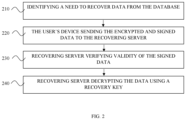
- FIG. 2 shows a method for recovering data upon a database failure event, according to an exemplary embodiment of the invention
- FIG. 3 shows a system configured to recover data upon a database failure event, according to an exemplary embodiment of the invention
- FIG. 4 shows a system configured to recover data upon a database failure event when the data is divided to shares in the database and the user's device, according to an exemplary embodiment of the invention.
- the technical challenge solved by embodiments of the invention is to avoid user key lose and avoid data loss in database failure situations.
- the database has to be backed up constantly, and distributed database recovery saves the need to manage an expensive centralized backup system.
- the technical solution provided by embodiments of the invention include a method and system for database recovery.
- the data in the database includes data associated with users, such as prior actions done by users, financial transactions, files, events, commands and messages exchanged between a user and the database or the organization operating the database.
- the organization may be a governmental organization, a bank, a business, a store, an online service, and the like.
- the data in the database is backed up periodically in a user's device.
- the user's device may be a cellular phone, a laptop, a tablet, an account owned or operated by the user, such as an email account, an online service account, a data storage account such as Dropbox or Google cloud and the like.
- only data in the database which is associated with a specific user is backed up at a user's device of a specific user.
- a specific user's device may store backed up data of multiple users.
- the data at the user's device is encrypted by a key not accessible to the user, or to applications operating at the user's device.
- the backed up data is encrypted at the database, or sent from the database to an encrypting machine where the data is encrypted and then sent to the user's device.
- the backed up data may be sent from the user's device to a recovery machine, where the backed up data is decrypted, becoming accessible to the database.
- the recovery machine stores recovery keys used to decrypt the backed up data.
- the backed-up data is encrypted by a key which is encrypted and can be opened only within the backup machine (e.g., HSM). Meaning that only the Data encryption key is sent to the HSM.
- FIG. 1 shows a method for preparing data to a database failure event, according to an exemplary embodiment of the invention.
- Step 110 discloses Obtaining user's data of multiple users in a database.
- the user's data may include personal information, such as name, address, age and the like.
- the user's data may include prior commands inputted into a system operating the database, for example by the user or by a third party, such as a bank, an e-commerce website, a payment platform such as PayPal and the like.
- the user's data may be formatted as specific data fields, or as free text.
- Step 120 discloses encrypting the user's data using a cryptographic key accessible to the database.
- the cryptographic key may be in the form of a string used by a cryptographic algorithm to encrypt the user's data.
- the cryptographic key used to encrypt the user's data is a private key and is not accessible to the user's device.
- the encryption process may be performed periodically, for example once an hour or once a day, or in response to an event, such as update of the user's data in the database.
- the encryption process may be performed by a machine that stores the database, such as a server.
- Step 130 discloses signing the encrypted user's data at the database. Signing is defined as digital signature, in which additional data is added to the encrypted user's data, the additional data enables the recipient of the encrypted user's data, i.e., the user's device, to verify that the encrypted user's data was indeed sent from the database and not altered by an attacker.
- Step 140 discloses sending the encrypted and signed data to a user's machine or account.
- Sending the encrypted and signed data may be performed over a communication network, such as the internet, intranet, a local access network, a wide access network, and the like.
- Sending may be performed as a single file, or as packets.
- Sending may be done by inputting the encrypted and signed data into a web-based portal, or a mobile application operating in the user's device, the portal or application enabling machines to input data therein.
- FIG. 2 shows a method for recovering data upon a database failure event, according to an exemplary embodiment of the invention.
- Step 210 discloses identifying a need to recover data from the database.
- the need may be initiated when a user wishes to access data in the database or database operator tries to access the user's data.
- the request may be sent as a message, such as an email message, SMS, a notification to a mobile application operating on the user's device, changing a value in a memory address accessible to the user's device, and the like.
- the request may include a notification concerning the database failure, such as database identifier, database URL, date of database failure and the like.
- the request may include information enabling the user's device to verify the authenticity of the message, such as unique identifier which is sent to the user's device only in case of a database failure.
- the request may include an address of a recovering server selected by the database to perform a data recovery process. In some cases, the database is connected to multiple recovering servers, and selects a single recovering server to prevent attackers from attacking the machine in which the data is decrypted.
- Step 220 discloses the user's device sending the encrypted and signed data to the recovering server.
- the address may be a memory address accessible to the recovering server.
- the address may be a URL address of the recovering server.
- Sending the encrypted and signed data may be performed over a communication network, such as the internet, intranet, a local access network, a wide access network, and the like. Sending may be performed as a single file, or as packets. Sending may be done by inputting the encrypted and signed data into a web-based portal, or a mobile application operating in the user's device, the portal or application enabling machines to input data therein.
- the user's device may send a bundle of information to the recovering server.
- the bundle may include the encrypted user's data, identifiers of the user's device, a public key unique to the user's device and the like.
- the recovering server can decrypt the encrypted user's data only using a combination of a cryptographic key sent by the user's device and a recovering key stored in the recovering server.
- Step 230 discloses the recovering server verifying validity of the signed data. Verifying may be performed by checking the signature of the encrypted data as provided from the user's device to the recovering server. Checking the signature may be performed by The server Holds a trusted certificate with public key corresponding the Signing private Key. The trusted Certificate is an input to the Signature verification procedure.
- Step 240 discloses the recovering server decrypting the data using a recovery key. In some cases, each time the recovering server decrypts information associated with a single user. This is enabled because the recovering machine receives encrypted data from a specific user's device that holds data associated with a specific user or a specific organization, not all the data stored in the database.
- the process is performed multiple times, each time with a single user's device that stores encrypted information from the database.
- the data in the database may be stored in more than 1,000 different devices, more than 10,000 different devices, more than 100,000 different devices and the like.
- a single database may cooperate with multiple recovering servers when recovering the data, for example to prevent an attacker from attacking all the information in the database.
- a single recovering server decrypts the encrypted information provided from a single user's device in a given time frame. That is, the recovering server stores multiple recovering keys, each recovering key of the multiple recovering keys may be associated with a specific single user's device, enabling to decrypt information provided from a single user's device.
- FIG. 3 shows a system configured to recover data upon a database failure event, according to an exemplary embodiment of the invention, in which a computerized agent operates in the user's devices 320 , 322 , 325 and in the recovering server 330 , not in the database 310 .
- the database 310 is configured to store and protect information associated with users, or with an organization.
- the user's devices 320 , 322 , 325 may be used by machines or persons handling the data on behalf of the organization, such as a governmental entity, a school, a business entity and the like.
- the database 310 encrypts information associated with a specific user or organization and sends the encrypted data to a user's device such as devices 320 , 322 , 325 .
- the devices 320 , 322 , 325 lack access to the cryptographic keys used to encrypt the data by the database 310 .
- the devices 320 , 322 , 325 may be virtual machines for example operating by a server, or physical devices such as cellular phones, laptops, personal computers, physical servers and the like.
- the system also includes a recovering server 330 used to recover the data in case of failure of the database 310 .
- the recovery machine is a hardware security module (HSM).
- HSM hardware security module
- the HSM may be based on hardware or software.
- the recovering server 330 stores one or more recovering keys used to decrypt the information encrypted by the database 310 .
- the database 310 uses different cryptographic keys when encrypting the data of different users or different organizations. For example, the database 310 encrypts data of organization #1 using cryptographic key #1, sending the encrypted data of organization #1 to device #1, the database 310 encrypts data of organization #2 using cryptographic key #2, sending the encrypted data of organization #2 to device #2 and so on. This way, the recovering server 330 stores multiple cryptographic keys, each of which is used to encrypt data provided from a different device, such as devices 320 , 322 , 325 .
- FIG. 4 shows a system configured to recover data upon a database failure event when the data is divided to shares in the database and the user's device, according to an exemplary embodiment of the invention.
- the system includes a database 410 that stores shares of information.
- the shares are useless and meaning less without a matching share stored in the user's devices 420 , 422 , 425 .
- information of user #1 is stored partly in the database 410 and partly in user's device 420 , but the information of user #1 cannot be used unless a multi-party computation (MPC) process takes place between the database 410 and the user's device 420 in order to produce information which can be used by a third party, for example the user's name, passwords, prior transactions and the like.
- MPC multi-party computation
- the system includes a memory for storing information.
- the memory may store a set of instructions for performing the methods disclosed herein.
- the system may also include a communication unit for exchanging information with other systems/devices.
- the system includes a processor for executing the instructions stored in the memory.
- the processor may be a general purpose processor, a microprocessor, or any other processor desired by a person skilled in the art.
Landscapes
- Engineering & Computer Science (AREA)
- Theoretical Computer Science (AREA)
- General Physics & Mathematics (AREA)
- Physics & Mathematics (AREA)
- General Engineering & Computer Science (AREA)
- Quality & Reliability (AREA)
- General Health & Medical Sciences (AREA)
- Computer Hardware Design (AREA)
- Computer Security & Cryptography (AREA)
- Software Systems (AREA)
- Health & Medical Sciences (AREA)
- Bioethics (AREA)
- Storage Device Security (AREA)
Abstract
Description
Claims (17)
Priority Applications (1)
| Application Number | Priority Date | Filing Date | Title |
|---|---|---|---|
| US17/528,226 US12066902B2 (en) | 2021-11-17 | 2021-11-17 | System and method for database recovery |
Applications Claiming Priority (1)
| Application Number | Priority Date | Filing Date | Title |
|---|---|---|---|
| US17/528,226 US12066902B2 (en) | 2021-11-17 | 2021-11-17 | System and method for database recovery |
Publications (2)
| Publication Number | Publication Date |
|---|---|
| US20230153209A1 US20230153209A1 (en) | 2023-05-18 |
| US12066902B2 true US12066902B2 (en) | 2024-08-20 |
Family
ID=86323460
Family Applications (1)
| Application Number | Title | Priority Date | Filing Date |
|---|---|---|---|
| US17/528,226 Active 2042-08-06 US12066902B2 (en) | 2021-11-17 | 2021-11-17 | System and method for database recovery |
Country Status (1)
| Country | Link |
|---|---|
| US (1) | US12066902B2 (en) |
Citations (10)
| Publication number | Priority date | Publication date | Assignee | Title |
|---|---|---|---|---|
| US20030021417A1 (en) * | 2000-10-20 | 2003-01-30 | Ognjen Vasic | Hidden link dynamic key manager for use in computer systems with database structure for storage of encrypted data and method for storage and retrieval of encrypted data |
| US8037319B1 (en) * | 2006-06-30 | 2011-10-11 | Symantec Operating Corporation | System and method for securely storing cryptographic keys with encrypted data |
| US20110276781A1 (en) * | 2010-05-05 | 2011-11-10 | Microsoft Corporation | Fast and Low-RAM-Footprint Indexing for Data Deduplication |
| US20140025948A1 (en) * | 2012-07-18 | 2014-01-23 | Caitlin Bestler | System and method for distributed deduplication of encrypted chunks |
| US20140089683A1 (en) * | 2012-09-26 | 2014-03-27 | Pure Storage, Inc. | Multi-drive cooperation to generate an encryption key |
| US20160062918A1 (en) * | 2014-08-27 | 2016-03-03 | International Business Machines Corporation | Receipt, Data Reduction, and Storage of Encrypted Data |
| US20160292429A1 (en) * | 2015-03-31 | 2016-10-06 | Emc Corporation | Secure cloud-based storage of data shared across file system objects and clients |
| US20180357427A1 (en) * | 2015-12-03 | 2018-12-13 | Unbound Tech Ltd. | Securing sql based databases with cryptographic protocols |
| US20190182042A1 (en) * | 2017-12-08 | 2019-06-13 | ShoCard, Inc. | Methods and systems for recovering data using dynamic passwords |
| US11032259B1 (en) * | 2012-09-26 | 2021-06-08 | Pure Storage, Inc. | Data protection in a storage system |
-
2021
- 2021-11-17 US US17/528,226 patent/US12066902B2/en active Active
Patent Citations (16)
| Publication number | Priority date | Publication date | Assignee | Title |
|---|---|---|---|---|
| US20030021417A1 (en) * | 2000-10-20 | 2003-01-30 | Ognjen Vasic | Hidden link dynamic key manager for use in computer systems with database structure for storage of encrypted data and method for storage and retrieval of encrypted data |
| US8037319B1 (en) * | 2006-06-30 | 2011-10-11 | Symantec Operating Corporation | System and method for securely storing cryptographic keys with encrypted data |
| US20110276781A1 (en) * | 2010-05-05 | 2011-11-10 | Microsoft Corporation | Fast and Low-RAM-Footprint Indexing for Data Deduplication |
| US20140025948A1 (en) * | 2012-07-18 | 2014-01-23 | Caitlin Bestler | System and method for distributed deduplication of encrypted chunks |
| US10284367B1 (en) * | 2012-09-26 | 2019-05-07 | Pure Storage, Inc. | Encrypting data in a storage system using a plurality of encryption keys |
| US20140089683A1 (en) * | 2012-09-26 | 2014-03-27 | Pure Storage, Inc. | Multi-drive cooperation to generate an encryption key |
| US20140250303A1 (en) * | 2012-09-26 | 2014-09-04 | Pure Storage, Inc. | Multi-drive cooperation to generate an encryption key |
| US20210273929A1 (en) * | 2012-09-26 | 2021-09-02 | Pure Storage, Inc. | ENCRYPTING DATA IN A NON-VOLATILE MEMORY EXPRESS ('NVMe') STORAGE DEVICE |
| US11032259B1 (en) * | 2012-09-26 | 2021-06-08 | Pure Storage, Inc. | Data protection in a storage system |
| US20160062918A1 (en) * | 2014-08-27 | 2016-03-03 | International Business Machines Corporation | Receipt, Data Reduction, and Storage of Encrypted Data |
| US20180157852A1 (en) * | 2015-03-31 | 2018-06-07 | EMC IP Holding Company LLC | Secure cloud-based storage of data shared across file system objects and clients |
| US20190272380A1 (en) * | 2015-03-31 | 2019-09-05 | EMC IP Holding Company LLC | Secure cloud-based storage of data shared across file system objects and clients |
| US20200082102A1 (en) * | 2015-03-31 | 2020-03-12 | EMC IP Holding Company LLC | Secure cloud-based storage of data shared across file system objects and clients |
| US20160292429A1 (en) * | 2015-03-31 | 2016-10-06 | Emc Corporation | Secure cloud-based storage of data shared across file system objects and clients |
| US20180357427A1 (en) * | 2015-12-03 | 2018-12-13 | Unbound Tech Ltd. | Securing sql based databases with cryptographic protocols |
| US20190182042A1 (en) * | 2017-12-08 | 2019-06-13 | ShoCard, Inc. | Methods and systems for recovering data using dynamic passwords |
Also Published As
| Publication number | Publication date |
|---|---|
| US20230153209A1 (en) | 2023-05-18 |
Similar Documents
| Publication | Publication Date | Title |
|---|---|---|
| US11831753B2 (en) | Secure distributed key management system | |
| US10432397B2 (en) | Master password reset in a zero-knowledge architecture | |
| EP3278533B1 (en) | Key export techniques | |
| US11711213B2 (en) | Master key escrow process | |
| US9160535B2 (en) | Truly anonymous cloud key broker | |
| US12008124B2 (en) | Secure deferred file decryption | |
| EP3796613B1 (en) | Techniques for repeat authentication | |
| EP3756332A1 (en) | Automated account recovery using trusted devices | |
| CN114095165B (en) | Key updating method, server device, client device and storage medium | |
| CN115549907B (en) | Root key management system, backup method, recovery method, device and electronic equipment | |
| WO2023186786A1 (en) | A concept for recovering access to a cryptocurrency wallet on a remote server | |
| KR20210036700A (en) | Blockchain system for supporting change of plain text data included in transaction | |
| CN112463454A (en) | Data recovery method, server, terminal device and storage medium | |
| WO2026031899A1 (en) | Data processing method and apparatus, and device and storage medium | |
| Suganya et al. | Enhancing security for storage services in cloud computing | |
| US12066902B2 (en) | System and method for database recovery | |
| CN116647413B (en) | Application login method, device, computer equipment and storage medium | |
| CN115809459B (en) | Data protection and decryption method, system, equipment and medium of software cryptographic module | |
| CN117494104A (en) | 3 DES-based password management method, system, equipment and medium | |
| CN117294484A (en) | Method, apparatus, device, medium and product for data interaction | |
| Bardis et al. | Design and development of a secure military communication based on AES prototype crypto algorithm and advanced key management scheme | |
| CN112804053A (en) | Data recovery method, encryption device, terminal device and storage medium | |
| JP7783468B1 (en) | Recovery system, recovery device, recovery program, and recovery method | |
| CN115102795B (en) | Communication security verification method and system | |
| Megha | Authentication of Financial Wallet System and Data Protection using BlockChain |
Legal Events
| Date | Code | Title | Description |
|---|---|---|---|
| FEPP | Fee payment procedure |
Free format text: ENTITY STATUS SET TO UNDISCOUNTED (ORIGINAL EVENT CODE: BIG.); ENTITY STATUS OF PATENT OWNER: SMALL ENTITY |
|
| FEPP | Fee payment procedure |
Free format text: ENTITY STATUS SET TO SMALL (ORIGINAL EVENT CODE: SMAL); ENTITY STATUS OF PATENT OWNER: SMALL ENTITY |
|
| STPP | Information on status: patent application and granting procedure in general |
Free format text: DOCKETED NEW CASE - READY FOR EXAMINATION |
|
| AS | Assignment |
Owner name: COINBASE IL RD LTD., CALIFORNIA Free format text: ASSIGNMENT OF ASSIGNORS INTEREST;ASSIGNORS:PE'ER, GUY;STEINHERZ, NIR;GORELIKOV, ELENA;AND OTHERS;SIGNING DATES FROM 20220413 TO 20220415;REEL/FRAME:059608/0183 |
|
| STPP | Information on status: patent application and granting procedure in general |
Free format text: NON FINAL ACTION MAILED |
|
| STPP | Information on status: patent application and granting procedure in general |
Free format text: RESPONSE TO NON-FINAL OFFICE ACTION ENTERED AND FORWARDED TO EXAMINER |
|
| STPP | Information on status: patent application and granting procedure in general |
Free format text: FINAL REJECTION MAILED |
|
| STPP | Information on status: patent application and granting procedure in general |
Free format text: RESPONSE AFTER FINAL ACTION FORWARDED TO EXAMINER |
|
| STPP | Information on status: patent application and granting procedure in general |
Free format text: NOTICE OF ALLOWANCE MAILED -- APPLICATION RECEIVED IN OFFICE OF PUBLICATIONS |
|
| ZAAA | Notice of allowance and fees due |
Free format text: ORIGINAL CODE: NOA |
|
| ZAAB | Notice of allowance mailed |
Free format text: ORIGINAL CODE: MN/=. |
|
| STPP | Information on status: patent application and granting procedure in general |
Free format text: PUBLICATIONS -- ISSUE FEE PAYMENT RECEIVED |
|
| STPP | Information on status: patent application and granting procedure in general |
Free format text: PUBLICATIONS -- ISSUE FEE PAYMENT VERIFIED |
|
| STCF | Information on status: patent grant |
Free format text: PATENTED CASE |