US12062152B2 - Re-noising and neural network based image enhancement - Google Patents
Re-noising and neural network based image enhancement Download PDFInfo
- Publication number
- US12062152B2 US12062152B2 US17/459,353 US202117459353A US12062152B2 US 12062152 B2 US12062152 B2 US 12062152B2 US 202117459353 A US202117459353 A US 202117459353A US 12062152 B2 US12062152 B2 US 12062152B2
- Authority
- US
- United States
- Prior art keywords
- noise
- image
- component
- output image
- synthesized
- Prior art date
- Legal status (The legal status is an assumption and is not a legal conclusion. Google has not performed a legal analysis and makes no representation as to the accuracy of the status listed.)
- Active, expires
Links
Images


Classifications
-
- G—PHYSICS
- G06—COMPUTING OR CALCULATING; COUNTING
- G06T—IMAGE DATA PROCESSING OR GENERATION, IN GENERAL
- G06T5/00—Image enhancement or restoration
-
- G—PHYSICS
- G06—COMPUTING OR CALCULATING; COUNTING
- G06T—IMAGE DATA PROCESSING OR GENERATION, IN GENERAL
- G06T5/00—Image enhancement or restoration
- G06T5/70—Denoising; Smoothing
-
- G—PHYSICS
- G06—COMPUTING OR CALCULATING; COUNTING
- G06T—IMAGE DATA PROCESSING OR GENERATION, IN GENERAL
- G06T5/00—Image enhancement or restoration
- G06T5/60—Image enhancement or restoration using machine learning, e.g. neural networks
-
- G—PHYSICS
- G06—COMPUTING OR CALCULATING; COUNTING
- G06T—IMAGE DATA PROCESSING OR GENERATION, IN GENERAL
- G06T2207/00—Indexing scheme for image analysis or image enhancement
- G06T2207/20—Special algorithmic details
- G06T2207/20081—Training; Learning
-
- G—PHYSICS
- G06—COMPUTING OR CALCULATING; COUNTING
- G06T—IMAGE DATA PROCESSING OR GENERATION, IN GENERAL
- G06T2207/00—Indexing scheme for image analysis or image enhancement
- G06T2207/20—Special algorithmic details
- G06T2207/20084—Artificial neural networks [ANN]
Definitions
- Image processing techniques are important to many applications. For example, in image enhancement, a degraded version of an image is processed using one or more techniques to de-blur or sharpen the degraded image, or to reduce noise present in the degraded image. Despite its usefulness for recovering degraded image features, image enhancement can present significant challenges. For example, legacy video content for which remastering may be desirable is often available only in interlaced, noisy, and low resolution formats. As a result the remastering process has to be carefully engineered to enhance desirable image features while avoiding exaggeration of degraded features in the image.
- FIG. 1 A shows a diagram of an exemplary system for performing re-noising and neural network (NN) based image enhancement, according to one implementation
- FIG. 1 B shows a diagram of an exemplary system for performing re-noising and NN based image enhancement, according to another implementation
- FIG. 1 C shows a diagram of an exemplary system for performing re-noising and NN based image enhancement, according to yet another implementation
- FIG. 2 A shows a flowchart presenting an exemplary method for performing re-noising and NN based image enhancement that corresponds to the system shown in FIG. 1 A ;
- FIG. 2 B shows a flowchart presenting an exemplary method for performing re-noising and NN based image enhancement that corresponds to the system shown in FIG. 1 B ;
- FIG. 2 C shows a flowchart presenting an exemplary method for performing re-noising and NN based image enhancement that corresponds to the system shown in FIG. 1 C ;
- FIG. 3 shows a side-by-side comparison of a noise component of a degraded image and a synthesized noise generated by a system for performing re-noising and NN based image enhancement, according to one implementation:
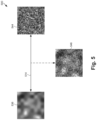
- FIG. 4 shows a diagram depicting interpolation of output image noise for an enhanced image based on a noise component of a degraded image and a synthesized noise generated by a system for performing re-noising and NN based image enhancement, according to one implementation
- FIG. 5 shows a diagram of another depiction of interpolation of output image noise for an enhanced image based on a noise component of a degraded image and a synthesized noise generated by a system for performing re-noising and NN based image enhancement.
- re-noising refers to the addition of “noise” to the color values of an image, where the noise can be either content dependent or content independent.
- re-noising refers to the addition of “noise” to the color values of an image, where the noise can be either content dependent or content independent.
- film grain generation as known in the art, is a particular instance of such re-noising.
- the present image enhancement solution may be implemented using an integrated processing pipeline that may be substantially automated from end-to-end.
- the terms “automation,” “automated,” and “automating” refer to systems and processes that do not require human intervention.
- a human system administrator may review or even modify the performance of an automated system or process, that human involvement is optional.
- the systems and methods characterized as automated in the present application may be performed under the control of hardware processing components executing them.
- the expression neural network or NN may refer to a computing architecture implementing a mathematical model for making future predictions based on patterns learned from samples of data or “training data.”
- Various learning algorithms can be used to map correlations between input data and output data. These correlations form the mathematical model that can be used to make future predictions on new input data.
- a “deep neural network,” in the context of deep learning, may refer to an NN that utilizes multiple hidden layers between input and output layers, which may allow for learning based on features not explicitly defined in raw data.
- a feature identified as an NN refers to a deep neural network.
- NNs may be trained as classifiers and may be utilized to perform image processing or natural-language processing.
- FIG. 1 A shows a diagram of exemplary system 100 A for performing re-noising and NN based image enhancement, according to one implementation.
- system 100 A includes computing platform 102 having processing hardware 104 , and system memory 106 implemented as a computer-readable non-transitory storage medium.
- system memory 106 stores software code 110 , noise synthesizer 112 , which may be implemented as a trained NN based noise synthesizer for example, and image restoration NN 140 .
- system 100 A is implemented within a use environment including communication network 108 , user system 120 including display 122 , and user 124 utilizing user system 120 , as well as network communication links 128 interactively connecting user system 120 and system 100 A via communication network 108 .
- denoised image component 134 and noise component 136 extracted from a degraded image (degraded image not shown in FIG. 1 ), synthesized noise 144 generated by noise synthesizer 112 based on noise component 136 , output image component 142 produced from denoised image component 134 .
- FIG. 1 A shows enhanced output image 148 corresponding to the degraded image from which denoised image component 134 and noise component 136 are extracted, enhanced output image 148 being produced using software code 110 .
- system memory 106 may take the form of any computer-readable non-transitory storage medium.
- a computer-readable non-transitory storage medium may correspond to various types of media, such as volatile media and non-volatile media, for example.
- Volatile media may include dynamic memory, such as dynamic random access memory (dynamic RAM), while non-volatile memory may include optical, magnetic, or electrostatic storage devices.
- dynamic RAM dynamic random access memory
- non-volatile memory may include optical, magnetic, or electrostatic storage devices.
- Common forms of computer-readable non-transitory storage media include, for example, optical discs, RAM, programmable read-only memory (PROM), erasable PROM (EPROM), and FLASH memory.
- FIG. 1 A depicts software code 110 , noise synthesizer 112 , and image restoration NN 140 as being mutually co-located in system memory 106 that representation is also merely provided as an aid to conceptual clarity.
- system 100 A may include one or more computing platforms, such as computer servers for example, which may be co-located, or may form an interactively linked but distributed system, such as a cloud-based system, for instance.
- processing hardware 104 and system memory 106 may correspond to distributed processor and memory resources within system 100 A.
- software code 110 , noise synthesizer 112 , and image restoration NN 140 may be stored remotely from one another within the distributed memory resources of system 100 A.
- one or both of noise synthesizer 112 and image restoration NN 140 may take the form of a software module included in software code 110 .
- Processing hardware 104 may include multiple hardware processing units, such as one or more central processing units, one or more graphics processing units, one or more tensor processing units, one or more field-programmable gate arrays (FPGAs), and an application programming interface (API) server, for example.
- CPU central processing unit
- GPU graphics processing unit
- TPU tensor processing unit
- a CPU includes an Arithmetic Logic Unit (ALU) for carrying out the arithmetic and logical operations of computing platform 102 , as well as a Control Unit (CU) for retrieving programs, such as software code 110 , from system memory 106 , while a GPU may be implemented to reduce the processing overhead of the CPU by performing computationally intensive graphics or other processing tasks.
- a TPU is an application-specific integrated circuit (ASIC) configured specifically for artificial intelligence (AI) applications such as machine learning modeling.
- ASIC application-specific integrated circuit
- computing platform 102 may correspond to one or more web servers, accessible over a packet-switched network such as the Internet, for example.
- computing platform 102 may correspond to one or more computer servers supporting a private wide area network (WAN), local area network (LAN), or included in another type of limited distribution or private network.
- system 100 A may be implemented virtually, such as in a data center.
- system 100 A may be implemented in software, or as virtual machines.
- communication network 108 may be a high-speed network suitable for high performance computing (HPC), for example a 10 GigE network or an Infiniband network.
- HPC high performance computing
- user system 120 is shown as a desktop computer in FIG. 1 A that representation is provided merely as an example as well. More generally, user system 120 may be any suitable mobile or stationary computing device or system that implements data processing capabilities sufficient to provide a user interface, support connections to communication network 108 , and implement the functionality ascribed to user system 120 herein. For example, in other implementations, user system 120 may take the form of a laptop computer, tablet computer, or smartphone, for example.
- enhanced output image 148 when generated using software code 110 , may be stored in system memory 106 , may be copied to non-volatile storage, or both. Alternatively, or in addition, as shown in FIG. 1 , in some implementations, enhanced output image 148 may be sent to user system 120 including display 122 , for example by being transferred via network communication links 128 of communication network 108 .
- display 122 may be physically integrated with user system 120 or may be communicatively coupled to but physically separate from user system 120 .
- display 122 will typically be integrated with user system 120 .
- display 122 may take the form of a monitor separate from user system 120 in the form of a computer tower.
- display 122 of user system 120 may be implemented as a liquid crystal display (LCD), a light-emitting diode (LED) display, an organic light-emitting diode (OLED) display, a quantum dot (QD) display, or any other suitable display screen that performs a physical transformation of signals to light.
- LCD liquid crystal display
- LED light-emitting diode
- OLED organic light-emitting diode
- QD quantum dot
- FIG. 1 B shows a diagram of exemplary system 100 B for performing re-noising and NN based image enhancement, according to another implementation. It is noted that any feature shown in FIG. 1 B and identified by a reference number identical to one used to identify a feature shown in FIG. 1 A corresponds to that previously described feature and may share any of the characteristics attributed to that corresponding feature by the present disclosure.
- system 100 B includes signal splitting NN 150 stored in system memory 106 , and degraded input image 132 received by system 100 B from user system 120 .
- FIG. 1 C shows a diagram of exemplary system 100 C for performing re-noising and NN based image enhancement, according to yet another implementation. It is noted that any feature shown in FIG. 1 C and identified by a reference number identical to one used to identify a feature shown in FIG. 1 A or FIG. 1 B corresponds to that previously described feature and may share any of the characteristics attributed to that corresponding feature by the present disclosure.
- system 100 C includes de-interlacer NN 152 stored in system memory 106 , and degraded interlaced input image 130 received by system 100 C from user system 120 .
- FIG. 2 A shows flowchart 260 A presenting an exemplary method for performing re-noising and NN based image enhancement that corresponds to system 100 A
- FIG. 2 B shows flowchart 260 B presenting an exemplary method for performing re-noising and NN based image enhancement that corresponds to system 100 B
- FIG. 2 C shows flowchart 260 C presenting an exemplary method for performing re-noising and NN based image enhancement that corresponds to system 100 C.
- FIGS. 2 A, 2 B, and 2 C it is noted that certain details and features have been left out of flowcharts 260 A, 260 B, and 260 C in order not to obscure the discussion of the inventive features in the present application.
- FIG. 3 shows a side-by-side comparison of noise component 336 of a degraded image corresponding to degraded input image 132 in FIGS. 1 B and 1 C , and synthesized noise 344 generated by a system for performing re-noising and NN based image enhancement, according to one implementation.
- Noise component 336 and synthesized noise 344 correspond respectively in general to noise component 136 and synthesized noise 144 in FIGS. 1 A, 1 B, and 1 C . That is to say, noise component 336 and synthesized noise 344 may share any of the characteristics attributed to respective noise component 136 and synthesized noise 144 by the present disclosure, and vice versa.
- FIG. 4 shows a diagram depicting interpolation 414 of output image noise 446 for an enhanced image corresponding to enhanced output image shown in FIGS. 1 A, 1 B, and 1 C , based on noise component 436 of a degraded image corresponding to degraded input image 132 in FIGS. 1 B and 1 C , and synthesized noise 444 generated by a system for performing re-noising and NN based image enhancement, according to one implementation.
- Noise component 436 and synthesized noise 444 correspond respectively in general to noise component 136 / 336 and synthesized noise 144 / 344 in FIGS. 1 A, 1 B, 1 C, and 3 .
- noise component 436 and synthesized noise 444 may share any of the characteristics attributed to respective noise component 136 / 336 and synthesized noise 144 / 344 by the present disclosure, and vice versa.
- FIG. 5 shows diagram 500 of another depiction of interpolation 514 of output image noise 546 for an enhanced image corresponding to enhanced output image 148 in FIGS. 1 A, 1 B, and 1 C , based on noise component 536 of a degraded image corresponding to degraded input image 132 in FIGS. 1 B and 1 C , and synthesized noise 544 generated by a system for performing re-noising and NN based image enhancement.
- Noise component 536 and synthesized noise 544 correspond respectively in general to noise component 136 / 336 / 436 and synthesized noise 144 / 344 / 444 in FIGS. 1 A, 1 B, 1 C, 3 , and 4 .
- noise component 536 and synthesized noise 544 may share any of the characteristics attributed to respective noise component 136 / 336 / 436 and synthesized noise 144 / 344 / 444 by the present disclosure, and vice versa.
- interpolation 514 and output image noise 546 in FIG. 5 , correspond respectively in general to interpolation 414 output image noise 446 , in FIG. 4 .
- interpolation 514 and output image noise 546 may share any of the characteristics attributed to respective interpolation 414 and output image noise 446 by the present disclosure, and vice versa.
- processing hardware 104 of computing platform 102 may execute software code 110 to receive denoised image component 134 and noise component 136 / 336 / 436 / 536 extracted from a degraded image (action 263 A).
- processing hardware 104 may execute software code to generate, using noise synthesizer 112 and noise component 136 / 336 / 436 / 536 , synthesized noise 144 / 344 / 444 / 544 corresponding to noise component 136 / 336 / 436 / 536 (action 264 ).
- synthesized noise 144 / 344 / 444 / 544 may be a higher resolution noise than noise component 136 / 336 / 436 / 536 .
- high resolution noise or “higher resolution noise” and “low resolution noise” or “lower resolution noise,” those expressions refer to noise values on respective high resolution and low resolution grids, as known in the art.
- the low resolution grid has the same size as the original degraded image from which denoised image component 134 and noise component 136 / 336 / 436 / 536 received in action 263 A have been extracted.
- This low resolution grid includes original color values, denoised colors, and noise values for the degraded image.
- the high resolution grid has the same size as the target resolution for enhanced output image 148 .
- This high resolution grid includes new color values obtained from the restoration/enhancement process, synthesized noise values, and upscaled noise values (obtained by upscaling the noise values for the degraded image using any suitable known method).
- high resolution and low resolution refer to the grid sizes described above. That is to say, high resolution noise refers specifically to noise values on the high resolution grid, while low resolution noise refers to noise values on the low resolution grid.
- Processing hardware 104 may further execute software code 110 to interpolate, using noise component 136 / 336 / 436 / 536 and synthesized noise 144 / 344 / 444 / 544 , output image noise 446 / 546 (action 265 ).
- interpolation 414 / 514 of output image noise 446 / 546 may include solving an optimal transport problem between noise component 136 / 336 / 436 / 536 and synthesized noise 144 / 344 / 444 / 544 .
- processing hardware 104 may execute software code 110 to interpolate output image noise 446 / 546 by solving an optimal transport problem between noise component 136 / 336 / 436 / 536 and synthesized noise 144 / 344 / 444 / 544 .
- noise component 136 / 336 / 436 / 536 may be upscaled using any upscaling technique known in the art, such as bicubic upscaling, for example, before the optimal transport problem is posed and solved.
- the optimal transport problem may be solved between an upscaled version of noise component 136 / 336 / 436 / 536 and synthesized noise 144 / 344 / 444 / 544 having the same grid size as the upscaled version of noise component 136 / 336 / 436 / 536 .
- synthesized noise 144 / 344 / 444 / 544 may be low resolution noise synthesized directly from low resolution noise component 136 / 336 / 436 / 536 , and the optimal transport problem may be solved between noise component 136 / 336 / 436 / 536 in its received low resolution form and low resolution synthesized noise 144 / 344 / 444 / 544 having the same size as low resolution noise component 136 / 336 / 436 / 536 .
- interpolation 414 / 514 of output image noise 446 / 546 may be based on noise samples in the form of five-dimensional ( 5 D) vectors having respective red, green, and blue color components, as well as respectively weighted “x” and “y” location components.
- Interpolation 414 / 514 may include one or more of computing the Sinkhorn divergence or computing the gradient by backpropagation.
- output image noise 446 / 546 may be a higher resolution noise than noise component 136 / 336 / 436 / 536 , while in some implementations output image noise 446 / 546 and synthesized noise 144 / 344 / 444 / 544 may have the same resolution.
- output image noise 446 / 546 may be a lower resolution noise than synthesized noise 144 / 344 / 444 / 544 .
- Processing hardware 104 may also execute software code 110 to enhance, using image restoration NN 140 , denoised image component 134 to provide output image component 142 (action 266 ).
- Enhancement of denoised image component 134 may include upscaling, sharpening, or upscaling and sharpening of denoised image component 134 using image restoration NN 140 specifically trained for that purpose.
- Exemplary techniques for upscaling images are disclosed by U.S. patent application Ser. No. 16/542,227, titled “Techniques for Upscaling Images Generated with Undetermined Downscaling Kernels,” and filed on Aug. 15, 2019, which is hereby incorporated fully by reference into the present application.
- image enhancement performed by image restoration NN 140 is applied to denoised image component 134 , but not to noise component 136 / 336 / 436 / 536 , which is processed independently of denoised image component 134 , as described above.
- flowchart 260 A shows action 266 as following actions 264 and 265 , that representation is merely by way of example. In some other implementations, action 266 may precede one or both of actions 264 and 265 . In yet other implementations, action 266 may be performed in parallel, i.e., substantially concurrently, with either or both of actions 264 and 265 . That is to say, in various implementations action 266 may be performed after action 264 but before action 265 , before actions 264 and 265 , in parallel with action 264 , in parallel with action 265 , or in parallel with the sequence of actions 264 and 265 .
- Processing hardware 104 may then execute software code 110 to re-noise output image component 142 , using output image noise 446 / 546 , to produce enhanced output image 148 corresponding to the degraded image from which denoised image component 134 and noise component 136 / 336 / 436 / 536 were extracted (action 267 ).
- output image noise 446 / 546 may be used directly to re-noise output image component 142 .
- output image noise 446 / 546 may be upscaled prior to its use in re-noising output image component 142 to produce enhanced output image component 148 .
- enhanced output image 148 may be de-blurred relative to denoised image component 134 of the degraded image.
- enhanced output image 148 may be a higher resolution image than denoised image component 134 of the degraded image.
- processing hardware 104 of computing platform 102 may execute software code 110 to receive degraded input image 132 (action 261 B). Processing hardware 104 may further executed software code 110 to extract, using signal splitting NN 150 , denoised image component 134 and noise component 136 / 336 / 436 / 536 from degraded input image 132 (action 263 B).
- processing hardware 104 may execute software code to generate, using noise synthesizer 112 and noise component 136 / 336 / 436 / 536 , synthesized noise 144 / 344 / 444 / 544 corresponding to noise component 136 / 336 / 436 / 536 (action 264 ).
- synthesized noise 144 / 344 / 444 / 544 may be a higher resolution noise than noise component 136 / 336 / 436 / 536 .
- Processing hardware 104 may further execute software code 110 to interpolate, using noise component 136 / 336 / 436 / 536 and synthesized noise 144 / 344 / 444 / 544 , output image noise 446 / 546 (action 265 ).
- interpolation 414 / 514 of output image noise 446 / 546 may include solving an optimal transport problem between noise component 136 / 336 / 436 / 536 and synthesized noise 144 / 344 / 444 / 544 .
- processing hardware 104 may execute software code 110 to interpolate output image noise 446 / 546 by solving an optimal transport problem between noise component 136 / 336 / 436 / 536 and synthesized noise 144 / 344 / 444 / 544 .
- noise component 136 / 336 / 436 / 536 may be upscaled using any upscaling technique known in the art, such as bicubic upscaling, for example, before the optimal transport problem is posed and solved.
- the optimal transport problem may be solved between an upscaled version of noise component 136 / 336 / 436 / 536 and synthesized noise 144 / 344 / 444 / 544 having the same size as the upscaled version of noise component 136 / 336 / 436 / 536 .
- synthesized noise 144 / 344 / 444 / 544 may be low resolution noise synthesized directly from low resolution noise component 136 / 336 / 436 / 536 , and the optimal transport problem may be solved between noise component 136 / 336 / 436 / 536 in its received low resolution form and low resolution synthesized noise 144 / 344 / 444 / 544 having the same grid size as low resolution noise component 136 / 336 / 436 / 536 .
- interpolation 414 / 514 of output image noise 446 / 546 may be based on noise samples in the form of 5 D vectors having respective red, green, and blue color components, as well as respectively weighted “x” and “y” location components. Interpolation 414 / 514 may include one or more of computing the Sinkhorn divergence and computing the gradient by backpropagation.
- output image noise 446 / 546 may be a higher resolution noise than noise component 136 / 336 / 436 / 536 , while in some implementations output image noise 446 / 546 and synthesized noise 144 / 344 / 444 / 544 may have the same resolution.
- output image noise 446 / 546 may be a lower resolution noise than synthesized noise 144 / 344 / 444 / 544 .
- Processing hardware 104 may also execute software code 110 to enhance, using image restoration NN 140 , denoised image component 134 to provide output image component 142 (action 266 ).
- enhancement of denoised image component 134 may include upscaling, sharpening, or upscaling and sharpening of denoised image component 134 using image restoration NN 140 specifically trained for that purpose.
- exemplary techniques for upscaling images are disclosed by U.S. patent application Ser. No. 16/542,227, titled “Techniques for Upscaling Images Generated with Undetermined Downscaling Kernels,” and filed on Aug. 15, 2019, which is incorporated fully by reference into the present application.
- image enhancement performed by image restoration NN 140 is applied to denoised image component 134 but not to noise component 136 / 336 / 436 / 536 , which is processed independently of denoised image component 134 , as described above.
- flowchart 260 B shows action 266 as following actions 264 and 265 , that representation is merely by way of example.
- action 266 may precede one or both of actions 264 and 265 .
- action 266 may be performed in parallel. i.e., substantially concurrently, with either or both of actions 264 and 265 . That is to say, in various implementations action 266 may be performed after action 264 but before action 265 , before actions 264 and 265 , in parallel with action 264 , in parallel with action 265 , or in parallel with the sequence of actions 264 and 265 .
- Processing hardware 104 may then execute software code 110 to re-noise output image component 142 , using output image noise 446 / 546 , to produce enhanced output image 148 corresponding to degraded input image 132 (action 267 ).
- output image noise 446 / 546 may be used directly to re-noise output image component 142 .
- output image noise 446 / 546 may be upscaled prior to its use in re-noising output image component 142 to produce enhanced output image component 148 .
- enhanced output image 148 may be de-blurred relative to denoised image component 134 of degraded input image 132 .
- enhanced output image 148 may be a higher resolution image than denoised image component 134 of degraded input image 132 .
- processing hardware 104 of computing platform 102 may execute software code 110 to receive degraded interlaced input image 130 (action 261 C). Processing hardware 104 may further execute software code 110 to de-interlace, using de-interlacer NN 152 , degraded interlaced input image 130 to provide degraded input image 132 as progressive frames (action 262 C). In addition, processing hardware 104 may execute software code to extract, using signal splitting NN 150 , denoised image component 134 and noise component 136 / 336 / 436 / 536 from degraded input image 132 ( 263 C).
- Processing hardware 104 may further execute software code to generate, using noise synthesizer 112 and noise component 136 / 336 / 436 / 536 , synthesized noise 144 / 344 / 444 / 544 corresponding to noise component 136 / 336 / 436 / 536 (action 264 ).
- synthesized noise 144 / 344 / 444 / 544 may be a higher resolution noise than noise component 136 / 336 / 436 / 536 .
- Processing hardware 104 may also execute software code 110 to interpolate, using noise component 136 / 336 / 436 / 536 and synthesized noise 144 / 344 / 444 / 544 , output image noise 446 / 546 (action 265 ).
- interpolation 414 / 514 of output image noise 446 / 546 may include solving an optimal transport problem between noise component 136 / 336 / 436 / 536 and synthesized noise 144 / 344 / 444 / 544 .
- processing hardware 104 may execute software code 110 to interpolate output image noise 446 / 546 by solving an optimal transport problem between noise component 136 / 336 / 436 / 536 and synthesized noise 144 / 344 / 444 / 544 .
- noise component 136 / 336 / 436 / 536 may be upscaled using any upscaling technique known in the art, such as bicubic upscaling, for example, before the optimal transport problem is posed and solved.
- the optimal transport problem may be solved between an upscaled version of noise component 136 / 336 / 436 / 536 and synthesized noise 144 / 344 / 444 / 544 having the same grid size as the upscaled version of noise component 136 / 336 / 436 / 536 .
- synthesized noise 144 / 344 / 444 / 544 may be low resolution noise synthesized directly from low resolution noise component 136 / 336 / 436 / 536 , and the optimal transport problem may be solved between noise component 136 / 336 / 436 / 536 in its received low resolution form and low resolution synthesized noise 144 / 344 / 444 / 544 having the same size as low resolution noise component 136 / 336 / 436 / 536 .
- interpolation 414 / 514 of output image noise 446 / 546 may be based on noise samples in the form of 5 D vectors having respective red, green, and blue color components, as well as respectively weighted “x” and “y” location components. Interpolation 414 / 514 may include one or more of computing the Sinkhorn divergence and computing the gradient by backpropagation.
- output image noise 446 / 546 may be a higher resolution noise than noise component 136 / 336 / 436 / 536 , while in some implementations output image noise 446 / 546 and synthesized noise 144 / 344 / 444 / 544 may have the same resolution.
- output image noise 446 / 546 may be a lower resolution noise than synthesized noise 144 / 344 / 444 / 544 .
- Processing hardware 104 may further execute software code 110 to enhance, using image restoration NN 140 , denoised image component 134 to provide output image component 142 (action 266 ).
- enhancement of denoised image component 134 may include upscaling, sharpening, or upscaling and sharpening of denoised image component 134 using image restoration NN 140 specifically trained for that purpose.
- exemplary techniques for upscaling images are disclosed by U.S. patent application Ser. No. 16/542,227, titled “Techniques for Upscaling Images Generated with Undetermined Downscaling Kernels.” and filed on Aug. 15, 2019, which is incorporated fully by reference into the present application.
- image enhancement performed by image restoration NN 140 is applied to denoised image component 134 but not to noise component 136 / 336 / 436 / 536 , which is processed independently of denoised image component 134 , as described above.
- flowchart 260 C shows action 266 as following actions 264 and 265 , that representation is merely by way of example.
- action 266 may precede one or both of actions 264 and 265 .
- action 266 may be performed in parallel, i.e., substantially concurrently, with either or both of actions 264 and 265 . That is to say, in various implementations action 266 may be performed after action 264 but before action 265 , before actions 264 and 265 , in parallel with action 264 , in parallel with action 265 , or in parallel with the sequence of actions 264 and 265 .
- Processing hardware 104 may then execute software code 110 to re-noise output image component 142 , using output image noise 446 / 546 , to produce enhanced output image 148 corresponding to degraded input image 132 (action 267 ).
- output image noise 446 / 546 may be used directly to re-noise output image component 142 .
- output image noise 446 / 546 may be upscaled prior to its use in re-noising output image component 142 to produce enhanced output image component 148 .
- enhanced output image 148 may be de-blurred relative to denoised image component 134 of degraded input image 132 .
- enhanced output image 148 may be a higher resolution image than denoised image component 134 of degraded input image 132 .
- actions 263 A. 264 , 265 , 266 , and 267 may be performed in an automated process from which human involvement may be omitted.
- the present application discloses systems and methods for performing re-noising and NN based image enhancement that overcome the drawbacks and deficiencies in the conventional art.
- the present image enhancement solution advances the state-of-the-art by performing enhancement processes on the denoised image component and noise component of a degraded image separately. This is advantageous because the image signal and the noise signal have different characteristics and can be most effectively processed independently of one another.
- An additional advancement introduced by the present image enhancement solution is a noise enhancement component that is able to interpolate between the original noise component of the degraded image and synthesized noise generated based on the original noise component, and to re-noise the enhanced output image using that interpolated noise. This is particularly advantageous for older legacy content for which it is desirable to retain some of the original look while still providing improved image quality.
Landscapes
- Physics & Mathematics (AREA)
- General Physics & Mathematics (AREA)
- Engineering & Computer Science (AREA)
- Theoretical Computer Science (AREA)
- Image Processing (AREA)
Abstract
Description
Claims (20)
Priority Applications (1)
| Application Number | Priority Date | Filing Date | Title |
|---|---|---|---|
| US17/459,353 US12062152B2 (en) | 2021-08-27 | 2021-08-27 | Re-noising and neural network based image enhancement |
Applications Claiming Priority (1)
| Application Number | Priority Date | Filing Date | Title |
|---|---|---|---|
| US17/459,353 US12062152B2 (en) | 2021-08-27 | 2021-08-27 | Re-noising and neural network based image enhancement |
Publications (2)
| Publication Number | Publication Date |
|---|---|
| US20230065392A1 US20230065392A1 (en) | 2023-03-02 |
| US12062152B2 true US12062152B2 (en) | 2024-08-13 |
Family
ID=85287922
Family Applications (1)
| Application Number | Title | Priority Date | Filing Date |
|---|---|---|---|
| US17/459,353 Active 2042-11-23 US12062152B2 (en) | 2021-08-27 | 2021-08-27 | Re-noising and neural network based image enhancement |
Country Status (1)
| Country | Link |
|---|---|
| US (1) | US12062152B2 (en) |
Families Citing this family (1)
| Publication number | Priority date | Publication date | Assignee | Title |
|---|---|---|---|---|
| DE102023210870B3 (en) * | 2023-11-02 | 2025-01-23 | Siemens Healthineers Ag | X-ray imaging method, X-ray imaging system and computer program product |
Citations (5)
| Publication number | Priority date | Publication date | Assignee | Title |
|---|---|---|---|---|
| KR101979584B1 (en) * | 2017-11-21 | 2019-05-17 | 에스케이 텔레콤주식회사 | Method and Apparatus for Deinterlacing |
| US20210049739A1 (en) | 2019-08-15 | 2021-02-18 | Disney Enterprises, Inc. | Techniques for upscaling images generated with undetermined downscaling kernels |
| US20220148130A1 (en) * | 2019-06-21 | 2022-05-12 | Intel Corporation | An adaptive deep learning model for noisy image super-resolution |
| US20220309672A1 (en) * | 2021-03-25 | 2022-09-29 | Mitsubishi Electric Research Laboratories, Inc. | InSeGAN: A Generative Approach to Instance Segmentation in Depth Images |
| US20230080693A1 (en) * | 2020-05-15 | 2023-03-16 | Samsung Electronics Co., Ltd. | Image processing method, electronic device and readable storage medium |
-
2021
- 2021-08-27 US US17/459,353 patent/US12062152B2/en active Active
Patent Citations (5)
| Publication number | Priority date | Publication date | Assignee | Title |
|---|---|---|---|---|
| KR101979584B1 (en) * | 2017-11-21 | 2019-05-17 | 에스케이 텔레콤주식회사 | Method and Apparatus for Deinterlacing |
| US20220148130A1 (en) * | 2019-06-21 | 2022-05-12 | Intel Corporation | An adaptive deep learning model for noisy image super-resolution |
| US20210049739A1 (en) | 2019-08-15 | 2021-02-18 | Disney Enterprises, Inc. | Techniques for upscaling images generated with undetermined downscaling kernels |
| US20230080693A1 (en) * | 2020-05-15 | 2023-03-16 | Samsung Electronics Co., Ltd. | Image processing method, electronic device and readable storage medium |
| US20220309672A1 (en) * | 2021-03-25 | 2022-09-29 | Mitsubishi Electric Research Laboratories, Inc. | InSeGAN: A Generative Approach to Instance Segmentation in Depth Images |
Non-Patent Citations (2)
| Title |
|---|
| Abdelhamed, Abdelrahman et al., "Noise Flow: Noise Modeling with Conditional Normalizing Flows", Aug. 22, 2019 (Year: 2019). * |
| Abdelrahman Abdelhamed, Marcus A. Brubaker, Michael S. Brown "Noise Flow: Noise Modeling with Conditional Normalizing Flows" ICCV, 2019. pp. 3165-3173. |
Also Published As
| Publication number | Publication date |
|---|---|
| US20230065392A1 (en) | 2023-03-02 |
Similar Documents
| Publication | Publication Date | Title |
|---|---|---|
| CN114140353B (en) | Swin-Transformer image denoising method and system based on channel attention | |
| JP7417640B2 (en) | Real-time video ultra-high resolution | |
| US20250211758A1 (en) | Codec Rate Distortion Compensating Downsampler | |
| US11871145B2 (en) | Optimization of adaptive convolutions for video frame interpolation | |
| Singh et al. | Single image dehazing for a variety of haze scenarios using back projected pyramid network | |
| US11741579B2 (en) | Methods and systems for deblurring blurry images | |
| US12169913B2 (en) | Method and system for a high-frequency attention network for efficient single image super-resolution | |
| CN115375909B (en) | An image processing method and apparatus | |
| US11328385B2 (en) | Automatic image warping for warped image generation | |
| US12506842B2 (en) | Uncertainty-guided frame interpolation for video rendering | |
| Patel et al. | A generative adversarial network for tone mapping HDR images | |
| US11893710B2 (en) | Image reconstruction method, electronic device and computer-readable storage medium | |
| US20190287215A1 (en) | Image Processing Using A Convolutional Neural Network | |
| US20220005161A1 (en) | Image Enhancement Using Normalizing Flows | |
| US20250117882A1 (en) | Generation of high-resolution images | |
| US20250232411A1 (en) | Cascaded multi-resolution machine learning for image processing with improved computational efficiency | |
| US12572999B2 (en) | Increasing resolution of digital images using self-supervised burst super-resolution | |
| US20230065392A1 (en) | Re-Noising and Neural Network Based Image Enhancement | |
| CN119072712A (en) | Image processing device and operation method thereof | |
| CN119444573B (en) | Uncertain sense note image super-resolution network model based on self-convolution attention | |
| US20240394845A1 (en) | Depth-Aware Indexing of Three-Dimensional Image Depth Bins | |
| Su et al. | 4K-HAZE: A dehazing benchmark with 4K resolution hazy and haze-free images | |
| Salmi et al. | Generative Adversarial Shaders for Real‐Time Realism Enhancement | |
| CN115829878A (en) | A method and device for image enhancement | |
| WO2022117067A1 (en) | Content-aware bifurcated upscaling |
Legal Events
| Date | Code | Title | Description |
|---|---|---|---|
| FEPP | Fee payment procedure |
Free format text: ENTITY STATUS SET TO UNDISCOUNTED (ORIGINAL EVENT CODE: BIG.); ENTITY STATUS OF PATENT OWNER: LARGE ENTITY |
|
| AS | Assignment |
Owner name: DISNEY ENTERPRISES, INC., CALIFORNIA Free format text: ASSIGNMENT OF ASSIGNORS INTEREST;ASSIGNOR:HATTORI, SHINOBU;REEL/FRAME:057341/0163 Effective date: 20210820 Owner name: THE WALT DISNEY COMPANY (SWITZERLAND) GMBH, SWITZERLAND Free format text: ASSIGNMENT OF ASSIGNORS INTEREST;ASSIGNORS:DJELOUAH, ABDELAZIZ;SCHROERS, CHRISTOPHER RICHARD;SIGNING DATES FROM 20210820 TO 20210827;REEL/FRAME:057341/0091 Owner name: DISNEY ENTERPRISES, INC., CALIFORNIA Free format text: ASSIGNMENT OF ASSIGNORS INTEREST;ASSIGNOR:THE WALT DISNEY COMPANY (SWITZERLAND) GMBH;REEL/FRAME:057341/0308 Effective date: 20210830 |
|
| STPP | Information on status: patent application and granting procedure in general |
Free format text: DOCKETED NEW CASE - READY FOR EXAMINATION |
|
| STPP | Information on status: patent application and granting procedure in general |
Free format text: NON FINAL ACTION MAILED |
|
| STPP | Information on status: patent application and granting procedure in general |
Free format text: RESPONSE TO NON-FINAL OFFICE ACTION ENTERED AND FORWARDED TO EXAMINER |
|
| ZAAB | Notice of allowance mailed |
Free format text: ORIGINAL CODE: MN/=. |
|
| STPP | Information on status: patent application and granting procedure in general |
Free format text: PUBLICATIONS -- ISSUE FEE PAYMENT VERIFIED |
|
| STCF | Information on status: patent grant |
Free format text: PATENTED CASE |