US12061341B2 - Color correction for virtual images of near-eye displays - Google Patents
Color correction for virtual images of near-eye displays Download PDFInfo
- Publication number
- US12061341B2 US12061341B2 US17/422,067 US202017422067A US12061341B2 US 12061341 B2 US12061341 B2 US 12061341B2 US 202017422067 A US202017422067 A US 202017422067A US 12061341 B2 US12061341 B2 US 12061341B2
- Authority
- US
- United States
- Prior art keywords
- light
- cells
- illumination plane
- color
- projector
- Prior art date
- Legal status (The legal status is an assumption and is not a legal conclusion. Google has not performed a legal analysis and makes no representation as to the accuracy of the status listed.)
- Active, expires
Links
Images



Classifications
-
- G—PHYSICS
- G02—OPTICS
- G02B—OPTICAL ELEMENTS, SYSTEMS OR APPARATUS
- G02B27/00—Optical systems or apparatus not provided for by any of the groups G02B1/00 - G02B26/00, G02B30/00
- G02B27/01—Head-up displays
- G02B27/017—Head mounted
- G02B27/0172—Head mounted characterised by optical features
-
- G—PHYSICS
- G02—OPTICS
- G02B—OPTICAL ELEMENTS, SYSTEMS OR APPARATUS
- G02B3/00—Simple or compound lenses
- G02B3/0006—Arrays
- G02B3/0037—Arrays characterized by the distribution or form of lenses
- G02B3/0062—Stacked lens arrays, i.e. refractive surfaces arranged in at least two planes, without structurally separate optical elements in-between
-
- G—PHYSICS
- G09—EDUCATION; CRYPTOGRAPHY; DISPLAY; ADVERTISING; SEALS
- G09G—ARRANGEMENTS OR CIRCUITS FOR CONTROL OF INDICATING DEVICES USING STATIC MEANS TO PRESENT VARIABLE INFORMATION
- G09G3/00—Control arrangements or circuits, of interest only in connection with visual indicators other than cathode-ray tubes
- G09G3/001—Control arrangements or circuits, of interest only in connection with visual indicators other than cathode-ray tubes using specific devices not provided for in groups G09G3/02 - G09G3/36, e.g. using an intermediate record carrier such as a film slide; Projection systems; Display of non-alphanumerical information, solely or in combination with alphanumerical information, e.g. digital display on projected diapositive as background
-
- G—PHYSICS
- G09—EDUCATION; CRYPTOGRAPHY; DISPLAY; ADVERTISING; SEALS
- G09G—ARRANGEMENTS OR CIRCUITS FOR CONTROL OF INDICATING DEVICES USING STATIC MEANS TO PRESENT VARIABLE INFORMATION
- G09G3/00—Control arrangements or circuits, of interest only in connection with visual indicators other than cathode-ray tubes
- G09G3/20—Control arrangements or circuits, of interest only in connection with visual indicators other than cathode-ray tubes for presentation of an assembly of a number of characters, e.g. a page, by composing the assembly by combination of individual elements arranged in a matrix no fixed position being assigned to or needed to be assigned to the individual characters or partial characters
- G09G3/34—Control arrangements or circuits, of interest only in connection with visual indicators other than cathode-ray tubes for presentation of an assembly of a number of characters, e.g. a page, by composing the assembly by combination of individual elements arranged in a matrix no fixed position being assigned to or needed to be assigned to the individual characters or partial characters by control of light from an independent source
- G09G3/3406—Control of illumination source
- G09G3/3413—Details of control of colour illumination sources
-
- G—PHYSICS
- G09—EDUCATION; CRYPTOGRAPHY; DISPLAY; ADVERTISING; SEALS
- G09G—ARRANGEMENTS OR CIRCUITS FOR CONTROL OF INDICATING DEVICES USING STATIC MEANS TO PRESENT VARIABLE INFORMATION
- G09G3/00—Control arrangements or circuits, of interest only in connection with visual indicators other than cathode-ray tubes
- G09G3/20—Control arrangements or circuits, of interest only in connection with visual indicators other than cathode-ray tubes for presentation of an assembly of a number of characters, e.g. a page, by composing the assembly by combination of individual elements arranged in a matrix no fixed position being assigned to or needed to be assigned to the individual characters or partial characters
- G09G3/34—Control arrangements or circuits, of interest only in connection with visual indicators other than cathode-ray tubes for presentation of an assembly of a number of characters, e.g. a page, by composing the assembly by combination of individual elements arranged in a matrix no fixed position being assigned to or needed to be assigned to the individual characters or partial characters by control of light from an independent source
- G09G3/36—Control arrangements or circuits, of interest only in connection with visual indicators other than cathode-ray tubes for presentation of an assembly of a number of characters, e.g. a page, by composing the assembly by combination of individual elements arranged in a matrix no fixed position being assigned to or needed to be assigned to the individual characters or partial characters by control of light from an independent source using liquid crystals
-
- G—PHYSICS
- G02—OPTICS
- G02B—OPTICAL ELEMENTS, SYSTEMS OR APPARATUS
- G02B27/00—Optical systems or apparatus not provided for by any of the groups G02B1/00 - G02B26/00, G02B30/00
- G02B27/01—Head-up displays
- G02B27/0101—Head-up displays characterised by optical features
- G02B2027/0112—Head-up displays characterised by optical features comprising device for genereting colour display
-
- G—PHYSICS
- G02—OPTICS
- G02B—OPTICAL ELEMENTS, SYSTEMS OR APPARATUS
- G02B27/00—Optical systems or apparatus not provided for by any of the groups G02B1/00 - G02B26/00, G02B30/00
- G02B27/01—Head-up displays
- G02B27/0101—Head-up displays characterised by optical features
- G02B2027/0118—Head-up displays characterised by optical features comprising devices for improving the contrast of the display / brillance control visibility
-
- G—PHYSICS
- G02—OPTICS
- G02B—OPTICAL ELEMENTS, SYSTEMS OR APPARATUS
- G02B27/00—Optical systems or apparatus not provided for by any of the groups G02B1/00 - G02B26/00, G02B30/00
- G02B27/01—Head-up displays
- G02B27/017—Head mounted
- G02B2027/0178—Eyeglass type
-
- G—PHYSICS
- G09—EDUCATION; CRYPTOGRAPHY; DISPLAY; ADVERTISING; SEALS
- G09G—ARRANGEMENTS OR CIRCUITS FOR CONTROL OF INDICATING DEVICES USING STATIC MEANS TO PRESENT VARIABLE INFORMATION
- G09G2320/00—Control of display operating conditions
- G09G2320/02—Improving the quality of display appearance
- G09G2320/0242—Compensation of deficiencies in the appearance of colours
-
- G—PHYSICS
- G09—EDUCATION; CRYPTOGRAPHY; DISPLAY; ADVERTISING; SEALS
- G09G—ARRANGEMENTS OR CIRCUITS FOR CONTROL OF INDICATING DEVICES USING STATIC MEANS TO PRESENT VARIABLE INFORMATION
- G09G2320/00—Control of display operating conditions
- G09G2320/02—Improving the quality of display appearance
- G09G2320/0285—Improving the quality of display appearance using tables for spatial correction of display data
-
- G—PHYSICS
- G09—EDUCATION; CRYPTOGRAPHY; DISPLAY; ADVERTISING; SEALS
- G09G—ARRANGEMENTS OR CIRCUITS FOR CONTROL OF INDICATING DEVICES USING STATIC MEANS TO PRESENT VARIABLE INFORMATION
- G09G2320/00—Control of display operating conditions
- G09G2320/06—Adjustment of display parameters
- G09G2320/0613—The adjustment depending on the type of the information to be displayed
- G09G2320/062—Adjustment of illumination source parameters
-
- G—PHYSICS
- G09—EDUCATION; CRYPTOGRAPHY; DISPLAY; ADVERTISING; SEALS
- G09G—ARRANGEMENTS OR CIRCUITS FOR CONTROL OF INDICATING DEVICES USING STATIC MEANS TO PRESENT VARIABLE INFORMATION
- G09G2320/00—Control of display operating conditions
- G09G2320/06—Adjustment of display parameters
- G09G2320/0626—Adjustment of display parameters for control of overall brightness
- G09G2320/0646—Modulation of illumination source brightness and image signal correlated to each other
-
- G—PHYSICS
- G09—EDUCATION; CRYPTOGRAPHY; DISPLAY; ADVERTISING; SEALS
- G09G—ARRANGEMENTS OR CIRCUITS FOR CONTROL OF INDICATING DEVICES USING STATIC MEANS TO PRESENT VARIABLE INFORMATION
- G09G2320/00—Control of display operating conditions
- G09G2320/06—Adjustment of display parameters
- G09G2320/0693—Calibration of display systems
Definitions
- the present disclosure relates to projection systems for near-eye displays that convey virtual color images to viewers such as from a color image projector through an image light guide to the viewer's eye.
- Near-eye displays which are often incorporated into head-mounted displays (HMDs), some designed to model conventional eyeglasses, generally include an image source, such as a projector, and specially designed optics for conveying virtual images of the image source to the wearer's eyes.
- the specially designed optics can include image light guides with transparent waveguides that support both the wearer's natural view of the ambient environment as well as the propagation of the virtual images to the wearer's eyes.
- the virtual images can be projected into the wearer's field of view, which is particularly useful for augmented reality (AR) applications.
- AR augmented reality
- collimated, relatively angularly encoded light beams from an image projector are coupled into an optically transparent planar waveguide by an in-coupling optic such as a diffractive optic, which can be mounted or formed on a surface of the planar waveguide or buried within the waveguide.
- an in-coupling optic such as a diffractive optic
- the angularly encoded light beams can be directed out of the planar waveguide toward a viewer's eye by a similar out-coupling optic.
- the angularly encoded light beams Upon exiting the waveguide, the angularly encoded light beams overlap within a region of space referred to as an “eyebox” within which the virtual images of the image source can be seen.
- the eyebox can be expanded to reduce sensitivity to the position of the viewer's eye by dividing each of the angularly encoded light beams into a plurality of spatially offset beamlets that collectively occupy larger areas.
- the beamlets can be produced by multiple encounters of the angularly encoded beams with optics including the out-coupling optic along the waveguide, where each such encounter successively apportions a part of the optical energy of each beam into such a beamlet.
- the conveyance of color images from the image projector to the eyebox can be subject to wavelength sensitive performance disparities of the intervening optical components.
- the effects of both refraction and diffraction can be wavelength sensitive.
- One overall effect of such performance disparities can be a color shift in the virtual images presented to the viewer. For example, for a completely white image generated by the image projector, the virtual image can appear to have a reddish hue to one side, e.g. the right side, of the virtual image while the opposite side, e.g. the left side, of the virtual image can appear to have a blueish hue.
- color gradients can also occur, e.g. a vertical top-to-bottom color gradient, or a diagonal bottom-left-to-top-right or top-left-to-bottom-right color gradient.
- the color gradient can also appear as an isolated region within the virtual image.
- Color gradients can also occur due to manufacturing variabilities of waveguides and waveguide components, and/or the manufacture of the projector system and its components, as well as the operating environment of the near-eye display components, including heat and/or moisture.
- Embodiments provide for rebalancing color distributions within the virtual images visible from near-eye displays.
- Features include an extended light source divided into cells with different color light sources within each cell and a partial homogenizer that only partially overlaps light fields from the cells at an illumination plane at which a spatial light modulator is positioned for generating images for display. While the different light fields mostly overlap at the illumination plane, the different light fields can be sufficiently displaced to contribute to slightly different portions of an illumination pattern at the spatial light modulator.
- the images formed by the spatial light modulator for input into a near-eye display can be generated with color imbalances that can compensate for color imbalances that would otherwise be present in the resulting virtual images made visible by the near-eye displays.
- a projector for a near-eye display can be arranged with an extended light source having a plurality of cells each containing different color light sources that are adjustable for varying the relative color output of the individual cells.
- a partial homogenizer collects light from different cells within different optical channels and partially overlaps the light from the different optical channels at an illumination plane.
- a spatial light modulator located at the illumination plane generates real images by selectively modulating the partially overlapping the light at the illumination plane.
- An eyepiece optic directs the modulated light from the spatial light modulator toward a pupil for conveying virtual images of the generated real images for viewing by a viewer.
- a controller of the extended light source adjusts the relative color output of one or more of the cells to alter a color distribution of the light over the illumination plane incident to the spatial light modulator.
- the different color light sources within each zone can include light sources that emit at least three different bands of wavelengths with the relative light output of the different bands of wavelengths being relatively adjustable.
- the controller can provide for relatively reducing the relative output of one of the bands of wavelengths within a first set of the cells and can provide for relatively increasing the relative output of the one band of wavelengths within a second set of the cells.
- the light from the first and second sets of cells can be relatively offset within the illumination plane.
- the partial homogenizer can include a condenser for partially overlapping the light from the different optical channels at the illumination plane in a position that is offset from a focal plane of the condenser.
- the partial homogenizer can also include a first array lens and a second array lens for transmitting the light from the different cells within the different optical channels.
- the first array lens and the second array lens can comprise respective arrays of lenslets, and the first array lens can direct light collected from the different cells into respective apertures of the lenslets of the second array lens.
- the condenser can be arranged with respect to the first and second array lenses for imaging lenslet apertures of the first array lens array in an overlapping manner at a homogenization plane from which the illumination plane is offset.
- the partial homogenizer can provide for collecting light from the different cells within the different optical channels and for overlapping the different optical channels by at least 60 percent at the illumination plane wherein at least some of the different optical channels overlap by no more than 90 percent at the illumination plane.
- the controller can also provide for controlling radiant energy outputs of the cells to adjust light intensity distributions over the illumination plane incident to the spatial light modulator.
- the controller can also provide for dimming the one or more light cells otherwise illuminating portions of the spatial light modulator that are not being used for image formation
- a near-eye display can be arranged with an illuminator including an extended source having a plurality of cells each containing different color light sources and a partial homogenizer for partially overlapping the light from the plurality of cells at an illumination plane.
- a spatial light modulator located at the illumination plane generates real images by selectively modulating the partially overlapping the light at the illumination plane.
- An eyepiece optic directs the modulated light from the spatial light modulator toward a pupil as a plurality of relatively angularly encoded light beams.
- An image light guide comprises a transmissive waveguide with in-coupling and out-coupling optics in an arrangement such that the in-coupling optic directs the angularly encoded light beams into the waveguide for propagating along the waveguide to the out-coupling optic at which the angularly encoded light beams are directed out of the waveguide to an eyebox within which virtual images of the real images generated by spatial light modulator output can be viewed.
- a controller of the extended light source adjusts the relative color output of one or more of the cells for changing a color distribution of the light over the illumination plane incident to the spatial light modulator to compensate for color shifts within the virtual images.
- the partial homogenizer can provide for collecting light from different cells within different optical channels and for overlapping the different channels by at least 60 percent at the illumination plane but at least some of the different channels overlap by no more than 90 percent at the illumination plane.
- the partial homogenizer can include a condenser for partially overlapping the light from different cells at the illumination plane in a position that is offset from a focal length of the condenser.
- the partial homogenizer can include a first array lens with lenslets for collecting light from the individual cells, a second array lens with lenslets having respective apertures within which the collected light from the individual cells is directed.
- the condenser can be arranged with respect to the first and second array lenses for imaging lenslet apertures of the first array lens array in an overlapping manner at a homogenization plane from which the illumination plane is offset.
- the different color light sources within each zone can include light sources that emit at least three different bands of wavelengths with the relative light output of the different bands of wavelengths being adjustable.
- the controller can provide for relatively reducing the relative output of one of the bands of wavelengths within a first set of the cells and can provide for relatively increasing the relative output of the one band of wavelengths within a second set of the cells. Light from the first and second sets of cells can relatively offset within the illumination plane.
- the controller can also provide for adjusting radiant energy outputs of one or more of the cells to alter a light intensity distribution over the illumination plane incident to the spatial light modulator to adjust light intensity distributions over the virtual images.
- the controller can also provide for dimming the one or more light cells otherwise illuminating portions of the spatial light modulator that are not being used for image formation to increase the display contrast.
- FIG. 1 is a layout of an extended light source under control of a computer as a part of an illumination system in a projector for a near-eye display according to an embodiment of the present disclosure.
- FIG. 2 is an optical diagram of a projector for a near-eye display incorporating the extended light source of FIG. 1 .
- FIG. 3 A is a side view of a near-eye display arranged for use with the projector of FIG. 2 for viewing a virtual image within a real-world field of view.
- FIG. 3 B is a top view of the near-eye display of FIG. 3 A showing the projector interacting with components of an image light guide.
- FIG. 4 is a top view of a near-eye display with two stacked image light guides for conveying different color bands of the images generated by the projector to a viewer's eye according to an embodiment of the present disclosure.
- FIG. 5 is a perspective view of a head mounted display in the form of eyeglasses with separate near-eye displays for the wearer's two eyes according to an embodiment of the present disclosure.
- FIG. 6 is a flow diagram in accordance with a method and apparatus according to an embodiment of the present disclosure.
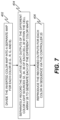
- FIG. 7 is a flow diagram in accordance with a method and apparatus according to an embodiment of the present disclosure
- FIG. 8 is a flow diagram in accordance with a method and apparatus according to an embodiment of the present disclosure
- viewer In the context of the present disclosure, the terms “viewer”, “operator”, “observer”, and “user” are considered to be equivalent and refer to the person who wears and/or views images using an electronic device.
- set refers to a non-empty set, as the concept of a collection of elements or members of a set is widely understood in elementary mathematics.
- subset unless otherwise explicitly stated, is used herein to refer to a non-empty proper subset, that is, to a subset of the larger set, having one or more members.
- a subset may comprise the complete set S.
- a “proper subset” of set S is strictly contained in set S and excludes at least one member of set S.
- FIG. 1 shows an extended light source 10 connected to a computer 12 as a part of an illuminator for color balancing virtual images of a near-eye display.
- the computer 12 includes a computer processing unit (CPU) 14 and a memory 16 and is interconnected with the extended light source 10 through a communication path 18 that extends between the CPU 14 and a controller 20 of the extended light source 10 .
- CPU computer processing unit
- the extended light source 10 includes a plurality of light source cells 30 shown here in a two-dimensional array 26 with vertically staggered columns 28 a through 28 f
- Each light source cell 30 includes a red light source 32 , a green light source 34 , a blue light source 36 , which can take the form of light emitting diodes (LEDs or other light sources known to those skilled in the art).
- Controller 20 controls the radiant energy output of each individual light source 32 , 34 , 36 of each light source cell 30 along communication paths 22 . In this way, the relative color output of each cell 30 can be controlled as well as color gradients across and within the two-dimensional array 26 of the extended light source 10 .
- the extended light source 10 can produce a horizontal color gradient from a left most vertical column 28 a of light source cells 30 to the right most vertical column 28 f of light source cells 30 .
- a color gradient can vary, for example, from a shade of red from the left most vertical column 28 a to a shade of blue at the right most vertical column 28 f
- Other orientations of the color gradient are also possible, e.g., a vertical top-to-bottom color gradient, or a diagonal bottom-left-to-top-right or top-left-to-bottom-right color gradient.
- the color gradient can also appear as an isolated region within the two-dimensional array 26 in other color gradient patterns across the vertical and/or horizontal extent of the two-dimensional array 26 .
- color gradients can extend only over a portion of the two-dimensional array 26 , e.g., in the lower left region of the two-dimensional array 26 , or in the center region of the two-dimensional array 26 .
- the gradients are drawn as a function of wavelength, e.g., from shorter to longer wavelengths, but other color transitions are possible.
- Each light source cell 30 of the extended light source 10 can produce white light by adjusting the radiant energy outputs of the red light source 32 , the green light source 34 , and the blue light source 36 in accordance with the respective ratios. Other colors of the visible spectrum can be reproduced by the individual cells 30 by adjusting the R, G, and B outputs in different ratios. Additional color light sources can be added to each cell 30 to assist with digital color conversions.
- the diagram of FIG. 2 shows an example of a projector 40 for color balancing virtual images injected into an image light guide 50 of a near-eye display.
- the projector 40 includes an illuminator 42 , which includes the extended light source 10 , a spatial light modulator 44 under control of the computer 12 for generating images, and an eye piece optic 46 for forming a pupil 48 that is relayed and expanded by the image light guide 50 for viewing the generated images as virtual images.
- the illuminator 42 is arranged for backlighting the spatial light modulator 44 , which is of the transmissive type such as a liquid crystal display (LCD).
- the illuminator 42 could also be arranged for front-lighting the spatial light modulator 44 of a reflective type such as a digital micromirror array (DMD).
- DMD digital micromirror array
- Included within the illuminator 42 is a partial homogenizer 52 , shown as an imaging type homogenizer with two array lenses 54 and 56 and a condenser 58 for overlapping inputs to the first array lens 54 at a homogenization plane 60 .
- the spatial light modulator 44 is positioned within an illumination plane 62 that is offset from the homogenization plane 60 along an optical axis 64 of the projector 40 so that only partial homogenization takes place at the spatial light modulator 44 .
- the array lenses 54 and 56 can be arranged as fly's eye or microlens arrays with lenslets of the array lenses arranged in a two dimensional array.
- Each of the depicted lenslets 66 a - 66 d constituting one of a plurality of columns of the first array lens 54 collects light from one or more of the light source cells 30 of the extended light source 10 for establishing a plurality of light channels 68 a - 68 d .
- the second array lens 56 together with the condenser 58 partially overlaps the light from the different optical channels 68 a - 68 d at the illumination plane 62 , which is offset from the homogenization plane 60 at which the channels 68 a - 68 d would more completely overlap.
- only two of the channels 68 a and 68 d are traced through the partial homogenizer 52 to positions of partial overlap at the illumination plane 62 .
- the homogenization plane 60 can be located at the focal plane of the condenser 58 , and the illumination plane 62 , which is defined by the location of the spatial light modulator 44 , is offset from this focal plane to decrease the amount of overlap between the channels 68 a - 68 d at the spatial light modulator 44 .
- the channels 68 a - 68 d overlap by at least 60 percent but at least some of the channels overlap by no more than 90 percent at the illumination plane 62 .
- the partial homogenizer 52 as an imaging type homogenizer can be arranged such that the first array lens 54 directs the collected light from individual cells 30 into respective apertures of the lenslets of the second array lens 56 , and the condenser 58 is arranged with respect to the first and second array lenses 54 and 56 for imaging the lenslet apertures of the first array lens 54 in an overlapping manner at the homogenization plane 60 from which the illumination plane 62 is offset.
- Additional optics associated with the extended light source 10 can be arranged for directing light from different cells 30 or different cell groups into different lenslet apertures of the first array lens 54 for establishing the different light channels 68 a - 68 d that are partially overlapped at the illumination plane 62 .
- Diffusers and other forms of mixing optics can be used to combine the different color light outputs from the red, green, and blue light sources 32 , 34 , and 36 of the individual cells 30 .
- the spatial light modulator 44 located at the illumination plane 62 generates images by selectively modulating the partially overlapping light at the illumination plane 62 on a pixel-by-pixel basis.
- the eyepiece optic 46 directs the modulated light from the spatial light modulator 44 toward the pupil 48 and into the image light guide 50 for conveying a virtual image of the spatial light modulator output in a form visible to a viewer.
- each modulated pixel of the spatial light modulator 44 fills the pupil 48 as a substantially collimated beam that is angularly encoded in two orthogonal dimensions according to the spatial position at which the pixel is modulated within the spatial light modulator 44 .
- the eyepiece optic 46 converts a pixel 72 at one side of the spatial light modulator 44 into a collimated beam 74 filling the pupil 48 through a first inclination angle 82 to the optical axis 64 of the projector 40 and converts a pixel 76 at an opposite side of the spatial light modulator 44 into a collimated beam 78 filling the pupil 48 through a second inclination angle 84 that is oppositely inclined to the optical axis 64 .
- color gradients can be programmatically generated across the spatial light modulator 44 to compensate for color imbalances otherwise present in the virtual image presented to the viewer.
- FIGS. 3 A and 3 B show orthogonal views of a near-eye display 100 incorporating both the projector 40 and the image light guide 50 for conveying the image generated by the projector 40 to an eyebox 102 within which the generated image can be viewed by a viewer's eye 104 as a virtual image V 1 appearing within the viewer's field of view.
- the image light guide 50 includes a transmissive waveguide 106 supporting an in-coupling optic IDO and an out-coupling optic ODO, which can both be formed as diffractive optics such as gratings or holographic optical elements (HOE).
- the in-coupling optic IDO directs the angularly encoded light beams WI from the projector 40 into the waveguide 106 for propagation along the waveguide 106 as the angularly encoded beams WG to the out-coupling optic ODO at which the angularly encoded light beams are directed out of the waveguide 106 as the angularly encoded beams WO to the eyebox 102 within which the virtual image V 1 can be viewed.
- the waveguide 106 is transmissive and can have plane-parallel outer and inner surfaces 108 , 110 through with the viewer can see the ambient environment within which the virtual image V 1 appears.
- the in-coupling diffractive optic IDO can be located on the outer or inner surface 108 , 110 of the waveguide 106 and can be of a transmissive or reflective type in a combination that supports the propagation of the angularly encoded beams from the output of the projector 40 to the eyebox 102 .
- the angularly encoded beams WI from the projector 40 can be diffracted (generally through a first diffraction order) and thereby redirected by in-coupling optic IDO into the waveguide 106 as the angularly encoded beams WG for further propagation along a length dimension X of the waveguide 106 by total internal reflection (TIR) from the plane parallel outer and inner surfaces 108 , 110 .
- TIR total internal reflection
- the angularly encoded beams WG preserve the image information in an angularly encoded form that is derivable from the parameters of the in-coupling optic IDO.
- the out-coupling optic ODO receives the angularly encoded beams WG and diffracts (also generally through a first diffraction order) the angularly encoded beams WG out of the waveguide 106 as the as the angularly encoded beams WO toward the eyebox 102 , within with the transmitted virtual image can be seen by a viewer's eye 104 .
- the out-coupling optic ODO can be designed symmetrically with respect to the in-coupling optic IDO to restore the original angular relationships of the angularly encoded beams WI among outputted angularly related beams WO within the eyebox 102 .
- the out-coupling diffractive optic ODO can modify the original field points' positional angular relationships producing an output virtual image at a finite focusing distance.
- the out-coupling optic ODO can be arranged together with a limited thickness of the waveguide 106 to encounter the angularly related beams WG multiple times and to diffract only a portion of the each of the angularly related beams WG upon each encounter.
- the multiple encounters along the length of the out-coupling optic ODO have the effect of enlarging one dimension of each of the angularly related beams WO exiting the waveguide 106 thereby expanding one dimension of the eyebox 102 within which the beams WO overlap.
- the expanded eyebox 102 decreases sensitivity to the position of a viewer's eye for viewing the virtual image V 1 .
- Additional optics such as a turning optic
- the turning optic can be arranged for expanding a second dimension of the angularly related beams WO via multiple encounters with the angularly related beams WO propagating in a different direction along the waveguide 106 .
- the path of principal rays of light exiting from the waveguide 106 is indicated in solid lines. Dashed lines depict extensions of the principal rays indicating the apparent location of the virtual image V 1 to the eye 104 of the viewer. That is, the dashed rays indicate the apparent source of the modulated light that forms the virtual image V 1 .
- a near-eye display 120 shown in FIG. 4 includes a first image light guide 122 a and a second image light guide 122 b for conveying different color bands of the images generated by the projector 40 .
- the first image light guide 122 a which includes a first transmissive waveguide 124 a with a first in-coupling optic IDOa and a first out-coupling optic ODOa, can be arranged for conveying a red and green color band (e.g., light from the red and green light sources 32 and 34 ) from the projector 40 to an eyebox 126 .
- the second image light guide 122 b which includes a second transmissive waveguide 124 b with a second in-coupling optic IDOb and a second out-coupling optic ODOb, can be arranged for conveying a blue color band (e.g., light from the blue light sources 36 ).
- a blue color band e.g., light from the blue light sources 36 .
- the in-coupling and out-coupling optics IDOa, IDOb and ODOa, ODOb can be specially adapted to diffracting the angularly encoded beams in different wavelength bands to promote the propagation of the different wavelength bands along the respective waveguides 124 a , 124 b to the viewer's eye 128 .
- Both waveguides 124 , 126 can have plane-parallel front and back surfaces for maintaining angular relationships among the angularly related beams through multiple internal reflections.
- the plane-parallel surfaces also reduce refractive effects on transmissions of higher incident angle light through the waveguides 124 a , 124 b from the projector 40 or from the ambient environment within the field of view of the viewer.
- a way to identify systematic color gradients 300 includes projecting a uniformly white image with the projector 40 in step 302 and recording color variations across the resulting virtual images V 1 with a color sensitive camera in the wearer's eye position (i.e., eyebox) in step 304 .
- the camera captured color gradient map across the field of view of the near-eye display provided in step 306 a can be used as input to a color inversion computer algorithm in step 306 b , and the color inversion computer algorithm can produce an inverted color gradient map.
- Such an inverted color gradient map can be stored in the memory 16 of the computer 12 that is connected to the extended light source 10 as shown in FIG. 1 , in step 308 .
- the inverted color gradient map is a color map that when combined with (added to) the original camera captured color gradient map results in a white color over the entire FOV.
- the controller 20 can be used to control the relative color output of the individual cells 30 of the extended light source 10 as shown in FIG. 1 to compensate for the systematic color gradient within the virtual images V 1 in step 310 .
- One method of defining the required inverted color map is to separately power the R, G, B light source 32 , 34 , 36 of each light source cell 30 and to separately measure the intensity of each color across the extent of the virtual image.
- the computer 12 and the controller 20 as shown in FIG. 1 , can then be programed with the inverted color map, the invert R, invert G, invert B values per area of the FOV corresponding to the image generating area of the spatial light modulator 44 .
- the controller 20 can adjust the amount of each component R, G, B of light generated in each light source cell 30 to reproduce the inverted color map at the output of the spatial light modulator 44 , while the spatial light modulator 44 is otherwise set for generating a fully white image. That is, while the spatial light modulator 44 is set for generating a blank white image, the illuminator 42 can be arranged to produce a light pattern at the illumination plane 62 such that the image generated by the spatial light modulator 44 matches the inverted color map. The same illumination pattern can be maintained for while other images are generated by the spatial light modulator 44 to compensate for a systematic color gradient that would otherwise degrade the virtual images presented to the viewer.
- the illuminator 42 can reproduce the inverted color map in synchronization with the sequential operation of the spatial light modulator. That is, in an embodiment, as shown in FIG. 7 , the inverted color map can be divided into a separate map for each color (e.g., R, G, and B) in step 402 .
- the relative light outputs of the different color light sources 32 , 34 , and 36 of each cell 30 within the cell array 26 are separately recorded for generating each of the different color maps in step 404 and the recorded outputs for each color are reproduced by the controller 20 in sequence in step 406 .
- the extended light source 10 can be divided into three different extended light sources with a single color light source within each cell of each extended light source.
- the controller for each extended light source provides for reproducing a separate color map for each color that illuminates a different one of the spatial light modulators.
- color balancing across the virtual images V 1 can be performed by controlling ratios among the additive colors (e.g., R, G, and B) across the illumination plane 62
- light intensity across the virtual images V 1 can also be controlled by regulating the outputs of the different cells 30 of the extended light source 10 .
- the radiant energy outputs of the different cells 30 can be adjusted by the controller 20 to produce an inverse intensity distribution at the illumination plane 62 to provide the desired intensity balance across the virtual images V 1 .
- an inverted light intensity gradient map can be created as described in steps 502 - 506 , stored in computer memory 12 in step 510 , and light intensity across the virtual images V 1 can be controlled by reducing the output of one of the bands of wavelengths within a first set of the cells 30 and relatively increasing the output of the one band of wavelengths within a second set of the cells 30 via the controller 20 in step 512 .
- FIG. 5 shows a head-mounted display (HMD) 200 in the form of eyeglasses with a left-eye near-eye display 2021 and a right-eye near-eye display 202 r for providing three-dimensional (3-D) augmented reality viewing.
- the respective projectors 2041 , 204 r of the near-eye displays 2021 , 202 r can provide respective color images that appear as virtual images within the real-world scene content seen by the wearer 206 through the near-eye displays 2021 , 202 r .
- the images that are generated can be, but are not limited to, a stereoscopic pair of images for 3-D viewing of virtual objects.
- Additional components familiar to those skilled in the augmented reality visualization arts, such as one or more cameras mounted on the frame of the HMD for viewing scene content or viewer gaze tracking, can also be provided. Alternate arrangements are possible, including a display apparatus for providing an image to one eye.
- the HMD 200 can include color gradient adjustment as disclosed in the preceding figures and the accompanying descriptive text. In this way, color gradient corrections can be applied to both right and left eyes independently to produce color correct 3D-virtual images the wearer.
- RGB three-color display system is an illustrative example in this disclosure, there are also other color display schemes that could be utilized to create white light for backlight and/or front-light projector systems.
- a four-color scheme where yellow light is added as an additional light source to the three-color scheme, designated as RGBY, exist and could be utilized.
- RGBY three-color scheme
- the above disclosure is extended to such four (or more) color schemes that may be implemented into the projector system.
Landscapes
- Physics & Mathematics (AREA)
- General Physics & Mathematics (AREA)
- Engineering & Computer Science (AREA)
- Optics & Photonics (AREA)
- Computer Hardware Design (AREA)
- Theoretical Computer Science (AREA)
- Chemical & Material Sciences (AREA)
- Crystallography & Structural Chemistry (AREA)
- Control Of Indicators Other Than Cathode Ray Tubes (AREA)
- Controls And Circuits For Display Device (AREA)
Abstract
Description
white light=nRW R+nGW G+nBW B
Where nRW, nGW, nBW are respective ratios needed of each component color R, G, and B to produce the perceived white light. Each
measured R light=nRM R
measured G light=nGM G
measured B light=nBM B
invert R=nRW−nRM
invert G=nGW−nGM
invert B=nBW−nBM
Where nRM, nGM, nBM are the measured values from an area of the FOV and of each red, green, and blue component, respectively, and where nRW, nGW, nBW are the required amounts of each of red, green, and blue light to form a white color image. The
Claims (20)
Priority Applications (1)
| Application Number | Priority Date | Filing Date | Title |
|---|---|---|---|
| US17/422,067 US12061341B2 (en) | 2019-01-09 | 2020-01-09 | Color correction for virtual images of near-eye displays |
Applications Claiming Priority (3)
| Application Number | Priority Date | Filing Date | Title |
|---|---|---|---|
| US201962790367P | 2019-01-09 | 2019-01-09 | |
| PCT/US2020/012821 WO2020146559A1 (en) | 2019-01-09 | 2020-01-09 | Color correction for virtual images of near-eye displays |
| US17/422,067 US12061341B2 (en) | 2019-01-09 | 2020-01-09 | Color correction for virtual images of near-eye displays |
Related Parent Applications (1)
| Application Number | Title | Priority Date | Filing Date |
|---|---|---|---|
| PCT/US2020/012821 A-371-Of-International WO2020146559A1 (en) | 2019-01-09 | 2020-01-09 | Color correction for virtual images of near-eye displays |
Related Child Applications (1)
| Application Number | Title | Priority Date | Filing Date |
|---|---|---|---|
| US18/778,275 Continuation US12601920B2 (en) | 2019-01-09 | 2024-07-19 | Color correction for virtual images of near-eye displays |
Publications (2)
| Publication Number | Publication Date |
|---|---|
| US20220099975A1 US20220099975A1 (en) | 2022-03-31 |
| US12061341B2 true US12061341B2 (en) | 2024-08-13 |
Family
ID=71521929
Family Applications (2)
| Application Number | Title | Priority Date | Filing Date |
|---|---|---|---|
| US17/422,067 Active 2041-09-14 US12061341B2 (en) | 2019-01-09 | 2020-01-09 | Color correction for virtual images of near-eye displays |
| US18/778,275 Active US12601920B2 (en) | 2019-01-09 | 2024-07-19 | Color correction for virtual images of near-eye displays |
Family Applications After (1)
| Application Number | Title | Priority Date | Filing Date |
|---|---|---|---|
| US18/778,275 Active US12601920B2 (en) | 2019-01-09 | 2024-07-19 | Color correction for virtual images of near-eye displays |
Country Status (5)
| Country | Link |
|---|---|
| US (2) | US12061341B2 (en) |
| EP (2) | EP4707902A1 (en) |
| JP (1) | JP7190580B2 (en) |
| CN (1) | CN113508328B (en) |
| WO (1) | WO2020146559A1 (en) |
Cited By (1)
| Publication number | Priority date | Publication date | Assignee | Title |
|---|---|---|---|---|
| US20240273801A1 (en) * | 2023-02-02 | 2024-08-15 | Jade Bird Display (shanghai) Limited | Methods for virtual image compensation |
Families Citing this family (14)
| Publication number | Priority date | Publication date | Assignee | Title |
|---|---|---|---|---|
| US12135419B2 (en) | 2020-12-06 | 2024-11-05 | Lumus Ltd. | Optical system including selective illumination |
| US12204096B2 (en) | 2021-06-07 | 2025-01-21 | Panamorph, Inc. | Near-eye display system |
| JP2024522302A (en) | 2021-06-07 | 2024-06-13 | パナモーフ,インコーポレイテッド | Near Eye Display System |
| US11768330B2 (en) * | 2021-09-24 | 2023-09-26 | Meta Platforms Technologies, Llc | Light guide combiner with increased field of view (FOV) and eyebox efficiency for enhanced reality applications |
| US20250164790A1 (en) * | 2022-06-01 | 2025-05-22 | Lumus Ltd. | Uniformity enhancement of a color mixing compact image projector |
| JP2025523108A (en) * | 2022-07-19 | 2025-07-17 | ジェイド バード ディスプレイ(シャンハイ) リミテッド | Method and system for virtual image compensation and evaluation - Patents.com |
| US12394347B1 (en) * | 2022-09-07 | 2025-08-19 | Apple Inc. | Method of obtaining color calibration information for an electronic device |
| US12399371B1 (en) | 2022-10-18 | 2025-08-26 | Lumus Ltd. | Double-helix onto a single light-guide optical element (LOE) |
| WO2025007092A1 (en) * | 2023-06-30 | 2025-01-02 | Vuzix Corporation | Image light guide projector system alignment |
| TWI868860B (en) | 2023-08-17 | 2025-01-01 | 廣達電腦股份有限公司 | Illumination module, head-mounted display including illumination module, and method for creating uniform lighting |
| WO2025175565A1 (en) * | 2024-02-23 | 2025-08-28 | Jade Bird Display (shanghai) Limited | Method and system for correcting nonuniformity of near-eye display |
| WO2025240762A1 (en) * | 2024-05-15 | 2025-11-20 | Vuzix Corporation | Color correction for powered diffractive optics |
| US12499846B2 (en) | 2024-05-28 | 2025-12-16 | Snap Inc. | Dynamic color uniformity correction display system |
| US12554136B2 (en) * | 2024-05-28 | 2026-02-17 | Snap Inc. | Color correction for XR display |
Citations (25)
| Publication number | Priority date | Publication date | Assignee | Title |
|---|---|---|---|---|
| US20020196414A1 (en) | 2000-07-10 | 2002-12-26 | Manni Jeffrey Glenn | Systems and methods for speckle reduction through bandwidth enhancement |
| US20040114250A1 (en) | 2002-12-02 | 2004-06-17 | Nec Viewtechnology, Ltd. | Projection display device |
| JP2005241825A (en) | 2004-02-25 | 2005-09-08 | Nikon Corp | Image display device |
| JP2006133635A (en) | 2004-11-09 | 2006-05-25 | Olympus Corp | Illumination optical device and optical device |
| US20080013182A1 (en) | 2006-07-17 | 2008-01-17 | Joerg Ferber | Two-stage laser-beam homogenizer |
| US7390097B2 (en) | 2004-08-23 | 2008-06-24 | 3M Innovative Properties Company | Multiple channel illumination system |
| JP2008287048A (en) | 2007-05-18 | 2008-11-27 | Konica Minolta Holdings Inc | Video display apparatus, and head-mounted display |
| US20110213664A1 (en) | 2010-02-28 | 2011-09-01 | Osterhout Group, Inc. | Local advertising content on an interactive head-mounted eyepiece |
| US20120062998A1 (en) | 2010-09-13 | 2012-03-15 | Vuzix Corporation | Prismatic multiple waveguide for near-eye display |
| JP2012118291A (en) | 2010-11-30 | 2012-06-21 | Brother Ind Ltd | Image display device |
| US20140247591A1 (en) | 2010-11-29 | 2014-09-04 | Sony Corporation | Illumination unit, projection display unit, and direct view display unit |
| US20160041396A1 (en) | 2014-08-05 | 2016-02-11 | Hitachi-Lg Data Storage, Inc. | Video projection device and head mounted display using the same |
| US20160097930A1 (en) | 2014-10-06 | 2016-04-07 | Steven John Robbins | Microdisplay optical system having two microlens arrays |
| US20160187654A1 (en) | 2011-02-28 | 2016-06-30 | Microsoft Technology Licensing, Llc | See-through near-eye display glasses with a light transmissive wedge shaped illumination system |
| JP2017058388A (en) | 2015-09-14 | 2017-03-23 | セイコーエプソン株式会社 | Virtual image display device |
| US20170293143A1 (en) | 2016-04-07 | 2017-10-12 | Google Inc. | Curved eyepiece with color correction for head wearable display |
| US9819917B2 (en) | 2013-11-13 | 2017-11-14 | Seiko Epson Corporation | Projector |
| WO2018013307A1 (en) | 2016-06-21 | 2018-01-18 | Ntt Docomo, Inc. | An illuminator for a wearable display |
| US10360829B2 (en) | 2017-03-15 | 2019-07-23 | Acer Incorporated | Head-mounted display and chroma aberration compensation method using sub-pixel shifting |
| US10365490B2 (en) | 2015-05-19 | 2019-07-30 | Maxell, Ltd. | Head-mounted display, head-up display and picture displaying method |
| US10378882B2 (en) | 2015-11-04 | 2019-08-13 | Magic Leap, Inc. | Light field display metrology |
| US20190318677A1 (en) * | 2018-04-16 | 2019-10-17 | Oculus Vr, Llc | Display with gaze-adaptive resolution enhancement |
| US20190339605A1 (en) * | 2017-02-23 | 2019-11-07 | Fujifilm Corporation | Projection display device, method of controlling projection display device, and program for controlling projection display device |
| US20200203324A1 (en) * | 2019-09-23 | 2020-06-25 | Lg Electronics Inc. | Electronic device |
| US11029523B2 (en) | 2014-07-18 | 2021-06-08 | Vuzix Corporation | Near-eye display with self-emitting microdisplay engine |
Family Cites Families (2)
| Publication number | Priority date | Publication date | Assignee | Title |
|---|---|---|---|---|
| AU2017360746B2 (en) * | 2016-11-15 | 2022-07-28 | Creal Sa | Near-eye sequential light-field projector with correct monocular depth cues |
| KR102389330B1 (en) * | 2017-05-26 | 2022-04-22 | 구글 엘엘씨 | Near-eye display with adjustable extended receptive range |
-
2020
- 2020-01-09 EP EP25221723.7A patent/EP4707902A1/en active Pending
- 2020-01-09 US US17/422,067 patent/US12061341B2/en active Active
- 2020-01-09 CN CN202080019627.5A patent/CN113508328B/en active Active
- 2020-01-09 WO PCT/US2020/012821 patent/WO2020146559A1/en not_active Ceased
- 2020-01-09 JP JP2021539395A patent/JP7190580B2/en active Active
- 2020-01-09 EP EP20738091.6A patent/EP3891551B1/en active Active
-
2024
- 2024-07-19 US US18/778,275 patent/US12601920B2/en active Active
Patent Citations (27)
| Publication number | Priority date | Publication date | Assignee | Title |
|---|---|---|---|---|
| US20020196414A1 (en) | 2000-07-10 | 2002-12-26 | Manni Jeffrey Glenn | Systems and methods for speckle reduction through bandwidth enhancement |
| US20040114250A1 (en) | 2002-12-02 | 2004-06-17 | Nec Viewtechnology, Ltd. | Projection display device |
| JP2004184641A (en) | 2002-12-02 | 2004-07-02 | Nec Viewtechnology Ltd | Projection type display device |
| JP2005241825A (en) | 2004-02-25 | 2005-09-08 | Nikon Corp | Image display device |
| US7390097B2 (en) | 2004-08-23 | 2008-06-24 | 3M Innovative Properties Company | Multiple channel illumination system |
| JP2006133635A (en) | 2004-11-09 | 2006-05-25 | Olympus Corp | Illumination optical device and optical device |
| US20080013182A1 (en) | 2006-07-17 | 2008-01-17 | Joerg Ferber | Two-stage laser-beam homogenizer |
| JP2008287048A (en) | 2007-05-18 | 2008-11-27 | Konica Minolta Holdings Inc | Video display apparatus, and head-mounted display |
| US20110213664A1 (en) | 2010-02-28 | 2011-09-01 | Osterhout Group, Inc. | Local advertising content on an interactive head-mounted eyepiece |
| US8649099B2 (en) | 2010-09-13 | 2014-02-11 | Vuzix Corporation | Prismatic multiple waveguide for near-eye display |
| US20120062998A1 (en) | 2010-09-13 | 2012-03-15 | Vuzix Corporation | Prismatic multiple waveguide for near-eye display |
| US20140247591A1 (en) | 2010-11-29 | 2014-09-04 | Sony Corporation | Illumination unit, projection display unit, and direct view display unit |
| JP2012118291A (en) | 2010-11-30 | 2012-06-21 | Brother Ind Ltd | Image display device |
| US20160187654A1 (en) | 2011-02-28 | 2016-06-30 | Microsoft Technology Licensing, Llc | See-through near-eye display glasses with a light transmissive wedge shaped illumination system |
| US9819917B2 (en) | 2013-11-13 | 2017-11-14 | Seiko Epson Corporation | Projector |
| US11029523B2 (en) | 2014-07-18 | 2021-06-08 | Vuzix Corporation | Near-eye display with self-emitting microdisplay engine |
| US20160041396A1 (en) | 2014-08-05 | 2016-02-11 | Hitachi-Lg Data Storage, Inc. | Video projection device and head mounted display using the same |
| US20160097930A1 (en) | 2014-10-06 | 2016-04-07 | Steven John Robbins | Microdisplay optical system having two microlens arrays |
| US10365490B2 (en) | 2015-05-19 | 2019-07-30 | Maxell, Ltd. | Head-mounted display, head-up display and picture displaying method |
| JP2017058388A (en) | 2015-09-14 | 2017-03-23 | セイコーエプソン株式会社 | Virtual image display device |
| US10378882B2 (en) | 2015-11-04 | 2019-08-13 | Magic Leap, Inc. | Light field display metrology |
| US20170293143A1 (en) | 2016-04-07 | 2017-10-12 | Google Inc. | Curved eyepiece with color correction for head wearable display |
| WO2018013307A1 (en) | 2016-06-21 | 2018-01-18 | Ntt Docomo, Inc. | An illuminator for a wearable display |
| US20190339605A1 (en) * | 2017-02-23 | 2019-11-07 | Fujifilm Corporation | Projection display device, method of controlling projection display device, and program for controlling projection display device |
| US10360829B2 (en) | 2017-03-15 | 2019-07-23 | Acer Incorporated | Head-mounted display and chroma aberration compensation method using sub-pixel shifting |
| US20190318677A1 (en) * | 2018-04-16 | 2019-10-17 | Oculus Vr, Llc | Display with gaze-adaptive resolution enhancement |
| US20200203324A1 (en) * | 2019-09-23 | 2020-06-25 | Lg Electronics Inc. | Electronic device |
Non-Patent Citations (2)
| Title |
|---|
| Michael Pate, Fly's Eye Arrays for Uniform Illumination in Digital Projector Optics, Zemax, LLC. White Paper, Jul. 24, 2014, p. 1-9. |
| United States Patent & Trademark Office (ISA/US), International Search Report and Written Opinion in International Patent Application No. PCT/US2020/012821, dated Mar. 19, 2020. |
Cited By (1)
| Publication number | Priority date | Publication date | Assignee | Title |
|---|---|---|---|---|
| US20240273801A1 (en) * | 2023-02-02 | 2024-08-15 | Jade Bird Display (shanghai) Limited | Methods for virtual image compensation |
Also Published As
| Publication number | Publication date |
|---|---|
| WO2020146559A1 (en) | 2020-07-16 |
| EP3891551B1 (en) | 2026-03-11 |
| US20220099975A1 (en) | 2022-03-31 |
| EP4707902A1 (en) | 2026-03-11 |
| US12601920B2 (en) | 2026-04-14 |
| JP2022516641A (en) | 2022-03-01 |
| US20240377643A1 (en) | 2024-11-14 |
| CN113508328B (en) | 2023-11-07 |
| EP3891551A1 (en) | 2021-10-13 |
| JP7190580B2 (en) | 2022-12-15 |
| EP3891551A4 (en) | 2022-12-07 |
| CN113508328A (en) | 2021-10-15 |
Similar Documents
| Publication | Publication Date | Title |
|---|---|---|
| US12601920B2 (en) | Color correction for virtual images of near-eye displays | |
| CN110651211B (en) | Display system with spatial light modulator illumination for split pupils | |
| CN109073882B (en) | Waveguide-based display with exit pupil expander | |
| KR102834866B1 (en) | Virtual and augmented reality systems and methods having unequal numbers of component color images distributed across depth planes | |
| US9164351B2 (en) | Freeform-prism eyepiece with illumination waveguide | |
| EP3770669B1 (en) | Display apparatus and display method | |
| US20230176274A1 (en) | Adjustable focal length illuminator for a display panel | |
| KR102704208B1 (en) | Light output system with reflector and lens for very spatially uniform light output | |
| US11054649B2 (en) | Image display optical apparatus and image generation method thereof | |
| CN111142255A (en) | AR optical display module and display device | |
| US20250035938A1 (en) | Projection substrate and smart glasses | |
| CN109154737B (en) | Dynamic full three-dimensional display | |
| US20250277978A1 (en) | Projection optical system and glasses-type terminal | |
| CN118764606A (en) | Three-dimensional display device, display method, and display equipment | |
| US20230143728A1 (en) | Holographic display system and method | |
| CN111142256A (en) | VR optical display module and display device | |
| CN117642576A (en) | Waveguide illuminator with slab waveguide section | |
| US12204107B2 (en) | Patterned light illuminator for a display panel | |
| US20230021670A1 (en) | Talbot pattern illuminator and display based thereon | |
| US20240427161A1 (en) | Anamorphic directional illumination device | |
| EP4716867A2 (en) | Extended reality systems and methods | |
| WO2025196868A1 (en) | Projection substrate and eyeglasses-type terminal | |
| WO2025245272A1 (en) | Extended reality systems and methods | |
| WO2025151510A1 (en) | Extended reality systems and methods | |
| HK40097836A (en) | Smart glasses with led projector arrays |
Legal Events
| Date | Code | Title | Description |
|---|---|---|---|
| FEPP | Fee payment procedure |
Free format text: ENTITY STATUS SET TO UNDISCOUNTED (ORIGINAL EVENT CODE: BIG.); ENTITY STATUS OF PATENT OWNER: SMALL ENTITY |
|
| FEPP | Fee payment procedure |
Free format text: ENTITY STATUS SET TO SMALL (ORIGINAL EVENT CODE: SMAL); ENTITY STATUS OF PATENT OWNER: SMALL ENTITY |
|
| STPP | Information on status: patent application and granting procedure in general |
Free format text: DOCKETED NEW CASE - READY FOR EXAMINATION |
|
| AS | Assignment |
Owner name: VUZIX CORPORATION, NEW YORK Free format text: ASSIGNMENT OF ASSIGNORS INTEREST;ASSIGNORS:SCHULTZ, ROBERT J.;TRAVERS, PAUL J.;REEL/FRAME:066173/0324 Effective date: 20190117 |
|
| STPP | Information on status: patent application and granting procedure in general |
Free format text: NOTICE OF ALLOWANCE MAILED -- APPLICATION RECEIVED IN OFFICE OF PUBLICATIONS |
|
| ZAAA | Notice of allowance and fees due |
Free format text: ORIGINAL CODE: NOA |
|
| ZAAB | Notice of allowance mailed |
Free format text: ORIGINAL CODE: MN/=. |
|
| STPP | Information on status: patent application and granting procedure in general |
Free format text: PUBLICATIONS -- ISSUE FEE PAYMENT VERIFIED |
|
| STCF | Information on status: patent grant |
Free format text: PATENTED CASE |