US12058309B2 - Application accelerator - Google Patents
Application accelerator Download PDFInfo
- Publication number
- US12058309B2 US12058309B2 US16/291,023 US201916291023A US12058309B2 US 12058309 B2 US12058309 B2 US 12058309B2 US 201916291023 A US201916291023 A US 201916291023A US 12058309 B2 US12058309 B2 US 12058309B2
- Authority
- US
- United States
- Prior art keywords
- blocks
- target video
- video frame
- block
- map
- Prior art date
- Legal status (The legal status is an assumption and is not a legal conclusion. Google has not performed a legal analysis and makes no representation as to the accuracy of the status listed.)
- Active, expires
Links
- 230000001133 acceleration Effects 0.000 claims abstract description 99
- 239000013598 vector Substances 0.000 claims abstract description 52
- 238000000034 method Methods 0.000 claims abstract description 35
- 230000002776 aggregation Effects 0.000 claims description 20
- 238000004220 aggregation Methods 0.000 claims description 20
- 230000004931 aggregating effect Effects 0.000 claims 2
- 238000006073 displacement reaction Methods 0.000 abstract description 15
- 238000000638 solvent extraction Methods 0.000 description 17
- 238000010586 diagram Methods 0.000 description 16
- 230000006870 function Effects 0.000 description 11
- 230000008569 process Effects 0.000 description 11
- 208000037170 Delayed Emergence from Anesthesia Diseases 0.000 description 5
- 230000006835 compression Effects 0.000 description 5
- 238000007906 compression Methods 0.000 description 5
- 238000005192 partition Methods 0.000 description 4
- 235000015067 sauces Nutrition 0.000 description 3
- 101150039623 Clip1 gene Proteins 0.000 description 2
- 101000822695 Clostridium perfringens (strain 13 / Type A) Small, acid-soluble spore protein C1 Proteins 0.000 description 2
- 101000655262 Clostridium perfringens (strain 13 / Type A) Small, acid-soluble spore protein C2 Proteins 0.000 description 2
- 101000655256 Paraclostridium bifermentans Small, acid-soluble spore protein alpha Proteins 0.000 description 2
- 101000655264 Paraclostridium bifermentans Small, acid-soluble spore protein beta Proteins 0.000 description 2
- 239000000654 additive Substances 0.000 description 2
- 230000000996 additive effect Effects 0.000 description 2
- 230000001419 dependent effect Effects 0.000 description 2
- 238000005516 engineering process Methods 0.000 description 2
- 238000003860 storage Methods 0.000 description 2
- 230000003044 adaptive effect Effects 0.000 description 1
- 230000008901 benefit Effects 0.000 description 1
- 238000004422 calculation algorithm Methods 0.000 description 1
- 238000004364 calculation method Methods 0.000 description 1
- 230000008859 change Effects 0.000 description 1
- 230000002860 competitive effect Effects 0.000 description 1
- 238000004590 computer program Methods 0.000 description 1
- 235000009508 confectionery Nutrition 0.000 description 1
- 238000010276 construction Methods 0.000 description 1
- 238000007796 conventional method Methods 0.000 description 1
- 230000000694 effects Effects 0.000 description 1
- 239000000203 mixture Substances 0.000 description 1
- 238000005457 optimization Methods 0.000 description 1
- 238000002360 preparation method Methods 0.000 description 1
- 238000013139 quantization Methods 0.000 description 1
- 230000009467 reduction Effects 0.000 description 1
- 238000005070 sampling Methods 0.000 description 1
- 238000010845 search algorithm Methods 0.000 description 1
Images




Classifications
-
- H—ELECTRICITY
- H04—ELECTRIC COMMUNICATION TECHNIQUE
- H04N—PICTORIAL COMMUNICATION, e.g. TELEVISION
- H04N19/00—Methods or arrangements for coding, decoding, compressing or decompressing digital video signals
- H04N19/85—Methods or arrangements for coding, decoding, compressing or decompressing digital video signals using pre-processing or post-processing specially adapted for video compression
-
- H—ELECTRICITY
- H04—ELECTRIC COMMUNICATION TECHNIQUE
- H04N—PICTORIAL COMMUNICATION, e.g. TELEVISION
- H04N19/00—Methods or arrangements for coding, decoding, compressing or decompressing digital video signals
- H04N19/10—Methods or arrangements for coding, decoding, compressing or decompressing digital video signals using adaptive coding
- H04N19/102—Methods or arrangements for coding, decoding, compressing or decompressing digital video signals using adaptive coding characterised by the element, parameter or selection affected or controlled by the adaptive coding
- H04N19/103—Selection of coding mode or of prediction mode
- H04N19/105—Selection of the reference unit for prediction within a chosen coding or prediction mode, e.g. adaptive choice of position and number of pixels used for prediction
-
- H—ELECTRICITY
- H04—ELECTRIC COMMUNICATION TECHNIQUE
- H04N—PICTORIAL COMMUNICATION, e.g. TELEVISION
- H04N19/00—Methods or arrangements for coding, decoding, compressing or decompressing digital video signals
- H04N19/10—Methods or arrangements for coding, decoding, compressing or decompressing digital video signals using adaptive coding
- H04N19/134—Methods or arrangements for coding, decoding, compressing or decompressing digital video signals using adaptive coding characterised by the element, parameter or criterion affecting or controlling the adaptive coding
- H04N19/136—Incoming video signal characteristics or properties
- H04N19/137—Motion inside a coding unit, e.g. average field, frame or block difference
- H04N19/139—Analysis of motion vectors, e.g. their magnitude, direction, variance or reliability
-
- H—ELECTRICITY
- H04—ELECTRIC COMMUNICATION TECHNIQUE
- H04N—PICTORIAL COMMUNICATION, e.g. TELEVISION
- H04N19/00—Methods or arrangements for coding, decoding, compressing or decompressing digital video signals
- H04N19/10—Methods or arrangements for coding, decoding, compressing or decompressing digital video signals using adaptive coding
- H04N19/134—Methods or arrangements for coding, decoding, compressing or decompressing digital video signals using adaptive coding characterised by the element, parameter or criterion affecting or controlling the adaptive coding
- H04N19/154—Measured or subjectively estimated visual quality after decoding, e.g. measurement of distortion
-
- H—ELECTRICITY
- H04—ELECTRIC COMMUNICATION TECHNIQUE
- H04N—PICTORIAL COMMUNICATION, e.g. TELEVISION
- H04N19/00—Methods or arrangements for coding, decoding, compressing or decompressing digital video signals
- H04N19/10—Methods or arrangements for coding, decoding, compressing or decompressing digital video signals using adaptive coding
- H04N19/169—Methods or arrangements for coding, decoding, compressing or decompressing digital video signals using adaptive coding characterised by the coding unit, i.e. the structural portion or semantic portion of the video signal being the object or the subject of the adaptive coding
- H04N19/17—Methods or arrangements for coding, decoding, compressing or decompressing digital video signals using adaptive coding characterised by the coding unit, i.e. the structural portion or semantic portion of the video signal being the object or the subject of the adaptive coding the unit being an image region, e.g. an object
- H04N19/176—Methods or arrangements for coding, decoding, compressing or decompressing digital video signals using adaptive coding characterised by the coding unit, i.e. the structural portion or semantic portion of the video signal being the object or the subject of the adaptive coding the unit being an image region, e.g. an object the region being a block, e.g. a macroblock
-
- H—ELECTRICITY
- H04—ELECTRIC COMMUNICATION TECHNIQUE
- H04N—PICTORIAL COMMUNICATION, e.g. TELEVISION
- H04N19/00—Methods or arrangements for coding, decoding, compressing or decompressing digital video signals
- H04N19/10—Methods or arrangements for coding, decoding, compressing or decompressing digital video signals using adaptive coding
- H04N19/134—Methods or arrangements for coding, decoding, compressing or decompressing digital video signals using adaptive coding characterised by the element, parameter or criterion affecting or controlling the adaptive coding
- H04N19/146—Data rate or code amount at the encoder output
- H04N19/147—Data rate or code amount at the encoder output according to rate distortion criteria
Definitions
- the present invention relates generally to the fields of computer architecture and application acceleration.
- Video encoding is described herein as one example of a workload which creates heavy stresses (by way of non-limiting example, in the cloud and/or in the data center; the same applies in other equipment and/or locations that are part of the video flow).
- data center workload includes millions of video streams which have to be encoded and re-encoded during every minute, in order to stream the streams to multiple devices (generally having different video codecs) in a very efficient way.
- adaptive streaming additionally requires the video to be encoded to multiple bitrates.
- FIG. 9 is a simplified graphical illustration depicting a relationship between CPU power and various encoding tasks
- FIG. 10 is a simplified pictorial illustration depicting an approximate timeline view of various past, present, and future encoding standards
- FIG. 11 is a simplified tabular illustration depicting complexity of various encoding standards.
- FIG. 9 shows that, for quite some time, a single CPU has not been able to keep up with a single encoding task; this problem, it is believed, will become more severe in the future, as future standards are adopted and become more widely used (see FIG. 10 ) and as the complexity of those future standards is expected to be higher, as shown in FIG. 11 .
- FIG. 12 is a simplified partly pictorial, partly graphical illustration depicting relationships between resolution and complexity.
- FIG. 12 show a very conservative forecast of resolution mixture along the years, and also shows the nominal complexity involved with the fact that there are more pixels in every stream.
- FIG. 13 is a simplified graphical illustration depicting relationships between video complexity, CPU capability, and computational effort.
- FIG. 13 shows that the real video complexity (complexity per pixel ⁇ number of pixels) is suffering from a growing gap between CPU capability and the computational effort needed.
- the art does not yet include any acceleration device offering video encoding acceleration for the data center.
- the term “device” may be used in the present description to describe implementations of exemplary embodiments of the present invention, as well as (in the preceding sentence) apparent lacks in the known art.
- a system including an acceleration device including input circuitry configured, for each of a first plurality of video frames to be encoded, to receive an input including at least one raw video frame and at least one reference frame, and to divide each of the first plurality of video frames to be encoded into a second plurality of blocks, and similarity computation circuitry configured, for each one of the first plurality of video frame to be encoded: for each the block of the second plurality of blocks, to produce a score of result blocks based on similarity of each the block in each frame to be encoded to every block of the reference frame, and a displacement vector.
- the at least one raw video frame and the at least one reference frame are identical.
- the score of result blocks includes a ranked list.
- the larger block has a displacement vector equal to a displacement vector of each of the plurality of blocks having equal displacement vectors, and the larger block has a score equal to a sum of scores of the plurality of blocks having equal displacement vectors.
- the at least one raw video frame and the at least one reference frame are identical.
- result blocks are of variable size.
- the method also includes weighting at least some of the second plurality of blocks.
- the method also includes upsampling at least some of the second plurality of blocks, and wherein the score of results blocks is based on similarity of each the block to at least one upsampled block.
- the method also includes providing a second component receiving an output from the acceleration device and producing, based at least in part on the output received from the acceleration device, a second component output in accordance with a coding standard.
- the second component includes a plurality of second components, each of the plurality of second components producing a second component output in accordance with a coding standard, the coding standard for one of the plurality of second components being different from a coding standard of others of the plurality of second components.
- the coding standard for at least one of the plurality of second components includes at least one of the following HEVC/H.265, AVC/H.264, VP9, AV-1, and VVC.
- the second component includes an aggregation component configured to aggregate a plurality of adjacent blocks having equal motion vectors into a larger block.
- the larger block has a displacement vector equal to a displacement vector of each of the plurality of blocks having equal rank, and the larger block has a score equal to a sum of scores of the plurality of blocks having equal displacement vectors.
- FIG. 1 A is a simplified tabular illustration depicting an inter block in a video bit stream
- FIG. 1 B is a simplified block diagram illustration of an application acceleration system, constructed and operative in accordance with an exemplary embodiment of the present invention
- FIG. 2 is a simplified pictorial illustration depicting H.264/AVC block partitioning
- FIG. 3 is a simplified pictorial illustration depicting HEVC (H.265) block partitioning
- FIG. 4 is a simplified tabular illustration depicting an exemplary order of block encoding, intended in exemplary cases to be performed by an application acceleration system such as the system of FIG. 1 B ;
- FIG. 5 is a simplified tabular illustration depicting an exemplary result of operations performed by an acceleration device in accordance with an exemplary embodiment of the present invention
- FIG. 6 is another simplified tabular illustration depicting an exemplary result of operations performed by an acceleration device in accordance with an exemplary embodiment of the present invention
- FIG. 7 is a simplified pictorial illustration depicting a “local minimum” problem that may be encountered by an exemplary system in accordance with an exemplary embodiment of the present invention.
- FIG. 8 is a simplified pictorial illustration depicting an operation on a low-resolution image, which operation may be carried out by an exemplary system in accordance with an exemplary embodiment of the present invention
- FIG. 9 is a simplified graphical illustration depicting a relationship between CPU power and various encoding tasks.
- FIG. 10 is a simplified pictorial illustration depicting an approximate timeline view of various past, present, and future encoding standards
- FIG. 11 is a simplified tabular illustration depicting complexity of various encoding standards
- FIG. 12 is a simplified partly pictorial, partly graphical illustration depicting relationships between resolution and complexity
- FIG. 13 is a simplified graphical illustration depicting relationships between video complexity, CPU capability, and computational effort
- FIG. 14 is a simplified pictorial illustration depicting various portions of video codec standards
- FIG. 15 is a simplified pictorial illustration depicting an exemplary search area for motion vector prediction
- FIG. 16 is a simplified pictorial illustration depicting a non-limiting example of pixel sub blocks
- FIG. 17 A is a simplified partly pictorial, partly block-diagram illustration depicting an exemplary system and process, including motion estimation, for producing a bitstream;
- FIG. 17 B is a simplified partly pictorial, partly block-diagram illustration depicting an exemplary system and process, including motion estimation, for producing a bitstream, including use of an exemplary embodiment of the acceleration system of FIG. 1 B ;
- FIG. 18 is a simplified block diagram illustration depicting a particular exemplary case of using the acceleration system of FIG. 1 B ;
- FIG. 19 is a simplified block diagram illustration depicting another particular exemplary case of using the acceleration system of FIG. 1 B ;
- FIG. 20 is a simplified block diagram illustration depicting still another particular exemplary case of using the acceleration system of FIG. 1 B ;
- FIG. 21 is a simplified block diagram illustration depicting yet another particular exemplary case of using the acceleration system of FIG. 1 B ;
- FIG. 22 is a simplified partly pictorial, partly block diagram illustration of an exemplary embodiment of a portion of the application acceleration system of FIG. 1 B .
- the motion estimation portion/tool (which is described in the standard by the motion compensation procedure), is generally considered to be the most demanding one when it comes to computational effort.
- the preceding also applies a Current Picture Referencing (CPR) tool.
- CPR Current Picture Referencing
- motion estimation is not part of the video standard, as illustrated in FIG. 14 , which is a simplified pictorial illustration depicting various portions of video codec standards.
- a motion estimation procedure is involved in comparing a block (termed herein a “reference block”) against many blocks in the reference frames, finding the block with greatest (or in some cases close to greatest) similarity, and then performing a motion compensation which comprises, as is well known, writing the residual (as is known in the art) as well as the motion vectors (also termed herein “displacement vectors”) in the bitstream.
- a “factor” may be used to find a block which, multiplied by some constant (factor), is close to a given block.
- two blocks from two different frames may be combined via weighted summing, and then a block close to the average may be found.
- the motion estimation and the motion compensation are built as one unit, which means that the motion estimation score function (which is the “similarity” to the reference block), is the same as the compensation part, thus allowing the codec to use the score of the best matching block as a residual in the bitstream without further processing.
- FIG. 1 A is a simplified tabular illustration depicting an inter block, generally designated 101 , in a video bit stream.
- a high level view of a inter block in a video bitstream is shown in FIG. 1 A .
- a block header 103 specifies the block type (which can in general be, by way of non-limiting example, inter or intra, the particular non-limiting example shown in FIG. 1 A being an inter block with a single motion vector (MV) structure).
- block type which can in general be, by way of non-limiting example, inter or intra, the particular non-limiting example shown in FIG. 1 A being an inter block with a single motion vector (MV) structure).
- MV motion vector
- each section in FIG. 1 A is dynamic, in that each one of the three sections can be of variable size.
- a goal, in exemplary embodiments of the present invention, is to reduce the total number of bits in an entire bitstream, not just to reduce the total number of bits in a given inter block.
- the part of the process of generating an inter block which involves heavy computation is to read (in many case, by way of non-limiting example) tens of blocks for every reference block and to calculate the respective differences. Performing this operation itself may consume approximately 50 times more memory bandwidth than accessing the raw video itself. It is also appreciated that the compute effort of the process of generating an inter block may be very large, approximately, as well as the compute effort which is estimated to be approximately 50 O(number of pixels).
- the motion estimation part is generally responsible not only for finding a block with the minimal residual relative to each reference, but also for finding an optimal partitioning; by way of non-limiting example, a 32 ⁇ 32 block with 5 bits residual will consume many fewer bits in the bitstream than 4 8 ⁇ 8 blocks with 0 bits residual in each of them. In this particular non limiting example, the 32 ⁇ 32 block partitioning would be considered optimal.
- the method of selecting the best matched block is dependent on the details of the particular codec standard, including, by way of non-limiting example, because different standards treat motion vectors having large magnitude differently.
- Non-limiting examples of “differently” in the preceding sentence include: different partitioning; different sub-pixel interpolation; and different compensation options which may be available. It is appreciated that, in exemplary embodiments of the present invention, sub-pixels are produced by upsampling, as is known in the art.
- the application acceleration system comprises a video acceleration system.
- the video acceleration system 110 comprises a video acceleration device 120 ; exemplary embodiments of the construction and operation of the video acceleration device 120 are further described herein. As described in further detail below, the video acceleration device 120 is, in exemplary embodiments, configured to produce a result map 140 .
- FIG. 15 is a simplified pictorial illustration depicting an exemplary search area for motion vector prediction.
- an exemplary map (generally designated 1500 ) is shown.
- the center of the search area for a given block is designated 1510 .
- the search area comprises a plurality of search blocks 1520 , only some of which have been labeled with reference number 1520 for ease of depiction.
- FIG. 4 is a simplified tabular illustration depicting an exemplary order of block encoding, intended in exemplary cases to be performed by an application acceleration system such as the application acceleration system 110 of FIG. 1 B .
- the video acceleration device 120 outputs a list of the top ranked blocks, which have maximal similarity to each and every one of the blocks being encoded; for example, the current encoded frame is divided into small blocks (such as, by way of non-limiting example, 8 ⁇ 8 blocks). This is illustrated, including an exemplary non-limiting example of an order of block encoding, in FIG. 4 .
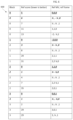
- FIG. 5 is a simplified tabular illustration depicting an exemplary result of operations performed by an acceleration device, such as the video acceleration device 120 of FIG. 1 B , in accordance with an exemplary embodiment of the present invention.
- a result map 500 (which may also be termed an “acceleration vector”), shown in FIG. 5 , is an example of the output (also termed herein a “result score board”) produced in exemplary embodiments of the present invention; the result map in FIG. 5 is a particular non-limiting example of the result map 140 of FIG. 1 B .
- the result map of FIG. 5 demonstrate the flexibility which is provided to the SW when using embodiments of the acceleration device described herein, in that (by way of non-limiting example) block partitioning decisions can be carried out based on the data comprised in the result map 500 of FIG. 5 .
- the SW can choose to re-partition to bigger blocks, for example when (by way of non-limiting example) based the results of blocks: 4, 5, 6, 7, 16, 17, 18, 19, 20, 21, 22, 23 which have arrived from the video acceleration device 120 of FIG. 1 , in order to partition to 64 ⁇ 64 sizes.
- FIG. 17 A is a simplified partly pictorial, partly block-diagram illustration depicting an exemplary system and process, including motion estimation, for producing a bitstream, as is known in the field of video.
- a plurality of target frames 1705 are input.
- a comparison operation is carried out at comparison element 1715 .
- the comparison operation is carried out relative to a reference block 1720 , produced/chosen by a motion estimation unit 1725 , based on a decoded picture input received from a decoded picture buffer 1730 .
- the result of the comparison element 1715 is a residual block 1735 .
- the residual block 1735 undergoes a transform operation at a transform unit 1740 ; quantization at a quantizing unit 1750 ; and entropy encoding in an entropy unit 1755 .
- the output the system of FIG. 17 A is a bitstream.
- quantized data from the quantizing unit 1750 is dequantized an inverse quantizing unit 1760 , and undergoes an inverse transform operation at an inverse transform unit 1765 , thus producing a decoded residual block 1770 .
- the decoded residual block 1770 is added to the reference block 1720 at element 1772 , with a result thereof being processed by loop filters 1775 , and then sent to the decoded picture buffer 1730 , for further processing as previously described.
- FIG. 17 B is a simplified partly pictorial, partly block-diagram illustration depicting an exemplary system and process, including motion estimation, for producing a bitstream, including use of an exemplary embodiment of the acceleration system of FIG. 1 B .
- the motion estimation unit 1725 FIG. 17 A
- a block matching unit 1780 instantiated in a video acceleration device such as the video acceleration device 120 of FIG. 1 B .
- FIG. 17 B having like numbers to elements in FIG. 17 A , may be similar thereto.
- the block matching unit 1780 produces a result map 1782 , which may be similar to the result map 140 of FIG. 1 B , and which is sent to an RDO (rate distortion optimization unit) 1785 , whose function is to choose (in accordance with an applicable metric) a best reference block and partition, with a goal of having bit stream length at the end of the process match a target bitrate, with maximal available quality.
- RDO rate distortion optimization unit
- the RDO 1785 along with the elements which are common between FIGS. 17 A and 17 B , are SW elements as explained above.
- the problem of motion vector resolution described above is overcome by allowing device configuration, in the case of any particular coding standard, to (by way of one non-limiting example) limit the search to full pixels and half pixels, as appropriate for that standard.
- the difference in the kernel coefficient of sub pixels described above is overcome by allowing SW to configure the kernel coefficient. This coefficient does not generally change “on the fly”; even though the coefficient/coefficients are codec dependent, they are fixed for the entire video stream.
- video encodings may differ in motion vector resolution which is allowed in describing the bit stream; by way of non-limiting example, some may allow 1 ⁇ 4 pixel resolution, while some may allow higher resolution (less than/pixel, such as, for example, 1 ⁇ 8 pixel).
- Encodings may also differ in a way in which sub pixel samples are defined by interpolation of neighboring pixels using known and fixed coefficients; the coefficients being also termed herein “kernel”.
- the acceleration device may produce (by way of particular non-limiting example, in the case of 1 ⁇ 4 size pixels) sixteen sub-blocks, each of which represent different fractional motion vectors.
- FIG. 16 is a simplified pictorial illustration depicting a non-limiting example of pixel sub blocks.
- each shaded rectangle (such as, by way of non-limiting example, rectangle A 1,0 ) represents the upper-left-hand corner of a pixel, while the nearby non-shaded rectangles (in the example of shaded rectangle A 1,0 , an additional fifteen rectangles (a 1,0 ; b 1,0 ; C 1,0 ; d 1,0 ; e 1,0 ; f 1,0 ; g 1,0 ; h 1,0 ; i 1,0 ; j 1,0 ; k 1,0 ; n 1,0 ; p 1,0 ; q 1,0 ; and r 1,0 )) represent additional sub-blocks of the pixel, for a total of sixteen rectangles (sub-blocks).
- the kernel may be configured as an input.
- Different video encodings also differ in compensation, meaning that the representation of the residual block 1735 of FIG. 17 A and FIG. 17 B , is done differently in different video encodings.
- the estimation (which block is probably best) is separated from the compensation (how to express the difference between a given block in a reference frame and in a target frame), which in previous systems were computed together.
- the SW will calculate the residual (what remains after compensation), but not the estimation.
- it may be that different score functions are implemented in the acceleration device (such as the video acceleration device 120 of FIG.
- the acceleration device in preferred embodiments of the present invention, may either allow configuring a weighting factor for each reference frame, or may receive as input an already weighted frame.
- FIG. 6 is another simplified tabular illustration depicting an exemplary result of operations performed by an acceleration device in accordance with an exemplary embodiment of the present invention.
- a score board By way of non-limiting example of a score board, consider a result score board 600 as shown in FIG. 6 ; in FIG. 6 , bold underscore and bold italics are used similarly to their usage in FIG. 5 .
- Smart SW is able to see that two reference frames in the result score board 600 have the same MV (1 ⁇ 4/ ⁇ 1 ⁇ 4), so the smart SW can itself calculate the compensation of weighted prediction between frame 0 and frame 1, and might thus get a better result than the score board indicates.
- those blocks can be re-partitioned into one 16 ⁇ 16 block (this being only one particular example, which could, for example, be expandable to larger blocks).
- the reason for the possibility of achieving a better result is that, by separating functions between an acceleration device and SW as described herein, the SW can use the varied results provided by the acceleration device to potentially find the “bigger picture” and produce a better result.
- the flexible acceleration device output allows the SW to do re-partitioning based on the acceleration device result, as described immediately above.
- the acceleration device may not necessarily stop the search when reaching a threshold; by contrast, SW algorithms generally have a minimal threshold that causes the SW to stop looking for candidates, which means (by way of non-limiting example) that if the SW found a block with a small residual in the first search try, it will terminate the search process.
- the acceleration device will complete the search and return a vector of the best results found, in order to allow the SW to do re partitioning. Re-partitioning is discussed in more detail above with reference to FIG. 5 .
- the acceleration device performs a full and hierarchical search over the following so-called predictors:
- FIG. 8 is a simplified pictorial illustration depicting an operation on a low resolution image, which operation may be carried out by an exemplary system in accordance with an exemplary embodiment of the present invention.
- resolution of the image is reduced (the picture is made smaller), such as, by way of non-limiting example, by a factor of 4 in each dimension.
- searching and motion estimation are then performed on the reduced resolution image, as shown in FIG. 8 .
- an 8 ⁇ 8 block represents a 64 ⁇ 64 block in the original image; persons skilled in the art will appreciate that there is less noise in such a reduced resolution image than in the original image.
- a candidate anchor identified in the reduced resolution image will allow us to look for a larger anchor in the full-resolution partition.
- the acceleration device returns the best result of each anchor, and sometimes the second best result, and not the total ranking score.
- FIG. 18 is a simplified block diagram illustration depicting a particular exemplary case of using the acceleration system of FIG. 1 B .
- FIG. 18 depicts an exemplary case in which a single pass is executed in order to obtain a result; in general, whether a single pass or multiple passes are used is decided by SW. Other exemplary cases, in which more than a single pass may be executed, are described below.
- FIG. 18 the video acceleration device 120 of FIG. 1 B is shown receiving the following inputs:
- the first reference frame 1830 , second reference frame 1840 , and the target frame 1850 will be understood in light of the above discussion.
- the first P&A map 1810 and the second P&A map 1820 may be similar in form to the result map 140 of FIG. 1 B , or, by way of very particular non-limiting example, to the result map 500 of FIG. 5 .
- the first P&A map 1810 and the second P&A map 1820 may be similar in form to the result map 140 of FIG. 1 B , or, by way of very particular non-limiting example, to the result map 500 of FIG. 5 .
- the first P&A map 1810 and the second P&A map 1820 may be similar in form to the result map 140 of FIG. 1 B , or, by way of very particular non-limiting example, to the result map 500 of FIG. 5 .
- the first P&A map 1810 and the second P&A map 1820 may be similar in form to the result map 140 of FIG. 1 B , or, by way of very particular non-limiting example, to the result map 500 of FIG. 5 .
- the first P&A map 1810 and the second P&A map 1820 may
- the video acceleration device 120 produces a result map 1860 which may be similar in form to the result map 140 of FIG. 1 B , or, by way of very particular non-limiting example, to the result map 500 of FIG. 5 .
- one or more reference frames and one or more target frames are received as input.
- a plurality of P&A maps may be received; by way of one particular non-limiting example, when two reference frames and two target frames are received, up to four P&A maps may be received.
- a given P&A map refers to a reference frame paired with a target frame, so that if there are two reference frames and two target frames, there would be four P&A maps to cover the applicable pairings. In a case where a particular P&A map is blank, this may be an indication to the video acceleration device 120 to search without any additional information as to where to search.
- a P&A map provides predication and aggregation points to aid the video acceleration device 120 in searching related to each target.
- FIG. 19 is a simplified block-diagram illustration depicting another particular exemplary case of using the acceleration system of FIG. 1 B .
- FIG. 19 depicts an exemplary case in which a two passes executed in order to obtain a result; in general, whether a single pass or multiple passes are used is decided by SW.
- the two passes depicted in FIG. 19 use downscaling, which is intended to assist in avoiding a local minimum, as described above.
- a full resolution target frame 1910 and a full resolution reference frame 1920 are provided as input.
- Each of the full resolution target frame 1910 and the full resolution reference frame 1920 are downscaled at downscale units 1930 and 1940 respectively (which for sake of simplicity of depiction and explanation are shown as separate units, it being appreciated that alternatively a single downscale unit may be used to carry out multiple downscale operations).
- the downscale units 1930 and 1940 are shown as downscaling by a factor of 1:8, but it is appreciated that the example of 1:8 is not meant to be limiting.
- the output of the downscale unit 1930 is a downscaled target frame 1950 .
- the output of the downscale unit 1940 is a downscaled reference frame 1960 .
- the downscaled target frame 1950 and the downscaled reference frame 1960 are input into the video acceleration device 120 .
- Two instances of the video acceleration device 120 are shown in FIG. 19 for ease of depiction and acceleration, it being appreciated that only a single video acceleration device 120 may be used.
- an empty P&A map 1965 (see description of P&A maps above, with reference to FIG. 18 ) is also input into the video acceleration device 120 .
- the video acceleration device 120 which receives the downscaled target frame 1950 and the downscaled reference frame 1960 produces a P&A map(R) 1970 , “R” designating that the map relates to a reference frame, representing the best downscaled result found for the downscaled target frame 1950 in the downscaled reference frame 1960 .
- the full resolution target frame 1910 and the full resolution reference frame 1920 are each provide as input to the video acceleration device 120 , which also receives the P&A map(R) 1970 , an which produces a second P&A map(R) 1975 .
- the video acceleration device 120 receives the P&A map(R) 1970 , an which produces a second P&A map(R) 1975 .
- information is produced which may assist in finding larger blocks (such as, by way of non-limiting example, 64 ⁇ 64 blocks). This may be because, in effect, the system has “zoomed in” on each frame, so that more of each frame will be in an effective search area.
- FIG. 20 is a simplified block-diagram illustration depicting still another particular exemplary case of using the acceleration system of FIG. 1 B
- FIG. 21 is a simplified block-diagram illustration depicting yet another particular exemplary case of using the acceleration system of FIG. 1 B
- FIGS. 20 and 21 will be understood with reference to the above description of FIG. 19 .
- FIG. 20 depicts a situation in which 1:4 and 1:8 downscaling are both used and are combined.
- FIG. 21 depicts a situation in which both symmetrical and asymmetrical downscaling are used and combined.
- the “quality” of output of the video acceleration device 120 may be improved, with little additional work expended in a few additional passes.
- FIG. 22 is a simplified partly pictorial, partly block diagram illustration of an exemplary embodiment of a portion of the application acceleration system of FIG. 1 B .
- FIG. 22 depicts a particular exemplary non-limiting embodiment of the video acceleration device 120 of FIG. 1 B .
- the video acceleration device 120 of FIG. 22 is shown receiving as input: a P&A map 2210 ; a reference frame 2215 ; and a target frame 2220 .
- a P&A map 2210 may be similar to P&A maps, reference frames, and target frames described above.
Landscapes
- Engineering & Computer Science (AREA)
- Multimedia (AREA)
- Signal Processing (AREA)
- Compression Or Coding Systems Of Tv Signals (AREA)
Abstract
Description
-
- 1. Providing solutions to issues mentioned in the present application (including in the Background thereof) in exemplary embodiments of the present invention have applicability to various use cases, and not only to data center and/or cloud use cases.
- 2. Solutions provided in exemplary embodiments of the present invention have applicability to (by way of non-limiting example): video compression; motion estimation; video deblocking filter; Current Picture Referencing (CPR) and video transform. Non-limiting examples of relevant systems to which exemplary embodiments of the present invention may be applicable include, by way of non-limiting example: HEVC/H.265 (high efficiency video coding); AVC/H.264 (advanced video coding); VP9; AV-1 (AOMedia Video 1); and VVC (versatile video coding). While, generally, uses of exemplary embodiments of the present invention are described in the context of motion estimation, such descriptions are not meant to be limiting, and persons skilled in the art will appreciate, in light of the description herein, how to provide solutions in at least the other cases mentioned above in the present paragraph.
-
- 1. Technological reason
- The huge diversity in the video standards (as partially imposed by the situation depicted in
FIG. 10 ) which need to be supported, as well as the rich feature-set needed in order to fully support any single encoder, might make it appear, prior to the invention of exemplary embodiments of the present invention, to be impossible to create a generic acceleration device for accelerating video encoding in the data center.
- The huge diversity in the video standards (as partially imposed by the situation depicted in
- 2. Business reason
- In the last decade, a huge amount of technology and knowledge was gained in the industry by encoder vendors (who generally, but not necessarily, provide their encoders in software [SW]; for purposes of ease of description, the term “SW” is used throughout the present specification and claims to describe such encoders, which might in fact be provided, generally by encoder vendors in software, firmware, hardware, or any appropriate combination thereof) that tuned the video encoding to “their best sweet spot”, representing what each encoder vendor believed to be their competitive advantage. It is important in this context to understand that video compression, by its nature as a lossy compression, differs in various implementations in many aspects, such as: performance; CPU load; latency; (which are also well known in other, non-video workloads); but also in quality. For the aspect of quality, there is no common and accepted objective metric that quantifies and grades the quality; rather, multiple metrics (such as, for example, PSNR, SSIM, and VMAF) are known, with no universal agreement on which metric is appropriate. Thus, the accumulated knowledge and reputation of each company somehow blocks any potential acceleration device vendor that wishes to penetrate the market of acceleration devices. In other words, if such a vendor were to create a device such as, by way of on particular non-limiting example, an ASIC implementing a video codec, the vendor would find himself competing against the entire ecosystem. Even within a given vendor, different quality measures might be used for different use cases, thus leading to an incentive to produce multiple such ASIC implementations.
The present invention, in exemplary embodiments thereof, seeks to provide an improved video encoding, video compression, motion estimation, Current Picture Referencing (CPR), and computer architecture system in which part of the work (such as, by way of non-limiting example, any one or more of the following: motion estimation; Current Picture Referencing (CPR) transform; deblocking; loop filter; and context-adaptive binary arithmetic coding (CABAC) engine) is offloaded in such a way that (in the specific non-limiting example of an encoder):
- In the last decade, a huge amount of technology and knowledge was gained in the industry by encoder vendors (who generally, but not necessarily, provide their encoders in software [SW]; for purposes of ease of description, the term “SW” is used throughout the present specification and claims to describe such encoders, which might in fact be provided, generally by encoder vendors in software, firmware, hardware, or any appropriate combination thereof) that tuned the video encoding to “their best sweet spot”, representing what each encoder vendor believed to be their competitive advantage. It is important in this context to understand that video compression, by its nature as a lossy compression, differs in various implementations in many aspects, such as: performance; CPU load; latency; (which are also well known in other, non-video workloads); but also in quality. For the aspect of quality, there is no common and accepted objective metric that quantifies and grades the quality; rather, multiple metrics (such as, for example, PSNR, SSIM, and VMAF) are known, with no universal agreement on which metric is appropriate. Thus, the accumulated knowledge and reputation of each company somehow blocks any potential acceleration device vendor that wishes to penetrate the market of acceleration devices. In other words, if such a vendor were to create a device such as, by way of on particular non-limiting example, an ASIC implementing a video codec, the vendor would find himself competing against the entire ecosystem. Even within a given vendor, different quality measures might be used for different use cases, thus leading to an incentive to produce multiple such ASIC implementations.
- 1. Work will be dramatically offloaded from the encoder;
- 2. The exemplary embodiments of the present invention will be agnostic to the specific encoder being implemented; and
- 3. A given encoder vendor (by way of non-limiting example, a software encoder vendor) will be enabled to run their own “secret sauce” and use one or more exemplary embodiments of the present invention to provide acceleration as a primitive operation. The appropriate quality/performance can be chosen by a given encoder vendor for the appropriate use case/s.
- 1. Technological reason
-
- 1. Motion vector resolution:
- Older standards allow only full pixel comparison (against real blocks), while newer standards allow fractional sampling interpolations. The different standards also differ in filters used for the interpolation/s. Other features which differ between different standards include the particulars of rounding and clipping, as are well known in the art.
- 2. Motion compensation residual function: calculates residual data in the bitstream.
- 3. Block size being compensated. By way of particular non-limiting example:
- In H.264/AVC block partitioning as shown in
FIG. 2 was allowed by the standard. - By contrast, in H.265/HEVC, the partitioning shown in
FIG. 3 was introduced.
- In H.264/AVC block partitioning as shown in
- 4. Weighted prediction. Weighted prediction was introduced in H.264 standard, in the Main and Extended profiles. The weighted prediction tool allows scaling of a reference frame with a multiplicative weighting factor, and also add an additive offset (constant) to each pixel. The weighted prediction tool is generally considered to be highly powerful in scenes of fade in/fade out. When fades are uniformly applied across the entire picture, a single weighting factor and offset are sufficient to efficiently encode all macroblocks in a picture that are predicted from the same reference picture. When multiple reference pictures are used, the best weighting factor and offsets generally differ during a fade for the different reference pictures, as brightness levels are more different for more temporally distant pictures.
- 1. Motion vector resolution:
SampleP=Clip1(((SampleP·W0+2LWD−1)>>LWD)+O0)
-
- where Clip1( ) is an operator that clips to the range [0, 255], W0 and O0 are the reference picture weighting factor and offset respectively, and LWD is the log weight denominator rounding factor. SampleP is the
list 0 initial predictor, and SampleP is the weighted predictor.
- where Clip1( ) is an operator that clips to the range [0, 255], W0 and O0 are the reference picture weighting factor and offset respectively, and LWD is the log weight denominator rounding factor. SampleP is the
-
- motion estimation;
- block partitioning; and
- rate distortion (determining tradeoffs between bit rate and distortion, for example)
In
(2)
Different video encodings also differ in compensation, meaning that the representation of the
(3)
Some encoding standards allow compensating blocks against a weighted image, meaning that a reference frame (previously decoded frame) is multiplied by a factor. (rational number). Alternatively, a sum of 2 reference frames may each be multiplied by a different weighting factor. The acceleration device, in preferred embodiments of the present invention, may either allow configuring a weighting factor for each reference frame, or may receive as input an already weighted frame.
-
- The acceleration device also, in exemplary embodiments, provides matching scores for adjacent blocks (blocks that are “upper” and “left”, by way of non-limiting example, relative to a given block) in order to allow aggregation to take place efficiently. In exemplary embodiments, the aggregation is done when adjacent blocks has the same displacement vector, with a bigger block which is aggregated to replace the adjacent blocks having a matching result which is the sum of the score of the sub blocks, since the score function is additive.
-
- Reference is now additionally made to
FIG. 7 , which is a simplified pictorial illustration depicting a “local minimum” problem that may be encountered by an exemplary system in accordance with an exemplary embodiment of the present invention When searching on small blocks, it may happen that the search algorithm will “fall” into a local minimum, as shown inFIG. 7 . Local minimum in this context refers to a small block which may have a very good match (even a perfect match) to a certain region, even though there may exist a match using a much bigger block. Exemplary techniques for overcoming a local minimum problem, using a plurality of block sizes to do so, are discussed below with reference toFIG. 8 .
- Reference is now additionally made to
-
- 1. Results of the collocated (the term “collocated” being known in the video art) block/s in one or more previously decoded frames. In exemplary embodiments, using such results is configured by SW. Such results may comprise a P&A map, as described below.
- 2. Result/s from adjacent block/s, as described above.
- 3. The result around the global motion vector of the image (that is, the global motion vector is used as a center of a search area), using such result being configured by SW, which may be the case when SW provides such a global motion vector.
- 4. The result of a low resolution image search, as described below in more detail, including with reference to
FIGS. 19-21 .
Low Resolution Image Search
-
- a first prediction and aggregation (P&A)
map 1810; - a
second P&A map 1820, which may refer to a second reference frame (such as thesecond reference frame 1840 mentioned below); - a
first reference frame 1830; - a
second reference frame 1840; and - a
target frame 1850.
- a first prediction and aggregation (P&A)
-
- may be optional;
- are provided by SW; and
- are provided with a deliberately poor score, since it is believed that providing a poor score will lead to a better result.
-
- a
result map buffer 2225; - a
reference frame buffer 2230; - a
target frame buffer 2235; - a
block matching engine 2240; - a score
board storage unit 2245; and - aggregation and ranking
circuitry 2255.
- a
Claims (22)
Priority Applications (8)
| Application Number | Priority Date | Filing Date | Title |
|---|---|---|---|
| US16/291,023 US12058309B2 (en) | 2018-07-08 | 2019-03-04 | Application accelerator |
| US16/442,581 US20200014945A1 (en) | 2018-07-08 | 2019-06-17 | Application acceleration |
| CN201910602249.2A CN110691241A (en) | 2018-07-08 | 2019-07-05 | Application acceleration |
| CN202211212487.0A CN115567722A (en) | 2018-07-08 | 2019-07-05 | application acceleration |
| US16/850,036 US11252464B2 (en) | 2017-06-14 | 2020-04-16 | Regrouping of video data in host memory |
| US17/542,426 US11700414B2 (en) | 2017-06-14 | 2021-12-05 | Regrouping of video data in host memory |
| US17/898,496 US12341986B2 (en) | 2018-07-08 | 2022-08-30 | Application acceleration |
| US18/738,013 US20240333915A1 (en) | 2018-07-08 | 2024-06-09 | Application accelerator |
Applications Claiming Priority (3)
| Application Number | Priority Date | Filing Date | Title |
|---|---|---|---|
| US201862695063P | 2018-07-08 | 2018-07-08 | |
| US201862726446P | 2018-09-04 | 2018-09-04 | |
| US16/291,023 US12058309B2 (en) | 2018-07-08 | 2019-03-04 | Application accelerator |
Related Child Applications (2)
| Application Number | Title | Priority Date | Filing Date |
|---|---|---|---|
| US16/442,581 Continuation-In-Part US20200014945A1 (en) | 2017-06-14 | 2019-06-17 | Application acceleration |
| US18/738,013 Continuation US20240333915A1 (en) | 2018-07-08 | 2024-06-09 | Application accelerator |
Publications (2)
| Publication Number | Publication Date |
|---|---|
| US20200014918A1 US20200014918A1 (en) | 2020-01-09 |
| US12058309B2 true US12058309B2 (en) | 2024-08-06 |
Family
ID=69102409
Family Applications (2)
| Application Number | Title | Priority Date | Filing Date |
|---|---|---|---|
| US16/291,023 Active 2039-03-11 US12058309B2 (en) | 2017-06-14 | 2019-03-04 | Application accelerator |
| US18/738,013 Pending US20240333915A1 (en) | 2018-07-08 | 2024-06-09 | Application accelerator |
Family Applications After (1)
| Application Number | Title | Priority Date | Filing Date |
|---|---|---|---|
| US18/738,013 Pending US20240333915A1 (en) | 2018-07-08 | 2024-06-09 | Application accelerator |
Country Status (1)
| Country | Link |
|---|---|
| US (2) | US12058309B2 (en) |
Families Citing this family (7)
| Publication number | Priority date | Publication date | Assignee | Title |
|---|---|---|---|---|
| US20200014945A1 (en) | 2018-07-08 | 2020-01-09 | Mellanox Technologies, Ltd. | Application acceleration |
| US11252464B2 (en) | 2017-06-14 | 2022-02-15 | Mellanox Technologies, Ltd. | Regrouping of video data in host memory |
| US12238273B2 (en) | 2019-12-03 | 2025-02-25 | Mellanox Technologies, Ltd | Video coding system |
| US11057637B1 (en) | 2020-01-29 | 2021-07-06 | Mellanox Technologies, Ltd. | Efficient video motion estimation by reusing a reference search region |
| CN112911294B (en) * | 2021-03-22 | 2024-10-15 | 杭州灵伴科技有限公司 | A video encoding and decoding method using IMU data, XR device and computer storage medium |
| US11500808B1 (en) | 2021-07-26 | 2022-11-15 | Mellanox Technologies, Ltd. | Peripheral device having an implied reset signal |
| US12339902B2 (en) | 2021-10-05 | 2025-06-24 | Mellanox Technologies, Ltd | Hardware accelerated video encoding |
Citations (96)
| Publication number | Priority date | Publication date | Assignee | Title |
|---|---|---|---|---|
| US4783698A (en) | 1987-04-13 | 1988-11-08 | Technology Inc., 64 | Interpolator for compressed video data |
| US5949441A (en) | 1997-08-01 | 1999-09-07 | International Business Machines Corporation | Multimedia terminal with an encoder for converting analog video data to compressed digitized video data |
| US6075900A (en) | 1997-02-10 | 2000-06-13 | Kokusai Denshin Denwa Co Ltd | Method of and apparatus for coded moving picture data hierarchy formation |
| US6151360A (en) | 1995-04-28 | 2000-11-21 | Sony Corporation | Method for encoding video signal using statistical information |
| US20020015446A1 (en) | 1997-10-02 | 2002-02-07 | Satoshi Miyaji | Motion compensation image encoding device |
| US20020041089A1 (en) | 2000-10-11 | 2002-04-11 | Katsuaki Yasui | Occupant protecting apparatus |
| US20030152148A1 (en) | 2001-11-21 | 2003-08-14 | Indra Laksono | System and method for multiple channel video transcoding |
| US20040146203A1 (en) | 2002-11-21 | 2004-07-29 | Shinichi Yoshimura | Image processing apparatus, image processing method, recording medium, and program |
| US20040165091A1 (en) | 2002-02-25 | 2004-08-26 | Yasuo Takemura | Image pickup apparatus |
| US20050220353A1 (en) * | 2001-09-17 | 2005-10-06 | Marta Karczewicz | Method for sub-pixel value interpolation |
| US20050276323A1 (en) | 2002-09-27 | 2005-12-15 | Vanguard Software Solutions, Inc. | Real-time video coding/decoding |
| US20060017843A1 (en) * | 2004-07-20 | 2006-01-26 | Fang Shi | Method and apparatus for frame rate up conversion with multiple reference frames and variable block sizes |
| US20060129909A1 (en) | 2003-12-08 | 2006-06-15 | Butt Abou U A | Multimedia distribution system |
| US20060180670A1 (en) | 2004-12-01 | 2006-08-17 | Psc Scanning, Inc. | Triggering illumination for a data reader |
| US20060256851A1 (en) | 2005-04-13 | 2006-11-16 | Nokia Corporation | Coding, storage and signalling of scalability information |
| US20070110160A1 (en) * | 2005-09-22 | 2007-05-17 | Kai Wang | Multi-dimensional neighboring block prediction for video encoding |
| US20070140591A1 (en) | 2005-12-01 | 2007-06-21 | Sony Corporation | Image processing apparatus and image processing method |
| US20070147496A1 (en) | 2005-12-23 | 2007-06-28 | Bhaskar Sherigar | Hardware implementation of programmable controls for inverse quantizing with a plurality of standards |
| US20070153008A1 (en) | 2005-12-30 | 2007-07-05 | Qingjian Song | Direct macroblock mode techniques for high performance hardware motion compensation |
| US20070211157A1 (en) | 2006-03-07 | 2007-09-13 | Charles James Peter Humpoletz | Imaging System |
| US20070296849A1 (en) | 2004-11-12 | 2007-12-27 | Matsushita Electric Industrial Co., Ltd. | Imaging Device |
| US20080043842A1 (en) | 2006-08-17 | 2008-02-21 | Fujitsu Limited | Interframe prediction processor with address management mechanism for motion vector storage |
| US20080084491A1 (en) * | 2006-10-06 | 2008-04-10 | Freescale Semiconductor Inc. | Scaling video processing complexity based on power savings factor |
| US20080095240A1 (en) * | 2006-10-20 | 2008-04-24 | Samsung Electronics Co.; Ltd | Method for interpolating chrominance signal in video encoder and decoder |
| US20080126278A1 (en) * | 2006-11-29 | 2008-05-29 | Alexander Bronstein | Parallel processing motion estimation for H.264 video codec |
| US20090021612A1 (en) | 2007-07-20 | 2009-01-22 | Hamilton Jr John F | Multiple component readout of image sensor |
| US20090153699A1 (en) | 2007-12-18 | 2009-06-18 | Sony Corporation | Imaging apparatus, imaging processing method, and imaging control program |
| US20090180539A1 (en) * | 2008-01-11 | 2009-07-16 | Arun Shankar Kudana | Interpolated Skip Mode Decision in Video Compression |
| US20090244288A1 (en) | 2008-03-31 | 2009-10-01 | Aisin Seiki Kabushiki Kaisha | Imaging apparatus and lighting apparatus for imaging |
| US20090323810A1 (en) | 2008-06-26 | 2009-12-31 | Mediatek Inc. | Video encoding apparatuses and methods with decoupled data dependency |
| US20100002770A1 (en) * | 2008-07-07 | 2010-01-07 | Qualcomm Incorporated | Video encoding by filter selection |
| US20100034270A1 (en) | 2008-08-05 | 2010-02-11 | Qualcomm Incorporated | Intensity compensation techniques in video processing |
| US20100086049A1 (en) | 2008-10-03 | 2010-04-08 | Qualcomm Incorporated | Video coding using transforms bigger than 4x4 and 8x8 |
| US7733464B2 (en) | 2002-08-05 | 2010-06-08 | Elbit Systems Ltd. | Vehicle mounted night vision imaging system and method |
| US20100149393A1 (en) | 2008-05-22 | 2010-06-17 | Panavision Imaging, Llc | Increasing the resolution of color sub-pixel arrays |
| US20100226438A1 (en) * | 2009-02-04 | 2010-09-09 | Droplet Technology, Inc. | Video Processing Systems, Methods and Apparatus |
| US20100265316A1 (en) | 2009-04-16 | 2010-10-21 | Primesense Ltd. | Three-dimensional mapping and imaging |
| US20100278269A1 (en) * | 2008-01-08 | 2010-11-04 | Telefonaktiebolaget Lm Ericsson (Publ) | Systems and Methods for using DC Change Parameters in Video Coding and Decoding |
| US7881496B2 (en) | 2004-09-30 | 2011-02-01 | Donnelly Corporation | Vision system for vehicle |
| US7936818B2 (en) | 2002-07-01 | 2011-05-03 | Arris Group, Inc. | Efficient compression and transport of video over a network |
| US20110268194A1 (en) | 2009-11-17 | 2011-11-03 | Sony Corporation | Image transmission method, image reception method, image transmission apparatus, image reception apparatus, and image transmission system |
| US20120020413A1 (en) | 2010-07-21 | 2012-01-26 | Qualcomm Incorporated | Providing frame packing type information for video coding |
| US20120033039A1 (en) | 2010-08-06 | 2012-02-09 | Taiji Sasaki | Encoding method, display device, and decoding method |
| US20120044990A1 (en) * | 2010-02-19 | 2012-02-23 | Skype Limited | Data Compression For Video |
| US20120147975A1 (en) | 2006-11-24 | 2012-06-14 | Mediatek Inc. | System and method for outputting video streams |
| US20120281924A1 (en) * | 2011-05-04 | 2012-11-08 | Stephane Coulombe | Method and system for increasing robustness of visual quality metrics using spatial shifting |
| US20130077690A1 (en) | 2011-09-23 | 2013-03-28 | Qualcomm Incorporated | Firmware-Based Multi-Threaded Video Decoding |
| US20130101039A1 (en) * | 2011-10-19 | 2013-04-25 | Microsoft Corporation | Segmented-block coding |
| US20130163674A1 (en) * | 2010-09-10 | 2013-06-27 | Thomson Licensing | Encoding of the Link to a Reference Block in Video Compression by Image Content Based on Search and Ranking |
| US8498493B1 (en) * | 2009-06-02 | 2013-07-30 | Imagination Technologies Limited | Directional cross hair search system and method for determining a preferred motion vector |
| US20130208795A1 (en) * | 2012-02-09 | 2013-08-15 | Google Inc. | Encoding motion vectors for video compression |
| US20130265388A1 (en) * | 2012-03-14 | 2013-10-10 | Qualcomm Incorporated | Disparity vector construction method for 3d-hevc |
| US20130301727A1 (en) * | 2012-05-14 | 2013-11-14 | Qualcomm Incorporated | Programmable and scalable integer search for video encoding |
| US20130301732A1 (en) * | 2001-12-17 | 2013-11-14 | Microsoft Corporation | Video coding / decoding with motion resolution switching and sub-block transform sizes |
| US20130322753A1 (en) | 2012-05-31 | 2013-12-05 | Apple Inc. | Systems and methods for local tone mapping |
| US20130329006A1 (en) | 2009-07-16 | 2013-12-12 | Digimarc Corporation | Coordinated illumination and image signal capture for enhanced signal detection |
| US8682108B2 (en) | 2011-04-11 | 2014-03-25 | Hewlett-Packard Development Company, L.P. | System and method for determining image placement on a canvas |
| US8737469B1 (en) | 2007-04-03 | 2014-05-27 | Mediatek Inc. | Video encoding system and method |
| US20140161188A1 (en) * | 2012-12-07 | 2014-06-12 | Qualcomm Incorporated | Advanced residual prediction in scalable and multi-view video coding |
| US20140177726A1 (en) * | 2011-09-02 | 2014-06-26 | Panasonic Corporation | Video decoding apparatus, video decoding method, and integrated circuit |
| US20150237356A1 (en) | 2014-02-18 | 2015-08-20 | Microsoft Corporation | Host encoder for hardware-accelerated video encoding |
| US20150312588A1 (en) | 2011-09-29 | 2015-10-29 | Sharp Kabushiki Kaisha | Image decoding device, image decoding method, and image encoding device |
| US9270299B2 (en) | 2011-02-11 | 2016-02-23 | Qualcomm Incorporated | Encoding and decoding using elastic codes with flexible source block mapping |
| US20160100186A1 (en) | 2014-10-06 | 2016-04-07 | Canon Kabushiki Kaisha | Method and apparatus for vector encoding in video coding and decoding |
| US9367746B2 (en) | 2013-09-30 | 2016-06-14 | Casio Computer Co., Ltd. | Image processing apparatus for specifying an image relating to a predetermined moment from among a plurality of images |
| US20160191946A1 (en) * | 2014-12-31 | 2016-06-30 | Microsoft Technology Licensing, Llc | Computationally efficient motion estimation |
| US20160286232A1 (en) * | 2015-03-27 | 2016-09-29 | Qualcomm Incorporated | Deriving motion information for sub-blocks in video coding |
| US20160345018A1 (en) * | 2015-05-19 | 2016-11-24 | Microsoft Technology Licensing, Llc | Video encoding and decoding |
| US20170006294A1 (en) | 2014-01-13 | 2017-01-05 | Mediatek Inc. | Method and apparatus using software engine and hardware engine collaborated with each other to achieve hybrid video encoding |
| EP3151560A1 (en) | 2013-06-11 | 2017-04-05 | BlackBerry Limited | Intra-coding mode-dependent quantization tuning |
| US20170134732A1 (en) | 2015-11-05 | 2017-05-11 | Broadcom Corporation | Systems and methods for digital media communication using syntax planes in hierarchical trees |
| CN107113422A (en) | 2015-11-06 | 2017-08-29 | 微软技术许可有限责任公司 | Flexible reference picture management for video encoding and decoding |
| GB2547754A (en) | 2016-01-29 | 2017-08-30 | Google Inc | Dynamic reference motion vector coding mode |
| US9767529B1 (en) | 2013-12-18 | 2017-09-19 | Mediatek Inc. | Method and apparatus for accessing compressed data and/or uncompressed data of image frame in frame buffer |
| US20170332099A1 (en) | 2016-05-13 | 2017-11-16 | Qualcomm Incorporated | Merge candidates for motion vector prediction for video coding |
| US20180098070A1 (en) * | 2016-10-05 | 2018-04-05 | Qualcomm Incorporated | Systems and methods for adaptive selection of weights for video coding |
| US20180124418A1 (en) * | 2016-04-15 | 2018-05-03 | Magic Pony Technology Limited | Motion compensation using machine learning |
| US20180152699A1 (en) | 2016-11-30 | 2018-05-31 | Microsoft Technology Licensing, Llc | Local hash-based motion estimation for screen remoting scenarios |
| US20180316929A1 (en) * | 2017-04-28 | 2018-11-01 | Qualcomm Incorporated | Gradient based matching for motion search and derivation |
| US10136131B2 (en) | 2015-09-11 | 2018-11-20 | Beamr Imaging Ltd. | Video coding apparatus and method |
| US20180343448A1 (en) * | 2017-05-23 | 2018-11-29 | Intel Corporation | Content adaptive motion compensated temporal filtering for denoising of noisy video for efficient coding |
| US20180359483A1 (en) * | 2017-06-13 | 2018-12-13 | Qualcomm Incorporated | Motion vector prediction |
| US20180376160A1 (en) * | 2017-06-23 | 2018-12-27 | Qualcomm Incorporated | Motion-based priority for the construction of candidate lists in video coding |
| US20190037227A1 (en) * | 2017-07-28 | 2019-01-31 | Intel Corporation | Techniques for hardware video encoding |
| US10200719B2 (en) | 2015-11-25 | 2019-02-05 | Qualcomm Incorporated | Modification of transform coefficients for non-square transform units in video coding |
| US20190058882A1 (en) * | 2012-10-01 | 2019-02-21 | Ge Video Compression, Llc | Scalable video coding using subblock-based coding of transform coefficient blocks in the enhancement layer |
| US20190110058A1 (en) * | 2017-10-11 | 2019-04-11 | Qualcomm Incorporated | Low-complexity design for fruc |
| US20190141318A1 (en) | 2016-05-04 | 2019-05-09 | Microsoft Technology Licensing, Llc | Intra-picture prediction using non-adjacent reference lines of sample values |
| US20190158882A1 (en) * | 2008-10-03 | 2019-05-23 | Velos Media, Llc | Device and method for video decoding video blocks |
| US20190188829A1 (en) * | 2017-12-14 | 2019-06-20 | Multitek Inc. | Method, Apparatus, and Circuitry of Noise Reduction |
| US20190200044A1 (en) | 2016-05-13 | 2019-06-27 | Thomson Licensing | Method and apparatus for video coding with adaptive clipping |
| US20190230376A1 (en) | 2018-01-25 | 2019-07-25 | Qualcomm Incorporated | Advanced motion vector prediction speedups for video coding |
| US20190327484A1 (en) * | 2013-08-23 | 2019-10-24 | Google Llc | Video coding using reference motion vectors |
| US20200098132A1 (en) | 2018-09-20 | 2020-03-26 | PINTEL Inc. | Object region detection method, object region detection apparatus, and non-transitory computer-readable medium thereof |
| US20200245016A1 (en) | 2017-06-14 | 2020-07-30 | Mellanox Technologies, Ltd. | Regrouping of video data in host memory |
| US20210250605A1 (en) | 2018-11-08 | 2021-08-12 | Guangdong Oppo Mobile Telecommunications Corp., Ltd. | Image signal encoding/decoding method, and apparatus therefor |
Family Cites Families (1)
| Publication number | Priority date | Publication date | Assignee | Title |
|---|---|---|---|---|
| US8879858B1 (en) * | 2013-10-01 | 2014-11-04 | Gopro, Inc. | Multi-channel bit packing engine |
-
2019
- 2019-03-04 US US16/291,023 patent/US12058309B2/en active Active
-
2024
- 2024-06-09 US US18/738,013 patent/US20240333915A1/en active Pending
Patent Citations (98)
| Publication number | Priority date | Publication date | Assignee | Title |
|---|---|---|---|---|
| US4783698A (en) | 1987-04-13 | 1988-11-08 | Technology Inc., 64 | Interpolator for compressed video data |
| US6151360A (en) | 1995-04-28 | 2000-11-21 | Sony Corporation | Method for encoding video signal using statistical information |
| US6075900A (en) | 1997-02-10 | 2000-06-13 | Kokusai Denshin Denwa Co Ltd | Method of and apparatus for coded moving picture data hierarchy formation |
| US5949441A (en) | 1997-08-01 | 1999-09-07 | International Business Machines Corporation | Multimedia terminal with an encoder for converting analog video data to compressed digitized video data |
| US20020015446A1 (en) | 1997-10-02 | 2002-02-07 | Satoshi Miyaji | Motion compensation image encoding device |
| US20020041089A1 (en) | 2000-10-11 | 2002-04-11 | Katsuaki Yasui | Occupant protecting apparatus |
| US20050220353A1 (en) * | 2001-09-17 | 2005-10-06 | Marta Karczewicz | Method for sub-pixel value interpolation |
| US20030152148A1 (en) | 2001-11-21 | 2003-08-14 | Indra Laksono | System and method for multiple channel video transcoding |
| US20130301732A1 (en) * | 2001-12-17 | 2013-11-14 | Microsoft Corporation | Video coding / decoding with motion resolution switching and sub-block transform sizes |
| US20040165091A1 (en) | 2002-02-25 | 2004-08-26 | Yasuo Takemura | Image pickup apparatus |
| US7936818B2 (en) | 2002-07-01 | 2011-05-03 | Arris Group, Inc. | Efficient compression and transport of video over a network |
| US7733464B2 (en) | 2002-08-05 | 2010-06-08 | Elbit Systems Ltd. | Vehicle mounted night vision imaging system and method |
| US20050276323A1 (en) | 2002-09-27 | 2005-12-15 | Vanguard Software Solutions, Inc. | Real-time video coding/decoding |
| US20040146203A1 (en) | 2002-11-21 | 2004-07-29 | Shinichi Yoshimura | Image processing apparatus, image processing method, recording medium, and program |
| US20060129909A1 (en) | 2003-12-08 | 2006-06-15 | Butt Abou U A | Multimedia distribution system |
| US20060017843A1 (en) * | 2004-07-20 | 2006-01-26 | Fang Shi | Method and apparatus for frame rate up conversion with multiple reference frames and variable block sizes |
| US7881496B2 (en) | 2004-09-30 | 2011-02-01 | Donnelly Corporation | Vision system for vehicle |
| US20070296849A1 (en) | 2004-11-12 | 2007-12-27 | Matsushita Electric Industrial Co., Ltd. | Imaging Device |
| US20060180670A1 (en) | 2004-12-01 | 2006-08-17 | Psc Scanning, Inc. | Triggering illumination for a data reader |
| US20060256851A1 (en) | 2005-04-13 | 2006-11-16 | Nokia Corporation | Coding, storage and signalling of scalability information |
| US20070110160A1 (en) * | 2005-09-22 | 2007-05-17 | Kai Wang | Multi-dimensional neighboring block prediction for video encoding |
| US20070140591A1 (en) | 2005-12-01 | 2007-06-21 | Sony Corporation | Image processing apparatus and image processing method |
| US20070147496A1 (en) | 2005-12-23 | 2007-06-28 | Bhaskar Sherigar | Hardware implementation of programmable controls for inverse quantizing with a plurality of standards |
| US20070153008A1 (en) | 2005-12-30 | 2007-07-05 | Qingjian Song | Direct macroblock mode techniques for high performance hardware motion compensation |
| US20070211157A1 (en) | 2006-03-07 | 2007-09-13 | Charles James Peter Humpoletz | Imaging System |
| US20080043842A1 (en) | 2006-08-17 | 2008-02-21 | Fujitsu Limited | Interframe prediction processor with address management mechanism for motion vector storage |
| US20080084491A1 (en) * | 2006-10-06 | 2008-04-10 | Freescale Semiconductor Inc. | Scaling video processing complexity based on power savings factor |
| US20080095240A1 (en) * | 2006-10-20 | 2008-04-24 | Samsung Electronics Co.; Ltd | Method for interpolating chrominance signal in video encoder and decoder |
| US20120147975A1 (en) | 2006-11-24 | 2012-06-14 | Mediatek Inc. | System and method for outputting video streams |
| US20080126278A1 (en) * | 2006-11-29 | 2008-05-29 | Alexander Bronstein | Parallel processing motion estimation for H.264 video codec |
| US8737469B1 (en) | 2007-04-03 | 2014-05-27 | Mediatek Inc. | Video encoding system and method |
| US20090021612A1 (en) | 2007-07-20 | 2009-01-22 | Hamilton Jr John F | Multiple component readout of image sensor |
| US20090153699A1 (en) | 2007-12-18 | 2009-06-18 | Sony Corporation | Imaging apparatus, imaging processing method, and imaging control program |
| US20100278269A1 (en) * | 2008-01-08 | 2010-11-04 | Telefonaktiebolaget Lm Ericsson (Publ) | Systems and Methods for using DC Change Parameters in Video Coding and Decoding |
| US20090180539A1 (en) * | 2008-01-11 | 2009-07-16 | Arun Shankar Kudana | Interpolated Skip Mode Decision in Video Compression |
| US20090244288A1 (en) | 2008-03-31 | 2009-10-01 | Aisin Seiki Kabushiki Kaisha | Imaging apparatus and lighting apparatus for imaging |
| US20100149393A1 (en) | 2008-05-22 | 2010-06-17 | Panavision Imaging, Llc | Increasing the resolution of color sub-pixel arrays |
| US20090323810A1 (en) | 2008-06-26 | 2009-12-31 | Mediatek Inc. | Video encoding apparatuses and methods with decoupled data dependency |
| US20100002770A1 (en) * | 2008-07-07 | 2010-01-07 | Qualcomm Incorporated | Video encoding by filter selection |
| US20100034270A1 (en) | 2008-08-05 | 2010-02-11 | Qualcomm Incorporated | Intensity compensation techniques in video processing |
| US20100086049A1 (en) | 2008-10-03 | 2010-04-08 | Qualcomm Incorporated | Video coding using transforms bigger than 4x4 and 8x8 |
| US20190158882A1 (en) * | 2008-10-03 | 2019-05-23 | Velos Media, Llc | Device and method for video decoding video blocks |
| US20100226438A1 (en) * | 2009-02-04 | 2010-09-09 | Droplet Technology, Inc. | Video Processing Systems, Methods and Apparatus |
| US20100265316A1 (en) | 2009-04-16 | 2010-10-21 | Primesense Ltd. | Three-dimensional mapping and imaging |
| US8498493B1 (en) * | 2009-06-02 | 2013-07-30 | Imagination Technologies Limited | Directional cross hair search system and method for determining a preferred motion vector |
| US20130329006A1 (en) | 2009-07-16 | 2013-12-12 | Digimarc Corporation | Coordinated illumination and image signal capture for enhanced signal detection |
| US20110268194A1 (en) | 2009-11-17 | 2011-11-03 | Sony Corporation | Image transmission method, image reception method, image transmission apparatus, image reception apparatus, and image transmission system |
| US20120044990A1 (en) * | 2010-02-19 | 2012-02-23 | Skype Limited | Data Compression For Video |
| US20120020413A1 (en) | 2010-07-21 | 2012-01-26 | Qualcomm Incorporated | Providing frame packing type information for video coding |
| US20120033039A1 (en) | 2010-08-06 | 2012-02-09 | Taiji Sasaki | Encoding method, display device, and decoding method |
| US20130163674A1 (en) * | 2010-09-10 | 2013-06-27 | Thomson Licensing | Encoding of the Link to a Reference Block in Video Compression by Image Content Based on Search and Ranking |
| US9270299B2 (en) | 2011-02-11 | 2016-02-23 | Qualcomm Incorporated | Encoding and decoding using elastic codes with flexible source block mapping |
| US8682108B2 (en) | 2011-04-11 | 2014-03-25 | Hewlett-Packard Development Company, L.P. | System and method for determining image placement on a canvas |
| US20120281924A1 (en) * | 2011-05-04 | 2012-11-08 | Stephane Coulombe | Method and system for increasing robustness of visual quality metrics using spatial shifting |
| US20140177726A1 (en) * | 2011-09-02 | 2014-06-26 | Panasonic Corporation | Video decoding apparatus, video decoding method, and integrated circuit |
| US20130077690A1 (en) | 2011-09-23 | 2013-03-28 | Qualcomm Incorporated | Firmware-Based Multi-Threaded Video Decoding |
| US20150312588A1 (en) | 2011-09-29 | 2015-10-29 | Sharp Kabushiki Kaisha | Image decoding device, image decoding method, and image encoding device |
| US20130101039A1 (en) * | 2011-10-19 | 2013-04-25 | Microsoft Corporation | Segmented-block coding |
| US20130208795A1 (en) * | 2012-02-09 | 2013-08-15 | Google Inc. | Encoding motion vectors for video compression |
| US20130265388A1 (en) * | 2012-03-14 | 2013-10-10 | Qualcomm Incorporated | Disparity vector construction method for 3d-hevc |
| US20130301727A1 (en) * | 2012-05-14 | 2013-11-14 | Qualcomm Incorporated | Programmable and scalable integer search for video encoding |
| US20130322753A1 (en) | 2012-05-31 | 2013-12-05 | Apple Inc. | Systems and methods for local tone mapping |
| US20190058882A1 (en) * | 2012-10-01 | 2019-02-21 | Ge Video Compression, Llc | Scalable video coding using subblock-based coding of transform coefficient blocks in the enhancement layer |
| US20140161188A1 (en) * | 2012-12-07 | 2014-06-12 | Qualcomm Incorporated | Advanced residual prediction in scalable and multi-view video coding |
| EP3151560A1 (en) | 2013-06-11 | 2017-04-05 | BlackBerry Limited | Intra-coding mode-dependent quantization tuning |
| US20190327484A1 (en) * | 2013-08-23 | 2019-10-24 | Google Llc | Video coding using reference motion vectors |
| US9367746B2 (en) | 2013-09-30 | 2016-06-14 | Casio Computer Co., Ltd. | Image processing apparatus for specifying an image relating to a predetermined moment from among a plurality of images |
| US9767529B1 (en) | 2013-12-18 | 2017-09-19 | Mediatek Inc. | Method and apparatus for accessing compressed data and/or uncompressed data of image frame in frame buffer |
| US20170006294A1 (en) | 2014-01-13 | 2017-01-05 | Mediatek Inc. | Method and apparatus using software engine and hardware engine collaborated with each other to achieve hybrid video encoding |
| US20150237356A1 (en) | 2014-02-18 | 2015-08-20 | Microsoft Corporation | Host encoder for hardware-accelerated video encoding |
| US20160100186A1 (en) | 2014-10-06 | 2016-04-07 | Canon Kabushiki Kaisha | Method and apparatus for vector encoding in video coding and decoding |
| US20160191946A1 (en) * | 2014-12-31 | 2016-06-30 | Microsoft Technology Licensing, Llc | Computationally efficient motion estimation |
| US20160286232A1 (en) * | 2015-03-27 | 2016-09-29 | Qualcomm Incorporated | Deriving motion information for sub-blocks in video coding |
| US20160345018A1 (en) * | 2015-05-19 | 2016-11-24 | Microsoft Technology Licensing, Llc | Video encoding and decoding |
| US10136131B2 (en) | 2015-09-11 | 2018-11-20 | Beamr Imaging Ltd. | Video coding apparatus and method |
| US20170134732A1 (en) | 2015-11-05 | 2017-05-11 | Broadcom Corporation | Systems and methods for digital media communication using syntax planes in hierarchical trees |
| CN107113422A (en) | 2015-11-06 | 2017-08-29 | 微软技术许可有限责任公司 | Flexible reference picture management for video encoding and decoding |
| US20180302640A1 (en) * | 2015-11-06 | 2018-10-18 | Microsoft Technology Licensing, Llc | Flexible reference picture management for video encoding and decoding |
| US10200719B2 (en) | 2015-11-25 | 2019-02-05 | Qualcomm Incorporated | Modification of transform coefficients for non-square transform units in video coding |
| GB2547754A (en) | 2016-01-29 | 2017-08-30 | Google Inc | Dynamic reference motion vector coding mode |
| US20180124418A1 (en) * | 2016-04-15 | 2018-05-03 | Magic Pony Technology Limited | Motion compensation using machine learning |
| US20190141318A1 (en) | 2016-05-04 | 2019-05-09 | Microsoft Technology Licensing, Llc | Intra-picture prediction using non-adjacent reference lines of sample values |
| US20200077116A1 (en) * | 2016-05-13 | 2020-03-05 | Qualcomm Incorporated | Merge candidates for motion vector prediction for video coding |
| US20190200044A1 (en) | 2016-05-13 | 2019-06-27 | Thomson Licensing | Method and apparatus for video coding with adaptive clipping |
| US20170332099A1 (en) | 2016-05-13 | 2017-11-16 | Qualcomm Incorporated | Merge candidates for motion vector prediction for video coding |
| US20180098070A1 (en) * | 2016-10-05 | 2018-04-05 | Qualcomm Incorporated | Systems and methods for adaptive selection of weights for video coding |
| US20180152699A1 (en) | 2016-11-30 | 2018-05-31 | Microsoft Technology Licensing, Llc | Local hash-based motion estimation for screen remoting scenarios |
| US20180316929A1 (en) * | 2017-04-28 | 2018-11-01 | Qualcomm Incorporated | Gradient based matching for motion search and derivation |
| US20180343448A1 (en) * | 2017-05-23 | 2018-11-29 | Intel Corporation | Content adaptive motion compensated temporal filtering for denoising of noisy video for efficient coding |
| US20180359483A1 (en) * | 2017-06-13 | 2018-12-13 | Qualcomm Incorporated | Motion vector prediction |
| US20200245016A1 (en) | 2017-06-14 | 2020-07-30 | Mellanox Technologies, Ltd. | Regrouping of video data in host memory |
| US20180376160A1 (en) * | 2017-06-23 | 2018-12-27 | Qualcomm Incorporated | Motion-based priority for the construction of candidate lists in video coding |
| US20190037227A1 (en) * | 2017-07-28 | 2019-01-31 | Intel Corporation | Techniques for hardware video encoding |
| US20190110058A1 (en) * | 2017-10-11 | 2019-04-11 | Qualcomm Incorporated | Low-complexity design for fruc |
| US20190188829A1 (en) * | 2017-12-14 | 2019-06-20 | Multitek Inc. | Method, Apparatus, and Circuitry of Noise Reduction |
| US20190230376A1 (en) | 2018-01-25 | 2019-07-25 | Qualcomm Incorporated | Advanced motion vector prediction speedups for video coding |
| US20200098132A1 (en) | 2018-09-20 | 2020-03-26 | PINTEL Inc. | Object region detection method, object region detection apparatus, and non-transitory computer-readable medium thereof |
| US20210250605A1 (en) | 2018-11-08 | 2021-08-12 | Guangdong Oppo Mobile Telecommunications Corp., Ltd. | Image signal encoding/decoding method, and apparatus therefor |
Non-Patent Citations (21)
| Title |
|---|
| CN Application # 2019106022492 Office Action dated Aug. 3, 2022. |
| De Rivaz et al., "AV1 Bitstream & Decoding Process Specification", pp. 1-681, Jan. 8, 2019. |
| Gharai et al., "RTP Payload Format for Uncompressed Video", Internet Engineering Task Force, Internet-Draft, pp. 1-14, Nov. 3, 2002. |
| Grange et al., "A VP9 Bitstream Overview draft-grange-vp9-bitstream-00", Network Working Group, pp. 1-14, Feb. 18, 2013. |
| ITU-T Recommendation H.264., "Series H: Audiovisual and Multimedia Systems: Infrastructure of audiovisual services—Coding of moving video; Advanced video coding for generic audiovisual services", pp. 1-282, May 2003. |
| ITU-T Recommendation H.265., "Series H: Audiovisual and Multimedia Systems: Infrastructure of audiovisual services—Coding of moving video; High efficiency video coding", pp. 1-634, Apr. 2015. |
| Main Concept, "MainConcept Accelerates HEVC Encoding with NVIDIA RTX GPUs", Newsletter, pp. 1-4, Apr. 8, 2019 downloaded from https://www.mainconcept.com/company/news/news-article/article/mainconcept-accelerates-hevc-encoding-with-nvidia-rtx-gpus.html. |
| Sjoberg et al., "RTP Payload Format and File Storage Format for the Adaptive Multi-Rate (AMR) and Adaptive Multi-Rate Wideband (AMR-WB) Audio Codecs," Network Working Group, Request for Comments 4867, pp. 1-59, Apr. 2007. |
| SMPTE Standard—"Transport of High Bit Rate Media Signals over IP Networks (HBRMT)", The Society of Motion Picture and Television Engineers, pp. 1-16, Oct. 9, 2012. |
| U.S. Appl. No. 16/442,581 Office Action dated Jun. 23, 2021. |
| U.S. Appl. No. 16/442,581 Office Action dated May 3, 2022. |
| U.S. Appl. No. 16/442,581 Office Action dated Nov. 30, 2020. |
| U.S. Appl. No. 16/850,036 Office Action dated Sep. 8, 2021. |
| U.S. Appl. No. 17/095,765 Office Action dated Dec. 6, 2021. |
| U.S. Appl. No. 17/095,765 Office Action dated Jan. 18, 2023. |
| U.S. Appl. No. 17/095,765 Office Action dated Jun. 9, 2022. |
| U.S. Appl. No. 17/095,765 Office Action dated Mar. 17, 2022. |
| U.S. Appl. No. 17/095,765 Office Action dated Sep. 22, 2022. |
| U.S. Appl. No. 17/493,877 Office Action dated Mar. 11, 2024. |
| U.S. Appl. No. 17/898,496 Office Action dated Feb. 3, 2023. |
| Wikipedia., ‘Versatile Video Coding’, pp. 1-5, Feb. 22, 2019 (https://en.wikipedia.org/w/index.php?title=Versatile_Video_Coding&oldid=884627637). |
Also Published As
| Publication number | Publication date |
|---|---|
| US20200014918A1 (en) | 2020-01-09 |
| US20240333915A1 (en) | 2024-10-03 |
Similar Documents
| Publication | Publication Date | Title |
|---|---|---|
| US20240333915A1 (en) | Application accelerator | |
| US12341986B2 (en) | Application acceleration | |
| US11470311B2 (en) | Region specific encoding and SAO-sensitive-slice-width-adaptation for improved-quality HEVC encoding | |
| US12238273B2 (en) | Video coding system | |
| US10212452B2 (en) | Method and apparatus for encoding and decoding image through intra prediction | |
| EP2850830B1 (en) | Encoding and reconstruction of residual data based on support information | |
| US10291925B2 (en) | Techniques for hardware video encoding | |
| US9277247B2 (en) | Method and device for interpolating images by using a smoothing interpolation filter | |
| CN104885455B (en) | Computer-implemented method and apparatus for video coding | |
| US12335512B2 (en) | Methods and apparatus on prediction refinement with optical flow | |
| US20120300850A1 (en) | Image encoding/decoding apparatus and method | |
| US11323700B2 (en) | Encoding video using two-stage intra search | |
| KR100714698B1 (en) | Improved motion estimation method, video encoding method and apparatus using the method | |
| US12101475B2 (en) | Offloading video coding processes to hardware for better density-quality tradeoffs | |
| WO2020257629A1 (en) | Methods and apparatus for prediction refinement with optical flow | |
| NL2029548A (en) | Determining adaptive quantization matrices using machine learning for video coding | |
| US20260129187A1 (en) | Application accelerator |
Legal Events
| Date | Code | Title | Description |
|---|---|---|---|
| FEPP | Fee payment procedure |
Free format text: ENTITY STATUS SET TO UNDISCOUNTED (ORIGINAL EVENT CODE: BIG.); ENTITY STATUS OF PATENT OWNER: LARGE ENTITY |
|
| AS | Assignment |
Owner name: MELLANOX TECHNOLOGIES, LTD., ISRAEL Free format text: ASSIGNMENT OF ASSIGNORS INTEREST;ASSIGNORS:LEVI, DOTAN DAVID;WEISSMAN, ASSAF;PINES, KOBI;AND OTHERS;SIGNING DATES FROM 20190306 TO 20190311;REEL/FRAME:048580/0366 |
|
| STPP | Information on status: patent application and granting procedure in general |
Free format text: NON FINAL ACTION MAILED |
|
| STPP | Information on status: patent application and granting procedure in general |
Free format text: FINAL REJECTION MAILED |
|
| STPP | Information on status: patent application and granting procedure in general |
Free format text: DOCKETED NEW CASE - READY FOR EXAMINATION |
|
| STPP | Information on status: patent application and granting procedure in general |
Free format text: NON FINAL ACTION MAILED |
|
| STPP | Information on status: patent application and granting procedure in general |
Free format text: RESPONSE TO NON-FINAL OFFICE ACTION ENTERED AND FORWARDED TO EXAMINER |
|
| STPP | Information on status: patent application and granting procedure in general |
Free format text: DOCKETED NEW CASE - READY FOR EXAMINATION |
|
| STPP | Information on status: patent application and granting procedure in general |
Free format text: NON FINAL ACTION MAILED |
|
| STPP | Information on status: patent application and granting procedure in general |
Free format text: RESPONSE TO NON-FINAL OFFICE ACTION ENTERED AND FORWARDED TO EXAMINER |
|
| STPP | Information on status: patent application and granting procedure in general |
Free format text: FINAL REJECTION MAILED |
|
| STCV | Information on status: appeal procedure |
Free format text: NOTICE OF APPEAL FILED |
|
| STCV | Information on status: appeal procedure |
Free format text: ON APPEAL -- AWAITING DECISION BY THE BOARD OF APPEALS |
|
| STCV | Information on status: appeal procedure |
Free format text: BOARD OF APPEALS DECISION RENDERED |
|
| STPP | Information on status: patent application and granting procedure in general |
Free format text: NOTICE OF ALLOWANCE MAILED -- APPLICATION RECEIVED IN OFFICE OF PUBLICATIONS |
|
| ZAAA | Notice of allowance and fees due |
Free format text: ORIGINAL CODE: NOA |
|
| ZAAB | Notice of allowance mailed |
Free format text: ORIGINAL CODE: MN/=. |
|
| STPP | Information on status: patent application and granting procedure in general |
Free format text: AWAITING TC RESP, ISSUE FEE PAYMENT RECEIVED |
|
| STPP | Information on status: patent application and granting procedure in general |
Free format text: PUBLICATIONS -- ISSUE FEE PAYMENT VERIFIED |
|
| STCF | Information on status: patent grant |
Free format text: PATENTED CASE |