US12056572B2 - Methods and devices for obtaining quantum cluster states with high fault tolerance - Google Patents
Methods and devices for obtaining quantum cluster states with high fault tolerance Download PDFInfo
- Publication number
- US12056572B2 US12056572B2 US17/013,192 US202017013192A US12056572B2 US 12056572 B2 US12056572 B2 US 12056572B2 US 202017013192 A US202017013192 A US 202017013192A US 12056572 B2 US12056572 B2 US 12056572B2
- Authority
- US
- United States
- Prior art keywords
- qubits
- qubit
- entangled
- face
- lattice cell
- Prior art date
- Legal status (The legal status is an assumption and is not a legal conclusion. Google has not performed a legal analysis and makes no representation as to the accuracy of the status listed.)
- Active, expires
Links
Images



Classifications
-
- G—PHYSICS
- G06—COMPUTING OR CALCULATING; COUNTING
- G06N—COMPUTING ARRANGEMENTS BASED ON SPECIFIC COMPUTATIONAL MODELS
- G06N10/00—Quantum computing, i.e. information processing based on quantum-mechanical phenomena
- G06N10/40—Physical realisations or architectures of quantum processors or components for manipulating qubits, e.g. qubit coupling or qubit control
-
- G—PHYSICS
- G06—COMPUTING OR CALCULATING; COUNTING
- G06F—ELECTRIC DIGITAL DATA PROCESSING
- G06F13/00—Interconnection of, or transfer of information or other signals between, memories, input/output devices or central processing units
- G06F13/14—Handling requests for interconnection or transfer
- G06F13/36—Handling requests for interconnection or transfer for access to common bus or bus system
-
- G—PHYSICS
- G06—COMPUTING OR CALCULATING; COUNTING
- G06F—ELECTRIC DIGITAL DATA PROCESSING
- G06F13/00—Interconnection of, or transfer of information or other signals between, memories, input/output devices or central processing units
- G06F13/38—Information transfer, e.g. on bus
- G06F13/40—Bus structure
-
- G—PHYSICS
- G06—COMPUTING OR CALCULATING; COUNTING
- G06F—ELECTRIC DIGITAL DATA PROCESSING
- G06F15/00—Digital computers in general; Data processing equipment in general
- G06F15/16—Combinations of two or more digital computers each having at least an arithmetic unit, a program unit and a register, e.g. for a simultaneous processing of several programs
-
- G—PHYSICS
- G06—COMPUTING OR CALCULATING; COUNTING
- G06N—COMPUTING ARRANGEMENTS BASED ON SPECIFIC COMPUTATIONAL MODELS
- G06N10/00—Quantum computing, i.e. information processing based on quantum-mechanical phenomena
-
- G—PHYSICS
- G06—COMPUTING OR CALCULATING; COUNTING
- G06N—COMPUTING ARRANGEMENTS BASED ON SPECIFIC COMPUTATIONAL MODELS
- G06N10/00—Quantum computing, i.e. information processing based on quantum-mechanical phenomena
- G06N10/70—Quantum error correction, detection or prevention, e.g. surface codes or magic state distillation
Definitions
- This relates generally to methods and devices for obtaining quantum cluster states, including but not limited to, methods and devices for obtaining quantum cluster states with high fault tolerance.
- a method includes obtaining a plurality of entangled qubits represented by a lattice structure, the lattice structure including a plurality of contiguous lattice cells, a respective edge of a respective lattice cell corresponding to one or more qubits of the plurality of entangled qubits, a respective face of the respective lattice cell corresponding to one or more qubits of the plurality of entangled qubits, each qubit of the one or more qubits that correspond to the respective face of the respective lattice cell being entangled with respective qubits that correspond to respective edges of the respective lattice cell that are adjacent to the respective face of the respective lattice cell.
- At least one of the following is satisfied: at least a first face of the respective lattice cell corresponds to two or more qubits of the plurality of entangled qubits, each qubit of the two or more qubits that correspond to the first face of the respective lattice cell being entangled with respective qubits that correspond to respective edges of the respective lattice cell that are adjacent to the first face of the respective lattice cell, and at least a first edge of the respective lattice cell corresponds to two or more qubits of the plurality of entangled qubits, each qubit of the two or more qubits that correspond to the first edge of the respective lattice cell being entangled with respective qubits that correspond to respective faces of the respective lattice cell that are adjacent to the first edge of the respective lattice cell.
- a method includes obtaining a plurality of entangled qubits represented by a lattice structure, the lattice structure including a plurality of contiguous lattice cells, a respective edge of a respective lattice cell corresponding to a respective qubit of the plurality of entangled qubits, a respective face of the respective lattice cell corresponding to one or more qubits of the plurality of entangled qubits, each qubit of the one or more qubits that correspond to the respective face of the respective lattice cell being entangled with respective qubits that correspond to respective edges of the respective lattice cell that are adjacent to the respective face of the respective lattice cell.
- At least a first face of the respective lattice cell is defined by at least six edges of the respective lattice cell.
- a method includes obtaining a plurality of qubits, including a first qubit entangled with second, third, fourth, and fifth qubits.
- the plurality of qubits also includes one or more of: a sixth qubit entangled with the fifth qubit; an seventh qubit entangled with the second qubit; an eighth qubit entangled with the third qubit; a ninth qubit entangled with the fourth qubit; an tenth qubit entangled with at least one of the sixth qubit and the seventh qubit; an eleventh qubit entangled with at least one of the seventh qubit and the eighth qubit; a twelfth qubit entangled with at least one of the eighth qubit and the ninth qubit; a thirteenth qubit entangled with at least one of the sixth qubit and the ninth qubit; a fourteenth qubit entangled with the sixth qubit; a fifteenth qubit entangled with the seventh qubit; a sixteenth qubit entangled with the eighth qubit
- a method includes obtaining a plurality of qubits, including a first qubit entangled with second and third qubits.
- the plurality of qubits also includes a fourth qubit entangled with the second and third qubits.
- the plurality of qubits further includes one or more of: a fifth qubit entangled with the second qubit; a sixth qubit entangled with the third qubit; a seventh qubit entangled with the fifth qubit and the sixth qubit; an eighth qubit entangled with the second qubit; a ninth qubit entangled with the third qubit; a tenth qubit entangled with the ninth qubit; an eleventh qubit entangled with the second qubit; a twelfth qubit entangled with the third qubit; a thirteenth qubit entangled with the eleventh qubit; a fourteenth qubit entangled with the thirteenth qubit and the tenth qubit; a fifteenth qubit entangled with the seventh qubit and the thirteenth qubit; a sixteenth qubit entangled with the twelfth qubit; a seventeenth qubit entangled with the tenth qubit and the sixteenth qubit; an eighteenth qubit entangled with the seventh qubit and
- a method includes obtaining a plurality of qubits, including a first qubit entangled with at least second, third, and fourth qubits.
- the plurality of qubits further includes a fifth qubit entangled with at least the second, third, and fourth qubits.
- the plurality of qubits also includes one or more of: a sixth qubit entangled with the second qubit; a seventh qubit entangled with the third qubit; an eighth qubit entangled with the fourth qubit; a ninth qubit entangled with the sixth qubit and the seventh qubit; a tenth qubit entangled with the seventh qubit and the eighth qubit; and an eleventh qubit entangled with the eighth qubit and the sixth qubit.
- a method includes obtaining a first set of multiple entangled qubits; obtaining a second set of multiple entangled qubits, the second set of multiple entangled qubits being mutually exclusive from the first set of multiple entangled qubits; and fusing (i) at least one qubit of the first set of multiple entangled qubits and (ii) at least one qubit of the second set of multiple entangled qubits, thereby obtaining a plurality of entangled qubits represented by a lattice structure, the lattice structure including a plurality of contiguous lattice cells.
- a respective edge of a respective lattice cell corresponds to one or more qubits of the plurality of entangled qubits.
- a respective face of the respective lattice cell corresponds to one or more qubits of the plurality of entangled qubits.
- Each qubit of the one or more qubits that correspond to the respective face of the respective lattice cell is entangled with respective qubits that correspond to respective edges of the respective lattice cell that are adjacent to the respective face of the respective lattice cell.
- At least one of the following is satisfied: at least a first face of the respective lattice cell corresponds to two or more qubits of the plurality of entangled qubits, each qubit of the two or more qubits that correspond to the first face of the respective lattice cell being entangled with respective qubits that correspond to respective edges of the respective lattice cell that are adjacent to the first face of the respective lattice cell, and at least a first edge of the respective lattice cell corresponds to two or more qubits of the plurality of entangled qubits, each qubit of the two or more qubits that correspond to the first edge of the respective lattice cell being entangled with respective qubits that correspond to respective faces of the respective lattice cell that are adjacent to the first edge of the respective lattice cell.
- a device includes one or more gates for performing any method described herein.
- the one or more gates include one or more fusion gates.
- each gate includes one or more beam splitters.
- a computer readable storage medium stores one or more programs for execution by one or more processors of a computing system.
- the one or more programs include instructions for performing any method described herein.
- a computing system includes one or more processors, and memory storing one or more programs.
- the one or more programs include instructions, which, when executed by the one or more processors, cause the computing system to perform any method described herein.
- the computing system is coupled to one or more of: a quantum entanglement generator, a decoder, and a quantum operator.
- a system in accordance with some embodiments, includes a first cluster state of qubits comprising: a central qubit; a first nearest neighbor qubit; a second nearest neighbor qubit; and a third nearest neighbor qubit.
- the central qubit is pairwise entangled with each of the first, second, and third nearest neighbor qubits.
- the system also includes a qubit that is separate and distinct from the central qubit. The qubit is pairwise entangled with each of the first, second, and third nearest neighbor qubits.
- systems and devices are configured to operate with novel quantum clusters, thereby increasing the speed, effectiveness, efficiency, accuracy, and precision of such systems and devices.
- FIG. 1 shows a hybrid computing system in accordance with one or more embodiments.
- FIG. 2 shows a hybrid quantum computing system in accordance with some embodiments.
- FIG. 3 A is a schematic diagram illustrating a solid representation of an example unit cell in accordance with some embodiments.
- FIG. 3 B is a schematic diagram illustrating a wireframe representation of the unit cell shown in FIG. 3 A .
- FIG. 3 C is an example net of the unit cell shown in FIG. 3 A .
- FIG. 3 D is a schematic diagram illustrating an example cluster state with a plurality of unit cells in accordance with some embodiments.
- FIG. 4 A is a schematic diagram illustrating an example unit cell with one face having two qubits in accordance with some embodiments.
- FIG. 4 E is a schematic diagram illustrating an example unit cell with five faces each having two qubits in accordance with some embodiments.
- FIG. 4 F is a schematic diagram illustrating an example unit cell with six faces each having two qubits in accordance with some embodiments.
- FIG. 4 H is a schematic diagram illustrating an example unit cell with four faces each having two or more qubits in accordance with some embodiments.
- FIG. 5 A is a schematic diagram illustrating an example unit cell with one edge having two qubits in accordance with some embodiments.
- FIG. 5 D is a schematic diagram illustrating an example unit cell with four edges each having two qubits in accordance with some embodiments.
- FIG. 5 F is a schematic diagram illustrating an example unit cell with six edges each having two qubits in accordance with some embodiments.
- FIG. 5 G is a schematic diagram illustrating an example unit cell with seven edged having two qubits in accordance with some embodiments.
- FIG. 5 H is a schematic diagram illustrating an example unit cell with eight edges each having two qubits in accordance with some embodiments.
- FIG. 5 I is a schematic diagram illustrating an example unit cell with nine edges each having two qubits in accordance with some embodiments.
- FIG. 5 J is a schematic diagram illustrating an example unit cell with ten edges each having two qubits in accordance with some embodiments.
- FIG. 5 K is a schematic diagram illustrating an example unit cell with eleven edges each having two qubits in accordance with some embodiments.
- FIG. 5 L is a schematic diagram illustrating an example unit cell with twelve edges each having two qubits in accordance with some embodiments.
- FIG. 5 M is a schematic diagram illustrating an example unit cell with two edges each having two qubits in accordance with some embodiments.
- FIG. 5 N is a schematic diagram illustrating an example unit cell with four edges each having two qubits in accordance with some embodiments.
- FIG. 5 O is a schematic diagram illustrating an example unit cell with four edges each having two qubits in accordance with some embodiments.
- FIG. 5 P is a schematic diagram illustrating an example unit cell with each face having two qubits and each edge having two qubits in accordance with some embodiments.
- FIG. 5 Q is a schematic diagram illustrating an example unit cell with each edge having two qubits in accordance with some embodiments.
- FIG. 5 R is a schematic diagram illustrating an example unit cell with each edge having two qubits and one face having two qubits in accordance with some embodiments.
- FIG. 6 A is a schematic diagram illustrating an example unit cell with a face having two qubits and an edge having two qubits in accordance with some embodiments.
- FIG. 6 B is a schematic diagram illustrating an example unit cell with a face having three qubits in accordance with some embodiments.
- FIG. 6 C is a schematic diagram illustrating an example cell with a face initially having three qubits, one of which is subsequently lost.
- FIG. 6 D is a schematic diagram illustrating an example cell with one or more faces and/or edges without corresponding qubits in accordance with some embodiments.
- FIG. 7 is a schematic diagram illustrating an example cluster state with a plurality of unit cells in accordance with some embodiments.
- FIGS. 8 A- 8 D are schematic diagrams illustrating example unit cells in accordance with some embodiments.
- FIG. 9 is a flowchart representing a method of obtaining a plurality of entangled qubits in accordance with some embodiments.
- FIG. 10 is a flowchart representing a method of obtaining a plurality of entangled qubits in accordance with some embodiments.
- FIG. 11 is a flowchart representing a method of obtaining a plurality of entangled qubits in accordance with some embodiments.
- FIG. 12 is a flowchart representing a method of obtaining a plurality of entangled qubits in accordance with some embodiments.
- FIG. 13 A illustrates operations for obtaining a plurality of entangled qubits in accordance with some embodiments.
- FIG. 13 B illustrates matter-based qubits located on a combination of a qubit entangling system and a qubit readout system in accordance with some embodiments.
- FIGS. 13 C- 13 F illustrate operations of FIG. 13 A with respect to the qubits shown in FIG. 13 B .
- FIG. 13 G illustrates operations for obtaining a plurality of entangled qubits in accordance with some other embodiments.
- FIG. 13 H illustrates matter-based qubits located on a combination of a qubit entangling system and a qubit readout system in accordance with some embodiments.
- FIGS. 14 A- 14 G are schematic diagrams illustrating example entanglement operations in accordance with some embodiments.
- FIGS. 15 A- 15 B are schematic diagrams illustrating example entanglement operations in accordance with some embodiments.
- FIG. 16 is a photonic circuit diagram in accordance with some embodiments.
- FIG. 17 A is a type I fusion gate in accordance with some embodiments.
- FIG. 17 B shows type I fusion in accordance with some embodiments.
- FIGS. 18 A- 18 F show a boosted type I fusion gates and associated fusion outcomes in accordance with some embodiments.
- FIGS. 19 A- 19 B shows boosted type I fusion gates in accordance with some embodiments.
- FIG. 20 shows schematic diagrams of beamsplitters and Hadamard gates in accordance with some embodiments.
- FIG. 21 A is a block diagram illustrating components of an example quantum entanglement generator in accordance with some embodiments.
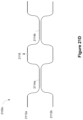
- FIGS. 21 B- 21 D illustrate schematic diagrams of waveguide beam splitters, in accordance with some embodiments.
- FIG. 22 is a block diagram illustrating components of a quantum computer in accordance with some embodiments.
- quantum objects e.g., photons, electrons, atoms, ions, molecules, nanostructures, and the like
- the quantum state of a quantum object is described by a set of physical properties, the complete set of which is referred to as a mode.
- a mode is defined by specifying the value (or distribution of values) of one or more properties of the quantum object.
- modes can be defined by the frequency of the photon, the position in space of the photon (e.g., which waveguide or superposition of waveguides the photon is propagating within), the associated direction of propagation (e.g., the k-vector for a photon in free space), the polarization state of the photon (e.g., the direction (horizontal or vertical) of the photon's electric and/or magnetic fields) and the like.
- the state of the photon is one of a set of discrete spatio-temporal modes.
- the spatial mode k i of the photon is determined according to which one of a finite set of discrete waveguides the photon can be propagating in.
- the temporal mode t j is determined by which one of a set of discrete time periods (referred to herein as “bins”) the photon can be present in.
- the temporal discretization of the system can be provided by the timing of a pulsed laser which is responsible for generating the photons.
- spatial modes will be used primarily to avoid complication of the description.
- any type of mode e.g., temporal modes, polarization modes, and any other mode or set of modes that serves to specify the quantum state.
- embodiments will be described that employ photonic waveguides to define the spatial modes of the photon.
- any type of mode e.g., polarization modes, temporal modes, and the like, can be used without departing from the scope of the present disclosure.
- the quantum state of the entire many-body system is specified by how many particles there are in each mode of the system. Because modes are the complete set of properties, this description is sufficient.
- 1001 1,2,3,4 specifies a two-particle quantum state with one photon in mode 1, zero photons in mode 2, zero photons in mode three, and 1 photon in mode four.
- a mode can be any set of properties of the quantum object (and can depend on the single particle basis states being used to define the quantum state).
- any two modes of the electromagnetic field can be used, e.g., one may design the system to use modes that are related to a degree of freedom that can be manipulated passively with linear optics.
- polarization, spatial degree of freedom, or angular momentum could be used.
- 1001 1,2,3,4 can be physically implemented as four distinct waveguides with two of the four waveguides (representing mode 1 and mode 4, respectively) having one photon travelling within them.
- a state of such a many-body quantum system are the four photon Fock state
- the term “vacuum mode” is used.
- 2200 1,2,3,4 modes 3 and 4 are referred to herein as “vacuum modes” (also referred to as “ancilla modes”).
- a “qubit” (or quantum bit) is a physical quantum system with an associated quantum state that can be used to encode information. Qubits, in contrast to classical bits, can have a state that is a superposition of logical values such as 0 and 1.
- a qubit is “dual-rail encoded” such that the logical value of the qubit is encoded by occupation of one of two modes by exactly one photon (a single photon). For example, consider the two spatial modes of a photonic system associated with two distinct waveguides.
- the logical 0 and 1 values can be encoded as follows:
- 0 L
- 1 L
- 01 L (representing a state of two qubits, the first qubit being in a ‘0’ logical state and the second qubit being in a ‘1’ logical state) may be represented using photon occupations across four distinct waveguides by
- 1001 1,2,3,4 i.e., one photon in a first waveguide, zero photons in a second waveguide, zero photons in a third waveguide, and one photon in a fourth waveguide.
- 1001 1,2,3,4 i.e., one photon in a first waveguide, zero photons in a second waveguide, zero photons in a third waveguide, and one photon in a fourth waveguide.
- the various subscripts are omitted to
- a Bell pair is a pair of qubits in any type of maximally entangled state referred to as a Bell state.
- examples of Bell states include:
- a Greenberger-Horne-Zeilinger state is a quantum superposition of all qubits being in a first state of the two states superposed with all of qubits being in a second state.
- the general M-qubit GHZ state can be written as:
- ⁇ GHZ ⁇ ⁇ 0 ⁇ ⁇ M + ⁇ 1 ⁇ ⁇ M 2 ( 7 )
- FIG. 1 shows a hybrid computing system in accordance with one or more embodiments.
- the hybrid computing system 101 includes a user interface device 103 that is communicatively coupled to a hybrid quantum computing (QC) sub-system 105 , described in more detail below in FIG. 2 .
- the user interface device 103 can be any type of user interface device, e.g., a terminal including a display, keyboard, mouse, touchscreen and the like.
- the user interface device can itself be a computer such as a personal computer (PC), laptop, tablet computer and the like.
- the user interface device 103 provides an interface with which a user can interact with the hybrid QC subsystem 105 .
- the user interface device 103 may run software, such as a text editor, an interactive development environment (IDE), command prompt, graphical user interface, and the like so that the user can program, or otherwise interact with, the QC subsystem to run one or more quantum algorithms.
- the hybrid QC subsystem 105 may be pre-programmed and the user interface device 103 may simply be an interface where a user can initiate a quantum computation, monitor the progress, and receive results from the hybrid QC subsystem 105 .
- Hybrid QC subsystem 105 further includes a classical computing system 107 coupled to one or more quantum computing chips 109 .
- the classical computing system 107 and the quantum computing chips 109 can be coupled to other electronic components 111 , e.g., pulsed pump lasers, microwave oscillators, power supplies, networking hardware, etc.
- the quantum computing chips 109 can be housed within a cryostat, e.g., cryostat 113 .
- the quantum computing chips 109 can include one or more constituent chips, e.g., hybrid control electronics 115 and integrated photonics chip 117 . Signals can be routed on- and off-chip any number of ways, e.g., via optical interconnects 119 and via other electronic interconnects 121 .
- the hybrid computing system 101 may employ a quantum computing process, e.g., measurement-based quantum computing (MBQC), circuit-based quantum computing (CBQC, or any other quantum computing scheme.
- MBQC measurement-based quantum computing
- CBQC circuit-based quantum computing
- FIG. 2 shows a block diagram of a hybrid QC system 201 in accordance with some embodiments.
- a hybrid QC system 201 can be associated with the hybrid computing system 101 introduced above in reference to FIG. 1 .
- solid lines represent quantum information channels and dashed represent classical information channels.
- the hybrid QC system 201 includes a qubit entangling system 203 , qubit readout system 205 , and classical computing system 207 .
- the qubit entangling system 203 takes as input a collection of N physical qubits, e.g., physical qubits 209 (also represented schematically as inputs 211 a , 211 b , 211 c , . . .
- the qubit entangling system 203 can be a linear optical system such as an integrated photonic circuit that includes waveguides, beam splitters, photon detectors, delay lines, and the like.
- the entangled state 215 can be a lattice, cluster, or graph state, or one part of a larger lattice, cluster, or graph state that is created over the course of several clock cycles of the quantum computer.
- the input qubits 209 can be a collection of quantum systems and/or particles and can be formed using any qubit architecture.
- the quantum systems can be particles, such as atoms, ions, and nuclei.
- the quantum systems can be photons.
- the quantum systems can be other engineered quantum systems such as flux qubits, phase qubits, or charge qubits (e.g., formed from a superconducting Josephson junction), topological qubits (e.g., Majorana fermions), or spin qubits formed from vacancy centers (e.g., nitrogen vacancies in diamond).
- the term “qubit” is used herein although the system can also employ quantum information carriers that encode information in a manner that is not necessarily associated with a binary bit.
- qudits can be used, i.e., quantum systems that can encode information in more than two quantum states in accordance with some embodiments.
- the hybrid QC system 201 can be a quantum circuit-based quantum computer or a measurement-based quantum computer.
- a software program e.g., a set of machine-readable instructions
- the classical computing system 207 can be any type of computing device such as a PC, one or more blade servers, and the like, or even a high-performance computing system such as a supercomputer, server farm, and the like.
- Such a system can include one or more processors (not shown) coupled to one or more computer memories, e.g., memory 206 .
- the software program can be received by a classical computing module, referred to herein as a detection pattern generator 213 .
- a detection pattern generator 213 One function of the detection pattern generator 213 is to generate a set of machine-level instructions from the input software program (which may originate as code that can be more easily written by a user to program the quantum computer), i.e., the detection pattern generator 213 can operate as a compiler, logic processor, and/or encoder to allow software programs to be run on the quantum computer.
- Detection pattern generator 213 can be implemented as pure hardware, pure software, or any combination of one or more hardware or software components or modules.
- the compiled machine-level instructions take the form of one or more data frames that instruct the qubit readout circuit to make one or more quantum measurements on the entangled state 215 .
- Measurement pattern 217 e.g., a data frame
- the measurement pattern 217 can include instructions for applying multi-qubit measurements and/or multi-qubit gates, e.g., in the case where a fusion gate is desired to be applied to two or more qubits.
- several measurement patterns 217 can be stored in memory 206 as classical data.
- the measurement patterns 217 can dictate whether or not a detector from the qubit detection array 221 of the qubit readout circuit 205 should make a measurement on a given qubit that makes up the entangled state 215 .
- the measurement pattern 217 can also store which basis (e.g., Pauli X, Y, Z, etc.) the measurement should be made in order to execute the program.
- the measurement pattern 217 can also include a set of gates that should be applied by the qubit entangling circuit to the next set of physical qubits 209 that are to be processed at some future clock cycle of the hybrid QC system 201 .
- a controller circuit 219 of the qubit readout circuit 205 can receive data that encodes the measurement pattern 217 and generate the configuration signals necessary to drive a set of detectors within the qubit detection array 221 .
- the detectors can be any detector that can detect the quantum states of one or more of the qubits in the entangled state 215 .
- the detectors can be single photon detectors that are coupled to one or more waveguides, beam splitters, interferometers, switches, polarizers, polarization rotators and the like.
- One of ordinary skill will appreciate that many types of detectors may be used depending on the particular qubit architecture.
- the result of applying the detection pattern 217 to the qubit detection array is a readout operation that “reads out” the quantum states of the qubits in the entangled state 215 .
- the quantum information stored within the entangled state 215 is converted to classical information that corresponds to a set of eigenvalues that are measured by the detectors, referred to herein as “measurement outcomes.”
- Measurement outcomes can be stored in a measurement outcome data frame, e.g., data frame 222 and passed back to the classical computing system for further processing.
- any of the submodules in the hybrid QC system 201 can include any number of classical computing components such as processors (CPUs, GPUs, TPUs) memory (any form of RAM, ROM), hard coded logic components (classical logic gates such as AND, OR, XOR, etc.) and/or programmable logic components such as field programmable gate arrays (FPGAs and the like).
- processors CPUs, GPUs, TPUs
- memory any form of RAM, ROM
- hard coded logic components classical logic gates such as AND, OR, XOR, etc.
- FPGAs and the like programmable logic components
- These modules can also include any number of application specific integrated circuits (ASICs), microcontrollers (MCUs), systems on a chip (SOCs), and other similar microelectronics.
- ASICs application specific integrated circuits
- MCUs microcontrollers
- SOCs systems on a chip
- the entangled state 215 can be any cluster state described herein.
- Each vertex of the graph corresponds to a physical qubit in the cluster state.
- the physical qubits are initialized in the
- + (
- a controlled-phase gate CZ is applied to the qubits that terminate that edge. Accordingly, any cluster state, which physically corresponds to a large entangled state of physical qubits can be described as
- any cluster state (and the quantum circuit operations to generate the corresponding cluster state) can be graphically represented by a graph that includes vertices that represent physical qubits and edges that represent entanglement between them.
- K G ( a ) X ( a ) ⁇ ⁇ b ⁇ N a ⁇ ⁇ Z ( b )
- a is any qubit in the state and N a is the neighborhood of a, i.e., the set of qubits that are connected to it by an edge.
- X and Z are the Pauli operators.
- the logical qubit measurement outcomes 227 can be fault tolerantly recovered, e.g., via decoder 233 , from the measurement outcomes 222 of the physical qubits.
- the error syndrome generated by the measurement of joint parity measurements are used by the decoder to identify and correct errors so that the correct logical qubit measurement outcome can be determined.
- Logical processor 208 can then process the logical outcomes as part of the running of the program. As shown, the logical processor 208 can feed back information to the detection pattern generator 213 to affect downstream gates and/or measurements to ensure that the computation proceeds fault tolerantly.
- FIG. 3 A is a schematic diagram illustrating a solid representation of an example unit cell in accordance with some embodiments.
- the unit cell shown in FIG. 3 A has a shape of a convex hexahedron (e.g., a cuboid, such as a rectangular cuboid, and in particular, a cube).
- a convex hexahedron e.g., a cuboid, such as a rectangular cuboid, and in particular, a cube.
- the unit cell in FIG. 3 A has six faces (of which three faces 302 - 1 , 302 - 2 , and 302 - 3 are shown in FIG. 3 A ).
- each face of the unit cell has a corresponding qubit (also called herein a face qubit).
- face 302 - 1 corresponds to qubit 304 - 1
- face 302 - 2 corresponds to qubit 304 - 2
- face 302 - 3 corresponds to qubit 304 - 3 .
- the unit cell in FIG. 3 A has twelve edges (of which nine edges are shown in FIG. 3 A ).
- each edge of the unit cell has a corresponding qubit (also called herein an edge qubit).
- each of edge qubits 306 - 1 , 306 - 2 , 306 - 3 , 306 - 4 , 306 - 5 , 306 - 7 , 306 - 8 , 306 - 9 corresponds to a distinct edge.
- FIG. 3 B is a schematic diagram illustrating a wireframe representation of the unit cell shown in FIG. 3 A . Faces and edges and their corresponding qubits, masked by faces 302 - 1 , 302 - 2 , and 302 - 3 in FIG. 3 A , are visible in FIG. 3 B . For example, qubits 304 - 4 , 304 - 5 , and 304 - 6 , which are not shown in FIG. 3 A , are illustrated in FIG. 3 B .
- FIG. 3 C is an example net of the unit cell shown in FIG. 3 A .
- the net shown in FIG. 3 C can be understood as an unfolded representation of the unit cell shown in FIG. 3 A .
- FIG. 3 C illustrates that the net includes six faces 302 - 1 through 302 - 6 and corresponding qubits 304 - 1 through 304 - 6 (e.g., face 302 - 4 corresponds to qubit 304 - 4 , face 302 - 5 corresponds to qubit 304 - 5 , and face 302 - 6 corresponds to qubit 304 - 6 ).
- FIG. 3 C also illustrates that the net includes twelve edges and corresponding qubits 306 - 1 through 306 - 12 .
- Qubit 304 - 1 is entangled with qubits 306 - 1 , 306 - 2 , 306 - 3 , and 306 - 4 .
- Qubit 304 - 2 is entangled with qubits 306 - 5 , 306 - 6 , 306 - 7 , and 306 - 2 .
- Qubit 304 - 3 is entangled with qubits 306 - 7 , 306 - 8 , 306 - 9 , and 306 - 3 .
- Qubit 304 - 4 is entangled with qubits 306 - 10 , 306 - 11 , 306 - 5 , and 306 - 1 .
- Qubit 304 - 5 is entangled with qubits 306 - 10 , 306 - 4 , 306 - 9 , and 306 - 12 .
- Qubit 304 - 6 is entangled with qubits 306 - 11 , 306 - 12 , 306 - 8 , and 306 - 6 .
- FIG. 3 D is a schematic diagram illustrating an example cluster state with a plurality of unit cells in accordance with some embodiments.
- the example cluster state shown in FIG. 3 D includes a contiguous block of unit cells, each unit cell corresponding to the unit cell described with respect to FIGS. 3 A- 3 C .
- the cluster state shown in FIG. 3 D is sometimes called a Raussendorf lattice.
- FIG. 4 A is a schematic diagram illustrating an example unit cell with one face having two qubits in accordance with some embodiments.
- the unit cell shown in FIG. 4 A is similar to the unit cell shown in FIG. 3 B , except that face 302 - 1 corresponds to two qubits (e.g., qubits 304 - 1 and 314 - 1 ). Thus, the unit cell shown in FIG. 4 A has only one face that corresponds to two qubits.
- FIG. 4 B is a schematic diagram illustrating an example unit cell with two faces each having two qubits in accordance with some embodiments.
- the unit cell shown in FIG. 4 B is similar to the unit cell shown in FIG. 4 A , except that face 302 - 2 corresponds to two qubits (e.g., qubits 304 - 2 and 314 - 2 ).
- each of the two faces e.g., faces 302 - 1 and 302 - 2
- FIG. 4 C is a schematic diagram illustrating an example unit cell with three faces each having two qubits in accordance with some embodiments.
- the unit cell shown in FIG. 4 C is similar to the unit cell shown in FIG. 4 B , except that face 302 - 3 corresponds to two qubits (e.g., qubits 304 - 3 and 314 - 3 ).
- each of the three faces e.g., faces 302 - 1 through 302 - 3
- FIG. 4 D is a schematic diagram illustrating an example unit cell with four faces each having two qubits in accordance with some embodiments.
- the unit cell shown in FIG. 4 D is similar to the unit cell shown in FIG. 4 C , except that face 302 - 4 corresponds to two qubits (e.g., qubits 304 - 4 and 314 - 4 ).
- each of the four faces e.g., faces 302 - 1 through 302 - 4
- FIG. 4 E is a schematic diagram illustrating an example unit cell with five faces each having two qubits in accordance with some embodiments.
- the unit cell shown in FIG. 4 E is similar to the unit cell shown in FIG. 4 D , except that face 302 - 5 corresponds to two qubits (e.g., qubits 304 - 5 and 314 - 5 ).
- each of the five faces e.g., faces 302 - 1 through 302 - 5
- FIG. 4 F is a schematic diagram illustrating an example unit cell with six faces each having two qubits in accordance with some embodiments.
- the unit cell shown in FIG. 4 F is similar to the unit cell shown in FIG. 4 E , except that face 302 - 6 corresponds to two qubits (e.g., qubits 304 - 6 and 314 - 6 ).
- each of the six faces e.g., faces 302 - 1 through 302 - 6
- FIG. 4 G is a schematic diagram illustrating an example unit cell with two faces each having two qubits in accordance with some embodiments.
- the unit cell shown in FIG. 4 G is similar to the unit cell shown in FIG. 4 A , except that face 302 - 6 corresponds to two qubits (e.g., qubits 304 - 6 and 314 - 6 ).
- each of two faces e.g., faces 302 - 1 and 302 - 6
- FIG. 4 G is similar to FIG. 4 D , the unit cell shown in FIG. 4 G has two pairs of opposite faces each having a distinct set of two qubits.
- FIG. 4 H is a schematic diagram illustrating an example unit cell with four faces each having two qubits in accordance with some embodiments.
- the unit cell shown in FIG. 4 H is similar to the unit cell shown in FIG. 4 G , except that face 302 - 2 corresponds to two qubits (e.g., qubits 304 - 2 and 314 - 2 ) and face 302 - 5 correspond to two qubits (e.g., qubits 304 - 5 and 314 - 5 ).
- faces 302 - 1 and 302 - 6 with distinct sets of two qubits are positioned opposite to each other and faces 302 - 2 and 302 - 5 with distinct sets of two qubits are positioned opposite to each other.
- FIG. 4 H is similar to FIG. 4 B , in FIG. 4 H , the faces corresponding to respective sets of two qubits are opposite to each other, whereas in FIG. 4 B , the faces corresponding to respective sets of two qubits are adjacent to each other.
- FIG. 5 A is a schematic diagram illustrating an example unit cell with one edge having two qubits in accordance with some embodiments.
- the unit cell shown in FIG. 5 A is similar to the unit cell shown in FIG. 3 B , except that edge 308 - 1 corresponds to two qubits (e.g., qubits 306 - 1 and 316 - 1 ). Thus, the unit cell shown in FIG. 5 A has only one edge that corresponds to two qubits.
- FIG. 5 B is a schematic diagram illustrating an example unit cell with two edges each having two qubits in accordance with some embodiments.
- the unit cell shown in FIG. 5 B is similar to the unit cell shown in FIG. 5 A , except that edge 308 - 2 corresponds to two qubits (e.g., qubits 306 - 2 and 316 - 2 ).
- edge 308 - 2 corresponds to two qubits (e.g., qubits 306 - 2 and 316 - 2 ).
- each of the two edges corresponds to a distinct (and non-overlapping) set of two qubits.
- FIG. 5 C is a schematic diagram illustrating an example unit cell with three edges each having two qubits in accordance with some embodiments.
- the unit cell shown in FIG. 5 C is similar to the unit cell shown in FIG. 5 B , except that edge 308 - 3 corresponds to two qubits (e.g., qubits 306 - 3 and 316 - 3 ).
- edge 308 - 3 corresponds to two qubits (e.g., qubits 306 - 3 and 316 - 3 ).
- each of the three edges corresponds to a distinct (and non-overlapping) set of two qubits.
- FIG. 5 D is a schematic diagram illustrating an example unit cell with four edges each having two qubits in accordance with some embodiments.
- the unit cell shown in FIG. 5 D is similar to the unit cell shown in FIG. 5 C , except that edge 308 - 4 corresponds to two qubits (e.g., qubits 306 - 4 and 316 - 4 ).
- edge 308 - 4 corresponds to two qubits (e.g., qubits 306 - 4 and 316 - 4 ).
- each of the four edges corresponds to a distinct (and non-overlapping) set of two qubits.
- FIG. 5 E is a schematic diagram illustrating an example unit cell with five edges each having two qubits in accordance with some embodiments.
- the unit cell shown in FIG. 5 E is similar to the unit cell shown in FIG. 5 D , except that edge 308 - 5 corresponds to two qubits (e.g., qubits 306 - 5 and 316 - 5 ). Thus, in the unit cell shown in FIG. 5 E , each of the five edges (e.g., edges 308 - 1 through 308 - 5 ) corresponds to a distinct (and non-overlapping) set of two qubits.
- FIG. 5 F is a schematic diagram illustrating an example unit cell with six edges each having two qubits in accordance with some embodiments.
- the unit cell shown in FIG. 5 F is similar to the unit cell shown in FIG. 5 E , except that edge 308 - 6 corresponds to two qubits (e.g., qubits 306 - 6 and 316 - 6 ).
- edge 308 - 6 corresponds to two qubits (e.g., qubits 306 - 6 and 316 - 6 ).
- each of the six edges corresponds to a distinct (and non-overlapping) set of two qubits.
- FIG. 5 G is a schematic diagram illustrating an example unit cell with seven edged having two qubits in accordance with some embodiments.
- the unit cell shown in FIG. 5 G is similar to the unit cell shown in FIG. 5 F , except that edge 308 - 7 corresponds to two qubits (e.g., qubits 306 - 7 and 316 - 7 ).
- edge 308 - 7 corresponds to two qubits (e.g., qubits 306 - 7 and 316 - 7 ).
- each of the seven edges corresponds to a distinct (and non-overlapping) set of two qubits.
- FIG. 5 H is a schematic diagram illustrating an example unit cell with eight edges each having two qubits in accordance with some embodiments.
- the unit cell shown in FIG. 5 H is similar to the unit cell shown in FIG. 5 G , except that edge 308 - 8 corresponds to two qubits (e.g., qubits 306 - 8 and 316 - 8 ).
- edge 308 - 8 corresponds to two qubits (e.g., qubits 306 - 8 and 316 - 8 ).
- each of the eight edges corresponds to a distinct (and non-overlapping) set of two qubits.
- FIG. 5 I is a schematic diagram illustrating an example unit cell with nine edges each having two qubits in accordance with some embodiments.
- the unit cell shown in FIG. 5 I is similar to the unit cell shown in FIG. 5 H , except that edge 308 - 9 corresponds to two qubits (e.g., qubits 306 - 9 and 316 - 9 ).
- edge 308 - 9 corresponds to two qubits (e.g., qubits 306 - 9 and 316 - 9 ).
- each of the nine edges corresponds to a distinct (and non-overlapping) set of two qubits.
- FIG. 5 J is a schematic diagram illustrating an example unit cell with ten edges each having two qubits in accordance with some embodiments.
- the unit cell shown in FIG. 5 J is similar to the unit cell shown in FIG. 5 I , except that edge 308 - 10 corresponds to two qubits (e.g., qubits 306 - 10 and 316 - 10 ). Thus, in the unit cell shown in FIG. 5 J , each of the ten edges (e.g., edges 308 - 1 through 308 - 10 ) corresponds to a distinct (and non-overlapping) set of two qubits.
- FIG. 5 K is a schematic diagram illustrating an example unit cell with eleven edges each having two qubits in accordance with some embodiments.
- the unit cell shown in FIG. 5 K is similar to the unit cell shown in FIG. 5 J , except that edge 308 - 11 corresponds to two qubits (e.g., qubits 306 - 11 and 316 - 11 ).
- edge 308 - 11 corresponds to two qubits (e.g., qubits 306 - 11 and 316 - 11 ).
- each of the eleven edges corresponds to a distinct (and non-overlapping) set of two qubits.
- FIG. 5 L is a schematic diagram illustrating an example unit cell with twelve edges each having two qubits in accordance with some embodiments.
- the unit cell shown in FIG. 5 L is similar to the unit cell shown in FIG. 5 K , except that edge 308 - 12 corresponds to two qubits (e.g., qubits 306 - 12 and 316 - 12 ).
- edge 308 - 12 corresponds to two qubits (e.g., qubits 306 - 12 and 316 - 12 ).
- each of the twelve edges corresponds to a distinct (and non-overlapping) set of two qubits.
- FIG. 5 M is a schematic diagram illustrating an example unit cell with two edges each having two qubits in accordance with some embodiments.
- the unit cell shown in FIG. 5 M is similar to the unit cell shown in FIG. 5 A , except that edge 308 - 8 corresponds to two qubits (e.g., qubits 306 - 8 and 316 - 8 ).
- edge 308 - 8 corresponds to two qubits (e.g., qubits 306 - 8 and 316 - 8 ).
- each of the two edges corresponds to a distinct (and non-overlapping) set of two qubits.
- FIG. 5 N is a schematic diagram illustrating an example unit cell with four edges each having two qubits in accordance with some embodiments.
- the unit cell shown in FIG. 5 N is similar to the unit cell shown in FIG. 5 M , except that edge 308 - 3 corresponds to two qubits (e.g., qubits 306 - 3 and 316 - 3 ) and edge 308 - 11 corresponds to two qubits (e.g., qubits 306 - 11 and 316 - 11 ).
- edge 308 - 3 corresponds to two qubits (e.g., qubits 306 - 3 and 316 - 3 )
- edge 308 - 11 corresponds to two qubits (e.g., qubits 306 - 11 and 316 - 11 ).
- each of the four edges corresponds to a distinct set of two qubits.
- FIG. 5 O is a schematic diagram illustrating an example unit cell with four edges each having two qubits in accordance with some embodiments.
- the unit cell shown in FIG. 5 O is similar to the unit cell shown in FIG. 5 M , except that edge 308 - 5 corresponds to two qubits (e.g., qubits 306 - 5 and 316 - 5 ) and edge 308 - 9 corresponds to two qubits (e.g., qubits 306 - 9 and 316 - 9 ).
- edge 308 - 5 corresponds to two qubits (e.g., qubits 306 - 5 and 316 - 5 )
- edge 308 - 9 corresponds to two qubits (e.g., qubits 306 - 9 and 316 - 9 ).
- each of the four edges corresponds to a distinct set of two qubits.
- FIG. 5 P is a schematic diagram illustrating an example unit cell with each face having two qubits and each edge having two qubits in accordance with some embodiments.
- the first set of qubits on the faces and edges are entangled to form a first cluster state having a unit cell of the Raussendorf lattice, i.e., each face qubit (e.g., face qubit 304 - 3 ) has nearest neighbor entanglement to four edge qubits, one on each edge of that face of the unit cell.
- the second set of qubits forms a second cluster state having second unit cell with a second set of qubits on its faces and edges to form a second unit cell having the geometry of the Raussendorf lattice.
- each face qubit from a respective cluster state is also entangled with all the edge qubits from the other unit cell for the corresponding face, i.e., for the edge qubits associated with the edges that form the face where the face qubit resides.
- face qubit 304 - 3 is entangled with not just the edge qubits from the first cluster state, but also all the edge qubits from the second cluster state, and thus, each face qubit in the modified cluster state is entangled with 8 nearest neighbors.
- a face qubit of the second cluster state (e.g., face qubit 314 - 3 ) is entangled with the first cluster state by entangling the face qubit of the second cluster state with all the nearest neighbors of the corresponding face qubit (i.e., qubit 304 - 3 ) from the first cluster state.
- the modified cluster state as shown has a higher tolerance to errors on the individual physical qubits (such as qubit loss, also referred to as erasure error, and Pauli error), as discussed in further detail below.
- qubit loss also referred to as erasure error, and Pauli error
- FIGS. 8 A- 8 D Some additional examples are shown in FIGS. 8 A- 8 D .
- each face of a unit cell has three or more qubits and each edge of the unit cell has three of more qubits.
- each face of a unit cell has a first number of qubits and each edge of the unit cell has a second number of qubits that is distinct from the first number of qubits.
- each edge has only one qubit and each face has two qubits as shown in FIG. 4 F .
- each face has only one qubit and each edge has two qubits as shown in FIG. 5 L .
- each face has two qubits and each edge has three qubits.
- a first subset of faces of a unit cell has a first number of qubits
- a second subset of the faces of the unit cell has a second number of qubits that is distinct from the first number of qubits
- a first subset of edges of the unit cell has a third number of qubits
- a second subset of edges of the unit cell has a fourth number of qubits that is distinct from the third number of qubits.
- the third number is distinct from the first number and the second number.
- the fourth number is distinct from the first number and the second number.
- the third number is identical to the first number.
- the fourth number is identical to the second number.
- FIG. 5 Q is a schematic diagram illustrating another example unit cell with twelve edges each having two qubits in accordance with some embodiments.
- the unit cell shown in FIG. 5 Q is similar to the unit cell shown in FIG. 5 L , except that two qubits corresponding to a respective edge are located on the respective edge.
- the unit cell shown in FIG. 5 Q is illustrated differently from the unit cell shown in FIG. 5 L , the unit cells shown in FIGS. 8 L and 8 Q are different graphical representations of the same unit cell (having the same entanglements).
- FIG. 5 R is a schematic diagram illustrating an example unit cell that is similar to the unit cell shown in FIG. 5 Q , except that the unit cell shown in FIG. 5 R has a face that corresponds to two qubits 304 - 1 and 314 - 1 .
- Each of qubits 304 - 1 and 314 - 1 is entangled with qubits 306 - 1 , 316 - 1 , 306 - 2 , 316 - 2 , 306 - 3 , 316 - 3 , 306 - 4 , and 316 - 4 .
- a full unit cell of the form shown in FIG. 5 R would have two qubits all faces corresponding to each of the six faces, in which case, the cluster state is the same modified cluster state shown in FIG. 5 P .
- FIG. 6 A is a schematic diagram illustrating an example unit cell with a face (e.g., face 302 - 1 ) having two qubits and an edge (e.g., edge 308 - 8 ) having two qubits in accordance with some embodiments.
- a face e.g., face 302 - 1
- an edge e.g., edge 308 - 8
- FIG. 6 B is a schematic diagram illustrating an example unit cell with a face (e.g., face 302 - 1 ) having three qubits (e.g., qubits 304 - 1 , 314 - 1 , and 324 - 1 ) in accordance with some embodiments.
- a face e.g., face 302 - 1
- three qubits e.g., qubits 304 - 1 , 314 - 1 , and 324 - 1
- each of any subset of the faces is configured to correspond to two or more qubits (e.g., three qubits) and/or each of any subset of the edges is configured to correspond to two or more qubits (e.g., three qubits).
- FIG. 6 C is a schematic diagram illustrating an example cell with a face initially having three qubits, one of which is subsequently lost.
- the cell shown in FIG. 6 C is similar to the unit cell shown in FIG. 6 B , except that the cell shown in FIG. 6 C is missing qubit 304 - 1 .
- the absence of qubit 304 - 1 has no impact on quantum computation based on the example cell (when there are no other errors).
- the presence of qubits 314 - 1 and 324 - 1 reduces the impact of missing qubit 304 - 1 .
- FIG. 6 D is a schematic diagram illustrating another example cell with one or more faces and/or edges without corresponding qubits in accordance with some embodiments.
- the cell shown in FIG. 6 D is similar to the unit cell shown in FIG. 6 B , except that the cell shown in FIG. 6 D has one face that does not have a corresponding qubit (e.g., qubit 304 - 4 shown in FIG. 6 B is not present) and one edge that does not have a corresponding qubit (e.g., qubit 306 - 8 shown in FIG. 6 B is not present).
- absence of one or more qubits is repeated in multiple cells of a cluster state (e.g., each cell of the cluster state has missing qubits at same or corresponding locations).
- absence of one or more qubits differs among cells.
- a first cell has a missing qubit at a first location within the first cell (e.g., the first cell is missing a first face qubit) and a second cell has a missing qubit at a second location that is distinct from (and does not correspond to) the first location within the second cell (e.g., the second cell is missing a third edge qubit instead of the first face qubit).
- the cluster states having the structures described herein have been shown to have a high fault tolerance.
- a cluster state based on any of the unit cells shown in FIGS. 4 A- 7 H, 8 A- 8 P, and 9 A- 9 C has a higher fault tolerance than a cluster state based on the unit cell shown in FIG. 3 B .
- the fault tolerance obtained by using the unit cell shown in FIG. 3 B and the improved fault tolerance obtained by using the unit cell shown in FIG. 5 P are shown in the following table:
- the unit cell shown in FIG. 5 P has more than two times higher fault tolerance for erasure and more than three times higher fault tolerance for Pauli error compared to the unit cell shown in FIG. 3 B . Even when the increased number of bonds is accounted for, the Pauli error threshold per bond is nearly two times higher with the unit cell shown in FIG. 5 P than the unit cell shown in FIG. 3 B .
- presence of one or more additional qubits is repeated in multiple cells of a cluster state (e.g., each cell of the cluster state has one or more additional qubits at same or corresponding locations).
- presence of one or more additional qubits differs among cells.
- a first cell has an additional qubit at a first location within the first cell and a second cell has an additional qubit at a second location that is distinct from (and does not correspond to) the first location within the second cell.
- the first cell has only one qubit at the second location within the first cell.
- the second cell has only one qubit at the first location within the second cell.
- the first cell has two qubits for a first face and the second cell has two qubits for a third edge.
- the first cell has only one qubit for the third edge and only one qubit for the first face.
- the first cell has two qubits for the third edge and only one qubit for the first face.
- FIG. 7 is a schematic diagram illustrating an example cluster state with a plurality of unit cells in accordance with some embodiments.
- the cluster state includes a plurality of contiguous unit cells (e.g., any of the plurality of unit cells has a face that is overlapped by a face of another of the plurality of unit cells).
- respective unit cells of the plurality of contiguous unit cells correspond to the unit cell shown in FIG. 7 F .
- a cluster state includes a plurality of unit cells, each unit cell of the plurality of unit cells corresponding to any unit cell described herein (e.g., any of the unit cells described with respect to FIGS. 7 A- 7 H, 8 A- 8 P, and 6 ).
- FIGS. 8 A- 8 D are schematic diagrams illustrating example unit cells in accordance with some embodiments.
- the unit cell shown in FIG. 8 A has a shape of a pyramid (e.g., a rectangular pyramid, such as a rectangular right pyramid).
- a pyramid e.g., a rectangular pyramid, such as a rectangular right pyramid.
- the unit cell in FIG. 8 A has five faces.
- each face of the unit cell has two corresponding qubits.
- Each face qubit of the unit cell shown in FIG. 8 A is entangled with edge qubits of edges defining (e.g., bordering) the corresponding face.
- the bottom face of the unit cell has two corresponding qubits 804 and 814 .
- Each of qubits 804 and 814 is entangled with qubits 806 - 1 , 806 - 2 , 806 - 3 , and 806 - 4 .
- FIG. 8 A illustrates that each face of the unit cell has two corresponding qubits
- each face of only a subset of the faces of the unit cell has two corresponding qubits.
- only the bottom face of the unit cell may have two (or more) corresponding qubits.
- only a side face of the unit cell may have two (or more) corresponding qubits.
- the unit cell shown in FIG. 8 B has a shape of a tetrahedron.
- the unit cell shown in FIG. 8 B has four faces.
- at least one face of the unit cell has two corresponding face qubits 824 and 834 .
- Each face qubit of the two face qubits 824 and 834 shown in FIG. 8 B is entangled with edge qubits 826 - 1 , 826 - 2 , and 826 - 3 of edges defining (e.g., bordering) the corresponding face.
- FIG. 8 B illustrates that only one face of the unit cell has two corresponding qubits, in some implementations, any of the faces of the unit cell has two corresponding qubits.
- FIGS. 8 C and 8 D illustrate additional example unit cells. Some of the unit cells shown in FIGS. 8 C and 8 D have hexagonal faces and/or octagonal faces. In some embodiments, a unit cell has a shape of a truncated polyhedron (e.g., a truncated octahedron).
- each of any subset of the faces (of the cells shown in FIGS. 8 A- 8 D ) is configured to correspond to two or more qubits (e.g., three qubits) and/or each of any subset of the edges (of the cells shown in FIGS. 8 A- 8 D ) is configured to correspond to two or more qubits (e.g., three qubits).
- FIGS. 3 A- 3 D, 7 A- 7 H, 8 A- 8 P, 6 A- 6 C, 7 , and 8 A- 8 D illustrate cluster states in particular graphical representations
- a person having ordinary skill in the art would understand that the same cluster states may be illustrated in other graphical representations.
- These graphical representations have been selected to illustrate the entanglements among a plurality of qubits.
- these graphical representations do not necessarily indicate physical locations of the represented plurality of qubits.
- equivalents and analogs e.g., physical and/or geometrical equivalents
- each qubit of the cluster states may have any qubit state.
- one or more qubits of any cluster state are further processed (e.g., using one or more gates for quantum operations, such as rotations) subsequent to formation of the cluster state while the other qubits of the cluster state are not processed in a same manner (e.g., the other qubits are not put through the one or more gates for the same quantum operations).
- one or more qubits are processed (e.g., using one or more gates for quantum operations, such as rotations) prior to formation of a cluster state while the other qubits to be included in the cluster state are not processed in a same manner (e.g., the other qubits are not put through the one or more gates for the same quantum operations).
- qubits in one or more cluster states are used in a quantum memory device. Due to the multiple entanglements among the qubits, such cluster states can maintain quantum information in case of an erasure (e.g., a loss of a qubit or a loss of qubit information for a particular qubit) or a Pauli error (e.g., a measurement error).
- a cluster state having a high fault tolerance e.g., cluster states illustrated in FIGS.
- FIG. 9 is a flowchart representing method 900 of obtaining a plurality of entangled qubits in accordance with some embodiments.
- Method 900 is performed using a quantum entanglement generator (e.g., quantum entanglement generator 372 ).
- a quantum entanglement generator e.g., quantum entanglement generator 372 .
- Method 900 includes obtaining ( 910 ) a plurality of entangled qubits represented by a lattice structure (e.g., FIG. 7 ).
- the lattice structure includes a plurality of contiguous lattice cells (e.g., a plurality of contiguous unit cells, such as unit cells shown in FIGS. 7 A- 7 H, 8 A- 8 P, and 9 ).
- a respective edge of a respective lattice cell corresponds to one or more qubits of the plurality of entangled qubits.
- each edge of the unit cell corresponds to at least one qubit.
- one or more edges do not have corresponding qubits.
- every edge has at least one corresponding qubit.
- a respective face of the respective lattice cell corresponds to one or more qubits of the plurality of entangled qubits.
- each face of the unit cell corresponds to at least one qubit.
- one or more faces do not have corresponding qubits.
- every face has at least one corresponding qubit.
- Each qubit of the one or more qubits that correspond to the respective face of the respective lattice cell is entangled with respective qubits that correspond to respective edges of the respective lattice cell that are adjacent to the respective face of the respective lattice cell.
- each face qubit is entangled with adjacent edge qubits (e.g., face qubit 304 - 1 corresponding to face 302 - 1 is entangled with qubits 306 - 1 , 306 - 2 , 306 - 3 , and 306 - 4 that correspond to edges that at least partially or fully border face 302 - 1 ).
- face qubit 304 - 1 corresponding to face 302 - 1
- qubits 306 - 1 , 306 - 2 , 306 - 3 , and 306 - 4 that correspond to edges that at least partially or fully border face 302 - 1 ).
- face qubit 304 - 1 is entangled with edge qubits 306 - 1 , 306 - 2 , 306 - 3 , and 306 - 4
- face qubit 314 - 1 is also entangled with edge qubits 306 - 1 , 306 - 2 , 306 - 3 , and 306 - 4
- face qubit 314 - 1 is not directly entangled with face qubit 304 - 1 .
- At least a first face of the respective lattice cell corresponds to two or more qubits of the plurality of entangled qubits (e.g., face 302 - 1 in FIG. 4 A corresponds to two face qubits 304 - 1 and 314 - 1 ).
- Each qubit of the two or more qubits that correspond to the first face of the respective lattice cell is entangled with respective qubits that correspond to respective edges of the respective lattice cell that are adjacent to the first face of the respective lattice cell (e.g., face qubit 304 - 1 is entangled with edge qubits 306 - 1 , 306 - 2 , 306 - 3 , and 306 - 4 , and face qubit 314 - 1 is also entangled with edge qubits 306 - 1 , 306 - 2 , 306 - 3 , and 306 - 4 ).
- face qubit 304 - 1 is entangled with edge qubits 306 - 1 , 306 - 2 , 306 - 3 , and 306 - 4
- face qubit 314 - 1 is also entangled with edge qubits 306 - 1 , 306 - 2 , 306 - 3 , and 306 -
- At least a first edge of the respective lattice cell corresponds to two or more qubits of the plurality of entangled qubits (e.g., edge 308 - 1 in FIG. 5 A corresponds to two edge qubits 306 - 1 and 316 - 1 ).
- Each qubit of the two or more qubits that correspond to the first edge of the respective lattice cell is entangled with respective qubits that correspond to respective faces of the respective lattice cell that are adjacent to the first edge of the respective lattice cell (e.g., edge qubit 306 - 1 is entangled with face qubits 304 - 1 and 304 - 4 that correspond to faces 302 - 1 and 302 - 4 , which are at least partially bordered by edge 308 - 1 ).
- At least the first face of the respective lattice cell corresponds to two or more qubits of the plurality of entangled qubits while no edge of the respective lattice cell corresponds to two or more qubits of the plurality of entangled qubits (e.g., FIG. 4 A ). In some embodiments, at least the first edge of the respective lattice cell corresponds to two or more qubits of the plurality of entangled qubits while no face of the respective lattice cell corresponds to two or more qubits of the plurality of entangled qubits (e.g., FIG. 5 A ).
- At least the first face of the respective lattice cell corresponds to two or more qubits of the plurality of entangled qubits and at least the first edge of the respective lattice cell corresponds to two or more qubits of the plurality of entangled qubits (e.g., FIG. 6 A ).
- the first face of the respective lattice cell corresponds to two or more qubits, of the plurality of entangled qubits, including a first qubit and a second qubit that is distinct from the first qubit (e.g., qubits 304 - 1 and 314 - 1 in FIG. 4 A ).
- the first qubit is not directly entangled with the second qubit.
- the first face is a rectangular face defined by four edges of the respective lattice cell (e.g., face 302 - 1 in FIG. 4 A is a rectangular face defined by four adjacent edges).
- the first face is a triangular face defined by three edges of the respective lattice cell (e.g., a triangular face shown in FIG. 8 B ).
- a second face of the respective lattice cell corresponds to two or more qubits of the plurality of entangled qubits (e.g., face 302 - 2 in FIG. 4 B corresponds to qubits 304 - 2 and 314 - 2 ).
- Each qubit of the two or more qubits that correspond to the second face of the respective lattice cell is entangled with respective qubits that correspond to respective edges of the respective lattice cell that are adjacent to the second face of the respective lattice cell.
- the second face is a rectangular face defined by four edges of the respective lattice cell (e.g., face 302 - 2 in FIG. 4 B is a rectangular face).
- the second face is a triangular face defined by three edges of the respective lattice cell (e.g., in some cases, the first face is a rectangular face and the second face is a triangular face as shown in FIG. 8 A , and in some cases, the first face and the second face are both triangular faces as shown in FIG. 8 B ).
- a third face of the respective lattice cell corresponds to two or more qubits of the plurality of entangled qubits (e.g., face 302 - 3 in FIG. 4 C corresponds to qubits 304 - 3 and 314 - 3 ).
- face 302 - 3 in FIG. 4 C corresponds to qubits 304 - 3 and 314 - 3 ).
- Each qubit of the two or more qubits that correspond to the third face of the respective lattice cell is entangled with respective qubits that correspond to respective edges of the respective lattice cell that are adjacent to the third face of the respective lattice cell.
- the third face is a rectangular face defined by four edges of the respective lattice cell.
- the third face is a triangular face defined by three edges of the respective lattice cell.
- a fourth face of the respective lattice cell corresponds to two or more qubits of the plurality of entangled qubits (e.g., face 302 - 4 in FIG. 4 D corresponds to qubits 304 - 4 and 314 - 4 ).
- Each qubit of the two or more qubits that correspond to the fourth face of the respective lattice cell is entangled with respective qubits that correspond to respective edges of the respective lattice cell that are adjacent to the fourth face of the respective lattice cell.
- the fourth face is a rectangular face defined by four edges of the respective lattice cell.
- the fourth face is a triangular face defined by three edges of the respective lattice cell.
- a fifth face of the respective lattice cell corresponds to two or more qubits of the plurality of entangled qubits (e.g., face 302 - 5 in FIG. 4 E corresponds to qubits 304 - 5 and 314 - 5 ).
- face 302 - 5 in FIG. 4 E corresponds to qubits 304 - 5 and 314 - 5 .
- Each qubit of the two or more qubits that correspond to the fifth face of the respective lattice cell is entangled with respective qubits that correspond to respective edges of the respective lattice cell that are adjacent to the fifth face of the respective lattice cell.
- the fifth face is a rectangular face defined by four edges of the respective lattice cell.
- a sixth face of the respective lattice cell corresponds to two or more qubits of the plurality of entangled qubits (e.g., face 302 - 6 in FIG. 4 F corresponds to qubits 304 - 6 and 314 - 6 ).
- face 302 - 6 in FIG. 4 F corresponds to qubits 304 - 6 and 314 - 6 .
- Each qubit of the two or more qubits that correspond to the sixth face of the respective lattice cell is entangled with respective qubits that correspond to respective edges of the respective lattice cell that are adjacent to the sixth face of the respective lattice cell.
- the first edge of the respective lattice cell corresponds to two or more qubits, of the plurality of entangled qubits, including a third qubit and a fourth qubit that is distinct from the third qubit (e.g., edge 308 - 1 in FIG. 5 A corresponds to qubits 306 - 1 and 316 - 1 ).
- the third qubit is not directly entangled with the fourth qubit.
- a second edge of the respective lattice cell that is distinct from the first edge of the respective lattice cell, corresponds to two or more qubits of the plurality of entangled qubits (e.g., edge 308 - 2 in FIG. 5 B corresponds to qubits 306 - 2 and 316 - 2 ).
- Each qubit of the two or more qubits that correspond to the second edge of the respective lattice cell is entangled with respective qubits that correspond to respective faces of the respective lattice cell that are adjacent to the second edge of the respective lattice cell (e.g., edge qubit 306 - 2 is entangled with face qubits 304 - 1 and 304 - 2 and edge qubit 316 - 2 is also entangled with face qubits 304 - 1 and 304 - 2 ).
- a third edge of the respective lattice cell corresponds to two or more qubits of the plurality of entangled qubits (e.g., edge 308 - 3 in FIG. 5 C corresponds to qubits 306 - 3 and 316 - 3 ).
- edge 308 - 3 in FIG. 5 C corresponds to qubits 306 - 3 and 316 - 3 ).
- Each qubit of the two or more qubits that correspond to the third edge of the respective lattice cell is entangled with respective qubits that correspond to respective faces of the respective lattice cell that are adjacent to the third edge of the respective lattice cell.
- a fourth edge of the respective lattice cell that is distinct from the first edge, the second edge, and the third edge of the respective lattice cell, corresponds to two or more qubits of the plurality of entangled qubits (e.g., edge 308 - 4 in FIG. 5 D corresponds to qubits 306 - 4 and 316 - 4 ).
- Each qubit of the two or more qubits that correspond to the fourth edge of the respective lattice cell is entangled with respective qubits that correspond to respective faces of the respective lattice cell that are adjacent to the fourth edge of the respective lattice cell.
- a fifth edge of the respective lattice cell that is distinct from the first edge, the second edge, the third edge, and the fourth edge of the respective lattice cell, corresponds to two or more qubits of the plurality of entangled qubits (e.g., edge 308 - 5 in FIG. 5 E corresponds to qubits 306 - 5 and 316 - 5 ).
- Each qubit of the two or more qubits that correspond to the fifth edge of the respective lattice cell is entangled with respective qubits that correspond to respective faces of the respective lattice cell that are adjacent to the fifth edge of the respective lattice cell.
- a sixth edge of the respective lattice cell that is distinct from the first edge, the second edge, the third edge, the fourth edge, and the fifth edge of the respective lattice cell, corresponds to two or more qubits of the plurality of entangled qubits.
- Each qubit of the two or more qubits that correspond to the sixth edge of the respective lattice cell is entangled with respective qubits that correspond to respective faces of the respective lattice cell that are adjacent to the sixth edge of the respective lattice cell.
- a seventh edge of the respective lattice cell that is distinct from the first edge, the second edge, the third edge, the fourth edge, the fifth edge, and the sixth edge of the respective lattice cell, corresponds to two or more qubits of the plurality of entangled qubits.
- Each qubit of the two or more qubits that correspond to the seventh edge of the respective lattice cell is entangled with respective qubits that correspond to respective faces of the respective lattice cell that are adjacent to the seventh edge of the respective lattice cell.
- an eighth edge of the respective lattice cell that is distinct from the first edge, the second edge, the third edge, the fourth edge, the fifth edge, the sixth edge, and the seventh edge of the respective lattice cell, corresponds to two or more qubits of the plurality of entangled qubits.
- Each qubit of the two or more qubits that correspond to the eighth edge of the respective lattice cell is entangled with respective qubits that correspond to respective faces of the respective lattice cell that are adjacent to the eighth edge of the respective lattice cell.
- a ninth edge of the respective lattice cell that is distinct from the first edge, the second edge, the third edge, the fourth edge, the fifth edge, the sixth edge, the seventh edge, and the eighth edge of the respective lattice cell, corresponds to two or more qubits of the plurality of entangled qubits.
- Each qubit of the two or more qubits that correspond to the ninth edge of the respective lattice cell is entangled with respective qubits that correspond to respective faces of the respective lattice cell that are adjacent to the ninth edge of the respective lattice cell.
- a tenth edge of the respective lattice cell that is distinct from the first edge, the second edge, the third edge, the fourth edge, the fifth edge, the sixth edge, the seventh edge, the eighth edge, and the ninth edge of the respective lattice cell, corresponds to two or more qubits of the plurality of entangled qubits.
- Each qubit of the two or more qubits that correspond to the tenth edge of the respective lattice cell is entangled with respective qubits that correspond to respective faces of the respective lattice cell that are adjacent to the tenth edge of the respective lattice cell.
- an eleventh edge of the respective lattice cell that is distinct from the first edge, the second edge, the third edge, the fourth edge, the fifth edge, the sixth edge, the seventh edge, the eighth edge, the ninth edge, and the tenth edge of the respective lattice cell, corresponds to two or more qubits of the plurality of entangled qubits.
- Each qubit of the two or more qubits that correspond to the eleventh edge of the respective lattice cell is entangled with respective qubits that correspond to respective faces of the respective lattice cell that are adjacent to the eleventh edge of the respective lattice cell.
- a twelfth edge of the respective lattice cell that is distinct from the first edge, the second edge, the third edge, the fourth edge, the fifth edge, the sixth edge, the seventh edge, the eighth edge, the ninth edge, the tenth edge, and the eleventh edge of the respective lattice cell, corresponds to two or more qubits of the plurality of entangled qubits.
- Each qubit of the two or more qubits that correspond to the twelfth edge of the respective lattice cell is entangled with respective qubits that correspond to respective faces of the respective lattice cell that are adjacent to the twelfth edge of the respective lattice cell.
- obtaining the plurality of entangled qubits includes ( 920 ) fusing (i) at least one qubit of a first set of multiple entangled qubits (e.g., qubits 531 , 533 , 535 , 537 , and 539 in FIG. 14 D ) and (ii) at least one qubit of a second set of multiple entangled qubits (e.g., qubits 541 , 543 , 545 , 547 , and 549 in FIG. 14 D ).
- the second set of multiple entangled qubits is mutually exclusive from the first set of multiple entangled qubits.
- the first set of multiple entangled qubits includes three or more qubits (e.g., qubits 531 , 533 , 535 , 537 , and 539 in FIG. 14 D ); and the second set of multiple entangled qubits includes two or more qubits (e.g., qubits 541 , 543 , 545 , 547 , and 549 in FIG. 14 D ).
- obtaining the plurality of entangled qubits includes ( 930 ): receiving a first set of entangled qubits, including a first center qubit entangled with three or more peripheral qubits; receiving a second set of entangled qubits, including a second center qubits entangled with three or more peripheral qubits, the second set of entangled qubits is mutually exclusive to the first set of entangled qubits; and fusing each peripheral qubit of the first set of entangled qubits with a respective peripheral qubit of the second set of entangled qubits (e.g., FIG. 14 D ).
- obtaining the plurality of entangled qubits includes receiving a first set of entangled qubits, receiving a second set of entangled qubits, and causing entanglement of at least a subset of the first set of entangled qubits and at least a subset of the second set of entangled qubits (e.g., by placing two matter particles, such as ions, in proximity of each other).
- the method includes performing measurements on at least a subset of the plurality of entangled qubits (e.g., measurements in X-basis).
- the method includes providing results of the measurements from a quantum computer to one or more classical computers (e.g., a conventional computer having semiconductor-based processor(s)).
- classical computers e.g., a conventional computer having semiconductor-based processor(s)
- FIG. 10 is a flowchart representing method 1000 of obtaining a plurality of entangled qubits in accordance with some embodiments.
- Method 1000 is performed using a quantum entanglement generator (e.g., quantum entanglement generator 372 ).
- a quantum entanglement generator e.g., quantum entanglement generator 372 .
- Method 1000 includes obtaining ( 1010 ) a plurality of entangled qubits, including a first qubit entangled with second, third, fourth, and fifth qubits (e.g., qubit 304 - 1 shown in FIG. 4 A is entangled with qubits 306 - 1 , 306 - 2 , 306 - 3 , and 306 - 4 ).
- a first qubit entangled with second, third, fourth, and fifth qubits e.g., qubit 304 - 1 shown in FIG. 4 A is entangled with qubits 306 - 1 , 306 - 2 , 306 - 3 , and 306 - 4 ).
- the plurality of qubits also includes one or more of: a sixth qubit entangled with the fifth qubit; an seventh qubit entangled with the second qubit; an eighth qubit entangled with the third qubit; a ninth qubit entangled with the fourth qubit; an tenth qubit entangled with at least one of the sixth qubit and the seventh qubit; an eleventh qubit entangled with at least one of the seventh qubit and the eighth qubit; a twelfth qubit entangled with at least one of the eighth qubit and the ninth qubit; a thirteenth qubit entangled with at least one of the sixth qubit and the ninth qubit; a fourteenth qubit entangled with the sixth qubit; a fifteenth qubit entangled with the seventh qubit; a sixteenth qubit entangled with the eighth qubit; an seventeenth qubit entangled with the ninth qubit; and an eighteenth qubit entangled with at least one of the fourteenth qubit, the fifteenth qubit, the
- the plurality of qubits further includes a nineteenth qubit entangled with the second, third, fourth, and fifth qubits (e.g., qubit 314 - 1 shown in FIG. 4 A is entangled with qubits 306 - 1 , 306 - 2 , 306 - 3 , and 306 - 4 ).
- the nineteenth qubit is different from the first qubit.
- the sixth qubit is not entangled with the second, third, and fourth qubits.
- the seventh qubit is not entangled with the third, fourth, and fifth qubits.
- the eight qubit is not entangled with second, fourth, and fifth qubits.
- the ninth qubit is not entangled with the second, third, and fifth qubits.
- the method includes ( 1020 ) one or more of: entangling the first qubit with the second qubit; entangling the first qubit with the third qubit; entangling the first qubit with the fourth qubit; entangling the first qubit with the fifth qubit; entangling the sixth qubit with the fifth qubit; entangling the seventh qubit with the second qubit; entangling the eighth qubit with the third qubit; entangling the ninth qubit with the fourth qubit; entangling the tenth qubit with the sixth qubit; entangling the tenth qubit with the seventh qubit; entangling the eleventh qubit with the seventh qubit; entangling the eleventh qubit with the eighth qubit; entangling the twelfth qubit with the eighth qubit; entangling the twelfth qubit with the ninth qubit; entangling the thirteenth qubit with the sixth qubit; entangling the thirteenth qubit with the ninth qubit;
- the method includes obtaining a first sets of entangled qubits and a second set of entangled qubits and fusing a subset of the first set of entangled qubits and a subset of the second set of entangled qubits as shown in FIG. 14 F .
- the method includes entangling each qubit of the plurality of entangled qubits one by one.
- the method includes two or more (e.g., three or more, four or more, five or more, six or more, seven or more, eight or more, nine or more, ten or more, etc.) of: entangling the first qubit with the second qubit; entangling the first qubit with the third qubit; entangling the first qubit with the fourth qubit; entangling the first qubit with the fifth qubit; entangling the sixth qubit with the fifth qubit; entangling the seventh qubit with the second qubit; entangling the eighth qubit with the third qubit; entangling the ninth qubit with the fourth qubit; entangling the tenth qubit with the sixth qubit; entangling the tenth qubit with the seventh qubit; entangling the eleventh qubit with the seventh qubit; entangling the eleventh qubit with the eighth qubit; entangling the twelfth qubit with the eighth qubit; entangling the twel
- the method includes entangling the first qubit with the second qubit; entangling the first qubit with the third qubit; entangling the first qubit with the fourth qubit; entangling the first qubit with the fifth qubit; entangling the sixth qubit with the fifth qubit; entangling the seventh qubit with the second qubit; entangling the eighth qubit with the third qubit; entangling the ninth qubit with the fourth qubit; entangling the tenth qubit with the sixth qubit; entangling the tenth qubit with the seventh qubit; entangling the eleventh qubit with the seventh qubit; entangling the eleventh qubit with the eighth qubit; entangling the twelfth qubit with the eighth qubit; entangling the twelfth qubit with the ninth qubit; entangling the thirteenth qubit with the sixth qubit; entangling the thirteenth qubit with the ninth qubit; entangling the fourteenth
- entangling two qubits includes ( 1030 ) performing a Bell state measurement on a first ancillary qubit entangled with one qubit of the two qubits and a second ancillary qubit entangled with the other qubit of the two qubits (e.g., performing a Bell state measurement on qubits 405 and 407 as shown in FIG. 21 A , where qubit 405 is entangled with qubit 403 and qubit 407 is entangled with qubit 409 ).
- a method includes obtaining a plurality of qubits, including a first qubit entangled with at least second, third, and fourth qubits (e.g., in FIG. 8 B , qubit 824 is entangled with qubits 826 - 1 , 826 - 2 , and 826 - 3 ).
- the plurality of qubits further includes a fifth qubit entangled with at least the second, third, and fourth qubits (e.g., in FIG.
- qubit 834 is entangled with qubits 826 - 1 , 826 - 2 , and 826 - 3 ).
- the plurality of qubits also includes one or more of: a sixth qubit entangled with the second qubit; a seventh qubit entangled with the third qubit; an eighth qubit entangled with the fourth qubit; a ninth qubit entangled with the sixth qubit and the seventh qubit; a tenth qubit entangled with the seventh qubit and the eighth qubit; and an eleventh qubit entangled with the eighth qubit and the sixth qubit.
- the ninth qubit is not entangled with the eighth qubit.
- the tenth qubit is not entangled with the sixth qubit.
- the eleventh qubit is not entangled with the seventh qubit.
- FIG. 11 is a flowchart representing method 1100 of obtaining a plurality of entangled qubits in accordance with some embodiments.
- Method 1100 is performed using a quantum entanglement generator (e.g., quantum entanglement generator 372 ).
- a quantum entanglement generator e.g., quantum entanglement generator 372 .
- Method 1100 includes obtaining ( 1110 ) a plurality of qubits, including a first qubit entangled with second and third qubits (e.g., qubit 306 - 1 entangled with qubits 304 - 1 and 304 - 4 as shown in FIG. 5 A ).
- the plurality of qubits also includes a fourth qubit entangled with the second and third qubits (e.g., qubit 316 - 1 entangled with qubits 304 - 1 and 304 - 4 as shown in FIG. 5 A ).
- the fourth qubit is different from the first qubit.
- the plurality of qubits further includes one or more of: a fifth qubit entangled with the second qubit; a sixth qubit entangled with the third qubit; a seventh qubit entangled with the fifth qubit and the sixth qubit; an eighth qubit entangled with the second qubit; a ninth qubit entangled with the third qubit; a tenth qubit entangled with the ninth qubit; an eleventh qubit entangled with the second qubit; a twelfth qubit entangled with the third qubit; a thirteenth qubit entangled with the eleventh qubit; a fourteenth qubit entangled with the thirteenth qubit and the tenth qubit; a fifteenth qubit entangled with the seventh qubit and the thirteenth qubit; a sixteenth qubit entangled with the twelfth qubit; a seventeenth qubit entangled with the tenth qubit and the sixteenth qubit; an eighteenth qubit entangled with the seventh qubit and
- the method includes ( 1120 ) one or more of: entangling the first qubit with the second qubit; entangling the first qubit with the third qubit; entangling the fourth qubit with the second qubit; entangling the fourth qubit with the third qubits; entangling the fifth qubit with the second qubit; entangling the sixth qubit with the third qubit; entangling the seventh qubit with the fifth qubit; entangling the seventh qubit with the sixth qubit; entangling the eighth qubit with the second qubit; entangling the ninth qubit with the third qubit; entangling the tenth qubit with the ninth qubit; entangling the eleventh qubit with the second qubit; entangling the twelfth qubit with the third qubit; entangling the thirteenth qubit with the eleventh qubit; entangling the fourteenth qubit with the thirteenth qubit; entangling the fourteenth qubit with the tenth qubit with the
- entangling two qubits includes ( 1130 ) performing a Bell state measurement on a first ancillary qubit entangled with one qubit of the two qubits and a second ancillary qubit entangled with the other qubit of the two qubits.
- method 1100 shown in FIG. 11 or method 1000 shown in FIG. 10 can apply to method 1200 shown in FIG. 12 in an analogous manner. For brevity, these details are not repeated herein.
- FIG. 12 is a flowchart representing method 1200 of obtaining a plurality of entangled qubits in accordance with some embodiments.
- Method 1200 is performed using a quantum entanglement generator (e.g., quantum entanglement generator 372 ).
- a quantum entanglement generator e.g., quantum entanglement generator 372 .
- Method 1200 includes ( 1210 ) obtaining a first set of multiple entangled qubits (e.g., five entangled qubits shown in FIG. 14 F ) and ( 1220 ) obtaining a second set of multiple entangled qubits (e.g., eighteen entangled qubits shown in FIG. 14 F ).
- the second set of multiple entangled qubits is mutually exclusive from the first set of multiple entangled qubits.
- Method 1200 also includes ( 1230 ) fusing (i) at least one qubit of the first set of multiple entangled qubits and (ii) at least one qubit of the second set of multiple entangled qubits, thereby obtaining a plurality of entangled qubits represented by a lattice structure, the lattice structure including a plurality of contiguous lattice cells (e.g., the fused cluster of entangled qubits as shown in FIG. 14 F ).
- a respective edge of a respective lattice cell corresponds to one or more qubits of the plurality of entangled qubits.
- a respective face of the respective lattice cell corresponds to one or more qubits of the plurality of entangled qubits.
- Each qubit of the one or more qubits that correspond to the respective face of the respective lattice cell is entangled with respective qubits that correspond to respective edges of the respective lattice cell that are adjacent to the respective face of the
- At least a first face of the respective lattice cell corresponds ( 1240 ) to two or more qubits of the plurality of entangled qubits, each qubit of the two or more qubits that correspond to the first face of the respective lattice cell being entangled with respective qubits that correspond to respective edges of the respective lattice cell that are adjacent to the first face of the respective lattice cell.
- At least a first edge of the respective lattice cell corresponds ( 1250 ) to two or more qubits of the plurality of entangled qubits, each qubit of the two or more qubits that correspond to the first edge of the respective lattice cell being entangled with respective qubits that correspond to respective faces of the respective lattice cell that are adjacent to the first edge of the respective lattice cell.
- method 1200 shown in FIG. 12 can apply to method 1200 shown in FIG. 12 in an analogous manner.
- method 1000 shown in FIG. 10 can apply to method 1200 shown in FIG. 12 in an analogous manner.
- FIGS. 13 A- 13 G illustrate a circuit-based quantum computing approach for employing the modified clusters states described herein and used as error correcting codes, e.g., as stabilizer states that can be used for quantum error correction on a logical qubit that is formed from a cluster state of several physical data qubits.
- the circuit-based approach disclosed herein can be useful for a quantum computing system that employs matter-based qubits.
- the qubits can be particles, such as atoms, ions, and nuclei.
- the qubits can be photons.
- the quantum systems can be other engineered quantum systems such as flux qubits, phase qubits, or charge qubits (e.g., formed from a superconducting Josephson junction), topological qubits (e.g., Majorana fermions), or spin qubits formed from vacancy centers (e.g., nitrogen vacancies in diamond).
- flux qubits phase qubits
- charge qubits e.g., formed from a superconducting Josephson junction
- topological qubits e.g., Majorana fermions
- spin qubits formed from vacancy centers e.g., nitrogen vacancies in diamond.
- FIG. 13 A shows an illustration of the sequence of quantum gates and qubit measurements that can be applied to employ one version of the modified cluster state disclosed herein.
- the system is operating as a quantum memory that fault tolerantly preserves the quantum state of a logical qubit that is encoded by the data qubits of the cluster state.
- the diagrams shown in FIGS. 13 A- 13 G show a method of operating a quantum circuit to repeatedly produce temporal slices of one unit cell of the modified cluster state shown in FIG. 5 P and how to conduct the associated stabilizer measurements used for quantum error correction.
- first block 1312 generates a first temporal slice of the modified unit cell (e.g., A and A′ correspond to qubits 314 - 3 and 304 - 3 shown in FIG. 5 P ).
- Measurement of the ancilla A and A′ in the X basis then performs the first joint parity check on the data qubits 1-4′.
- the outcomes of the parity check measurement (which are classical bits) are stored in a classical memory, like that shown in FIG. 2 above, to generate the error syndrome for later error correction by the decoder.
- data qubits 1-4′ could be only a fraction of the total number of data qubits used to encode the quantum information of the logical qubit that is being protected by the modified cluster state if a cluster state of multiple unit cells is used (analogous to the multi-cell lattice shown in FIG. 7 ).
- the quantum information stored in data qubits 1-4′ is teleported to corresponding data qubits 5-8′ where the teleportation is an encoded entangling operation followed by single qubit measurements. This teleportation step is not required but can be beneficial for qubits that tend to leak out of the computation basis over time due to noise.
- the next layer of the modified cluster state is then generated in 316 and a set of 4 joint parity checks are then measured, with the results also stored for later use in the error syndrome for error correction.
- the quantum state of data qubits 5-8′ is teleported back to data qubits 1-4′, via the encoded teleportation operation and single qubit measurements, and the sequence repeats.
- errors in the data qubits or errors in the ancilla qubits can be accounted for or corrected as a quantum computation that involves the logical qubit proceeds.
- this process can serve to simply preserve the quantum information stored on the logical qubit over time, thereby making the system a form of cluster state protected quantum memory.
- Icon 1302 represents measurement in the x basis
- icon 1304 represents a CZ gate operation over two qubits, which leads to entanglement of the two qubits.
- FIG. 13 A The operations shown in FIG. 13 A are grouped into groups 1312 , 1314 , 1316 , and 1318 , which are described in detail with respect to FIGS. 13 C- 13 F .
- FIG. 13 B illustrates a combination of the qubit entangling system 203 (described with respect to FIG. 2 ) and the qubit readout system 205 (described with respect to FIG. 2 ).
- the system includes a substrate 1320 on which a collection of matter-based qubits is arranged in a manner that facilitates the use of the modified cluster state disclosed herein for fault tolerant quantum computation.
- the qubit entangling system 203 and the qubit readout system 205 can be integrated together as a single quantum chip.
- the qubit entangling system 203 and the qubit readout system 205 are distinct and separate from each other, e.g., they can be distinct dies that are linked via optical and or electrical interconnects.
- FIG. 13 B also illustrates an example configuration of the qubits on the substrate 1320 .
- the qubits may be arranged in many other configurations, which are omitted herein for brevity.
- FIG. 13 C illustrates group 1312 of operations that includes obtaining eight qubits, namely data qubits 1, 1′, 2, 2′, 3, 3′, 4, and 4′, and two ancilla qubits A and A′.
- the ancilla are initialized to the
- CZ gates are then applied between each ancilla and every data qubit ( 1320 -B) to entangle each of the qubits 1, 1′, 2, 2′, 3, 3′, 4, and 4′ with qubits A and A′.
- the two ancilla A and A′ are then measured in the x basis to perform the joint parity check measurement of qubits 1, 1′, 2, 2′, 3, 3′, 4, and 4′.
- FIG. 13 D illustrates group 1314 of operations that includes obtaining qubits 5, 5′, 6, 6′, 7, 7′, 8, and 8′ initialized to the
- FIG. 13 E illustrates group 1316 of operations that includes obtaining ancilla qubits B, B′, C, C′, D, D′, E, and E′ initialized it the
- FIG. 13 F illustrates group 1318 of operations that includes obtaining qubits 1, 1′, 2, 2′, 3, 3′, 4, and 4′ set to the
- any qubits e.g., initialization of ancilla in the
- the measurements on any qubit can be performed any time after the final entangling gate on that qubit has been applied.
- FIG. 13 G illustrates operations for obtaining a plurality of entangled qubits from matter-based qubits in accordance with some other embodiments. More specifically, FIG. 13 G shows an arrangement that does not require quantum teleportation and thus requires fewer data qubits.
- the operations shown in FIG. 13 G include an encoded Hadamard in the form of CNOT followed by Hadamard gate operations represented by icon 1306 .
- One of ordinary skill will appreciate that other forms for the encoded Hadamard may be used without departing from the scope of the present disclosure.
- These operations perform a change of basis and allow the second set of joint parity checks to be made by measuring the ancilla in the x basis.
- 18 qubits instead of 26 qubits shown in FIG. 13 A , are used to preserve the quantum state information.
- the qubits can be arranged on the surface of the quantum chip in a manner that facilitates tiling of the cells for generation of a larger cluster state.
- FIG. 13 H shows an alternative geometric arrangement of the qubits to that shown in FIG. 13 B .
- the alternative arrangement 1309 is advantageously able to be manufactured as a repeated tile in a larger unit while still providing for the use of the modified cluster state disclosed herein.
- Arrangement 1309 includes alternating rows of qubits with individual rows being assigned specific qubit types (e.g., a row of ancilla followed by a row of data qubits, followed by another row of ancilla qubits, etc.).
- a unit cell (as shown by the dashed box) that can be tiled into a large bulk lattice is formed.
- tiling many lattice cells forms a larger cluster state (including more physical qubits) over which to encode the logical qubit thus leading to a higher tolerance to error on the encoded logical qubit.
- FIGS. 14 A- 14 D are schematic diagrams illustrating example entanglement operations in accordance with some embodiments. More specifically FIGS. 14 A- 14 D show how fusion operations, also referred to herein as fusion gates, can be applied to small cluster states, e.g., cluster states of 2, 3, 4, 5 qubits and so on, to form larger cluster states.
- a fusion-based scheme can be used to generate a large modified cluster states with improved fault tolerance using only smaller cluster states.
- the fusion process can be “boosted” by consuming one or more ancilla entangled states to improve the probability of success. In such a way a modified cluster state can be generated with probability of error below the threshold for the modified cluster state and thus, the modified cluster state formed by fusions can be employed as a resource to perform fault tolerant quantum computation.
- FIG. 14 A illustrates two pairs of entangled qubits: a first pair of entangled qubits 1403 and 1405 and a second pair of entangled qubits 1407 and 1409 .
- FIG. 14 A also illustrates fusion of qubits 1405 and 1407 , which leads to three entangled qubits (e.g., qubit 1403 is entangled with a middle qubit, which is, in turn, entangled with qubit 1409 ).
- FIG. 14 B illustrates two sets of entangled qubits: a first set of three entangled qubits 1411 , 1413 , and 1415 and a second set of three entangled qubits 1417 , 1419 , and 1421 .
- FIG. 14 B also illustrates fusion of qubits 1413 and 1419 , which leads to five entangled qubits (e.g., a middle qubit entangled with qubits 1411 , 1415 , 1417 , and 1421 ).
- FIG. 14 C illustrates two sets of entangled qubits: a first set of three entangled qubits 1421 , 1423 , and 1425 and a second set of two entangled qubits 1427 and 1429 .
- FIG. 14 C also illustrates fusion of qubits 1423 and 1427 , which leads to four entangled qubits (e.g., a middle qubit entangled with qubits 1421 , 1425 , and 1429 ).
- FIG. 14 D illustrates two sets of entangled qubits: a first set of five entangled qubits 1431 , 1433 , 1435 , 1437 , and 1439 and a second set of five entangled qubits 1441 , 1443 , 1445 , 1447 , and 1449 .
- FIG. 14 D also illustrates fusion of qubits 1435 and 1445 , which leads to six entangled qubits (e.g., qubit 1435 and qubit 1445 each entangled with four qubits).
- FIGS. 14 E and 14 F are schematic diagrams illustrating example entanglement operations in accordance with some embodiments.
- FIG. 14 E shows example entanglement operations for forming a cluster state (e.g., a Raussendorf lattice).
- a cluster state e.g., a Raussendorf lattice
- multiple sets of five entangled qubits e.g., a middle qubit entangled with four peripheral qubits
- the fusion operations may not succeed in every attempt and boosting may be required to generate a cluster state with low enough loss to operate below threshold.
- FIG. 14 F shows example entanglement operations for forming a modified cluster state in accordance with some embodiments.
- the cluster state 1450 shown in FIG. 14 E is entangled with another set 1452 of five entangled qubits. More specifically, four fusion operations are performed to fuse the leaf (i.e., terminal) qubits of set 1452 with the edge qubits from the original Raussendorf lattice (where the edge qubits correspond to the nearest neighbor qubits from the face qubit form the unit cell being fused to.
- the resulting cluster state 1454 corresponds to a cluster state described herein with respect to FIG. 4 A .
- FIG. 14 G shows example entanglement of operations for forming another modified cluster state in accordance with some embodiments.
- the cluster state 1450 shown in FIG. 14 E is entangled with a cluster state 1456 of three entangled qubits, this time with two fusion operations, again on the leaf (i.e., terminal) qubits of cluster state 1456 .
- the resulting cluster state 1458 corresponds to a cluster state described herein with respect to FIG. 5 A .
- FIGS. 14 E- 14 G illustrate example entanglement operations
- a person having ordinary skill in the art would understand that there are numerous ways to obtain the same resulting cluster states.
- the sequence of entangling the sets of qubits may vary.
- one or more sets of qubits may have different numbers of qubits (e.g., a set of three entangled qubits, a set of four entangled qubits, a set of six entangled qubits, etc.). For brevity, such details are omitted herein.
- FIGS. 14 E- 14 G A person having ordinary skill in the art would understand that the example entanglement operations depicted in FIGS. 14 E- 14 G and analogous operations may be used to form different cluster states, such as cluster states shown in FIGS. 7 B- 7 H, 8 A- 8 P, 9 A- 9 C, 10 , and 11 A- 11 D . For brevity, such details are omitted herein.
- FIG. 16 illustrates a device 1600 for generating a cluster state, in accordance with some embodiments.
- the device can be implemented on an integrated photonics chip, in which case the lines shown may be one or more photonic waveguides.
- the qubit sources (not shown) can be photon sources of various levels of entanglement, e.g., photonic Bells state generators, or higher entangled state generators such as generators or one or more portions of the modified cluster state.
- Such sources can include integrated optical components such as waveguides, beamsplitters, photon detectors, phase shifters, and photonic switches in any appropriate combination to produce the entangled quantum systems that will be fused to generate the larger cluster.
- the fusion gates can include integrated optical circuits components such as waveguides, beamsplitters, photon detectors, phase shifters, photonic switches, and the like.
- integrated optical circuits components such as waveguides, beamsplitters, photon detectors, phase shifters, photonic switches, and the like.
- FIG. 16 can also be interpreted as a generalized schematic diagram that is not strictly limited to a photonic implementation but rather can employ any other qubit architecture without departing from the scope of the present disclosure.
- Device 1600 includes a plurality of (boosted and/or unboosted) fusion generators (e.g., fusion generator 1611 , 1613 , 1615 , 1617 , 1619 , 1621 , and 1625 ).
- device 1600 includes one boosted fusion generator for fusion operation to be performed on the underlying cluster state being modified, 7 in this case, where the device 1600 is designed to form modified cluster state shown in FIGS. 15 A- 15 B , given an input Raussendorf lattice unit cell.
- any optical waveguides that confine the photonic qubits that do not undergo fusion at this stage of the device are not shown and it should be recognized that they would simply be unencumbered paths that pass through the device similar to the waveguide that confines photonic qubit 1507 c shown here.
- Boosted fusion generators 1611 , 1613 , 1615 , 1617 , 1619 , 1621 , and 1625 generate the following entangled qubits of the modified cluster state: 1505 d , 1505 c , 1501 b , 1503 b , 1507 b , 1509 b , and 1508 b , respectively.
- the boosted fusion generators can all be part of a chip and can share the same substrate, or they can be formed from different chips on different substrates and networked together by way of optical interconnects. In the simplified diagram shown in FIG. 16 , only a small section of the sub-circuits are shown in order to avoid over complicating the description. However, one of ordinary skill will appreciate that the size of the circuit shown in FIG. 16 will map directly to the size of the modified cluster state desired.
- the fusion generators shown here can be two-way Type I fusion gates (boosted or unboosted) the details of which are described in more detail below in reference to FIGS. 17 A- 17 B, 18 A- 18 F, and 19 A- 19 B .
- the Type I fusion gates can include internal detectors that can perform a measurement, e.g., a Bell measurement, on their respective input qubits. The results of these measurements take the form of classical data, e.g., binary data that can signal (also referred to as “herald”) the different outcomes (e.g., “success” or “failure” to generate a fused qubit) of each fusion gate.
- the classical data output from the two-way Type I fusion gates can be provided to a classical controller (not shown, but could be implemented as any processor, ASIC, classical computer logic, and the like) via classical information channels and stored in a classical computer memory that is accessible by the controller.
- a classical controller not shown, but could be implemented as any processor, ASIC, classical computer logic, and the like
- Such information can be useful for a number of operations because it gives the controller information regarding specific errors in the cluster state (e.g., which qubits within the cluster state are missing).
- Such information can be used by the controller to improve a number of processes that may be required to perform the quantum computation, including, e.g., renormalizing the percolated cluster to an error correcting code, decoding the measurement results, performing adaptive cluster state generation, performing adaptive measurements, and etc.
- FIGS. 17 A, 18 B, 19 A- 19 C certain photonic components and quantum gates are represented using notation described in detail below in reference to FIG. 20 .
- FIG. 17 A shows a linear optical circuit for performing Type 1 fusion on dual rail encoded photonic qubits.
- FIG. 17 B shows two examples of qubit cluster states that result from fusion operations in accordance with some embodiments.
- embodiments will be described that employ spatial modes of photons as the qubit system, but one of ordinary skill will appreciate that any type of qubit described by any type of mode can be employed without departing from the scope of the present disclosure.
- photonic waveguides are used to define the spatial modes of the photon.
- any type of mode e.g., polarization modes, temporal modes, and the like, can be used without departing from the scope of the present disclosure.
- fusion gates can be linear optical circuits that allow the fusion of small entangled resources, e.g., Bell pairs, to obtain larger entangled states and, ultimately, generate a cluster state used for quantum computation.
- small entangled resources e.g., Bell pairs
- Type I There are two types of fusion gates, Type I and Type II fusion gates, with Type I described in detail below.
- Both types of fusion gates work by performing a probabilistic Bell state measurement (BSM) on the input state to collapse the two input qubits onto a Bell pair when the fusion succeeds.
- BSM probabilistic Bell state measurement
- the collapse of the state of the two input qubits onto a Bell pair can be viewed as the application of Kraus operators to the input.
- FIG. 17 A shows a circuit diagram illustrating a (unboosted) type I fusion gate in accordance with some embodiments.
- the diagram shown in FIG. 17 A is schematic with each horizonal line representing a mode of a quantum system, e.g., a waveguide with a photon confined therein. In the dual rail path encoding, each pair of modes represents a qubit.
- the modes in diagrams such as that shown in FIG. 17 A can be physically realized using single photons in photonic waveguides.
- a type I fusion gate like that shown in FIG.
- FIG. 17 B shows the result of fusing two qubits A and B that are each, respectively, a qubit located at the end (i.e., a leaf) of some longer entangled cluster state (only a portion of which is shown).
- the qubit 1717 that remains after the fusion operation inherits the entangling bonds from the original qubits A and B thereby creating a larger fused linear cluster state.
- FIG. 17 B also shows the result of fusing two qubits A and B that are each, respectively, an internal qubit that belongs some longer entangled cluster of qubits (only a portion of which is shown).
- the qubit 1719 that remains after fusion inherits the entangling bonds from the original qubits A and B thereby creating a fused cluster state.
- the qubit that remains after the fusion operation is entangled with the larger cluster by way of four other nearest neighbor qubits as shown.
- qubit A is dual rail encoded by modes 1703 and 1705 and qubit B is dual rail encoded by modes 1707 and 1709 .
- 0> B occurs when mode 1703 is a photonic waveguide that includes a single photon and mode 1705 is a photonic waveguide that includes zero photons (and likewise for qubit B).
- the type 1 fusion gate shown in FIG. 17 A takes as input two dual rail encoded photon qubits thereby resulting in a total of four input modes (e.g., modes 1703 , 1705 , 1707 , and 1709 ).
- a mode coupler (e.g., 50:50 beamsplitter) 1713 is applied between a mode of each of the input qubits, e.g., between mode 1703 and mode 1709 before performing a detection operation on both modes using photon detectors 1715 (which includes two distinct photon detectors coupled to modes 1703 and 1709 respectively).
- a mode swap operation 1711 can be applied that swaps the position of the second mode of qubit A (mode 1705 ) with the position the second mode of qubit B (mode 1709 ).
- mode swapping can be accomplished through a physical waveguide crossing or by one or more photonic switches or by any other type of physical mode swap.
- FIG. 17 A shows only an example arrangement for the type I fusion gate and one of ordinary skill will appreciate that the position of the beamsplitter and the presence of the mode swap region 1711 can be altered without departing from the scope of the present disclosure.
- beamsplitter 1713 can be applied between modes 1705 and 1707 .
- Mode swaps are optional and are not necessary if qubits having non-adjacent modes can be dealt with, e.g., by tracking which modes belong to which qubits by storing this information in a classical memory.
- the type I fusion gate shown in FIG. 17 A is a nondeterministic gate, i.e., the fusion operation only succeeds with a certain probability and in other cases the quantum state that results is not a larger cluster state that comprises the original cluster states fused together to a larger cluster state. More specifically, the gate “succeeds” with probability 50%, when only one photon is detected by detectors 1715 , and “fails” if zero or two photons are detected by detectors 1715 . When the gate succeeds, the two cluster states that qubits A and B were a part of become fused into a single larger cluster state with a fused qubit remaining as the qubit that links the two previously unlinked cluster states (see, e.g., FIG. 17 B ). However, when the fusion gate fails, it has the effect of removing both qubits from the original cluster resource states without generating a larger fused state.
- n is referred to as the “level” of the boosting and defines the size of the ancilla resource that is used for the boosting.
- the ancilla is prepared in a 2 n -Greenberger-Horne-Zeilinger state, also referred to as a 2 n -GHZ state.
- the ancilla resource used for boosting is two qubits in a Bell state resulting a 75% fusion success probability, as described in further detail below.
- FIG. 18 A shows an example of two input states for a typical fusion operation. More specifically the input qubits to the fusion gate are two qubits a and b that are each entangled to larger states represented as regions A and B (e.g., A and B could be respective unit cells of a Raussendorf lattice).
- Such a state can be described as
- ⁇ (
- 1 are the basis states in the qubit basis (also referred to as the computational basis or z basis).
- ⁇ ⁇ + ⁇ ( ⁇ 10 ⁇ ⁇ ⁇ 10 ⁇ + ⁇ 01 ⁇ ⁇ ⁇ 01 ⁇ ) 2 ⁇ ⁇ ( ⁇ 00 ⁇ ⁇ ⁇ 11 ⁇ + ⁇ 11 ⁇ ⁇ ⁇ 00 ⁇ ) 2 where in the second line the modes have been rearranged to place even modes first and odd modes second.
- FIG. 18 B shows a Boosted Type I fusion circuit, including the input qubits a and b, the ancilla Bell pair
- the cluster states A and B with which qubits a and b are entangled are not shown to avoid complicating the diagram.
- Each input mode 1-8 is labeled as an integer with modes 1 and 2 belonging to qubit a, and modes 3 and 4 belonging to qubit b and modes 5, 6, 7, and 8, belonging to the two qubits associated with the Bell state
- Mode swaps are shown as crossing lines and are used to rearrange the even and odd modes to be adjacent such that the diagram corresponds to the more mathematical description above.
- the modes need not be rearranged as shown as long as the mode coupling and detector placement is consistent with the description above, i.e., the 4-mode Hadamard can take in one respective mode from each of the input qubits a and b and can take in two modes from the Bell pair ancilla. At the output of the gate, all four of these modes are measured by a corresponding photon detector.
- the Hadamard is configured (by the application of the appropriate pair-wise beam splitters) to ensure that a detection of a photon by any one of the 4 detectors does not reveal any information about which input mode the detected photon originated.
- modes 1 and 3 from qubits a and b constitute the fused qubit that, under certain detector results, is fused with the cluster states A and B that were originally entangled with the input qubits a and b.
- the possible detection outcomes are determined by taking the sum of the photon counts on the detectors of modes 2, 4, 6, and 8 that are coupled to the outputs of the Hadamard gate. Possible outcomes for the final quantum state are shown in FIGS. 18 C- 18 E with FIGS. 18 C- 18 D illustrating the result of a successful fusion and FIG. 18 E illustrating the result of a failed fusion.
- the fusion result is the success scenario illustrated in FIG. 18 C where the cluster states A and B are fused via a single fused qubit.
- the Bell pair ancilla can contribute either 0 or 2 photons to the detection pattern. So, in the case of an odd number of photons detected, it must be the case that the modes coming from
- contain 1 photon. The probability of this happening is P odd 1 ⁇ 2.
- the (unnormalized) post-measurement state of the output modes is one of:
- ⁇ out 1 (
- ⁇ out 3 (
- the relative phase between the two terms is determined by the specific measurement pattern obtained.
- the post-measurement states in the two cases are the product states:
- ⁇ out 4
- ⁇ out 0
- boosted Type I fusion can employ some form of adaptivity, i.e., certain operations such as mode swaps can be conditioned on a certain detection pattern. For example, in the case that 2 photons are detected, the output modes can be swapped so that the modes that define the output qubits are adjacent in the circuit. Such a swap is shown in FIG. 18 F .
- adaptivity is not necessary if the position, i.e., mode number for each mode of the output qubits is stored in memory and tracked such that any gates/measurement to be applied to those modes will be applied consistently despite the fact that the qubit itself may be defined in non-adjacent modes.
- FIGS. 19 A- 19 C show examples of two-way boosted type I fusion gates in accordance with some embodiments.
- qubit modes are represented as horizontal lines. Entangled states of many modes are represented by rectangles that extend across, and thereby join, multiple modes. For example, rectangle 1901 in FIG. 19 A signifies that the four modes 5-8 form a Bell state).
- qubits are encoded in a two-mode (i.e., dual rail encoding).
- all modes can be physically implemented as waveguides as already described above.
- FIGS. 19 A- 19 C collections of components that can be grouped together functionally to form gates are outlined by larger rectangles.
- Hadamard gate 1902 is outlined in a shaded rectangle having four input modes (2, 4, 6, 8) and four output modes (2, 4, 6, 8). In the diagrams shown here, modes that pass through a rectangular block are not part of the gate, e.g., modes 5 and 7 in FIG. 19 A are not acted on by the Hadamard gate 1902 .
- Photon detectors are shown as small rectangles that terminate a given mode, e.g., detectors 1914 , 1916 , 1918 , and 1920 . Detectors generally measure whether or not the quantum system being measured is in the mode being measure (e.g., whether or not any given waveguide being measured includes a photon). For example, the two-way boosted type I fusion gate shown in FIG.
- 19 A includes four detectors that terminate modes 2, 4, 6, and 8 labeled as detectors 1914 , 1916 , 1918 , and 1920 , respectively.
- detectors 1914 , 1916 , 1918 , and 1920 can be any type of single photon detector, including, e.g., superconducting nanowire single photon detectors, SPADs, APDs and the like.
- the Hadamard gate 1902 includes a collection of mode couplers, e.g., beam splitters 1906 , 1908 , 1910 , and 1912 .
- the function of the beam splitters is to couple the modes such that if a photon is detected at any one of detectors 1914 , 1916 , 1918 , and 1920 it is impossible to determine which input mode that photon originated from.
- the example shown in FIG. 19 A includes a first mode coupler 1906 that couples two of the modes from input qubits a and b and a second mode coupler 1908 that couples two of the four modes that make up the ancilla Bell pair
- the coupled modes 2 and 4 from the input qubits a and b and the coupled modes 6 and 8 from the ancilla Bell pair are then coupled via beam splitter 1912 and beam splitter 1910 , respectively. Details of the operation of the fusion gate shown in FIG. 19 A were previously described above in reference to FIGS. 18 A- 18 F and therefore will not be repeated here.
- FIG. 19 B shows another example of two-way boosted type I fusion gate shown i) without the mode swaps shown in FIG. 19 A ; ii) with additional circuitry to effectuate a conditional mode swap described in more detail above in reference to FIGS. 18 A- 18 F ; and iii) two additional detectors 1922 and 1924 to measure out the two Bell state modes that do not contribute to the fused cluster state.
- the two Bell state modes are coupled to ensure that detection in either mode does not provide information relating to which mode the photon originated from thereby ensuring that the measurements at detectors 1922 and 1924 do not collapse the output modes of the fusion operation to an undesired state.
- the fusion gate shown in FIG. 19 B also includes a set of components that form a Mach-Zehnder interferometer 1903 that accomplishes a conditional mode swap between modes 3 and 5 depending on the detection results from detectors 1950 . More specifically the Mach-Zehnder interferometer 1903 includes a phase shifter 1905 sandwiched between to mode couplers 1926 and 1928 , which can be 50/50 beamsplitters.
- mode couplers 1926 and 1928 can be 50/50 beamsplitters.
- the Mach-Zehnder interferometer shown here is but one example and many different implementations of Mach-Zehnder interferometers (or conditional mode swappers) can be implemented without departing from the scope of the present disclosure.
- the Hadamard gate 1930 is implement as in FIG. 19 A , i.e., by a set of mode couplers that couple four modes (two from the input qubits and two from the ancilla Bell pair).
- Hadamard gates are accomplished by a collection of beam splitters that operate to couple all the input modes together in such a way that detection of a photon at one of the detectors located at one of the output ports of the Hadamard does not reveal which mode the detected photon originated from, i.e., the action of the Hadamard is to erase any information relating to which input modes any given detected photon originated from.
- This “mode-scrambling” or “information erasure” function of the Hadamard can be implemented in any number of ways without departing from the scope of the present disclosure. For example, as shown schematically in FIGS.
- Hadamard 1902 can be accomplished in a photonic system by coupling the two input modes 2 and 4 (originating from qubits a and b, respectively) via a 50/50 beamsplitter 1906 .
- other types of physical mode couplers can be used.
- mode couplers that are physically implemented by some form of electromagnetic coupling between qubit modes, e.g., via laser light and/or RF/microwave electromagnetic fields.
- detectors are placed on the even modes (or more generally they can be placed on the modes that do not make up the final fused qubit).
- Backing logic circuitry (not shown) can take the detector outputs (which can be analog pulses and/or digital data in the forms of 1' and 0's) and can then determine an action to take (e.g., swap modes 3 and 5) based on the detection result. As described above, if a total of two photons is detected by the detectors, then the backing logic circuitry can send a control signal to the phase shifter 1905 of the Mach-Zehnder interferometer 1903 resulting in the desired mode swap.
- FIG. 19 C shows a three-way boosted type I fusion gate in accordance with some embodiments.
- This three-way boosted type I fusion gate 1930 is one way to implement the boosted fusion generators described above in reference to FIG. 5 above.
- the three-way boosted type I fusion gate 1930 includes two two-way boosted type I fusion gates 1932 and 1934 such as those described above in reference to FIGS. 19 A- 19 B .
- Modes 1-8 are input on two-way boosted type I fusion gate 1932 , which is a circuit that is equivalent to that described above in reference to FIG. 19 B .
- the two output modes from the two-way boosted type I fusion gate 1932 and new modes 9-15 form the 8 input modes for the second-stage two-way boosted type I fusion gate 1934 , which is equivalent to the gate shown in FIG. 19 A but without the optional mode swaps.
- FIG. 20 In the schematic diagrams used herein, e.g., FIGS. 17 A, 18 B, 19 A- 19 C , certain components/quantum gates are represented as shown in FIG. 20 .
- the definitions and relations between beamsplitters and n-mode Hadamards can be translated to the path-encoded diagrams using the notation shown in FIG. 20 .
- the imaginary Hadamard can be written as
- the above Hadamard gates can be implemented as beamsplitters and/or directional couplers.
- the real and complex Hadamards can be transformed into one another by applying a ⁇ i phase shift to the second mode.
- the unitary operators that define such a phase shift are given by
- the complex Hadamard corresponds to a real Hadamard preceded and followed by a phase of i on the second mode
- the real Hadamard corresponds to a complex Hadamard preceded and followed by a phase of ⁇ i on the second mode.
- Both matrices are symmetric, but they differ in that h i applies the same operation to both the modes it acts on, while h r acts differently on the two modes. This means that, while the order of the input modes is irrelevant when the complex Hadamard is used, it is important if the real version is applied.
- the two-mode imaginary Hadamard h i and the two-mode real Hadamard h r can be represented schematically as mode couplers 2003 and 2005 , respectively.
- the transformations between the two are also shown via schematic elements 2007 , where ⁇ i phase shifts applied to a mode are represented by open boxes and i phase shifts applied to a mode are represented by boxes with black fill.
- these mode couplers can be physically implemented as beamsplitters, directional couplers and the like.
- n-mode also referred to herein as an n-th order Hadamard
- 2 nd order Hadamards are
- H 2 r 1 2 ⁇ ( 1 1 1 1 1 1 - 1 1 - 1 1 1 - 1 - 1 - 1 1 )
- H 2 i 1 2 ⁇ ( 1 i i - 1 i 1 - 1 i i - 1 1 i - 1 i i 1 )
- the 2n ⁇ 2n Hadamards (real or complex) can be decomposed into products of single beamsplitters using the following formula:
- FIG. 21 A is a block diagram illustrating components of an example quantum entanglement generator in accordance with some embodiments.
- the example quantum entanglement generator shown in FIG. 21 A includes beam splitter 2102 (e.g., a polarizing beam splitter) configured to receive single photon 2105 of entangled photons 2103 and 2105 and single photon 2107 of entangled photons 2107 and 2109 (without receiving photons 2103 and 2109 ).
- beam splitter 2102 is coupled with detector 2104 .
- Detector 2104 is configured to detect one or more photons.
- detector 2104 is used for determining whether quantum entanglement has been successfully performed. For example, when only one photon is detected by detector 2104 , photons 2103 and 2109 and the photon output from beam splitter 2102 are deemed to be entangled.
- a quantum entanglement generator includes one or more polarization-based elements (e.g., quarter waveplates, half waveplates, linear polarizers, etc.). For brevity, such details are omitted herein.
- FIGS. 21 B- 21 D illustrate schematic diagrams of waveguide beam splitters 2100 (e.g., 2100 a , 2100 b , and 2100 c , respectively), in accordance with some embodiments.
- beam splitters are implemented in integrated photonics via directional couplings, which are realized by bringing together the different waveguides (e.g., waveguides 2112 a and 2112 b ) close enough so that the evanescent field of one of them can couple into the other one.
- waveguide beam splitter 2100 may be configured to have a transmissivity equal to 0.5 (e.g., a 50:50 beam splitter, greater than 0.6, greater than 0.7, greater than 0.8, or greater than 0.9).
- waveguide beam splitters 2100 include variable phase-shifters 2116 .
- Variable phase-shifters can be implemented in integrated circuits, providing control over the relative phases of the state of a photon spread over multiple modes.
- some embodiments implement variable phase-shifters using thermo-optical switches.
- the thermo-optical switches use resistive elements fabricated on the surface of the chip, that via the thermo-optical effect can provide a change of the refractive index n by raising the temperature of the waveguide 2112 by an amount of the order of 10 ⁇ 5 K.
- any effect that changes the refractive index of a portion of the waveguide can be used to generate a variable, electrically tunable, phase shift.
- some embodiments use beam splitters based on any material that supports an electro-optic effect, so-called ⁇ 2 and ⁇ 3 materials such as lithium niobite, BBO, KTP, and the like and even doped semiconductors such as silicon, germanium, and the like.
- Beam-splitters with variable transmissivity and arbitrary phase relationships between output modes can also be achieved by combining directional couplings and variable phase-shifters in a Mach-Zehnder Interferometer (MZI) configuration, e.g., as shown in FIG. 21 C .
- MZI Mach-Zehnder Interferometer
- Complete control over the relative phase and amplitude of the two paths in dual rail encoding can be achieved by varying the phases imparted by phase shifters 2116 a , 2116 b , and 2116 c .
- FIG. 21 D shows a slightly simpler example of a MZI that allows for a variable transmissivity between modes 2112 a and 2112 b by varying the phase imparted by the phase shifter 2116 .
- FIGS. 21 B- 21 D are only three examples of how one could implement a mode coupling in a physical device, but any type of mode coupling/beam splitter can be used without departing from the scope of the present disclosure
- the waveguide beam splitter in FIG. 21 D can be used to switch photons in mode 2112 a into either mode 2112 a or 2112 b by adjusting the phase of phase shifter 2116 b appropriately.
- a tunable waveguide beam splitter is a device for mode swapping and optical switching.
- these beam splitters e.g., in a 50:50 configuration can be used to spread the quantum state of a single photon equally across multiple modes (waveguides).
- FIG. 22 is a block diagram illustrating components (e.g., electronic components, optical components, etc.) of quantum computer 2200 in accordance with some embodiments.
- Quantum computer 2200 typically includes one or more processing units 2202 (central processing units, application processing units, application-specific integrated circuit, etc., which are also called herein processors), one or more network or other communications interfaces 2204 , memory 2206 , and one or more communication buses 2208 for interconnecting these components.
- one or more processing units 2202 include integrated circuit configured for performing various computational and data processing operations.
- communication buses 2208 include circuitry (sometimes called a chipset) that interconnects and controls communications between system components.
- quantum computer 400 includes user interface 2294 (e.g., a user interface having a display device, which can be used for displaying acquired images, one or more buttons, and/or other input devices).
- quantum computer 2200 also includes quantum entanglement generator 2272 (e.g., quantum entangling system 203 , FIG. 2 ) configured for generating entangled qubits.
- quantum entanglement generator 2272 includes one or more quantum bit (also called herein qubit) sources (e.g., one or more single photon sources, one or more trapped ion sources, etc.).
- quantum entanglement generator 2272 also includes one or more entanglement generators to entangle qubits provided by the one or more qubit sources.
- quantum computer 2200 includes decoder 2274 (e.g., quantum detection array 221 , FIG. 2 ) configured for correcting errors in quantum state information.
- decoder 2274 e.g., quantum detection array 221 , FIG. 2
- quantum entanglement generator 2272 includes one or more detectors for obtaining certain quantum state information (e.g., syndrome states and/or qubit states) from the entangled qubits.
- the one or more detectors are configured for obtaining only a subset of quantum state information.
- decoder 2274 includes the one or more detectors.
- quantum computer 2200 includes quantum operator 2276 for processing entangled qubits.
- quantum operator 2276 includes photonic circuits (e.g., integrated optical circuits), electrical circuits, and/or magnetic circuits for processing the entangled qubits.
- quantum operator 2276 is configured to perform logical operations (e.g., logic gate operations, such as AND, OR, NOT, XOR, NAND, NOR, and/or any combination thereof) with the entangled qubits.
- quantum operator 2276 is configured to perform a quantum gate operation (e.g., Hadamard transformation, Pauli-X operation, Pauli-Y operation, Pauli-Z operation, square-root-of-NOT operation, phase shift operation, swap operation, square-root-of-swap operation, Toffoli operation, Fredkin operation, Ising operation, Deutsch operation, and/or any combination thereof).
- quantum operator 2276 is configured to perform compression of the entangled qubits (e.g., determine a sum or a product of qubit states for the entangled qubits).
- quantum entanglement generator 2272 includes one or more quantum operators 2276 for changing states of qubits or obtaining qubits in particular states prior to entanglement so that qubits in the particular states are used in entanglement.
- quantum computer 2200 includes one or more routing elements (e.g., photonic waveguides) for routing qubits (e.g., photons) among quantum entanglement generator 2272 , decoder 2274 , and quantum operator 2276 .
- the one or more routing elements e.g., photonic waveguides
- the one or more routing elements route qubits provided by quantum entanglement generator 2272 to decoder 2274 and/or quantum operator(s) 2276 .
- the one or more routing elements route qubits provided by decoder 2274 to quantum operator(s) 2276 .
- the one or more routing elements route qubits processed by quantum operator(s) 2276 back to the same or different quantum operator(s) 2276 for further processing.
- the one or more routing elements route qubits processed by quantum operator(s) 2276 to quantum entanglement generator 2272 and/or decoder 2274 for further processing (e.g., further entanglements and/or decoding).
- communications interfaces 2204 include wired communications interfaces and/or wireless communications interfaces (e.g., Wi-Fi, Bluetooth, etc.).
- Memory 2206 of quantum computer 2200 includes high-speed random access memory, such as DRAM, SRAM, DDR RAM or other random access solid state memory devices; and may include non-volatile memory, such as one or more magnetic disk storage devices, optical disk storage devices, flash memory devices, or other non-volatile solid state storage devices. Memory 2206 may optionally include one or more storage devices remotely located from the processors 2202 . Memory 2206 , or alternately the non-volatile memory device(s) within memory 2206 , comprises a computer readable storage medium (which includes a non-transitory computer readable storage medium and/or a transitory computer readable storage medium).
- memory 2206 includes a removable storage device (e.g., Secure Digital memory card, Universal Serial Bus memory device, etc.). In some embodiments, memory 2206 is a physically separate and distinct storage device (e.g., a memory chip). In some embodiments, memory 2206 is integrated in another electronic component (e.g., cache and/or register of a processor).
- a removable storage device e.g., Secure Digital memory card, Universal Serial Bus memory device, etc.
- memory 2206 is a physically separate and distinct storage device (e.g., a memory chip).
- memory 2206 is integrated in another electronic component (e.g., cache and/or register of a processor).
- memory 2206 or the computer readable storage medium of memory 2206 stores the following programs, modules and data structures, or a subset thereof:
- quantum computing application 2214 includes the following modules and data structures, or a subset or superset thereof:
- quantum entanglement module 2220 includes the following programs, modules and data structures, or a subset or superset thereof:
- decoder module 2230 includes the following programs, modules and data structures, or a subset or superset thereof:
- quantum state information 2240 includes the following data structures, or a subset or superset thereof:
- quantum state information 2240 includes multiple copies, including one or more interim copies, of corrected information 2244 based on a number of iterations of error correction operations.
- quantum state information 2240 is stored outside memory 2206 (e.g., quantum state information 2240 , or a subset or superset thereof, is stored in decoder 2274 ).
- quantum operator module 2250 includes the following programs, modules and data structures, or a subset or superset thereof:
- modules and applications correspond to a set of instructions for performing one or more functions described above.
- modules e.g., sets of instructions
- memory 2206 may store a subset of the modules and data structures identified above.
- memory 2206 may store additional modules and data structures not described above.
- quantum entanglement generator 2272 and decoder 2274 are integrated in a single physical component (e.g., a single integrated photonic circuit).
- quantum entanglement generator 2272 , decoder 2274 , and quantum operator 2276 are integrated in a single physical component (e.g., a single integrated photonic circuit).
- a photonic device includes one or more gates configured to perform any of the methods described herein.
- the photonic device includes one or more fusion gates.
- the one or more gates of the photonic device include one or more fusion gates.
- the photonic device includes one or more beam splitters (e.g., beam splitter 2102 in FIG. 21 A or beam splitters 2100 a , 2100 b , or 2100 c shown in FIGS. 21 B- 21 D ).
- beam splitters e.g., beam splitter 2102 in FIG. 21 A or beam splitters 2100 a , 2100 b , or 2100 c shown in FIGS. 21 B- 21 D ).
- each gate includes one or more beam splitters.
- the photonic device includes one or more single-photon sources (e.g., a photon source configured to attempt provision of only a single photon at a time).
- one or more single-photon sources e.g., a photon source configured to attempt provision of only a single photon at a time.
- first, second, etc. are, in some instances, used herein to describe various elements, these elements should not be limited by these terms. These terms are only used to distinguish one element from another. For example, a first edge could be termed a second edge, and, similarly, a second edge could be termed a first edge, without departing from the scope of the various described implementations. The first edge and the second edge are both edges, but they are not the same edge unless explicitly stated as such.
- a qubit refers to a particle in a particular physical state referred to as a quantum state.
- the physically state of the qubit can be used to encode quantum information, which can then be processed by one or more quantum gates, a process referred to herein as quantum computing.
- the qubits can be particles, such as atoms, ions, and nuclei.
- the qubits can be photons.
- the quantum systems can be other engineered quantum systems such as flux qubits, phase qubits, or charge qubits (e.g., formed from a superconducting Josephson junction), topological qubits (e.g., Majorana fermions), or spin qubits formed from vacancy centers (e.g., nitrogen vacancies in diamond).
- flux qubits phase qubits
- charge qubits e.g., formed from a superconducting Josephson junction
- topological qubits e.g., Majorana fermions
- spin qubits formed from vacancy centers e.g., nitrogen vacancies in diamond.
Landscapes
- Engineering & Computer Science (AREA)
- Theoretical Computer Science (AREA)
- General Physics & Mathematics (AREA)
- Physics & Mathematics (AREA)
- General Engineering & Computer Science (AREA)
- Software Systems (AREA)
- Data Mining & Analysis (AREA)
- Mathematical Physics (AREA)
- Mathematical Analysis (AREA)
- Mathematical Optimization (AREA)
- Pure & Applied Mathematics (AREA)
- Computing Systems (AREA)
- Condensed Matter Physics & Semiconductors (AREA)
- Evolutionary Computation (AREA)
- Computational Mathematics (AREA)
- Artificial Intelligence (AREA)
- Computer Hardware Design (AREA)
- Optical Modulation, Optical Deflection, Nonlinear Optics, Optical Demodulation, Optical Logic Elements (AREA)
- Superconductor Devices And Manufacturing Methods Thereof (AREA)
- Micro-Organisms Or Cultivation Processes Thereof (AREA)
Abstract
Description

|0

|1
where the subscript “L” indicates that the ket represents a logical value (e.g., a qubit value) and, as before, the notation |ij
where the Zij is the controlled phase gate operator. Thus, any cluster state (and the quantum circuit operations to generate the corresponding cluster state) can be graphically represented by a graph that includes vertices that represent physical qubits and edges that represent entanglement between them.
where a is any qubit in the state and Na is the neighborhood of a, i.e., the set of qubits that are connected to it by an edge. X and Z are the Pauli operators. Thus, if no errors are present a measurement of the observable associated with the stabilizer will return a +1 eigenvalue.
K G (a)|Ψ
On the contrary, if an error is present, measurement of the observable associated with the stabilizer will return a −1 eigenvalue. Thus, graph states can be useful states for quantum error correction.
| Pauli (Z) Error | |||||
| Threshold | Pauli | ||||
| Erasure | (Union-Find | Cluster State | Threshold/ | ||
| Threshold | Decoder) | Bond Degree | Bond | ||
| Unit Cell of | 24.9% | 2.2% | 4 | 0.55% |
| FIG. 3B | ||||
| Unit Cell of | 50% | 7.5% | 8 | 0.93% |
| FIG. 5P | ||||
where n is referred to as the “level” of the boosting and defines the size of the ancilla resource that is used for the boosting. In general, the ancilla is prepared in a 2n-Greenberger-Horne-Zeilinger state, also referred to as a 2n-GHZ state. For n=1, the ancilla resource used for boosting is two qubits in a Bell state resulting a 75% fusion success probability, as described in further detail below.
|Ψ

where a, b label the qubits entering the fusion gate, A, B label the systems entangled to them respectively, and |0
where in the second line the qubit states have been expressed in the path encoding (Fock notation) and in the third line, the modes have been rearranged so that even modes are first and odd modes are second, where even and odd refer to the mode ordering on input, e.g., as shown in
where in the second line the modes have been rearranged to place even modes first and odd modes second.
|Ψout 1


|Ψout 3
depending on whether 1 or 3 photons are detected (as indicated by the superscript). The relative phase between the two terms is determined by the specific measurement pattern obtained.
where, in the first line, the first two modes come from |Ψin
Zero or Four Photons Detected
|Ψout 4
|Ψout 0
neither of which produce any entanglement between the two systems A and B and therefore correspond to failure of the gate. In this case both the input qubits are destroyed, as illustrated in
In summary:
| No. of detected | Probability | Outcome | ||
| 1 or 3 | photons | ½ | Success |
| Entanglement through one | |||
| single |
|||
| 2 | photons | ¼ | Success |
| Entanglement through a | |||
| redundantly encoded | |||
| qubit | |||
| 0 or 4 | photons | ¼ | Failure |
| No entanglement | |||
and the real Hadamard hr can be written as
Physically, e.g., in a photonic system, the above Hadamard gates can be implemented as beamsplitters and/or directional couplers. The real and complex Hadamards can be transformed into one another by applying a ±i phase shift to the second mode. The unitary operators that define such a phase shift are given by
in which case hi=shrs and hr=s†his†.
H n r =h r ⊗h r ⊗ . . . ⊗h r =h r⊗n
H n i =h i ⊗h i ⊗ . . . ⊗h i =h i⊗n
For example, the 2nd order Hadamards are
H 1 r(i) =h 0,1 r(i)(2×2)
H 2 r(i) =h 0,1 r(i) h 2,3 r(i) h 0,2 r(i) h 1,3 r(i)(4×4)
H 3 r(i) =h 0,1 r(i) h 2,3 r(i) h 4,5 r(i) h 6,7 r(i) h 0,2 r(i) h 1,3 r(i) h 4,6 r(i) h 5,7 r(i) h 0,4 r(i) h 1,5 r(i) h 2,6 r(i) h 3,7 r(i)(8×8)
Schematic diagrams 2009 show one example of the real second order Hadamard. Likewise, schematic 2011 shows the imaginary second order Hadamard. Also included are the steps by which the real Hadamard can be converted to the imaginary Hadamard.
d. Example Implementations of Beam Splitters
-
-
operating system 2210 that includes procedures for handling various basic system services and for performing hardware dependent tasks; - network communication module (or instructions) 2212 that is used for connecting
quantum computer 2200 to other computers (e.g., clients and/or servers) via one ormore communications interfaces 2204 and one or more communications networks, such as the Internet, other wide area networks, local area networks, metropolitan area networks, and so on; and -
quantum computing application 2214 that controls operations ofquantum entanglement generator 2272,decoder 2274, and/orquantum operator 2276.
-
-
- quantum entanglement module 2220 configured for operating
quantum entanglement generator 2272; -
decoder module 2230 configured for operatingdecoder 2274; -
quantum state information 2240 storing various quantum state information, such as qubit states and/or syndrome states for a respective set of entangled qubits; -
quantum operator module 2250 configured for operatingquantum operator 2276; and -
database module 2260 configured to assist storage and/or retrieval of data onquantum computer 2200 or a remote data storage device (e.g., a remote data server).
- quantum entanglement module 2220 configured for operating
-
-
source control module 2222 configured for controlling one or more qubit sources in quantum entanglement generator 2272 (e.g., providing instructions to the one or more qubit sources to provide a certain number of qubits); - entanglement
generator control module 2224 configured for controlling the one or more entanglement generators (e.g., providing instructions to the one or more entanglement generators to entangle certain groups of qubits); and - error correcting code design(s) 2226 (e.g., information identifying how a group of qubits needs to be entangled, such as Shor code, Steane code, CSS codes, stabilizer codes, topological quantum codes, etc.).
-
-
-
decoder control module 2232 configured for controlling decoder 2274 (e.g., providing instructions todecoder 2274 to initiate correction of errors in quantum state information); and -
decoder operations 2234 including information identifying particular decoder operations (e.g., cluster identification, selective growth of a cluster, etc.). In some embodiments,decoder operations 2234 also include instructions for transferring data betweendecoder 2274 and other components (e.g.,quantum entanglement generator 2272 and/or quantum operator 2276).
-
-
-
uncorrected information 2242 obtained from quantum state measurements; and - corrected
information 2244 obtained by processinguncorrected information 2242 withdecoder 2274.
-
-
-
logical operations module 2252 configured for controllingquantum operator 2276 for logical operations (e.g., providing instructions toquantum operator 2276 to initiate certain logical operations); and -
compression module 2254 configured for controllingquantum operator 2276 for compression operation (e.g., providing a sum or a product of a group of entangled qubits).
-
Claims (27)
Priority Applications (2)
| Application Number | Priority Date | Filing Date | Title |
|---|---|---|---|
| US17/013,192 US12056572B2 (en) | 2018-03-07 | 2020-09-04 | Methods and devices for obtaining quantum cluster states with high fault tolerance |
| US18/793,233 US20240428103A1 (en) | 2018-03-07 | 2024-08-02 | Methods And Devices For Obtaining Quantum Cluster States With High Fault Tolerance |
Applications Claiming Priority (6)
| Application Number | Priority Date | Filing Date | Title |
|---|---|---|---|
| US201862639856P | 2018-03-07 | 2018-03-07 | |
| US201862641404P | 2018-03-11 | 2018-03-11 | |
| US201862739021P | 2018-09-28 | 2018-09-28 | |
| US201862748220P | 2018-10-19 | 2018-10-19 | |
| PCT/US2019/021241 WO2019173651A1 (en) | 2018-03-07 | 2019-03-07 | Methods and devices for obtaining quantum cluster states with high fault tolerance |
| US17/013,192 US12056572B2 (en) | 2018-03-07 | 2020-09-04 | Methods and devices for obtaining quantum cluster states with high fault tolerance |
Related Parent Applications (1)
| Application Number | Title | Priority Date | Filing Date |
|---|---|---|---|
| PCT/US2019/021241 Continuation WO2019173651A1 (en) | 2018-03-07 | 2019-03-07 | Methods and devices for obtaining quantum cluster states with high fault tolerance |
Related Child Applications (1)
| Application Number | Title | Priority Date | Filing Date |
|---|---|---|---|
| US18/793,233 Continuation US20240428103A1 (en) | 2018-03-07 | 2024-08-02 | Methods And Devices For Obtaining Quantum Cluster States With High Fault Tolerance |
Publications (2)
| Publication Number | Publication Date |
|---|---|
| US20200401927A1 US20200401927A1 (en) | 2020-12-24 |
| US12056572B2 true US12056572B2 (en) | 2024-08-06 |
Family
ID=67847425
Family Applications (2)
| Application Number | Title | Priority Date | Filing Date |
|---|---|---|---|
| US17/013,192 Active 2041-08-20 US12056572B2 (en) | 2018-03-07 | 2020-09-04 | Methods and devices for obtaining quantum cluster states with high fault tolerance |
| US18/793,233 Pending US20240428103A1 (en) | 2018-03-07 | 2024-08-02 | Methods And Devices For Obtaining Quantum Cluster States With High Fault Tolerance |
Family Applications After (1)
| Application Number | Title | Priority Date | Filing Date |
|---|---|---|---|
| US18/793,233 Pending US20240428103A1 (en) | 2018-03-07 | 2024-08-02 | Methods And Devices For Obtaining Quantum Cluster States With High Fault Tolerance |
Country Status (2)
| Country | Link |
|---|---|
| US (2) | US12056572B2 (en) |
| WO (1) | WO2019173651A1 (en) |
Cited By (3)
| Publication number | Priority date | Publication date | Assignee | Title |
|---|---|---|---|---|
| US20240119334A1 (en) * | 2022-09-23 | 2024-04-11 | Seoul National University R&Db Foundation | Method and apparatus for linear optical quantum computing |
| US12554175B1 (en) | 2018-11-21 | 2026-02-17 | PsiQuantum Corp. | Generation of entangled photonic states |
| US20260111777A1 (en) * | 2020-01-29 | 2026-04-23 | Psiquantum, Corp. | Fusion based qubit syndrome values |
Families Citing this family (39)
| Publication number | Priority date | Publication date | Assignee | Title |
|---|---|---|---|---|
| WO2019002934A1 (en) | 2017-06-30 | 2019-01-03 | PsiQuantum Corp. | Methods and devices for decoding quantum states |
| US12056571B2 (en) | 2018-03-11 | 2024-08-06 | PsiQuantum Corp. | Methods and devices for obtaining quantum cluster states with high fault tolerance based on non-cubical unit cells |
| WO2019183602A1 (en) | 2018-03-23 | 2019-09-26 | PsiQuantum Corp. | Generation of entangled qubit states |
| US11460876B1 (en) * | 2018-07-11 | 2022-10-04 | Psiquantum, Corp. | Methods and devices for fault tolerant quantum gates |
| WO2020033588A1 (en) | 2018-08-07 | 2020-02-13 | PsiQuantum Corp. | Generation of entangled photonic states |
| WO2020181116A1 (en) * | 2019-03-05 | 2020-09-10 | Google Llc | Decoding errors using quantum subspace expansion |
| US11133823B2 (en) * | 2019-05-16 | 2021-09-28 | Red Hat, Inc. | Quantum compression service using superdense encoding |
| KR20220044944A (en) | 2019-06-21 | 2022-04-12 | 사이퀀텀, 코퍼레이션 | Photon quantum computer architecture |
| US20210042650A1 (en) | 2019-08-06 | 2021-02-11 | Microsoft Technology Licensing, Llc | Pipelined hardware decoder for quantum computing devices |
| US11469778B2 (en) * | 2019-12-19 | 2022-10-11 | Microsoft Technology Licensing, Llc | Isolated fault decoder |
| GB202002000D0 (en) * | 2020-02-13 | 2020-04-01 | Phasecraft Ltd | Low-weight fermion-to-qubit encoding |
| WO2021202409A1 (en) * | 2020-03-30 | 2021-10-07 | Psiquantum, Corp. | Encoded fusion measurements with local adaptivity |
| US11751491B2 (en) * | 2020-07-22 | 2023-09-05 | International Business Machines Corporation | Heavy-hex connection topology to rectilinear physical layout |
| US11625639B2 (en) * | 2020-09-28 | 2023-04-11 | Beit Inc. | Controllable quantum logic gates with measurement and methods for use therewith |
| AU2021352452A1 (en) * | 2020-09-29 | 2023-05-18 | Xanadu Quantum Technologies Inc. | Scalable photonic quantum computing with hybrid resource states |
| WO2022099215A1 (en) * | 2020-11-09 | 2022-05-12 | The Board of Trustees of the Leland Stanford Junior University Office of the General Counsel | Fault-tolerant cluster state quantum computation |
| KR102799607B1 (en) * | 2020-12-21 | 2025-04-30 | 한국전자통신연구원 | Quantum diagnostic circuit and method for diagnosting characteristic of the same |
| WO2022241336A2 (en) * | 2021-01-29 | 2022-11-17 | Psiquantum, Corp. | Interleaving module for fault-tolerant quantum computer |
| US11620562B2 (en) | 2021-08-23 | 2023-04-04 | International Business Machines Corporation | Driving dark modes to facilitate entanglement |
| WO2023177418A2 (en) * | 2021-09-08 | 2023-09-21 | Rigetti & Co, Llc | Modular quantum processing units with logical qubits |
| US12488268B1 (en) | 2021-10-26 | 2025-12-02 | Psiquantum, Corp. | Resource efficient logical quantum gates |
| US11984890B2 (en) | 2021-11-13 | 2024-05-14 | International Business Machines Corporation | Scalable interconnected quantum architecture |
| US12602245B2 (en) * | 2021-11-18 | 2026-04-14 | Red Hat, LLC | Quantum isolation zoneslc |
| US11751489B2 (en) | 2021-12-03 | 2023-09-05 | International Business Machines Corporation | Quantum entangling gate between multi-mode qubits |
| TWI826165B (en) * | 2021-12-11 | 2023-12-11 | 財團法人國家實驗研究院 | A method of procedural thresholds in qap-based fault tolerance quantum computation |
| TWI908946B (en) * | 2021-12-14 | 2025-12-21 | 財團法人國家實驗研究院 | Method of qap-based scalable fault tolerance quantum computation |
| WO2023125216A1 (en) * | 2021-12-27 | 2023-07-06 | 合肥本源量子计算科技有限责任公司 | Method and apparatus for determining multi-qubit measurement result, and quantum computer |
| US20230237359A1 (en) * | 2022-01-25 | 2023-07-27 | SavantX, Inc. | Active quantum memory systems and techniques for mitigating decoherence in a quantum computing device |
| US20260004170A1 (en) * | 2022-01-25 | 2026-01-01 | SavantX, Inc. | Active quantum memory systems and techniques for mitigating decoherence in a quantum computing device |
| JP7774738B2 (en) | 2022-02-10 | 2025-11-21 | プサイクォンタム,コーポレーション | Systems and methods for fault-tolerant quantum computing with reduced idle volume |
| US12361311B2 (en) * | 2022-02-16 | 2025-07-15 | Microsoft Technology Licensing, Llc | Quantum code with simpler pairwise checks |
| US11736122B1 (en) * | 2022-03-11 | 2023-08-22 | International Business Machines Corporation | Maximum-likelihood decoding of quantum codes |
| US12001925B2 (en) * | 2022-04-14 | 2024-06-04 | Riverlane Ltd | Preparation of qubits |
| US12112240B2 (en) * | 2022-07-29 | 2024-10-08 | Microsoft Technology Licensing, Llc | Fault correction for Clifford circuits |
| US12068759B2 (en) | 2022-07-29 | 2024-08-20 | Microsoft Technology Licensing, Llc | Construction of lookup decoders for stabilizer codes |
| CN115811365B (en) * | 2022-10-21 | 2024-07-26 | 成都理工大学 | A method for quantum information splitting of arbitrary three-particle states |
| AU2024230751A1 (en) * | 2023-02-28 | 2025-09-11 | Psiquantum, Corp. | Modular interconnected quantum photonic system |
| US12579461B1 (en) * | 2024-03-12 | 2026-03-17 | Nanofiber Quantum Technologies, Inc. | Modular quantum computing system with an optical link and computing region |
| US12489615B1 (en) * | 2024-06-14 | 2025-12-02 | Bank Of America Corporation | Leveraging quantum entanglement for replicating data in multiple locations and twin tagging the data |
Citations (30)
| Publication number | Priority date | Publication date | Assignee | Title |
|---|---|---|---|---|
| US6437413B1 (en) | 1998-11-10 | 2002-08-20 | The Board Of Trustees Of The Leland Standford Junior University | Crystal lattice quantum computer |
| US6472681B1 (en) | 1997-09-17 | 2002-10-29 | Unisearch Limited | Quantum computer |
| US20030055513A1 (en) | 2000-09-26 | 2003-03-20 | Robert Raussendorf | Method for quantum computing |
| US20050133780A1 (en) | 2003-04-01 | 2005-06-23 | Canon Kabushiki Kaisha | Quantum-state-generating apparatus, Bell measurement apparatus, quantum gate apparatus, and method for evaluating fidelity of quantum gate |
| US20070252081A1 (en) | 2004-07-14 | 2007-11-01 | Munro William J | Entanglement Processes and System |
| US7346246B2 (en) | 2001-08-28 | 2008-03-18 | Hewlett-Packard Development Company, L.P. | Quantum information processing method and apparatus |
| US20080218519A1 (en) * | 2006-11-02 | 2008-09-11 | Michael Coury | Graph embedding techniques |
| US7667995B1 (en) | 2005-02-09 | 2010-02-23 | University Of Iowa Research Foundation | Teleportation system for electronic many-qubit states using individual photons |
| JP5437634B2 (en) | 2005-10-17 | 2014-03-12 | ヒューレット−パッカード デベロップメント カンパニー エル.ピー. | Quantum information conversion between matter representation and light representation |
| US20140126030A1 (en) | 2011-05-05 | 2014-05-08 | Universita' Degli Studi Di Roma La Sapienza | Integrated optics logic gate for polarization-encoded quantum qubits and a method for the production and use thereof |
| US20150214984A1 (en) | 2014-01-24 | 2015-07-30 | Korea University Research And Business Foundation | Method for correcting error of imperfect entangled qubit in receiver |
| US9178154B2 (en) | 2012-10-09 | 2015-11-03 | D-Wave Systems Inc. | Quantum processor comprising a second set of inter-cell coupling devices where a respective pair of qubits in proximity adjacent unit cells crossed one another |
| US20160292586A1 (en) | 2014-02-28 | 2016-10-06 | Rigetti & Co., Inc. | Operating a multi-dimensional array of qubit devices |
| US20170061317A1 (en) | 2015-06-12 | 2017-03-02 | International Business Machines Corporation | Modular array of vertically integrated superconducting qubit devices for scalable quantum computing |
| US20170082494A1 (en) | 2015-08-12 | 2017-03-23 | Government Of The United States As Represetned By The Secretary Of The Air Force | Photon entanglement router |
| WO2017189053A1 (en) | 2016-04-25 | 2017-11-02 | Google Inc. | Coupling architectures for superconducting flux qubits |
| US20180114138A1 (en) * | 2013-08-02 | 2018-04-26 | University Of Maryland | Fault-tolerant scalable modular quantum computer architecture with an enhanced control of multi-mode couplings between trapped ion qubits |
| US10248491B1 (en) * | 2015-05-29 | 2019-04-02 | Rigetti & Co, Inc. | Quantum computing in a three-dimensional device lattice |
| US10352992B1 (en) * | 2016-01-11 | 2019-07-16 | Rigetti & Co, Inc. | Quantum error-correction in microwave integrated quantum circuits |
| US20190244128A1 (en) | 2016-10-18 | 2019-08-08 | Electronics And Telecommunications Research Institute | Quantum circuit and method for implementing heterogeneously encoded logical bell state |
| US20200044749A1 (en) | 2017-03-30 | 2020-02-06 | Notchway Solutions, Llc | System and Method for Quantum State Measurement |
| US10578891B1 (en) | 2018-08-13 | 2020-03-03 | International Business Machines Corporation | Microwave-to-optical transducer |
| US20200134502A1 (en) | 2018-10-24 | 2020-04-30 | Zapata Computing, Inc. | Hybrid Quantum-Classical Computer System for Implementing and Optimizing Quantum Boltzmann Machines |
| US20200160204A1 (en) | 2018-11-21 | 2020-05-21 | Zapata Computing, Inc. | Hybrid Quantum-Classical Computer for Packing Bits into Qubits for Quantum Optimization Algorithms |
| US20210027188A1 (en) | 2018-03-11 | 2021-01-28 | PsiQuantum Corp. | Methods and devices for obtaining quantum cluster states with high fault tolerance based on non-cubical unit cells |
| US20210105135A1 (en) | 2019-10-02 | 2021-04-08 | The Research Foundation For The State University Of New York | Quantum network devices, systems, and methods |
| US11126062B1 (en) | 2018-11-21 | 2021-09-21 | PsiQuantum Corp. | Generation of entangled photonic states |
| US20210295196A1 (en) | 2018-08-07 | 2021-09-23 | PsiQuantum Corp. | Generation of entangled photonic states |
| US11475347B1 (en) | 2018-11-21 | 2022-10-18 | PsiQuantum Corp. | Systems and methods for generating entanglement between qubits |
| US11501198B1 (en) | 2019-01-22 | 2022-11-15 | PsiQuantum Corp. | Generation of an entangled photonic state from primitive resources |
-
2019
- 2019-03-07 WO PCT/US2019/021241 patent/WO2019173651A1/en not_active Ceased
-
2020
- 2020-09-04 US US17/013,192 patent/US12056572B2/en active Active
-
2024
- 2024-08-02 US US18/793,233 patent/US20240428103A1/en active Pending
Patent Citations (32)
| Publication number | Priority date | Publication date | Assignee | Title |
|---|---|---|---|---|
| US6472681B1 (en) | 1997-09-17 | 2002-10-29 | Unisearch Limited | Quantum computer |
| US6437413B1 (en) | 1998-11-10 | 2002-08-20 | The Board Of Trustees Of The Leland Standford Junior University | Crystal lattice quantum computer |
| US20030055513A1 (en) | 2000-09-26 | 2003-03-20 | Robert Raussendorf | Method for quantum computing |
| US7346246B2 (en) | 2001-08-28 | 2008-03-18 | Hewlett-Packard Development Company, L.P. | Quantum information processing method and apparatus |
| US20050133780A1 (en) | 2003-04-01 | 2005-06-23 | Canon Kabushiki Kaisha | Quantum-state-generating apparatus, Bell measurement apparatus, quantum gate apparatus, and method for evaluating fidelity of quantum gate |
| US7554080B2 (en) | 2004-07-14 | 2009-06-30 | Hewlett-Packard Development Company, L.P. | Entanglement processes and system |
| US20070252081A1 (en) | 2004-07-14 | 2007-11-01 | Munro William J | Entanglement Processes and System |
| US7667995B1 (en) | 2005-02-09 | 2010-02-23 | University Of Iowa Research Foundation | Teleportation system for electronic many-qubit states using individual photons |
| JP5437634B2 (en) | 2005-10-17 | 2014-03-12 | ヒューレット−パッカード デベロップメント カンパニー エル.ピー. | Quantum information conversion between matter representation and light representation |
| US20080218519A1 (en) * | 2006-11-02 | 2008-09-11 | Michael Coury | Graph embedding techniques |
| US20140126030A1 (en) | 2011-05-05 | 2014-05-08 | Universita' Degli Studi Di Roma La Sapienza | Integrated optics logic gate for polarization-encoded quantum qubits and a method for the production and use thereof |
| US9178154B2 (en) | 2012-10-09 | 2015-11-03 | D-Wave Systems Inc. | Quantum processor comprising a second set of inter-cell coupling devices where a respective pair of qubits in proximity adjacent unit cells crossed one another |
| US20180114138A1 (en) * | 2013-08-02 | 2018-04-26 | University Of Maryland | Fault-tolerant scalable modular quantum computer architecture with an enhanced control of multi-mode couplings between trapped ion qubits |
| US20150214984A1 (en) | 2014-01-24 | 2015-07-30 | Korea University Research And Business Foundation | Method for correcting error of imperfect entangled qubit in receiver |
| US20160292586A1 (en) | 2014-02-28 | 2016-10-06 | Rigetti & Co., Inc. | Operating a multi-dimensional array of qubit devices |
| US10248491B1 (en) * | 2015-05-29 | 2019-04-02 | Rigetti & Co, Inc. | Quantum computing in a three-dimensional device lattice |
| US20170061317A1 (en) | 2015-06-12 | 2017-03-02 | International Business Machines Corporation | Modular array of vertically integrated superconducting qubit devices for scalable quantum computing |
| US20170082494A1 (en) | 2015-08-12 | 2017-03-23 | Government Of The United States As Represetned By The Secretary Of The Air Force | Photon entanglement router |
| US10352992B1 (en) * | 2016-01-11 | 2019-07-16 | Rigetti & Co, Inc. | Quantum error-correction in microwave integrated quantum circuits |
| WO2017189053A1 (en) | 2016-04-25 | 2017-11-02 | Google Inc. | Coupling architectures for superconducting flux qubits |
| US20190244128A1 (en) | 2016-10-18 | 2019-08-08 | Electronics And Telecommunications Research Institute | Quantum circuit and method for implementing heterogeneously encoded logical bell state |
| US20200044749A1 (en) | 2017-03-30 | 2020-02-06 | Notchway Solutions, Llc | System and Method for Quantum State Measurement |
| US20210027188A1 (en) | 2018-03-11 | 2021-01-28 | PsiQuantum Corp. | Methods and devices for obtaining quantum cluster states with high fault tolerance based on non-cubical unit cells |
| US20210295196A1 (en) | 2018-08-07 | 2021-09-23 | PsiQuantum Corp. | Generation of entangled photonic states |
| US10578891B1 (en) | 2018-08-13 | 2020-03-03 | International Business Machines Corporation | Microwave-to-optical transducer |
| US20200134502A1 (en) | 2018-10-24 | 2020-04-30 | Zapata Computing, Inc. | Hybrid Quantum-Classical Computer System for Implementing and Optimizing Quantum Boltzmann Machines |
| US20200160204A1 (en) | 2018-11-21 | 2020-05-21 | Zapata Computing, Inc. | Hybrid Quantum-Classical Computer for Packing Bits into Qubits for Quantum Optimization Algorithms |
| US11126062B1 (en) | 2018-11-21 | 2021-09-21 | PsiQuantum Corp. | Generation of entangled photonic states |
| US11475347B1 (en) | 2018-11-21 | 2022-10-18 | PsiQuantum Corp. | Systems and methods for generating entanglement between qubits |
| US11543731B1 (en) | 2018-11-21 | 2023-01-03 | PsiQuantum Corp. | Generation of entangled photonic states |
| US11501198B1 (en) | 2019-01-22 | 2022-11-15 | PsiQuantum Corp. | Generation of an entangled photonic state from primitive resources |
| US20210105135A1 (en) | 2019-10-02 | 2021-04-08 | The Research Foundation For The State University Of New York | Quantum network devices, systems, and methods |
Non-Patent Citations (31)
| Title |
|---|
| Bombín H. An introduction to topological quantum codes. arXiv preprint arXiv:1311.0277. Nov. 1, 2013. (Year: 2013). * |
| Browne, Resource-efficient linear optical quantum computation, QOLS, Blackett Laboratory, Imperial College London, Feb. 9, 2005, 5 pgs. |
| Campbell ET, Terhal BM, Vuillot C. Roads towards fault-tolerant universal quantum computation. Nature. Sep. 14, 2017;549(7671):172-9. (Year: 2017). * |
| Cao et al., "Generation of Atomic Entangled States Using Linear Optics." In: arXiv, Preprint quant-ph/0311086, Nov. 13, 2003 (Nov. 13, 2003) Retrieved on Oct. 7, 2019 (Oct. 7, 2019) from <https://arxiv.org/ftp/quant-ph/papers/0311/0311086.pdf> entire document. |
| Caspani et al. "Integrated Sources of Photon Quantum States Based on Nonlinear Optics." In:Light; Science & Applications 6.11.Nov. 17, 2017 (Nov. 17, 2017) Retrieved on Oct. 7, 2019 (Oct. 7, 2019) from <https://www.nature.com/articles/lsa2017100.pdf> entire document. |
| Dusek. "Discrimination of the Bell States of Qudits by means of linear optics." In: Optics Communications 199. 1-4, Jul. 23, 2001 (Jul. 23, 2001) Retrieved on Oct. 7, 2019 (Oct. 7, 2019) from <https://arxiv.org/pdf/quant-ph/0107119.pdf> entire document. |
| Fowler, A.G. and Goyal, "Topological cluster state quantum computing." arXiv:0805.3202v2 (quant-ph), available online: Feb. 25, 2009 (Feb. 25, 2009), Fig 1, 1a, section 1, 11 (online) URL https://pdfs.semanticscholar.org/f1d0/5ccb2ad6d3a61e20c0888c49fca3c8a50a4c.pdf. |
| Gimeno-Segovia et al., Notice of Allowance, U.S. Appl. No. 17/849,440, Apr. 7, 2023, 11 pgs. |
| Gimeno-Segovia, Mercedes, From three-photon GHZ states to ballistic universal quantum computation, Phys. Rev. Lett. 115, 020502, Jul. 8, 2015, 6 pgs. |
| Gimeno-Segovia, Notice of Allowance, U.S. Appl. No. 16/621,994, Mar. 30, 2022, 11 pgs. |
| Kieling et al., Notice of Allowance, U.S. Appl. No. 16/691,450, Jun. 15, 2022, 12 pgs. |
| Kieling, Notice of Allowance, U.S. Appl. No. 16/691,459, May 3, 2021, 9 pgs. |
| Kubica, Aleksander Marek. "The ABCs of the color code: A study of topological quantum codes as toy models for fault-tolerant quantum computation and quantum phases of matter." PhD diss., California Institute of Technology, 2018. (Year: 2018). * |
| Nautrup HP, Wei TC. Symmetry-protected topologically ordered states for universal quantum computation. Physical Review A. Nov. 9, 2015;92(5):052309. (Year: 2015). * |
| Nickerson et al., Non-Final Office Action, U.S. Appl. No. 16/979,829, Aug. 29, 2023, 54 pgs. |
| Nickerson et al., Non-Final Office Action, U.S. Appl. No. 17/266,076, Dec. 20, 2023, 22 pgs. |
| Nickerson et al., Non-Final Office Action, U.S. Appl. No. 17/971,368, Sep. 1, 2023, 9 pgs. |
| Paler A, Devitt SJ, Nemoto K, Polian I. Mapping of topological quantum circuits to physical hardware. Scientific reports. Apr. 11, 2014;4(1):4657. (Year: 2014). * |
| Pant, Percolation Thresholds for Photonic Quantum, Computing, Cornell University, Quantum Physics, Jan. 13, 2017, 14 pgs. |
| PSIQUANTUM Corp., International Preliminary Report on Patentability, PCT/US2019/021241, Sep. 8, 2020, 10 pgs. |
| PSIQUANTUM Corp., International Preliminary Report on Patentability, PCT/US2019/021711, Sep. 15, 2020, 14 pgs. |
| PSIQUANTUM Corp., International Preliminary Report on Patentability, PCT/US2019/023756, Sep. 29, 2020, 8 pgs. |
| PSIQUANTUM Corp., International Preliminary Report on Patentability, PCT/US2019/045563, Feb. 9, 2021, 9 pgs. |
| PSIQUANTUM Corp., International Search Report / Written Opinion, PCT/US2019/045563, Oct. 25, 2019, 3 pgs. |
| PSIQUANTUM Corp., International Search Report and Written Opinion, PCT/US2019/021241, Jul. 2, 2019, 13 pgs. |
| PSIQUANTUM Corp., International Search Report and Written Opinion, PCT/US2019/023756, Jul. 29, 2019, 11 pgs. |
| PSIQUANTUM Corp., International Search Report and Written Opinion, PCT/US2019/21711, Jul. 22, 2019, 17 pgs. |
| Raussendorf R, Harrington J, Goyal K. Topological fault-tolerance in cluster state quantum computation. New Journal of Physics. Jun. 29, 2007;9(6):199. (Year: 2007). * |
| Rudolph, Notice of Allowance, U.S. Appl. No. 16/689,964, May 12, 2022, 10 pgs. |
| Schon et al. "Sequential Generation of Entangled Multiqubit States." In: Physical Review Letter, Jan. 18, 2005, (Jan. 18, 2005) Retrieved on Oct. 7, 2019, (Oct. 7, 2019) from <https://arxiv.org/pdf/quant-ph/0501096.pdf> entire document. |
| Ying, "Entangled Many-body States as Resources of Quantum Information Processing." Jul. 23, 2013 (Jul. 23, 2013) Retrieved on Jun. 9, 2019 (Jun. 9, 2019) From http://www.nsx0.quantumlah.org/media/thesis/CQT_130723_LiYing.pdf entire document. |
Cited By (4)
| Publication number | Priority date | Publication date | Assignee | Title |
|---|---|---|---|---|
| US12554175B1 (en) | 2018-11-21 | 2026-02-17 | PsiQuantum Corp. | Generation of entangled photonic states |
| US20260111777A1 (en) * | 2020-01-29 | 2026-04-23 | Psiquantum, Corp. | Fusion based qubit syndrome values |
| US20240119334A1 (en) * | 2022-09-23 | 2024-04-11 | Seoul National University R&Db Foundation | Method and apparatus for linear optical quantum computing |
| US12596949B2 (en) * | 2022-09-23 | 2026-04-07 | Seoul National University R&Db Foundation | Method and apparatus for linear optical quantum computing |
Also Published As
| Publication number | Publication date |
|---|---|
| US20200401927A1 (en) | 2020-12-24 |
| WO2019173651A1 (en) | 2019-09-12 |
| US20240428103A1 (en) | 2024-12-26 |
Similar Documents
| Publication | Publication Date | Title |
|---|---|---|
| US20240428103A1 (en) | Methods And Devices For Obtaining Quantum Cluster States With High Fault Tolerance | |
| US20250278664A1 (en) | Methods And Devices For Obtaining Quantum Cluster States With High Fault Tolerance Based On Non-Cubical Unit Cells | |
| US12511569B2 (en) | Photonic integrated circuits with controllable interferometers | |
| US12026587B2 (en) | Adaptive basis selection for fusion measurements | |
| US11742956B2 (en) | Generation of entangled qubit states | |
| US11475347B1 (en) | Systems and methods for generating entanglement between qubits | |
| US11947242B1 (en) | Generation of entangled photonic states | |
| US20240303522A1 (en) | Generation and measurement of entangled systems of photonic gkp qubits | |
| US20240303521A1 (en) | Reconfigurable qubit entangling system | |
| US11501198B1 (en) | Generation of an entangled photonic state from primitive resources | |
| US11940834B1 (en) | Methods and devices for fault tolerant quantum gates | |
| US20250390772A1 (en) | Method and system for multiplexing signals | |
| US20220171133A1 (en) | Qudit pair generator |
Legal Events
| Date | Code | Title | Description |
|---|---|---|---|
| AS | Assignment |
Owner name: PSIQUANTUM CORP., CALIFORNIA Free format text: ASSIGNMENT OF ASSIGNORS INTEREST;ASSIGNORS:NICKERSON, NAOMI;RUDOLPH, TERENCE;SIGNING DATES FROM 20200812 TO 20200831;REEL/FRAME:053700/0437 |
|
| FEPP | Fee payment procedure |
Free format text: ENTITY STATUS SET TO UNDISCOUNTED (ORIGINAL EVENT CODE: BIG.); ENTITY STATUS OF PATENT OWNER: SMALL ENTITY |
|
| FEPP | Fee payment procedure |
Free format text: ENTITY STATUS SET TO SMALL (ORIGINAL EVENT CODE: SMAL); ENTITY STATUS OF PATENT OWNER: SMALL ENTITY |
|
| STPP | Information on status: patent application and granting procedure in general |
Free format text: DOCKETED NEW CASE - READY FOR EXAMINATION |
|
| STPP | Information on status: patent application and granting procedure in general |
Free format text: NON FINAL ACTION MAILED |
|
| STPP | Information on status: patent application and granting procedure in general |
Free format text: RESPONSE TO NON-FINAL OFFICE ACTION ENTERED AND FORWARDED TO EXAMINER |
|
| STPP | Information on status: patent application and granting procedure in general |
Free format text: NOTICE OF ALLOWANCE MAILED -- APPLICATION RECEIVED IN OFFICE OF PUBLICATIONS |
|
| ZAAA | Notice of allowance and fees due |
Free format text: ORIGINAL CODE: NOA |
|
| ZAAB | Notice of allowance mailed |
Free format text: ORIGINAL CODE: MN/=. |
|
| STPP | Information on status: patent application and granting procedure in general |
Free format text: NOTICE OF ALLOWANCE MAILED -- APPLICATION RECEIVED IN OFFICE OF PUBLICATIONS |
|
| ZAAA | Notice of allowance and fees due |
Free format text: ORIGINAL CODE: NOA |
|
| STPP | Information on status: patent application and granting procedure in general |
Free format text: PUBLICATIONS -- ISSUE FEE PAYMENT RECEIVED |
|
| STPP | Information on status: patent application and granting procedure in general |
Free format text: PUBLICATIONS -- ISSUE FEE PAYMENT VERIFIED |
|
| STCF | Information on status: patent grant |
Free format text: PATENTED CASE |