US12054487B2 - Muscarinic acetylcholine M1 receptor antagonists - Google Patents
Muscarinic acetylcholine M1 receptor antagonists Download PDFInfo
- Publication number
- US12054487B2 US12054487B2 US17/267,677 US201917267677A US12054487B2 US 12054487 B2 US12054487 B2 US 12054487B2 US 201917267677 A US201917267677 A US 201917267677A US 12054487 B2 US12054487 B2 US 12054487B2
- Authority
- US
- United States
- Prior art keywords
- alkyl
- compound
- mmol
- pharmaceutically acceptable
- pyrazin
- Prior art date
- Legal status (The legal status is an assumption and is not a legal conclusion. Google has not performed a legal analysis and makes no representation as to the accuracy of the status listed.)
- Active, expires
Links
Classifications
-
- A—HUMAN NECESSITIES
- A61—MEDICAL OR VETERINARY SCIENCE; HYGIENE
- A61K—PREPARATIONS FOR MEDICAL, DENTAL OR TOILETRY PURPOSES
- A61K31/00—Medicinal preparations containing organic active ingredients
- A61K31/33—Heterocyclic compounds
- A61K31/395—Heterocyclic compounds having nitrogen as a ring hetero atom, e.g. guanethidine or rifamycins
- A61K31/495—Heterocyclic compounds having nitrogen as a ring hetero atom, e.g. guanethidine or rifamycins having six-membered rings with two or more nitrogen atoms as the only ring heteroatoms, e.g. piperazine or tetrazines
- A61K31/4985—Pyrazines or piperazines ortho- or peri-condensed with heterocyclic ring systems
-
- A—HUMAN NECESSITIES
- A61—MEDICAL OR VETERINARY SCIENCE; HYGIENE
- A61K—PREPARATIONS FOR MEDICAL, DENTAL OR TOILETRY PURPOSES
- A61K31/00—Medicinal preparations containing organic active ingredients
- A61K31/13—Amines
- A61K31/135—Amines having aromatic rings, e.g. ketamine, nortriptyline
- A61K31/136—Amines having aromatic rings, e.g. ketamine, nortriptyline having the amino group directly attached to the aromatic ring, e.g. benzeneamine
-
- A—HUMAN NECESSITIES
- A61—MEDICAL OR VETERINARY SCIENCE; HYGIENE
- A61K—PREPARATIONS FOR MEDICAL, DENTAL OR TOILETRY PURPOSES
- A61K31/00—Medicinal preparations containing organic active ingredients
- A61K31/13—Amines
- A61K31/135—Amines having aromatic rings, e.g. ketamine, nortriptyline
- A61K31/137—Arylalkylamines, e.g. amphetamine, epinephrine, salbutamol, ephedrine or methadone
-
- A—HUMAN NECESSITIES
- A61—MEDICAL OR VETERINARY SCIENCE; HYGIENE
- A61K—PREPARATIONS FOR MEDICAL, DENTAL OR TOILETRY PURPOSES
- A61K31/00—Medicinal preparations containing organic active ingredients
- A61K31/185—Acids; Anhydrides, halides or salts thereof, e.g. sulfur acids, imidic, hydrazonic or hydroximic acids
- A61K31/19—Carboxylic acids, e.g. valproic acid
- A61K31/195—Carboxylic acids, e.g. valproic acid having an amino group
- A61K31/197—Carboxylic acids, e.g. valproic acid having an amino group the amino and the carboxyl groups being attached to the same acyclic carbon chain, e.g. gamma-aminobutyric acid [GABA], beta-alanine, epsilon-aminocaproic acid or pantothenic acid
- A61K31/198—Alpha-amino acids, e.g. alanine or edetic acid [EDTA]
-
- A—HUMAN NECESSITIES
- A61—MEDICAL OR VETERINARY SCIENCE; HYGIENE
- A61K—PREPARATIONS FOR MEDICAL, DENTAL OR TOILETRY PURPOSES
- A61K31/00—Medicinal preparations containing organic active ingredients
- A61K31/275—Nitriles; Isonitriles
- A61K31/277—Nitriles; Isonitriles having a ring, e.g. verapamil
-
- A—HUMAN NECESSITIES
- A61—MEDICAL OR VETERINARY SCIENCE; HYGIENE
- A61K—PREPARATIONS FOR MEDICAL, DENTAL OR TOILETRY PURPOSES
- A61K31/00—Medicinal preparations containing organic active ingredients
- A61K31/33—Heterocyclic compounds
- A61K31/395—Heterocyclic compounds having nitrogen as a ring hetero atom, e.g. guanethidine or rifamycins
- A61K31/495—Heterocyclic compounds having nitrogen as a ring hetero atom, e.g. guanethidine or rifamycins having six-membered rings with two or more nitrogen atoms as the only ring heteroatoms, e.g. piperazine or tetrazines
- A61K31/498—Pyrazines or piperazines ortho- and peri-condensed with carbocyclic ring systems, e.g. quinoxaline, phenazine
-
- A—HUMAN NECESSITIES
- A61—MEDICAL OR VETERINARY SCIENCE; HYGIENE
- A61K—PREPARATIONS FOR MEDICAL, DENTAL OR TOILETRY PURPOSES
- A61K31/00—Medicinal preparations containing organic active ingredients
- A61K31/33—Heterocyclic compounds
- A61K31/395—Heterocyclic compounds having nitrogen as a ring hetero atom, e.g. guanethidine or rifamycins
- A61K31/495—Heterocyclic compounds having nitrogen as a ring hetero atom, e.g. guanethidine or rifamycins having six-membered rings with two or more nitrogen atoms as the only ring heteroatoms, e.g. piperazine or tetrazines
- A61K31/50—Pyridazines; Hydrogenated pyridazines
- A61K31/501—Pyridazines; Hydrogenated pyridazines not condensed and containing further heterocyclic rings
-
- A—HUMAN NECESSITIES
- A61—MEDICAL OR VETERINARY SCIENCE; HYGIENE
- A61K—PREPARATIONS FOR MEDICAL, DENTAL OR TOILETRY PURPOSES
- A61K31/00—Medicinal preparations containing organic active ingredients
- A61K31/33—Heterocyclic compounds
- A61K31/395—Heterocyclic compounds having nitrogen as a ring hetero atom, e.g. guanethidine or rifamycins
- A61K31/495—Heterocyclic compounds having nitrogen as a ring hetero atom, e.g. guanethidine or rifamycins having six-membered rings with two or more nitrogen atoms as the only ring heteroatoms, e.g. piperazine or tetrazines
- A61K31/505—Pyrimidines; Hydrogenated pyrimidines, e.g. trimethoprim
- A61K31/506—Pyrimidines; Hydrogenated pyrimidines, e.g. trimethoprim not condensed and containing further heterocyclic rings
-
- A—HUMAN NECESSITIES
- A61—MEDICAL OR VETERINARY SCIENCE; HYGIENE
- A61K—PREPARATIONS FOR MEDICAL, DENTAL OR TOILETRY PURPOSES
- A61K31/00—Medicinal preparations containing organic active ingredients
- A61K31/33—Heterocyclic compounds
- A61K31/395—Heterocyclic compounds having nitrogen as a ring hetero atom, e.g. guanethidine or rifamycins
- A61K31/535—Heterocyclic compounds having nitrogen as a ring hetero atom, e.g. guanethidine or rifamycins having six-membered rings with at least one nitrogen and one oxygen as the ring hetero atoms, e.g. 1,2-oxazines
- A61K31/5375—1,4-Oxazines, e.g. morpholine
- A61K31/5383—1,4-Oxazines, e.g. morpholine ortho- or peri-condensed with heterocyclic ring systems
-
- A—HUMAN NECESSITIES
- A61—MEDICAL OR VETERINARY SCIENCE; HYGIENE
- A61K—PREPARATIONS FOR MEDICAL, DENTAL OR TOILETRY PURPOSES
- A61K45/00—Medicinal preparations containing active ingredients not provided for in groups A61K31/00 - A61K41/00
-
- A—HUMAN NECESSITIES
- A61—MEDICAL OR VETERINARY SCIENCE; HYGIENE
- A61K—PREPARATIONS FOR MEDICAL, DENTAL OR TOILETRY PURPOSES
- A61K45/00—Medicinal preparations containing active ingredients not provided for in groups A61K31/00 - A61K41/00
- A61K45/06—Mixtures of active ingredients without chemical characterisation, e.g. antiphlogistics and cardiaca
-
- A—HUMAN NECESSITIES
- A61—MEDICAL OR VETERINARY SCIENCE; HYGIENE
- A61P—SPECIFIC THERAPEUTIC ACTIVITY OF CHEMICAL COMPOUNDS OR MEDICINAL PREPARATIONS
- A61P25/00—Drugs for disorders of the nervous system
-
- A—HUMAN NECESSITIES
- A61—MEDICAL OR VETERINARY SCIENCE; HYGIENE
- A61P—SPECIFIC THERAPEUTIC ACTIVITY OF CHEMICAL COMPOUNDS OR MEDICINAL PREPARATIONS
- A61P25/00—Drugs for disorders of the nervous system
- A61P25/08—Antiepileptics; Anticonvulsants
-
- A—HUMAN NECESSITIES
- A61—MEDICAL OR VETERINARY SCIENCE; HYGIENE
- A61P—SPECIFIC THERAPEUTIC ACTIVITY OF CHEMICAL COMPOUNDS OR MEDICINAL PREPARATIONS
- A61P25/00—Drugs for disorders of the nervous system
- A61P25/14—Drugs for disorders of the nervous system for treating abnormal movements, e.g. chorea, dyskinesia
-
- C—CHEMISTRY; METALLURGY
- C07—ORGANIC CHEMISTRY
- C07D—HETEROCYCLIC COMPOUNDS
- C07D487/00—Heterocyclic compounds containing nitrogen atoms as the only ring hetero atoms in the condensed system, not provided for by groups C07D451/00 - C07D477/00
- C07D487/02—Heterocyclic compounds containing nitrogen atoms as the only ring hetero atoms in the condensed system, not provided for by groups C07D451/00 - C07D477/00 in which the condensed system contains two hetero rings
- C07D487/04—Ortho-condensed systems
-
- C—CHEMISTRY; METALLURGY
- C07—ORGANIC CHEMISTRY
- C07D—HETEROCYCLIC COMPOUNDS
- C07D498/00—Heterocyclic compounds containing in the condensed system at least one hetero ring having nitrogen and oxygen atoms as the only ring hetero atoms
- C07D498/02—Heterocyclic compounds containing in the condensed system at least one hetero ring having nitrogen and oxygen atoms as the only ring hetero atoms in which the condensed system contains two hetero rings
- C07D498/04—Ortho-condensed systems
-
- C—CHEMISTRY; METALLURGY
- C07—ORGANIC CHEMISTRY
- C07D—HETEROCYCLIC COMPOUNDS
- C07D519/00—Heterocyclic compounds containing more than one system of two or more relevant hetero rings condensed among themselves or condensed with a common carbocyclic ring system not provided for in groups C07D453/00 or C07D455/00
-
- C—CHEMISTRY; METALLURGY
- C07—ORGANIC CHEMISTRY
- C07B—GENERAL METHODS OF ORGANIC CHEMISTRY; APPARATUS THEREFOR
- C07B2200/00—Indexing scheme relating to specific properties of organic compounds
- C07B2200/05—Isotopically modified compounds, e.g. labelled
Definitions
- the human muscarinic acetylcholine receptor M 1 (mAChR M 1 ) is a protein of 479 amino acids encoded by the CHRM1 gene.
- the mAChR M 1 is one of five member of the family of muscarinic acetylcholine receptors (M 1 -M 5 ), which are widely expressed throughout the body where they have varying roles in cognitive, sensory, motor, and autonomic functions.
- the M 1 mAChR is found in both the central and peripheral nervous systems, particularly in the cerebral cortex and sympathetic ganglia.
- highly selective mAChR M 1 antagonists may have potential utility in the treatment of some epileptic disorders, as well as certain movement disorders, including Parkinson's disease, dystonia, and fragile X syndrome.
- This disclosure provides, for example, compounds and compositions which are antagonists of the muscarinic acetylcholine M 1 receptor (mAChR M 1 ), and their use as medicinal agents, processes for their preparation, and pharmaceutical compositions that include disclosed compounds as at least one active ingredient.
- the disclosure also provides for the use of disclosed compounds as medicaments and/or in the manufacture of medicaments for the inhibition of muscarinic acetylcholine M1 receptor activity in patients.
- ring A is a 5- or 6-membered heteroaryl ring, a 5- or 6-membered heterocycloalkyl ring, or a 4-, 5-, or 6-membered cycloalkyl ring, wherein ring A is optionally substituted with halogen, —CN, —N(R 10 ) 2 , C 1-6 alkyl, C 1-6 alkyl-OH, C 1-6 alkoxy, C 1-6 haloalkyl, or C 1-6 haloalkoxy; each R 2 is independently selected from hydrogen, deuterium, halogen, —OH, and C 1-6 alkyl; each R 3 is independently selected from hydrogen, deuterium, halogen, —OH, and C 1-6 alkyl; R 4 is
- ring A is a 5- or 6-membered heteroaryl ring, a 5- or 6-membered heterocycloalkyl ring, or a 4-, 5-, or 6-membered cycloalkyl ring, wherein ring A is optionally substituted with halogen, —CN, —N(R 10 ) 2 , C 1-6 alkyl, C 1-6 alkyl-OH, C 1-6 alkoxy, C 1-6 haloalkyl, or C 1-6 haloalkoxy;
- a compound of Formula (I), or a pharmaceutically acceptable salt or solvate thereof having the structure of Formula (Ia), or a pharmaceutically acceptable salt or solvate thereof:
- a compound of Formula (I), or a pharmaceutically acceptable salt or solvate thereof having the structure of Formula (Ic), or a pharmaceutically acceptable salt or solvate thereof:
- R 1 is
- ring A is 5- or 6-membered heteroaryl ring.
- R 1 is
- R 1 is
- ring A is a 5- or 6-membered heterocycloalkyl ring or a 4-, 5-, or 6-membered cycloalkyl ring.
- R 1 is
- R 1 is
- R 1 is
- R 1 is
- m is 0.
- q is 0.
- X is a bond and Y is a bond.
- X is a bond and Y is —O—.
- X is a bond and Y is —N(H)—.
- X is a —CH 2 N(H)— and Y is a bond.
- Y is a bond.
- X is a —S(O) 2 — and Y is a bond.
- each R 2 and each R 3 are H.
- n is 1, 2, or 3. In some embodiments of a compound of Formula (I), (Ia), (Ib), (Ic), or (Id), or a pharmaceutically acceptable salt or solvate thereof, n is 3. In some embodiments of a compound of Formula (I), (Ia), (Ib), (Ic), or (Id), or a pharmaceutically acceptable salt or solvate thereof, n is 2. In some embodiments of a compound of Formula (I), (Ia), (Ib), (Ic), or (Id), or a pharmaceutically acceptable salt or solvate thereof, n is 1. In some embodiments of a compound of Formula (I), (Ia), (Ib), (Ic), or (Id), or a pharmaceutically acceptable salt or solvate thereof, R 4 is
- R 4 is
- R 4 is
- R 4 is
- each R 6 is independently selected from halogen, —CN, —N(R 10 ) 2 , and —S(O) 2 R 11 .
- each R 6 is independently selected from halogen and —CN.
- p is 1 or 2.
- p is 2. In some embodiments of a compound of Formula (I), (Ia), (Ib), (Ic), or (Id), or a pharmaceutically acceptable salt or solvate thereof, p is 1. In some embodiments of a compound of Formula (I), (Ia), (Ib), (Ic), or (Id), or a pharmaceutically acceptable salt or solvate thereof, p is 0.
- composition comprising a compound of Formula (I), (Ia), (Ib), (Ic), or (Id), or a pharmaceutically acceptable salt or solvate thereof, and at least one pharmaceutically acceptable excipient.
- a method of treating a neurodegenerative disorder in a subject in need thereof comprising administering to subject a therapeutically effective amount of a compound of Formula (I), (Ia), (Ib), (Ic), or (Id), or a pharmaceutically acceptable salt or solvate thereof.
- a method of treating neuropathy in a subject in need thereof comprising administering to subject a therapeutically effective amount of a compound of Formula (I), (Ia), (Ib), (Ic), or (Id), or a pharmaceutically acceptable salt or solvate thereof.
- a method of treating neuropathy in a subject in need thereof comprising administering to the subject a therapeutically effective amount of a compound of Formula (I), (Ia), (Ib), (Ic), or (Id), or a pharmaceutically acceptable salt or solvate thereof, wherein the neuropathy is peripheral neuropathy.
- a method of treating neuropathy in a subject in need thereof comprising administering to the subject a therapeutically effective amount of a compound of Formula (I), (Ia), (Ib), (Ic), or (Id), or a pharmaceutically acceptable salt or solvate thereof, wherein the neuropathy is diabetic neuropathy.
- a method of treating a demyelinating disease in a subject in need thereof comprising administering to the subject a therapeutically effective amount of a compound of Formula (I), (Ia), (Ib), (Ic), or (Id), or a pharmaceutically acceptable salt or solvate thereof.
- a method of treating a demyelinating disease in a subject in need thereof comprising administering to the subject a therapeutically effective amount of a compound of Formula (I), (Ia), (Ib), (Ic), or (Id), or a pharmaceutically acceptable salt or solvate thereof, wherein the demyelinating disease is a demyelinating disease of the central nervous system.
- a demyelinating disease in a subject in need thereof comprising administering to the subject a therapeutically effective amount of a compound of Formula (I), (Ia), (Ib), (Ic), or (Id), or a pharmaceutically acceptable salt or solvate thereof, wherein the demyelinating disease is multiple sclerosis.
- a demyelinating disease in a subject in need thereof comprising administering to the subject a therapeutically effective amount of a compound of Formula (I), (Ia), (Ib), (Ic), or (Id), or a pharmaceutically acceptable salt or solvate thereof, wherein the demyelinating disease is a demyelinating disease of the peripheral nervous system.
- the method further comprises the administration of one or more immunomodulatory agents.
- the one or more immunomodulatory agents are selected from: an IFN- ⁇ 1 molecule; a corticosteroid; a polymer of glutamic acid, lysine, alanine and tyrosine or glatiramer; an antibody or fragment thereof against alpha-4 integrin or natalizumab; an anthracenedione molecule or mitoxantrone; a fingolimod or FTY720 or other SIP1 functional modulator; a dimethyl fumarate; an antibody to the alpha subunit of the IL-2 receptor of T cells (CD25) or daclizumab; an antibody against CD52 or alemtuzumab; an antibody against CD20; and an inhibitor of a dihydroorotate dehydrogenase or teriflunomide.
- a method of modulating muscarinic acetylcholine receptor M 1 activity in a subject comprising administering to the subject a compound of Formula (I), (Ia), (Ib), (Ic), or (Id), or a pharmaceutically acceptable salt or solvate thereof.
- the compound of Formula (I), (Ia), (Ib), (Ic), or (Id), or a pharmaceutically acceptable salt or solvate thereof acts as a selective M1 antagonist
- This disclosure is directed, at least in part, to compounds capable of inhibiting the muscarinic acetylcholine M1 receptor.
- C 1 -C x includes C 1 -C 2 , C 1 -C 3 . . . C 1 -C x .
- C 1 -C x refers to the number of carbon atoms that make up the moiety to which it designates (excluding optional substituents).
- Alkyl or “alkylene” refers to a straight or branched hydrocarbon chain radical consisting solely of carbon and hydrogen atoms, containing no unsaturation, having from one to fifteen carbon atoms (e.g., C 1 -C 15 alkyl).
- an alkyl comprises one to thirteen carbon atoms (e.g., C 1 -C 13 alkyl).
- an alkyl comprises one to eight carbon atoms (e.g., C 1 -C 8 alkyl).
- an alkyl comprises one to six carbon atoms (e.g., C 1 -C 6 alkyl).
- an alkyl comprises one to five carbon atoms (e.g., C 1 -C 5 alkyl). In other embodiments, an alkyl comprises one to four carbon atoms (e.g., C 1 -C 4 alkyl). In other embodiments, an alkyl comprises one to three carbon atoms (e.g., C 1 -C 3 alkyl). In other embodiments, an alkyl comprises one to two carbon atoms (e.g., C 1 -C 2 alkyl). In other embodiments, an alkyl comprises one carbon atom (e.g., C 1 alkyl). In other embodiments, an alkyl comprises five to fifteen carbon atoms (e.g., C 5 -C 15 alkyl).
- an alkyl comprises five to eight carbon atoms (e.g., C 5 -C 8 alkyl). In other embodiments, an alkyl comprises two to five carbon atoms (e.g., C 2 -C 5 alkyl). In other embodiments, an alkyl comprises three to five carbon atoms (e.g., C 3 -C 5 alkyl).
- the alkyl group is selected from methyl, ethyl, 1-propyl (n-propyl), 1-methylethyl (iso-propyl), 1-butyl (n-butyl), 1-methylpropyl (sec-butyl), 2-methylpropyl (iso-butyl), 1,1-dimethylethyl (tert-butyl), and 1-pentyl (n-pentyl).
- the alkyl is attached to the rest of the molecule by a single bond.
- an alkyl group is optionally substituted by one or more of the following substituents: halo, cyano, nitro, oxo, thioxo, imino, oximo, trimethylsilanyl, —OR a , —SR a , —OC(O)R a , —N(R a ) 2 , —C(O)R a , —C(O)OR a , —C(O)N(R a ) 2 , —N(R a )C(O)OR f , —OC(O)—NR a R f , —N(R a )C(O)R f , —N(R a )S(O) t R f (where t is 1 or 2), —S(O) t OR a (where t is 1 or 2), —S(O) t R f (where t is 1 or 2), —
- Alkoxy refers to a radical bonded through an oxygen atom of the formula —O— alkyl, where alkyl is an alkyl chain as defined above.
- Alkenyl refers to a straight or branched hydrocarbon chain radical group consisting solely of carbon and hydrogen atoms, containing at least one carbon-carbon double bond, and having from two to twelve carbon atoms. In certain embodiments, an alkenyl comprises two to eight carbon atoms. In other embodiments, an alkenyl comprises two to four carbon atoms. The alkenyl is attached to the rest of the molecule by a single bond, for example, ethenyl (i.e., vinyl), prop-1-enyl (i.e., allyl), but-1-enyl, pent-1-enyl, penta-1,4-dienyl, and the like.
- ethenyl i.e., vinyl
- prop-1-enyl i.e., allyl
- but-1-enyl pent-1-enyl, penta-1,4-dienyl, and the like.
- an alkenyl group is optionally substituted by one or more of the following substituents: halo, cyano, nitro, oxo, thioxo, imino, oximo, trimethylsilanyl, —OR a , —SR a , —OC(O)—R f , —N(R a ) 2 , —C(O)R a , —C(O)OR a , —C(O)N(R a ) 2 , —N(R a )C(O)OR f , —OC(O)—NR a R f , —N(R a )C(O)R f , —N(R a )S(O) t R f (where t is 1 or 2), —S(O) t OR a (where t is 1 or 2), —S(O) t R f (where t is 1 or 2),
- Alkynyl refers to a straight or branched hydrocarbon chain radical group consisting solely of carbon and hydrogen atoms, containing at least one carbon-carbon triple bond, having from two to twelve carbon atoms.
- an alkynyl comprises two to eight carbon atoms.
- an alkynyl has two to four carbon atoms.
- the alkynyl is attached to the rest of the molecule by a single bond, for example, ethynyl, propynyl, butynyl, pentynyl, hexynyl, and the like.
- an alkynyl group is optionally substituted by one or more of the following substituents: halo, cyano, nitro, oxo, thioxo, imino, oximo, trimethylsilanyl, —OR a , —SR a , —OC(O)R a , —N(R a ) 2 , —C(O)R a , —C(O)OR a , —C(O)N(R a ) 2 , —N(R a )C(O)OR f , —OC(O)—NR a R f , —N(R a )C(O)R f , —N(R a )S(O) t R f (where t is 1 or 2), —S(O) t OR a (where t is 1 or 2), —S(O) t R f (where t is 1 or 2),
- Aryl refers to a radical derived from an aromatic monocyclic or multicyclic hydrocarbon ring system by removing a hydrogen atom from a ring carbon atom.
- the aromatic monocyclic or multicyclic hydrocarbon ring system contains only hydrogen and carbon from six to eighteen carbon atoms, where at least one of the rings in the ring system is fully unsaturated, i.e., it contains a cyclic, delocalized (4n+2) ⁇ -electron system in accordance with the HUckel theory.
- the ring system from which aryl groups are derived include, but are not limited to, groups such as benzene, fluorene, indane, indene, tetralin and naphthalene.
- aryl or the prefix “ar-” (such as in “aralkyl”) is meant to include aryl radicals optionally substituted by one or more substituents independently selected from alkyl, alkenyl, alkynyl, halo, fluoroalkyl, cyano, nitro, aryl, aralkyl, aralkenyl, aralkynyl, cycloalkyl, heterocycloalkyl, heteroaryl, heteroarylalkyl, —R b —OR a , —R b —OC(O)—R a , —R b —OC(O)—OR a , —R b —OC(O)—N(R a ) 2 , —R b —N(R a ) 2 , —R b —C (O)R a , —R b —C(O)OR a
- Aryloxy refers to a radical bonded through an oxygen atom of the formula —O-aryl, where aryl is as defined above.
- Aralkyl refers to a radical of the formula —R c -aryl where R c is an alkylene chain as defined above, for example, methylene, ethylene, and the like.
- the alkylene chain part of the aralkyl radical is optionally substituted as described above for an alkylene chain.
- the aryl part of the aralkyl radical is optionally substituted as described above for an aryl group.
- Aralkyloxy refers to a radical bonded through an oxygen atom of the formula —O-aralkyl, where aralkyl is as defined above.
- Aralkenyl refers to a radical of the formula —R d -aryl where R d is an alkenylene chain as defined above.
- R d is an alkenylene chain as defined above.
- the aryl part of the aralkenyl radical is optionally substituted as described above for an aryl group.
- the alkenylene chain part of the aralkenyl radical is optionally substituted as defined above for an alkenylene group.
- Aralkynyl refers to a radical of the formula —R e -aryl, where R e is an alkynylene chain as defined above.
- the aryl part of the aralkynyl radical is optionally substituted as described above for an aryl group.
- the alkynylene chain part of the aralkynyl radical is optionally substituted as defined above for an alkynylene chain.
- Cycloalkyl refers to a stable non-aromatic monocyclic or polycyclic hydrocarbon radical consisting solely of carbon and hydrogen atoms, which includes fused or bridged ring systems, having from three to fifteen carbon atoms.
- a cycloalkyl comprises three to ten carbon atoms.
- a cycloalkyl comprises five to seven carbon atoms. The cycloalkyl is attached to the rest of the molecule by a single bond.
- Cycloalkyls are saturated, (i.e., containing single C—C bonds only) or partially unsaturated (i.e., containing one or more double bonds or triple bonds.)
- monocyclic cycloalkyls include, e.g., cyclopropyl, cyclobutyl, cyclopentyl, cyclohexyl, cycloheptyl, and cyclooctyl.
- a cycloalkyl comprises three to eight carbon atoms (e.g., C 3 -C 8 cycloalkyl).
- a cycloalkyl comprises three to seven carbon atoms (e.g., C 3 -C 7 cycloalkyl). In other embodiments, a cycloalkyl comprises three to six carbon atoms (e.g., C 3 -C 6 cycloalkyl). In other embodiments, a cycloalkyl comprises three to five carbon atoms (e.g., C 3 -C 5 cycloalkyl). In other embodiments, a cycloalkyl comprises three to four carbon atoms (e.g., C 3 -C 4 cycloalkyl).
- a partially unsaturated cycloalkyl is also referred to as “cycloalkenyl.”
- monocyclic cycloalkenyls include, e.g., cyclopentenyl, cyclohexenyl, cycloheptenyl, and cyclooctenyl.
- Polycyclic cycloalkyl radicals include, for example, adamantyl, norbornyl (i.e., bicyclo[2.2.1]heptanyl), norbornenyl, decalinyl, 7,7-dimethyl-bicyclo[2.2.1]heptanyl, and the like.
- cycloalkyl is meant to include cycloalkyl radicals optionally substituted by one or more substituents independently selected from alkyl, alkenyl, alkynyl, halo, fluoroalkyl, cyano, nitro, aryl, aralkyl, aralkenyl, aralkynyl, cycloalkyl, heterocycloalkyl, heteroaryl, heteroarylalkyl, —R b —OR a , —R b —OC(O)—R a , —R b —OC(O)—OR a , —R b —OC(O)—N(R a ) 2 , —R b —N(R a ) 2 , —R b —C(O)R a , —R b —C(O)OR a , —R b —C(O)OR a , —R b
- Halo or “halogen” refers to bromo, chloro, fluoro or iodo substituents.
- Haloalkyl refers to an alkyl radical, as defined above, that is substituted by one or more halo radicals, as defined above.
- Fluoroalkyl refers to an alkyl radical, as defined above, that is substituted by one or more fluoro radicals, as defined above, for example, trifluoromethyl, difluoromethyl, fluoromethyl, 2,2,2-trifluoroethyl, 1-fluoromethyl-2-fluoroethyl, and the like.
- the alkyl part of the fluoroalkyl radical are optionally substituted as defined above for an alkyl group.
- Haloalkoxy refers to an alkoxy radical, as defined above, that is substituted by one or more halo radicals, as defined above.
- Heterocycloalkyl refers to a stable 3- to 18-membered non-aromatic ring radical that comprises two to twelve carbon atoms and from one to six heteroatoms selected from nitrogen, oxygen and sulfur. Unless stated otherwise specifically in the specification, the heterocycloalkyl radical is a monocyclic, bicyclic, tricyclic or tetracyclic ring system, which include fused, spiro, or bridged ring systems. The heteroatoms in the heterocycloalkyl radical are optionally oxidized. One or more nitrogen atoms, if present, are optionally quaternized. The heterocycloalkyl radical is partially or fully saturated.
- the heterocycloalkyl is attached to the rest of the molecule through any atom of the ring(s).
- heterocycloalkyl radicals include, but are not limited to, dioxolanyl, thienyl[1,3] dithianyl, decahydroisoquinolyl, imidazolinyl, imidazolidinyl, isothiazolidinyl, isoxazolidinyl, morpholinyl, octahydroindolyl, octahydroisoindolyl, 2-oxopiperazinyl, 2-oxopiperidinyl, 2-oxopyrrolidinyl, oxazolidinyl, piperidinyl, piperazinyl, 4-piperidonyl, pyrrolidinyl, pyrazolidinyl, quinuclidinyl, thiazolidinyl, tetrahydrofuryl, trithianyl,
- heterocycloalkyl is meant to include heterocycloalkyl radicals as defined above that are optionally substituted by one or more substituents selected from alkyl, alkenyl, alkynyl, halo, fluoroalkyl, oxo, thioxo, cyano, nitro, aryl, aralkyl, aralkenyl, aralkynyl, cycloalkyl, heterocycloalkyl, heteroaryl, heteroarylalkyl, —R b —OR a , —R b —C(O)—R a , —R b —OC(O)—OR a , —R b —OC(O)—N(R a ) 2 , —R b —N(R a ) 2 , —R b —C(O)R a , —R b —C(O)R a , —R b —
- Heteroaryl refers to a radical derived from a 5- to 18-membered aromatic ring radical that comprises one to seventeen carbon atoms and from one to six heteroatoms selected from nitrogen, oxygen and sulfur.
- the heteroaryl radical is a monocyclic, bicyclic, tricyclic or tetracyclic ring system, wherein at least one of the rings in the ring system is fully unsaturated, i.e., it contains a cyclic, delocalized (4n+2) ⁇ -electron system in accordance with the Mickel theory.
- Heteroaryl includes fused or bridged ring systems.
- the heteroatom(s) in the heteroaryl radical is optionally oxidized.
- heteroaryl is meant to include heteroaryl radicals as defined above that are optionally substituted by one or more substituents selected from alkyl, alkenyl, alkynyl, halo, haloalkyl, oxo, thioxo, cyano, nitro, aryl, aralkyl, aralkenyl, aralkynyl, cycloalkyl, heterocycloalkyl, heteroaryl, heteroarylalkyl, —R b —OR a , —R b —OC(O)-R a , —R b —OC(O)—OR a , —R b —OC(O)—N(R a ) 2 , —R b —OR a , —R b —OC(O)—N(R a ) 2 , —R b —OR a , —R b —OC(O)—N(R
- N-heteroaryl refers to a heteroaryl radical as defined above containing at least one nitrogen and where the point of attachment of the heteroaryl radical to the rest of the molecule is through a nitrogen atom in the heteroaryl radical.
- An N-heteroaryl radical is optionally substituted as described above for heteroaryl radicals.
- C-heteroaryl refers to a heteroaryl radical as defined above and where the point of attachment of the heteroaryl radical to the rest of the molecule is through a carbon atom in the heteroaryl radical.
- a C-heteroaryl radical is optionally substituted as described above for heteroaryl radicals.
- Heteroaryloxy refers to radical bonded through an oxygen atom of the formula —O-heteroaryl, where heteroaryl is as defined above.
- Heteroarylalkyl refers to a radical of the formula —R c -heteroaryl, where R c is an alkylene chain as defined above. If the heteroaryl is a nitrogen-containing heteroaryl, the heteroaryl is optionally attached to the alkyl radical at the nitrogen atom. The alkylene chain of the heteroarylalkyl radical is optionally substituted as defined above for an alkylene chain. The heteroaryl part of the heteroarylalkyl radical is optionally substituted as defined above for a heteroaryl group.
- Heteroarylalkoxy refers to a radical bonded through an oxygen atom of the formula —O—R c -heteroaryl, where R c is an alkylene chain as defined above. If the heteroaryl is a nitrogen-containing heteroaryl, the heteroaryl is optionally attached to the alkyl radical at the nitrogen atom.
- the alkylene chain of the heteroarylalkoxy radical is optionally substituted as defined above for an alkylene chain.
- the heteroaryl part of the heteroarylalkoxy radical is optionally substituted as defined above for a heteroaryl group.
- Optional or “optionally” means that a subsequently described event or circumstance may or may not occur and that the description includes instances when the event or circumstance occurs and instances in which it does not.
- optionally substituted aryl means that the aryl radical are or are not substituted and that the description includes both substituted aryl radicals and aryl radicals having no substitution.
- a “tautomer” refers to a molecule wherein a proton shift from one atom of a molecule to another atom of the same molecule is possible.
- the compounds presented herein exist as tautomers.
- a chemical equilibrium of the tautomers will exist. The exact ratio of the tautomers depends on several factors, including physical state, temperature, solvent, and pH.
- “Pharmaceutically acceptable salt” includes both acid and base addition salts.
- a pharmaceutically acceptable salt of any one of the pyrazole compounds described herein is intended to encompass any and all pharmaceutically suitable salt forms.
- Preferred pharmaceutically acceptable salts of the compounds described herein are pharmaceutically acceptable acid addition salts and pharmaceutically acceptable base addition salts.
- “Pharmaceutically acceptable acid addition salt” refers to those salts which retain the biological effectiveness and properties of the free bases, which are not biologically or otherwise undesirable, and which are formed with inorganic acids such as hydrochloric acid, hydrobromic acid, sulfuric acid, nitric acid, phosphoric acid, hydroiodic acid, hydrofluoric acid, phosphorous acid, and the like. Also included are salts that are formed with organic acids such as aliphatic mono- and dicarboxylic acids, phenyl-substituted alkanoic acids, hydroxy alkanoic acids, alkanedioic acids, aromatic acids, aliphatic and aromatic sulfonic acids, etc.
- acetic acid trifluoroacetic acid, propionic acid, glycolic acid, pyruvic acid, oxalic acid, maleic acid, malonic acid, succinic acid, fumaric acid, tartaric acid, citric acid, benzoic acid, cinnamic acid, mandelic acid, methanesulfonic acid, ethanesulfonic acid, p-toluenesulfonic acid, salicylic acid, and the like.
- Exemplary salts thus include sulfates, pyrosulfates, bisulfates, sulfites, bisulfites, nitrates, phosphates, monohydrogenphosphates, dihydrogenphosphates, metaphosphates, pyrophosphates, chlorides, bromides, iodides, acetates, trifluoroacetates, propionates, caprylates, isobutyrates, oxalates, malonates, succinate suberates, sebacates, fumarates, maleates, mandelates, benzoates, chlorobenzoates, methylbenzoates, dinitrobenzoates, phthalates, benzenesulfonates, toluenesulfonates, phenylacetates, citrates, lactates, malates, tartrates, methanesulfonates, and the like.
- salts of amino acids such as arginates, gluconates, and galacturonates (see, for example, Berge S. M et al., “Pharmaceutical Salts,” Journal of Pharmaceutical Science, 66:1-19 (1997).
- Acid addition salts of basic compounds are prepared by contacting the free base forms with a sufficient amount of the desired acid to produce the salt.
- “Pharmaceutically acceptable base addition salt” refers to those salts that retain the biological effectiveness and properties of the free acids, which are not biologically or otherwise undesirable. These salts are prepared from addition of an inorganic base or an organic base to the free acid. In some embodiments, pharmaceutically acceptable base addition salts are formed with metals or amines, such as alkali and alkaline earth metals or organic amines. Salts derived from inorganic bases include, but are not limited to, sodium, potassium, lithium, ammonium, calcium, magnesium, iron, zinc, copper, manganese, aluminum salts and the like.
- Salts derived from organic bases include, but are not limited to, salts of primary, secondary, and tertiary amines, substituted amines including naturally occurring substituted amines, cyclic amines and basic ion exchange resins, for example, isopropylamine, trimethylamine, diethylamine, triethylamine, tripropylamine, ethanolamine, diethanolamine, 2-dimethylaminoethanol, 2-diethylaminoethanol, dicyclohexylamine, lysine, arginine, histidine, caffeine, procaine, N,N-dibenzylethylenediamine, chloroprocaine, hydrabamine, choline, betaine, ethylenediamine, ethylenedianiline, N-methylglucamine, glucosamine, methylglucamine, theobromine, purines, piperazine, piperidine, N-ethylpiperidine, polyamine resins and the like. See Berge et al
- Prodrug is meant to indicate a compound that is, in some embodiments, converted under physiological conditions or by solvolysis to a biologically active compound described herein.
- prodrug refers to a precursor of a biologically active compound that is pharmaceutically acceptable.
- a prodrug is typically inactive when administered to a subject, but is converted in vivo to an active compound, for example, by hydrolysis.
- the prodrug compound often offers advantages of solubility, tissue compatibility or delayed release in a mammalian organism (see, e.g., Bundgard, H., Design of Prodrugs (1985), pp. 7-9, 21-24 (Elsevier, Amsterdam).
- prodrugs as Novel Delivery Systems
- A.C.S. Symposium Series Vol. 14
- Bioreversible Carriers in Drug Design ed. Edward B. Roche, American Pharmaceutical Association and Pergamon Press, 1987.
- prodrug is also meant to include any covalently bonded carriers, which release the active compound in vivo when such prodrug is administered to a mammalian subject.
- Prodrugs of an active compound, as described herein are prepared by modifying functional groups present in the active compound in such a way that the modifications are cleaved, either in routine manipulation or in vivo, to the parent active compound.
- Prodrugs include compounds wherein a hydroxy, amino or mercapto group is bonded to any group that, when the prodrug of the active compound is administered to a mammalian subject, cleaves to form a free hydroxy, free amino or free mercapto group, respectively.
- Examples of prodrugs include, but are not limited to, acetate, formate and benzoate derivatives of alcohol or amine functional groups in the active compounds and the like.
- solvates refers to a composition of matter that is the solvent addition form.
- solvates contain either stoichiometric or non-stoichiometric amounts of a solvent, and are formed during the process of making with pharmaceutically acceptable solvents such as water, ethanol, and the like.
- “Hydrates” are formed when the solvent is water, or alcoholates are formed when the solvent is alcohol.
- Solvates of compounds described herein are conveniently prepared or formed during the processes described herein. The compounds provided herein optionally exist in either unsolvated as well as solvated forms.
- allosteric site and “allosteric binding site” refer to a ligand binding site that is topographically distinct from the orthosteric binding site.
- ligand refers to a natural or synthetic molecule that is capable of binding to or associating with a receptor to form a complex and mediate, prevent, or modify a biological effect.
- ligand is meant to encompass allosteric modulators, inhibitors, activators, agonists, antagonists, natural substrates, and analogs of natural substrates.
- natural ligand and “endogenous ligand” refer to a naturally occurring ligand which binds to a receptor.
- orthosteric site and “orthosteric binding site” refer to the primary binding site on a receptor that is recognized by an endogenous ligand or agonist for the receptor.
- the orthosteric site on the muscarinic acetylcholine M1 receptor is the site that acetylcholine binds.
- mAChR M 1 receptor antagonist refers to any exogenously administered compound or agent that is capable of partially or completely inhibiting, or reversing, the effect of an agonist (e.g. acetylcholine) on the mAChR M 1 receptor.
- the term is inclusive of compounds or agents characterized or described as antagonists, partial antagonists, and negative allosteric modulators.
- mAChR M 1 receptor antagonists can mediate their effects by binding to the orthosteric site or to allosteric sites, or they may interact at unique binding sites not normally involved in the biological regulation of the receptor's activity.
- a mAChR M 1 receptor antagonist directly or indirectly inhibits the activity of the mAChR M 1 receptor in the presence or in the absence of acetylcholine, or another agonist, in an animal, in particular a mammal, for example a human.
- a mAChR M 1 receptor antagonist decreases the activity of the mAChR M 1 receptor in a cell in the presence of extracellular acetylcholine.
- a compound that is a “mAChR M 1 receptor antagonist” includes a compound that is a “mAChR M 1 receptor competitive antagonist,” a “mAChR M 1 receptor noncompetitive antagonist,” a “mAChR M 1 receptor partial antagonist,” or a “mAChR M 1 receptor negative allosteric modulator.”
- mAChR M 1 receptor competitive antagonist refers to any exogenously administered compound or agent that is capable of binding to the orthosteric site of mAChR M 1 receptors without activating the receptor.
- a competitive antagonist can interact with a mAChR M 1 receptor and compete with the endogenous ligand, acetylcholine, for binding to the receptor and decrease the ability of the receptor to transduce an intracellular signal in response to endogenous ligand binding.
- mAChR M 1 receptor noncompetitive antagonist refers to any exogenously administered compound or agent that binds to site that is not the orthosteric binding site of mAChR M 1 receptors, and is capable of partially or completely inhibiting, or reversing, the effect of an agonist (e.g. acetylcholine) on the mAChR M 1 receptor.
- a non-competitive antagonist can interact with a mAChR M 1 receptor and decrease the binding of the endogenous ligand, acetylcholine, to the receptor and/or decrease the ability of the receptor to transduce an intracellular signal in response to endogenous ligand binding.
- mAChR M 1 partial antagonist refers to any exogenously administered compound or agent that can bind to an orthosteric or an allosteric site, but the effect of binding is to only partially block effect of mAChR M 1 receptor response to an agonist, e.g. acetylcholine.
- a partial antagonist can interact with a mAChR M 1 receptor and but is not capable of fully inhibiting the response of the mAChR M 1 receptor to an agonist, e.g. acetylcholine.
- mAChR M 1 negative allosteric modulator refers to any exogenously administered compound or agent that binds an allosteric site that directly or indirectly inhibits the activity of the mAChR M 1 receptor in the presence of acetylcholine, or another agonist, in an animal, in particular a mammal, for example a human.
- a selective muscarinic M 1 negative allosteric modulator can preferentially bind to the muscarinic M 1 receptor and decrease muscarinic M 1 signaling by acting as a non-competitive antagonist.
- a mAChR M 1 receptor negative allosteric modulator decreases the activity of the mAChR M 1 receptor in a cell in the presence of extracellular acetylcholine.
- subject or “patient” encompasses mammals.
- mammals include, but are not limited to, any member of the Mammalian class: humans, non-human primates such as chimpanzees, and other apes and monkey species; farm animals such as cattle, horses, sheep, goats, swine; domestic animals such as rabbits, dogs, and cats; laboratory animals including rodents, such as rats, mice and guinea pigs, and the like.
- the subject is a human.
- treatment or “treating” or “palliating” or “ameliorating” are used interchangeably herein. These terms refer to an approach for obtaining beneficial or desired results including but not limited to therapeutic benefit and/or a prophylactic benefit.
- therapeutic benefit is meant eradication or amelioration of the underlying disorder being treated.
- a therapeutic benefit is achieved with the eradication or amelioration of one or more of the physiological symptoms associated with the underlying disorder such that an improvement is observed in the patient, notwithstanding that the patient is still afflicted with the underlying disorder.
- the compositions are administered to a patient at risk of developing a particular disease, or to a patient reporting one or more of the physiological symptoms of a disease, even though a diagnosis of this disease has not been made.
- EC 50 is intended to refer to the concentration of a substance (e.g., a compound or a drug) that is required for 50% activation or enhancement of a biological process, or component of a process, including a protein, subunit, organelle, ribonucleoprotein, etc.
- EC 50 can refer to the concentration of agonist that provokes a response halfway between the baseline and maximum response in an in vitro assay.
- in vitro assay systems utilize a cell line that either expresses endogenously a target of interest, or has been transfected with a suitable expression vector that directs expression of a recombinant form of the target.
- IC 50 is intended to refer to the concentration of a substance (e.g., a compound or a drug) that is required for 50% inhibition of a biological process, or component of a process, including a protein, subunit, organelle, ribonucleoprotein, etc.
- IC 50 refers to the half maximal (50%) inhibitory concentration (IC) of a substance as determined in a suitable assay.
- an IC 50 for mAChR M 1 receptor can be determined in an in vitro assay system.
- This disclosure provides, compounds which are antagonists of the muscarinic acetylcholine M 1 receptor (mAChR M 1 ). These compounds, and compositions comprising these compounds, are useful for the treatment or prevention of neurological disorders. In some embodiments, the compounds described herein are useful for treating Parkinson's disease.
- mAChR M 1 muscarinic acetylcholine M 1 receptor
- ring A is a 5- or 6-membered heteroaryl ring, a 5- or 6-membered heterocycloalkyl ring, or a 4-, 5-, or 6-membered cycloalkyl ring, wherein ring A is optionally substituted with halogen, —CN, —N(R 10 ) 2 , C 1-6 alkyl, C 1-6 alkyl-OH, C 1-6 alkoxy, C 1-6 haloalkyl, or C 1-6 haloalkoxy;
- ring A is a 5- or 6-membered heteroaryl ring, a 5- or 6-membered heterocycloalkyl ring, or a 4-, 5-, or 6-membered cycloalkyl ring, wherein ring A is optionally substituted with halogen, —CN, —N(R 10 ) 2 , C 1-6 alkyl, C 1-6 alkyl-OH, C 1-6 alkoxy, C 1-6 haloalkyl, or C 1-6 haloalkoxy;
- ring A is a 5- or 6-membered heteroaryl ring, a 5- or 6-membered heterocycloalkyl ring, or a 4-, 5-, or 6-membered cycloalkyl ring, wherein ring A is optionally substituted with halogen, —CN, —N(R 10 ) 2 , C 1-6 alkyl, C 1-6 alkyl-OH, C 1-6 alkoxy, C 1-6 haloalkyl, or C 1-6 haloalkoxy;
- ring A is a 5- or 6-membered heteroaryl ring, a 5- or 6-membered heterocycloalkyl ring, or a 4-, 5-, or 6-membered cycloalkyl ring, wherein ring A is optionally substituted with halogen, —CN, —N(R 10 ) 2 , C 1-6 alkyl, C 1-6 alkyl-OH, C 1-6 alkoxy, C 1-6 haloalkyl, or C 1-6 haloalkoxy;
- ring A is a 5- or 6-membered heteroaryl ring, a 5- or 6-membered heterocycloalkyl ring, or a 4-, 5-, or 6-membered cycloalkyl ring, wherein ring A is optionally substituted with halogen, —CN, —N(R 10 ) 2 , C 1-6 alkyl, C 1-6 alkyl-OH, C 1-6 alkoxy, C 1-6 haloalkyl, or C 1-6 haloalkoxy;
- each R 5 is independently selected from halogen, —CN, C 1-6 alkyl, C 1-6 alkoxy, C 1-6 haloalkyl, and C 1-6 haloalkoxy;
- R 1 is
- R 1 is
- ring A is a 5- or 6-membered heteroaryl ring optionally substituted with halogen, —CN, —N(R 10 ) 2 , C 1-6 alkyl, C 1-6 alkyl-OH, C 1-6 alkoxy, C 1-6 haloalkyl, or C 1-6 haloalkoxy.
- ring A is a 5-membered heteroaryl ring optionally substituted with halogen, —CN, —N(R 10 ) 2 , C 1-6 alkyl, C 1-6 alkyl-OH, C 1-6 alkoxy, C 1-6 haloalkyl, or C 1-6 haloalkoxy.
- ring A is a 6-membered heteroaryl ring optionally substituted with halogen, —CN, —N(R 10 ) 2 , C 1-6 alkyl, C 1-6 alkyl-OH, C 1-6 alkoxy, C 1-6 haloalkyl, or C 1-6 haloalkoxy.
- ring A is a heteroaryl ring optionally substituted with halogen, —CN, —N(R 10 ) 2 , C 1-6 alkyl, C 1-6 alkyl-OH, C 1-6 alkoxy, C 1-6 haloalkyl, or C 1-6 haloalkoxy, wherein the heteroaryl ring is selected from the group consisting of pyrrolyl, pyrazolyl, imidazolyl, furanyl, thiophenyl, oxazolyl, isoxazolyl, thiazolyl, isothiazolyl, pyridinyl, pyridazinyl, pyrimidinyl, and pyrazinyl.
- ring A is a heteroaryl ring optionally substituted with halogen, —CN, —N(R 10 ) 2 , C 1-6 alkyl, C 1-6 alkyl-OH, C 1-6 alkoxy, C 1-6 haloalkyl, or C 1-6 haloalkoxy, wherein the heteroaryl ring is selected from the group consisting of pyrrolyl, pyrazolyl, imidazolyl, furanyl, thiophenyl, oxazolyl, isoxazolyl, thiazolyl, and isothiazolyl.
- ring A is a heteroaryl ring optionally substituted with halogen, —CN, —N(R 10 ) 2 , C 1-6 alkyl, C 1-6 alkyl-OH, C 1-6 alkoxy, C 1-6 haloalkyl, or C 1-6 haloalkoxy, wherein the heteroaryl ring is selected from the group consisting of imidazolyl, oxazolyl, and thiazolyl.
- ring A is a imidazolyl ring optionally substituted with halogen, —CN, —N(R 10 ) 2 , C 1-6 alkyl, C 1-6 alkyl-OH, C 1-6 alkoxy, C 1-6 haloalkyl, or C 1-6 haloalkoxy.
- ring A is a oxazolyl ring optionally substituted with halogen, —CN,—N(R 10 ) 2 , C 1-6 alkyl, C 1-6 alkyl-OH, C 1-6 alkoxy, C 1-6 haloalkyl, or C 1-6 haloalkoxy.
- ring A is a thiazolyl ring optionally substituted with halogen, —CN, —N(R 10 ) 2 , C 1-6 alkyl, C 1-6 alkyl-OH, C 1-6 alkoxy, C 1-6 haloalkyl, or C 1-6 haloalkoxy.
- ring A is a heteroaryl ring optionally substituted with halogen, —CN, —N(R 10 ) 2 , C 1-6 alkyl, C 1-6 alkyl-OH, C 1-6 alkoxy, C 1-6 haloalkyl, or C 1-6 haloalkoxy, wherein the heteroaryl ring is selected from the group consisting of pyridinyl, pyridazinyl, pyrimidinyl, and pyrazinyl.
- ring A is a heteroaryl ring optionally substituted with halogen, —CN, —N(R 10 ) 2 , C 1-6 alkyl, C 1-6 alkyl-OH, C 1-6 alkoxy, C 1-6 haloalkyl, or C 1-6 haloalkoxy, wherein the heteroaryl ring is selected from the group consisting of pyridinyl and pyrimidinyl.
- ring A is a pyridyl ring optionally substituted with halogen, —CN, —N(R 10 ) 2 , C 1-6 alkyl, C 1-6 alkyl-OH, C 1-6 alkoxy, C 1-6 haloalkyl, or C 1-6 haloalkoxy.
- ring A is a pyrimidinyl ring optionally substituted with halogen, —CN, —N(R 10 ) 2 , C 1-6 alkyl, C 1-6 alkyl-OH, C 1-6 alkoxy, C 1-6 haloalkyl, or C 1-6 haloalkoxy.
- ring A is optionally substituted with —N(R 10 ) 2 , C 1-6 alkyl, C 1-6 alkyl-OH, or C 1-6 alkoxy. In some embodiments, ring A is optionally substituted with —NH 2 , methyl, —CH 2 OH, or methoxy. In some embodiments, ring A is unsubstituted.
- R 1 is
- R 1 is N-(2-aminoethyl)-2-aminoethyl-N-(2-aminoethyl)-2-aminoethyl-N-(2-aminoethyl)-2-aminoethyl-N-(2-aminoethyl)-2-aminoethyl-N-(2-aminoethyl)-2-aminoethyl
- R 1 is N-(2-aminoethyl)-2-aminoethyl-N-(2-aminoethyl)-2-aminoethyl-N-(2-aminoethyl)-2-aminoethyl-N-(2-aminoethyl)-2-aminoethyl-N-(2-aminoethyl)-2-aminoethyl
- R 1 is N-(2-aminoethyl)-2-aminoethyl-N-(2-aminoethyl)-2-aminoethyl-N-(2-aminoethyl)-2-aminoethyl-N-(2-aminoethyl)-2-aminoethyl-N-(2-aminoethyl)-2-aminoethyl
- R 1 is N-(2-aminoethyl)-2-aminoethyl-N-(2-aminoethyl)-2-aminoethyl-N-(2-aminoethyl)-2-aminoethyl-N-(2-aminoethyl)-2-aminoethyl-N-(2-aminoethyl)-2-aminoethyl
- R 1 is N-(2-aminoethyl)-2-aminoethyl-N-(2-aminoethyl)-2-aminoethyl-N-(2-aminoethyl)-2-aminoethyl-N-(2-aminoethyl)-2-aminoethyl-N-(2-aminoethyl)-2-aminoethyl
- R 1 is N-(2-aminoethyl)-2-aminoethyl-N-(2-aminoethyl)-2-aminoethyl-N-(2-aminoethyl)-2-aminoethyl-N-(2-aminoethyl)-2-aminoethyl-N-(2-aminoethyl)-2-aminoethyl
- R 1 is N-(2-aminoethyl)-2-aminoethyl-N-(2-aminoethyl)-2-aminoethyl-N-(2-aminoethyl)-2-aminoethyl-N-(2-aminoethyl)-2-aminoethyl-N-(2-aminoethyl)-2-aminoethyl
- R 1 is N-(2-aminoethyl)-2-aminoethyl-N-(2-aminoethyl)-2-aminoethyl-N-(2-aminoethyl)-2-aminoethyl-N-(2-aminoethyl)-2-aminoethyl-N-(2-aminoethyl)-2-aminoethyl
- R 1 is N-(2-aminoethyl)-2-aminoethyl-N-(2-aminoethyl)-2-aminoethyl-N-(2-aminoethyl)-2-aminoethyl-N-(2-aminoethyl)-2-aminoethyl-N-(2-aminoethyl)-2-aminoethyl
- ring A is a 5- or 6-membered heterocycloalkyl ring optionally substituted with halogen, —CN, —N(R 10 ) 2 , C 1-6 alkyl, C 1-6 alkyl-OH, C 1-6 alkoxy, C 1-6 haloalkyl, or C 1-6 haloalkoxy.
- ring A is a 5-membered heterocycloalkyl ring optionally substituted with halogen, —CN, —N(R 10 ) 2 , C 1-6 alkyl, C 1-6 alkyl-OH, C 1-6 alkoxy, C 1-6 haloalkyl, or C 1-6 haloalkoxy.
- ring A is a 6-membered heterocycloalkyl ring optionally substituted with halogen, —CN, —N(R 10 ) 2 , C 1-6 alkyl, C 1-6 alkyl-OH, C 1-6 alkoxy, C 1-6 haloalkyl, or C 1-6 haloalkoxy.
- ring A is a 6-membered heterocycloalkyl ring optionally substituted with halogen, —CN, —N(R 10 ) 2 , C 1-6 alkyl, C 1-6 alkyl-OH, C 1-6 alkoxy, C 1-6 haloalkyl, or C 1-6 haloalkoxy.
- ring A is an unsubstituted 5- or 6-membered heterocycloalkyl ring. In some embodiments of a compound of Formula (I), (Ia), (Ib), (Ic), or (Id), or a pharmaceutically acceptable salt or solvate thereof, ring A is an unsubstituted 5-membered heterocycloalkyl ring.
- ring A is an unsubstituted 6-membered heterocycloalkyl ring.
- ring A is a 4-, 5-, or 6-membered cycloalkyl ring optionally substituted with halogen, —CN, —N(R 10 ) 2 , C 1-6 alkyl, C 1-6 alkyl-OH, C 1-6 alkoxy, C 1-6 haloalkyl, or C 1-6 haloalkoxy.
- ring A is a 4-membered cycloalkyl ring optionally substituted with halogen, —CN, —N(R 10 ) 2 , C 1-6 alkyl, C 1-6 alkyl-OH, C 1-6 alkoxy, C 1-6 haloalkyl, or C 1-6 haloalkoxy.
- ring A is a 5-membered cycloalkyl ring optionally substituted with halogen, —CN, —N(R 10 ) 2 , C 1-6 alkyl, C 1-6 alkyl-OH, C 1-6 alkoxy, C 1-6 haloalkyl, or C 1-6 haloalkoxy.
- ring A is a 6-membered cycloalkyl ring optionally substituted with halogen, —CN, —N(R 10 ) 2 , C 1-6 alkyl, C 1-6 alkyl-OH, C 1-6 alkoxy, C 1-6 haloalkyl, or C 1-6 haloalkoxy.
- ring A is an unsubstituted 4-, 5-, or 6-membered cycloalkyl ring. In some embodiments of a compound of Formula (I), (Ia), (Ib), (Ic), or (Id), or a pharmaceutically acceptable salt or solvate thereof, ring A is
- ring A is an unsubstituted 4-, 5-, or 6-membered cycloalkyl ring. In some embodiments of a compound of Formula (I), (Ia), (Ib), (Ic), or (Id), or a pharmaceutically acceptable salt or solvate thereof, ring A is
- each R 5 is independently selected from halogen, —CN, C 1-6 alkyl, C 1-6 alkoxy, C 1-6 haloalkyl, and C 1-6 haloalkoxy. In some embodiments, each R 5 is independently selected from halogen, —CN, C 1-6 alkyl, and C 1-6 alkoxy.
- m is 0, 1, 2, or 3. In some embodiments, m is 0 to 1, 0 to 2, 0 to 3, 1 to 2, 1 to 3, or 2 to 3. In some embodiments, m is 0. In some embodiments, m is 1. In some embodiments, m is 2. In some embodiments, m is 3.
- R 1 is
- R 1 is N-(2-aminoethyl)-2-aminoethyl-N-(2-aminoethyl)-2-aminoethyl-N-(2-aminoethyl)-2-aminoethyl-N-(2-aminoethyl)-2-aminoethyl-N-(2-aminoethyl)-2-aminoethyl
- R 1 is N-(2-aminoethyl)-2-aminoethyl-N-(2-aminoethyl)-2-aminoethyl-N-(2-aminoethyl)-2-aminoethyl-N-(2-aminoethyl)-2-aminoethyl-N-(2-aminoethyl)-2-aminoethyl
- R 1 is N-(2-aminoethyl)-2-aminoethyl-N-(2-aminoethyl)-2-aminoethyl-N-(2-aminoethyl)-2-aminoethyl-N-(2-aminoethyl)-2-aminoethyl-N-(2-aminoethyl)-2-aminoethyl
- R 1 is N-(2-aminoethyl)-2-aminoethyl-N-(2-aminoethyl)-2-aminoethyl-N-(2-aminoethyl)-2-aminoethyl-N-(2-aminoethyl)-2-aminoethyl-N-(2-aminoethyl)-2-aminoethyl
- R 1 is N-(2-aminoethyl)-2-aminoethyl-N-(2-aminoethyl)-2-aminoethyl-N-(2-aminoethyl)-2-aminoethyl-N-(2-aminoethyl)-2-aminoethyl-N-(2-aminoethyl)-2-aminoethyl
- R 1 is N-(2-aminoethyl)-2-aminoethyl-N-(2-aminoethyl)-2-aminoethyl-N-(2-aminoethyl)-2-aminoethyl-N-(2-aminoethyl)-2-aminoethyl-N-(2-aminoethyl)-2-aminoethyl
- R 1 is N-(2-aminoethyl)-2-aminoethyl-N-(2-aminoethyl)-2-aminoethyl-N-(2-aminoethyl)-2-aminoethyl-N-(2-aminoethyl)-2-aminoethyl-N-(2-aminoethyl)-2-aminoethyl
- R 1 is N-(2-aminoethyl)-2-aminoethyl-N-(2-aminoethyl)-2-aminoethyl-N-(2-aminoethyl)-2-aminoethyl-N-(2-aminoethyl)-2-aminoethyl-N-(2-aminoethyl)-2-aminoethyl
- R 1 is N-(2-aminoethyl)-2-aminoethyl-N-(2-aminoethyl)-2-aminoethyl-N-(2-aminoethyl)-2-aminoethyl-N-(2-aminoethyl)-2-aminoethyl-N-(2-aminoethyl)-2-aminoethyl
- ring A is a compound of Formula (I), (Ia), (Ib), (Ic), or (Id), or a pharmaceutically acceptable salt or solvate thereof.
- R 4 is
- R 4 is
- R 4 is
- R 4 is
- each R 6 is independently selected from halogen, —CN, —N(R 10 ) 2 , C 1-6 alkyl, C 1-6 alkoxy, C 1-6 haloalkyl, C 1-6 haloalkoxy, and —S(O) 2 R 11 .
- each R 6 is independently selected from halogen, —CN, —N(R 10 ) 2 , C 1-6 alkyl, C 1-6 alkoxy, C 1-6 haloalkyl, and C 1-6 haloalkoxy.
- each R 6 is independently selected from —F, —Cl, —Br, —CN, C 1-4 alkyl, C 1-4 alkoxy, and C 1-4 haloalkyl.
- each R 6 is independently selected from —F, —Cl, —CN, methyl, methoxy, and trifluoromethyl. In some embodiments of a compound of Formula (I), (Ia), (Ib), (Ic), (Id), (II), (IIa), (III), or (IIIa), or a pharmaceutically acceptable salt or solvate thereof, each R 6 is halogen.
- each R 6 is —F. In some embodiments of a compound of Formula (I), (Ia), (Ib), (Ic), (Id), (II), (IIa), (III), or (IIIa), or a pharmaceutically acceptable salt or solvate thereof, each R 6 is —Cl.
- each R 6 is —NH 2 . In some embodiments of a compound of Formula (I), (Ia), (Ib), (Ic), (Id), (II), (IIa), (III), or (IIIa), or a pharmaceutically acceptable salt or solvate thereof, each R 6 is —S(O) 2 CH 3 .
- p is 0, 1, 2, or 3. In some embodiments, p is 0 to 1, 0 to 2, 0 to 3, 1 to 2, 1 to 3, or 2 to 3. In some embodiments, p is 0. In some embodiments, p is 1. In some embodiments, p is 2. In some embodiments, p is 3.
- R 4 is
- R 4 is
- R 4 is
- R 4 is
- R 6 is selected from halogen, —CN, —N(R 10 ) 2 , C 1-6 alkyl, C 1-6 alkoxy, C 1-6 haloalkyl, C 1-6 haloalkoxy, and —S(O) 2 R 11 .
- R 4 is
- R 4 is
- R 4 is
- R 4 is
- R 4 is
- R 4 is
- R 4 is
- R 6 is selected from halogen, —CN, —N(R 10 ) 2 , C 1-6 alkyl, C 1-6 alkoxy, C 1-6 haloalkyl, C 1-6 haloalkoxy, and —S(O) 2 R 11 .
- R 4 is
- R 4 is
- R 4 is
- each R 6 is independently selected from halogen, —CN, —N(R 10 ) 2 , C 1-6 alkyl, C 1-6 alkoxy, C 1-6 haloalkyl, C 1-6 haloalkoxy, and —S(O) 2 R 11 .
- R 4 is
- R 4 is
- R 4 is
- R 4 is
- R 4 is
- R 4 is
- R 4 is
- R 4 is
- R 4 is
- R 4 is
- R 4 is
- each R 6 is independently selected from halogen, —CN, —N(R 10 ) 2 , C 1-6 alkyl, C 1-6 alkoxy, C 1-6 haloalkyl, C 1-6 haloalkoxy, and —S(O) 2 R 11 .
- R 4 is
- R 4 is
- R 4 is
- R 4 is
- R 4 is
- R 4 is
- R 4 is
- R 4 is
- R 6 is independently selected from halogen, —CN, —N(R 10 ) 2 , C 1-6 alkyl, C 1-6 alkoxy, C 1-6 haloalkyl, C 1-6 haloalkoxy, and —S(O) 2 R 11 .
- R 4 is
- each R 6 is independently selected from halogen, —CN, —N(R 10 ) 2 , C 1-6 alkyl, C 1-6 alkoxy, C 1-6 haloalkyl, C 1-6 haloalkoxy, and —S(O) 2 R 11 .
- R 4 is
- R 4 is
- R 6 is selected from halogen, —CN, —N(R 10 ) 2 , C 1-6 alkyl, C 1-6 alkoxy, C 1-6 haloalkyl, C 1-6 haloalkoxy, and —S(O) 2 R 11 .
- R 4 is
- R 4 is
- R 4 is
- R 4 is
- R 4 is
- R 6 is selected from halogen, —CN, —N(R 10 ) 2 , C 1-6 alkyl, C 1-6 alkoxy, C 1-6 haloalkyl, C 1-6 haloalkoxy, and —S(O) 2 R 11 .
- R 4 is
- R 4 is
- each R 2 is independently selected from H and C 1-4 alkyl. In some embodiments, each R 2 is independently selected from H and methyl. In some embdodiments, each R 2 is H. In some embdodiments, each R 2 is C 1-4 alkyl. In some embdodiments, each R 2 is methyl.
- each R 3 is independently selected from H and C 1-4 alkyl. In some embodiments, each R 3 is independently selected from H and methyl. In some embdodiments, each R 3 is H. In some embdodiments, each R 3 is C 1-4 alkyl. In some embdodiments, each R 3 is methyl.
- each R 2 and R 3 is H.
- X is a bond.
- X is —CH 2 O—.
- X is —CH 2 CH 2 O—.
- X is —O—.
- X is —N(R 7 )—.
- X is S(O) 2 .
- X is —CH 2 N(R 7 )—.
- X is —CH 2 CH 2 N(R 7 )—.
- X is —NH—. In some embodiments, X is —CH 2 NH—. In some embodiments, X is —CH 2 CH 2 NH—. In some embodiments, X is —N(CH 3 )—. In some embodiments, X is —CH 2 N(CH 3 )—. In some embodiments, X is —CH 2 CH 2 N(CH 3 )—.
- Y is a bond.
- Y is —N(R 8 )—.
- Y is or —NH—.
- Y is or —N(CH 3 )—.
- n is 1, 2, 3, 4, or 5. In some embodiments, n is 1 to 2, 1 to 3, 1 to 4, 1 to 5, 2 to 3, 2 to 4, 2 to 5, 3 to 4, 3 to 5, or 4 to 5. In some embodiments, n is 1. In some embodiments, n is 2. In some embodiments, n is 3. In some embodiments, n is 4 In some embodiments, n is 5.
- X is bond and Y is a bond.
- X is bond and Y is —O—.
- X is bond and Y is —N(H)—.
- X is —CH 2 O— and Y is a bond.
- X is —CH 2 CH 2 N(H)— and Y is a bond.
- X is —CH 2 N(H)— and Y is a bond.
- X is S(O) 2 and Y is a bond.
- the compounds used in the reactions described herein are made according to known organic synthesis techniques, starting from commercially available chemicals and/or from compounds described in the chemical literature. “Commercially available chemicals” are obtained from standard commercial sources including Acros Organics (Geel, Belgium), Aldrich Chemical (Milwaukee, WI, including Sigma Chemical and Fluka), Apin Chemicals Ltd. (Milton Park, UK), Ark Pharm, Inc. (Libertyville, IL), Avocado Research (Lancashire, U.K.), BDH Inc. (Toronto, Canada), Bionet (Cornwall, U.K.), Chemservice Inc. (West Chester, PA), Combi-blocks (San Diego, CA), Crescent Chemical Co.
- Suitable reference books and treatises that detail the synthesis of reactants useful in the preparation of compounds described herein, or provide references to articles that describe the preparation include for example, “Synthetic Organic Chemistry”, John Wiley & Sons, Inc., New York; S. R. Sandler et al., “Organic Functional Group Preparations,” 2nd Ed., Academic Press, New York, 1983; H. O. House, “Modern Synthetic Reactions”, 2nd Ed., W. A. Benjamin, Inc. Menlo Park, Calif 1972; T. L. Gilchrist, “Heterocyclic Chemistry”, 2nd Ed., John Wiley & Sons, New York, 1992; J.
- the compounds described herein exist as geometric isomers. In some embodiments, the compounds described herein possess one or more double bonds.
- the compounds presented herein include all cis, trans, syn, anti,
- E
- Z
- the compounds described herein possess one or more chiral centers and each center exists in the (R)-configuration, or (S)-configuration.
- the compounds described herein include all diastereomeric, enantiomeric, and epimeric forms as well as the corresponding mixtures thereof.
- mixtures of enantiomers and/or diastereoisomers, resulting from a single preparative step, combination, or interconversion are useful for the applications described herein.
- the compounds described herein are prepared as optically pure enantiomers by chiral chromatographic resolution of the racemic mixture.
- the compounds described herein are prepared as their individual stereoisomers by reacting a racemic mixture of the compound with an optically active resolving agent to form a pair of diastereoisomeric compounds, separating the diastereomers and recovering the optically pure enantiomers.
- dissociable complexes are preferred (e.g., crystalline diastereomeric salts).
- the diastereomers have distinct physical properties (e.g., melting points, boiling points, solubilities, reactivity, etc.) and are separated by taking advantage of these dissimilarities.
- the diastereomers are separated by chiral chromatography, or preferably, by separation/resolution techniques based upon differences in solubility.
- the optically pure enantiomer is then recovered, along with the resolving agent, by any practical means that would not result in racemization.
- geometric isomer refers to E or Z geometric isomers (e.g., cis or trans) of an alkene double bond.
- positional isomer refers to structural isomers around a central ring, such as ortho-, meta-, and para-isomers around a benzene ring.
- the compounds disclosed herein are used in different enriched isotopic forms, e.g., enriched in the content of 2 H, 3 H, 11 C, 13 C and/or 14 C.
- the compound is deuterated in at least one position.
- deuterated forms can be made by the procedure described in U.S. Pat. Nos. 5,846,514 and 6,334,997.
- deuteration can improve the metabolic stability and or efficacy, thus increasing the duration of action of drugs.
- structures depicted herein are intended to include compounds which differ only in the presence of one or more isotopically enriched atoms.
- compounds having the present structures except for the replacement of a hydrogen by a deuterium or tritium, or the replacement of a carbon by 13 C- or 14 C-enriched carbon are within the scope of the present disclosure.
- the compounds of the present disclosure optionally contain unnatural proportions of atomic isotopes at one or more atoms that constitute such compounds.
- the compounds may be labeled with isotopes, such as for example, deuterium ( 2 H), tritium ( 3 H), iodine-125 ( 125 I) or carbon-14 ( 14 C).
- isotopes such as for example, deuterium ( 2 H), tritium ( 3 H), iodine-125 ( 125 I) or carbon-14 ( 14 C).
- Isotopic substitution with 2 H, 11 C, 13 C, 14 C, 15 C, 12 N, 13 N, 15 N, 16 N, 17 O, 18 O, 14 F, 15 F, 16 F, 17 F, 18 F, 33 S, 34 S, 35 S, 36 S, 35 Cl, 37 Cl, 79 Br, 81 Br, 125 I are all contemplated. All isotopic variations of the compounds of the present disclosure, whether radioactive or not, are encompassed within the scope of the present disclosure.
- the compounds disclosed herein have some or all of the 1 H atoms replaced with 2 H atoms.
- the methods of synthesis for deuterium-containing compounds are known in the art.
- deuterium substituted compounds are synthesized using various methods such as described in: Dean, Dennis C.; Editor. Recent Advances in the Synthesis and Applications of Radiolabeled Compounds for Drug Discovery and Development. [In: Curr., Pharm. Des., 2000; 6(10)] 2000, 110 pp; George W.; Varma, Rajender S. The Synthesis of Radiolabeled Compounds via Organometallic Intermediates, Tetrahedron, 1989, 45(21), 6601-21; and Evans, E. Anthony. Synthesis of radiolabeled compounds, J. Radioanal. Chem., 1981, 64(1-2), 9-32.
- the compounds described herein are labeled by other means, including, but not limited to, the use of chromophores or fluorescent moieties, bioluminescent labels, or chemiluminescent labels.
- the compounds described herein exist as their pharmaceutically acceptable salts.
- the methods disclosed herein include methods of treating diseases by administering such pharmaceutically acceptable salts.
- the methods disclosed herein include methods of treating diseases by administering such pharmaceutically acceptable salts as pharmaceutical compositions.
- the compounds described herein possess acidic or basic groups and therefore react with any of a number of inorganic or organic bases, and inorganic and organic acids, to form a pharmaceutically acceptable salt.
- these salts are prepared in situ during the final isolation and purification of the compounds of the invention, or by separately reacting a purified compound in its free form with a suitable acid or base, and isolating the salt thus formed.
- the compounds described herein exist as solvates.
- the invention provides for methods of treating diseases by administering such solvates.
- the invention further provides for methods of treating diseases by administering such solvates as pharmaceutical compositions.
- Solvates contain either stoichiometric or non-stoichiometric amounts of a solvent, and, in some embodiments, are formed during the process of crystallization with pharmaceutically acceptable solvents such as water, ethanol, and the like. Hydrates are formed when the solvent is water, or alcoholates are formed when the solvent is alcohol. Solvates of the compounds described herein are conveniently prepared or formed during the processes described herein. By way of example only, hydrates of the compounds described herein are conveniently prepared by recrystallization from an aqueous/organic solvent mixture, using organic solvents including, but not limited to, dioxane, tetrahydrofuran or methanol.
- the compounds provided herein exist in unsolvated as well as solvated forms. In general, the solvated forms are considered equivalent to the unsolvated forms for the purposes of the compounds and methods provided herein.
- the compounds described herein exist in prodrug form.
- the invention provides for methods of treating diseases by administering such prodrugs.
- the invention further provides for methods of treating diseases by administering such prodrugs as pharmaceutical compositions.
- prodrugs include compounds wherein an amino acid residue, or a polypeptide chain of two or more (e.g., two, three or four) amino acid residues is covalently joined through an amide or ester bond to a free amino, hydroxy or carboxylic acid group of compounds of the present invention.
- the amino acid residues include but are not limited to the 20 naturally occurring amino acids and also includes 4-hydroxyproline, hydroxylysine, demosine, isodemosine, 3-methylhistidine, norvaline, beta-alanine, gamma-aminobutyric acid, cirtulline, homocysteine, homoserine, ornithine and methionine sulfone.
- prodrugs include compounds wherein a nucleic acid residue, or an oligonucleotide of two or more (e.g., two, three or four) nucleic acid residues is covalently joined to a compound of the present invention.
- prodrugs of the compounds described herein also include, but are not limited to, esters, carbonates, thiocarbonates, N-acyl derivatives, N-acyloxyalkyl derivatives, quaternary derivatives of tertiary amines, N-Mannich bases, Schiff bases, amino acid conjugates, phosphate esters, metal salts and sulfonate esters.
- compounds having free amino, amido, hydroxy or carboxylic groups are converted into prodrugs.
- free carboxyl groups are derivatized as amides or alkyl esters.
- all of these prodrug moieties incorporate groups including but not limited to ether, amine and carboxylic acid functionalities.
- Hydroxy prodrugs include esters, such as though not limited to, acyloxyalkyl (e.g. acyloxymethyl, acyloxyethyl) esters, alkoxycarbonyloxyalkyl esters, alkyl esters, aryl esters, phosphate esters, sulfonate esters, sulfate esters and disulfide containing esters; ethers, amides, carbamates, hemisuccinates, dimethylaminoacetates and phosphoryloxymethyloxycarbonyls, as outlined in Advanced Drug Delivery Reviews 1996, 19, 115.
- esters such as though not limited to, acyloxyalkyl (e.g. acyloxymethyl, acyloxyethyl) esters, alkoxycarbonyloxyalkyl esters, alkyl esters, aryl esters, phosphate esters, sulfonate esters, sulfate esters and disulfide containing esters;
- Amine derived prodrugs include, but are not limited to the following groups and combinations of groups:
- sites on any aromatic ring portions are susceptible to various metabolic reactions, therefore incorporation of appropriate substituents on the aromatic ring structures, reduce, minimize or eliminate this metabolic pathway.
- the compound of Formula (I), (Ia), (Ib), (Ic), (Id), (II), (IIa), (III), or (IIIa) as described herein is administered as a pure chemical.
- the compound of Formula (I), (Ia), (Ib), (Ic), (Id), (II), (IIa), (III), or (IIIa) described herein is combined with a pharmaceutically suitable or acceptable carrier (also referred to herein as a pharmaceutically suitable (or acceptable) excipient, physiologically suitable (or acceptable) excipient, or physiologically suitable (or acceptable) carrier) selected on the basis of a chosen route of administration and standard pharmaceutical practice as described, for example, in Remington: The Science and Practice of Pharmacy (Gennaro, 21st Ed. Mack Pub. Co., Easton, PA (2005)).
- a pharmaceutical composition comprising at least one compound of Formula (I), (Ia), (Ib), (Ic), (Id), (II), (IIa), (III), or (IIIa) described herein, or a pharmaceutically acceptable salt or solvate thereof, together with one or more pharmaceutically acceptable carriers.
- the carrier(s) or excipient(s)
- the carrier is acceptable or suitable if the carrier is compatible with the other ingredients of the composition and not deleterious to the recipient (i.e., the subject) of the composition.
- One embodiment provides a pharmaceutical composition
- a pharmaceutical composition comprising a pharmaceutically acceptable excipient and a compound of Formula (I), or a pharmaceutically acceptable salt thereof.
- One embodiment provides a pharmaceutical composition
- a pharmaceutical composition comprising a pharmaceutically acceptable excipient and a compound of Formula (Ia), or a pharmaceutically acceptable salt thereof.
- One embodiment provides a pharmaceutical composition
- a pharmaceutical composition comprising a pharmaceutically acceptable excipient and a compound of Formula (Ib), or a pharmaceutically acceptable salt thereof.
- One embodiment provides a pharmaceutical composition
- a pharmaceutical composition comprising a pharmaceutically acceptable excipient and a compound of Formula (Ic), or a pharmaceutically acceptable salt thereof.
- One embodiment provides a pharmaceutical composition
- a pharmaceutical composition comprising a pharmaceutically acceptable excipient and a compound of Formula (Id), or a pharmaceutically acceptable salt thereof.
- One embodiment provides a pharmaceutical composition
- a pharmaceutical composition comprising a pharmaceutically acceptable excipient and a compound of Formula (II), or a pharmaceutically acceptable salt thereof.
- One embodiment provides a pharmaceutical composition
- a pharmaceutical composition comprising a pharmaceutically acceptable excipient and a compound of Formula (IIa), or a pharmaceutically acceptable salt thereof.
- One embodiment provides a pharmaceutical composition
- a pharmaceutical composition comprising a pharmaceutically acceptable excipient and a compound of Formula (III), or a pharmaceutically acceptable salt thereof.
- One embodiment provides a pharmaceutical composition
- a pharmaceutical composition comprising a pharmaceutically acceptable excipient and a compound of Formula (IIIa), or a pharmaceutically acceptable salt thereof.
- the compound of Formula (I), (Ia), (Ib), (Ic), (Id), (II), (IIa), (III), or (IIIa) as described herein is substantially pure, in that it contains less than about 5%, or less than about 1%, or less than about 0.1%, of other organic small molecules, such as contaminating intermediates or by-products that are created, for example, in one or more of the steps of a synthesis method.
- compositions include those suitable for oral, rectal, topical, buccal, parenteral (e.g., subcutaneous, intramuscular, intradermal, or intravenous) vaginal, ophthalmic, or aerosol administration.
- parenteral e.g., subcutaneous, intramuscular, intradermal, or intravenous vaginal, ophthalmic, or aerosol administration.
- Exemplary pharmaceutical compositions are used in the form of a pharmaceutical preparation, for example, in solid, semisolid or liquid form, which includes one or more of a disclosed compound, as an active ingredient, in a mixture with an organic or inorganic carrier or excipient suitable for external, enteral or parenteral applications.
- the active ingredient is compounded, for example, with the usual non-toxic, pharmaceutically acceptable carriers for tablets, pellets, capsules, suppositories, solutions, emulsions, suspensions, and any other form suitable for use.
- the active object compound is included in the pharmaceutical composition in an amount sufficient to produce the desired effect upon the process or condition of the disease.
- the principal active ingredient is mixed with a pharmaceutical carrier, e.g., conventional tableting ingredients such as corn starch, lactose, sucrose, sorbitol, talc, stearic acid, magnesium stearate, dicalcium phosphate or gums, and other pharmaceutical diluents, e.g., water, to form a solid preformulation composition containing a homogeneous mixture of a disclosed compound or a non-toxic pharmaceutically acceptable salt thereof.
- a pharmaceutical carrier e.g., conventional tableting ingredients such as corn starch, lactose, sucrose, sorbitol, talc, stearic acid, magnesium stearate, dicalcium phosphate or gums, and other pharmaceutical diluents, e.g., water
- a pharmaceutical carrier e.g., conventional tableting ingredients such as corn starch, lactose, sucrose, sorbitol, talc, stearic acid, magnesium stearate, dicalc
- the subject composition is mixed with one or more pharmaceutically acceptable carriers, such as sodium citrate or dicalcium phosphate, and/or any of the following: (1) fillers or extenders, such as starches, cellulose, microcrystalline cellulose, silicified microcrystalline cellulose, lactose, sucrose, glucose, mannitol, and/or silicic acid; (2) binders, such as, for example, carboxymethylcellulose, hypromellose, alginates, gelatin, polyvinyl pyrrolidone, sucrose and/or acacia; (3) humectants, such as glycerol; (4) disintegrating agents, such as crospovidone, croscarmellose sodium, sodium starch glycolate, agar-agar, calcium carbonate, potato or tapioca starch, alginic acid, certain silicates, and sodium carbonate; (5) solution retarding
- fillers or extenders such as starches, cellulose, microcrystalline cellulose, silicified microcrystalline cellulose, lactose
- compositions comprise buffering agents.
- solid compositions of a similar type are also employed as fillers in soft and hard-filled gelatin capsules using such excipients as lactose or milk sugars, as well as high molecular weight polyethylene glycols and the like.
- a tablet is made by compression or molding, optionally with one or more accessory ingredients.
- compressed tablets are prepared using binder (for example, gelatin or hydroxypropylmethyl cellulose), lubricant, inert diluent, preservative, disintegrant (for example, sodium starch glycolate or cross-linked sodium carboxymethyl cellulose), surface-active or dispersing agent.
- molded tablets are made by molding in a suitable machine a mixture of the subject composition moistened with an inert liquid diluent.
- tablets, and other solid dosage forms, such as dragees, capsules, pills and granules are scored or prepared with coatings and shells, such as enteric coatings and other coatings.
- compositions for inhalation or insufflation include solutions and suspensions in pharmaceutically acceptable, aqueous or organic solvents, or mixtures thereof, and powders.
- Liquid dosage forms for oral administration include pharmaceutically acceptable emulsions, microemulsions, solutions, suspensions, syrups and elixirs.
- the liquid dosage forms contain inert diluents, such as, for example, water or other solvents, solubilizing agents and emulsifiers, such as ethyl alcohol, isopropyl alcohol, ethyl carbonate, ethyl acetate, benzyl alcohol, benzyl benzoate, propylene glycol, 1,3-butylene glycol, oils (in particular, cottonseed, groundnut, corn, germ, olive, castor and sesame oils), glycerol, tetrahydrofuryl alcohol, polyethylene glycols and fatty acid esters of sorbitan, cyclodextrins and mixtures thereof.
- inert diluents such as, for example, water or other solvents, solubilizing agents and emulsifiers, such as ethyl alcohol, isopropyl alcohol, ethyl carbonate, ethyl acetate, benzyl alcohol, benzyl be
- suspensions in addition to the subject composition, contain suspending agents as, for example, ethoxylated isostearyl alcohols, polyoxyethylene sorbitol and sorbitan esters, microcrystalline cellulose, aluminum metahydroxide, bentonite, agar-agar and tragacanth, and mixtures thereof.
- suspending agents as, for example, ethoxylated isostearyl alcohols, polyoxyethylene sorbitol and sorbitan esters, microcrystalline cellulose, aluminum metahydroxide, bentonite, agar-agar and tragacanth, and mixtures thereof.
- formulations for rectal or vaginal administration are presented as a suppository, which are prepared by mixing a subject composition with one or more suitable non-irritating excipients or carriers comprising, for example, cocoa butter, polyethylene glycol, a suppository wax or a salicylate, and which is solid at room temperature, but liquid at body temperature and, therefore, will melt in the body cavity and release the active agent.
- suitable non-irritating excipients or carriers comprising, for example, cocoa butter, polyethylene glycol, a suppository wax or a salicylate, and which is solid at room temperature, but liquid at body temperature and, therefore, will melt in the body cavity and release the active agent.
- Dosage forms for transdermal administration of a subject composition include powders, sprays, ointments, pastes, creams, lotions, gels, solutions, patches and inhalants.
- the active component is mixed under sterile conditions with a pharmaceutically acceptable carrier, and with any preservatives, buffers, or propellants as required.
- the ointments, pastes, creams and gels contain, in addition to a subject composition, excipients, such as animal and vegetable fats, oils, waxes, paraffins, starch, tragacanth, cellulose derivatives, polyethylene glycols, silicones, bentonites, silicic acid, talc and zinc oxide, or mixtures thereof.
- excipients such as animal and vegetable fats, oils, waxes, paraffins, starch, tragacanth, cellulose derivatives, polyethylene glycols, silicones, bentonites, silicic acid, talc and zinc oxide, or mixtures thereof.
- powders and sprays contain, in addition to a subject composition, excipients such as lactose, talc, silicic acid, aluminum hydroxide, calcium silicates and polyamide powder, or mixtures of these substances.
- sprays additionally contain customary propellants, such as chlorofluorohydrocarbons and volatile unsubstituted hydrocarbons, such as butane and propane.
- the compounds described herein are formulated as eye drops for ophthalmic administration.
- compositions and compounds disclosed herein alternatively are administered by aerosol. This is accomplished by preparing an aqueous aerosol, liposomal preparation or solid particles containing the compound.
- a non-aqueous (e.g., fluorocarbon propellant) suspension is used.
- sonic nebulizers are used because they minimize exposing the agent to shear, which results in degradation of the compounds contained in the subject compositions.
- an aqueous aerosol is made by formulating an aqueous solution or suspension of a subject composition together with conventional pharmaceutically acceptable carriers and stabilizers.
- the carriers and stabilizers vary with the requirements of the particular subject composition, but typically include non-ionic surfactants (Tweens, Pluronics, or polyethylene glycol), innocuous proteins like serum albumin, sorbitan esters, oleic acid, lecithin, amino acids such as glycine, buffers, salts, sugars or sugar alcohols. Aerosols generally are prepared from isotonic solutions.
- compositions suitable for parenteral administration comprise a subject composition in combination with one or more pharmaceutically-acceptable sterile isotonic aqueous or non-aqueous solutions, dispersions, suspensions or emulsions, or sterile powders which are reconstituted into sterile injectable solutions or dispersions just prior to use, which, in some embodiments, contain antioxidants, buffers, bacteriostats, solutes which render the formulation isotonic with the blood of the intended recipient or suspending or thickening agents.
- aqueous and non-aqueous carriers examples include water, ethanol, polyols (such as glycerol, propylene glycol, polyethylene glycol, and the like), and suitable mixtures thereof, vegetable oils, such as olive oil, and injectable organic esters, such as ethyl oleate and cyclodextrins.
- polyols such as glycerol, propylene glycol, polyethylene glycol, and the like
- vegetable oils such as olive oil
- injectable organic esters such as ethyl oleate and cyclodextrins.
- Proper fluidity is maintained, for example, by the use of coating materials, such as lecithin, by the maintenance of the required particle size in the case of dispersions, and by the use of surfactants.
- enteral pharmaceutical formulations including a disclosed compound and an enteric material; and a pharmaceutically acceptable carrier or excipient thereof.
- Enteric materials refer to polymers that are substantially insoluble in the acidic environment of the stomach, and that are predominantly soluble in intestinal fluids at specific pHs.
- the small intestine is the part of the gastrointestinal tract (gut) between the stomach and the large intestine, and includes the duodenum, jejunum, and ileum.
- the pH of the duodenum is about 5.5
- the pH of the jejunum is about 6.5
- the pH of the distal ileum is about 7.5.
- enteric materials are not soluble, for example, until a pH of about 5.0, of about 5.2, of about 5.4, of about 5.6, of about 5.8, of about 6.0, of about 6.2, of about 6.4, of about 6.6, of about 6.8, of about 7.0, of about 7.2, of about 7.4, of about 7.6, of about 7.8, of about 8.0, of about 8.2, of about 8.4, of about 8.6, of about 8.8, of about 9.0, of about 9.2, of about 9.4, of about 9.6, of about 9.8, or of about 10.0.
- Exemplary enteric materials include cellulose acetate phthalate (CAP), hydroxypropyl methylcellulose phthalate (HPMCP), polyvinyl acetate phthalate (PVAP), hydroxypropyl methylcellulose acetate succinate (HPMCAS), cellulose acetate trimellitate, hydroxypropyl methylcellulose succinate, cellulose acetate succinate, cellulose acetate hexahydrophthalate, cellulose propionate phthalate, cellulose acetate maleate, cellulose acetate butyrate, cellulose acetate propionate, copolymer of methylmethacrylic acid and methyl methacrylate, copolymer of methyl acrylate, methylmethacrylate and methacrylic acid, copolymer of methylvinyl ether and maleic anhydride (Gantrez ES series), ethyl methyacrylate-methylmethacrylate-chlorotrimethylammonium ethyl acrylate copolymer, natural resins
- the dose of the composition comprising at least one compound of Formula (I), (Ia), (Ib), (Ic), (Id), (II), (IIa), (III), or (IIIa) as described herein differs, depending upon the patient's (e.g., human) condition, that is, stage of the disease, general health status, age, and other factors.
- patient's e.g., human
- compositions are administered in a manner appropriate to the disease to be treated (or prevented).
- An appropriate dose and a suitable duration and frequency of administration will be determined by such factors as the condition of the patient, the type and severity of the patient's disease, the particular form of the active ingredient, and the method of administration.
- an appropriate dose and treatment regimen provides the composition(s) in an amount sufficient to provide therapeutic and/or prophylactic benefit (e.g., an improved clinical outcome, such as more frequent complete or partial remissions, or longer disease-free and/or overall survival, or a lessening of symptom severity.
- Optimal doses are generally determined using experimental models and/or clinical trials. In some embodiments, the optimal dose depends upon the body mass, weight, or blood volume of the patient.
- Oral doses typically range from about 1.0 mg to about 1000 mg, one to four times, or more, per day.
- Disclosed compounds are administered to subjects or patients (animals and humans) in need of such treatment in dosages that will provide optimal pharmaceutical efficacy. It will be appreciated that the dose required for use in any particular application will vary from patient to patient, not only with the particular compound or composition selected, but also with the route of administration, the nature of the condition being treated, the age and condition of the patient, concurrent medication or special diets then being followed by the patient, and other factors, with the appropriate dosage ultimately being at the discretion of the attendant physician.
- a contemplated compound disclosed herein is administered orally, subcutaneously, topically, parenterally, by inhalation spray or rectally in dosage unit formulations containing conventional non-toxic pharmaceutically acceptable carriers, adjuvants and vehicles. Parenteral administration include subcutaneous injections, intravenous or intramuscular injections or infusion techniques.
- the muscarinic acetylcholine receptor M 1 (mAChR M 1 ) is found in both the central and peripheral nervous systems, particularly in the cerebral cortex and sympathetic ganglia. Notably, M1 is expressed on oligodendrocyte precursor cells (OPCs) in the central nervous system. Over time, OPCs will differentiate into myelin-producing oligodendrocytes. Myelin is indispensible for action potential conduction along the axon and its loss has been attributed to neurodegenerative disorders, specifically multiple sclerosis. In some embodiments, non-selective mAChR antagonists accelerate OPC differentiation into oligodendrocytes.
- OPCs oligodendrocyte precursor cells
- selective mAChR M 1 antagonists are useful in the treatment of demyelinating disorders, such as multiple sclerosis.
- M1 antagonists are useful in treating epileptic disorders and certain movement disorders, including Parkinson's disease, dystonia, and fragile X syndrome.
- the compounds disclosed herein are antagonists of the muscarinic acetylcholine M 1 receptor (mAChR M 1 ).
- the compounds disclosed herein are antagonists of the muscarinic acetylcholine M 2 receptor (mAChR M 2 ).
- the compounds disclosed herein are antagonists of the muscarinic acetylcholine M 3 receptor (mAChR M 3 ).
- the compounds disclosed herein are antagonists of the muscarinic acetylcholine M 4 receptor (mAChR M 4 ). In some embodiments, the compounds disclosed herein are antagonists of the muscarinic acetylcholine M 5 receptor (mAChR M 5 ). In some embodiments, the compounds disclosed herein are antagonists of one or more of mAChR M 1 , mAChR M 2 , mAChR M 3 , mAChR M 4 , or mAChR M 5 .
- the compounds disclosed herein are selective antagonists of the muscarinic acetylcholine M 1 receptor (mAChR M 1 ) over one or more of the mAChR M 2 , M 3 , M 4 , or M 5 receptors.
- a compound disclosed herein exhibits an IC 50 for the mAChR M 1 response which is about 5-fold less, about 10-fold less, about 20-fold less, about 30-fold less, about 50-fold less, about 100-fold less, or >100-fold less than that for mAChR M 2 .
- a compound disclosed herein exhibits an IC 50 for the mAChR M 1 response which is about 5-fold less, about 10-fold less, about 20-fold less, about 30-fold less, about 50-fold less, about 100-fold less, or >100-fold less than that for mAChR M 3 . In some embodiments, a compound disclosed herein exhibits an IC 50 for the mAChR M 1 response which is about 5-fold less, about 10-fold less, about 20-fold less, about 30-fold less, about 50-fold less, about 100-fold less, or >100-fold less than that for mAChR M 4 .
- a compound disclosed herein exhibits an IC 50 for the mAChR M 1 response which is about 5-fold less, about 10-fold less, about 20-fold less, about 30-fold less, about 50-fold less, about 100-fold less, or >100-fold less than that for mAChR M 5 . In some embodiments, a compound disclosed herein exhibits an IC 50 for the mAChR M 1 response which is about 5-fold less, about 10-fold less, about 20-fold less, about 30-fold less, about 50-fold less, about 100-fold less, or >100-fold less than that for mAChR M2, M3, M4, or Ms, or combinations thereof.
- the compounds disclosed herein are useful for treating, preventing, ameliorating, controlling or reducing the risk of a variety of disorders wherein the patient or subject would benefit from antagonism of the muscarinic acetylcholine M 1 receptor.
- a treatment can include selective M 1 receptor antagonism to an extent effective to affect cholinergic activity.
- disorders for which the compounds disclosed herein are useful can be associated with cholinergic activity, for example cholinergic hyperfunction.
- a method of treating or preventing a disorder in a subject comprising the step of administering to the subject a compound disclosed herein, or a pharmaceutically acceptable salt or solvate thereof, or a pharmaceutical composition described herein in a dosage and amount effective to treat the disorder in the subject.
- a method for the treatment of one or more disorders, for which muscarinic acetylcholine receptor inhibition is predicted to be beneficial in a subject comprising the step of administering to the subject a compound disclosed herein, or a pharmaceutically acceptable salt or solvate thereof, or a pharmaceutical composition described herein in a dosage and amount effective to treat the disorder in the subject.
- a method of treating a neurodegenerative disorder in a subject in need thereof comprising administering to subject a therapeutically effective amount of a compound of Formula (I), (Ia), (Ib), (Ic), (Id), (II), (IIa), (III), or (IIIa), or a pharmaceutically acceptable salt or solvate thereof.
- a method of treating neuropathy in a subject in need thereof comprising administering to the subject a therapeutically effective amount of a compound of Formula (I), (Ia), (Ib), (Ic), or (Id), or a pharmaceutically acceptable salt or solvate thereof.
- a method of treating neuropathy in a subject in need thereof comprising administering to the subject a therapeutically effective amount of a compound of Formula (I), (Ia), (Ib), (Ic), or (Id), or a pharmaceutically acceptable salt or solvate thereof, wherein the neuropathy is peripheral neuropathy.
- a method of treating neuropathy in a subject in need thereof comprising administering to the subject a therapeutically effective amount of a compound of Formula (I), (Ia), (Ib), (Ic), or (Id), or a pharmaceutically acceptable salt or solvate thereof, wherein the neuropathy is diabetic neuropathy.
- a demyelinating disease in a subject in need thereof comprising administering to the subject a therapeutically effective amount of a compound of Formula (I), (Ia), (Ib), (Ic), (Id), (II), (IIa), (III), or (IIIa), or a pharmaceutically acceptable salt or solvate thereof.
- a demyelinating disease in a subject in need thereof comprising administering to the subject a therapeutically effective amount of a compound of Formula (I), (Ia), (Ib), (Ic), (Id), (II), (IIa), (III), or (IIIa), or a pharmaceutically acceptable salt or solvate thereof, wherein the demyelinating disease is a demyelinating disease of the central nervous system.
- a demyelinating disease in a subject in need thereof comprising administering to the subject a therapeutically effective amount of a compound of Formula (I), (Ia), (Ib), (Ic), (Id), (II), (IIa), (III), or (IIIa), or a pharmaceutically acceptable salt or solvate thereof, wherein the demyelinating disease is multiple sclerosis.
- a demyelinating disease in a subject in need thereof comprising administering to the subject a therapeutically effective amount of a compound of Formula (I), (Ia), (Ib), (Ic), (Id), (II), (IIa), (III), or (IIIa), or a pharmaceutically acceptable salt or solvate thereof, wherein the demyelinating disease is a demyelinating disease of the peripheral nervous system.
- a method of modulating muscarinic acetylcholine receptor M 1 activity in a subject comprising administering to the subject a compound of Formula (I), (Ia), (Ib), (Ic), (Id), (II), (IIa), (III), or (IIIa), or a pharmaceutically acceptable salt or solvate thereof.
- the compound of Formula (I), (Ia), (Ib), (Ic), or (Id), or a pharmaceutically acceptable salt or solvate thereof acts as a selective M1 antagonist.
- combination therapies for example, co-administering a disclosed compound and an additional active agent, as part of a specific treatment regimen intended to provide the beneficial effect from the co-action of these therapeutic agents.
- a compound described herein is administered in combination with one or more immunomodulatory agents.
- a compound described herein is administered in combination with one or more immunomodulatory agents, wherein the immunomodulatory agents are selected from an IFN- ⁇ 1 molecule; a corticosteroid; a polymer of glutamic acid, lysine, alanine and tyrosine or glatiramer; an antibody or fragment thereof against alpha-4 integrin or natalizumab; an anthracenedione molecule or mitoxantrone; a fingolimod or FTY720 or other SIP1 functional modulator; a dimethyl fumarate; an antibody to the alpha subunit of the IL-2 receptor of T cells (CD25) or daclizumab; an antibody against CD52 or alemtuzumab; an antibody against CD20; and an inhibitor of a dihydroorotate dehydrogenase or teriflunomide.
- the immunomodulatory agents are selected from an IFN- ⁇ 1 molecule; a corticosteroid; a polymer of glutamic acid,
- the immunomodulatory agent is an IFN- ⁇ 1 molecule. In some embodiments, the immunomodulatory agent is a corticosteroid. In some embodiments, the immunomodulatory agent is a polymer of glutamic acid, lysine, alanine and tyrosine or glatiramer. In some embodiments, the immunomodulatory agent is an antibody or fragment thereof against alpha-4 integrin or natalizumab. In some embodiments, the immunomodulatory agent is an anthracenedione molecule or mitoxantrone. In some embodiments, the immunomodulatory agent is a fingolimod or FTY720 or other SIP1 functional modulator. In some embodiments, the immunomodulatory agent is a dimethyl fumarate.
- the immunomodulatory agent is an antibody to the alpha subunit of the IL-2 receptor of T cells (CD25) or daclizumab. In some embodiments, the immunomodulatory agent is an antibody against CD52 or alemtuzumab. In some embodiments, the immunomodulatory agent is an antibody against CD20. In some embodiments, the immunomodulatory agent is an inhibitor of a dihydroorotate dehydrogenase or teriflunomide.
- the beneficial effect of the combination includes, but is not limited to, pharmacokinetic or pharmacodynamic co-action resulting from the combination of therapeutic agents.
- Administration of these therapeutic agents in combination typically is carried out over a defined time period (usually weeks, months or years depending upon the combination selected).
- Combination therapy is intended to embrace administration of multiple therapeutic agents in a sequential manner, that is, wherein each therapeutic agent is administered at a different time, as well as administration of these therapeutic agents, or at least two of the therapeutic agents, in a substantially simultaneous manner.
- Substantially simultaneous administration is accomplished, for example, by administering to the subject a single formulation or composition, (e.g., a tablet or capsule having a fixed ratio of each therapeutic agent or in multiple, single formulations (e.g., capsules) for each of the therapeutic agents.
- Sequential or substantially simultaneous administration of each therapeutic agent is effected by any appropriate route including, but not limited to, oral routes, intravenous routes, intramuscular routes, and direct absorption through mucous membrane tissues.
- the therapeutic agents are administered by the same route or by different routes.
- a first therapeutic agent of the combination selected is administered by intravenous injection while the other therapeutic agents of the combination are administered orally.
- all therapeutic agents are administered orally or all therapeutic agents are administered by intravenous injection.
- Combination therapy also embraces the administration of the therapeutic agents as described above in further combination with other biologically active ingredients and non-drug therapies.
- the combination therapy further comprises a non-drug treatment
- the non-drug treatment is conducted at any suitable time so long as a beneficial effect from the co-action of the combination of the therapeutic agents and non-drug treatment is achieved.
- the beneficial effect is still achieved when the non-drug treatment is temporally removed from the administration of the therapeutic agents, perhaps by days or even weeks.
- the components of the combination are administered to a patient simultaneously or sequentially. It will be appreciated that the components are present in the same pharmaceutically acceptable carrier and, therefore, are administered simultaneously. Alternatively, the active ingredients are present in separate pharmaceutical carriers, such as conventional oral dosage forms, that are administered either simultaneously or sequentially.
- Examples 1 and 2 Synthesis of (7R,8aS)-7-(3-(benzo[d]thiazol-7-yl)propyl)-2-(3-fluoropyridin-4-yl)hexahydropyrrolo[1,2-a]pyrazin-6(2H)-one (Example 1) and (7S,8a5)-7-(3-(benzo [d]thiazol-7-yl)propyl)-2-(3-fluoropyridin-4-yl)hexahydropyrrolo[1,2-a]pyrazin-6(2H)-one (Example 2)
- Step 1 In a 25-mL round-bottom flask was placed (8aS)-octahydropyrrolo[1,2-a]pyrazin-6-one hydrochloride (1000 mg, 5.66 mmol, 1 eq), DCM (10 mL). The resulting solution was stirred at rt. This was followed by the addition of Boc 2 O (2471 mg, 11.32 mmol, 2 eq) dropwise with stirring at 0° C. in 3 min. To this was added TEA (1718 mg, 16.98 mmol, 3 eq) dropwise with stirring at 0° C. in 3 min. The resulting solution was stirred at room temperature overnight. The resulting mixture was concentrated.
- Step 2 In a 250 mL 3-necked round-bottom flask purged and maintained with an inert atmosphere of nitrogen, was placed THF (40 mL). The solution was stirred for 5 min at ⁇ 70° C. in a liquid nitrogen bath. This was followed by the addition of LDA (568 mg, 5.30 mmol, 1.5 eq) dropwise with stirring at ⁇ 70° C. The resulting solution was stirred for 10 min at ⁇ 70° C. under nitrogen atmosphere in a liquid nitrogen bath.
- THF 40 mL
- Step 3 In a 20-mL sealed tube was placed tert-butyl (8aS)-6-oxo-7-(prop-2-yn-1-yl)-octahydropyrrolo[1,2-a]pyrazine-2-carboxylate (320 mg, 1.15 mmol, 1 eq), 7-bromo-1,3-benzothiazole (295.3 mg, 1.38 mmol, 1.2 eq), Pd(PPh 3 ) 4 (66.4 mg, 0.057 mmol, 0.05 eq), DEA (857.8 mg, 5.74 mmol, 5 eq), CuI (11 mg, 0.057 mmol, 0.05 eq), PPh 3 (60.3 mg, 0.230 mmol, 0.2 eq), N,N-dimethylformamide (5 mL).
- Step 4 In a 25-mL round-bottom flask purged and maintained with an inert atmosphere of nitrogen, was placed tert-butyl (8aS)-7-[3-(1,3-benzothiazol-7-yl)prop-2-yn-1-yl]-6-oxo-octahydropyrrolo[1,2-a]pyrazine-2-carboxylate (380 mg, 0.92 mmol, 1 eq), Pd/C (500 mg, 4.7 mmol, 5.09 eq), MeOH (8 mL). The resulting solution was stirred at rt for 3 h under hydrogen. The solids were filtered off. The resulting mixture was concentrated.
- Step 5 In a 25-mL round-bottom flask was placed tert-butyl (7R,8aS)-7-[3-(1,3-benzothiazol-7-yl)propyl]-6-oxo-octahydropyrrolo[1,2-a]pyrazine-2-carboxylate (300 mg, 0.72 mmol, 1 eq), DCM (5 mL). The resulting solution was stirred at rt. This was followed by the addition of TFA (4 mL) dropwise with stirring at 0° C. The resulting solution was stirred for 40 min at rt. The resulting mixture was concentrated. The pH value of the solution was adjusted to 8-9 with NH 3 —MeOH (7 M).
- Step 6 In a 20-mL sealed tube purged and maintained with an inert atmosphere of nitrogen, was placed (8aS)-7-[3-(1,3-benzothiazol-7-yl)propyl]-octahydropyrrolo[1,2-a]pyrazin-6-one (135 mg, 0.43 mmol, 1 eq), 3-fluoro-4-iodopyridine (115 mg, 0.52 mmol, 1.21 eq), Pd 2 (dba) 3 (176 mg, 0.19 mmol, 0.45 eq), Xantphos (198 mg, 0.34 mmol, 0.80 eq), Cs 2 CO 3 (404 mg, 1.24 mmol, 2.90 eq), dioxane (4 mL).
- Step 1 In a 30-mL sealed tube was placed tert-butyl (8aS)-6-oxo-7-(prop-2-yn-1-yl)hexahydropyrrolo[1,2-a]pyrazine-2(1H)-carboxylate (340 mg, 1.22 mmol, 1 eq), DMF (5 mL), 5-bromoimidazo[1,2-a]pyridine (288 mg, 1.47 mmol, 1.2 eq), Pd(PPh 3 ) 4 (70.6 mg, 0.06 mmol, 0.05 eq), DEA (911.4 mg, 6.11 mmol, 5 eq), CuI (11.6 mg, 0.06 mmol, 0.05 eq), PPh 3 (64.1 mg, 0.24 mmol, 0.2 eq).
- Step 2 In a 25-mL round-bottom flask was placed tert-butyl (8aS)-7-(3-[imidazo[1,2-a]pyridin-5-yl]prop-2-yn-1-yl)-6-oxo-octahydropyrrolo[1,2-a]pyrazine-2-carboxylate (280 mg, 0.71 mmol, 1 eq), MeOH (4 mL), Pd/C (280 mg, 2.63 mmol, 3.71 eq). The resulting solution was stirred at rt for 3 h under H 2 . The solids were filtered off. The resulting mixture was concentrated.
- Step 3 In a 25-mL round-bottom flask was placed tert-butyl (7R,8aS)-7-(3-[imidazo[1,2-a]pyridin-5-yl]propyl)-6-oxo-octahydropyrrolo[1,2-a]pyrazine-2-carboxylate (220 mg, 0.55 mmol,1 eq), DCM (6 mL), TFA (3 mL). The resulting solution was stirred at rt for 1 h. The resulting mixture was concentrated.
- Step 4 In a 10-mL sealed tube purged and maintained with an inert atmosphere of nitrogen, was placed (8aS)-7-(3-[imidazo[1,2-a]pyridin-5-yl]propyl)-octahydropyrrolo[1,2-a]pyrazin-6-one (70 mg, 0.235 mmol, 1 eq), dioxane (2 mL), 3-fluoro-4-iodopyridine (62.77 mg, 0.282 mmol, 1.2 eq), Pd 2 (dba) 3 (43 mg, 0.047 mmol, 0.2 eq), Xantphos (54.3 mg, 0.094 mmol, 0.4 eq), Cs 2 CO 3 (229 mg, 0.704 mmol, 3 eq).
- Step 1 Into a 100-mL 3-necked round-bottom flask purged and maintained with an inert atmosphere of nitrogen, was placed dry THF (10 mL). This was followed by the addition of LiHMDS (2N) (5.5 mL, 11 mmol, 1.5 eq) at ⁇ 78° C. To this was added (S)-dimethyl 2-(tert-butoxycarbonylamino)pentanedioate (2 g, 7.3 mmol, 1 eq) dissolved in dry THF (30 mL) at ⁇ 78° C. in 10 mins. The resulting solution was stirred for 1 h at ⁇ 78° C.
- Step 2 To a solution of (2S,4S)-dimethyl 2-(tert-butoxycarbonylamino)-4-(prop-2-ynyl)pentanedioate (1.2 g, 3.8 mmol) in CH 2 Cl 2 (10 mL) was added TFA (5 mL) and the solution was stirred at room temperature until no trace of starting material remained. After the solution was concentrated under vacuum, the resulting oil was dissolved in toluene (20 mL) and heated at reflux for 1.5 hour. The solution was concentrated under vacuum to give 1.1 g of the corresponding crude lactam.
- Step 3 To a solution of (2S,4S)-methyl 5-oxo-4-(prop-2-ynyl)pyrrolidine-2-carboxylate (0.7 g, 3.8 mmol) in 15 mL of absolute ethanol, NaBH 4 (289 mg, 7.6 mmol) was added. After 20 hours at room temperature, acetic acid (2 mL) was slowly added and the mixture stirred for 30 mins. Water (1.5 mL) was added and the mixture was stirred for 10 min at room temperature. The pH value was adjusted to 7 by adding 2N NaOH, and the solvents were evaporated under reduced pressure.
- Step 4 To a solution of (3S,5S)-5-(hydroxymethyl)-3-(prop-2-ynyl)pyrrolidin-2-one (0.42 g, 2.73 mmol, 1 eq) in CH 2 Cl 2 (15 mL), TEA (0.55 g, 5.46 mmol, 2 eq) and MsCl (0.47 g, 4.1 mmol, 1.5 eq) were added dropwise at 0° C. The mixture was stirring at room temperature for 2 hours, then it was diluted with DCM (60 mL) and washed with a saturated NaHCO 3 (3 ⁇ 30 mL) aqueous solution.
- Step 5 A mixture of ((2S,4S)-5-oxo-4-(prop-2-ynyl)pyrrolidin-2-yl)methyl methanesulfonate (430 mg, 1.85 mmol, 1 eq) and 2-(benzylamino)ethanol (1.12 g, 7.4 mmol, 4 eq) was heated at 130° C. in a microwave oven (Personal Chemistry Emrys® Optimizer) for 40 minutes. The residue was partitioned between water and DCM, the organic phase was washed with brine, dried (Na 2 SO 4 ) and evaporated under vacuum.
- Step 6 To a solution of (3S,5S)-5-((benzyl(2-hydroxyethyl)amino)methyl)-3-(prop-2-ynyl)pyrrolidin-2-one (0.32 g, 1.1 mmol, 1 eq) in DCM (15 mL), TEA (222 mg, 2.2 mmol, 2 eq) and MsCl (190 mg, 1.65 mmol, 1.5 eq) were added at 0° C. The mixture was warmed to room temperature and stirred for 20 hours, then it was diluted with DCM (60 mL) and washed with saturated NaHCO 3 (3 ⁇ 30 mL) aqueous solution. After drying (Na 2 SO 4 ) and removal of the solvent, the crude product (0.31 g) was used directly for next step. LCMS (m/z) 365 [M+H] + .
- Step 7 The crude product of step 6 (0.31 g) was dissolved in a mixture of CH 3 CN/THF (1/1, 10 mL) and then 60% NaH (66 mg, 1.65 mmol, 1.5 eq) was added in portion at room temperature under a nitrogen atmosphere. After stirring for 16 hours, the solvent was removed under vacuum and the residue was taken up with water and extracted with DCM. The organic phase was washed with brine, dried (Na 2 SO 4 ) and concentrated.
- Step 8 1-chloroethyl carbonochloridate (6.4 mL, 59.6 mmol, 8 eq) was added to a solution of (7S,8aS)-2-benzyl-7-(prop-2-ynyl)-hexahydropyrrolo[1,2-a]pyrazin-6(7H)-one (2 g, 7.45 mmol, 1 eq), DIEA (10.4 mL, 59.6 mmol, 8 eq) in toluene (40 mL). The reaction mixture was stirred for 2 hours at 100° C. The reaction solution was concentrated under reduced pressure. The obtained residue was dissolved in methanol (40 mL) and heated to 65° C. for 30 min.
- reaction solution was cooled to room temperature then concentrated under reduced pressure.
- the obtained residue was dissolved in acetonitrile (40 mL).
- 6-Fluoronicotinonitrile (910 mg, 7.45 mmol, 1 eq) and cesium carbonate (7.3 g, 22.4 mmol, 3 eq) were added.
- the reaction mixture was stirred for 8 hours at 80° C.
- the reaction mixture was partitioned between ethyl acetate and water. The organic phase was washed with saturated NaCl, dried over MgSO 4 , filtered and concentrated.
- Step 9 DIEA (0.27 mL, 1.52 mmol, 5 eq), CuI (3 mg, 0.015 mmol, 5 mol %), and PPh 3 (16 mg, 0.061 mmol, 0.2 eq) were added to a sealed tube containing a solution of 6-((7S,8aS)-6-oxo-7-(prop-2-yn-1-yl)hexahydropyrrolo[1,2-a]pyrazin-2(1H)-yl)nicotinonitrile (85 mg, 0.304 mmol, 1 eq) and 5-bromo-[1,2,4]triazolo[1,5-a]pyridine (72 mg, 0.365 mmol, 1.2 eq) in DMF (1 mL).
- Step 1 To a sealed tube containing a solution of 6-((7S,8aS)-6-oxo-7-(prop-2-yn-1-yl)hexahydropyrrolo[1,2-a]pyrazin-2(1H)-yl)nicotinonitrile (819 mg, 2.92 mmol, 1.0 eq) in MeOH (10 mL) was added phenyliodine bis(trifluoroacetate) (PIFA, 4.4 g, 10.2 mmol, 3.5 eq). The vessel was capped and heated to 60° C. for 56 h.
- PIFA phenyliodine bis(trifluoroacetate)
- Step 2 To a sealed tube containing a solution of 2-((7R,8aS)-2-(5-cyanopyridin-2-yl)-6-oxooctahydropyrrolo[1,2-a]pyrazin-7-yl)acetic acid (135 mg, 0.450 mmol, 1.0 eq) in THF (4.5 mL) was added NaN 3 (102 mg, 1.57 mmol, 3.5 eq), Bu 4 NBr (22 mg, 0.067 mmol, 15 mol %), and Boc 2 O (108 mg, 0.494 mmol, 1.1 eq). The vessel was capped and heated to 80° C. for 45 h.
- Step 3 To a solution of tert-butyl (((7R,8aS)-2-(5-cyanopyridin-2-yl)-6-oxooctahydropyrrolo[1,2-a]pyrazin-7-yl)methyl)carbamate (22 mg, 0.06 mmol, 1.0 eq) in CH 2 Cl 2 (1 mL) was added 4M HCl in dioxane (150 ⁇ L, 0.60 mmol, 10 eq). The reaction was stirred for 30 min then concentrated.
- Examples 6-9 were prepared in a similar manner as described in Examples 1-5.
- Examples 7 and 8 Synthesis of (7S,8aR)-7-(3-(benzo[d]thiazol-7-yl)propyl)-2-(3-fluoropyridin-4-yl)hexahydropyrrolo[1,2-a]pyrazin-6(2H)-one (example 7) and (7R,8aR)-7-(3-(benzo[d]thiazol-7-yl)propyl)-2-(3-fluoropyridin-4-yl)hexahydropyrrolo[1,2-a]pyrazin-6(2H)-one (example 8)
- Step 1 To a solution (7S,8aS)-7-(prop-2-yn-l-yl)hexahydropyrrolo[1,2-a]pyrazin-6(2H)-one (100 mg, 0.56 mmol, 1.0 equiv.) in DCM (10 mL) was added Boc 2 O (610 mg, 2.8 mmol, 5.0 equiv.) and Et 3 N (283 mg, 2.8 mmol, 5.0 equiv.). The reaction mixture was stirred for 2 h at rt. The mixture was concentrated under reduced pressure. The obtained residue was purified by reverse phase HPLC with NH 4 HCO 3 in water/CH 3 CN (45%).
- Step 2 Into a 30-mL sealed tube purged and maintained with an inert atmosphere of nitrogen, was placed tert-butyl (7S,8aS)-6-oxo-7-(prop-2-yn-1-yl)-octahydropyrrolo[1,2-a]pyrazine-2-carboxylate (110 mg, 0.395 mmol, 1.0 equiv), DMF (3 mL), 7-bromo-1,3-benzothiazole (101 mg, 0.474 mmol, 1.2 equiv), Pd(PPh 3 ) 4 (23 mg, 0.020 mmol, 0.05 equiv.), CuI (3.8 mg, 0.020 mmol, 0.05 equiv.), PPh 3 (21 mg, 0.079 mmol, 0.2 equiv.), DIEA (294 mg, 1.98 mmol, 5.0 equiv.).
- Step 3 Into a 100-mL round-bottom flask, was placed tert-butyl (7S,8aS)-7-[3-(1,3-benzothiazol-7-yl)prop-2-yn-1-yl]-6-oxo-octahydropyrrolo[1,2-a]pyrazine-2-carboxylate (140 mg, 0.341 mmol, 1.0 equiv.), MeOH (5 mL), and 10% Pd/C (73 mg). The mixture was stirred for 3 h at rt under H 2 atmosphere. The mixture was filtered through celite and concentrated in vacuo.
- Step 4 Into a 25-mL round-bottom flask, was placed tert-butyl (7S,8aS)-7-[3-(1,3-benzothiazol-7-yl)propyl]-6-oxo-octahydropyrrolo[1,2-a]pyrazine-2-carboxylate (130 mg, 0.313 mmol, 1.0 equiv.), DCM (3 mL), and TFA (2 mL). The resulting solution was stirred for 1 h at rt followed by concentration in vacuo.
- Step 5 Into a 30-mL sealed tube, was placed (7S,8aS)-7-[3-(1,3-benzothiazol-7-yl)propyl]-octahy dropyrrolo [1,2-a]pyrazin-6-one (90 mg, 0.29 mmol, 1.0 equiv.), ACN (3 mL), 6-fluoropyridine-3-carbonitrile (62 mg, 0.34 mmol, 1.2 equiv.), and Cs 2 CO 3 (280 mg, 0.858 mmol, 3.0 equiv.). The resulting solution was stirred for 2 h at 80° C. in an oil bath. The mixture was coolet to rt, filtered, and concentrated.
- Step 1 Into a 10-mL sealed tube purged and maintained with an inert atmosphere of nitrogen, was placed (7S,8aS)-7-[3-(1,3-benzothiazol-7-yl)propyl]-2-(2-chloropyridin-4-yl)-octahydropyrrolo[1,2-a]pyrazin-6-one (30 mg, 0.070 mmol, 1.0 equiv), dioxane (2 mL), tert-butyl carbamate (247 mg, 2.11 mmol, 3.0 equiv), Pd 2 (dba) 3 (13 mg, 0.014 mmol, 0.2 equiv.), Brettphos (15 mg, 0.028 mmol, 0.4 equiv.), and Cs 2 CO 3 (69 mg, 0.21 mmol, 3.0 equiv.).
- Step 2 Into a 8-mL vial, was placed tert-butyl N-[4-[(7S,8aS)-7-[3-(1,3-benzothiazol-7-yl)propyl]-6-oxo-octahydropyrrolo[1,2-a]pyrazin-2-yl]pyridin-2-yl]carbamate (10 mg, 0.020 mmol, 1.0 equiv.), DCM (1 mL), and TFA (0.5 mL). The resulting solution was stirred for 1 h at rt.
- Step 1 Into a 30-mL sealed tube purged and maintained with nitrogen, was placed 5-bromo-[1,2,4]triazolo[1,5-a]pyridine (1.00 g, 5.05 mmol, 1.0 equiv.), DMF (10 mL), (7S,8aS)-2-benzyl-7-(prop-2-yn-1-yl)-octahydropyrrolo[1,2-a]pyrazin-6-one (1.36 g, 5.05 mmol, 1.0 eq), Pd(PPh 3 ) 4 (292 mg, 0.252 mmol, 0.05 equiv.), CuI (48 mg, 0.25 mmol, 0.05 equiv.), PPh 3 (265 mg, 1.01 mmol, 0.2 equiv.), DEA (3.77 g, 25.3 mmol, 5.0 eq).
- Step 2 Into a 100-mL round-bottom flask, was placed (7S,8aS)-2-benzyl-7-(3-[[1,2,4]triazolo[1,5-a]pyridin-5-yl]prop-2-yn-1-yl)-octahydropyrrolo [1,2-a]pyrazin-6-one (700 mg, 1.82 mmol, 1.0 equiv.), MeOH (10 mL), and 10% Pd/C(193 mg). The mixture was stirred overnight at 50° C. in an oil bath under H 2 atmosphere. The mixture was cooled to rt, filtered through celite, and concentrated.
- Step 3 Into a 10-mL sealed tube, was placed (7S,8aS)-7-(3-[[1,2,4]triazolo[1,5-a]pyridin-5-yl]propyl)-octahydropyrrolo[1,2-a]pyrazin-6-one (40 mg, 0.13 mmol, 1.0 equiv.), NMP (0.5 mL), 2-fluoro-6-(trifluoromethyl)pyridine (33 mg, 0.20 mmol, 1.5 equiv.), and DIEA (0.5 mL). The resulting solution was stirred for 2 h at 100° C. in an oil bath.
- Step 1 (7S, 8aS)-7-(3-([1,2,4]triazolo[1,5-a]pyridin-5-yl)propyl)-2-(5-(((tert-butyldimethylsilyl)oxy)methyl)pyridin-2-yl)hexahydropyrrolo[1,2-a]pyrazin-6(2H)-one was prepared from (7S,8aS)-7-(3-([1,2,4]triazolo[1,5-a]pyridin-5-yl)propyl)hexahydropyrrolo[1,2-a]pyrazin-6(2H)-one (99 mg, 0.33 mmol, 1.0 equiv.) and 2-bromo-5-(((tert-butyldimethylsilyl)oxy)methyl)pyridine as described for the synthesis of example 37.
- LCMS: m/z 521.2 [M+H] + .
- Step 2 Into a 25-mL round-bottom flask, was placed (7S,8aS)-2-(5-[[(tert-butyldimethylsilyl)oxy]methyl]pyridin-2-yl)-7-(3-[[1,2,4]triazolo[1,5-a]pyridin-5-yl]propyl)-hexahydropyrrolo[1,2-a]pyrazin-6-one (70 mg, 0.13 mmol, 1.0 equiv.), THF (3 mL), TBAF (53 mg, 0.20 mmol, 1.5 equiv.). The resulting solution was stirred for 1 h at rt and concentrated in vacuo.
- Example 62 Synthesis of (7S,8aS)-2-(5-fluoropyridin-2-yl)-7-(3- ⁇ [1,2,4]triazolo[1,5-a]pyridin-8-yl ⁇ propyl)-octahydropyrrolo[1,2-a]pyrazin-6-one
- Step 1 A 3000 mL 3-neck RBF fitted with a mechanical stirrer, JKem thermocoupler, and reflux condenser was charged with tert-butyl (7S,8aS)-6-oxo-7-(prop-2-yn-1-yl)hexahydropyrrolo[1,2-a]pyrazine-2(1H)-carboxylate (129.0 g of 95 wt. % purity and 90% diastereomeric excess, 439 mmol, 1.0 equiv.) and 8-bromo-[1,2,4]triazolo[1,5-a]pyridine (86.8 g, 439 mmol, 1.0 equiv.).
- the sludge was diluted with water (1 L) and stirred gently with a stirring rod. The liquid was decanted off and filtered. This process was repeated with an additional 500 mL of water. The remaining solid was set aside. The filtered liquid was concentrated to remove volatiles (triethylamine and THF). The resultant aqueous brown sludge was diluted with brine and extracted with EtOAc (2 ⁇ ). The reaction flask containing precipitates was partitioned between EtOAc and brine. The layers were separated, and all EtOAc extracts were combined, washed sequentially with sat. aq. NH 4 Cl (2 ⁇ ,) and brine. The organics were dried over MgSO4, filtered, and concentrated.
- Step 2 To a solution of tert-butyl (7S,8aS)-7-(3-([1,2,4]triazolo[1,5-a]pyridin-8-yl)prop-2-yn-1-yl)-6-oxohexahydropyrrolo[1,2-a]pyrazine-2(1H)-carboxylate (163 g of 95 wt. % purity material, 390 mmol) in MeOH/EtOAc (4:1, 800 mL) was added a slurry of 10% Pd/C (50 wt. % H 2 O, 30 g) in MeOH/EtOAc (2:1, 500 mL).
- Hydrogen gas was bubbled through the reaction mixture via balloon and the balloon was refilled as needed. At 26 h, additional 10% Pd/C (50 wt. % H 2 O, 25 g) was added and hydrogen bubbling process was continued. Additional 10% Pd/C (50 wt. % H 2 O) was added at 74 h (25 g) and 126 h (10 g) until the reaction was determined complete by LCMS @168 h. Nitrogen gas was bubbled through the reaction mixture for 20 min and the mixture was diluted with DCM (500 mL). The mixture was filtered through celite and the filter cake was rinsed with DCM.
- DCM 500 mL
- the flask was placed in an ice bath and 4N HCl/dioxane (300 mL) was added via addition funnel over 2 h. After the addition was complete the cooling bath was removed and the mixture was stirred for a total of 22 h. The mixture, which contained an off-white precipitate, was filtered. The filtrate washed with EtOAc and all filtrates were set aside. The solid was placed in dish and oven-dried under vacuum to give 115.4 g of an off-white powder. The dried solid was dissolved/suspended in 600 mL of water and 600 mL of DCM. 3N aqueous NaOH (400 mL) was added (pH>11) followed by the addition of brine (200 mL).
- Step 3 A mixture containing (7S,8aS)-7-(3-([1,2,4]triazolo[1,5-a]pyridin-8-yl)propyl)hexahydropyrrolo[1,2-a]pyrazin-6(2H)-one (3.27 g, 10.9 mmol, 1.0 equiv.), 2-bromo-5-fluoropyridine (2.88 g, 16.4 mmol, 1.5 equiv.), Ruphos Pd G2 (505 mg, 0.65 mmol, 0.06 equiv.), and cesium carbonate (7.11 g, 21.8 mmol, 2.0 equiv.) in dioxane (25 mL) was stirred in heavy-walled sealed vessel at 80° C.
- Example 70 Synthesis of (7S,8aS)-7-(3- ⁇ 7-fluoro-[1,2,4]triazolo[1,5-a]pyridin-8-yl ⁇ propyl)-2-(5-fluoropyridin-2-yl)-octahydropyrrolo[1,2-a]pyrazin-6-one
- Step 1 Into a 10-mL sealed tube purged and maintained with nitrogen, was placed 2-bromo-5-iodopyridine (180 mg, 0.634 mmol, 1 eq), toluene (3.00 mL), trifluoro(3,3,3-trifluoropropyl)boranuide (126 mg, 0.761 mmol, 1.2 equiv.), Pd(OAc) 2 (29 mg, 0.12 mmol, 0.2 equiv.), Cs 2 CO 3 (517 mg, 1.56 mmol, 2.5 equiv.), H 2 O (1.5 mL). The resulting solution was stirred for 2 h at 100° C. in an oil bath.
- Step 2 Into a 10-mL sealed tube purged and maintained with an inert atmosphere of nitrogen, was placed (7S,8aS)-7-(3-[[1,2,4]triazolo[1,5-a]pyridin-8-yl]propyl)-hexahydro-1H-pyrrolo[1,2-a]pyrazin-6-one (20 mg, 0.067 mmol, 1.0 equiv.), PhMe (1 mL), 2-bromo-5-(3,3,3-trifluoropropyl)pyridine (21 mg, 0.08 mmol, 1.2 equiv.), Pd 2 (dba) 3 (12 mg, 0.013 mmol, 0.2 equiv.), BINAP (17 mg, 0.027 mmol, 0.4 equiv.), t-BuOK (23 mg, 0.20 mmol, 3.0 equiv.).
- Step 1 (7S,8aS)-7-(3-([1,2,4]triazolo[1,5-a]pyridin-8-yl)propyl)-2-(5-(((tert-butyldimethylsilyl)oxy)methyl)pyridin-2-yl)hexahydropyrrolo[1,2-a]pyrazin-6(2H)-one was prepared from (7S,8aS)-7-(3-([1,2,4]triazolo[1,5-a]pyridin-8-yl)propyl)hexahydropyrrolo[1,2-a]pyrazin-6(2H)-one (90 mg, 0.30 mmol, 1.0 equiv.) and 2-bromo-5-(((tert-butyldimethylsilyl)oxy)methyl)pyridine as described for the synthesis of Example 37.
- LCMS: m/z 521.1 [M+H] + .
- Step 2 The title compound was prepared from: (7S,8aS)-7-(3-([1,2,4]triazolo[1,5-a]pyridin-8-yl)propyl)-2-(5-(((tert-butyldimethylsilyl)oxy)methyl)pyridin-2-yl)hexahydropyrrolo[1,2-a]pyrazin-6(2H)-one as described for the synthesis of Example 53, step 2.
- LCMS: m/z 407.2 [M+H] + .
- Example 78 Synthesis of (7S,8aS)-7-(3- ⁇ 7-fluoro-[1,2,4]triazolo[1,5-a]pyridin-8-yl ⁇ propyl)-2-(5-fluoropyridin-2-yl)-octahydropyrrolo[1,2-a]pyrazin-6-one
- Step 1 Into a 100-mL round-bottom flask purged and maintained with nitrogen, was placed 3-bromo-4-fluoropyridin-2-amine (900 mg, 4.71 mmol, 1.0 equiv.), IPA (15 mL), N,N-Dimethylformamide dimethyl acetal (730 mg, 6.13 mmol, 1.3 equiv.). The resulting solution was stirred for 2 h at 85° C. in an oil bath at which time the mixture was cooled to 50° C. and NH 2 OH ⁇ HCl (426 mg, 6.13 mmol, 1.3 equiv.) was added. The resulting solution was stirred for an additional 2 h at 50° C. in an oil bath.
- Step 2 Into a 100-mL round-bottom flask, was placed (E)-N-(3-bromo-4-fluoropyridin-2-yl)-N-hydroxymethanimidamide (1.00 g, 4.27 mmol, 1.0 equiv.) and THF (15 mL). The solution was cooled to 0° C. and TFAA (2.69 g, 13 mmol, 3.0 eq) was added. The mixture was slowly warmed to rt and stirred for 5 h. The pH value of the solution was adjusted to pH-7 by the addition of aqueous sodium hydroxide and the mixture was extracted with dichloromethane.
- Step 3 Into a 30-mL sealed tube purged and maintained with nitrogen, was placed 8-bromo-7-fluoro-[1,2,4]triazolo[1,5-a]pyridine (200 mg, 0.926 mmol, 1.0 equiv.), DMF (4 mL), tert-butyl (7S,8aS)-6-oxo-7-(prop-2-yn-1-yl)-hexahydropyrrolo[1,2-a]pyrazine-2-carboxylate (258 mg, 0.926 mmol, 1.0 equiv.), Pd(PPh 3 ) 4 (54 mg, 0.046 mmol, 0.05 equiv.), CuI (9 mg, 0.046 mmol, 0.05 equiv.), PPh 3 (49 mg, 0.19 mmol, 0.2 equiv.), and DIEA (691 mg, 4.63 mmol, 5.0 equiv.).
- Step 4 Into a 25-mL round-bottom flask, was placed tert-butyl (7S,8aS)-7-(3-[7-fluoro-[1,2,4]triazolo[1,5-a]pyridin-8-yl]prop-2-yn-1-yl)-6-oxo-hexahydropyrrolo[1,2-a]pyrazine-2-carboxylate (180 mg, 0.435 mmol, 1.0 equiv.), MeOH (5 mL), and 10% Pd/C (93 mg). The mixture was stirred overnight at rt under H 2 atmosphere.
- Step 5 Into a 25-mL round-bottom flask, was placed tert-butyl (7S,8aS)-7-(3-[7-fluoro-[1,2,4]triazolo[1,5-a]pyridin-8-yl]propyl)-6-oxo-hexahydropyrrolo[1,2-a]pyrazine-2-carboxylate (150 mg, 0.359 mmol, 1.0 equiv.), DCM (3 mL), and TFA (2 mL). The resulting solution was stirred for 1 h at rt. The pH value of the solution was adjusted to 7.
- Step 6 Into a 10-mL sealed tube purged and maintained with nitrogen, was placed (7S,8aS)-7-(3-[7-fluoro-[1,2,4]triazolo[1,5-a]pyridin-8-yl]propyl)-hexahydro-1H-pyrrolo[1,2-a]pyrazin-6-one (50 mg, 0.16 mmol, 1.0 equiv.), PhMe (3 mL), 2-bromo-5-fluoropyridine (33 mg, 0.19 mmol, 1.2 equiv.), Pd 2 (dba) 3 (29 mg, 0.032 mmol, 0.2 equiv.), BINAP (39 mg, 0.063 mmol, 0.4 equiv.), and t-BuOK (53 mg, 0.47 mmol, 3.0 equiv.).
- Example 79 Synthesis of (7S,8aS)-7-(3-([1,2,4]triazolo[1,5-a]pyridin-8-yl-5-d)propyl-2,2,3,3-d4)-2-(5-fluoropyridin-2-yl)hexahydropyrrolo[1,2-a] pyrazin-6(2H)-one
- Step 1 (7S,8aS)-7-(3-([1,2,4]triazolo[1,5-a]pyridin-8-yl-5-d)propyl-2,2,3,3-d4)hexahydropyrrolo[1,2-a]pyrazin-6(2H)-one was prepared from tert-butyl (7S,8aS)-7-(3-([1,2,4]triazolo [1,5-a]pyridin-8-yl)prop-2-yn-1-yl)-6-oxohexahydropyrrolo[1,2-a]pyrazine-2(1H)-carboxylate (180 mg, 0.455 mmol, 1.0 equiv.) in similar fashion as described for the synthesis of Example 78 steps 4 and 5 with the exception that D 2 gas was substituted for H 2 gas in step 4.
- LCMS: m/z 305 [M+H] + .
- Step 2 The title compound was prepared from (7S,8aS)-7-(3-([1,2,4]triazolo[1,5-a]pyridin-8-yl-5-d)propyl-2,2,3,3-d4)hexahydropyrrolo[1,2-a]pyrazin-6(2H)-one (40 mg, 0.13 mmol, 1.0 equiv.) in similar fashion as described for the synthesis of Example 62, step 3 with the exception that Ruphos Pd G4 was used as catalyst.
- LCMS: m/z 399.2 [M] + .
- Example 80 Synthesis of 7-(3-([1,2,4]triazolo[1,5-a]pyridin-8-yl)propyl)-2-(5-fluoropyridin-2-yl)hexahydropyrrolo [1,2-a] pyrazin-6(2H)-one
- Step 1 tert-butyl 6-oxo-7-(prop-2-yn-1-yl)hexahydropyrrolo[1,2-a]pyrazine-2(1H)-carboxylate was prepared from hexahydropyrrolo[1,2-a]pyrazin-6(2H)-one (1.59 g, 11.3 mmol, 1.0 equiv.) in two steps in similar fashion as described for the synthesis of tert-butyl (8aS)-6-oxo-7-(prop-2-yn-1-yl)hexahydropyrrolo[1,2-a]pyrazine-2(1H)-carboxylate in examples 1 and 2, steps 1 and 2.
- Step 2 7-(3-([1,2,4]triazolo[1,5-a]pyridin-8-yl)propyl)hexahydropyrrolo[1,2-a]pyrazin-6(2H)-one was prepared from tert-butyl 6-oxo-7-(prop-2-yn-1-yl)hexahydropyrrolo[1,2-a]pyrazine-2(1H)-carboxylate (330 mg, 1.19 mmol, 1.0 equiv.), and 8-bromo-[1,2,4]triazolo[1,5-a]pyridine as described for the synthesis of example 31, steps 1-2.
- LCMS: m/z 300.1 [M+H] + .
- Step 3 7-(3-([1,2,4]triazolo [1,5-a]pyridin-8-yl)propyl)-2-(5-fluoropyridin-2-yl)hexahydropyrrolo[1,2-a]pyrazin-6(2H)-one was obtained as a mixture of stereoisomers from 7-(3-([1,2,4]triazolo [1,5-a]pyridin-8-yl)propyl)hexahydropyrrolo[1,2-a]pyrazin-6(2H)-one carboxylate (158 mg, 0.53 mmol, 1.0 equiv.) and 2-bromo-5-fluoropyridine as described for the synthesis of Example 78, step 6.
- LCMS: m/z 395.2 [M+H] + .
- Examples 81, 82, and 83 Synthesis of (7S,8aR)-7-(3-([1,2,4]triazolo[1,5-a]pyridin-8-yl)propyl)-2-(5-fluoropyridin-2-yl)hexahydropyrrolo[1,2-a]pyrazin-6(2H)-one, (7R,8aR)-7-(3-([1,2,4]triazolo [1,5-a]pyridin-8-yl)propyl)-2-(5-fluoropyridin-2-yl)hexahydropyrrolo[1,2-a] pyrazin-6(2H)-one, and (7R,8aS)-7-(3-([1,2,4]triazolo [1,5-a]pyridin-8-yl)propyl)-2-(5-fluoropyridin-2-yl)hexahydropyrrolo[1,2-a]pyrazin-6(2H)-one
- Example 84 Synthesis of 6-(7-(3-([1,2,4]triazolo[1,5-a]pyridin-8-yl)propyl)-6-oxooctahydro-2H-pyrido[1,2-a]pyrazin-2-yl)nicotinonitrile
- Step 2 The title compound was prepared as a mixture of stereoisomers from 7-(3-([1,2,4]triazolo [1,5-a]pyridin-8-yl)propyl)octahydro-6H-pyrido [1,2-a]pyrazin-6-one (60 mg, 0.19 mmol, 1.0 equiv.) and 6-fluoronicotinonitrile in similar fashion as described for the synthesis of Example 63.
- LCMS: m/z 416.2 [M+H] + .
- Step 1 Into a 250-mL round-bottom flask, was placed tert-butyl 3-(hydroxymethyl)piperazine-1-carboxylate (5.00 g mg, 23.1 mmol, 1.0 equiv.), DCM (50 mL). This was followed by the addition of DIEA (7.47 g, 57.8 mmol 2.5 equiv.). The flask was cooled to 0° C. and a solution of chloroacetyl chloride (3.14 g, 27.7 mmol, 1.2 equiv.) in DCM (10 mL) was added dropwise. The resulting solution was stirred while warming to rt over 1 h.
- tert-butyl 3-(hydroxymethyl)piperazine-1-carboxylate 5.00 g mg, 23.1 mmol, 1.0 equiv.
- DCM 50 mL
- DIEA 7.47 g, 57.8 mmol 2.5 equiv.
- Step 2 Into a 250-mL 3-necked round-bottom flask purged and maintained with an inert atmosphere of nitrogen, was placed tert-butyl 4-(2-chloroacetyl)-3-(hydroxymethyl)piperazine-1-carboxylate (6.00 g, 20.47 mmol, 1.0 equiv.) in THF (60 mL). The mixture was cooled to 0° C. and NaH (1.48 g, 61.5 mmol, 3.0 equiv.) was added. The ice bath was removed and the resulting mixture was stirred for 30 min at rt. The reaction was quenched with water. The resulting solution was extracted with 500 mL of DCM.
- Step 3 3-(3-([1,2,4]triazolo[1,5-a]pyridin-8-yl)propyl)hexahydropyrazino[2,1-c][1,4]oxazin-4(3H)-one was obtained as a mixture of stereoisomers from tert-butyl 4-oxo-3-(prop-2-yn-1-yl)hexahydropyrazino[2,1-c][1,4]oxazine-8(1H)-carboxylate (280 mg, 0.951 mmol, 1.0 equiv.) and 8-bromo-[1,2,4]triazolo[1,5-a]pyridine in similar fashion as described for the synthesis of example 80, Step 2.
- LCMS: m/z 316.1 [M+H] + .
- Step 4 The title compound was prepared as a mixture of stereoisomers from 3-(3-([1,2,4]triazolo[1,5-a]pyridin-8-yl)propyl)hexahydropyrazino[2,1-c][1,4]oxazin-4(3H)-one (60 mg, 0.19 mmol, 1.0 equiv.) and 6-fluoronicotinonitrile in similar fashion as described for the synthesis of Example 63.
- LCMS: m/z 418.1 [M+H] + .
- Step 1 To a solution of tert-butyl (7S,8aS)-7-(3-([1,2,4]triazolo[1,5-a]pyridin-8-yl)prop-2-yn-1-yl)-6-oxohexahydropyrrolo[1,2-a]pyrazine-2(1H)-carboxylate (250 mg, 0.632 mmol, 1.0 equiv.) and quionoline (12 mg, 0.095 mmol, 0.15 equiv.) in EtOAc/MeOH (3:1, 6 mL) was added 5 wt. % Lindlar catalyst (50 mg). The mixture was stirred under H 2 atmosphere for 16 h and filtered through celite.
- Step 2 To a solution of tert-butyl (7S,8aS)-7-((Z)-3-([1,2,4]triazolo[1,5-a]pyridin-8-ypallyl)-6-oxohexahydropyrrolo[1,2-a]pyrazine-2(1H)-carboxylate (37 mg, 0.093 mmol, 1.0 equiv.) in MeOH (1.0 mL) was added a solution of 4N HCl in dioxane (2.0 mL). The mixture was stirred at rt for 3 h and concentrated in vacuo.
- Step 3 A mixture of (7S,8aS)-7-((Z)-3-([1,2,4]triazolo[1,5-a]pyridin-8-yl)allyl)hexahydropyrrolo[1,2-a]pyrazin-6(2H)-one HCl salt (from above), 2-chloro-5-fluoropyrimidine (19 mg, 0.15 mmol, 1.5 equiv.), and DIEA (24 mg, 0.19 mmol, 2.0 equiv.) in NMP (1.5 mL) was heated to 130 C by microwave irradiation for 1 h. The mixture was cooled to rt, and partitioned between EtOAc and water.
- Step 1 (7S,8aS)-7-(3-(pyrazolo[1,5-a]pyridin-4-yl)propyl)hexahydropyrrolo[1,2-a]pyrazin-6(2H)-one was prepared from (7S,8aS)-7-(prop-2-yn-1-yl)hexahydropyrrolo[1,2-a]pyrazin-6(2H)-one (99 mg, 0.56 mmol, 1.0 equiv.) and 4-bromopyrazolo[1,5-a]pyridine as described for the synthesis of Example 31, steps 1-2.
- LCMS: m/z 299.1 [M+H] + .
- Step 2 The title compound was prepared from (7S,8aS)-7-(3-(pyrazolo[1,5-a]pyridin-4-yl)propyl)hexahydropyrrolo[1,2-a]pyrazin-6(2H)-one (30 mg, 0.10 mmol, 1.0 equiv.) and 2-bromo-5-fluoropyridine as described for the synthesis of Example 78, step 6.
- LCMS: m/z 394.1 [M+H] + .
- Step 1 (7S,8aS)-7-(3-(6-fluoroimidazo[1,2-a]pyridin-5-yl)propyl)hexahydropyrrolo[1,2-a]pyrazin-6(2H)-one was prepared from tert-butyl (7S,8aS)-6-oxo-7-(prop-2-yn-1-yl)hexahydropyrrolo[1,2-a]pyrazine-2(1H)-carboxylate (136 mg, 0.488 mmol, 1.0 equiv.) and 5-bromo-6-fluoroimidazo[1,2-a]pyridine in similar fashion as described for the synthesis of Example 78, steps 3-5.
- LCMS: m/z 317.2 [M+H] + .
- Step 2 The title compound was prepared from (7S,8aS)-7-(3-(6-fluoroimidazo[1,2-a]pyridin-5-yl)propyl)hexahydropyrrolo[1,2-a]pyrazin-6(2H)-one (38 mg, 0.12 mmol, 1.0 equiv.) and 2-bromo-5-fluoropyridine as described for the synthesis of Example 78, step 6.
- LCMS: m/z 412.1 [M+H] + .
- Step 1 (7S,8aS)-7-(3-(pyridazin-3-yl)propyl)hexahydropyrrolo[1,2-a]pyrazin-6(2H)-one was prepared from tert-butyl (7S,8aS)-6-oxo-7-(prop-2-yn-1-yl)hexahydropyrrolo[1,2-a]pyrazine-2(1H)-carboxylate (335 mg, 1.20 mmol, 1.0 equiv.) and 3,6-dibromopyridazine in similar fashion as described for the synthesis of Example 78, steps 3-5.
- LCMS: m/z 317.2 [M+H] + .
- Step 2 The title compound was prepared from (7S,8aS)-7-(3-(pyridazin-3-yl)propyl)hexahydropyrrolo[1,2-a]pyrazin-6(2H)-one (50 mg, 0.19 mmol, 1.0 equiv.) and 2-bromo-5-fluoropyridine as described for the synthesis of Example 62, step 3 with the exception that RuPhos Pd G4 was employed as catalyst.
- LCMS: m/z 356.1 [M+H] + .
- Step 1 (7S,8aS)-7-(3-(quinoxalin-5-yl)propyl)hexahydropyrrolo[1,2-a]pyrazin-6(2H)-one was prepared from tert-butyl (7S,8aS)-6-oxo-7-(prop-2-yn-1-yl)hexahydropyrrolo[1,2-a]pyrazine-2(1H)-carboxylate (250 mg, 0.898 mmol, 1.0 equiv,), and 5-bromoquinoxaline in similar fashion as described for the synthesis of Example 77, steps 3-5.
- LCMS: m/z 311.1 [M+H] + .
- Step 2 The title compound was prepared from (7S,8aS)-7-(3-(quinoxalin-5-yl)propyl)hexahydropyrrolo[1,2-a]pyrazin-6(2H)-one (60 mg, 0.193 mmol, 1.0 equiv,) and 2-chloro-5-fluoropyrimidine in a similar fashion as described for Example 63.
- LCMS: m/z 407.1 [M+H] + .
- Step 1 (7S,8aS)-7-(3-(2-cyclopropyl-3-fluorophenyl)propyl)hexahydropyrrolo[1,2-a]pyrazin-6(2H)-one was prepared from tert-butyl (7S, 8aS)-6-oxo-7-(prop-2-yn-1-yl)hexahydropyrrolo[1,2-a]pyrazine-2(1H)-carboxylate (582 mg, 2.09 mmol, 1.0 equiv,) and 1-bromo-2-cyclopropyl-3-fluorobenzene in similar fashion as described for the synthesis of Example 78, steps 3-5.
- LCMS: m/z 317.1 [M+H] + .
- Step 2 The title compound was prepared from (7S,8aS)-7-(3-(2-cyclopropyl-3-fluorophenyl)propyl)hexahydropyrrolo[1,2-a]pyrazin-6(2H)-one (60 mg, 0.19 mmol, 1.0 equiv,) and 3-bromo-6-methylpyridazine in a similar fashion as described for Example 78, step 6.
- LCMS: m/z 409.1 [M+H] + .
- Step 1 (7S, 8aS)-7-(3-(3-fluoro-2-methylphenyl)propyl)hexahydropyrrolo[1,2-a]pyrazin-6(2H)-one was prepared from tert-butyl (7S,8aS)-6-oxo-7-(prop-2-yn-1-yl)hexahydropyrrolo[1,2-a]pyrazine-2(1H)-carboxylate (300 mg, 1.08 mmol, 1.0 equiv,) and 1-bromo-3-fluoro-2-methylbenzene in similar fashion as described for the synthesis of Example 78, steps 3-5.
- LCMS: m/z 307.1 [M+H] + .
- Step 2 The title compound was prepared from (7S,8aS)-7-(3-(3-fluoro-2-methylphenyl)propyl)hexahydropyrrolo[1,2-a]pyrazin-6(2H)-one (60 mg, 0.21 mmol, 1.0 equiv,) and 3-bromo-6-methylpyridazine in a similar fashion as described for Example 78, step 6.
- LCMS: m/z 383.1 [M+H] + .
- Step 1 (7S,8aS)-7-(3-(3-fluoro-2-methoxyphenyl)propyl)hexahydropyrrolo[1,2-a]pyrazin-6(2H)-one was prepared from tert-butyl (7S,8aS)-6-oxo-7-(prop-2-yn-1-yl)hexahydropyrrolo pyrazine-2(1H)-carboxylate (300 mg, 1.08 mmol, 1.0 equiv,) and 1-bromo-3-fluoro-2-methoxybenzene in similar fashion as described for the synthesis of Example 78, steps 3-5.
- LCMS: m/z 307.1 [M+H] + .
- Step 2 The title compound was prepared from (7S,8aS)-7-(3-(3-fluoro-2-methoxyphenyl)propyl)hexahydropyrrolo[1,2-a]pyrazin-6(2H)-one (60 mg, 0.19 mmol, 1.0 equiv,) and 3-bromo-6-methylpyridazine in a similar fashion as described for Example 78, step 6.
- LCMS: m/z 399.1 [M+H] + .
- Step 1 (7S,8aS)-7-(3-(4-fluoro-3-methoxyphenyl)propyl)hexahydropyrrolo[1,2-a]pyrazin-6(2H)-one was prepared from tert-butyl (7S,8aS)-6-oxo-7-(prop-2-yn-1-yl)hexahydropyrrolo pyrazine-2(1H)-carboxylate (300 mg, 1.08 mmol, 1.0 equiv,) and 4-bromo-1-fluoro-2-methoxybenzene in similar fashion as described for the synthesis of Example 78, steps 3-5.
- LCMS: m/z 307.1 [M+H] + .
- Step 2 The title compound was prepared from (7S,8aS)-7-(3-(4-fluoro-3-methoxyphenyl)propyl)hexahydropyrrolo[1,2-a]pyrazin-6(2H)-one (60 mg, 0.19 mmol, 1.0 equiv,) and 3-bromo-6-methylpyridazine in a similar fashion as described for Example 78, step 6.
- LCMS: m/z 399.1 [M+H] + .
- Step 1 To a solution tert-butyl (7S,8aS)-6-oxo-7-(prop-2-yn-1-yl)hexahydropyrrolo[1,2-a]pyrazine-2(1H)-carboxylate (2.00 g, 7.19 mmol, 1 equiv.) in EtOAc/MeOH (1:1, 20 mL) containing quinoline (186 mg, 1.44 mmol, 0.2 equiv.) was added 5 wt. % Lindlar catalyst. The mixture was placed under H2 atmosphere and stirred at rt for 2.5. The mixture was filtered through celite and concentrated.
- Step 2 A mixture of tert-butyl (7S,8aS)-7-allyl-6-oxohexahydropyrrolo[1,2-a]pyrazine-2(1H)-carboxylate (150 mg, 0.54 mmol, 1.0 equiv.), 1,2-difluoro-4-vinylbenzene (150 mg, 1.07 mmol, 2.0 equiv.), and 2 nd Generation Grubbs-Hoveyda catalyst (16.8 mg, 0.027 mmol, 0.05 equiv.) in DCE (2.5 mL) was stirred in a sealed vial at 70° C.
- Step 3 To a solution of tert-butyl (7S,8aS)-7-((E)-3-(3,4-difluorophenyl)allyl)-6-oxohexahydropyrrolo[1,2-a]pyrazine-2(1H)-carboxylate (125 mg, 0.319 mmol, 2.0 equiv.) in MeOH (1.0 mL) was added a solution of 4N HCl in dioxane (2.0 mL). The mixture was stirred at rt for 3 h and concentrated in vacuo. The resultant solid was dissolved in MeOH and loaded column containing on strong cation exchange resin.
- Step 4 The title compound was prepared from (7S,8aS)-7-((E)-3-(3,4-difluorophenyl)allyl)hexahydropyrrolo[1,2-a]pyrazin-6(2H)-one (67 mg, 0.23 mmol, 1.0 equiv.) and 2-chloro-5-fluoropyrimidine in a similar fashion as described for Example 63.
- LCMS: m/z 389.1 [M+H] + .
- Example 102 Synthesis of 6-((7S,8aS)-7-(3-(3,4-difluorophenyl)butyl)-6-oxohexahydropyrrolo[1,2-a]pyrazin-2(1H)-yl)nicotinonitrile
- Step 1 A solution of tert-butyl (7S,8aS)-6-oxo-7-(prop-2-yn-1-yl)hexahydropyrrolo[1,2-a]pyrazine-2(1H)-carboxylate (500 mg, 1.80 mmol, 1.0 eq), diisopropylamine (365 mg, 3.60 mmol, 2.0 eq), Copper (I) bromide (90 mg, 0.63 mmol, 0.35 eq), and paraformaldehyde (108 mg, 2.0 eq with respect to monomer) in dioxane (2.5 mL) was heated in a sealed tube at 100° C. for 18 h.
- Step 2 A mixture of the allene (85 mg, 0.29 mmol, 1.0 eq), (3,4-difluorophenyl)boronic acid (92 mg, 0.58 mmol, 2.0 equiv.), PtOH 2 (PPh 3 ) 2 [BF 4 ] 2 (24 mg, 0.15 mmol, 0.05 eq), KOH (82 mg, 1.45 mmol, 5.0 eq) in dioxane (2.5 mL) containing H 2 O (0.125 mL) was stirred in a sealed vial at 100° C. for 16 h. After cooling to rt the mixture was diluted with EtOAc, and MgSO 4 was added. The mixture was filtered and concentrated.
- Step 3 To a solution of the alkene isomers from step 2 in EtOAc/MeOH (2: 1, 4 mL) was added 10% Pd/C (25 mg). The heterogeneous mixture was stirred under H 2 balloon for 1 h. The mixture was filtered and concentrated. The concentrate was dissolved in MeOH (0.5 mL) and treated with 4N HCl dioxane (1.0 mL).
- Step 4 A mixture of (7S,8aS)-7-(3-(3,4-difluorophenyl)butyl)hexahydropyrrolo[1,2-a]pyrazin-6(2H)-one hydrochloride (17 mg, 0.05 mmol, 1.0 eq), 6-fluoronicotinonitrile (18 mg, 0.15 mmol, 3.0 eq), DIEA (25 mg, 0.20 mmol, 4.0 eq) in NMP (1.0 mL) was stirred in a sealed vial at 120° C. for 72 h. The mixture was purified by rev. phase HPLC.
- Example 103 Synthesis of (7S,8aS)-7-(3-(3,4-difluorophenyl)butyl)-2-(5-fluoropyrimidin-2-yl)hexahydropyrrolo[1,2-a] pyrazin-6(2H)-one
- Example 104 Synthesis of (7S,8aS)-7-(3-([1,2,4]triazolo[1,5-a]pyridin-8-yl)butyl)-2-(5-fluoropyridin-2-yl)hexahydropyrrolo [1,2-a] pyrazin-6(2H)-one
- Step 1 A mixture of 8-bromo-[1,2,4]triazolo[1,5-a]pyridine (1.00 g, 5.05 mmol, 1.0 equiv.), 4,4,4′,4′,5,5,5′,5′-octamethyl-2,2′-bi(1,3,2-dioxaborolane) (1.60 g, 6.31 mmol, 1.25 equiv.), potassium acetate (991 mg, 10.1 mmol, 2.0 equiv.), and PdCl 2 (dppf).DCM (206 mg, 0.252 mmol, 0.05 equiv.) in DMF (8.0 ml) was heated to 100° C. for 20 h.
- Step 3 The title compound was prepared from (7S,8aS)-7-(3-([1,2,4]triazolo[1,5-a]pyridin-8-yl)butyphexahydropyrrolo[1,2-a]pyrazin-6(2H)-one (1.7 mg, 0.0054 mmol, 1.0 equiv.) and 2-bromo-5-fluoropyridine in similar fashion as described for the synthesis of Example 62, step 3.
- LCMS: m/z 409.1 [M+H] + .
- Example 105 Synthesis of 6-((7S,8aS)-7-(3-(3,4-difluorophenyl)-3-hydroxypropyl)-6-oxohexahydropyrrolo[1,2-a]pyrazin-2(1H)-yl)nicotinonitrile
- Step 1 To a solution of tert-butyl (7S,8aS)-7-allyl-6-oxohexahydropyrrolo[1,2-a]pyrazine-2(1H)-carboxylate (1.87 g, 6.68 mmol, 1.0 equiv.) in THF (3.5 mL) under N 2 was added 9-BBN solution (0.5M in THF, 20.0 mL, 10.0 mmol, 1.5 equiv.). The mixture was stirred for 20 h at rt, cooled to 0° C. and 1N aq. NaOH (1.5 mL) was added followed by the dropwise addition of 30% aq. H 2 O 2 (1.5 mL).
- Step 2 A mixture of gave tert-butyl (7S,8aS)-7-(3-hydroxypropyl)-6-oxohexahydropyrrolo[1,2-a]pyrazine-2(1H)-carboxylate (400 mg, 1.34 mmol, 1.0 equiv.) and Dess-Martin periodinane (682 mg, 1.61 mol, 1.2 equiv.) in DCM (3.5 mL) was stirred at rt for 3.5 h and concentrated in vacuo.
- Step 3 To a solution of the 4-bromo-1,2-difluorobenzene (111 mg, 0.574 mmol, 2.0 equiv.) in THF (2.0 mL) cooled to ⁇ 78° C. under N 2 was added a solution of n-Buli (1.6M in hexanes, 0.359 mL, 0.574 mmol, 2.0 equiv.).
- Step 4 To a solution of tert-butyl (7S,8aS)-7-(3-(3,4-difluorophenyl)-3-hydroxypropyl)-6-oxohexahydropyrrolo[1,2-a]pyrazine-2(1H)-carboxylate (18 mg, 0.044 mmol, 1.0 equiv.) in MeOH (0.5 mL) was added 4N HCl in dioxane (1.5 mL). The mixture was stirred at rt for 2 h and concentrated in vacuo. The concentrate was dissolved in NMP (1.0 mL).
- Example 106 Synthesis of 6-((7S,8aS)-7-(3,3-difluoro-3-(2-methoxypyridin-4-yl)propyl)-6-oxohexahydropyrrolo[1,2-a]pyrazin-2(1H)-yl)nicotinonitrile
- Step 1 To a solution of 4-iodo-2-methoxypyridine (174 mg, 0.739 mmol, 1.1 equiv.) in THF (2.0 mL) under N 2 cooled to ⁇ 15° C. was added i-PrMgCl—LiCl solution (1.3M in THF, 0.568 mL, 0.739 mmol, 1.1 equiv.).
- Step 2 To a solution of tert-butyl (7S,8aS)-7-(3-hydroxy-3-(2-methoxypyridin-4-yl)propyl)-6-oxohexahydropyrrolo[1,2-a]pyrazine-2(1H)-carboxylate (105 mg, 0.258 mmol, 1.0 equiv.) in DCM (3 mL) was added Dess-Martin periodinane (164 mg, 0.387 mmol, 1.5 equiv.). The mixture was stirred at rt for 3 h and concentrated in vacuo.
- Step 3 To a solution of tert-butyl (7S,8aS)-7-(3-hydroxy-3-(2-methoxypyridin-4-yl)propyl)-6-oxohexahydropyrrolo[1,2-a]pyrazine-2(1H)-carboxylate (90 mg, 0.22 mmol, 1.0 equiv.) in DCM (2.0 ml) was added DAST (90 mg, 0.56 mmol, 2.5 equiv.).
- Step 4 The title compound was prepared from tert-butyl (7S,8aS)-7-(3,3-difluoro-3-(2-methoxypyridin-4-yl)propyl)-6-oxohexahydropyrrolo[1,2-a]pyrazine-2(1H)-carboxylate (3 mg, 0.007 mmol, 1.0 equiv.) and 6-fluoronicotinonitrile in similar fashion as described for the synthesis of Example 10, step 5.
- LCMS: m/z 428.1 [M+H] + .
- Examples 107-110 are prepared in a similar manner as described in Examples 1-5.
- Example 111 In Vitro Functional Assay of Muscarinic Acetylcholine Receptor Activity
- CHO-K1 cells stably expressing human M1 receptor with Aequorin were grown in F12 media, 10% FBS with 0.4 mg/mL geneticin and 0.25 mg/mL. Cells were grown to confluence and frozen down to be assayed at a later date. On the day of the experiment cells were thawed in a 37° C. water bath, resuspended in DMEM/HAM's F12 with HEPES (Invitrogen)+0.1% protease-free BSA (assay buffer), and spun down to remove freezing media. After centrifugation, supernatant was removed and 12 mL of assay buffer was added.
- Aequorin Perkin Elmer
- Coelenterazine h (Promega) was added to the cells at a final concentration of 5 uM and incubated for 4 hours at room temperature in the dark.
- Compound master plate-96 deep well (Corning) were formatted in a 8-point DRC in assay buffer with 0.2% DMSO at a starting concentration of 60 uM (2 ⁇ ). After 4 hours of incubation, cells were plated at a concentration of 5 ⁇ 10 5 cells/well in 96 well white-walled, tissue culture-treated, clear-bottom plates (VWR). Compounds were added to the daughter plate, and cells plus compound were incubated at room temperature for 30 minutes in the dark.
- Compound 1 A compound of Formula (IA):
- E is —CH 2 —, —CH 2 CH 2 —, —O—CH 2 —, or —CH 2 —O—;
- X is a bond,
- ring A is a 5- or 6-membered heteroaryl ring, a 5- or 6-membered heterocycloalkyl ring, or a 4-, 5-, or 6-membered cycloalkyl ring, wherein ring A is optionally substituted with halogen, —CN, —N(R 10 ) 2 , C 1-6 alkyl, C 1-6 alkyl-OH, C 1-6 alkoxy, C 1-6 haloalkyl, or C 1-6 haloalkoxy; each R 2 is independently selected from hydrogen, deuterium, halogen, —OH, and C 1-6 alkyl; each R 3 is independently selected from hydrogen, deuterium, halogen, —OH, and C 1-6 alkyl; R 4 is
- Compound 2 Compound 1, or a pharmaceutically acceptable salt or solvate thereof, wherein: E is —CH 2 —; X is a bond, —CH 2 O—, —CH 2 CH 2 O—, —O—, —N(R 7 )—, —S(O) 2 —, —CH 2 N(R 7 )—, or —CH 2 CH 2 N(R 7 )—; Y is a bond, —O—, or —N(R 8 )—; R 1 is
- ring A is a 5- or 6-membered heteroaryl ring, a 5- or 6-membered heterocycloalkyl ring, or a 4-, 5-, or 6-membered cycloalkyl ring, wherein ring A is optionally substituted with halogen, —CN, —N(R 10 ) 2 , C 1-6 alkyl, C 1-6 alkyl-OH, C 1-6 alkoxy, C 1-6 haloalkyl, or C 1-6 haloalkoxy; each R 2 is independently selected from H and C 1-6 alkyl; each R 3 is independently selected from H and C 1-6 alkyl; R 4 is
- Compound 2 Compound 1, or a pharmaceutically acceptable salt or solvate thereof, having the structure of Formula (Ia):
- Compound 4 Compound 1, or a pharmaceutically acceptable salt or solvate thereof, having the structure of Formula (Ib):
- Compound 5 Compound 1, or a pharmaceutically acceptable salt or solvate thereof, having the structure of Formula (Ic):
- Compound 6 Compound 1, or a pharmaceutically acceptable salt or solvate thereof, having the structure of Formula (Id):
- Compound 7 Compound 1, or a pharmaceutically acceptable salt or solvate thereof, having the structure of Formula (Ie):
- Compound 8 Any one of Compounds 1 through 7, or a pharmaceutically acceptable salt or solvate thereof, wherein R 1 is
- Compound 9 Any one of Compounds 1 through 8, or a pharmaceutically acceptable salt or solvate thereof, wherein ring A is a 4-, 5-, or 6-membered cycloalkyl ring optionally substituted with halogen, —CN,—N(R 10 ) 2 , C 1-6 alkyl, C 1-6 alkyl-OH, C 1-6 alkoxy, C 1-6 haloalkyl, or C 1-6 haloalkoxy.
- Compound 10 Any one of Compounds 1 through 8, or a pharmaceutically acceptable salt or solvate thereof, wherein ring A is a 5- or 6-membered heteroaryl ring optionally substituted with halogen, —CN, —N(R 10 ) 2 , C 1-6 alkyl, C 1-6 alkyl-OH, C 1-6 alkoxy, C 1-6 haloalkyl, or C 1-6 haloalkoxy.
- Compound 11 Any one of Compounds 1 through 8 or 10, or a pharmaceutically acceptable salt or solvate thereof, wherein R 1 is
- Compound 12 Any one of Compounds 1 through 8 or 10, or a pharmaceutically acceptable salt or solvate thereof, wherein R 1 is
- Compound 13 Any one of Compounds 1 through 8, or a pharmaceutically acceptable salt or solvate thereof, wherein ring A is a 5- or 6-membered heterocycloalkyl ring or a 4-, 5-, or 6-membered cycloalkyl ring optionally substituted with halogen, —CN, —N(R 10 ) 2 , C 1-6 alkyl, C 1-6 alkyl-OH, C 1-6 alkoxy, C 1-6 haloalkyl, or C 1-6 haloalkoxy.
- ring A is a 5- or 6-membered heterocycloalkyl ring or a 4-, 5-, or 6-membered cycloalkyl ring optionally substituted with halogen, —CN, —N(R 10 ) 2 , C 1-6 alkyl, C 1-6 alkyl-OH, C 1-6 alkoxy, C 1-6 haloalkyl, or C 1-6 haloalkoxy.
- Compound 14 Compound 13, or a pharmaceutically acceptable salt or solvate thereof, wherein R 1 is
- Compound 15 Any one of Compounds 1 through 7, or a pharmaceutically acceptable salt or solvate thereof, wherein R 1 is
- Compound 16 Compound 15, or a pharmaceutically acceptable salt or solvate thereof, wherein R 1 is
- Compound 17 Compound 15, or a pharmaceutically acceptable salt or solvate thereof, wherein R 1 is
- Compound 18 Any one of Compounds 1 through 17, or a pharmaceutically acceptable salt or solvate thereof, wherein m is 0.
- Compound 19 Any one of Compounds 1 through 18, or a pharmaceutically acceptable salt or solvate thereof, wherein q is 0.
- Compound 20 Any one of Compounds 1 through 19, or a pharmaceutically acceptable salt or solvate thereof, wherein X is a bond and Y is a bond.
- Compound 21 Any one of Compounds 1 through 19, or a pharmaceutically acceptable salt or solvate thereof, wherein X is a bond and Y is —O—.
- Compound 22 Any one of Compounds 1 through 16, or a pharmaceutically acceptable salt or solvate thereof, wherein X is a bond and Y is —N(H)—.
- Compound 23 Any one of Compounds 1 through 20, or a pharmaceutically acceptable salt or solvate thereof, wherein X is —CH 2 N(H)— and Y is a bond.
- Compound 24 Any one of Compounds 1 through 20, or a pharmaceutically acceptable salt or solvate thereof, wherein X is —S(O) 2 — and Y is a bond.
- Compound 25 Any one of Compounds 1 through 24, or a pharmaceutically acceptable salt or solvate thereof, wherein each R 2 and each R 3 are H.
- Compound 26 Any one of Compounds 1 through 25, or a pharmaceutically acceptable salt or solvate thereof, wherein n is 1, 2, or 3.
- Compound 27 Compound 26, or a pharmaceutically acceptable salt or solvate thereof, wherein n is 3.
- Compound 28 Compound 26, or a pharmaceutically acceptable salt or solvate thereof, wherein n is 2.
- Compound 29 Compound 26, or a pharmaceutically acceptable salt or solvate thereof, wherein n is 1.
- Compound 30 Any one of Compounds 1 through 29, or a pharmaceutically acceptable salt or solvate thereof, wherein R 4 is
- Compound 31 Any one of Compounds 1 through 29, or a pharmaceutically acceptable salt or solvate thereof, wherein R 4 is
- Compound 32 Any one of Compounds 1 through 29, or a pharmaceutically acceptable salt or solvate thereof, wherein R 4 is
- Compound 33 Any one of Compounds 1 through 29, or a pharmaceutically acceptable salt or solvate thereof, wherein R 4 is
- Compound 34 Any one of Compounds 1 through 33, or a pharmaceutically acceptable salt or solvate thereof, wherein each R 6 is independently selected from halogen, —CN, —N(R 10 ) 2 , and —S(O) 2 R 11 .
- Compound 35 Any one of Compounds 1 through 34, or a pharmaceutically acceptable salt or solvate thereof, wherein each R 6 is independently selected from halogen and —CN.
- Compound 36 Any one of Compounds 1 through 35, or a pharmaceutically acceptable salt or solvate thereof, wherein p is 1 or 2.
- Compound 37 Compound 36, or a pharmaceutically acceptable salt or solvate thereof, wherein p is 2.
- Compound 38 Compound 36, or a pharmaceutically acceptable salt or solvate thereof, wherein p is 1.
- Compound 39 Any one of Compounds 1 through 33, or a pharmaceutically acceptable salt or solvate thereof, wherein p is 0.
- Compound 40 Compound 1 selected from:
- Compound 41 Compound 1 selected from:
- Compound 42 Compound 1 selected from:
- composition 43 A pharmaceutical composition comprising any one of Compounds 1 through 42, or a pharmaceutically acceptable salt or solvate thereof, and at least one pharmaceutically acceptable excipient.
- Method 44 A method of treating a neurodegenerative disorder in a subject in need thereof, comprising administering to the subject a therapeutically effective amount of any one of Compounds 1 through 42, or a pharmaceutically acceptable salt or solvate thereof.
- Method 45 A method of treating a demyelinating disease in a subject in need thereof, comprising administering to the subject a therapeutically effective amount of any one of Compounds 1 through 42, or a pharmaceutically acceptable salt or solvate thereof.
- Method 46 Method 45, wherein the demyelinating disease is a demyelinating disease of the central nervous system.
- Method 47 Method 46, wherein the disease is multiple sclerosis.
- Method 48 Method 45, wherein the demyelinating disease is a demyelinating disease of the peripheral nervous system.
- Method 49 A method of treating a neuropathic disease, optionally a peripheral neuropathy, in a subject in need thereof, comprising administering to the subject a therapeutically effective amount of any one of Compounds 1 through 41, or a pharmaceutically acceptable salt or solvate thereof.
- Method 50 Method 49, wherein the neuropathic disease is diabetic neuropathy.
- Method 51 Any one of Methods 44 through 50, further comprising the administration of one or more immunomodulatory agents.
- Method 52 Method 51, wherein the one or more immunomodulatory agents are selected from: an IFN- ⁇ 1 molecule; a corticosteroid; a polymer of glutamic acid, lysine, alanine and tyrosine or glatiramer; an antibody or fragment thereof against alpha-4 integrin or natalizumab; an anthracenedione molecule or mitoxantrone; a fingolimod or FTY720 or other SIP1 functional modulator; a dimethyl fumarate; an antibody to the alpha subunit of the IL-2 receptor of T cells (CD25) or daclizumab; an antibody against CD52 or alemtuzumab; an antibody against CD20; and an inhibitor of a dihydroorotate dehydrogenase or teriflunomide.
- the one or more immunomodulatory agents are selected from: an IFN- ⁇ 1 molecule; a corticosteroid; a polymer of glutamic acid, lysine,
- Method 53 A method of modulating muscarinic acetylcholine receptor M1 activity in a subject comprising administering to the subject a any one of Compounds 1 through 41, or a pharmaceutically acceptable salt or solvate thereof.
- Method 54 Method 53, wherein the compound acts as a selective M1 antagonist.
- Compound 55 Compound 1, or a pharmaceutically acceptable salt or solvate thereof, wherein R 4 is
- any of the features of any of the exemplary compounds, pharmaceutical compositions, or methods is applicable to any or all other compounds, pharmaceutical compositions, or methods identified herein. Moreover, any of the features of the exemplary compounds, pharmaceutical compositions, or methods is independently combinable, partly or wholly, with other compounds, pharmaceutical compositions, or methods described herein in any way, e.g., the features of one, two, or three or more exemplary compounds, pharmaceutical compositions, or methods may be combinable in whole or in part. Further, any of the features of the exemplary compounds, pharmaceutical compositions, or methods may be made optional. Any method as described herein can be performed using any compound or composition described herein, and any compound or pharmaceutical composition described herein can be used to perform a method as described herein.
Landscapes
- Health & Medical Sciences (AREA)
- Chemical & Material Sciences (AREA)
- Organic Chemistry (AREA)
- Medicinal Chemistry (AREA)
- Veterinary Medicine (AREA)
- Public Health (AREA)
- General Health & Medical Sciences (AREA)
- Animal Behavior & Ethology (AREA)
- Life Sciences & Earth Sciences (AREA)
- Pharmacology & Pharmacy (AREA)
- Epidemiology (AREA)
- Biomedical Technology (AREA)
- Engineering & Computer Science (AREA)
- General Chemical & Material Sciences (AREA)
- Chemical Kinetics & Catalysis (AREA)
- Neurosurgery (AREA)
- Neurology (AREA)
- Bioinformatics & Cheminformatics (AREA)
- Nuclear Medicine, Radiotherapy & Molecular Imaging (AREA)
- Psychology (AREA)
- Pain & Pain Management (AREA)
- Emergency Medicine (AREA)
- Pharmaceuticals Containing Other Organic And Inorganic Compounds (AREA)
- Nitrogen And Oxygen Or Sulfur-Condensed Heterocyclic Ring Systems (AREA)
- Medicines That Contain Protein Lipid Enzymes And Other Medicines (AREA)
- Nitrogen Condensed Heterocyclic Rings (AREA)
Abstract
Description

-
- wherein: E is —CH2—, —CH2CH2—, —O—CH2—, or —CH2—O—; X is a bond,

—C≡C—, —C(═O)— —CH2O—, —CH2CH2O—, —O—, —N(R7)—, —S(O)2—, —CH2N(R7)—, or —CH2CH2N(R7)—; Y is a bond, —O—, or —N(R8)—; R1 is

wherein ring A is a 5- or 6-membered heteroaryl ring, a 5- or 6-membered heterocycloalkyl ring, or a 4-, 5-, or 6-membered cycloalkyl ring, wherein ring A is optionally substituted with halogen, —CN, —N(R10)2, C1-6 alkyl, C1-6 alkyl-OH, C1-6 alkoxy, C1-6 haloalkyl, or C1-6 haloalkoxy; each R2 is independently selected from hydrogen, deuterium, halogen, —OH, and C1-6 alkyl; each R3 is independently selected from hydrogen, deuterium, halogen, —OH, and C1-6 alkyl; R4 is

each R5 is independently selected from halogen, —CN, C1-6 alkyl, C1-6 cycloalkyl, C1-6 alkoxy, C1-6 haloalkyl, and C1-6 haloalkoxy; each R6 is independently selected from hydrogen, deuterium, halogen, —CN, —N(R10) 2, C1-6 alkyl, C1-6 cycloalkyl, C1-6 alkoxy, C1-6 haloalkyl, C1-6 haloalkoxy, —C(═O)(C1-6 alkyl), —(C(R10)2)q—O—(C1-6 alkyl) and —S(O)2R11; R7 is hydrogen or C1-6 alkyl; R8 is hydrogen or C1-6 alkyl; R9 is hydrogen or C1-6 alkyl; each R10 is independently selected from H and C1-6 alkyl; R11 is C1-6 alkyl; each R12 is independently selected from hydrogen, deuterium, halogen, —OH, and C1-6 alkyl; each R13 is independently selected from hydrogen, deuterium, halogen, —OH, and C1-6 alkyl; a is 1, 2, 3, 4, or 5; m is 0, 1, 2, or 3; n is 1, 2, 3, 4, or 5; p is 0, 1, 2, or 3; and each q is independently 0, 1, 2, 3, or 4; or a pharmaceutically acceptable salt or solvate thereof.


wherein:
-
- X is a bond, —CH2O—, —CH2CH2O—, —O—, —N(R7)—, —S(O)2—, —CH2N(R7)—, or —CH2CH2N(R7)—;
- Y is a bond, —O—, or —N(R8)—;
- R1 is

wherein ring A is a 5- or 6-membered heteroaryl ring, a 5- or 6-membered heterocycloalkyl ring, or a 4-, 5-, or 6-membered cycloalkyl ring, wherein ring A is optionally substituted with halogen, —CN, —N(R10)2, C1-6 alkyl, C1-6 alkyl-OH, C1-6 alkoxy, C1-6 haloalkyl, or C1-6 haloalkoxy;
-
- each R2 is independently selected from H and C1-6 alkyl;
- each R3 is independently selected from H and C1-6 alkyl;
- R4 is

-
- each R5 is independently selected from halogen, —CN, C1-6 alkyl, C1-6 alkoxy, C1-6 haloalkyl, and C1-6 haloalkoxy;
- each R6 is independently selected from halogen, —CN, —N(R10)2, C1-6 alkyl, C1-6 alkoxy, C1-6 haloalkyl, C1-6 haloalkoxy, and —S(O)2R11;
- R7 is hydrogen or C1-6 alkyl;
- R8 is hydrogen or C1-6 alkyl;
- R9 is C1-6 alkyl;
- each R10 is independently selected from H and C1-6 alkyl;
- R11 is C1-6 alkyl;
- m is 0, 1, 2, or 3;
- n is 1, 2, 3, 4, or 5;
- p is 0, 1, 2, or 3; and
- q is 0, 1, 2, 3, or 4;
- or a pharmaceutically acceptable salt or solvate thereof.


In some embodiments of a compound of Formula (I), (Ia), (Ib), (Ic), or (Id), or a pharmaceutically acceptable salt or solvate thereof, ring A is 5- or 6-membered heteroaryl ring. In some embodiments of a compound of Formula (I), (Ia), (Ib), (Ic), or (Id), or a pharmaceutically acceptable salt or solvate thereof, R1 is

In some embodiments of a compound of Formula (I), (Ia), (Ib), (Ic), or (Id), or a pharmaceutically acceptable salt or solvate thereof, R1 is

In some embodiments of a compound of Formula (I), (Ia), (Ib), (Ic), or (Id), or a pharmaceutically acceptable salt or solvate thereof, ring A is a 5- or 6-membered heterocycloalkyl ring or a 4-, 5-, or 6-membered cycloalkyl ring. In some embodiments of a compound of Formula (I), (Ia), (Ib), (Ic), or (Id), or a pharmaceutically acceptable salt or solvate thereof, R1 is

In some embodiments of a compound of Formula (I), (Ia), (Ib), (Ic), or (Id), or a pharmaceutically acceptable salt or solvate thereof, R1 is

In some embodiments of a compound of Formula (I), (Ia), (Ib), (Ic), or (Id), or a pharmaceutically acceptable salt or solvate thereof, R1 is

In some embodiments of a compound of Formula (I), (Ia), (Ib), (Ic), or (Id), or a pharmaceutically acceptable salt or solvate thereof, R1 is

In some embodiments of a compound of Formula (I), (Ia), (Ib), (Ic), or (Id), or a pharmaceutically acceptable salt or solvate thereof, m is 0. In some embodiments of a compound of Formula (I), (Ia), (Ib), (Ic), or (Id), or a pharmaceutically acceptable salt or solvate thereof, q is 0.

In some embodiments of a compound of Formula (I), (Ia), (Ib), (Ic), or (Id), or a pharmaceutically acceptable salt or solvate thereof, R4 is

In some embodiments of a compound of Formula (I), (Ia), (Ib), (Ic), or (Id), or a pharmaceutically acceptable salt or solvate thereof, R4 is

In some embodiments of a compound of Formula (I), (Ia), (Ib), (Ic), or (Id), or a pharmaceutically acceptable salt or solvate thereof, R4 is

In some embodiments of a compound of Formula (I), (Ia), (Ib), (Ic), or (Id), or a pharmaceutically acceptable salt or solvate thereof, each R6 is independently selected from halogen, —CN, —N(R10)2, and —S(O)2R11. In some embodiments of a compound of Formula (I), (Ia), (Ib), (Ic), or (Id), or a pharmaceutically acceptable salt or solvate thereof, each R6 is independently selected from halogen and —CN. In some embodiments of a compound of Formula (I), (Ia), (Ib), (Ic), or (Id), or a pharmaceutically acceptable salt or solvate thereof, p is 1 or 2. In some embodiments of a compound of Formula (I), (Ia), (Ib), (Ic), or (Id), or a pharmaceutically acceptable salt or solvate thereof, p is 2. In some embodiments of a compound of Formula (I), (Ia), (Ib), (Ic), or (Id), or a pharmaceutically acceptable salt or solvate thereof, p is 1. In some embodiments of a compound of Formula (I), (Ia), (Ib), (Ic), or (Id), or a pharmaceutically acceptable salt or solvate thereof, p is 0.
-
- “Amino” refers to the —NH2 radical.
- “Cyano” refers to the —CN radical.
- “Nitro” refers to the —NO2 radical.
- “Oxa” refers to the —O— radical.
- “Oxo” refers to the ═O radical.
- “Thioxo” refers to the ═S radical.
- “Imino” refers to the ═N—H radical.
- “Oximo” refers to the ═N—OH radical.


-
- wherein:
- X is a bond, —CH2O—, —CH2CH2O—, —O—, —N(R7)—, —S(O)2—, —CH2N(R7)—, or —CH2CH2N(R7)—;
- Y is a bond, —O—, or —N(R8)—;
- R1 is

wherein ring A is a 5- or 6-membered heteroaryl ring, a 5- or 6-membered heterocycloalkyl ring, or a 4-, 5-, or 6-membered cycloalkyl ring, wherein ring A is optionally substituted with halogen, —CN, —N(R10)2, C1-6 alkyl, C1-6 alkyl-OH, C1-6 alkoxy, C1-6 haloalkyl, or C1-6 haloalkoxy;
-
- each R2 is independently selected from H and C1-6 alkyl;
- each R3 is independently selected from H and C1-6 alkyl;
- R4 is

-
- each R5 is independently selected from halogen, —CN, C1-6 alkyl, C1-6 alkoxy, C1-6 haloalkyl, and C1-6 haloalkoxy;
- each R6 is independently selected from halogen, —CN, —N(R10)2, C1-6 alkyl, C1-6 alkoxy, C1-6 haloalkyl, C1-6 haloalkoxy, and —S(O)2R11;
- R7 is hydrogen or C1-6 alkyl;
- R8 is hydrogen or C1-6 alkyl;
- R9 is C1-6 alkyl;
- each R10 is independently selected from H and C1-6 alkyl;
- R11 is C1-6 alkyl;
- m is 0, 1, 2, or 3;
- n is 1, 2, 3, 4, or 5;
- p is 0, 1, 2, or 3; and
- q is 0, 1, 2, 3, or 4;
- or a pharmaceutically acceptable salt or solvate thereof.

-
- wherein:
- X is a bond, —CH2O—, —CH2CH2O—, —O—, —N(R7)—, —S(O)2—, —CH2N(R7)—, or —CH2CH2N(R7)—;
- Y is a bond, —O—, or —N(R8)—;
- R1 is

wherein ring A is a 5- or 6-membered heteroaryl ring, a 5- or 6-membered heterocycloalkyl ring, or a 4-, 5-, or 6-membered cycloalkyl ring, wherein ring A is optionally substituted with halogen, —CN, —N(R10)2, C1-6 alkyl, C1-6 alkyl-OH, C1-6 alkoxy, C1-6 haloalkyl, or C1-6 haloalkoxy;
-
- each R2 is independently selected from H and C1-6 alkyl;
- each R3 is independently selected from H and C1-6 alkyl;
- R4 is

-
- each R5 is independently selected from halogen, —CN, C1-6 alkyl, C1-6 alkoxy, C1-6 haloalkyl, and C1-6 haloalkoxy;
- each R6 is independently selected from halogen, —CN, —N(R10)2, C1-6 alkyl, C1-6 alkoxy, C1-6 haloalkyl, C1-6 haloalkoxy, and —S(O)2R11;
- R7 is hydrogen or C1-6 alkyl;
- R8 is hydrogen or C1-6 alkyl;
- R9 is C1-6 alkyl;
- each R10 is independently selected from H and C1-6 alkyl;
- R11 is C1-6 alkyl;
- m is 0, 1, 2, or 3;
- n is 1, 2, 3, 4, or 5;
- p is 0, 1, 2, or 3; and
- q is 0, 1, 2, 3, or 4;
- or a pharmaceutically acceptable salt or solvate thereof.

-
- wherein:
- X is a bond, —CH2O—, —CH2CH2O—, —O—, —N(R7)—, —S(O)2—, —CH2N(R7)—, or —CH2CH2N(R7)—;
- Y is a bond, —O—, or —N(R8)—;
- R1 is

wherein ring A is a 5- or 6-membered heteroaryl ring, a 5- or 6-membered heterocycloalkyl ring, or a 4-, 5-, or 6-membered cycloalkyl ring, wherein ring A is optionally substituted with halogen, —CN, —N(R10)2, C1-6 alkyl, C1-6 alkyl-OH, C1-6 alkoxy, C1-6 haloalkyl, or C1-6 haloalkoxy;
-
- each R2 is independently selected from H and C1-6 alkyl;
- each R3 is independently selected from H and C1-6 alkyl;
R4 is

-
- each R5 is independently selected from halogen, —CN, C1-6 alkyl, C1-6 alkoxy, C1-6 haloalkyl, and C1-6 haloalkoxy;
- each R6 is independently selected from halogen, —CN, —N(R10)2, C1-6 alkyl, C1-6 alkoxy, C1-6 haloalkyl, C1-6 haloalkoxy, and —S(O)2R11;
- R7 is hydrogen or C1-6 alkyl;
- R8 is hydrogen or C1-6 alkyl;
- R9 is C1-6 alkyl;
- each R10 is independently selected from H and C1-6 alkyl;
- R11 is C1-6 alkyl;
- m is 0, 1, 2, or 3;
- n is 1, 2, 3, 4, or 5;
- p is 0, 1, 2, or 3; and
- q is 0, 1, 2, 3, or 4;
- or a pharmaceutically acceptable salt or solvate thereof.

-
- wherein:
- X is a bond, —CH2O—, —CH2CH2O—, —O—, —N(R7)—, —S(O)2—, —CH2N(R7)—, or —CH2CH2N(R7)—;
- Y is a bond, —O—, or —N(R8)—;
- R1 is

wherein ring A is a 5- or 6-membered heteroaryl ring, a 5- or 6-membered heterocycloalkyl ring, or a 4-, 5-, or 6-membered cycloalkyl ring, wherein ring A is optionally substituted with halogen, —CN, —N(R10)2, C1-6 alkyl, C1-6 alkyl-OH, C1-6 alkoxy, C1-6 haloalkyl, or C1-6 haloalkoxy;
-
- each R2 is independently selected from H and C1-6 alkyl;
- each R3 is independently selected from H and C1-6 alkyl;
- R4 is

-
- each R5 is independently selected from halogen, —CN, C1-6 alkyl, C1-6 alkoxy, C1-6 haloalkyl, and C1-6 haloalkoxy;
- each R6 is independently selected from halogen, —CN, —N(R10)2, C1-6 alkyl, C1-6 alkoxy, C1-6 haloalkyl, C1-6 haloalkoxy, and —S(O)2R11;
- R7 is hydrogen or C1-6 alkyl;
- R8 is hydrogen or C1-6 alkyl;
- R9 is C1-6 alkyl;
- each R10 is independently selected from H and C1-6 alkyl;
- R11 is C1-6 alkyl;
- m is 0, 1, 2, or 3;
- n is 1, 2, 3, 4, or 5;
- p is 0, 1, 2, or 3; and
- q is 0, 1, 2, 3, or 4;
- or a pharmaceutically acceptable salt or solvate thereof.

-
- wherein:
- X is a bond, —CH2O—, —CH2CH2O—, —O—, —N(R7)—, —S(O)2—, —CH2N(R7)—, or —CH2CH2N(R7)—;
- Y is a bond, —O—, or —N(R8)—;
- R1 is

wherein ring A is a 5- or 6-membered heteroaryl ring, a 5- or 6-membered heterocycloalkyl ring, or a 4-, 5-, or 6-membered cycloalkyl ring, wherein ring A is optionally substituted with halogen, —CN, —N(R10)2, C1-6 alkyl, C1-6 alkyl-OH, C1-6 alkoxy, C1-6 haloalkyl, or C1-6 haloalkoxy;
-
- each R2 is independently selected from H and C1-6 alkyl;
- each R3 is independently selected from H and C1-6 alkyl;
- R4 is

each R5 is independently selected from halogen, —CN, C1-6 alkyl, C1-6 alkoxy, C1-6 haloalkyl, and C1-6 haloalkoxy;
-
- each R6 is independently selected from halogen, —CN, —N(R10)2, C1-6 alkyl, C1-6 alkoxy, C1-6 haloalkyl, C1-6 haloalkoxy, and —S(O)2R11;
- R7 is hydrogen or C1-6 alkyl;
- R8 is hydrogen or C1-6 alkyl;
- R9 is C1-6 alkyl;
- each R10 is independently selected from H and C1-6 alkyl;
- R11 is C1-6 alkyl;
- m is 0, 1, 2, or 3;
- n is 1, 2, 3, 4, or 5;
- p is 0, 1, 2, or 3; and
- q is 0, 1, 2, 3, or 4;
- or a pharmaceutically acceptable salt or solvate thereof.

In some embodiments of a compound of Formula (I), (Ia), (Ib), (Ic), or (Id), or a pharmaceutically acceptable salt or solvate thereof, R1 is


In some embodiments, R1 is

In some embodiments, R1 is

In some embodiments, R1 is

In some embodiments, R1 is

In some embodiments, R1 is

In some embodiments, R1 is

In some embodiments, R1 is

In some embodiments, R1 is

In some embodiments, R1 is


In some embodiments of a compound of Formula (I), (Ia), (Ib), (Ic), or (Id), or a pharmaceutically acceptable salt or solvate thereof, ring A is an unsubstituted 5- or 6-membered heterocycloalkyl ring. In some embodiments of a compound of Formula (I), (Ia), (Ib), (Ic), or (Id), or a pharmaceutically acceptable salt or solvate thereof, ring A is an unsubstituted 5-membered heterocycloalkyl ring. In some embodiments of a compound of Formula (I), (Ia), (Ib), (Ic), or (Id), or a pharmaceutically acceptable salt or solvate thereof, ring A is an unsubstituted 6-membered heterocycloalkyl ring.

In some embodiments of a compound of Formula (I), (Ia), (Ib), (Ic), or (Id), or a pharmaceutically acceptable salt or solvate thereof, ring A is an unsubstituted 4-, 5-, or 6-membered cycloalkyl ring. In some embodiments of a compound of Formula (I), (Ia), (Ib), (Ic), or (Id), or a pharmaceutically acceptable salt or solvate thereof, ring A is


In some embodiments, R1 is

In some embodiments, R1 is

In some embodiments, R1 is

In some embodiments, R1 is

In some embodiments, R1 is

In some embodiments, R1 is

In some embodiments, R1 is

In some embodiments, R1 is

In some embodiments, R1 is


-
- X is a bond, —CH2O—, —CH2CH2O—, —O—, —N(R7)—, —S(O)2—, —CH2N(R7)—, or —CH2CH2N(R7)—;
- Y is a bond, —O—, or —N(R8)—;
- each R2 is independently selected from H and C1-6 alkyl;
- each R3 is independently selected from H and C1-6 alkyl;
- R4 is

-
- each R6 is independently selected from halogen, —CN, —N(R10)2, C1-6 alkyl, C1-6 alkoxy, C1-6 haloalkyl, C1-6 haloalkoxy, and —S(O)2R11;
- R7 is hydrogen or C1-6 alkyl;
- R8 is hydrogen or C1-6 alkyl;
- n is 1, 2, 3, 4, or 5; and
- p is 0, 1, 2, or 3.

-
- X is a bond, —CH2O—, —CH2CH2O—, —O—, —N(R7)—, —S(O)2—, —CH2N(R7)—, or —CH2CH2N(R7)—;
- Y is a bond, —O—, or —N(R8)—;
- each R2 is independently selected from H and C1-6 alkyl;
- each R3 is independently selected from H and C1-6 alkyl;
- R4 is

-
- each R6 is independently selected from halogen, —CN, —N(R10)2, C1-6 alkyl, C1-6 alkoxy, C1-6 haloalkyl, C1-6 haloalkoxy, and —S(O)2R11;
- R7 is hydrogen or C1-6 alkyl;
- R8 is hydrogen or C1-6 alkyl;
- n is 1, 2, 3, 4, or 5; and
- p is 0, 1, 2, or 3.

-
- X is a bond, —CH2O—, —CH2CH2O—, —O—, —N(R7)—, —S(O)2—, —CH2N(R7)—, or —CH2CH2N(R7)—;
- Y is a bond, —O—, or —N(R8)—;
- each R2 is independently selected from H and C1-6 alkyl;
- each R3 is independently selected from H and C1-6 alkyl;
- R4 is

-
- each R6 is independently selected from halogen, —CN, —N(R10)2, C1-6 alkyl, C1-6 alkoxy, C1-6 haloalkyl, C1-6 haloalkoxy, and —S(O)2R11;
- R7 is hydrogen or C1-6 alkyl;
- R8 is hydrogen or C1-6 alkyl;
- n is 1, 2, 3, 4, or 5; and
- p is 0, 1, 2, or 3.

-
- X is a bond, —CH2O—, —CH2CH2O—, —O—, —N(R7)—, —S(O)2—, —CH2N(R7)—, or —CH2CH2N(R7)—;
- Y is a bond, —O—, or —N(R8)—;
- each R2 is independently selected from H and C1-6 alkyl;
- each R3 is independently selected from H and C1-6 alkyl;

-
- each R6 is independently selected from halogen, —CN, —N(R10)2, C1-6 alkyl, C1-6 alkoxy, C1-6 haloalkyl, C1-6 haloalkoxy, and —S(O)2R11;
- R7 is hydrogen or C1-6 alkyl;
- R8 is hydrogen or C1-6 alkyl;
- n is 1, 2, 3, 4, or 5; and
- p is 0, 1, 2, or 3.

In some embodiments, R4 is

In some embodiments, R4 is


In some embodiments, R4 is

In some embodiments, R4 is


p is 1, and R6 is selected from halogen, —CN, —N(R10)2, C1-6 alkyl, C1-6 alkoxy, C1-6 haloalkyl, C1-6 haloalkoxy, and —S(O)2R11. In some embodiments, R4 is

In some embodiments, R4 is

In some embodiments, R4 is

In some embodiments, R4 is

In some embodiments, R4 is

In some embodiments, R4 is

In some embodiments, R4 is

p is 1, and R6 is selected from halogen, —CN, —N(R10)2, C1-6 alkyl, C1-6 alkoxy, C1-6 haloalkyl, C1-6 haloalkoxy, and —S(O)2R11. In some embodiments, R4 is

In some embodiments, R4 is

In some embodiments, R4 is

and each R6 is independently selected from halogen, —CN, —N(R10)2, C1-6 alkyl, C1-6 alkoxy, C1-6 haloalkyl, C1-6 haloalkoxy, and —S(O)2R11. In some embodiments, R4 is

In some embodiments, R4 is

In some embodiments, R4 is

In some embodiments, R4 is

In some embodiments, R4 is

In some embodiments, R4 is

In some embodiments, R4 is

In some embodiments, R4 is

In some embodiments, R4 is

In some embodiments, R4 is


p is 2, and each R6 is independently selected from halogen, —CN, —N(R10)2, C1-6 alkyl, C1-6 alkoxy, C1-6 haloalkyl, C1-6 haloalkoxy, and —S(O)2R11. In some embodiments, R4 is

In some embodiments, R4 is

In some embodiments, R4 is

In some embodiments, R4 is

In some embodiments, R4 is

In some embodiments, R4 is

In some embodiments, R4 is

In some embodiments of a compound of Formula (I), (Ia), (Ib), (Ic), (Id), (II), (IIa), (III), or (IIIa), or a pharmaceutically acceptable salt or solvate thereof, R4 is

p is 2, and each R6 is independently selected from halogen, —CN, —N(R10)2, C1-6 alkyl, C1-6 alkoxy, C1-6 haloalkyl, C1-6 haloalkoxy, and —S(O)2R11. In some embodiments of a compound of Formula (I), (Ia), (Ib), (Ic), (Id), (II), (IIa), (III), or (IIIa), or a pharmaceutically acceptable salt or solvate thereof, R4 is

p is 2, and each R6 is independently selected from halogen, —CN, —N(R10)2, C1-6 alkyl, C1-6 alkoxy, C1-6 haloalkyl, C1-6 haloalkoxy, and —S(O)2R11.

In some embodiments of a compound of Formula (I), (Ia), (Ib), (Ic), (Id), (II), (IIa), (III), or (IIIa), or a pharmaceutically acceptable salt or solvate thereof, R4 is

p is 1, and R6 is selected from halogen, —CN, —N(R10)2, C1-6 alkyl, C1-6 alkoxy, C1-6 haloalkyl, C1-6 haloalkoxy, and —S(O)2R11. In some embodiments, R4 is

In some embodiments, R4 is

In some embodiments, R4 is

In some embodiments, R4 is

In some embodiments of a compound of Formula (I), (Ia), (Ib), (Ic), (Id), (II), (IIa), (III), or (IIIa), or a pharmaceutically acceptable salt or solvate thereof, R4 is

p is 2, and R6 is selected from halogen, —CN, —N(R10)2, C1-6 alkyl, C1-6 alkoxy, C1-6 haloalkyl, C1-6 haloalkoxy, and —S(O)2R11. In some embodiments, R4 is

In some embodiments, R4 is


In some embodiments,

In some embodiments,

In some embodiments,

In some embodiments,

In some embodiments,

In some embodiments,

In some embodiments,

In some embodiments,

In some embodiments,

In some embodiments,

In some embodiments,

In some embodiments,

In some embodiments,

In some embodiments,

In some embodiments,


or a pharmaceutically acceptable salt or solvate thereof.


or a pharmaceutically acceptable salt or solvate thereof.


or a pharmaceutically acceptable salt or solvate thereof.


or a pharmaceutically acceptable salt or solvate thereof.


or a pharmaceutically acceptable salt or solvate thereof.

or a pharmaceutically acceptable salt or solvate thereof.

as well as sulfonamides and phosphonamides.
-
- ACN or MeCN acetonitrile
- Bn benzyl
- BOC or Boc tent-butyl carbamate
- CDI 1,1′-carbonyldiimidazole
- Cy cyclohexyl
- DCE dichloroethane (ClCH2CH2Cl)
- DCM dichloromethane (CH2Cl2)
- DIPEA or DIEA diisopropylethylamine
- DMAP 4-(N,N-dimethylamino)pyridine
- DMF dimethylformamide
- DMA N,N-dimethylacetamide
- DMSO dimethylsulfoxide
- equiv equivalent(s)
- Et ethyl
- EtOH ethanol
- EtOAc ethyl acetate
- HATU 1-[bis(dimethylamino)methylene]-1H-1,2,3-triazolo[4,5-b]pyridinium 3-oxid hexafluorophosphate
- HFIP 1,1,1,3,3,3-hexafluoropropan-2-ol
- HPLC high performance liquid chromatography
- LAH lithium aluminum hydride
- LCMS liquid chromatography-mass spectrometry
- Me methyl
- MeOH methanol
- MS mass spectroscopy
- NMM N-methylmorpholine
- NMR nuclear magnetic resonance
- PMB para-methoxybenzyl
- rt room temperature
- TEA triethylamine
- TFA trifluoroacetic acid
- THF tetrahydrofuran
- TLC thin layer chromatography
I. Chemical Synthesis


The title compound was obtained as a racemic mixture of diastereomers from racemic tert-butyl 6-oxohexahydropyrrolo[1,2-a]pyrazine-2(1H)-carboxylate in a similar manner as described for Examples 1 and 2. LCMS: m/z=411.1 [M+H]+


The title compound was isolated as a mixture of diastereomers prior to the chiral HPLC separation performed in Examples 1 and 2, step 6.

| LCMS | |||
| (m/z) | |||
| Example | Structure | Name | [M + H]+ |
| 11 |
 |
4-((7S,8aS)-7-(3-(benzo[d]thiazol-7- yl)propyl)-6-oxohexahydropyrrolo[1,2- a]pyrazin-2(1H)-yl)picolinonitrile | 418.0 |
| 12 |
 |
(7S,8aS)-7-(3-benzo[d]thiazol-7- yl)propyl)-2-(2-chloropyridin-4- yl)hexahydropyrrolo[1,2-a]pyrazin-6(2H)- one | 427.2 |
| 13 |
 |
(7S,8aS)-7-(3-(benzo[d]thiazol-7- yl)propyl)-2-(5-(methylsulfonyl)pyridin-2- yl)hexahydropyrrolo[1,2-a]pyrazin-6(2H)- one | 470.9 |
| LCMS | |||
| (m/z) | |||
| Example | Structure | Name | [M + H]+ |
| 14 |
 |
6-((7S,8aS)-7-(3-(imidazo[1,5- a]pyridin-5-yl)propyl)-6- oxohexahydropyrrolo[1,2-a]pyrazin- 2(1H)-yl)nicotinonitrile | 401.1 |
| 15 |
 |
6-((7S,aS)-7-(3-imidazo[1,2- a]pyridin-8-yl)propyl)-6- oxohexahydropyrrolo[1,2-a]pyrazin- 2(1H)-yl)nicotinonitrile | 401.2 |
| 16 |
 |
6-((7S,8aS)-7-(3-([1,2,4]triazolo[4,3- a]pyridin-5-yl)propyl)-6- oxohexahydropyrrolo[1,2-a]pyrazin- 2(1H)-yl)nicotinonitrile | 402.2 |
| 17 |
 |
6-((7S,8aS)-6-oxo-7-(3-(tetrazolo[1,5- a]pyridin-5- yl)propyl)hexahydropyrrolo[1,2- a]pyrazin-2(1H)-yl)nicotinonitrile | 403.2 |
| 18 |
 |
6-((7S,8aS)-7-(3-(2,3-dihydro-1H- inden-4-yl)propyl)-6- oxohexahydropyrrolo[1,2-a]pyrazin- 2(1H)-yl)nicotinonitrile | 401.2 |
| 19 |
 |
6-((7S,8aS)-7-(3-(2,3- dihydrobenzofuran-4-yl)propyl)-6- oxohexahydropyrrolo[1,2-a]pyrazin- 2(1H)-yl)nicotinonitrile | 403.2 |
| 20 |
 |
6-((7S,8aS)-7-(3-(2,3- dihydrobenzofuran-5-yl)propyl)-6- oxohexahydropyrrolo[1,2-a]pyrazin- 2(1H)-yl)nicotinonitrile | 403.2 |
| 21 |
 |
6-((7S,8aS)-7-(3-(2- methylbenzo[d]oxazol-7-yl)propyl)-6- oxohexahydropyrrolo[1,2-a]pyrazin- 2(1H)-yl)nicotinonitrile | 416.2 |
| 22 |
 |
6-((7S,8aS)-7-(3-(benzo[d]oxazol-7- yl)propyl)-6-oxohexahydropyrrolo[1,2- a]pyrazin-2(1H)-yl)nicotinonitrile | 402.2 |
| 23 |
 |
6-((7S,8aS)-7-(3-(3,4- difluorophenyl)propyl)-6- oxohexahydropyrrolo[1,2-a]pyrazin- 2(1H)-yl)nicotinonitrile | 397.1 |
| 24 |
 |
6-((7S,8aS)-7-(3-(5-fluoropyridin-3- yl)propyl)-6-oxohexahydropyrrolo[1,2- a]pyrazin-2(1H)-yl)nicotinonitrile | 380.1 |
| 25 |
 |
6-((7S,8aS)-7-(3-(2-cyclopropyl-3- fluorophenyl)propyl)-6- oxohexahydropyrrolo[1,2-a]pyrazin- 2(1H)-yl)nicotinonitrile | 419.3 |

| LCMS | |||
| (m/z) | |||
| Example | Structure | Name | [M + H]+ |
| 27 |
 |
(7S,8aS)-7-(3-(benzo[d]thiazol-7- yl)propyl)-2-(pyridin-2- yl)hexahydropyrrolo[1,2-a]pyrazin-6(2H)- one | 393.0 |
| 28 |
 |
(7S,8aS)-7-(3-(benzo[d]thiazol-7- yl)propyl)-2-(pyridin-4- yl)hexahydropyrrolo[1,2-a]pyrazin-6(2H)- one | 392.9 |
| 29 |
 |
(7S,8aS)-7-(3-(benzo[d]thiazol-7- yl)propyl)-2-(6-methylpyridazin-3- yl)hexahydropyrrolo[1,2-a]pyrazin-6(2H)- one | 408.1 |


| LCMS | |||
| (m/z) | |||
| Example | Structure | Name | [M + H]+ |
| 32 |
 |
(7S,8aS)-7-(3-([1,2,4]triazolo[1,5-a]pyridin- 5-yl)propyl)-2-(5-(trifluoromethyl)pyridin- 2-yl)hexahydropyrrolo[1,2-a]pyrazin- 6(2H)-one | 445.0 |
| 33 |
 |
(7S,8aS)-7-(3-([1,2,4]triazolo[1,5-a]pyridin- 5-yl)propyl)-2-(2-(trifluoromethyl)pyridin- 4-yl)hexahydropyrrolo[1,2-a]pyrazin- 6(2H)-one | 445.1 |
| 34 |
 |
(7S,8aS)-7-(3-([1,2,4]triazolo[1,5-a]pyridin- 5-yl)propyl)-2-(5-chloropyridin-2- yl)hexahydropyrrolo[1,2-a]pyrazin-6(2H)- one | 411.1 |
| 35 |
 |
(7S,8aS)-7-(3-([1,2,4]triazolo[1,5-a]pyridin- 5-yl)propyl)-2-(5-fluoropyrimidin-2- yl)hexahydropyrrolo[1,2-a]pyrazin-6(2H)- one | 396.1 |
| 36 |
 |
(7S,8aS)-7-(3-([1,2,4]triazolo[1,5-a]pyridin- 5-yl)propyl)-2-(5-acetylpyridin-2- yl)hexahydropyrrolo[1,2-a]pyrazin-6(2H)- one | 419.1 |

| LCMS | |||
| (m/z) | |||
| Example | Structure | Name | [M + H]+ |
| 38 |
 |
(7S,8aS)-7-(3-([1,2,4]triazolo[1,5-a]pyridin- 5-yl)propyl)-2-(6-methoxypyridin-3- yl)hexahydropyrrolo[1,2-a]pyrazin-6(2H)- one | 407.2 |
| 39 |
 |
(7S,8aS)-7-(3-([1,2,4]triazolo[1,5-a]pyridin- 5-yl)propyl)-2-(5-(difluoromethoxy)pyridin- 2-yl)hexahydropyrrolo[1,2-a]pyrazin- 6(2H)-one | 443.2 |
| 40 |
 |
(7S,8aS)-7-(3-([1,2,4]triazolo[1,5-a]pyridin- 5-yl)propyl)-2-(5-methylpyridin-2- yl)hexahydropyrrolo[1,2-a]pyrazin-6(2H)- one | 391.2 |
| 41 |
 |
(7S,8aS)-7-(3-([1,2,4]triazolo[1,5-a]pyridin- 5-yl)propyl)-2-(5-fluoropyridin-2- yl)hexahydropyrrolo[1,2-a]pyrazin-6(2H)- one | 395.1 |
| 42 |
 |
(7S,8aS)-7-(3-([1,2,4]triazolo[1,5-a]pyridin- 5-yl)propyl)-2-(5-fluoro-4-methylpyridin-2- yl)hexahydropyrrolo[1,2-a]pyrazin-6(2H)- one | 409.1 |
| 43 |
 |
(7S,8aS)-7-(3-([1,2,4]triazolo[1,5-a]pyridin- 5-yl)propyl)-2-(5-fluoro-6-methylpyridin-3- yl)hexahydropyrrolo[1,2-a]pyrazin-6(2H)- one | 409.2 |
| 44 |
 |
(8aS)-7-(3-([1,2,4]triazolo[1,5-a]pyridin-5- yl)propyl)-2-(5-chloropyridin-3- yl)hexahydropyrrolo[1,2-a]pyrazin-6(2H)- one | 411.1 |
| 45 |
 |
(8aS)-7-(3-([1,2,4]triazolo[1,5-a]pyridin-5- yl)propyl)-2-(5-cyclopropylpyridin-2- yl)hexahydropyrrolo[1,2-a]pyrazin-6(2H)- one | 417.2 |
| 46 |
 |
(8aS)-7-(3-([1,2,4]triazolo[1,5-a]pyridin-5- yl)propyl)-2-(5-(difluoromethyl)pyridin-2- yl)hexahydropyrrolo[1,2-a]pyrazin-6(2H)- one | 427.2 |
| 47 |
 |
(7S,8aS)-7-(3-([1,2,4]triazolo[1,5-a]pyridin- 5-yl)propyl)-2-(4- fluorophenyl)hexahydropyrrolo[1,2- a]pyrazin-6(2H)-one | 394.1 |
| 48 |
 |
(7S,8aS)-7-(3-([1,2,4]triazolo[1,5-a]pyridin- 5-yl)propyl)-2-(6-methylpyridazin-3- yl)hexahydropyrrolo[1,2-a]pyrazin-6(2H)- one | 392.2 |
| 49 |
 |
(7S,8aS)-7-(3-([1,2,4]triazolo[1,5-a]pyridin- 5-yl)propyl)-2-(5-(methoxymethyl)pyridin- 2-yl)hexahydropyrrolo[1,2-a]pyrazin- 6(2H)-one | 421.2 |


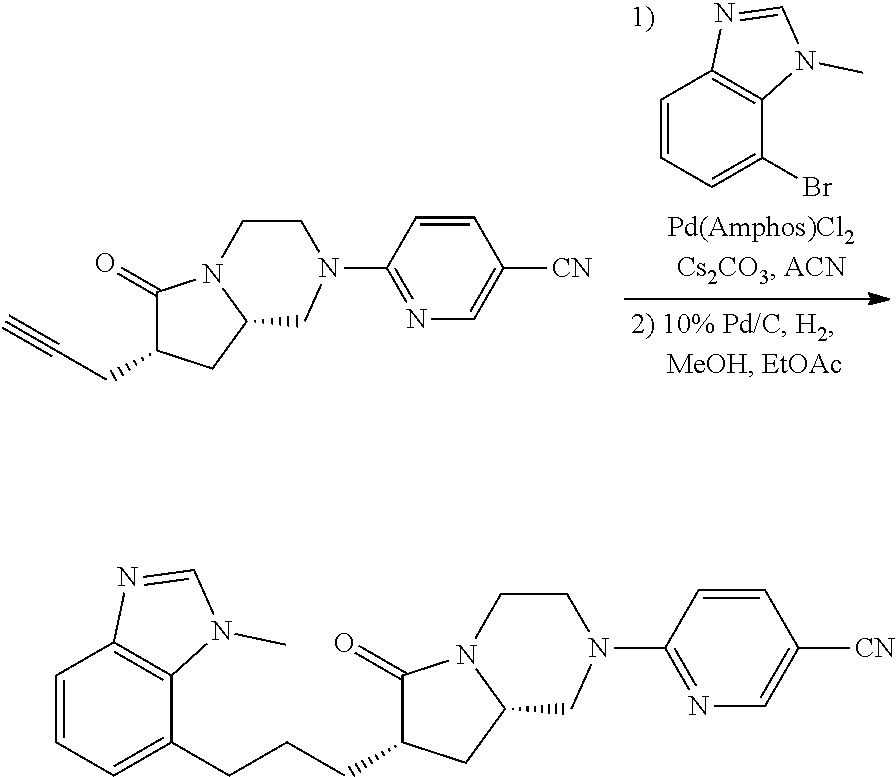
| LCMS | |||
| (m/z) | |||
| Example | Structure | Name | [M + H]+ |
| 55 |
 |
6-((7S,8aS)-7-(3-(1-methyl-1H-indazol-7- yl)propyl)-6-oxohexahydropyrrolo[1,2- a]pyrazin-2(1H)-yl)nicotinonitrile | 415.2 |
| 56 |
 |
6-((7S,8aS)-6-oxo-7-(3-(pyridazin-3- yl)propyl)hexahydropyrrolo[1,2-a]pyrazin- 2(1H)-yl)nicotinonitrile | 363.2 |
| 57 |
 |
6-((7S,8aS)-7-(3-(3-methylpyrazin-2- yl)propyl)-6-oxohexahydropyrrolo[1,2- a]pyrazin-2(1H)-yl)nicotinonitrile | 377.2 |
| 58 |
 |
6-((7S,8aS)-6-oxo-7-(3-(pyrazolo[1,5- a]pyridin-4- yl)propyl)hexahydropyrrolo[1,2-a]pyrazin- 2(1H)-yl)nicotinonitrile | 401.2 |
| 59 |
 |
6-((7S,8aS)-6-oxo-7-(3-(quinolin-5- yl)propyl)hexahydropyrrolo[1,2-a]pyrazin- 2(1H)-yl)nicotinonitrile | 412.2 |
| 60 |
 |
6-((7S,8aS)-6-oxo-7-(3-(quinoxalin-5- yl)propyl)hexahydropyrrolo[1,2-a]pyrazin- 2(1H)-yl)nicotinonitrile | 413.2 |


| LCMS | |||
| (m/z) | |||
| Example | Structure | Name | [M + H]+ |
| 64 |
 |
(7S,8aS)-7-(3-([1,2,4]triazolo[1,5-a]pyridin- 8-yl)propyl)-2-(5-chloropyrimidin-2- yl)hexahydropyrrolo[1,2-a]pyrazin-6(2H)- one | 412.4 |
| 65 |
 |
(7S,8aS)-7-(3-([1,2,4]triazolo[1,5-a]pyridin- 8-yl)propyl)-2-(5-methylpyrimidin-2- yl)hexahydropyrrolo[1,2-a]pyrazin-6(2H)- one | 392.4 |
| 66 |
 |
(7S,8aS)-7-(3-([1,2,4]triazolo[1,5-a]pyridin- 8-yl)propyl)-2-(pyrimidin-2- yl)hexahydropyrrolo[1,2-a]pyrazin-6(2H)- one | 378.4 |
| 67 |
 |
5-((7S,8aS)-7-(3-([1,2,4]triazolo[1,5- a]pyridin-8-yl)propyl)-6- oxohexahydropyrrolo[1,2-a]pyrazin-2(1H)- yl)picolinonitrile | 402.2 |
| 68 |
 |
6-((7S,8aS)-7-(3-([1,2,4]triazolo[1,5- a]pyridin-8-yl)propyl)-6- oxohexahydropyrrolo[1,2-a]pyrazin-2(1H)- yl)nicotinonitrile | 402.2 |
| 69 |
 |
(7S,8aS)-7-(3-([1,2,4]triazolo[1,5-a]pyridin- 8-yl)propyl)-2-(5-chloropyridin-2- yl)hexahydropyrrolo[1,2-a]pyrazin-6(2H)- one | 411.1 |

| LCMS | |||
| (m/z) | |||
| Example | Structure | Name | [M + H]+ |
| 71 |
 |
(7S,8aS)-7-(3-([1,2,4]triazolo[1,5-a]pyridin- 8-yl)propyl)-2-(2,4- difluorophenyl)hexahydropyrrolo[1,2- a]pyrazin-6(2H)-one | 412.4 |
| 72 |
 |
(7S,8aS)-7-(3-([1,2,4]triazolo[1,5-a]pyridin- 8-yl)propyl)-2-(5-methoxypyridin-2- yl)hexahydropyrrolo[1,2-a]pyrazin-6(2H)- one | 407.2 |
| 73 |
 |
(8aS)-7-(3-([1,2,4]triazolo[1,5-a]pyridin-8- yl)propyl)-2-(5-methylpyridin-2- yl)hexahydropyrrolo[1,2-a]pyrazin-6(2H)- one | 391.2 |
| 74 |
 |
(8aS)-7-(3-([1,2,4]triazolo[1,5-a]pyridin-8- yl)propyl)-2-(5-fluoropyridin-2- yl)hexahydropyrrolo[1,2-a]pyrazin-6(2H)- one | 395.1 |
| 75 |
 |
(7S,8aS)-7-(3-([1,2,4]triazolo[1,5-a]pyridin- 8-yl)propyl)-2-(6-methylpyridin-3- yl)hexahydropyrrolo[1,2-a]pyrazin-6(2H)- one | 391.2 |
| 76 |
 |
(7S,8aS)-7-(3-([1,2,4]triazolo[1,5-a]pyridin- 8-yl)propyl)-2-(6-methylpyridazin-3- yl)hexahydropyrrolo[1,2-a]pyrazin-6(2H)- one | 392.1 |


| Example | Structure | Name |
| 107 |  | 7-(3-(benzo[d]thiazol-7-yl)propyl)-2-(3- fluoropyridin-4-yl)-3- methylhexahydropyrrolo[1,2-a]pyrazin- 6(2H)-one |
| 108 |  | 7-(3-(benzo[d]thiazol-7-yl)propyl)-2-(5- chloropyridin-2-yl)hexahydropyrrolo[1,2- a]pyrazin-6(2H)-one |
| 109 |  | 7-(((benzo[d]thiazol-7- ylmethyl)amino)methyl)-2-(3-fluoropyridin- 4-yl)hexahydropyrrolo[1,2-a]pyrazin-6(2H)- one |
| 110 |  | 6-((8aS)-7-(2-(([1,2,4]triazolo[1,5-a]pyridin- 5-ylmethyl)amino)ethyl)-6- oxohexahydropyrrolo[1,2-a]pyrazin-2(1H)- yl)nicotinonitrile |
II. Biological Evaluation
| TABLE 1 | |||||
| Example # | M1 IC50 | M2 IC50 | M3 IC50 | ||
| 1 | D | D | D | ||
| 2 | A | C | C | ||
| 3 | B | D | C | ||
| 4 | A | B | B | ||
| 5 | B | C | D | ||
| 6 | B | C | D | ||
| 7 | C | C | D | ||
| 8 | D | D | D | ||
| 9 | B | C | D | ||
| 10 | A | B | C | ||
| 11 | A | B | B | ||
| 12 | B | C | C | ||
| 13 | A | B | B | ||
| 14 | B | C | C | ||
| 15 | B | D | C | ||
| 16 | B | B | B | ||
| 17 | A | C | C | ||
| 18 | C | C | D | ||
| 19 | A | B | C | ||
| 20 | B | C | C | ||
| 21 | A | C | C | ||
| 22 | A | B | C | ||
| 25 | A | C | B | ||
| 26 | B | D | C | ||
| 27 | B | D | C | ||
| 28 | A | B | B | ||
| 30 | A | C | C | ||
| 31 | C | D | D | ||
| 32 | A | B | C | ||
| 33 | B | C | C | ||
| 34 | A | C | C | ||
| 35 | A | D | D | ||
| 37 | A | C | C | ||
| 38 | C | D | D | ||
| 39 | B | D | C | ||
| 40 | A | D | D | ||
| 41 | A | C | C | ||
| 42 | D | C | D | ||
| 43 | C | C | C | ||
| 44 | C | C | D | ||
| 45 | A | A | B | ||
| 46 | A | C | C | ||
| 47 | B | D | D | ||
| 48 | A | C | C | ||
| 49 | A | C | C | ||
| 50 | B | D | D | ||
| 52 | B | B | C | ||
| 53 | A | C | D | ||
| 54 | A | B | C | ||
| 55 | B | C | C | ||
| 56 | A | B | B | ||
| 57 | C | C | D | ||
| 58 | A | B | B | ||
| 59 | A | B | C | ||
| 60 | A | A | B | ||
| 61 | B | C | D | ||
| 62 | A | C | C | ||
| 63 | A | D | C | ||
| 64 | A | B | C | ||
| 65 | B | C | D | ||
| 66 | B | D | D | ||
| 67 | A | B | A | ||
| 68 | A | B | A | ||
| 71 | C | C | D | ||
| 72 | A | C | C | ||
| 78 | A | C | C | ||
| 87 | B | C | C | ||
| 88 | A | C | C | ||
| 89 | A | C | C | ||
| 93 | A | D | C | ||


—C≡C—, —C(═O)— —CH2O—, —CH2CH2O—, —O—, —N(R7)—, —S(O)2—, —CH2N(R7)—, or —CH2CH2N(R7)—; Y is a bond, —O—, or —N(R8)—; R1 is

wherein ring A is a 5- or 6-membered heteroaryl ring, a 5- or 6-membered heterocycloalkyl ring, or a 4-, 5-, or 6-membered cycloalkyl ring, wherein ring A is optionally substituted with halogen, —CN, —N(R10)2, C1-6 alkyl, C1-6 alkyl-OH, C1-6 alkoxy, C1-6 haloalkyl, or C1-6 haloalkoxy; each R2 is independently selected from hydrogen, deuterium, halogen, —OH, and C1-6 alkyl; each R3 is independently selected from hydrogen, deuterium, halogen, —OH, and C1-6 alkyl; R4 is

each R5 is independently selected from halogen, —CN, C1-6 alkyl, C1-6 cycloalkyl, C1-6 alkoxy, C1-6 haloalkyl, and C1-6 haloalkoxy; each R6 is independently selected from hydrogen, deuterium, halogen, —CN, —N(R10)2, C1-6 alkyl, C1-6 alkyl-OH, C1-6 cycloalkyl, C1-6 alkoxy, C1-6 haloalkyl, C1-6 haloalkoxy, —C(═O)(C1-6 alkyl), —(C(R10)2)q—O—(C1-6 alkyl) and —S(O)2R11; R7 is hydrogen or C1-6 alkyl; R8 is hydrogen or C1-6 alkyl; R9 is hydrogen or C1-6 alkyl; each R10 is independently selected from H and C1-6 alkyl; R11 is C1-6 alkyl; each R12 is independently selected from hydrogen, deuterium, halogen, —OH, and C1-6 alkyl; each R13 is independently selected from hydrogen, deuterium, halogen, —OH, and C1-6 alkyl; a is 1, 2, 3, 4, or 5; m is 0, 1, 2, or 3; n is 1, 2, 3, 4, or 5; p is 0, 1, 2, or 3; and each q is independently 0, 1, 2, 3, or 4;

wherein ring A is a 5- or 6-membered heteroaryl ring, a 5- or 6-membered heterocycloalkyl ring, or a 4-, 5-, or 6-membered cycloalkyl ring, wherein ring A is optionally substituted with halogen, —CN, —N(R10)2, C1-6 alkyl, C1-6 alkyl-OH, C1-6 alkoxy, C1-6 haloalkyl, or C1-6 haloalkoxy; each R2 is independently selected from H and C1-6 alkyl; each R3 is independently selected from H and C1-6 alkyl; R4 is

each R5 is independently selected from halogen, —CN, C1-6 alkyl, C1-6 alkoxy, C1-6 haloalkyl, and C1-6 haloalkoxy; each R6 is independently selected from halogen, —CN, —N(R10)2, C1-6 alkyl, C1-6 alkoxy, C1-6 haloalkyl, C1-6 haloalkoxy, and —S(O)2R11; and R9 is C1-6 alkyl.


or a pharmaceutically acceptable salt or solvate thereof.


or a pharmaceutically acceptable salt or solvate thereof.

or a pharmaceutically acceptable salt thereof.

Claims (18)


Priority Applications (1)
| Application Number | Priority Date | Filing Date | Title |
|---|---|---|---|
| US17/267,677 US12054487B2 (en) | 2018-09-04 | 2019-09-03 | Muscarinic acetylcholine M1 receptor antagonists |
Applications Claiming Priority (3)
| Application Number | Priority Date | Filing Date | Title |
|---|---|---|---|
| US201862726915P | 2018-09-04 | 2018-09-04 | |
| US17/267,677 US12054487B2 (en) | 2018-09-04 | 2019-09-03 | Muscarinic acetylcholine M1 receptor antagonists |
| PCT/US2019/049374 WO2020051153A1 (en) | 2018-09-04 | 2019-09-03 | Muscarinic acetylcholine m1 receptor antagonists |
Related Parent Applications (1)
| Application Number | Title | Priority Date | Filing Date |
|---|---|---|---|
| PCT/US2019/049374 A-371-Of-International WO2020051153A1 (en) | 2018-09-04 | 2019-09-03 | Muscarinic acetylcholine m1 receptor antagonists |
Related Child Applications (1)
| Application Number | Title | Priority Date | Filing Date |
|---|---|---|---|
| US18/747,272 Continuation US20250026758A1 (en) | 2018-09-04 | 2024-06-18 | Muscarinic acetylcholine m1 receptor antagonists |
Publications (2)
| Publication Number | Publication Date |
|---|---|
| US20210155629A1 US20210155629A1 (en) | 2021-05-27 |
| US12054487B2 true US12054487B2 (en) | 2024-08-06 |
Family
ID=69721873
Family Applications (2)
| Application Number | Title | Priority Date | Filing Date |
|---|---|---|---|
| US17/267,677 Active 2041-07-18 US12054487B2 (en) | 2018-09-04 | 2019-09-03 | Muscarinic acetylcholine M1 receptor antagonists |
| US18/747,272 Pending US20250026758A1 (en) | 2018-09-04 | 2024-06-18 | Muscarinic acetylcholine m1 receptor antagonists |
Family Applications After (1)
| Application Number | Title | Priority Date | Filing Date |
|---|---|---|---|
| US18/747,272 Pending US20250026758A1 (en) | 2018-09-04 | 2024-06-18 | Muscarinic acetylcholine m1 receptor antagonists |
Country Status (7)
| Country | Link |
|---|---|
| US (2) | US12054487B2 (en) |
| EP (1) | EP3846806A4 (en) |
| JP (1) | JP7460264B2 (en) |
| CN (2) | CN119112895A (en) |
| AU (1) | AU2019336671B2 (en) |
| CA (1) | CA3108076A1 (en) |
| WO (1) | WO2020051153A1 (en) |
Cited By (2)
| Publication number | Priority date | Publication date | Assignee | Title |
|---|---|---|---|---|
| US12390462B2 (en) | 2019-12-02 | 2025-08-19 | Contineum Therapeutics, Inc. | Muscarinic acetylcholine M1 receptor antagonists |
| US12565501B2 (en) | 2019-10-07 | 2026-03-03 | Contineum Therapeutics, Inc. | Muscarinic acetylcholine M1 receptor antagonists |
Families Citing this family (5)
| Publication number | Priority date | Publication date | Assignee | Title |
|---|---|---|---|---|
| WO2019241131A1 (en) | 2018-06-11 | 2019-12-19 | Pipeline Therapeutics, Inc. | Muscarinic acetylcholine m1 receptor antagonists |
| CN119112895A (en) | 2018-09-04 | 2024-12-13 | 康蒂内乌姆医疗公司 | Muscarinic acetylcholine M1 receptor antagonist |
| US20240217981A1 (en) * | 2021-04-13 | 2024-07-04 | Pipeline Therapeutics, Inc. | Crystalline compound of muscarinic acetylcholine m1 receptor antagonists |
| CN117279917A (en) * | 2021-05-21 | 2023-12-22 | 成都百裕制药股份有限公司 | Piperazine derivatives and their applications in medicine |
| EP4359401A1 (en) * | 2021-06-23 | 2024-05-01 | Blueprint Medicines Corporation | Process for preparing egfr inhibitors |
Citations (24)
| Publication number | Priority date | Publication date | Assignee | Title |
|---|---|---|---|---|
| US4803203A (en) | 1986-11-05 | 1989-02-07 | Warner-Lambert Company | Phenyl and heterocyclic piperazinyl alkoxy-benzheterocyclic compounds as antipsychotic agents |
| US4873331A (en) | 1988-12-09 | 1989-10-10 | American Home Products Corporation | Noradamantyl-carboxylic acid piperazinoalkyl esters |
| US5089497A (en) | 1990-09-20 | 1992-02-18 | Warner-Lambert Company | Substituted piperazines as central nervous system agents |
| WO1997023482A1 (en) | 1995-12-21 | 1997-07-03 | Pfizer Inc. | 2,7-substituted octahydro-pyrrolo[1,2-a]pyrazine derivatives |
| WO2006010751A1 (en) | 2004-07-26 | 2006-02-02 | Applied Research Systems Ars Holding N.V. | N-hydroxyamide derivatives and use thereof |
| US7071335B2 (en) | 2002-02-01 | 2006-07-04 | Euro-Celtique S.A. | 2-pyridinyl-1-piperazine therapeutic agents useful for treating pain |
| US20060233843A1 (en) | 2003-02-19 | 2006-10-19 | Conn P J | Treatment of psychosis with a muscarinic m1 receptor ectopic activator |
| US20070129378A1 (en) | 2005-12-01 | 2007-06-07 | Schering Corporation | Compounds for the treatment of inflammatory disorders and microbial diseases |
| WO2007077508A2 (en) | 2005-12-30 | 2007-07-12 | Ranbaxy Laboratories Limited | Derivatives of beta-amino acid as dipeptidyl peptidase-iv inhibitors |
| WO2013103931A1 (en) | 2012-01-06 | 2013-07-11 | Vanderbilt University | Substituted 1-benzylindolin-2-one analogs as positive allosteric modulators of muscarinic acetylcholine m1 receptors |
| US20130289019A1 (en) | 2012-04-26 | 2013-10-31 | Amazing Grace, Inc. | Methods of treating behaviorial and/or mental disorders |
| US8648074B2 (en) | 2011-09-29 | 2014-02-11 | Abbvie Inc. | Substituted octahydropyrrolo[1,2-a]pyrazine sulfonamides as calcium channel blockers |
| US8999974B2 (en) | 2010-08-09 | 2015-04-07 | Raqualia Pharma Inc. | Acyl piperazine derivatives as TTX-S blockers |
| WO2017079641A1 (en) | 2015-11-06 | 2017-05-11 | Neurocrine Biosciences, Inc. | N-[2-(1 -benzylpiperidin-4-yl)ethyl]-4-(pyrazin-2-yl)-piperazine-1 -carboxamide derivatives and related compounds as muscarinic receptor 4 (m4) antagonists for treating neurological diseases |
| WO2018089433A1 (en) | 2016-11-08 | 2018-05-17 | Navitor Pharmaceuticals, Inc. | PHENYL mTORC INHIBITORS AND USES THEREOF |
| US20180258085A1 (en) | 2012-09-18 | 2018-09-13 | Heptares Therapeutics Limited | Bicyclic aza compounds as muscarinic m1 receptor antagonists |
| WO2019158572A1 (en) | 2018-02-15 | 2019-08-22 | Boehringer Ingelheim International Gmbh | Inhibitors of trpc6 |
| WO2019212937A1 (en) | 2018-04-30 | 2019-11-07 | Ribon Therapeutics Inc. | Pyridazinones as parp7 inhibitors |
| WO2019241131A1 (en) | 2018-06-11 | 2019-12-19 | Pipeline Therapeutics, Inc. | Muscarinic acetylcholine m1 receptor antagonists |
| WO2020051153A1 (en) | 2018-09-04 | 2020-03-12 | Pipeline Therapeutics, Inc. | Muscarinic acetylcholine m1 receptor antagonists |
| US20200181166A1 (en) | 2016-11-07 | 2020-06-11 | Vanderbilt University | Positive allosteric modulators of the muscarinic acetylcholine receptor m4 |
| US20200231592A1 (en) | 2011-10-28 | 2020-07-23 | Vanderbilt Unversity | Substituted 2-(4-heterocyclylbenzyl)isoindolin-1-one analogs as positive allosteric modulators of the muscarinic acetylcholine receptor m1 |
| WO2021071843A1 (en) | 2019-10-07 | 2021-04-15 | Pipeline Therapeutics, Inc. | Muscarinic acetylcholine m1 receptor antagonists |
| US20210161889A1 (en) | 2019-12-02 | 2021-06-03 | Pipeline Therapeutics, Inc. | Muscarinic acetylcholine m1 receptor antagonists |
-
2019
- 2019-09-03 CN CN202411263115.XA patent/CN119112895A/en active Pending
- 2019-09-03 US US17/267,677 patent/US12054487B2/en active Active
- 2019-09-03 WO PCT/US2019/049374 patent/WO2020051153A1/en not_active Ceased
- 2019-09-03 CN CN201980057628.6A patent/CN112638381B/en active Active
- 2019-09-03 EP EP19857624.1A patent/EP3846806A4/en active Pending
- 2019-09-03 CA CA3108076A patent/CA3108076A1/en active Pending
- 2019-09-03 JP JP2021536673A patent/JP7460264B2/en active Active
- 2019-09-03 AU AU2019336671A patent/AU2019336671B2/en active Active
-
2024
- 2024-06-18 US US18/747,272 patent/US20250026758A1/en active Pending
Patent Citations (32)
| Publication number | Priority date | Publication date | Assignee | Title |
|---|---|---|---|---|
| US4803203A (en) | 1986-11-05 | 1989-02-07 | Warner-Lambert Company | Phenyl and heterocyclic piperazinyl alkoxy-benzheterocyclic compounds as antipsychotic agents |
| US4873331A (en) | 1988-12-09 | 1989-10-10 | American Home Products Corporation | Noradamantyl-carboxylic acid piperazinoalkyl esters |
| US5089497A (en) | 1990-09-20 | 1992-02-18 | Warner-Lambert Company | Substituted piperazines as central nervous system agents |
| WO1997023482A1 (en) | 1995-12-21 | 1997-07-03 | Pfizer Inc. | 2,7-substituted octahydro-pyrrolo[1,2-a]pyrazine derivatives |
| US7071335B2 (en) | 2002-02-01 | 2006-07-04 | Euro-Celtique S.A. | 2-pyridinyl-1-piperazine therapeutic agents useful for treating pain |
| US20060233843A1 (en) | 2003-02-19 | 2006-10-19 | Conn P J | Treatment of psychosis with a muscarinic m1 receptor ectopic activator |
| WO2006010751A1 (en) | 2004-07-26 | 2006-02-02 | Applied Research Systems Ars Holding N.V. | N-hydroxyamide derivatives and use thereof |
| US20070129378A1 (en) | 2005-12-01 | 2007-06-07 | Schering Corporation | Compounds for the treatment of inflammatory disorders and microbial diseases |
| WO2007077508A2 (en) | 2005-12-30 | 2007-07-12 | Ranbaxy Laboratories Limited | Derivatives of beta-amino acid as dipeptidyl peptidase-iv inhibitors |
| WO2007077508A3 (en) | 2005-12-30 | 2007-10-25 | Ranbaxy Lab Ltd | Derivatives of beta-amino acid as dipeptidyl peptidase-iv inhibitors |
| US8999974B2 (en) | 2010-08-09 | 2015-04-07 | Raqualia Pharma Inc. | Acyl piperazine derivatives as TTX-S blockers |
| US8648074B2 (en) | 2011-09-29 | 2014-02-11 | Abbvie Inc. | Substituted octahydropyrrolo[1,2-a]pyrazine sulfonamides as calcium channel blockers |
| US20200231592A1 (en) | 2011-10-28 | 2020-07-23 | Vanderbilt Unversity | Substituted 2-(4-heterocyclylbenzyl)isoindolin-1-one analogs as positive allosteric modulators of the muscarinic acetylcholine receptor m1 |
| US20130178458A1 (en) | 2012-01-06 | 2013-07-11 | Vanderbilt University | Substituted (1-(methylsulfonyl)azetidin-3-yl)(heterocycloalkyl)methanone analogs as antagonists of muscarinic acetylcholine m1 receptors |
| WO2013103931A1 (en) | 2012-01-06 | 2013-07-11 | Vanderbilt University | Substituted 1-benzylindolin-2-one analogs as positive allosteric modulators of muscarinic acetylcholine m1 receptors |
| US20130289019A1 (en) | 2012-04-26 | 2013-10-31 | Amazing Grace, Inc. | Methods of treating behaviorial and/or mental disorders |
| US20180258085A1 (en) | 2012-09-18 | 2018-09-13 | Heptares Therapeutics Limited | Bicyclic aza compounds as muscarinic m1 receptor antagonists |
| WO2017079641A1 (en) | 2015-11-06 | 2017-05-11 | Neurocrine Biosciences, Inc. | N-[2-(1 -benzylpiperidin-4-yl)ethyl]-4-(pyrazin-2-yl)-piperazine-1 -carboxamide derivatives and related compounds as muscarinic receptor 4 (m4) antagonists for treating neurological diseases |
| CN108349936A (en) | 2015-11-06 | 2018-07-31 | 纽罗克里生物科学有限公司 | It is used to treat N- [2- (1- benzyl piepridine -4- bases) ethyl] -4- (pyrazine -2- bases)-piperazine -1- carboxamides derivatives and related compound of neurological disorder as muscarinic receptor 4 (M4) antagonist |
| US20200181166A1 (en) | 2016-11-07 | 2020-06-11 | Vanderbilt University | Positive allosteric modulators of the muscarinic acetylcholine receptor m4 |
| WO2018089433A1 (en) | 2016-11-08 | 2018-05-17 | Navitor Pharmaceuticals, Inc. | PHENYL mTORC INHIBITORS AND USES THEREOF |
| WO2019158572A1 (en) | 2018-02-15 | 2019-08-22 | Boehringer Ingelheim International Gmbh | Inhibitors of trpc6 |
| WO2019212937A1 (en) | 2018-04-30 | 2019-11-07 | Ribon Therapeutics Inc. | Pyridazinones as parp7 inhibitors |
| WO2019241131A1 (en) | 2018-06-11 | 2019-12-19 | Pipeline Therapeutics, Inc. | Muscarinic acetylcholine m1 receptor antagonists |
| US11512090B2 (en) | 2018-06-11 | 2022-11-29 | Pipeline Therapeutics, Inc. | Muscarinic acetylcholine M1 receptor antagonists |
| WO2020051153A1 (en) | 2018-09-04 | 2020-03-12 | Pipeline Therapeutics, Inc. | Muscarinic acetylcholine m1 receptor antagonists |
| US20210155629A1 (en) | 2018-09-04 | 2021-05-27 | Pipeline Therapeutics, Inc. | Muscarinic acetylcholine m1 receptor antagonists |
| WO2021071843A1 (en) | 2019-10-07 | 2021-04-15 | Pipeline Therapeutics, Inc. | Muscarinic acetylcholine m1 receptor antagonists |
| US20230089921A1 (en) | 2019-10-07 | 2023-03-23 | Pipeline Therapeutics, Inc. | Muscarinic acetylcholine m1 receptor antagonists |
| US20210161889A1 (en) | 2019-12-02 | 2021-06-03 | Pipeline Therapeutics, Inc. | Muscarinic acetylcholine m1 receptor antagonists |
| US11752149B2 (en) | 2019-12-02 | 2023-09-12 | Pipeline Therapeutics, Inc. | Muscarinic acetylcholine M1 receptor antagonists |
| US20230364082A1 (en) | 2019-12-02 | 2023-11-16 | Pipeline Therapeutics, Inc. | Muscarinic acetylcholine m1 receptor antagonists |
Non-Patent Citations (26)
| Title |
|---|
| Bender, A.M. et al. (Aug. 1, 2017, e-published May 15, 2017). "Discovery and optimization of 3-(4-aryl/heteroarylsulfonyl)piperazin-1-yl)-6-(piperidin-1-yl)pyridazines as novel, CNS penetrant pan-muscarinic antagonists," Bioorg Med Chem Lett 27(15):3576-3581. |
| Extended European Search Report mailed on May 6, 2022, for EP Patent Application No. 19857624.1, 8 pages. |
| Extended European Search Report mailed on Oct. 10, 2023, for EP Patent Application No. 20875038.0, 7 pages. |
| Gregory A. Jicha. et al. Hippocampal Sclerosis, Argyrophilic Grain Disease, and Primary Age-Related Tauopathy. Continuum ( MINNEAP MINN) 2019;25(1, Dementia):208-233. (Year: 2019). * |
| International Search Report mailed Oct. 18, 2019, for PCT Application No. PCT/US2019/036345, filed Jun. 10, 2019, 4 pages. |
| International Search Report mailed on Dec. 29, 2020 for PCT Application No. PCT/US2020/054412, filed Oct. 6, 2020, 3 pages. |
| International Search Report mailed on Jul. 15, 2022, for PCT Application No. PCT/US2022/024684, filed on Apr. 13, 2022, 2 pages. |
| International Search Report mailed on Nov. 21, 2019, for PCT Application No. PCT/US2019/049374, filed Sep. 3, 2019, 3 pages. |
| Klein, J. Can a person prevent multiple sclerosis? Medical News Today. Apr. 29, 2020. pp. 1-9 (Year: 2020). * |
| Manetti, D. et al. (May 18, 2000). "Design, synthesis, and preliminary pharmacological evaluation of 1, 4-diazabicyclo[4.3.0]nonan-9-ones as a new class of highly potent nootropic agents," Journal of Medicinal Chemistry 43(10):1969-1974. |
| Melancon, B.J. et al. (Aug. 1, 2012, e-published Jun. 15, 2012). "Development of novel M1 antagonist scaffolds through the continued optimization of the MLPCN probe ML012," Bioorg Med Chem Lett 22(15):5035-5040. |
| Melancon, B.J. et al. (Jan. 15, 2012, e-published Dec. 6, 2011). "Development of a more highly selective M1 antagonist from the continued optimization of the MLPCN Probe ML012," Bioorg Med Chem Lett 22(2):1044-1048. |
| Merilee Teylan. et al. Clinical diagnoses among individuals with primary age-related tauopathy versus Alzheimer's neuropathology. Laboratory Investigation (2019) 99:1049-1055 https://doi.org/10.1038/s41374-019-0186-0 (Year: 2019). * |
| PubChem CID 101131894, (Create Date Dec. 17, 2015), located at <https://pubchem.ncbi.nlm.nih.gov/compound/101131894>, 7 pages. |
| PubChem CID 101131895, (Create Date Dec. 17, 2015), located at <https://pubchem.ncbi.nlm.nih.gov/compound/101131895>, 8 pages. |
| PubChem CID 102350371, (Create Date Dec. 25, 2015), located at <https://pubchem.ncbi.nlm.nih.gov/compound/102350371>, 7 pages. |
| PubChem CID 70746046, (Create Date Mar. 4, 2013), located at <https://pubchem.ncbi.nlm.nih.gov/compound/70746046>, 5 pages. |
| Sasha Smith. et al. Prevention and Management Strategies for Diabetic Neuropathy. Life 2022, 12, 1185. https://doi.org/10.3390/life12081185 p. 1-28 (Year: 2022). * |
| Sheffler, D.J. et al. (Aug. 2009, e-published Apr. 30, 2009). "A novel selective muscarinic acetylcholine receptor subtype 1 antagonist reduces seizures without impairing hippocampus-dependent learning," Mol Pharmacol 76(2):356-368. |
| Weaver, C.D. et al. (2009). "Discovery and development of a potent and highly selective small molecule muscarinic acetylcholine receptor subtype I (mAChR 1 or M1) antagonist in vitro and in vivo probe," Current Topics in Medicinal Chemistry 9(13):1217-1226. |
| Written Opinion mailed Oct. 18, 2019, for PCT Application No. PCT/US2019/036345, filed Jun. 10, 2019, 6 pages. |
| Written Opinion mailed on Dec. 29, 2020 for PCT Application No. PCT/US2020/054412, filed Oct. 6, 2020, 3 pages. |
| Written Opinion mailed on Jul. 15, 2022, for PCT Application No. PCT/US2022/024684, filed on Apr. 13, 2022, 3 pages. |
| Written Opinion mailed on Nov. 21, 2019, for PCT Application No. PCT/US2019/049374, filed Sep. 3, 2019, 4 pages. |
| Xi Liu. et al. Parkinsonism Caused by Viral Encephalitis Affecting the Bilateral Substantia Nigra. Clin Neuroradiol (2019) 29:571-573 (Year: 2019). * |
| Zuev, D. et al. Stereoselective Synthesis of New Conformationally Restricted Analogues of a Potent CGRP Receptor Antagonist. Organic Letters 2005 vol. 7, No. 12, p. 2465-2468 (Year: 2005). * |
Cited By (2)
| Publication number | Priority date | Publication date | Assignee | Title |
|---|---|---|---|---|
| US12565501B2 (en) | 2019-10-07 | 2026-03-03 | Contineum Therapeutics, Inc. | Muscarinic acetylcholine M1 receptor antagonists |
| US12390462B2 (en) | 2019-12-02 | 2025-08-19 | Contineum Therapeutics, Inc. | Muscarinic acetylcholine M1 receptor antagonists |
Also Published As
| Publication number | Publication date |
|---|---|
| US20250026758A1 (en) | 2025-01-23 |
| CN112638381A (en) | 2021-04-09 |
| JP7460264B2 (en) | 2024-04-02 |
| WO2020051153A1 (en) | 2020-03-12 |
| US20210155629A1 (en) | 2021-05-27 |
| AU2019336671A1 (en) | 2021-02-18 |
| CA3108076A1 (en) | 2020-03-12 |
| EP3846806A1 (en) | 2021-07-14 |
| CN112638381B (en) | 2024-08-30 |
| JP2021536505A (en) | 2021-12-27 |
| CN119112895A (en) | 2024-12-13 |
| AU2019336671B2 (en) | 2025-06-05 |
| EP3846806A4 (en) | 2022-06-08 |
Similar Documents
| Publication | Publication Date | Title |
|---|---|---|
| US20250026758A1 (en) | Muscarinic acetylcholine m1 receptor antagonists | |
| US11512090B2 (en) | Muscarinic acetylcholine M1 receptor antagonists | |
| US11691975B2 (en) | MAGL inhibitors | |
| US12565501B2 (en) | Muscarinic acetylcholine M1 receptor antagonists | |
| US11142526B2 (en) | Spirocycle compounds and methods of making and using same | |
| US9695180B2 (en) | Substituted imidazo[1,2-a]pyrazines as LSD1 inhibitors | |
| US11161856B2 (en) | Spirocycle compounds and methods of making and using same | |
| US20260028326A1 (en) | Compound based on isoindoline-substituted glutarimide backbone and use thereof | |
| US10899737B2 (en) | Piperazine carbamates and methods of making and using same | |
| US12390462B2 (en) | Muscarinic acetylcholine M1 receptor antagonists | |
| US12522595B2 (en) | Bicyclic ether O-glycoprotein-2-acetamido-2-deoxy-3-D-glucopyranosidase inhibitors | |
| RU2781639C2 (en) | Spirocyclic compounds and methods for their production and use |
Legal Events
| Date | Code | Title | Description |
|---|---|---|---|
| FEPP | Fee payment procedure |
Free format text: ENTITY STATUS SET TO UNDISCOUNTED (ORIGINAL EVENT CODE: BIG.); ENTITY STATUS OF PATENT OWNER: LARGE ENTITY |
|
| FEPP | Fee payment procedure |
Free format text: ENTITY STATUS SET TO SMALL (ORIGINAL EVENT CODE: SMAL); ENTITY STATUS OF PATENT OWNER: LARGE ENTITY |
|
| AS | Assignment |
Owner name: PIPELINE THERAPEUTICS, INC., CALIFORNIA Free format text: ASSIGNMENT OF ASSIGNORS INTEREST;ASSIGNORS:SCHRADER, THOMAS;XIONG, YIFENG;BACCEI, JILL;AND OTHERS;REEL/FRAME:055794/0442 Effective date: 20200127 |
|
| STPP | Information on status: patent application and granting procedure in general |
Free format text: APPLICATION DISPATCHED FROM PREEXAM, NOT YET DOCKETED |
|
| STPP | Information on status: patent application and granting procedure in general |
Free format text: DOCKETED NEW CASE - READY FOR EXAMINATION |
|
| STPP | Information on status: patent application and granting procedure in general |
Free format text: NON FINAL ACTION MAILED |
|
| AS | Assignment |
Owner name: CONTINEUM THERAPEUTICS, INC., CALIFORNIA Free format text: CHANGE OF NAME;ASSIGNOR:PIPELINE THERAPEUTICS, INC.;REEL/FRAME:066353/0070 Effective date: 20231114 |
|
| FEPP | Fee payment procedure |
Free format text: ENTITY STATUS SET TO UNDISCOUNTED (ORIGINAL EVENT CODE: BIG.); ENTITY STATUS OF PATENT OWNER: LARGE ENTITY |
|
| STPP | Information on status: patent application and granting procedure in general |
Free format text: RESPONSE TO NON-FINAL OFFICE ACTION ENTERED AND FORWARDED TO EXAMINER |
|
| STPP | Information on status: patent application and granting procedure in general |
Free format text: NOTICE OF ALLOWANCE MAILED -- APPLICATION RECEIVED IN OFFICE OF PUBLICATIONS |
|
| ZAAA | Notice of allowance and fees due |
Free format text: ORIGINAL CODE: NOA |
|
| ZAAB | Notice of allowance mailed |
Free format text: ORIGINAL CODE: MN/=. |
|
| STPP | Information on status: patent application and granting procedure in general |
Free format text: AWAITING TC RESP., ISSUE FEE NOT PAID |
|
| STPP | Information on status: patent application and granting procedure in general |
Free format text: NOTICE OF ALLOWANCE MAILED -- APPLICATION RECEIVED IN OFFICE OF PUBLICATIONS |
|
| STPP | Information on status: patent application and granting procedure in general |
Free format text: PUBLICATIONS -- ISSUE FEE PAYMENT VERIFIED |
|
| STCF | Information on status: patent grant |
Free format text: PATENTED CASE |