US12054462B2 - Sphingosine/sphingoid base production - Google Patents
Sphingosine/sphingoid base production Download PDFInfo
- Publication number
- US12054462B2 US12054462B2 US17/251,978 US201917251978A US12054462B2 US 12054462 B2 US12054462 B2 US 12054462B2 US 201917251978 A US201917251978 A US 201917251978A US 12054462 B2 US12054462 B2 US 12054462B2
- Authority
- US
- United States
- Prior art keywords
- alkyl
- substituted
- aryl
- group
- compound
- Prior art date
- Legal status (The legal status is an assumption and is not a legal conclusion. Google has not performed a legal analysis and makes no representation as to the accuracy of the status listed.)
- Active, expires
Links
Classifications
-
- C—CHEMISTRY; METALLURGY
- C07—ORGANIC CHEMISTRY
- C07C—ACYCLIC OR CARBOCYCLIC COMPOUNDS
- C07C215/00—Compounds containing amino and hydroxy groups bound to the same carbon skeleton
- C07C215/02—Compounds containing amino and hydroxy groups bound to the same carbon skeleton having hydroxy groups and amino groups bound to acyclic carbon atoms of the same carbon skeleton
- C07C215/22—Compounds containing amino and hydroxy groups bound to the same carbon skeleton having hydroxy groups and amino groups bound to acyclic carbon atoms of the same carbon skeleton the carbon skeleton being unsaturated
- C07C215/24—Compounds containing amino and hydroxy groups bound to the same carbon skeleton having hydroxy groups and amino groups bound to acyclic carbon atoms of the same carbon skeleton the carbon skeleton being unsaturated and acyclic
-
- C—CHEMISTRY; METALLURGY
- C07—ORGANIC CHEMISTRY
- C07C—ACYCLIC OR CARBOCYCLIC COMPOUNDS
- C07C213/00—Preparation of compounds containing amino and hydroxy, amino and etherified hydroxy or amino and esterified hydroxy groups bound to the same carbon skeleton
- C07C213/08—Preparation of compounds containing amino and hydroxy, amino and etherified hydroxy or amino and esterified hydroxy groups bound to the same carbon skeleton by reactions not involving the formation of amino groups, hydroxy groups or etherified or esterified hydroxy groups
-
- C—CHEMISTRY; METALLURGY
- C07—ORGANIC CHEMISTRY
- C07D—HETEROCYCLIC COMPOUNDS
- C07D239/00—Heterocyclic compounds containing 1,3-diazine or hydrogenated 1,3-diazine rings
- C07D239/02—Heterocyclic compounds containing 1,3-diazine or hydrogenated 1,3-diazine rings not condensed with other rings
- C07D239/24—Heterocyclic compounds containing 1,3-diazine or hydrogenated 1,3-diazine rings not condensed with other rings having three or more double bonds between ring members or between ring members and non-ring members
- C07D239/28—Heterocyclic compounds containing 1,3-diazine or hydrogenated 1,3-diazine rings not condensed with other rings having three or more double bonds between ring members or between ring members and non-ring members with hetero atoms or with carbon atoms having three bonds to hetero atoms with at the most one bond to halogen, directly attached to ring carbon atoms
- C07D239/46—Two or more oxygen, sulphur or nitrogen atoms
- C07D239/60—Three or more oxygen or sulfur atoms
-
- Y—GENERAL TAGGING OF NEW TECHNOLOGICAL DEVELOPMENTS; GENERAL TAGGING OF CROSS-SECTIONAL TECHNOLOGIES SPANNING OVER SEVERAL SECTIONS OF THE IPC; TECHNICAL SUBJECTS COVERED BY FORMER USPC CROSS-REFERENCE ART COLLECTIONS [XRACs] AND DIGESTS
- Y02—TECHNOLOGIES OR APPLICATIONS FOR MITIGATION OR ADAPTATION AGAINST CLIMATE CHANGE
- Y02P—CLIMATE CHANGE MITIGATION TECHNOLOGIES IN THE PRODUCTION OR PROCESSING OF GOODS
- Y02P20/00—Technologies relating to chemical industry
- Y02P20/50—Improvements relating to the production of bulk chemicals
- Y02P20/55—Design of synthesis routes, e.g. reducing the use of auxiliary or protecting groups
Definitions
- the present invention relates to sphingolipids, and more particularly to a method for the production of sphingoid bases, especially sphingosine, and novel derivatives thereof.
- Sphingolipids are important structural components of plasma and organelle membranes of essentially all eukaryotic cells and play critical roles in many biological processes. They are distributed widely in plants, mammals and microbes. Sphingolipids constitute a diverse group of complex membrane lipids, all containing a long-chain aliphatic amino alcohol, usually having 18 carbons, connected by an amide linkage to a fatty acid to form ceramides.
- sphingoid bases having longer or shorter alkyl chains are also well-known constituents of sphingolipids of eukaryotic life.
- Sphingoid bases themselves, their O-glycosylated and O-phosphorylated forms, their N-acylated forms, furthermore their substituted/unsubstituted ceramide forms are the most abandoned sphingoid base molecules in nature.
- Phytoceramides, ceramides, dihydroceramides and 6-hydroxy-ceramides are the most significant ceramide structures in humans carrying phytosphingosine, sphingosine, dihydrosphingosine and 6-hydroxy-sphingosine, respectively. These different ceramide molecules are often referred to as ceramides.
- Ceramides are usually further modified in life chemistries by enzymatic cascades yielding phosphosphingolipids, glycosylinositol phosphoceramides, glycosphingolipids and their intermediates/metabolites.
- sphingolipid products commercialized mainly for pharmaceutical applications were obtained by extraction of animal brains, especially mammalian brains.
- the obtained sphingolipids were heterogenous mixtures of structurally different sphingolipids, which were potentially unsafe due to the possible presence of hazardous prion, viral and other microbiological entities.
- extraction and subsequent purification of sphingolipids from animal brain tissues is a laborious and expensive method, characterized by non-human chemical structures, low yields and undesired structural diversities.
- numerous attempts have been made to develop synthetic pathways for producing sphingolipids and their sphingoid base building blocks.
- One of the important factors for the successful synthesis of natural and non-natural sphingolipids is the synthetic access of the appropriate sphingoid bases, which are the principal backbones of sphingolipids.
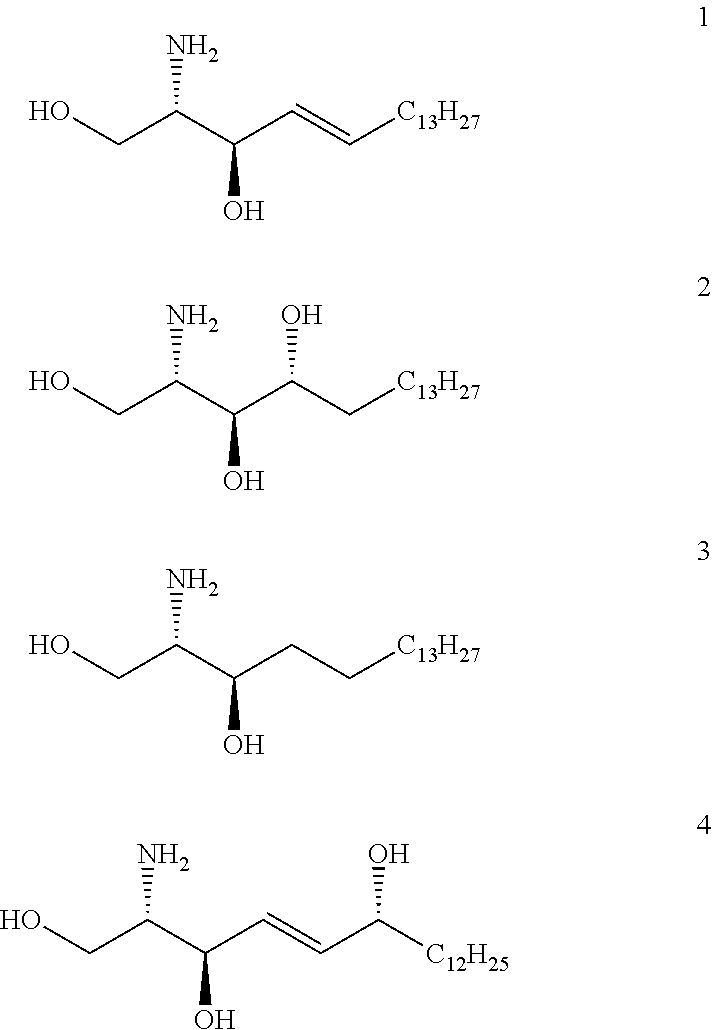
- D-erythro-sphingosine (CAS: 123-78-4; C 18 H 37 NO 2 ) (1), D-ribo-phytosphingosine (CAS: 388566-94-7; C 18 H 39 NO 3 ) (2), DL-erythro-Dihydrosphingosine (CAS: 3102-56-5; C 18 H 39 NO 2 ) (3) and 6-Hydroxy-D-erythro-sphingosine (CAS: 566203-07-4; C 18 H 37 NO 3 ) (4) are the most important and common species.
- D-ribo-Phytosphingosine is readily obtainable on industrial scale from a yeast fermentation process.
- D-erythro-sphingosine is the naturally active configuration of sphingosine and is rather expensive and available only from laborious animal tissue extraction or chemical synthesis.
- a second popular approach involves the use of chiral starting materials, such as carbohydrates and amino acids.
- the relatively inexpensive D-ribo-phytosphingosine 2 has also been employed as a starting material for the synthesis of D-erythro-sphingosine 1.
- a number of protecting group strategies have been described involving different steps such as azide formation, silylation, oxidation, sulfonylation, cyclic sulfate formation for the regio- and stereoselective transformation of the C-4 hydroxyl group of D-ribo-phytosphingosine 2 into the characteristic 4,5-trans double bond of D-erythro-sphingosine 1.
- Methods are disclosed, for example, in (a) J. H. van Boom et al. Tetrahedron Lett. 2002, 43(46), 8409-8412 (b) J. H.
- EP 1767644 B1 describing microbial strains capable to convert D-ribo-phytosphingosine 2 into D-erythro-sphingosine 1 with a poor conversion rate. This approach has never been industrialized and the related specific strains and enzymes have never been described in the scientific literature.
- Sphingoid bases especially D-erythro-sphingosine 1
- Novel large volume, low cost production methods are required for sphingoid base, especially D-erythro-sphingosine 1, manufacturing to initiate commercial activities while also achieving high purities and other quality requirements of pharmaceutical, nutrition and cosmetic industries.
- R′ is H, aryl or an alkyl chain having 1-43 carbon atoms, preferably 5-25 carbon atoms, more preferably 10-20 carbon atoms, which may be a straight chain or branched, and/or which may be saturated or contain one or more double bonds, and/or which may contain one or more functional groups, the functional group being preferably selected from the group consisting of a hydroxyl group, an alkoxy group, a primary, secondary or tertiary amine, a thiol group, a thioether or a phosphorus containing functional group, starting from a compound of General Formula II
- R′ is as defined for General Formula I, this method comprising the steps of:
- the vinylogous amide N-protection strategy according to the method of the present invention enables easy introduction and easy removal of the N-protecting group and prevention of deprotonation of N—H functionality in the basic conditions of the coming elimination step that enables the formation of the C 4 -05 double bond.
- the intermediate compounds according to General Formulae III-VII can be crystallized and have outstanding stabilities even in drastic conditions and have robust stabilities in the presence of secondary and tertiary organic bases.
- a major aim of the present invention is to identify the most efficient syntheses of sphingoid bases, especially D-erythro-sphingosine 1, and derivatives thereof, suitable for glycosylation reactions.
- substituted means that the group in question is substituted with a group which typically modifies the general chemical characteristics of the group in question.
- Preferred substituents include but are not limited to halogen, nitro, amino, azido, oxo, hydroxyl, thiol, carboxy, carboxy ester, carboxamide, alkylamino, alkyldithio, alkylthio, alkoxy, acylamido, acyloxy, or acylthio, each of 1 to 6 carbon atoms, preferably of 1 to 3 carbon atoms.
- the substituents can be used to modify characteristics of the molecule as a whole such as molecule stability, molecule solubility and an ability of the molecule to form crystals.
- suitable substituents of a similar size and charge characteristics which could be used as alternatives in a given situation.
- alkyl In connection with the term “alkyl”, the term “optionally substituted” (or “substituted”) means that the group in question may be (is) substituted one or several times, preferably 1 to 3 times, with group(s) selected from hydroxy (which when bound to an unsaturated carbon atom may be present in the tautomeric keto form), C 1-6 -alkoxy (i.e.
- C 1-6 -alkyl-oxy C 2-6 -alkenyloxy, carboxy, oxo, C 1-6 -alkoxycarbonyl, C 1-6 -alkylcarbonyl, formyl, aryl, aryloxycarbonyl, aryloxy, arylamino, arylcarbonyl, heteroaryl, heteroarylamino, heteroaryloxycarbonyl, heteroaryloxy, heteroarylcarbonyl, amino, mono- and di(C 1-6 -alkyl)amino, carbamoyl, mono- and di(C 1-6 -alkyl)aminocarbonyl, I-aminocarbonyl, mono- and di(C 1-6 -alkyl)amino-C 1-6 -alkyl-aminocarbonyl, C 1-6 -alkylcarbonylamino, cyano, guanidino, carbamido, C 1-6 -alkyl-sulphonyl-amino
- leaving group means a group capable of being displaced by a nucleophile in a substitution chemical reaction or can promote elimination reaction.
- Common leaving groups include halides, triflates (OTf), diazonium salts (N 2 +), mesylates (OMs), tosylates (OTs), nosylates (ONs), imidazole-1-sulfonate (OSO 2 Im) and other sulfonic esters.
- derivative refers to a modified form of a compound, having one or more substituents.
- sphingoid base derivative include, but not limited to forms of a sphingoid base, of sphingosine, and of phytosphingosine, respectively, that have been modified to contain an N- and/or an O-protecting group on an aminoalcohol molecular scaffold, wherein the N-protecting group is a vinylogous amide-type protecting group.
- General Formulae III-VII, IIIa-VIIa, IIIb-VIIb and IIIc-VIIc represent derivatives of a sphingoid base.
- sphingosine D-erythro-sphingosine
- human sphingosine refers to the fact that D-erythro-sphingosine is a prevalent sphingoid base present in humans.
- cyclic structures characterized by 5-8 ring sizes refers to a 5-8-membered ring, which contain single bonds and/or double bonds, which may be aromatic or not aromatic, homoaromatic or heteroaromatic, which may contain carbon atoms in the ring structure or wherein one or more of the carbon atoms may optionally be substituted or replaced by an oxygen atom, a nitrogen atom or a sulfur atom.
- human identical sphingolipids refers to sphingolipids that are naturally present in humans. Sphingolipids that are naturally present in humans contain sphingoid bases selected from D-erythro-sphingosine, D-ribo-phytosphingosine, DL-erythro-Dihydrosphingosine and 6-Hydroxy-D-erythro-sphingosine. While the carbon chains of the fatty acyl moieties in human sphingolipids usually have an even number, the carbon chains of the fatty acyl moieties in other mammals may also have odd numbers. Accordingly, “human identical sphingolipids” especially refers to sphingolipids having sphingoid bases typically present in humans and having an even number of carbon chains of their fatty acyl moieties.
- a grammatically is a singular, but it may as well mean the plural of e.g. the intended compound.
- a skilled person would understand that in the expression “the production of a sphingoid base”, the production of not only one single sphingoid base, but of many sphingoid bases of the same type are meant.
- the present invention relates to a method for producing a sphingoid base according to General Formula I, or a salt thereof,
- R′ is H, aryl or an alkyl chain having 1-43 carbon atoms, preferably 5-25 carbon atoms, more preferably 10-20 carbon atoms, which may be a straight chain or branched, and/or which may be saturated or contain one or more double bonds, and/or which may contain one or more functional groups, the functional group being preferably selected from the group consisting of a hydroxyl group, an alkoxy group, a primary, secondary or tertiary amine, a thiol group, a thioether or a phosphorus containing functional group, starting from a compound according to General Formula II
- the present invention provides a method for the production of a sphingoid base according to General Formula I or a salt thereof, starting from a compound according to General Formula II or a salt thereof, and having compounds according to General Formulae III-VII as intermediate compounds.
- the method of the present invention is preferably a synthetic method.
- position C-1, C-2, C-3, C-4 and C 5 refer to the carbon atoms of the sphingoid base of General Formula II, even if substituents would strictly taken change the exact positions of the carbon atoms.
- C-1, C-2, C-3, C-4 and C 5 reference is herein always made to the respective carbon atoms of the sphingoid base of General Formula II.
- the salts of the compounds of General Formula I and General Formula II are preferably pharmaceutically acceptable salts or other generally acceptable salts, unless they would be excluded for chemical reasons, which the skilled person will readily understand.
- the stereochemistry of a compound according to General Formula I and II, or of salts thereof, and accordingly of an intermediate compound according to General Formula III-VII corresponds to the stereochemistry of D-erythro-sphingosine and of D-ribo-phytosphingosine, respectively.
- the stereochemical configuration of the compounds of General Formulae I to VII preferably equals the stereochemical configuration of D-erythro-sphingosine (2S,3R,4E) and of D-ribo-phytosphingosine (2S,3S,4R), respectively.
- stereochemical configuration of the compounds of General Formulae II to V is (2S,3S,4R) and the stereochemical configuration of the compounds of General Formulae I, VI and VII is (2S,3R,4E).
- Those preferred compounds are represented by General Formulae IIIa to Vila.
- R′ of General Formulae I to VII or of General Formulae Ia to VIIa is an alkyl chain having 13 carbon atoms. Even more preferably, R′ of General Formulae I to VII is C 13 H 27 or CH(OH)C 12 H 25 , especially—C 13 H 27 or —CH(OH)C 12 H 25 .
- the starting compound of General Formula II defines the possible General Formulae of the following steps of the method of the present invention. If e.g. a compound of General Formula Ia is used as a starting compound for the method, a compound of General Formula IIIa (and not a compound of General Formula IIIb) may be formed in step (a) of the method of the present invention.
- step (a) of the method of the present invention the NH 2 (amino) group of a compound represented by General Formula II, preferably of phytosphingosine 2, is protected with an N-protecting group by addition of an N-protecting group reagent being a vinylogous reagent to form a compound according to General Formula III, preferably General Formula IIIa.
- the vinylogous reagent may be a vinylogous acid, a vinylogous ester, a vinylogous amide or a vinylogous acid halide.
- the vinylogous reagent is an N,N-disubstituted vinylogous amide reagent, more preferably an N,N-dialkyl-barbituric acid-derived reagent.
- the vinylogous reagent is 1,3-dimethyl-5-[(dimethylamino)methylene]-2,4,6(1H,3H,5H)-trioxopyrimidine (DTPM-reagent) (CAS: 35824-98-7; C 9 H 13 N 3 O 3 ).
- the vinylogous reagent preferably has a cyclic structure providing a robust stability and crystalline properties.
- the preparation of vinylogous reagents are described in publications Tetrahedron Letters, 2001, 42, 3129-3132; WO 98/38197.
- the compound according to General Formula II and the vinylogous reagent may be mixed in water, organic solvents or in their aqueous mixtures.
- the reactions may optionally be catalyzed with organic or inorganic bases at temperatures ranges from 0-150° C., preferably at temperatures ranging from 20-120° C. More preferably, the reaction goes to completion at ambient temperature.
- the reactions are preferably carried out in organic solvents at room temperature (r.t.) or between 40-100° C.
- room temperature r.t.
- a person skilled in art has the knowledge to conduct, isolate and purify the novel compounds by using standard methods of synthetic organic chemistry.
- the introduction of DTPM protecting group may be performed using the DTPM-reagent dissolved in H 2 O or in organic solvents, such as methanol and CH 2 Cl 2 .
- the reaction does not require extreme conditions and affords high conversion.
- the DTPM-protected compounds of General Formula IIIb and IIIc may be precipitated directly from the reaction mixtures.
- Example 1 provides a representative experimental example of the described DTPM-protection.
- step (b) of the method of the present invention the hydroxyl groups at C-1 and C-3 of a compound of General Formula III, preferably of General Formula IIIa or General Formula IIIb, more preferably of General Formula IIIc, are protected with an O-protecting group by addition of an O-protecting group reagent.
- the O-protecting groups at C-1 and C-3 may be the same or different and are selected from optionally substituted benzyl, optionally substituted alkoxymethyl, trialkylsilyl, trialylsilyl or preferably one O-protecting group may form one cyclic structure with the hydroxyl groups of both C-1 and C-3. More preferably, the O-protecting group forming the cyclic structure with the hydroxyl groups of both C-1 and C-3 is an optionally substituted cyclic carbonate, an optionally substituted cyclic acetal or an optionally substituted cyclic ketal, even more preferably an optionally substituted cyclic acetal or an optionally substituted cyclic ketal. Especially, the optionally substituted cyclic acetal is an optionally substituted benzylidene and the optionally substituted cyclic ketal is an optionally substituted isopropylidene.
- O-protecting group used is a well-known process for a person skilled in art by reacting 1,3-diols of compounds characterized by General Formula III, IIIa, IIIb or IIIc with aldehyde, ketone, acyclic dialkylacetals or acyclic dialkylketal, preferably dimethyl acetal and dimethyl ketal, reagents in the presence of protic acid or Lewis acid catalysts in organic solvents.
- the acetal or ketal formation is catalyzed by acid catalysts such as strong organic or inorganic acids, including protic acids such as tosic acid, camphorsulfonic acid, acidic ion-exchange resin, HCl, H 2 SO 4 , etc.
- acid catalysts such as strong organic or inorganic acids, including protic acids such as tosic acid, camphorsulfonic acid, acidic ion-exchange resin, HCl, H 2 SO 4 , etc.
- Example 2 provides one representative experimental example for step (b) of the method of the present invention.
- step (c) of the method of the present invention a leaving group R 6 is introduced at C-4 position of General Formula IV, preferably of General Formula IVa or of General Formula IVb, more preferably of General Formula IVc, by substitution or replacement of the C-4 hydroxyl group, to form a compound according to General Formula V, preferably General Formula Va or General Formula Vb, more preferably General Formula Vc, respectively.
- R 6 may be a halide, such as I, Br, Cl or F, or a sulfonic ester derivative such as mesylate (OMs), tosylate (OTs), triflate (OTf), nosylate (ONs), imidazole-1-sulfonate (OSO 2 Im) and chlorophosphite ester (OPCl 2 ).
- OMs mesylate
- OTs tosylate
- OTf triflate
- nosylate ONs
- imidazole-1-sulfonate OSO 2 Im
- OPCl 2 chlorophosphite ester
- R 6 When R 6 is a halide, it may preferably be introduced by using triphenylphosphine (PPh 3 ), imidazole and iodine or bromine, preferably iodine.
- Ph 3 triphenylphosphine
- R 6 is a sulfonic ester
- the respective sulfonic acid chlorides or anhydrides may be employed in the presence of a base, preferably in the presence of an organic base, more preferably in the presence of pyridine, triethylamine (TEA) or diisopropylethylamine (DIPEA) for the introduction of the sulfonic ester moiety.
- a base preferably in the presence of an organic base, more preferably in the presence of pyridine, triethylamine (TEA) or diisopropylethylamine (DIPEA) for the introduction of the sulfonic ester moiety.
- a base preferably in the presence of an organic base, more preferably in the presence of pyridine, triethylamine (TEA) or diisopropylethylamine (DIPEA) for the introduction of the sulfonic ester moiety.
- TAA triethylamine
- DIPEA di
- Step (c) requires neutral or basic conditions to keep the acetal or ketal protection group at C-1 and C-3 position of the compound stable.
- mesylation, tosylation, imidazoylsulfonylation can use simple organic bases like pyridine, triethylamine along with the required reagents of mesylchloride, tosylchloride, etc. on organic solvents like dichloromethane, toluene, etc.
- Deoxy iodination usually takes place in dichloromethane in the presence of triphenylphosphine/I 2 /imidazole reagent combinations known by the person skilled in Art.
- Chlorophosphate esterification preferably requires pyridine/POCl 3 reagent pair acting in dichloromethane, toluene or pyridine.
- Example 3 provides one representative representative example for step (c) of the method of the present invention.
- step (d) of the method of the present invention an elimination reaction is induced to form a double bond between the C-4 and C-5 carbon atoms of a compound according to General Formula V, preferably General Formula Va or General Formula Vb, more preferably General Formula Vc, resulting in a compound according to General Formula VI, preferably General Formula VIa or General Formula VIb, more preferably General Formula VIc, respectively.
- Elimination reactions are often accompanied by nucleophilic substitution reactions as competing reactions. However, conditions could be found in the present invention to make the elimination reaction the main, dominant reaction; for example, strong bases and weak nucleophiles favor the elimination products and are therefore preferred.
- bulky, sterically hindered non-nucleophilic bases such as KOtBu, DBU or DBN are used to promote the elimination reaction.
- the elimination reaction appears to take place with virtually complete selectivity towards the desired trans-sphingoid base, which appeared to be virtually free of unwanted side products.
- organic solvents such as acetonitrile, 2-methyltetrahydrofuran, propionitrile, 1,4-dioxane, toluene, xylene or N,N-dimethylformamide may be used to perform the elimination reaction.
- the elimination reaction is preferably performed at a temperature range between 60 to 150° C.
- Example 4 provides one representative experimental example for step (d) of the method of the present invention.
- step (e) of the method of the present invention the O-protecting group(s) is/are removed from a compound of General Formula VI, preferably from a compound according to General Formula VIa or General Formula VIb, more preferably from a compound according to General Formula VIc, to form a compound according to General Formula VIIa or General Formula VIIb, more preferably from a compound according to General Formula VIIc, respectively.
- the O-protecting group(s) may be removed via deprotecting procedures carried out in acidic conditions.
- a typical example demonstrates the removal of 1,3-acetal or ketal groups in acidic conditions in the presence of water or alcohols catalyzed by inorganic or organic acid catalysts such as HCl, TsOH, camphorsulfonic acid, acidic ion exchange resin, etc. at temperatures ranging from 0-130° C. Vinylogous amides are stable in such conditions.
- Example 5 provides one representative experimental example for step (e) of the method of the present invention.
- step (f) of the method of the present invention the N-protecting group is removed from a compound of General Formula VII, preferably from a compound according to General Formula VIIa or from a compound according to General Formula VIIb, more preferably from a compound according to General Formula VIIc, to form a compound according to General Formula I, preferably D-erythro-sphingosine 1, or a salt thereof.
- the reagent used for this step may be selected from an aqueous inorganic base, NH 3 , primary amines, hydrazine, hydrazine derivatives, hydroxylamine and hydroxylamine derivatives.
- the reaction may be performed in an organic solvent such as dichlormethane, acetonitrile, methanol, tetrahydrofuran or toluene.
- the preferred temperature range for the reaction is from 20 to 120° C.
- Example 7 provides a representative experimental example for step (f) of the method of the present invention.
- Steps (a) to (f) of the method of the present invention are performed in the order mentioned, i.e. beginning with step (a), continuing with step (b), (c), (d), (e) and ending with step (f).
- steps (e) and (f) of the method of the present invention may be swapped. That means that the removal of the N-protecting group may be performed before the removal of the O-protecting group.
- Example 7 provides a representative experimental example for this alternative embodiment, wherein step (f) is performed on a compound still carrying the O-protecting group, i.e. wherein step (e) has not been performed yet.
- the method of the present invention may as well comprise further steps in addition to steps (a) to (f), provided they do not negatively affect the reactions of steps (a) to (f), which the skilled person will easily determine.
- the present invention provides novel intermediate compounds of the method according to the present invention, represented by General Formulae III to VII.
- the intermediate compounds are represented by General Formulae IIIa to VIIa or by General Formulae IIIb to VIIb. More preferably, the intermediate compounds are represented by General Formulae IIIc to VIIc.
- R′ of General Formulae III to VII (or the preferred versions of General Formulae IIIa to Vila, IIIb to VIIb or IIIc to VIIc) is an alkyl chain having 13 carbon atoms. Even more preferably, R′ of General Formulae III to VII (or the preferred versions of General Formulae IIIa to Vila, IIIb to VIIb or IIIc to VIIc) is C 13 H 27 or CH(OH)C 12 H 25 , especially—C 13 H 27 or —CH(OH)C 12 H 25 .
- a compound represented by General Formula III, Ma, IIIb or IIIc is especially obtained by step (a) of the method of the present invention.
- a compound represented by General Formula IV, IVa, IVb or IVc is especially obtained by steps (a) to (b) of the method of the present invention.
- a compound represented by General Formula V, Va, Vb or Vc is especially obtained by steps (a) to (c) of the method of the present invention.
- a compound represented by General Formula VI, VIa, VIb or VIc is especially obtained by steps (a) to (d) of the method of the present invention.
- a compound represented by General Formula VII, Vila, VIIb or VIIc is especially obtained by steps (a) to (e) of the method of the present invention.
- a compound of General Formulae III to VII preferably of General Formulae IIIa to VIIa or of General Formulae IIIb to VIIb, more preferably of General Formulae IIIc to VIIc VII, Vila, VIIb or VIIc is suitable for glycosylation, phosphorylation and other nucleophilic O-substitution reactions—due to its enhanced O-nucleophilicity.
- a compound of General Formulae III to VII may be used for the preparation of sphingolipids such as glycosphingolipids, glycosylsphingosines, sphingosine-1-O-phosphates, sphingomyelins, phosphosphingolipids, or glycosylinositol phosphoceramides; especially, a compound of General Formulae III to VII, preferably of General Formulae IIIa to VIIa or of General Formulae IIIb to VIIb, more preferably of General Formulae IIIc to VIIc, may be used for the preparation of glycosphingolipids.
- the most preferred compound for such use is a compound of General Formula VII, preferably of General Formula VIIa or of General Formula VIIb, more preferably of General Formula VIIc.
- sphingolipids are optionally substituted compounds containing a sphingoid base characterized by the presence of a molecular motif of General Formula I or II.
- Preferred substituents are carbohydrate- and/or phosphate-containing moieties of naturally occurring sphingolipids.
- a compound of General Formula I obtainable by the method according to the present invention may be used for cosmetic, nutritional and/or pharmaceutical applications.
- a compound of General Formula I obtainable by the method according to the present invention may be used as a pharmaceutical agent and/or for the preparation of a pharmaceutical composition.
- a compound of General Formula I obtainable by the method according to the present invention may be used for the preparation of a nutritional formulation, e.g. a food supplement.
- a compound of General Formula I obtainable by the method according to the present invention may be used for the preparation of a cosmetic product.
- a compound of General Formula I preferably of General Formula Ia, obtainable by the method according to the present invention, may also be used for the production of ceramides, phosphosphingolipids or glycosphingolipids.
- the production of ceramides, phosphosphingolipids or glycosphingolipids may be performed by N-acylation.
- N-acylation may be performed using an acyl moiety of a C 12 -C 30 acyl group which can be saturated, unsaturated or optionally substituted.
- the acylation may be performed by both lipase-assisted biocatalysis or chemistry via the use of the corresponding carboxylic acid, acid chloride, ester or anhydride in the presence of a base, preferably in the presence of an organic base, more preferably in the presence of pyridine, triethylamine (TEA) or diisopropylethylamine (DIPEA).
- TAA triethylamine
- DIPEA diisopropylethylamine
- N,N-dimethylformamide dimethyl acetal (252 g, 2.11 mol) was stirred at 0° C. in CH 2 Cl 2 (750 mL).
- 1,3-Dimethylbarbituric acid 300 g, 1.92 mol was added to the stirring solution over 2 hours.
- the reaction mixture was washed with water (3 ⁇ 1 L) and saturated brine solution (1 L).
- the organic phase was dried over MgSO 4 , filtered and evaporated to dryness under vacuum.
- D-ribo-Phytosphingosine (4.8 g, 15.1 mmol) is added to methanol (150 mL) at room temperature (r.t.). and heated to approx. 30° C. until complete dissolution of the solid.
- the solution is cooled to r.t., then DTPM-reagent (3.5 g, 16.6 mmol) is added in one portion, and the stirring is continued at r.t. for 1 h. (After approx. 5 min. crystallization of the product starts.)
- the slurry is cooled to approx. 5° C., then kept at 5° C. for 2 h.
- the solid is filtered off (easy filtration on G3), washed with cold methanol (20 mL, 5° C.), then dried in a vacuum oven (30 mbar/40° C./12 h). Yield: 6.06 g (83%).
- (2S,3S,4R)-2-NHDTPM-1,3-(benzylidene)-octadecan-4-ol (2.0 g, 3.5 mmol) is added to toluene (130 mL), and heated to 50-52° C. (The solid does not dissolve completely at r.t. On heating it goes to solution.)
- Triphenylphosphine (1.88 g, 7.2 mmol) and imidazole (1.24 g, 18.2 mmol) is added, and the suspension is stirred until clear solution is obtained (triphenylphosphine dissolves readily, imidazole dissolves in approx. 10-15 min.).
- (2S,3R,4E)-2-NHDTPM-1,3-(benzylidene)-octadec-4-ene (800 mg, 1.4 mmol) is dissolved in THF (10 mL), then methanol (20 mL) and CSA (200 mg) are added. The mixture is stirred at 45° C. for 2.5 h. The mixture is cooled to r.t. On cooling, crystallization started. The slurry is stirred at r.t. for 3 h. The solid is filtered off, and washed with methanol (5 mL, r.t.), and dried in vacuum drying oven at 50° C. to yield 250 mg white solid.
Landscapes
- Chemical & Material Sciences (AREA)
- Organic Chemistry (AREA)
- Chemical Kinetics & Catalysis (AREA)
- Organic Low-Molecular-Weight Compounds And Preparation Thereof (AREA)
- Pharmaceuticals Containing Other Organic And Inorganic Compounds (AREA)
- Cosmetics (AREA)
Abstract

Description
-
- R. Wil et. al. Tetrahedron Asymmetry, 1994, 2195-2208 describes a stereoselective protocol using D-galactose as a starting material.
- In D. D. Dhavale et. al. Org. Lett. 2005, 7(26), 5805-5807 a method is disclosed for the preparation of D-erythro-sphingosine 1 from D-glucose via olefin cross metathesis.
- In L. S. Liebeskind et. al. Org. Lett. 2007, 9(16), 2993-2996 a concise total synthesis of high enantiopurity of D-erythro-sphingosine 1 is revealed starting from N-Boc-L-serine.
- P. Wisse et al. J. Org. Chem. 2015, DOI: 10.1021/acs.joc.5b00823, describe the synthesis of 6-Hydroxysphingosine and alpha-Hydroxy Ceramide using a cross-metathesis strategy.
-
- (1) The present invention provides an economically feasible process for the production Method for producing a sphingoid base of General Formula I, or a salt thereof,

in which R′ is H, aryl or an alkyl chain having 1-43 carbon atoms, preferably 5-25 carbon atoms, more preferably 10-20 carbon atoms, which may be a straight chain or branched, and/or which may be saturated or contain one or more double bonds, and/or which may contain one or more functional groups, the functional group being preferably selected from the group consisting of a hydroxyl group, an alkoxy group, a primary, secondary or tertiary amine, a thiol group, a thioether or a phosphorus containing functional group, starting from a compound of General Formula II

wherein R′ is as defined for General Formula I,
this method comprising the steps of:
-
- a. protecting the amino (NH2) group of a compound represented by General Formula II or a salt thereof with an N-protecting group, the N-protecting group being a vinylogous amide-type N-protecting group suitable to yield vinylogous amides,
- b. protecting the hydroxyl (OH) groups at position C-1 and C-3 with an O-protecting group,
- c. introducing a leaving group R6 at position C-4 by substitution or replacement of the C-4 hydroxyl group,
- d. inducing an elimination reaction by base treatment to form a double bond between C-4 and C-5,
- e. removing the O-protecting group,
- f. removing the N-protecting group.
- (2) Compound of General Formula III especially obtainable by step (a) of the method of (1):

wherein
-
- R′ is as defined in (1),
- R1 is selected from H, alkyl, substituted alkyl, aryl, substituted aryl,
- R2 and R3 are independently selected from alkyl, aryl, substituted alkyl, substituted aryl, O-alkyl, substituted O-alkyl, O-aryl, substituted O-aryl, NH2, NHR″, NR″R′″, wherein R″ and R′″ are independently selected from the group consisting of alkyl and substituted alkyl, or might form a cyclic structure characterized by 5-8 ring sizes, and
- the dashed line represents a hydrogen bond.

- (3) Compound of General Formula IV especially obtainable by steps (a) to (b) of the method of (1):

wherein
-
- R′, R1, R2 and R3 are as defined in (1) or (2),
- R4 and R5 are independently selected from optionally substituted benzyl, optionally substituted alkoxymethyl, trialkylsilyl, trialylsilyl or wherein R4 and R5 form a cyclic structure,
- and
- the dashed line represents a hydrogen bond.
- (4) Compound of General Formula V especially obtainable by steps (a) to (c) of the method of (1):

wherein
-
- R′, R1, R2, R3, R4 and R5 are as defined in (1), (2) or (3),
- R6 is a halide or a sulfonic ester derivative,
- and
- the dashed line represents a hydrogen bond.
- (5) Compound of General Formula V according to (4), wherein R6 is a halide selected from I, Br, Cl and Br.
- (6) Compound of General Formula V according to (4), wherein R6 is a sulfonic ester derivative selected from mesylate (OMs), tosylate (OTs), triflate (OTf), nosylate (ONs), imidazole-1-sulfonate (OSO2Im) and chlorophosphite ester (OPCl2).
- (7) Compound of General Formula VI especially obtainable by steps (a) to (d) of the method of (1):

wherein
-
- R′, R1, R2, R3, R4 and R5 are as defined in (1), (2) or (3),
- and
- the dashed line represents a hydrogen bond.
- (8) Compound of General Formula VII especially obtainable by steps (a) to (e) of the method of (1):

wherein
-
- R′, R1, R2 and R3 are as defined in (1) or (2),
- and
- the dashed line represents a hydrogen bond.
- (9) Compound according to any one of (2) to (8) or method according to claim 1, wherein the stereochemical configuration of the General Formulae equals the stereochemical configuration of D-erythro-sphingosine (2S,3R,4E) and of D-ribo-phytosphingosine (2S,3S,4R), respectively.
- (10) Method according to (1), wherein the vinylogous amide-type N-protecting group is DTPM.
- (11) Method according to (1), wherein the O-protecting group is an optionally substituted cyclic acetal or optionally substituted cyclic ketal.
- (12) Method according to (1), wherein the O-protecting group is optionally substituted benzylidene or optionally substituted isopropylidene.
- (13) Use of a sphingoid base of General Formula I obtainable by the method according to (1) for cosmetic, nutritional and/or pharmaceutical applications.
- (14) Use of a compound of any one of General Formulae III to VII for the production of sphingolipids, preferably of glycosphingolipids.

in which R′ is H, aryl or an alkyl chain having 1-43 carbon atoms, preferably 5-25 carbon atoms, more preferably 10-20 carbon atoms, which may be a straight chain or branched, and/or which may be saturated or contain one or more double bonds, and/or which may contain one or more functional groups, the functional group being preferably selected from the group consisting of a hydroxyl group, an alkoxy group, a primary, secondary or tertiary amine, a thiol group, a thioether or a phosphorus containing functional group, starting from a compound according to General Formula II

wherein R′ is as described above, this method comprising the steps of:
-
- a. protecting the amino (NH2) group of a compound represented by General Formula II or a salt thereof with an N-protecting group, wherein the N-protecting group is a vinylogous amide-type protecting group suitable to yield vinylogous amides, to form a compound according to General Formula III:

wherein
-
- R′ is as defined above,
- R1 is selected from H, alkyl, substituted alkyl, aryl, substituted aryl,
- R2 and R3 are independently selected from alkyl, aryl, substituted alkyl, substituted aryl, O-alkyl, substituted O-alkyl, O-aryl, substituted O-aryl, NH2, NHR″, NR″R′″, wherein R″ and R′″ are independently selected from the group consisting of alkyl and substituted alkyl, or might form a cyclic structure characterized by 5-8 ring sizes, and
- the dashed line represents a hydrogen bond,
- b. protecting the hydroxyl (OH) groups at C-1 and C-3 of a compound of General Formula III with an O-protecting group by addition of an O-protecting group reagent to form a compound according to General Formula IV:

wherein
-
- R′, R1, R2 and R3 are as defined above,
- R4 and R5 are independently selected from optionally substituted benzyl, optionally substituted alkoxymethyl, trialkylsilyl, trialylsilyl or wherein R4 and R5 form a cyclic structure,
- and
- the dashed line represents a hydrogen bond,
- c. introducing a leaving group R6 at C-4 position of a compound of General Formula IV, by substitution or replacement of the C-4 hydroxyl group to form a compound according to General Formula V:

wherein
-
- R′, R1, R2, R3, R4 and R5 are as defined above,
- R6 is a halide, such as I, Br, Cl or F, or a sulfonic ester derivative, such as mesylate (OMs), tosylate (OTs), triflate (OTf), nosylate (ONs), imidazole-1-sulfonate (OSO2Im) or chlorophosphite ester (OPCl2),
- and
- the dashed line represents a hydrogen bond,
- d. inducing an elimination reaction in a compound of General Formula V by base treatment to form a double bond between the C-4 and C-5 carbon atoms, resulting in a compound according to General Formula VI

wherein
-
- R′, R1, R2, R3, R4 and R5 are as defined above,
- and
- the dashed line represents a hydrogen bond,
- e. removing the O-protecting group of a compound of General Formula VI to form a compound according to General Formula VII

wherein
-
- R′, R1, R2 and R3 are as defined above,
- and
- the dashed line represents a hydrogen bond,
- f. removing the N-protecting group of a compound of General Formula VII, to form a sphingoid base according to General Formula I, or a salt thereof.

wherein
-
- R′, R1, R2, R3, R4, R5 and R6 are as defined above,
- and
- the dashed line represents a hydrogen bond.

wherein
-
- R′ and R1 are as defined above,
- and
- the dashed line represents a hydrogen bond.

wherein
-
- R′, R1, R2, R1, R4 and R5 are as defined above,
- and
- the dashed line represents a hydrogen bond.

wherein
-
- R′, R1, R2 and R3 are as defined above,
- R4 and R5 form an optionally substituted cyclic acetal or an optionally substituted cyclic ketal,
- and
- the dashed line represents a hydrogen bond.

wherein
-
- R′, R1, R2, R1, R4, R5 and R6 are as defined above,
- and
- the dashed line represents a hydrogen bond.

wherein
-
- R′, R1, R2, R1, R4, and R5 are as defined above,
- and
- the dashed line represents a hydrogen bond.

-
- 1H NMR (DMSO): 10.4 (dd, 1H), 8.15 (d, 1H), 5.30 (d, 1H), 4.85 (m, 1H), 4.68 (d, 1H), 3.75 (m, 2H), 3.51 (m, 1H), 3.41 (m, 1H), 3.27 (m, 1H), 3.15 and 3.14 (2×s, 3-3H), 1.61 (m, 1H), 1.43 (m, 1H), 1.23 (m, 24H), 0.84 (t, 3H).
- 13C NMR (DMSO): 163.97, 162.17, 159.2, 151.58, 89.23, 73.71, 70.71, 64.47, 59.03, 33.69, 31.26, 29.18, 28.9, 28.67, 27.32, 26.68, 24.85, 22.06, 13.92.
-
- 1H NMR (CDCl3): 10.35 (dd, 1H), 8.25 (d, 1H), 7.4-7.5 (m, 5H), 5.54 (s, 1H), 4.40 (dd, 1H), 3.90 (m, 2H), 3.80 (m, 2H), 3.30 and 3.32 (2×s, 3-3H), 2.42 (m, 1H), 1.55 (m, 3H), 1.3 (m, 24H), 0.9 (t, 3H)
- 13C NMR (CDCl3): 165.06, 162.66, 158.85, 151.93, 136.86, 129.39, 128.39, 126.06, 101.18, 92.04, 81.65, 73.16, 69.59, 53.58, 32.94, 31.93, 29.69, 29.60, 29.56, 29.46, 29.36, 27.93, 27.18, 25.71, 22.70, 14.13
-
- 1H NMR (CDCl3): 10.12 (dd, 1H), 8.4 (d, 1H), 7.55-7.45 (m, 5H), 5.7 (s, 1H), 4.4 (dd, 1H), 4.12 (dd, 1H), 4.05 (m, 1H), 3.98 (t, 1H), 3.4 and 3.35 (2×s, 3-3H), 3.08 (dd, 1H), 2.15 (m, 1H), 1.83 (m, 1H), 1.3 (m, 24H), 0.9 (t, 3H)
- 13C NMR (CDCl3): 165.39, 162.35, 159.28, 151.87, 136.76, 129.44, 128.41, 126.27, 101.26, 92.75, 80.64, 69.19, 58.55, 37.23, 34.89, 31.93, 29.68, 29.53, 29.42, 28.85, 27.97, 27.23, 22.70, 14.13.
-
- 1H NMR (CDCl3): 10.1 (dd, 1H), 8.12 (d, 1H), 7.51-7.37 (m, 5H), 5.85 (m, 1H), 5.57 (s, 1H), 5.47 (dd, 1H), 4.42 (dd, 1H), 4.15 (t, 1H), 3.84 (t, 1H), 3.51 (m, 1H), 3.32 (2×s, 6H), 2.04 (m, 2H), 1.25 (m, 23H), 0.9 (t, 3H).
- 13C NMR (CDCl3):165.27, 162.62, 159.42, 152.01, 139.16, 137.04, 129.41, 128.48, 126.25, 124.62, 101.44, 91.96, 81.78, 69.56, 57.34, 32.53, 32.02, 29.8, 29.77, 29.75, 29.66, 29.59, 29.46, 29.37, 29.24, 28.98, 28.00, 27.27, 22.79, 14.23.
-
- 1H NMR (CDCl3): 10.45 (m, 1H), 8.18 (d, 1H), 5.8 (m, 1H), 5.47 (m, 1H), 4.35 (m, 1H), 3.91 (m, 2H), 3.51 (m, 1H), 3.22 (2×s, 6H), 3.09 (t, 1H), 2.77 (d, 1H), 2.03 (m, 2H), 1.24 (m, 23H), 0.88 (t, 3H).
- 13C NMR (CDCl3): 164.97, 163.24, 159.7, 152.11, 136.67, 127.34, 91.05, 73.26, 66.01, 61.65, 32.47, 32.06, 29.82, 29.79, 29.73, 29.63, 29.49, 29.34, 29.16, 28.02, 27.3, 22.82, 14.25.
-
- 1H NMR (CD3OD): 5.73 (m, 1H), 5.49 (dd, 1H), 3.96 (dd, 1H), 3.68 (dd, 1H), 3.49 (dd, 1H), 2.74 (m, 1H), 2.08 (m, 2H), 1.45-1.2 (m, 23H), 0.89 (t, 1H).
- 13C NMR (CD3OD): 135.38, 130.98, 75.3, 64.53, 58.14, 33.6, 33.23, 30.84, 30.91, 30.89, 30.78, 30.63, 30.53, 30.49, 23.89, 14.59.
-
- 1H NMR (CDCl3): 7.42-7.3 (m, 5H), 5.77 (m, 1H), 5.49 (m, 1H), 5.41 (dd, 1H), 4.34 (m, 1H), 4.05 (m, 2H), 3.77 (m, 1H), 3.44 (m, 1H), 1.97 (m, 2H), 1.15 (m, 23H), 0.81 (t, 3H).
- 13C NMR (CDCl3): 139.07, 137.05, 129.51, 128.45, 125.98, 124.57, 101.24, 82.25, 69.8, 56.08, 31.2, 29.7, 29.68, 29.65, 29.54, 29.36, 29.2, 27.96, 27.24, 25.49, 22.69, 14.12.
Claims (13)


Applications Claiming Priority (3)
| Application Number | Priority Date | Filing Date | Title |
|---|---|---|---|
| DE102018114379.6 | 2018-06-15 | ||
| DE102018114379 | 2018-06-15 | ||
| PCT/EP2019/065785 WO2019238970A1 (en) | 2018-06-15 | 2019-06-14 | Sphingosine/sphingoid base production |
Publications (2)
| Publication Number | Publication Date |
|---|---|
| US20210253536A1 US20210253536A1 (en) | 2021-08-19 |
| US12054462B2 true US12054462B2 (en) | 2024-08-06 |
Family
ID=67145768
Family Applications (1)
| Application Number | Title | Priority Date | Filing Date |
|---|---|---|---|
| US17/251,978 Active 2041-09-21 US12054462B2 (en) | 2018-06-15 | 2019-06-14 | Sphingosine/sphingoid base production |
Country Status (7)
| Country | Link |
|---|---|
| US (1) | US12054462B2 (en) |
| EP (1) | EP3807244B1 (en) |
| JP (1) | JP2021526528A (en) |
| KR (1) | KR20210021371A (en) |
| CN (1) | CN112368261B (en) |
| CA (1) | CA3101413A1 (en) |
| WO (1) | WO2019238970A1 (en) |
Families Citing this family (7)
| Publication number | Priority date | Publication date | Assignee | Title |
|---|---|---|---|---|
| US11820789B2 (en) * | 2018-06-15 | 2023-11-21 | Carbocode S.A. | Glycosylated sphingoid bases and production thereof |
| CN116964029A (en) * | 2021-01-25 | 2023-10-27 | 碳码股份公司 | Methods for producing D-erythro-sphingosine and its analogs |
| WO2022158993A1 (en) | 2021-01-25 | 2022-07-28 | Carbocode S.A. | Method for the production of d-erythro-sphingosine and analogs thereof |
| US20250034195A1 (en) | 2021-12-02 | 2025-01-30 | Carbocode S.A. | Method for the production of sphingolipids |
| JP2025507452A (en) | 2022-02-21 | 2025-03-18 | カタヤ、バイオ(シャンハイ)、カンパニー、リミテッド | Production of sphingolipids |
| WO2024246759A1 (en) | 2023-05-29 | 2024-12-05 | Cataya Bio (Shanghai) Co., Ltd. | Lipid blends |
| WO2026033360A1 (en) | 2024-08-05 | 2026-02-12 | Carbocode S.A. | Method for the production of sphingolipids |
Citations (3)
| Publication number | Priority date | Publication date | Assignee | Title |
|---|---|---|---|---|
| WO1998038197A1 (en) | 1997-02-28 | 1998-09-03 | Alchemia Pty. Ltd. | Protected aminosugars |
| US20030171621A1 (en) | 2001-12-20 | 2003-09-11 | Van Boom Jacobus Hubertus | Process for the synthesis of sphingosine |
| EP1452520A1 (en) | 2003-02-26 | 2004-09-01 | Cosmoferm B.V. | A process for the synthesis of sphingosine |
Family Cites Families (2)
| Publication number | Priority date | Publication date | Assignee | Title |
|---|---|---|---|---|
| FR2823117A1 (en) * | 2000-11-14 | 2002-10-11 | Pharmascience Lab | PHARMACEUTICAL OR COSMETIC COMPOSITION AND USE OF AT LEAST ONE ACTIVE COMPOUND FOR INHIBITING MIGRATION OF LANGERHANS CELLS |
| DE602005018925D1 (en) | 2005-09-22 | 2010-03-04 | Cosmoferm Bv | Microbial strains for the production of sphingosine |
-
2019
- 2019-06-14 KR KR1020217001110A patent/KR20210021371A/en not_active Ceased
- 2019-06-14 JP JP2020567066A patent/JP2021526528A/en not_active Withdrawn
- 2019-06-14 CN CN201980040317.9A patent/CN112368261B/en active Active
- 2019-06-14 CA CA3101413A patent/CA3101413A1/en not_active Abandoned
- 2019-06-14 US US17/251,978 patent/US12054462B2/en active Active
- 2019-06-14 WO PCT/EP2019/065785 patent/WO2019238970A1/en not_active Ceased
- 2019-06-14 EP EP19735495.4A patent/EP3807244B1/en active Active
Patent Citations (4)
| Publication number | Priority date | Publication date | Assignee | Title |
|---|---|---|---|---|
| WO1998038197A1 (en) | 1997-02-28 | 1998-09-03 | Alchemia Pty. Ltd. | Protected aminosugars |
| US6462183B1 (en) | 1997-02-28 | 2002-10-08 | Alchemia Pty Ltd | Protected aminosugars |
| US20030171621A1 (en) | 2001-12-20 | 2003-09-11 | Van Boom Jacobus Hubertus | Process for the synthesis of sphingosine |
| EP1452520A1 (en) | 2003-02-26 | 2004-09-01 | Cosmoferm B.V. | A process for the synthesis of sphingosine |
Non-Patent Citations (21)
Also Published As
| Publication number | Publication date |
|---|---|
| US20210253536A1 (en) | 2021-08-19 |
| CN112368261B (en) | 2024-02-20 |
| WO2019238970A1 (en) | 2019-12-19 |
| EP3807244B1 (en) | 2024-03-13 |
| EP3807244A1 (en) | 2021-04-21 |
| CN112368261A (en) | 2021-02-12 |
| JP2021526528A (en) | 2021-10-07 |
| CA3101413A1 (en) | 2019-12-19 |
| KR20210021371A (en) | 2021-02-25 |
Similar Documents
| Publication | Publication Date | Title |
|---|---|---|
| EP3807244B1 (en) | Sphingosine/sphingoid base production | |
| EP2346850B1 (en) | Method for the preparation of dabigatran and its intermediates | |
| CN103517911B (en) | Regioselective acylation of rapamycin at C-42 | |
| US11897913B2 (en) | Synthesis of 3′-deoxyadenosine-5′-O-[phenyl(benzyloxy-L-alaninyl)]phosphate (NUC-738) | |
| JP5955837B2 (en) | Purification of posaconazole and posaconazole intermediates | |
| EP3481201B1 (en) | Processes for the preparation of 4-alkoxy-3-(acyl or alkyl)oxypicolinamides | |
| KR101540435B1 (en) | Stereoselective synthesis of valiolamine | |
| US9834561B2 (en) | Process for preparing ibrutinib and its intermediates | |
| US20240132440A1 (en) | Method for the production of d-erythro-sphingosine and analogs thereof | |
| US20110021769A1 (en) | Process for Producing Fluorocytidine Derivatives | |
| CA2699580C (en) | Process from shikimic acid to oseltamivir phosphate | |
| CN101469008A (en) | Capecitabine hydroxy derivatives, preparation thereof and use in capecitabine preparation | |
| EP2448916B1 (en) | Production of trans-4-aminocyclopent-2-ene-1-carboxylic acid derivatives | |
| WO2018015929A1 (en) | A novel process for the preparation of hiv protease inhibitor and intermediates thereof | |
| EP2049558B1 (en) | Naphthalene 2-carboxylate derivative useful for synthesizing gemcitabine and a method for preparing the same | |
| KR100344601B1 (en) | Process for Producing Isomer Mixtures from O-Phenoxyalkylhdroxyl Amines or O-Phenoxyaloximes | |
| US6365755B1 (en) | Ammonium 3,5,6-trihydroxyhexanoate derivatives and preparation process thereof | |
| MXPA06002944A (en) | Enzymatic synthesis of enatiopure intermediates by means of cholesterolesterase from yeasts. | |
| EP2785681A1 (en) | Process for the preparation of agomelatine | |
| Hertweck et al. | A Highly Efficient and Versatile Synthesis of d-and l-erythro-Sphinganine | |
| AU2008204534B2 (en) | Synthesis | |
| EP2298782A1 (en) | Method for producing pyrazole glycoside derivatives | |
| JP2021526533A (en) | Glycosylated sphingoid bases and their production | |
| KR20090125015A (en) | Method for preparing oxazolidin-2-one compound using isocyanate |
Legal Events
| Date | Code | Title | Description |
|---|---|---|---|
| FEPP | Fee payment procedure |
Free format text: ENTITY STATUS SET TO UNDISCOUNTED (ORIGINAL EVENT CODE: BIG.); ENTITY STATUS OF PATENT OWNER: LARGE ENTITY |
|
| AS | Assignment |
Owner name: CARBOCODE S.A., PORTUGAL Free format text: ASSIGNMENT OF ASSIGNORS INTEREST;ASSIGNORS:DEKANY, GYULA;HORVATH, FERENC;OSZTROVSZKY, GYOERGYI;AND OTHERS;SIGNING DATES FROM 20201215 TO 20210111;REEL/FRAME:055480/0234 |
|
| STPP | Information on status: patent application and granting procedure in general |
Free format text: APPLICATION DISPATCHED FROM PREEXAM, NOT YET DOCKETED |
|
| STPP | Information on status: patent application and granting procedure in general |
Free format text: DOCKETED NEW CASE - READY FOR EXAMINATION |
|
| STPP | Information on status: patent application and granting procedure in general |
Free format text: NON FINAL ACTION MAILED |
|
| STPP | Information on status: patent application and granting procedure in general |
Free format text: RESPONSE TO NON-FINAL OFFICE ACTION ENTERED AND FORWARDED TO EXAMINER |
|
| STPP | Information on status: patent application and granting procedure in general |
Free format text: NOTICE OF ALLOWANCE MAILED -- APPLICATION RECEIVED IN OFFICE OF PUBLICATIONS |
|
| ZAAA | Notice of allowance and fees due |
Free format text: ORIGINAL CODE: NOA |
|
| ZAAB | Notice of allowance mailed |
Free format text: ORIGINAL CODE: MN/=. |
|
| STPP | Information on status: patent application and granting procedure in general |
Free format text: PUBLICATIONS -- ISSUE FEE PAYMENT VERIFIED |
|
| STCF | Information on status: patent grant |
Free format text: PATENTED CASE |