US12049532B2 - Nickel catalysts with single alkali ions for homopolymerization and copolymerization - Google Patents
Nickel catalysts with single alkali ions for homopolymerization and copolymerization Download PDFInfo
- Publication number
- US12049532B2 US12049532B2 US17/982,767 US202217982767A US12049532B2 US 12049532 B2 US12049532 B2 US 12049532B2 US 202217982767 A US202217982767 A US 202217982767A US 12049532 B2 US12049532 B2 US 12049532B2
- Authority
- US
- United States
- Prior art keywords
- olefin
- optionally substituted
- formula
- group
- bimetallic catalyst
- Prior art date
- Legal status (The legal status is an assumption and is not a legal conclusion. Google has not performed a legal analysis and makes no representation as to the accuracy of the status listed.)
- Active, expires
Links
Images


Classifications
-
- C—CHEMISTRY; METALLURGY
- C08—ORGANIC MACROMOLECULAR COMPOUNDS; THEIR PREPARATION OR CHEMICAL WORKING-UP; COMPOSITIONS BASED THEREON
- C08F—MACROMOLECULAR COMPOUNDS OBTAINED BY REACTIONS ONLY INVOLVING CARBON-TO-CARBON UNSATURATED BONDS
- C08F4/00—Polymerisation catalysts
- C08F4/42—Metals; Metal hydrides; Metallo-organic compounds; Use thereof as catalyst precursors
- C08F4/44—Metals; Metal hydrides; Metallo-organic compounds; Use thereof as catalyst precursors selected from light metals, zinc, cadmium, mercury, copper, silver, gold, boron, gallium, indium, thallium, rare earths or actinides
- C08F4/60—Metals; Metal hydrides; Metallo-organic compounds; Use thereof as catalyst precursors selected from light metals, zinc, cadmium, mercury, copper, silver, gold, boron, gallium, indium, thallium, rare earths or actinides together with refractory metals, iron group metals, platinum group metals, manganese, rhenium technetium or compounds thereof
- C08F4/70—Iron group metals, platinum group metals or compounds thereof
- C08F4/7095—Cobalt, nickel or compounds thereof
- C08F4/7098—Nickel or compounds thereof
-
- C—CHEMISTRY; METALLURGY
- C07—ORGANIC CHEMISTRY
- C07F—ACYCLIC, CARBOCYCLIC OR HETEROCYCLIC COMPOUNDS CONTAINING ELEMENTS OTHER THAN CARBON, HYDROGEN, HALOGEN, OXYGEN, NITROGEN, SULFUR, SELENIUM OR TELLURIUM
- C07F15/00—Compounds containing elements of Groups 8, 9, 10 or 18 of the Periodic Table
- C07F15/04—Nickel compounds
-
- B—PERFORMING OPERATIONS; TRANSPORTING
- B01—PHYSICAL OR CHEMICAL PROCESSES OR APPARATUS IN GENERAL
- B01J—CHEMICAL OR PHYSICAL PROCESSES, e.g. CATALYSIS OR COLLOID CHEMISTRY; THEIR RELEVANT APPARATUS
- B01J31/00—Catalysts comprising hydrides, coordination complexes or organic compounds
- B01J31/16—Catalysts comprising hydrides, coordination complexes or organic compounds containing coordination complexes
- B01J31/22—Organic complexes
- B01J31/2204—Organic complexes the ligands containing oxygen or sulfur as complexing atoms
- B01J31/2208—Oxygen, e.g. acetylacetonates
- B01J31/2226—Anionic ligands, i.e. the overall ligand carries at least one formal negative charge
- B01J31/2247—At least one oxygen and one phosphorous atom present as complexing atoms in an at least bidentate or bridging ligand
-
- C—CHEMISTRY; METALLURGY
- C08—ORGANIC MACROMOLECULAR COMPOUNDS; THEIR PREPARATION OR CHEMICAL WORKING-UP; COMPOSITIONS BASED THEREON
- C08F—MACROMOLECULAR COMPOUNDS OBTAINED BY REACTIONS ONLY INVOLVING CARBON-TO-CARBON UNSATURATED BONDS
- C08F10/00—Homopolymers and copolymers of unsaturated aliphatic hydrocarbons having only one carbon-to-carbon double bond
- C08F10/02—Ethene
-
- C—CHEMISTRY; METALLURGY
- C08—ORGANIC MACROMOLECULAR COMPOUNDS; THEIR PREPARATION OR CHEMICAL WORKING-UP; COMPOSITIONS BASED THEREON
- C08F—MACROMOLECULAR COMPOUNDS OBTAINED BY REACTIONS ONLY INVOLVING CARBON-TO-CARBON UNSATURATED BONDS
- C08F2/00—Processes of polymerisation
- C08F2/04—Polymerisation in solution
- C08F2/06—Organic solvent
-
- C—CHEMISTRY; METALLURGY
- C08—ORGANIC MACROMOLECULAR COMPOUNDS; THEIR PREPARATION OR CHEMICAL WORKING-UP; COMPOSITIONS BASED THEREON
- C08F—MACROMOLECULAR COMPOUNDS OBTAINED BY REACTIONS ONLY INVOLVING CARBON-TO-CARBON UNSATURATED BONDS
- C08F210/00—Copolymers of unsaturated aliphatic hydrocarbons having only one carbon-to-carbon double bond
- C08F210/02—Ethene
-
- B—PERFORMING OPERATIONS; TRANSPORTING
- B01—PHYSICAL OR CHEMICAL PROCESSES OR APPARATUS IN GENERAL
- B01J—CHEMICAL OR PHYSICAL PROCESSES, e.g. CATALYSIS OR COLLOID CHEMISTRY; THEIR RELEVANT APPARATUS
- B01J2231/00—Catalytic reactions performed with catalysts classified in B01J31/00
- B01J2231/20—Olefin oligomerisation or telomerisation
-
- B—PERFORMING OPERATIONS; TRANSPORTING
- B01—PHYSICAL OR CHEMICAL PROCESSES OR APPARATUS IN GENERAL
- B01J—CHEMICAL OR PHYSICAL PROCESSES, e.g. CATALYSIS OR COLLOID CHEMISTRY; THEIR RELEVANT APPARATUS
- B01J2531/00—Additional information regarding catalytic systems classified in B01J31/00
- B01J2531/02—Compositional aspects of complexes used, e.g. polynuclearity
- B01J2531/0213—Complexes without C-metal linkages
- B01J2531/0216—Bi- or polynuclear complexes, i.e. comprising two or more metal coordination centres, without metal-metal bonds, e.g. Cp(Lx)Zr-imidazole-Zr(Lx)Cp
-
- B—PERFORMING OPERATIONS; TRANSPORTING
- B01—PHYSICAL OR CHEMICAL PROCESSES OR APPARATUS IN GENERAL
- B01J—CHEMICAL OR PHYSICAL PROCESSES, e.g. CATALYSIS OR COLLOID CHEMISTRY; THEIR RELEVANT APPARATUS
- B01J2531/00—Additional information regarding catalytic systems classified in B01J31/00
- B01J2531/02—Compositional aspects of complexes used, e.g. polynuclearity
- B01J2531/0286—Complexes comprising ligands or other components characterized by their function
- B01J2531/0291—Ligands adapted to form modular catalysts, e.g. self-associating building blocks as exemplified in the patent document EP-A-1 479 439
-
- B—PERFORMING OPERATIONS; TRANSPORTING
- B01—PHYSICAL OR CHEMICAL PROCESSES OR APPARATUS IN GENERAL
- B01J—CHEMICAL OR PHYSICAL PROCESSES, e.g. CATALYSIS OR COLLOID CHEMISTRY; THEIR RELEVANT APPARATUS
- B01J2531/00—Additional information regarding catalytic systems classified in B01J31/00
- B01J2531/10—Complexes comprising metals of Group I (IA or IB) as the central metal
- B01J2531/11—Lithium
-
- B—PERFORMING OPERATIONS; TRANSPORTING
- B01—PHYSICAL OR CHEMICAL PROCESSES OR APPARATUS IN GENERAL
- B01J—CHEMICAL OR PHYSICAL PROCESSES, e.g. CATALYSIS OR COLLOID CHEMISTRY; THEIR RELEVANT APPARATUS
- B01J2531/00—Additional information regarding catalytic systems classified in B01J31/00
- B01J2531/10—Complexes comprising metals of Group I (IA or IB) as the central metal
- B01J2531/12—Sodium
-
- B—PERFORMING OPERATIONS; TRANSPORTING
- B01—PHYSICAL OR CHEMICAL PROCESSES OR APPARATUS IN GENERAL
- B01J—CHEMICAL OR PHYSICAL PROCESSES, e.g. CATALYSIS OR COLLOID CHEMISTRY; THEIR RELEVANT APPARATUS
- B01J2531/00—Additional information regarding catalytic systems classified in B01J31/00
- B01J2531/10—Complexes comprising metals of Group I (IA or IB) as the central metal
- B01J2531/13—Potassium
-
- B—PERFORMING OPERATIONS; TRANSPORTING
- B01—PHYSICAL OR CHEMICAL PROCESSES OR APPARATUS IN GENERAL
- B01J—CHEMICAL OR PHYSICAL PROCESSES, e.g. CATALYSIS OR COLLOID CHEMISTRY; THEIR RELEVANT APPARATUS
- B01J2531/00—Additional information regarding catalytic systems classified in B01J31/00
- B01J2531/10—Complexes comprising metals of Group I (IA or IB) as the central metal
- B01J2531/15—Caesium
Definitions
- This invention relates to nickel catalysts with alkali ions for homopolymerization and copolymerization.
- compositions, methods, and articles of manufacture which are meant to be exemplary and illustrative, not limiting in scope.
- the present invention provides a bimetallic catalyst complex having a structure selected from Formula (5) and Formula (6):
- Ar is 2,6-dimethoxyphenyl
- L is an optionally substituted phenyl group
- M is Li, Na, K, or Cs
- a ⁇ is a weakly coordinating anion
- X, Y, and Z are each independently selected from hydrogen, an electron donating group, and an electron withdrawing group
- R 1 , R 2 , and R 3 are each independently selected from optionally substituted aryl, optionally substituted alkyl, and optionally substituted cycloalkyl.
- the electron donating group is selected from the group consisting of: alkoxy, phenoxy, amino, alkylamino, dialkylamino, hydroxy, alkyl, and cycloalkyl; and the electron withdrawing group is selected from the group consisting of: NO 2 , —CN, —C(O)-alkyl, C(O)Oalkyl, C(O)Nalkyl, —SO 3 H, —SO 2 alkyl, —PO 3 H, —PO 3 alkyl, —CF 3 , and halo.
- Ar is 2,6-dimethoxyphenyl; L is a phenyl group; M is Li, Na, K, or Cs; A ⁇ is [(3,5-(CF 3 ) 2 C 6 H 3 ) 4 B] ⁇ ; X is methyl; Y is hydrogen; Z is hydrogen; and R 1 , R 2 , and R 3 are each methyl.
- the present invention provides a method for catalyzing homopolymerization of an optionally substituted olefin, comprising: contacting an optionally substituted olefin with the bimetallic catalyst complex of Formula (5) and/or Formula (6), whereby the optionally substituted olefin undergoes homopolymerization.
- the step of contacting the optionally substituted olefin with the bimetallic catalyst complex is performed in the presence of at least one solvent.
- the at least one solvent is a non-polar solvent, a polar solvent, or combination thereof.
- the method further comprises contacting at least one activator with the bimetallic catalyst complex and the optionally substituted olefin.
- the at least one activator is selected from the group consisting of Ni(COD) 2 , triarylborane, methylaluminoxane, and trialkylaluminum.
- the optionally substituted olefin is an optionally substituted terminal olefin or an optionally substituted internal olefin. In some embodiments, the optionally substituted olefin is ethylene.
- the present invention provides a polymer formed by the method for catalyzing homopolymerization of an optionally substituted olefin.
- the polymer is monomodal or bimodal.
- the present invention provides a method for catalyzing copolymerization of a first optionally substituted olefin and at least one other optionally substituted olefin, comprising: contacting a first optionally substituted olefin and at least one other optionally substituted olefin with the bimetallic catalyst complex of Formula (5) and/or Formula (6), whereby the first optionally substituted olefin and the at least one other optionally substituted olefin undergoes copolymerization, and wherein the first optionally substituted olefin and the at least one other optionally substituted olefin are different from one another.
- the step of contacting the first optionally substituted olefin and the at least one other optionally substituted olefin with the bimetallic catalyst complex is performed in the presence of at least one solvent.
- the at least one solvent is a non-polar solvent, a polar solvent, or combination thereof.
- the method further comprises contacting at least one activator with the bimetallic catalyst complex, the first optionally substituted olefin, and the at least one other optionally substituted olefin.
- the at least one activator is selected from the group consisting of Ni(COD) 2 , triarylborane, methylaluminoxane, and trialkylaluminum.
- the first optionally substituted olefin and the at least one other optionally substituted olefin are each independently an optionally substituted terminal olefin or an optionally substituted internal olefin.
- the present invention provides a copolymer formed by the method for catalyzing copolymerization of a first optionally substituted olefin and at least one other optionally substituted olefin.
- the copolymer is monomodal or bimodal.
- FIG. 1 A - FIG. 1 C depicts in accordance with various embodiments of the invention, representative examples of switchable ( FIG. 1 A ), oscillating ( FIG. 1 B ), and dynamically switchable ( FIG. 1 C ) catalysts that produce monodispersed polymers ( ⁇ 2) in olefin polymerization studies.
- Complexes Cat1, Cat1′, Ni0, and Ni0-Cs are non-living whereas all forms of Cat2 are living.
- Ar 2,6-iPr2Ph in Cat1 and 2-MeOPh or 2,6-(MeO) 2 Ph in Ni0.
- FIG. 2 A - FIG. 2 B depicts in accordance with various embodiments of the invention
- M + Li + , Na + , K + , and Cs +
- the ratio of trans-Ni-M:cis-Ni-M depends on the alkali ion and solvent conditions.
- FIG. 2 B The molecular structures of cis-Ni2-Li (left) and trans-Ni2-Cs (right) are shown with displacement ellipsoids drawn at 50% probability. The borate anions were omitted for clarity.
- FIG. 3 A - FIG. 3 D depicts in accordance with various embodiments of the invention, ( FIG. 3 A ) correlating the catalytic properties of the nickel complexes ( FIG. 3 B ) with their ethylene polymerization behavior ( FIG. 3 C and FIG. 3 D ).
- the full polymerization data is provided in Tables 11 and 12.
- FIG. 4 depicts in accordance with various embodiments of the invention, without being bound by theory, a proposed catalytic cycle for ethylene polymerization by Ni(P,O-donor) complexes. The rate approximation for ⁇ growth and ⁇ term are also shown.
- FIG. 5 A - FIG. 5 B depicts in accordance with various embodiments of the invention, plots showing the effect of temperature on the chain growth ( ⁇ growth , FIG. 5 A ) and chain termination ( ⁇ term , FIG. 5 B ) rates of the nickel catalysts in ethylene polymerization.
- the complete polymerization data are provided in Table 12.
- FIG. 6 A - FIG. 6 B depicts in accordance with various embodiments of the invention, without being bound by theory a proposed process for both non-switching ( FIG. 6 A ) and dynamic switching ( FIG. 6 B ) modes in olefin polymerization by non-living cation-tunable nickel complexes using 1 cation.
- the squiggly lines represent polymer segments produced by different catalyst forms.
- both “blocks” comprise entirely of ethylene.
- FIG. 7 A - FIG. 7 B depicts in accordance with various embodiments of the invention
- FIG. 7 A 31 P NMR spectra (toluene-d 8 /Et 2 O (100:0.2), 202 MHz, RT) of Ni1 with LiBAr F 4 and/or NaBAr F 4 .
- the Ni1/Li + /Na + sample clearly showed the presence of both Ni1-Li and Ni1-Na. Only the major stereoisomers are labeled in the spectra.
- FIG. 7 B 1 H NMR spectra (toluene-d 8 /Et 2 O-d 10 (98:2), 600 MHz, RT) of Ni2 with CsBAr F 4 .
- the addition of Cs + led to clear upfield shifts of the resonances corresponding to the benzylic and PEG hydrogen atoms.
- FIG. 8 A - FIG. 8 B depicts in accordance with various embodiments of the invention, ethylene polymerization using nickel catalysts under non-switching conditions at 30° C.
- FIG. 8 A The reaction of Ni1/Ni(COD) 2 with various ratios of LiBAr F 4 /NaBAr F 4 in toluene/Et 2 O (100:0.2) in the presence of ethylene.
- the GPC traces are provided and the full polymerization data are given in Table 13.
- FIG. 8 B The reaction of Ni2/Ni(COD) 2 with various amounts of CsBAr F 4 in toluene/hexane (1:3) in the presence of ethylene.
- the polymerization data are given in Table 14.
- FIG. 9 A - FIG. 9 C depicts in accordance with various embodiments of the invention, the reaction of Ni2 with up to 5.0 equiv. of CsBAr F 4 in toluene/Et 2 O (98:2), followed by activation with Ni(COD) 2 in the presence of ethylene at 60° C.
- the empirical formula was derived by fitting the ⁇ vs. M n data to a single exponential growth function.
- the polymerization data are given in Table 16.
- FIG. 10 depicts in accordance with various embodiments of the invention, the reaction of Ni2 with various ratios of LiBAr F 4 /CsBAr F 4 (5.0 equiv. of salt total relative to Ni) in toluene/Et 2 O (98:2), followed by activation with Ni(COD) 2 in the presence of ethylene 30° C.
- the polymerization data are given in Table 17.
- FIG. 11 A - FIG. 11 C depicts in accordance with various embodiments of the invention, synthesis of compounds 8 ( FIG. 11 B ), 9 ( FIG. 11 C ), and Ni2 ( FIG. 11 A ).
- FIG. 12 depicts in accordance with various embodiments of the invention, Job Plot showing the coordination interactions between complex Ni2 and LiBAr F 4 .
- the y-axis value (A obs ⁇ h ⁇ [H] t ) is proportional to the concentration of the nickel-lithium complex Ni2-Li.
- FIG. 13 depicts in accordance with various embodiments of the invention, Job Plot showing the coordination interactions between complex Ni2 and NaBAr F 4 .
- They-axis value (A obs ⁇ h ⁇ [H] t ) is proportional to the concentration of the nickel-sodium complex Ni2-Na.
- FIG. 14 depicts in accordance with various embodiments of the invention, Job Plot showing the coordination interactions between complex Ni2 and KBAr F 4 .
- the y-axis value (A obs ⁇ h ⁇ [H] t ) is proportional to the concentration of the nickel-potassium complex Ni2-K.
- FIG. 15 depicts in accordance with various embodiments of the invention, Job Plot showing the coordination interactions between complex Ni2 and CsBAr F 4 .
- They-axis value (A obs ⁇ h ⁇ [H] t ) is proportional to the concentration of the nickel-cesium complex Ni2-Cs.
- FIG. 16 depicts in accordance with various embodiments of the invention, UV-vis absorbance spectra of complex Ni2 (100 ⁇ M in 1:1 Et 2 O/Toluene) after the addition of up to 2.0 equiv. of CsBAr F 4 .
- the starting trace of Ni2 is shown in black and the final trace (+2.0 equiv. of Cs + relative to Ni) is shown in red.
- FIG. 17 depicts in accordance with various embodiments of the invention, 31 P NMR spectra (202 MHz) of complex Ni1 only, Ni1 with LiBAr F 4 , Ni1 with NaBAr F 4 , or Ni1 with LiBAr F 4 /NaBAr F 4 in toluene-d 8 /Et 2 O (100:0.2).
- the presence of both trans-Ni1-Li and cis-Ni1-Na species observed in spectrum of Ni1 with LiBAr F 4 /NaBAr F 4 indicate that the cations are not exchanging under these conditions. Furthermore, no mononuclear Ni1 was detected in this sample.
- FIG. 18 depicts in accordance with various embodiments of the invention, 1 H NMR spectra (600 MHz) of complex Ni2 (20.8 mM) before and after the addition of various equivalence of CsBAr F 4 in toluene-d 8 :Et 2 O-d 10 (98:2) at 60° C.
- the presence of only one species in different nickel:cesium ratios suggests that cation exchange is fast on the 31 P NMR timescale under these conditions.
- the relative amounts of cesium salt present in each sample were calculated based on the peak integration values for the benzylic vs. BAr F 4 ⁇ hydrogen atoms.
- FIG. 19 depicts in accordance with various embodiments of the invention, 31 P NMR spectra (202 MHz) of complex Ni2 (80 mM) before and after the addition of various equivalence of CsBAr F 4 in toluene-d 8 :Et 2 O (98:2) at 60° C.
- the relative amounts of cesium salt present in each sample were calculated based on the peak integration values for the benzylic vs. BAr F 4 ⁇ hydrogen atoms in FIG. 17 .
- FIG. 20 depicts in accordance with various embodiments of the invention, 1 H NMR spectra (400 MHz) of complex Ni2 (9.0 mM) before and after the addition of various equivalence of CsBAr F 4 in toluene-d 8 :hexane-d 14 (1:3) at RT.
- the relative amounts of cesium salt present in each sample were calculated based on the peak integration values for the benzylic vs. BAr F 4 ⁇ hydrogen atoms, not on the amount of salt added in the experiment.
- Spectrum with Ni2+0.32 equiv. Cs + shows two different sets of aromatic C—H peaks corresponding to the BAr F 4 ⁇ anion.
- FIG. 21 depicts in accordance with various embodiments of the invention, 1 H NMR spectra (400 MHz) showing the PEG region of complex Ni2 (9.0 mM) before and after the addition of various equivalence of CsBAr F 4 in toluene-d 8 :hexane-d 14 (1:3) at RT.
- the full spectra are shown in FIG. 20 .
- the relative amounts of cesium salt present in each sample were calculated based on the peak integration values for the benzylic vs. BAr F 4 ⁇ hydrogen atoms, not on the amount of salt added in the experiment.
- FIG. 22 depicts in accordance with various embodiments of the invention, Plot of the titration data in FIG. 18 for the binding of Cs + to Ni2 in toluene-d 8 :Et 2 O-d 10 (98:2) at RT.
- K a 199 ⁇ 139 M ⁇ 1
- the large error in the calculated K a is most likely due to the lack of data points in the saturated region of the curve, which was not possible to obtain because CsBAr F 4 has low solubility in the solvent mixture.
- FIG. 23 A - FIG. 23 D depicts in accordance with various embodiments of the invention, Topographic steric maps of FIG. 23 A ) Ni2-Li, FIG. 23 B ) Ni2-Na, FIG. 23 C ) Ni2-K, and FIG. 23 D ) Ni2-Cs complexes calculated from their X-ray structures using SambVca 2.1. Only the phenoxyphosphine ligands were considered in the calculation of % V bur . The nickel atom was set as the center of the coordination sphere, the nickel square plane defined the xz-plane, and the z-axis bisects the P(1)-Ni(1)-O(1) angle.
- FIG. 24 depicts in accordance with various embodiments of the invention, Plot of Li + /Na + molar ratio vs. A 15.8 /A 18.2 obtained from ethylene polymerization studies of Ni1 with LiBAr F 4 and NaBAr F 4 salts (see Table 12). The data (black dots) were fit to an exponential function to give an empirical relationship between Li + /Na + molar ratio and A 15.8 /A 18.2 . The data points obtained from Li + /Na + >1.0 have large experimental error because the amount of the PE produced at 18.2 mL retention volume was very small so its quantification from the GPC trace is not accurate.
- FIG. 25 A - FIG. 25 D depicts in accordance with various embodiments of the invention, Proposed process for both non-switching ( FIG. 25 A , FIG. 25 C ) and dynamic switching ( FIG. 25 B , FIG. 25 D ) modalities in olefin polymerization by non-living cation-tunable nickel complexes. It is possible that species with nuclearity greater than 2 could form but are not considered in FIG. 25 A - FIG. 25 D .
- the squiggly lines represent polymer segments produced by different catalyst forms.
- both “blocks” comprise entirely of ethylene. However, without being bound by theory, it may be possible to use this strategy to produce block copolymers when starting with more than one type of monomer.
- FIG. 26 A - FIG. 26 E depicts in accordance with various embodiments of the invention, GPC chromatograms of the polyethylene samples obtained from the reactions shown in Table 12, entries 1 ( FIG. 26 A ), 2 ( FIG. 26 B ), 3 ( FIG. 26 C ), 4 ( FIG. 26 D ), and 5 ( FIG. 26 E ).
- the peak at ⁇ 22 mL retention volume marked with an asterisk (*) is derived from a contaminant in the GPC column, not the sample itself.
- FIG. 27 A - FIG. 27 I depicts in accordance with various embodiments of the invention, GPC chromatograms of the polyethylene obtained in Table 13, in which various Ni1:Na + :Li + ratios were used.
- the black traces are the raw data and the Gaussian fits are shown in dashed and dotted traces.
- FIG. 28 depicts in accordance with various embodiments of the invention, GPC of monomodal polyethylene obtained in Table 16, entries 2-7 (from the addition of 0.25 to 5.00 equiv. of CsBAr F 4 relative to Ni2).
- the GPC trace for entry 7 (Ni2+5.00 equiv. Cs + ) is not smooth most likely because of either the poor solubility of the polymer in trichlorobenzene at 160° C. or the difficulty of the instrument to detect ultra-high molecular weight polymers.
- FIG. 29 depicts in accordance with various embodiments of the invention, Crystallographic asymmetric unit showing complex Ni2-Li from two different perspectives (ORTEP view, displacement ellipsoids drawn at 50% probability level). Hydrogen atoms, pentane solvent, and borate anion have been omitted for clarity.
- FIG. 30 depicts in accordance with various embodiments of the invention, Crystallographic asymmetric unit showing complex Ni2-Na from two different perspectives (ORTEP view, displacement ellipsoids drawn at 50% probability level). Hydrogen atoms, pentane solvent, and borate anion have been omitted for clarity.
- FIG. 31 depicts in accordance with various embodiments of the invention, Crystallographic asymmetric unit showing complex Ni2-K from two different perspectives (ORTEP view, displacement ellipsoids drawn at 50% probability level). Hydrogen atoms, pentane solvent, and borate anion have been omitted for clarity.
- FIG. 32 depicts in accordance with various embodiments of the invention, Crystallographic asymmetric unit showing complex Ni2-Cs from two different perspectives (ORTEP view, displacement ellipsoids drawn at 50% probability level). Hydrogen atoms, pentane solvent, and borate anion have been omitted for clarity.
- the term “comprising” or “comprises” is used in reference to compositions, methods, systems, articles of manufacture, apparatus, and respective component(s) thereof, that are useful to an embodiment, yet open to the inclusion of unspecified elements, whether useful or not. It will be understood by those within the art that, in general, terms used herein are generally intended as “open” terms (e.g., the term “including” should be interpreted as “including but not limited to,” the term “having” should be interpreted as “having at least,” the term “includes” should be interpreted as “includes but is not limited to,” etc.).
- the numbers expressing quantities of reagents, properties such as concentration, reaction conditions, and so forth, used to describe and claim certain embodiments of the invention are to be understood as being modified in some instances by the term “about.” Accordingly, in some embodiments, the numerical parameters set forth in the written description and attached claims are approximations that can vary depending upon the desired properties sought to be obtained by a particular embodiment. In some embodiments, the numerical parameters should be construed in light of the number of reported significant digits and by applying ordinary rounding techniques. Notwithstanding that the numerical ranges and parameters setting forth the broad scope of some embodiments of the invention are approximations, the numerical values set forth in the specific examples are reported as precisely as practicable. The numerical values presented in some embodiments of the invention may contain certain errors necessarily resulting from the standard deviation found in their respective testing measurements.
- the term “monomodal” is well-known in the art and generally refers to a polymer distribution having a single relative maximum as determined analytically using instruments such as gel permeation chromatography.
- bimodal is well-known in the art and generally refers to a polymer distribution having two relative maxima or evidencing two normal distributions as determined analytically using instruments such as gel permeation chromatography.
- copolymer is well-known in the art and generally refers to polymers comprising repeat units from two or more monomers.
- the copolymers disclosed herein are copolymers of ethylene and at least one other optionally substituted olefin.
- copolymerization is well-known in the art and generally refers to a type of polymerization which forms a copolymer.
- random copolymer is well-known in the art and refers to a copolymer with no preferred ordering of the repeat units from the two or more monomers.
- block copolymer is well-known in the art and refers to a copolymer comprising two or more homopolymer units linked by covalent bonds.
- grade copolymer is well-known in the art and refers to a copolymer in which the change in monomer composition is gradual from predominantly one monomer species to predominantly the other monomer species.
- homopolymer is well-known the art and generally refers to polymers composed of repeat units from a single monomer.
- the homopolymer is polyethylene.
- homopolymerization is well-known in the art and generally refers to a type of polymerization which forms a homopolymer.
- weakly coordinating anion is well-known in the art and generally refers to a large bulky anion capable of delocalization of the negative charge of the anion.
- Suitable weakly coordinating anions include, but are not limited to, tetrakis(3,5-bis(trifluoromethyl)phenylborate, tetrakis(pentafluorophenyl)borate, tetraphenylborate, trifluoromethylsulfonate, hexafluorophosphate, hexafluoroantimonate, or tetrafluoroborate.
- the coordinating ability of such anions is known and described in the literature (Strauss. S. et al., Chem. Rev. 1993, 93, 927).
- electron donating group is well-known in the art and generally refers to a functional group or atom that pushes electron density away from itself, towards other portions of the molecule, e.g., through resonance and/or inductive effects.
- electron withdrawing group is well-known in the art and generally refers to a functional group or atom that pulls electron density towards itself, away from other portions of the molecule, e.g., through resonance and/or inductive effects.
- alkyl means a straight or branched, saturated aliphatic radical having a chain of carbon atoms.
- C x alkyl and C x -C y alkyl are typically used where X and Y indicate the number of carbon atoms in the chain.
- C 1 -C 6 alkyl includes alkyls that have a chain of between 1 and 6 carbons (e.g., methyl, ethyl, propyl, isopropyl, butyl, sec-butyl, isobutyl, tert-butyl, pentyl, neopentyl, hexyl, and the like).
- Alkyl represented along with another radical means a straight or branched, saturated alkyl divalent radical having the number of atoms indicated or when no atoms are indicated means a bond, e.g., (C 6 -C 10 )aryl(C 0 -C 3 )alkyl includes phenyl, benzyl, phenethyl, 1-phenylethyl 3-phenylpropyl, and the like.
- Backbone of the alkyl can be optionally inserted with one or more heteroatoms, such as N, O, or S.
- a straight chain or branched chain alkyl has 30 or fewer carbon atoms in its backbone (e.g., C1-C30 for straight chains, C3-C30 for branched chains), and more preferably 20 or fewer.
- preferred cycloalkyls have from 3-10 carbon atoms in their ring structure, and more preferably have 5, 6 or 7 carbons in the ring structure.
- alkyl (or “lower alkyl”) as used throughout the specification, examples, and claims is intended to include both “unsubstituted alkyls” and “substituted alkyls”, the latter of which refers to alkyl moieties having one or more substituents replacing a hydrogen on one or more carbons of the hydrocarbon backbone.
- lower alkyl as used herein means an alkyl group, as defined above, but having from one to ten carbons, more preferably from one to six carbon atoms in its backbone structure. Likewise, “lower alkenyl” and “lower alkynyl” have similar chain lengths. Throughout the application, preferred alkyl groups are lower alkyls. In preferred embodiments, a substituent designated herein as alkyl is a lower alkyl.
- Non-limiting examples of substituents of a substituted alkyl can include halogen, hydroxy, nitro, thiols, amino, azido, imino, amido, phosphoryl (including phosphonate and phosphinate), sulfonyl (including sulfate, sulfonamido, sulfamoyl and sulfonate), and silyl groups, as well as ethers, alkylthios, carbonyls (including ketones, aldehydes, carboxylates, and esters), —CF 3 , —CN and the like.
- alkenyl refers to unsaturated straight-chain, branched-chain or cyclic hydrocarbon radicals having at least one carbon-carbon double bond.
- C x alkenyl and C x -C y alkenyl are typically used where X and Y indicate the number of carbon atoms in the chain.
- C 2 -C 6 alkenyl includes alkenyls that have a chain of between 2 and 6 carbons and at least one double bond, e.g., vinyl, allyl, propenyl, isopropenyl, 1-butenyl, 2-butenyl, 3-butenyl, 2-methylallyl, 1-hexenyl, 2-hexenyl, 3-hexenyl, and the like).
- Alkenyl represented along with another radical means a straight or branched, alkenyl divalent radical having the number of atoms indicated.
- Backbone of the alkenyl can be optionally inserted with one or more heteroatoms, such as N, O, or S.
- alkynyl refers to unsaturated hydrocarbon radicals having at least one carbon-carbon triple bond.
- C x alkynyl and C x -C y alkynyl are typically used where X and Y indicate the number of carbon atoms in the chain.
- C 2 -C 6 alkynyl includes alkynyls that have a chain of between 2 and 6 carbons and at least one triple bond, e.g., ethynyl, 1-propynyl, 2-propynyl, 1-butynyl, isopentynyl, 1,3-hexa-diyn-yl, n-hexynyl, 3-pentynyl, 1-hexen-3-ynyl and the like.
- Alkynyl represented along with another radical e.g., as in arylalkynyl
- Alkynyl divalent radical having the number of atoms indicated.
- Backbone of the alkynyl can be optionally inserted with one or more heteroatoms, such as N, O, or S.
- alkylene alkenylene
- alkynylene alkynylene
- C 1 -C 6 alkylene includes methylene, (—CH 2 —), ethylene (—CH 2 CH 2 —), trimethylene (—CH 2 CH 2 CH 2 —), tetramethylene (—CH 2 CH 2 CH 2 CH 2 —), 2-methyltetramethylene (—CH 2 CH(CH 3 )CH 2 CH 2 —), pentamethylene (—CH 2 CH 2 CH 2 CH 2 CH 2 —) and the like).
- alkylidene means a straight or branched unsaturated, aliphatic, divalent radical having a general formula ⁇ CR a R b .
- R a and R b are each independently hydrogen, alkyl, substituted alkyl, alkenyl, or substituted alkenyl.
- C x alkylidene and C x -C y alkylidene are typically used where X and Y indicate the number of carbon atoms in the chain.
- C 2 -C 6 alkylidene includes methylidene ( ⁇ CH 2 ), ethylidene ( ⁇ CHCH 3 ), isopropylidene ( ⁇ C(CH 3 ) 2 ), propylidene ( ⁇ CHCH 2 CH 3 ), allylidene ( ⁇ CH—CH ⁇ CH 2 ), and the like).
- heteroalkyl refers to straight or branched chain, or cyclic carbon-containing radicals, or combinations thereof, containing at least one heteroatom. Suitable heteroatoms include, but are not limited to, O, N, Si, P, Se, B, and S, wherein the phosphorous and sulfur atoms are optionally oxidized, and the nitrogen heteroatom is optionally quaternized. Heteroalkyls can be substituted as defined above for alkyl groups.
- halogen refers to an atom selected from fluorine, chlorine, bromine and iodine.
- halogen radioisotope or “halo isotope” refers to a radionuclide of an atom selected from fluorine, chlorine, bromine and iodine.
- halogen-substituted moiety or “halo-substituted moiety”, as an isolated group or part of a larger group, means an aliphatic, alicyclic, or aromatic moiety, as described herein, substituted by one or more “halo” atoms, as such terms are defined in this application.
- halo-substituted alkyl includes haloalkyl, dihaloalkyl, trihaloalkyl, perhaloalkyl and the like (e.g.
- halosubstituted (C 1 -C 3 )alkyl includes chloromethyl, dichloromethyl, difluoromethyl, trifluoromethyl (—CF 3 ), 2,2,2-trifluoroethyl, perfluoroethyl, 2,2,2-trifluoro-1,1-dichloroethyl, and the like).
- aryl refers to monocyclic, bicyclic, or tricyclic fused aromatic ring system.
- C x aryl and C x -C y aryl are typically used where X and Y indicate the number of carbon atoms in the ring system.
- C 6 -C 12 aryl includes aryls that have 6 to 12 carbon atoms in the ring system.
- aryl groups include, but are not limited to, pyridinyl, pyrimidinyl, furanyl, thienyl, imidazolyl, thiazolyl, pyrazolyl, pyridazinyl, pyrazinyl, triazinyl, tetrazolyl, indolyl, benzyl, phenyl, naphthyl, anthracenyl, azulenyl, fluorenyl, indanyl, indenyl, naphthyl, phenyl, tetrahydronaphthyl, benzimidazolyl, benzofuranyl, benzothiofuranyl, benzothiophenyl, benzoxazolyl, benzoxazolinyl, benzthiazolyl, benztriazolyl, benztetrazolyl, benzisoxazolyl, benzisothiazolyl, benzimida
- heteroaryl refers to an aromatic 5-8 membered monocyclic, 8-12 membered fused bicyclic, or 11-14 membered fused tricyclic ring system having 1-3 heteroatoms if monocyclic, 1-6 heteroatoms if bicyclic, or 1-9 heteroatoms if tricyclic, said heteroatoms selected from O, N, or S (e.g., carbon atoms and 1-3, 1-6, or 1-9 heteroatoms of N, O, or S if monocyclic, bicyclic, or tricyclic, respectively.
- C x heteroaryl and C x -C y heteroaryl are typically used where X and Y indicate the number of carbon atoms in the ring system.
- C 4 -C 9 heteroaryl includes heteroaryls that have 4 to 9 carbon atoms in the ring system.
- Heteroaryls include, but are not limited to, those derived from benzo[b]furan, benzo[b]thiophene, benzimidazole, imidazo[4,5-c]pyridine, quinazoline, thieno[2,3-c]pyridine, thieno[3,2-b]pyridine, thieno[2,3-b]pyridine, indolizine, imidazo[1,2a]pyridine, quinoline, isoquinoline, phthalazine, quinoxaline, naphthyridine, quinolizine, indole, isoindole, indazole, indoline, benzoxazole, benzopyrazole, benzothiazole, imidazo[1,5-a]pyridine, pyrazolo[1,5-a]pyridine, imidazo[1,2-a]pyrimidine
- heteroaryl groups include, but are not limited to, pyridyl, furyl or furanyl, imidazolyl, benzimidazolyl, pyrimidinyl, thiophenyl or thienyl, pyridazinyl, pyrazinyl, quinolinyl, indolyl, thiazolyl, naphthyridinyl, 2-amino-4-oxo-3,4-dihydropteridin-6-yl, tetrahydroisoquinolinyl, and the like.
- 1, 2, 3, or 4 hydrogen atoms of each ring may be substituted by a substituent.
- cyclyl refers to saturated and partially unsaturated cyclic hydrocarbon groups having 3 to 12 carbons, for example, 3 to 8 carbons, and, for example, 3 to 6 carbons.
- C x cyclyl and C x -C y cyclyl are typically used where X and Y indicate the number of carbon atoms in the ring system.
- C 3 -C 8 cyclyl includes cyclyls that have 3 to 8 carbon atoms in the ring system.
- the cycloalkyl group additionally can be optionally substituted, e.g., with 1, 2, 3, or 4 substituents.
- C 3 -C 10 cyclyl includes cyclopropyl, cyclobutyl, cyclopentyl, cyclohexyl, cyclohexenyl, 2,5-cyclohexadienyl, cycloheptyl, cyclooctyl, bicyclo[2.2.2]octyl, adamantan-1-yl, decahydronaphthyl, oxocyclohexyl, dioxocyclohexyl, thiocyclohexyl, 2-oxobicyclo[2.2.1]hept-1-yl, and the like.
- Aryl and heteroaryls can be optionally substituted with one or more substituents at one or more positions, for example, halogen, alkyl, aralkyl, alkenyl, alkynyl, cycloalkyl, hydroxyl, amino, nitro, sulfhydryl, imino, amido, phosphate, phosphonate, phosphinate, carbonyl, carboxyl, silyl, ether, alkylthio, sulfonyl, ketone, aldehyde, ester, a heterocyclyl, an aromatic or heteroaromatic moiety, —CF 3 , —CN, or the like.
- heterocyclyl refers to a nonaromatic 4-8 membered monocyclic, 8-12 membered bicyclic, or 11-14 membered tricyclic ring system having 1-3 heteroatoms if monocyclic, 1-6 heteroatoms if bicyclic, or 1-9 heteroatoms if tricyclic, said heteroatoms selected from O, N, or S (e.g., carbon atoms and 1-3, 1-6, or 1-9 heteroatoms of N, O, or S if monocyclic, bicyclic, or tricyclic, respectively).
- C x heterocyclyl and C x -C y heterocyclyl are typically used where X and Y indicate the number of carbon atoms in the ring system.
- C 4 -C 9 heterocyclyl includes heterocyclyls that have 4-9 carbon atoms in the ring system.
- 1, 2 or 3 hydrogen atoms of each ring can be substituted by a substituent.
- Exemplary heterocyclyl groups include, but are not limited to piperazinyl, pyrrolidinyl, dioxanyl, morpholinyl, tetrahydrofuranyl, piperidyl, 4-morpholyl, 4-piperazinyl, pyrrolidinyl, perhydropyrrolizinyl, 1,4-diazaperhydroepinyl, 1,3-dioxanyl, 1,4-dioxanyl and the like.
- bicyclic and tricyclic refers to fused, bridged, or joined by a single bond polycyclic ring assemblies.
- cyclylalkylene means a divalent aryl, heteroaryl, cyclyl, or heterocyclyl.
- fused ring refers to a ring that is bonded to another ring to form a compound having a bicyclic structure when the ring atoms that are common to both rings are directly bound to each other.
- Non-exclusive examples of common fused rings include decalin, naphthalene, anthracene, phenanthrene, indole, furan, benzofuran, quinoline, and the like.
- Compounds having fused ring systems can be saturated, partially saturated, cyclyl, heterocyclyl, aromatics, heteroaromatics, and the like.
- carbonyl means the radical —C(O)—. It is noted that the carbonyl radical can be further substituted with a variety of substituents to form different carbonyl groups including acids, acid halides, amides, esters, ketones, and the like.
- carboxy means the radical —C(O)O—. It is noted that compounds described herein containing carboxy moieties can include protected derivatives thereof, i.e., where the oxygen is substituted with a protecting group. Suitable protecting groups for carboxy moieties include benzyl, tert-butyl, and the like. The term “carboxyl” means —COOH.
- cyano means the radical —CN.
- heteroatom refers to an atom that is not a carbon atom. Particular examples of heteroatoms include, but are not limited to nitrogen, oxygen, sulfur and halogens.
- a “heteroatom moiety” includes a moiety where the atom by which the moiety is attached is not a carbon. Examples of heteroatom moieties include —N ⁇ , —NR N , —N + (O ⁇ ) ⁇ , —O—, —S— or —S(O) 2 —, —OS(O) 2 —, and —SS—, wherein R N is H or a further substituent.
- hydroxy means the radical —OH.
- mine derivative means a derivative comprising the moiety —C(NR)—, wherein R comprises a hydrogen or carbon atom alpha to the nitrogen.
- nitro means the radical —NO 2 .
- oxaaliphatic means an aliphatic, alicyclic, or aromatic, as defined herein, except where one or more oxygen atoms (—O—) are positioned between carbon atoms of the aliphatic, alicyclic, or aromatic respectively.
- oxoaliphatic means an aliphatic, alicyclic, or aromatic, as defined herein, substituted with a carbonyl group.
- the carbonyl group can be an aldehyde, ketone, ester, amide, acid, or acid halide.
- aromatic means a moiety wherein the constituent atoms make up an unsaturated ring system, all atoms in the ring system are sp 2 hybridized and the total number of pi electrons is equal to 4n+2.
- An aromatic ring can be such that the ring atoms are only carbon atoms (e.g., aryl) or can include carbon and non-carbon atoms (e.g., heteroaryl).
- alkoxyl refers to an alkyl group, as defined above, having an oxygen radical attached thereto.
- Representative alkoxyl groups include methoxy, ethoxy, propyloxy, tert-butoxy, n-propyloxy, iso-propyloxy, n-butyloxy, iso-butyloxy, and the like.
- An “ether” is two hydrocarbons covalently linked by an oxygen. Accordingly, the substituent of an alkyl that renders that alkyl an ether is or resembles an alkoxyl, such as can be represented by one of —O-alkyl, —O-alkenyl, and —O-alkynyl.
- Aroxy can be represented by —O-aryl or O-heteroaryl, wherein aryl and heteroaryl are as defined below.
- the alkoxy and aroxy groups can be substituted as described above for alkyl.
- aralkyl refers to an alkyl group substituted with an aryl group (e.g., an aromatic or heteroaromatic group).
- alkylthio refers to an alkyl group, as defined above, having a sulfur radical attached thereto.
- the “alkylthio” moiety is represented by one of —S— alkyl, —S-alkenyl, and —S-alkynyl.
- Representative alkylthio groups include methylthio, ethylthio, and the like.
- alkylthio also encompasses cycloalkyl groups, alkene and cycloalkene groups, and alkyne groups.
- Arylthio refers to aryl or heteroaryl groups.
- sulfinyl means the radical —SO—. It is noted that the sulfinyl radical can be further substituted with a variety of substituents to form different sulfinyl groups including sulfinic acids, sulfinamides, sulfinyl esters, sulfoxides, and the like.
- sulfonyl means the radical —SO 2 —. It is noted that the sulfonyl radical can be further substituted with a variety of substituents to form different sulfonyl groups including sulfonic acids (—SO 3 H), sulfonamides, sulfonate esters, sulfones, and the like.
- thiocarbonyl means the radical —C(S)—. It is noted that the thiocarbonyl radical can be further substituted with a variety of substituents to form different thiocarbonyl groups including thioacids, thioamides, thioesters, thioketones, and the like.
- amino means —NH 2 .
- alkylamino means a nitrogen moiety having at least one straight or branched unsaturated aliphatic, cyclyl, or heterocyclyl radicals attached to the nitrogen.
- representative amino groups include —NH 2 , —NHCH 3 , —N(CH 3 ) 2 , —NH(C 1 -C 10 alkyl), —N(C 1 -C 10 alkyl) 2 , and the like.
- alkylamino includes “alkenylamino,” “alkynylamino,” “cyclylamino,” and “heterocyclylamino.”
- arylamino means a nitrogen moiety having at least one aryl radical attached to the nitrogen. For example —NHaryl, and —N(aryl) 2 .
- heteroarylamino means a nitrogen moiety having at least one heteroaryl radical attached to the nitrogen. For example —NHheteroaryl, and —N(heteroaryl) 2 .
- two substituents together with the nitrogen can also form a ring.
- the compounds described herein containing amino moieties can include protected derivatives thereof. Suitable protecting groups for amino moieties include acetyl, tertbutoxycarbonyl, benzyloxycarbonyl, and the like.
- aminoalkyl means an alkyl, alkenyl, and alkynyl as defined above, except where one or more substituted or unsubstituted nitrogen atoms (—N—) are positioned between carbon atoms of the alkyl, alkenyl, or alkynyl.
- an (C 2 -C 6 ) aminoalkyl refers to a chain comprising between 2 and 6 carbons and one or more nitrogen atoms positioned between the carbon atoms.
- alkoxyalkoxy means —O-(alkyl)-O-(alkyl), such as —OCH 2 CH 2 OCH 3 , and the like.
- alkoxycarbonyl means —C(O)O-(alkyl), such as —C( ⁇ O)OCH 3 , —C( ⁇ O)OCH 2 CH 3 , and the like.
- alkoxyalkyl means -(alkyl)-O-(alkyl), such as —CH 2 OCH 3 , —CH 2 OCH 2 CH 3 , and the like.
- aryloxy means —O-(aryl), such as —O-phenyl, —O-pyridinyl, and the like.
- arylalkyl means -(alkyl)-(aryl), such as benzyl (i.e., —CH 2 phenyl), —CH 2 -pyrindinyl, and the like.
- arylalkyloxy means —O-(alkyl)-(aryl), such as —O-benzyl, —O—CH 2 -pyridinyl, and the like.
- cycloalkyloxy means —O-(cycloalkyl), such as —O-cyclohexyl, and the like.
- cycloalkylalkyloxy means —O-(alkyl)-(cycloalkyl), such as —OCH 2 cyclohexyl, and the like.
- aminoalkoxy means —O-(alkyl)-NH 2 , such as —OCH 2 NH 2 , —OCH 2 CH 2 NH 2 , and the like.
- di- or di-alkylamino means —NH(alkyl) or —N(alkyl)(alkyl), respectively, such as —NHCH 3 , —N(CH 3 ) 2 , and the like.
- di-alkylaminoalkoxy means —O-(alkyl)-NH(alkyl) or —O-(alkyl)-N(alkyl)(alkyl), respectively, such as —OCH 2 NHCH 3 , —OCH 2 CH 2 N(CH 3 ) 2 , and the like.
- arylamino means —NH(aryl), such as —NH-phenyl, —NH-pyridinyl, and the like.
- arylalkylamino means —NH-(alkyl)-(aryl), such as —NH-benzyl, —NHCH 2 -pyridinyl, and the like.
- alkylamino means —NH(alkyl), such as —NHCH 3 , —NHCH 2 CH 3 , and the like.
- cycloalkylamino means —NH-(cycloalkyl), such as —NH-cyclohexyl, and the like.
- cycloalkylalkylamino —NH-(alkyl)-(cycloalkyl), such as —NHCH 2 -cyclohexyl, and the like.
- a C 1 alkyl indicates that there is one carbon atom but does not indicate what are the substituents on the carbon atom.
- a C 1 alkyl comprises methyl (i.e., CH 3 ) as well as —CR a R b R c where R a , R b , and Re can each independently be hydrogen or any other substituent where the atom alpha to the carbon is a heteroatom or cyano.
- CF 3 , CH 2 OH and CH 2 CN are all C 1 alkyls.
- structures depicted herein are meant to include compounds which differ only in the presence of one or more isotopically enriched atoms.
- compounds having the present structure except for the replacement of a hydrogen atom by a deuterium or tritium, or the replacement of a carbon atom by a 13 C- or 14 C-enriched carbon are within the scope of the invention.
- compounds of the present invention as disclosed herein may be synthesized using any synthetic method available to one of skill in the art.
- Non-limiting examples of synthetic methods used to prepare various embodiments of compounds of the present invention are disclosed in the Examples section herein.
- substituted refers to independent replacement of one or more (typically 1, 2, 3, 4, or 5) of the hydrogen atoms on the substituted moiety with substituents independently selected from the group of substituents listed below in the definition for “substituent” or otherwise specified.
- substituted refers to groups that are typically added to other groups or parent compounds to enhance desired properties or give desired effects. Substituents can be protected or unprotected and can be added to one available site or to many available sites in a parent compound. Substituents may also be further substituted with other substituents and may be attached directly or via a linking group such as an alkyl or hydrocarbyl group to a parent compound.
- a non-hydrogen substituent can be any substituent that can be bound to an atom of the given moiety that is specified to be substituted.
- substituents include, but are not limited to, acyl, acylamino, acyloxy, aldehyde, alicyclic, aliphatic, alkanesulfonamido, alkanesulfonyl, alkaryl, alkenyl, alkoxy, alkoxycarbonyl, alkyl, alkylamino, alkylcarbanoyl, alkylene, alkylidene, alkylthios, alkynyl, amide, amido, amino, aminoalkyl, aralkyl, aralkylsulfonamido, arenesulfonamido, arenesulfonyl, aromatic, aryl, arylamino, arylcarbanoyl, aryloxy, azido, carbamoyl, carbonyl, carbonyls including ketones, carboxy, carboxylates, CF 3 , cyano (CN), cycloalkyl, cycloalkyl
- substituents include halogen, hydroxyl, alkyl, alkenyl, alkynyl, acyl (—C(O)Raa), carboxyl (—C(O)O—Raa), aliphatic groups, alicyclic groups, alkoxy, substituted oxo (—O—Raa), aryl, aralkyl, heterocyclic, heteroaryl, heteroarylalkyl, amino (—NRbbRcc), imino ( ⁇ NRbb), amido (—C(O)N—RbbRcc or —N(Rbb)C(O)Raa), azido (—N 3 ), nitro (—NO 2 ), cyano (—CN), carbamido (—OC(O)NRbbRcc or —N(Rbb)C(O)ORaa
- each Raa, Rbb and Rcc is, independently, H, an optionally linked chemical functional group or a further substituent group with a preferred list including without limitation H, alkyl, alkenyl, alkynyl, aliphatic, alkoxy, acyl, aryl, aralkyl, heteroaryl, alicyclic, heterocyclic and heteroarylalkyl.
- Ni2 Metalation of 7 was readily accomplished by treating the compound with sodium hydride, followed by mixing with [NiPhBr(PMe 3 ) 2 ] to give [Ni(Ph)(PMe 3 )(7)] (Ni2) in 45% yield.
- This Ni2 complex was fully characterized by NMR spectroscopy and elemental analysis as provided herein.
- the crystals of the Ni2-M series were successfully analyzed by X-ray crystallography, showing that the complexes have the formula [NiM(Ph)(PMe 3 )(7)](BAr F 4 ) (i.e., [NiM(Ph)(PMe 3 )(phenoxyphosphine-PEG)](BAr F 4 ) ( FIG. 29 - FIG. 32 ).
- the nickel centers have square planar geometries, and the alkali ions are ligated by four oxygen donors from PEG and one oxygen donor from the phenolate group.
- the Ni2-Li complex is in the cis form ( FIG. 2 B and FIG.
- Ni2-Na FIG. 30
- Ni2-K FIG. 31
- Ni2-Cs FIG. 2 B and FIG. 32
- the cis and trans isomer distributions in solution were quantified by 31 P NMR spectroscopy (Table 10).
- the complexes display Ni-M distances of 3.56, 3.59, 3.59, and 3.75 ⁇ for Ni2-Li, Ni2-Na, Ni2-K, and Ni2-Cs, respectively, which are shorter than the sum of their Van der Waals radii (Table 1) (Batsanov, S. S. Van der Waals Radii of Elements. Inorg. Mater. 2001, 37, 871-885).
- Table 1 Van der Waals radii
- Ni2-Li, Ni2-Na, Ni2-K, and Ni2-Cs have % V bur of 50.6, 51.3, 53.7, and 66.2%, respectively ( FIG. 3 B , Table 9).
- the parent Ni2 complex is a viscous oil so it could not be crystallized for structural analysis.
- Ni2 contains more sterically bulky aryl substituents than Ni1 (i.e., 2,6-dimethoxyphenyl rather than 2-methoxyphenyl), we hoped that the Ni2 would have more restricted molecular motion than the Ni1 in solution. As we discuss herein below, the structural differences between Ni1 and Ni2 surprisingly have profound impacts on their catalytic performance.
- the Ni2-M catalysts also afforded linear polyethylene (PE) but with significantly higher molecular weights than that of the parent Ni2 catalyst alone.
- the polymers obtained from Ni2-Na and Ni2-Cs were within the ultra-high molecular weight range (1.23 ⁇ 10 3 kg/mol and 1.42 ⁇ 10 3 kg/mol, respectively).
- c Same as condition a, except the reaction was performed for 30 min.
- f Activity kg/mol ⁇ h.
- g M n kg/mol.
- Ni2-M complexes showed excellent catalytic performance (Table 2 and Table 12).
- the activity of Ni2-Li increased 16.8 ⁇ going from 30° C. to 90° C. (i.e., from 2.94 ⁇ 10 3 to 4.95 ⁇ 10 4 kg/mol Ni ⁇ h).
- PE polyethylene
- MW polymer molecular weight
- Ni2-M is more structurally shielded than Ni1-M due to coordination of one of its methoxy groups to the alkali metal (Table 1) (Batsanov, S. S. Van der Waals Radii of Elements. Inorg. Mater. 2001, 37, 871-885).
- This rigidified framework blocks off the apical nickel site from incoming monomer, which would prevent ethylene associative chain transfer.
- both electronic and steric factors reinforce each other, leading to smaller ⁇ term values in comparison to those for Ni1-M. Because polymer molecular weight is proportional to ⁇ growth / ⁇ term and ⁇ term is influenced by both electronic and steric factors, the chain length of a growing polymer must, therefore, be controlled by both electronic and steric factors.
- Ni1 was mixed with different ratios of Li + :Na + in toluene/Et 2 O (100:0.2), keeping the total amount of salt used to ⁇ 4.0 equiv. relative to Ni to favor the formation of Ni1-Li and Ni1-Na species.
- the quantity of Li + was held constant but the amount of Na + added was varied.
- This mixture was treated with Ni(COD) 2 to activate the nickel catalyst, pressurized with ethylene to 450 psi, and then stirred at 30° C. for 0.5 h (Table 13).
- the A 15.8 /A 18.2 ratio reflects the distribution of Ni1-Li:Ni1-Na in the reaction and the polymerization activities of the corresponding complexes.
- Ni2′-Cs nickel-cesium species
- Ni2 nickel phenoxyphosphine-PEG catalyst
- PE polyethylene
- Complex Ni2-Cs is notable for its ability to generate ultra-high molecular weight polyethylene (e.g., M n >103 kg/mol) and operate at high catalytic efficiency under elevated temperatures.
- the work described herein as provided in various embodiments of the invention bridges the gap between living and non-living polymerization reactions by enabling the generation of many polymers per catalyst while allowing for chain growth control.
- dynamic switching may be used to access block copolymers from a pool of different polar olefins and for investigating the cation exchange behavior of our nickel complexes with higher valent metal ions (e.g., M 2+ , M 3+ , etc.).
- dynamic switching may be applied to other polymerization processes, such as CO 2 and epoxide copolymerization, or even small-molecule synthesis. Furthermore, dynamic switching may be used to promote different steps in cascade processes. The significance of the work described herein is that it provides a new strategy to increase the control and complexity of catalytic reactions.
- the present invention provides a catalyst having a structure selected from Formula (1) and Formula (2):
- the present invention provides a catalyst having a structure of Formula (1):
- the present invention provides a catalyst having a structure of Formula (2):
- the present invention provides a catalyst having a structure selected from Formula (1-A) and Formula (2-A):
- the present invention provides a catalyst having a structure of Formula (1-A):
- the present invention provides a catalyst having a structure of Formula (2-A):
- the present invention provides a catalyst having a structure selected from Formula (1-B) and Formula (2-B):
- the present invention provides a catalyst having a structure of Formula (1-B):
- the present invention provides a catalyst having a structure of Formula (2-B):
- the catalyst of Formula (1-A) is a catalyst of Formula (1). In some embodiments, the catalyst of Formula (1-B) is a catalyst of Formula (1). In some embodiments, the catalyst of Formula (2-A) is a catalyst of Formula (2). In some embodiments, the catalyst of Formula (2-B) is a catalyst of Formula (2).
- the electron donating group is selected from the group consisting of: alkoxy, amino, hydroxy, and alkyl, and cycloalkyl. In some embodiments, the electron donating group is selected from the group consisting of: alkoxy, phenoxy, amino, alkylamino, dialkylamino, hydroxy, alkyl, and cycloalkyl. In some embodiments, alkyl is selected from the group consisting of: —CH 3 , —CH 2 CH 3 , —CH 2 CH 2 CH 3 , and —CH(CH 3 ) 2 .
- the electron withdrawing group is selected from the group consisting of: NO 2 , —CN, —C(O)-alkyl, and halo. In some embodiments, the electron withdrawing group is selected from the group consisting of: NO 2 , —CN, —C(O)-alkyl, C(O)Oalkyl, C(O)Nalkyl, —SO 3 H, —SO 2 R, —PO 3 H, —PO 3 R, —CF 3 , and halo.
- the electron withdrawing group is selected from the group consisting of: NO 2 , —CN, —C(O)-alkyl, C(O)Oalkyl, C(O)Nalkyl, —SO 3 H, —SO 2 alkyl, —PO 3 H, —PO 3 alkyl, —CF 3 , and halo.
- the phenyl group is
- L is an optionally substituted phenyl group.
- the optionally substituted phenyl group is selected from the group consisting of phenyl, 2-methoxyphenyl, 4-methoxyphenyl, 2-acetylphenyl, or 2-(N-acetylamino)phenyl).
- L is a phenyl group.
- R 1 , R 2 , and R 3 are each independently selected from optionally substituted aryl, optionally substituted alkyl, and optionally substituted cycloalkyl.
- optionally substituted aryl is selected from the group consisting of phenyl, pentafluorophenyl, 2-methoxyphenyl, 2-methylphenyl, and 4-trifluoromethylphenyl.
- optionally substituted alkyl is selected from the group consisting of methyl, ethyl, propyl, isopropyl, or tert-butyl.
- optionally substituted cycloalkyl is cyclohexyl or adamantyl.
- the present invention provides a method for catalyzing homopolymerization of an optionally substituted olefin, comprising: combining or contacting an optionally substituted olefin with the catalyst of Formula (1), Formula (2), Formula (1-A), Formula (2-A), Formula (1-B), or Formula (2-B), or combinations thereof, whereby the optionally substituted olefin undergoes homopolymerization.
- the present invention provides a method for catalyzing homopolymerization of an optionally substituted olefin, comprising: combining or contacting an optionally substituted olefin with the catalyst of Formula (1), or Formula (2), or combinations thereof, whereby the optionally substituted olefin undergoes homopolymerization.
- the present invention provides a method for catalyzing homopolymerization of an optionally substituted olefin, comprising: combining or contacting an optionally substituted olefin with the catalyst of Formula (1-A), or Formula (2-A), or combinations thereof, whereby the optionally substituted olefin undergoes homopolymerization.
- the present invention provides a method for catalyzing homopolymerization of an optionally substituted olefin, comprising: combining or contacting an optionally substituted olefin with the catalyst of Formula (1-B), or Formula (2-B), or combinations thereof, whereby the optionally substituted olefin undergoes homopolymerization.
- the step of combining or contacting the optionally substituted olefin with the catalyst is performed in the presence of at least one solvent.
- the at least one solvent is selected from the group consisting of toluene, benzene, xylene, hexanes, heptane, octane, decane, tetrahydrofuran, diethyl ether, dichloromethane, chloroform, N,N-dimethylforamide, dimethylsulfoxide, ethyl acetate, acetone, and water, and any combinations thereof.
- the at least one solvent is a non-polar solvent, a polar solvent, or combination thereof.
- the at least one solvent is at least one non-polar solvent, at least one polar solvent, or combination thereof.
- the non-polar solvent is selected from the group consisting of toluene, benzene, xylene, hexanes, heptane, octane, and decane, and any combinations thereof.
- the polar solvent is selected from the group consisting of tetrahydrofuran, diethyl ether, dichloromethane, chloroform, N,N-dimethylforamide, dimethylsulfoxide, ethyl acetate, acetone, and water, and any combinations thereof.
- the method for catalyzing homopolymerization of an optionally substituted olefin further comprises combining or contacting at least one activator with the catalyst and the optionally substituted olefin.
- the at least one activator is Ni(COD) 2 or triarylborane.
- the at least one activator is selected from the group consisting of Ni(COD) 2 , triarylborane, methylaluminoxane, and trialkylaluminum.
- the optionally substituted olefin is an optionally substituted terminal olefin or an optionally substituted internal olefin.
- the optionally substituted olefin is selected from the group consisting of ethylene, an optionally substituted terminal olefin, and an optionally substituted internal olefin.
- the optionally substituted terminal olefin is selected from the group consisting of propene, butene, 1-hexene, 1-heptene, 1-octene, styrene, acrylamide, acrylic acid, acrylic ester, vinyl halide, vinyl alcohol, allyl alcohol, and allylbenzene.
- the optionally substituted internal olefin is selected from the group consisting of 2-hexene, 3-hexene, 2-heptene, 3-heptene, 2-octene, 3-octene, and 4-octene.
- the optionally substituted olefin is ethylene.
- the optionally substituted olefin is selected from the group consisting of ethylene, propene, butene, 1-hexene, 1-heptene, 1-octene, styrene, acrylamide, acrylic acid, acrylic ester, vinyl halide, vinyl alcohol, allyl alcohol, allylbenzene, 2-hexene, 3-hexene, 2-heptene, 3-heptene, 2-octene, 3-octene, and 4-octene.
- the present invention provides a polymer formed by the method for catalyzing homopolymerization of an optionally substituted olefin as provided herein. In various embodiments, the present invention provides a homopolymer formed by the method for catalyzing homopolymerization of an optionally substituted olefin as provided herein. In some embodiments, the polymer is monomodal or bimodal. In some embodiments, the polymer is monomodal. In some embodiments, the polymer is bimodal. In some embodiments, the polymer is monomodal, or bimodal, or combination thereof. In some embodiments, the polymer is a homopolymer. In some embodiments, the homopolymer is monomodal or bimodal. In some embodiments, the homopolymer is monomodal. In some embodiments, the homopolymer is bimodal. In some embodiments, the homopolymer is monomodal, or bimodal, or combination thereof.
- the present invention provides a method for polymerizing an optionally substituted olefin, the method comprising contacting an optionally substituted olefin with the catalyst of Formula (1), Formula (2), Formula (1-A), Formula (2-A), Formula (1-B), or Formula (2-B), or combinations thereof, and at least one activator under conditions effective to polymerize the optionally substituted olefin.
- the present invention provides a method for polymerizing an optionally substituted olefin, the method comprising contacting an optionally substituted olefin with the catalyst of Formula (1), or Formula (2), or combinations thereof, and at least one activator under conditions effective to polymerize the optionally substituted olefin.
- the present invention provides a method for polymerizing an optionally substituted olefin, the method comprising contacting an optionally substituted olefin with the catalyst of Formula (1-A), or Formula (2-A), or combinations thereof, and at least one activator under conditions effective to polymerize the optionally substituted olefin.
- the present invention provides a method for polymerizing an optionally substituted olefin, the method comprising contacting an optionally substituted olefin with the catalyst of Formula (1-B), or Formula (2-B), or combinations thereof, and at least one activator under conditions effective to polymerize the optionally substituted olefin.
- the at least one activator is Ni(COD) 2 or triarylborane. In some embodiments, the at least one activator is selected from the group consisting of Ni(COD) 2 , triarylborane, methylaluminoxane, and trialkylaluminum.
- the step of contacting the optionally substituted olefin with the catalyst and the at least one activator is performed in the presence of at least one solvent.
- the at least one solvent is selected from the group consisting of toluene, benzene, xylene, hexanes, heptane, octane, decane, tetrahydrofuran, diethyl ether, dichloromethane, chloroform, N,N-dimethylforamide, dimethylsulfoxide, ethyl acetate, acetone, and water, and any combinations thereof.
- the at least one solvent is a non-polar solvent, a polar solvent, or combination thereof.
- the at least one solvent is at least one non-polar solvent, at least one polar solvent, or combination thereof.
- the non-polar solvent is selected from the group consisting of toluene, benzene, xylene, hexanes, heptane, octane, and decane, and any combinations thereof.
- the polar solvent is selected from tetrahydrofuran, diethyl ether, dichloromethane, chloroform, N,N-dimethylforamide, dimethylsulfoxide, ethyl acetate, acetone, and water, and any combinations thereof.
- the optionally substituted olefin is an optionally substituted terminal olefin or an optionally substituted internal olefin.
- the optionally substituted olefin is selected from the group consisting of ethylene, an optionally substituted terminal olefin, and an optionally substituted internal olefin.
- the optionally substituted terminal olefin is selected from the group consisting of propene, butene, 1-hexene, 1-heptene, 1-octene, styrene, acrylamide, acrylic acid, acrylic ester, vinyl halide, vinyl alcohol, allyl alcohol, and allylbenzene.
- the optionally substituted internal olefin is selected from the group consisting of 2-hexene, 3-hexene, 2-heptene, 3-heptene, 2-octene, 3-octene, and 4-octene.
- the optionally substituted olefin is ethylene.
- the optionally substituted olefin is selected from the group consisting of ethylene, propene, butene, 1-hexene, 1-heptene, 1-octene, styrene, acrylamide, acrylic acid, acrylic ester, vinyl halide, vinyl alcohol, allyl alcohol, allylbenzene, 2-hexene, 3-hexene, 2-heptene, 3-heptene, 2-octene, 3-octene, and 4-octene.
- the present invention provides a polymer formed by the method for polymerizing an optionally substituted olefin as provided herein.
- the polymer is monomodal or bimodal. In some embodiments, the polymer is monomodal. In some embodiments, the polymer is bimodal. In some embodiments, the polymer is monomodal, or bimodal, or combination thereof.
- the present invention provides method for catalyzing copolymerization of a first olefin and at least one other olefin, comprising: combining or contacting a first olefin and at least one other olefin with the catalyst of Formula (1), Formula (2), Formula (1-A), Formula (2-A), Formula (1-B), or Formula (2-B), or combinations thereof, whereby the first olefin and the at least one other olefin undergoes copolymerization, and wherein the first olefin and the at least one other olefin are different from one another.
- the present invention provides method for catalyzing copolymerization of a first olefin and at least one other olefin, comprising: combining or contacting a first olefin and at least one other olefin with the catalyst of Formula (1), or Formula (2), or combinations thereof, whereby the first olefin and the at least one other olefin undergoes copolymerization, and wherein the first olefin and the at least one other olefin are different from one another.
- the present invention provides method for catalyzing copolymerization of a first olefin and at least one other olefin, comprising: combining or contacting a first olefin and at least one other olefin with the catalyst of Formula (1-A), or Formula (2-A), or combinations thereof, whereby the first olefin and the at least one other olefin undergoes copolymerization, and wherein the first olefin and the at least one other olefin are different from one another.
- the present invention provides method for catalyzing copolymerization of a first olefin and at least one other olefin, comprising: combining or contacting a first olefin and at least one other olefin with the catalyst of Formula (1-B), or Formula (2-B), or combinations thereof, whereby the first olefin and the at least one other olefin undergoes copolymerization, and wherein the first olefin and the at least one other olefin are different from one another.
- the first olefin and the at least one other olefin are different from one another.
- the at least one other olefin is at least one second olefin.
- the first olefin and the at least one second olefin are different from one another.
- the step of combining or contacting the first olefin and the at least one other olefin with the catalyst is performed in the presence of at least one solvent.
- the at least one solvent is selected from the group consisting of toluene, benzene, xylene, hexanes, heptane, octane, decane, tetrahydrofuran, diethyl ether, dichloromethane, chloroform, N,N-dimethylforamide, dimethylsulfoxide, ethyl acetate, acetone, and water, and any combinations thereof.
- the first olefin is selected from the group consisting of ethylene, propene, and styrene.
- the at least one other olefin is selected from the group consisting of 1-hexene, 1-octene, allyl benzene, acrylamide, acrylic acid, acrylic ester, vinyl halide, vinyl alcohol, and allyl alcohol.
- the at least one solvent is a non-polar solvent, a polar solvent, or combination thereof. In some embodiments, the at least one solvent is at least one non-polar solvent, at least one polar solvent, or combination thereof.
- the non-polar solvent is selected from the group consisting of toluene, benzene, xylene, hexanes, heptane, octane, and decane, and any combinations thereof.
- the polar solvent is selected from the group consisting of tetrahydrofuran, diethyl ether, dichloromethane, chloroform, N,N-dimethylfomamide, dimethylsulfoxide, ethyl acetate, acetone, and water, and any combinations thereof.
- the method for catalyzing copolymerization of a first olefin and at least one other olefin further comprises combining or contacting at least one activator with the catalyst, the first olefin, and the at least one other olefin.
- the at least one activator is Ni(COD) 2 or triarylborane.
- the at least one activator is selected from the group consisting of Ni(COD) 2 , triarylborane, methylaluminoxane, and trialkylaluminum.
- the first olefin and the at least one other olefin are each independently an optionally substituted olefin.
- the optionally substituted olefin is selected from the group consisting of ethylene, propene, butene, 1-hexene, 1-heptene, 1-octene, styrene, acrylamide, acrylic acid, acrylic ester, vinyl halide, vinyl alcohol, allyl alcohol, allylbenzene, 2-hexene, 3-hexene, 2-heptene, 3-heptene, 2-octene, 3-octene, and 4-octene.
- the first olefin and the at least one other olefin are each independently an optionally substituted terminal olefin or an optionally substituted internal olefin. In some embodiments, the first olefin and the at least one other olefin are each independently ethylene, an optionally substituted terminal olefin, or an optionally substituted internal olefin.
- the optionally substituted terminal olefin is selected from the group consisting of propene, butene, 1-hexene, 1-heptene, 1-octene, styrene, acrylamide, acrylic acid, acrylic ester, vinyl halide, vinyl alcohol, allyl alcohol, and allylbenzene.
- the optionally substituted internal olefin is selected from the group consisting of 2-hexene, 3-hexene, 2-heptene, 3-heptene, 2-octene, 3-octene, and 4-octene.
- the first olefin is ethylene.
- the present invention provides a copolymer formed by the method for catalyzing copolymerization of a first olefin and at least one other olefin.
- the present invention provides a polymer formed by the method for catalyzing copolymerization of a first olefin and at least one other olefin.
- the polymer is a copolymer.
- the copolymer is selected from the group consisting of a random copolymer, block copolymer, and gradient copolymer.
- the copolymer is a random copolymer.
- the copolymer is a block copolymer.
- the copolymer is a gradient copolymer.
- the polymer is monomodal or bimodal. In some embodiments, the polymer is monomodal.
- the polymer is bimodal. In some embodiments, the polymer is monomodal, or bimodal, or combination thereof. In some embodiments, the copolymer is monomodal or bimodal. In some embodiments, the copolymer is monomodal. In some embodiments, the copolymer is bimodal. In some embodiments, the copolymer is monomodal, or bimodal, or combination thereof.
- the present invention provides a method for copolymerizing a first olefin and at least one other olefin, the method comprising contacting the first olefin and the at least one other olefin with the catalyst of Formula (1), Formula (2), Formula (1-A), Formula (2-A), Formula (1-B), or Formula (2-B), or combinations thereof; and at least one activator under conditions effective to copolymerize the first olefin and the at least one other olefin, wherein the first olefin and the at least one other olefin are different from one another.
- the present invention provides a method for copolymerizing a first olefin and at least one other olefin, the method comprising contacting the first olefin and the at least one other olefin with the catalyst of Formula (1), or Formula (2), or combinations thereof, and at least one activator under conditions effective to copolymerize the first olefin and the at least one other olefin, wherein the first olefin and the at least one other olefin are different from one another.
- the present invention provides a method for copolymerizing a first olefin and at least one other olefin, the method comprising contacting the first olefin and the at least one other olefin with the catalyst of Formula (1-A), or Formula (2-A), or combinations thereof; and at least one activator under conditions effective to copolymerize the first olefin and the at least one other olefin, wherein the first olefin and the at least one other olefin are different from one another.
- the present invention provides a method for copolymerizing a first olefin and at least one other olefin, the method comprising contacting the first olefin and the at least one other olefin with the catalyst of Formula (1-B), or Formula (2-B), or combinations thereof; and at least one activator under conditions effective to copolymerize the first olefin and the at least one other olefin, wherein the first olefin and the at least one other olefin are different from one another.
- the first olefin and the at least one other olefin are different from one another.
- the at least one other olefin is at least one second olefin.
- the first olefin and the at least one second olefin are different from one another.
- the at least one activator is Ni(COD) 2 or triarylborane. In some embodiments, the at least one activator is selected from the group consisting of Ni(COD) 2 , triarylborane, methylaluminoxane, and trialkylaluminum.
- the step of contacting the first olefin and the at least one other olefin with the catalyst and the at least one activator is performed in the presence of at least one solvent.
- the at least one solvent is selected from the group consisting of toluene, benzene, xylene, hexanes, heptane, octane, decane, tetrahydrofuran, diethyl ether, dichloromethane, chloroform, N,N-dimethylforamide, dimethylsulfoxide, ethyl acetate, acetone, and water, and any combinations thereof.
- the at least one solvent is a non-polar solvent, a polar solvent, or combination thereof. In some embodiments, the at least one solvent is at least one non-polar solvent, at least one polar solvent, or combination thereof. In some embodiments, the non-polar solvent is selected from the group consisting of toluene, benzene, xylene, hexanes, heptane, octane, and decane, and any combinations thereof.
- the polar solvent is selected from the group consisting of tetrahydrofuran, diethyl ether, dichloromethane, chloroform, N,N-dimethylforamide, dimethylsulfoxide, ethyl acetate, acetone, and water, and any combinations thereof.
- the first olefin and the at least one other olefin are each independently an optionally substituted olefin.
- the optionally substituted olefin is selected from the group consisting of ethylene, propene, butene, 1-hexene, 1-heptene, 1-octene, styrene, acrylamide, acrylic acid, acrylic ester, vinyl halide, vinyl alcohol, allyl alcohol, allylbenzene, 2-hexene, 3-hexene, 2-heptene, 3-heptene, 2-octene, 3-octene, and 4-octene.
- the first olefin and the at least one other olefin are each independently an optionally substituted terminal olefin or an optionally substituted internal olefin. In some embodiments, the first olefin and the at least one other olefin are each independently ethylene, an optionally substituted terminal olefin, or an optionally substituted internal olefin.
- the optionally substituted terminal olefin is selected from the group consisting of propene, butene, 1-hexene, 1-heptene, 1-octene, styrene, acrylamide, acrylic acid, acrylic ester, vinyl halide, vinyl alcohol, allyl alcohol, and allylbenzene.
- the optionally substituted internal olefin is selected from the group consisting of 2-hexene, 3-hexene, 2-heptene, 3-heptene, 2-octene, 3-octene, and 4-octene.
- the first olefin is ethylene.
- the present invention provides a copolymer formed by the method for copolymerizing a first olefin and at least one other olefin as provided herein.
- the present invention provides a polymer formed by the method for copolymerizing a first olefin and at least one other olefin as provided herein.
- the polymer is a copolymer.
- the copolymer is selected from the group consisting of a random copolymer, block copolymer, and gradient copolymer.
- the copolymer is a random copolymer.
- the copolymer is a block copolymer.
- the copolymer is a gradient copolymer. In some embodiments, the polymer is monomodal or bimodal. In some embodiments, the polymer is monomodal. In some embodiments, the polymer is bimodal. In some embodiments, the polymer is monomodal, or bimodal, or combination thereof. In some embodiments, the copolymer is monomodal or bimodal. In some embodiments, the copolymer is monomodal. In some embodiments, the copolymer is bimodal. In some embodiments, the copolymer is monomodal, or bimodal, or combination thereof.
- the present invention provides a method for making a compound, the method comprising contacting a reactant with a catalyst of Formula (1), Formula (2), Formula (1-A), Formula (2-A), Formula (1-B), or Formula (2-B), or combinations thereof, under conditions effective to make the compound.
- the reactant is methylaluminoxane, trialkylaluminium, alkyllithium, alkyl magnesium halide, or dialklylzinc.
- the step of contacting the reactant with the catalyst is performed in the presence of at least one solvent.
- the at least one solvent is selected from the group consisting of toluene, benzene, xylene, hexanes, heptane, octane, decane, tetrahydrofuran, diethyl ether, dichloromethane, chloroform, N,N-dimethylforamide, dimethylsulfoxide, ethyl acetate, acetone, and water, and any combinations thereof.
- the at least one solvent is a non-polar solvent, a polar solvent, or combination thereof.
- the at least one solvent is at least one non-polar solvent, at least one polar solvent, or combination thereof.
- the non-polar solvent is selected from the group consisting of toluene, benzene, xylene, hexanes, heptane, octane, and decane, and any combinations thereof.
- the polar solvent is selected from the group consisting of tetrahydrofuran, diethyl ether, dichloromethane, chloroform, N,N-dimethylforamide, dimethylsulfoxide, ethyl acetate, acetone, and water, and any combinations thereof.
- the method for making a compound further comprises contacting at least one activator with the catalyst and the reactant.
- at least one activator is Ni(COD) 2 or triarylborane.
- the at least one activator is selected from the group consisting of Ni(COD) 2 , triarylborane, methylaluminoxane, and trialkylaluminum.
- the compound is a small molecule.
- the method for making a compound is a cascade method.
- the present invention provides a method for making a compound, the method comprising contacting a first reactant and at least one other reactant with a catalyst of Formula (1), Formula (2), Formula (1-A), Formula (2-A), Formula (1-B), or Formula (2-B), or combinations thereof, under conditions effective to make the compound.
- the step of contacting the first reactant and the at least one other reactant with the catalyst is performed in the presence of at least one solvent.
- the at least one solvent is selected from the group consisting of toluene, benzene, xylene, hexanes, heptane, octane, decane, tetrahydrofuran, diethyl ether, dichloromethane, chloroform, N,N-dimethylforamide, dimethylsulfoxide, ethyl acetate, acetone, and water, and any combinations thereof.
- the at least one solvent is a non-polar solvent, a polar solvent, or combination thereof. In some embodiments, the at least one solvent is at least one non-polar solvent, at least one polar solvent, or combination thereof. In some embodiments, the non-polar solvent is selected from the group consisting of toluene, benzene, xylene, hexanes, heptane, octane, and decane, and any combinations thereof.
- the polar solvent is selected from the group consisting of tetrahydrofuran, diethyl ether, dichloromethane, chloroform, N,N-dimethylforamide, dimethylsulfoxide, ethyl acetate, acetone, and water, and any combinations thereof.
- a method for making a compound further comprises contacting at least one activator with the catalyst, the first reactant, and the at least one other reactant.
- the at least one activator is Ni(COD) 2 or triarylborane.
- the at least one activator is selected from the group consisting of Ni(COD) 2 , triarylborane, methylaluminoxane, and trialkylaluminum.
- the compound is a small molecule.
- the method is a cascade method.
- the first reactant and the at least one other reactant are different from one another.
- the present invention provides a method of making a polymer, comprising contacting a monomer with a catalyst of Formula (1), Formula (2), Formula (1-A), Formula (2-A), Formula (1-B), or Formula (2-B), or combinations thereof.
- the monomer is selected from the group consisting of ethylene, propene, butene, 1-hexene, 1-heptene, 1-octene, styrene, acrylamide, acrylic acid, acrylic ester, vinyl halide, vinyl alcohol, allyl alcohol, allylbenzene, 2-hexene, 3-hexene, 2-heptene, 3-heptene, 2-octene, 3-octene, and 4-octene.
- the step of contacting the monomer with the catalyst is performed in the presence of at least one solvent.
- the at least one solvent is selected from the group consisting of toluene, benzene, xylene, hexanes, heptane, octane, decane, tetrahydrofuran, diethyl ether, dichloromethane, chloroform, N,N-dimethylforamide, dimethylsulfoxide, ethyl acetate, acetone, and water, and any combinations thereof
- the at least one solvent is a non-polar solvent, a polar solvent, or combination thereof.
- the at least one solvent is at least one non-polar solvent, at least one polar solvent, or combination thereof.
- the non-polar solvent is selected from the group consisting of toluene, benzene, xylene, hexanes, heptane, octane, and decane, and any combinations thereof.
- the polar solvent is selected from the group consisting of tetrahydrofuran, diethyl ether, dichloromethane, chloroform, N,N-dimethylforamide, dimethylsulfoxide, ethyl acetate, acetone, and water, and any combinations thereof.
- method of making a polymer further comprises contacting at least one activator with the catalyst and the monomer.
- the at least one activator is Ni(COD) 2 or triarylborane.
- the at least one activator is selected from the group consisting of Ni(COD) 2 , triarylborane, methylaluminoxane, and trialkylaluminum.
- the monomer is an optionally substituted olefin.
- the optionally substituted olefin is selected from the group consisting of ethylene, propene, butene, 1-hexene, 1-heptene, 1-octene, styrene, acrylamide, acrylic acid, acrylic ester, vinyl halide, vinyl alcohol, allyl alcohol, allylbenzene, 2-hexene, 3-hexene, 2-heptene, 3-heptene, 2-octene, 3-octene, and 4-octene.
- the monomer is an optionally substituted terminal olefin or an optionally substituted internal olefin.
- the monomer is selected from the group consisting of ethylene, an optionally substituted terminal olefin, and an optionally substituted internal olefin.
- the monomer is ethylene.
- the present invention provides a polymer made by the method of making a polymer as provided herein.
- the polymer is bimodal or monomodal. In some embodiments, the polymer is bimodal. In some embodiments, the polymer is monomodal. In some embodiments, the polymer is monomodal, or bimodal, or combination thereof.
- the present invention provides a method of making a copolymer, comprising contacting a first monomer and at least one other monomer with a catalyst of Formula (1), Formula (2), Formula (1-A), Formula (2-A), Formula (1-B), or Formula (2-B), or combinations thereof, wherein the first monomer and the at least one other monomer are different from one another.
- the first monomer and the at least one other monomer are different from one another. In some embodiments, the at least one other monomer is at least one second monomer. In some embodiments, the first monomer and the at least one second monomer are different from one another. In some embodiments, the step of contacting the first monomer and the at least one other monomer with the catalyst is performed in the presence of at least one solvent.
- the at least one solvent is selected from the group consisting of toluene, benzene, xylene, hexanes, heptane, octane, decane, tetrahydrofuran, diethyl ether, dichloromethane, chloroform, N,N-dimethylforamide, dimethylsulfoxide, ethyl acetate, acetone, and water, and any combinations thereof.
- the at least one solvent is a non-polar solvent, a polar solvent, or combination thereof.
- the at least one solvent is at least one non-polar solvent, at least one polar solvent, or combination thereof.
- the non-polar solvent is selected from the group consisting of toluene, benzene, xylene, hexanes, heptane, octane, and decane, and any combinations thereof.
- the polar solvent is selected from the group consisting of tetrahydrofuran, diethyl ether, dichloromethane, chloroform, N,N-dimethylforamide, dimethylsulfoxide, ethyl acetate, acetone, and water, and any combinations thereof.
- the method of making a copolymer further comprises contacting at least one activator with the catalyst, the first monomer, and the at least one other monomer.
- the first monomer is ethylene, propene, 1-butene, 1-hexene, 1-octene, styrene, or allyl benzene.
- the at least one other monomer is acrylamide, acrylic acid, acrylic ester, vinyl halide, vinyl alcohol, or allyl alcohol).
- the at least one activator is Ni(COD) 2 or triarylborane. In some embodiments, the at least one activator is selected from the group consisting of Ni(COD) 2 , triarylborane, methylaluminoxane, and trialkylaluminum.
- the first monomer and the at least one other monomer are each independently an optionally substituted olefin.
- the optionally substituted olefin is selected from the group consisting of ethylene, propene, butene, 1-hexene, 1-heptene, 1-octene, styrene, acrylamide, acrylic acid, acrylic ester, vinyl halide, vinyl alcohol, allyl alcohol, allylbenzene, 2-hexene, 3-hexene, 2-heptene, 3-heptene, 2-octene, 3-octene, and 4-octene.
- the first monomer and the at least one other monomer are each independently an optionally substituted terminal olefin or an optionally substituted internal olefin. In some embodiments, the first monomer and the at least one other monomer are each independently ethylene, an optionally substituted terminal olefin, or an optionally substituted internal olefin. In some embodiments, the optionally substituted terminal olefin is selected from the group consisting of propene, butene, 1-hexene, 1-heptene, 1-octene, styrene, acrylamide, acrylic acid, acrylic ester, vinyl halide, vinyl alcohol, allyl alcohol, and allylbenzene.
- the optionally substituted internal olefin is selected from the group consisting of 2-hexene, 3-hexene, 2-heptene, 3-heptene, 2-octene, 3-octene, and 4-octene.
- the first monomer is ethylene.
- the present invention provides a copolymer made by a method of making a copolymer as provided herein.
- the present invention provides a polymer made by a method of making a copolymer as provided herein.
- the polymer is a copolymer.
- the copolymer is selected from the group consisting of a random copolymer, block copolymer, and gradient copolymer.
- the copolymer is a random copolymer.
- the copolymer is a block copolymer.
- the copolymer is a gradient copolymer.
- the polymer is monomodal or bimodal.
- the polymer is monomodal. In some embodiments, the polymer is bimodal. In some embodiments, the polymer is monomodal, or bimodal, or combination thereof. In some embodiments, the copolymer is monomodal or bimodal. In some embodiments, the copolymer is monomodal. In some embodiments, the copolymer is bimodal. In some embodiments, the copolymer is monomodal, or bimodal, or combination thereof. In some embodiments, the first monomer is CO 2 ; and the at least one other monomer is an epoxide.
- the present invention provides a heterobimetallic catalyst having a structure selected from Formula (3) and Formula (4):
- the present invention provides a heterobimetallic catalyst having a structure of Formula (3):
- the present invention provides a heterobimetallic catalyst having a structure of Formula (4):
- the present invention provides a heterobimetallic catalyst having a structure selected from Formula (3-A) and Formula (4-A):
- the present invention provides a heterobimetallic catalyst having a structure of Formula (3-A):
- the present invention provides a heterobimetallic catalyst having a structure of Formula (4-A):
- the present invention provides a heterobimetallic catalyst having a structure selected from Formula (3-B) and Formula (4-B):
- the present invention provides a heterobimetallic catalyst having a structure of Formula (3-B):
- the present invention provides a heterobimetallic catalyst having a structure of Formula (4-B):
- the heterobimetallic catalyst of Formula (3-A) is a heterobimetallic catalyst of Formula (3). In some embodiments, the heterobimetallic catalyst of Formula (3-B) is a heterobimetallic catalyst of Formula (3). In some embodiments, the heterobimetallic catalyst of Formula (4-A) is a heterobimetallic catalyst of Formula (4). In some embodiments, the heterobimetallic catalyst of Formula (4-B) is a heterobimetallic catalyst of Formula (4).
- M is Li, Na, K, or Cs. In some embodiments, M is Li. In some embodiments, M is Na. In some embodiments, M is K. In some embodiments, M is Cs.
- the electron donating group is selected from the group consisting of: alkoxy, amino, hydroxy, and alkyl. In some embodiments, the electron donating group is selected from the group consisting of: alkoxy, phenoxy, amino, alkylamino, dialkylamino, hydroxy, alkyl, and cycloalkyl. In some embodiments, alkyl is selected from the group consisting of: —CH 3 , —CH 2 CH 3 , —CH 2 CH 2 CH 3 , and —CH(CH 3 ) 2 . In some embodiments, the electron withdrawing group is selected from the group consisting of: NO 2 , —CN, —C(O)-alkyl, and halo.
- the electron withdrawing group is selected from the group consisting of: NO 2 , —CN, —C(O)-alkyl, C(O)Oalkyl, C(O)Nalkyl, —SO 3 H, —SO 2 R, —PO 3 H, —PO 3 R, —CF 3 , and halo.
- the electron withdrawing group is selected from the group consisting of: NO 2 , —CN, —C(O)-alkyl, C(O)Oalkyl, C(O)Nalkyl, —SO 3 H, —SO 2 alkyl, —PO 3 H, —PO 3 alkyl, —CF 3 , and halo.
- the phenyl group is
- L is an optionally substituted phenyl group.
- the optionally substituted phenyl group is selected from the group consisting of phenyl, 2-methoxyphenyl, 4-methoxyphenyl, 2-acetylphenyl, or 2-(N-acetylamino)phenyl).
- L is a phenyl group.
- R 1 , R 2 , and R 3 are each independently selected from optionally substituted aryl, optionally substituted alkyl, and optionally substituted cycloalkyl.
- optionally substituted aryl is selected from the group consisting of phenyl, pentafluorophenyl, 2-methoxyphenyl, 2-methylphenyl, and 4-trifluoromethylphenyl.
- optionally substituted alkyl is selected from the group consisting of methyl, ethyl, propyl, isopropyl, or tert-butyl.
- optionally substituted cycloalkyl is cyclohexyl or adamantyl.
- the present invention provides a method for catalyzing homopolymerization of an optionally substituted olefin, comprising: combining or contacting an optionally substituted olefin with a heterobimetallic catalyst of Formula (3), Formula (4), Formula (3-A), Formula (4-A), Formula (3-B), or Formula (4-B), or combinations thereof, whereby the optionally substituted olefin undergoes homopolymerization.
- the present invention provides a method for catalyzing homopolymerization of an optionally substituted olefin, comprising: combining or contacting an optionally substituted olefin with a heterobimetallic catalyst of Formula (3), or Formula (4), or combinations thereof, whereby the optionally substituted olefin undergoes homopolymerization.
- the present invention provides a method for catalyzing homopolymerization of an optionally substituted olefin, comprising: combining or contacting an optionally substituted olefin with a heterobimetallic catalyst of Formula (3-A), or Formula (4-A), or combinations thereof, whereby the optionally substituted olefin undergoes homopolymerization.
- the present invention provides a method for catalyzing homopolymerization of an optionally substituted olefin, comprising: combining or contacting an optionally substituted olefin with a heterobimetallic catalyst of Formula (3-B), or Formula (4-B), or combinations thereof, whereby the optionally substituted olefin undergoes homopolymerization.
- the step of combining or contacting the optionally substituted olefin with the heterobimetallic catalyst is performed in the presence of at least one solvent.
- the at least one solvent is selected from the group consisting of toluene, benzene, xylene, hexanes, heptane, octane, decane, tetrahydrofuran, diethyl ether, dichloromethane, chloroform, N,N-dimethylforamide, dimethylsulfoxide, ethyl acetate, acetone, and water, and any combinations thereof.
- the at least one solvent is a non-polar solvent, a polar solvent, or combination thereof.
- the at least one solvent is at least one non-polar solvent, at least one polar solvent, or combination thereof.
- the non-polar solvent is selected from the group consisting of toluene, benzene, xylene, hexanes, heptane, octane, and decane, and any combinations thereof.
- the polar solvent is selected from the group consisting of tetrahydrofuran, diethyl ether, dichloromethane, chloroform, N,N-dimethylforamide, dimethylsulfoxide, ethyl acetate, acetone, and water, and any combinations thereof.
- the method for catalyzing homopolymerization of an optionally substituted olefin further comprises combining or contacting at least one activator with the heterobimetallic catalyst and the optionally substituted olefin.
- the at least one activator is Ni(COD) 2 or triarylborane.
- the at least one activator is selected from the group consisting of Ni(COD) 2 , triarylborane, methylaluminoxane, and trialkylaluminum.
- the optionally substituted olefin is an optionally substituted terminal olefin or an optionally substituted internal olefin.
- the optionally substituted olefin is selected from the group consisting of ethylene, an optionally substituted terminal olefin, and an optionally substituted internal olefin.
- the optionally substituted terminal olefin is selected from the group consisting of propene, butene, 1-hexene, 1-heptene, 1-octene, styrene, acrylamide, acrylic acid, acrylic ester, vinyl halide, vinyl alcohol, allyl alcohol, and allylbenzene.
- the optionally substituted internal olefin is selected from the group consisting of 2-hexene, 3-hexene, 2-heptene, 3-heptene, 2-octene, 3-octene, and 4-octene.
- the optionally substituted olefin is ethylene.
- the optionally substituted olefin is selected from the group consisting of ethylene, propene, butene, 1-hexene, 1-heptene, 1-octene, styrene, acrylamide, acrylic acid, acrylic ester, vinyl halide, vinyl alcohol, allyl alcohol, allylbenzene, 2-hexene, 3-hexene, 2-heptene, 3-heptene, 2-octene, 3-octene, and 4-octene.
- the present invention provides a polymer formed by the method for catalyzing homopolymerization of an optionally substituted olefin as provided herein. In various embodiments, the present invention provides a homopolymer formed by the method for catalyzing homopolymerization of an optionally substituted olefin as provided herein. In some embodiments, the polymer is monomodal or bimodal. In some embodiments, the polymer is monomodal. In some embodiments, the polymer is bimodal. In some embodiments, the polymer is monomodal, or bimodal, or combination thereof. In some embodiments, the polymer is a homopolymer. In some embodiments, the homopolymer is monomodal or bimodal. In some embodiments, the homopolymer is monomodal. In some embodiments, the homopolymer is bimodal. In some embodiments, the homopolymer is monomodal, or bimodal, or combination thereof.
- the present invention provides method for polymerizing an optionally substituted olefin, the method comprising contacting an optionally substituted olefin with a heterobimetallic catalyst of Formula (3), Formula (4), Formula (3-A), Formula (4-A), Formula (3-B), or Formula (4-B), or combinations thereof; and at least one activator under conditions effective to polymerize the optionally substituted olefin.
- the present invention provides method for polymerizing an optionally substituted olefin, the method comprising contacting an optionally substituted olefin with a heterobimetallic catalyst of Formula (3), or Formula (4), or combinations thereof; and at least one activator under conditions effective to polymerize the optionally substituted olefin.
- the present invention provides method for polymerizing an optionally substituted olefin, the method comprising contacting an optionally substituted olefin with a heterobimetallic catalyst of Formula (3-A), or Formula (4-A), or combinations thereof; and at least one activator under conditions effective to polymerize the optionally substituted olefin.
- the present invention provides method for polymerizing an optionally substituted olefin, the method comprising contacting an optionally substituted olefin with a heterobimetallic catalyst of Formula (3-B), or Formula (4-B), or combinations thereof; and at least one activator under conditions effective to polymerize the optionally substituted olefin.
- the at least one activator is Ni(COD) 2 is triarylborane. In some embodiments, the at least one activator is selected from the group consisting of Ni(COD) 2 , triarylborane, methylaluminoxane, and trialkylaluminum.
- the step of contacting the optionally substituted olefin with the heterobimetallic catalyst and the at least one activator is performed in the presence of at least one solvent.
- the at least one solvent is selected from the group consisting of toluene, benzene, xylene, hexanes, heptane, octane, decane, tetrahydrofuran, diethyl ether, dichloromethane, chloroform, N,N-dimethylforamide, dimethylsulfoxide, ethyl acetate, acetone, and water, and any combinations thereof.
- the at least one solvent is a non-polar solvent, a polar solvent, or combination thereof. In some embodiments, the at least one solvent is at least one non-polar solvent, at least one polar solvent, or combination thereof. In some embodiments, the non-polar solvent is selected from the group consisting of toluene, benzene, xylene, hexanes, heptane, octane, and decane, and any combinations thereof.
- the polar solvent is selected from tetrahydrofuran, diethyl ether, dichloromethane, chloroform, N,N-dimethylforamide, dimethylsulfoxide, ethyl acetate, acetone, and water, and any combinations thereof.
- the optionally substituted olefin is an optionally substituted terminal olefin or an optionally substituted internal olefin.
- the optionally substituted olefin is selected from the group consisting of ethylene, an optionally substituted terminal olefin, and an optionally substituted internal olefin.
- the optionally substituted terminal olefin is selected from the group consisting of propene, butene, 1-hexene, 1-heptene, 1-octene, styrene, acrylamide, acrylic acid, acrylic ester, vinyl halide, vinyl alcohol, allyl alcohol, and allylbenzene.
- the optionally substituted internal olefin is selected from the group consisting of 2-hexene, 3-hexene, 2-heptene, 3-heptene, 2-octene, 3-octene, and 4-octene.
- the optionally substituted olefin is ethylene.
- the optionally substituted olefin is selected from the group consisting of ethylene, propene, butene, 1-hexene, 1-heptene, 1-octene, styrene, acrylamide, acrylic acid, acrylic ester, vinyl halide, vinyl alcohol, allyl alcohol, allylbenzene, 2-hexene, 3-hexene, 2-heptene, 3-heptene, 2-octene, 3-octene, and 4-octene.
- the present invention provides a polymer formed by the method for polymerizing an optionally substituted olefin as provided herein.
- the polymer is monomodal or bimodal. In some embodiments, the polymer is monomodal. In some embodiments, the polymer is bimodal. In some embodiments, the polymer is monomodal, or bimodal, or combination thereof.
- the present invention provides a method for catalyzing copolymerization of a first olefin and at least one other olefin, comprising: combining or contacting a first olefin and at least one other olefin with a heterobimetallic catalyst of Formula (3), Formula (4), Formula (3-A), Formula (4-A), Formula (3-B), or Formula (4-B), or combinations thereof, whereby the first olefin and the at least one other olefin undergoes copolymerization, and wherein the first olefin and the at least one other olefin are different from one another.
- the present invention provides a method for catalyzing copolymerization of a first olefin and at least one other olefin, comprising: combining or contacting a first olefin and at least one other olefin with a heterobimetallic catalyst of Formula (3), or Formula (4), or combinations thereof, whereby the first olefin and the at least one other olefin undergoes copolymerization, and wherein the first olefin and the at least one other olefin are different from one another.
- the present invention provides a method for catalyzing copolymerization of a first olefin and at least one other olefin, comprising: combining or contacting a first olefin and at least one other olefin with a heterobimetallic catalyst of Formula (3-A), or Formula (4-A), or combinations thereof, whereby the first olefin and the at least one other olefin undergoes copolymerization, and wherein the first olefin and the at least one other olefin are different from one another.
- the present invention provides a method for catalyzing copolymerization of a first olefin and at least one other olefin, comprising: combining or contacting a first olefin and at least one other olefin with a heterobimetallic catalyst of Formula (3-B), or Formula (4-B), or combinations thereof, whereby the first olefin and the at least one other olefin undergoes copolymerization, and wherein the first olefin and the at least one other olefin are different from one another.
- the first olefin and the at least one other olefin are different from one another.
- the at least one other olefin is at least one second olefin.
- the first olefin and the at least one second olefin are different from one another.
- the step of combining or contacting the first olefin and the at least one other olefin with the heterobimetallic catalyst is performed in the presence of at least one solvent.
- the at least one solvent is selected from the group consisting of toluene, benzene, xylene, hexanes, heptane, octane, decane, tetrahydrofuran, diethyl ether, dichloromethane, chloroform, N,N-dimethylforamide, dimethylsulfoxide, ethyl acetate, acetone, and water, and any combinations thereof.
- the first olefin is selected from the group consisting of ethylene, propene, and styrene.
- the at least one other olefin is selected from the group consisting of 1-hexene, 1-octene, allyl benzene, acrylamide, acrylic acid, acrylic ester, vinyl halide, vinyl alcohol, and allyl alcohol.
- the at least one solvent is a non-polar solvent, a polar solvent, or combination thereof. In some embodiments, the at least one solvent is at least one non-polar solvent, at least one polar solvent, or combination thereof.
- the non-polar solvent is selected from the group consisting of toluene, benzene, xylene, hexanes, heptane, octane, and decane, and any combinations thereof.
- the polar solvent is selected from the group consisting of tetrahydrofuran, diethyl ether, dichloromethane, chloroform, N,N-dimethylforamide, dimethylsulfoxide, ethyl acetate, acetone, and water, and any combinations thereof.
- the method for catalyzing copolymerization of a first olefin and at least one other olefin further comprises combining or contacting at least one activator with the heterobimetallic catalyst, the first olefin, and the at least one other olefin.
- the at least one activator is Ni(COD) 2 or triarylborane.
- the at least one activator is selected from the group consisting of Ni(COD) 2 , triarylborane, methylaluminoxane, and trialkylaluminum.
- the first olefin and the at least one other olefin are each independently an optionally substituted olefin.
- the optionally substituted olefin is selected from the group consisting of ethylene, propene, butene, 1-hexene, 1-heptene, 1-octene, styrene, acrylamide, acrylic acid, acrylic ester, vinyl halide, vinyl alcohol, allyl alcohol, allylbenzene, 2-hexene, 3-hexene, 2-heptene, 3-heptene, 2-octene, 3-octene, and 4-octene.
- the first olefin and the at least one other olefin are each independently an optionally substituted terminal olefin or an optionally substituted internal olefin. In some embodiments, the first olefin and the at least one other olefin are each independently ethylene, an optionally substituted terminal olefin, or an optionally substituted internal olefin.
- the optionally substituted terminal olefin is selected from the group consisting of propene, butene, 1-hexene, 1-heptene, 1-octene, styrene, acrylamide, acrylic acid, acrylic ester, vinyl halide, vinyl alcohol, allyl alcohol, and allylbenzene.
- the optionally substituted internal olefin is selected from the group consisting of 2-hexene, 3-hexene, 2-heptene, 3-heptene, 2-octene, 3-octene, and 4-octene.
- the first olefin is ethylene.
- the present invention provides a polymer formed by the method for catalyzing copolymerization of a first olefin and at least one other olefin as provided herein.
- the polymer is a copolymer.
- the copolymer is selected from the group consisting of a random copolymer, block copolymer, and gradient copolymer.
- the copolymer is a random copolymer.
- the copolymer is a block copolymer.
- the copolymer is a gradient copolymer.
- the polymer is monomodal or bimodal. In some embodiments, the polymer is monomodal.
- the polymer is bimodal. In some embodiments, the polymer is monomodal, bimodal, or combination thereof. In some embodiments, the copolymer is monomodal or bimodal. In some embodiments, the copolymer is monomodal. In some embodiments, the copolymer is bimodal. In some embodiments, the copolymer is monomodal, or bimodal, or combination thereof.
- the present invention provides a method for copolymerizing a first olefin and at least one other olefin, the method comprising contacting the first olefin and the at least one other olefin with the heterobimetallic catalyst of Formula (3), Formula (4), Formula (3-A), Formula (4-A), Formula (3-B), or Formula (4-B), or combinations thereof; and at least one activator under conditions effective to copolymerize the first olefin and the at least one other olefin, wherein the first olefin and the at least one other olefin are different from one another.
- the present invention provides a method for copolymerizing a first olefin and at least one other olefin, the method comprising contacting the first olefin and the at least one other olefin with the heterobimetallic catalyst of Formula (3), or Formula (4), or combinations thereof, and at least one activator under conditions effective to copolymerize the first olefin and the at least one other olefin, wherein the first olefin and the at least one other olefin are different from one another.
- the present invention provides a method for copolymerizing a first olefin and at least one other olefin, the method comprising contacting the first olefin and the at least one other olefin with the heterobimetallic catalyst of Formula (3-A), or Formula (4-A), or combinations thereof, and at least one activator under conditions effective to copolymerize the first olefin and the at least one other olefin, wherein the first olefin and the at least one other olefin are different from one another.
- the present invention provides a method for copolymerizing a first olefin and at least one other olefin, the method comprising contacting the first olefin and the at least one other olefin with the heterobimetallic catalyst of Formula (3-B), or Formula (4-B), or combinations thereof, and at least one activator under conditions effective to copolymerize the first olefin and the at least one other olefin, wherein the first olefin and the at least one other olefin are different from one another.
- the first olefin and the at least one other olefin are different from one another.
- the at least one other olefin is at least one second olefin.
- the first olefin and the at least one second olefin are different from one another.
- the at least one activator is Ni(COD) 2 or triarylborane. In some embodiments, the at least one activator is selected from the group consisting of Ni(COD) 2 , triarylborane, methylaluminoxane, and trialkylaluminum.
- the step of contacting the first olefin and the at least one other olefin with the heterobimetallic catalyst and the at least one activator is performed in the presence of at least one solvent.
- the at least one solvent is selected from the group consisting of toluene, benzene, xylene, hexanes, heptane, octane, decane, tetrahydrofuran, diethyl ether, dichloromethane, chloroform, N,N-dimethylforamide, dimethylsulfoxide, ethyl acetate, acetone, and water, and any combinations thereof.
- the at least one solvent is a non-polar solvent, a polar solvent, or combination thereof. In some embodiments, the at least one solvent is at least one non-polar solvent, at least one polar solvent, or combination thereof. In some embodiments, the non-polar solvent is selected from the group consisting of toluene, benzene, xylene, hexanes, heptane, octane, and decane, and any combinations thereof.
- the polar solvent is selected from the group consisting of tetrahydrofuran, diethyl ether, dichloromethane, chloroform, N,N-dimethylforamide, dimethylsulfoxide, ethyl acetate, acetone, and water, and any combinations thereof.
- the first olefin and the at least one other olefin are each independently an optionally substituted olefin.
- the optionally substituted olefin is selected from the group consisting of ethylene, propene, butene, 1-hexene, 1-heptene, 1-octene, styrene, acrylamide, acrylic acid, acrylic ester, vinyl halide, vinyl alcohol, allyl alcohol, allylbenzene, 2-hexene, 3-hexene, 2-heptene, 3-heptene, 2-octene, 3-octene, and 4-octene.
- the first olefin and the at least one other olefin are each independently an optionally substituted terminal olefin or an optionally substituted internal olefin. In some embodiments, the first olefin and the at least one other olefin are each independently ethylene, an optionally substituted terminal olefin, or an optionally substituted internal olefin. In some embodiments, the first olefin is ethylene.
- the present invention provides a polymer formed by the method for copolymerizing a first olefin and at least one other olefin as provided herein. In various embodiments, the present invention provides a polymer formed by the method for copolymerizing a first olefin and at least one other olefin as provided herein. In some embodiments, the polymer is a copolymer. In some embodiments, the copolymer is selected from the group consisting of a random copolymer, block copolymer, and gradient copolymer. In some embodiments, the copolymer is a random copolymer. In some embodiments, the copolymer is a block copolymer.
- the copolymer is a gradient copolymer. In some embodiments, the polymer is monomodal or bimodal. In some embodiments, the polymer is monomodal. In some embodiments, the polymer is bimodal. In some embodiments, the polymer is monomodal, bimodal, or combination thereof. In some embodiments, the copolymer is monomodal or bimodal. In some embodiments, the copolymer is monomodal. In some embodiments, the copolymer is bimodal. In some embodiments, the copolymer is monomodal, or bimodal, or combination thereof.
- the present invention provides a method for making a compound, the method comprising contacting a reactant with a catalyst of Formula (3), Formula (4), Formula (3-A), Formula (4-A), Formula (3-B), or Formula (4-B), or combinations thereof, under conditions effective to make the compound.
- the reactant is methylaluminoxane, trialkylaluminium, alkyllithium, alkyl magnesium halide, or dialklylzinc.
- the step of contacting the reactant with the catalyst is performed in the presence of at least one solvent.
- the at least one solvent is selected from the group consisting of toluene, benzene, xylene, hexanes, heptane, octane, decane, tetrahydrofuran, diethyl ether, dichloromethane, chloroform, N,N-dimethylforamide, dimethylsulfoxide, ethyl acetate, acetone, and water, and any combinations thereof.
- the at least one solvent is a non-polar solvent, a polar solvent, or combination thereof.
- the at least one solvent is at least one non-polar solvent, at least one polar solvent, or combination thereof.
- the non-polar solvent is selected from the group consisting of toluene, benzene, xylene, hexanes, heptane, octane, and decane, and any combinations thereof.
- the polar solvent is selected from the group consisting of tetrahydrofuran, diethyl ether, dichloromethane, chloroform, N,N-dimethylforamide, dimethylsulfoxide, ethyl acetate, acetone, and water, and any combinations thereof.
- the method for making a compound further comprises contacting at least one activator with the catalyst and the reactant.
- at least one activator is Ni(COD) 2 or triarylborane.
- the at least one activator is selected from the group consisting of Ni(COD) 2 , triarylborane, methylaluminoxane, and trialkylaluminum.
- the compound is a small molecule.
- the method for making a compound is a cascade method.
- the present invention provides a method for making a compound, the method comprising contacting a first reactant and at least one other reactant with a heterobimetallic catalyst of Formula (3), Formula (4), Formula (3-A), Formula (4-A), Formula (3-B), or Formula (4-B), or combinations thereof under conditions effective to make the compound.
- the step of contacting the first reactant and the at least one other reactant with the heterobimetallic catalyst is performed in the presence of at least one solvent.
- the at least one solvent is selected from the group consisting of toluene, benzene, xylene, hexanes, heptane, octane, decane, tetrahydrofuran, diethyl ether, dichloromethane, chloroform, N,N-dimethylforamide, dimethylsulfoxide, ethyl acetate, acetone, and water, and any combinations thereof.
- the at least one solvent is a non-polar solvent, a polar solvent, or combination thereof.
- the at least one solvent is at least one non-polar solvent, at least one polar solvent, or combination thereof.
- the non-polar solvent is selected from the group consisting of toluene, benzene, xylene, hexanes, heptane, octane, and decane, and any combinations thereof.
- the polar solvent is selected from the group consisting of tetrahydrofuran, diethyl ether, dichloromethane, chloroform, N,N-dimethylforamide, dimethylsulfoxide, ethyl acetate, acetone, and water, and any combinations thereof.
- method for making a compound further comprises contacting at least one activator with the catalyst, the first reactant, and the at least one other reactant.
- the at least one activator is Ni(COD) 2 or triarylborane.
- the at least one activator is selected from the group consisting of Ni(COD) 2 , triarylborane, methylaluminoxane, and trialkylaluminum.
- the compound is a small molecule.
- the method for making a compound is a cascade method.
- the first reactant and the at least one other reactant are different from one another.
- the present invention provides method of making a polymer, comprising contacting a monomer with the heterobimetallic catalyst of Formula (3), Formula (4), Formula (3-A), Formula (4-A), Formula (3-B), or Formula (4-B), or combinations thereof.
- the present invention provides method of making a polymer, comprising contacting a monomer with the heterobimetallic catalyst of Formula (3), or Formula (4), or combinations thereof.
- the present invention provides method of making a polymer, comprising contacting a monomer with the heterobimetallic catalyst of Formula (3-A), or Formula (4-A), or combinations thereof.
- the present invention provides method of making a polymer, comprising contacting a monomer with the heterobimetallic catalyst of Formula (3-B), or Formula (4-B), or combinations thereof.
- the monomer is selected from the group consisting of ethylene, propene, butene, 1-hexene, 1-heptene, 1-octene, styrene, acrylamide, acrylic acid, acrylic ester, vinyl halide, vinyl alcohol, allyl alcohol, allylbenzene, 2-hexene, 3-hexene, 2-heptene, 3-heptene, 2-octene, 3-octene, and 4-octene.
- the step of contacting the monomer with the heterobimetallic catalyst is performed in the presence of at least one solvent.
- the at least one solvent is selected from the group consisting of toluene, benzene, xylene, hexanes, heptane, octane, decane, tetrahydrofuran, diethyl ether, dichloromethane, chloroform, N,N-dimethylforamide, dimethylsulfoxide, ethyl acetate, acetone, and water, and any combinations thereof.
- the at least one solvent is a non-polar solvent, a polar solvent, or combination thereof.
- the at least one solvent is at least one non-polar solvent, at least one polar solvent, or combination thereof.
- the non-polar solvent is selected from the group consisting of toluene, benzene, xylene, hexanes, heptane, octane, and decane, and any combinations thereof.
- the polar solvent is selected from the group consisting of tetrahydrofuran, diethyl ether, dichloromethane, chloroform, N,N-dimethylforamide, dimethylsulfoxide, ethyl acetate, acetone, and water, and any combinations thereof.
- the method of making a polymer further comprises contacting at least one activator with the heterobimetallic catalyst and the monomer.
- the at least one activator is Ni(COD) 2 or triarylborane.
- the at least one activator is selected from the group consisting of Ni(COD) 2 , triarylborane, methylaluminoxane, and trialkylaluminum.
- the monomer is an optionally substituted olefin.
- the optionally substituted olefin is selected from the group consisting of ethylene, propene, butene, 1-hexene, 1-heptene, 1-octene, styrene, acrylamide, acrylic acid, acrylic ester, vinyl halide, vinyl alcohol, allyl alcohol, allylbenzene, 2-hexene, 3-hexene, 2-heptene, 3-heptene, 2-octene, 3-octene, and 4-octene.
- the monomer is an optionally substituted terminal olefin or an optionally substituted internal olefin.
- the monomer is selected from the group consisting of ethylene, an optionally substituted terminal olefin, and an optionally substituted internal olefin.
- the monomer is ethylene.
- the polymer is bimodal or monomodal. In some embodiments, the polymer is bimodal. In some embodiments, the polymer is monomodal. In some embodiments, the polymer is monomodal, or bimodal, or combination thereof. In various embodiments, the present invention provides a polymer made by the method of making a polymer as provided herein. In some embodiments, the polymer is monomodal or bimodal. In some embodiments, the polymer is monomodal. In some embodiments, the polymer is bimodal. In some embodiments, the polymer is monomodal, bimodal, or combination thereof.
- the present invention provides a method of making a copolymer, comprising contacting a first monomer and at least one other monomer with a heterobimetallic catalyst of Formula (3), Formula (4), Formula (3-A), Formula (4-A), Formula (3-B), or Formula (4-B), or combinations thereof, wherein the first monomer and the at least one other monomer are different from one another.
- the present invention provides a method of making a copolymer, comprising contacting a first monomer and at least one other monomer with a heterobimetallic catalyst of Formula (3), or Formula (4), or combinations thereof, wherein the first monomer and the at least one other monomer are different from one another.
- the present invention provides a method of making a copolymer, comprising contacting a first monomer and at least one other monomer with a heterobimetallic catalyst of Formula (3-A), or Formula (4-A), or combinations thereof, wherein the first monomer and the at least one other monomer are different from one another.
- the present invention provides a method of making a copolymer, comprising contacting a first monomer and at least one other monomer with a heterobimetallic catalyst of Formula (3-B), or Formula (4-B), or combinations thereof, wherein the first monomer and the at least one other monomer are different from one another.
- the first monomer and the at least one other monomer are different from one another. In some embodiments, the at least one other monomer is at least one second monomer. In some embodiments, the first monomer and the at least one second monomer are different from one another.
- the step of contacting the first monomer and the at least one other monomer with the heterobimetallic catalyst is performed in the presence of at least one solvent.
- the at least one solvent is selected from the group consisting of toluene, benzene, xylene, hexanes, heptane, octane, decane, tetrahydrofuran, diethyl ether, dichloromethane, chloroform, N,N-dimethylforamide, dimethylsulfoxide, ethyl acetate, acetone, and water, and any combinations thereof.
- the at least one solvent is a non-polar solvent, a polar solvent, or combination thereof.
- the at least one solvent is at least one non-polar solvent, at least one polar solvent, or combination thereof.
- the non-polar solvent is selected from the group consisting of toluene, benzene, xylene, hexanes, heptane, octane, and decane, and any combinations thereof.
- the polar solvent is selected from the group consisting of tetrahydrofuran, diethyl ether, dichloromethane, chloroform, N,N-dimethylforamide, dimethylsulfoxide, ethyl acetate, acetone, and water, and any combinations thereof.
- the method of making a copolymer further comprises contacting at least one activator with the heterobimetallic catalyst, the first monomer, and the at least one other monomer.
- the first monomer is ethylene, propene, 1-butene, 1-hexene, 1-octene, styrene, or allyl benzene.
- the at least one other monomer is acrylamide, acrylic acid, acrylic ester, vinyl halide, vinyl alcohol, or allyl alcohol).
- the at least one activator is Ni(COD) 2 or triarylborane. In some embodiments, the at least one activator is selected from the group consisting of Ni(COD) 2 , triarylborane, methylaluminoxane, and trialkylaluminum.
- the first monomer and the at least one other monomer are each independently an optionally substituted olefin.
- the optionally substituted olefin is selected from the group consisting of ethylene, propene, butene, 1-hexene, 1-heptene, 1-octene, styrene, acrylamide, acrylic acid, acrylic ester, vinyl halide, vinyl alcohol, allyl alcohol, allylbenzene, 2-hexene, 3-hexene, 2-heptene, 3-heptene, 2-octene, 3-octene, and 4-octene.
- the first monomer and the at least one other monomer are each independently an optionally substituted terminal olefin or an optionally substituted internal olefin. In some embodiments, the first monomer and the at least one other monomer are each independently ethylene, an optionally substituted terminal olefin, or an optionally substituted internal olefin. In some embodiments, the optionally substituted terminal olefin is selected from the group consisting of propene, butene, 1-hexene, 1-heptene, 1-octene, styrene, acrylamide, acrylic acid, acrylic ester, vinyl halide, vinyl alcohol, allyl alcohol, and allylbenzene.
- the optionally substituted internal olefin is selected from the group consisting of 2-hexene, 3-hexene, 2-heptene, 3-heptene, 2-octene, 3-octene, and 4-octene.
- the first monomer is ethylene.
- the present invention provides a polymer formed by the method for catalyzing copolymerization of a first monomer and at least one other monomer.
- the polymer is a copolymer.
- the copolymer is selected from the group consisting of a random copolymer, block copolymer, and gradient copolymer.
- the copolymer is a random copolymer.
- the copolymer is a block copolymer.
- the copolymer is a gradient copolymer.
- the present invention provides a copolymer made by a method of making a copolymer as provided herein.
- the present invention provides a polymer made by a method of making a copolymer as provided herein.
- the polymer is a copolymer.
- the copolymer is selected from the group consisting of a random copolymer, block copolymer, and gradient copolymer.
- the polymer is monomodal or bimodal. In some embodiments, the polymer is monomodal. In some embodiments, the polymer is bimodal. In some embodiments, the polymer is monomodal, or bimodal, or combination thereof.
- the copolymer is monomodal or bimodal. In some embodiments, the copolymer is monomodal. In some embodiments, the copolymer is bimodal. In some embodiments, the copolymer is monomodal, bimodal, or combination thereof. In some embodiments, the first monomer is CO 2 ; and the at least one other monomer is an epoxide.
- the present invention provides a bimetallic catalyst complex having a structure selected from Formula (5) and Formula (6):
- the present invention provides a bimetallic catalyst complex having a structure of Formula (5):
- the present invention provides a bimetallic catalyst complex having a structure of Formula (6):
- the present invention provides a bimetallic catalyst complex having a structure selected from Formula (5-A) and Formula (6-A):
- the present invention provides a bimetallic catalyst complex having a structure of Formula (5-A):
- the present invention provides a bimetallic catalyst complex having a structure of Formula (6-A):
- the present invention provides a bimetallic catalyst complex having a structure selected from Formula (5-B) and Formula (6-B):
- the present invention provides a bimetallic catalyst complex having a structure of Formula (5-B) is:
- the present invention provides a bimetallic catalyst complex having a structure of Formula (6-B):
- the bimetallic catalyst complex of Formula (5-A) is a bimetallic catalyst complex of Formula (5). In some embodiments, the bimetallic catalyst complex of Formula (5-B) is a bimetallic catalyst complex of Formula (5). In some embodiments, the bimetallic catalyst complex of Formula (6-A) is a bimetallic catalyst complex of Formula (6). In some embodiments, the bimetallic catalyst complex of Formula (6-B) is a bimetallic catalyst complex of Formula (6).
- Ar is 2,6-dimethoxyphenyl; L is a phenyl group; M is Li, Na, K, or Cs; A ⁇ is [(3,5-(CF 3 ) 2 C 6 H 3 ) 4 B] ⁇ ; X is methyl; Y is hydrogen; Z is hydrogen; and R 1 , R 2 , and R 3 are each methyl.
- a ⁇ is a weakly coordinating anion.
- the weakly coordinating anion is selected from the group consisting of tetrakis(3,5-bis(trifluoromethyl)phenylborate, tetrakis(pentafluorophenyl)borate, tetraphenylborate, trifluoromethylsulfonate, hexafluorophosphate, hexafluoroantimonate, and tetrafluoroborate.
- tetrakis(3,5-bis(trifluoromethyl)phenylborate is represented as [(3,5-(CF 3 ) 2 C 6 H 3 ) 4 B] ⁇ .
- tetrakis(3,5-bis(trifluoromethyl)phenylborate is represented as BAr F 4 ⁇ .
- M is Li, Na, K, or Cs. In some embodiments, M is Li. In some embodiments, M is Na. In some embodiments, M is K. In some embodiments, M is Cs.
- the electron donating group is selected from the group consisting of: alkoxy, amino, hydroxy, and alkyl. In some embodiments, the electron donating group is selected from the group consisting of: alkoxy, phenoxy, amino, alkylamino, dialkylamino, hydroxy, alkyl, and cycloalkyl. In some embodiments, alkyl is selected from the group consisting of: —CH 3 , —CH 2 CH 3 , —CH 2 CH 2 CH 3 , and —CH(CH 3 ) 2 . In some embodiments, the electron withdrawing group is selected from the group consisting of: NO 2 , —CN, —C(O)-alkyl, and halo.
- the electron withdrawing group is selected from the group consisting of: NO 2 , —CN, —C(O)-alkyl, C(O)Oalkyl, C(O)Nalkyl, —SO 3 H, —SO 2 R, —PO 3 H, —PO 3 R, —CF 3 , and halo.
- the electron withdrawing group is selected from the group consisting of: NO 2 , —CN, —C(O)-alkyl, C(O)Oalkyl, C(O)Nalkyl, —SO 3 H, —SO 2 alkyl, —PO 3 H, —PO 3 alkyl, —CF 3 , and halo.
- the phenyl group is
- L is an optionally substituted phenyl group.
- the optionally substituted phenyl group is selected from the group consisting of phenyl, 2-methoxyphenyl, 4-methoxyphenyl, 2-acetylphenyl, or 2-(N-acetylamino)phenyl).
- L is a phenyl group.
- R 1 , R 2 , and R 3 are each independently selected from optionally substituted aryl, optionally substituted alkyl, and optionally substituted cycloalkyl.
- optionally substituted aryl is selected from the group consisting of phenyl, pentafluorophenyl, 2-methoxyphenyl, 2-methylphenyl, and 4-trifluoromethylphenyl.
- optionally substituted alkyl is selected from the group consisting of methyl, ethyl, propyl, isopropyl, or tert-butyl.
- optionally substituted cycloalkyl is cyclohexyl or adamantyl.
- the present invention provides a method for catalyzing homopolymerization of an optionally substituted olefin, comprising: combining or contacting an optionally substituted olefin with the bimetallic catalyst complex of Formula (5), Formula (6), Formula (5-A), Formula (6-A), Formula (5-B), or Formula (6-B), or combinations thereof, whereby the optionally substituted olefin undergoes homopolymerization.
- the present invention provides a method for catalyzing homopolymerization of an optionally substituted olefin, comprising: combining or contacting an optionally substituted olefin with the bimetallic catalyst complex of Formula (5), or Formula (6), or combinations thereof, whereby the optionally substituted olefin undergoes homopolymerization.
- the present invention provides a method for catalyzing homopolymerization of an optionally substituted olefin, comprising: combining or contacting an optionally substituted olefin with the bimetallic catalyst complex of Formula (5-A), or Formula (6-A), or combinations thereof, whereby the optionally substituted olefin undergoes homopolymerization.
- the present invention provides a method for catalyzing homopolymerization of an optionally substituted olefin, comprising: combining or contacting an optionally substituted olefin with the bimetallic catalyst complex of Formula (5-B), or Formula (6-B), or combinations thereof, whereby the optionally substituted olefin undergoes homopolymerization.
- the step of combining or contacting the optionally substituted olefin with the bimetallic catalyst complex is performed in the presence of at least one solvent.
- the at least one solvent is selected from the group consisting of toluene, benzene, xylene, hexanes, heptane, octane, decane, tetrahydrofuran, diethyl ether, dichloromethane, chloroform, N,N-dimethylforamide, dimethylsulfoxide, ethyl acetate, acetone, and water, and any combinations thereof.
- the at least one solvent is a non-polar solvent, a polar solvent, or combination thereof.
- the at least one solvent is at least one non-polar solvent, at least one polar solvent, or combination thereof.
- the non-polar solvent is selected from the group consisting of toluene, benzene, xylene, hexanes, heptane, octane, and decane, and any combinations thereof.
- the polar solvent is selected from the group consisting of tetrahydrofuran, diethyl ether, dichloromethane, chloroform, N,N-dimethylforamide, dimethylsulfoxide, ethyl acetate, acetone, and water, and any combinations thereof.
- method for catalyzing homopolymerization of an optionally substituted olefin further comprises combining or contacting at least one activator with the bimetallic catalyst complex and the optionally substituted olefin.
- the at least one activator is Ni(COD) 2 or triarylborane.
- the at least one activator is selected from the group consisting of Ni(COD) 2 , triarylborane, methylaluminoxane, and trialkylaluminum.
- the optionally substituted olefin is an optionally substituted terminal olefin or an optionally substituted internal olefin.
- the optionally substituted olefin is selected from the group consisting of ethylene, an optionally substituted terminal olefin, and an optionally substituted internal olefin.
- the optionally substituted terminal olefin is selected from the group consisting of propene, butene, 1-hexene, 1-heptene, 1-octene, styrene, acrylamide, acrylic acid, acrylic ester, vinyl halide, vinyl alcohol, allyl alcohol, and allylbenzene.
- the optionally substituted internal olefin is selected from the group consisting of 2-hexene, 3-hexene, 2-heptene, 3-heptene, 2-octene, 3-octene, and 4-octene.
- the optionally substituted olefin is ethylene.
- the optionally substituted olefin is selected from the group consisting of ethylene, propene, butene, 1-hexene, 1-heptene, 1-octene, styrene, acrylamide, acrylic acid, acrylic ester, vinyl halide, vinyl alcohol, allyl alcohol, allylbenzene, 2-hexene, 3-hexene, 2-heptene, 3-heptene, 2-octene, 3-octene, and 4-octene.
- the present invention provides a polymer formed by a method for catalyzing homopolymerization of an optionally substituted olefin. In various embodiments, the present invention provides a homopolymer formed by the method for catalyzing homopolymerization of an optionally substituted olefin as provided herein.
- the polymer is monomodal or bimodal. In some embodiments, the polymer is monomodal. In some embodiments, the polymer is bimodal. In some embodiments, the polymer is monomodal, or bimodal, or combination thereof. In some embodiments, the polymer is a homopolymer. In some embodiments, the homopolymer is monomodal or bimodal. In some embodiments, the homopolymer is monomodal. In some embodiments, the homopolymer is bimodal. In some embodiments, the homopolymer is monomodal, or bimodal, or combination thereof.
- the present invention provides a method for polymerizing an optionally substituted olefin, the method comprising contacting an optionally substituted olefin with the bimetallic catalyst complex of Formula (5), Formula (6), Formula (5-A), Formula (6-A), Formula (5-B), or Formula (6-B), or combinations thereof, and at least one activator under conditions effective to polymerize the optionally substituted olefin.
- the present invention provides a method for polymerizing an optionally substituted olefin, the method comprising contacting an optionally substituted olefin with the bimetallic catalyst complex of Formula (5), or Formula (6), or combinations thereof, and at least one activator under conditions effective to polymerize the optionally substituted olefin.
- the present invention provides a method for polymerizing an optionally substituted olefin, the method comprising contacting an optionally substituted olefin with the bimetallic catalyst complex of Formula (5-A), or Formula (6-A), or combinations thereof, and at least one activator under conditions effective to polymerize the optionally substituted olefin.
- the present invention provides a method for polymerizing an optionally substituted olefin, the method comprising contacting an optionally substituted olefin with the bimetallic catalyst complex of Formula (5-B), or Formula (6-B), or combinations thereof, and at least one activator under conditions effective to polymerize the optionally substituted olefin.
- the at least one activator is Ni(COD) 2 or triarylborane. In some embodiments, the at least one activator is selected from the group consisting of Ni(COD) 2 , triarylborane, methylaluminoxane, and trialkylaluminum.
- the step of contacting the optionally substituted olefin with the bimetallic catalyst complex and the at least one activator is performed in the presence of at least one solvent.
- the at least one solvent is selected from the group consisting of toluene, benzene, xylene, hexanes, heptane, octane, decane, tetrahydrofuran, diethyl ether, dichloromethane, chloroform, N,N-dimethylforamide, dimethylsulfoxide, ethyl acetate, acetone, and water, and any combinations thereof.
- the at least one solvent is a non-polar solvent, a polar solvent, or combination thereof. In some embodiments, the at least one solvent is at least one non-polar solvent, at least one polar solvent, or combination thereof. In some embodiments, the non-polar solvent is selected from the group consisting of toluene, benzene, xylene, hexanes, heptane, octane, and decane, and any combinations thereof.
- the polar solvent is selected from tetrahydrofuran, diethyl ether, dichloromethane, chloroform, N,N-dimethylforamide, dimethylsulfoxide, ethyl acetate, acetone, and water, and any combinations thereof.
- the optionally substituted olefin is an optionally substituted terminal olefin or an optionally substituted internal olefin.
- the optionally substituted olefin is selected from the group consisting of ethylene, an optionally substituted terminal olefin, and an optionally substituted internal olefin.
- the optionally substituted terminal olefin is selected from the group consisting of propene, butene, 1-hexene, 1-heptene, 1-octene, styrene, acrylamide, acrylic acid, acrylic ester, vinyl halide, vinyl alcohol, allyl alcohol, and allylbenzene.
- the optionally substituted internal olefin is selected from the group consisting of 2-hexene, 3-hexene, 2-heptene, 3-heptene, 2-octene, 3-octene, and 4-octene.
- the optionally substituted olefin is ethylene.
- the optionally substituted olefin is selected from the group consisting of ethylene, propene, butene, 1-hexene, 1-heptene, 1-octene, styrene, acrylamide, acrylic acid, acrylic ester, vinyl halide, vinyl alcohol, allyl alcohol, allylbenzene, 2-hexene, 3-hexene, 2-heptene, 3-heptene, 2-octene, 3-octene, and 4-octene.
- the present invention provides a polymer formed by a method for polymerizing an optionally substituted olefin as provided herein.
- the polymer is monomodal or bimodal. In some embodiments, the polymer is monomodal. In some embodiments, the polymer is bimodal. In some embodiments, the polymer is monomodal, bimodal, or combination thereof.
- the present invention provides a method for catalyzing copolymerization of a first olefin and at least one other olefin, comprising: combining or contacting a first olefin and at least one other olefin with the bimetallic catalyst complex of Formula (5), Formula (6), Formula (5-A), Formula (6-A), Formula (5-B), or Formula (6-B), or combinations thereof, whereby the first olefin and the at least one other olefin undergoes copolymerization, and wherein the first olefin and the at least one other olefin are different from one another.
- the present invention provides a method for catalyzing copolymerization of a first olefin and at least one other olefin, comprising: combining or contacting a first olefin and at least one other olefin with the bimetallic catalyst complex of Formula (5), or Formula (6), or combinations thereof, whereby the first olefin and the at least one other olefin undergoes copolymerization, and wherein the first olefin and the at least one other olefin are different from one another.
- the present invention provides a method for catalyzing copolymerization of a first olefin and at least one other olefin, comprising: combining or contacting a first olefin and at least one other olefin with the bimetallic catalyst complex of Formula (5-A), Formula (6-A), or combinations thereof, whereby the first olefin and the at least one other olefin undergoes copolymerization, and wherein the first olefin and the at least one other olefin are different from one another.
- the present invention provides a method for catalyzing copolymerization of a first olefin and at least one other olefin, comprising: combining or contacting a first olefin and at least one other olefin with the bimetallic catalyst complex of Formula (5-B), or Formula (6-B), or combinations thereof, whereby the first olefin and the at least one other olefin undergoes copolymerization, and wherein the first olefin and the at least one other olefin are different from one another.
- the first olefin and the at least one other olefin are different from one another.
- the at least one other olefin is at least one second olefin.
- the first olefin and the at least one second olefin are different from one another.
- the step of combining or contacting the first olefin and the at least one other olefin with the bimetallic catalyst complex is performed in the presence of at least one solvent.
- the at least one solvent is selected from the group consisting of toluene, benzene, xylene, hexanes, heptane, octane, decane, tetrahydrofuran, diethyl ether, dichloromethane, chloroform, N,N-dimethylforamide, dimethylsulfoxide, ethyl acetate, acetone, and water, and any combinations thereof.
- the first olefin is selected from the group consisting of ethylene, propene, and styrene.
- the at least one other olefin is selected from the group consisting of 1-hexene, 1-octene, allyl benzene, acrylamide, acrylic acid, acrylic ester, vinyl halide, vinyl alcohol, and allyl alcohol.
- the at least one solvent is a non-polar solvent, a polar solvent, or combination thereof. In some embodiments, the at least one solvent is at least one non-polar solvent, at least one polar solvent, or combination thereof.
- the non-polar solvent is selected from the group consisting of toluene, benzene, xylene, hexanes, heptane, octane, and decane, and any combinations thereof.
- the polar solvent is selected from the group consisting of tetrahydrofuran, diethyl ether, dichloromethane, chloroform, N,N-dimethylforamide, dimethylsulfoxide, ethyl acetate, acetone, and water, and any combinations thereof.
- the method for catalyzing copolymerization of a first olefin and at least one other olefin further comprises combining or contacting at least one activator with the bimetallic catalyst complex, the first olefin, and the at least one other olefin.
- the at least one activator is Ni(COD) 2 or triarylborane.
- the at least one activator is selected from the group consisting of Ni(COD) 2 , triarylborane, methylaluminoxane, and trialkylaluminum.
- the first olefin and the at least one other olefin are each independently an optionally substituted olefin.
- the optionally substituted olefin is selected from the group consisting of ethylene, propene, butene, 1-hexene, 1-heptene, 1-octene, styrene, acrylamide, acrylic acid, acrylic ester, vinyl halide, vinyl alcohol, allyl alcohol, allylbenzene, 2-hexene, 3-hexene, 2-heptene, 3-heptene, 2-octene, 3-octene, and 4-octene.
- the first olefin and the at least one other olefin are each independently an optionally substituted terminal olefin or an optionally substituted internal olefin. In some embodiments, the first olefin and the at least one other olefin are each independently ethylene, an optionally substituted terminal olefin, or an optionally substituted internal olefin.
- the optionally substituted terminal olefin is selected from the group consisting of propene, butene, 1-hexene, 1-heptene, 1-octene, styrene, acrylamide, acrylic acid, acrylic ester, vinyl halide, vinyl alcohol, allyl alcohol, and allylbenzene.
- the optionally substituted internal olefin is selected from the group consisting of 2-hexene, 3-hexene, 2-heptene, 3-heptene, 2-octene, 3-octene, and 4-octene.
- the first olefin is ethylene.
- the present invention provides a polymer formed by a method for catalyzing copolymerization of a first olefin and at least one other olefin as provided herein.
- the polymer is a copolymer.
- the copolymer is selected from the group consisting of a random copolymer, block copolymer, and gradient copolymer.
- the copolymer is a random copolymer.
- the copolymer is a block copolymer.
- the copolymer is a gradient copolymer.
- the polymer is monomodal or bimodal. In some embodiments, the polymer is monomodal.
- the polymer is bimodal. In some embodiments, the polymer is monomodal, bimodal, or combination thereof. In some embodiments, the copolymer is monomodal or bimodal. In some embodiments, the copolymer is monomodal. In some embodiments, the copolymer is bimodal. In some embodiments, the copolymer is monomodal, or bimodal, or combination thereof.
- the present invention provides a method for copolymerizing a first olefin and at least one other olefin, the method comprising contacting the first olefin and the at least one other olefin with the bimetallic catalyst complex of Formula (5), Formula (6), Formula (5-A), Formula (6-A), Formula (5-B), or Formula (6-B), or combinations thereof; and at least one activator under conditions effective to copolymerize the first olefin and the at least one other olefin, wherein the first olefin and the at least one other olefin are different from one another.
- the present invention provides a method for copolymerizing a first olefin and at least one other olefin, the method comprising contacting the first olefin and the at least one other olefin with the bimetallic catalyst complex of Formula (5), or Formula (6), or combinations thereof, and at least one activator under conditions effective to copolymerize the first olefin and the at least one other olefin, wherein the first olefin and the at least one other olefin are different from one another.
- the present invention provides a method for copolymerizing a first olefin and at least one other olefin, the method comprising contacting the first olefin and the at least one other olefin with the bimetallic catalyst complex of Formula (5-A), or Formula (6-A), or combinations thereof; and at least one activator under conditions effective to copolymerize the first olefin and the at least one other olefin, wherein the first olefin and the at least one other olefin are different from one another.
- the present invention provides a method for copolymerizing a first olefin and at least one other olefin, the method comprising contacting the first olefin and the at least one other olefin with the bimetallic catalyst complex of Formula (5-B), or Formula (6-B), or combinations thereof; and at least one activator under conditions effective to copolymerize the first olefin and the at least one other olefin, wherein the first olefin and the at least one other olefin are different from one another.
- the first olefin and the at least one other olefin are different from one another.
- the at least one other olefin is at least one second olefin.
- the first olefin and the at least one second olefin are different from one another.
- the at least one activator is Ni(COD) 2 or triarylborane. In some embodiments, the at least one activator is selected from the group consisting of Ni(COD) 2 , triarylborane, methylaluminoxane, and trialkylaluminum.
- the step of contacting the first olefin and the at least one other olefin with the bimetallic catalyst complex and the at least one activator is performed in the presence of at least one solvent.
- the at least one solvent is selected from the group consisting of toluene, benzene, xylene, hexanes, heptane, octane, decane, tetrahydrofuran, diethyl ether, dichloromethane, chloroform, N,N-dimethylforamide, dimethylsulfoxide, ethyl acetate, acetone, and water, and any combinations thereof.
- the at least one solvent is a non-polar solvent, a polar solvent, or combination thereof. In some embodiments, the at least one solvent is at least one non-polar solvent, at least one polar solvent, or combination thereof. In some embodiments, the non-polar solvent is selected from the group consisting of toluene, benzene, xylene, hexanes, heptane, octane, and decane, and any combinations thereof.
- the polar solvent is selected from the group consisting of tetrahydrofuran, diethyl ether, dichloromethane, chloroform, N,N-dimethylforamide, dimethylsulfoxide, ethyl acetate, acetone, and water, and any combinations thereof.
- the first olefin and the at least one other olefin are each independently an optionally substituted olefin.
- the optionally substituted olefin is selected from the group consisting of ethylene, propene, butene, 1-hexene, 1-heptene, 1-octene, styrene, acrylamide, acrylic acid, acrylic ester, vinyl halide, vinyl alcohol, allyl alcohol, allylbenzene, 2-hexene, 3-hexene, 2-heptene, 3-heptene, 2-octene, 3-octene, and 4-octene.
- the first olefin and the at least one other olefin are each independently an optionally substituted terminal olefin or an optionally substituted internal olefin. In some embodiments, the first olefin and the at least one other olefin are each independently ethylene, an optionally substituted terminal olefin, or an optionally substituted internal olefin. In some embodiments, the first olefin is ethylene.
- the present invention provides a polymer formed by a method for copolymerizing a first olefin and at least one other olefin as provided herein. In various embodiments, the present invention provides a polymer formed by the method for copolymerizing a first olefin and at least one other olefin as provided herein. In some embodiments, the polymer is a copolymer. In some embodiments, the copolymer is selected from the group consisting of a random copolymer, block copolymer, and gradient copolymer. In some embodiments, the copolymer is a random copolymer. In some embodiments, the copolymer is a block copolymer.
- the copolymer is a gradient copolymer. In some embodiments, the polymer is monomodal or bimodal. In some embodiments, the polymer is monomodal. In some embodiments, the polymer is bimodal. In some embodiments, the polymer is monomodal, or bimodal, or combination thereof. In some embodiments, the copolymer is monomodal or bimodal. In some embodiments, the copolymer is monomodal. In some embodiments, the copolymer is bimodal. In some embodiments, the copolymer is monomodal, or bimodal, or combination thereof.
- the present invention provides a method for making a compound, the method comprising contacting a reactant with a bimetallic catalyst complex of Formula (5), Formula (6), Formula (5-A), Formula (6-A), Formula (5-B), or Formula (6-B), or combinations thereof, under conditions effective to make the compound.
- the reactant is methylaluminoxane, trialkylaluminium, alkyllithium, alkyl magnesium halide, or dialklylzinc.
- the step of contacting the reactant with the bimetallic catalyst complex is performed in the presence of at least one solvent.
- the at least one solvent is selected from the group consisting of toluene, benzene, xylene, hexanes, heptane, octane, decane, tetrahydrofuran, diethyl ether, dichloromethane, chloroform, N,N-dimethylforamide, dimethylsulfoxide, ethyl acetate, acetone, and water, and any combinations thereof.
- the at least one solvent is a non-polar solvent, a polar solvent, or combination thereof.
- the at least one solvent is at least one non-polar solvent, at least one polar solvent, or combination thereof.
- the non-polar solvent is selected from the group consisting of toluene, benzene, xylene, hexanes, heptane, octane, and decane, and any combinations thereof.
- the polar solvent is selected from the group consisting of tetrahydrofuran, diethyl ether, dichloromethane, chloroform, N,N-dimethylforamide, dimethylsulfoxide, ethyl acetate, acetone, and water, and any combinations thereof.
- the method for making a compound further comprises contacting at least one activator with the bimetallic catalyst complex and the reactant.
- the at least one activator is Ni(COD) 2 or triarylborane.
- the at least one activator is selected from the group consisting of Ni(COD) 2 , triarylborane, methylaluminoxane, and trialkylaluminum.
- the compound is a small molecule.
- the method for making a compound a cascade method.
- the present invention provides a method for making a compound, the method comprising contacting a first reactant and at least one other reactant with a bimetallic catalyst complex of Formula (5), Formula (6), Formula (5-A), Formula (6-A), Formula (5-B), or Formula (6-B), or combinations thereof, under conditions effective to make the compound.
- the step of contacting the first reactant and the at least one other reactant with the bimetallic catalyst complex is performed in the presence of at least one solvent.
- the at least one solvent is selected from the group consisting of toluene, benzene, xylene, hexanes, heptane, octane, decane, tetrahydrofuran, diethyl ether, dichloromethane, chloroform, N,N-dimethylforamide, dimethylsulfoxide, ethyl acetate, acetone, and water, and any combinations thereof.
- the at least one solvent is a non-polar solvent, a polar solvent, or combination thereof.
- the at least one solvent is at least one non-polar solvent, at least one polar solvent, or combination thereof.
- the non-polar solvent is selected from the group consisting of toluene, benzene, xylene, hexanes, heptane, octane, and decane, and any combinations thereof.
- the polar solvent is selected from the group consisting of tetrahydrofuran, diethyl ether, dichloromethane, chloroform, N,N-dimethylforamide, dimethylsulfoxide, ethyl acetate, acetone, and water, and any combinations thereof.
- the method for making the compound further comprises contacting at least one activator with the bimetallic catalyst complex, the first reactant, and the at least one other reactant.
- the at least one activator is Ni(COD) 2 or triarylborane.
- the at least one activator is selected from the group consisting of Ni(COD) 2 , triarylborane, methylaluminoxane, and trialkylaluminum.
- the compound is a small molecule.
- the method for making a compound is a cascade method.
- the first reactant and the at least one other reactant are different from one another.
- the present invention provides a method of making a polymer, comprising contacting a monomer with the bimetallic catalyst complex of Formula (5), Formula (6), Formula (5-A), Formula (6-A), Formula (5-B), or Formula (6-B), or combinations thereof.
- the present invention provides a method of making a polymer, comprising contacting a monomer with the bimetallic catalyst complex of Formula (5), or Formula (6), or combinations thereof.
- the present invention provides a method of making a polymer, comprising contacting a monomer with the bimetallic catalyst complex of Formula (5-A), Formula (6-A), or combinations thereof.
- the present invention provides a method of making a polymer, comprising contacting a monomer with the bimetallic catalyst complex of Formula (5-B), or Formula (6-B), or combinations thereof.
- the monomer is selected from the group consisting of ethylene, propene, butene, 1-hexene, 1-heptene, 1-octene, styrene, acrylamide, acrylic acid, acrylic ester, vinyl halide, vinyl alcohol, allyl alcohol, allylbenzene, 2-hexene, 3-hexene, 2-heptene, 3-heptene, 2-octene, 3-octene, and 4-octene.
- the step of contacting the monomer with the bimetallic catalyst complex is performed in the presence of at least one solvent.
- the at least one solvent is selected from the group consisting of toluene, benzene, xylene, hexanes, heptane, octane, decane, tetrahydrofuran, diethyl ether, dichloromethane, chloroform, N,N-dimethylforamide, dimethylsulfoxide, ethyl acetate, acetone, and water, and any combinations thereof.
- the at least one solvent is a non-polar solvent, a polar solvent, or combination thereof.
- the at least one solvent is at least one non-polar solvent, at least one polar solvent, or combination thereof.
- the non-polar solvent is selected from the group consisting of toluene, benzene, xylene, hexanes, heptane, octane, and decane, and any combinations thereof.
- the polar solvent is selected from the group consisting of tetrahydrofuran, diethyl ether, dichloromethane, chloroform, N,N-dimethylforamide, dimethylsulfoxide, ethyl acetate, acetone, and water, and any combinations thereof.
- the method of making a polymer further comprises contacting at least one activator with the bimetallic catalyst complex and the monomer.
- the at least one activator is Ni(COD) 2 or triarylborane. In some embodiments, the at least one activator is selected from the group consisting of Ni(COD) 2 , triarylborane, methylaluminoxane, and trialkylaluminum.
- the monomer is an optionally substituted olefin.
- the optionally substituted olefin is selected from the group consisting of ethylene, propene, butene, 1-hexene, 1-heptene, 1-octene, styrene, acrylamide, acrylic acid, acrylic ester, vinyl halide, vinyl alcohol, allyl alcohol, allylbenzene, 2-hexene, 3-hexene, 2-heptene, 3-heptene, 2-octene, 3-octene, and 4-octene.
- the monomer is an optionally substituted terminal olefin or an optionally substituted internal olefin.
- the monomer is selected from the group consisting of ethylene, an optionally substituted terminal olefin, and an optionally substituted internal olefin.
- the monomer is ethylene.
- the present invention provides a polymer made by a method of making a polymer as provided herein.
- the polymer is bimodal or monomodal. In some embodiments, the polymer is bimodal. In some embodiments, the polymer is monomodal. In some embodiments, the polymer is monomodal, or bimodal, or combination thereof.
- the present invention provides a method of making a copolymer, comprising contacting a first monomer and at least one other monomer with a bimetallic catalyst complex of Formula (5), Formula (6), Formula (5-A), Formula (6-A), Formula (5-B), or Formula (6-B), or combinations thereof, wherein the first monomer and the at least one other monomer are different from one another.
- the present invention provides a method of making a copolymer, comprising contacting a first monomer and at least one other monomer with a bimetallic catalyst complex of Formula (5), or Formula (6), or combinations thereof, wherein the first monomer and the at least one other monomer are different from one another.
- the present invention provides a method of making a copolymer, comprising contacting a first monomer and at least one other monomer with a bimetallic catalyst complex of Formula (5-A), or Formula (6-A), or combinations thereof, wherein the first monomer and the at least one other monomer are different from one another.
- the present invention provides a method of making a copolymer, comprising contacting a first monomer and at least one other monomer with a bimetallic catalyst complex of Formula (5-B), or Formula (6-B), or combinations thereof, wherein the first monomer and the at least one other monomer are different from one another.
- the first monomer and the at least one other monomer are different from one another. In some embodiments, the at least one other monomer is at least one second monomer. In some embodiments, the first monomer and the at least one second monomer are different from one another.
- the step of contacting the first monomer and the at least one other monomer with the bimetallic catalyst complex is performed in the presence of at least one solvent.
- the at least one solvent is selected from the group consisting of toluene, benzene, xylene, hexanes, heptane, octane, decane, tetrahydrofuran, diethyl ether, dichloromethane, chloroform, N,N-dimethylforamide, dimethylsulfoxide, ethyl acetate, acetone, and water, and any combinations thereof.
- the at least one solvent is a non-polar solvent, a polar solvent, or combination thereof.
- the at least one solvent is at least one non-polar solvent, at least one polar solvent, or combination thereof.
- the non-polar solvent is selected from the group consisting of toluene, benzene, xylene, hexanes, heptane, octane, and decane, and any combinations thereof.
- the polar solvent is selected from the group consisting of tetrahydrofuran, diethyl ether, dichloromethane, chloroform, N,N-dimethylforamide, dimethylsulfoxide, ethyl acetate, acetone, and water, and any combinations thereof.
- the method of making a copolymer further comprises contacting at least one activator with the bimetallic catalyst complex, the first monomer, and the at least one other monomer.
- the first monomer is ethylene, propene, 1-butene, 1-hexene, 1-octene, styrene, or allyl benzene.
- the at least one other monomer is acrylamide, acrylic acid, acrylic ester, vinyl halide, vinyl alcohol, or allyl alcohol.
- the at least one activator is Ni(COD) 2 or triarylborane. In some embodiments, the at least one activator is selected from the group consisting of Ni(COD) 2 , triarylborane, methylaluminoxane, and trialkylaluminum.
- the first monomer and the at least one other monomer are each independently an optionally substituted olefin.
- the optionally substituted olefin is selected from the group consisting of ethylene, propene, butene, 1-hexene, 1-heptene, 1-octene, styrene, acrylamide, acrylic acid, acrylic ester, vinyl halide, vinyl alcohol, allyl alcohol, allylbenzene, 2-hexene, 3-hexene, 2-heptene, 3-heptene, 2-octene, 3-octene, and 4-octene.
- the first monomer and the at least one other monomer are each independently an optionally substituted terminal olefin or an optionally substituted internal olefin. In some embodiments, the first monomer and the at least one other monomer are each independently ethylene, an optionally substituted terminal olefin, or an optionally substituted internal olefin. In some embodiments, the optionally substituted terminal olefin is selected from the group consisting of propene, butene, 1-hexene, 1-heptene, 1-octene, styrene, acrylamide, acrylic acid, acrylic ester, vinyl halide, vinyl alcohol, allyl alcohol, and allylbenzene.
- the optionally substituted internal olefin is selected from the group consisting of 2-hexene, 3-hexene, 2-heptene, 3-heptene, 2-octene, 3-octene, and 4-octene.
- the first monomer is ethylene.
- the present invention provides a polymer formed by the method for catalyzing copolymerization of a first monomer and at least one other monomer.
- the polymer is a copolymer.
- the copolymer is selected from the group consisting of a random copolymer, block copolymer, and gradient copolymer.
- the copolymer is a random copolymer.
- the copolymer is a block copolymer.
- the copolymer is a gradient copolymer.
- the present invention provides a copolymer made by a method of making a copolymer as provided herein.
- the present invention provides a polymer made by a method of making a copolymer as provided herein.
- the polymer is a copolymer.
- the copolymer is selected from the group consisting of a random copolymer, block copolymer, and gradient copolymer.
- the polymer is monomodal or bimodal. In some embodiments, the polymer is monomodal. In some embodiments, the polymer is bimodal. In some embodiments, the polymer is monomodal, or bimodal, or combination thereof.
- the copolymer is monomodal or bimodal. In some embodiments, the copolymer is bimodal. In some embodiments, the copolymer is monomodal. In some embodiments, the copolymer is monomodal, or bimodal, or combination thereof. In some embodiments, the first monomer is CO 2 ; and the at least one other monomer is an epoxide.
- Catalyst Composition Comprising at Least Four Bimetallic Catalyst Complexes: a Bimetallic Catalyst Complex of Formula (7), a Bimetallic Catalyst Complex of Formula (8), a Bimetallic Catalyst Complex of Formula (9), and a Bimetallic Catalyst Complex of Formula (10).
- the present invention provides a catalyst composition, comprising at least four bimetallic catalyst complexes, wherein the at least four bimetallic catalyst complexes are selected from: a bimetallic catalyst complex of Formula (7), a bimetallic catalyst complex of Formula (8), a bimetallic catalyst complex of Formula (9), and a bimetallic catalyst complex of Formula (10): wherein the bimetallic catalyst complex of Formula (7) has the structure:
- bimetallic catalyst complex of Formula (8) has the structure:
- bimetallic catalyst complex of Formula (9) has the structure:
- bimetallic catalyst complex of Formula (10) has the structure:
- the present invention provides a catalyst composition, comprising at least four bimetallic catalyst complexes, wherein the at least four bimetallic catalyst complexes are selected from: a bimetallic catalyst complex of Formula (7-A), a bimetallic catalyst complex of Formula (8-A), a bimetallic catalyst complex of Formula (9-A), and a bimetallic catalyst complex of Formula (10-A):
- bimetallic catalyst complex of Formula (7-A) has the structure:
- bimetallic catalyst complex of Formula (8-A) has the structure:
- bimetallic catalyst complex of Formula (9-A) has the structure:
- bimetallic catalyst complex of Formula (10-A) has the structure:
- the present invention provides a catalyst composition, comprising at least four bimetallic catalyst complexes, wherein the at least four bimetallic catalyst complexes are selected from: a bimetallic catalyst complex of Formula (7-B), a bimetallic catalyst complex of Formula (8-B), a bimetallic catalyst complex of Formula (9-B), and a bimetallic catalyst complex of Formula (10-B): wherein the bimetallic catalyst complex of Formula (7-B) has the structure:
- bimetallic catalyst complex of Formula (8-B) has the structure:
- bimetallic catalyst complex of Formula (9-B) has the structure:
- bimetallic catalyst complex of Formula (10-B) has the structure:
- Ar is 2,6-dimethoxyphenyl; L is a phenyl group; M 1 is Li, Na, K, or Cs; M 2 is Li, Na, K, or Cs; A ⁇ is [(3,5-(CF 3 ) 2 C 6 H 3 ) 4 B] ⁇ ; X is methyl; Y is hydrogen; Z is hydrogen; and R 1 , R 2 , and R 3 are each methyl; wherein A ⁇ is the same in the bimetallic catalyst complex of Formula (7), Formula (8), Formula (9), and Formula (10); wherein Ar is the same in the bimetallic catalyst complex of Formula (7), Formula (8), Formula (9), and Formula (10); wherein L is the same in the bimetallic catalyst complex of Formula (7), Formula (8), Formula (9), and Formula (10); wherein X is the same in the bimetallic catalyst complex of Formula (7), Formula (8), Formula (9), and Formula (10); wherein Y is
- the bimetallic catalyst complex of Formula (7-A) is a bimetallic catalyst complex of Formula (7). In some embodiments, the bimetallic catalyst complex of Formula (7-B) is a bimetallic catalyst complex of Formula (7). In some embodiments, the bimetallic catalyst complex of Formula (8-A) is a bimetallic catalyst complex of Formula (8). In some embodiments, the bimetallic catalyst complex of Formula (8-B) is a bimetallic catalyst complex of Formula (8). In some embodiments, the bimetallic catalyst complex of Formula (9-A) is a bimetallic catalyst complex of Formula (9). In some embodiments, the bimetallic catalyst complex of Formula (9-B) is a bimetallic catalyst complex of Formula (9). In some embodiments, the bimetallic catalyst complex of Formula (10-A) is a bimetallic catalyst complex of Formula (10). In some embodiments, the bimetallic catalyst complex of Formula (10-B) is a bimetallic catalyst complex of Formula (10).
- a ⁇ is a weakly coordinating anion.
- the weakly coordinating anion is selected from the group consisting of tetrakis(3,5-bis(trifluoromethyl)phenylborate, tetrakis(pentafluorophenyl)borate, tetraphenylborate, trifluoromethylsulfonate, hexafluorophosphate, hexafluoroantimonate, and tetrafluoroborate.
- tetrakis(3,5-bis(trifluoromethyl)phenylborate is represented as [(3,5-(CF 3 ) 2 C 6 H 3 ) 4 B] ⁇ .
- tetrakis(3,5-bis(trifluoromethyl)phenylborate is represented as BAr F 4 ⁇ .
- M 1 is Li, Na, K, or Cs. In some embodiments, M 1 is Li. In some embodiments, M 1 is Na. In some embodiments, M 1 is K. In some embodiments, M 1 is Cs. In some embodiments M 2 is Li, Na, K, or Cs. In some embodiments, M 2 is Li. In some embodiments, M 2 is Na. In some embodiments, M 2 is K. In some embodiments, M 2 is Cs.
- the electron donating group is selected from the group consisting of: alkoxy, amino, hydroxy, and alkyl. In some embodiments, the electron donating group is selected from the group consisting of: alkoxy, phenoxy, amino, alkylamino, dialkylamino, hydroxy, alkyl, and cycloalkyl. In some embodiments, alkyl is selected from the group consisting of: —CH 3 , —CH 2 CH 3 , —CH 2 CH 2 CH 3 , and —CH(CH 3 ) 2 . In some embodiments, the electron withdrawing group is selected from the group consisting of: NO 2 , —CN, —C(O)-alkyl, and halo.
- the electron withdrawing group is selected from the group consisting of: NO 2 , —CN, —C(O)-alkyl, C(O)Oalkyl, C(O)Nalkyl, —SO 3 H, —SO 2 R, —PO 3 H, —PO 3 R, —CF 3 , and halo.
- the electron withdrawing group is selected from the group consisting of: NO 2 , —CN, —C(O)-alkyl, C(O)Oalkyl, C(O)Nalkyl, —SO 3 H, —SO 2 alkyl, —PO 3 H, —PO 3 alkyl, —CF 3 , and halo.
- the phenyl group is
- L is an optionally substituted phenyl group.
- the optionally substituted phenyl group is selected from the group consisting of phenyl, 2-methoxyphenyl, 4-methoxyphenyl, 2-acetylphenyl, or 2-(N-acetylamino)phenyl).
- L is a phenyl group.
- R 1 , R 2 , and R 3 are each independently selected from optionally substituted aryl, optionally substituted alkyl, and optionally substituted cycloalkyl.
- optionally substituted aryl is selected from the group consisting of phenyl, pentafluorophenyl, 2-methoxyphenyl, 2-methylphenyl, and 4-trifluoromethylphenyl.
- optionally substituted alkyl is selected from the group consisting of methyl, ethyl, propyl, isopropyl, or tert-butyl.
- optionally substituted cycloalkyl is cyclohexyl or adamantyl.
- the present invention provides a method for catalyzing homopolymerization of an optionally substituted olefin, comprising: combining or contacting an optionally substituted olefin with the catalyst composition, whereby the optionally substituted olefin undergoes homopolymerization, and wherein the catalyst composition comprises at least four bimetallic catalyst complexes, wherein the at least four bimetallic catalyst complexes are selected from: a bimetallic catalyst complex of Formula (7), a bimetallic catalyst complex of Formula (8), a bimetallic catalyst complex of Formula (9), and a bimetallic catalyst complex of Formula (10).
- the present invention provides a method for catalyzing homopolymerization of an optionally substituted olefin, comprising: combining or contacting an optionally substituted olefin with the catalyst composition, whereby the optionally substituted olefin undergoes homopolymerization, and wherein the catalyst composition comprises at least four bimetallic catalyst complexes, wherein the at least four bimetallic catalyst complexes are selected from: a bimetallic catalyst complex of Formula (7A), a bimetallic catalyst complex of Formula (8A), a bimetallic catalyst complex of Formula (9A), and a bimetallic catalyst complex of Formula (10A).
- the present invention provides a method for catalyzing homopolymerization of an optionally substituted olefin, comprising: combining or contacting an optionally substituted olefin with the catalyst composition, whereby the optionally substituted olefin undergoes homopolymerization, and wherein the catalyst composition comprises at least four bimetallic catalyst complexes, wherein the at least four bimetallic catalyst complexes are selected from: a bimetallic catalyst complex of Formula (7B), a bimetallic catalyst complex of Formula (8B), a bimetallic catalyst complex of Formula (9B), and a bimetallic catalyst complex of Formula (10B).
- the step of combining or contacting the optionally substituted olefin with the catalyst is performed in the presence of at least one solvent.
- the at least one solvent is selected from the group consisting of toluene, benzene, xylene, hexanes, heptane, octane, decane, tetrahydrofuran, diethyl ether, dichloromethane, chloroform, N,N-dimethylforamide, dimethylsulfoxide, ethyl acetate, acetone, and water, and any combinations thereof.
- the at least one solvent is a non-polar solvent, a polar solvent, or combination thereof.
- the at least one solvent is at least one non-polar solvent, at least one polar solvent, or combination thereof.
- the non-polar solvent is selected from the group consisting of toluene, benzene, xylene, hexanes, heptane, octane, and decane, and any combinations thereof.
- the polar solvent is selected from the group consisting of tetrahydrofuran, diethyl ether, dichloromethane, chloroform, N,N-dimethylforamide, dimethylsulfoxide, ethyl acetate, acetone, and water, and any combinations thereof.
- the method for catalyzing homopolymerization of an optionally substituted olefin further comprises combining or contacting at least one activator with the catalyst and the optionally substituted olefin.
- the at least one activator is Ni(COD) 2 or triarylborane.
- the at least one activator is selected from the group consisting of Ni(COD) 2 , triarylborane, methylaluminoxane, and trialkylaluminum.
- the optionally substituted olefin is an optionally substituted terminal olefin or an optionally substituted internal olefin.
- the optionally substituted olefin is selected from the group consisting of ethylene, an optionally substituted terminal olefin, and an optionally substituted internal olefin.
- the optionally substituted terminal olefin is selected from the group consisting of propene, butene, 1-hexene, 1-heptene, 1-octene, styrene, acrylamide, acrylic acid, acrylic ester, vinyl halide, vinyl alcohol, allyl alcohol, and allylbenzene.
- the optionally substituted internal olefin is selected from the group consisting of 2-hexene, 3-hexene, 2-heptene, 3-heptene, 2-octene, 3-octene, and 4-octene.
- the optionally substituted olefin is ethylene.
- the optionally substituted olefin is selected from the group consisting of ethylene, propene, butene, 1-hexene, 1-heptene, 1-octene, styrene, acrylamide, acrylic acid, acrylic ester, vinyl halide, vinyl alcohol, allyl alcohol, allylbenzene, 2-hexene, 3-hexene, 2-heptene, 3-heptene, 2-octene, 3-octene, and 4-octene.
- the present invention provides a polymer formed by a method for catalyzing homopolymerization of an optionally substituted olefin as provided herein. In various embodiments, the present invention provides a homopolymer formed by the method for catalyzing homopolymerization of an optionally substituted olefin as provided herein.
- the polymer is monomodal or bimodal. In some embodiments, the polymer is monomodal. In some embodiments, the polymer is bimodal. In some embodiments, the polymer is monomodal, or bimodal, or combination thereof. In some embodiments, the polymer is a homopolymer. In some embodiments, the homopolymer is monomodal or bimodal. In some embodiments, the homopolymer is monomodal. In some embodiments, the homopolymer is bimodal. In some embodiments, the homopolymer is monomodal, or bimodal, or combination thereof.
- the present invention provides a method for polymerizing an optionally substituted olefin, the method comprising contacting an optionally substituted olefin with a catalyst composition, and at least one activator under conditions effective to polymerize the optionally substituted olefin, wherein the catalyst composition comprises at least four bimetallic catalyst complexes, wherein the at least four bimetallic catalyst complexes are selected from: a bimetallic catalyst complex of Formula (7), a bimetallic catalyst complex of Formula (8), a bimetallic catalyst complex of Formula (9), and a bimetallic catalyst complex of Formula (10).
- the present invention provides a method for polymerizing an optionally substituted olefin, the method comprising contacting an optionally substituted olefin with a catalyst composition, and at least one activator under conditions effective to polymerize the optionally substituted olefin, wherein the catalyst composition comprises at least four bimetallic catalyst complexes, wherein the at least four bimetallic catalyst complexes are selected from: a bimetallic catalyst complex of Formula (7A), a bimetallic catalyst complex of Formula (8A), a bimetallic catalyst complex of Formula (9A), and a bimetallic catalyst complex of Formula (10A).
- the present invention provides a method for polymerizing an optionally substituted olefin, the method comprising contacting an optionally substituted olefin with a catalyst composition, and at least one activator under conditions effective to polymerize the optionally substituted olefin, wherein the catalyst composition comprises at least four bimetallic catalyst complexes, wherein the at least four bimetallic catalyst complexes are selected from: a bimetallic catalyst complex of Formula (7B), a bimetallic catalyst complex of Formula (8B), a bimetallic catalyst complex of Formula (9B), and a bimetallic catalyst complex of Formula (10B).
- the at least one activator is Ni(COD) 2 or triarylborane. In some embodiments, the at least one activator is selected from the group consisting of Ni(COD) 2 , triarylborane, methylaluminoxane, and trialkylaluminum.
- the step of contacting the optionally substituted olefin with the catalyst composition and the at least one activator is performed in the presence of at least one solvent.
- the at least one solvent is selected from the group consisting of toluene, benzene, xylene, hexanes, heptane, octane, decane, tetrahydrofuran, diethyl ether, dichloromethane, chloroform, N,N-dimethylforamide, dimethylsulfoxide, ethyl acetate, acetone, and water, and any combinations thereof.
- the at least one solvent is a non-polar solvent, a polar solvent, or combination thereof.
- the at least one solvent is at least one non-polar solvent, at least one polar solvent, or combination thereof.
- the non-polar solvent is selected from the group consisting of toluene, benzene, xylene, hexanes, heptane, octane, and decane, and any combinations thereof.
- the polar solvent is selected from tetrahydrofuran, diethyl ether, dichloromethane, chloroform, N,N-dimethylforamide, dimethylsulfoxide, ethyl acetate, acetone, and water, and any combinations thereof.
- the optionally substituted olefin is an optionally substituted terminal olefin or an optionally substituted internal olefin.
- the optionally substituted olefin is selected from the group consisting of ethylene, an optionally substituted terminal olefin, and an optionally substituted internal olefin.
- the optionally substituted terminal olefin is selected from the group consisting of propene, butene, 1-hexene, 1-heptene, 1-octene, styrene, acrylamide, acrylic acid, acrylic ester, vinyl halide, vinyl alcohol, allyl alcohol, and allylbenzene.
- the optionally substituted internal olefin is selected from the group consisting of 2-hexene, 3-hexene, 2-heptene, 3-heptene, 2-octene, 3-octene, and 4-octene.
- the optionally substituted olefin is ethylene.
- the optionally substituted olefin is selected from the group consisting of ethylene, propene, butene, 1-hexene, 1-heptene, 1-octene, styrene, acrylamide, acrylic acid, acrylic ester, vinyl halide, vinyl alcohol, allyl alcohol, allylbenzene, 2-hexene, 3-hexene, 2-heptene, 3-heptene, 2-octene, 3-octene, and 4-octene.
- the present invention provides a polymer formed by a method for polymerizing an optionally substituted olefin as provided herein.
- the polymer is monomodal or bimodal. In some embodiments, the polymer is monomodal. In some embodiments, the polymer is bimodal. In some embodiments, the polymer is monomodal, or bimodal, or combination thereof.
- the present invention provides a method for catalyzing copolymerization of a first olefin and at least one other olefin, comprising: combining or contacting a first olefin and at least one other olefin with a catalyst composition, whereby the first olefin and the at least one other olefin undergoes copolymerization, and wherein the first olefin and the at least one other olefin are different from one another, and wherein the catalyst composition comprises at least four bimetallic catalyst complexes, wherein the at least four bimetallic catalyst complexes are selected from: a bimetallic catalyst complex of Formula (7), a bimetallic catalyst complex of Formula (8), a bimetallic catalyst complex of Formula (9), and a bimetallic catalyst complex of Formula (10).
- the present invention provides a method for catalyzing copolymerization of a first olefin and at least one other olefin, comprising: combining or contacting a first olefin and at least one other olefin with a catalyst composition, whereby the first olefin and the at least one other olefin undergoes copolymerization, and wherein the first olefin and the at least one other olefin are different from one another, and wherein the catalyst composition comprises at least four bimetallic catalyst complexes, wherein the at least four bimetallic catalyst complexes are selected from: a bimetallic catalyst complex of Formula (7A), a bimetallic catalyst complex of Formula (8A), a bimetallic catalyst complex of Formula (9A), and a bimetallic catalyst complex of Formula (10A).
- the present invention provides a method for catalyzing copolymerization of a first olefin and at least one other olefin, comprising: combining or contacting a first olefin and at least one other olefin with a catalyst composition, whereby the first olefin and the at least one other olefin undergoes copolymerization, and wherein the first olefin and the at least one other olefin are different from one another, and wherein the catalyst composition comprises at least four bimetallic catalyst complexes, wherein the at least four bimetallic catalyst complexes are selected from: a bimetallic catalyst complex of Formula (7B), a bimetallic catalyst complex of Formula (8B), a bimetallic catalyst complex of Formula (9B), and a bimetallic catalyst complex of Formula (10B).
- the first olefin and the at least one other olefin are different from one another.
- the at least one other olefin is at least one second olefin.
- the first olefin and the at least one second olefin are different from one another.
- the step of combining or contacting the first olefin and the at least one other olefin with the catalyst composition is performed in the presence of at least one solvent.
- the at least one solvent is selected from the group consisting of toluene, benzene, xylene, hexanes, heptane, octane, decane, tetrahydrofuran, diethyl ether, dichloromethane, chloroform, N,N-dimethylforamide, dimethylsulfoxide, ethyl acetate, acetone, and water, and any combinations thereof.
- the first olefin is selected from the group consisting of ethylene, propene, and styrene.
- the at least one other olefin is selected from the group consisting of 1-hexene, 1-octene, allyl benzene, acrylamide, acrylic acid, acrylic ester, vinyl halide, vinyl alcohol, and allyl alcohol.
- the at least one solvent is a non-polar solvent, a polar solvent, or combination thereof. In some embodiments, the at least one solvent is at least one non-polar solvent, at least one polar solvent, or combination thereof.
- the non-polar solvent is selected from the group consisting of toluene, benzene, xylene, hexanes, heptane, octane, and decane, and any combinations thereof.
- the polar solvent is selected from the group consisting of tetrahydrofuran, diethyl ether, dichloromethane, chloroform, N,N-dimethylforamide, dimethylsulfoxide, ethyl acetate, acetone, and water, and any combinations thereof.
- the method for catalyzing copolymerization of a first olefin and at least one other olefin further comprises combining or contacting at least one activator with the catalyst composition, the first olefin, and the at least one other olefin.
- the at least one activator is Ni(COD) 2 or triarylborane.
- the at least one activator is selected from the group consisting of Ni(COD) 2 , triarylborane, methylaluminoxane, and trialkylaluminum.
- the first olefin and the at least one other olefin are each independently an optionally substituted olefin.
- the optionally substituted olefin is selected from the group consisting of ethylene, propene, butene, 1-hexene, 1-heptene, 1-octene, styrene, acrylamide, acrylic acid, acrylic ester, vinyl halide, vinyl alcohol, allyl alcohol, allylbenzene, 2-hexene, 3-hexene, 2-heptene, 3-heptene, 2-octene, 3-octene, and 4-octene.
- the first olefin and the at least one other olefin are each independently an optionally substituted terminal olefin or an optionally substituted internal olefin. In some embodiments, the first olefin and the at least one other olefin are each independently ethylene, an optionally substituted terminal olefin, or an optionally substituted internal olefin.
- the optionally substituted terminal olefin is selected from the group consisting of propene, butene, 1-hexene, 1-heptene, 1-octene, styrene, acrylamide, acrylic acid, acrylic ester, vinyl halide, vinyl alcohol, allyl alcohol, and allylbenzene.
- the optionally substituted internal olefin is selected from the group consisting of 2-hexene, 3-hexene, 2-heptene, 3-heptene, 2-octene, 3-octene, and 4-octene.
- the first olefin is ethylene.
- the present invention provides a polymer formed by a method for catalyzing copolymerization of a first olefin and at least one other olefin as provided herein.
- the polymer is a copolymer.
- the copolymer is selected from the group consisting of a random copolymer, block copolymer, and gradient copolymer.
- the copolymer is a random copolymer.
- the copolymer is a block copolymer.
- the copolymer is a gradient copolymer.
- the polymer is monomodal or bimodal. In some embodiments, the polymer is monomodal.
- the polymer is bimodal. In some embodiments, the polymer is monomodal, or bimodal, or combination thereof. In some embodiments, the copolymer is monomodal or bimodal. In some embodiments, the copolymer is monomodal. In some embodiments, the copolymer is bimodal. In some embodiments, the copolymer is monomodal, or bimodal, or combination thereof.
- the present invention provides a method for copolymerizing a first olefin and at least one other olefin, the method comprising contacting the first olefin and the at least one other olefin with a catalyst composition, and at least one activator under conditions effective to copolymerize the first olefin and the at least one other olefin, wherein the first olefin and the at least one other olefin are different from one another, and wherein the catalyst composition comprises at least four bimetallic catalyst complexes, wherein the at least four bimetallic catalyst complexes are selected from: a bimetallic catalyst complex of Formula (7), a bimetallic catalyst complex of Formula (8), a bimetallic catalyst complex of Formula (9), and a bimetallic catalyst complex of Formula (10).
- the present invention provides a method for copolymerizing a first olefin and at least one other olefin, the method comprising contacting the first olefin and the at least one other olefin with a catalyst composition, and at least one activator under conditions effective to copolymerize the first olefin and the at least one other olefin, wherein the first olefin and the at least one other olefin are different from one another, and wherein the catalyst composition comprises at least four bimetallic catalyst complexes, wherein the at least four bimetallic catalyst complexes are selected from: a bimetallic catalyst complex of Formula (7A), a bimetallic catalyst complex of Formula (8A), a bimetallic catalyst complex of Formula (9A), and a bimetallic catalyst complex of Formula (10A).
- the present invention provides a method for copolymerizing a first olefin and at least one other olefin, the method comprising contacting the first olefin and the at least one other olefin with a catalyst composition, and at least one activator under conditions effective to copolymerize the first olefin and the at least one other olefin, wherein the first olefin and the at least one other olefin are different from one another, and wherein the catalyst composition comprises at least four bimetallic catalyst complexes, wherein the at least four bimetallic catalyst complexes are selected from: a bimetallic catalyst complex of Formula (7B), a bimetallic catalyst complex of Formula (8B), a bimetallic catalyst complex of Formula (9B), and a bimetallic catalyst complex of Formula (10B).
- the first olefin and the at least one other olefin are different from one another.
- the at least one other olefin is at least one second olefin.
- the first olefin and the at least one second olefin are different from one another.
- the at least one activator is Ni(COD) 2 or triarylborane. In some embodiments, the at least one activator is selected from the group consisting of Ni(COD) 2 , triarylborane, methylaluminoxane, and trialkylaluminum.
- the step of contacting the first olefin and the at least one other olefin with the catalyst composition and the at least one activator is performed in the presence of at least one solvent.
- the at least one solvent is selected from the group consisting of toluene, benzene, xylene, hexanes, heptane, octane, decane, tetrahydrofuran, diethyl ether, dichloromethane, chloroform, N,N-dimethylforamide, dimethylsulfoxide, ethyl acetate, acetone, and water, and any combinations thereof.
- the at least one solvent is a non-polar solvent, a polar solvent, or combination thereof. In some embodiments, the at least one solvent is at least one non-polar solvent, at least one polar solvent, or combination thereof. In some embodiments, the non-polar solvent is selected from the group consisting of toluene, benzene, xylene, hexanes, heptane, octane, and decane, and any combinations thereof.
- the polar solvent is selected from the group consisting of tetrahydrofuran, diethyl ether, dichloromethane, chloroform, N,N-dimethylforamide, dimethylsulfoxide, ethyl acetate, acetone, and water, and any combinations thereof.
- the first olefin and the at least one other olefin are each independently an optionally substituted olefin.
- the optionally substituted olefin is selected from the group consisting of ethylene, propene, butene, 1-hexene, 1-heptene, 1-octene, styrene, acrylamide, acrylic acid, acrylic ester, vinyl halide, vinyl alcohol, allyl alcohol, allylbenzene, 2-hexene, 3-hexene, 2-heptene, 3-heptene, 2-octene, 3-octene, and 4-octene.
- the first olefin and the at least one other olefin are each independently an optionally substituted terminal olefin or an optionally substituted internal olefin. In some embodiments, the first olefin and the at least one other olefin are each independently ethylene, an optionally substituted terminal olefin, or an optionally substituted internal olefin. In some embodiments, the first olefin is ethylene.
- the present invention provides a polymer formed by the method for copolymerizing a first olefin and at least one other olefin as provided herein.
- the present invention provides a polymer formed by the method for copolymerizing a first olefin and at least one other olefin as provided herein.
- the polymer is a copolymer.
- the copolymer is selected from the group consisting of a random copolymer, block copolymer, and gradient copolymer.
- the copolymer is a random copolymer.
- the copolymer is a block copolymer.
- the copolymer is a gradient copolymer.
- the polymer is monomodal or bimodal. In some embodiments, the polymer is monomodal.
- the polymer is bimodal. In some embodiments, the polymer is monomodal, or bimodal, or combination thereof. In some embodiments, the copolymer is monomodal or bimodal. In some embodiments, the copolymer is monomodal. In some embodiments, the copolymer is bimodal. In some embodiments, the copolymer is monomodal, or bimodal, or combination thereof.
- the present invention provides a method for making a compound, the method comprising contacting a reactant with a catalyst composition under conditions effective to make the compound, wherein the catalyst composition comprises at least four bimetallic catalyst complexes, wherein the at least four bimetallic catalyst complexes are selected from: a bimetallic catalyst complex of Formula (7), a bimetallic catalyst complex of Formula (8), a bimetallic catalyst complex of Formula (9), and a bimetallic catalyst complex of Formula (10).
- the present invention provides a method for making a compound, the method comprising contacting a reactant with a catalyst composition under conditions effective to make the compound, wherein the catalyst composition comprises at least four bimetallic catalyst complexes, wherein the at least four bimetallic catalyst complexes are selected from: a bimetallic catalyst complex of Formula (7A), a bimetallic catalyst complex of Formula (8A), a bimetallic catalyst complex of Formula (9A), and a bimetallic catalyst complex of Formula (10A).
- the present invention provides a method for making a compound, the method comprising contacting a reactant with a catalyst composition under conditions effective to make the compound, wherein the catalyst composition comprises at least four bimetallic catalyst complexes, wherein the at least four bimetallic catalyst complexes are selected from: a bimetallic catalyst complex of Formula (7B), a bimetallic catalyst complex of Formula (8B), a bimetallic catalyst complex of Formula (9B), and a bimetallic catalyst complex of Formula (10B).
- the reactant is methylaluminoxane, trialkylaluminium, alkyllithium, alkyl magnesium halide, or dialklylzinc.
- the step of contacting the reactant with the catalyst composition is performed in the presence of at least one solvent.
- the at least one solvent is selected from the group consisting of toluene, benzene, xylene, hexanes, heptane, octane, decane, tetrahydrofuran, diethyl ether, dichloromethane, chloroform, N,N-dimethylforamide, dimethylsulfoxide, ethyl acetate, acetone, and water, and any combinations thereof.
- the at least one solvent is a non-polar solvent, a polar solvent, or combination thereof.
- the at least one solvent is at least one non-polar solvent, at least one polar solvent, or combination thereof.
- the non-polar solvent is selected from the group consisting of toluene, benzene, xylene, hexanes, heptane, octane, and decane, and any combinations thereof.
- the polar solvent is selected from the group consisting of tetrahydrofuran, diethyl ether, dichloromethane, chloroform, N,N-dimethylforamide, dimethylsulfoxide, ethyl acetate, acetone, and water, and any combinations thereof.
- the method for making a compound further comprises contacting at least one activator with the catalyst composition and the reactant.
- the at least one activator is Ni(COD) 2 or triarylborane.
- the at least one activator is selected from the group consisting of Ni(COD) 2 , triarylborane, methylaluminoxane, and trialkylaluminum.
- the compound is a small molecule.
- the method for making a compound is a cascade method.
- the present invention provides a method for making a compound, the method comprising contacting a first reactant and at least one other reactant with a catalyst composition under conditions effective to make the compound, wherein the catalyst composition comprises at least four bimetallic catalyst complexes, wherein the at least four bimetallic catalyst complexes are selected from: a bimetallic catalyst complex of Formula (7), a bimetallic catalyst complex of Formula (8), a bimetallic catalyst complex of Formula (9), and a bimetallic catalyst complex of Formula (10).
- the present invention provides a method for making a compound, the method comprising contacting a first reactant and at least one other reactant with a catalyst composition under conditions effective to make the compound, wherein the catalyst composition comprises at least four bimetallic catalyst complexes, wherein the at least four bimetallic catalyst complexes are selected from: a bimetallic catalyst complex of Formula (7A), a bimetallic catalyst complex of Formula (8A), a bimetallic catalyst complex of Formula (9A), and a bimetallic catalyst complex of Formula (10A).
- the present invention provides a method for making a compound, the method comprising contacting a first reactant and at least one other reactant with a catalyst composition under conditions effective to make the compound, wherein the catalyst composition comprises at least four bimetallic catalyst complexes, wherein the at least four bimetallic catalyst complexes are selected from: a bimetallic catalyst complex of Formula (7B), a bimetallic catalyst complex of Formula (8B), a bimetallic catalyst complex of Formula (9B), and a bimetallic catalyst complex of Formula (10B).
- the step of contacting the first reactant and the at least one other reactant with the catalyst composition is performed in the presence of at least one solvent.
- the at least one solvent is selected from the group consisting of toluene, benzene, xylene, hexanes, heptane, octane, decane, tetrahydrofuran, diethyl ether, dichloromethane, chloroform, N,N-dimethylforamide, dimethylsulfoxide, ethyl acetate, acetone, and water, and any combinations thereof.
- the at least one solvent is a non-polar solvent, a polar solvent, or combination thereof.
- the at least one solvent is at least one non-polar solvent, at least one polar solvent, or combination thereof.
- the non-polar solvent is selected from the group consisting of toluene, benzene, xylene, hexanes, heptane, octane, and decane, and any combinations thereof.
- the polar solvent is selected from the group consisting of tetrahydrofuran, diethyl ether, dichloromethane, chloroform, N,N-dimethylforamide, dimethylsulfoxide, ethyl acetate, acetone, and water, and any combinations thereof.
- the method for making a compound further comprises contacting at least one activator with the catalyst composition, the first reactant, and the at least one other reactant.
- the at least one activator is Ni(COD) 2 and triarylborane.
- the at least one activator is selected from the group consisting of Ni(COD) 2 , triarylborane, methylaluminoxane, and trialkylaluminum.
- the compound is a small molecule.
- the method of making a compound is a cascade method.
- the first reactant and the at least one other reactant are different from one another.
- the present invention provides a method of making a polymer, comprising contacting a monomer with a catalyst composition, wherein the catalyst composition comprises at least four bimetallic catalyst complexes, wherein the at least four bimetallic catalyst complexes are selected from: a bimetallic catalyst complex of Formula (7), a bimetallic catalyst complex of Formula (8), a bimetallic catalyst complex of Formula (9), and a bimetallic catalyst complex of Formula (10).
- the present invention provides a method of making a polymer, comprising contacting a monomer with a catalyst composition, wherein the catalyst composition comprises at least four bimetallic catalyst complexes, wherein the at least four bimetallic catalyst complexes are selected from: a bimetallic catalyst complex of Formula (7A), a bimetallic catalyst complex of Formula (8A), a bimetallic catalyst complex of Formula (9A), and a bimetallic catalyst complex of Formula (10A).
- the present invention provides a method of making a polymer, comprising contacting a monomer with a catalyst composition, wherein the catalyst composition comprises at least four bimetallic catalyst complexes, wherein the at least four bimetallic catalyst complexes are selected from: a bimetallic catalyst complex of Formula (7B), a bimetallic catalyst complex of Formula (8B), a bimetallic catalyst complex of Formula (9B), and a bimetallic catalyst complex of Formula (10B).
- the monomer is selected from the group consisting of ethylene, propene, butene, 1-hexene, 1-heptene, 1-octene, styrene, acrylamide, acrylic acid, acrylic ester, vinyl halide, vinyl alcohol, allyl alcohol, allylbenzene, 2-hexene, 3-hexene, 2-heptene, 3-heptene, 2-octene, 3-octene, and 4-octene.
- the step of contacting the monomer with the catalyst composition is performed in the presence of at least one solvent.
- the at least one solvent is selected from the group consisting of toluene, benzene, xylene, hexanes, heptane, octane, decane, tetrahydrofuran, diethyl ether, dichloromethane, chloroform, N,N-dimethylforamide, dimethylsulfoxide, ethyl acetate, acetone, and water, and any combinations thereof.
- the at least one solvent is a non-polar solvent, a polar solvent, or combination thereof.
- the at least one solvent is at least one non-polar solvent, at least one polar solvent, or combination thereof.
- the non-polar solvent is selected from the group consisting of toluene, benzene, xylene, hexanes, heptane, octane, and decane, and any combinations thereof.
- the polar solvent is selected from the group consisting of tetrahydrofuran, diethyl ether, dichloromethane, chloroform, N,N-dimethylforamide, dimethylsulfoxide, ethyl acetate, acetone, and water, and any combinations thereof.
- the method of making a polymer further comprises contacting at least one activator with the catalyst composition and the monomer.
- the at least one activator is Ni(COD) 2 or triarylborane.
- the at least one activator is selected from the group consisting of Ni(COD) 2 , triarylborane, methylaluminoxane, and trialkylaluminum.
- the monomer is an optionally substituted olefin.
- the optionally substituted olefin is selected from the group consisting of ethylene, propene, butene, 1-hexene, 1-heptene, 1-octene, styrene, acrylamide, acrylic acid, acrylic ester, vinyl halide, vinyl alcohol, allyl alcohol, allylbenzene, 2-hexene, 3-hexene, 2-heptene, 3-heptene, 2-octene, 3-octene, and 4-octene.
- the monomer is an optionally substituted terminal olefin or an optionally substituted internal olefin.
- the monomer is selected from the group consisting of ethylene, an optionally substituted terminal olefin, and an optionally substituted internal olefin.
- the monomer is ethylene.
- the present invention provides a polymer made by a method of making a polymer as provided herein.
- the polymer is bimodal or monomodal. In some embodiments, the polymer is monomodal. In some embodiments the polymer is bimodal. In some embodiments, the polymer is monomodal, or bimodal, or combination thereof.
- the present invention provides a method of making a copolymer, comprising contacting a first monomer and at least one other monomer with a catalyst composition, wherein the first monomer and the at least one other monomer are different from one another, and wherein the catalyst composition comprises at least four bimetallic catalyst complexes, wherein the at least four bimetallic catalyst complexes are selected from: a bimetallic catalyst complex of Formula (7), a bimetallic catalyst complex of Formula (8), a bimetallic catalyst complex of Formula (9), and a bimetallic catalyst complex of Formula (10).
- the present invention provides a method of making a copolymer, comprising contacting a first monomer and at least one other monomer with a catalyst composition, wherein the first monomer and the at least one other monomer are different from one another, and wherein the catalyst composition comprises at least four bimetallic catalyst complexes, wherein the at least four bimetallic catalyst complexes are selected from: a bimetallic catalyst complex of Formula (7A), a bimetallic catalyst complex of Formula (8A), a bimetallic catalyst complex of Formula (9A), and a bimetallic catalyst complex of Formula (10A).
- the present invention provides a method of making a copolymer, comprising contacting a first monomer and at least one other monomer with a catalyst composition, wherein the first monomer and the at least one other monomer are different from one another, and wherein the catalyst composition comprises at least four bimetallic catalyst complexes, wherein the at least four bimetallic catalyst complexes are selected from: a bimetallic catalyst complex of Formula (7B), a bimetallic catalyst complex of Formula (8B), a bimetallic catalyst complex of Formula (9B), and a bimetallic catalyst complex of Formula (10B).
- the first monomer and the at least one other monomer are different from one another. In some embodiments, the at least one other monomer is at least one second monomer. In some embodiments, the first monomer and the at least one second monomer are different from one another.
- the step of contacting the first monomer and the at least one other monomer with the catalyst composition is performed in the presence of at least one solvent.
- the at least one solvent is selected from the group consisting of toluene, benzene, xylene, hexanes, heptane, octane, decane, tetrahydrofuran, diethyl ether, dichloromethane, chloroform, N,N-dimethylforamide, dimethylsulfoxide, ethyl acetate, acetone, and water, and any combinations thereof.
- the at least one solvent is a non-polar solvent, a polar solvent, or combination thereof.
- the at least one solvent is at least one non-polar solvent, at least one polar solvent, or combination thereof.
- the non-polar solvent is selected from the group consisting of toluene, benzene, xylene, hexanes, heptane, octane, and decane, and any combinations thereof.
- the polar solvent is selected from the group consisting of tetrahydrofuran, diethyl ether, dichloromethane, chloroform, N,N-dimethylforamide, dimethylsulfoxide, ethyl acetate, acetone, and water, and any combinations thereof.
- the method of making a copolymer further comprises contacting at least one activator with the catalyst composition, the first monomer, and the at least one other monomer.
- the first monomer is ethylene, propene, 1-butene, 1-hexene, 1-octene, styrene, or allyl benzene.
- the at least one other monomer is acrylamide, acrylic acid, acrylic ester, vinyl halide, vinyl alcohol, or allyl alcohol.
- the at least one activator is Ni(COD) 2 or triarylborane.
- the at least one activator is selected from the group consisting of Ni(COD) 2 , triarylborane, methylaluminoxane, and trialkylaluminum.
- the first monomer and the at least one other monomer are each independently an optionally substituted olefin.
- the optionally substituted olefin is selected from the group consisting of ethylene, propene, butene, 1-hexene, 1-heptene, 1-octene, styrene, acrylamide, acrylic acid, acrylic ester, vinyl halide, vinyl alcohol, allyl alcohol, allylbenzene, 2-hexene, 3-hexene, 2-heptene, 3-heptene, 2-octene, 3-octene, and 4-octene.
- the first monomer and the at least one other monomer are each independently an optionally substituted terminal olefin or an optionally substituted internal olefin. In some embodiments, the first monomer and the at least one other monomer are each independently ethylene, an optionally substituted terminal olefin, or an optionally substituted internal olefin. In some embodiments, the optionally substituted terminal olefin is selected from the group consisting of propene, butene, 1-hexene, 1-heptene, 1-octene, styrene, acrylamide, acrylic acid, acrylic ester, vinyl halide, vinyl alcohol, allyl alcohol, and allylbenzene.
- the optionally substituted internal olefin is selected from the group consisting of 2-hexene, 3-hexene, 2-heptene, 3-heptene, 2-octene, 3-octene, and 4-octene.
- the first monomer is ethylene.
- the present invention provides a polymer formed by the method for catalyzing copolymerization of a first monomer and at least one other monomer.
- the polymer is a copolymer.
- the copolymer is selected from the group consisting of a random copolymer, block copolymer, and gradient copolymer.
- the copolymer is a random copolymer.
- the copolymer is a block copolymer.
- the copolymer is a gradient copolymer.
- the present invention provides a copolymer made by a method of making a copolymer as provided herein.
- the present invention provides a polymer made by a method of making a copolymer as provided herein.
- the polymer is a copolymer.
- the copolymer is selected from the group consisting of a random copolymer, block copolymer, and gradient copolymer.
- the polymer is monomodal or bimodal. In some embodiments, the polymer is monomodal. In some embodiments, the polymer is bimodal. In some embodiments, the polymer is monomodal, or bimodal, or combination thereof.
- the copolymer is bimodal or monomodal. In some embodiments, the copolymer is bimodal. In some embodiments, the copolymer is monomodal. In some embodiments, the copolymer is monomodal, or bimodal, or combination thereof. In some embodiments, the first monomer is CO 2 ; and the at least one other monomer is an epoxide.
- the present invention provides a heterobimetallic catalyst having a structure selected from Formula (11) and Formula (12):
- the present invention provides a heterobimetallic catalyst having a structure of Formula (11):
- the present invention provides a heterobimetallic catalyst having a structure of Formula (12):
- the present invention provides a heterobimetallic catalyst having a structure selected from Formula (11-A) and Formula (12-A):
- the present invention provides a heterobimetallic catalyst having a structure of Formula (11-A):
- the present invention provides a heterobimetallic catalyst having a structure of Formula (12-A):
- the present invention provides a heterobimetallic catalyst having a structure selected from Formula (11-B) and Formula (12-B):
- the present invention provides a heterobimetallic catalyst having a structure of Formula (11-B):
- the present invention provides a heterobimetallic catalyst having a structure of Formula (12-B):
- the heterobimetallic catalyst of Formula (11-A) is a heterobimetallic catalyst of Formula (11). In some embodiments, the heterobimetallic catalyst of Formula (11-B) is a heterobimetallic catalyst of Formula (11). In some embodiments, the heterobimetallic catalyst of Formula (12-A) is a heterobimetallic catalyst of Formula (12). In some embodiments, the heterobimetallic catalyst of Formula (12-B) is a heterobimetallic catalyst of Formula (12).
- the electron donating group is selected from the group consisting of: alkoxy, amino, hydroxy, and alkyl. In some embodiments, the electron donating group is selected from the group consisting of: alkoxy, phenoxy, amino, alkylamino, dialkylamino, hydroxy, alkyl, and cycloalkyl. In some embodiments, alkyl is selected from the group consisting of: —CH 3 , —CH 2 CH 3 , —CH 2 CH 2 CH 3 , and —CH(CH 3 ) 2 . In some embodiments, the electron withdrawing group is selected from the group consisting of: NO 2 , —CN, —C(O)-alkyl, and halo. In some embodiments, the electron withdrawing group is selected from the group consisting of: NO 2 , —CN, —C(O)-alkyl, and halo.
- the phenyl group is
- L is an optionally substituted phenyl group.
- the optionally substituted phenyl group is selected from the group consisting of phenyl, 2-methoxyphenyl, 4-methoxyphenyl, 2-acetylphenyl, or 2-(N-acetylamino)phenyl).
- R 1 , R 2 , and R 3 are each independently selected from optionally substituted aryl, optionally substituted alkyl, and optionally substituted cycloalkyl.
- optionally substituted aryl is selected from the group consisting of phenyl, pentafluorophenyl, 2-methoxyphenyl, 2-methylphenyl, and 4-trifluoromethylphenyl.
- optionally substituted alkyl is selected from the group consisting of methyl, ethyl, propyl, isopropyl, or tert-butyl.
- optionally substituted cycloalkyl is cyclohexyl or adamantyl.
- M 3 is a 2+ cation. In some embodiments, M 3 is a 3+ cation. In some embodiments, M 3 is a 4+ cation. In some embodiments, M 3 is a 5+ cation. In some embodiments, the 2+ cation is Mg 2+ , Ca 2+ , Sr 2+ , Ba 2+ , Fe 2+ , Co 2+ , Ni 2+ , Cu 2+ , Zn 2+ , Ru 2+ , Pd 2+ , Os 2+ , or Pt 2+ .
- the 3+ cation is Sc 3+ , Mn 3+ , Fe 3+ , Co 3 , Ga 3 , Y 3+ , Os 3+ , Rh 3+ , Ir 3+ or La 3+ .
- the 4+ cation is Ti 4+ , Zr 4+ , Hf 4+ , or Ce 4+ .
- the 5+ cation is V 5+ , Mn 5+ , Nb 5+ , or Ta 5+ .
- the present invention provides a method for catalyzing homopolymerization of an optionally substituted olefin, comprising: combining or contacting an optionally substituted olefin with a heterobimetallic catalyst of Formula (11), Formula (12), Formula (11-A), Formula (12-A), Formula (11-B), or Formula (12-B), or combinations thereof, whereby the optionally substituted olefin undergoes homopolymerization.
- the step of combining or contacting the optionally substituted olefin with the heterobimetallic catalyst is performed in the presence of at least one solvent.
- the at least one solvent is selected from the group consisting of toluene, benzene, xylene, hexanes, heptane, octane, decane, tetrahydrofuran, diethyl ether, dichloromethane, chloroform, N,N-dimethylforamide, dimethylsulfoxide, ethyl acetate, acetone, and water, and any combinations thereof.
- the at least one solvent is a non-polar solvent, a polar solvent, or combination thereof. In some embodiments, the at least one solvent is at least one non-polar solvent, at least one polar solvent, or combination thereof. In some embodiments, the non-polar solvent is selected from the group consisting of toluene, benzene, xylene, hexanes, heptane, octane, and decane, and any combinations thereof.
- the polar solvent is selected from the group consisting of tetrahydrofuran, diethyl ether, dichloromethane, chloroform, N,N-dimethylforamide, dimethylsulfoxide, ethyl acetate, acetone, and water, and any combinations thereof.
- the method for catalyzing homopolymerization further comprises combining or contacting at least one activator with the heterobimetallic catalyst and the optionally substituted olefin.
- the at least one activator is Ni(COD) 2 or triarylborane.
- the at least one activator is selected from the group consisting of Ni(COD) 2 , triarylborane, methylaluminoxane, and trialkylaluminum.
- the optionally substituted olefin is an optionally substituted terminal olefin or an optionally substituted internal olefin.
- the optionally substituted olefin is selected from the group consisting of ethylene, an optionally substituted terminal olefin, and an optionally substituted internal olefin.
- the optionally substituted terminal olefin is selected from the group consisting of propene, butene, 1-hexene, 1-heptene, 1-octene, styrene, acrylamide, acrylic acid, acrylic ester, vinyl halide, vinyl alcohol, allyl alcohol, and allylbenzene.
- the optionally substituted internal olefin is selected from the group consisting of 2-hexene, 3-hexene, 2-heptene, 3-heptene, 2-octene, 3-octene, and 4-octene.
- the optionally substituted olefin is ethylene.
- the optionally substituted olefin is selected from the group consisting of ethylene, propene, butene, 1-hexene, 1-heptene, 1-octene, styrene, acrylamide, acrylic acid, acrylic ester, vinyl halide, vinyl alcohol, allyl alcohol, allylbenzene, 2-hexene, 3-hexene, 2-heptene, 3-heptene, 2-octene, 3-octene, and 4-octene.
- the present invention provides a polymer formed by a method for catalyzing homopolymerization of an optionally substituted olefin as provided herein. In various embodiments, the present invention provides a homopolymer formed by the method for catalyzing homopolymerization of an optionally substituted olefin as provided herein.
- the polymer is monomodal or bimodal. In some embodiments the polymer is monomodal. In some embodiments, the polymer is bimodal. In some embodiments, the polymer is monomodal, or bimodal, or combination thereof. In some embodiments, the polymer is a homopolymer. In some embodiments, the homopolymer is monomodal or bimodal. In some embodiments, the homopolymer is monomodal. In some embodiments, the homopolymer is bimodal. In some embodiments, the homopolymer is monomodal, or bimodal, or combination thereof.
- the present invention provides a method for polymerizing an optionally substituted olefin, the method comprising contacting an optionally substituted olefin with a heterobimetallic catalyst of Formula (11), Formula (12), Formula (11-A), Formula (12-A), Formula (11-B), or Formula (12-B), or combinations thereof, and at least one activator under conditions effective to polymerize the optionally substituted olefin.
- the at least one activator is Ni(COD) 2 or triarylborane. In some embodiments, the at least one activator is selected from the group consisting of Ni(COD) 2 , triarylborane, methylaluminoxane, and trialkylaluminum.
- the step of contacting the optionally substituted olefin with the heterobimetallic catalyst and the at least one activator is performed in the presence of at least one solvent.
- the at least one solvent is selected from the group consisting of toluene, benzene, xylene, hexanes, heptane, octane, decane, tetrahydrofuran, diethyl ether, dichloromethane, chloroform, N,N-dimethylforamide, dimethylsulfoxide, ethyl acetate, acetone, and water, and any combinations thereof.
- the at least one solvent is a non-polar solvent, a polar solvent, or combination thereof. In some embodiments, the at least one solvent is at least one non-polar solvent, at least one polar solvent, or combination thereof. In some embodiments, the non-polar solvent is selected from the group consisting of toluene, benzene, xylene, hexanes, heptane, octane, and decane, and any combinations thereof.
- the polar solvent is selected from tetrahydrofuran, diethyl ether, dichloromethane, chloroform, N,N-dimethylforamide, dimethylsulfoxide, ethyl acetate, acetone, and water, and any combinations thereof.
- the optionally substituted olefin is an optionally substituted terminal olefin or an optionally substituted internal olefin.
- the optionally substituted olefin is selected from the group consisting of ethylene, an optionally substituted terminal olefin, and an optionally substituted internal olefin.
- the optionally substituted terminal olefin is selected from the group consisting of propene, butene, 1-hexene, 1-heptene, 1-octene, styrene, acrylamide, acrylic acid, acrylic ester, vinyl halide, vinyl alcohol, allyl alcohol, and allylbenzene.
- the optionally substituted internal olefin is selected from the group consisting of 2-hexene, 3-hexene, 2-heptene, 3-heptene, 2-octene, 3-octene, and 4-octene.
- the optionally substituted olefin is ethylene.
- the optionally substituted olefin is selected from the group consisting of ethylene, propene, butene, 1-hexene, 1-heptene, 1-octene, styrene, acrylamide, acrylic acid, acrylic ester, vinyl halide, vinyl alcohol, allyl alcohol, allylbenzene, 2-hexene, 3-hexene, 2-heptene, 3-heptene, 2-octene, 3-octene, and 4-octene.
- the present invention provides a polymer formed by a method for polymerizing an optionally substituted olefin as provided herein.
- the polymer is monomodal or bimodal. In some embodiments, the polymer is monomodal. In some embodiments, the polymer is bimodal. In some embodiments, the polymer is monomodal, bimodal, or combination thereof.
- the present invention provides a method for catalyzing copolymerization of a first olefin and at least one other olefin, comprising: combining or contacting a first olefin and at least one other olefin with a heterobimetallic catalyst of Formula (11), Formula (12), Formula (11-A), Formula (12-A), Formula (11-B), or Formula (12-B), or combinations thereof, whereby the first olefin and the at least one other olefin undergoes copolymerization, and wherein the first olefin and the at least one other olefin are different from one another.
- the first olefin and the at least one other olefin are different from one another.
- the at least one other olefin is at least one second olefin.
- the first olefin and the at least one second olefin are different from one another.
- the step of combining or contacting the first olefin and the at least one other olefin with the heterobimetallic catalyst is performed in the presence of at least one solvent.
- the at least one solvent is selected from the group consisting of toluene, benzene, xylene, hexanes, heptane, octane, decane, tetrahydrofuran, diethyl ether, dichloromethane, chloroform, N,N-dimethylforamide, dimethylsulfoxide, ethyl acetate, acetone, and water, and any combinations thereof.
- the first olefin is selected from the group consisting of ethylene, propene, and styrene.
- the at least one other olefin is selected from the group consisting of 1-hexene, 1-octene, allyl benzene, acrylamide, acrylic acid, acrylic ester, vinyl halide, vinyl alcohol, and allyl alcohol.
- the at least one solvent is a non-polar solvent, a polar solvent, or combination thereof. In some embodiments, the at least one solvent is at least one non-polar solvent, at least one polar solvent, or combination thereof. In some embodiments, the non-polar solvent is selected from the group consisting of toluene, benzene, xylene, hexanes, heptane, octane, and decane, and any combinations thereof.
- the polar solvent is selected from the group consisting of tetrahydrofuran, diethyl ether, dichloromethane, chloroform, N,N-dimethylforamide, dimethylsulfoxide, ethyl acetate, acetone, and water, and any combinations thereof.
- the method for catalyzing copolymerization of a first olefin and at least one other olefin further comprises combining or contacting at least one activator with the heterobimetallic catalyst, the first olefin, and the at least one other olefin.
- the at least one activator is Ni(COD) 2 or triarylborane.
- the at least one activator is selected from the group consisting of Ni(COD) 2 , triarylborane, methylaluminoxane, and trialkylaluminum.
- the first olefin and the at least one other olefin are each independently an optionally substituted olefin.
- the optionally substituted olefin is selected from the group consisting of ethylene, propene, butene, 1-hexene, 1-heptene, 1-octene, styrene, acrylamide, acrylic acid, acrylic ester, vinyl halide, vinyl alcohol, allyl alcohol, allylbenzene, 2-hexene, 3-hexene, 2-heptene, 3-heptene, 2-octene, 3-octene, and 4-octene.
- the first olefin and the at least one other olefin are each independently an optionally substituted terminal olefin or an optionally substituted internal olefin. In some embodiments, the first olefin and the at least one other olefin are each independently ethylene, an optionally substituted terminal olefin, or an optionally substituted internal olefin.
- the optionally substituted terminal olefin is selected from the group consisting of propene, butene, 1-hexene, 1-heptene, 1-octene, styrene, acrylamide, acrylic acid, acrylic ester, vinyl halide, vinyl alcohol, allyl alcohol, and allylbenzene.
- the optionally substituted internal olefin is selected from the group consisting of 2-hexene, 3-hexene, 2-heptene, 3-heptene, 2-octene, 3-octene, and 4-octene.
- the first olefin is ethylene.
- the present invention provides a polymer formed by a method for catalyzing copolymerization of a first olefin and at least one other olefin as provided herein.
- the polymer is a copolymer.
- the copolymer is selected from the group consisting of a random copolymer, block copolymer, and gradient copolymer.
- the copolymer is a random copolymer.
- the copolymer is a block copolymer.
- the copolymer is a gradient copolymer.
- the polymer is monomodal or bimodal. In some embodiments, the polymer is monomodal. In some embodiments, the polymer is bimodal. In some embodiments, the polymer is monomodal, bimodal, or combination thereof. In some embodiments, the copolymer is monomodal or bimodal. In some embodiments, the copolymer is monomodal. In some embodiments, the copolymer is bimodal. In some embodiments, the copolymer is monomodal, or bimodal, or combination thereof.
- the present invention provides a method for copolymerizing a first olefin and at least one other olefin, the method comprising contacting the first olefin and the at least one other olefin with a heterobimetallic catalyst of Formula (11), Formula (12), Formula (11-A), Formula (12-A), Formula (11-B), or Formula (12-B), or combinations thereof, and at least one activator under conditions effective to copolymerize the first olefin and the at least one other olefin, wherein the first olefin and the at least one other olefin are different from one another.
- the first olefin and the at least one other olefin are different from one another.
- the at least one other olefin is at least one second olefin.
- the first olefin and the at least one second olefin are different from one another.
- the at least one activator is Ni(COD) 2 or triarylborane. In some embodiments, the at least one activator is selected from the group consisting of Ni(COD) 2 , triarylborane, methylaluminoxane, and trialkylaluminum.
- the step of contacting the first olefin and the at least one other olefin with the heterobimetallic catalyst and the at least one activator is performed in the presence of at least one solvent.
- the at least one solvent is selected from the group consisting of toluene, benzene, xylene, hexanes, heptane, octane, decane, tetrahydrofuran, diethyl ether, dichloromethane, chloroform, N,N-dimethylforamide, dimethylsulfoxide, ethyl acetate, acetone, and water, and any combinations thereof.
- the at least one solvent is a non-polar solvent, a polar solvent, or combination thereof. In some embodiments, the at least one solvent is at least one non-polar solvent, at least one polar solvent, or combination thereof. In some embodiments, the non-polar solvent is selected from the group consisting of toluene, benzene, xylene, hexanes, heptane, octane, and decane, and any combinations thereof.
- the polar solvent is selected from the group consisting of tetrahydrofuran, diethyl ether, dichloromethane, chloroform, N,N-dimethylforamide, dimethylsulfoxide, ethyl acetate, acetone, and water, and any combinations thereof.
- the first olefin and the at least one other olefin are each independently an optionally substituted olefin.
- the optionally substituted olefin is selected from the group consisting of ethylene, propene, butene, 1-hexene, 1-heptene, 1-octene, styrene, acrylamide, acrylic acid, acrylic ester, vinyl halide, vinyl alcohol, allyl alcohol, allylbenzene, 2-hexene, 3-hexene, 2-heptene, 3-heptene, 2-octene, 3-octene, and 4-octene.
- the first olefin and the at least one other olefin are each independently an optionally substituted terminal olefin or an optionally substituted internal olefin. In some embodiments, the first olefin and the at least one other olefin are each independently ethylene, an optionally substituted terminal olefin, or an optionally substituted internal olefin. In some embodiments, the first olefin is ethylene.
- the present invention provides a polymer formed by a method for copolymerizing a first olefin and at least one other olefin as provided herein. In various embodiments, the present invention provides a polymer formed by the method for copolymerizing a first olefin and at least one other olefin as provided herein. In some embodiments, the polymer is a copolymer. In some embodiments, the copolymer is selected from the group consisting of a random copolymer, block copolymer, and gradient copolymer. In some embodiments, the copolymer is a random copolymer. In some embodiments, the copolymer is a block copolymer. In some embodiments, the copolymer is a gradient copolymer.
- the polymer is monomodal or bimodal. In some embodiments, the polymer is monomodal. In some embodiments, the polymer is bimodal. In some embodiments, the polymer is monomodal, or bimodal, or combination thereof. In some embodiments, the copolymer is monomodal or bimodal. In some embodiments, the copolymer is monomodal. In some embodiments, the copolymer is bimodal. In some embodiments, the copolymer is monomodal, or bimodal, or combination thereof.
- the present invention provides a method for making a compound, the method comprising contacting a reactant with a heterobimetallic catalyst of Formula (11), Formula (12), Formula (11-A), Formula (12-A), Formula (11-B), or Formula (12-B), or combinations thereof under conditions effective to make the compound.
- the reactant is methylaluminoxane, trialkylaluminium, alkyllithium, alkyl magnesium halide, or dialklylzinc.
- the step of contacting the reactant with the heterobimetallic catalyst is performed in the presence of at least one solvent.
- the at least one solvent is selected from the group consisting of toluene, benzene, xylene, hexanes, heptane, octane, decane, tetrahydrofuran, diethyl ether, dichloromethane, chloroform, N,N-dimethylforamide, dimethylsulfoxide, ethyl acetate, acetone, and water, and any combinations thereof.
- the at least one solvent is a non-polar solvent, a polar solvent, or combination thereof. In some embodiments, the at least one solvent is at least one non-polar solvent, at least one polar solvent, or combination thereof. In some embodiments, the non-polar solvent is selected from the group consisting of toluene, benzene, xylene, hexanes, heptane, octane, and decane, and any combinations thereof.
- the polar solvent is selected from the group consisting of tetrahydrofuran, diethyl ether, dichloromethane, chloroform, N,N-dimethylforamide, dimethylsulfoxide, ethyl acetate, acetone, and water, and any combinations thereof.
- the method for making a compound further comprises contacting at least one activator with the heterobimetallic catalyst and the reactant.
- the at least one activator is Ni(COD) 2 or triarylborane.
- the at least one activator is selected from the group consisting of Ni(COD) 2 , triarylborane, methylaluminoxane, and trialkylaluminum.
- the compound is a small molecule.
- the method for making a compound is a cascade method.
- the present invention provides a method for making a compound, the method comprising contacting a first reactant and at least one other reactant with a heterobimetallic catalyst of Formula (11), Formula (12), Formula (11-A), Formula (12-A), Formula (11-B), or Formula (12-B), or combinations thereof under conditions effective to make the compound.
- the step of contacting the first reactant and the at least one other reactant with the heterobimetallic catalyst is performed in the presence of at least one solvent.
- the at least one solvent is selected from the group consisting of toluene, benzene, xylene, hexanes, heptane, octane, decane, tetrahydrofuran, diethyl ether, dichloromethane, chloroform, N,N-dimethylforamide, dimethylsulfoxide, ethyl acetate, acetone, and water, and any combinations thereof.
- the at least one solvent is a non-polar solvent, a polar solvent, or combination thereof. In some embodiments, the at least one solvent is at least one non-polar solvent, at least one polar solvent, or combination thereof. In some embodiments, the non-polar solvent is selected from the group consisting of toluene, benzene, xylene, hexanes, heptane, octane, and decane, and any combinations thereof.
- the polar solvent is selected from the group consisting of tetrahydrofuran, diethyl ether, dichloromethane, chloroform, N,N-dimethylforamide, dimethylsulfoxide, ethyl acetate, acetone, and water, and any combinations thereof.
- the method for making a compound further comprises contacting at least one activator with the catalyst, the first reactant, and the at least one other reactant.
- the at least one activator is Ni(COD) 2 or triarylborane.
- the at least one activator is selected from the group consisting of Ni(COD) 2 , triarylborane, methylaluminoxane, and trialkylaluminum.
- the compound is a small molecule.
- the method for making a compound is a cascade method.
- the first reactant and the at least one other reactant are different from one another.
- the present invention provides a method of making a polymer, comprising contacting a monomer with a heterobimetallic catalyst of Formula (11), Formula (12), Formula (11-A), Formula (12-A), Formula (11-B), or Formula (12-B), or combinations thereof.
- the monomer is selected from the group consisting of ethylene, propene, butene, 1-hexene, 1-heptene, 1-octene, styrene, acrylamide, acrylic acid, acrylic ester, vinyl halide, vinyl alcohol, allyl alcohol, allylbenzene, 2-hexene, 3-hexene, 2-heptene, 3-heptene, 2-octene, 3-octene, and 4-octene.
- the step of contacting the monomer with the heterobimetallic catalyst is performed in the presence of at least one solvent.
- the at least one solvent is selected from the group consisting of toluene, benzene, xylene, hexanes, heptane, octane, decane, tetrahydrofuran, diethyl ether, dichloromethane, chloroform, N,N-dimethylforamide, dimethylsulfoxide, ethyl acetate, acetone, and water, and any combinations thereof.
- the at least one solvent is a non-polar solvent, a polar solvent, or combination thereof. In some embodiments, the at least one solvent is at least one non-polar solvent, at least one polar solvent, or combination thereof. In some embodiments, the non-polar solvent is selected from the group consisting of toluene, benzene, xylene, hexanes, heptane, octane, and decane, and any combinations thereof.
- the polar solvent is selected from the group consisting of tetrahydrofuran, diethyl ether, dichloromethane, chloroform, N,N-dimethylforamide, dimethylsulfoxide, ethyl acetate, acetone, and water, and any combinations thereof.
- the method of making a polymer further comprises contacting at least one activator with the heterobimetallic catalyst and the monomer.
- the at least one activator is selected from the group consisting of Ni(COD) 2 , triarylborane, methylaluminoxane, and trialkylaluminum.
- the monomer is an optionally substituted olefin.
- the optionally substituted olefin is selected from the group consisting of ethylene, propene, butene, 1-hexene, 1-heptene, 1-octene, styrene, acrylamide, acrylic acid, acrylic ester, vinyl halide, vinyl alcohol, allyl alcohol, allylbenzene, 2-hexene, 3-hexene, 2-heptene, 3-heptene, 2-octene, 3-octene, and 4-octene.
- the monomer is an optionally substituted terminal olefin or an optionally substituted internal olefin. In some embodiments, the monomer is selected from the group consisting of ethylene, an optionally substituted terminal olefin, and an optionally substituted internal olefin. In some embodiments, the monomer is ethylene.
- the present invention provides a polymer made by a method of making a polymer as provided herein.
- the polymer is bimodal or monomodal. In some embodiments, the polymer is monomodal. In some embodiments, the polymer is bimodal. In some embodiments, the polymer is monomodal, bimodal, or combination thereof.
- the present invention provides a method of making a copolymer, comprising contacting a first monomer and at least one other monomer with a heterobimetallic catalyst of Formula (11), Formula (12), Formula (11-A), Formula (12-A), Formula (11-B), or Formula (12-B), or combinations thereof, wherein the first monomer and the at least one other monomer are different from one another.
- the first monomer and the at least one other monomer are different from one another. In some embodiments, the at least one other monomer is at least one second monomer. In some embodiments, the first monomer and the at least one second monomer are different from one another.
- the step of contacting the first monomer and the at least one other monomer with the heterobimetallic catalyst is performed in the presence of at least one solvent.
- the at least one solvent is selected from the group consisting of toluene, benzene, xylene, hexanes, heptane, octane, decane, tetrahydrofuran, diethyl ether, dichloromethane, chloroform, N,N-dimethylforamide, dimethylsulfoxide, ethyl acetate, acetone, and water, and any combinations thereof.
- the at least one solvent is a non-polar solvent, a polar solvent, or combination thereof. In some embodiments, the at least one solvent is at least one non-polar solvent, at least one polar solvent, or combination thereof. In some embodiments, the non-polar solvent is selected from the group consisting of toluene, benzene, xylene, hexanes, heptane, octane, and decane, and any combinations thereof.
- the polar solvent is selected from the group consisting of tetrahydrofuran, diethyl ether, dichloromethane, chloroform, N,N-dimethylforamide, dimethylsulfoxide, ethyl acetate, acetone, and water, and any combinations thereof.
- the method of making a copolymer further comprises contacting at least one activator with the heterobimetallic catalyst, the first monomer, and the at least one other monomer.
- the first monomer is ethylene, propene, 1-butene, 1-hexene, 1-octene, styrene, or allyl benzene.
- the at least one other monomer is acrylamide, acrylic acid, acrylic ester, vinyl halide, vinyl alcohol, or allyl alcohol.
- the at least one activator is Ni(COD) 2 or triarylborane. In some embodiments, the at least one activator is selected from the group consisting of Ni(COD) 2 , triarylborane, methylaluminoxane, and trialkylaluminum.
- the first monomer and the at least one other monomer are each independently an optionally substituted olefin.
- the optionally substituted olefin is selected from the group consisting of ethylene, propene, butene, 1-hexene, 1-heptene, 1-octene, styrene, acrylamide, acrylic acid, acrylic ester, vinyl halide, vinyl alcohol, allyl alcohol, allylbenzene, 2-hexene, 3-hexene, 2-heptene, 3-heptene, 2-octene, 3-octene, and 4-octene.
- the first monomer and the at least one other monomer are each independently an optionally substituted terminal olefin or an optionally substituted internal olefin. In some embodiments, the first monomer and the at least one other monomer are each independently ethylene, an optionally substituted terminal olefin, or an optionally substituted internal olefin. In some embodiments, the optionally substituted terminal olefin is selected from the group consisting of propene, butene, 1-hexene, 1-heptene, 1-octene, styrene, acrylamide, acrylic acid, acrylic ester, vinyl halide, vinyl alcohol, allyl alcohol, and allylbenzene.
- the optionally substituted internal olefin is selected from the group consisting of 2-hexene, 3-hexene, 2-heptene, 3-heptene, 2-octene, 3-octene, and 4-octene.
- the first monomer is ethylene.
- the present invention provides a polymer formed by the method for catalyzing copolymerization of a first monomer and at least one other monomer.
- the polymer is a copolymer.
- the copolymer is selected from the group consisting of a random copolymer, block copolymer, and gradient copolymer.
- the copolymer is a random copolymer.
- the copolymer is a block copolymer.
- the copolymer is a gradient copolymer.
- the present invention provides a copolymer made by a method of making a copolymer as provided herein.
- the present invention provides a polymer made by a method of making a copolymer as provided herein.
- the polymer is a copolymer.
- the copolymer is selected from the group consisting of a random copolymer, block copolymer, and gradient copolymer.
- the polymer is monomodal or bimodal. In some embodiments, the polymer is monomodal. In some embodiments, the polymer is bimodal. In some embodiments, the polymer is monomodal, or bimodal, or combination thereof.
- the copolymer is monomodal or bimodal. In some embodiments, the copolymer is monomodal. In some embodiments, the copolymer is bimodal. In some embodiments, the copolymer is monomodal, bimodal, or combination thereof. In some embodiments, the first monomer is CO 2 ; and the at least one other monomer is an epoxide.
- the present invention provides a bimetallic catalyst complex having a structure selected from Formula (13) and Formula (14):
- the present invention provides a bimetallic catalyst complex having a structure of Formula (13):
- the present invention provides a bimetallic catalyst complex having a structure of Formula (14):
- the present invention provides a bimetallic catalyst complex having a structure selected from Formula (13-A) and Formula (14-A):
- the present invention provides a bimetallic catalyst complex having a structure of Formula (13-A):
- the present invention provides a bimetallic catalyst complex having a structure of Formula (14-A):
- the present invention provides a bimetallic catalyst complex having a structure selected from Formula (13-B) and Formula (14-B):
- the present invention provides a bimetallic catalyst complex having a structure of Formula (13-B) is:
- the present invention provides a bimetallic catalyst complex having a structure of Formula (14-B):
- the bimetallic catalyst complex of Formula (13-A) is a bimetallic catalyst complex of Formula (13). In some embodiments, the bimetallic catalyst complex of Formula (13-B) is a bimetallic catalyst complex of Formula (13). In some embodiments, the bimetallic catalyst complex of Formula (14-A) is a bimetallic catalyst complex of Formula (14). In some embodiments, the bimetallic catalyst complex of Formula (14-B) is a bimetallic catalyst complex of Formula (14).
- a ⁇ is [(3,5-(CF 3 ) 2 C 6 H 3 ) 4 B] ⁇ ;
- X is methyl;
- Y is hydrogen;
- a ⁇ is a weakly coordinating anion.
- the weakly coordinating anion is selected from the group consisting of tetrakis(3,5-bis(trifluoromethyl)phenylborate, tetrakis(pentafluorophenyl)borate, tetraphenylborate, trifluoromethylsulfonate, hexafluorophosphate, hexafluoroantimonate, and tetrafluoroborate.
- tetrakis(3,5-bis(trifluoromethyl)phenylborate is represented as [(3,5-(CF 3 ) 2 C 6 H 3 ) 4 B] ⁇ .
- tetrakis(3,5-bis(trifluoromethyl)phenylborate is represented as BAr F 4 ⁇ .
- the electron donating group is selected from the group consisting of: alkoxy, amino, hydroxy, and alkyl. In some embodiments, the electron donating group is selected from the group consisting of: alkoxy, phenoxy, amino, alkylamino, dialkylamino, hydroxy, alkyl, and cycloalkyl. In some embodiments, alkyl is selected from the group consisting of: —CH 3 , —CH 2 CH 3 , —CH 2 CH 2 CH 3 , and —CH(CH 3 ) 2 . In some embodiments, the electron withdrawing group is selected from the group consisting of: NO 2 , —CN, —C(O)-alkyl, and halo.
- the electron withdrawing group is selected from the group consisting of: NO 2 , —CN, —C(O)-alkyl, C(O)Oalkyl, C(O)Nalkyl, —SO 3 H, —SO 2 R, —PO 3 H, —PO 3 R, —CF 3 , and halo.
- the electron withdrawing group is selected from the group consisting of: NO 2 , —CN, —C(O)-alkyl, C(O)Oalkyl, C(O)Nalkyl, —SO 3 H, —SO 2 alkyl, —PO 3 H, —PO 3 alkyl, —CF 3 , and halo.
- the phenyl group is
- M 3 is a 2+ cation. In some embodiments, M 3 is a 3+ cation. In some embodiments, M 3 is a 4+ cation. In some embodiments, M 3 is a 5+ cation. In some embodiments, M 3 is a 2+ cation. In some embodiments, M 3 is a 3+ cation. In some embodiments, M 3 is a 4+ cation. In some embodiments, M 3 is a 5+ cation.
- the 2+ cation is Mg 2+ , Ca 2+ , Sr 2+ , Ba 2+ , Fe 2+ , Co 2+ , Ni 2+ , Cu 2+ , Zn 2+ , Ru 2+ , Pd 2+ , Os 2+ , or Pt 2+ .
- the 3+ cation is Sc 3+ , Mn 3+ , Fe 3+ , Co 3+ , Ga 3 , Y 3+ , Os 3+ , Rh 3+ , Ir 3+ , or La 3+ .
- the 4+ cation is Ti 4+ , Zr 4+ , Hf 4+ , or Ce 4+ .
- the 5+ cation is V 5+ , Mn 5+ , Nb 5+ , or Ta 5+ .
- L is an optionally substituted phenyl group.
- the optionally substituted phenyl group is selected from the group consisting of phenyl, 2-methoxyphenyl, 4-methoxyphenyl, 2-acetylphenyl, or 2-(N-acetylamino)phenyl).
- L is a phenyl group.
- R 1 , R 2 , and R 3 are each independently selected from optionally substituted aryl, optionally substituted alkyl, and optionally substituted cycloalkyl.
- optionally substituted aryl is selected from the group consisting of phenyl, pentafluorophenyl, 2-methoxyphenyl, 2-methylphenyl, and 4-trifluoromethylphenyl.
- optionally substituted alkyl is selected from the group consisting of methyl, ethyl, propyl, isopropyl, or tert-butyl.
- optionally substituted cycloalkyl is cyclohexyl or adamantyl.
- the present invention provides a method for catalyzing homopolymerization of an optionally substituted olefin, comprising: combining or contacting an optionally substituted olefin with a bimetallic catalyst complex of Formula (13), Formula (14), Formula (13-A), Formula (14-A), Formula (13-B), or Formula (14-B), or combinations thereof, whereby the optionally substituted olefin undergoes homopolymerization.
- the step of combining or contacting the optionally substituted olefin with the bimetallic catalyst complex is performed in the presence of at least one solvent.
- the at least one solvent is selected from the group consisting of toluene, benzene, xylene, hexanes, heptane, octane, decane, tetrahydrofuran, diethyl ether, dichloromethane, chloroform, N,N-dimethylforamide, dimethylsulfoxide, ethyl acetate, acetone, and water, and any combinations thereof.
- the at least one solvent is a non-polar solvent, a polar solvent, or combination thereof.
- the at least one solvent is at least one non-polar solvent, at least one polar solvent, or combination thereof.
- the non-polar solvent is selected from the group consisting of toluene, benzene, xylene, hexanes, heptane, octane, and decane, and any combinations thereof.
- the polar solvent is selected from the group consisting of tetrahydrofuran, diethyl ether, dichloromethane, chloroform, N,N-dimethylforamide, dimethylsulfoxide, ethyl acetate, acetone, and water, and any combinations thereof.
- the method for catalyzing homopolymerization of an optionally substituted olefin further comprises combining or contacting at least one activator with the bimetallic catalyst complex and the optionally substituted olefin.
- the at least one activator is Ni(COD) 2 or triarylborane. In some embodiments, the at least one activator is selected from the group consisting of Ni(COD) 2 , triarylborane, methylaluminoxane, and trialkylaluminum.
- the optionally substituted olefin is an optionally substituted terminal olefin or an optionally substituted internal olefin.
- the optionally substituted olefin is selected from the group consisting of ethylene, an optionally substituted terminal olefin, and an optionally substituted internal olefin.
- the optionally substituted terminal olefin is selected from the group consisting of propene, butene, 1-hexene, 1-heptene, 1-octene, styrene, acrylamide, acrylic acid, acrylic ester, vinyl halide, vinyl alcohol, allyl alcohol, and allylbenzene.
- the optionally substituted internal olefin is selected from the group consisting of 2-hexene, 3-hexene, 2-heptene, 3-heptene, 2-octene, 3-octene, and 4-octene.
- the optionally substituted olefin is ethylene.
- the optionally substituted olefin is selected from the group consisting of ethylene, propene, butene, 1-hexene, 1-heptene, 1-octene, styrene, acrylamide, acrylic acid, acrylic ester, vinyl halide, vinyl alcohol, allyl alcohol, allylbenzene, 2-hexene, 3-hexene, 2-heptene, 3-heptene, 2-octene, 3-octene, and 4-octene.
- the present invention provides a polymer formed by a method for catalyzing homopolymerization of an optionally substituted olefin as provided herein. In various embodiments, the present invention provides a homopolymer formed by the method for catalyzing homopolymerization of an optionally substituted olefin as provided herein.
- the polymer is monomodal or bimodal. In some embodiments, the polymer is monomodal. In some embodiments, the polymer is bimodal. In some embodiments, the polymer is monomodal, or bimodal, or combination thereof. In some embodiments, the polymer is a homopolymer. In some embodiments, the homopolymer is monomodal or bimodal. In some embodiments, the homopolymer is monomodal. In some embodiments, the homopolymer is bimodal. In some embodiments, the homopolymer is monomodal, or bimodal, or combination thereof.
- the present invention provides a method for polymerizing an optionally substituted olefin, the method comprising contacting an optionally substituted olefin with a bimetallic catalyst complex of Formula (13), Formula (14), Formula (13-A), Formula (14-A), Formula (13-B), or Formula (14-B), or combinations thereof, and at least one activator under conditions effective to polymerize the optionally substituted olefin.
- the at least one activator is Ni(COD) 2 or triarylborane. In some embodiments, the at least one activator is selected from the group consisting of Ni(COD) 2 , triarylborane, methylaluminoxane, and trialkylaluminum
- the step of contacting the optionally substituted olefin with the bimetallic catalyst complex and the at least one activator is performed in the presence of at least one solvent.
- the at least one solvent is selected from the group consisting of toluene, benzene, xylene, hexanes, heptane, octane, decane, tetrahydrofuran, diethyl ether, dichloromethane, chloroform, N,N-dimethylforamide, dimethylsulfoxide, ethyl acetate, acetone, and water, and any combinations thereof.
- the at least one solvent is a non-polar solvent, a polar solvent, or combination thereof. In some embodiments, the at least one solvent is at least one non-polar solvent, at least one polar solvent, or combination thereof. In some embodiments, the non-polar solvent is selected from the group consisting of toluene, benzene, xylene, hexanes, heptane, octane, and decane, and any combinations thereof.
- the polar solvent is selected from tetrahydrofuran, diethyl ether, dichloromethane, chloroform, N,N-dimethylforamide, dimethylsulfoxide, ethyl acetate, acetone, and water, and any combinations thereof.
- the optionally substituted olefin is an optionally substituted terminal olefin or an optionally substituted internal olefin.
- the optionally substituted olefin is selected from the group consisting of ethylene, an optionally substituted terminal olefin, and an optionally substituted internal olefin.
- the optionally substituted terminal olefin is selected from the group consisting of propene, butene, 1-hexene, 1-heptene, 1-octene, styrene, acrylamide, acrylic acid, acrylic ester, vinyl halide, vinyl alcohol, allyl alcohol, and allylbenzene.
- the optionally substituted internal olefin is selected from the group consisting of 2-hexene, 3-hexene, 2-heptene, 3-heptene, 2-octene, 3-octene, and 4-octene.
- the optionally substituted olefin is ethylene.
- the optionally substituted olefin is selected from the group consisting of ethylene, propene, butene, 1-hexene, 1-heptene, 1-octene, styrene, acrylamide, acrylic acid, acrylic ester, vinyl halide, vinyl alcohol, allyl alcohol, allylbenzene, 2-hexene, 3-hexene, 2-heptene, 3-heptene, 2-octene, 3-octene, and 4-octene.
- the present invention provides a polymer formed by a method for polymerizing an optionally substituted olefin as provided herein.
- the polymer is monomodal or bimodal. In some embodiments, the polymer is monomodal. In some embodiments, the polymer is bimodal. In some embodiments, the polymer is monomodal, or bimodal, or combination thereof.
- the present invention provides a method for catalyzing copolymerization of a first olefin and at least one other olefin, comprising: combining or contacting a first olefin and at least one other olefin with a bimetallic catalyst complex of Formula (13), Formula (14), Formula (13-A), Formula (14-A), Formula (13-B), or Formula (14-B), or combinations thereof, whereby the first olefin and the at least one other olefin undergoes copolymerization, and wherein the first olefin and the at least one other olefin are different from one another.
- the first olefin and the at least one other olefin are different from one another.
- the at least one other olefin is at least one second olefin.
- the first olefin and the at least one second olefin are different from one another.
- the step of combining or contacting the first olefin and the at least one other olefin with the bimetallic catalyst complex is performed in the presence of at least one solvent.
- the at least one solvent is selected from the group consisting of toluene, benzene, xylene, hexanes, heptane, octane, decane, tetrahydrofuran, diethyl ether, dichloromethane, chloroform, N,N-dimethylforamide, dimethylsulfoxide, ethyl acetate, acetone, and water, and any combinations thereof.
- the first olefin is selected from the group consisting of ethylene, propene, and styrene.
- the at least one other olefin is selected from the group consisting of 1-hexene, 1-octene, allyl benzene, acrylamide, acrylic acid, acrylic ester, vinyl halide, vinyl alcohol, and allyl alcohol.
- the at least one solvent is a non-polar solvent, a polar solvent, or combination thereof. In some embodiments, the at least one solvent is at least one non-polar solvent, at least one polar solvent, or combination thereof. In some embodiments, the non-polar solvent is selected from the group consisting of toluene, benzene, xylene, hexanes, heptane, octane, and decane, and any combinations thereof.
- the polar solvent is selected from the group consisting of tetrahydrofuran, diethyl ether, dichloromethane, chloroform, N,N-dimethylforamide, dimethylsulfoxide, ethyl acetate, acetone, and water, and any combinations thereof.
- the method for catalyzing copolymerization of a first olefin and at least one other olefin further comprises combining or contacting at least one activator with the bimetallic catalyst complex, the first olefin, and the at least one other olefin.
- the at least one activator is Ni(COD) 2 or triarylborane.
- the at least one activator is selected from the group consisting of Ni(COD) 2 , triarylborane, methylaluminoxane, and trialkylaluminum.
- the first olefin and the at least one other olefin are each independently an optionally substituted olefin.
- the optionally substituted olefin is selected from the group consisting of ethylene, propene, butene, 1-hexene, 1-heptene, 1-octene, styrene, acrylamide, acrylic acid, acrylic ester, vinyl halide, vinyl alcohol, allyl alcohol, allylbenzene, 2-hexene, 3-hexene, 2-heptene, 3-heptene, 2-octene, 3-octene, and 4-octene.
- the first olefin and the at least one other olefin are each independently an optionally substituted terminal olefin or an optionally substituted internal olefin. In some embodiments, the first olefin and the at least one other olefin are each independently ethylene, an optionally substituted terminal olefin, or an optionally substituted internal olefin.
- the optionally substituted terminal olefin is selected from the group consisting of propene, butene, 1-hexene, 1-heptene, 1-octene, styrene, acrylamide, acrylic acid, acrylic ester, vinyl halide, vinyl alcohol, allyl alcohol, and allylbenzene.
- the optionally substituted internal olefin is selected from the group consisting of 2-hexene, 3-hexene, 2-heptene, 3-heptene, 2-octene, 3-octene, and 4-octene.
- the first olefin is ethylene.
- the present invention provides a polymer formed by a method for catalyzing copolymerization of a first olefin and at least one other olefin as provided herein.
- the polymer is a copolymer.
- the copolymer is selected from the group consisting of a random copolymer, block copolymer, and gradient copolymer.
- the copolymer is a random copolymer.
- the copolymer is a block copolymer.
- the copolymer is a gradient copolymer.
- the copolymer is monomodal or bimodal.
- the copolymer is monomodal. In some embodiments, the copolymer is bimodal. In some embodiments, the copolymer is monomodal, or bimodal, or combination thereof. In some embodiments, the copolymer is monomodal or bimodal. In some embodiments, the copolymer is monomodal. In some embodiments, the copolymer is bimodal. In some embodiments, the copolymer is monomodal, or bimodal, or combination thereof.
- the present invention provides a method for copolymerizing a first olefin and at least one other olefin, the method comprising contacting the first olefin and the at least one other olefin with a bimetallic catalyst complex of Formula (13), Formula (14), Formula (13-A), Formula (14-A), Formula (13-B), or Formula (14-B), or combinations thereof, and at least one activator under conditions effective to copolymerize the first olefin and the at least one other olefin, wherein the first olefin and the at least one other olefin are different from one another.
- the first olefin and the at least one other olefin are different from one another.
- the at least one other olefin is at least one second olefin.
- the first olefin and the at least one second olefin are different from one another.
- the at least one activator is Ni(COD) 2 or triarylborane. In some embodiments, the at least one activator is selected from the group consisting of Ni(COD) 2 , triarylborane, methylaluminoxane, and trialkylaluminum.
- the step of contacting the first olefin and the at least one other olefin with the bimetallic catalyst complex and the at least one activator is performed in the presence of at least one solvent.
- the at least one solvent is selected from the group consisting of toluene, benzene, xylene, hexanes, heptane, octane, decane, tetrahydrofuran, diethyl ether, dichloromethane, chloroform, N,N-dimethylforamide, dimethylsulfoxide, ethyl acetate, acetone, and water, and any combinations thereof.
- the at least one solvent is a non-polar solvent, a polar solvent, or combination thereof. In some embodiments, the at least one solvent is at least one non-polar solvent, at least one polar solvent, or combination thereof. In some embodiments, the non-polar solvent is selected from the group consisting of toluene, benzene, xylene, hexanes, heptane, octane, and decane, and any combinations thereof.
- the polar solvent is selected from the group consisting of tetrahydrofuran, diethyl ether, dichloromethane, chloroform, N,N-dimethylforamide, dimethylsulfoxide, ethyl acetate, acetone, and water, and any combinations thereof.
- the first olefin and the at least one other olefin are each independently an optionally substituted olefin.
- the optionally substituted olefin is selected from the group consisting of ethylene, propene, butene, 1-hexene, 1-heptene, 1-octene, styrene, acrylamide, acrylic acid, acrylic ester, vinyl halide, vinyl alcohol, allyl alcohol, allylbenzene, 2-hexene, 3-hexene, 2-heptene, 3-heptene, 2-octene, 3-octene, and 4-octene.
- the first olefin and the at least one other olefin are each independently an optionally substituted terminal olefin or an optionally substituted internal olefin. In some embodiments, the first olefin and the at least one other olefin are each independently ethylene, an optionally substituted terminal olefin, or an optionally substituted internal olefin. In some embodiments, the first olefin is ethylene.
- the present invention provides a polymer formed by a method for copolymerizing a first olefin and at least one other olefin as provided herein. In various embodiments, the present invention provides a polymer formed by the method for copolymerizing a first olefin and at least one other olefin as provided herein. In some embodiments, the polymer is a copolymer. In some embodiments, the copolymer is selected from the group consisting of a random copolymer, block copolymer, and gradient copolymer. In some embodiments, the copolymer is a random copolymer. In some embodiments, the copolymer is a block copolymer.
- the copolymer is a gradient copolymer. In some embodiments, the copolymer is monomodal or bimodal. In some embodiments, the copolymer is monomodal. In some embodiments, the copolymer is bimodal. In some embodiments, the copolymer is monomodal, or bimodal, or combination thereof. In some embodiments, the copolymer is monomodal or bimodal. In some embodiments, the copolymer is monomodal. In some embodiments, the copolymer is bimodal. In some embodiments, the copolymer is monomodal, or bimodal, or combination thereof.
- the present invention provides a method for making a compound, the method comprising contacting a reactant with a bimetallic catalyst complex of Formula (13), Formula (14), Formula (13-A), Formula (14-A), Formula (13-B), or Formula (14-B), or combinations thereof under conditions effective to make the compound.
- the reactant is methylaluminoxane, trialkylaluminium, alkyllithium, alkyl magnesium halide, or dialklylzinc.
- the step of contacting the reactant with the bimetallic catalyst complex is performed in the presence of at least one solvent.
- the at least one solvent is selected from the group consisting of toluene, benzene, xylene, hexanes, heptane, octane, decane, tetrahydrofuran, diethyl ether, dichloromethane, chloroform, N,N-dimethylforamide, dimethylsulfoxide, ethyl acetate, acetone, and water, and any combinations thereof.
- the at least one solvent is a non-polar solvent, a polar solvent, or combination thereof. In some embodiments, the at least one solvent is at least one non-polar solvent, at least one polar solvent, or combination thereof. In some embodiments, the non-polar solvent is selected from the group consisting of toluene, benzene, xylene, hexanes, heptane, octane, and decane, and any combinations thereof.
- the polar solvent is selected from the group consisting of tetrahydrofuran, diethyl ether, dichloromethane, chloroform, N,N-dimethylforamide, dimethylsulfoxide, ethyl acetate, acetone, and water, and any combinations thereof.
- the method of making a compound further comprises contacting at least one activator with the bimetallic catalyst complex and the reactant.
- the at least one activator is Ni(COD) 2 .
- the at least one activator is selected from the group consisting of Ni(COD) 2 , triarylborane, methylaluminoxane, and trialkylaluminum.
- the compound is a small molecule.
- the method for making a compound is a cascade method.
- the present invention provides a method for making a compound, the method comprising contacting a first reactant and at least one other reactant with a bimetallic catalyst complex of Formula (13), Formula (14), Formula (13-A), Formula (14-A), Formula (13-B), or Formula (14-B), or combinations thereof under conditions effective to make the compound.
- the step of contacting the first reactant and the at least one other reactant with the bimetallic catalyst complex is performed in the presence of at least one solvent.
- the at least one solvent is selected from the group consisting of toluene, benzene, xylene, hexanes, heptane, octane, decane, tetrahydrofuran, diethyl ether, dichloromethane, chloroform, N,N-dimethylforamide, dimethylsulfoxide, ethyl acetate, acetone, and water, and any combinations thereof.
- the at least one solvent is a non-polar solvent, a polar solvent, or combination thereof. In some embodiments, the at least one solvent is at least one non-polar solvent, at least one polar solvent, or combination thereof. In some embodiments, the non-polar solvent is selected from the group consisting of toluene, benzene, xylene, hexanes, heptane, octane, and decane, and any combinations thereof.
- the polar solvent is selected from the group consisting of tetrahydrofuran, diethyl ether, dichloromethane, chloroform, N,N-dimethylforamide, dimethylsulfoxide, ethyl acetate, acetone, and water, and any combinations thereof.
- the method for making a compound further comprises contacting at least one activator with the bimetallic catalyst complex, the first reactant, and the at least one other reactant.
- the at least one activator is Ni(COD) 2 or triarylborane.
- the at least one activator is selected from the group consisting of Ni(COD) 2 , triarylborane, methylaluminoxane, and trialkylaluminum.
- the compound is a small molecule.
- the method for making a compound is a cascade method.
- the first reactant and the at least one other reactant are different from one another.
- the present invention provides a method of making a polymer, comprising contacting a monomer with a bimetallic catalyst complex of Formula (13), Formula (14), Formula (13-A), Formula (14-A), Formula (13-B), or Formula (14-B), or combinations thereof.
- the monomer is selected from the group consisting of ethylene, propene, butene, 1-hexene, 1-heptene, 1-octene, styrene, acrylamide, acrylic acid, acrylic ester, vinyl halide, vinyl alcohol, allyl alcohol, allylbenzene, 2-hexene, 3-hexene, 2-heptene, 3-heptene, 2-octene, 3-octene, and 4-octene.
- the step of contacting the monomer with the bimetallic catalyst complex is performed in the presence of at least one solvent.
- the at least one solvent is selected from the group consisting of toluene, benzene, xylene, hexanes, heptane, octane, decane, tetrahydrofuran, diethyl ether, dichloromethane, chloroform, N,N-dimethylforamide, dimethylsulfoxide, ethyl acetate, acetone, and water, and any combinations thereof.
- the at least one solvent is a non-polar solvent, a polar solvent, or combination thereof. In some embodiments, the at least one solvent is at least one non-polar solvent, at least one polar solvent, or combination thereof. In some embodiments, the non-polar solvent is selected from the group consisting of toluene, benzene, xylene, hexanes, heptane, octane, and decane, and any combinations thereof.
- the polar solvent is selected from the group consisting of tetrahydrofuran, diethyl ether, dichloromethane, chloroform, N,N-dimethylforamide, dimethylsulfoxide, ethyl acetate, acetone, and water, and any combinations thereof.
- the at least one activator is Ni(COD) 2 or triarylborane. In some embodiments, the at least one activator is selected from the group consisting of Ni(COD) 2 , triarylborane, methylaluminoxane, and trialkylaluminum.
- the monomer is an optionally substituted olefin.
- the optionally substituted olefin is selected from the group consisting of ethylene, propene, butene, 1-hexene, 1-heptene, 1-octene, styrene, acrylamide, acrylic acid, acrylic ester, vinyl halide, vinyl alcohol, allyl alcohol, allylbenzene, 2-hexene, 3-hexene, 2-heptene, 3-heptene, 2-octene, 3-octene, and 4-octene.
- the monomer is an optionally substituted terminal olefin or an optionally substituted internal olefin. In some embodiments, the monomer is selected from the group consisting of ethylene, an optionally substituted terminal olefin, and an optionally substituted internal olefin. In some embodiments, the monomer is ethylene.
- the present invention provides a polymer made by a method of making a polymer as provided herein.
- the polymer is bimodal or monomodal. In some embodiments, the polymer is bimodal. In some embodiments, the polymer is monomodal. In some embodiments, the polymer is monomodal, or bimodal, or combination thereof.
- the present invention provides a method of making a copolymer, comprising contacting a first monomer and at least one other monomer with a bimetallic catalyst complex of Formula (13), Formula (14), Formula (13-A), Formula (14-A), Formula (13-B), or Formula (14-B), or combinations thereof, wherein the first monomer and the at least one other monomer are different from one another.
- the first monomer and the at least one other monomer are different from one another. In some embodiments, the at least one other monomer is at least one second monomer. In some embodiments, the first monomer and the at least one second monomer are different from one another.
- the step of contacting the first monomer and the at least one other monomer with the bimetallic catalyst complex is performed in the presence of at least one solvent.
- the at least one solvent is selected from the group consisting of toluene, benzene, xylene, hexanes, heptane, octane, decane, tetrahydrofuran, diethyl ether, dichloromethane, chloroform, N,N-dimethylforamide, dimethylsulfoxide, ethyl acetate, acetone, and water, and any combinations thereof.
- the at least one solvent is a non-polar solvent, a polar solvent, or combination thereof. In some embodiments, the at least one solvent is at least one non-polar solvent, at least one polar solvent, or combination thereof. In some embodiments, the non-polar solvent is selected from the group consisting of toluene, benzene, xylene, hexanes, heptane, octane, and decane, and any combinations thereof.
- the polar solvent is selected from the group consisting of tetrahydrofuran, diethyl ether, dichloromethane, chloroform, N,N-dimethylforamide, dimethylsulfoxide, ethyl acetate, acetone, and water, and any combinations thereof.
- the method of making a copolymer further comprises contacting at least one activator with the bimetallic catalyst complex, the first monomer, and the at least one other monomer.
- the first monomer is ethylene, propene, 1-butene, 1-hexene, 1-octene, styrene, or allyl benzene.
- the at least one other monomer is acrylamide, acrylic acid, acrylic ester, vinyl halide, vinyl alcohol, or allyl alcohol.
- the at least one activator is Ni(COD) 2 . In some embodiments, the at least one activator is selected from the group consisting of Ni(COD) 2 , triarylborane, methylaluminoxane, and trialkylaluminum.
- the first monomer and the at least one other monomer are each independently an optionally substituted olefin.
- the optionally substituted olefin is selected from the group consisting of ethylene, propene, butene, 1-hexene, 1-heptene, 1-octene, styrene, acrylamide, acrylic acid, acrylic ester, vinyl halide, vinyl alcohol, allyl alcohol, allylbenzene, 2-hexene, 3-hexene, 2-heptene, 3-heptene, 2-octene, 3-octene, and 4-octene.
- the first monomer and the at least one other monomer are each independently an optionally substituted terminal olefin or an optionally substituted internal olefin. In some embodiments, the first monomer and the at least one other monomer are each independently ethylene, an optionally substituted terminal olefin, or an optionally substituted internal olefin. In some embodiments, the optionally substituted terminal olefin is selected from the group consisting of propene, butene, 1-hexene, 1-heptene, 1-octene, styrene, acrylamide, acrylic acid, acrylic ester, vinyl halide, vinyl alcohol, allyl alcohol, and allylbenzene.
- the optionally substituted internal olefin is selected from the group consisting of 2-hexene, 3-hexene, 2-heptene, 3-heptene, 2-octene, 3-octene, and 4-octene.
- the first monomer is ethylene.
- the present invention provides a polymer formed by the method for catalyzing copolymerization of a first monomer and at least one other monomer.
- the polymer is a copolymer.
- the copolymer is selected from the group consisting of a random copolymer, block copolymer, and gradient copolymer.
- the copolymer is a random copolymer.
- the copolymer is a block copolymer.
- the copolymer is a gradient copolymer.
- the present invention provides a copolymer made by a method of making a copolymer as provided herein.
- the present invention provides a polymer made by a method of making a copolymer as provided herein.
- the polymer is a copolymer.
- the copolymer is selected from the group consisting of a random copolymer, block copolymer, and gradient copolymer.
- the polymer is monomodal or bimodal. In some embodiments, the polymer is monomodal. In some embodiments, the polymer is bimodal. In some embodiments, the polymer is monomodal, or bimodal, or combination thereof. In some embodiments, the copolymer is monomodal or bimodal. In some embodiments, the copolymer is bimodal. In some embodiments, the copolymer is monomodal. In some embodiments, the copolymer is monomodal, or bimodal, or combination thereof. In some embodiments, the first monomer is CO 2 ; and the at least one other monomer is an epoxide.
- Catalyst Composition Comprising at Least Four Bimetallic Catalyst Complexes: a Bimetallic Catalyst Complex of Formula (15), a Bimetallic Catalyst Complex of Formula (16), a Bimetallic Catalyst Complex of Formula (17), and a Bimetallic Catalyst Complex of Formula (18).
- the present invention provides a catalyst composition, comprising at least four bimetallic catalyst complexes, wherein the at least four bimetallic catalyst complexes are selected from: a bimetallic catalyst complex of Formula (15), a bimetallic catalyst complex of Formula (16), a bimetallic catalyst complex of Formula (17), and a bimetallic catalyst complex of Formula (18): wherein the bimetallic catalyst complex of Formula (15) has the structure:
- bimetallic catalyst complex of Formula (16) has the structure:
- bimetallic catalyst complex of Formula (17) has the structure:
- bimetallic catalyst complex of Formula (18) has the structure:
- the present invention provides a catalyst composition, comprising at least four bimetallic catalyst complexes, wherein the at least four bimetallic catalyst complexes are selected from: a bimetallic catalyst complex of Formula (15-A), a bimetallic catalyst complex of Formula (16-A), a bimetallic catalyst complex of Formula (17-A), and a bimetallic catalyst complex of Formula (18-A): wherein the bimetallic catalyst complex of Formula (15-A) has the structure:
- bimetallic catalyst complex of Formula (16-A) has the structure:
- bimetallic catalyst complex of Formula (17-A) has the structure:
- bimetallic catalyst complex of Formula (18-A) has the structure:
- the present invention provides a catalyst composition, comprising at least four bimetallic catalyst complexes, wherein the at least four bimetallic catalyst complexes are selected from: a bimetallic catalyst complex of Formula (15-B), a bimetallic catalyst complex of Formula (16-B), a bimetallic catalyst complex of Formula (17-B), and a bimetallic catalyst complex of Formula (18-B): wherein the bimetallic catalyst complex of Formula (15-B) has the structure:
- bimetallic catalyst complex of Formula (16-B) has the structure:
- bimetallic catalyst complex of Formula (17-B) has the structure:
- bimetallic catalyst complex of Formula (18-B) has the structure:
- the bimetallic catalyst complex of Formula (15-A) is a bimetallic catalyst complex of Formula (15). In some embodiments, the bimetallic catalyst complex of Formula (15-B) is a bimetallic catalyst complex of Formula (15). In some embodiments, the bimetallic catalyst complex of Formula (16-A) is a bimetallic catalyst complex of Formula (16). In some embodiments, the bimetallic catalyst complex of Formula (16-B) is a bimetallic catalyst complex of Formula (16). In some embodiments, the bimetallic catalyst complex of Formula (17-A) is a bimetallic catalyst complex of Formula (17). In some embodiments, the bimetallic catalyst complex of Formula (17-B) is a bimetallic catalyst complex of Formula (17). In some embodiments, the bimetallic catalyst complex of Formula (18-A) is a bimetallic catalyst complex of Formula (18). In some embodiments, the bimetallic catalyst complex of Formula (18-B) is a bimetallic catalyst complex of Formula (18).
- a ⁇ is a weakly coordinating anion.
- the weakly coordinating anion is selected from the group consisting of tetrakis(3,5-bis(trifluoromethyl)phenylborate, tetrakis(pentafluorophenyl)borate, tetraphenylborate, trifluoromethylsulfonate, hexafluorophosphate, hexafluoroantimonate, and tetrafluoroborate.
- tetrakis(3,5-bis(trifluoromethyl)phenylborate is represented as [(3,5-(CF 3 ) 2 C 6 H 3 ) 4 B] ⁇ .
- tetrakis(3,5-bis(trifluoromethyl)phenylborate is represented as BAr F 4 ⁇ .
- the electron donating group is selected from the group consisting of: alkoxy, amino, hydroxy, and alkyl. In some embodiments, the electron donating group is selected from the group consisting of: alkoxy, phenoxy, amino, alkylamino, dialkylamino, hydroxy, alkyl, and cycloalkyl.
- alkyl is selected from the group consisting of: —CH 3 , —CH 2 CH 3 , —CH 2 CH 2 CH 3 , and —CH(CH 3 ) 2 .
- the electron withdrawing group is selected from the group consisting of: NO 2 , —CN, —C(O)-alkyl, and halo. In some embodiments, the electron withdrawing group is selected from the group consisting of: NO 2 , —CN, —C(O)-alkyl, C(O)Oalkyl, C(O)Nalkyl, —SO 3 H, —SO 2 R, —PO 3 H, —PO 3 R, —CF 3 , and halo.
- the electron withdrawing group is selected from the group consisting of: NO 2 , —CN, —C(O)-alkyl, C(O)Oalkyl, C(O)Nalkyl, —SO 3 H, —SO 2 alkyl, —PO 3 H, —PO 3 alkyl, —CF 3 , and halo.
- the phenyl group is
- L is an optionally substituted phenyl group.
- the optionally substituted phenyl group is selected from the group consisting of phenyl, 2-methoxyphenyl, 4-methoxyphenyl, 2-acetylphenyl, or 2-(N-acetylamino)phenyl).
- L is a phenyl group.
- R 1 , R 2 , and R 3 are each independently selected from optionally substituted aryl, optionally substituted alkyl, and optionally substituted cycloalkyl.
- optionally substituted aryl is selected from the group consisting of phenyl, pentafluorophenyl, 2-methoxyphenyl, 2-methylphenyl, and 4-trifluoromethylphenyl.
- optionally substituted alkyl is selected from the group consisting of methyl, ethyl, propyl, isopropyl, or tert-butyl.
- optionally substituted cycloalkyl is cyclohexyl or adamantyl.
- m is 2, 3, 4, or 5. In some embodiments, m is 2. In some embodiments, m is 3. In some embodiments, m is 4. In some embodiments, m is 5.
- n is 2, 3, 4, or 5. In some embodiments, n is 2. In some embodiments, n is 3. In some embodiments, n is 4. In some embodiments, n is 5.
- M 4 is a 2+ cation. In some embodiments, M 4 is a 3+ cation. In some embodiments, M 4 is a 4+ cation. In some embodiments, M 4 is a 5+ cation. In some embodiments, M 5 is a 2+ cation. In some embodiments, M 5 is a 3+ cation. In some embodiments, M 5 is a 4+ cation. In some embodiments, M 5 is a 5+ cation.
- the 2+ cation is Mg 2+ , Ca 2+ , Sr 2+ , Ba 2+ , Fe 2+ , Co 2+ , Ni 2+ , Cu 2+ , Zn 2+ , Ru 2+ , Pd 2+ , Os 2+ , or Pt 2+ .
- the 3+ cation is Sc 3+ , Mn 3+ , Fe 3+ , Co 3+ , Ga 3 , Y 3+ , Os 3+ , Rh 3+ , Ir 3+ , or La 3+ .
- the 4+ cation is Ti 4+ , Zr 4+ , Hf 4+ , or Ce 4+ .
- the 5+ cation is V 5+ , Mn 5+ , Nb 5+ , or Ta 5+ .
- the present invention provides a method for catalyzing homopolymerization of an optionally substituted olefin, comprising: combining or contacting an optionally substituted olefin with a catalyst composition, whereby the optionally substituted olefin undergoes homopolymerization, and wherein the catalyst composition comprises at least four bimetallic catalyst complexes, wherein the at least four bimetallic catalyst complexes are selected from: a bimetallic catalyst complex of Formula (15), a bimetallic catalyst complex of Formula (16), a bimetallic catalyst complex of Formula (17), and a bimetallic catalyst complex of Formula (18).
- the present inventing provides a method for catalyzing homopolymerization of an optionally substituted olefin, comprising: combining or contacting an optionally substituted olefin with a catalyst composition, whereby the optionally substituted olefin undergoes homopolymerization, and wherein the catalyst composition comprises at least four bimetallic catalyst complexes, wherein the at least four bimetallic catalyst complexes are selected from: a bimetallic catalyst complex of Formula (15A), a bimetallic catalyst complex of Formula (16A), a bimetallic catalyst complex of Formula (17A), and a bimetallic catalyst complex of Formula (18A).
- the present inventing provides a method for catalyzing homopolymerization of an optionally substituted olefin, comprising: combining or contacting an optionally substituted olefin with a catalyst composition, whereby the optionally substituted olefin undergoes homopolymerization, and wherein the catalyst composition comprises at least four bimetallic catalyst complexes, wherein the at least four bimetallic catalyst complexes are selected from: a bimetallic catalyst complex of Formula (15B), a bimetallic catalyst complex of Formula (16B), a bimetallic catalyst complex of Formula (17B), and a bimetallic catalyst complex of Formula (18B).
- the step of combining or contacting the optionally substituted olefin with the catalyst is performed in the presence of at least one solvent.
- the at least one solvent is selected from the group consisting of toluene, benzene, xylene, hexanes, heptane, octane, decane, tetrahydrofuran, diethyl ether, dichloromethane, chloroform, N,N-dimethylforamide, dimethylsulfoxide, ethyl acetate, acetone, and water, and any combinations thereof.
- the at least one solvent is a non-polar solvent, a polar solvent, or combination thereof.
- the at least one solvent is at least one non-polar solvent, at least one polar solvent, or combination thereof.
- the non-polar solvent is selected from the group consisting of toluene, benzene, xylene, hexanes, heptane, octane, and decane, and any combinations thereof.
- the polar solvent is selected from the group consisting of tetrahydrofuran, diethyl ether, dichloromethane, chloroform, N,N-dimethylforamide, dimethylsulfoxide, ethyl acetate, acetone, and water, and any combinations thereof.
- the method for catalyzing homopolymerization of an optionally substituted olefin further comprises combining or contacting at least one activator with the catalyst and the optionally substituted olefin.
- the at least one activator is Ni(COD) 2 or triarylborane. In some embodiments, the at least one activator is selected from the group consisting of Ni(COD) 2 , triarylborane, methylaluminoxane, and trialkylaluminum.
- the optionally substituted olefin is an optionally substituted terminal olefin or an optionally substituted internal olefin.
- the optionally substituted olefin is selected from the group consisting of ethylene, an optionally substituted terminal olefin, and an optionally substituted internal olefin.
- the optionally substituted terminal olefin is selected from the group consisting of propene, butene, 1-hexene, 1-heptene, 1-octene, styrene, acrylamide, acrylic acid, acrylic ester, vinyl halide, vinyl alcohol, allyl alcohol, and allylbenzene.
- the optionally substituted internal olefin is selected from the group consisting of 2-hexene, 3-hexene, 2-heptene, 3-heptene, 2-octene, 3-octene, and 4-octene.
- the optionally substituted olefin is ethylene.
- the optionally substituted olefin is selected from the group consisting of ethylene, propene, butene, 1-hexene, 1-heptene, 1-octene, styrene, acrylamide, acrylic acid, acrylic ester, vinyl halide, vinyl alcohol, allyl alcohol, allylbenzene, 2-hexene, 3-hexene, 2-heptene, 3-heptene, 2-octene, 3-octene, and 4-octene.
- the present invention provides a polymer formed by a method for catalyzing homopolymerization of an optionally substituted olefin as provided herein. In various embodiments, the present invention provides a homopolymer formed by the method for catalyzing homopolymerization of an optionally substituted olefin as provided herein.
- the polymer is monomodal or bimodal. In some embodiments, the polymer is monomodal. In some embodiments, the polymer is bimodal. In some embodiments, the polymer is monomodal, or bimodal, or combination thereof. In some embodiments, the polymer is a homopolymer. In some embodiments, the homopolymer is monomodal or bimodal. In some embodiments, the homopolymer is monomodal. In some embodiments, the homopolymer is bimodal. In some embodiments, the homopolymer is monomodal, or bimodal, or combination thereof.
- the present invention provides a method for polymerizing an optionally substituted olefin, the method comprising contacting an optionally substituted olefin with a catalyst composition and at least one activator under conditions effective to polymerize the optionally substituted olefin, wherein the catalyst composition comprises at least four bimetallic catalyst complexes, wherein the at least four bimetallic catalyst complexes are selected from: a bimetallic catalyst complex of Formula (15), a bimetallic catalyst complex of Formula (16), a bimetallic catalyst complex of Formula (17), and a bimetallic catalyst complex of Formula (18).
- the present invention provides a method for polymerizing an optionally substituted olefin, the method comprising contacting an optionally substituted olefin with a catalyst composition and at least one activator under conditions effective to polymerize the optionally substituted olefin, wherein the catalyst composition comprises at least four bimetallic catalyst complexes, wherein the at least four bimetallic catalyst complexes are selected from: a bimetallic catalyst complex of Formula (15A), a bimetallic catalyst complex of Formula (16A), a bimetallic catalyst complex of Formula (17A), and a bimetallic catalyst complex of Formula (18A).
- the present invention provides a method for polymerizing an optionally substituted olefin, the method comprising contacting an optionally substituted olefin with a catalyst composition and at least one activator under conditions effective to polymerize the optionally substituted olefin, wherein the catalyst composition comprises at least four bimetallic catalyst complexes, wherein the at least four bimetallic catalyst complexes are selected from: a bimetallic catalyst complex of Formula (15B), a bimetallic catalyst complex of Formula (16B), a bimetallic catalyst complex of Formula (17B), and a bimetallic catalyst complex of Formula (18B).
- the at least one activator is Ni(COD) 2 and triarylborane. In some embodiments, the at least one activator is selected from the group consisting of Ni(COD) 2 , triarylborane, methylaluminoxane, and trialkylaluminum.
- the step of contacting the optionally substituted olefin with the catalyst composition and the at least one activator is performed in the presence of at least one solvent.
- the at least one solvent is selected from the group consisting of toluene, benzene, xylene, hexanes, heptane, octane, decane, tetrahydrofuran, diethyl ether, dichloromethane, chloroform, N,N-dimethylforamide, dimethylsulfoxide, ethyl acetate, acetone, and water, and any combinations thereof.
- the at least one solvent is a non-polar solvent, a polar solvent, or combination thereof.
- the at least one solvent is at least one non-polar solvent, at least one polar solvent, or combination thereof.
- the non-polar solvent is selected from the group consisting of toluene, benzene, xylene, hexanes, heptane, octane, and decane, and any combinations thereof.
- the polar solvent is selected from tetrahydrofuran, diethyl ether, dichloromethane, chloroform, N,N-dimethylforamide, dimethylsulfoxide, ethyl acetate, acetone, and water, and any combinations thereof.
- the optionally substituted olefin is an optionally substituted terminal olefin or an optionally substituted internal olefin.
- the optionally substituted olefin is selected from the group consisting of ethylene, an optionally substituted terminal olefin, and an optionally substituted internal olefin.
- the optionally substituted terminal olefin is selected from the group consisting of propene, butene, 1-hexene, 1-heptene, 1-octene, styrene, acrylamide, acrylic acid, acrylic ester, vinyl halide, vinyl alcohol, allyl alcohol, and allylbenzene.
- the optionally substituted internal olefin is selected from the group consisting of 2-hexene, 3-hexene, 2-heptene, 3-heptene, 2-octene, 3-octene, and 4-octene.
- the optionally substituted olefin is ethylene.
- the optionally substituted olefin is selected from the group consisting of ethylene, propene, butene, 1-hexene, 1-heptene, 1-octene, styrene, acrylamide, acrylic acid, acrylic ester, vinyl halide, vinyl alcohol, allyl alcohol, allylbenzene, 2-hexene, 3-hexene, 2-heptene, 3-heptene, 2-octene, 3-octene, and 4-octene.
- the present invention provides a polymer formed by a method for polymerizing an optionally substituted olefin as provided herein.
- the polymer is monomodal or bimodal. In some embodiments, the polymer is monomodal. In some embodiments, the polymer is bimodal. In some embodiments, the polymer is monomodal, or bimodal, or combination thereof.
- the present invention provides a method for catalyzing copolymerization of a first olefin and at least one other olefin, comprising: combining or contacting a first olefin and at least one other olefin with a catalyst composition, whereby the first olefin and the at least one other olefin undergoes copolymerization, and wherein the first olefin and the at least one other olefin are different from one another, and wherein the catalyst composition comprises at least four bimetallic catalyst complexes, wherein the at least four bimetallic catalyst complexes are selected from: a bimetallic catalyst complex of Formula (15), a bimetallic catalyst complex of Formula (16), a bimetallic catalyst complex of Formula (17), and a bimetallic catalyst complex of Formula (18).
- the present invention provides a method for catalyzing copolymerization of a first olefin and at least one other olefin, comprising: combining or contacting a first olefin and at least one other olefin with a catalyst composition, whereby the first olefin and the at least one other olefin undergoes copolymerization, and wherein the first olefin and the at least one other olefin are different from one another, and wherein the catalyst composition comprises at least four bimetallic catalyst complexes, wherein the at least four bimetallic catalyst complexes are selected from: a bimetallic catalyst complex of Formula (15A), a bimetallic catalyst complex of Formula (16A), a bimetallic catalyst complex of Formula (17A), and a bimetallic catalyst complex of Formula (18A).
- the present invention provides a method for catalyzing copolymerization of a first olefin and at least one other olefin, comprising: combining or contacting a first olefin and at least one other olefin with a catalyst composition, whereby the first olefin and the at least one other olefin undergoes copolymerization, and wherein the first olefin and the at least one other olefin are different from one another, and wherein the catalyst composition comprises at least four bimetallic catalyst complexes, wherein the at least four bimetallic catalyst complexes are selected from: a bimetallic catalyst complex of Formula (15B), a bimetallic catalyst complex of Formula (16B), a bimetallic catalyst complex of Formula (17B), and a bimetallic catalyst complex of Formula (18B).
- the first olefin and the at least one other olefin are different from one another.
- the at least one other olefin is at least one second olefin.
- the first olefin and the at least one second olefin are different from one another.
- the step of combining or contacting the first olefin and the at least one other olefin with the catalyst composition is performed in the presence of at least one solvent.
- the at least one solvent is selected from the group consisting of toluene, benzene, xylene, hexanes, heptane, octane, decane, tetrahydrofuran, diethyl ether, dichloromethane, chloroform, N,N-dimethylforamide, dimethylsulfoxide, ethyl acetate, acetone, and water, and any combinations thereof.
- the first olefin is selected from the group consisting of ethylene, propene, and styrene.
- the at least one other olefin is selected from the group consisting of 1-hexene, 1-octene, allyl benzene, acrylamide, acrylic acid, acrylic ester, vinyl halide, vinyl alcohol, and allyl alcohol.
- the at least one solvent is a non-polar solvent, a polar solvent, or combination thereof. In some embodiments, the at least one solvent is at least one non-polar solvent, at least one polar solvent, or combination thereof. In some embodiments, the non-polar solvent is selected from the group consisting of toluene, benzene, xylene, hexanes, heptane, octane, and decane, and any combinations thereof.
- the polar solvent is selected from the group consisting of tetrahydrofuran, diethyl ether, dichloromethane, chloroform, N,N-dimethylforamide, dimethylsulfoxide, ethyl acetate, acetone, and water, and any combinations thereof.
- the method for catalyzing copolymerization of a first olefin and at least one other olefin further comprises combining or contacting at least one activator with the catalyst composition, the first olefin, and the at least one other olefin.
- the at least one activator is Ni(COD) 2 and triarylborane. In some embodiments, the at least one activator is selected from the group consisting of Ni(COD) 2 , triarylborane, methylaluminoxane, and trialkylaluminum.
- the first olefin and the at least one other olefin are each independently an optionally substituted olefin.
- the optionally substituted olefin is selected from the group consisting of ethylene, propene, butene, 1-hexene, 1-heptene, 1-octene, styrene, acrylamide, acrylic acid, acrylic ester, vinyl halide, vinyl alcohol, allyl alcohol, allylbenzene, 2-hexene, 3-hexene, 2-heptene, 3-heptene, 2-octene, 3-octene, and 4-octene.
- the first olefin and the at least one other olefin are each independently an optionally substituted terminal olefin or an optionally substituted internal olefin. In some embodiments, the first olefin and the at least one other olefin are each independently ethylene, an optionally substituted terminal olefin, or an optionally substituted internal olefin.
- the optionally substituted terminal olefin is selected from the group consisting of propene, butene, 1-hexene, 1-heptene, 1-octene, styrene, acrylamide, acrylic acid, acrylic ester, vinyl halide, vinyl alcohol, allyl alcohol, and allylbenzene.
- the optionally substituted internal olefin is selected from the group consisting of 2-hexene, 3-hexene, 2-heptene, 3-heptene, 2-octene, 3-octene, and 4-octene.
- the first olefin is ethylene.
- the present invention provides a polymer formed by a method for catalyzing copolymerization of a first olefin and at least one other olefin as provided herein.
- the polymer is a copolymer.
- the copolymer is selected from the group consisting of a random copolymer, block copolymer, and gradient copolymer.
- the copolymer is a random copolymer.
- the copolymer is a block copolymer.
- the copolymer is a gradient copolymer.
- the polymer is monomodal or bimodal. In some embodiments, the polymer is monomodal.
- the polymer is bimodal. In some embodiments, the polymer is monomodal, or bimodal, or combination thereof. In some embodiments, the copolymer is monomodal or bimodal. In some embodiments, the copolymer is monomodal. In some embodiments, the copolymer is bimodal. In some embodiments, the copolymer is monomodal, or bimodal, or combination thereof.
- the present invention provides a method for copolymerizing a first olefin and at least one other olefin, the method comprising contacting the first olefin and the at least one other olefin with a catalyst composition, and at least one activator under conditions effective to copolymerize the first olefin and the at least one other olefin, wherein the first olefin and the at least one other olefin are different from one another, and wherein the catalyst composition comprises at least four bimetallic catalyst complexes, and wherein the at least four bimetallic catalyst complexes are selected from: a bimetallic catalyst complex of Formula (15), a bimetallic catalyst complex of Formula (16), a bimetallic catalyst complex of Formula (17), and a bimetallic catalyst complex of Formula (18).
- the present invention provides a method for copolymerizing a first olefin and at least one other olefin, the method comprising contacting the first olefin and the at least one other olefin with a catalyst composition, and at least one activator under conditions effective to copolymerize the first olefin and the at least one other olefin, wherein the first olefin and the at least one other olefin are different from one another, and wherein the catalyst composition comprises at least four bimetallic catalyst complexes, and wherein the at least four bimetallic catalyst complexes are selected from: a bimetallic catalyst complex of Formula (15A), a bimetallic catalyst complex of Formula (16A), a bimetallic catalyst complex of Formula (17A), and a bimetallic catalyst complex of Formula (18A).
- the present invention provides a method for copolymerizing a first olefin and at least one other olefin, the method comprising contacting the first olefin and the at least one other olefin with a catalyst composition, and at least one activator under conditions effective to copolymerize the first olefin and the at least one other olefin, wherein the first olefin and the at least one other olefin are different from one another, and wherein the catalyst composition comprises at least four bimetallic catalyst complexes, and wherein the at least four bimetallic catalyst complexes are selected from: a bimetallic catalyst complex of Formula (15B), a bimetallic catalyst complex of Formula (16B), a bimetallic catalyst complex of Formula (17B), and a bimetallic catalyst complex of Formula (18B).
- the first olefin and the at least one other olefin are different from one another.
- the at least one other olefin is at least one second olefin.
- the first olefin and the at least one second olefin are different from one another.
- the at least one activator is Ni(COD) 2 or triarylborane. In some embodiments, the at least one activator is selected from the group consisting of Ni(COD) 2 , triarylborane, methylaluminoxane, and trialkylaluminum.
- the step of contacting the first olefin and the at least one other olefin with the catalyst composition and the at least one activator is performed in the presence of at least one solvent.
- the at least one solvent is selected from the group consisting of toluene, benzene, xylene, hexanes, heptane, octane, decane, tetrahydrofuran, diethyl ether, dichloromethane, chloroform, N,N-dimethylforamide, dimethylsulfoxide, ethyl acetate, acetone, and water, and any combinations thereof.
- the at least one solvent is a non-polar solvent, a polar solvent, or combination thereof. In some embodiments, the at least one solvent is at least one non-polar solvent, at least one polar solvent, or combination thereof. In some embodiments, the non-polar solvent is selected from the group consisting of toluene, benzene, xylene, hexanes, heptane, octane, and decane, and any combinations thereof.
- the polar solvent is selected from the group consisting of tetrahydrofuran, diethyl ether, dichloromethane, chloroform, N,N-dimethylforamide, dimethylsulfoxide, ethyl acetate, acetone, and water, and any combinations thereof.
- the first olefin and the at least one other olefin are each independently an optionally substituted olefin.
- the optionally substituted olefin is selected from the group consisting of ethylene, propene, butene, 1-hexene, 1-heptene, 1-octene, styrene, acrylamide, acrylic acid, acrylic ester, vinyl halide, vinyl alcohol, allyl alcohol, allylbenzene, 2-hexene, 3-hexene, 2-heptene, 3-heptene, 2-octene, 3-octene, and 4-octene.
- the first olefin and the at least one other olefin are each independently an optionally substituted terminal olefin or an optionally substituted internal olefin. In some embodiments, the first olefin and the at least one other olefin are each independently ethylene, an optionally substituted terminal olefin, or an optionally substituted internal olefin. In some embodiments, the first olefin is ethylene.
- the present invention provides a polymer formed by a method for copolymerizing a first olefin and at least one other olefin as provided herein. In various embodiments, the present invention provides a polymer formed by the method for copolymerizing a first olefin and at least one other olefin as provided herein. In some embodiments, the polymer is a copolymer. In some embodiments, the copolymer is selected from the group consisting of a random copolymer, block copolymer, and gradient copolymer. In some embodiments, the copolymer is a random copolymer. In some embodiments, the copolymer is a block copolymer.
- the copolymer is a gradient copolymer. In some embodiments, the polymer is monomodal or bimodal. In some embodiments, the polymer is monomodal. In some embodiments, the polymer is bimodal. In some embodiments, the polymer is monomodal, or bimodal, or combination thereof. In some embodiments, the copolymer is monomodal or bimodal. In some embodiments, the copolymer is monomodal. In some embodiments, the copolymer is bimodal. In some embodiments, the copolymer is monomodal, or bimodal, or combination thereof.
- the present invention provides a method for making a compound, the method comprising contacting a reactant with a catalyst composition under conditions effective to make the compound, wherein the catalyst composition comprises at least four bimetallic catalyst complexes, and wherein the at least four bimetallic catalyst complexes are selected from: a bimetallic catalyst complex of Formula (15), a bimetallic catalyst complex of Formula (16), a bimetallic catalyst complex of Formula (17), and a bimetallic catalyst complex of Formula (18).
- the present invention provides a method for making a compound, the method comprising contacting a reactant with a catalyst composition under conditions effective to make the compound, wherein the catalyst composition comprises at least four bimetallic catalyst complexes, and wherein the at least four bimetallic catalyst complexes are selected from: a bimetallic catalyst complex of Formula (15A), a bimetallic catalyst complex of Formula (16A), a bimetallic catalyst complex of Formula (17A), and a bimetallic catalyst complex of Formula (18A).
- the present invention provides a method for making a compound, the method comprising contacting a reactant with a catalyst composition under conditions effective to make the compound, wherein the catalyst composition comprises at least four bimetallic catalyst complexes, and wherein the at least four bimetallic catalyst complexes are selected from: a bimetallic catalyst complex of Formula (15B), a bimetallic catalyst complex of Formula (16B), a bimetallic catalyst complex of Formula (17B), and a bimetallic catalyst complex of Formula (18B).
- the reactant is methylaluminoxane, trialkylaluminium, alkyllithium, alkyl magnesium halide, or dialklylzinc.
- the step of contacting the reactant with the catalyst composition is performed in the presence of at least one solvent.
- the at least one solvent is selected from the group consisting of toluene, benzene, xylene, hexanes, heptane, octane, decane, tetrahydrofuran, diethyl ether, dichloromethane, chloroform, N,N-dimethylforamide, dimethylsulfoxide, ethyl acetate, acetone, and water, and any combinations thereof.
- the at least one solvent is a non-polar solvent, a polar solvent, or combination thereof. In some embodiments, the at least one solvent is at least one non-polar solvent, at least one polar solvent, or combination thereof. In some embodiments, the non-polar solvent is selected from the group consisting of toluene, benzene, xylene, hexanes, heptane, octane, and decane, and any combinations thereof.
- the polar solvent is selected from the group consisting of tetrahydrofuran, diethyl ether, dichloromethane, chloroform, N,N-dimethylforamide, dimethylsulfoxide, ethyl acetate, acetone, and water, and any combinations thereof.
- the method for making a compound further comprises contacting at least one activator with the catalyst composition and the reactant.
- the at least one activator is Ni(COD) 2 or triarylborane.
- the at least one activator is selected from the group consisting of Ni(COD) 2 , triarylborane, methylaluminoxane, and trialkylaluminum.
- the compound is a small molecule.
- the method for making a compound is a cascade method.
- the present invention provides a method for making a compound, the method comprising contacting a first reactant and at least one other reactant with a catalyst composition under conditions effective to make the compound, wherein the catalyst composition comprises at least four bimetallic catalyst complexes, and wherein the at least four bimetallic catalyst complexes are selected from: a bimetallic catalyst complex of Formula (15), a bimetallic catalyst complex of Formula (16), a bimetallic catalyst complex of Formula (17), and a bimetallic catalyst complex of Formula (18).
- the present invention provides a method for making a compound, the method comprising contacting a first reactant and at least one other reactant with a catalyst composition under conditions effective to make the compound, wherein the catalyst composition comprises at least four bimetallic catalyst complexes, and wherein the at least four bimetallic catalyst complexes are selected from: a bimetallic catalyst complex of Formula (15A), a bimetallic catalyst complex of Formula (16A), a bimetallic catalyst complex of Formula (17A), and a bimetallic catalyst complex of Formula (18A).
- the present invention provides a method for making a compound, the method comprising contacting a first reactant and at least one other reactant with a catalyst composition under conditions effective to make the compound, wherein the catalyst composition comprises at least four bimetallic catalyst complexes, and wherein the at least four bimetallic catalyst complexes are selected from: a bimetallic catalyst complex of Formula (15B), a bimetallic catalyst complex of Formula (16B), a bimetallic catalyst complex of Formula (17B), and a bimetallic catalyst complex of Formula (18B).
- the step of contacting the first reactant and the at least one other reactant with the catalyst composition is performed in the presence of at least one solvent.
- the at least one solvent is selected from the group consisting of toluene, benzene, xylene, hexanes, heptane, octane, decane, tetrahydrofuran, diethyl ether, dichloromethane, chloroform, N,N-dimethylforamide, dimethylsulfoxide, ethyl acetate, acetone, and water, and any combinations thereof.
- the at least one solvent is a non-polar solvent, a polar solvent, or combination thereof. In some embodiments, the at least one solvent is at least one non-polar solvent, at least one polar solvent, or combination thereof. In some embodiments, the non-polar solvent is selected from the group consisting of toluene, benzene, xylene, hexanes, heptane, octane, and decane, and any combinations thereof.
- the polar solvent is selected from the group consisting of tetrahydrofuran, diethyl ether, dichloromethane, chloroform, N,N-dimethylforamide, dimethylsulfoxide, ethyl acetate, acetone, and water, and any combinations thereof.
- the method for making a compound further comprises contacting at least one activator with the catalyst composition, the first reactant, and the at least one other reactant.
- the at least one activator is Ni(COD) 2 or triarylborane. In some embodiments, the at least one activator is selected from the group consisting of Ni(COD) 2 , triarylborane, methylaluminoxane, and trialkylaluminum.
- the compound is a small molecule.
- the method of making a compound is a cascade method.
- the first reactant and the at least one other reactant are different from one another.
- the present invention provides a method of making a polymer, comprising contacting a monomer with the catalyst composition, wherein the catalyst composition comprises at least four bimetallic catalyst complexes, and wherein the at least four bimetallic catalyst complexes are selected from: a bimetallic catalyst complex of Formula (15), a bimetallic catalyst complex of Formula (16), a bimetallic catalyst complex of Formula (17), and a bimetallic catalyst complex of Formula (18).
- the present invention provides a method of making a polymer, comprising contacting a monomer with the catalyst composition, wherein the catalyst composition comprises at least four bimetallic catalyst complexes, and wherein the at least four bimetallic catalyst complexes are selected from: a bimetallic catalyst complex of Formula (15A), a bimetallic catalyst complex of Formula (16A), a bimetallic catalyst complex of Formula (17A), and a bimetallic catalyst complex of Formula (18A).
- the present invention provides a method of making a polymer, comprising contacting a monomer with the catalyst composition, wherein the catalyst composition comprises at least four bimetallic catalyst complexes, and wherein the at least four bimetallic catalyst complexes are selected from: a bimetallic catalyst complex of Formula (15B), a bimetallic catalyst complex of Formula (16B), a bimetallic catalyst complex of Formula (17B), and a bimetallic catalyst complex of Formula (18B).
Landscapes
- Chemical & Material Sciences (AREA)
- Organic Chemistry (AREA)
- Chemical Kinetics & Catalysis (AREA)
- Health & Medical Sciences (AREA)
- Medicinal Chemistry (AREA)
- Polymers & Plastics (AREA)
- Engineering & Computer Science (AREA)
- Materials Engineering (AREA)
- Inorganic Chemistry (AREA)
- Transition And Organic Metals Composition Catalysts For Addition Polymerization (AREA)
Abstract
Description

wherein in Formula (5) and Formula (6): Ar is 2,6-dimethoxyphenyl; L is an optionally substituted phenyl group; M is Li, Na, K, or Cs; A− is a weakly coordinating anion; X, Y, and Z are each independently selected from hydrogen, an electron donating group, and an electron withdrawing group; and R1, R2, and R3 are each independently selected from optionally substituted aryl, optionally substituted alkyl, and optionally substituted cycloalkyl. In some embodiments, the electron donating group is selected from the group consisting of: alkoxy, phenoxy, amino, alkylamino, dialkylamino, hydroxy, alkyl, and cycloalkyl; and the electron withdrawing group is selected from the group consisting of: NO2, —CN, —C(O)-alkyl, C(O)Oalkyl, C(O)Nalkyl, —SO3H, —SO2alkyl, —PO3H, —PO3alkyl, —CF3, and halo. In some embodiments, Ar is 2,6-dimethoxyphenyl; L is a phenyl group; M is Li, Na, K, or Cs; A− is [(3,5-(CF3)2C6H3)4B]−; X is methyl; Y is hydrogen; Z is hydrogen; and R1, R2, and R3 are each methyl.
| TABLE 1 |
| Comparison of Select Ni2-M Atomic Distancesª |
 |
| Distance (Å) | Ni2-Li | Ni2-Na | Ni2-K | Ni2-Cs |
| Ni-M | 3.56 (4.86) | 3.59 (5.00) | 3.59 (5.25) | 3.75 (5.53) |
| OA-M | 4.22 (4.34) | 3.07 (4.48) | 2.94 (4.73) | 3.16 5.01) |
| ªDistances in parentheses are the sum of the Van der Waals radii between two atoms (Batsanov, S. S. Van der Waals Radii of Elements. Inorg. Mater. 2001, 37, 871-885). The PMe3 and Ph ligands coordinated to Ni were omitted for clarity. | ||||
| TABLE 2 |
| Polymerizations Performed at 90° C. |
| Entry | Cat. | Salt | Act.f | Mn g | Ð | Chains/Ni | ||
| | Ni1 | none | 0 | — | — | — | ||
| 2b | Ni1 | Li+ | 13000 | 2.1 | 2.2 | 6238 | ||
| 3ª | Ni1 | Na+ | 4800 | 0.9 | 1.5 | 5356 | ||
| 4c | Ni1 | K+ | 10000 | 1.1 | 1.6 | 4527 | ||
| 5c | Ni1 | Cs+ | 23000 | 15.7 | 1.4 | 730 | ||
| 6d | Ni2 | none | 23000 | 40.6 | 2.0 | 567 | ||
| 7d | Ni2 | Li+ | 49500 | 15.2 | 2.6 | 3257 | ||
| 8d | Ni2 | Na+ | 58500 | 30.7 | 1.8 | 1906 | ||
| 9d | Ni2 | K+ | 18500 | 49.8 | 1.6 | 371 | ||
| 10d | Ni2 | Cs+ | 23500 | 117.3 | 1.7 | 200 | ||
| 11e | Ni2 | Cs+ | 33000 | 185.2 | 1.5 | 178 | ||
| aPolymerization conditions: Ni1 (0.5 μmol), MBArF 4 (1 μmol, if any), Ni(COD)2 (4 μmol), ethylene (450 psi), 100 mL toluene, 1 h. | ||||||||
| bNi1 (0.1 μmol), LiBArF 4 (0.2 μmol), Ni(COD)2 (0.8 μmol). | ||||||||
| cSame as condition a, except the reaction was performed for 30 min. | ||||||||
| dNi2 (1.0 μmol), MBArF 4 (5.0 μmol, if any), Ni(COD)2 (10 μmol), ethylene (450 psi), 98 mL toluene/2 mL Et2O, 1 h. | ||||||||
| eNi2 (0.1 μmol), MBArF 4 (0.5 μmol), Ni(COD)2 (1 μmol). | ||||||||
| fActivity = kg/mol · h. | ||||||||
| gMn = kg/mol. | ||||||||
-
- Formula (1)

wherein in Formula (1) and Formula (2):
-
- Ar is 2,6-dimethoxyphenyl;
- L is an optionally substituted phenyl group;
- X, Y, and Z are each independently selected from hydrogen, an electron donating group, and an electron withdrawing group; and
- R1, R2, and R3 are each independently selected from optionally substituted aryl, optionally substituted alkyl, and optionally substituted cycloalkyl.

wherein,
-
- Ar is 2,6-dimethoxyphenyl;
- L is an optionally substituted phenyl group;
- X, Y, and Z are each independently selected from hydrogen, an electron donating group, and an electron withdrawing group; and
- R1, R2, and R3 are each independently selected from optionally substituted aryl, optionally substituted alkyl, and optionally substituted cycloalkyl.

wherein,
-
- Ar is 2,6-dimethoxyphenyl;
- L is an optionally substituted phenyl group;
- X, Y, and Z are each independently selected from hydrogen, an electron donating group, and an electron withdrawing group; and
- R1, R2, and R3 are each independently selected from optionally substituted aryl, optionally substituted alkyl, and optionally substituted cycloalkyl.

wherein in Formula (1-A) and Formula (2-A):
-
- Ar is 2,6-dimethoxyphenyl;
- Ph is a phenyl group;
- X is hydrogen, an electron donating group, or an electron withdrawing group; and
- R1, R2, and R3 are each independently selected from optionally substituted aryl, optionally substituted alkyl, and optionally substituted cycloalkyl.

wherein,
-
- Ar is 2,6-dimethoxyphenyl;
- Ph is a phenyl group;
- X is hydrogen, an electron donating group, or an electron withdrawing group; and
- R1, R2, and R3 are each independently selected from optionally substituted aryl, optionally substituted alkyl, and optionally substituted cycloalkyl.

wherein,
-
- Ar is 2,6-dimethoxyphenyl;
- Ph is a phenyl group;
- X is hydrogen, an electron donating group, or an electron withdrawing group; and
- R1, R2, and R3 are each independently selected from optionally substituted aryl, optionally substituted alkyl, and optionally substituted cycloalkyl.

wherein in Formula (1-B) and Formula (2-B):
-
- Ar is 2,6-dimethoxyphenyl;
- Ph is a phenyl group; and
- PMe3 is trimethylphosphine.

wherein,
-
- Ar is 2,6-dimethoxyphenyl;
- Ph is a phenyl group; and
- PMe3 is trimethylphosphine.

wherein,
-
- Ar is 2,6-dimethoxyphenyl;
- Ph is a phenyl group; and
- PMe3 is trimethylphosphine.


wherein in Formula (3) and Formula (4):
-
- Ar is 2,6-dimethoxyphenyl;
- L is an optionally substituted phenyl group;
- M is Li, Na, K, or Cs;
- X, Y, and Z are each independently selected from hydrogen, an electron donating group, and an electron withdrawing group; and
- R1, R2, and R3 are each independently selected from optionally substituted aryl, optionally substituted alkyl, and optionally substituted cycloalkyl.

wherein,
-
- Ar is 2,6-dimethoxyphenyl;
- L is an optionally substituted phenyl group;
- M is Li, Na, K, or Cs;
- X, Y, and Z are each independently selected from hydrogen, an electron donating group, and an electron withdrawing group; and
- R1, R2, and R3 are each independently selected from optionally substituted aryl, optionally substituted alkyl, and optionally substituted cycloalkyl.

wherein,
-
- Ar is 2,6-dimethoxyphenyl;
- L is an optionally substituted phenyl group;
- M is Li, Na, K, or Cs;
- X, Y, and Z are each independently selected from hydrogen, an electron donating group, and an electron withdrawing group; and
- R1, R2, and R3 are each independently selected from optionally substituted aryl, optionally substituted alkyl, and optionally substituted cycloalkyl.

wherein in Formula (3-A) and Formula (4-A):
-
- Ar is 2,6-dimethoxyphenyl;
- Ph is a phenyl group;
- M is Li, Na, K, or Cs;
- X is hydrogen, an electron donating group, or an electron withdrawing group; and
- R1, R2, and R3 are each independently selected from optionally substituted aryl, optionally substituted alkyl, and optionally substituted cycloalkyl.

wherein,
-
- Ar is 2,6-dimethoxyphenyl;
- Ph is a phenyl group;
- M is Li, Na, K, or Cs; X is hydrogen, an electron donating group, or an electron withdrawing group; and
- R1, R2, and R3 are each independently selected from optionally substituted aryl, optionally substituted alkyl, and optionally substituted cycloalkyl.

wherein,
-
- Ar is 2,6-dimethoxyphenyl;
- Ph is a phenyl group;
- M is Li, Na, K, or Cs;
- X is hydrogen, an electron donating group, or an electron withdrawing group; and
- R1, R2, and R3 are each independently selected from optionally substituted aryl, optionally substituted alkyl, and optionally substituted cycloalkyl.

-
- wherein in Formula (3-B) and Formula (4-B):
- Ar is 2,6-dimethoxyphenyl;
- Ph is a phenyl group;
- M is Li, Na, K, or Cs; and
- PMe3 is trimethylphosphine.

wherein,
-
- Ar is 2,6-dimethoxyphenyl;
- Ph is a phenyl group;
- M is Li, Na, K, or Cs; and
- PMe3 is trimethylphosphine.

wherein,
-
- Ar is 2,6-dimethoxyphenyl;
- Ph is a phenyl group;
- M is Li, Na, K, or Cs; and
- PMe3 is trimethylphosphine.


wherein in Formula (5) and Formula (6):
-
- Ar is 2,6-dimethoxyphenyl;
- L is an optionally substituted phenyl group;
- M is Li, Na, K, or Cs;
- A− is a weakly coordinating anion;
- X, Y, and Z are each independently selected from hydrogen, an electron donating group, and an electron withdrawing group; and
- R1, R2, and R3 are each independently selected from optionally substituted aryl, optionally substituted alkyl, and optionally substituted cycloalkyl.

wherein,
-
- Ar is 2,6-dimethoxyphenyl;
- L is an optionally substituted phenyl group;
- M is Li, Na, K, or Cs;
- A− is a weakly coordinating anion;
- X, Y, and Z are each independently selected from hydrogen, an electron donating group, and an electron withdrawing group; and
- R1, R2, and R3 are each independently selected from optionally substituted aryl, optionally substituted alkyl, and optionally substituted cycloalkyl.

wherein,
-
- Ar is 2,6-dimethoxyphenyl;
- L is an optionally substituted phenyl group;
- M is Li, Na, K, or Cs;
- A− is a weakly coordinating anion;
- X, Y, and Z are each independently selected from hydrogen, an electron donating group, and an electron withdrawing group; and
- R1, R2, and R3 are each independently selected from optionally substituted aryl, optionally substituted alkyl, and optionally substituted cycloalkyl.

wherein Formula (5-A) and Formula (6-A):
-
- Ar is 2,6-dimethoxyphenyl;
- Ph is a phenyl group;
- M is Li, Na, K, or Cs;
- A− is a weakly coordinating anion;
- X is hydrogen, an electron donating group, or an electron withdrawing group; and
- R1, R2, and R3 are each independently selected from optionally substituted aryl, optionally substituted alkyl, and optionally substituted cycloalkyl.

wherein,
-
- Ar is 2,6-dimethoxyphenyl;
- Ph is a phenyl group;
- M is Li, Na, K, or Cs;
- A− is a weakly coordinating anion;
- X is hydrogen, an electron donating group, or an electron withdrawing group; and
- R1, R2, and R3 are each independently selected from optionally substituted aryl, optionally substituted alkyl, and optionally substituted cycloalkyl.

wherein,
-
- Ar is 2,6-dimethoxyphenyl;
- Ph is a phenyl group;
- M is Li, Na, K, or Cs;
- A− is a weakly coordinating anion;
- X is hydrogen, an electron donating group, or an electron withdrawing group; and
- R1, R2, and R3 are each independently selected from optionally substituted aryl, optionally substituted alkyl, and optionally substituted cycloalkyl.

wherein Formula (5-B) and Formula (6-B):
-
- Ar is 2,6-dimethoxyphenyl;
- Ph is a phenyl group;
- M is Li, Na, K, or Cs;
- A− is [(3,5-(CF3)2C6H3)4B]−; and
- PMe3 is trimethylphosphine.

wherein,
-
- Ar is 2,6-dimethoxyphenyl;
- Ph is a phenyl group;
- M is Li, Na, K, or Cs;
- A− is [(3,5-(CF3)2C6H3)4B]−; and
- PMe3 is trimethylphosphine.

wherein,
-
- Ar is 2,6-dimethoxyphenyl;
- Ph is a phenyl group;
- M is Li, Na, K, or Cs;
- A− is [(3,5-(CF3)2C6H3)4B]−; and
- PMe3 is trimethylphosphine.


wherein the bimetallic catalyst complex of Formula (8) has the structure:

wherein the bimetallic catalyst complex of Formula (9) has the structure:

wherein the bimetallic catalyst complex of Formula (10) has the structure:

wherein in Formula (7), Formula (8), Formula (9) and Formula (10): Ar is 2,6-dimethoxyphenyl; L is an optionally substituted phenyl group; M1 is Li, Na, K, or Cs; M2 is Li, Na, K, or Cs; A− is a weakly coordinating anion; X, Y, and Z are each independently selected from hydrogen, an electron donating group, and an electron withdrawing group; and R1, R2, and R3 are each independently selected from optionally substituted aryl, optionally substituted alkyl, and optionally substituted cycloalkyl; wherein A− is the same in the bimetallic catalyst complex of Formula (7), Formula (8), Formula (9), and Formula (10); wherein Ar is the same in the bimetallic catalyst complex of Formula (7), Formula (8), Formula (9), and Formula (10); wherein L is the same in the bimetallic catalyst complex of Formula (7), Formula (8), Formula (9), and Formula (10); wherein X is the same in the bimetallic catalyst complex of Formula (7), Formula (8), Formula (9), and Formula (10); wherein Y is the same in the bimetallic catalyst complex of Formula (7), Formula (8), Formula (9), and Formula (10); wherein Z is the same in the bimetallic catalyst complex of Formula (7), Formula (8), Formula (9), and Formula (10); wherein R1 is the same in the bimetallic catalyst complex of Formula (7), Formula (8), Formula (9), and Formula (10); wherein R2 is the same in the bimetallic catalyst complex of Formula (7), Formula (8), Formula (9), and Formula (10); wherein R3 is the same in the bimetallic catalyst complex of Formula (7), Formula (8), Formula (9), and Formula (10); wherein M1 is the same in the bimetallic catalyst complex of Formula (7) and Formula (8); wherein M2 is the same in the bimetallic catalyst complex of Formula (9) and Formula (10); and wherein M1 and M2 are different from one another.

wherein the bimetallic catalyst complex of Formula (8-A) has the structure:

wherein the bimetallic catalyst complex of Formula (9-A) has the structure:

wherein the bimetallic catalyst complex of Formula (10-A) has the structure:

wherein in Formula (7-A), Formula (8-A), Formula (9-A) and Formula (10-A):
-
- Ar is 2,6-dimethoxyphenyl;
- Ph is a phenyl group;
- M1 is Li, Na, K, or Cs;
- M2 is Li, Na, K, or Cs;
- A− is a weakly coordinating anion;
- X is hydrogen, an electron donating group, or an electron withdrawing group; and
- R1, R2, and R3 are each independently selected from optionally substituted aryl, optionally substituted alkyl, and optionally substituted cycloalkyl;
- wherein A− is the same in the bimetallic catalyst complex of Formula (7-A), Formula (8-A), Formula (9-A), and Formula (10-A);
- wherein Ar is the same in the bimetallic catalyst complex of Formula (7-A), Formula (8-A), Formula (9-A), and Formula (10-A);
- wherein Ph is the same in the bimetallic catalyst complex of Formula (7-A), Formula (8-A), Formula (9-A), and Formula (10-A);
- wherein X is the same in the bimetallic catalyst complex of Formula (7-A), Formula (8-A), Formula (9-A), and Formula (10-A);
- wherein R1 is the same in the bimetallic catalyst complex of Formula (7-A), Formula (8-A), Formula (9-A), and Formula (10-A);
- wherein R2 is the same in the bimetallic catalyst complex of Formula (7-A), Formula (8-A), Formula (9-A), and Formula (10-A);
- wherein R3 is the same in the bimetallic catalyst complex of Formula (7-A), Formula (8-A), Formula (9-A), and Formula (10-A);
- wherein M1 is the same in the bimetallic catalyst complex of Formula (7-A) and Formula (8-A); wherein M2 is the same in the bimetallic catalyst complex of Formula (9-A) and Formula (10-A); and wherein M1 and M2 are different from one another.

wherein the bimetallic catalyst complex of Formula (8-B) has the structure:

wherein the bimetallic catalyst complex of Formula (9-B) has the structure:

wherein the bimetallic catalyst complex of Formula (10-B) has the structure:

wherein in Formula (7-B), Formula (8-B), Formula (9-B) and Formula (10-B):
-
- Ar is 2,6-dimethoxyphenyl;
- Ph is a phenyl group;
- M1 is Li, Na, K, or Cs;
- M2 is Li, Na, K, or Cs;
- A− is [(3,5-(CF3)2C6H3)4B]−; and PMe3 is trimethylphosphine;
- wherein A− is the same in the bimetallic catalyst complex of Formula (7-B), Formula (8-B), Formula (9-B), and Formula (10-B);
- wherein Ar is the same in the bimetallic catalyst complex of Formula (7-B), Formula (8-B), Formula (9-B), and Formula (10-B);
- wherein Ph is the same in the bimetallic catalyst complex of Formula (7-B), Formula (8-B), Formula (9-B), and Formula (10-B);
- wherein PMe3 is the same in the bimetallic catalyst complex of Formula (7-B), Formula (8-B), Formula (9-B), and Formula (10-B);
- wherein M1 is the same in the bimetallic catalyst complex of Formula (7-B) and Formula (8-B); wherein M2 is the same in the bimetallic catalyst complex of Formula (9-B) and Formula (10-B); and wherein M1 and M2 are different from one another.


wherein in Formula (11) and Formula (12):
-
- Ar is 2,6-dimethoxyphenyl;
- L is an optionally substituted phenyl group;
- M3 is a 2+ cation, 3+ cation, 4+ cation, or 5+ cation;
- X, Y, and Z are each independently selected from hydrogen, an electron donating group, and an electron withdrawing group; and
- R1, R2, and R3 are each independently selected from optionally substituted aryl, optionally substituted alkyl, and optionally substituted cycloalkyl.

wherein
-
- Ar is 2,6-dimethoxyphenyl;
- L is an optionally substituted phenyl group;
- M3 is a 2+ cation, 3+ cation, 4+ cation, or 5+ cation;
- X, Y, and Z are each independently selected from hydrogen, an electron donating group, and an electron withdrawing group; and
- R1, R2, and R3 are each independently selected from optionally substituted aryl, optionally substituted alkyl, and optionally substituted cycloalkyl.

wherein,
-
- Ar is 2,6-dimethoxyphenyl;
- L is an optionally substituted phenyl group;
- M3 is a 2+ cation, 3+ cation, 4+ cation, or 5+ cation;
- X, Y, and Z are each independently selected from hydrogen, an electron donating group, and an electron withdrawing group; and
- R1, R2, and R3 are each independently selected from optionally substituted aryl, optionally substituted alkyl, and optionally substituted cycloalkyl.

wherein in Formula (11-A) and Formula (12-A):
-
- Ar is 2,6-dimethoxyphenyl;
- Ph is a phenyl group;
- M3 is a 2+ cation, 3+ cation, 4+ cation, or 5+ cation;
- X is hydrogen, an electron donating group, or an electron withdrawing group; and
- R1, R2, and R3 are each independently selected from optionally substituted aryl, optionally substituted alkyl, and optionally substituted cycloalkyl.

wherein,
-
- Ar is 2,6-dimethoxyphenyl;
- Ph is a phenyl group;
- M3 is a 2+ cation, 3+ cation, 4+ cation, or 5+ cation;
- X is hydrogen, an electron donating group, or an electron withdrawing group; and
- R1, R2, and R3 are each independently selected from optionally substituted aryl, optionally substituted alkyl, and optionally substituted cycloalkyl.

wherein,
-
- Ar is 2,6-dimethoxyphenyl;
- Ph is a phenyl group;
- M3 is a 2+ cation, 3+ cation, 4+ cation, or 5+ cation;
- X is hydrogen, an electron donating group, or an electron withdrawing group; and
- R1, R2, and R3 are each independently selected from optionally substituted aryl, optionally substituted alkyl, and optionally substituted cycloalkyl.

wherein in Formula (11-B) and Formula (12-B):
-
- Ar is 2,6-dimethoxyphenyl;
- Ph is a phenyl group;
- M3 is a 2+ cation, 3+ cation, 4+ cation, or 5+ cation; and
- PMe3 is trimethylphosphine.

wherein
-
- Ar is 2,6-dimethoxyphenyl;
- Ph is a phenyl group;
- M3 is a 2+ cation, 3+ cation, 4+ cation, or 5+ cation; and
- PMe3 is trimethylphosphine.

wherein,
-
- Ar is 2,6-dimethoxyphenyl;
- Ph is a phenyl group;
- M3 is a 2+ cation, 3+ cation, 4+ cation, or 5+ cation; and
- PMe3 is trimethylphosphine.


wherein in Formula (13) and Formula (14):
-
- m is 2, 3, 4, or 5;
- n is 1, 2, 3, 4, or 5;
- Ar is 2,6-dimethoxyphenyl;
- L is an optionally substituted phenyl group;
- M3 is a 2+ cation, 3+ cation, 4+ cation, or 5+ cation;
- A− is a weakly coordinating anion;
- X, Y, and Z are each independently selected from hydrogen, an electron donating group, and an electron withdrawing group; and
- R1, R2, and R3 are each independently selected from optionally substituted aryl, optionally substituted alkyl, and optionally substituted cycloalkyl.

wherein,
-
- m is 2, 3, 4, or 5;
- n is 1, 2, 3, 4, or 5;
- Ar is 2,6-dimethoxyphenyl;
- L is an optionally substituted phenyl group;
- M3 is a 2+ cation, 3+ cation, 4+ cation, or 5+ cation;
- A− is a weakly coordinating anion;
- X, Y, and Z are each independently selected from hydrogen, an electron donating group, and an electron withdrawing group; and
- R1, R2, and R3 are each independently selected from optionally substituted aryl, optionally substituted alkyl, and optionally substituted cycloalkyl.

wherein
-
- m is 2, 3, 4, or 5;
- n is 1, 2, 3, 4, or 5;
- Ar is 2,6-dimethoxyphenyl;
- L is an optionally substituted phenyl group;
- M3 is a 2+ cation, 3+ cation, 4+ cation, or 5+ cation;
- A− is a weakly coordinating anion;
- X, Y, and Z are each independently selected from hydrogen, an electron donating group, and an electron withdrawing group; and
- R1, R2, and R3 are each independently selected from optionally substituted aryl, optionally substituted alkyl, and optionally substituted cycloalkyl.

wherein Formula (13-A) and Formula (14-A):
-
- m is 2, 3, 4, or 5;
- n is 1, 2, 3, 4, or 5;
- Ar is 2,6-dimethoxyphenyl;
- Ph is a phenyl group;
- M3 is a 2+ cation, 3+ cation, 4+ cation, or 5+ cation;
- A− is a weakly coordinating anion;
- X is hydrogen, an electron donating group, or an electron withdrawing group; and
- R1, R2, and R3 are each independently selected from optionally substituted aryl, optionally substituted alkyl, and optionally substituted cycloalkyl.

wherein,
-
- m is 2, 3, 4, or 5;
- n is 1, 2, 3, 4, or 5;
- Ar is 2,6-dimethoxyphenyl;
- Ph is a phenyl group;
- M3 is a 2+ cation, 3+ cation, 4+ cation, or 5+ cation;
- A− is a weakly coordinating anion;
- X is hydrogen, an electron donating group, or an electron withdrawing group; and
- R1, R2, and R3 are each independently selected from optionally substituted aryl, optionally substituted alkyl, and optionally substituted cycloalkyl.

wherein,
-
- m is 2, 3, 4, or 5;
- n is 1, 2, 3, 4, or 5;
- Ar is 2,6-dimethoxyphenyl;
- Ph is a phenyl group;
- M3 is a 2+ cation, 3+ cation, 4+ cation, or 5+ cation;
- A− is a weakly coordinating anion;
- X is hydrogen, an electron donating group, or an electron withdrawing group; and
- R1, R2, and R3 are each independently selected from optionally substituted aryl, optionally substituted alkyl, and optionally substituted cycloalkyl.

wherein Formula (13-B) and Formula (14-B):
-
- m is 2, 3, 4, or 5;
- n is 1, 2, 3, 4, or 5;
- Ar is 2,6-dimethoxyphenyl;
- Ph is a phenyl group;
- M3 is a 2+ cation, 3+ cation, 4+ cation, or 5+ cation;
- A− is [(3,5-(CF3)2C6H3)4B]−; and
- PMe3 is trimethylphosphine.

wherein
-
- m is 2, 3, 4, or 5;
- n is 1, 2, 3, 4, or 5;
- Ar is 2,6-dimethoxyphenyl;
- Ph is a phenyl group;
- M3 is a 2+ cation, 3+ cation, 4+ cation, or 5+ cation;
- A− is [(3,5-(CF3)2C6H3)4B]−; and
- PMe3 is trimethylphosphine.

wherein,
-
- m is 2, 3, 4, or 5;
- n is 1, 2, 3, 4, or 5;
- Ar is 2,6-dimethoxyphenyl;
- Ph is a phenyl group;
- M3 is a 2+ cation, 3+ cation, 4+ cation, or 5+ cation;
- A− is [(3,5-(CF3)2C6H3)4B]−; and
- PMe3 is trimethylphosphine.


wherein the bimetallic catalyst complex of Formula (16) has the structure:

wherein the bimetallic catalyst complex of Formula (17) has the structure:

wherein the bimetallic catalyst complex of Formula (18) has the structure:

wherein in Formula (15), Formula (16), Formula (17) and Formula (18):
-
- m is 2, 3, 4, or 5;
- n is 1, 2, 3, 4, or 5;
- Ar is 2,6-dimethoxyphenyl;
- L is an optionally substituted phenyl group;
- M4 is a 2+ cation, 3+ cation, 4+ cation, or 5+ cation;
- M5 is a 2+ cation, 3+ cation, 4+ cation, or 5+ cation;
- A− is a weakly coordinating anion;
- X, Y, and Z are each independently selected from hydrogen, an electron donating group, and an electron withdrawing group; and
- R1, R2, and R3 are each independently selected from optionally substituted aryl, optionally substituted alkyl, and optionally substituted cycloalkyl;
- wherein m is the same in the bimetallic catalyst complex of Formula (15), Formula (16), Formula (17), and Formula (18);
- wherein n is the same in the bimetallic catalyst complex of Formula (15), Formula (16), Formula (17), and Formula (18);
- wherein A− is the same in the bimetallic catalyst complex of Formula (15), Formula (16), Formula (17), and Formula (18);
- wherein Ar is the same in the bimetallic catalyst complex of Formula (15), Formula (16), Formula (17), and Formula (18);
- wherein L is the same in the bimetallic catalyst complex of Formula (15), Formula (16), Formula (17), and Formula (18);
- wherein X is the same in the bimetallic catalyst complex of Formula (15), Formula (16), Formula (17), and Formula (18);
- wherein Y is the same in the bimetallic catalyst complex of Formula (15), Formula (16), Formula (17), and Formula (18);
- wherein Z is the same in the bimetallic catalyst complex of Formula (15), Formula (16), Formula (17), and Formula (18);
- wherein R1 is the same in the bimetallic catalyst complex of Formula (15), Formula (16), Formula (17), and Formula (18);
- wherein R2 is the same in the bimetallic catalyst complex of Formula (15), Formula (16), Formula (17), and Formula (18);
- wherein R3 is the same in the bimetallic catalyst complex of Formula (15), Formula (16), Formula (17), and Formula (18);
- wherein M4 is the same in the bimetallic catalyst complex of Formula (15) and Formula (16);
- wherein M5 is the same in the bimetallic catalyst complex of Formula (17) and Formula (18);
- and wherein M4 and M5 are different from one another.

wherein the bimetallic catalyst complex of Formula (16-A) has the structure:

wherein the bimetallic catalyst complex of Formula (17-A) has the structure:

wherein the bimetallic catalyst complex of Formula (18-A) has the structure:

wherein in Formula (15-A), Formula (16-A), Formula (17-A) and Formula (18-A):
-
- m is 2, 3, 4, or 5;
- n is 1, 2, 3, 4, or 5;
- Ar is 2,6-dimethoxyphenyl;
- Ph is a phenyl group;
- M4 is a 2+ cation, 3+ cation, 4+ cation, or 5+ cation;
- M5 is a 2+ cation, 3+ cation, 4+ cation, or 5+ cation;
- A− is a weakly coordinating anion;
- X is hydrogen, an electron donating group, or an electron withdrawing group; and
- R1, R2, and R3 are each independently selected from optionally substituted aryl, optionally substituted alkyl, and optionally substituted cycloalkyl;
- wherein m is the same in the bimetallic catalyst complex of Formula (15-A), Formula (16-A), Formula (17-A), and Formula (18-A);
- wherein n is the same in the bimetallic catalyst complex of Formula (15-A), Formula (16-A), Formula (17-A), and Formula (18-A);
- wherein A− is the same in the bimetallic catalyst complex of Formula (15-A), Formula (16-A), Formula (17-A), and Formula (18-A);
- wherein Ar is the same in the bimetallic catalyst complex of Formula (15-A), Formula (16-A), Formula (17-A), and Formula (18-A);
- wherein Ph is the same in the bimetallic catalyst complex of Formula (15-A), Formula (16-A), Formula (17-A), and Formula (18-A);
- wherein X is the same in the bimetallic catalyst complex of Formula (15-A), Formula (16-A), Formula (17-A), and Formula (18-A);
- wherein R1 is the same in the bimetallic catalyst complex of Formula (15-A), Formula (16-A), Formula (17-A), and Formula (18-A);
- wherein R2 is the same in the bimetallic catalyst complex of Formula (15-A), Formula (16-A), Formula (17-A), and Formula (18-A);
- wherein R3 is the same in the bimetallic catalyst complex of Formula (15-A), Formula (16-A), Formula (17-A), and Formula (18-A);
- wherein M4 is the same in the bimetallic catalyst complex of Formula (15-A) and Formula (16-A);
- wherein M5 is the same in the bimetallic catalyst complex of Formula (17-A) and Formula (18-A);
- and wherein M4 and M5 are different from one another.

wherein the bimetallic catalyst complex of Formula (16-B) has the structure:

wherein the bimetallic catalyst complex of Formula (17-B) has the structure:

wherein the bimetallic catalyst complex of Formula (18-B) has the structure:

wherein in Formula (15-B), Formula (16-B), Formula (17-B) and Formula (18-B):
-
- m is 2, 3, 4, or 5;
- n is 1, 2, 3, 4, or 5;
- Ar is 2,6-dimethoxyphenyl;
- Ph is a phenyl group;
- M4 is a 2+ cation, 3+ cation, 4+ cation, or 5+ cation;
- M5 is a 2+ cation, 3+ cation, 4+ cation, or 5+ cation;
- A− is [(3,5-(CF3)2C6H3)4B]−; and
- PMe3 is trimethylphosphine;
- wherein m is the same in the bimetallic catalyst complex of Formula (15-B), Formula (16-B), Formula (17-B), and Formula (18-B);
- wherein n is the same in the bimetallic catalyst complex of Formula (15-B), Formula (16-B), Formula (17-B), and Formula (18-B);
- wherein A− is the same in the bimetallic catalyst complex of Formula (15-B), Formula (16-B), Formula (17-B), and Formula (18-B);
- wherein Ar is the same in the bimetallic catalyst complex of Formula (15-B), Formula (16-B), Formula (17-B), and Formula (18-B);
- wherein Ph is the same in the bimetallic catalyst complex of Formula (15-B), Formula (16-B), Formula (17-B), and Formula (18-B);
- wherein PMe3 is the same in the bimetallic catalyst complex of Formula (15-B), Formula (16-B), Formula (17-B), and Formula (18-B);
- wherein M4 is the same in the bimetallic catalyst complex of Formula (15-B) and Formula (16-B);
- wherein M5 is the same in the bimetallic catalyst complex of Formula (17-B) and Formula (18-B);
- and wherein M4 and M5 are different from one another.


wherein, Ar is 2,6-dimethoxyphenyl; Ph is a phenyl group; X is an electron donating group, or an electron withdrawing group; and R1, R2, and R3 are each independently selected from optionally substituted aryl, optionally substituted alkyl, and optionally substituted cycloalkyl.

wherein, Ar is 2,6-dimethoxyphenyl; Ph is a phenyl group; and PMe3 is trimethylphosphine.

wherein, Ar is 2,6-dimethoxyphenyl; Ph is a phenyl group; and PMe3 is trimethylphosphine.

wherein, Ar is 2,6-dimethoxyphenyl; Ph is a phenyl group; M is Li, Na, K, or Cs; X is an electron donating group, or an electron withdrawing group; and R1, R2, and R3 are each independently selected from optionally substituted aryl, optionally substituted alkyl, and optionally substituted cycloalkyl.

wherein, Ar is 2,6-dimethoxyphenyl; Ph is a phenyl group; M is Li, Na, K, or Cs; and PMe3 is trimethylphosphine.

wherein, Ar is 2,6-dimethoxyphenyl; Ph is a phenyl group; M is Li, Na, K, or Cs; and PMe3 is trimethylphosphine.

wherein, Ar is 2,6-dimethoxyphenyl; Ph is a phenyl group; M is Li, Na, K, or Cs; A− is a weakly coordinating anion; X is an electron donating group, or an electron withdrawing group; and R1, R2, and R3 are each independently selected from optionally substituted aryl, optionally substituted alkyl, and optionally substituted cycloalkyl.

wherein, Ar is 2,6-dimethoxyphenyl; Ph is a phenyl group; M is Li, Na, K, or Cs; A− is [(3,5-(CF3)2C6H3)4B]−; and PMe3 is trimethylphosphine.

wherein, Ar is 2,6-dimethoxyphenyl; Ph is a phenyl group; M is Li, Na, K, or Cs; A− is [(3,5-(CF3)2C6H3)4B]−; and PMe3 is trimethylphosphine.

wherein in Formula (1) and Formula (2): Ar is 2,6-dimethoxyphenyl; L is an optionally substituted phenyl group; X, Y, and Z are each independently selected from hydrogen, an electron donating group, and an electron withdrawing group; and R1, R2, and R3 are each independently selected from optionally substituted aryl, optionally substituted alkyl, and optionally substituted cycloalkyl.

wherein, Ar is 2,6-dimethoxyphenyl; L is an optionally substituted phenyl group; X, Y, and Z are each independently selected from hydrogen, an electron donating group, and an electron withdrawing group; and R1, R2, and R3 are each independently selected from optionally substituted aryl, optionally substituted alkyl, and optionally substituted cycloalkyl.

wherein, Ar is 2,6-dimethoxyphenyl; L is an optionally substituted phenyl group; X, Y, and Z are each independently selected from hydrogen, an electron donating group, and an electron withdrawing group; and R1, R2, and R3 are each independently selected from optionally substituted aryl, optionally substituted alkyl, and optionally substituted cycloalkyl.

wherein in Formula (1-A) and Formula (2-A): Ar is 2,6-dimethoxyphenyl; Ph is a phenyl group; X is hydrogen, an electron donating group, or an electron withdrawing group; and R1, R2, and R3 are each independently selected from optionally substituted aryl, optionally substituted alkyl, and optionally substituted cycloalkyl.

wherein, Ar is 2,6-dimethoxyphenyl; Ph is a phenyl group; X is hydrogen, an electron donating group, or an electron withdrawing group; and R1, R2, and R3 are each independently selected from optionally substituted aryl, optionally substituted alkyl, and optionally substituted cycloalkyl.

wherein, Ar is 2,6-dimethoxyphenyl; Ph is a phenyl group; X is hydrogen, an electron donating group, or an electron withdrawing group; and R1, R2, and R3 are each independently selected from optionally substituted aryl, optionally substituted alkyl, and optionally substituted cycloalkyl.

wherein in Formula (1-B) and Formula (2-B): Ar is 2,6-dimethoxyphenyl; Ph is a phenyl group; and PMe3 is trimethylphosphine.

wherein, Ar is 2,6-dimethoxyphenyl; Ph is a phenyl group; and PMe3 is trimethylphosphine.

wherein, Ar is 2,6-dimethoxyphenyl; Ph is a phenyl group; and PMe3 is trimethylphosphine.


wherein in Formula (3) and Formula (4): Ar is 2,6-dimethoxyphenyl; L is an optionally substituted phenyl group; M is Li, Na, K, or Cs; X, Y, and Z are each independently selected from hydrogen, an electron donating group, and an electron withdrawing group; and R1, R2, and R3 are each independently selected from optionally substituted aryl, optionally substituted alkyl, and optionally substituted cycloalkyl.

wherein, Ar is 2,6-dimethoxyphenyl; L is an optionally substituted phenyl group; M is Li, Na, K, or Cs; X, Y, and Z are each independently selected from hydrogen, an electron donating group, and an electron withdrawing group; and R1, R2, and R3 are each independently selected from optionally substituted aryl, optionally substituted alkyl, and optionally substituted cycloalkyl.

wherein, Ar is 2,6-dimethoxyphenyl; L is an optionally substituted phenyl group; M is Li, Na, K, or Cs; X, Y, and Z are each independently selected from hydrogen, an electron donating group, and an electron withdrawing group; and R1, R2, and R3 are each independently selected from optionally substituted aryl, optionally substituted alkyl, and optionally substituted cycloalkyl.

wherein in Formula (3-A) and Formula (4-A): Ar is 2,6-dimethoxyphenyl; Ph is a phenyl group; M is Li, Na, K, or Cs; X is hydrogen, an electron donating group, or an electron withdrawing group; and R1, R2, and R3 are each independently selected from optionally substituted aryl, optionally substituted alkyl, and optionally substituted cycloalkyl.

wherein, Ar is 2,6-dimethoxyphenyl; Ph is a phenyl group; M is Li, Na, K, or Cs; X is hydrogen, an electron donating group, or an electron withdrawing group; and R1, R2, and R3 are each independently selected from optionally substituted aryl, optionally substituted alkyl, and optionally substituted cycloalkyl.

wherein, Ar is 2,6-dimethoxyphenyl; Ph is a phenyl group; M is Li, Na, K, or Cs; X is hydrogen, an electron donating group, or an electron withdrawing group; and R1, R2, and R3 are each independently selected from optionally substituted aryl, optionally substituted alkyl, and optionally substituted cycloalkyl.

wherein in Formula (3-B) and Formula (4-B): Ar is 2,6-dimethoxyphenyl; Ph is a phenyl group; M is Li, Na, K, or Cs; and PMe3 is trimethylphosphine.

wherein, Ar is 2,6-dimethoxyphenyl; Ph is a phenyl group; M is Li, Na, K, or Cs; and PMe3 is trimethylphosphine.

wherein, Ar is 2,6-dimethoxyphenyl; Ph is a phenyl group; M is Li, Na, K, or Cs; and PMe3 is trimethylphosphine.


wherein in Formula (5) and Formula (6): Ar is 2,6-dimethoxyphenyl; L is an optionally substituted phenyl group; M is Li, Na, K, or Cs; A− is a weakly coordinating anion; X, Y, and Z are each independently selected from hydrogen, an electron donating group, and an electron withdrawing group; and R1, R2, and R3 are each independently selected from optionally substituted aryl, optionally substituted alkyl, and optionally substituted cycloalkyl.

wherein, Ar is 2,6-dimethoxyphenyl; L is an optionally substituted phenyl group; M is Li, Na, K, or Cs; A− is a weakly coordinating anion; X, Y, and Z are each independently selected from hydrogen, an electron donating group, and an electron withdrawing group; and R1, R2, and R3 are each independently selected from optionally substituted aryl, optionally substituted alkyl, and optionally substituted cycloalkyl.

wherein, Ar is 2,6-dimethoxyphenyl; L is an optionally substituted phenyl group; M is Li, Na, K, or Cs; A− is a weakly coordinating anion; X, Y, and Z are each independently selected from hydrogen, an electron donating group, and an electron withdrawing group; and R1, R2, and R3 are each independently selected from optionally substituted aryl, optionally substituted alkyl, and optionally substituted cycloalkyl.

wherein Formula (5-A) and Formula (6-A): Ar is 2,6-dimethoxyphenyl; Ph is a phenyl group; M is Li, Na, K, or Cs; A− is a weakly coordinating anion; X is hydrogen, an electron donating group, or an electron withdrawing group; and R1, R2, and R3 are each independently selected from optionally substituted aryl, optionally substituted alkyl, and optionally substituted cycloalkyl.

wherein, Ar is 2,6-dimethoxyphenyl; Ph is a phenyl group; M is Li, Na, K, or Cs; A− is a weakly coordinating anion; X is hydrogen, an electron donating group, or an electron withdrawing group; and R1, R2, and R3 are each independently selected from optionally substituted aryl, optionally substituted alkyl, and optionally substituted cycloalkyl.

wherein, Ar is 2,6-dimethoxyphenyl; Ph is a phenyl group; M is Li, Na, K, or Cs; A− is a weakly coordinating anion; X is hydrogen, an electron donating group, or an electron withdrawing group; and R1, R2, and R3 are each independently selected from optionally substituted aryl, optionally substituted alkyl, and optionally substituted cycloalkyl.

wherein Formula (5-B) and Formula (6-B): Ar is 2,6-dimethoxyphenyl; Ph is a phenyl group; M is Li, Na, K, or Cs; A− is [(3,5-(CF3)2C6H3)4B]−; and PMe3 is trimethylphosphine.

wherein, Ar is 2,6-dimethoxyphenyl; Ph is a phenyl group; M is Li, Na, K, or Cs; A− is [(3,5-(CF3)2C6H3)4B]−; and PMe3 is trimethylphosphine.

wherein, Ar is 2,6-dimethoxyphenyl; Ph is a phenyl group; M is Li, Na, K, or Cs; A− is [(3,5-(CF3)2C6H3)4B]−; and PMe3 is trimethylphosphine.


wherein the bimetallic catalyst complex of Formula (8) has the structure:

wherein the bimetallic catalyst complex of Formula (9) has the structure:

wherein the bimetallic catalyst complex of Formula (10) has the structure:

wherein in Formula (7), Formula (8), Formula (9) and Formula (10): Ar is 2,6-dimethoxyphenyl; L is an optionally substituted phenyl group; M1 is Li, Na, K, or Cs; M2 is Li, Na, K, or Cs; A− is a weakly coordinating anion; X, Y, and Z are each independently selected from hydrogen, an electron donating group, and an electron withdrawing group; and R1, R2, and R3 are each independently selected from optionally substituted aryl, optionally substituted alkyl, and optionally substituted cycloalkyl; wherein A− is the same in the bimetallic catalyst complex of Formula (7), Formula (8), Formula (9), and Formula (10); wherein Ar is the same in the bimetallic catalyst complex of Formula (7), Formula (8), Formula (9), and Formula (10); wherein L is the same in the bimetallic catalyst complex of Formula (7), Formula (8), Formula (9), and Formula (10); wherein X is the same in the bimetallic catalyst complex of Formula (7), Formula (8), Formula (9), and Formula (10); wherein Y is the same in the bimetallic catalyst complex of Formula (7), Formula (8), Formula (9), and Formula (10); wherein Z is the same in the bimetallic catalyst complex of Formula (7), Formula (8), Formula (9), and Formula (10); wherein R1 is the same in the bimetallic catalyst complex of Formula (7), Formula (8), Formula (9), and Formula (10); wherein R2 is the same in the bimetallic catalyst complex of Formula (7), Formula (8), Formula (9), and Formula (10); wherein R3 is the same in the bimetallic catalyst complex of Formula (7), Formula (8), Formula (9), and Formula (10); wherein M1 is the same in the bimetallic catalyst complex of Formula (7) and Formula (8); wherein M2 is the same in the bimetallic catalyst complex of Formula (9) and Formula (10); and wherein M1 and M2 are different from one another.

wherein the bimetallic catalyst complex of Formula (8-A) has the structure:

wherein the bimetallic catalyst complex of Formula (9-A) has the structure:

wherein the bimetallic catalyst complex of Formula (10-A) has the structure:

wherein in Formula (7-A), Formula (8-A), Formula (9-A) and Formula (10-A): Ar is 2,6-dimethoxyphenyl; Ph is a phenyl group; M1 is Li, Na, K, or Cs; M2 is Li, Na, K, or Cs; A− is a weakly coordinating anion; X is hydrogen, an electron donating group, or an electron withdrawing group; and R1, R2, and R3 are each independently selected from optionally substituted aryl, optionally substituted alkyl, and optionally substituted cycloalkyl; wherein A− is the same in the bimetallic catalyst complex of Formula (7-A), Formula (8-A), Formula (9-A), and Formula (10-A); wherein Ar is the same in the bimetallic catalyst complex of Formula (7-A), Formula (8-A), Formula (9-A), and Formula (10-A); wherein Ph is the same in the bimetallic catalyst complex of Formula (7-A), Formula (8-A), Formula (9-A), and Formula (10-A); wherein X is the same in the bimetallic catalyst complex of Formula (7-A), Formula (8-A), Formula (9-A), and Formula (10-A); wherein R1 is the same in the bimetallic catalyst complex of Formula (7-A), Formula (8-A), Formula (9-A), and Formula (10-A); wherein R2 is the same in the bimetallic catalyst complex of Formula (7-A), Formula (8-A), Formula (9-A), and Formula (10-A); wherein R3 is the same in the bimetallic catalyst complex of Formula (7-A), Formula (8-A), Formula (9-A), and Formula (10-A); wherein M1 is the same in the bimetallic catalyst complex of Formula (7-A) and Formula (8-A); wherein M2 is the same in the bimetallic catalyst complex of Formula (9-A) and Formula (10-A); and wherein M1 and M2 are different from one another.

wherein the bimetallic catalyst complex of Formula (8-B) has the structure:

wherein the bimetallic catalyst complex of Formula (9-B) has the structure:

wherein the bimetallic catalyst complex of Formula (10-B) has the structure:

wherein in Formula (7-B), Formula (8-B), Formula (9-B) and Formula (10-B): Ar is 2,6-dimethoxyphenyl; Ph is a phenyl group; M1 is Li, Na, K, or Cs; M2 is Li, Na, K, or Cs; A− is [(3,5-(CF3)2C6H3)4B]−; and PMe3 is trimethylphosphine; wherein A− is the same in the bimetallic catalyst complex of Formula (7-B), Formula (8-B), Formula (9-B), and Formula (10-B); wherein Ar is the same in the bimetallic catalyst complex of Formula (7-B), Formula (8-B), Formula (9-B), and Formula (10-B); wherein Ph is the same in the bimetallic catalyst complex of Formula (7-B), Formula (8-B), Formula (9-B), and Formula (10-B); wherein PMe3 is the same in the bimetallic catalyst complex of Formula (7-B), Formula (8-B), Formula (9-B), and Formula (10-B); wherein M1 is the same in the bimetallic catalyst complex of Formula (7-B) and Formula (8-B); wherein M2 is the same in the bimetallic catalyst complex of Formula (9-B) and Formula (10-B); and wherein M1 and M2 are different from one another.


wherein in Formula (11) and Formula (12): Ar is 2,6-dimethoxyphenyl; L is an optionally substituted phenyl group; M3 is a 2+ cation, 3+ cation, 4+ cation, or 5+ cation; X, Y, and Z are each independently selected from hydrogen, an electron donating group, and an electron withdrawing group; and R1, R2, and R3 are each independently selected from optionally substituted aryl, optionally substituted alkyl, and optionally substituted cycloalkyl.

wherein, Ar is 2,6-dimethoxyphenyl; L is an optionally substituted phenyl group; M3 is a 2+ cation, 3+ cation, 4+ cation, or 5+ cation; X, Y, and Z are each independently selected from hydrogen, an electron donating group, and an electron withdrawing group; and R1, R2, and R3 are each independently selected from optionally substituted aryl, optionally substituted alkyl, and optionally substituted cycloalkyl.

wherein, Ar is 2,6-dimethoxyphenyl; L is an optionally substituted phenyl group; M3 is a 2+ cation, 3+ cation, 4+ cation, or 5+ cation; X, Y, and Z are each independently selected from hydrogen, an electron donating group, and an electron withdrawing group; and R1, R2, and R3 are each independently selected from optionally substituted aryl, optionally substituted alkyl, and optionally substituted cycloalkyl.

wherein in Formula (11-A) and Formula (12-A): Ar is 2,6-dimethoxyphenyl; Ph is a phenyl group; M3 is a 2+ cation, 3+ cation, 4+ cation, or 5+ cation; X is hydrogen, an electron donating group, or an electron withdrawing group; and R1, R2, and R3 are each independently selected from optionally substituted aryl, optionally substituted alkyl, and optionally substituted cycloalkyl.

wherein, Ar is 2,6-dimethoxyphenyl; Ph is a phenyl group; M3 is a 2+ cation, 3+ cation, 4+ cation, or 5+ cation; X is hydrogen, an electron donating group, or an electron withdrawing group; and R1, R2, and R3 are each independently selected from optionally substituted aryl, optionally substituted alkyl, and optionally substituted cycloalkyl.
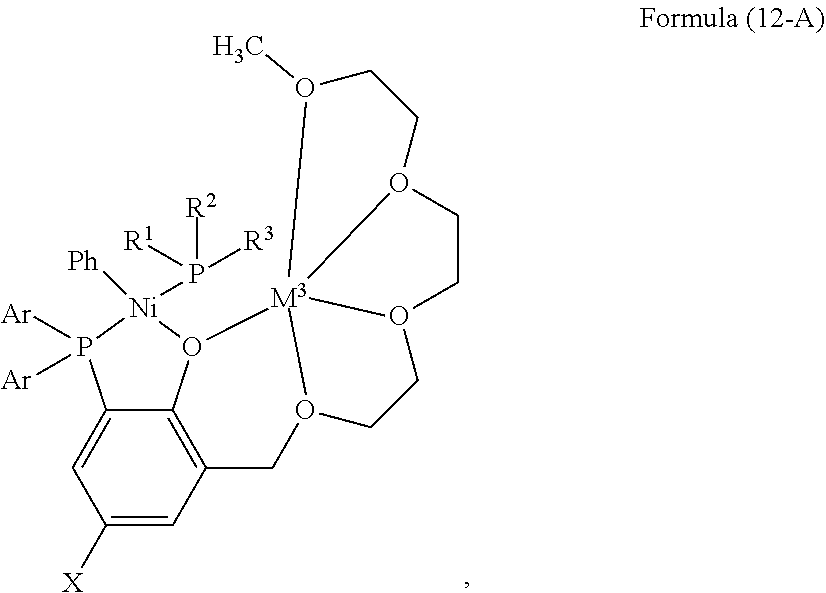
wherein, Ar is 2,6-dimethoxyphenyl; Ph is a phenyl group; M3 is a 2+ cation, 3+ cation, 4+ cation, or 5+ cation; X is hydrogen, an electron donating group, or an electron withdrawing group; and R1, R2, and R3 are each independently selected from optionally substituted aryl, optionally substituted alkyl, and optionally substituted cycloalkyl.

wherein in Formula (11-B) and Formula (12-B): Ar is 2,6-dimethoxyphenyl; Ph is a phenyl group; M3 is a 2+ cation, 3+ cation, 4+ cation, or 5+ cation; and PMe3 is trimethylphosphine.

wherein, Ar is 2,6-dimethoxyphenyl; Ph is a phenyl group; M3 is a 2+ cation, 3+ cation, 4+ cation, or 5+ cation; and PMe3 is trimethylphosphine.

wherein, Ar is 2,6-dimethoxyphenyl; Ph is a phenyl group; M3 is a 2+ cation, 3+ cation, 4+ cation, or 5+ cation; and PMe3 is trimethylphosphine.


wherein in Formula (13) and Formula (14): m is 2, 3, 4, or 5; n is 1, 2, 3, 4, or 5; Ar is 2,6-dimethoxyphenyl; L is an optionally substituted phenyl group; M3 is a 2+ cation, 3+ cation, 4+ cation, or 5+ cation; A− is a weakly coordinating anion; X, Y, and Z are each independently selected from hydrogen, an electron donating group, and an electron withdrawing group; and R1, R2, and R3 are each independently selected from optionally substituted aryl, optionally substituted alkyl, and optionally substituted cycloalkyl.

wherein, m is 2, 3, 4, or 5; n is 1, 2, 3, 4, or 5; Ar is 2,6-dimethoxyphenyl; L is an optionally substituted phenyl group; M3 is a 2+ cation, 3+ cation, 4+ cation, or 5+ cation; A− is a weakly coordinating anion; X, Y, and Z are each independently selected from hydrogen, an electron donating group, and an electron withdrawing group; and R1, R2, and R3 are each independently selected from optionally substituted aryl, optionally substituted alkyl, and optionally substituted cycloalkyl.

wherein, m is 2, 3, 4, or 5; n is 1, 2, 3, 4, or 5; Ar is 2,6-dimethoxyphenyl; L is an optionally substituted phenyl group; M3 is a 2+ cation, 3+ cation, 4+ cation, or 5+ cation; A− is a weakly coordinating anion; X, Y, and Z are each independently selected from hydrogen, an electron donating group, and an electron withdrawing group; and R1, R2, and R3 are each independently selected from optionally substituted aryl, optionally substituted alkyl, and optionally substituted cycloalkyl.

wherein Formula (13-A) and Formula (14-A): m is 2, 3, 4, or 5; n is 1, 2, 3, 4, or 5; Ar is 2,6-dimethoxyphenyl; Ph is a phenyl group; M3 is a 2+ cation, 3+ cation, 4+ cation, or 5+ cation; A− is a weakly coordinating anion; X is hydrogen, an electron donating group, or an electron withdrawing group; and R1, R2, and R3 are each independently selected from optionally substituted aryl, optionally substituted alkyl, and optionally substituted cycloalkyl.

wherein, m is 2, 3, 4, or 5; n is 1, 2, 3, 4, or 5; Ar is 2,6-dimethoxyphenyl; Ph is a phenyl group; M3 is a 2+ cation, 3+ cation, 4+ cation, or 5+ cation; A− is a weakly coordinating anion; X is hydrogen, an electron donating group, or an electron withdrawing group; and R1, R2, and R3 are each independently selected from optionally substituted aryl, optionally substituted alkyl, and optionally substituted cycloalkyl.

wherein, m is 2, 3, 4, or 5; n is 1, 2, 3, 4, or 5; Ar is 2,6-dimethoxyphenyl; Ph is a phenyl group; M3 is a 2+ cation, 3+ cation, 4+ cation, or 5+ cation; A− is a weakly coordinating anion; X is hydrogen, an electron donating group, or an electron withdrawing group; and R1, R2, and R3 are each independently selected from optionally substituted aryl, optionally substituted alkyl, and optionally substituted cycloalkyl.

wherein Formula (13-B) and Formula (14-B): m is 2, 3, 4, or 5; n is 1, 2, 3, 4, or 5; Ar is 2,6-dimethoxyphenyl; Ph is a phenyl group; M3 is a 2+ cation, 3+ cation, 4+ cation, or 5+ cation; A− is [(3,5-(CF3)2C6H3)4B]−; and PMe3 is trimethylphosphine.

wherein, m is 2, 3, 4, or 5; n is 1, 2, 3, 4, or 5; Ar is 2,6-dimethoxyphenyl; Ph is a phenyl group; M3 is a 2+ cation, 3+ cation, 4+ cation, or 5+ cation; A− is [(3,5-(CF3)2C6H3)4B]−; and PMe3 is trimethylphosphine.

wherein, m is 2, 3, 4, or 5; n is 1, 2, 3, 4, or 5; Ar is 2,6-dimethoxyphenyl; Ph is a phenyl group; M3 is a 2+ cation, 3+ cation, 4+ cation, or 5+ cation; A− is [(3,5-(CF3)2C6H3)4B]−; and PMe3 is trimethylphosphine.


wherein the bimetallic catalyst complex of Formula (16) has the structure:

wherein the bimetallic catalyst complex of Formula (17) has the structure:

wherein the bimetallic catalyst complex of Formula (18) has the structure:

wherein in Formula (15), Formula (16), Formula (17) and Formula (18): m is 2, 3, 4, or 5; n is 1, 2, 3, 4, or 5; Ar is 2,6-dimethoxyphenyl; L is an optionally substituted phenyl group; M4 is a 2+ cation, 3+ cation, 4+ cation, or 5+ cation; M5 is a 2+ cation, 3+ cation, 4+ cation, or 5+ cation; A− is a weakly coordinating anion; X, Y, and Z are each independently selected from hydrogen, an electron donating group, and an electron withdrawing group; and R1, R2, and R3 are each independently selected from optionally substituted aryl, optionally substituted alkyl, and optionally substituted cycloalkyl; wherein m is the same in the bimetallic catalyst complex of Formula (15), Formula (16), Formula (17), and Formula (18); wherein n is the same in the bimetallic catalyst complex of Formula (15), Formula (16), Formula (17), and Formula (18); wherein A− is the same in the bimetallic catalyst complex of Formula (15), Formula (16), Formula (17), and Formula (18); wherein Ar is the same in the bimetallic catalyst complex of Formula (15), Formula (16), Formula (17), and Formula (18); wherein L is the same in the bimetallic catalyst complex of Formula (15), Formula (16), Formula (17), and Formula (18); wherein X is the same in the bimetallic catalyst complex of Formula (15), Formula (16), Formula (17), and Formula (18); wherein Y is the same in the bimetallic catalyst complex of Formula (15), Formula (16), Formula (17), and Formula (18); wherein Z is the same in the bimetallic catalyst complex of Formula (15), Formula (16), Formula (17), and Formula (18); wherein R1 is the same in the bimetallic catalyst complex of Formula (15), Formula (16), Formula (17), and Formula (18); wherein R2 is the same in the bimetallic catalyst complex of Formula (15), Formula (16), Formula (17), and Formula (18); wherein R3 is the same in the bimetallic catalyst complex of Formula (15), Formula (16), Formula (17), and Formula (18); wherein M4 is the same in the bimetallic catalyst complex of Formula (15) and Formula (16); wherein M5 is the same in the bimetallic catalyst complex of Formula (17) and Formula (18); and wherein M4 and M5 are different from one another.

wherein the bimetallic catalyst complex of Formula (16-A) has the structure:

wherein the bimetallic catalyst complex of Formula (17-A) has the structure:

wherein the bimetallic catalyst complex of Formula (18-A) has the structure:

wherein in Formula (15-A), Formula (16-A), Formula (17-A) and Formula (18-A): m is 2, 3, 4, or 5; n is 1, 2, 3, 4, or 5; Ar is 2,6-dimethoxyphenyl; Ph is a phenyl group; M4 is a 2+ cation, 3+ cation, 4+ cation, or 5+ cation; M5 is a 2+ cation, 3+ cation, 4+ cation, or 5+ cation; A− is a weakly coordinating anion; X is hydrogen, an electron donating group, or an electron withdrawing group; and R1, R2, and R3 are each independently selected from optionally substituted aryl, optionally substituted alkyl, and optionally substituted cycloalkyl; wherein m is the same in the bimetallic catalyst complex of Formula (15-A), Formula (16-A), Formula (17-A), and Formula (18-A); wherein n is the same in the bimetallic catalyst complex of Formula (15-A), Formula (16-A), Formula (17-A), and Formula (18-A); wherein A− is the same in the bimetallic catalyst complex of Formula (15-A), Formula (16-A), Formula (17-A), and Formula (18-A); wherein Ar is the same in the bimetallic catalyst complex of Formula (15-A), Formula (16-A), Formula (17-A), and Formula (18-A); wherein Ph is the same in the bimetallic catalyst complex of Formula (15-A), Formula (16-A), Formula (17-A), and Formula (18-A); wherein X is the same in the bimetallic catalyst complex of Formula (15-A), Formula (16-A), Formula (17-A), and Formula (18-A); wherein R1 is the same in the bimetallic catalyst complex of Formula (15-A), Formula (16-A), Formula (17-A), and Formula (18-A); wherein R2 is the same in the bimetallic catalyst complex of Formula (15-A), Formula (16-A), Formula (17-A), and Formula (18-A); wherein R3 is the same in the bimetallic catalyst complex of Formula (15-A), Formula (16-A), Formula (17-A), and Formula (18-A); wherein M4 is the same in the bimetallic catalyst complex of Formula (15-A) and Formula (16-A); wherein M5 is the same in the bimetallic catalyst complex of Formula (17-A) and Formula (18-A); and wherein M4 and M5 are different from one another.

wherein the bimetallic catalyst complex of Formula (16-B) has the structure:

wherein the bimetallic catalyst complex of Formula (17-B) has the structure:

wherein the bimetallic catalyst complex of Formula (18-B) has the structure:

wherein in Formula (15-B), Formula (16-B), Formula (17-B) and Formula (18-B): m is 2, 3, 4, or 5; n is 1, 2, 3, 4, or 5; Ar is 2,6-dimethoxyphenyl; Ph is a phenyl group; M4 is a 2+ cation, 3+ cation, 4+ cation, or 5+ cation; M5 is a 2+ cation, 3+ cation, 4+ cation, or 5+ cation; A− is [(3,5-(CF3)2C6H3)4B]−; and PMe3 is trimethylphosphine; wherein m is the same in the bimetallic catalyst complex of Formula (15-B), Formula (16-B), Formula (17-B), and Formula (18-B); wherein n is the same in the bimetallic catalyst complex of Formula (15-B), Formula (16-B), Formula (17-B), and Formula (18-B); wherein A− is the same in the bimetallic catalyst complex of Formula (15-B), Formula (16-B), Formula (17-B), and Formula (18-B); wherein Ar is the same in the bimetallic catalyst complex of Formula (15-B), Formula (16-B), Formula (17-B), and Formula (18-B); wherein Ph is the same in the bimetallic catalyst complex of Formula (15-B), Formula (16-B), Formula (17-B), and Formula (18-B); wherein PMe3 is the same in the bimetallic catalyst complex of Formula (15-B), Formula (16-B), Formula (17-B), and Formula (18-B); wherein M4 is the same in the bimetallic catalyst complex of Formula (15-B) and Formula (16-B); wherein M5 is the same in the bimetallic catalyst complex of Formula (17-B) and Formula (18-B); and wherein M4 and M5 are different from one another.


wherein in Formula (5) and Formula (6):
-
- Ar is 2,6-dimethoxyphenyl;
- L is an optionally substituted phenyl group;
- M is Li, Na, K, or Cs;
- A− is a weakly coordinating anion;
- X, Y, and Z are each independently selected from hydrogen, an electron donating group, and an electron withdrawing group; and
- R1, R2, and R3 are each independently selected from optionally substituted aryl, optionally substituted alkyl, and optionally substituted cycloalkyl.
-
- Ar is 2,6-dimethoxyphenyl;
- L is a phenyl group;
- M is Li, Na, K, or Cs;
- A− is [(3,5-(CF3)2C6H3)4B]−;
- X is methyl;
- Y is hydrogen;
- Z is hydrogen; and
- R1, R2, and R3 are each methyl.
-
- contacting an optionally substituted olefin with the bimetallic catalyst complex of
paragraph 1, whereby the optionally substituted olefin undergoes homopolymerization.
- contacting an optionally substituted olefin with the bimetallic catalyst complex of
-
- contacting a first optionally substituted olefin and at least one other optionally substituted olefin with the bimetallic catalyst complex of
paragraph 1, whereby the first optionally substituted olefin and the at least one other optionally substituted olefin undergoes copolymerization, and wherein the first optionally substituted olefin and the at least one other optionally substituted olefin are different from one another.
- contacting a first optionally substituted olefin and at least one other optionally substituted olefin with the bimetallic catalyst complex of


| TABLE 3 |
| Job Plot Data and Calculations for Ni2-Lia |
| Volume of H | Amount of | Final Conc. of H | Ah | Aobs | ||
| χNi | (mL) | H Added (mol) | (M) | (calculated) | (@379 nm) | Ah-Aobs |
| 1.0 | 3.000E−03 | 1.500E−06 | 5.000E−04 | 1.733E+00 | 1.733E+00 | 0.000E+00 |
| 0.9 | 2.700E−03 | 1.350E−06 | 4.500E−04 | 1.560E+00 | 1.469E+00 | 9.125E−02 |
| 0.8 | 2.400E−03 | 1.200E−06 | 4.000E−04 | 1.387E+00 | 1.200E+00 | 1.869E−01 |
| 0.7 | 2.100E−03 | 1.050E−06 | 3.500E−04 | 1.213E+00 | 9.267E−01 | 2.866E−01 |
| 0.6 | 1.800E−03 | 9.000E−07 | 3.000E−04 | 1.040E+00 | 6.466E−01 | 3.934E−01 |
| 0.5 | 1.500E−03 | 7.500E−07 | 2.500E−04 | 8.667E−01 | 3.901E−01 | 5.607E−01 |
| 0.4 | 1.200E−03 | 6.000E−07 | 2.000E−04 | 6.933E−01 | 1.326E−01 | 4.765E−01 |
| 0.3 | 9.000E−04 | 4.500E−07 | 1.500E−04 | 5.200E−01 | 9.452E−02 | 4.255E−01 |
| 0.2 | 6.000E−04 | 3.000E−07 | 1.000E−04 | 3.467E−01 | 6.246E−02 | 2.842E−01 |
| 0.1 | 3.000E−04 | 1.500E−07 | 5.000E−05 | 1.733E−01 | 3.313E−02 | 1.402E−01 |
| 0.0 | 0.000E+00 | 0.000E+00 | 0.000E+00 | 0.000E+00 | 4.206E−03 | −4.206E−03 |
| ªThe molar absorptivity of H (εh) at 379 nm = 3470 M−1cm−1. Stock solution of H is 500 μM. | ||||||
| TABLE 4 |
| Job Plot Data and Calculations Used for Ni2-Naª |
| Volume of H | Amount of | Final Conc. of H | Ah | Aobs | ||
| χNi | (mL) | H Added (mol) | (M) | (calculated) | (@330 nm) | Ah-Aobs |
| 1 | 3.000E−03 | 1.500E−06 | 5.000E−04 | 1.842E+00 | 1.842E+00 | 0.000E−01 |
| 0.9 | 2.700E−03 | 1.350E−06 | 4.500E−04 | 1.658E+00 | 1.493E+00 | 1.650E−01 |
| 0.8 | 2.400E−03 | 1.200E−06 | 4.000E−04 | 1.474E+00 | 1.222E+00 | 2.522E−01 |
| 0.7 | 2.100E−03 | 1.050E−06 | 3.500E−04 | 1.290E+00 | 8.973E−01 | 3.924E−01 |
| 0.6 | 1.800E−03 | 9.000E−07 | 3.000E−04 | 1.105E+00 | 5.726E−01 | 5.328E−01 |
| 0.5 | 1.500E−03 | 7.500E−07 | 2.500E−04 | 9.212E−01 | 2.783E−01 | 6.429E−01 |
| 0.4 | 1.200E−03 | 6.000E−07 | 2.000E−04 | 7.369E−01 | 2.128E−01 | 5.242E−01 |
| 0.3 | 9.000E−04 | 4.500E−07 | 1.500E−04 | 5.527E−01 | 1.669E−01 | 3.858E−01 |
| 0.2 | 6.000E−04 | 3.000E−07 | 1.000E−04 | 3.685E−01 | 1.126E−01 | 2.559E−01 |
| 0.1 | 3.000E−04 | 1.500E−07 | 5.000E−05 | 1.842E−01 | 7.146E−02 | 1.128E−01 |
| 0 | 0.000E+00 | 0.000E+00 | 0.000E+00 | 0.000E+00 | 1.965E−02 | −1.965E−02 |
| ªThe molar absorptivity of H (εh) at 379 nm = 3680 M−1cm−1. Stock solution of H is 500 μM. | ||||||
| TABLE 5 |
| Job Plot Data and Calculations Used for Ni2-Ka |
| Volume of H | Amount of | Final Conc. of H | Ah | Aobs | ||
| χNi | (mL) | H Added (mol) | (M) | (calculated) | (@330 nm) | Ah-Aobs |
| 1 | 3.000E−03 | 1.500E−06 | 5.000E−04 | 1.680E+00 | 1.680E+00 | 0.000E+00 |
| 0.9 | 2.700E−03 | 1.350E−06 | 4.500E−04 | 1.510E+00 | 1.384E+00 | 1.280E−01 |
| 0.8 | 2.400E−03 | 1.200E−06 | 4.000E−04 | 1.340E+00 | 1.121E+00 | 2.230E−01 |
| 0.7 | 2.100E−03 | 1.050E−06 | 3.500E−04 | 1.180E+00 | 8.467E−01 | 3.290E−01 |
| 0.6 | 1.800E−03 | 9.000E−07 | 3.000E−04 | 1.010E+00 | 5.668E−01 | 4.410E−01 |
| 0.5 | 1.500E−03 | 7.500E−07 | 2.500E−04 | 8.400E−01 | 3.145E−01 | 5.250E−01 |
| 0.4 | 1.200E−03 | 6.000E−07 | 2.000E−04 | 6.720E−01 | 2.332E−01 | 4.390E−01 |
| 0.3 | 9.000E−04 | 4.500E−07 | 1.500E−04 | 5.040E−01 | 1.534E−01 | 3.510E−01 |
| 0.2 | 6.000E−04 | 3.000E−07 | 1.000E−04 | 3.360E−01 | 9.725E−02 | 2.390E−01 |
| 0.1 | 3.000E−04 | 1.500E−07 | 5.000E−05 | 1.680E−01 | 7.084E−02 | 9.720E−02 |
| 0 | 0.000E+00 | 0.000E+00 | 0.000E+00 | 0.000E+00 | 9.125E−04 | −9.130E−04 |
| aThe molar absorptivity of H (εh) at 379 nm = 3360 M−1cm−1. Stock solution of H is 500 μM. | ||||||
| TABLE 6 |
| Job Plot Data and Calculations Used for Ni2-Csª |
| Volume of H | Amount of | Final Conc. of H | Ah | Aobs | ||
| χNi | (mL) | H Added (mol) | (M) | (calculated) | (@330 nm) | Ah-Aobs |
| 1 | 3.000E−03 | 1.500E−06 | 5.000E−04 | 1.649E+00 | 1.649E+00 | 0.000E+00 |
| 0.9 | 2.700E−03 | 1.350E−06 | 4.500E−04 | 1.485E+00 | 1.466E+00 | 1.885E−02 |
| 0.8 | 2.400E−03 | 1.200E−06 | 4.000E−04 | 1.320E+00 | 1.231E+00 | 8.835E−02 |
| 0.7 | 2.100E−03 | 1.050E−06 | 3.500E−04 | 1.155E+00 | 1.007E+00 | 1.480E−01 |
| 0.6 | 1.800E−03 | 9.000E−07 | 3.000E−04 | 9.897E−01 | 7.914E−01 | 1.983E−01 |
| 0.5 | 1.500E−03 | 7.500E−07 | 2.500E−04 | 8.247E−01 | 6.064E−01 | 2.183E−01 |
| 0.4 | 1.200E−03 | 6.000E−07 | 2.000E−04 | 6.598E−01 | 4.728E−01 | 1.870E−01 |
| 0.3 | 9.000E−04 | 4.500E−07 | 1.500E−04 | 4.948E−01 | 3.575E−01 | 1.374E−01 |
| 0.2 | 6.000E−04 | 3.000E−07 | 1.000E−04 | 3.299E−01 | 2.236E−01 | 1.063E−01 |
| 0.1 | 3.000E−04 | 1.500E−07 | 5.000E−05 | 1.649E−01 | 1.284E−01 | 3.653E−02 |
| 0 | 0.000E+00 | 0.000E+00 | 0.000E+00 | 0.000E+00 | 5.027E−03 | −5.027E−03 |
| ªThe molar absorptivity of H (εh) at 379 nm = 3300 M−1cm−1. Stock solution of H is 500 μM. | ||||||
| TABLE 7 |
| Comparison of the 31P NMR Chemical Shifts for |
| the Nickel Complexesa |
| Com- | trans-Ni Species | cis-Ni Species |
| plex | (31P NMR, ppm) | (31P NMR, ppm) |
| Ni1 | 13.34 (d, J = 325.6 Hz) | — |
| −12.05 (d, J = 335.3 Hz) | ||
| Ni1—Li | 7.95 (broad d, J = 328.0 Hz) | 5.49 (d, J = 31.6 Hz) |
| −18.28 (d, J = 345 Hz) | −8.62 (d, J = 31.6 Hz) | |
| Ni1—Na | 10.34 (broad d, J = 318.3 Hz) | 10.46 (d, J = 36.4 Hz) |
| −16.56 (d, J = 318.3Hz) | −8.82 (d, J = 36.4 Hz) | |
| Ni1—K | 10.53 (broad d, J = 306.2 Hz) | 10.70 (d, J = 36.4 Hz) |
| −16.17 (d, J = 315.9 Hz) | −8.41 (d, J = 34.0 Hz) | |
| Ni1—Cs | 12.06 (d, J = 330.5 Hz) | 10.96 (d, J = 38.9 Hz) |
| −13.18 (d, J = 315.9 Hz) | −9.42 (d, J = 34.0 Hz) | |
| Ni2 | −3.48 (d, J = 314.6 Hz) | — |
| −14.02 (d, J = 317.0 Hz) | ||
| Ni2—Li | −11.42 (d, J = 318.3 Hz) | −9.49 (d, J = 34.0 Hz) |
| −19.86 (d, J = 318.3 Hz) | −16.16 (d, J = 36.4 Hz) | |
| Ni2—Na | −5.53 (d, J = 315.9 Hz) | −8.18 (broad s) |
| −16.92 (d, J = 313.5 Hz) | ||
| Ni2—K | −5.32 (d, J = 313.5 Hz) | −8.06 (s) |
| −17.07 (d, J = 315.9 Hz) | −8.21 (s) | |
| Ni2—Cs | −4.58 (d, J = 318.3 Hz) | −6.76 (d, J = 36.4 Hz) |
| −16.46 (d, J = 318.3 Hz) | −8.72 (d, J = 36.4 Hz) | |
| aNMR spectra (243 MHz) were acquired in toluene-d8/Et2O-d10 (4:1) at RT. | ||
| TABLE 8 |
| Comparison of the trans and cis Distribution of Nickel |
| Complexes in Solutiona |
| trans-Ni Species | cis-Ni Species | ||||
| Complex | (%) | (%) | Kcis/trans | ||
| Ni1 | 100 | 0 | — | ||
| Ni1— |
90 | 10 | 0.1 | ||
| Ni1— |
10 | 90 | 9.0 | ||
| Ni1— |
12 | 88 | 7.3 | ||
| Ni1—Cs | 67 | 33 | 0.5 | ||
| Ni2 | 100 | 0 | — | ||
| Ni2— |
15 | 85 | 5.7 | ||
| Ni2—Na | 46 | 54 | 1.2 | ||
| Ni2—K | 39 | 61 | 1.6 | ||
| Ni2—Cs | 87 | 13 | 0.1 | ||
| aPercentages of cis and trans species were calculated from integration of the complex's 31P NMR spectra in toluene-d8/Et2O-d10 (4:1) at RT. | |||||
| TABLE 9 |
| Summary of the % Vbur of Various |
| Nickel Complexesa |
| Complex | % Vbur | ||
| Ni1 | — | ||
| Ni1—Li | 53.3 | ||
| Ni1—Na | 50.7 | ||
| Ni1—K | 57.3 | ||
| Ni1—Cs | 62.5 | ||
| Ni2 | — | ||
| Ni2—Li | 50.6 | ||
| Ni2—Na | 51.3 | ||
| Ni2—K | 53.7 | ||
| Ni2—Cs | 66.2 | ||
| aThe crystallographic data for the Ni1-M complexes were reported previously (Tran, T. V.; Nguyen, Y. H.; Do, L. H., Development of Highly Productive Nickel-Sodium Phenoxyphosphine Ethylene Polymerization Catalysts and their Reaction Temperature Profiles. Polym. Chem. 2019, 10 (27), 3718-3721), (Tran, T. V.; Karas, L. J.; Wu, J. I.; Do, L. H., Elucidating Secondary Metal Cation Effects on Nickel Olefin Polymerization Catalysts. ACS Catal. 2020, 10 (18), 10760-10772). | |||
| TABLE 10 |
| Comparison of the Cis and Trans Isomer Distributionª |
 |
| Complex | trans (%) | cis (%) | Kcis/trans |
| Nil | 100 | 0 | — |
| Nil- |
90 | 10 | 0.1 |
| Nil- |
10 | 90 | 9.0 |
| Nil- |
12 | 88 | 7.3 |
| Nil-Cs | 67 | 33 | 0.5 |
| Ni2 | 100 | 0 | — |
| Ni2- |
15 | 85 | 5.7 |
| Ni2-Na | 46 | 54 | 1.2 |
| Ni2-K | 39 | 61 | 1.6 |
| Ni2-Cs | 87 | 13 | 0.1 |
| aRelative distribution determined from quantification of their 31P NMR spectra in toluene-d8/Et2O (4:1). | |||
| TABLE 11 |
| Ethylene Polymerization Using Ni1 and Ni1-Ma |
| Temp. | Polymer | Activity | Mn b | Branchese | vgrowth/ | ||||||
| Entry | Cat. | Salt | (° C.) | Yield (g) | (kg/mol · h) | (×103) | Ðb | (/1000 C) | vgrowth f | vterm g | vterm |
| 1 | | none | 30 | |
0 | — | — | — | — | — | — | |
| 2d | | Li | + | 30 | 3.53 | 35000 | 40.1 | 1.3 | 12 | 1260714 | 880.3 | 1432 |
| 3 | | Na | + | 30 | 9.07 | 18000 | 1.72 | 1.4 | 27 | 647857 | 10546.5 | 61 |
| 4 | | K | + | 30 | 1.46 | 2900 | 4.53 | 1.6 | 25 | 104286 | 644.6 | 162 |
| 5 | | Cs | + | 30 | 0.18 | 360 | 33.93 | 1.5 | 9 | 12857 | 10.6 | 1212 |
| aData previously reported (Tran, T. V.; Karas, L. J .; Wu, J. I .; Do, L. H., Elucidating Secondary Metal Cation Effects on Nickel Olefin Polymerization Catalysts. ACS Catal. 2020, 10 (18), 10760-10772). Polymerization conditions: Ni1 catalyst (0.5 μmol), MBArF 4 (1 μmol, if any), Ni(COD)2 (4 μmol), ethylene (450 psi), 100 mL toluene, 1 h. Temperature was controlled by manual external cooling when necessary to ensure the reaction temperature does not exceed greater than 5° C. from the starting temperature. | ||||||||||||
| bThe total number of branches per 1000 carbons was determined by 1H NMR spectroscopy. | ||||||||||||
| cDetermined by GPC in trichlorobenzene at 140° C.. | ||||||||||||
| dNi1 (0.1 μmol), LiBArF 4 (0.2 μmol), Ni(COD)2 (0.8 μmol). | ||||||||||||
| eThe total number of branches per 1000 carbons was determined by 1H NMR spectroscopy. | ||||||||||||
| fUnit: mol C2H4/mol Ni · h. | ||||||||||||
| gUnit: mol PE/mol Ni · h. | ||||||||||||
| TABLE 12 |
| Ethylene Polymerization Using Ni2 and Ni2-M at Different Temperaturesª |
| Temp. | Polymer | Activity | Mn b | Branchese | vgrowth/ | ||||||
| Entry | Cat. | Salt | (° C.) | Yield (g) | (kg/mol · h) | (×103) | Ðb | (/1000 C) | vgrowth f | vterm g | vterm |
| 1 | Ni2 | none | 30 | 0.279 | 279 | 270.7 | 2.0 | 4 | 9964 | 1.0 | 9668 |
| 2 | Ni2 | Li+ | 30 | 2.94 | 2940 | 684.9 | 1.5 | 3 | 105000 | 4.3 | 24461 |
| 3 | Ni2 | Na+ | 30 | 2.43 | 2400 | 1234 | 1.3 | 2 | 86786 | 2.0 | 44071 |
| 4 | Ni2 | K+ | 30 | 1.88 | 1880 | 948.5 | 1.4 | 1 | 67143 | 2.0 | 33875 |
| 5 | Ni2 | Cs+ | 30 | 1.26 | 1260 | 1415 | 1.6 | 12 | 45000 | 0.9 | 50536 |
| 6c | Ni2 | none | 60 | 0.105 | 525 | 115.5 | 2.2 | — | 18750 | 4.5 | 4125 |
| 7c | Ni2 | Li+ | 60 | 6.2 | 31000 | 181.6 | 1.6 | — | 1107143 | 170.7 | 6486 |
| 8c | Ni2 | Na+ | 60 | 1.13 | 5650 | 198.7 | 1.6 | — | 201786 | 28.4 | 7096 |
| 9c | Ni2 | K+ | 60 | 1.7 | 8500 | 196.4 | 1.6 | — | 303571 | 43.3 | 7014 |
| 10c | Ni2 | Cs+ | 60 | 0.64 | 3200 | 707.9 | 1.4 | — | 114286 | 4.5 | 25282 |
| 11c | Ni2 | none | 90 | 4.6 | 23000 | 40.6 | 2.0 | — | 821429 | 566.5 | 1450 |
| 12c | Ni2 | Li+ | 90 | 9.9 | 49500 | 15.2 | 2.6 | — | 1767857 | 3256.6 | 543 |
| 13c | Ni2 | Na+ | 90 | 11.7 | 58500 | 30.7 | 1.8 | — | 2089286 | 1905.5 | 1096 |
| 14c | Ni2 | K+ | 90 | 3.7 | 18500 | 49.8 | 1.6 | — | 660714 | 371.5 | 1779 |
| 15c | Ni2 | Cs+ | 90 | 4.7 | 23500 | 117.3 | 1.7 | — | 839286 | 200.3 | 4189 |
| 16d | Ni2 | Cs+ | 90 | 3.3 | 33000 | 185.2 | 1.5 | — | 1178571 | 178.2 | 6614 |
| aPolymerization conditions: catalyst (1.0 μmol), MBArF 4 (5.0 μmol, if any), Ni(COD)2 (10 μmol), ethylene (450 psi), 98 mL toluene/2 mL Et2O, 1 h. Temperature was controlled by manual external cooling when necessary to ensure that the reaction temperature does not exceed greater than 5° C. from the starting temperature. | |||||||||||
| bDetermined by GPC in trichlorobenzene at 160° C.. | |||||||||||
| cNi2 (0.2 μmol), MBArF 4 (1 μmol, if any), Ni(COD)2 (1.6 μmol), temperature quickly increased to 114° C. after addition of catalyst mixture. | |||||||||||
| dNi2 (0.1 μmol), MBArF 4 (0.5 μmol), Ni(COD)2 (1 μmol). | |||||||||||
| eThe total number of branches per 1000 carbons was determined by 1H NMR spectroscopy in TCE-d2 at 120° C.. | |||||||||||
| fUnit: mol C2H4/mol Ni · h. | |||||||||||
| gUnit: mol PE/mol Ni · h. | |||||||||||
| TABLE 13 |
| Ethylene Polymerization Using Ni1 with Various Li+/Na+ Ratios Under Non-Switching Conditions (30° C.)a |
| Li+ | Na+ | Ni1-Li | Ni1-Na | ||||||||
| Added | Added | Polymer | Activity | Branchesc | A15.8/ | Calc. | Calc. | ||||
| Entry | Cat. | (equiv.) | (equiv.) | Yield (g) | (kg/mol · h) | (×103) | (/1000 C) | Ðb | A18.2 d | (×108 mol) | (×108 mol) |
| 1 | Ni1 | — | 2 | 0.83 | 16600 | 1.54 | 27 | 1.7 | — | — | — |
| 2 | |
2 | 40 | 0.85 | 17000 | 2.19 | 25 | 3.9 | 0.04 | 0.07 | 4.94 |
| 3 | |
2 | 20 | 0.91 | 18200 | 2.99 | 17 | 4.9 | 0.4 | 0.58 | 4.04 |
| 4 | |
2 | 10 | 1.14 | 22800 | 4.62 | 15 | 5.1 | 1.0 | 1.25 | 3.63 |
| 5 | |
2 | 4 | 1.26 | 25200 | 10.29 | 10 | 3.6 | 2.6 | 2.05 | 2.29 |
| 6 | |
2 | 2 | 1.33 | 26600 | 14.02 | 9 | 2.6 | 3.8 | 2.40 | 1.83 |
| 7 | |
2 | 1 | 1.65 | 33000 | 18.89 | 8 | 2.3 | 3.2 | 2.85 | 2.58 |
| 8 | |
2 | 0.5 | 1.95 | 39000 | 21.17 | 7 | 2.0 | 3.1 | 3.34 | 3.13 |
| 9 | |
2 | — | 2.14 | 42800 | 31.13 | 11 | 1.7 | — | — | — |
| aPolymerization conditions: Ni1 (0.1 μmol), MBArF 4 (varied), Ni(COD)2 (0.8 μmol), ethylene (450 psi), 100 mL toluene/0.2 mL Et2O, 30° C., 0.5 h. Temperature was controlled by manual external cooling when necessary to ensure that the reaction temperature does not exceed greater than 5° C. from the starting temperature. | |||||||||||
| bDetermined by GPC in trichlorobenzene at 160° C.. | |||||||||||
| cThe total number of branches per 1000 carbons was determined by 1H NMR spectroscopy in TCE-d2 at 120° C.. | |||||||||||
| dThe GPC peaks at ~15.8 (corresponding to polymer from Ni1-Li) and 18.2 min (corresponding to polymer from Ni1-Na) were fit to two different Gaussian functions. The integrated areas A15.8 and A18.2 correspond to the peaks at 15.8 and 18.2 min, respectively. | |||||||||||
| TABLE 14 |
| Ethylene Polymerization Using Ni2 with Cs+ Under |
| Non-Switching Conditions (30° C.)a |
| Polymer | Activity | ||||||||
| En- | CsBArF 4 | Yield | (kg/ | Mn b | A13.4/ | ||||
| try | Cat. | (equiv.) | (g) | mol · h) | (×103) | Ðb | | A | 15.5 |
| 1 | |
0 | 0.21 | 52 | 203 | 2.4 | mono- | — |
| modal | ||||||||
| 2 | Ni2 | 0.25 | 0.95 | 238 | 93 | 3.5 | bimodal | 0.4 |
| 3 | Ni2 | 0.50 | 0.07 | 18 | 84 | 3.0 | slightly | 0.1 |
| bimodal | ||||||||
| 4 | Ni2 | 1.00 | 0.33 | 82 | 916 | 1.5 | mono- | — |
| modal | ||||||||
| aPolymerization conditions: Ni2 (4 μmol), CsBArF 4 (varied), Ni(COD)2 (32 μmol), ethylene (450 psi), 12.5 mL toluene/37.5 mL hexane, 30° C., 1 h. Temperature was controlled by manual external cooling when necessary to ensure that the reaction temperature does not exceed greater than 5° C. from the starting temperature. | ||||||||
| bDetermined by GPC in trichlorobenzene at 160° C.. | ||||||||
| TABLE 15 |
| Ethylene Polymerization Using Ni2 with Cs+ Under Dynamic |
| Switching Conditions (30° C.)a |
| Activity | |||||||
| En- | CsBArF 4 | Polymer | (kg/mol · | Mn b | Branchesc | ||
| try | Cat. | (equiv.) | Yield (g) | h) | (×103) | Ðb | (/1000 C) |
| 1 | |
0 | 0.7 | 175 | 484 | 1.6 | 4 |
| 2 | Ni2 | 0.25 | 0.37 | 93 | 305 | 1.9 | — |
| 3 | Ni2 | 0.50 | 0.46 | 115 | 695 | 1.6 | 3 |
| 4 | Ni2 | 1.00 | 0.96 | 240 | 945 | 1.4 | 12 |
| aPolymerization conditions: catalyst (4 μmol), Ni(COD)2 (8 μmol), ethylene (450 psi), 98 mL toluene/2 mL Et2O, 30° C., 1 h. Temperature was controlled by manual external cooling when necessary to ensure that the reaction temperature does not exceed greater than 5° C. from the starting temperature. | |||||||
| bDetermined by GPC in trichlorobenzene at 160° C.. | |||||||
| cThe total number of branches per 1000 carbons was determined by 1H NMR spectroscopy in TCE-d2 at 120° C.. | |||||||
| TABLE 16 |
| Ethylene Polymerization Using Ni2 with Cs+ Under Dynamic |
| Switching Conditions (60° C.)a |
| CsBArF 4 | Polymer Yield | Activity | Mn b | |||
| Entry | Cat. | (equiv.) | (g) | (kg/mol · h) | (×103) | Ðb |
| 1 | |
0 | 0.105 | 525 | 116 | 2.2 |
| 2 | Ni2 | 0.25 | 0.11 | 550 | 168 | 1.4 |
| 3 | Ni2 | 0.50 | 0.18 | 900 | 278 | 1.4 |
| 4 | Ni2 | 0.75 | 0.2 | 1000 | 318 | 1.4 |
| 5 | Ni2 | 1.00 | 0.26 | 1300 | 462 | 1.3 |
| 6 | Ni2 | 2.00 | 0.31 | 1550 | 586 | 1.4 |
| 7 | Ni2 | 5.00 | 0.64 | 3200 | 708 | 1.4 |
| aPolymerization conditions: catalyst (0.2 μmol), Ni(COD)2 (1.6 μmol), ethylene (450 psi), 98 mL toluene/2 mL Et2O, 60° C., 1 h. Temperature was controlled by manual external cooling when necessary to ensure that the reaction temperature does not exceed greater than 5° C. from the starting temperature. | ||||||
| bDetermined by GPC in trichlorobenzene at 160° C.. | ||||||
| TABLE 17 |
| Ethylene Polymerization Using Ni2 with Li+/Cs+ Under |
| Dynamic Switching Conditionsª |
| Polymer | |||||||
| LiBArF 4 | CsBArF 4 | Yield | Activity | Mn b | |||
| Entry | Cat. | (equiv.) | (equiv.) | (g) | (kg/mol · h) | (×103) | Ðb |
| 1 | |
5 | — | 0.64 | 31000 | 182 | 1.6 |
| 2 | Ni2 | 3.75 | 1.25 | 0.31 | 14620 | 319 | 1.5 |
| 3 | Ni2 | 2.5 | 2.5 | 0.26 | 8560 | 495 | 1.4 |
| 4 | Ni2 | 1.25 | 3.75 | 0.2 | 3420 | 348 | 1.6 |
| 5 | Ni2 | — | 5 | 0.18 | 3200 | 708 | 1.4 |
| aPolymerization conditions: catalyst (0.2 μmol), Ni(COD)2 (1.6 μmol), ethylene (450 psi), 98 mL toluene/2 mL Et2O, 60° C., 1 h. Temperature was controlled by manual external cooling when necessary to ensure that the reaction temperature does not exceed greater than 5° C. from the starting temperature. | |||||||
| bDetermined by GPC in trichlorobenzene at 160° C.. | |||||||
| TABLE 18 |
| Comparison of Thermally Stable Ethylene Polymerization Catalystsª |
 |
 |
 |
 |
 |
 |
 |
| Time | Temp. | Yield | Activity | Productivity | Mn | |||
| Complex | % Vbur | (h) | (° C.) | (g) | (kg/mol·h) | (kg/mol) | (kg/mol) | D |
| Cat3 (1.0 μmol) | —b | 1.0 | 80 | 0.60 | 600 | 600 | 1226 | 2.0 |
| Cat4 (1.57 μmol) | 49 | 0.17 | 100 | 0.75 | 2810 | 478 | 422 | 1.2 |
| Cat5 (5.0 μmol ) | 43c | 0.33 | 90 | 16.7 | 10020 | 3340 | 9.4 | 2.7 |
| Cat6 (5.0 umol) | 41 | 0.33 | 90 | 24.7 | 14835 | 4940 | 1.6 | 3.4 |
| Cat7 (5.0 μmol)c | 52c | 0.25 | 90 | 1.65 | 1320 | 330 | 9.5 | 1.8 |
| Cat8 (0.25 μmol) | 46 | <0.02 | 90 | 0.29 | 57500 | 1160 | 4.1 | 3.1 |
| Cat9 (2.5 μmol) | —b | 0.5 | 100 | 0.30 | 240 | 120 | 2.6 | 2.3 |
| Ni1-Cs (0.5 μmol) | 62 | 0.5 | 90 | 5.73 | 23000 | 11460 | 15.7 | 1.4 |
| Ni2-Cs (0.1 μmol) | 66 | 1.0 | 90 | 3.30 | 33000 | 33000 | 185 | 1.5 |
| aReferences: | ||||||||
| Cat3 (Liang, T.; Goudari, S. B.; Chen, C., A Simple and Versatile Nickel Platform for the Generation of Branched High Molecular Weight Polyolefins. Nat. Commun. 2020, 11 (1), 372), | ||||||||
| Cat4 (Rhinehart, J. L.; Brown, L. A.; Long, B. K., A Robust Ni(II) α-Diimine Catalyst for High Temperature Ethylene Polymerization. J. Am. Chem. Soc. 2013, 135 (44), 16316-16319), | ||||||||
| Cat5 (Zhang, Y.; Mu, H.; Pan, L.; Wang, X.; Li, Y., Robust Bulky [P,O] Neutral Nickel Catalysts for Copolymerization of Ethylene with Polar Vinyl Monomers. ACS Catal. 2018, 8, 5963-5976), | ||||||||
| Cat6 (Wang, X.-1.; Zhang, Y.- p.; Wang, F.; Pan, L.; Wang, B.; Li, Y.- s., Robust and Reactive Neutral Nickel Catalysts for Ethylene Polymerization and Copolymerization with a Challenging 1,1-Disubstituted Difunctional Polar Monomer. ACS Catal. 2021, 11, 2902-2911), | ||||||||
| Cat7 (Wang, C.; Kang, X.; Dai, S.; Cui, F.; Li, Y.; Mu, H.; Mecking, S .; Jian, Z., Efficient Suppression of Chain Transfer and Branching via Cs-Type Shielding in a Neutral Nickel(II) Catalyst. Angewandte Chemie International Edition 2021, 60 (8), 4018-4022), | ||||||||
| Cat8 (Xiong, S.; Hong, A.; Bailey, B. C.; Spinney, H. A.; Senecal, T. D.; Bailey, H.; Agapie, T., Highly Active and Thermally Robust Nickel Enolate Catalysts for the Synthesis of Ethylene-Acrylate Copolymers. Angewandte Chemie International Edition 2022, n/a (n/a), e202206637), | ||||||||
| Cat9 (Tao, W.-j.; Nakano, R.; Ito, S.; Nozaki, K., Copolymerization of Ethylene and Polar Monomers by Using Ni/IzQO Catalysts. Angewandte Chemie International Edition 2016, 55 (8), 2835-2839.), | ||||||||
| Ni1-Cs (Tran, T. V.; Karas, L. J.; Wu, J. I.; Do, L. H., Elucidating Secondary Metal Cation Effects on Nickel Olefin Polymerization Catalysts. ACS Catal. 2020, 10 (18), 10760-10772), | ||||||||
| Ni2-Cs (the present invention). | ||||||||
| bX-ray structural data not available for calculating %Vbur. | ||||||||
| cBuried volume calculated from related structure. | ||||||||
| TABLE 19 |
| Crystal Data and Structure Refinement for Ni2—Li and Ni2—Cs |
| Ni2—Li | Ni2—Na•(benzene) | Ni2—K•(benzene) | Ni2—Cs | |
| Empirical Formula | NiLiC40H54O9P2 | NiNaC40H54O9P2 | NiKC40H54O9P2 | NiCsC40H54O9P2 |
| (BC32H12F24) | (BC32H12F24)(C6H6) | (BC32H12F24)(C6H6) | (BC32H12F24) | |
| Temperature (° C.) | −150 | −150 | −150 | −150 |
| Wavelength (Å) | 0.71073 | 0.71073 | 0.71073 | 0.71073 |
| Crystal System Space Group | Triclinic, P-1 | Monoclinic, C2/c | Monoclinic, C2/c | Monoclinic, P21/c |
| Unit Cell Dimensions | 12.626(4) | 39.802(17) | 39.569(3) | 19.0606(4) |
| a (Å) | 15.849(5) | 12.877(6) | 12.9171(9) | 20.3960(3) |
| b (Å) | 19.404(6) | 31.238(13) | 31.172(2) | 20.4253(4) |
| c (Å) | 82.826(3) | 90 | 90 | 90 |
| α (°) | 80.458(3) | 99.090(5) | 99.248(2) | 100.18(1) |
| β (*) | 87.287(3) | 90 | 90 | 90 |
| γ (°) | ||||
| Volume (Å3) | 3798(2) | 15809(12) | 15725.6(18) | 7817.0(3) |
| Z, Calculated Density (Mg/m3) | 2, 1.460 | 12, 1.433 | 12, 1.454 | 4, 1.526 |
| Absorption Coefficient (mm−1) | 0.411 | 0.401 | 0.451 | 0.858 |
| F(000) | 1704 | 6964 | 7028 | 3616 |
| Theta Range for Data Collection (°) | 1.072 to 27.546 | 1.036 to 27.376 | 1.043 to 27.504 | 1.085 to 27.504 |
| Limiting Indices | −16 ≤ h ≤ 16 | −51 ≤ h ≤ 46 | −51 ≤ h ≤ 51 | −24 ≤ h ≤ 24 |
| −20 ≤ k ≤ 20 | −12 ≤ k ≤ 16 | −16 ≤ k ≤ 16 | −26 ≤ k ≤ 26 | |
| −25 ≤ l ≤ 25 | −40 ≤ l ≤ 40 | −38 ≤ l ≤ 40 | −26 ≤ l ≤ 26 | |
| Reflections Collected/Unique | 62572/17367 | 123627/17907 | 91646/18001 | 80622/17914 |
| [R(int) = 0.0590] | [R(int) = 0.0334] | [R(int)]0.0637] | [R(int) = 0.1403] | |
| Data/Restraints/Parameters | 17367/224/989 | 17907/60/939 | 18001/32/936 | 17914/198/986 |
| Goodness of Fit on F2 | 1.032 | 1.020 | 1.035 | 1.005 |
| Final R Indices | R1 = 0.0617 | R1 = 0.0842 | R1 = 0.0932 | R1 = 0.0731 |
| [I > 2σ(I)] | wR2 = 0.1484 | wR2 = 0.2327 | wR2 = 0.2543 | wR2 = 0.1423 |
| R Indices (All Data)* | R1 = 0.1160 | R1 = 0.1025 | R1 = 0.1491 | R1 = 0.1957 |
| wR2 = 0.1779 | wR2 = 0.2514 | wR2 = 0.2941 | wR2 = 0.1911 | |
| *R1 = Σ ||Fo| − |Fo||/Σ|Fo|; wR2 = [Σ[w(Fo 2 − Fc 2)2]/Σ[w(Fo 2)2]]1/2; GOF = [Σ[w(Fo 2 − Fc 2)2]/(n − p)]1/2, where n is the number of reflections and p is the total number of parameters refined. | ||||
| TABLE 20 |
| Comparison of Bond Distances and Angles from the |
| Crystallographic Data |
| Distance (Å) or | ||||
| Angle (°) | Ni2-Li | Ni2-Na | Ni2-K | Ni2-Cs |
| Ni(1)-P(1) | 2.2471(11) | 2.1859(12) | 2.1802(14) | 2.1795(19) |
| Ni(1)-P(2) | 2.1148(11) | 2.1921(13) | 2.1854(16) | 2.182(2) |
| Ni(1)-C(X) | 1.947(15) | 1.906(4) | 1.902(5) | 1.898(6) |
| Ni(1)-O(1) | 1.923(2) | 1.935(3) | 1.918(3) | 1.900(4) |
| P(1)-Ni(1)-O(1) | 82.84(7) | 86.59(8) | 86.71(12) | 87.26(14) |
Claims (20)

Priority Applications (3)
| Application Number | Priority Date | Filing Date | Title |
|---|---|---|---|
| US17/982,767 US12049532B2 (en) | 2022-07-27 | 2022-11-08 | Nickel catalysts with single alkali ions for homopolymerization and copolymerization |
| US18/734,299 US12503526B2 (en) | 2022-07-27 | 2024-06-05 | Nickel catalysts with single alkali ions for homopolymerization and copolymerization |
| US19/238,788 US20250361333A1 (en) | 2022-07-27 | 2025-06-16 | Methods for preparing copolymers and for the oxidative degradation thereof |
Applications Claiming Priority (3)
| Application Number | Priority Date | Filing Date | Title |
|---|---|---|---|
| US202263392560P | 2022-07-27 | 2022-07-27 | |
| US202263402749P | 2022-08-31 | 2022-08-31 | |
| US17/982,767 US12049532B2 (en) | 2022-07-27 | 2022-11-08 | Nickel catalysts with single alkali ions for homopolymerization and copolymerization |
Related Child Applications (1)
| Application Number | Title | Priority Date | Filing Date |
|---|---|---|---|
| US18/734,299 Continuation US12503526B2 (en) | 2022-07-27 | 2024-06-05 | Nickel catalysts with single alkali ions for homopolymerization and copolymerization |
Publications (2)
| Publication Number | Publication Date |
|---|---|
| US20240101726A1 US20240101726A1 (en) | 2024-03-28 |
| US12049532B2 true US12049532B2 (en) | 2024-07-30 |
Family
ID=89707045
Family Applications (5)
| Application Number | Title | Priority Date | Filing Date |
|---|---|---|---|
| US17/982,917 Active US12043688B2 (en) | 2022-07-27 | 2022-11-08 | Nickel catalysts with two alkali ions for homopolymerization and copolymerization |
| US17/983,284 Pending US20240166775A1 (en) | 2022-07-27 | 2022-11-08 | Nickel catalysts with two metal cations for homopolymerization and copolymerization |
| US17/982,767 Active 2042-11-08 US12049532B2 (en) | 2022-07-27 | 2022-11-08 | Nickel catalysts with single alkali ions for homopolymerization and copolymerization |
| US17/983,170 Active US12043689B2 (en) | 2022-07-27 | 2022-11-08 | Nickel catalysts with single metal cations for homopolymerization and copolymerization |
| US18/734,299 Active US12503526B2 (en) | 2022-07-27 | 2024-06-05 | Nickel catalysts with single alkali ions for homopolymerization and copolymerization |
Family Applications Before (2)
| Application Number | Title | Priority Date | Filing Date |
|---|---|---|---|
| US17/982,917 Active US12043688B2 (en) | 2022-07-27 | 2022-11-08 | Nickel catalysts with two alkali ions for homopolymerization and copolymerization |
| US17/983,284 Pending US20240166775A1 (en) | 2022-07-27 | 2022-11-08 | Nickel catalysts with two metal cations for homopolymerization and copolymerization |
Family Applications After (2)
| Application Number | Title | Priority Date | Filing Date |
|---|---|---|---|
| US17/983,170 Active US12043689B2 (en) | 2022-07-27 | 2022-11-08 | Nickel catalysts with single metal cations for homopolymerization and copolymerization |
| US18/734,299 Active US12503526B2 (en) | 2022-07-27 | 2024-06-05 | Nickel catalysts with single alkali ions for homopolymerization and copolymerization |
Country Status (2)
| Country | Link |
|---|---|
| US (5) | US12043688B2 (en) |
| WO (4) | WO2024025608A1 (en) |
Cited By (1)
| Publication number | Priority date | Publication date | Assignee | Title |
|---|---|---|---|---|
| US12503526B2 (en) | 2022-07-27 | 2025-12-23 | University Of Houston System | Nickel catalysts with single alkali ions for homopolymerization and copolymerization |
Families Citing this family (1)
| Publication number | Priority date | Publication date | Assignee | Title |
|---|---|---|---|---|
| CN119192237A (en) * | 2024-10-30 | 2024-12-27 | 大连理工大学 | A method for synthesizing polyketone ligand |
Citations (6)
| Publication number | Priority date | Publication date | Assignee | Title |
|---|---|---|---|---|
| US7153916B2 (en) | 2001-03-12 | 2006-12-26 | Tosoh Corporation | Transition metal compound, catalyst for polymerization of olefin, and process for polymerization of ofelin using the catalyst |
| US20100121008A1 (en) * | 2008-10-14 | 2010-05-13 | Marks Tobin J | Neutral Bimetallic Transition Metal Phenoxyiminato Catalysts and Related Polymerization Methods |
| CN105061505A (en) | 2015-09-16 | 2015-11-18 | 中国科学技术大学 | Catalyst ligand, catalyst, and preparation methods and application thereof |
| US20170137549A1 (en) | 2014-06-27 | 2017-05-18 | The Trustees Of Princeton University | Transition metal catalysts for olefin polymerization |
| US20210260567A1 (en) | 2018-07-03 | 2021-08-26 | University Of Houston System | Heterobimetallic catalysts and site-differentiated ligands for preparation thereof |
| WO2024025606A1 (en) | 2022-07-27 | 2024-02-01 | University Of Houston System | Nickel catalysts with two alkali ions for homopolymerization and copolymerization |
Family Cites Families (1)
| Publication number | Priority date | Publication date | Assignee | Title |
|---|---|---|---|---|
| US8618319B2 (en) | 2008-10-30 | 2013-12-31 | Japan Polypropylene Corporation | Metal complex and method for producing α-olefin polymer and method for producing α-olefin/(meth)acrylate copolymer using the same |
-
2022
- 2022-11-08 US US17/982,917 patent/US12043688B2/en active Active
- 2022-11-08 US US17/983,284 patent/US20240166775A1/en active Pending
- 2022-11-08 US US17/982,767 patent/US12049532B2/en active Active
- 2022-11-08 WO PCT/US2022/079504 patent/WO2024025608A1/en not_active Ceased
- 2022-11-08 WO PCT/US2022/079492 patent/WO2024025607A1/en not_active Ceased
- 2022-11-08 WO PCT/US2022/079469 patent/WO2024025606A1/en not_active Ceased
- 2022-11-08 WO PCT/US2022/079451 patent/WO2024025605A1/en not_active Ceased
- 2022-11-08 US US17/983,170 patent/US12043689B2/en active Active
-
2024
- 2024-06-05 US US18/734,299 patent/US12503526B2/en active Active
Patent Citations (13)
| Publication number | Priority date | Publication date | Assignee | Title |
|---|---|---|---|---|
| US7153916B2 (en) | 2001-03-12 | 2006-12-26 | Tosoh Corporation | Transition metal compound, catalyst for polymerization of olefin, and process for polymerization of ofelin using the catalyst |
| US20100121008A1 (en) * | 2008-10-14 | 2010-05-13 | Marks Tobin J | Neutral Bimetallic Transition Metal Phenoxyiminato Catalysts and Related Polymerization Methods |
| US20170137549A1 (en) | 2014-06-27 | 2017-05-18 | The Trustees Of Princeton University | Transition metal catalysts for olefin polymerization |
| CN105061505A (en) | 2015-09-16 | 2015-11-18 | 中国科学技术大学 | Catalyst ligand, catalyst, and preparation methods and application thereof |
| US20210260567A1 (en) | 2018-07-03 | 2021-08-26 | University Of Houston System | Heterobimetallic catalysts and site-differentiated ligands for preparation thereof |
| US11358134B2 (en) | 2018-07-03 | 2022-06-14 | University Of Houston System | Heterobimetallic catalysts and site-differentiated ligands for preparation thereof |
| WO2024025606A1 (en) | 2022-07-27 | 2024-02-01 | University Of Houston System | Nickel catalysts with two alkali ions for homopolymerization and copolymerization |
| WO2024025607A1 (en) | 2022-07-27 | 2024-02-01 | University Of Houston System | Nickel catalysts with single metal cations for homopolymerization and copolymerization |
| WO2024025608A1 (en) | 2022-07-27 | 2024-02-01 | University Of Houston System | Nickel catalysts with two metal cations for homopolymerization and copolymerization |
| WO2024025605A1 (en) | 2022-07-27 | 2024-02-01 | University Of Houston System | Nickel catalysts with single alkali ions for homopolymerization and copolymerization |
| US20240101727A1 (en) | 2022-07-27 | 2024-03-28 | University Of Houston System | Nickel catalysts with two alkali ions for homopolymerization and copolymerization |
| US20240117076A1 (en) | 2022-07-27 | 2024-04-11 | University Of Houston System | Nickel catalysts with single metal cations for homopolymerization and copolymerization |
| US20240166775A1 (en) | 2022-07-27 | 2024-05-23 | University Of Houston System | Nickel catalysts with two metal cations for homopolymerization and copolymerization |
Non-Patent Citations (11)
| Title |
|---|
| ISR and WO for PCT/US2022/079451, dated Mar. 16, 2023, 11 pages. |
| ISR and WO for PCT/US2022/079469 dated Feb. 2, 2023, 11 pages. |
| ISR and WO for PCT/US2022/079492, dated Feb. 3, 2023, 10 pages. |
| ISR and WO for PCT/US2022/079504, dated Mar. 16, 2023, 15 pages. |
| Liu et al., Stellated Ag—Pt bimetallic nanoparticles: An effective platform for catalytic activity tuning, Scientific Reports, 4:3969, Feb. 5, 2014 [retrieved on Jan. 3, 2023] Retrieved from the internet: <URL https://www.nature.com/articles/srep03969> pp. 1-7. |
| Loi Do, Polymerization Catalysts On-Demand: Customizing Polyolefins by Cation Selection, Texas A&M University, Presentation, Nov. 10, 2021. |
| Tran et al, Elucidating Secondary Metal Cation Effets on Nickel Olefin Polymerization catalysts, ACS Catalysts, Aug. 11, 2020, 10:18 pp. 10760-10772. |
| Tran et al., Nickel-Alkali Heterobimetallic Catalysts for Ethylene Polymerization, Aug. 2020, 15 pages. |
| Tran et. Al., Customizing Polymers by Controlling Cation Switching Dynamics in Non-Living Polymerization, J. Am. Chem. Soc. 2022, 144, 37, 17129-17139, Supporting Information. |
| Tran et. Al., Customizing Polymers by Controlling Cation Switching Dynamics in Non-Living Polymerization, J. Am. Chem. Soc. 2022, 144, 37, 17129-17139. |
| Tran, et al., "Elucidating Secondary Metal Cation Effects on Nickel Olefin Polymerization Catalysts," ACS Catal. 2020, 10, 10760-10772. (Year: 2020). * |
Cited By (1)
| Publication number | Priority date | Publication date | Assignee | Title |
|---|---|---|---|---|
| US12503526B2 (en) | 2022-07-27 | 2025-12-23 | University Of Houston System | Nickel catalysts with single alkali ions for homopolymerization and copolymerization |
Also Published As
| Publication number | Publication date |
|---|---|
| US20240101727A1 (en) | 2024-03-28 |
| US20240101726A1 (en) | 2024-03-28 |
| US20240117076A1 (en) | 2024-04-11 |
| WO2024025606A1 (en) | 2024-02-01 |
| WO2024025607A1 (en) | 2024-02-01 |
| US12043689B2 (en) | 2024-07-23 |
| US12043688B2 (en) | 2024-07-23 |
| WO2024025608A1 (en) | 2024-02-01 |
| US12503526B2 (en) | 2025-12-23 |
| US20240400726A1 (en) | 2024-12-05 |
| WO2024025605A1 (en) | 2024-02-01 |
| US20240166775A1 (en) | 2024-05-23 |
Similar Documents
| Publication | Publication Date | Title |
|---|---|---|
| US12503526B2 (en) | Nickel catalysts with single alkali ions for homopolymerization and copolymerization | |
| Biswas et al. | Synthesis, crystal structure and hydrolysis of a dinuclear copper (II) complex constructed by N2O donor Schiff base and 4, 4′-bipyridine: Discrete supra-molecular ensembles vs. oligomers | |
| Johnson et al. | A cascade reaction: ring-opening insertion of dioxaphospholane into lutetium alkyl bonds | |
| US11833495B2 (en) | Heterobimetallic catalysts and site-differentiated ligands for preparation thereof | |
| McGeary et al. | Oligomerization and structural variation of alkali metal silyloxides | |
| US20250361333A1 (en) | Methods for preparing copolymers and for the oxidative degradation thereof | |
| Schumann et al. | A method for controlled growth of large MIL-88A crystals | |
| Wang et al. | Enolate chelating N-heterocyclic carbene complexes of Fe (II): Synthesis, structure and their catalytic activity for ring-opening polymerization of ɛ-caprolactone | |
| Saura-Llamas et al. | Synthesis, structure, and reactivity of chiral rhenium carboxylic and carbonic acid ester complexes of the formula [(. eta. 5-C5H5) Re (NO)(PPh3)(. eta. 1-O: C (X) X')]+ X''- | |
| Khasnis et al. | 2, 2′-Bipyridine complexes of the lithium chalcogenolates Li (EPh) and Li (NC 5 H 4 E-2)(E= S or Se) | |
| Suresh et al. | Pyrazolyl-derived zinc (II) and cadmium (II) complexes: Synthesis, spectral characterization, single crystal insights, Hirshfeld surface analysis, and in silico DNA interaction studies | |
| Ungvary | Substitution reactions of sodium tetracarbonylcobaltate (1-) with activated alkenes. Synthesis, characterization, and reactions of alkene carbonyl complexes, Na [Co (CO) 4-x (alkene) x](x= 1 and 2) | |
| Ramos et al. | Titanium ferrocenyl-phosphinimide complexes | |
| Hayashi et al. | Isolation and X-ray structures of four Rh (PCP) complexes including a Rh (I) dioxygen complex with a short O–O bond | |
| Adams et al. | Cluster synthesis. 10. Reaction of Os3 (CO) 10 (. mu. 3-S) with trimethylamine N-oxide dihydrate. Syntheses and structural characterizations of Os3 (CO) 8 (NMe3)(. mu.-OH)(. mu. 3-S)(. mu.-H) and the six-atom-chain cluster Os6 (CO) 18 (. mu.-OH)(. mu. 4-S)(. mu. 3-S)(. mu.-H) | |
| Bolaño et al. | Rhenium pentahydride complexes: characterisation and protonation reactions. Crystal structure of ReH5L1L2 (L1= Ph2PO (CH2) 2OPPh2; L2= P (OCH3) 3, P (OCH2CH3) 3) | |
| Ordoñez et al. | Ring-Opening in the Actinide Cyclopropyl Complexes [Cp3U (2, 2-Diphenylcyclopropyl)] n−(n= 0, 1) | |
| Mahto et al. | Nickel (II) and Palladium (II) complexes with ONS-based donor ligands: Synthesis, characterization, SC-XRD, molecular docking, and its biological activities | |
| Ren et al. | Solvothermal synthesis and crystal structure of an inorganic–organic hybrid compound [DAMS] 2 [CdI4](DAMS= 4-dimethylaminostyryl-1-methyl-pyridinium) | |
| Fornasari et al. | Zwitterionic Systems Obtained by Condensation of Heteroaryl‐Boronic Acids and Rhodizonic Acid | |
| Wheaton et al. | Synthesis and Structural Diversity of ZnCl2 and Zn (C6F5) 2 Complexes of a Phosphinimine Ligand | |
| Han et al. | Synthesis and Crystal Structure of a Puckered Rhombus Grid‐like Coordination Polymer with Bridging Ligand Containing Sulfanyl Linker | |
| Roller et al. | First complete structural analysis of an 1, 3-diphospha-2, 4, 5-trisila [1.1. 1] propellane: Isolation and theoretical insights | |
| Kramer et al. | Ortho-metalation of pyridines by cationic yttrium methyl complexes | |
| Abu-Shandi | Metal phosphates: From syntheses and structures to applications in sorption, catalysis and teeth erosion protection |
Legal Events
| Date | Code | Title | Description |
|---|---|---|---|
| FEPP | Fee payment procedure |
Free format text: ENTITY STATUS SET TO UNDISCOUNTED (ORIGINAL EVENT CODE: BIG.); ENTITY STATUS OF PATENT OWNER: SMALL ENTITY |
|
| FEPP | Fee payment procedure |
Free format text: ENTITY STATUS SET TO SMALL (ORIGINAL EVENT CODE: SMAL); ENTITY STATUS OF PATENT OWNER: SMALL ENTITY |
|
| AS | Assignment |
Owner name: UNIVERSITY OF HOUSTON SYSTEM, TEXAS Free format text: ASSIGNMENT OF ASSIGNORS INTEREST;ASSIGNORS:DO, LOI H.;TRAN, THI V.;REEL/FRAME:062890/0409 Effective date: 20230301 |
|
| STPP | Information on status: patent application and granting procedure in general |
Free format text: NOTICE OF ALLOWANCE MAILED -- APPLICATION RECEIVED IN OFFICE OF PUBLICATIONS |
|
| ZAAA | Notice of allowance and fees due |
Free format text: ORIGINAL CODE: NOA |
|
| ZAAB | Notice of allowance mailed |
Free format text: ORIGINAL CODE: MN/=. |
|
| STPP | Information on status: patent application and granting procedure in general |
Free format text: AWAITING TC RESP., ISSUE FEE NOT PAID |
|
| STPP | Information on status: patent application and granting procedure in general |
Free format text: NOTICE OF ALLOWANCE MAILED -- APPLICATION RECEIVED IN OFFICE OF PUBLICATIONS |
|
| ZAAA | Notice of allowance and fees due |
Free format text: ORIGINAL CODE: NOA |
|
| STPP | Information on status: patent application and granting procedure in general |
Free format text: AWAITING TC RESP., ISSUE FEE NOT PAID |
|
| STPP | Information on status: patent application and granting procedure in general |
Free format text: AWAITING TC RESP, ISSUE FEE PAYMENT RECEIVED |
|
| STPP | Information on status: patent application and granting procedure in general |
Free format text: PUBLICATIONS -- ISSUE FEE PAYMENT VERIFIED |
|
| STCF | Information on status: patent grant |
Free format text: PATENTED CASE |