US12048243B2 - Organic light-emitting device - Google Patents
Organic light-emitting device Download PDFInfo
- Publication number
- US12048243B2 US12048243B2 US17/239,871 US202117239871A US12048243B2 US 12048243 B2 US12048243 B2 US 12048243B2 US 202117239871 A US202117239871 A US 202117239871A US 12048243 B2 US12048243 B2 US 12048243B2
- Authority
- US
- United States
- Prior art keywords
- group
- substituted
- unsubstituted
- alkyl
- compound
- Prior art date
- Legal status (The legal status is an assumption and is not a legal conclusion. Google has not performed a legal analysis and makes no representation as to the accuracy of the status listed.)
- Active, expires
Links
Images


Classifications
-
- C—CHEMISTRY; METALLURGY
- C09—DYES; PAINTS; POLISHES; NATURAL RESINS; ADHESIVES; COMPOSITIONS NOT OTHERWISE PROVIDED FOR; APPLICATIONS OF MATERIALS NOT OTHERWISE PROVIDED FOR
- C09K—MATERIALS FOR MISCELLANEOUS APPLICATIONS, NOT PROVIDED FOR ELSEWHERE
- C09K11/00—Luminescent materials, e.g. electroluminescent or chemiluminescent
- C09K11/06—Luminescent materials, e.g. electroluminescent or chemiluminescent containing organic luminescent materials
-
- H—ELECTRICITY
- H10—SEMICONDUCTOR DEVICES; ELECTRIC SOLID-STATE DEVICES NOT OTHERWISE PROVIDED FOR
- H10K—ORGANIC ELECTRIC SOLID-STATE DEVICES
- H10K50/00—Organic light-emitting devices
- H10K50/10—OLEDs or polymer light-emitting diodes [PLED]
- H10K50/11—OLEDs or polymer light-emitting diodes [PLED] characterised by the electroluminescent [EL] layers
- H10K50/12—OLEDs or polymer light-emitting diodes [PLED] characterised by the electroluminescent [EL] layers comprising dopants
-
- H—ELECTRICITY
- H10—SEMICONDUCTOR DEVICES; ELECTRIC SOLID-STATE DEVICES NOT OTHERWISE PROVIDED FOR
- H10K—ORGANIC ELECTRIC SOLID-STATE DEVICES
- H10K50/00—Organic light-emitting devices
- H10K50/10—OLEDs or polymer light-emitting diodes [PLED]
- H10K50/19—Tandem OLEDs
-
- H—ELECTRICITY
- H10—SEMICONDUCTOR DEVICES; ELECTRIC SOLID-STATE DEVICES NOT OTHERWISE PROVIDED FOR
- H10K—ORGANIC ELECTRIC SOLID-STATE DEVICES
- H10K85/00—Organic materials used in the body or electrodes of devices covered by this subclass
- H10K85/30—Coordination compounds
- H10K85/321—Metal complexes comprising a group IIIA element, e.g. Tris (8-hydroxyquinoline) gallium [Gaq3]
- H10K85/322—Metal complexes comprising a group IIIA element, e.g. Tris (8-hydroxyquinoline) gallium [Gaq3] comprising boron
-
- H—ELECTRICITY
- H10—SEMICONDUCTOR DEVICES; ELECTRIC SOLID-STATE DEVICES NOT OTHERWISE PROVIDED FOR
- H10K—ORGANIC ELECTRIC SOLID-STATE DEVICES
- H10K85/00—Organic materials used in the body or electrodes of devices covered by this subclass
- H10K85/60—Organic compounds having low molecular weight
- H10K85/649—Aromatic compounds comprising a hetero atom
- H10K85/654—Aromatic compounds comprising a hetero atom comprising only nitrogen as heteroatom
-
- H—ELECTRICITY
- H10—SEMICONDUCTOR DEVICES; ELECTRIC SOLID-STATE DEVICES NOT OTHERWISE PROVIDED FOR
- H10K—ORGANIC ELECTRIC SOLID-STATE DEVICES
- H10K85/00—Organic materials used in the body or electrodes of devices covered by this subclass
- H10K85/60—Organic compounds having low molecular weight
- H10K85/649—Aromatic compounds comprising a hetero atom
- H10K85/657—Polycyclic condensed heteroaromatic hydrocarbons
-
- H—ELECTRICITY
- H10—SEMICONDUCTOR DEVICES; ELECTRIC SOLID-STATE DEVICES NOT OTHERWISE PROVIDED FOR
- H10K—ORGANIC ELECTRIC SOLID-STATE DEVICES
- H10K85/00—Organic materials used in the body or electrodes of devices covered by this subclass
- H10K85/60—Organic compounds having low molecular weight
- H10K85/649—Aromatic compounds comprising a hetero atom
- H10K85/657—Polycyclic condensed heteroaromatic hydrocarbons
- H10K85/6572—Polycyclic condensed heteroaromatic hydrocarbons comprising only nitrogen in the heteroaromatic polycondensed ring system, e.g. phenanthroline or carbazole
-
- H—ELECTRICITY
- H10—SEMICONDUCTOR DEVICES; ELECTRIC SOLID-STATE DEVICES NOT OTHERWISE PROVIDED FOR
- H10K—ORGANIC ELECTRIC SOLID-STATE DEVICES
- H10K85/00—Organic materials used in the body or electrodes of devices covered by this subclass
- H10K85/60—Organic compounds having low molecular weight
- H10K85/649—Aromatic compounds comprising a hetero atom
- H10K85/657—Polycyclic condensed heteroaromatic hydrocarbons
- H10K85/6574—Polycyclic condensed heteroaromatic hydrocarbons comprising only oxygen in the heteroaromatic polycondensed ring system, e.g. cumarine dyes
-
- H—ELECTRICITY
- H10—SEMICONDUCTOR DEVICES; ELECTRIC SOLID-STATE DEVICES NOT OTHERWISE PROVIDED FOR
- H10K—ORGANIC ELECTRIC SOLID-STATE DEVICES
- H10K85/00—Organic materials used in the body or electrodes of devices covered by this subclass
- H10K85/60—Organic compounds having low molecular weight
- H10K85/658—Organoboranes
-
- H—ELECTRICITY
- H10—SEMICONDUCTOR DEVICES; ELECTRIC SOLID-STATE DEVICES NOT OTHERWISE PROVIDED FOR
- H10K—ORGANIC ELECTRIC SOLID-STATE DEVICES
- H10K2101/00—Properties of the organic materials covered by group H10K85/00
-
- H—ELECTRICITY
- H10—SEMICONDUCTOR DEVICES; ELECTRIC SOLID-STATE DEVICES NOT OTHERWISE PROVIDED FOR
- H10K—ORGANIC ELECTRIC SOLID-STATE DEVICES
- H10K2101/00—Properties of the organic materials covered by group H10K85/00
- H10K2101/10—Triplet emission
-
- H—ELECTRICITY
- H10—SEMICONDUCTOR DEVICES; ELECTRIC SOLID-STATE DEVICES NOT OTHERWISE PROVIDED FOR
- H10K—ORGANIC ELECTRIC SOLID-STATE DEVICES
- H10K2101/00—Properties of the organic materials covered by group H10K85/00
- H10K2101/20—Delayed fluorescence emission
-
- H—ELECTRICITY
- H10—SEMICONDUCTOR DEVICES; ELECTRIC SOLID-STATE DEVICES NOT OTHERWISE PROVIDED FOR
- H10K—ORGANIC ELECTRIC SOLID-STATE DEVICES
- H10K2101/00—Properties of the organic materials covered by group H10K85/00
- H10K2101/90—Multiple hosts in the emissive layer
-
- H—ELECTRICITY
- H10—SEMICONDUCTOR DEVICES; ELECTRIC SOLID-STATE DEVICES NOT OTHERWISE PROVIDED FOR
- H10K—ORGANIC ELECTRIC SOLID-STATE DEVICES
- H10K50/00—Organic light-emitting devices
- H10K50/10—OLEDs or polymer light-emitting diodes [PLED]
- H10K50/11—OLEDs or polymer light-emitting diodes [PLED] characterised by the electroluminescent [EL] layers
-
- H—ELECTRICITY
- H10—SEMICONDUCTOR DEVICES; ELECTRIC SOLID-STATE DEVICES NOT OTHERWISE PROVIDED FOR
- H10K—ORGANIC ELECTRIC SOLID-STATE DEVICES
- H10K50/00—Organic light-emitting devices
- H10K50/10—OLEDs or polymer light-emitting diodes [PLED]
- H10K50/14—Carrier transporting layers
- H10K50/15—Hole transporting layers
-
- H—ELECTRICITY
- H10—SEMICONDUCTOR DEVICES; ELECTRIC SOLID-STATE DEVICES NOT OTHERWISE PROVIDED FOR
- H10K—ORGANIC ELECTRIC SOLID-STATE DEVICES
- H10K50/00—Organic light-emitting devices
- H10K50/10—OLEDs or polymer light-emitting diodes [PLED]
- H10K50/14—Carrier transporting layers
- H10K50/16—Electron transporting layers
Definitions
- the presently claimed invention was made by or on behalf of the below listed parties to a joint research agreement.
- the joint research agreement was in effect on or before the date the claimed invention was made, and the claimed invention was part of the joint research agreement and made as a result of activities undertaken within the scope of the joint research agreement.
- the parties to the joint research agreement are Samsung Electronics Co., Ltd. and Research & Business Foundation, Sungkyunkwan University.
- composition satisfying a certain condition and an organic light-emitting device including the same.
- Organic light-emitting devices are self-emission devices that produce full-color images, and also have wide viewing angles, high contrast ratios, short response times, and excellent characteristics in terms of luminance, driving voltage, and response speed, compared to devices in the art.
- an organic light-emitting device includes an anode, a cathode, and an organic layer between the anode and the cathode, wherein the organic layer includes an emission layer.
- a hole-transporting region may be located between the anode and the emission layer, and an electron-transporting region may be located between the emission layer and the cathode.
- Holes provided from the anode may move toward the emission layer through the hole-transporting region, and electrons provided from the cathode may move toward the emission layer through the electron-transporting region.
- the holes and the electrons recombine in the emission layer to produce excitons. These excitons transition from an excited state to a ground state to thereby generate light.
- composition satisfying a certain condition and an organic light-emitting device including the same.
- an organic light-emitting device includes a first electrode, a second electrode, and an organic layer between the first electrode and the second electrode, wherein the organic layer includes an emission layer, the emission layer includes a first compound, a second compound, a third compound, and a fourth compound, the first compound and the second compound forms an exciplex, the exciplex and the third compound satisfy Conditions 1-1 and 1-2, and the fourth compound is represented by Formula 503.
- an organic light-emitting device includes a first electrode, a second electrode, and an organic layer between the first electrode and the second electrode, wherein the organic layer includes an emission layer, the emission layer includes a first compound, a third compound, and a fourth compound, the first compound and the third compound satisfy Conditions 1-3 and 1-4, and the fourth compound is represented by Formula 503.
- an organic light-emitting device includes a first electrode, a second electrode, m light-emitting units located between the first electrode and the second electrode and including at least one emission layer, and m ⁇ 1 charge generating layers located between neighboring two light-emitting units of the m light-emitting units and including an n-type charge generating layer and a p-type charge generating layer, wherein m is an integer of 2 or more, a maximum emission wavelength of light emitted from at least one light-emitting unit of the m light-emitting units is different from a maximum emission wavelength of light emitted from at least one light-emitting unit of the remaining light-emitting units, at least one of the emission layers includes a first compound, a second compound, a third compound, and a fourth compound, the first compound and the second compound form an exciplex, the exciplex and the third compound satisfy Conditions 1-1 and 1-2, and the fourth compound is represented by Formula 503.
- an organic light-emitting device includes a first electrode, a second electrode, m light-emitting units located between the first electrode and the second electrode and including at least one emission layer, and m ⁇ 1 charge generating layers located between neighboring two light-emitting units of the m light-emitting units and including an n-type charge generating layer and a p-type charge generating layer, wherein m is an integer of 2 or more, a maximum emission wavelength of light emitted from at least one light-emitting unit of the m light-emitting units is different from a maximum emission wavelength of light emitted from at least one light-emitting unit of the remaining light-emitting units, at least one of the emission layers includes a first compound, a third compound, and a fourth compound, the first compound and the third compound satisfy Conditions 1-3 and 1-4, and the fourth compound is represented by Formula 503.
- an organic light-emitting device includes a first electrode, a second electrode, and m emission layers between the first electrode and the second electrode, wherein m is an integer of 2 or more, a maximum emission wavelength of light emitted from at least one emission layer of the m emission layers is different from a maximum emission wavelength of light emitted from at least one emission layer of the remaining emission layers, at least one of the m emission layers includes a first compound, a second compound, a third compound, and a fourth compound, the first compound and the second compound form an exciplex, the exciplex and the third compound satisfy Conditions 1-1 and 1-2, and the fourth compound is represented by Formula 503.
- an organic light-emitting device includes a first electrode, a second electrode, m emission layers between the first electrode and the second electrode, wherein m is an integer of 2 or more, a maximum emission wavelength of light emitted from at least one emission layer of the m emission layers is different from a maximum emission wavelength of light emitted from at least one emission layer of the remaining emission layers, at least one of the m emission layers includes a first compound, a third compound, and a fourth compound, the first compound and the third compound satisfy Conditions 1-3 and 1-4, and the fourth compound is represented by Formula 503.
- FIG. 1 shows a schematic cross-sectional view of an organic light-emitting device, according to an exemplary embodiment
- FIG. 2 is a schematic cross-sectional view of an organic light-emitting device, according to another exemplary embodiment.
- FIG. 3 is a schematic cross-sectional view of an organic light-emitting device, according to another exemplary embodiment.
- relative terms such as “lower” or “bottom” and “upper” or “top,” may be used herein to describe one element's relationship to another element as illustrated in the Figures It will be understood that relative terms are intended to encompass different orientations of the device in addition to the orientation depicted in the Figures
- the exemplary term “lower,” can therefore, encompasses both an orientation of “lower” and “upper,” depending on the particular orientation of the figure
- elements described as “below” or “beneath” other elements would then be oriented “above” the other elements
- the exemplary terms “below” or “beneath” can, therefore, encompass both an orientation of above and below.
- “About” or “approximately” as used herein is inclusive of the stated value and means within an acceptable range of deviation for the particular value as determined by one of ordinary skill in the art, considering the measurement in question and the error associated with measurement of the particular quantity (i.e., the limitations of the measurement system). For example, “about” can mean within one or more standard deviations, or within ⁇ 30%, 20%, 10% or 5% of the stated value.
- Exemplary embodiments are described herein with reference to cross section illustrations that are schematic illustrations of idealized embodiments As such, variations from the shapes of the illustrations as a result, for example, of manufacturing techniques and/or tolerances, are to be expected Thus, embodiments described herein should not be construed as limited to the particular shapes of regions as illustrated herein but are to include deviations in shapes that result, for example, from manufacturing. For example, a region illustrated or described as flat may, typically, have rough and/or nonlinear features Moreover, sharp angles that are illustrated may be rounded Thus, the regions illustrated in the figures are schematic in nature and their shapes are not intended to illustrate the precise shape of a region and are not intended to limit the scope of the present claims.
- FIG. 1 is a schematic view of an organic light-emitting device 10 , according to an exemplary embodiment of the disclosure.
- a structure and a manufacturing method of an organic light-emitting device according to an embodiment of the disclosure will be described with reference to FIG. 1 .
- the organic light-emitting device 10 of FIG. 1 includes a first electrode 11 , a second electrode 19 facing the first electrode 11 , and an organic layer 10 A between the first electrode 11 and the second electrode 19 .
- the organic layer 10 A includes an emission layer 15 , a hole-transporting region 12 may be located between the first electrode 11 and the emission layer 15 , and an electron-transporting region 17 may be located between the emission layer 15 and the second electrodes 19 .
- a substrate may be additionally located under the first electrode 11 or above the second electrode 19 .
- the substrate any substrate that is used in organic light-emitting devices available in the art may be used, and the substrate may be a glass substrate or a transparent plastic substrate, each having excellent mechanical strength, thermal stability, transparency, surface smoothness, ease of handling, and water resistance.
- the first electrode 11 may be formed by depositing or sputtering a material for forming the first electrode 11 on the substrate.
- the first electrode 11 may be an anode.
- the material for forming the first electrode 11 may be a material with a high work function to facilitate hole injection.
- the first electrode 11 may be a reflective electrode, a semi-transmissive electrode, or a transmissive electrode.
- a material for forming a first electrode may be indium tin oxide (ITO), indium zinc oxide (IZO), tin oxide (SnO 2 ), zinc oxide (ZnO), or any combinations thereof, but embodiments of the disclosure are not limited thereto.
- a material for forming the first electrode 110 may be magnesium (Mg), silver (Ag), aluminum (Al), aluminum-lithium (Al—Li), calcium (Ca), magnesium-indium (Mg—In), magnesium-silver (Mg—Ag), or any combination thereof, but embodiments of the disclosure are not limited thereto.
- the first electrode 11 may have a single-layered structure or a multi-layered structure including two or more layers.
- the emission layer 15 includes a first compound, a second compound, a third compound, and a fourth compound.
- the emission layer 15 may consist of a first compound, a second compound, a third compound, and a fourth compound. That is, the emission layer 15 may not further include a material other than the first compound, the second compound, the third compound, and the fourth compound.
- the first compound and the second compound form an exciplex.
- the exciplex is a complex in an excited state and formed between the first compound and the second compound.
- the first compound and the second compound form an exciplex, despite a relatively high T 1 energy level, the first compound and the second compound may be stable. Accordingly, the lifespan of an organic light-emitting device including the first compound and the second compound may be improved.
- the exciplex and the third compound may satisfy Condition 1-1: T 1 ( Ex ) ⁇ T 1 ( C 3) ⁇ S 1 ( Ex ) Condition 1-1
- T 1 (Ex) is a value calculated from an onset wavelength of a photoluminescence (PL) spectrum at low temperature with respect to a film (hereinafter, referred to as a “film (Ex)”) having a thickness of 40 nm obtained by vacuum-codepositing, on a quartz substrate, the first compound and the second compound included in the emission layer 15 at a certain weight ratio and a vacuum pressure of 10 ⁇ 7 torr.
- film (Ex) a film having a thickness of 40 nm obtained by vacuum-codepositing, on a quartz substrate, the first compound and the second compound included in the emission layer 15 at a certain weight ratio and a vacuum pressure of 10 ⁇ 7 torr.
- T 1 (C3) is a value calculated from an onset wavelength of a PL spectrum at low temperature with respect to a sample (hereinafter, referred to as a “sample (C3)”) obtained by dissolving the third compound included in the emission layer 15 in toluene at a concentration of 1 ⁇ 10 ⁇ 4 M in a quartz cell.
- sample (C3)) obtained by dissolving the third compound included in the emission layer 15 in toluene at a concentration of 1 ⁇ 10 ⁇ 4 M in a quartz cell.
- S 1 (Ex) is a value calculated from an onset wavelength of a PL spectrum at room temperature with respect to a film (hereinafter, referred to as a “film (Ex)”) having a thickness of 40 nm obtained by vacuum-codepositing, on a quartz substrate, the first compound and the second compound included in the emission layer 15 at a certain weight ratio and a vacuum pressure of 10 ⁇ 7 torr.
- a detailed method of evaluating S 1 (Ex) is the same as described in connection with examples below.
- the organic light-emitting device may have an improved lifespan.
- triplet excitons stay long in an excited state, they influence the decrease in the lifespan of organic light-emitting devices.
- a lowest excited triplet energy level of an exciplex is reduced to improve the lifespan of organic light-emitting devices including the exciplex.
- the exciplex and the third compound may satisfy Condition 1-2: T 1 ( C 3) ⁇ T 1 ( Ex ) ⁇ 0.3 eV Condition 1-2
- the organic light-emitting device satisfies Condition 1-2, and thus because a triplet exciton of the exciplex may be rapidly converted to a triplex exciton of the third compound, the organic light-emitting device may have an implementable level of efficiency.
- the organic light-emitting device satisfies Conditions 1-1 and 1-2 at the same time, and thus, may have an improved lifespan and an improved efficiency.
- the exciplex and the third compound may further satisfy Condition 1-2-1: T 1 ( C 3) ⁇ T 1 ( Ex ) ⁇ 0.15 eV Condition 1-2-1
- T 1 (Ex) and T 1 (C3) are each the same as described above.
- Each of the first compound and the second compound may not include a metal atom.
- the first compound may be a hole transporting host
- the second compound may be an electron transporting host
- the electron transporting host may include at least one electron transporting moiety.
- the hole transporting host may not include an electron transporting moiety.
- the electron transporting moiety used herein may be a cyano group, —F, —CFH 2 , —CF 2 H, —CF 3 , a ⁇ electron-deficient nitrogen-containing cyclic group, and a group represented by one of the following formulae:
- *, *′ and *′′ are each binding sites to neighboring atoms.
- the electron transporting host may include at least one of a cyano group, a ⁇ electron-deficient nitrogen-containing cyclic group, or a combination thereof.
- the electron transporting host may include at least one cyano group.
- the electron transporting host may include at least one cyano group, at least one ⁇ electron-deficient nitrogen-containing cyclic group, or a combination thereof.
- the hole transporting host may include at least one u electron-deficient nitrogen-free cyclic group, and may not include an electron transporting moiety.
- the term “electron-deficient nitrogen-containing cyclic group” used herein refers to a cyclic group having at least one *—N ⁇ *′ moiety, and for example, may be: an imidazole group, a pyrazole group, a thiazole group, an isothiazole group, an oxazole group, an isoxazole group, a pyridine group, a pyrazine group, a pyridazine group, a pyrimidine group, an indazole group, a purine group, a quinoline group, an isoquinoline group, a benzoquinoline group, a phthalazine group, a naphthyridine group, a quinoxaline group, a quinazoline group, a cinnoline group, a phenanthridine group, an acridine group, a phenanthroline group, a phenazine group, a benzimidazo
- T electron-deficient nitrogen-free cyclic group used herein may be, for example: a benzene group, a heptalene group, an indene group, a naphthalene group, an azulene group, an indacene group, an acenaphthylene group, a fluorene group, a spiro-bifluorene group, a benzofluorene group, a dibenzofluorene group, a phenalene group, a phenanthrene group, an anthracene group, a fluoranthene group, a triphenylene group, a pyrene group, a chrysene group, a naphthacene group, a picene group, a perylene group, a pentacene group, a hexacene group, a pentaphene group, a rubicene group, a coronene
- the electron transporting host may be a compound represented by Formula E-1
- the hole transporting host may be a compound represented by Formula H-1, but embodiments of the disclosure are not limited thereto: [Ar 301 ] xb11 -[(L 301 ) xb1 -R 301 ] xb21 Formula E-1 wherein, in Formula E-1,
- L 301 in Formula E-1 is a group represented by one of the following a group
- R 301 in Formula E-1 may be a cyano group, —S( ⁇ O) 2 (Q 301 ), —S( ⁇ O)(Q 301 ), —P( ⁇ O)(Q 301 )(Q 302 ), or —P( ⁇ S)(Q 301 )(Q 302 ).
- Ar 301 and L 301 in Formula E-1 may each independently be a benzene group, a naphthalene group, a fluorene group, a spiro-bifluorene group, a benzofluorene group, a dibenzofluorene group, a phenalene group, a phenanthrene group, an anthracene group, a fluoranthene group, a triphenylene group, a pyrene group, a chrysene group, a naphthacene group, a picene group, a perylene group, a pentaphene group, an indenoanthracene group, a dibenzofuran group, a dibenzothiophene group, an imidazole group, a pyrazole group, a thiazole group, an isothiazole group, an oxazole group, an isoxazole group, a a benz
- Ar 301 may be: a benzene group, a naphthalene group, a fluorene group, a spiro-bifluorene group, a benzofluorene group, a dibenzofluorene group, a phenalene group, a phenanthrene group, an anthracene group, a fluoranthene group, a triphenylene group, a pyrene group, a chrysene group, a naphthacene group, a picene group, a perylene group, a pentaphene group, an indenoanthracene group, a dibenzofuran group, or a dibenzothiophene group, each unsubstituted or substituted with at least one deuterium, —F, —Cl, —Br, —I, a hydroxyl group, a cyano group, a nitro group, an amid
- Q 31 to Q 33 are each the same as described above.
- L 301 may be a group represented by Formulae 5-2, 5-3, or 6-8 to 6-33.
- R 301 may be a cyano group or a group represented by Formulae 7-1 to 7-18, and at least one of Ar 402 (s) in the number of xd11 may be a group represented by Formulae 7-1 to 7-18, but embodiments of the disclosure are not limited thereto:
- Two or more Ar 301 (s) in Formula E-1 may be identical to or different from each other, two or more of L 301 (s) may be identical to or different from each other, two or more of L 401 (s) in Formula H-1 may be identical to or different from each other, and two or more of Ar 402 (s) in Formula H-1 may be identical to or different from each other.
- the electron transporting host may be, for example, a group HE1 to HE7, but embodiments of the disclosure are not limited thereto:
- a weight ratio of the first compound to the second compound may be 1:9 to 9:1, for example, 2:8 to 8:2, for example, 4:6 to 6:4, for example, 5:5.
- the third compound may be a phosphorescent dopant or a delayed fluorescence dopant. However, the third compound may not substantially emit light.
- the phosphorescent dopant may be an organic metal compound including at least one metal a first-row transition metal of the Periodic Table of Elements, a second-row transition metal of the Periodic Table of Elements, a third-row transition metal of the Periodic Table of Elements, or a combination thereof.
- the phosphorescent dopant may include metal (M 11 ) of at least one a first-row transition metal of the Periodic Table of Elements, a second-row transition metal of the Periodic Table of Elements, a third-row transition metal of the Periodic Table of Elements, or a combination thereof, and an organic ligand (L 11 ), and L 11 and M 11 , may form 1, 2, 3, or 4 cyclometallated rings.
- the phosphorescent dopant may include an organometallic compound represented by Formula 101: M 11 (L 11 ) n11 (L 12 ) n12 Formula 101
- the phosphorescent dopant may be a group of PD1 to PD6, but embodiments of the disclosure are not limited thereto:
- AN1 to AN5 are each the same as described below:
- LM1 to LM243 in Tables 1 to 3 may be understood by referring to Formulae 1-1 to 1-3 and Tables 4 to 6:
- X1 to X10 and Y1 to Y18 in Tables 4 to 6 are each the same as described below, and Ph in the tables refers to a phenyl group:
- the delayed fluorescence dopant may be a metal atom-free compound of which ⁇ E ST is 0.2 eV or less.
- ⁇ E ST of the delayed fluorescence dopant is 0.2 eV or less, an up-conversion process due to reverse intersystem crossing (RISC) is advantageous, and thus, the efficiency of an organic light-emitting device including the delayed fluorescence dopant may be improved.
- RISC reverse intersystem crossing
- the delayed fluorescence dopant may be represented by Formula 201 or 202:
- a 21 in Formulae 201 and 202 may be a substituted or unsubstituted ⁇ electron-deficient nitrogen-free cyclic group.
- D 21 in Formulae 201 and 202 may be: —F, a cyano group, or a ⁇ electron-deficient nitrogen-containing cyclic group;
- the ⁇ electron-deficient nitrogen-free cyclic group and the ⁇ electron-deficient nitrogen-containing cyclic group are each the same as described above.
- the delayed fluorescence dopant may be a group of DF1 to DF5, but embodiments of the disclosure are not limited thereto:
- An amount of the third compound in the emission layer 15 may be from about 5 wt % to about 50 wt %. Within these ranges, it is possible to achieve effective energy transfer in the emission layer 15 , and accordingly, an organic light-emitting device having high efficiency and long lifespan can be obtained.
- the fourth compound may be represented by Formula 503:
- X 501 may be B, and Y 501 to Y 502 may each independently be O, S, or N(R 505 ). In an embodiment, in Formula 503, X 501 may be B, and Y 501 to Y 502 may each independently be O, or N(R 505 ).
- the fourth compound may be represented by Formula 1 below:
- k11 in Formula 1 may be 0.
- a 11 to A 13 in Formula 1 may each independently be a group represented by Formula 10A, a benzene group, a naphthalene group, a fluorene group, a spiro-bifluorene group, a benzofluorene group, a dibenzofluorene group, a phenanthrene group, an anthracene group, a fluoranthene group, a triphenylene group, a pyrene group, a chrysene group, or a perylene group;
- a 11 and A 13 may each independently be a benzene group, a naphthalene group, a fluorene group, a spiro-bifluorene group, a benzofluorene group, a dibenzofluorene group, a phenanthrene group, an anthracene group, a fluoranthene group, a triphenylene group, a pyrene group, a chrysene group, or a perylene group;
- a 12 may be a group represented by Formula 10A; or
- k11 and k101 in Formulae 1 and 10A may be 0.
- the fourth compound may be represented by Formula 1-1 or 1-2:
- the fourth compound may be Group BD1 below:
- the fourth compound may be a fluorescent dopant emitting fluorescent light. Accordingly, a decay time (T decay (C4)) of the fourth compound may be less than 100 nanoseconds.
- T decay (C4) is a value calculated from a time-resolved photoluminescence (TRPL) spectrum at room temperature with respect to a film having a thickness of 40 nm obtained by vacuum-codepositing, on a quartz substrate, the first compound, the second compound, and the fourth compound included in the emission layer 15 at a ratio of 45:45:10 and at a vacuum pressure of 10 ⁇ 7 torr.
- TRPL time-resolved photoluminescence
- a maximum emission wavelength of an emission spectrum of the fourth compound may be about 400 nm or more and about 550 nm or less. In an embodiment, the maximum emission wavelength of the emission spectrum of the fourth compound may be about 400 nm or more and about 495 nm or less, or about 450 nm or more and about 495 nm or less, but embodiments of the disclosure are not limited thereto. That is, the fourth compound may emit blue light.
- the “maximum emission wavelength” refers to a wavelength at which the emission intensity is the greatest, and may also be referred to as “a peak emission wavelength”.
- An amount of the fourth compound in the emission layer 15 may be about 0.01 wt % to about 15 wt %, but embodiments of the disclosure are not limited thereto.
- the organic light-emitting device may further satisfy Condition 2 below: T 1 ( Ex )> T 1 ( C 4) Condition 2
- T 1 (C4) is a value calculated from a PL spectrum at low temperature with respect to a film (hereinafter, referred to as a “film (C4)”) having a thickness of 40 nm obtained by vacuum-depositing, on a quartz substrate, the fourth compound included in the emission layer 15 at a vacuum pressure of 10 ⁇ 7 torr.
- a detailed method of evaluating T 1 (C4) is the same as described in connection with examples below.
- the fourth compound may emit light.
- the fourth compound when Condition 2 is further satisfied, the fourth compound emits light, and thus an organic light-emitting device with improved efficiency may be provided.
- the light-emission ratio of the fourth compound in the organic light-emitting device may be about 85% or more. That is, when the range described above is satisfied, only the fourth compound substantially emits light in the organic light-emitting device, and the exciplex and the third compound may not substantially emit light.
- a singlet and/or triplet exciton formed in the exciplex is transferred to the third compound, and then transferred again to the fourth compound via Förster resonance energy transfer (FRET). Because both the singlet exciton and the triplet exciton of the exciplex may be transmitted to the fourth compound, the organic light-emitting device may have a significantly improved lifespan and efficiency.
- FRET Förster resonance energy transfer
- a thickness of the emission layer 15 may be in a range of about 100 ⁇ to about 1,000 ⁇ , for example, about 200 ⁇ to about 600 ⁇ . When the thickness of the emission layer 15 is within these ranges, excellent light-emission characteristics may be obtained without a substantial increase in driving voltage.
- the emission layer 15 includes a first compound, a third compound, and a fourth compound.
- the emission layer 15 may consist of a first compound, a third compound, and a fourth compound.
- the emission layer 15 may further include a second compound, and thus the emission layer 15 may consist of the first compound, the second compound, the third compound, and the fourth compound.
- the first compound and the second compound may not form an exciplex.
- the first compound and the third compound may satisfy Condition 1-3: T 1 ( C 1) ⁇ T 1 ( C 3 ) ⁇ S 1 ( C 1) Condition 1-3 wherein, in Condition 1-3,
- T 1 (C1) is a value calculated from an onset wavelength of a PL spectrum at low temperature with respect to a film (hereinafter, referred to as a “film (C 1 )”) having a thickness of 40 nm obtained by vacuum-codepositing, on a quartz substrate, the first compound included in the emission layer 15 at a vacuum pressure of 10 ⁇ 7 torr.
- a detailed method of evaluating T 1 (C1) is the same as described in connection with examples below.
- T 1 (C3) is a value calculated from an onset wavelength of a PL spectrum at low temperature with respect to a sample (hereinafter, referred to as a “sample (C3)”) obtained by dissolving the third compound included in the emission layer 15 in toluene at a concentration of 1 ⁇ 10 ⁇ 4 M in a quartz cell.
- sample (C3)) obtained by dissolving the third compound included in the emission layer 15 in toluene at a concentration of 1 ⁇ 10 ⁇ 4 M in a quartz cell.
- S 1 (C1) is a value calculated from an onset spectrum at room temperature with respect to a film (hereinafter, referred to as a “film (C1)”) having a thickness of 40 nm obtained by vacuum-depositing, on a quartz substrate, the first compound included in the emission layer 15 at a vacuum pressure of 10 ⁇ 7 torr.
- a detailed method of evaluating S 1 (C1) is the same as described in connection with examples below.
- the organic light-emitting device may have an improved lifespan.
- triplet excitons stay long in an excited state, they influence the decrease in the lifespan of organic light-emitting devices.
- a lowest excited triplet energy level of the first compound acting as a host is lowered to improve the lifespan of an organic light-emitting device including the first compound.
- the first compound and the third compound may satisfy Condition 1-4: T 1 ( C 3) ⁇ T 1 ( C 1) ⁇ 0.3 eV Condition 1-4
- the organic light-emitting device satisfies Condition 1-4, and thus because a triplet exciton of the first compound may be rapidly converted to a triplex exciton of the third compound, the organic light-emitting device may have an implementable level of efficiency.
- the organic light-emitting device satisfies Conditions 1-3 and 1-4 at the same time, and thus, may have an improved lifespan and efficiency.
- the first compound and the third compound may further satisfy Condition 1-4-1: T 1 ( C 3) ⁇ T 1 ( C 1) ⁇ 0.15 eV Condition 1-4-1
- T 1 (C1) and T 1 (C3) are each the same as described above.
- Each of the first compound and the second compound may not include a metal atom.
- the first compound may be a hole transporting host, an electron transporting host, or a bipolar host.
- the hole transporting host and the electron transporting host are each the same as described above.
- the first compound and the second compound are each a hole transporting host, an electron transporting host, or a bipolar host.
- the hole transporting host and the electron transporting host are each the same as described above, and the bipolar host is the same as described below.
- the first compound may be a hole transporting host and the second compound may be an electron transporting host
- the first compound may be an electron transporting host and the second compound may be a hole transporting host
- the first compound and the second compound may each be a bipolar host
- the first compound may be a hole transporting host and the second compound may be a bipolar host
- the first compound may be an electron transporting host and the second compound may be a bipolar host
- the first compound may be a bipolar host and the second compound may be a hole transporting host
- the first compound may be a bipolar host and the second compound may be a hole transporting host
- the first compound may be a bipolar host and the second compound may be an electron transporting host.
- the third compound and the fourth compound are each the same as described in the first embodiment.
- the hole-transporting region 12 may be located between the first electrode 11 and the emission layer 15 of the organic light-emitting device 10 .
- the hole-transporting region 12 may have a single-layered structure or a multi-layered structure.
- the hole-transporting region 12 may have a hole injection layer, a hole-transporting layer, a hole injection layer/hole-transporting layer structure, a hole injection layer/first hole-transporting layer/second hole-transporting layer structure, a hole-transporting layer/middle layer structure, a hole injection layer/hole-transporting layer/middle layer structure, a hole-transporting layer/electron blocking layer structure, or a hole injection layer/hole-transporting layer/electron blocking layer structure, but embodiments of the disclosure are not limited thereto.
- the hole-transporting region 12 may include any compound having hole-transporting properties.
- the hole-transporting region 12 may include an amine-based compound.
- the hole-transporting region 12 may include at least one of a compound represented by Formula 201 to a compound represented by Formula 205, but embodiments of the disclosure are not limited thereto:
- the hole-transporting region 12 may include a carbazole-containing amine-based compound.
- the hole-transporting region 12 may include a carbazole-containing amine-based compound and a carbazole-free amine-based compound.
- the carbazole-containing amine-based compound may be, for example, a compound represented by Formula 201 including a carbazole group and further including at least one of a dibenzofuran group, a dibenzothiophene group, a fluorene group, a spiro-bifluorene group, an indenocarbazole group, an indolocarbazole group, a benzofurocarbazole group, a benzothienocarbazole group, or a combination thereof.
- Formula 201 including a carbazole group and further including at least one of a dibenzofuran group, a dibenzothiophene group, a fluorene group, a spiro-bifluorene group, an indenocarbazole group, an indolocarbazole group, a benzofurocarbazole group, a benzothienocarbazole group, or a combination thereof.
- the carbazole-free amine-based compound may be, for example, a compound represented by Formula 201 which does not include a carbazole group and which includes at least one a dibenzofuran group, a dibenzothiophene group, a fluorene group, a spiro-bifluorene group, an indenocarbazole group, an indolocarbazole group, a benzofurocarbazole group, a benzothienocarbazole group, or a combination thereof.
- Formula 201 which does not include a carbazole group and which includes at least one a dibenzofuran group, a dibenzothiophene group, a fluorene group, a spiro-bifluorene group, an indenocarbazole group, an indolocarbazole group, a benzofurocarbazole group, a benzothienocarbazole group, or a combination thereof.
- the hole-transporting region 12 may include at least one compound represented by Formulae 201 and 202.
- the hole-transporting region 12 may include at least one compound represented by Formulae 201-1, 202-1, 201-2, or a combination thereof, but embodiments of the disclosure are not limited thereto:
- the hole-transporting region 12 may include at least one of Compounds HT1 to HT39, but embodiments of the disclosure are not limited thereto.
- the hole-transporting region 12 of the organic light-emitting device 10 may further include a p-dopant.
- the hole-transporting region 12 may have a matrix (for example, at least one of compounds represented by Formulae 201 to 205) and a p-dopant included in the matrix.
- the p-dopant may be uniformly or non-uniformly doped in the hole-transporting region 12 .
- a lowest unoccupied molecular orbital (LUMO) energy level of the p-dopant may be about ⁇ 3.5 eV or less.
- the p-dopant may include at least one of a quinone derivative, a metal oxide, a cyano group-containing compound, or a combination thereof, but embodiments of the disclosure are not limited thereto.
- the p-dopant may include at least one of:
- the hole-transporting region 12 may have a thickness of about 100 ⁇ to about 10000 ⁇ , for example, about 400 ⁇ to about 2000 ⁇ , and the emission layer 15 may have a thickness of about 100 ⁇ to about 3000 ⁇ , for example, about 300 ⁇ to about 1000 ⁇ .
- the thickness of each of the hole-transporting region 12 and the emission layer 15 is within these ranges described above, satisfactory hole transportation characteristics and/or luminescent characteristics may be obtained without a substantial increase in driving voltage.
- the electron-transporting region 17 may be placed between the emission layer 15 and the second electrode 19 of the organic light-emitting device 10 .
- the electron-transporting region 17 may have a single-layered structure or a multi-layered structure.
- the electron-transporting region 17 may have an electron-transporting layer, an electron-transporting layer/electron injection layer structure, a buffer layer/electron-transporting layer structure, a hole blocking layer/electron-transporting layer structure, a buffer layer/electron-transporting layer/electron injection layer structure, or a hole blocking layer/electron-transporting layer/electron injection layer structure, but embodiments of the disclosure are not limited thereto.
- the electron-transporting region 17 may further include an electron control layer.
- the electron-transporting region 17 may include known electron-transporting materials.
- the electron-transporting region 17 may include a metal-free compound containing at least one ⁇ electron-deficient nitrogen-containing cyclic group.
- the ⁇ electron-deficient nitrogen-containing cyclic group is the same as described above.
- the electron-transporting region may include a compound represented by Formula 601 below: [Ar601] xe 11 ⁇ [(L601) xe 1 ⁇ R601] xe 21 Formula 601
- At least one of Ar 601 (s) in the number of xe11 and R 601 (s) in the number of xe21 may include the ⁇ electron-deficient nitrogen-containing cyclic group.
- ring Ar 601 and L 601 in Formula 601 may each independently be a benzene group, a naphthalene group, a fluorene group, a spiro-bifluorene group, a benzofluorene group, a dibenzofluorene group, a phenalene group, a phenanthrene group, an anthracene group, a fluoranthene group, a triphenylene group, a pyrene group, a chrysene group, a naphthacene group, a picene group, a perylene group, a pentaphene group, an indenoanthracene group, a dibenzofuran group, a dibenzothiophene group, a carbazole group, an imidazole group, a pyrazole group, a thiazole group, an isothiazole group, an oxazole group, an is
- xe11 in Formula 601 is 2 or more, two or more of Ar 601 (s) may be linked to each other via a single bond.
- Ar 601 in Formula 601 may be an anthracene group.
- a compound represented by Formula 601 may be represented by Formula 601-1 below:
- xe1 and xe611 to xe613 in Formulae 601 and 601-1 may each independently be 0, 1, or 2.
- R 601 and R 611 to R 613 in Formulae 601 and 601-1 may each independently be a phenyl group, a biphenyl group, a terphenyl group, a naphthyl group, a fluorenyl group, a spiro-bifluorenyl group, a benzofluorenyl group, a dibenzofluorenyl group, a phenanthrenyl group, an anthracenyl group, a fluoranthenyl group, a triphenylenyl group, a pyrenyl group, a chrysenyl group, a perylenyl group, a pentaphenyl group, a hexacenyl group, a pentacenyl group, a thiophenyl group, a furanyl group, a carbazolyl group, an indolyl group, an isoindolyl group, a
- the electron-transporting region may include at least one compound of Compounds ET1 to ET36, but embodiments of the disclosure are not limited thereto:
- the electron-transporting region may include at least one of 2,9-dimethyl-4,7-diphenyl-1,10-phenanthroline (BCP), 4,7-dphenyl-1,10-phenanthroline (Bphen), Alq 3 , BAlq, 3-(biphenyl-4-yl)-5-(4-tert-butylphenyl)-4-phenyl-4H-1,2,4-triazole (TAZ), NTAZ, or a combination thereof.
- BCP 2,9-dimethyl-4,7-diphenyl-1,10-phenanthroline
- Bphen 4,7-dphenyl-1,10-phenanthroline
- Alq 3 e.g., 4-(biphenyl-4-yl)-5-(4-tert-butylphenyl)-4-phenyl-4H-1,2,4-triazole (TAZ), NTAZ, or a combination thereof.
- Thicknesses of the buffer layer, the hole blocking layer, and the electron control layer may each independently be in the range of about 20 ⁇ to about 1,000 ⁇ , for example, about 30 ⁇ to about 300 ⁇ . When the thicknesses of the buffer layer, the hole blocking layer, and the electron control layer are within these ranges, excellent hole blocking characteristics or excellent electron control characteristics may be obtained without a substantial increase in driving voltage.
- a thickness of the electron-transporting layer may be in the range of about 100 ⁇ to about 1,000 ⁇ , for example, about 150 ⁇ to about 500 ⁇ . When the thickness of the electron-transporting layer is within the range described above, the electron-transporting layer may have satisfactory electron-transporting characteristics without a substantial increase in driving voltage.
- the electron-transporting region 17 may further include, in addition to the materials described above, a metal-containing material.
- the metal-containing material may include at least one alkali metal complex and alkaline earth-metal complex.
- a metal ion of the alkali metal complex may be a Li ion, a Na ion, a K ion, a Rb ion, or a Cs ion
- a metal ion of the alkaline earth metal complex may be a Be ion, a Mg ion, a Ca ion, a Sr ion, or a Ba ion.
- a ligand coordinated with the metal ion of the alkali metal complex or the alkaline earth-metal complex may be a hydroxy quinoline, a hydroxy isoquinoline, a hydroxy benzoquinoline, a hydroxy acridine, a hydroxy phenanthridine, a hydroxy phenyloxazole, a hydroxy phenylthiazole, a hydroxy diphenyloxadiazole, a hydroxy diphenylthiadiazole, a hydroxy phenylpyridine, a hydroxy phenylbenzimidazole, a hydroxy phenylbenzothiazole, a bipyridine, a phenanthroline, or a cyclopentadiene, but embodiments of the disclosure are not limited thereto.
- the metal-containing material may include a Li complex.
- the Li complex may include, for example, Compound ET-D1 (lithium quinolate, LiQ) or ET-D2:
- the electron-transporting region 17 may include an electron injection layer that facilitates the injection of electrons from the second electrode 19 .
- the electron injection layer may directly contact the second electrode 19 .
- the electron injection layer may have i) a single-layered structure including a single layer including a single material, ii) a single-layered structure including a single layer including a plurality of different materials, or iii) a multi-layered structure having a plurality of layers including a plurality of different materials.
- the electron injection layer may include an alkali metal, an alkaline earth metal, a rare earth metal, an alkali metal compound, an alkaline earth-metal compound, a rare earth metal compound, an alkali metal complex, an alkaline earth-metal complex, a rare earth metal complex, or any combinations thereof.
- the alkali metal may include Li, Na, K, Rb, or Cs. In an embodiment, the alkali metal may be Li, Na, or Cs. In an embodiment, the alkali metal may be Li or Cs, but embodiments of the disclosure are not limited thereto.
- the alkaline earth metal may be Mg, Ca, Sr, or Ba.
- the rare earth metal may be Sc, Y, Ce, Tb, Yb, or Gd.
- the alkali metal compound, the alkaline earth-metal compound, and the rare earth metal compound may be oxides and halides (for example, fluorides, chlorides, bromides, or iodides) of the alkali metal, the alkaline earth-metal, and the rare earth metal.
- oxides and halides for example, fluorides, chlorides, bromides, or iodides
- the alkali metal compound may be alkali metal oxides, such as Li 2 O, Cs 2 O, or K 2 O, and alkali metal halides, such as LiF, NaF, CsF, KF, LiI, NaI, CsI, or KI.
- the alkali metal compound may be LiF, Li 2 O, NaF, LiI, NaI, CsI, or KI, but embodiments of the disclosure are not limited thereto.
- the alkaline earth-metal compound may be alkaline earth-metal oxides, such as BaO, SrO, CaO, Ba x Sr 1-x O (0 ⁇ x ⁇ 1), or Ba x Ca 1-x O (0 ⁇ x ⁇ 1).
- the alkaline earth-metal compound may be BaO, SrO, or CaO, but embodiments of the disclosure are not limited thereto.
- the rare earth metal compound may be YbF 3 , ScF 3 , ScO 3 , Y 2 O 3 , Ce 2 O 3 , GdF 3 , or TbF 3 .
- the rare earth metal compound may be YbF 3 , ScF 3 , TbF 3 , YbI 3 , Scl 3 , or Tbl 3 , but embodiments of the disclosure are not limited thereto.
- the alkali metal complex, the alkaline earth-metal complex, and the rare earth metal complex may include an ion of alkali metal, alkaline earth-metal, and rare earth metal as described above, and a ligand coordinated with a metal ion of the alkali metal complex, the alkaline earth-metal complex, or the rare earth metal complex may be hydroxy quinoline, hydroxy isoquinoline, hydroxy benzoquinoline, hydroxy acridine, hydroxy phenanthridine, hydroxy phenyloxazole, hydroxy phenylthiazole, hydroxy diphenyloxadiazole, hydroxy diphenylthiadiazole, hydroxy phenylpyridine, hydroxy phenylbenzimidazole, hydroxy phenylbenzothiazole, bipyridine, phenanthroline, or cyclopentadiene, but embodiments of the disclosure are not limited thereto.
- the electron injection layer may consist of an alkali metal, an alkaline earth metal, a rare earth metal, an alkali metal compound, an alkaline earth-metal compound, a rare earth metal compound, an alkali metal complex, an alkaline earth-metal complex, a rare earth metal complex, or any combinations thereof, as described above.
- the electron injection layer may further include an organic material.
- an alkali metal, an alkaline earth metal, a rare earth metal, an alkali metal compound, an alkaline earth-metal compound, a rare earth metal compound, an alkali metal complex, an alkaline earth-metal complex, a rare earth metal complex, or any combination thereof may be homogeneously or non-homogeneously dispersed in a matrix including the organic material.
- a thickness of the electron injection layer may be in a range of about 1 ⁇ to about 100 ⁇ , and, for example, about 3 ⁇ to about 90 ⁇ . When the thickness of the electron injection layer is within the range described above, the electron injection layer may have satisfactory electron injection characteristics without a substantial increase in driving voltage.
- the second electrode 19 is located on the organic layer 10 A having such a structure.
- the second electrode 19 may be a cathode which is an electron injection electrode, and in this regard, a material for forming the second electrode 19 may be a metal, an alloy, an electrically conductive compound, or a combination thereof, which have a relatively low work function.
- the second electrode 19 may include at least one of lithium (Li), silver (Ag), magnesium (Mg), aluminum (Al), aluminum-lithium (Al—Li), calcium (Ca), magnesium-indium (Mg—In), magnesium-silver (Mg—Ag), ITO, IZO, or a combination thereof, but embodiments of the disclosure are not limited thereto.
- the second electrode 19 may be a transmissive electrode, a semi-transmissive electrode, or a reflective electrode.
- the second electrode 19 may have a single-layered structure having a single layer or a multi-layered structure including two or more layers.
- FIG. 2 is a schematic cross-sectional view of an organic light-emitting device 100 according to another exemplary embodiment.
- the organic light-emitting device 100 of FIG. 2 includes a first electrode 110 , a second electrode 190 facing the first electrode 110 , and a first light-emitting unit 151 and a second light-emitting unit 152 between the first electrode 110 and the second electrode 190 .
- a charge generation layer 141 is located between the first light-emitting unit 151 and the second light-emitting unit 152 , and the charge generation layer 141 may include an n-type charge generation layer 141 -N and a p-type charge generation layer 141 -P.
- the charge generation layer 141 is a layer that generates charge and supplies the charge to neighboring light-emitting units, and any known material may be used therefor.
- the first light-emitting unit 151 may include a first emission layer 151 -EM
- the second light-emitting unit 152 may include a second emission layer 152 -EM.
- the maximum emission wavelength of light emitted from the first light-emitting unit 151 may be different from the maximum emission wavelength of light emitted from the second light-emitting unit 152 .
- the mixed light including the light emitted from the first light-emitting unit 151 and the light emitted from the second light-emitting unit 152 may be white light, but embodiments of the disclosure are not limited thereto.
- the hole-transporting region 120 is located between the first light-emitting unit 151 and the first electrode 110 , and the second light-emitting unit 152 may include the first hole-transporting region 121 located on the side of the first electrode 110 .
- An electron-transporting region 170 is located between the second light-emitting unit 152 and the second electrode 190 , and the first light-emitting unit 151 may include a first electron-transporting region 171 located between the charge generation layer 141 and the first emission layer 151 -EM.
- the first emission layer 151 -EM may include a first compound, a second compound, and a third compound, wherein the first compound and the second compound form an exciplex, and the exciplex and the third compound may satisfy Conditions 1-1 and 1-2 above.
- the second emission layer 152 -EM may include a first compound, a second compound, and a third compound, wherein the first compound and the second compound form an exciplex, and the exciplex and the third compound may satisfy Conditions 1-1 and 1-2 above.
- the first electrode 110 and the second electrode 190 illustrated in FIG. 2 may be the same as described in connection with the first electrode 11 and the second electrode 19 illustrated in FIG. 1 .
- the first emission layer 151 -EM and the second emission layer 152 -EM illustrated in FIG. 3 are each the same as described in connection with the emission layer 15 illustrated in FIG. 1 .
- the hole-transporting region 120 and the first hole-transporting region 121 illustrated in FIG. 2 are each the same as described in connection with the hole-transporting region 12 illustrated in FIG. 1 .
- the electron-transporting region 170 and the first electron-transporting region 171 illustrated in FIG. 2 are each the same as described in connection with the electron-transporting region 17 illustrated in FIG. 1 .
- each of the first light-emitting unit 151 and the second light-emitting unit 152 includes an emission layer including a first compound, a second compound, and a third compound.
- the organic light-emitting device may have various other forms.
- one of the first light-emitting unit 151 and the second light-emitting unit 152 of the organic light-emitting device 100 of FIG. 2 may be replaced with any known light-emitting unit, or may include three or more light-emitting units.
- FIG. 3 is a schematic cross-sectional view of an organic light-emitting device 200 according to another embodiment.
- the organic light-emitting device 200 includes a first electrode 210 , a second electrode 290 facing the first electrode 210 , and a first emission layer 251 and a second emission layer 252 which are stacked between the first electrode 210 and the second electrode 290 .
- the maximum emission wavelength of light emitted from the first emission layer 251 may be different from the maximum emission wavelength of light emitted from the second emission layer 252 .
- the mixed light of the light emitted from the first emission layer 251 and the light emitted from the second emission layer 252 may be white light, but embodiments of the disclosure are not limited thereto.
- a hole-transporting region 220 may be located between the first emission layer 251 and the first electrode 210
- an electron-transporting region 270 may be located between the second emission layer 252 and the second electrode 290 .
- the first emission layer 251 may include a first compound, a second compound, and a third compound, wherein the first compound and the second compound form an exciplex, and the exciplex and the third compound may satisfy Conditions 1-1 and 1-2 above.
- the second emission layer 252 may include a first compound, a second compound, and a third compound, wherein the first compound and the second compound form an exciplex, and the exciplex and the third compound may satisfy Conditions 1-1 and 1-2 above.
- the first electrode 210 , the hole-transporting region 220 , and the second electrode 290 illustrated in FIG. 3 are respectively the same as described in connection with the first electrode 11 , the hole-transporting region 12 , and the second electrode 19 illustrated in FIG. 1 .
- the first emission layer 251 and the second emission layer 252 illustrated in FIG. 3 are each the same as described in connection with the emission layer 15 illustrated in FIG. 1 .
- the electron-transporting region 270 illustrated in FIG. 3 may be the same as described in connection with the electron-transporting region 17 in FIG. 1 .
- each of the first emission layer 251 and the second emission layer 252 includes a first compound, a second compound, and a third compound
- the organic light-emitting device may have various other forms.
- one of the first emission layer 251 and the second emission layer 252 of the organic light-emitting device 200 of FIG. 3 may be replaced with any known emission layer, or an interlayer may be additionally located between neighboring emission layers.
- first-row transition metal of the Periodic Table of Elements refers to an element of Period 4 and the d-block of the Periodic Table of Elements, and non-limiting examples thereof include scandium (Sc), titanium (Ti), vanadium (V), chromium (Cr), manganese (Mn), iron (Fe), cobalt (Co), nickel (Ni), copper (Cu), and zinc (Zn).
- second-row transition metal of the Periodic Table of Elements refers to an element of Period 5 and the d-block of the Periodic Table of Elements, and non-limiting examples thereof include yttrium (Y), zirconium (Zr), niobium (Nb), molybdenum (Mo), technetium (Tc), ruthenium (Ru), rhodium (Rh), palladium (Pd), silver (Ag), and cadmium (Cd).
- third-row transition metal of the Periodic Table of Elements refers to an element of Period 6 and the d-block and the f-block of the Periodic Table of Elements, and non-limiting examples thereof include lanthanum (La), samarium (Sm), europium (Eu), terbium (Tb), thulium (Tm), ytterbium (Yb), lutetium (Lu), hafnium (Hf), tantalum (Ta), tungsten (W), rhenium (Re), osmium (Os), iridium (Ir), platinum (Pr), gold (Au), and mercury (Hg).
- C 1 -C 60 alkyl group refers to a linear or branched saturated aliphatic hydrocarbon monovalent group having 1 to 60 carbon atoms, and examples thereof include a methyl group, an ethyl group, a propyl group, an isobutyl group, a sec-butyl group, a tert-butyl group, a pentyl group, an isoamyl group, and a hexyl group.
- C 1 -C 60 alkylene group refers to a divalent group having the same structure as the C 1 -C 60 alkyl group.
- C 1 -C 60 alkoxy group refers to a monovalent group represented by ⁇ OA 101 (wherein A 101 is the C 1 -C 60 alkyl group), and examples thereof include a methoxy group, an ethoxy group, and an isopropyloxy group.
- C 2 -C 60 alkenyl group refers to a hydrocarbon group formed by substituting at least one carbon-carbon double bond in the middle or at the terminus of the C 2 -C 60 alkyl group, and examples thereof include an ethenyl group, a propenyl group, and a butenyl group.
- C 2 -C 60 alkenylene group refers to a divalent group having the same structure as the C 2 -C 60 alkenyl group.
- C 2 -C 60 alkynyl group refers to a hydrocarbon group formed by substituting at least one carbon-carbon triple bond in the middle or at the terminus of the C 2 -C 60 alkyl group, and examples thereof include an ethynyl group and a propynyl group.
- C 2 -C 60 alkynylene group refers to a divalent group having the same structure as the C 2 -C 60 alkynyl group.
- C 3 -C 10 cycloalkyl group refers to a monovalent saturated hydrocarbon monocyclic group having 3 to 10 carbon atoms, and examples thereof include a cyclopropyl group, a cyclobutyl group, a cyclopentyl group, a cyclohexyl group, and a cycloheptyl group.
- C 3 -C 10 cycloalkylene group refers to a divalent group having the same structure as the C 3 -C 10 cycloalkyl group.
- C 1 -C 10 heterocycloalkyl group refers to a monovalent saturated monocyclic group having at least one heteroatom as a ring-forming atom and 1 to 10 carbon atoms, and non-limiting examples thereof include a tetrahydrofuranyl group, and a tetrahydrothiophenyl group.
- C 1 -C 10 heterocycloalkylene group refers to a divalent group having the same structure as the C 1 -C 10 heterocycloalkyl group.
- C 3 -C 10 cycloalkenyl group refers to a monovalent monocyclic group that has 3 to 10 carbon atoms and at least one carbon-carbon double bond in the ring thereof and no aromaticity, and non-limiting examples thereof include a cyclopentenyl group, a cyclohexenyl group, and a cycloheptenyl group.
- C 3 -C 10 cycloalkenylene group refers to a divalent group having the same structure as the C 3 -C 10 cycloalkenyl group.
- C 1 -C 10 heterocycloalkenyl group refers to a monovalent monocyclic group that has at least one heteroatom as a ring-forming atom, 1 to 10 carbon atoms, and at least one carbon-carbon double bond in its ring.
- Examples of the C 1 -C 10 heterocycloalkenyl group are a 2,3-dihydrofuranyl group, and a 2,3-dihydrothiophenyl group.
- C 1 -C 10 heterocycloalkenylene group refers to a divalent group having the same structure as the C 1 -C 10 heterocycloalkenyl group.
- C 6 -C 60 aryl group refers to a monovalent group having a carbocyclic aromatic system having 6 to 60 carbon atoms
- C 6 -C 60 arylene group refers to a divalent group having a carbocyclic aromatic system having 6 to 60 carbon atoms.
- Examples of the C 6 -C 60 aryl group include a phenyl group, a naphthyl group, an anthracenyl group, a phenanthrenyl group, a pyrenyl group, and a chrysenyl group.
- the C 6 -C 60 aryl group and the C 6 -C 60 arylene group each include two or more rings, the rings may be fused to each other.
- C 1 -C 60 heteroaryl group refers to a monovalent group having a heterocarbocyclic aromatic system that has at least one heteroatom as a ring-forming atom, and 1 to 60 carbon atoms.
- C 1 -C 60 heteroarylene group refers to a divalent group having a carbocyclic aromatic system that has at least one heteroatom as a ring-forming atom, and 1 to 60 carbon atoms.
- Examples of the C 1 -C 60 heteroaryl group include a pyridinyl group, a pyrimidinyl group, a pyrazinyl group, a pyridazinyl group, a triazinyl group, a quinolinyl group, and an isoquinolinyl group.
- the C 6 -C 60 heteroaryl group and the C 6 -C 60 heteroarylene group each include two or more rings, the rings may be fused to each other.
- C 6 -C 60 aryloxy group indicates —OA 102 (wherein A 102 is the C 6 -C 60 aryl group), and the term “C 6 -C 60 arylthio group” as used herein indicates —SA 103 (wherein A 103 is the C 6 -C 60 aryl group).
- the term “monovalent non-aromatic condensed polycyclic group” used herein refers to a monovalent group in which two or more rings are condensed with each other, only carbon is used as a ring-forming atom (for example, the number of carbon atoms may be 8 to 60) and the whole molecule is a non-aromaticity group.
- Examples of the monovalent non-aromatic condensed polycyclic group include a fluorenyl group.
- divalent non-aromatic condensed polycyclic group” as used herein refers to a divalent group having the same structure as a monovalent non-aromatic condensed polycyclic group.
- the term “monovalent non-aromatic condensed heteropolycyclic group” as used herein refers to a monovalent group having two or more rings condensed to each other, a heteroatom N, O, P, Si, and S, other than carbon atoms (for example, having 1 to 60 carbon atoms), as a ring-forming atom, and no aromaticity in its entire molecular structure.
- Examples of the monovalent non-aromatic condensed heteropolycyclic group include a carbazolyl group.
- divalent non-aromatic heterocondensed polycyclic group refers to a divalent group having the same structure as a monovalent non-aromatic heterocondensed polycyclic group.
- C 5 -C 30 carbocyclic group refers to a saturated or unsaturated cyclic group having, as a ring-forming atom, 5 to 30 carbon atoms only.
- the C 5 -C 30 carbocyclic group may be a monocyclic group or a polycyclic group, and may be a monovalent, divalent, trivalent, tetravalent, pentavalent, or hexavalent group, depending on the formula structure.
- C 1 -C 30 heterocyclic group refers to a saturated or unsaturated cyclic group having, as a ring-forming atom, at least one heteroatom N, O, Si, P, and S other than 1 to 30 carbon atoms.
- the C 1 -C 30 heterocyclic group may be a monocyclic group or a polycyclic group, and may be a monovalent, divalent, trivalent, tetravalent, pentavalent, or hexavalent group, depending on the formula structure.
- room temperature refers to a temperature of about 25° C.
- a biphenyl group, a terphenyl group, and a tetraphenyl group respectively refer to monovalent a group in which two, three, or four phenyl a group which are linked together via a single bond.
- a cyano-containing phenyl group, a cyano-containing biphenyl group, a cyano-containing terphenyl group, and a cyano-containing tetraphenyl group used herein respectively refer to a phenyl group, a biphenyl group, a terphenyl group, and a tetraphenyl group, each of which is substituted with at least one cyano group.
- a cyano-containing phenyl group may be substituted to any position of the corresponding group
- the “cyano-containing phenyl group, the cyano-containing biphenyl group, the cyano-containing terphenyl group, and the cyano-containing tetraphenyl group” may further include substituents other than a cyano group.
- a phenyl group substituted with a cyano group, and a phenyl group substituted with a cyano group and a methyl group may all belong to “a cyano-containing phenyl group.”
- the compounds described in Table 7 were vacuum-codeposited on a quartz substrate at weight ratios described in Table 7 and at a vacuum pressure of 10 ⁇ 7 torr to form films having a thickness of 40 nm.
- a wavelength of a main peak of a PL spectrum obtained for each film was determined, a lowest excited singlet energy level was determined from an onset of the PL spectrum at room temperature, and a lowest excited triplet energy level was determined from an onset of a peak observed only in the PL spectrum at low temperature.
- a glass substrate patterned with an ITO electrode having a thickness of 50 nm was ultrasonically cleaned in acetone, isopropyl alcohol, and pure water for 15 minutes each, and then cleaned by UV ozone for 30 minutes.
- DNTPD N,N′-diphenyl-N,N′-bis-[4-(phenyl-m-tolyl-amino)-phenyl]-biphenyl-4,4′-diamine
- BPA 10 nm-thick N,N,N′N′-tetra[(1,10-biphenyl)-4-yl]-(1,10-biphenyl)-4,4′-diamine
- mCBP 3,3-Di(9H-carbazol-9-yl)biphenyl
- HT-HOST A (a first compound), ET-HOST A (a second compound), TADF A (a third compound), and BD1-5 (a fourth compound) were co-deposited at a ratio described in Table 10 to thereby form an emission layer having a thickness of 30 nm.
- Organic light-emitting devices were manufactured in the same manner as used in Example 1-1, except that the first compound, the second compound, the third compound, and the fourth compound were each used as shown in Table 10 to form an emission layer.
- the lifespan refers to a time (T 95 ) that is taken for the luminance to become 95% compared to the initial luminance of 100% at 1,000 nit.
- Example 1-1 7.00 15.2 103.4 16.7
- Example 1-2 5.52 13.7 92.7 16.9
- Example 1-3 7.14 15.7 109.8 20.5
- Example 1-4 5.96 15.0 105.3 20.0
- Example 1-5 4.94 14.6 106.6 26.6
- Example 1-6 4.14 13.9 102.5 26.6 Comparative 2.60 14.5 92.7 22.2
- Example 1-1
- the organic light-emitting device may have long lifespan.
Landscapes
- Chemical & Material Sciences (AREA)
- Physics & Mathematics (AREA)
- Engineering & Computer Science (AREA)
- Materials Engineering (AREA)
- Spectroscopy & Molecular Physics (AREA)
- Optics & Photonics (AREA)
- Organic Chemistry (AREA)
- Inorganic Chemistry (AREA)
- Electroluminescent Light Sources (AREA)
Abstract
Description
T 1(Ex)≤T 1(C3)<S 1(Ex) Condition 1-1
T 1(C3)−T 1(Ex)<0.3 eV Condition 1-2
-
- T1(Ex) is a lowest excited triplet energy level of the exciplex,
- T1(C3) is a lowest excited triplet energy level of the third compound, and
- S1(Ex) is a lowest excited singlet energy level of the exciplex,

-
- in Formula 503,
- X501 is N, B, P(═O)(R504), or P(═S)(R504),
- Y501 to Y502 are each independently O, S, N(R505), B(R505), C(R505)(R506), or Si(R505)(R506),
- k501 is 0 or 1, wherein, when k501 is 0, —(Y501)k501— may not exist,
- A501 to A503 are each independently a C5-C30 carbocyclic group and a C1-C30 heterocyclic group,
- L501 to L503 are each independently a substituted or unsubstituted C3-C10 cycloalkylene group, a substituted or unsubstituted C1-C10 heterocycloalkylene group, a substituted or unsubstituted C3-C10 cycloalkenylene group, a substituted or unsubstituted C1-C10 heterocycloalkenylene group, a substituted or unsubstituted C6-C60 arylene group, a substituted or unsubstituted C1-C60 heteroarylene group, a substituted or unsubstituted divalent non-aromatic condensed polycydic group, or a substituted or unsubstituted divalent non-aromatic condensed heteropolycyclic group,
- xd1 to xd3 are each independently an integer from 0, 1, 2 or 3,
- R501 to R506 are each independently hydrogen, deuterium, —F, —Cl, —Br, —I, a hydroxyl group, a cyano group, a nitro group, an amino group, an amidino group, a hydrazine group, a hydrazone group, a carboxylic acid group or a salt thereof, a sulfonic acid group or a salt thereof, a phosphoric acid group or a salt thereof, a substituted or unsubstituted C1-C60 alkyl group, a substituted or unsubstituted C2-C60 alkenyl group, a substituted or unsubstituted C2-C60 alkynyl group, a substituted or unsubstituted C1-C10 alkoxy group, a substituted or unsubstituted C3-C10 cycloalkyl group, a substituted or unsubstituted C1-C10 heterocycloalkyl group, a substituted or unsubstituted C3-C10 cycloalkenyl group, a substituted or unsubstituted C1-C10 heterocycloalkenyl group, a substituted or unsubstituted C6-C60 aryl group, a substituted or unsubstituted C6-C60 aryloxy group, a substituted or unsubstituted C6-C60 arylthio group, a substituted or unsubstituted C1-C60 heteroaryl group, a substituted or unsubstituted monovalent non-aromatic condensed polycyclic group, a substituted or unsubstituted monovalent non-aromatic condensed heteropolycyclic group, —C(Q1)(Q2)(Q3), —Si(Q1)(Q2)(Q3), —B(Q1)(Q2), —N(Q1)(Q2), —P(Q1)(Q2), —C(═O)(Q1), —S(═O)(Q1), —S(═O)2(Q1), —P(═O)(Q1)(Q2), or —P(═S)(Q1)(Q2), and R501 to R506 are optionally linked to each other to form a substituted or unsubstituted C5-C30 carbocyclic group and a substituted or unsubstituted C1-C30 heterocyclic group,
- xd11 and xd12 are each independently an integer from 0 to 10, and
- Q1 to Q3 are each independently hydrogen, deuterium, —F, —Cl, —Br, —I, a hydroxyl group, a cyano group, a nitro group, an amidino group, a hydrazino group, a hydrazono group, a C1-C60 alkyl group, a C2-C60 alkenyl group, a C2-C60 alkynyl group, a C1-C60 alkoxy group, a C1-C10 cycloalkyl group, a C1-C10 heterocycloalkyl group, a C3-C10 cycloalkenyl group, a C1-C10 heterocycloalkenyl group, a C6-C60 aryl group, a C7-C60 alkyl aryl group, a C6-C60 aryloxy group, a C6-C60 arylthio group, a C1-C60 heteroaryl group, a C2-C60 alkyl heteroaryl group, a C1-C60 heteroaryloxy group, a C1-C60 heteroarylthio group, a monovalent non-aromatic condensed polycyclic group, a monovalent non-aromatic condensed heteropolycyclic group, a C1-C60 alkyl group that is substituted with at least one deuterium, —F, a cyano group, a C1-C60 alkyl group, a C6-C60 aryl group, or a combination thereof, or a substituted C6-C60 aryl group that is substituted with at least one deuterium, —F, a cyano group, a C1-C60 alkyl group, a C6-C60 aryl group, or a combination thereof.
T 1(C1)≤T 1(C3)<S 1(C1) Condition 1-3
T 1(C3)−T 1(C1)<0.3 eV Condition 1-4
-
- T1(C1) is a lowest excited triplet energy level of the first compound,
- T1(C3) is a lowest excited triplet energy level of the third compound, and
- S1(C1) is a lowest excited singlet energy level of the first compound,

-
- in Formula 503,
- X501 is N, B, P(═O)(R504), or P(═S)(R504),
- Y501 to Y502 are each independently O, S, N(R505), B(R505), C(R505)(R506), or Si(R505)(R506),
- k501 is 0 or 1, wherein, when k501 is 0, —(Y501)k501— may not exist,
- A501 to A503 are each independently be a C5-C30 carbocyclic group or a C1-C30 heterocyclic group,
- L501 to L503 are each independently a substituted or unsubstituted C3-C10 cycloalkylene group, a substituted or unsubstituted C1-C10 heterocycloalkylene group, a substituted or unsubstituted C3-C10 cycloalkenylene group, a substituted or unsubstituted C1-C10 heterocycloalkenylene group, a substituted or unsubstituted C6-C60 arylene group, a substituted or unsubstituted C1-C60 heteroarylene group, a substituted or unsubstituted divalent non-aromatic condensed polycyclic group, or a substituted or unsubstituted divalent non-aromatic condensed heteropolycyclic group,
- xd1 to xd3 are each independently 0, 1, 2 or 3,
- R501 to R506 are each independently hydrogen, deuterium, —F, —Cl, —Br, —I, a hydroxyl group, a cyano group, a nitro group, an amino group, an amidino group, a hydrazine group, a hydrazone group, a carboxylic acid group or a salt thereof, a sulfonic acid group or a salt thereof, a phosphoric acid group or a salt thereof, a substituted or unsubstituted C1-C60 alkyl group, a substituted or unsubstituted C2-C60 alkenyl group, a substituted or unsubstituted C2-C60 alkynyl group, a substituted or unsubstituted C1-C60 alkoxy group, a substituted or unsubstituted C3-C10 cycloalkyl group, a substituted or unsubstituted C1-C10 heterocycloalkyl group, a substituted or unsubstituted C3-C10 cycloalkenyl group, a substituted or unsubstituted C1-C10 heterocycloalkenyl group, a substituted or unsubstituted C6-C60 aryl group, a substituted or unsubstituted C6-C60 aryloxy group, a substituted or unsubstituted C6-C60 arylthio group, a substituted or unsubstituted C1-C60 heteroaryl group, a substituted or unsubstituted monovalent non-aromatic condensed polycyclic group, a substituted or unsubstituted monovalent non-aromatic condensed heteropolycyclic group, —C(Q1)(Q2)(Q3), —Si(Q1)(Q2)(Q3), —B(Q1)(Q2), —N(Q1)(Q2), —P(Q1)(Q2), —C(═O)(Q1), —S(═O)(Q1), —S(═O)2(Q1), —P(═O)(Q1)(Q2), or —P(═S)(Q1)(Q2), and R501 to R506 are optionally linked to each other to form a substituted or unsubstituted C5-C30 carbocyclic group and a substituted or unsubstituted C1-C30 heterocyclic group,
- xd11 and xd12 are each independently an integer from 0 to 10, and
- Q1 to Q3 are each independently hydrogen, deuterium, —F, —Cl, —Br, —I, a hydroxyl group, a cyano group, a nitro group, an amidino group, a hydrazino group, a hydrazono group, a C1-C60 alkyl group, a C2-C60 alkenyl group, a C2-C60 alkynyl group, a C1-C10 alkoxy group, a C3-C10 cycloalkyl group, a C1-C10 heterocycloalkyl group, a C3-C10 cycloalkenyl group, a C1-C10 heterocycloalkenyl group, a C6-C60 aryl group, a C7-C60 alkyl aryl group, a C6-C60 aryloxy group, a C6-C60 arylthio group, a C1-C60 heteroaryl group, a C2-C60 alkyl heteroaryl group, a C1-C60 heteroaryloxy group, a C1-C60 heteroarylthio group, a monovalent non-aromatic condensed polycyclic group, a monovalent non-aromatic condensed heteropolycyclic group, a C1-C60 alkyl group that is substituted with at least one deuterium, —F, a cyano group, a C1-C60 alkyl group, a C6-C60 aryl group, or a combination thereof, or a substituted C6-C60 aryl group that is substituted with at least one deuterium, —F, a cyano group, a C1-C60 alkyl group, a C6-C60 aryl group, or a combination thereof.
T 1(Ex)≤T 1(C3)<S 1(Ex) Condition 1-1
-
- wherein, in Condition 1-1,
- T1(Ex) is a lowest excited triplet energy level of the exciplex,
- T1(C3) is a lowest excited triplet energy level of the third compound, and
- S1(Ex) is a lowest excited singlet energy level of the exciplex.
T 1(C3)−T 1(Ex)<0.3 eV Condition 1-2
-
- wherein, in Conditions 1-1 and 1-2,
- T1(Ex) is a lowest excited triplet energy level of the exciplex, and
- T1(C3) is a lowest excited triplet energy level of the third compound.
T 1(C3)−T 1(Ex)≤0.15 eV Condition 1-2-1

[Ar301]xb11-[(L301)xb1-R301]xb21 Formula E-1
wherein, in Formula E-1,
-
- Ar301 may be a substituted or unsubstituted C5-C60 carbocyclic group or a substituted or unsubstituted C1-C60 heterocyclic group,
- xb11 may be 1, 2, or 3,
- L301 may each independently be a single bond, a group represented by the following formula, a substituted or unsubstituted C5-C60 carbocyclic group, or a substituted or unsubstituted C1-C60 heterocyclic group, and *, *′ and *″ in the following formulae are each a binding site to a neighboring atom,

-
- xb1 may be an integer from 1 to 5,
- R301 may be hydrogen, deuterium, —F, —Cl, —Br, —I, a hydroxyl group, a cyano group, a nitro group, an amidino group, a hydrazine group, a hydrazone group, a substituted or unsubstituted C1-C60 alkyl group, a substituted or unsubstituted C2-C60 alkenyl group, a substituted or unsubstituted C2-C60 alkynyl group, a substituted or unsubstituted C1-C60 alkoxy group, a substituted or unsubstituted C3-C10 cycloalkyl group, a substituted or unsubstituted C1-C10 heterocycloalkyl group, a substituted or unsubstituted C3-C10 cycloalkenyl group, a substituted or unsubstituted C1-C10 heterocycloalkenyl group, a substituted or unsubstituted C6-C60 aryl group, a substituted or unsubstituted C6-C60 aryloxy group, a substituted or unsubstituted C6-C60 arylthio group, a substituted or unsubstituted C1-C60 heteroaryl group, a substituted or unsubstituted monovalent non-aromatic condensed polycyclic group, a substituted or unsubstituted monovalent non-aromatic condensed heteropolycyclic group, —Si(Q301)(Q302)(Q303), —N(Q301)(Q302), —B(Q301)(Q302), —C(═O)(Q301), —S(═O)2(Q301), —S(═O)(Q301), —P(═O)(Q301)(Q302), or —P(═S)(Q301)(Q302),
- xb21 may be an integer from 1 to 5,
- Q301 to Q303 may each independently be a C1-C10 alkyl group, a C1-C10 alkoxy group, a phenyl group, a biphenyl group, a terphenyl group, or a naphthyl group, and
- at least one of Condition A to Condition C may be satisfied:
- Condition A
- Ar301, L301, and R301 in Formula E-1 each independently include a π electron-deficient nitrogen-containing cyclic group


-
- L401 may be: a single bond; or
- a benzene group, a heptalene group, an indene group, a naphthalene group, an azulene group, an indacene group, an acenaphthylene group, a fluorene group, a spiro-bifluorene group, a benzofluorene group, a dibenzofluorene group, a phenalene group, a phenanthrene group, an anthracene group, a fluoranthene group, a triphenylene group, a pyrene group, a chrysene group, a naphthacene group, a picene group, a perylene group, a pentacene group, a hexacene group, a pentaphene group, a rubicene group, a coronene group, an ovalene group, a pyrrole group, an isoindole group, an indole group, a furan group, a thiophene group, a benzofuran group, a benzothiophene group, a benzocarbazole group, a dibenzocarbazole group, a dibenzofuran group, a dibenzothiophene group, a dibenzothiophene sulfone group, a carbazole group, a dibenzosilole group, an indenocarbazole group, an indolocarbazole group, a benzofurocarbazole group, a benzothienocarbazole group, or a triindolobenzene group, each unsubstituted or substituted with at least one deuterium, a C1-C10 alkyl group, a C1-C10 alkoxy group, a phenyl group, a naphthyl group, a fluorenyl group, a carbazolyl group, a dibenzofuranyl group, a dibenzothiophenyl group, a triphenylenyl group, a biphenyl group, a terphenyl group, a tetraphenyl group, —Si(Q401)(Q402)(Q403), or any combination thereof,
- xd1 may be an integer from 1 to 10, wherein when xd1 is 2 or more, two or more of L401(s) may be identical to or different from each other,
- Ar401 may be a group represented by
Formulae - Ar402 may be: a group represented by
Formulae - CY401 and CY402 may each independently be a benzene group, a naphthalene group, a fluorene group, a carbazole group, a benzocarbazole group, an indolocarbazole group, a dibenzofuran group, a dibenzothiophene group, a dibenzosilole group, a benzonaphthofuran group, a benzonaphthothiophene group, or a benzonaphthosilole group,
- A21 may be a single bond, O, S, N(R51), C(R51)(R52), or Si(R51)(R52),
- A22 may be a single bond, O, S, N(R53), C(R53)(R54), or Si(R53)(R54), at least one of A21, A22, or any combination thereof in
Formula 12 may not be a single bond, - R51 to R54, R60, and R70 may each independently be:
- hydrogen, deuterium, a hydroxyl group, an amino group, an amidino group, a hydrazine group, a hydrazone group, a carboxylic acid group or a salt thereof, a sulfonic acid group or a salt thereof, a phosphoric acid group or a salt thereof, a C1-C20 alkyl group, or a C1-C20 alkoxy group;
- a C1-C20 alkyl group or a C1-C20 alkoxy group, each substituted with at least one deuterium, a hydroxyl group, an amino group, an amidino group, a hydrazine group, a hydrazone group, a carboxylic acid group or a salt thereof, a sulfonic acid group or a salt thereof, a phosphoric acid group or a salt thereof, a phenyl group, a naphthyl group, a fluorenyl group, a carbazolyl group, a dibenzofuranyl group, a dibenzothiophenyl group, or any combination thereof;
- a π electron-deficient nitrogen-free cyclic group (for example, a phenyl group, a naphthyl group, a fluorenyl group, a carbazolyl group, a dibenzofuranyl group, a dibenzothiophenyl group, a biphenyl group, a terphenyl group, or a triphenylenyl group);
- a π electron-deficient nitrogen-free cyclic group (for example, a phenyl group, a naphthyl group, a fluorenyl group, a carbazolyl group, a dibenzofuranyl group, a dibenzothiophenyl group, a biphenyl group, a terphenyl group, or a triphenylenyl group), each substituted with at least one deuterium, a hydroxyl group, an amino group, an amidino group, a hydrazine group, a hydrazone group, a carboxylic acid or a salt thereof, a sulfonic acid or a salt thereof, a phosphoric acid or a salt thereof, a C1-C20 alkyl group, a C1-C20 alkoxy group, a phenyl group, a naphthyl group, a fluorenyl group, a carbazolyl group, a dibenzofuranyl group, a dibenzothiophenyl group, a biphenyl group, or any combination thereof; or
- Si(Q404)(Q405)(Q406),
- e1 and e2 may each independently be an integer from 0 to 10,
- Q401 to Q406 may each independently be hydrogen, deuterium, a hydroxyl group, an amino group, an amidino group, a hydrazine group, a hydrazone group, a carboxylic acid or a salt thereof, a sulfonic acid or a salt thereof, a phosphoric acid or a salt thereof, a phenyl group, a naphthyl group, a fluorenyl group, a carbazolyl group, a dibenzofuranyl group, a dibenzothiophenyl group, a biphenyl group, a terphenyl group, or a triphenylenyl group, and
- * indicates a binding site to an adjacent atom.
-
- at least one of L301(s) in the number of xb1 may each independently be an imidazole group, a pyrazole group, a thiazole group, an isothiazole group, an oxazole group, an isoxazole group, a pyridine group, a pyrazine group, a pyridazine group, a pyrimidine group, an indazole group, a purine group, a quinoline group, an isoquinoline group, a benzoquinoline group, a phthalazine group, a naphthyridine group, a quinoxaline group, a quinazoline group, a cinnoline group, a phenanthridine group, an acridine group, a phenanthroline group, a phenazine group, a benzimidazole group, an isobenzothiazole group, a benzoxazole group, an isobenzoxazole group, a triazole group, a tetrazole group, an oxadiazole group, a triazine group, a thiadiazole group, an imidazopyridine group, an imidazopyrimidine group, an azacarbazole group, or any combination thereof, each unsubstituted or substituted with at least one deuterium, —F, —Cl, —Br, —I, a hydroxyl group, a cyano group, a nitro group, an amidino group, a hydrazine group, a hydrazone group, a C1-C20 alkyl group, a C1-C20 alkoxy group, a phenyl group, a biphenyl group, a terphenyl group, a naphthyl group, a cyano group-containing phenyl group, a cyano group-containing biphenyl group, a cyano group-containing terphenyl group, a cyano group-containing naphthyl group, a pyridinyl group, a phenylpyridinyl group, a diphenylpyridinyl group, a biphenylpyridinyl group, a di(biphenyl)pyrdinyl group, a pyrazinyl group, a phenylpyrazinyl group, a diphenylpyrazinyl group, a biphenylpyrazinyl group, a di(biphenyl)pyrazinyl group, a pyridazinyl group, a phenylpyridazinyl group, a diphenylpyridazinyl group, a biphenylpyridazinyl group, a di(biphenyl)pyridazinyl group, a pyrimidinyl group, a phenylpyrimidinyl group, a diphenylpyrimidinyl group, a biphenylpyrimidinyl group, a di(biphenyl)pyrimidinyl group, a triazinyl group, a phenyltriazinyl group, a diphenyltriazinyl group, a biphenyltriazinyl group, a di(biphenyl)triazinyl group, —Si(Q31)(Q32)(Q33), —N(Q31)(Q32), —B(Q31)(Q32), —C(═O)(Q31), —S(═O)2(Q31), —P(═O)(Q31)(Q32), or any combination thereof, and
- R301 may be hydrogen, deuterium, —F, —Cl, —Br, —I, a hydroxyl group, a cyano group, a nitro group, an amidino group, a hydrazine group, a hydrazone group, a C1-C20 alkyl group, a C1-C20 alkoxy group, a phenyl group, a biphenyl group, a terphenyl group, a tetraphenyl group, a naphthyl group, a cyano-containing phenyl group, a cyano-containing biphenyl group, a cyano-containing terphenyl group, a cyano-containing tetraphenyl group, a cyano-containing naphthyl group, a pyridinyl group, a phenylpyridinyl group, a diphenylpyridinyl group, a biphenylpyridinyl group, a di(biphenyl)pyridinyl group, a pyrazinyl group, a phenylpyrazinyl group, a diphenylpyrazinyl group, a biphenylpyrazinyl group, a di(biphenyl)pyrazinyl group, a pyridazinyl group, a phenylpyridazinyl group, a diphenylpyridazinyl group, a biphenylpyridazinyl group, a di(biphenyl)pyridazinyl group, a pyrimidinyl group, a phenylpyrimidinyl group, a diphenylpyrimidinyl group, a biphenylpyrimidinyl group, a di(biphenyl)pyrimidinyl group, a triazinyl group, a phenyltriazinyl group, a diphenyltriazinyl group, a biphenyltriazinyl group, a di(biphenyl)triazinyl group, —Si(Q31)(Q32)(Q33), —N(Q31)(Q32), —B(Q31)(Q32), —C(═O)(Q31), —S(═O)2(Q31), or —P(═O)(Q31)(Q32),
- wherein Q31 to Q33 may each independently be a C1-C10 alkyl group, a C1-C10 alkoxy group, a phenyl group, a biphenyl group, a terphenyl group, or a naphthyl group, but embodiments of the disclosure are not limited thereto.
-
- a group represented by one of Formulae 5-1 to 5-3 and Formulae 6-1 to 6-33, and
- L301 may be a group represented by one of Formulae 5-1 to 5-3 and Formulae 6-1 to 6-33:


-
- wherein, in Formulae 5-1 to 5-3 and 6-1 to 6-33,
- Z1 may be hydrogen, deuterium, —F, —Cl, —Br, —I, a hydroxyl group, a cyano group, a nitro group, an amidino group, a hydrazine group, a hydrazone group, a C1-C20 alkyl group, a C1-C20 alkoxy group, a phenyl group, a biphenyl group, a terphenyl group, a naphthyl group, a cyano-containing phenyl group, a cyano-containing biphenyl group, a cyano-containing terphenyl group, a cyano-containing naphthyl group, a pyridinyl group, a phenylpyridinyl group, a diphenylpyridinyl group, a biphenylpyridinyl group, a di(biphenyl)pyridinyl group, a pyrazinyl group, a phenylpyrazinyl group, a diphenylpyrazinyl group, a biphenylpyrazinyl group, a di(biphenyl)pyrazinyl group, a pyridazinyl group, a phenylpyridazinyl group, a diphenylpyridazinyl group, a biphenylpyridazinyl group, a di(biphenyl)pyridazinyl group, a pyrimidinyl group, a phenylpyrimidinyl group, a diphenylpyrimidinyl group, a biphenylpyrimidinyl group, a di(biphenyl)pyrimidinyl group, a triazinyl group, a phenyltriazinyl group, a diphenyltriazinyl group, a biphenyltriazinyl group, a di(biphenyl)triazinyl group, —Si(Q31)(Q32)(Q33), —N(Q31)(Q32), —B(Q31)(Q32), —C(═O)(Q31), —S(═O)2(Q31), or —P(═O)(Q31)(Q32),
- d4 may be 0, 1, 2, 3, or 4,
- d3 may be 0, 1, 2, or 3,
- d2 may be 0, 1, or 2, and
- * and *′ each indicate a binding site to a neighboring atom.


-
- wherein, in Formulae 7-1 to 7-18,
- xb41 to xb44 may each be 0, 1, or 2, wherein xb41 in Formula 7-10 is not 0, the sum of xb41 and xb42 in Formulae 7-11 to 7-13 is not 0, the sum of xb41, xb42, and xb43 in Formulae 7-14 to 7-16 is not 0, the sum of xb41, xb42, xb43, and xb44 in Formulae 7-17 and 7-18 is not 0, and * indicates a binding site to a neighboring atom.


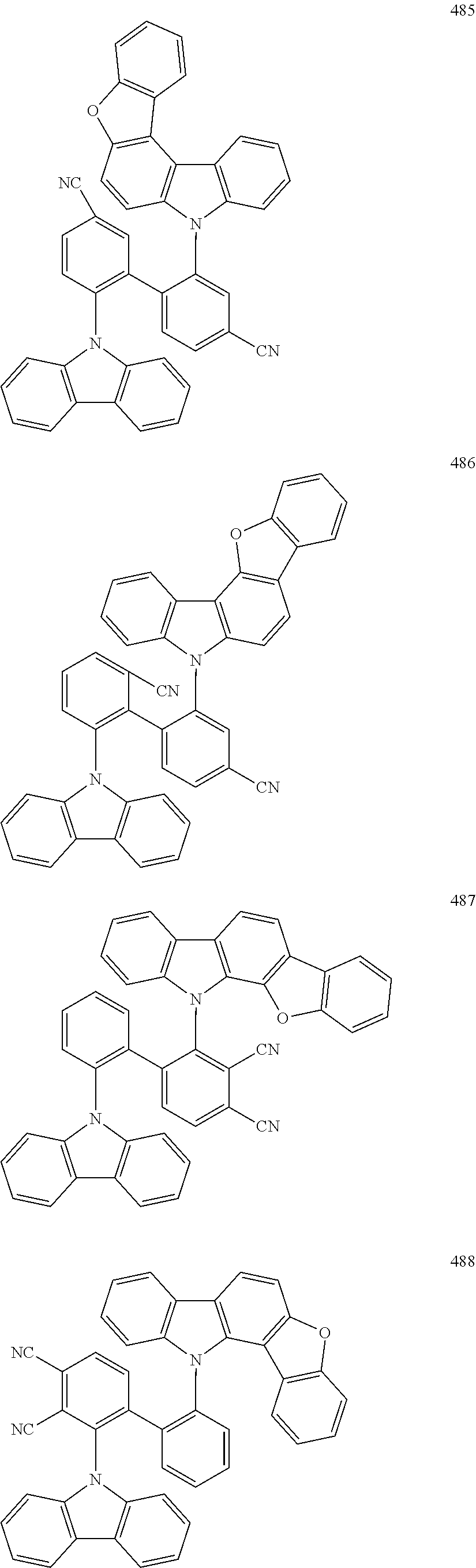








M11(L11)n11(L12)n12 Formula 101
-
- wherein, in Formula 101,
- M11 may be a first-row transition metal of the Periodic Table of Elements, a second-row transition metal of the Periodic Table of Elements, or a third-row transition metal of the Periodic Table of Elements;
- L11 may be a ligand represented by one of Formulae 1-1 to 1-4;
- L12 may be a monodentate ligand or a bidentate ligand;
- n11 may be 1, and
- n12 may be 0, 1, or 2;

-
- wherein, in Formulae 1-1 to 1-4,
- A1 to A4 may each independently be a substituted or unsubstituted C5-C30 carbocyclic group, a substituted or unsubstituted C1-C30 heterocyclic group, or a non-cyclic group,
- Y11 to Y14 may each independently be a chemical bond, O, S, N(R91), B(R91), P(R91), or C(R91)(R92),
- T1 to T4 may each independently be a single bond, a double bond, *—N(R93)—*′, *—B(R93)—*′, *—P(R93)—*′, *—C(R93)(R94)—*′, *—Si(R93)(R94)—*′, *—Ge(R93)(R94)—*′, *—S—*′, *—Se—*′, *—O—*′, *—C(═O)—*′, *—S(═O)—*′, *—S(═O)2—*′, *—C(R93)═*′, *═C(R93)—*′, *—C(R93)═C(R94)—*′, *—C(═S)—*′, or *—C≡C—*′,
- a substituent of the substituted C5-C30 carbocyclic group, a substituent of substituted C1-C30 heterocyclic group, and R91 to R94 may each independently be hydrogen, deuterium, —F, —Cl, —Br, —I, —SF5, a hydroxyl group, a cyano group, a nitro group, an amidino group, a hydrazine group, a hydrazone group, a carboxylic acid or a salt thereof, a sulfonic acid or a salt thereof, a phosphoric acid or a salt thereof, a substituted or unsubstituted C1-C60 alkyl group, a substituted or unsubstituted C2-C60 alkenyl group, a substituted or unsubstituted C2-C60 alkynyl group, a substituted or unsubstituted C1-C60 alkoxy group, a substituted or unsubstituted C3-C10 cycloalkyl group, a substituted or unsubstituted C1-C10 heterocycloalkyl group, a substituted or unsubstituted C3-C10 cycloalkenyl group, a substituted or unsubstituted C1-C10 heterocycloalkenyl group, a substituted or unsubstituted C6-C60 aryl group, a substituted or unsubstituted C6-C60 aryloxy group, a substituted or unsubstituted C6-C60 arylthio group, a substituted or unsubstituted C1-C60 heteroaryl group, a substituted or unsubstituted monovalent non-aromatic condensed polycyclic group, a substituted or unsubstituted monovalent non-aromatic condensed heteropolycyclic group, —Si(Q1)(Q2)(Q3), —B(Q1)(Q2), —N(Q1)(Q2), —P(Q1)(Q2), —C(═O)(Q1), —S(═O)(Q1), —S(═O)2(Q1), —P(═O)(Q1)(Q2), or —P(═S)(Q1)(Q2), wherein each of a substituent of the substituted C5-C30 carbocyclic group and a substituent of substituted C1-C30 heterocyclic group is not hydrogen,
- *1, *2, *3, and *4 each indicate a binding site to M11, and
- Q1 to Q3 may each independently be hydrogen, deuterium, —F, —Cl, —Br, —I, a hydroxyl group, a cyano group, a nitro group, an amidino group, a hydrazine group, a hydrazone group, a C1-C60 alkyl group, a C2-C60 alkenyl group, a C2-C60 alkynyl group, a C1-C60 alkoxy group, a C3-C10 cycloalkyl group, a C1-C10 heterocycloalkyl group, a C3-C10 cycloalkenyl group, a C1-C10 heterocycloalkenyl group, a C6-C60 aryl group, a C7-C60 alkylaryl group, a C6-C60 aryloxy group, a C6-C60 arylthio group, a C1-C60 heteroaryl group, a C2-C60 alkyl heteroaryl group, a C1-C60 heteroaryloxy group, a C1-C60 heteroarylthio group, a monovalent non-aromatic condensed polycyclic group, a monovalent non-aromatic condensed heteropolycyclic group, a C1-C60 alkyl group that is substituted with at least one deuterium, —F, a cyano group, a C1-C60 alkyl group, a C6-C60 aryl group, or a combination thereof, or a C6-C60 aryl group that is substituted with deuterium, —F, a cyano group, a C1-C60 alkyl group, a C6-C60 aryl group, or a combination thereof.


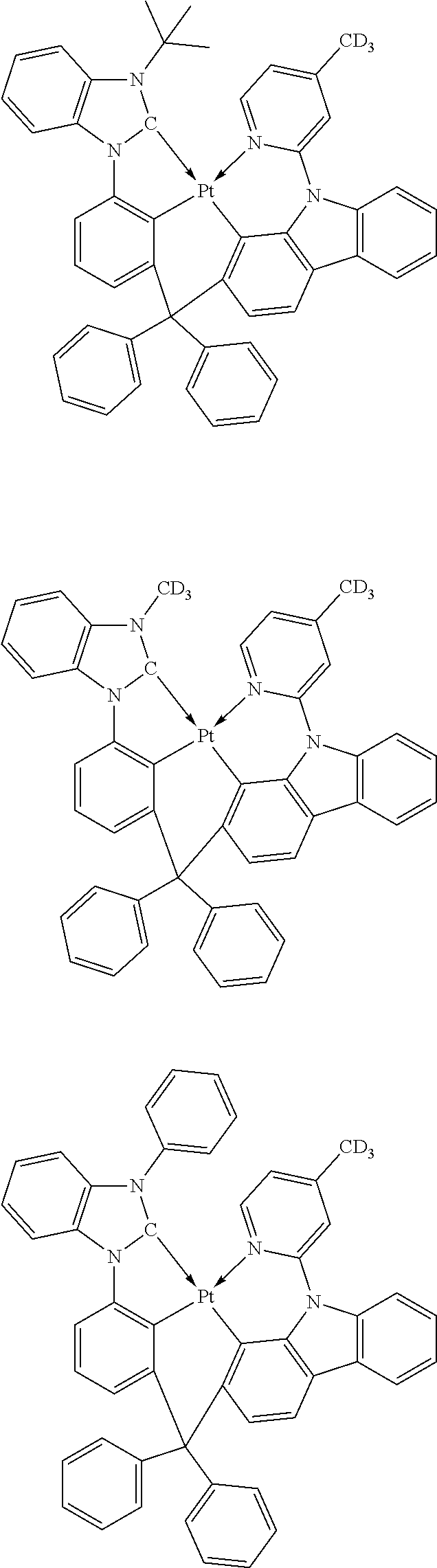


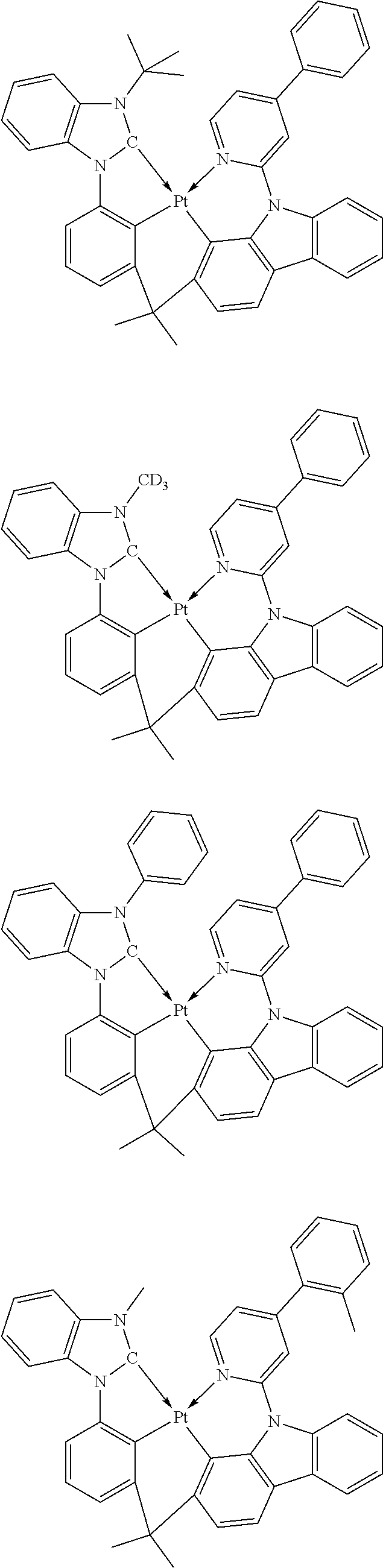


(L101)n101-M101-(L102)m101 Formula A
-
- wherein L101, n101, M101, L102, and m101 in Formula A are the same as described in connection with Tables 1 to 3:
| TABLE 1 | |||||
| Compound name | L101 | n101 | M101 | L102 | m101 |
| BD001 | LM1 | 3 | Ir | — | 0 |
| BD002 | LM2 | 3 | Ir | — | 0 |
| BD003 | LM3 | 3 | Ir | — | 0 |
| BD004 | LM4 | 3 | Ir | — | 0 |
| BD005 | LM5 | 3 | Ir | — | 0 |
| BD006 | LM6 | 3 | Ir | — | 0 |
| BD007 | LM7 | 3 | Ir | — | 0 |
| BD008 | LM8 | 3 | Ir | — | 0 |
| BD009 | LM9 | 3 | Ir | — | 0 |
| BD010 | LM10 | 3 | Ir | — | 0 |
| BD011 | LM11 | 3 | Ir | — | 0 |
| BD012 | LM12 | 3 | Ir | — | 0 |
| BD013 | LM13 | 3 | Ir | — | 0 |
| BD014 | LM14 | 3 | Ir | — | 0 |
| BD015 | LM15 | 3 | Ir | — | 0 |
| BD016 | LM16 | 3 | Ir | — | 0 |
| BD017 | LM17 | 3 | Ir | — | 0 |
| BD018 | LM18 | 3 | Ir | — | 0 |
| BD019 | LM19 | 3 | Ir | — | 0 |
| BD020 | LM20 | 3 | Ir | — | 0 |
| BD021 | LM21 | 3 | Ir | — | 0 |
| BD022 | LM22 | 3 | Ir | — | 0 |
| BD023 | LM23 | 3 | Ir | — | 0 |
| BD024 | LM24 | 3 | Ir | — | 0 |
| BD025 | LM25 | 3 | Ir | — | 0 |
| BD026 | LM26 | 3 | Ir | — | 0 |
| BD027 | LM27 | 3 | Ir | — | 0 |
| BD028 | LM28 | 3 | Ir | — | 0 |
| BD029 | LM29 | 3 | Ir | — | 0 |
| BD030 | LM30 | 3 | Ir | — | 0 |
| BD031 | LM31 | 3 | Ir | — | 0 |
| BD032 | LM32 | 3 | Ir | — | 0 |
| BD033 | LM33 | 3 | Ir | — | 0 |
| BD034 | LM34 | 3 | Ir | — | 0 |
| BD035 | LM35 | 3 | Ir | — | 0 |
| BD038 | LM36 | 3 | Ir | — | 0 |
| BD037 | LM37 | 3 | Ir | — | 0 |
| BD038 | LM38 | 3 | Ir | — | 0 |
| BD039 | LM39 | 3 | Ir | — | 0 |
| BD040 | LM40 | 3 | Ir | — | 0 |
| BD041 | LM41 | 3 | Ir | — | 0 |
| BD042 | LM42 | 3 | Ir | — | 0 |
| BD043 | LM43 | 3 | Ir | — | 0 |
| BD044 | LM44 | 3 | Ir | — | 0 |
| BD045 | LM45 | 3 | Ir | — | 0 |
| BD046 | LM46 | 3 | Ir | — | 0 |
| BD047 | LM47 | 3 | Ir | — | 0 |
| BD048 | LM48 | 3 | Ir | — | 0 |
| BD049 | LM49 | 3 | Ir | — | 0 |
| BD050 | LM50 | 3 | Ir | — | 0 |
| BD051 | LM51 | 3 | Ir | — | 0 |
| BD052 | LM52 | 3 | Ir | — | 0 |
| BD053 | LM53 | 3 | Ir | — | 0 |
| BD054 | LM54 | 3 | Ir | — | 0 |
| BD055 | LM55 | 3 | Ir | — | 0 |
| BD056 | LM56 | 3 | Ir | — | 0 |
| BD057 | LM57 | 3 | Ir | — | 0 |
| BD058 | LM58 | 3 | Ir | — | 0 |
| BD059 | LM59 | 3 | Ir | — | 0 |
| BD060 | LM60 | 3 | Ir | — | 0 |
| BD061 | LM61 | 3 | Ir | — | 0 |
| BD062 | LM62 | 3 | Ir | — | 0 |
| BD063 | LM63 | 3 | Ir | — | 0 |
| BD064 | LM64 | 3 | Ir | — | 0 |
| BD065 | LM65 | 3 | Ir | — | 0 |
| BD066 | LM66 | 3 | Ir | — | 0 |
| BD067 | LM67 | 3 | Ir | — | 0 |
| BD068 | LM68 | 3 | Ir | — | 0 |
| BD069 | LM69 | 3 | Ir | — | 0 |
| BD070 | LM70 | 3 | Ir | — | 0 |
| BD071 | LM71 | 3 | Ir | — | 0 |
| BD072 | LM72 | 3 | Ir | — | 0 |
| BD073 | LM73 | 3 | Ir | — | 0 |
| BD074 | LM74 | 3 | Ir | — | 0 |
| BD075 | LM75 | 3 | Ir | — | 0 |
| BD076 | LM76 | 3 | Ir | — | 0 |
| BD077 | LM77 | 3 | Ir | — | 0 |
| BD078 | LM78 | 3 | Ir | — | 0 |
| BD079 | LM79 | 3 | Ir | — | 0 |
| BD080 | LM80 | 3 | Ir | — | 0 |
| BD081 | LM81 | 3 | Ir | — | 0 |
| BD082 | LM82 | 3 | Ir | — | 0 |
| BD083 | LM83 | 3 | Ir | — | 0 |
| BD084 | LM84 | 3 | Ir | — | 0 |
| BD085 | LM85 | 3 | Ir | — | 0 |
| BD086 | LM86 | 3 | Ir | — | 0 |
| BD087 | LM87 | 3 | Ir | — | 0 |
| BD088 | LM88 | 3 | Ir | — | 0 |
| BD089 | LM89 | 3 | Ir | — | 0 |
| BD090 | LM90 | 3 | Ir | — | 0 |
| BD091 | LM91 | 3 | Ir | — | 0 |
| BD092 | LM92 | 3 | Ir | — | 0 |
| BD093 | LM93 | 3 | Ir | — | 0 |
| BD094 | LM94 | 3 | Ir | — | 0 |
| BD095 | LM95 | 3 | Ir | — | 0 |
| BD096 | LM96 | 3 | Ir | — | 0 |
| BD097 | LM97 | 3 | Ir | — | 0 |
| BD098 | LM98 | 3 | Ir | — | 0 |
| BD099 | LM99 | 3 | Ir | — | 0 |
| BD100 | LM100 | 3 | Ir | — | 0 |
| TABLE 2 | |||||
| Compound name | L101 | n101 | M101 | L102 | m101 |
| BD101 | LM101 | 3 | Ir | — | 0 |
| BD102 | LM102 | 3 | Ir | — | 0 |
| BD103 | LM103 | 3 | Ir | — | 0 |
| BD104 | LM104 | 3 | Ir | — | 0 |
| BD105 | LM105 | 3 | Ir | — | 0 |
| BD106 | LM106 | 3 | Ir | — | 0 |
| BD107 | LM107 | 3 | Ir | — | 0 |
| BD108 | LM108 | 3 | Ir | — | 0 |
| BD109 | LM109 | 3 | Ir | — | 0 |
| BD110 | LM110 | 3 | Ir | — | 0 |
| BD111 | LM111 | 3 | Ir | — | 0 |
| BD112 | LM112 | 3 | Ir | — | 0 |
| BD113 | LM113 | 3 | Ir | — | 0 |
| BD114 | LM114 | 3 | Ir | — | 0 |
| BD115 | LM115 | 3 | Ir | — | 0 |
| BD116 | LM116 | 3 | Ir | — | 0 |
| BD117 | LM117 | 3 | Ir | — | 0 |
| BD118 | LM118 | 3 | Ir | — | 0 |
| BD119 | LM119 | 3 | Ir | — | 0 |
| BD120 | LM120 | 3 | Ir | — | 0 |
| BD121 | LM121 | 3 | Ir | — | 0 |
| BD122 | LM122 | 3 | Ir | — | 0 |
| BD123 | LM123 | 3 | Ir | — | 0 |
| BD124 | LM124 | 3 | Ir | — | 0 |
| BD125 | LM125 | 3 | Ir | — | 0 |
| BD126 | LM126 | 3 | Ir | — | 0 |
| BD127 | LM127 | 3 | Ir | — | 0 |
| BD128 | LM128 | 3 | Ir | — | 0 |
| BD129 | LM129 | 3 | Ir | — | 0 |
| BD130 | LM130 | 3 | Ir | — | 0 |
| BD131 | LM131 | 3 | Ir | — | 0 |
| BD132 | LM132 | 3 | Ir | — | 0 |
| BD133 | LM133 | 3 | Ir | — | 0 |
| BD134 | LM134 | 3 | Ir | — | 0 |
| BD135 | LM135 | 3 | Ir | — | 0 |
| BD136 | LM136 | 3 | Ir | — | 0 |
| BD137 | LM137 | 3 | Ir | — | 0 |
| BD138 | LM138 | 3 | Ir | — | 0 |
| BD139 | LM139 | 3 | Ir | — | 0 |
| BD140 | LM140 | 3 | Ir | — | 0 |
| BD141 | LM141 | 3 | Ir | — | 0 |
| BD142 | LM142 | 3 | Ir | — | 0 |
| BD143 | LM143 | 3 | Ir | — | 0 |
| BD144 | LM144 | 3 | Ir | — | 0 |
| BD145 | LM145 | 3 | Ir | — | 0 |
| BD146 | LM146 | 3 | Ir | — | 0 |
| BD147 | LM147 | 3 | Ir | — | 0 |
| BD148 | LM148 | 3 | Ir | — | 0 |
| BD149 | LM149 | 3 | Ir | — | 0 |
| BD150 | LM150 | 3 | Ir | — | 0 |
| BD151 | LM151 | 3 | Ir | — | 0 |
| BD152 | LM152 | 3 | Ir | — | 0 |
| BD153 | LM153 | 3 | Ir | — | 0 |
| BD154 | LM154 | 3 | Ir | — | 0 |
| BD155 | LM155 | 3 | Ir | — | 0 |
| BD156 | LM156 | 3 | Ir | — | 0 |
| BD157 | LM157 | 3 | Ir | — | 0 |
| BD158 | LM158 | 3 | Ir | — | 0 |
| BD159 | LM159 | 3 | Ir | — | 0 |
| BD160 | LM160 | 3 | Ir | — | 0 |
| BD161 | LM161 | 3 | Ir | — | 0 |
| BD162 | LM162 | 3 | Ir | — | 0 |
| BD163 | LM163 | 3 | Ir | — | 0 |
| BD164 | LM164 | 3 | Ir | — | 0 |
| BD165 | LM165 | 3 | Ir | — | 0 |
| BD166 | LM166 | 3 | Ir | — | 0 |
| BD167 | LM167 | 3 | Ir | — | 0 |
| BD168 | LM168 | 3 | Ir | — | 0 |
| BD169 | LM169 | 3 | Ir | — | 0 |
| BD170 | LM170 | 3 | Ir | — | 0 |
| BD171 | LM171 | 3 | Ir | — | 0 |
| BD172 | LM172 | 3 | Ir | — | 0 |
| BD173 | LM173 | 3 | Ir | — | 0 |
| BD174 | LM174 | 3 | Ir | — | 0 |
| BD175 | LM175 | 3 | Ir | — | 0 |
| BD176 | LM176 | 3 | Ir | — | 0 |
| BD177 | LM177 | 3 | Ir | — | 0 |
| BD178 | LM178 | 3 | Ir | — | 0 |
| BD179 | LM179 | 3 | Ir | — | 0 |
| BD180 | LM180 | 3 | Ir | — | 0 |
| BD181 | LM181 | 3 | Ir | — | 0 |
| BD182 | LM182 | 3 | Ir | — | 0 |
| BD183 | LM183 | 3 | Ir | — | 0 |
| BD184 | LM184 | 3 | Ir | — | 0 |
| BD185 | LM185 | 3 | Ir | — | 0 |
| BD186 | LM186 | 3 | Ir | — | 0 |
| BD187 | LM187 | 3 | Ir | — | 0 |
| BD188 | LM188 | 3 | Ir | — | 0 |
| BD189 | LM189 | 3 | Ir | — | 0 |
| BD190 | LM190 | 3 | Ir | — | 0 |
| BD191 | LM191 | 3 | Ir | — | 0 |
| BD192 | LM192 | 3 | Ir | — | 0 |
| BD193 | LM193 | 3 | Ir | — | 0 |
| BD194 | LM194 | 3 | Ir | — | 0 |
| BD195 | LM195 | 3 | Ir | — | 0 |
| BD196 | LM196 | 3 | Ir | — | 0 |
| BD197 | LM197 | 3 | Ir | — | 0 |
| BD198 | LM198 | 3 | Ir | — | 0 |
| BD199 | LM199 | 3 | Ir | — | 0 |
| BD200 | LM200 | 3 | Ir | — | 0 |
| TABLE 3 | |||||
| Compound name | L101 | n101 | M101 | L102 | m101 |
| BD201 | LM201 | 3 | Ir | — | 0 |
| BD202 | LM202 | 3 | Ir | — | 0 |
| BD203 | LM203 | 3 | Ir | — | 0 |
| BD204 | LM204 | 3 | Ir | — | 0 |
| BD205 | LM205 | 3 | Ir | — | 0 |
| BD206 | LM206 | 3 | Ir | — | 0 |
| BD207 | LM207 | 3 | Ir | — | 0 |
| BD208 | LM208 | 3 | Ir | — | 0 |
| BD209 | LM209 | 3 | Ir | — | 0 |
| BD210 | LM210 | 3 | Ir | — | 0 |
| BD211 | LM211 | 3 | Ir | — | 0 |
| BD212 | LM212 | 3 | Ir | — | 0 |
| BD213 | LM213 | 3 | Ir | — | 0 |
| BD214 | LM214 | 3 | Ir | — | 0 |
| BD215 | LM215 | 3 | Ir | — | 0 |
| BD216 | LM216 | 3 | Ir | — | 0 |
| BD217 | LM217 | 3 | Ir | — | 0 |
| BD218 | LM218 | 3 | Ir | — | 0 |
| BD219 | LM219 | 3 | Ir | — | 0 |
| BD220 | LM220 | 3 | Ir | — | 0 |
| BD221 | LM221 | 3 | Ir | — | 0 |
| BD222 | LM222 | 3 | Ir | — | 0 |
| BD223 | LM223 | 3 | Ir | — | 0 |
| BD224 | LM224 | 3 | Ir | — | 0 |
| BD225 | LM225 | 3 | Ir | — | 0 |
| BD226 | LM226 | 3 | Ir | — | 0 |
| BD227 | LM227 | 3 | Ir | — | 0 |
| BD228 | LM228 | 3 | Ir | — | 0 |
| BD229 | LM229 | 3 | Ir | — | 0 |
| BD230 | LM230 | 3 | Ir | — | 0 |
| BD231 | LM231 | 3 | Ir | — | 0 |
| BD232 | LM232 | 3 | Ir | — | 0 |
| BD233 | LM233 | 3 | Ir | — | 0 |
| BD234 | LM234 | 3 | Ir | — | 0 |
| BD235 | LM235 | 3 | Ir | — | 0 |
| BD236 | LM236 | 3 | Ir | — | 0 |
| BD237 | LM237 | 3 | Ir | — | 0 |
| BD238 | LM238 | 3 | Ir | — | 0 |
| BD239 | LM239 | 3 | Ir | — | 0 |
| BD240 | LM240 | 3 | Ir | — | 0 |
| BD241 | LM241 | 3 | Ir | — | 0 |
| BD242 | LM242 | 3 | Ir | — | 0 |
| BD243 | LM243 | 3 | Ir | — | 0 |
| BD244 | LFM1 | 3 | Ir | — | 0 |
| BD245 | LFM2 | 3 | Ir | — | 0 |
| BD246 | LFM3 | 3 | Ir | — | 0 |
| BD247 | LFM4 | 3 | Ir | — | 0 |
| BD248 | LFM5 | 3 | Ir | — | 0 |
| BD249 | LFM6 | 3 | Ir | — | 0 |
| BD250 | LFM7 | 3 | Ir | — | 0 |
| BD251 | LFP1 | 3 | Ir | — | 0 |
| BD252 | LFP2 | 3 | Ir | — | 0 |
| BD253 | LFP3 | 3 | Ir | — | 0 |
| BD254 | LFP4 | 3 | Ir | — | 0 |
| BD255 | LFP5 | 3 | Ir | — | 0 |
| BD256 | LFP6 | 3 | Ir | — | 0 |
| BD257 | LFP7 | 3 | Ir | — | 0 |
| BD258 | LM47 | 2 | Ir | AN1 | 1 |
| BD259 | LM47 | 2 | Ir | AN2 | 1 |
| BD260 | LM47 | 2 | Ir | AN3 | 1 |
| BD261 | LM47 | 2 | Ir | AN4 | 1 |
| BD262 | LM47 | 2 | Ir | AN5 | 1 |
| BD263 | LM11 | 2 | Pt | — | 0 |
| BD264 | LM13 | 2 | Pt | — | 0 |
| BD265 | LM15 | 2 | Pt | — | 0 |
| BD266 | LM45 | 2 | Pt | — | 0 |
| BD267 | LM47 | 2 | Pt | — | 0 |
| BD268 | LM49 | 2 | Pt | — | 0 |
| BD269 | LM98 | 2 | Pt | — | 0 |
| BD270 | LM100 | 2 | Pt | — | 0 |
| BD271 | LM102 | 2 | Pt | — | 0 |
| BD272 | LM132 | 2 | Pt | — | 0 |
| BD273 | LM134 | 2 | Pt | — | 0 |
| BD274 | LM136 | 2 | Pt | — | 0 |
| BD275 | LM151 | 2 | Pt | — | 0 |
| BD276 | LM153 | 2 | Pt | — | 0 |
| BD277 | LM158 | 2 | Pt | — | 0 |
| BD278 | LM180 | 2 | Pt | — | 0 |
| BD279 | LM182 | 2 | Pt | — | 0 |
| BD280 | LM187 | 2 | Pt | — | 0 |
| BD281 | LM201 | 2 | Pt | — | 0 |
| BD282 | LM206 | 2 | Pt | — | 0 |
| BD283 | LM211 | 2 | Pt | — | 0 |
| BD284 | LM233 | 2 | Pt | — | 0 |
| BD285 | LM235 | 2 | Pt | — | 0 |
| BD286 | LM240 | 2 | Pt | — | 0 |
| BD287 | LFM5 | 2 | Pt | — | 0 |
| BD288 | LFM6 | 2 | Pt | — | 0 |
| BD289 | LFM7 | 2 | Pt | — | 0 |
| BD290 | LFP5 | 2 | Pt | — | 0 |
| BD291 | LFP6 | 2 | Pt | — | 0 |
| BD292 | LFP7 | 2 | Pt | — | 0 |
| BD293 | LM47 | 1 | Pt | AN1 | 1 |
| BD294 | LM47 | 1 | Pt | AN2 | 1 |
| BD295 | LM47 | 1 | Pt | AN3 | 1 |
| BD296 | LM47 | 1 | Pt | AN4 | 1 |
| BD297 | LM47 | 1 | Pt | AN5 | 1 |


| TABLE 4 |
| Formula 1-1 |
| Ligand name | R11 | R12 | R13 | R14 | R15 | R16 | R17 | R18 | R19 | R20 |
| LM1 | X1 | H | X3 | H | X1 | H | H | H | H | D |
| LM2 | X1 | H | X3 | H | X1 | H | H | H | D | H |
| LM3 | X1 | H | X3 | H | X1 | H | H | H | D | D |
| LM4 | Y1 | H | X3 | H | Y1 | H | H | H | D | D |
| LM5 | Y2 | H | X3 | H | Y2 | H | H | H | D | D |
| LM6 | Y3 | H | X3 | H | Y3 | H | H | H | D | D |
| LM7 | Y3 | D | X3 | D | Y3 | H | H | H | D | D |
| LM8 | Y3 | D | X3 | D | Y3 | D | H | H | D | D |
| LM9 | Y3 | D | X3 | D | Y3 | D | D | H | D | D |
| LM10 | Y3 | D | X3 | D | Y3 | D | D | D | D | D |
| LM11 | Y3 | D | Y11 | D | Y3 | D | D | D | D | D |
| LM12 | Y3 | D | Y11 | D | Y3 | H | X1 | H | D | D |
| LM13 | Y3 | D | Y11 | D | Y3 | D | Y3 | D | D | D |
| LM14 | Y3 | D | Y11 | D | Y3 | H | X4 | H | D | D |
| LM15 | Y3 | D | Y11 | D | Y3 | D | Y12 | D | D | D |
| LM16 | X2 | H | X3 | H | X2 | H | H | H | H | D |
| LM17 | X2 | H | X3 | H | X2 | H | H | H | D | H |
| LM18 | X2 | H | X3 | H | X2 | H | H | H | D | D |
| LM19 | Y4 | H | X3 | H | Y4 | H | H | H | D | D |
| LM20 | Y5 | H | X3 | H | Y5 | H | H | H | D | D |
| LM21 | Y6 | H | X3 | H | Y6 | H | H | H | D | D |
| LM22 | Y7 | H | X3 | H | Y7 | H | H | H | D | D |
| LM23 | Y8 | H | X3 | H | Y8 | H | H | H | D | D |
| LM24 | Y9 | H | X3 | H | Y9 | H | H | H | D | D |
| LM25 | Y10 | H | X3 | H | Y10 | H | H | H | D | D |
| LM26 | Y10 | D | X3 | D | Y10 | H | H | H | D | D |
| LM27 | Y10 | D | X3 | D | Y10 | D | H | H | D | D |
| LM28 | Y10 | D | X3 | D | Y10 | D | D | H | D | D |
| LM29 | Y10 | D | X3 | D | Y10 | D | D | D | D | D |
| LM30 | Y10 | D | Y11 | D | Y10 | D | D | D | D | D |
| LM31 | Y10 | D | Y11 | D | Y10 | H | X1 | H | D | D |
| LM32 | Y10 | D | Y11 | D | Y10 | D | Y3 | D | D | D |
| LM33 | Y10 | D | Y11 | D | Y10 | H | X4 | H | D | D |
| LM34 | Y10 | D | Y11 | D | Y10 | D | Y12 | D | D | D |
| LM35 | X1 | H | X4 | H | X1 | H | H | H | H | D |
| LM36 | X1 | H | X4 | H | X1 | H | H | H | D | H |
| LM37 | X1 | H | X4 | H | X1 | H | H | H | D | D |
| LM38 | Y1 | H | X4 | H | Y1 | H | H | H | D | D |
| LM39 | Y2 | H | X4 | H | Y2 | H | H | H | D | D |
| LM40 | Y3 | H | X4 | H | Y3 | H | H | H | D | D |
| LM41 | Y3 | D | X4 | D | Y3 | H | H | H | D | D |
| LM42 | Y3 | D | X4 | D | Y3 | D | H | H | D | D |
| LM43 | Y3 | D | X4 | D | Y3 | D | D | H | D | D |
| LM44 | Y3 | D | X4 | D | Y3 | D | D | D | D | D |
| LM45 | Y3 | D | Y12 | D | Y3 | D | D | D | D | D |
| LM46 | Y3 | D | Y12 | D | Y3 | H | X1 | H | D | D |
| LM47 | Y3 | D | Y12 | D | Y3 | D | Y3 | D | D | D |
| LM48 | Y3 | D | Y12 | D | Y3 | H | X4 | H | D | D |
| LM49 | Y3 | D | Y12 | D | Y3 | D | Y12 | D | D | D |
| LM50 | X2 | H | X4 | H | X2 | H | H | H | H | D |
| LM51 | X2 | H | X4 | H | X2 | H | H | H | D | H |
| LM52 | X2 | H | X4 | H | X2 | H | H | H | D | D |
| LM53 | Y4 | H | X4 | H | Y4 | H | H | H | D | D |
| LM54 | Y5 | H | X4 | H | Y5 | H | H | H | D | D |
| LM55 | Y6 | H | X4 | H | Y6 | H | H | H | D | D |
| LM56 | Y7 | H | X4 | H | Y7 | H | H | H | D | D |
| LM57 | Y8 | H | X4 | H | Y8 | H | H | H | D | D |
| LM58 | Y9 | H | X4 | H | Y9 | H | H | H | D | D |
| LM59 | Y10 | H | X4 | H | Y10 | H | H | H | D | D |
| LM60 | Y10 | D | X4 | D | Y10 | H | H | H | D | D |
| LM61 | Y10 | D | X4 | D | Y10 | D | H | H | D | D |
| LM62 | Y10 | D | X4 | D | Y10 | D | D | H | D | D |
| LM63 | Y10 | D | X4 | D | Y10 | D | D | D | D | D |
| LM64 | Y10 | D | Y12 | D | Y10 | D | D | D | D | D |
| LM65 | Y10 | D | Y12 | D | Y10 | H | X1 | H | D | D |
| LM66 | Y10 | D | Y12 | D | Y10 | D | Y3 | D | D | D |
| LM67 | Y10 | D | Y12 | D | Y10 | H | X4 | H | D | D |
| LM68 | Y10 | D | Y12 | D | Y10 | D | Y12 | D | D | D |
| LM69 | X1 | H | X5 | H | X1 | H | H | H | H | D |
| LM70 | X1 | H | X5 | H | X1 | H | H | H | D | H |
| LM71 | X1 | H | X5 | H | X1 | H | H | H | D | D |
| LM72 | Y1 | H | X5 | H | Y1 | H | H | H | D | D |
| LM73 | Y2 | H | X5 | H | Y2 | H | H | H | D | D |
| LM74 | Y3 | H | X5 | H | Y3 | H | H | H | D | D |
| LM75 | Y3 | D | X5 | D | Y3 | H | H | H | D | D |
| LM76 | Y3 | D | X5 | D | Y3 | D | H | H | D | D |
| LM77 | Y3 | D | X5 | D | Y3 | D | D | H | D | D |
| LM78 | Y3 | D | X5 | D | Y3 | D | D | D | D | D |
| LM79 | Y3 | D | Y13 | D | Y3 | D | D | D | D | D |
| LM80 | Y3 | D | Y13 | D | Y3 | H | X1 | H | D | D |
| LM81 | Y3 | D | Y13 | D | Y3 | D | Y3 | D | D | D |
| LM82 | Y3 | D | Y13 | D | Y3 | H | X4 | H | D | D |
| LM83 | Y3 | D | Y13 | D | Y3 | D | Y12 | D | D | D |
| LM84 | X2 | H | X5 | H | X2 | H | H | H | H | D |
| LM85 | X2 | H | X5 | H | X2 | H | H | H | D | H |
| LM86 | X2 | H | X5 | H | X2 | H | H | H | D | D |
| LM87 | Y4 | H | X5 | H | Y4 | H | H | H | D | D |
| LM88 | Y5 | H | X5 | H | Y5 | H | H | H | D | D |
| LM89 | Y6 | H | X5 | H | Y6 | H | H | H | D | D |
| LM90 | Y7 | H | X5 | H | Y7 | H | H | H | D | D |
| LM91 | Y8 | H | X5 | H | Y8 | H | H | H | D | D |
| LM92 | Y9 | H | X5 | H | Y9 | H | H | H | D | D |
| LM93 | Y10 | H | X5 | H | Y10 | H | H | H | D | D |
| LM94 | Y10 | D | X5 | D | Y10 | H | H | H | D | D |
| LM95 | Y10 | D | X5 | D | Y10 | D | H | H | D | D |
| LM96 | Y10 | D | X5 | D | Y10 | D | D | H | D | D |
| LM97 | Y10 | D | X5 | D | Y10 | D | D | D | D | D |
| LM98 | Y10 | D | Y13 | D | Y10 | D | D | D | D | D |
| LM99 | Y10 | D | Y13 | D | Y10 | H | X1 | H | D | D |
| LM100 | Y10 | D | Y13 | D | Y10 | D | Y3 | D | D | D |
| LM101 | Y10 | D | Y13 | D | Y10 | H | X4 | H | D | D |
| LM102 | Y10 | D | Y13 | D | Y10 | D | Y12 | D | D | D |
| LM103 | X1 | H | X6 | H | X1 | H | H | H | H | D |
| LM104 | X1 | H | X6 | H | X1 | H | H | H | D | H |
| LM105 | X1 | H | X6 | H | X1 | H | H | H | D | D |
| LM106 | Y1 | H | X6 | H | Y1 | H | H | H | D | D |
| LM107 | Y2 | H | X6 | H | Y2 | H | H | H | D | D |
| LM108 | Y3 | H | X6 | H | Y3 | H | H | H | D | D |
| LM109 | Y3 | D | X6 | D | Y3 | H | H | H | D | D |
| LM110 | Y3 | D | X6 | D | Y3 | D | H | H | D | D |
| LM111 | Y3 | D | X6 | D | Y3 | D | D | H | D | D |
| LM112 | Y3 | D | X6 | D | Y3 | D | D | D | D | D |
| LM113 | Y3 | D | Y14 | D | Y3 | D | D | D | D | D |
| LM114 | Y3 | D | Y14 | D | Y3 | H | X1 | H | D | D |
| LM115 | Y3 | D | Y14 | D | Y3 | D | Y3 | D | D | D |
| LM116 | Y3 | D | Y14 | D | Y3 | H | X4 | H | D | D |
| LM117 | Y3 | D | Y14 | D | Y3 | D | Y12 | D | D | D |
| LM118 | X2 | H | X6 | H | X2 | H | H | H | H | D |
| LM119 | X2 | H | X6 | H | X2 | H | H | H | D | H |
| LM120 | X2 | H | X6 | H | X2 | H | H | H | D | D |
| LM121 | Y4 | H | X6 | H | Y4 | H | H | H | D | D |
| LM122 | Y5 | H | X6 | H | Y5 | H | H | H | D | D |
| LM123 | Y6 | H | X6 | H | Y6 | H | H | H | D | D |
| LM124 | Y7 | H | X6 | H | Y7 | H | H | H | D | D |
| LM125 | Y8 | H | X6 | H | Y8 | H | H | H | D | D |
| LM126 | Y9 | H | X6 | H | Y9 | H | H | H | D | D |
| LM127 | Y10 | H | X6 | H | Y10 | H | H | H | D | D |
| LM128 | Y10 | D | X6 | D | Y10 | H | H | H | D | D |
| LM129 | Y10 | D | X6 | D | Y10 | D | H | H | D | D |
| LM130 | Y10 | D | X6 | D | Y10 | D | D | H | D | D |
| LM131 | Y10 | D | X6 | D | Y10 | D | D | D | D | D |
| LM132 | Y10 | D | Y14 | D | Y10 | D | D | D | D | D |
| LM133 | Y10 | D | Y14 | D | Y10 | H | X1 | H | D | D |
| LM134 | Y10 | D | Y14 | D | Y10 | D | Y3 | D | D | D |
| LM135 | Y10 | D | Y14 | D | Y10 | H | X4 | H | D | D |
| LM136 | Y10 | D | Y14 | D | Y10 | D | Y12 | D | D | D |
| LM137 | X1 | H | X7 | H | X1 | H | H | H | H | D |
| LM138 | X1 | H | X7 | H | X1 | H | H | H | D | H |
| LM139 | X1 | H | X7 | H | X1 | H | H | H | D | D |
| LM140 | Y1 | H | X7 | H | Y1 | H | H | H | D | D |
| LM141 | Y2 | H | X7 | H | Y2 | H | H | H | D | D |
| LM142 | Y3 | H | X7 | H | Y3 | H | H | H | D | D |
| LM143 | Y3 | D | X7 | D | Y3 | H | H | H | D | D |
| LM144 | Y3 | D | X7 | D | Y3 | D | H | H | D | D |
| LM145 | Y3 | D | X7 | D | Y3 | D | D | H | D | D |
| LM146 | Y3 | D | X7 | D | Y3 | D | D | D | D | D |
| LM147 | Y3 | D | X8 | D | Y3 | D | D | D | D | D |
| LM148 | Y3 | D | Y16 | D | Y3 | D | D | D | D | D |
| LM149 | Y3 | D | Y17 | D | Y3 | D | D | D | D | D |
| LM150 | Y3 | D | Y18 | D | Y3 | D | D | D | D | D |
| LM151 | Y3 | D | Y15 | D | Y3 | D | D | D | D | D |
| LM152 | Y3 | D | Y15 | D | Y3 | H | X1 | H | D | D |
| LM153 | Y3 | D | Y15 | D | Y3 | D | Y3 | D | D | D |
| LM154 | Y3 | D | Y16 | D | Y3 | D | Y3 | D | D | D |
| LM155 | Y3 | D | Y17 | D | Y3 | D | Y3 | D | D | D |
| LM156 | Y3 | D | Y18 | D | Y3 | D | Y3 | D | D | D |
| LM157 | Y3 | D | Y15 | D | Y3 | H | X4 | H | D | D |
| LM158 | Y3 | D | Y15 | D | Y3 | D | Y12 | D | D | D |
| LM159 | Y3 | D | Y16 | D | Y3 | D | Y12 | D | D | D |
| LM160 | Y3 | D | Y17 | D | Y3 | D | Y12 | D | D | D |
| LM161 | Y3 | D | Y18 | D | Y3 | D | Y12 | D | D | D |
| LM162 | X2 | H | X7 | H | X2 | H | H | H | H | D |
| LM163 | X2 | H | X7 | H | X2 | H | H | H | D | H |
| LM164 | X2 | H | X7 | H | X2 | H | H | H | D | D |
| LM165 | Y4 | H | X7 | H | Y4 | H | H | H | D | D |
| LM166 | Y5 | H | X7 | H | Y5 | H | H | H | D | D |
| LM167 | Y6 | H | X7 | H | Y6 | H | H | H | D | D |
| LM168 | Y7 | H | X7 | H | Y7 | H | H | H | D | D |
| LM169 | Y8 | H | X7 | H | Y8 | H | H | H | D | D |
| LM170 | Y9 | H | X7 | H | Y9 | H | H | H | D | D |
| LM171 | Y10 | H | X7 | H | Y10 | H | H | H | D | D |
| LM172 | Y10 | D | X7 | D | Y10 | H | H | H | D | D |
| LM173 | Y10 | D | X7 | D | Y10 | D | H | H | D | D |
| LM174 | Y10 | D | X7 | D | Y10 | D | D | H | D | D |
| LM175 | Y10 | D | X7 | D | Y10 | D | D | D | D | D |
| LM176 | Y10 | D | X8 | D | Y10 | D | D | D | D | D |
| LM177 | Y10 | D | Y16 | D | Y10 | D | D | D | D | D |
| LM178 | Y10 | D | Y17 | D | Y10 | D | D | D | D | D |
| LM179 | Y10 | D | Y18 | D | Y10 | D | D | D | D | D |
| LM180 | Y10 | D | Y15 | D | Y10 | D | D | D | D | D |
| LM181 | Y10 | D | Y15 | D | Y10 | H | X1 | H | D | D |
| LM182 | Y10 | D | Y15 | D | Y10 | D | Y3 | D | D | D |
| LM183 | Y10 | D | Y16 | D | Y10 | D | Y3 | D | D | D |
| LM184 | Y10 | D | Y17 | D | Y10 | D | Y3 | D | D | D |
| LM185 | Y10 | D | Y18 | D | Y10 | D | Y3 | D | D | D |
| LM186 | Y10 | D | Y15 | D | Y10 | H | X4 | H | D | D |
| LM187 | Y10 | D | Y15 | D | Y10 | D | Y12 | D | D | D |
| LM188 | Y10 | D | Y16 | D | Y10 | D | Y12 | D | D | D |
| LM189 | Y10 | D | Y17 | D | Y10 | D | Y12 | D | D | D |
| LM190 | Y10 | D | Y18 | D | Y10 | D | Y12 | D | D | D |
| LM191 | X1 | X7 | H | H | X1 | H | H | H | H | D |
| LM192 | X1 | X7 | H | H | X1 | H | H | H | D | H |
| LM193 | X1 | X7 | H | H | X1 | H | H | H | D | D |
| LM194 | Y1 | X7 | H | H | Y1 | H | H | H | D | D |
| LM195 | Y2 | X7 | H | H | Y2 | H | H | H | D | D |
| LM196 | Y3 | X7 | H | H | Y3 | H | H | H | D | D |
| LM197 | Y3 | X7 | D | D | Y3 | H | H | H | D | D |
| LM198 | Y3 | X7 | D | D | Y3 | D | H | H | D | D |
| LM199 | Y3 | X7 | D | D | Y3 | D | D | H | D | D |
| LM200 | Y3 | X7 | D | D | Y3 | D | D | D | D | D |
| LM201 | Y3 | Y15 | D | D | Y3 | D | D | D | D | D |
| LM202 | Y3 | Y16 | D | D | Y3 | D | D | D | D | D |
| LM203 | Y3 | Y17 | D | D | Y3 | D | D | D | D | D |
| LM204 | Y3 | Y18 | D | D | Y3 | D | D | D | D | D |
| LM205 | Y3 | Y15 | D | D | Y3 | H | X1 | H | D | D |
| LM206 | Y3 | Y15 | D | D | Y3 | D | Y3 | D | D | D |
| LM207 | Y3 | Y16 | D | D | Y3 | D | Y3 | D | D | D |
| LM208 | Y3 | Y17 | D | D | Y3 | D | Y3 | D | D | D |
| LM209 | Y3 | Y18 | D | D | Y3 | D | Y3 | D | D | D |
| LM210 | Y3 | Y15 | D | D | Y3 | H | X4 | H | D | D |
| LM211 | Y3 | Y15 | D | D | Y3 | D | Y12 | D | D | D |
| LM212 | Y3 | Y16 | D | D | Y3 | D | Y12 | D | D | D |
| LM213 | Y3 | Y17 | D | D | Y3 | D | Y12 | D | D | D |
| LM214 | Y3 | Y18 | D | D | Y3 | D | Y12 | D | D | D |
| LM215 | X2 | X7 | H | H | X2 | H | H | H | H | D |
| LM216 | X2 | X7 | H | H | X2 | H | H | H | D | H |
| LM217 | X2 | X7 | H | H | X2 | H | H | H | D | D |
| LM218 | Y4 | X7 | H | H | Y4 | H | H | H | D | D |
| LM219 | Y5 | X7 | H | H | Y5 | H | H | H | D | D |
| LM220 | Y6 | X7 | H | H | Y6 | H | H | H | D | D |
| LM221 | Y7 | X7 | H | H | Y7 | H | H | H | D | D |
| LM222 | Y8 | X7 | H | H | Y8 | H | H | H | D | D |
| LM223 | Y9 | X7 | H | H | Y9 | H | H | H | D | D |
| LM224 | Y10 | X7 | H | H | Y10 | H | H | H | D | D |
| LM225 | Y10 | X7 | D | D | Y10 | H | H | H | D | D |
| LM226 | Y10 | X7 | D | D | Y10 | D | H | H | D | D |
| LM227 | Y10 | X7 | D | D | Y10 | D | D | H | D | D |
| LM228 | Y10 | X7 | D | D | Y10 | D | D | D | D | D |
| LM229 | Y10 | X8 | D | D | Y10 | D | D | D | D | D |
| LM230 | Y10 | Y16 | D | D | Y10 | D | D | D | D | D |
| LM231 | Y10 | Y17 | D | D | Y10 | D | D | D | D | D |
| LM232 | Y10 | Y18 | D | D | Y10 | D | D | D | D | D |
| LM233 | Y10 | Y15 | D | D | Y10 | D | D | D | D | D |
| LM234 | Y10 | Y15 | D | D | Y10 | H | X1 | H | D | D |
| LM235 | Y10 | Y15 | D | D | Y10 | D | Y3 | D | D | D |
| LM236 | Y10 | Y16 | D | D | Y10 | D | Y3 | D | D | D |
| LM237 | Y10 | Y17 | D | D | Y10 | D | Y3 | D | D | D |
| LM238 | Y10 | Y18 | D | D | Y10 | D | Y3 | D | D | D |
| LM239 | Y10 | Y15 | D | D | Y10 | H | X4 | H | D | D |
| LM240 | Y10 | Y15 | D | D | Y10 | D | Y12 | D | D | D |
| LM241 | Y10 | Y16 | D | D | Y10 | D | Y12 | D | D | D |
| LM242 | Y10 | Y17 | D | D | Y10 | D | Y12 | D | D | D |
| LM243 | Y10 | Y18 | D | D | Y10 | D | Y12 | D | D | D |
| TABLE 5 |
| Formula 1-2 |
| Ligand name | R11 | X11 | R101 | R102 | R103 | R104 | R14 | R15 | R16 | R17 | R18 | R19 | R20 |
| LFM1 | Y10 | N-Ph | D | D | D | D | D | Y10 | D | D | D | D | D |
| LFM2 | Y10 | S | D | D | D | D | D | Y10 | D | D | D | D | D |
| LFM3 | Y10 | O | D | D | D | D | D | Y10 | D | D | D | D | D |
| LFM4 | Y3 | O | D | D | D | D | D | Y3 | D | D | D | D | D |
| LFM5 | Y10 | O | D | D | D | D | D | Y10 | D | D | D | D | D |
| LFM6 | Y10 | O | D | D | D | D | D | Y10 | D | Y3 | D | D | D |
| LFM7 | Y10 | O | D | D | D | D | D | Y10 | D | Y12 | D | D | D |
| TABLE 6 |
| Formula 1-3 |
| Ligand name | R11 | X11 | R101 | R102 | R103 | R104 | R14 | R15 | R16 | R17 | R18 | R19 | R20 |
| LFP1 | Y10 | N-Ph | D | D | D | D | D | Y10 | D | D | D | D | D |
| LFP2 | Y10 | S | D | D | D | D | D | Y10 | D | D | D | D | D |
| LFP3 | Y10 | O | D | D | D | D | D | Y10 | D | D | D | D | D |
| LFP4 | Y3 | O | D | D | D | D | D | Y3 | D | D | D | D | D |
| LFP5 | Y10 | O | D | D | D | D | D | Y10 | D | D | D | D | D |
| LFP6 | Y10 | O | D | D | D | D | D | Y10 | D | Y3 | D | D | D |
| LFP7 | Y10 | O | D | D | D | D | D | Y10 | D | Y12 | D | D | D |


-
- wherein, in Formulae 201 and 202,
- A21 may be an acceptor group,
- D21 may be a donor group,
- m21 may be 1, 2, or 3, and n21 may be 1, 2, or 3,
- the sum of n21 and m21 in Formula 201 may be 6 or less, and the sum of n21 and m21 in Formula 202 may be 5 or less;
- R21 may be hydrogen, deuterium, —F, —Cl, —Br, —I, SF5, a hydroxyl group, a cyano group, a nitro group, an amidino group, a hydrazine group, a hydrazone group, a substituted or unsubstituted C1-C60 alkyl group, a substituted or unsubstituted C2-C60 alkenyl group, a substituted or unsubstituted C2-C60 alkynyl group, a substituted or unsubstituted C1-C60 alkoxy group, a substituted or unsubstituted C3-C10 cycloalkyl group, a substituted or unsubstituted C1-C10 heterocycloalkyl group, a substituted or unsubstituted C3-C10 cycloalkenyl group, a substituted or unsubstituted C1-C10 heterocycloalkenyl group, a substituted or unsubstituted C6-C60 aryl group, a substituted or unsubstituted C7-C60 alkylaryl group, a substituted or unsubstituted C6-C60 aryloxy group, a substituted or unsubstituted C6-C60 arylthio group, a substituted or unsubstituted C1-C60 alkylheteroaryl group, a substituted or unsubstituted C2-C60 heteroaryl alkyl group, a substituted or unsubstituted C1-C60 heteroaryloxy group, a substituted or unsubstituted C1-C60 heteroarylthio group, a substituted or unsubstituted monovalent non-aromatic condensed polycyclic group, a substituted or unsubstituted monovalent non-aromatic condensed heteropolycyclic group, —Si(Q1)(Q2)(Q3), —B(Q1)(Q2), —N(Q1)(Q2), —P(Q1)(Q2), —C(═O)(Q1), —S(═O)(Q1), —S(═O)2(Q1), —P(═O)(Q1)(Q2), or —P(═S)(Q1)(Q2), and a plurality of R21(s) may optionally be bonded to form a substituted or unsubstituted C5-C30 carbocyclic group or a substituted or unsubstituted C1-C30 heterocyclic group,
- Q1 to Q3 may each independently be hydrogen, deuterium, —F, —Cl, —Br, —I, a hydroxyl group, a cyano group, a nitro group, an amidino group, a hydrazine group, a hydrazone group, a C1-C60 alkyl group, a C2-C60 alkenyl group, a C2-C60 alkynyl group, a C1-C60 alkoxy group, a C3-C10 cycloalkyl group, a C1-C10 heterocycloalkyl group, a C3-C10 cycloalkenyl group, a C1-C10 heterocycloalkenyl group, a C6-C60 aryl group, a C7-C60 alkylaryl group, a C6-C60 aryloxy group, a C6-C60 arylthio group, a C1-C60 heteroaryl group, a C2-C60 alkyl heteroaryl group, a C1-C60 heteroaryloxy group, a C1-C60 heteroarylthio group, a monovalent non-aromatic condensed polycyclic group, a monovalent non-aromatic condensed heteropolycyclic group, a C1-C60 alkyl group that is substituted with at least one deuterium, —F, a cyano group, a C1-C60 alkyl group, a C6-C60 aryl group, or a combination thereof, or a C6-C60 aryl group that is substituted with deuterium, —F, a cyano group, a C1-C60 alkyl group, a C6-C60 aryl group, or a combination thereof.
-
- a C1-C60 alkyl group, a it electron-deficient nitrogen-containing cyclic group, or an it electron-deficient nitrogen-free cyclic group, each substituted with at least one —F, a cyano group, or a combination thereof; or
- a π electron-deficient nitrogen-containing cyclic group, substituted with at least one deuterium, a C1-C60 alkyl group, a π electron-deficient nitrogen-containing cyclic group, a π electron-deficient nitrogen-free cyclic group, or a combination thereof.


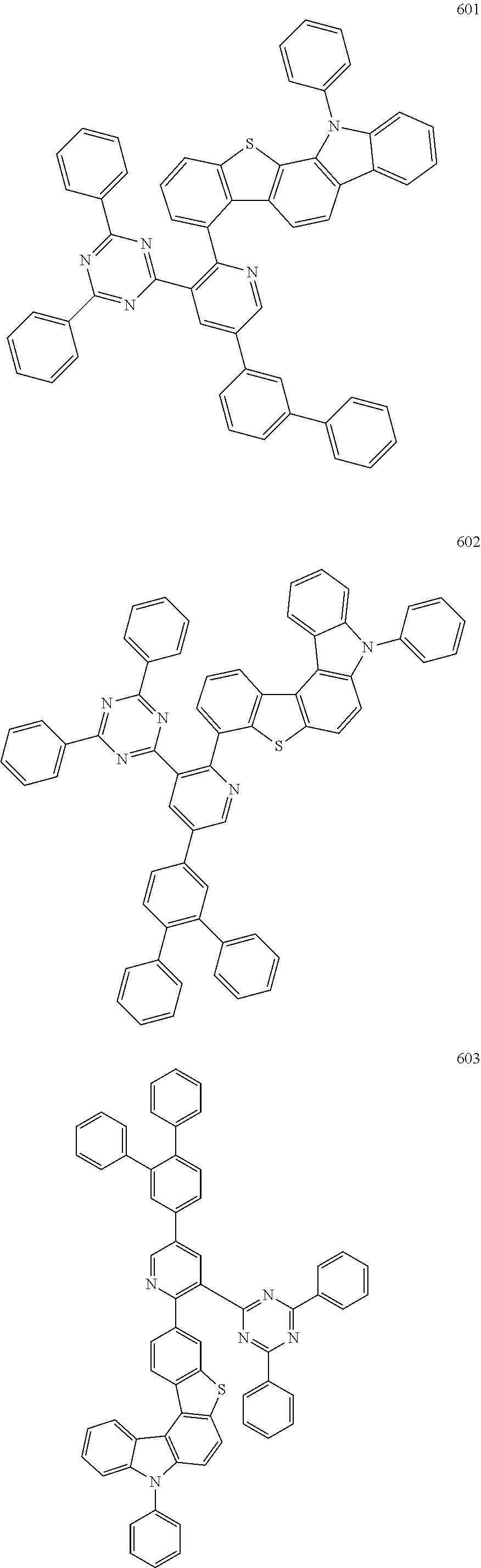


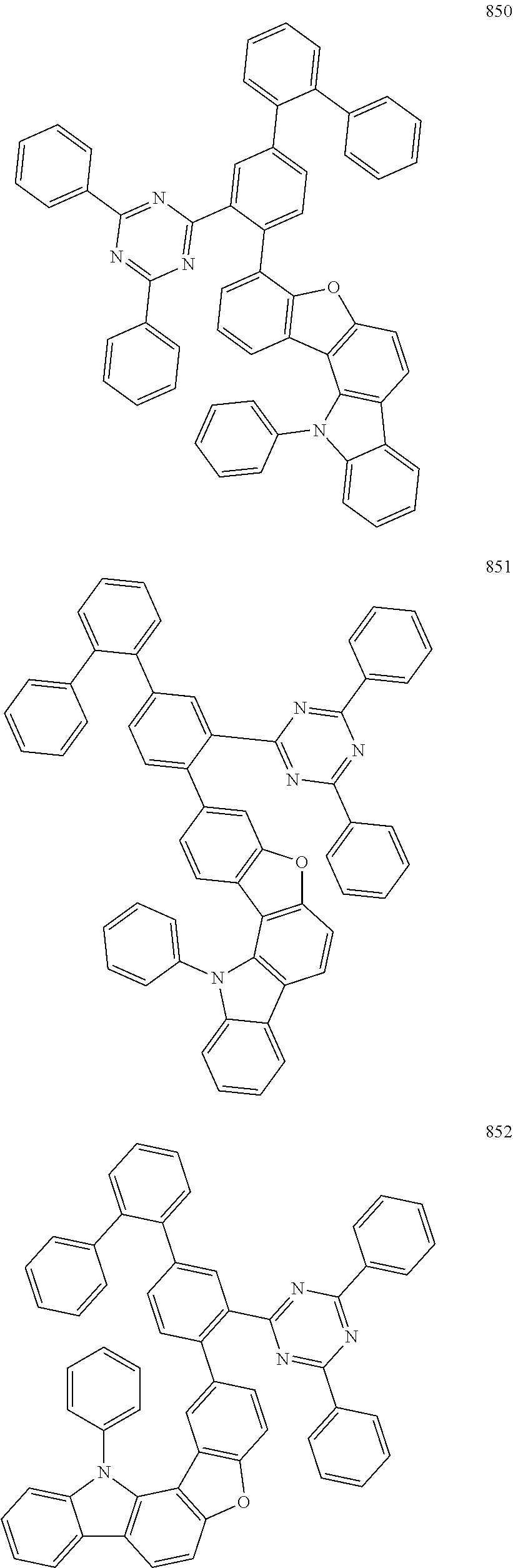

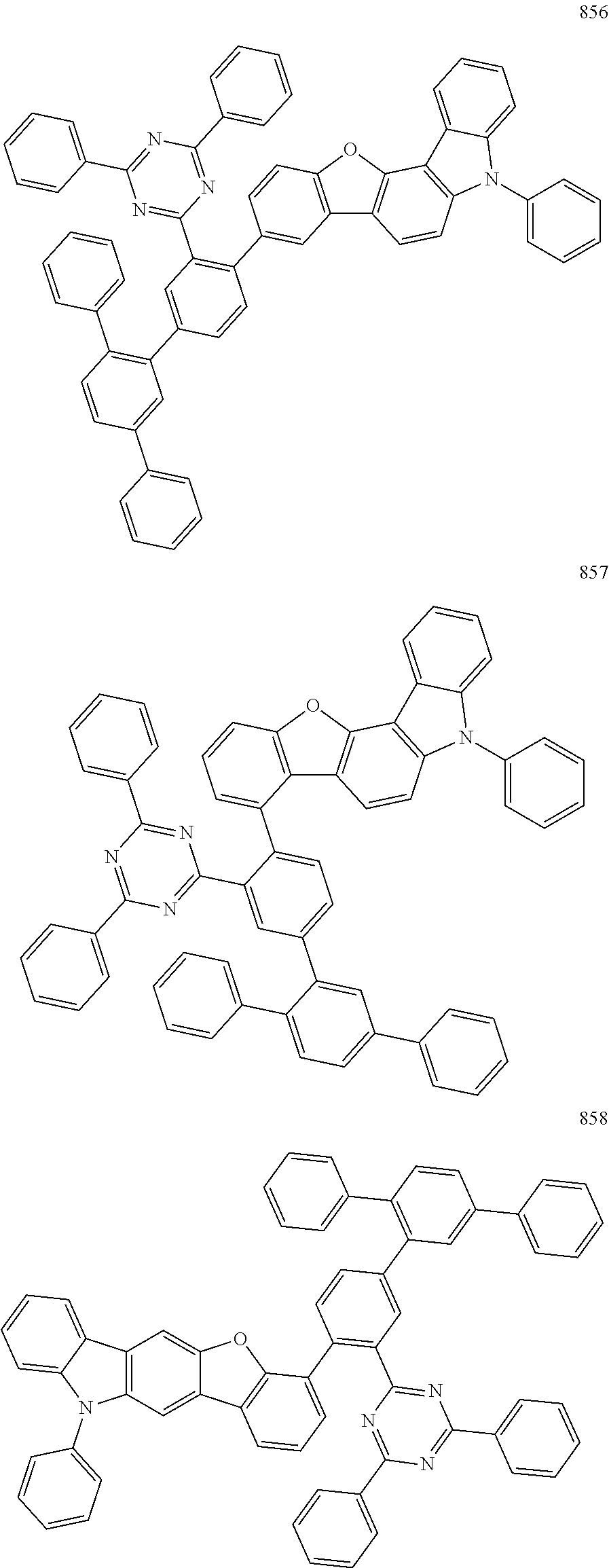


-
- wherein, in Formula 503,
- X501 may be N, B, P(═O)(R504), or P(═S)(R504),
- Y501 to Y502 may each independently be O, S, N(R505), B(R505), C(R505)(R506), or Si(R505)(R506),
- k501 may be 0 or 1, wherein, when k501 is 0, —(Y501)k501— may not exist,
- A501 to A503 may each independently be a C5-C30 carbocyclic group or a C1-C30 heterocyclic group,
- L501 to L503 may each independently be a substituted or unsubstituted C3-C10 cycloalkylene group, a substituted or unsubstituted C1-C10 heterocycloalkylene group, a substituted or unsubstituted C3-C10 cycloalkenylene group, a substituted or unsubstituted C1-C10 heterocycloalkenylene group, a substituted or unsubstituted C6-C60 arylene group, a substituted or unsubstituted C1-C60 heteroarylene group, a substituted or unsubstituted divalent non-aromatic condensed polycyclic group, or a substituted or unsubstituted divalent non-aromatic condensed heteropolycyclic group,
- xd1 to xd3 may each independently be 0, 1, 2 or 3,
- R501 to R506 may each independently be hydrogen, deuterium, —F, —Cl, —Br, —I, a hydroxyl group, a cyano group, a nitro group, an amino group, an amidino group, a hydrazine group, a hydrazone group, a carboxylic acid group or a salt thereof, a sulfonic acid group or a salt thereof, a phosphoric acid group or a salt thereof, a substituted or unsubstituted C1-C60 alkyl group, a substituted or unsubstituted C2-C60 alkenyl group, a substituted or unsubstituted C2-C60 alkynyl group, a substituted or unsubstituted C1-C60 alkoxy group, a substituted or unsubstituted C3-C10 cycloalkyl group, a substituted or unsubstituted C1-C10 heterocycloalkyl group, a substituted or unsubstituted C3-C10 cycloalkenyl group, a substituted or unsubstituted C1-C10 heterocycloalkenyl group, a substituted or unsubstituted C6-C60 aryl group, a substituted or unsubstituted C6-C60 aryloxy group, a substituted or unsubstituted C6-C60 arylthio group, a substituted or unsubstituted C1-C60 heteroaryl group, a substituted or unsubstituted monovalent non-aromatic condensed polycyclic group, a substituted or unsubstituted monovalent non-aromatic condensed heteropolycyclic group, —C(Q1)(Q2)(Q3), —Si(Q1)(Q2)(Q3), —B(Q1)(Q2), —N(Q1)(Q2), —P(Q1)(Q2), —C(═O)(Q1), —S(═O)(Q1), —S(═O)2(Q1), —P(═O)(Q1)(Q2), or —P(═S)(Q1)(Q2), and R501 to R506 are optionally linked to each other to form a substituted or unsubstituted C5-C30 carbocyclic group and a substituted or unsubstituted C1-C30 heterocyclic group,
- xd11 and xd12 may each independently be an integer from 0 to 10, and
- Q1 to Q3 may each independently be hydrogen, deuterium, —F, —Cl, —Br, —I, a hydroxyl group, a cyano group, a nitro group, an amidino group, a hydrazino group, a hydrazono group, a C1-C60 alkyl group, a C2-C60 alkenyl group, a C2-C60 alkynyl group, a C1-C60 alkoxy group, a C3-C10 cycloalkyl group, a C1-C10 heterocycloalkyl group, a C3-C10 cycloalkenyl group, a C1-C10 heterocycloalkenyl group, a C6-C60 aryl group, a C7-C60 alkyl aryl group, a C6-C60 aryloxy group, a C6-C60 arylthio group, a C1-C60 heteroaryl group, a C2-C60 alkyl heteroaryl group, a C1-C60 heteroaryloxy group, a C1-C60 heteroarylthio group, a monovalent non-aromatic condensed polycyclic group, a monovalent non-aromatic condensed heteropolycyclic group, a C1-C60 alkyl group that is substituted with at least one deuterium, —F, a cyano group, a C1-C60 alkyl group, a C6-C60 aryl group, or a combination thereof, or a substituted C6-C60 aryl group that is substituted with at least one deuterium, —F, a cyano group, a C1-C60 alkyl group, a C6-C60 aryl group, or a combination thereof.

-
- wherein, in Formula 1,
- X11 may be NR14 or O,
- X12 may be NR15 or O,
- X13 may be NR16 or O,
- k11 may be 0 or 1, wherein, when k11 is 0, (X11)k11 may not exist,
- A11 to A13 may each independently be a C5-C30 carbocyclic group or a C1-C30 heterocyclic group,
- R11 to R16 may each independently be hydrogen, deuterium, —F, —Cl, —Br, —I, a hydroxyl group, a cyano group, a nitro group, an amidino group, a hydrazino group, a hydrazono group, a substituted or unsubstituted C1-C60 alkyl group, a substituted or unsubstituted C2-C60 alkenyl group, a substituted or unsubstituted C2-C60 alkynyl group, a substituted or unsubstituted C1-C60 alkoxy group, a substituted or unsubstituted C3-C10 cycloalkyl group, a substituted or unsubstituted C1-C10 heterocycloalkyl group, a substituted or unsubstituted C3-C10 cycloalkenyl group, a substituted or unsubstituted C1-C10 heterocycloalkenyl group, a substituted or unsubstituted C6-C60 aryl group, a substituted or unsubstituted C7-C60 alkyl aryl group, a substituted or unsubstituted C6-C60 aryloxy group, a substituted or unsubstituted C6-C60 arylthio group, a substituted or unsubstituted C1-C60 heteroaryl group, a substituted or unsubstituted C2-C60 alkyl heteroaryl group, a substituted or unsubstituted C1-C60 heteroaryloxy group, a substituted or unsubstituted C1-C60 heteroarylthio group, a substituted or unsubstituted monovalent non-aromatic condensed polycyclic group, a substituted or unsubstituted monovalent non-aromatic condensed heteropolycyclic group, —C(Q1)(Q2)(Q3), —Si(Q1)(Q2)(Q3), —B(Q1)(Q2), —N(Q1)(Q2), —P(Q1)(Q2), —C(═O)(Q1), —S(═O)(Q1), —S(═O)2(Q1), —P(═O)(Q1)(Q2), or —P(═S)(Q1)(Q2),
- b11 to b13 may each independently be an integer from 0 to 10, and
- Q1 to Q3 may each independently be hydrogen, deuterium, —F, —Cl, —Br, —I, a hydroxyl group, a cyano group, a nitro group, an amidino group, a hydrazino group, a hydrazono group, a C1-C60 alkyl group, a C2-C60 alkenyl group, a C2-C60 alkynyl group, a C1-C60 alkoxy group, a C3-C10 cycloalkyl group, a C1-C10 heterocycloalkyl group, a C3-C10 cycloalkenyl group, a C1-C10 heterocycloalkenyl group, a C6-C60 aryl group, a C7-C60 alkyl aryl group, a C6-C60 aryloxy group, a C6-C60 arylthio group, a C1-C60 heteroaryl group, a C2-C60 alkyl heteroaryl group, a C1-C60 heteroaryloxy group, a C1-C60 heteroarylthio group, a monovalent non-aromatic condensed polycyclic group, a monovalent non-aromatic condensed heteropolycyclic group, a C1-C60 alkyl group that is substituted with at least one deuterium, —F, a cyano group, a C1-C60 alkyl group, a C6-C60 aryl group, or a combination thereof, or a substituted C6-C60 aryl group that is substituted with at least one deuterium, —F, a cyano group, a C1-C60 alkyl group, a C6-C60 aryl group, or a combination thereof.

-
- wherein, in Formula 10A,
- X101 may be NR104 or O,
- X102 may be NR105 or O,
- X103 may be NR106 or O,
- k101 may be 0 or 1, wherein, when k101 is 0, (X101)k101 may not exist,
- A101 to A103 may each independently be a benzene group, a naphthalene group, a fluorene group, a spiro-bifluorene group, a benzofluorene group, a dibenzofluorene group, a phenanthrene group, an anthracene group, a fluoranthene group, a triphenylene group, a pyrene group, a chrysene group, or a perylene group,
- R101 to R106 may each independently be hydrogen, deuterium, —F, —Cl, —Br, —I, a hydroxyl group, a cyano group, a nitro group, an amidino group, a hydrazino group, a hydrazono group, a substituted or unsubstituted C1-C60 alkyl group, a substituted or unsubstituted C2-C60 alkenyl group, a substituted or unsubstituted C2-C60 alkynyl group, a substituted or unsubstituted C1-C60 alkoxy group, a substituted or unsubstituted C3-C10 cycloalkyl group, a substituted or unsubstituted C1-C10 heterocycloalkyl group, a substituted or unsubstituted C3-C10 cycloalkenyl group, a substituted or unsubstituted C1-C10 heterocycloalkenyl group, a substituted or unsubstituted C6-C60 aryl group, a substituted or unsubstituted C1-C60 alkyl aryl group, a substituted or unsubstituted C6-C60 aryloxy group, a substituted or unsubstituted C6-C60 arylthio group, a substituted or unsubstituted C1-C60 heteroaryl group, a substituted or unsubstituted C2-C60 alkyl heteroaryl group, a substituted or unsubstituted C1-C60 heteroaryloxy group, a substituted or unsubstituted heteroarylthio group, a substituted or unsubstituted monovalent non-aromatic condensed polycyclic group, a substituted or unsubstituted monovalent non-aromatic condensed heteropolycyclic group, —C(Q1)(Q2)(Q3), —Si(Q1)(Q2)(Q3), —B(Q1)(Q2), —N(Q1)(Q2), —P(Q1)(Q2), —C(═O)(Q1), —S(═O)(Q1), —S(═O)2(Q1), —P(═O)(Q1)(Q2), or —P(═S)(Q1)(Q2),
- b101 to b103 may each independently be an integer from 0 to 10, and
- Q1 to Q3 may each independently be hydrogen, deuterium, —F, —Cl, —Br, —I, a hydroxyl group, a cyano group, a nitro group, an amidino group, a hydrazino group, a hydrazono group, a C1-C60 alkyl group, a C2-C60 alkenyl group, a C2-C60 alkynyl group, a C1-C60 alkoxy group, a C3-C10 cycloalkyl group, a C1-C10 heterocycloalkyl group, a C3-C10 cycloalkenyl group, a C1-C10 heterocycloalkenyl group, a C6-C60 aryl group, a C7-C60 alkyl aryl group, a C6-C60 aryloxy group, a C6-C60 arylthio group, a C1-C60 heteroaryl group, a C2-C60 alkyl heteroaryl group, a C1-C60 heteroaryloxy group, a C1-C60 heteroarylthio group, a monovalent non-aromatic condensed polycyclic group, a monovalent non-aromatic condensed heteropolycyclic group, a C1-C60 alkyl group that is substituted with at least one deuterium, —F, a cyano group, a C1-C60 alkyl group, a C6-C60 aryl group, or a combination thereof, or a substituted C6-C60 aryl group that is substituted with at least one deuterium, —F, a cyano group, a C1-C60 alkyl group, a C6-C60 aryl group, or a combination thereof.
-
- A11 to A13 may each independently be a benzene group, a naphthalene group, a fluorene group, a spiro-bifluorene group, a benzofluorene group, a dibenzofluorene group, a phenanthrene group, an anthracene group, a fluoranthene group, a triphenylene group, a pyrene group, a chrysene group, or a perylene group.

-
- wherein, in Formulae 1-1 and 1-2,
- X12 may be NR15 or O,
- X13 may be NR16 or O,
- X102 may be NR105 or O,
- X103 may be NR105 or O,
- R11 to R13, R15, R16, R102, R103, R105, and R106 may each independently be hydrogen, deuterium, —F, —Cl, —Br, —I, a hydroxyl group, a cyano group, a nitro group, an amidino group, a hydrazino group, a hydrazono group, a substituted or unsubstituted C1-C60 alkyl group, a substituted or unsubstituted C2-C60 alkenyl group, a substituted or unsubstituted C2-C60 alkynyl group, a substituted or unsubstituted C1-C60 alkoxy group, a substituted or unsubstituted C3-C10 cycloalkyl group, a substituted or unsubstituted C1-C10 heterocycloalkyl group, a substituted or unsubstituted C3-C10 cycloalkenyl group, a substituted or unsubstituted C1-C10 heterocycloalkenyl group, a substituted or unsubstituted C6-C60 aryl group, a substituted or unsubstituted C7-C60 alkyl aryl group, a substituted or unsubstituted C6-C60 aryloxy group, a substituted or unsubstituted C6-C60 arylthio group, a substituted or unsubstituted C1-C60 heteroaryl group, a substituted or unsubstituted C2-C60 alkyl heteroaryl group, a substituted or unsubstituted C1-C60 heteroaryloxy group, a substituted or unsubstituted C1-C60 heteroarylthio group, a substituted or unsubstituted monovalent non-aromatic condensed polycyclic group, a substituted or unsubstituted monovalent non-aromatic condensed heteropolycyclic group, —C(Q1)(Q2)(Q3), —Si(Q1)(Q2)(Q3), —B(Q1)(Q2), —N(Q1)(Q2), —P(Q1)(Q2), —C(═O)(Q1), —S(═O)(Q1), —S(═O)2(Q1), —P(═O)(Q1)(Q2), or —P(═S)(Q1)(Q2),
- b11 to b13, b102, and b103 may each independently be an integer from 0 to 10, and
- Q1 to Q3 may each independently be hydrogen, deuterium, —F, —Cl, —Br, —I, a hydroxyl group, a cyano group, a nitro group, an amidino group, a hydrazino group, a hydrazono group, a C1-C60 alkyl group, a C2-C60 alkenyl group, a C2-C60 alkynyl group, a C1-C60 alkoxy group, a C3-C10 cycloalkyl group, a C1-C10 heterocycloalkyl group, a C3-C10 cycloalkenyl group, a C1-C10 heterocycloalkenyl group, a C6-C60 aryl group, a C7-C60 alkyl aryl group, a C6-C60 aryloxy group, a C6-C60 arylthio group, a C1-C60 heteroaryl group, a C2-C60 alkyl heteroaryl group, a C1-C60 heteroaryloxy group, a C1-C60 heteroarylthio group, a monovalent non-aromatic condensed polycyclic group, a monovalent non-aromatic condensed heteropolycyclic group, a C1-C60 alkyl group that is substituted with at least one deuterium, —F, a cyano group, a C1-C60 alkyl group, a C6-C60 aryl group, or a combination thereof, or a substituted C6-C60 aryl group that is substituted with at least one deuterium, —F, a cyano group, a C1-C60 alkyl group, a C6-C60 aryl group, or a combination thereof.


T 1(Ex)>T 1(C4) Condition 2
-
- wherein, in Condition 2,
- T1(Ex) is a lowest excited triplet energy level of the exciplex, and
- T1(C4) is a lowest excited triplet energy level of the fourth compound.
T 1(C1)≤T 1(C 3)<S 1(C1) Condition 1-3
wherein, in Condition 1-3,
-
- T1(C1) is a lowest excited triplet energy level of the first compound,
- T1(C3) is a lowest excited triplet energy level of the third compound, and
- S1(C1) is a lowest excited singlet energy of the first compound.
T 1(C3)−T 1(C1)<0.3 eV Condition 1-4
-
- wherein, in Condition 1-4,
- T1(C1) is a lowest excited triplet energy level of the first compound, and
- T1(C3) is a lowest excited triplet energy level of the third compound.
T 1(C3)−T 1(C1)−0.15 eV Condition 1-4-1

-
- wherein, in Formulae 201 to 205,
- L201 to L209 may each independently *-be O—′, *—S—*′, a substituted or unsubstituted C5-C60 carbocyclic group, or a substituted or unsubstituted C1-C60 heterocyclic group,
- xa1 to xa9 may each independently be an integer from 0 to 5, and
- R201 to R206 may each independently be a substituted or unsubstituted C3-C10 cycloalkyl group, a substituted or unsubstituted C1-C10 heterocycloalkyl group, a substituted or unsubstituted C3-C10 cycloalkenyl group, a substituted or unsubstituted C1-C10 heterocycloalkenyl group, a substituted or unsubstituted C6-C60 aryl group, a substituted or unsubstituted C6-C60 aryloxy group, a substituted or unsubstituted C6-C60 arylthio group, a substituted or unsubstituted C1-C60 heteroaryl group, a substituted or unsubstituted monovalent non-aromatic condensed polycyclic group, or a substituted or unsubstituted monovalent non-aromatic condensed heteropolycyclic group, wherein neighboring two a group of R201 to R206 may optionally be linked to each other via a single bond, a dimethyl-methylene group, or a diphenyl-methylene group.
-
- L201 to L209 may be a benzene group, a heptalene group, an indene group, a naphthalene group, an azulene group, a heptalene group, an indacene group, an acenaphthylene group, a fluorene group, a spiro-bifluorene group, a benzofluorene group, a dibenzofluorene group, a phenalene group, a phenanthrene group, an anthracene group, a fluoranthene group, a triphenylene group, a pyrene group, a chrysene group, a naphthacene group, a picene group, a perylene group, a pentacene group, a hexacene group, a pentacene group, a rubicene group, a coronene group, an ovalene group, a pyrrole group, an isoindole group, an indole group, a furan group, a thiophene group, a benzofuran group, a benzothiophene group, a benzocarbazole group, a dibenzocarbazole group, a dibenzofuran group, a dibenzothiophene group, a dibenzothiophene sulfone group, a carbazole group, a dibenzosilole group, an indenocarbazole group, an indolocarbazole group, a benzofurocarbazole group, a benzothienocarbazole group, or a triindolobenzene group, each unsubstituted or substituted with deuterium, a C1-C10 alkyl group, a C1-C10 alkoxy group, a phenyl group, a naphthyl group, a fluorenyl group, a carbazolyl group, a dibenzofuranyl group, a dibenzothiophenyl group, a triphenylenyl group, a biphenyl group, a terphenyl group, a tetraphenyl group, —Si(Q11)(Q12)(Q13), or a combination thereof,
- xa1 to xa9 may each independently be 0, 1, or 2, and
- R201 to R206 may each independently be a phenyl group, a biphenyl group, a terphenyl group, a pentalenyl group, an indenyl group, a naphthyl group, an azulenyl group, a heptalenyl group, an indacenyl group, an acenaphthyl group, a fluorenyl group, a spiro-bifluorenyl group, a benzofluorenyl group, a dibenzofluorenyl group, a phenalenyl group, a phenanthrenyl group, an anthracenyl group, a fluoranthenyl group, a triphenylenyl group, a pyrenyl group, a chrysenyl group, a naphthacenyl group, a picenyl group, a perylenyl group, a pentaphenyl group, a hexacenyl group, a pentacenyl group, a rubicenyl group, a coronenyl group, an ovalenyl group, a thiophenyl group, a furanyl group, a carbazolyl group, an indolyl group, an isoindolyl group, a benzofuranyl group, a benzothiophenyl group, a dibenzofuranyl group, a dibenzothiophenyl group, a benzocarbazolyl group, a dibenzocarbazolyl group, a dibenzosilolyl group, a pyridinyl group, an indeno carbazolyl group, an indolocarbazolyl group, a benzofurocarbazolyl group, or a benzothienocarbazolyl group, each unsubstituted or substituted with deuterium, —F, —Cl, —Br, —I, a hydroxyl group, a cyano group, a nitro group, an amidino group, a hydrazine group, a hydrazone group, a C1-C20 alkyl group, a C1-C20 alkoxy group, a cyclopentyl group, a cyclohexyl group, a cycloheptyl group, a cyclopentenyl group, a cyclohexenyl group, a phenyl group, a biphenyl group, a terphenyl group, a phenyl group substituted with a C1-C10 alkyl group, a phenyl group substituted with —F, a pentalenyl group, an indenyl group, a naphthyl group, an azulenyl group, a heptalenyl group, an indacenyl group, an acenaphthyl group, a fluorenyl group, a spiro-bifluorenyl group, a benzofluorenyl group, a dibenzofluorenyl group, a phenalenyl group, a phenanthrenyl group, an anthracenyl group, a fluoranthenyl group, a triphenylenyl group, a pyrenyl group, a chrysenyl group, a naphthacenyl group, a picenyl group, a perylenyl group, a pentaphenyl group, a hexacenyl group, a pentacenyl group, a rubicenyl group, a coronenyl group, an ovalenyl group, a thiophenyl group, a furanyl group, a carbazolyl group, an indolyl group, an isoindolyl group, a benzofuranyl group, a benzothiophenyl group, a dibenzofuranyl group, a dibenzothiophenyl group, a benzocarbazolyl group, a dibenzocarbazolyl group, a dibenzosilolyl group, a pyridinyl group, —Si(Q31)(Q32)(Q33), —N(Q31)(Q32), or any combination thereof,
- wherein Q11 to Q13 and Q31 to Q33 may each independently be a C1-C10 alkyl group, a C1-C10 alkoxy group, a phenyl group, a biphenyl group, a terphenyl group, or a naphthyl group.

-
- In Formulae 201-1, 202-1, and 201-2, L201 to L203, L205, xa1 to xa3, xa5, R201 and R202 are the same as described herein, and R211 to R213 are each independently hydrogen, deuterium, —F, —Cl, —Br, —I, a hydroxyl group, a cyano group, a nitro group, an amidino group, a hydrazine group, a hydrazone group, a C1-C20 alkyl group, a C1-C20 alkoxy group, a phenyl group, a biphenyl group, a terphenyl group, a phenyl group substituted with a C1-C10 alkyl group, a phenyl group substituted with —F, a naphthyl group, a fluorenyl group, a spiro-bifluorenyl group, a dimethylfluorenyl group, a diphenylfluorenyl group, a triphenylenyl group, a thiophenyl group, a furanyl group, a carbazolyl group, an indolyl group, an isoindolyl group, a benzofuranyl group, a benzothiophenyl group, a dibenzofuranyl group, a dibenzothiophenyl group, a benzocarbazolyl group, a dibenzocarbazolyl group, a dibenzosilolyl group, or a pyridinyl group.


-
- a quinone derivative, such as tetracyanoquinodimethane (TCNQ),2,3,5,6-tetrafluoro-7,7,8,8-tetracyanoquinodimethane (F4-TCNQ), and F6-TCNNQ;
- a metal oxide, such as tungsten oxide or molybdenum oxide;
- 1,4,5,8,9,12-hexaazatriphenylene-hexacarbonitrile (HAT-CN); and
- a compound represented by Formula 221 below,
- but embodiments of the disclosure are not limited thereto:

-
- wherein, in Formula 221,
- R221 to R223 may each independently be a substituted or unsubstituted C3-C10 cycloalkyl group, a substituted or unsubstituted C1-C10 heterocycloalkyl group, a substituted or unsubstituted C3-C10 cycloalkenyl group, a substituted or unsubstituted C1-C10 heterocycloalkenyl group, a substituted or unsubstituted C6-C60 aryl group, a substituted or unsubstituted C1-C60 heteroaryl group, a substituted or unsubstituted monovalent non-aromatic condensed polycyclic group, or a substituted or unsubstituted monovalent non-aromatic condensed heteropolycyclic group, and at least one R221 to R223 may have at least one substituent of a cyano group, —F, —Cl, —Br, —I, a C1-C20 alkyl group substituted with —F, a C1-C20 alkyl group substituted with —Cl, a C1-C20 alkyl group substituted with —Br, a C1-C20 alkyl group substituted with —I, or a combination thereof.
[Ar601]xe11−[(L601)xe1−R601]xe21 Formula 601
-
- wherein, in Formula 601,
- Ar601 and L601 may each independently be a substituted or unsubstituted C5-C60 carbocyclic group or a substituted or unsubstituted C1-C60 heterocyclic group,
- xe11 may be 1, 2, or 3,
- xe1 may be an integer from 0 to 5,
- R601 may be a substituted or unsubstituted C3-C10 cycloalkyl group, a substituted or unsubstituted C1-C10 heterocycloalkyl group, a substituted or unsubstituted C3-C10 cycloalkenyl group, a substituted or unsubstituted C1-C10 heterocycloalkenyl group, a substituted or unsubstituted C5-C60 aryl group, a substituted or unsubstituted C6-C60 aryloxy group, a substituted or unsubstituted C6-C60 arylthio group, a substituted or unsubstituted C1-C60 heteroaryl group, a substituted or unsubstituted monovalent non-aromatic condensed polycyclic group, a substituted or unsubstituted monovalent non-aromatic condensed heteropolycyclic group, —Si(Q601)(Q602)(Q603), —C(═O)(Q601), —S(═O)2(Q601), or P(═O)(Q601)(Q602),
- Q601 to Q603 may each independently be a C1-C10 alkyl group, a C1-C10 alkoxy group, a phenyl group, a biphenyl group, a terphenyl group, or a naphthyl group, and
- xe21 may be an integer from 1 to 5.
-
- wherein Q31 to Q33 may each independently be a C1-C10 alkyl group, a C1-C10 alkoxy group, a phenyl group, a biphenyl group, a terphenyl group, or a naphthyl group.

-
- wherein, in Formula 601-1,
- X614 may be N or C(R614), X615 may be N or C(R615), X616 may be N or C(R616), at least one of X614 to X616 may be N,
- L611 to L613 may each independently be the same as described in connection with L601,
- xe611 to xe613 may each independently be the same as described in connection with xe1,
- R611 to R613 may each independently be the same as described in connection with R601, and
- R614 to R616 may each independently be hydrogen, deuterium, —F, —Cl, —Br, —I, a hydroxyl group, a cyano group, a nitro group, an amidino group, a hydrazino group, a hydrazono group, a C1-C20 alkyl group, a C1-C20 alkoxy group, a phenyl group, a biphenyl group, a terphenyl group, or a naphthyl group.
-
- —S(═O)2(Q601) and —P(═O)(Q601)(Q602),
- wherein Q601 and Q602 are each the same as described above.


-
- deuterium, —F, —Cl, —Br, —I, —CD3, —CD2H, —CDH2, —CF3, —CF2H, —CFH2, a hydroxyl group, a cyano group, a nitro group, an amino group, an amidino group, a hydrazine group, a hydrazone group, a carboxylic acid or a salt thereof, a sulfonic acid or a salt thereof, a phosphoric acid or a salt thereof, a C1-C60 alkyl group, a C2-C60 alkenyl group, a C2-C60 alkynyl group, or a C1-C60 alkoxy group;
- a C1-C60 alkyl group, a C2-C60 alkenyl group, a C2-C60 alkynyl group, or a C1-C60 alkoxy group, each substituted with at least one of deuterium, —F, —Cl, —Br, —I, —CD3, —CD2H, —CDH2, —CF3, —CF2H, —CFH2, a hydroxyl group, a cyano group, a nitro group, an amino group, an amidino group, a hydrazine group, a hydrazone group, a carboxylic acid or a salt thereof, a sulfonic acid or a salt thereof, a phosphoric acid or a salt thereof, a C3-C10 cycloalkyl group, a C1-C10 heterocycloalkyl group, a C3-C10 cycloalkenyl group, a C1-C10 heterocycloalkenyl group, a C6-C60 aryl group, a C6-C60 aryloxy group, a C6-C60 arylthio group, a C1-C60 heteroaryl group, a monovalent non-aromatic condensed polycyclic group, a monovalent non-aromatic condensed heteropolycyclic group, —N(Q11)(Q12), —Si(Q13)(Q14)(Q15), —B(Q16)(Q17), —P(═O)(Q18)(Q19), or a combination thereof;
- a C3-C10 cycloalkyl group, a C1-C10 heterocycloalkyl group, a C3-C10 cycloalkenyl group, a C1-C10 heterocycloalkenyl group, a C6-C60 aryl group, a C6-C60 aryloxy group, a C6-C60 arylthio group, a C1-C60 heteroaryl group, a monovalent non-aromatic condensed polycyclic group, or a monovalent non-aromatic condensed heteropolycyclic group;
- a C3-C10 cycloalkyl group, a C1-C10 heterocycloalkyl group, a C3-C10 cycloalkenyl group, a C1-C10 heterocycloalkenyl group, a C6-C60 aryl group, a C6-C60 aryloxy group, a C6-C60 arylthio group, a C1-C60 heteroaryl group, a monovalent non-aromatic condensed polycyclic group, or a monovalent non-aromatic condensed heteropolycyclic group, each substituted with at least one of deuterium, —F, —Cl, —Br, —I,-CD3,-CD2H,-CDH2, —CF3, —CF2H, —CFH2, a hydroxyl group, a cyano group, a nitro group, an amidino group, a hydrazine group, a hydrazone group, a carboxylic acid or a salt thereof, a sulfonic acid or a salt thereof, a phosphoric acid or a salt thereof, a C1-C60 alkyl group, a C2-C60 alkenyl group, a C2-C60 alkynyl group, a C1-C60 alkoxy group, a C3-C10 cycloalkyl group, a C1-C10 heterocycloalkyl group, a C3-C10 cycloalkenyl group, a C1-C10 heterocycloalkenyl group, a C6-C60 aryl group, a C6-C60 aryloxy group, a C6-C60 arylthio group, a C1-C60 heteroaryl group, a monovalent non-aromatic condensed polycyclic group, a monovalent non-aromatic condensed heteropolycyclic group, —N(Q21)(Q22), —Si(Q23)(Q24)(Q25), —B(Q26)(Q27), —P(═O)(Q28)(Q29), or a combination thereof; or
- —N(Q31)(Q32), —Si(Q33)(Q34)(Q35), —B(Q36)(Q37), or —P(═O)(Q38)(Q39),
- wherein Q1 to Q9, Q11 to Q19, Q21 to Q29 and Q31 to Q39 may each independently be hydrogen, deuterium, —F, —Cl, —Br, —I, a hydroxyl group, a cyano group, a nitro group, an amino group, an amidino group, a hydrazine group, a hydrazone group, a carboxylic acid or a salt thereof, a sulfonic acid or a salt thereof, a phosphoric acid or a salt thereof, a C1-C60 alkyl group, a C2-C60 alkenyl group, a C2-C60 alkynyl group, a C1-C60 alkoxy group, a C3-C10 cycloalkyl group, a C1-C10 heterocycloalkyl group, a C3-C10 cycloalkenyl group, a C1-C10 heterocycloalkenyl group, a C6-C60 aryl group, a C6-C60 aryl group substituted with at least one a C1-C60 alkyl group, and a C6-C60 aryl group, a C6-C60 aryloxy group, a C6-C60 arylthio group, a C1-C60 heteroaryl group, a monovalent non-aromatic condensed polycyclic group, or a monovalent non-aromatic condensed heteropolycyclic group.
| TABLE 7 | |||
| Lowest excited | Lowest excited | ||
| Film | Film composition | triplet energy level | singlet energy level |
| no. | (weight ratio) | (T1(Ex)) (eV) | (S1(Ex)) (eV) |
| Film | HT-HOST A:ET- | 2.81 | 3.26 |
| Ex 1 | HOST A (5:5) | ||
| Film | HT-HOST A:ET- | 2.81 | 3.26 |
| Ex 2 | HOST A (1:9) | ||

| TABLE 8 | ||||
| Lowest excited | ||||
| Composition | triplet energy level | |||
| No. | (weight ratio) | (T1(Ex)) (eV) | ||
| C3 1 | TADF A (100) | 2.84 | ||
| C3 Comparison 1 | TADF D (100) | 2.70 | ||

| TABLE 9 | ||||
| Lowest excited | ||||
| Composition | triplet energy level | |||
| No. | (weight ratio) | (T1(Ex)) (eV) | ||
| C4 1 | BD1-5 (100) | 2.71 | ||

| TABLE 10 | ||||||||
| Weight ratio | Amount of | Amount of | ||||||
| of first | third compound | fourth compound | ||||||
| compound to | (wt %, based on | (wt %, based on | ||||||
| First | Second | second | Third | total weight of | Fourth | total weight of | ||
| compound | compound | compound | compound | emission layer) | compound | emission layer) | ||
| Example 1-1 | HT-HOST A | ET-HOST A | 1:9 | TADF A | 20 | BD1-5 | 1 |
| Example 1-2 | HT-HOST A | ET-HOST A | 1:9 | TADF A | 15 | BD1-5 | 1 |
| Example 1-3 | HT-HOST A | ET-HOST A | 1:9 | TADF A | 20 | BD1-5 | 0.5 |
| Example 1-4 | HT-HOST A | ET-HOST A | 1:9 | TADF A | 15 | BD1-5 | 0.5 |
| Example 1-5 | HT-HOST A | ET-HOST A | 1:9 | TADF A | 20 | BD1-5 | 0.2 |
| Example 1-6 | HT-HOST A | ET-HOST A | 1:9 | TADF A | 15 | BD1-5 | 0.2 |
| Comparative | HT-HOST A | ET-HOST A | 1:9 | TADF D | 20 | BD1-5 | 1 |
| Example 1-1 | |||||||
| TABLE 11 | |||||
| Lifespan | EQE | Roll | |||
| (hr) | (%) | Efficiency/y | off (%) | ||
| Example 1-1 | 7.00 | 15.2 | 103.4 | 16.7 | ||
| Example 1-2 | 5.52 | 13.7 | 92.7 | 16.9 | ||
| Example 1-3 | 7.14 | 15.7 | 109.8 | 20.5 | ||
| Example 1-4 | 5.96 | 15.0 | 105.3 | 20.0 | ||
| Example 1-5 | 4.94 | 14.6 | 106.6 | 26.6 | ||
| Example 1-6 | 4.14 | 13.9 | 102.5 | 26.6 | ||
| Comparative | 2.60 | 14.5 | 92.7 | 22.2 | ||
| Example 1-1 | ||||||
Claims (8)
T 1(Ex)≤T 1(C3)<S 1(Ex) Condition 1-1
T 1(C3)−T 1(Ex)<0.3 eV Condition 1-2

T 1(C3)−T 1(Ex)≤0.15 eV. Condition 1-2-1


Applications Claiming Priority (4)
| Application Number | Priority Date | Filing Date | Title |
|---|---|---|---|
| KR20200051054 | 2020-04-27 | ||
| KR10-2020-0051054 | 2020-04-27 | ||
| KR10-2021-0050745 | 2021-04-19 | ||
| KR1020210050745A KR102847111B1 (en) | 2020-04-27 | 2021-04-19 | Organic light emitting device |
Publications (2)
| Publication Number | Publication Date |
|---|---|
| US20220149287A1 US20220149287A1 (en) | 2022-05-12 |
| US12048243B2 true US12048243B2 (en) | 2024-07-23 |
Family
ID=78521853
Family Applications (1)
| Application Number | Title | Priority Date | Filing Date |
|---|---|---|---|
| US17/239,871 Active 2042-05-19 US12048243B2 (en) | 2020-04-27 | 2021-04-26 | Organic light-emitting device |
Country Status (2)
| Country | Link |
|---|---|
| US (1) | US12048243B2 (en) |
| KR (1) | KR102847111B1 (en) |
Families Citing this family (2)
| Publication number | Priority date | Publication date | Assignee | Title |
|---|---|---|---|---|
| KR102822338B1 (en) * | 2020-09-21 | 2025-06-18 | 삼성전자주식회사 | Organic light emitting device |
| EP4120381A1 (en) | 2021-07-16 | 2023-01-18 | Samsung Electronics Co., Ltd. | Organic light-emitting device |
Citations (17)
| Publication number | Priority date | Publication date | Assignee | Title |
|---|---|---|---|---|
| JP2006128632A (en) | 2004-09-29 | 2006-05-18 | Canon Inc | Organic electroluminescent device and display device |
| JP2015015261A (en) | 2006-10-27 | 2015-01-22 | ユニバーシティ オブ サザン カリフォルニア | Materials and structures for efficiently capturing singlet and triplet excitons for white light emitting OLEDs |
| US20170062752A1 (en) | 2015-08-27 | 2017-03-02 | Samsung Electronics Co., Ltd. | Thin film and organic light-emitting device including the same |
| US20170077421A1 (en) | 2015-09-14 | 2017-03-16 | Samsung Electronics Co., Ltd. | Mixture, thin film, and organic light emitting device including mixture and thin film |
| US9905779B2 (en) | 2013-12-26 | 2018-02-27 | Idemitsu Kosan Co., Ltd. | Organic electroluminescent element and electronic device |
| WO2018181188A1 (en) | 2017-03-31 | 2018-10-04 | 出光興産株式会社 | Organic electroluminescence element and electronic device |
| WO2018186374A1 (en) | 2017-04-03 | 2018-10-11 | 出光興産株式会社 | Organic electroluminescent element and electronic device |
| WO2018186396A1 (en) | 2017-04-03 | 2018-10-11 | 出光興産株式会社 | Organic electroluminescence element and electronic apparatus |
| WO2018186404A1 (en) | 2017-04-03 | 2018-10-11 | 出光興産株式会社 | Organic electroluminescent element and electronic device |
| US20200002315A1 (en) | 2018-06-26 | 2020-01-02 | Samsung Electronics Co., Ltd. | Condensed cyclic compound and organic light-emitting device including the same |
| KR20200001439A (en) | 2018-06-26 | 2020-01-06 | 삼성전자주식회사 | Condensed cyclic compound and organic light emitting device comprising the same |
| WO2020042626A1 (en) | 2018-08-31 | 2020-03-05 | 昆山国显光电有限公司 | Organic electroluminescent device and manufacturing method therefor, and display device |
| US20200243776A1 (en) | 2019-01-25 | 2020-07-30 | Arizona Board Of Regents On Behalf Of Arizona State University | Light outcoupling efficiency of phosphorescent oleds by mixing horizontally aligned fluorescent emitters |
| US20200308209A1 (en) | 2019-03-28 | 2020-10-01 | Samsung Display Co., Ltd. | Organic light-emitting device and electronic apparatus |
| US20200321537A1 (en) * | 2019-03-29 | 2020-10-08 | Samsung Electronics Co., Ltd. | Organic light-emitting device |
| US20200335709A1 (en) | 2019-04-17 | 2020-10-22 | Idemitsu Kosan Co.,Ltd. | Organic electroluminescent element and electronic device |
| US10862047B2 (en) | 2013-08-14 | 2020-12-08 | Kyushu University, National University Corporation | Organic electroluminescent device |
Family Cites Families (4)
| Publication number | Priority date | Publication date | Assignee | Title |
|---|---|---|---|---|
| US20160104855A1 (en) * | 2014-10-10 | 2016-04-14 | Semiconductor Energy Laboratory Co., Ltd. | Light-Emitting Element, Display Device, Electronic Device, and Lighting Device |
| JP6714364B2 (en) * | 2016-01-14 | 2020-06-24 | 国立大学法人九州大学 | Organic electroluminescence device, device group, method for manufacturing organic electroluminescence device, emission wavelength control method for organic electroluminescence device |
| EP3565018B1 (en) * | 2018-05-04 | 2024-05-08 | Samsung Display Co., Ltd. | Organic electroluminescent device emitting blue light |
| KR102721590B1 (en) * | 2018-08-17 | 2024-10-23 | 엘지디스플레이 주식회사 | Organic light emitting diode device |
-
2021
- 2021-04-19 KR KR1020210050745A patent/KR102847111B1/en active Active
- 2021-04-26 US US17/239,871 patent/US12048243B2/en active Active
Patent Citations (26)
| Publication number | Priority date | Publication date | Assignee | Title |
|---|---|---|---|---|
| US7466073B2 (en) | 2004-09-29 | 2008-12-16 | Canon Kabushiki Kaisha | Organic electroluminescent device and display apparatus |
| JP2006128632A (en) | 2004-09-29 | 2006-05-18 | Canon Inc | Organic electroluminescent device and display device |
| JP2015015261A (en) | 2006-10-27 | 2015-01-22 | ユニバーシティ オブ サザン カリフォルニア | Materials and structures for efficiently capturing singlet and triplet excitons for white light emitting OLEDs |
| US8945722B2 (en) | 2006-10-27 | 2015-02-03 | The University Of Southern California | Materials and architectures for efficient harvesting of singlet and triplet excitons for white light emitting OLEDs |
| US10862047B2 (en) | 2013-08-14 | 2020-12-08 | Kyushu University, National University Corporation | Organic electroluminescent device |
| US9905779B2 (en) | 2013-12-26 | 2018-02-27 | Idemitsu Kosan Co., Ltd. | Organic electroluminescent element and electronic device |
| US10240085B2 (en) | 2015-08-27 | 2019-03-26 | Samsung Electronics Co., Ltd. | Thin film and organic light-emitting device including the same |
| US20170062752A1 (en) | 2015-08-27 | 2017-03-02 | Samsung Electronics Co., Ltd. | Thin film and organic light-emitting device including the same |
| US10297764B2 (en) | 2015-09-14 | 2019-05-21 | Samsung Electronics Co., Ltd. | Mixture, thin film, and organic light emitting device including mixture and thin film |
| US20170077421A1 (en) | 2015-09-14 | 2017-03-16 | Samsung Electronics Co., Ltd. | Mixture, thin film, and organic light emitting device including mixture and thin film |
| WO2018181188A1 (en) | 2017-03-31 | 2018-10-04 | 出光興産株式会社 | Organic electroluminescence element and electronic device |
| US20200035922A1 (en) | 2017-03-31 | 2020-01-30 | Idemitsu Kosan Co., Ltd. | Organic electroluminescence element and electronic device |
| WO2018186404A1 (en) | 2017-04-03 | 2018-10-11 | 出光興産株式会社 | Organic electroluminescent element and electronic device |
| WO2018186374A1 (en) | 2017-04-03 | 2018-10-11 | 出光興産株式会社 | Organic electroluminescent element and electronic device |
| US20200052212A1 (en) | 2017-04-03 | 2020-02-13 | Idemitsu Kosan Co., Ltd. | Organic electroluminescent element and electronic device |
| WO2018186396A1 (en) | 2017-04-03 | 2018-10-11 | 出光興産株式会社 | Organic electroluminescence element and electronic apparatus |
| US20210005826A1 (en) | 2017-04-03 | 2021-01-07 | Idemitsu Kosan Co., Ltd. | Organic electroluminescence element and electronic apparatus |
| US20210005825A1 (en) | 2017-04-03 | 2021-01-07 | Idemitsu Kosan Co., Ltd. | Organic electroluminescent element and electronic device |
| US20200002315A1 (en) | 2018-06-26 | 2020-01-02 | Samsung Electronics Co., Ltd. | Condensed cyclic compound and organic light-emitting device including the same |
| KR20200001439A (en) | 2018-06-26 | 2020-01-06 | 삼성전자주식회사 | Condensed cyclic compound and organic light emitting device comprising the same |
| WO2020042626A1 (en) | 2018-08-31 | 2020-03-05 | 昆山国显光电有限公司 | Organic electroluminescent device and manufacturing method therefor, and display device |
| US20200203652A1 (en) | 2018-08-31 | 2020-06-25 | Kunshan Go-Visionox Opto-Electronics Co., Ltd | Organic electroluminescence device, preparation method thereof and display apparatus |
| US20200243776A1 (en) | 2019-01-25 | 2020-07-30 | Arizona Board Of Regents On Behalf Of Arizona State University | Light outcoupling efficiency of phosphorescent oleds by mixing horizontally aligned fluorescent emitters |
| US20200308209A1 (en) | 2019-03-28 | 2020-10-01 | Samsung Display Co., Ltd. | Organic light-emitting device and electronic apparatus |
| US20200321537A1 (en) * | 2019-03-29 | 2020-10-08 | Samsung Electronics Co., Ltd. | Organic light-emitting device |
| US20200335709A1 (en) | 2019-04-17 | 2020-10-22 | Idemitsu Kosan Co.,Ltd. | Organic electroluminescent element and electronic device |
Non-Patent Citations (1)
| Title |
|---|
| Soon Ok Jeon, et al., High-efficiency, long-lifetime deep-blue organic light-emitting diodes, Nature Photonics, vol. 15, Mar. 2021, pp. 208-215. |
Also Published As
| Publication number | Publication date |
|---|---|
| KR102847111B1 (en) | 2025-08-18 |
| KR20210132601A (en) | 2021-11-04 |
| US20220149287A1 (en) | 2022-05-12 |
Similar Documents
| Publication | Publication Date | Title |
|---|---|---|
| US20200321537A1 (en) | Organic light-emitting device | |
| US20180248127A1 (en) | Condensed cyclic compound and organic light-emitting device including the same | |
| US20230090659A1 (en) | Organic light-emitting device | |
| US12063804B2 (en) | Organic light-emitting device | |
| US12297214B2 (en) | Condensed cyclic compound, organic light-emitting device including the same, and electronic apparatus including the organic light-emitting device | |
| US20250301898A1 (en) | Polycyclic compound and organic light-emitting device including the same | |
| US20230174560A1 (en) | Heterocyclic compound, organic light-emitting device including the same, and electronic apparatus including the organic light-emitting device | |
| US11925115B2 (en) | Organic light-emitting device comprising emission layer satisfying specific singlet excitation energy level conditions | |
| US20210284906A1 (en) | Organic light-emitting device | |
| US20230165130A1 (en) | Heterocyclic compound, organic light-emitting device including the heterocyclic compound, and electronic apparatus including the organic light-emitting device | |
| US12624045B2 (en) | Condensed cyclic compound, organic light-emitting device including the same, and electronic apparatus including the organic light-emitting device | |
| US11124521B2 (en) | Condensed cyclic compound and organic light-emitting device including the same | |
| US20230097695A1 (en) | Heterocyclic compound, organic light-emitting device including heterocyclic compound, and electronic apparatus including organic light-emitting device | |
| US20220149287A1 (en) | Organic light-emitting device | |
| US20230301179A1 (en) | Heterocyclic compound, organic light-emitting device including the same, and electronic apparatus including the organic light-emitting device | |
| US20230078199A1 (en) | Composition and organic light-emitting device including the same | |
| US11453628B2 (en) | Condensed cyclic compound, composition including the same, and organic light-emitting device including thin film formed from the composition | |
| US20230081897A1 (en) | Polycyclic compound and organic light-emitting device including the same | |
| US11697664B2 (en) | Organometallic compound and organic light-emitting device including the same | |
| CN111613736A (en) | organic light emitting device | |
| US11800801B2 (en) | Organic light-emitting device | |
| US11539012B2 (en) | Organic light-emitting device | |
| US12122749B2 (en) | Heterocyclic compound and organic light-emitting device comprising same | |
| US12114563B2 (en) | Organic light-emitting device | |
| US20230105913A1 (en) | Condensed cyclic compound, organic light emitting device including condensed cyclic compound, and electronic apparatus including organic light emitting device |
Legal Events
| Date | Code | Title | Description |
|---|---|---|---|
| FEPP | Fee payment procedure |
Free format text: ENTITY STATUS SET TO UNDISCOUNTED (ORIGINAL EVENT CODE: BIG.); ENTITY STATUS OF PATENT OWNER: LARGE ENTITY |
|
| AS | Assignment |
Owner name: RESEARCH & BUSINESS FOUNDATION SUNGKYUNKWAN UNIVERSITY, KOREA, REPUBLIC OF Free format text: ASSIGNMENT OF ASSIGNORS INTEREST;ASSIGNORS:KIM, JIWHAN;LEE, KYUNGHYUNG;LEE, JUNYEOB;AND OTHERS;SIGNING DATES FROM 20210423 TO 20210426;REEL/FRAME:056119/0551 Owner name: SAMSUNG ELECTRONICS CO., LTD., KOREA, REPUBLIC OF Free format text: ASSIGNMENT OF ASSIGNORS INTEREST;ASSIGNORS:KIM, JIWHAN;LEE, KYUNGHYUNG;LEE, JUNYEOB;AND OTHERS;SIGNING DATES FROM 20210423 TO 20210426;REEL/FRAME:056119/0551 |
|
| STPP | Information on status: patent application and granting procedure in general |
Free format text: DOCKETED NEW CASE - READY FOR EXAMINATION |
|
| STPP | Information on status: patent application and granting procedure in general |
Free format text: NON FINAL ACTION MAILED |
|
| STPP | Information on status: patent application and granting procedure in general |
Free format text: RESPONSE TO NON-FINAL OFFICE ACTION ENTERED AND FORWARDED TO EXAMINER |
|
| STPP | Information on status: patent application and granting procedure in general |
Free format text: NON FINAL ACTION MAILED |
|
| STPP | Information on status: patent application and granting procedure in general |
Free format text: RESPONSE TO NON-FINAL OFFICE ACTION ENTERED AND FORWARDED TO EXAMINER |
|
| STPP | Information on status: patent application and granting procedure in general |
Free format text: NOTICE OF ALLOWANCE MAILED -- APPLICATION RECEIVED IN OFFICE OF PUBLICATIONS |
|
| ZAAB | Notice of allowance mailed |
Free format text: ORIGINAL CODE: MN/=. |
|
| STPP | Information on status: patent application and granting procedure in general |
Free format text: NOTICE OF ALLOWANCE MAILED -- APPLICATION RECEIVED IN OFFICE OF PUBLICATIONS |
|
| STPP | Information on status: patent application and granting procedure in general |
Free format text: PUBLICATIONS -- ISSUE FEE PAYMENT VERIFIED |
|
| STCF | Information on status: patent grant |
Free format text: PATENTED CASE |