US12042495B2 - MAP4K1 inhibitors - Google Patents
MAP4K1 inhibitors Download PDFInfo
- Publication number
- US12042495B2 US12042495B2 US17/968,439 US202217968439A US12042495B2 US 12042495 B2 US12042495 B2 US 12042495B2 US 202217968439 A US202217968439 A US 202217968439A US 12042495 B2 US12042495 B2 US 12042495B2
- Authority
- US
- United States
- Prior art keywords
- cancer
- cycloalkyl
- alkyl
- nmr
- mhz
- Prior art date
- Legal status (The legal status is an assumption and is not a legal conclusion. Google has not performed a legal analysis and makes no representation as to the accuracy of the status listed.)
- Active, expires
Links
Classifications
-
- A—HUMAN NECESSITIES
- A61—MEDICAL OR VETERINARY SCIENCE; HYGIENE
- A61K—PREPARATIONS FOR MEDICAL, DENTAL OR TOILETRY PURPOSES
- A61K31/00—Medicinal preparations containing organic active ingredients
- A61K31/33—Heterocyclic compounds
- A61K31/395—Heterocyclic compounds having nitrogen as a ring hetero atom, e.g. guanethidine or rifamycins
- A61K31/495—Heterocyclic compounds having nitrogen as a ring hetero atom, e.g. guanethidine or rifamycins having six-membered rings with two or more nitrogen atoms as the only ring heteroatoms, e.g. piperazine or tetrazines
- A61K31/505—Pyrimidines; Hydrogenated pyrimidines, e.g. trimethoprim
- A61K31/506—Pyrimidines; Hydrogenated pyrimidines, e.g. trimethoprim not condensed and containing further heterocyclic rings
-
- A—HUMAN NECESSITIES
- A61—MEDICAL OR VETERINARY SCIENCE; HYGIENE
- A61K—PREPARATIONS FOR MEDICAL, DENTAL OR TOILETRY PURPOSES
- A61K31/00—Medicinal preparations containing organic active ingredients
- A61K31/33—Heterocyclic compounds
- A61K31/395—Heterocyclic compounds having nitrogen as a ring hetero atom, e.g. guanethidine or rifamycins
- A61K31/435—Heterocyclic compounds having nitrogen as a ring hetero atom, e.g. guanethidine or rifamycins having six-membered rings with one nitrogen as the only ring hetero atom
- A61K31/4353—Heterocyclic compounds having nitrogen as a ring hetero atom, e.g. guanethidine or rifamycins having six-membered rings with one nitrogen as the only ring hetero atom ortho- or peri-condensed with heterocyclic ring systems
- A61K31/4375—Heterocyclic compounds having nitrogen as a ring hetero atom, e.g. guanethidine or rifamycins having six-membered rings with one nitrogen as the only ring hetero atom ortho- or peri-condensed with heterocyclic ring systems the heterocyclic ring system containing a six-membered ring having nitrogen as a ring heteroatom, e.g. quinolizines, naphthyridines, berberine, vincamine
-
- A—HUMAN NECESSITIES
- A61—MEDICAL OR VETERINARY SCIENCE; HYGIENE
- A61K—PREPARATIONS FOR MEDICAL, DENTAL OR TOILETRY PURPOSES
- A61K31/00—Medicinal preparations containing organic active ingredients
- A61K31/33—Heterocyclic compounds
- A61K31/395—Heterocyclic compounds having nitrogen as a ring hetero atom, e.g. guanethidine or rifamycins
- A61K31/435—Heterocyclic compounds having nitrogen as a ring hetero atom, e.g. guanethidine or rifamycins having six-membered rings with one nitrogen as the only ring hetero atom
- A61K31/47—Quinolines; Isoquinolines
- A61K31/4709—Non-condensed quinolines and containing further heterocyclic rings
-
- A—HUMAN NECESSITIES
- A61—MEDICAL OR VETERINARY SCIENCE; HYGIENE
- A61K—PREPARATIONS FOR MEDICAL, DENTAL OR TOILETRY PURPOSES
- A61K31/00—Medicinal preparations containing organic active ingredients
- A61K31/33—Heterocyclic compounds
- A61K31/395—Heterocyclic compounds having nitrogen as a ring hetero atom, e.g. guanethidine or rifamycins
- A61K31/435—Heterocyclic compounds having nitrogen as a ring hetero atom, e.g. guanethidine or rifamycins having six-membered rings with one nitrogen as the only ring hetero atom
- A61K31/47—Quinolines; Isoquinolines
- A61K31/472—Non-condensed isoquinolines, e.g. papaverine
- A61K31/4725—Non-condensed isoquinolines, e.g. papaverine containing further heterocyclic rings
-
- A—HUMAN NECESSITIES
- A61—MEDICAL OR VETERINARY SCIENCE; HYGIENE
- A61K—PREPARATIONS FOR MEDICAL, DENTAL OR TOILETRY PURPOSES
- A61K31/00—Medicinal preparations containing organic active ingredients
- A61K31/33—Heterocyclic compounds
- A61K31/395—Heterocyclic compounds having nitrogen as a ring hetero atom, e.g. guanethidine or rifamycins
- A61K31/495—Heterocyclic compounds having nitrogen as a ring hetero atom, e.g. guanethidine or rifamycins having six-membered rings with two or more nitrogen atoms as the only ring heteroatoms, e.g. piperazine or tetrazines
- A61K31/4965—Non-condensed pyrazines
- A61K31/497—Non-condensed pyrazines containing further heterocyclic rings
-
- A—HUMAN NECESSITIES
- A61—MEDICAL OR VETERINARY SCIENCE; HYGIENE
- A61P—SPECIFIC THERAPEUTIC ACTIVITY OF CHEMICAL COMPOUNDS OR MEDICINAL PREPARATIONS
- A61P31/00—Antiinfectives, i.e. antibiotics, antiseptics, chemotherapeutics
- A61P31/12—Antivirals
-
- A—HUMAN NECESSITIES
- A61—MEDICAL OR VETERINARY SCIENCE; HYGIENE
- A61P—SPECIFIC THERAPEUTIC ACTIVITY OF CHEMICAL COMPOUNDS OR MEDICINAL PREPARATIONS
- A61P35/00—Antineoplastic agents
-
- A—HUMAN NECESSITIES
- A61—MEDICAL OR VETERINARY SCIENCE; HYGIENE
- A61P—SPECIFIC THERAPEUTIC ACTIVITY OF CHEMICAL COMPOUNDS OR MEDICINAL PREPARATIONS
- A61P37/00—Drugs for immunological or allergic disorders
- A61P37/02—Immunomodulators
- A61P37/04—Immunostimulants
-
- C—CHEMISTRY; METALLURGY
- C07—ORGANIC CHEMISTRY
- C07D—HETEROCYCLIC COMPOUNDS
- C07D401/00—Heterocyclic compounds containing two or more hetero rings, having nitrogen atoms as the only ring hetero atoms, at least one ring being a six-membered ring with only one nitrogen atom
- C07D401/02—Heterocyclic compounds containing two or more hetero rings, having nitrogen atoms as the only ring hetero atoms, at least one ring being a six-membered ring with only one nitrogen atom containing two hetero rings
- C07D401/12—Heterocyclic compounds containing two or more hetero rings, having nitrogen atoms as the only ring hetero atoms, at least one ring being a six-membered ring with only one nitrogen atom containing two hetero rings linked by a chain containing hetero atoms as chain links
-
- C—CHEMISTRY; METALLURGY
- C07—ORGANIC CHEMISTRY
- C07D—HETEROCYCLIC COMPOUNDS
- C07D471/00—Heterocyclic compounds containing nitrogen atoms as the only ring hetero atoms in the condensed system, at least one ring being a six-membered ring with one nitrogen atom, not provided for by groups C07D451/00 - C07D463/00
- C07D471/02—Heterocyclic compounds containing nitrogen atoms as the only ring hetero atoms in the condensed system, at least one ring being a six-membered ring with one nitrogen atom, not provided for by groups C07D451/00 - C07D463/00 in which the condensed system contains two hetero rings
- C07D471/04—Ortho-condensed systems
-
- C—CHEMISTRY; METALLURGY
- C07—ORGANIC CHEMISTRY
- C07D—HETEROCYCLIC COMPOUNDS
- C07D491/00—Heterocyclic compounds containing in the condensed ring system both one or more rings having oxygen atoms as the only ring hetero atoms and one or more rings having nitrogen atoms as the only ring hetero atoms, not provided for by groups C07D451/00 - C07D459/00, C07D463/00, C07D477/00 or C07D489/00
- C07D491/02—Heterocyclic compounds containing in the condensed ring system both one or more rings having oxygen atoms as the only ring hetero atoms and one or more rings having nitrogen atoms as the only ring hetero atoms, not provided for by groups C07D451/00 - C07D459/00, C07D463/00, C07D477/00 or C07D489/00 in which the condensed system contains two hetero rings
- C07D491/04—Ortho-condensed systems
- C07D491/044—Ortho-condensed systems with only one oxygen atom as ring hetero atom in the oxygen-containing ring
- C07D491/052—Ortho-condensed systems with only one oxygen atom as ring hetero atom in the oxygen-containing ring the oxygen-containing ring being six-membered
-
- C—CHEMISTRY; METALLURGY
- C07—ORGANIC CHEMISTRY
- C07D—HETEROCYCLIC COMPOUNDS
- C07D519/00—Heterocyclic compounds containing more than one system of two or more relevant hetero rings condensed among themselves or condensed with a common carbocyclic ring system not provided for in groups C07D453/00 or C07D455/00
Definitions
- This application is directed to MAP4K1 inhibitors and methods for their use, such as to control the activity of MAP4K1 in a subject.
- MAP4K1 also known as hematopoietic progenitor kinase 1 (HPK1), was originally cloned from hematopoietic progenitor cells (Hu, M. C., et al., Genes Dev, 1996. 10(18): p. 2251-64).
- MAP4K1 is of particular interest as a target, because it is predominantly expressed in hematopoietic cells such as T cells, B cells, macrophages, dendritic cells, neutrophils, and mast cells (Hu, M. C., et al, Genes Dev, 1996. 10(18): p. 2251-64; Kiefer, F., et al, EMBO J, 1996.
- MAP4K1 kinase activity has been shown to be induced upon activation of T cell receptors (TCR) (Liou, J., et al., Immunity, 2000. 12(4): p. 399-408), B cell receptors (BCR) (Liou, J., et al., Immunity, 2000. 12(4): p. 399-408), transforming growth factor receptor (TGF-R) (Wang, W., et al, J Biol Chem, 1997. 272(36): p. 22771-5; Zhou, G., et al, J Biol Chem, 1999. 274(19): p.
- TCR T cell receptors
- BCR B cell receptors
- TGF-R transforming growth factor receptor
- MAP4K1 regulates diverse functions of various immune cells.
- MAP4K1 is important in regulating the functions of various immune cells and it has been implicated in autoimmune diseases and anti-tumor immunity (Shui, J. W., et al, Nat Immunol, 2007. 8(1): p. 84-91; Wang, X., et al, J Biol Chem, 2012. 287(14): p. 11037-48). Those observations suggested that attenuation of MAP4K1 activity may contribute to autoimmunity in patients. Furthermore, MAP4K1 may also control anti-tumor immunity via T cell-dependent mechanisms. In the PGE2-producing Lewis lung carcinoma tumor model, the tumors developed more slowly in MAP4K1 knockout mice as compared to wild-type mice (see US 2007/0087988).
- MAP4K1 deficient T cells was more effective in controlling tumor growth and metastasis than wild-type T cells (Alzabin, S., et al., Cancer Immunol Immunother, 2010. 59(3): p. 419-29).
- BMDCs bone marrow derived dendritic cells from MAP4K1 knockout mice were more efficient to mount a T cell response to eradicate Lewis lung carcinoma as compared to wild-type BMDCs (Alzabin, S., et al., J Immunol, 2009. 182(10): p. 6187-94).
- MAP4K1 kinase activity is critical in conferring suppressive functions of MAP4K1 in a wide range of immune cells including CD4+, CD8+, DC, NK to T regulatory cells (Tregs) and inactivation of kinase domain was sufficient to elict robust anti-tumor immune responses.
- MAP4K1 MAP4K1
- IC 50 values for inhibition of MAP4K1 provided in Example 19 demonstrate that these compounds are potent inhibitors of MAP4K1.
- Compounds provided here in are selective inhibitors of MAP4K1. Also disclosed are methods of using the compounds and compositions described herein for treating cancer and viral infection
- Another embodiment of the disclosure is a pharmaceutical composition
- a pharmaceutical composition comprising a pharmaceutically acceptable carrier or excipient and a compound disclosed herein or a pharmaceutically acceptable salt thereof.
- Another embodiment of the disclosure is a method of treating a MAP4K1-dependent disorder or disease (e.g., treating a cancer or viral infection), comprising administering to the subject an effective amount of a compound disclosed herein or a pharmaceutically acceptable salt thereof or a pharmaceutical composition comprising the compound(s).
- Another embodiment of the disclosure is the use of a compound disclosed herein or a pharmaceutically acceptable salt thereof or a pharmaceutical composition comprising the compound(s), for the preparation of a medicament for treating a MAP4K1-dependent disorder or disease (e.g., treating a cancer or viral infection).
- a MAP4K1-dependent disorder or disease e.g., treating a cancer or viral infection.
- Another embodiment of the disclosure is a compound disclosed herein or a pharmaceutically acceptable salt thereof or a pharmaceutical composition comprising the compound(s), for use in treating a MAP4K1-dependent disorder or disease (e.g., treating a cancer or viral infection).
- a MAP4K1-dependent disorder or disease e.g., treating a cancer or viral infection.
- the disclosed compounds are MAP4K1 inhibitors, which can be used for treating a MAP4K1-dependent disorder or disease.
- diseases or disorders include cancer and viral infection.
- Second embodiment a compound represented by Formula I, or a pharmaceutically acceptable salt thereof, wherein:
- E is CH 2 , NH, or O; each R 8 is C 1-3 alkyl, and n is 0 to 4; two R 8 attached to the same carbon atom taken together with the carbon atom to which they are attached form a C 3-5 cycloalkyl; or two R 8 attached to two adjacent carbon atoms taken together with the two adjacent carbon atoms to which they are attached form a C 4-6 cycloalkyl.
- E is NH.
- E is O.
- R 8 is methyl and n is 1; R 8 is methyl and n is 2; R 8 is methyl and n is 3; R 8 is methyl and n is 4; R 8 is ethyl and n is 0, 1, 2, or 3; R 8 is ethyl and n is 1; R 8 is ethyl and n is 2; or R 8 is ethyl and n is 3
- the remainder of the variables in Formulas I, V, VI, V(A), VI(A), V(B), VI(B), V(C) and VI(C) are as described above in the first, second, third and/or the seventh embodiments.
- Twelfth embodiment a compound represented by any one of Formulas I, V, VI, V(A), VI(A), V(B), VI(B), V(C) and VI(C), or a pharmaceutically acceptable salt thereof, wherein two R 8 attached to the same carbon atom taken together with the carbon atom to which they are attached form a cyclopropyl; or two R 8 attached to two adjacent carbon atoms taken together with the two adjacent carbon atoms to which they are attached form a cyclopentyl. Alternatively, two R 8 attached to the same carbon atom taken together with the carbon atom to which they are attached form a cyclobutyl.
- two R 8 attached to the same carbon atom taken together with the carbon atom to which they are attached form a cyclopentyl.
- two R 8 attached to two adjacent carbon atoms taken together with the two adjacent carbon atoms to which they are attached form a cyclobutyl.
- two R 8 attached to two adjacent carbon atoms taken together with the two adjacent carbon atoms to which they are attached form a cyclopropyl.
- Fifteenth embodiment a compound represented by any one of Formulas I-IV, VII-IX and VII(A)-IX(A), or a pharmaceutically acceptable salt thereof, wherein R 11 is CN.
- the remainder of the variables in Formulas I-IV, VII-IX and VII(A)-IX(A) are as described above in the first, second and/or the third embodiments.
- Sixteenth embodiment a compound represented by any one of Formulas I-IV, VII-IX and VII(A)-IX(A), or a pharmaceutically acceptable salt thereof, wherein R 12 is selected from isopropyl, fluoropropyl, trifluoroisopropyl, isobutyl, tert-butyl, isopropyloxy, methylpyrrolidine, methylazetidine, and hydroxycyclohexyl.
- R 12 is selected from isopropyl, fluoropropyl, trifluoroisopropyl, isobutyl, tert-butyl, isopropyloxy, methylpyrrolidine, methylazetidine, and hydroxycyclohexyl.
- the remainder of the variables in Formulas I-IV, VII-IX and VII(A)-IX(A) are as described above in the first, second, third and/or the fifteenth embodiments.
- Eighteenth embodiment a compound represented by any one of Formulas I-IV and X, or a pharmaceutically acceptable salt thereof, wherein R 14 is isobutyl.
- the remainder of the variables in Formulas I-IV and X are as described above in the first, second and/or the third embodiments.
- the remainder of the variables in Formulas I-IV and X are as described above in the
- Twentieth embodiment a compound represented by any one of Formulas I-IV, V(A)-V(C), VI(A)-VI(C), VII-IX, VII(A)-IX(A) and X, or a pharmaceutically acceptable salt thereof, wherein X is OR 6 , and R 6 is selected from methyl, ethyl, propyl, isopropyl, trifluoroethyl, trifluoroisopropyl, difluoroethyl, difluoropropyl, difluoroisopropyl, oxetanyl, tetrahydrofuranyl, cyclobutyl, and cyclopropyl, wherein cyclopropyl is optionally substituted with methyl or one or two fluoro.
- R 6 is methyl; in another alternative, R 6 is ethyl; in another alternative, R 6 is trifluoroethyl; in another alternative, R 6 is difluoroethyl; in another alternative, R 6 is propyl; in another alternative, R 6 is difluoropropyl; in another alternative, R 6 is isopropyl; in another alternative, R 6 is trifluoroisopropyl; in another alternative, R 6 is difluoroisopropyl; in another alternative, R 6 is methylsulfonylethyl; in another alternative, R 6 is cyclopropyl; in another alternative, R 6 is cyclobutyl; in another alternative, R 6 is optionally substituted with R 9 , wherein R 9 is C 1-3 alkyl, C 3-6 cycloalkyl substituted with halogen, halogen, C 1-3 alkoxy, and OH; in another alternative, R 6 is cyclopropyl substituted with R 9 , wherein R 9 is C
- Twenty-first embodiment a compound represented by any one of Formulas I-IV, V(A)-V(C), VI(A)-VI(C), VII-IX, VII(A)-IX(A) and X, or a pharmaceutically acceptable salt thereof, wherein X is NHR 7 , and R 7 is selected from methyl, ethyl, cyclopropyl and cyclobutyl.
- the remainder of the variables in Formulas I-IV, V(A)-V(C), VI(A)-VI(C), VII-IX, VII(A)-IX(A) and X are described above in the first, second, third, seventh, eleventh, twelfth, fifteenth, sixteenth and/or eighteenth embodiments.
- Twenty-second embodiment a compound represented by any one of Formulas I-IV, V(A)-V(C), VI(A)-VI(C), VII-IX, VII(A)-IX(A) and X, or a pharmaceutically acceptable salt thereof, wherein X is methyl.
- the remainder of the variables in Formulas I-IV, V(A)-V(C), VI(A)-VI(C), VII-IX, VII(A)-IX(A) and X are described above in the first, second, third, seventh, eleventh, twelfth, fifteenth, sixteenth and/or eighteenth embodiments.
- Twenty-third embodiment a compound represented by any one of Formulas I-IV, V(A)-V(C), VI(A)-VI(C), VII-IX, VII(A)-IX(A) and X, or a pharmaceutically acceptable salt thereof, wherein R 3 and R 4 are each independently selected from hydrogen, methyl, methyl substituted with OCH 3 , ethyl, hydroxymethyl, cyclopropyl and cyclobutyl.
- Twenty-fourth embodiment a compound represented by any one of Formulas I-IV, V(A)-V(C), VI(A)-VI(C), VII-IX, VII(A)-IX(A) and X, or a pharmaceutically acceptable salt thereof, wherein R 3 and R 4 are each independently selected from hydrogen, methyl, hydroxymethyl, ethyl, cyclopropyl and cyclobutyl.
- R 3 and R 4 are each independently selected from C 1-6 alkyl and C 3-6 cycloalkyl; in another alternative, R 3 and R 4 are each independently selected from C 1-3 alkyl and cyclopropyl; in another alternative, R 3 is methyl and R 4 is methyl; in another alternative, R 3 is H and R 4 is methyl; in another alternative R 3 is ethyl and R 4 is methyl; in another alternative R 3 is CH 2 OH and R 4 is methyl; in another alternative, R 3 is methyl and R 4 is cyclopropyl; in another alternative, and in yet another alternative R 3 is methyl and R 4 is cyclobutyl.
- the disclosure also includes the compounds depicted in Table 1 and prepared in the Exemplification.
- the synthetic protocol used to prepare compounds in Table 1 is listed in the last column of Table 1 and full details for each synthetic protocol are described in Schemes 1-17 in the General Synthetic Methods and Intermediates section.
- Example 3B 148 459 1 H-NMR (400 MHz, CD 3 OD): ⁇ ppm 9.43 (s, 1H), 9.24 (s, 1H), 8.26 (s, 1H), 8.10 (d, J 8.8 Hz, 1H), 7.16 (
- a deuterated is a compound disclosed herein, including a compound of Formulas I-IV, V(A)-V(C), VI(A)-VI(C), VII-IX, VII(A)-IX(A) and X or a compound in Table 1 and exemplification or a pharmaceutically acceptable salt of any of the foregoing, in which one or more hydrogen atoms is replaced with deuterium.
- the deuterium enrichment at any one of the sites where hydrogen has been replaced by deuterium is at least 50%, 75%, 85%, 90%, 95%, 98% or 99%.
- Deuterium enrichment is a mole percent and is obtained by dividing the number of compounds with deuterium enrichment at the site of enrichment with the number of compounds having hydrogen or deuterium at the site of enrichment.
- the term “pharmaceutically acceptable salt” refers to pharmaceutical salts that are, within the scope of sound medical judgment, suitable for use in contact with the tissues of humans and lower animals without undue toxicity, irritation, and allergic response, and are commensurate with a reasonable benefit/risk ratio.
- Pharmaceutically acceptable salts are well known in the art. For example, S. M. Berge et al. describes pharmacologically acceptable salts in J. Pharm. Sci . (1977) 66:1-19.
- Compounds of the present teachings with basic groups can form pharmaceutically acceptable salts with pharmaceutically acceptable acid(s).
- Suitable pharmaceutically acceptable acid addition salts of the compounds described herein include salts of inorganic acids (such as hydrochloric acid, hydrobromic, phosphoric, nitric, and sulfuric acids) and of organic acids (such as acetic acid, benzenesulfonic, benzoic, methanesulfonic, and p-toluenesulfonic acids).
- Compounds of the present teachings with acidic groups can form pharmaceutically acceptable salts with pharmaceutically acceptable base(s).
- Suitable pharmaceutically acceptable basic salts include ammonium salts, alkali metal salts (such as sodium and potassium salts) and alkaline earth metal salts (such as magnesium and calcium salts).
- alkyl used alone or as part of a larger moiety, such as “alkoxy”, “hydroxyalkyl” and the like, means a saturated aliphatic straight-chain or branched monovalent hydrocarbon radical. Unless otherwise specified, an alkyl group typically has 1 to 6 carbon atoms (C 1-6 alkyl), alternatively, 1 to 3 carbon atoms (C 1-3 alkyl). “C 1-6 alkyl” is means a radical having 1 to 6 carbon atoms in a linear or branched arrangement, such as methyl, ethyl, propyl, isopropyl, butyl, isobutyl, tert-butyl, and the like.
- Alkoxy means an alkyl radical attached through an oxygen linking atom, represented by —O-alkyl, wherein alkyl is as defined above.
- C 1-6 alkoxy includes methoxy, ethoxy, propoxy, butoxy, pentoxy, isopentoxy, isopropoxy, and hexoxy.
- halogen or “halo” means fluorine or fluoro (F), chlorine or chloro (Cl), bromine or bromo (Br), or iodine or iodo (I).
- Cycloalkyl means a saturated aliphatic cyclic hydrocarbon ring radical. Unless otherwise specified, a cycloalkyl has 3 to 8 ring carbon atoms (C 3-8 cycloalkyl)(i.e., 3, 4, 5, 6, 7, or 8), alternatively, 3 to 6 ring carbon atoms (C 3-6 cycloalkyl) (i.e., 3, 4, 5, or 6), alternatively, 3 to 5 carbon atoms (C 3-5 cycloalkyl)(i.e., 3, 4, or 5). “C 3-6 Cycloalkyl” means a radical having from 3 to 6 carbon atoms arranged in a monocyclic ring.
- a C 3-6 cycloalkyl includes cyclopropyl, cyclobutyl, cyclopentyl, and cyclohexyl.
- a C 3-5 cycloalkyl includes cyclopropyl, cyclobutyl, and cyclopentyl.
- heterocycle refers to a monocyclic non-aromatic ring radical containing unless otherwise specified, 3 to 8 ring atoms (i.e., “3, 4, 5, 6, 7, or 8 membered”) selected from carbon atom and 1 or 2 heteroatoms.
- Each heteroatom is independently selected from nitrogen, quaternary nitrogen, oxidized nitrogen (e.g., NO); oxygen; and sulfur, including sulfoxide and sulfone.
- heterocycles include morpholinyl, thiomorpholinyl, pyrrolidinonyl, pyrrolidinyl, piperidinyl, piperazinyl, hydantoinyl, valerolactamyl, oxiranyl, oxetanyl, tetrahydrofuranyl, tetrahydropyranyl, tetrahydropyrindinyl, tetrahydropyrimidinyl, tetrahydrothiophenyl, tetrahydrothiopyranyl, and the like.
- substituted refers to the replacement of a hydrogen substituent in a given structure with a non-hydrogen substituent.
- a substituted alkyl is an alkyl wherein at least one non-hydrogen substituent is in the place of a hydrogen substituent on the alkyl group.
- monofluoroalkyl is an alkyl substituted with a fluoro substituent
- difluoroalkyl is an alkyl substituted with two fluoro substituents. It should be recognized that if there is more than one substitution on a substituent, each non-hydrogen substituent can be identical or different (unless otherwise stated).
- a group is described as being optionally substituted with up to a particular number of non-hydrogen substituents, that group can be either (1) not substituted; or (2) substituted by up to that particular number of non-hydrogen substituents or by up to the maximum number of substitutable positions on the substituent, whichever is less.
- any cycloalkyl with less than 3 substitutable positions would be optionally substituted by up to only as many non-hydrogen substituents as the cycloalkyl has substitutable positions.
- Stereoisomers are compounds that differ only in their spatial arrangement. Stereoisomers include all diastereomeric and enantiomeric forms of a compound. Enantiomers are stereoisomers that are mirror images of each other. Diastereomers are stereoisomers having two or more chiral centers that are not identical and are not mirror images of each other.
- the enrichment of the indicated configuration relative to the opposite configuration is greater than 50%, 60%, 70%, 80%, 90%, 99% or 99.9% (except when the designation “rac” or “racemate accompanies the structure or name, as explained in the following two paragraphs).
- “Enrichment of the indicated configuration relative to the opposite configuration” is a mole percent and is determined by dividing the number of compounds with the indicated stereochemical configuration at the chiral center(s) by the total number of all of the compounds with the same or opposite stereochemical configuration in a mixture.
- stereochemical configuration at a chiral center in a compound is depicted by chemical name (e.g., where the configuration is indicated in the name by “R” or “S”) or structure (e.g., the configuration is indicated by “wedge” bonds) and the designation “rac” or “racemate” accompanies the structure or is designated in the chemical name, a racemic mixture is intended.
- a disclosed compound having a chiral center is depicted by a structure without showing a configuration at that chiral center, the structure is meant to encompass the compound with the S configuration at that chiral center, the compound with the R configuration at that chiral center, or the compound with a mixture of the R and S configuration at that chiral center.
- a disclosed compound having a chiral center is depicted by its chemical name without indicating a configuration at that chiral center with “S” or “R”, the name is meant to encompass the compound with the S configuration at that chiral center, the compound with the R configuration at that chiral center or the compound with a mixture of the R and S configuration at that chiral center.
- a racemic mixture means a mixture of 50% of one enantiomer and 50% of its corresponding enantiomer.
- the present teachings encompass all enantiomerically-pure, enantiomerically-enriched, diastereomerically pure, diastereomerically enriched, and racemic mixtures, and diastereomeric mixtures of the compounds described herein.
- Enantiomeric and diastereomeric mixtures can be resolved into their component enantiomers or stereoisomers by well known methods, such as chiral-phase gas chromatography, chiral-phase high performance liquid chromatography, crystallizing the compound as a chiral salt complex, or crystallizing the compound in a chiral solvent.
- Enantiomers and diastereomers can also be obtained from diastereomerically- or enantiomerically-pure intermediates, reagents, and catalysts by well known asymmetric synthetic methods.
- Peak 1 or “first eluting isomer” in the Experimental section refers to an intended reaction product compound obtained from a chromatography separation/purification that elutes earlier than a second intended reaction product compound from the same preceding reaction.
- the second intended product compound is referred to as “peak 2” or “second eluting isomer”.
- a compound When a compound is designated by a name or structure that indicates a single enantiomer, unless indicated otherwise, the compound is at least 60%, 70%, 80%, 90%, 99% or 99.9% optically pure (also referred to as “enantiomerically pure”). Optical purity is the weight in the mixture of the named or depicted enantiomer divided by the total weight in the mixture of both enantiomers.
- stereochemistry of a disclosed compound is named or depicted by structure, and the named or depicted structure encompasses more than one stereoisomer (e.g., as in a diastereomeric pair), it is to be understood that, unless otherwise indicated, one of the encompassed stereoisomers or any mixture of the encompassed stereoisomers are included. It is to be further understood that the stereoisomeric purity of the named or depicted stereoisomers at least 60%, 70%, 80%, 90%, 99% or 99.9% by weight. The stereoisomeric purity in this case is determined by dividing the total weight in the mixture of the stereoisomers encompassed by the name or structure by the total weight in the mixture of all of the stereoisomers.
- MAP4K1 inhibitors are MAP4K1 inhibitors.
- the use of the word “inhibitor” means that a compound or a pharmaceutically acceptable salt thereof inhibits activity of MAP4K1.
- inhibitor herein is meant to decrease the activity of the target enzyme as compared to the activity of that enzyme in the absence of the inhibitor.
- the term “inhibit” means a decrease in MAP4K1 activity of at least 5%, at least 10%, at least 20%, at least 50%, at least 60%, at least 79%, at least 80%, at least 90% or at least 95%.
- inhibit means a decrease in MAP4K1 activity of 5% to 25%, 25% to 50%, 50 to 70%, 75 to 100%.
- inhibit means a decrease in MAP4K1 activity about 95% to 100%, e.g., a decrease in activity of 95%, 96%, 97%, 98%, 99%, or 100%.
- decreases can be measured using a variety of techniques that would be recognizable by one of skill in the art, including in vitro kinase assays.
- a “selective MAP4K1 inhibitor” refers to a compound or a pharmaceutically acceptable salt thereof that has the ability to selectively inhibit MAP4K1 kinase over other targets. More specifically, a selective MAP4K1 inhibitor has the ability to selectively inhibit MAP4K1 over another kinase. A selective MAP4K1 inhibitor has the ability to selectively reduce target signaling activity relative to off-target signaling activity, via direct or indirect interaction with the target.
- a MAP4K1 inhibitor that selectively inhibits MAP4K1 may have an activity that is at least 2-fold relative to another kinase (e.g., at least 10-fold; at least 15-fold; at least 20-fold; at least 30-fold; at least 40-fold selectivity; at least 50-fold; at least 60-fold; at least 70-fold; at least 80-fold; at least 90-fold; at least 100-fold; at least 125-fold; at least 150-fold; at least 175-fold; or at least 200-fold.
- another kinase e.g., at least 10-fold; at least 15-fold; at least 20-fold; at least 30-fold; at least 40-fold selectivity; at least 50-fold; at least 60-fold; at least 70-fold; at least 80-fold; at least 90-fold; at least 100-fold; at least 125-fold; at least 150-fold; at least 175-fold; or at least 200-fold.
- a selective MAP4K1 inhibitor exhibits at least 15-fold selectivity over another kinase, e.g., LCK and MAP4K family members (MAP4K4 (HGK) and MAP4K3 (GLK)).
- the selective MAP4K1 inhibitors are selective over EGFR and L858R/T790M EGFR.
- the selective MAP4K1 inhibitors of the disclosure are selective over BTK.
- the selective MAP4K1 inhibitors of the disclosure are selective over JNK.
- the disclosure provides methods of modulating (e.g., inhibiting) MAP4K1 activity in a patient in need thereof, said method comprising administering to the patient a compound provided herein, or a pharmaceutically acceptable salt thereof.
- the compounds of the disclosure, or pharmaceutically acceptable salts thereof are useful for therapeutic administration to enhance, stimulate and/or increase immunity in patients in need thereof, e.g., in cancer patients or patients with viral infection.
- the compounds of the disclosure, or pharmaceutically acceptable salts thereof reduce, inhibit, or otherwise diminish pSLP76.
- the compounds of the disclosure, or pharmaceutically acceptable salts thereof are useful for therapeutic administration to enhancing at least one of activation, priming, migration, proliferation, survival and cytolytic activity of T cells relative to prior to administration.
- T cell activation is characterized by enhanced levels of IL-2, IFN-gamma, or granzyme B production by T cells relative to prior to administration of the compound or pharmaceutically acceptable salt thereof.
- the compounds of the disclosure, or pharmaceutically acceptable salts thereof are useful for therapeutic administration to induce a change in cell cycle or cell viability.
- the compounds of the disclosure, or pharmaceutically acceptable salts thereof are useful for improving function of T effector cells.
- the compounds of the disclosure, or pharmaceutically acceptable salts thereof are useful for inhibiting the suppressive effects of T regulatory cells or improving the T cell response to immune suppressive factors including adenosine and PGE2.
- the compounds of the disclosure, or pharmaceutically acceptable salts thereof are useful for increasing the frequency of CD8+ tumor infiltrating lymphocytes (TILS).
- the compounds of the disclosure, or pharmaceutically acceptable salts thereof are useful for enhancing CD8+/Treg ratios.
- the compounds of the disclosure, or pharmaceutically acceptable salts thereof are useful for enhancing cytokines.
- the compounds of the disclosure, or pharmaceutically acceptable salts thereof are useful for enhanacing cytokines with no impact on IL-6.
- the compounds of the disclosure, or pharmaceutically acceptable salts there indirectly inhibit the growth of cancer cells.
- the compounds of the disclosure, or pharmaceutically acceptable salts thereof are useful for priming of the immune response (i.e., vaccines) to tumors or viruses for boosting or generating anti-viral/anti-tumor immunity.
- the compounds of the disclosure, or pharmaceutically acceptable salts thereof are useful for enhacing or boosting response to a vaccine (such as a cancer vaccine or a personalized cancer vaccine (PCV)) or a CAR-T cell therapy.
- a vaccine such as a cancer vaccine or a personalized cancer vaccine (PCV)
- CAR-T cell therapy such as a cancer vaccine or a personalized cancer vaccine (PCV)
- Methods of treating a MAP4K1-dependent disease or disorder can include administering to a patient in need thereof a therapeutically effective amount of a compound provided herein, or a pharmaceutically acceptable salt thereof.
- the MAP4K1-dependent disease or disorder is a cancer.
- cancer encompasses all forms of cancer including, but not limited to, all forms of carcinoma, melanomas, blastomas, sarcomas, lymphomas, leukemias.
- cancer includes metastatic forms.
- the disclosure includes refractory or recurrent malignancies whose growth may be inhibited using the compounds of the disclosure or pharmaceutically acceptable salts thereof.
- any of the compounds of the disclosure, or pharmaceutically acceptable salts thereof may be used alone or in combination with other therapeutic agents.
- the treatment results in a sustained response in the subject after cessation of the treatment.
- sustained response refers to the sustained effect on reducing tumor growth after cessation of a treatment.
- the tumor size may remain the same or smaller as compared to the size at the beginning of the administration phase.
- the sustained response has a duration at least the same as the treatment duration, at least 1.5 ⁇ , 2.0 ⁇ , 2.5 ⁇ , or 3.0 ⁇ length of the treatment duration.
- CR complete response
- PR partial response
- SD stable disease
- progression free survival refers to the length of time during and after treatment during which the disease being treated (e.g., cancer) does not get worse. Progression-free survival may include the amount of time patients have experienced a complete response or a partial response, as well as the amount of time patients have experienced stable disease.
- OS all survival
- cancers treatable with compounds of the disclosure or pharmaceutically acceptable salts thereof include colon cancer, pancreatic cancer, breast cancer, prostate cancer, lung cancer, ovarian cancer, cervical cancer, renal cancer, bladder cancer, stomach cancer, liver cancer, gastric cancer, cancer of the head and neck, lymphoma, leukemia, urothelial carcinoma, merkel cell carcinoma, gastroesophageal junction carcinoma, esophageal squamous cell carcinoma, skin squamous cell carcinoma and melanoma.
- cancers treatable with compounds of the disclosure or pharmaceutically acceptable salts thereof include colon cancer, pancreatic cancer, breast cancer, prostate cancer, lung cancer, ovarian cancer, cervical cancer, renal cancer, bladder cancer, stomach cancer, liver cancer, cancer of the head and neck, lymphoma, leukemia, and melanoma.
- cancers that are treatable using the compounds of the disclosure or pharmaceutically acceptable salts thereof include, but are not limited to, solid tumors, including prostate cancer, colon cancer, esophageal cancer, endometrial cancer, ovarian cancer, uterine cancer, renal cancer, hepatic cancer, pancreatic cancer, gastric cancer, breast cancer, lung cancer, head and neck cancer, thyroid cancer, brain cancer, and bladder cancer and hematological cancer, including lymphoma, leukemia (chronic and acute forms) such as ALL, AML, CLL, CML, DLBCL, mantle cell lymphoma, Non-Hodgkin's lymphoma (NHL), including relapsed or refractory NHL and recurrent follicular, Hodgkin's lymphoma and multiple myeloma, and myeloproliferative diseases.
- solid tumors including prostate cancer, colon cancer, esophageal cancer, endometrial cancer, ovarian cancer, uterine cancer, renal cancer,
- diseases and indications that are treatable using the compounds of the disclosure or pharmaceutically acceptable salts thereof include, but are not limited to hematological cancer, sarcomas, respiratory cancer, gastrointestinal cancer, genitourinary tract cancer, liver cancer, bone cancer, nervous system cancer, gynecological cancer, and skin cancer.
- Exemplary hematological cancer includes, for example, lymphomas and leukemias such as ALL, AML, acute promyelocyte leukemia (APL), CLL, CML, DLBCL, mantle cell lymphoma, Non-Hodgkin lymphoma (NHL), including Primary mediastinal B-cell lymphoma (PMBCL), relapsed or refractory NHL, recurrent follicular, and primary CNS lymphoma, Hodgkin's lymphoma, myeloproliferative diseases, including, primary myelofibrosis (PMF), polycythemia vera (PV), essential thrombocytosis (ET), myelodysplasia syndrome (MDS), T-cell acute lymphoblastic lymphoma (T-ALL), multiple myeloma, cutaneous T-cell lymphoma, Waldenstrom's Macroglubulinemia, hairy cell lymphoma, chronic myelogenic lymphoma, and Bur
- Exemplary sarcoma includes, for example, chondrosarcoma, Ewing's sarcoma, Kaposi's sarcoma, osteosarcoma, rhabdomyosarcoma, angiosarcoma, fibrosarcoma, liposarcoma, myxoma, rhabdomyoma, rhabdosarcoma, fibroma, lipoma, harmatoma, sarcoma of the soft tissue, and teratoma.
- Exemplary respiratory tract cancer includes, for example, lung cancer such as non-small cell lung cancer (NSCLC), small cell lung cancer, epidermoid cancer, bronchogenic carcinoma, including squamous cell, undifferentiated small cell, undifferentiated large cell, adenocarcinoma, alveolar (bronchiolar) carcinoma, bronchial adenoma, chondromatous hamartoma, mesothelioma, and pleuropulmonary blastoma.
- NSCLC non-small cell lung cancer
- small cell lung cancer small cell lung cancer
- epidermoid cancer epidermoid cancer
- bronchogenic carcinoma including squamous cell, undifferentiated small cell, undifferentiated large cell, adenocarcinoma, alveolar (bronchiolar) carcinoma, bronchial adenoma, chondromatous hamartoma, mesothelioma, and pleuropulmonary blastoma.
- Exemplary gastrointestinal cancer includes, for example, cancers of the esophagus, including squamous cell carcinoma, adenocarcinoma, leiomyosarcoma, and lymphoma; stomach, including carcinoma, lymphoma, and leiomyosarcoma; pancreas, including ductal adenocarcinoma, insulinoma, glucagonoma, gastrinoma, carcinoid tumors, and vipoma; small instestine, including adenocarcinoma, lymphoma, carcinoid tumors, Kaposi's sarcoma, leiomyoma, hemangioma, lipoma, neurofibroma, and fibroma; large intestine, including adenocarcinoma, tubular adenoma, villous adenoma, hamartoma, and leiomyoma; colon; and gall bladder, including adenocarcinoma; and intestinal
- Exemplary genitourinary tract cancer includes, for example, cancers of the kidney, including adenocarcinoma, Wilm's tumor [nephroblastoma], renal cell carcinoma, urothelial carcinoma, juxtaglomerular cell tumor (reninoma), angiomyolipoma, renal oncocytoma, Bellinio duct carcinoma, clear-cell sarcoma of the kidney, and mesoblastic nephroma; adrenal gland; renal pelvis; bladder, including transitional cell carcinoma, squamous cell carcinoma, adenocarcinoma, sarcoma, and small cell carcinoma; urethra, including squamous cell carcinoma, transitional cell carcinoma, and adenocarcinoma; prostate, including adenocarcinoma, sarcoma, and carcinoma; testis, including seminoma, teratoma, embryonal carcinoma, teratocarcinoma, choriocarcinoma, sarcoma, inter
- Exemplary liver cancer includes, for example, hepatoma, including hepatocellular carcinoma, cholangiocarcinoma, hepatoblastoma, angiosarcoma, hepatocellular adenoma, biliary tract cancer, and hemangioma.
- hepatoma including hepatocellular carcinoma, cholangiocarcinoma, hepatoblastoma, angiosarcoma, hepatocellular adenoma, biliary tract cancer, and hemangioma.
- Exemplary bone cancer includes, for example, osteogenic sarcoma, fibrosarcoma, malignant fibrous histiocytoma, chondrosarcoma, Ewing's sarcoma, malignant lymphoma, including reticulum cell sarcoma, multiple myeloma, malignant giant cell tumor chordoma, osteochronfroma, including osteocartilaginous exostoses, benign chondroma, chondroblastoma, chondromyxofibroma, osteoid osteoma, and giant cell tumors
- Exemplary nervous system cancer includes, for example, cancer of the skull, including osteoma, hemangioma, granuloma, xanthoma, and osteitis deformans; meninges including, meningioma, meningiosarcoma, and gliomatosis; brain, including astrocytoma, meduoblastoma, glioma, ependymoma, germinoma (pinealoma), neuroectodermal tumor, glioblastoma, glioblastoma multiform, oligodendroglioma, schwannoma, retinoblastoma, congenital tumors, brain stem and hypopthamic glioma; and spinal cord, including neurofibroma, meningioma, glioma, and sarcoma; as well as neuroblastoma and Lhermitte-Duclos disease.
- meninges including,
- Exemplary gynecological cancer includes, for example, cancer of the uterus, including endometrial carcinoma; cervix, including cervical carcinoma, pre-tumor cervical dysplasia, squamouse cell carcinoma, adenocarcinoma, adenosquamous carcinoma, small cell carcinoma, neuroendocrine tumor, glassy cell carcinoma and villoglandular adenocarcinoma; ovaries, including ovarian carcinoma (serous cystadenocarcinoma, mucinous cystadenocarcinoma, unclassified carcinoma, endometroid tumor), granulosa-thecal cell tumors, Sertoli-Leydig cell tumors, dysgerminoma, malignant teratoma, and arrhenoblastoma; vulva (squamous cell carcinoma, intraepithelial carcinoma, adenocarcinoma, fibrosarcoma, and melanoma; vagina, including clear cell carcinoma, squam
- Exemplary skin cancer includes, for example, melanoma, sebaceous gland carcinoma, basal cell carcinoma, squamous cell carcinoma, Kaposi's sarcoma, Merkel cell skin cancer, moles dysplastic nevi, lipoma, angioma, dermatofibroma, and keloids.
- breast cancer examples include, for example, ER+/HER2 ⁇ breast cancer, triple-negative breast cancer (TNBC), invasive ductal carcinoma, invasive lobular carcinoma, ductal carcinoma in situ, and lobular carcinoma in situ.
- TNBC triple-negative breast cancer
- Exemplary head and neck cancer includes, for example, glioblastoma, melanoma, rhabdosarcoma, lymphosarcoma, osteosarcoma, squamous cell carcinomas, adenocarcinomas, oral cancer, throat cancer, including oropharyngeal cancer, laryngeal cancer, nasopharyngeal cancer, nasal and paranasal cancer, salivary gland cancer, mouth cancer, eye cancer, acoustic neuroma, pituitary adenoma, hypopharngx, and thyroid (medullary and papillary) and parathyroid cancer.
- glioblastoma melanoma
- rhabdosarcoma lymphosarcoma
- osteosarcoma squamous cell carcinomas
- adenocarcinomas adenocarcinomas
- oral cancer throat cancer, including oropharyngeal cancer, laryngeal cancer, nasopharynge
- cancers include, for example, sweat gland cancer, spinal axis tumor, chest cancer, sickle cell anemia, and environmentally induced cancers including those induced by asbestos.
- the MAP4K1-dependent disease or disorder is a viral infection, such as infection caused by hepatitis B virus (HBV), hepatitis C virus (HCV), human papilloma virus (HPV), cytomegalovirus (CMV), herpes simplex virus (HSV), Epstein-Barr virus (EBV), varicella zoster virus, coxsackie virus, and human immunodeficiency virus (HIV).
- HBV hepatitis B virus
- HCV hepatitis C virus
- HPV human papilloma virus
- CMV cytomegalovirus
- HSV herpes simplex virus
- EBV Epstein-Barr virus
- varicella zoster virus coxsackie virus
- coxsackie virus and human immunodeficiency virus (HIV).
- Compounds of the disclosure or pharmaceutically acceptable salts thereof can be administered as the sole pharmaceutical agent or in combination with one or more other anti-cancer agents for the treatment of cancer, where the combination causes no unacceptable adverse effects.
- the other anti-cancer agents are immune-oncology agent, anticancer agents that are enzyme/protein/receptor inhibitors, radiation or chemotherapy.
- Immuno-oncology agents include, for example, a small molecule drug, antibody, or other biologic or small molecule.
- biologic immuno-oncology agents include, but are not limited to, cancer vaccines, antibodies, and cytokines.
- the antibody is a monoclonal antibody.
- the monoclonal antibody is humanized or human.
- the antibody is a bispecific antibody.
- the immuno-oncology agent is (i) an agonist of a stimulatory (including a co-stimulatory) receptor or (ii) an antagonist of an inhibitory (including a co-inhibitory) signal on T cells, both of which result in amplifying antigen-specific T cell responses (often referred to as immune checkpoint regulators).
- Certain of the stimulatory and inhibitory molecules are members of the immunoglobulin super family (IgSF).
- IgSF immunoglobulin super family
- B7 family which includes B7-1, B7-2, B7-H1 (PD-L1), B7-DC (PD-L2), B7-H2 (ICOS-L), B7-H3, B7-H4, B7-H5 (VISTA), and B7-H6.
- TNF family of molecules that bind to cognate TNF receptor family members which includes CD40 and CD40L, OX-40, OX-40L, CD70, CD27L, CD30, CD30L, 4-1BBL, CD137 (4-1BB), TRAIL/Apo2-L, TRAILR1/DR4, TRAILR2/DR5, TRAILR3, TRAILR4, OPG, RANK, RANKL, TWEAKR/Fnl4, TWEAK, BAFFR, EDAR, XEDAR, TACI, APRIL, BCMA, LTfiR, LIGHT, DcR3, HVEM, VEGI/TL1A, TRAMP/DR3, EDAR, EDA1, XEDAR, EDA2, TNFR1, Lymphotoxin ⁇ /TNP ⁇ , TNFR2, TNF a, LT R, Lymphotoxin a 1 ⁇ 2,
- T cell responses can be stimulated by a combination of a compound of the disclosure or a pharmaceutically acceptable salt thereof, and one or more of (i) an antagonist of a protein that inhibits T cell activation (e.g., immune checkpoint inhibitors) such as CTLA-4, PD-1, PD-L1, PD-L2, LAG-3, TIM-3, Galectin 9, CEACAM-1, BTLA, CD69, Galectin-1, TIGIT, CD113, GPR56, VISTA, 2B4, CD48, GARP, PD1H, LAIR1, TIM-1, and TIM-4, and (ii) an agonist of a protein that stimulates T cell activation such as B7-1, B7-2, CD28, 4-1BB (CD137), 4-1BBL, ICOS, ICOS-L, OX40, OX40L, GITR, GITRL, CD70, CD27, CD40, DR3 and CD28H.
- an antagonist of a protein that inhibits T cell activation
- agents that can be combined with compounds of the disclosure or pharmaceutically acceptable salts thereof, for the treatment of cancer include antagonists of inhibitory receptors on NK cells or agonists of activating receptors on NK cells.
- compounds of the disclosure can be combined with antagonists of KIR, such as lirilumab.
- agents for combination therapies include agents that inhibit or deplete macrophages or monocytes, including but not limited to CSF-1R antagonists such as CSF-1R antagonist antibodies including RG7155 or FPA-008.
- compounds of the disclosure or pharmaceutically acceptable salts thereof can be used with one or more of agonistic agents that ligate positive costimulatory receptors, blocking agents that attenuate signaling through inhibitory receptors, antagonists, and one or more agents that increase systemically the frequency of anti-tumor T cells, agents that overcome distinct immune suppressive pathways within the tumor microenvironment (e.g., block inhibitory receptor engagement (e.g., PD-L1/PD-1 interactions), deplete or inhibit Tregs (e.g., using an anti-CD25 monoclonal antibody (e.g., daclizumab) or by ex vivo anti-CD25 bead depletion), inhibit metabolic enzymes such as IDO, or reverse/prevent T cell anergy or exhaustion) and agents that trigger innate immune activation and/or inflammation at tumor sites.
- agonistic agents that ligate positive costimulatory receptors e.g., blocking agents that attenuate signaling through inhibitory receptors, antagonists, and one or more agents
- the immuno-oncology agent is a CTLA-4 antagonist, such as an antagonistic CTLA-4 antibody.
- Suitable CTLA-4 antibodies include, for example, YERVOY (ipilimumab) or tremelimumab.
- the immuno-oncology agent is a PD-1 antagonist, such as an antagonistic PD-1 antibody.
- Suitable PD-1 antibodies include, for example, OPDIVO (nivolumab), KEYTRUDA (pembrolizumab), or MEDI-0680 (AMP-514; WO2012/145493).
- the immuno-oncology agent may also include pidilizumab (CT-011), though its specificity for PD-1 binding has been questioned.
- Another approach to target the PD-1 receptor is the recombinant protein composed of the extracellular domain of PD-L2 (B7-DC) fused to the Fc portion of IgG1, called AMP-224
- the immuno-oncology agent is a PD-L1 antagonist, such as an antagonistic PD-L1 antibody.
- Suitable PD-L1 antibodies include, for example, TECENTRIQ (atezolizumab) (RG7446; WO2010/077634), durvalumab (MEDI4736), BMS-936559 (WO2007/005874), and MSB0010718C (WO2013/79174).
- the immuno-oncology agent is a LAG-3 antagonist, such as an antagonistic LAG-3 antibody.
- LAG3 antibodies include, for example, BMS-986016 (WO10/19570, WO14/08218), or IMP-731 or IMP-321 (WO08/132601, WO09/44273).
- the immuno-oncology agent is a CD137 (4-1BB) agonist, such as an agonistic CD137 antibody.
- Suitable CD137 antibodies include, for example, urelumab and PF-05082566 (WO12/32433).
- the immuno-oncology agent is a GITR agonist, such as an agonistic GITR antibody.
- GITR antibodies include, for example, BMS-986153, BMS-986156, TRX-518 (WO06/105021, WO09/009116) and MK-4166 (WOl 1/028683).
- the immuno-oncology agent is an IDO antagonist.
- IDO antagonists include, for example, INCB-024360 (WO2006/122150, WO07/75598, WO08/36653, WO08/36642), indoximod, or NLG-919 (WO09/73620, WO09/1156652, WOl11/56652, W012/142237).
- the immuno-oncology agent is an OX40 agonist, such as an agonistic OX40 antibody.
- Suitable OX40 antibodies include, for example, MEDI-6383 or MEDI-6469.
- the immuno-oncology agent is an OX40L antagonist, such as an antagonistic OX40 antibody.
- Suitable OX40L antagonists include, for example, RG-7888 (WO06/029879).
- the immuno-oncology agent is a CD40 agonist, such as an agonistic CD40 antibody.
- the immuno-oncology agent is a CD40 antagonist, such as an antagonistic CD40 antibody.
- Suitable CD40 antibodies include, for example, lucatumumab or dacetuzumab.
- the immuno-oncology agent is a CD27 agonist, such as an agonistic CD27 antibody.
- Suitable CD27 antibodies include, for example, varlilumab.
- the immuno-oncology agent is MGA271 (to B7H3) (WOl 1/109400).
- the compounds of the disclosure or pharmaceutically acceptable salts thereof can be used in combination with anticancer agents that are enzyme/protein/receptor inhibitors, exhibiting different preferences in the targets which they modulate the activities of, to treat such conditions.
- Targeting more than one signaling pathway (or more than one biological molecule involved in a given signaling pathway) may reduce the likelihood of drug-resistance arising in a cell population, and/or reduce the toxicity of treatment.
- the compounds of the disclosure or pharmaceutically acceptable salts thereof can be used in combination with one or more other enzyme/protein/receptor inhibitors for the treatment of cancer.
- the compounds of the disclosure or pharmaceutically acceptable salts thereof can be combined with one or more inhibitors of the following kinases for the treatment of cancer: Akt1, Akt2, Akt3, TGF- ⁇ Pv, PKA, PKG, PKC, CaM-kinase, phosphorylase kinase, MEKK, ERK, MAPK, mTOR, EGFR, HER2, HER3, HER4, INS-R, IGF-1R, IR-R, PDGFotR, PDGFpR, CSFIR, KIT, FLK-II, KDR/FLK-1, FLK-4, fit-1, FGFR1, FGFR2, FGFR3, FGFR4, c-Met, Ron, Sea, TRKA, TRKB, TRKC, FLT3, VEGFR/Flt2, Flt4, EphA1, Eph, Ep
- the compounds of the disclosure or pharmaceutically acceptable salts thereof can be combined with one or more of the following inhibitors for the treatment of cancer.
- inhibitors that can be combined with the compounds of the present disclosure for treatment of cancers include an FGFR inhibitor (FGFR1, FGFR2, FGFR3 or FGFR4, e.g., fisogatinib, AZD4547, BAY 1187982, ARQ087, BGJ398, BIBF1120, TKI258, lucitanib, dovitinib, TAS-120, J J-42756493, Debiol347, INCB54828, INCB62079, and INCB63904), a JAK inhibitor (JAK1 and/or JAK2, e.g., ruxolitinib, baricitinib, or itacitinib (INCB39110)), an IDO inhibitor (e.g., epacadostat and NLG919), an LSD1 inhibitor
- FGFR inhibitor FG
- Inhibitors of HDAC such as panobinostat and vorinostat can be combined with the compounds of the disclosure.
- Inhibitors of c-Met such as onartumzumab, tivantnib, and capmatinib (INC-280) be combined with the compounds of the disclosure or pharmaceutically acceptable salts thereof.
- Inhibitors of BTK such as ibrutinib can be combined with the compounds of the disclosure or pharmaceutically acceptable salts thereof.
- Inhibitors of mTOR such as rapamycin, sirolimus, temsirolimus, and everolimus can be combined with the compounds of the disclosure or pharmaceutically acceptable salts thereof.
- Inhibitors of Raf such as vemurafenib and dabrafenib can be combined with the compounds of the disclosure or pharmaceutically acceptable salts thereof.
- Inhibitors of MEK such as trametinib, selumetinib and GDC-0973 can be combined with the compounds of the disclosure or pharmaceutically acceptable salts thereof.
- Inhibitors of KIT including avapritinib, imatinib, sunitinib, regorafenib, ripritinib (DCC2618), PLX9486, PLX3397, crenolanib, CDX-0158, CDX-0159.
- Inhibitors of RET including pralsetinib, selperctinib, alectinib, levatinib, cabozantinib, BOS172738 (DS-5010), SL-1001, TPX-0046, sitravatinib (MGCD516), and RXDX-105.
- Inhibitors of Hsp90 e.g., tanespimycin
- cyclin dependent kinases e.g., palbociclib
- PARP e.g., olaparib
- Pim kinases LGH447, INCB053914, and SGI-1776
- the agent is an alkylating agent, a proteasome inhibitor, a corticosteroid, or an immunomodulatory agent.
- alkylating agent examples include bendamustine, nitrogen mustards, ethylenimine derivatives, alkyl sulfonates, nitrosoureas and triazenes, uracil mustard, chlormethine, cyclophosphamide (CYTOXAN), ifosfamide, melphalan, chlorambucil, pipobroman, triethylene-melamine, triethylenethiophosphoramine, busulfan, carmustine, lomustine, streptozocin, dacarbazine, and temozolomide.
- the proteasome inhibitor is carfilzomib.
- the corticosteroid is dexamethasone (DEX).
- chemotherapeutics include any of: abarelix, abiraterone, afatinib, aflibercept, aldesleukin, alemtuzumab, alitretinoin, allopurinol, altretamine, anastrozole, arsenic trioxide, asparaginase, axitinib, azacitidine, bevacizumab, bexarotene, baricitinib, bicalutamide, bleomycin, bortezombi, bortezomib, brivanib, buparlisib, busulfan intravenous, busulfan oral, calusterone, capecitabine, carmustine, cediranib, cetuximab, chlorambucil, cladribine, clofarabine
- anti-cancer agent(s) include antibody therapeutics such as trastuzumab (Herceptin).
- Chronic viral infections include, but are not limited to, diseases caused by: hepatitis C virus (HCV), human papilloma virus (HPV), cytomegalovirus (CMV), herpes simplex virus (HSV), Epstein-Barr virus (EBV), varicella zoster virus, coxsackie virus, human immunodeficiency virus (HIV).
- HCV hepatitis C virus
- HPV human papilloma virus
- CMV cytomegalovirus
- HSV herpes simplex virus
- EBV Epstein-Barr virus
- varicella zoster virus coxsackie virus
- coxsackie virus human immunodeficiency virus
- HAV human immunodeficiency virus
- Parasitic infections e.g., malaria
- malaria may also be treated by the above methods wherein compounds known to treat the parasitic conditions are optionally added in place of the antiviral agents.
- Suitable antiviral agents contemplated for use in combination with the compounds of the disclosure or pharmaceutically acceptable salts thereof can comprise nucleoside and nucleotide reverse transcriptase inhibitors (NRTIs), non-nucleoside reverse transcriptase inhibitors (NNRTIs), protease inhibitors and other antiviral drugs.
- NRTIs nucleoside and nucleotide reverse transcriptase inhibitors
- NRTIs non-nucleoside reverse transcriptase inhibitors
- protease inhibitors and other antiviral drugs.
- NRTIs examples include zidovudine (AZT); didanosine (ddl); zalcitabine (ddC); stavudine (d4T); lamivudine (3TC); abacavir (1592U89); adefovir dipivoxil [bis(POM)-PMEA]; lobucavir (BMS-180194); BCH-I0652; emitricitabine [( ⁇ )-FTC]; beta-L-FD4 (also called beta-L-D4C and named beta-L-2′,3′-dicleoxy-5-fluoro-cytidene); DAPD, (( ⁇ )-beta-D-2,6-diamino-purine dioxolane); and lodenosine (FddA).
- ZT zidovudine
- ddl didanosine
- ddC zalcitabine
- stavudine d4T
- NNRTIs include nevirapine (BI-RG-587); delaviradine (BHAP, U-90152); efavirenz (DMP-266); PNU-142721; AG-1549; MKC-442 (1-(ethoxy-methyl)-5-(1-methylethyl)-6-(phenylmethyl)-(2,4(1H,3H)-pyrirnidinedione); and (+)-calanolide A (NSC-675451) and B.
- Typical suitable protease inhibitors include saquinavir (Ro 31-8959); ritonavir (ABT-538); indinavir (MK-639); nelfnavir (AG-1343); amprenavir (141W94); lasinavir (BMS-234475); DMP-450; BMS-2322623; ABT-378; and AG-1549.
- Other antiviral agents include hydroxyurea, ribavirin, IL-2, IL-12, pentafuside and Yissum Project No. 11607.
- the disclosed compounds or pharmaceutically acceptable salts thereof can be administered simultaneously in the same pharmaceutical formulation or simultaneously in separate pharmaceutical formulations.
- the disclosed compounds or pharmaceutically acceptable salts thereof can be administered at separate times, depending the dosing requirements of the additional anti-cancer or antiviral agent.
- compositions include one or more compounds provided herein (such as the compound of Formulas I-IV, V(A)-V(C), VI(A)-VI(C), VII-IX, VII(A)-IX(A) and X) or pharmaceutically acceptable salts thereof, and typically at least one additional substance, such as an excipient, a known therapeutic other than those of the disclosure, and combinations thereof.
- the disclosed compounds or pharmaceutically acceptable salts thereof can be used in combination with other agents known to have beneficial activity targeting diseases or disorders listed above.
- disclosed compounds or pharmaceutically acceptable salts thereof can be administered alone or in combination with one or more anti-cancer or antiviral agent, and the pharmaceutically acceptable salts of these compounds.
- administer refers to methods that may be used to enable delivery of compositions to the desired site of biological action. These methods include, but are not limited to, intraarticular (in the joints), intravenous, intramuscular, intratumoral, intradermal, intraperitoneal, subcutaneous, orally, topically, intrathecally, inhalationally, transdermally, rectally, and the like. Administration techniques that can be employed with the agents and methods described herein are found in e.g., Goodman and Gilman, The Pharmacological Basis of Therapeutics , current ed.; Pergamon; and Remington's, Pharmaceutical Sciences (current edition), Mack Publishing Co., Easton, Pa.
- a “subject” is a mammal in need of medical treatment, preferably a human, but can also be an animal in need of veterinary treatment, e.g., companion animals (e.g., dogs, cats, and the like), farm animals (e.g., cows, sheep, pigs, horses, and the like) and laboratory animals (e.g., rats, mice, guinea pigs, and the like).
- companion animals e.g., dogs, cats, and the like
- farm animals e.g., cows, sheep, pigs, horses, and the like
- laboratory animals e.g., rats, mice, guinea pigs, and the like.
- an “effective amount” of compound or pharmaceutically acceptable salt thereof, administered to provide an “effective amount” to the subject will depend on the mode of administration, the type, and severity of the disease or condition, and on the characteristics of the subject, such as general health, age, sex, body weight, and tolerance to drugs. The skilled artisan will be able to determine appropriate dosages depending on these and other factors.
- an “effective amount” of any additional therapeutic agent(s) will depend on the type of drug used.
- Suitable dosages are known for approved therapeutic agents and can be adjusted by the skilled artisan according to the condition of the subject, the type of condition(s) being treated and the amount of a compound of the disclosure or pharmaceutically acceptable salt thereof, being used by following, for example, dosages reported in the literature and recommended in the Physician's Desk Reference (57th ed., 2003).
- a therapeutically effective amount means an amount when administered to the subject which results in beneficial or desired results, including clinical results, e.g., inhibits, suppresses or reduces the symptoms of the condition being treated in the subject as compared to a control.
- a therapeutically effective amount can be given in unit dosage form (e.g., 0.1 mg to about 50 g per day, alternatively from 1 mg to about 5 grams per day; and in another alternatively from 10 mg to 1 gram per day).
- Treatment can involve daily or multi-daily or less than daily (such as weekly or monthly etc.) doses over a period of a few days to months, or even years.
- the pharmaceutical composition of the disclosure is formulated to be compatible with its intended route of administration.
- the composition is formulated in accordance with routine procedures as a pharmaceutical composition adapted for intravenous, subcutaneous, intramuscular, oral, intranasal, or topical administration to human beings.
- the pharmaceutical composition is formulated for intravenous administration.
- “Pharmaceutically acceptable excipient” and “pharmaceutically acceptable carrier” refer to a substance that aids the formulation and/or administration of an active agent to and/or absorption by a subject and can be included in the compositions of the present disclosure without causing a significant adverse toxicological effect on the subject.
- Non-limiting examples of pharmaceutically acceptable excipients include water, NaCl, normal saline solutions, lactated Ringer's, normal sucrose, normal glucose, binders, fillers, disintegrants, lubricants, coatings, sweeteners, flavors, salt solutions (such as Ringer's solution), alcohols, oils, gelatins, carbohydrates such as lactose, amylose or starch, fatty acid esters, hydroxymethycellulose, polyvinyl pyrrolidine, and colors, and the like.
- Such preparations can be sterilized and, if desired, mixed with auxiliary agents such as lubricants, preservatives, stabilizers, wetting agents, emulsifiers, salts for influencing osmotic pressure, buffers, coloring, and/or aromatic substances and the like that do not deleteriously react with or interfere with the activity of the compounds provided herein.
- auxiliary agents such as lubricants, preservatives, stabilizers, wetting agents, emulsifiers, salts for influencing osmotic pressure, buffers, coloring, and/or aromatic substances and the like that do not deleteriously react with or interfere with the activity of the compounds provided herein.
- auxiliary agents such as lubricants, preservatives, stabilizers, wetting agents, emulsifiers, salts for influencing osmotic pressure, buffers, coloring, and/or aromatic substances and the like that do not deleteriously react with or interfere with the activity of the compounds provided herein.
- auxiliary agents such
- the reactions for preparing compounds of the disclosure can be carried out in suitable solvents which can be readily selected by one of skill in the art of organic synthesis.
- suitable solvents can be substantially non-reactive with the starting materials (reactants), the intermediates, or products at the temperatures at which the reactions are carried out, e.g., temperatures which can range from the solvent's freezing temperature to the solvent's boiling temperature.
- a given reaction can be carried out in one solvent or a mixture of more than one solvent.
- suitable solvents for a particular reaction step can be selected by the skilled artisan.
- Preparation of compounds of the disclosure can involve the protection and deprotection of various chemical groups.
- the need for protection and deprotection, and the selection of appropriate protecting groups, can be readily determined by one skilled in the art.
- the chemistry of protecting groups can be found, for example, in Wuts and Greene, Protective Groups in Organic Synthesis, 5th ed., John Wiley & Sons: New Jersey, (2014), which is incorporated herein by reference in its entirety.
- Reactions can be monitored according to any suitable method known in the art.
- product formation can be monitored by spectroscopic means, such as nuclear magnetic resonance (NMR) spectroscopy (e.g., 1 H or 13 C), infrared (IR) spectroscopy, spectrophotometry (e.g., UV-visible), mass spectrometry (MS), or by chromatographic methods such as high performance liquid chromatography (HPLC) or thin layer chromatography (TLC).
- NMR nuclear magnetic resonance
- IR infrared
- MS mass spectrometry
- HPLC high performance liquid chromatography
- TLC thin layer chromatography
- Scheme 1 shows a synthetic protocol for the preparation of compounds of formula via and vib.
- the 8-Alkoxy-2,7-Napthyridine methylketone i can be reduced with sodium borohydride in methanol to give ii.
- the alcohol ii can be coupled to the aniline under Pd-catalyzed coupling conditions to give iii.
- the benzylic alcohol iii can be treated with TMSN 3 and Indium bromide in dichloromethane to yield the corresponding azide intermediate iv.
- the azide iv can be reduced under typical hydrogenation conditions such as Pd and H 2 to give the amine v.
- Chiral SFC on the racemic amine v can yield the desired isomer via and vib (arbitrarily assigned) which are examples of MAP4K1 inhibitors described herein.
- Scheme 2 shows a synthetic protocol for the preparation of compounds of formula iv.
- Scheme 3 shows a synthetic protocol for the preparation of compounds of formula viii.
- Tri-halogen intermediate i (see Intermediate 31 in common intermediates for synthesis of intermediate i) can be treated with an alcohol or an amine to yield intermediate ii.
- Intermediate ii can be subjected to Stille coupling with tributyl(1-ethoxyvinyl)stannane to yield iii.
- iii Under acidic conditions, iii can be converted to the methyl ketone iv.
- Subsequent addition of alkyl lithium or alkyl magnesium bromide can yield intermediate v.
- Compound v can be treated with TMSN 3 and Indium bromide in dichloromethane to yield the corresponding azide intermediate vi.
- the azide vi can be coupled to aryl amines under Pd-catalyzed coupling conditions to yield vii.
- Compound vii can be reduced under typical hydrogenation conditions such as Pd and H 2 to give the amine viii which are examples of MAP4K1 inhibitors described herein.
- the final amine viii can be separated using chromatography into isomers.
- Scheme 4 shows a synthetic protocol for the preparation of compounds of formula ix.
- Benzyl amine i can be condensed with methyl 2,2-diethoxyacetimidate to give the 2-aminoquinoline intermediate ii.
- Intermediate ii can be subjected to Stille coupling with tributyl(1-ethoxyvinyl)stannane to yield iii.
- iii Under acidic conditions, iii can be converted to the methyl ketone iv.
- the 2-aminoquinoline iv can be diazotized to the 2-Chloroquinoline v using sodium nitrite and cuprous chloride.
- Subsequent addition of alkyl magnesium bromide can yield intermediate vi.
- Compound vi can be coupled to aryl amines under Pd-catalyzed coupling conditions to yield vii.
- Intermediate vii can be treated with TMSN 3 and Indium bromide in dichloromethane to yield the corresponding azide intermediate viii.
- the azide viii can be reduced under typical hydrogenation conditions such as Pd and H 2 to give the amine ix which are examples of MAP4K1 inhibitors described herein.
- Scheme 5 shows a synthetic protocolfor the preparation of compounds of formula iii.
- Intermediate i (see Scheme 3 for preparation of intermediate i) can be converted to the pyridone ii under acidic conditions.
- Compound ii can be coupled to alkyl amines using a coupling agent such as BOP and DBU in DMF to give the compound iii which are examples of MAP4K1 inhibitors described herein.
- Scheme 6 shows a synthetic protocol for the preparation of compounds of formula vii.
- the intermediate i (see Scheme 3 for preparation of i) can be reduced under Staudinger reaction conditions using triphenylphosphine and water to give amine ii. Conversion to the pyridone iii can be performed under acidic conditions. Subsequent protection of the benzylic amine can be done with Boc-anhydride and TEA to give intermediate iv. Compound iv can be coupled to alkyl amines using the coupling agent BOP in DMF to give v. The compound v can be coupled to the aryl amines under Pd-catalyzed coupling conditions to give vi. The Boc group can be de-protected using HCl or other acidic conditions to give the amine vii which are examples of MAP4K1 inhibitors described herein.
- Scheme 7 shows a synthetic protocol for the preparation of compounds of formula viii.
- Tri-halogen intermediate i (see Intermediate 32 in common intermediates for synthesis of intermediate i) can be subjected to Stille coupling with tributyl(1-ethoxyvinyl)stannane to yield ii. Under acidic conditions, ii can be converted to the methyl ketone iii. Compound iii can be treated with an alcohol using potassium carbonate in methanol to yield intermediate iv. Subsequent addition of alkyl magnesium bromide can yield intermediate v. Compound v can be treated with TMSN 3 and Indium bromide in dichloromethane to yield the corresponding azide intermediate vi.
- the azide vi can be coupled to aryl amines under Pd-catalyzed coupling conditions to yield vii.
- Compound vii can be reduced under typical hydrogenation conditions such as Pd and H 2 to give the amine viii which are examples of MAP4K1 inhibitors described herein.
- Scheme 8 shows a synthetic protocol for the preparation of compounds of formula vii.
- Tri-halogen intermediate i (see Intermediate 31 in common intermediates for synthesis of intermediate i) can be treated with an alcohol or an amine to yield intermediate ii.
- Intermediate ii can be subjected to Pd-catalyzed carbonylation to yield iii.
- Subsequent addition of alkyl lithium or alkyl magnesium bromide can yield intermediate iv.
- Compound iv can be treated with TMSN 3 and Indium bromide in dichloromethane to yield the corresponding azide intermediate v.
- the azide v can be coupled to aryl amines under Pd-catalyzed coupling conditions to yield vi.
- Compound vi can be reduced under typical hydrogenation conditions such as Pd and H 2 to give the amine vii which are examples of MAP4K1 inhibitors described herein.
- Scheme 9 shows a synthetic protocol for the preparation of compounds of formula vi.
- the intermediate i can be to the pyridone ii under acidic conditions.
- Intermediate ii can be treated with POCl3 to get compound iii which is subsequently reacted with alcohols e.g., oxetan-3-ol, cyclobutanol, methyloxetan-3-ol using potassium carbonate to get the 8-alkoxy intermediate iv.
- Compound iv can be coupled to the aryl amines under Pd-catalyzed coupling conditions to give v.
- Compound v can be reduced under typical hydrogenation conditions such as Pd and H 2 to give the amine vi which are examples of MAP4K1 inhibitors described herein.
- Scheme 10 shows a synthetic protocol for the preparation of compounds of formula ii.
- Intermediate i (see scheme 3 for preparation of intermediate i) can be converted to the methyl amine ii under one-pot reduction with Pd/C and H2 followed by reductive amination with formaldehyde in MeOH.
- Scheme 11 shows a synthetic protocol for the preparation of compounds of formula iv.
- the intermediate i (see scheme 3 for preparation of i) can be coupled to (tert-butoxycarbonyl)proline using photoredox catalysis to give compound ii.
- Compound ii can be coupled to the aryl amines under Pd-catalyzed coupling conditions to give iii.
- Compound iii can be de-protected under typical Boc-deproection conditions such as HCl to give the amine iv which are examples of MAP4K1 inhibitors described herein.
- Scheme 12 shows a synthetic protocol for the preparation of compounds of formula v.
- the intermediate i can be treated with an organolithium and a ketone or aldehyde to give compound ii.
- Compound ii can be treated with TMSN3 and indium bromide or boron trifluoride diethyl etherate to give azide compound iii.
- Compound iii can be coupled to the aryl chlorides under Pd-catalyzed coupling conditions to give iv.
- Compound iv can be reduced with Zn and acetic acide to give the amine v which are examples of MAP4K1 inhibitors described herein.
- Scheme 13 shows a synthetic protocol for the preparation of compounds of formula vi.
- the intermediate i can be coupled to a boronate under Pd catalysis to give compound ii.
- Compound ii can be treated with an oxidizing reagent such as m-CPBA to give the epoxide compound iii.
- Compound iii can be treated with TMSN3 and indium bromide or boron trifluoride diethyl etherate to give azide compound iv.
- Compound iv can be coupled to the aryl amines under Pd-catalyzed coupling conditions to give v.
- Compound v can be reduced with hydrogen under Pd-catalyzed conditions to give the amine vi which are examples of MAP4K1 inhibitors described herein.
- Scheme 14 shows a synthetic protocol for the preparation of compounds of formula iv.
- the intermediate i can reduced with Zn and acetic acid amine compound ii.
- Compound ii can be treated with a ketone e.g., oxetan-3-one or aldehyde under reductive amination conditions such as sodium cyanoborohydride to give substituted amine compound iii.
- Compound iii can be coupled to the aryl amines under Pd-catalyzed coupling conditions to give iv which are examples of MAP4K1 inhibitors described herein.
- Scheme 15 shows a synthetic protocol for the preparation of compounds of formula v.
- the intermediate i can reduced with Zn and acetic acid amine compound ii.
- Compound ii can be treated with a haloacetate compound such as methyl bromoacetate substituted amine compound iii.
- Compound iii can be reduced with LiBH 4 to give amino alcohol compound iv.
- Compound iv can be coupled to the aryl amines under Pd-catalyzed coupling conditions to give v which are examples of MAP4K1 inhibitors described herein.
- Scheme 16 shows a synthetic protocol for the preparation of compounds of formula iii.
- the intermediate i can be coupled to the aryl amines under Pd-catalyzed coupling conditions to give ii.
- Compound ii can be reduced with hydrogen under Pd-catalyzed conditions to give the amine iii which are examples of MAP4K1 inhibitors described herein.
- Scheme 17 shows a synthetic protocol for the preparation of compounds of formula vi.
- the intermediate i can be coupled to the aryl amines under Pd-catalyzed coupling conditions to give ii.
- Compound ii can be deprotected under acidic conditions such as HCl to give the amine iii which are examples of MAP4K1 inhibitors described herein.
- LC-MS liquid chromatography-mass spectrometry
- Prep LC-MS Preparative HPLC was performed on a Shimadzu Discovery VP® Preparative system fitted with a Luna 5 u C18(2) 100 A, AXIA packed, 250 ⁇ 21.2 mm reverse-phase column at 22.4 degrees Celsius.
- the mobile phase consisted of a mixture of solvent 0.1% formic acid in water and 0.1% formic acid in MeCN.
- a constant gradient from 95% aqueous/5% organic to 5% aqueous/95% organic mobile phase over the course of 25 minutes was utilized.
- the flow rate was constant at 20 mL/min. Reactions carried out in a microwave were done so in a Biotage Initiator microwave unit.
- Silica gel chromatography was performed on either a Teledyne Isco CombiFlash® Rf unit or a Biotage® Isolera Four unit.
- Triethylamine (285 g, 2.81 mol, 2.00 equiv) was added dropwise to a a solution of ethyl 2-amino-2-iminoacetate hydrochloride (215 g, 1.41 mol, 1.00 equiv) and 2-chloroprop-2-enenitrile (112 mL, 1.41 mol, 1.00 eq) in EtOH (1.8 L) at 0° C.
- EtOH 1.8 L
- the reaction mixture was concentrated and the residue was partitioned between water (10.0 L) and EA (5.0 L). The layers were separated, and the aqueous layer was extracted with EA (5.0 L ⁇ 2). The organic layers were combined and dried over Na 2 SO 4 .
- the dried solution was filtered, and the filtrate was concentrated to give the title compound (270 g, crude) as a dark brown solid.
- Methylmagnesium bromide (900 mL, 3.0 M, 5.0 eq) was added to a solution of ethyl 4-aminopyrimidine-2-carboxylate (90.0 g, 538 mmol, 1.00 eq) in 2-Me THE (1.00 L) at ⁇ 20° C.
- the reaction mixture was allowed warm to 0° C. and stirred at that temperature for 1 h.
- the reaction mixture was diluted with saturated aqeuous ammonium chloride solution (10.0 L) and the aqueous layer was extracted with EA (3.0 L ⁇ 4).
- the organic layers were combined and dried over Na 2 SO 4 , and the dried solution was filtered. The filtrate was concentrated to give the title compound (50 g, crude) as a dark brown solid.
- Step 4 2-((2,4-Dimethoxybenzyl)amino)-7,7-dimethyl-7,8-dihydro-5H-pyrano[4,3-b]pyridin-5-one
- Step 2 2-(sec-Butyl)-6-((diphenylmethylene)amino)pyridazin-3(2H)-one
- Step 4 (S)-6-Amino-2-(sec-butyl)pyridazin-3(2H)-one and (R)-6-Amino-2-(sec-butyl)pyridazin-3(2H)-one
- 6-Amino-2-(sec-butyl)pyridazin-3(2H)-one 190 mg, 1.14 mmol was separated by SFC (column: DAICEL CHIRALPAK IC (250 mm ⁇ 30 mm, Sum); mobile phase: [0.5% DEA in MeOH/CO 2 ]; Gradient: 5%-20%.
- SFC columnumn: DAICEL CHIRALPAK IC (250 mm ⁇ 30 mm, Sum)
- mobile phase [0.5% DEA in MeOH/CO 2 ]
- Gradient 5%-20%.
- Steps 1 and 2 2-Amino-7,8-dihydro-1,6-naphthyridin-5(6H)-one was prepared from 2-chloro-7,8-dihydro-1,6-naphthyridin-5(6H)-one using the same two-step procedure as described in Steps 4 and 5 in the preparation of Intermediate 2.
- MS (ES+) C 8 H 9 N 3 O requires: 163, found: 164[M+H] + .
- the mixture was then cooled to ambient temperature and partitioned between water (50 mL) and EA (65 mL). The layers were separated, and the aqueous layer was further extraced with EA (65 mL ⁇ 2). The layers were combined, and the combined layers were dried over anhydrous sodium sulfate, filtered and concentrated to give a residue. The residue was purified by flash-column chromatography on silica gel (gradient elution, 10% to 25% EA-petroleum ether) to give the title compound (1.50 g, 63% yield) as a white solid.
- Step 3 tert-Butyl N-[6-(butan-2-yl)-5-cyanopyridin-2-yl]-N-[(tert-butoxy)carbonyl]carbamate
- Step 4 tert-Butyl N- ⁇ 6-[(2S)-butan-2-yl]-5-cyanopyridin-2-yl ⁇ -N-[(tert-butoxy)carbonyl]carbamate and tert-Butyl N- ⁇ 6-[(2R)-butan-2-yl]-5-cyanopyridin-2-yl ⁇ -N-[(tert-butoxy)carbonyl]carbamate
- tert-Butyl N-[6-(butan-2-yl)-5-cyanopyridin-2-yl]-N-[(tert-butoxy)carbonyl]carbamate (950 mg, 2.53 mmol) was separated by SFC (column: DAICEL CHIRALPAK IC (250 mm*30 mm, um); mobile phase: [IPA gradient in CO2 with 0.5% DEA]; to give two peaks separately. Absolute stereochemistry of the separated enantiomers was arbitrarily assigned. 1 st eluting isomer (340 mg, 34% yield) and second eluting isomer 400 mg, 42% yield) were obtained as colorless oils.
- Step 5 one of (R or S)-6-Amino-2-(sec-butyl)nicotinonitrile
- Step 6 The remaining one of (R or S)-6-Amino-2-(sec-butyl)nicotinonitrile
- Steps 1 and 2 2-Amino-7,7-dimethyl-7,8-dihydroquinolin-5(6H)-one was prepared from 2-chloro-7,7-dimethyl-7,8-dihydroquinolin-5(6H)-one using the same two-step procedure as described in Steps 4 and 5 in the preparation of Intermediate 2.
- Trimethylsilyl trifluoromethanesulfonate (19.1 mL, 106 mmol, 10.0 equiv) was added to a mixture of 5-methoxy-3-(2-methylprop-1-en-1-yl)pyrazine-2-carboxylic acid (2.20 g, 10.6 mmol) in DCM (10 mL). The reaction mixture was stirred at 20° C. for 72 h, then was poured slowly into saturated aqueous sodium bicarbonate solution (80 mL). The mixture was extracted with EA (50 mL ⁇ 3). The combined organic layers were dried with anhydrous sodium sulfate, filtered and concentrated in vacuo to give a residue. The residue was purified by flash-column chromatography on silica gel (gradient elution, 10% to 30% EA-petroleum ether) to give the title compound (1.00 g, 45% yield) as a yellow solid.
- Pd(dppf)Cl 2 (544 mg, 744 umol, 0.500 equiv) and cesium fluoride (4.52 g, 29.8 mmol, 2.00 equiv) were added to a mixture of methyl 2-chloro-6-methoxynicotinate (3.00 g, 14.9 mmol) and 4,4,5,5-tetramethyl-2-(prop-1-en-2-yl)-1,3,2-dioxaborolane (3.75 g, 22.3 mmol) in MeCN (50 mL). The mixture was stirred at 70° C. for 2 h under nitrogen atmosphere, then was cooled to ambient temperature.
- reaction mixture was then poured onto water (200 mL) and extracted with EA (50 mL ⁇ 3). The combined organic layers were dried over anhydrous sodium sulfate, filtered and concentrated in vacuo to give a residue. The residue was purified by flash-column chromatography on silica gel (gradient elution, 1% to 2% EA-petroleum ether) to give the title compound (3.0 g, crude) as a colorless oil.
- Steps 3-4 2-Chloro-7,8,9,9a-tetrahydrocyclopenta[5,6]pyrano[4,3-b]pyridin-5(6aH)-one
- Step 5 (6aR,9aR)-2-Chloro-7,8,9,9a-tetrahydrocyclopenta[5,6]pyrano[4,3-b]pyridin-5(6aH)-one and (6aS,9aS)-2-chloro-7,8,9,9a-tetrahydrocyclopenta[5,6]pyrano[4,3-b]pyridin-5(6aH)-one
- Steps 6 and 7 One of (6aR,9aR)- or (6aS,9aS)-2-Amino-7,8,9,9a-tetrahydrocyclopenta[5,6]pyrano[4,3-b]pyridin-5(6aH)-one
- Steps 8 and 9 The remaining one of (6aR,9aR)- or (6aS,9aS)-22-Amino-7,8,9,9a-tetrahydrocyclopenta[5,6]pyrano[4,3-b]pyridin-5(6aH)-one
- Step 1 2-Methoxy-8-methyl-7,8-dihydro-5H-pyrano[4,3-b]pyridin-5-one BH 3 -Me 2 S (10 M, 5.31 mL, 53.1 mmol, 1.10 equiv) was added dropwise to a solution of methyl 6-methoxy-2-(prop-1-en-2-yl)nicotinate (10.0 g, 48.3 mmol, 1.00 eq) in THF (100 mL) at 0° C. The mixture was warmed to 20° C. and stirred at that temperature for 2 h. The reaction mixture was then cooled to 0° C.
- reaction mixture was cooled to ambient temperature and partitioned between water (300 mL) and EA (1.20 L). The organic layer was dried over Na 2 SO 4 , filtered and concentrated under reduced pressure to give a residue. The residue was purified by flash-column chromatography on silica gel (gradient elution, 5% to 10% EA-petroleum ether) to give the title compound (25.0 g) as a yellow oil.
- the reaction mixture was diluted with water (300 mL) and extracted with EA (250 mL ⁇ 3). The organic layers were combined and dried over sodium sulfate, then filtered and concentrated in vacuo to give the residue.
- Step 4 rac-(7S,8S)-2-Hydroxy-7,8-dimethyl-7,8-dihydro-5H-pyrano[4,3-b]pyridin-5-one and rac-(7S,8R)-2-hydroxy-7,8-dimethyl-7,8-dihydro-5H-pyrano[4,3-b]pyridin-5-one
- Step 5 rac-(7S,8S)-2-Chloro-7,8-dimethyl-7,8-dihydro-5H-pyrano[4,3-b]pyridin-5-one and rac-(7S,8R)-2-chloro-7,8-dimethyl-7,8-dihydro-5H-pyrano[4,3-b]pyridin-5-one
- Step 6 (7S,8R)-2-Chloro-7,8-dimethyl-7,8-dihydro-5H-pyrano[4,3-b]pyridin-5-one and (7R,8S)-2-chloro-7,8-dimethyl-7,8-dihydro-5H-pyrano[4,3-b]pyridin-5-one
- Steps 7 and 8 (7S,8R)-2-Amino-7,8-dimethyl-7,8-dihydro-5H-pyrano[4,3-b]pyridin-5-one
- Steps 1 and 2 rac-(7S,8S)-2-Amino-7,8-dimethyl-7,8-dihydro-5H-pyrano[4,3-b]pyridin-5-one
- Step 6 (R)-2-((2,4-Dimethoxybenzyl)amino)-7,7,8-trimethyl-7,8-dihydro-5H-pyrano[4,3-b]pyridin-5-one and (S)-2-((2,4-Dimethoxybenzyl)amino)-7,7,8-trimethyl-7,8-dihydro-5H-pyrano[4,3-b]pyridin-5-one
- Step 7 and 8 (R)-2-amino-7,7,8-trimethyl-7,8-dihydro-5H-pyrano[4,3-b]pyridin-5-one and (S)-2-amino-7,7,8-trimethyl-7,8-dihydro-5H-pyrano[4,3-b]pyridin-5-one
- the reaction mixture was then cooled to ambient temperature and diluted with EA (800 mL) and H 2 O (300 mL).
- the biphasic mixture was then filtered through celite, then partitioned.
- the organic layer was washed with brine (500 mL ⁇ 4), and then the organic layer was dried over Na 2 SO 4 , filtered and concentrated under vacuum.
- the residue was purified by flash-column chromatography on silica gel (gradient elution, 10% to 33% EA-petroleum ether) to give the title compound (41.0 g, 39.0% yield) as a light yellow solid.
- N-bromosuccinimide (1.25 g, 7.00 mmol, 0.900 equiv) was added to a solution of 6-(2-fluoropropan-2-yl)pyridin-2-amine (1.20 g, 7.78 mmol, 1.00 equiv) in chloroform (30 mL).
- the reaction mixture was stirred at 25° C. for 0.5 h, then sas diluted with water (30 mL) and extracted with EA (30 mL ⁇ 3). The combined organic layers were dried over anhydrous sodium sulfate, filtered and concentrated under reduced pressure to give a residue.
- N,N-Diisopropylethylamine (0.237 mL, 1.36 mmol, 3.00 equiv) was added to a mixture of 5-amino-3-chloropyrazine-2-carbonitrile (70.0 mg, 453 umol, 1.00 equiv) and (S)-2-methylpyrrolidine (HCl salt, 71.6 mg, 589 umol, 1.30 equiv) in 2-methyl-2-butanol (2 mL).
- the reaction mixture was stirred at 100° C. for 3 h, then was poured into 20 mL of water and extracted with EA (15 mL ⁇ 3).
- n-BuLi (2.00 M, 6.73 mL, 16.8 mmol, 2.00 equiv) was added dropwise to a mixture of 2,6-dibromopyrazine (2.00 g, 8.41 mmol, 1.00 equiv) in dichloromethane (20 mL) at ⁇ 70° C., then propionaldehyde (1.60 g, 27.5 mmol, 3.27 equiv) in dichloromethane (3 mL) was added into the mixture at ⁇ 70° C. The reaction mixture was stirred at ⁇ 70° C. for 1 h under nitrogen, and then saturated aqueous ammonium chloride solution (60 mL) was added.
- the reaction mixture was extracted with EA (60 mL ⁇ 3), and the organic layers were combined. The combined organic layers were dried over anhydrous sodium sulfate, filtered, and concentrated to give a residue. The residue was purified by flash-column chromatography on silica gel (gradient elution, 5% to 10% EA-petroleum ether) to give the title compound (1.40 g, 74% yield) as yellow oil.
- Steps 2-6 5-Amino-3-(1-fluoropropyl)pyrazine-2-carbonitrile
- Pd(PPh 4 ) 3 (657 mg, 776 umol, 0.200 equiv) and potassium carbonate (1.07 g, 7.76 mmol, 2.00 equiv) were added to a solution of 5-amino-3-chloropyrazine-2-carbonitrile (600 mg, 3.88 mmol, 1.00 equiv) and 4,4,6-trimethyl-2-(3,3,3-trifluoroprop-1-en-2-yl)-1,3,2-dioxaborinane (1.03 g, 4.66 mmol, 1.20 equiv) in dioxane (5 mL) and water (0.5 mL). The mixture was stirred at 80° C. for 16 h under nitrogen.
- reaction mixture was then cooled to ambient temperature, filtered, and concentrated under reduced pressure to give a residue.
- residue was purified by prep-HPLC (column: Phenomenex Synergi Max-RP 250*50 mm*10 um; mobile phase: [water (0.1% TFA)-MeCN]; B %: 22MeCN %-52MeCN %) to give the title compound (200 mg, 24% yield) as white solid.
- Step 3 (S)-5-Amino-3-(sec-butyl)pyrazine-2-carbonitrile and (R)-5-amino-3-(sec-butyl)pyrazine-2-carbonitrile
- Step 4 6-Chloro-4-(1-ethoxyvinyl)-1-methoxy-2,7-naphthyridine
- Step 5 1-(6-Chloro-1-methoxy-2,7-naphthyridin-4-yl)ethan-1-one
- Aqueous HCl (1.50 M, 20.1 mL, 0.10 eq) was added to a solution of 6-chloro-4-(1-ethoxyvinyl)-1-methoxy-2,7-naphthyridine (80.0 g, 302 mmol, 1.00 eq) in THE (480 mL) and H 2 O (80 mL).
- the reaction mixture was stirred at 25° C. for 1 h.
- the reaction mixture was then poured into saturated aqueous NaHCO 3 solution (500 mL) and extracted with EA (300 mL ⁇ 2). The organic layers were combined and concentrated under vacuum.
- Step 6 2-(6-Chloro-1-methoxy-2,7-naphthyridin-4-yl)propan-2-ol
- Step 2 (E)-N-tert-butyl-2-chloro-5-(2-ethoxyvinyl)isonicotinamide
- Step 4 4-bromo-7-chloro-2,6-naphthyridin-1(2H)-one
- NBS NBS (3.54 g, 19.9 mmol) was added to a solution of 7-chloro-1,2-dihydro-2,6-naphthyridin-1-one (3 g, 16.6 mmol) in DCM (40 mL) and the reaction mixture was stirred for 1 h at rt. The solid was collected by filtration to give 3 g (69.7%) of the title compound as a white solid.
- Step 5 4-bromo-7-chloro-2,6-naphthyridin-1-yl trifluoromethanesulfonate
- Step 6 4-bromo-7-chloro-1-iodo-2,6-naphthyridine
- Step 1 4-Bromo-6-chloro-1-cyclopropoxy-2,7-naphthyridine
- the title compound was prepared from 4-bromo-6-chloro-1-cyclopropoxy-2,7-naphthyridine using the same two-step sequence as described in Steps 4 and 5 of Intermediate 31.
- Step 4 2-(6-Chloro-1-cyclopropoxy-2,7-naphthyridin-4-yl)butan-2-ol
- Step 5 (R)-2-(6-Chloro-1-cyclopropoxy-2,7-naphthyridin-4-yl)butan-2-amine or (S)-2-(6-chloro-1-cyclopropoxy-2,7-naphthyridin-4-yl)butan-2-amine
- This racemic compound was separated by SFC (column: Phenomenex-Cellulose-2 (250 mm ⁇ 30 mm, 10 um); mobile phase: [0.1% MeOH (with 0.1% NH 4 OH) in CO 2 ] to give (R)-2-(6-chloro-1-cyclopropoxy-2,7-naphthyridin-4-yl)butan-2-amine or (S)-2-(6-chloro-1-cyclopropoxy-2,7-naphthyridin-4-yl)butan-2-amine (Intermediate 33, first eluting isomer, 2.90 g, 19% yield) as a yellow solid and a second eluting isomer (Intermediate 34, 4.80 g, 32% yield) as a white solid.
- Step 1 (7R,8R)-2-Chloro-7,8-dimethyl-7,8-dihydro-5H-pyrano[4,3-b]pyridin-5-one and (7S,8S)-2-chloro-7,8-dimethyl-7,8-dihydro-5H-pyrano[4,3-b]pyridin-5-one
- Steps 4 and 5 The remaining one of (7R,8R)- or (7S,8S)-2-Amino-7,8-dimethyl-7,8-dihydro-5H-pyrano[4,3-b]pyridin-5-one
- Tetrabutylammonium bromide (2.44 g, 7.56 mmol) and NaOH (50 mL, 50 wt % in water) were added to a solution of 1,2-dibromoethane (10.7 g, 56.7 mmol) and methyl 2-(3-bromo-6-chloropyridin-2-yl)acetate (10.0 g, 37.8 mmol) in toluene (50 mL) at 25° C.
- the reaction mixture was stirred at 25° C. for 16 h, then was diluted with water (300 mL) and extracted with EA (200 mL ⁇ 3). The combined organic layers were dried over anhydrous sodium sulfate, filtered and concentrated to give a residue.
- Step 4 Methyl 5′-oxo-5′H,7′H-spiro[cyclopropane-1,8′-pyrano[4,3-b]pyridine]-2′-carboxylate
- Triethylamine (2.31 g, 22.9 mmol) and Pd(dppf)Cl 2 (557 mg, 762 ⁇ mol) were added to a solution of (1-(3-Bromo-6-chloropyridin-2-yl)cyclopropyl)methanol in MeOH (25 mL) and DMF (25 mL) under nitrogen atmosphere.
- the suspension was degassed under vacuum and purged with carbon monoxide several times.
- the mixture was stirred under carbon monoxide (50 psi) at 80° C. for 16 h.
- the reaction mixture was then concentrated to remove methanol, diluted with water (100 mL) and extracted with EA (60 mL ⁇ 3).
- Step 5 5′-Oxo-5′H,7′H-spiro[cyclopropane-1,8′-pyrano[4,3-b]pyridine]-2′-carboxylic acid
- Lithium hydroxide (555 mg, 23.2 mmol) was added to a solution of methyl 5′-oxo-5′H,7′H-spiro[cyclopropane-1,8′-pyrano[4,3-b]pyridine]-2′-carboxylate (1.80 g, 7.72 mmol) in methanol (30 mL) and water (10 mL). The reaction mixture was stirred at 25° C. for 0.5 h, then was concentrated to remove the methanol. The mixture was diluted with water (60 mL) and extracted with EA (50 mL ⁇ 3).
- the aqueous layer was acidified by addition aqueous hydrochloric acid solution (6 M, 5 mL), then the mixture was extracted with EA (50 mL ⁇ 3). The combined organic layers were dried over anhydrous sodium sulfate, filtered and concentrated to give the title compound (1.20 g, 71% yield) as a brown solid that was used without further purification.
- Step 6 tert-Butyl (5′-oxo-5′H,7′H-spiro[cyclopropane-1,8′-pyrano[4,3-b]pyridin]-2′-yl)carbamate
- Triethylamine (831 mg, 8.21 mmol) and diphenyl phosphoryl azide (2.26 g, 8.21 mmol) were added to a solution of 5′-oxo-5′H,7′H-spiro[cyclopropane-1,8′-pyrano[4,3-b]pyridine]-2′-carboxylic acid (1.20 g, 5.47 mmol) in tert-butanol (20 mL). The reaction mixture was stirred at 100° C. for 1 h, then was cooled to ambient temperature, diluted with water (60 mL), and extracted with EA (50 mL ⁇ 3).
- Step 7 2′-Amino-5′H,7′H-spiro[cyclopropane-1,8′-pyrano[4,3-b]pyridin]-5′-one
- Step 5 (S)-2-Chloro-7-ethyl-7-methylfuro[3,4-b]pyridin-5(7H)-one and (R)-2-chloro-7-ethyl-7-methylfuro[3,4-b]pyridin-5(7H)-one
- Steps 8 and 9 The remaining one of (R or S)-2-amino-7-ethyl-7-methylfuro[3,4-b]pyridin-5(7H)-one
- Step 1 (R)-2-chloro-8-methyl-7,8-dihydro-5H-pyrano[4,3-b]pyridin-5-one and (S)-2-chloro-8-methyl-7,8-dihydro-5H-pyrano[4,3-b]pyridin-5-one
- Steps 3 and 4 The remaining one of (R or S)-2-amino-8-methyl-7,8-dihydro-5H-pyrano[4,3-b]pyridin-5-one
- Steps 3-5 tert-Butyl (7′-methyl-5′-oxo-5′H,7′H-spiro[cyclopropane-1,8′-pyrano[4,3-b]pyridin]-2′-yl)carbamate
- Step 6 tert-Butyl (R)-(7′-methyl-5′-oxo-5′H,7′H-spiro[cyclopropane-1,8′-pyrano[4,3-b]pyridin]-2′-yl)carbamate and tert-butyl (S)-(7′-methyl-5′-oxo-5′H,7′H-spiro[cyclopropane-1,8′-pyrano[4,3-b]pyridin]-2′-yl)carbamate
- tert-Butyl (7′-methyl-5′-oxo-5′H,7′H-spiro[cyclopropane-1,8′-pyrano[4,3-b]pyridin]-2′-yl)carbamate 400 mg was separated by SFC (column: REGIS (s,s) WHELK-O1 (250 mm ⁇ 50 mm, 10 um), EtOH gradient in CO 2 with 0.1% NH 4 OH) to give two separate peaks. The first eluting isomer (100 mg, 24% yield) and second eluting isomer (140 mg, 34% yield) were obtained as yellow solids.
- Step 7 One of (R or S)-2′-amino-7′-methyl-5′H,7′H-spiro[cyclopropane-1,8′-pyrano[4,3-b]pyridin]-5′-one
- Step 8 The remaining one of (R or S)-2′-amino-7′-methyl-5′H,7′H-spiro[cyclopropane-1,8′-pyrano[4,3-b]pyridin]-5′-one
- Methyl magnesium bromide (3 M, 35.7 mL) was added to a solution of methyl 3-(6-((tert-butoxycarbonyl)amino)pyridin-2-yl)propanoate (6.00 g, 21.4 mmol) in THE (100 mL) at 0° C.
- the reaction mixture was stirred at 25° C. for 0.5 h, then was poured into water (200 mL) and extracted with EA (50 mL ⁇ 3). The combined organic layers were dried over sodium sulfate, filtered, and concentrated to give a residue.
- the residue was purified by flash-column chromatography on silica gel (gradient elution, 15% to 50% EA-PE) to give the title compound (5.00 g, 15.9 mmol, 74% yield) as a yellow solid.
- Step 4 tert-Butyl (5-bromo-6-(3-hydroxy-3-methylbutyl)pyridin-2-yl)carbamate
- N-Bromosuccinimide (3.17 g, 17.8 mmol) in ACN (50 mL) was added to a solution of tert-butyl (6-(3-hydroxy-3-methylbutyl)pyridin-2-yl)carbamate (5.00 g, 17.8 mmol) in ACN (50 mL) at 0° C.
- the reaction mixture was stirred at 25° C. for 1 h, then was poured into water (200 mL) and extracted with EA (50 mL ⁇ 3). The combined organic layers were dried over sodium sulfate, filtered, and concentrated to give a residue.
- Step 5 6-((tert-Butoxycarbonyl)amino)-2-(3-hydroxy-3-methylbutyl)nicotinic acid
- n-Butyllithium (2.5 M, 11.1 mL) was added to a solution of tert-butyl (5-bromo-6-(3-hydroxy-3-methylbutyl)pyridin-2-yl)carbamate (2.00 g, 5.57 mmol) in THE (50 mL) at ⁇ 78° C.
- the reaction mixture was stirred at ⁇ 78° C. for 10 min, then carbon dioxide was added and the mixture was stirred at ⁇ 78° C. for 20 min.
- the reaction mixture was then poured into water (100 mL) and extracted with EA (30 mL ⁇ 3). The organic layers were discarded and aqueous ammonium chloride solution was added to the aqueous layer to adjust pH ⁇ 7.
- the mixture was extracted with EA (30 mL ⁇ 5), and the combined organic layers was dried over sodium sulfate, filtered and concentrated to give the title compound (200 mg, crude) as a yellow solid.
- Step 6 tert-Butyl (7,7-dimethyl-5-oxo-5,7,8,9-tetrahydrooxepino[4,3-b]pyridin-2-yl)carbamate
- Step 7 2-Amino-7,7-dimethyl-8,9-dihydrooxepino[4,3-b]pyridin-5(7H)-one
- Step 6 (R)-2-Amino-7,8,8-trimethyl-7,8-dihydro-5H-pyrano[4,3-b]pyridin-5-one and (S)-2-amino-7,8,8-trimethyl-7,8-dihydro-5H-pyrano[4,3-b]pyridin-5-one
- the aqueous layer was also concentrated to give a residue. That residue was dissolved in EA (500 mL), filtered and concentrated to give a residue. The residues were purified by flash-column chromatography on silica gel (gradient elution, 0% to 20% EA-PE) to give the title compound (6.5 g, 63% yield) as a colorless oil.
- Steps 2-7 tert-Butyl (8-ethyl-7-methyl-5-oxo-7,8-dihydro-5H-pyrano[4,3-b]pyridin-2-yl)carbamate
- Step 8 tert-Butyl ((7R,8R)-8-ethyl-7-methyl-5-oxo-7,8-dihydro-5H-pyrano[4,3-b]pyridin-2-yl)carbamate and tert-butyl ((7S,8S)-8-ethyl-7-methyl-5-oxo-7,8-dihydro-5H-pyrano[4,3-b]pyridin-2-yl)carbamate
- tert-Butyl (8-ethyl-7-methyl-5-oxo-7,8-dihydro-5H-pyrano[4,3-b]pyridin-2-yl)carbamate 200 mg was separated by SFC (column: Daicel Chiralpak AD-H (250 mm ⁇ 30 mm, 5 um), IPA gradient in CO 2 with 0.1% NH 4 OH) to give two peaks separately.
- the first eluting isomer (80 mg, 40% yield) and second eluting isomer (70 mg, 35% yield) were obtained as colorless oils
- Step 9 One of (7R,8R or 7S,8S)-2-amino-8-ethyl-7-methyl-7,8-dihydro-5H-pyrano[4,3-b]pyridin-5-one
- Step 10 The remaining one of (7R,8R or 7S,8S)-2-amino-8-ethyl-7-methyl-7,8-dihydro-5H-pyrano[4,3-b]pyridin-5-one
- the product mixture (4 compounds, cis and trans racemates) was purified by prep-HPLC [column: Phenomenex luna C18 250*80 mm*10 um; mobile phase: [water (0.225% FA)-ACN]; B %: 45%-75%,25 min] to give the title compound (trans, racemic, 2 g, 27% yield) as a white solid.
- Steps 3-4 (7S,8R and 7R,8S)-2-Chloro-7-ethyl-8-methyl-7,8-dihydro-5H-pyrano[4,3-b]pyridin-5-one
- Step 5 (7S,8R)-2-Chloro-7-ethyl-8-methyl-7,8-dihydro-5H-pyrano[4,3-b]pyridin-5-one and (7R,8S)-2-chloro-7-ethyl-8-methyl-7,8-dihydro-5H-pyrano[4,3-b]pyridin-5-one
- Steps 6 and 7 One of (7S,8R)- or (7R,8S)-2-amino-7-ethyl-8-methyl-7,8-dihydro-5H-pyrano[4,3-b]pyridin-5-one
- Steps 8 and 9 The remaining one of (7S,8R)- or (7R,8S)-2-amino-7-ethyl-8-methyl-7,8-dihydro-5H-pyrano[4,3-b]pyridin-5-one
- Step 1 tert-Butyl 2-hydroxy-7,7-dimethyl-7,8-dihydro-1,6-naphthyridine-6(5H)-carboxylate
- Step 3 tert-Butyl 2-chloro-7,7-dimethyl-7,8-dihydro-1,6-naphthyridine-6(5H)-carboxylate
- Step 3 rac-(1S,3S)-3-(4-Aminopyrimidin-2-yl)cyclohexan-1-ol
- WH103959-6 350.0 mg, 1.81 mmol, 58% yield
- the TFA salt of the title compound (7.50 g, 24.41 mmol, from several batches) in MeOH (150 mL) was treated with basic resin (Ambersep 900) (100 g) and stirred for 12 h at 25° C. The mixture was filtered and the filtrate was concentrated to give the title compound (5.40 g, crude) as a white solid.
- Step 4 (1S,3S)-3-(4-Aminopyrimidin-2-yl)cyclohexan-1-ol and (1R,3R)-3-(4-aminopyrimidin-2-yl)cyclohexan-1-ol
- Step 1 6-Chloro-1-methoxy-4-(prop-1-en-2-yl)-2,7-naphthyridine
- the title compound was prepared from 4-bromo-6-chloro-1-methoxy-2,7-naphthyridine and 2-isopropenyl-4,4,5,5-tetramethyl-1,3,2-dioxaborolane using the same procedure described in Step 1 of Example 13.
- OsO4 (1.02 g, 4.01 mmol) was added to a mixture of 6-chloro-1-methoxy-4-(prop-1-en-2-yl)-2,7-naphthyridine (9.4 g, 40.0 mmol) and NMO (9.38 g, 80.1 mmol) in acetone (160 mL) and H 2 O (40 mL).
- the reaction mixture was stirred at 25° C. for 12 h, then was quenched saturated aqueous KF solution (150 mL) and filtered.
- the solution was extracted with EA (2 ⁇ 300 mL).
- the organic phase was dried over Na 2 SO 4 , filtered and concentrated to give the title compound (9.3 g, 86% yield) as yellow oil which was used in the next step without further purification.
- Step 3 6-Chloro-4-(1,2-dimethoxypropan-2-yl)-1-methoxy-2,7-naphthyridine
- Step 4 4-(2-Azido-1-methoxypropan-2-yl)-6-chloro-1-methoxy-2,7-naphthyridine
- Step 4 (R)-4-(2-Azido-1-methoxypropan-2-yl)-6-chloro-1-methoxy-2,7-naphthyridine and (S)-4-(2-azido-1-methoxypropan-2-yl)-6-chloro-1-methoxy-2,7-naphthyridine
- the title compound was prepared by chiral SFC separation of 4-(2-azido-1-methoxypropan-2-yl)-6-chloro-1-methoxy-2,7-naphthyridine (column: Daicel ChiralPak IG (250*30 mm, 10 um); mobile phase: [15% (IPA with 0.1% NH 4 OH)] to give two isomers.
- the first isomer to elute was (R)-4-(2-Azido-1-methoxypropan-2-yl)-6-chloro-1-methoxy-2,7-naphthyridine and the second isomer to elute was the title compound, (S)-4-(2-azido-1-methoxypropan-2-yl)-6-chloro-1-methoxy-2,7-naphthyridine.
- the isomers were determined by X-ray crystal structure of a compound which was derived from the second isomer.
- Step 1 rac-2-(6-Chloro-1-cyclopropoxy-2,7-naphthyridin-4-yl)propane-1,2-diol
- Step 2 rac-2-(6-Chloro-1-cyclopropoxy-2,7-naphthyridin-4-yl)-1-methoxypropan-2-ol
- Step 3 rac-4-(2-Azido-1-methoxypropan-2-yl)-6-chloro-1-cyclopropoxy-2,7-naphthyridine
- TMSN 3 (93.3 mg, 106 uL) and InBr 3 (287.06 mg, 810 ⁇ mol) were added to a solution of 2-(6-chloro-1-cyclopropoxy-2,7-naphthyridin-4-yl)-1-methoxypropan-2-ol (50.0 mg, 162 mol) in DCE (2 mL).
- the reaction mixture was stirred at 50° C. for 2 h, then was poured into water (100 mL) and saturated aqueous sodium bicarbonate solution was added to adjust to pH>7.
- the mixture was extracted with EA (20 mL ⁇ 3), the organic layers were dried over sodium sulfate, filtered and concentrated to give a residue.
- Step 4 (S)-4-(2-Azido-1-methoxypropan-2-yl)-6-chloro-1-cyclopropoxy-2,7-naphthyridine and (R)-4-(2-azido-1-methoxypropan-2-yl)-6-chloro-1-cyclopropoxy-2,7-naphthyridine
- Step 1 (S)-4-(2-Azido-1-methoxypropan-2-yl)-6-chloro-2,7-naphthyridin-1-ol
- Step 2 (S)-4-(2-Azido-1-methoxypropan-2-yl)-1,6-dichloro-2,7-naphthyridine
- Step 3 (S)-4-(2-Azido-1-methoxypropan-2-yl)-6-chloro-1-methyl-2,7-naphthyridine
- Ad 2 nBuP Pd G3 (cataCXium® A Pd G3) (81.6 mg, 112 ⁇ mol) and potassium phosphate (714 mg, 3.36 mmol) were added to a mixture of (S)-4-(2-azido-1-methoxypropan-2-yl)-1,6-dichloro-2,7-naphthyridine (350 mg, 1.12 mmol) and methylboronic acid (73.8 mg, 1.23 mmol) in THF (5 mL). The reaction mixture was stirred at 60° C. for 2 h, then was diluted with water (40 mL) and extracted with EA (40 mL ⁇ 3).
- Step 1 6-Chloro-1-methoxy-4-vinyl-2,7-naphthyridine
- Step 6 (S)—N-((6-Chloro-1-methyl-2,7-naphthyridin-4-yl)methylene)-2-methylpropane-2-sulfinamide
- Step 7 (S)—N—((S)-1-(6-Chloro-1-methyl-2,7-naphthyridin-4-yl)propyl)-2-methylpropane-2-sulfinamide and (S)—N—((R)-1-(6-chloro-1-methyl-2,7-naphthyridin-4-yl)propyl)-2-methylpropane-2-sulfinamide
- EtMgBr (3 M, 915 uL) was added to a solution of (S)—N-((6-chloro-1-methyl-2,7-naphthyridin-4-yl)methylene)-2-methylpropane-2-sulfinamide (170 mg, 549 umol) in THE (20 mL) at 25° C.
- the reaction mixture was stirred at 25° C. for 30 min, then was quenched by addition of saturated aqueous NH 4 Cl solution (40 mL) and extracted with EA (40 mL ⁇ 3). The combined organic layers were dried over anhydrous sodium sulfate, filtered and concentrated to give a residue.
- the residue was purified by prep-HPLC (column: Phenomenex Gemini-NX C18 75 ⁇ 30 mm ⁇ 3 um; mobile phase: [water (0.05% ammonia hydroxide v/v)-ACN]; B %: 18%-48%, 11.5 min) to give the title compounds separately.
- the stereochemistry at the ethyl amine stereocenter was arbitrarily assigned.
- Peak 1 (Intermediate 71): (S)—N—((S)-1-(6-Chloro-1-methyl-2,7-naphthyridin-4-yl)propyl)-2-methylpropane-2-sulfinamide or (S)—N—((R)-1-(6-chloro-1-methyl-2,7-naphthyridin-4-yl)propyl)-2-methylpropane-2-sulfinamide (55 mg, 22% yield) as a yellow oil.
- MS (ES+) C 16 H 22 ClN 3 OS requires: 339, found: 340[M+H] + .
- Peak 2 (Intermediate 72): (S)—N—((S)-1-(6-Chloro-1-methyl-2,7-naphthyridin-4-yl)propyl)-2-methylpropane-2-sulfinamide or (S)—N—((R)-1-(6-chloro-1-methyl-2,7-naphthyridin-4-yl)propyl)-2-methylpropane-2-sulfinamide (55 mg, 26% yield) as a yellow oil.
- MS (ES+) C 16 H 22 ClN 3 OS requires: 339, found: 340[M+H] + .
- t-BuONO (67.9 g, 659 mmol, 78.4 mL, 1.10 eq) was added to a solution of 7-methoxy-2,3-dihydro-1H-inden-1-one (99.0 g, 599 mmol, 1.00 eq) in THF (500 mL) at ⁇ 10-0° C., followed by dropwise addition of HCl (4 M in MeOH, 15.0 mL, 0.10 eq) to the mixture at ⁇ 10-0° C. The reaction mixture was stirred at 0° C. for 2 h, then was concentrated to give a residue.
- Steps 6-8 (S)—N—((S)-1-(3-Chloro-8-methoxyisoquinolin-5-yl)propyl)-2-methylpropane-2-sulfinamide and (S)—N—((R)-1-(3-chloro-8-methoxyisoquinolin-5-yl)propyl)-2-methylpropane-2-sulfinamide
- the title compounds were prepared from 3-chloro-8-methoxy-5-vinylisoquinoline using a similar procedure as described in Steps 5-7 for Intermediates 71 and 72.
- the mixture of diastereomers was separated by prep-HPLC (column: Welch Xtimate C18 150*30 mm*5 um; mobile phase: [water (0.05% ammonia hydroxide v/v)-ACN]; B %: 32%-62%,11.5 min) to give the title compounds separately.
- the stereochemistry at the ethyl amine stereocenter was arbitrarily assigned.
- Peak 1 (Intermediate 73): (S)—N—((S)-1-(3-Chloro-8-methoxyisoquinolin-5-yl)propyl)-2-methylpropane-2-sulfinamide or (S)—N—((R)-1-(3-chloro-8-methoxyisoquinolin-5-yl)propyl)-2-methylpropane-2-sulfinamide (15.0 mg, 17% yield) as a yellow oil.
- MS (ES+) C 17 H 23 ClN 2 O 2 S requires: 354, found: 355[M+H] + .
- Peak 2 (Intermediate 74): (S)—N—((S)-1-(3-Chloro-8-methoxyisoquinolin-5-yl)propyl)-2-methylpropane-2-sulfinamide or (S)—N—((R)-1-(3-chloro-8-methoxyisoquinolin-5-yl)propyl)-2-methylpropane-2-sulfinamide (15.0 mg, 17% yield) as a yellow oil.
- MS (ES+) C 17 H 23 ClN 2 O 2 S requires: 354, found: 355[M+H] + .
- Steps 2-3 (S)—N—((S)-1-(6-Chloro-1-methoxy-2,7-naphthyridin-4-yl)propyl)-2-methylpropane-2-sulfinamide and (S)—N—((R)-1-(6-chloro-1-methoxy-2,7-naphthyridin-4-yl)propyl)-2-methylpropane-2-sulfinamide
- the title compounds were prepared from 6-chloro-1-methoxy-2,7-naphthyridine-4-carbaldehyde using a similar procedure as described in Steps 6-7 of Intermediate 71.
- the mixture of diastereomers was separated by SFC (column: Chiralpak IC-H 21 ⁇ 250 mm; mobile phase: MeOH in CO 2 ) to give the title compounds separately.
- the stereochemistry at the ethyl amine stereocenter was arbitrarily assigned.
- Peak 1 (Intermediate 75): (S)—N—((S)-1-(6-Chloro-1-methoxy-2,7-naphthyridin-4-yl)propyl)-2-methylpropane-2-sulfinamide or (S)—N—((R)-1-(6-chloro-1-methoxy-2,7-naphthyridin-4-yl)propyl)-2-methylpropane-2-sulfinamide (70 mg) as a yellow oil.
- MS (ES+) C 16 H 22 ClN 3 O 2 S requires: 355, found: 356[M+H] + .
- Peak 2 (Intermediate 76): (S)—N—((S)-1-(6-Chloro-1-methoxy-2,7-naphthyridin-4-yl)propyl)-2-methylpropane-2-sulfinamide or (S)—N—((R)-1-(6-chloro-1-methoxy-2,7-naphthyridin-4-yl)propyl)-2-methylpropane-2-sulfinamide (73 mg) as a yellow oil.
- MS (ES+) C 16 H 22 ClN 3 O 2 S requires: 355, found: 356[M+H] + .
- Steps 2-5 (R)—N—((S)-1-(3,8-Dichloroisoquinolin-5-yl)propyl)-2-methylpropane-2-sulfinamide and (R)—N—((R)-1-(3,8-dichloroisoquinolin-5-yl)propyl)-2-methylpropane-2-sulfinamide
- Peak 1 (Intermediate 77): (R)—N—((S)-1-(3,8-Dichloroisoquinolin-5-yl)propyl)-2-methylpropane-2-sulfinamide and (R)—N—((R)-1-(3,8-dichloroisoquinolin-5-yl)propyl)-2-methylpropane-2-sulfinamide (35 mg, 21% yield) as a yellow solid.
- MS (ES+) C 16 H 20 Cl 2 N 2 OS requires: 358, found: 359[M+H] + .
- Peak 2 (Intermediate 78): (R)—N—((S)-1-(3,8-Dichloroisoquinolin-5-yl)propyl)-2-methylpropane-2-sulfinamide and (R)—N—((R)-1-(3,8-dichloroisoquinolin-5-yl)propyl)-2-methylpropane-2-sulfinamide (35 mg, 19% yield) as a yellow solid.
- MS (ES+) C 16 H 20 Cl 2 N 2 OS requires: 358, found: 359[M+H] + .
- Peak 1 (Intermediate 79): (S)—N—((S)-1-(6-Chloro-1-(1-methylcyclopropoxy)-2,7-naphthyridin-4-yl)propyl)-2-methylpropane-2-sulfinamide or (S)—N—((R)-1-(6-chloro-1-(1-methylcyclopropoxy)-2,7-naphthyridin-4-yl)propyl)-2-methylpropane-2-sulfinamide (20 mg, 36% yield) as a yellow solid.
- MS (ES+) C 19 H 26 ClN 3 O 2 S requires: 395, found: 396[M+H] + .
- Peak 2 (Intermediate 80): (S)—N—((S)-1-(6-Chloro-1-(1-methylcyclopropoxy)-2,7-naphthyridin-4-yl)propyl)-2-methylpropane-2-sulfinamide or (S)—N—((R)-1-(6-chloro-1-(1-methylcyclopropoxy)-2,7-naphthyridin-4-yl)propyl)-2-methylpropane-2-sulfinamide (20 mg, 41% yield) as a white solid.
- MS (ES+) C 19 H 26 ClN 3 O 2 S requires: 395, found: 396[M+H] + .
- Steps 1-3 (S)-4-(1-Azido-2-methoxyethyl)-6-chloro-1-methoxy-2,7-naphthyridine or (R)-4-(1-azido-2-methoxyethyl)-6-chloro-1-methoxy-2,7-naphthyridine
- Step 1 The title compound was prepared from 6-chloro-1-methoxy-4-vinyl-2,7-naphthyridine (Step 1, Intermediate 71) using a similar procedure as described in Steps 2-4 of Intermediate 67, except that after Step 2 the dimethoxy intermediate was isolated and used in Step 3.
- racemic mixture (6.5 g, 22.1 mmol) was separated by chiral-SFC (column: Daicel Chiralpak AD (250 mm ⁇ 50 mm, 10 um); mobile phase: [0.1% NH 3 H 2 O-MeOH]) to give (S)-4-(1-azido-2-methoxyethyl)-6-chloro-1-methoxy-2,7-naphthyridine or (R)-4-(1-azido-2-methoxyethyl)-6-chloro-1-methoxy-2,7-naphthyridine (Intermediate 81, first eluting isomer, 3.2 g, 45% yield) as white solid and (S)-4-(1-azido-2-methoxyethyl)-6-chloro-1-methoxy-2,7-naphthyridine or (R)-4-(1-azido-2-methoxyethyl)-6-
- Steps 1-6 5-Amino-3-(2-fluoropropan-2-yl)pyrazine-2-carbonitrile
- Step 1 2-(1-(3-Bromo-6-chloropyridin-2-yl)cyclopropyl)propan-2-ol
- Step 1 1-(6-Chloro-1-methoxy-2,7-naphthyridin-4-yl)ethan-1-ol
- Step 2 1-(6-((2-(2-Fluoropropan-2-yl)pyrimidin-4-yl)amino)-1-methoxy-2,7-naphthyridin-4-yl)ethan-1-ol
- Step 3 5-(1-Azidoethyl)-N-(2-(2-fluoropropan-2-yl)pyrimidin-4-yl)-8-methoxy-2,7-naphthyridin-3-amine
Landscapes
- Chemical & Material Sciences (AREA)
- Health & Medical Sciences (AREA)
- Organic Chemistry (AREA)
- Life Sciences & Earth Sciences (AREA)
- Animal Behavior & Ethology (AREA)
- General Health & Medical Sciences (AREA)
- Public Health (AREA)
- Veterinary Medicine (AREA)
- Pharmacology & Pharmacy (AREA)
- Medicinal Chemistry (AREA)
- Epidemiology (AREA)
- Nuclear Medicine, Radiotherapy & Molecular Imaging (AREA)
- Chemical Kinetics & Catalysis (AREA)
- General Chemical & Material Sciences (AREA)
- Immunology (AREA)
- Oncology (AREA)
- Communicable Diseases (AREA)
- Virology (AREA)
- Engineering & Computer Science (AREA)
- Bioinformatics & Cheminformatics (AREA)
- Pharmaceuticals Containing Other Organic And Inorganic Compounds (AREA)
- Nitrogen Condensed Heterocyclic Rings (AREA)
- Nitrogen And Oxygen Or Sulfur-Condensed Heterocyclic Ring Systems (AREA)
- Medicines That Contain Protein Lipid Enzymes And Other Medicines (AREA)
- Plural Heterocyclic Compounds (AREA)
Abstract
Description

-
- or a pharmaceutically acceptable salt thereof,
- wherein:
- A1 and A2 are selected from N and CH;
- A3 is selected from CH and N;
- X is selected from C1-3 alkyl, OR6, NHR7 and halogen;
- B is selected from CR11 and N, Y is selected from N and CR12, and the bond between Y and B is a double bond; or
- B is C(O), Y is NR14, and the bond between Y and B is a single bond; or Y and B taken together form a 5 to 7-membered heterocycle or C5-6 cycloalkyl, and the bond between Y and B is a double bond, wherein said heterocycle or cycloalkyl is optionally substituted with 1-6 R8;
- each R8 is independently selected from C1-3 alkyl and OH, or
- two R8 attached to the same carbon form an oxo, or
- two R8 attached to the same carbon atom taken together with the carbon atom to which they are attached a form a C3-5 cycloalkyl, or
- two R8 attached to two adjacent carbon atoms taken together with the two adjacent carbon atoms to which they are attached form a C3-6 cycloalkyl, wherein said alkyl and cycloalkyl are optionally substituted with 1-6 halogen;
- R1 and R2 are each independently selected from hydrogen, C1-4 alkyl, C3-5 cycloalkyl, and 3 to 5-membered heterocycle, wherein said alkyl and cycloalkyl are optionally substituted with OH, C1-6 alkoxy or 1-6 halogen; or
- R1 and R2, taken together with the atoms to which they are attached, form a 4 to 6-membered heterocycle or C3-6 cycloalkyl;
- R3 and R4 are each independently selected from hydrogen, C1-6 alkyl, C1-6 alkyl substituted with OR16, C3-6 cycloalkyl and 4 to 6-membered heterocycle; or
- R3 and R4 taken together with the atoms to which they are attached, form a C3-6 cycloalkyl or 4 to 6-membered heterocycle; or
- R1 and R3, taken together with the atoms to which they are attached, form a 3 to 6-membered heterocycle;
- R6 is selected from C1-3 alkyl, C3-6 cycloalkyl and 4 to 6-membered heterocycle, wherein said alkyl, cycloalkyl, and heterocycle are optionally substituted with 1-3 R9;
- R7 is selected from hydrogen, C1-3 alkyl, C3-5 cycloalkyl and 4 to 6-membered heterocycle, wherein said alkyl, cycloalkyl, and heterocycle are optionally substituted with 1-3 R9;
- R9 is selected from C1-3 alkyl, C3-6 cycloalkyl substituted with halogen, halogen, SO2Me, C1-3 alkoxy and OH;
- R11 is selected from hydrogen, COOH, CN, halogen, and C1-3 alkoxy;
- R12 is selected from C1-5 alkyl, C4-6 cycloalkyl, 3 to 6-membered heterocycle, NHR13, NR13R13 and OR13, wherein said alkyl, cycloalkyl or heterocycle is optionally substituted with OH, NH2, 1-4 halogen or R15;
- each R13 is independently selected from C1-6 alkyl and C3-6 cycloalkyl, wherein said alkyl or cycloalkyl is optionally substituted with halogen;
- R14 is selected from C1-6 alkyl, C3-6 cycloalkyl and 4 to 6-membered heterocycle, wherein said alkyl, cycloalkyl or heterocycle is optionally substituted with 1-6 halogen;
- R15 is OH, C1-3 alkyl or C3-5 cycloalkyl; and
- R16 is H or C1-3 alkyl.
-
- X is selected from OR6, NHR7 and halogen;
- R3 and R4 are each independently selected from hydrogen, C1-6 alkyl substituted with OH, C1-6 alkyl, C3-6 cycloalkyl and 4 to 6-membered heterocycle; or
- R3 and R4, taken together with the atoms to which they are attached, form a C3-6 cycloalkyl or 4 to 6-membered heterocycle; or
- R1 and R3, taken together with the atoms to which they are attached, form a 3 to 6-membered heterocycle; and
- the remainder of the variables in Formula I are described above in the first embodiment.
- Third embodiment: a compound represented by Formula I, or a pharmaceutically acceptable salt thereof, wherein:
- R1 and R2 are each independently selected from hydrogen, C1-4 alkyl optionally substituted with OH, cyclobutyl, and oxetanyl;
- R3 and R4 are each independently selected from hydrogen, C1-6 alkyl and C3-6 cycloalkyl; or R1 and R3, taken together with the atoms to which they are attached, form a 3 to 6-membered heterocycle;
- each R8 is independently C1-3 alkyl; or
- two R8 attached to the same carbon form an oxo; or
- two R8 attached to the same carbon atom taken together with the carbon atom to which they are attached form a C3-5 cycloalkyl; or
- two R8 attached to two adjacent carbon atoms taken together with the two adjacent carbon atoms to which they are attached form C3-6 cycloalkyl;
- R6 is selected from C1-3 alkyl and C3-6 cycloalkyl, wherein said alkyl and cycloalkyl are optionally substituted with 1 to 3 R9;
- R7 is selected from C1-3 alkyl and C3-6 cycloalkyl;
- R11 is selected from COOH and CN;
- R12 is selected from C1-5 alkyl, C4-6 cycloalkyl, 3 to 6-membered heterocycle and OR13, wherein said alkyl, cycloalkyl, or heterocycle is optionally substituted with OH, NH2, 1 to 4 halogen or R15;
- R13 is C1-6 alkyl;
- R14 is C1-6 alkyl; and
- R15 is C1-3 alkyl; and
- the remainder of the variables in Formula I are described above in the first and/or second embodiments.
- Fourth embodiment: a compound represented by Formula II:

or a pharmaceutically acceptable salt thereof. The variables in Formula II are described above in the first, second and/or the third embodiments.

or a pharmaceutically acceptable salt thereof. The variables in Formula III are described above
in the first, second and/or the third embodiments.

or a pharmaceutically acceptable salt thereof. The variables in Formula IV are described above in the first, second and/or the third embodiments.

or a pharmaceutically acceptable salt thereof, wherein E is CH2, NH, or O; each R8 is C1-3 alkyl, and n is 0 to 4; two R8 attached to the same carbon atom taken together with the carbon atom to which they are attached form a C3-5 cycloalkyl; or two R8 attached to two adjacent carbon atoms taken together with the two adjacent carbon atoms to which they are attached form a C4-6 cycloalkyl. Alternatively, E is NH. In another alternative, E is O. The remainder of the variables in Formulas V and VI are described above in the first, second and/or the third embodiments.

or a pharmaceutically acceptable salt thereof. The variables in Formulas V(A) and VI(A) are described above in the first, second, third and/or the seventh embodiments.

or a pharmaceutically acceptable salt thereof. The variables in Formulas V(B) and VI(B) are described above in the first, second, third and/or the seventh embodiments.

or a pharmaceutically acceptable salt thereof. The variables in Formulas V(C) and VI(C) are described above in the first, second, third and/or the seventh embodiments.

or a pharmaceutically acceptable salt thereof. The variables in Formulas VII, VIII and IX are as described above in the first, second and/or the third embodiments.

or a pharmaceutically acceptable salt thereof. The variables in Formulas VII(A), VIII(A) and IX(A) are as described above in the first, second and/or the third embodiments.

or a pharmaceutically acceptable salt thereof. The variables in Formula X are as described above in the first, second and/or the third embodiments.
| TABLE 1 | ||||
| LCMS | Synthetic | |||
| # | Structure | (M + 1) | NMR | Protocol |
| 1 |
 |
357 | 1H-NMR (400 MHz, CD3OD): δ ppm 9.23 (br s, 1H), 8.74 (br s, 1H), 8.30 (br s, 1H), 8.09 (br d, J = 3.2 Hz, 1H), 7.08 (br s, 1H), 4.60 (br s, 1H), 4.02 (br d, J = 4.0 Hz, 3H), 1.84-1.61 (m, 6H), 1.49 (br s, 3H), 1.19 (br s, 1H) | 1 Second eluting isomer |
 |
||||
| 2 |
 |
366 | 1H-NMR (400 MHz, CD3OD): δ ppm 9.56 (s, 1H), 8.53 (d, J = 7.2 Hz, 1H), 8.39 (d, J = 6.8 Hz, 1H), 8.05 (s, 1H), 7.61 (s, 1H), 3.25 (s, 3H), 1.97 (s, 6H), 1.50 (s, 9H) | 3 |
| 3 |
 |
367 | 1H-NMR (400 MHz, CD3OD): δ ppm 9.39 (s, 1H), 8.58 (s, 1H), 8.34 (d, J = 5.6 Hz, 1H), 8.19 (s, 1H), 7.47 (d, J = 6.0 Hz, 1H), 4.12 (s, 3H), 1.76 (s, 6H), 1.45 (s, 9H). | 2 |
| 4 |
 |
369 | 1H-NMR (400 MHz, CD3OD): δ ppm 9.51 (s, 1H), 8.39 (s, 1H), 8.25 (d, J = 6.8 Hz, 1H), 8.05 (s, 1H), 7.74-7.67 (m, 1H), 5.41-5.48 (m, 1H), 4.18 (s, 3H), 2.00 (s, 6H), 1.46 (d, J = 6.4 Hz, 6H) | 3 |
| 5 |
 |
370 | 1H-NMR (400 MHz, CD3OD): δ ppm 9.42 (s, 1H), 9.03 (s, 1H), 8.35 (d, 1H, J = 6.0 Hz), 7.76 (d, 1H, J = 8.4 Hz), 7.28 (d, 1H, J = 5.6 Hz), 6.85 (d, 1H, J = 8.4 Hz), 4.05 (s, 3H), 1.80 (t, 13H, J = 10.8 Hz). | 4 |
| 6 |
 |
370 | 1H-NMR (400 MHz, CD3OD): δ ppm 9.22 (s, 1H), 8.89 (s, 1H), 8.37 (d, J = 6.0 Hz, 1H), 8.04 (s, 1H), 7.32 (d, J = 6.0 Hz, 1H), 3.05 (s, 3H), 1.81 (s, 3H), 1.76 (s, 3H), 1.74 (s, 6H) | 5 |
| 7 |
 |
371 | 1H-NMR (400 MHz, CD3OD): δ ppm 9.38 (s, 1H), 9.12 (s, 1H), 8.40 (d, J = 6.0 Hz, 1H), 8.14 (s, 1H), 7.25 (d, J = 6.0 Hz, 1H), 4.13 (s, 3H), 1.83 (s, 6H), 1.82 (s, 3H), 1.77 (s, 3H) | 3 |
| 8 |
 |
377 | 1H-NMR (400 MHz, CD3OD): δ ppm 9.49 (s, 1H), 9.08 (s, 1H), 8.28 (s, 1H), 7.56 (s, 1H), 3.55- 3.46 (m, 1H), 3.24 (s, 3H), 2.00 (s, 6H), 1.42 (d, J = 7.2 Hz, 6H) | 6 |
| 9 |
 |
378 | 1H-NMR (400 MHz, CD3OD): δ ppm 9.52 (s, 1H), 9.32 (d, J = 0.8 Hz, 1H), 8.20 (s, 1H), 8.12 (d, J = 8.8 Hz, 1H), 7.07 (d, J = 8.8 Hz, 1H), 4.13 (s, 3H), 3.16 (t, J = 6.0 Hz, 2H), 2.73-2.62 (m, 2H), 2.22 (m, 2H), 1.84 (s, 6H) | 3 |
| 10 |
 |
378 | 1H-NMR (400 MHz, CD3OD): δ ppm 9.49 (s, 1H), 8.81 (s, 1H), 8.49 (s, 1H), 8.00 (s, 1H), 4.72- 4.63 (m, 1H), 4.18 (s, 3H), 3.57-3.45 (m, 1H), 2.03 (s, 6H), 1.44 (d, J = 7.2 Hz, 6H) | 3 |
| 11 |
 |
379 | 1H-NMR (400 MHz, CD3OD): δ ppm 9.44 (s, 1H), 9.34 (s, 1H), 8.18 (s, 1H), 8.12 (d, J = 8.8 Hz, 1H), 7.15 (d, J = 8.8 Hz, 1H), 4.14 (s, 3H), 3.64 (t, J = 6.8 Hz, 2H), 3.17 (t, J = 6.8 Hz, 2H), 1.83 (s, 6H) | 3 |
| 12 |
 |
380 | 1H NMR (400 MHz, DMSO-d6): δ ppm 10.71 (s, 1H), 9.61 (s, 1H), 9.30 (s, 1H), 8.20 (s, 1H), 9.09 (d, J = 8.8 Hz, 1H), 7.30 (d, J = 8.8 Hz, 1H), 4.59 (t, J = 6.0 Hz, 2H), 4.06 (s, 3H), 3.16 (t, J = 5.6 Hz, 2H), 1.91 (s, 2H), 1.69 (s, 6H) | 3 |
| 13 |
 |
380 | 1H-NMR (400 MHz, CD3OD): δ ppm 9.34 (s, 1H), 8.59 (s, 1H), 8.17 (s, 1H), 7.98 (d, J = 5.6 Hz, 1H), 6.74 (d, J = 5.6 Hz, 1H), 4.60-4.51 (m, 1H), 4.23-4.15 (m, 1H), 4.11 (s, 3H), 4.08-4.00 (m, 1H), 2.58-2.47 (m, 1H), 2.05-1.95 (m, 1H), 1.73 (d, J = 1.6 Hz, 6H), 1.51 (d, J = 6.4 Hz, 3H) | 3 |
| 14 |
 |
383 | 1H-NMR (400 MHz, CD3OD): δ ppm 9.36 (s, 1H), 8.34 (s, 1H), 8.11 (s, 1H), 7.65 (d, J = 9.6 Hz, 1H), 7.01 (d, J = 9.6 Hz, 1H), 5.18-5.09 (m, 1H), 4.13 (s, 1H), 2.16-2.04 (m, 1H), 1.85 (d, J = 3.6 Hz, 6H), 1.83-1.79 (m, 1H), 1.47 (d, J = 6.4 Hz, 3H), 0.88 (t, J = 7.2 Hz, 3H) | 3 Intermediate 3 |
 |
||||
| 15 |
 |
383 | 1H-NMR (400 MHz, CD3OD): δ ppm 9.36 (s, 1H), 8.34 (s, 1H), 8.11 (s, 1H), 7.65 (d, J = 9.6 Hz, 1H), 7.01 (d, J = 9.6 Hz, 1H), 5.18-5.09 (m, 1H), 4.13 (s, 1H), 2.16-2.04 (m, 1H), 1.85 (d, J = 3.6 Hz, 6H), 1.83-1.79 (m, 1H), 1.47 (d, J = 6.4 Hz, 3H), 0.88 (t, J = 7.2 Hz, 3H) | 3 Intermediate 4 |
 |
||||
| 16 |
 |
385 | 1H-NMR (400 MHz, CD3OD): δ ppm 9.39 (s, 1H), 9.08 (s, 1H), 8.39 (d, J = 6.0 Hz, 1H), 8.17 (s, 1H), 7.28 (d, J = 5.6 Hz, 1H), 4.60-4.53 (m, 2H), 1.82 (s, 3H), 1.77 (s, 9H), 1.51 (t, J = 6.8 Hz, 3H) | 3 |
| 17 |
 |
385 | 1H-NMR (400 MHz, CD3OD): δ ppm 9.37 (s, 1 H), 9.31 (s, 1 H), 8.39 (d, J = 6.0 Hz, 1 H), 8.03 (s, 1 H), 7.29 (d, J = 6.0 Hz, 1 H), 4.13 (s, 3 H), 2.07 (s, 3 H), 1.83 (s, 3 H) 1.78 (s, 3 H), 1.69 (s, 6 H) | 10 |
| 18 |
 |
391 | 1H-NMR (400 MHz, CD3OD): δ ppm 9.43 (s, 1H), 8.42 (s, 1H), 7.96 (s, 1H), 7.89 (d, J = 8.8 Hz, 1H), 7.56 (d, J = 8.8 Hz, 1H), 4.16 (s, 3H), 3.30- 3.22 (m, 1H), 2.02 (d, J = 3.2 Hz, 6H), 2.00-1.93 (m, 1H), 1.84-1.73 (m, 1H), 1.41 (d, J = 6.8 Hz, 3H), 0.91 (t, J = 7.2 Hz, 3H) | 3 Intermediate 7 |
 |
||||
| 19 |
 |
391 | 1H-NMR (400 MHz, CD3OD): δ ppm 9.37 (s, 1H), 8.70 (s, 1H), 8.17 (s, 1H), 7.86 (d, J = 8.8 Hz, 1H), 7.47 (d, J = 8.8 Hz, 1H), 4.12 (s, 3H), 3.29- 3.20 (m, 1H), 2.08-1.96 (m, 1H), 1.83-1.75 (m, 7H), 1.41 (d, J = 6.8 Hz, 3H), 0.90 (t, J = 7.2 Hz, 3H) | 3 Intermediate 8 |
 |
||||
| 20 |
 |
392 | 1H-NMR (400 MHz, CD3OD): δ ppm 9.49 (s, 1H), 8.76 (s, 1H), 8.54 (s, 1H), 7.99 (s, 1H), 4.18 (s, 3H), 3.28-3.23 (m, 1H), 2.02 (d, J = 3.2 Hz, 6H), 2.00-1.92 (m, 1H), 1.87- 1.78 (m, 1H), 1.42 (d, J = 6.8 Hz, 3H), 0.94 (t, J = 7.6 Hz, 3H). | 3 Intermediate 29 |
 |
||||
| 21 |
 |
392 | 1H-NMR (400 MHz, CD3OD): δ ppm 9.49 (s, 1H), 8.76 (s, 1H), 8.54 (s, 1H), 7.99 (s, 1H), 4.18 (s, 3H), 3.28-3.23 (m, 1H), 2.02 (d, J = 3.2 Hz, 6H), 2.00-1.92 (m, 1H), 1.87- 1.78 (m, 1H), 1.42 (d, J = 6.8 Hz, 3H), 0.94 (t, J = 7.6 Hz, 3H). | 3 Intermediate 30 |
 |
||||
| 22 |
 |
394 | 1H-NMR (400 MHz, CD3OD): δ ppm 9.36 (s, 1H), 9.23 (s, 1H), 8.15 (d, J = 8.8 Hz, 1H), 8.10 (s, 1H), 7.25 (d, J = 8.4 Hz, 1H), 4.71-4.67 (m, 1H), 4.44-4.41 (m, 1H), 4.14 (s, 3H), 3.20-3.14 (m, 1H), 1.93 (s, 3H), 1.91 (s, 3H), 1.49 (d, J = 7.2 Hz, 3H) | 3, first eluting isomer |
 |
||||
| 23 |
 |
394 | 1H-NMR (400 MHz, CD3OD): δ ppm 9.35 (s, 1H), 9.25 (s, 1H), 8.14 (d, J = 9.2 Hz, 1H), 8.13 (s, 1H), 7.24 (d, J = 8.4 Hz, 1H), 4.71-4.67 (m, 1H), 4.44-4.40 (m, 1H), 4.13 (s, 3H), 3.20-3.14 (m, 1H), 1.90 (s, 3H), 1.88 (s, 3H), 1.48 (d, J = 7.2 Hz, 3H) | 3, second eluting isomer |
 |
||||
| 24 |
 |
394 | 1H NMR (400 MHz, DMSO-d6): δ ppm 10.69 (s, 1H), 9.56 (s, 1H), 9.29 (d, J = 0.8 Hz, 1H), 8.18 (s, 1H), 8.07 (d, J = 8.8 Hz, 1H), 7.31 (d, J = 8.8 Hz, 1H), 4.87-4.77 (m, 1H), 4.05 (s, 3H), 3.10- 3.01 (m, 2H), 1.68 (d, J = 2.0 Hz, 6H), 1.46 (d, J = 6.4 Hz, 3H) | 3, first eluting isomer |
 |
||||
| 25 |
 |
394 | 1H NMR (400 MHz, DMSO-d6): δ ppm 10.70 (s, 1H), 9.57 (s, 1H), 9.29 (s, 1H), 8.19 (s, 1H), 8.08 (d, J = 8.8 Hz, 1H), 7.31 (d, J = 8.8 Hz, 1H), 4.89- 4.77 (m, 1H), 4.06 (s, 3H), 3.11-3.03 (m, 2H), 1.68 (d, J = 2.0 Hz, 6H), 1.47 (d, J = 6.4 Hz, 3H) | 3, second eluting isomer |
 |
||||
| 26 |
 |
394 | 1H-NMR (400 MHz, CD3OD): δ ppm 9.40 (s, 2H), 8.25 (s, 1H), 8.01 (d, J = 8.4 Hz, 1H), 7.29 (d, J = 8.4 Hz, 1H), 4.15 (s, 3H), 1.86 (s, 6H), 1.78 (s, 6H) | 3 |
| 27 |
 |
394 | 1H-NMR (400 MHz, CD3OD): δ ppm 9.32 (s, 1H), 8.54 (s, 1H), 8.16 (s, 1H), 7.97 (d, J = 6.0 Hz, 1H), 6.71 (s, 1H), 4.43- 4.33 (m, 1H), 4.10 (s, 3H), 3.79-3.69 (m, 1H), 3.65-3.56 (m, 1H), 2.20- 2.08 (m, 2H), 2.06-1.96 (m, 1H), 1.79-1.75 (m, 1H), 1.72 (s, 6H), 1.25 (d, J = 6.4 Hz, 3H) | 3 |
| 28 |
 |
395 | 1H NMR (400 MHz, DMSO-d6): δ ppm 10.65 (s, 1H), 9.31 (s, 1H), 9.09 (s, 1H), 8.14 (s, 1H), 8.08 (d, J = 8.8 Hz, 1H), 7.58 (d, J = 9.2 Hz, 1H), 4.05 (s, 3H), 1.86 (s, 3H), 1.81 (s, 3H), 1.62 (s, 6H) | 3 |
| 29 |
 |
396 | 1H-NMR (400 MHz, CD3OD): δ ppm 9.51 (s, 1H), 9.07 (d, J = 4.4 Hz, 1H), 8.40-8.33 (m, 1H), 8.00 (s, 1H), 4.18 (s, 3H), 1.99 (s, 6H), 1.93-1.82 (m, 6H) | 3 |
| 30 |
 |
396 | 1H-NMR (400 MHz, CD3OD): δ ppm 9.42 (s, 1H), 9.20 (s, 1H), 8.65 (s, 1H), 8.25 (s, 1H), 5.80- 5.65 (m, 1H), 4.15 (s, 3H), 2.29-2.11 (m, 2H), 1.81 (d, J = 4.4 Hz, 6H), 1.14 (t, J = 7.6 Hz, 3H) | 3, Intermediate 26 first eluting isomer |
 |
||||
| 31 |
 |
396 | 1H-NMR (400 MHz, CD3OD): δ ppm 9.29 (s, 1H), 9.06 (s, 1H), 8.51 (s, 1H), 8.10 (s, 1H), 5.68- 5.53 (m, 1H), 4.03 (s, 3H), 2.19-1.95 (m, 2H), 1.72-1.66 (m, 6H), 1.03 (t, J = 7.6 Hz, 3H) | 3, second eluting isomer |
 |
||||
| 32 |
 |
399 | 1H-NMR (400 MHz, CD3OD): δ ppm 9.38 (s, 1H), 9.30 (s, 1H), 8.38 (d, J = 6.0 Hz, 1H), 8.07 (s, 1H), 7.28 (d, J = 6.0 Hz, 1H), 4.60-4.52 (m, 2H), 2.06 (s, 3H), 1.82 (s, 3H), 1.77 (s, 3H), 1.68 (s, 6H), 1.51 (t, J = 6.8 Hz, 3H) | 10 |
| 33 |
 |
406 | 1H-NMR (400 MHz, CD3OD): δ ppm 9.35 (d, J = 9.6 Hz, 2H), 8.17 (t, J = 4.8 Hz, 2H), 7.22 (d, J = 8.8 Hz, 1H), 4.12 (s, 3H), 3.26 (s, 2H), 1.78 (s, 6H), 1.14-1.09 (m, 2H), 0.89-0.84 (m, 2H) | 3 |
| 34 |
 |
406 | 1H-NMR (400 MHz, CD3OD): δ ppm 9.47 (s, 1 H), 9.33 (s, 1 H), 8.19 (s, 1 H), 8.11 (d, J = 8.8 Hz, 1 H), 7.09 (d, J = 8.8 Hz, 1 H), 4.12 (s, 3 H), 3.04 (s, 2 H), 2.53 (s, 2 H), 1.84 (s, 6 H), 1.14 (s, 6 H) | 3 |
| 35 |
 |
407 | 1H-NMR (400 MHz, CD3OD): δ ppm 9.24 (s, 1H), 9.20-9.17 (m, 1H), 8.12 (d, J = 8.8 Hz, 1H), 8.03 (s, 1H), 7.19 (d, J = 8.8 Hz, 1H), 3.21 (s, 2H), 3.05 (s, 3H), 1.77 (s, 6H), 1.53 (s, 6H) | 5 |
| 36 |
 |
408 | 1H-NMR (400 MHz, CD3OD): δ ppm 9.36 (s, 1H), 9.31 (s, 1H), 817 (s, 1H), 8.12 (d, J = 8.4 Hz, 1H), 7.17 (d, J = 8.4 Hz, 1H), 4.11 (s, 3H), 3.21 (s, 2H), 1.80 (s, 6H), 1.53 (s, 6H) | 3 |
| 37 |
 |
408 | 1H-NMR (400 MHz, CD3OD): δ ppm 9.36 (s, 1H), 9.19 (s, 1H), 8.19 (s, 1H), 8.14 (d, J = 8.8 Hz, 1H), 7.31 (d, J = 8.8 Hz, 1H), 4.69-4.63 (m, 1H), 4.12 (s, 3H), 3.08-2.99 (m, 1H), 1.79 (d, J = 4.4 Hz, 6H), 1.51 (d, J = 7.2 Hz, 3H), 1.46 (d, J = 6.4 Hz, 3H) | 3 Intermediate 17 |
| 38 |
 |
408 | 1H-NMR (400 MHz, CD3OD): δ ppm 9.35 (d, J = 0.8 Hz, 1H), 9.19 (s, 1H), 8.19 (s, 1H), 8.14 (d, J = 8.4 Hz, 1H), 7.31 (d, J = 8.4 Hz, 1H), 4.69- 4.61 (m, 1H), 4.12 (s, 3H), 3.07-3.00 (m, 1H), 1.79 (d, J = 4.8 Hz, 6H), 1.51 (d, J = 7.2 Hz, 3H), 1.46 (d, J = 6.4 Hz, 3H) | 3 Intermediate 18 |
| 39 |
 |
408 | 1H-NMR (400 MHz, CD3OD): δ ppm 9.42 (s, 1H), 9.34 (s, 1H), 8.16 (s, 1H), 8.13 (d, J = 8.8 Hz, 1H), 7.16 (d, J = 8.8 Hz, 1H), 4.93-4.89 (m, 1H), 4.12 (s, 3H), 3.06-2.99 (m, 1H), 1.84 (d, J = 9.6 Hz, 6H), 1.51 (d, J = 6.8 Hz, 3H), 1.32 (d, J = 7.2 Hz, 3H) | 3 first eluting isomer |
 |
||||
| 40 |
 |
408 | 1H-NMR (400 MHz, CD3OD): δ ppm 9.42 (s, 1H), 9.27 (s, 1H), 8.18 (d, J = 8.8 Hz, 1H), 7.98 (s, 1H), 7.22 (d, J = 8.8 Hz, 1H), 4.95-4.92 (m, 1H), 4.17 (s, 3H), 3.03- 2.96 (m, 1H), 2.06 (d, J = 13.2 Hz, 6H), 1.52 (d, J = 6.8 Hz, 3H), 1.34 (d, J = 7.2 Hz, 3H) | 3 second eluting isomer |
 |
||||
| 41 |
 |
408 | 1H-NMR (400 MHz, CD3OD): δ ppm 9.40 (s, 1H), 9.33 (s, 1H), 8.17 (d, J = 8.8 Hz, 1H), 8.09 (s, 1H), 7.23 (d, J = 8.8 Hz, 1H), 4.84 (s, 1H), 4.61 (q, J = 7.2 Hz, 2H), 3.14 (d, J = 6.8 Hz, 2H), 1.95 (d, J = 5.6 Hz, 6H), 1.58 (d, J = 6.4 Hz, 3H), 1.53 (t, J = 7.2 Hz, 3H) | 3, first eluting isomer |
 |
||||
| 42 |
 |
408 | 1H-NMR (400 MHz, CD3OD): δ ppm 9.39 (s, 1H), 9.35 (s, 1H), 8.17 (d, J = 8.8 Hz, 1H), 8.10 (s, 1H), 7.22 (d, J = 8.8 Hz, 1H), 4.84 (s, 1H), 4.63-4.57 (m, 2H), 3.14 (d, J = 7.2 Hz, 2H), 1.93 (d, J = 5.6 Hz, 6H), 1.58 (d, J = 6.4 Hz, 3H), 1.53 (t, J = 7.2 Hz, 3H) | 3, second eluting isomer |
 |
||||
| 43 |
 |
408 | 1H-NMR (400 MHz, CD3OD): δ ppm 9.35 (s, 1H), 9.33 (s, 1H), 8.18 (s, 1H), 8.14 (d, J = 8.8 Hz, 1H), 7.22 (d, J = 8.8 Hz, 1H), 4.72-4.66 (m, 1H), 4.60-4.52 (m, 2H), 4.46- 4.38 (m, 1H), 3.23-3.15 (m, 1H), 1.80 (d, J = 6.0 Hz, 6H), 1.54-1.47 (m, 6H) | 3, first eluting isomer |
 |
||||
| 44 |
 |
408 | 1H-NMR (400 MHz, CD3OD): δ ppm 9.35 (s, 1H), 9.30 (s, 1H), 8.15 (s, 1H), 8.13 (d, J = 8.4 Hz, 1H), 7.22 (d, J = 8.8 Hz, 1H), 4.73-4.66 (m, 1H), 4.60-4.52 (m, 2H), 4.45- 4.40 (m, 1H), 3.22-3.13 (m, 1H), 1.83 (d, J = 6.8 Hz, 6H), 1.53-1.47 (m, 6H) | 3 second eluting isomer |
 |
||||
| 45 |
 |
408 | 1H-NMR (400 MHz, CD3OD): δ ppm 9.39 (s, J = 1.6 Hz, 2H), 8.23 (s, 1H), 8.00 (d, J = 8.4 Hz, 1H), 7.28 (d, J = 8.4 Hz, 1H), 4.59 (d, J = 7.2 Hz, 2H), 1.85 (s, 6H), 1.78 (s, 6H), 1.53 (d, J = 7.2 Hz, 3H) | 4 |
| 46 |
 |
408 | 1H-NMR (400 MHz, CD3OD): δ ppm 9.43 (s, 1H), 8.14 (d, J = 8.8 Hz, 1H), 8.06 (s, 1H), 7.17 (d, J = 8.4 Hz, 1H), 4.13 (s, 3H), 3.22 (s, 2H), 1.92 (s, 6H), 1.54 (s, 6H) | 7 |
| 47 |
 |
409 | 1H-NMR (400 MHz, CD3OD): δ ppm 9.44 (s, 1H), 9.24 (s, 1H), 8.63 (s, 1H), 8.16 (s, 1H), 4.17 (s, 3H), 3.32 (s, 2H), 1.93 (s, 6H), 1.59 (s, 6H) | 3 |
| 48 |
 |
418 | 1H-NMR (400 MHz, CD3OD): δ ppm 9.43 (s, 1H), 8.80 (s, 1H), 7.79 (s, 1H), 7.53 (s, 1H), 4.69- 4.56 (m, 1H), 4.04-3.92 (m, 1H), 3.84-3.70 (m, 1H), 3.20 (s, 3H), 2.20- 2.11 (m, 2H), 2.06-2.00 (m, 1H), 1.95 (s, 6H), 1.83-1.73 (m, 1H), 1.33 (d, J = 6.4 Hz, 3H) | 6 |
| 49 |
 |
419 | 1H-NMR (400 MHz, CD3OD): δ ppm 9.46 (s, 1H), 8.56 (s, 1H), 7.96 (s, 1H), 7.95 (s, 1H), 4.72- 4.63 (m, 1H), 4.16 (s, 3H), 4.03-3.95 (m, 1H), 3.82-3.73 (m, 1H), 2.22- 2.11 (m, 2H), 2.08-2.01 (m, 1H), 1.97 (s, 6H), 1.85-1.78 (m, 1H), 1.32 (d, J = 6.0 Hz, 3H) | 3 |
| 50 |
 |
420 | 1H NMR (400 MHz, DMSO-d6): δ ppm 10.64 (s, 1H), 9.18 (d, J = 0.8 Hz, 1H), 8.49 (s, 1H), 8.05 (d, J = 8.7 Hz, 1H), 7.38-7.31 (m, 2H), 4.22 (t, J = 6.7 Hz, 1H), 4.06 (s, 3H), 3.21 (s, 2H), 3.15 (s, 1H), 3.09 (dt, J = 10.4, 6.4 Hz, 1H), 2.98 (dt, J = 10.1, 6.7 Hz, 1H), 2.24- 2.09 (m, 1H), 1.84-1.70 (m, 3H), 1.43 (s, 6H). | 11 |
| 51 |
 |
420 | 1H-NMR (400 MHz, CD3OD): δ ppm 9.43 (s, 1H), 9.32 (s, 1H), 8.19 (s, 1H), 8.13 (d, J = 8.8 Hz, 1H), 7.12 (d, J = 8.0 Hz, 1H), 5.17-5.15 (m, 1H), 4.12 (s, 3H), 3.29-3.24 (m, 1H), 2.46-2.37 (m, 1H), 2.24-2.14 (m, 2H), 2.12-2.01 (m, 1H), 1.99- 1.91 (m, 1H), 1.90-1.87 (m, 1H), 1.82 (d, J = 8.0 Hz, 6H) | 3 Intermediate 12 |
 |
||||
| 52 |
 |
520 | 1H-NMR (400 MHz, CD3OD): δ ppm 9.44 (s, 1H), 9.33 (s, 1H), 8.19 (s, 1H), 8.14 (d, J = 8.8 Hz, 1H), 7.12 (d, J = 4.8 Hz, 1H), 5.18-5.15 (m, 1H), 4.12 (s, 4H), 3.29-3.24 (m, 1H), 2.46-2.37 (m, 1H), 2.25-2.18 (m, 2H), 2.11-2.02 (m, 1H), 1.98- 1.90 (m, 1H), 1.92-1.84 (m, 1H), 1.82 (d, J = 7.6 Hz, 6H) | 3 Intermediate 13 |
 |
||||
| 53 |
 |
421 | 1H-NMR (400 MHz, CD3OD): δ ppm 9.24 (s, 1H), 9.23 (s, 1H), 8.12 (d, J = 8.8 Hz, 1H), 8.02 (s, 1H), 7.19 (d, J = 8.8 Hz, 1H), 3.59-3.51 (m, 2H), 3.21 (s, 2H), 1.77 (s, 6H), 1.53 (s, 6H), 1.32 (t, J = 7.2 Hz, 3H) | 5 |
| 54 |
 |
422 | 1H-NMR (400 MHz, CD3OD): δ ppm 9.36 (d, J = 9.2 Hz, 2H), 8.17- 8.13 (m, 2H), 7.20 (d, J = 8.4 Hz, 1H), 4.59-4.53 (m, 2H), 3.22 (s, 2H), 1.83 (s, 6H), 1.53 (s, 6H), 1.52-1.48 (m, 3H) | 3 |
| 55 |
 |
422 | 1H-NMR (400 MHz, CD3OD): δ ppm 9.35 (s, 1H), 9.32 (s, 1H), 8.16 (s, 1H), 8.13 (d, J = 8.8 Hz, 1H), 7.23 (d, J = 8.8 Hz, 1H), 4.13 (s, 3H), 3.07- 3.00 (m, 1H), 1.83 (d, J = 8.0 Hz, 6H), 1.54 (s, 3H), 1.45 (s, 3H), 1.40 (d, J = 7.2 Hz, 3H) | 3 Intermediate 21 |
| 56 |
 |
422 | 1H-NMR (400 MHz, CD3OD): δ ppm 9.36 (s, 1H), 9.31 (s, 1H), 8.15 (s, 1H), 8.14 (d, J = 8.8 Hz, 1H), 7.24 (d, J = 8.8 Hz, 1H), 4.13 (s, 3H), 3.07- 3.00 (m, 1H), 1.85 (d, J = 8.4 Hz, 6H), 1.54 (s, 3H), 1.45 (s, 3H), 1.40 (d, J = 7.2 Hz, 3H) | 3 Intermediate 20 |
| 57 |
 |
422 | 1H-NMR (400 MHz, CD3OD): δ ppm 9.36 (s, 1H), 9.18 (s, 1H), 8.17 (s, 1H), 8.14 (d, J = 8.8 Hz, 1H), 7.30 (d, J = 8.8 Hz, 1H), 4.69-4.62 (m, 1H), 4.59-4.53 (m, 2H), 3.07- 2.99 (m, 1H), 1.79 (d, J = 4.8 Hz, 6H), 1.53-1.48 (m, 6H), 1.46 (d, J = 6.4 Hz, 3H) | 3 Intermediate 17 |
| 58 |
 |
422 | 1H-NMR (400 MHz, CD3OD): δ ppm 9.37 (d, J = 0.8 Hz, 1H), 9.18 (s, 1H), 8.17 (s, 1H), 8.15 (d, J = 8.8 Hz, 1H), 7.31 (d, J = 8.8 Hz, 1H), 4.70- 4.63 (m, 1H), 4.59-4.53 (m, 2H), 3.07-2.99 (m, 1H), 1.79 (d, J = 4.8 Hz, 6H), 1.53-1.49 (m, 6H), 1.46 (d, J = 6.4 Hz, 3H) | 3 Intermediate 18 |
| 59 |
 |
422 | 1H-NMR (400 MHz, CD3OD): δ ppm 9.43 (s, 1H), 9.32 (s, 1H), 8.17 (s, 1H), 8.11 (d, J = 8.8 Hz, 1H), 7.12 (d, J = 8.4 Hz, 1H), 4.91-4.88 (m, 1H), 4.58-4.51 (m, 2H), 3.06- 3.02 (m, 1H), 1.80 (d, J = 8.8 Hz, 6H), 1.54-1.46 (m, 6H), 1.32 (d, J = 7.2 Hz, 3H) | 3 Intermediate 19 first eluting isomer |
 |
||||
| 60 |
 |
422 | 1H-NMR (400 MHz, CD3OD): δ ppm 9.44 (s, 1H), 9.33 (d, J = 0.6 Hz, 1H), 8.17 (s, 1H), 8.11 (d, J = 8.8 Hz, 1H), 7.13 (d, J = 8.8 Hz, 1H), 4.92- 4.88 (m, 1H), 4.58-4.51 (m, 2H), 3.06-2.99 (m, 1H), 1.80 (d, J = 8.8 Hz, 6H), 1.54-1.47 (m, 6H), 1.32 (d, J = 7.2 Hz, 3H) | 3 Intermediate 19 second eluting isomer |
 |
||||
| 61 |
 |
422 | 1H-NMR (400 MHz, CD3OD): δ ppm 9.34 (d, J = 3.2 Hz, 2H), 8.15 (s, 1H), 8.13 (d, J = 8.8 Hz, 1H), 7.19 (d, J = 8.8 Hz, 1H), 4.12 (s, 3H), 3.21 (s, 2H), 2.42-2.12 (m, 2H), 1.75 (s, 3H), 1.53 (s, 6H), 0.74 (t, J = 7.6 Hz, 3H) | 3 first eluting isomer |
 |
||||
| 62 |
 |
422 | 1H-NMR (400 MHz, CD3OD): δ ppm 9.34 (d, J = 2.4 Hz, 2H), 8.16 (s, 1H), 8.13 (d, J = 8.8 Hz, 1H), 7.19 (d, J = 8.4 Hz, 1H), 4.13 (s, 3H), 3.21 (s, 2H), 2.43-2.12 (m, 2H), 1.75 (s, 3H), 1.53 (s, 6H), 0.74 (t, J = 7.6 Hz, 3H) | 3, second eluting isomer |
 |
||||
| 63 |
 |
432 | 1H-NMR (400 MHz, CD3OD): δ ppm 9.45 (s, 1H), 9.03 (s, 1H), 8.65 (s, 1H), 8.26 (s, 1H), 4.22- 4.18 (m, 1H), 4.15 (s, 3H), 1.76-1.74 (m, 9H) | 3 |
| 64 |
 |
434 | 8 | |
| 65 |
 |
434 | 1H NMR (400 MHz, DMSO-d6): δ ppm 10.62 (s, 1H), 9.36 (s, 1H), 9.19 (s, 1H), 8.20 (s, 1H), 8.06 (d, J = 8.7 Hz, 1H), 7.37 (d, J = 8.7 Hz, 1H), 4.63- 4.53 (m, 1H), 4.52- 4.43 (m, 1H), 3.03-2.92 (m, 1H), 1.66 (d, J = 2.5 Hz, 6H), 1.42 (d, J = 7.0 Hz, 3H), 1.36 (d, J = 6.5 Hz, 3H), 0.88-0.79 (m, 4H). | 8 Intermediate 18 |
| 66 |
 |
434 | 1H NMR (400 MHz, DMSO-d6): δ ppm 10.61 (s, 1H), 9.38 (s, 1H), 9.19 (d, J = 0.7 Hz, 1H), 8.20 (s, 1H), 8.06 (d, J = 8.7 Hz, 1H), 7.36 (d, J = 8.7 Hz, 1H), 5.73 (s, 1H), 4.63-4.52 (m, 1H), 4.52- 4.43 (m, 1H), 3.03- 2.92 (m, 1H), 1.64 (d, J = 2.0 Hz, 6H), 1.39 (dd, J = 24.8, 6.8 Hz, 6H), 0.85- 0.78 (m, 4H). | 8 Intermediate 17 |
| 67 |
 |
436 | 1H-NMR (400 MHz, CD3OD): δ ppm 9.36 (d, J = 2.4 Hz, 2H), 8.17 (s, 1H), 8.13 (d, J = 8.8 Hz, 1H), 7.22 (d, J = 8.8 Hz, 1H), 4.60-4.52 (m, 2H), 3.08-3.00 (m, 1H), 1.80 (d, J = 7.2 Hz, 6H), 1.54 (s, 3H), 1.51 (t, J = 7.2 Hz, 3H), 1.45 (s, 3H), 1.40 (d, J = 7.2 Hz, 3H) | 3 Intermediate 20 |
| 68 |
 |
436 | 1H-NMR (400 MHz, CD3OD): δ ppm 9.34 (s, 2H), 8.17 (s, 1H), 8.12 (d, J = 8.8 Hz, 1H), 7.20 (d, J = 8.8 Hz, 1H), 4.59- 4.51 (m, 2H), 3.07-3.00 (m, 1H), 1.79 (d, J = 7.2 Hz, 6H), 1.53 (s, 3H), 1.50 (t, J = 7.2 Hz, 3H), 1.45 (s, 3H), 1.39 (d, J = 7.2 Hz, 3H) | 3 Intermediate 21 |
| 69 |
 |
436 | 1H-NMR (400 MHz, CD3OD): δ ppm 9.36 (s, 1H), 9.32 (d, J = 0.8 Hz, 1H), 8.16 (s, 1H), 8.13 (d, J = 8.4 z, 1H), 7.19 (d, J = 8.8 Hz, 1H), 5.58- 5.48 (m, 1H), 3.21 (s, 2H), 1.80 (s, 6H), 1.53 (s, 6H), 1.46 (d, J = 6.0 Hz, 6H) | 3 |
| 70 |
 |
448 | 1H NMR (400 MHz, DMSO-d6): δ ppm 10.65 (s, 1H), 9.52 (s, 1H), 9.18 (s, 1H), 8.21 (s, 1H), 8.04 (d, J = 8.7 Hz, 1H), 7.29 (d, J = 8.7 Hz, 1H), 4.47 (td, J = 6.5, 5.6, 3.5 Hz, 1H), 2.98 (q, J = 7.1 Hz, 1H), 1.66 (d, J = 2.3 Hz, 6H), 1.42 (s, 3H), 1.38- 1.27 (m, 6H), 0.88-0.79 (m, 4H). | 8 Intermediate 21 |
| 71 |
 |
448 | 1H NMR (400 MHz, DMSO-d6): δ ppm 10.65 (s, 1H), 9.53 (s, 1H), 9.18 (s, 1H), 8.21 (s, 1H), 8.04 (d, J = 8.6 Hz, 1H), 7.29 (d, J = 8.6 Hz, 1H), 4.52- 4.43 (m, 1H), 2.98 (q, J = 7.1 Hz, 1H), 2.02 (s, 1H), 1.65 (d, J = 2.1 Hz, 6H), 1.42 (s, 3H), 1.38- 1.27 (m, 6H), 0.86-0.79 (m, 4H). | 3 Intermediate 20 |
| 72 |
 |
408 | 1H-NMR (400 MHz, CD3OD): δ ppm 9.37 (s, 1H), 9.32 (s, 1H), 8.15 (d, J = 8.8 Hz, 1H), 8.10 (s, 1H), 7.21 (d, J = 8.8 Hz, 1H), 5.48-5.35 (m, 1H), 3.22 (s, 2H), 2.62- 2.51 (m, 2H), 2.34-2.22 (m, 2H), 1.96-1.91 (m, 1H), 1.85 (s, 6H), 1.82- 1.74 (m, 1H), 1.53 (s, 6H) | 9 |
| 73 |
 |
458 | 1H-NMR (400 MHz, CD3OD): δ ppm 9.42 (s, 1H), 9.37 (s, 1H), 8.20 (s, 1H), 8.13 (d, J = 8.4 Hz, 1H), 7.18 (d, J = 8.8 Hz, 1H), 6.56-6.18 (m, 1H), 4.80-4.69 (m, 2H), 3.22 (s, 2H), 1.80 (s, 6H), 1.53 (s, 6H) | 3 |
| 74 |
 |
460 | 1H NMR (400 MHz, CD3OD): δ ppm 9.27 (s, 1 H), 9.19 (s, 1 H), 8.52 (s, 1 H), 8.15-8.11 (m, 2 H), 7.24 (d, J = 8.8 Hz, 1 H), 4.54-4.46 (m, 1 H), 3.18 (d, J = 0.8 Hz, 2 H), 1.84 (s, 3 H), 1.65-1.56 (m, 1 H), 1.52 (d, J = 7.6 Hz, 6 H), 0.94-0.86 (m, 4 H), 0.84-0.67 (m, 3 H), 0.65-0.54 (m, 1 H). | 3 second eluting isomer after Step 4 Example 3B |
| 75 |
 |
460 | 1H NMR (400 MHz, CD3OD): δ ppm 10.62 (s, 1H), 9.52 (s, 1H), 9.21 (s, 1H), 8.38 (s, 1H), 8.07 (d, J = 8.8 Hz, 1H), 7.38 (d, J = 8.8 Hz, 1H), 4.63- 4.54 (m, 1H), 4.53-4.43 (m, 1H), 3.02-2.92 (m, 1H), 1.64-1.60 (m, 1H), 1.56 (s, 3H), 1.44 (d, J = 7.2 Hz, 3H), 1.37 (d, J = 6.4 Hz, 3H), 0.88-1.80 (m, 4H), 0.62-0.53 (m, 1H), 0.50-0.38 (m, 3H). | 3 second eluting isomer after Step 4 Example 3B and Intermediate 17 |
| 76 |
 |
474 | 1H NMR (400 MHz, CD3OD): δ ppm 9.32 (s, 1H), 9.29 (s, 1H), 8.23 (s, 1H), 8.15 (d, J = 8.8 Hz, 1H), 7.30 (d, J = 8.8 Hz, 1H), 4.55-4.44 (m, 1H), 3.08-2.94 (m, 1H), 1.79 (s, 3H), 1.72-1.62 (m, 1H), 1.58-1.44 (m, 6H), 1.40 (d, J = 7.2 Hz, 3H), 0.96-0.87 (m, 4H), 0.75- 0.49 (m, 4H) | 3 second eluting isomer after Step 3 Example 3B and Intermediate 20 |
| 77 |
 |
476 | 1H NMR (400 MHz, DMSO-d6): δ ppm 10.75 (s, 1H), 9.63 (s, 1H), 9.27 (s, 1H), 8.18 (s, 1H), 8.07 (d, J = 8.7 Hz, 1H), 7.30 (d, J = 8.7 Hz, 1H), 5.20 (q, J = 9.0 Hz, 2H), 3.15 (s, 2H), 1.67 (s, 5H), 1.44 (s, 6H). | 8 |
| 78 |
 |
476 | 1H NMR (400 MHz, DMSO-d6): δ ppm 10.71 (s, 1H), 9.46 (s, 1H), 9.28 (s, 1H), 8.19 (s, 1H), 8.08 (d, J = 8.7 Hz, 1H), 7.38 (d, J = 8.7 Hz, 1H), 5.20 (q, J = 9.1 Hz, 2H), 4.65- 4.53 (m, 1H), 3.05- 2.93 (m, 1H), 2.04 (s, 1H), 1.65 (d, J = 2.4 Hz, 6H), 1.40 (dd, J = 25.7, 6.8 Hz, 6H). | 8 Intermediate 17 |
| 79 |
 |
491 | 1H NMR (500 MHz, DMSO-d6): δ ppm 10.78 (s, 1H), 9.64 (s, 1H), 9.30 (d, J = 0.8 Hz, 1H), 8.21 (s, 1H), 8.08 (d, J = 8.7 Hz, 1H), 7.33 (d, J = 8.7 Hz, 1H), 5.22 (q, J = 9.1 Hz, 2H), 3.01 (q, J = 7.1 Hz, 1H), 1.68 (d, J = 3.3 Hz, 7H), 1.45 (s, 3H), 1.37 (s, 3H), 1.32 (d, J = 7.1 Hz, 3H). | 8 Intermediate 20 |
| 80 |
 |
448 | 1HNMR (400 MHz, CD3OD): δ ppm 9.22 (s, 1H), 9.14 (s, 1H), 8.17 (s, 1H), 8.11 (d, J = 8.8 Hz, 1H), 7.27 (d, J = 8.8 Hz, 1H), 4.69-4.60 (m, 1H), 4.49-4.41 (m, 1H), 3.06- 2.96 (m, 1H), 2.42-2.30 (m, 1H), 2.21-2.08 (m, 1H), 1.74 (s, 3H), 1.51- 1.42 (m, 6H), 0.92-0.83 (m, 4H), 0.73 (t, J = 7.2 Hz, 3H). | 3 Intermediate 17 and Intermediate 33 |
 |
||||
| 81 |
 |
|||
| 82 |
 |
448 | 1H-NMR (400 MHz, CD3OD): δ ppm 9.27 (s, 1 H), 9.17 (s, 1 H), 8.22 (s, 1 H), 8.14 (d, J = 8.4 Hz, 1 H), 7.30 (d, J = 8.8 Hz, 1 H), 4.69-4.63 (m, 1 H), 3.06-3.00 (m, 1 H), 1.80 (d, J = 4.8 Hz, 6 H), 1.75 (s, 3 H), 1.51 (d, J = 7.2 Hz, 3 H), 1.46 (d, J = 6.4 Hz, 3 H), 1.33-1.28 (m, 1 H), 1.08-1.05 (m, 2 H), 0.86-0.83 (m, 2 H). | 3 Intermediate 17 |
| 83 |
 |
462 | 1H-NMR (400 MHz, CD3OD): δ ppm 9.30 (d, J = 20.4 Hz, 2 H), 8.20 (s, 1 H), 8.13 (d, J = 8.8 Hz, 1 H), 7.22 (d, J = 8.4 Hz, 1 H), 3.06-3.01 (m, 1 H), 1.83 (d, J = 8 Hz, 6 H), 1.75 (s, 3 H), 1.54 (s, 3 H), 1.45 (s, 3 H), 1.40 (d, J = 7.2 Hz, 3 H), 1.29 (d, J = 4.8 Hz, 1 H), 1.08-1.05 (m, 2 H), 0.86-0.83 (m, 2 H). | 3 Intermediate 20 |
| 84 |
 |
462 | 1H-NMR (400 MHz, CDCl3): δ ppm 9.30 (s, 1H), 9.19 (s, 1H), 8.23 (d, J = 9.2 Hz, 3H), 7.26 (d, J = 8.8 Hz, 1H), 4.58- 4.52 (m, 1H), 3.01-2.94 (m, 1H), 2.18-2.04 (m, 2H), 1.78 (s, 3H), 1.70 (s, 3H), 1.53-1.50 (m, 6H), 1.10-1.07 (m, 2H), 0.86- 0.83 (m, 2H), 0.82-0.78 (m, 3H). | 3 Intermediate 38 and Intermediate 17 |
 |
||||
| 85 |
 |
462 | 1H-NMR (400 MHz, CDCl3): δ ppm 9.31 (s, 1H), 9.19 (s, 1H), 8.24- 8.21 (m, 2H), 8.07 (s, 1H), 7.24 (d, J = 8.8 Hz, 1H), 4.58-4.52 (m, 1H), 3.02-2.95 (m, 1H), 2.25- 2.00 (m, 2H), 1.78 (s, 3H), 1.69 (s, 3H), 1.53- 1.50 (m, 6H), 1.10-1.07 (m, 2H), 0.86-0.83 (m, 2H), 0.81-0.77 (m, 3H). | 3 Intermediate 37 and Intermediate 17 |
 |
||||
| 86 |
 |
476 | 1H-NMR (400 MHz, CD3OD): δ ppm 9.32- 9.27 (m, 2H), 8.20 (s, 1H), 8.15 (d, J = 8.8 Hz, 1H), 7.24 (d, J = 8.8 Hz, 1H), 3.03 (q, J = 7.2 Hz, 1H), 2.55-2.39 (m, 1H), 2.23- 2.09 (m, 1H), 1.86-1.73 (m, 6H), 1.56 (s, 3H), 1.46 (s, 3H), 1.42 (d, J = 6.8 Hz, 3H), 1.12-1.05 (m, 2H), 0.90-0.84 (m, 2H), 0.78 (t, J = 7.2 Hz, 3H) | 3 Intermediate 38 and Intermediate 20 |
 |
||||
| 87 |
 |
476 | 1H-NMR (400 MHz, CD3OD): δ ppm 9.33 (s, 1H), 9.30 (s, 1H), 8.21-8.11 (m, 2H), 7.24 (d, J = 8.8 Hz, 1H), 3.08-2.97 (m, 1H), 2.53-2.36 (m, 1H), 2.31-2.19 (m, 1H), 1.84-1.76 (m, 6H), 1.56 (s, 3H), 1.47 (s, 3H), 1.43-1.38 (m, 3H), 1.12- 1.06 (m, 2H), 0.89-0.84 (m, 2H), 0.79 (t, J = 7.2 Hz, 3H) | 3 Intermediate 37 and Intermediate 20 |
 |
||||
| 88 |
 |
474 | 1H-NMR (400 MHz, CDCl3): δ ppm 9.31 (s, 1 H), 9.26 (s, 1 H), 8.51 (s, 1 H), 8.24 (d, J = 8.8 Hz, 1 H), 7.95 (s, 1 H), 7.38- 7.32 (m, 1 H), 4.57-4.44 (m, 1 H), 3.03-2.86 (m, 1 H), 1.79 (s, 3 H), 1.54- 1.49 (m, 11 H), 1.12-1.06 (m, 2 H), 0.89-0.83 (m, 2 H), 0.70-0.60 (m, 2 H), 0.52-0.43 (m, 2 H). | 3 Intermediate 39 and Intermediate 17 |
 |
||||
| 89 |
 |
474 | 1H-NMR (400 MHz, CDCl3): δ ppm 9.31 (d, J = 2.4 Hz, 2 H), 8.55-8.50 (m, 1 H), 8.23 (d, J = 8.4 Hz, 1 H), 8.07 (s, 1 H), 7.32 (d, J = 8.8 Hz, 1 H), 4.60-4.44 (m, 1 H), 3.07-2.92 (m, 1 H), 1.79 (s, 3 H), 1.62-1.61 (m, 1 H), 1.54-1.48 (m, 10 H), 1.12-1.06 (m, 2 H), 0.89-0.82 (m, 2 H), 0.73-0.59 (m, 2 H), 0.55-0.42 (m, 2 H). | 3 Intermediate 40 and Intermediate 17 |
 |
||||
| 90 |
 |
488 | 1H-NMR (400 MHz, CDCl3): δ ppm 9.38 (s, 1H), 9.32 (s, 1H), 8.52 (s, 1H), 8.21 (d, J = 8.8 Hz, 1H), 8.12 (s, 1H), 7.25 (d, J = 8.4 Hz, 1H), 3.02- 2.97 (m, 1H), 1.79 (m, 3H), 1.54 (s, 3H), 1.53- 1.51 (m, 1H), 1.49 (s, 6H), 1.41 (d, J = 7.2 Hz, 1H), 1.11-1.07 (m, 2H), 0.87-0.83 (m, 2H), 0.70- 0.59 (m, 2H), 0.54-0.43 (m, 2H). | 3 Intermediate 40 and Intermediate 20 |
 |
||||
| 91 |
 |
488 | 1H-NMR (400 MHz, CDCl3): δ ppm 9.36 (s, 1H), 9.32 (s, 1H), 8.50 (s, 1H), 8.24 (s, 1H), 8.20 (d, J = 8.8 Hz, 1H), 7.27 (d, J = 8.8 Hz, 1H), 2.99-2.94 (m, 1H), 1.78 (s, 3H), 1.58-1.56 (m, 1H), 1.48 (s, 3H), 1.47 (s, 3H), 1.42 (d, J = 7.2 Hz, 1H), 1.10-1.07 (m, 2H), 0.91- 0.83 (m, 2H), 0.65-0.61 m, 2H), 0.51-0.42 (m,( 2H). | 3 Intermediate 39 and Intermediate 20 |
 |
||||
| 92 |
 |
462 | 1H-NMR (400 MHz, CDCl3): δ ppm 9.38 (s, 1H), 9.22 (s, 1H), 8.16- 7.78 (m, 3H), 6.95 (d, J = 8.0 Hz, 1H), 7.50 (d, J = 8.8 Hz, 1H), 4.79-4.74 (m, 1H), 2.93-2.87 (m, 1H), 2.14-2.04 (m, 2H), 1.71 (s, 3H), 1.62 (s, 3H), 1.45-1.43 (m, 3H), 1.27- 1.25 (m, 3H), 1.01 (s, 2H), 0.77-0.69 (m, 5H). | 3 Intermediate 37 and Intermediate 41 |
 |
||||
 |
||||
 |
||||
| 93 |
 |
462 | 1H-NMR (400 MHz, CDCl3): δ ppm 9.34 (s, 1H), 9.23 (s, 1H), 8.18- 8.12 (m, 2H), 8.01 (s, 1H), 6.98 (d, J = 8.4 Hz, 1H), 4.79-4.73 (m, 1H), 2.91-2.87 (m, 1H), 2.09 (t, J = 7.6 Hz, 2H), 1.71 (s, 3H), 1.64-1.60 (m, 3H), 1.44 (d, J = 6.4 Hz, 3H), 1.28 (d, J = 7.6 Hz, 3H), 1.01-0.99 (m, 2H), 0.79-0.71 (m, 5H), 1.52-1.39 (m, 2H), 1.25-1.13 (m, 1H). | 3 Intermediate 38 and Intermediate 41 |
 |
||||
 |
||||
 |
||||
| 94 |
 |
474 | 1H-NMR (400 MHz, CDCl3): δ ppm 9.43 (s, 1H), 9.23 (s, 1H), 8.43 (s, 1H), 8.14 (d, J = 8.8 Hz, 1H), 7.87 (s, 1H), 7.09 (d, J = 8.8 Hz, 1H), 4.75 (dd, J = 2.8, 6.4 Hz, 1H), 2.87 (dd, J = 2.8, 7.2 Hz, 1H), 1.71 (s, 3H), 1.50 (s, 4H), 1.44 (d, J = 6.4 Hz, 4H), 1.28 (d, J = 7.2 Hz, 3H), 1.22- 1.14 (m, 1H), 1.02 (s, 2H), 0.81-0.75 (m, 2H), 0.56 (d, J = 6.0 Hz, 2H), 0.45-0.37 (m, 2H) | 3 Intermediate 39 and Intermediate 41 |
 |
||||
 |
||||
 |
||||
| 95 |
 |
474 | 1H-NMR (400 MHz, CDCl3): δ ppm 9.47 (s, 1H), 9.23 (s, 1H), 8.48-8.43 (m, 1H), 8.13 (d, J = 8.8 Hz, 1H), 7.97-7.89 (m, 1H), 7.07 (d, J = 8.8 Hz, 1H), 4.75 (dd, J = 3.2, 6.4 Hz, 1H), 2.89 (dd, J = 3.2, 7.2 Hz, 1H), 1.71 (s, 3H), 1.49 (s, 4H), 1.44 (d, J = 6.8 Hz, 4H), 1.25 (d, J = 7.2 Hz, 3H), 1.21-1.14 (m, 1H), 1.05-0.99 (m, 2H), 0.83-0.74 (m, 2H), 0.57 (ddd, J = 4.4, 8.4, 16.8 Hz, 2H), 0.49-0.36 (m, 2H) | 3 Intermediate 40 and Intermediate 41 |
 |
||||
 |
||||
 |
||||
| 96 |
 |
448 | 1H-NMR (400 MHz, CD3OD): δ ppm 9.49 (s, 1H), 9.27 (s, 1H), 8.21 (s, 1H), 8.15 (d, J = 8.8 Hz, 1H), 7.17 (d, J = 8.8 Hz, 1H), 4.93 (dd, J = 3.2, 6.4 Hz, 1H), 4.52-4.46 (m, 1H), 3.05 (dd, J = 2.8, 7.2 Hz, 1H), 2.47-2.36 (m, 1H), 2.27-2.17 (m, 1H), 1.77 (s, 3H), 1.54 (d, J = 6.8 Hz, 3H), 1.34 (d, J = 7.2 Hz, 3H), 0.94-0.89 (m, 4H), 0.76 (t, J = 7.2 Hz, 3H) | 3 Intermediate 33 Intermediate 41 |
 |
||||
 |
||||
 |
||||
| 97 |
 |
420 | 1H-NMR (400 MHz, CDCl3): δ ppm 9.31 (s, 1 H), 9.18 (s, 1 H), 8.52 (s, 1 H), 8.24 (d, J = 8.4 Hz, 1 H), 8.03-7.93 (m, 1 H), 7.42 (d, J = 8.8 Hz, 1 H), 4.58-4.40 (m, 2 H), 1.53 (s, 1 H), 1.50 (s, 3 H), 1.46 (d, J = 6.8 Hz, 3 H), 0.95-0.89 (m, 4 H), 0.72- 0.59 (m, 2 H), 0.52-0.41 (m, 2 H). | 3 Intermediate 43 |
 |
||||
| 98 |
 |
420 | 1H-NMR (400 MHz, CD3OD): δ ppm 9.56 (s, 1H), 9.36 (s, 1H), 8.31 (s, 1H), 7.98 (d, J = 8.8 Hz, 1H), 7.29 (d, J = 8.8 Hz, 1H), 4.13 (s, 3H), 1.76 (s, 3H), 1.75 (s, 3H), 1.73 (s, 3H), 1.72-1.68 (m, 1H), 0.64-0.56 (m, 2H), 0.54- 0.41 (m, 2H). | 3 Intermediate 44 |
 |
||||
| 99 |
 |
434 | 1H-NMR (400 MHz, CDCl3): δ ppm 9.72 (s, 1 H), 9.39 (s, 1 H), 8.48 (s, 1 H), 8.12 (s, 1 H), 7.99 (d, J = 8.44 Hz, 1 H), 7.12 (d, J = 8.4 Hz, 1 H), 4.12-4.08 (m, 3 H), 1.77 (s, 3 H), 1.74 (s, 3 H), 1.58-1.55 (m, 4 H), 0.72- 0.59 (m, 2 H), 0.54-0.43 (m, 2 H). | 3 Intermediate 43 and Intermediate 17 |
 |
||||
| 100 |
 |
434 | 1H-NMR (400 MHz, CD3OD): δ ppm 9.36 (s, 1H), 9.31 (s, 1H), 8.30 (s, 1H), 8.15 (d, J = 8.8 Hz, 1H), 7.36 (d, J = 8.8 Hz, 1H), 4.70-4.61 (m, 1H), 4.13 (s, 3H), 3.07-3.00 (m, 1H), 1.71 (s, 3H), 1.67-1.60 (m, 1H), 1.52- 1.46 (m, 6H), 0.66-0.59 (m, 2H), 0.58-0.44 (m, 2H). | 3 Intermediate 44 and Intermediate 17 |
 |
||||
| 101 |
 |
448 | 1H-NMR (400 MHz, CDCl3): δ ppm 9.41 (s, 2 H), 8.44 (s, 1 H), 8.23 (d, J = 8.4 Hz, 1 H), 8.02- 7.96 (m, 1 H), 7.30 (s, 1 H), 4.15 (s, 3 H), 3.08- 2.89 (m, 1 H), 1.56 (s, 3 H), 1.55-1.53 (m, 1 H), 1.49 (d, J = 5.2 Hz, 6 H), 1.45-1.41 (m, 3 H), 1.37- 1.36 (m, 1 H), 0.73-0.57 (m, 2 H), 0.55-0.40 (m, 2 H). | 3 Intermediate 43 and Intermediate 20 |
 |
||||
| 102 |
 |
448 | 1H-NMR (400 MHz, CD3OD): δ ppm 9.46 (s, 1H), 9.36 (s, 1H), 8.31 (s, 1H), 8.13 (d, J = 8.4 Hz, 1H), 7.26 (d, J = 8.4 Hz, 1H), 4.13 (s, 3H), 3.10- 3.02 (m, 1H), 1.73 (s, 3H), 1.70-1.61 (m, 1H), 1.54 (s, 3H), 1.46 (s, 3H), 1.39 (d, J = 8.8 Hz, 3H), 0.66-0.58 (m, 2H), 0.57- 0.45 (m, 2H). | 3 Intermediate 44 and Intermediate 20 |
 |
||||
| 103 |
 |
407 | 1H-NMR (400 MHz, CD3OD): δ ppm 9.44 (s, 1H), 9.25 (s, 1H), 8.54 (s, 1H), 8.13 (d, J = 8.8 Hz, 1H), 7.52 (d, J = 8.4 Hz, 1H), 7.19 (d, J = 8.8 Hz, 1H), 6.91 (d, J = 8.4 Hz, 1H), 4.08 (s, 3H), 3.21 (s, 2H), 2.07 (s, 6H), 1.54 (s, 6H) | 4 |
| 104 |
 |
411 | 1H-NMR (400 MHz, CD3OD): δ ppm 9.61 (s, 1H), 9.42 (s, 1H), 8.12 (d, J = 8.8 Hz, 1H), 7.79 (d, J = 8.0 Hz, 1H), 7.48 (d, J = 8.0 Hz, 1H), 7.14 (d, J = 8.8 Hz, 1H), 3.24 (s, 2H), 1.87 (s, 6H), 1.55 (s, 6H) | 12 |
| 105 |
 |
420 | 1H-NMR (400 MHz, 6d- DMSO): δ ppm 10.97- 10.89 (m, 1 H), 9.67 (s, 1 H), 9.22 (s, 1 H), 8.30- 8.17 (m, 1 H), 8.02 (d, J = 8.8 Hz, 1 H), 7.39-7.23 (m, 1 H), 4.53-4.45 (m, 1 H), 2.06 (d, J = 4.4 Hz, 1 H), 1.68 (d, J = 1.6 Hz, 12 H), 0.90-0.74 (m, 4 H). | 3 |
| 106 |
 |
431 | 1H-NMR (400 MHz, CD3OD): δ ppm 9.45 (s, 1H), 9.24 (s, 1H), 8.24 (s, 1H), 8.10 (d, J = 8.8 Hz, 1H), 7.15 (d, J = 8.4 Hz, 1H), 4.52-4.40 (m, 1H), 3.61 (d, J = 7.2 Hz, 2H), 3.14 (d, J = 6.8 Hz, 2H), 1.76 (s, 3H), 1.67-1.61 (m, 1H), 0.91-0.88 (m, 4H), 0.75-0.45 (m, 4H). | 3 second eluting isomer after Step 3 Example 3B |
| 107 |
 |
432 | 1H-NMR (400 MHz, CD3OD): δ ppm 9.26 (s, 1H), 8.61 (s, 1H), 8.20 (s, 1H), 8.14 (d, J = 8.8 Hz, 1H), 7.45 (d, J = 8.8 Hz, 1H), 4.47-4.43 (m, 1H), 4.42 (s, 2H), 1.75 (s, 6H), 1.65-1.60 (m, 2H), 1.20- 1.16 (m, 2H), 0.90-0.96 (m, 4H). | 3 |
| 108 |
 |
432 | 3 second eluting isomer after Step 3 Example 3B | |
| 109 |
 |
433 | 1H-NMR (400 MHz, 6d- DMSO): δ ppm 10.46 (s, 1H), 9.35-9.23 (m, 2H), 8.12 (s, 1H), 8.05 (d, J = 8.8 Hz, 1H), 7.69 (d, J = 2.8 Hz, 1H), 7.35 (d, J = 8.8 Hz, 1H), 4.63-4.53 (m, 1H), 3.03-2.85 (m, 2H), 1.62 (s, 6H), 1.47- 1.33 (m, 6H), 0.79-0.69 (m, 2H), 0.62-0.52 (m, 2H). | 5 Intermediate 17 |
| 110 |
 |
434 | 1H-NMR (400 MHz, CD3OD): δ ppm 9.36 (s, 1H), 9.29 (s, 1H), 8.23 (s, 1H), 7.98 (d, J = 8.4 Hz, 1H), 7.25 (d, J = 8.4 Hz, 1H), 4.53-4.42 (m, 1H), 2.55-2.45 (m, 1H), 2.18- 2.08 (m, 1H), 1.77 (s, 3H), 1.76 (d, J = 2.0 Hz, 6H), 0.93-0.87 (m, 4H), 0.72 (t, J = 7.2 Hz, 3H). | 3 Intermediate 33 |
 |
||||
| 111 |
 |
434 | 1H-NMR (400 MHz, CD3OD): δ ppm 9.36 (s, 1H), 9.29 (s, 1H), 8.23 (s, 1H), 7.98 (d, J = 8.4 Hz, 1H), 7.25 (d, J = 8.8 Hz, 1H), 4.52-4.44 (m, 1H), 2.55-2.45 (m, 1H), 2.19- 2.08 (m, 1H), 1.79 (s, 3H), 1.76 (d, J = 2.4 Hz, 6H), 0.93-0.87 (m, 4H), 0.72 (t, J = 7.6 Hz, 3H). | 3 Intermediate 34 |
 |
||||
| 112 |
 |
434 | 1H-NMR (400 MHz, CD3OD): δ ppm 9.30 (s, 1H), 8.78 (s, 1H), 8.23 (s, 1H), 8.19-8.11 (m, 1H), 7.50 (d, J = 8.8 Hz, 1H), 4.51-4.44 (m, 1H), 4.33 (s, 2H), 1.80 (s, 6H), 1.48 (s, 6H), 0.94-0.88 (m, 4H) | 3 |
| 113 |
 |
434 | 1H-NMR (400 MHz, CD3OD): δ ppm 9.36 (s, 1H), 9.27 (s, 1H), 8.27 (s, 1H), 7.99 (d, J = 8.8 Hz, 1H), 7.26 (d, J = 8.8 Hz, 1H), 4.46 (dd, J = 3.2, 6.0 Hz, 1H), 2.26-2.15 (m, 2H), 1.83 (d, J = 4.4 Hz, 6H), 1.74 (s, 3H), 0.95-0.85 (m, 4H), 0.77 (d, J = 7.2 Hz, 3H) | 3 Intermediate 47 |
 |
||||
| 114 |
 |
434 | 1H-NMR (400 MHz, CD3OD): δ ppm 9.37 (s, 1H), 9.28 (d, J = 0.8 Hz, 1H), 8.27 (s, 1H), 8.00 (d, J = 8.8 Hz, 1H), 7.27 (d, J = 8.8 Hz, 1H), 4.47 (dd, J = 3.2, 6.0 Hz, 1H), 2.26-2.15 (m, 2H), 1.83 (d, J = 4.4 Hz, 6H), 1.75 (s, 3H), 0.95-0.86 (m, 4H), 0.78 (d, J = 7.6 Hz, 3H) | 3 Intermediate 46 |
 |
||||
| 115 |
 |
439 | 1H-NMR (400 MHz, CD3OD): δ ppm 9.37 (s, 1H), 9.17 (s, 1H), 8.40 (d, J = 6.0 Hz, 1H), 8.23 (s, 1H), 7.27 (d, J = 5.6 Hz, 1H), 5.18-5.01 (m, 2H), 1.82 (s, 3H), 1.80- 1.75 (m, 9H). | 3 |
| 116 |
 |
444 | 3 | |
| 117 |
 |
446 | 1H-NMR (400 MHz, CD3OD): δ ppm 9.45 (s, 1H), 9.25 (s, 1H), 8.31 (s, 1H), 8.14 (d, J = 8.8 Hz, 1H), 7.27 (d, J = 8.8 Hz, 1H), 4.73-4.64 (m, 1H), 4.49-4.38 (m, 2H), 3.21-3.11 (m, 1H) 1.73-1.64 (m, 4H), 1.48 (d, J = 7.2 Hz, 3H), 0.93- 0.85 (m, 4H), 0.66-0.43 (m, 4H). | 3 second eluting isomer after Step 3 Example 3B and Intermediate 48 |
 |
||||
| 118 |
 |
446 | 1H-NMR (400 MHz, CD3OD): δ ppm 9.35 (s, 1H), 9.27 (s, 1H), 8.25 (s, 1H), 8.14 (d, J = 8.8 Hz, 1H), 7.29 (d, J = 8.8 Hz, 1H), 4.64-4.68 (m, 1H), 4.51-4.45 (m, 1H), 4.44-4.38 (m, 1H), 3.24-3.14 (m, 1H), 1.80 (s, 3H), 1.71-1.62 (m, 1H), 1.47 (d, J = 7.2 Hz, 3H), 0.93-0.87 (m, 4H), 0.72-0.57 (m, 3H), 0.51- 0.43 (m, 1H). | 3 second eluting isomer after Step 3 Example 3B and Intermediate 49 |
 |
||||
| 119 |
 |
446 | 1H-NMR (400 MHz, CD3OD): δ ppm 9.27 (s, 1H), 8.57 (s, 1H), 8.20 (s, 1H), 8.15 (d, J = 8.8 Hz, 1H), 7.49 (d, J = 8.8 Hz, 1H), 4.68-4.61 (m, 1H), 4.50-4.42 (m, 1H), 1.76 (s, 6H), 1.90-1.63 (m, 1H), 1.56-1.51 (m, 1H), 1.37 (d, J = 6.4 Hz, 3H), 1.26-1.18 (m, 2H), 0.92- 0.86 (m, 4H). | 3 Intermediate 50 |
 |
||||
| 120 |
 |
446 | 1H-NMR (400 MHz, CD3OD): δ ppm 9.26 (s, 1H), 8.56 (s, 1H), 8.19 (s, 1H), 8.14 (d, J = 8.8 Hz, 1H), 7.49 (d, J = 8.8 Hz, 1H), 4.67-4.60 (m, 1H), 4.50-4.41 (m, 1H), 1.76 (s, 6H), 1.69-1.62 (m, 1H), 1.56-1.51 (m, 1H), 1.37 (d, J = 6.4 Hz, 3H), 1.27-1.18 (m, 2H), 0.91- 0.86 (m, 4H). | 3 Intermediate 51 |
 |
||||
| 121 |
 |
448 | 1H-NMR (400 MHz, CD3OD): δ ppm 9.21 (s, 1H), 9.01 (s, 1H), 8.12 (d, J = 8.4 Hz, 1H), 8.05 (s, 1H), 7.30 (d, J = 8.8 Hz, 1H), 4.68-4.62 (m, 1H), 3.06-2.94 (m, 1H), 2.87-2.77 (m, 1H), 2.43- 2.24 (m, 1H), 2.16-2.03 (m, 1H), 1.77-1.67 (m, 3H), 1.54-1.40 (m, 6H), 0.92-0.83 (m, 2H), 0.73 (t, J = 7.4 Hz, 3H), 0.67- 0.61 (m, 2H). | 5 Intermediate 53 and Intermediate 17 |
 |
||||
| 122 |
 |
447 | 1H-NMR (400 MHz, CD3OD): δ ppm 9.22 (s, 1H), 9.05 (s, 1H), 8.13 (d, J = 8.8 Hz, 1H), 8.05 (s, 1H), 7.30 (d, J = 8.4 Hz, 1H), 4.68-4.65 (m, 1H), 3.07-2.96 (m, 1H), 2.87-2.79 (m, 1H), 2.40- 2.25 (m, 1H), 2.22-2.09 (m, 1H), 1.75-1.68 (m, 3H), 1.51-1.42 (m, 6H), 0.91-0.84 (m, 2H), 0.74 (t, J = 7.4 Hz, 3H), 0.68- 0.62 (m, 2H). | 5 Intermediate 52 and Intermediate 17, |
 |
||||
| 123 |
 |
447 | 1H-NMR (400 MHz, CD3OD): δ ppm 9.25 (d, J = 4.4 Hz, 2H), 8.13 (d, J = 8.8 Hz, 1H), 8.15- 8.11 (m, 1H), 8.10 (s, 1H), 7.23 (d, J = 8.8 Hz, 1H), 3.05 (q, J = 7.2 Hz, 1H), 2.85 (dd, J = 3.6, 7.2 Hz, 1H), 1.80 (d, J = 7.2 Hz, 6H), 1.55 (s, 3H), 1.46 (s, 3H), 1.40 (d, J = 7.2 Hz, 3H), 0.94-0.86 (m, 2H), 0.69-0.63 (m, 2H) | 5 Intermediate 20 |
| 124 |
 |
447 | 1H-NMR (400 MHz, CD3OD): δ ppm 9.33 (s, 1H), 9.05 (s, 1H), 8.15 (d, J = 8.8 Hz, 1H), 8.04 (s, 1H), 7.34 (d, J = 8.7 Hz, 1H), 4.70-4.65 (m, 1H), 4.65-4.59 (m, 1H), 3.07-3.02 (m, 1H), 2.53- 2.45 (m, 2H), 2.17-2.09 (m, 2H), 1.88-1.81 (m, 2H), 1.77 (d, J = 4.6 Hz, 6H), 1.53-1.49 (m, 3H), 1.47 (d, J = 6.5 Hz, 3H) | 5 Intermediate 17 |
| 125 |
 |
448 | 1H-NMR (400 MHz, CD3OD): δ ppm 9.34 (s, 1H), 9.13 (s, 1H), 8.10 (s, 1H), 7.97 (d, J = 8.8 Hz, 1H), 7.04 (d, J = 8.8 Hz, 1H), 4.37-4.33 (m, 1H), 3.18-3.14 (m, 2H), 2.22- 2.18 (m, 2H), 1.71 (s, 6H), 1.32 (s, 6H), 0.81- 0.76 (m, 4H). | 3 |
| 126 | Intentionally Omitted | |||
| 127 |
 |
448 | 1H-NMR (400 MHz, CD3OD): δ ppm 9.31 (s, 1H), 8.72 (s, 1H), 8.33- 8.11 (m, 2H), 7.55 (d, J = 8.8 Hz, 1H), 4.61-4.59 (m, 1H), 4.52-4.44 (m, 1H), 1.81 (d, J = 0.8 Hz, 6H), 1.55 (s, 3H), 1.48 (d, J = 6.8 Hz, 3H), 1.33 (s, 3H), 0.94-0.88 (m, 4H) | 3 Intermediate 56 |
 |
||||
| 128 |
 |
448 | 1H-NMR (400 MHz, CD3OD): δ ppm 9.32- 9.25 (m, 2H), 8.19-8.16 (m, 2H), 7.28 (d, J = 8.8 Hz, 1H), 4.96-4.94 (m, 2H), 4.50 (t, J = 3.2 Hz, 1H), 2.97 (s, 1H), 2.06- 1.99 (m, 1H), 1.89-1.86 (m, 6H), 1.57 (t, J = 6.4 Hz, 3H), 0.95-0.90 (m, 7H). | 3 Intermediate 58 |
 |
||||
| 129 |
 |
448 | 1H-NMR (400 MHz, CD3OD): δ ppm 8.30 (d, J = 2.4 Hz, 1H), 7.86 (d, J = 7.6 Hz, 1H), 7.57 (s, 1H), 7.06 (d, J = 2.4 Hz, 1H), 7.02 (s, 1H), 6.61 (d, J = 7.6 Hz, 1H), 4.34 (s, 2H), 4.27-4.12 (m, 2H), 4.10 (s, 3H), 4.06 (s, 2H), 4.00 (d, J = 2.8 Hz, 1H), 3.9 (s, 3H), 3.55- 3.48 (m, 2H), 3.19-3.12 (m, 2H). | 3 Intermediate 33 Intermediate 46 |
 |
||||
 |
||||
 |
||||
| 130 |
 |
448 | 1H-NMR (400 MHz, CD3OD): δ ppm 9.30 (s, 1H), 9.15 (s, 1H), 8.52 (s, 1H), 8.16 (d, J = 8.8 Hz, 1H), 8.09 (s, 1H), 7.29 (d, J = 8.4 Hz, 1H), 4.54- 4.42 (m, 2H), 3.12-3.05 (m, 1H), 1.94 (d, J = 2.4 Hz, 6H), 1.83-1.71 (m, 2H), 1.51 (d, J = 7.2 Hz, 3H), 1.08-1.05 (m, 3H), 0.92-0.89 (m, 4H) | 3 Intermediate 60 |
 |
||||
| 131 |
 |
448 | 1H-NMR (400 MHz, CD3OD): δ ppm 9.28 (s, 1H), 9.16 (s, 1H), 8.19 (s, 1H), 8.15 (d, J = 8.4 Hz, 1H), 7.31 (d, J = 8.4 Hz, 1H), 4.71-4.64 (m, 1H), 4.52-4.43 (m, 1H), 3.06- 2.98 (m, 1H), 2.48-2.36 (m, 1H), 2.20-2.05 (m, 1H), 1.77 (s, 3H), 1.51 (d, J = 7.2 Hz, 3H), 1.46 (d, J = 6.8 Hz, 3H), 0.92- 0.88 (m, 4H), 0.75 (t, J = 7.2 Hz, 3H). | 3 Intermediate 34 and Intermediate 17 |
 |
||||
| 132 |
 |
448 | 1H-NMR (400 MHz, CD3OD): δ ppm 9.36 (s, 1H), 9.26 (s, 1H), 8.18 (s, 1H), 8.14 (d, J = 8.4 Hz, 1H), 7.19 (d, J = 8.8 Hz, 1H), 4.50-4.44 (m, 1H), 3.22 (s, 2H), 2.43-2.32 (m, 1H), 2.25-2.13 (m, 1H), 1.77 (s, 3H), 1.53 (s, 6H), 0.93-0.87 (m, 4H), 0.76 (t, J = 7.2 Hz, 3H). | 3 Intermediate 33 |
 |
||||
| 133 |
 |
448 | 1H-NMR (400 MHz, CD3OD): δ ppm 9.35 (s, 1H), 9.26 (s, 1H), 8.16 (s, 1H), 8.14 (d, J = 8.8 Hz, 1H), 7.19 (d, J = 8.8 Hz, 1H), 4.51-4.44 (m, 1H), 3.22 (s, 2H), 2.46-2.35 (m, 1H), 2.25-2.15 (m, 1H), 1.79 (s, 3H), 1.53 (s, 6H), 0.92-0.87 (m, 4H), 0.77 (t, J = 7.2 Hz, 3H). | 3 Intermediate 34 |
 |
||||
| 134 |
 |
448 | 1H-NMR (400 MHz, CD3OD): δ ppm 9.34 (s, 1H), 9.09 (s, 1H), 8.50 (s, 1H), 8.16 (d, J = 8.4 Hz, 1H), 8.05 (s, 1H), 7.31 (d, J = 8.4 Hz, 1H), 4.55- 4.45 (m, 2H), 3.08-3.06 (m, 1H), 2.00 (d, J = 2.4 Hz, 6H), 1.85-1.70 (m, 2H), 1.51 (d, J = 7.2 Hz, 3H), 1.08-1.05 (m, 3H), 0.92-0.90 (m, 4H) | 3 Intermediate 61 |
 |
||||
| 135 |
 |
448 | 1H-NMR (400 MHz, CD3OD): δ ppm 9.37 (s, 1H), 9.25 (s, 1H), 8.21 (s, 1H), 8.13 (d, J = 8.8 Hz, 1H), 7.18 (d, J = 8.4 Hz, 1H), 3.21 (s, 2H), 1.80 (s, 6H), 1.74 (s, 3H), 1.53 (s, 6H), 1.10-1.01 (m, 2H), 0.88-0.80 (m, 2H). | 3 |
| 136 |
 |
448 | 1H-NMR (400 MHz, CD3OD): δ ppm 9.32 (s, 1H), 8.66 (s, 1H), 8.23- 8.14 (m, 2H), 7.55 (d, J = 8.8 Hz, 1H), 4.54-4.45 (m, 1H), 4.33 (s, 2H), 2.50-2.37 (m, 1H), 2.23- 2.11 (m, 1H), 1.79 (s, 3H), 1.48 (s, 6H), 0.94- 0.88 (m, 4H), 0.80-0.72 (m, 3H). | 3 Intermediate 33 |
 |
||||
| 137 |
 |
448 | 1H-NMR (400 MHz, CD3OD): δ ppm 9.31 (s, 1H), 8.72 (s, 1H), 8.23- 8.14 (m, 2H), 7.56 (d, J = 8.4 Hz, 1H), 4.59-4.58 (m, 1H), 4.53-4.43 (m, 1H), 1.81 (s, 6H), 1.56 (s, 3H), 1.48 (d, J = 6.4 Hz, 3H), 1.33 (s, 3H), 0.96- 0.88 (m, 4H) | 3 Intermediate 57 |
 |
||||
| 138 |
 |
448 | 1H-NMR (400 MHz, CD3OD): δ ppm 9.29- 9.24 (m, 2H), 8.18-8.13 (m, 2H), 7.28 (d, J = 8.8 Hz, 1H), 4.97-4.92 (m, 2H), 4.51-4.47 (m, 1H), 2.98-2.94 (m, 1H), 2.04- 2.00 (m, 1H), 1.90-1.87 (m, 6H), 1.57 (t, J = 6.8 Hz, 3H), 0.95-0.91 (m, 7H) | 3 Intermediate 59 |
 |
||||
| 139 |
 |
450 | 1H-NMR (400 MHz, CD3OD): δ ppm 9.33 (s, 1H), 8.92 (s, 1H), 8.18 (d, J = 8.8 Hz, 1H), 8.01 (s, 1H), 7.35 (d, J = 8.4 Hz, 1H), 4.68-4.65 (m, 1H), 4.54 (m, 1H), 4.42- 4.38 (m, 1H), 4.11-4.08 (m, 1H), 3.03-3.01 (m, 1H), 1.99 (s, 3H), 1.53- 1.45 (m, 6H), 0.91 (m, 4H). | Example 13 1st eluting isomer |
 |
||||
| 140 |
 |
450 | 1H-NMR (400 MHz, CD3OD): δ ppm 9.33 (s, 1H), 8.94 (s, 1H), 8.18 (d, J = 8.8 Hz, 1H), 8.01 (s, 1H), 7.34 (d, J = 8.4 Hz, 1H), 4.69-4.67 (m, 1H), 4.55-4.50 (m, 1H), 4.39-4.36 (m, 1H), 4.16- 4.13 (m, 1H), 3.06-3.03 (m, 1H), 1.99 (s, 3H), 1.51-1.46 (m, 6H), 0.91 (m, 4H). | Example 13, 2nd eluting isomer |
 |
||||
| 141 |
 |
450 | 1H-NMR (400 MHz, CD3OD): δ ppm 9.44 (s, 1H), 9.19 (s, 1H), 8.16- 8.12 (m, 2H), 7.31 (d, J = 8.8 Hz, 1H), 5.85-5.79 (m, 1H), 5.11-5.06 (m, 2H), 4.83-4.81 (m, 2H), 4.67-4.64 (m, 1H), 3.06- 2.99 (m, 1H), 1.81-1.72 (m, 6H), 1.52-1.45 (m, 6H). | 9 Intermediate 17 |
| 142 |
 |
450 | 3 Intermediate 17 and Intermediate 33, isolated during the final step of synthesis of Compound 80 | |
 |
||||
| 143 |
 |
450 | 1H-NMR (400 MHz, CD3OD): δ ppm 9.31 (s, 1H), 9.03 (s, 1H), 8.49 (s, 1H), 8.17 (d, J = 8.8 Hz, 1H), 7.47 (s, 1H), 7.29 (d, J = 8.8 Hz, 1H), 4.05- 3.98 (m, 2H), 3.20 (s, 2H), 2.46-2.36 (m, 1H), 2.31-2.17 (m, 1H), 1.90- 1.80 (m, 5H), 1.53 (d, J = 2.8 Hz, 6H), 1.01 (t, J = 7.6 Hz, 3H), 0.84 (t, J = 7.6 Hz, 3H). | 3 Intermediate 33, isolated during the final step Compound 132 |
 |
||||
| 144 |
 |
450 | 1H-NMR (400 MHz, CD3OD): δ ppm 9.31 (s, 1H), 9.04 (s, 1H), 8.49 (s, 1H), 8.17 (d, J = 8.4 Hz, 1H), 7.47 (s, 1H), 7.28 (d, J = 8.8 Hz, 1H), 4.05- 3.98 (m, 2H), 3.20 (s, 2H), 2.46-2.36 (m, 1H), 2.30-2.17 (m, 1H), 1.88- 1.79 (m, 5H), 1.53 (d, J = 2.0 Hz, 6H), 1.01 (t, J = 7.2 Hz, 3H), 0.84 (t, J = 7.2 Hz, 3H). | 3 Intermediate 34, isolated during the final step Compound 133 |
 |
||||
| 145 |
 |
450 | 1H-NMR (400 MHz, CD3OD): δ ppm 9.32 (s, 1H), 8.82 (s, 1H), 8.51 (s, 1H), 8.17 (d, J = 8.8 Hz, 1H), 7.48 (s, 1H), 7.44 (d, J = 8.8 Hz, 1H), 4.69- 4.64 (m, 1H), 4.05-3.97 (m, 2H), 3.04-2.95 (m, 1H), 2.47-2.35 (m, 1H), 2.16-2.06 (m, 1H), 1.90- 1.81 (m, 2H), 1.76 (s, 3H), 1.471.51-1.44 (m, 6H), 1.00 (t, J = 7.2 Hz, 3H), 0.80 (t, J = 7.6 Hz, 3H). | 3 Intermediate 17 and Intermediate 34, isolated during the final step of synthesis of Compound 131 |
 |
||||
| 146 |
 |
458 | 1H-NMR (400 MHz, CD3OD): δ ppm 9.24 (s, 1 H), 8.78-8.73 (m, 1 H), 8.27 (s, 1 H), 8.13 (d, J = 8.8 Hz, 1 H), 7.49 (d, J = 8.8 Hz, 1 H), 4.47-4.43 (m, 1 H), 4.41 (s, 2 H), 1.68-1.63 (m, 4 H), 1.62- 1.53 (m, 2 H), 1.19-1.11 (m, 2 H), 0.92-0.86 (m, 4 H), 0.73-0.56 (m, 3 H), 0.51-0.43 (m, 1 H). | 3 second eluting isomer after Step 3 Example 3B |
| 147 |
 |
458 | 1H-NMR (400 MHz, CD3OD): δ ppm 9.47 (s, 1H), 9.28 (s, 1H), 8.56 (s, 1H), 8.32 (s, 1H), 8.19 (d, J = 8.8 Hz, 1H), 7.26 (d, J = 8.4 Hz, 1H), 4.53- 4.44 (m, 1H), 3.26 (s, 2H), 1.70 (s, 3H), 1.65- 1.55 (m, 1H), 1.19-1.06 (m, 2H), 0.97-0.82 (m, 6H), 0.73-0.42 (m, 4H) | 3 second eluting isomer after Step 3 Example 3B |
| 148 |
 |
459 | 1H-NMR (400 MHz, CD3OD): δ ppm 9.43 (s, 1H), 9.24 (s, 1H), 8.26 (s, 1H), 8.10 (d, J = 8.8 Hz, 1H), 7.16 (d, J = 8.4 Hz, 1H), 4.49-4.43 (m, 1H), 3.07 (s, 2H), 1.73 (s, 3H), 1.68-1.58 (m, 1H), 1.38 (s, 6H), 0.92-0.86 (m, 4H), 0.73-0.49 (m, 4H) | 3 second eluting isomer after Step 3 Example 3B |
| 149 |
 |
459 | 1H-NMR (400 MHz, CD3OD): δ ppm 9.24 (s, 1H), 9.16 (s, 1H), 8.22 (s, 1H), 8.15 (d, J = 8.8 Hz, 1H), 7.38 (d, J = 8.8 Hz, 1H), 4.68-4.64 (m, 1H), 3.07-2.99 (m, 1H), 2.85 (dd, J = 3.6, 6.8 Hz, 1H), 1.66 (s, 3H), 1.62-1.57 (m, 1H), 1.49 (dd, J = 6.8, 11.6 Hz, 6H), 0.93- 0.87 (m, 2H), 0.71-0.65 (m, 2H), 0.64-0.45 (m, 4H) | 5 Intermediate 43 and Intermediate 17 |
 |
||||
| 150 |
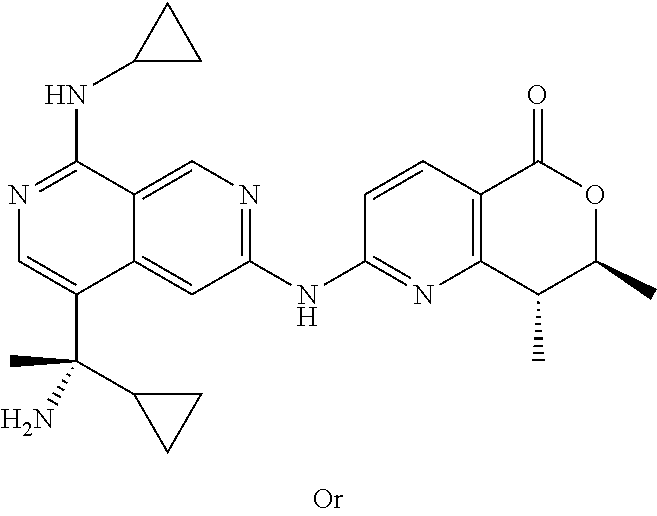 |
459 | 1H-NMR (400 MHz, CD3OD): δ ppm 9.23 (s, 1H), 9.19 (s, 1H), 8.24 (s, 1H), 8.18-8.12 (m, 1H), 7.37 (d, J = 8.8 Hz, 1H), 4.65 (dd, J = 4.8, 6.4 Hz, 1H), 3.10-2.99 (m, 1H), 2.84 (dd, J = 3.6, 7.2 Hz, 1H), 1.69 (s, 3H), 1.64- 1.57 (m, 1H), 1.49 (d, J = 6.4 Hz, 6H), 0.94-0.86 (m, 2H), 0.69-0.65 (m, 2H), 0.64-0.47 (m, 4H) | 5 Intermediate 44 and Intermediate 17 |
 |
||||
| 151 |
 |
460 | 1H-NMR (400 MHz, CD3OD): δ ppm 9.30 (s, 1H), 8.97 (s, 1H), 8.34 (s, 1H), 8.17 (d, J = 8.8 Hz, 1H), 7.56 (d, J = 8.8 Hz, 1H), 4.51-4.43 (m, 1H), 4.33 (s, 2H), 1.69 (s, 3H), 1.67-1.61 (m, 1H), 1.48 (d, J = 4.8 Hz, 6H), 0.96- 0.88 (m, 5H), 0.70-0.56 (m, 3H), 0.52-0.45 (m, 1H) | 3 second eluting isomer after Step 3 Example 3B |
| 152 |
 |
460 | 1H-NMR (400 MHz, CD3OD): δ ppm 9.46 (s, 1 H), 9.28 (d, J = 0.8 Hz, 1 H), 8.29 (s, 1 H), 8.06- 7.92 (m, 1 H), 7.30 (d, J = 8.8 Hz, 1 H), 4.52-4.45 (m, 1 H), 2.20-2.14 (m, 2 H), 1.80 (s, 3 H), 1.73 (s, 3 H), 0.92-0.88 (m, 5 H), 0.77-0.73 (m, 3 H), 0.67- 0.59 (m, 2 H), 0.58-0.50 (m, 1 H), 0.48-0.40 (m, 1 H). | 3 second eluting isomer after Step 3 Example 3B and Intermediate 46 |
 |
||||
| 153 |
 |
460 | 1H-NMR (400 MHz, CD3OD): δ ppm 9.28 (s, 1 H), 9.17 (s, 1 H), 8.52 (s, 1 H), 8.15 (d, J = 8.4 Hz, 1 H), 8.11 (s, 1 H), 7.25 (d, J = 8.4 Hz, 1 H), 4.57-4.46 (m, 1 H), 3.19 (d, J = 2.4 Hz, 2 H), 1.86 (s, 3 H), 1.65-1.57 (m, 1 H), 1.52 (d, J = 8.4 Hz, 6 H), 0.94-0.86 (m, 4 H), 0.85-0.70 (m, 3 H), 0.66- 0.55 (m, 1 H). | 3 first eluting isomer after Step 3 Example 3B |
| 154 |
 |
460 | 1H-NMR (400 MHz, CD3OD): δ ppm 9.57 (s, 1 H), 9.24 (s, 1 H), 8.29 (s, 1 H), 8.12 (d, J = 8.4 Hz, 1 H), 7.18 (d, J = 8.8 Hz, 1 H), 4.64-4.54 (m, 1 H), 4.44-4.41 (m, 1 H), 3.05-2.96 (m, 1 H), 1.77- 1.65 (m, 4 H), 1.50 (d, J = 6.4 Hz, 3 H), 1.32 (d, J = 7.2 Hz, 3 H), 0.95-0.82 (m, 4 H), 0.68-0.44 (m, 4 H). | 3 second eluting isomer after Step 3 Example 3B and Intermediate 41 |
 |
||||
| 155 |
 |
460 | 1H-NMR (400 MHz, 6d- DMSO): δ ppm 10.69 (s, 1 H), 9.80 (s, 1 H), 9.19 (s, 1 H), 8.40-8.36 (m, 1 H), 8.06 (d, J = 8.8 Hz, 1 H), 7.28 (s, 1 H), 4.92- 4.85 (m, 1 H), 4.53-4.46 (m, 1 H), 3.02-2.95 (m, 1 H), 1.61 (s, 4 H), 1.41 (d, J = 6.4 Hz, 3 H), 1.19 (d, J = 7.2 Hz, 3 H), 0.86- 0.82 (m, 4 H), 0.64-0.39 (m, 4 H). | 3 second eluting isomer after Step 3 Example 3B and Intermediate 42 |
 |
||||
| 156 |
 |
462 | 1H-NMR (400 MHz, CD3OD): δ ppm 9.39 (s, 1H), 9.28 (s, 1H), 8.21 (s, 1H), 8.14 (d, J = 8.7 Hz, 1H), 7.22 (d, J = 8.6 Hz, 1H), 4.55-4.43 (m, 1H), 3.05 (q, J = 7.1 Hz, 1H), 2.44-2.32 (m, 1H), 2.26- 2.16 (m, 1H), 1.76 (s, 3H), 1.56 (s, 3H), 1.47 (s, 3H), 1.41 (d, J = 7.2 Hz, 3H), 0.95-0.88 (m, 4H), 0.76 (t, J = 7.5 Hz, 3H). | 3 Intermediate 20 and Intermediate 33 |
 |
||||
| 157 |
 |
462 | 1H-NMR (400 MHz, CD3OD): δ ppm 9.32 (s, 1H), 8.64 (s, 1H), 8.26- 8.11 (m, 2H), 7.58 (d, J = 8.8 Hz, 1H), 4.61-4.57 (m, 1H), 4.53-4.46 (m, 1H), 2.46-2.33 (m, 1H), 2.20-2.08 (m, 1H), 1.77 (s, 3H), 1.54 (s, 3H), 1.48 (d, J = 6.8 Hz, 3H), 1.33 (s, 3H), 0.97-0.87 (m, 4H), 0.80-0.70 (m, 3H) | 3 Intermediate 33 and Intermediate 56 |
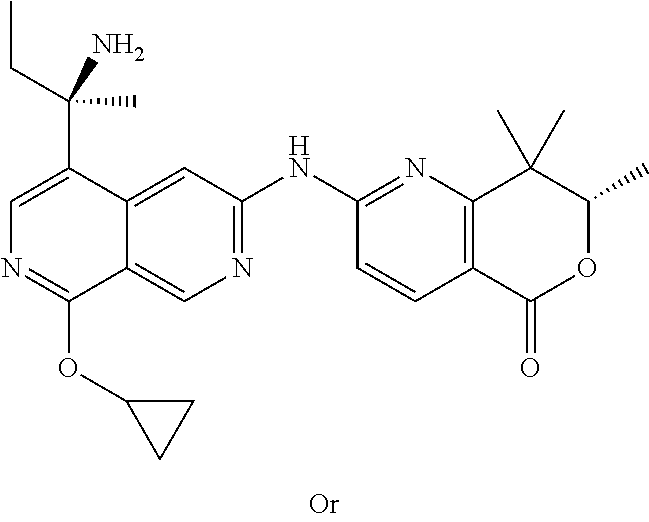 |
||||
 |
||||
 |
||||
| 158 |
 |
462 | 1H-NMR (400 MHz, 6d- DMSO): δ 10.80 (s, 1H), 9.38 (s, 1H), 9.14 (s, 2H), 8.83 (s, 1H), 8.17- 8.13 (m, 2H), 7.41-7.39 (m, 1H), 4.11 (s, 3H), 3.09 (s, 2H), 2.52 (s, 1H), 2.12-2.05 (m, 2H), 1.99 (s, 5H), 1.92-1.87 (m, 2H), 1.69-1.58 (m, 2H), 1.45 (s, 6H). | 14 |
| 159 |
 |
464 | 1H-NMR (400 MHz, CD3OD): δ ppm 9.35 (s, 1H), 9.15 (s, 1H), 8.17 (s, 1H), 8.14 (d, J = 8.4 Hz, 1H), 7.30 (d, J = 8.8 Hz, 1H), 5.82-5.75 (m, 1H), 4.70-4.65 (m, 1H), 4.16-3.99 (m, 3H), 3.98-3.91 (m, 1H), 3.08- 2.97 (m, 1H), 2.45-2.34 (m, 1H), 2.33-2.23 (m, 1H), 1.82 (d, J = 4.8 Hz, 6H), 1.50 (d, J = 7.2 Hz, 3H), 1.46 (d, J = 6.4 Hz, 3H). | 3 Intermediate 17 and Intermediate 36h |
| 160 |
 |
464 | 1H-NMR (400 MHz, CD3OD): δ ppm 9.38 (s, 1H), 9.11 (s, 1H), 8.18- 8.11 (m, 2H), 7.32 (d, J = 8.8 Hz, 1H), 5.83-5.75 (m, 1H), 4.71-4.62 (m, 1H), 4.13-4.00 (m, 3H), 3.99-3.89 (m, 1H), 3.06- 2.98 (m, 1H), 2.45-2.34 (m, 1H), 2.33-2.25 (m, 1H), 1.86 (d, J = 5.6 Hz, 6H), 1.51 (d, J = 7.2 Hz, 3H), 1.46 (d, J = 6.4 Hz, 3H). | 3 Intermediate 17 and Intermediate 36g |
| 161 |
 |
466 | 1H-NMR (400 MHz, CD3OD): δ ppm 9.30 (s, 1H), 8.98 (s, 1H), 8.08- 8.04 (m, 1H), 7.99 (s, 1H), 7.25 (d, J = 8.8 Hz, 1H), 5.55 (dt, J = 3.2, 7.2 Hz, 1H), 5.35-5.31 (m, 1H), 5.21-5.17 (m, 1H), 4.59-4.54 (m, 1H), 2.95- 2.91 (m, 1H), 2.74-2.65 (m, 2H), 2.63-2.55 (m, 2H), 1.79 (d, J = 5.4 Hz, 6H), 1.41 (d, J = 7.2 Hz, 3H), 1.36 (d, J = 6.6 Hz, 3H) | 3 Intermediate 17 and Intermediate 36i |
| 162 |
 |
466 | 1H-NMR (400 MHz, CD3OD): δ ppm 9.45 (s, 1H), 9.09 (s, 1H), 8.17 (d, J = 8.8 Hz, 1H), 8.08 (s, 1H), 7.34 (d, J = 8.8 Hz, 1H), 4.85-4.80 (m, 2H), 4.71-4.64 (m, 1H), 3.07-2.989 (m, 1H), 1.91 (d, J = 5.4 Hz, 6H), 1.52 (d, J = 5.6 Hz, 3H), 1.46 (d, J = 7.6 Hz, 3H), 1.24- 1.14 (m, 2H), 1.00-0.92 (m, 2H) | 3 Intermediate 17 |
| 163 |
 |
466 | 1H-NMR (400 MHz, CD3OD): δ ppm 9.38 (s, 1H), 9.17 (s, 1H), 8.24- 8.03 (m, 2H), 7.31 (d, J = 8.8 Hz, 1H), 5.08-4.93 (m, 2H), 4.70-4.61 (m, 1H), 3.16-3.07 (m, 2H), 3.05-2.98 (m, 1H), 2.56- 2.32 (m, 2H), 1.79 (d, J = 4.8 Hz, 6H), 1.50 (d, J = 7.2 Hz, 3H), 1.45 (d, J = 6.4 Hz, 3H). | 3 Intermediate 17 and Intermediate 36j |
| 164 |
 |
472 | 1H-NMR (400 MHz, CD3OD): δ ppm 9.39 (s, 1 H), 9.35 (s, 1 H), 8.17 (s, 1 H), 8.14 (d, J = 8.8 Hz, 1 H), 7.22-7.16 (m, 1 H), 6.32-5.98 (m, 1 H), 5.77-5.59 (m, 1 H), 3.21 (s, 2 H), 1.83 (s, 3 H), 1.53 (s, 6 H), 1.28 (s, 6 H). | 3 1st eluting isomer from SFC (column: Daicel Chiralpak IG (250 mm × 50 mm, 10 um); mobile phase: [EtOH with 0.1% NH4OH] |
 |
||||
| 165 |
 |
472 | 1H-NMR (400 MHz, CD3OD): δ ppm 9.39 (s, 1 H), 9.35 (s, 1 H), 8.18 (s, 1 H), 8.14 (d, J = 8.8 Hz, 1 H), 7.23-7.17 (m, 1 H), 6.33-6.00 (m, 1 H), 5.76-5.63 (m, 1 H), 3.22 (s, 2 H), 1.83 (s, 3 H), 1.56-1.51 (m, 6 H), 1.28 (s, 6 H). | 3 2nd eluting isomer from SFC (column: Daicel Chiralpak IG (250 mm × 50 mm, 10 um); mobile phase: [EtOH with 0.1% NH4OH] |
 |
||||
| 166 |
 |
472 | 1H-NMR (400 MHz, CD3OD): δ ppm 9.46 (d, J = 6 Hz, 1H), 8.97 (s, 1H), 8.21-8.17 (m, 1H), 7.98 (s, 1H), 7.40 (d, J = 8.8 Hz, 1H), 4.82-4.76 (m, 2H), 4.71-4.65 (m, 1H), 3.04-2.98 (m, 1H), 2.05 (d, J = 10.4 Hz, 6H), 1.90-1.78 (m, 3H), 1.52 (d, J = 7.2 Hz, 3H), 1.47 (d, J = 6.4 Hz, 3H). | 3 Intermediate 17 |
| 167 |
 |
472 | 1H-NMR (400 MHz, CD3OD): δ ppm 9.27 (s, 1H), 8.85 (s, 1H), 8.35 (s, 1H), 8.14 (d, J = 8.4 Hz, 1H), 7.49 (d, J = 8.8 Hz, 1H), 4.67-4.60 (m, 1H), 4.49-4.42 (m, 1H), 1.73- 1.54 (m, 6H), 1.37 (d, J = 6.8 Hz, 3H), 1.24-1.14 (m, 2H), 0.93-0.85 (m, 4H), 0.67-0.54 (m, 3H), 0.51-0.42 (m, 1H). | 3 second eluting isomer after Step 3 Example 3B and Intermediate 50 |
 |
||||
| 168 |
 |
474 | 1H-NMR (400 MHz, CD3OD): δ ppm 9.33 (s, 1 H), 9.27 (s, 1 H), 8.52 (s, 1 H), 8.15 (d, J = 8.8 Hz, 1 H), 8.06 (s, 1 H), 7.22 (d, J = 8.4 Hz, 1 H), 4.54-4.45 (m, 1 H), 3.70- 3.58 (m, 1 H), 3.23 (s, 2 H), 2.24-1.91 (m, 3 H), 1.87 (s, 3 H), 1.84-1.60 (m, 3 H), 1.54 (s, 6 H), 0.95-0.84 (m, 4 H). | 3 Intermediate 63 |
 |
||||
| 169 |
 |
474 | 1H-NMR (400 MHz, CD3OD): δ ppm 9.35 (s, 1 H), 9.27 (s, 1 H), 8.51 (d, J = 1.2 Hz, 1 H), 8.16 (d, J = 8.8 Hz, 1 H), 8.07 (s, 1 H), 7.22 (d, J = 8.8 Hz, 1 H), 4.54-4.44 (m, 1 H), 3.70-3.59 (m, 1 H), 3.24 (s, 2 H), 2.25-1.90 (m, 3 H), 1.86 (s, 3 H), 1.84-1.60 (m, 3 H), 1.54 (s, 6 H), 0.89 (s, 4 H). | 3 Intermediate 64 |
 |
||||
| 170 |
 |
474 | 1H-NMR (400 MHz, CDCl3): δ ppm 9.31 (d, J = 2.0 Hz, 2H), 8.26 (d, J = 8.4 Hz, 1H), 8.12 (s, 1H), 8.02 (s, 1H), 7.37 (d, J = 8.4 Hz, 1H), 4.63- 4.46 (m, 2H), 3.37-3.19 (m, 1H), 3.00 (quin, J = 6.8 Hz, 1H), 2.04-1.93 (m, 4H), 1.77 (d, J = 5.6 Hz, 1H), 1.65 (s, 1H), 1.59 (s, 3H), 1.58-1.53 (m, 6H), 0.95-0.88 (m, 4H). | 3 Intermediate 63 and Intermediate 17 |
 |
||||
| 171 |
 |
474 | 1H-NMR (400 MHz, 6d- DMSO): δ ppm 10.56 (s, 1H), 9.33 (s, 1H), 9.23 (s, 1H), 8.40 (s, 1H), 8.09 (d, J = 8.4 Hz, 1H), 7.47 (d, J = 8.8 Hz, 1H), 4.60- 4.53 (m, 1H), 4.53-4.47 (m, 1H), 1.63-1.57 (m, 1H), 1.51 (d, J = 18.4 Hz, 6H), 1.36 (d, J = 6.4 Hz, 3H), 1.22 (s, 3H), 0.89- 0.80 (m, 4H), 0.63-0.53 (m, 1H), 0.52-0.41 (m, 3H) | 3 Intermediate 56 and second eluting isomer after Step 4 Example 3B |
 |
||||
| 172 |
 |
476 | 1H-NMR (400 MHz, CD3OD): δ ppm 9.45- 9.34 (m, 2H), 8.23 (s, 1H), 8.03 (d, J = 8.8 Hz, 1H), 7.31 (d, J = 8.8 Hz, 1H), 5.17-5.10 (m, 2H), 2.27-2.15 (m, 2H), 1.90 (d, J = 6.2 Hz, 6H), 1.75 (s, 3H), 0.81-0.77 (m, 3H) | 3 Intermediate 47 |
 |
||||
| 173 |
 |
476 | 1H-NMR (400 MHz, 6d- DMSO): δ ppm 11.04 (s, 1H), 9.61 (s, 1H), 9.32 (s, 1H), 8.23 (s, 1H), 8.05 (d, J = 8.4 Hz, 1H), 7.37 (d, J = 8.8 Hz, 1H), 5.28- 5.16 (m, 2 H), 2.25-2.06 (m, 2H), 1.71-1.64 (m, 9H), 0.61 (t, J = 7.2 Hz, 3H). | 3 1st eluting isomer from SFC (column: Daicel Chiralpak AD-H (250 mm × 30 mm, 5 um); mobile phase: [EtOH with 0.1% NH4OH] |
 |
||||
| 174 |
 |
476 | 1H-NMR (400 MHz, CD3OD): δ ppm 9.45- 9.34 (m, 2H), 8.23 (s, 1H), 8.03 (d, J = 8.8 Hz, 1H), 7.31 (d, J = 8.8 Hz, 1H), 5.17-5.10 (m, 2H), 2.27-2.15 (m, 2H), 1.90 (d, J = 6.2 Hz, 6H), 1.75 (s, 3H), 0.81-0.77 (m, 3H) | 3 Intermediate 46 |
 |
||||
| 175 |
 |
476 | 1H-NMR (400 MHz, 6d- DMSO): δ ppm 11.11 (s, 1H), 9.40 (s, 1H), 9.35 (s, 1H), 8.17 (s, 1H), 8.07 (d, J = 8.4 Hz, 1H), 7.42 (d, J = 8.8 Hz, 1H), 5.30- 5.18 (m, 2 H), 2.35-2.08 (m, 2H), 1.76 (s, 3H), 1.68 (d, J = 5.6 Hz, 6H), 0.65 (t, J = 7.2 Hz, 3H). | 3 2nd eluting isomer from SFC (column: Daicel Chiralpak AD-H (250 mm × 30 mm, 5 um); mobile phase: [EtOH with 0.1% NH4OH] |
 |
||||
| 176 |
 |
477 | 1H-NMR (400 MHz, CD3OD): δ ppm 9.38 (s, 1H), 9.28 (s, 1H), 8.33 (d, J = 5.6 Hz, 1H), 7.12 (d, J = 86.0 Hz, 1H), 5.14-5.07 (m, 2H), 4.23 (s, 1H), 3.41-3.35 (m, 1H), 2.05-1.63 (m, 14H). | 3 Intermediate 65 |
 |
||||
| 177 |
 |
478 | 1H-NMR (400 MHz, CD3OD): δ ppm 9.91 (s, 1H), 9.23 (s, 1H), 8.18- 8.07 (m, 1H), 8.02 (s, 1H), 7.27-7.14 (m, 1H), 4.51-4.36 (m, 1H), 3.55- 3.41 (m, 2H), 3.26 (s, 2H), 2.47-2.37 (m, 2H), 1.82-1.66 (m, 6H), 1.54 (s, 6H), 0.89 (s, 4H). | 15 |
| 178 |
 |
484 | 1H-NMR (400 MHz, CD3OD): δ ppm 9.42 (d, J = 0.6 Hz, 1H), 9.15 (s, 1H), 8.20-8.13 (m, 2H), 7.35 (d, J = 8.7 Hz, 1H), 5.44-5.34 (m, 1H), 4.27- 4.65 (m, 1H), 3.29-3.19 (m, 2H), 3.08-3.00 (m, 1H), 2.96-2.84 (m, 2H), 1.88 (d, J = 5.5 Hz, 6H), 1.53 (d, J = 7.2 Hz, 3H), 1.48 (d, J = 6.6 Hz, 3H) | 3 Intermediate 17 |
| 179 |
 |
490 | 1H-NMR (400 MHz, CD3OD): δ ppm 9.40 (s, 1H), 9.24 (s, 1H), 8.19 (d, J = 8.8 Hz, 1H), 8.01 (d, J = 1.2 Hz, 1H), 7.26 (d, J = 8.6 Hz, 1H), 6.18- 6.10 (m, 1H), 3.22 (s, 2H), 2.07 (s, 6H), 1.63 (d, J = 6.4 Hz, 3H), 1.54 (s, 6H) | 3 2nd isomer to elute from SFC Column: Chiralpak IG-3 Mobile Phase: [EtOH + 0.05% Diethyl- amine] in CO2 |
 |
||||
| 180 |
 |
490 | 1H-NMR (400 MHz, CD3OD): δ ppm 9.40 (s, 1H), 9.24 (s, 1H), 8.19 (d, J = 8.8 Hz, 1H), 8.01 (d, J = 2.0 Hz, 1H), 7.26 (d, J = 8.4 Hz, 1H), 6.18- 6.10 (m, 1H), 3.22 (s, 2H), 2.07 (s, 6H), 1.63 (d, J = 6.4 Hz, 3H), 1.54 (s, 6H) | 3 1st isomer to elute from SFC Column: Chiralpak IG-3 Mobile Phase: [EtOH + 0.05% Diethyl- amine] in CO2 |
 |
||||
| 181 |
 |
490 | 3 1st isomer to elute from SFC Column: Chiralpak IC-H 21 × 250 mm Mobile Phase: 25% 2- Propanol + 0.5% Diethyl- amine in CO2 and Intermediate 17 | |
 |
||||
| 182 |
 |
490 | 3 2nd isomer to elute from SFC Column: ChiralPak IC-H 21 × 250 mm Mobile Phase: 25% 2- Propanol + 0.5% Diethylamine in CO2 and Intermediate 17 | |
 |
||||
| 183 |
 |
490 | 1H-NMR (400 MHz, CD3OD): δ ppm 9.76 (s, 1H), 9.23 (s, 1H), 8.12 (d, J = 8.8 Hz, 1H), 7.99 (s, 1H), 7.24 (d, J = 8.8 Hz, 1H), 4.57-4.51 (m, 2H), 4.49-4.44 (m, 3H), 3.77-3.69 (m, 1H), 3.26 (s, 2H), 1.65 (s, 6H), 1.55 (s, 6H), 0.91-0.88 (m, 4H). | 14 |
| 184 |
 |
464 | 1H-NMR (400 MHz, CD3OD): δ ppm 9.24 (s, 1H), 9.20 (s, 1H), 8.19 (s, 1H), 8.13 (d, J = 8.8 Hz, 1H), 7.29 (d, J = 8.8 Hz, 1H), 4.69-4.63 (m, 1H), 4.45-4.43 (m, 1H), 3.97- 3.95 (m, 1H), 3.83-3.81 (m, 1H), 3.35 (s, 3H), 3.06-2.99 (m, 1H), 1.74 (s, 3H), 1.52-1.46 (m, 6H), 0.93-0.87 (m, 4H) | First eluting isomer described in Example 16 and using Intermediate 17 |
 |
||||
| 185 |
 |
474 | 1H-NMR (400 MHz, CDCl3): δ ppm 9.33 (s, 1H), 9.18 (s, 1H), 8.52 (s, 1H), 8.23 (d, J = 8.8 Hz, 2H), 7.40 (d, J = 8.8 Hz, 1H), 4.25 (s, 2H), 1.78 (s, 3H), 1.55-1.52 (m, 1H), 1.50 (s, 3H), 1.45 (d, J = 1.6 Hz, 6H), 1.10-1.07 (m, 2H), 0.88-0.83 (m, 2H), 0.71-0.60 (m, 2H), 0.51-0.41 (m, 2H). | 3 Intermediate 39 |
 |
||||
| 186 |
 |
462 | 1H-NMR (400 MHz, CDCl3): δ ppm 9.25 (s, 1H), 8.94 (s, 1H), 8.17- 8.15 (m, 2H), 7.82 (s, 1H), 7.28 (d, J = 8.8 Hz, 1H), 4.45-4.40 (m, 1H), 1.71 (s, 3H), 1.66 (s, 6H), 1.44 (s, 3H), 1.39 (d, J = 6.8 Hz, 3H), 1.22 (s, 3H), 1.03-0.99 (m, 2H), 0.79- 0.75 (m, 2H). | 3 Intermediate 56 |
 |
||||
| 187 |
 |
460 | 1H-NMR (400 MHz, CD3OD): δ ppm 9.25 (s, 1H), 8.47 (s, 1H), 8.15 (s, 1H), 8.13 (d, J = 8.8 Hz, 1H), 7.51 (d, J = 8.8 Hz, 1H), 4.62 (q, J = 6.4 Hz, 1H), 4.49-4.42 (m, 1H), 2.33-2.22 (m, 1H), 2.15- 2.05 (m, 1H), 1.72 (s, 3H), 1.67-1.61 (m, 1H), 1.54-1.48 (m, 1H), 1.37 (d, J = 6.8 Hz, 3H), 1.25- 1.15 (m, 2H), 0.92-0.86 (m, 4H), 0.74 (d, J = 7.6 Hz, 3H) | 3 Intermediate 50 and Intermediate 33 |
 |
||||
 |
||||
 |
||||
| 188 |
 |
438 | 1H-NMR (400 MHz, CDCl3): δ ppm 9.38 (s, 1H), 9.27 (s, 1H), 8.24 (d, J = 8.4 Hz, 1H), 8.14 (s, 1H), 8.04 (s, 1H), 7.29 (d, J = 8.4 Hz, 1H), 4.58- 4.51 (m, 1H), 4.13 (s, 3H), 3.89 (d, J = 8.8 Hz, 1H), 3.59 (d, J = 8.8 Hz, 1H), 3.43 (s, 3H), 3.02- 2.96 (m, 1H), 1.70 (s, 3H), 1.55-1.51 (m, 6H). | 16 Intermediate 67 and Intermediate 17 |
 |
||||
| 189 |
 |
478 | 1H-NMR (400 MHz, CDCl3): δ ppm 9.40 (s, 1H), 9.30 (s, 1H), 8.24 (t, J = 5.2 Hz, 2H), 8.04 (s, 1H), 7.21 (d, J = 8.8 Hz, 1H), 4.54-4.49 (m, 1H), 3.91 (d, J = 8.8 Hz, 1H), 3.63 (d, J = 9.2 Hz, 1H), 3.44 (s, 3H), 3.04-2.98 (m, 1H), 1.73 (s, 3H), 1.51 (d, J = 8.4 Hz, 6H), 1.45 (d, J = 7.2 Hz, 3H), 0.97-0.89 (m, 4H). | 16 Intermediate 69 and Intermediate 20 |
 |
||||
| 190 |
 |
464 | 1H-NMR (400 MHz, CDCl3): δ ppm 9.52 (s, 1 H), 9.28 (s, 1 H), 8.25- 8.19 (m, 2 H), 7.93-7.89 (m, 1 H), 7.10 (d, J = 8.8 Hz, 1 H), 4.87-4.81 (m, 1 H), 4.55-4.47 (m, 1 H), 3.90 (d, J = 8.8 Hz, 1 H), 3.64 (d, J = 8.8 Hz, 1 H), 3.43 (s, 3 H), 3.03-2.93 (m, 1 H), 1.73 (s, 3 H), 1.52 (d, J = 6.4 Hz, 3 H), 1.36 (d, J = 7.2 Hz, 3 H), 0.96-0.85 (m, 4 H). | 16 Intermediate 69 and Intermediate 41 |
 |
||||
 |
||||
 |
||||
| 191 |
 |
462 | 1H-NMR (400 MHz, CD3OD): δ ppm 9.27 (d, J = 0.8 Hz, 1 H), 8.84- 8.76 (m, 1 H), 8.21 (s, 1 H), 8.14 (d, J = 8.8 Hz, 1 H), 7.28 (d, J = 8.8 Hz, 1 H), 4.60-4.54 (m, 1 H), 3.23-3.14 (m, 1 H), 2.13- 2.00 (m, 2 H), 1.76 (s, 3 H), 1.56-1.47 (m, 6 H), 1.44 (s, 3 H), 1.10-1.05 (m, 2 H), 1.05-1.00 (m, 3 H), 0.89-0.82 (m, 2 H). | 17 Intermediate 79 and Intermediate 20 |
 |
||||
| 192 |
 |
438 | 1H-NMR (400 MHz, CD3OD): δ ppm 9.46 (s, 1H), 9.31 (d, J = 0.8 Hz, 1H), 8.20 (s, 1H), 8.12 (d, J = 8.8 Hz, 1H), 7.13 (d, J = 8.8 Hz, 1H), 4.93 (d, J = 3.2, 6.5 Hz, 1H), 4.13 (s, 3H), 3.97-3.88 (m, 2H), 3.38 (s, 3H), 3.04 (d, J = 2.8, 7.2 Hz, 1H), 1.77 (s, 3H), 1.54 (d, J = 6.4 Hz, 3H), 1.34 (d, J = 7.2 Hz, 3H) | 16 Intermediate 67 and Intermediate 41 |
 |
||||
 |
||||
 |
||||
| 193 |
 |
490 | 1H-NMR (400 MHz, CD3OD): δ ppm 9.40 (s, 1H), 9.01 (s, 1H), 8.16 (d, J = 8.8 Hz, 1H), 8.09 (s, 1H), 7.41 (d, J = 8.8 Hz, 1H), 5.64-5.53 (m, 1H), 4.70-4.55 (m, 2H), 3.06-2.94 (m, 1H), 2.65-2.45 (m, 4H), 1.80 (s, 3H), 1.65-1.56 (m, 1H), 1.51-1.44 (m, 6H), 0.79-0.48 (m, 4H). | Example 18 |
 |
||||
| 194 |
 |
407 | 1H-NMR (400 MHz, CD3OD): δ ppm 9.46 (d, J = 1.6 Hz, 1H), 8.71- 8.67 (m, 1H), 8.18-8.15 (m, 1H), 7.82-7.78 (m, 1H), 7.27 (d, J = 8.8 Hz, 1H), 7.04-7.01 (m, 1H), 4.96-4.92 (m, 1H), 4.59- 4.52 (m, 1H), 4.04 (s, 3H), 3.14-3.06 (m, 1H), 2.25-2.12 (m, 2H), 1.60 (d, J = 6.8 Hz, 3H), 1.55 (d, J = 6.4 Hz, 3H), 1.01- 0.97 (m, 3H). | 17 Intermediate 73 and Intermediate 17 |
 |
||||
| 195 |
 |
460 | 1H-NMR (400 MHz, CDCl3): δ ppm 9.29 (s, 1H), 8.93 (s, 1H), 8.24- 8.21 (m, 2H), 8.01 (s, 1H), 7.27-7.25 (m, 1H), 4.51-4.46 (m, 1H), 1.74 (s, 6H), 1.63 (s, 2H), 1.42 (s, 6H), 1.11 (s, 2H), 0.95-0.90 (m, 4H). | 3 |
| 196 |
 |
474 | 3 Intermediate 33 | |
 |
||||
| 197 |
 |
464 | 1H-NMR (400 MHz, CD3OD): δ ppm 9.37 (s, 1H), 9.22 (s, 1H), 8.18- 8.11 (m, 2H), 7.32 (d, J = 8.8 Hz, 1H), 5.03 (d, J = 6.8 Hz, 2H), 4.71 (d, J = 6.8 Hz, 2H), 4.69-4.62 (m, 1H), 3.10-2.98 (m, 1H), 1.94 (s, 3H), 1.79 (d, J = 5.2 Hz, 6H), 1.52- 1.45 (m, 6H). | 9 Intermediate 17 |
| 198 |
 |
478 | 1H-NMR (400 MHz, CD3OD): δ ppm 9.40- 7.30 (m, 2H), 8.19-8.09 (m, 2H), 7.22 (d, J = 8.8 Hz, 1H), 5.03 (d, J = 7.2 Hz, 2H), 4.71 (d, J = 7.2 Hz, 2H), 3.20-3.05 (m, 1H), 1.94 (s, 3H), 1.80 (d, J = 7.2 Hz, 6H), 1.54 (s, 3H), 1.45 (s, 3H), 1.41 (d, J = 7.2 Hz, 3H). | 9 Intermediate 20 |
| 199 |
 |
474 | 1H-NMR (400 MHz, CDCl3): δ ppm 9.30 (s, 1H), 8.84 (s, 1H), 8.24- 8.22 (m, 2H), 8.04 (s, 1H), 7.30 (s, 1H), 1.77 (s, 9H), 1.60 (s, 1H), 1.41 (s, 6H), 1.08 (s, 2H), 1.06 (s, 2H), 0.89-0.82 (m, 2H). | 3 |
| 200 |
 |
464 | 1H-NMR (400 MHz, CDCl3): δ ppm 9.46 (s, 1 H), 9.28 (d, J = 0.8 Hz, 1 H), 8.29-8.17 (m, 2 H), 7.98 (s, 1 H), 7.16 (d, J = 8.4 Hz, 1 H), 4.55-4.47 (m, 1 H), 3.93 (d, J = 9.2 Hz, 1 H), 3.61 (d, J = 8.8 Hz, 1 H), 3.44 (s, 3 H), 3.16 (s, 2 H), 1.72 (s, 3 H), 1.55 (s, 6 H), 0.95- 0.87 (m, 4 H). | 16 Intermediate 69 |
 |
||||
| 201 |
 |
452 | 1H-NMR (400 MHz, 6d- DMSO): δ ppm 10.88 (s, 1H), 9.37 (s, 1H), 8.96 (s, 1H), 9.37 (s, 1H), 8.13 (d, J = 8.8 Hz, 1H), 7.99 (s, 1H), 7.47 (d, J = 8.8 Hz, 1H), 4.10 (s, 3H), 4.06-4.01 (m, 2H), 3.31 (s, 3H), 2.95-2.90 (m, 1H), 1.87 (s, 3H), 1.45 (s, 3H), 1.39 (s, 3H), 1.29 (d, J = 7.2 Hz, 3H). | 16 Intermediate 67 and Intermediate 20 |
 |
||||
| 202 |
 |
392 | 17 Intermediate 71 and Intermediate 17 | |
 |
||||
| 203 |
 |
408 | 1H NMR (500 MHz, DMSO) δ 10.63 (s, 1H), 9.23 (s, 1H), 8.79 (s, 1H), 8.11 (s, 1H), 8.03 (d, J = 8.7 Hz, 1H), 7.27 (d, J = 8.7 Hz, 1H), 4.51-4.42 (m, 1H), 4.25 (t, J = 6.4 Hz, 1H), 3.99 (s, 3H), 2.99 (p, J = 7.0 Hz, 1H), 2.22 (s, 2H), 1.76 (dq, J = 13.7, 6.9 Hz, 1H), 1.67 (dq, J = 14.0, 7.2 Hz, 1H), 1.43 (d, J = 7.0 Hz,3 H), 1.38 (d, J = 6.3 Hz, 3H), 0.83 (t, J = 7.3 Hz, 3H). | 17 Intermediate 76 and Intermediate 17 |
 |
||||
| 204 |
 |
422 | 1H NMR (500 MHz, DMSO) δ 10.71 (s, 1H), 9.30 (d, J = 1.9 Hz, 1H), 8.91 (s, 1H), 8.17 (d, J = 1.9 Hz, 1H), 8.08 (dd, J = 8.7, 1.9 Hz, 1H), 7.34 (dd, J = 8.6, 2.0 Hz, 1H), 4.30 (t, J = 6.5 Hz, 1H), 4.06 (d, J = 1.9 Hz, 3H), 3.15 (ddd, J = 13.9, 8.9, 5.1 Hz, 1H), 1.91-1.81 (m, 1H), 1.76 (dq, J = 13.9, 7.5, 7.1 Hz, 1H), 1.45 (d, J = 1.9 Hz, 3H), 1.41 (dd, J = 7.1, 1.9 Hz, 3H), 1.35 (d, J = 1.9 Hz, 3H), 0.91 (td, J = 7.4, 1.9 Hz, 3H). | 17 Intermediate 76 and Intermediate 20 |
 |
||||
| 205 |
 |
422 | 1H-NMR (400 MHz, 6d- DMSO): δ ppm 10.64 (s, 1H), 9.50 (s, 1H), 9.43 (s, 1H), 8.45 (s, 1H), 8.09 (d, J = 8.7 Hz, 1H), 7.41 (d, J = 8.8 Hz, 1H), 4.67- 4.57 (m, 1H), 3.85-3.79 (m, 1H), 3.78-3.72 (m, 1H), 3.25 (s, 2H), 3.05-2.95 (m, 1H), 2.90 (s, 3H), 1.63 (s, 3H), 1.46 (d, J = 7.2 Hz, 3H), 1.39 (d, J = 6.8 Hz, 3H) | 16 Intermediate 17 and Intermediate 70 |
| 206 |
 |
436 | 1H-NMR (400 MHz, 6d- DMSO): δ ppm 10.68 (s, 1H), 9.63 (s, 1H), 9.43 (s, 1H), 8.46 (s, 1H), 8.07 (d, J = 8.8 Hz, 1H), 7.33 (d, J = 8.8 Hz, 1H), 3.81 (s, 2H), 3.26 (s, 3H), 3.07-2.94 (m, 1H), 2.90 (s, 3H), 1.65 (s, 3H), 1.46 (s, 3H), 1.38 (s, 3H), 1.33 (d, J = 7.2 Hz, 3H) | 16 Intermediate 20 and Intermediate 70 |
| 207 |
 |
433 | 1H-NMR (400 MHz, CD3OD): δ ppm 9.75- 9.52 (m, 1 H), 8.34 (d, J = 8.8 Hz, 1 H), 8.25 (s, 1 H), 8.04 (d, J = 8.4 Hz, 1 H), 7.22 (d, J = 2.0 Hz, 1 H), 7.19 (d, J = 0.8 Hz, 1 H), 5.03-4.94 (m, 1 H), 4.17 (s, 3 H), 2.30-2.09 (m, 2 H), 1.65-1.56 (m, 2 H), 1.55-1.48 (m, 2 H), 1.46 (s, 6 H), 1.04-0.97 (m, 3 H). | 17 Intermediate 73 |
 |
||||
| 208 |
 |
438 | 1H-NMR (400 MHz, CD3OD): δ ppm 9.36 (s, 1H), 8.90 (s, 1 H), 8.24- 8.10 (m, 2 H), 7.26 (d, J = 8.8 Hz, 1H), 4.95-4.91 (m, 1H), 4.15 (s, 3H), 3.85-3.80 (m, 1H), 3.66- 3.57 (m, 1H), 3.47 (s, 3H), 3.25-3.19 (m, 1H), 1.55-1.43 (m, 9H). | 16 Intermediate 81 and Intermediate 20 |
 |
||||
| 209 |
 |
425 | 1H-NMR (400 MHz, CD3OD): δ ppm 9.37 (s, 1H), 9.00 (s, 1H), 8.08 (d, J = 8.8 Hz, 1H), 7.71 (d, J = 8.0 Hz, 1H), 7.49 (d, J = 8.0 Hz, 1H), 7.18 (d, J = 8.8 Hz, 1H), 4.66- 4.59 (m, 1H), 3.13 (q, J = 7.2 Hz, 1H), 2.02-1.83 (m, 2H), 1.52-1.48 (m, 6H), 1.44 (s, 3H), 1.01- 0.94 (m, 3H) | 17 Intermediate 77 and Intermediate 20 |
 |
||||
| 210 |
 |
406 | 1H-NMR (400 MHz, CD3OD): δ ppm 9.51 (s, 1 H), 8.87 (s, 1 H), 8.52 (s, 1 H), 8.47 (s, 1 H), 8.15 (d, J = 8.8 Hz, 1 H), 4.80-4.76 (m, 1 H), 3.23- 3.15 (m, 1 H), 3.00 (s, 3 H), 2.19-2.02 (m, 2 H), 1.57-1.48 (m, 6 H), 1.45 (s, 3 H), 1.10-0.96 (m, 3 H), 0.77-0.76 (m, 1 H). | 17 Intermediate 71 and Intermediate 20 |
 |
||||


-
- BOP (1H-Benzotriazol-1-yloxy)[tris(dimethylamino)]phosphonium
- hexafluorophosphate
- C Celsius
- DAST Diethylaminosulfur trifluoride
- DBU 1,8-Diazabicyclo[5.4.0]undec-7-ene
- DCE dichloroethane
- DCM dichloromethane
- DEA diethyl amine
- DIPEA diisopropylamine
- DMF dimethyl formamide
- DMAP 4-Dimethylaminopyridine
- DMB 3,3-Dimethyl-1-butanol
- DMSO dimethylsulfoxide
- EA ethyl acetate
- EtOH ethanol
- h hour(s)
- HPLC high performance liquid chromatography
- IC50 inhibitory concentration 50%
- IPA isopropyl alcohol
- min minutes
- MTBE methyl tert-butyl ether
- MeCN acetonitrile
- MeOH methanol
- NMP N-Methyl-2-pyrrolidone
- PE petroleum ether
- rt room temperature
- TEA triethylamine
- THE tetrahydrofuran
- TFA trifluoroacetic acid


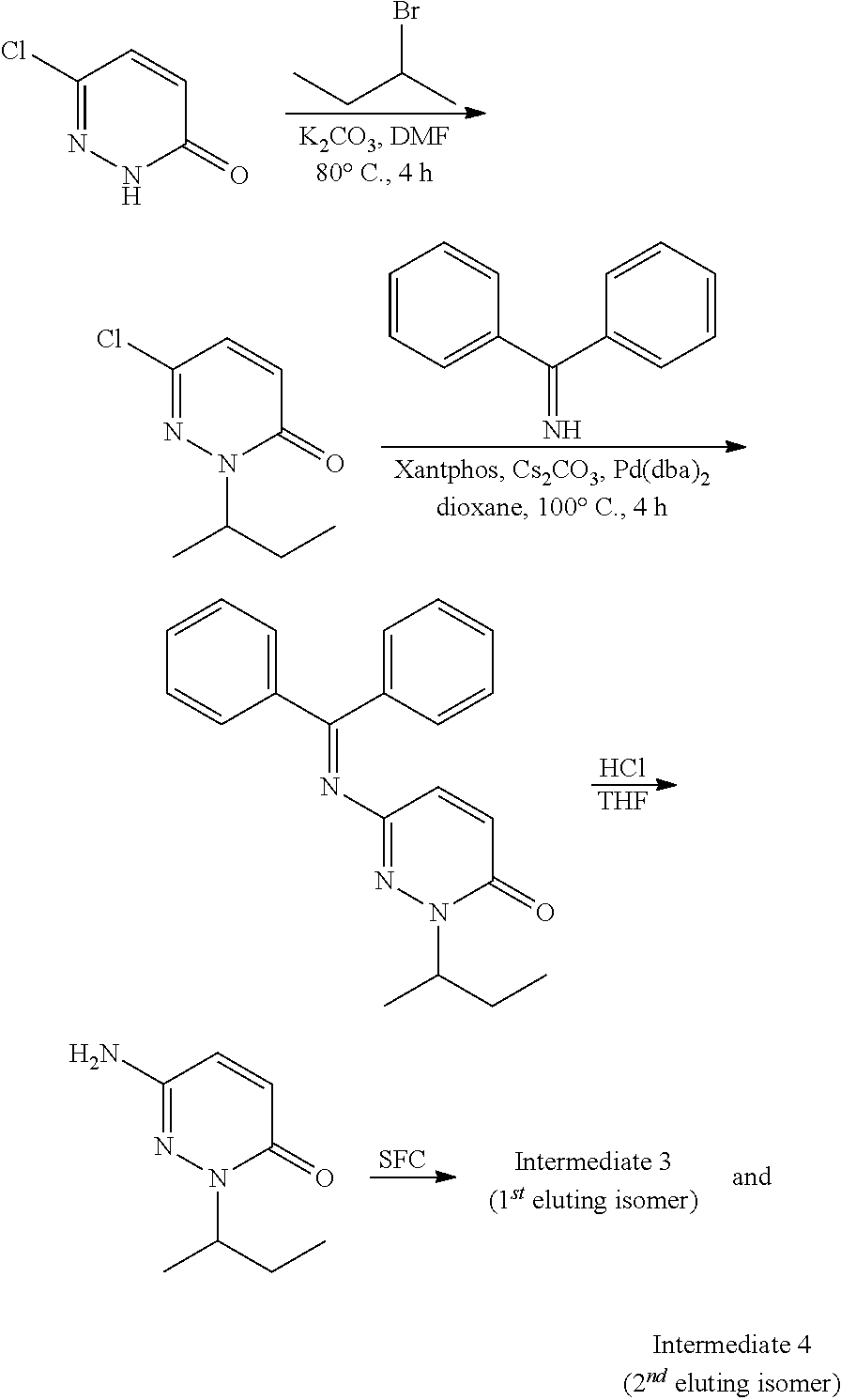


| Reagent used in Step 1 of prep for | ||
| Intermediates | Structure | Intermediate 35 |
| 36a |
 |
EtOH |
| 36b |
 |
iPrOH |
| 36c |
 |
cyclobutanol |
| 36d |
 |
 |
| 36e |
 |
 |
| 36f |
 |
 |
| 36g |
 |
 |
| 36h |
 |
 |
| 36i |
 |
 |
| 36j |
 |
 |
| 36k |
 |
 |
| 36l |
 |
 |
| 36m |
 |
 |
| 36n |
 |
 |
| 36o |
 |
 |


| TABLE 2 |
| Kinase Reaction Conditions |
| Substrate | Kinase | |||
| Enzyme | Enzyme | ATP | Peptide & | Reaction |
| (Source) | Concentration | Concentration | Concentration | Time |
| HPK1 | 0.5 nM | 26 μM | S6K2tide, | 120 min. |
| (Invitrogen) | 1.5 μM | |||
| HPK1 | 0.25 nM | 1000 μM | S6K2tide, | 120 min. |
| (Invitrogen) | 1.5 μM | |||
| LCK | 12 nM | 26 μM | FL4tide, | 60 min. |
| (Invitrogen) | 1.5 μM | |||
| HGK | 0.1 nM | 50 μM | FL25tide, | 60 min. |
| (Invitrogen) | 1.5 μM | |||
| GLK | 15 nM | 20 μM | PKAtide, 2 μM | 180 min. |
| (SignalChem) | ||||
| TABLE 3 | ||||
| Compound | MAP4K1 IC50 | MAP4K1 | IL-2 EC50 | IL-2 EC50 |
| No. | (nM) | IC50 (nM) | (nM) | (nM) |
| 1 | 21.35 | D | ND | ND |
| 2 | 1.60 | C | 18.9 | A |
| 3 | 0.36 | B | 108.3 | D |
| 4 | 0.42 | B | ND | ND |
| 5 | 0.37 | B | 37.1 | B |
| 6 | 3.31 | C | ND | ND |
| 7 | 0.91 | B | 21.7 | A |
| 8 | 11.14 | D | ND | ND |
| 9 | 0.55 | B | 21.1 | A |
| 10 | 2.73 | C | ND | ND |
| 11 | 0.33 | B | 10.9 | A |
| 12 | 0.31 | B | 11.0 | A |
| 13 | 0.29 | A | ND | ND |
| 14 | 0.64 | B | 51.0 | C |
| 15 | 0.68 | B | 30.9 | A |
| 16 | 2.50 | C | ND | ND |
| 17 | 4.02 | C | ND | ND |
| 18 | 0.40 | B | ND | ND |
| 19 | 0.30 | A | 27.3 | A |
| 20 | 0.73 | B | 51.1 | C |
| 21 | 0.85 | B | 48.7 | C |
| 22 | 0.50 | B | 36.6 | B |
| 23 | 0.11 | A | 4.9 | A |
| 24 | 0.47 | B | 11.3 | A |
| 25 | 0.29 | A | 3.3 | A |
| 26 | 0.55 | B | 14.0 | A |
| 27 | 0.30 | A | ND | ND |
| 28 | 0.67 | B | 31.4 | A |
| 29 | 3.98 | C | ND | ND |
| 30 | 3.57 | C | ND | ND |
| 31 | 5.88 | C | ND | ND |
| 32 | 11.46 | D | ND | ND |
| 33 | 0.13 | A | 9.3 | A |
| 34 | 0.24 | A | 45.6 | B |
| 35 | 0.41 | B | 23.5 | A |
| 36 | 0.17 | A | 15.3 | A |
| 37 | 0.14 | A | 1.9 | A |
| 38 | 0.20 | A | 5.8 | A |
| 39 | 0.85 | B | 16.2 | A |
| 40 | 0.15 | A | 4.0 | A |
| 41 | 0.57 | B | 22.7 | A |
| 42 | 0.86 | B | 13.6 | A |
| 43 | 0.23 | A | 8.3 | A |
| 44 | 1.20 | C | 22.0 | A |
| 45 | 1.03 | B | 70.3 | D |
| 46 | 0.94 | B | 34.3 | A |
| 47 | 13.58 | D | ND | ND |
| 48 | 1.72 | C | 135.5 | D |
| 49 | 1.01 | B | ND | ND |
| 50 | 52.56 | D | ND | ND |
| 51 | 0.26 | A | ND | ND |
| 52 | 0.33 | B | ND | ND |
| 53 | 0.36 | B | 17.2 | A |
| 54 | 0.25 | A | 9.3 | A |
| 55 | 0.18 | A | 11.6 | A |
| 56 | 0.10 | A | 6.6 | A |
| 57 | 0.16 | A | 5.1 | A |
| 58 | 0.39 | B | 20.4 | A |
| 59 | 3.35 | C | 56.7 | D |
| 60 | 0.18 | A | 10.3 | A |
| 61 | 0.15 | A | 3.5 | A |
| 62 | 0.55 | B | ND | ND |
| 63 | 6.46 | C | ND | ND |
| 64 | 0.44 | B | 42.9 | B |
| 65 | 0.56 | B | ND | ND |
| 66 | 0.18 | A | 8.1 | A |
| 67 | 0.12 | A | 6.2 | A |
| 68 | 0.27 | A | 29.5 | A |
| 69 | 0.88 | B | 52.8 | C |
| 70 | 0.35 | B | 20.6 | A |
| 71 | 0.11 | A | 7.9 | A |
| 72 | 0.41 | B | 35.5 | B |
| 73 | 0.22 | A | 23.7 | A |
| 74 | 0.12 | A | 22.2 | A |
| 75 | 0.09 | A | 7.3 | A |
| 76 | 0.12 | A | 6.5 | A |
| 77 | 0.65 | B | 32.5 | A |
| 78 | 0.19 | A | 11.6 | A |
| 79 | 0.26 | A | 9.3 | A |
| 80 | 0.08 | A | 4.1 | A |
| 81 | ND | ND | ND | ND |
| 82 | 0.16 | A | 20.8 | A |
| 83 | 0.19 | A | 28.7 | A |
| 84 | 1.32 | C | ND | ND |
| 85 | 0.22 | A | 36.1 | B |
| 86 | 2.03 | C | ND | ND |
| 87 | 0.44 | B | 31.6 | A |
| 88 | 0.16 | A | 11.5 | A |
| 89 | 5.12 | C | ND | ND |
| 90 | 3.42 | C | ND | ND |
| 91 | 0.10 | A | 15.1 | A |
| 92 | 0.25 | A | 15.4 | A |
| 93 | 3.65 | C | ND | ND |
| 94 | 0.14 | A | 23.5 | A |
| 95 | 4.54 | C | ND | ND |
| 96 | 0.14 | A | 9.4 | A |
| 97 | 0.36 | B | ND | ND |
| 98 | 19.1 | D | ND | ND |
| 99 | 0.13 | A | ND | ND |
| 100 | 2.60 | C | ND | ND |
| 101 | 0.11 | A | 20.8 | A |
| 102 | 1.87 | C | 28.7 | A |
| 103 | 0.11 | A | 3.1 | A |
| 104 | 0.13 | A | ND | ND |
| 105 | 2.09 | C | 50.6 | C |
| 106 | 0.61 | B | 41.3 | B |
| 107 | 0.62 | B | ND | ND |
| 108 | 0.98 | B | ND | ND |
| 109 | 0.21 | A | 9.8 | A |
| 110 | 0.55 | B | 33.9 | A |
| ill | 16.77 | D | 2657 | D |
| 112 | 0.23 | A | 19.6 | A |
| 113 | 0.58 | B | 32.7 | A |
| 114 | 0.88 | B | 25.6 | A |
| 115 | 7.39 | D | 231.5 | D |
| 116 | 2.14 | C | 64.9 | D |
| 117 | 0.24 | A | 16.0 | A |
| 118 | 1.28 | C | 81.7 | D |
| 119 | 0.12 | A | ND | ND |
| 120 | 0.50 | B | ND | ND |
| 121 | 0.90 | B | ND | ND |
| 122 | 0.16 | A | ND | ND |
| 123 | 0.20 | A | 7.6 | A |
| 124 | 0.24 | A | 7.4 | A |
| 125 | 1.84 | C | ND | ND |
| 126 | ND | ND | ND | ND |
| 127 | 0.17 | A | 21.0 | A |
| 128 | 1.09 | C | ND | ND |
| 129 | 0.11 | A | ND | ND |
| 130 | 0.46 | B | ND | ND |
| 131 | 0.46 | B | 35.2 | B |
| 132 | 0.18 | A | 12.9 | A |
| 133 | 5.86 | C | 53.8 | C |
| 134 | 1.33 | C | ND | ND |
| 135 | 0.54 | B | 31.6 | A |
| 136 | 0.39 | B | 40.5 | B |
| 137 | 0.46 | B | ND | ND |
| 138 | 0.27 | A | 13.8 | A |
| 139 | 2.25 | C | ND | ND |
| 140 | 13.94 | D | ND | ND |
| 141 | 0.42 | B | 21.6 | A |
| 142 | 0.20 | A | ND | ND |
| 143 | 0.31 | B | ND | ND |
| 144 | 3.89 | C | ND | ND |
| 145 | 1.77 | C | ND | ND |
| 146 | 0.25 | A | 60.4 | D |
| 147 | 0.27 | A | 45.2 | B |
| 148 | 0.11 | A | ND | ND |
| 149 | 0.20 | A | ND | ND |
| 150 | 5.24 | C | ND | ND |
| 151 | 0.22 | A | 27.3 | A |
| 152 | 0.42 | B | 54.4 | D |
| 153 | 2.61 | C | ND | ND |
| 154 | 0.08 | A | 11.0 | A |
| 155 | 0.97 | B | 88.4 | D |
| 156 | 0.10 | A | 13.6 | A |
| 157 | 0.14 | A | 21.3 | A |
| 158 | 6.46 | C | ND | ND |
| 159 | 0.39 | B | 27.4 | A |
| 160 | 1.25 | c | ND | ND |
| 161 | 1.37 | c | ND | ND |
| 162 | 0.24 | A | ND | ND |
| 163 | 0.25 | A | ND | ND |
| 164 | 7.35 | C | ND | ND |
| 165 | 1.26 | C | ND | ND |
| 166 | 0.25 | A | 40.0 | B |
| 167 | 0.05 | A | 9.4 | A |
| 168 | 0.15 | A | 41.3 | B |
| 169 | 2.94 | C | ND | ND |
| 170 | 0.07 | A | 6.8 | A |
| 171 | 0.07 | A | 27.6 | A |
| 172 | 4.47 | C | 74.8 | D |
| 173 | 1.72 | C | ND | ND |
| 174 | 2.90 | C | 28.2 | A |
| 175 | 35.12 | D | ND | ND |
| 176 | 0.80 | B | 20.9 | A |
| 177 | 6.52 | C | ND | ND |
| 178 | 0.29 | A | 58.7 | D |
| 179 | 2.12 | C | ND | ND |
| 180 | 15.44 | D | ND | ND |
| 181 | 0.18 | A | 15.1 | A |
| 182 | 2.92 | C | 38.8 | B |
| 183 | 26.35 | D | 3.1 | A |
| 184 | 0.27 | A | 33.4 | A |
| 185 | 0.35 | B | ND | ND |
| 186 | 0.40 | B | ND | ND |
| 187 | 0.06 | A | ND | ND |
| 188 | 0.09 | A | 6.8 | A |
| 189 | 0.16 | A | 45.8 | C |
| 190 | 0.19 | A | ND | ND |
| 191 | 0.53 | B | ND | ND |
| 192 | 0.19 | A | 6.6 | A |
| 193 | 0.10 | A | ND | ND |
| 194 | 0.33 | B | ND | ND |
| 195 | 0.27 | A | ND | ND |
| 196 | 0.10 | A | 19.0 | A |
| 197 | 0.34 | B | ND | ND |
| 198 | 0.27 | A | ND | ND |
| 199 | 0.36 | B | ND | ND |
| 200 | 0.48 | B | ND | ND |
| 201 | 0.14 | A | ND | ND |
| 202 | 0.62 | B | ND | ND |
| 203 | 0.50 | B | ND | ND |
| 204 | 0.22 | A | 29.8 | A |
| 205 | 0.35 | B | 112.9 | D |
| 206 | 0.19 | A | ND | ND |
| 207 | 0.22 | A | ND | ND |
| 208 | 0.70 | B | 96.0 | D |
| 209 | 0.39 | B | ND | ND |
| 210 | 0.23 | A | 176.8 | D |
Claims (18)


Priority Applications (1)
| Application Number | Priority Date | Filing Date | Title |
|---|---|---|---|
| US17/968,439 US12042495B2 (en) | 2020-01-15 | 2022-10-18 | MAP4K1 inhibitors |
Applications Claiming Priority (3)
| Application Number | Priority Date | Filing Date | Title |
|---|---|---|---|
| US202062961463P | 2020-01-15 | 2020-01-15 | |
| US17/149,302 US11534441B2 (en) | 2020-01-15 | 2021-01-14 | MAP4K1 inhibitors |
| US17/968,439 US12042495B2 (en) | 2020-01-15 | 2022-10-18 | MAP4K1 inhibitors |
Related Parent Applications (1)
| Application Number | Title | Priority Date | Filing Date |
|---|---|---|---|
| US17/149,302 Division US11534441B2 (en) | 2020-01-15 | 2021-01-14 | MAP4K1 inhibitors |
Publications (2)
| Publication Number | Publication Date |
|---|---|
| US20230140954A1 US20230140954A1 (en) | 2023-05-11 |
| US12042495B2 true US12042495B2 (en) | 2024-07-23 |
Family
ID=74557263
Family Applications (2)
| Application Number | Title | Priority Date | Filing Date |
|---|---|---|---|
| US17/149,302 Active 2041-05-21 US11534441B2 (en) | 2020-01-15 | 2021-01-14 | MAP4K1 inhibitors |
| US17/968,439 Active 2041-04-05 US12042495B2 (en) | 2020-01-15 | 2022-10-18 | MAP4K1 inhibitors |
Family Applications Before (1)
| Application Number | Title | Priority Date | Filing Date |
|---|---|---|---|
| US17/149,302 Active 2041-05-21 US11534441B2 (en) | 2020-01-15 | 2021-01-14 | MAP4K1 inhibitors |
Country Status (7)
| Country | Link |
|---|---|
| US (2) | US11534441B2 (en) |
| EP (1) | EP4090663A1 (en) |
| JP (1) | JP2023510918A (en) |
| CN (1) | CN115279771B (en) |
| AR (1) | AR121047A1 (en) |
| TW (1) | TW202140473A (en) |
| WO (1) | WO2021146370A1 (en) |
Cited By (1)
| Publication number | Priority date | Publication date | Assignee | Title |
|---|---|---|---|---|
| US12202844B2 (en) | 2021-07-14 | 2025-01-21 | Blueprint Medicines Corporation | MAP4K1 inhibitors |
Families Citing this family (13)
| Publication number | Priority date | Publication date | Assignee | Title |
|---|---|---|---|---|
| EP3873608A1 (en) | 2018-10-31 | 2021-09-08 | Gilead Sciences, Inc. | Substituted 6-azabenzimidazole compounds having hpk1 inhibitory activity |
| EP4371987B9 (en) | 2018-10-31 | 2025-11-26 | Gilead Sciences, Inc. | Substituted 6-azabenzimidazole compounds as hpk1 inhibitors |
| US11453681B2 (en) | 2019-05-23 | 2022-09-27 | Gilead Sciences, Inc. | Substituted eneoxindoles and uses thereof |
| PH12022551574A1 (en) | 2019-12-23 | 2024-02-26 | Blueprint Medicines Corp | Egfr inhibitors |
| EP4090663A1 (en) | 2020-01-15 | 2022-11-23 | Blueprint Medicines Corporation | Map4k1 inhibitors |
| JP2024510176A (en) * | 2021-03-08 | 2024-03-06 | ブループリント メディシンズ コーポレイション | MAP4K1 inhibitor |
| CN117295748A (en) * | 2021-03-08 | 2023-12-26 | 缆图药品公司 | MAP4K1 inhibitors |
| CN117836286A (en) | 2021-06-22 | 2024-04-05 | 缆图药品公司 | Heterocyclic EGFR inhibitors for the treatment of cancer |
| US20240336630A1 (en) * | 2021-07-15 | 2024-10-10 | Blueprint Medicines Corporation | Map4k1 inhibitors |
| CN114940683B (en) * | 2022-07-26 | 2023-01-17 | 轩竹(北京)医药科技有限公司 | HPK1 inhibitors and uses thereof |
| WO2024196841A1 (en) * | 2023-03-21 | 2024-09-26 | Athos Therapeutics, Inc. | Vanin-1 inhibitors |
| CN121548580A (en) * | 2023-05-15 | 2026-02-17 | 亚历克西亚治疗公司 | CDK inhibitor compounds |
| WO2025080099A1 (en) * | 2023-10-13 | 2025-04-17 | 주식회사유한양행 | 7,7-dimethylfuro[3,4-b]pyridin-5(7h)-one derivative or salt thereof, and pharmaceutical composition comprising same |
Citations (18)
| Publication number | Priority date | Publication date | Assignee | Title |
|---|---|---|---|---|
| WO2007125405A2 (en) | 2006-05-01 | 2007-11-08 | Pfizer Products Inc. | Substituted 2-amino-fused heterocyclic compounds |
| US20080306093A1 (en) | 2007-06-08 | 2008-12-11 | Senomyx, Inc. | Modulation of chemosensory receptors and ligands associated therewith |
| WO2009103966A1 (en) | 2008-02-19 | 2009-08-27 | Cancer Research Technology Limited | Bicyclylaryl-aryl-amine compounds and their use |
| WO2012020742A1 (en) | 2010-08-10 | 2012-02-16 | 塩野義製薬株式会社 | Novel heterocyclic derivatives and pharmaceutical composition containing same |
| WO2013083991A1 (en) | 2011-12-06 | 2013-06-13 | Imperial Innovations Limited | Novel compounds and their use in therapy |
| US8785454B2 (en) | 2009-05-07 | 2014-07-22 | Intellikine Llc | Heterocyclic compounds and uses thereof |
| WO2015009812A2 (en) | 2013-07-16 | 2015-01-22 | Kineta, Inc. | Anti-viral compounds, pharmaceutical compositions, and methods of use thereof |
| WO2016061280A1 (en) | 2014-10-14 | 2016-04-21 | La Jolla Institute Of Allergy & Immunology | Inhibitors of low molecular weight protein tyrosine phosphatase and uses thereof |
| WO2016133935A1 (en) | 2015-02-17 | 2016-08-25 | Neupharma, Inc. | Certain chemical entities, compositions, and methods |
| US20180072718A1 (en) | 2016-09-09 | 2018-03-15 | Incyte Corporation | Pyrazolopyridine compounds and uses thereof |
| US20180282328A1 (en) | 2017-03-30 | 2018-10-04 | Genentech, Inc. | Naphthyridines as inhibitors of hpk1 |
| WO2019014513A1 (en) | 2017-07-13 | 2019-01-17 | Syros Pharmaceuticals, Inc. | Tam kinase inhibitors |
| WO2020023551A1 (en) | 2018-07-24 | 2020-01-30 | Genentech, Inc. | Naphthyridine compounds and uses thereof |
| WO2021000935A1 (en) | 2019-07-04 | 2021-01-07 | Qilu Regor Therapeutics Inc. | Hpk1 inhibitors and uses thereof |
| WO2021133809A1 (en) | 2019-12-23 | 2021-07-01 | Blueprint Medicines Corporation | Inhibitors of mutant forms of egfr |
| WO2021146370A1 (en) | 2020-01-15 | 2021-07-22 | Blueprint Medicines Corporation | Map4k1 inhibitors |
| WO2022192145A1 (en) | 2021-03-08 | 2022-09-15 | Blueprint Medicines Corporation | Map4k1 inhibitors |
| US20230112729A1 (en) | 2021-07-14 | 2023-04-13 | Blueprint Medicines Corporation | Map4k1 inhibitors |
Family Cites Families (24)
| Publication number | Priority date | Publication date | Assignee | Title |
|---|---|---|---|---|
| TWI309240B (en) | 2004-09-17 | 2009-05-01 | Hoffmann La Roche | Anti-ox40l antibodies |
| JP5238936B2 (en) | 2005-03-25 | 2013-07-17 | ジーアイティーアール,インク. | GITR binding molecules and uses thereof |
| DK1879573T3 (en) | 2005-05-10 | 2013-02-25 | Incyte Corp | MODULATORS OF INDOLAMINE 2,3-DIOXYGENASE AND METHODS FOR USING IT |
| KR101704734B1 (en) | 2005-07-01 | 2017-02-09 | 이. 알. 스퀴부 앤드 선즈, 엘.엘.씨. | Human monoclonal antibodies to programmed death ligand 1(pd-l1) |
| WO2007041511A2 (en) | 2005-09-30 | 2007-04-12 | New York University | Hematopoietic progenitor kinase 1 for modulation of an immune response |
| ES2540561T3 (en) | 2005-12-20 | 2015-07-10 | Incyte Corporation | N-hydroxyamidinoheterocycles as indolamine 2,3-dioxygenase modulators |
| TW200808739A (en) * | 2006-04-06 | 2008-02-16 | Novartis Vaccines & Diagnostic | Quinazolines for PDK1 inhibition |
| CA2663057C (en) | 2006-09-19 | 2015-12-08 | Incyte Corporation | N-hydroxyamidinoheterocycles as modulators of indoleamine 2,3-dioxygenase |
| CL2007002650A1 (en) | 2006-09-19 | 2008-02-08 | Incyte Corp | COMPOUNDS DERIVED FROM HETEROCICLO N-HIDROXIAMINO; PHARMACEUTICAL COMPOSITION, USEFUL TO TREAT CANCER, VIRAL INFECTIONS AND NEURODEGENERATIVE DISORDERS BETWEEN OTHERS. |
| EP1987839A1 (en) | 2007-04-30 | 2008-11-05 | I.N.S.E.R.M. Institut National de la Sante et de la Recherche Medicale | Cytotoxic anti-LAG-3 monoclonal antibody and its use in the treatment or prevention of organ transplant rejection and autoimmune disease |
| PT2175884T (en) | 2007-07-12 | 2016-09-21 | Gitr Inc | Combination therapies employing gitr binding molecules |
| EP2044949A1 (en) | 2007-10-05 | 2009-04-08 | Immutep | Use of recombinant lag-3 or the derivatives thereof for eliciting monocyte immune response |
| WO2009073620A2 (en) | 2007-11-30 | 2009-06-11 | Newlink Genetics | Ido inhibitors |
| AR072999A1 (en) | 2008-08-11 | 2010-10-06 | Medarex Inc | HUMAN ANTIBODIES THAT JOIN GEN 3 OF LYMPHOCYTARY ACTIVATION (LAG-3) AND THE USES OF THESE |
| MX356367B (en) | 2008-12-09 | 2018-05-25 | Genentech Inc | Anti-pd-l1 antibodies and their use to enhance t-cell function. |
| NZ729044A (en) | 2010-09-09 | 2020-07-31 | Pfizer | 4-1bb binding molecules |
| NO2694640T3 (en) | 2011-04-15 | 2018-03-17 | ||
| CA2833636A1 (en) | 2011-04-20 | 2012-10-26 | Amplimmune, Inc. | Antibodies and other molecules that bind b7-h1 and pd-1 |
| BR112014012819B1 (en) | 2011-11-28 | 2022-08-16 | Merck Patent Gmbh | ANTI-PD-L1 ANTIBODY OR ANTIGEN BINDING FRAGMENT AND COMPOSITION |
| AR091649A1 (en) | 2012-07-02 | 2015-02-18 | Bristol Myers Squibb Co | OPTIMIZATION OF ANTIBODIES THAT FIX THE LYMPHOCYTE ACTIVATION GEN 3 (LAG-3) AND ITS USES |
| CA2881279C (en) * | 2012-08-07 | 2020-07-07 | Merck Patent Gmbh | Pyridopyrimidine derivatives as protein kinase inhibitors |
| GB201216017D0 (en) * | 2012-09-07 | 2012-10-24 | Cancer Rec Tech Ltd | Inhibitor compounds |
| US11180482B2 (en) * | 2016-11-30 | 2021-11-23 | Ariad Pharmaceuticals, Inc. | Anilinopyrimidines as haematopoietic progenitor kinase 1 (HPK1) inhibitors |
| JP7386841B2 (en) * | 2018-07-24 | 2023-11-27 | エフ・ホフマン-ラ・ロシュ・アクチェンゲゼルシャフト | Isoquinoline compounds and their uses |
-
2021
- 2021-01-14 EP EP21703796.9A patent/EP4090663A1/en not_active Withdrawn
- 2021-01-14 US US17/149,302 patent/US11534441B2/en active Active
- 2021-01-14 CN CN202180021290.6A patent/CN115279771B/en not_active Withdrawn - After Issue
- 2021-01-14 AR ARP210100079A patent/AR121047A1/en unknown
- 2021-01-14 JP JP2022543496A patent/JP2023510918A/en active Pending
- 2021-01-14 TW TW110101515A patent/TW202140473A/en unknown
- 2021-01-14 WO PCT/US2021/013359 patent/WO2021146370A1/en not_active Ceased
-
2022
- 2022-10-18 US US17/968,439 patent/US12042495B2/en active Active
Patent Citations (22)
| Publication number | Priority date | Publication date | Assignee | Title |
|---|---|---|---|---|
| WO2007125405A2 (en) | 2006-05-01 | 2007-11-08 | Pfizer Products Inc. | Substituted 2-amino-fused heterocyclic compounds |
| US20080306093A1 (en) | 2007-06-08 | 2008-12-11 | Senomyx, Inc. | Modulation of chemosensory receptors and ligands associated therewith |
| WO2009103966A1 (en) | 2008-02-19 | 2009-08-27 | Cancer Research Technology Limited | Bicyclylaryl-aryl-amine compounds and their use |
| US8785454B2 (en) | 2009-05-07 | 2014-07-22 | Intellikine Llc | Heterocyclic compounds and uses thereof |
| WO2012020742A1 (en) | 2010-08-10 | 2012-02-16 | 塩野義製薬株式会社 | Novel heterocyclic derivatives and pharmaceutical composition containing same |
| US20130225596A1 (en) | 2010-08-10 | 2013-08-29 | Hiroyuki Kai | Novel heterocyclic derivative and pharmaceutical composition comprising the same (as amended) |
| WO2013083991A1 (en) | 2011-12-06 | 2013-06-13 | Imperial Innovations Limited | Novel compounds and their use in therapy |
| WO2015009812A2 (en) | 2013-07-16 | 2015-01-22 | Kineta, Inc. | Anti-viral compounds, pharmaceutical compositions, and methods of use thereof |
| WO2016061280A1 (en) | 2014-10-14 | 2016-04-21 | La Jolla Institute Of Allergy & Immunology | Inhibitors of low molecular weight protein tyrosine phosphatase and uses thereof |
| US10947201B2 (en) | 2015-02-17 | 2021-03-16 | Neupharma, Inc. | Certain chemical entities, compositions, and methods |
| WO2016133935A1 (en) | 2015-02-17 | 2016-08-25 | Neupharma, Inc. | Certain chemical entities, compositions, and methods |
| US20180072718A1 (en) | 2016-09-09 | 2018-03-15 | Incyte Corporation | Pyrazolopyridine compounds and uses thereof |
| CN110678466A (en) | 2017-03-30 | 2020-01-10 | 豪夫迈·罗氏有限公司 | Naphthalenes as HPK1 inhibitors |
| US20180282328A1 (en) | 2017-03-30 | 2018-10-04 | Genentech, Inc. | Naphthyridines as inhibitors of hpk1 |
| WO2019014513A1 (en) | 2017-07-13 | 2019-01-17 | Syros Pharmaceuticals, Inc. | Tam kinase inhibitors |
| WO2020023551A1 (en) | 2018-07-24 | 2020-01-30 | Genentech, Inc. | Naphthyridine compounds and uses thereof |
| WO2021000935A1 (en) | 2019-07-04 | 2021-01-07 | Qilu Regor Therapeutics Inc. | Hpk1 inhibitors and uses thereof |
| WO2021133809A1 (en) | 2019-12-23 | 2021-07-01 | Blueprint Medicines Corporation | Inhibitors of mutant forms of egfr |
| WO2021146370A1 (en) | 2020-01-15 | 2021-07-22 | Blueprint Medicines Corporation | Map4k1 inhibitors |
| US11534441B2 (en) | 2020-01-15 | 2022-12-27 | Blueprint Medicines Corporation | MAP4K1 inhibitors |
| WO2022192145A1 (en) | 2021-03-08 | 2022-09-15 | Blueprint Medicines Corporation | Map4k1 inhibitors |
| US20230112729A1 (en) | 2021-07-14 | 2023-04-13 | Blueprint Medicines Corporation | Map4k1 inhibitors |
Non-Patent Citations (7)
| Title |
|---|
| Co-pending U.S. Appl. No. 17/864,106, filed Jul. 13, 2022. |
| Degnan et al., Discovery of Orally Active Isofuranones as Potent, Selective Inhibitors of Hematopoetic Progenitor Kinase 1. ACS Med Chem Lett. Feb. 19, 2021;12(3):443-450, pre-publication edition. |
| International Search Report and Written Opinion for Application No. PCT/US2021/013359, dated Apr. 26, 2021, 10 pages. |
| U.S. Appl. No. 17/149,302, filed Jan. 14, 2021, U.S. Pat. No. 11,534,441, Issued. |
| U.S. Appl. No. 17/864,106, filed Jul. 13, 2022, 2023-0112729, Published. |
| U.S. Appl. No. 17/864,106, filed Jul. 13, 2022, Pending. |
| You et al., Enhanced antitumor immunity by a novel small molecule HPK1 inhibitor. J Immunother Cancer. Jan. 2021;9 (1):e001402, 19 pages. |
Cited By (1)
| Publication number | Priority date | Publication date | Assignee | Title |
|---|---|---|---|---|
| US12202844B2 (en) | 2021-07-14 | 2025-01-21 | Blueprint Medicines Corporation | MAP4K1 inhibitors |
Also Published As
| Publication number | Publication date |
|---|---|
| US11534441B2 (en) | 2022-12-27 |
| US20230140954A1 (en) | 2023-05-11 |
| US20220323438A1 (en) | 2022-10-13 |
| JP2023510918A (en) | 2023-03-15 |
| TW202140473A (en) | 2021-11-01 |
| AR121047A1 (en) | 2022-04-13 |
| EP4090663A1 (en) | 2022-11-23 |
| CN115279771A (en) | 2022-11-01 |
| CN115279771B (en) | 2025-03-21 |
| WO2021146370A1 (en) | 2021-07-22 |
Similar Documents
| Publication | Publication Date | Title |
|---|---|---|
| US11534441B2 (en) | MAP4K1 inhibitors | |
| TWI879811B (en) | Pyrido[3,2-d]pyrimidine compounds as immunomodulators | |
| US11731958B2 (en) | Carboxamide compounds and uses thereof | |
| EP3802534B1 (en) | Tricyclic heterocyclic compounds as sting activators | |
| US11596692B1 (en) | PD-L1/STING conjugates and methods of use | |
| JP2021181477A (en) | The solid form of the isoquinolinone derivative, the method for producing it, the composition containing it, and the method for using it. | |
| TW202016078A (en) | Sulfonimidamide compounds as inhibitors of interleukin-1 activity | |
| CN110831600A (en) | Indole AHR inhibitors and their uses | |
| US20240199648A1 (en) | Map4k1 inhibitors | |
| US12202844B2 (en) | MAP4K1 inhibitors | |
| US20240336630A1 (en) | Map4k1 inhibitors | |
| JP7751002B2 (en) | Heterocyclic compounds as immunomodulators of PD-L1 interactions | |
| US20260125391A1 (en) | Pyrimidine indoles as cdk4 inhibitors | |
| CN117295748A (en) | MAP4K1 inhibitors |
Legal Events
| Date | Code | Title | Description |
|---|---|---|---|
| FEPP | Fee payment procedure |
Free format text: ENTITY STATUS SET TO UNDISCOUNTED (ORIGINAL EVENT CODE: BIG.); ENTITY STATUS OF PATENT OWNER: LARGE ENTITY |
|
| AS | Assignment |
Owner name: BLUEPRINT MEDICINES CORPORATION, MASSACHUSETTS Free format text: ASSIGNMENT OF ASSIGNORS INTEREST;ASSIGNORS:BRUBAKER, JASON D.;MIDUTURU, CHANDRASEKHAR V.;BURKE, MICHAEL J.;AND OTHERS;SIGNING DATES FROM 20210322 TO 20210405;REEL/FRAME:062150/0587 |
|
| STPP | Information on status: patent application and granting procedure in general |
Free format text: DOCKETED NEW CASE - READY FOR EXAMINATION |
|
| AS | Assignment |
Owner name: BLUEPRINT MEDICINES CORPORATION, MASSACHUSETTS Free format text: ASSIGNMENT OF ASSIGNORS INTEREST;ASSIGNORS:BRUBAKER, JASON D;MIDUTURU, CHANDRASEKHAR V.;BURKE, MICHAEL J;AND OTHERS;SIGNING DATES FROM 20210322 TO 20210405;REEL/FRAME:063116/0877 |
|
| AS | Assignment |
Owner name: TAO TALENTS, LLC, TEXAS Free format text: SECURITY INTEREST;ASSIGNOR:BLUEPRINT MEDICINES CORPORATION;REEL/FRAME:064748/0552 Effective date: 20220630 |
|
| STPP | Information on status: patent application and granting procedure in general |
Free format text: NOTICE OF ALLOWANCE MAILED -- APPLICATION RECEIVED IN OFFICE OF PUBLICATIONS |
|
| STPP | Information on status: patent application and granting procedure in general |
Free format text: PUBLICATIONS -- ISSUE FEE PAYMENT VERIFIED |
|
| STCF | Information on status: patent grant |
Free format text: PATENTED CASE |
|
| CC | Certificate of correction | ||
| AS | Assignment |
Owner name: BLUEPRINT MEDICINES CORPORATION, MASSACHUSETTS Free format text: RELEASE OF SECURITY INTEREST (REEL/FRAME 064748/0552);ASSIGNOR:TAO TALENTS, LLC;REEL/FRAME:072249/0280 Effective date: 20250717 |