US12038502B2 - Ship behavior analyzing device, ship behavior analyzing method, and non-transitory computer-readable medium - Google Patents
Ship behavior analyzing device, ship behavior analyzing method, and non-transitory computer-readable medium Download PDFInfo
- Publication number
- US12038502B2 US12038502B2 US17/427,991 US201917427991A US12038502B2 US 12038502 B2 US12038502 B2 US 12038502B2 US 201917427991 A US201917427991 A US 201917427991A US 12038502 B2 US12038502 B2 US 12038502B2
- Authority
- US
- United States
- Prior art keywords
- ship
- wake
- window
- unit
- navigation status
- Prior art date
- Legal status (The legal status is an assumption and is not a legal conclusion. Google has not performed a legal analysis and makes no representation as to the accuracy of the status listed.)
- Active, expires
Links
Images


Classifications
-
- G—PHYSICS
- G01—MEASURING; TESTING
- G01S—RADIO DIRECTION-FINDING; RADIO NAVIGATION; DETERMINING DISTANCE OR VELOCITY BY USE OF RADIO WAVES; LOCATING OR PRESENCE-DETECTING BY USE OF THE REFLECTION OR RERADIATION OF RADIO WAVES; ANALOGOUS ARRANGEMENTS USING OTHER WAVES
- G01S13/00—Systems using the reflection or reradiation of radio waves, e.g. radar systems; Analogous systems using reflection or reradiation of waves whose nature or wavelength is irrelevant or unspecified
- G01S13/88—Radar or analogous systems specially adapted for specific applications
- G01S13/89—Radar or analogous systems specially adapted for specific applications for mapping or imaging
- G01S13/90—Radar or analogous systems specially adapted for specific applications for mapping or imaging using synthetic aperture techniques, e.g. synthetic aperture radar [SAR] techniques
- G01S13/9021—SAR image post-processing techniques
- G01S13/9029—SAR image post-processing techniques specially adapted for moving target detection within a single SAR image or within multiple SAR images taken at the same time
-
- G—PHYSICS
- G01—MEASURING; TESTING
- G01S—RADIO DIRECTION-FINDING; RADIO NAVIGATION; DETERMINING DISTANCE OR VELOCITY BY USE OF RADIO WAVES; LOCATING OR PRESENCE-DETECTING BY USE OF THE REFLECTION OR RERADIATION OF RADIO WAVES; ANALOGOUS ARRANGEMENTS USING OTHER WAVES
- G01S13/00—Systems using the reflection or reradiation of radio waves, e.g. radar systems; Analogous systems using reflection or reradiation of waves whose nature or wavelength is irrelevant or unspecified
- G01S13/88—Radar or analogous systems specially adapted for specific applications
- G01S13/89—Radar or analogous systems specially adapted for specific applications for mapping or imaging
- G01S13/90—Radar or analogous systems specially adapted for specific applications for mapping or imaging using synthetic aperture techniques, e.g. synthetic aperture radar [SAR] techniques
- G01S13/9021—SAR image post-processing techniques
- G01S13/9027—Pattern recognition for feature extraction
-
- G—PHYSICS
- G08—SIGNALLING
- G08G—TRAFFIC CONTROL SYSTEMS
- G08G3/00—Traffic control systems for marine craft
Definitions
- the present disclosure relates to a ship behavior analyzing device, a ship behavior analyzing method, and a non-transitory computer-readable medium.
- an automatic identification system which communicates information, such as the identification code, type, position, course, velocity, and navigation status of a ship, between ships and with a ground base station, is attracting attention. Since the navigation status data of the AIS includes a code indicating that fishing is being conducted, it is expected to grasp the fishing activity of each ship and further to grasp the actual condition of fishing in an entire sea area by correctly operating the AIS.
- AIS mounted on a ship there are two types of AIS mounted on a ship: class A and class B, and in many cases, the AIS mounted on a fishing boat is an inexpensive class B having no function of transmitting a navigation status. Furthermore, even though a fishing boat provided with the class A increases, there is a problem that malicious camouflage can be easily performed because the navigation status of the AIS is manually input by seafarers.
- Non Patent Literature 1 discloses a method for discriminating between fishing and ship behavior other than fishing from a wake pattern generated from time-series position information of a ship.
- a wake image is generated by connecting discrete AIS data points with a line and a large number of generated wake images are learned with a neural network. Since a ship that is fishing shows a characteristic wake, this method can perform binary discrimination between fishing and non-fishing with high accuracy.
- Patent Literature 1 discloses a suspicious ship detection method for monitoring a ship existing around own ship by a radar to analyze a behavior pattern of the ship cruising around the own ship, comparing the behavior pattern with a suspicious behavior pattern of a suspicious ship registered in a database beforehand, and acknowledging, as a suspicious ship, a ship having a behavior pattern consistent with or similar to the suspicious behavior pattern.
- the ship behavior analyzing method disclosed in Non Patent Literature 1 discriminates the fishing and non-fishing navigation status of each ship on the basis of received AIS signals.
- the AIS can stop the transmission of signals by the judgment of seafarers, it is not realistic to obtain the AIS from a ship that is fishing illegally. Therefore, in the ship behavior analyzing method disclosed in Non Patent Literature 1, it is necessary to establish a ship behavior analyzing method in the actual operation environment even in an environment where a malicious user has stopped the AIS.
- Patent Literature 1 discloses a technology of detecting a suspicious ship around a ship by using a radar mounted on the ship.
- the range (about several tens of km) of the radar mounted on the ship is relatively narrow, there is a problem that it is not possible to monitor an entire sea area.
- the purpose is basically to detect ships (pirates and the like) that are malicious to the own ship, there is a problem that it does not cope with suspicious behavior that does not target the own ship.
- One object of the present invention is to provide a ship behavior analyzing device, a ship behavior analyzing method, and a non-transitory computer-readable medium, by which a navigation status of a target ship is stably estimated at a predetermined time from time-series position information of the ship.
- a ship behavior analyzing device includes a ship detection means for detecting a ship from synthetic aperture radar (SAR) data, a wake extraction means for extracting a wake of the detected ship, a wake pattern generation means for generating a wake pattern image by using the extracted wake, and a navigation status estimation means for estimating a navigation status of the ship by using the generated wake pattern image.
- SAR synthetic aperture radar
- a ship behavior analyzing method includes detecting a ship from synthetic aperture radar data, extracting a wake of the detected ship, generating a wake pattern image by using the extracted wake, and estimating a navigation status of the ship by using the generated wake pattern image.
- a non-transitory computer-readable medium storing a program according to a third aspect of the present disclosure causes a computer to perform detecting a ship from synthetic aperture radar data, extracting a wake of the detected ship, generating a wake pattern image by using the extracted wake, and estimating a navigation status of the ship by using the generated wake pattern image.
- FIG. 1 is a block diagram illustrating a configuration of a ship behavior learning device according to a first example embodiment of the present invention
- FIG. 2 A is a diagram illustrating a procedure for generating a wake from position information
- FIG. 2 B is a diagram illustrating a procedure for generating a wake from position information
- FIG. 2 C is a diagram illustrating a procedure for generating a wake from position information
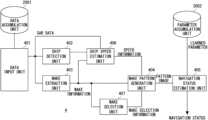
- FIG. 3 is a block diagram illustrating a ship behavior analyzing device configured using parameters obtained by the ship behavior learning device according to the first example embodiment of the present invention
- FIG. 4 is a diagram for explaining a wake image and Radon transform thereof
- FIG. 5 is a block diagram illustrating a configuration of a ship behavior learning device according to a second example embodiment of the present invention.
- FIG. 6 is a block diagram illustrating a ship behavior analyzing device configured using parameters obtained by the ship behavior learning device according to the second example embodiment of the present invention
- FIG. 7 is a diagram for explaining the displacement of a moving body on a SAR image
- FIG. 8 is a diagram illustrating the relationship among a radar incident angle, a speed in a platform direction, and a speed in a ground surface direction;
- FIG. 9 is a diagram for explaining a method for determining a wake pattern to be adopted.
- FIG. 10 is a diagram for explaining a method for determining a wake pattern to be adopted.
- a navigation status estimator for estimating a navigation status of a wake pattern are learned using wake pattern images generated from AIS data. Then, at the time of actual operation, a navigation status of a ship is estimated using learned parameters with respect to the wake pattern images generated on the basis of a wake of the ship extracted from image data of a synthetic aperture radar and the like.
- the first example embodiment of the present invention serves as a ship behavior learning device 1 , and includes a data input unit 101 , a wake pattern generation unit 102 , a pattern learning unit 103 , a data accumulation unit 1001 , and a parameter accumulation unit 1002 .
- a control unit of the ship behavior learning device 1 serves as a functional calculation unit that performs each of these subdivided processes.
- the control unit has a central processing unit (CPU), a main storage device, an auxiliary storage device, an external interface, and the like.
- the auxiliary storage device is an example of a non-transitory computer-readable medium to be described below.
- the data input unit 101 extracts data on a temporally continuous navigation status and position information of each ship from the data accumulation unit 1001 that accumulates navigation information of a ship, and outputs the data on the navigation status and the data on the position information to the wake pattern generation unit 102 .
- data acquired from GPS or AIS includes speed information, but when there is no speed information, it is possible to calculate a speed from a spatial distance and a temporal distance between two consecutive points. The temporal distance can be obtained from the acquisition date and time of data between the two consecutive points.
- the “navigation status of the ship” refers to, for example, the status of the ship such as steaming (navigation using an engine), anchoring (anchored and moored), mooring (anchored at a quay wall, and the like), and during fishing.
- the wake pattern generation unit 102 determines a speed information-based drawing method from the data on the position information and the speed information input from the data input unit 101 , and generates wake pattern images drawn by interpolating between discrete position information. Then, the wake pattern generation unit 102 sets a navigation status corresponding to the wake pattern images as a correct label of a main wake pattern with respect to the data on the navigation status input from the data input unit 101 . Then, the wake pattern generation unit 102 outputs the generated wake pattern images and label information to the pattern learning unit 103 .
- the pattern learning unit 103 machine-learns the wake pattern images by supervised learning from the wake pattern images and the label information input from the wake pattern generation unit 102 , and optimizes parameters of a navigation status classifier. Then, the pattern learning unit 103 stores the optimized parameters (learned parameters) in the parameter accumulation unit 1002 .
- the data accumulation unit 1001 is a database in which the navigation information of the ship is stored.
- the data accumulation unit 1001 accumulates or transmits the navigation information of the ship.
- the data accumulation unit 1001 is implemented by a storage medium such as a hard disk and a memory card that store the navigation information of the ship, a network to which they are connected, and the like.
- the parameter accumulation unit 1002 accumulates or transmits parameters of a ship behavior classifier.
- the parameter accumulation unit 1002 is implemented by a storage medium such as a hard disk and a memory card that store the parameters (learned parameters) of the ship behavior classifier, which are generated by the pattern learning unit 103 , a network to which they are connected, and the like.
- the wake pattern generation unit 102 generates the wake pattern images from the data on the position information, and the process in which the wake pattern generation unit 102 sets the label corresponding to the wake pattern.
- the wake pattern generation unit 102 selects one piece of data at an arbitrary time as a reference from a dataset of continuous time-series position information p i and navigation status s i .
- the reference time is T.
- p i is absolute position information such as latitude and longitude.
- p i is expressed by formula 1 below.
- the wake pattern generation unit 102 calculates position information p i ′ relative to the reference time T with respect to m pieces of data before and after the reference time T 0 by the following formula.
- ⁇ i ′ round( ⁇ i ) (Formula 2)
- the round( ⁇ ) represents a rounding process to an integral value and ⁇ is a predetermined scalar value.
- the wake pattern generation unit 102 maps each point p i ′ as illustrated in FIG. 2 B while allowing the point at the reference time T to be located at the center of a grid with a predetermined size.
- the aforementioned ⁇ is represented by 1/r.
- the wake pattern generation unit 102 connects the temporally consecutive points with a straight line to generate a wake image as illustrated in FIG. 2 C .
- a straight line is used herein for the sake of simplicity, it is not limited to a straight line in practice and spline interpolation and the like may also be used.
- a process of allowing the time interval of data for each ship to be constant may be applied.
- the wake pattern generation unit 102 sets a navigation status s T at the time T as a correct label with respect to the navigation status indicated by the wake pattern images generated around the time T in this way.
- the pattern learning unit 103 machine-learns the wake pattern images by the supervised learning from the wake pattern images and the label information input from the wake pattern generation unit 102 , and optimizes the parameters of the navigation status classifier.
- CNN convolutional neural network
- a ship behavior analyzing device 2 illustrated in FIG. 3 includes a data input unit 201 , a ship detection unit 202 , a wake extraction unit 203 , a wake pattern generation unit 204 , a navigation status estimation unit 205 , a data accumulation unit 2001 , and a parameter accumulation unit 1002 . That is, a control unit of the ship behavior analyzing device 2 serves as a functional calculation unit that performs each of these subdivided processes.
- the control unit has a central processing unit (CPU), a main storage device, an auxiliary storage device, an external interface, and the like.
- the auxiliary storage device is an example of a non-transitory computer-readable medium to be described below.
- the data input unit 201 outputs SAR data to be analyzed to the ship detection unit 202 and the wake extraction unit 203 from the data accumulation unit 2001 that accumulates synthetic aperture radar data obtained by capturing the ocean.
- the SAR data is composed of a SAR image and its metadata (including observation time, observation conditions, and the like).
- the ship detection unit 202 applies a ship detection process to the SAR data input from the data input unit 201 , and detects ships. Then, the ship detection unit 202 outputs information (positions, sizes, and the like of the ships) of the detected ships to the wake extraction unit 203 .
- the wake extraction unit 203 extracts a wake from the SAR data input from the data input unit 201 , on the basis of the ship information input from the ship detection unit 202 . Then, the wake extraction unit 203 outputs information (position) on the extracted wake to the wake pattern generation unit 204 .
- the wake pattern generation unit 204 generates wake pattern images on the basis of the wake information input from the wake extraction unit 203 . Then, the wake pattern generation unit 204 outputs the generated wake pattern images to the navigation status estimation unit 205 .
- the navigation status estimation unit 205 obtains learned classifier parameters with reference to the parameter accumulation unit 1002 , reconstructs a classifier having the same configuration as the classifier learned by the pattern learning unit 103 , and estimates a navigation status of each wake pattern image from the wake pattern images input from the wake pattern generation unit 204 . Then, the navigation status estimation unit 205 outputs the estimated navigation status. As described above, according to the present example embodiment, it is possible to estimate a ship navigation status with high accuracy by using the learned classifier parameters.
- the following description will be provided for the process in which the ship detection unit 202 detects ships from the SAR data.
- a process using adaptive thresholding is widely used.
- the point of view of the adaptive thresholding is very simple, and corresponds to a method for detecting, as a ship, an extremely bright pixel compared to surrounding pixels. This is implemented by appropriately setting a threshold value of a pixel detected as a ship, on the basis of statistical analysis of the surrounding pixels.
- the point of view of a constant false alarm rate hereinafter, referred to as CFAR
- a pixel having a value equal or greater than the threshold value ⁇ is detected as a ship-derived pixel.
- a process of uniquely assigning a label to each lump (cluster) of ship pixels is applied on the basis of the connectivity of the pixel detected as a ship.
- the size of each cluster is not within a predetermined range, it may be possible to apply a process of excluding corresponding pixels from the ship detection result, and the like.
- the land When land is included in the SAR image, the land may be erroneously detected as a ship because the land has a higher pixel value than that of the sea surface. Therefore, as a pretreatment, the land area may be excluded from the ship detection process by using map information and the like.
- the wake extraction unit 203 extracts the wake from the SAR data on the basis of the ship information.
- the ship detection result is used to generate a window with a predetermined size centered on the center coordinates of a certain one ship cluster.
- the wake corresponds to a plurality of half lines passing near the center of the window.
- Radon transform is applied to pixels of the window.
- the Radon transform is a method for performing line integral on an input image in various directions, and when there is a straight line with a brightness different from the surroundings, a coefficient value in a Radon space corresponding to the angle and position of the straight line has a peak. Since the rear turbulence is darker than a sea surface pixel, a negative peak may be searched in the Radon space.
- a set of coefficient values in which the difference between a negative peak and a positive peak is maximum, may be searched based on the fact that the kelvin wave and the wave inside the kelvin wave are bright pixels.
- a search range in the Radon space may be limited in consideration of physical characteristics. For example, since the kelvin wave has an angle difference of about 19° with respect to the rear turbulence, the search range of a positive peak corresponding to the kelvin wave may be limited to ⁇ 19° ⁇ ⁇ with respect to candidates of a negative peak corresponding to the rear turbulence. Likewise, the search range of a positive peak corresponding to the wave inside the kelvin wave may be limited to ⁇ 4° ⁇ ⁇ .
- the wake pattern generation unit 204 generates the wake pattern image on the basis of the wake information.
- the wake pattern generation unit 204 Since the wake pattern image input to the navigation status estimation unit 205 is a black and white binary image as illustrated in FIG. 2 , the wake pattern generation unit 204 performs color coding so that the extracted wake is white and the other sea surface pixels are black. Then, the wake pattern generation unit 204 cuts out a wake image in a window with the same size as the wake pattern image used by the pattern learning unit 103 so that points on the wake are the center of the window at a predetermined sampling interval from the start point to the end point of the wake.
- the navigation status of each ship detected from the SAR data is estimated on the basis of the wake pattern of the ship, so that it is possible to estimate the navigation status even for a ship in which an AIS signal is stopped.
- the parameters of the navigation status estimator for estimating the navigation status of the wake pattern are learned using the wake pattern images generated from the AIS data.
- the parameters are learned using speed information as well.
- the navigation status of the ship is estimated by performing navigation status estimation using the learned parameters with respect to wake pattern images generated on the basis of the wake of the ship extracted from the image data of the synthetic aperture radar and the like and a speed of the ship estimated from the wake on the image and the amount of position displacement of the ship.
- the second example embodiment of the present invention disclosure serves as a ship behavior learning device 3 , and includes a data input unit 301 , a wake pattern generation unit 302 , a pattern learning unit 303 , a data accumulation unit 1001 , and a parameter accumulation unit 3002 .
- a control unit of the ship behavior learning device 3 serves as a functional calculation unit that performs each of these subdivided processes.
- the control unit has a central processing unit (CPU), a main storage device, an auxiliary storage device, an external interface, and the like.
- the auxiliary storage device is an example of a non-transitory computer-readable medium to be described below. Since the data accumulation unit 1001 , which is a database that accumulates navigation information of a ship, is the same as that of the first example embodiment, a description thereof will be omitted.
- the data input unit 301 extracts data on a temporally continuous navigation status, position information, and speed information of each ship, which are included in the database, from the data accumulation unit 1001 , and outputs the data on the navigation status and the data on the position information and the speed information to the wake pattern generation unit 302 .
- data acquired from the GPS or the AIS includes speed information, but when there is no speed information, it is possible to calculate a speed from a spatial distance and a temporal distance between two consecutive points. The temporal distance can be obtained from the acquisition date and time of data between the two consecutive points.
- the wake pattern generation unit 302 determines a speed information-based drawing method from the data on the position information and the speed information input from the data input unit 301 , and generates wake pattern images drawn by interpolating between discrete position information. Then, the wake pattern generation unit 302 sets a navigation status corresponding to the wake pattern images as a correct label of a main wake pattern with respect to the data on the navigation status input from the data input unit 301 . Then, the wake pattern generation unit 302 outputs the generated wake pattern images and label information to the pattern learning unit 303 .
- the pattern learning unit 303 learns the wake pattern images from the wake pattern images and the label information input from the wake pattern generation unit 302 , and optimizes the parameters of the navigation status classifier. Then, the pattern learning unit 303 stores the optimized parameters in the parameter accumulation unit 3002 .
- the parameter accumulation unit 3002 accumulates or transmits the parameters of the ship behavior classifier.
- the parameter accumulation unit 3002 is implemented by a storage medium such as a hard disk and a memory card that store the parameters of the ship behavior classifier, which are generated by the pattern learning unit 303 , a network to which they are connected, and the like.
- the wake pattern generation unit 302 generates the wake pattern images from the data on the position information and the speed information, and the process in which the wake pattern generation unit 302 sets the label corresponding to the wake pattern.
- the wake pattern generation unit 302 converts speed information v i existing in the AIS by using a predetermined maximum speed v max as expressed by the following formula, like the continuous time-series position information p i and the navigation status s i , and calculates v i ′ normalized in the range of 0.0 to 1.0.
- v max about 45 knots, which is the current maximum speed of a practical high-speed ship, may be input. Alternatively, it may be 22 knots (Japan), 24 knots (Europe), or 30 knots (USA) with reference to the definition of a high-speed ship in each country.
- the wake pattern generation unit 302 determines the wake drawing method of FIG. 2 C .
- mapping of v i ′ to a hue circle will be described as a method for changing the color of a line drawn on the basis of v i ′.
- the wake pattern generation unit 302 performs mapping so that the minimum value and the maximum value of v′ are 0° and 360° of hue, respectively, since the minimum value and the maximum value of a speed are continuous on the hue circle, the wake pattern generation unit 302 performs mapping so that the minimum value corresponds to 0° (red) and the maximum value corresponds to 240° (blue).
- Hue H i is expressed by the following formula.
- f HSV2RGB ( ⁇ ) represents a transform function from the HSV color space to the RGB color space.
- the color at the point p i may use C i RGB , but the color of a line segment connecting the point p i and the point p (i+1) may be weighted and summed so that a color between the two points changes linearly, or an average value or one of the colors may be simply used.
- the drawing method to be changed on the basis of v i ′ is not limited to color only, and may be, for example, the thickness, type, and the like of a line to be drawn.
- a 3-channel wake pattern image is generated, and in the case of line type and thickness, a 1-channel wake pattern image is generated.
- the wake pattern generation unit 302 sets the navigation status s T at the time T as a correct label with respect to the navigation status indicated by the wake pattern images generated around the time T in this way.
- the pattern learning unit 303 machine-learns the wake pattern images from the wake pattern images and the label information input from the wake pattern generation unit 302 , and optimizes the parameters of the navigation status classifier.
- the general supervised classifier may be used.
- the convolutional neural network CNN
- a network channel configuration changes because the input of the CNN changes from a grayscale image to a color image.
- a ship behavior analyzing device 4 illustrated in FIG. 6 includes a data input unit 401 , a ship detection unit 402 , a wake extraction unit 403 , a wake pattern generation unit 404 , a navigation status estimation unit 405 , a ship speed estimation unit 406 , a wake selection unit 407 , a data accumulation unit 2001 , and a parameter accumulation unit 3002 . That is, a control unit of the ship behavior analyzing device 4 serves as a functional calculation unit that performs each of these subdivided processes.
- the control unit has a central processing unit (CPU), a main storage device, an auxiliary storage device, an external interface, and the like.
- the auxiliary storage device is an example of a non-transitory computer-readable medium to be described below.
- the data input unit 401 outputs SAR data to be analyzed to the ship detection unit 402 , the wake extraction unit 403 , and the ship speed estimation unit 406 from the data accumulation unit 2001 that accumulates the synthetic aperture radar (SAR) data obtained by capturing the ocean.
- the SAR data is composed of the SAR image and its metadata (including observation time, observation conditions, and the like).
- the ship detection unit 402 applies a ship detection process to the SAR data input from the data input unit 401 , and detects ships. Then, the ship detection unit 402 outputs information (positions, sizes, and the like of the ships) of the detected ships to the wake extraction unit 403 and the ship speed estimation unit 406 .
- the wake extraction unit 403 extracts a wake from the SAR data input from the data input unit 401 , on the basis of the ship information input from the ship detection unit 402 . Then, the wake extraction unit 403 outputs information (position) on the extracted wake to the wake pattern generation unit 404 , the ship speed estimation unit 406 , and the wake selection unit 407 .
- the wake pattern generation unit 404 generates wake pattern images on the basis of the wake information input from the wake extraction unit 403 , ship speed information input from the ship speed estimation unit 406 , and wake selection information input from the wake selection unit 407 . Then, the wake pattern generation unit 404 outputs the generated wake pattern images to the navigation status estimation unit 405 .
- the navigation status estimation unit 405 obtains learned classifier parameters with reference to the parameter accumulation unit 3002 , reconstructs a classifier having the same configuration as the classifier learned by the pattern learning unit 303 described above, and estimates a navigation status of each wake pattern image from the wake pattern images input from the wake pattern generation unit 404 . Then, the navigation status estimation unit 405 outputs the estimated navigation status.
- the ship speed estimation unit 406 estimates the speed of the ship from the SAR data input from the data input unit 401 , the ship information input from the ship detection unit 402 , and the wake information input from the wake extraction unit 403 . Then, the ship speed estimation unit 406 outputs the estimated speed of the ship to the wake pattern generation unit 404 .
- the wake selection unit 407 selects a wake to be used for pattern generation, on the basis of the wake information input from the wake extraction unit 403 . Then, the wake selection unit 407 outputs information of the selected wake to the wake pattern generation unit 404 .
- the ship detection unit 402 Since the ship detection unit 402 , the wake extraction unit 403 , and the navigation status estimation unit 405 are substantially the same as those of the aforementioned example embodiment except for data input/output, a detailed description thereof will be omitted.
- the ship speed estimation unit 406 estimates the speed of the ship on the basis of the SAR data, the ship information, and the wake information.
- FIG. 7 is a diagram for explaining the displacement of a moving body on the SAR image.
- the SAR image has a characteristic that the moving body within a capturing range is displaced from the original position and an image of the moving body is formed.
- the displacement amount ⁇ X is calculated by the following formula by using a movement speed V of a platform (artificial satellite) 70 provided with a SAR antenna, a distance R between the platform 70 and a moving body 80 on the ground surface, and a movement speed v R of the moving body 80 in the platform direction.
- the movement speed V of the platform 70 and the distance R between the platform 70 and the moving body 80 on the ground surface can be extracted from the metadata of the SAR data.
- ⁇ X can be estimated from the image, so the speed of the moving body 80 on the ground surface can be estimated only from the SAR data.
- FIG. 8 is a diagram illustrating the relationship among a radar incident angle ⁇ i the speed v R in the platform direction, and a speed v in the ground surface direction. From this, the following formula is satisfied.
- the radar incident angle information at each point in the image can be generally extracted from the metadata of the SAR data, similarly to the movement speed V of the platform 70 and the distance R between the platform 70 and an object on the ground surface (moving body 80 ).
- the wake selection unit 407 selects the wake to be used for pattern generation, on the basis of the wake information.
- the speed data of a ship estimated from the SAR data is only for the timing at the time of capturing the SAR data, but generally, as illustrated in FIG. 9 , the speed change is small when the ship is traveling linearly (when curvature is small). Therefore, as illustrated in FIG. 10 , in order from the wake close to the ship, the wake selection unit 407 regards the wake in windows 10 with a predetermined size as a straight line to obtain an angle, and when the change in the angle is large, the wake selection unit 407 regards that the speed change has occurred and terminates the wake. That is, in FIG. 10 , the wake selection unit 407 regards that the speed change has occurred in the fifth window 10 from the wake close to the ship, and adopts the wake in the four windows 10 close to the ship. As described above, the wake selection unit 407 selects a wake, whose angle is equal to or less than a threshold value, from wakes close to a target ship.
- the Radon transform may be used similarly to the wake extraction.
- the angle of the most prominent straight line in each window is obtained in order from a window located closest to a ship, and when the difference with the angle of a straight line in an immediately previous window exceeds a predetermined value, the wake selection unit 407 terminates the wake.
- the wake pattern generation unit 404 generates the wake pattern images on the basis of the wake information, the ship speed information, and the wake selection information.
- the wake pattern generation unit 404 Since the wake pattern image input to the navigation status estimation unit 405 is an image that reflects the speed information, the wake pattern generation unit 404 superimposes the speed information on the extracted wake in the same manner as the wake pattern generation unit 302 , on the basis of the ship speed information.
- the wake pattern generation unit 404 allows sea surface pixels other than the wake to be black. Then, the wake pattern generation unit 404 cuts out a wake image in a window with the same size as the wake pattern image used by the pattern learning unit 103 so that points on the wake are the center of the window at a predetermined sampling interval from the start point of the wake to the end point of the wake determined on the basis of the ship selection information.
- the amount of information on a navigation status is increased by superimposing ship speed information on a wake, so that it is possible to stably estimate a navigation status which is difficult to classify only from the wake.
- each part can also be configured by hardware, but it can also be implemented by a computer program.
- a processor which operates in a program stored in a program memory, implements the same functions and operations as those in the aforementioned example embodiments.
- only a part of the functions of the aforementioned example embodiments can also be implemented by the computer program.
- the present invention has been described with the preferred example embodiments, the present invention is not always limited to the above example embodiments and can be variously modified and embodied within the range of the technical idea of the present invention.
- the first example embodiment and the second example embodiment can be used at the same time, and for a wake after the speed change is regarded to have occurred in the second example embodiment, a wake image may be generated by the method of the first example embodiment and a navigation status may be estimated by the navigation status estimation unit of the first example embodiment.
- present disclosure is not limited to the aforementioned example embodiments, and can be appropriately changed without departing from the spirit. Furthermore, the present disclosure may also be embodied by appropriately combining the respective example embodiments.
- the program can be stored using various types of non-transitory computer readable mediums, and can be supplied to a computer.
- the non-transitory computer readable medium includes various types of tangible storage mediums. Examples of the non-transitory computer readable medium include a magnetic recording medium (for example, a flexible disk, a magnetic tape, a hard disk drive), a magneto-optical recording medium (for example, a magneto-optical disk), a CD-ROM (Read Only Memory), a CD-R, a CD-R/W, a digital versatile disc (DVD), a blue-ray (registered trademark) disc (BD), a semiconductor memory (for example, a mask ROM, a programmable ROM (PROM), an erasable ROM (EPROM), a flash ROM, a random access memory (RAM)).
- a magnetic recording medium for example, a flexible disk, a magnetic tape, a hard disk drive
- a magneto-optical recording medium for example, a magneto-opti
- the program may also be supplied to the computer by various types of transitory computer readable mediums.
- Examples of the transitory computer readable medium include an electrical signal, an optical signal, and an electromagnetic wave.
- the transitory computer readable medium can supply the program to the computer via a wired communication path such as an electric wire and an optical fiber or a wireless communication path.
Landscapes
- Engineering & Computer Science (AREA)
- Remote Sensing (AREA)
- Radar, Positioning & Navigation (AREA)
- Physics & Mathematics (AREA)
- Electromagnetism (AREA)
- Computer Networks & Wireless Communication (AREA)
- General Physics & Mathematics (AREA)
- Artificial Intelligence (AREA)
- Computer Vision & Pattern Recognition (AREA)
- Radar Systems Or Details Thereof (AREA)
- Traffic Control Systems (AREA)
- Navigation (AREA)
Abstract
Description
-
- Xiang Jiang, Daniel L. Silver, Baifan Hu, Erico N. de Souza, Stan Matwin: “Fishing Activity Detection from AIS Data Using Autoencoders,” Canadian Conference on AI 2016: 33-39.
-
- Japanese Unexamined Patent Application Publication No. 2005-96674
[Math 2]
ρi′=round(α×ρi) (Formula 2)
[Math 3]
P FA=1.0−∫−∞ τ f(x)dx (Formula 3)
[Math 6]
C i HSV =[H i,1.0,1.0] (Formula 6)
[Math 7]
C i RGB =f HSV2RGB(C i HSV) (Formula 7)
-
- 1 SHIP BEHAVIOR LEARNING DEVICE
- 2 SHIP BEHAVIOR ANALYZING DEVICE
- 3 SHIP BEHAVIOR LEARNING DEVICE
- 4 SHIP BEHAVIOR ANALYZING DEVICE
- 101 DATA INPUT UNIT
- 102 WAKE PATTERN GENERATION UNIT
- 103 PATTERN LEARNING UNIT
- 201 DATA INPUT UNIT
- 202 SHIP DETECTION UNIT
- 203 WAKE EXTRACTION UNIT
- 204 WAKE PATTERN GENERATION UNIT
- 205 NAVIGATION STATUS ESTIMATION UNIT
- 301 DATA INPUT UNIT
- 302 WAKE PATTERN GENERATION UNIT
- 303 PATTERN LEARNING UNIT
- 401 DATA INPUT UNIT
- 402 SHIP DETECTION UNIT
- 403 WAKE EXTRACTION UNIT
- 404 WAKE PATTERN GENERATION UNIT
- 405 NAVIGATION STATUS ESTIMATION UNIT
- 406 SHIP SPEED ESTIMATION UNIT
- 407 WAKE SELECTION UNIT
- 1001 DATA ACCUMULATION UNIT
- 1002 PARAMETER ACCUMULATION UNIT
- 2001 DATA ACCUMULATION UNIT
- 3002 PARAMETER ACCUMULATION UNIT
Claims (7)
Applications Claiming Priority (1)
| Application Number | Priority Date | Filing Date | Title |
|---|---|---|---|
| PCT/JP2019/004306 WO2020161843A1 (en) | 2019-02-06 | 2019-02-06 | Ship behavior analyzing device, ship behavior analyzing method, and non-transitory computer-readable medium |
Publications (2)
| Publication Number | Publication Date |
|---|---|
| US20220120892A1 US20220120892A1 (en) | 2022-04-21 |
| US12038502B2 true US12038502B2 (en) | 2024-07-16 |
Family
ID=71947754
Family Applications (1)
| Application Number | Title | Priority Date | Filing Date |
|---|---|---|---|
| US17/427,991 Active 2040-03-11 US12038502B2 (en) | 2019-02-06 | 2019-02-06 | Ship behavior analyzing device, ship behavior analyzing method, and non-transitory computer-readable medium |
Country Status (3)
| Country | Link |
|---|---|
| US (1) | US12038502B2 (en) |
| JP (1) | JP7184101B2 (en) |
| WO (1) | WO2020161843A1 (en) |
Families Citing this family (10)
| Publication number | Priority date | Publication date | Assignee | Title |
|---|---|---|---|---|
| CN112130146B (en) * | 2020-08-26 | 2022-05-03 | 南京航空航天大学 | Video synthetic aperture radar moving target bright line detection method based on Radon transformation and machine learning |
| WO2022254651A1 (en) * | 2021-06-03 | 2022-12-08 | 三菱電機株式会社 | Image processing device, image processing method, and image processing program |
| JP7720204B2 (en) * | 2021-09-01 | 2025-08-07 | 古野電気株式会社 | Standard route generation device, ship monitoring device |
| JP7725297B2 (en) * | 2021-09-01 | 2025-08-19 | 古野電気株式会社 | Standard route generation device, ship monitoring device |
| CN114462529A (en) * | 2022-01-24 | 2022-05-10 | 北京中交通信科技有限公司 | A method and device for identifying the double towing operation mode of a fishing boat |
| MY209997A (en) * | 2022-07-26 | 2025-08-20 | Univ Kagoshima | Seafarer safety device, seafarer safety system, seafarer safety program, vessel activity inference device, report generation assistance system, and vessel activity inference program |
| CN115797779B (en) * | 2022-12-24 | 2024-11-08 | 中国人民解放军海军航空大学 | Unknown ship target type recognition method in remote sensing images under cross-domain scenarios |
| CN116740137B (en) * | 2023-05-24 | 2025-12-12 | 武汉理工大学 | Methods, devices, equipment and media for identifying and warning of dangerous behaviors in ship navigation |
| CN117173583A (en) * | 2023-07-21 | 2023-12-05 | 中国科学院空天信息创新研究院 | Ship target detection methods, devices and electronic equipment |
| CN117806328B (en) * | 2023-12-28 | 2024-09-17 | 华中科技大学 | A visual guidance control method and system for unmanned boat berthing based on benchmark markers |
Citations (7)
| Publication number | Priority date | Publication date | Assignee | Title |
|---|---|---|---|---|
| JP2000067400A (en) | 1998-08-26 | 2000-03-03 | Mitsubishi Electric Corp | Automatic ship track detector |
| JP2001004398A (en) | 1999-06-25 | 2001-01-12 | Mitsubishi Space Software Kk | Movement information detection method based on satellite sar image |
| JP2005096674A (en) | 2003-09-26 | 2005-04-14 | Kawasaki Shipbuilding Corp | Suspicious ship detection method and device |
| JP2008009846A (en) | 2006-06-30 | 2008-01-17 | Natl Inst For Land & Infrastructure Management Mlit | Wide area ship motion monitoring method and system |
| US8422738B1 (en) * | 2008-08-25 | 2013-04-16 | The United States Of America As Represented By The Secretary Of The Navy | Adaptive automated synthetic aperture radar vessel detection method with false alarm mitigation |
| JP2015148452A (en) | 2014-02-05 | 2015-08-20 | 三菱電機株式会社 | Synthetic aperture radar equipment |
| US20160247011A1 (en) * | 2010-07-21 | 2016-08-25 | Ron Abileah | Visibility of Targets on and below the Ocean Surface |
-
2019
- 2019-02-06 US US17/427,991 patent/US12038502B2/en active Active
- 2019-02-06 WO PCT/JP2019/004306 patent/WO2020161843A1/en not_active Ceased
- 2019-02-06 JP JP2020570276A patent/JP7184101B2/en active Active
Patent Citations (7)
| Publication number | Priority date | Publication date | Assignee | Title |
|---|---|---|---|---|
| JP2000067400A (en) | 1998-08-26 | 2000-03-03 | Mitsubishi Electric Corp | Automatic ship track detector |
| JP2001004398A (en) | 1999-06-25 | 2001-01-12 | Mitsubishi Space Software Kk | Movement information detection method based on satellite sar image |
| JP2005096674A (en) | 2003-09-26 | 2005-04-14 | Kawasaki Shipbuilding Corp | Suspicious ship detection method and device |
| JP2008009846A (en) | 2006-06-30 | 2008-01-17 | Natl Inst For Land & Infrastructure Management Mlit | Wide area ship motion monitoring method and system |
| US8422738B1 (en) * | 2008-08-25 | 2013-04-16 | The United States Of America As Represented By The Secretary Of The Navy | Adaptive automated synthetic aperture radar vessel detection method with false alarm mitigation |
| US20160247011A1 (en) * | 2010-07-21 | 2016-08-25 | Ron Abileah | Visibility of Targets on and below the Ocean Surface |
| JP2015148452A (en) | 2014-02-05 | 2015-08-20 | 三菱電機株式会社 | Synthetic aperture radar equipment |
Non-Patent Citations (3)
| Title |
|---|
| International Search Report for PCT Application No. PCT/JP2019/004306, mailed on Apr. 23, 2019. |
| Reggiannini, Marco, and Luigi Bedini. "Multi-Sensor Satellite Data Processing for Marine Traffic Understanding." Electronics (Basel) 8.2 (2019): 152-. Web. (Received: Dec. 12, 2018; Accepted: Jan. 26, 2019; Published: Feb. 1, 2019) Relevant: Abstract, Sections 1, 2, 4.3, 4.5 (Year: 2019). * |
| Xiang Jiang et al., "Fishing Activity Detection from AIS Data Using Autoencoders", 29th Canadian Conference on Artificial Intelligence, Canadian AI 2016, Victoria, BC, Canada, May 31-Jun. 3, 2016, pp. 33-39. |
Also Published As
| Publication number | Publication date |
|---|---|
| US20220120892A1 (en) | 2022-04-21 |
| JPWO2020161843A1 (en) | 2021-11-25 |
| JP7184101B2 (en) | 2022-12-06 |
| WO2020161843A1 (en) | 2020-08-13 |
Similar Documents
| Publication | Publication Date | Title |
|---|---|---|
| US12038502B2 (en) | Ship behavior analyzing device, ship behavior analyzing method, and non-transitory computer-readable medium | |
| CN109740494B (en) | Port identification method based on ship track big data | |
| US11681036B2 (en) | Image processing apparatus, image processing method, and non-transitory computer readable medium storing image processing program | |
| CN115542317B (en) | A comprehensive recognition method and system for sea surface targets based on multiple information sources | |
| CN119723049A (en) | A method for detecting and identifying marine targets based on the combination of radar and optoelectronic system | |
| CN111323756B (en) | Marine radar target detection method and device based on deep learning | |
| CN108133468A (en) | Auto-adaptive parameter enhances and the constant false alarm rate Ship Detection of tail auxiliary detection | |
| CN110619653A (en) | Early warning control system and method for preventing collision between ship and bridge based on artificial intelligence | |
| CN119439147A (en) | A ship target tracking method based on radar imaging in an occluded environment | |
| US11300681B2 (en) | Weather radar apparatus and severe rain prediction method | |
| JP6732900B2 (en) | Signal processing device and radar device | |
| CN111709308B (en) | Unmanned aerial vehicle-based maritime distress personnel detection and tracking method and system | |
| JP7272373B2 (en) | Ship analysis device, ship analysis method and program | |
| US20220003554A1 (en) | Ship movement learning method, ship movement learning system, service condition estimation method, and service condition estimation system | |
| Anneken et al. | Synthetic trajectory extraction for maritime anomaly detection | |
| CN118050728B (en) | Target acquisition method and system for channel safety monitoring | |
| US20240310483A1 (en) | Information processing method, radar apparatus, and recording medium | |
| KR102694525B1 (en) | Satellite-based ship detection method, ship detection system, and computer program for the same | |
| CN119206640A (en) | A method for detecting multiple targets on ships and water | |
| Hu et al. | Statistical analysis of massive AIS trajectories using Gaussian mixture models | |
| CN106918803B (en) | Airborne weather radar video processing method | |
| Chen et al. | Rain detection from X-band marine radar images | |
| CN120163969B (en) | A method for multi-target detection and automatic labeling on water surface based on threshold segmentation | |
| CN116343060B (en) | A rapid detection method for ship targets on the sea surface based on remote sensing imagery | |
| Wu et al. | Ship recognition from high resolution remote sensing imagery aided by spatial relationship |
Legal Events
| Date | Code | Title | Description |
|---|---|---|---|
| FEPP | Fee payment procedure |
Free format text: ENTITY STATUS SET TO UNDISCOUNTED (ORIGINAL EVENT CODE: BIG.); ENTITY STATUS OF PATENT OWNER: LARGE ENTITY |
|
| STPP | Information on status: patent application and granting procedure in general |
Free format text: DOCKETED NEW CASE - READY FOR EXAMINATION |
|
| AS | Assignment |
Owner name: NEC CORPORATION, JAPAN Free format text: ASSIGNMENT OF ASSIGNORS INTEREST;ASSIGNOR:SENZAKI, KENTA;REEL/FRAME:061267/0563 Effective date: 20210907 |
|
| STPP | Information on status: patent application and granting procedure in general |
Free format text: NON FINAL ACTION MAILED |
|
| STPP | Information on status: patent application and granting procedure in general |
Free format text: RESPONSE TO NON-FINAL OFFICE ACTION ENTERED AND FORWARDED TO EXAMINER |
|
| STPP | Information on status: patent application and granting procedure in general |
Free format text: NOTICE OF ALLOWANCE MAILED -- APPLICATION RECEIVED IN OFFICE OF PUBLICATIONS |
|
| STPP | Information on status: patent application and granting procedure in general |
Free format text: PUBLICATIONS -- ISSUE FEE PAYMENT VERIFIED |
|
| STCF | Information on status: patent grant |
Free format text: PATENTED CASE |