US12037339B2 - Substituted imidazoles as GLP-1 receptor agonists - Google Patents
Substituted imidazoles as GLP-1 receptor agonists Download PDFInfo
- Publication number
- US12037339B2 US12037339B2 US17/380,084 US202117380084A US12037339B2 US 12037339 B2 US12037339 B2 US 12037339B2 US 202117380084 A US202117380084 A US 202117380084A US 12037339 B2 US12037339 B2 US 12037339B2
- Authority
- US
- United States
- Prior art keywords
- butyl
- butoxy
- methyl
- propyl
- propoxy
- Prior art date
- Legal status (The legal status is an assumption and is not a legal conclusion. Google has not performed a legal analysis and makes no representation as to the accuracy of the status listed.)
- Active
Links
Classifications
-
- C—CHEMISTRY; METALLURGY
- C07—ORGANIC CHEMISTRY
- C07D—HETEROCYCLIC COMPOUNDS
- C07D471/00—Heterocyclic compounds containing nitrogen atoms as the only ring hetero atoms in the condensed system, at least one ring being a six-membered ring with one nitrogen atom, not provided for by groups C07D451/00 - C07D463/00
- C07D471/02—Heterocyclic compounds containing nitrogen atoms as the only ring hetero atoms in the condensed system, at least one ring being a six-membered ring with one nitrogen atom, not provided for by groups C07D451/00 - C07D463/00 in which the condensed system contains two hetero rings
- C07D471/04—Ortho-condensed systems
-
- A—HUMAN NECESSITIES
- A61—MEDICAL OR VETERINARY SCIENCE; HYGIENE
- A61K—PREPARATIONS FOR MEDICAL, DENTAL OR TOILETRY PURPOSES
- A61K31/00—Medicinal preparations containing organic active ingredients
- A61K31/33—Heterocyclic compounds
- A61K31/395—Heterocyclic compounds having nitrogen as a ring hetero atom, e.g. guanethidine or rifamycins
- A61K31/435—Heterocyclic compounds having nitrogen as a ring hetero atom, e.g. guanethidine or rifamycins having six-membered rings with one nitrogen as the only ring hetero atom
- A61K31/4353—Heterocyclic compounds having nitrogen as a ring hetero atom, e.g. guanethidine or rifamycins having six-membered rings with one nitrogen as the only ring hetero atom ortho- or peri-condensed with heterocyclic ring systems
- A61K31/437—Heterocyclic compounds having nitrogen as a ring hetero atom, e.g. guanethidine or rifamycins having six-membered rings with one nitrogen as the only ring hetero atom ortho- or peri-condensed with heterocyclic ring systems the heterocyclic ring system containing a five-membered ring having nitrogen as a ring hetero atom, e.g. indolizine, beta-carboline
-
- A—HUMAN NECESSITIES
- A61—MEDICAL OR VETERINARY SCIENCE; HYGIENE
- A61K—PREPARATIONS FOR MEDICAL, DENTAL OR TOILETRY PURPOSES
- A61K31/00—Medicinal preparations containing organic active ingredients
- A61K31/33—Heterocyclic compounds
- A61K31/395—Heterocyclic compounds having nitrogen as a ring hetero atom, e.g. guanethidine or rifamycins
- A61K31/435—Heterocyclic compounds having nitrogen as a ring hetero atom, e.g. guanethidine or rifamycins having six-membered rings with one nitrogen as the only ring hetero atom
- A61K31/44—Non condensed pyridines; Hydrogenated derivatives thereof
- A61K31/4427—Non condensed pyridines; Hydrogenated derivatives thereof containing further heterocyclic ring systems
- A61K31/444—Non condensed pyridines; Hydrogenated derivatives thereof containing further heterocyclic ring systems containing a six-membered ring with nitrogen as a ring heteroatom, e.g. amrinone
-
- A—HUMAN NECESSITIES
- A61—MEDICAL OR VETERINARY SCIENCE; HYGIENE
- A61K—PREPARATIONS FOR MEDICAL, DENTAL OR TOILETRY PURPOSES
- A61K31/00—Medicinal preparations containing organic active ingredients
- A61K31/33—Heterocyclic compounds
- A61K31/395—Heterocyclic compounds having nitrogen as a ring hetero atom, e.g. guanethidine or rifamycins
- A61K31/495—Heterocyclic compounds having nitrogen as a ring hetero atom, e.g. guanethidine or rifamycins having six-membered rings with two or more nitrogen atoms as the only ring heteroatoms, e.g. piperazine or tetrazines
- A61K31/4985—Pyrazines or piperazines ortho- or peri-condensed with heterocyclic ring systems
-
- A—HUMAN NECESSITIES
- A61—MEDICAL OR VETERINARY SCIENCE; HYGIENE
- A61K—PREPARATIONS FOR MEDICAL, DENTAL OR TOILETRY PURPOSES
- A61K31/00—Medicinal preparations containing organic active ingredients
- A61K31/33—Heterocyclic compounds
- A61K31/395—Heterocyclic compounds having nitrogen as a ring hetero atom, e.g. guanethidine or rifamycins
- A61K31/535—Heterocyclic compounds having nitrogen as a ring hetero atom, e.g. guanethidine or rifamycins having six-membered rings with at least one nitrogen and one oxygen as the ring hetero atoms, e.g. 1,2-oxazines
- A61K31/5375—1,4-Oxazines, e.g. morpholine
- A61K31/5377—1,4-Oxazines, e.g. morpholine not condensed and containing further heterocyclic rings, e.g. timolol
-
- A—HUMAN NECESSITIES
- A61—MEDICAL OR VETERINARY SCIENCE; HYGIENE
- A61P—SPECIFIC THERAPEUTIC ACTIVITY OF CHEMICAL COMPOUNDS OR MEDICINAL PREPARATIONS
- A61P1/00—Drugs for disorders of the alimentary tract or the digestive system
- A61P1/16—Drugs for disorders of the alimentary tract or the digestive system for liver or gallbladder disorders, e.g. hepatoprotective agents, cholagogues, litholytics
-
- A—HUMAN NECESSITIES
- A61—MEDICAL OR VETERINARY SCIENCE; HYGIENE
- A61P—SPECIFIC THERAPEUTIC ACTIVITY OF CHEMICAL COMPOUNDS OR MEDICINAL PREPARATIONS
- A61P25/00—Drugs for disorders of the nervous system
- A61P25/14—Drugs for disorders of the nervous system for treating abnormal movements, e.g. chorea, dyskinesia
- A61P25/16—Anti-Parkinson drugs
-
- A—HUMAN NECESSITIES
- A61—MEDICAL OR VETERINARY SCIENCE; HYGIENE
- A61P—SPECIFIC THERAPEUTIC ACTIVITY OF CHEMICAL COMPOUNDS OR MEDICINAL PREPARATIONS
- A61P25/00—Drugs for disorders of the nervous system
- A61P25/28—Drugs for disorders of the nervous system for treating neurodegenerative disorders of the central nervous system, e.g. nootropic agents, cognition enhancers, drugs for treating Alzheimer's disease or other forms of dementia
-
- A—HUMAN NECESSITIES
- A61—MEDICAL OR VETERINARY SCIENCE; HYGIENE
- A61P—SPECIFIC THERAPEUTIC ACTIVITY OF CHEMICAL COMPOUNDS OR MEDICINAL PREPARATIONS
- A61P3/00—Drugs for disorders of the metabolism
- A61P3/04—Anorexiants; Antiobesity agents
-
- A—HUMAN NECESSITIES
- A61—MEDICAL OR VETERINARY SCIENCE; HYGIENE
- A61P—SPECIFIC THERAPEUTIC ACTIVITY OF CHEMICAL COMPOUNDS OR MEDICINAL PREPARATIONS
- A61P3/00—Drugs for disorders of the metabolism
- A61P3/06—Antihyperlipidemics
-
- A—HUMAN NECESSITIES
- A61—MEDICAL OR VETERINARY SCIENCE; HYGIENE
- A61P—SPECIFIC THERAPEUTIC ACTIVITY OF CHEMICAL COMPOUNDS OR MEDICINAL PREPARATIONS
- A61P3/00—Drugs for disorders of the metabolism
- A61P3/08—Drugs for disorders of the metabolism for glucose homeostasis
- A61P3/10—Drugs for disorders of the metabolism for glucose homeostasis for hyperglycaemia, e.g. antidiabetics
-
- A—HUMAN NECESSITIES
- A61—MEDICAL OR VETERINARY SCIENCE; HYGIENE
- A61P—SPECIFIC THERAPEUTIC ACTIVITY OF CHEMICAL COMPOUNDS OR MEDICINAL PREPARATIONS
- A61P9/00—Drugs for disorders of the cardiovascular system
-
- A—HUMAN NECESSITIES
- A61—MEDICAL OR VETERINARY SCIENCE; HYGIENE
- A61P—SPECIFIC THERAPEUTIC ACTIVITY OF CHEMICAL COMPOUNDS OR MEDICINAL PREPARATIONS
- A61P9/00—Drugs for disorders of the cardiovascular system
- A61P9/10—Drugs for disorders of the cardiovascular system for treating ischaemic or atherosclerotic diseases, e.g. antianginal drugs, coronary vasodilators, drugs for myocardial infarction, retinopathy, cerebrovascula insufficiency, renal arteriosclerosis
-
- A—HUMAN NECESSITIES
- A61—MEDICAL OR VETERINARY SCIENCE; HYGIENE
- A61P—SPECIFIC THERAPEUTIC ACTIVITY OF CHEMICAL COMPOUNDS OR MEDICINAL PREPARATIONS
- A61P9/00—Drugs for disorders of the cardiovascular system
- A61P9/12—Antihypertensives
-
- C—CHEMISTRY; METALLURGY
- C07—ORGANIC CHEMISTRY
- C07D—HETEROCYCLIC COMPOUNDS
- C07D487/00—Heterocyclic compounds containing nitrogen atoms as the only ring hetero atoms in the condensed system, not provided for by groups C07D451/00 - C07D477/00
- C07D487/02—Heterocyclic compounds containing nitrogen atoms as the only ring hetero atoms in the condensed system, not provided for by groups C07D451/00 - C07D477/00 in which the condensed system contains two hetero rings
- C07D487/04—Ortho-condensed systems
-
- C—CHEMISTRY; METALLURGY
- C07—ORGANIC CHEMISTRY
- C07D—HETEROCYCLIC COMPOUNDS
- C07D519/00—Heterocyclic compounds containing more than one system of two or more relevant hetero rings condensed among themselves or condensed with a common carbocyclic ring system not provided for in groups C07D453/00 or C07D455/00
Definitions
- Glucagon-like peptide-1 (GLP-1) is an incretin of 30 or 31 amino acids, secreted from L cells in the small intestine. GLP-1 exerts a wide range of effects through the GLP-1 receptor, such as promotion of glucose dependent insulin secretion, inhibition of glucagon secretion, delay of gastric emptying, and suppression of feeding. Accordingly, GLP-1 analogs display potent effects in HbA1c reduction and weight loss, and have been developed as effective therapeutic agents for treatment of diabetes and obesity. GLP-1 analogs also demonstrate efficacy on improving cardiovascular outcomes and retaining renal functions in diabetic patients, thus providing therapeutic opportunities for a variety of metabolic disorders and related comorbidities.
- the present application provides novel GLP-1 receptor ligands which are useful in the treatment of a disease or disorder in which GLP-1 receptor plays a role, such as those described herein, including but not limited to diabetes, obesity, overweight condition, hyperlipidemia, hypercholesteremia, hypertriglyceridemia, atherosclerosis, hypertension, stroke, coronary heart disease, congestive heart failure, cardiac arrhythmias, diabetic kidney disease, dementia, Parkinson's disease, Alzheimer's disease, and liver diseases such as nonalcoholic fatty liver disease (NAFLD) and nonalcoholic steatohepatitis (NASH).
- NAFLD nonalcoholic fatty liver disease
- NASH nonalcoholic steatohepatitis
- a first aspect of the application relates to a compound of Formula (I):
- compositions comprising a compound of Formula (I) or a compound described herein, or a pharmaceutically acceptable salt, solvate, prodrug, stereoisomer, or tautomer thereof, and a pharmaceutically acceptable diluent, excipient, or carrier.
- GLP-1 receptor-mediated disease or disorder e.g., a disease or disorder in which GLP-1 receptor plays a role or which is associated with modulation of GLP-1 receptor
- a GLP-1 receptor-mediated disease or disorder e.g., a disease or disorder in which GLP-1 receptor plays a role or which is associated with modulation of GLP-1 receptor
- a GLP-1 receptor-mediated disease or disorder e.g., diabetes, obesity, overweight condition, hyperlipidemia, hypercholesteremia, hypertriglyceridemia, atherosclerosis, hypertension, stroke, coronary heart disease, congestive heart failure, cardiac arrhythmias, diabetic kidney disease, dementia, Parkinson's disease, Alzheimer's disease, and liver diseases such as NAFLD and NASH).
- the method comprises administering to a subject in need of such a treatment a therapeutically effective amount of a compound of Formula (I) or a compound described herein, or a pharmaceutically acceptable salt, solvate, prodrug, stereoisomer, or tautomer thereof, or a therapeutically effective amount of a pharmaceutical composition comprising a compound of Formula (I) or a compound described herein, or a pharmaceutically acceptable salt, solvate, prodrug, stereoisomer, or tautomer thereof, and a pharmaceutically acceptable diluent, excipient, or carrier.
- Another aspect of the application relates to a method of modulating (e.g., activating or stimulating) GLP-1 receptor.
- the method comprises administering to a subject in need of such modulation a therapeutically effective amount of a compound of Formula (I) or a compound described herein, or a pharmaceutically acceptable salt, solvate, prodrug, stereoisomer, or tautomer thereof, or a therapeutically effective amount of a pharmaceutical composition comprising a compound of Formula (I) or a compound described herein, or a pharmaceutically acceptable salt, solvate, prodrug, stereoisomer, or tautomer thereof, and a pharmaceutically acceptable diluent, excipient, or carrier.
- Another aspect of the application relates to a compound of Formula (I) or a compound described herein, or a pharmaceutically acceptable salt, solvate, prodrug, stereoisomer, or tautomer thereof, or a pharmaceutical composition comprising a compound of Formula (I) or a compound described herein, or a pharmaceutically acceptable salt, solvate, prodrug, stereoisomer, or tautomer thereof, and a pharmaceutically acceptable diluent, excipient, or carrier, for use in a method of treating or preventing a GLP-1 receptor-mediated disease or disorder or of modulating (e.g., activating or stimulating) GLP-1 receptor.
- modulating e.g., activating or stimulating
- Another aspect of the application relates to use of a compound of Formula (I) or a compound described herein, or a pharmaceutically acceptable salt, solvate, prodrug, stereoisomer, or tautomer thereof, or a pharmaceutical composition comprising a compound of Formula (I) or a compound described herein, or a pharmaceutically acceptable salt, solvate, prodrug, stereoisomer, or tautomer thereof, and a pharmaceutically acceptable diluent, excipient, or carrier, in the manufacture of a medicament for treating or preventing a GLP-1 receptor-mediated disease or disorder or for modulating (e.g., activating or stimulating) GLP-1 receptor.
- the present application provides modulators (e.g., agonists) of GLP-1 receptor that are therapeutic agents in the treatment of diseases such as diabetes, obesity, metabolic diseases, cardiovascular diseases, liver diseases, NASH, kidney diseases, neurodegenerative diseases, and other diseases or disorders associated with the modulation of GLP-1 receptor.
- modulators e.g., agonists of GLP-1 receptor that are therapeutic agents in the treatment of diseases such as diabetes, obesity, metabolic diseases, cardiovascular diseases, liver diseases, NASH, kidney diseases, neurodegenerative diseases, and other diseases or disorders associated with the modulation of GLP-1 receptor.
- the present application further provides compounds and compositions with an improved therapeutic profile (e.g., efficacy, pharmacodynamics, safety) relative to known GLP-1 receptor agonists and alternative routes of administration, toward the treatment of various types of diseases including diabetes, obesity, metabolic diseases, cardiovascular diseases, liver diseases, NASH, kidney diseases, neurodegenerative diseases, and other diseases associated with the modulation of GLP-1 receptor.
- an improved therapeutic profile e.g., efficacy, pharmacodynamics, safety
- the present application relates to compounds and compositions thereof that are capable of modulating the activity of GLP-1 receptor.
- the application features methods of treating, preventing, or ameliorating a disease or disorder in which GLP-1 receptor plays a role by administering to a subject in need thereof a therapeutically effective amount of a compound of the present application, or a pharmaceutically acceptable salt, solvate, prodrug, stereoisomer, or tautomer thereof.
- the compounds of the present application can be used in the treatment of a variety of GLP-1-mediated diseases and disorders by stimulating GLP-1 receptor.
- Activation or stimulation of GLP-1 receptor provides treatment, prevention, or amelioration of diseases including, but not limited to, diabetes, obesity, metabolic diseases, cardiovascular diseases, liver diseases, nonalcoholic steatohepatitis (NASH), and other diseases associated with the modulation of GLP-1 receptor.
- diseases including, but not limited to, diabetes, obesity, metabolic diseases, cardiovascular diseases, liver diseases, nonalcoholic steatohepatitis (NASH), and other diseases associated with the modulation of GLP-1 receptor.
- diseases including, but not limited to, diabetes, obesity, metabolic diseases, cardiovascular diseases, liver diseases, nonalcoholic steatohepatitis (NASH), and other diseases associated with the modulation of GLP-1 receptor.
- NASH nonalcoholic steatohepatitis
- the compounds of Formula (I) have the structure of Formula (Ia1), (Ia2), (Ia3), (Ia4), (Ia5), (Ia6), (Ia7), (Ia8), (Ia9), (Ia10), or (Ia11):
- the compounds of Formula (I) have the structure of Formula (Ib1), (Ib2), (Ib3), (Ib4), (Ib5), (Ib6), (Ib7), (Ib8), (Ib9), (Ib10), or (Ib11):
- R 1 is (CR C R C ) 0-2 -phenyl substituted with one or more substituents independently selected from straight-chain C 1 -C 6 alkyl or branched C 3 -C 6 alkyl (e.g., methyl, ethyl, propyl, i-propyl, n-butyl, i-butyl, s-butyl, t-butyl, pentyl, or hexyl), straight-chain C 1 -C 6 haloalkyl or branched C 3 -C 6 haloalkyl (e.g., methyl, ethyl, propyl, i-propyl, n-butyl, i-butyl, s-butyl, t-butyl, pentyl, or hexyl, each of which is substituted with one or more halogen (e.g., F, Cl)), straight-chain C 1 -C 6 alkyl
- R 1 is (CR C R C ) 0-2 -phenyl substituted with one or more substituents independently selected from straight-chain C 1 -C 4 alkyl or branched C 3 -C 4 alkyl (e.g., methyl, ethyl, propyl, i-propyl, n-butyl, i-butyl, s-butyl, or t-butyl), straight-chain C 1 -C 4 haloalkyl or branched C 3 -C 4 haloalkyl (e.g., methyl, ethyl, propyl, i-propyl, n-butyl, i-butyl, s-butyl, or t-butyl, each of which is substituted with one or more halogen (e.g., F, Cl)), straight-chain C 1 -C 4 alkoxy or branched C 3 -C 4 alkoxy (e.g.
- R 1 is (CR C R C ) 0-2 -phenyl substituted with one or more substituents independently selected from straight-chain C 1 -C 4 alkyl or branched C 3 -C 4 alkyl (e.g., methyl, ethyl, propyl, i-propyl, n-butyl, i-butyl, s-butyl, or t-butyl), straight-chain C 1 -C 4 haloalkyl or branched C 3 -C 4 haloalkyl (e.g., methyl, ethyl, propyl, i-propyl, n-butyl, i-butyl, s-butyl, or t-butyl, each of which is substituted with one or more halogen (e.g., F, Cl)), straight-chain C 1 -C 4 alkoxy or branched C 3 -C 4 alkoxy (e.g.
- R 1 is (CR C R C ) 0-2 -phenyl substituted with one, two, or three substituents as described herein.
- R 1 is (CR C R C ) 0-2 -phenyl substituted with one, two, or three substituents selected from methyl, methoxy, CF 3 , F, and Cl.
- R 1 is (CR C R C ) 0-1 -phenyl substituted with one or more substituents as described herein.
- R 1 is (CR C R C ) 0-1 -phenyl substituted with one, two, or three substituents as described herein.
- R 1 is (CR C R C ) 0-1 -phenyl substituted with one, two, or three substituents selected from methyl, methoxy, CF 3 , F, and Cl.
- R 1 is phenyl substituted with one or more substituents as described herein.
- R 1 is phenyl substituted with one, two, or three substituents as described herein.
- R 1 is phenyl substituted with one, two, or three substituents selected from methyl, methoxy, CF 3 , F, and Cl.
- R 1 is CR C R C -phenyl substituted with one or more substituents as described herein.
- R 1 is CR C R C -phenyl substituted with one, two, or three substituents as described herein.
- R 1 is CR C R C -phenyl substituted with one, two, or three substituents selected from methyl, CF 3 , F, and Cl.
- R 1 is (CR C R C ) 0-2 —C 3 -C 6 cycloalkyl (e.g., cyclopropyl, cyclobutyl, cyclopentyl, cyclohexyl, bicyclobutanyl, bicyclopentanyl, or bicyclohexanyl) optionally substituted with one or more substituents independently selected from straight-chain C 1 -C 6 alkyl or branched C 3 -C 6 alkyl (e.g., methyl, ethyl, propyl, i-propyl, n-butyl, i-butyl, s-butyl, t-butyl, pentyl, or hexyl), straight-chain C 1 -C 6 haloalkyl or branched C 3 -C 6 haloalkyl (e.g., methyl, ethyl, propyl, i-propyl, n-
- R 1 is (CR C R C ) 0-2 —C 3 -C 6 cycloalkyl (e.g., cyclopropyl, cyclobutyl, cyclopentyl, cyclohexyl, bicyclobutanyl, bicyclopentanyl, or bicyclohexanyl) optionally substituted with one or more substituents independently selected from straight-chain C 1 -C 4 alkyl or branched C 3 -C 4 alkyl (e.g., methyl, ethyl, propyl, i-propyl, n-butyl, i-butyl, s-butyl, or t-butyl), straight-chain C 1 -C 4 haloalkyl or branched C 3 -C 4 haloalkyl (e.g., methyl, ethyl, propyl, i-propyl, n-butyl, i-butyl, i-but
- R 1 is (CR C R C ) 0-2 —C 3 -C 6 cycloalkyl (e.g., cyclopropyl, cyclobutyl, cyclopentyl, cyclohexyl, bicyclobutanyl, bicyclopentanyl, or bicyclohexanyl) optionally substituted with one, two, or three substituents as described herein.
- cycloalkyl e.g., cyclopropyl, cyclobutyl, cyclopentyl, cyclohexyl, bicyclobutanyl, bicyclopentanyl, or bicyclohexanyl
- R 1 is (CR C R C ) 0-2 —C 3 -C 6 cycloalkyl (e.g., cyclopropyl, cyclobutyl, cyclopentyl, cyclohexyl, bicyclobutanyl, bicyclopentanyl, or bicyclohexanyl) optionally substituted with one, two, or three substituents selected from methyl, methoxy, CF 3 , F, and Cl.
- cycloalkyl e.g., cyclopropyl, cyclobutyl, cyclopentyl, cyclohexyl, bicyclobutanyl, bicyclopentanyl, or bicyclohexanyl
- R 1 is (CR C R C ) 0-1 —C 3 -C 6 cycloalkyl (e.g., cyclopropyl, cyclobutyl, cyclopentyl, cyclohexyl, bicyclobutanyl, bicyclopentanyl, or bicyclohexanyl) optionally substituted with one or more substituents as described herein.
- cycloalkyl e.g., cyclopropyl, cyclobutyl, cyclopentyl, cyclohexyl, bicyclobutanyl, bicyclopentanyl, or bicyclohexanyl
- R 1 is (CR C R C ) 0-1 —C 3 -C 6 cycloalkyl (e.g., cyclopropyl, cyclobutyl, cyclopentyl, cyclohexyl, bicyclobutanyl, bicyclopentanyl, or bicyclohexanyl) optionally substituted with one, two, or three substituents as described herein.
- cycloalkyl e.g., cyclopropyl, cyclobutyl, cyclopentyl, cyclohexyl, bicyclobutanyl, bicyclopentanyl, or bicyclohexanyl
- R 1 is (CR C R C ) 0-1 —C 3 -C 6 cycloalkyl (e.g., cyclopropyl, cyclobutyl, cyclopentyl, cyclohexyl, bicyclobutanyl, bicyclopentanyl, or bicyclohexanyl) optionally substituted with one, two, or three substituents selected from methyl, methoxy, CF 3 , F, and Cl.
- cycloalkyl e.g., cyclopropyl, cyclobutyl, cyclopentyl, cyclohexyl, bicyclobutanyl, bicyclopentanyl, or bicyclohexanyl
- R 1 is cyclohexyl or bicyclopentanyl, each of which is optionally substituted with one or more substituents as described herein.
- R 1 is cyclohexyl or bicyclopentanyl, each of which is optionally substituted with one, two, or three substituents as described herein.
- R 1 is cyclohexyl or bicyclopentanyl, each of which is optionally substituted with one, two, or three substituents selected from methyl, methoxy, CF 3 , F, and Cl.
- R 1 is (CR C R C ) 0-2 -heteroaryl comprising one 5- or 6-membered ring and 1-3 heteroatoms selected from N, O, and S, optionally substituted with one or more substituents independently selected from straight-chain C 1 -C 6 alkyl or branched C 3 -C 6 alkyl (e.g., methyl, ethyl, propyl, i-propyl, n-butyl, i-butyl, s-butyl, t-butyl, pentyl, or hexyl), straight-chain C 1 -C 6 haloalkyl or branched C 3 -C 6 haloalkyl (e.g., methyl, ethyl, propyl, i-propyl, n-butyl, i-butyl, s-butyl, t-butyl, pentyl, or hexyl, each of
- R 1 is (CR C R C ) 0-2 -heteroaryl comprising one 5- or 6-membered ring and 1-3 heteroatoms selected from N, O, and S, optionally substituted with one or more substituents independently selected from straight-chain C 1 -C 4 alkyl or branched C 3 -C 4 alkyl (e.g., methyl, ethyl, propyl, i-propyl, n-butyl, i-butyl, s-butyl, or t-butyl), straight-chain C 1 -C 4 haloalkyl or branched C 3 -C 4 haloalkyl (e.g., methyl, ethyl, propyl, i-propyl, n-butyl, i-butyl, s-butyl, or t-butyl, each of which is substituted with one or more halogen (e.g., F, Cl)),
- R 1 is (CR C R C ) 0-2 -heteroaryl comprising one 5-membered ring and 1-3 heteroatoms selected from N, O, and S, optionally substituted as described herein.
- R 1 is (CR C R C ) 0-1 -heteroaryl comprising one 5-membered ring and 1-3 heteroatoms selected from N, O, and S, optionally substituted as described herein.
- R 1 is heteroaryl comprising one 5-membered ring and 1-3 heteroatoms selected from N, O, and S, optionally substituted as described herein.
- R 1 is (CR C R C ) 0-2 -heteroaryl comprising one 6-membered ring and 1-3 heteroatoms selected from N, O, and S, optionally substituted as described herein.
- R 1 is (CR C R C ) 0-1 -heteroaryl comprising one 6-membered ring and 1-3 heteroatoms selected from N, O, and S, optionally substituted as described herein.
- R 1 is heteroaryl comprising one 6-membered ring and 1-3 heteroatoms selected from N, O, and S, optionally substituted as described herein.
- each R C is H.
- At least one R C is C 1 -C 3 alkyl (e.g., methyl, ethyl, propyl, or i-propyl) or C 1 -C 3 haloalkyl (e.g., methyl, ethyl, propyl, or i-propyl, each of which is substituted one or more halogen (e.g., F, Cl)).
- C 1 -C 3 alkyl e.g., methyl, ethyl, propyl, or i-propyl
- C 1 -C 3 haloalkyl e.g., methyl, ethyl, propyl, or i-propyl, each of which is substituted one or more halogen (e.g., F, Cl)
- each R C is independently C 1 -C 3 alkyl (e.g., methyl, ethyl, propyl, or i-propyl) or C 1 -C 3 haloalkyl (e.g., methyl, ethyl, propyl, or i-propyl, each of which is substituted one or more halogen (e.g., F, Cl)).
- C 1 -C 3 alkyl e.g., methyl, ethyl, propyl, or i-propyl
- C 1 -C 3 haloalkyl e.g., methyl, ethyl, propyl, or i-propyl, each of which is substituted one or more halogen (e.g., F, Cl)).
- R 2 is heterocyclyl comprising one or two 5- or 6-membered rings and 1-3 heteroatoms selected from N, O, and S, or heteroaryl comprising one or two 5- or 6-membered rings and 1-3 heteroatoms selected from N, O, and S, wherein the heterocyclyl or heteroaryl is optionally substituted with one or more substituents independently selected from C 1 -C 6 alkyl (e.g., methyl, ethyl, propyl, i-propyl, n-butyl, i-butyl, s-butyl, t-butyl, pentyl, or hexyl) optionally substituted with straight-chain C 1 -C 6 alkoxy or branched C 3 -C 6 alkoxy (e.g., methoxy, ethoxy, propoxy, i-propoxy, n-butoxy, i-butoxy, s-butoxy, t-butoxy, pentoxy, or
- R 2 is heterocyclyl comprising one or two 5- or 6-membered rings and 1-3 heteroatoms selected from N, O, and S, wherein the heterocyclyl is optionally substituted with one or more substituents independently selected from C 1 -C 6 alkyl (e.g., methyl, ethyl, propyl, i-propyl, n-butyl, i-butyl, s-butyl, t-butyl, pentyl, or hexyl) optionally substituted with straight-chain C 1 -C 6 alkoxy or branched C 3 -C 6 alkoxy (e.g., methoxy, ethoxy, propoxy, i-propoxy, n-butoxy, i-butoxy, s-butoxy, t-butoxy, pentoxy, or hexyloxy), straight-chain C 1 -C 6 haloalkyl or branched C 3 -C 6 haloalkyl or
- R 2 is heterocyclyl comprising one 5- or 6-membered ring and 1-3 heteroatoms selected from N, O, and S, wherein the heterocyclyl is optionally substituted with one or more substituents as described herein.
- R 2 is heterocyclyl comprising one 5-membered ring and 1-3 heteroatoms selected from N, O, and S, wherein the heterocyclyl is optionally substituted with one or more substituents as described herein.
- R 2 is heterocyclyl comprising one 6-membered ring and 1-3 heteroatoms selected from N, O, and S, wherein the heterocyclyl is optionally substituted with one or more substituents as described herein.
- R 2 is heteroaryl comprising one or two 5- or 6-membered rings and 1-3 heteroatoms selected from N, O, and S, wherein the heteroaryl is optionally substituted with one or more substituents independently selected from C 1 -C 6 alkyl (e.g., methyl, ethyl, propyl, i-propyl, n-butyl, i-butyl, s-butyl, t-butyl, pentyl, or hexyl) optionally substituted with straight-chain C 1 -C 6 alkoxy or branched C 3 -C 6 alkoxy (e.g., methoxy, ethoxy, propoxy, i-propoxy, n-butoxy, i-butoxy, s-butoxy, t-butoxy, pentoxy, or hexyloxy), straight-chain C 1 -C 6 haloalkyl or branched C 3 -C 6 haloalkyl
- R 2 is heteroaryl comprising two 5- or 6-membered rings and 1-3 heteroatoms selected from N, O, and S, wherein the heteroaryl is optionally substituted with one or more substituents as described herein.
- R 2 is heteroaryl comprising two 5- or 6-membered rings and 1-3 heteroatoms selected from N and O, wherein the heteroaryl is optionally substituted with one or more substituents as described herein.
- R 2 is heteroaryl comprising two 5- or 6-membered rings and 1-3 heteroatoms selected from N, wherein the heteroaryl is optionally substituted with one or more substituents as described herein.
- R 2 is heteroaryl comprising one 5- or 6-membered ring and 1-3 heteroatoms selected from N, O, and S, wherein the heteroaryl is optionally substituted with one or more substituents as described herein.
- R 2 is heteroaryl comprising one 5-membered ring and 1-3 heteroatoms selected from N, O, and S, wherein the heteroaryl is optionally substituted with one or more substituents as described herein.
- R 2 is heteroaryl comprising one 6-membered ring and 1-3 heteroatoms selected from N, O, and S, wherein the heteroaryl is optionally substituted with one or more substituents as described herein.
- R 2 is indazolyl or imidazopyridinyl, each of which is optionally substituted with one or more substituents independently selected from C 1 -C 6 alkyl (e.g., methyl, ethyl, propyl, i-propyl, n-butyl, i-butyl, s-butyl, t-butyl, pentyl, or hexyl) optionally substituted with straight-chain C 1 -C 6 alkoxy or branched C 3 -C 6 alkoxy (e.g., methoxy, ethoxy, propoxy, i-propoxy, n-butoxy, i-butoxy, s-butoxy, t-butoxy, pentoxy, or hexyloxy), straight-chain C 1 -C 6 haloalkyl or branched C 3 -C 6 haloalkyl (e.g., methyl, ethyl, propyl
- R 2 is indazolyl or imidazopyridinyl, each of which is optionally substituted with one or more substituents independently selected from C 1 -C 6 alkyl (e.g., methyl, ethyl, propyl, i-propyl, n-butyl, i-butyl, s-butyl, t-butyl, pentyl, or hexyl) optionally substituted with straight-chain C 1 -C 6 alkoxy or branched C 3 -C 6 alkoxy (e.g., methoxy, ethoxy, propoxy, i-propoxy, n-butoxy, i-butoxy, s-butoxy, t-butoxy, pentoxy, or hexyloxy), straight-chain C 1 -C 6 haloalkyl or branched C 3 -C 6 haloalkyl (e.g., methyl, ethyl, propyl
- R 2 is indazolyl or imidazopyridinyl, each of which is optionally substituted with one or more substituents independently selected from C 1 -C 6 alkyl (e.g., methyl, ethyl, propyl, i-propyl, n-butyl, i-butyl, s-butyl, t-butyl, pentyl, or hexyl) optionally substituted with straight-chain C 1 -C 6 alkoxy or branched C 3 -C 6 alkoxy (e.g., methoxy, ethoxy, propoxy, i-propoxy, n-butoxy, i-butoxy, s-butoxy, t-butoxy, pentoxy, or hexyloxy), straight-chain C 1 -C 6 haloalkyl or branched C 3 -C 6 haloalkyl (e.g., methyl, ethyl, propyl
- R 2 is indazolyl or imidazopyridinyl, each of which is optionally substituted with one, two, or three substituents as described herein.
- R 2 is spiro-, bridged-, or mono-C 3 -C 10 cycloalkyl (e.g., cyclopropyl, cyclobutyl, cyclopentyl, cyclohexyl, cycloheptyl, cyclooctyl, each of which can be spiro-, bridged-, or mono-cycloalkyl) optionally substituted with one or more substituents independently selected from C 1 -C 6 alkyl (e.g., methyl, ethyl, propyl, i-propyl, n-butyl, i-butyl, s-butyl, t-butyl, pentyl, or hexyl) optionally substituted with straight-chain C 1 -C 6 alkoxy or branched C 3 -C 6 alkoxy (e.g., methoxy, ethoxy, propoxy, i-propoxy, n-
- R 2 is bicyclooctanyl substituted with one or more substituents independently selected from C 1 -C 6 alkyl (e.g., methyl, ethyl, propyl, i-propyl, n-butyl, i-butyl, s-butyl, t-butyl, pentyl, or hexyl) optionally substituted with straight-chain C 1 -C 6 alkoxy or branched C 3 -C 6 alkoxy (e.g., methoxy, ethoxy, propoxy, i-propoxy, n-butoxy, i-butoxy, s-butoxy, t-butoxy, pentoxy, or hexyloxy), straight-chain C 1 -C 6 haloalkyl or branched C 3 -C 6 haloalkyl (e.g., methyl, ethyl, propyl, i-propyl, n-butyl, i
- R 2 is phenyl substituted with one or more substituents independently selected from C 1 -C 6 alkyl (e.g., methyl, ethyl, propyl, i-propyl, n-butyl, i-butyl, s-butyl, t-butyl, pentyl, or hexyl) optionally substituted with straight-chain C 1 -C 6 alkoxy or branched C 3 -C 6 alkoxy (e.g., methoxy, ethoxy, propoxy, i-propoxy, n-butoxy, i-butoxy, s-butoxy, t-butoxy, pentoxy, or hexyloxy), straight-chain C 1 -C 6 haloalkyl or branched C 3 -C 6 haloalkyl (e.g., methyl, ethyl, propyl, i-propyl, n-butyl, i
- R 2 is indazolyl, imidazopyridinyl, phenyl, or bicyclooctanyl, each of which is optionally independently substituted with one or more substituents independently selected from C 1 -C 6 alkyl (e.g., methyl, ethyl, propyl, i-propyl, n-butyl, i-butyl, s-butyl, t-butyl, pentyl, or hexyl) optionally substituted with straight-chain C 1 -C 6 alkoxy or branched C 3 -C 6 alkoxy (e.g., methoxy, ethoxy, propoxy, i-propoxy, n-butoxy, i-butoxy, s-butoxy, t-butoxy, pentoxy, or hexyloxy), straight-chain C 1 -C 6 haloalkyl or branched C 3 -C 6 haloalkyl (e.g.,
- R 2 is indazolyl, imidazopyridinyl, phenyl, or bicyclooctanyl, each of which is optionally independently substituted with one or more substituents independently selected from C 1 -C 6 alkyl (e.g., methyl, ethyl, propyl, i-propyl, n-butyl, i-butyl, s-butyl, t-butyl, pentyl, or hexyl) optionally substituted with straight-chain C 1 -C 6 alkoxy or branched C 3 -C 6 alkoxy (e.g., methoxy, ethoxy, propoxy, i-propoxy, n-butoxy, i-butoxy, s-butoxy, t-butoxy, pentoxy, or hexyloxy), straight-chain C 1 -C 6 haloalkyl or branched C 3 -C 6 haloalkyl (e.g.,
- R 2 is indazolyl, imidazopyridinyl, phenyl, or bicyclooctanyl, each of which is optionally independently substituted with one, two, or three substituents as described herein.
- At least one R 3 is spiro-, bridged-, or mono-C 3 -C 10 cycloalkyl (e.g., cyclopropyl, cyclobutyl, cyclopentyl, cyclohexyl, cycloheptyl, cyclooctyl, each of which can be spiro-, bridged-, or mono-cycloalkyl) optionally substituted with one or more substituents independently selected from straight-chain C 1 -C 6 alkyl or branched C 3 -C 6 alkyl (e.g., methyl, ethyl, propyl, i-propyl, n-butyl, i-butyl, s-butyl, t-butyl, pentyl, or hexyl), straight-chain C 1 -C 6 haloalkyl or branched C 3 -C 6 haloalkyl (e.g.,
- At least one R 3 is spiro-, bridged-, or mono-C 3 -C 10 cycloalkyl (e.g., cyclopropyl, cyclobutyl, cyclopentyl, cyclohexyl, cycloheptyl, cyclooctyl, each of which can be spiro-, bridged-, or mono-cycloalkyl) optionally substituted with one or more substituents independently selected from straight-chain C 1 -C 4 alkyl or branched C 3 -C 4 alkyl (e.g., methyl, ethyl, propyl, i-propyl, n-butyl, i-butyl, s-butyl, or t-butyl), straight-chain C 1 -C 4 haloalkyl or branched C 3 -C 4 haloalkyl (e.g., methyl, ethyl, propyl
- At least one R 3 is spiro-, bridged-, or mono-C 3 -C 10 cycloalkyl (e.g., cyclopropyl, cyclobutyl, cyclopentyl, cyclohexyl, cycloheptyl, cyclooctyl, each of which can be spiro-, bridged-, or mono-cycloalkyl) optionally substituted with one or more substituents independently selected from straight-chain C 1 -C 4 alkyl or branched C 3 -C 4 alkyl (e.g., methyl, ethyl, propyl, i-propyl, n-butyl, i-butyl, s-butyl, or t-butyl), straight-chain C 1 -C 4 haloalkyl or branched C 3 -C 4 haloalkyl (e.g., methyl, ethyl, propyl
- At least one R 3 is spiro-, bridged-, or mono-C 3 -C 10 cycloalkyl (e.g., cyclopropyl, cyclobutyl, cyclopentyl, cyclohexyl, cycloheptyl, cyclooctyl, each of which can be spiro-, bridged-, or mono-cycloalkyl) optionally substituted with one or two substituents as described herein.
- cycloalkyl e.g., cyclopropyl, cyclobutyl, cyclopentyl, cyclohexyl, cycloheptyl, cyclooctyl, each of which can be spiro-, bridged-, or mono-cycloalkyl
- At least one R 3 is phenyl optionally substituted with one or more substituents independently selected from straight-chain C 1 -C 6 alkyl or branched C 3 -C 6 alkyl (e.g., methyl, ethyl, propyl, i-propyl, n-butyl, i-butyl, s-butyl, t-butyl, pentyl, or hexyl), straight-chain C 1 -C 6 haloalkyl or branched C 3 -C 6 haloalkyl (e.g., methyl, ethyl, propyl, i-propyl, n-butyl, i-butyl, s-butyl, t-butyl, pentyl, or hexyl, each of which is substituted with one or more halogen (e.g., F, Cl)), straight-chain C 1 -C 6 alkoxy or
- At least one R 3 is phenyl optionally substituted with one or more substituents independently selected from straight-chain C 1 -C 6 alkyl or branched C 3 -C 6 alkyl (e.g., methyl, ethyl, propyl, i-propyl, n-butyl, i-butyl, s-butyl, t-butyl, pentyl, or hexyl), straight-chain C 1 -C 6 haloalkyl or branched C 3 -C 6 haloalkyl (e.g., methyl, ethyl, propyl, i-propyl, n-butyl, i-butyl, s-butyl, t-butyl, pentyl, or hexyl, each of which is substituted with one or more halogen (e.g., F, Cl)), straight-chain C 1 -C 6 alkoxy or
- At least one R 3 is phenyl optionally substituted with one or more substituents independently selected from straight-chain C 1 -C 4 alkyl or branched C 3 -C 4 alkyl (e.g., methyl, ethyl, propyl, i-propyl, n-butyl, i-butyl, s-butyl, or t-butyl), straight-chain C 1 -C 4 haloalkyl or branched C 3 -C 4 haloalkyl (e.g., methyl, ethyl, propyl, i-propyl, n-butyl, i-butyl, s-butyl, or t-butyl, each of which is substituted with one or more halogen (e.g., F, Cl)), straight-chain C 1 -C 4 alkoxy or branched C 3 -C 4 alkoxy (e.g., methoxy,
- At least one R 3 is phenyl optionally substituted with one or more substituents independently selected from straight-chain C 1 -C 4 alkyl or branched C 3 -C 4 alkyl (e.g., methyl, ethyl, propyl, i-propyl, n-butyl, i-butyl, s-butyl, or t-butyl), straight-chain C 1 -C 4 haloalkyl or branched C 3 -C 4 haloalkyl (e.g., methyl, ethyl, propyl, i-propyl, n-butyl, i-butyl, s-butyl, or t-butyl, each of which is substituted with one or more halogen (e.g., F, Cl)), and halogen (e.g., F, Cl, Br, or I).
- halogen e.g., F, Cl
- halogen e
- At least one R 3 is phenyl optionally substituted with one or two substituents as described herein.
- At least one R 3 is phenyl substituted with one or two substituents as described herein.
- At least one R 3 is heterocyclyl comprising one or two 3- to 6-membered rings and 1-3 heteroatoms selected from N, O, and S, optionally substituted with one or more substituents independently selected from straight-chain C 1 -C 6 alkyl or branched C 3 -C 6 alkyl (e.g., methyl, ethyl, propyl, i-propyl, n-butyl, i-butyl, s-butyl, t-butyl, pentyl, or hexyl), straight-chain C 1 -C 6 haloalkyl or branched C 3 -C 6 haloalkyl (e.g., methyl, ethyl, propyl, i-propyl, n-butyl, i-butyl, s-butyl, t-butyl, pentyl, or hexyl, each of which is substituted with one or more substituents independently selected
- At least one R 3 is heterocyclyl comprising one or two 3- to 6-membered rings and 1-3 heteroatoms selected from N, O, and S, optionally substituted with one or more substituents independently selected from straight-chain C 1 -C 6 alkyl or branched C 3 -C 6 alkyl (e.g., methyl, ethyl, propyl, i-propyl, n-butyl, i-butyl, s-butyl, t-butyl, pentyl, or hexyl), straight-chain C 1 -C 6 haloalkyl or branched C 3 -C 6 haloalkyl (e.g., methyl, ethyl, propyl, i-propyl, n-butyl, i-butyl, s-butyl, t-butyl, pentyl, or hexyl, each of which is substituted with one or more substituents independently selected
- At least one R 3 is heterocyclyl comprising one or two 3- to 6-membered rings and 1-3 heteroatoms selected from N, O, and S, optionally substituted with one or more substituents independently selected from straight-chain C 1 -C 4 alkyl or branched C 3 -C 4 alkyl (e.g., methyl, ethyl, propyl, i-propyl, n-butyl, i-butyl, s-butyl, or t-butyl), straight-chain C 1 -C 4 haloalkyl or branched C 3 -C 4 haloalkyl (e.g., methyl, ethyl, propyl, i-propyl, n-butyl, i-butyl, s-butyl, or t-butyl, each of which is substituted with one or more halogen (e.g., F, Cl)), straight-chain C 1 -C 4
- At least one R 3 is heterocyclyl comprising one or two 3- to 6-membered rings and 1-3 heteroatoms selected from N, O, and S, optionally substituted with one or more substituents independently selected from straight-chain C 1 -C 4 alkyl or branched C 3 -C 4 alkyl (e.g., methyl, ethyl, propyl, i-propyl, n-butyl, i-butyl, s-butyl, or t-butyl), straight-chain C 1 -C 4 haloalkyl or branched C 3 -C 4 haloalkyl (e.g., methyl, ethyl, propyl, i-propyl, n-butyl, i-butyl, s-butyl, or t-butyl, each of which is substituted with one or more halogen (e.g., F, Cl)), and halogen (e.g.
- At least one R 3 is heterocyclyl comprising one or two 3- to 6-membered rings and 1-3 heteroatoms selected from N, O, and S, optionally substituted with one or two substituents as described herein, wherein the heterocyclyl comprising two 3- to 6-membered rings and 1-3 heteroatoms selected from N, O, and S may be a spiro- or fused-ring heterocyclyl.
- At least one R 3 is heterocyclyl comprising one or two 3- to 6-membered rings and 1-3 heteroatoms selected from N, O, and S, substituted with one or two substituents as described herein, wherein the heterocyclyl comprising two 3- to 6-membered rings and 1-3 heteroatoms selected from N, O, and S may be a spiro- or fused-ring heterocyclyl.
- At least one R 3 is heterocyclyl comprising one or two 5- or 6-membered rings and 1-3 heteroatoms selected from N, O, and S, optionally substituted with one or more substituents independently selected from straight-chain C 1 -C 6 alkyl or branched C 3 -C 6 alkyl (e.g., methyl, ethyl, propyl, i-propyl, n-butyl, i-butyl, s-butyl, t-butyl, pentyl, or hexyl), straight-chain C 1 -C 6 haloalkyl or branched C 3 -C 6 haloalkyl (e.g., methyl, ethyl, propyl, i-propyl, n-butyl, i-butyl, s-butyl, t-butyl, pentyl, or hexyl, each of which is substituted with one or more substituents independently selected
- At least one R 3 is heterocyclyl comprising one or two 5- or 6-membered rings and 1-3 heteroatoms selected from N, O, and S, optionally substituted with one or more substituents independently selected from straight-chain C 1 -C 6 alkyl or branched C 3 -C 6 alkyl (e.g., methyl, ethyl, propyl, i-propyl, n-butyl, i-butyl, s-butyl, t-butyl, pentyl, or hexyl), straight-chain C 1 -C 6 haloalkyl or branched C 3 -C 6 haloalkyl (e.g., methyl, ethyl, propyl, i-propyl, n-butyl, i-butyl, s-butyl, t-butyl, pentyl, or hexyl, each of which is substituted with one or more substituents independently selected
- At least one R 3 is heterocyclyl comprising one or two 5- or 6-membered rings and 1-3 heteroatoms selected from N, O, and S, optionally substituted with one or more substituents independently selected from straight-chain C 1 -C 4 alkyl or branched C 3 -C 4 alkyl (e.g., methyl, ethyl, propyl, i-propyl, n-butyl, i-butyl, s-butyl, or t-butyl), straight-chain C 1 -C 4 haloalkyl or branched C 3 -C 4 haloalkyl (e.g., methyl, ethyl, propyl, i-propyl, n-butyl, i-butyl, s-butyl, or t-butyl, each of which is substituted with one or more halogen (e.g., F, Cl)), straight-chain C 1 -C 4
- At least one R 3 is heterocyclyl comprising one or two 5- or 6-membered rings and 1-3 heteroatoms selected from N, O, and S, optionally substituted with one or more substituents independently selected from straight-chain C 1 -C 4 alkyl or branched C 3 -C 4 alkyl (e.g., methyl, ethyl, propyl, i-propyl, n-butyl, i-butyl, s-butyl, or t-butyl), straight-chain C 1 -C 4 haloalkyl or branched C 3 -C 4 haloalkyl (e.g., methyl, ethyl, propyl, i-propyl, n-butyl, i-butyl, s-butyl, or t-butyl, each of which is substituted with one or more halogen (e.g., F, Cl)), and halogen (e.g.
- At least one R 3 is heterocyclyl comprising one or two 5- or 6-membered rings and 1-3 heteroatoms selected from N, O, and S, optionally substituted with one or two substituents as described herein.
- At least one R 3 is heterocyclyl comprising one or two 5- or 6-membered rings and 1-3 heteroatoms selected from N, O, and S, substituted with one or two substituents as described herein.
- At least one R 3 is heterocyclyl comprising one 5- or 6-membered ring and 1-3 heteroatoms selected from N, O, and S, optionally substituted with one or more substituents as described herein.
- At least one R 3 is heterocyclyl comprising one 5- or 6-membered ring and 1-3 heteroatoms selected from N, O, and S, optionally substituted with one or two substituents as described herein.
- At least one R 3 is heterocyclyl comprising one 5-membered ring and 1-3 heteroatoms selected from N, O, and S, optionally substituted with one or more substituents as described herein.
- At least one R 3 is heterocyclyl comprising one 5-membered ring and 1-3 heteroatoms selected from N, O, and S, optionally substituted with one or two substituents as described herein.
- At least one R 3 is heterocyclyl comprising one 5-membered ring and 1-3 heteroatoms selected from N, O, and S, substituted with one or two substituents as described herein.
- At least one R 3 is heterocyclyl comprising one 6-membered ring and 1-3 heteroatoms selected from N, O, and S, optionally substituted with one or more substituents as described herein.
- At least one R 3 is heterocyclyl comprising one 6-membered ring and 1-3 heteroatoms selected from N, O, and S, optionally substituted with one or two substituents as described herein.
- At least one R 3 is heterocyclyl comprising one 6-membered ring and 1-3 heteroatoms selected from N, O, and S, substituted with one or two substituents as described herein.
- At least one R 3 is tetrahydropyranyl optionally substituted with one or more substituents as described herein.
- At least one R 3 is tetrahydropyranyl optionally substituted with one or two substituents as described herein.
- At least one R 3 is tetrahydropyranyl substituted with one or two substituents as described herein.
- At least one R 3 is heteroaryl comprising one or two 5- or 6-membered rings and 1-3 heteroatoms selected from N, O, and S, optionally substituted with one or more substituents independently selected from straight-chain C 1 -C 6 alkyl or branched C 3 -C 6 alkyl (e.g., methyl, ethyl, propyl, i-propyl, n-butyl, i-butyl, s-butyl, t-butyl, pentyl, or hexyl), straight-chain C 1 -C 6 haloalkyl or branched C 3 -C 6 haloalkyl (e.g., methyl, ethyl, propyl, i-propyl, n-butyl, i-butyl, s-butyl, t-butyl, pentyl, or hexyl, each of which is substituted with one or more hal
- At least one R 3 is heteroaryl comprising one or two 5- or 6-membered rings and 1-3 heteroatoms selected from N, O, and S, optionally substituted with one or more substituents independently selected from straight-chain C 1 -C 6 alkyl or branched C 3 -C 6 alkyl (e.g., methyl, ethyl, propyl, i-propyl, n-butyl, i-butyl, s-butyl, t-butyl, pentyl, or hexyl), straight-chain C 1 -C 6 haloalkyl or branched C 3 -C 6 haloalkyl (e.g., methyl, ethyl, propyl, i-propyl, n-butyl, i-butyl, s-butyl, t-butyl, pentyl, or hexyl, each of which is substituted with one or more hal
- At least one R 3 is heteroaryl comprising one or two 5- or 6-membered rings and 1-3 heteroatoms selected from N, O, and S, optionally substituted with one or more substituents independently selected from straight-chain C 1 -C 4 alkyl or branched C 3 -C 4 alkyl (e.g., methyl, ethyl, propyl, i-propyl, n-butyl, i-butyl, s-butyl, or t-butyl), straight-chain C 1 -C 4 haloalkyl or branched C 3 -C 4 haloalkyl (e.g., methyl, ethyl, propyl, i-propyl, n-butyl, i-butyl, s-butyl, or t-butyl, each of which is substituted with one or more halogen (e.g., F, Cl)), straight-chain C 1 -C 4 alkyl or
- At least one R 3 is heteroaryl comprising one or two 5- or 6-membered rings and 1-3 heteroatoms selected from N, O, and S, optionally substituted with one or more substituents independently selected from straight-chain C 1 -C 4 alkyl or branched C 3 -C 4 alkyl (e.g., methyl, ethyl, propyl, i-propyl, n-butyl, i-butyl, s-butyl, or t-butyl), straight-chain C 1 -C 4 haloalkyl or branched C 3 -C 4 haloalkyl (e.g., methyl, ethyl, propyl, i-propyl, n-butyl, i-butyl, s-butyl, or t-butyl, each of which is substituted with one or more halogen (e.g., F, Cl)), and halogen (e.g.,
- At least one R 3 is heteroaryl comprising one or two 5- or 6-membered rings and 1-3 heteroatoms selected from N, O, and S, optionally substituted with one or two substituents as described herein.
- At least one R 3 is heteroaryl comprising one or two 5- or 6-membered rings and 1-3 heteroatoms selected from N, O, and S, substituted with one or two substituents as described herein.
- At least one R 3 is heteroaryl comprising one 5- or 6-membered ring and 1-3 heteroatoms selected from N, O, and S, optionally substituted with one or more substituents as described herein.
- At least one R 3 is heteroaryl comprising one 5- or 6-membered ring and 1-3 heteroatoms selected from N, O, and S, optionally substituted with one or two substituents as described herein.
- At least one R 3 is heteroaryl comprising one 5- or 6-membered ring and 1-3 heteroatoms selected from N, O, and S, substituted with one or two substituents as described herein.
- At least one R 3 is heteroaryl comprising one 5-membered ring and 1-3 heteroatoms selected from N, O, and S, optionally substituted with one or more substituents as described herein.
- At least one R 3 is heteroaryl comprising one 5-membered ring and 1-3 heteroatoms selected from N, O, and S, optionally substituted with one or two substituents as described herein.
- At least one R 3 is heteroaryl comprising one 5-membered ring and 1-3 heteroatoms selected from N, O, and S, substituted with one or two substituents as described herein.
- At least one R 3 is heteroaryl comprising one 6-membered ring and 1-3 heteroatoms selected from N, O, and S, optionally substituted with one or more substituents as described herein.
- At least one R 3 is heteroaryl comprising one 6-membered ring and 1-3 heteroatoms selected from N, O, and S, optionally substituted with one or two substituents as described herein.
- At least one R 3 is heteroaryl comprising one 6-membered ring and 1-3 heteroatoms selected from N, O, and S, substituted with one or two substituents as described herein.
- At least one R 3 is pyridyl optionally substituted with one or more substituents as described herein.
- At least one R 3 is pyridyl optionally substituted with one or two substituents as described herein.
- At least one R 3 is pyridyl substituted with one or two substituents as described herein.
- R 4 is straight-chain C 1 -C 6 alkyl or branched C 3 -C 6 alkyl (e.g., methyl, ethyl, propyl, i-propyl, n-butyl, i-butyl, s-butyl, t-butyl, pentyl, or hexyl), straight-chain C 1 -C 6 haloalkyl or branched C 3 -C 6 haloalkyl (e.g., methyl, ethyl, propyl, i-propyl, n-butyl, i-butyl, s-butyl, t-butyl, pentyl, or hexyl, each of which is substituted with one or more halogen (e.g., F, Cl)), straight-chain C 1 -C 6 alkoxy or branched C 3 -C 6 alkoxy (e.g., methoxy,
- R 4 is straight-chain C 1 -C 6 alkyl or branched C 3 -C 6 alkyl (e.g., methyl, ethyl, propyl, i-propyl, n-butyl, i-butyl, s-butyl, t-butyl, pentyl, or hexyl), straight-chain C 1 -C 6 haloalkyl or branched C 3 -C 6 haloalkyl (e.g., methyl, ethyl, propyl, i-propyl, n-butyl, i-butyl, s-butyl, t-butyl, pentyl, or hexyl, each of which is substituted with one or more halogen (e.g., F, Cl)), or halogen (e.g., F, Cl, Br, or I).
- halogen e.g., F, Cl
- halogen
- R 4 is straight-chain C 1 -C 6 alkyl or branched C 3 -C 6 alkyl (e.g., methyl, ethyl, propyl, i-propyl, n-butyl, i-butyl, s-butyl, t-butyl, pentyl, or hexyl).
- R 4 is straight-chain C 1 -C 4 alkyl or branched C 3 -C 4 alkyl (e.g., methyl, ethyl, propyl, i-propyl, n-butyl, i-butyl, s-butyl, or t-butyl).
- L is N
- L is phenylenyl optionally substituted with one or more substituents independently selected from straight-chain C 1 -C 6 alkyl or branched C 3 -C 6 alkyl (e.g., methyl, ethyl, propyl, i-propyl, n-butyl, i-butyl, s-butyl, t-butyl, pentyl, or hexyl), straight-chain C 1 -C 6 haloalkyl or branched C 3 -C 6 haloalkyl (e.g., methyl, ethyl, propyl, i-propyl, n-butyl, i-butyl, s-butyl, t-butyl, pentyl, or hexyl, each of which is substituted with one or more halogen (e.g., F, Cl)), straight-chain C 1 -C 6 alkoxy or branched C 3
- L is phenylenyl substituted with two substituents attached to adjacent carbon atoms in the phenylenyl ring, and the two substituents, together with the carbon atoms to which they are attached, may form a 5- or 6-membered ring optionally comprising 1-3 heteroatoms selected from N, O, and S.
- R 5 and R 6 are each H.
- one of R 5 and R 6 is straight-chain C 1 -C 6 alkyl or branched C 3 -C 6 alkyl (e.g., methyl, ethyl, propyl, i-propyl, n-butyl, i-butyl, s-butyl, t-butyl, pentyl, or hexyl), straight-chain C 1 -C 6 haloalkyl or branched C 3 -C 6 haloalkyl (e.g., methyl, ethyl, propyl, i-propyl, n-butyl, i-butyl, s-butyl, t-butyl, pentyl, or hexyl, each of which is substituted with one or more halogen (e.g., F, Cl)), straight-chain C 1 -C 6 alkoxy or branched C 3 -C 6 alkoxy (e.g.
- R 5 and R 6 together with the carbon atom to which they are attached, form C 3 -C 6 cycloalkyl (e.g., cyclopropyl, cyclobutyl, cyclopentyl, or cyclohexyl) optionally substituted with one or more substituents independently selected from straight-chain C 1 -C 6 alkyl or branched C 3 -C 6 alkyl (e.g., methyl, ethyl, propyl, i-propyl, n-butyl, i-butyl, s-butyl, t-butyl, pentyl, or hexyl), straight-chain C 1 -C 6 haloalkyl or branched C 3 -C 6 haloalkyl (e.g., methyl, ethyl, propyl, i-propyl, n-butyl, i-butyl, s-butyl), straight-chain C 1
- R 5 and R 6 together with the carbon atom to which they are attached, form C 3 -C 6 cycloalkyl (e.g., cyclopropyl, cyclobutyl, cyclopentyl, or cyclohexyl) optionally substituted with one or more substituents independently selected from straight-chain C 1 -C 4 alkyl or branched C 3 -C 4 alkyl (e.g., methyl, ethyl, propyl, i-propyl, n-butyl, i-butyl, s-butyl, or t-butyl), straight-chain C 1 -C 4 haloalkyl or branched C 3 -C 4 haloalkyl (e.g., methyl, ethyl, propyl, i-propyl, n-butyl, i-butyl, s-butyl, or t-butyl, each of
- R 5 and R 6 together with the carbon atom to which they are attached, form C 3 -C 6 cycloalkyl (e.g., cyclopropyl, cyclobutyl, cyclopentyl, or cyclohexyl) optionally substituted with one or more straight-chain C 1 -C 4 alkyl or branched C 3 -C 4 alkyl (e.g., methyl, ethyl, propyl, i-propyl, n-butyl, i-butyl, s-butyl, or t-butyl).
- C 3 -C 6 cycloalkyl e.g., cyclopropyl, cyclobutyl, cyclopentyl, or cyclohexyl
- one or more straight-chain C 1 -C 4 alkyl or branched C 3 -C 4 alkyl e.g., methyl, ethyl, propyl, i
- R 5 and R 6 together with the carbon atom to which they are attached, form cyclopropyl optionally substituted with one or two straight-chain C 1 -C 6 alkyl or branched C 3 -C 6 alkyl (e.g., methyl, ethyl, propyl, i-propyl, n-butyl, i-butyl, s-butyl, t-butyl, pentyl, or hexyl).
- C 1 -C 6 alkyl branched C 3 -C 6 alkyl
- R 5 and R 6 together with the carbon atom to which they are attached, form cyclopropyl optionally substituted with one or two straight-chain C 1 -C 4 alkyl or branched C 3 -C 4 alkyl (e.g., methyl, ethyl, propyl, i-propyl, n-butyl, i-butyl, s-butyl, or t-butyl).
- R 5 and R 6 together with the carbon atom to which they are attached, form cyclopropyl.
- T is C(O)OH.
- T is (CH 2 )NHS(O) 2 —(C 1 -C 6 alkyl).
- T is heteroaryl comprising one 5- or 6-membered ring and 1-3 heteroatoms selected from N, O, and S, optionally substituted with one or more substituents independently selected from straight-chain C 1 -C 6 alkyl or branched C 3 -C 6 alkyl (e.g., methyl, ethyl, propyl, i-propyl, n-butyl, i-butyl, s-butyl, t-butyl, pentyl, or hexyl), straight-chain C 1 -C 6 haloalkyl or branched C 3 -C 6 haloalkyl (e.g., methyl, ethyl, propyl, i-propyl, n-butyl, i-butyl, s-butyl, t-butyl, pentyl, or hexyl, each of which is substituted with one or more halogen (e.g
- T is heteroaryl comprising one 5- or 6-membered ring and 1-3 heteroatoms selected from N, O, and S, optionally substituted with one or more substituents independently selected from straight-chain C 1 -C 4 alkyl or branched C 3 -C 4 alkyl (e.g., methyl, ethyl, propyl, i-propyl, n-butyl, i-butyl, s-butyl, or t-butyl), straight-chain C 1 -C 4 haloalkyl or branched C 3 -C 4 haloalkyl (e.g., methyl, ethyl, propyl, i-propyl, n-butyl, i-butyl, s-butyl, or t-butyl, each of which is substituted with one or more halogen (e.g., F, Cl)), straight-chain C 1 -C 4 alkoxy or branche
- T is heteroaryl comprising one 5-membered ring and 1-3 heteroatoms selected from N, O, and S, optionally substituted with one or more substituents as described herein.
- T is heteroaryl comprising one 6-membered ring and 1-3 heteroatoms selected from N, O, and S, optionally substituted with one or more substituents as described herein.
- T is heteroaryl selected from oxazolyl, isoxazolyl, thiazolyl, isothiazolyl, oxadiazolyl, thiadiazolyl, oxadiazolonyl, and thiadiazolonyl, each of which is optionally substituted with one or more substituents as described herein.
- At least one R 7 is straight-chain C 1 -C 6 alkyl or branched C 3 -C 6 alkyl (e.g., methyl, ethyl, propyl, i-propyl, n-butyl, i-butyl, s-butyl, t-butyl, pentyl, or hexyl), straight-chain C 1 -C 6 haloalkyl or branched C 3 -C 6 haloalkyl (e.g., methyl, ethyl, propyl, i-propyl, n-butyl, i-butyl, s-butyl, t-butyl, pentyl, or hexyl, each of which is substituted with one or more halogen (e.g., F, Cl)), straight-chain C 1 -C 6 alkoxy or branched C 3 -C 6 alkoxy (e.g., me
- At least one R 7 is straight-chain C 1 -C 4 alkyl or branched C 3 -C 4 alkyl (e.g., methyl, ethyl, propyl, i-propyl, n-butyl, i-butyl, s-butyl, or t-butyl), straight-chain C 1 -C 4 haloalkyl or branched C 3 -C 4 haloalkyl (e.g., methyl, ethyl, propyl, i-propyl, n-butyl, i-butyl, s-butyl, or t-butyl, each of which is substituted with one or more halogen (e.g., F, Cl)), straight-chain C 1 -C 4 alkoxy or branched C 3 -C 4 alkoxy (e.g., methoxy, ethoxy, propoxy, i-propoxy, n-butoxy
- At least one R 7 is straight-chain C 1 -C 4 alkyl or branched C 3 -C 4 alkyl (e.g., methyl, ethyl, propyl, i-propyl, n-butyl, i-butyl, s-butyl, or t-butyl).
- At least one R 11 is straight-chain C 1 -C 6 alkyl or branched C 3 -C 6 alkyl (e.g., methyl, ethyl, propyl, i-propyl, n-butyl, i-butyl, s-butyl, t-butyl, pentyl, or hexyl), straight-chain C 1 -C 6 haloalkyl or branched C 3 -C 6 haloalkyl (e.g., methyl, ethyl, propyl, i-propyl, n-butyl, i-butyl, s-butyl, t-butyl, pentyl, or hexyl, each of which is substituted with one or more halogen (e.g., F, Cl)), straight-chain C 1 -C 6 alkoxy or branched C 3 -C 6 alkoxy (e.g., me
- At least one R 11 is straight-chain C 1 -C 4 alkyl or branched C 3 -C 4 alkyl (e.g., methyl, ethyl, propyl, i-propyl, n-butyl, i-butyl, s-butyl, or t-butyl), straight-chain C 1 -C 4 haloalkyl or branched C 3 -C 4 haloalkyl (e.g., methyl, ethyl, propyl, i-propyl, n-butyl, i-butyl, s-butyl, or t-butyl, each of which is substituted with one or more halogen (e.g., F, Cl)), straight-chain C 1 -C 4 alkoxy or branched C 3 -C 4 alkoxy (e.g., methoxy, ethoxy, propoxy, i-propoxy, n-butoxy
- At least one R 11 is straight-chain C 1 -C 4 alkyl or branched C 3 -C 4 alkyl (e.g., methyl, ethyl, propyl, i-propyl, n-butyl, i-butyl, s-butyl, or t-butyl), straight-chain C 1 -C 4 haloalkyl or branched C 3 -C 4 haloalkyl (e.g., methyl, ethyl, propyl, i-propyl, n-butyl, i-butyl, s-butyl, or t-butyl, each of which is substituted with one or more halogen (e.g., F, Cl)), straight-chain C 1 -C 4 alkoxy or branched C 3 -C 4 alkoxy (e.g., methoxy, ethoxy, propoxy, i-propoxy, n-butoxy
- At least one R 11 is F.
- At least one R 11 is F and at least one R 11 is methyl.
- L, T, R 1 , R C , R 11 , R 2 , R 3 , R 4 , R 5 , R 6 , and R 7 can be combined with any of the moieties described herein for one or more of the remainder of
- L, T, R 1 , R C , R 11 , R 2 , R 3 , R 4 , R 5 , R 6 , and R 7 can be combined as follows:
- R 1 is (CR C R C ) 0-2 -phenyl substituted with one or more substituents as described herein.
- R 1 is (CR C R C ) 0-2 -phenyl substituted with one, two, or three substituents as described herein.
- R 1 is (CR C R C ) 0-2 -phenyl substituted with one, two, or three substituents selected from methyl, methoxy, CF 3 , F, and Cl.
- R 1 is phenyl substituted with one or more substituents as described herein.
- R 1 is phenyl substituted with one, two, or three substituents as described herein.
- R 1 is phenyl substituted with one, two, or three substituents selected from methyl, methoxy, CF 3 , F, and Cl.
- R 1 is CR C R C -phenyl substituted with one or more substituents as described herein.
- R 1 is CR C R C -phenyl substituted with one, two, or three substituents as described herein.
- R 1 is CR C R C -phenyl substituted with one, two, or three substituents selected from methyl, CF 3 , F, and Cl.
- R 1 is (CR C R C ) 0-2 —C 3 -C 6 cycloalkyl (e.g., cyclopropyl, cyclobutyl, cyclopentyl, cyclohexyl, bicyclobutanyl, bicyclopentanyl, or bicyclohexanyl) optionally substituted with one or more substituents as described herein.
- R 1 is (CR C R C ) 0-2 —C 3 -C 6 cycloalkyl (e.g., cyclopropyl, cyclobutyl, cyclopentyl, cyclohexyl, bicyclobutanyl, bicyclopentanyl, or bicyclohexanyl) optionally substituted with one or more substituents as described herein.
- R 1 is (CR C R C ) 0-2 —C 3 -C 6 cycloalkyl (e.g., cyclopropyl, cyclobutyl, cyclopentyl, cyclohexyl, bicyclobutanyl, bicyclopentanyl, or bicyclohexanyl) optionally substituted with one, two, or three substituents as described herein.
- R 1 is (CR C R C ) 0-2 —C 3 -C 6 cycloalkyl (e.g., cyclopropyl, cyclobutyl, cyclopentyl, cyclohexyl, bicyclobutanyl, bicyclopentanyl, or bicyclohexanyl) optionally substituted with one, two, or three substituents as described herein.
- R 1 is (CR C R C ) 0-2 —C 3 -C 6 cycloalkyl (e.g., cyclopropyl, cyclobutyl, cyclopentyl, cyclohexyl, bicyclobutanyl, bicyclopentanyl, or bicyclohexanyl) optionally substituted with one, two, or three substituents selected from methy, methoxy, CF 3 , F, and Cl.
- cycloalkyl e.g., cyclopropyl, cyclobutyl, cyclopentyl, cyclohexyl, bicyclobutanyl, bicyclopentanyl, or bicyclohexanyl
- R 1 is cyclohexyl or bicyclopentanyl, each of which is optionally substituted with one or more substituents as described herein.
- R 1 is cyclohexyl or bicyclopentanyl, each of which is optionally substituted with one, two, or three substituents as described herein.
- R 1 is cyclohexyl or bicyclopentanyl, each of which is optionally substituted with one, two, or three substituents selected from methyl, methoxy, CF 3 , F, and Cl.
- R 1 is (CR C R C ) 0-2 -heteroaryl comprising one 5-membered ring and 1-3 heteroatoms selected from N, O, and S, optionally substituted as described herein.
- R 1 is heteroaryl comprising one 5-membered ring and 1-3 heteroatoms selected from N, O, and S, optionally substituted as described herein.
- R 1 is (CR C R C ) 0-2 -heteroaryl comprising one 6-membered ring and 1-3 heteroatoms selected from N, O, and S, optionally substituted as described herein.
- R 1 is heteroaryl comprising one 6-membered ring and 1-3 heteroatoms selected from N, O, and S, optionally substituted as described herein.
- R 1 are as described, as applicable, in any one of (A-1′)-(C-19), and R 2 is heterocyclyl comprising one or two 5- or 6-membered rings and 1-3 heteroatoms selected from N, O, and S, optionally substituted with one or more substituents as described herein.
- R 1 are as described, as applicable, in any one of (A-1′)-(C-19), and R 2 is heterocyclyl comprising one 5-membered ring and 1-3 heteroatoms selected from N, O, and S, optionally substituted with one or more substituents as described herein.
- R 1 are as described, as applicable, in any one of (A-1′)-(C-19), and R 2 is heterocyclyl comprising one 6-membered ring and 1-3 heteroatoms selected from N, O, and S, optionally substituted with one or more substituents as described herein.
- R 1 are as described, as applicable, in any one of (A-1′)-(C-19), and R 2 is heteroaryl comprising one or two 5- or 6-membered rings and 1-3 heteroatoms selected from N, O, and S, optionally substituted with one or more substituents as described herein.
- R 1 are as described, as applicable, in any one of (A-1′)-(C-19), and R 2 is heteroaryl comprising one 5-membered ring and 1-3 heteroatoms selected from N, O, and S, optionally substituted with one or more substituents as described herein.
- R 1 are as described, as applicable, in any one of (A-1′)-(C-19), and R 2 is heteroaryl comprising one 6-membered ring and 1-3 heteroatoms selected from N, O, and S, optionally substituted with one or more substituents as described herein.
- R 1 are as described, as applicable, in any one of (A-1′)-(C-19), and R 2 is heteroaryl comprising two 5- or 6-membered rings and 1-3 heteroatoms selected from N, O, and S, optionally substituted with one or more substituents as described herein.
- R 1 are as described, as applicable, in any one of (A-1′)-(C-19), and R 2 is indazolyl or imidazopyridinyl, each of which is optionally substituted with one or more substituents as described herein.
- R 1 are as described, as applicable, in any one of (A-1′)-(C-19), and R 2 is spiro-, bridged-, or mono-C 3 -C 10 cycloalkyl (e.g., cyclopropyl, cyclobutyl, cyclopentyl, cyclohexyl, cycloheptyl, cyclooctyl, each of which can be spiro-, bridged-, or mono-cycloalkyl) optionally substituted with one or more substituents as described herein.
- cycloalkyl e.g., cyclopropyl, cyclobutyl, cyclopentyl, cyclohexyl, cycloheptyl, cyclooctyl, each of which can be spiro-, bridged-, or mono-cycloalkyl
- R 1 are as described, as applicable, in any one of (A-1′)-(C-19), and R 2 is bicyclooctanyl optionally substituted with one or more substituents as described herein.
- R 1 are as described, as applicable, in any one of (A-1′)-(C-19), and R 2 is phenyl optionally substituted with one or more substituents as described herein.
- R 1 , and R 2 are as described, as applicable, in any one of (A-1′)-(D-11), and at least one R 3 is spiro-, bridged-, or mono-C 3 -C 10 cycloalkyl (e.g., cyclopropyl, cyclobutyl, cyclopentyl, cyclohexyl, cycloheptyl, cyclooctyl, each of which can be spiro-, bridged-, or mono-cycloalkyl) optionally substituted with one or more substituents as described herein.
- cycloalkyl e.g., cyclopropyl, cyclobutyl, cyclopentyl, cyclohexyl, cycloheptyl, cyclooctyl, each of which can be spiro-, bridged-, or mono-cycloalkyl
- R 1 , and R 2 are as described, as applicable, in any one of (A-1′)-(D-11), and at least one R 3 is phenyl optionally substituted with one or more substituents as described herein.
- R 1 , and R 2 are as described, as applicable, in any one of (A-1′)-(D-11), and at least one R 3 is heterocyclyl comprising one or two 3- to 6-membered rings and 1-3 heteroatoms selected from N, O, and S, optionally substituted with one or more substituents as described herein.
- R 1 , and R 2 are as described, as applicable, in any one of (A-1′)-(D-11), and at least one R 3 is heterocyclyl comprising one 5- or 6-membered ring and 1-3 heteroatoms selected from N, O, and S, optionally substituted with one or more substituents as described herein.
- R 1 , and R 2 are as described, as applicable, in any one of (A-1′)-(D-11), and at least one R 3 is heterocyclyl comprising one 5-membered ring and 1-3 heteroatoms selected from N, O, and S, optionally substituted with one or more substituents as described herein.
- R 1 , and R 2 are as described, as applicable, in any one of (A-1′)-(D-11), and at least one R 3 is heterocyclyl comprising one 6-membered ring and 1-3 heteroatoms selected from N, O, and S, optionally substituted with one or more substituents as described herein.
- R 1 , and R 2 are as described, as applicable, in any one of (A-1′)-(D-11), and at least one R 3 is tetrahydropyranyl optionally substituted with one or more substituents as described herein.
- R 1 , and R 2 are as described, as applicable, in any one of (A-1′)-(D-11), and at least one R 3 is heteroaryl comprising one or two 5- or 6-membered rings and 1-3 heteroatoms selected from N, O, and S, optionally substituted with one or more substituents as described herein.
- R 1 , and R 2 are as described, as applicable, in any one of (A-1′)-(D-11), and at least one R 3 is heteroaryl comprising one 5- or 6-membered ring and 1-3 heteroatoms selected from N, O, and S, optionally substituted with one or more substituents as described herein.
- R 1 , and R 2 are as described, as applicable, in any one of (A-1′)-(D-11), and at least one R 3 is heteroaryl comprising one 5-membered ring and 1-3 heteroatoms selected from N, O, and S, optionally substituted with one or more substituents as described herein.
- R 1 , and R 2 are as described, as applicable, in any one of (A-1′)-(D-11), and at least one R 3 is heteroaryl comprising one 6-membered ring and 1-3 heteroatoms selected from N, O, and S, optionally substituted with one or more substituents as described herein.
- R 1 , R 2 , and R 3 are as described, as applicable, in any one of (A-1′)-(E-12), and L is
- R 5 and R 6 are each H.
- R 1 , R 2 , and R 3 are as described, as applicable, in any one of (A-1′)-(E-12), and L is
- R 5 and R 6 together with the carbon atom to which they are attached, form C 3 -C 6 cycloalkyl (e.g., cyclopropyl, cyclobutyl, cyclopentyl, or cyclohexyl) optionally substituted with one or more substituents as described herein.
- C 3 -C 6 cycloalkyl e.g., cyclopropyl, cyclobutyl, cyclopentyl, or cyclohexyl
- R 1 , R 2 , and R 3 are as described, as applicable, in any one of (A-1′)-(E-12), and L is
- R 5 and R 6 together with the carbon atom to which they are attached, form cyclopropyl optionally substituted with one or more substituents as described herein.
- R 1 , R 2 , R 3 , R 5 , R 6 , and L are as described, as applicable, in any one of (A-1′)-(F-3), and T is heteroaryl comprising one 5- or 6-membered ring and 1-3 heteroatoms selected from N, O, and S, optionally substituted with one or more substituents as described herein.
- R 1 , R 2 , R 3 , R 5 , R 6 , and L are as described, as applicable, in any one of (A-1′)-(F-3), and T is heteroaryl comprising one 5-membered ring and 1-3 heteroatoms selected from N, O, and S, optionally substituted with one or more substituents as described herein.
- R 1 , R 2 , R 3 , R 5 , R 6 , and L are as described, as applicable, in any one of (A-1′)-(F-3), and T is heteroaryl comprising one 6-membered ring and 1-3 heteroatoms selected from N, O, and S, optionally substituted with one or more substituents as described herein.
- R 1 , R 2 , R 3 , R 5 , R 6 , and L are as described, as applicable, in any one of (A-1′)-(F-3), and T is heteroaryl selected from oxazolyl, isoxazolyl, thiazolyl, isothiazolyl, oxadiazolyl, thiadiazolyl, oxadiazolonyl, and thiadiazolonyl, each of which is optionally substituted with one or more substituents as described herein.
- Non-limiting illustrative compounds of the application are listed in Table A. As shown in Table A, other tables of compounds, examples, schemes, and compounds throughout the present application, “or 1” (or “Or 1”) and “or 2” (or “Or 2”) indicate a single stereoisomeric configuration although the absolute stereochemistry of the indicated chiral carbon atom is not determined, and “& 1” indicates a mixture of the stereoisomers of the indicated chiral carbon atom.
- the compounds of the present application possess advantageous characteristics, as compared to known compounds, such as known GLP-1 agonists.
- the compounds of the present application display more potent GLP-1 agonistic activity, more favorable pharmacokinetic properties (e.g., as measured by C max , T max , and/or AUC), and/or less interaction with other cellular targets (e.g., hepatic cellular transporter such as OATP1B1) and accordingly improved safety (e.g., drug-drug interaction).
- beneficial properties of the compounds of the present application can be measured according to methods commonly available in the art, such as methods exemplified herein.
- the compounds of the present application may be in cis or trans, or Z or E, configuration. It is understood that although one configuration may be depicted in the structure of the compounds or formulae of the present application, the present application also encompasses the other configuration. For example, the compounds or formulae of the present application may be depicted in cis or trans, or Z or E, configuration.
- a compound of the present application e.g., a compound of any of the formulae or any individual compounds disclosed herein
- a pharmaceutically acceptable salt e.g., a compound of any of the formulae or any individual compounds disclosed herein
- a compound of the present application e.g., a compound of any of the formulae or any individual compounds disclosed herein
- a solvate e.g., a compound of any of the formulae or any individual compounds disclosed herein
- a compound of the present application e.g., a compound of any of the formulae or any individual compounds disclosed herein
- is a hydrate e.g., a compound of any of the formulae or any individual compounds disclosed herein
- an element means one element or more than one element.
- the application also includes pharmaceutical compositions comprising an effective amount of a compound of the present application (e.g., a compound of any of the formulae or any individual compounds disclosed herein) and a pharmaceutically acceptable carrier.
- alkyl refers to saturated, straight or branched-chain hydrocarbon radicals containing, in certain embodiments, between one and six carbon atoms.
- Examples of C 1 -C 8 alkyl radicals include, but are not limited to, methyl, ethyl, propyl, isopropyl, n-butyl, tert-butyl, neopentyl, n-hexyl, n-heptyl, and n-octyl radicals.
- C 1 -C 6 alkyl radicals include, but are not limited to, methyl, ethyl, propyl, isopropyl, n-butyl, tert-butyl, neopentyl, and n-hexyl radicals.
- alkenyl denotes a monovalent group derived from a hydrocarbon moiety containing, in certain embodiments, from two to six carbon atoms having at least one carbon-carbon double bond. The double bond may or may not be the point of attachment to another group.
- Alkenyl groups include, but are not limited to, for example, ethenyl, propenyl, butenyl, 1-methyl-2-buten-1-yl and the like.
- alkoxy refers to an —O-alkyl radical.
- hal refers to an atom selected from fluorine, chlorine, bromine and iodine.
- aryl refers to a mono- or poly-cyclic carbocyclic ring system having one or more aromatic rings, fused or non-fused, including, but not limited to, phenyl, naphthyl, tetrahydronaphthyl, indanyl, indenyl and the like.
- aralkyl refers to an alkyl residue attached to an aryl ring. Examples include, but are not limited to, benzyl, phenethyl and the like.
- cycloalkyl denotes a monovalent group derived from a monocyclic or polycyclic saturated or partially unsaturated carbocyclic ring compound (fused, bridged, or spiro rings).
- Examples of C 3 -C 8 cycloalkyl include, but not limited to, cyclopropyl, cyclobutyl, cyclopentyl, cyclohexyl, cyclopentyl and cyclooctyl; and examples of C 3 -C 12 -cycloalkyl include, but not limited to, cyclopropyl, cyclobutyl, cyclopentyl, cyclohexyl, bicyclo [2.2.1] heptyl, and bicyclo [2.2.2] octyl.
- a monovalent group derived from a monocyclic or polycyclic carbocyclic ring compound having at least one carbon-carbon double bond by the removal of a single hydrogen atom examples include, but are not limited to, cyclopropenyl, cyclobutenyl, cyclopentenyl, cyclohexenyl, cycloheptenyl, cyclooctenyl, and the like.
- heteroaryl refers to a mono- or poly-cyclic (e.g., bi-, or tri-cyclic or more) fused or non-fused, radical or ring system having at least one aromatic ring, having from five to ten ring atoms of which one ring atoms is selected from S, O, and N; zero, one, or two ring atoms are additional heteroatoms independently selected from S, O, and N; and the remaining ring atoms are carbon.
- mono- or poly-cyclic e.g., bi-, or tri-cyclic or more fused or non-fused, radical or ring system having at least one aromatic ring, having from five to ten ring atoms of which one ring atoms is selected from S, O, and N; zero, one, or two ring atoms are additional heteroatoms independently selected from S, O, and N; and the remaining ring atoms are carbon.
- Heteroaryl includes, but is not limited to, pyridinyl, pyrazinyl, pyrimidinyl, pyrrolyl, pyrazolyl, imidazolyl, thiazolyl, oxazolyl, isooxazolyl, thiadiazolyl, oxadiazolyl, thiophenyl, furanyl, quinolinyl, isoquinolinyl, benzimidazolyl, benzooxazolyl, quinoxalinyl, and the like.
- heteroarylkyl refers to an alkyl residue attached to a heteroaryl ring. Examples include, but are not limited to, pyridinylmethyl, pyrimidinylethyl and the like.
- heterocyclyl or “heterocycloalkyl,” as used herein, refers to a saturated or unsaturated non-aromatic 3-, 4-, 5-, 6-, 7-, or 8-membered monocyclic, 7-, 8-, 9-, 10-, 11-, or 12-membered bicyclic (fused, bridged, or spiro rings), or 11-, 12, 13, or 14-membered tricyclic ring system (fused, bridged, or spiro rings), where (i) each ring contains between one and three heteroatoms independently selected from oxygen, sulfur and nitrogen, (ii) each 5-membered ring has 0 to 1 double bonds and each 6-membered ring has 0 to 2 double bonds, (iii) the nitrogen and sulfur heteroatoms may optionally be oxidized, and (iv) the nitrogen heteroatom may optionally be quaternized.
- heterocycloalkyl groups include, but are not limited to, [1,3]dioxolanyl, pyrrolidinyl, pyrazolidinyl, pyrazolinyl, imidazolinyl, imidazolidinyl, piperidinyl, piperazinyl, 2-pyridone, oxazolidinyl, isoxazolidinyl, morpholinyl, tetrahydropyranyl, thiazolidinyl, isothiazolidinyl, tetrahydrofuryl, dioxanyl, oxetanyl, azetidinyl, thietanyl, oxiranyl, aziridinyl, thiiranyl, 2-oxa-5-azabicyclo[2.2.1]heptanyl, 2,5-diazabicyclo[2.2.1]heptanyl, 2-oxa-6-azaspiro[3.3]heptanyl, 2,6-d
- alkylamino refers to a group having the structure, e.g., NH(C 1 -C 6 alkyl), where C 1 -C 6 alkyl is as previously defined.
- dialkylamino refers to a group having the structure, e.g., N(C 1 -C 6 alkyl) 2 , where C 1 -C 6 alkyl is as previously defined.
- any of the aryls, substituted aryls, heteroaryls and substituted heteroaryls described herein, can be any aromatic group.
- Aromatic groups can be substituted or unsubstituted.
- compounds of the application may optionally be substituted with one or more substituents, such as are illustrated generally above, or as exemplified by particular classes, subclasses, and species of the application.
- substituents such as are illustrated generally above, or as exemplified by particular classes, subclasses, and species of the application.
- phrase “optionally substituted” is used interchangeably with the phrase “substituted or unsubstituted.”
- substituted refers to the replacement of hydrogen radicals in a given structure with the radical of a specified substituent.
- an optionally substituted group may have a substituent at each substitutable position of the group, and when more than one position in any given structure may be substituted with more than one substituent selected from a specified group, the substituent may be either the same or different at every position.
- optionally substituted refers to groups that are substituted or unsubstituted by independent replacement of one, two, or three or more of the hydrogen atoms thereon with substituents including, but not limited to: —F, —Cl, —Br, —I, —OH, protected hydroxy, —NO 2 , —CN, —NH 2 , protected amino, —NH—C 1 -C 12 -alkyl, —NH—C 2 -C 12 -alkenyl, —NH—C 2 -C 12 -alkenyl, —NH—C 2 -C 12 -alkenyl,
- carrier encompasses carriers, excipients, and diluents and means a material, composition or vehicle, such as a liquid or solid filler, diluent, excipient, solvent or encapsulating material, involved in carrying or transporting a pharmaceutical agent from one organ, or portion of the body, to another organ, or portion of the body of a subject.
- the compounds of the present application may form salts which are also within the scope of this application.
- Reference to a compound of the Formulae herein is understood to include reference to salts thereof, unless otherwise indicated.
- salts include, e.g., water-soluble and water-insoluble salts, such as the acetate, amsonate (4,4-diaminostilbene-2,2-disulfonate), benzenesulfonate, benzonate, bicarbonate, bisulfate, bitartrate, borate, bromide, butyrate, calcium, calcium edetate, camsylate, carbonate, chloride, citrate, clavulariate, dihydrochloride, edetate, edisylate, estolate, esylate, fumerate, fiunarate, gluceptate, gluconate, glutamate, glycollylarsanilate, hexafluorophosphate, hexylresorcinate, hydrabamine, hydrobromide, hydrochloride, hydroxynaphthoate, iodide, isothionate, lactate, lactobionate, laur
- the compounds of the present application for example, including the pharmaceutically acceptable salts, solvates, prodrugs, stereoisomers, or tautomers of the compounds, can exist in a solvated form with other solvent molecules or in an unsolvated form.
- Solvate means solvent addition forms that contain either stoichiometric or non stoichiometric amounts of solvent. Some compounds or salts have a tendency to trap a fixed molar ratio of solvent molecules in the crystalline solid state, thus forming a solvate. If the solvent is water the solvate formed is a hydrate; and if the solvent is alcohol, the solvate formed is an alcoholate. Hydrates are formed by the combination of one or more molecules of water with one molecule of the substance in which the water retains its molecular state as H 2 O.
- All stereoisomers for example, geometric isomers, optical isomers and the like
- of the present compounds including those of the salts, solvates, esters and prodrugs of the compounds as well as the salts, solvates and esters of the prodrugs
- those which may exist due to asymmetric carbons on various substituents including enantiomeric forms (which may exist even in the absence of asymmetric carbons), rotameric forms, atropisomers, and diastereomeric forms, are contemplated within the scope of this application, as are positional isomers (such as, for example, 4-pyridyl and 3-pyridyl).
- a compound of Formula (I) incorporates a double bond or a fused ring, both the cis- and trans-forms, as well as mixtures, are embraced within the scope of the application.
- Individual stereoisomers of the compound of the application may, for example, be substantially free of other isomers, or may be admixed, for example, as racemates or with all other, or other selected, stereoisomers.
- the chiral centers of the present application can have the S or R configuration as defined by the IUPAC 1974 Recommendations.
- salt is intended to equally apply to the salt, solvate, ester and prodrug of enantiomers, stereoisomers, rotamers, tautomers, positional isomers, racemates or prodrugs of the inventive compounds.
- the term “isomer” refers to compounds that have the same composition and molecular weight but differ in physical and/or chemical properties. The structural difference may be in constitution (geometric isomers) or in the ability to rotate the plane of polarized light (stereoisomers). With regard to stereoisomers, the compounds of the present application (e.g., a compound of any of the formulae or any individual compounds disclosed herein) may have one or more asymmetric carbon atom and may occur as racemates, racemic mixtures or as individual enantiomers or diastereomers.
- the structural formula of the compound represents a certain isomer for convenience in some cases, but the present application includes all isomers, such as geometrical isomers, optical isomers based on an asymmetrical carbon, stereoisomers, tautomers, and the like.
- “Isomerism” means compounds that have identical molecular formulae but differ in the sequence of bonding of their atoms or in the arrangement of their atoms in space. Isomers that differ in the arrangement of their atoms in space are termed “stereoisomers”. Stereoisomers that are not mirror images of one another are termed “diastereoisomers”, and stereoisomers that are non-superimposable mirror images of each other are termed “enantiomers” or sometimes optical isomers. A mixture containing equal amounts of individual enantiomeric forms of opposite chirality is termed a “racemic mixture”.
- the compounds of the application may contain asymmetric or chiral centers, and, therefore, exist in different stereoisomeric forms. It is intended that all stereoisomeric forms of the compounds of the application as well as mixtures thereof, including racemic mixtures, form part of the present application.
- the present application embraces all geometric and positional isomers. For example, if a compound of the application incorporates a double bond or a fused ring, both the cis- and trans-forms, as well as mixtures, are embraced within the scope of the application.
- Each compound herein disclosed includes all the enantiomers that conform to the general structure of the compound.
- the compound may be in a racemic or enantiomerically pure form, or any other form in terms of stereochemistry.
- the assay results may reflect the data collected for the racemic form, the enantiomerically pure form, or any other form in terms of stereochemistry.
- a carbon atom bonded to four non-identical substituents is termed a “chiral center”.
- Chiral isomer means a compound with at least one chiral center. Compounds with more than one chiral center may exist either as an individual diastereomer or as a mixture of diastereomers, termed “diastereomeric mixture”. When one chiral center is present, a stereoisomer may be characterized by the absolute configuration (R or S) of that chiral center. Absolute configuration refers to the arrangement in space of the substituents attached to the chiral center. The substituents attached to the chiral center under consideration are ranked in accordance with the Sequence Rule of Cahn, Ingold and Prelog. (Cahn et al., Angew. Chem. Inter. Edit.
- “Geometric isomer” means the diastereomers that owe their existence to hindered rotation about double bonds. These configurations are differentiated in their names by the prefixes cis and trans, or Z and E, which indicate that the groups are on the same or opposite side of the double bond in the molecule according to the Cahn-Ingold-Prelog rules.
- the compound of the present application (e.g., a compound of any of the formulae or any individual compounds disclosed herein) is an enantiomer.
- the compound is the (S)-enantiomer.
- the compound is the (R)-enantiomer.
- the compounds of the present application (e.g., a compound of any of the formulae or any individual compounds disclosed herein) may be (+) or ( ⁇ ) enantiomers.
- the compound may contain more than one stereocenter.
- the compounds of the present application are diastereomers.
- the compounds are the syn diastereomer.
- the compounds are the anti diastereomer.
- Diastereomeric mixtures can be separated into their individual diastereomers on the basis of their physical chemical differences by methods well known to those skilled in the art, such as, for example, by chromatography and/or fractional crystallization.
- Enantiomers can be separated by converting the enantiomeric mixture into a diastereomeric mixture by reaction with an appropriate optically active compound (e.g., chiral auxiliary such as a chiral alcohol or Mosher's acid chloride), separating the diastereomers and converting (e.g., hydrolyzing) the individual diastereomers to the corresponding pure enantiomers.
- an appropriate optically active compound e.g., chiral auxiliary such as a chiral alcohol or Mosher's acid chloride
- Enantiomers can also be separated by use of a chiral HPLC column.
- the compounds of the application may exist in different tautomeric forms, and all such forms are embraced within the scope of the application. Also, for example, all keto-enol and imine-enamine forms of the compounds are included in the application.
- Tautomer is one of two or more structural isomers that exist in equilibrium and is readily converted from one isomeric form to another. This conversion results in the formal migration of a hydrogen atom accompanied by a switch of adjacent conjugated double bonds. Tautomers exist as a mixture of a tautomeric set in solution. In solid form, usually one tautomer predominates. In solutions where tautomerization is possible, a chemical equilibrium of the tautomers will be reached. The exact ratio of the tautomers depends on several factors, including temperature, solvent and pH. The concept of tautomers that are interconvertable by tautomerizations is called tautomerism.
- keto-enol tautomerism a simultaneous shift of electrons and a hydrogen atom occurs.
- Ring-chain tautomerism arises as a result of the aldehyde group (—CHO) in a sugar chain molecule reacting with one of the hydroxy groups (—OH) in the same molecule to give it a cyclic (ring-shaped) form as exhibited by glucose.
- tautomeric pairs are: ketone-enol, amide-nitrile, lactam-lactim, amide-imidic acid tautomerism in heterocyclic rings (e.g., in nucleobases such as guanine, thymine and cytosine), amine-enamine and enamine-imine.
- the present application relates to a compound of the present application (e.g., a compound of any of the formulae or any individual compounds disclosed herein) or pharmaceutically acceptable salts, solvates, prodrugs, stereoisomers, or tautomers thereof, capable of modulating (e.g., activating or stimulating) GLP-1 receptor, which are useful for the treatment of diseases and disorders associated with modulation of GLP-1 receptor.
- the application further relates to compounds of the present application (e.g., a compound of any of the formulae or any individual compounds disclosed herein), or pharmaceutically acceptable salts, solvates, prodrugs, stereoisomers, or tautomers thereof, which are useful for modulating (e.g., activating or stimulating) GLP-1 receptor.
- the GLP-1 receptor is wild-type GLP-1 receptor.
- the GLP-1 receptor is a mutant GLP-1 receptor.
- the application provides a compound of the present application (e.g., a compound of any of the formulae or any individual compounds disclosed herein), wherein the compound possesses advantageous characteristics, such as increased potency, improved oral bioavailability, or desirable phamarcodynamic/pharmacokinetic profile, compared to one or more known GLP-1 receptor ligands (e.g., incretin or small molecule GLP-1 receptor agonists).
- a compound of the present application e.g., a compound of any of the formulae or any individual compounds disclosed herein
- advantageous characteristics such as increased potency, improved oral bioavailability, or desirable phamarcodynamic/pharmacokinetic profile, compared to one or more known GLP-1 receptor ligands (e.g., incretin or small molecule GLP-1 receptor agonists).
- Potency of the agonist/activator/stimulator can be determined by EC 50 value.
- a compound with a lower EC 50 value, as determined under substantially similar conditions, is a more potent agonist/activator/stimulator relative to a compound with a higher EC 50 value.
- the compounds of the present application can be converted to N-oxides by treatment with an oxidizing agent (e.g., 3-chloroperoxybenzoic acid (m-CPBA) and/or hydrogen peroxides) to afford other compounds of the present application.
- an oxidizing agent e.g., 3-chloroperoxybenzoic acid (m-CPBA) and/or hydrogen peroxides
- m-CPBA 3-chloroperoxybenzoic acid
- hydrogen peroxides hydrogen peroxides
- all shown and claimed nitrogen-containing compounds are considered, when allowed by valency and structure, to include both the compound as shown and its N-oxide derivative (which can be designated as N ⁇ O or N + —O ⁇ ).
- the nitrogens in the compounds of the present application can be converted to N-hydroxy or N-alkoxy compounds.
- N-hydroxy compounds can be prepared by oxidation of the parent amine by an oxidizing agent such as m-CPBA.
- nitrogen-containing compounds are also considered, when allowed by valency and structure, to cover both the compounds as shown and its N-hydroxy (i.e., N—OH) and N-alkoxy (i.e., N—OR, wherein R is substituted or unsubstituted C 1 -C 6 alkyl, C 1 -C 6 alkenyl, C 1 -C 6 alkynyl, 3-14-membered carbocycle or 3-14-membered heterocycle) derivatives.
- N—OH N-hydroxy
- N-alkoxy i.e., N—OR, wherein R is substituted or unsubstituted C 1 -C 6 alkyl, C 1 -C 6 alkenyl, C 1 -C 6 alkynyl, 3-14-membered carbocycle or 3-14-membered heterocycle
- prodrug means a compound which is convertible in vivo by metabolic means (e.g., by hydrolysis) to a disclosed compound.
- prodrugs are known to enhance numerous desirable qualities of pharmaceuticals (e.g., solubility, bioavailability, manufacturing, etc.)
- the compounds of the present application e.g., a compound of any of the formulae or any individual compounds disclosed herein
- pharmaceutically acceptable salts, solvates, prodrugs, stereoisomers, or tautomers thereof can be delivered in prodrug form.
- the present application is intended to cover prodrugs of a compound of the present application (e.g., a compound of any of the formulae or any individual compounds disclosed herein), or a pharmaceutically acceptable salt, solvate, prodrug, stereoisomer, or tautomer thereof, methods of delivering the same and compositions containing the same.
- Prodrugs are intended to include any covalently bonded carriers that release an active parent drug of the present application in vivo when such prodrug is administered to a mammalian subject. Prodrugs are prepared by modifying functional groups present in the compound in such a way that the modifications are cleaved, either in routine manipulation or in vivo, to the parent compound. Prodrugs include compounds of the application wherein a hydroxyl or amino, group is bonded to any group that, when the prodrug of the present application is administered to a mammalian subject, it cleaves to form a free hydroxyl or free amino group, respectively.
- prodrugs include, but are not limited to, acetate, formate, and benzoate derivatives of alcohol and amine functional groups in the compounds of each of the formulae described herein or a pharmaceutically acceptable salt, solvate, prodrug, stereoisomer, or tautomer thereof.
- crystal polymorphs means crystal structures in which a compound (or a salt or solvate thereof) can crystallize in different crystal packing arrangements, all of which have the same elemental composition.
- Different crystal forms usually have different X-ray diffraction patterns, infrared spectral, melting points, density hardness, crystal shape, optical and electrical properties, stability and solubility. Recrystallization solvent, rate of crystallization, storage temperature, and other factors may cause one crystal form to dominate.
- analog refers to a compound that is structurally similar to another compound but differs slightly in composition (as in the replacement of one atom by an atom of a different element or in the presence of a particular functional group, or the replacement of one functional group by another functional group).
- an analog is a compound that is similar or comparable in function and appearance, but not in structure or origin to the reference compound.
- the application also comprehends isotopically-labeled compounds, which are identical to those recited in the each of the formulae described herein, but for the fact that one or more atoms are replaced by an atom having an atomic mass or mass number different from the atomic mass or mass number most commonly found in nature.
- isotopes that can be incorporated into compounds of the application include isotopes of hydrogen, carbon, nitrogen, fluorine, such as 3 H, 11 C, 14 C, 2 H and 18 F.
- Compounds of the present application e.g., a compound of any of the formulae or any individual compounds disclosed herein), or pharmaceutically acceptable salts, solvates, prodrugs, stereoisomers, or tautomers thereof, that contain the aforementioned isotopes and/or other isotopes of other atoms are within the scope of the present application.
- Isotopically-labeled compounds of the present application for example those into which radioactive isotopes such as 3 H, 14 C are incorporated, are useful in drug and/or substrate tissue distribution assays. Tritiated, i.e., 3 H, and carbon-14, i.e., 14 C, isotopes are useful for their ease of preparation and detectability.
- isotopically labeled compounds of the present application e.g., a compound of any of the formulae or any individual compounds disclosed herein
- pharmaceutically acceptable salts, solvates, prodrugs, stereoisomers, or tautomers thereof can generally be prepared by carrying out the procedures disclosed in the Schemes and/or in the Examples described herein, by substituting a readily available isotopically labeled reagent for a non-isotopically labeled reagent.
- the compound of the present application e.g., a compound of any of the formulae or any individual compounds disclosed herein
- pharmaceutically acceptable salts, solvates, prodrugs, stereoisomers, or tautomers thereof is not isotopically labelled.
- administer refers to either directly administering a disclosed compound or pharmaceutically acceptable salt of the disclosed compound or a composition to a subject, or administering a prodrug, derivative or analog of the compound or pharmaceutically acceptable salt of the compound or a composition to the subject, which can form an equivalent amount of active compound within the subject's body.
- a “patient” or “subject” is a mammal, e.g., a human, mouse, rat, guinea pig, dog, cat, horse, cow, pig, or non-human primate, such as a monkey, chimpanzee, baboon or rhesus.
- an “effective amount” or “therapeutically effective amount” when used in connection with a compound or pharmaceutical composition is an amount effective for treating or preventing a disease in a subject as described herein.
- treating refers to improving at least one symptom of the subject's disorder. Treating includes curing, improving, or at least partially ameliorating the disorder.
- the compounds of the present application can also be used to prevent a disease, condition or disorder.
- preventing or “prevent” describes reducing or eliminating the onset of the symptoms or complications of the disease, condition or disorder.
- disorder is used in this application to mean, and is used interchangeably with, the terms disease, condition, or illness, unless otherwise indicated.
- GLP-1 receptor-mediated diseases or disorders means any disease or other deleterious condition in which GLP-1 receptor, or a mutant thereof, is known to play a role. Accordingly, another embodiment of the present application relates to treating or lessening the severity of one or more diseases in which GLP-1 receptor, or a mutant thereof, is known to play a role.
- the present application relates to a method of treating or lessening the severity of a disease or condition as described herein, wherein said method comprises administering to a subject in need thereof a compounds of the present application (e.g., a compound of any of the formulae or any individual compounds disclosed herein), or pharmaceutically acceptable salts, solvates, prodrugs, stereoisomers, or tautomers thereof, or a composition according to the present application.
- a compounds of the present application e.g., a compound of any of the formulae or any individual compounds disclosed herein
- pharmaceutically acceptable salts, solvates, prodrugs, stereoisomers, or tautomers thereof e.g., a compound of any of the formulae or any individual compounds disclosed herein
- the compounds of the present application may be made by a variety of methods, including standard chemistry. Suitable synthetic routes are depicted in the Schemes given below.
- the compounds of the present application may be prepared by methods known in the art of organic synthesis as set forth in part by the following synthetic schemes.
- protecting groups for sensitive or reactive groups are employed where necessary in accordance with general principles or chemistry.
- Protecting groups are manipulated according to standard methods of organic synthesis (T. W. Greene and P. G. M. Wuts, “Protective Groups in Organic Synthesis”, Third edition, Wiley, New York 1999). These groups are removed at a convenient stage of the compound synthesis using methods that are readily apparent to those skilled in the art.
- the selection processes, as well as the reaction conditions and order of their execution, shall be consistent with the preparation of the compounds of the present application.
- the present application includes both possible stereoisomers (unless specified in the synthesis) and includes not only racemic compound but the individual enantiomers and/or diastereomers as well.
- a compound When a compound is desired as a single enantiomer or diastereomer, it may be obtained by stereospecific synthesis or by resolution of the final product or any convenient intermediate. Resolution of the final product, an intermediate, or a starting material may be affected by any suitable method known in the art. See, for example, “Stereochemistry of Organic Compounds” by E. L. Eliel, S. H. Wilen, and L. N. Mander (Wiley-Interscience, 1994).
- the compounds described herein may be made from commercially available starting materials or synthesized using known organic, inorganic, and/or enzymatic processes.
- the compounds of the present application can be prepared in a number of ways well known to those skilled in the art of organic synthesis.
- the compounds of the present application can be synthesized using the methods described below, together with synthetic methods known in the art of synthetic organic chemistry, or variations thereon as appreciated by those skilled in the art. Preferred methods include but are not limited to those methods described below.
- the compounds of the present application i.e., a compound of the present application (e.g., a compound of any of the formulae or any individual compounds disclosed herein)
- a mixture of enantiomers, diastereomers, cis/trans isomers resulting from the processes described above can be separated into their single components by chiral salt technique, chromatography using normal phase, reverse phase or chiral column, depending on the nature of the separation.
- reagents and solvents were used as received from commercial suppliers.
- Proton nuclear magnetic resonance (NMR) spectra were obtained on either Bruker or Varian spectrometers at 400 MHz. Spectra are given in ppm ( ⁇ ) and coupling constants, J, are reported in Hertz. Tetramethylsilane (TMS) was used as an internal standard.
- Liquid chromatography-mass spectrometry (LC/MS) were collected using a SHIMADZU LCMS-2020EV or Agilent 1260-6125B LCMS.
- the biological activities of the compounds of the present application can be assessed with methods and assays known in the art. Exemplary methods are described in the Examples, such as GLP1R cAMP assay and human GLP-1 activity assay.
- the compounds of the present application also possess favorable pharmacokinetic properties and/or activity profile against hepatic drug transporters (e.g., OATP1B1, OATP1B3), compared to known small molecule GLP-1 receptor agonists. These properties can be evaluated with methods and assays available in the art, such as those described and/or exemplified herein.
- hepatic drug transporters e.g., OATP1B1, OATP1B3
- the compounds of the present application are useful for modulating (e.g., activating or stimulating) GLP-1 receptor.
- the compounds of the present application are useful for the treatment of a disease or disorder associated with the GLP-1 receptor, including metabolic diseases such as diabetes and obesity, cardiovascular diseases, liver diseases such as NASH, kidney diseases, neurodegenerative diseases, and other diseases or disorders associated with the modulation of GLP-1 receptor.
- a disease or disorder associated with the GLP-1 receptor includes, but is not limited to, diabetes (non-insulin-dependent diabetes mellitus (Type 2 diabetes) or insulin-dependent diabetes mellitus (Type 1 diabetes)), diabetic complication, obesity, impaired glucose tolerance, overweight condition, hyperlipidemia, hypercholesteremia, atherosclerosis, hypertension, coronary heart disease such as myocardial infarction and angina pectoris, congestive heart failure, cardiac arrhythmias, brain infarction, stroke, liver diseases such as nonalcoholic fatty liver disease (NAFLD) and nonalcoholic steatohepatitis (NASH), dementia, Parkinson's disease, and diabetic kidney disease.
- diabetes non-insulin-dependent diabetes mellitus
- Type 1 diabetes insulin-dependent diabetes mellitus
- diabetic complication obesity, impaired glucose tolerance, overweight condition, hyperlipidemia, hypercholesteremia, atherosclerosis, hypertension, coronary heart disease such as myocardial infarction and angina pectoris, congestive
- Diabetes is a state or a disease in which the metabolism for generating and using glucose becomes deficient due to a failure in maintaining an appropriate blood glucose level in the body, and encompasses insulin-dependent diabetes mellitus (Type 1 diabetes) and non-insulin-dependent diabetes mellitus (Type 2 diabetes).
- “Dementia” includes, for example, Alzheimer's disease, vascular dementia, and diabetic dementia.
- Diabetic complication is a complication caused by diabetes or hyperglycemia, including ketoacidosis, infectious disease (e.g., skin infection, soft tissue infection, biliary system infection, respiratory system infection, urinary tract infection), microangiopathy (e.g., nephropathy, retinopathy), neuropathy (e.g., sensory nerve disorder, motor nerve disorder, autonomic nerve disorder), and gangrene.
- infectious disease e.g., skin infection, soft tissue infection, biliary system infection, respiratory system infection, urinary tract infection
- microangiopathy e.g., nephropathy, retinopathy
- neuropathy e.g., sensory nerve disorder, motor nerve disorder, autonomic nerve disorder
- gangrene gangrene.
- Major diabetes complexes include diabetic retinopathy, diabetic nephropathy, and diabetic neuropathy.
- a liver disease (e.g., a liver disease associated with GLP-1 receptor) includes, but is not limited to, NASH, NAFLD, liver inflammation, liver fibrosis, cirrhosis, liver autoimmune diseases, autoimmune hepatitis, primary biliary cirrhosis, sclerosing cholangitis, autoimmune cholangitis, and alcoholic liver disease.
- Another aspect of the application relates to a method of treating, preventing, inhibiting, or eliminating a disease or disorder associated with modulation of GLP-1 receptor (e.g., activation or stimulation of GLP-1 receptor).
- the method comprises administering to a subject in need of a treatment for diseases or disorders associated with modulation of GLP-1 receptor an effective amount a compound of the present application (e.g., a compound of any of the formulae or any individual compounds disclosed herein) or a pharmaceutically acceptable salt, solvate, prodrug, stereoisomer, or tautomer thereof or a pharmaceutical composition of a compound of the present application (e.g., a compound of any of the formulae or any individual compounds disclosed herein).
- the GLP-1 receptor-mediated disorder is a disease or disorder described herein.
- the GLP-1 receptor is wild-type GLP-1 receptor.
- the GLP-1 receptor is mutant GLP-1 receptor.
- Another aspect of the application relates to a method of modulating GLP-1 receptor, the method comprising administering to a subject in need thereof a therapeutically effective amount of a compound of the present application (e.g., a compound of any of the formulae or any individual compounds disclosed herein), or a pharmaceutically acceptable salt, solvate, prodrug, stereoisomer, or tautomer thereof, or a pharmaceutical composition of a compound of the present application (e.g., a compound of any of the formulae or any individual compounds disclosed herein).
- modulating GLP-1 receptor is activating GLP-1 receptor.
- the GLP-1 receptor is wild-type GLP-1 receptor.
- the GLP-1 receptor is mutant GLP-1 receptor.
- Another aspect of the application relates to a compound of the present application (e.g., a compound of any of the formulae or any individual compounds disclosed herein), or a pharmaceutically acceptable salt, solvate, prodrug, stereoisomer, or tautomer thereof, for use in a method of treating a GLP-1 receptor-mediated disease or disorder.
- the GLP-1 receptor-mediated disorder is a disease or disorder described herein.
- the GLP-1 receptor is wild-type GLP-1 receptor. In other embodiments, the GLP-1 receptor is mutant GLP-1 receptor.
- the present application relates to a pharmaceutical composition of a compound of the present application (e.g., a compound of any of the formulae or any individual compounds disclosed herein), or a pharmaceutically acceptable salt, solvate, prodrug, stereoisomer, or tautomer thereof, for use in a method of treating a GLP-1 receptor-mediated disease or disorder.
- a GLP-1 receptor-mediated disorder is a disease or disorder described herein.
- the GLP-1 receptor is wild-type GLP-1 receptor. In other embodiments, the GLP-1 receptor is mutant GLP-1 receptor.
- modulating GLP-1 receptor is activating or stimulating GLP-1 receptor.
- the GLP-1 receptor is wild-type GLP-1 receptor. In other embodiments, the GLP-1 receptor is mutant GLP-1 receptor.
- the present application relates to a pharmaceutical composition of a compound of the present application (e.g., a compound of any of the formulae or any individual compounds disclosed herein), or a pharmaceutically acceptable salt, solvate, prodrug, stereoisomer, or tautomer thereof, for use in modulating GLP-1 receptor.
- modulating GLP-1 receptor is activating or stimulating GLP-1 receptor.
- the GLP-1 receptor is wild-type GLP-1 receptor. In other embodiments, the GLP-1 receptor is mutant GLP-1 receptor.
- Another aspect of the application relates to the use of a compound of the present application (e.g., a compound of any of the formulae or any individual compounds disclosed herein), or a pharmaceutically acceptable salt, solvate, prodrug, stereoisomer, or tautomer thereof, in the manufacture of a medicament for treating a GLP-1 receptor-mediated disease or disorder.
- the GLP-1 receptor-mediated disorder is a disease or disorder described herein.
- the GLP-1 receptor is wild-type GLP-1 receptor. In other embodiments, the GLP-1 receptor is mutant GLP-1 receptor.
- the present application relates to the use of a pharmaceutical composition of a compound of the present application (e.g., a compound of any of the formulae or any individual compounds disclosed herein), or a pharmaceutically acceptable salt, solvate, prodrug, stereoisomer, or tautomer thereof, in the manufacture of a medicament for treating a GLP-1 receptor-mediated disease or disorder.
- a pharmaceutical composition of a compound of the present application e.g., a compound of any of the formulae or any individual compounds disclosed herein
- a pharmaceutically acceptable salt, solvate, prodrug, stereoisomer, or tautomer thereof in the manufacture of a medicament for treating a GLP-1 receptor-mediated disease or disorder.
- the GLP-1 receptor-mediated disorder is a disease or disorder described herein.
- the GLP-1 receptor is wild-type GLP-1 receptor.
- the GLP-1 receptor is mutant GLP-1 receptor.
- Another aspect of the application relates to the use of a compound of the present application (e.g., a compound of any of the formulae or any individual compounds disclosed herein), or a pharmaceutically acceptable salt, solvate, prodrug, stereoisomer, or tautomer thereof, in the manufacture of a medicament for modulating GLP-1 receptor.
- modulating GLP-1 receptor is activating or stimulating GLP-1 receptor.
- the GLP-1 receptor is wild-type GLP-1 receptor.
- the GLP-1 receptor is mutant GLP-1 receptor.
- the present application relates to the use of a pharmaceutical composition of a compound of the present application (e.g., a compound of any of the formulae or any individual compounds disclosed herein), or a pharmaceutically acceptable salt, solvate, prodrug, stereoisomer, or tautomer thereof, in the manufacture of a medicament for modulating GLP-1 receptor.
- modulating GLP-1 receptor is activating or stimulating GLP-1 receptor.
- the GLP-1 receptor is wild-type GLP-1 receptor.
- the GLP-1 receptor is mutant GLP-1 receptor.
- the disclosed compound of the application can be administered in effective amounts to treat or prevent a disorder and/or prevent the development thereof in subjects.
- the compound of the application can be administered in therapeutically effective amounts in a combinational therapy with one or more therapeutic agents (pharmaceutical combinations) or modalities, e.g., non-drug therapies.
- therapeutic agents pharmaceutical combinations
- modalities e.g., non-drug therapies.
- synergistic effects can occur with other anti-proliferative, anti-cancer, immunomodulatory or anti-inflammatory substances.
- a compound of the present application is administered in combination with an additional therapeutic agent selected from an anti-inflammatory agent, an immunomodulatory agent, a chemotherapeutic agent, an agent for treating cardiovascular disease, an agent for treating liver disease, an agent for treating lung disease, an agent for treating kidney disease, an agent for treating ocular disease, an agent for treating skin disease, an anti-viral agent, an agent for treating blood disorders, an agent for treating diabetes, and an agent for treating immunodeficiency disorders.
- an additional therapeutic agent selected from an anti-inflammatory agent, an immunomodulatory agent, a chemotherapeutic agent, an agent for treating cardiovascular disease, an agent for treating liver disease, an agent for treating lung disease, an agent for treating kidney disease, an agent for treating ocular disease, an agent for treating skin disease, an anti-viral agent, an agent for treating blood disorders, an agent for treating diabetes, and an agent for treating immunodeficiency disorders.
- Combination therapy includes the administration of the subject compound in further combination with other biologically active ingredients (such as, but not limited to, an anti-inflammatory agent, an immunomodulatory agent, chemotherapeutic agent, an agent for treating cardiovascular disease, an agent for treating liver disease, an anti-viral agent, an agent for treating blood disorders, an agent for treating diabetes, an agent for treating immunodeficiency disorders, and an agent for treating pain) and non-drug therapies (such as, but not limited to, surgery or radiation treatment).
- the compound of the application can be used in combination with other pharmaceutically active compounds, preferably compounds that are able to enhance the effect of the compound of the application.
- the compound of the application can be administered simultaneously (as a single preparation or separate preparation) or sequentially to the other drug therapy or treatment modality.
- a combination therapy envisions administration of two or more drugs during a single cycle or course of therapy.
- compositions comprising a compound of the present application (e.g., a compound of any of the formulae or any individual compounds disclosed herein), or a pharmaceutically acceptable salt, solvate, prodrug, stereoisomer, or tautomer thereof, in combination with at least one pharmaceutically acceptable excipient or carrier.
- a compound of the present application e.g., a compound of any of the formulae or any individual compounds disclosed herein
- a pharmaceutically acceptable salt, solvate, prodrug, stereoisomer, or tautomer thereof in combination with at least one pharmaceutically acceptable excipient or carrier.
- a “pharmaceutical composition” is a formulation containing the compound of the present application in a form suitable for administration to a subject.
- the pharmaceutical composition is in bulk or in unit dosage form.
- the unit dosage form is any of a variety of forms, including, for example, a capsule, an IV bag, a tablet, a single pump on an aerosol inhaler or a vial.
- the quantity of active ingredient (e.g., a formulation of the disclosed compound or a pharmaceutically acceptable salt, solvate, prodrug, stereoisomer, or tautomer thereof) in a unit dose of composition is an effective amount and is varied according to the particular treatment involved.
- active ingredient e.g., a formulation of the disclosed compound or a pharmaceutically acceptable salt, solvate, prodrug, stereoisomer, or tautomer thereof
- the dosage will also depend on the route of administration.
- routes of administration A variety of routes are contemplated, including oral, pulmonary, rectal, parenteral, transdermal, subcutaneous, intravenous, intramuscular, intraperitoneal, inhalational, buccal, sublingual, intrapleural, intrathecal, intranasal, and the like.
- Dosage forms for the topical or transdermal administration of a compound of this application include powders, sprays, ointments, pastes, creams, lotions, gels, solutions, patches and inhalants.
- the active compound is mixed under sterile conditions with a pharmaceutically acceptable carrier, and with any preservatives, buffers or propellants that are required.
- the phrase “pharmaceutically acceptable” refers to those compounds, materials, compositions, carriers, and/or dosage forms which are, within the scope of sound medical judgment, suitable for use in contact with the tissues of human beings and animals without excessive toxicity, irritation, allergic response, or other problem or complication, commensurate with a reasonable benefit/risk ratio.
- “Pharmaceutically acceptable excipient” means an excipient that is useful in preparing a pharmaceutical composition that is generally safe, non-toxic and neither biologically nor otherwise undesirable, and includes excipient that is acceptable for veterinary use as well as human pharmaceutical use.
- a “pharmaceutically acceptable excipient” as used in the specification and claims includes both one and more than one such excipient.
- a pharmaceutical compositions of the application are formulated to be compatible with its intended route of administration.
- routes of administration include parenteral, e.g., intravenous, intradermal, subcutaneous, oral (e.g., inhalation), transdermal (topical), and transmucosal administration.
- Solutions or suspensions used for parenteral, intradermal, or subcutaneous application can include the following components: a sterile diluent such as water for injection, saline solution, fixed oils, polyethylene glycols, glycerine, propylene glycol or other synthetic solvents; antibacterial agents such as benzyl alcohol or methyl parabens; antioxidants such as ascorbic acid or sodium bisulfite; chelating agents such as ethylenediaminetetraacetic acid; buffers such as acetates, citrates or phosphates, and agents for the adjustment of tonicity such as sodium chloride or dextrose.
- the pH can be adjusted with acids or bases, such as hydrochloric acid or sodium hydroxide.
- the parenteral preparation can be enclosed in ampoules, disposable syringes or multiple dose vials made of glass or plastic.
- a compound or pharmaceutical composition of the application can be administered to a subject in many of the well-known methods currently used for chemotherapeutic treatment.
- the dose chosen should be sufficient to constitute effective treatment but not as high as to cause unacceptable side effects.
- the state of the disease condition and the health of the patient should preferably be closely monitored during and for a reasonable period after treatment.
- therapeutically effective amount refers to an amount of a pharmaceutical agent to treat, ameliorate, or prevent an identified disease or condition, or to exhibit a detectable therapeutic or modulatory effect.
- the effect can be detected by any assay method known in the art.
- the precise effective amount for a subject will depend upon the subject's body weight, size, and health; the nature and extent of the condition; and the therapeutic or combination of therapeutics selected for administration.
- Therapeutically effective amounts for a given situation can be determined by routine experimentation that is within the skill and judgment of the clinician.
- the disease or disorder is a disease or disorder described herein.
- the therapeutically effective amount can be estimated initially either in cell culture assays, e.g., of neoplastic cells, or in animal models, usually rats, mice, rabbits, dogs, or pigs.
- the animal model may also be used to determine the appropriate concentration range and route of administration. Such information can then be used to determine useful doses and routes for administration in humans.
- Therapeutic/prophylactic efficacy and toxicity may be determined by standard pharmaceutical procedures in cell cultures or experimental animals, e.g., ED 50 (the dose therapeutically effective in 50% of the population) and LD 50 (the dose lethal to 50% of the population).
- the dose ratio between toxic and therapeutic effects is the therapeutic index, and it can be expressed as the ratio, LD 50 /ED 50 .
- Pharmaceutical compositions that exhibit large therapeutic indices are preferred. The dosage may vary within this range depending upon the dosage form employed, sensitivity of the patient, and the route of administration.
- Dosage and administration are adjusted to provide sufficient levels of the active agent(s) or to maintain the desired effect.
- Factors which may be taken into account include the severity of the disease state, general health of the subject, age, weight, and gender of the subject, diet, time and frequency of administration, drug combination(s), reaction sensitivities, and tolerance/response to therapy.
- Long-acting pharmaceutical compositions may be administered every 3 to 4 days, every week, or once every two weeks depending on half-life and clearance rate of the particular formulation.
- compositions containing active compound i.e., a compound of the present application (e.g., a compound of any of the formulae or any individual compounds disclosed herein)) of the present application may be manufactured in a manner that is generally known, e.g., by means of conventional mixing, dissolving, granulating, dragee-making, levigating, emulsifying, encapsulating, entrapping, or lyophilizing processes.
- Pharmaceutical compositions may be formulated in a conventional manner using one or more pharmaceutically acceptable carriers comprising excipients and/or auxiliaries that facilitate processing of the active compound into preparations that can be used pharmaceutically. Of course, the appropriate formulation is dependent upon the route of administration chosen.
- compositions suitable for injectable use include sterile aqueous solutions (where water soluble) or dispersions and sterile powders for the extemporaneous preparation of sterile injectable solutions or dispersion.
- suitable carriers include physiological saline, bacteriostatic water, Cremophor ELTM (BASF, Parsippany, N.J.) or phosphate buffered saline (PBS).
- the composition must be sterile and should be fluid to the extent that easy syringeability exists. It must be stable under the conditions of manufacture and storage and must be preserved against the contaminating action of microorganisms such as bacteria and fungi.
- the carrier can be a solvent or dispersion medium containing, for example, water, ethanol, polyol (for example, glycerol, propylene glycol, and liquid polyethylene glycol, and the like), and suitable mixtures thereof.
- the proper fluidity can be maintained, for example, by the use of a coating such as lecithin, by the maintenance of the required particle size in the case of dispersion and by the use of surfactants.
- Prevention of the action of microorganisms can be achieved by various antibacterial and antifungal agents, for example, parabens, chlorobutanol, phenol, ascorbic acid, thimerosal, and the like.
- isotonic agents for example, sugars, polyalcohols such as mannitol, sorbitol, sodium chloride in the composition.
- Prolonged absorption of the injectable compositions can be brought about by including in the composition an agent which delays absorption, for example, aluminum monostearate and gelatin.
- Sterile injectable solutions can be prepared by incorporating the active compound in the required amount in an appropriate solvent with one or a combination of ingredients enumerated above, as required, followed by filtered sterilization.
- dispersions are prepared by incorporating the active compound into a sterile vehicle that contains a basic dispersion medium and the required other ingredients from those enumerated above.
- methods of preparation are vacuum drying and freeze-drying that yields a powder of the active ingredient plus any additional desired ingredient from a previously sterile-filtered solution thereof.
- Oral compositions generally include an inert diluent or an edible pharmaceutically acceptable carrier. They can be enclosed in gelatin capsules or compressed into tablets. For the purpose of oral therapeutic administration, the active compound can be incorporated with excipients and used in the form of tablets, troches, or capsules. Oral compositions can also be prepared using a fluid carrier for use as a mouthwash, wherein the compound in the fluid carrier is applied orally and swished and expectorated or swallowed. Pharmaceutically compatible binding agents, and/or adjuvant materials can be included as part of the composition.
- the tablets, pills, capsules, troches and the like can contain any of the following ingredients, or compounds of a similar nature: a binder such as microcrystalline cellulose, gum tragacanth or gelatin; an excipient such as starch or lactose, a disintegrating agent such as alginic acid, Primogel, or corn starch; a lubricant such as magnesium stearate or Sterotes; a glidant such as colloidal silicon dioxide; a sweetening agent such as sucrose or saccharin; or a flavoring agent such as peppermint, methyl salicylate, or orange flavoring.
- a binder such as microcrystalline cellulose, gum tragacanth or gelatin
- an excipient such as starch or lactose, a disintegrating agent such as alginic acid, Primogel, or corn starch
- a lubricant such as magnesium stearate or Sterotes
- a glidant such as colloidal silicon dioxide
- the compound is delivered in the form of an aerosol spray from pressured container or dispenser, which contains a suitable propellant, e.g., a gas such as carbon dioxide, or a nebulizer.
- a suitable propellant e.g., a gas such as carbon dioxide, or a nebulizer.
- Systemic administration can also be by transmucosal or transdermal means.
- penetrants appropriate to the barrier to be permeated are used in the formulation.
- penetrants are generally known in the art, and include, for example, for transmucosal administration, detergents, bile salts, and fusidic acid derivatives.
- Transmucosal administration can be accomplished through the use of nasal sprays or suppositories.
- the active compound is formulated into ointments, salves, gels, or creams as generally known in the art.
- the active compound can be prepared with pharmaceutically acceptable carriers that will protect the compound against rapid elimination from the body, such as a controlled release formulation, including implants and microencapsulated delivery systems.
- a controlled release formulation including implants and microencapsulated delivery systems.
- Biodegradable, biocompatible polymers can be used, such as ethylene vinyl acetate, polyanhydrides, polyglycolic acid, collagen, polyorthoesters, and polylactic acid. Methods for preparation of such formulations will be apparent to those skilled in the art.
- the materials can also be obtained commercially from Alza Corporation and Nova Pharmaceuticals, Inc.
- Liposomal suspensions (including liposomes targeted to infected cells with monoclonal antibodies to viral antigens) can also be used as pharmaceutically acceptable carriers. These can be prepared according to methods known to those skilled in the art, for example, as described in U.S. Pat. No. 4,522,811.
- Dosage unit form refers to physically discrete units suited as unitary dosages for the subject to be treated; each unit containing a predetermined quantity of active compound calculated to produce the desired therapeutic effect in association with the required pharmaceutical carrier.
- the specification for the dosage unit forms of the application are dictated by and directly dependent on the unique characteristics of the active compound and the particular therapeutic effect to be achieved.
- the dosages of the pharmaceutical compositions used in accordance with the application vary depending on the agent, the age, weight, and clinical condition of the recipient patient, and the experience and judgment of the clinician or practitioner administering the therapy, among other factors affecting the selected dosage. Dosages can range from about 0.01 mg/kg per day to about 5000 mg/kg per day.
- An effective amount of a pharmaceutical agent is that which provides an objectively identifiable improvement as noted by the clinician or other qualified observer.
- the term “dosage effective manner” refers to amount of an active compound to produce the desired biological effect in a subject or cell.
- compositions can be included in a container, pack, or dispenser together with instructions for administration.
- pharmaceutically acceptable salts refer to derivatives of the compound of the present application wherein the parent compound is modified by making acid or base salts thereof.
- pharmaceutically acceptable salts include, but are not limited to, mineral or organic acid salts of basic residues such as amines, alkali or organic salts of acidic residues such as carboxylic acids, and the like.
- the pharmaceutically acceptable salts include the conventional non-toxic salts or the quaternary ammonium salts of the parent compound formed, for example, from non-toxic inorganic or organic acids.
- such conventional non-toxic salts include, but are not limited to, those derived from inorganic and organic acids selected from 2-acetoxybenzoic, 2-hydroxyethane sulfonic, acetic, ascorbic, benzene sulfonic, benzoic, bicarbonic, carbonic, citric, edetic, ethane disulfonic, 1,2-ethane sulfonic, fumaric, glucoheptonic, gluconic, glutamic, glycolic, glycollyarsanilic, hexylresorcinic, hydrabamic, hydrobromic, hydrochloric, hydroiodic, hydroxymaleic, hydroxynaphthoic, isethionic, lactic, lactobionic, lauryl sulfonic, maleic, malic, mandelic, methane sulfonic, napsylic, nitric, oxalic, pamoic, pantothenic, phenylacetic, phosphoric,
- salts include hexanoic acid, cyclopentane propionic acid, pyruvic acid, malonic acid, 3-(4-hydroxybenzoyl)benzoic acid, cinnamic acid, 4-chlorobenzenesulfonic acid, 2-naphthalenesulfonic acid, 4-toluenesulfonic acid, camphorsulfonic acid, 4-methylbicyclo-[2.2.2]-oct-2-ene-1-carboxylic acid, 3-phenylpropionic acid, trimethylacetic acid, tertiary butylacetic acid, muconic acid, and the like.
- the present application also encompasses salts formed when an acidic proton present in the parent compound either is replaced by a metal ion, e.g., an alkali metal ion, an alkaline earth ion, or an aluminum ion; or coordinates with an organic base such as ethanolamine, diethanolamine, triethanolamine, tromethamine, N-methylglucamine, and the like.
- a metal ion e.g., an alkali metal ion, an alkaline earth ion, or an aluminum ion
- organic base such as ethanolamine, diethanolamine, triethanolamine, tromethamine, N-methylglucamine, and the like.
- the compound of the present application can also be prepared as esters, for example, pharmaceutically acceptable esters.
- a carboxylic acid function group in a compound can be converted to its corresponding ester, e.g., a methyl, ethyl or other ester.
- an alcohol group in a compound can be converted to its corresponding ester, e.g., an acetate, propionate or other ester.
- the compound of the present application can also be prepared as prodrugs, for example, pharmaceutically acceptable prodrugs.
- pro-drug and “prodrug” are used interchangeably herein and refer to any compound which releases an active parent drug in vivo. Since prodrugs are known to enhance numerous desirable qualities of pharmaceuticals (e.g., solubility, bioavailability, manufacturing, etc.), the compound of the present application can be delivered in prodrug form. Thus, the present application is intended to cover prodrugs of the presently claimed compound, methods of delivering the same and compositions containing the same. “Prodrugs” are intended to include any covalently bonded carriers that release an active parent drug of the present application in vivo when such prodrug is administered to a subject.
- Prodrugs in the present application are prepared by modifying functional groups present in the compound in such a way that the modifications are cleaved, either in routine manipulation or in vivo, to the parent compound.
- Prodrugs include the compound of the present application wherein a hydroxy, amino, sulfhydryl, carboxy or carbonyl group is bonded to any group that may be cleaved in vivo to form a free hydroxyl, free amino, free sulfhydryl, free carboxy or free carbonyl group, respectively.
- prodrugs include, but are not limited to, esters (e.g., acetate, dialkylaminoacetates, formates, phosphates, sulfates and benzoate derivatives) and carbamates (e.g., N,N-dimethylaminocarbonyl) of hydroxy functional groups, esters (e.g., ethyl esters, morpholinoethanol esters) of carboxyl functional groups, N-acyl derivatives (e.g., N-acetyl) N-Mannich bases, Schiff bases and enaminones of amino functional groups, oximes, acetals, ketals and enol esters of ketone and aldehyde functional groups in the compound of the application, and the like, See Bundegaard, H., Design of Prodrugs , p 1-92, Elsevier, New York-Oxford (1985).
- esters e.g., acetate, dialkylaminoacetates, for
- the compound, or pharmaceutically acceptable salts, tautomers, prodrugs, solvates, metabolites, polymorphs, analogs or derivatives thereof, are administered orally, nasally, transdermally, pulmonary, inhalationally, buccally, sublingually, intraperintoneally, subcutaneously, intramuscularly, intravenously, rectally, intrapleurally, intrathecally and parenterally.
- the compound or a pharmaceutically acceptable salt, solvate, prodrug, stereoisomer, or tautomer thereof is administered orally.
- One skilled in the art will recognize the advantages of certain routes of administration.
- the dosage regimen utilizing the compound is selected in accordance with a variety of factors including type, species, age, weight, sex and medical condition of the patient; the severity of the condition to be treated; the route of administration; the renal and hepatic function of the patient; and the particular compound or pharmaceutically acceptable salt, solvate, prodrug, stereoisomer, or tautomer thereof employed.
- An ordinarily skilled physician or veterinarian can readily determine and prescribe the effective amount of the drug required to prevent, counter or arrest the progress of the condition.
- the compound described herein, and the pharmaceutically acceptable salts, solvates, prodrugs, stereoisomers, or tautomers thereof are used in pharmaceutical preparations in combination with a pharmaceutically acceptable carrier or diluent.
- suitable pharmaceutically acceptable carriers include inert solid fillers or diluents and sterile aqueous or organic solutions.
- the compound or pharmaceutically acceptable salts, solvates, prodrugs, stereoisomers, or tautomers thereof will be present in such pharmaceutical compositions in amounts sufficient to provide the desired dosage amount in the range described herein.
- Mn(dpm) 3 (435.41 mg, 720.0 ⁇ mol) was dissolved in isopropanol (200 mL) and cooled to 0° C.
- a solution of phenylsilane (3.90 g, 36.0 mmol) and tert-butyl (NE)-N-tert-butoxycarbonyliminocarbamate (12.43 g, 54.0 mmol) in DCM (200 mL) were added, followed by 10-B (0.3 M, 120 mL) in ether/pentane.
- the resulting mixture was stirred at 0° C. for 21 hr.
- the reaction was quenched by addition of water (200 mL) and brine (500 mL).
- Example 15 Isolation of Intermediates 17-P1, 17-P2, 20-P1, 20-P2, 22-P1, 22-P2, 23-P1, 23-P2, 24-P1, 24-P2, 25-P1, and 25-P2
- Example 24 Synthesis and Isolation of Intermediates 29-P1, 29-P2, 30-P1, 30-P2, 30-P3, 30-P4, 31-P1, and 31-P2
- the mixture was cooled, filtered and washed with MTBE (10 mL ⁇ 4).
- the organic extracts were combined, concentrated, and to which was added aqueous 2M NaOH solution (26 mL) under an ice bath.
- the basic aqueous solution was extracted with MTBE (10 mL ⁇ 3) and the organic extracts were discarded.
- the aqueous phase was cooled and adjusted to pH ⁇ 3-5 with concentrated HCl.
- the mixture was extracted with ethyl acetate (50 mL ⁇ 3), and the combined organic layers were washed with water (100 mL) and brine (100 mL), dried over sodium sulfate, filtered and concentrated.
Landscapes
- Health & Medical Sciences (AREA)
- Chemical & Material Sciences (AREA)
- Organic Chemistry (AREA)
- Engineering & Computer Science (AREA)
- Bioinformatics & Cheminformatics (AREA)
- Pharmacology & Pharmacy (AREA)
- Veterinary Medicine (AREA)
- Public Health (AREA)
- General Health & Medical Sciences (AREA)
- Animal Behavior & Ethology (AREA)
- Life Sciences & Earth Sciences (AREA)
- Medicinal Chemistry (AREA)
- Chemical Kinetics & Catalysis (AREA)
- General Chemical & Material Sciences (AREA)
- Nuclear Medicine, Radiotherapy & Molecular Imaging (AREA)
- Diabetes (AREA)
- Biomedical Technology (AREA)
- Neurosurgery (AREA)
- Neurology (AREA)
- Obesity (AREA)
- Hematology (AREA)
- Epidemiology (AREA)
- Cardiology (AREA)
- Heart & Thoracic Surgery (AREA)
- Gastroenterology & Hepatology (AREA)
- Child & Adolescent Psychology (AREA)
- Hospice & Palliative Care (AREA)
- Psychiatry (AREA)
- Psychology (AREA)
- Emergency Medicine (AREA)
- Endocrinology (AREA)
- Urology & Nephrology (AREA)
- Vascular Medicine (AREA)
- Pharmaceuticals Containing Other Organic And Inorganic Compounds (AREA)
- Nitrogen Condensed Heterocyclic Rings (AREA)
- Nitrogen And Oxygen Or Sulfur-Condensed Heterocyclic Ring Systems (AREA)
Abstract
Description

or a pharmaceutically acceptable salt, solvate, prodrug, stereoisomer, or tautomer thereof, wherein A, X, Y, T, L, R2, and R4 are as described in detail below.

or a pharmaceutically acceptable salt, solvate, prodrug, stereoisomer, or tautomer thereof, wherein:

-
- R1 is (CRCRC)0-2—C3-C6 cycloalkyl, (CRCRC)0-2-phenyl, or (CRCRC)0-2-heteroaryl comprising one 5- or 6-membered ring and 1-3 heteroatoms selected from N, O, and S, wherein the cycloalkyl, phenyl, or heteroaryl is optionally substituted with one or more substituents independently selected from C1-C6 alkyl, C1-C6 haloalkyl, C1-C6 alkoxy, C1-C6 haloalkoxy, OH, halogen, NH2, NH—(C1-C6 alkyl), N(C1-C6 alkyl)2, CN, NO2, and C3-C6 cycloalkyl, wherein the cycloalkyl is a spiro-, bridged-, or mono-cycloalkyl;
- each RC is independently H, C1-C3 alkyl, or C1-C3 haloalkyl;
- R2 is C3-C10 cycloalkyl, phenyl, heterocyclyl comprising one or two 5- or 6-membered rings and 1-3 heteroatoms selected from N, O, and S, or heteroaryl comprising one or two 5- or 6-membered rings and 1-3 heteroatoms selected from N, O, and S, wherein the cycloalkyl, phenyl, heterocyclyl, or heteroaryl is optionally substituted with one or more substituents independently selected from C1-C6 alkyl optionally substituted with C1-C6 alkoxy, C1-C6 haloalkyl, C1-C6 alkoxy, C1-C6 haloalkoxy, OH, halogen, NH2, NH—(C1-C6 alkyl), N(C1-C6 alkyl)2, CN, and NO2, wherein the cycloalkyl is a spiro-, bridged-, or mono-cycloalkyl;

-
- is a bicyclic heteroaryl ring selected from

-
- each R3 is independently halogen, C3-C10 cycloalkyl, phenyl, heterocyclyl comprising one or two 3- to 6-membered rings and 1-3 heteroatoms selected from N, O, and S, or heteroaryl comprising one or two 5- or 6-membered rings and 1-3 heteroatoms selected from N, O, and S, wherein the cycloalkyl, phenyl, heterocyclyl, or heteroaryl is optionally substituted with one or more substituents independently selected from C1-C6 alkyl, C1-C6 haloalkyl, C1-C6 alkoxy, C1-C6 haloalkoxy, OH, halogen, NH2, NH—(C1-C6 alkyl), N(C1-C6 alkyl)2, CN, and NO2, wherein the cycloalkyl is a spiro-, bridged-, or mono-cycloalkyl, provided that at least one R3 is cycloalkyl, phenyl, heterocyclyl, or heteroaryl;
- R4 is C1-C6 alkyl, C1-C6 haloalkyl, C1-C6 alkoxy, C1-C6 haloalkoxy, NH—(C1-C6 alkyl), N(C1-C6 alkyl)2, or CN;
- L is

-
- or phenylenyl, wherein the phenylenyl is optionally substituted with one or more substituents independently selected from C1-C6 alkyl, C1-C6 haloalkyl, C1-C6 alkoxy, C1-C6 haloalkoxy, and halogen, or wherein when the phenylenyl is substituted with two substituents attached to adjacent carbon atoms in the phenylenyl ring, the two substituents, together with the carbon atoms to which they are attached, may form a 5- or 6-membered ring optionally comprising 1-3 heteroatoms selected from N, O, and S;
- R5 and R6 are each independently H, C1-C6 alkyl, C1-C6 haloalkyl, C1-C6 alkoxy, C1-C6 haloalkoxy, OH, or halogen, or R5 and R6, together with the carbon atom to which they are attached, form C3-C6 cycloalkyl optionally substituted with one or more substituents independently selected from C1-C6 alkyl, C1-C6 haloalkyl, C1-C6 alkoxy, C1-C6 haloalkoxy, OH, and halogen; and
- T is C(O)OH, (CH2)NHS(O)2—(C1-C6 alkyl), or heteroaryl comprising one 5- or 6-membered ring and 1-3 heteroatoms selected from N, O, and S, wherein the heteroaryl is optionally substituted with C1-C6 alkyl, C1-C6 haloalkyl, C1-C6 alkoxy, C1-C6 haloalkoxy, OH, halogen, or oxo, and when L is

-
- T is not C(O)OH, or when L is phenylenyl substituted with two substituents attached to adjacent carbon atoms in the phenylenyl ring, and the two substituents, together with the carbon atoms to which they are attached, form a 5- or 6-membered ring, T is H,
- provided that when

-
- T is oxadiazolonyl, each R3 is independently F, heterocyclyl comprising one or two 3- to 6-membered rings and 1-3 heteroatoms selected from N, O, and S, or heteroaryl comprising one or two 5- or 6-membered rings and 1-3 heteroatoms selected from N, O, and S, wherein the heterocyclyl or heteroaryl is optionally substituted, L is

-
- and R5 and R6, together with the carbon atom to which they are attached, form C3-C6 cycloalkyl, then the C3-C6 cycloalkyl is unsubstituted;
- provided that when

-
- T is oxadiazolonyl, L is

-
- R5 and R6, together with the carbon atom to which they are attached, form unsubstituted C3-C6 cycloalkyl, and R3 is heterocyclyl comprising one 6-membered ring and 1-3 heteroatoms selected from N, O, and S, then R3 is substituted;
- provided that when

-
- T is oxadiazolonyl, L is

-
- and R5 and R6 are each methyl, then R3 is not heteroaryl comprising one 6-membered ring and 1-3 heteroatoms selected from N, O, and S; and
- provided that when

-
- L is

-
- R5 and R6 are each H, and R3 is heterocyclyl comprising one 6-membered ring and 1-3 heteroatoms selected from N, O, and S, then R3 is substituted.


or a pharmaceutically acceptable salt, solvate, prodrug, stereoisomer, or tautomer thereof, wherein:
-
- each R7 is independently C1-C6 alkyl, C1-C6 haloalkyl, C1-C6 alkoxy, C1-C6 haloalkoxy, OH, or halogen; and
- each R11 is independently C1-C6 alkyl, C1-C6 haloalkyl, C1-C6 alkoxy, C1-C6 haloalkoxy, OH, halogen, NH2, NH—(C1-C6 alkyl), N(C1-C6 alkyl)2, CN, NO2, or C3-C6 cycloalkyl.


or a pharmaceutically acceptable salt, solvate, prodrug, stereoisomer, or tautomer thereof, wherein:
-
- each R7 is independently C1-C6 alkyl, C1-C6 haloalkyl, C1-C6 alkoxy, C1-C6 haloalkoxy, OH, or halogen; and
- each R11 is independently C1-C6 alkyl, C1-C6 haloalkyl, C1-C6 alkoxy, C1-C6 haloalkoxy, OH, halogen, NH2, NH—(C1-C6 alkyl), N(C1-C6 alkyl)2, CN, O2, or C3-C6 cycloalkyl.


is a bicyclic heteroaryl ring selected from


is a bicyclic heteroaryl ring selected from


is a bicyclic heteroaryl ring selected from


is a bicyclic heteroaryl ring selected from


is a bicyclic heteroaryl ring selected from


is a bicyclic heteroaryl ring selected from


is a bicyclic heteroaryl ring selected from


is a bicyclic heteroaryl ring selected from


is a bicyclic heteroaryl ring selected from


is a bicyclic heteroaryl ring selected from


is a bicyclic heteroaryl ring selected from


is a bicyclic heteroaryl ring selected from


is a bicyclic heteroaryl ring selected from


is a bicyclic heteroaryl ring selected from


is a bicyclic heteroaryl ring selected from


is a bicyclic heteroaryl ring selected from


is a bicyclic heteroaryl ring selected from


is a bicyclic heteroaryl ring selected from


is a bicyclic heteroaryl ring selected from


is a bicyclic heteroaryl ring selected from


is a bicyclic heteroaryl ring selected from


is a bicyclic heteroaryl ring selected from


is a bicyclic heteroaryl ring selected from


is a bicyclic heteroaryl ring selected from,


is a bicyclic heteroaryl ring selected from


is a bicyclic heteroaryl ring selected from


is a bicyclic heteroaryl ring selected from


is a bicyclic heteroaryl ring selected from


is a bicyclic heteroaryl ring selected from


L, T, R1, RC, R11, R2, R3, R4, R5, R6, and R7 can be combined with any of the moieties described herein for one or more of the remainder of

L, T, R1, RC, R11, R2, R3, R4, R5, R6, and R7.

L, T, R1, RC, R11, R2, R3, R4, R5, R6, and R7 can be combined as follows:

is a bicyclic heteroaryl ring selected from


is a bicyclic heteroaryl ring selected from


is a bicyclic heteroaryl ring selected from


is a bicyclic heteroaryl ring selected from


is a bicyclic heteroaryl ring selected from


is a bicyclic heteroaryl ring selected from


is a bicyclic heteroaryl ring selected from


is a bicyclic heteroaryl ring selected from


is a bicyclic heteroaryl ring selected from


is a bicyclic heteroaryl ring selected from


is a bicyclic heteroaryl ring selected from


is a bicyclic heteroaryl ring selected from


is a bicyclic heteroaryl ring selected from


is a bicyclic heteroaryl ring selected from


is a bicyclic heteroaryl ring selected from


is a bicyclic heteroaryl ring selected from


is a bicyclic heteroaryl ring select from


is a bicyclic heteroaryl ring selected from


is a bicyclic heteroaryl ring selected from


is a bicyclic heteroaryl ring selected from


is a bicyclic heteroaryl ring selected from


is a bicyclic heteroaryl ring selected from


is a bicyclic heteroaryl ring selected from


is a bicyclic heteroaryl ring selected from


is a bicyclic heteroaryl ring selected from


is a bicyclic heteroaryl ring selected from


is a bicyclic heteroaryl ring selected from


is a bicyclic heteroaryl ring selected from


is a bicyclic heteroaryl ring selected from


is a bicyclic heteroaryl ring selected from


is a bicyclic heteroaryl ring selected from


is a bicyclic heteroaryl ring selected from


is a bicyclic heteroaryl ring selected from


is a bicyclic heteroaryl ring selected from


is a bicyclic heteroaryl ring selected from


is a bicyclic heteroaryl ring selected from


is a bicyclic heteroaryl ring selected from


is a bicyclic heteroaryl ring selected from


is a bicyclic heteroaryl ring selected from


is a bicyclic heteroaryl ring selected from


is a bicyclic heteroaryl ring selected from


is a bicyclic heteroaryl ring selected from
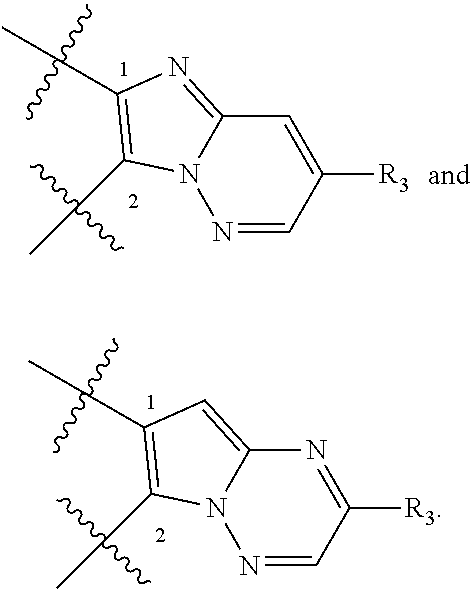

are as described in any one of (A-1′)—(B-12), and R1 is (CRCRC)0-2-phenyl substituted with one or more substituents as described herein.

are as described in any one of (A-1′)-(B-12), and R1 is (CRCRC)0-2-phenyl substituted with one, two, or three substituents as described herein.

are as described in any one of (A-1′)-(B-12), and R1 is (CRCRC)0-2-phenyl substituted with one, two, or three substituents selected from methyl, methoxy, CF3, F, and Cl.

are as described in any one of (A-1′)-(B-12), and R1 is phenyl substituted with one or more substituents as described herein.

are as described in any one of (A-1′)-(B-12), and R1 is phenyl substituted with one, two, or three substituents as described herein.

are as described in any one of (A-1′)-(B-12), and R1 is phenyl substituted with one, two, or three substituents selected from methyl, methoxy, CF3, F, and Cl.

are as described in any one of (A-1′)-(B-12), and R1 is CRCRC-phenyl substituted with one or more substituents as described herein.

are as described in any one of (A-1′)-(B-12), and R1 is CRCRC-phenyl substituted with one, two, or three substituents as described herein.

are as described in any one of (A-1′)-(B-12), and R1 is CRCRC-phenyl substituted with one, two, or three substituents selected from methyl, CF3, F, and Cl.

are as described in any one of (A-1′)-(B-12), and R1 is (CRCRC)0-2—C3-C6 cycloalkyl (e.g., cyclopropyl, cyclobutyl, cyclopentyl, cyclohexyl, bicyclobutanyl, bicyclopentanyl, or bicyclohexanyl) optionally substituted with one or more substituents as described herein.

are as described in any one of (A-1′)-(B-12), and R1 is (CRCRC)0-2—C3-C6 cycloalkyl (e.g., cyclopropyl, cyclobutyl, cyclopentyl, cyclohexyl, bicyclobutanyl, bicyclopentanyl, or bicyclohexanyl) optionally substituted with one, two, or three substituents as described herein.

are as described in any one of (A-1′)-(B-12), and R1 is (CRCRC)0-2—C3-C6 cycloalkyl (e.g., cyclopropyl, cyclobutyl, cyclopentyl, cyclohexyl, bicyclobutanyl, bicyclopentanyl, or bicyclohexanyl) optionally substituted with one, two, or three substituents selected from methy, methoxy, CF3, F, and Cl.

are as described in any one of (A-1′)-(B-12), and R1 is cyclohexyl or bicyclopentanyl, each of which is optionally substituted with one or more substituents as described herein.

are as described in any one of (A-1′)-(B-12), and R1 is cyclohexyl or bicyclopentanyl, each of which is optionally substituted with one, two, or three substituents as described herein.

are as described in any one of (A-1′)-(B-12), and R1 is cyclohexyl or bicyclopentanyl, each of which is optionally substituted with one, two, or three substituents selected from methyl, methoxy, CF3, F, and Cl.

are as described in any one of (A-1′)-(B-12), and R1 is (CRCRC)0-2-heteroaryl comprising one 5-membered ring and 1-3 heteroatoms selected from N, O, and S, optionally substituted as described herein.

are as described in any one of (A-1′)-(B-12), and R1 is heteroaryl comprising one 5-membered ring and 1-3 heteroatoms selected from N, O, and S, optionally substituted as described herein.

are as described in any one of (A-1′)-(B-12), and R1 is (CRCRC)0-2-heteroaryl comprising one 6-membered ring and 1-3 heteroatoms selected from N, O, and S, optionally substituted as described herein.

are as described in any one of (A-1′)-(B-12), and R1 is heteroaryl comprising one 6-membered ring and 1-3 heteroatoms selected from N, O, and S, optionally substituted as described herein.

and R1 are as described, as applicable, in any one of (A-1′)-(C-19), and R2 is heterocyclyl comprising one or two 5- or 6-membered rings and 1-3 heteroatoms selected from N, O, and S, optionally substituted with one or more substituents as described herein.

and R1 are as described, as applicable, in any one of (A-1′)-(C-19), and R2 is heterocyclyl comprising one 5-membered ring and 1-3 heteroatoms selected from N, O, and S, optionally substituted with one or more substituents as described herein.

and R1 are as described, as applicable, in any one of (A-1′)-(C-19), and R2 is heterocyclyl comprising one 6-membered ring and 1-3 heteroatoms selected from N, O, and S, optionally substituted with one or more substituents as described herein.

and R1 are as described, as applicable, in any one of (A-1′)-(C-19), and R2 is heteroaryl comprising one or two 5- or 6-membered rings and 1-3 heteroatoms selected from N, O, and S, optionally substituted with one or more substituents as described herein.

and R1 are as described, as applicable, in any one of (A-1′)-(C-19), and R2 is heteroaryl comprising one 5-membered ring and 1-3 heteroatoms selected from N, O, and S, optionally substituted with one or more substituents as described herein.

and R1 are as described, as applicable, in any one of (A-1′)-(C-19), and R2 is heteroaryl comprising one 6-membered ring and 1-3 heteroatoms selected from N, O, and S, optionally substituted with one or more substituents as described herein.

and R1 are as described, as applicable, in any one of (A-1′)-(C-19), and R2 is heteroaryl comprising two 5- or 6-membered rings and 1-3 heteroatoms selected from N, O, and S, optionally substituted with one or more substituents as described herein.

and R1 are as described, as applicable, in any one of (A-1′)-(C-19), and R2 is indazolyl or imidazopyridinyl, each of which is optionally substituted with one or more substituents as described herein.

and R1 are as described, as applicable, in any one of (A-1′)-(C-19), and R2 is spiro-, bridged-, or mono-C3-C10 cycloalkyl (e.g., cyclopropyl, cyclobutyl, cyclopentyl, cyclohexyl, cycloheptyl, cyclooctyl, each of which can be spiro-, bridged-, or mono-cycloalkyl) optionally substituted with one or more substituents as described herein.

and R1 are as described, as applicable, in any one of (A-1′)-(C-19), and R2 is bicyclooctanyl optionally substituted with one or more substituents as described herein.

and R1 are as described, as applicable, in any one of (A-1′)-(C-19), and R2 is phenyl optionally substituted with one or more substituents as described herein.

R1, and R2 are as described, as applicable, in any one of (A-1′)-(D-11), and at least one R3 is spiro-, bridged-, or mono-C3-C10 cycloalkyl (e.g., cyclopropyl, cyclobutyl, cyclopentyl, cyclohexyl, cycloheptyl, cyclooctyl, each of which can be spiro-, bridged-, or mono-cycloalkyl) optionally substituted with one or more substituents as described herein.

R1, and R2 are as described, as applicable, in any one of (A-1′)-(D-11), and at least one R3 is phenyl optionally substituted with one or more substituents as described herein.

R1, and R2 are as described, as applicable, in any one of (A-1′)-(D-11), and at least one R3 is heterocyclyl comprising one or two 3- to 6-membered rings and 1-3 heteroatoms selected from N, O, and S, optionally substituted with one or more substituents as described herein.

R1, and R2 are as described, as applicable, in any one of (A-1′)-(D-11), and at least one R3 is heterocyclyl comprising one 5- or 6-membered ring and 1-3 heteroatoms selected from N, O, and S, optionally substituted with one or more substituents as described herein.

R1, and R2 are as described, as applicable, in any one of (A-1′)-(D-11), and at least one R3 is heterocyclyl comprising one 5-membered ring and 1-3 heteroatoms selected from N, O, and S, optionally substituted with one or more substituents as described herein.

R1, and R2 are as described, as applicable, in any one of (A-1′)-(D-11), and at least one R3 is heterocyclyl comprising one 6-membered ring and 1-3 heteroatoms selected from N, O, and S, optionally substituted with one or more substituents as described herein.

R1, and R2 are as described, as applicable, in any one of (A-1′)-(D-11), and at least one R3 is tetrahydropyranyl optionally substituted with one or more substituents as described herein.

R1, and R2 are as described, as applicable, in any one of (A-1′)-(D-11), and at least one R3 is heteroaryl comprising one or two 5- or 6-membered rings and 1-3 heteroatoms selected from N, O, and S, optionally substituted with one or more substituents as described herein.

R1, and R2 are as described, as applicable, in any one of (A-1′)-(D-11), and at least one R3 is heteroaryl comprising one 5- or 6-membered ring and 1-3 heteroatoms selected from N, O, and S, optionally substituted with one or more substituents as described herein.

R1, and R2 are as described, as applicable, in any one of (A-1′)-(D-11), and at least one R3 is heteroaryl comprising one 5-membered ring and 1-3 heteroatoms selected from N, O, and S, optionally substituted with one or more substituents as described herein.

R1, and R2 are as described, as applicable, in any one of (A-1′)-(D-11), and at least one R3 is heteroaryl comprising one 6-membered ring and 1-3 heteroatoms selected from N, O, and S, optionally substituted with one or more substituents as described herein.

R1, and R2 are as described, as applicable, in any one of (A-1′)-(D-11), and at least one R3 is pyridyl optionally substituted with one or more substituents as described herein.

R1, R2, and R3 are as described, as applicable, in any one of (A-1′)-(E-12), and L is

and R5 and R6 are each H.

R1, R2, and R3 are as described, as applicable, in any one of (A-1′)-(E-12), and L is

and R5 and R6, together with the carbon atom to which they are attached, form C3-C6 cycloalkyl (e.g., cyclopropyl, cyclobutyl, cyclopentyl, or cyclohexyl) optionally substituted with one or more substituents as described herein.

R1, R2, and R3 are as described, as applicable, in any one of (A-1′)-(E-12), and L is

and R5 and R6, together with the carbon atom to which they are attached, form cyclopropyl optionally substituted with one or more substituents as described herein.

R1, R2, R3, R5, R6, and L are as described, as applicable, in any one of (A-1′)-(F-3), and T is heteroaryl comprising one 5- or 6-membered ring and 1-3 heteroatoms selected from N, O, and S, optionally substituted with one or more substituents as described herein.

R1, R2, R3, R5, R6, and L are as described, as applicable, in any one of (A-1′)-(F-3), and T is heteroaryl comprising one 5-membered ring and 1-3 heteroatoms selected from N, O, and S, optionally substituted with one or more substituents as described herein.

R1, R2, R3, R5, R6, and L are as described, as applicable, in any one of (A-1′)-(F-3), and T is heteroaryl comprising one 6-membered ring and 1-3 heteroatoms selected from N, O, and S, optionally substituted with one or more substituents as described herein.

R1, R2, R3, R5, R6, and L are as described, as applicable, in any one of (A-1′)-(F-3), and T is heteroaryl selected from oxazolyl, isoxazolyl, thiazolyl, isothiazolyl, oxadiazolyl, thiadiazolyl, oxadiazolonyl, and thiadiazolonyl, each of which is optionally substituted with one or more substituents as described herein.
| TABLE A | ||
| Cmpd | ||
| No. | Structure | Chemical name |
| 1 |
 |
(S)-3-(1-(6-(2,2-dimethylmorpholino)-2-(3-(3- (4-fluoro-1-methyl-1H-indazol-5-yl)-2-oxo-2,3- dihydro-1H-imidazol-1-yl)-2-(4-fluoro-3,5- dimethylphenyl)-4-methyl-4,5,6,7-tetrahydro- 2H-pyrazolo[4,3-c]pyridine-5- carbonyl)indolizin-1-yl)cyclopropyl)-1,2,4- oxadiazol-5(4H)-one |
| 2 |
 |
(S)-3-(1-(2-(3-(3-(4-fluoro-1-methyl-1H-indazol- 5-yl)-2-oxo-2,3-dihydro-1H-imidazol-1-yl)-2-(4- fluoro-3,5-dimethylphenyl)-4-methyl-4,5,6,7- tetrahydro-2H-pyrazolo[4,3-c]pyridine-5- carbonyl)-6-(2-(trifluoromethyl)pyridin-4- yl)indolizin-1-yl)cyclopropyl)-1,2,4-oxadiazol- 5(4H)-one |
| 3 |
 |
3-((1R,2S)-1-(6-((R)-2,2-dimethyltetrahydro-2H- pyran-4-yl)-2-((S)-3-(3-(4-fluoro-1-methyl-1H- indazol-5-yl)-2-oxo-2,3-dihydro-1H-imidazol-1- yl)-2-(4-fluoro-3,5-dimethylphenyl)-4-methyl- 4,5,6,7-tetrahydro-2H-pyrazolo[4,3-c]pyridine-5- carbonyl)indolizin-1-yl)-2-methylcyclopropyl)- 1,2,4-oxadiazol-5(4H)-one |
| 4 |
 |
3-((1R,2S)-1-(6-((S)-2,2-dimethyltetrahydro-2H- pyran-4-yl)-2-((S)-3-(3-(4-fluoro-1-methyl-1H- indazol-5-yl)-2-oxo-2,3-dihydro-1H-imidazol-1- yl)-2-(4-fluoro-3,5-dimethylphenyl)-4-methyl- 4,5,6,7-tetrahydro-2H-pyrazolo[4,3-c]pyridine-5- carbonyl)indolizin-1-yl)-2-methylcyclopropyl)- 1,2,4-oxadiazol-5(4H)-one |
| 5 |
 |
3-((1S,2S)-1-(6-((S)-2,2-dimethyltetrahydro-2H- pyran-4-yl)-2-((S)-3-(3-(4-fluoro-1-methyl-1H- indazol-5-yl)-2-oxo-2,3-dihydro-1H-imidazol-1- yl)-2-(4-fluoro-3,5-dimethylphenyl)-4-methyl- 4,5,6,7-tetrahydro-2H-pyrazolo[4,3-c]pyridine-5- carbonyl)indolizin-1-yl)-2-methylcyclopropyl)- 1,2,4-oxadiazol-5(4H)-one |
| 6 |
 |
3-((1S,2S)-1-(6-((R)-2,2-dimethyltetrahydro-2H- pyran-4-yl)-2-((S)-3-(3-(4-fluoro-1-methyl-1H- indazol-5-yl)-2-oxo-2,3-dihydro-1H-imidazol-1- yl)-2-(4-fluoro-3,5-dimethylphenyl)-4-methyl- 4,5,6,7-tetrahydro-2H-pyrazolo[4,3-c]pyridine-5- carbonyl)indolizin-1-yl)-2-methylcyclopropyl)- 1,2,4-oxadiazol-5(4H)-one |
| 7 |
 |
(S)-3-(1-(2-(3-(3-(4-fluoro-1-methyl-1H-indazol- 5-yl)-2-oxo-2,3-dihydro-1H-imidazol-1-yl)-2-(4- fluorophenyl)-4-methyl-4,5,6,7- tetrahydropyrazolo[1,5-a]pyrazine-5-carbonyl)- 5-(2-methylpyridin-4-yl)-1H-indol-1- yl)cyclopropyl)-1,2,4-oxadiazol-5(4H)-one |
| 8 |
 |
3-(1-(6-((R)-2,2-dimethyltetrahydro-2H-pyran-4- yl)-2-((S)-3-(3-(4-fluoro-1-methyl-1H-indazol-5- yl)-2-oxo-2,3-dihydro-1H-imidazol-1-yl)-4- methyl-2-(4-(trifluoromethyl)phenyl)-4,5,6,7- tetrahydro-2H-pyrazolo[4,3-c]pyridine-5- carbonyl)indolizin-1-yl)cyclopropyl)-1,2,4- oxadiazol-5(4H)-one |
| 9 |
 |
3-(1-(7-((S)-2,2-dimethyltetrahydro-2H-pyran-4 yl)-2-((S)-3-(3-(4-fluoro-1-methyl-1H-indazol-5 yl)-2-oxo-2,3-dihydro-1H-imidazol-1-yl)-2-(4- fluoro-3,5-dimethylphenyl)-4-methyl-4,5,6,7- tetrahydro-2H-pyrazolo[4,3-c]pyridine-5- carbonyl)indolizin-3-yl)cyclopropyl)-1,2,4- oxadiazol-5(4H)-one |
| 10 |
 |
3-(1-(7-((R)-2,2-dimethyltetrahydro-2H-pyran-4- yl)-2-((S)-3-(3-(4-fluoro-1-methyl-1H-indazol-5- yl)-2-oxo-2,3-dihydro-1H-imidazol-1-yl)-2-(4- fluoro-3,5-dimethylphenyl)-4-methyl-4,5,6,7- tetrahydro-2H-pyrazolo[4,3-c]pyridine-5- carbonyl)indolizin-3-yl)cyclopropyl)-1,2,4- oxadiazol-5(4H)-one |
| 11 |
 |
3-(1-(6-((R)-2,2-dimethyltetrahydro-2H-pyran-4- yl)-2-((S)-3-(3-(4-fluoro-1-methyl-1H-indazol-5- yl)-2-oxo-2,3-dihydro-1H-imidazol-1-yl)-2-(4- fluorophenyl)-4-methyl-4,5,6,7-tetrahydro-2H- pyrazolo[4,3-c]pyridine-5-carbonyl)indolizin-1- yl)cyclopropyl)-1,2,4-oxadiazol-5(4H)-one |
| 12 |
 |
3-(1-(2-((S)-2-(3-chloro-4-fluorophenyl)-3-(3-(4- fluoro-1-methyl-1H-indazol-5-yl)-2-oxo-2,3- dihydro-1H-imidazol-1-yl)-4-methyl-4,5,6,7- tetrahydro-2H-pyrazolo[4,3-c]pyridine-5- carbonyl)-6-((R)-2,2-dimethyltetrahydro-2H- pyran-4-yl)indolizin-1-yl)cyclopropyl)-1,2,4- oxadiazol-5(4H)-one |
| 13 |
 |
3-(1-(6-((R)-2,2-dimethyltetrahydro-2H-pyran-4- yl)-2-((S)-3-(3-(4-fluoro-1-methyl-1H-indazol-5- yl)-2-oxo-2,3-dihydro-1H-imidazol-1-yl)-2-(4- fluoro-3-methylphenyl)-4-methyl-4,5,6,7- tetrahydro-2H-pyrazolo[4,3-c]pyridine-5- carbonyl)indolizin-1-yl)cyclopropyl)-1,2,4- oxadiazol-5(4H)-one |
| 14 |
 |
3-(1-(6-((R)-2,2-dimethyltetrahydro-2H-pyran-4- yl)-2-((S)-3-(3-(4-fluoro-1-methyl-1H-indazol-5- yl)-2-oxo-2,3-dihydro-1H-imidazol-1-yl)-2-(4- fluorophenyl)-4-methyl-4,5,6,7- tetrahydropyrazolo[1,5-a]pyrazine-5- carbonyl)indolizin-1-yl)cyclopropyl)-1,2,4- oxadiazol-5(4H)-one |
| 15 |
 |
(S)-3-((2-(3-(3-(4-fluoro-1-methyl-1H-indazol-5- yl)-2-oxo-2,3-dihydro-1H-imidazol-1-yl)-2-(4- fluoro-3,5-dimethylphenyl)-4-methyl-4,5,6,7- tetrahydro-2H-pyrazolo[4,3-c]pyridine-5- carbonyl)-6-(2-(trifluoromethyl)pyridin-4- yl)indolizin-1-yl)methyl)-1,2,4-oxadiazol-5(4H)- one |
| 16 |
 |
3-(1-(6-((S)-2,2-dimethyltetrahydro-2H-pyran-4- yl)-2-((S)-2-(4-fluoro-3,5-dimethylphenyl)-3-(3- (imidazo[1,5-a]pyridin-7-yl)-2-oxo-2,3-dihydro- 1H-imidazol-1-yl)-4-methyl-4,5,6,7-tetrahydro- 2H-pyrazolo[4,3-c]pyridine-5- carbonyl)indolizin-1-yl)cyclopropyl)-1,2,4- oxadiazol-5(4H)-one |
| 17 |
 |
3-(1-(6-((R)-2,2-dimethyltetrahydro-2H-pyran-4- yl)-2-((S)-2-(4-fluoro-3,5-dimethylphenyl)-4- methyl-3-(3-(3-methylimidazo[1,5-a]pyridin-7- yl)-2-oxo-2,3-dihydro-1H-imidazol-1-yl)- 4,5,6,7-tetrahydro-2H-pyrazolo[4,3-c]pyridine-5- carbonyl)indolizin-1-yl)cyclopropyl)-1,2,4- oxadiazol-5(4H)-one |
| 18 |
 |
3-(1-(6-((S)-2,2-dimethyltetrahydro-2H-pyran-4- yl)-2-((S)-2-(4-fluoro-3,5-dimethylphenyl)-4- methyl-3-(3-(3-methylimidazo[1,5-a]pyridin-7- yl)-2-oxo-2,3-dihydro-1H-imidazol-1-yl)- 4,5,6,7-tetrahydro-2H-pyrazolo[4,3-c]pyridine-5- carbonyl)indolizin-1-yl)cyclopropyl)-1,2,4- oxadiazol-5(4H)-one |
| 19 |
 |
3-(1-(6-((R)-2,2-dimethyltetrahydro-2H-pyran-4- yl)-2-((S)-3-(3-(4-fluoro-1-methyl-1H-indazol-5- yl)-2-oxo-2,3-dihydro-1H-imidazol-1-yl)-2-(4- fluoro-3,5-dimethylphenyl)-4-methyl-4,5,6,7- tetrahydro-2H-pyrazolo[4,3-c]pyridine-5- carbonyl)indolizin-1-yl)cyclopropyl)-1,2,4- oxadiazol-5(4H)-one |
| 20 |
 |
3-(1-(6-((S)-2,2-dimethyltetrahydro-2H-pyran-4 yl)-2-((S)-3-(3-(4-fluoro-1-methyl-1H-indazol-5- yl)-2-oxo-2,3-dihydro-1H-imidazol-1-yl)-2-(4- fluoro-3,5-dimethylphenyl)-4-methyl-4,5,6,7- tetrahydro-2H-pyrazolo[4,3-c]pyridine-5- carbonyl)indolizin-1-yl)cyclopropyl)-1,2,4- oxadiazol-5(4H)-one |
| 21 |
 |
3-((6-((R)-2,2-dimethyltetrahydro-2H-pyran-4- yl)-2-((S)-3-(3-(4-fluoro-1-methyl-1H-indazol-5- yl)-2-oxo-2,3-dihydro-1H-imidazol-1-yl)-2-(4- fluoro-3,5-dimethylphenyl)-4-methyl-4,5,6,7- tetrahydro-2H-pyrazolo[4,3-c]pyridine-5- carbonyl)indolizin-1-yl)methyl)-1,2,4-oxadiazol- 5(4H)-one |
| 22 |
 |
3-((6-((S)-2,2-dimethyltetrahydro-2H-pyran-4- yl)-2-((S)-3-(3-(4-fluoro-1-methyl-1H-indazol-5 yl)-2-oxo-2,3-dihydro-1H-imidazol-1-yl)-2-(4- fluoro-3,5-dimethylphenyl)-4-methyl-4,5,6,7- tetrahydro-2H-pyrazolo[4,3-c]pyridine-5- carbonyl)indolizin-1-yl)methyl)-1,2,4-oxadiazol 5(4H)-one |
| 23 |
 |
3-(1-(2-(3-(3-(4-fluoro-1-methyl-1H-indazol-5- yl)-2-oxo-2,3-dihydro-1H-imidazol-1-yl)-2-(4- fluorophenyl)-4-methyl-4,5,6,7- tetrahydropyrazolo[1,5-a]pyrazine-5-carbonyl)- 6-(tetrahydro-2H-pyran-4-yl)indolizin-1- yl)cyclopropyl)-1,2,4-oxadiazol-5(4H)-one |
| 24 |
 |
3-(1-(5-((R)-2,2-dimethyltetrahydro-2H-pyran-4- yl)-2-((R)-3-(3-(4-fluoro-1-methyl-1H-indazol- 5-yl)-2-oxo-2,3-dihydro-1H-imidazol-1-yl)-2-(4- fluoro-3,5-dimethylphenyl)-4-methyl-4,5,6,7- tetrahydropyrazolo[1,5-a]pyrazine-5-carbonyl)- 1H-indol-1-yl)cyclopropyl)-1,2,4-oxadiazol- 5(4H)-one |
| 25 |
 |
3-(1-(5-((R)-2,2-dimethyltetrahydro-2H-pyran-4- yl)-2-((S)-3-(3-(4-fluoro-1-methyl-1H-indazol-5- yl)-2-oxo-2,3-dihydro-1H-imidazol-1-yl)-2-(4- fluoro-3,5-dimethylphenyl)-4-methyl-4,5,6,7- tetrahydropyrazolo[1,5-a]pyrazine-5-carbonyl)- 1H-indol-1-yl)cyclopropyl)-1,2,4-oxadiazol- 5(4H)-one |
| 26 |
 |
3-(1-(5-((R)-2,2-dimethyltetrahydro-2H-pyran-4- yl)-2-((S)-3-(3-(4-fluoro-1-methyl-1H-indazol-5- yl)-2-oxo-2,3-dihydro-1H-imidazol-1-yl)-2-(4- fluoro-3-methylphenyl)-4-methyl-4,5,6,7- tetrahydropyrazolo[1,5-a]pyrazine-5-carbonyl)- 1H-indol-1-yl)cyclopropyl)-1,2,4-oxadiazol- 5(4H)-one |
| 27 |
 |
3-(1-(5-((R)-2,2-dimethyltetrahydro-2H-pyran-4- yl)-2-((R)-3-(3-(4-fluoro-1-methyl-1H-indazol- 5-yl)-2-oxo-2,3-dihydro-1H-imidazol-1-yl)-2-(4- fluoro-3-methylphenyl)-4-methyl-4,5,6,7- tetrahydropyrazolo[1,5-a]pyrazine-5-carbonyl)- 1H-indol-1-yl)cyclopropyl)-1,2,4-oxadiazol- 5(4H)-one |
| 28 |
 |
3-(1-(5-((R)-2,2-dimethyltetrahydro-2H-pyran-4- yl)-2-(3-(3-(4-fluoro-1-methyl-1H-indazol-5-yl)- 2-oxo-2,3-dihydro-1H-imidazol-1-yl)-2-(4- methoxyphenyl)-4-methyl-4,5,6,7- tetrahydropyrazolo[1,5-a]pyrazine-5-carbonyl)- 1H-indol-1-yl)cyclopropyl)-1,2,4-oxadiazol- 5(4H)-one |
| 29 |
 |
3-(1-(5-((R)-2,2-dimethyltetrahydro-2H-pyran-4- yl)-2-((S)-2-(4-fluorophenyl)-3-(3-(4- (methoxymethyl)bicyclo[2.2.2]octan-1-yl)-2- oxo-2,3-dihydro-1H-imidazol-1-yl)-4-methyl- 4,5,6,7-tetrahydropyrazolo[1,5-a]pyrazine-5- carbonyl)-1H-indol-1-yl)cyclopropyl)-1,2,4- oxadiazol-5(4H)-one |
| 30 |
 |
3-(3-(5-(2,2-dimethyltetrahydro-2H-pyran-4-yl)- 2-((S)-3-(3-(4-fluoro-1-methyl-1H-indazol-5-yl)- 2-oxo-2,3-dihydro-1H-imidazol-1-yl)-2-(4- fluoro-3,5-dimethylphenyl)-4-methyl-4,5,6,7- tetrahydro-2H-pyrazolo[4,3-c]pyridine-5- carbonyl)-1H-indol-1-yl)phenyl)-1,2,4- oxadiazol-5(4H)-one |
| 31 |
 |
3-(1-(5-((S)-2,2-dimethyltetrahydro-2H-pyran-4- yl)-2-((S)-3-(3-(4-fluoro-1-methyl-1H-indazol-5- yl)-2-oxo-2,3-dihydro-1H-imidazol-1-yl)-2-(4- fluorophenyl)-4-methyl-4,5,6,7- tetrahydropyrazolo[1,5-a]pyrazine-5-carbonyl)- 1H-indol-1-yl)cyclopropyl)-1,2,4-oxadiazol- 5(4H)-one |
| 32 |
 |
3-(1-(5-((S)-2,2-dimethyltetrahydro-2H-pyran-4- yl)-2-((R)-3-(3-(4-fluoro-1-methyl-1H-indazol- 5-yl)-2-oxo-2,3-dihydro-1H-imidazol-1-yl)-2-(4- fluorophenyl)-4-methyl-4,5,6,7- tetrahydropyrazolo[1,5-a]pyrazine-5-carbonyl)- 1H-indol-1-yl)cyclopropyl)-1,2,4-oxadiazol- 5(4H)-one |
| 33 |
 |
3-(1-(5-((R)-2,2-dimethyltetrahydro-2H-pyran-4- yl)-2-((S)-3-(3-(4-fluoro-1-methyl-1H-indazol-5- yl)-2-oxo-2,3-dihydro-1H-imidazol-1-yl)-2-(4- fluorophenyl)-4-methyl-4,5,6,7- tetrahydropyrazolo[1,5-a]pyrazine-5-carbonyl)- 1H-indol-1-yl)cyclopropyl)-1,2,4-oxadiazol- 5(4H)-one |
| 34 |
 |
3-(1-(5-((R)-2,2-dimethyltetrahydro-2H-pyran-4- yl)-2-((R)-3-(3-(4-fluoro-1-methyl-1H-indazol- 5-yl)-2-oxo-2,3-dihydro-1H-imidazol-1-yl)-2-(4- fluorophenyl)-4-methyl-4,5,6,7- tetrahydropyrazolo[1,5-a]pyrazine-5-carbonyl)- 1H-indol-1-yl)cyclopropyl)-1,2,4-oxadiazol- 5(4H)-one |
| 35 |
 |
1-(5-(5-(2,2-dimethyltetrahydro-2H-pyran-4-yl)- 1-((5-hydroxy-1,3,4-thiadiazol-2-yl)methyl)-1H- indole-2-carbonyl)-2-(4-fluoro-3,5- dimethylphenyl)-4,5,6,7-tetrahydro-2H- pyrazolo[4,3-c]pyridin-3-yl)-3-(4-fluoro-1- methyl-1H-indazol-5-yl)-1,3-dihydro-2H- imidazol-2-one |
| 36 |
 |
1-(5-(5-(2,2-dimethyltetrahydro-2H-pyran-4-yl)- 1-((3-hydroxyisoxazol-5-yl)methyl)-1H-indole- 2-carbonyl)-2-(4-fluoro-3,5-dimethylphenyl)- 4,5,6,7-tetrahydro-2H-pyrazolo[4,3-c]pyridin-3- yl)-3-(4-fluoro-1-methyl-1H-indazol-5-yl)-1,3- dihydro-2H-imidazol-2-one |
| 37 |
 |
3-(2-(2-(3-(3-(4-fluoro-1-methyl-1H-indazol-5- yl)-2-oxo-2,3-dihydro-1H-imidazol-1-yl)-2-(4- fluoro-3,5-dimethylphenyl)-4,5,6,7-tetrahydro- 2H-pyrazolo[4,3-c]pyridine-5-carbonyl)-5- (tetrahydro-2H-pyran-4-yl)-1H-indol-1- yl)phenyl)-1,2,4-oxadiazol-5(4H)-one |
| 38 |
 |
3-(1-(5-((R)-2,2-dimethyltetrahydro-2H-pyran-4- yl)-2-((S)-3-(3-(4-fluoro-1-methyl-1H-indazol-5- yl)-2-oxo-2,3-dihydro-1H-imidazol-1-yl)-2-((R)- 1-(4-fluorophenyl)ethyl)-4-methyl-4,5,6,7- tetrahydro-2H-pyrazolo[4,3-c]pyridine-5- carbonyl)-1H-indol-1-yl)cyclopropyl)-1,2,4- oxadiazol-5(4H)-one |
| 39 |
 |
3-(1-(5-((S)-2,2-dimethyltetrahydro-2H-pyran-4- yl)-2-((S)-3-(3-(4-fluoro-1-methyl-1H-indazol-5- yl)-2-oxo-2,3-dihydro-1H-imidazol-1-yl)-2-((S)- 1-(4-fluorophenyl)ethyl)-4-methyl-4,5,6,7- tetrahydro-2H-pyrazolo[4,3-c]pyridine-5- carbonyl)-1H-indol-1-yl)cyclopropyl)-1,2,4- oxadiazol-5(4H)-one |
| 40 |
 |
3-(1-(5-((R)-2,2-dimethyltetrahydro-2H-pyran-4- yl)-2-((S)-3-(3-(4-fluoro-1-methyl-1H-indazol-5- yl)-2-oxo-2,3-dihydro-1H-imidazol-1-yl)-2-((S)- 1-(4-fluorophenyl)ethyl)-4-methyl-4,5,6,7- tetrahydro-2H-pyrazolo[4,3-c]pyridine-5- carbonyl)-1H-indol-1-yl)cyclopropyl)-1,2,4- oxadiazol-5(4H)-one |
| 41 |
 |
3-(1-(5-((S)-2,2-dimethyltetrahydro-2H-pyran-4- yl)-2-((S)-3-(3-(4-fluoro-1-methyl-1H-indazol-5- yl)-2-oxo-2,3-dihydro-1H-imidazol-1-yl)-2-((R)- 1-(4-fluorophenyl)ethyl)-4-methyl-4,5,6,7- tetrahydro-2H-pyrazolo[4,3-c]pyridine-5- carbonyl)-1H-indol-1-yl)cyclopropyl)-1,2,4- oxadiazol-5(4H)-one |
| 42 |
 |
1-(5-(5-(2,2-dimethyltetrahydro-2H-pyran-4-yl)- 1-((3-hydroxyisothiazol-5-yl)methyl)-1H-indole- 2-carbonyl)-2-(4-fluoro-3,5-dimethylphenyl)- 4,5,6,7-tetrahydro-2H-pyrazolo[4,3-c]pyridin-3- yl)-3-(4-fluoro-1-methyl-1H-indazol-5-yl)-1,3- dihydro-2H-imidazol-2-one |
| 43 |
 |
3-(1-(2-((S)-2-(4,4-difluorocyclohexyl)-3-(3-(4- fluoro-1-methyl-1H-indazol-5-yl)-2-oxo-2,3- dihydro-1H-imidazol-1-yl)-4-methyl-4,5,6,7- tetrahydro-2H-pyrazolo[4,3-c]pyridine-5- carbonyl)-5-((S)-2,2-dimethyltetrahydro-2H- pyran-4-yl)-1H-indol-1-yl)cyclopropyl)-1,2,4- oxadiazol-5(4H)-one |
| 44 |
 |
3-(1-(2-((S)-2-(4,4-difluorocyclohexyl)-3-(3-(4- fluoro-1-methyl-1H-indazol-5-yl)-2-oxo-2,3- dihydro-1H-imidazol-1-yl)-4-methyl-4,5,6,7- tetrahydro-2H-pyrazolo[4,3-c]pyridine-5- carbonyl)-5-((R)-2,2-dimethyltetrahydro-2H- pyran-4-yl)-1H-indol-1-yl)cyclopropyl)-1,2,4- oxadiazol-5(4H)-one |
| 45 |
 |
1-((S)-5-(5-((S)-2,2-dimethyltetrahydro-2H- pyran-4-yl)-1-((2-hydroxythiazol-5-yl)methyl)- 1H-indole-2-carbonyl)-2-(4-fluoro-3,5- dimethylphenyl)-4-methyl-4,5,6,7-tetrahydro- 2H-pyrazolo[4,3-c]pyridin-3-yl)-3-(4-fluoro-1- methyl-1H-indazol-5-yl)-1,3-dihydro-2H- imidazol-2-one |
| 46 |
 |
1-((S)-5-(5-((R)-2,2-dimethyltetrahydro-2H- pyran-4-yl)-1-((2-hydroxythiazol-5-yl)methyl)- 1H-indole-2-carbonyl)-2-(4-fluoro-3,5- dimethylphenyl)-4-methyl-4,5,6,7-tetrahydro- 2H-pyrazolo[4,3-c]pyridin-3-yl)-3-(4-fluoro-1- methyl-1H-indazol-5-yl)-1,3-dihydro-2H- imidazol-2-one |
| 47 |
 |
1-((4S)-5-(5-(2,2-dimethyltetrahydro-2H-pyran- 4-yl)-1-(1-(5-hydroxy-1,3,4-thiadiazol-2- yl)cyclopropyl)-1H-indole-2-carbonyl)-2-(4- fluoro-3,5-dimethylphenyl)-4-methyl-4,5,6,7- tetrahydro-2H-pyrazolo[4,3-c]pyridin-3-yl)-3-(4- fluoro-1-methyl-1H-indazol-5-yl)-1,3-dihydro- 2H-imidazol-2-one |
| 48 |
 |
1-((4S)-5-(5-(2,2-dimethyltetrahydro-2H-pyran- 4-yl)-1-(1-(3-hydroxy-1,2,4-thiadiazol-5- yl)cyclopropyl)-1H-indole-2-carbonyl)-2-(4- fluoro-3,5-dimethylphenyl)-4-methyl-4,5,6,7- tetrahydro-2H-pyrazolo[4,3-c]pyridin-3-yl)-3-(4- fluoro-1-methyl-1H-indazol-5-yl)-1,3-dihydro- 2H-imidazol-2-one |
| 49 |
 |
3-(1-(2-((R)-2-(3-chloro-4-fluorophenyl)-3-(3- (4-fluoro-1-methyl-1H-indazol-5-yl)-2-oxo-2,3- dihydro-1H-imidazol-1-yl)-4-methyl-4,5,6,7- tetrahydropyrazolo[1,5-a]pyrazine-5-carbonyl)- 5-((R)-2,2-dimethyltetrahydro-2H-pyran-4-yl)- 1H-indol-1-yl)cyclopropyl)-1,2,4-oxadiazol- 5(4H)-one |
| 50 |
 |
3-(1-(2-((S)-2-(3-chloro-4-fluorophenyl)-3-(3-(4- fluoro-1-methyl-1H-indazol-5-yl)-2-oxo-2,3- dihydro-1H-imidazol-1-yl)-4-methyl-4,5,6,7- tetrahydropyrazolo[1,5-a]pyrazine-5-carbonyl)- 5-((R)-2,2-dimethyltetrahydro-2H-pyran-4-yl)- 1H-indol-1-yl)cyclopropyl)-1,2,4-oxadiazol- 5(4H)-one |
| 51 |
 |
3-(1-(2-((R)-2-(3,5-dichloro-4-fluorophenyl)-3- (3-(4-fluoro-1-methyl-1H-indazol-5-yl)-2-oxo- 2,3-dihydro-1H-imidazol-1-yl)-4-methyl-4,5,6,7- tetrahydropyrazolo[1,5-a]pyrazine-5-carbonyl)- 5-((R)-2,2-dimethyltetrahydro-2H-pyran-4-yl)- 1H-indol-1-yl)cyclopropyl)-1,2,4-oxadiazol- 5(4H)-one |
| 52 |
 |
3-(1-(2-((S)-2-(3,5-dichloro-4-fluorophenyl)-3- (3-(4-fluoro-1-methyl-1H-indazol-5-yl)-2-oxo- 2,3-dihydro-1H-imidazol-1-yl)-4-methyl-4,5,6,7- tetrahydropyrazolo[1,5-a]pyrazine-5-carbonyl)- 5-((R)-2,2-dimethyltetrahydro-2H-pyran-4-yl)- 1H-indol-1-yl)cyclopropyl)-1,2,4-oxadiazol- 5(4H)-one |
| 53 |
 |
(S)-3-((2-(2-(4-fluorophenyl)-3-(3-(4- (methoxymethyl)bicyclo[2.2.2]octan-1-yl)-2- oxo-2,3-dihydro-1H-imidazol-1-yl)-4-methyl- 4,5,6,7-tetrahydropyrazolo[1,5-a]pyrazine-5- carbonyl)-5-(tetrahydro-2H-pyran-4-yl)-1H- indol-1-yl)methyl)-1,2,4-oxadiazol-5(4H)-one |
| 54 |
 |
2-(5-(2,2-dimethyltetrahydro-2H-pyran-4-yl)-2- ((S)-3-(3-(4-fluoro-1-methyl-1H-indazol-5-yl)-2- oxo-2,3-dihydro-1H-imidazol-1-yl)-2-(4-fluoro- 3,5-dimethylphenyl)-4-methyl-4,5,6,7- tetrahydro-2H-pyrazolo[4,3-c]pyridine-5- carbonyl)-1H-indol-1-yl)benzoic acid |
| 55 |
 |
2-(2-(3-(3-(4-fluoro-1-methyl-1H-indazol-5-yl)- 2-oxo-2,3-dihydro-1H-imidazol-1-yl)-2-(4- fluorophenyl)-4,5,6,7-tetrahydropyrazolo[1,5- a]pyrazine-5-carbonyl)-5-(tetrahydro-2H-pyran- 4-yl)-1H-indol-1-yl)benzoic acid |
| 56 |
 |
(S)-3-(2-(3-(3-(4-fluoro-1-methyl-1H-indazol-5- yl)-2-oxo-2,3-dihydro-1H-imidazol-1-yl)-2-(4- fluoro-3,5-dimethylphenyl)-4-methyl-4,5,6,7- tetrahydro-2H-pyrazolo[4,3-c]pyridine-5- carbonyl)-5-(tetrahydro-2H-pyran-4-yl)-1H- indol-1-yl)benzoic acid |
| 57 |
 |
(S)-2-(2-(2-(4-fluoro-3,5-dimethylphenyl)-3-(3- (4-(methoxymethyl)phenyl)-2-oxo-2,3-dihydro- 1H-imidazol-1-yl)-4-methyl-4,5,6,7-tetrahydro- 2H-pyrazolo[4,3-c]pyridine-5-carbonyl)-5- (tetrahydro-2H-pyran-4-yl)-1H-indol-1- yl)benzoic acid |
| 58 |
 |
3-((2-(3-(3-(4-fluoro-1-methyl-1H-indazol-5-yl)- 2-oxo-2,3-dihydro-1H-imidazol-1-yl)-2-(4- fluorophenyl)-4,5,6,7-tetrahydropyrazolo[1,5- a]pyrazine-5-carbonyl)-5-(2-methylpyridin-4- yl)-1H-indol-1-yl)methyl)-1,2,4-oxadiazol- 5(4H)-one |
| 59 |
 |
1-(5-(1-(1H-benzo[d][1,2,3]triazol-4-yl)-5- (tetrahydro-2H-pyran-4-yl)-1H-indole-2- carbonyl)-2-(4-fluoro-3,5-dimethylphenyl)- 4,5,6,7-tetrahydro-2H-pyrazolo[4,3-c]pyridin-3- yl)-3-(4-fluoro-1-methyl-1H-indazol-5-yl)-1,3- dihydro-2H-imidazol-2-one |
| 60 |
 |
3-(1-(2-((S)-2-(bicyclo[1.1.1]pentan-1-yl)-3-(3- (4-fluoro-1-methyl-1H-indazol-5-yl)-2-oxo-2,3- dihydro-1H-imidazol-1-yl)-4-methyl-4,5,6,7- tetrahydro-2H-pyrazolo[4,3-c]pyridine-5- carbonyl)-5-((S)-2,2-dimethyltetrahydro-2H- pyran-4-yl)-1H-indol-1-yl)cyclopropyl)-1,2,4- oxadiazol-5(4H)-one |
| 61 |
 |
3-(1-(2-((S)-2-(bicyclo[1.1.1]pentan-1-yl)-3-(3- (4-fluoro-1-methyl-1H-indazol-5-yl)-2-oxo-2,3- dihydro-1H-imidazol-1-yl)-4-methyl-4,5,6,7- tetrahydro-2H-pyrazolo[4,3-c]pyridine-5- carbonyl)-5-((R)-2,2-dimethyltetrahydro-2H- pyran-4-yl)-1H-indol-1-yl)cyclopropyl)-1,2,4- oxadiazol-5(4H)-one |
| 62 |
 |
3-((1S,2S)-1-(5-((R)-2,2-dimethyltetrahydro-2H- pyran-4-yl)-2-((S)-2-(4-fluorophenyl)-3-(3-(4- (methoxymethyl)bicyclo[2.2.2]octan-1-yl)-2- oxo-2,3-dihydro-1H-imidazol-1-yl)-4-methyl- 4,5,6,7-tetrahydropyrazolo[1,5-a]pyrazine-5- carbonyl)-1H-indol-1-yl)-2-methylcyclopropyl)- 1,2,4-oxadiazol-5(4H)-one |
| 63 |
 |
3-((1S,2S)-1-(5-((S)-2,2-dimethyltetrahydro-2H- pyran-4-yl)-2-((S)-2-(4-fluorophenyl)-3-(3-(4- (methoxymethyl)bicyclo[2.2.2]octan-1-yl)-2- oxo-2,3-dihydro-1H-imidazol-1-yl)-4-methyl- 4,5,6,7-tetrahydropyrazolo[1,5-a]pyrazine-5- carbonyl)-1H-indol-1-yl)-2-methylcyclopropyl)- 1,2,4-oxadiazol-5(4H)-one |
| 64 |
 |
N-((1-(5-(2,2-dimethyltetrahydro-2H-pyran-4- yl)-2-((S)-3-(3-(4-fluoro-1-methyl-1H-indazol-5- yl)-2-oxo-2,3-dihydro-1H-imidazol-1-yl)-2-(4- fluoro-3,5-dimethylphenyl)-4-methyl-4,5,6,7- tetrahydro-2H-pyrazolo[4,3-c]pyridine-5- carbonyl)-1H-indol-1- yl)cyclopropyl)methyl)methanesulfonamide |
| 65 |
 |
3-(1-(5-((R)-2,2-dimethyltetrahydro-2H-pyran-4- yl)-2-((S)-3-(3-(4-fluoro-1-methyl-1H-indazol-5- yl)-2-oxo-2,3-dihydro-1H-imidazol-1-yl)-2-(4- fluoro-3-(trifluoromethyl)phenyl)-4-methyl- 4,5,6,7-tetrahydropyrazolo[1,5-a]pyrazine-5- carbonyl)-1H-indol-1-yl)cyclopropyl)-1,2,4- oxadiazol-5(4H)-one |
| 66 |
 |
3-(1-(5-((R)-2,2-dimethyltetrahydro-2H-pyran-4- yl)-2-((R)-3-(3-(4-fluoro-1-methyl-1H-indazol- 5-yl)-2-oxo-2,3-dihydro-1H-imidazol-1-yl)-2-(4- fluoro-3-(trifluoromethyl)phenyl)-4-methyl- 4,5,6,7-tetrahydropyrazolo[1,5-a]pyrazine-5- carbonyl)-1H-indol-1-yl)cyclopropyl)-1,2,4- oxadiazol-5(4H)-one |
| 67 |
 |
3-(1-(2-((S)-2-(3-chloro-4-fluorophenyl)-3-(3-(4- fluoro-1-methyl-1H-indazol-5-yl)-2-oxo-2,3- dihydro-1H-imidazol-1-yl)-4-methyl-4,5,6,7- tetrahydro-2H-pyrazolo[4,3-c]pyridine-5- carbonyl)-7-((R)-2,2-dimethyltetrahydro-2H- pyran-4-yl)indolizin-3-yl)cyclopropyl)-1,2,4- oxadiazol-5(4H)-one |
| 68 |
 |
3-(1-(7-((R)-2,2-dimethyltetrahydro-2H-pyran-4- yl)-2-((R)-3-(3-(4-fluoro-1-methyl-1H-indazol- 5-yl)-2-oxo-2,3-dihydro-1H-imidazol-1-yl)-2-(4- fluoro-3,5-dimethylphenyl)-4-methyl-4,5,6,7- tetrahydropyrazolo[1,5-a]pyrazine-5- carbonyl)indolizin-3-yl)cyclopropyl)-1,2,4- oxadiazol-5(4H)-one |
| 69 |
 |
3-(1-(6-((R)-2,2-dimethyltetrahydro-2H-pyran-4- yl)-2-((R)-3-(3-(4-fluoro-1-methyl-1H-indazol- 5-yl)-2-oxo-2,3-dihydro-1H-imidazol-1-yl)-2-(4- fluoro-3,5-dimethylphenyl)-4-methyl-4,5,6,7- tetrahydropyrazolo[1,5-a]pyrazine-5- carbonyl)indolizin-1-yl)cyclopropyl)-1,2,4- oxadiazol-5(4H)-one |
| 70 |
 |
3-(1-(2-((S)-2-(3,4-difluorophenyl)-3-(3-(4- fluoro-1-methyl-1H-indazol-5-yl)-2-oxo-2,3- dihydro-1H-imidazol-1-yl)-4-methyl-4,5,6,7- tetrahydro-2H-pyrazolo[4,3-c]pyridine-5- carbonyl)-6-((R)-2,2-dimethyltetrahydro-2H- pyran-4-yl)indolizin-1-yl)cyclopropyl)-1,2,4- oxadiazol-5(4H)-one |
| 71 |
 |
3-(1-(6-((R)-2,2-dimethyltetrahydro-2H-pyran-4- yl)-2-((S)-3-(3-(4-fluoro-1-methyl-1H-indazol-5- yl)-2-oxo-2,3-dihydro-1H-imidazol-1-yl)-2-(4- fluoro-3-(trifluoromethyl)phenyl)-4-methyl- 4,5,6,7-tetrahydro-2H-pyrazolo[4,3-c]pyridine-5- carbonyl)indolizin-1-yl)cyclopropyl)-1,2,4- oxadiazol-5(4H)-one |
| 72 |
 |
3-(1-(7-((R)-2,2-dimethyltetrahydro-2H-pyran-4- yl)-2-((S)-3-(3-(4-fluoro-1-methyl-1H-indazol-5- yl)-2-oxo-2,3-dihydro-1H-imidazol-1-yl)-4- methyl-2-(3,4,5-trifluorophenyl)-4,5,6,7- tetrahydro-2H-pyrazolo[4,3-c]pyridine-5- carbonyl)indolizin-3-yl)cyclopropyl)-1,2,4- oxadiazol-5(4H)-one |
| 73 |
 |
3-(1-(2-((S)-2-(3-cyclopropyl-4-fluorophenyl)-3- (3-(4-fluoro-1-methyl-1H-indazol-5-yl)-2-oxo- 2,3-dihydro-1H-imidazol-1-yl)-4-methyl-4,5,6,7- tetrahydro-2H-pyrazolo[4,3-c]pyridine-5- carbonyl)-7-((R)-2,2-dimethyltetrahydro-2H- pyran-4-yl)indolizin-3-yl)cyclopropyl)-1,2,4- oxadiazol-5(4H)-one |
| 74 |
 |
3-(1-(7-((R)-2,2-dimethyltetrahydro-2H-pyran-4- yl)-2-((S)-3-(3-(4-fluoro-1-methyl-1H-indazol-5- yl)-2-oxo-2,3-dihydro-1H-imidazol-1-yl)-2-(4- fluoro-3-(trifluoromethyl)phenyl)-4-methyl- 4,5,6,7-tetrahydro-2H-pyrazolo[4,3-c]pyridine-5- carbonyl)indolizin-3-yl)cyclopropyl)-1,2,4- oxadiazol-5(4H)-one |
| 75 |
 |
3-(1-(6-((R)-2,2-dimethyltetrahydro-2H-pyran-4- yl)-2-((S)-3-(3-(4-fluoro-1-methyl-1H-indazol-5- yl)-2-oxo-2,3-dihydro-1H-imidazol-1-yl)-4- methyl-2-(3,4,5-trifluorophenyl)-4,5,6,7- tetrahydro-2H-pyrazolo[4,3-c]pyridine-5- carbonyl)indolizin-1-yl)cyclopropyl)-1,2,4- oxadiazol-5(4H)-one |
| 76 |
 |
3-(1-(2-((S)-2-(3-cyclopropyl-4-fluorophenyl)-3- (3-(4-fluoro-1-methyl-1H-indazol-5-yl)-2-oxo- 2,3-dihydro-1H-imidazol-1-yl)-4-methyl-4,5,6,7- tetrahydro-2H-pyrazolo[4,3-c]pyridine-5- carbonyl)-6-((R)-2,2-dimethyltetrahydro-2H- pyran-4-yl)indolizin-1-yl)cyclopropyl)-1,2,4- oxadiazol-5(4H)-one |
| 77 |
 |
3-(1-(7-((R)-2,2-dimethyltetrahydro-2H-pyran-4- yl)-2-((S)-3-(3-(4-fluoro-1-methyl-1H-indazol-5- yl)-2-oxo-2,3-dihydro-1H-imidazol-1-yl)-2-(4- fluoro-3-methylphenyl)-4-methyl-4,5,6,7- tetrahydro-2H-pyrazolo[4,3-c]pyridine-5- carbonyl)indolizin-3-yl)cyclopropyl)-1,2,4- oxadiazol-5(4H)-one |
| 78 |
 |
3-(1-(2-((S)-2-(3,4-difluorophenyl)-3-(3-(4- fluoro-1-methyl-1H-indazol-5-yl)-2-oxo-2,3- dihydro-1H-imidazol-1-yl)-4-methyl-4,5,6,7- tetrahydro-2H-pyrazolo[4,3-c]pyridine-5- carbonyl)-7-((R)-2,2-dimethyltetrahydro-2H- pyran-4-yl)indolizin-3-yl)cyclopropyl)-1,2,4- oxadiazol-5(4H)-one |
| 79 |
 |
3-(1-(6-((R)-2,2-dimethyltetrahydro-2H-pyran-4- yl)-2-((S)-2-(4-fluoro-3,5-dimethylphenyl)-4- methyl-3-(3-(3-methyl-[1,2,4]triazolo[4,3- a]pyridin-7-yl)-2-oxo-2,3-dihydro-1H-imidazol- 1-yl)-4,5,6,7-tetrahydro-2H-pyrazolo[4,3- c]pyridine-5-carbonyl)indolizin-1- yl)cyclopropyl)-1,2,4-oxadiazol-5(4H)-one |
| 80 |
 |
3-(1-(6-((R)-2,2-dimethyltetrahydro-2H-pyran-4- yl)-2-((S)-3-(3-(4-fluoro-1-methyl-1H-indazol-5- yl)-2-oxo-2,3-dihydro-1H-imidazol-1-yl)-2-(4- fluoro-3-(trifluoromethoxy)phenyl)-4-methyl- 4,5,6,7-tetrahydro-2H-pyrazolo[4,3-c]pyridine-5- carbonyl)indolizin-1-yl)cyclopropyl)-1,2,4- oxadiazol-5(4H)-one |
| 81 |
 |
3-(1-(7-((R)-2,2-dimethyltetrahydro-2H-pyran-4- yl)-2-((S)-3-(3-(4-fluoro-1-methyl-1H-indazol-5- yl)-2-oxo-2,3-dihydro-1H-imidazol-1-yl)-2-(4- fluoro-3-(trifluoromethoxy)phenyl)-4-methyl- 4,5,6,7-tetrahydro-2H-pyrazolo[4,3-c]pyridine-5- carbonyl)indolizin-3-yl)cyclopropyl)-1,2,4- oxadiazol-5(4H)-one |
| 82 |
 |
3-(1-(6-((S)-2,2-dimethyltetrahydro-2H-pyran-4 yl)-2-((S)-3-(3-(4-fluoro-1-methyl-1H-indazol-5 yl)-2-oxo-2,3-dihydro-1H-imidazol-1-yl)-2-(4- fluoro-3,5-dimethylphenyl)-4-methyl-4,5,6,7- tetrahydro-2H-pyrazolo[4,3-c]pyridine-5- carbonyl)pyrazolo[1,5-a]pyridin-3- yl)cyclopropyl)-1,2,4-oxadiazol-5(4H)-one |
| 83 |
 |
3-(1-(6-((R)-2,2-dimethyltetrahydro-2H-pyran-4- yl)-2-((S)-3-(3-(4-fluoro-1-methyl-1H-indazol-5- yl)-2-oxo-2,3-dihydro-1H-imidazol-1-yl)-2-(4- fluoro-3,5-dimethylphenyl)-4-methyl-4,5,6,7- tetrahydro-2H-pyrazolo[4,3-c]pyridine-5- carbonyl)pyrazolo[1,5-a]pyridin-3- yl)cyclopropyl)-1,2,4-oxadiazol-5(4H)-one |
| 84 |
 |
3-(1-(2-((S)-2-(3-cyclopropyl-4-fluorophenyl)-3- (3-(4-fluoro-1-methyl-1H-indazol-5-yl)-2-oxo- 2,3-dihydro-1H-imidazol-1-yl)-4-methyl-4,5,6,7- tetrahydro-2H-pyrazolo[4,3-c]pyridine-5- carbonyl)-6-((R)-2,2-dimethyltetrahydro-2H- pyran-4-yl)pyrazolo[1,5-a]pyridin-3- yl)cyclopropyl)-1,2,4-oxadiazol-5(4H)-one |
| 85 |
 |
3-(1-(3-chloro-2-((S)-2-(3-cyclopropyl-4- fluorophenyl)-3-(3-(4-fluoro-1-methyl-1H- indazol-5-yl)-2-oxo-2,3-dihydro-1H-imidazol-1- yl)-4-methyl-4,5,6,7-tetrahydro-2H- pyrazolo[4,3-c]pyridine-5-carbonyl)-6-((R)-2,2- dimethyltetrahydro-2H-pyran-4-yl)indolizin-1- yl)cyclopropyl)-1,2,4-oxadiazol-5(4H)-one |
| 86 |
 |
3-(1-(2-((S)-3-(3-(4-fluoro-1-methyl-1H-indazol- 5-yl)-2-oxo-2,3-dihydro-1H-imidazol-1-yl)-2-(4- fluoro-3,5-dimethylphenyl)-4-methyl-4,5,6,7- tetrahydro-2H-pyrazolo[4,3-c]pyridine-5- carbonyl)-6-((S)-4-oxaspiro[2.5]octan-7- yl)indolizin-1-yl)cyclopropyl)-1,2,4-oxadiazol- 5(4H)-one |
| 87 |
 |
3-(1-(2-((S)-3-(3-(4-fluoro-1-methyl-1H-indazol- 5-yl)-2-oxo-2,3-dihydro-1H-imidazol-1-yl)-2-(4- fluoro-3,5-dimethylphenyl)-4-methyl-4,5,6,7- tetrahydro-2H-pyrazolo[4,3-c]pyridine-5- carbonyl)-6-((R)-4-oxaspiro[2.5]octan-7- yl)indolizin-1-yl)cyclopropyl)-1,2,4-oxadiazol- 5(4H)-one |
| 88 |
 |
3-(1-(1-chloro-2-((S)-2-(3-cyclopropyl-4- fluorophenyl)-3-(3-(4-fluoro-1-methyl-1H- indazol-5-yl)-2-oxo-2,3-dihydro-1H-imidazol-1- yl)-4-methyl-4,5,6,7-tetrahydro-2H- pyrazolo[4,3-c]pyridine-5-carbonyl)-7-((R)-2,2- dimethyltetrahydro-2H-pyran-4-yl)indolizin-3- yl)cyclopropyl)-1,2,4-oxadiazol-5(4H)-one |
| 89 |
 |
3-(1-(6-((S)-2-(3-cyclopropyl-4-fluorophenyl)-3- (3-(4-fluoro-1-methyl-1H-indazol-5-yl)-2-oxo- 2,3-dihydro-1H-imidazol-1-yl)-4-methyl-4,5,6,7- tetrahydro-2H-pyrazolo[4,3-c]pyridine-5- carbonyl)-2-((S)-2,2-dimethyltetrahydro-2H- pyran-4-yl)pyrrolo[1,2-b]pyridazin-5- yl)cyclopropyl)-1,2,4-oxadiazol-5(4H)-one |
| 90 |
 |
3-(1-(6-((S)-2-(3-cyclopropyl-4-fluorophenyl)-3- (3-(4-fluoro-1-methyl-1H-indazol-5-yl)-2-oxo- 2,3-dihydro-1H-imidazol-1-yl)-4-methyl-4,5,6,7- tetrahydro-2H-pyrazolo[4,3-c]pyridine-5- carbonyl)-2-((R)-2,2-dimethyltetrahydro-2H- pyran-4-yl)pyrrolo[1,2-b]pyridazin-5- yl)cyclopropyl)-1,2,4-oxadiazol-5(4H)-one |
| 91 |
 |
3-(1-(2-((S)-2-(3-cyclopropyl-4-fluorophenyl)-3- (3-(4-fluoro-1-methyl-1H-indazol-5-yl)-2-oxo- 2,3-dihydro-1H-imidazol-1-yl)-4-methyl-4,5,6,7- tetrahydro-2H-pyrazolo[4,3-c]pyridine-5- carbonyl)-6-((S)-2,2-dimethyltetrahydro-2H- pyran-4-yl)-8-fluoroindolizin-1-yl)cyclopropyl)- 1,2,4-oxadiazol-5(4H)-one |
| 92 |
 |
3-(1-(2-((S)-2-(3-cyclopropyl-4-fluorophenyl)-3- (3-(4-fluoro-1-methyl-1H-indazol-5-yl)-2-oxo- 2,3-dihydro-1H-imidazol-1-yl)-4-methyl-4,5,6,7- tetrahydro-2H-pyrazolo[4,3-c]pyridine-5- carbonyl)-6-((R)-2,2-dimethyltetrahydro-2H- pyran-4-yl)-8-fluoroindolizin-1-yl)cyclopropyl)- 1,2,4-oxadiazol-5(4H)-one |
| 93 |
 |
3-(1-(2-((S)-2-(3-cyclopropyl-4-fluorophenyl)-3- (3-(4-fluoro-1-methyl-1H-indazol-5-yl)-2-oxo- 2,3-dihydro-1H-imidazol-1-yl)-4-methyl-4,5,6,7- tetrahydro-2H-pyrazolo[4,3-c]pyridine-5- carbonyl)-7-((S)-2,2-dimethyltetrahydro-2H- pyran-4-yl)-6-fluoroindolizin-3-yl)cyclopropyl)- 1,2,4-oxadiazol-5(4H)-one |
| 94 |
 |
3-(1-(2-((S)-2-(3-cyclopropyl-4-fluorophenyl)-3- (3-(4-fluoro-1-methyl-1H-indazol-5-yl)-2-oxo- 2,3-dihydro-1H-imidazol-1-yl)-4-methyl-4,5,6,7- tetrahydro-2H-pyrazolo[4,3-c]pyridine-5- carbonyl)-7-((R)-2,2-dimethyltetrahydro-2H- pyran-4-yl)-6-fluoroindolizin-3-yl)cyclopropyl)- 1,2,4-oxadiazol-5(4H)-one |
| 95 |
 |
3-(1-(2-((S)-2-(3-cyclopropyl-4-fluorophenyl)-3- (3-(4-fluoro-1-methyl-1H-indazol-5-yl)-2-oxo- 2,3-dihydro-1H-imidazol-1-yl)-4-methyl-4,5,6,7- tetrahydro-2H-pyrazolo[4,3-c]pyridine-5- carbonyl)-7-((S)-2,2-dimethyltetrahydro-2H- pyran-4-yl)-8-fluoroindolizin-3-yl)cyclopropyl)- 1,2,4-oxadiazol-5(4H)-one |
| 96 |
 |
3-(1-(2-((S)-2-(3-cyclopropyl-4-fluorophenyl)-3- (3-(4-fluoro-1-methyl-1H-indazol-5-yl)-2-oxo- 2,3-dihydro-1H-imidazol-1-yl)-4-methyl-4,5,6,7- tetrahydro-2H-pyrazolo[4,3-c]pyridine-5- carbonyl)-7-((R)-2,2-dimethyltetrahydro-2H- pyran-4-yl)-8-fluoroindolizin-3-yl)cyclopropyl)- 1,2,4-oxadiazol-5(4H)-one |
| 97 |
 |
3-(1-(2-((S)-2-(3-cyclopropyl-4-fluorophenyl)-3- (3-(4-fluoro-1-methyl-1H-indazol-5-yl)-2-oxo- 2,3-dihydro-1H-imidazol-1-yl)-4-methyl-4,5,6,7- tetrahydro-2H-pyrazolo[4,3-c]pyridine-5- carbonyl)-7-((S)-2,2-dimethyltetrahydro-2H- pyran-4-yl)imidazo[1,2-a]pyridin-3- yl)cyclopropyl)-1,2,4-oxadiazol-5(4H)-one |
| 98 |
 |
3-(1-(2-((S)-2-(3-cyclopropyl-4-fluorophenyl)-3- (3-(4-fluoro-1-methyl-1H-indazol-5-yl)-2-oxo- 2,3-dihydro-1H-imidazol-1-yl)-4-methyl-4,5,6,7- tetrahydro-2H-pyrazolo[4,3-c]pyridine-5- carbonyl)-7-((R)-2,2-dimethyltetrahydro-2H- pyran-4-yl)imidazo[1,2-a]pyridin-3- yl)cyclopropyl)-1,2,4-oxadiazol-5(4H)-one |
| 99 |
 |
3-(1-(6-((S)-2-(3-cyclopropyl-4-fluorophenyl)-3- (3-(4-fluoro-1-methyl-1H-indazol-5-yl)-2-oxo- 2,3-dihydro-1H-imidazol-1-yl)-4-methyl-4,5,6,7- tetrahydro-2H-pyrazolo[4,3-c]pyridine-5- carbonyl)-3-((S)-2,2-dimethyltetrahydro-2H- pyran-4-yl)pyrrolo[1,2-b]pyridazin-7- yl)cyclopropyl)-1,2,4-oxadiazol-5(4H)-one |
| 100 |
 |
3-(1-(6-((S)-2-(3-cyclopropyl-4-fluorophenyl)-3- (3-(4-fluoro-1-methyl-1H-indazol-5-yl)-2-oxo- 2,3-dihydro-1H-imidazol-1-yl)-4-methyl-4,5,6,7- tetrahydro-2H-pyrazolo[4,3-c]pyridine-5- carbonyl)-3-((R)-2,2-dimethyltetrahydro-2H- pyran-4-yl)pyrrolo[1,2-b]pyridazin-7- yl)cyclopropyl)-1,2,4-oxadiazol-5(4H)-one |
| 101 |
 |
3-(1-(7-((S)-2-(3-cyclopropyl-4-fluorophenyl)-3- (3-(4-fluoro-1-methyl-1H-indazol-5-yl)-2-oxo- 2,3-dihydro-1H-imidazol-1-yl)-4-methyl-4,5,6,7- tetrahydro-2H-pyrazolo[4,3-c]pyridine-5- carbonyl)-2-((S)-2,2-dimethyltetrahydro-2H- pyran-4-yl)pyrrolo[1,2-a]pyrimidin-6- yl)cyclopropyl)-1,2,4-oxadiazol-5(4H)-one |
| 102 |
 |
3-(1-(7-((S)-2-(3-cyclopropyl-4-fluorophenyl)-3- (3-(4-fluoro-1-methyl-1H-indazol-5-yl)-2-oxo- 2,3-dihydro-1H-imidazol-1-yl)-4-methyl-4,5,6,7- tetrahydro-2H-pyrazolo[4,3-c]pyridine-5- carbonyl)-2-((R)-2,2-dimethyltetrahydro-2H- pyran-4-yl)pyrrolo[1,2-a]pyrimidin-6- yl)cyclopropyl)-1,2,4-oxadiazol-5(4H)-one |
| 103 |
 |
3-(1-(2-((S)-2-(3-cyclopropyl-4-fluorophenyl)-3- (3-(4-fluoro-1-methyl-1H-indazol-5-yl)-2-oxo- 2,3-dihydro-1H-imidazol-1-yl)-4-methyl-4,5,6,7- tetrahydro-2H-pyrazolo[4,3-c]pyridine-5- carbonyl)-6-(2,2-dimethyltetrahydro-2H-pyran- 4-yl)pyrazolo[1,5-a]pyrimidin-3- yl)cyclopropyl)-1,2,4-oxadiazol-5(4H)-one |
-
- DIEA N,N-diisopropylethylamine
- DMF N,N-dimethylformamide
- DMA N,N-dimethylacetamide
- DMSO dimethylsulfoxide
- DEAD DiethylAzodicarboxylate
- EA ethyl acetate
- IPA iso-propyl alcohol
- IPE di-isopropyl ether
- MeCN acetonitrile
- THF tetrahydrofuran
- m-CPBA 3-chlorobenzenecarboperoxoic acid
- DCM dichloromethane
- LC/MS liquid chromatography-mass spectrometry
- MeOH methanol
- MS mass spectrometry
- PE petroleum ether
- NMP N-methyl pyrrolidinone
- NMR nuclear magnetic resonance
- ppm parts per million
- TEA triethylamine
Biological Assays

Step 1: 1-B

Step 1: 2-B


Step 1: 3-B
| TABLE 1 | ||
| Name | Structure | 1H NMR and/or LC/MS data |
| Intermediate 4 |
 |
MS: m/z = 476.0 (M + 1) |
| Intermediate 5 |
 |
MS: m/z = 462.2 (M + 1) |
| Intermediate 6 |
 |
MS: m/z = 458.2 (M + 1) |
| Intermediate 7 |
 |
MS: m/z = 472.2 (M + 1) |


Step 1: 8-B


Step 1: 10-B


Step 1: 11-A
| TABLE 2 | ||
| Name | Structure | 1H NMR and/or LC/MS data |
| Intermediate 12 |
 |
MS: m/z = 512.2 (M + 1). |
| Intermediate 13 |
 |
MS: m/z = 462.2 (M + 1). |
| Intermediate 14 |
 |
MS: m/z = 496.1 (M + 1). |
| Intermediate 15 |
 |
MS: m/z = 476.2 (M + 1). |
| Intermediate 16 |
 |
MS: m/z = 433.9 (M + 1). |


Step 1: 17-B

Step 1: 18-B


Step 1: 19-B
| TABLE 3 | ||
| Name | Structure | 1H NMR and/or LC/MS data |
| Intermediate 20 |
 |
MS: m/z = 476 (M + 1). |
| Intermediate 21 |
 |
MS: m/z = 474 (M + 1). |
| Intermediate 22 |
 |
MS: m/z = 462.1 (M + 1). |
| Intermediate 23 |
 |
MS: m/z = 496.1 (M + 1) |
| Intermediate 24 |
 |
MS: m/z = 530.1 (M + 1) |


Step 1: 25-B

| TABLE 4 | ||
| Name | Structure | Chiral separation condition |
| Intermediate 17-P1 |
 |
Column: Daicel CHIRALPAK IC- H 250 mm × 20 mm I.D., 5 μm; Mobile phase: CO2/MeOH (0.2% NH4·OH) = 56/44; Flow rate: 50 g/min; Wave length: UV 214 nm; Temperature: 35° C. |
| Intermediate 17-P2 |
 |
|
| Intermediate 20-P1 |
 |
Column: Daicel CHIRALPAK OD-H 250 mm × 20 mm I.D., 5 μm; Mobile phase: CO2/MeOH (0.2% NH4·OH) = 65/35; Flow rate: 50 g/min; Wavelength: UV 214 nm; Temperature: 35° C. |
| Intermediate 20-P2 |
 |
|
| Intermediate 22-P1 |
 |
Column: CHIRALPAK OD-H 250 mm × 20 mm, 5 μm; Modifier: 50% methanol (0.2% DEA); Total Flow: 40 g/min; Wavelength: UV 214 nm; Temperature: 35° C. |
| Intermediate 22-P2 |
 |
|
| Intermediate 23-P1 |
 |
Column: Daicel CHIRALPAK OD-H 250 mm × 20 mm I.D., 5 μm. Mobile phase: CO2/MeOH (0.2% NH4·OH) = 70/30; Flow rate: 50 g/min; Wave length: UV 214 nm; Temperature: 35° C. |
| Intermediate 23-P2 |
 |
|
| Intermediate 24-P1 |
 |
Column: Daicel CHIRALPAK OZ- H 250 mm × 20 mm I.D., 5 μm; Mobile phase: CO2/MeOH (0.2% NH4·OH) = 70/30; Flow rate: 50 g/min; Wavelength: UV 214 nm; Temperature: 35° C. |
| Intermediate 24-P2 |
 |
|
| Intermediate 25-P1 |
 |
Column: Daicel CHIRALPAK OD-H 250 mm × 20 mm I.D., 5 μm; Mobile phase: CO2/MeOH (0.2% NH4·OH) = 80/20; Flow rate: 50 g/min; Wave length: UV 214 nm; Temperature: 35° C. |
| Intermediate 25-P2 |
 |
|


Step 1: 27-B

Step 1: 28-A
| TABLE 5 | ||
| Name | Structure | 1H NMR and/or LC/MS data |
| Intermediate 29 |
 |
MS: m/z = 311 (M + 1). |


Step 1: 31-B

Step 1: 32-A

Step 1: 33-A

| TABLE 6 | ||
| Name | Structure | Chiral separation condition |
| Intermediate 28-P1 |
 |
Column: AD-H, 0.46cm I.D. × l5 cm L; Mobile Phase: A/B: HEP/ETOH (0.1% DEA) = 60/40; Flow rate: 0.5 mL; Column Temp: 25° C. |
| Intermediate 28-P2 |
 |
|
| Intermediate | Column: Daicel CHIRALPAK IG-H | |
| 30-P1 | 250 mm × 20 mm I.D., 5 μm; Mobile | |
| and | phase: CO2/MeOH (0.2% NH4·OH) = | |
| Intermediate | 60/40; Flow rate: 50 g/min; | |
| 30-P2 | Wavelength: UV 214 nm; | |
| (mixture) | Temperature: 35° C. | |
| Intermediate 30-P3 |
 |
|
| Intermediate 30-P4 |
 |
|
| Intermediate 30-P1 |
 |
Column: Daicel CHIRALPAK IG-H 250 mm × 20 mm I.D., 5 μm; Mobile phase: CO2/MeOH (0.2% NH4·OH) = 70/30; Flow rate: 50 g/min; Wavelength: UV 214 nm; Temperature: 35° C. |
| Intermediate 30-P2 |
 |
|
| Intermediate 31-P1 |
 |
Column: Daicel CHIRALPAK IG-H 250 mm × 20 mm I.D., 5 μm; Mobile phase: CO2/MeOH (0.2% NH4OH) = 50/50; Flow rate: 40 g/min; Wave length: UV 214 nm; Temperature: 35° C. |
| Intermediate 31-P2 |
 |
|

Step 1: 34-B
| TABLE 7 | ||
| Name | Structure | 1H NMR and/or LC/MS data |
| Intermediate 35 |
 |
MS: m/z = 302 (M + 1) |
| Intermediate 36 |
 |
MS: m/z = 281.1 (M + 1) |


Step 1: 37-A
| TABLE 8 | ||
| Name | Structure | 1H NMR and/or LC/MS data |
| Intermediate 38 |
 |
MS: m/z = 434 (M + 1). |

Step 1: 39-A

Step 1: 40-A
| TABLE 9 | ||
| Name | Structure | 1H NMR and/or LC/MS data |
| Intermediate 41 |
 |
MS: m/z = 344.0 (M + 1). |

Step 1: 42-B

Step 1: 43-A


Step 1: 44-B


Step 1: 45-B


Step 1: 46-A

| TABLE 10 | ||
| Name | Structure | Chiral separation condition: |
| Intermediate 46-P1 |
 |
Column: Daicel CHIRALPAK OJ-H 250 mm × 20 mm I.D., 5 μm; Mobile phase: CO2/MeOH (0.1% DEA) = 84/16; Flow rate: 50 g/min; Wave length: UV 214 nm; Temperature: 35° C. |
| Intermediate 46-P2 |
 |
|


Step 1: 47-A
| TABLE 11 | ||
| Name | Structure | 1H NMR and/or LC/MS data |
| Intermediate 48 (As for 47-D) |
 |
MS: m/z = 428 (M + 1) |
| Intermediate 49 |
 |
MS: m/z = 412 (M + 1). |

Step 1: 50-A


Step 1: 51-B


Step 1: 52-A

Step 1: 53-B

Step 1: 54-A


Step 1: 2-1
| TABLE 12 | ||
| Name | Structure | 1H NMR and/or LC/MS data |
| Compound 3 (from Intermediate 3 and 30-P2) |
 |
MS: m/z = 883.1 (M + 1); 1H NMR (400 MHz, CD3OD) δ 8.20- 8.00 (m, 2H), 7.65 (s, 1H), 7.44- 7.53 (m, 2H), 7.16 (d, J = 6.0 Hz, 2H), 6.69-6.89 (m, 3H), 5.81 (s, 1H), 4.12 (s, 3H), 3.83-3.87 (m, 2H), 3.48-3.63 (m, 3H), 2.98-2.79 (m, 2H), 2.29 (s, 6H), 2.03-1.93 (m, 2H), 1.77-1.46 (m, 7H), 1.35- 0.99 (m, 11H). |
| Compound 4 (from intermediate 3 and 30-P1) |
 |
MS: m/z = 883.1 (M + 1); 1H NMR (400 MHz, CD3OD) δ 8.20- 8.00 (m, 2H), 7.65 (s, 1H), 7.44- 7.53 (m, 2H), 7.16 (d, J = 6.0 Hz, 2H), 6.69-6.89 (m, 3H), 5.81 (s, 1H), 4.12 (s, 3H), 3.83-3.87 (m, 2H), 3.48-3.63 (m, 3H), 2.98-2.79 (m, 2H), 2.29 (s, 6H), 2.03-1.93 (m, 2H), 1.77-1.46 (m, 7H), 1.35- 0.99 (m, 11H). |
| Compound 5 (from intermediate 3 and 30-P3) |
 |
MS: m/z = 883.1 (M + 1); 1H NMR (400 MHz, CD3OD) δ 8.20- 8.00 (m, 2H), 7.65 (s, 1H), 7.44- 7.53 (m, 2H), 7.16 (d, J = 6.0 Hz, 2H), 6.69-6.89 (m, 3H), 5.81 (s, 1H), 4.12 (s, 3H), 3.83-3.87 (m, 2H), 3.48-3.63 (m, 3H), 2.98-2.79 (m, 2H), 2.29 (s, 6H), 2.03-1.93 (m, 2H), 1.77-1.46 (m, 7H), 1.35- 0.99 (m, 11H). |
| Compound 6 (from intermediate 3 and 30-P4) |
 |
MS: m/z = 883.1 (M + 1); 1H NMR (400 MHz, CD3OD) δ 8.20- 8.00 (m, 2H), 7.65 (s, 1H), 7.44- 7.53 (m, 2H), 7.16 (d, J = 6.0 Hz, 2H), 6.69-6.89 (m, 3H), 5.81 (s, 1H), 4.12 (s, 3H), 3.83-3.87 (m, 2H), 3.48-3.63 (m, 3H), 2.98-2.79 (m, 2H), 2.29 (s, 6H), 2.03-1.93 (m, 2H), 1.77-1.46 (m, 7H), 1.35- 0.99 (m, 11H). |
| Compound 7 (from intermediate 22-P1 and 54) |
 |
MS: m/z = 820 (M + 1); 1H NMR (400 MHz, CDCl3) δ 10.93 (s, 1H), 8.62-8.54 (m, 1H), 8.18- 8.11 (m, 1H), 8.07-8.00 (m, 1H), 7.97 (s, 1H), 7.83-7.75 (m, 2H), 7.73-7.67 (m, 2H), 7.60 (m, 4H), 7.15-7.05 (m, 2H), 6.87-6.79 (m, 1H), 6.71-6.52 (m, 1H), 6.34- 6.21 (m, 1H), 4.54-4.39 (m, 2H), 4.13 (s, 3H), 3.83 (m, 2H), 2.69 (s, 3H), 1.65 (d, J = 6.9 Hz, 3H), 1.25 (m, 4H). |
| Compound 8 (from intermediate 12 and 28- P2) |
 |
MS: m/z = 891.2 (M + 1); 1H NMR (400 MHz, CD3OD) δ 8.18- 8.05 (m, 2H), 7.83-7.78 (m, 2H), 7.66-7.41 (m, 5H), 7.32-7.29 (m, 1H), 6.96 (s, 1H), 6.89-6.82 (m, 1H), 6.73-6.71 (m, 1H), 5.92-5.88 (m, 1H), 5.25-5.17 (m, 1H), 4.30- 4.26 (m, 1H), 4.10 (d, J = 9.6 Hz, 3H), 3.86-3.73 (m, 2H), 3.58-3.51 (m, 1H), 2.99-2.84 (m, 2H), 1.80- 1.22 (m, 17H). |
| Compound 9 (from intermediate 3 and 31-P1) |
 |
MS: m/z = 869.2 (M + 1); 1H NMR (400 MHz, CD3OD) δ 8.18- 8.09 (m, 2H), 7.52 (d, J = 9.2 Hz, 1H), 7.46-7.41 (m, 1H), 7.31-7.25 (m, 1H), 7.17-7.12 (m, 2H), 6.89 (d, J = 2.8 Hz, 1H), 6.79 (s, 1H), 6.73- 6.68 (m, 1H), 5.87-5.83 (m, 1H), 4.10 (d, J = 14.2 Hz, 3H), 3.88- 3.74 (m, 2H), 3.48 (s, 2H), 3.02- 2.81 (m, 3H), 2.27 (d, J = 9.6 Hz, 6H), 1.81-1.24 (m, 17H). |
| Compound 10 (from intermediate 3 and 31-P2) |
 |
MS: m/z = 869.2 (M + 1); 1H NMR (400 MHz, CD3OD)) δ 8.18- 8.09 (m, 2H), 7.52 (d, J = 9.2 Hz, 1H), 7.46-7.41 (m, 1H), 7.31-7.25 (m, 1H), 7.17-7.12 (m, 2H), 6.89 (d, J = 2.8 Hz, 1H), 6.79 (s, 1H), 6.73- 6.68 (m, 1H), 5.87-5.83 (m, 1H), 4.10 (d, J = 14.2 Hz, 3H), 3.88- 3.74 (m, 2H), 3.48 (s, 2H), 3.02- 2.81 (m, 3H), 2.27 (d, J = 9.6 Hz, 6H), 1.81-1.24 (m, 17H). |
| Compound 11 (from intermediate 13 and 28- P2) |
 |
MS: m/z = 841.2 (M + 1); 1H NMR (400 MHz, DMSO-d6) δ 11.97 (s, 1H), 8.30 (s, 1H), 8.13 (s, 1H), 7.69 (s, 1H), 7.63 (d, J = 8.8 Hz, 1H), 7.56-7.40 (m, 3H), 7.44- 7.31 (m, 2H), 7.07 (s, 1H), 6.99- 6.71 (m, 2H), 5.68 (d, J = 6.8 Hz, 1H), 4.90 (d, J = 80.4 Hz, 1H), 4.11 (s, 3H), 3.71 (d, J = 7.2 Hz, 2H), 3.63-3.61 (m, 2H), 3.27-3.13 (m, 1H), 2.99-2.70 (m, 3H), 1.77-1.61 (m, 2H), 1.62-1.36 (m, 4H), 1.40- 1.21 (m, 6H), 1.19 (s, 3H). |
| Compound 12 (from intermediate 14 and 28- P2) |
 |
MS: m/z = 875.2 (M + 1); 1H NMR (400 MHz, DMSO-d6) δ 11.91 (s, 1H), 8.30 (s, 1H), 8.13 (s, 1H), 7.73-7.53 (m, 3H), 7.50-7.30 (m, 3H), 7.09 (d, J = 30.8 Hz, 1H), 7.00-6.69 (m, 2H), 5.70 (d, J = 7.2 Hz, 1H), 4.89 (d, J = 75.6 Hz, 1H), 4.11 (s, 3H), 3.71 (d, J = 7.2 Hz, 2H), 3.49-3.38 (m, 2H), 3.28-3.11 (m, 1H), 2.98-2.70 (m, 3H), 1.70 (d, J = 9.2 Hz, 2H), 1.61-1.38 (m, 4H), 1.38-1.20 (m, 6H), 1.19 (s, 3H). |
| Compound 13 (from intermediate 15 and 28- P2) |
 |
MS: m/z = 855.3 (M + 1); 1H NMR (400 MHz, DMSO-d6) δ 11.93 (s, 1H), 8.31 (s, 1H), 8.13 (s, 1H), 7.69 (s, 1H), 7.64 (d, J = 8.8 Hz, 1H), 7.53-7.40 (m, 2H), 7.40- 7.19 (m, 3H), 7.08 (s, 1H), 6.97 (s, 1H), 6.86 (d, J = 8.8 Hz, 1H), 5.66 (d, J = 6.0 Hz, 1H), 5.01 (s, 0.5H), 4.78 (s, 0.5H), 4.11 (s, 3H), 3.71 (d, J = 7.2 Hz, 2H), 2.96-2.67 (m, 4H), 2.27 (s, 3H), 1.76-1.63 (m, 2H), 1.60-1.38 (m, 4H), 1.38-1.11 (m, 11H). |
| Compound 14 (from intermediate 22-P1 and 28-P2) |
 |
MS: m/z = 841.2 (M + 1); 1H NMR (400 MHz, DMSO-d6) δ 8.30 (s, 1H), 8.09 (s, 1H), 7.70 (s, 1H), 7.58-7.55 (m, 3H), 7.45 (d, J = 10.0 Hz, 2H), 7.34-7.18 (m, 2H), 7.06 (s, 1H), 6.85 (d, J = 9.6 Hz, 2H), 5.77-5.75 (m, 1H), 4.22-4.12 (m, 5H), 3.70-3.68 (m, 4H), 2.88- 2.84 (m, 1H), 2.67 (s, 1H), 2.33 (s, 1H), 1.68 (d, J = 13.6 Hz, 2H), 1.62- 1.33 (m, 6H), 1.26-1.19 (m, 6H). |
| Compound 15 (from intermediate 3 and 32) |
 |
MS: m/z = 876.3 (M + 1); 1H NMR (400 MHz, CD3OD) δ 8.87- 8.76 (m, 1H), 8.49 (s, 3H), 8.18- 7.82 (m, 3H), 7.67 (d, J = 9.6 Hz, 1H), 7.50-7.06 (m, 4H), 6.88-6.64 (m, 2H), 5.34-5.32 (m, 1H), 4.11- 4.02 (m, 3H), 3.18-2.88 (m, 2H), 2.27 (s, 3H), 2.18 (t, J = 7.6 Hz, 1H), 2.04-2.00 (m, 1H), 1.63-1.55 (m, 1H), 1.48-1.47 (m, 1H), 1.29 (s, 6H). |
| Compound 16 (from intermediate 6 and 28-P1) |
 |
MS: m/z = 837 (M + 1, ESI); 1H NMR (400 MHz, CD3OD) δ 8.50 (s, 2H), 8.38-8.22 (m, 2H), 8.12- 7.76 (m, 1H), 7.50 (m, 3H), 7.18- 7.04 (m, 3H), 6.96-6.74 (m, 2H), 3.95-3.61 (m, 2H), 3.07-2.73 (m, 3H), 2.24 (s, 6H), 1.54-1.11 (m, 17H). |
| Compound 17 (from intermediate 7 and 28-P2) |
 |
MS: m/z = 851.3 (M + 1); 1H NMR (400 MHz, CD3OD) δ 8.10- 8.04 (m, 2H), 7.60 (s, 1H), 7.60- 7.49 (m, 2H), 7.33-7.26 (m, 2 H), 7.15 (s, 1H), 7.13 (s, 1H), 7.07 (m, 1H), 6.88-6.81 (m, 2H), 6.66 (s, 1H), 5.86-5.83 (m, 1 H), 5.19- 5.17 (m, 1H), 4.25-4.23 (m, 1 H), 3.83-3.76 (m, 3H), 2.89-2.86 (m, 4 H), 2.63 (s, 3H), 2.23 (s, 6H), 1.77-1.21 (m, 14H). |
| Compound 18 (from intermediate 7 and 28-P1) |
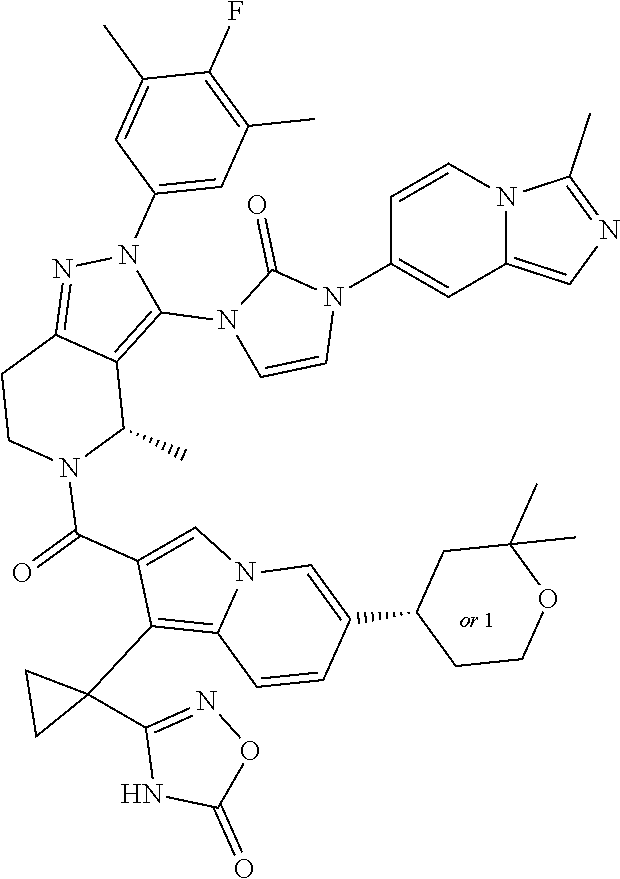 |
MS: m/z = 851.3 (M + 1); 1H NMR (400 MHz, CD3OD) δ 8.10- 8.04 (m, 2H), 7.60 (s, 1H), 7.60- 7.49 (m, 2H), 7.33-7.26 (m, 2 H), 7.15 (s, 1H), 7.13 (s, 1H), 7.07 (m, 1H), 6.88-6.81 (m, 2H), 6.66 (s, 1H), 5.86-5.83 (m, 1 H), 5.19- 5.17 (m, 1H), 4.25-4.23 (m, 1 H), 3.83-3.76 (m, 3H), 2.89-2.86 (m, 4 H), 2.63 (s, 3H), 2.23 (s, 6H), 1.77-1.21 (m, 14H). |
| Compound 19 (from intermediate 3 and 28-P2) |
 |
MS: m/z = 869.3 (M + 1); 1H NMR (400 MHz, CD3OD) δ 8.14 (d, J = 28.0 Hz, 1H), 8.00 (d, J = 28.0 Hz, 1H), 7.59 (d, J = 16.0 Hz, 1H), 7.54-7.43 (m, 2H), 7.28 (s, 1H), 7.16 (d, J = 4.0 Hz, 2H), 6.89- 6.78 (m, 2H), 6.64 (d, J = 24.0 Hz, 1H), 5.87 (s, 1H), 4.26 (d, J = 12.0 Hz, 1H), 4.10 (d, J = 12.0 Hz, 3H), 3.86-3.76 (m, 2H), 3.54-3.48 (m, 1H), 2.89-2.85 (m, 3H), 2.28 (s, 6H), 1.87-1.62 (m, 3H), 1.59-1.54 (m, 2H), 1.47-1.42 (m, 4H), 1.37- 1.23 (m, 8H). |
| Compound 20 (from intermediate 3 and 28-P1) |
 |
MS: m/z = 869.3, (M + 1); 1H NMR (400 MHz, CD3OD) δ 8.15 (d, J = 28.0 Hz, 1H), 8.01 (d, J = 28.0 Hz, 1H), 7.59 (d, J = 16.0 Hz, 1H), 7.52-7.42 (m, 2H), 7.28 (s, 1H), 7.17 (d, J = 4.0 Hz, 2H), 6.89- 6.78 (m, 2H), 6.64 (d, J = 24.0 Hz, 1H), 5.86 (d, J = 4.0 Hz, 1H), 4.26 (d, J = 8.0 Hz, 1H), 4.10 (d, J = 12.0 Hz, 3H), 3.91-3.70 (m, 2H), 3.54- 3.48 (m, 1H), 2.89-2.85 (m, 3H), 2.28-2.26 (m, 6H), 1.77-1.69 (m, 3H), 1.57-1.54 (m, 2H), 1.50-1.40 (m, 4H), 1.39-1.03 (m, 8H). |
| Compound 21 (from intermediate 3 and 27-P2) |
 |
MS: m/z = 843.3, (M + 1); 1H NMR (400 MHz, CD3OD) δ 8.15 (d, J = 16.4 Hz, 1 H), 8.00 (d, J = 13.2 Hz, 1 H), 7.68 (s, 1 H), 7.51- 7.44 (m, 2 H), 7.31 (s, 1 H), 7.18 (s, 2 H), 6.88-6.77 (m, 2 H), 6.66 (s, 0.5 H), 6.54 (s, 0.5 H), 5.79 (s, 1H), 4.11-4.07 (m, 4 H), 3.87-3.75 (m, 3H), 3.01-2.80 (m, 5 H), 2.28 (s, 6 H), 1.77-1.46 (m, 8 H), 1.33-1.25 (m, 6 H). |
| Compound 22 (from intermediate 3 and 27-P1) |
 |
MS: m/z = 843.3, (M + 1); 1H NMR (400 MHz, CD3OD) δ 8.15 (d, J = 16.4 Hz, 1 H), 8.00 (d, J = 12.0 Hz, 1 H), 7.67 (s, 1 H), 7.51- 7.44 (m, 2 H), 7.32 (s, 1 H), 7.18 (s, 2 H), 6.88-6.77 (m, 2 H), 6.66 (s, 0.5 H), 6.55 (s, 0.5 H), 5.79 (s, 1H), 4.10-4.07 (m, 4 H), 3.87-3.75 (m, 3H), 3.01-2.80 (m, 5 H), 2.28 (s, 6 H), 1.77-1.46 (m, 8 H), 1.33-1.25 (m, 6 H). |
| Compound 23 (from intermediate 22 and 29) |
 |
MS: m/z = 813.2 (M + 1); 1H NMR (400 MHz, DMSO-d6) δ 11.86 (s, 1H), 8.30 (s, 1H), 8.09 (s, 1H), 7.74 (s, 1H), 7.68-7.50 (m, 3H), 7.47 (d, J = 9.6 Hz, 1H), 7.27 (t, J = 8.4 Hz, 2H), 7.06 (s, 1H), 6.87 (d, J = 9.2 Hz, 2H), 5.79 (s, 1H), 4.39-4.16 (m, 2H), 4.12 (s, 3H), 4.03-3.67 (m, 3H), 3.52-3.43 (m, 4H), 2.70 (s, 1H), 1.79-1.46 (m, 5H), 1.39 (d, J = 6.8 Hz, 3H), 1.34-1.17 (m, 2H). |

| TABLE 13 | ||
| Name | Structure | 1H NMR and/or LC/MS data |
| Compound 25 (from intermediate 19-P2 and 46-P2) |
 |
MS: m/z = 869.3, (M + 1); 1H NMR (400 MHz, DMSO-d6) δ 12.13 (s, 1H), 8.31 (s, 1H), 7.63- 7.49 (m, 4H), 7.25 (s, 3H), 7.06 (s, 1H), 6.91-6.81 (m, 2H), 5.64 (s, 1H), 4.34 (s, 2H), 4.12 (s, 3H), 3.90 (s, 2H), 3.72 (d, J = 7.6 Hz, 2H), 3.05 (s, 1H), 2.23 (s, 6H), 2.00- 1.98 (m, 1H), 1.89-1.36 (m, 10H), 1.30-1.14 (m, 6H). |
| Compound 26 (from intermediate 20-P1 and 46-P2) |
 |
MS: m/z = 855 (M + 1); 1H NMR (400 MHz, DMSO-d6) δ 12.14 (s, 1H), 8.31 (s, 1H), 7.53- 7.49 (m, 6H), 7.23-7.21 (m, 2H), 7.07 (s, 1H), 6.88-6.86 (m, 2H), 5.65-5.63 (m, 1H), 4.55-4.31 (m, 2H), 4.12 (s, 3H), 3.95-3.70 (m, 4H), 3.06 (m, 1H), 2.26 (s, 3H), 1.86-1.42 (m, 11H), 1.28 (s, 3H), 1.19 (s, 3H). |
| Compound 27 (from intermediate 20-P2 and 46-P2) |
 |
MS: m/z = 855 (M + 1); 1H NMR (400 MHz, DMSO-d6) δ 12.14 (s, 1H), 8.31 (s, 1H), 7.53- 7.49 (m, 6H), 7.23-7.21 (m, 2H), 7.07 (s, 1H), 6.88-6.86 (m, 2H), 5.65-5.63 (m, 1H), 4.55-4.31 (m, 2H), 4.12 (s, 3H), 3.95-3.70 (m, 4H), 3.06 (m, 1H), 2.26 (s, 3H), 1.86-1.42 (m, 11H), 1.28 (s, 3H), 1.19 (s, 3H). |
| Compound 28 (from intermediate 21 and 46- P2) |
 |
MS: m/z = 853 (M + 1); 1H NMR (400 MHz, DMSO-d6) δ 12.06 (s, 1H), 8.31 (s, 1H), 7.69- 7.38 (m, 6H), 7.33-7.10 (m, 2H), 7.06-6.95 (m, 2H), 6.85-6.83 (m, 2H), 5.66-5.64 (m, 1H), 4.12 (s, 3H), 3.78 (s, 3H), 3.75-3.66 (m, 3H), 3.08-3.04 (m, 4H), 1.65-1.55 (m, 11H), 1.28 (s, 3H), 1.18 (s, 3H). |
| Compound 29 (from intermediate 25-P1 and 46-P2) |
 |
MS: m/z = 845.3 (M + 1); 1H NMR (400 MHz, DMSO-d6) δ 12.08 (s, 1H), 7.47-7.45 (m, 4H), 7.22 (t, J = 8.0 Hz, 3H), 6.86 (s, 1H), 6.71 (s, 1H), 6.48 (s, 1H), 5.82- 5.46 (m, 1H), 4.76-4.01 (m, 3H), 3.93-3.78 (m, 1H), 3.72 (d, J = 8.0 Hz, 2H), 3.22 (s, 3H), 3.09-3.01 (m, 1H), 2.98 (s, 2H), 2.87 (s, 1H), 2.94-2.12 (m, 5H), 1.87-1.62 (m, 6H), 1.61-1.45 (m, 9H), 1.36-1.23 (m, 6H), 1.22-1.11 (m, 4H). |
| Compound 30 (from intermediate 3 and 38) |
 |
MS: m/z = 905 (M + 1); 1H NMR (400 MHz, DMSO-d6) δ 13.08 (s, 1H), 8.29 (s, 1H), 7.85- 7.75 (m, 3H), 7.70-7.35 (m, 6H), 7.27-6.86 (m, 6H), 5.50-5.42 (m, 1H), 4.10 (s, 3H), 3.78-3.64 (m, 2H), 3.53-3.49 (m, 1H), 3.30-2.28 (m, 4H), 2.24 (s, 6H), 1.79-1.52 (m, 4H), 1.29-1.12 (m, 9H). |
| Compound 31 (from intermediate 22-P1 and 46-P1) |
 |
MS: m/z = 841.5 (M + 1); 1H NMR (400 MHz, DMSO-d6) δ 12.15 (s, 1H), 8.30 (s, 1H), 7.69- 7.53 (m, 3H), 7.53-7.45 (m, 2H), 7.35-7.17 (m, 3H), 7.06 (s, 1H), 6.92-6.80 (m, 2H), 5.92-5.61 (m, 1H), 4.26-4.58 (m, 3H), 4.12 (s, 3H), 3.88 (s, 1H), 3.72 (d, J = 7.6 Hz, 2H), 3.05 (t, J = 12.0 Hz, 1H), 1.88-1.61 (m, 5H), 1.61-1.50 (m, 2H), 1.47-1.34 (m, 3H), 1.28 (s, 3H), 1.23-1.13 (m, 4H). |
| Compound 32 (from intermediate 22-P2 and 46-P1) |
 |
MS: m/z = 841.5 (M + 1); 1H NMR (400 MHz, DMSO-d6) δ 12.10 (s, 1H), 8.30 (s, 1H), 7.69- 7.53 (m, 3H), 7.49 (d, J = 7.6 Hz, 1H), 7.33-7.17 (m, 3H), 7.06 (s, 1H), 6.92-6.80 (m, 2H), 5.87-5.56 (m, 1H), 4.23-4.62 (m, 3H), 4.11 (s, 3H), 3.88 (s, 1H), 3.72 (d, J = 7.6 Hz, 2H), 3.05 (t, J = 12.0 Hz, 1H), 1.89-1.63 (m, 5H), 1.60-1.50 (m, 2H), 1.46-1.34 (m, 3H), 1.28 (s, 3H), 1.23-1.10 (m, 4H). |
| Compound 33 (from intermediate 22-P1 and 46-P2) |
 |
MS: m/z = 841.3 (M + 1); 1H NMR (400 MHz, DMSO-d6) δ 12.10 (s, 1H), 8.30 (s, 1H), 7.69- 7.51 (m, 3H), 7.48 (d, J = 8.4 Hz, 1H), 7.33-7.18 (m, 3H), 7.06 (s, 1H), 6.86 (s, 2H), 5.87-5.56 (m, 1H), 4.23-4.63 (m, 3H), 4.11 (s, 3H), 3.88 (s, 1H), 3.72 (d, J = 7.6 Hz, 2H), 3.03 (t, J = 12.0 Hz, 1H), 1.91-1.34 (m, 10H), 1.33-1.10 (m, 7H). |
| Compound 34 (from intermediate 22-P2 and 46-P2) |
 |
MS: m/z = 841.2 (M + 1); 1H NMR (400 MHz, DMSO-d6) δ 12.17 (s, 1H), 8.30 (s, 1H), 7.68- 7.54 (m, 3H), 7.48 (d, J = 8.0 Hz, 1H), 7.34-7.18 (m, 3H), 7.05 (s, 1H), 6.87 (s, J = 15.6 Hz, 2H), 5.82 (s, 1H), 5.66 (s, 1H), 4.23-4.63 (m, 3H), 4.11 (s, 3H), 3.89 (s, 1H), 3.72 (d, J = 7.6 Hz, 2H), 3.04 (t, J = 12.8 Hz, 1H), 1.91-1.38 (m, 10H), 1.37- 1.10 (m, 7H). |
| Compound 35 (from intermediate 4 and 45) |
 |
MS: m/z = 844.5 (M + 1); 1H NMR (400 MHz, DMSO) δ 8.29 (s, 2H), 7.61-7.51 (m, 4H), 7.32- 7.05 (m, 3H), 6.92 (s, 2H), 5.53 (s, 2H), 4.70 (s, 2H), 4.10 (s, 3H), 4.00 (s, 1H), 3.71 (d, J = 8.3 Hz, 2H), 3.08-2.76 (m, 4H), 2.24 (s, 6H), 1.80-1.62 (m, 2H), 1.54-1.48 (m, 2H), 1.34-1.12 (m, 6H). |
| Compound 36 (from intermediate 4 and 44) |
 |
MS: m/z = 828.3 (M + 1); 1H NMR (400 MHz, CD3OD) δ 8.15 (s, 1H), 7.53-7.36 (m, 4H), 7.24 (d, J = 8.0 Hz, 1H), 7.14 (d, J = 6.0 Hz, 2H), 6.87 (s, 1H), 6.65 (s, 2H), 5.54 (s, 2H), 4.79 (s, 2H), 4.59 (s, 1H), 4.10 (s, 3H), 3.84-3.75 (m, 3H), 3.08-3.05 (m, 2H), 2.95 (s, 2H), 2.28 (s, 6H), 1.76-1.58 (m, 4H), 1.36 (s, 3H), 1.25 (s, 3H). |
| Compound 37 (from intermediate 4 and 37) |
 |
MS: m/z = 863 (M + 1); 1H NMR (400 MHz, CD3OD) δ 8.16 (s, 1H), 7.77-7.74 (m, 3H), 7.68-7.62 (m, 2H), 7.58 (br, 2H), 7.50-7.43 (m, 2H), 7.18-7.13 (m, 3H), 7.04 (br, 1H), 6.97-6.94 (m, 1H), 6.71-6.65 (m, 2H), 4.41 (s, 3H), 4.05 (d, J = 12 Hz, 3H), 3.61- 3.34 (m, 6H), 3.26-2.79 (m, 3H), 2.28 (s, 6H), 1.92-1.75 (m, 4 H). |
| Compound 38 (from intermediate 17-P2 and 46-P2) |
 |
MS: m/z = 869.3, (M + 1); 1H NMR (400 MHz, CD3OD) δ 8.19 (s, 1H), 7.52-6.75 (m, 12H), 5.45-5.23 (m, 2H), 4.12 (s, 3H), 3.85-3.75 (m, 2H), 3.55-3.50 (m, 1H), 3.12-3.10 (m, 2H), 2.90-2.85 (m, 2H), 1.95-1.05 (m, 20H). |
| Compound 39 (from intermediate 17-P1 and 46-P1) |
 |
MS: m/z = 869.3, (M + 1); 1H NMR (400 MHz, CD3OD) δ 8.19 (s, 1H), 7.52-6.75 (m, 12H), 5.45-5.23 (m, 2H), 4.12 (s, 3H), 3.85-3.75 (m, 2H), 3.55-3.50 (m, 1H), 3.12-3.10 (m, 2H), 2.90-2.85 (m, 2H), 1.95-1.05 (m, 20H). |
| Compound 40 (from intermediate 17-P1 and 46-P2) |
 |
MS: m/z = 869.3, (M + 1); 1H NMR (400 MHz, CD3OD) δ 8.19 (s, 1H), 7.52-6.75 (m, 12H), 5.45-5.23 (m, 2H), 4.12 (s, 3H), 3.85-3.75 (m, 2H), 3.55-3.50 (m, 1H), 3.12-3.10 (m, 2H), 2.90-2.85 (m, 2H), 1.95-1.05 (m, 20H). |
| Compound 41 (from intermediate 17-P2 and 46-P1) |
 |
MS: m/z = 869.3, (M + 1); 1H NMR (400 MHz, CD3OD) δ 8.19 (s, 1H), 7.52-6.75 (m, 12H), 5.45-5.23 (m, 2H), 4.12 (s, 3H), 3.85-3.75 (m, 2H), 3.55-3.50 (m, 1H), 3.12-3.10 (m, 2H), 2.90-2.85 (m, 2H), 1.95-1.05 (m, 20H). |
| Compound 42 (from intermediate 4 and 53) |
 |
MS: m/z = 843.5 (M + 1); 1H NMR (400 MHz, DMSO) δ 8.29 (s, 2H), 7.72-7.56 (m, 2H), 7.49 (s, 2H), 7.21 (d, J = 8.6 Hz, 1H), 7.13 (d, J = 5.3 Hz, 2H), 7.03 (s, 1H), 6.92 (s, 1H), 6.55 (s, 1H), 5.72 (s, 2H), 4.72 (s, 2H), 4.11 (s, 3H), 4.00 (s, 1H), 3.71 (d, J = 8.5 Hz, 2H), 3.11-2.81 (m, 4H), 2.25 (s, 6H), 1.82-1.61 (m, 2H), 1.60-1.43 (m, 2H), 1.34-1.07 (m, 6H). |
| Compound 43 (from intermediate 11 and 46- P1) |
 |
MS: m/z = 864.5 (M + 1); 1H NMR (400 MHz, DMSO-d6) δ 12.12 (s, 1H), 8.30 (s, 1H), 7.72- 7.40 (m, 4H), 7.27-6.93 (m, 3H), 6.73 (d, J = 26.3 Hz, 1H), 5.45 (s, 1H), 4.24 (s, 2H), 4.13 (s, 3H), 3.72 (d, J = 7.7 Hz, 2H), 3.49 (s, 1H), 3.11-2.89 (m, 2H), 2.83-2.64 (m, 1H), 2.28-1.88 (m, 8H), 1.88-1.40 (m, 8H), 1.28-1.19 (m, 9H). |
| Compound 44 (from intermediate 11 and 46- P2) |
 |
MS: m/z = 864.5 (M + 1); 1H NMR (400 MHz, DMSO-d6) δ 12.13 (s, 1H), 8.30 (s, 1H), 7.80- 7.42 (m, 4H), 7.33-7.14 (m, 2H), 7.12-6.92 (m, 1H), 6.73 (d, J = 26.3 Hz, 1H), 5.44 (s, 1H), 4.24 (s, 2H), 4.13 (s, 3H), 3.72 (d, J = 7.7 Hz, 2H), 3.43 (s, 1H), 3.04 (t, J = 12.5 Hz, 2H), 2.85-2.60 (m, 1H), 2.30-1.85 (m, 8H), 1.85-1.37 (m, 8H), 1.36-1.05 (m, 9H). |
| Compound 45 (from intermediate 3 and 51-P1) |
 |
MS: m/z = 857.6 (M + 1); 1H NMR (400 MHz, DMSO) δ 11.08-10.86 (m, 1H), 8.35-8.24 (m, 1H), 7.70-7.54 (m, 2H), 7.52- 7.34 (m, 2H), 7.30-6.75 (m, 7H), 5.65-4.97 (m, 3H), 4.12 (s, 3H), 3.72 (d, J = 8.1 Hz, 1H), 3.60-3.25 (m, 1H), 3.10-2.75 (m, 2H), 2.30- 2.15 (m, 6H), 1.75-1.66 (m, 2H), 1.65-1.45 (m, 3H), 1.45- 1.34 (m, 2H), 1.27 (s, 3H), 1.18 (s, 3H). |
| Compound 46 (from intermediate 3 and 51-P2) |
 |
MS: m/z = 857.7 (M + 1); 1H NMR (400 MHz, DMSO) δ 11.12-10.82 (m, 1H), 8.35-8.24 (m, 1H), 7.70-7.54 (m, 2H), 7.52- 7.34 (m, 2H), 7.30-6.75 (m, 7H), 5.65-4.97 (m, 3H), 4.12 (s, 3H), 3.72 (d, J = 8.1 Hz, 2H), 3.60-3.25 (m, 1H), 3.10-2.75 (m, 2H), 2.30- 2.15 (m, 6H), 1.75-1.66 (m, 2H), 1.65-1.45 (m, 3H), 1.45- 1.34 (m, 2H), 1.27 (s, 3H), 1.18 (s, 3H). |
| Compound 47 (from intermediate 3 and 45) |
 |
MS: m/z = 884.5 (M + 1); 1H NMR (400 MHz, CDCl3) δ 12.79 (s, 1H), 8.07 (s, 1H), 7.54 (s, 1H), 7.38 (d, J = 8.6 Hz, 1H), 7.29 (s, 1H), 7.26 (d, J = 6.9 Hz, 1H), 7.20 (d, J = 8.6 Hz, 1H), 7.14 (d, J = 8.9 Hz, 1H), 7.09 (d, J = 6.1 Hz, 2H), 6.72 (s, 1H), 6.68 (s, 1H), 6.53 (d, J = 2.9 Hz, 1H), 5.37 (q, J = 6.6 Hz, 1H), 4.99 (dd, J = 12.8, 4.4 Hz, 1H), 4.07 (s, 3H), 3.94-3.83 (m, 2H), 3.20-3.02 (m, 2H), 2.92-2.76 (m, 2H), 2.44-2.38 (m, 1H), 2.26 (s, 6H), 2.00-1.90 (m, 2H), 1.87- 1.76 (m, 4H), 1.66 (d, J = 6.8 Hz, 3H), 1.36 (s, 3H), 1.30 (s, 3H). |
| Compound 48 (from intermediate 3 and 52) |
 |
MS: m/z = 885.3 (M + 1); 1H NMR (400 MHz, DMSO) δ 12.49 (brs, 1 H), 8.31 (s, 1H), 7.64 (d, J = 8.3 Hz, 2H), 7.56 (s, 1H), 7.53-7.35 (m, 2H), 7.32-7.14 (m, 3H), 7.08 (s, 1H), 6.89 (m, 2H), 5.49 (d, J = 6.8 Hz, 1H), 4.30 (d, J = 9.5 Hz, 1H), 4.11 (s, 3H), 3.73 (d, J = 8.1 Hz, 2H), 3.55 (m, 1H), 3.12- 2.74 (m, 3H), 2.26 (s, 6H), 2.12- 1.45 (m, 7H), 1.42-1.09 (m, 10H). |
| Compound 49 (from intermediate 23-P2 and 46-P2) |
 |
MS: m/z = 875.1 (M + 1); 1H NMR (400 MHz, DMSO-d6) δ 8.30 (s, 1H), 7.66-7.42 (m, 6H), 7.21 (s, 1H), 7.09 (s, 1H), 6.96- 6.79 (m, 2H), 5.68 (s, 1H), 4.50 (s, 1H), 4.34 (s, 2H), 4.11 (s, 3H), 3.86 (s, 2H), 3.73 (d, J = 7.6 Hz, 2H), 1.80-1.55 (m, 8H), 1.43 (s, 3H), 1.31-1.20 (m, 3H), 1.18 (s, 3H). |
| Compound 50 (from intermediate 23-P1 and 46-P2) |
 |
MS: m/z = 875.2 (M + 1); 1H NMR (400 MHz, DMSO-d6) δ 8.30 (s, 1H), 7.77-7.39 (m, 6H), 7.22 (s, 1H), 7.09 (s, 1H), 6.92 (s, 1H), 6.83 (s, 1H), 5.84 (s, 1H), 5.70 (s, 1H), 4.51 (s, 1H), 4.32 (s, 2H), 4.11 (s, 3H), 3.82 (s, 2H), 3.72 (d, J = 7.6 Hz, 2H), 1.94-1.45 (m, 8H), 1.42 (s, 3H), 1.31-1.21 (m, 3H), 1.18 (s, 3H). |
| Compound 51 (from intermediate 24-P2 and 46-P2) |
 |
MS: m/z = 909.1 (M + 1); 1H NMR (400 MHz, DMSO-d6) δ 12.18 (s, 1H), 8.31 (s, 1H), 7.64 (s, 3H), 7.56-7.43 (m, 3H), 7.23 (d, J = 7.2 Hz, 1H), 7.13 (s, 1H), 7.00- 6.83 (m, 2H), 5.67 (s, 1H), 4.61- 4.30 (m, 3H), 4.11 (s, 3H), 3.88 (s, 2H), 3.72 (d, J = 7.6 Hz, 3H), 1.91- 1.05 (m, 17H). |
| Compound 52 (from intermediate 24-P1 and 46-P2) |
 |
MS: m/z = 909.1 (M + 1); 1H NMR (400 MHz, DMSO-d6) δ 12.21 (s, 1H), 8.31 (s, 1H), 7.63 (s, 3H), 7.56-7.41 (m, 3H), 7.23 (d, J = 6.8 Hz, 1H), 7.13 (s, 1H), 6.95 (s, 1H), 6.86 (s, 1H), 5.70 (s, 1H), 4.59-4.27 (m, 3H), 4.11 (s, 3H), 3.86 (s, 2H), 3.73 (d, J = 7.6 Hz, 1H), 1.84-1.07 (m, 17H). |

Step 1: 53-1
| TABLE 14 | ||
| Name | Structure | 1H NMR and/or LC/MS data |
| Compound 54 (from intermediate 3 and 42) |
 |
MS: m/z = 865.2 (M + 1); 1NMR (400 MHz, DMSO-d6) δ 8.29 (s, 1H), 7.96-7.94 (m, 1H), 7.77-7.73 (m, 1H), 7.62-7.54 (m, 4H), 7.44-7.40 (m, 1H), 7.17- 7.11 (m, 3H), 7.02-6.96 (m, 2H), 6.90-6.86 (m, 2H), 5.48-5.43 (m, 1H), 4.69-4.66 (m, 1H), 4.10 (s, 3H), 3.74-3.72 (m, 3H), 2.74-2.68 (m, 3H), 2.25 (s, 6H), 1.71-1.50 (m, 5H), 1.28 (s, 3H), 1.19 (s, 3H), 1.18-1.11 (m, 2H). |

Step 1: 55-1
| TABLE 15 | ||
| Name | Structure | 1H NMR and/or LC/MS data |
| Compound 56 (from intermediate 3 and 39) |
 |
MS: m/z = 837.3 (M + 1); 1H NMR (400 MHz, DMSO-d6) δ 13.36 (s, 1H), 8.29-8.19 (m, 1H), 7.97-7.81 (m, 2H), 7.66-7.58 (m, 4H), 7.44-7.42 (m, 1H), 7.31 (d, J = 8.8 Hz, 1H), 7.21 (d, J = 8.4 Hz, 1H), 7.15 (d, J = 5.6 Hz, 1H), 7.03 (s, 2H), 6.97 (s, 1H), 6.90 (s, 1H), 5.47 (d, J = 6.4 Hz, 1H),4.23 (s, 1H),4.10 (s, 3H), 3.97 (d, J = 9.2 Hz, 2H), 3.45 (s, 3H), 2.85-2.67 (m, 3H), 2.24 (s, 6H), 1.75 (s, 4H), 1.31-1.10 (m, 3H). |
| Compound 57 (from intermediate 5 and 50) |
 |
MS: m/z = 809.3 (M + 1); 1H NMR (400 MHz, DMSO-d6) δ 13.0 (s, 1H), 7.97-7.89 (m, 1H), 7.74-7.68 (m, 1H), 7.61 (d, J = 8.4 Hz, 2H), 7.57-7.50 (m, 2H), 7.40 (d, J = 7.6 Hz, 2H), 7.28 (s, 1H), 7.13 (s, 2H), 6.99-6.92 (m, 2H), 6.89-6.82 (m, 1H), 5.46-5.42 (m, 1H), 5.34-5.30 (m, 1H), 4.57-4.48 (m, 2H), 4.41 (s, 2H), 3.97 (d, J = 9.6 Hz, 2H), 3.49-3.43 (m, 2H), 3.33 (s, 3H), 3.28 (s, 2H), 2.89- 2.81 (m, 2H), 2.48 (s, 6H), 2.19 (s, 4H), 1.78-1.70 (m, 3H). |


Step 1: 59-1

| TABLE 16 | ||
| Name | Structure | 1H NMR and/or LC/MS data |
| Compound 62 (from intermediate 25-P1 and 49) |
 |
1H NMR (400 MHz, CD3OD) δ 8.52 (s, 3H), 7.52-7.51 (m, 2H), 7.29 (d, J = 7.6 Hz, 1H), 7.13-7.08 (m, 2H), 6.91-6.32 (m, 2H), 5.82 (s, 1H), 5.48 (s, 1H), 5.28-5.26 (m, 1H), 4.81 (s, 1H), 4.62 (s, 1H), 4.35- 4.33 (m, 1H), 4.20-4.16 (m, 1H), 3.93-3.82 (m, 1H), 3.24-3.07 (m, 3H), 2.36 (t, J = 7.6 Hz, 1H), 2.21- 2.19 (m, 1H), 2.07-2.04 (m, 5H), 1.78-1.54 (m, 8H), 1.38-1.29 (m, 16H), 0.92 (t, J = 6.0 Hz, 2H). Chiral separation condition: Column: Daicel CHIRALPAK OD- H 250 mm × 20 mm I.D. 5 μm; Mobile phase: CO2/MeOH (0.2% NH4•OH) = 70/30; Flow rate: 50 g/min; Wave length: UV 214 nm; Temperature: 35° C. (retention time, 5.809 min) |
| Compound 63 (from intermediate 25-P1 and 49) |
 |
1H NMR (400 MHz, CD3OD) δ 8.49 (s, 4H), 7.52-7.48 (m, 2H), 7.26 (d, J = 8.4 Hz, 1H), 7.11-7.06 (m, 2H), 6.89-6.81 (m, 1H), 6.54- 6.27 (m, 2H), 5.78 (s, 1H), 5.50 (s, 1H), 4.40-4.29 (m, 2H), 4.18-4.13 (m, 1H), 3.91-3.79 (m, 3H), 3.13- 2.92 (m, 4H), 2.33 (t, J = 7.2 Hz, 1H), 2.22-2.14 (m, 3H), 2.04- 2.01 (m, 2H), 1.76-1.52 (m, 10H), 1.36-1.26 (m, 12H), 0.89 (t, J = 6.4 Hz, 2H). Chiral separation condition: Column: Daicel CHIRALPAK OD- H 250 mm × 20 mm I.D. 5 μm; Mobile phase: CO2/MeOH (0.2% NH4•OH) = 70/30; Flow rate: 50 g/min; Wave length: UV 214 nm; Temperature: 35° C. (retention time, 3.274 min). |

Step 1: 64-1

| TABLE 17 | ||
| Name | Structure | 1H NMR and/or LC/MS data |
| Intermediate 56 |
 |
MS: m/z = 163.1 (M + 1). |


Step 1: 57-B
| TABLE 18 | ||
| Name | Structure | 1H NMR and/or LC/MS data |
| Intermediate 58 |
 |
MS: m/z = 498.0 (M + 1). |
| Intermediate 59 |
 |
MS: m/z = 502.2 (M + 1). |
| TABLE 19 | ||
| Name | Structure | 1H NMR and/or LC/MS data |
| Intermediate 60 |
 |
MS: m/z = 480.1 (M + 1). |
| TABLE 20 | ||
| Name | Structure | Chiral separation condition: |
| Intermediate 61-P1 |
 |
Column: Daicel CHIRALPAK OZ- H 250 mm × 20 mm I.D. 5 μm; Mobile phase: CO2/MeOH (0.2% NH4•OH) = 80/20; Flow rate: 50 g/min; Wavelength: UV 214 nm; Temperature: 35° C. |
| Intermediate 61-P2 |
 |
|
| TABLE 21 | ||
| Name | Structure | 1H NMR and/or LC/MS data |
| Compound 65 (from intermediate 61-P1 and 46-P2) |
 |
MS: m/z = 909.3 (M + 1); 1H NMR (400 MHz, DMSO-d6) δ 8.30 (s, 1H), 7.95 (s, 1H), 7.80 (s, 1H), 7.65-7.63 (m, 2H), 7.49-7.41 (m, 2H), 7.22 (d, J = 7.2 Hz, 1H), 7.11 (s, 1H), 6.94 (s, 1H), 6.86 (s, 1H), 5.69 (s, 1H), 4.36 (s, 2H), 4.11 (s, 3H), 3.73-3.71 (m, 4H), 3.04 (s, 1H), 2.07-1.34 (m, 11H), 1.33-1.13 (m, 6H). |
| Compound 66 (from intermediate 61-P2 and 46-P2) |
 |
MS: m/z = 909.3, (M + 1); 1H NMR (400 MHz, DMSO-d6) δ 8.30 (s, 1H), 7.96 (s, 1H), 7.80 (s, 1H), 7.66-7.64 (m, 2H), 7.50-7.48 (m, 2H), 7.24 (s, 1H), 7.11 (s, 1H), 6.93-6.89 (m, 2H), 5.69 (s, 1H), 4.37 (s, 2H), 4.11 (s, 3H), 3.27 (d, J = 7.6 Hz, 4H), 3.04 (s, 1H), 2.03- 1.38 (m, 11H), 1.31-1.13 (m, 6H). |
| TABLE 22 | ||
| Name | Structure | 1H NMR and/or LC/MS data |
| Compound 67 (from intermediate 14 and 31- P2) |
 |
MS: m/z = 875.1 (M + 1); 1H NMR (400 MHz, DMSO-d6) δ 12.0 (s, 1H), 8.30-8.23 (m, 1H), 8.16-8.14 (m, 1H), 7.65-7.55 (m, 3H), 7.48-7.43 (m, 2H), 7.29-7.27 (m, 1H), 7.13-6.95 (m, 2H), 6.71 (d, J = 7.6 Hz, 1H), 6.42 (s, 1H), 5.68- 5.67 (m, 1H), 4.11-4.04 (m, 4H), 3.72-3.70 (m, 2H), 3.43-3.38 (m, 1H), 2.96-2.90 (m, 1H), 2.71-2.67 (m, 2H), 1.75-1.61 (m, 4H), 1.50- 1.44 (m, 4H), 1.33 (d, J = 6.8 Hz, 3H), 1.26-1.24 (m, 3H), 1.19-1.16 (m, 3H). |
| Compound 68 (from intermediate 19-P1 and 31-P2) |
 |
MS: m/z = 869.2 (M + 1); 1H NMR (400 MHz, DMSO-d6) δ 12.01 (s, 1H), 8.31 (s, 1H), 8.16 (d, J = 7.2 Hz, 1H), 7.65 (d, J = 9.2 Hz, 1H), 7.54 (t, J = 7.6 Hz, 1H), 7.30- 7.24 (m, 3H), 7.06 (s, 1H), 6.82 (s, 1H), 6.72 (d, J = 6.8 Hz, 1H), 6.48 (s, 1H), 5.78 (s, 1H), 4.17-4.12 (m, 5H), 3.72-3.70 (m, 4H), 2.97-2.90 (m, 2H), 2.23 (s, 5H), 1.67-1.19 (m, 17H). |
| Compound 69 (from intermediate 19-P1 and 28-P2) |
 |
MS: m/z = 869.2 (M + 1); 1H NMR (400 MHz, DMSO-d6) δ 11.84 (s, 1H), 8.31 (s, 1H), 8.09 (s, 1H), 7.72 (s, 1H), 7.63 (s, 1H), 7.54 (s, 1H), 7.46 (d, J = 9.2 Hz, 1H), 7.24 (s, 2H), 7.06 (s, 1H), 6.86 (d, J = 9.2 Hz, 1H), 6.81 (s, 1H), 5.78 (s, 1H), 4.21 (s, 2H), 4.12 (s, 3H), 3.71 (s, 4H), 2.90 (s, 1H), 2.23 (s, 6H), 1.69 (d, J = 9.6 Hz, 2H), 1.60-1.34 (m, 7H), 1.26-1.18 (m, 8H). |
| Compound 70 (from intermediate 60 and 28- P2) |
 |
MS: m/z = 859.3 (M + 1); 1H NMR (400 MHz, DMSO-d6) δ 11.89 (s, 1H), 8.30-8.12 (m, 2H), 7.69-7.28 (m, 7H), 7.12-7.04 (m, 2H), 5.68 (s, 1H), 5.01-4.79 (m, 1H), 4.11 (s, 3H), 3.72-3.70 (m, 2H), 2.90-2.59 (m, 4H), 1.71- 1.19 (m, 17H). |
| Compound 71 (from intermediate 57 and 28- P2) |
 |
MS: m/z = 909.2 (M + 1); 1H NMR (400 MHz, DMSO-d6) δ 11.94 (s, 1H), 8.29 (s, 1H), 8.11 (s, 1H), 7.90-7.61 (m, 4H), 7.45 (d, J = 8.4 Hz, 2H), 7.27-6.91 (m, 2H), 6.85 (d, J = 8.0 Hz, 1H), 5.70 (s, 1H), 4.90 (d, J = 74.8 Hz, 1H), 4.11 (s, 3H), 3.70 (s, 2H), 3.26-3.08 (m, 1H), 2.98- 2.69 (m, 3H), 1.98-0.82 (m, 17H). |
| Compound 72 (from intermediate 58 and 31- P2) |
 |
MS: m/z = 877.2 (M + 1); 1H NMR (400 MHz, DMSO-d6) δ 12.0 (s, 1H), 8.30 (s, 1H), 8.15 (d, J = 7.2 Hz, 1H), 7.64 (d, J = 8.8 Hz, 1H), 7.51-7.47 (m, 1H), 7.42-7.30 (m, 3H), 7.17 (d, J = 2.8 Hz, 1H), 7.08 (s, 1H), 6.71 (d, J = 7.6 Hz, 1H), 6.42 (s, 1H), 5.69 (s, 1H), 4.99-4.82 (m, 1H), 4.11-4.04 (m, 4H), 3.71 (d, J = 8.0 Hz, 2H), 2.93-2.66 (m, 4H), 1.67-1.17 (m, 17H). |
| Compound 73 (from intermediate 59 and 31- P2) |
 |
MS: m/z = 881.3 (M + 1); 1H NMR (400 MHz, DMSO-d6) δ 8.30 (s, 1H), 8.10 (d, J = 7.2 Hz, 1H), 7.64 (d, J = 8.8 Hz, 1H), 7.49-7.40 (m, 1H), 7.28-7.22 (m, 3H), 7.09 (s, 1H), 7.03-6.76 (m, 3H), 6.69 (d, J = 6.8 Hz, 1H), 6.38 (s, 1H), 5.65-5.62 (m, 1H), 4.09-4.07 (m, 3H), 3.71 (d, J = 8.0 Hz, 2H), 2.93 (s, 1H), 2.67- 2.65 (m, 2H), 2.13-1.98 (m, 2H), 1.73-1.48 (m, 6H), 1.34-1.17 (m, 12H), 1.01-0.98 (m, 2H), 0.67-0.63 (m, 2H). |
| Compound 74 (from intermediate 57 and 31- P2) |
 |
MS: m/z = 909 (M + 1); 1H NMR (400 MHz, DMSO-d6) δ 8.29 (s, 1H), 8.15 (d, J = 7.2 Hz, 1H), 7.89-7.61 (m, 5H), 7.43 (m, 1H), 7.30 (s, 1H), 7.15 (d, J = 2.4 Hz, 1H), 6.71 (d, J = 6.9 Hz, 1H), 6.42 (s, 1H), 5.74-5.64 (m, 1H), 4.11 (s, 3H), 3.68-3.57 (m, 6H), 2.93 (m, 1H), 1.45-1.09 (m, 17H). |
| Compound 75 (from intermediate 58 and 28- P2) |
 |
MS: m/z = 877.2 (M + 1); 1H NMR (400 MHz, CD3OD) δ 8.16 (d, J = 23.6 Hz, 1H), 8.02 (d, J = 19.6 Hz, 1H), 7.59 (d, J = 17.6 Hz, 1H), 7.43-7.51 (m, 3H), 7.30 (d, J = 2.4 Hz, 2H), 7.03-6.92 (m, 1H), 6.91- 6.83 (m, 1H), 6.76 (d, J = 13.2 Hz, 1H), 5.88 (s, 1H), 4.26 (s, 1H), 4.11 (d, J = 8.8 Hz, 3H), 3.82-3.87 (m, 2H), 2.80-3.12 (m, 4H), 1.57-1.77 (m, 4H), 1.48-1.10 (m, 13H). |
| Compound 76 (from intermediate 59 and 28- P2) |
 |
MS: m/z = 881.2 (M + 1); 1H NMR (400 MHz, DMSO-d6) δ 8.30 (s, 1H), 8.12 (s, 1H), 7.72-7.61 (m, 2H), 7.45 (d, J = 8.4 Hz, 2H), 7.28 (s, 2H), 7.10 (s, 1H), 6.98-6.85 (m, 3H), 5.66 (s, 1H), 4.11 (s, 3H), 3.70 (s, 2H), 2.90 (s, 1H), 2.75 (s, 2H), 2.08 (s, 1H), 1.69 (s, 2H), 1.54- 1.44 (m, 4H), 1.33-1.18 (m, 13H), 0.99 (s, 2H), 0.64 (s, 2H). |
| Compound 77 (from intermediate 15 and 31- P2) |
 |
MS: m/z = 855.3 (M + 1); 1H NMR (400 MHz, DMSO-d6) δ 12.03 (br, 1H), 8.30 (s, 1H), 8.15 (d, J = 7.2 Hz, 1H), 7.63 (d, J = 8.4 Hz, 1H), 7.48-7.21 (m, 5H), 7.08 (d, J = 2.8 Hz, 1H), 6.97 (s, 1H), 6.71 (d, J = 7.2 Hz, 1H), 6.42 (s, 1H), 5.68- 5.66 (m, 1H), 4.10 (s, 3H), 3.73- 3.70 (m, 2H), 3.45-3.30 (m, 2H), 3.00-2.85 (m, 2H), 2.71-2.69 (m, 1H), 2.27 (s, 3H), 1.80-1.11 (m, 17H). |
| Compound 78 (from intermediate 60 and 31- P2) |
 |
MS: m/z = 859.3 (M + 1); 1H NMR (400 MHz, DMSO-d6) δ 8.26 (s, 1H), 8.12-8.11 (m, 1H), 7.64-7.47 (m, 4H), 7.28-7.03 (m, 4H), 6.70 (d, J = 6.8, 1H), 6.40 (s, 1H), 5.67-5.66 (m, 1H), 4.10-4.06 (m, 4H), 3.71-3.69 (m, 2H), 2.95- 2.89 (m, 2H), 2.68 (s, 2H), 1.74- 1.43 (m, 8H), 1.32 (d, J = 6.4, 3H), 1.25-1.22 (m, 3H), 1.18-1.16 (m, 3H). |
| TABLE 23 | ||
| Name | Structure | 1H NMR and/or LC/MS data |
| Intermediate 62 |
 |
MS: m/z = 473.1 (M + 1). |
| TABLE 24 | ||||
| Name | Structure | 1H NMR and/or LC/MS data | ||
| Intermediate 63 |
 |
MS: m/z = 211.1 (M + 1). | ||
| TABLE 25 | ||
| Name | Structure | 1H NMR and/or LC/MS data |
| Intermediate 64 |
 |
MS: m/z = 546.1 (M + 1). |


Step 1: 65-B

| TABLE 26 | ||
| 1H NMR | ||
| and/or | ||
| LC/MS | ||
| Name | Structure | data |
| Intermediate 67 |
 |
MS: m/z = 373.1 (M + 1). |


Step 1: 68-B


Step 1: 70-B

Step 1: 71-B

Step 1: 72-B

Step 1: 73-B

Step 1: 74-B

Step 1: 75-B

Step 1: 76-B

Step 1: 77-B

| TABLE 27 | ||
| Name | Structure | Chiral separation condition: |
| Intermediate 65-P1 |
 |
Column: Daicel ChiralPak AD-H 250 mm*30 mm I.D., 5 μm; Mobile phase: CO2/EtOH (0.1% DEA) = 60:40, Flow rate: 50 g/min; Wave length: UV 254 nm; Temperature: 40° C. |
| Intermediate 65-P2 |
 |
|
| Intermediate 70-P1 |
 |
Column: Daicel ChiralPak AD-H 250 mm*30 mm I.D., 5 μm; Mobile phase: CO2/EtOH (0.1% DEA) = 60:40; Flow rate: 50 g/min; Wave length: UV 254 nm; Temperature: 40° C. |
| Intermediate 70-P2 |
 |
|
| Intermediate 71-P1 |
 |
Column: Daicel ChiralPak AD-H 250 mm*30 mm I.D., 5 μm; Mobile phase: CO2/MeOH (0.1% DEA) = 65:35; Flow rate: 50 g/min; Wave length: UV 254 nm; Temperature: 40° C. |
| Intermediate 71-P2 |
 |
|
| Intermediate 72-P1 |
 |
Column: Daicel ChiralPak AD-H 250 mm* 30 mm I.D., 5 μm; Mobile phase: CO2/EtOH (0.1% DEA) = 60:40; Flow rate: 50 g/min; Wave length: UV 254 nm; Temperature: 40° C. |
| Intermediate 72-P2 |
 |
|
| Intermediate 73-P1 |
 |
Column: Daicel ChiralPak AD-H 250 mm*30 mm I.D., 5 μm; Mobile phase: CO2/IPA (0.1% DEA) = 65:35; Flow rate: 50 g/min; Wave length: UV 254 nm; Temperature: 40° C. |
| Intermediate 73-P2 |
 |
|
| Intermediate 74-P1 |
 |
Column: Daicel ChiralPak AD-H 250 mm*30 mm I.D., 5 μm; Mobile phase: CO2EtOH (0.1% DEA) = 65:35; Flow rate: 50 g/min; Wave length: UV 254 nm; Temperature: 40° C. |
| Intermediate 74-P2 |
 |
|
| Intermedidate 75-P1 |
 |
Column: Daicel ChiralPak IG-H 250 mm*30 mm I.D., 5 μm; Mobile phase: CO2/EtOH (0.1% DEA) = 60:40; Flow rate: 50 g/min; Wave length: UV 254 nm; Temperature: 40° C. |
| Intermediate 75-P2 |
 |
|
| Intermediate 76-P1 |
 |
Column: Daicel ChiralPak OZ-H 250 mm × 20 mm I.D., 5 μm; Mobile phase: CO2/MeOH (0.2% NH3 (7M Solution in MeOH)) = 80:20; Flow rate: 50 g/min; Wave length: UV 254 nm; Temperature: 35° C. |
| Intermediate 76-P2 |
 |
|
| TABLE 28 | ||
| Name | Structure | 1H NMR and/or LC/MS data |
| Compound 79 (from intermediate 62 and 28-P2) |
 |
MS: m/z = 852.2 (M + 1); 1H NMR (400 MHz, CD3OD) δ 8.48 (s, 1H), 8.36-8.29 (m, 1H), 8.01 (s, 1H), 7.95-7.87 (m, 1H), 7.58-7.46 (m, 2H), 7.38-7.32 (m, 1H), 7.13 (d, J = 6.0 Hz, 2H), 6.87-6.81 (m, 2H), 5.32 (t, J = 4.4 Hz, 1H), 3.84-3.78 (m, 1H), 3.46 (s, 2H), 3.11 (s, 1H), 2.78-2.74 (m, 3H), 2.29-2.19 (m, 9H), 2.01-1.92 (m, 4H), 1.58 (s, 3H), 1.33 (s, 6H), 0.89-0.86 (m, 4H). |
| Compound 80 (from intermediate 64 and 28-P2) |
 |
MS: m/z = 925.2 (M + 1); 1H NMR (400 MHz, DMSO-d6) δ 11.97 (s, 1H), 8.29-8.25 (m, 1H), 8.11 (m, 1H), 7.74- 7.57 (m, 5H), 7.44 (d, J = 9.2 Hz, 1H), 7.30 (s, 1H), 7.13-6.95 (m, 2H), 6.85 (d, J = 9.2 Hz, 1H), 5.69 (m, 1H), 4.98-4.79 (m, 1H), 4.11 (s, 3H), 3.70 (d, J = 9.6 Hz, 2H), 2.92- 2.73 (m, 4H), 1.71-1.19 (m, 17H). |
| Compound 81 (from intermediate 64 and 31-P2) |
 |
MS: m/z = 925.2 (M + 1); 1H NMR (400 MHz, DMSO-d6) δ 12.05 (s, 1H), 8.29 (s, 1H), 8.13-8.10 (m, 1H), 7.74- 7.42 (m, 5H), 7.29-7.26 (m, 1H), 7.14- 7.07 (m, 1H), 6.95-6.84 (m, 1H), 6.70 (d, J = 7.2 Hz, 1H), 6.39 (s, 1H), 5.68-5.67 (m, 1H), 5.02-4.81 (m, 1H), 4.11 (s, 3H), 3.70 (d, J = 9.6 Hz, 2H), 2.97-2.89 (m, 2H), 2.72- 2.67 (m, 2H), 1.71-1.17 (m, 17H). |
| Compound 82 (from intermediate 3 and 65-P1) |
 |
MS: m/z = 870.3 (M + 1); 1H NMR (400 MHz, DMSO) δ 11.92 (s, 1H), 8.58 (s, 1H), 8.31 (s, 1H), 7.71 (d, J = 9.6 Hz, 1H), 7.64 (d, J = 9.2 Hz, 1H), 7.47 (t, J = 7.2 Hz, 1H), 7.38 (d, J = 13.6 Hz, 1H), 7.16 (d, J = 6.4 Hz, 2H), 7.17-7.08 (m, 1H), 6.97 (s, 1H), 5.69 (q, J = 6.4 Hz, 1H), 5.00-4.80 (m, 1H), 4.12 (s, 3H), 4.04 (s, 1H), 3.75-3.68 (m, 2H), 3.14-3.03 (m, 2H), 2.78-2.68 (m, 2H), 2.25 (s, 6H), 1.78- 1.65 (m, 2H), 1.62-1.47 (m, 4H), 1.40- 1.30 (m, 4H), 1.28 (s, 3H), 1.20 (s, 3H). |
| Compound 83 (from intermediate 3 and 65-P2) |
 |
MS: m/z = 870.2 (M + 1); 1H NMR (400 MHz, DMSO) δ 11.92 (s, 1H), 8.55 (s, 1H), 8.28 (s, 1H), 7.70 (d, J = 9.6 Hz, 1H), 7.65 (d, J = 9.2 Hz, 1H), 7.47 (t, J = 7.2 Hz, 1H), 7.35 (d, J = 8.8 Hz, 1H), 7.17 (d, J = 6.4 Hz, 2H), 7.17-7.08 (m, 1H), 6.97 (s, 1H), 5.69 (q, J = 6.4 Hz, 1H), 5.00- 4.80 (m, 1H), 4.10 (s, 3H), 4.04 (s, 1H), 3.75- 3.68 (m, 2H), 3.14-3.03 (m, 2H), 2.78- 2.68 (m, 2H), 2.23 (s, 6H), 1.77-1.65 (m, 2H), 1.61-1.47 (m, 4H), 1.39-1.30 (m, 4H), 1.28 (s, 3H), 1.20 (s, 3H). |
| Compound 84 (from intermediate 59 and 65-P2) |
 |
MS: m/z = 882.2 (M + 1); 1H NMR (400 MHz, DMSO-d6) δ 11.92 (s, 1H), 8.58-8.54 (s, 1H), 8.31 (s, 1H), 7.74- 7.62 (m, 2H), 7.47-7.36 (m, 2H), 7.33- 7.26 (m, 2H), 7.10 (d, J = 3.2 Hz, 1H), 7.01- 6.88 (m, 2H), 5.71-5.60 (m, 1H), 4.10- 4.08 (m, 3H), 3.73-3.71 (m, 2H), 3.47- 3.39 (m, 1H), 3.13-3.02 (m, 2H), 2.74 (s, 2H), 2.08-2.06 (m, 2H), 1.71 (s, 3H), 1.61- 1.56 (m, 3H), 1.39-1.31 (m, 4H), 1.26- 1.24 (m, 3H), 1.22-1.14 (m, 3H), 1.00 (d, J = 8.8 Hz, 2H), 0.65 (d, J = 15.6 Hz, 2H). |
| Compound 85 (from intermediate 59 and 66) |
 |
MS: m/z = 915.2 (M + 1); 1H NMR (400 MHz, DMSO-d6) δ 8.30-8.24 (m, 1H), 7.96 (s, 1H), 7.17-7.63 (m, 2H), 7.61-7.41 (m, 2H), 7.28 (s, 2H), 7.10 (s, 1H), 7.04-6.98 (m, 2H), 5.72 (d, J = 21.2 Hz, 1H), 4.10 (d, J = 14.2 Hz, 3H), 3.72 (s, 2H), 3.08 (s, 3H), 2.08 (s, 2H), 1.72-1.51 (m, 7H), 1.38-1.20 (m, 11H), 0.93-0.89 (m, 2H), 0.64 (s, 2H). |
| Compound 86 (from intermediate 3 and 68-P1) |
 |
MS: m/z = 867 (M + 1); 1H NMR (400 MHz, MeOD) δ 8.27-7.87 (m, 2H), 7.72-7.25 (m, 4H), 7.21-7.09 (m, 2H), 7.01-6.49 (m, 3H), 5.38-5.10 (m, 1H), 4.20-4.02 (m, 3H), 4.01-3.41 (m, 3H), 3.23-2.69 (m, 3H), 2.28 (d, J = 8.3 Hz, 7H), 1.62-1.18 (m, 11H), 0.91-0.40 (m, 4H). |
| Compound 87 (from intermediate 3 and 68-P2) |
 |
MS: m/z = 867 (M + 1); 1H NMR (400 MHz, MeOD) δ 8.26-7.98 (m, 2H), 7.67-7.23 (m, 4H), 7.17 (d, J = 6.4 Hz, 2H), 6.95-6.56 (m, 3H), 5.34-5.07 (m, 1H), 4.11 (d, J = 10.2 Hz, 3H), 4.01-3.53 (m, 3H), 3.08-2.72 (m, 3H), 2.28 (d, J = 5.2 Hz, 7H), 1.49-1.26 (m, 11H), 0.86-0.43 (m, 4H). |
| Compound 88 (from intermediate 59 and 67) |
 |
MS: m/z = 915.2 (M + 1): 1H NMR (400 MHz, DMSO-d6) δ 8.17-8.08 (m, 2H), 7.52-7.40 (m, 2H), 7.26-7.07 (m, 3H), 7.00-6.98 (m, 1H), 6.91-6.90 (m, 1H), 6.82-6.67 (m, 2H), 5.91-5.89 (m, 1H), 4.11-4.07 (m, 3H), 3.87-3.79 (m, 2H), 3.60-3.47 (m, 2H), 3.12-2.65 (m, 3H), 2.18-2.01 (m, 2H), 1.76-1.47 (m, 8H), 1.35-1.25 (m, 8H), 1.01-0.95 (m, 2H), 0.69-0.65 (m, 2 H). |
| Compound 89 (from intermediate 59 and 70-P1) |
 |
MS: m/z = 882.2 (M + 1); 1H NMR (400 MHz, DMSO-d6) δ 8.28-8.22 (m, 1H), 7.99-7.97 (m, 2H), 7.63-7.61 (m, 1H), 7.50-7.48 (m, 1H), 7.28-7.26 (m, 2H), 7.07 (s, 1H), 6.96-6.82 (m, 3H), 5.63-5.62 (m, 1H), 4.09 (s, 3H), 3.71-3.69 (m, 2H), 3.15-3.13 (m, 2H), 2.85-2.65 (m, 3H), 2.06-2.05 (m, 1H), 1.75-1.50 (m, 8H), 1.30-1.17 (m, 9H), 1.01-0.92 (m, 2H), 0.62-0.60 (m, 2 H). |
| Compound 90 (from intermediate 59 and 70-P2) |
 |
MS: m/z = 882.2 (M + 1); 1H NMR (400 MHz, DMSO) δ 11.89 (br, 1H), 8.32-8.19 (m, 1H), 8.03-7.93 (m, 2H), 7.71-7.52 (m, 1H), 7.49-7.38 (m, 1H), 7.34-7.17 (m, 2H), 7.08 (s, 1H), 7.01- 6.78 (m, 3H), 5.63 (d, J = 7.0 Hz, 1H), 4.10 (s, 3H), 3.78-3.62 (m, 2H), 3.22-3.01 (m, 2H), 2.93-2.55 (m, 3H), 2.06 (s, 1H), 1.84- 1.36 (m, 8H), 1.30 (d, J = 6.7 Hz, 3H), 1.25 (s, 3H), 1.18 (s, 3H), 1.04-0.85 (m, 2H), 0.72-0.54 (m, 2H). |
| Compound 91 (from intermediate 59 and 73-P1) |
 |
MS: m/z = 899.2 (M + 1); 1H NMR (400 MHz, DMSO-d6) δ 8.30-8.23 (m, 1H), 7.99 (s, 1H), 7.75 (s, 1H), 7.63- 7.57 (m, 1H), 7.46 (s, 1H), 7.29 (d, J = 8.4 Hz, 2H), 7.09 (s, 1H), 6.98-6.94 (m, 2H), 6.70 (d, J = 13.2 Hz, 1H), 5.65 (d, J = 6.4 Hz, 1H), 4.11 (s, 3H), 3.71 (s, 2H), 3.17 (s, 2H), 2.91 (s, 1H), 2.70 (s, 2H), 2.07-1.98 (m, 2H), 1.76-1.65 (m, 2H), 1.47 (s, 4H), 1.32 (d, J = 6.0 Hz, 2H), 1.25-1.18 (m, 8H), 1.04-0.94 (m, 2H), 0.70-0.59 (m, 2H). |
| Compound 92 (from intermediate 59 and 73-P2) |
 |
MS: m/z = 899.2 (M + 1); 1H NMR (400 MHz, DMSO-d6) δ 11.88 (br, 1H), 8.30-8.24 (m, 1H), 8.00 (s, 1H), 7.78 (s, 1H), 7.63-7.58 (m, 1H), 7.48-7.41 (m, 1H), 7.29-7.27 (m, 2H), 7.10 (s, 1H), 6.95 (d, J = 6.0 Hz, 2H), 6.73 (d, J = 13.0 Hz, 1H), 5.65 (d, J = 6.4 Hz, 1H), 4.11 (s, 3H), 3.71 (s, 2H), 2.90 (s, 1H), 2.74 (s, 2H), 2.06 (s, 2H), 1.73 (s, 2H), 1.49-1.45 (m, 5H), 1.33 (d, J = 6.2 Hz, 3H), 1.25-1.19 (m, 8H), 1.01-0.98 (m, 2H), 0.63 (s, 2H). |
| Compound 93 (from intermediate 59 and 74-P1) |
 |
MS: m/z = 899.2 (M + 1); 1H NMR (400 MHz, MeOD) δ 8.18-8.11 (m, 2H), 7.52-7.37 (m, 3H), 7.29-7.19 (m, 2H), 7.01-6.91 (m, 2H), 6.76 (d, J = 38 Hz, 1H), 6.58 (d, J = 12.4 Hz, 1H), 5.86-5.84 (m, 1H), 5.12-5.08 (m, 1H), 4.98-4.94 (m, 1H), 4.28- 4.23 (m, 1H), 4.10 (d, J = 12.4 Hz, 2H), 3.92- 3.77 (m, 3H), 2.90-2.78 (m, 3H), 2.17- 2.06 (m, 2H), 1.84-1.24 (m, 15H), 1.03- 0.98 (m, 2H), 0.73-0.68 (m, 2H). |
| Compound 94 (from intermediate 59 and 74-P2) |
 |
MS: m/z = 899.2 (M + 1); 1H NMR (400 MHz, MeOD) δ 8.18-8.11 (m, 2H), 7.52-7.37 (m, 3H), 7.29-7.10 (m, 2H), 7.01-6.91 (m, 2H), 6.76 (d, J = 37.2 Hz, 1H), 6.58 (d, J = 12.4 Hz, 1H), 5.86- 5.84 (m, 1H), 5.12-5.08 (m, 1H), 4.98- 4.94 (m, 1H), 4.28-4.23 (m, 1H), 4.10 (d, J = 12.4 Hz, 2H), 3.92-3.77 (m, 3H), 2.90- 2.78 (m, 3H), 2.17-2.06 (m, 2H), 1.84- 1.24 (m, 15H), 1.03-0.98 (m, 2H), 0.73- 0.68 (m, 2H). |
| Compound 95 (from intermediate 59 and 71-P1) |
 |
MS: m/z = 899.2 (M + 1); 1H NMR (400 MHz, DMSO) δ 12.04 (br, 1H), 8.30 (s, 1H), 8.09 (d, J = 7.1 Hz, 1H), 7.77-7.61 (m, 2H), 7.50-7.39 (m, 1H), 7.34- 7.22 (m, 2H), 7.10-6.91 (m, 2H), 6.78 (t, J = 7.0 Hz, 1H), 6.58 (s, 1H), 5.66 (d, J = 6.4 Hz, 1H), 4.14-3.94 (m, 4H), 3.79-3.66 (m, 2H), 3.47-3.35 (m, 2H), 2.13-2.02 (m, 1H), 1.61-1.17 (m, 19H), 1.03-0.95 (m, 2H), 0.71-0.59 (m, 2H). |
| Compound 96 (from intermediate 59 and 71-P2) |
 |
MS: m/z = 899.2 (M + 1); 1H NMR (400 MHz, DMSO) δ 12.04 (br, 1H), 8.30 (s, 1H), 8.08 (d, J = 7.3 Hz, 1H), 7.76-7.51 (m, 2H), 7.49-7.37 (m, 1H), 7.33-7.23 (m, 2H), 7.11-6.91 (m, 2H), 6.78 (t, J = 7.0 Hz, 1H), 6.57 (s, 1H), 5.71- 5.62 (m, 1H), 4.14-3.94 (m, 4H), 3.80- 3.72 (m, 2H), 3.45-3.36 (m, 2H), 2.13- 2.03 (m, 1H), 1.61-1.20 (m, 19H), 1.04- 0.95 (m, 2H), 0.70-0.58 (m, 2H). |
| Compound 97 (from intermediate 59 and 75-P1) |
 |
MS: m/z = 888.2 (M + 1); 1H NMR (400 MHz, MeOD) δ 8.41-8.36 (m, 1H), 8.18-8.11 (m, 1H), 7.53-7.41 (m, 2H), 7.29-7.00 (m, 4H), 6.95-6.91 (m, 1H), 6.81 (s, 1H), 6.67 (d, J = 32 Hz, 1H), 5.88-5.85 (m, 1H), 4.29-4.23 (m, 1H), 4.10 (d, J = 12.4 Hz, 2H), 3.89-3.81 (m, 2H), 3.56-3.48 (m, 1H), 3.34-3.31 (m, 1H), 3.19-2.93 (m, 3H), 2.79-2.74 (m, 1H), 2.15-2.09 (m, 1H), 1.86- 1.25 (m, 16H), 1.03-0.98 (m, 2H), 0.73- 0.68 (m, 2H). |
| Compound 98 (from intermediate 59 and 75-P2) |
 |
MS: m/z = 888.2 (M + 1); 1H NMR (400 MHz, MeOD) δ 8.41-8.36 (m, 1H), 8.18-8.11 (m, 1H), 7.53-7.41 (m, 2H), 7.29-7.00 (m, 4H), 6.95-6.91 (m, 1H), 6.81 (s, 1H), 6.67 (d, J = 32 Hz, 1H), 5.88-5.85 (m, 1H), 4.29-4.23 (m, 1H), 4.10 (d, J = 12.4 Hz, 2H), 3.89-3.81 (m, 2H), 3.56-3.48 (m, 1H), 3.34-3.31 (m, 1H), 3.19-2.93 (m, 3H), 2.79-2.74 (m, 1H), 2.15-2.09 (m, 1H), 1.86-1.25 (m, 16H), 1.03-0.98 (m, 2H), 0.73-0.68 (m, 2H). |
| Compound 99 (from intermediate 59 and 72-P1) |
 |
MS: m/z = 888.2 (M + 1); 1H NMR (400 MHz, DMSO-d6) δ 12.14 (s, 1H), 8.34-8.14 (m, 2H), 7.79 (s, 1H), 7.64 (d, J = 9.2 Hz, 1H), 7.47-7.43 (m, 1H), 7.32- 7.23 (m, 2H), 7.09 (d, J = 2.8 Hz, 1H), 6.99- 6.94 (m, 2H), 6.53 (s, 1H), 5.68-5.63 (m, 1H), 5.00-4.82 (m, 1H), 4.11-4.04 (m, 3H), 3.73-3.70 (m, 2H), 3.11-2.98 (m, 2H), 2.67- 2.63 (m, 2H), 2.08-2.05 (m, 1H), 1.73- 0.63 (m, 21H). |
| Compound 100 (from intermediate 59 and 72-P2) |
 |
MS: m/z = 888.2 (M + 1); 1H NMR (400 MHz, DMSO-d6) δ 12.14 (s, 1H), 8.34-8.14 (m, 2H), 7.79 (s, 1H), 7.64 (d, J = 9.2 Hz, 1H), 7.47-7.43 (m, 1H), 7.32- 7.23 (m, 2H), 7.09 (d, J = 2.8 Hz, 1H), 6.99- 6.94 (m, 2H), 6.53 (s, 1H), 5.68-5.63 (m, 1H), 5.00-4.82 (m, 1H), 4.11-4.04 (m, 3H), 3.73-3.70 (m, 2H), 3.11-2.98 (m, 2H), 2.67-2.63 (m, 2H), 2.08-2.05 (m, 1H), 1.73-0.63 (m, 21H). |
| Compound 101 (from intermediate 59 and 76-P1) |
 |
MS: m/z = 882.3 (M + 1); 1H NMR (400 MHz, DMSO-d6) δ 12.03 (s, 1H), 8.61 (d, J = 72 Hz, 1H), 8.30 (s, 1H), 7.64 (d, J = 8.8 Hz, 1H), 7.45 (t, J = 7.6 Hz, 1H), 7.36-7.20 (m, 2H), 7.10 (d, J = 3.2 Hz, 1H), 7.00-6.92 (m, 2H), 6.86 (d, J = 7.2 Hz, 1H), 6.51 (s, 1H), 5.64 (q, J = 6.0 Hz, 1H), 4.94-4.74 (m, 1H), 4.11 (s, 3H), 4.03-3.91 (m, 1H), 3.76-3.67 (m, 2H), 3.44-3.30 (m, 2H), 3.18-3.07 (m, 1H), 2.86-2.65 (m, 2H), 2.13-2.01 (m, 1H), 1.83-1.71 (m, 2H), 1.71- 1.50 (m, 4H), 1.34 (d, J = 6.8 Hz, 3H), 1.27 (s, 3H), 1.19 (s, 3H), 1.04-0.94 (m, 2H), 0.70- 0.60 (m, 2H). |
| Compound 102 (from intermediate 59 and 76-P2) |
 |
MS: m/z = 882.3 (M + 1); 1H NMR (400 MHz, DMSO-d6) δ 12.03 (s, 1H), 8.61 (d, J = 7.2 Hz, 1H), 8.30 (s, 1H), 7.64 (d, J = 8.8 Hz, 1H), 7.45 (t, J = 7.6 Hz, 1H), 7.36-7.22 (m, 2H), 7.10 (d, J = 2.8 Hz, 1H), 7.02-6.90 (m, 2H), 6.86 (d, J = 7.2 Hz, 1H), 6.52 (s, 1H), 5.64 (q, J = 6.0 Hz, 1H), 4.93-4.73 (m, 1H), 4.12 (s, 3H), 4.02-3.91 (m, 1H), 3.80-3.61 (m, 2H), 3.48-3.33 (m, 2H), 3.19-3.01 (m, 1H), 2.81-2.63 (m, 2H), 2.15-2.02 (m, 1H), 1.86-1.72 (m, 2H), 1.72- 1.50 (m, 4H), 1.34 (d, J = 6.8 Hz, 3H), 1.26 (s, 3H), 1.18 (s, 3H), 1.07-0.94 (m, 2H), 0.73- 0.55 (m, 2H). |
| Compound 103 (from intermediate 59 and 77) |
 |
MS: m/z = 883.2 (M + 1); 1H NMR (400 MHz, DMSO-d6) δ 11.97 (br, 1H), 9.01-8.98 (m, 1H), 8.69 (m, 1H), 8.30 (m, 1H), 7.65-7.55 (m, 1H), 7.56-7.43 (m, 1H), 7.29-7.23 (m, 2H), 7.09 (d, J = 2.8 Hz, 1H), 7.01-6.90 (m, 2H), 5.68-5.64 (m, 1H), 4.97-4.76 (m, 1H), 4.11-4.02 (m, 3H), 3.74- 3.71 (m, 2H), 3.45-3.38 (m, 1H), 3.26- 3.13 (m, 2H), 2.80-2.67 (m, 2H), 2.08-2.06 (m, 1H), 1.75-1.13 (m, 16H), 1.00-0.94 (m, 2H), 0.67-0.60 (m, 2H). |
| TABLE 29 |
| h-GLP-1 activity of compounds of the application |
| Compound No. | h-GLP-1 Activity (EC50, nM) | ||
| 1 | A | ||
| 2 | A | ||
| 3 | A | ||
| 4 | B | ||
| 5 | A | ||
| 6 | B | ||
| 7 | A | ||
| 8 | A | ||
| 9 | B | ||
| 10 | A | ||
| 11 | A | ||
| 12 | A | ||
| 13 | A | ||
| 14 | A | ||
| 15 | A | ||
| 16 | B | ||
| 17 | A | ||
| 18 | A | ||
| 19 | A | ||
| 20 | B | ||
| 21 | A | ||
| 22 | B | ||
| 23 | B | ||
| 24 | A | ||
| 25 | C | ||
| 26 | A | ||
| 27 | C | ||
| 28 | B | ||
| 29 | B | ||
| 30 | B | ||
| 31 | C | ||
| 32 | C | ||
| 33 | A | ||
| 34 | C | ||
| 35 | C | ||
| 36 | C | ||
| 37 | C | ||
| 38 | A | ||
| 39 | C | ||
| 40 | A | ||
| 41 | C | ||
| 42 | C | ||
| 43 | C | ||
| 44 | A | ||
| 45 | C | ||
| 46 | B | ||
| 47 | A | ||
| 48 | A | ||
| 49 | A | ||
| 50 | C | ||
| 51 | A | ||
| 52 | C | ||
| 53 | C | ||
| 54 | A | ||
| 55 | C | ||
| 56 | A | ||
| 57 | C | ||
| 58 | A | ||
| 59 | C | ||
| 60 | A | ||
| 61 | B | ||
| 62 | B | ||
| 63 | C | ||
| 64 | C | ||
| 65 | A | ||
| 66 | C | ||
| 67 | A | ||
| 68 | A | ||
| 69 | A | ||
| 70 | A | ||
| 71 | A | ||
| 72 | A | ||
| 73 | A | ||
| 74 | A | ||
| 75 | A | ||
| 76 | A | ||
| 77 | A | ||
| 78 | A | ||
| 79 | A | ||
| 80 | A | ||
| 81 | A | ||
| 82 | B | ||
| 83 | A | ||
| 84 | A | ||
| 85 | B | ||
| 86 | A | ||
| 87 | A | ||
| 88 | C | ||
| 89 | B | ||
| 90 | A | ||
| 91 | A | ||
| 92 | A | ||
| 93 | A | ||
| 94 | B | ||
| 95 | C | ||
| 96 | A | ||
| 97 | C | ||
| 98 | B | ||
| 99 | A | ||
| 100 | B | ||
| 101 | C | ||
| 102 | A | ||
| 103 | A | ||
| TABLE 30 | |
| PO parameters | |
| Cmpd No. | Dose (mg/kg) | Cmax (ng/mL) | AUC (ng hr/mL) | F (%) |
| Ref. Cmpd 1 | 10 | 571 | 4528 | 10 |
| 19 | 5 | 572 | 2998 | 26 |
| 73 | 5 | 1700 | 10193 | 90 |
| 76 | 5 | 962 | 5321 | 30 |
| 90 | 5 | 1370 | 3338 | 59 |
| 91 | 5 | 738 | 2661 | 22 |
| Ref. Cmpd 1 | ||||
 |
||||
| TABLE 31 |
| IC50 of OATP1B1 of Representative |
| Compounds of the Application |
| Cmpd No. | IC50 (μM) | ||
| Ref. Cmpd 1 | <1 | ||
| 10 | >1 | ||
| 19 | >1 | ||
| 73 | >1 | ||
| 76 | >1 | ||
| 90 | >1 | ||
| 91 | >1 | ||
Claims (34)


Priority Applications (2)
| Application Number | Priority Date | Filing Date | Title |
|---|---|---|---|
| US17/516,932 US11584751B1 (en) | 2020-07-20 | 2021-11-02 | Substituted imidazoles as GLP-1 receptor agonists |
| US18/663,450 US20250059192A1 (en) | 2020-07-20 | 2024-05-14 | Substituted imidazoles as glp-1 receptor agonists |
Applications Claiming Priority (6)
| Application Number | Priority Date | Filing Date | Title |
|---|---|---|---|
| CN2020102955 | 2020-07-20 | ||
| CNPCT/CN2020/102955 | 2020-07-20 | ||
| WOPCT/CN2020/102955 | 2020-07-20 | ||
| CN2021070120 | 2021-01-04 | ||
| CNPCT/CN2021/070120 | 2021-01-04 | ||
| WOPCT/CN2021/070120 | 2021-01-04 |
Related Child Applications (2)
| Application Number | Title | Priority Date | Filing Date |
|---|---|---|---|
| US17/516,932 Continuation US11584751B1 (en) | 2020-07-20 | 2021-11-02 | Substituted imidazoles as GLP-1 receptor agonists |
| US18/663,450 Continuation US20250059192A1 (en) | 2020-07-20 | 2024-05-14 | Substituted imidazoles as glp-1 receptor agonists |
Publications (2)
| Publication Number | Publication Date |
|---|---|
| US20230051320A1 US20230051320A1 (en) | 2023-02-16 |
| US12037339B2 true US12037339B2 (en) | 2024-07-16 |
Family
ID=77167918
Family Applications (3)
| Application Number | Title | Priority Date | Filing Date |
|---|---|---|---|
| US17/380,084 Active US12037339B2 (en) | 2020-07-20 | 2021-07-20 | Substituted imidazoles as GLP-1 receptor agonists |
| US17/516,932 Active 2041-07-20 US11584751B1 (en) | 2020-07-20 | 2021-11-02 | Substituted imidazoles as GLP-1 receptor agonists |
| US18/663,450 Pending US20250059192A1 (en) | 2020-07-20 | 2024-05-14 | Substituted imidazoles as glp-1 receptor agonists |
Family Applications After (2)
| Application Number | Title | Priority Date | Filing Date |
|---|---|---|---|
| US17/516,932 Active 2041-07-20 US11584751B1 (en) | 2020-07-20 | 2021-11-02 | Substituted imidazoles as GLP-1 receptor agonists |
| US18/663,450 Pending US20250059192A1 (en) | 2020-07-20 | 2024-05-14 | Substituted imidazoles as glp-1 receptor agonists |
Country Status (15)
| Country | Link |
|---|---|
| US (3) | US12037339B2 (en) |
| EP (1) | EP4182020A1 (en) |
| JP (3) | JP7569443B2 (en) |
| KR (2) | KR20260040657A (en) |
| AU (2) | AU2021311567B2 (en) |
| BR (1) | BR112023000932A2 (en) |
| CA (1) | CA3186217A1 (en) |
| CL (1) | CL2023000196A1 (en) |
| CO (1) | CO2023001407A2 (en) |
| IL (1) | IL299704A (en) |
| MX (1) | MX2023000943A (en) |
| PE (1) | PE20230854A1 (en) |
| PH (1) | PH12023550130A1 (en) |
| UA (1) | UA130727C2 (en) |
| WO (1) | WO2022017338A1 (en) |
Cited By (1)
| Publication number | Priority date | Publication date | Assignee | Title |
|---|---|---|---|---|
| US12595264B2 (en) * | 2020-09-10 | 2026-04-07 | Gasherbrum Bio, Inc. | Heterocyclic GLP-1 agonists |
Families Citing this family (43)
| Publication number | Priority date | Publication date | Assignee | Title |
|---|---|---|---|---|
| JOP20190060A1 (en) | 2016-09-26 | 2019-03-26 | Chugai Pharmaceutical Co Ltd | Pyrazolopyridine derivative having glp-1 receptor agonist effect |
| US12479854B2 (en) | 2021-07-29 | 2025-11-25 | Enanta Pharmaceuticals, Inc. | Spiropyrrolidine derived antiviral agents |
| WO2023016546A1 (en) * | 2021-08-12 | 2023-02-16 | Gasherbrum Bio, Inc. | Heterocyclic glp-1 agonists |
| FI4408840T3 (en) | 2021-09-27 | 2025-11-04 | Terns Pharmaceuticals Inc | BENZIMIDAZOLE CARBOXYLIC ACIDS AS GLP-1R AGONISTS |
| IL312364A (en) | 2021-10-25 | 2024-06-01 | Luehr Gary W | Compounds as glp-1r agonists |
| US12410163B2 (en) | 2022-02-23 | 2025-09-09 | Terns Pharmaceuticals, Inc. | Compounds as GLP-IR agonists |
| EP4522131A1 (en) * | 2022-05-11 | 2025-03-19 | Eli Lilly and Company | Glp1 tablet compositions |
| CN118791482B (en) * | 2022-11-20 | 2025-09-09 | 药康众拓(北京)医药科技有限公司 | Deuterated indazole compound, pharmaceutical composition and application thereof |
| EP4634156A1 (en) * | 2022-12-15 | 2025-10-22 | Sironax Ltd | Sarm1 modulators, preparations, and uses thereof |
| AU2024210933A1 (en) * | 2023-01-17 | 2025-08-07 | Fochon Biosciences, Ltd. | Glp-1r agonists and uses thereof |
| IL322686A (en) | 2023-02-16 | 2025-10-01 | Gasherbrum Bio Inc | Heterocyclic glp-1 agonists |
| WO2024211898A1 (en) | 2023-04-07 | 2024-10-10 | Terns Pharmaceuticals, Inc. | Combination comprising a thrbeta agonist anda glp-1r agonist for use in treating a liver disorder or a cardiometabolic disease |
| TWI912812B (en) * | 2023-06-29 | 2026-01-21 | 大陸商韋恩生物科技有限公司 | A GLP-1 receptor agonist, its preparation method and uses |
| KR20260030832A (en) * | 2023-06-30 | 2026-03-06 | 치아타이 티안큉 파마수티컬 그룹 주식회사 | Compounds containing polycondensed ring structures |
| WO2025045208A1 (en) * | 2023-08-31 | 2025-03-06 | Gasherbrum Bio, Inc. | Heteroaryl-heterocycloalkyl-based glp-1 agonists |
| AU2024340407A1 (en) | 2023-09-14 | 2026-04-23 | Ascletis Pharma (China) Co., Limited | Glp-1r agonist and therapeutic method thereof |
| WO2025097835A1 (en) | 2023-11-10 | 2025-05-15 | 重庆医药工业研究院有限责任公司 | Glp-1r agonist compound and use thereof |
| WO2025109387A1 (en) * | 2023-11-24 | 2025-05-30 | Ascletis Pharma (China) Co., Limited | Glp-1r agonist and therapeutic method thereof |
| CN117777111A (en) * | 2023-12-26 | 2024-03-29 | 上海苏博医药科技有限公司 | A synthesis method of key intermediates of Orforglipron and its intermediates |
| WO2025158275A1 (en) | 2024-01-24 | 2025-07-31 | Pfizer Inc. | Combination therapy using glucose-dependent insulinotropic polypeptide receptor antagonist compounds and glp-1 receptor agonist compounds |
| WO2025162065A1 (en) * | 2024-01-30 | 2025-08-07 | 海创药业股份有限公司 | Small-molecule compound having glp-1 receptor agonist activity and use thereof |
| WO2025175249A1 (en) | 2024-02-14 | 2025-08-21 | Olema Pharmaceuticals, Inc. | Estrogen receptor modulators and uses thereof |
| WO2025189141A1 (en) | 2024-03-08 | 2025-09-12 | Annapurna Bio, Inc. | Methods for treating obesity and increasing weight loss |
| WO2025208111A1 (en) * | 2024-03-29 | 2025-10-02 | Biomea Fusion, Inc. | Heterocyclic glp-1r agonists |
| WO2025209515A1 (en) * | 2024-04-03 | 2025-10-09 | 广州市联瑞制药有限公司 | Glp-1 receptor agonist, and preparation method therefor and use thereof |
| WO2025259825A1 (en) | 2024-06-12 | 2025-12-18 | Eli Lilly And Company | Glp-1 npa therapies for maintaining body weight loss or reduced hba1c levels following a prior glp-1 ra treatment |
| WO2025264023A1 (en) * | 2024-06-19 | 2025-12-26 | Chong Kun Dang Pharmaceutical Corp. | Glp-1 receptor agonist, and uses thereof |
| WO2025261454A1 (en) * | 2024-06-19 | 2025-12-26 | 上海翰森生物医药科技有限公司 | Nitrogen-containing macrocycle derivative regulator, preparation method therefor, and use thereof |
| WO2026012449A1 (en) * | 2024-07-12 | 2026-01-15 | 联邦生物科技(珠海横琴)有限公司 | Heterocyclic compound having glp-1 receptor agonist effect and use of heterocyclic compound |
| WO2026041075A1 (en) * | 2024-08-21 | 2026-02-26 | Gasherbrum Bio, Inc. | Gpl-1 agonists |
| CN119100966B (en) * | 2024-09-02 | 2025-09-09 | 上海毕得医药科技股份有限公司 | Synthetic method of methyl bromopyrrolate formate |
| WO2026055512A1 (en) * | 2024-09-05 | 2026-03-12 | Biomea Fusion, Inc. | Combination of a menin inhibitor with a pyrazolopiperidine glp-1 receptor agonist for treating diabetes and obesity |
| CN119372270A (en) * | 2024-10-25 | 2025-01-28 | 成都安迈博生物医药有限公司 | A method for constructing orforglipron pyran ring chirality via enzyme catalysis |
| WO2026096330A1 (en) * | 2024-10-28 | 2026-05-07 | Merck Sharp & Dohme Llc | Glp-1 receptor agonists and methods of use |
| WO2026092580A1 (en) | 2024-10-30 | 2026-05-07 | Ascletis Pharma (China) Co., Limited | Glp-1r\gipr\gcgr modulator in combination with thr-beta modulator for treatment of metabolic diseases |
| WO2026092581A1 (en) | 2024-10-30 | 2026-05-07 | Ascletis Pharma (China) Co., Limited | Thyroid hormone receptor beta modulator alone or in combination with a modulator of glp-1r, gipr or gcgr, for use in the treatment of obesity or overweight or for treating alopecia areata |
| WO2026092583A1 (en) | 2024-10-30 | 2026-05-07 | Ascletis Pharma (China) Co., Limited | Thr-beta modulators, alone or in combination with glp-1r\gipr\gcgr modulators for the treatment of metabolic diseases and alopecia areata diseases |
| WO2026093543A1 (en) * | 2024-11-01 | 2026-05-07 | Astrazeneca Ab | Glp1r agonist and pcsk9 inhibitor combination therapy |
| WO2026093537A1 (en) * | 2024-11-01 | 2026-05-07 | Astrazeneca Ab | Methods of treating diabetes |
| WO2026093541A1 (en) * | 2024-11-01 | 2026-05-07 | Astrazeneca Ab | Dosage regimens for azd5004 |
| WO2026093539A1 (en) * | 2024-11-01 | 2026-05-07 | Astrazeneca Ab | Methods of treating or managing obesity |
| WO2026093542A1 (en) * | 2024-11-01 | 2026-05-07 | Astrazeneca Ab | Glp1r agonist and sglt-2 inhibitor combination therapy |
| CN120309500B (en) * | 2025-06-19 | 2025-08-15 | 南昌大学 | Oraglycone raw material intermediate and synthesis method thereof, and Oraglycone raw material synthesis method |
Citations (2)
| Publication number | Priority date | Publication date | Assignee | Title |
|---|---|---|---|---|
| US20190225604A1 (en) | 2016-09-26 | 2019-07-25 | Chugai Seiyaku Kabushiki Kaisha | Pyrazolopyridine derivative having glp-1 receptor agonist effect |
| WO2019166951A1 (en) | 2018-02-28 | 2019-09-06 | Novartis Ag | Indole-2-carbonyl compounds and their use for the treatment of hepatitis b |
Family Cites Families (3)
| Publication number | Priority date | Publication date | Assignee | Title |
|---|---|---|---|---|
| US4522811A (en) | 1982-07-08 | 1985-06-11 | Syntex (U.S.A.) Inc. | Serial injection of muramyldipeptides and liposomes enhances the anti-infective activity of muramyldipeptides |
| US9890119B2 (en) * | 2013-02-27 | 2018-02-13 | Shionogi & Co., Ltd. | Indole and azaindole derivative having AMPK-activating activity |
| JP7461104B2 (en) | 2017-11-29 | 2024-04-03 | 中外製薬株式会社 | Pharmaceutical composition containing pyrazolopyridine derivative having GLP-1 receptor agonist activity |
-
2021
- 2021-07-20 MX MX2023000943A patent/MX2023000943A/en unknown
- 2021-07-20 UA UAA202300616A patent/UA130727C2/en unknown
- 2021-07-20 AU AU2021311567A patent/AU2021311567B2/en active Active
- 2021-07-20 PH PH1/2023/550130A patent/PH12023550130A1/en unknown
- 2021-07-20 WO PCT/CN2021/107216 patent/WO2022017338A1/en not_active Ceased
- 2021-07-20 US US17/380,084 patent/US12037339B2/en active Active
- 2021-07-20 EP EP21749074.7A patent/EP4182020A1/en active Pending
- 2021-07-20 KR KR1020267006827A patent/KR20260040657A/en active Pending
- 2021-07-20 CA CA3186217A patent/CA3186217A1/en active Pending
- 2021-07-20 IL IL299704A patent/IL299704A/en unknown
- 2021-07-20 BR BR112023000932A patent/BR112023000932A2/en unknown
- 2021-07-20 PE PE2023000103A patent/PE20230854A1/en unknown
- 2021-07-20 KR KR1020237005845A patent/KR102936860B1/en active Active
- 2021-07-20 JP JP2023504008A patent/JP7569443B2/en active Active
- 2021-11-02 US US17/516,932 patent/US11584751B1/en active Active
-
2023
- 2023-01-19 CL CL2023000196A patent/CL2023000196A1/en unknown
- 2023-02-09 CO CONC2023/0001407A patent/CO2023001407A2/en unknown
-
2024
- 2024-05-14 US US18/663,450 patent/US20250059192A1/en active Pending
- 2024-10-04 JP JP2024174734A patent/JP7795064B2/en active Active
-
2025
- 2025-09-24 AU AU2025237942A patent/AU2025237942A1/en active Pending
- 2025-11-28 JP JP2025207454A patent/JP2026035735A/en active Pending
Patent Citations (2)
| Publication number | Priority date | Publication date | Assignee | Title |
|---|---|---|---|---|
| US20190225604A1 (en) | 2016-09-26 | 2019-07-25 | Chugai Seiyaku Kabushiki Kaisha | Pyrazolopyridine derivative having glp-1 receptor agonist effect |
| WO2019166951A1 (en) | 2018-02-28 | 2019-09-06 | Novartis Ag | Indole-2-carbonyl compounds and their use for the treatment of hepatitis b |
Non-Patent Citations (3)
| Title |
|---|
| Jordan, V. C. Nature Reviews: Drug Discovery, 2, 2003, 205. * |
| Vippagunta, et al. Advanced Drug Delivery Reviews, 48, 2001, 18. * |
| Wolff, Manfred E., Ed. Burger's Medicinal Chemistry and Drug Discovery—Fifth Edition, vol. 1: Principles and Practice, New York: John Wiley & Sons, 1994, 975-977. * |
Cited By (1)
| Publication number | Priority date | Publication date | Assignee | Title |
|---|---|---|---|---|
| US12595264B2 (en) * | 2020-09-10 | 2026-04-07 | Gasherbrum Bio, Inc. | Heterocyclic GLP-1 agonists |
Also Published As
| Publication number | Publication date |
|---|---|
| JP2026035735A (en) | 2026-03-04 |
| US20230051320A1 (en) | 2023-02-16 |
| JP2025004124A (en) | 2025-01-14 |
| MX2023000943A (en) | 2023-02-22 |
| JP2023534983A (en) | 2023-08-15 |
| AU2021311567A1 (en) | 2023-02-16 |
| JP7569443B2 (en) | 2024-10-17 |
| US20250059192A1 (en) | 2025-02-20 |
| KR20260040657A (en) | 2026-03-25 |
| AU2021311567B2 (en) | 2025-07-10 |
| CL2023000196A1 (en) | 2023-09-15 |
| CN116390926A (en) | 2023-07-04 |
| JP7795064B2 (en) | 2026-01-07 |
| PE20230854A1 (en) | 2023-05-29 |
| KR20230048056A (en) | 2023-04-10 |
| PH12023550130A1 (en) | 2024-06-24 |
| AU2025237942A1 (en) | 2025-10-16 |
| IL299704A (en) | 2023-03-01 |
| WO2022017338A1 (en) | 2022-01-27 |
| UA130727C2 (en) | 2026-04-29 |
| EP4182020A1 (en) | 2023-05-24 |
| BR112023000932A2 (en) | 2023-10-03 |
| US11584751B1 (en) | 2023-02-21 |
| CO2023001407A2 (en) | 2023-02-16 |
| CA3186217A1 (en) | 2022-01-27 |
| KR102936860B1 (en) | 2026-03-12 |
Similar Documents
| Publication | Publication Date | Title |
|---|---|---|
| US11584751B1 (en) | Substituted imidazoles as GLP-1 receptor agonists | |
| US20220348564A1 (en) | Phenyl-[1,3]dioxolo[4,5-c]pyridinyl-phenyl-, phenyl-[1,3]dioxolo[4,5-c]pyridinyl-heteroaryl-, or phenyl-(1,3)dioxo[4,5-c]pyridinyl-piperidinyl-methyl-oxetanylmethyl-1h-benzo[d]imidazole-carboxylic acid derivatives and methods of using same | |
| US20240059710A1 (en) | KRAS G12D Inhibitors | |
| US8399480B2 (en) | Hydroxymethyl pyrrolidines as beta 3 adrenergic receptor agonists | |
| US11897900B2 (en) | Inhibitors of KEAP1-Nrf2 protein-protein interaction | |
| US20240382471A1 (en) | Glucagon-like peptide-1 receptor modulators and uses thereof | |
| US20080096861A1 (en) | Chemical Compounds | |
| AU2018290511A1 (en) | Dihydropyrimidine compounds and uses thereof in medicine | |
| US20250326721A1 (en) | Ssao inhibitors and use thereof | |
| TW202415653A (en) | Bcl-xl degrading compounds | |
| US12570655B2 (en) | Cysteine covalent modifiers of AKT1 and uses thereof | |
| CN116390926B (en) | Tetrahydropyrazolo-pyrazinyl-dihydroimidazolone or tetrahydropyrazolo-pyridinyl-dihydroimidazolone compounds and methods of use thereof | |
| EA049031B1 (en) | TETRAHYDROPYRAZOLO-PYRAZINYL-DIHYDROIMIDAZOLE OR TETRAHYDROPYRAZOLO-PYRIDINYL-DIHYDROIMIDAZOLE COMPOUNDS AND METHODS OF THEIR USE | |
| BR122025022209A2 (en) | Tetrahydropyrazololopyridinyldihydroimidazolone compounds, pharmaceutical composition and their uses. | |
| US20260035361A1 (en) | Compounds for modulating hur (elavl1) | |
| US20260055057A1 (en) | Glucose-dependent insulinotropic polypeptide receptor antagonists and uses thereof | |
| EA049321B1 (en) | SSAO INHIBITORS AND THEIR APPLICATION | |
| CN109721555A (en) | Acylated piperazine class compound and application thereof | |
| CN118451080A (en) | Tricyclic GPR65 modulators |
Legal Events
| Date | Code | Title | Description |
|---|---|---|---|
| FEPP | Fee payment procedure |
Free format text: ENTITY STATUS SET TO UNDISCOUNTED (ORIGINAL EVENT CODE: BIG.); ENTITY STATUS OF PATENT OWNER: SMALL ENTITY |
|
| AS | Assignment |
Owner name: ECCOGENE (SHANGHAI) CO., LTD., CHINA Free format text: ASSIGNMENT OF ASSIGNORS INTEREST;ASSIGNORS:REN, ZAIFANG;SUN, XUEFENG;ZHOU, JINGYE;AND OTHERS;REEL/FRAME:056961/0569 Effective date: 20210722 |
|
| FEPP | Fee payment procedure |
Free format text: ENTITY STATUS SET TO SMALL (ORIGINAL EVENT CODE: SMAL); ENTITY STATUS OF PATENT OWNER: SMALL ENTITY |
|
| FEPP | Fee payment procedure |
Free format text: PETITION RELATED TO MAINTENANCE FEES GRANTED (ORIGINAL EVENT CODE: PTGR); ENTITY STATUS OF PATENT OWNER: SMALL ENTITY |
|
| STPP | Information on status: patent application and granting procedure in general |
Free format text: NON FINAL ACTION MAILED |
|
| STPP | Information on status: patent application and granting procedure in general |
Free format text: FINAL REJECTION MAILED |
|
| AS | Assignment |
Owner name: ECCOGENE INC., MASSACHUSETTS Free format text: ASSIGNMENT OF ASSIGNORS INTEREST;ASSIGNOR:ECCOGENE (SHANGHAI) CO., LTD.;REEL/FRAME:064336/0912 Effective date: 20230414 |
|
| STPP | Information on status: patent application and granting procedure in general |
Free format text: DOCKETED NEW CASE - READY FOR EXAMINATION |
|
| STPP | Information on status: patent application and granting procedure in general |
Free format text: FINAL REJECTION MAILED |
|
| STPP | Information on status: patent application and granting procedure in general |
Free format text: DOCKETED NEW CASE - READY FOR EXAMINATION |
|
| STPP | Information on status: patent application and granting procedure in general |
Free format text: AWAITING TC RESP., ISSUE FEE NOT PAID |
|
| STPP | Information on status: patent application and granting procedure in general |
Free format text: NOTICE OF ALLOWANCE MAILED -- APPLICATION RECEIVED IN OFFICE OF PUBLICATIONS |
|
| STPP | Information on status: patent application and granting procedure in general |
Free format text: PUBLICATIONS -- ISSUE FEE PAYMENT VERIFIED |
|
| STCF | Information on status: patent grant |
Free format text: PATENTED CASE |
|
| CC | Certificate of correction | ||
| CC | Certificate of correction |