US12035615B2 - Organic light-emitting device, apparatus including the same, and organometallic compound - Google Patents
Organic light-emitting device, apparatus including the same, and organometallic compound Download PDFInfo
- Publication number
- US12035615B2 US12035615B2 US16/446,405 US201916446405A US12035615B2 US 12035615 B2 US12035615 B2 US 12035615B2 US 201916446405 A US201916446405 A US 201916446405A US 12035615 B2 US12035615 B2 US 12035615B2
- Authority
- US
- United States
- Prior art keywords
- group
- substituted
- unsubstituted
- formula
- linked
- Prior art date
- Legal status (The legal status is an assumption and is not a legal conclusion. Google has not performed a legal analysis and makes no representation as to the accuracy of the status listed.)
- Active, expires
Links
Images


Classifications
-
- C—CHEMISTRY; METALLURGY
- C09—DYES; PAINTS; POLISHES; NATURAL RESINS; ADHESIVES; COMPOSITIONS NOT OTHERWISE PROVIDED FOR; APPLICATIONS OF MATERIALS NOT OTHERWISE PROVIDED FOR
- C09K—MATERIALS FOR MISCELLANEOUS APPLICATIONS, NOT PROVIDED FOR ELSEWHERE
- C09K11/00—Luminescent materials, e.g. electroluminescent or chemiluminescent
- C09K11/06—Luminescent materials, e.g. electroluminescent or chemiluminescent containing organic luminescent materials
-
- C—CHEMISTRY; METALLURGY
- C07—ORGANIC CHEMISTRY
- C07F—ACYCLIC, CARBOCYCLIC OR HETEROCYCLIC COMPOUNDS CONTAINING ELEMENTS OTHER THAN CARBON, HYDROGEN, HALOGEN, OXYGEN, NITROGEN, SULFUR, SELENIUM OR TELLURIUM
- C07F15/00—Compounds containing elements of Groups 8, 9, 10 or 18 of the Periodic Table
- C07F15/0006—Compounds containing elements of Groups 8, 9, 10 or 18 of the Periodic Table compounds of the platinum group
-
- C—CHEMISTRY; METALLURGY
- C07—ORGANIC CHEMISTRY
- C07F—ACYCLIC, CARBOCYCLIC OR HETEROCYCLIC COMPOUNDS CONTAINING ELEMENTS OTHER THAN CARBON, HYDROGEN, HALOGEN, OXYGEN, NITROGEN, SULFUR, SELENIUM OR TELLURIUM
- C07F15/00—Compounds containing elements of Groups 8, 9, 10 or 18 of the Periodic Table
- C07F15/0006—Compounds containing elements of Groups 8, 9, 10 or 18 of the Periodic Table compounds of the platinum group
- C07F15/0086—Platinum compounds
-
- H—ELECTRICITY
- H10—SEMICONDUCTOR DEVICES; ELECTRIC SOLID-STATE DEVICES NOT OTHERWISE PROVIDED FOR
- H10K—ORGANIC ELECTRIC SOLID-STATE DEVICES
- H10K85/00—Organic materials used in the body or electrodes of devices covered by this subclass
- H10K85/30—Coordination compounds
- H10K85/341—Transition metal complexes, e.g. Ru(II)polypyridine complexes
- H10K85/346—Transition metal complexes, e.g. Ru(II)polypyridine complexes comprising platinum
-
- C—CHEMISTRY; METALLURGY
- C09—DYES; PAINTS; POLISHES; NATURAL RESINS; ADHESIVES; COMPOSITIONS NOT OTHERWISE PROVIDED FOR; APPLICATIONS OF MATERIALS NOT OTHERWISE PROVIDED FOR
- C09K—MATERIALS FOR MISCELLANEOUS APPLICATIONS, NOT PROVIDED FOR ELSEWHERE
- C09K2211/00—Chemical nature of organic luminescent or tenebrescent compounds
- C09K2211/10—Non-macromolecular compounds
- C09K2211/1018—Heterocyclic compounds
- C09K2211/1025—Heterocyclic compounds characterised by ligands
- C09K2211/1029—Heterocyclic compounds characterised by ligands containing one nitrogen atom as the heteroatom
-
- C—CHEMISTRY; METALLURGY
- C09—DYES; PAINTS; POLISHES; NATURAL RESINS; ADHESIVES; COMPOSITIONS NOT OTHERWISE PROVIDED FOR; APPLICATIONS OF MATERIALS NOT OTHERWISE PROVIDED FOR
- C09K—MATERIALS FOR MISCELLANEOUS APPLICATIONS, NOT PROVIDED FOR ELSEWHERE
- C09K2211/00—Chemical nature of organic luminescent or tenebrescent compounds
- C09K2211/10—Non-macromolecular compounds
- C09K2211/1018—Heterocyclic compounds
- C09K2211/1025—Heterocyclic compounds characterised by ligands
- C09K2211/1044—Heterocyclic compounds characterised by ligands containing two nitrogen atoms as heteroatoms
-
- C—CHEMISTRY; METALLURGY
- C09—DYES; PAINTS; POLISHES; NATURAL RESINS; ADHESIVES; COMPOSITIONS NOT OTHERWISE PROVIDED FOR; APPLICATIONS OF MATERIALS NOT OTHERWISE PROVIDED FOR
- C09K—MATERIALS FOR MISCELLANEOUS APPLICATIONS, NOT PROVIDED FOR ELSEWHERE
- C09K2211/00—Chemical nature of organic luminescent or tenebrescent compounds
- C09K2211/18—Metal complexes
- C09K2211/185—Metal complexes of the platinum group, i.e. Os, Ir, Pt, Ru, Rh or Pd
-
- H—ELECTRICITY
- H10—SEMICONDUCTOR DEVICES; ELECTRIC SOLID-STATE DEVICES NOT OTHERWISE PROVIDED FOR
- H10K—ORGANIC ELECTRIC SOLID-STATE DEVICES
- H10K2101/00—Properties of the organic materials covered by group H10K85/00
- H10K2101/10—Triplet emission
-
- H—ELECTRICITY
- H10—SEMICONDUCTOR DEVICES; ELECTRIC SOLID-STATE DEVICES NOT OTHERWISE PROVIDED FOR
- H10K—ORGANIC ELECTRIC SOLID-STATE DEVICES
- H10K50/00—Organic light-emitting devices
- H10K50/10—OLEDs or polymer light-emitting diodes [PLED]
- H10K50/11—OLEDs or polymer light-emitting diodes [PLED] characterised by the electroluminescent [EL] layers
-
- H—ELECTRICITY
- H10—SEMICONDUCTOR DEVICES; ELECTRIC SOLID-STATE DEVICES NOT OTHERWISE PROVIDED FOR
- H10K—ORGANIC ELECTRIC SOLID-STATE DEVICES
- H10K50/00—Organic light-emitting devices
- H10K50/10—OLEDs or polymer light-emitting diodes [PLED]
- H10K50/14—Carrier transporting layers
- H10K50/15—Hole transporting layers
-
- H—ELECTRICITY
- H10—SEMICONDUCTOR DEVICES; ELECTRIC SOLID-STATE DEVICES NOT OTHERWISE PROVIDED FOR
- H10K—ORGANIC ELECTRIC SOLID-STATE DEVICES
- H10K50/00—Organic light-emitting devices
- H10K50/10—OLEDs or polymer light-emitting diodes [PLED]
- H10K50/14—Carrier transporting layers
- H10K50/16—Electron transporting layers
-
- H—ELECTRICITY
- H10—SEMICONDUCTOR DEVICES; ELECTRIC SOLID-STATE DEVICES NOT OTHERWISE PROVIDED FOR
- H10K—ORGANIC ELECTRIC SOLID-STATE DEVICES
- H10K50/00—Organic light-emitting devices
- H10K50/10—OLEDs or polymer light-emitting diodes [PLED]
- H10K50/17—Carrier injection layers
-
- H—ELECTRICITY
- H10—SEMICONDUCTOR DEVICES; ELECTRIC SOLID-STATE DEVICES NOT OTHERWISE PROVIDED FOR
- H10K—ORGANIC ELECTRIC SOLID-STATE DEVICES
- H10K50/00—Organic light-emitting devices
- H10K50/10—OLEDs or polymer light-emitting diodes [PLED]
- H10K50/17—Carrier injection layers
- H10K50/171—Electron injection layers
-
- H—ELECTRICITY
- H10—SEMICONDUCTOR DEVICES; ELECTRIC SOLID-STATE DEVICES NOT OTHERWISE PROVIDED FOR
- H10K—ORGANIC ELECTRIC SOLID-STATE DEVICES
- H10K50/00—Organic light-emitting devices
- H10K50/10—OLEDs or polymer light-emitting diodes [PLED]
- H10K50/18—Carrier blocking layers
Definitions
- One or more embodiments relate to an organic light-emitting device, an apparatus including the same, and an organometallic compound.
- Organic light-emitting devices are self-emission devices that produce full-color images, and also have wide viewing angles, high contrast ratios, short response times, and excellent characteristics in terms of brightness, driving voltage, and response speed, as compared to other devices in the art.
- organic light-emitting devices may include a first electrode on a substrate, and a hole transport region, an emission layer, an electron transport region, and a second electrode, which are sequentially on the first electrode. Holes provided from the first electrode may move toward the emission layer through the hole transport region, and electrons provided from the second electrode may move toward the emission layer through the electron transport region. Carriers, such as holes and electrons, recombine in the emission layer to produce excitons. These excitons transit (e.g., transition or relax) from an excited state to a ground state, thereby generating light.
- An aspect of an embodiment of the present disclosure provides an organic light-emitting device that includes: a first electrode; a second electrode; and an organic layer between the first electrode and the second electrode and including an emission layer, wherein the organic layer includes an organometallic compound represented by Formula 1:
- Another aspect of an embodiment of the present disclosure provides an organometallic compound represented by Formula 1.
- FIG. 3 is a schematic cross-sectional view of an organic light-emitting device according to an embodiment.
- FIG. 4 is a schematic cross-sectional view of an organic light-emitting device according to an embodiment.
- a layer, region, or component when referred to as being “on” or “onto” another layer, region, or component, it may be directly or indirectly formed on the other layer, region, or component. For example, intervening layers, regions, or components may be present.
- intervening layers, regions, or components may be present.
- an element or layer when referred to as being “between” two elements or layers, it can be the only element or layer between the two elements or layers, or one or more intervening elements or layers may also be present.
- An aspect of an embodiment of the present disclosure provides an organic light-emitting device that includes: a first electrode; a second electrode; and an organic layer between the first electrode and the second electrode and including an emission layer, wherein the organic layer includes at least one of the organometallic compound represented by Formula 1.
- *1 to *4 each indicate a binding site to M 1
- a 11 to A 14 , Y 11 to Y 14 , T 11 to T 14 , L 11 to L 14 , a11 to a14, R 11 to R 14 , and b11 to b14 may each independently be the same as described herein below.
- n1 indicates the number of L 1 (s), and n1 may be 1.
- L 2 may be selected from a monodentate ligand and a bidentate ligand.
- a material for forming a first electrode may be selected from magnesium (Mg), silver (Ag), aluminum (Al), aluminum-lithium (Al—Li), calcium (Ca), magnesium-indium (Mg—In), magnesium-silver (Mg—Ag), and any combinations thereof, but embodiments of the present disclosure are not limited thereto.
- an amount of the dopant may be in a range of about 0.01 parts to about 15 parts by weight based on 100 parts by weight of the host, but embodiments of the present disclosure are not limited thereto.
- the compound represented by Formula 301 may be represented by Formula 301-1 or 301-2:
- the host may include at least one selected from a silicon-containing compound (for example, BCPDS used in the following examples or the like) and a phosphine oxide-containing compound (for example, POPCPA used in the following examples or the like).
- a silicon-containing compound for example, BCPDS used in the following examples or the like
- a phosphine oxide-containing compound for example, POPCPA used in the following examples or the like
- the phosphorescent dopant may include an organometallic compound represented by Formula 1.
- the organometallic compound represented by Formula 1 is the same as described herein above.
- the electron transport region may include at least one selected from a buffer layer, a hole blocking layer, an electron control layer, an electron transport layer, and an electron injection layer, but embodiments of the present disclosure are not limited thereto.
- Examples of the ⁇ electron-depleted nitrogen-containing ring include an imidazole group, a pyrazole group, a thiazole group, an isothiazole group, an oxazole group, an isoxazole group, a pyridine group, a pyrazine group, a pyrimidine group, a pyridazine group, an indazole group, a purine group, a quinoline group, an isoquinoline group, a benzoquinoline group, a phthalazine group, a naphthyridine group, a quinoxaline group, a quinazoline group, a cinnoline group, a phenanthridine group, an acridine group, a phenanthroline group, a phenazine group, a benzimidazole group, an isobenzothiazole group, a benzoxazole group, an isobenzoxazole group,
- xe11 in Formula 601 is two or more, two or more Ar601(s) may be linked (e.g., may be directly chemically bonded to one another) via a single bond.
- the compound represented by Formula 601 may be represented by Formula 601-1:
- L 601 and L 611 to L 613 may each independently be selected from:
- xe1 and xe611 to xe613 may each independently be 0, 1, or 2.
- R 601 and R 611 to R 613 may each independently be selected from:
- the electron transport region may include at least one compound selected from Compounds ET1 to ET36, but embodiments of the present disclosure are not limited thereto:
- a thickness of the buffer layer, the hole blocking layer, or the electron control layer may be in a range of about 20 ⁇ to about 1,000 ⁇ , for example, about 30 ⁇ to about 300 ⁇ .
- the electron blocking layer may have excellent electron blocking characteristics or electron control characteristics without a substantial increase in driving voltage.
- a thickness of the electron transport layer may be in a range of about 100 ⁇ to about 1,000 ⁇ , for example, about 150 ⁇ to about 500 ⁇ . When the thickness of the electron transport layer is within the range described herein above, the electron transport layer may have suitable or satisfactory electron transport characteristics without a substantial increase in driving voltage.
- the electron transport region (for example, the electron transport layer in the electron transport region) may further include, in addition to the materials described herein above, a metal-containing material.
- the metal-containing material may include at least one selected from alkali metal complex and alkaline earth-metal complex.
- the alkali metal complex may include a metal ion selected from a Li ion, a Na ion, a K ion, a Rb ion, and a Cs ion
- the alkaline earth-metal complex may include a metal ion selected from a Be ion, a Mg ion, a Ca ion, a Sr ion, and a Ba ion.
- a ligand coordinated with the metal ion of the alkali metal complex or the alkaline earth-metal complex may be selected from hydroxy quinoline, hydroxy isoquinoline, hydroxy benzoquinoline, hydroxy acridine, hydroxy phenanthridine, hydroxy phenyloxazole, hydroxy phenylthiazole, hydroxy diphenyloxadiazole, hydroxy diphenylthiadiazole, hydroxy phenylpyridine, hydroxy phenylbenzimidazole, hydroxy phenylbenzothiazole, bipyridine, phenanthroline, and cyclopentadiene, but embodiments of the present disclosure are not limited thereto.
- the metal-containing material may include a Li complex.
- the Li complex may include, for example, Compound ET-D1 (lithium quinolate, LiQ) or ET-D2:
- the electron transport region may include an electron injection layer that facilitates injection of electrons from the second electrode 190 .
- the electron injection layer may directly contact the second electrode 190 .
- the electron injection layer may have i) a single-layered structure including a single layer including a single material, ii) a single-layered structure including a single layer including a plurality of different materials, or iii) a multi-layered structure having a plurality of layers including a plurality of different materials.
- the electron injection layer may include an alkali metal, an alkaline earth metal, a rare earth metal, an alkali metal compound, an alkaline earth-metal compound, a rare earth metal compound, an alkali metal complex, an alkaline earth-metal complex, a rare earth metal complex, or any combinations thereof.
- the alkali metal may be selected from Li, Na, K, Rb, and Cs. In one embodiment, the alkali metal may be Li, Na, or Cs. In one or more embodiments, the alkali metal may be Li or Cs, but embodiments of the present disclosure are not limited thereto.
- the rare earth metal may be selected from Sc, Y, Ce, Tb, Yb, and Gd.
- the alkali metal compound, the alkaline earth-metal compound, and the rare earth metal compound may be selected from oxides and halides (for example, fluorides, chlorides, bromides, or iodides) of the alkali metal, the alkaline earth-metal, and the rare earth metal.
- oxides and halides for example, fluorides, chlorides, bromides, or iodides
- the electron injection layer may consist of an alkali metal, an alkaline earth metal, a rare earth metal, an alkali metal compound, an alkaline earth-metal compound, a rare earth metal compound, an alkali metal complex, an alkaline earth-metal complex, a rare earth metal complex, or any combinations thereof, as described herein above.
- the electron injection layer may further include an organic material.
- a thickness of the electron injection layer may be in a range of about 1 ⁇ to about 100 ⁇ , for example, about 3 ⁇ to about 90 ⁇ . When the thickness of the electron injection layer is within the range described herein above, the electron injection layer may have suitable or satisfactory electron injection characteristics without a substantial increase in driving voltage.
- the second electrode 190 may include at least one selected from lithium (Li), silver (Ag), magnesium (Mg), aluminum (Al), aluminum-lithium (Al—Li), calcium (Ca), magnesium-indium (Mg—In), magnesium-silver (Mg—Ag), ITO, and IZO, but embodiments of the present disclosure are not limited thereto.
- the second electrode 190 may be a transmissive electrode, a semi-transmissive electrode, or a reflective electrode.
- the second electrode 190 may have a single-layered structure, or a multi-layered structure including two or more layers.
- An organic light-emitting device 20 of FIG. 2 includes a first capping layer 210 , a first electrode 110 , an organic layer 150 , and a second electrode 190 which are sequentially stacked in this stated order
- an organic light-emitting device 30 of FIG. 3 includes a first electrode 110 , an organic layer 150 , a second electrode 190 , and a second capping layer 220 which are sequentially stacked in this stated order
- an organic light-emitting device 40 of FIG. 4 includes a first capping layer 210 , a first electrode 110 , an organic layer 150 , a second electrode 190 , and a second capping layer 220 .
- the first electrode 110 , the organic layer 150 , and the second electrode 190 may be understood by referring to the description presented in connection with FIG. 1 .
- the organic layer 150 of each of the organic light-emitting devices 20 and 40 light generated in an emission layer may pass through the first electrode 110 , which is a semi-transmissive electrode or a transmissive electrode, and the first capping layer 210 toward the outside, and in the organic layer 150 of each of the organic light-emitting devices 30 and 40 , light generated in an emission layer may pass through the second electrode 190 , which is a semi-transmissive electrode or a transmissive electrode, and the second capping layer 220 toward the outside.
- the first capping layer 210 and the second capping layer 220 may increase external luminescence efficiency according to the principle of constructive interference.
- the first capping layer 210 and the second capping layer 220 may each independently be an organic capping layer including an organic material, an inorganic capping layer including an inorganic material, or a composite capping layer including an organic material and an inorganic material.
- At least one selected from the first capping layer 210 and the second capping layer 220 may each independently include at least one material selected from carbocyclic compounds, heterocyclic compounds, amine-based compounds, porphyrine derivatives, phthalocyanine derivatives, a naphthalocyanine derivatives, alkali metal complexes, and alkaline earth-based complexes.
- the carbocyclic compound, the heterocyclic compound, and the amine-based compound may be optionally substituted with a substituent containing at least one element selected from O, N, S, Se, Si, F, Cl, Br, and I.
- at least one selected from the first capping layer 210 and the second capping layer 220 may each independently include an amine-based compound.
- At least one selected from the first capping layer 210 and the second capping layer 220 may each independently include the compound represented by Formula 201 or the compound represented by Formula 202.
- At least one selected from the first capping layer 210 and the second capping layer 220 may each independently include a compound selected from Compounds HT28 to HT33 and Compounds CP1 to CP5, but embodiments of the present disclosure are not limited thereto.
- Layers constituting the hole transport region, an emission layer, and layers constituting the electron transport region may be formed in a certain region by using one or more suitable methods selected from vacuum deposition, spin coating, casting, Langmuir-Blodgett (LB) deposition, ink-jet printing, laser-printing, and laser-induced thermal imaging.
- suitable methods selected from vacuum deposition, spin coating, casting, Langmuir-Blodgett (LB) deposition, ink-jet printing, laser-printing, and laser-induced thermal imaging.
Landscapes
- Chemical & Material Sciences (AREA)
- Organic Chemistry (AREA)
- Engineering & Computer Science (AREA)
- Materials Engineering (AREA)
- Crystallography & Structural Chemistry (AREA)
- Inorganic Chemistry (AREA)
- Physics & Mathematics (AREA)
- Optics & Photonics (AREA)
- Electroluminescent Light Sources (AREA)
Abstract
Description

-
- M1 may be selected from a first-row transition metal, a second-row transition metal, and a third-row transition metal, of the Periodic Table of Elements,
- *1 to *4 each indicate a binding site to M1,
- L1 may be a ligand represented by Formula 1-1,
- L2 may be selected from a monodentate ligand and a bidentate ligand,
- n1 may be 1,
- n2 may be selected from 0, 1, and 2,
- A11 may be a group represented by Formula 2,
- A12 and A14 may each independently be selected from a group represented by Formula 2, a group represented by Formula 3, a C5-C60 carbocyclic group, and a C1-C60 heterocyclic group,
- A13 may be a group represented by Formula 3,
- Y11 may be N,
- Y12 to Y14 may each independently be N and C,
- T11 to T14 may each independently be selected from a single bond, *—O—*′, *—S—*′, *—C(R15)(R16)—*′, *—N(R15)—*′, and *—P(R15)—*′,
- L11 to L14 may each independently be selected from a single bond, *—O—*′, *—S—*′, *—C(R17)(R18)—*′, *—C(R17)═*′, *═C(R17)—*′, *—C(R17)═C(R18)—*′, *—C(═O)—*′, *—C(═S)—*′, *—C≡C—*′, *—B(R17)—*′, *—N(R17)—*′, *—P(R17)—*′, *—Si(R17)(R18)—*′, *—P(R17)(R18)—*′, and *—Ge(R17)(R18)—*′,
- a11 to a14 may each independently be selected from 0, 1, 2, and 3, wherein at least three selected from a11 to a14 may be selected from 1, 2, and 3,
- when a11 is 0, A11 and A12 may not be linked, when a12 is 0, A12 and A13 may not be linked, when a13 is 0, A13 and A14 may not be linked, and when a14 is 0, A14 and A11 may not be linked,
- X21 may be N, N—*, C—*, or C(R21), X22 may be N, N—*, C—*, or C(R22), X23 may be N, N—*, C—*, or C(R23), X24 may be N, N—*, C—*, or C(R24), and X25 may be N or N—*,
- X31 may be N, N—*, C—*, or C(R31), X32 may be N, N—*, C—*, or C(R32), X33 may be N, N—*, C—*, or C(R33), X34 may be N, N—*, C—*, or C(R34), X35 may be N, N—*, C—*, or C(R35), and X36 may be N, N—*, C—*, or C(R36),
- R11 to R18, R21 to R24, and R31 to R36 may each independently be selected from hydrogen, deuterium, —F, —Cl, —Br, —I, a hydroxyl group, a cyano group, a nitro group, an amidino group, a hydrazino group, a hydrazono group, a substituted or unsubstituted C1-C60 alkyl group, a substituted or unsubstituted C2-C60 alkenyl group, a substituted or unsubstituted C2-C60 alkynyl group, a substituted or unsubstituted C1-C60 alkoxy group, a substituted or unsubstituted C3-C10 cycloalkyl group, a substituted or unsubstituted C1-C10 heterocycloalkyl group, a substituted or unsubstituted C3-C10 cycloalkenyl group, a substituted or unsubstituted C1-C10 heterocycloalkenyl group, a substituted or unsubstituted C6-C60 aryl group, a substituted or unsubstituted C6-C60 aryloxy group, a substituted or unsubstituted C6-C60 arylthio group, a substituted or unsubstituted C1-C60 heteroaryl group, a substituted or unsubstituted C1-C60 heteroaryloxy group, a substituted or unsubstituted C1-C60 heteroarylthio group, a substituted or unsubstituted monovalent non-aromatic condensed polycyclic group, a substituted or unsubstituted monovalent non-aromatic condensed heteropolycyclic group, —Si(Q1)(Q2)(Q3), —B(Q1)(Q2), —N(Q1)(Q2), —P(Q1)(Q2), —C(═O)(Q1), —S(═O)(Q1), —S(═O)2(Q1), —P(═O)(Q1)(Q2), and —P(═S)(Q1)(Q2),
- R17 and R11, R17 and R12, R17 and R13, and/or R17 and R14 may optionally be linked to form a substituted or unsubstituted C5-C60 carbocyclic group or a substituted or unsubstituted C1-C60 heterocyclic group,
- R17 and R18 may optionally be linked to form a substituted or unsubstituted C5-C60 carbocyclic group or a substituted or unsubstituted C1-C60 heterocyclic group,
- R21 to R24 may optionally be linked to form a substituted or unsubstituted C5-C60 carbocyclic group or a substituted or unsubstituted C1-C60 heterocyclic group,
- R31 to R36 may optionally be linked to form a substituted or unsubstituted C5-C60 carbocyclic group or a substituted or unsubstituted C1-C60 heterocyclic group,
- b11 to b14 may each independently be selected from 1, 2, 3, 4, 5, 6, 7, and 8,
- Q1 to Q3 may each independently be selected from hydrogen, deuterium, —F, —Cl, —Br, —I, a hydroxyl group, a cyano group, a nitro group, an amidino group, a hydrazino group, a hydrazono group, a C1-C60 alkyl group, a C2-C60 alkenyl group, a C2-C60 alkynyl group, a C1-C60 alkoxy group, a C3-C10 cycloalkyl group, a C1-C10 heterocycloalkyl group, a C3-C10 cycloalkenyl group, a C1-C10 heterocycloalkenyl group, a C6-C60 aryl group, a C6-C60 aryloxy group, a C6-C60 arylthio group, a C1-C60 heteroaryl group, a C1-C60 heteroaryloxy group, a C1-C60 heteroarylthio group, a monovalent non-aromatic condensed polycyclic group, a monovalent non-aromatic condensed heteropolycyclic group, a biphenyl group, and a terphenyl group, and
- * and *′ each indicate a binding site to a neighboring atom.
M1(L1)n1(L2)n2 Formula 1

-
- A12 and A14 may each independently be selected from a group represented by Formula 2, a group represented by Formula 3, a C5-C60 carbocyclic group, and a C1-C60 heterocyclic group, and
- A13 may be a group represented by Formula 3:

-
- X21 to X25 and X31 to X36 may each independently be the same as described herein below.
-
- the 5-membered ring may be selected from a cyclopentane group, a cyclopentene group, a cyclopentadiene group, a furan group, a thiophene group, a silole group, a pyrrole group, a pyrazole group, an imidazole group, a triazole group, a 2,3-dihydroimidazole group, a 2,3-dihydrotriazole group, an oxazole group, an isoxazole group, a thiazole group, an isothiazole group, an oxadiazole group, and a thiadiazole group, but embodiments of the present disclosure are not limited thereto.
-
- the 5-membered ring may be selected from a cyclopentane group, a cyclopentene group, a cyclopentadiene group, a furan group, a thiophene group, a pyrrole group, an oxazole group, and a thiazole group, but embodiments of the present disclosure are not limited thereto.
-
- and *′ each indicate a binding site to a neighboring atom.
-
- R17 and R18 may each independently be the same as described herein below, and
- * and *′ each indicate a binding site to a neighboring atom.
-
- when a11 is 0, A11 and A12 may not be linked (e.g., may not be directly chemically bonded to one another), when a12 is 0, A12 and A13 may not be linked (e.g., may not be directly chemically bonded to one another), when a13 is 0, A13 and A14 may not be linked (e.g., may not be directly chemically bonded to one another), and when a14 is 0, A14 and A11 may not be linked (e.g., may not be directly chemically bonded to one another).
-
- the sum of a11 to a14 may be selected from 3 and 4, but embodiments of the present disclosure are not limited thereto.
-
- R21 to R24 may each independently be the same as described herein below, and
- * indicates a binding site to a neighboring atom.
-
- X21 may be C—*, X22 may be C(R22), X23 may be C(R23), X24 may be C(R24), X25 may be N, and R22 and R23 may be linked (e.g., may be directly chemically bonded to one another) to form a substituted or unsubstituted C5-C60 carbocyclic group or a substituted or unsubstituted C1-C60 heterocyclic group;
- X21 may be C—*, X22 may be C(R22), X23 may be C(R23), X24 may be C(R24), X25 may be N, and R23 and R24 may be linked (e.g., may be directly chemically bonded to one another) to form a substituted or unsubstituted C5-C60 carbocyclic group or a substituted or unsubstituted C1-C60 heterocyclic group;
- X21 may be C(R21), X22 may be C(R22), X23 may be C(R23), X24 may be C(R24), X25 may be N, and R21 and R22, and R22 and R23 may each independently be linked (e.g., may be directly chemically bonded to one another) to form a substituted or unsubstituted C5-C60 carbocyclic group or a substituted or unsubstituted C1-C60 heterocyclic group;
- X21 may be C—*, X22 may be C(R22), X23 may be C(R23), X24 may be C(R24), X25 may be N, and R22 and R23, and R23 and R24 may each independently be linked (e.g., may be directly chemically bonded to one another) to form a substituted or unsubstituted C5-C60 carbocyclic group or a substituted or unsubstituted C1-C60 heterocyclic group;
- X21 may be C(R21), X22 may be C(R22), X23 may be C(R23), X24 may be C(R24), X25 may be N, and R21 and R22, and R23 and R24 may each independently be linked (e.g., may be directly chemically bonded to one another) to form a substituted or unsubstituted C5-C60 carbocyclic group or a substituted or unsubstituted C1-C60 heterocyclic group; or
- X21 may be C(R21), X22 may be C(R22), X23 may be C(R23), X24 may be C(R24), X25 may be N, and R21 and R22, R22 and R23, and R23 and R24 may each independently be linked (e.g., may be directly chemically bonded to one another) to form a substituted or unsubstituted C5-C60 carbocyclic group or a substituted or unsubstituted C1-C60 heterocyclic group, but embodiments of the present disclosure are not limited thereto.

-
- X22 to X24 may each independently be the same as described with respect to Formula 2,
- R25 to R27 may each independently be the same as described with respect to connection with R21 in Formula 2,
- R25 to R27 may optionally be linked (e.g., may be directly chemically bonded to one another) to form a substituted or unsubstituted C5-C60 carbocyclic group or a substituted or unsubstituted C1-C60 heterocyclic group,
- b25 to b27 may each independently be selected from 1, 2, 3, 4, 5, 6, 7, and 8,
- A21 to A23 may each independently be selected from a benzene group, a naphthalene group, a phenalene group, an anthracene group, a pyrene group, a chrysene group, and a triphenylene group, and
- * indicates a binding site to a neighboring atom.
-
- R31 to R36 may each independently be the same as described herein below, and
- * indicates a binding site to a neighboring atom.
-
- X31 may be C—*, X32 may be C(R32), X33 may be C(R33), X34 may be C(R34), X35 may be C(R35), and X36 may be C(R36); or
- X31 may be N—*, X32 may be C(R32), X33 may be C(R33), X34 may be N, X35 may be C(R35), and X36 may be C(R36), but embodiments of the present disclosure are not limited thereto.
-
- R17 and R11, R17 and R12, R17 and R13, and/or R17 and R14 may optionally be linked (e.g., may be directly chemically bonded to one another) to form a substituted or unsubstituted C5-C60 carbocyclic group or a substituted or unsubstituted C1-C60 heterocyclic group,
- R17 and R18 may optionally be linked (e.g., may be directly chemically bonded to one another) to form a substituted or unsubstituted C5-C60 carbocyclic group or a substituted or unsubstituted C1-C60 heterocyclic group,
- R21 to R24 may optionally be linked (e.g., may be directly chemically bonded to one another) to form a substituted or unsubstituted C5-C60 carbocyclic group or a substituted or unsubstituted C1-C60 heterocyclic group,
- R31 to R36 may optionally be linked (e.g., may be directly chemically bonded to one another) to form a substituted or unsubstituted C5-C60 carbocyclic group or a substituted or unsubstituted C1-C60 heterocyclic group, and
- Q1 to Q3 may each independently be selected from hydrogen, deuterium, —F, —Cl, —Br, —I, a hydroxyl group, a cyano group, a nitro group, an amidino group, a hydrazino group, a hydrazono group, a C1-C60 alkyl group, a C2-C60 alkenyl group, a C2-C60 alkynyl group, a C1-C60 alkoxy group, a C3-C10 cycloalkyl group, a C1-C10 heterocycloalkyl group, a C3-C10 cycloalkenyl group, a C1-C10 heterocycloalkenyl group, a C6-C60 aryl group, a C6-C60 aryloxy group, a C6-C60 arylthio group, a C1-C60 heteroaryl group, a C1-C60 heteroaryloxy group, a C1-C60 heteroarylthio group, a monovalent non-aromatic condensed polycyclic group, a monovalent non-aromatic condensed heteropolycyclic group, a biphenyl group, and a terphenyl group.
-
- hydrogen, deuterium, —F, —Cl, —Br, —I, a cyano group, a C1-C20 alkyl group, and a C1-C20 alkoxy group;
- a C1-C20 alkyl group and a C1-C20 alkoxy group, each substituted with at least one selected from deuterium, —F, —Cl, —Br, —I, a cyano group, a phenyl group, a biphenyl group, and a terphenyl group;
- a cyclopentyl group, a cyclohexyl group, a cycloheptyl group, a cyclopentenyl group, a cyclohexenyl group, a phenyl group, a biphenyl group, a terphenyl group, a pentalenyl group, an indenyl group, a naphthyl group, an azulenyl group, an indacenyl group, an acenaphthyl group, a fluorenyl group, a spiro-bifluorenyl group, a benzofluorenyl group, a dibenzofluorenyl group, a phenalenyl group, a phenanthrenyl group, an anthracenyl group, a fluoranthenyl group, a triphenylenyl group, a pyrenyl group, a chrysenyl group, a perylenyl group, a pentacenyl group, a pyrrolyl group, a thiophenyl group, a furanyl group, a silolyl group, an imidazolyl group, a pyrazolyl group, a thiazolyl group, an isothiazolyl group, an oxazolyl group, an isoxazolyl group, a pyridinyl group, a pyrazinyl group, a pyrimidinyl group, a pyridazinyl group, an indolyl group, an isoindolyl group, an indazolyl group, a purinyl group, a quinolinyl group, an isoquinolinyl group, a benzoquinolinyl group, a benzoisoquinolinyl group, a phthalazinyl group, a naphthyridinyl group, a quinoxalinyl group, a benzoquinoxalinyl group, a quinazolinyl group, a benzoquinazolinyl group, a cinnolinyl group, a phenanthridinyl group, an acridinyl group, a phenanthrolinyl group, a phenazinyl group, a benzimidazolyl group, a benzofuranyl group, a benzothiophenyl group, a benzosilolyl group, a benzothiazolyl group, a benzoisothiazolyl group, a benzoxazolyl group, a benzoisoxazolyl group, a triazolyl group, a tetrazolyl group, a thiadiazolyl group, an oxadiazolyl group, a triazinyl group, a carbazolyl group, a dibenzofuranyl group, a dibenzothiophenyl group, a dibenzosilolyl group, a benzocarbazolyl group, a naphthobenzofuranyl group, a naphthobenzothiophenyl group, a naphthobenzosilolyl group, a dibenzocarbazolyl group, a dinaphthofuranyl group, a dinaphthothiophenyl group, a dinaphtho silolyl group, an imidazopyridinyl group, an imidazopyrimidinyl group, an oxazolopyridinyl group, a thiazolopyridinyl group, a benzonaphthyridinyl group, an azafluorenyl group, an azaspiro-bifluorenyl group, an azacarbazolyl group, an azadibenzofuranyl group, an azadibenzothiophenyl group, an azadibenzosilolyl group, an indenopyrrolyl group, an indolopyrrolyl group, an indeno carbazolyl group, and an indolocarbazolyl group;
- a cyclopentyl group, a cyclohexyl group, a cycloheptyl group, a cyclopentenyl group, a cyclohexenyl group, a phenyl group, a biphenyl group, a terphenyl group, a pentalenyl group, an indenyl group, a naphthyl group, an azulenyl group, an indacenyl group, an acenaphthyl group, a fluorenyl group, a spiro-bifluorenyl group, a benzofluorenyl group, a dibenzofluorenyl group, a phenalenyl group, a phenanthrenyl group, an anthracenyl group, a fluoranthenyl group, a triphenylenyl group, a pyrenyl group, a chrysenyl group, a perylenyl group, a pentacenyl group, a pyrrolyl group, a thiophenyl group, a furanyl group, a silolyl group, an imidazolyl group, a pyrazolyl group, a thiazolyl group, an isothiazolyl group, an oxazolyl group, an isoxazolyl group, a pyridinyl group, a pyrazinyl group, a pyrimidinyl group, a pyridazinyl group, an indolyl group, an isoindolyl group, an indazolyl group, a purinyl group, a quinolinyl group, an isoquinolinyl group, a benzoquinolinyl group, a benzoisoquinolinyl group, a phthalazinyl group, a naphthyridinyl group, a quinoxalinyl group, a benzoquinoxalinyl group, a quinazolinyl group, a benzoquinazolinyl group, a cinnolinyl group, a phenanthridinyl group, an acridinyl group, a phenanthrolinyl group, a phenazinyl group, a benzimidazolyl group, a benzofuranyl group, a benzothiophenyl group, a benzosilolyl group, a benzothiazolyl group, a benzoisothiazolyl group, a benzoxazolyl group, a benzoisoxazolyl group, a triazolyl group, a tetrazolyl group, a thiadiazolyl group, an oxadiazolyl group, a triazinyl group, a carbazolyl group, a dibenzofuranyl group, a dibenzothiophenyl group, a dibenzosilolyl group, a benzocarbazolyl group, a naphthobenzofuranyl group, a naphthobenzothiophenyl group, a naphthobenzosilolyl group, a dibenzocarbazolyl group, a dinaphthofuranyl group, a dinaphthothiophenyl group, a dinaphtho silolyl group, an imidazopyridinyl group, an imidazopyrimidinyl group, an oxazolopyridinyl group, a thiazolopyridinyl group, a benzonaphthyridinyl group, an azafluorenyl group, an azaspiro-bifluorenyl group, an azacarbazolyl group, an azadibenzofuranyl group, an azadibenzothiophenyl group, an azadibenzosilolyl group, an indenopyrrolyl group, an indolopyrrolyl group, an indeno carbazolyl group, and an indolocarbazolyl group, each substituted with at least one selected from deuterium, —F, —Cl, —Br, —I, a cyano group, a C1-C20 alkyl group, a C1-C20 alkoxy group, a cyclopentyl group, a cyclohexyl group, a cycloheptyl group, a cyclopentenyl group, a cyclohexenyl group, a phenyl group, a biphenyl group, a terphenyl group, a pentalenyl group, an indenyl group, a naphthyl group, an azulenyl group, an indacenyl group, an acenaphthyl group, a fluorenyl group, a spiro-bifluorenyl group, a benzofluorenyl group, a dibenzofluorenyl group, a phenalenyl group, a phenanthrenyl group, an anthracenyl group, a fluoranthenyl group, a triphenylenyl group, a pyrenyl group, a chrysenyl group, a perylenyl group, a pentacenyl group, a pyrrolyl group, a thiophenyl group, a furanyl group, a silolyl group, an imidazolyl group, a pyrazolyl group, a thiazolyl group, an isothiazolyl group, an oxazolyl group, an isoxazolyl group, a pyridinyl group, a pyrazinyl group, a pyrimidinyl group, a pyridazinyl group, an indolyl group, an isoindolyl group, an indazolyl group, a purinyl group, a quinolinyl group, an isoquinolinyl group, a benzoquinolinyl group, a benzoisoquinolinyl group, a phthalazinyl group, a naphthyridinyl group, a quinoxalinyl group, a benzoquinoxalinyl group, a quinazolinyl group, a benzoquinazolinyl group, a cinnolinyl group, a phenanthridinyl group, an acridinyl group, a phenanthrolinyl group, a phenazinyl group, a benzimidazolyl group, a benzofuranyl group, a benzothiophenyl group, a benzosilolyl group, a benzothiazolyl group, a benzoisothiazolyl group, a benzoxazolyl group, a benzoisoxazolyl group, a triazolyl group, a tetrazolyl group, a thiadiazolyl group, an oxadiazolyl group, a triazinyl group, a carbazolyl group, a dibenzofuranyl group, a dibenzothiophenyl group, a dibenzosilolyl group, a benzocarbazolyl group, a naphthobenzofuranyl group, a naphthobenzothiophenyl group, a naphthobenzosilolyl group, a dibenzocarbazolyl group, a dinaphthofuranyl group, a dinaphthothiophenyl group, a dinaphtho silolyl group, an imidazopyridinyl group, an imidazopyrimidinyl group, an oxazolopyridinyl group, a thiazolopyridinyl group, a benzonaphthyridinyl group, an azafluorenyl group, an azaspiro-bifluorenyl group, an azacarbazolyl group, an azadibenzofuranyl group, an azadibenzothiophenyl group, an azadibenzosilolyl group, an indenopyrrolyl group, an indolopyrrolyl group, an indeno carbazolyl group, an indolocarbazolyl group, —Si(Q31)(Q32)(Q33), —N(Q31)(Q32), —B(Q31)(Q32), —C(═O)(Q31), —S(═O)(Q31), —S(═O)2(Q31), —P(═O)(Q31)(Q32), and —P(═S)(Q31)(Q32); and
- —Si(Q1)(Q2)(Q3), —N(Q1)(Q2), —B(Q1)(Q2), —C(═O)(Q1), —S(═O)(Q1), —S(═O)2(Q1), —P(═O)(Q1)(Q2), and —P(═S)(Q1)(Q2), and
- Q1 to Q3 and Q31 to Q33 may each independently be selected from hydrogen, deuterium, —F, —Cl, —Br, —I, a hydroxyl group, a cyano group, a nitro group, an amidino group, a hydrazino group, a hydrazono group, a C1-C60 alkyl group, a C2-C60 alkenyl group, a C2-C60 alkynyl group, a C1-C60 alkoxy group, a C3-C10 cycloalkyl group, a C1-C10 heterocycloalkyl group, a C3-C10 cycloalkenyl group, a C1-C10 heterocycloalkenyl group, a C6-C60 aryl group, a C1-C60 heteroaryl group, a monovalent non-aromatic condensed polycyclic group, a monovalent non-aromatic condensed heteropolycyclic group, a biphenyl group, and a terphenyl group, but embodiments of the present disclosure are not limited thereto.
-
- hydrogen, deuterium, —F, —Cl, —Br, —I, a cyano group, and a C1-C20 alkyl group;
- a C1-C20 alkyl group substituted with at least one selected from deuterium, —F, —Cl, —Br, —I, and a cyano group;
- a cyclopentyl group and a cyclohexyl group;
- groups represented by Formulae 5-1 to 5-138; and
- —Si(C)1)(Q2)(Q3), —N(Q1)(Q2), —B(Q1)(Q2), —C(═O)(Q1), —S(═O)(Q1), —S(═O)2(Q1), —P(═O)(Q1)(Q2), and —P(═S)(Q1)(Q2), but embodiments of the present disclosure are not limited thereto:


-
- X51 may be selected from O, S, N(R51), and C(R51)(R60),
- X52 may be N or C(R52), X53 may be N or C(R53), X54 may be N or C(R54), X55 may be N or C(R55), X56 may be N or C(R58), X57 may be N or C(R57), X58 may be N or C(R58), and X59 may be N or C(R59),
- R51 to R60 may each independently be selected from hydrogen, deuterium, —F, —Cl, —Br, —I, a hydroxyl group, a cyano group, a nitro group, an amidino group, a hydrazino group, a hydrazono group, a C1-C20 alkyl group, a C1-C20 alkoxy group, a phenyl group, a biphenyl group, a terphenyl group, a naphthyl group, a fluorenyl group, a spiro-bifluorenyl group, a benzofluorenyl group, a dibenzofluorenyl group, a phenanthrenyl group, an anthracenyl group, a fluoranthenyl group, a triphenylenyl group, a pyrenyl group, a chrysenyl group, a perylenyl group, a thiophenyl group, a furanyl group, a silolyl group, a carbazolyl group, an indolyl group, an isoindolyl group, a benzofuranyl group, a benzothiophenyl group, a benzosilolyl group, a dibenzofuranyl group, a dibenzothiophenyl group, a benzocarbazolyl group, a dibenzocarbazolyl group, a dibenzosilolyl group, —Si(Q31)(Q32)(Q33), —N(Q31)(Q32), —B(Q31)(Q32), —C(═O)(Q31), —S(═O)(Q31), —S(═O)2(Q31), —P(═O)(Q31)(Q32), and —P(═S)(Q31)(Q32),
- Q1 to Q3 and Q31 to Q33 may each independently be selected from a C1-C60 alkyl group, a phenyl group, a biphenyl group, and a terphenyl group.
- b51 may be selected from 1, 2, 3, 4, and 5,
- b52 may be selected from 1, 2, 3, 4, 5, 6, and 7,
- b53 may be selected from 1, 2, 3, 4, 5, 6, 7, 8, and 9,
- b54 may be selected from 1, 2, 3, and 4,
- b55 may be selected from 1, 2, and 3,
- b56 may be selected from 1 and 2,
- b57 may be selected from 1, 2, 3, 4, 5, and 6, and
- * indicates a binding site to a neighboring atom.
- in one embodiment, in Formulae 1-1, 2, and 3, R11 to R18, R21 to R24, and R31 to R36 may each independently be selected from:
- hydrogen, deuterium, —F, —Cl, —Br, —I, a cyano group, a methyl group, an ethyl group, an n-propyl group, an isopropyl group, an n-butyl group, an isobutyl group, a sec-butyl group, and a tert-butyl group;
- a methyl group, an ethyl group, an n-propyl group, an isopropyl group, an n-butyl group, an isobutyl group, a sec-butyl group, and a tert-butyl group, each substituted with at least one selected from deuterium, —F, —Cl, —Br, —I, and a cyano group;
- a cyclopentyl group and a cyclohexyl group; and
- groups represented by Formulae 6-1 to 6-259, but embodiments of the present disclosure are not limited thereto:


-
- “t-Bu” indicates a tert-butyl group,
- “Ph” indicates a phenyl group,
- “1-Naph” indicates a 1-naphthyl group,
- “2-Naph” indicates a 2-naphthyl group, and
- * indicates a binding site to a neighboring atom.

-
- *1 to *4, A11 to A14, Y11 to Y14, T11 to T14, L11 to L13, a11 to a13, R11 to R14, and b11 to b14 may each independently be the same as described with respect to Formula 1-1.

-
- *1 to *4, A12 to A14, Y11 to Y14, T11 to T14, L11 to L13, a11 to a13, R11 to R14, and b11 to b14 may each independently be the same as described with respect to Formula 1-1.

-
- A71 and A72 may each independently be selected from a C5-C20 carbocyclic group and a C1-C20 heterocyclic group,
- X71 and X72 may each independently be selected from C and N,
- X73 may be N or C(Q73), X24 may be N or C(Q74), X75 may be N or C(Q75), X76 may be N or C(Q76), and X27 may be N or C(Q77),
- X78 may be O, S, or N(Q78), and X29 may be O, S, or N(Q79),
- Y71 and Y72 may each independently be selected from a single bond, a double bond, a substituted or unsubstituted C1-C5 alkylene group, a substituted or unsubstituted C2-C5 alkenylene group, and a substituted or unsubstituted C6-C10 arylene group,
- Z71 and Z72 may each independently be selected from N, O, N(R75), P(R75)(R76), and As(R75)(R76),
- Z73 may be selected from P and As,
- Z74 may be selected from CO and CH2,
- R71 to R80 and Q73 to Q79 may each independently be selected from hydrogen, deuterium, —F, —Cl, —Br, —I, a hydroxyl group, a cyano group, a nitro group, an amino group, an amidino group, a hydrazino group, a hydrazono group, a carboxylic acid group or a salt thereof, a sulfonic acid group or a salt thereof, a phosphoric acid group or a salt thereof, a substituted or unsubstituted C1-C60 alkyl group, a substituted or unsubstituted C2-C60 alkenyl group, a substituted or unsubstituted C2-C60 alkynyl group, a substituted or unsubstituted C1-C60 alkoxy group, a substituted or unsubstituted C3-C10 cycloalkyl group, a substituted or unsubstituted C1-C10 heterocycloalkyl group, a substituted or unsubstituted C3-C10 cycloalkenyl group, a substituted or unsubstituted C1-C10 heterocycloalkenyl group, a substituted or unsubstituted C6-C60 aryl group, a substituted or unsubstituted C6-C60 aryloxy group, a substituted or unsubstituted C6-C60 arylthio group, a substituted or unsubstituted C1-C60 heteroaryl group, a substituted or unsubstituted monovalent non-aromatic condensed polycyclic group, and a substituted or unsubstituted monovalent non-aromatic condensed heteropolycyclic group,
- R71 and R72 may optionally be linked (e.g., may be directly chemically bonded to one another) to form a ring, R77 and R78 may optionally be linked (e.g., may be directly chemically bonded to one another) to form a ring, R78 and R79 may optionally be linked (e.g., may be directly chemically bonded to one another) to form a ring, and R79 and R80 may optionally be linked (e.g., may be directly chemically bonded to one another) to form a ring,
- b71 and b72 may each independently be selected from 1, 2, and 3,
- * and *′ each indicate a binding site to a neighboring atom, and
- for example, in Formula 7-1, A71 and A72 may each independently be selected from a benzene group, a naphthalene group, an imidazole group, a benzimidazole group, a pyridine group, a pyrimidine group, a triazine group, a quinoline group, and an isoquinoline group, but embodiments of the present disclosure are not limited thereto.
-
- hydrogen, deuterium, —F, —Cl, —Br, —I, a hydroxyl group, a cyano group, a nitro group, an amino group, an amidino group, a hydrazino group, a hydrazono group, a carboxylic acid group or a salt thereof, a sulfonic acid group or a salt thereof, a phosphoric acid group or a salt thereof, a C1-C20 alkyl group, and a C1-C20 alkoxy group;
- a C1-C20 alkyl group and a C1-C20 alkoxy group, each substituted with at least one selected from deuterium, —F, —Cl, —Br, —I, a hydroxyl group, a cyano group, a nitro group, an amino group, an amidino group, a hydrazino group, a hydrazono group, a carboxylic acid group or a salt thereof, a sulfonic acid group or a salt thereof, a phosphoric acid group or a salt thereof, a phenyl group, a naphthyl group, a pyridinyl group, and a pyrimidinyl group;
- a phenyl group, a naphthyl group, a fluorenyl group, a phenanthrenyl group, an anthracenyl group, a fluoranthenyl group, a triphenylenyl group, a pyrenyl group, a chrysenyl group, a pyrrolyl group, a thiophenyl group, a furanyl group, an imidazolyl group, a pyrazolyl group, a thiazolyl group, an isothiazolyl group, an oxazolyl group, an isoxazolyl group, a pyridinyl group, a pyrazinyl group, a pyrimidinyl group, a pyridazinyl group, an isoindolyl group, an indolyl group, an indazolyl group, a purinyl group, a quinolinyl group, an isoquinolinyl group, a benzoquinolinyl group, a quinoxalinyl group, a quinazolinyl group, a cinnolinyl group, a carbazolyl group, a phenanthrolinyl group, a benzimidazolyl group, a benzofuranyl group, a benzothiophenyl group, an isobenzothiazolyl group, a benzoxazolyl group, an isobenzoxazolyl group, a triazolyl group, a tetrazolyl group, an oxadiazolyl group, a triazinyl group, a dibenzofuranyl group, a dibenzothiophenyl group, a benzocarbazolyl group, a dibenzocarbazolyl group, and an imidazopyridinyl group; and
- a phenyl group, a naphthyl group, a fluorenyl group, a phenanthrenyl group, an anthracenyl group, a fluoranthenyl group, a triphenylenyl group, a pyrenyl group, a chrysenyl group, a pyrrolyl group, a thiophenyl group, a furanyl group, an imidazolyl group, a pyrazolyl group, a thiazolyl group, an isothiazolyl group, an oxazolyl group, an isoxazolyl group, a pyridinyl group, a pyrazinyl group, a pyrimidinyl group, a pyridazinyl group, an isoindolyl group, an indolyl group, an indazolyl group, a purinyl group, a quinolinyl group, an isoquinolinyl group, a benzoquinolinyl group, a quinoxalinyl group, a quinazolinyl group, a cinnolinyl group, a carbazolyl group, a phenanthrolinyl group, a benzimidazolyl group, a benzofuranyl group, a benzothiophenyl group, an isobenzothiazolyl group, a benzoxazolyl group, an isobenzoxazolyl group, a triazolyl group, a tetrazolyl group, an oxadiazolyl group, a triazinyl group, a dibenzofuranyl group, a dibenzothiophenyl group, a benzocarbazolyl group, a dibenzocarbazolyl group, and an imidazopyridinyl group, each substituted with at least one selected from deuterium, —F, —Cl, —Br, —I, —CD3, —CD2H, —CDH2, —CF3, —CF2H, —CFH2, a hydroxyl group, a cyano group, a nitro group, an amino group, an amidino group, a hydrazino group, a hydrazono group, a carboxylic acid group or a salt thereof, a sulfonic acid group or a salt thereof, a phosphoric acid group or a salt thereof, a C1-C20 alkyl group, a C1-C20 alkoxy group, a phenyl group, a naphthyl group, a fluorenyl group, a phenanthrenyl group, an anthracenyl group, a fluoranthenyl group, a triphenylenyl group, a pyrenyl group, a chrysenyl group, a pyrrolyl group, a thiophenyl group, a furanyl group, an imidazolyl group, a pyrazolyl group, a thiazolyl group, an isothiazolyl group, an oxazolyl group, an isoxazolyl group, a pyridinyl group, a pyrazinyl group, a pyrimidinyl group, a pyridazinyl group, an isoindolyl group, an indolyl group, an indazolyl group, a purinyl group, a quinolinyl group, an isoquinolinyl group, a benzoquinolinyl group, a quinoxalinyl group, a quinazolinyl group, a cinnolinyl group, a carbazolyl group, a phenanthrolinyl group, a benzimidazolyl group, a benzofuranyl group, a benzothiophenyl group, an isobenzothiazolyl group, a benzoxazolyl group, an isobenzoxazolyl group, a triazolyl group, a tetrazolyl group, an oxadiazolyl group, a triazinyl group, a dibenzofuranyl group, a dibenzothiophenyl group, a benzocarbazolyl group, a dibenzocarbazolyl group, and an imidazopyridinyl group, but embodiments of the present disclosure are not limited thereto.


-
- the first electrode of the organic light-emitting device may be an anode,
- the second electrode of the organic light-emitting device may be a cathode,
- the organic layer may further include a hole transport region between the first electrode and the emission layer and/or an electron transport region between the emission layer and the second electrode,
- the hole transport region may include a hole injection layer, a hole transport layer, an emission auxiliary layer, an electron blocking layer, or any combination thereof, and
- the electron transport region may include a hole blocking layer, an electron transport layer, an electron injection layer, or any combination thereof.
-
- at least one of the emission layer and the electron transport region may include a silicon-containing compound, a phosphine oxide-containing compound, a sulfur oxide-containing compound, an indium oxide-containing compound, a triazine-containing compound, a pyrimidine-containing compound, a pyridine-containing compound, a dibenzofuran-containing compound, and a dibenzothiophene-containing compound.
Description ofFIG. 1
- at least one of the emission layer and the electron transport region may include a silicon-containing compound, a phosphine oxide-containing compound, a sulfur oxide-containing compound, an indium oxide-containing compound, a triazine-containing compound, a pyrimidine-containing compound, a pyridine-containing compound, a dibenzofuran-containing compound, and a dibenzothiophene-containing compound.


-
- L201 to L204 may each independently be selected from a substituted or unsubstituted C3-C10 cycloalkylene group, a substituted or unsubstituted C1-C10 heterocycloalkylene group, a substituted or unsubstituted C3-C10 cycloalkenylene group, a substituted or unsubstituted C1-C10 heterocycloalkenylene group, a substituted or unsubstituted C6-C60 arylene group, a substituted or unsubstituted C1-C60 heteroarylene group, a substituted or unsubstituted divalent non-aromatic condensed polycyclic group, and a substituted or unsubstituted divalent non-aromatic condensed heteropolycyclic group,
- L205 may be selected from *—O—*′, *—S—*′, *—N(Q201)—*′, a substituted or unsubstituted C1-C20 alkylene group, a substituted or unsubstituted C2-C20 alkenylene group, a substituted or unsubstituted C3-C10 cycloalkylene group, a substituted or unsubstituted C1-C10 heterocycloalkylene group, a substituted or unsubstituted C3-C10 cycloalkenylene group, a substituted or unsubstituted C1-C10 heterocycloalkenylene group, a substituted or unsubstituted C6-C60 arylene group, a substituted or unsubstituted C1-C60 heteroarylene group, a substituted or unsubstituted divalent non-aromatic condensed polycyclic group, and a substituted or unsubstituted divalent non-aromatic condensed heteropolycyclic group,
- xa1 to xa4 may each independently be an integer of 0 to 3,
- xa5 may be an integer of 1 to 10, and
- R201 to R204 and Q201 may each independently be selected from a substituted or unsubstituted C3-C10 cycloalkyl group, a substituted or unsubstituted C1-C10 heterocycloalkyl group, a substituted or unsubstituted C3-C10 cycloalkenyl group, a substituted or unsubstituted C1-C10 heterocycloalkenyl group, a substituted or unsubstituted C6-C60 aryl group, a substituted or unsubstituted C6-C60 aryloxy group, a substituted or unsubstituted C6-C60 arylthio group, a substituted or unsubstituted C1-C60 heteroaryl group, a substituted or unsubstituted monovalent non-aromatic condensed polycyclic group, and a substituted or unsubstituted monovalent non-aromatic condensed heteropolycyclic group.
-
- L201 to L205 may each independently be selected from:
- a phenylene group, a pentalenylene group, an indenylene group, a naphthylene group, an azulenylene group, a heptalenylene group, an indacenylene group, an acenaphthylene group, a fluorenylene group, a spiro-bifluorenylene group, a benzofluorenylene group, a dibenzofluorenylene group, a phenalenylene group, a phenanthrenylene group, an anthracenylene group, a fluoranthenylene group, a triphenylenylene group, a pyrenylene group, a chrysenylene group, a naphthacenylene group, a picenylene group, a perylenylene group, a pentaphenylene group, a hexacenylene group, a pentacenylene group, a rubicenylene group, a coronenylene group, an ovalenylene group, a thiophenylene group, a furanylene group, a carbazolylene group, an indolylene group, an isoindolylene group, a benzofuranylene group, a benzothiophenylene group, a dibenzofuranylene group, a dibenzothiophenylene group, a benzocarbazolylene group, a dibenzocarbazolylene group, a dibenzosilolylene group, and a pyridinylene group; and
- a phenylene group, a pentalenylene group, an indenylene group, a naphthylene group, an azulenylene group, a heptalenylene group, an indacenylene group, an acenaphthylene group, a fluorenylene group, a spiro-bifluorenylene group, a benzofluorenylene group, a dibenzofluorenylene group, a phenalenylene group, a phenanthrenylene group, an anthracenylene group, a fluoranthenylene group, a triphenylenylene group, a pyrenylene group, a chrysenylene group, a naphthacenylene group, a picenylene group, a perylenylene group, a pentaphenylene group, a hexacenylene group, a pentacenylene group, a rubicenylene group, a coronenylene group, an ovalenylene group, a thiophenylene group, a furanylene group, a carbazolylene group, an indolylene group, an isoindolylene group, a benzofuranylene group, a benzothiophenylene group, a dibenzofuranylene group, a dibenzothiophenylene group, a benzocarbazolylene group, a dibenzocarbazolylene group, a dibenzosilolylene group, and a pyridinylene group, each substituted with at least one selected from deuterium, —F, —Cl, —Br, —I, a hydroxyl group, a cyano group, a nitro group, an amidino group, a hydrazino group, a hydrazono group, a C1-C20 alkyl group, a C1-C20 alkoxy group, a cyclopentyl group, a cyclohexyl group, a cycloheptyl group, a cyclopentenyl group, a cyclohexenyl group, a phenyl group, a biphenyl group, a terphenyl group, a phenyl group substituted with a C1-C10 alkyl group, a phenyl group substituted with —F, a pentalenyl group, an indenyl group, a naphthyl group, an azulenyl group, a heptalenyl group, an indacenyl group, an acenaphthyl group, a fluorenyl group, a spiro-bifluorenyl group, a benzofluorenyl group, a dibenzofluorenyl group, a phenalenyl group, a phenanthrenyl group, an anthracenyl group, a fluoranthenyl group, a triphenylenyl group, a pyrenyl group, a chrysenyl group, a naphthacenyl group, a picenyl group, a perylenyl group, a pentaphenyl group, a hexacenyl group, a pentacenyl group, a rubicenyl group, a coronenyl group, an ovalenyl group, a thiophenyl group, a furanyl group, a carbazolyl group, an indolyl group, an isoindolyl group, a benzofuranyl group, a benzothiophenyl group, a dibenzofuranyl group, a dibenzothiophenyl group, a benzocarbazolyl group, a dibenzocarbazolyl group, a dibenzosilolyl group, a pyridinyl group, —Si(Q31)(Q32)(Q33), and —N(Q31)(Q32), and
- Q31 to Q33 may each independently be selected from a C1-C10 alkyl group, a C1-C10 alkoxy group, a phenyl group, a biphenyl group, a terphenyl group, and a naphthyl group.
-
- a phenyl group, a biphenyl group, a terphenyl group, a pentalenyl group, an indenyl group, a naphthyl group, an azulenyl group, a heptalenyl group, an indacenyl group, an acenaphthyl group, a fluorenyl group, a spiro-bifluorenyl group, a benzofluorenyl group, a dibenzofluorenyl group, a phenalenyl group, a phenanthrenyl group, an anthracenyl group, a fluoranthenyl group, a triphenylenyl group, a pyrenyl group, a chrysenyl group, a naphthacenyl group, a picenyl group, a perylenyl group, a pentaphenyl group, a hexacenyl group, a pentacenyl group, a rubicenyl group, a coronenyl group, an ovalenyl group, a thiophenyl group, a furanyl group, a carbazolyl group, an indolyl group, an isoindolyl group, a benzofuranyl group, a benzothiophenyl group, a dibenzofuranyl group, a dibenzothiophenyl group, a benzocarbazolyl group, a dibenzocarbazolyl group, a dibenzosilolyl group, and a pyridinyl group; and
- a phenyl group, a biphenyl group, a terphenyl group, a pentalenyl group, an indenyl group, a naphthyl group, an azulenyl group, a heptalenyl group, an indacenyl group, an acenaphthyl group, a fluorenyl group, a spiro-bifluorenyl group, a benzofluorenyl group, a dibenzofluorenyl group, a phenalenyl group, a phenanthrenyl group, an anthracenyl group, a fluoranthenyl group, a triphenylenyl group, a pyrenyl group, a chrysenyl group, a naphthacenyl group, a picenyl group, a perylenyl group, a pentaphenyl group, a hexacenyl group, a pentacenyl group, a rubicenyl group, a coronenyl group, an ovalenyl group, a thiophenyl group, a furanyl group, a carbazolyl group, an indolyl group, an isoindolyl group, a benzofuranyl group, a benzothiophenyl group, a dibenzofuranyl group, a dibenzothiophenyl group, a benzocarbazolyl group, a dibenzocarbazolyl group, a dibenzosilolyl group, and a pyridinyl group, each substituted with at least one selected from deuterium, —F, —Cl, —Br, —I, a hydroxyl group, a cyano group, a nitro group, an amidino group, a hydrazino group, a hydrazono group, a C1-C20 alkyl group, a C1-C20 alkoxy group, a cyclopentyl group, a cyclohexyl group, a cycloheptyl group, a cyclopentenyl group, a cyclohexenyl group, a phenyl group, a biphenyl group, a terphenyl group, a phenyl group substituted with a C1-C10 alkyl group, a phenyl group substituted with —F, a pentalenyl group, an indenyl group, a naphthyl group, an azulenyl group, a heptalenyl group, an indacenyl group, an acenaphthyl group, a fluorenyl group, a spiro-bifluorenyl group, a benzofluorenyl group, a dibenzofluorenyl group, a phenalenyl group, a phenanthrenyl group, an anthracenyl group, a fluoranthenyl group, a triphenylenyl group, a pyrenyl group, a chrysenyl group, a naphthacenyl group, a picenyl group, a perylenyl group, a pentaphenyl group, a hexacenyl group, a pentacenyl group, a rubicenyl group, a coronenyl group, an ovalenyl group, a thiophenyl group, a furanyl group, a carbazolyl group, an indolyl group, an isoindolyl group, a benzofuranyl group, a benzothiophenyl group, a dibenzofuranyl group, a dibenzothiophenyl group, a benzocarbazolyl group, a dibenzocarbazolyl group, a dibenzosilolyl group, a pyridinyl group, —Si(Q31)(Q32)(Q33), and —N(Q31)(Q32), and
- Q31 to Q33 are the same as described herein above.
-
- a fluorenyl group, a spiro-bifluorenyl group, a carbazolyl group, a dibenzofuranyl group, and a dibenzothiophenyl group; and
- a fluorenyl group, a spiro-bifluorenyl group, a carbazolyl group, a dibenzofuranyl group, and a dibenzothiophenyl group, each substituted with at least one selected from deuterium, —F, —Cl, —Br, —I, a hydroxyl group, a cyano group, a nitro group, an amidino group, a hydrazino group, a hydrazono group, a C1-C20 alkyl group, a C1-C20 alkoxy group, a cyclopentyl group, a cyclohexyl group, a cycloheptyl group, a cyclopentenyl group, a cyclohexenyl group, a phenyl group, a biphenyl group, a terphenyl group, a phenyl group substituted with a C1-C10 alkyl group, a phenyl group substituted with —F, a naphthyl group, a fluorenyl group, a spiro-bifluorenyl group, a carbazolyl group, a dibenzofuranyl group, and a dibenzothiophenyl group,
- but embodiments of the present disclosure are not limited thereto.
-
- a carbazolyl group; and
- a carbazolyl group substituted with at least one selected from deuterium, —F, —Cl, —Br, —I, a hydroxyl group, a cyano group, a nitro group, an amidino group, a hydrazino group, a hydrazono group, a C1-C20 alkyl group, a C1-C20 alkoxy group, a cyclopentyl group, a cyclohexyl group, a cycloheptyl group, a cyclopentenyl group, a cyclohexenyl group, a phenyl group, a biphenyl group, a terphenyl group, a phenyl group substituted with a C1-C10 alkyl group, a phenyl group substituted with —F, a naphthyl group, a fluorenyl group, a spiro-bifluorenyl group, a carbazolyl group, a dibenzofuranyl group, and a dibenzothiophenyl group,
- but embodiments of the present disclosure are not limited thereto.


-
- L201 to L203, xa1 to xa3, xa5, and R202 to R204 are the same as described herein above.
- R211 and R212 are each independently defined the same as R203,
- R213 to R217 may each independently be selected from hydrogen, deuterium, —F, —Cl, —Br, —I, a hydroxyl group, a cyano group, a nitro group, an amidino group, a hydrazino group, a hydrazono group, a C1-C20 alkyl group, a C1-C20 alkoxy group, a cyclopentyl group, a cyclohexyl group, a cycloheptyl group, a cyclopentenyl group, a cyclohexenyl group, a phenyl group, a biphenyl group, a terphenyl group, a phenyl group substituted with a C1-C10 alkyl group, a phenyl group substituted with —F, a pentalenyl group, an indenyl group, a naphthyl group, an azulenyl group, a heptalenyl group, an indacenyl group, an acenaphthyl group, a fluorenyl group, a spiro-bifluorenyl group, a benzofluorenyl group, a dibenzofluorenyl group, a phenalenyl group, a phenanthrenyl group, an anthracenyl group, a fluoranthenyl group, a triphenylenyl group, a pyrenyl group, a chrysenyl group, a naphthacenyl group, a picenyl group, a perylenyl group, a pentaphenyl group, a hexacenyl group, a pentacenyl group, a rubicenyl group, a coronenyl group, an ovalenyl group, a thiophenyl group, a furanyl group, a carbazolyl group, an indolyl group, an isoindolyl group, a benzofuranyl group, a benzothiophenyl group, a dibenzofuranyl group, a dibenzothiophenyl group, a benzocarbazolyl group, a dibenzocarbazolyl group, a dibenzosilolyl group, and a pyridinyl group.


-
- a quinone derivative, such as tetracyanoquinodimethane (TCNQ) or 2,3,5,6-tetrafluoro-7,7,8,8-tetracyanoquinodimethane (F4-TCNQ);
- a metal oxide, such as tungsten oxide or molybdenum oxide;
- 1,4,5,8,9,11-hexaazatriphenylene-hexacarbonitrile (HAT-CN); and
- a compound represented by Formula 221,
- but embodiments of the present disclosure are not limited thereto:

-
- R221 to R223 may each independently be selected from a substituted or unsubstituted C3-C10 cycloalkyl group, a substituted or unsubstituted C1-C10 heterocycloalkyl group, a substituted or unsubstituted C3-C10 cycloalkenyl group, a substituted or unsubstituted C1-C10 heterocycloalkenyl group, a substituted or unsubstituted C6-C60 aryl group, a substituted or unsubstituted C1-C60 heteroaryl group, a substituted or unsubstituted monovalent non-aromatic condensed polycyclic group, and a substituted or unsubstituted monovalent non-aromatic condensed heteropolycyclic group, wherein at least one selected from R221 to R223 may have at least one substituent selected a cyano group, —F, —Cl, —Br, —I, a C1-C20 alkyl group substituted with —F, a C1-C20 alkyl group substituted with —Cl, a C1-C20 alkyl group substituted with Br, and a C1-C20 alkyl group substituted with −I.
Emission Layer inOrganic Layer 150
- R221 to R223 may each independently be selected from a substituted or unsubstituted C3-C10 cycloalkyl group, a substituted or unsubstituted C1-C10 heterocycloalkyl group, a substituted or unsubstituted C3-C10 cycloalkenyl group, a substituted or unsubstituted C1-C10 heterocycloalkenyl group, a substituted or unsubstituted C6-C60 aryl group, a substituted or unsubstituted C1-C60 heteroaryl group, a substituted or unsubstituted monovalent non-aromatic condensed polycyclic group, and a substituted or unsubstituted monovalent non-aromatic condensed heteropolycyclic group, wherein at least one selected from R221 to R223 may have at least one substituent selected a cyano group, —F, —Cl, —Br, —I, a C1-C20 alkyl group substituted with —F, a C1-C20 alkyl group substituted with —Cl, a C1-C20 alkyl group substituted with Br, and a C1-C20 alkyl group substituted with −I.
[Ar301]xb11−[(L301)xb1−R301]xb21 Formula 301
-
- Ar301 may be a substituted or unsubstituted C5-C60 carbocyclic group or a substituted or unsubstituted C1-C60 heterocyclic group,
- xb11 may be 1, 2, or 3,
- L301 may be selected from a substituted or unsubstituted C3-C10 cycloalkylene group, a substituted or unsubstituted C1-C10 heterocycloalkylene group, a substituted or unsubstituted C3-C10 cycloalkenylene group, a substituted or unsubstituted C1-C10 heterocycloalkenylene group, a substituted or unsubstituted C6-C60 arylene group, a substituted or unsubstituted C1-C60 heteroarylene group, a substituted or unsubstituted divalent non-aromatic condensed polycyclic group, and a substituted or unsubstituted divalent non-aromatic condensed heteropolycyclic group,
- xb1 may be an integer of 0 to 5,
- R301 may be selected from deuterium, —F, —Cl, —Br, —I, a hydroxyl group, a cyano group, a nitro group, an amidino group, a hydrazino group, a hydrazono group, a substituted or unsubstituted C1-C60 alkyl group, a substituted or unsubstituted C2-C60 alkenyl group, a substituted or unsubstituted C2-C60 alkynyl group, a substituted or unsubstituted C1-C60 alkoxy group, a substituted or unsubstituted C3-C10 cycloalkyl group, a substituted or unsubstituted C1-C10 heterocycloalkyl group, a substituted or unsubstituted C3-C10 cycloalkenyl group, a substituted or unsubstituted C1-C10 heterocycloalkenyl group, a substituted or unsubstituted C6-C60 aryl group, a substituted or unsubstituted C6-C60 aryloxy group, a substituted or unsubstituted C6-C60 arylthio group, a substituted or unsubstituted C1-C60 heteroaryl group, a substituted or unsubstituted monovalent non-aromatic condensed polycyclic group, a substituted or unsubstituted monovalent non-aromatic condensed heteropolycyclic group, —Si(Q301)(Q302)(Q303), —N(Q301)(Q302), —B(Q301)(Q302), —C(═O)(Q301), —S(═O)2(Q301), and —P(═O)(Q301)(Q302),
- xb21 may be an integer of 1 to 5, and
- Q301 to Q303 may each independently be selected from a C1-C10 alkyl group, a C1-C10 alkoxy group, a phenyl group, a biphenyl group, a terphenyl group, and a naphthyl group, but embodiments of the present disclosure are not limited thereto.
-
- a naphthalene group, a fluorene group, a spiro-bifluorene group, a benzofluorene group, a dibenzofluorene group, a phenalene group, a phenanthrene group, an anthracene group, a fluoranthene group, a triphenylene group, a pyrene group, a chrysene group, a naphthacene group, a picene group, a perylene group, a pentaphene group, an indenoanthracene group, a dibenzofuran group, and a dibenzothiophene group; and
- a naphthalene group, a fluorene group, a spiro-bifluorene group, a benzofluorene group, a dibenzofluorene group, a phenalene group, a phenanthrene group, an anthracene group, a fluoranthene group, a triphenylene group, a pyrene group, a chrysene group, a naphthacene group, a picene group, a perylene group, a pentaphene group, an indenoanthracene group, a dibenzofuran group, and a dibenzothiophene group, each substituted with at least one selected from deuterium, —F, —Cl, —Br, —I, a hydroxyl group, a cyano group, a nitro group, an amidino group, a hydrazino group, a hydrazono group, a C1-C20 alkyl group, a C1-C20 alkoxy group, a phenyl group, a biphenyl group, a terphenyl group, a naphthyl group, —Si(Q31)(Q32)(Q33), —N(Q31)(Q32), —B(Q31)(Q32), —C(═O)(Q31), —S(═O)2(Q31), and —P(═O)(Q31)(Q32), and
- Q31 to Q33 may each independently be selected from a C1-C10 alkyl group, a C1-C10 alkoxy group, a phenyl group, a biphenyl group, a terphenyl group, and a naphthyl group, but embodiments of the present disclosure are not limited thereto.

-
- A301 to A304 may each independently be selected from a benzene group, a naphthalene group, a phenanthrene group, a fluoranthene group, a triphenylene group, a pyrene group, a chrysene group, a pyridine group, a pyrimidine group, an indene group, a fluorene group, a spiro-bifluorene group, a benzofluorene group, a dibenzofluorene group, an indole group, a carbazole group, a benzocarbazole group, a dibenzocarbazole group, a furan group, a benzofuran group, a dibenzofuran group, a naphthofuran group, a benzonaphthofuran group, a dinaphthofuran group, a thiophene group, a benzothiophene group, a dibenzothiophene group, a naphthothiophene group, a benzonaphthothiophene group, and a dinaphthothiophene group,
- X301 may be O, S, or N-[(L304)xb4-R304],
- R311 to R314 may each independently be selected from hydrogen, deuterium, —F, —Cl, —Br, —I, a hydroxyl group, a cyano group, a nitro group, an amidino group, a hydrazino group, a hydrazono group, a C1-C20 alkyl group, a C1-C20 alkoxy group, a phenyl group, a biphenyl group, a terphenyl group, a naphthyl group —Si(Q31)(Q32)(Q33), —N(Q31)(Q32), —B(Q31)(Q32), —C(═O)(Q31), —S(═O)2(Q31), and —P(═O)(Q31)(Q32),
- xb22 and xb23 may each independently be 0, 1, or 2,
- L301, xb1, R301, and Q31 to Q33 are the same as described herein above,
- L302 to L304 may each independently be defined the same as L301,
- xb2 to xb4 may each independently be defined the same as xb1, and
- R302 to R304 may each independently be defined the same as R301.
-
- a phenylene group, a naphthylene group, a fluorenylene group, a spiro-bifluorenylene group, a benzofluorenylene group, a dibenzofluorenylene group, a phenanthrenylene group, an anthracenylene group, a fluoranthenylene group, a triphenylenylene group, a pyrenylene group, a chrysenylene group, a perylenylene group, a pentaphenylene group, a hexacenylene group, a pentacenylene group, a thiophenylene group, a furanylene group, a carbazolylene group, an indolylene group, an isoindolylene group, a benzofuranylene group, a benzothiophenylene group, a dibenzofuranylene group, a dibenzothiophenylene group, a benzocarbazolylene group, a dibenzocarbazolylene group, a dibenzosilolylene group, a pyridinylene group, an imidazolylene group, a pyrazolylene group, a thiazolylene group, an isothiazolylene group, an oxazolylene group, an isoxazolylene group, a thiadiazolylene group, an oxadiazolylene group, a pyrazinylene group, a pyrimidinylene group, a pyridazinylene group, a triazinylene group, a quinolinylene group, an isoquinolinylene group, a benzoquinolinylene group, a phthalazinylene group, a naphthyridinylene group, a quinoxalinylene group, a quinazolinylene group, a cinnolinylene group, a phenanthridinylene group, an acridinylene group, a phenanthrolinylene group, a phenazinylene group, a benzimidazolylene group, an isobenzothiazolylene group, a benzoxazolylene group, an isobenzoxazolylene group, a triazolylene group, a tetrazolylene group, an imidazopyridinylene group, an imidazopyrimidinylene group, and an azacarbazolylene group; and
- a phenylene group, a naphthylene group, a fluorenylene group, a spiro-bifluorenylene group, a benzofluorenylene group, a dibenzofluorenylene group, a phenanthrenylene group, an anthracenylene group, a fluoranthenylene group, a triphenylenylene group, a pyrenylene group, a chrysenylene group, a perylenylene group, a pentaphenylene group, a hexacenylene group, a pentacenylene group, a thiophenylene group, a furanylene group, a carbazolylene group, an indolylene group, an isoindolylene group, a benzofuranylene group, a benzothiophenylene group, a dibenzofuranylene group, a dibenzothiophenylene group, a benzocarbazolylene group, a dibenzocarbazolylene group, a dibenzosilolylene group, a pyridinylene group, an imidazolylene group, a pyrazolylene group, a thiazolylene group, an isothiazolylene group, an oxazolylene group, an isoxazolylene group, a thiadiazolylene group, an oxadiazolylene group, a pyrazinylene group, a pyrimidinylene group, a pyridazinylene group, a triazinylene group, a quinolinylene group, an isoquinolinylene group, a benzoquinolinylene group, a phthalazinylene group, a naphthyridinylene group, a quinoxalinylene group, a quinazolinylene group, a cinnolinylene group, a phenanthridinylene group, an acridinylene group, a phenanthrolinylene group, a phenazinylene group, a benzimidazolylene group, an isobenzothiazolylene group, a benzoxazolylene group, an isobenzoxazolylene group, a triazolylene group, a tetrazolylene group, an imidazopyridinylene group, an imidazopyrimidinylene group, and an azacarbazolylene group, each substituted deuterium, —F, —Cl, —Br, —I, a hydroxyl group, a cyano group, a nitro group, an amidino group, a hydrazino group, a hydrazono group, a C1-C20 alkyl group, a C1-C20 alkoxy group, a phenyl group, a biphenyl group, a terphenyl group, a naphthyl group, a fluorenyl group, a spiro-bifluorenyl group, a benzofluorenyl group, a dibenzofluorenyl group, a phenanthrenyl group, an anthracenyl group, a fluoranthenyl group, a triphenylenyl group, a pyrenyl group, a chrysenyl group, a perylenyl group, a pentaphenyl group, a hexacenyl group, a pentacenyl group, a thiophenyl group, a furanyl group, a carbazolyl group, an indolyl group, an isoindolyl group, a benzofuranyl group, a benzothiophenyl group, a dibenzofuranyl group, a dibenzothiophenyl group, a benzocarbazolyl group, a dibenzocarbazolyl group, a dibenzosilolyl group, a pyridinyl group, an imidazolyl group, a pyrazolyl group, a thiazolyl group, an isothiazolyl group, an oxazolyl group, an isoxazolyl group, a thiadiazolyl group, an oxadiazolyl group, a pyrazinyl group, a pyrimidinyl group, a pyridazinyl group, a triazinyl group, a quinolinyl group, an isoquinolinyl group, a benzoquinolinyl group, a phthalazinyl group, a naphthyridinyl group, a quinoxalinyl group, a quinazolinyl group, a cinnolinyl group, a phenanthridinyl group, an acridinyl group, a phenanthrolinyl group, a phenazinyl group, a benzimidazolyl group, an isobenzothiazolyl group, a benzoxazolyl group, an isobenzoxazolyl group, a triazolyl group, a tetrazolyl group, an imidazopyridinyl group, an imidazopyrimidinyl group, an azacarbazolyl group, —Si(Q31)(Q32)(Q33), —N(Q31)(Q32), —B(Q31)(Q32), —C(═O)(Q31), —S(═O)2(Q31), and —P(═O)(Q31)(Q32), and
- Q31 to Q33 are the same as described herein above.
-
- a phenyl group, a biphenyl group, a terphenyl group, a naphthyl group, a fluorenyl group, a spiro-bifluorenyl group, a benzofluorenyl group, a dibenzofluorenyl group, a phenanthrenyl group, an anthracenyl group, a fluoranthenyl group, a triphenylenyl group, a pyrenyl group, a chrysenyl group, a perylenyl group, a pentaphenyl group, a hexacenyl group, a pentacenyl group, a thiophenyl group, a furanyl group, a carbazolyl group, an indolyl group, an isoindolyl group, a benzofuranyl group, a benzothiophenyl group, a dibenzofuranyl group, a dibenzothiophenyl group, a benzocarbazolyl group, a dibenzocarbazolyl group, a dibenzosilolyl group, a pyridinyl group, an imidazolyl group, a pyrazolyl group, a thiazolyl group, an isothiazolyl group, an oxazolyl group, an isoxazolyl group, a thiadiazolyl group, an oxadiazolyl group, a pyrazinyl group, a pyrimidinyl group, a pyridazinyl group, a triazinyl group, a quinolinyl group, an isoquinolinyl group, a benzoquinolinyl group, a phthalazinyl group, a naphthyridinyl group, a quinoxalinyl group, a quinazolinyl group, a cinnolinyl group, a phenanthridinyl group, an acridinyl group, a phenanthrolinyl group, a phenazinyl group, a benzimidazolyl group, an isobenzothiazolyl group, a benzoxazolyl group, an isobenzoxazolyl group, a triazolyl group, a tetrazolyl group, an imidazopyridinyl group, an imidazopyrimidinyl group, and an azacarbazolyl group; and
- a phenyl group, a biphenyl group, a terphenyl group, a naphthyl group, a fluorenyl group, a spiro-bifluorenyl group, a benzofluorenyl group, a dibenzofluorenyl group, a phenanthrenyl group, an anthracenyl group, a fluoranthenyl group, a triphenylenyl group, a pyrenyl group, a chrysenyl group, a perylenyl group, a pentaphenyl group, a hexacenyl group, a pentacenyl group, a thiophenyl group, a furanyl group, a carbazolyl group, an indolyl group, an isoindolyl group, a benzofuranyl group, a benzothiophenyl group, a dibenzofuranyl group, a dibenzothiophenyl group, a benzocarbazolyl group, a dibenzocarbazolyl group, a dibenzosilolyl group, a pyridinyl group, an imidazolyl group, a pyrazolyl group, a thiazolyl group, an isothiazolyl group, an oxazolyl group, an isoxazolyl group, a thiadiazolyl group, an oxadiazolyl group, a pyrazinyl group, a pyrimidinyl group, a pyridazinyl group, a triazinyl group, a quinolinyl group, an isoquinolinyl group, a benzoquinolinyl group, a phthalazinyl group, a naphthyridinyl group, a quinoxalinyl group, a quinazolinyl group, a cinnolinyl group, a phenanthridinyl group, an acridinyl group, a phenanthrolinyl group, a phenazinyl group, a benzimidazolyl group, an isobenzothiazolyl group, a benzoxazolyl group, an isobenzoxazolyl group, a triazolyl group, a tetrazolyl group, an imidazopyridinyl group, an imidazopyrimidinyl group, and an azacarbazolyl group, each substituted with at least one selected from deuterium, —F, —Cl, —Br, —I, a hydroxyl group, a cyano group, a nitro group, an amidino group, a hydrazino group, a hydrazono group, a C1-C20 alkyl group, a C1-C20 alkoxy group, a phenyl group, a biphenyl group, a terphenyl group, a naphthyl group, a fluorenyl group, a spiro-bifluorenyl group, a benzofluorenyl group, a dibenzofluorenyl group, a phenanthrenyl group, an anthracenyl group, a fluoranthenyl group, a triphenylenyl group, a pyrenyl group, a chrysenyl group, a perylenyl group, a pentaphenyl group, a hexacenyl group, a pentacenyl group, a thiophenyl group, a furanyl group, a carbazolyl group, an indolyl group, an isoindolyl group, a benzofuranyl group, a benzothiophenyl group, a dibenzofuranyl group, a dibenzothiophenyl group, a benzocarbazolyl group, a dibenzocarbazolyl group, a dibenzosilolyl group, a pyridinyl group, an imidazolyl group, a pyrazolyl group, a thiazolyl group, an isothiazolyl group, an oxazolyl group, an isoxazolyl group, a thiadiazolyl group, an oxadiazolyl group, a pyrazinyl group, a pyrimidinyl group, a pyridazinyl group, a triazinyl group, a quinolinyl group, an isoquinolinyl group, a benzoquinolinyl group, a phthalazinyl group, a naphthyridinyl group, a quinoxalinyl group, a quinazolinyl group, a cinnolinyl group, a phenanthridinyl group, an acridinyl group, a phenanthrolinyl group, a phenazinyl group, a benzimidazolyl group, an isobenzothiazolyl group, a benzoxazolyl group, an isobenzoxazolyl group, a triazolyl group, a tetrazolyl group, an imidazopyridinyl group, an imidazopyrimidinyl group, an azacarbazolyl group, —Si(Q31)(Q32)(Q33), —N(Q31)(Q32), —B(Q31)(Q32), —C(═O)(Q31), —S(═O)2(Q31), and —P(═O)(Q31)(Q32), and
- Q31 to Q33 are the same as described herein above.
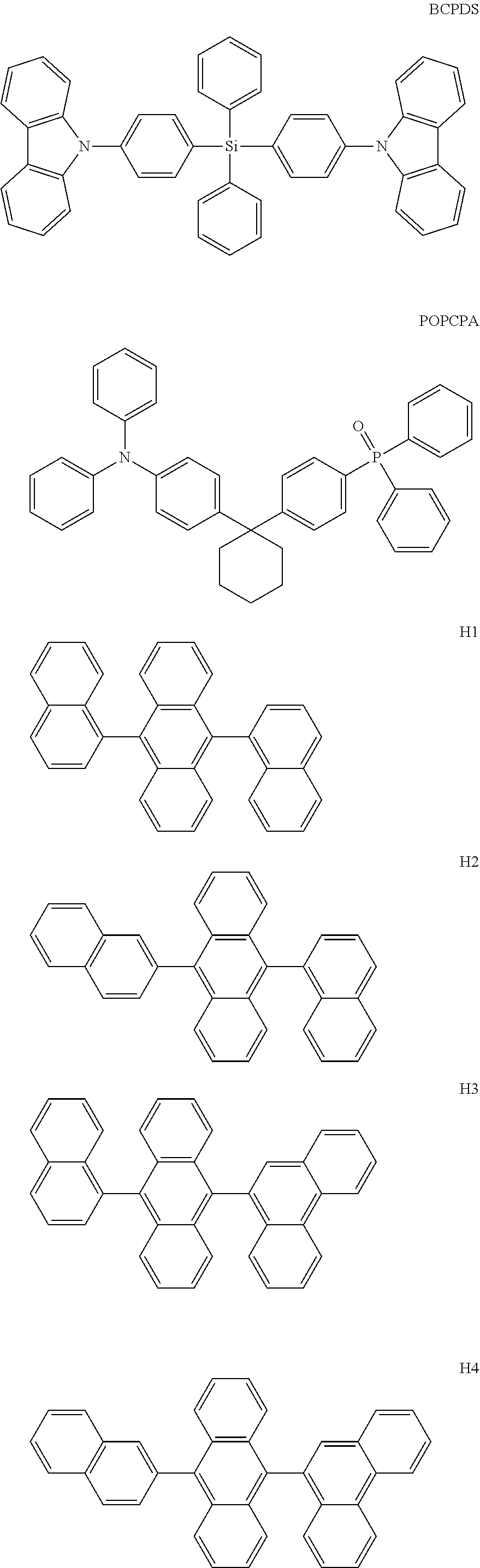


[Ar601]xe11−[(L601)xe1−R601]xe21 Formula 601
-
- Ar601 may be a substituted or unsubstituted C5-C60 carbocyclic group or a substituted or unsubstituted C1-C60 heterocyclic group,
- xe11 may be 1, 2, or 3,
- L601 is selected from a substituted or unsubstituted C3-C10 cycloalkylene group, a substituted or unsubstituted C1-C10 heterocycloalkylene group, a substituted or unsubstituted C3-C10 cycloalkenylene group, a substituted or unsubstituted C1-C10 heterocycloalkenylene group, a substituted or unsubstituted C6-C60 arylene group, a substituted or unsubstituted C1-C60 heteroarylene group, a substituted or unsubstituted divalent non-aromatic condensed polycyclic group, and a substituted or unsubstituted divalent non-aromatic condensed heteropolycyclic group,
- xe1 may be an integer of 0 to 5,
- R601 may be selected from a substituted or unsubstituted C3-C10 cycloalkyl group, a substituted or unsubstituted C1-C10 heterocycloalkyl group, a substituted or unsubstituted C3-C10 cycloalkenyl group, a substituted or unsubstituted C1-C10 heterocycloalkenyl group, a substituted or unsubstituted C6-C60 aryl group, a substituted or unsubstituted C6-C60 aryloxy group, a substituted or unsubstituted C6-C60 arylthio group, a substituted or unsubstituted C1-C60 heteroaryl group, a substituted or unsubstituted monovalent non-aromatic condensed polycyclic group, a substituted or unsubstituted monovalent non-aromatic condensed heteropolycyclic group, —Si(Q601)(Q602)(Q603), —C(═O)(Q601), —S(═O)2(Q601), and —P(═O)(Q601)(Q602),
- Q601 to Q603 may each independently be a C1-C10 alkyl group, a C1-C10 alkoxy group, a phenyl group, a biphenyl group, a terphenyl group, or a naphthyl group, and
- xe21 may be an integer of 1 to 5.
-
- a benzene group, a naphthalene group, a fluorene group, a spiro-bifluorene group, a benzofluorene group, a dibenzofluorene group, a phenalene group, a phenanthrene group, an anthracene group, a fluoranthene group, a triphenylene group, a pyrene group, a chrysene group, a naphthacene group, a picene group, a perylene group, a pentaphene group, an indenoanthracene group, a dibenzofuran group, a dibenzothiophene group, a carbazole group, an imidazole group, a pyrazole group, a thiazole group, an isothiazole group, an oxazole group, an isoxazole group, a pyridine group, a pyrazine group, a pyrimidine group, a pyridazine group, an indazole group, a purine group, a quinoline group, an isoquinoline group, a benzoquinoline group, a phthalazine group, a naphthyridine group, a quinoxaline group, a quinazoline group, a cinnoline group, a phenanthridine group, an acridine group, a phenanthroline group, a phenazine group, a benzimidazole group, an isobenzothiazole group, a benzoxazole group, an isobenzoxazole group, a triazole group, a tetrazole group, an oxadiazole group, a triazine group, a thiadiazole group, an imidazopyridine group, an imidazopyrimidine group, and an azacarbazole group; and
- a benzene group, a naphthalene group, a fluorene group, a spiro-bifluorene group, a benzofluorene group, a dibenzofluorene group, a phenalene group, a phenanthrene group, an anthracene group, a fluoranthene group, a triphenylene group, a pyrene group, a chrysene group, a naphthacene group, a picene group, a perylene group, a pentaphene group, an indenoanthracene group, a dibenzofuran group, a dibenzothiophene group, a carbazole group, an imidazole group, a pyrazole group, a thiazole group, an isothiazole group, an oxazole group, an isoxazole group, a pyridine group, a pyrazine group, a pyrimidine group, a pyridazine group, an indazole group, a purine group, a quinoline group, an isoquinoline group, a benzoquinoline group, a phthalazine group, a naphthyridine group, a quinoxaline group, a quinazoline group, a cinnoline group, a phenanthridine group, an acridine group, a phenanthroline group, a phenazine group, a benzimidazole group, an isobenzothiazole group, a benzoxazole group, an isobenzoxazole group, a triazole group, a tetrazole group, an oxadiazole group, a triazine group, a thiadiazole group, an imidazopyridine group, an imidazopyrimidine group, and an azacarbazole group, each substituted with at least one selected from deuterium, —F, —Cl, —Br, —I, a hydroxyl group, a cyano group, a nitro group, an amidino group, a hydrazino group, a hydrazono group, a C1-C20 alkyl group, a C1-C20 alkoxy group, a phenyl group, a biphenyl group, a terphenyl group, a naphthyl group, —Si(Q31)(Q32)(Q33), —S(═O)2(Q31), and —P(═O)(Q31)(Q32), and
- Q31 to Q33 may each independently be selected from a C1-C10 alkyl group, a C1-C10 alkoxy group, a phenyl group, a biphenyl group, a terphenyl group, and a naphthyl group.

-
- X614 may be N or C(R614), X615 may be N or C(R615), X616 may be N or C(R616), and at least one selected from X614 to X616 may be N,
- L611 to L613 may each independently be defined the same as L601,
- xe611 to xe613 may each independently be defined the same as xe1,
- R611 to R613 may each independently be defined the same as R601, and
- R614 to R616 may each independently be selected from hydrogen, deuterium, —F, —Cl, —Br, —I, a hydroxyl group, a cyano group, a nitro group, an amidino group, a hydrazino group, a hydrazono group, a C1-C20 alkyl group, a C1-C20 alkoxy group, a phenyl group, a biphenyl group, a terphenyl group, and a naphthyl group.
-
- a phenylene group, a naphthylene group, a fluorenylene group, a spiro-bifluorenylene group, a benzofluorenylene group, a dibenzofluorenylene group, a phenanthrenylene group, an anthracenylene group, a fluoranthenylene group, a triphenylenylene group, a pyrenylene group, a chrysenylene group, a perylenylene group, a pentaphenylene group, a hexacenylene group, a pentacenylene group, a thiophenylene group, a furanylene group, a carbazolylene group, an indolylene group, an isoindolylene group, a benzofuranylene group, a benzothiophenylene group, a dibenzofuranylene group, a dibenzothiophenylene group, a benzocarbazolylene group, a dibenzocarbazolylene group, a dibenzosilolylene group, a pyridinylene group, an imidazolylene group, a pyrazolylene group, a thiazolylene group, an isothiazolylene group, an oxazolylene group, an isoxazolylene group, a thiadiazolylene group, an oxadiazolylene group, a pyrazinylene group, a pyrimidinylene group, a pyridazinylene group, a triazinylene group, a quinolinylene group, an isoquinolinylene group, a benzoquinolinylene group, a phthalazinylene group, a naphthyridinylene group, a quinoxalinylene group, a quinazolinylene group, a cinnolinylene group, a phenanthridinylene group, an acridinylene group, a phenanthrolinylene group, a phenazinylene group, a benzimidazolylene group, an isobenzothiazolylene group, a benzoxazolylene group, an isobenzoxazolylene group, a triazolylene group, a tetrazolylene group, an imidazopyridinylene group, an imidazopyrimidinylene group, and an azacarbazolylene group; and
- a phenylene group, a naphthylene group, a fluorenylene group, a spiro-bifluorenylene group, a benzofluorenylene group, a dibenzofluorenylene group, a phenanthrenylene group, an anthracenylene group, a fluoranthenylene group, a triphenylenylene group, a pyrenylene group, a chrysenylene group, a perylenylene group, a pentaphenylene group, a hexacenylene group, a pentacenylene group, a thiophenylene group, a furanylene group, a carbazolylene group, an indolylene group, an isoindolylene group, a benzofuranylene group, a benzothiophenylene group, a dibenzofuranylene group, a dibenzothiophenylene group, a benzocarbazolylene group, a dibenzocarbazolylene group, a dibenzosilolylene group, a pyridinylene group, an imidazolylene group, a pyrazolylene group, a thiazolylene group, an isothiazolylene group, an oxazolylene group, an isoxazolylene group, a thiadiazolylene group, an oxadiazolylene group, a pyrazinylene group, a pyrimidinylene group, a pyridazinylene group, a triazinylene group, a quinolinylene group, an isoquinolinylene group, a benzoquinolinylene group, a phthalazinylene group, a naphthyridinylene group, a quinoxalinylene group, a quinazolinylene group, a cinnolinylene group, a phenanthridinylene group, an acridinylene group, a phenanthrolinylene group, a phenazinylene group, a benzimidazolylene group, an isobenzothiazolylene group, a benzoxazolylene group, an isobenzoxazolylene group, a triazolylene group, a tetrazolylene group, an imidazopyridinylene group, an imidazopyrimidinylene group, and an azacarbazolylene group, each substituted with at least one selected from deuterium, —F, —Cl, —Br, —I, a hydroxyl group, a cyano group, a nitro group, an amidino group, a hydrazino group, a hydrazono group, a C1-C20 alkyl group, a C1-C20 alkoxy group, a phenyl group, a biphenyl group, a terphenyl group, a naphthyl group, a fluorenyl group, a spiro-bifluorenyl group, a benzofluorenyl group, a dibenzofluorenyl group, a phenanthrenyl group, an anthracenyl group, a fluoranthenyl group, a triphenylenyl group, a pyrenyl group, a chrysenyl group, a perylenyl group, a pentaphenyl group, a hexacenyl group, a pentacenyl group, a thiophenyl group, a furanyl group, a carbazolyl group, an indolyl group, an isoindolyl group, a benzofuranyl group, a benzothiophenyl group, a dibenzofuranyl group, a dibenzothiophenyl group, a benzocarbazolyl group, a dibenzocarbazolyl group, a dibenzosilolyl group, a pyridinyl group, an imidazolyl group, a pyrazolyl group, a thiazolyl group, an isothiazolyl group, an oxazolyl group, an isoxazolyl group, a thiadiazolyl group, an oxadiazolyl group, a pyrazinyl group, a pyrimidinyl group, a pyridazinyl group, a triazinyl group, a quinolinyl group, an isoquinolinyl group, a benzoquinolinyl group, a phthalazinyl group, a naphthyridinyl group, a quinoxalinyl group, a quinazolinyl group, a cinnolinyl group, a phenanthridinyl group, an acridinyl group, a phenanthrolinyl group, a phenazinyl group, a benzimidazolyl group, an isobenzothiazolyl group, a benzoxazolyl group, an isobenzoxazolyl group, a triazolyl group, a tetrazolyl group, an imidazopyridinyl group, an imidazopyrimidinyl group, and an azacarbazolyl group,
- but embodiments of the present disclosure are not limited thereto.
-
- a phenyl group, a biphenyl group, a terphenyl group, a naphthyl group, a fluorenyl group, a spiro-bifluorenyl group, a benzofluorenyl group, a dibenzofluorenyl group, a phenanthrenyl group, an anthracenyl group, a fluoranthenyl group, a triphenylenyl group, a pyrenyl group, a chrysenyl group, a perylenyl group, a pentaphenyl group, a hexacenyl group, a pentacenyl group, a thiophenyl group, a furanyl group, a carbazolyl group, an indolyl group, an isoindolyl group, a benzofuranyl group, a benzothiophenyl group, a dibenzofuranyl group, a dibenzothiophenyl group, a benzocarbazolyl group, a dibenzocarbazolyl group, a dibenzosilolyl group, a pyridinyl group, an imidazolyl group, a pyrazolyl group, a thiazolyl group, an isothiazolyl group, an oxazolyl group, an isoxazolyl group, a thiadiazolyl group, an oxadiazolyl group, a pyrazinyl group, a pyrimidinyl group, a pyridazinyl group, a triazinyl group, a quinolinyl group, an isoquinolinyl group, a benzoquinolinyl group, a phthalazinyl group, a naphthyridinyl group, a quinoxalinyl group, a quinazolinyl group, a cinnolinyl group, a phenanthridinyl group, an acridinyl group, a phenanthrolinyl group, a phenazinyl group, a benzimidazolyl group, an isobenzothiazolyl group, a benzoxazolyl group, an isobenzoxazolyl group, a triazolyl group, a tetrazolyl group, an imidazopyridinyl group, an imidazopyrimidinyl group, and an azacarbazolyl group;
- a phenyl group, a biphenyl group, a terphenyl group, a naphthyl group, a fluorenyl group, a spiro-bifluorenyl group, a benzofluorenyl group, a dibenzofluorenyl group, a phenanthrenyl group, an anthracenyl group, a fluoranthenyl group, a triphenylenyl group, a pyrenyl group, a chrysenyl group, a perylenyl group, a pentaphenyl group, a hexacenyl group, a pentacenyl group, a thiophenyl group, a furanyl group, a carbazolyl group, an indolyl group, an isoindolyl group, a benzofuranyl group, a benzothiophenyl group, a dibenzofuranyl group, a dibenzothiophenyl group, a benzocarbazolyl group, a dibenzocarbazolyl group, a dibenzosilolyl group, a pyridinyl group, an imidazolyl group, a pyrazolyl group, a thiazolyl group, an isothiazolyl group, an oxazolyl group, an isoxazolyl group, a thiadiazolyl group, an oxadiazolyl group, a pyrazinyl group, a pyrimidinyl group, a pyridazinyl group, a triazinyl group, a quinolinyl group, an isoquinolinyl group, a benzoquinolinyl group, a phthalazinyl group, a naphthyridinyl group, a quinoxalinyl group, a quinazolinyl group, a cinnolinyl group, a phenanthridinyl group, an acridinyl group, a phenanthrolinyl group, a phenazinyl group, a benzimidazolyl group, an isobenzothiazolyl group, a benzoxazolyl group, an isobenzoxazolyl group, a triazolyl group, a tetrazolyl group, an imidazopyridinyl group, an imidazopyrimidinyl group, and an azacarbazolyl group, each substituted with at least one selected from deuterium, —F, —Cl, —Br, —I, a hydroxyl group, a cyano group, a nitro group, an amidino group, a hydrazino group, a hydrazono group, a C1-C20 alkyl group, a C1-C20 alkoxy group, a phenyl group, a biphenyl group, a terphenyl group, a naphthyl group, a fluorenyl group, a spiro-bifluorenyl group, a benzofluorenyl group, a dibenzofluorenyl group, a phenanthrenyl group, an anthracenyl group, a fluoranthenyl group, a triphenylenyl group, a pyrenyl group, a chrysenyl group, a perylenyl group, a pentaphenyl group, a hexacenyl group, a pentacenyl group, a thiophenyl group, a furanyl group, a carbazolyl group, an indolyl group, an isoindolyl group, a benzofuranyl group, a benzothiophenyl group, a dibenzofuranyl group, a dibenzothiophenyl group, a benzocarbazolyl group, a dibenzocarbazolyl group, a dibenzosilolyl group, a pyridinyl group, an imidazolyl group, a pyrazolyl group, a thiazolyl group, an isothiazolyl group, an oxazolyl group, an isoxazolyl group, a thiadiazolyl group, an oxadiazolyl group, a pyrazinyl group, a pyrimidinyl group, a pyridazinyl group, a triazinyl group, a quinolinyl group, an isoquinolinyl group, a benzoquinolinyl group, a phthalazinyl group, a naphthyridinyl group, a quinoxalinyl group, a quinazolinyl group, a cinnolinyl group, a phenanthridinyl group, an acridinyl group, a phenanthrolinyl group, a phenazinyl group, a benzimidazolyl group, an isobenzothiazolyl group, a benzoxazolyl group, an isobenzoxazolyl group, a triazolyl group, a tetrazolyl group, an imidazopyridinyl group, an imidazopyrimidinyl group, and an azacarbazolyl group; and
- —S(═O)2(Q601) and −P(═O)(Q601)(Q602), and
- Q601 and Q602 are same as described herein above.


-
- deuterium, —F, —Cl, —Br, —I, a hydroxyl group, a cyano group, a nitro group, an amidino group, a hydrazino group, a hydrazono group, a C1-C60 alkyl group, a C2-C60 alkenyl group, a C2-C60 alkynyl group, and a C1-C60 alkoxy group;
- a C1-C60 alkyl group, a C2-C60 alkenyl group, a C2-C60 alkynyl group, and a C1-C60 alkoxy group, each substituted with at least one selected from deuterium, —F, —Cl, —Br, —I, a hydroxyl group, a cyano group, a nitro group, an amidino group, a hydrazino group, a hydrazono group, a C3-C10 cycloalkyl group, a C1-C10 heterocycloalkyl group, a C3-C10 cycloalkenyl group, a C1-C10 heterocycloalkenyl group, a C6-C60 aryl group, a C6-C60 aryloxy group, a C6-C60 arylthio group, a C1-C60 heteroaryl group, a C1-C60 heteroaryloxy group, a C1-C60 heteroarylthio group, a monovalent non-aromatic condensed polycyclic group, a monovalent non-aromatic condensed heteropolycyclic group, —Si(Q11)(Q12)(Q13), —N(Q11)(Q12), —B(Q11)(Q12), —C(═O)(Q11), —S(═O)2(Q11), and —P(═O)(Q11)(Q12);
- a C3-C10 cycloalkyl group, a C1-C10 heterocycloalkyl group, a C3-C10 cycloalkenyl group, a C1-C10 heterocycloalkenyl group, a C6-C60 aryl group, a C6-C60 aryloxy group, a C6-C60 arylthio group, a C1-C60 heteroaryl group, a C1-C60 heteroaryloxy group, a C1-C60 heteroarylthio group, a monovalent non-aromatic condensed polycyclic group, and a monovalent non-aromatic condensed heteropolycyclic group;
- a C3-C10 cycloalkyl group, a C1-C10 heterocycloalkyl group, a C3-C10 cycloalkenyl group, a C1-C10 heterocycloalkenyl group, a C6-C60 aryl group, a C6-C60 aryloxy group, a C6-C60 arylthio group, a C1-C60 heteroaryl group, a C1-C60 heteroaryloxy group, a C1-C60 heteroarylthio group, a monovalent non-aromatic condensed polycyclic group, and a monovalent non-aromatic condensed heteropolycyclic group, each substituted with at least one selected from deuterium, —F, —Cl, —Br, —I, a hydroxyl group, a cyano group, a nitro group, an amidino group, a hydrazino group, a hydrazono group, a C1-C60 alkyl group, a C2-C60 alkenyl group, a C2-C60 alkynyl group, a C1-C60 alkoxy group, a C3-C10 cycloalkyl group, a C1-C10 heterocycloalkyl group, a C3-C10 cycloalkenyl group, a C1-C10 heterocycloalkenyl group, a C6-C60 aryl group, a C6-C60 aryloxy group, a C6-C60 arylthio group, a C1-C60 heteroaryl group, a C1-C60 heteroaryloxy group, a C1-C60 heteroarylthio group, a monovalent non-aromatic condensed polycyclic group, a monovalent non-aromatic condensed heteropolycyclic group, —Si(Q21)(Q22)(Q23), —N(Q21)(Q22), —B(Q21)(Q22), —C(═O)(Q21), —S(═O)2(Q21), and —P(═O)(Q21)(Q22); and
- —Si(Q31)(Q32)(Q33), —N(Q31)(Q32), —B(Q31)(Q31)(Q32), —C(═O)(Q31), —S(═O)2(Q31), and —P(═O)(Q31)(Q32), and
- Q11 to Q13, Q21 to Q23, and Q31 to Q33 may each independently be selected from hydrogen, deuterium, —F, —Cl, —Br, —I, a hydroxyl group, a cyano group, a nitro group, an amidino group, a hydrazino group, a hydrazono group, a C1-C60 alkyl group, a C2-C60 alkenyl group, a C2-C60 alkynyl group, a C1-C60 alkoxy group, a C3-C10 cycloalkyl group, a C1-C10 heterocycloalkyl group, a C3-C10 cycloalkenyl group, a C1-C10 heterocycloalkenyl group, a C6-C60 aryl group, a C1-C60 heteroaryl group, a C1-C60 heteroaryloxy group, a C1-C60 heteroarylthio group, a monovalent non-aromatic condensed polycyclic group, a monovalent non-aromatic condensed heteropolycyclic group, a C1-C60 alkyl group substituted with at least one selected from deuterium, —F, and a cyano group, a C6-C60 aryl group substituted with at least one selected from deuterium, —F, and a cyano group, a biphenyl group, and a terphenyl group.


Claims (18)
M1(L1)n1(L2)n2 Formula 1


M1(L1)n1(L2)n2 Formula 1


Applications Claiming Priority (2)
| Application Number | Priority Date | Filing Date | Title |
|---|---|---|---|
| KR10-2018-0161188 | 2018-12-13 | ||
| KR1020180161188A KR102720610B1 (en) | 2018-12-13 | 2018-12-13 | Organic light-emitting device, apparatus comprising the same and organometallic compound |
Publications (2)
| Publication Number | Publication Date |
|---|---|
| US20200194693A1 US20200194693A1 (en) | 2020-06-18 |
| US12035615B2 true US12035615B2 (en) | 2024-07-09 |
Family
ID=71072931
Family Applications (1)
| Application Number | Title | Priority Date | Filing Date |
|---|---|---|---|
| US16/446,405 Active 2041-07-13 US12035615B2 (en) | 2018-12-13 | 2019-06-19 | Organic light-emitting device, apparatus including the same, and organometallic compound |
Country Status (2)
| Country | Link |
|---|---|
| US (1) | US12035615B2 (en) |
| KR (1) | KR102720610B1 (en) |
Families Citing this family (2)
| Publication number | Priority date | Publication date | Assignee | Title |
|---|---|---|---|---|
| CN113801166B (en) * | 2020-06-16 | 2023-04-07 | 广东阿格蕾雅光电材料有限公司 | Tetradentate metal complex and application thereof |
| CN114751939B (en) * | 2021-01-11 | 2024-05-10 | 广东阿格蕾雅光电材料有限公司 | Tetradentate ONCN platinum complex containing polyazacycle |
Citations (6)
| Publication number | Priority date | Publication date | Assignee | Title |
|---|---|---|---|---|
| WO2007088768A1 (en) * | 2006-02-01 | 2007-08-09 | Konica Minolta Holdings, Inc. | Organic thin film transistor, organic semiconductor material, organic semiconductor film, and organic semiconductor device |
| US20120018711A1 (en) * | 2010-07-21 | 2012-01-26 | The University Of Hong Kong | Platinum (ii) tetradentate oncn complexes for organic light-emitting diode applications |
| US20120187349A1 (en) | 2009-09-23 | 2012-07-26 | Merck Patent Gmbh | Materials for electronic devices |
| KR20130043460A (en) | 2011-10-20 | 2013-04-30 | 에스에프씨 주식회사 | Organic metal compounds and organic light emitting diodes comprising the same |
| US20180013078A1 (en) | 2016-07-05 | 2018-01-11 | Samsung Electronics Co., Ltd. | Organometallic compound, organic light-emitting device including the same, and diagnostic composition including the organometallic compound |
| US20180062088A1 (en) | 2016-08-25 | 2018-03-01 | Samsung Electronics Co., Ltd. | Organometallic compound, organic light-emitting device including the organometallic compound, and diagnostic composition including the organometallic compound |
Family Cites Families (4)
| Publication number | Priority date | Publication date | Assignee | Title |
|---|---|---|---|---|
| KR102120894B1 (en) * | 2013-05-03 | 2020-06-10 | 삼성디스플레이 주식회사 | Organic light emitting device |
| KR102385228B1 (en) * | 2014-12-30 | 2022-04-12 | 삼성디스플레이 주식회사 | Organometallic compound and organic light emitting diode comprising the same |
| KR102637099B1 (en) * | 2016-04-08 | 2024-02-19 | 삼성전자주식회사 | Organometallic compound and organic light-emitting device including the same |
| KR102300027B1 (en) * | 2017-03-10 | 2021-09-09 | 삼성디스플레이 주식회사 | Organic light emitting device |
-
2018
- 2018-12-13 KR KR1020180161188A patent/KR102720610B1/en active Active
-
2019
- 2019-06-19 US US16/446,405 patent/US12035615B2/en active Active
Patent Citations (9)
| Publication number | Priority date | Publication date | Assignee | Title |
|---|---|---|---|---|
| WO2007088768A1 (en) * | 2006-02-01 | 2007-08-09 | Konica Minolta Holdings, Inc. | Organic thin film transistor, organic semiconductor material, organic semiconductor film, and organic semiconductor device |
| US20120187349A1 (en) | 2009-09-23 | 2012-07-26 | Merck Patent Gmbh | Materials for electronic devices |
| US20120018711A1 (en) * | 2010-07-21 | 2012-01-26 | The University Of Hong Kong | Platinum (ii) tetradentate oncn complexes for organic light-emitting diode applications |
| KR20130069723A (en) | 2010-07-21 | 2013-06-26 | 벌시테크 리미티드 | Platunum(ii) tetradentate oncn complexes for organic light-emitting diode applications |
| KR20130043460A (en) | 2011-10-20 | 2013-04-30 | 에스에프씨 주식회사 | Organic metal compounds and organic light emitting diodes comprising the same |
| US20180013078A1 (en) | 2016-07-05 | 2018-01-11 | Samsung Electronics Co., Ltd. | Organometallic compound, organic light-emitting device including the same, and diagnostic composition including the organometallic compound |
| KR20180005128A (en) | 2016-07-05 | 2018-01-15 | 삼성전자주식회사 | Organometallic compound, organic light emitting device including the same and a composition for diagnosing including the same |
| US20180062088A1 (en) | 2016-08-25 | 2018-03-01 | Samsung Electronics Co., Ltd. | Organometallic compound, organic light-emitting device including the organometallic compound, and diagnostic composition including the organometallic compound |
| KR20180023297A (en) | 2016-08-25 | 2018-03-07 | 삼성전자주식회사 | Organometallic compound, organic light emitting device including the same and a composition for diagnosing including the same |
Non-Patent Citations (3)
| Title |
|---|
| Heng, W.Y.; Hu, J.; Yip, J.H.; 2007, Attaching Gold and Platinum to the Rim of Pyrene: A Synthetic and Spectroscopic Study, Organometallics, 27, 6760-6768 (Year: 2007). * |
| WO-2007088768-A1—translation (Year: 2007). * |
| Wu, Wenting; Wu, Wanhua; Ji, S.; Guo, H. Zhao, J.; 2010, Observation of Room-Temperature Deep-Red/Near-IR Phosphorescent of Pyrene with Cylcoplatinated Complexes: An Experimental and Theoretical Study, Eur. J. Inorg. Chem., 4470-4482 (Year: 2010). * |
Also Published As
| Publication number | Publication date |
|---|---|
| KR20200073351A (en) | 2020-06-24 |
| KR102720610B1 (en) | 2024-10-24 |
| US20200194693A1 (en) | 2020-06-18 |
Similar Documents
| Publication | Publication Date | Title |
|---|---|---|
| US12052917B2 (en) | Organic light-emitting device including heterocyclic compound with boron and nitrogen | |
| US12096680B2 (en) | Organometallic compound and organic light-emitting device including the same | |
| US20210104682A1 (en) | Organic light-emitting device and device including same | |
| US20190058137A1 (en) | Organometallic compound, organic light-emitting device including the organometallic compound, and organic light-emitting apparatus including the organic light-emitting device | |
| US11711978B2 (en) | Heterocyclic compound and organic light-emitting device including the same | |
| US20190062357A1 (en) | Organometallic compound, organic light-emitting device including the organometallic compound, and organic light-emitting apparatus including the organic light-emitting device | |
| US20190131540A1 (en) | Condensed cyclic compound and organic light-emitting device including the same | |
| US11976086B2 (en) | Organometallic compound, organic light-emitting device including the organometallic compound, and apparatus including the organic light-emitting device | |
| US11765973B2 (en) | Heterocyclic compound and organic light-emitting device including the same | |
| US11944006B2 (en) | Diamine compound and organic light-emitting device including the same | |
| US11171296B2 (en) | Organometallic compound, organic light-emitting device including the same, and organic light-emitting apparatus including the organic light-emitting device | |
| US11753426B2 (en) | Organometallic compound, organic light-emitting device including the organometallic compound, and organic light-emitting apparatus including the organic light-emitting device | |
| US12289985B2 (en) | Organic light-emitting device, apparatus including the same, and organometallic compound | |
| US11572378B2 (en) | Heterocyclic compound and organic light-emitting device including the same | |
| US20250333647A1 (en) | Organometallic compound, organic light-emitting device including organometallic compound, and apparatus including organometallic compound | |
| US12398317B2 (en) | Organometallic compound and organic light-emitting device including the same | |
| US11158679B2 (en) | Light-emitting device | |
| US20200006677A1 (en) | Organometallic compound, organic light-emitting device including the same, and apparatus including the organic light-emitting device | |
| US12150376B2 (en) | Organic light-emitting device and apparatus including the same | |
| US12201016B2 (en) | Organometallic compound, organic light-emitting device including the organometallic compound, and apparatus including the organic light-emitting device | |
| US11329232B2 (en) | Arylamine-based compound including thermally decomposable groups and organic light-emitting device including the same | |
| US20200259101A1 (en) | Organic light-emitting device | |
| US10873040B2 (en) | Organometallic compound and organic light emitting device including the same | |
| US20200194693A1 (en) | Organic light-emitting device, apparatus including the same, and organometallic compound | |
| US20210265575A1 (en) | Organic light-emitting device and apparatus including the same |
Legal Events
| Date | Code | Title | Description |
|---|---|---|---|
| FEPP | Fee payment procedure |
Free format text: ENTITY STATUS SET TO UNDISCOUNTED (ORIGINAL EVENT CODE: BIG.); ENTITY STATUS OF PATENT OWNER: LARGE ENTITY |
|
| AS | Assignment |
Owner name: SAMSUNG DISPLAY CO., LTD., KOREA, REPUBLIC OF Free format text: ASSIGNMENT OF ASSIGNORS INTEREST;ASSIGNORS:KIM, MYEONGSUK;YOO, BYEONGWOOK;YE, JIMYOUNG;AND OTHERS;REEL/FRAME:049749/0841 Effective date: 20190513 |
|
| STPP | Information on status: patent application and granting procedure in general |
Free format text: DOCKETED NEW CASE - READY FOR EXAMINATION |
|
| STPP | Information on status: patent application and granting procedure in general |
Free format text: NON FINAL ACTION MAILED |
|
| STPP | Information on status: patent application and granting procedure in general |
Free format text: RESPONSE TO NON-FINAL OFFICE ACTION ENTERED AND FORWARDED TO EXAMINER |
|
| STPP | Information on status: patent application and granting procedure in general |
Free format text: FINAL REJECTION MAILED |
|
| STPP | Information on status: patent application and granting procedure in general |
Free format text: RESPONSE AFTER FINAL ACTION FORWARDED TO EXAMINER |
|
| STPP | Information on status: patent application and granting procedure in general |
Free format text: ADVISORY ACTION MAILED |
|
| STPP | Information on status: patent application and granting procedure in general |
Free format text: DOCKETED NEW CASE - READY FOR EXAMINATION |
|
| STPP | Information on status: patent application and granting procedure in general |
Free format text: NON FINAL ACTION MAILED |
|
| STPP | Information on status: patent application and granting procedure in general |
Free format text: FINAL REJECTION MAILED |
|
| STPP | Information on status: patent application and granting procedure in general |
Free format text: DOCKETED NEW CASE - READY FOR EXAMINATION |
|
| STPP | Information on status: patent application and granting procedure in general |
Free format text: NON FINAL ACTION MAILED |
|
| STPP | Information on status: patent application and granting procedure in general |
Free format text: RESPONSE TO NON-FINAL OFFICE ACTION ENTERED AND FORWARDED TO EXAMINER |
|
| STPP | Information on status: patent application and granting procedure in general |
Free format text: NOTICE OF ALLOWANCE MAILED -- APPLICATION RECEIVED IN OFFICE OF PUBLICATIONS |
|
| ZAAA | Notice of allowance and fees due |
Free format text: ORIGINAL CODE: NOA |
|
| ZAAB | Notice of allowance mailed |
Free format text: ORIGINAL CODE: MN/=. |
|
| STPP | Information on status: patent application and granting procedure in general |
Free format text: PUBLICATIONS -- ISSUE FEE PAYMENT VERIFIED |
|
| STCF | Information on status: patent grant |
Free format text: PATENTED CASE |