US12030879B2 - Sulfonyl acetamides as NLRP3 inhibitors - Google Patents
Sulfonyl acetamides as NLRP3 inhibitors Download PDFInfo
- Publication number
- US12030879B2 US12030879B2 US16/977,445 US201916977445A US12030879B2 US 12030879 B2 US12030879 B2 US 12030879B2 US 201916977445 A US201916977445 A US 201916977445A US 12030879 B2 US12030879 B2 US 12030879B2
- Authority
- US
- United States
- Prior art keywords
- group
- substituted
- alkyl
- optionally
- disease
- Prior art date
- Legal status (The legal status is an assumption and is not a legal conclusion. Google has not performed a legal analysis and makes no representation as to the accuracy of the status listed.)
- Active
Links
Classifications
-
- C—CHEMISTRY; METALLURGY
- C07—ORGANIC CHEMISTRY
- C07D—HETEROCYCLIC COMPOUNDS
- C07D471/00—Heterocyclic compounds containing nitrogen atoms as the only ring hetero atoms in the condensed system, at least one ring being a six-membered ring with one nitrogen atom, not provided for by groups C07D451/00 - C07D463/00
- C07D471/02—Heterocyclic compounds containing nitrogen atoms as the only ring hetero atoms in the condensed system, at least one ring being a six-membered ring with one nitrogen atom, not provided for by groups C07D451/00 - C07D463/00 in which the condensed system contains two hetero rings
- C07D471/04—Ortho-condensed systems
-
- A—HUMAN NECESSITIES
- A61—MEDICAL OR VETERINARY SCIENCE; HYGIENE
- A61K—PREPARATIONS FOR MEDICAL, DENTAL OR TOILETRY PURPOSES
- A61K9/00—Medicinal preparations characterised by special physical form
- A61K9/0012—Galenical forms characterised by the site of application
- A61K9/0014—Skin, i.e. galenical aspects of topical compositions
-
- A—HUMAN NECESSITIES
- A61—MEDICAL OR VETERINARY SCIENCE; HYGIENE
- A61P—SPECIFIC THERAPEUTIC ACTIVITY OF CHEMICAL COMPOUNDS OR MEDICINAL PREPARATIONS
- A61P29/00—Non-central analgesic, antipyretic or antiinflammatory agents, e.g. antirheumatic agents; Non-steroidal antiinflammatory drugs [NSAID]
-
- C—CHEMISTRY; METALLURGY
- C07—ORGANIC CHEMISTRY
- C07D—HETEROCYCLIC COMPOUNDS
- C07D213/00—Heterocyclic compounds containing six-membered rings, not condensed with other rings, with one nitrogen atom as the only ring hetero atom and three or more double bonds between ring members or between ring members and non-ring members
- C07D213/02—Heterocyclic compounds containing six-membered rings, not condensed with other rings, with one nitrogen atom as the only ring hetero atom and three or more double bonds between ring members or between ring members and non-ring members having three double bonds between ring members or between ring members and non-ring members
- C07D213/04—Heterocyclic compounds containing six-membered rings, not condensed with other rings, with one nitrogen atom as the only ring hetero atom and three or more double bonds between ring members or between ring members and non-ring members having three double bonds between ring members or between ring members and non-ring members having no bond between the ring nitrogen atom and a non-ring member or having only hydrogen or carbon atoms directly attached to the ring nitrogen atom
- C07D213/24—Heterocyclic compounds containing six-membered rings, not condensed with other rings, with one nitrogen atom as the only ring hetero atom and three or more double bonds between ring members or between ring members and non-ring members having three double bonds between ring members or between ring members and non-ring members having no bond between the ring nitrogen atom and a non-ring member or having only hydrogen or carbon atoms directly attached to the ring nitrogen atom with substituted hydrocarbon radicals attached to ring carbon atoms
- C07D213/54—Radicals substituted by carbon atoms having three bonds to hetero atoms with at the most one bond to halogen, e.g. ester or nitrile radicals
- C07D213/56—Amides
-
- C—CHEMISTRY; METALLURGY
- C07—ORGANIC CHEMISTRY
- C07D—HETEROCYCLIC COMPOUNDS
- C07D213/00—Heterocyclic compounds containing six-membered rings, not condensed with other rings, with one nitrogen atom as the only ring hetero atom and three or more double bonds between ring members or between ring members and non-ring members
- C07D213/02—Heterocyclic compounds containing six-membered rings, not condensed with other rings, with one nitrogen atom as the only ring hetero atom and three or more double bonds between ring members or between ring members and non-ring members having three double bonds between ring members or between ring members and non-ring members
- C07D213/04—Heterocyclic compounds containing six-membered rings, not condensed with other rings, with one nitrogen atom as the only ring hetero atom and three or more double bonds between ring members or between ring members and non-ring members having three double bonds between ring members or between ring members and non-ring members having no bond between the ring nitrogen atom and a non-ring member or having only hydrogen or carbon atoms directly attached to the ring nitrogen atom
- C07D213/60—Heterocyclic compounds containing six-membered rings, not condensed with other rings, with one nitrogen atom as the only ring hetero atom and three or more double bonds between ring members or between ring members and non-ring members having three double bonds between ring members or between ring members and non-ring members having no bond between the ring nitrogen atom and a non-ring member or having only hydrogen or carbon atoms directly attached to the ring nitrogen atom with hetero atoms or with carbon atoms having three bonds to hetero atoms with at the most one bond to halogen, e.g. ester or nitrile radicals, directly attached to ring carbon atoms
- C07D213/62—Oxygen or sulfur atoms
- C07D213/63—One oxygen atom
- C07D213/64—One oxygen atom attached in position 2 or 6
-
- C—CHEMISTRY; METALLURGY
- C07—ORGANIC CHEMISTRY
- C07D—HETEROCYCLIC COMPOUNDS
- C07D213/00—Heterocyclic compounds containing six-membered rings, not condensed with other rings, with one nitrogen atom as the only ring hetero atom and three or more double bonds between ring members or between ring members and non-ring members
- C07D213/02—Heterocyclic compounds containing six-membered rings, not condensed with other rings, with one nitrogen atom as the only ring hetero atom and three or more double bonds between ring members or between ring members and non-ring members having three double bonds between ring members or between ring members and non-ring members
- C07D213/04—Heterocyclic compounds containing six-membered rings, not condensed with other rings, with one nitrogen atom as the only ring hetero atom and three or more double bonds between ring members or between ring members and non-ring members having three double bonds between ring members or between ring members and non-ring members having no bond between the ring nitrogen atom and a non-ring member or having only hydrogen or carbon atoms directly attached to the ring nitrogen atom
- C07D213/60—Heterocyclic compounds containing six-membered rings, not condensed with other rings, with one nitrogen atom as the only ring hetero atom and three or more double bonds between ring members or between ring members and non-ring members having three double bonds between ring members or between ring members and non-ring members having no bond between the ring nitrogen atom and a non-ring member or having only hydrogen or carbon atoms directly attached to the ring nitrogen atom with hetero atoms or with carbon atoms having three bonds to hetero atoms with at the most one bond to halogen, e.g. ester or nitrile radicals, directly attached to ring carbon atoms
- C07D213/62—Oxygen or sulfur atoms
- C07D213/63—One oxygen atom
- C07D213/64—One oxygen atom attached in position 2 or 6
- C07D213/643—2-Phenoxypyridines; Derivatives thereof
-
- C—CHEMISTRY; METALLURGY
- C07—ORGANIC CHEMISTRY
- C07D—HETEROCYCLIC COMPOUNDS
- C07D213/00—Heterocyclic compounds containing six-membered rings, not condensed with other rings, with one nitrogen atom as the only ring hetero atom and three or more double bonds between ring members or between ring members and non-ring members
- C07D213/02—Heterocyclic compounds containing six-membered rings, not condensed with other rings, with one nitrogen atom as the only ring hetero atom and three or more double bonds between ring members or between ring members and non-ring members having three double bonds between ring members or between ring members and non-ring members
- C07D213/04—Heterocyclic compounds containing six-membered rings, not condensed with other rings, with one nitrogen atom as the only ring hetero atom and three or more double bonds between ring members or between ring members and non-ring members having three double bonds between ring members or between ring members and non-ring members having no bond between the ring nitrogen atom and a non-ring member or having only hydrogen or carbon atoms directly attached to the ring nitrogen atom
- C07D213/60—Heterocyclic compounds containing six-membered rings, not condensed with other rings, with one nitrogen atom as the only ring hetero atom and three or more double bonds between ring members or between ring members and non-ring members having three double bonds between ring members or between ring members and non-ring members having no bond between the ring nitrogen atom and a non-ring member or having only hydrogen or carbon atoms directly attached to the ring nitrogen atom with hetero atoms or with carbon atoms having three bonds to hetero atoms with at the most one bond to halogen, e.g. ester or nitrile radicals, directly attached to ring carbon atoms
- C07D213/62—Oxygen or sulfur atoms
- C07D213/70—Sulfur atoms
- C07D213/71—Sulfur atoms to which a second hetero atom is attached
-
- C—CHEMISTRY; METALLURGY
- C07—ORGANIC CHEMISTRY
- C07D—HETEROCYCLIC COMPOUNDS
- C07D401/00—Heterocyclic compounds containing two or more hetero rings, having nitrogen atoms as the only ring hetero atoms, at least one ring being a six-membered ring with only one nitrogen atom
- C07D401/02—Heterocyclic compounds containing two or more hetero rings, having nitrogen atoms as the only ring hetero atoms, at least one ring being a six-membered ring with only one nitrogen atom containing two hetero rings
- C07D401/04—Heterocyclic compounds containing two or more hetero rings, having nitrogen atoms as the only ring hetero atoms, at least one ring being a six-membered ring with only one nitrogen atom containing two hetero rings directly linked by a ring-member-to-ring-member bond
-
- C—CHEMISTRY; METALLURGY
- C07—ORGANIC CHEMISTRY
- C07D—HETEROCYCLIC COMPOUNDS
- C07D401/00—Heterocyclic compounds containing two or more hetero rings, having nitrogen atoms as the only ring hetero atoms, at least one ring being a six-membered ring with only one nitrogen atom
- C07D401/02—Heterocyclic compounds containing two or more hetero rings, having nitrogen atoms as the only ring hetero atoms, at least one ring being a six-membered ring with only one nitrogen atom containing two hetero rings
- C07D401/12—Heterocyclic compounds containing two or more hetero rings, having nitrogen atoms as the only ring hetero atoms, at least one ring being a six-membered ring with only one nitrogen atom containing two hetero rings linked by a chain containing hetero atoms as chain links
-
- C—CHEMISTRY; METALLURGY
- C07—ORGANIC CHEMISTRY
- C07D—HETEROCYCLIC COMPOUNDS
- C07D405/00—Heterocyclic compounds containing both one or more hetero rings having oxygen atoms as the only ring hetero atoms, and one or more rings having nitrogen as the only ring hetero atom
- C07D405/02—Heterocyclic compounds containing both one or more hetero rings having oxygen atoms as the only ring hetero atoms, and one or more rings having nitrogen as the only ring hetero atom containing two hetero rings
- C07D405/12—Heterocyclic compounds containing both one or more hetero rings having oxygen atoms as the only ring hetero atoms, and one or more rings having nitrogen as the only ring hetero atom containing two hetero rings linked by a chain containing hetero atoms as chain links
-
- C—CHEMISTRY; METALLURGY
- C07—ORGANIC CHEMISTRY
- C07D—HETEROCYCLIC COMPOUNDS
- C07D405/00—Heterocyclic compounds containing both one or more hetero rings having oxygen atoms as the only ring hetero atoms, and one or more rings having nitrogen as the only ring hetero atom
- C07D405/14—Heterocyclic compounds containing both one or more hetero rings having oxygen atoms as the only ring hetero atoms, and one or more rings having nitrogen as the only ring hetero atom containing three or more hetero rings
-
- C—CHEMISTRY; METALLURGY
- C07—ORGANIC CHEMISTRY
- C07D—HETEROCYCLIC COMPOUNDS
- C07D409/00—Heterocyclic compounds containing two or more hetero rings, at least one ring having sulfur atoms as the only ring hetero atoms
- C07D409/02—Heterocyclic compounds containing two or more hetero rings, at least one ring having sulfur atoms as the only ring hetero atoms containing two hetero rings
- C07D409/12—Heterocyclic compounds containing two or more hetero rings, at least one ring having sulfur atoms as the only ring hetero atoms containing two hetero rings linked by a chain containing hetero atoms as chain links
-
- C—CHEMISTRY; METALLURGY
- C07—ORGANIC CHEMISTRY
- C07D—HETEROCYCLIC COMPOUNDS
- C07D409/00—Heterocyclic compounds containing two or more hetero rings, at least one ring having sulfur atoms as the only ring hetero atoms
- C07D409/14—Heterocyclic compounds containing two or more hetero rings, at least one ring having sulfur atoms as the only ring hetero atoms containing three or more hetero rings
-
- C—CHEMISTRY; METALLURGY
- C07—ORGANIC CHEMISTRY
- C07D—HETEROCYCLIC COMPOUNDS
- C07D413/00—Heterocyclic compounds containing two or more hetero rings, at least one ring having nitrogen and oxygen atoms as the only ring hetero atoms
- C07D413/02—Heterocyclic compounds containing two or more hetero rings, at least one ring having nitrogen and oxygen atoms as the only ring hetero atoms containing two hetero rings
- C07D413/12—Heterocyclic compounds containing two or more hetero rings, at least one ring having nitrogen and oxygen atoms as the only ring hetero atoms containing two hetero rings linked by a chain containing hetero atoms as chain links
-
- C—CHEMISTRY; METALLURGY
- C07—ORGANIC CHEMISTRY
- C07D—HETEROCYCLIC COMPOUNDS
- C07D417/00—Heterocyclic compounds containing two or more hetero rings, at least one ring having nitrogen and sulfur atoms as the only ring hetero atoms, not provided for by group C07D415/00
- C07D417/02—Heterocyclic compounds containing two or more hetero rings, at least one ring having nitrogen and sulfur atoms as the only ring hetero atoms, not provided for by group C07D415/00 containing two hetero rings
- C07D417/12—Heterocyclic compounds containing two or more hetero rings, at least one ring having nitrogen and sulfur atoms as the only ring hetero atoms, not provided for by group C07D415/00 containing two hetero rings linked by a chain containing hetero atoms as chain links
-
- C—CHEMISTRY; METALLURGY
- C07—ORGANIC CHEMISTRY
- C07F—ACYCLIC, CARBOCYCLIC OR HETEROCYCLIC COMPOUNDS CONTAINING ELEMENTS OTHER THAN CARBON, HYDROGEN, HALOGEN, OXYGEN, NITROGEN, SULFUR, SELENIUM OR TELLURIUM
- C07F5/00—Compounds containing elements of Groups 3 or 13 of the Periodic Table
- C07F5/02—Boron compounds
- C07F5/027—Organoboranes and organoborohydrides
Definitions
- alkynyl substituent group or an alkynyl moiety in a substituent group refers to an unsaturated alkyl group or moiety having one or more carbon-carbon triple bonds.
- alkynyl groups/moieties include ethynyl, propargyl, but-1-ynyl and but-2-ynyl groups/moieties.
- an alkynyl group is a C 2 -C 12 alkynyl group. More typically an alkynyl group is a C 2 -C 6 alkynyl group.
- An “alkynylene” group is similarly defined as a divalent alkynyl group.
- heterocyclic groups include heteroaryl groups as discussed below and non-aromatic heterocyclic groups such as azetinyl, azetidinyl, oxetanyl, thietanyl, pyrrolidinyl, tetrahydrofuranyl, tetrahydrothiophenyl, pyrazolidinyl, imidazolidinyl, dioxolanyl, oxathiolanyl, piperidinyl, tetrahydropyranyl, thianyl, piperazinyl, dioxanyl, morpholinyl and thiomorpholinyl groups.
- non-aromatic heterocyclic groups such as azetinyl, azetidinyl, oxetanyl, thietanyl, pyrrolidinyl, tetrahydrofuranyl, tetrahydrothiophenyl, pyrazolidinyl, imidazo
- aryl substituent group or an aryl moiety in a substituent group refers to an aromatic hydrocarbyl ring.
- aryl includes monocyclic aromatic hydrocarbons and polycyclic fused ring aromatic hydrocarbons wherein all of the fused ring systems (excluding any ring systems which are part of or formed by optional substituents) are aromatic. Examples of aryl groups/moieties include phenyl, naphthyl, anthracenyl and phenanthrenyl. Unless stated otherwise, the term “aryl” does not include “heteroaryl”.
- a cyclic group or moiety is stated to be non-aromatic, such as a cycloalkyl, cycloalkenyl or non-aromatic heterocyclic group, it is to be understood that the group or moiety, excluding any ring systems which are part of or formed by optional substituents, is non-aromatic.
- a cyclic group or moiety is stated to be aromatic, such as an aryl or a heteroaryl group, it is to be understood that the group or moiety, excluding any ring systems which are part of or formed by optional substituents, is aromatic.
- a cyclic group or moiety is considered non-aromatic, when it does not have any tautomers that are aromatic. When a cyclic group or moiety has a tautomer that is aromatic, it is considered aromatic, even if it has tautomers that are not aromatic.
- a substituted group comprises 1, 2, 3 or 4 substituents, more typically 1, 2 or 3 substituents, more typically 1 or 2 substituents, and more typically 1 substituent.
- fluoromethyl refers to a methyl group substituted with one, two or three fluoro groups.
- a C x -C y group is defined as a group containing from x to y carbon atoms.
- a C 1 -C 4 alkyl group is defined as an alkyl group containing from 1 to 4 carbon atoms.
- Optional substituents and moieties are not taken into account when calculating the total number of carbon atoms in the parent group substituted with the optional substituents and/or containing the optional moieties.
- replacement heteroatoms e.g. N, O or S, are to be counted as carbon atoms when calculating the number of carbon atoms in a C x -C y group.
- a morpholinyl group is to be considered a C 6 heterocyclic group, not a C 4 heterocyclic group.
- first atom or group is “directly attached” to a second atom or group it is to be understood that the first atom or group is covalently bonded to the second atom or group with no intervening atom(s) or group(s) being present. So, for example, for the group (C ⁇ O)N(CH 3 ) 2 , the carbon atom of each methyl group is directly attached to the nitrogen atom and the carbon atom of the carbonyl group is directly attached to the nitrogen atom, but the carbon atom of the carbonyl group is not directly attached to the carbon atom of either methyl group.
- R 1 is a 4- to 10-membered cyclic group (typically a cycloalkyl, cycloalkenyl, non-aromatic heterocyclic, aryl or heteroaryl group), wherein the cyclic group may optionally be substituted.
- R 1 is phenyl, naphthyl, pyridinyl, pyridazinyl, pyrimidinyl, pyrazinyl, pyrrolyl, furanyl, thiophenyl, pyrazolyl, imidazolyl, oxazolyl, isoxazolyl, thiazolyl, isothiazolyl, triazolyl, oxadiazolyl, cyclopropyl, cyclobutyl, cyclopentyl, cyclohexyl, cycloheptyl, azetinyl, azetidinyl, oxetanyl, thietanyl, pyrrolidinyl, tetrahydrofuranyl, tetrahydrothiophenyl, pyrazolidinyl, imidazolidinyl, 1,3-dioxolanyl, 1,2-oxathiolanyl,
- R 1 is pyrazolyl, imidazolyl, triazolyl, azetidinyl, pyrrolidinyl or piperidinyl, all of which may optionally be substituted. More typically R 1 is pyrazolyl or azetidinyl, both of which may optionally be substituted.
- R 1 is pyrazolyl, imidazolyl, triazolyl, azetidinyl, pyrrolidinyl or piperidinyl (typically pyrazolyl or azetidinyl), all optionally substituted with one, two or three substituents independently selected from halo, C 1 -C 5 alkyl, C 1 -C 5 haloalkyl, C 3 -C 6 cycloalkyl, C 2 -C 5 alkenyl, C 2 -C 5 haloalkenyl, C 2 -C 5 alkynyl, C 2 -C 5 haloalkynyl, —R 8 —CN, —R 8 —N 3 , —R 8 —NO 2 , —R 8 —N(R 9 ) 2 , —R 8 —OR 9 , —R 8 —COR 9 , —R 8 —COOR 9 , —R 8 —CON
- R 8 is independently selected from a bond or C 1 -C 5 alkylene
- R 9 is independently selected from hydrogen, C 1 -C 5 alkyl, C 1 -C 5 haloalkyl or C 3 -C 6 cycloalkyl
- R 10 is independently selected from hydrogen, C 1 -C 3 alkyl, C 1 -C 3 haloalkyl or C 1 -C 3 alkoxy
- m is 1, 2 or 3
- n is 1, 2 or 3.
- R may be substituted on one or two ring nitrogen atoms with such a substituent and optionally also on one or two ring carbon atoms.
- R 1 is pyrazolyl or azetidinyl, both optionally substituted with one or two substituents independently selected from C 1 -C 5 alkyl, C 3 -C 6 cycloalkyl, —R 8 —N(R 9 ) 2 , —R 8 —OR 9 , —R 8 —COR 9 , —R 8 —COOR 9 , —R 8 —CON(R 9 ) 2 ,
- R 1 may be a C 1 -C 10 alkyl, C 2 -C 10 alkenyl, C 2 -C 10 alkynyl or C 3 -C 6 cycloalkyl group, all of which may optionally be substituted, and all of which may optionally include one or more (such as one, two or three) heteroatoms N, O or S in their carbon skeleton.
- R 1 is a C 1 -C 5 alkyl, C 2 -C 5 alkenyl, C 2 -C 5 alkynyl or C 3 -C 6 cycloalkyl group, all of which may optionally include one or two heteroatoms N, O or S in their carbon skeleton, and all of which may optionally be substituted with one or two substituents independently selected from halo, —CN, —OH, —NH 2 , —N 3 , C 1 -C 3 alkyl, C 1 -C 3 haloalkyl, C 1 -C 3 alkoxy, C 1 -C 3 haloalkoxy, —NH(C 1 -C 3 alkyl), —N(C 1 -C 3 alkyl) 2 , —CO(C 1 -C 3 alkyl), —CO 2 (C 1 -C 3 alkyl) or a 4- to 6-membered heterocyclic group which itself may optionally be substituted with C 1
- R 1 is a hydrocarbyl group, wherein the hydrocarbyl group may be straight-chained or branched, or be or include cyclic groups, wherein the hydrocarbyl group may optionally be substituted, and wherein the hydrocarbyl group includes one or more heteroatoms N or O in its carbon skeleton or is substituted with one or more heteroatoms N or O.
- the hydrocarbyl group typically contains 1-15 carbon atoms and 1-4 nitrogen or oxygen atoms.
- R 1 is a C 1 -C 10 hydrocarbyl group, wherein the hydrocarbyl group may be straight-chained or branched, or be or include cyclic groups, wherein the hydrocarbyl group may optionally be substituted with one or two substituents independently selected from halo, —CN, —OH, —NH 2 , —N 3 , C 1 -C 3 alkyl, C 1 -C 3 haloalkyl, C 1 -C 3 alkoxy, C 1 -C 3 haloalkoxy, —NH(C 1 -C 3 alkyl), —N(C 1 -C 3 alkyl) 2 , —CO(C 1 -C 3 alkyl), —CO 2 (C 1 -C 3 alkyl) or a 4- to 6-membered heterocyclic group which itself may optionally be substituted with C 1 -C 3 alkyl, and wherein the hydrocarbyl group includes one, two or three heteroatoms N
- R 1 may optionally be substituted with one or more substituents (such as one, two or three substituents), such as those defined above.
- R 1 is substituted with one or more substituents (such as one, two or three substituents) independently selected from halo; —CN; —NO 2 ; —N 3 ; —R ⁇ ; —OH; —OR ⁇ ; —R ⁇ -halo; —R ⁇ —CN; —R ⁇ —NO 2 ; —R ⁇ —N 3 ; —R ⁇ —R ⁇ ; —R ⁇ —OH; —R ⁇ —OR ⁇ ; —SH; —SR ⁇ ; —SOR ⁇ ; —SO 2 H; —SO 2 R ⁇ ; —SO 2 NH 2 ; —SO 2 NHR ⁇ ; —SO 2 N(R ⁇ ) 2 ; —R ⁇ —SH; —R ⁇ —SR ⁇ ; —R ⁇ —SOR ⁇ ; —R ⁇ —SO 2 H;
- R 1 When R 1 is a nitrogen-containing heterocyclic group, R 1 may be substituted on one or more ring nitrogen atoms with such a substituent.
- R 1 is substituted with one or more substituents (such as one, two or three substituents) independently selected from halo; —CN; —NO 2 ; —N 3 ; —R ⁇ ; —OH; —OR ⁇ ; —R ⁇ -halo; —R ⁇ —CN; —R ⁇ —NO 2 ; —R ⁇ —N 3 ; —R ⁇ —R ⁇ ; —R ⁇ —OH; —R ⁇ —OR ⁇ ; —SH; —SR ⁇ ; —SOR ⁇ ; —SO 2 H; —SO 2 R ⁇ ; —SO 2 NH 2 ; —SO 2 NHR ⁇ ; —SO 2 N(R ⁇ ) 2 ; —R ⁇ —SH; —R ⁇ —SR ⁇ ; —R ⁇ —SOR ⁇ ; —R ⁇ —SO 2 H;
- R 1 is substituted with one or more substituents (such as one, two or three substituents) independently selected from halo; —CN; —NO 2 ; —N 3 ; —R ⁇ ; —OH; —OR ⁇ ; —R ⁇ -halo; —R ⁇ —CN; —R ⁇ —NO 2 ; —R ⁇ —N 3 ; —R ⁇ —R ⁇ ; —R ⁇ —OH; —R ⁇ —OR ⁇ ; —SH; —SR ⁇ ; —SOR ⁇ ; —SO 2 H; —SO 2 R ⁇ ; —SO 2 NH 2 ; —SO 2 NHR ⁇ ; —SO 2 N(R ⁇ ) 2 ; —R ⁇ —SH; —R ⁇ —SR ⁇ ; —R ⁇ —SOR ⁇ ; —R ⁇ —SO 2 H;
- oxo ( ⁇ O) a C 1 -C 4 alkylene bridge; or a C 2 -C 4 alkylene bridge;
- R 1 When R 1 is a nitrogen-containing heterocyclic group, R 1 may be substituted on one or more ring nitrogen atoms with such a substituent.
- R 1 is substituted with one or more substituents (such as one, two or three substituents) independently selected from halo; —CN; —NO 2 ; —N 3 ; —R ⁇ ; —OH; —OR ⁇ ; —R ⁇ -halo; —R ⁇ —CN; —R ⁇ —NO 2 ; —R ⁇ —N 3 ; —R ⁇ —R ⁇ ; —R ⁇ —OH; —R ⁇ —OR ⁇ ; —SH; —SR ⁇ ; —SOR ⁇ ; —SO 2 H; —SO 2 R ⁇ ; —R ⁇ —SH; —R ⁇ —SR ⁇ ; —R ⁇ —SOR ⁇ ; —R ⁇ —SO 2 H; —R ⁇ —SO 2 R ⁇ ; —NH 2 ; —NHR ⁇ ; —N(R
- oxo ( ⁇ O) a C 1 -C 4 alkylene bridge; or a C 2 -C 4 alkylene bridge;
- R 1 When R 1 is a nitrogen-containing heterocyclic group, R 1 may be substituted on one or more ring nitrogen atoms with such a substituent.
- R 1 When R 1 is a nitrogen-containing heterocyclic group, R 1 may be substituted on one or more ring nitrogen atoms with such a substituent.
- R 1 when R 1 is a saturated heterocyclic group, R 1 is substituted on one or more ring carbon atoms with a substituent independently selected from oxo ( ⁇ O); —CH 2 CH 2 CH 2 —; —CH 2 CH 2 CH 2 CH 2 —; or —CH ⁇ CH—CH ⁇ CH 2 —.
- R 1 contains from 1 to 30 atoms other than hydrogen. More typically, R 1 contains from 1 to 25 atoms other than hydrogen. More typically, R 1 contains from 2 to 20 atoms other than hydrogen. More typically, R 1 contains from 4 to 17 atoms other than hydrogen.
- R 2 is a cyclic group substituted at the ⁇ and ⁇ ′ positions, wherein the substituent at the ⁇ -position is a monovalent heterocyclic group or a monovalent aromatic group, wherein a ring atom of the heterocyclic or aromatic group is directly attached to the ⁇ -ring atom of the cyclic group, wherein the heterocyclic or aromatic group may optionally be substituted, and wherein the cyclic group may optionally be further substituted.
- the substituent at the ⁇ -position is a monovalent heterocyclic group or a monovalent aromatic group, wherein a ring atom of the heterocyclic or aromatic group is directly attached to the ⁇ -ring atom of the cyclic group, wherein the heterocyclic or aromatic group may optionally be substituted, and wherein the cyclic group may optionally be further substituted.
- the substituent at the ⁇ -position is a monovalent heterocyclic group or a monovalent aromatic group, wherein a ring atom of the heterocyclic or aromatic group is
- ⁇ , ⁇ , ⁇ ′, ⁇ ′ refers to the position of the atoms of a cyclic group, such as R 2 , relative to the point of attachment of the cyclic group to the remainder of the molecule.
- R 2 is a phenyl group
- the ⁇ , ⁇ , ⁇ ′ and ⁇ ′ positions are as follows:
- the ⁇ , ⁇ ′-substituted cyclic group of R 2 may be a phenyl or a 6-membered heteroaryl group substituted at the 2- and 6-positions, or substituted at the 2-, 4- and 6-positions, or substituted at the 2-, 3-, 4- and 6-positions.
- the ⁇ , ⁇ ′-substituted cyclic group of R 2 is a phenyl group, which may optionally be further substituted.
- the ⁇ , ⁇ ′-substituted cyclic group of R 2 may be a phenyl group substituted at the 2- and 6-positions, or substituted at the 2-, 4- and 6-positions, or substituted at the 2-, 3-, 4- and 6-positions.
- the ⁇ , ⁇ ′-substituted cyclic group of R 2 is a cycloalkyl, cycloalkenyl or non-aromatic heterocyclic group, all of which may optionally be further substituted.
- R 2 is a cyclic group substituted at the ⁇ and ⁇ ′ positions, wherein the substituent at the ⁇ -position is a monovalent heterocyclic group or a monovalent aromatic group, wherein the heterocyclic or aromatic group may optionally be substituted.
- the monovalent heterocyclic or aromatic group at the ⁇ -position is a phenyl or a 5- or 6-membered heterocyclic group, all of which may optionally be substituted.
- the monovalent heterocyclic or aromatic group at the ⁇ -position is a phenyl, pyridinyl, pyridazinyl, pyrimidinyl, pyrazinyl, pyrrolyl, furanyl, thiophenyl, pyrazolyl, imidazolyl, oxazolyl, isoxazolyl, thiazolyl, isothiazolyl, triazolyl, oxadiazolyl, azetinyl, azetidinyl, oxetanyl, thietanyl, pyrrolidinyl, tetrahydrofuranyl, tetrahydrothiophenyl, pyrazolidinyl, imidazolidinyl, 1,3-dioxolanyl, 1,2-oxathiolanyl, 1,3-oxathiolanyl, piperidinyl, tetrahydropyranyl,
- the monovalent heterocyclic or aromatic group at the ⁇ -position is a phenyl, pyridinyl, pyridazinyl, pyrimidinyl, pyrazinyl, pyrrolyl, furanyl, thiophenyl, pyrazolyl, imidazolyl, oxazolyl, isoxazolyl, thiazolyl, isothiazolyl, triazolyl, piperidinyl or tetrahydropyranyl group, all of which may optionally be substituted.
- the monovalent heterocyclic or aromatic group at the ⁇ -position is a phenyl, pyridinyl, pyrimidinyl, pyrazolyl, imidazolyl, isoxazolyl, thiazolyl, triazolyl or tetrahydropyranyl group, all of which may optionally be substituted.
- the monovalent heterocyclic or aromatic group may optionally be substituted with one or two substituents independently selected from halo, —OH, —NH 2 , —CN, —NO 2 , —B 4 , —OB 4 , —NHB 4 , —N(B 4 ) 2 , —CONH 2 , —CONHB 4 , —CON(B 4 ) 2 , —NHCOB 4 , —NB 4 COB 4 , or —B 44 —;
- any divalent group —B 44 — forms a 4- to 6-membered fused ring.
- the monovalent heterocyclic or aromatic group at the ⁇ -position is a phenyl, pyridinyl, pyrimidinyl or pyrazolyl group, all of which may optionally be substituted with one or two substituents independently selected from halo, —OH, —NH 2 , —CN, —NO 2 , —B 4 , —OB 4 , —NHB 4 or —N(B 4 ) 2 , wherein each B 4 is independently selected from a C 1 -C 4 alkyl, C 2 -C 4 alkenyl or C 2 -C 4 alkynyl group all of which may optionally be halo-substituted.
- the monovalent heterocyclic group at the ⁇ -position is a pyridin-2-yl, pyridin-3-yl or pyridin-4-yl group, all of which may optionally be substituted with one or two substituents independently selected from halo, —OH, —NH 2 , —CN, —NO 2 , —B 4 , —OB 4 , —NHB 4 or —N(B 4 ) 2 , wherein each B 4 is independently selected from a C 1 -C 4 alkyl, C 2 -C 4 alkenyl or C 2 -C 4 alkynyl group all of which may optionally be halo-substituted.
- the monovalent heterocyclic group at the ⁇ -position is an unsubstituted pyridin-3-yl group or a pyridin-4-yl group optionally substituted with one or two substituents independently selected from halo, —OH, —NH 2 , —CN, —NO 2 , —B 4 , —OB 4 , —NHB 4 or —N(B 4 ) 2 , wherein each B 4 is independently selected from a C 1 -C 4 alkyl, C 2 -C 4 alkenyl or C 2 -C 4 alkynyl group all of which may optionally be halo-substituted.
- the monovalent heterocyclic or aromatic group at the ⁇ -position is a phenyl, pyridinyl, pyrimidinyl or pyrazolyl group, all of which may optionally be substituted with one or two substituents independently selected from halo, —OH, —NH 2 , —CN, C 1 -C 3 alkyl, C 2 -C 3 alkenyl, C 2 -C 3 alkynyl, C 1 -C 3 haloalkyl, —O(C 1 -C 3 alkyl), —NH(C 1 -C 3 alkyl) or —N(C 1 -C 3 alkyl) 2 .
- the monovalent heterocyclic group at the ⁇ -position is a pyridin-2-yl, pyridin-3-yl or pyridin-4-yl group, all of which may optionally be substituted with one or two substituents independently selected from halo, —OH, —NH 2 , —CN, C 1 -C 3 alkyl, C 2 -C 3 alkenyl, C 2 -C 3 alkynyl, C 1 -C 3 haloalkyl, —O(C 1 -C 3 alkyl), —NH(C 1 -C 3 alkyl) or —N(C 1 -C 3 alkyl) 2 .
- R 11 is C 1 -C 4 alkyl, C 1 -C 4 haloalkyl, C 3 -C 6 cycloalkyl or C 3 -C 6 halocycloalkyl
- R 12 is a 5- or 6-membered, optionally substituted heterocyclic or aromatic group
- R g is hydrogen, halo, —OH, —NO 2 , —CN, —R gg , —OR gg , —COR gg , —COOR gg , —CONH 2 , —CONHR gg or —CON(R gg ) 2 , wherein each —R gg is independently selected from C 1 -C 4 alkyl, C 1 -C 4 haloalkyl, C 3 -C 4 cycloalkyl and C 3 -C 4 halocycloalkyl.
- the optional substituents on the heterocyclic or aromatic group of R 12 are independently selected from halo, —OH, —NH 2 , —CN, —NO 2 , —B 7 , —B 7 , —NHB 7 , —N(B 7 ) 2 , —CONH 2 , —CONHB 7 , —CON(B 7 ) 2 , —NHCOB 7 , —NB 7 COB 7 , or —B 77 —;
- the optional substituents on the heterocyclic or aromatic group of R 12 are independently selected from halo, —OH, —NH 2 , —CN, —NO 2 , —B 9 , —OB 9 , —NHB 9 or —N(B 9 ) 2 , wherein each B 9 is independently selected from a C 1 -C 4 alkyl, C 2 -C 4 alkenyl or C 2 -C 4 alkynyl group all of which may optionally be halo-substituted.
- a group or moiety is optionally substituted with one or more halo groups, it may be substituted for example with one, two, three, four, five or six halo groups.
- R 2 contains from 10 to 50 atoms other than hydrogen. More typically, R 2 contains from 10 to 40 atoms other than hydrogen.
- R 3 and R 4 together with the carbon atom to which they are attached may form a 3- to 7-membered saturated or unsaturated cyclic group, wherein the cyclic group may optionally be substituted.
- R 3 and R 4 together with the carbon atom to which they are attached may form a 3- to 6-membered saturated or unsaturated cyclic group, wherein the cyclic group may optionally be substituted.
- Optional substituents on such a 3- to 7-membered or 3- to 6-membered cyclic group include halogen, —OH, —NH 2 , —CN, C 1 -C 4 alkyl and C 1 -C 4 alkoxy.
- R 3 and R 4 together with the carbon atom to which they are attached form a C 3 -C 6 cycloalkyl group, such as a cyclopropyl group.
- R 5 is independently optionally substituted C 1 -C 4 alkyl.
- Optional substituents on R 5 include halogen, —OH, —NH 2 , —CN and C 1 -C 4 alkoxy.
- R 1 may be an optionally substituted heterocyclyl group selected from pyridinyl, pyridazinyl, pyrimidinyl, pyrazinyl, pyrrolyl, furanyl, thiophenyl, pyrazolyl, imidazolyl, oxazolyl, isoxazolyl, thiazolyl, isothiazolyl, triazolyl, oxadiazolyl, azetinyl, azetidinyl, oxetanyl, thietanyl, pyrrolidinyl, tetrahydrofuranyl, tetrahydrothiophenyl, pyrazolidinyl, imidazolidinyl, 1,3-dioxolanyl, 1,2-oxathiolanyl, 1,3-oxathiolanyl, piperidinyl, tetrahydropyranyl, thianyl,
- R 1 may be a C 1 -C 10 hydrocarbyl group, wherein the hydrocarbyl group may be straight-chained or branched, or be or include cyclic groups, wherein the hydrocarbyl group may optionally be substituted, and wherein the hydrocarbyl group includes one, two or three heteroatoms N or O in its carbon skeleton or is substituted with one, two or three heteroatoms N or O.
- R 1 may be optionally substituted with one, two or three substituents independently selected from halo, C 1 -C 5 alkyl, C 1 -C 5 haloalkyl, C 3 -C 6 cycloalkyl, C 2 -C 5 alkenyl, C 2 -C 5 haloalkenyl, C 2 -C 5 alkynyl, C 2 -C 5 haloalkynyl, —R 8 —CN, —R 8 —N 3 , —R 8 —NO 2 , —R 8 —N(R 9 ) 2 , —R 8 —OR 9 , —R 8 —COR 9 , —R 8 —COOR 9 , —R 8 —CON(R 9 ) 2 , —R 8 —SO 2 R 9 , oxo ( ⁇ O),
- R 8 is independently selected from a bond or C 1 -C 5 alkylene
- R 9 is independently selected from hydrogen, C 1 -C 5 alkyl, C 1 -C 5 haloalkyl or C 3 -C 6 cycloalkyl
- R 10 is independently selected from hydrogen, C 1 -C 3 alkyl, C 1 -C 3 haloalkyl or C 1 -C 3 alkoxy
- m is 1, 2 or 3
- n is 1, 2 or 3.
- the invention provides a compound of formula (I):
- R 1 may be a heterocyclyl group selected from pyrazolyl, imidazolyl, triazolyl, azetidinyl, pyrrolidinyl or piperidinyl (typically selected from pyrazolyl or azetidinyl), all optionally substituted with one, two or three substituents independently selected from halo, C 1 -C 5 alkyl, C 1 -C 5 haloalkyl, C 3 -C 6 cycloalkyl, C 2 -C 5 alkenyl, C 2 -C 5 haloalkenyl, C 2 -C 5 alkynyl, C 2 -C 5 haloalkynyl, —R 8 —CN, —R 8 —N 3 , —R 8 —NO 2 , —R 8 —N(R 9 ) 2 , —R 8 —OR 9 , —R 8 —COR 9 , —R 8 —COR 9
- R 8 is independently selected from a bond or C 1 -C 5 alkylene
- R 9 is independently selected from hydrogen, C 1 -C 5 alkyl, C 1 -C 5 haloalkyl or C 3 -C 6 cycloalkyl
- R 1 is independently selected from hydrogen, C 1 -C 3 alkyl, C 1 -C 3 haloalkyl or C 1 -C 3 alkoxy
- m is 1, 2 or 3
- n is 1, 2 or 3.
- R 1 may be an unsubstituted C 1 -C 5 alkyl, C 2 -C 5 alkenyl, C 2 -C 5 alkynyl or C 3 -C 6 cycloalkyl group.
- R 1 may be a phenyl or benzyl group optionally substituted with one or two substituents independently selected from halo, —CN, —OH, —NH 2 , —N 3 , C 1 -C 3 alkyl, C 1 -C 3 haloalkyl, C 1 -C 3 alkoxy, C 1 -C 3 haloalkoxy, —NH(C 1 -C 3 alkyl), —N(C 1 -C 3 alkyl) 2 , —CO(C 1 -C 3 alkyl) or —CO 2 (C 1 -C 3 alkyl).
- R 1 may be a C 1 -C 10 hydrocarbyl group, wherein the hydrocarbyl group may be straight-chained or branched, or be or include cyclic groups, wherein the hydrocarbyl group may optionally be substituted with one or two substituents independently selected from halo, —CN, —OH, —NH 2 , —N 3 , C 1 -C 3 alkyl, C 1 -C 3 haloalkyl, C 1 -C 3 alkoxy, C 1 -C 3 haloalkoxy, —NH(C 1 -C 3 alkyl), —N(C 1 -C 3 alkyl) 2 , —CO(C 1 -C 3 alkyl), —CO 2 (C 1 -C 3 alkyl) or a 4- to 6-membered heterocyclic group which itself may optionally be substituted with C 1 -C 3 alkyl, and wherein the hydrocarbyl group includes one, two or three heteroatoms
- the compound of formula (I) has a molecular weight of from 250 to 2,000 Da. Typically, the compound of formula (I) has a molecular weight of from 300 to 1,000 Da. Typically, the compound of formula (I) has a molecular weight of from 330 to 800 Da. More typically, the compound of formula (I) has a molecular weight of from 350 to 650 Da.
- a third aspect of the invention provides a pharmaceutically acceptable salt, solvate or prodrug of any compound of the first or second aspect of the invention.
- a “salt” of a compound of the present invention includes an acid addition salt.
- Acid addition salts are preferably pharmaceutically acceptable, non-toxic addition salts with suitable acids, including but not limited to inorganic acids such as hydrohalogenic acids (for example, hydrofluoric, hydrochloric, hydrobromic or hydroiodic acid) or other inorganic acids (for example, nitric, perchloric, sulfuric or phosphoric acid); or organic acids such as organic carboxylic acids (for example, propionic, butyric, glycolic, lactic, mandelic, citric, acetic, benzoic, salicylic, succinic, malic or hydroxysuccinic, tartaric, fumaric, maleic, hydroxymaleic, mucic or galactaric, gluconic, pantothenic or pamoic acid), organic sulfonic acids (for example, methanesulfonic
- a compound of the invention typically includes a quaternary ammonium group, typically the compound is used in its salt form.
- the counter ion to the quaternary ammonium group may be any pharmaceutically acceptable, non-toxic counter ion. Examples of suitable counter ions include the conjugate bases of the protic acids discussed above in relation to acid-addition salts.
- a “salt” of a compound of the present invention includes one formed between a protic acid functionality (such as a carboxylic acid group) of a compound of the present invention and a suitable cation. Suitable cations include, but are not limited to lithium, sodium, potassium, magnesium, calcium and ammonium.
- the salt may be a mono-, di-, tri- or multi-salt.
- the salt is a mono- or di-lithium, sodium, potassium, magnesium, calcium or ammonium salt. More preferably the salt is a mono- or di-sodium salt or a mono- or di-potassium salt.
- any salt is a pharmaceutically acceptable non-toxic salt.
- other salts are included in the present invention, since they have potential to serve as intermediates in the purification or preparation of other, for example, pharmaceutically acceptable salts, or are useful for identification, characterisation or purification of the free acid or base.
- the compounds and/or salts of the present invention may be anhydrous or in the form of a hydrate (e.g. a hemihydrate, monohydrate, dihydrate or trihydrate) or other solvate.
- a hydrate e.g. a hemihydrate, monohydrate, dihydrate or trihydrate
- other solvates may be formed with common organic solvents, including but not limited to, alcoholic solvents e.g. methanol, ethanol or isopropanol.
- prodrugs are compounds which, when administered to a subject such as a human, are converted in whole or in part to a compound of the invention.
- the prodrugs are pharmacologically inert chemical derivatives that can be converted in vivo to the active drug molecules to exert a therapeutic effect. Any of the compounds described herein can be administered as a prodrug to increase the activity, bioavailability, or stability of the compound or to otherwise alter the properties of the compound.
- Typical examples of prodrugs include compounds that have biologically labile protecting groups on a functional moiety of the active compound.
- Prodrugs include, but are not limited to, compounds that can be oxidized, reduced, aminated, deaminated, hydroxylated, dehydroxylated, hydrolyzed, dehydrolyzed, alkylated, dealkylated, acylated, deacylated, phosphorylated, and/or dephosphorylated to produce the active compound.
- the present invention also encompasses salts and solvates of such prodrugs as described above.
- the compounds, salts, solvates and prodrugs of the present invention may contain at least one chiral centre.
- the compounds, salts, solvates and prodrugs may therefore exist in at least two isomeric forms.
- the present invention encompasses racemic mixtures of the compounds, salts, solvates and prodrugs of the present invention as well as enantiomerically enriched and substantially enantiomerically pure isomers.
- a “substantially enantiomerically pure” isomer of a compound comprises less than 5% of other isomers of the same compound, more typically less than 2%, and most typically less than 0.5% by weight.
- the compounds, salts, solvates and prodrugs of the present invention may contain any stable isotope including, but not limited to 12 C, 13 C, 1 H, 2 H (D), 14 N, 15 N, 16 O, 17 O, 18 O, 19 F and 127 I, and any radioisotope including, but not limited to 1 C, 14 C, 3 H (T), 13 N, 15 O, 18 F, 123 I, 124 I, 125 I and 131 I.
- the compounds, salts, solvates and prodrugs of the present invention may be in any polymorphic or amorphous form.
- a fourth aspect of the invention provides a pharmaceutical composition
- a pharmaceutical composition comprising a compound of the first or second aspect of the invention, or a pharmaceutically acceptable salt, solvate or prodrug of the third aspect of the invention, and a pharmaceutically acceptable excipient.
- compositions of the invention are those conventionally employed in the field of pharmaceutical formulation, and include, but are not limited to, sugars, sugar alcohols, starches, ion exchangers, alumina, aluminium stearate, lecithin, serum proteins such as human serum albumin, buffer substances such as phosphates, glycerine, sorbic acid, potassium sorbate, partial glyceride mixtures of saturated vegetable fatty acids, water, salts or electrolytes such as protamine sulfate, disodium hydrogen phosphate, potassium hydrogen phosphate, sodium chloride, zinc salts, colloidal silica, magnesium trisilicate, polyvinylpyrrolidone, cellulose-based substances, polyethylene glycol, sodium carboxymethylcellulose, polyacrylates, waxes, polyethylene-polyoxypropylene-block polymers, polyethylene glycol and wool fat.
- the pharmaceutical composition of the fourth aspect of the invention is a topical pharmaceutical composition.
- the topical pharmaceutical composition may be a dermal pharmaceutical composition or an ocular pharmaceutical composition.
- the pharmaceutical composition of the fourth aspect of the invention additionally comprises one or more further active agents.
- the pharmaceutical composition of the fourth aspect of the invention may be provided as a part of a kit of parts, wherein the kit of parts comprises the pharmaceutical composition of the fourth aspect of the invention and one or more further pharmaceutical compositions, wherein the one or more further pharmaceutical compositions each comprise a pharmaceutically acceptable excipient and one or more further active agents.
- a fifth aspect of the invention provides a compound of the first or second aspect of the invention, or a pharmaceutically acceptable salt, solvate or prodrug of the third aspect of the invention, or a pharmaceutical composition of the fourth aspect of the invention, for use in medicine, and/or for use in the treatment or prevention of a disease, disorder or condition.
- the use comprises the administration of the compound, salt, solvate, prodrug or pharmaceutical composition to a subject.
- the use comprises the co-administration of one or more further active agents.
- treatment refers equally to curative therapy, and ameliorating or palliative therapy.
- the term includes obtaining beneficial or desired physiological results, which may or may not be established clinically.
- beneficial or desired clinical results include, but are not limited to, the alleviation of symptoms, the prevention of symptoms, the diminishment of extent of disease, the stabilisation (i.e., not worsening) of a condition, the delay or slowing of progression/worsening of a condition/symptoms, the amelioration or palliation of the condition/symptoms, and remission (whether partial or total), whether detectable or undetectable.
- prevention means that the extent and/or undesirable manifestations of a physiological condition or symptom are lessened and/or time course of the progression is slowed or lengthened, as compared to not administering a compound, salt, solvate, prodrug or pharmaceutical composition of the present invention.
- prevention as used herein in relation to a disease, disorder or condition, relates to prophylactic or preventative therapy, as well as therapy to reduce the risk of developing the disease, disorder or condition.
- prevention includes both the avoidance of occurrence of the disease, disorder or condition, and the delay in onset of the disease, disorder or condition.
- Any statistically significant (p ⁇ 0.05) avoidance of occurrence, delay in onset or reduction in risk as measured by a controlled clinical trial may be deemed a prevention of the disease, disorder or condition.
- Subjects amenable to prevention include those at heightened risk of a disease, disorder or condition as identified by genetic or biochemical markers.
- the genetic or biochemical markers are appropriate to the disease, disorder or condition under consideration and may include for example, inflammatory biomarkers such as C-reactive protein (CRP) and monocyte chemoattractant protein 1 (MCP-1) in the case of inflammation; total cholesterol, triglycerides, insulin resistance and C-peptide in the case of NAFLD and NASH; and more generally IL1 ⁇ and IL18 in the case of a disease, disorder or condition responsive to NLRP3 inhibition.
- CRP C-reactive protein
- MCP-1 monocyte chemoattractant protein 1
- a sixth aspect of the invention provides the use of a compound of the first or second aspect, or a pharmaceutically effective salt, solvate or prodrug of the third aspect, in the manufacture of a medicament for the treatment or prevention of a disease, disorder or condition.
- the treatment or prevention comprises the administration of the compound, salt, solvate, prodrug or medicament to a subject.
- the treatment or prevention comprises the co-administration of one or more further active agents.
- a seventh aspect of the invention provides a method of treatment or prevention of a disease, disorder or condition, the method comprising the step of administering an effective amount of a compound of the first or second aspect, or a pharmaceutically acceptable salt, solvate or prodrug of the third aspect, or a pharmaceutical composition of the fourth aspect, to thereby treat or prevent the disease, disorder or condition.
- the method further comprises the step of co-administering an effective amount of one or more further active agents.
- the administration is to a subject in need thereof.
- An eighth aspect of the invention provides a compound of the first or second aspect of the invention, or a pharmaceutically acceptable salt, solvate or prodrug of the third aspect of the invention, or a pharmaceutical composition of the fourth aspect of the invention, for use in the treatment or prevention of a disease, disorder or condition in an individual, wherein the individual has a germline or somatic non-silent mutation in NLRP3.
- the mutation may be, for example, a gain-of-function or other mutation resulting in increased NLRP3 activity.
- the use comprises the administration of the compound, salt, solvate, prodrug or pharmaceutical composition to the individual.
- the use comprises the co-administration of one or more further active agents.
- a ninth aspect of the invention provides the use of a compound of the first or second aspect, or a pharmaceutically effective salt, solvate or prodrug of the third aspect, in the manufacture of a medicament for the treatment or prevention of a disease, disorder or condition in an individual, wherein the individual has a germline or somatic non-silent mutation in NLRP3.
- the mutation may be, for example, a gain-of-function or other mutation resulting in increased NLRP3 activity.
- the treatment or prevention comprises the administration of the compound, salt, solvate, prodrug or medicament to the individual.
- the treatment or prevention comprises the co-administration of one or more further active agents.
- the treatment or prevention may also comprise the diagnosis of an individual having a germline or somatic non-silent mutation in NLRP3, wherein the compound, salt, solvate, prodrug or medicament is administered to an individual on the basis of a positive diagnosis for the mutation.
- identification of the mutation in NLRP3 in the individual may be by any suitable genetic or biochemical means.
- a tenth aspect of the invention provides a method of treatment or prevention of a disease, disorder or condition, the method comprising the steps of diagnosing of an individual having a germline or somatic non-silent mutation in NLRP3, and administering an effective amount of a compound of the first or second aspect, or a pharmaceutically acceptable salt, solvate or prodrug of the third aspect, or a pharmaceutical composition of the fourth aspect, to the positively diagnosed individual, to thereby treat or prevent the disease, disorder or condition.
- the method further comprises the step of co-administering an effective amount of one or more further active agents.
- the administration is to a subject in need thereof.
- the disease, disorder or condition may be a disease, disorder or condition of the immune system, the cardiovascular system, the endocrine system, the gastrointestinal tract, the renal system, the hepatic system, the metabolic system, the respiratory system, the central nervous system, may be a cancer or other malignancy, and/or may be caused by or associated with a pathogen.
- any particular disease, disorder or condition may be categorized according to more than one of the above general embodiments.
- a non-limiting example is type I diabetes which is an autoimmune disease and a disease of the endocrine system.
- the disease, disorder or condition is responsive to NLRP3 inhibition.
- NLRP3 inhibition refers to the complete or partial reduction in the level of activity of NLRP3 and includes, for example, the inhibition of active NLRP3 and/or the inhibition of activation of NLRP3.
- NLRP3 has been implicated in a number of autoinflammatory diseases, including Familial Mediterranean fever (FMF), TNF receptor associated periodic syndrome (TRAPS), hyperimmunoglobulinemia D and periodic fever syndrome (HIDS), pyogenic arthritis, pyoderma gangrenosum and acne (PAPA), Sweet's syndrome, chronic nonbacterial osteomyelitis (CNO), and acne vulgaris (Cook et al., Eur. J. Immunol., 40: 595-653, 2010).
- FMF Familial Mediterranean fever
- TRAPS TNF receptor associated periodic syndrome
- HIDS hyperimmunoglobulinemia D and periodic fever syndrome
- PAPA pyogenic arthritis
- PAPA pyoderma gangrenosum and acne
- CNO chronic nonbacterial osteomyelitis
- acne vulgaris Cook et al., Eur. J. Immunol., 40: 595-653, 2010.
- CAPS chronic nonbacterial osteomyelitis
- CAPS are heritable diseases characterized by recurrent fever and inflammation and are comprised of three autoinflammatory disorders that form a clinical continuum. These diseases, in order of increasing severity, are familial cold autoinflammatory syndrome (FCAS), Muckle-Wells syndrome (MWS), and chronic infantile cutaneous neurological articular syndrome (CINCA; also called neonatal-onset multisystem inflammatory disease, NOMID), and all have been shown to result from gain-of-function mutations in the NLRP3 gene, which leads to increased secretion of IL-1 ⁇ .
- FCAS familial cold autoinflammatory syndrome
- MWS Muckle-Wells syndrome
- CINCA chronic infantile cutaneous neurological articular syndrome
- NOMID neonatal-onset multisystem inflammatory disease
- autoimmune diseases have been shown to involve NLRP3 including, in particular, multiple sclerosis, type-1 diabetes (T1D), psoriasis, rheumatoid arthritis (RA), Behcet's disease, Schnitzler syndrome, macrophage activation syndrome (Masters Clin. Immunol. 2013; Braddock et al. Nat. Rev. Drug Disc. 2004 3: 1-10; Inoue et al., Immunology 139: 11-18, Coll et al. Nat. Med. 2015 21(3):248-55; and Scott et al. Clin. Exp. Rheumatol 2016 34(1): 88-93), systemic lupus erythematosus (Lu et al.
- NLRP3 has also been shown to play a role in a number of lung diseases including chronic obstructive pulmonary disorder (COPD), asthma (including steroid-resistant asthma), asbestosis, and silicosis (De Nardo et al., Am. J. Pathol., 184: 42-54, 2014 and Kim et al. Am J Respir Crit Care Med. 2017196(3): 283-97).
- COPD chronic obstructive pulmonary disorder
- asthma including steroid-resistant asthma
- asbestosis asbestosis
- silicosis De Nardo et al., Am. J. Pathol., 184: 42-54, 2014 and Kim et al. Am J Respir Crit Care Med. 2017196(3): 283-97.
- NLRP3 has also been suggested to have a role in a number of central nervous system conditions, including Parkinson's disease (PD), Alzheimer's disease (AD), dementia, Huntington's disease, cerebral malaria, brain injury from pneumococcal meningitis (Walsh et al., Nature Reviews, 15: 84-97, 2014, and Dempsey et al. Brain. Behav. Immun. 2017 61: 306-316), intracranial aneurysms (Zhang et al. J. Stroke & Cerebrovascular Dis. 2015 24; 5: 972-979), and traumatic brain injury (Ismael et al. J Neurotrauma. 2018 Jan. 2).
- Parkinson's disease PD
- AD Alzheimer's disease
- dementia Huntington's disease
- cerebral malaria brain injury from pneumococcal meningitis
- pneumococcal meningitis Walsh et al., Nature Reviews, 15: 84-97, 2014, and Demp
- NRLP3 activity has also been shown to be involved in various metabolic diseases including type 2 diabetes (T2D), atherosclerosis, obesity, gout, pseudo-gout, metabolic syndrome (Wen et al., Nature Immunology, 13: 352-357, 2012; Duewell et al., Nature, 464: 1357-1361, 2010; Strowig et al., Nature, 481: 278-286, 2012), and non-alcoholic steatohepatitis (Mridha et al. J Hepatol. 2017 66(5): 1037-46).
- T2D type 2 diabetes
- atherosclerosis obesity
- gout pseudo-gout
- metabolic syndrome Wang et al., Nature Immunology, 13: 352-357, 2012
- Duewell et al. Nature, 464: 1357-1361, 2010
- Strowig et al. Nature, 481: 278-286, 2012
- non-alcoholic steatohepatitis Mridha et al. J He
- Drug Disc., 3: 1-10, 2004 amyotrophic lateral sclerosis (Gugliandolo et al. Inflammation 2018 41(1): 93-103); cystic fibrosis (Iannitti et al. Nat. Commun. 2016 7: 10791); stroke (Walsh et al., Nature Reviews, 15: 84-97, 2014); chronic kidney disease (Granata et al. PLoS One 2015 10(3): e0122272); and inflammatory bowel diseases including ulcerative colitis and Crohn's disease (Braddock et al., Nat. Rev. Drug Disc., 3: 1-10, 2004, Neudecker et al. J Exp. Med.
- NLRP3 inflammasome has been found to be activated in response to oxidative stress, and UVB irradiation (Schroder et al., Science, 327: 296-300, 2010). NLRP3 has also been shown to be involved in inflammatory hyperalgesia (Dolunay et al., Inflammation, 40: 366-386, 2017).
- the inflammasome, and NLRP3 specifically, has also been proposed as a target for modulation by various pathogens including viruses such as DNA viruses (Amsler et al., Future Virol. (2013) 8(4), 357-370).
- NLRP3 has also been implicated in the pathogenesis of many cancers (Menu et al., Clinical and Experimental Immunology 166: 1-15, 2011; and Masters Clin. Immunol. 2013).
- IL-1 ⁇ has been implicated in the pathogenesis of many cancers.
- several previous studies have suggested a role for IL-1 ⁇ in cancer invasiveness, growth and metastasis, and inhibition of IL-1 ⁇ with canakinumab has been shown to reduce the incidence of lung cancer and total cancer mortality in a randomised, double-blind, placebo-controlled trial (Ridker et al. Lancet, S0140-6736(17)32247-X, 2017).
- NLRP3 inflammasome or IL-1 ⁇ has also been shown to inhibit the proliferation and migration of lung cancer cells in vitro (Wang et al. Oncol Rep. 2016; 35(4): 2053-64).
- a role for the NLRP3 inflammasome has been suggested in myelodysplastic syndromes (Basiorka et al. Blood. 2016 Dec. 22; 128(25):2960-2975) and also in the carcinogenesis of various other cancers including glioma (Li et al. Am J Cancer Res. 2015; 5(1): 442-449), inflammation-induced tumours (Allen et al. J Exp Med. 2010; 207(5): 1045-56 and Hu et al. PNAS.
- NLRP3 inflammasome has also been shown to mediate chemoresistance of tumour cells to 5-Fluorouracil (Feng et al. J Exp Clin Cancer Res. 2017 21; 36(1): 81), and activation of NLRP3 inflammasome in peripheral nerve contributes to chemotherapy-induced neuropathic pain (Jia et al. Mol Pain. 2017; 13:1-11).
- NLRP3 has also been shown to be required for the efficient control of viral, bacterial, fungal, and helminth pathogen infections (Strowig et al., Nature, 481:278-286, 2012).
- examples of diseases, disorders or conditions which may be responsive to NLRP3 inhibition and which may be treated or prevented in accordance with the fifth, sixth, seventh, eighth, ninth or tenth aspect of the present invention include:
- the disease, disorder or condition is selected from:
- the disease, disorder or condition is selected from:
- the disease, disorder or condition is selected from:
- the disease, disorder or condition is inflammation.
- inflammation examples of inflammation that may be treated or prevented in accordance with the fifth, sixth, seventh, eighth, ninth or tenth aspect of the present invention include inflammatory responses occurring in connection with, or as a result of:
- the disease, disorder or condition is an autoinflammatory disease such as cryopyrin-associated periodic syndromes (CAPS), Muckle-Wells syndrome (MWS), familial cold autoinflammatory syndrome (FCAS), familial Mediterranean fever (FMF), neonatal onset multisystem inflammatory disease (NOMID), Tumour Necrosis Factor (TNF) Receptor-Associated Periodic Syndrome (TRAPS), hyperimmunoglobulinemia D and periodic fever syndrome (HIDS), deficiency of interleukin 1 receptor antagonist (DIRA), Majeed syndrome, pyogenic arthritis, pyoderma gangrenosum and acne syndrome (PAPA), adult-onset Still's disease (AOSD), haploinsufficiency of A20 (HA20), pediatric granulomatous arthritis (PGA), PLCG2-associated antibody deficiency and immune dysregulation (PLAID), PLCG2-associated autoinflammatory, antibody deficiency and immune dysregulation (APLAID), or side
- CAPS cryopyrin-associated periodic syndromes
- MFS familial cold autoinflammatory syndrome
- diseases, disorders or conditions which may be responsive to NLRP3 inhibition and which may be treated or prevented in accordance with the fifth, sixth, seventh, eighth, ninth or tenth aspect of the present invention are listed above. Some of these diseases, disorders or conditions are substantially or entirely mediated by NLRP3 inflammasome activity, and NLRP3-induced IL-1 ⁇ and/or IL-18. As a result, such diseases, disorders or conditions may be particularly responsive to NLRP3 inhibition and may be particularly suitable for treatment or prevention in accordance with the fifth, sixth, seventh, eighth, ninth or tenth aspect of the present invention.
- cryopyrin-associated periodic syndromes CPS
- Muckle-Wells syndrome MFS
- familial cold autoinflammatory syndrome FCAS
- NOMID neonatal onset multisystem inflammatory disease
- FMF familial Mediterranean fever
- PAPA hyperimmunoglobulinemia D and periodic fever syndrome
- HIDS hyperimmunoglobulinemia D and periodic fever syndrome
- TNF Tumour Necrosis Factor
- TRAPS Tumour Necrosis Factor
- AOSD relapsing polychondritis
- Schnitzler's syndrome Sweet's syndrome
- Behcet's disease anti-synthetase syndrome
- deficiency of interleukin 1 receptor antagonist DIRA
- haploinsufficiency of A20 HA20
- diseases, disorders or conditions mentioned above arise due to mutations in NLRP3, in particular, resulting in increased NLRP3 activity.
- diseases, disorders or conditions may be particularly responsive to NLRP3 inhibition and may be particularly suitable for treatment or prevention in accordance with the fifth, sixth, seventh, eighth, ninth or tenth aspect of the present invention.
- cryopyrin-associated periodic syndromes CRS
- Muckle-Wells syndrome MFS
- familial cold autoinflammatory syndrome FCAS
- NOMID neonatal onset multisystem inflammatory disease
- the disease, disorder or condition is not a metabolic disease such as diabetes, or a disease that is treatable with an estrogen-related receptor- ⁇ (ERR- ⁇ ) modulator, or a disease that is treatable with a muscle stimulant.
- a metabolic disease such as diabetes
- an estrogen-related receptor- ⁇ (ERR- ⁇ ) modulator or a disease that is treatable with a muscle stimulant.
- the treatment or prevention comprises topically administering a compound of the first or second aspect, or a pharmaceutically acceptable salt, solvate or prodrug of the third aspect, or a pharmaceutical composition of the fourth aspect.
- the disease, disorder or condition may be a skin disease or condition, wherein the treatment or prevention comprises topically administering a compound of the first or second aspect, or a pharmaceutically acceptable salt, solvate or prodrug of the third aspect, or a pharmaceutical composition of the fourth aspect to the skin.
- the disease, disorder or condition may be an ocular disease or condition, wherein the treatment or prevention comprises topically administering a compound of the first or second aspect, or a pharmaceutically acceptable salt, solvate or prodrug of the third aspect, or a pharmaceutical composition of the fourth aspect to the eye.
- one or more further active agents may be co-administered.
- the one or more further active agents may also be topically administered, or may be administered via a non-topical route.
- the one or more further active agents are also topically administered.
- the pharmaceutical composition of the fourth aspect of the invention is a topical pharmaceutical composition
- the pharmaceutical composition may further comprise one or more further active agents.
- An eleventh aspect of the invention provides a method of inhibiting NLRP3, the method comprising the use of a compound of the first or second aspect of the invention, or a pharmaceutically acceptable salt, solvate or prodrug of the third aspect of the invention, or a pharmaceutical composition of the fourth aspect of the invention, to inhibit NLRP3.
- the method comprises the use of a compound of the first or second aspect of the invention, or a pharmaceutically acceptable salt, solvate or prodrug of the third aspect of the invention, or a pharmaceutical composition of the fourth aspect of the invention, in combination with one or more further active agents.
- the method is performed ex vivo or in vitro, for example in order to analyse the effect on cells of NLRP3 inhibition.
- the method is performed in vivo.
- the method may comprise the step of administering an effective amount of a compound of the first or second aspect, or a pharmaceutically acceptable salt, solvate or prodrug of the third aspect, or a pharmaceutical composition of the fourth aspect, to thereby inhibit NLRP3.
- the method further comprises the step of co-administering an effective amount of one or more further active agents.
- the administration is to a subject in need thereof.
- the method of the eleventh aspect of the invention may be a method of inhibiting NLRP3 in a non-human animal subject, the method comprising the steps of administering the compound, salt, solvate, prodrug or pharmaceutical composition to the non-human animal subject and optionally subsequently mutilating or sacrificing the non-human animal subject.
- a method further comprises the step of analysing one or more tissue or fluid samples from the optionally mutilated or sacrificed non-human animal subject.
- the method further comprises the step of co-administering an effective amount of one or more further active agents.
- a twelfth aspect of the invention provides a compound of the first or second aspect of the invention, or a pharmaceutically acceptable salt, solvate or prodrug of the third aspect of the invention, or a pharmaceutical composition of the fourth aspect of the invention, for use in the inhibition of NLRP3.
- the use comprises the administration of the compound, salt, solvate, prodrug or pharmaceutical composition to a subject.
- the compound, salt, solvate, prodrug or pharmaceutical composition is co-administered with one or more further active agents.
- the one or more further active agents may comprise for example one, two or three different further active agents.
- the one or more further active agents are selected from:
- any particular active agent may be categorized according to more than one of the above general embodiments.
- a non-limiting example is urelumab which is an antibody that is an immunomodulatory agent for the treatment of cancer.
- the one or more antibodies may comprise one or more monoclonal antibodies.
- the one or more antibodies are selected from abciximab, adalimumab, alemtuzumab, atlizumab, basiliximab, belimumab, bevacizumab, bretuximab vedotin, canakinumab, cetuximab, ceertolizumab pegol, daclizumab, denosumab, eculizumab, efalizumab, gemtuzumab, golimumab, ibritumomab tiuxetan, infliximab, ipilimumab, muromonab-CD3, natalizumab, ofatumumab, omalizumab, palivizumab, panitumuab, ranibizumab, rituximab, tocilizumab
- the one or more alkylating agents may comprise an agent capable of alkylating nucleophilic functional groups under conditions present in cells, including, for example, cancer cells.
- the one or more alkylating agents are selected from cisplatin, carboplatin, mechlorethamine, cyclophosphamide, chlorambucil, ifosfamide and/or oxaliplatin.
- the alkylating agent may function by impairing cell function by forming covalent bonds with amino, carboxyl, sulfhydryl, and/or phosphate groups in biologically important molecules.
- the alkylating agent may function by modifying a cell's DNA.
- the one or more anti-metabolites may comprise an agent capable of affecting or preventing RNA or DNA synthesis. In some embodiments, the one or more anti-metabolites are selected from azathioprine and/or mercaptopurine.
- the one or more plant alkaloids and/or terpenoids may prevent microtubule function.
- the one or more plant alkaloids and/or terpenoids are selected from a vinca alkaloid, a podophyllotoxin and/or a taxane.
- the one or more vinca alkaloids may be derived from the Madagascar periwinkle, Catharanthus roseus (formerly known as Vinca rosea ), and may be selected from vincristine, vinblastine, vinorelbine and/or vindesine.
- the one or more taxanes are selected from taxol, paclitaxel, docetaxel and/or ortataxel.
- the one or more podophyllotoxins are selected from an etoposide and/or teniposide.
- the one or more topoisomerase inhibitors are selected from a type I topoisomerase inhibitor and/or a type II topoisomerase inhibitor, and may interfere with transcription and/or replication of DNA by interfering with DNA supercoiling.
- the one or more type I topoisomerase inhibitors may comprise a camptothecin, which may be selected from exatecan, irinotecan, lurtotecan, topotecan, BNP 1350, CKD 602, DB 67 (AR67) and/or ST 1481.
- the one or more mTOR (mammalian target of rapamycin, also known as the mechanistic target of rapamycin) inhibitors are selected from rapamycin, everolimus, temsirolimus and/or deforolimus.
- the one or more stilbenoids are selected from resveratrol, piceatannol, pinosylvin, pterostilbene, alpha-viniferin, ampelopsin A, ampelopsin E, diptoindonesin C, diptoindonesin F, epsilon-vinferin, flexuosol A, gnetin H, hemsleyanol D, hopeaphenol, trans-diptoindonesin B, astringin, piceid and/or diptoindonesin A.
- the one or more STING (Stimulator of interferon genes, also known as transmembrane protein (TMEM) 173) agonists may comprise cyclic di-nucleotides, such as cAMP, cGMP, and cGAMP, and/or modified cyclic di-nucleotides that may include one or more of the following modification features: 2′-O/3′-O linkage, phosphorothioate linkage, adenine and/or guanine analogue, and/or 2′-OH modification (e.g. protection of the 2′-OH with a methyl group or replacement of the 2′-OH by —F or —N 3 ).
- TMEM transmembrane protein
- the one or more cancer vaccines are selected from an HPV vaccine, a hepatitis B vaccine, Oncophage, and/or Provenge.
- the one or more immunomodulatory agents may comprise an immune checkpoint inhibitor.
- the immune checkpoint inhibitor may target an immune checkpoint receptor, or combination of receptors comprising, for example, CTLA-4, PD-1, PD-L1, PD-L2, T cell immunoglobulin and mucin 3 (TIM3 or HAVCR2), galectin 9, phosphatidylserine, lymphocyte activation gene 3 protein (LAG3), MHC class I, MHC class II, 4-1BB, 4-1BBL, OX40, OX40L, GITR, GITRL, CD27, CD70, TNFRSF25, TL1A, CD40, CD40L, HVEM, LIGHT, BTLA, CD160, CD80, CD244, CD48, ICOS, ICOSL, B7-H3, B7-H4, VISTA, TMIGD2, HHLA2, TMIGD2, a butyrophilin (including BTNL2), a Siglec family member, TIGIT, PVR,
- the immune checkpoint inhibitor is selected from urelumab, PF-05082566, MEDI6469, TRX518, varlilumab, CP-870893, pembrolizumab (PD1), nivolumab (PD1), atezolizumab (formerly MPDL3280A) (PD-L1), MEDI4736 (PD-L1), avelumab (PD-L1), PDRooi (PD1), BMS-986016, MGA271, lirilumab, IPH2201, emactuzumab, INCB024360, galunisertib, ulocuplumab, BKT140, bavituximab, CC-90002, bevacizumab, and/or MNRP1685A.
- the one or more antibiotics are selected from amikacin, gentamicin, kanamycin, neomycin, netilmicin, tobramycin, paromomycin, streptomycin, spectinomycin, geldanamycin, herbimycin, rifaximin, loracarbef, ertapenem, doripenem, imipenem, cilastatin, meropenem, cefadroxil, cefazolin, cefalotin, cefalothin, cefalexin, cefaclor, cefamandole, cefoxitin, cefprozil, cefuroxime, cefixime, cefdinir, cefditoren, cefoperazone, cefotaxime, cefpodoxime, ceftazidime, ceftibuten, ceftizoxime, ceftriaxone, cefepime, ceftaroline fosamil, ceftobi
- the one or more antibiotics may comprise one or more cytotoxic antibiotics.
- the one or more cytotoxic antibiotics are selected from an actinomycin, an anthracenedione, an anthracycline, thalidomide, dichloroacetic acid, nicotinic acid, 2-deoxyglucose, and/or chlofazimine.
- the one or more actinomycins are selected from actinomycin D, bacitracin, colistin (polymyxin E) and/or polymyxin B.
- the one or more antracenediones are selected from mitoxantrone and/or pixantrone.
- the one or more anthracyclines are selected from bleomycin, doxorubicin (Adriamycin), daunorubicin (daunomycin), epirubicin, idarubicin, mitomycin, plicamycin and/or valrubicin.
- the one or more anti-fungal agents are selected from bifonazole, butoconazole, clotrimazole, econazole, ketoconazole, luliconazole, miconazole, omoconazole, oxiconazole, sertaconazole, sulconazole, tioconazole, albaconazole, efinaconazole, epoziconazole, fluconazole, isavuconazole, itraconazole, posaconazole, propiconazole, ravusconazole, terconazole, voriconazole, abafungin, amorolfin, butenafine, naftifine, terbinafine, anidulafungin, caspofungin, micafungin, benzoic acid, ciclopirox, flucytosine, 5-fluorocytosine, griseofulvin, haloprogin, tolnaflat
- the one or more anti-helminthic agents are selected from benzimidazoles (including albendazole, mebendazole, thiabendazole, fenbendazole, triclabendazole, and flubendazole), abamectin, diethylcarbamazine, ivermectin, suramin, pyrantel pamoate, levamisole, salicylanilides (including niclosamide and oxyclozanide), and/or nitazoxanide.
- benzimidazoles including albendazole, mebendazole, thiabendazole, fenbendazole, triclabendazole, and flubendazole
- abamectin including albendazole, mebendazole, thiabendazole, fenbendazole, triclabendazole, and flubendazole
- abamectin including albendazole, mebendazole, thiabendazole, f
- other active agents are selected from growth inhibitory agents, anti-inflammatory agents (including nonsteroidal anti-inflammatory agents), anti-psoriatic agents (including anthralin and its derivatives), vitamins and vitamin-derivatives (including retinoinds, and VDR receptor ligands), corticosteroids, ion channel blockers (including potassium channel blockers), immune system regulators (including cyclosporin, FK 506, and glucocorticoids), lutenizing hormone releasing hormone agonists (such as leuprolidine, goserelin, triptorelin, histrelin, bicalutamide, flutamide and/or nilutamide), and/or hormones (including estrogen).
- anti-inflammatory agents including nonsteroidal anti-inflammatory agents
- anti-psoriatic agents including anthralin and its derivatives
- vitamins and vitamin-derivatives including retinoinds, and VDR receptor ligands
- corticosteroids including ion channel blockers (including potassium channel blockers), immune
- the subject may be any human or other animal.
- the subject is a mammal, more typically a human or a domesticated mammal such as a cow, pig, lamb, sheep, goat, horse, cat, dog, rabbit, mouse etc. Most typically, the subject is a human.
- any of the medicaments employed in the present invention can be administered by oral, parenteral (including intravenous, subcutaneous, intramuscular, intradermal, intratracheal, intraperitoneal, intraarticular, intracranial and epidural), airway (aerosol), rectal, vaginal, ocular or topical (including transdermal, buccal, mucosal, sublingual and topical ocular) administration.
- the mode of administration selected is that most appropriate to the disorder, disease or condition to be treated or prevented.
- the mode of administration may be the same as or different to the mode of administration of the compound, salt, solvate, prodrug or pharmaceutical composition of the invention.
- the compounds, salts, solvates or prodrugs of the present invention will generally be provided in the form of tablets, capsules, hard or soft gelatine capsules, caplets, troches or lozenges, as a powder or granules, or as an aqueous solution, suspension or dispersion.
- Capsules for oral use include hard gelatine capsules in which the active ingredient is mixed with a solid diluent, and soft gelatine capsules wherein the active ingredient is mixed with water or an oil such as peanut oil, liquid paraffin or olive oil.
- Powders or granules for oral use may be provided in sachets or tubs.
- Aqueous solutions, suspensions or dispersions may be prepared by the addition of water to powders, granules or tablets.
- Any form suitable for oral administration may optionally include sweetening agents such as sugar, flavouring agents, colouring agents and/or preservatives.
- Formulations for rectal administration may be presented as a suppository with a suitable base comprising, for example, cocoa butter or a salicylate.
- Formulations suitable for vaginal administration may be presented as pessaries, tampons, creams, gels, pastes, foams or spray formulations containing in addition to the active ingredient such carriers as are known in the art to be appropriate.
- the compounds, salts, solvates or prodrugs of the present invention will generally be provided in a sterile aqueous solution or suspension, buffered to an appropriate pH and isotonicity.
- Suitable aqueous vehicles include Ringer's solution and isotonic sodium chloride or glucose.
- Aqueous suspensions according to the invention may include suspending agents such as cellulose derivatives, sodium alginate, polyvinylpyrrolidone and gum tragacanth, and a wetting agent such as lecithin.
- Suitable preservatives for aqueous suspensions include ethyl and n-propyl p-hydroxybenzoate.
- the compounds of the invention may also be presented as liposome formulations.
- the compounds, salts, solvates or prodrugs of the invention will generally be provided in a form suitable for topical administration, e.g. as eye drops.
- suitable forms may include ophthalmic solutions, gel-forming solutions, sterile powders for reconstitution, ophthalmic suspensions, ophthalmic ointments, ophthalmic emulsions, ophthalmic gels and ocular inserts.
- the compounds, salts, solvates or prodrugs of the invention may be provided in a form suitable for other types of ocular administration, for example as intraocular preparations (including as irrigating solutions, as intraocular, intravitreal or juxtascleral injection formulations, or as intravitreal implants), as packs or corneal shields, as intracameral, subconjunctival or retrobulbar injection formulations, or as iontophoresis formulations.
- intraocular preparations including as irrigating solutions, as intraocular, intravitreal or juxtascleral injection formulations, or as intravitreal implants
- packs or corneal shields as intracameral, subconjunctival or retrobulbar injection formulations, or as iontophoresis formulations.
- the compounds, salts, solvates or prodrugs of the invention will generally be provided in the form of ointments, cataplasms (poultices), pastes, powders, dressings, creams, plasters or patches.
- Suitable suspensions and solutions can be used in inhalers for airway (aerosol) administration.
- the dose of the compounds, salts, solvates or prodrugs of the present invention will, of course, vary with the disease, disorder or condition to be treated or prevented.
- a suitable dose will be in the range of 0.01 to 500 mg per kilogram body weight of the recipient per day.
- the desired dose may be presented at an appropriate interval such as once every other day, once a day, twice a day, three times a day or four times a day.
- the desired dose may be administered in unit dosage form, for example, containing 1 mg to 50 g of active ingredient per unit dosage form.
- any embodiment of a given aspect of the present invention may occur in combination with any other embodiment of the same aspect of the present invention.
- any preferred, typical or optional embodiment of any aspect of the present invention should also be considered as a preferred, typical or optional embodiment of any other aspect of the present invention.
- NMR spectra were recorded at 300, 400 or 500 MHz with chemical shifts reported in parts per million. Spectra were measured at 298 K, unless indicated otherwise, and were referenced relative to the solvent resonance. Spectra were collected using one of the machines below:—
- HPLC and LC-MS were recorded on an Agilent 1290 series with UV detector and HP 6130 MSD mass detector.
- Mobile phase A ammonium acetate (10 mM); water/MeOH/acetonitrile (900:60:40); mobile phase B: ammonium acetate (10 mM); water/MeOH/acetonitrile (100:540:360); column, Waters XBridge BEH C18 XP (2.1 ⁇ 50 mm, 2.5 ⁇ m).
- LC-MS were recorded using SHIMADZU LCMS-2020, Agilent 1200 LC/G1956A MSD and Agilent 1200 ⁇ G6110A, or Agilent 1200 LC & Agilent 6110 MSD.
- Mobile Phase A: 0.025% NH 3 ⁇ H 2 O in water (v/v); B: Acetonitrile.
- Detection wavelength 215, 235, 254 and 280 nm. Before each new run, the cartridge was cleaned using the conditioning method.
- Preparative column chromatography was carried out using a Waters prep system driven by a 2767 Sample Manager, SFO System Fluidics Organizer, 515 HPLC Pumps, 2545 Binary Gradient Module, 2998 Photodiode Array Detector, SQD Detector 2 with ESI mass.
- Mobile phase ACD acetonitrile
- mobile phase A ammonium acetate (10 mM)
- mobile phase B acetonitrile
- column XSelect CSH Prep C18 OBD (100 ⁇ 30 mm; 5 ⁇ m).
- Preparative reversed phase HPLC was carried out using a Waters X-Select CSH column C18, 5 ⁇ m (19 ⁇ 50 mm), flow rate 28 mL min-1 eluting with a H 2 O-MeCN gradient containing 0.1% v/v formic acid over 6.5 min using UV detection at 254 nm. Gradient information: 0.0-0.2 min, 20% MeCN; 0.2-5.5 min, ramped from 20% MeCN to 40% MeCN; 5.5-5.6 min, ramped from 40% MeCN to 95% MeCN; 5.6-6.5 min, held at 95% MeCN.
- Preparative reversed phase HPLC was carried out using a Waters X-Bridge Prep column C18, 5 ⁇ m (19 ⁇ 50 mm), flow rate 28 mL min-1 eluting with a 10 mM NH 4 HCO 3 -MeCN gradient over 6.5 min using UV detection at 254 nm. Gradient information: 0.0-0.2 min, 10% MeCN; 0.2-5.5 min, ramped from 10% MeCN to 40% MeCN; 5.5-5.6 min, ramped from 40% MeCN to 95% MeCN; 5.6-6.5 min, held at 95% MeCN.
- 2,6-Dibromo-4-fluoroaniline (10.0 g, 37.2 mmol), 4,4,5,5-tetramethyl-2-(prop-1-en-2-yl)-1,3,2-dioxaborolane (6.87 g, 40.9 mmol) and potassium carbonate (15.4 g, 112 mmol) were dissolved in dioxane (8 mL) and water (4 mL) and degassed four times under argon atmosphere.
- Pd(dppf)Cl 2 —CH 2 Cl 2 (1.52 g, 1.86 mmol) was added and the mixture was refluxed for 48 hours. Water (20 mL) and ethyl acetate (40 mL) were added and the layers were separated.
- Step B 4-Fluoro-2-(2-methoxypyridin-4-yl)-6-(prop-1-en-2-yl)aniline
- Step C 4-Fluoro-2-(2-methoxypyridin-4-yl)-6-(isopropyl)aniline
- Step D 4-(2-Bromo-5-fluoro-3-isopropylphenyl)-2-methoxypyridine
- Step F tert-Butyl 2-(4-fluoro-2-isopropyl-6-(2-methoxypyridin-4-yl)phenyl)acetate
- Step G 2-(4-Fluoro-2-isopropyl-6-(2-methoxypyridin-4-yl)phenyl)acetic acid, trifluoroacetic acid salt
- Step B tert-Butyl 2-(5-(benzyloxy)-2,3-dihydro-1H-inden-4-yl)acetate
- reaction mixture was stirred for 30 minutes at room temperature. After that, (2-(tert-butoxy)-2-oxoethyl) zinc (II) bromide (Intermediate A1, Step E) in THF (0.55 molar, 22 mL, 12.1 mmol, 2 eq) was added and the reaction mixture was heated in a sand bath at 70° C. After stirring for 1 hour, the reaction mixture was cooled to room temperature and then diluted with diethyl ether. The reaction mixture was washed twice with saturated ammonium chloride, once with brine, dried over sodium sulfate, filtered and then concentrated in vacuo. The crude product was submitted to normal phase flash chromatography using heptane and ethyl acetate as eluent to afford the title compound (1.82 g, 5.38 mmol, 89%).
- Step C tert-Butyl 2-(5-hydroxy-2,3-dihydro-1H-inden-4-yl)acetate
- Step D tert-Butyl 2-(5-(((trifluoromethyl)sulfonyl)oxy)-2,3-dihydro-1H-inden-4-yl)acetate
- Step E tert-Butyl 2-(5-(2-methoxypyridin-4-yl)-2,3-dihydro-1H-inden-4-yl)acetate
- Step F 2-(5-(2-Methoxypyridin-4-yl)-2,3-dihydro-1H-inden-4-yl)acetic acid, trifluoroacetic acid salt
- Step A tert-Butyl 2-(5-(4,4,5,5-tetramethyl-1,3,2-dioxaborolan-2-yl)-2,3-dihydro-1H-inden-4-yl)acetate
- Step B tert-Butyl 2-(5-(2-cyanopyridin-4-yl)-2,3-dihydro-1H-inden-4-yl)acetate
- Step C 2-(5-(2-Cyanopyridin-4-yl)-2,3-dihydro-1H-inden-4-yl)acetic acid TFA salt and 2-(5-(2-carbamoylpyridin-4-yl)-2,3-dihydro-1H-inden-4-yl)acetic acid TFA salt in Ratio ⁇ 7:3
- Step D 2-(5-(2-Cyanopyridin-4-yl)-2,3-dihydro-1H-inden-4-yl)acetylchloride
- Step B 4-Fluoro-2-methoxy-6-(prop-1-en-2-yl)aniline
- Step E tert-Butyl 2-(4-fluoro-2-isopropyl-6-methoxyphenyl)acetate
- reaction mixture was refluxed for 5 hours, poured into saturated NaHCO 3 and extracted with tert-butyl methyl ether. The organic layer was washed with brine, dried over sodium sulfate, filtered and evaporated. The residue was purified over silica using ethyl acetate/heptane as the eluent to afford the title compound (1.2 g, 72%) as a pale yellow oil.
- Step F 2-(4-Fluoro-2-hydroxy-6-isopropylphenyl)acetic acid
- Step G Methyl 2-(4-fluoro-2-hydroxy-6-isopropylphenyl)acetate
- Step H Methyl 2-(4-fluoro-2-isopropyl-6-(((trifluoromethyl)sulfonyl)oxy)phenyl) acetate
- Step I Methyl 2-(4-fluoro-2-isopropyl-6-(pyridin-3-yl)phenyl)acetate
- reaction mixture was filtered over Celite®.
- the solvents were evaporated and the residue was purified over silica using ethyl acetate/heptane as the eluent to afford the title compound (55 mg, 69%) as an oil.
- Step J 2-(4-Fluoro-2-isopropyl-6-(pyridin-3-yl)phenyl)acetic acid
- Step K 2-(4-Fluoro-2-isopropyl-6-(pyridin-3-yl)phenyl)acetyl chloride
- Step A 4-Fluoro-2-(pyridin-4-yl)-6-(prop-1-en-2-yl)aniline
- the dioxane was evaporated and the water layer was extracted with ethyl acetate (3 ⁇ ). The combined organic layers were washed with water and brine, dried over sodium sulfate, filtered and evaporated. The crude product was purified over silica, using ethyl acetate/heptane as the eluent to afford the title compound (6 g, 73%) as a brown oil which crystallized upon standing.
- Step B 4-Fluoro-2-(pyridin-4-yl)-6-(isopropyl)aniline
- Step C 4-(2-Bromo-5-fluoro-3-isopropylphenyl)pyridine
- the reaction mixture was allowed to reach room temperature over 2 hours, poured into saturated sodium carbonate solution (300 mL), and extracted with DCM (2 ⁇ 250 mL). The combined organic layers were dried over sodium sulfate and evaporated to dryness in vacuo. The title compound (0.85 g, 37%) was obtained as a brown oil.
- Step D tert-Butyl 2-(4-fluoro-2-isopropyl-6-(pyridin-4-yl)phenyl)acetate
- Step E 2-(4-Fluoro-2-isopropyl-6-(pyridin-4-yl)phenyl)acetic acid, trifluoroacetic acid salt
- Step F 2-(4-Fluoro-2-isopropyl-6-(pyridin-4-yl)phenyl)acetyl chloride
- Step A 4-Fluoro-2-(prop-1-en-2-yl)aniline
- Step B 4-Fluoro-2-isopropylaniline
- Step D 4-Fluoro-2-isopropyl-6-(4,4,5,5-tetramethyl-1,3,2-dioxaborolan-2-yl)aniline
- Step E 4-(2-Amino-5-fluoro-3-isopropylphenyl)picolinonitrile
- Step F 4-(2-Bromo-5-fluoro-3-isopropylphenyl)picolinonitrile
- Step G tert-Butyl 2-(2-(2-carbamoylpyridin-4-yl)-4-fluoro-6-isopropylphenyl)acetate
- Step H tert-Butyl 2-(2-(2-cyanopyridin-4-yl)-4-fluoro-6-isopropylphenyl)acetate
- Step I 2-(2-(2-Cyanopyridin-4-yl)-4-fluoro-6-isopropylphenyl)acetic acid
- Step F 5-(4,4,5,5-Tetramethyl-1,3,2-dioxaborolan-2-yl)-2,3-dihydro-1H-inden-4-amine
- Step G 4-(4-Amino-2,3-dihydro-1H-inden-5-yl)picolinonitrile
- Step H 4-(4-Bromo-2,3-dihydro-1H-inden-5-yl)picolinonitrile
- Step J Ethyl 2-(5-(2-carbamoylpyridin-4-yl)-2,3-dihydro-1H-inden-4-yl)acetate
- Step K 2-(5-(2-Carbamoylpyridin-4-yl)-2,3-dihydro-1H-inden-4-yl)acetic acid
- Step A Ethyl 2-(4-fluoro-2-isopropyl-6-(2-methoxypyridin-4-yl)phenyl)acetate
- Step B Ethyl 2-bromo-2-(4-fluoro-2-isopropyl-6-(2-methoxypyridin-4-yl)phenyl)acetate
- Step C Ethyl 2-acetoxy-2-(4-fluoro-2-isopropyl-6-(2-methoxypyridin-4-yl)phenyl)acetate
- Step D 2-(4-Fluoro-2-isopropyl-6-(2-methoxypyridin-4-yl)phenyl)-2-hydroxyacetic acid
- Step E 2-Acetoxy-2-(4-fluoro-2-isopropyl-6-(2-methoxypyridin-4-yl)phenyl)acetic acid
- Step B Methyl 2-amino-5-fluoro-3-(2-methoxypyridin-4-yl)benzoate
- the microwave vial was capped and placed in a sand bath heated to 110° C. After stirring for 22 hours, the reaction mixture was cooled to room temperature and diluted with water. The mixture was extracted with ethyl acetate. The organic layer was washed with water and brine, dried over sodium sulfate, filtered and concentrated in vacuo. The crude product was purified by normal phase column chromatography using heptane and ethyl acetate to afford the title compound (365 mg, 1.21 mmol, 73%).
- Step E 2-(2-Allyl-5-fluoro-3-(2-methoxypyridin-4-yl)phenyl)propan-2-ol
- Step F 4-(2-Allyl-5-fluoro-3-(2-fluoropropan-2-yl)phenyl)-2-methoxypyridine
- Step G 2-(4-Fluoro-2-(2-fluoropropan-2-yl)-6-(2-methoxypyridin-4-yl)phenyl)acetic acid
- Step A 4-Fluoro-2-isopropyl-6-(6-methoxypyridin-3-yl)aniline
- Potassium carbonate (2.2 g, 16 mmol) was dissolved in water (5 mL) and added to a solution of 5-bromo-2-methoxypyridine (1.1 g, 5.6 mmol) and 4-fluoro-2-isopropyl-6-(4,4,5,5-tetramethyl-1,3,2-dioxaborolan-2-yl)aniline (Intermediate A7, Step D) (1.5 g, 5.4 mmol) in dioxane (30 mL). The mixture was brought under N 2 atmosphere and Pd(dppf)Cl 2 —CH 2 Cl 2 (0.22 g, 0.27 mmol) was added, after which the mixture was refluxed for 2 hours.
- Step B 5-(2-Bromo-5-fluoro-3-isopropylphenyl)-2-methoxypyridine
- Step C 4-Fluoro-2-isopropyl-6-(4,4,5,5-tetramethyl-1,3,2-dioxaborolan-2-yl)aniline
- Step D 2-(4-Fluoro-2-isopropyl-6-(6-methoxypyridin-3-yl)phenyl)acetic acid, TFA
- Step A 2-(4-Fluoro-2-(prop-1-en-2-yl)phenyl)acetic acid
- Potassium carbonate 120 g, 0.89 mol was dissolved in water (100 mL) and added to a solution of 2-(2-bromo-4-fluorophenyl)acetic acid (69 g, 1 eq, 0.30 mol) and 4,4,5,5-tetramethyl-2-(prop-1-en-2-yl)-1,3,2-dioxaborolane (50 g, 1 eq, 0.30 mol) in 1,4-dioxane (100 mL). The mixture was brought under a N 2 atmosphere and Pd(dppf)Cl 2 —CH 2 Cl 2 adduct (4.9 g, 6.0 mmol) was added.
- the reaction mixture was refluxed for 48 hours, and then cooled to room temperature. Water was added until all salts were dissolved. The layers were separated and the aqueous layer was extracted with ethyl acetate (2 ⁇ 100 mL). The combined organic layers were dried over sodium sulfate and solvent was removed by rotary evaporation, yielding the title compound (87 g, 94%) as a brown oil.
- the crude product was a 1:1 mixture with 2,3-dimethylbutane-2,3-diol.
- Step B 2-(4-Fluoro-2-isopropylphenyl)acetic acid
- Step C 2-(4-Fluoro-2-iodo-6-isopropylphenyl)acetic acid
- Step D 2-(4-Fluoro-2-isopropyl-6-(4-methoxypyridin-3-yl)phenyl)acetic acid
- Potassium carbonate (1.2 g, 8.4 mmol) was dissolved in water (5 mL) and added to a solution of 2-(4-fluoro-2-iodo-6-isopropylphenyl)acetic acid (1.0 g, 2.8 mmol) and 4-methoxy-3-(4,4,5,5-tetramethyl-1,3,2-dioxaborolan-2-yl)pyridine (0.66 g, 2.8 mmol) in 1,4-dioxane (20 mL). The mixture was brought under N 2 atmosphere and Pd(dppf)Cl 2 —CH 2 Cl 2 adduct (0.11 g, 0.05 eq, 0.14 mmol) was added.
- the reaction mixture was refluxed overnight, and then decanted. The supernatant was filtered and the filtrate was evaporated to near dryness by rotary evaporation.
- the crude product was dissolved in DMSO (2 mL) and water (0.2 mL), and subjected to reversed phase chromatography, yielding the title compound (0.46 g, 54%) as a white solid.
- Potassium carbonate (0.58 g, 4.2 mmol) was dissolved in water (3 mL) and added to a solution of (3-methylpyridin-4-yl)boronic acid (0.38 g, 2.8 mmol) and 2-(4-fluoro-2-iodo-6-isopropylphenyl)acetic acid (1.0 g, 1 eq, 2.8 mmol) in 1,4-dioxane (20 mL). The mixture was brought under N 2 atmosphere and Pd(dppf)Cl 2 —CH 2 Cl 2 adduct (0.11 g, 0.05 eq, 0.14 mmol) was added. The reaction mixture was refluxed overnight, and then decanted.
- Step A 4-Fluoro-2-isopropyl-6-(2-methoxypyridin-4-yl)aniline
- Step B 4-(2-Bromo-5-fluoro-3-isopropylphenyl)-2-methoxypyridine
- Step C Ethyl 2-(4-fluoro-2-isopropyl-6-(2-methoxypyridin-4-yl)phenyl)acetate
- Step D Ethyl 2-bromo-2-(4-fluoro-2-isopropyl-6-(2-methoxypyridin-4-yl)phenyl)acetate
- Step E Ethyl 2-acetoxy-2-(4-fluoro-2-isopropyl-6-(2-methoxypyridin-4-yl)phenyl)acetate
- Step F Ethyl 2-(4-fluoro-2-isopropyl-6-(2-methoxypyridin-4-yl)phenyl)-2-hydroxyacetate
- Step G Ethyl 2-fluoro-2-(4-fluoro-2-isopropyl-6-(2-methoxypyridin-4-yl)phenyl)acetate
- Step H 2-Fluoro-2-(4-fluoro-2-isopropyl-6-(2-methoxypyridin-4-yl)phenyl)acetic acid
- Step A N,N-bis(4-Methoxybenzyl)-6-oxo-1,6-dihydropyridine-3-sulfonamide
- Step B N,N-bis(4-Methoxybenzyl)-1-methyl-6-oxo-1,6-dihydropyridine-3-sulfonamide
- N,N-bis(4-Methoxybenzyl)-6-oxo-1,6-dihydropyridine-3-sulfonamide (100 mg, 0.24 mmol) in THF (20 mL) was cooled to ⁇ 45° C.
- a solution of lithium bis(trimethylsilyl)amide in THF/ethylbenzene (0.3 mL, 1M), was added dropwise. During 20 minutes stirring, the temperature was allowed to rise from ⁇ 45 to ⁇ 10° C., and methyl iodide (230 mg. 1.62 mmol) was added.
- the reaction was stirred for 2 days at room temperature. The mixture was poured into saturated ammonium chloride. The aqueous layer was extracted with ethyl acetate.
- N,N-bis(4-Methoxybenzyl)-1-methyl-6-oxo-1,6-dihydropyridine-3-sulfonamide (30 mg, 0.07 mmol) was dissolved in TFA (5 ml). The reaction mixture was stirred for 2 days at room temperature. The TFA was evaporated and the residue was triturated in water. The aqueous layer was lyophilized to afford the title compound (13 mg, 98%) as a white solid.
- Step A 1-Isopropyl-N,N-bis(4-methoxybenzyl)-6-oxo-1,6-dihydropyridine-3-sulfonamide
- Step B 1-Isopropyl-6-oxo-1,6-dihydropyridine-3-sulfonamide
- Step A 4-Iodo-1-((2-(trimethylsilyl)ethoxy)methyl)-1H-imidazole and 5-iodo-1-((2-(trimethylsilyl)ethoxy)methyl)-1H-imidazole
- Step B S-(1-((2-(trimethylsilyl)ethoxy)methyl)-1H-imidazol-4-yl) benzothioate and S-(1-((2-(trimethylsilyl)ethoxy)methyl)-1H-imidazol-5-yl)benzothioate
- Benzothioic S-acid (2.30 g, 16.65 mmol, 1 eq), DIPEA (8.61 g, 66.62 mmol, 4 eq), CuI (159 mg, 832.73 ⁇ mol, 0.05 eq) and 1,10-phenanthroline (300 mg, 1.67 mmol, 0.1 eq) were added at 20° C.
- the mixture was stirred at 120° C. for 5 hours under N 2 and then concentrated in vacuo.
- the residue was diluted with water (100 mL) and extracted with EtOAc (2 ⁇ 80 mL). The combined organic layers were dried over Na 2 SO 4 , filtered and concentrated in vacuo.
- the residue was purified by column chromatography (SiO 2 , petroleum ether:ethyl acetate, 10:1 to 5:1) to give the title compounds (2.8 g, mixture, 50%) as a brown oil.
- Step C 4-(Benzylthio)-1-((2-(trimethylsilyl)ethoxy)methyl)-1H-imidazole and 5-(benzylthio)-1-((2-(trimethylsilyl)ethoxy)methyl)-1H-imidazole
- Step F 1-Cyclopropyl-1H-imidazole-4-sulfonyl chloride
- Step D 1-Cyclopropyl-N,N-bis(4-methoxybenzyl)-1H-pyrazole-3-sulfonamide
- Step B 4-(Benzylthio)-2-cyclopropyl-2H-1,2,3-triazole
- Step B S-(1-Cyclopropyl-1H-pyrazol-4-yl) benzothioate
- N,N,1-Trimethyl-3-sulfamoyl-1H-pyrazole-5-carboxamide (Intermediate P11) (500 mg, 2.15 mmol) was stirred in THF (10 mL) and a solution of borane tetrahydrofuran complex (1M, 6 mL, 6 mmol) was added dropwise. The mixture was stirred overnight at reflux and then allowed to cool to room temperature. A solution of 1M HCl (aqueous, 6 mL) was added dropwise. The reaction mixture was stirred at 50° C. for 2 hours, and then allowed to cool to room temperature, concentrated and stripped with toluene (2 ⁇ 10 mL). The residue was dissolved in MeOH and loaded on a column of SCX (8 g).
- Step B N,N-bis(4-Methoxybenzyl)-1-methyl-1H-pyrazole-3-sulfonamide
- Step C 3-(N,N-bis(4-Methoxybenzyl)sulfamoyl)-1-methyl-1H-pyrazole-5-carboxylic acid
- Step D 3-(N,N-bis(4-Methoxybenzyl)sulfamoyl)-N,N,1-trimethyl-1H-pyrazole-5-carboxamide
- Step B 3-(Benzylthio)-1-cyclopropyl-1H-1,2,4-triazole
- Step E 5-(3-Hydroxyoxetan-3-yl)-1-isopropyl-N,N-bis(4-methoxybenzyl)-1H-pyrazole-3-sulfonamide
- reaction mixture was quenched with saturated aqueous NH 4 C1 solution (10 mL), poured into water (500 mL) and extracted with ethyl acetate (2 ⁇ 500 mL). The combined organic layers were washed with brine (2 ⁇ 500 mL), dried over anhydrous Na 2 SO 4 , filtered and concentrated in vacuo. The residue was purified by chromatography (SiO 2 , petroleum ether:ethyl acetate, 10:1 to 2:1) to give the title compound (5.11 g, 35% yield, 96.7% purity on LCMS) as a white solid.
- Step F 1-Isopropyl-N,N-bis(4-methoxybenzyl)-5-(3-methoxyoxetan-3-yl)-1H-pyrazole-3-sulfonamide
- reaction mixture was quenched with saturated aqueous NH 4 C1 solution (10 mL) slowly, poured into water (800 mL) and extracted with ethyl acetate (2 ⁇ 500 mL). The combined organic layers were washed with brine (3 ⁇ 500 mL), dried over anhydrous Na 2 SO 4 , filtered and concentrated in vacuo to give the title compound (9.87 g, 94% yield, 94.3% purity on LCMS) as a white solid.
- Step B Ethyl 5-(chlorosulfonyl)thiophene-3-carboxylate
Landscapes
- Chemical & Material Sciences (AREA)
- Organic Chemistry (AREA)
- Health & Medical Sciences (AREA)
- Animal Behavior & Ethology (AREA)
- Public Health (AREA)
- Pharmacology & Pharmacy (AREA)
- Veterinary Medicine (AREA)
- Life Sciences & Earth Sciences (AREA)
- Medicinal Chemistry (AREA)
- General Health & Medical Sciences (AREA)
- Dermatology (AREA)
- Epidemiology (AREA)
- Pain & Pain Management (AREA)
- Rheumatology (AREA)
- Chemical Kinetics & Catalysis (AREA)
- General Chemical & Material Sciences (AREA)
- Nuclear Medicine, Radiotherapy & Molecular Imaging (AREA)
- Pharmaceuticals Containing Other Organic And Inorganic Compounds (AREA)
Abstract

Description

wherein:
-
- Q is selected from O or S;
- R1 is a saturated or unsaturated hydrocarbyl group, wherein the hydrocarbyl group may be straight-chained or branched, or be or include cyclic groups, wherein the hydrocarbyl group may optionally be substituted, and wherein the hydrocarbyl group may optionally include one or more heteroatoms N, O or S in its carbon skeleton;
- R2 is a cyclic group substituted at the α and α′ positions, wherein the substituent at the α-position is a monovalent heterocyclic group or a monovalent aromatic group, wherein a ring atom of the heterocyclic or aromatic group is directly attached to the α-ring atom of the cyclic group, wherein the heterocyclic or aromatic group may optionally be substituted, and wherein the cyclic group may optionally be further substituted;
- R3 is hydrogen, halogen, —OH, —NH2, —CN, —R5, —OR5, —NHR5 or —N(R5)2;
- R4 is hydrogen, halogen, —OH, —NH2, —CN, —R5, —OR5, —NHR5 or —N(R5)2; or
- R3 and R4 together with the carbon atom to which they are attached may form a 3- to 7-membered saturated or unsaturated cyclic group, wherein the cyclic group may optionally be substituted; and
- R5 is independently optionally substituted C1-C4 alkyl.


wherein G=0, S or NH.
-
- (i) each hydrogen atom may optionally be replaced by a group independently selected from halo; —CN; —NO2; —N3; —Rβ; —OH; —ORβ; —Rα-halo; —Rα—CN; —Rα—NO2; —Rα—N3; —Rα—Rβ; —Rα—OH; —Rα—ORβ; —SH; —SRβ; —SORβ; —SO2H; —SO2Rβ; —SO2NH2; —SO2NHRβ; —SO2N(Rβ)2; —Rα—SH; —Rα—SRβ; —Rα—SORβ; —Rα—SO2H; —Rα—SO2Rβ; —Rα—SO2NH2; —Rα—SO2NHRβ; —Rα—SO2N(Rβ)2; —NH2; —NHRβ; —N(Rβ)2; —Rα—NH2; —Rα—NHRβ; —Rα—N(Rβ)2; —CHO; —CORβ; —COOH; —COORβ; —OCORβ; —Rα—CHO; —Rα—CORβ; —Rα—COOH; —Rα—COORβ; —Rα—OCORβ; —NH—CHO; —NRβ—CHO; —NH—CORβ; —NRβ—CORβ; —CONH2; —CONHRβ; —CON(Rβ)2; —Rα—NH—CHO; —Rα—NRβ—CHO; —Rα—NH—CORβ; —Rα—NRβ—CORβ; —Rα—CONH2; —Rα—CONHRβ; —Rα—CON(Rβ)2; —O—Rα—OH; —O—RααORβ; —O—Rα—NH2; —O—Rα—NHRβ; —O—Rα—N(Rβ)2; —NH—Rα—OH; —NH—RααORβ; —NH—Rα—NH2; —NH—Rα—NHRβ; —NH—Rα—N(Rβ)2; —NRβ—Rα—OH; —NRβ—RααORβ; —NRβ—Rα—NH2; —NRβ—Rα—NHRβ; —NRβ—Rα—N(Rβ)2; a C3-C7 cycloalkyl group optionally substituted with one or more C1-C3 alkyl or C1-C3 haloalkyl groups; a C3-C7 cycloalkenyl group optionally substituted with one or more C1-C3 alkyl or C1-C3 haloalkyl groups; or a 3- to 7-membered non-aromatic heterocyclic group optionally substituted with one or more C1-C6 alkyl or C1-C6 haloalkyl groups; and/or
- (ii) any two hydrogen atoms attached to the same carbon or nitrogen atom may optionally be replaced by a 7-bonded substituent independently selected from oxo (═O), ═S, ═NH or ═NRβ; and/or
- (iii) any sulfur atom may optionally be substituted with one or two 7-bonded substituents independently selected from oxo (═O), ═NH or ═NRβ; and/or
- (iv) any two hydrogen atoms attached to the same or different atoms, within the same optionally substituted group or moiety, may optionally be replaced by a bridging substituent independently selected from —O—, —S—, —NH—, —N(Rβ)— or —Rα—;
- wherein each —Rα— is independently selected from an alkylene, alkenylene or alkynylene group, wherein the alkylene, alkenylene or alkynylene group contains from 1 to 6 atoms in its backbone, wherein one or more carbon atoms in the backbone of the alkylene, alkenylene or alkynylene group may optionally be replaced by one or more heteroatoms N, O or S, and wherein the alkylene, alkenylene or alkynylene group may optionally be substituted with one or more halo and/or —Rβ groups; and
- wherein each —Rβ is independently selected from a C1-C6 alkyl, C2-C6 alkenyl, C2-C6 alkynyl or C3-C6 cyclic group, and wherein any —Rβ may optionally be substituted with one or more C1-C4 alkyl, C1-C4 haloalkyl, C3-C7 cycloalkyl, —O(C1-C4 alkyl), —O(C1-C4 haloalkyl), —O(C3-C7 cycloalkyl), halo, —OH, —NH2, —CN, —C≡CH, oxo (═O), or 4- to 6-membered heterocyclic group.
-
- (i) each hydrogen atom may optionally be replaced by a group independently selected from halo; —CN; —NO2; —N3; —Rβ; —OH; —ORβ; —Rα-halo; —Rα—CN; —Rα—NO2; —Rα—N3; —Rα—Rβ; —Rα—OH; —Rα—ORβ; —SH; —SRβ; —SORβ; —SO2H; —SO2Rβ; —SO2NH2; —SO2NHRβ; —SO2N(Rβ)2; —Rα—SH; —Rα—SRβ; —Rα—SORβ; —Rα—SO2H; —Rα—SO2Rβ; —Rα—SO2NH2; —Rα—SO2NHRβ; —Rα—SO2N(Rβ)2; —NH2; —NHRβ; —N(Rβ)2; —Rα—NH2; —Rα—NHRβ; —Rα—N(Rβ)2; —CHO; —CORβ; —COOH; —COORβ; —OCORβ; —Rα—CHO; —Rα—CORβ; —Rα—COOH; —Rα—COORβ; —Rα—OCORβ; —NH—CHO; —NRβ—CHO; —NH—CORβ; —NRβ—CORβ; —CONH2; —CONHRβ; —CON(Rβ)2; —Rα—NH—CHO; —Rα—NRβ—CHO; —Rα—NH—CORβ; —Rα—NRβ—CORβ; —Rα—CONH2; —Rα—CONHRβ; —Rα—CON(Rβ)2; a C3-C7 cycloalkyl group optionally substituted with one or more C1-C3 alkyl or C1-C3 haloalkyl groups; a C3-C7 cycloalkenyl group optionally substituted with one or more C1-C3 alkyl or C1-C3 haloalkyl groups; or a 3- to 7-membered non-aromatic heterocyclic group optionally substituted with one or more C1-C6 alkyl or C1-C6 haloalkyl groups; and/or
- (ii) any two hydrogen atoms attached to the same carbon atom may optionally be replaced by a 7-bonded substituent independently selected from oxo (═O), ═S, ═NH or ═NRβ; and/or
- (iii) any two hydrogen atoms attached to the same or different atoms, within the same optionally substituted group or moiety, may optionally be replaced by a bridging substituent independently selected from —O—, —S—, —NH—, —N(Rβ)— or —Rα—;
- wherein each —Rα— is independently selected from an alkylene, alkenylene or alkynylene group, wherein the alkylene, alkenylene or alkynylene group contains from 1 to 6 atoms in its backbone, wherein one or more carbon atoms in the backbone of the alkylene, alkenylene or alkynylene group may optionally be replaced by one or more heteroatoms N, O or S, and wherein the alkylene, alkenylene or alkynylene group may optionally be substituted with one or more halo and/or —Rβ groups; and
- wherein each —Rβ is independently selected from a C1-C6 alkyl, C2-C6 alkenyl, C2-C6 alkynyl or C3-C6 cyclic group, and wherein any —Rβ may optionally be substituted with one or more C1-C4 alkyl, C1-C4 haloalkyl, C3-C7 cycloalkyl, —O(C1-C4 alkyl), —O(C1-C4 haloalkyl), —O(C3-C7 cycloalkyl), halo, —OH, —NH2, —CN, —C≡CH, oxo (═O), or 4- to 6-membered heterocyclic group.
-
- (i) each hydrogen atom may optionally be replaced by a group independently selected from halo; —CN; —NO2; —N3; —Rβ; —OH; —ORβ; —Rα-halo; —Rα—CN; —Rα—NO2; —Rα—N3; —Rα—Rβ; —Rα—OH; —Rα—ORβ; —SH; —SRβ; —SORβ; —SO2H; —SO2Rβ; —SO2NH2; —SO2NHRβ; —SO2N(Rβ)2; —Rα—SH; —Rα—SRβ; —Rα—SORβ; —Rα—SO2H; —Rα—SO2Rβ; —Rα—SO2NH2; —Rα—SO2NHRβ; —Rα—SO2N(Rβ)2; —NH2; —NHRβ; —N(Rβ)2; —Rα—NH2; —Rα—NHRβ; —Rα—N(Rβ)2; —CHO; —CORβ; —COOH; —COORβ; —OCORβ; —Rα—CHO; —Rα—CORβ; —Rα—COOH; —Rα—COORβ; —Rα—OCORβ; —NH—CHO; —NRβ—CHO; —NH—CORβ; —NRβ—CORβ; —CONH2; —CONHRβ; —CON(Rβ)2; —Rα—NH—CHO; —Rα—NRβ—CHO; —Rα—NH—CORβ; —Rα—NRβ—CORβ; —Rα—CONH2; —Rα—CONHRβ; —Rα—CON(Rβ)2; a C3-C7 cycloalkyl group optionally substituted with one or more C1-C3 alkyl or C1-C3 haloalkyl groups; a C3-C7 cycloalkenyl group optionally substituted with one or more C1-C3 alkyl or C1-C3 haloalkyl groups;

-
- (ii) any two hydrogen atoms attached to the same carbon atom may optionally be replaced by a 7-bonded substituent independently selected from oxo (═O), ═S, ═NH or ═NRβ; and/or
- (iii) any two hydrogen atoms attached to the same or different atoms, within the same optionally substituted group or moiety, may optionally be replaced by a bridging substituent independently selected from —O—, —S—, —NH—, —N(Rβ)— or —Rα—;
- wherein each —Rα— is independently selected from an alkylene, alkenylene or alkynylene group, wherein the alkylene, alkenylene or alkynylene group contains from 1 to 6 carbon atoms in its backbone, and wherein the alkylene, alkenylene or alkynylene group may optionally be substituted with one or more halo and/or —Rβ groups;
- wherein each —Rβ is independently selected from a C1-C6 alkyl, C2-C6 alkenyl, C2-C6 alkynyl or C3-C6 cyclic group, and wherein any —Rβ may optionally be substituted with one or more C1-C4 alkyl, C1-C4 haloalkyl, C3-C7 cycloalkyl, —O(C1-C4 alkyl), halo, —OH, —CN, —C≡CH, oxo (═O), or 4- to 6-membered heterocyclic group;
- wherein each —Rδ is independently selected from hydrogen, C1-C5 alkyl, C1-C5 haloalkyl, —CO(C1-C3 alkyl) or C3-C6 cycloalkyl;
- wherein each —Rκ is independently selected from hydrogen, C1-C3 alkyl, C1-C3 haloalkyl or C1-C3 alkoxy;
- wherein each m is independently selected from 1, 2 or 3; and
- wherein each n is independently selected from 1, 2 or 3.

is replaced by

-
- —CH2— is replaced by —NH—, —O— or —S—;
- —CH3 is replaced by —NH2, —OH or —SH;
- —CH═ is replaced by —N═;
- CH2═ is replaced by NH═, O═ or S═; or
- CH≡ is replaced by N≡;
provided that the resultant group comprises at least one carbon atom. For example, methoxy, dimethylamino and aminoethyl groups are considered to be hydrocarbyl groups including one or more heteroatoms N, O or S in their carbon skeleton.

wherein R8 is independently selected from a bond or C1-C5 alkylene; R9 is independently selected from hydrogen, C1-C5 alkyl, C1-C5 haloalkyl or C3-C6 cycloalkyl; R10 is independently selected from hydrogen, C1-C3 alkyl, C1-C3 haloalkyl or C1-C3 alkoxy; m is 1, 2 or 3; and n is 1, 2 or 3. R may be substituted on one or two ring nitrogen atoms with such a substituent and optionally also on one or two ring carbon atoms. In one embodiment, R1 is pyrazolyl or azetidinyl, both optionally substituted with one or two substituents independently selected from C1-C5 alkyl, C3-C6 cycloalkyl, —R8—N(R9)2, —R8—OR9, —R8—COR9, —R8—COOR9, —R8—CON(R9)2,

wherein R8 is independently selected from a bond or C1-C5 alkylene; R9 is independently selected from hydrogen or C1-C3 alkyl; R10 is independently selected from hydrogen, C1-C3 alkyl or C1-C3 alkoxy; m is 1 or 2; and n is 1 or 2. R1 may be substituted on one or two ring nitrogen atoms with such a substituent and optionally also on one or two ring carbon atoms.
-
- wherein each —Rα— is independently selected from an alkylene, alkenylene or alkynylene group, wherein the alkylene, alkenylene or alkynylene group contains from 1 to 6 atoms in its backbone, wherein one or more carbon atoms in the backbone of the alkylene, alkenylene or alkynylene group may optionally be replaced by one or more heteroatoms N, O or S, and wherein the alkylene, alkenylene or alkynylene group may optionally be substituted with one or more halo and/or —Rβ groups; and
- wherein each —Rβ is independently selected from a C1-C6 alkyl, C2-C6 alkenyl, C2-C6 alkynyl or C3-C6 cyclic group, and wherein any —Rβ may optionally be substituted with one or more C1-C4 alkyl, C1-C4 haloalkyl, C3-C7 cycloalkyl, —O(C1-C4 alkyl), —O(C1-C4 haloalkyl), —O(C3-C7 cycloalkyl), halo, —OH, —NH2, —CN, —C≡CH, oxo (═O), or 4- to 6-membered heterocyclic group.
-
- wherein each —Rα— is independently selected from an alkylene, alkenylene or alkynylene group, wherein the alkylene, alkenylene or alkynylene group contains from 1 to 6 atoms in its backbone, wherein one or more carbon atoms in the backbone of the alkylene, alkenylene or alkynylene group may optionally be replaced by one or more heteroatoms N, O or S, and wherein the alkylene, alkenylene or alkynylene group may optionally be substituted with one or more halo and/or —Rβ groups; and
- wherein each —Rβ is independently selected from a C1-C6 alkyl, C2-C6 alkenyl, C2-C6 alkynyl or C3-C6 cyclic group, and wherein any —Rβ may optionally be substituted with one or more C1-C4 alkyl, C1-C4 haloalkyl, C3-C7 cycloalkyl, —O(C1-C4 alkyl), —O(C1-C4 haloalkyl), —O(C3-C7 cycloalkyl), halo, —OH, —NH2, —CN, —C≡CH, oxo (═O), or 4- to 6-membered heterocyclic group.

oxo (═O); a C1-C4 alkylene bridge; or a C2-C4 alkylene bridge;
-
- wherein each —Rα— is independently selected from an alkylene, alkenylene or alkynylene group, wherein the alkylene, alkenylene or alkynylene group contains from 1 to 6 carbon atoms in its backbone, and wherein the alkylene, alkenylene or alkynylene group may optionally be substituted with one or more halo and/or —Rβ groups;
- wherein each —Rβ is independently selected from a C1-C6 alkyl, C2-C6 alkenyl, C2-C6 alkynyl or C3-C6 cyclic group, and wherein any —Rβ may optionally be substituted with one or more C1-C4 alkyl, C1-C4 haloalkyl, C3-C7 cycloalkyl, —O(C1-C4 alkyl), halo, —OH, —CN, —C≡CH, oxo (═O), or 4- to 6-membered heterocyclic group;
- wherein each —Rδ is independently selected from hydrogen, C1-C5 alkyl, C1-C5 haloalkyl, —CO(C1-C3 alkyl) or C3-C6 cycloalkyl;
- wherein each —Rκ is independently selected from hydrogen, C1-C3 alkyl, C1-C3 haloalkyl or C1-C3 alkoxy;
- wherein each m is independently selected from 1, 2 or 3; and
- wherein each n is independently selected from 1, 2 or 3.

oxo (═O); a C1-C4 alkylene bridge; or a C2-C4 alkylene bridge;
-
- wherein each —Rα— is independently selected from C1-C3 alkylene;
- wherein each —Rβ is independently selected from a C1-C6 alkyl, C2-C6 alkenyl, C2-C6 alkynyl or C3-C6 cyclic group, and wherein any —Rβ may optionally be substituted with one or more C1-C4 alkyl, C1-C4 haloalkyl, C3-C7 cycloalkyl, —O(C1-C4 alkyl), halo, —OH, —CN, —C≡CH, oxo (═O), or 4- to 6-membered heterocyclic group;
- wherein each —Rδ is independently selected from hydrogen, C1-C5 alkyl, C1-C5 haloalkyl, —CO(C1-C3 alkyl) or C3-C6 cycloalkyl;
- wherein each —Rκ is independently selected from hydrogen, C1-C3 alkyl, C1-C3 haloalkyl or C1-C3 alkoxy;
- wherein each m is independently selected from 1, 2 or 3; and
- wherein each n is independently selected from 1, 2 or 3.

-
- wherein each R8 is independently selected from a bond or C1-C5 alkylene;
- wherein each R9 is independently selected from hydrogen, C1-C5 alkyl, C1-C5 haloalkyl or C3-C6 cycloalkyl;
- wherein each R10 is independently selected from hydrogen, C1-C3 alkyl, C1-C3 haloalkyl or C1-C3 alkoxy;
- wherein each m is 1, 2 or 3; and
- wherein each n is 1, 2 or 3.

-
- wherein each B4 is independently selected from a C1-C4 alkyl, C2-C4 alkenyl, C2-C4 alkynyl, C3-C6 cycloalkyl or phenyl group, or a 4- to 6-membered heterocyclic group containing one or two ring heteroatoms N and/or O, or two B4 together with the nitrogen atom to which they are attached may form a 4- to 6-membered heterocyclic group containing one or two ring heteroatoms N and/or O, wherein any B4 may optionally be halo-substituted and/or substituted with one or two substituents independently selected from —OH, —NH2, —OB45, —NHB45 or —N(B45)2;
- wherein each B44 is independently selected from a C1-C8 alkylene or C2-C8 alkenylene group, wherein one or two carbon atoms in the backbone of the alkylene or alkenylene group may optionally be replaced by one or two heteroatoms N and/or O, and wherein the alkylene or alkenylene group may optionally be halo-substituted and/or substituted with one or two substituents independently selected from —OH, —NH2, —OB45, —NHB45 or —N(B45)2; and
- wherein each B45 is independently selected from a C1-C3 alkyl or C1-C3 haloalkyl group.

wherein R11 is C1-C4 alkyl, C1-C4 haloalkyl, C3-C6 cycloalkyl or C3-C6 halocycloalkyl, R12 is a 5- or 6-membered, optionally substituted heterocyclic or aromatic group, and Rg is hydrogen, halo, —OH, —NO2, —CN, —Rgg, —ORgg, —CORgg, —COORgg, —CONH2, —CONHRgg or —CON(Rgg)2, wherein each —Rgg is independently selected from C1-C4 alkyl, C1-C4 haloalkyl, C3-C4 cycloalkyl and C3-C4 halocycloalkyl. In one embodiment, the optional substituents on the heterocyclic or aromatic group of R12 are independently selected from halo, —OH, —NH2, —CN, —NO2, —B5, —B5, —NHB5, —N(B5)2, —CONH2, —CONHB5, —CON(B5)2, —NHCOB5, —NB5COB5, or —B55—;
-
- wherein each B5 is independently selected from a C1-C4 alkyl, C2-C4 alkenyl, C2-C4 alkynyl, C3-C6 cycloalkyl or phenyl group, or a 4- to 6-membered heterocyclic group containing one or two ring heteroatoms N and/or O, or two B5 together with the nitrogen atom to which they are attached may form a 4- to 6-membered heterocyclic group containing one or two ring heteroatoms N and/or O, wherein any B5 may optionally be halo-substituted and/or substituted with one or two substituents independently selected from —OH, —NH2, —OB56, —NHB56 or —N(B56)2;
- wherein each B55 is independently selected from a C1-C8 alkylene or C2-C8 alkenylene group, wherein one or two carbon atoms in the backbone of the alkylene or alkenylene group may optionally be replaced by one or two heteroatoms N and/or O, and wherein the alkylene or alkenylene group may optionally be halo-substituted and/or substituted with one or two substituents independently selected from —OH, —NH2, —OB56, —NHB56 or —N(B56)2; and
- wherein each B56 is independently selected from a C1-C3 alkyl or C1-C3 haloalkyl group.

wherein R11 is C1-C4 alkyl or C3-C6 cycloalkyl, R12 is a 5- or 6-membered, optionally substituted heterocyclic or aromatic group, X1 is hydrogen, halo or —CN, and X2 is hydrogen, halo or —CN. In one embodiment, the optional substituents on the heterocyclic or aromatic group of R12 are selected from halo, —OH, —NH2, —CN, C1-C3 alkyl, C2-C3 alkenyl, C2-C3 alkynyl, C1-C3 haloalkyl, —O(C1-C3 alkyl), —NH(C1-C3 alkyl) or —N(C1-C3 alkyl)2.

wherein R12 is a 5- or 6-membered, optionally substituted heterocyclic or aromatic group. In one embodiment, the optional substituents on the heterocyclic or aromatic group of R12 are independently selected from halo, —OH, —NH2, —CN, —NO2, —B6, —OB6, —NHB6, —N(B6)2, —CONH2, —CONHB6, —CON(B6)2, —NHCOB6, —NB6COB6, or —B66—;
-
- wherein each B6 is independently selected from a C1-C4 alkyl, C2-C4 alkenyl, C2-C4 alkynyl, C3-C6 cycloalkyl or phenyl group, or a 4- to 6-membered heterocyclic group containing one or two ring heteroatoms N and/or O, or two B6 together with the nitrogen atom to which they are attached may form a 4- to 6-membered heterocyclic group containing one or two ring heteroatoms N and/or O, wherein any B6 may optionally be halo-substituted and/or substituted with one or two substituents independently selected from —OH, —NH2, —OB67, —NHB67 or —N(B67)2;
- wherein each B66 is independently selected from a C1-C8 alkylene or C2-C8 alkenylene group, wherein one or two carbon atoms in the backbone of the alkylene or alkenylene group may optionally be replaced by one or two heteroatoms N and/or O, and wherein the alkylene or alkenylene group may optionally be halo-substituted and/or substituted with one or two substituents independently selected from —OH, —NH2, —OB67, —NHB67 or —N(B67)2; and
- wherein each B67 is independently selected from a C1-C3 alkyl or C1-C3 haloalkyl group.


wherein R12 is a 5- or 6-membered, optionally substituted heterocyclic or aromatic group, and Rh is hydrogen, halo, —OH, —NO2, —CN, —Rhh, —ORhh, —CORhh, —COORhh, —CONH2, —CONHRhh or —CON(Rhh)2, wherein each —Rhh is independently selected from C1-C4 alkyl, C1-C4 haloalkyl, C3-C4 cycloalkyl and C3-C4 halocycloalkyl. In one embodiment, the optional substituents on the heterocyclic or aromatic group of R12 are independently selected from halo, —OH, —NH2, —CN, —NO2, —B7, —B7, —NHB7, —N(B7)2, —CONH2, —CONHB7, —CON(B7)2, —NHCOB7, —NB7COB7, or —B77—;
-
- wherein each B7 is independently selected from a C1-C4 alkyl, C2-C4 alkenyl, C2-C4 alkynyl, C3-C6 cycloalkyl or phenyl group, or a 4- to 6-membered heterocyclic group containing one or two ring heteroatoms N and/or O, or two B7 together with the nitrogen atom to which they are attached may form a 4- to 6-membered heterocyclic group containing one or two ring heteroatoms N and/or O, wherein any B7 may optionally be halo-substituted and/or substituted with one or two substituents independently selected from —OH, —NH2, —OB78, —NHB78 or —N(B78)2;
- wherein each B77 is independently selected from a C1-C8 alkylene or C2-C8 alkenylene group, wherein one or two carbon atoms in the backbone of the alkylene or alkenylene group may optionally be replaced by one or two heteroatoms N and/or O, and wherein the alkylene or alkenylene group may optionally be halo-substituted and/or substituted with one or two substituents independently selected from —OH, —NH2, —OB78, —NHB78 or —N(B78)2; and
- wherein each B78 is independently selected from a C1-C3 alkyl or C1-C3 haloalkyl group.

wherein R12 is a 5- or 6-membered, optionally substituted heterocyclic or aromatic group. In one embodiment, the optional substituents on the heterocyclic or aromatic group of R12 are independently selected from halo, —OH, —NH2, —CN, —NO2, —B8, —OB8, —NHB8, —N(B8)2, —CONH2, —CONHB8, —CON(B8)2, —NHCOB8, —NB8COB8, or —B88—;
-
- wherein each B8 is independently selected from a C1-C4 alkyl, C2-C4 alkenyl, C2-C4 alkynyl, C3-C6 cycloalkyl or phenyl group, or a 4- to 6-membered heterocyclic group containing one or two ring heteroatoms N and/or O, or two B8 together with the nitrogen atom to which they are attached may form a 4- to 6-membered heterocyclic group containing one or two ring heteroatoms N and/or O, wherein any B8 may optionally be halo-substituted and/or substituted with one or two substituents independently selected from —OH, —NH2, —OB89, —NHB89 or —N(B89)2;
- wherein each B88 is independently selected from a C1-C8 alkylene or C2-C8 alkenylene group, wherein one or two carbon atoms in the backbone of the alkylene or alkenylene group may optionally be replaced by one or two heteroatoms N and/or O, and wherein the alkylene or alkenylene group may optionally be halo-substituted and/or substituted with one or two substituents independently selected from —OH, —NH2, —OB89, —NHB89 or —N(B89)2; and
- wherein each B89 is independently selected from a C1-C3 alkyl or C1-C3 haloalkyl group.

wherein R12 is a 5- or 6-membered, optionally substituted heterocyclic or aromatic group, and Ri is hydrogen, halo, —OH, —NO2, —CN, —Rii, —ORii, —CORii, —COORii, —CONH2, —CONHRii or —CON(Rii)2, wherein each —Rii is independently selected from C1-C4 alkyl, C1-C4 haloalkyl, C3-C4 cycloalkyl and C3-C4 halocycloalkyl. In one embodiment, the optional substituents on the heterocyclic or aromatic group of R12 are independently selected from halo, —OH, —NH2, —CN, —NO2, —B9, —B9, —NHB9, —N(B9)2, —CONH2, —CONHB9, —CON(B9)2, —NHCOB9, —NB9COB9, or —B99—;
-
- wherein each B9 is independently selected from a C1-C4 alkyl, C2-C4 alkenyl, C2-C4 alkynyl, C3-C6 cycloalkyl or phenyl group, or a 4- to 6-membered heterocyclic group containing one or two ring heteroatoms N and/or O, or two B9 together with the nitrogen atom to which they are attached may form a 4- to 6-membered heterocyclic group containing one or two ring heteroatoms N and/or O, wherein any B9 may optionally be halo-substituted and/or substituted with one or two substituents independently selected from —OH, —NH2, —OB98, —NHB98 or —N(B98)2;
- wherein each B99 is independently selected from a C1-C8 alkylene or C2-C8 alkenylene group, wherein one or two carbon atoms in the backbone of the alkylene or alkenylene group may optionally be replaced by one or two heteroatoms N and/or O, and wherein the alkylene or alkenylene group may optionally be halo-substituted and/or substituted with one or two substituents independently selected from —OH, —NH2, —OB98, —NHB98 or —N(B98)2; and
- wherein each B98 is independently selected from a C1-C3 alkyl or C1-C3 haloalkyl group.
-
- (i) the phenyl or 5- or 6-membered heteroaryl group is substituted at the α-position with a monovalent heterocyclic group or a monovalent aromatic group selected from phenyl, pyridinyl, pyrimidinyl, pyrazolyl, imidazolyl, triazolyl or tetrahydropyranyl, wherein the monovalent heterocyclic or aromatic group may optionally be substituted with one or two substituents independently selected from halo, C1-C3 alkyl, C1-C3 haloalkyl, —R18—OR19, —R18—N(R19)2, —R18—CN or —R18—C≡CR19, and wherein a ring atom of the monovalent heterocyclic or aromatic group is directly attached to the α-ring atom of the parent phenyl or 5- or 6-membered heteroaryl group; wherein R18 is independently selected from a bond or a C1-C3 alkylene group; and R19 is independently selected from hydrogen or a C1-C3 alkyl or C1-C3 haloalkyl group; and
- the phenyl or 5- or 6-membered heteroaryl group is further substituted at the α′ position with a substituent selected from —R7, —OR7 and —COR7, wherein R7 is selected from a C1-C6 alkyl, C2-C6 alkenyl, C2-C6 alkynyl or C3-C6 cyclic group and wherein R7 is optionally substituted with one or more halo groups; and
- optionally the phenyl or 5- or 6-membered heteroaryl group is further substituted (typically with one, two or three substituents independently selected from halo, —NO2, —CN, —COOR15, —CONH2, —CONHR15 or —CON(R15)2, wherein each —R15 is independently selected from a C1-C4 alkyl or C1-C4 haloalkyl group); or
- (ii) the phenyl or 5- or 6-membered heteroaryl group is substituted at the α-position with a monovalent heterocyclic group or a monovalent aromatic group selected from phenyl, pyridinyl, pyrimidinyl, pyrazolyl, imidazolyl, triazolyl or tetrahydropyranyl, wherein the monovalent heterocyclic or aromatic group may optionally be substituted with one or two substituents independently selected from halo, C1-C3 alkyl, C1-C3 haloalkyl, —R18—OR19, —R18—N(R19)2, —R18—CN or —R18—C≡CR19, and wherein a ring atom of the monovalent heterocyclic or aromatic group is directly attached to the α-ring atom of the parent phenyl or 5- or 6-membered heteroaryl group; wherein R18 is independently selected from a bond or a C1-C3 alkylene group; and R19 is independently selected from hydrogen or a C1-C3 alkyl or C1-C3 haloalkyl group; and
- the phenyl or 5- or 6-membered heteroaryl group is further substituted with a cycloalkyl, cycloalkenyl, non-aromatic heterocyclic, aryl or heteroaryl ring which is fused to the parent phenyl or 5- or 6-membered heteroaryl group across the α′,β′ positions and which is optionally substituted with one or more halo groups; and
- optionally the phenyl or 5- or 6-membered heteroaryl group is further substituted (typically with one or two substituents independently selected from halo, —NO2, —CN, —COOR15, —CONH2, —CONHR15 or —CON(R15)2, wherein each —R15 is independently selected from a C1-C4 alkyl or C1-C4 haloalkyl group).

wherein:
-
- Q is O;
- R1 is a saturated or unsaturated, optionally substituted, 4-, 5- or 6-membered heterocyclyl group; or R1 is an optionally substituted group selected from C1-C5 alkyl, C2-C5 alkenyl, C2-C5 alkynyl, C3-C6 cycloalkyl, phenyl or benzyl; or R1 is a hydrocarbyl group, wherein the hydrocarbyl group may be straight-chained or branched, or be or include cyclic groups, wherein the hydrocarbyl group may optionally be substituted, and wherein the hydrocarbyl group includes one or more heteroatoms N or O in its carbon skeleton or is substituted with one or more heteroatoms N or O (typically the hydrocarbyl group contains 1-15 carbon atoms and 1-4 nitrogen or oxygen atoms); and
- R2 is phenyl or a 5- or 6-membered heteroaryl group;
- wherein the phenyl or 5- or 6-membered heteroaryl group is substituted at the α position with a monovalent heterocyclic group or a monovalent aromatic group selected from phenyl, pyridinyl, pyrimidinyl, pyrazolyl, imidazolyl, isoxazolyl, thiazolyl, triazolyl or tetrahydropyranyl, wherein the heterocyclic or aromatic group may optionally be substituted with one or two substituents independently selected from halo, —OH, —NH2, —CN, C1-C3 alkyl, C2-C3 alkenyl, C2-C3 alkynyl, C1-C3 haloalkyl, —O(C1-C3 alkyl), —NH(C1-C3 alkyl) or —N(C1-C3 alkyl)2, and wherein a ring atom of the heterocyclic or aromatic group is directly attached to the α-ring atom of the phenyl or 5- or 6-membered heteroaryl group;
- wherein the phenyl or 5- or 6-membered heteroaryl group is either substituted at the α′ position with a C1-C5 alkyl, C2-C5 alkenyl, C2-C5 alkynyl or C3-C6 cycloalkyl group, or at the α′ and β′ positions with a bridging C2-C5 alkylene or C2-C5 alkenylene group; and
- wherein the phenyl or 5- or 6-membered heteroaryl group may optionally be further substituted (typically with one or two substituents independently selected from halo or —CN);
- R3 is hydrogen, halogen, —OH, —NH2, —CN, —R5, —OR5, —NHR5 or —N(R5)2;
- R4 is hydrogen, halogen, —OH, —NH2, —CN, —R5, —OR5, —NHR5 or —N(R5)2; or
- R3 and R4 together with the carbon atom to which they are attached may form a 3- to 7-membered saturated or unsaturated cyclic group optionally substituted with halogen or —OH; and
- R5 is independently C1-C4 alkyl optionally substituted with halogen or —OH.

wherein R8 is independently selected from a bond or C1-C5 alkylene; R9 is independently selected from hydrogen, C1-C5 alkyl, C1-C5 haloalkyl or C3-C6 cycloalkyl; R10 is independently selected from hydrogen, C1-C3 alkyl, C1-C3 haloalkyl or C1-C3 alkoxy; m is 1, 2 or 3; and n is 1, 2 or 3.

wherein:
-
- Q is O;
- R1 is a saturated or unsaturated, optionally substituted, 4-, 5- or 6-membered heterocyclyl group; or R1 is an optionally substituted group selected from C1-C5 alkyl, C2-C5 alkenyl, C2-C5 alkynyl, C3-C6 cycloalkyl, phenyl or benzyl; or R1 is a hydrocarbyl group, wherein the hydrocarbyl group may be straight-chained or branched, or be or include cyclic groups, wherein the hydrocarbyl group may optionally be substituted, and wherein the hydrocarbyl group includes one or more heteroatoms N or O in its carbon skeleton or is substituted with one or more heteroatoms N or O (typically the hydrocarbyl group contains 1-15 carbon atoms and 1-4 nitrogen or oxygen atoms); and
- R2 is a phenyl or pyridyl group;
- wherein the phenyl or pyridyl group is substituted at the α position with a pyridin-2-yl, pyridin-3-yl or pyridin-4-yl group, all of which may optionally be substituted with one or two substituents independently selected from halo, —OH, —NH2, —CN, C1-C3 alkyl, C2-C3 alkenyl, C2-C3 alkynyl, C1-C3 haloalkyl, —O(C1-C3 alkyl), —NH(C1-C3 alkyl) or —N(C1-C3 alkyl)2, and wherein a ring atom of the pyridin-2-yl, pyridin-3-yl or pyridin-4-yl group is directly attached to the α-ring atom of the phenyl or pyridyl group;
- wherein the phenyl or pyridyl group is either substituted at the α′ position with a C1-C5 alkyl, C2-C5 alkenyl, C2-C5 alkynyl or C3-C6 cycloalkyl group, or at the α′ and β′ positions with a bridging C2-C5 alkylene or C2-C5 alkenylene group; and
- wherein the phenyl or pyridyl group may optionally be further substituted (typically with one or two substituents independently selected from halo or —CN);
- R3 is hydrogen, halogen, —OH, —R5 or —OR5;
- R4 is hydrogen, halogen, —OH, —R5 or —OR5; or
- R3 and R4 together with the carbon atom to which they are attached may form a C3-C6 cycloalkyl group optionally substituted with halogen or —OH; and
- R5 is independently C1-C4 alkyl optionally substituted with halogen or —OH.

wherein R8 is independently selected from a bond or C1-C5 alkylene; R9 is independently selected from hydrogen, C1-C5 alkyl, C1-C5 haloalkyl or C3-C6 cycloalkyl; R1 is independently selected from hydrogen, C1-C3 alkyl, C1-C3 haloalkyl or C1-C3 alkoxy; m is 1, 2 or 3; and n is 1, 2 or 3.


-
- (i) inflammation, including inflammation occurring as a result of an inflammatory disorder, e.g. an autoinflammatory disease, inflammation occurring as a symptom of a non-inflammatory disorder, inflammation occurring as a result of infection, or inflammation secondary to trauma, injury or autoimmunity;
- (ii) auto-immune diseases such as acute disseminated encephalitis, Addison's disease, ankylosing spondylitis, antiphospholipid antibody syndrome (APS), anti-synthetase syndrome, aplastic anemia, autoimmune adrenalitis, autoimmune hepatitis, autoimmune oophoritis, autoimmune polyglandular failure, autoimmune thyroiditis, Coeliac disease, Crohn's disease, type 1 diabetes (TiD), Goodpasture's syndrome, Graves' disease, Guillain-Barré syndrome (GBS), Hashimoto's disease, idiopathic thrombocytopenic purpura, Kawasaki's disease, lupus erythematosus including systemic lupus erythematosus (SLE), multiple sclerosis (MS) including primary progressive multiple sclerosis (PPMS), secondary progressive multiple sclerosis (SPMS) and relapsing remitting multiple sclerosis (RRMS), myasthenia gravis, opsoclonus myoclonus syndrome (OMS), optic neuritis, Ord's thyroiditis, pemphigus, pernicious anaemia, polyarthritis, primary biliary cirrhosis, rheumatoid arthritis (RA), psoriatic arthritis, juvenile idiopathic arthritis or Still's disease, refractory gouty arthritis, Reiter's syndrome, Sjögren's syndrome, systemic sclerosis a systemic connective tissue disorder, Takayasu's arteritis, temporal arteritis, warm autoimmune hemolytic anemia, Wegener's granulomatosis, alopecia universalis, Behget's disease, Chagas' disease, dysautonomia, endometriosis, hidradenitis suppurativa (HS), interstitial cystitis, neuromyotonia, psoriasis, sarcoidosis, scleroderma, ulcerative colitis, Schnitzler syndrome, macrophage activation syndrome, Blau syndrome, vitiligo or vulvodynia;
- (iii) cancer including lung cancer, pancreatic cancer, gastric cancer, myelodysplastic syndrome, leukaemia including acute lymphocytic leukaemia (ALL) and acute myeloid leukaemia (AML), adrenal cancer, anal cancer, basal and squamous cell skin cancer, bile duct cancer, bladder cancer, bone cancer, brain and spinal cord tumours, breast cancer, cervical cancer, chronic lymphocytic leukaemia (CLL), chronic myeloid leukaemia (CML), chronic myelomonocytic leukaemia (CMML), colorectal cancer, endometrial cancer, oesophagus cancer, Ewing family of tumours, eye cancer, gallbladder cancer, gastrointestinal carcinoid tumours, gastrointestinal stromal tumour (GIST), gestational trophoblastic disease, glioma, Hodgkin lymphoma, Kaposi sarcoma, kidney cancer, laryngeal and hypopharyngeal cancer, liver cancer, lung carcinoid tumour, lymphoma including cutaneous T cell lymphoma, malignant mesothelioma, melanoma skin cancer, Merkel cell skin cancer, multiple myeloma, nasal cavity and paranasal sinuses cancer, nasopharyngeal cancer, neuroblastoma, non-Hodgkin lymphoma, non-small cell lung cancer, oral cavity and oropharyngeal cancer, osteosarcoma, ovarian cancer, penile cancer, pituitary tumours, prostate cancer, retinoblastoma, rhabdomyosarcoma, salivary gland cancer, skin cancer, small cell lung cancer, small intestine cancer, soft tissue sarcoma, stomach cancer, testicular cancer, thymus cancer, thyroid cancer including anaplastic thyroid cancer, uterine sarcoma, vaginal cancer, vulvar cancer, Waldenstrom macroglobulinemia, and Wilms tumour;
- (iv) infections including viral infections (e.g. from influenza virus, human immunodeficiency virus (HIV), alphavirus (such as Chikungunya and Ross River virus), flaviviruses (such as Dengue virus and Zika virus), herpes viruses (such as Epstein Barr Virus, cytomegalovirus, Varicella-zoster virus, and KSHV), poxviruses (such as vaccinia virus (Modified vaccinia virus Ankara) and Myxoma virus), adenoviruses (such as Adenovirus 5), or papillomavirus), bacterial infections (e.g. from Staphylococcus aureus, Helicobacter pylori, Bacillus anthracis, Bordatella pertussis, Burkholderia pseudomallei, Corynebacterium diptheriae, Clostridium tetani, Clostridium botulinum, Streptococcus pneumoniae, Streptococcus pyogenes, Listeria monocytogenes, Hemophilus influenzae, Pasteurella multicida, Shigella dysenteriae, Mycobacterium tuberculosis, Mycobacterium leprae, Mycoplasma pneumoniae, Mycoplasma hominis, Neisseria meningitidis, Neisseria gonorrhoeae, Rickettsia rickettsii, Legionella pneumophila, Klebsiella pneumoniae, Pseudomonas aeruginosa, Propionibacterium acnes, Treponema pallidum, Chlamydia trachomatis, Vibrio cholerae, Salmonella typhimurium, Salmonella typhi, Borrelia burgdorferi or Yersinia pestis), fungal infections (e.g. from Candida or Aspergillus species), protozoan infections (e.g. from Plasmodium, Babesia, Giardia, Entamoeba, Leishmania or Trypanosomes), helminth infections (e.g. from schistosoma, roundworms, tapeworms or flukes) and prion infections;
- (v) central nervous system diseases such as Parkinson's disease, Alzheimer's disease, dementia, motor neuron disease, Huntington's disease, cerebral malaria, brain injury from pneumococcal meningitis, intracranial aneurysms, traumatic brain injury, and amyotrophic lateral sclerosis;
- (vi) metabolic diseases such as type 2 diabetes (T2D), atherosclerosis, obesity, gout, and pseudo-gout;
- (vii) cardiovascular diseases such as hypertension, ischaemia, reperfusion injury including post-MI ischemic reperfusion injury, stroke including ischemic stroke, transient ischemic attack, myocardial infarction including recurrent myocardial infarction, heart failure including congestive heart failure and heart failure with preserved ejection fraction, embolism, aneurysms including abdominal aortic aneurysm, and pericarditis including Dressler's syndrome;
- (viii) respiratory diseases including chronic obstructive pulmonary disorder (COPD), asthma such as allergic asthma and steroid-resistant asthma, asbestosis, silicosis, nanoparticle induced inflammation, cystic fibrosis and idiopathic pulmonary fibrosis;
- (ix) liver diseases including non-alcoholic fatty liver disease (NAFLD) and non-alcoholic steatohepatitis (NASH) including advanced fibrosis stages F3 and F4, alcoholic fatty liver disease (AFLD), and alcoholic steatohepatitis (ASH);
- (x) renal diseases including chronic kidney disease, oxalate nephropathy, nephrocalcinosis, glomerulonephritis, and diabetic nephropathy;
- (xi) ocular diseases including those of the ocular epithelium, age-related macular degeneration (AMD) (dry and wet), uveitis, corneal infection, diabetic retinopathy, optic nerve damage, dry eye, and glaucoma;
- (xii) skin diseases including dermatitis such as contact dermatitis and atopic dermatitis, contact hypersensitivity, sunburn, skin lesions, hidradenitis suppurativa (HS), other cyst-causing skin diseases, and acne conglobata;
- (xiii) lymphatic conditions such as lymphangitis and Castleman's disease;
- (xiv) psychological disorders such as depression and psychological stress;
- (xv) graft versus host disease;
- (xvi) allodynia including mechanical allodynia; and
- (xvii) any disease where an individual has been determined to carry a germline or somatic non-silent mutation in NLRP3.
-
- (i) cancer;
- (ii) an infection;
- (iii) a central nervous system disease;
- (iv) a cardiovascular disease;
- (v) a liver disease;
- (vi) an ocular disease; or
- (vii) a skin disease.
-
- (i) cancer;
- (ii) an infection;
- (iii) a central nervous system disease; or
- (iv) a cardiovascular disease.
-
- (i) acne conglobata;
- (ii) atopic dermatitis;
- (iii) Alzheimer's disease;
- (iv) amyotrophic lateral sclerosis;
- (v) age-related macular degeneration (AMD);
- (vi) anaplastic thyroid cancer;
- (vii) cryopyrin-associated periodic syndromes (CAPS);
- (viii) contact dermatitis;
- (ix) cystic fibrosis;
- (x) congestive heart failure;
- (xi) chronic kidney disease;
- (xii) Crohn's disease;
- (xiii) familial cold autoinflammatory syndrome (FCAS);
- (xiv) Huntington's disease;
- (xv) heart failure;
- (xvi) heart failure with preserved ejection fraction;
- (xvii) ischemic reperfusion injury;
- (xviii) juvenile idiopathic arthritis;
- (xix) myocardial infarction;
- (xx) macrophage activation syndrome;
- (xxi) myelodysplastic syndrome;
- (xxii) multiple myeloma;
- (xxiii) motor neuron disease;
- (xxiv) multiple sclerosis;
- (xxv) Muckle-Wells syndrome;
- (xxvi) non-alcoholic steatohepatitis (NASH);
- (xxvii) neonatal-onset multisystem inflammatory disease (NOMID);
- (xxviii) Parkinson's disease;
- (xxix) systemic juvenile idiopathic arthritis;
- (xxx) systemic lupus erythematosus;
- (xxxi) traumatic brain injury;
- (xxxii) transient ischemic attack; and
- (xxxiii) ulcerative colitis.
-
- (i) a skin condition such as contact hypersensitivity, bullous pemphigoid, sunburn, psoriasis, atopical dermatitis, contact dermatitis, allergic contact dermatitis, seborrhoetic dermatitis, lichen planus, scleroderma, pemphigus, epidermolysis bullosa, urticaria, erythemas, or alopecia;
- (ii) a joint condition such as osteoarthritis, systemic juvenile idiopathic arthritis, adult-onset Still's disease, relapsing polychondritis, rheumatoid arthritis, juvenile chronic arthritis, gout, or a seronegative spondyloarthropathy (e.g. ankylosing spondylitis, psoriatic arthritis or Reiter's disease);
- (iii) a muscular condition such as polymyositis or myasthenia gravis;
- (iv) a gastrointestinal tract condition such as inflammatory bowel disease (including Crohn's disease and ulcerative colitis), gastric ulcer, coeliac disease, proctitis, pancreatitis, eosinopilic gastro-enteritis, mastocytosis, antiphospholipid syndrome, or a food-related allergy which may have effects remote from the gut (e.g., migraine, rhinitis or eczema);
- (v) a respiratory system condition such as chronic obstructive pulmonary disease (COPD), asthma (including bronchial, allergic, intrinsic, extrinsic or dust asthma, and particularly chronic or inveterate asthma, such as late asthma and airways hyper-responsiveness), bronchitis, rhinitis (including acute rhinitis, allergic rhinitis, atrophic rhinitis, chronic rhinitis, rhinitis caseosa, hypertrophic rhinitis, rhinitis pumlenta, rhinitis sicca, rhinitis medicamentosa, membranous rhinitis, seasonal rhinitis e.g. hay fever, and vasomotor rhinitis), sinusitis, idiopathic pulmonary fibrosis (IPF), sarcoidosis, farmer's lung, silicosis, asbestosis, adult respiratory distress syndrome, hypersensitivity pneumonitis, or idiopathic interstitial pneumonia;
- (vi) a vascular condition such as atherosclerosis, Behcet's disease, vasculitides, or wegener's granulomatosis;
- (vii) an autoimmune condition such as systemic lupus erythematosus, Sjogren's syndrome, systemic sclerosis, Hashimoto's thyroiditis, type I diabetes, idiopathic thrombocytopenia purpura, or Graves disease;
- (viii) an ocular condition such as uveitis, allergic conjunctivitis, or vernal conjunctivitis;
- (ix) a nervous condition such as multiple sclerosis or encephalomyelitis;
- (x) an infection or infection-related condition, such as Acquired Immunodeficiency Syndrome (AIDS), acute or chronic bacterial infection, acute or chronic parasitic infection, acute or chronic viral infection, acute or chronic fungal infection, meningitis, hepatitis (A, B or C, or other viral hepatitis), peritonitis, pneumonia, epiglottitis, malaria, dengue hemorrhagic fever, leishmaniasis, streptococcal myositis, Mycobacterium tuberculosis, Mycobacterium avium intracellulare, Pneumocystis carinii pneumonia, orchitis/epidydimitis, legionella, Lyme disease, influenza A, epstein-barr virus, viral encephalitis/aseptic meningitis, or pelvic inflammatory disease;
- (xi) a renal condition such as mesangial proliferative glomerulonephritis, nephrotic syndrome, nephritis, glomerular nephritis, acute renal failure, uremia, or nephritic syndrome;
- (xii) a lymphatic condition such as Castleman's disease;
- (xiii) a condition of, or involving, the immune system, such as hyper IgE syndrome, lepromatous leprosy, familial hemophagocytic lymphohistiocytosis, or graft versus host disease;
- (xiv) a hepatic condition such as chronic active hepatitis, non-alcoholic steatohepatitis (NASH), alcohol-induced hepatitis, non-alcoholic fatty liver disease (NAFLD), alcoholic fatty liver disease (AFLD), alcoholic steatohepatitis (ASH) or primary biliary cirrhosis;
- (xv) a cancer, including those cancers listed above;
- (xvi) a burn, wound, trauma, haemorrhage or stroke;
- (xvii) radiation exposure; and/or
- (xviii) obesity; and/or
- (xix) pain such as inflammatory hyperalgesia.
-
- (i) chemotherapeutic agents;
- (ii) antibodies;
- (iii) alkylating agents;
- (iv) anti-metabolites;
- (v) anti-angiogenic agents;
- (vi) plant alkaloids and/or terpenoids;
- (vii) topoisomerase inhibitors;
- (viii) mTOR inhibitors;
- (ix) stilbenoids;
- (x) STING agonists;
- (xi) cancer vaccines;
- (xii) immunomodulatory agents;
- (xiii) antibiotics;
- (xiv) anti-fungal agents;
- (xv) anti-helminthic agents; and/or
- (xvi) other active agents.
-
- 2-MeTHF 2-methyltetrahydrofuran
- Ac2O acetic anhydride
- AcOH acetic acid
- aq aqueous
- Boc tert-butyloxycarbonyl
- br broad
- Cbz carboxybenzyl
- CDI 1,1-carbonyl-diimidazole
- conc concentrated
- d doublet
- DABCO 1,4-diazabicyclo[2.2.2]octane
- DAST diethylaminosulfur trifluoride
- DCE 1,2-dichloroethane, also called ethylene dichloride
- DCM dichloromethane
- DIPEA N,N-diisopropylethylamine, also called Hünig's base
- DMA dimethylacetamide
- DMAP 4-dimethylaminopyridine, also called N,N-dimethylpyridin-4-amine
- DME dimethoxyethane
- DMF N,N-dimethylformamide
- DMSO dimethyl sulfoxide
- EDC 1-ethyl-3-(3-dimethylaminopropyl)carbodiimide
- eq or equiv equivalent
- (ES+) electrospray ionization, positive mode
- Et ethyl
- EtOAc ethyl acetate
- EtOH ethanol
- h hour(s)
- HATU 1-[bis(dimethylamino)methylene]-1H-1,2,3-triazolo[4,5-b]pyridinium 3-oxid hexafluorophosphate
- HPLC high performance liquid chromatography
- LC liquid chromatography
- m multiplet
- m-CPBA 3-chloroperoxybenzoic acid
- Me methyl
- MeCN acetonitrile
- MeOH methanol
- (M+H)+ protonated molecular ion
- MHz megahertz
- min minute(s)
- MS mass spectrometry
- Ms mesyl, also called methanesulfonyl
- MsCl mesyl chloride, also called methanesulfonyl chloride
- MTBE methyl tert-butyl ether, also called tert-butyl methyl ether
- m/z mass-to-charge ratio
- NaHMDS sodium hexamethyldisilazide, also called sodium bis(trimethylsilyl)amide
- NaOtBu sodium tert-butoxide
- NBS 1-bromopyrrolidine-2,5-dione, also called N-bromosuccinimide
- NCS 1-chloropyrrolidine-2,5-dione, also called N-chlorosuccinimide
- NMP N-methylpyrrolidine
- NMR nuclear magnetic resonance (spectroscopy)
- Pd(OAc)2 palladium acetate
- Pd(dba)2 bis(dibenzylideneacetone) palladium(0)
- Pd2(dba)3 tris(dibenzylideneacetone) dipalladium(0)
- Pd(dppf)Cl2 [1,1′-bis(diphenylphosphino)ferrocene] dichloropalladium(II)
- PE petroleum ether
- Ph phenyl
- PMB p-methoxybenzyl, also called 4-methoxybenzyl
- prep-HPLC preparative high performance liquid chromatography
- prep-TLC preparative thin layer chromatography
- PTSA p-toluenesulfonic acid
- q quartet
- RP reversed phase
- RT room temperature
- s singlet
- sat saturated
- SCX solid supported cation exchange (resin)
- SEM 2-(trimethylsilyl)ethoxymethyl
- sept septuplet
- t triplet
- T3P propylphosphonic anhydride
- TBME tert-butyl methyl ether, also called methyl tert-butyl ether
- TEA triethylamine
- TFAA 2,2,2-trifluoroacetic acid anhydride
- TFA 2,2,2-trifluoroacetic acid
- THF tetrahydrofuran
- TLC thin layer chromatography
- TMSCl trimethylsilyl chloride
- wt % weight percent or percent by weight
- XantPhos® 4,5-bis(diphenylphosphino)-9,9-dimethylxanthene
- Xphos® 2-dicyclohexylphosphino-2′,4′,6′-triisopropylbiphenyl
- XtalFluor-E® (diethylamino)difluorosulfonium tetrafluoroborate
-
- An Agilent VNMRS 300 instrument fitted with a 7.05 Tesla magnet from Oxford instruments, indirect detection probe and direct drive console including PFG module.
- An Agilent MercuryPlus 300 instrument fitted with a 7.05 Tesla magnet from Oxford instruments, 4 nuclei auto-switchable probe and Mercury plus console.
- A Bruker Avance III spectrometer at 400 MHz fitted with a BBO 5 mm liquid probe.
- A Bruker 400 MHz spectrometer using ICON-NMR, under TopSpin program control.
- A Bruker Avance III HD spectrometer at 500 MHz, equipped with a Bruker 5 mm SmartProbe™.
| Pump flow: 0.6 mL/min | UV detection: 215, 238 nm |
| Injection volume: 0.2 μL | Run time: 4.0 min |
| Column temperature: 35° C. | Mass detection: API-ES +ve and −ive |
| Gradient Time (min) | % A | % B |
| 0.0 | 80 | 20 |
| 0.5 | 80 | 20 |
| 2.0 | 0 | 100 |
| Carbon loading | 18% | ||
| Surface area | 568 m2/g | ||
| Pore diameter | 65 Angstrom | ||
| pH (5% slurry) | 5.1 | ||
| Average particle size | 40 μm | ||
| Time (min) | A: water (%) | B: MeOH (%) |
| 0 | 100 | 0 |
| 5 | 100 | 0 |
| 30 | 30 | 70 |
| 30.1 | 0 | 100 |
| 35 | 0 | 100 |
| Pump flow: 40 mL/min | Injection volume: 1.5 mL |
| Run time: 15.0 min | Column temperature: not controlled |
| Mass detection: API-ES +ve and −ive | |
| Flow (ml/min) | Flow (ml/min) | |||
| Time (min) | Bin. pump | ACD pump | % A | % B |
| 0.0 | 22 | 4 | 85 | 15 |
| 2.0 | 38 | 2 | 85 | 15 |
| 2.5 | 38 | 2 | 85 | 15 |
| 10.0 | 38 | 2 | 65 | 35 |
| 10.1 | 38 | 2 | 5 | 95 |
| 12.0 | 38 | 2 | 5 | 95 |
| 12.1 | 38 | 2 | 85 | 15 |
| 15.0 | 38 | 2 | 85 | 15 |
-
- (i) a Gilson GX-281 system driven by a Gilson-322 pump module, Gilson-156 UV photometer detection unit and Gilson-281 fraction collector. Detection wavelength: 220 nm and 254 nm and 215 nm.
- (ii) a Gilson GX-215 system driven by a LC-20AP pump module, SPD-20A UV photometer detection unit and Gilson-215 fraction collector. Detection wavelength: 220 nm and 254 nm and 215 nm.
- (iii) a TELEDYNE ISCO CombiFlash Rf+150. Detection wavelength: 220 nm and 254 nm and 215 nm.
- (iv) a Shimadzu CBM-20A system driven by LC-20AP pump module, SPD-20A UV photometer detection unit and FRC-10A fraction collector. Detection wavelength: 220 nm and 254 nm and 215 nm.


| TABLE 1 |
| 1H NMR and MS data |
| 1H NMR | ||||
| Ex | Structure and Name | spectrum | MS | MW |
| 4 |
 |
1H NMR (300 MHz, Methanol- d4) δ 8.03 (d, 1 H), 7.88 (t, 1 H), 7.35- 7.22 (m, 2 H), 7.00 (dd, 1 H), 6.87 (dd, 1 H), 6.74 (s, 1 H), 6.72 (dd, 1 H), 3.91 (s, 3 H), 3.42 (s, 2 H), 3.03 (m, 1 H), 1.12 (d, 6 H). | m/z 495.1 (M + H)+ (ES+); 493.2 (M − H)− (ES−). | 494.94 |
| 5 |
 |
1H NMR (300 MHz, Methanol- d4) δ 8.03 (d, 1 H), 7.93 (s, 1 H), 7.82 (d, 1 H), 7.52-7.40 (m, 2 H), 7.01 (dd, 1 H), 6.85 (dd, 1 H), 6.76 (s, 1 H), 6.72 (dd, 1 H), 3.90 (s, 3 H), 3.41 (s, 2 H), 2.99 (m, 1 H), 1.07 (d, 6 H). | m/z 477.2 (M + H)+ (ES+); 475.2 (M − H)− (ES−). | 476.95 |
| 6 |
 |
1H NMR (300 MHz, Methanol- d4) δ 8.05 (d, 1 H), 7.99 (d, 1 H), 7.50 (d, 1 H), 7.20 (t, 2 H), 7.00 (dd, 1 H), 6.83 (dd, 1 H), 6.78 (s, 1 H), 6.71 (dd, 1 H), 3.91 (s, 3 H), 3.42 (s, 2 H), 2.97 (m, 1 H), 2.63 (s, 1 H), 1.04 (d, 6 H). | m/z 491.2 (M + H)+ (ES+); 489.2 (M − H)− (ES−). | 490.97 |
| 7 |
 |
1H NMR (300 MHz, Methanol- d4) δ 8.12-8.08 (m, 2 H), 7.52-7.32 (m, 3 H), 6.99 (dd, 1 H), 6.88 (dd, 1 H), 6.76 (s, 1 H), 6.71 (dd, 1 H), 3.91 (s, 3 H), 3.47 (s, 2 H), 3.04 (m, 1 H), 1.04 (d, 6 H). | m/z 477.2 (M + H)+ (ES+); 475.1 (M − H)− (ES−). | 476.95 |
| 8 |
 |
1H NMR (300 MHz, Methanol-d4) δ 8.06 (d, 1H), 7.56 (d, 1H), 7.11 (d, 1H), 7.05 (dd, 1H), 6.84 (dd, 1H), 6.80- 6.68 (m, 2H), 3.89 (s, 3H), 3.53 (s, 2H), 3.03-2.89 (m, 1H), 1.62 (s, 6H), 1.13 (d, 6H). | m/z 507.0 (M + H)+ (ES+); 505.2 (M − H)− (ES−). | 506.61 |
| 9 |
 |
1H NMR (300 MHz, Methanol-d4) δ 8.12-7.96 (m, 2H), 7.86 (d, 1H), 7.01 (dd, 1H), 6.83 (m, 2H), 6.72 (m, 2H), 3.93 (s, 3H), 3.88 (s, 3H), 3.43 (s, 2H), 2.97 (m, 1H), 1.13-1.07 (d, 6H). | m/z 535.0 (M + H)+ (ES+); 533.2 (M − H)− (ES−). | 534.98 |
| 10 |
 |
1H NMR (300 MHz, Methanol-d4) δ 8.28 (dd, 1H), 7.77 (dd, 1H), 7.63 (d, 1H), 7.40 (d, 1H), 7.35 (dd, 1H), 7.05 (dd, 1H), 6.76 (dd, 1H), 3.40 (s, 2H), 3.10 (d, 1H), 1.51 (s, 6H), 1.14 (d, 6H). | m/z 493.0 (M − 18)+ (ES+); 509.0 (M − H)− (ES−). | 511.02 |
| 11 |
 |
1H NMR (300 MHz, Methanol-d4) δ 8.07-7.96 (m, 2H), 7.79 (dd, 1H), 7.60 (d, 1H), 7.00 (dd, 1H), 6.84 (dd, 1H), 6.76-6.64 (m, 2H), 3.89 (s, 3H), 3.42 (s, 2H), 3.03-2.90 (m, 1H), 1.09 (d, 6H). | m/z 511.0 (M + H)+ (ES+); 509.0 (M − H)− (ES−). | 511.39 |
| 12 |
 |
1H NMR (300 MHz, Methanol-d4) δ 8.11-8.04 (m, 1H), 7.84 (d, 1H), 7.11 (d, 1H), 7.07- 6.93 (m, 2H), 6.88 (dd, 1H), 6.75 (d, 1H), 6.70 (dd, 1H), 3.90 (s, 3H), 3.86 (s, 3H), 3.45 (s, 2H), 3.03 (m, 1H), 1.11 (d, 6H). | m/z 507.0 (M + H)+ (ES+); 505.0 (M − H)− (ES−). | 506.97 |
| 13 |
 |
1H NMR (300 MHz, Methanol-d4) δ 8.11-8.00 (m, 2H), 7.53 (d, 1H), 7.37 (dd, 1H), 6.99 (dd, 1H), 6.87 (dd, 1H), 6.77-6.64 (m, 2H), 3.91 (s, 3H), 3.48 (s, 2H), 3.13-2.95 (m, 1H), 1.10 (d, 6H). | m/z 511.0 (M + H)+ (ES+); 509.0 (M − H)− (ES−). | 511.39 |
| 14 |
 |
1H NMR (300 MHz, Methanol-d4) δ 8.02 (d, 1H), 7.79 (d, 1H), 6.98 (dd, 1H), 6.83 (d, 1H), 6.75 (s, 1H), 6.68 (dd, 1H), 6.60- 6.44 (m, 2H), 3.88 (s, 3H), 3.44 (s, 2H), 2.99 (m, 1H), 2.98 (s, 6H), 2.55 (s, 3H), 1.09 (d, 6H). | m/z 500.2 (M + H)+ (ES+); 498.2 (M − H)− (ES−). | 499.6 |
| 15 |
 |
1H NMR (300 MHz, Methanol-d4) δ 8.10-7.99 (m, 2H), 7.32-7.21 (m, 2H), 6.98 (dd, 1H), 6.84 (dd, 1H), 6.74- 6.63 (m, 2H), 3.91 (s, 3H), 3.47 (s, 2H), 3.09 (s, 3H), 3.04 (m, 1H), 2.96 (s, 3H), 2.63 (s, 3H), 1.10 (d, 6H). | m/z 528.2 (M + H)+ (ES+); 526.2 (M − H)− (ES−). | 527.61 |
| 16 |
 |
1H NMR (300 MHz, Methanol-d4) δ 8.48-8.38 (m, 2H), 7.93-7.82 (m, 2H), 7.52-7.41 (m, 2H), 7.37-7.27 (m, 2H), 7.02 (dd, 1H), 6.73 (dd, 1H), 3.39 (s, 2H), 2.99 (dd, 1H), 1.09 (d, 6H). | m/z 447.0 (M + H)+ (ES+); 445.0 (M − H)− (ES−). | 446.92 |
| 17 |
 |
1H NMR (300 MHz, Methanol-d4) δ 8.52-8.39 (m, 2H), 7.91-7.83 (m, 2H), 7.74 (dt, 1H), 7.49-7.42 (m, 2H), 7.35 (ddd, 1H), 7.01 (dd, 1H), 6.73 (dd, 1H), 3.39 (s, 2H), 3.08-2.88 (m, 1H), 1.08 (d, 6H). | m/z 447.0 (M + H)+ (ES+); 445.0 (M − H)− (ES−). | 446.92 |
| 18 |
 |
1H NMR (300 MHz, Methanol-d4) δ 8.04 (d, 1H), 7.74 (d, 2H), 7.61 (d, 2H), 6.98 (dd, 1H), 6.87 (d, 1H), 6.80 (s, 1H), 6.70 (dd, 1H), 3.90 (s, 3H), 3.44 (s, 2H), 3.14- 3.02 (m, 1H), 1.09 (dd, 6H). | m/z 487.0 (M + H)+ (ES+); 485.2 (M − H)− (ES−). | 486.32 |
| 19 |
 |
1H NMR (300 MHz, Methanol-d4) δ 8.01 (dd, 1H), 7.86-7.77 (m, 2H), 7.66-7.57 (m, 2H), 7.00 (dd, 1H), 6.81 (dd, 1H), 6.76-6.67 (m, 2H), 3.89 (s, 3H), 3.42 (s, 2H), 2.97 (m, 1H), 1.09 (d, 6H). | m/z 521.0 (M + H)+ (ES+); 519.0 (M − H)− (ES−). | 521.4 |


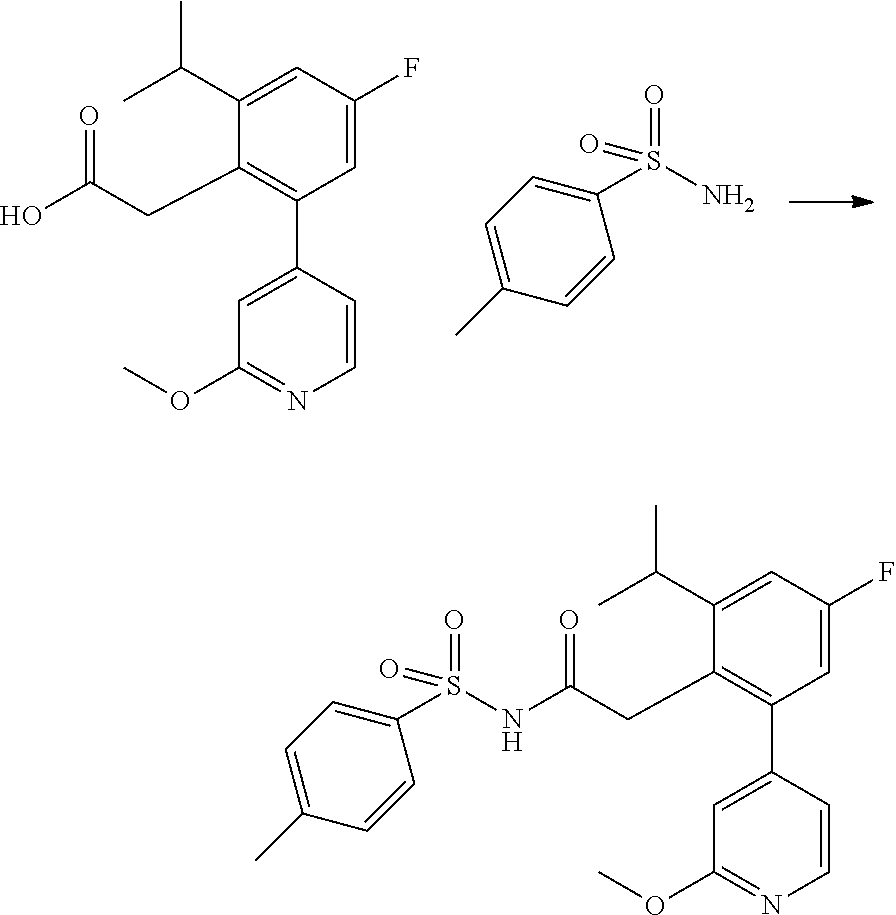
| TABLE 2 |
| UPLC/MS and MS data |
| Retention | ||||
| Ex | Structure and Name | time (min)* | MS | MW |
| 113 |
 |
1.66 | 493.27 (M + H)+ (ES+); 491.27 (M − H)− (ES−). | 492.5 |
| 114 |
 |
1.69 | 488.34 (M + H)+ (ES+); 486.32 (M − H)− (ES−). | 487.6 |
| 115 |
 |
1.60 | 483.28 (M + H)+ (ES+); 481.25 (M − H)− (ES−). | 482.5 |
| 116 |
 |
1.73 | 483.29 (M + H)+ (ES+); 481.27 (M − H)− (ES−). | 482.5 |
| 117 |
 |
1.75 | 471.30 (M + H)+ (ES+); 469.31 (M − H)− (ES−). | 470.6 |
| 118 |
 |
1.67 | 499.32 (M + H)+ (ES+); 497.30 (M − H)− (ES−). | 498.6 |
| 119 |
 |
1.63 | 473.30 (M + H)+ (ES+); 471.28 (M − H)− (ES−). | 472.5 |
| 120 |
 |
1.67 | 475.29 (M + H)+ (ES+); 473.25 (M − H)− (ES−). | 474.5 |
| 121 |
 |
1.72 | 477.25 (M + H)+ (ES+); 475.25 (M − H)− (ES−). | 476.6 |
| 122 |
 |
1.73 | 471.3 (M + H)+ (ES+); 469.3 (M − H)− (ES−). | 470.56 |
| 123 |
 |
1.78 | 483.3 (M + H)+ (ES+); 481.3 (M − H)− (ES−). | 482.57 |
| 124 |
 |
1.53 | 485.3 (M + H)+ (ES+); 483.3 (M − H)− (ES−). | 484.54 |
| 125 |
 |
1.72 | 475.3 (M + H)+ (ES+); 473.3 (M − H)− (ES−). | 474.52 |
| *Analytical UPLC/MS was carried out using a Waters Acquity CSH C18, 1.7 μm, 2.1 × 30 mm column eluting with a | ||||
| gradient of 0.1% formic acid in MeCN in 0.1% formic acid in water. The gradient is structured with a starting point of 5% | ||||
| MeCN held from 0.0-0.11 minutes. The gradient from 5-95% occurs between 0.11-2.15 minutes with a flush from 2.15-2.56 | ||||
| minutes. A column re-equilibration to 5% MeCN is from 2.56-2.83 minutes. | ||||
| Temperature: 40° C. Flow rate 0.77 mL min-1. UV spectra of the eluted peaks were measured using an Acquity PDA and | ||||
| mass spectra were recorded using an Acquity QDa detector with ESI pos/neg switching. | ||||
| TABLE 3 |
| 1H NMR and MS data |
| Ex | Structure and Name | 1H NMR spectrum | MS | MW |
| 126 |
 |
1H NMR (DMSO-d6) δ 12.34 (s, 1H), 8.61 (d, J = 1.9 Hz, 1H), 8.23 (d, J = 8.2 Hz, 1H), 8.20 (d, J = 8.8 Hz, 1H), 8.10 (d, J = 8.2 Hz, 1H), 7.94 (d, J = 5.1 Hz, 1H), 7.88 (dd, J = 8.6, 1.9 Hz, 1H), 7.78-7.73 (m, 1H), 7.73-7.68 (m, 1H), 7.10 (dd, J = 10.5, 2.8 Hz, 1H), 6.81 (dd, J = 8.9, 2.7 Hz, 1H), 6.56-6.50 (m, 2H), 3.82 (s, 3H), 3.49 (s, 2H), 2.70-2.60 (m, 1H), 0.90 (d, J = 6.7 Hz, 6H). | 493.3 (M + H)+ (ES+); 491.3 (M − H)− (ES−). | 492.56 |
| 127 |
 |
1H NMR (300 MHz, Methanol-d4) 1H NMR (300 MHz, Methanol-d4) δ 8.24 (s, 1H), 8.00 (d, 1H), 7.57 (d, 1H), 7.46 (s, 1H), 7.32 (d, 1H), 7.02 (dd, 1H), 6.89 (dd, 1H), 6.78 (s, 1H), 6.72 (dd, 1H), 3.84 (s, 3H), 3.45 (s, 2H), 3.16-2.97 (m, 1H), 1.12 (d, 6H). | m/z 516.0 (M + H)+ (ES+); 514.0 (M − H)− (ES−). | 515.57 |
| 128 |
 |
1H NMR (300 MHz, Methanol-d4) δ 8.10 (d, 1H), 8.04 (d, 1H), 7.48 (dd, 1H), 7.18 (d, 1H), 6.99 (dd, 1H), 6.84 (dd, 1H), 6.76-6.64 (m, 2H), 3.90 (s, 3H), 3.45 (s, 2H), 3.11-2.92 (m, 1H), 2.54 (s, 3H), 1.09 (d, 6H). | m/z 535.0 (M + H)+ (ES+); 533.0 (M − H)− (ES−). | 535.43 |
| 129 |
 |
1H NMR (300 MHz, Methanol-d4) δ 8.04 (d, 1H), 7.85 (d, 1H), 7.44 (d, 1H), 7.37 (dd, 1H), 6.99 (dd, 1H), 6.83 (dd, 1H), 6.77-6.63 (m, 2H), 3.90 (s, 3H), 3.45 (s, 2H), 2.98 (dt, 1H), 2.57 (s, 3H), 1.09 (d, 6H). | m/z 535.0 (M + H)+ (ES+); 533.0 (M − H)− (ES−). | 535.43 |
| 130 |
 |
1H NMR (300 MHz, Methanol-d4) δ 8.01 (d, 1H), 7.89-7.78 (m, 2H), 7.30 (d, 2H), 6.99 (dd, 1H), 6.83 (dd, 1H), 6.75 (s, 1H), 6.70 (dd, 1H), 3.90 (s, 3H), 3.41 (m, 4H), 3.10- 2.94 (m, 1H), 2.84 (t, 2H), 1.88 (s, 3H), 1.09 (d, 6H). | m/z 528.0 (M + H)+ (ES+); 526.0 (M − H)− (ES−). | 527.61 |
| 131 |
 |
1H NMR (300 MHz, Methanol-d4) δ 8.09 (dd, 1H), 7.04 (dd, 1H), 6.91 (dd, 1H), 6.80-6.67 (m, 2H), 3.96 (s, 3H), 3.89 (s, 3H), 3.48 (s, 2H), 3.15-3.00 (m, 1H), 2.29 (s, 3H), 1.16 (d, 6H). | m/z 522.0 (M + H )+ (ES+); 520.2 (M − H)− (ES−). | 521.58 |
| 132 |
 |
1H NMR (300 MHz, Methanol-d4) δ 7.99 (d, 1H), 7.89 (d, 2H), 7.73 (d, 2H), 6.99 (dd, 1H), 6.82 (dd, 1H), 6.78-6.65 (m, 2H), 3.87 (s, 3H), 3.42 (s, 2H), 3.09- 2.93 (m, 1H), 2.24 (s, 3H), 1.08 (d, 6H). | m/z 500.0 (M + H)+ (ES+); 498.2 (M − H)− (ES−). | 499.56 |
| 133 |
 |
1H NMR (300 MHz, Methanol-d4) δ 7.98 (d, 1H), 7.86 (s, 1H), 7.79 (s, 1H), 7.41 (m, 2H), 7.03-6.94 (m, 1H), 6.82 (d, 1H), 6.77-6.64 (m, 2H), 4.40 (s, 2H), 3.88 (s, 3H), 3.41 (s, 2H), 3.02 (m, 1H), 1.97 (s, 3H), 1.07 (d, 6H). | m/z 514.0 (M + H)+ (ES+); 512.2 (M − H)− (ES−). | 513.58 |
| 134 |
 |
1H NMR (300 MHz, Methanol-d4) δ 8.03 (dd, 1H), 7.95 (d, 1H), 7.29 (d, 1H), 7.23 (dd, 1H), 6.97 (dd, 1H), 6.83 (dd, 1H), 6.,74 (dd, 1H), 6.68 (dd, 1H), 3.90 (s, 3H), 3.45 (s, 2H), 2.97 (dd, 1H), 2.62 (s, 3H), 1.67 (s, 3H), 1.60 (s, 3H), 1.06 (d, 6H). | m/z 517.0 (M + H)+ (ES+); 515.2 (M − H)− (ES−). | 516.6 |
| 135 |
 |
1H NMR (300 MHz, Methanol-d4) δ 8.03 (dd, 1H), 7.78-7.66 (m, 2H), 7.56 (dd, 1H), 7.01 (dd, 1H), 6.83 (dd, 1H), 6.75- 6.65 (m, 2H), 3.89 (s, 3H), 3.42 (s, 2H), 2.98 (td, 1H), 1.10 (d, 6H). | m/z 495.0 (M + H)+ (ES+); 493.0 (M − H)− (ES−). | 494.94 |
| 136 |
 |
1H NMR (300 MHz, Methanol-d4) δ 8.04 (dd, 1H), 7.93 (d, 1H), 7.30-7.25 (m, 1H), 7.21 (dd, 1H), 6.99 (dd, 1H), 6.83 (dd, 1H), 6.74-6.64 (m, 2H), 3.90 (s, 3H), 3.45 (s, 2H), 3.01 (m, 1H), 2.58 (s, 3H), 1.09 (d, 6H). | m/z 491.0 (M + H)+ (ES+); 489.2 (M − H)− (ES−). | 490.97 |
| 137 |
 |
1H NMR (300 MHz, Methanol-d4) δ 8.72 (dd, 1H), 8.11-8.02 (m, 1H), 8.02-7.93 (m, 2H), 6.99 (dd, 1H), 6.88 (dd, 1H), 6.76 (dd, 1H), 6.70 (dd, 1H), 3.92 (s, 3H), 3.47 (s, 2H), 3.12-2.99 (m, 1H), 1.56 (s, 6H), 1.08 (d, 6H). | m/z 502.0 (M + H)+ (ES+); 500.2 (M − H)− (ES−). | 501.57 |
| 138 |
 |
1H NMR (300 MHz, Methanol-d4) δ 8.08 (dd, 1H), 7.02 (dd, 1H), 6.89 (dd, 1H), 6.79-6.67 (m, 2H), 3.88 (s, 3H), 3.47 (s, 2H), 3.14-2.98 (m, 1H), 2.24 (s, 3H), 1.14 (d, 6H). | m/z 508.0 (M + H)+ (ES+); 506.2 (M − H)− (ES−). | 507.56 |
| 139 |
 |
1H NMR (300 MHz, Methanol-d4) δ 8.05 (dd, 1H), 7.76 (d, 1H), 7.57-7.48 (m, 1H), 7.00 (dd, 1H), 6.83 (dd, 1H), 6.74- 6.64 (m, 2H), 3.91 (s, 3H), 3.45 (s, 2H), 3.08-2.90 (m, 1H), 2.55-2.49 (m, 3H), 1.10 (d, 6H). | m/z 553.0 (M + H)+ (ES+); 551.0 (M − H)− (ES−). | 553.42 |
| 140 |
 |
1H NMR (300 MHz, Methanol-d4) δ 8.20 (d, 1H), 8.05 (dd, 1H), 7.93 (d, 1H), 7.83 (dd, 1H), 6.99 (dd, 1H), 6.86 (dd, 1H), 6.74-6.65 (m, 2H), 3.90 (s, 3H), 3.45 (s, 2H), 3.01 (d, 1H), 1.08 (d, 6H). | m/z 589.0 (M + H)+ (ES+); 587.0 (M − H)− (ES−). | 589.4 |
| 141 |
 |
1H NMR (300 MHz, Methanol-d4) δ 8.28 (d, 1H), 8.08 (dd, 1H), 8.02 (dd, 1H), 7.70 (d, 1H), 6.99 (dd, 1H), 6.84 (dd, 1H), 6.75-6.67 (m, 2H), 3.89 (d, 3H), 3.41 (s, 2H), 2.92 (d, 1H), 1.06 (d, 6H). | m/z 545.0 (M + H)+ (ES+); 543.0 (M − H)− (ES−). | 544.95 |
| 142 |
 |
1H NMR (300 MHz, Methanol-d4) δ 8.54- 8.44 (m, 2H), 8.02 (s, 1H), 7.83 (dt, 1H), 7.41 (dd, 1H), 7.04 (dd, 1H), 6.76 (dd, 1H), 3.42 (s, 2H), 3.07 (dd, 1H), 1.59 (s, 6H), 1.13 (d, 6H). | m/z 478.0 (M + H)+ (ES+); 476.2 (M − H)− (ES−). | 477.57 |
| 143 |
 |
1H NMR (300 MHz, Methanol-d4) δ 8.55- 8.43 (m, 2H), 7.83 (dt, 1H), 7.63 (s, 1H), 7.45 (dd, 1H), 7.04 (dd, 1H), 6.76 (dd, 1H), 3.46 (s, 2H), 3.10 (dd, 1H), 1.62 (s, 6H), 1.16 (d, 6H). | m/z 478.0 (M + H)+ (ES+); 476.0 (M − H)− (ES−). | 477.57 |
| 144 |
 |
1H NMR (300 MHz, Methanol-d4) δ 8.01 (dd, 1H), 7.71 (d, 1H), 7.61 (d, 1H), 7.06 (dd, 1H), 6.81-6.72 (m, 2H), 6.68 (dd, 1H), 3.90 (s, 3H), 3.48 (s, 2H), 3.07 (s, 3H), 3.03-2.85 (m, 1H), 1.51 (s, 6H), 1.13 (d, 6H). | m/z 521.0 (M + H)+ (ES+); 519.2 (M − H)− (ES−). | 520.63 |
| 145 |
 |
1H NMR (300 MHz, Methanol-d4) δ 8.03 (dd, 1H), 7.66-7.59 (m, 2H), 7.39 (d, 1H), 6.98 (dd, 1H), 6.71 (ddd, 2H), 3.92 (s, 3H), 3.44 (s, 2H), 3.13-3.00 (m, 1H), 1.51 (s, 6H), 1.12 (d, 6H). | m/z 507.0 (M + H)+ (ES+); 505.2 (M − H)− (ES−). | 506.61 |
| 146 |
 |
1H NMR (300 MHz, Methanol-d4) δ 8.04 (dd, 2H), 7.01 (dd, 1H), 6.81-6.67 (m, 3H), 6.42 (s, 1H), 3.89 (s, 3H), 3.47 (s, 2H), 3.09 (s, 6H), 2.98 (s, 3H), 2.88 (m, 1H), 2.61 (s, 3H), 1.08 (d, 6H). | m/z 514.2 (M + H)+ (ES+); 512.2 (M − H)− (ES−). | 513.63 |
| 147 |
 |
1H NMR (300 MHz, Methanol-d4) δ 8.15 (d, 1 H), 7.62 (d, 1 H), 7.36 (s, 1 H), 7.00 (s, 1 H), 6.92 (s, 1 H), 3.92 (s, 3 H), 3.70 (s, 3 H), 3.23 (s, 2 H), 2.87 (p, 1 H), 1.50 (s, 6 H), 1.17 (d, 6 H). | m/z 493.2 (M + H)+ (ES+); 491.2 (M − H)− (ES−). | 492.61 |
| 148 |
 |
1H NMR (300 MHz, Methanol-d4) δ 8.17 (d, 1H), 8.02 (d, 1H), 7.61 (d, 1H), 7.56 (dd, 1H), 7.36 (d, 1H), 7.03 (dd, 1H), 6.78 (dd, 1H), 3.80 (s, 3H), 3.43 (s, 2H), 3.16-2.99 (m, 1H), 1.50 (s, 6H), 1.13 (d, 6H). | m/z 507.0 (M + H)+ (ES+); 505.2 (M − H)− (ES−). | 506.61 |
| 149 |
 |
1H NMR (299 MHz, Methanol-d4) δ 8.23 (t, 1H), 8.06 (d, 1H), 7.04-6.91 (m, 2H), 6.87 (dt, 1H), 6.75- 6.65 (m, 2H), 3.91 (d, 3H), 3.45 (s, 2H), 3.14-2.93 (m, 1H), 1.54 (d, 6H), 1.10 (d, 6H). | m/z 537.2 (M + H)+ (ES+); 535.2 (M − H)− (ES−). | 536.57 |
| 150 |
 |
1H NMR (300 MHz, Methanol-d4) δ 7.99 (dd, 1H), 7.80 (d, 1H), 7.47 (d, 1H), 7.01 (dd, 1H), 6.88 (dd, 1H), 6.82-6.76 (m, 1H), 6.72 (dd, 1H), 5.39 (s, 1H), 5.03 (t, 1H), 3.87 (s, 3H), 3.44 (s, 2H), 3.04 (m, 1H), 2.10 (s, 3H), 1.11 (d, 6H). | m/z 489.0 (M + H)+ (ES+); 487.2 (M − H)− (ES−). | 488.59 |
| 151 |
 |
1H NMR (299 MHz, Methanol-d4) δ 8.02 (d, 1H), 7.83 (d, 1H), 7.01-6.92 (m, 2H), 6.85 (dd, 2H), 6.77- 6.63 (m, 2H), 3.89 (s, 3H), 3.44 (s, 2H), 2.99 (m, 1H), 2.56 (s, 3H), 1.89 (m, 1H), 1.07 (d, 6H), 1.05- 0.94 (m, 2H), 0.71 (m, 2H). | m/z 497.2 (M + H)+ (ES+); 495.2 (M − H)− (ES−). | 496.60 |
| 152 |
 |
1H NMR (300 MHz, Methanol-d4) δ 8.07 (dd, 1H), 7.00 (dd, 1H), 6.88 (dd, 1H), 6.78 (dd, 1H), 6.72 (dd, 1H), 4.50 (m, 1H), 3.91 (s, 3H), 3.43 (s, 2H), 3.05- 2.91 (m, 1H), 2.48 (s, 3H), 2.37 (s, 3H), 1.39 (d, 6H), 1.07 (d, 6H). | m/z 503.2 (M + H)+ (ES+); 501.2 (M − H)− (ES−). | 502.61 |
| 153 |
 |
1H NMR (300 MHz, Methanol-d4) δ 8.05 (dd, 1H), 7.45 (d, 1H), 7.08 (d, 1H), 6.98 (dd, 1H), 6.84 (dd, 1H), 6.76 (m, 3H), 3.88 (s, 3H), 3.47 (s, 2H), 3.13 (m, 1H), 2.88 (s, 6H), 2.48 (s, 3H), 1.08 (d, 6H). | m/z 500.2 (M + H)+ (ES+); 498.2 (M − H)− (ES−). | 499.60 |
| 154 |
 |
1H NMR (300 MHz, Methanol-d4) δ 8.13 (d, 1 H), 7.83 (d, 1 H), 7.54 (d, 1 H), 6.93 (dd, 1 H), 6.85 (s, 1 H), 5.39 (s, 1 H), 5.05 (s, 1 H), 3.90 (s, 3 H), 3.69 (s, 3 H), 3.27 (s, 2 H), 2.87 (p, 1 H), 2.09 (s, 3 H), 1.16 (d, 6 H). | m/z 475.0 (M + H)+ (ES+); 473.2 (M − H)− (ES−). | 474.59 |
| 155 |
 |
1H NMR (299 MHz, Methanol-d4) δ 8.02 (d, 1H), 7.60 (s, 1H), 6.99 (dd, 1H), 6.81- 6.64 (m, 3H), 6.40 (s, 1H), 3.88 (d, 3H), 3.46 (s, 2H), 3.20- 3.12 (m, 1H), 2.88 (s, 3H), 2.53 (s, 3H), 2.06 (s, 3H), 1.09 (dd, 6H). | m/z 500.2 (M + H)+ (ES+); 498.2 (M − H)− (ES−). | 499.60 |
| 156 |
 |
1H NMR (300 MHz, Methanol-d4) δ 8.06 (dd, 1H), 7.86 (t, 1H), 7.04-6.95 (m, 2H), 6.95-6.84 (m, 1H), 6.77-6.65 (m, 2H), 3.90 (s, 3H), 3.45 (s, 2H), 3.18 (m, 1H), 3.04 (m, 1H), 1.25 (d, 6H), 1.11 (d, 6H). | m/z 521.2 (M + H)+ (ES+); 519.2 (M − H)− (ES−). | 520.57 |
| 157 |
 |
1H NMR (300 MHz, Methanol-d4) δ 8.03 (dd, 1H), 7.88 (d, 1H), 7.16-7.03 (m, 2H), 6.97 (dd, 1H), 6.83 (dd, 1H), 6.75 (dd, 1H), 6.69 (dd, 1H), 3.90 (s, 3H), 3.45 (s, 2H), 3.06- 2.94 (m, 1H), 2.89 (m, 1H), 2.59 (s, 3H), 1.23 (d, 6H), 1.06 (d, 6H). | m/z 499.2 (M + H)+ (ES+); 497.2 (M − H)− (ES−). | 498.61 |
| 158 |
 |
1H NMR (300 MHz, Methanol-d4) δ 7.63 (d, 1H), 7.37 (d, 1H), 7.27 (dd, 1H), 7.02 (dd, 1H), 6.73 (dd, 1H), 6.46-6.38 (m, 2H), 3.48 (s, 2H), 3.13-2.99 (m, 1H), 1.50 (s, 6H), 1.12 (d, 6H). | m/z 475.0 (M + H − 18)+ (ES+); 491.2 (M − H)− (ES−). | 492.58 |
| 159 |
 |
1H NMR (300 MHz, Methanol-d4) δ 8.02 (dd, 1H), 7.46 (s, 1H), 7.02 (dd, 1H), 6.91 (dd, 1H), 6.80 (dd, 1H), 6.73 (dd, 1H), 3.90 (s, 3H), 3.43 (s, 2H), 3.17-3.00 (m, 1H), 2.58 (s, 3H), 1.53 (s, 6H), 1.13 (d, 6H). | m/z 521.2 (M + H)+ (ES+); 519.2 (M − H)− (ES−). | 520.63 |
| 160 |
 |
1H NMR (300 MHz, Methanol-d4) δ 8.08 (dd, 1H), 7.02 (dd, 1H), 6.85 (dd, 1H), 6.77 (dd, 1H), 6.72 (dd, 1H), 6.65 (s, 1H), 3.96 (s, 3H), 3.91 (s, 3H), 3.45 (s, 2H), 3.14-2.98 (m, 1H), 1.50 (s, 6H), 1.13 (d, 6H). | m/z 505.2 (M + H)+ (ES+); 503.2 (M − H)− (ES−). | 504.58 |
| 161 |
 |
1H NMR (300 MHz, Methanol-d4) δ 8.11- 8.05 (m, 1H), 6.99 (dd, 1H), 6.92 (dd, 1H), 6.81-6.74 (m, 1H), 6.74-6.60 (m, 3H), 3.91 (s, 3H), 3.48 (s, 2H), 3.17- 3.06 (m, 1H), 3.04- 2.96 (s, 6H), 1.11 (d, 6H). | m/z 556.0 (M + H)+ (ES+); 554.2 (M − H)− (ES−). | 554.46 |
| 162 |
 |
1H NMR (300 MHz, Methanol-d4) δ 8.56 (s, 1H), 8.04 (d, 1H), 6.99 (dd, 1H), 6.85 (d, 1H), 6.74 (s, 1H), 6.69 (dd, 1H), 6.47 (s, 1H), 3.89 (s, 3H), 3.43 (d, 2H), 3.10 (s, 6H), 3.01 (m, 1H), 2.51 (s, 3H), 1.10 (d, 6H). | m/z 501.4 (M + H)+ (ES+); 499.4 (M − H)− (ES−). | 500.59 |
| 163 |
 |
1H NMR (300 MHz, Methanol-d4) δ 8.02 (dd, 1 H), 7.79 (d, 1 H), 7.46 (d, 1 H), 7.12 (dd, 1 H), 7.02 (dd, 1 H), 5.36 (t, 1 H), 5.02 (t, 1 H), 3.87 (s, 3 H), 3.85 (s, 3 H), 3.48 (s, 2 H), 3.08-2.96 (m, 1 H), 2.12-2.00 (m, 3 H), 1.25 (d, 6 H). | m/z 475.0 (M + H)+ (ES+); 473.2 (M − H)− (ES−). | 474.59 |
| 164 |
 |
1H NMR (300 MHz, Methanol-d4) δ 8.02 (dd, 1H), 7.92 (d, 1H), 7.40-7.28 (m, 2H), 6.97 (dd, 1H), 6.83 (dd, 1H), 6.74 (d, 1H), 6.68 (dd, 1H), 5.42 (dd, 1H), 5.16-5.09 (m, 1H), 3.88 (s, 3H), 3.45 (s, 2H), 3.01 (m, 1H), 2.61 (s, 3H), 2.14 (dd, 3H), 1.08 (d, 6H). | m/z 497.2 (M + H)+ (ES+); 495.2 (M − H)− (ES−). | 496.60 |
| 165 |
 |
1H NMR (300 MHz, Methanol-d4) δ 8.06 (dd, 1H), 7.91 (t, 1H), 7.07-6.95 (m, 2H), 6.88 (dd, 1H), 6.75- 6.65 (m, 2H), 5.31- 5.23 (m, 2H), 3.90 (s, 3H), 3.45 (s, 2H), 3.10-2.97 (m, 1H), 2.11 (m, 3H), 1.12 (d, 6H). | m/z 519.2 (M + H)+ (ES+); 517.2 (M − H)− (ES−). | 518.55 |
| 166 |
 |
1H NMR (300 MHz, Methanol-d4) δ 8.13 (t, 1H), 8.07 (dd, 1H), 7.21 (t, 1H), 7.00 (dd, 1H), 6.88 (dd, 1H), 6.76-6.67 (m, 2H), 3.91 (s, 3H), 3.44 (s, 2H), 3.04 (dd, 1H), 1.12 (d, 6H). | m/z 558.0 (M + H)+ (ES+); 556.0 (M − H)− (ES−). | 557.38 |
| 167 |
 |
1H NMR (300 MHz, Methanol-d4) δ 8.13 (d, 1H), 8.02 (dd, 1H), 7.48 (dd, 1H), 7.22 (d, 1H), 6.98 (dd, 1H), 6.82 (dd, 1H), 6.75-6.65 (m, 2H), 3.89 (s, 3H), 3.45 (s, 2H), 3.02- 2.91 (m, 1H), 2.58 (s, 3H), 1.50 (s, 6H), 1.06 (d, 6H). | m/z 515.2 (M + H)+ (ES+); 513.2 (M − H)− (ES−). | 514.61 |
| 168 |
 |
1H NMR (300 MHz, Methanol-d4) δ 8.09- 8.03 (m, 1H), 7.01 (dt, 1H), 6.88 (ddd, 1H), 6.77 (s, 1H), 6.72 (dd, 1H), 4.78 (m, 2H), 3.91 (s, 3H), 3.44 (s, 2H), 2.99 (m, 1H), 2.51-2.40 (d, 3H), 2.36 (s, 3H), 1.09 (dd, 6H). | m/z 543.2 (M + H)+ (ES+); 541.2 (M − H)− (ES−). | 542.55 |
| 169 |
 |
1H NMR (300 MHz, Methanol-d4) δ 8.04 (d, 1H), 7.96 (s, 1H), 7.02 (dd, 1H), 6.85 (dd, 1H), 6.79-6.67 (m, 2H), 6.37-5.92 (m, 1H), 4.46 (m, 2H), 3.90 (s, 3H), 3.44 (s, 2H), 3.01 (m, 1H), 2.61 (s, 3H), 1.11 (d, 6H). | m/z 511.2 (M + H)+ (ES+); 509.2 (M − H)− (ES−). | 510.53 |
| 170 |
 |
1H NMR (300 MHz, Methanol-d4) δ 8.50 (d, 1H), 8.16 (dd, 1H), 8.03 (dd, 1H), 7.59 (dd, 1H), 6.99 (dd, 1H), 6.87 (dd, 1H), 6.77-6.66 (m, 2H), 3.89 (s, 3H), 3.46 (s, 2H), 3.15- 2.94 (m, 1H), 1.52 (s, 6H), 1.07 (d, 6H). | m/z 502.2 (M + H)+ (ES+); 500.2 (M − H)− (ES−). | 501.57 |
| 171 |
 |
1H NMR (300 MHz, Methanol-d4) δ 8.95 (dd, 1H), 8.24 (dd, 1H), 8.03 (dd, 1H), 7.74 (dd, 1H), 6.98 (dd, 1H), 6.82 (dd, 1H), 6.77-6.66 (m, 2H), 3.91 (s, 3H), 3.42 (s, 2H), 2.96 (m, 1H), 1.54 (s, 6H), 1.04 (d, 6H). | m/z 502.2 (M + H)+ (ES+); 500.2 (M − H)− (ES−). | 501.57 |
| 172 |
 |
1H NMR (300 MHz, Methanol-d4) δ 8.06 (dd, 1H), 7.00 (dd, 1H), 6.89 (dd, 1H), 6.78 (dd, 1H), 6.72 (dd, 1H), 3.91 (s, 3H), 3.79 (d, 2H), 3.43 (m, 2H), 3.08- 2.94 (m, 1H), 2.46 (s, 3H), 2.35 (s, 3H), 2.13 (m, 1H), 1.10 (d, 6H), 0.89 (d, 6H). | m/z 517.2 (M + H)+ (ES+); 515.2 (M − H)− (ES−). | 516.63 |
| 173 |
 |
1H NMR (300 MHz, Methanol-d4) δ 8.04 (dd, 1H), 7.91 (s, 1H), 7.01 (dd, 1H), 6.86 (dd, 1H), 6.78 (dd, 1H), 6.72 (dd, 1H), 4.40 (m, 1H), 3.90 (s, 3H), 3.43 (s, 2H), 3.01 (m, 1H), 2.37 (s, 3H), 1.44 (d, 6H), 1.09 (d, 6H). | m/z 489.2 (M + H)+ (ES+); 487.2 (M − H)− (ES−). | 488.58 |
| 174 |
 |
1H NMR (300 MHz, Methanol-d4) δ 8.09- 8.01 (m, 1H), 7.43 (s, 1H), 7.03 (dd, 1H), 6.90 (dd, 1H), 6.83-6.77 (m, 1H), 6.72 (dd, 1H), 3.89 (s, 3H), 3.43 (s, 2H), 3.06 (m, 4H), 2.96 (s, 3H), 2.46 (s, 3H), 1.15 (d, 6H). | m/z 534.1 (M + H)+ (ES+); 532.2 (M − H)− (ES−). | 533.63 |
| 175 |
 |
1H NMR (300 MHz, Methanol-d4) δ 8.06 (d, 1H), 7.00 (dd, 1H), 6.87 (dd, 1H), 6.77 (s, 1H), 6.72 (dd, 1H), 6.34-5.88 (m, 1H), 4.42 (m, 2H), 3.91 (s, 3H), 3.43 (s, 2H), 3.06-2.90 (m, 1H), 2.49 (s, 3H), 2.35 (s, 3H), 1.09 (d, 6H). | m/z 525.2 (M + H)+ (ES+); 523.2 (M − H)− (ES−). | 524.56 |
| 176 |
 |
1H NMR (300 MHz, Methanol-d4) δ 8.01 (d, 1H), 7.81 (s, 1H), 7.02 (dd, 1H), 6.88 (dd, 1H), 6.80-6.67 (m, 2H), 3.87 (s, 3H), 3.83 (s, 3H), 3.43 (s, 2H), 3.14-2.98 (m, 1H), 2.72 (s, 3H), 1.12 (d, 6H). | m/z 521.0 (M + H)+ (ES+); 519.2 (M − H)− (ES−). | 520.59 |
| 177 |
 |
1H NMR (300 MHz, Methanol-d4) δ 7.99 (d, 1H), 7.83 (d, 2H), 7.40 (d, 1H), 7.31 (d, 2H), 6.83 (dd, 1H), 6.77-6.64 (m, 2H), 3.89 (s, 3H), 3.41 (s, 2H), 3.04 (m, 1H), 2.93-2.80 (m, 2H), 2.63 (m, 2H), 2.34 (d, 6H), 1.07 (d, 6H). | m/z 514.2 (M + H)+ (ES+); 512.2 (M − H)− (ES−). | 513.63 |
| 178 |
 |
1H NMR (300 MHz, Methanol-d4) δ 8.21 (s, 1H), 8.05 (dd, 1H), 7.43 (d, 1H), 7.00 (dd, 1H), 6.84 (dd, 1H), 6.73-6.65 (m, 2H), 3.90 (s, 3H), 3.45 (s, 2H), 3.07-2.89 (m, 1H), 2.52 (s, 3H), 1.10 (d, 6H) | m/z 571.0 (M + H)+ (ES+); 569.0 (M − H)− (ES−). | 569.87 |
| 179 |
 |
1H NMR (300 MHz, Methanol-d4) δ 8.02 (dd, 1H), 7.74-7.65 (m, 2H), 7.60-7.50 (m, 1H), 6.99 (dd, 1H), 6.84 (dd, 1H), 6.77 (dd, 1H), 6.71 (dd, 1H), 3.91 (s, 3H), 3.42 (s, 2H), 3.08-2.93 (m, 1H), 1.55 (s, 3H), 1.28- 1.20 (m, 2H), 1.08 (d, 6H), 0.76 (t, 3H). | m/z 533.0 (M + H)+ (ES+); 531.2 (M − H)− (ES−). | 532.60 |
| 180 |
 |
1H NMR (300 MHz, Methanol-d4) δ 7.99 (dd, 1H), 7.90-7.81 (m, 2H), 7.51-7.39 (m, 2H), 6.98 (dd, 1H), 6.84 (dd, 1H), 6.76 (dd, 1H), 6.70 (dd, 1H), 3.88 (s, 3H), 3.55 (s, 2H), 3.41 (s, 2H), 3.10- 2.94 (m, 1H), 2.24 (s, 6H), 1.07 (d, 6H). | m/z 500.2 (M + H)+ (ES+); 498.2 (M − H)− (ES−). | 499.60 |
| 181 |
 |
1H NMR (300 MHz, Methanol-d4) δ 8.60 (dd, 1H), 8.20-8.16 (m, 1H), 8.02 (dd, 1H), 7.66 (dd, 1H), 7.00 (dd, 1H), 6.84 (dd, 1H), 6.77-6.63 (m, 2H), 3.89 (s, 3H), 3.43 (s, 2H), 3.07-2.88 (m, 1H), 1.54 (s, 6H), 1.07 (d, 6H). | m/z 502.0 (M + H)+ (ES+); 500.2 (M − H)− (ES−). | 501.57 |
| 182 |
 |
1H NMR (300 MHz, Methanol-d4) δ 8.04 (s, 1H), 8.03-8.00 (m, 1H), 7.70 (d, 1H), 7.63 (dd, 1H), 6.98 (dd, 1H), 6.82 (dd, 1H), 6.73-6.62 (m, 2H), 3.89 (s, 3H), 3.46 (s, 2H), 3.05-2.95 (m, 1H), 2.92 (s, 3H), 2.64 (s, 3H), 1.08 (d, 6H). | m/z 514.2 (M + H)+ (ES+); 512.2 (M − H)− (ES−). | 513.58 |
| 183 |
 |
1H NMR (300 MHz, Methanol-d4) δ 8.03 (d, 1H), 7.57 (d, 1H), 7.52 (d, 1H), 7.03 (dd, 1H), 6.87 (dd, 1H), 6.79-6.77 (m, 1H), 6.73 (dd, 1H), 3.89 (s, 3H), 3.44 (s, 2H), 3.17- 2.86 (m, 1H), 1.13 (d, 6H). | m/z 527.0 (M + H)+ (ES+); 525.0 (M − H)− (ES−). | 527.42 |
| 184 |
 |
1H NMR (300 MHz, Methanol-d4) δ 8.29 (s, 1H), 8.11-7.90 (m, 3H), 7.86-7.74 (m, 2H), 7.65 (s, 1H), 6.99 (dd, 1H), 6.83 (dd, 1H), 6.76-6.73 (m, 1H), 6.70 (dd, 1H), 3.86 (s, 3H), 3.44 (s, 2H), 3.08- 2.87 (m, 1H), 1.08 (d, 6H). | m/z 510.0 (M + H)+ (ES+); 508.2 (M − H)− (ES−). | 509.55 |
| 185 |
 |
1H NMR (300 MHz, Methanol-d4) δ 8.46 (d, 1H), 8.04 (dd, 1H), 7.93 (dd, 1H), 7.82 (dd, 1H), 6.99 (dd, 1H), 6.86 (dd, 1H), 6.75 (dd, 1H), 6.70 (dd, 1H), 3.91 (s, 3H), 3.46 (s, 2H), 3.11-2.93 (m, 2H), 1.30 (d, 6H), 1.06 (d, 6H). | m/z 486.0 (M + H)+ (ES+); 484.2 (M − H)− (ES−). | 485.57 |
| 186 |
 |
1H NMR (300 MHz, Methanol-d4) δ 8.46 (d, 2H), 7.94 (d, 1H), 7.43 (s, 1H), 7.36 (d, 1H), 7.29 (d, 2H), 7.09-6.96 (m, 1H), 6.79-6.67 (m, 1H), 3.44 (s, 2H), 3.06- 2.85 (m, 1H), 2.60 (s, 3H), 1.52 (s, 6H), 1.08 (d, 6H). | m/z 485.20 (M + H)+ (ES+); 483.20 (M − H)− (ES−). | 484.59 |
| 187 |
 |
1H NMR (300 MHz, Methanol-d4) δ 8.06- 7.93 (m, 3H), 7.66- 7.55 (m, 2H), 7.06 (dd, 1H), 6.74 (dd, 1H), 6.64 (dd, 1H), 6.56 (dd, 1H), 4.07 (s, 2H), 3.91 (s, 3H), 3.48 (s, 2H), 2.88- 2.66 (m, 1H), 1.08 (d, 6H). | m/z 482.0 (M + H)+ (ES+); 480.2 (M − H)− (ES−). | 481.54 |
| 188 |
 |
1H NMR (300 MHz, Methanol-d4) δ 8.13 (d, 1H), 7.36 (s, 1H), 7.06 (dd, 1H), 6.88 (dd, 1H), 6.78-6.69 (m, 2H), 3.92 (s, 3H), 3.59 (s, 2H), 3.07 (m, 1H), 2.53 (s, 6H), 1.18 (d, 6H). | m/z 473.2 (M + H)+ (ES+); 471.2 (M − H)− (ES−). | 472.54 |
| 189 |
 |
1H NMR (300 MHz, Methanol-d4) δ 8.58 (dd, 1H), 7.90 (d, 1H), 7.86 (dd, 1H), 7.61 (dd, 1H), 7.38 (d, 1H), 7.33 (dd, 1H), 7.14 (d, 1H), 6.98 (d, 1H), 3.40 (s, 2H), 2.91 (t, 2H), 2.75 (t, 2H), 2.75 (s, 3H), 2.02 (m, 2H), 1.51 (s, 6H). | m/z 488.2 (M − H)− (ES−). | 489.59 |
| 190 |
 |
1H NMR (300 MHz, Methanol-d4) δ 8.02 (dd, 1H), 7.97-7.89 (m, 2H), 7.65-7.56 (m, 2H), 6.98 (dd, 1H), 6.84 (dd, 1H), 6.76 (dd, 1H), 6.70 (dd, 1H), 3.91 (s, 3H), 3.43 (s, 2H), 2.97 (m, 1H), 1.74 (s, 6H), 1.06 (d, 6H). | m/z 510.2 (M + H)+ (ES+); 508.2 (M − H)− (ES−). | 509.60 |
| 191 |
 |
1H NMR (300 MHz, Methanol-d4) δ 8.27 (s, 1H), 8.11 (s, 1H), 8.05 (d, 1H), 7.01 (dd, 1H), 6.88 (dd, 1H), 6.79-6.66 (m, 2H), 3.89 (s, 3H), 3.49 (s, 2H), 3.16 (s, 6H), 3.03-2.92 (m, 1H), 1.16-1.10 (d, 6H). | m/z 488.2 (M + H)+ (ES+); 486.2 (M − H)− (ES−). | 487.55 |
| 192 |
 |
1H NMR (300 MHz, Methanol-d4) δ 8.07 (dd, 1H), 7.71 (d, 1H), 7.02 (dd, 1H), 6.94 (dd, 1H), 6.81 (dd, 1H), 6.72 (dd, 1H), 6.62 (d, 1H), 3.92 (s, 3H), 3.45 (s, 2H), 3.11 (m, 1H), 2.70 (s, 2H), 2.01 (s, 6H), 1.58 (s, 6H), 1.15 (d, 6H). | m/z 532.2 (M + H)+ (ES+); 530.2 (M − H)− (ES−). | 531.64 |
| 193 |
 |
1H NMR (300 MHz, Methanol-d4) δ 8.04 (d, 2H), 7.77 (s, 1H), 7.02 (dd, 1H), 6.89 (dd, 1H), 6.80-6.70 (m, 2H), 4.08 (s, 2H), 3.90 (s, 3H), 3.42 (s, 2H), 3.08 (m, 1H), 1.20-1.09 (m, 12H). | m/z 505.2 (M + H)+ (ES+); 503.2 (M − H)− (ES−). | 504.58 |
| 194 |
 |
1H NMR (300 MHz, Methanol-d4) δ 8.05 (d, 1H), 7.70 (d, 1H), 7.02 (dd, 1H), 6.92 (dd, 1H), 6.80 (s, 1H), 6.72 (dd, 1H), 6.61 (d, 1H), 3.91 (s, 3H), 3.58 (s, 2H), 3.45 (s, 2H), 3.22 (s, 3H), 3.16-3.00 (m, 1H), 1.56 (s, 6H), 1.14 (d, 6H). | m/z 519.2 (M + H)+ (ES+); 517.2 (M − H)− (ES−). | 518.60 |
| 195 |
 |
1H NMR (300 MHz, Methanol-d4) δ 8.08 (d, 1H), 7.72 (d, 1H), 7.07-6.98 (m, 1H), 6.94 (d, 1H), 6.80 (s, 1H), 6.76-6.69 (m, 1H), 6.59 (d, 1H), 3.91 (s, 3H), 3.74 (s, 2H), 3.47 (s, 2H), 3.14-2.99 (m, 1H), 1.54 (s, 6H), 1.15 (d, 6H). | m/z 505.2 (M + H)+ (ES+); 503.2 (M − H)− (ES−). | 504.58 |
| 196 |
 |
1H NMR (400 MHz, DMSO-d6) δ 12.19 (s, 1H), 8.12 (d, J = 5.2 Hz, 1H), 7.19 (d, J = 7.6 Hz, 1H), 6.88 (dd, J1 = 2.4 Hz, J2 = 8.8 Hz, 1H), 6.74-6.72 (m, 1H), 6.65 (s, 1H), 6.49 (s, 1H), 5.55 (br s, 1H), 5.31-5.28 (m, 1H), 3.87 (s, 3H), 3.52 (s, 2H), 2.78- 2.77 (m, 1H), 1.49 (s, 6H), 1.37 (d, J = 6.4 Hz, 6H), 1.05 (d, J = 6.8 Hz, 6H). | m/z 533.3 (M + H)+ (ES+). | 532.63 |
| 197 |
 |
1H NMR (400 MHz, DMSO-d6 + D2O) δ 8.12 (d, J = 4.4 Hz, 1H), 7.14 (dd, J1 = 2.8 Hz, J2 = 10.8 Hz, 1H), 6.85-6.80 (m, 2H), 6.71 (s, 1H), 6.41 (s, 1H), 3.98 (s, 3H), 3.85 (s, 3H), 3.40 (s, 2H), 2.88-2.87 (m, 1H), 1.46 (s, 6H), 1.05 (d, J = 6.8 Hz, 6H), 1 × NH and 1 × OH were missing. | m/z 505.1 (M + H)+ (ES+). | 504.57 |
| 198 |
 |
1H NMR (300 MHz, Methanol-d4) δ 8.87 (d, 1H), 8.76 (d, 1H), 8.43 (t, 1H), 8.02 (d, 1H), 6.99 (dd, 1H), 6.83 (dd, 1H), 6.77- 6.66 (m, 2H), 3.88 (s, 3H), 3.41 (s, 2H), 3.03-2.89 (m, 1H), 1.56 (s, 6H), 1.06 (dd, 6H). | m/z 502.0 (M + H)+ (ES+); 500.2 (M − H)− (ES−). | 501.57 |
| 199 |
 |
1H NMR (300 MHz, Methanol-d4) δ 8.02 (dd, 1H), 7.38 (s, 1H), 7.02 (dd, 1H), 6.92 (dd, 1H), 6.80 (dd, 1H), 6.73 (dd, 1H), 3.90 (s, 3H), 3.43 (s, 2H), 3.10 (m, 1H), 2.54 (s, 3H), 1.91- 1.66 (m, 4H), 1.14 (d, 6H), 0.80 (t, 6H). | m/z 549.2 (M + H)+ (ES+); 547.2 (M − H)− (ES−). | 548.69 |
| 200 |
 |
1H NMR (300 MHz, Methanol-d4) δ 8.51 (d, 1H), 8.46 (s, 1H), 7.90-7.80 (m, 2H), 7.46-7.37 (m, 1H), 7.05-6.92 (m, 2H), 6.78-6.69 (m, 1H), 3.42 (s, 2H), 3.25- 3.13 (m, 1H), 3.13- 3.00 (m, 1H), 1.26 (d, 6H), 1.12 (d, 6H). | m/z 491.0 (M + H)+ (ES+); 489.2 (M − H)− (ES−). | 490.54 |
| 201 |
 |
1H NMR (300 MHz, Methanol-d4) δ 8.49 (d, 1H), 8.07 (d, 1H), 7.88 (t, 1H), 7.41- 7.35 (m, 1H), 7.06- 6.91 (m, 2H), 6.85 (d, 1H), 6.74 (dd, 1H), 3.42 (s, 2H), 3.19- 3.09 (m, 1H), 3.07 (m, 1H), 1.26 (d, 6H), 1.11 (d, 6H). | m/z 491.0 (M + H)+ (ES+); 489.2 (M − H)− (ES−). | 490.54 |
| 202 |
 |
1H NMR (300 MHz, Methanol-d4) δ 8.67- 8.57 (m, 2H), 7.82 (t, 1H), 7.43-7.35 (m, 2H), 6.92 (t, 1H), 3.30 (s, 2H), 3.25- 3.11 (m, 1H), 2.85 (m, 1H), 2.17 (s, 3H), 1.26 (d, 6H), 1.17 (d, 6H). | m/z 477.2 (M + H)+ (ES+); 475.2 (M − H)− (ES−). | 476.54 |
| 203 |
 |
1H NMR (300 MHz, Methanol-d4) δ 8.00 (dd, 1H), 7.86 (t, 1H), 7.63 (dd, 1H), 7.01- 6.88 (m, 2H), 6.79- 6.66 (m, 2H), 3.94 (s, 3H), 3.45 (s, 2H), 3.24-3.13 (m, 1H), 3.03 (m, 1H), 1.25 (d, 6H), 1.11 (d, 6H). | m/z 521.2 (M + H)+ (ES+); 519.2 (M − H)− (ES−). | 520.57 |
| 204 |
 |
1H NMR (300 MHz, Methanol-d4) δ 8.03 (dd, 1H), 7.85 (t, 1H), 7.09 (d, 1H), 7.02- 6.87 (m, 3H), 6.76 (dd, 1H), 3.89 (s, 3H), 3.44 (s, 2H), 3.18 (m, 1H), 2.90 (t, 2H), 2.78 (t, 2H), 2.10-1.95 (m, 2H), 1.25 (d, 6H). | m/z 501.2 (M + H)+ (ES+); 499.2 (M − H)− (ES−). | 500.56 |
| 205 |
 |
1H NMR (300 MHz, Methanol-d4) δ 7.99 (dd, 1H), 7.55 (d, 1H), 7.22 (dd, 1H), 7.02 (dd, 1H), 6.95- 6.82 (m, 1H), 6.78 (s, 1H), 6.73 (dd, 1H), 3.88 (s, 3H), 3.44 (s, 2H), 3.18-3.06 (m, 1H), 3.01-2.89 (m, 1H), 1.24 (d, 6H), 1.10 (d, 6H). | m/z 491.0 (M + H)+ (ES+); 489.2 (M − H)− (ES−). | 490.61 |
| 206 |
 |
1H NMR (300 MHz, Methanol-d4) δ 8.02 (d, 1H), 7.87 (d, 1H), 7.27-7.13 (m, 2H), 6.98 (dd, 1H), 6.83 (dd, 1H), 6.76-6.64 (m, 2H), 3.89 (s, 3H), 3.46 (s, 2H), 3.20-3.10 (m, 1H), 2.90 (m, 1H), 2.56 (s, 3H), 1.23 (d, 6H), 1.07 (d, 6H). | m/z 499.2 (M + H)+ (ES+); 497.2 (M − H)− (ES−). | 498.61 |
| 207 |
 |
1H NMR (300 MHz, Methanol-d4) δ 8.04 (dd, 1H), 7.87 (s, 1H), 7.01 (dd, 1H), 6.87 (dd, 1H), 6.77 (dd, 1H), 6.72 (dd, 1H), 3.99 (t, 2H), 3.90 (s, 3H), 3.43 (s, 2H), 3.02 (m, 1H), 2.36 (s, 3H), 1.82 (m, 2H), 1.10 (d, 6H), 0.88 (t, 3H). | m/z 489.2 (M + H)+ (ES+); 487.2 (M − H)− (ES−). | 488.58 |
| 208 |
 |
1H NMR (300 MHz, Methanol-d4) δ 8.05 (dd, 1H), 7.86 (s, 1H), 7.01 (dd, 1H), 6.88 (dd, 1H), 6.81-6.77 (m, 1H), 6.77-6.67 (m, 1H), 3.90 (s, 3H), 3.82 (d, 2H), 3.43 (s, 2H), 3.10-2.94 (m, 1H), 2.36 (s, 3H), 2.12 (dq, 1H), 1.11 (d, 6H), 0.88 (d, 6H). | m/z 503.2 (M + H)+ (ES+); 501.2 (M − H)− (ES−). | 502.61 |
| 209 |
 |
1H NMR (300 MHz, Methanol-d4) δ 8.14 (d, 1H), 8.02 (d, 1H), 7.48 (dd, 1H), 7.22 (d, 1H), 6.97 (dd, 1H), 6.83 (dd, 1H), 6.72 (d, 1H), 6.69 (dd, 1H), 5.41 (s, 1H), 5.06 (d, 1H), 3.88 (s, 3H), 3.46 (s, 2H), 3.04-2.90 (m, 1H), 2.59 (s, 3H), 2.13 (dd, 3H), 1.08 (d, 6H). | m/z 497.2 (M + H)+ (ES+); 495.2 (M − H)− (ES−). | 496.60 |
-
- 1. Seed THP-1 cells (25,000 cells/well) containing 1.0 μg/ml LPS in 40 μl of RPMI medium (without FBS) in 96-well, black walled, clear bottom cell culture plates coated with poly-D-lysine (VWR #734-0317)
- 2. Add 5 μl compound (8 points half-log dilution, with 10 μM top dose) or vehicle (DMSO 0.1% FAC) to the appropriate wells
- 3. Incubate for 3 hrs at 37° C., 5% CO2
- 4. Add 5 μl nigericin (Sigma #N7143) (FAC 5 μM) to all wells
- 5. Incubate for 1 hr at 37° C., 5% CO2
- 6. At the end of the incubation period, spin plates at 300×g for 3 mins and remove supernatant
- 7. Then add 50 μl of resazurin (Sigma #R7017)(FAC 100 μM resazurin in RPMI medium without FBS) and incubate plates for a further 1-2 hrs at 37° C. and 5% CO2
- 8. Plates were read in an Envision reader at Ex 560 nm and Em 590 nm
- 9. IC50 data is fitted to a non-linear regression equation (log inhibitor vs response-variable slope 4-parameters)
96-well Plate Map
| 1 | 2 | 3 | 4 | 5 | 6 | 7 | 8 | 9 | 10 | 11 | 12 | |
| A | High | Comp 1 | Comp 2 | Comp 3 | Comp 4 | Comp 5 | Comp 6 | Comp 7 | Comp 8 | Comp 9 | Comp 10 | Low |
| B | High | Comp 1 | Comp 2 | Comp 3 | Comp 4 | Comp 5 | Comp 6 | Comp 7 | Comp 8 | Comp 9 | Comp 10 | Low |
| C | High | Comp 1 | Comp 2 | Comp 3 | Comp 4 | Comp 5 | Comp 6 | Comp 7 | Comp 8 | Comp 9 | Comp 10 | Low |
| D | High | Comp 1 | Comp 2 | Comp 3 | Comp 4 | Comp 5 | Comp 6 | Comp 7 | Comp 8 | Comp 9 | Comp 10 | Low |
| E | High | Comp 1 | Comp 2 | Comp 3 | Comp 4 | Comp 5 | Comp 6 | Comp 7 | Comp 8 | Comp 9 | Comp 10 | Low |
| F | High | Comp 1 | Comp 2 | Comp 3 | Comp 4 | Comp 5 | Comp 6 | Comp 7 | Comp 8 | Comp 9 | Comp 10 | Low |
| G | High | Comp 1 | Comp 2 | Comp 3 | Comp 4 | Comp 5 | Comp 6 | Comp 7 | Comp 8 | Comp 9 | Comp 10 | Low |
| H | High | Comp 1 | Comp 2 | Comp 3 | Comp 4 | Comp 5 | Comp 6 | Comp 7 | Comp 8 | Comp 9 | Comp 10 | Low |
| High | MCC950 (10 uM) | Compound 8-point half-log dilution |
| Low | Drug free control | ||||||||||
| TABLE 4 |
| NLRP3 inhibitory activity |
| Example | THP | ||
| No | IC50 | ||
| 1 | + | ||
| 2 | ++ | ||
| 3 | +++ | ||
| 4 | +++ | ||
| 5 | +++ | ||
| 6 | + | ||
| 7 | ++ | ||
| 8 | + | ||
| 9 | ++ | ||
| 10 | ++ | ||
| 11 | +++ | ||
| 12 | +++ | ||
| 13 | +++ | ||
| 14 | ++++ | ||
| 15 | ++ | ||
| 16 | ++ | ||
| 17 | ++ | ||
| 18 | + | ||
| 19 | +++ | ||
| 20 | +++ | ||
| 21 | + | ||
| 22 | ++ | ||
| 23 | ++ | ||
| 24 | + | ||
| 25 | ++++ | ||
| 26 | ++++ | ||
| 27 | ++++ | ||
| 28 | ++ | ||
| 29 | ++ | ||
| 30 | ++ | ||
| 31 | ++ | ||
| 32 | +++ | ||
| 33 | ++++ | ||
| 34 | + | ||
| 35 | + | ||
| 36 | ++ | ||
| 37 | ++ | ||
| 38 | +++ | ||
| 39 | + | ||
| 40 | ++++ | ||
| 41 | + | ||
| 42 | + | ||
| 43 | ++ | ||
| 44 | ++ | ||
| 45 | +++ | ||
| 46 | ++ | ||
| 47 | ++ | ||
| 48 | + | ||
| 49 | + | ||
| 50 | + | ||
| 51 | ++ | ||
| 52 | + | ||
| 53 | + | ||
| 54 | ++ | ||
| 55 | ++ | ||
| 56 | + | ||
| 57 | ++ | ||
| 58 | +++ | ||
| 59 | ++ | ||
| 60 | ++ | ||
| 61 | ++ | ||
| 62 | ++ | ||
| 63 | + | ||
| 64 | + | ||
| 65 | ++ | ||
| 66 | ++ | ||
| 67 | +++ | ||
| 68 | ++ | ||
| 69 | ++ | ||
| 70 | ++ | ||
| 71 | ++ | ||
| 72 | ++ | ||
| 73 | ++ | ||
| 74 | + | ||
| 75 | + | ||
| 76 | ++ | ||
| 77 | ++ | ||
| 78 | + | ||
| 79 | +++ | ||
| 80 | ++ | ||
| 81 | ++ | ||
| 82 | ++ | ||
| 83 | ++ | ||
| 84 | +++ | ||
| 85 | ++++ | ||
| 86 | ++ | ||
| 87 | ++++ | ||
| 88 | ++ | ||
| 89 | +++ | ||
| 90 | ++++ | ||
| 91 | ++ | ||
| 92 | ++ | ||
| 93 | +++ | ||
| 94 | +++ | ||
| 95 | + | ||
| 96 | + | ||
| 97 | ++ | ||
| 98 | ++++ | ||
| 99 | ++++ | ||
| 100 | ++++ | ||
| 101 | ++++ | ||
| 102 | + | ||
| 103 | + | ||
| 104 | ++ | ||
| 105 | + | ||
| 106 | ++ | ||
| 107 | ++ | ||
| 108 | ++ | ||
| 109 | + | ||
| 110 | +++ | ||
| 111 | ++ | ||
| 112 | ++ | ||
| 113 | +++ | ||
| 114 | +++ | ||
| 115 | +++ | ||
| 116 | +++ | ||
| 117 | ++++ | ||
| 118 | +++ | ||
| 119 | +++ | ||
| 120 | +++ | ||
| 121 | ++++ | ||
| 122 | ++++ | ||
| 123 | ++++ | ||
| 124 | ++++ | ||
| 125 | ++++ | ||
| 126 | ++++ | ||
| 127 | ++ | ||
| 128 | +++ | ||
| 129 | +++ | ||
| 130 | ++ | ||
| 131 | ++ | ||
| 132 | ++ | ||
| 133 | ++ | ||
| 134 | ++++ | ||
| 135 | ++ | ||
| 136 | +++ | ||
| 137 | + | ||
| 138 | + | ||
| 139 | ++++ | ||
| 140 | ++ | ||
| 141 | +++ | ||
| 142 | +++ | ||
| 143 | +++ | ||
| 144 | ++++ | ||
| 145 | ++++ | ||
| 146 | + | ||
| 147 | ++ | ||
| 148 | ++ | ||
| 149 | ++++ | ||
| 150 | ++++ | ||
| 151 | ++++ | ||
| 152 | ++ | ||
| 153 | ++ | ||
| 154 | ++++ | ||
| 155 | ++ | ||
| 156 | ++++ | ||
| 157 | ++++ | ||
| 158 | ++ | ||
| 159 | ++++ | ||
| 160 | ++ | ||
| 161 | ++ | ||
| 162 | ++ | ||
| 163 | + | ||
| 164 | ++++ | ||
| 165 | ++++ | ||
| 166 | ++++ | ||
| 167 | ++ | ||
| 168 | ++ | ||
| 169 | ++ | ||
| 170 | ++++ | ||
| 171 | ++ | ||
| 172 | ++ | ||
| 173 | ++++ | ||
| 174 | ++++ | ||
| 175 | ++ | ||
| 176 | ++++ | ||
| 177 | ++ | ||
| 178 | +++ | ||
| 179 | ++++ | ||
| 180 | ++ | ||
| 181 | ++++ | ||
| 182 | + | ||
| 183 | +++ | ||
| 184 | +++ | ||
| 185 | ++++ | ||
| 186 | ++++ | ||
| 187 | ++ | ||
| 188 | + | ||
| 189 | ++++ | ||
| 190 | ++ | ||
| 191 | +++ | ||
| 192 | ++ | ||
| 193 | ++ | ||
| 194 | ++ | ||
| 195 | ++ | ||
| 196 | + | ||
| 197 | ++ | ||
| 198 | ++++ | ||
| 199 | ++++ | ||
| 200 | ++++ | ||
| 201 | ++++ | ||
| 202 | ++ | ||
| 203 | ++++ | ||
| 204 | ++ | ||
| 205 | ++++ | ||
| 206 | ++++ | ||
| 207 | +++ | ||
| 208 | ++ | ||
| 209 | ++++ | ||
| (≤0.5 μM = ‘++++’, ≤1 μM = ‘+++’, ≤5 μM = ‘++’, ≤10 μM = ‘+’). | |||
PK Protocol
| TABLE 5 |
| PK data (intravenous administration) |
| Example | Dose | AUC | T1/2 | Vdss | Cl |
| No | (mg/kg) | (ng · hr/mL) | (hr) | (L/kg) | (mL/min/kg) |
| 54 | 1 | 1564.4 | 4.4 | 0.95 | 10.7 |
| 67 | 1 | 1549.4 | 16.4 | 6.52 | 15.4 |
| 69 | 1 | 827.1 | 9.3 | 6.15 | 20.2 |
| 85 | 1 | 925.8 | 19.8 | 12.15 | 29.1 |
| 110 | 1 | 1257.7 | 7.2 | 6.72 | 13.3 |
Claims (23)


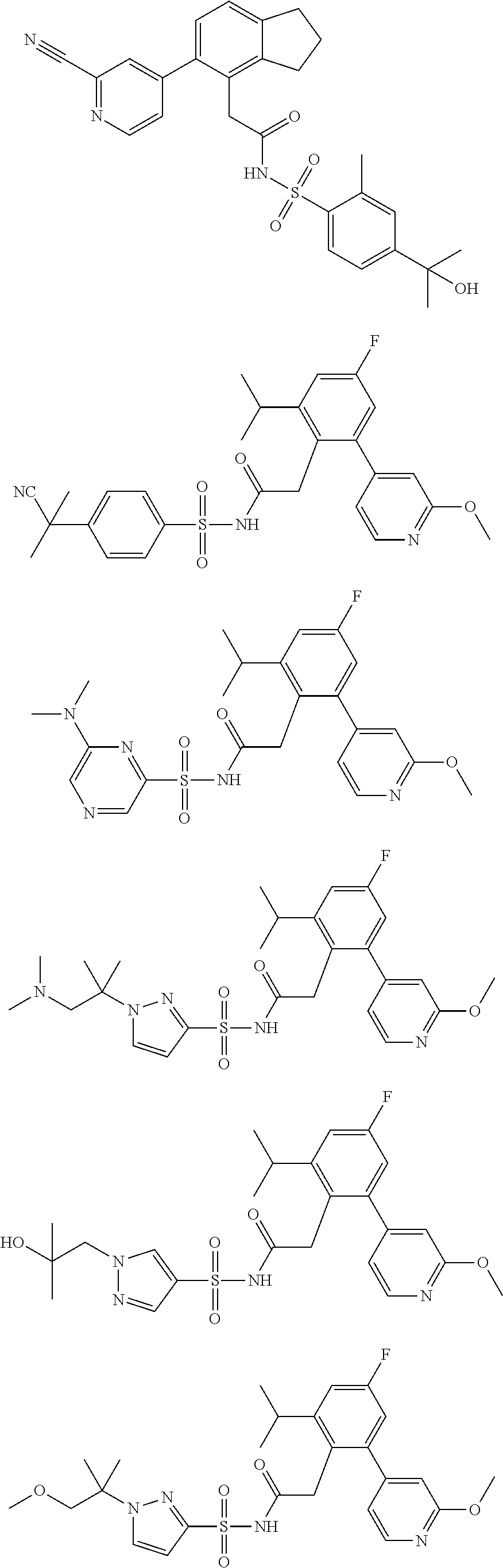


Applications Claiming Priority (16)
| Application Number | Priority Date | Filing Date | Title |
|---|---|---|---|
| GBGB1803413.2A GB201803413D0 (en) | 2018-03-02 | 2018-03-02 | Novel compounds |
| GB1803413.2 | 2018-03-02 | ||
| GBGB1803412.4A GB201803412D0 (en) | 2018-03-02 | 2018-03-02 | Novel compounds |
| GB1803413 | 2018-03-02 | ||
| GB1803412.4 | 2018-03-02 | ||
| GB1803412 | 2018-03-02 | ||
| GB1900291.4 | 2019-01-09 | ||
| GB1900291 | 2019-01-09 | ||
| GBGB1900291.4A GB201900291D0 (en) | 2019-01-09 | 2019-01-09 | Novel compounds |
| GB1902320.9 | 2019-02-20 | ||
| GBGB1902320.9A GB201902320D0 (en) | 2019-02-20 | 2019-02-20 | Novel compounds |
| GB1902320 | 2019-02-20 | ||
| GB1902319 | 2019-02-20 | ||
| GB1902319.1 | 2019-02-20 | ||
| GBGB1902319.1A GB201902319D0 (en) | 2019-02-20 | 2019-02-20 | Novel compounds |
| PCT/EP2019/055146 WO2019166629A1 (en) | 2018-03-02 | 2019-03-01 | Novel compounds |
Publications (2)
| Publication Number | Publication Date |
|---|---|
| US20210002274A1 US20210002274A1 (en) | 2021-01-07 |
| US12030879B2 true US12030879B2 (en) | 2024-07-09 |
Family
ID=65657468
Family Applications (1)
| Application Number | Title | Priority Date | Filing Date |
|---|---|---|---|
| US16/977,445 Active US12030879B2 (en) | 2018-03-02 | 2019-03-01 | Sulfonyl acetamides as NLRP3 inhibitors |
Country Status (3)
| Country | Link |
|---|---|
| US (1) | US12030879B2 (en) |
| EP (1) | EP3759090A1 (en) |
| WO (1) | WO2019166629A1 (en) |
Families Citing this family (18)
| Publication number | Priority date | Publication date | Assignee | Title |
|---|---|---|---|---|
| HK1257569A1 (en) | 2016-02-16 | 2019-10-25 | The University Of Queensland | Sulfonylureas and related compounds and use of same |
| US11840543B2 (en) | 2017-05-24 | 2023-12-12 | The University Of Queensland | Compounds and uses |
| EP3649112A1 (en) * | 2017-07-07 | 2020-05-13 | Inflazome Limited | Sulfonylureas and sulfonylthioureas as nlrp3 inhibitors |
| EP3668840A1 (en) | 2017-08-15 | 2020-06-24 | Inflazome Limited | Novel sulfonamide carboxamide compounds |
| TW201910317A (en) | 2017-08-15 | 2019-03-16 | 愛爾蘭商英弗雷佐姆有限公司 | Novel compound |
| US11773058B2 (en) | 2017-08-15 | 2023-10-03 | Inflazome Limited | Sulfonamide carboxamide compounds |
| EP3668843A1 (en) | 2017-08-15 | 2020-06-24 | Inflazome Limited | Sulfonylureas and sulfonylthioureas as nlrp3 inhibitors |
| TW201910316A (en) | 2017-08-15 | 2019-03-16 | 愛爾蘭商英弗雷佐姆有限公司 | Novel compound |
| PE20210050A1 (en) | 2017-11-09 | 2021-01-08 | Inflazome Ltd | NEW SULFONAMIDE CARBOXAMIDE COMPOUNDS |
| EP3707137A1 (en) | 2017-11-09 | 2020-09-16 | Inflazome Limited | Novel sulfonamide carboxamide compounds |
| WO2019166619A1 (en) | 2018-03-02 | 2019-09-06 | Inflazome Limited | Novel compounds |
| EP3759073A1 (en) * | 2018-03-02 | 2021-01-06 | Inflazome Limited | Sulfonamide derivates as nlrp3 inhibitors |
| US12030879B2 (en) | 2018-03-02 | 2024-07-09 | Inflazome Limited | Sulfonyl acetamides as NLRP3 inhibitors |
| US11530200B2 (en) | 2018-03-02 | 2022-12-20 | Inflazome Limited | Compounds |
| US11884645B2 (en) | 2018-03-02 | 2024-01-30 | Inflazome Limited | Sulfonyl acetamides as NLRP3 inhibitors |
| WO2019166627A1 (en) | 2018-03-02 | 2019-09-06 | Inflazome Limited | Novel compounds |
| CN112672995A (en) | 2018-08-15 | 2021-04-16 | 英夫拉索姆有限公司 | Novel sulfonamide urea compounds |
| WO2025153532A1 (en) | 2024-01-16 | 2025-07-24 | NodThera Limited | Nlrp3 inhibitors and glp-1 agonists combination therapies |
Citations (65)
| Publication number | Priority date | Publication date | Assignee | Title |
|---|---|---|---|---|
| GB2104069A (en) | 1981-08-06 | 1983-03-02 | Squibb & Sons Inc | 2-oxo-azetidines |
| WO1994026702A1 (en) | 1993-05-14 | 1994-11-24 | Warner-Lambert Company | N-acyl sulfamic acid esters (or thioesters), n-acyl sulfonamides, and n-sulfonyl carbamic acid esters (or thioesters) as hypercholesterolemic agents |
| DE4419247A1 (en) | 1994-06-01 | 1995-12-07 | Merckle Gmbh | New pyrrolizine keto-acid, keto-ester and carboxamide derivs. |
| WO1998032733A1 (en) | 1997-01-29 | 1998-07-30 | Pfizer Inc. | Sulfonyl urea derivatives and their use in the control of interleukin-1 activity |
| WO2001019390A1 (en) | 1999-09-14 | 2001-03-22 | Pfizer Products Inc. | Combination treatment with il-1ra and diaryl sulphonyl urea compounds |
| WO2002050032A1 (en) | 2000-12-21 | 2002-06-27 | Glaxo Group Limited | Naphthalene derivatives which bind to the ep4 receptor |
| EP1236468A1 (en) | 2001-02-12 | 2002-09-04 | Warner-Lambert Company | Sulfonylaminocarbonyl derivatives for the treatment of nuclear factor-kappa B mediated diseases and disorders |
| WO2004065367A1 (en) | 2003-01-22 | 2004-08-05 | Boehringer Ingelheim International Gmbh | Viral polymerase inhibitors |
| WO2005082863A2 (en) | 2004-02-26 | 2005-09-09 | Bayer Healthcare Ag | 1,4 diaryl-dihydropyrimidin-2 ones and their use as a human neutrophil elastase inhibitors |
| WO2005082864A1 (en) | 2004-02-26 | 2005-09-09 | Bayer Healthcare Ag | 1,4-diaryl-dihydropyrimidin-2-ones and their use as human neutrophil elastase inhibitors |
| WO2006075955A1 (en) | 2005-01-13 | 2006-07-20 | Astrazeneca Ab | Pyrazolyl acylsulfonamide derivatives as endothelin converting enzyme inhibitors and useful in the treatment of chronic obstructive pulmonary disease |
| WO2006081343A1 (en) | 2005-01-26 | 2006-08-03 | Aventis Pharmaceuticals Inc. | 2-phenyl-indoles as prostaglandin d2 receptor antagonists |
| WO2008014186A1 (en) | 2006-07-25 | 2008-01-31 | Sanofi-Aventis | 2-phenyl-indoles as prostaglandin d2 receptor antagonists |
| WO2008099794A1 (en) | 2007-02-09 | 2008-08-21 | Takeda Pharmaceutical Company Limited | Fused ring compounds as partial agonists of ppar-gamma |
| EP2138482A1 (en) | 2007-04-19 | 2009-12-30 | Astellas Pharma Inc. | Bicyclic heterocyclic compound |
| WO2010108187A2 (en) | 2009-03-20 | 2010-09-23 | Brandeis University | Compounds and methods for treating mammalian gastrointestinal microbial infections |
| WO2011149841A1 (en) | 2010-05-25 | 2011-12-01 | Janssen Pharmaceutica Nv | SUBSTITUTED THIAZOLIDINEDIONE INDAZOLES, INDOLES AND BENZOTRIAZOLES AS ESTROGEN-RELATED RECEPTOR-α MODULATORS |
| WO2011153509A1 (en) | 2010-06-04 | 2011-12-08 | Amgen Inc. | Piperidinone derivatives as mdm2 inhibitors for the treatment of cancer |
| WO2012162365A1 (en) | 2011-05-25 | 2012-11-29 | Bristol-Myers Squibb Company | Substituted sulfonamides useful as antiapoptotic bcl inhibitors |
| WO2013006792A1 (en) | 2011-07-07 | 2013-01-10 | Pharmaresources (Shanghai) Co., Ltd. | Antiviral compounds |
| WO2014130470A1 (en) | 2013-02-19 | 2014-08-28 | Amgen Inc. | Cis-morpholinone and other compounds as mdm2 inhibitors for the treatment of cancer |
| WO2016131098A1 (en) | 2015-02-16 | 2016-08-25 | The University Of Queensland | Sulfonylureas and related compounds and use of same |
| WO2017069224A1 (en) | 2015-10-22 | 2017-04-27 | 塩野義製薬株式会社 | Spiro heterocyclic derivative having mgat2-inhibiting activity |
| WO2017140778A1 (en) | 2016-02-16 | 2017-08-24 | The University Of Queensland | Sulfonylureas and related compounds and use of same |
| WO2017184604A1 (en) | 2016-04-18 | 2017-10-26 | Ifm Therapeutics, Inc | Compounds and compositions for treating conditions associated with nlrp activity |
| WO2018215818A1 (en) | 2017-05-24 | 2018-11-29 | The University Of Queensland | Novel compounds and uses |
| WO2019008025A1 (en) | 2017-07-07 | 2019-01-10 | Inflazome Limited | Novel sulfonamide carboxamide compounds |
| WO2019008029A1 (en) | 2017-07-07 | 2019-01-10 | Inflazome Limited | Sulfonylureas and sulfonylthioureas as nlrp3 inhibitors |
| WO2019034696A1 (en) | 2017-08-15 | 2019-02-21 | Inflazome Limited | Novel sulfonamide carboxamide compounds |
| WO2019034693A1 (en) | 2017-08-15 | 2019-02-21 | Inflazome Limited | Sulfonylureas and sulfonylthioureas as nlrp3 inhibitors |
| WO2019034690A1 (en) | 2017-08-15 | 2019-02-21 | Inflazome Limited | Sulfonylureas and sulfonylthioureas as nlrp3 inhibitors |
| WO2019034686A1 (en) | 2017-08-15 | 2019-02-21 | Inflazome Limited | Novel sulfonamide carboxamide compounds |
| WO2019034692A1 (en) | 2017-08-15 | 2019-02-21 | Inflazome Limited | Sulfonylureas and sulfonylthioureas as nlrp3 inhibitors |
| WO2019034688A1 (en) | 2017-08-15 | 2019-02-21 | Inflazome Limited | Novel sulfonamide carboxamide compounds |
| WO2019034697A1 (en) | 2017-08-15 | 2019-02-21 | Inflazome Limited | Novel sulfonamide carboxamide compounds |
| WO2019068772A1 (en) | 2017-10-03 | 2019-04-11 | Inflazome Limited | Novel compounds |
| WO2019079119A1 (en) | 2017-10-17 | 2019-04-25 | IFM Tre, Inc. | Sulphonamides and compositions thereof for treating conditions associated with nlrp activity |
| WO2019092172A1 (en) | 2017-11-09 | 2019-05-16 | Inflazome Limited | Novel sulfonamide carboxamide compounds |
| WO2019092170A1 (en) | 2017-11-09 | 2019-05-16 | Inflazome Limited | Novel sulfonamide carboxamide compounds |
| WO2019092171A1 (en) | 2017-11-09 | 2019-05-16 | Inflazome Limited | Novel sulfonamide carboxamide compounds |
| WO2019166632A1 (en) | 2018-03-02 | 2019-09-06 | Inflazome Limited | Novel compounds |
| WO2019166627A1 (en) | 2018-03-02 | 2019-09-06 | Inflazome Limited | Novel compounds |
| WO2019166623A1 (en) | 2018-03-02 | 2019-09-06 | Inflazome Limited | Phenylsulfonylurea derivatives useful as nlrp3 inhibitors |
| WO2019166619A1 (en) | 2018-03-02 | 2019-09-06 | Inflazome Limited | Novel compounds |
| WO2019166629A1 (en) | 2018-03-02 | 2019-09-06 | Inflazome Limited | Novel compounds |
| WO2019166621A1 (en) | 2018-03-02 | 2019-09-06 | Inflazome Limited | Phenylsulfonylurea derivatives useful as nlrp3 inhibitors |
| WO2019166633A1 (en) | 2018-03-02 | 2019-09-06 | Inflazome Limited | Sulfonamide derivates as nlrp3 inhibitors |
| WO2019166624A1 (en) | 2018-03-02 | 2019-09-06 | Inflazome Limited | Novel compounds |
| WO2019166628A1 (en) | 2018-03-02 | 2019-09-06 | Inflazome Limited | Novel compounds |
| WO2019206871A1 (en) | 2018-04-23 | 2019-10-31 | Inflazome Limited | A sodium salt of n-((1,2,3,5,6,7-hexahydro-s-indacen-4-yl)carbamoyl)-1 -isopropyl-1 h-pyrazole-3-sulfonamide |
| WO2019211463A1 (en) | 2018-05-04 | 2019-11-07 | Inflazome Limited | Novel compounds |
| WO2020010140A1 (en) | 2018-07-03 | 2020-01-09 | Novartis Inflammasome Research, Inc. | Nlrp modulators |
| WO2020010118A1 (en) | 2018-07-03 | 2020-01-09 | Novartis Inflammasome Research, Inc. | Methods of treating or selecting a treatment for a subject resistant to tnf inhibitor using a nlrp3 antagonist |
| WO2020035466A1 (en) | 2018-08-15 | 2020-02-20 | Inflazome Limited | Novel sulfoneurea compounds |
| WO2020035464A1 (en) | 2018-08-15 | 2020-02-20 | Inflazome Limited | Novel sulfonamideurea compounds |
| WO2020079207A1 (en) | 2018-10-19 | 2020-04-23 | Inflazome Limited | Novel processes |
| WO2020086728A1 (en) | 2018-10-24 | 2020-04-30 | Novartis Inflammasome Research, Inc. | Compounds and compositions for treating conditions associated with nlrp activity |
| WO2020104657A1 (en) | 2018-11-23 | 2020-05-28 | Inflazome Limited | Nlrp3 inhibitors |
| WO2020208249A1 (en) | 2019-04-12 | 2020-10-15 | Inflazome Limited | Nlrp3 inflammasome inhibition |
| WO2021032591A1 (en) | 2019-08-16 | 2021-02-25 | Inflazome Limited | Macrocyclic sulfonylurea derivatives useful as nlrp3 inhibitors |
| WO2021032588A1 (en) | 2019-08-16 | 2021-02-25 | Inflazome Limited | Macrocyclic sulfonylamide derivatives useful as nlrp3 inhibitors |
| WO2021043966A1 (en) | 2019-09-06 | 2021-03-11 | Inflazome Limited | Nlrp3 inhibitors |
| WO2021089783A1 (en) | 2019-11-07 | 2021-05-14 | Inflazome Limited | Treatment of arthritis |
| WO2021089768A2 (en) | 2019-11-07 | 2021-05-14 | Inflazome Limited | Novel treatment |
| WO2021165245A1 (en) | 2020-02-18 | 2021-08-26 | Inflazome Limited | Compounds |
-
2019
- 2019-03-01 US US16/977,445 patent/US12030879B2/en active Active
- 2019-03-01 WO PCT/EP2019/055146 patent/WO2019166629A1/en not_active Ceased
- 2019-03-01 EP EP19708836.2A patent/EP3759090A1/en not_active Withdrawn
Patent Citations (77)
| Publication number | Priority date | Publication date | Assignee | Title |
|---|---|---|---|---|
| GB2104069A (en) | 1981-08-06 | 1983-03-02 | Squibb & Sons Inc | 2-oxo-azetidines |
| WO1994026702A1 (en) | 1993-05-14 | 1994-11-24 | Warner-Lambert Company | N-acyl sulfamic acid esters (or thioesters), n-acyl sulfonamides, and n-sulfonyl carbamic acid esters (or thioesters) as hypercholesterolemic agents |
| DE4419247A1 (en) | 1994-06-01 | 1995-12-07 | Merckle Gmbh | New pyrrolizine keto-acid, keto-ester and carboxamide derivs. |
| WO1998032733A1 (en) | 1997-01-29 | 1998-07-30 | Pfizer Inc. | Sulfonyl urea derivatives and their use in the control of interleukin-1 activity |
| WO2001019390A1 (en) | 1999-09-14 | 2001-03-22 | Pfizer Products Inc. | Combination treatment with il-1ra and diaryl sulphonyl urea compounds |
| WO2002050032A1 (en) | 2000-12-21 | 2002-06-27 | Glaxo Group Limited | Naphthalene derivatives which bind to the ep4 receptor |
| EP1236468A1 (en) | 2001-02-12 | 2002-09-04 | Warner-Lambert Company | Sulfonylaminocarbonyl derivatives for the treatment of nuclear factor-kappa B mediated diseases and disorders |
| WO2004065367A1 (en) | 2003-01-22 | 2004-08-05 | Boehringer Ingelheim International Gmbh | Viral polymerase inhibitors |
| WO2005082863A2 (en) | 2004-02-26 | 2005-09-09 | Bayer Healthcare Ag | 1,4 diaryl-dihydropyrimidin-2 ones and their use as a human neutrophil elastase inhibitors |
| WO2005082864A1 (en) | 2004-02-26 | 2005-09-09 | Bayer Healthcare Ag | 1,4-diaryl-dihydropyrimidin-2-ones and their use as human neutrophil elastase inhibitors |
| WO2006075955A1 (en) | 2005-01-13 | 2006-07-20 | Astrazeneca Ab | Pyrazolyl acylsulfonamide derivatives as endothelin converting enzyme inhibitors and useful in the treatment of chronic obstructive pulmonary disease |
| WO2006081343A1 (en) | 2005-01-26 | 2006-08-03 | Aventis Pharmaceuticals Inc. | 2-phenyl-indoles as prostaglandin d2 receptor antagonists |
| WO2008014186A1 (en) | 2006-07-25 | 2008-01-31 | Sanofi-Aventis | 2-phenyl-indoles as prostaglandin d2 receptor antagonists |
| WO2008099794A1 (en) | 2007-02-09 | 2008-08-21 | Takeda Pharmaceutical Company Limited | Fused ring compounds as partial agonists of ppar-gamma |
| EP2138482A1 (en) | 2007-04-19 | 2009-12-30 | Astellas Pharma Inc. | Bicyclic heterocyclic compound |
| WO2010108187A2 (en) | 2009-03-20 | 2010-09-23 | Brandeis University | Compounds and methods for treating mammalian gastrointestinal microbial infections |
| WO2011149841A1 (en) | 2010-05-25 | 2011-12-01 | Janssen Pharmaceutica Nv | SUBSTITUTED THIAZOLIDINEDIONE INDAZOLES, INDOLES AND BENZOTRIAZOLES AS ESTROGEN-RELATED RECEPTOR-α MODULATORS |
| US20110294780A1 (en) | 2010-05-25 | 2011-12-01 | Gilles Bignan | SUBSTITUTED THIAZOLIDINEDIONE INDAZOLES, INDOLES AND BENZOTRIAZOLES AS ESTROGEN-RELATED RECEPTOR-a MODULATORS |
| WO2011153509A1 (en) | 2010-06-04 | 2011-12-08 | Amgen Inc. | Piperidinone derivatives as mdm2 inhibitors for the treatment of cancer |
| WO2012162365A1 (en) | 2011-05-25 | 2012-11-29 | Bristol-Myers Squibb Company | Substituted sulfonamides useful as antiapoptotic bcl inhibitors |
| WO2013006792A1 (en) | 2011-07-07 | 2013-01-10 | Pharmaresources (Shanghai) Co., Ltd. | Antiviral compounds |
| WO2014130470A1 (en) | 2013-02-19 | 2014-08-28 | Amgen Inc. | Cis-morpholinone and other compounds as mdm2 inhibitors for the treatment of cancer |
| WO2016131098A1 (en) | 2015-02-16 | 2016-08-25 | The University Of Queensland | Sulfonylureas and related compounds and use of same |
| US20180044287A1 (en) | 2015-02-16 | 2018-02-15 | The University Of Queensland | Sulfonylureas and related compounds and use of same |
| WO2017069224A1 (en) | 2015-10-22 | 2017-04-27 | 塩野義製薬株式会社 | Spiro heterocyclic derivative having mgat2-inhibiting activity |
| WO2017140778A1 (en) | 2016-02-16 | 2017-08-24 | The University Of Queensland | Sulfonylureas and related compounds and use of same |
| WO2017184604A1 (en) | 2016-04-18 | 2017-10-26 | Ifm Therapeutics, Inc | Compounds and compositions for treating conditions associated with nlrp activity |
| WO2018215818A1 (en) | 2017-05-24 | 2018-11-29 | The University Of Queensland | Novel compounds and uses |
| WO2019008025A1 (en) | 2017-07-07 | 2019-01-10 | Inflazome Limited | Novel sulfonamide carboxamide compounds |
| WO2019008029A1 (en) | 2017-07-07 | 2019-01-10 | Inflazome Limited | Sulfonylureas and sulfonylthioureas as nlrp3 inhibitors |
| WO2019034696A1 (en) | 2017-08-15 | 2019-02-21 | Inflazome Limited | Novel sulfonamide carboxamide compounds |
| WO2019034693A1 (en) | 2017-08-15 | 2019-02-21 | Inflazome Limited | Sulfonylureas and sulfonylthioureas as nlrp3 inhibitors |
| WO2019034690A1 (en) | 2017-08-15 | 2019-02-21 | Inflazome Limited | Sulfonylureas and sulfonylthioureas as nlrp3 inhibitors |
| WO2019034686A1 (en) | 2017-08-15 | 2019-02-21 | Inflazome Limited | Novel sulfonamide carboxamide compounds |
| WO2019034692A1 (en) | 2017-08-15 | 2019-02-21 | Inflazome Limited | Sulfonylureas and sulfonylthioureas as nlrp3 inhibitors |
| WO2019034688A1 (en) | 2017-08-15 | 2019-02-21 | Inflazome Limited | Novel sulfonamide carboxamide compounds |
| WO2019034697A1 (en) | 2017-08-15 | 2019-02-21 | Inflazome Limited | Novel sulfonamide carboxamide compounds |
| WO2020035465A1 (en) | 2017-08-15 | 2020-02-20 | Inflazome Limited | Novel sulfoneurea compounds |
| WO2019068772A1 (en) | 2017-10-03 | 2019-04-11 | Inflazome Limited | Novel compounds |
| WO2019079119A1 (en) | 2017-10-17 | 2019-04-25 | IFM Tre, Inc. | Sulphonamides and compositions thereof for treating conditions associated with nlrp activity |
| WO2019092172A1 (en) | 2017-11-09 | 2019-05-16 | Inflazome Limited | Novel sulfonamide carboxamide compounds |
| WO2019092170A1 (en) | 2017-11-09 | 2019-05-16 | Inflazome Limited | Novel sulfonamide carboxamide compounds |
| WO2019092171A1 (en) | 2017-11-09 | 2019-05-16 | Inflazome Limited | Novel sulfonamide carboxamide compounds |
| WO2019166633A1 (en) | 2018-03-02 | 2019-09-06 | Inflazome Limited | Sulfonamide derivates as nlrp3 inhibitors |
| US20200399243A1 (en) * | 2018-03-02 | 2020-12-24 | Inflazome Limited | Novel compounds |
| WO2019166623A1 (en) | 2018-03-02 | 2019-09-06 | Inflazome Limited | Phenylsulfonylurea derivatives useful as nlrp3 inhibitors |
| WO2019166619A1 (en) | 2018-03-02 | 2019-09-06 | Inflazome Limited | Novel compounds |
| WO2019166629A1 (en) | 2018-03-02 | 2019-09-06 | Inflazome Limited | Novel compounds |
| WO2019166621A1 (en) | 2018-03-02 | 2019-09-06 | Inflazome Limited | Phenylsulfonylurea derivatives useful as nlrp3 inhibitors |
| US20210040065A1 (en) * | 2018-03-02 | 2021-02-11 | Inflazome Limited | Novel compounds |
| WO2019166624A1 (en) | 2018-03-02 | 2019-09-06 | Inflazome Limited | Novel compounds |
| WO2019166628A1 (en) | 2018-03-02 | 2019-09-06 | Inflazome Limited | Novel compounds |
| WO2019166627A1 (en) | 2018-03-02 | 2019-09-06 | Inflazome Limited | Novel compounds |
| US20200399242A1 (en) * | 2018-03-02 | 2020-12-24 | Inflazome Limited | Novel compounds |
| US20200407340A1 (en) * | 2018-03-02 | 2020-12-31 | Inflazome Limited | Sulfonamide derivates as nlrp3 inhibitors |
| US20210047302A1 (en) * | 2018-03-02 | 2021-02-18 | Inflazome Limited | Novel compounds |
| US11834433B2 (en) | 2018-03-02 | 2023-12-05 | Inflazome Limited | Compounds |
| WO2019166632A1 (en) | 2018-03-02 | 2019-09-06 | Inflazome Limited | Novel compounds |
| WO2019206871A1 (en) | 2018-04-23 | 2019-10-31 | Inflazome Limited | A sodium salt of n-((1,2,3,5,6,7-hexahydro-s-indacen-4-yl)carbamoyl)-1 -isopropyl-1 h-pyrazole-3-sulfonamide |
| WO2019211463A1 (en) | 2018-05-04 | 2019-11-07 | Inflazome Limited | Novel compounds |
| WO2020010140A1 (en) | 2018-07-03 | 2020-01-09 | Novartis Inflammasome Research, Inc. | Nlrp modulators |
| WO2020010118A1 (en) | 2018-07-03 | 2020-01-09 | Novartis Inflammasome Research, Inc. | Methods of treating or selecting a treatment for a subject resistant to tnf inhibitor using a nlrp3 antagonist |
| WO2020035464A1 (en) | 2018-08-15 | 2020-02-20 | Inflazome Limited | Novel sulfonamideurea compounds |
| WO2020035466A1 (en) | 2018-08-15 | 2020-02-20 | Inflazome Limited | Novel sulfoneurea compounds |
| WO2020079207A1 (en) | 2018-10-19 | 2020-04-23 | Inflazome Limited | Novel processes |
| WO2020086728A1 (en) | 2018-10-24 | 2020-04-30 | Novartis Inflammasome Research, Inc. | Compounds and compositions for treating conditions associated with nlrp activity |
| US20220106289A1 (en) | 2018-11-23 | 2022-04-07 | Inflazome Limited | Nlrp3 inhibitors |
| WO2020104657A1 (en) | 2018-11-23 | 2020-05-28 | Inflazome Limited | Nlrp3 inhibitors |
| WO2020208249A1 (en) | 2019-04-12 | 2020-10-15 | Inflazome Limited | Nlrp3 inflammasome inhibition |
| US20220163539A1 (en) | 2019-04-12 | 2022-05-26 | Inflazome Limited | Nlrp3 inflammasome inhibition |
| WO2021032591A1 (en) | 2019-08-16 | 2021-02-25 | Inflazome Limited | Macrocyclic sulfonylurea derivatives useful as nlrp3 inhibitors |
| WO2021032588A1 (en) | 2019-08-16 | 2021-02-25 | Inflazome Limited | Macrocyclic sulfonylamide derivatives useful as nlrp3 inhibitors |
| WO2021043966A1 (en) | 2019-09-06 | 2021-03-11 | Inflazome Limited | Nlrp3 inhibitors |
| WO2021089768A3 (en) | 2019-11-07 | 2021-06-24 | Inflazome Limited | Treatment and prevention of a neurodegenerative disorder |
| WO2021089768A2 (en) | 2019-11-07 | 2021-05-14 | Inflazome Limited | Novel treatment |
| WO2021089783A1 (en) | 2019-11-07 | 2021-05-14 | Inflazome Limited | Treatment of arthritis |
| WO2021165245A1 (en) | 2020-02-18 | 2021-08-26 | Inflazome Limited | Compounds |
Non-Patent Citations (138)
| Title |
|---|
| Acute Leukemia, Merck Manual (online edition) pp. 1-6 (2013). |
| Alikhan, et al., "Hidradenitis suppurativa: A comprehensive review," J Am Acad Dermatol, vol. 60, No. 4, pp. 539-561, (Apr. 2009). |
| Allen, et al., "The NLRP3 inflammasome functions as a negative regulator of tumorigenesis during colitis-associated cancer," J Exp Med, vol. 207, No. 5, pp. 1045-1056, (Apr. 2010). |
| Amsler, et al., "The inflammasome as a target of modulation by DNA viruses," Future Virol., 8(4), pp. 357-370, (2013). |
| Balant, ed in Wolff et al. Burger's Medicinal Chemistry and drug discovery, 5th Ed., vol. 1. Principles and practice, pp. 949-982, 1995. |
| Banker et al., Prodrugs, Modern Pharmaceutics, 3rd edition, Revised and Expanded, pp. 451 and 596, (1995). |
| Basiorka, et al., The NLRP3 inflammasome functions as a driver of the myelodysplastic syndrom phenotype, Blood, vol. 128, No. 25, pp. 2960-2975, (Dec. 2016). |
| Belikov, et al., "The interconnection between chemical structure, properties of substances and their effect on the body", MEDpress-inform, Pharmaceutical Chemistry, Text Book, 4th Edition, Moscow, Chap. 2.6, 27-29, (2007), Brief statement of relevance. |
| Blevins et al., "The NLRP3 Inflammasome Pathway: A Review of Mechanisms and Inhibitors for the Treatment of Inflammatory Diseases," Frontiers in Aging Neuroscience, vol. 14, Article, 879021, (Jun. 2022). |
| Bosseray et al., What's new in vaccines against herpes simplex infections?, PubMed abstract (Pathol Biol (Paris) 50(8):483-92, (2002). |
| Braddock et al., "Targeting IL-1 in Inflammatory Disease: New Opportunities for Thereapeutic Intervention," Nature Reviews, vol. 3, (Apr. 2004). |
| Bundgaard, "Design of Prodrugs," Chapter1, p. 1, (1985). |
| Burch, et al., "Structure-activity relationships and pharmacokinetic parameters of quinoline acylsulfonamides as potent and selective antagonists of the EP4 receptor," Bioorg Med Chem Lett, 18(6):2048-2054, (2008). |
| Cancer Treatment, retrieved from: https://cancertreatment.net/cancer-types/ on Mar. 30, 2023. |
| CAS 1215610-58-4, Apr. 2, 2010. |
| CAS 1215786-25-6, Apr. 2, 2010. |
| CAS 1216484-67-1, Apr. 4, 2010. |
| CAS 1216556-60-3, Apr. 4, 2010. |
| CAS 1216832-20-0, Apr. 5, 2010. |
| CAS 1216850-64-4, Apr. 5, 2010. |
| CAS 1217081-04-3, Apr. 6, 2010. |
| CAS 1217119-50-0, Apr. 6, 2010. |
| CAS 1217176-43-6, Apr. 6, 2010. |
| CAS 1388800-35-8, Aug. 9, 2012. |
| CAS 1394754-16-5, Sep. 18, 2012. |
| CAS 1427583-89-3, Apr. 9, 2013. |
| CAS 1647400-37-0, Feb. 15, 2015. |
| CAS 1788949-56-3, Jun. 26, 2015. |
| Center for Disease Control and Prevention, "Genital Herpes—CDC Basic Fact Sheet," retrieved from https://www.cdc.gov/std/herpes/STDFact-Herpes.htm on Mar. 30, 2023, last reviewed on Jan. 3, 2022. |
| Chemical Abstracts Registry No. 900813-70-9, indexed in the Registry file on STN CAS Online Aug. 11, 2006. (Year: 2006). * |
| Clark, et al., "MF498 [N-{[4-(5,9-Diethoxy-6-oxo-6,8-dihydro-7H-pyrrolo[3,4-g]quinolin-7-yl)-3-methylbenzyl]sulfonyl}-2-(2-methoxyphenyl)acetamide], a Selective E Prostanoid Receptor 4 Antagonist, Relieves Joint Inflammation and Pain in Rodent Models of Rheumatoid and Osteoarthritis," JPET, 325(2), 425-434, (2008). |
| Coll, et al., "A small-molecule inhibitor of the NLRP3 inflammasome for the treatment of inflammatory diseases", Nature Medicine, 21(3): 248-255, (2015). |
| Cook, et al., "The NLRP3 inflammasome, a target for therapy in diverse disease states," Eur. J. Immunol, 40: 595-653, (2010). |
| Dempsey, et al., "Inhibiting the NLRP3 inflammasome with MCC950 promotes non-phlogistic clearance of amyloid-β and cognitive function in APP/PS1 mice," Brain, Behavior, and Immunity, 61, 306-316, (2017). |
| DeNardo, et al., "New Insights into Mechanisms Controlling the NLRP3 Inflammasome and its Role in Lung Disease," the American Journal of Pathology, vol. 184, No. 1, pp. 42-54, (Jan. 2014). |
| Disease—Wikipedia, retrieved from the internet on Feb. 2, 2022 at: https://en.wikipedia.org/wiki/Disease. |
| Douglas Jr., "Introduction to Viral Diseases," Cecil textbook of Medicine, 20th Edition, vol. 2, 1739-1747, (1996). |
| Doyle, et al., "NLRP3 has a protective role in age-related macular degeneration through the induction of IL-18 by drusen componets," Nature Medicine, vol. 18, No. 5, pp. 791-498, (May 2012). |
| Duewell, et al., "NLRP3 inflammasomes are required for atherogenesis and activated by cholesterol crystals," Nature Letters, vol. 464, doi: 10.1038/nature08938, (Apr. 2010). |
| Ettmayer, et al., "Lessons learned from marketed and investigational prodrugs," J. Med. Chem., 47(10):2394-2404 (2004). |
| Fang, et al., "Increased expression of NLRP3 inflammasome componets and interleukin-18 in patients with bullous pemphigoid," Journal of Dermatological Science, 83, 116-123, (2016). |
| Gadakh, et al., "N-Acylated sulfonamide congeners of fosmdomycin lack any inhibitory activity against DXR," Bioorganic & Medicinal Chemistry Letters, 25: 1577-1573, (2015). |
| GB Application No. 1803412.4, Search Report mailed Oct. 8, 2018. |
| GB Application No. 1803414.0, Search Report mailed Oct. 15, 2018. |
| Goff, "Intracellular trafficking of retroviral genomes during the early phase of infection: viral exploitation of cellular pathways," PubMed Abstract (J Gene Med 3(6):517-28, (2001). |
| Granata, et al., "NLRP3 Inflammasome Activation in Dialyzed Chronic Kidney Disease Patients," PLoS One, 10(3): e0122272, (2015). |
| Gura, "Systems for identifying new drugs are often faulty," Science, 278(5340): 1041-2, (1997). |
| Han, "Targeted prodrug design to optimize drug delivery," AAPS Pharmsci. 2(1) Article 6: 1-11, (2000). |
| Henao-Mejia, et al., "Inflammasome-mediated dysbiosis regulates progression of NAFLD and obesity," Nature, vol. 482, pp. 170-185, (Feb. 2012). |
| Himiceskij, Chemical Encyclopedia, (1983), p. 130-131 [and brief statement of relevance in English]. |
| Hu, et al., "Inflammation-induced tumorigenesis in the colon is regulated by caspase-1 and NLR4," PNAS, vol. 107, No. 50, pp. 21635-21640, (Dec. 2010). |
| Huang, et al., "NLRP3 inflammasome activation promotes inflammation-induced carcinogenesis in head and neck squamous cell carcinoma," Journal of Experimental & Clinical Cancer Research, 36:116, (2017). |
| Iannitti, et al., "IL-1 receptor antagonist ameliorates inflammasome-dependent inflammation in murine and human cystic fiborsis," Nature Communications, 7:10791, doi:10.1038/ncomms10791, (Mar. 2016). |
| Inoue, et al., "The role of interferon-β in the treatment of multiple sclerosis and experimental autoimmune encephalomyelitis—in the perspective of inflammasomes," Immunology, 139, 11-18, (2013). |
| Jager, et al., "Key Role of NLrp3 Inflammasome Activation in Granduloma Generation of Sarcoidosis," Am J Respir Crit Care Med, 191, A5816, (2015). |
| Johnson et al., "Relationships between drug activity in NCI preclinical in vitro and in vivo models ands early clinical trials," Br J Cancer, 84(10): 1424-31, (2001). |
| Kim, et al., "Role for NLRP3 Inflammasome-mediated, IL-1β-Dependent Responses in Severe, Steroid-Resistant Asthma," American Journal of Respiratory and Critical Care Medicine, vol. 196, No. 3, pp. 283-297, (Aug. 2017). |
| Lazaridis, et al., "Acitvation of NLRP3 Inflammasome in Inflammatory Bowel Disease: Differences Between Crohn's Disease and Ulcerative Colitis," Dig Dis Sci, 62:2348-2356, (2017). |
| Li, et al "The identification of substituted benzothiophene derivatives as PGE(2) subtype 4 receptor antagonists: From acid to non-acid," Bioorg Med Chem Lett, 21(2):734-737, (2011). |
| Li, et al., "Aging-related gene signature regulated by NLrp3 predicts glioma progression," Am J Cancer Res., 5(1) 442-449, (2015). |
| Li, et al., "Dysregulation of the NLRP3 inflammasome complex and related cytokines in patients with multiple myeloma," Hematology, vol. 21, No. 3, pp. 144-151, (2016). |
| Liedtke, et al., Arylpyrrolizines as Inhibitors of Microsomal Prostaglandin E2 Synthase-1 (mPGES-1) or as Dual Inhibitors of mPGES-1 and 5-Lipoxygenase (5-LOX), J. Med. Chem, vol. 52, No. 15, pp. 4968-4972, (2009). |
| Loukovaara, et al., "NLRP3 inflammasome activation is associated with proliferative diabetic retinopathy," Acta Ophthalmol, 95: 803-808, (2017). |
| Luo, et al. "Principles of cancer therapy: oncogene and non-oncogene addiction," Cell, 136: 823-837, (2009). |
| Masters, "Specific inflammasomes in complex diseases," Clinical Immunology, http://dx.doi.org/10.1016/j.clim.2012.12.006, (2013). |
| Menu et al., "The NLRP3 inflammasome in health and disease: the good, the bad and the ugly," Clinical and Experimental Immunology, 166: 1-15. (Jun. 2011). |
| Mridha, et al., "NLRP3 inflammasome blockade reduces liver inflammation and fibrosis in experimenal NASH in mice," Journal of Hepatology, http://dx.doi.org/10.1016/j.jhep.2017.01.022, (2017). |
| Neudecker, et al., "Myeloid-derived miR-223 regulates intestinal inflammation via repression of the NLRP3 inflammasome," JEM, published online May 9, 2017 at http://doi.org/10.1084/jem.20160462, downloaded on (Jun. 2019). |
| Niebuhr, et al., "Impaired NLRP3 inflammasome expressison and function in atopic dermatitis due to Th2 milieu," Allergy, 69: 1058-1067, (2014). |
| Ozaki, et al., "Targeting the NLRP3 inflammasome in chronic inflammatory diseases: current perspectives," Journal of Inflammation Research, 8, 15-27, (Jan. 2015). |
| Parajuli, et al., "Prodrug as a novel approach of drug delivery—a review," Journal of Drug Delivery & Therapeutics, 5(3), pp. 5-9, (2015). |
| Pearce et al., "Failure modes in anticancer drug discovery and development," Cancer Drug Design and Discovery, Edited by Stephen Neidle, Chapter 18, pp. 424-435 (2008). |
| Primiano, et al., "Effiacy and Pharmacology of the NLRP3 Inflammasome Inhibitor CP-456,773 (CRID3) in Murine Models of Dermal and Plumonary Inflammation," The Journal of Immunology, 197: 2421-2433, (2016). |
| Puyang, et al., "Retinal Ganglion Cell Loss is Delayed Following Opti Nerve Crush in NLRP3 Knockout Mice," Scientific Reports, 6:20998, (Feb. 2016). |
| Qin, et al., "Propionibacterium acnes induces IL-1β secretion via the NLRP3 inflammasome in human monocytes," J Invest Dermatol, 134(2): 381-388, (Feb. 2014). |
| Rautio et al., Prodrugs: design and clinical applications, Nature reviews drug discovery, 7(3), 255-270 (2008). |
| Razonable et al., "Herpesvirus infections in transplant recipients: current challenges in the clinical management of cytomegalovirus and Epstein-Barr virus infections," PubMed Abstract (Herpes 10(3): 60-5), (2003). |
| Ridker, et al., "Antiinflammatory Therapy with Canakinumab for Atherosclerotic Disease," The New England Journal of Medicine, DOI: 10.1056/NEJMoa1707914, (Aug. 2017). |
| Ridker, et al., "Effect of interleukin-1β inhibition with canakinumab on incident lung cancer in patients with atherosclerosis: exploratory results from a randomised, double-blind, plaebo-controlled trial," Lancet, 390: 1833-42, (2017). |
| Sano, et al., "Tet2-Mediated Clonal Hematopoiesis Accelerates Heart Failure Through a Mechanism Involoving the IL-1β/NLRP3 Inflammasome," The Journal of the American College of Cardiology, vol. 71, No. 8, pp. 875-886, (Feb. 2018). |
| Schroder, "Could an NLRP3 inhibitor be the one drug to conquer common diseases?" Drug Discovery, Vo. 98, Issue 7, 1-11, (Feb. 2020). |
| Schroder, et al., "The Inflammasomes," Cell, 140, 821-832, (Mar. 2010). |
| Scott, et al., "A randomised trial evaluating anakinra in early active rheumatoid arthritis," Clinical and Experimental Reheumatology, 34: 88-93, (2016). |
| Silverman, "The Organic Chemistry of Drug Design and Drug Action," Prodrugs and Drug Delivery Stystem, The Organic Chemistry of Drug Design and Drug Action, Chapter 8, pp. 352-400, (1992). |
| Simnones, Oncology: Introduction, Cecil Textbook of Medicine, 20th Edition, vol. 1, pp. 1004-1010, (1996). |
| Solvation—Wikipedia, retrieved from the internet on Jan. 15, 2022 at: https://en.wikipedia.org/wiki/Solvation. |
| Stella, "Prodrugs as theraputics," Expert Opinion of theraputic patents, 14(3): 277-280 (2004). |
| Strowig, et al., "Inflammasomes in health and disease," Nature, vol. 481, pp. 278-286, (Jan. 2012). |
| Tarallo, et al., "DICER1 Loss and Alu RNA Induce Age-Related Macular Degeneration via the NLRP3 Inflammasome and MyD88," Cell, 149, 847-859, (May 2012). |
| Testa, "Prodrug Research: futile or fertile?" Biochemical Pharmacology, 68, 2097-2106, (2004). |
| The Trustees of the University of Pennsylvania, OncoLink, Cancer Types, retrieved from https://www.oncolink.org/cancers on Mar. 30, 2023. |
| U.S. Appl. No. 16/977,249, Final Office Action mailed Jan. 19, 2023. |
| U.S. Appl. No. 16/977,249, Non-Final Office Action mailed Apr. 27, 2022. |
| U.S. Appl. No. 16/977,249, Non-Final Office Action mailed Jul. 13, 2023. |
| U.S. Appl. No. 16/977,249, Requirement for Restriction/Election mailed Sep. 15, 2021. |
| U.S. Appl. No. 16/977,251, Corrected Notice of Allowance mailed Aug. 15, 2023. |
| U.S. Appl. No. 16/977,251, Corrected Notice of Allowance mailed Nov. 3, 2023. |
| U.S. Appl. No. 16/977,251, Final Office Action mailed Sep. 30, 2022. |
| U.S. Appl. No. 16/977,251, Non-Final Office Action mailed Feb. 11, 2022. |
| U.S. Appl. No. 16/977,251, Notice of Allowance mailed Jul. 24, 2023. |
| U.S. Appl. No. 16/977,251, Notice of Allowance mailed Mar. 28, 2023. |
| U.S. Appl. No. 16/977,251, Requirement for Restriction/Election mailed Sep. 28, 2021. |
| U.S. Appl. No. 16/977,434, Final Office Action mailed Apr. 11, 2023. |
| U.S. Appl. No. 16/977,4364, Final Office Action mailed Apr. 11, 2023. |
| U.S. Appl. No. 16/977,451, Final Office Action mailed Mar. 31, 2022. |
| U.S. Appl. No. 16/977,451, Non-Final Office Action mailed Aug. 11, 2022. |
| U.S. Appl. No. 16/977,451, Notice of Allowance mailed Sep. 21, 2021. |
| U.S. Appl. No. 16/977,452, Corrected Notice of Allowance mailed Dec. 8, 2023. |
| U.S. Appl. No. 16/977,452, Final Office Action mailed Dec. 13, 2022. |
| U.S. Appl. No. 16/977,452, Non-Final Office Action and Interview Summary mailed Dec. 5, 2023. |
| U.S. Appl. No. 16/977,452, Non-Final Office Action mailed Apr. 27, 2022. |
| U.S. Appl. No. 16/977,452, Notice of Allowance mailed Sep. 13, 2023. |
| U.S. Appl. No. 16/977,452, Requirement for Restriction/Election mailed Nov. 23, 2001. |
| U.S. Appl. No. 16/977,464, Final Office Action mailed Apr. 11, 2023. |
| U.S. Appl. No. 16/977,464, Non-Final Office Action mailed Aug. 22, 2023. |
| U.S. Appl. No. 16/977,464, Non-Final Office Action mailed Jun. 30, 2022. |
| U.S. Appl. No. 16/977,464, Requirement for Restriction/Election mailed Dec. 13, 2021. |
| VanHout, et al., "The selective NLRP3-inflammasome inhibitor MCC950 reduces infarct size and preserves cardiac function in a pig model of myocardial infarction," European Heart Journal, 38, 828-836, (2017). |
| Walsh, et al., "Inflammasomes in the CNS," Nature Reviews, vol. 15, pp. 84-97, (Feb. 2014). |
| Wang, et al., "Activation of NLRP3 inflammasome enhances the proliferation and migration of A549 lung cancer cells," Onccology Reports, 35: 2053-2064, (2016). |
| Wen, et al., "A role for the NLRP3 inflammasome in metabolic diseases—did Warburg miss inflammation?" Nature Immunology, vol. 13, No. 4, pp. 352-357, (Apr. 2012). |
| WIPO Application No. PCT/EP2019/055135, PCT International Preliminary Report on Patentability mailed Sep. 17, 2020. |
| WIPO Application No. PCT/EP2019/055135, PCT International Search Report and Written Opinion of the International Searching Authority mailed Apr. 2, 2019. |
| WIPO Application No. PCT/EP2019/055140, PCT International Preliminary Report on Patentability mailed Sep. 8, 2020. |
| WIPO Application No. PCT/EP2019/055140, PCT International Search Report and Written Opinion of the International Searching Authority mailed May 22, 2019. |
| WIPO Application No. PCT/EP2019/055144, PCT International Preliminary Report on Patentability mailed Sep. 8, 2020. |
| WIPO Application No. PCT/EP2019/055144, PCT International Search Report and Written Opinion of the International Searching Authority mailed Apr. 24, 2019. |
| WIPO Application No. PCT/EP2019/055146, PCT International Preliminary Report on Patentability mailed Sep. 8, 2020. |
| WIPO Application No. PCT/EP2019/055146, PCT International Search Report and Written Opinion of the International Searching Authority mailed May 23, 2019. |
| WIPO Application No. PCT/EP2019/055150, PCT International Preliminary Report on Patentability mailed Sep. 8, 2020. |
| WIPO Application No. PCT/EP2019/055150, PCT International Search Report and Written Opinion of the International Searching Authority mailed May 22, 2019. |
| WIPO Application No. PCT/EP2019/055154, PCT International Preliminary Report on Patentability mailed Sep. 8, 2020. |
| WIPO Application No. PCT/EP2019/055154, PCT International Search Report mailed Jun. 14, 2019. |
| Wu, et al., "NLRP3 Nucleotide Oligomerization Domain-Like Receptor Family, Pyrin Domain Containing 3)-Caspase-1 Inflammasome Degrades Contractile Proteins," Arterioscler Thromb Vasc Biol., 37:694-706, (Apr. 2017). |
| Zahid, et al. "Pharmacological Inhibitors of the NLRP3 Inflammasome," Front. Immunol. 10(2538): 1-10, (2019). |
| Zawilska, et al., "Prodrugs: a challenge for the drug development," Pharmacological reports: PR, vol. 65, No. 1, pp. 1-14, (Apr. 2013). |
| Zhang et al., "Mechanisms of NLRP3 Inflammasome Activation: Its Role in the Treatment of Alzheimer's Disease," Neurohemical Research, 45:2560-2572, (Sep. 2020). |
| Zhang, et al., "New Highly PotentNLRP3 Inhibitors: Furanochalcone Velutone F Analogues," ACS Med. Chem. Lett., 13, 560-569, (Mar. 2022). |
Also Published As
| Publication number | Publication date |
|---|---|
| US20210002274A1 (en) | 2021-01-07 |
| EP3759090A1 (en) | 2021-01-06 |
| WO2019166629A1 (en) | 2019-09-06 |
Similar Documents
| Publication | Publication Date | Title |
|---|---|---|
| US11530200B2 (en) | Compounds | |
| US11884645B2 (en) | Sulfonyl acetamides as NLRP3 inhibitors | |
| US20210002274A1 (en) | Novel compounds | |
| US11623922B2 (en) | Compounds | |
| US11926600B2 (en) | Sulfonylureas and sulfonylthioureas as NLRP3 inhibitors | |
| US12168653B2 (en) | Sulfonamide derivates as NLRP3 inhibitors | |
| US11518739B2 (en) | Sulfonamide carboxamide compounds | |
| US11834433B2 (en) | Compounds | |
| US11370776B2 (en) | Sulfonylureas and sulfonylthioureas as NLRP3 inhibitors | |
| US12012392B2 (en) | Sulfonamide carboxamide compounds | |
| US12221434B2 (en) | Sulfonamide carboxamide compounds | |
| US11542255B2 (en) | Sulfonylureas and sulfonylthioureas as NLRP3 inhibitors | |
| US11773058B2 (en) | Sulfonamide carboxamide compounds | |
| US20220389031A1 (en) | Macrocyclic sulfonylamide derivatives useful as nlrp3 inhibitors | |
| US20220106288A1 (en) | Novel sulfoneurea compounds | |
| US20220106289A1 (en) | Nlrp3 inhibitors | |
| US20210163412A1 (en) | Novel sulfoneurea compounds | |
| US20220289692A1 (en) | Nlrp3 inhibitors | |
| US20200399242A1 (en) | Novel compounds | |
| US20210261512A1 (en) | Novel compounds | |
| US20200361895A1 (en) | Novel sulfonamide carboxamide compounds | |
| US20220289766A1 (en) | Macrocyclic sulfonylurea derivatives useful as nlrp3 inhibitors | |
| US20230121952A1 (en) | Compounds |
Legal Events
| Date | Code | Title | Description |
|---|---|---|---|
| FEPP | Fee payment procedure |
Free format text: ENTITY STATUS SET TO UNDISCOUNTED (ORIGINAL EVENT CODE: BIG.); ENTITY STATUS OF PATENT OWNER: LARGE ENTITY |
|
| STPP | Information on status: patent application and granting procedure in general |
Free format text: APPLICATION DISPATCHED FROM PREEXAM, NOT YET DOCKETED |
|
| STPP | Information on status: patent application and granting procedure in general |
Free format text: DOCKETED NEW CASE - READY FOR EXAMINATION |
|
| STPP | Information on status: patent application and granting procedure in general |
Free format text: NON FINAL ACTION MAILED |
|
| AS | Assignment |
Owner name: SYGNATURE DISCOVERY LIMITED, UNITED KINGDOM Free format text: ASSIGNMENT OF ASSIGNORS INTEREST;ASSIGNORS:SHANNON, JONATHAN;ST-GALLAY, STEPHEN;REEL/FRAME:058878/0968 Effective date: 20190227 Owner name: INFLAZOME LIMITED, IRELAND Free format text: ASSIGNMENT OF ASSIGNORS INTEREST;ASSIGNOR:SYNCOM B.V.;REEL/FRAME:058878/0818 Effective date: 20190228 Owner name: INFLAZOME LIMITED, IRELAND Free format text: ASSIGNMENT OF ASSIGNORS INTEREST;ASSIGNORS:COOPER, MATTHEW;MILLER, DAVID;SIGNING DATES FROM 20190227 TO 20200427;REEL/FRAME:058879/0346 Owner name: SYNCOM B.V., NETHERLANDS Free format text: ASSIGNMENT OF ASSIGNORS INTEREST;ASSIGNORS:VAN WILTENBURG, JIMMY;MEISSNER, JOHANNES WILHEM GEORG;VAN HERPT, JOCHEM THEODOOR;AND OTHERS;REEL/FRAME:058877/0905 Effective date: 20190228 Owner name: INFLAZOME LIMITED, IRELAND Free format text: ASSIGNMENT OF ASSIGNORS INTEREST;ASSIGNOR:SYGNATURE DISCOVERY LIMITED;REEL/FRAME:058879/0105 Effective date: 20190227 |
|
| STPP | Information on status: patent application and granting procedure in general |
Free format text: RESPONSE TO NON-FINAL OFFICE ACTION ENTERED AND FORWARDED TO EXAMINER |
|
| STPP | Information on status: patent application and granting procedure in general |
Free format text: NON FINAL ACTION MAILED |
|
| FEPP | Fee payment procedure |
Free format text: ENTITY STATUS SET TO SMALL (ORIGINAL EVENT CODE: SMAL); ENTITY STATUS OF PATENT OWNER: LARGE ENTITY |
|
| STPP | Information on status: patent application and granting procedure in general |
Free format text: RESPONSE TO NON-FINAL OFFICE ACTION ENTERED AND FORWARDED TO EXAMINER |
|
| FEPP | Fee payment procedure |
Free format text: ENTITY STATUS SET TO UNDISCOUNTED (ORIGINAL EVENT CODE: BIG.); ENTITY STATUS OF PATENT OWNER: LARGE ENTITY |
|
| STPP | Information on status: patent application and granting procedure in general |
Free format text: FINAL REJECTION MAILED |
|
| STPP | Information on status: patent application and granting procedure in general |
Free format text: NON FINAL ACTION MAILED |
|
| STPP | Information on status: patent application and granting procedure in general |
Free format text: RESPONSE TO NON-FINAL OFFICE ACTION ENTERED AND FORWARDED TO EXAMINER |
|
| STPP | Information on status: patent application and granting procedure in general |
Free format text: NOTICE OF ALLOWANCE MAILED -- APPLICATION RECEIVED IN OFFICE OF PUBLICATIONS |
|
| ZAAB | Notice of allowance mailed |
Free format text: ORIGINAL CODE: MN/=. |
|
| STPP | Information on status: patent application and granting procedure in general |
Free format text: PUBLICATIONS -- ISSUE FEE PAYMENT VERIFIED |
|
| STCF | Information on status: patent grant |
Free format text: PATENTED CASE |