US12030864B2 - Small molecule anticancer agents, combinations and uses thereof - Google Patents
Small molecule anticancer agents, combinations and uses thereof Download PDFInfo
- Publication number
- US12030864B2 US12030864B2 US17/251,289 US201917251289A US12030864B2 US 12030864 B2 US12030864 B2 US 12030864B2 US 201917251289 A US201917251289 A US 201917251289A US 12030864 B2 US12030864 B2 US 12030864B2
- Authority
- US
- United States
- Prior art keywords
- compound
- another aspect
- salt
- prodrug
- formula
- Prior art date
- Legal status (The legal status is an assumption and is not a legal conclusion. Google has not performed a legal analysis and makes no representation as to the accuracy of the status listed.)
- Active, expires
Links
Images


Classifications
-
- C—CHEMISTRY; METALLURGY
- C07—ORGANIC CHEMISTRY
- C07C—ACYCLIC OR CARBOCYCLIC COMPOUNDS
- C07C391/00—Compounds containing selenium
-
- A—HUMAN NECESSITIES
- A61—MEDICAL OR VETERINARY SCIENCE; HYGIENE
- A61K—PREPARATIONS FOR MEDICAL, DENTAL OR TOILETRY PURPOSES
- A61K31/00—Medicinal preparations containing organic active ingredients
- A61K31/33—Heterocyclic compounds
-
- A—HUMAN NECESSITIES
- A61—MEDICAL OR VETERINARY SCIENCE; HYGIENE
- A61K—PREPARATIONS FOR MEDICAL, DENTAL OR TOILETRY PURPOSES
- A61K31/00—Medicinal preparations containing organic active ingredients
- A61K31/33—Heterocyclic compounds
- A61K31/38—Heterocyclic compounds having sulfur as a ring hetero atom
- A61K31/385—Heterocyclic compounds having sulfur as a ring hetero atom having two or more sulfur atoms in the same ring
-
- A—HUMAN NECESSITIES
- A61—MEDICAL OR VETERINARY SCIENCE; HYGIENE
- A61K—PREPARATIONS FOR MEDICAL, DENTAL OR TOILETRY PURPOSES
- A61K45/00—Medicinal preparations containing active ingredients not provided for in groups A61K31/00 - A61K41/00
- A61K45/06—Mixtures of active ingredients without chemical characterisation, e.g. antiphlogistics and cardiaca
-
- A—HUMAN NECESSITIES
- A61—MEDICAL OR VETERINARY SCIENCE; HYGIENE
- A61P—SPECIFIC THERAPEUTIC ACTIVITY OF CHEMICAL COMPOUNDS OR MEDICINAL PREPARATIONS
- A61P35/00—Antineoplastic agents
-
- C—CHEMISTRY; METALLURGY
- C07—ORGANIC CHEMISTRY
- C07C—ACYCLIC OR CARBOCYCLIC COMPOUNDS
- C07C323/00—Thiols, sulfides, hydropolysulfides or polysulfides substituted by halogen, oxygen or nitrogen atoms, or by sulfur atoms not being part of thio groups
- C07C323/64—Thiols, sulfides, hydropolysulfides or polysulfides substituted by halogen, oxygen or nitrogen atoms, or by sulfur atoms not being part of thio groups containing thio groups and sulfur atoms, not being part of thio groups, bound to the same carbon skeleton
- C07C323/65—Thiols, sulfides, hydropolysulfides or polysulfides substituted by halogen, oxygen or nitrogen atoms, or by sulfur atoms not being part of thio groups containing thio groups and sulfur atoms, not being part of thio groups, bound to the same carbon skeleton containing sulfur atoms of sulfone or sulfoxide groups bound to the carbon skeleton
-
- C—CHEMISTRY; METALLURGY
- C07—ORGANIC CHEMISTRY
- C07D—HETEROCYCLIC COMPOUNDS
- C07D339/00—Heterocyclic compounds containing rings having two sulfur atoms as the only ring hetero atoms
-
- C—CHEMISTRY; METALLURGY
- C07—ORGANIC CHEMISTRY
- C07D—HETEROCYCLIC COMPOUNDS
- C07D339/00—Heterocyclic compounds containing rings having two sulfur atoms as the only ring hetero atoms
- C07D339/02—Five-membered rings
- C07D339/04—Five-membered rings having the hetero atoms in positions 1 and 2, e.g. lipoic acid
-
- C—CHEMISTRY; METALLURGY
- C07—ORGANIC CHEMISTRY
- C07D—HETEROCYCLIC COMPOUNDS
- C07D339/00—Heterocyclic compounds containing rings having two sulfur atoms as the only ring hetero atoms
- C07D339/08—Six-membered rings
-
- C—CHEMISTRY; METALLURGY
- C07—ORGANIC CHEMISTRY
- C07D—HETEROCYCLIC COMPOUNDS
- C07D345/00—Heterocyclic compounds containing rings having selenium or tellurium atoms as the only ring hetero atoms
-
- C—CHEMISTRY; METALLURGY
- C07—ORGANIC CHEMISTRY
- C07D—HETEROCYCLIC COMPOUNDS
- C07D491/00—Heterocyclic compounds containing in the condensed ring system both one or more rings having oxygen atoms as the only ring hetero atoms and one or more rings having nitrogen atoms as the only ring hetero atoms, not provided for by groups C07D451/00 - C07D459/00, C07D463/00, C07D477/00 or C07D489/00
- C07D491/02—Heterocyclic compounds containing in the condensed ring system both one or more rings having oxygen atoms as the only ring hetero atoms and one or more rings having nitrogen atoms as the only ring hetero atoms, not provided for by groups C07D451/00 - C07D459/00, C07D463/00, C07D477/00 or C07D489/00 in which the condensed system contains two hetero rings
- C07D491/10—Spiro-condensed systems
-
- C—CHEMISTRY; METALLURGY
- C07—ORGANIC CHEMISTRY
- C07D—HETEROCYCLIC COMPOUNDS
- C07D495/00—Heterocyclic compounds containing in the condensed system at least one hetero ring having sulfur atoms as the only ring hetero atoms
- C07D495/02—Heterocyclic compounds containing in the condensed system at least one hetero ring having sulfur atoms as the only ring hetero atoms in which the condensed system contains two hetero rings
- C07D495/04—Ortho-condensed systems
-
- C—CHEMISTRY; METALLURGY
- C07—ORGANIC CHEMISTRY
- C07C—ACYCLIC OR CARBOCYCLIC COMPOUNDS
- C07C2602/00—Systems containing two condensed rings
- C07C2602/36—Systems containing two condensed rings the rings having more than two atoms in common
- C07C2602/42—Systems containing two condensed rings the rings having more than two atoms in common the bicyclo ring system containing seven carbon atoms
Definitions
- EGFR Epidermal Growth Factor Receptor
- HER2 Human Epidermal growth factor Receptor-2
- HER3 Human Epidermal growth factor Receptor-3
- EGFR is frequently mutationally activated in lung cancer and is the target of the FDA-approved drugs Cetuximab, Panitumumab, and Erlotinib. Although EGFR is rarely mutated in breast cancers, the wild type protein is frequently overexpressed in breast tumors, and EGFR has been suggested to be a therapeutic target in triple-negative (Estrogen Receptor-, Progesterone Receptor-, and HER2-negative) breast cancers [Park, H. S., Jang, M.
- Optimal disulfide bond disrupting agents would target extracellular disulfide bonds, be charged at physiological pH to minimize entry into cells in order to reduce off-target effects, and would employ chemistry that does not affect nucleic acids. DDAs meeting these criteria are expected to be toxic to cancer cells that depend on HER2 for proliferation and survival, but to be well tolerated by normal tissues.
- TRAIL tumor necrosis factor
- TNF tumor necrosis factor
- TRAIL-R1 DR4
- TRAIL-R2 DR5
- TRAIL and agonistic antibodies that recognize TRAIL receptors preferentially kill tumor cells and induce potent anti-tumor activity in a variety of experimental models (see, Griffith T S, et al., Curr Opin Immunol. 1998; 10:559 563, Ashkenazi A, et al., J. Clin Invest.
- DR5 agonists e.g., TRAIL
- various diseases and disorders e.g., breast cancer
- TRAIL TRAIL
- the invention provides a method of treating a subject suffering from or susceptible to a cell proliferative disorder.
- the method includes administering to a subject in need thereof a therapeutically effective amount of a compound of Formula I, or salt, solvate, hydrate or prodrug thereof:
- the cell proliferative disorder is cancer.
- the cancer is HER2 mediated.
- the cancer is breast cancer.
- the breast cancer is HER2-positive breast cancer.
- the breast cancer is modulated by HER2, HER3, and/or EGFR.
- the invention provides a method of treating a subject suffering from or susceptible to a cell proliferative disorder.
- the method includes administering to a subject in need thereof a therapeutically effective amount of a compound of Formula II, or salt, solvate, hydrate or prodrug thereof:
- the invention provides a method of treating a subject suffering from or susceptible to a cell proliferative disorder.
- the method includes administering to a subject in need thereof a therapeutically effective amount of a compound of Formula (I)-(VI), or salt, solvate, hydrate or prodrug thereof; and a therapeutically effective amount of DR5 agonist.
- the compound of Formula (I)-(VI), or salt, solvate, hydrate or prodrug thereof, and the DR5 agonist are administered sequentially.
- the compound of Formula (I)-(VI), or salt, solvate, hydrate or prodrug thereof, and the DR5 agonist are administered simultaneously.
- the compound of Formula (I)-(VI) is
- the DR5 agonist is TRAIL or TRAIL analog (e.g., TRAIL trimer, stabilized form of TRAIL, and the like), a DR5 agonist antibody, or a TRAIL synthesis inducer (e.g., TIC10).
- the DR5 agonist is TRAIL.
- the compound of Formula (I)-(VI) is
- the invention provides a method of treating a subject suffering from or susceptible to a cell proliferative disorder.
- the method includes administering to a subject in need thereof a pharmaceutical composition comprising a compound of any one of Formulae III-XIX, or salt, solvate, hydrate or prodrug thereof, and a pharmaceutically acceptable carrier.
- the pharmaceutical composition comprises an additional agent.
- the additional agent is a DR5 agonist.
- the compound of Formulae III-XIX, or salt, solvate, hydrate or prodrug thereof is (+/ ⁇ )-
- the cell proliferative disorder is cancer.
- the cancer cell is HER2 mediated.
- the cancer cell is breast cancer.
- the breast cancer cell is HER2-positive breast cancer cell.
- the breast cancer cell is modulated by HER2, HER3, and/or EGFR.
- the invention provides a method of inhibiting cancer cell metastasis.
- the method includes administering to a subject in need thereof a therapeutically effective amount of a compound of Formula I, or salt, solvate, hydrate or prodrug thereof.
- the cancer is HER2 mediated.
- the cancer is breast cancer.
- the breast cancer is HER2-positive breast cancer.
- the breast cancer is modulated by HER2, HER3, and/or EGFR.
- the invention provides a method of inhibiting EGFR, HER2, and/or HER3.
- the method includes administering a therapeutically effective amount of a compound of Formula II, or salt, solvate, hydrate or prodrug thereof.
- the compound of Formula (I)-(VI) is:
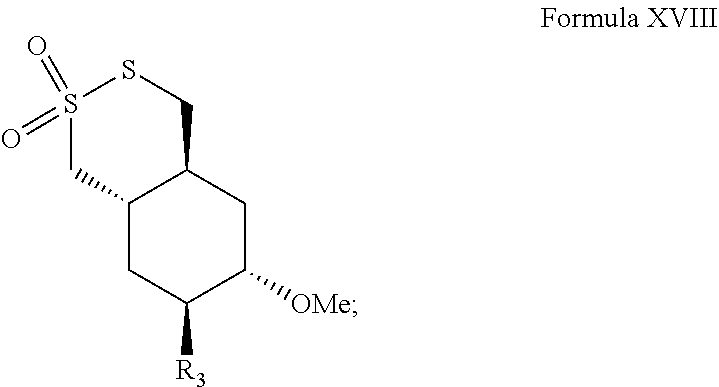
- the invention provides a compound of Formula III, or salt, hydrate, solvate, or prodrug thereof:
- each R 5 is independently selected from the group consisting of:
- each R 7 is independently H, Na, K, optionally substituted alkyl, optionally substituted aryl, or optionally substituted arylalkyl.
- the compound of Formula III is represented by Formula V:
- each R 6 is independently selected from
- the compound of Formulae III-XIX, or salt, solvate, hydrate or prodrug thereof is (+/ ⁇ )-
- FIG. 1 depicts the profiling of various compounds of the invention in a MDA-MB-468 cell viability assay.
- FIG. 4 depicts the induction of PARP and Caspase 8 cleavage by TcyDTDO and TRAIL in BT474 cells.
- FIG. 5 depicts the doxycycline-inducible DR5 expression of MDA-MB-468 cells by TcyDTDO under reducing and non-reducing conditions.
- FIG. 6 depicts tcyDTDO mediated DR5 dimerization and oligomerization in MDA-MB-468 cells.
- FIG. 7 depicts TcyDTDO enhancement of the doxycycline-mediated increase in DR5Long in samples analyzed under non-reducing conditions.
- FIG. 8 depicts cell viability assays in MDA-MB-468 cells using various compounds and compound combinations of the invention.
- FIG. 9 depicts cell viability assays in BT474 cells using various compounds and compound combinations of the invention.
- FIG. 10 depicts increases in DR5 transcription by tcyDTDO in HEK293 cells as measured using a transcriptional reporter construct.
- FIG. 11 depicts the inhibition of global protein synthesis upon treatment of MDA-MB-468 cells with tcyDTDO.
- FIG. 12 depicts cell viability of MDA-MB-468 breast cancer cells after 24 treatment with tcyDTDO or DMtcyDTDO.
- FIG. 13 depicts cell proliferation of MDA-MB-468 breast cancer cells after 24 treatment with tcyDTDO or DMtcyDTDO.
- FIG. 14 depicts protein synthesis of MDA-MB-468 breast cancer cells after 24 treatment with tcyDTDO or DMtcyDTDO.
- FIG. 15 depicts immunoblot analysis of HER-family members (EGFR, HER3), ER stress markers (XBP1s, GRP78), and cell death markers (DR5, CC8, and PARP) of MDA-MB-468 breast cancer cells after 24 treatment with tcyDTDO or DMtcyDTDO. Actin serves as a loading control.
- FIG. 16 depicts immunoblot analysis of MDA-MB-468 breast cancer cells after 24 treatment with DMtcyDTDO.
- EGFR, HER2, and HER3 share evolutionarily conserved extracellular domains stabilized by disulfide bonds [Ogiso, H., Ishitani, R., Nureki, O., Fukai, S., Yamanaka, M., Kim, J. H., Saito, K., Sakamoto, A., Inoue, M., Shirouzu, M., and Yokoyama, S. (2002) Crystal structure of the complex of human epidermal growth factor and receptor extracellular domains Cell 110, 775-787; Garrett, T. P., McKern, N. M., Lou, M., Elleman, T. C., Adams, T. E., Lovrecz, G.
- administration includes routes of introducing the compound of the invention(s) to a subject to perform their intended function.
- routes of administration include injection (subcutaneous, intravenous, parenterally, intraperitoneally, intrathecal), oral, inhalation, rectal and transdermal.
- the pharmaceutical preparations may be given by forms suitable for each administration route. For example, these preparations are administered in tablets or capsule form, by injection, inhalation, eye lotion, ointment, suppository, etc. administration by injection, infusion or inhalation; topical by lotion or ointment; and rectal by suppositories. Oral administration is preferred.
- the injection can be bolus or can be continuous infusion.
- the compound of the invention can be coated with or disposed in a selected material to protect it from natural conditions which may detrimentally affect its ability to perform its intended function.
- the compound of the invention can be administered alone, or in conjunction with either another agent as described above or with a pharmaceutically-acceptable carrier, or both.
- the compound of the invention can be administered prior to the administration of the other agent, simultaneously with the agent, or after the administration of the agent.
- the compound of the invention can also be administered in a pro-drug form which is converted into its active metabolite, or more active metabolite in vivo.
- alkyl refers to the radical of saturated aliphatic groups, including straight-chain alkyl groups, branched-chain alkyl groups, cycloalkyl (alicyclic) groups, alkyl substituted cycloalkyl groups, and cycloalkyl substituted alkyl groups.
- alkyl further includes alkyl groups, which can further include oxygen, nitrogen, sulfur or phosphorous atoms replacing one or more carbons of the hydrocarbon backbone, e.g., oxygen, nitrogen, sulfur or phosphorous atoms.
- a straight chain or branched chain alkyl has 30 or fewer carbon atoms in its backbone (e.g., C1-C30 for straight chain, C 3 -C 30 for branched chain), preferably 26 or fewer, and more preferably 20 or fewer, and still more preferably 4 or fewer.
- preferred cycloalkyls have from 3-10 carbon atoms in their ring structure, and more preferably have 3, 4, 5, 6 or 7 carbons in the ring structure.
- substituents can include, for example, halogen, hydroxyl, alkylcarbonyloxy, arylcarbonyloxy, alkoxycarbonyloxy, aryloxycarbonyloxy, carboxylate, alkylcarbonyl, alkoxycarbonyl, aminocarbonyl, alkylthiocarbonyl, alkoxyl, phosphate, phosphonato, phosphinato, cyano, amino (including alkyl amino, dialkylamino, arylamino, diarylamino, and alkylarylamino), acylamino (including alkylcarbonylamino, arylcarbonylamino, carbamoyl and ureido), amidino, imino, sulfhydryl, alkylthio, arylthio, thiocarboxylate, sulfates, sulfonato, sulfamoyl, sulfonamido, nitro, trifluoro
- alkylaryl is an alkyl substituted with an aryl (e.g., phenylmethyl (benzyl)).
- alkyl also includes unsaturated aliphatic groups analogous in length and possible substitution to the alkyls described above, but that contain at least one double or triple bond respectively.
- lower alkyl as used herein means an alkyl group, as defined above, but having from one to ten carbons, more preferably from one to six, and still more preferably from one to four carbon atoms in its backbone structure, which may be straight or branched-chain.
- lower alkyl groups include methyl, ethyl, n-propyl, i-propyl, tert-butyl, hexyl, heptyl, octyl and so forth.
- the term “lower alkyl” includes a straight chain alkyl having 4 or fewer carbon atoms in its backbone, e.g., C1-C4 alkyl.
- alkoxyalkyl refers to alkyl groups, as described above, which further include oxygen, nitrogen or sulfur atoms replacing one or more carbons of the hydrocarbon backbone, e.g., oxygen, nitrogen or sulfur atoms.
- alkenyl and alkynyl refer to unsaturated aliphatic groups analogous in length and possible substitution to the alkyls described above, but that contain at least one double or triple bond, respectively.
- the invention contemplates cyano and propargyl groups.
- aryl refers to the radical of aryl groups, including 5- and 6-membered single-ring aromatic groups that may include from zero to four heteroatoms, for example, benzene, pyrrole, furan, thiophene, imidazole, benzoxazole, benzothiazole, triazole, tetrazole, pyrazole, pyridine, pyrazine, pyridazine and pyrimidine, and the like.
- Aryl groups also include polycyclic fused aromatic groups such as naphthyl, quinolyl, indolyl, and the like.
- aryl groups having heteroatoms in the ring structure may also be referred to as “aryl heterocycles,” “heteroaryls” or “heteroaromatics.”
- the aromatic ring can be substituted at one or more ring positions with such substituents as described above, as for example, halogen, hydroxyl, alkoxy, alkylcarbonyloxy, arylcarbonyloxy, alkoxycarbonyloxy, aryloxycarbonyloxy, carboxylate, alkylcarbonyl, alkoxycarbonyl, aminocarbonyl, alkylthiocarbonyl, phosphate, phosphonato, phosphinato, cyano, amino (including alkyl amino, dialkylamino, arylamino, diarylamino, and alkylarylamino), acylamino (including alkylcarbonylamino, arylcarbonylamino, carbamoyl and ureido), amidino, imino, s
- biological activities of a compound of the invention includes all activities elicited by compound of the inventions in a responsive cell. It includes genomic and non-genomic activities elicited by these compounds.
- Biological composition refers to a composition containing or derived from cells or biopolymers.
- Cell-containing compositions include, for example, mammalian blood, red cell platelet concentrates, leukocyte concentrates, blood cell proteins, blood plasma, platelet-rich plasma, a plasma concentrate, a precipitate from any fractionation of the plasma, a supernatant from any fractionation of the plasma, blood plasma protein fractions, purified or partially purified blood proteins or other components, serum, semen, mammalian colostrum, milk, saliva, placental extracts, a cryoprecipitate, a cryosupernatant, a cell lysate, mammalian cell culture or culture medium, products of fermentation, ascites fluid, proteins induced in blood cells, and products produced in cell culture by normal or transformed cells (e.g., via recombinant DNA or monoclonal antibody technology).
- Biological compositions can be cell-free.
- a suitable biological composition or biological sample is a red blood cell suspension.
- the blood cell suspension includes mammalian blood cells.
- the blood cells are obtained from a human, a non-human primate, a dog, a cat, a horse, a cow, a goat, a sheep or a pig.
- the blood cell suspension includes red blood cells and/or platelets and/or leukocytes and/or bone marrow cells.
- a therapeutically effective amount of compound of the invention may range from about 0.001 to 30 mg/kg body weight, or about 0.01 to 25 mg/kg body weight, or about 0.1 to 20 mg/kg body weight, or about 1 to 10 mg/kg body weight.
- an effective dosage may range from about 0.001 to 30 mg/kg body weight, or about 0.01 to 25 mg/kg body weight, or about 0.1 to 20 mg/kg body weight, or about 1 to 10 mg/kg body weight.
- certain factors may influence the dosage required to effectively treat a subject, including but not limited to the severity of the disease or disorder, previous treatments, the general health and/or age of the subject, and other diseases present.
- treatment of a subject with a therapeutically effective amount of a compound of the invention can include a single treatment or can include a series of treatments.
- Each of the rings of the polycycle can be substituted with such substituents as described above, as for example, halogen, hydroxyl, alkylcarbonyloxy, arylcarbonyloxy, alkoxycarbonyloxy, aryloxycarbonyloxy, carboxylate, alkylcarbonyl, alkoxycarbonyl, aminocarbonyl, alkylthiocarbonyl, alkoxyl, phosphate, phosphonato, phosphinato, cyano, amino (including alkyl amino, dialkylamino, arylamino, diarylamino, and alkylarylamino), acylamino (including alkylcarbonylamino, arylcarbonylamino, carbamoyl and ureido), amidino, imino, sulfhydryl, alkylthio, arylthio, thiocarboxylate, sulfates, sulfonato, sulfamoyl,
- prodrug moieties include substituted and unsubstituted, branch or unbranched lower alkyl ester moieties, (e.g., propionoic acid esters), lower alkenyl esters, di-lower alkyl-amino lower-alkyl esters (e.g., dimethylaminoethyl ester), acylamino lower alkyl esters (e.g., acetyloxymethyl ester), acyloxy lower alkyl esters (e.g., pivaloyloxymethyl ester), aryl esters (phenyl ester), aryl-lower alkyl esters (e.g., benzyl ester), substituted (e.g., with methyl, halo, or methoxy substituents) aryl and aryl-lower alkyl esters, amides, lower-alkyl amides, di-lower alkyl amides, and hydroxy amides.
- systemic administration means the administration of a compound of the invention(s), drug or other material, such that it enters the patient's system and, thus, is subject to metabolism and other like processes, for example, subcutaneous administration.
- Exemplary DR5 antibodies include, but are not limited to, Conatumumab, Drozitumab, Apomab, DAB4, PRO95780, Lexatumumab, HGS-ETR2, Tigatuzumab, CS-1008, TRA-8, HGSTR2J, KMTRS, and LBY-135.
- the invention provides a pharmaceutical composition that inhibits or is capable of inhibiting EGFR, HER2, and/or HER3, the pharmaceutical composition comprising: 1) a compound of Formula (I)-(VI), or salt, solvate, hydrate or prodrug thereof; 2) a DR5 agonist; and 3) a pharmaceutically acceptable carrier.
- the composition inhibits or is capable of inhibiting at least two of EGFR, HER2, and HER3.
- the composition inhibits or is capable of inhibiting all three of EGFR, HER2, and HER3.
- the composition is capable of treating HER2-positive breast cancer.
- the compound is capable of treating breast cancer modulated by EGFR, HER2, and/or HER3.
- Naturally occurring or synthetic isomers can be separated in several ways known in the art. Methods for separating a racemic mixture of two enantiomers include chromatography using a chiral stationary phase (see, e.g., “Chiral Liquid Chromatography,” W. J. Lough, Ed. Chapman and Hall, New York (1989)). Enantiomers can also be separated by classical resolution techniques. For example, formation of diastereomeric salts and fractional crystallization can be used to separate enantiomers.
- the invention provides methods for treating a subject for a cell proliferative disorder, by administering to the subject an effective amount of a compound of any one of Formulae III-XIX, or salt, solvate, hydrate or prodrug thereof (or a dosing regimen or pharmaceutical composition thereof).
- the invention provides methods for treating a subject for a cell proliferative disorder, by administering to the subject an effective amount of a compound of any one of Formulae III-XIX, or salt, solvate, hydrate or prodrug thereof, and an effective amount of a DR5 agonist (or a dosing regimen or pharmaceutical composition comprising a compound of Formulae III-XIX and a DR5 agonist).
- a cell proliferative disorder includes cancer.
- the subject is a mammal, e.g., a primate, e.g., a human.
- a further aspect presents a method of treating a subject suffering from or susceptible to cancer, including administering to the subject an effective amount of a compound of any one of Formulae III-XIX, or salt, solvate, hydrate or prodrug thereof (or a dosing regimen or pharmaceutical composition thereof) to thereby treat the subject suffering from or susceptible to cancer.
- the methods of the invention include administering to a subject a therapeutically effective amount of a compound of Formula (I)-(VI) and an effective amount of a DR5 agonist (or a dosing regimen or pharmaceutical composition comprising a compound of Formula (I)-(VI) and a DR5 agonist) in combination with another pharmaceutically active compound.
- pharmaceutically active compounds include compounds known to treat cell proliferative disorders, e.g., imatinib (Gleevec).
- Other pharmaceutically active compounds that may be used can be found in Harrison's Principles of Internal Medicine , Thirteenth Edition, Eds. T. R. Harrison et al.
- the compound of the invention and the pharmaceutically active compound may be administered to the subject in the same pharmaceutical composition or in different pharmaceutical compositions (at the same time or at different times).
- Examples of pharmaceutically active compounds include compounds known to treat cell proliferative disorders, e.g., imatinib (Gleevec).
- Other pharmaceutically active compounds that may be used can be found in Harrison's Principles of Internal Medicine , Thirteenth Edition, Eds. T. R. Harrison et al. McGraw-Hill N.Y., NY; and the Physicians Desk Reference 50th Edition 1997, Oradell New Jersey, Medical Economics Co., the complete contents of which are expressly incorporated herein by reference.
- the compound of the invention and the pharmaceutically active compound may be administered to the subject in the same pharmaceutical composition or in different pharmaceutical compositions (at the same time or at different times)
- busulfan, melphalan, and chlorambucil can be used in combination.
- Most conventional anti-cancer drugs are highly toxic and tend to make patients quite ill while undergoing treatment. Vigorous therapy is based on the premise that unless every cancerous cell is destroyed, the residual cells will multiply and cause a relapse.
- the compound of Formulae III-XIX, or salt, solvate, hydrate or prodrug thereof, (or a dosing regimen or pharmaceutical composition thereof) can be used in combination therapy with conventional cancer chemotherapeutics.
- the compound of Formulae III-XIX, or salt, solvate, hydrate or prodrug thereof and an effective amount of a DR5 agonist can be used in combination therapy with conventional cancer chemotherapeutics.
- Conventional treatment regimens for leukemia and for other tumors include radiation, surgery, drugs, or combinations thereof.
- the DR5 agonist is TRAIL or TRAIL analog (e.g., TRAIL, trimer, stabilized form of TRAIL, and the like), a DR5 agonist antibody, or a TRAIL synthesis inducer (e.g., TIC10).
- TRAIL or TRAIL analog e.g., TRAIL, trimer, stabilized form of TRAIL, and the like
- a DR5 agonist antibody e.g., a TRAIL synthesis inducer (e.g., TIC10).
- the therapeutically effective anti-proliferative amount or dose and the prophylactically effective anti-proliferative amount or dose, a number of factors are considered by the attending clinician, including, but not limited to: the specific cell proliferative disorder involved; pharmacodynamic characteristics of the particular agent and its mode and route of administration; the desired time course of treatment; the species of mammal; its size, age, and general health; the specific disease involved; the degree of or involvement or the severity of the disease; the response of the individual patient; the particular compound administered; the mode of administration; the bioavailability characteristics of the preparation administered; the dose regimen selected; the kind of concurrent treatment (i.e., the interaction of the compound of the invention with other co-administered therapeutics); and other relevant circumstances.
- the specific cell proliferative disorder involved pharmacodynamic characteristics of the particular agent and its mode and route of administration
- the desired time course of treatment the species of mammal
- its size, age, and general health the specific disease involved
- the degree of or involvement or the severity of the disease the
- Treatment can be initiated with smaller dosages, which are less than the optimum dose of the compound. Thereafter, the dosage may be increased by small increments until the optimum effect under the circumstances is reached. For convenience, the total daily dosage may be divided and administered in portions during the day if desired.
- a therapeutically effective amount and a prophylactically effective anti-proliferative amount of a compound of the invention of the invention is expected to vary from about 0.1 milligram per kilogram of body weight per day (mg/kg/day) to about 100 mg/kg/day.
- a method of assessing the efficacy of a treatment in a subject includes determining the pre-treatment extent of a cell proliferative disorder by methods well known in the art (e.g., determining tumor size or screening for tumor markers where the cell proliferative disorder is cancer) and then administering a therapeutically effective amount of an inhibitor of cell proliferation (e.g., a compound of any formula herein or otherwise described herein) according to the invention to the subject. After an appropriate period of time after the administration of the compound (e.g., 1 day, 1 week, 2 weeks, one month, six months), the extent of the cell proliferative disorder is determined again.
- the modulation e.g., decrease
- the extent or invasiveness of the cell proliferative disorder indicates efficacy of the treatment.
- the extent or invasiveness of the cell proliferative disorder may be determined periodically throughout treatment. For example, the extent or invasiveness of the cell proliferative disorder may be checked every few hours, days or weeks to assess the further efficacy of the treatment. A decrease in extent or invasiveness of the cell proliferative disorder indicates that the treatment is efficacious.
- the method described may be used to screen or select patients that may benefit from treatment with an inhibitor of a cell proliferative disorder.
- obtaining a biological sample from a subject includes obtaining a sample for use in the methods described herein.
- a biological sample is described above.
- a compound of Formula (I)-(VI) and a DR5 agonist (or a dosing regimen or pharmaceutical composition comprising a compound of Formula (I)-(VI) and a DR5 agonist) is packaged in a therapeutically effective amount with a pharmaceutically acceptable carrier or diluent.
- the composition may be formulated for treating a subject suffering from or susceptible to a cell proliferative disorder, and packaged with instructions to treat a subject suffering from or susceptible to a cell proliferative disorder.
- methods of inhibiting a cell proliferative disorder in a subject include administering an effective amount of a compound of the invention to the subject.
- the administration may be by any route of administering known in the pharmaceutical arts.
- the subject may have a cell proliferative disorder, may be at risk of developing a cell proliferative disorder, or may need prophylactic treatment prior to anticipated or unanticipated exposure to conditions capable of increasing susceptibility to a cell proliferative disorder, e.g., exposure to carcinogens or to ionizing radiation.
- a method of monitoring the progress of a subject being treated includes determining the pre-treatment status (e.g., size, growth rate, or invasiveness of a tumor) of the cell proliferative disorder, administering a therapeutically effective amount of compound of Formula (I)-(VI) and a DR5 agonist (or a dosing regimen or pharmaceutical composition comprising a compound of Formula (I)-(VI) and a DR5 agonist) to the subject, and determining the status of the cell proliferative disorder after an initial period of treatment, wherein the modulation of the status indicates efficacy of the treatment.
- the pre-treatment status e.g., size, growth rate, or invasiveness of a tumor
- administering a therapeutically effective amount of compound of Formula (I)-(VI) and a DR5 agonist (or a dosing regimen or pharmaceutical composition comprising a compound of Formula (I)-(VI) and a DR5 agonist) to the subject, and determining the status of the cell prolife
- a method of monitoring the progress of a subject being treated includes determining the pre-treatment status (e.g., size, growth rate, or invasiveness of a tumor) of the cell proliferative disorder, administering a therapeutically effective amount of compound of Formulae III-XIX, or salt, solvate, hydrate or prodrug thereof, (or a dosing regimen or pharmaceutical composition thereof) to the subject, and determining the status of the cell proliferative disorder after an initial period of treatment, wherein the modulation of the status indicates efficacy of the treatment.
- the pre-treatment status e.g., size, growth rate, or invasiveness of a tumor
- administering a therapeutically effective amount of compound of Formulae III-XIX, or salt, solvate, hydrate or prodrug thereof, (or a dosing regimen or pharmaceutical composition thereof) to the subject, and determining the status of the cell proliferative disorder after an initial period of treatment, wherein the modulation of the status indicates efficacy of the treatment.
- a method of monitoring the progress of a subject being treated includes determining the pre-treatment status (e.g., size, growth rate, or invasiveness of a tumor) of the cell proliferative disorder, administering a therapeutically effective amount of compound of Formulae III-XIX, or salt, solvate, hydrate or prodrug thereof, and a DR5 agonist (or a dosing regimen or pharmaceutical composition comprising a compound of Formulae III-XIX and a DR5 agonist) to the subject, and determining the status of the cell proliferative disorder after an initial period of treatment, wherein the modulation of the status indicates efficacy of the treatment.
- the pre-treatment status e.g., size, growth rate, or invasiveness of a tumor
- administering a therapeutically effective amount of compound of Formulae III-XIX, or salt, solvate, hydrate or prodrug thereof, and a DR5 agonist (or a dosing regimen or pharmaceutical composition comprising a compound of Formulae
- the subject may be at risk of a cell proliferative disorder, may be exhibiting symptoms of a cell proliferative disorder, may be susceptible to a cell proliferative disorder and/or may have been diagnosed with a cell proliferative disorder.
- the initial period of treatment may be the time in which it takes to establish a stable and/or therapeutically effective blood serum level of any of the compounds, compound combinations, dosing regimens, or pharmaceutical compositions delineated herein, or the time in which it take for the subject to clear a substantial portion of the compound, or any period of time selected by the subject or healthcare professional that is relevant to the treatment.
- the contacting may be in vivo, e.g., by passage of the compound through a subject; for example, after administration, depending on the route of administration, the compound may travel through the digestive tract or the blood stream or may be applied or administered directly to cells in need of treatment.
- Kits of the invention include kits for treating a cell proliferative disorder in a subject.
- the invention also includes kits for downregulating expression of EGFR, HER2, and/or HER3, stabilizing an interaction of EGFR, HER2, and/or HER3, assessing the efficacy of a treatment for a cell proliferative disorder in a subject, monitoring the progress of a subject being treated for a cell proliferative disorder, selecting a subject with a cell proliferative disorder for treatment according to the invention, and/or treating a subject suffering from or susceptible to a cell proliferative disorder.
- the kit may include any of the compounds, compound combinations, dosing regimens, or pharmaceutical compositions delineated herein and instructions for use.
- kits may also include reagents, for example, test compounds, buffers, media (e.g., cell growth media), cells, etc.
- Test compounds may include known compounds or newly discovered compounds, for example, combinatorial libraries of compounds.
- One or more of the kits of the invention may be packaged together, for example, a kit for assessing the efficacy of a treatment for a cell proliferative disorder may be packaged with a kit for monitoring the progress of a subject being treated for a cell proliferative disorder according to the invention.
- the present methods can be performed on cells in culture, e.g. in vitro or ex vivo, or on cells present in an animal subject, e.g., in vivo.
- Compounds of the inventions can be initially tested in vitro using primary cultures of proliferating cells, e.g., transformed cells, tumor cell lines, and the like.
- the effects of compound of the invention can be characterized in vivo using animals models.
- the invention provides a pharmaceutical composition
- a pharmaceutical composition comprising: 1) a compound of Formula (I)-(VI), or salt, solvate, hydrate or prodrug thereof; 2) a DR5 agonist; and 3) a pharmaceutically acceptable carrier.
- the compound of Formula (I)-(VI) is
- TRAIL TRAIL
- the invention provides a dosing regimen for treating a cell proliferative disorder in a subject, the dosing regimen comprising: 1) a compound of Formula (I)-(VI), or salt, solvate, hydrate or prodrug thereof; and 2) a DR5 agonist.
- the dosing regimen further comprises a pharmaceutically acceptable carrier.
- the compound of Formula (I)-(VI) is
- the DR5 agonist is TRAIL or TRAIL analog (e.g., TRAIL trimer, stabilized form of TRAIL, and the like), a DR5 agonist antibody, or a TRAIL synthesis inducer (e.g., TIC10).
- the DR5 agonist is TRAIL.
- the compound of Formula (I)-(VI) is
- the invention provides a dosing regimen for treating a cell proliferative disorder in a subject, the dosing regimen comprising: 1) a compound of Formulae III-XIX, or salt, solvate, hydrate or prodrug thereof; and 2) a DR5 agonist.
- the dosing regimen further comprises a pharmaceutically acceptable carrier.
- phrases “pharmaceutically acceptable” refers to those compound of the inventions of the present invention, compositions containing such compounds, and/or dosage forms which are, within the scope of sound medical judgment, suitable for use in contact with the tissues of human beings and animals without excessive toxicity, irritation, allergic response, or other problem or complication, commensurate with a reasonable benefit/risk ratio.
- salts of amino acids such as arginate and the like, and salts of organic acids like glucuronic or galactunoric acids and the like (see, e.g., Berge et al., Journal of Pharmaceutical Science 66:1-19 (1977)).
- Certain specific compounds of the present invention contain both basic and acidic functionalities that allow the compounds to be converted into either base or acid addition salts.
- Other pharmaceutically acceptable carriers known to those of skill in the art are suitable for the present invention.
- the neutral forms of the compounds may be regenerated by contacting the salt with a base or acid and isolating the parent compound in the conventional manner.
- the parent form of the compound differs from the various salt forms in certain physical properties, such as solubility in polar solvents, but otherwise the salts are equivalent to the parent form of the compound for the purposes of the present invention.
- the present invention provides compounds which are in a prodrug form.
- Prodrugs of the compounds described herein are those compounds that readily undergo chemical changes under physiological conditions to provide the compounds of the present invention.
- prodrugs can be converted to the compounds of the present invention by chemical or biochemical methods in an ex vivo environment. For example, prodrugs can be slowly converted to the compounds of the present invention when placed in a transdermal patch reservoir with a suitable enzyme or chemical reagent.
- wetting agents such as sodium lauryl sulfate and magnesium stearate, as well as coloring agents, release agents, coating agents, sweetening, flavoring and perfuming agents, preservatives and antioxidants can also be present in the compositions.
- compositions may also contain adjuvants such as preservatives, wetting agents, emulsifying agents and dispersing agents. Prevention of the action of microorganisms may be ensured by the inclusion of various antibacterial and antifungal agents, for example, paraben, chlorobutanol, phenol sorbic acid, and the like. It may also be desirable to include isotonic agents, such as sugars, sodium chloride, and the like into the compositions. In addition, prolonged absorption of the injectable pharmaceutical form may be brought about by the inclusion of agents which delay absorption such as aluminum monostearate and gelatin.
- adjuvants such as preservatives, wetting agents, emulsifying agents and dispersing agents.
- Prevention of the action of microorganisms may be ensured by the inclusion of various antibacterial and antifungal agents, for example, paraben, chlorobutanol, phenol sorbic acid, and the like. It may also be desirable to include isotonic agents, such as sugars, sodium chloride
- the compound of the invention(s), which may be used in a suitable hydrated form, and/or the pharmaceutical compositions of the present invention, are formulated into pharmaceutically-acceptable dosage forms by conventional methods known to those of skill in the art.
- the active compound(s) or prodrug(s) can be conveniently delivered in the form of an aerosol spray from pressurized packs or a nebulizer with the use of a suitable propellant, e.g., dichlorodifluoromethane, trichlorofluoromethane, dichlorotetrafluoroethane, fluorocarbons, carbon dioxide or other suitable gas.
- a suitable propellant e.g., dichlorodifluoromethane, trichlorofluoromethane, dichlorotetrafluoroethane, fluorocarbons, carbon dioxide or other suitable gas.
- the dosage unit can be determined by providing a valve to deliver a metered amount.
- the active compound(s) or prodrug(s) can be formulated as a depot preparation for administration by implantation or intramuscular injection.
- the active ingredient can be formulated with suitable polymeric or hydrophobic materials (e.g., as an emulsion in an acceptable oil) or ion exchange resins, or as sparingly soluble derivatives, e.g., as a sparingly soluble salt.
- transdermal delivery systems manufactured as an adhesive disc or patch which slowly releases the active compound(s) for percutaneous absorption can be used.
- permeation enhancers can be used to facilitate transdermal penetration of the active compound(s). Suitable transdermal patches are described in for example, U.S. Pat. Nos.
- compositions can, if desired, be presented in a pack or dispenser device which can contain one or more unit dosage forms containing the active compound(s).
- the pack can, for example, comprise metal or plastic foil, such as a blister pack.
- the pack or dispenser device can be accompanied by instructions for administration.
- the active compound(s) or prodrug(s) of the presently disclosed subject matter, or compositions thereof, will generally be used in an amount effective to achieve the intended result, for example in an amount effective to treat or prevent the particular disease being treated.
- the compound(s) can be administered therapeutically to achieve therapeutic benefit or prophylactically to achieve prophylactic benefit.
- therapeutic benefit is meant eradication or amelioration of the underlying disorder being treated and/or eradication or amelioration of one or more of the symptoms associated with the underlying disorder such that the patient reports an improvement in feeling or condition, notwithstanding that the patient can still be afflicted with the underlying disorder.
- Effective dosages can be estimated initially from in vitro assays.
- an initial dosage for use in animals can be formulated to achieve a circulating blood or serum concentration of active compound that is at or above an IC50 of the particular compound as measured in as in vitro assay, such as the in vitro fungal MIC or MFC and other in vitro assays described in the Examples section.
- Calculating dosages to achieve such circulating blood or serum concentrations taking into account the bioavailability of the particular compound is well within the capabilities of skilled artisans. For guidance, see Goodman and Gilman's The Pharmacological Basis of Therapeutics, 13th or latest edition, McGraw Hill Medical, and the references cited therein, which are incorporated herein by reference.
- Initial dosages also can be estimated from in vivo data, such as animal models. Animal models useful for testing the efficacy of compounds to treat or prevent the various diseases described above are well-known in the art.
- Dosage amounts will typically be in the range of from about 0.0001 or 0.001 or 0.01 mg/kg/day to about 100 mg/kg/day, but can be higher or lower, depending upon, among other factors, the activity of the compound, its bioavailability, the mode of administration, and various factors discussed above. Dosage amount and interval can be adjusted individually to provide plasma levels of the compound(s) which are sufficient to maintain therapeutic or prophylactic effect. In cases of local administration or selective uptake, such as local topical administration, the effective local concentration of active compound(s) cannot be related to plasma concentration. Skilled artisans will be able to optimize effective local dosages without undue experimentation.
- the compound(s) will provide therapeutic or prophylactic benefit without causing substantial toxicity.
- Toxicity of the compound(s) can be determined using standard pharmaceutical procedures.
- the dose ratio between toxic and therapeutic (or prophylactic) effect is the therapeutic index.
- Compounds(s) that exhibit high therapeutic indices are preferred.
- Reagents and solvents were purchased from commercial sources and used without further purification unless otherwise specified.
- Anhydrous solvents were obtained using a commercial solvent drying system (using activated alumina for THF, dichloromethane) and transferred via syringe to flame-dried glassware that had been cooled under an argon or nitrogen atmosphere.
- 1 H and 13 C NMR spectra were recorded using commercially-obtained deuterated solvents on a Bruker-400 ( 1 H at 400 MHz; 13 C at 101 MHz) spectrometer.
- Electrospray ionization (ESI) high-resolution mass spectra (HRMS) were recorded on an Agilent 6230 ESI-TOF instrument, operating in positive or negative ion mode as stated, with methanol as the carrier solvent.
- the precipitate is removed by centrifugation and the supernatant is transferred to another flask, where Et 2 O is added until precipitation is complete.
- the solid is collected by vacuum filtration and dried under reduced pressure to afford the poly-disulfide acyclic product.
- the compounds described herein can also be conjugated to dyes through various functionalities present in the compounds of the invention (e.g., amino, carboxylic acid, thiol, etc.) using conventional chemistries well-known in the art.
- the dyes can be attached through amino moieties on the compounds described herein by reaction with various electrophilic sources of the dyes.
- Scheme III depicts synthetic methodology to attach various dyes (e.g., fluorescein) to compounds of the invention employing thioisocyanate dyes (e.g., fluorescein-NCS) to afford the corresponding thiourea-linked compounds (e.g., Example 66).
- dyes e.g., fluorescein
- thioisocyanate dyes e.g., fluorescein-NCS
- the isocyanate dye analogs e.g., fluorescein-NCS
- the isocyanate dye analogs can be converted to the corresponding propoargyl-thiourea intermediates, which when reacted with azides 10c/10c*, affords Example 67 (Scheme IV).
- Epoxy diester (5.2 g, 22 mmol, 1.0 equiv) was dissolved in dry MeOH (60 mL) then cat. Ce(OTf) 4 (0.6 g, 0.9 mmol, 0.04 equiv) was added. The solution was stirred at rt under Ar atmosphere until the starting material was consumed. After completion of the reaction the solvent was evaporated, water was added, and the crude mixture was extracted with DCM. The combined organic layers were dried over Na 2 SO 4 and concentrated under reduced pressure. The crude material was then purified by flash silica gel column chromatography (0-40% EtOAc/hexanes) to afford the compound ( ⁇ )-2 (5.2 g, 19 mmol, 86% yield) as a colorless oil.
- BGPD non-selective thiol-reactive biotinylated analog
- Q-VD-OPH a caspase inhibitor
- Q-VD-OPH does not alter tcyDTDO-mediated upregulation of DR5 or the ER stress response.
- Q-VD-OPH also partially reverses the tcyDTDO/TRAIL downregulation of EGFR, Akt, phospho-Akt, and the Akt kinase PDK1 in MDA-MB-468 cells.
- FIGS. 8 and 9 clearly demonstrate synergistic effects on cell viability with the combination of tcyDTDO and TRAIL.
Landscapes
- Chemical & Material Sciences (AREA)
- Organic Chemistry (AREA)
- Health & Medical Sciences (AREA)
- General Health & Medical Sciences (AREA)
- Pharmacology & Pharmacy (AREA)
- Life Sciences & Earth Sciences (AREA)
- Animal Behavior & Ethology (AREA)
- Medicinal Chemistry (AREA)
- Public Health (AREA)
- Veterinary Medicine (AREA)
- Epidemiology (AREA)
- Chemical Kinetics & Catalysis (AREA)
- General Chemical & Material Sciences (AREA)
- Nuclear Medicine, Radiotherapy & Molecular Imaging (AREA)
- Pharmaceuticals Containing Other Organic And Inorganic Compounds (AREA)
- Medicines That Contain Protein Lipid Enzymes And Other Medicines (AREA)
Abstract
Description

-
- wherein, each X is independently S or Se;
- each Y is independently S, SO2, or Se;
- each Z is independently S, SO2, or Se;
- each R1 is independently selected from H, NH2, N3, OH, oxo, OAc, NH—R3,

-
- each R2 is independently selected from H, NH2, N3, OH, oxo, OAc, NH—R3,

-
- each R3 is independently selected from biotin, fluorescein, AlexaFluor® dyes, BODIPY®, Cascade Blue®, coumarins, Oregon Green®, Pacific Blue®, Pacific Green™, Pacific Orange™, Rhodamine Green™, Rhodamine Red™, or Texas Red®;
- or adjacent R1, R2 moieties, and the carbon atoms to which they are attached form an optionally substituted cycloalkyl moiety;
- each R7 is independently H, Na, K, optionally substituted alkyl, optionally substituted aryl, or optionally substituted arylalkyl;
- each n is independently 0 or 1;
- each o is independently 0 or 1; and
- denotes a carbon-carbon single bond or double bond;


-
- wherein, X is S or Se;
- Y is S or Se;
- R1 is selected from H, NH2, N3, OAc, alkyl, or OH;
- R2 is selected from H, NH2, N3, OAc, alkyl, or OH;
- n is 0, 1, 2, or 3;
- is 0, 1, 2, or 3;
- or R1, R2, and the carbon atoms to which they are attached form an optionally substituted cycloalkyl moiety or optionally substituted aryl moiety; and
- denotes a carbon-carbon single bond or double bond.

-
- wherein, X is S or Se;
- Y is S or Se;
- R3 is selected from H or C1-C6 alkoxy;
- R4 is selected from H or C1-C6 alkoxy;
- n is 0, 1, 2, or 3;
- is 0, 1, 2, or 3; and
- denotes a carbon-carbon single bond or double bond;
- wherein if is a single bond, X and Y are both S, and n and o are each 1, then at least one of R3 or R4 is C1-C6 alkoxy.

-
- or salt, solvate, hydrate or prodrug thereof.

-
- or salt, solvate, hydrate or prodrug thereof.

-
- or salt, solvate, hydrate or prodrug thereof.

-
- or salt, solvate, hydrate or prodrug thereof.

-
- or salt, solvate, hydrate or prodrug thereof.

-
- or salt, solvate, hydrate or prodrug thereof.

-
- or salt, solvate, hydrate or prodrug thereof.

-
- or salt, solvate, hydrate or prodrug thereof.

-
- or salt, solvate, hydrate or prodrug thereof.

-
- or salt, solvate, hydrate or prodrug thereof.

-
- or salt, solvate, hydrate or prodrug thereof.

-
- or salt, solvate, hydrate or prodrug thereof.

-
- or salt, solvate, hydrate or prodrug thereof.

-
- or salt, solvate, hydrate or prodrug thereof.
-
- or salt, solvate, hydrate or prodrug thereof.
-
- (+/−)-

-
- (also referred to herein as DMtcyDTDO);
- or salt, solvate, hydrate or prodrug thereof.

or salt, solvate, hydrate or prodrug thereof. In another aspect, the DR5 agonist is TRAIL or TRAIL analog (e.g., TRAIL trimer, stabilized form of TRAIL, and the like), a DR5 agonist antibody, or a TRAIL synthesis inducer (e.g., TIC10). In another aspect, the DR5 agonist is TRAIL. In another aspect, the compound of Formulae III-XIX, or salt, solvate, hydrate or prodrug thereof, is (+/−)-

or salt, solvate, hydrate or prodrug thereof, and the DR5 agonist is TRAIL.

(also referred to herein as tcyDTDO), or salt, solvate, hydrate or prodrug thereof. In another aspect, the DR5 agonist is TRAIL or TRAIL analog (e.g., TRAIL trimer, stabilized form of TRAIL, and the like), a DR5 agonist antibody, or a TRAIL synthesis inducer (e.g., TIC10). In another aspect, the DR5 agonist is TRAIL. In another aspect, the compound of Formula (I)-(VI) is

or salt, solvate, hydrate or prodrug thereof, and the DR5 agonist is TRAIL.

or salt, solvate, hydrate or prodrug thereof. In another aspect, the DR5 agonist is TRAIL or TRAIL analog (e.g., TRAIL trimer, stabilized form of TRAIL, and the like), a DR5 agonist antibody, or a TRAIL synthesis inducer (e.g., TIC10). In another aspect, the DR5 agonist is TRAIL. In another aspect, the compound of Formula (I)-(VI) is

or salt, solvate, hydrate or prodrug thereof, and the DR5 agonist is TRAIL. In another aspect, the cell proliferative disorder is cancer. In a further aspect, the cancer is HER2 mediated. In a further aspect, the cancer is breast cancer. In a further aspect, the breast cancer is HER2-positive breast cancer. In another aspect, the breast cancer is modulated by HER2, HER3, and/or EGFR.

or salt, solvate, hydrate or prodrug thereof. In another aspect, the DR5 agonist is TRAIL or TRAIL analog (e.g., TRAIL trimer, stabilized form of TRAIL, and the like), a DR5 agonist antibody, or a TRAIL synthesis inducer (e.g., TIC10). In another aspect, the DR5 agonist is TRAIL. In another aspect, the compound of Formulae III-XIV, or salt, solvate, hydrate or prodrug thereof, is (+/−)-

or salt, solvate, hydrate or prodrug thereof, and the DR5 agonist is TRAIL. In another aspect, the cell proliferative disorder is cancer. In a further aspect, the cancer is HER2 mediated. In a further aspect, the cancer is breast cancer. In a further aspect, the breast cancer is HER2-positive breast cancer. In another aspect, the breast cancer is modulated by HER2, HER3, and/or EGFR.

-
- wherein, each X is independently S or Se;
- each Y is independently S, SO2, or Se;
- each Z is independently S, SO2, or Se;
- each R1 is independently selected from H, NH2, N3, OH, oxo, OAc, NH—R3,

-
- each R2 is independently selected from H, NH2, N3, OH, oxo, OAc, NH—R3,

-
- each R3 is independently selected from biotin, fluorescein, AlexaFluor® dyes, BODIPY®, Cascade Blue®, coumarins, Oregon Green®, Pacific Blue™, Pacific Green™, Pacific Orange™, Rhodamine Green™, Rhodamine Red™, or Texas Red®;
- or adjacent R1, R2 moieties, and the carbon atoms to which they are attached form an optionally substituted cycloalkyl moiety;
- each R7 is independently H, Na, K, optionally substituted alkyl, optionally substituted aryl, or optionally substituted arylalkyl;
- each n is independently 0 or 1;
- each o is independently 0 or 1; and
- denotes a carbon-carbon single bond or double bond. In another aspect, the compound of Formula I is

In another aspect, the cell proliferative disorder is cancer. In a further aspect, the cancer is HER2 mediated. In a further aspect, the cancer is breast cancer. In a further aspect, the breast cancer is HER2-positive breast cancer. In another aspect, the breast cancer is modulated by HER2, HER3, and/or EGFR.

-
- wherein, X is S or Se;
- Y is S or Se;
- R1 is selected from H, NH2, N3, OAc, alkyl, or OH;
- R2 is selected from H, NH2, N3, OAc, alkyl, or OH;
- n is 0, 1, 2, or 3;
- is 0, 1, 2, or 3;
- or R1, R2, and the carbon atoms to which they are attached form an optionally substituted cycloalkyl moiety or optionally substituted aryl moiety; and
- denotes a carbon-carbon single bond or double bond. In another aspect, the cell proliferative disorder is cancer. In a further aspect, the cancer is HER2 mediated. In a further aspect, the cancer is breast cancer. In a further aspect, the breast cancer is HER2-positive breast cancer. In another aspect, the breast cancer is modulated by HER2, HER3, and/or EGFR.

or salt, solvate, hydrate or prodrug thereof. In another aspect, the DR5 agonist is TRAIL or TRAIL analog (e.g., TRAIL trimer, stabilized form of TRAIL, and the like), a DR5 agonist antibody, or a TRAIL synthesis inducer (e.g., TIC10). In another aspect, the DR5 agonist is TRAIL. In another aspect, the compound of Formula (I)-(VI) is

or salt, solvate, hydrate or prodrug thereof, and the DR5 agonist is TRAIL. In another aspect, the cell proliferative disorder is cancer. In a further aspect, the cancer is HER2 mediated. In a further aspect, the cancer is breast cancer. In a further aspect, the breast cancer is HER2-positive breast cancer. In another aspect, the breast cancer is modulated by HER2, HER3, and/or EGFR.

or salt, solvate, hydrate or prodrug thereof. In another aspect, the DR5 agonist is TRAIL or TRAIL analog (e.g., TRAIL trimer, stabilized form of TRAIL, and the like), a DR5 agonist antibody, or a TRAIL synthesis inducer (e.g., TIC10). In another aspect, the DR5 agonist is TRAIL. In another aspect, the compound of Formula (I)-(VI) is

or salt, solvate, hydrate or prodrug thereof, and the DR5 agonist is TRAIL. In another aspect, the cell proliferative disorder is cancer. In a further aspect, the cancer is HER2 mediated. In a further aspect, the cancer is breast cancer. In a further aspect, the breast cancer is HER2-positive breast cancer. In another aspect, the breast cancer is modulated by HER2, HER3, and/or EGFR.

-
- wherein, X is S or Se;
- Y is S or Se;
- R3 is selected from H or C1-C6 alkoxy;
- R4 is selected from H or C1-C6 alkoxy;
- n is 0, 1, 2, or 3;
- is 0, 1, 2, or 3; and
- denotes a carbon-carbon single bond or double bond;
- wherein if is a single bond, X and Y are both S, and n and o are each 1, then at least one of R3 or R4 is C1-C6 alkoxy. In another aspect, the cell proliferative disorder is cancer. In a further aspect, the cancer is HER2 mediated. In a further aspect, the cancer is breast cancer. In a further aspect, the breast cancer is HER2-positive breast cancer. In another aspect, the breast cancer is modulated by HER2, HER3, and/or EGFR.

or salt, solvate, hydrate or prodrug thereof. In another aspect, the DR5 agonist is TRAIL or TRAIL analog (e.g., TRAIL trimer, stabilized form of TRAIL, and the like), a DR5 agonist antibody, or a TRAIL synthesis inducer (e.g., TIC10). In another aspect, the DR5 agonist is TRAIL. In another aspect, the compound of Formulae III-XIV, or salt, solvate, hydrate or prodrug thereof, is (+/−)-

or salt, solvate, hydrate or prodrug thereof, and the DR5 agonist is TRAIL. In another aspect, the cell proliferative disorder is cancer. In a further aspect, the cancer is HER2 mediated. In a further aspect, the cancer is breast cancer. In a further aspect, the breast cancer is HER2-positive breast cancer. In another aspect, the breast cancer is modulated by HER2, HER3, and/or EGFR.

or salt, solvate, hydrate or prodrug thereof. In another aspect, the DR5 agonist is TRAIL or TRAIL analog (e.g., TRAIL trimer, stabilized form of TRAIL, and the like), a DR5 agonist antibody, or a TRAIL synthesis inducer (e.g., TIC10). In another aspect, the DR5 agonist is TRAIL. In another aspect, the compound of Formulae III-XIX, or salt, solvate, hydrate or prodrug thereof, is (+/−)-

or salt, solvate, hydrate or prodrug thereof, and the DR5 agonist is TRAIL. In another aspect, the cell proliferative disorder is cancer. In a further aspect, the cancer is HER2 mediated. In a further aspect, the cancer is breast cancer. In a further aspect, the breast cancer is HER2-positive breast cancer. In another aspect, the breast cancer is modulated by HER2, HER3, and/or EGFR.

-
- wherein, each X is independently S or Se;
- each Y is independently S, SO2, or Se;
- each Z is independently S, SO2, or Se;
- each R1 is independently selected from H, NH2, N3, OH, oxo, OAc, NH—R3,

-
- each R2 is independently selected from H, NH2, N3, OH, oxo, OAc, NH—R3,

-
- each R3 is independently selected from biotin, fluorescein, AlexaFluor® dyes, BODIPY®, Cascade Blue®, coumarins, Oregon Green®, Pacific Blue™, Pacific Green™, Pacific Orange™, Rhodamine Green™, Rhodamine Red™, or Texas Red®;
- or adjacent R1, R2 moieties, and the carbon atoms to which they are attached form an optionally substituted cycloalkyl moiety;
- each R7 is independently H, Na, K, optionally substituted alkyl, optionally substituted aryl, or optionally substituted arylalkyl;
- each n is independently 0 or 1;
- each o is independently 0 or 1; and
denotes a carbon-carbon single bond or double bond. In another aspect, the compound of Formula I is

In another aspect, the cell proliferative disorder is cancer. In a further aspect, the cancer cell is HER2 mediated. In a further aspect, the cancer cell is breast cancer. In a further aspect, the breast cancer cell is HER2-positive breast cancer cell. In another aspect, the breast cancer cell is modulated by HER2, HER3, and/or EGFR.

-
- wherein, X is S or Se;
- Y is S or Se;
- R1 is selected from H, NH2, N3, OAc, alkyl, or OH;
- R2 is selected from H, NH2, N3, OAc, alkyl, or OH;
- n is 0, 1, 2, or 3;
- is 0, 1, 2, or 3;
- or R1, R2, and the carbon atoms to which they are attached form an optionally substituted cycloalkyl moiety or an optionally substituted aryl moiety; and
- denotes a carbon-carbon single bond or double bond. In another aspect, the cell proliferative disorder is cancer. In a further aspect, the cancer cell is HER2 mediated. In a further aspect, the cancer cell is breast cancer. In a further aspect, the breast cancer cell is HER2-positive breast cancer cell. In another aspect, the breast cancer cell is modulated by HER2, HER3, and/or EGFR.

or salt, solvate, hydrate or prodrug thereof. In another aspect, the DR5 agonist is TRAIL or TRAIL analog (e.g., TRAIL trimer, stabilized form of TRAIL, and the like), a DR5 agonist antibody, or a TRAIL synthesis inducer (e.g., TIC10). In another aspect, the DR5 agonist is TRAIL. In another aspect, the compound of Formula (I)-(VI) is

or salt, solvate, hydrate or prodrug thereof, and the DR5 agonist is TRAIL. In another aspect, the cell proliferative disorder is cancer. In a further aspect, the cancer is HER2 mediated. In a further aspect, the cancer is breast cancer. In a further aspect, the breast cancer is HER2-positive breast cancer. In another aspect, the breast cancer is modulated by HER2, HER3, and/or EGFR.

or salt, solvate, hydrate or prodrug thereof. In another aspect, the DR5 agonist is TRAIL or TRAIL analog (e.g., TRAIL trimer, stabilized form of TRAIL, and the like), a DR5 agonist antibody, or a TRAIL synthesis inducer (e.g., TIC10). In another aspect, the DR5 agonist is TRAIL. In another aspect, the compound of Formula (I)-(VI) is

or salt, solvate, hydrate or prodrug thereof, and the DR5 agonist is TRAIL. In another aspect, the cell proliferative disorder is cancer. In a further aspect, the cancer is HER2 mediated. In a further aspect, the cancer is breast cancer. In a further aspect, the breast cancer is HER2-positive breast cancer. In another aspect, the breast cancer is modulated by HER2, HER3, and/or EGFR.

-
- wherein, X is S or Se;
- Y is S or Se;
- R3 is selected from H or C1-C6 alkoxy;
- R4 is selected from H or C1-C6 alkoxy;
- n is 0, 1, 2, or 3;
- is 0, 1, 2, or 3; and
- denotes a carbon-carbon single bond or double bond;
- wherein if is a single bond, X and Y are both S, and n and o are each 1, then at least one of R3 or R4 is C1-C6 alkoxy. In a further aspect, the cancer cell is HER2 mediated. In a further aspect, the cancer cell is breast cancer. In a further aspect, the breast cancer cell is HER2-positive breast cancer cell. In another aspect, the breast cancer cell is modulated by HER2, HER3, and/or EGFR. In another aspect, the cell is in vitro. In another aspect, the cell is in a subject. In another aspect, the method includes administering to the cell a therapeutically effective amount of a compound of any one of Formulae III-XIX, or salt, solvate, hydrate or prodrug thereof; and a therapeutically effective amount of DR5 agonist. In another aspect, the compound of Formulae III-XIX, or salt, solvate, hydrate or prodrug thereof, and the DR5 agonist are administered sequentially. In another aspect, the compound of Formulae III-XIX, or salt, solvate, hydrate or prodrug thereof, and the DR5 agonist are administered simultaneously.

-
- wherein, each X is independently S or Se;
- each Y is independently S, SO2, or Se;
- each Z is independently S, SO2, or Se;
- each R1 is independently selected from H, NH2, N3, OH, oxo, OAc, NH—R3,

-
- each R2 is independently selected from H, NH2, N3, OH, oxo, OAc, NH—R3,

-
- each R3 is independently selected from biotin, fluorescein, AlexaFluor® dyes, BODIPY®, Cascade Blue®, coumarins, Oregon Green®, Pacific Blue™, Pacific Green™, Pacific Orange™, Rhodamine Green™, Rhodamine Red™, or Texas Red®;
- or adjacent R1, R2 moieties, and the carbon atoms to which they are attached form an optionally substituted cycloalkyl moiety;
- each R7 is independently H, Na, K, optionally substituted alkyl, optionally substituted aryl, or optionally substituted arylalkyl;
- each n is independently 0 or 1;
- each o is independently 0 or 1; and
denotes a carbon-carbon single bond or double bond. In another aspect, the compound of Formula I is

In another aspect, the cell proliferative disorder is cancer. In a further aspect, the cancer is HER2 mediated. In a further aspect, the cancer is breast cancer. In a further aspect, the breast cancer is HER2-positive breast cancer. In another aspect, the breast cancer is modulated by HER2, HER3, and/or EGFR.

-
- wherein, X is S or Se;
- Y is S or Se;
- R1 is selected from H, NH2, N3, OAc, alkyl, or OH;
- R2 is selected from H, NH2, N3, OAc, alkyl, or OH;
- n is 0, 1, 2, or 3;
- is 0, 1, 2, or 3;
- or R1, R2, and the carbon atoms to which they are attached form an optionally substituted cycloalkyl moiety or an optionally substituted aryl moiety; and
- denotes a carbon-carbon single bond or double bond. In another aspect, the cell proliferative disorder is cancer. In a further aspect, the cancer is HER2 mediated. In a further aspect, the cancer is breast cancer. In a further aspect, the breast cancer is HER2-positive breast cancer. In another aspect, the breast cancer is modulated by HER2, HER3, and/or EGFR.

or salt, solvate, hydrate or prodrug thereof. In another aspect, the DR5 agonist is TRAIL or TRAIL analog (e.g., TRAIL trimer, stabilized form of TRAIL, and the like), a DR5 agonist antibody, or a TRAIL synthesis inducer (e.g., TIC10). In another aspect, the DR5 agonist is TRAIL. In another aspect, the compound of Formula (I)-(VI) is

or salt, solvate, hydrate or prodrug thereof, and the DR5 agonist is TRAIL. In a further aspect, the cancer is HER2 mediated. In a further aspect, the cancer is breast cancer. In a further aspect, the breast cancer is HER2-positive breast cancer. In another aspect, the breast cancer is modulated by HER2, HER3, and/or EGFR.

or salt, solvate, hydrate or prodrug thereof. In another aspect, the DR5 agonist is TRAIL or TRAIL analog (e.g., TRAIL trimer, stabilized form of TRAIL, and the like), a DR5 agonist antibody, or a TRAIL synthesis inducer (e.g., TIC10). In another aspect, the DR5 agonist is TRAIL. In another aspect, the compound of Formula (I)-(VI) is

or salt, solvate, hydrate or prodrug thereof, and the DR5 agonist is TRAIL. In a further aspect, the cancer is HER2 mediated. In a further aspect, the cancer is breast cancer. In a further aspect, the breast cancer is HER2-positive breast cancer. In another aspect, the breast cancer is modulated by HER2, HER3, and/or EGFR.

-
- wherein, X is S or Se;
- Y is S or Se;
- R3 is selected from H or C1-C6 alkoxy;
- R4 is selected from H or C1-C6 alkoxy;
- n is 0, 1, 2, or 3;
- is 0, 1, 2, or 3; and
- denotes a carbon-carbon single bond or double bond;
- wherein if is a single bond, X and Y are both S, and n and o are each 1, then at least one of R3 or R4 is C1-C6 alkoxy. In another aspect, the cell proliferative disorder is cancer. In a further aspect, the cancer is HER2 mediated. In a further aspect, the cancer is breast cancer. In a further aspect, the breast cancer is HER2-positive breast cancer. In another aspect, the breast cancer is modulated by HER2, HER3, and/or EGFR. In another aspect, the method includes administering to a subject in need thereof a therapeutically effective amount of a compound of any one of Formulae III-XIX, or salt, solvate, hydrate or prodrug thereof. The method includes administering to a subject in need thereof a therapeutically effective amount of a compound of any one of Formulae III-XIX, or salt, solvate, hydrate or prodrug thereof; and a therapeutically effective amount of DR5 agonist. In another aspect, the compound of Formulae III-XIX, or salt, solvate, hydrate or prodrug thereof, and the DR5 agonist are administered sequentially. In another aspect, the compound of Formulae III-XIX, or salt, solvate, hydrate or prodrug thereof, and the DR5 agonist are administered simultaneously. In another aspect, the cell is in vitro. In another aspect, the cell is in a subject.

-
- wherein, each X is independently S or Se;
- each Y is independently S, SO2, or Se;
- each Z is independently S, SO2, or Se;
- each R1 is independently selected from H, NH2, N3, OH, oxo, OAc, NH—R3,

-
- each R2 is independently selected from H, NH2, N3, OH, oxo, OAc, NH—R3,

-
- each R3 is independently selected from biotin, fluorescein, AlexaFluor® dyes, BODIPY®, Cascade Blue®, coumarins, Oregon Green®, Pacific Blue™, Pacific Green™, Pacific Orange™, Rhodamine Green™, Rhodamine Red™, or Texas Red®;
- or adjacent R1, R2 moieties, and the carbon atoms to which they are attached form an optionally substituted cycloalkyl moiety;
- each R7 is independently H, Na, K, optionally substituted alkyl, optionally substituted aryl, or optionally substituted arylalkyl;
- each n is independently 0 or 1;
- each o is independently 0 or 1; and
denotes a carbon-carbon single bond or double bond; and instructions for use. In another aspect, the compound of Formula I is

In certain embodiments, the invention provides kits for inhibiting cell proliferation, assessing the efficacy of an anti-cell proliferative treatment in a subject, monitoring the progress of a subject being treated with a cell proliferation inhibitor, selecting a subject with a cell proliferative disorder for treatment with cell proliferation inhibitor, and/or treating a subject suffering from or susceptible to cancer. In a further aspect, the cancer is HER2 mediated. In a further aspect, the cancer is breast cancer. In a further aspect, the breast cancer is HER2-positive breast cancer. In another aspect, the breast cancer is modulated by HER2, HER3, and/or EGFR.

-
- wherein, X is S or Se;
- Y is S or Se;
- R1 is selected from H, NH2, N3, OAc, alkyl, or OH;
- R2 is selected from H, NH2, N3, OAc, alkyl, or OH;
- n is 0, 1, 2, or 3;
- is 0, 1, 2, or 3;
- or R1, R2, and the carbon atoms to which they are attached form an optionally substituted cycloalkyl moiety or an optionally substituted aryl moiety; and
- denotes a carbon-carbon single bond or double bond; and instructions for use. In certain embodiments, the invention provides kits for inhibiting cell proliferation, assessing the efficacy of an anti-cell proliferative treatment in a subject, monitoring the progress of a subject being treated with a cell proliferation inhibitor, selecting a subject with a cell proliferative disorder for treatment with cell proliferation inhibitor, and/or treating a subject suffering from or susceptible to cancer. In a further aspect, the cancer is HER2 mediated. In a further aspect, the cancer is breast cancer. In a further aspect, the breast cancer is HER2-positive breast cancer. In another aspect, the breast cancer is modulated by HER2, HER3, and/or EGFR.

or salt, solvate, hydrate or prodrug thereof. In another aspect, the DR5 agonist is TRAIL or TRAIL analog (e.g., TRAIL trimer, stabilized form of TRAIL, and the like), a DR5 agonist antibody, or a TRAIL synthesis inducer (e.g., TIC10). In another aspect, the DR5 agonist is TRAIL. In another aspect, the compound of Formula (I)-(VI) is

or salt, solvate, hydrate or prodrug thereof, and the DR5 agonist is TRAIL. In a further aspect, the cancer is HER2 mediated. In a further aspect, the cancer is breast cancer. In a further aspect, the breast cancer is HER2-positive breast cancer. In another aspect, the breast cancer is modulated by HER2, HER3, and/or EGFR.

or salt, solvate, hydrate or prodrug thereof. In another aspect, the DR5 agonist is TRAIL or TRAIL analog (e.g., TRAIL trimer, stabilized form of TRAIL, and the like), a DR5 agonist antibody, or a TRAIL synthesis inducer (e.g., TIC10). In another aspect the DR5 agonist is TRAIL. In another aspect, the compound of Formula (I)-(VI) is

or salt, solvate, hydrate or prodrug thereof, and the DR5 agonist is TRAIL. In a further aspect, the cancer is HER2 mediated. In a further aspect, the cancer is breast cancer. In a further aspect, the breast cancer is HER2-positive breast cancer. In another aspect, the breast cancer is modulated by HER2, HER3, and/or EGFR.

-
- wherein, X is S or Se;
- Y is S or Se;
- R3 is selected from H or C1-C6 alkoxy;
- R4 is selected from H or C1-C6 alkoxy;
- n is 0, 1, 2, or 3;
- is 0, 1, 2, or 3; and
- denotes a carbon-carbon single bond or double bond;
- wherein if is a singe bond, X and Y are both S, and n and o are each 1, then at least one of R3 or R4 is C1-C6 alkoxy; and instructions for use. In certain embodiments, the invention provides kits for inhibiting cell proliferation, assessing the efficacy of an anti-cell proliferative treatment in a subject, monitoring the progress of a subject being treated with a cell proliferation inhibitor, selecting a subject with a cell proliferative disorder for treatment with cell proliferation inhibitor, and/or treating a subject suffering from or susceptible to cancer. In a further aspect, the kit includes: 1) a compound of any one of Formulae III-XIX, or salt, solvate, hydrate or prodrug thereof; 2) a DR5 agonist; and 3) instructions for use. In certain embodiments, the invention provides kits for inhibiting cell proliferation, assessing the efficacy of an anti-cell proliferative treatment in a subject, monitoring the progress of a subject being treated with a cell proliferation inhibitor, selecting a subject with a cell proliferative disorder for treatment with cell proliferation inhibitor, and/or treating a subject suffering from or susceptible to cancer.

-
- wherein, each X is independently S or Se;
- each Y is independently S, SO2, or Se;
- each Z is independently S, SO2, or Se;
- each R1 is independently selected from H, NH2, N3, OH, oxo, OAc, NH—R3,

-
- each R2 is independently selected from H, NH2, N3, OH, oxo, OAc, NH—R3,

-
- each R3 is independently selected from biotin, fluorescein, AlexaFluor® dyes, BODIPY®, Cascade Blue®, coumarins, Oregon Green®, Pacific Blue™, Pacific Green™, Pacific Orange™, Rhodamine Green™, Rhodamine Red™, or Texas Red®;
- or adjacent R1, R2 moieties, and the carbon atoms to which they are attached form an optionally substituted cycloalkyl moiety;
- each R7 is independently H, Na, K, optionally substituted alkyl, optionally substituted aryl, or optionally substituted arylalkyl;
- each n is independently 0 or 1;
- each o is independently 0 or 1; and
- denotes a carbon-carbon single bond or double bond. In another aspect, the compound of Formula I is

In another aspect, the compound inhibits or is capable of inhibiting at least two of EGFR, HER2, and HER3. In another aspect, the compound inhibits or is capable of inhibiting all three of EGFR, HER2, and HER3.

-
- wherein, X is S or Se;
- Y is S or Se;
- R1 is selected from H, NH2, N3, OAc, alkyl, or OH;
- R2 is selected from H, NH2, N3, OAc, alkyl, or OH;
- n is 0, 1, 2, or 3;
- is 0, 1, 2, or 3;
- or R1, R2, and the carbon atoms to which they are attached form an optionally substituted cycloalkyl moiety or an optionally substituted aryl moiety; and
- denotes a carbon-carbon single bond or double bond. In another aspect, the compound inhibits or is capable of inhibiting at least two of EGFR, HER2, and HER3. In another aspect, the compound inhibits or is capable of inhibiting all three of EGFR, HER2, and HER3.

or salt, solvate, hydrate or prodrug thereof. In another aspect, the DR5 agonist is TRAIL or TRAIL analog (e.g., TRAIL trimer, stabilized form of TRAIL, and the like), a DR5 agonist antibody, or a TRAIL synthesis inducer (e.g., TIC10). In another aspect, the DR5 agonist is TRAIL. In another aspect, the compound of Formula (I)-(VI) is

or salt, solvate, hydrate or prodrug thereof, and the DR5 agonist is TRAIL. In another aspect, the compound inhibits or is capable of inhibiting at least two of EGFR, HER2, and HER3. In another aspect, the compound inhibits or is capable of inhibiting all three of EGFR, HER2, and HER3.

or salt, solvate, hydrate or prodrug thereof. In another aspect, the DR5 agonist is TRAIL or TRAIL analog (e.g., TRAIL trimer, stabilized form of TRAIL, and the like), a DR5 agonist antibody, or a TRAIL synthesis inducer (e.g., TIC10). In another aspect, the DR5 agonist is TRAIL. In another aspect, the compound of Formula (I)-(VI) is

or salt, solvate, hydrate or prodrug thereof, and the DR5 agonist is TRAIL. In another aspect, the compound inhibits or is capable of inhibiting at least two of EGFR, HER2, and HER3. In another aspect, the compound inhibits or is capable of inhibiting all three of EGFR, HER2, and HER3.

-
- wherein, X is S or Se;
- Y is S or Se;
- R3 is selected from H or C1-C6 alkoxy;
- R4 is selected from H or C1-C6 alkoxy;
- n is 0, 1, 2, or 3;
- is 0, 1, 2, or 3; and
- denotes a carbon-carbon single bond or double bond;
- wherein if is a single bond, X and Y are both S, and n and o are each 1, then at least one of R3 or R4 is C1-C6 alkoxy. In another aspect, the compound inhibits or is capable of inhibiting at least two of EGFR, HER2, and HER3. In another aspect, the compound inhibits or is capable of inhibiting all three of EGFR, HER2, and HER3. In another aspect, the method includes administering a therapeutically effective amount of a compound of any one of Formulae III-XIX, or salt, solvate, hydrate or prodrug thereof; and a therapeutically effective amount of DR5 agonist. In another aspect, the compound of Formulae III-XIX, or salt, solvate, hydrate or prodrug thereof, and the DR5 agonist are administered sequentially. In another aspect, the compound of Formulae III-XIX, or salt, solvate, hydrate or prodrug thereof, and the DR5 agonist are administered simultaneously.
- sodium (2R,3R)-2,3-diacetoxy-4-((2-(((2R,3R)-2,3-diacetoxy-4-sulfinatobutyl)disulfanyl)ethyl)disulfanyl)butane-1-sulfinate;
- sodium (2S,3S)-2,3-diacetoxy-4-((2-(((2S,3S)-2,3-diacetoxy-4-sulfinatobutyl)disulfanyl)ethyl)disulfanyl)butane-1-sulfinate;
- sodium (2S,3R)-2,3-diacetoxy-4-((2-(((2R,3S)-2,3-diacetoxy-4-sulfinatobutyl)disulfanyl)ethyl)disulfanyl)butane-1-sulfinate;
- sodium (2R,3S)-2,3-diacetoxy-4-((2-(((2S,3R)-2,3-diacetoxy-4-sulfinatobutyl)disulfanyl)ethyl)disulfanyl)butane-1-sulfinate;
- sodium 4-(2-(4-sulfinatobutylsulfonylthio)ethylthiosulfonyl)butane-1-sulfinate;
- sodium 4-(2-(4-sulfinatobutylthiosulfonyl)ethylsulfonylthio)butane-1-sulfinate
- sodium 4-(2-(4-sulfinatobutylsulfonylsulfonyl)ethylsulfonylsulfonyl)butane-1-sulfinate;
-
sodium -
sodium 5,10-dithia-6,9-diselenatetradecane-1,14-disulfinate; - sodium 6,9-dithia-5,10-diselenatetradecane-1,14-diseleninate;
-
sodium - sodium (2Z,2′Z)-4,4′-disulfanediyldibut-2-ene-1-sulfinate;
- sodium (2E,2′E)-5,5′-disulfanediyldipent-2-ene-1-sulfinate;
- sodium (2R,2′R,3R,3′R)-4,4′-disulfanediylbis(2,3-dihydroxybutane-1-sulfinate);
- sodium (2S,2′S,3S,3′S)-4,4′-disulfanediylbis(2,3-dihydroxybutane-1-sulfinate);
- sodium (2R,2′R,3R,3′R)-4,4′-disulfanediylbis(2,3-diaminobutane-1-sulfinate);
- sodium (2S,2′S,3S,3′S)-4,4′-disulfanediylbis(2,3-diaminobutane-1-sulfinate);
- sodium (2R,2′R,3R,3′R)-4,4′-disulfanediylbis(2,3-diazidobutane-1-sulfinate);
- sodium (2S,2′S,3S,3′S)-4,4′-disulfanediylbis(2,3-diazidobutane-1-sulfinate);
sodium - sodium (3R,3′R)-4,4′-disulfanediylbis(3-aminobutane-1-sulfinate);
- sodium (3S,3′S)-4,4′-disulfanediylbis(3-aminobutane-1-sulfinate);
- sodium (3R,3′R)-4,4′-disulfanediylbis(3-azidobutane-1-sulfinate);
- sodium (3S,3′S)-4,4′-disulfanediylbis(3-azidobutane-1-sulfinate);
- sodium (2R,2′R)-4,4′-disulfanediylbis(2-aminobutane-1-sulfinate);
- sodium (2S,2′S)-4,4′-disulfanediylbis(2-aminobutane-1-sulfinate);
- sodium (2R,2′R)-4,4′-disulfanediylbis(2-azidobutane-1-sulfinate);
- sodium (2S,2′S)-4,4′-disulfanediylbis(2-azidobutane-1-sulfinate);
- sodium (1R,1′R,2R,2′R,3R,3′R,4S,4′S)-3,3′-disulfanediylbis(methylene)bis(bicyclo[2.2.1]heptane-3,2-diyl)dimethanesulfinate;
- sodium (1R,1′R,2S,2′S,3S,3′S,4S,4′S)-3,3′-disulfanediylbis(methylene)bis(bicyclo[2.2.]heptane-3,2-diyl)dimethanesulfinate;
- sodium (2R,2′R,3R,3′R)-4,4′-(ethane-1,2-diylbis(disulfanediyl))bis(2,3-dihydroxybutane-1-sulfinate);
- sodium (2S,2′S,3S,3′S)-4,4′-(ethane-1,2-diylbis(disulfanediyl))bis(2,3-dihydroxybutane-1-sulfinate);
- sodium (2R,2′R,3R,3′R)-4,4′-(ethane-1,2-diylbis(disulfanediyl))bis(2,3-diaminobutane-1-sulfinate);
- (2S,2′S,3S,3′S)-4,4′-(ethane-1,2-diylbis(disulfanediyl))bis(2,3-diaminobutane-1-sulfinate);
- (2R,2′R,3R,3′R)-4,4′-(ethane-1,2-diylbis(disulfanediyl))bis(2,3-diazidobutane-1-sulfinate);
- sodium (2S,2′S,3S,3′S)-4,4′-(ethane-1,2-diylbis(disulfanediyl))bis(2,3-diazidobutane-1-sulfinate);
-
sodium - sodium (3S,3′S)-4,4′-(ethane-1,2-diylbis(disulfanediyl))bis(3-aminobutane-1-sulfinate);
- sodium (3R,3′R)-4,4′-(ethane-1,2-diylbis(disulfanediyl))bis(3-azidobutane-1-sulfinate);
- sodium (3S,3′S)-4,4′-(ethane-1,2-diylbis(disulfanediyl))bis(3-azidobutane-1-sulfinate);
- sodium (2R,2′R)-4,4′-(ethane-1,2-diylbis(disulfanediyl))bis(2-aminobutane-1-sulfinate);
- sodium (2S,2′S)-4,4′-(ethane-1,2-diylbis(disulfanediyl))bis(2-aminobutane-1-sulfinate);
- sodium (2R,2′R)-4,4′-(ethane-1,2-diylbis(disulfanediyl))bis(2-azidobutane-1-sulfinate);
- sodium (2S,2′S)-4,4′-(ethane-1,2-diylbis(disulfanediyl))bis(2-azidobutane-1-sulfinate);
- sodium (1R,1′R,2R,2′R,3R,3′R,4S,4′S)-3,3′-(ethane-1,2-diylbis(disulfanediyl))bis(methylene)bis(bicyclo[2.2.1]heptane-3,2-diyl)dimethanesulfinate;
- sodium (1R,1′R,2S,2′S,3S,3′S,4S,4′S)-3,3′-(ethane-1,2-diylbis(disulfanediyl))bis(methylene)bis(bicyclo[2.2.1]heptane-3,2-diyl)dimethanesulfinate;
- 1,2-diselenane-1,1-dioxide;
- 3,6-dihydro-1,2-dithiine-1,1-dioxide;
- trans-1,2-dithiane-4,5-diol-1,1-dioxide;
- trans-1,2-dithiane-4,5-diamino-1,1-dioxide;
- trans-1,2-dithiane-4,5-diazido-1,1-dioxide;
- cis-1,2-dithiane-4,5-diol-1,1-dioxide;
- cis-1,2-dithiane-4,5-diamino-1,1-dioxide;
- cis-1,2-dithiane-4,5-diazido-1,1-dioxide;
- 1,2-dithiane-4,5-dione-1,1-dioxide;
- 1,2-dithiane-(4R,5S-diacetoxy)-1,1-dioxide;
- 1,2-dithiane-(4S,5R-diacetoxy)-1,1-dioxide;
- 1,2-dithiane-(4R,5R-diacetoxy)-1,1-dioxide;
- 1,2-dithiane-(4S,5S-diacetoxy)-1,1-dioxide;
- 1,2-dithiane-(4R,5S-dihydroxy)-1,1-dioxide;
- 1,2-dithiane-(4S,5R-dihydroxy)-1,1-dioxide;
- 1,2-dithiane-(4R,5R-dihydroxy)-1,1-dioxide;
- 1,2-dithiane-(4S,5S-dihydroxy)-1,1-dioxide;
- 1,2-dithiane-4-amino-1,1-dioxide;
- 1,2-dithiane-4-azido-1,1-dioxide;
- 1,2-dithiane-5-amino-1,1-dioxide;
- 1,2-dithiane-5-azido-1,1-dioxide;


and


or salt, solvate, hydrate or prodrug thereof.

or salt, solvate, hydrate or prodrug thereof, and the DR5 agonist is TRAIL.

or salt, solvate, hydrate or prodrug thereof. In another aspect, the DR5 agonist is TRAIL or TRAIL analog (e.g., TRAIL trimer, stabilized form of TRAIL, and the like), a DR5 agonist antibody, or a TRAIL synthesis inducer (e.g., TICO). In another aspect, the DR5 agonist is TRAIL. In another aspect, the compound of Formula (I)-(VI) is

or salt, solvate, hydrate or prodrug thereof, and the DR5 agonist is TRAIL.

or salt, solvate, hydrate or prodrug thereof. In another aspect, the DR5 agonist is TRAIL or TRAIL analog (e.g., TRAIL trimer, stabilized form of TRAIL, and the like), a DR5 agonist antibody, or a TRAIL synthesis inducer (e.g., TIC10). In another aspect, the DR5 agonist is TRAIL. In another aspect, the compound of Formula (I)-(VI) is

or salt, solvate, hydrate or prodrug thereof, and the DR5 agonist is TRAIL. In another aspect, the cell proliferative disorder is cancer. In a further aspect, the cancer is HER2 mediated. In a further aspect, the cancer is breast cancer. In a further aspect, the breast cancer is HER2-positive breast cancer. In another aspect, the breast cancer is modulated by HER2, HER3, and/or EGFR.


(Method A)


Claims (14)


Priority Applications (1)
| Application Number | Priority Date | Filing Date | Title |
|---|---|---|---|
| US17/251,289 US12030864B2 (en) | 2018-06-15 | 2019-06-14 | Small molecule anticancer agents, combinations and uses thereof |
Applications Claiming Priority (3)
| Application Number | Priority Date | Filing Date | Title |
|---|---|---|---|
| US201862685856P | 2018-06-15 | 2018-06-15 | |
| PCT/US2019/037209 WO2019241644A1 (en) | 2018-06-15 | 2019-06-14 | Novel small molecule anticancer agents, combinations and uses thereof |
| US17/251,289 US12030864B2 (en) | 2018-06-15 | 2019-06-14 | Small molecule anticancer agents, combinations and uses thereof |
Publications (2)
| Publication Number | Publication Date |
|---|---|
| US20210147379A1 US20210147379A1 (en) | 2021-05-20 |
| US12030864B2 true US12030864B2 (en) | 2024-07-09 |
Family
ID=68842336
Family Applications (1)
| Application Number | Title | Priority Date | Filing Date |
|---|---|---|---|
| US17/251,289 Active 2041-05-11 US12030864B2 (en) | 2018-06-15 | 2019-06-14 | Small molecule anticancer agents, combinations and uses thereof |
Country Status (2)
| Country | Link |
|---|---|
| US (1) | US12030864B2 (en) |
| WO (1) | WO2019241644A1 (en) |
Families Citing this family (3)
| Publication number | Priority date | Publication date | Assignee | Title |
|---|---|---|---|---|
| US20230122505A1 (en) * | 2020-03-17 | 2023-04-20 | University Of Florida Research Foundation, Incorporated | Novel small molecule anticancer agents, combinations and uses thereof |
| WO2022049219A1 (en) | 2020-09-02 | 2022-03-10 | Université De Genève | Methods for treating viral infection |
| US20240118281A1 (en) * | 2021-01-11 | 2024-04-11 | University Of Florida Research Foundation, Incorporated | Anticancer compounds and uses thereof |
Citations (3)
| Publication number | Priority date | Publication date | Assignee | Title |
|---|---|---|---|---|
| US20080139622A1 (en) | 2006-12-11 | 2008-06-12 | Hutchison Medipharma Limited | Decahydronaphthalene Compounds |
| US20110104143A1 (en) | 2009-11-05 | 2011-05-05 | The Uab Research Foundation | Treating Basal-Like Genotype Cancers |
| US20170240570A1 (en) | 2014-10-17 | 2017-08-24 | University Of Florida Research Foundation | Novel small molecule anticancer agents |
-
2019
- 2019-06-14 US US17/251,289 patent/US12030864B2/en active Active
- 2019-06-14 WO PCT/US2019/037209 patent/WO2019241644A1/en not_active Ceased
Patent Citations (3)
| Publication number | Priority date | Publication date | Assignee | Title |
|---|---|---|---|---|
| US20080139622A1 (en) | 2006-12-11 | 2008-06-12 | Hutchison Medipharma Limited | Decahydronaphthalene Compounds |
| US20110104143A1 (en) | 2009-11-05 | 2011-05-05 | The Uab Research Foundation | Treating Basal-Like Genotype Cancers |
| US20170240570A1 (en) | 2014-10-17 | 2017-08-24 | University Of Florida Research Foundation | Novel small molecule anticancer agents |
Non-Patent Citations (7)
| Title |
|---|
| Ferreira et al., Disulfide bond disrupting agents activate the unfolded protein response in EGFR- and HER2-positive breast tumor cells. Oncotarget. Apr. 2017;8(17):28971-89. Epub Mar. 7, 2017. |
| International Preliminary Report on Patentability (Chapter II) dated Jul. 27, 2020 in connection with PCT/US19/37209. |
| International Search Report and Written Opinion dated Oct. 29, 2019 in connection with PCT/US19/37209. |
| Invitation to Pay Additional Fees dated Jul. 31, 2019 in connection with PCT/US19/37209. |
| PCT/US19/37209, dated Jul. 27, 2020, International Preliminary Report on Patentability (Chapter II). |
| PCT/US19/37209, dated Jul. 31, 2019, Invitation to Pay Additional Fees. |
| PCT/US19/37209, dated Oct. 29, 2019, International Search Report and Written Opinion. |
Also Published As
| Publication number | Publication date |
|---|---|
| WO2019241644A8 (en) | 2020-01-16 |
| US20210147379A1 (en) | 2021-05-20 |
| WO2019241644A1 (en) | 2019-12-19 |
Similar Documents
| Publication | Publication Date | Title |
|---|---|---|
| US12559457B2 (en) | Sulfonamide derivatives for protein degradation | |
| EP2694485B1 (en) | Combination of akt inhibitor compound and vemurafenib for use in therapeutic treatments | |
| US11382908B2 (en) | Compositions and methods for treating inflammatory bowel disease | |
| US20250034126A1 (en) | Chromobox protein inhibitors and uses thereof | |
| US20170240570A1 (en) | Novel small molecule anticancer agents | |
| US20210147379A1 (en) | Novel small molecule anticancer agents, combinations and uses thereof | |
| CN103533939A (en) | Multiple myeloma treatment | |
| WO2008115443A1 (en) | Kinase protein binding inhibitors | |
| US20180346508A1 (en) | Nucleic acid prodrugs | |
| US20250114369A1 (en) | Compounds and methods for treatment of viral infections | |
| US10822299B2 (en) | Compounds and methods for hematopoietic regeneration | |
| US20160289236A1 (en) | Protein Kinase Inhibitors | |
| US12479852B2 (en) | Compounds, compositions, and methods for protein degradation | |
| US20230122505A1 (en) | Novel small molecule anticancer agents, combinations and uses thereof | |
| US20210101879A1 (en) | AMYLOID PROTEIN-SELECTIVE BACE INHIBITORS (ASBIs) FOR ALZHEIMER?S DISEASE | |
| US20200054592A1 (en) | Novel small molecule anticancer agents | |
| US12076363B2 (en) | Peptide epoxyketone proteasome inhibitors in combination with PIM kinase inhibitors for treatment of cancers | |
| US8314150B2 (en) | Kinase protein binding inhibitors | |
| US20240118281A1 (en) | Anticancer compounds and uses thereof | |
| US9394253B2 (en) | Kinase protein binding inhibitors | |
| WO2025199359A1 (en) | Methods of modulating cdk7 and flt3 using fused bicyclic compounds | |
| US20140194477A1 (en) | Kinase protein binding inhibitors | |
| US20120100227A1 (en) | Kinase protein binding inhibitors |
Legal Events
| Date | Code | Title | Description |
|---|---|---|---|
| FEPP | Fee payment procedure |
Free format text: ENTITY STATUS SET TO UNDISCOUNTED (ORIGINAL EVENT CODE: BIG.); ENTITY STATUS OF PATENT OWNER: SMALL ENTITY |
|
| FEPP | Fee payment procedure |
Free format text: ENTITY STATUS SET TO SMALL (ORIGINAL EVENT CODE: SMAL); ENTITY STATUS OF PATENT OWNER: SMALL ENTITY |
|
| AS | Assignment |
Owner name: UNIVERSITY OF FLORIDA RESEARCH FOUNDATION, INCORPORATED, FLORIDA Free format text: ASSIGNMENT OF ASSIGNORS INTEREST;ASSIGNORS:LAW, BRIAN KEITH;CASTELLANO, RONALD K.;REEL/FRAME:055394/0752 Effective date: 20210208 |
|
| STPP | Information on status: patent application and granting procedure in general |
Free format text: APPLICATION DISPATCHED FROM PREEXAM, NOT YET DOCKETED |
|
| STPP | Information on status: patent application and granting procedure in general |
Free format text: DOCKETED NEW CASE - READY FOR EXAMINATION |
|
| AS | Assignment |
Owner name: THE GOVERNMENT OF THE UNITED STATES AS REPRESENTED BY THE SECRETARY OF THE ARMY, MARYLAND Free format text: CONFIRMATORY LICENSE;ASSIGNOR:UNIVERSITY OF FLORIDA;REEL/FRAME:058649/0791 Effective date: 20210208 |
|
| STPP | Information on status: patent application and granting procedure in general |
Free format text: NON FINAL ACTION MAILED |
|
| STPP | Information on status: patent application and granting procedure in general |
Free format text: RESPONSE TO NON-FINAL OFFICE ACTION ENTERED AND FORWARDED TO EXAMINER |
|
| STPP | Information on status: patent application and granting procedure in general |
Free format text: EX PARTE QUAYLE ACTION MAILED |
|
| STPP | Information on status: patent application and granting procedure in general |
Free format text: RESPONSE TO EX PARTE QUAYLE ACTION ENTERED AND FORWARDED TO EXAMINER |
|
| STPP | Information on status: patent application and granting procedure in general |
Free format text: NOTICE OF ALLOWANCE MAILED -- APPLICATION RECEIVED IN OFFICE OF PUBLICATIONS |
|
| ZAAA | Notice of allowance and fees due |
Free format text: ORIGINAL CODE: NOA |
|
| ZAAB | Notice of allowance mailed |
Free format text: ORIGINAL CODE: MN/=. |
|
| STPP | Information on status: patent application and granting procedure in general |
Free format text: NOTICE OF ALLOWANCE MAILED -- APPLICATION RECEIVED IN OFFICE OF PUBLICATIONS |
|
| STPP | Information on status: patent application and granting procedure in general |
Free format text: PUBLICATIONS -- ISSUE FEE PAYMENT VERIFIED |
|
| STCF | Information on status: patent grant |
Free format text: PATENTED CASE |