US12030862B2 - Allosteric chromenone inhibitors of phosphoinositide 3-kinase (PI3K) for the treatment of disease - Google Patents
Allosteric chromenone inhibitors of phosphoinositide 3-kinase (PI3K) for the treatment of disease Download PDFInfo
- Publication number
- US12030862B2 US12030862B2 US17/936,973 US202217936973A US12030862B2 US 12030862 B2 US12030862 B2 US 12030862B2 US 202217936973 A US202217936973 A US 202217936973A US 12030862 B2 US12030862 B2 US 12030862B2
- Authority
- US
- United States
- Prior art keywords
- halogen
- alkyl
- pharmaceutically acceptable
- formula
- compound
- Prior art date
- Legal status (The legal status is an assumption and is not a legal conclusion. Google has not performed a legal analysis and makes no representation as to the accuracy of the status listed.)
- Active
Links
Classifications
-
- C—CHEMISTRY; METALLURGY
- C07—ORGANIC CHEMISTRY
- C07D—HETEROCYCLIC COMPOUNDS
- C07D311/00—Heterocyclic compounds containing six-membered rings having one oxygen atom as the only hetero atom, condensed with other rings
- C07D311/02—Heterocyclic compounds containing six-membered rings having one oxygen atom as the only hetero atom, condensed with other rings ortho- or peri-condensed with carbocyclic rings or ring systems
- C07D311/04—Benzo[b]pyrans, not hydrogenated in the carbocyclic ring
- C07D311/22—Benzo[b]pyrans, not hydrogenated in the carbocyclic ring with oxygen or sulfur atoms directly attached in position 4
-
- C—CHEMISTRY; METALLURGY
- C07—ORGANIC CHEMISTRY
- C07D—HETEROCYCLIC COMPOUNDS
- C07D311/00—Heterocyclic compounds containing six-membered rings having one oxygen atom as the only hetero atom, condensed with other rings
- C07D311/02—Heterocyclic compounds containing six-membered rings having one oxygen atom as the only hetero atom, condensed with other rings ortho- or peri-condensed with carbocyclic rings or ring systems
- C07D311/04—Benzo[b]pyrans, not hydrogenated in the carbocyclic ring
- C07D311/22—Benzo[b]pyrans, not hydrogenated in the carbocyclic ring with oxygen or sulfur atoms directly attached in position 4
- C07D311/26—Benzo[b]pyrans, not hydrogenated in the carbocyclic ring with oxygen or sulfur atoms directly attached in position 4 with aromatic rings attached in position 2 or 3
- C07D311/28—Benzo[b]pyrans, not hydrogenated in the carbocyclic ring with oxygen or sulfur atoms directly attached in position 4 with aromatic rings attached in position 2 or 3 with aromatic rings attached in position 2 only
- C07D311/30—Benzo[b]pyrans, not hydrogenated in the carbocyclic ring with oxygen or sulfur atoms directly attached in position 4 with aromatic rings attached in position 2 or 3 with aromatic rings attached in position 2 only not hydrogenated in the hetero ring, e.g. flavones
-
- A—HUMAN NECESSITIES
- A61—MEDICAL OR VETERINARY SCIENCE; HYGIENE
- A61K—PREPARATIONS FOR MEDICAL, DENTAL OR TOILETRY PURPOSES
- A61K31/00—Medicinal preparations containing organic active ingredients
- A61K31/33—Heterocyclic compounds
- A61K31/335—Heterocyclic compounds having oxygen as the only ring hetero atom, e.g. fungichromin
- A61K31/35—Heterocyclic compounds having oxygen as the only ring hetero atom, e.g. fungichromin having six-membered rings with one oxygen as the only ring hetero atom
- A61K31/352—Heterocyclic compounds having oxygen as the only ring hetero atom, e.g. fungichromin having six-membered rings with one oxygen as the only ring hetero atom condensed with carbocyclic rings, e.g. methantheline
-
- A—HUMAN NECESSITIES
- A61—MEDICAL OR VETERINARY SCIENCE; HYGIENE
- A61P—SPECIFIC THERAPEUTIC ACTIVITY OF CHEMICAL COMPOUNDS OR MEDICINAL PREPARATIONS
- A61P35/00—Antineoplastic agents
-
- C—CHEMISTRY; METALLURGY
- C07—ORGANIC CHEMISTRY
- C07D—HETEROCYCLIC COMPOUNDS
- C07D405/00—Heterocyclic compounds containing both one or more hetero rings having oxygen atoms as the only ring hetero atoms, and one or more rings having nitrogen as the only ring hetero atom
- C07D405/02—Heterocyclic compounds containing both one or more hetero rings having oxygen atoms as the only ring hetero atoms, and one or more rings having nitrogen as the only ring hetero atom containing two hetero rings
- C07D405/12—Heterocyclic compounds containing both one or more hetero rings having oxygen atoms as the only ring hetero atoms, and one or more rings having nitrogen as the only ring hetero atom containing two hetero rings linked by a chain containing hetero atoms as chain links
-
- C—CHEMISTRY; METALLURGY
- C07—ORGANIC CHEMISTRY
- C07D—HETEROCYCLIC COMPOUNDS
- C07D405/00—Heterocyclic compounds containing both one or more hetero rings having oxygen atoms as the only ring hetero atoms, and one or more rings having nitrogen as the only ring hetero atom
- C07D405/14—Heterocyclic compounds containing both one or more hetero rings having oxygen atoms as the only ring hetero atoms, and one or more rings having nitrogen as the only ring hetero atom containing three or more hetero rings
-
- C—CHEMISTRY; METALLURGY
- C07—ORGANIC CHEMISTRY
- C07D—HETEROCYCLIC COMPOUNDS
- C07D417/00—Heterocyclic compounds containing two or more hetero rings, at least one ring having nitrogen and sulfur atoms as the only ring hetero atoms, not provided for by group C07D415/00
- C07D417/02—Heterocyclic compounds containing two or more hetero rings, at least one ring having nitrogen and sulfur atoms as the only ring hetero atoms, not provided for by group C07D415/00 containing two hetero rings
- C07D417/12—Heterocyclic compounds containing two or more hetero rings, at least one ring having nitrogen and sulfur atoms as the only ring hetero atoms, not provided for by group C07D415/00 containing two hetero rings linked by a chain containing hetero atoms as chain links
Definitions
- the present invention is directed to allosteric chromenone inhibitors of phosphoinositide 3-kinase (PI3K) useful in the treatment of diseases, or disorders associated with PI3K modulation.
- the invention is directed toward compounds, and compositions which inhibit PI3K, methods of (or uses for) treating a disease, or disorder associated with PI3K (e.g., CLOVES syndrome (congenital lipomatous overgrowth, vascular malformations, epidermal naevi, scoliosis/skeletal and spinal syndrome), PIK3CA-related overgrowth syndrome (PROS), breast cancer, brain cancer, prostate cancer, endometrial cancer, gastric cancer, leukemia, lymphoma, sarcoma, colorectal cancer, lung cancer, ovarian cancer, skin cancer, or head and neck cancer), and using, or methods of using, PI3K inhibitors in combination with one or more additional cancer therapies.
- CLOVES syndrome congenital lipomatous overgrowth, vascular malformations, epiderma
- PI3Ks phosphoinositide 3-kinases
- the phosphoinositide 3-kinases (PI3Ks) signaling pathway is one of the most highly mutated systems in human cancers.
- PI3K signaling is involved in many other disease states including allergic contact dermatitis, rheumatoid arthritis, osteoarthritis, inflammatory bowel diseases, chronic obstructive pulmonary disorder, psoriasis, multiple sclerosis, asthma, disorders related to diabetic complications, and inflammatory complications of the cardiovascular system such as acute coronary syndrome.
- genes in PI3K signaling are believed to be involved in a range of cancers such as endometrial cancer, breast cancer, esophageal squamous-cell cancer, cervical squamous-cell carcinoma, cervical adenocarcinoma, colorectal adenocarcinoma, bladder urothelial carcinoma, glioblastoma, ovarian cancer, non-small-cell lung cancer, esophagogastric cancer, nerve-sheath tumor, head and neck squamous-cell carcinoma, melanoma, esophagogastric adenocarcinoma, soft-tissue sarcoma, prostate cancer, fibrolamellar carcinoma, hepatocellular carcinoma, diffuse glioma, colorectal cancer, pancreatic cancer, cholangiocarcinoma, B-cell lymphoma, mesothelioma, adrenocortical carcinoma, renal non-clear-cell carcinoma
- the present invention relates to compounds of Formula (I):
- the present invention provides a method of modulating PI3K (e.g., PI3K ⁇ ) activity (e.g., in vitro, or in vivo), comprising contacting a cell with a therapeutically effective amount of a compound of Formula (I), (II), or (III), or a pharmaceutically acceptable salt thereof.
- PI3K e.g., PI3K ⁇
- the present invention provides a method of treating, or preventing a disease, or disorder disclosed herein in a subject in need thereof, comprising administering to the subject a therapeutically effective amount of a compound of Formula (I), (II), or (III), or a pharmaceutically acceptable salt thereof.
- the present invention provides a method of treating, or preventing a disease, or disorder disclosed herein in a subject in need thereof, comprising administering to the subject a therapeutically effective amount of a pharmaceutical composition of a compound of Formula (I), (II), or (III), or a pharmaceutically acceptable salt thereof.
- the present invention provides a method of treating a disease, or disorder disclosed herein in a subject in need thereof, comprising administering to the subject a therapeutically effective amount of a compound of Formula (I), (II), or (III), or a pharmaceutically acceptable salt thereof.
- the present invention provides a compound of Formula (I), (II), or (III), or a pharmaceutically acceptable salt thereof for use in therapy.
- the present invention provides a compound of Formula (I), (II), or (III), or a pharmaceutically acceptable salt thereof for use in modulating PI3K (e.g., PI3K ⁇ ) activity (e.g., in vitro, or in vivo).
- PI3K e.g., PI3K ⁇
- the present invention provides a compound of Formula (I), (II), or (III), or a pharmaceutically acceptable salt thereof, for use in treating, or preventing a disease, or disorder disclosed herein.
- the present invention provides a compound of Formula (I), (II), or (III), or a pharmaceutically acceptable salt thereof, for use in treating a disease, or disorder disclosed herein.
- the present invention provides use of a compound of Formula (I), (II), or (III), or a pharmaceutically acceptable salt thereof, in the manufacture of a medicament for treating, or preventing a disease, or disorder disclosed herein.
- the present invention provides use of a compound of Formula (I), (II), or (III), or a pharmaceutically acceptable salt thereof, in the manufacture of a medicament for treating a disease, or disorder disclosed herein.
- the present invention provides a method of preparing a compound of Formula (I), (II), or (III), or a pharmaceutically acceptable salt thereof.
- the present invention provides a method of preparing a compound, comprising one, or more steps described herein.
- the present invention provides a compound obtainable by, or obtained by, a method for preparing a compound as described herein (e.g., a method comprising one, or more steps described in the Schemes).
- the present invention provides an intermediate as described herein, being suitable for use in a method for preparing a compound as described herein (e.g., the intermediate is selected from the intermediates described in the Examples).
- the present invention provides methods of treating, preventing, or ameliorating a disease, or disorder, (or uses in the treatment, prevention, or amelioration of a disease, or disorder), in which PI3K plays a role by administering to a patient in need thereof a therapeutically effective amount of a PI3K inhibitor of the present invention.
- the methods (or uses) of the present invention can be used in the treatment of a variety of PI3K-dependent diseases, and disorders.
- the disease, or disorder is a cancer (e.g., breast cancer, brain cancers, prostate cancer, endometrial cancer, gastric cancer, leukemia, lymphoma, sarcoma, colorectal cancer, lung cancer, ovarian cancer, skin cancer, or head and neck cancer).
- a cancer e.g., breast cancer, brain cancers, prostate cancer, endometrial cancer, gastric cancer, leukemia, lymphoma, sarcoma, colorectal cancer, lung cancer, ovarian cancer, skin cancer, or head and neck cancer.
- the disease, or disorder associated with PI3K includes, but is not limited to, CLOVES syndrome (congenital lipomatous overgrowth, vascular malformations, epidermal naevi, scoliosis/skeletal, and spinal syndrome), PIK3CA-related overgrowth syndrome (PROS), endometrial cancer, breast cancer, esophageal squamous-cell cancer, cervical squamous-cell carcinoma, cervical adenocarcinoma, colorectal adenocarcinoma, bladder urothelial carcinoma, glioblastoma, ovarian cancer, non-small-cell lung cancer, esophagogastric cancer, nerve-sheath tumor, head and neck squamous-cell carcinoma, melanoma, esophagogastric adenocarcinoma, soft-tissue sarcoma, prostate cancer, fibrolamellar carcinoma, hepatocellular carcinoma, diffuse glioma, color
- an element means one element, or more than one element.
- administer refers to either directly administering a disclosed compound, or pharmaceutically acceptable salt of the disclosed compound, or a composition to a subject.
- alkenyl refers to a straight, or branched chain unsaturated hydrocarbon containing 2-12 carbon atoms.
- the “alkenyl” group contains at least one double bond in the chain.
- the double bond of an alkenyl group can be unconjugated, or conjugated to another unsaturated group.
- alkenyl groups include ethenyl, propenyl, n-butenyl, iso-butenyl, pentenyl, or hexenyl.
- alkoxy refers to a straight, or branched chain saturated hydrocarbon containing 1-12 carbon atoms containing a terminal “O” in the chain, i.e., —O(alkyl).
- alkoxy groups include without limitation, methoxy, ethoxy, propoxy, butoxy, t-butoxy, or pentoxy groups.
- alkyl refers to a straight, or branched chain saturated hydrocarbon containing 1-12 carbon atoms, preferably 1-6 carbon atoms.
- Examples of a (C 1 -C 6 ) alkyl group include, but are not limited to, methyl, ethyl, propyl, butyl, pentyl, hexyl, isopropyl, isobutyl, sec-butyl, tert-butyl, isopentyl, neopentyl, and isohexyl.
- alkynyl refers to a straight, or branched chain unsaturated hydrocarbon containing 2-12 carbon atoms.
- the “alkynyl” group contains at least one triple bond in the chain. Examples of alkynyl groups include ethynyl, propargyl, n-butynyl, iso-butynyl, pentynyl, or hexynyl.
- aryl refers to cyclic, aromatic hydrocarbon groups that have 1 to 3 aromatic rings, including monocyclic, or bicyclic groups such as phenyl, biphenyl, or naphthyl. Where containing two aromatic rings (bicyclic, etc.), the aromatic rings of the aryl group may be joined at a single point (e.g., biphenyl), or fused (e.g., naphthyl). Furthermore, when containing two fused rings the aryl groups herein defined may have one, or more saturated, or partially unsaturated ring fused with a fully unsaturated aromatic ring.
- Exemplary ring systems of these aryl groups include, but are not limited to, phenyl, biphenyl, naphthyl, anthracenyl, phenalenyl, phenanthrenyl, indanyl, indenyl, tetrahydronaphthalenyl, and tetrahydrobenzoannulenyl.
- cyano means a substituent having a carbon atom joined to a nitrogen atom by a triple bond, i.e., C ⁇ N.
- disorder means, and is used interchangeably with, the terms disease, condition, or illness, unless otherwise indicated.
- haloalkyl refers to an alkyl group, as defined herein, which is substituted with one, or more halogen.
- haloalkyl groups include, but are not limited to, trifluoromethyl, difluoromethyl, pentafluoroethyl, and trichloromethyl.
- halogen refers to fluorine, chlorine, bromine, or iodine.
- heteroaryl unless otherwise specifically defined means a monovalent monocyclic, or a polycyclic aromatic radical of 5 to 24 ring atoms, preferably 5 to 10 ring atoms, containing one, or more ring heteroatoms selected from N, O, S, P, or B, preferably 1, 2, 3, or 4 ring heteroatoms selected from N, O, or S, the remaining ring atoms being C.
- a polycyclic aromatic radical includes two, or more fused rings, and may further include two, or more spiro-fused rings, e.g., bicyclic, tricyclic, tetracyclic, and the like. Unless otherwise specifically defined, “fused” means two rings sharing two ring atoms.
- heteroaryl as herein defined also means a bicyclic heteroaromatic group wherein the heteroatom is selected from N, O, S, P, or B, preferably N, O, or S.
- Heteroaryl as herein defined also means a tricyclic heteroaromatic group containing one, or more ring heteroatoms selected from N, O, S, P, or B, preferably N, O, or S.
- Heteroaryl as herein defined also means a tetracyclic heteroaromatic group containing one, or more ring heteroatoms selected from N, O, S, P, or B, preferably N, O, or S.
- the heteroaryl groups defined herein may have one, or more saturated, or partially unsaturated ring fused with one, or more fully unsaturated aromatic ring.
- a saturated, or partially unsaturated ring may further be fused with a saturated, or partially unsaturated ring described herein.
- the heteroaryl groups defined herein may have one, or more saturated, or partially unsaturated ring spiro-fused. Any saturated, or partially unsaturated ring described herein is optionally substituted with one, or more oxo.
- heterocyclyl means mono, or polycyclic rings containing 3-24 atoms, preferably 3-10 atoms, which include carbon, and one, or more heteroatoms selected from N, O, S, P, or B, preferably 1, 2, 3, or 4 heteroatoms selected from N, O, and S, and wherein the rings are not aromatic.
- isomers refers to compounds that have the same molecular formula but differ in the nature or sequence of bonding of their atoms or the arrangement of their atoms in space. Isomers that differ in the arrangement of their atoms in space are termed “stereoisomers”. Stereoisomers that are not mirror images of one another are termed “diastereomers” and those that are non-superimposable mirror images of each other are termed “enantiomers”. When a compound has an asymmetric center, for example, it is bonded to four different groups, a pair of enantiomers is possible.
- An enantiomer can be characterised by the absolute configuration of its asymmetric center and is described by the R- and S-sequencing rules of Cahn and Prelog, or by the manner in which the molecule rotates the plane of polarized light and designated as dextrorotatory or levorotatory (i.e., as (+) or ( ⁇ )-isomers respectively).
- a chiral compound can exist as either individual enantiomers or as a mixture thereof. A mixture containing equal proportions of the enantiomers is called a “racemic mixture”.
- patient is a mammal, e.g., a human, mouse, rat, guinea pig, dog, cat, horse, cow, pig, or non-human primate, such as a monkey, chimpanzee, baboon, or rhesus.
- mammal is human.
- R 3 is —H, halogen, —CN, C 1 -C 6 alkyl, C 1 -C 6 haloalkyl, oxetane, or isoxazole.
- R 3 is —H, —CN, C 1 -C 6 alkyl, or C 1 -C 6 haloalkyl.
- R 4 is H or halogen (preferably R 4 is —H) and R 6 is H or halogen.
- R 7 is C 1 -C 3 alkyl (preferably methyl)
- R 8 is H
- R is H
- R 2 is a cyclopropyl, cyclobutyl, cyclopentyl, or cyclohexyl, each optionally substituted with one to three R 10 substituents, or R 2 is a group of the formula:
- R 3 is H, CN, or C 1 -C 3 alkyl
- R 4 , R 6 , R 8 and R are each H
- R 5 is H, halogen, C 1 -C 3 alkyl or C 1 -C 3 haloalkyl
- R 7 is CN, methyl or trifluoromethyl
- R 1 is a group of the formula:
- R 9 is —H, halogen, C 1 -C 3 alkyl, C 1 -C 3 haloalkyl, or C 3 -C 5 cycloalkyl; preferably R 3 is —H, methyl, or trifluoromethyl, R 4 is —H, or halogen, R 6 is —H, or halogen, R 8 and R are each —H, R 5 is —H, halogen, methyl, or trifluoromethyl, R 7 is methyl, and R 9 is —H, halogen, methyl, trifluoromethyl, or cyclopropyl.
- R 1 is a group of the formula:
- each R 9 is independently —H, halogen, C 1 -C 3 alkyl, C 1 -C 3 haloalkyl, or C 3 -C 5 cycloalkyl
- R 2 is a cyclopropyl, cyclobutyl, cyclopentyl, or cyclohexyl, each optionally substituted with one to three R 10 substituents, or R 2 is a group of the formula:
- R 1 is a group of the formula:
- R 1 is a group of the formula:
- R 9 is H, halogen, or C 1 -C 3 haloalkyl
- R 2 is a cyclopropyl, cyclobutyl, cyclopentyl, or cyclohexyl, each optionally substituted with one to three R 10 substituents, or R 2 is a group of the formula:
- R 9 is H, or trifluoromethyl.
- R 2 is
- R 10 is independently —H, halogen, C 1 -C 6 alkyl, or C 1 -C 6 haloalkyl, preferably R 10 is independently —H, halogen, or C 1 -C 3 alkyl, more preferably R 10 is independently —H, fluoro, or methyl.
- R 9 is H, or halogen.
- R 2 is
- R 9 is H, halogen, C 1 -C 3 alkyl, C 1 -C 3 haloalkyl, or C 3 -C 5 cycloalkyl
- R 2 is a cyclopropyl, cyclobutyl, cyclopentyl, or cyclohexyl, each optionally substituted with one to three R 10 substituents, or R 2 is a group of the formula:
- R 10 is independently —H, halogen, C 1 -C 6 alkyl, or C 1 -C 6 haloalkyl, preferably R 10 is independently —H, halogen, or C 1 -C 3 alkyl, more preferably R 10 is independently —H, fluoro, or methyl.
- R 2 is
- R 10 is independently —H, halogen, C 1 -C 6 alkyl, or C 1 -C 6 haloalkyl, preferably R 10 is independently —H, halogen, or C 1 -C 3 alkyl, more preferably R 10 is independently —H, fluoro, or methyl.
- R 1 is a group of the formula:
- R 9 is —H, halogen, C 1 -C 3 alkyl, C 1 -C 3 haloalkyl, or C 3 -C 5 cycloalkyl
- R 2 is a cyclopropyl, cyclobutyl, cyclopentyl, or cyclohexyl, each optionally substituted with one to three R 10 substituents, or R 2 is a group of the formula:
- R 2 is
- R 2 is a cyclopropyl, cyclobutyl, cyclopentyl, or cyclohexyl, each optionally substituted with one to three R 10 substituents, or R 2 is a group of the formula:
- each R 9 is independently —H, halogen, C 1 -C 3 alkyl, C 1 -C 3 haloalkyl, or C 3 -C 5 cycloalkyl.
- R 3 is —H, methyl, or trifluoromethyl
- R 4 is —H, or halogen
- R 6 is —H, or halogen
- R 5 is —H, halogen, methyl, or trifluoromethyl
- each R 9 is independently —H, halogen, methyl, trifluoromethyl, or cyclopropyl.
- R 2 is
- R 10 is independently —H, halogen, C 1 -C 6 alkyl, or C 1 -C 6 haloalkyl, preferably R 10 is independently —H, halogen, or C 1 -C 3 alkyl, more preferably R 10 is independently —H, fluoro, or methyl.
- R 2 is a cyclopropyl, cyclobutyl, cyclopentyl, or cyclohexyl, each optionally substituted with one to three R 10 substituents, or R 2 is a group of the formula:
- R 7 is —CN, methyl or trifluoromethyl
- R 8 and R are each —H
- R 1 is a group of the formula:
- each R 9 is independently —H, halogen, methyl, C 1 -C 3 haloalkyl, or cyclopropyl.
- R 2 is
- R 10 is independently —H, halogen, C 1 -C 6 alkyl, or C 1 -C 6 haloalkyl, preferably R 10 is independently —H, halogen, or C 1 -C 3 alky more preferably R 10 is independently —H, fluoro, or methyl.
- R 1 is a group of the formula:
- R 9 is independently —H, halogen, methyl or trifluoromethyl
- R 2 is a cyclopropyl, cyclobutyl, cyclopentyl, or cyclohexyl, each optionally substituted with one to three R 10 substituents, or R 2 is a group of the formula:
- R 7 is C 1 -C 3 alkyl (preferably methyl), and R 8 and R are each —H.
- R 2 is
- R 10 is independently —H, halogen, C 1 -C 6 alkyl, or C 1 -C 6 haloalkyl, preferably R 10 is independently —H, halogen, or C 1 -C 3 alky more preferably R 10 is independently —H, fluoro, or methyl.
- R 1 is a group of the formula:
- R 9 is H, halogen, or trifluoromethyl, (preferably R 9 is H, or trifluoromethyl),
- R 2 is a cyclopropyl, cyclobutyl, cyclopentyl, or cyclohexyl, each optionally substituted with one to three R 10 substituents, or R 2 is a group of the formula:
- R 10 is independently —H, halogen, C 1 -C 6 alkyl, or C 1 -C 6 haloalkyl, preferably R 10 is independently —H, halogen, or C 1 -C 3 alkyl, more preferably R 10 is independently —H, fluoro, or methyl.
- R 1 is a group of the formula:
- R 9 is H, halogen, or trifluoromethyl, (preferably R 9 is H, or halogen),
- R 2 is a cyclopropyl, cyclobutyl, cyclopentyl, or cyclohexyl, each optionally substituted with one to three R 10 substituents, or R 2 is a group of the formula:
- R 10 is independently —H, halogen, C 1 -C 6 alkyl, or C 1 -C 6 haloalkyl, preferably R 10 is independently —H, halogen, or C 1 -C 3 alkyl, more preferably R 10 is independently —H, fluoro, or methyl.
- R 1 is a group of the formula:
- R 10 is independently —H, halogen, C 1 -C 6 alkyl, or C 1 -C 6 haloalkyl, preferably R 10 is independently —H, halogen, or C 1 -C 3 alkyl, more preferably R 10 is independently —H, fluoro, or methyl.
- R 1 is a group of the formula:
- R 9 is H, halogen, C 1 -C 3 alkyl or C 1 -C 3 haloalkyl
- R 2 is a cyclopropyl, cyclobutyl, cyclopentyl, or cyclohexyl, each optionally substituted with one to three R 10 substituents, or R 2 is a group of the formula:
- R 7 is C 1 -C 3 alkyl (preferably methyl), and R 8 and R are each H.
- R 2 is
- R 1 is a group of the formula:
- R 3 is —H, methyl, or trifluoromethyl
- R 4 is —H, or halogen
- R 8 and R are each —H
- R 5 is —H, halogen, methyl or trifluoromethyl
- R 6 is —H, or halogen
- R 7 is C 1 -C 3 alkyl (preferably methyl).
- R 2 is
- R 10 is independently —H, halogen, C 1 -C 6 alkyl, or C 1 -C 6 haloalkyl, preferably R 10 is independently —H, halogen, or C 1 -C 3 alkyl, more preferably R 10 is independently —H, fluoro, or methyl.
- R 10 is independently —H, halogen, C 1 -C 6 alkyl, or C 1 -C 6 haloalkyl, preferably R 10 is independently —H, halogen, or C 1 -C 3 alkyl, more preferably R 10 is independently —H, fluoro, or methyl.
- R 9 is H, halogen, or trifluoromethyl, (preferably R 9 is H, or halogen),
- R 2 is a cyclopropyl, cyclobutyl, cyclopentyl, or cyclohexyl, each optionally substituted with one to three R 10 substituents, or R 2 is a group of the formula:
- R 3 is H, or methyl
- R 4 , R 6 , R 8 and R are each H
- R 5 is H, halogen, methyl, or trifluoromethyl
- R 7 is C 1 -C 3 alkyl (preferably methyl).
- R 2 is
- R 10 is independently —H, halogen, C 1 -C 6 alkyl, or C 1 -C 6 haloalkyl, preferably R 10 is independently —H, halogen, or C 1 -C 3 alkyl, more preferably R 10 is independently —H, fluoro, or methyl.
- R 1 is a group of the formula:
- R 7 is CN, C 1 -C 6 alkyl, or C 1 -C 6 haloalkyl; preferably R 7 is CN, C 1 -C 3 alkyl or C 1 -C 3 haloalkyl; more preferably R 7 is CN, methyl or trifluoromethyl.
- R 10 is independently —H, halogen, C 1 -C 6 alkyl, or C 1 -C 6 haloalkyl, preferably R 10 is independently —H, halogen, or C 1 -C 3 alkyl, more preferably R 10 is independently —H, fluoro, or methyl.
- R 1 is a group of the formula:
- R 1 is a group of the formula:
- R 9 is —H, halogen, methyl, trifluoromethyl, or cyclopropyl.
- R 2 is
- R 3 is H, or methyl
- R 5 is H, halogen, methyl, or trifluoromethyl
- R 6 is H or halogen
- R 7 is methyl.
- R 2 is
- R 1 is a group of the formula:
- each R 9 is independently —H, halogen, methyl, trifluoromethyl, or cyclopropyl
- R 2 is a cyclopropyl, cyclobutyl, cyclopentyl, or cyclohexyl, each optionally substituted with one to three R 10 substituents, or R 2 is a group of the formula:
- R 10 is independently —H, halogen, C 1 -C 6 alkyl, or C 1 -C 6 haloalkyl, preferably R 10 is independently —H, halogen, or C 1 -C 3 alkyl, more preferably R 10 is independently —H, fluoro, or methyl.
- the bond at the * position is
- the bond at the * position is
- the bond at the * position is
- the bond at the * position is
- the bond at the * position is
- the bond at the * position is
- the bond at the * position is
- the bond at the * position is
- the bond at the * position is
- a pharmaceutically acceptable salt of a compound of the present invention is, for example, an acid-addition salt of a compound of the invention, which is sufficiently basic, for example, an acid-addition salt with, for example, an inorganic or organic acid, for example hydrochloric, hydrobromic, sulfuric, phosphoric, trifluoroacetic, formic, citric, methane sulfonate or maleic acid.
- an inorganic or organic acid for example hydrochloric, hydrobromic, sulfuric, phosphoric, trifluoroacetic, formic, citric, methane sulfonate or maleic acid.
- a pharmaceutically acceptable salt of a compound of the present invention which is sufficiently acidic is an alkali metal salt, for example a sodium or potassium salt, an alkaline earth metal salt, for example a calcium or magnesium salt, an ammonium salt or a salt with an organic base which affords a pharmaceutically acceptable cation, for example a salt with methylamine, dimethylamine, diethylamine, trimethylamine, piperidine, morpholine or tris-(2-hydroxyethyl)amine.
- Pharmaceutically acceptable salts, and common methodology for preparing them are well known in the art (see, e.g., P. Stahl, et al.
- compositions include, e.g., water-soluble, and water-insoluble salts, such as the acetate, amsonate (4,4-diaminostilbene-2,2-disulfonate), benzenesulfonate, benzoate, bicarbonate, bisulfate, bitartrate, borate, bromide, butyrate, calcium, calcium edetate, camsylate, carbonate, chloride, citrate, clavulanate, dihydrochloride, edetate, edisylate, estolate, esylate, fumarate, gluceptate, gluconate, glutamate, glycollylarsanilate, hexafluorophosphate, hexylresorcinate, hydrabamine, hydrobromide, hydrochloride, hydroxynaphthoate, iodide, isothionate, lactate, lactobionate, laurate, magnesium,
- the compounds of the present invention can be prepared in a number of ways well known to those skilled in the art of organic synthesis.
- compounds of the present invention can be synthesized using the methods described below, together with synthetic methods known in the art of synthetic organic chemistry, or variations thereon as appreciated by those skilled in the art. Preferred methods include but are not limited to those methods described below.
- Compounds of the present invention can be synthesized by following the steps outlined in General Scheme 1. Starting materials are either commercially available or made by known procedures in the reported literature or as illustrated below.
- Scheme 1 depicts the preparation of compounds of Formula (I), where R is H, R 7 is methyl, and R 8 is H.
- Acylation of substituted phenol (1) may provide ester (2).
- Ester (2) may undergo rearrangement under Lewis acid conditions to provide hydroxy aryl ketone (3).
- Basic addition of an ester into aryl ketone (3) may provide the diketo compound (4).
- Acidic cyclization can provide the chromen-4-one core (5).
- Phenyl bromide (5) can be acylated via palladium catalysis to produce acyl chromen-4-one (6).
- Aryl ketone (6) can be reduced to hydroxy compound (7) with a reagent such as sodium borohydride.
- Use of a halogenating agent such as phosphorus tribromide can be used to convert hydroxy compound (7) to the halo compound (8).
- Halo compound (8) can be used to alkylate an arylamine to give compounds of Formula (I), followed by hydrolysis of ester present on R 1 .
- the present disclosure provides a pharmaceutical composition comprising a compound of Formula (I), (II), or (III) as an active ingredient.
- the present disclosure provides a pharmaceutical composition comprising a compound of Formula (I), (II), or (III), or a pharmaceutically acceptable salt thereof, and one or more pharmaceutically acceptable carriers or excipients.
- composition is intended to encompass a product comprising the specified ingredients in the specified amounts, as well as any product which results, directly or indirectly, from combination of the specified ingredients in the specified amounts.
- the compounds of Formula (I), (II), or (III) can be formulated for oral administration in forms such as tablets, capsules (each of which includes sustained release or timed release formulations), pills, powders, granules, elixirs, tinctures, suspensions, syrups and emulsions.
- the compounds of Formula (I), (II), or (III) can also be formulated for intravenous (bolus or in-fusion), intraperitoneal, topical, subcutaneous, intramuscular or transdermal (e.g., patch) administration, all using forms well known to those of ordinary skill in the pharmaceutical arts.
- the formulation of the present disclosure may be in the form of an aqueous solution comprising an aqueous vehicle.
- the aqueous vehicle component may comprise water and at least one pharmaceutically acceptable excipient.
- Suitable acceptable excipients include those selected from the group consisting of a solubility enhancing agent, chelating agent, preservative, tonicity agent, viscosity/suspending agent, buffer, and pH modifying agent, and a mixture thereof.
- a pharmaceutical composition which comprises a compound any one of the Formulae disclosed herein, or a pharmaceutically acceptable salt, hydrate or solvate thereof, in association with a pharmaceutically acceptable diluent or carrier.
- compositions of the disclosure may be obtained by conventional procedures using conventional pharmaceutical excipients, well known in the art.
- compositions intended for oral use may contain, for example, one or more coloring, sweetening, flavoring and/or preservative agents.
- the present disclosure provides a method of modulating PI3K (e.g., PI3K ⁇ ) activity (e.g., in vitro or in vivo), comprising contacting a cell with a therapeutically effective amount of a compound of Formula (I), (II), or (III), or a pharmaceutically acceptable salt thereof
- the present disclosure provides a method of treating or preventing a disease or disorder disclosed herein in a subject in need thereof, comprising administering to the subject a therapeutically effective amount of a compound of Formula (I), (II), or (III), or a pharmaceutically acceptable salt thereof, or a pharmaceutical composition of the present disclosure.
- the present disclosure provides a method of treating a disease or disorder disclosed herein in a subject in need thereof, comprising administering to the subject a therapeutically effective amount of a compound of Formula (I), (II), or (III), or a pharmaceutically acceptable salt thereof, or a pharmaceutical composition of the present disclosure.
- the disease or disorder is associated with an implicated PI3K activity. In some embodiments, the disease or disorder is a disease or disorder in which PI3K activity is implicated.
- the disease or disorder is a cancer.
- the cancer is Endometrial cancer, Breast cancer, Oesophageal squamous-cell cancer, Cervical squamous-cell carcinoma, Cervical adenocarcinoma, Colorectal adenocarcinoma, Bladder Urothelial Carcinoma, Glioblastoma, Ovarian cancer, Non-small-cell Lung cancer, Esophagogastric cancer, Nerve-sheath tumor, Head and neck squamous-cell carcinoma, Melanoma, Esophagogastric adenocarcinoma, Soft-tissue sarcoma, Prostate cancer, Fibrolamellar carcinoma, Hepatocellular carcinoma, Diffuse glioma, Colorectal cancer, Pancreatic cancer, Cholangiocarcinoma, B-cell lymphoma, Mesothelioma, Adrenocortical carcinoma, Renal non-clear-cell carcinoma, Renal clear-cell carcinoma, Germ-cell carcinoma
- the cancer is a breast cancer, a prostate cancer, or a brain cancer.
- the breast cancer is metastatic breast cancer. In some embodiments, the breast cancer is ductal carcinoma in situ (DCIS). In some embodiments, the breast cancer is invasive ductal carcinoma. In some embodiments, the breast cancer is triple negative breast cancer. In some embodiments, the breast cancer is medullary carcinoma. In some embodiments, the breast cancer is tubular carcinoma. In some embodiments, the breast cancer is mucinous carcinoma. In some embodiments, the breast cancer is Paget disease of the breast or nipple. In some embodiments, the breast cancer is inflammatory breast cancer (IBC).
- IBC inflammatory breast cancer
- the prostate cancer is an adenocarcinoma. In some embodiments, the prostate cancer is a small cell carcinoma. In some embodiments, the prostate cancer is a neuroendocrine tumor. In some embodiments, the prostate cancer is a transitional cell carcinoma. In some embodiments, the prostate cancer is a sarcoma.
- the brain cancer is an acoustic neuroma. In some embodiments, the brain cancer is an astrocytoma. In some embodiments, the brain cancer is a brain metastasis. In some embodiments, the brain cancer is choroid plexus carcinoma. In some embodiments, the brain cancer is craniopharyngioma. In some embodiments, the brain cancer is an embryonal tumor. In some embodiments, the brain cancer is an ependymoma. In some embodiments, the brain cancer is a glioblastoma. In some embodiments, the brain cancer is a glioma. In some embodiments, the brain cancer is a medulloblastoma.
- the brain cancer is a meningioma. In some embodiments, the brain cancer is an oligodendroglioma. In some embodiments, the brain cancer is a pediatric brain tumor. In some embodiments, the brain cancer is a pineoblastoma. In some embodiments, the brain cancer is a pituitary tumor.
- the disease or disorder associated with PI3K includes, but is not limited to, CLOVES syndrome (congenial lipomatous overgrowth, vascular malformations, epidermal naevi, scoliosis/skeletal and spinal syndrome), PIK3CA-related overgrowth syndrome (PROS), breast cancer, brain cancer, prostate cancer, endometrial cancer, gastric cancer, leukemia, lymphoma, sarcoma, colorectal cancer, lung cancer, ovarian cancer, skin cancer, or head and neck cancer.
- CLOVES syndrome congenial lipomatous overgrowth, vascular malformations, epidermal naevi, scoliosis/skeletal and spinal syndrome
- PROS PIK3CA-related overgrowth syndrome
- the disease or disorder associated with PI3K is PIK3CA-related overgrowth syndrome (PROS).
- PROS PIK3CA-related overgrowth syndrome
- the disease or disorder associated with PI3K is breast cancer, brain cancer, prostate cancer, endometrial cancer, gastric cancer, leukemia, lymphoma, sarcoma, colorectal cancer, lung cancer, ovarian cancer, skin cancer, or head and neck cancer.
- the disease or disorder associated with PI3K is breast cancer, brain cancer, prostate cancer, endometrial cancer, gastric cancer, colorectal cancer, lung cancer, ovarian cancer, skin cancer, or head and neck cancer.
- the disease or disorder associated with PI3K is leukemia, lymphoma, or sarcoma.
- the cancer is endometrial cancer, head and neck cancer, or a sarcoma.
- the cancer is endometrial cancer. In some embodiments the cancer is head and neck cancer. In some embodiments, the cancer is a sarcoma.
- the sarcoma is soft tissue sarcoma, osteosarcoma, chondrosarcoma, Ewing sarcoma, hemangioendothelioma, angiosarcoma, fibrosarcoma, myofibrosarcoma, chordoma, adamantinoma, liposarcoma, leiomyosarcoma, malignant peripheral nerve sheath tumor, rhabdomyosarcoma, synovial sarcoma, or malignant solitary fibrous tumor.
- the sarcoma is soft tissue sarcoma.
- the soft tissue sarcoma is liposarcoma, atypical lipomatous tumor, dermatofibrosarcoma protuberans, malignant solitary fibrous tumor, inflammatory myofibroblastic tumor, low-grade myofibroblastic sarcoma, fibrosarcoma, myxofibrosarcoma, low-grade fibromyxoid sarcoma, giant cell tumor of soft tissues, leiomyosarcoma, malignant glomus tumor, rhabdomyosarcoma, hemangioendothelioma, angiosarcoma of soft tissue, extraskeletal osteosarcoma, gastrointestinal stromal tumor, malignant gastrointestinal stromal tumor (GIST), malignant peripheral nerve sheath tumor, malignant Triton tumor, malignant granular cell tumor, malignant ossifying fibromyxoid tumor, stromal sarcom
- the present disclosure provides a method of treating or preventing a cancer in a subject in need thereof, comprising administering to the subject a therapeutically effective amount of a compound of Formula (I), (II), or (III), or a pharmaceutically acceptable salt thereof, or a pharmaceutical composition of the present disclosure.
- the present disclosure provides a method of treating a cancer in a subject in need thereof, comprising administering to the subject a therapeutically effective amount of a compound of Formula (I), (II), or (III), or a pharmaceutically acceptable salt thereof, or a pharmaceutical composition of the present disclosure.
- the present disclosure provides a method of treating or preventing a breast cancer in a subject in need thereof, comprising administering to the subject a therapeutically effective amount of a compound of Formula (I), (II), or (III), or a pharmaceutically acceptable salt thereof, or a pharmaceutical composition of the present disclosure.
- the present disclosure provides a method of treating a breast cancer in a subject in need thereof, comprising administering to the subject a therapeutically effective amount of a compound of Formula (I), (II), or (III), or a pharmaceutically acceptable salt thereof, or a pharmaceutical composition of the present disclosure.
- the present disclosure provides a method of treating or preventing a prostate cancer in a subject in need thereof, comprising administering to the subject a therapeutically effective amount of a compound of Formula (I), (II), or (III), or a pharmaceutically acceptable salt thereof, or a pharmaceutical composition of the present disclosure.
- the present disclosure provides a method of treating a prostate cancer in a subject in need thereof, comprising administering to the subject a therapeutically effective amount of a compound of Formula (I), (II), or (III), or a pharmaceutically acceptable salt thereof, or a pharmaceutical composition of the present disclosure.
- the present disclosure provides a method of treating or preventing a brain cancer in a subject in need thereof, comprising administering to the subject a therapeutically effective amount of a compound of Formula (I), (II), or (III), or a pharmaceutically acceptable salt thereof, or a pharmaceutical composition of the present disclosure.
- the present disclosure provides a method of treating a brain cancer in a subject in need thereof, comprising administering to the subject a therapeutically effective amount of a compound of Formula (I), (II), or (III), or a pharmaceutically acceptable salt thereof, or a pharmaceutical composition of the present disclosure.
- the present disclosure provides a compound of Formula (I), (II), or (III), or a pharmaceutically acceptable salt thereof for use in therapy.
- the present disclosure provides a compound of Formula (I), (II), or (III), or a pharmaceutically acceptable salt thereof for use in modulating PI3K (e.g., PI3K ⁇ ) activity (e.g., in vitro or in vivo).
- PI3K e.g., PI3K ⁇
- the present disclosure provides a compound of Formula (I), (II), or (III), or a pharmaceutically acceptable salt thereof for use in treating or preventing a disease or disorder disclosed herein.
- the present disclosure provides a compound of Formula (I), (II), or (III), or a pharmaceutically acceptable salt thereof for use in treating a disease or disorder disclosed herein.
- the present disclosure provides a compound of Formula (I), (II), or (III), or a pharmaceutically acceptable salt thereof for use in treating or preventing a cancer.
- the present disclosure provides a compound of Formula (I), (II), or (III), or a pharmaceutically acceptable salt thereof for use in treating a cancer.
- the present disclosure provides a compound of Formula (I), (II), or (III), or a pharmaceutically acceptable salt thereof for use in treating or preventing a breast cancer.
- the present disclosure provides a compound of Formula (I), (II), or (III), or a pharmaceutically acceptable salt thereof for use in treating a breast cancer.
- the present disclosure provides a compound of Formula (I), (II), or (III), or a pharmaceutically acceptable salt thereof for use in treating or preventing a prostate cancer.
- the present disclosure provides a compound of Formula (I), (II), or (III), or a pharmaceutically acceptable salt thereof for use in treating or preventing a brain cancer.
- the present disclosure provides a compound of Formula (I), (II), or (III), or a pharmaceutically acceptable salt thereof for use in treating a brain cancer.
- the present disclosure provides use of a compound of Formula (I), (II), or (III), or a pharmaceutically acceptable salt thereof in the manufacture of a medicament for modulating PI3K (e.g., PI3K ⁇ ) activity (e.g., in vitro or in vivo).
- PI3K e.g., PI3K ⁇
- the present disclosure provides use of a compound of Formula (I), (II), or (III), or a pharmaceutically acceptable salt thereof in the manufacture of a medicament for treating or preventing a disease or disorder disclosed herein.
- the present disclosure provides use of a compound of Formula (I), (II), or (III), or a pharmaceutically acceptable salt thereof in the manufacture of a medicament for treating a disease or disorder disclosed herein.
- the present disclosure provides use of a compound of Formula (I), (II), or (III), or a pharmaceutically acceptable salt thereof in the manufacture of a medicament for treating or preventing a cancer in a subject in need thereof.
- the present disclosure provides use of a compound of Formula (I), (II), or (III), or a pharmaceutically acceptable salt thereof in the manufacture of a medicament for treating a cancer in a subject in need thereof.
- the present disclosure provides use of a compound of Formula (I), (II), or (III), or a pharmaceutically acceptable salt thereof in the manufacture of a medicament for treating or preventing a breast cancer in a subject in need thereof.
- the present disclosure provides use of a compound of Formula (I), (II), or (III), or a pharmaceutically acceptable salt thereof in the manufacture of a medicament for treating a breast cancer in a subject in need thereof.
- the present disclosure provides use of a compound of Formula (I), (II), or (III), or a pharmaceutically acceptable salt thereof in the manufacture of a medicament for treating or preventing a prostate cancer in a subject in need thereof.
- the present disclosure provides use of a compound of Formula (I), (II), or (III), or a pharmaceutically acceptable salt thereof in the manufacture of a medicament for treating a prostate cancer in a subject in need thereof.
- the present disclosure provides use of a compound of Formula (I), (II), or (III), or a pharmaceutically acceptable salt thereof in the manufacture of a medicament for treating or preventing a brain cancer in a subject in need thereof.
- the present disclosure provides use of a compound of Formula (I), (II), or (III), or a pharmaceutically acceptable salt thereof in the manufacture of a medicament for treating a brain cancer in a subject in need thereof.
- the present disclosure provides compounds that function as modulators of PI3K activity.
- the present disclosure therefore provides a method of modulating PI3K activity in vitro or in vivo, said method comprising contacting a cell with a therapeutically effective amount of a compound, or a pharmaceutically acceptable salt thereof, as defined herein.
- PI3K modulation is inhibition of PI3K.
- the PI3K inhibitor is a PI3K ⁇ inhibitor. In some embodiments, the PI3K inhibitor is a PI3K ⁇ H1047R mutant inhibitor.
- Effectiveness of compounds of the disclosure can be determined by industry-accepted assays/disease models according to standard practices of elucidating the same as described in the art and are found in the current general knowledge.
- the present disclosure also provides a method of treating a disease or disorder in which PI3K activity is implicated in a patient in need of such treatment, said method comprising administering to said patient a therapeutically effective amount of a compound, or a pharmaceutically acceptable salt thereof, or a pharmaceutical composition as defined herein.
- the compounds of Formula (I), (II), or (III), or pharmaceutical compositions comprising these compounds may be administered to a subject by any convenient route of administration, whether systemically/peripherally or topically (i.e., at the site of desired action).
- Routes of administration include, but are not limited to, oral (e.g. by ingestion); buccal; sublingual; transdermal (including, e.g., by a patch, plaster, etc.); transmucosal (including, e.g., by a patch, plaster, etc.); intranasal (e.g., by nasal spray); ocular (e.g., by eye drops); pulmonary (e.g., by inhalation or insufflation therapy using, e.g., via an aerosol, e.g., through the mouth or nose); rectal (e.g., by suppository or enema); vaginal (e.g., by pessary); parenteral, for example, by injection, including subcutaneous, intradermal, intramuscular, intravenous, intra-arterial, intracardiac, intrathecal, intraspinal, intracapsular, subcapsular, intraorbital, intraperitoneal, intratracheal, subcuticular,
- Exemplary compounds of Formula (I), (II), and (III) are synthesized and tested in the examples. It is understood that compounds of Formula (I), (II), and (III) may be converted to the corresponding pharmaceutically acceptable salts of the compounds using routine techniques in the art (e.g., by saponification of an ester to the carboxylic acid salt, or by hydrolyzing an amide to form a corresponding carboxylic acid and then converting the carboxylic acid to a carboxylic acid salt).
- Nuclear magnetic resonance (NMR) spectra were recorded at 400 MHz or 300 MHz as stated and at 300.3 K unless otherwise stated; the chemical shifts ( ⁇ ) are reported in parts per million (ppm). Spectra were recorded using a Bruker or Varian instrument with 8, 16 or 32 scans.
- LC-MS chromatograms and spectra were recorded using an Agilent 1200 or Shimadzu LC-20 AD&MS 2020 instrument using a C-18 column such as a Luna-C18 2.0 ⁇ 30 mm or Xbridge Shield RPC18 2.1 ⁇ 50 mm. Injection volumes were 0.7-8.0 ⁇ l and the flow rates were typically 0.8 or 1.2 ml/min. Detection methods were diode array (DAD) or evaporative light scattering (ELSD) as well as positive ion electrospray ionization. MS range was 100-1000 Da. Solvents were gradients of water and acetonitrile both containing a modifier (typically 0.01-0.04%) such as trifluoroacetic acid or ammonium carbonate.
- DAD diode array
- ELSD evaporative light scattering
- MS range was 100-1000 Da.
- Solvents were gradients of water and acetonitrile both containing a modifier (typically 0.01-0.04%)
- A means IC 50 ⁇ 0.5 ⁇ M
- B means IC 50 ranging between 0.5 ⁇ M and 1.0 ⁇ M
- C means IC 50 ranging between 1 ⁇ M and 5 ⁇ M
- D means IC 50 ranging between 5 ⁇ M and 10 ⁇ M
- E means IC 50 >10 ⁇ M.
Landscapes
- Chemical & Material Sciences (AREA)
- Organic Chemistry (AREA)
- Health & Medical Sciences (AREA)
- Animal Behavior & Ethology (AREA)
- Medicinal Chemistry (AREA)
- Pharmacology & Pharmacy (AREA)
- Life Sciences & Earth Sciences (AREA)
- General Health & Medical Sciences (AREA)
- Public Health (AREA)
- Veterinary Medicine (AREA)
- Nuclear Medicine, Radiotherapy & Molecular Imaging (AREA)
- General Chemical & Material Sciences (AREA)
- Chemical Kinetics & Catalysis (AREA)
- Epidemiology (AREA)
- Pharmaceuticals Containing Other Organic And Inorganic Compounds (AREA)
Abstract

or pharmaceutically acceptable salts thereof wherein R, R1, R2, R3, R4, R5, R6, R7, and R8, are as defined herein. The disclosure also relates to methods of making and using compounds of Formula (I) or pharmaceutically acceptable salts thereof.
Description

or pharmaceutically acceptable salts thereof, wherein:
-
- R is —H or C1-C3 alkyl;
- R1 is a group of the formula:

-
- R2 is a cyclopropyl, cyclobutyl, cyclopentyl, or cyclohexyl, each optionally substituted with one to three R10 substituents, or R2 is a group of the formula:

-
- R3 is —H, halogen, —CN, C1-C6 alkyl, C1-C6 haloalkyl, C3-C5 cycloalkyl, a heterocycle of 3 to 5 ring atoms containing 1, 2, or 3 ring heteroatoms independently selected from N, O, or S, or a heteroaryl of 5 ring atoms containing 1, 2, or 3 ring heteroatoms independently selected from N, O, or S;
- each of R4, R5 and R6 is independently —H, halogen, C1-C6 alkyl or C1-C6 haloalkyl;
- R7 is —CN, C1-C6 alkyl or C1-C6 haloalkyl;
- R8 is —H or C6 alkyl;
- each R9 is independently —H, halogen, C1-C6 alkyl, C1-C6 haloalkyl, C1-C6 alkoxy, or C3-C5 cycloalkyl;
- each R10 is independently —H, —CN, halogen, C1-C6 haloalkyl, C1-C6 alkoxy, C1-C6 haloalkoxy, —SO2R11, —CONR11R11, —NR11R11, —NR11—CO2R11, —OH, an optionally substituted C1-C6 alkyl, an optionally substituted C2-C6 alkenyl, an optionally substituted C2-C6 alkynyl, an optionally substituted C3-C5 cycloalkyl, an optionally substituted heterocycle selected from pyrrolidine, pyrrolidinone, piperidine or morpholine, an optionally substituted phenyl, an optionally substituted 1,3-benzodioxole, an optionally substituted 2,3-dihydro-1,4-benzodioxine, or an optionally substituted heteroaryl selected from pyrazole, isoxazole, isothiazole, imidazole, oxazole, or thiazole; wherein the optionally substituted C1-C6 alkyl, C2-C6 alkenyl, or C2-C6 alkynyl is each optionally substituted with a —CN, —OH, oxetanyl, or C1-C3 alkoxy; the optionally substituted C3-C5 cycloalkyl, phenyl, 1,3-benzodioxole, 2,3-dihydro-1,4-benzodioxine, heterocycle or heteroaryl is each optionally substituted with one to three substituents each independently selected from halogen, C1-C3 alkyl, C1-C3 haloalkyl, C1-C3 alkoxy, C1-C3 haloalkoxy, —OH or —CN; and
- each R11 is independently —H or C1-C3 alkyl.

wherein R, R1, R2, R3, R4, R5, R6, R7, and R8, are as defined in the Summary for Formula (I).

wherein R, R1, R2, R3, R4, R5, R6, and R7, are as defined in the Summary for Formula (I).

-
- wherein R10 is independently —H, —CN, halogen, C1-C6 haloalkyl, C1-C6 alkoxy, C1-C6 haloalkoxy, —SO2R11, —CONR11R11, —NR11R11, —NR11—CO2R11, —OH, an optionally substituted C1-C6 alkyl, an optionally substituted C3-C5 cycloalkyl, an optionally substituted heterocycle selected from pyrrolidine, pyrrolidinone, piperidine or morpholine, an optionally substituted phenyl, or an optionally substituted heteroaryl selected from pyrazole, isoxazole, isothiazole, imidazole, oxazole, or thiazole; wherein the optionally substituted C1-C6 alkyl is optionally substituted with a —CN, —OH, or C1-C3 alkoxy; the optionally substituted C3-C5 cycloalkyl, phenyl, heterocycle or heteroaryl is each optionally substituted with one to three substituents each independently selected from halogen, C1-C3 alkyl, C1-C3 haloalkyl, C1-C3 alkoxy, C1-C3 haloalkoxy, —NR11R11, —OH or —CN; and each R11 is independently H or C1-C3 alkyl.

wherein R10 is independently —H, halogen, C1-C6 alkyl, or C1-C6 haloalkyl, preferably R10 is independently —H, halogen, or C1-C3 alkyl, more preferably R10 is independently —H, fluoro, or methyl.

-
- wherein each R10 is independently H, CN, halogen, C1-C6 haloalkyl, C1-C6 alkoxy, C1-C6 haloalkoxy, —SO2R11, —CONR11R11, —NR11R11, —NR11—CO2R11, an optionally substituted C1-C6 alkyl, an optionally substituted C3-C5 cycloalkyl, an optionally substituted heterocycle selected from pyrrolidine, pyrrolidinone, piperidine or morpholine, an optionally substituted phenyl, or an optionally substituted heteroaryl selected from pyrazole, isoxazole, isothiazole, imidazole, oxazole, or thiazole; wherein the optionally substituted C1-C6 alkyl is optionally substituted with a CN, —OH, or C1-C3 alkoxy; the optionally substituted C3-C5 cycloalkyl, phenyl, heterocycle or heteroaryl is each optionally substituted with one to three substituents each independently selected from halogen, C1-C3 alkyl, C1-C3 haloalkyl, C1-C3 alkoxy, C1-C3 haloalkoxy, —NR11R11, —OH or —CN; and each R11 is independently H or C1-C3 alkyl. Preferably, R2 is

wherein R10 is independently —H, halogen, C1-C6 alkyl, or C1-C6 haloalkyl, preferably R10 is independently —H, halogen, or C1-C3 alkyl, more preferably R10 is independently —H, fluoro, or methyl.

-
- wherein each R10 is independently H, CN, halogen, C1-C6 haloalkyl, C1-C6 alkoxy, C1-C6 haloalkoxy, —SO2R11, —CONR11R11, —NR11R11, —NR11—CO2R11, an optionally substituted C1-C6 alkyl, an optionally substituted C3-C5 cycloalkyl, an optionally substituted heterocycle selected from pyrrolidine, pyrrolidinone, piperidine or morpholine, an optionally substituted phenyl, or an optionally substituted heteroaryl selected from pyrazole, isoxazole, isothiazole, imidazole, oxazole, or thiazole; wherein the optionally substituted C1-C6 alkyl is optionally substituted with a CN, —OH, or C1-C3 alkoxy; the optionally substituted C3-C5 cycloalkyl, phenyl, heterocycle or heteroaryl is each optionally substituted with one to three substituents each independently selected from halogen, C1-C3 alkyl, C1-C3 haloalkyl, C1-C3 alkoxy, C1-C3 haloalkoxy, —NR11R11, —OH or —CN; and each R11 is independently H or C1-C3 alkyl.

-
- wherein each R10 is independently H, CN, halogen, C1-C6 haloalkyl, C1-C6 alkoxy, C1-C6 haloalkoxy, —SO2R11, —CONR11R11, —NR11R11, —NR11—CO2R11, an optionally substituted C1-C6 alkyl, an optionally substituted C3-C5 cycloalkyl, an optionally substituted heterocycle selected from pyrrolidine, pyrrolidinone, piperidine or morpholine, an optionally substituted phenyl, or an optionally substituted heteroaryl selected from pyrazole, isoxazole, isothiazole, imidazole, oxazole, or thiazole; wherein the optionally substituted C1-C6 alkyl is optionally substituted with a CN, —OH, or C1-C3 alkoxy; the optionally substituted C3-C5 cycloalkyl, phenyl, heterocycle or heteroaryl is each optionally substituted with one to three substituents each independently selected from halogen, C1-C3 alkyl, C1-C3 haloalkyl, C1-C3 alkoxy, C1-C3 haloalkoxy, —NR11R11, —OH or —CN; and each R11 is independently H or C1-C3 alkyl. Preferably, R2 is

wherein R10 is independently —H, halogen, C1-C6 alkyl, or C1-C6 haloalkyl, preferably R10 is independently —H, halogen, or C1-C3 alkyl, more preferably R10 is independently —H, fluoro, or methyl.

-
- wherein each R10 is independently H, CN, halogen, C1-C6 haloalkyl, C1-C6 alkoxy, C1-C6 haloalkoxy, —SO2R11, —CONR11R11, —NR11R11, —NR11—CO2R11, an optionally substituted C1-C6 alkyl, an optionally substituted C3-C5 cycloalkyl, an optionally substituted heterocycle selected from pyrrolidine, pyrrolidinone, piperidine or morpholine, an optionally substituted phenyl, or an optionally substituted heteroaryl selected from pyrazole, isoxazole, isothiazole, imidazole, oxazole, or thiazole; wherein the optionally substituted C1-C6 alkyl is optionally substituted with a CN, —OH, or C1-C3 alkoxy; the optionally substituted C3-C5 cycloalkyl, phenyl, heterocycle or heteroaryl is each optionally substituted with one to three substituents each independently selected from halogen, C1-C3 alkyl, C1-C3 haloalkyl, C1-C3 alkoxy, C1-C3 haloalkoxy, —NR11R11, —OH or —CN; and each R11 is independently H or C1-C3 alkyl. Preferably, R2 is

wherein R10 is independently —H, halogen, C1-C6 alkyl, or C1-C6 haloalkyl, preferably R10 is independently —H, halogen, or C1-C3 alkyl, more preferably R10 is independently —H, fluoro, or methyl.

Preferably, R2 is

wherein R10 is independently —H, halogen, C1-C6 alkyl, or C1-C6 haloalkyl, preferably R10 is independently —H, halogen, or C1-C3 alkyl, more preferably R10 is independently —H, fluoro, or methyl.

more preferably R3 is H, or methyl, and R5 is H, halogen, methyl, or trifluoromethyl. Preferably, R2 is

wherein R10 is independently —H, halogen, C1-C6 alkyl, or C1-C6 haloalkyl, preferably R10 is independently —H, halogen, or C1-C3 alkyl, more preferably R10 is independently —H, fluoro, or methyl.

more preferably R3 is H, or methyl, and R6 is H. Preferably, R2 is

wherein R10 is independently —H, halogen, C1-C6 alkyl, or C1-C6 haloalkyl, preferably R10 is independently —H, halogen, or C1-C3 alkyl, more preferably R10 is independently —H, fluoro, or methyl.

more preferably R5 is H, halogen, methyl, or trifluoromethyl. Preferably, R2 is

wherein R10 is independently —H, halogen, C1-C6 alkyl, or C1-C6 haloalkyl, preferably R10 is independently —H, halogen, or C1-C3 alkyl, more preferably R10 is independently —H, fluoro, or methyl.

more preferably R4 and R6 are each H. Preferably, R2 is

wherein R10 is independently —H, halogen, C1-C6 alkyl, or C1-C6 haloalkyl, preferably R10 is independently —H, halogen, or C1-C3 alkyl, more preferably R10 is independently —H, fluoro, or methyl.

preferably R5 is H, halogen, methyl, or trifluoromethyl, and R6 is H. Preferably, R2 is

wherein R10 is independently —H, halogen, C1-C6 alkyl, or C1-C6 haloalkyl, preferably R10 is independently —H, halogen, or C1-C3 alkyl, more preferably R10 is independently —H, fluoro, or methyl.

more preferably R3 is H, or methyl, R4 is H, and R5 is H, halogen, methyl, or trifluoromethyl. Preferably, R2 is

wherein R10 is independently —H, halogen, C1-C6 alkyl, or C1-C6 haloalkyl, preferably R10 is independently —H, halogen, or C1-C3 alkyl, more preferably R10 is independently —H, fluoro, or methyl.

more preferably R3 is H, or methyl, and R4 and R6 are each H. Preferably, R2 is

wherein R10 is independently —H, halogen, C1-C6 alkyl, or C1-C6 haloalkyl, preferably R10 is independently —H, halogen, or C1-C3 alkyl, more preferably R10 is independently —H, fluoro, or methyl.

more preferably R3 is H, or methyl, R5 is H, halogen, methyl, or trifluoromethyl, and R6 is H. Preferably, R2 is

wherein R10 is independently —H, halogen, C1-C6 alkyl, or C1-C6 haloalkyl, preferably R10 is independently —H, halogen, or C1-C3 alkyl, more preferably R10 is independently —H, fluoro, or methyl.

more preferably R5 is H, halogen, methyl, or trifluoromethyl, and R4 and R6 are each H. Preferably, R2 is

wherein R10 is independently —H, halogen, C1-C6 alkyl, or C1-C6 haloalkyl, preferably R10 is independently —H, halogen, or C1-C3 alkyl, more preferably R10 is independently —H, fluoro, or methyl.

more preferably R3 is H, or methyl, R4 and R6 are each H, and R5 is H, halogen, methyl, or trifluoromethyl. Preferably, R2 is

wherein R10 is independently —H, halogen, C1-C6 alkyl, or C1-C6 haloalkyl, preferably R10 is independently —H, halogen, or C1-C3 alkyl, more preferably R10 is independently —H, fluoro, or methyl.

Preferably, R2 is

wherein R10 is independently —H, halogen, C1-C6 alkyl, or C1-C6 haloalkyl, preferably R10 is independently —H, halogen, or C1-C3 alkyl, more preferably R10 is independently —H, fluoro, or methyl.

Preferably, R2 is

wherein R10 is independently —H, halogen, C1-C6 alkyl, or C1-C6 haloalkyl, preferably R10 is independently —H, halogen, or C1-C3 alkyl, more preferably R10 is independently —H, fluoro, or methyl.

more preferably R3 is H, or methyl, R4 and R6 are each H, R5 is H, halogen, methyl, or trifluoromethyl, R7 is methyl, and R8 and R are each H. Preferably, R2 is

wherein R10 is independently —H, halogen, C1-C6 alkyl, or C1-C6 haloalkyl, preferably R10 is independently —H, halogen, or C1-C3 alkyl, more preferably R10 is independently —H, fluoro, or methyl.

wherein each R9 is independently —H, halogen, C1-C3 alkyl, C1-C3 haloalkyl, or C3-C5 cycloalkyl; preferably each R9 is independently —H, halogen, methyl, trifluoromethyl, or cyclopropyl, more preferably each R9 is independently —H, halogen, methyl or trifluoromethyl.

wherein each R9 is independently —H, halogen, C1-C6 alkyl, C1-C6 haloalkyl, C1-C6 alkoxy, or C3-C5 cycloalkyl; preferably each R9 is independently —H, halogen, C1-C3 alkyl, C1-C3 haloalkyl, C1-C3 alkoxy, or C3-C5 cycloalkyl; more preferably each R9 is independently —H, halogen, methyl, trifluoromethyl, methoxy, or cyclopropyl.

wherein each R9 is independently —H, halogen, C1-C3 alkyl or C1-C3 haloalkyl. Preferably each R9 is independently —H, halogen, methyl or trifluoromethyl.

wherein R9 is H, halogen, or C1-C3 haloalkyl. Preferably R9 is H, or trifluoromethyl.

wherein R9 is —H, halogen, or C1-C3 haloalkyl. Preferably R9 is —H, or halogen. More preferably, R9 is —H, or fluoro.

wherein R9 is —H, halogen, C1-C3 alkyl, C1-C3 haloalkyl, or C3-C5 cycloalkyl. Preferably R9 is independently —H, halogen, methyl, trifluoromethyl, or cyclopropyl.

wherein R9 is H, halogen, C1-C3 alkyl or C1-C3 haloalkyl.

wherein R9 is —H, halogen, C1-C3 alkyl, C1-C3 haloalkyl, or C3-C5 cycloalkyl. Preferably R9 is —H, halogen, methyl, trifluoromethyl, or cyclopropyl.

wherein each R9 is independently —H, halogen, C1-C3 alkyl, C1-C3 haloalkyl, or C3-C5 cycloalkyl. More preferably each R9 is independently —H, halogen, methyl, trifluoromethyl, or cyclopropyl. Preferably R3 is —H, methyl, or trifluoromethyl, R4 is —H, or halogen, R6 is —H, or halogen, R5 is —H, halogen, methyl, or trifluoromethyl, and each R9 is independently —H, halogen, methyl, trifluoromethyl, or cyclopropyl.

wherein each R9 is independently —H, halogen, C1-C3 alkyl, C1-C3 haloalkyl, or C3-C5 cycloalkyl; more preferably R7 is methyl, R8 and R are each —H, and each R9 is independently —H, halogen, methyl, trifluoromethyl, or cyclopropyl.

wherein each R9 is independently —H, halogen, C1-C3 alkyl, C1-C3 haloalkyl, or C3-C5 cycloalkyl; more preferably R3 is —H, methyl, or trifluoromethyl, R4 is —H, or halogen, R6 is —H, or halogen, R8 and R are each —H, R5 is —H, halogen, methyl, or trifluoromethyl, R7 is methyl, and each R9 is independently —H, halogen, methyl, trifluoromethyl, or cyclopropyl.

wherein each R9 is independently —H, halogen, C1-C3 alkyl or C1-C3 haloalkyl; preferably R3 is —H, methyl, or trifluoromethyl, R4 is —H, or halogen, R6 is —H, or halogen, R8 and R are each —H, R5 is —H, halogen, methyl, or trifluoromethyl, R7 is methyl, and each R9 is independently —H, halogen, methyl or trifluoromethyl.

wherein R9 is H, halogen, or C1-C3 haloalkyl; preferably R3 is H, or methyl, R4, R6, R8 and R are each H, R5 is H, halogen, methyl, or trifluoromethyl, R7 is methyl, and R9 is H, or trifluoromethyl.

wherein R9 is —H, halogen, or C1-C3 haloalkyl; preferably R3 is H, or methyl, R4, R6, R8 and R are each H, R5 is H, halogen, methyl, or trifluoromethyl, R7 is methyl, and R9 is —H, or halogen. More preferably, R9 is —H, or fluoro.

wherein R9 is —H, halogen, C1-C3 alkyl, C1-C3 haloalkyl, or C3-C5 cycloalkyl; preferably R3 is —H, methyl, or trifluoromethyl, R4 is —H, or halogen, R6 is —H, or halogen, R8 and R are each —H, R5 is —H, halogen, methyl, or trifluoromethyl, R7 is methyl, and R9 is —H, halogen, methyl, trifluoromethyl, or cyclopropyl.


wherein R9 is —H, halogen, C1-C3 alkyl, C1-C3 haloalkyl, or C3-C5 cycloalkyl; preferably R3 is —H, methyl, or trifluoromethyl, R4 is —H, or halogen, R6 is —H, or halogen, R8 and R are each —H, R5 is —H, halogen, methyl, or trifluoromethyl, R7 is methyl, and R9 is —H, halogen, methyl, trifluoromethyl, or cycpropyl.

wherein each R9 is independently —H, halogen, C1-C3 alkyl, C1-C3 haloalkyl, or C3-C5 cycloalkyl, and R2 is a cyclopropyl, cyclobutyl, cyclopentyl, or cyclohexyl, each optionally substituted with one to three R10 substituents, or R2 is a group of the formula:

wherein each R10 is independently H, CN, halogen, C1-C6 haloalkyl, C1-C6 alkoxy, C1-C6 haloalkoxy, —SO2R11, —CONR11R11, —NR11R11, —NR11—CO2R11, an optionally substituted C1-C6 alkyl, an optionally substituted C3-C5 cycloalkyl, an optionally substituted heterocycle selected from pyrrolidine, pyrrolidinone, piperidine or morpholine, an optionally substituted phenyl, or an optionally substituted heteroaryl selected from pyrazole, isoxazole, isothiazole, imidazole, oxazole, or thiazole; wherein the optionally substituted C1-C6 alkyl is optionally substituted with a CN, —OH, or C1-C3 alkoxy; the optionally substituted C3-C5 cycloalkyl, phenyl, heterocycle or heteroaryl is each optionally substituted with one to three substituents each independently selected from halogen, C1-C3 alkyl, C1-C3 haloalkyl, C1-C3 alkoxy, C1-C3 haloalkoxy, —NR11R11, —OH or —CN; and each R11 is independently H or C1-C3 alkyl. Preferably, R2 is

wherein R10 is independently —H, halogen, C1-C6 alkyl, or C1-C6 haloalkyl, preferably R10 is independently —H, halogen, or C1-C3 alkyl, more preferably R10 is independently —H, fluoro, or methyl.

wherein each R9 is independently —H, halogen, or C1-C3 alkyl or C1-C3 haloalkyl, and R2 is a cyclopropyl, cyclobutyl, cyclopentyl, or cyclohexyl, each optionally substituted with one to three R10 substituents, or R2 is a group of the formula:

preferably each R9 is independently —H, halogen, methyl or trifluoromethyl. Preferably, R2 is

wherein R10 is independently —H, halogen, C1-C6 alkyl, or C1-C6 haloalkyl, preferably R10 is independently —H, halogen, or C1-C3 alkyl, more preferably R10 is independently —H, fluoro, or methyl.

wherein R9 is H, halogen, or C1-C3 haloalkyl, and R2 is a cyclopropyl, cyclobutyl, cyclopentyl, or cyclohexyl, each optionally substituted with one to three R10 substituents, or R2 is a group of the formula:

preferably R9 is H, or trifluoromethyl. Preferably, R2 is

wherein R10 is independently —H, halogen, C1-C6 alkyl, or C1-C6 haloalkyl, preferably R10 is independently —H, halogen, or C1-C3 alkyl, more preferably R10 is independently —H, fluoro, or methyl.

wherein R9 is H, halogen, or C1-C3 haloalkyl, and R2 is a cyclopropyl, cyclobutyl, cyclopentyl, or cyclohexyl, each optionally substituted with one to three R10 substituents, or R2 is a group of the formula:

preferably R9 is H, or halogen. Preferably, R2 is

wherein R10 is independently —H, halogen, C1-C6 alkyl, or C1-C6 haloalkyl, preferably R10 is independently —H, halogen, or C1-C3 alkyl, more preferably R10 is independently —H, fluoro, or methyl.

wherein R9 is H, halogen, C1-C3 alkyl, C1-C3 haloalkyl, or C3-C5 cycloalkyl, and R2 is a cyclopropyl, cyclobutyl, cyclopentyl, or cyclohexyl, each optionally substituted with one to three R10 substituents, or R2 is a group of the formula:

preferably R9 is —H, halogen, methyl, trifluoromethyl, or cyclopropyl. Preferably, R2 is

wherein R10 is independently —H, halogen, C1-C6 alkyl, or C1-C6 haloalkyl, preferably R10 is independently —H, halogen, or C1-C3 alkyl, more preferably R10 is independently —H, fluoro, or methyl.

wherein R9 is H, halogen, C1-C3 alkyl or C1-C3 haloalkyl, and R2 is a cyclopropyl, cyclobutyl, cyclopentyl, or cyclohexyl, each optionally substituted with one to three R10 substituents, or R2 is a group of the formula:

Preferably, R2 is

wherein R10 is independently —H, halogen, C1-C6 alkyl, or C1-C6 haloalkyl, preferably R10 is independently —H, halogen, or C1-C3 alkyl, more preferably R10 is independently —H, fluoro, or methyl.

wherein R9 is —H, halogen, C1-C3 alkyl, C1-C3 haloalkyl, or C3-C5 cycloalkyl, and R2 is a cyclopropyl, cyclobutyl, cyclopentyl, or cyclohexyl, each optionally substituted with one to three R10 substituents, or R2 is a group of the formula:

Preferably, R2 is

wherein R10 is independently —H, halogen, C1-C6 alkyl, or C1-C6 haloalkyl, preferably R10 is independently —H, halogen, or C1-C3 alkyl, more preferably R10 is independently —H, fluoro, or methyl.

R3 is —H, —CN, C1-C3 alkyl, or C1-C3 haloallkyl, R4 is —H, or halogen, R6 is —H, or halogen, R5 is —H, halogen, C1-C3 alkyl or C1-C3 haloalkyl, and R1 is a group of the formula:

wherein each R9 is independently —H, halogen, C1-C3 alkyl, C1-C3 haloalkyl, or C3-C5 cycloalkyl. Preferably R3 is —H, methyl, or trifluoromethyl, R4 is —H, or halogen, R6 is —H, or halogen, R5 is —H, halogen, methyl, or trifluoromethyl, and each R9 is independently —H, halogen, methyl, trifluoromethyl, or cyclopropyl. Preferably, R2 is

wherein R10 is independently —H, halogen, C1-C6 alkyl, or C1-C6 haloalkyl, preferably R10 is independently —H, halogen, or C1-C3 alkyl, more preferably R10 is independently —H, fluoro, or methyl.

R7 is —CN, methyl or trifluoromethyl, R8 and R are each —H, and R1 is a group of the formula:

wherein each R9 is independently —H, halogen, methyl, C1-C3 haloalkyl, or cyclopropyl. Preferably, R2 is

wherein R10 is independently —H, halogen, C1-C6 alkyl, or C1-C6 haloalkyl, preferably R10 is independently —H, halogen, or C1-C3 alky more preferably R10 is independently —H, fluoro, or methyl.

wherein each R9 is independently —H, halogen, methyl or trifluoromethyl, R2 is a cyclopropyl, cyclobutyl, cyclopentyl, or cyclohexyl, each optionally substituted with one to three R10 substituents, or R2 is a group of the formula:

R7 is C1-C3 alkyl (preferably methyl), and R8 and R are each —H. Preferably, R2 is

wherein R10 is independently —H, halogen, C1-C6 alkyl, or C1-C6 haloalkyl, preferably R10 is independently —H, halogen, or C1-C3 alky more preferably R10 is independently —H, fluoro, or methyl.
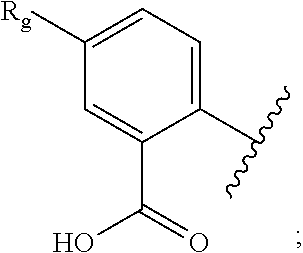
wherein R9 is H, halogen, or trifluoromethyl, (preferably R9 is H, or trifluoromethyl), R2 is a cyclopropyl, cyclobutyl, cyclopentyl, or cyclohexyl, each optionally substituted with one to three R10 substituents, or R2 is a group of the formula:

R7 is C1-C3 alkyl (preferably methyl), and R8 and R are each H. Preferably, R2 is

wherein R10 is independently —H, halogen, C1-C6 alkyl, or C1-C6 haloalkyl, preferably R10 is independently —H, halogen, or C1-C3 alkyl, more preferably R10 is independently —H, fluoro, or methyl.

wherein R9 is H, halogen, or trifluoromethyl, (preferably R9 is H, or halogen), R2 is a cyclopropyl, cyclobutyl, cyclopentyl, or cyclohexyl, each optionally substituted with one to three R10 substituents, or R2 is a group of the formula:

R7 is C1-C3 alkyl (preferably methyl), and R8 and R are each H. Preferably, R2 is

wherein R10 is independently —H, halogen, C1-C6 alkyl, or C1-C6 haloalkyl, preferably R10 is independently —H, halogen, or C1-C3 alkyl, more preferably R10 is independently —H, fluoro, or methyl.

wherein R9 is —H, halogen, methyl, trifluoromethyl, or cyclopropyl, R2 is a cyclopropyl, cyclobutyl, cyclopentyl, or cyclohexyl, each optionally substituted with one to three R10 substituents, or R2 is a group of the formula:

R7 is C1-C3 alkyl (preferably methyl), and R8 and R are each —H. Preferably, R2 is

wherein R10 is independently —H, halogen, C1-C6 alkyl, or C1-C6 haloalkyl, preferably R10 is independently —H, halogen, or C1-C3 alkyl, more preferably R10 is independently —H, fluoro, or methyl.

wherein R9 is H, halogen, C1-C3 alkyl or C1-C3 haloalkyl, R2 is a cyclopropyl, cyclobutyl, cyclopentyl, or cyclohexyl, each optionally substituted with one to three R10 substituents, or R2 is a group of the formula:

R7 is C1-C3 alkyl (preferably methyl), and R8 and R are each H. Preferably, R2 is

wherein R10 is independently —H, halogen, C1-C6 alkyl, or C1-C6 haloalkyl, preferably R10 is independently —H, halogen, or C1-C3 alkyl, more preferably R10 is independently —H, fluoro, or methyl.

wherein R9 is —H, halogen, C1-C3 alkyl, C1-C3 haloalkyl, or C3-C5 cycloalkyl, R2 is a cyclopropyl, cyclobutyl, cyclopentyl, or cyclohexyl, each optionally substituted with one to three R10 substituents, or R2 is a group of the formula:

R7 is C1-C3 alkyl (preferably methyl), and R8 and R are each —H. Preferably, R2 is

wherein R10 is independently —H, halogen, C1-C6 alkyl, or C1-C6 haloalkyl, preferably R10 is independently —H, halogen, or C1-C3 alkyl, more preferably R10 is independently —H, fluoro, or methyl.

R3 is H, CN, or C1-C3 alkyl, R4, R6, R8 and R are each H, R5 is H, halogen, C1-C3 alkyl or C1-C3 haloalkyl, R7 is CN, methyl or trifluoromethyl, and R1 is a group of the formula:

wherein each R9 is independently —H, halogen, methyl, C1-C3 haloalkyl, or cyclopropyl. Preferably, R2 is

wherein R10 is independently —H, halogen, C1-C6 alkyl, or C1-C6 haloalkyl, preferably R10 is independently —H, halogen, or C1-C3 alkyl, more preferably R10 is independently —H, fluoro, or methyl.

wherein each R9 is independently —H, halogen, methyl or trifluoromethyl, R2 is a cyclopropyl, cyclobutyl, cyclopentyl, or cyclohexyl, each optionally substituted with one to three R10 substituents, or R2 is a group of the formula:

R3 is —H, methyl, or trifluoromethyl, R4 is —H, or halogen, R8 and R are each —H, R5 is —H, halogen, methyl or trifluoromethyl, R6 is —H, or halogen, and R7 is C1-C3 alkyl (preferably methyl). Preferably, R2 is

wherein R10 is independently —H, halogen, C1-C6 alkyl, or C1-C6 haloalkyl, preferably R10 is independently —H, halogen, or C1-C3 alkyl, more preferably R10 is independently —H, fluoro, or methyl.

wherein R9 is H, halogen, or trifluoromethyl, (preferably R9 is H, or trifluoromethyl), R2 is a cyclopropyl, cyclobutyl, cyclopentyl, or cyclohexyl, each optionally substituted with one to three R10 substituents, or R2 is a group of the formula:

R3 is H, or methyl, R4, R6, R8 and R are each H, R5 is H, halogen, methyl, or trifluoromethyl, and R7 is C1-C3 alkyl (preferably methyl). Preferably, R2 is

wherein R10 is independently —H, halogen, C1-C6 alkyl, or C1-C6 haloalkyl, preferably R10 is independently —H, halogen, or C1-C3 alkyl, more preferably R10 is independently —H, fluoro, or methyl.

wherein R9 is H, halogen, or trifluoromethyl, (preferably R9 is H, or halogen), R2 is a cyclopropyl, cyclobutyl, cyclopentyl, or cyclohexyl, each optionally substituted with one to three R10 substituents, or R2 is a group of the formula:

R3 is H, or methyl, R4, R6, R8 and R are each H, R5 is H, halogen, methyl, or trifluoromethyl, and R7 is C1-C3 alkyl (preferably methyl). Preferably, R2 is

wherein R10 is independently —H, halogen, C1-C6 alkyl, or C1-C6 haloalkyl, preferably R10 is independently —H, halogen, or C1-C3 alkyl, more preferably R10 is independently —H, fluoro, or methyl.

wherein R9 is independently —H, halogen, methyl, trifluoromethyl, or cyclopropyl, R2 is a cyclopropyl, cyclobutyl, cyclopentyl, or cyclohexyl, each optionally substituted with one to three R10 substituents, or R2 is a group of the formula:

R3 is —H, methyl, or trifluoromethyl, R4 is —H, or halogen, R8 and R are each —H, R5 is —H, halogen, methyl or trifluoromethyl, R6 is —H, or halogen, and R7 is C1-C3 alkyl (preferably methyl). Preferably, R2 is

wherein R10 is independently —H, halogen, C1-C6 alkyl, or C1-C6 haloalkyl, preferably R10 is independently —H, halogen, or C1-C3 alkyl, more preferably R10 is independently —H, fluoro, or methyl.

wherein R9 is H, halogen, C1-C3 alkyl or C1-C3 haloalkyl, R2 is a cyclopropyl, cyclobutyl, cyclopentyl, or cyclohexyl, each optionally substituted with one to three R10 substituents, or R2 is a group of the formula:

R3 is H, or methyl, R4, R6, R8 and R are each H, R5 is H, halogen, methyl, or trifluoromethyl, and R7 is C1-C3 alkyl (preferably methyl). Preferably, R2 is

wherein R10 is independently —H, halogen, C1-C6 alkyl, or C1-C6 haloalkyl, preferably R10 is independently —H, halogen, or C1-C3 alkyl, more preferably R10 is independently —H, fluoro, or methyl.

wherein each R9 is independently —H, halogen, methyl, trifluoromethyl, or cyclopropyl, R2 is a cyclopropyl, cyclobutyl, cyclopentyl, or cyclohexyl, each optionally substituted with one to three R10 substituents, or R2 is a group of the formula:

R3 is —H, methyl, or trifluoromethyl, R4 is —H, or halogen, R8 and R are each —H, R5 is —H, halogen, methyl or trifluoromethyl, R6 is —H, or halogen, and R7 is C1-C3 alkyl (preferably methyl). Preferably, R2 is

wherein R10 is independently —H, halogen, C1-C6 alkyl, or C1-C6 haloalkyl, preferably R10 is independently —H, halogen, or C1-C3 alkyl, more preferably R10 is independently —H, fluoro, or methyl.

wherein R1, R2, R3, R5, R6, and R7 are as defined in the Summary for Formula (I) above.

wherein each R9 is independently —H, halogen, C1-C3 alkyl, C1-C3 haloalkyl, or C3-C5 cycloalkyl; preferably each R9 is independently —H, halogen, methyl, trifluoromethyl, or cyclopropyl.

wherein each R9 is independently H, halogen, C1-C6 alkyl, C1-C6 haloalkyl, C1-C6 alkoxy, or C3-C5 cycloalkyl. Preferably each R9 is independently —H, halogen, C1-C3 alkyl, C1-C3 haloalkyl, or C3-C5 cycloalkyl. More preferably each R9 is independently —H, halogen, methyl, trifluoromethyl, or cyclopropyl.

wherein each R9 independently —H, halogen, C1-C3 alkyl or C1-C3 haloalkyl. Preferably each R9 is independently —H, halogen, methyl or trifluoromethyl.

wherein R9 is H, halogen, or C1-C3 haloalkyl. Preferably R9 is H, or trifluoromethyl.

wherein each R9 is independently —H, halogen, C1-C3 alkyl or C1-C3 haloalkyl. Preferably each R9 is independently —H, halogen, methyl or trifluoromethyl.

wherein R9 is —H, halogen, C1-C3 alkyl, C1-C3 haloalkyl, or C3-C5 cycloalkyl. Preferably R9 is independently —H, halogen, methyl, trifluoromethyl, or cyclopropyl.

wherein R9 is H, halogen, C1-C3 alkyl or C1-C3 haloalkyl.

wherein R9 is —H, halogen, C1-C3 alkyl, C1-C3 haloalkyl, or C3-C5 cycloalkyl. Preferably R9 is —H, halogen, methyl, trifluoromethyl, or cyclopropyl.

wherein each R9 is independently H, halogen, C1-C3 alkyl, C1-C3 haloalkyl, or C3-C5 cycloalkyl, and R2 is a cyclopropyl, cyclobutyl, cyclopentyl, or cyclohexyl, each optionally substituted with one to three R10 substituents, or R2 is a group of the formula:

wherein each R10 is independently H, CN, halogen, C1-C6 haloalkyl, C1-C6 alkoxy, C1-C6 haloalkoxy, —SO2R11, —CONR11R11, —NR11R11, —NR11—CO2R11, an optionally substituted C1-C6 alkyl, an optionally substituted C3-C5 cycloalkyl, an optionally substituted heterocycle selected from pyrrolidine, pyrrolidinone, piperidine or morpholine, an optionally substituted phenyl, or an optionally substituted heteroaryl selected from pyrazole, isoxazole, isothiazole, imidazole, oxazole, or thiazole; wherein the optionally substituted C1-C6 alkyl is optionally substituted with a CN, —OH, or C1-C3 alkoxy; the optionally substituted C3-C5 cycloalkyl, phenyl, heterocycle or heteroaryl is each optionally substituted with one to three substituents each independently selected from halogen, C1-C3 alkyl, C1-C3 haloalkyl, C1-C3 alkoxy, C1-C3 haloalkoxy, —NR11R11, —OH or —CN; and each R11 is independently H or C1-C3 alkyl. Preferably, R2 is

wherein R10 is independently —H, halogen, C1-C6 alkyl, or C1-C6 haloalkyl, preferably R10 is independently —H, halogen, or C1-C3 alkyl, more preferably R10 is independently —H, fluoro, or methyl.

wherein each R9 is independently —H, halogen, C1-C6 alkyl, C1-C6 haloalkyl, C1-C6 alkoxy, or C3-C5 cycloalkyl, and R2 is a cyclopropyl, cyclobutyl, cyclopentyl, or cyclohexyl, each optionally substituted with one to three R10 substituents, or R2 is a group of the formula:

preferably each R9 is independently —H, halogen, C1-C3 alkyl, C1-C3 haloalkyl, or C3-C5 cycloalkyl. Most preferably each R9 is independently —H, halogen, methyl, trifluoromethyl, or cyclopropyl. Preferably, R2 is

wherein R10 is independently —H, halogen, C1-C6 alkyl, or C1-C6 haloalkyl, preferably R10 is independently —H, halogen, or C1-C3 alkyl, more preferably R10 is independently —H, fluoro, or methyl.

wherein each R9 is independently —H, halogen, C1-C3 alkyl or C1-C3 haloalkyl, and R2 is a cyclopropyl, cyclobutyl, cyclopentyl, or cyclohexyl, each optionally substituted with one to three R10 substituents, or R2 is a group of the formula:
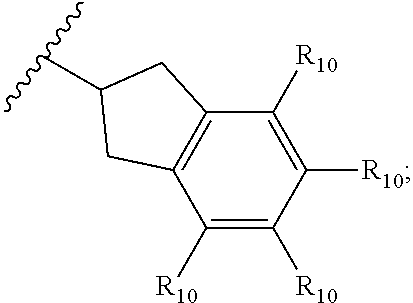
preferably each R9 is independently —H, halogen, methyl or trifluoromethyl. Preferably, R2 is

wherein R10 is independently —H, halogen, C1-C6 alkyl, or C1-C6 haloalkyl, preferably R10 is independently —H, halogen, or C1-C3 alkyl, more preferably R10 is independently —H, fluoro, or methyl.

wherein R9 is H, halogen, or C1-C3 haloalkyl, and R2 is a cyclopropyl, cyclobutyl, cyclopentyl, or cyclohexyl, each optionally substituted with one to three R10 substituents, or R2 is a group of the formula:

preferably R9 is H, or trifluoromethyl. Preferably, R2 is

wherein R10 is independently —H, halogen, C1-C6 alkyl, or C1-C6 haloalkyl, preferably R10 is independently —H, halogen, or C1-C3 alkyl, more preferably R10 is independently —H, fluoro, or methyl.

wherein R9 is H, halogen, or C1-C3 haloalkyl, and R2 is a cyclopropyl, cyclobutyl, cyclopentyl, or cyclohexyl, each optionally substituted with one to three R10 substituents, or R2 is a group of the formula:

preferably R9 is H, or halogen. Preferably, R2 is

wherein R10 is independently —H, halogen, C1-C6 alkyl, or C1-C6 haloalkyl, preferably R10 is independently —H, halogen, or C1-C3 alkyl, more preferably R10 is independently —H, fluoro, or methyl.

wherein R9 is —H, halogen, C1-C3 alkyl, C1-C3 haloalkyl, or C3-C5 cycloalkyl, and R2 is a cyclopropyl, cyclobutyl, cyclopentyl, or cyclohexyl, each optionally substituted with one to three R10 substituents, or R2 is a group of the formula:

preferably R9 is —H, halogen, methyl, trifluoromethyl, or cyclopropyl. Preferably, R2 is

wherein R10 is independently —H, halogen, C1-C6 alkyl, or C1-C6 haloalkyl, preferably R10 is independently —H, halogen, or C1-C3 alkyl, more preferably R10 is independently —H, fluoro, or methyl.

wherein R9 is H, halogen, C1-C3 alkyl or C1-C3 haloalkyl, and R2 is a cyclopropyl, cyclobutyl, cyclopentyl, or cyclohexyl, each optionally substituted with one to three R10 substituents, or R2 is a group of the formula:

Preferably, R2 is

wherein R10 is independently —H, halogen, C1-C6 alkyl, or C1-C6 haloalkyl, preferably R10 is independently —H, halogen, or C1-C3 alkyl, more preferably R10 is independently —H, fluoro, or methyl.

wherein R9 is —H, halogen, C1-C3 alkyl, C1-C3 haloalkyl, or C3-C5 cycloalkyl, and R2 is a cyclopropyl, cyclobutyl, cyclopentyl, or cyclohexyl, each optionally substituted with one to three R10 substituents, or R2 is a group of the formula:

preferably R9 is —H, halogen, methyl, trifluoromethyl, or cyclopropyl. Preferably, R2 is

wherein R10 is independently —H, halogen, C1-C6 alkyl, or C1-C6 haloalkyl, preferably R10 is independently —H, halogen, or C1-C3 alkyl, more preferably R10 is independently —H, fluoro, or methyl.

more preferably R3 is —H, or methyl, R5 is —H, halogen, methyl, or trifluoromethyl, R6 is —H, and R7 is methyl. Preferably, R2 is

wherein R10 is independently —H, halogen, C1-C6 alkyl, or C1-C6 haloalkyl, preferably R10 is independently —H, halogen, or C1-C3 alkyl, more preferably R10 is independently —H, fluoro, or methyl.

R3 is —H, —CN, C1-C3 alkyl, or C1-C3 haloalkyl, R5 is —H, halogen, C1-C3 alkyl or C1-C3 haloalkyl, R6 is —H or halogen, and R1 is a group of the formula:

wherein each R9 is independently —H, halogen, C1-C3 alkyl, C1-C3 haloalkyl, or C3-C5 cycloalkyl. Preferably R3 is —H, methyl, or trifluoromethyl, R5 is —H, halogen, methyl, or trifluoromethyl, R6 is —H or halogen, and each R9 is independently —H, halogen, methyl, trifluoromethyl, or cyclopropyl. Preferably, R2 is

wherein R10 is independently —H, halogen, C1-C6 alkyl, or C1-C6 haloalkyl, preferably R10 is independently —H, halogen, or C1-C3 alkyl, more preferably R10 is independently —H, fluoro, or methyl.

R3 is —H, —CN, C1-C3 alkyl, or C1-C3 haloalkyl, R5 is —H, halogen, C1-C3 alkyl or C1-C3 haloalkyl, R6 is —H or halogen, R7 is —CN, methyl or trifluoromethyl, and R1 is a group of the formula:

wherein each R9 is independently —H, halogen, C1-C3 alkyl, C1-C3 haloalkyl, or C3-C5 cycloalkyl. Preferably, R2 is

wherein R10 is independently —H, halogen, C1-C6 alkyl, or C1-C6 haloalkyl, preferably R10 is independently —H, halogen, or C1-C3 alkyl, more preferably R10 is independently —H, fluoro, or methyl.

wherein each R9 is independently —H, halogen, methyl or trifluoromethyl, R2 is a cyclopropyl, cyclobutyl, cyclopentyl, or cyclohexyl, each optionally substituted with one to three R10 substituents, or R2 is a group of the formula:


wherein R10 is independently —H, halogen, C1-C6 alkyl, or C1-C6 haloalkyl, preferably R10 is independently —H, halogen, or C1-C3 alkyl, more preferably R10 is independently —H, fluoro, or methyl.

wherein R9 is H, halogen, or trifluoromethyl, (preferably R9 is H, or trifluoromethyl), R2 is a cyclopropyl, cyclobutyl, cyclopentyl, or cyclohexyl, each optionally substituted with one to three R10 substituents, or R2 is a group of the formula:

R3 is H, or methyl, R5 is H, halogen, methyl, or trifluoromethyl, R6 is H or halogen, and R7 is methyl. Preferably, R2 is

wherein R10 is independently —H, halogen, C1-C6 alkyl, or C1-C6 haloalkyl, preferably R10 is independently —H, halogen, or C1-C3 alkyl, more preferably R10 is independently —H, fluoro, or methyl.

wherein R9 is H, halogen, or trifluoromethyl, (preferably R9 is H, or halogen), R2 is a cyclopropyl, cyclobutyl, cyclopentyl, or cyclohexyl, each optionally substituted with one to three R10 substituents, or R2 is a group of the formula:

R3 is H, or methyl, R5 is H, halogen, methyl, or trifluoromethyl, R6 is H or halogen, and R7 is methyl. Preferably, R2 is

wherein R10 is independently —H, halogen, C1-C6 alkyl, or C1-C6 haloalkyl, preferably R10 is independently —H, halogen, or C1-C3 alkyl, more preferably R10 is independently —H, fluoro, or methyl.

wherein each R9 is independently —H, halogen, methyl, trifluoromethyl, or cyclopropyl, R2 is a cyclopropyl, cyclobutyl, cyclopentyl, or cyclohexyl, each optionally substituted with one to three R10 substituents, or R2 is a group of the formula:

R3 is —H, methyl, or trifluoromethyl, R5 is —H, halogen, methyl or trifluoromethyl, R6 is —H, or halogen, and R7 is C1-C3 alkyl preferably methyl). Preferably, R2 is

wherein R10 is independently —H, halogen, C1-C6 alkyl, or C1-C6 haloalkyl, preferably R10 is independently —H, halogen, or C1-C3 alkyl, more preferably R10 is independently —H, fluoro, or methyl.

wherein R9 is H, halogen, C1-C3 alkyl or C1-C3 haloalkyl, R2 is a cyclopropyl, cyclobutyl, cyclopentyl, or cyclohexyl, each optionally substituted with one to three R10 substituents, or R2 is a group of the formula:

R3 is H, or methyl, R5 is H, halogen, methyl, or trifluoromethyl, R6 is H or halogen, and R7 is methyl. Preferably, R2 is

wherein R10 is independently —H, halogen, C1-C6 alkyl, or C1-C6 haloalkyl, preferably R10 is independently —H, halogen, or C1-C3 alkyl, more preferably R10 is independently —H, fluoro, or methyl.

wherein each R9 is independently —H, halogen, methyl, trifluoromethyl, or cyclopropyl, R2 is a cyclopropyl, cyclobutyl, cyclopentyl, or cyclohexyl, each optionally substituted with one to three R10 substituents, or R2 is a group of the formula:

R3 is —H, methyl, or trifluoromethyl, R5 is —H, halogen, methyl or trifluoromethyl, R6 is —H, or halogen, and R7 is C1-C3 alkyl (preferably methyl). Preferably, R2 is

wherein R10 is independently —H, halogen, C1-C6 alkyl, or C1-C6 haloalkyl, preferably R10 is independently —H, halogen, or C1-C3 alkyl, more preferably R10 is independently —H, fluoro, or methyl.


or a pharmaceutically acceptable salt of any of the foregoing; wherein the bond at the * position is as represented,


or a pharmaceutically acceptable salt thereof. In yet a further embodiment, the bond at the * position is

In yet a further embodiment, the bond at the * position is


or a pharmaceutically acceptable salt thereof. In yet a further embodiment, the bond at the * position is

In yet a further embodiment, the bond at the * position is


or a pharmaceutically acceptable salt thereof. In yet a further embodiment, the bond at the * position is

In yet a further embodiment, the bond at the * position is


or a pharmaceutically acceptable salt thereof. In yet a further embodiment, the bond at the * position is

In yet a further embodiment, the bond at the * position is


or a pharmaceutically acceptable salt thereof. In yet a further embodiment, the bond at the * position is

In yet a further embodiment, the bond at the * position is


or a pharmaceutically acceptable salt thereof. In yet a further embodiment, the bond at the * position is

In yet a further embodiment, the bond at the * position is


or a pharmaceutically acceptable salt thereof. In yet a further embodiment, the bond at the * position is

In yet a further embodiment, the bond at the * position is


or a pharmaceutically acceptable salt thereof. In yet a further embodiment, the bond at the * position is

In yet a further embodiment, the bond at the * position is


| TABLE 1 | |||
| MS ES+ | |||
| Int # | Chemical Name | Structure | m/z |
| 46 | (2-Bromo-4-methyl-6- propanoyl-phenyl)indane- 2-carboxylate |
 |
Material used without purification |


| TABLE 2 | |||
| MS ES+ | |||
| Int # | Chemical Name | Structure | m/z |
| 9 | 1-(3-Bromo-2-hydroxy- phenyl)-3-cyclohexyl- propane-1,3-dione |
 |
327 [M + H]+ |
| 10 | 1-(3-Bromo-2-hydroxy-5- methyl-phenyl)-3-(1- phenylcyclopropyl)propane- 1,3-dione |
 |
Product does not ionize well. |
| 11 | 1-(3-Bromo-2-hydroxy-5- methyl-phenyl)-3-(4,4- difluorocyclohexyl)propane- 1,3-dione |
 |
375 [M + H]+ |
| 12 | 1-(3-Bromo-2-hydroxy-5- methyl-phenyl)-3-indan-2- yl-propane-1,3-dione |
 |
375 [M + H]+ |
| 47 | 1-(3-Bromo-2-hydroxy-5- methyl-phenyl)-3-indan-2- yl-2-methyl-propane-1,3- dione |
 |
Material used without purification |


| TABLE 3 | |||
| MS ES+ | |||
| Int # | Chemical Name | Structure | m/z |
| 15 | 8-Bromo-2-(4,4- dimethylcyclohexyl)-6- methyl-chromen-4-one |
 |
349 [M + H]+ |
| 16 | 8-Bromo-2-cyclohexyl- chromen-4-one |
 |
307 [M + H]+ |
| 17 | 8-Bromo-6-methyl-2-(1- phenylcyclopropyl)chromen- 4-one |
 |
355/357 [M + H]+ |
| 18 | 8-Bromo-2-(4,4- difluorocyclohexyl)-6- methyl-chromen-4-one |
 |
359 [M + H]+ |
| 19 | 8-Bromo-2-indan-2-yl-6- methyl-chromen-4-one |
 |
355 [M + H]+ |
| 48 | 8-Bromo-2-indan-2-yl-3,6- dimethyl-chromen-4-one |
 |
369/371 [M + H]+ |

| TABLE 4 | |||
| MS ES+ | |||
| Int # | Chemical Name | Structure | m/z |
| 21 | 8-Acetyl-2-(4,4- dimethylcyclohexyl)-6- methyl-chromen-4-one |
 |
313 [M + H]+ |
| 22 | 8-Acetyl-2-cyclohexyl- chromen-4-one |
 |
271 [M + H]+ |
| 23 | 8-Acetyl-6-methyl-2-(1- phenylcyclopropyl)chromen- 4-one |
 |
319 [M + H]+ |
| 24 | 8-Acetyl-2-(4,4- difluorocyclohexyl)-6- methyl-chromen-4-one |
 |
321 [M + H]+ |
| 25 | 8-Acetyl-2-(4,4- difluorocyclohexyl)-3,6- dimethyl-chromen-4-one |
 |
335 [M + H]+ |
| 26 | 8-Acetyl-2-indan-2-yl-6- methyl-chromen-4-one |
 |
319 [M + H]+ |
| 49 | 8-Acetyl-2-indan-2-yl-3,6- dimethyl-chromen-4-one |
 |
333 [M + H]+ |

| TABLE 5 | |||
| MS ES+ | |||
| Int # | Chemical Name | Structure | m/z |
| 28 | 2-(4,4-Dimethylcyclohexyl)-8- (1-hydroxyethyl)-6-methyl- chromen-4-one |
 |
315 [M + H]+ |
| 29 | 2-Cyclohexyl-8-(1- hydroxyethyl)chromen-4-one |
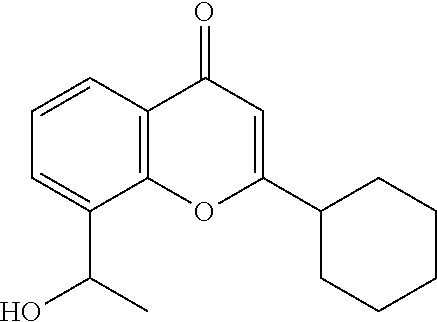 |
273 [M + H]+ |
| 30 | 8-(1-Hydroxyethyl)-6-methyl-2- (1-phenylcyclopropyl)chromen- 4-one |
 |
321 [M + H]+ |
| 31 | 2-(4,4-Difluorocyclohexyl)-8- (1-hydroxyethyl)-6-methyl- chromen-4-one |
 |
323 [M + H]+ |
| 32 | 2-(4,4-Difluorocyclohexyl)-8- (1-hydroxyethyl)-3,6-dimethyl- chromen-4-one |
 |
337 [M + H]+ |
| 33 | 8-(1-Hydroxyethyl)-2-indan-2- yl-6-methyl-chromen-4-one |
 |
321 [M + H]+ |
| 50 | 8-(1-Hydroxyethyl)-2-indan-2- yl-3,6-dimethyl-chromen-4-one |
 |
335 [M + H]+ |

| TABLE 6 | |||
| MS ES+ | |||
| Int # | Chemical Name | Structure | m/z |
| 35 | 8-(1-Bromoethyl)-2-(4,4- dimethylcyclohexyl)-6-methyl- chromen-4-one |
 |
377 [M + H]+ |
| 36 | 8-(1-Bromoethyl)-2- cyclohexyl-chromen-4-one |
 |
337 [M + H]+ |
| 37 | 8-(1-Bromoethyl)-6-methyl-2- (1-phenylcyclopropyl) chromen-4-one |
 |
383/385 [M + H]+ |
| 38 | 8-(1-Bromoethyl)-2-(4,4- difluorocyclohexyl)-6-methyl- chromen-4-one |
 |
385 [M + H]+ |
| 39 | 8-(1-Bromoethyl)-2-(4,4- difluorocyclohexyl)-3,6- dimethyl-chromen-4-one |
 |
399 [M + H]+ |
| 40 | 8-(1-Bromoethyl)-2-indan-2- yl-6-methyl-chromen-4-one |
 |
385 [M + H]+ |
| 51 | 8-(1-Bromoethyl)-2-indan-2- yl-3,6-dimethyl-chromen-4- one |
 |
397/399 [M + H]+ |


| TABLE 7 | |||
| MS ES+ | |||
| Int # | Chemical Name | Structure | m/z |
| 43 | tert-Butyl 2-[1-[2-(4,4- difluorocyclohexyl)-3,6- dimethyl-4-oxo-chromen-8- yl]ethylamino]benzoate |
 |
512 [M + H]+ |
| 44 | tert-Butyl 2-[1-(2-indan-2-yl-6- methyl-4-oxo-chromen-8- yl)ethylamino]benzoate |
 |
496 [M + H]+ |
| 52 | tert-Butyl 2-[1-(2-indan-2-yl- 3,6-dimethyl-4-oxo-chromen-8- yl)ethylamino]benzoate |
 |
510 [M + H]+ |


| TABLE 8 | |||
| Example | MS ES+ | ||
| # | Chemical Name | Structure | m/z |
| 3 | 2-[1-[2-(4,4- Difluorocyclohexyl)-3,6- dimethyl-4-oxo-chromen-8- yl]ethylamino]benzoic acid |
 |
|
| 4 | 2-[1-(2-Indan-2-yl-6-methyl- 4-oxo-chromen-8- yl)ethylamino]benzoic acid |
 |
440 [M + H]+ |
| 20 | 2-[1-(2-Indan-2-yl-3,6- dimethyl-4-oxo-chromen-8- yl)ethylamino]benzoic acid |
 |
454 [M + H]+ |

| TABLE 9 | |||
| Example | MS ES+ | ||
| # | Chemical Name | Structure | m/z |
| 6 | 2-[1-[2-(4,4- Dimethylcyclohexyl)-6- methyl-4-oxo-chromen-8- yl]ethylamino]benzoic acid |
 |
434 [M + H]+ |
| 7 | 2-[1-[6-Methyl-4-oxo-2-(1- phenylcyclopropyl)chromen- 8-yl]ethylamino]benzoic acid; 2,2,2-trifluoroacetic acid |
 |
440 [M + H]+ |

| TABLE 10 | |||
| Example | MS ES+ | ||
| # | Chemical Name | Structure | m/z |
| 10a | 2-[1-[2-(4,4- Dimethylcyclohexyl)-6- methyl-4-oxo-chromen-8- yl]ethylamino]benzoic acid, Isomer 1 |
 |
434 [M + H]+ |
| 11a | 2-[1-[2-(4,4- Dimethylcyclohexyl)-6- methyl-4-oxo-chromen-8- yl]ethylamino]benzoic acid, Isomer 2 |
 |
434 [M + H]+ |
| 12b | 2-[1-(2-Cyclohexyl-4-oxo- chromen-8- yl)ethylamino]benzoic acid, Isomer 1 |
 |
392 [M + H]+ |
| 13b | 2-[1-(2-Cyclohexyl-4-oxo- chromen-8- yl)ethylamino]benzoic acid, Isomer 2 |
 |
392 [M + H]+ |
| 14c | 2-[1-[2-(4,4- Difluorocyclohexyl)-6- methyl-4-oxo-chromen-8- yl]ethylamino]benzoic acid, Isomer 1 |
 |
442 [M + H]+ |
| 15c | 2-[1-[2-(4,4- Difluorocyclohexyl)-6- methyl-4-oxo-chromen-8- yl]ethylamino]benzoic acid, Isomer 2 |
 |
442 [M + H]+ |
| 16d | 2-[1-[2-(4,4- Difluorocyclohexyl)-3,6- dimethyl-4-oxo-chromen-8- yl]ethylamino]benzoic acid, Isomer 1 |
 |
456 [M + H]+ |
| 17d | 2-[1-[2-(4,4- Difluorocyclohexyl)-3,6- dimethyl-4-oxo-chromen-8- yl]ethylamino]benzoic acid, Isomer 2 |
 |
456 [M + H]+ |
| 18e | 2-[1-(2-Indan-2-yl-6-methyl- 4-oxo-chromen-8- yl)ethylamino]benzoic acid, Isomer 1 |
 |
440 [M + H]+ |
| 19e | 2-[1-(2-Indan-2-yl-6-methyl- 4-oxo-chromen-8- yl)ethylamino]benzoic acid, Isomer 2 |
 |
440 [M + H]+ |
| 21f | 2-[1-(2-Indan-2-yl-3,6- dimethyl-4-oxo-chromen-8- yl)ethylamino]benzoic acid, Isomer 1 |
 |
454 [M + H]+ |
| 22f | 2-[1-(2-Indan-2-yl-3,6- dimethyl-4-oxo-chromen-8- yl)ethylamino]benzoic acid, Isomer 2 |
 |
454 [M + H]+ |
| aCompounds separated using a Daicel Chiralpak AD-H (250 × 30 mm; 10 um) column eluted with 25% EtOH (with 0.1% NH4OH) in CO2. | |||
| bCompounds separated using a Daicel Chiralcel OJ (250 × 30 mm; 10 um) column eluted with 20% MeOH (with 0.1% NH4OH) in CO2. | |||
| cCompounds separated using a Daicel Chiralpak AS (250 × 30 mm; 10 um) column eluted with 45% EtOH (with 0.1% NH4OH) in CO2. | |||
| dCompounds separated using an (S, S)Whelk-O1 (250 × 30 mm, 5 um) column eluted with 40% EtOH (with 0.1% NH4OH) in CO2. | |||
| eCompounds separated using a Daicel Chiralpak AS (250 × 30 mm; 10 um) column eluted with 40% EtOH (with 0.1% NH4OH) in CO2. | |||
| fCompounds separated using a Daicel Chiralcel OD (250 × 30 mm; 10 um) column eluted with 50% MeOH (with 0.1% NH4OH) in CO2. | |||
Y=bot+[(top−bot)/1+(x/IC50)slope]
where Y=% inhibition, X=concentration yielding y% inhibition, Bottom=minimum value of y attained by curve, Top=maximum value of y attained by curve and Slope=steepness of curve at IC50.
% Inh=[(median Max−x/median Max−median Min)]·100
IC50: concentration of compound that reduces a given response (ligand binding, enzyme response) by 50%. IC50 relative: concentration giving half the compound's maximum response.
| TABLE A |
| PI3K-α (PIK3CA) Biochemical IC50 of PI3K wild-type |
| (WT) and H1047R mutant, using Soy PI lipid substrate |
| IC50 | IC50 | |
| Example # | H1047R | WT |
| 7 | A | E |
| 81 | C | E |
| 91 | A | A |
| 101 | A | C |
| 111 | E | E |
| 121 | E | E |
| 13 | A | E |
| 14 | E | E |
| 15 | A | E |
| 16 | A | B |
| 17 | E | E |
| 18 | C | E |
| 19 | A | C |
| 21 | A | C |
| 22 | E | E |
| 1PIP2diC8 lipid substrate | ||
| *For Example 9, IC50 WT/IC50 H1047R = 5.5 | ||
Claims (25)


Priority Applications (1)
| Application Number | Priority Date | Filing Date | Title |
|---|---|---|---|
| US17/936,973 US12030862B2 (en) | 2021-09-30 | 2022-09-30 | Allosteric chromenone inhibitors of phosphoinositide 3-kinase (PI3K) for the treatment of disease |
Applications Claiming Priority (3)
| Application Number | Priority Date | Filing Date | Title |
|---|---|---|---|
| US202163250582P | 2021-09-30 | 2021-09-30 | |
| US202163253277P | 2021-10-07 | 2021-10-07 | |
| US17/936,973 US12030862B2 (en) | 2021-09-30 | 2022-09-30 | Allosteric chromenone inhibitors of phosphoinositide 3-kinase (PI3K) for the treatment of disease |
Publications (2)
| Publication Number | Publication Date |
|---|---|
| US20230147285A1 US20230147285A1 (en) | 2023-05-11 |
| US12030862B2 true US12030862B2 (en) | 2024-07-09 |
Family
ID=84047422
Family Applications (1)
| Application Number | Title | Priority Date | Filing Date |
|---|---|---|---|
| US17/936,973 Active US12030862B2 (en) | 2021-09-30 | 2022-09-30 | Allosteric chromenone inhibitors of phosphoinositide 3-kinase (PI3K) for the treatment of disease |
Country Status (9)
| Country | Link |
|---|---|
| US (1) | US12030862B2 (en) |
| EP (1) | EP4408416A1 (en) |
| JP (1) | JP7735558B2 (en) |
| KR (1) | KR20240052800A (en) |
| AU (1) | AU2022358531B2 (en) |
| CA (1) | CA3233484A1 (en) |
| MX (1) | MX2024003721A (en) |
| TW (1) | TW202329930A (en) |
| WO (1) | WO2023056407A1 (en) |
Families Citing this family (15)
| Publication number | Priority date | Publication date | Assignee | Title |
|---|---|---|---|---|
| KR20240004865A (en) | 2021-05-03 | 2024-01-11 | 페트라 파마 코포레이션 | Allosteric chromenone inhibitors of phosphoinositide 3-kinase (PI3K) for the treatment of diseases |
| EP4347040A1 (en) | 2021-05-27 | 2024-04-10 | Petra Pharma Corporation | Allosteric chromenone inhibitors of phosphoinositide 3-kinase (pi3k) for the treatment of cancer |
| WO2023104111A1 (en) * | 2021-12-08 | 2023-06-15 | Nanjing Zenshine Pharmaceuticals Co., Ltd. | Fused heterocyclic compounds as pi3kalpha inhibitors |
| US20240018115A1 (en) * | 2022-04-29 | 2024-01-18 | Petra Pharma Corporation | Allosteric chromenone inhibitors of phosphoinositide 3-kinase (pi3k) for the treatment of disease |
| IL317360A (en) | 2022-06-08 | 2025-01-01 | Onkure Inc | Benzopyrimidin-4(3h)-ones as pi3k inhibitors |
| CN120265619A (en) | 2022-09-08 | 2025-07-04 | 恩库勒公司 | Isoquinolones as PI3K inhibitors |
| WO2024064024A1 (en) | 2022-09-19 | 2024-03-28 | Onkure, Inc. | ((4-oxo-3,4-dihydroquinazolin-8-yl)methyl)amine derivatives as p13k inhibitors for the treatment of cancer |
| WO2024081345A1 (en) | 2022-10-14 | 2024-04-18 | Onkure, Inc. | Benzopyrimidin-4(3h)-ones as pi3k inhibitors |
| WO2024097721A1 (en) | 2022-11-02 | 2024-05-10 | Petra Pharma Corporation | Targeting allosteric and orthosteric pockets of phosphoinositide 3-kinase (pi3k) for the treatment of disease |
| KR20260005985A (en) | 2023-05-05 | 2026-01-12 | 일라이 릴리 앤드 캄파니 | Imrunestrant or a salt thereof for use in treating and preventing central nervous system (CNS) metastases in subjects with ER+ breast cancer |
| AU2024325407A1 (en) | 2023-08-11 | 2026-02-19 | Onkure Therapeutics, Inc. | Benzopyridinones and benzopyrimidinones as pi3k inhibitors |
| CN119874676A (en) * | 2023-10-25 | 2025-04-25 | 海创药业股份有限公司 | PI3K inhibitor and preparation method and application thereof |
| WO2025207755A1 (en) | 2024-03-29 | 2025-10-02 | Onkure, Inc. | Quinolizinones as pi3k inhibitors |
| WO2025212360A1 (en) | 2024-04-01 | 2025-10-09 | Onkure, Inc. | Isoquinolones as pi3k inhibitors |
| WO2025255233A1 (en) | 2024-06-07 | 2025-12-11 | Onkure, Inc. | Compounds containing fused tricyclic rings as pi3k inhibitors |
Citations (23)
| Publication number | Priority date | Publication date | Assignee | Title |
|---|---|---|---|---|
| EP0223744A2 (en) | 1985-10-22 | 1987-05-27 | RECORDATI S.A. CHEMICAL and PHARMACEUTICAL COMPANY | Flavone derivatives |
| EP0341104A2 (en) | 1988-04-06 | 1989-11-08 | MERCK PATENT GmbH | Substituted flavonoid compounds, their salts, their manufacture and medicines containing these materials |
| WO1990006921A1 (en) | 1988-12-21 | 1990-06-28 | The Upjohn Company | Antiatherosclerotic and antithrombotic 1-benzopyran-4-ones and 2-amino-1,3-benzoxazine-4-ones |
| WO2001053266A1 (en) | 2000-01-24 | 2001-07-26 | Kinacia Pty Ltd. | Therapeutic morpholino-substituted compounds |
| WO2004004632A2 (en) | 2002-07-08 | 2004-01-15 | Nicholas Piramal India Limited | Flavone derivatives as inhibitors of cyclin-dependent kinases |
| WO2004016607A1 (en) | 2002-08-16 | 2004-02-26 | Kinacia Pty Ltd. | Inhibition of phosphoinositide 3-kinase beta |
| US20070015802A1 (en) | 2002-07-08 | 2007-01-18 | Nicholas Piramal India Limited | Inhibitors of cyclin dependent kinases and their use |
| WO2009093972A1 (en) | 2008-01-25 | 2009-07-30 | Astrazeneca Ab | Enantiomerically pure (-) 2-[1-(7-methyl-2-(morpholin-4-yl)-4-oxo-4h-pyrido[1,2-a]pyrimidin-9-yl)ethylamino]benzoic acid, its use in medical therapy, and a pharmaceutical composition comprising it - 026 |
| WO2010037129A1 (en) | 2008-09-29 | 2010-04-01 | Sirtris Pharmaceuticals Inc. | Quinazolinone, quinolone and related analogs as sirtuin modulators |
| US20110098271A1 (en) | 2009-10-27 | 2011-04-28 | Astrazeneca Ab | Chromenone derivatives |
| US8513221B2 (en) | 2008-07-07 | 2013-08-20 | Xcovery Holding, LLC | PI3K isoform selective inhibitors |
| WO2017156520A1 (en) | 2016-03-11 | 2017-09-14 | H. Lee Moffitt Cancer Center And Research Institute, Inc. | Icariin and icaritin derivatives |
| CN108299365A (en) | 2018-01-31 | 2018-07-20 | 中南大学 | A kind of chromocor derivative and its application |
| WO2021202964A1 (en) | 2020-04-03 | 2021-10-07 | Petra Pharma Corporation | Allosteric chromenone inhibitors of phosphoinositide 3-kinase (pi3k) for the treatment of diseases associated with p13k modulation |
| WO2021226677A1 (en) | 2020-05-14 | 2021-11-18 | The Heart Research Institute Ltd | Treatment of thrombosis and associated disorders with an anti-platelet agent. |
| WO2022164812A1 (en) | 2021-02-01 | 2022-08-04 | Geode Therapeutics Inc. | Phosphoinositide 3 kinase beta inhibitors and compositions and methods thereof |
| WO2022235575A1 (en) | 2021-05-03 | 2022-11-10 | Petra Pharma Corporation | Allosteric chromenone inhibitors of phosphoinositide 3-kinase (pi3k) for the treatment of disease |
| WO2022235574A1 (en) | 2021-05-03 | 2022-11-10 | Petra Pharma Corporation | Allosteric chromenone inhibitors of phosphoinositide 3-kinase (pi3k) for the treatment of disease |
| WO2022251482A1 (en) | 2021-05-27 | 2022-12-01 | Petra Pharma Corporation | Allosteric chromenone inhibitors of phosphoinositide 3-kinase (pi3k) for the treatment of cancer |
| WO2023060262A1 (en) | 2021-10-07 | 2023-04-13 | Relay Therapeutics, Inc. | Pi3k-alpha inhibitors and methods of use thereof |
| WO2023078401A1 (en) | 2021-11-05 | 2023-05-11 | Fochon Biosciences, Ltd. | Compounds as protein kinase inhibitors |
| WO2023081209A1 (en) | 2021-11-03 | 2023-05-11 | Zeno Management, Inc. | Pi3k inhibitors and methods of treating cancer |
| WO2023104111A1 (en) | 2021-12-08 | 2023-06-15 | Nanjing Zenshine Pharmaceuticals Co., Ltd. | Fused heterocyclic compounds as pi3kalpha inhibitors |
Family Cites Families (1)
| Publication number | Priority date | Publication date | Assignee | Title |
|---|---|---|---|---|
| US20110172217A1 (en) | 2008-09-05 | 2011-07-14 | Shionogi & Co., Ltd. | Ring-fused morpholine derivative having pi3k-inhibiting activity |
-
2022
- 2022-09-29 TW TW111137054A patent/TW202329930A/en unknown
- 2022-09-30 KR KR1020247009840A patent/KR20240052800A/en not_active Withdrawn
- 2022-09-30 AU AU2022358531A patent/AU2022358531B2/en active Active
- 2022-09-30 MX MX2024003721A patent/MX2024003721A/en unknown
- 2022-09-30 US US17/936,973 patent/US12030862B2/en active Active
- 2022-09-30 CA CA3233484A patent/CA3233484A1/en active Pending
- 2022-09-30 JP JP2024519762A patent/JP7735558B2/en active Active
- 2022-09-30 EP EP22800958.5A patent/EP4408416A1/en active Pending
- 2022-09-30 WO PCT/US2022/077329 patent/WO2023056407A1/en not_active Ceased
Patent Citations (28)
| Publication number | Priority date | Publication date | Assignee | Title |
|---|---|---|---|---|
| EP0223744A2 (en) | 1985-10-22 | 1987-05-27 | RECORDATI S.A. CHEMICAL and PHARMACEUTICAL COMPANY | Flavone derivatives |
| EP0341104A2 (en) | 1988-04-06 | 1989-11-08 | MERCK PATENT GmbH | Substituted flavonoid compounds, their salts, their manufacture and medicines containing these materials |
| WO1990006921A1 (en) | 1988-12-21 | 1990-06-28 | The Upjohn Company | Antiatherosclerotic and antithrombotic 1-benzopyran-4-ones and 2-amino-1,3-benzoxazine-4-ones |
| WO2001053266A1 (en) | 2000-01-24 | 2001-07-26 | Kinacia Pty Ltd. | Therapeutic morpholino-substituted compounds |
| US20070015802A1 (en) | 2002-07-08 | 2007-01-18 | Nicholas Piramal India Limited | Inhibitors of cyclin dependent kinases and their use |
| WO2004004632A2 (en) | 2002-07-08 | 2004-01-15 | Nicholas Piramal India Limited | Flavone derivatives as inhibitors of cyclin-dependent kinases |
| WO2004016607A1 (en) | 2002-08-16 | 2004-02-26 | Kinacia Pty Ltd. | Inhibition of phosphoinositide 3-kinase beta |
| US7598377B2 (en) | 2002-08-16 | 2009-10-06 | Astrazeneca Ab | Inhibition of phosphoinositide 3-kinase β |
| US7872011B2 (en) | 2002-08-16 | 2011-01-18 | Astrazeneca Ab | Inhibition of phosphoinositide 3-kinase β |
| WO2009093972A1 (en) | 2008-01-25 | 2009-07-30 | Astrazeneca Ab | Enantiomerically pure (-) 2-[1-(7-methyl-2-(morpholin-4-yl)-4-oxo-4h-pyrido[1,2-a]pyrimidin-9-yl)ethylamino]benzoic acid, its use in medical therapy, and a pharmaceutical composition comprising it - 026 |
| US8513221B2 (en) | 2008-07-07 | 2013-08-20 | Xcovery Holding, LLC | PI3K isoform selective inhibitors |
| WO2010037129A1 (en) | 2008-09-29 | 2010-04-01 | Sirtris Pharmaceuticals Inc. | Quinazolinone, quinolone and related analogs as sirtuin modulators |
| WO2010037127A1 (en) | 2008-09-29 | 2010-04-01 | Sirtris Pharmaceuticals, Inc. | Chromenone analogs as sirtuin modulators |
| US8399460B2 (en) | 2009-10-27 | 2013-03-19 | Astrazeneca Ab | Chromenone derivatives |
| WO2011051704A1 (en) | 2009-10-27 | 2011-05-05 | Astrazeneca Ab | Chromenone derivatives with anti-tumour activity |
| US20110098271A1 (en) | 2009-10-27 | 2011-04-28 | Astrazeneca Ab | Chromenone derivatives |
| WO2017156520A1 (en) | 2016-03-11 | 2017-09-14 | H. Lee Moffitt Cancer Center And Research Institute, Inc. | Icariin and icaritin derivatives |
| CN108299365A (en) | 2018-01-31 | 2018-07-20 | 中南大学 | A kind of chromocor derivative and its application |
| WO2021202964A1 (en) | 2020-04-03 | 2021-10-07 | Petra Pharma Corporation | Allosteric chromenone inhibitors of phosphoinositide 3-kinase (pi3k) for the treatment of diseases associated with p13k modulation |
| WO2021226677A1 (en) | 2020-05-14 | 2021-11-18 | The Heart Research Institute Ltd | Treatment of thrombosis and associated disorders with an anti-platelet agent. |
| WO2022164812A1 (en) | 2021-02-01 | 2022-08-04 | Geode Therapeutics Inc. | Phosphoinositide 3 kinase beta inhibitors and compositions and methods thereof |
| WO2022235575A1 (en) | 2021-05-03 | 2022-11-10 | Petra Pharma Corporation | Allosteric chromenone inhibitors of phosphoinositide 3-kinase (pi3k) for the treatment of disease |
| WO2022235574A1 (en) | 2021-05-03 | 2022-11-10 | Petra Pharma Corporation | Allosteric chromenone inhibitors of phosphoinositide 3-kinase (pi3k) for the treatment of disease |
| WO2022251482A1 (en) | 2021-05-27 | 2022-12-01 | Petra Pharma Corporation | Allosteric chromenone inhibitors of phosphoinositide 3-kinase (pi3k) for the treatment of cancer |
| WO2023060262A1 (en) | 2021-10-07 | 2023-04-13 | Relay Therapeutics, Inc. | Pi3k-alpha inhibitors and methods of use thereof |
| WO2023081209A1 (en) | 2021-11-03 | 2023-05-11 | Zeno Management, Inc. | Pi3k inhibitors and methods of treating cancer |
| WO2023078401A1 (en) | 2021-11-05 | 2023-05-11 | Fochon Biosciences, Ltd. | Compounds as protein kinase inhibitors |
| WO2023104111A1 (en) | 2021-12-08 | 2023-06-15 | Nanjing Zenshine Pharmaceuticals Co., Ltd. | Fused heterocyclic compounds as pi3kalpha inhibitors |
Non-Patent Citations (24)
| Title |
|---|
| Acute Leukemia, Merck Manual (Online Edition) 6 pages, pp. 1-6 (2013). |
| Barlaam et al., Biorganic & Medicinal Chemistry Letters, vol. 26, No. 9, Mar. 11, 2016, pp. 2318-2323. |
| Barlaam et al., Journal of Medical Chemistry, vol. 58, No. 2, Jan. 22, 2015, pp. 943-962. |
| Copending U.S. Appl. No. 17/221,209. |
| Copending U.S. Appl. No. 17/734,705. |
| Copending U.S. Appl. No. 17/734,745. |
| Copending U.S. Appl. No. 17/825,680. |
| Copending U.S. Appl. No. 18/309,226. |
| Fitzgerald et al., Annals of Oncology, v30, Supplement 5, Oct. 1, 2019, p. v110. |
| Fry, Review: Phosphoinositide 3-kinase signaling in breast cancer:how big a role might it play?, Breast Cancer Res 2001, 3:304-312. |
| Gaestel et al., Current Medicinal Chemistry, vol. 14, No. 21, Sep. 1, 2007, pp. 2214-2234. |
| Giordanetto et al., Bioorganic & Medicinal Chemistry Letters vol. 24, Issue 16, Aug. 15, 2014, pp. 3936-3943. |
| Golub et al., Science (Oct. 15, 1999), Vo. 286, 531-537. |
| Gura, Systems for identifying New Drugs Are Often Faulty, Cancer Models, Science, vol. 278, No. 5340, pp. 1041-1042, Nov. 1997. |
| Hon et al., Oncogene (2012) 31, 3655-3666, published online Nov. 28, 2011. |
| International Search Report for PCT/US2022/077329 (Date of mailing: Jan. 4, 2023). |
| Johnson et al, Relationships between drug activity in NCI preclinical in vitro and in vivo models and early clinical trials, British Journal of Cancer (2001) 64(10): 1424-1431. |
| Klippel, A. et al. Preclinical characterization of LOXO-783 (LOX-22783), a highly potent, mutant selective and brain-penetrant allosteric PI3Kα H1047R inhibitor. Presented at: 2021 AACR-NCI-EORTC Virtual International Conference on Molecular Targets and Cancer Therapeutics, On: Oct. 7, 2021. |
| Lala et al., Cancer and Metastasis Reviews (Mar. 1998), 17(1), 91-106. |
| Li et al., Am J Clin Exp Urol 2014; 2(3):188-198; Epub 02 Oct. 2, 2014. |
| Miller et al. Identification of allosteric binding sites for PI3Kα oncogenic mutant specific inhibitor design. Bioorg Med Chem. Feb. 15, 2017; 25(4): 1481-1486. |
| Pearce et al., Failure modes in anticancer drug discovery and development, Cancer Drug Design and Discovery Edited by Stephen Neidle, Chapter 18, pp. 424-435 (2008). |
| Simone, Oncology: Introduction, Cecil Textbook of Medicine, 20th Edition, vol. 1, pp. 1004-1101 O, 1996. |
| Written Opinion for PCT/US2022/077329 (Date of mailing: Jan. 4, 2023). |
Also Published As
| Publication number | Publication date |
|---|---|
| JP2024536263A (en) | 2024-10-04 |
| JP7735558B2 (en) | 2025-09-08 |
| AU2022358531B2 (en) | 2025-08-21 |
| WO2023056407A1 (en) | 2023-04-06 |
| KR20240052800A (en) | 2024-04-23 |
| AU2022358531A1 (en) | 2024-02-15 |
| US20230147285A1 (en) | 2023-05-11 |
| CA3233484A1 (en) | 2023-04-06 |
| TW202329930A (en) | 2023-08-01 |
| MX2024003721A (en) | 2024-04-12 |
| EP4408416A1 (en) | 2024-08-07 |
Similar Documents
| Publication | Publication Date | Title |
|---|---|---|
| US20230147285A1 (en) | Allosteric chromenone inhibitors of phosphoinositide 3-kinase (pi3k) for the treatment of disease | |
| JP7759964B2 (en) | Allosteric Chromenone Inhibitors of Phosphoinositide 3-Kinase (PI3K) for the Treatment of Diseases - Patent application | |
| US11873295B2 (en) | Allosteric chromenone inhibitors of phosphoinositide 3-kinase (PI3K) for the treatment of disease | |
| US11649227B2 (en) | Allosteric chromenone inhibitors of phosphoinositide 3-kinase (PI3K) for the treatment of disease | |
| US11878970B2 (en) | Allosteric chromenone inhibitors of phosphoinositide 3-kinase (PI3K) for the treatment of disease | |
| CN121287704A (en) | Targeting the allosteric and ortho-pockets of phosphoinositol 3-kinase (PI3K) for disease treatment | |
| CA3173569C (en) | Allosteric chromenone inhibitors of phosphoinositide 3-kinase (pi3k) for the treatment of disease | |
| CN118043044A (en) | Allosteric chromenone inhibitors of phosphoinositide 3-kinase (PI3K) for the treatment of disease | |
| CN117693506A (en) | Allosteric chromone inhibitors of phosphoinositide 3-kinase (PI3K) for the treatment of disease | |
| CN117597343A (en) | Allosteric chromenone inhibitors of phosphoinositide 3-kinase (PI3K) for the treatment of disease |
Legal Events
| Date | Code | Title | Description |
|---|---|---|---|
| FEPP | Fee payment procedure |
Free format text: ENTITY STATUS SET TO UNDISCOUNTED (ORIGINAL EVENT CODE: BIG.); ENTITY STATUS OF PATENT OWNER: LARGE ENTITY |
|
| AS | Assignment |
Owner name: LOXO ONCOLOGY, INC., INDIANA Free format text: ASSIGNMENT OF ASSIGNORS INTEREST;ASSIGNOR:KESICKI, EDWARD A;REEL/FRAME:061657/0393 Effective date: 20220913 Owner name: PETRA PHARMA CORPORATION, NEW YORK Free format text: ASSIGNMENT OF ASSIGNORS INTEREST;ASSIGNORS:LOXO ONCOLOGY, INC.;SCHROEDINGER, LLC;SIGNING DATES FROM 20220915 TO 20220927;REEL/FRAME:061390/0195 Owner name: SCHROEDINGER, INC., NEW YORK Free format text: ASSIGNMENT OF ASSIGNORS INTEREST;ASSIGNOR:HICKEY, EUGENE R;REEL/FRAME:061389/0955 Effective date: 20220915 Owner name: SCHROEDINGER, LLC, NEW YORK Free format text: ASSIGNMENT OF ASSIGNORS INTEREST;ASSIGNOR:SCHROEDINGER, INC.;REEL/FRAME:061390/0063 Effective date: 20220915 |
|
| STPP | Information on status: patent application and granting procedure in general |
Free format text: DOCKETED NEW CASE - READY FOR EXAMINATION |
|
| STPP | Information on status: patent application and granting procedure in general |
Free format text: NON FINAL ACTION MAILED |
|
| STPP | Information on status: patent application and granting procedure in general |
Free format text: RESPONSE TO NON-FINAL OFFICE ACTION ENTERED AND FORWARDED TO EXAMINER |
|
| STPP | Information on status: patent application and granting procedure in general |
Free format text: NON FINAL ACTION MAILED |
|
| STPP | Information on status: patent application and granting procedure in general |
Free format text: NOTICE OF ALLOWANCE MAILED -- APPLICATION RECEIVED IN OFFICE OF PUBLICATIONS |
|
| STPP | Information on status: patent application and granting procedure in general |
Free format text: PUBLICATIONS -- ISSUE FEE PAYMENT VERIFIED |
|
| STCF | Information on status: patent grant |
Free format text: PATENTED CASE |