US12030853B2 - MASP-2 inhibitors and methods of use - Google Patents

MASP-2 inhibitors and methods of use Download PDF

Info

Publication number
US12030853B2
US12030853B2 US17/112,873 US202017112873A US12030853B2 US 12030853 B2 US12030853 B2 US 12030853B2 US 202017112873 A US202017112873 A US 202017112873A US 12030853 B2 US12030853 B2 US 12030853B2
Authority
US
United States
Prior art keywords
substituted
unsubstituted
heterocyclyl
heteroaryl
cycloalkyl
Prior art date
Legal status (The legal status is an assumption and is not a legal conclusion. Google has not performed a legal analysis and makes no representation as to the accuracy of the status listed.)
Active, expires
Application number
US17/112,873
Other versions
US20210171461A1 (en
Inventor
Neil S. Cutshall
Jennifer Lynn Gage
Sara Rebecca Goldstein
Do Yeon Kwon
Thomas L. Little
Markus Metz
Peter Kurt Nollert von Specht
Jennifer Tsoung
Current Assignee (The listed assignees may be inaccurate. Google has not performed a legal analysis and makes no representation or warranty as to the accuracy of the list.)
Omeros Corp
Original Assignee
Omeros Medical Systems Inc
Priority date (The priority date is an assumption and is not a legal conclusion. Google has not performed a legal analysis and makes no representation as to the accuracy of the date listed.)
Filing date
Publication date
Priority to US17/112,873 priority Critical patent/US12030853B2/en
Application filed by Omeros Medical Systems Inc filed Critical Omeros Medical Systems Inc
Assigned to OMEROS CORPORATION reassignment OMEROS CORPORATION ASSIGNMENT OF ASSIGNORS INTEREST (SEE DOCUMENT FOR DETAILS). Assignors: TSOUNG, Jennifer, CUTSHALL, NEIL S., METZ, MARKUS, NOLLERT VON SPECHT, Peter Kurt, GAGE, JENNIFER LYNN, GOLDSTEIN, Sara Rebecca, KWON, DO YEON, LITTLE, THOMAS L.
Publication of US20210171461A1 publication Critical patent/US20210171461A1/en
Priority to US18/680,563 priority patent/US20240317682A1/en
Priority to US18/679,774 priority patent/US20240351980A1/en
Assigned to WILMINGTON SAVINGS FUND SOCIETY, FSB, AS COLLATERAL AGENT reassignment WILMINGTON SAVINGS FUND SOCIETY, FSB, AS COLLATERAL AGENT SECURITY INTEREST (SEE DOCUMENT FOR DETAILS). Assignors: OMEROS CORPORATION
Publication of US12030853B2 publication Critical patent/US12030853B2/en
Application granted granted Critical
Assigned to WILMINGTON SAVINGS FUND SOCIETY, FSB, AS COLLATERAL AGENT reassignment WILMINGTON SAVINGS FUND SOCIETY, FSB, AS COLLATERAL AGENT CORRECTIVE ASSIGNMENT TO CORRECT THE CORRECT THE BOX TITLED"THIS DOCUMENT SERVES AS AN OATH/DECLARATION (37 CFR 1.63)" WAS ERRONEOUSLY CHECKED AND THIS BOX SHOULD NOT HAVE BEEN CHECKED, PREVIOUSLY RECORDED AT REEL: 67607 FRAME: 108. ASSIGNOR(S) HEREBY CONFIRMS THE SECURITY INTEREST. Assignors: OMEROS CORPORATION
Priority to US19/071,565 priority patent/US20250197349A1/en
Active legal-status Critical Current
Adjusted expiration legal-status Critical

Links

Classifications

    • CCHEMISTRY; METALLURGY
    • C07ORGANIC CHEMISTRY
    • C07DHETEROCYCLIC COMPOUNDS
    • C07D207/00Heterocyclic compounds containing five-membered rings not condensed with other rings, with one nitrogen atom as the only ring hetero atom
    • C07D207/02Heterocyclic compounds containing five-membered rings not condensed with other rings, with one nitrogen atom as the only ring hetero atom with only hydrogen or carbon atoms directly attached to the ring nitrogen atom
    • C07D207/04Heterocyclic compounds containing five-membered rings not condensed with other rings, with one nitrogen atom as the only ring hetero atom with only hydrogen or carbon atoms directly attached to the ring nitrogen atom having no double bonds between ring members or between ring members and non-ring members
    • C07D207/10Heterocyclic compounds containing five-membered rings not condensed with other rings, with one nitrogen atom as the only ring hetero atom with only hydrogen or carbon atoms directly attached to the ring nitrogen atom having no double bonds between ring members or between ring members and non-ring members with hetero atoms or with carbon atoms having three bonds to hetero atoms with at the most one bond to halogen, e.g. ester or nitrile radicals, directly attached to ring carbon atoms
    • C07D207/16Carbon atoms having three bonds to hetero atoms with at the most one bond to halogen, e.g. ester or nitrile radicals
    • CCHEMISTRY; METALLURGY
    • C07ORGANIC CHEMISTRY
    • C07DHETEROCYCLIC COMPOUNDS
    • C07D403/00Heterocyclic compounds containing two or more hetero rings, having nitrogen atoms as the only ring hetero atoms, not provided for by group C07D401/00
    • C07D403/02Heterocyclic compounds containing two or more hetero rings, having nitrogen atoms as the only ring hetero atoms, not provided for by group C07D401/00 containing two hetero rings
    • C07D403/04Heterocyclic compounds containing two or more hetero rings, having nitrogen atoms as the only ring hetero atoms, not provided for by group C07D401/00 containing two hetero rings directly linked by a ring-member-to-ring-member bond
    • CCHEMISTRY; METALLURGY
    • C07ORGANIC CHEMISTRY
    • C07DHETEROCYCLIC COMPOUNDS
    • C07D413/00Heterocyclic compounds containing two or more hetero rings, at least one ring having nitrogen and oxygen atoms as the only ring hetero atoms
    • C07D413/02Heterocyclic compounds containing two or more hetero rings, at least one ring having nitrogen and oxygen atoms as the only ring hetero atoms containing two hetero rings
    • C07D413/04Heterocyclic compounds containing two or more hetero rings, at least one ring having nitrogen and oxygen atoms as the only ring hetero atoms containing two hetero rings directly linked by a ring-member-to-ring-member bond
    • CCHEMISTRY; METALLURGY
    • C07ORGANIC CHEMISTRY
    • C07DHETEROCYCLIC COMPOUNDS
    • C07D471/00Heterocyclic compounds containing nitrogen atoms as the only ring hetero atoms in the condensed system, at least one ring being a six-membered ring with one nitrogen atom, not provided for by groups C07D451/00 - C07D463/00
    • C07D471/02Heterocyclic compounds containing nitrogen atoms as the only ring hetero atoms in the condensed system, at least one ring being a six-membered ring with one nitrogen atom, not provided for by groups C07D451/00 - C07D463/00 in which the condensed system contains two hetero rings
    • C07D471/04Ortho-condensed systems

Definitions

  • sequence listing associated with this application is provided in text format in lieu of a paper copy and is hereby incorporated by reference into the specification.
  • the name of the text file containing the sequence listing is 700128_421_SEQUENCE_LISTING.
  • the text file is 6.0 KB, was created on Dec. 3, 2020, and is being submitted via EFS-Web with the filing of the specification.
  • the present disclosure is directed generally to compositions and methods that are useful in the field of medicine. More specifically, the disclosure provides synthetic inhibitors of mannan-binding lectin-associated serine protease-2 (MASP-2), including inhibitors that selectively inhibit MASP-2 over thrombin, compositions thereof, and methods for the manufacture and use thereof.
  • MASP-2 mannan-binding lectin-associated serine protease-2
  • the complement system plays a role in the inflammatory response and becomes activated because of tissue damage or microbial infection. Complement activation must be tightly regulated to ensure selective targeting of invading microorganisms and avoid self-inflicted damage (Ricklin et al., Nat. Immunol. 11:785-797, 2010).
  • the classical pathway is usually triggered by a complex composed of host antibodies bound to a foreign particle (i.e., an antigen) and generally requires prior exposure to an antigen for the generation of a specific antibody response. Since activation of the classical pathway depends on a prior adaptive immune response by the host, the classical pathway is part of the acquired immune system. In contrast, both the lectin and alternative pathways are independent of adaptive immunity and are part of the innate immune system.
  • MASP-2-dependent complement activation has been implicated as contributing to the pathogenesis of numerous acute and chronic disease states. Therefore, a need exists for compounds that are suitable for administration/treatment of subject suffering from MASP-2 complement pathway-associated diseases and disorders, including diseases that are not suitably or efficiently treated with large molecule biologic inhibitors.
  • One embodiment provides a compound having the following Structure (I):
  • Additional embodiments of the present disclosure provide a pharmaceutical composition
  • a pharmaceutical composition comprising a compound of Structure (I), (II) or (III), or a stereoisomer, tautomer, or pharmaceutically acceptable salt thereof, and at least one pharmaceutically acceptable carrier or excipient.
  • the compounds of Structures (I), (II) and (III) are useful in the treatment of MASP-2-associated diseases and disorders, and in the manufacture of medicaments for treating MASP-2-associated diseases and disorders. Accordingly, other embodiments of the disclosure provide methods of treating a MASP-2-associated disease and disorder comprising administering to a patient a therapeutically effective amount of a compound of Structure (I), (II) or (III), or a stereoisomer, tautomer, or pharmaceutically acceptable salt thereof.
  • any reference to “about X” specifically indicates at least the values X, 0.95X, 0.96X, 0.97X, 0.98X, 0.99X, 1.01X, 1.02X, 1.03X, 1.04X, and 1.05X.
  • MASP-2 refers to mannan-binding lectin-associated serine protease-2.
  • Human MASP-2 protein with UniProt accession code 000187 (SEQ ID NO:1).
  • MASP-2-dependent complement activation refers to MASP-2-dependent activation of the lectin pathway, which occurs under physiological conditions (i.e., in the presence of Ca ++ ) leading to the formation of the lectin pathway C3 convertase C4b2a and upon accumulation of the C3 cleavage product C3b subsequently to the C5 convertase C4b2a(C3b)n.
  • MASP-2-dependent complement-associated disease or disorder refers to a disease or disorder that is associated with MASP-2-dependent complement activation.
  • MASP-2-associated disease or disorder refers to a disease or disorder that is associated with activation or activity of MASP-2, including MASP-2-dependent complement-associated disease or disorders, and wherein inhibition of MASP-2 is or is expected to be therapeutically beneficial.
  • lectin pathway refers to complement activation that occurs via the specific binding of serum and non-serum carbohydrate-binding proteins including mannan-binding lectin (MBL), CL-11 and the ficolins (H-ficolin, M-ficolin, or L-ficolin).
  • MBL mannan-binding lectin
  • CL-11 ficolins
  • a subject includes all mammals, including without limitation, humans, non-human primates, dogs, cats, horses, sheep, goats, cows, rabbits, pigs, and rodents.
  • “Mammal” includes humans and both domestic animals such as laboratory animals and household pets, (e.g., cats, dogs, swine, cattle, sheep, goats, horses, rabbits), and non-domestic animals such as wildlife and the like.
  • small molecule and “small organic molecule” refers to a small carbon-containing molecule that has a molecular weight of about 2500 daltons or lower. In some embodiments, a small molecule has a molecular weight of about 2000 daltons or lower. In some embodiments, a small molecule has a molecular weight of about 1500 daltons or lower. In some embodiments, a small molecule has a molecular weight of about 1000 daltons or lower. In some embodiments, a small molecule has a molecular weight of about 750 daltons or lower. In some embodiments, a small molecule has a molecular weight of about 500 daltons or lower.
  • small molecules may have a molecular weight in the range from about 50 daltons to about 500 daltons, from about 50 daltons to about 750 daltons, from about 50 daltons to about 1000 daltons, from about 50 daltons to about 1500 daltons, from about 50 daltons to about 2000 daltons, or from about 50 daltons to about 2500 daltons.
  • compound is used herein, the term is explicitly intended to include small molecule compounds as defined herein (including any of the embodiments thereof).
  • a disease is a pathological condition of an organ, a body part, or a system resulting from various causes, such as infection, genetic defect, or environmental stress that is characterized by an identifiable group of symptoms.
  • “Therapeutically effective amount,” “effective amount,” or “effective dose” refers to that amount of a compound of the disclosure that, when administered to a mammal (e.g., a human), is sufficient to effect treatment, as defined below, of a disease or condition in the mammal, preferably a human.
  • a mammal e.g., a human
  • the amount of a compound of the disclosure which constitutes a “therapeutically effective amount” will vary depending on the compound, the condition and its severity, the manner of administration, and the age of the mammal to be treated, but can be determined routinely by one of ordinary skill in the art having regard to his own knowledge and to this disclosure.
  • subcutaneous administration refers to administration of a formulation under all layers of the skin of a subject.
  • histidine specifically includes L-histidine unless otherwise specified.
  • hypothermic refers to a formulation with an osmotic pressure above that of human (i.e., greater than 350 mOsm/L).
  • hydrogen-bonding is a partially electrostatic attraction between a hydrogen (H) which is bound to a more electronegative atom such as nitrogen (N) or oxygen (O) and another adjacent atom bearing a lone pair of electrons.
  • a hydrogen (H) bound to a nitrogen (N) is donated by the nitrogen as it electrostatically attracted to or accepted by an adjacent atom bearing a lone pair of electrons such as an oxygen.
  • ionic bonding includes a type of chemical bond that involves the electrostatic attraction between oppositely charged ions, and is the primary interaction occurring in ionic compounds.
  • the active site of serine proteases such as MASP-2 is shaped as a cleft where the polypeptide substrate or inhibitor binds.
  • Schechter and Berger labeled amino acid residues from the N to C terminus of the polypeptide substrate as follows: Pi, . . . , P3, P2, P1, P1′, P2′, P3′, . . . , Pj) and their respective binding sub-sites Si, . . . , S3, S2, S, S1′, S2′, S3′, . . . , Sj.
  • the cleavage is catalyzed between P1 and P1′ (Schechter, I. & Berger, A. On the size of the active site in proteases. I. Papain. Biochem. Biophys. Res. Commun. 27 (1967)).
  • composition refers to an alternative and should in general be construed non-exclusively.
  • a claim to “a composition comprising A or B” would typically present an aspect with a composition comprising both A and B.
  • Or should, however, be construed to exclude those aspects presented that cannot be combined without contradiction (e.g., a composition pH that is between 9 and 10 or between 7 and 8).
  • compositions comprising A must include at least the component A, but it may also include one or more other components (e.g., B; B and C; B, C, and D; and the like).
  • the term “comprising” therefore should in general be construed as not excluding additional ingredients.
  • a claim to “a composition comprising A” would cover compositions that include A and B; A, B, and C; A, B, C, and D; A, B, C, D, and E; and the like.
  • hypothermic refers to a formulation with an osmotic pressure above that of human (i.e., greater than 350 mOsm/KgHhO).
  • agent refers to a compound or mixture of compounds that, when added to a composition, tend to produce an effect on the composition's properties.
  • a composition comprising a thickening agent is likely to be more viscous than an otherwise identical comparative composition that lacks the thickening agent.
  • a “synthetic” compound means a compound that is not naturally occurring and that has been synthesized by humans. Reference to a compound herein may be understood to include reference to synthetic compounds, unless the context indicates otherwise.
  • C 1-6 alkyl and C 1 -C 6 alkyl are specifically intended to individually disclose (without limitation) methyl, ethyl, C 3 alkyl, C 4 alkyl, C 5 alkyl, and C 6 alkyl.
  • C n ⁇ m and C n -C m where n and m are integers indicates a group that contains from n to m carbon atoms. Examples include C 1-4 , C 1-6 , and the like. The term is intended to expressly disclose every member in the range, i.e., C n , C n+1 , C n+2 . . . C m ⁇ 2 , C m ⁇ 1 , C m .
  • C 1-6 is intended to disclose C 1 , C 2 , C 3 , C 4 , C 5 , and C 6 .
  • C n ⁇ m means the same as “C n -C m ”.
  • n-membered typically describes the number of ring-forming atoms in a moiety where the number of ring-forming atoms is n.
  • n-m membered wherein n and m are integers (e.g., 6-10 membered) describes a range where the number of ring forming atoms is from n to m.
  • piperidinyl is an example of a 6-membered heterocyclyl ring
  • pyrazolyl is an example of a 5-membered heteroaryl ring
  • pyridyl is an example of a 6-membered heteroaryl ring
  • 1,2,3,4-tetrahydro-naphthalene is an example of a 10-membered cycloalkyl group.
  • Alkyl refers to a straight or branched hydrocarbon chain radical consisting solely of carbon and hydrogen atoms, containing no unsaturation, having from one to twelve carbon atoms, preferably one to eight carbon atoms, more preferably one to six carbon atoms, which is attached to the rest of the molecule by a single bond, e.g., methyl, ethyl, n-propyl, 1-methylethyl (iso-propyl), n-butyl, n-pentyl, 1,1-dimethylethyl (t-butyl), 3-methylhexyl, 2-methylhexyl, and the like.
  • an alkyl group may be optionally substituted by one of the following groups: alkyl, alkenyl, halo, haloalkenyl, cyano, nitro, aryl, cycloalkyl, heterocyclyl, heteroaryl, oxo, trimethylsilanyl, —OR 100 , —OC(O)R 100 , —N(R 100 ) 2 , —C(O)R 100 , —C(O)OR 100 , —C(O)N(R 100 ) 2 , —N(R 20 )C(O)OR 102 , —N(R 100 )C(O)R 102 , —N(R 102 )S(O) p R 102 (where p is 1 to 2), —S(O) p OR 102 (where p is 1 to 2), —S(O)R 102 (where t is 0 to 2), and —S(O) p
  • Alkenyl refers to a straight or branched hydrocarbon chain radical group consisting solely of carbon and hydrogen atoms, containing at least one double bond, having from two to twelve carbon atoms, preferably two to eight carbon atoms and which is attached to the rest of the molecule by a single bond, e.g., ethenyl, prop-1-enyl, but-1-enyl, pent-1-enyl, penta-1,4-dienyl, and the like.
  • hydroxyalkyl refers to an alkyl group as defined above in which one or more of the hydrogen atoms has been replaced by a hydroxy group (i.e., —OH).
  • C n ⁇ m hydroxyalkyl refers to a C n ⁇ m alkyl group having n to m carbon atoms and from at least one hydroxy group.
  • the hydroxyalkyl group comprises one hydroxy group.
  • the hydroxyalkyl group comprises two or more hydroxy groups (e.g., a “dihydroxyalkyl”), each on the same or a different carbon atom(s).
  • the hydroxyalkyl group has 1, 2, 3, 4, 5, 6, or more hydroxy groups.
  • Carboxy refers to a —C(O)OH group.
  • the compounds of Structures (I), (II) or (III) are enriched with deuterium.
  • deuterated compounds can be achieved by methods known to one skilled in the art, such as exchanging protons with deuterium or by synthesizing the molecule with enriched starting materials.
  • R 1a , R 1b , R 1c , R 1d , or R 1e is optionally substituted with one or more substituents selected from the group consisting of halo, CN, OR 1 , SR 13 , C(O)R 13 , C(O)NR 13 R 14 , C(O)OR 13 , OC(O)R 13 , OC(O)NR 13 R 14 , NR 13 R 14 , NR 3 C(O)R 14 , NR 13 C(O)NR 14 R 15 , NR 13 C(O)OR 14 , C( ⁇ NR 13 )NR 14 R 15 , NR 13 C( ⁇ NR 14 )NR 15 R 16 , S(O)R 13 , S(O)NR 13 R 14 , S(O) 2 R 13 , NR 13 S(O) 2 R 14 , S(O) 2 NR 13 R 14 and oxo when R 1a , R 1b , R 1c , R 1
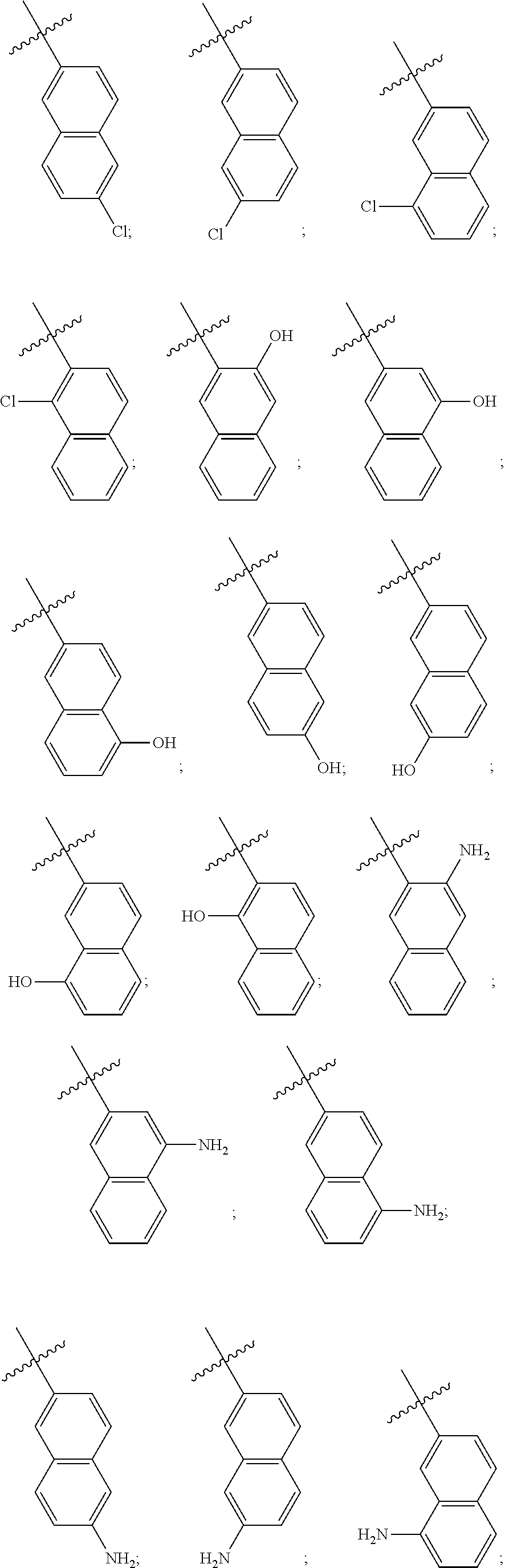
  • R 1 has one of the following structures:
  • R 1a , R 1b , R 1c , R 1d , or R 1e is optionally substituted with one or more substituents selected from the group consisting of halo, CN, OR 1 , SR 13 , C(O)R 13 , C(O)NR 13 R 14 , C(O)OR 13 , OC(O)R 13 , OC(O)NR 13 R 14 , NR 13 R 14 , NR 13 C(O)R 14 , NR 13 C(O)NR 14 R 15 , NR 13 C(O)OR 14 , C( ⁇ NR 13 )NR 14 R 15 , NR 13 C( ⁇ NR 14 )NR 15 R 16 , S(O)R 13 , S(O)NR 13 R 14 , S(O) 2 R 13 , NR 13 S(O) 2 R 14 , S(O) 2 NR 13 R 14 and oxo when R 1a , R 1b , R 1c
  • At least one occurrence of R 2a , R 2b , R 2c , or R 2d is alkoxy, alkoxyalkyl, cyano, C( ⁇ O)OR 5 , OC( ⁇ O)R 5 , C( ⁇ O)NR 5 R 6 , N(R)C( ⁇ O)R 6 , aryl, heteroaryl, heterocyclyl, or C( ⁇ O)N(R 5 )heterocyclyl, wherein R 5 and R 6 are, at each occurrence, independently hydrogen or C 1 -C 6 alkyl.
  • R 2a and R 2b are both halo (e.g., fluoro).
  • At least one of R 2a , R 2b , R 2c C, and R 2d is a substituted or unsubstituted phenyl. In some embodiments, at least one of R 2a , R 2b , R 2c , and R 2d is a substituted or unsubstituted heterocyclyl. In some embodiments, at least one of R 2a , R 2b , R 2c , and R 2d is a substituted or unsubstituted heteroaryl (e.g., tetrazolyl, triazolyl, oxadiazolyl, imidazolidinyl, pyrazolyl, etc.).
  • tetrazolyl e.g., tetrazolyl, triazolyl, oxadiazolyl, imidazolidinyl, pyrazolyl, etc.
  • At least one of R 2a , R 2b , R 2c , and R 2d has one of the following structures:
  • At least one of R a2 , R 2b , R 2c , and R 2d has one of the following structures:
  • R 3 has one of the following structures:
  • R 3 is —NH 2 .
  • n is 0. In certain embodiments, n is 1. In still other embodiments, n is 2. In some embodiments, n is 3, 4, 5, or 6.
  • n is 2 and R 4 is a substituted or unsubstituted aryl.
  • R 4 is a substituted aryl.
  • R 4 is substituted with a substituent selected from the group consisting of alkyl, halo (e.g., fluoro, chloro, bromo), haloalkyl, hydroxyl, amino, nitro, and combinations thereof.
  • R 4 is an unsubstituted aryl.
  • R 4 has one of the following structures:
  • n 2 and R 4 is a substituted or unsubstituted heteroaryl.
  • R 4 has one of the following structures:
  • R 4 has one of the following structures:
  • R 4 has one of the following structures:
  • n 0 and R 4 has one of the following structures:
  • R 4 has one of the following structures:
  • none of R 2a , R 2b , R 2c , R 2d , R 2e , R 2f , R 2g , R 2h , R 2i , or R 2j are alkyl. In some more embodiments, none of R 2a , R 2b , R 2c , R 2d , R 2e , R 2f , R 2g , R 2h , R 2i , or R 2j are alkenyl. In some embodiments, none of R 2a , R 2b , R 2c , R 2d , R 2e , R 2f , R 2g , R 2h , R 2i , or R 2j are arylalkyl.
  • none of R 2a , R 2b , R 2c , R 2d , R 2e , R 2f , R 2g , R 2h , R 2i , or R 2j are arylalkoxy. In some embodiments, none of R 2a , R 2b , R 2c , R 2d , R 2e , R 2f , R 2g , R 2h , R 2i , or R 2j are cycloalkylalkoxy.
  • none of R 2a , R 2b , R 2c , R 2d , R 2e , R 2f , R 2g , R 2h , R 2i , or R 2j are halo (e.g., fluoro). In some embodiments, none of R 2a , R 2b , R 2c , R 2d , R 2e , R 2f , R 2g , R 2h , R 2i , or R 2j are hydroxyl. In some embodiments, none of R 2a , R 2b , R 2c , R 2d , R 2e , R 2f , R 2g , R 2h , R 2i , or R 2j are alkoxy. In certain specific embodiments, none of R 2a , R 2b , R 2c , R 2d , R 2e , R 2f , R 2g , R 2h , R 2i , or R 2j have the following structure:
  • neither R 3a nor R 3a are carboxyalkyl. In some more embodiments, neither R 3a nor R 3a are arylalkylcarbonyl. In certain embodiments, neither R 3a nor R 3a are alkoxycarbonyl (e.g., Boc). In some embodiments, neither R 3a nor R 3a are heteroarylsulfo or alkylsulfo (e.g., —S(O) 2 CH 3 ). In some embodiments, neither R 3a nor R 3a are arylalkoxycarbonyl (e.g., Fmoc).
  • R 1 is a substituted or unsubstituted aryl. In certain embodiments, R 1 is a substituted or unsubstituted C 6 -C 10 aryl. In some embodiments, R 1 is a substituted or unsubstituted phenyl. In certain embodiments, R 1 is a substituted phenyl.
  • R 1 is phenyl substituted with one or more of R 1a , R 1b , R 1c , R 1d , and R 1e wherein R 1a , R 1b , R 1c , R 1d , and R 1e are each independently selected from the group consisting of C 1-6 alkyl, C 2-6 alkenyl, C 2-6 alkynyl, halo, C 1-6 haloalkyl, aminylalkyl, hydroxyalkyl, cyano, nitro, OR 9 , SR 9 , C(O)R 9 , C(O)NR 9 R 10 , C(O)OR 9 , OC(O)R 9 , OC(O)OR 9 , OC(O)NR 9 R 10 , NR 9 R 10 , N(R 9 )C(O)R 10 , N(R 9 )C(O)NR 10 R 11 , N(R 9 )C(O)OR 10 ,
  • R 1a , R 1b , R 1c , R 1d , or R 1e is optionally substituted with one or more substituents selected from the group consisting of halo, CN, OR 13 , SR 13 , C(O)R 13 , C(O)NR 13 R 14 , C(O)OR 13 , OC(O)R 13 , OC(O)NR 13 R 14 , NR 13 R 14 , NR 13 C(O)R 14 , NR 13 C(O)NR 14 R 15 , NR 13 C(O)OR 14 , C( ⁇ NR 13 )NR 14 R 15 , NR 13 C( ⁇ NR 14 )NR 15 R 16 , S(O)R 13 , S(O)NR 13 R 14 , S(O) 2 R 13 , NR 13 S(O) 2 R 14 , S(O) 2 NR 13 R 14 and oxo when R 1a , R 1b , R 1c , R 1
  • R 1 is phenyl substituted with at least one substituent selected from the group consisting of OR 9 , C( ⁇ N 9 )NR 10 R 11 , C( ⁇ NOR 9 )NR 10 R 11 , C( ⁇ NOC(O)R 9 )NR 10 R 11 , and C( ⁇ NR 9 )NR 10 C(O)OR 11 .
  • R 1 is substituted with at least one substituent selected from the group consisting of C( ⁇ NR 9 )NR 10 R 11 , C( ⁇ NOR 9 )NR 10 R 11 , C( ⁇ NOC(O)R 9 )NR 10 R 11 , and C( ⁇ NR 9 )NR 10 C(O)OR 11 .
  • R 1 is substituted with at least one C( ⁇ NR 9 )NR 10 R 11 . In more specific embodiments, R 1 is substituted with at least one —C( ⁇ NH)NH 2 . In still more specific embodiments, R 1 has one of the following structures:
  • R 1 has one of the following structures:
  • R 1 has one of the following structures:
  • R 9 is C 1-6 alkyl or C 1-6 haloalkyl. In more specific embodiments, R 9 is methyl. In certain embodiments, R 9 is trifluoromethyl. In some embodiments, R 1 is an unsubstituted phenyl.
  • R 1 is a substituted or unsubstituted heteroaryl. In certain embodiments, R 1 is a substituted or unsubstituted 5-10 membered heteroaryl. In some embodiments, R 1 is a substituted or unsubstituted pyridinyl, pyrrolopyridinyl, or benzoimidazolyl. In some more specific embodiments, R 1 is a substituted or unsubstituted pyridin-3-yl, 1H-pyrrolo[2,3-b]pyridine-5-yl, 1H-pyrrolo[3,2-c]pyridine-2-yl, or 1H-benzo[d]imidazol-6-yl.
  • R 1 is pyridin-3-yl, 1H-pyrrolo[2,3-b]pyridine-5-yl, or 1H-benzo[d]imidazol-6-yl substituted with one or more of R 1a , R 1b , R 1c , R 1d , and R 1e wherein R 1a , R 1b , R 1c , R 1d , and R 1e are each independently selected from the group consisting of C 1-6 alkyl, C 2-6 alkenyl, C 2-6 alkynyl, halo, C 1-6 haloalkyl, aminylalkyl, hydroxyalkyl, cyano, nitro, OR 9 , SR 9 , C(O)R 9 , C(O)NR 9 R 10 , C(O)OR 9 , OC(O)R 9 , OC(O)OR 9 , OC(O)NR 9 R 10 , NR 9 R 10 , N(R 9 ,
  • R 1a , R 1b , R 1c , R 1d , or R 1e is optionally substituted with one or more substituents selected from the group consisting of halo, CN, OR 13 , SR 13 , C(O)R 13 , C(O)NR 13 R 14 , C(O)OR 13 , OC(O)R 13 , OC(O)NR 13 R 14 , NR 13 R 14 , NR 13 C(O)R 14 , NR 13 C(O)NR 14 R 15 , NR 13 C(O)OR 14 , C( ⁇ NR 13 )NR 14 R 15 , NR 13 C( ⁇ NR 14 )NR 15 R 16 , S(O)R 13 , S(O)NR 13 R 14 , S(O) 2 R 13 , NR 13 S(O) 2 R 14 , S(O) 2 NR 13 R 14 and oxo when R 1a , R 1b , R, R 1d , or
  • R 1 has one of the following structures:
  • R 1a or R 1b is independently C 1-6 alkyl, amino, C(O)R 9 , C(O)NR 9 R 10 , N(R 9 )C(O)NR 10 R 11 , N(R 9 )C(O)R 10 , or OC(O)NR 9 R 10 , or halo.
  • R 1a or R 1b is methyl or ethyl.
  • R 1a or R 1b is F, Cl, or Br.
  • each R 1a or R 1b attached to nitrogen is C 1-6 alkyl, C(O)R 9 , C(O)NR 9 R 10 , N(R 9 )C(O)NR 10 R 11 , N(R 9 )C(O)OR 10 , or OC(O)NR 9 R 10 .
  • R 1a or R 1b is methyl or ethyl.
  • R 25 has one of the following structures:
  • the compounds of Structure (I), (II) or (III), and embodiments thereof can be in the form of a salt such as a pharmaceutically acceptable salt.
  • the compound can be any small molecule inhibitor of MASP-2.
  • the compound can be a small molecule inhibitor of MASP-2 that binds to the serine protease domain of MASP-2.
  • the compound can be a small molecule inhibitor such as a synthetic small molecule inhibitor of MASP-2.
  • the compound can be a small molecule inhibitor of MASP-2 that binds to the catalytic, substrate-binding region of MASP-2.
  • the compound selectively inhibits MASP-2 relative to thrombin.
  • the compound is a compound of Structure (I), (II) or (III) as described in any of the foregoing embodiments.
  • MASP-2 plays a dominant role in activating complement in settings of endothelial cell stress or injury and preventing the activation of MASP-2 and the lectin pathway halts the sequence of enzymatic reactions that lead to the formation of the membrane attack complex, platelet activation and leukocyte recruitment.
  • MASP-2 in addition to initiation of the lectin pathway, MASP-2 can also activate the coagulation system and is capable of cleaving prothrombin to thrombin.
  • the method comprises administering to a patient suffering from or at risk for developing graft-versus-host disease (GVHD), including acute GVHD, chronic GVHD or steroid-resistant GVHD an amount of a compound of the disclosure in an amount sufficient to inhibit MASP-2 dependent complement activation in the mammalian subject to thereby treat the disease or disorder.
  • GVHD graft-versus-host disease
  • the subject suffering from or at risk for developing GVHD has previously undergone, is undergoing, or will undergo a hematopoietic stem cell transplant.
  • the method comprises administering to a patient suffering from, or at risk for developing diffuse alveolar hemorrhage (DAH) an amount of a compound of the disclosure in an amount sufficient to inhibit MASP-2 dependent complement activation in the mammalian subject to thereby treat the disease or disorder.
  • DAH diffuse alveolar hemorrhage
  • the subject suffering from, or at risk for developing DAH has previously undergone, is undergoing, or will undergo a hematopoietic stem cell transplant.
  • the method comprises administering to a patient suffering from, or at risk for developing capillary leak syndrome (CLS) an amount of a compound of the disclosure in an amount sufficient to inhibit MASP-2 dependent complement activation in the mammalian subject to thereby treat the disease or disorder.
  • CLS capillary leak syndrome
  • the subject suffering from, or at risk for developing CLS has previously undergone, is undergoing, or will undergo a hematopoietic stem cell transplant.
  • the method comprises administering to a patient suffering from any of the above-referenced diseases or conditions an amount of a compound as disclosed in PCT Application No. PCT/US19/34225, which is hereby incorporated in its entirety.
  • the MASP-2-dependent complement-associated disease or disorder is renal fibrosis (e.g., tubulointerstitial fibrosis) and/or proteinuria in a subject suffering from or at risk for developing chronic kidney disease, chronic renal failure, glomerular disease (e.g., focal segmental glomerulosclerosis), an immune complex disorder (e.g., IgA nephropathy, membranous nephropathy), lupus nephritis, nephrotic syndrome, diabetic nephropathy, tubulointerstitial damage and glomerulonephritis (e.g., C 3 glomerulopathy), or a disease or condition associated with proteinuria, including, but not limited to, nephrotic syndrome, pre-eclampsia, eclampsia, toxic lesions of kidneys, amyloidosis, collagen vascular diseases (e.g., systemic lupus erythematosus), dehydration,
  • the MASP-2-dependent complement-associated disease or disorder is an inflammatory reaction resulting from tissue or solid organ transplantation, including allotransplantation or xenotransplantation of whole organs (e.g., kidney, heart, liver, pancreas, lung, cornea, and the like) or tissue grafts (e.g., valves, tendons, bone marrow, and the like).
  • tissue or solid organ transplantation including allotransplantation or xenotransplantation of whole organs (e.g., kidney, heart, liver, pancreas, lung, cornea, and the like) or tissue grafts (e.g., valves, tendons, bone marrow, and the like).
  • the MASP-2-dependent complement-associated disorder is an ischemia reperfusion injury (I/R), including myocardial I/R, gastrointestinal I/R, renal I/R, and I/R following an aortic aneurism repair, I/R associated with cardiopulmonary bypass, cerebral I/R, stroke, organ transplant or reattachment of severed or traumatized limbs or digits; revascularization to transplants and/or replants, and hemodynamic resuscitation following shock, surgical procedures, or similar, as well as combinations thereof.
  • I/R ischemia reperfusion injury
  • the MASP-2-dependent complement-associated disease or disorder is a complication associated with non-obese diabetes (Type-1 diabetes or Insulin-dependent diabetes mellitus) and/or complications associated with Type-1 or Type-2 (adult onset) diabetes including diabetic angiopathy, diabetic neuropathy, diabetic retinopathy, diabetic macular edema, and the like, as well as combinations thereof.
  • Type-1 diabetes or Insulin-dependent diabetes mellitus non-obese diabetes
  • complications associated with Type-1 or Type-2 (adult onset) diabetes including diabetic angiopathy, diabetic neuropathy, diabetic retinopathy, diabetic macular edema, and the like, as well as combinations thereof.
  • the MASP-2-dependent complement-associated disease or disorder is a cardiovascular disease or disorder, including Henoch-Schonlein purpura nephritis, systemic lupus erythematosus-associated vasculitis, vasculitis associated with rheumatoid arthritis (also called malignant rheumatoid arthritis), immune complex vasculitis, and Takayasu's disease; dilated cardiomyopathy; diabetic angiopathy; Kawasaki's disease (arteritis); venous gas embolus (VGE); and inhibition of restenosis following stent placement, rotational atherectomy, percutaneous transluminal coronary angioplasty (PTCA), and the like as well as combinations thereof.
  • PTCA percutaneous transluminal coronary angioplasty
  • the MASP-2-dependent complement-associated disease or disorder is a pulmonary disorder, including acute respiratory distress syndrome, transfusion-related acute lung injury, ischemia/reperfusion acute lung injury, chronic obstructive pulmonary disease, asthma, Wegener's granulomatosis, antiglomerular basement membrane disease (Goodpasture's disease), meconium aspiration syndrome, aspiration pneumonia, bronchiolitis obliterans syndrome, idiopathic pulmonary fibrosis, acute lung injury secondary to burn, non-cardiogenic pulmonary edema, transfusion-related respiratory depression, emphysema, and the like, as well as combinations thereof.
  • pulmonary disorder including acute respiratory distress syndrome, transfusion-related acute lung injury, ischemia/reperfusion acute lung injury, chronic obstructive pulmonary disease, asthma, Wegener's granulomatosis, antiglomerular basement membrane disease (Goodpasture's disease), meconium aspiration syndrome, aspiration pneumonia, bronchiolitis obliterans syndrome,
  • the MASP-2-dependent complement-associated disease or disorder is a peripheral nervous system (PNS) and/or central nervous system (CNS) disorder or injury including multiple sclerosis (MS), myasthenia gravis (MG), Huntington's disease (HD), amyotrophic lateral sclerosis (ALS), Guillain Barre syndrome, reperfusion following stroke, degenerative discs, cerebral trauma, Parkinson's disease (PD), Alzheimer's disease (AD), Miller-Fisher syndrome, cerebral trauma and/or hemorrhage, traumatic brain injury, demyelination, meningitis, or similar, as well as combinations thereof.
  • PNS peripheral nervous system
  • CNS central nervous system
  • MS multiple sclerosis
  • MG myasthenia gravis
  • HD Huntington's disease
  • ALS amyotrophic lateral sclerosis
  • ALS amyotrophic lateral sclerosis
  • ALS amyotrophic lateral sclerosis
  • ALS amyotrophic lateral sclerosis
  • ALS
  • the MASP-2-dependent complement-associated disease or disorder is an inflammatory reaction in a subject being treated with chemotherapeutics and/or radiation therapy, including for the treatment of cancerous conditions.
  • the MASP-2-dependent complement-associated disease or disorder is an angiogenesis-dependent cancer, including a solid tumor(s), blood borne tumor(s), high-risk carcinoid tumors, tumor metastases, and the like, including combinations thereof.
  • the MASP-2-dependent complement-associated disease or disorder is an angiogenesis-dependent benign tumor, including hemangiomas, acoustic neuromas, neurofibromas, trachomas, carcinoid tumors, pyogenic granulomas, or similar, as well as combinations thereof.
  • the MASP-2-dependent complement-associated disease or disorder is an endocrine disorder including Hashimoto's thyroiditis, stress, anxiety, other potential hormonal disorders involving regulated release of prolactin, growth or insulin-like growth factor, adrenocorticotropin from the pituitary, or similar, as well as combinations thereof.
  • the MASP-2-dependent complement-associated disease or disorder is an ophthalmic disease or disorder including age-related macular degeneration, glaucoma, endophthalmitis, and the like, as well as combinations thereof.
  • the MASP-2-dependent complement-associated disease or disorder is an ocular angiogenic disease or condition including age-related macular degeneration, uveitis, ocular melanoma, corneal neovascularization, primary pterygium, HSV stromal keratitis, HSV-1-induced corneal lymphangiogenesis, proliferative diabetic retinopathy, diabetic macular edema, retinopathy of prematurity, retinal vein occlusion, corneal graft rejection, neovascular glaucoma, vitreous hemorrhage secondary to proliferative diabetic retinopathy, neuromyelitis optica, rubeosis, or similar, as well as combinations thereof.
  • age-related macular degeneration uveitis, ocular melanoma
  • corneal neovascularization primary pterygium
  • HSV stromal keratitis HSV-1-induced corneal lymphangiogenesis
  • the MASP-2-dependent complement-associated disease or disorder is selected from the group consisting of acute radiation syndrome, dense deposit disease, Degos Disease, Catastrophic Antiphospholipid Syndrome (CAPS), Behcet's disease, cryoglobulinemia, paroxysmal nocturnal hemoglobinuria (PNH), cold agglutinin disease, and combinations thereof.
  • acute radiation syndrome dense deposit disease
  • Degos Disease Catastrophic Antiphospholipid Syndrome
  • CAS Catastrophic Antiphospholipid Syndrome
  • Behcet's disease Behcet's disease
  • cryoglobulinemia cryoglobulinemia
  • PNH paroxysmal nocturnal hemoglobinuria
  • cold agglutinin disease cold agglutinin disease
  • the MASP-2-dependent complement-associated disease or disorder is selected from the group consisting of aHUS, HSCT-TMA, IgAN, Lupus Nepthritis (LN), and combinations thereof.
  • the method comprises administering to a patient suffering from, or at risk for developing a disease, disorder or condition associated with fibrin-induced activation of the complement system and the associated activation of the coagulation and/or contact systems an amount of a compound according to any one of the foregoing embodiments (e.g., a compound of Structure (I), (II) or (III)) in an amount sufficient to inhibit MASP-2 dependent complement activation in the mammalian subject to thereby treat the disease or disorder.
  • the subject is suffering from, or at risk of developing, a disease, disorder or condition associated with complement-related inflammation, excessive coagulation or contact system activation initiated by fibrin or activated platelets.
  • the subject is suffering from a disease or disorder selected from the group consisting of arterial thrombosis, venous thrombosis, deep vein thrombosis, post-surgical thrombosis, restenosis following coronary artery bypass graft and/or an interventional cardiovascular procedure (e.g., angioplasty or stent placement), atherosclerosis, plaque rupture, plaque instability, restenosis, hypotension, acute respiratory distress syndrome (ARDS), systemic inflammatory response syndrome (SIRS), disseminated intravascular coagulation (DIC), veno-occlusive disease (VOD), thrombotic microangiopathy, lupus nephritis, superficial thrombophlebitis, Factor V Leiden mutation, ischemic/reperfusion injury, human immunodeficiency virus (HIV) infection, undergoing hormone-replacement therapy (HRT), Alzheimer's disease and/or suffering from a hypercoagulable state.
  • a disease or disorder selected from the group consisting of arterial thro
  • the subject is suffering from, or at risk for developing an acquired hypercoagulable state due to at least one or more of the following: undergoing therapy with a drug selected from the group consisting of 5-FU, GM-CSF, cisplatin, heparin, COX-2 inhibitor, contrast media, corticosteroids and antipsychotics; venous stasis (immobilization, surgery, etc.), antiphospholipid syndrome, cancer (promyelocytic leukemia, lung, breast, prostate, pancreas, stomach and colon tumors), tissue injury due to trauma or surgery, presence of a catheter in a central vein, acquired deficiency of a protein involved in clot formation (e.g., protein C), paroxysmal nocturnal hemoglobinuria (PNH), elevated levels of homocysteine, heart failure, presence of a mechanical valve, pulmonary hypertension with in situ thrombosis, atrial fibrillation, heparin-induced thrombocytopenia (HIT), heparin-
  • the subject is suffering from, or at risk for developing, a disease or disorder that is amenable to treatment with a kallikrein inhibitor.
  • the subject is suffering from, or at risk for developing a disease or disorder amenable to treatment with a kallikrein inhibitor is selected from the group consisting of hereditary angioedema, diabetic macular edema and bleeding during cardiopulmonary bypass.
  • the subject is suffering from, or at risk for developing, a disease or disorder that is amenable to treatment with a thrombin inhibitor, such as arterial thrombosis, venous thrombosis, pulmonary embolism, atrial fibrillation, heparin-induced thrombocytopenia, conversion from one anticoagulant to another, or off-label use for extracorporeal circuit patency of continuous renal replacement therapy (CRRT) in critically ill patients with HIT (maintenance).
  • a thrombin inhibitor such as arterial thrombosis, venous thrombosis, pulmonary embolism, atrial fibrillation, heparin-induced thrombocytopenia, conversion from one anticoagulant to another, or off-label use for extracorporeal circuit patency of continuous renal replacement therapy (CRRT) in critically ill patients with HIT (maintenance).
  • a thrombin inhibitor such as arterial thrombosis, venous thrombosis, pulmonary embolism, atrial fibr
  • the subject has previously experienced, is currently suffering from, or is at risk for developing atrial fibrillation and the MASP-2 inhibitory compound (e.g., a compound of Structure (I), (II) or (III)) is administered in an amount sufficient to reduce the risk of stroke in said subject.
  • the MASP-2 inhibitory compound e.g., a compound of Structure (I), (II) or (III)
  • the subject is suffering from, or at risk for developing, a disease or disorder that is amenable to treatment with a factor XII inhibitor, such as deep vein thrombosis (both primary prophylaxis and extended therapy), pulmonary embolism, nonvalvular atrial fibrillation, prevention of recurrent ischemia after acute coronary syndrome in subjects with or without atrial fibrillation, end-stage renal disease, cerebral ischemia, angina, or to reduce or prevent clotting associated with medical devices (e.g., valves, small caliber grafts, etc.) and/or extracorporeal circuits.
  • a factor XII inhibitor such as deep vein thrombosis (both primary prophylaxis and extended therapy), pulmonary embolism, nonvalvular atrial fibrillation, prevention of recurrent ischemia after acute coronary syndrome in subjects with or without atrial fibrillation, end-stage renal disease, cerebral ischemia, angina, or to reduce or prevent clotting associated with medical devices (e.g.,
  • the subject has previously experienced, is currently suffering from, or is at risk for developing nonvalvular atrial fibrillation and the MASP-2 inhibitory compound (e.g., a compound of Structure (I), (II) or (III)) is administered in an amount sufficient to reduce the risk of stroke and/or embolism in said subject.
  • the MASP-2 inhibitory compound e.g., a compound of Structure (I), (II) or (III)
  • the subject has an acquired disease or disorder that increases the propensity for thromboembolism, such as a disease or disorder selected from the group consisting of atherosclerosis, antiphospholipid antibodies, cancer (e.g., promyelocytic leukemia, lung, breast, prostate, pancreatic, stomach and colon), hyperhomocysteinemia, infection, tissue injury, venous stasis (such as due to surgery, orthopedic or paralytic immobilization, heart failure, pregnancy, or obesity) and a subject taking oral contraceptives that contain estrogen.
  • a disease or disorder selected from the group consisting of atherosclerosis, antiphospholipid antibodies, cancer (e.g., promyelocytic leukemia, lung, breast, prostate, pancreatic, stomach and colon), hyperhomocysteinemia, infection, tissue injury, venous stasis (such as due to surgery, orthopedic or paralytic immobilization, heart failure, pregnancy, or obesity) and a subject taking oral contraceptives that contain estrogen.
  • the subject is in need of anticoagulant therapy and the MASP-2 inhibitory compound (e.g., a compound of Structure (I), (II) or (III)) is used as a replacement for standard anticoagulant therapy (e.g., Warfarin).
  • standard anticoagulant therapy e.g., Warfarin
  • the subject has a condition that normally prohibits standard anticoagulant therapy, such as CNS amyloid angiopathy.
  • the MASP-2 inhibitory compound is administered as abridging agent perioperatively in a subject otherwise on standard anticoagulation therapy.
  • the subject has sickle cell disease which is a vaso-occlusive disorder involving activation of platelets.
  • Atypical hemolytic uremic syndrome is part of a group of conditions termed “Thrombotic microangiopathies.”
  • aHUS atypical hemolytic uremic syndrome
  • the disease is associated with defective complement regulation and can be either sporadic or familial.
  • Familial cases of aHUS are associated with mutations in genes coding for complement activation or complement regulatory proteins, including complement factor H, factor I, factor B, membrane cofactor CD46 as well as complement factor H-related protein 1 (CFHR1) and complement factor H-related protein 3 (CFHR3).
  • CFHR1 complement factor H-related protein 1
  • CFHR3 complement factor H-related protein 3
  • the unifying feature of this diverse array of genetic mutations associated with aHUS is a predisposition to enhanced complement activation on cellular or tissue surfaces.
  • a subject is a risk for developing aHUS upon the onset of at least one or more symptoms indicative of aHUS (e.g., the presence of anemia, thrombocytopenia and/or renal insufficiency) and/or the presence of thrombotic microangiopathy in a biopsy obtained from the subject.
  • the determination of whether a subject is at risk for developing aHUS comprises determining whether the subject has a genetic predisposition to developing aHUS, which may be carried out by assessing genetic information (e.g.
  • a genetic marker associated with aHUS i.e., determining the presence or absence of a genetic mutation associated with aHUS in the genes encoding complement factor H (CFH), factor I (CFI), factor B (CFB), membrane cofactor CD46, C3, complement factor H-related protein 1 (CFHR1), or THBD (encoding the anticoagulant protein thrombodulin) or complement factor H-related protein 3 (CFHR3), or complement factor H-related protein 4 (CFHR4)) either via genome sequencing or gene-specific analysis (e.g., PCR analysis), and/or determining whether the subject has a family history of aHUS.
  • CFI complement factor I
  • factor B factor B
  • membrane cofactor CD46 C3, complement factor H-related protein 1
  • THBD encoding the anticoagulant protein thrombodulin
  • CFHR3 complement factor H-related protein 3
  • CFHR4 complement factor H-related protein 4
  • Hematopoietic stem cell transplant-associated TMA is a life-threatening complication that is triggered by endothelial injury.
  • the kidney is the most commonly affected organ, though HSCT-TMA can be a multi-system disease that also involves the lung, bowel, heart, and brain.
  • the occurrence of even mild TMA is associated with long-term renal impairment.
  • Development of post-allogeneic HSCT-associated TMA differs in frequency based on varying diagnostic criteria and conditioning and graft-versus-host disease prophylaxis regimens, with calcineurin inhibitors being the most frequent drugs implicated (Ho V T et al., Biol Blood Marrow Transplant, 11(8):571-5, 2005).
  • Immunoglobulin A nephropathy is an autoimmune kidney disease resulting in intrarenal inflammation and kidney injury. IgAN is the most common primary glomerular disease globally. With an annual incidence of approximately 2.5 per 100,000, it is estimated that 1 in 1400 persons in the U.S. will develop IgAN. As many as 40% of patients with IgAN will develop end-stage renal disease (ESRD). Patients typically present with microscopic hematuria with mild to moderate proteinuria and variable levels of renal insufficiency (Wyatt R. J., et al., N Engl J Med 36S(25):2402-4, 2013).
  • Lupus nephritis often presents in patients with other symptoms of active SLE, including fatigue, fever, rash, arthritis, serositis, or central nervous system disease (Pisetsky D. S. et al., Med Clin North Am 81(1): 113-28, 1997). Some patients have asymptomatic lupus nephritis; however, during regular follow-up, laboratory abnormalities such as elevated serum creatinine levels, low albumin levels, or urinary protein or sediment suggest active lupus nephritis.
  • the specific dose level and frequency of dosage for any particular patient may be varied by a physician and will depend upon a variety of factors including the activity of the specific compound employed, the metabolic stability and length of action of that compound, the age, body weight, hereditary characteristics, general health, sex, diet, mode and time of administration, rate of excretion, drug combination, the severity of the particular condition, and the host undergoing therapy.
  • the dose may take the form of solid, semi-solid, or liquid forms, preferably in unit dosage forms suitable for simple administration of precise dosages.
  • unit dosage form refers to physically discrete units suitable as unitary dosages for humans and other mammals, each unit containing a predetermined quantity of an active agent calculated to produce the desired onset, tolerability, and/or efficacious effects, in association with a suitable pharmaceutical excipient (e.g., an ampoule).
  • a suitable pharmaceutical excipient e.g., an ampoule
  • more concentrated dosage forms may be prepared, from which the more dilute unit dosage forms may then be produced.
  • the compounds described herein can be administered to a subject in need of treatment using methods known in the art, such as by oral administration or by injection.
  • the injection can be, e.g., subcutaneous, intravenous, intraperitoneal, or intramuscular.
  • parenteral formulations can be prepared in dosage unit form for ease of administration and uniformity of dosage.
  • unit dosage form refers to physically discrete units suited as unitary dosages for the subject to be treated; each unit containing a predetermined quantity of active compound calculated to produce the desired therapeutic effect.
  • compositions of the present application comprise a therapeutically effective amount of a compound of the present disclosure ((e.g., a compound of Structure (I), (II) or (III)) formulated together with one or more pharmaceutically acceptable carriers or excipient.
  • a pharmaceutically acceptable carrier means a nontoxic, inert solid, semi-solid or liquid filler, diluent, encapsulating material or formulation auxiliary of any type.
  • the pharmaceutical compositions of this application can be administered to humans and other animals orally, rectally, parenterally, intracistemally, intravaginally, intraperitoneally, topically (as by powders, ointments, or drops), buccally, or as an oral or nasal spray.
  • Liquid dosage forms for oral administration include pharmaceutically acceptable emulsions, microemulsions, solutions, suspensions, syrups and elixirs.
  • the liquid dosage forms may contain inert diluents commonly used in the art such as, for example, water or other solvents, solubilizing agents and emulsifiers such as ethyl alcohol, isopropyl alcohol, ethyl carbonate, ethyl acetate, benzyl alcohol, benzyl benzoate, propylene glycol, 1,3-butylene glycol, dimethylformamide, oils (in particular, cottonseed, groundnut, corn, germ, olive, castor, and sesame oils), glycerol, tetrahydrofurfuryl alcohol, polyethylene glycols and fatty acid esters of sorbitan, and mixtures thereof.
  • the oral compositions can also include adjuvants such as wetting agents, e
  • Injectable preparations include, for example, sterile injectable aqueous or oleaginous suspensions formulated according to the known art using suitable dispersing or wetting agents and suspending agents.
  • the sterile injectable preparation may also be a sterile injectable solution, suspension or emulsion in a nontoxic parenterally acceptable diluent or solvent.
  • acceptable vehicles and solvents that may be employed are water, Ringer's solution, U.S.P. and isotonic sodium chloride solution.
  • sterile, fixed oils are conventionally employed as a solvent or suspending medium.
  • any bland fixed oil can be employed including synthetic mono- or diglycerides.
  • fatty acids such as oleic acid are used in the preparation of injectables.
  • compositions of a similar type may also be employed as fillers in soft and hard filled gelatin capsules using such excipients as lactose or milk sugar as well as high molecular weight polyethylene glycols and the like.
  • the active compounds can also be in micro-encapsulated form with one or more excipients as noted above.
  • the solid dosage forms of tablets, dragees, capsules, pills, and granules can be prepared with coatings and shells such as enteric coatings, release controlling coatings and other coatings well known in the pharmaceutical formulating art.
  • the active compound may be admixed with at least one inert diluent such as sucrose, lactose, or starch.
  • Such dosage forms may also comprise, as is normal practice, additional substances other than inert diluents, e.g., tableting lubricants and other tableting aids such a magnesium stearate and microcrystalline cellulose.
  • the dosage forms may also comprise buffering agents.
  • Dosage forms for topical or transdermal administration of a compound as disclosed in the foregoing embodiments include ointments, pastes, creams, lotions, gels, powders, solutions, sprays, inhalants, or patches.
  • the active component may be ad-mixed under sterile conditions with a pharmaceutically acceptable carrier or excipient and any needed preservatives or buffers as may be required.
  • compounds e.g., compounds of Structure (I), (II) or (III)
  • therapeutically effective amounts may vary widely depending on the severity of the disease, the age and relative health of the subject, the potency of the compound used and other factors.
  • a pharmaceutical combination e.g., a kit, comprising:
  • Step 3 To a solution of methyl (3R,5S)-5-((4-(N-((benzyloxy)carbonyl)carbamimidoyl)benzyl)carbamoyl)pyrrolidine-3-carboxylate hydrochloride (0.36 mmol, 1 eq.) and D-homophenylalanine (121 mg, 0.43 mmol, 1.2 eq.), in anhydrous N,N-dimethylformamide (7.2 mL, 0.05 M) was added DIEA (250 ⁇ L, 1.2 mmol, 4 eq.) followed by hydroxybenzotriazole (60 mg, 0.43 mmol, 1.2 eq.) and 1-ethyl-3-(3-dimethylaminopropyl)carbodiimide (83 mg, 0.43 mmol, 1.2 eq.).
  • Step 1 To di-tert-butyl (2S,4R)-4-hydroxypyrrolidine-1,2-dicarboxylate (500 mg, 1.7 mmol, 1 eq.) and triethylamine (840 ⁇ L, 6 mmol, 3 eq.) in dichloromethane (8 mL, 0.25 M), was added DMAP (24 mg, 0.2 mmol, 0.1 eq.) followed by tosyl chloride (460 mg, 2.4 mmol, 1.2 eq.). After 16 h stirring, the mixture was further diluted with dichloromethane, washed twice with 1N HCl, followed by 1N NaOH 2 times then by brine.
  • Step 2 A mixture consisting of di-tert-butyl (2S,4R)-4-(tosyloxy)pyrrolidine-1,2-dicarboxylate (100 mg, 0.23 mmol, 1 eq.), 1H-pyrazole (30 mg, 0.46 mmol, 2 eq.) and cesium carbonate (98 mg, 0.3 mmol, 1.5 eq.) in N,N-dimethylformamide (1 mL, 0.2 M) was sealed and heated to 60° C. After stirring for 16 h, the mixture was partitioned between ethyl acetate and saturated ammonium chloride. The organic layer was further washed with water followed by brine then dried over sodium sulfate and concentrated.
  • Step 3 To a solution of di-tert-butyl (2S)-4-(1H-pyrazol-1-yl)pyrrolidine-1,2-dicarboxylate (41 mg, 0.12 mmol, 1 eq.) in methanol (2.4 mL, 0.05 M) was added hydrochloric acid in dioxane (4N solution, 300 ⁇ L, 0.4 mmol, 20 eq.). After stirring for 16 h, the reaction was incomplete, so additional hydrochloric acid in dioxane (4N solution, 300 ⁇ L, 0.4 mmol, 20 eq.) was added and the reaction mixture was heated to 40° C. After 3d the reaction mixture was concentrated in vacuo and carried to the next step without further purification.
  • dioxane 4N solution, 300 ⁇ L, 0.4 mmol, 20 eq.
  • Step 4 To a solution of methyl (2S)-4-(1H-pyrazol-1-yl)pyrrolidine-2-carboxylate hydrochloride (0.12 mmol, 1 eq.) and D-homophenylalanine (40 mg, 0.14 mmol, 1.2 eq.), in anhydrous N,N-dimethylformamide (1.2 mL, 0.05 M) was added DIEA (84 ⁇ L, 0.48 mmol, 4 eq.) followed by hydroxybenzotriazole (20 mg, 0.14 mmol, 1.2 eq.) and 1-ethyl-3-(3-dimethylaminopropyl)carbodiimide (28 mg, 0.14 mmol, 1.2 eq.).
  • Step 5 Methyl(2S)-1-((R)-2-((tert-butoxycarbonyl)amino)-4-phenylbutanoyl)-4-(1H-pyrazol-1-yl)pyrrolidine-2-carboxylate was saponified using THF, H 2 O, and LiOH and stirring at room temperature; the reaction mixture was conc'd to remove THF and to the aqueous solution was added 10% KHSO 4 solution. The resulting ppt collected via vacuum filtration and washed with hexanes.
  • Step 6 Each isomer of benzyl ((4-(((2S)-1-((R)-2-amino-4-phenylbutanoyl)-4-(1H-pyrazol-1-yl)pyrrolidine-2-carboxamido)methyl)phenyl)(imino)methyl)carbamate was deprotected using Step 4 of Example 1 except that the Boc group was deprotected with HCl in isopropanol with anhydrous methanol as the solvent to afford the title compounds.
  • Step 1 Tert-butyl(2S,4S)-2-(((1H-pyrrolo[3,2-c]pyridin-2-yl)methyl)carbamoyl)-4-(methoxymethyl)pyrrolidine-1-carboxylate was prepared using the conditions in Step 5 of Example 6,
  • Step 2 (2S,4S)—N-((1H-pyrrolo[3,2-c]pyridin-2-yl)methyl)-1-((R)-2-amino-4-phenylbutanoyl)-4-(methoxymethyl)pyrrolidine-2-carboxamide ditrifluoroacetate was prepared using the conditions in Step 2-4 of Example 1 except TFA/dichloromethane was used to deprotect the Boc group and no hydrogenation was performed in Step 4.
  • the MASP-2 assay utilizes a fluorogenic substrate, based on the cleavage site for its natural substrate C 2 .
  • the assay is run at room temperature in an assay buffer containing 20 mM HEPES, pH 7.4, 140 mM NaCl and 0.1% Tween 20.
  • Assay parameters are adjusted such that the assay is linear with respect to time, enzyme, and substrate concentrations.
  • IC 50 values are equivalent to Ki values, except in a few cases of “tight binding” inhibitors. Cases of “tight binding” or possible “slow binding” inhibitors are handled by the methods described in Copeland R. A. (2013) Evaluation of Enzyme Inhibitors in Drug Discovery. 2nd Ed., John Wiley and Sons, Inc., Chapters 5-7.
  • the MASP-2 assay protocol is carried out as follows. Test compounds are serially diluted in DMSO and then 100 nL of each dilution is transferred to the assay plate(s). 10 ⁇ L of Assay Buffer is added, followed by 15 ⁇ L of Enzyme MASP-2 (CCP1-CCP2-SP) in Assay Buffer. 15 ⁇ L of Substrate in Assay Buffer is then added and mixed to start the reactions. After 20 min at room temperature, 15 ⁇ L of a stop solution (0.1 M acetic acid) is added, mixed and the plates are read on a SpectraMax i3x Microplate Reader and exported as Excel files.
  • a stop solution 0.1 M acetic acid
  • Each assay plate included a “no inhibitor” (DMSO Only) control, a “no enzyme” control and a reference inhibitor control.
  • % Activity values 100*(average test comp. fluorescence ⁇ average “no enzyme” fluorescence)/(average “DMSO only” fluorescence ⁇ average “no enzyme” fluorescence).
  • IC 50 and Ki values are very reproducible, falling well within 2-fold.

Landscapes

  • Chemical & Material Sciences (AREA)
  • Organic Chemistry (AREA)
  • Pharmaceuticals Containing Other Organic And Inorganic Compounds (AREA)
  • Enzymes And Modification Thereof (AREA)
  • Plural Heterocyclic Compounds (AREA)
  • Nitrogen Condensed Heterocyclic Rings (AREA)

Abstract

The present disclosure provides, inter alia, compounds with MASP-2 inhibitory activity, compositions of such compounds, and methods of making and using such compounds.

Description

STATEMENT REGARDING SEQUENCE LISTING
The sequence listing associated with this application is provided in text format in lieu of a paper copy and is hereby incorporated by reference into the specification. The name of the text file containing the sequence listing is 700128_421_SEQUENCE_LISTING. The text file is 6.0 KB, was created on Dec. 3, 2020, and is being submitted via EFS-Web with the filing of the specification.
TECHNICAL FIELD
The present disclosure is directed generally to compositions and methods that are useful in the field of medicine. More specifically, the disclosure provides synthetic inhibitors of mannan-binding lectin-associated serine protease-2 (MASP-2), including inhibitors that selectively inhibit MASP-2 over thrombin, compositions thereof, and methods for the manufacture and use thereof.
BACKGROUND
The complement system plays a role in the inflammatory response and becomes activated because of tissue damage or microbial infection. Complement activation must be tightly regulated to ensure selective targeting of invading microorganisms and avoid self-inflicted damage (Ricklin et al., Nat. Immunol. 11:785-797, 2010). Currently, it is widely accepted that the complement system can be activated through three distinct pathways: the classical pathway, the lectin pathway, and the alternative pathway. The classical pathway is usually triggered by a complex composed of host antibodies bound to a foreign particle (i.e., an antigen) and generally requires prior exposure to an antigen for the generation of a specific antibody response. Since activation of the classical pathway depends on a prior adaptive immune response by the host, the classical pathway is part of the acquired immune system. In contrast, both the lectin and alternative pathways are independent of adaptive immunity and are part of the innate immune system.
Mannan-binding lectin-associated serine protease-2 (MASP-2) has been shown to be required for the function of the lectin pathway, one of the principal complement activation pathways (Vorup-Jensen et al., J. Immunol 165:2093-2100, 2000; Ambrus et al., J Immunol. 170: 1374-1382, 2003; Schwaeble et al., PNAS 108:7523-7528, 2011). Importantly, inhibition of MASP-2 does not appear to interfere with the antibody-dependent classical complement activation pathway, which is a critical component of the acquired immune response to infection. As described in U.S. Pat. No. 9,011,860 (assigned to Omeros Corporation), which is hereby incorporated by reference, discloses a fully human monoclonal antibody targeting human MASP-2 has been generated which binds to human MASP-2 with high affinity and blocks the lectin pathway complement activity and is therefore useful to treat various lectin complement pathway-associated diseases and disorders.
MASP-2-dependent complement activation has been implicated as contributing to the pathogenesis of numerous acute and chronic disease states. Therefore, a need exists for compounds that are suitable for administration/treatment of subject suffering from MASP-2 complement pathway-associated diseases and disorders, including diseases that are not suitably or efficiently treated with large molecule biologic inhibitors.
BRIEF SUMMARY
One embodiment provides a compound having the following Structure (I):
Figure US12030853-20240709-C00001
    • or a stereoisomer, tautomer, or pharmaceutically acceptable salt thereof, wherein R1, R2a, R2b, R2c, R2d, R3, R4, and n are as defined herein.
Another embodiment provides a compound having the following Structure (II):
Figure US12030853-20240709-C00002
    • or a stereoisomer, tautomer, or pharmaceutically acceptable salt thereof, wherein R, R2a, R2b, R2c, R2d, R3, R4, and n are as defined herein.
Another embodiment provides a compound having the following Structure (III):
Figure US12030853-20240709-C00003
    • or a stereoisomer, tautomer, or pharmaceutically acceptable salt thereof, wherein R25, R26a, R26b, R27, R28, and p are as defined herein.
Additional embodiments of the present disclosure provide a pharmaceutical composition comprising a compound of Structure (I), (II) or (III), or a stereoisomer, tautomer, or pharmaceutically acceptable salt thereof, and at least one pharmaceutically acceptable carrier or excipient.
The compounds of Structures (I), (II) and (III) are useful in the treatment of MASP-2-associated diseases and disorders, and in the manufacture of medicaments for treating MASP-2-associated diseases and disorders. Accordingly, other embodiments of the disclosure provide methods of treating a MASP-2-associated disease and disorder comprising administering to a patient a therapeutically effective amount of a compound of Structure (I), (II) or (III), or a stereoisomer, tautomer, or pharmaceutically acceptable salt thereof.
These and other aspects, objects and embodiments will become more apparent when read with the detailed description and figures which follow.
DETAILED DESCRIPTION I. Definitions
Unless otherwise defined, all technical and scientific terms used herein have the same meaning as commonly understood by one of ordinary skill in the art to which this disclosure belongs. Although methods and materials similar or equivalent to those described herein can be used in the practice or testing of the subject matter of the present disclosure, suitable methods and materials are described below. In addition, the materials, methods, and examples are illustrative only and not intended to be limiting.
In certain embodiments herein, reference is made to features and aspects of the disclosure, including method steps. All possible combinations of such features and aspects within the embodiments of the disclosure are included, at least to the extent that such combinations are non-contradictory. For example, if an embodiment presents aspects A, B, and C, it is understood that this also discloses embodiments including both aspects A and B, both aspects B and C, and both aspects A and C, as well as an embodiment with aspects A, B, and C.
The terms “a,” “an,” or “the” not only include aspects with one member, but also include aspects with more than one member. For instance, the singular forms “a,” “an,” and “the” include plural referents unless the context clearly dictates otherwise. Thus, for example, reference to “a cell” includes a plurality of such cells and reference to “the agent” includes reference to one or more agents known to those skilled in the art.
The terms “about” and “approximately” refer to an acceptable degree of error for the quantity measured given the nature or precision of the measurements. Typical, exemplary degrees of error are within 20 percent (%); preferably, within 10%; and more preferably, within ±c5% of a given value or range of values. Any reference to “about X” specifically indicates at least the values X, 0.95X, 0.96X, 0.97X, 0.98X, 0.99X, 1.01X, 1.02X, 1.03X, 1.04X, and 1.05X. Thus, “about X” is intended to teach and provide written support for a claim limitation of, e.g., “0.98X.” Alternatively, in biological systems, the terms “about” and “approximately” may mean values that are within an order of magnitude, preferably within 5-fold, and more preferably within 2-fold of a given value. Numerical quantities given herein are approximate unless stated otherwise, meaning that the term “about” or “approximately” can be inferred when not expressly stated. When “about” is applied to the beginning of a numerical range, it applies to both ends of the range. Thus, “from about 5 to 20%” is equivalent to “from about 5% to about 20%.” When “about” is applied to the first value of a set of values, it applies to all values in that set. Thus, “about 7, 9, or 11 mg/kg” is equivalent to “about 7, about 9, or about 11 mg/kg.”
The term “MASP-2” refers to mannan-binding lectin-associated serine protease-2. Human MASP-2 protein with UniProt accession code 000187 (SEQ ID NO:1). The Serine Protease Domain (‘B-chain’=Mannan-binding lectin serine protease 2 B chain, based on UniProtKB-O00187 (MASP-2_HUMAN)) includes residues 445 to 686 (or consists of residues 445 to 686).
The term “MASP-2-dependent complement activation” refers to MASP-2-dependent activation of the lectin pathway, which occurs under physiological conditions (i.e., in the presence of Ca++) leading to the formation of the lectin pathway C3 convertase C4b2a and upon accumulation of the C3 cleavage product C3b subsequently to the C5 convertase C4b2a(C3b)n.
The term “MASP-2-dependent complement-associated disease or disorder” refers to a disease or disorder that is associated with MASP-2-dependent complement activation.
The term “MASP-2-associated disease or disorder” refers to a disease or disorder that is associated with activation or activity of MASP-2, including MASP-2-dependent complement-associated disease or disorders, and wherein inhibition of MASP-2 is or is expected to be therapeutically beneficial.
The term “lectin pathway” refers to complement activation that occurs via the specific binding of serum and non-serum carbohydrate-binding proteins including mannan-binding lectin (MBL), CL-11 and the ficolins (H-ficolin, M-ficolin, or L-ficolin).
The term “classical pathway” refers to complement activation that is triggered by an antibody bound to a foreign particle and requires binding of the recognition molecule C1q.
Amino acid residues are abbreviated as follows: alanine (Ala; A), asparagine (Asn; N), aspartic acid (Asp; D), arginine (Arg; R), cysteine (Cys; C), glutamic acid (Glu; E), glutamine (Gln; Q), glycine (Gly; G), histidine (His; H), isoleucine (Ile), leucine (Leu), lysine (Lys; K), methionine (Met; M), phenylalanine (Phe; F), proline (Pro; P), serine (Ser; S), threonine (Thr; T), tryptophan (Trp; W), tyrosine (Tyr; Y), and valine (Val; V).
In the broadest sense, the naturally occurring amino acids can be divided into groups based upon the chemical characteristic of the side chain of the respective amino acids. By “hydrophobic” amino acid is meant either His, Leu, Met, Phe, Trp, Tyr, Val, Ala, Cys or Pro. By “hydrophilic” amino acid is meant either Gly, Asn, Gln, Ser, Thr, Asp, Glu, Lys, Arg or His. This grouping of amino acids can be further sub-classed as follows: by “uncharged hydrophilic” amino acid is meant either Ser, Thr, Asn or Gln. By “acidic” amino acid is meant either Glu or Asp. By “basic” amino acid is meant either Lys, Arg or His.
The term “conservative amino acid substitution” is illustrated by a substitution among amino acids within each of the following groups:
    • (1) glycine, alanine, valine, leucine, and isoleucine;
    • (2) phenylalanine, tyrosine, and tryptophan;
    • (3) serine and threonine;
    • (4) aspartate and glutamate;
    • (5) glutamine and asparagine; and
    • (6) lysine, arginine and histidine.
The term “a subject” includes all mammals, including without limitation, humans, non-human primates, dogs, cats, horses, sheep, goats, cows, rabbits, pigs, and rodents.
“Mammal” includes humans and both domestic animals such as laboratory animals and household pets, (e.g., cats, dogs, swine, cattle, sheep, goats, horses, rabbits), and non-domestic animals such as wildlife and the like.
The terms “small molecule” and “small organic molecule” refers to a small carbon-containing molecule that has a molecular weight of about 2500 daltons or lower. In some embodiments, a small molecule has a molecular weight of about 2000 daltons or lower. In some embodiments, a small molecule has a molecular weight of about 1500 daltons or lower. In some embodiments, a small molecule has a molecular weight of about 1000 daltons or lower. In some embodiments, a small molecule has a molecular weight of about 750 daltons or lower. In some embodiments, a small molecule has a molecular weight of about 500 daltons or lower. In some embodiments, a small molecule has a molecular weight of about 50 daltons or greater. In some embodiments, a small molecule has a molecular weight of about 75 daltons or greater. In some embodiments, a small molecule has a molecular weight of about 100 daltons or greater. In some embodiments, a small molecule has a molecular weight of about 150 daltons or greater. In some embodiments, a small molecule has a molecular weight of about 250 daltons or greater. In some embodiments, small molecules may have a molecular weight in the range from about 50 daltons to about 500 daltons, from about 50 daltons to about 750 daltons, from about 50 daltons to about 1000 daltons, from about 50 daltons to about 1500 daltons, from about 50 daltons to about 2000 daltons, or from about 50 daltons to about 2500 daltons. When the term “compound” is used herein, the term is explicitly intended to include small molecule compounds as defined herein (including any of the embodiments thereof).
As used herein, the terms “disease” and “condition” may be used interchangeably or may be different in that the particular malady or condition may not have a known causative agent (so that etiology has not yet been worked out) and it is therefore not yet recognized as a disease but only as an undesirable condition or syndrome, wherein a more or less specific set of symptoms have been identified by clinicians. In some embodiments, a disease is a pathological condition of an organ, a body part, or a system resulting from various causes, such as infection, genetic defect, or environmental stress that is characterized by an identifiable group of symptoms.
“Therapeutically effective amount,” “effective amount,” or “effective dose” refers to that amount of a compound of the disclosure that, when administered to a mammal (e.g., a human), is sufficient to effect treatment, as defined below, of a disease or condition in the mammal, preferably a human. The amount of a compound of the disclosure which constitutes a “therapeutically effective amount” will vary depending on the compound, the condition and its severity, the manner of administration, and the age of the mammal to be treated, but can be determined routinely by one of ordinary skill in the art having regard to his own knowledge and to this disclosure.
The term “subcutaneous administration” refers to administration of a formulation under all layers of the skin of a subject.
The term “histidine” specifically includes L-histidine unless otherwise specified.
The term “isotonic” refers to a formulation that has essentially the same osmotic pressure as human blood. Isotonic formulations will generally have an osmotic pressure from about 250 to about 350 mOsmol/L. Isotonicity can be measured using a vapor pressure or freezing point depression osmometer, for example.
The term “hypertonic” refers to a formulation with an osmotic pressure above that of human (i.e., greater than 350 mOsm/L).
The term “hydrogen-bonding” is a partially electrostatic attraction between a hydrogen (H) which is bound to a more electronegative atom such as nitrogen (N) or oxygen (O) and another adjacent atom bearing a lone pair of electrons. For example, when it is stated that the nitrogen acts as a “hydrogen bond donor” it means that a hydrogen (H) bound to a nitrogen (N) is donated by the nitrogen as it electrostatically attracted to or accepted by an adjacent atom bearing a lone pair of electrons such as an oxygen. Similarly, when it is stated that an oxygen acts as a “hydrogen bond acceptor,” it means that a hydrogen (H) bound to a more electronegative atom such as nitrogen (N) is electrostatically attracted to or “accepted by” an adjacent atom such as oxygen bearing a lone pair of electrons. Sometimes the hydrogen bonded atoms are called out without explicitly stating the origin and presence of an intermediate hydrogen atom. The term “hydrogen bonding” is used wherever LigPlot+ software predicts a hydrogen bonding interaction using its algorithm and applied parameters of 3.35 Å for maximum distance between hydrogen bond donor and acceptor. Not all hydrogen bonds may actually be in place simultaneously; this is evident for atoms that are shown to form 4 putative hydrogen bonds, where however, at any given time only 3 hydrogen bonds are chemically possible. In general, although crystal structures such as the co-crystal structural information herein does not directly show or detect hydrogen bonding, the software used to describe the co-crystal does predict such H-bonding exists. Therefore, throughout the disclosure when a H-bond is present and described, it may be said to be “predicted” by software to be present.
The term ionic bonding includes a type of chemical bond that involves the electrostatic attraction between oppositely charged ions, and is the primary interaction occurring in ionic compounds.
The term “van der Waals” interaction includes weak, short-range electrostatic attractive forces between uncharged molecules, arising from the interaction of permanent or transient electric dipole moments. As determined by LigPlot+ software employing models derived from the corresponding crystallographic MASP-2 compound co-structures, such interactions include all contacts that are computed using non-bonded contact parameters between hydrophobic to any contacts for interactions with a maximum contact distance of 3.90 Å.
The term “π-π interaction” or “π-π stacking” interaction includes attractive, non-covalent interactions between aromatic rings that are oriented either roughly parallel or roughly perpendicular (such as in “edge-face” interactions) to each other, since they contain 7-bonds.
Typically, the active site of serine proteases such as MASP-2 is shaped as a cleft where the polypeptide substrate or inhibitor binds. Schechter and Berger labeled amino acid residues from the N to C terminus of the polypeptide substrate as follows: Pi, . . . , P3, P2, P1, P1′, P2′, P3′, . . . , Pj) and their respective binding sub-sites Si, . . . , S3, S2, S, S1′, S2′, S3′, . . . , Sj. The cleavage is catalyzed between P1 and P1′ (Schechter, I. & Berger, A. On the size of the active site in proteases. I. Papain. Biochem. Biophys. Res. Commun. 27 (1967)).
The term “binding site” is an area on the protein wherein a small molecule can interact with, such as a region on the surface of MASP-2. The binding site or region may not or only partially overlap with the active site, but nevertheless render the MASP-2 molecule less active or inactive.
The term “or” refers to an alternative and should in general be construed non-exclusively. For example, a claim to “a composition comprising A or B” would typically present an aspect with a composition comprising both A and B. “Or” should, however, be construed to exclude those aspects presented that cannot be combined without contradiction (e.g., a composition pH that is between 9 and 10 or between 7 and 8).
The group “A or B” is equivalent to the group “selected from the group consisting of A and B.”
The linking term “comprising” or “comprise” is not closed. For example, “a composition comprising A” must include at least the component A, but it may also include one or more other components (e.g., B; B and C; B, C, and D; and the like). The term “comprising” therefore should in general be construed as not excluding additional ingredients. For example, a claim to “a composition comprising A” would cover compositions that include A and B; A, B, and C; A, B, C, and D; A, B, C, D, and E; and the like.
The term “hypertonic” refers to a formulation with an osmotic pressure above that of human (i.e., greater than 350 mOsm/KgHhO).
The term “agent” refers to a compound or mixture of compounds that, when added to a composition, tend to produce an effect on the composition's properties. For example, a composition comprising a thickening agent is likely to be more viscous than an otherwise identical comparative composition that lacks the thickening agent.
A “synthetic” compound means a compound that is not naturally occurring and that has been synthesized by humans. Reference to a compound herein may be understood to include reference to synthetic compounds, unless the context indicates otherwise.
The expressions, “ambient temperature” and “room temperature,” as used herein, are understood in the art, and refer generally to a temperature, e.g., a reaction temperature, that is about the temperature of the room in which the reaction is carried out, e.g., a temperature from about 20° C. to about 30° C.
At various places in the present specification, certain features of the compounds are disclosed in groups or in ranges. It is specifically intended that such a disclosure include each and every individual sub-combination of the members of such groups and ranges. For example, the terms “C1-6 alkyl” and “C1-C6 alkyl” are specifically intended to individually disclose (without limitation) methyl, ethyl, C3 alkyl, C4 alkyl, C5 alkyl, and C6 alkyl.
The term “substituted” means that an atom or group of atoms formally replaces hydrogen as a “substituent” attached to another group. The term “substituted”, unless otherwise indicated, refers to any level of substitution, e.g., mono-, di-, tri-, tetra-, penta-, or higher substitution, where such substitution is permitted (e.g., results in a stable compound). The substituents are independently selected, and substitution may be at any chemically accessible position. It is to be understood that substitution at a given atom is limited by valency. The phrase “optionally substituted” means substituted or unsubstituted. The term “substituted” means that at least hydrogen atom is replaced with a substituent. A single divalent substituent, e.g., oxo, can replace two hydrogen atoms.
The terms “Cn−m” and “Cn-Cm” where n and m are integers indicates a group that contains from n to m carbon atoms. Examples include C1-4, C1-6, and the like. The term is intended to expressly disclose every member in the range, i.e., Cn, Cn+1, Cn+2 . . . Cm−2, Cm−1, Cm. For example, C1-6 is intended to disclose C1, C2, C3, C4, C5, and C6. As used herein, “Cn−m” means the same as “Cn-Cm”.
The term “n-membered,” where n is an integer (e.g., 6-membered), typically describes the number of ring-forming atoms in a moiety where the number of ring-forming atoms is n. The term “n-m membered” wherein n and m are integers (e.g., 6-10 membered) describes a range where the number of ring forming atoms is from n to m. For example, piperidinyl is an example of a 6-membered heterocyclyl ring, pyrazolyl is an example of a 5-membered heteroaryl ring, pyridyl is an example of a 6-membered heteroaryl ring and 1,2,3,4-tetrahydro-naphthalene is an example of a 10-membered cycloalkyl group.
“Alkyl” refers to a straight or branched hydrocarbon chain radical consisting solely of carbon and hydrogen atoms, containing no unsaturation, having from one to twelve carbon atoms, preferably one to eight carbon atoms, more preferably one to six carbon atoms, which is attached to the rest of the molecule by a single bond, e.g., methyl, ethyl, n-propyl, 1-methylethyl (iso-propyl), n-butyl, n-pentyl, 1,1-dimethylethyl (t-butyl), 3-methylhexyl, 2-methylhexyl, and the like. In certain specific embodiments, an alkyl group may be optionally substituted by one of the following groups: alkyl, alkenyl, halo, haloalkenyl, cyano, nitro, aryl, cycloalkyl, heterocyclyl, heteroaryl, oxo, trimethylsilanyl, —OR100, —OC(O)R100, —N(R100)2, —C(O)R100, —C(O)OR100, —C(O)N(R100)2, —N(R20)C(O)OR102, —N(R100)C(O)R102, —N(R102)S(O)pR102 (where p is 1 to 2), —S(O)pOR102 (where p is 1 to 2), —S(O)R102 (where t is 0 to 2), and —S(O)pN(R100)2 (where p is 1 to 2) where each R100 is independently hydrogen, alkyl, haloalkyl, cycloalkyl, cycloalkylalkyl, aryl, arylalkyl, heterocyclyl, heterocyclylalkyl, heteroaryl or heteroarylalkyl; and each R102 is alkyl, haloalkyl, cycloalkyl, cycloalkylalkyl, aryl, arylalkyl, heterocyclyl, heterocyclylalkyl, heteroaryl, or heteroarylalkyl. In some embodiments, alkyl is a C1-C12 alkyl, a C1-C8 alkyl, a C1-C6 alkyl, or C1-C4 alkyl.
“Alkenyl” refers to a straight or branched hydrocarbon chain radical group consisting solely of carbon and hydrogen atoms, containing at least one double bond, having from two to twelve carbon atoms, preferably two to eight carbon atoms and which is attached to the rest of the molecule by a single bond, e.g., ethenyl, prop-1-enyl, but-1-enyl, pent-1-enyl, penta-1,4-dienyl, and the like. In certain embodiments, an alkyl or alkenyl group may be optionally substituted by one of the following groups: alkyl, alkenyl, halo, haloalkenyl, cyano, nitro, aryl, cycloalkyl, heterocyclyl, heteroaryl, oxo, trimethylsilanyl, —OR100, —OC(O)R100, —N(R100)2, —C(O)R100, —C(O)OR100, —C(O)N(R100)2, —N(R20)C(O)OR102, —N(R100)C(O)R102, —N(R102)S(O)pR102 (where p is 1 to 2), —S(O)pOR102 (where p is 1 to 2), —S(O)tR102 (where t is 0 to 2), and —S(O)pN(R100)2 (where p is 1 to 2) where each R100 is independently hydrogen, alkyl, haloalkyl, cycloalkyl, cycloalkylalkyl, aryl, arylalkyl, heterocyclyl, heterocyclylalkyl, heteroaryl or heteroarylalkyl; and each R102 is alkyl, haloalkyl, cycloalkyl, cycloalkylalkyl, aryl, arylalkyl, heterocyclyl, heterocyclylalkyl, heteroaryl, or heteroarylalkyl.
“Alkynyl” refers to a straight-chain or branched hydrocarbon group corresponding to an alkyl group as defined above having one or more triple carbon-carbon bonds. An alkynyl group formally corresponds to an alkyne with one C—H bond replaced by the point of attachment of the alkyl group to the remainder of the compound. The term “Cn−m alkynyl” and “Cn-Cm alkynyl” refer to an alkynyl group having n to m carbons. Example alkynyl groups include, but are not limited to, ethynyl, propyn-1-yl, propyn-2-yl and the like. In some embodiments, the alkynyl moiety contains 2 to 6, 2 to 4, or 2 to 3 carbon atoms. Unless indicated otherwise, alkynyl groups are optionally substituted.
“Alkylene” or “alkylene chain” refers to a straight or branched divalent hydrocarbon chain linking the rest of the molecule to a radical group or linking two parts of the molecule, consisting solely of carbon and hydrogen, containing no unsaturation and having from one to twelve carbon atoms, e.g., methylene, ethylene, propylene, n-butylene, and the like. The alkylene chain may optionally contain one or more heteroatoms wherein a carbon in the alkylene chain is replaced with a heteroatom selected from oxygen, nitrogen or sulfur. The alkylene chain is attached to the rest of the molecule through a single bond and to the radical group through a single bond or is attached to two parts of the molecule through a single bond at each point of attachment. In some embodiments, an alkyl group may be optionally substituted by one of the following groups: alkyl, alkenyl, halo, haloalkenyl, cyano, nitro, aryl, cycloalkyl, heterocyclyl, heteroaryl, oxo, trimethylsilanyl, —OR100, —OC(O)R100, —N(R100)2, —C(O)R100, —C(O)OR100, —C(O)N(R100)2, —N(R20)C(O)OR102, —N(R100)C(O)R102, —N(R102)S(O)pR102 (where p is 1 to 2), —S(O)pOR102 (where p is 1 to 2), —S(O)R102 (where t is 0 to 2), and —S(O)pN(R100)2 (where p is 1 to 2) where each R100 is independently hydrogen, alkyl, haloalkyl, cycloalkyl, cycloalkylalkyl, aryl, arylalkyl, heterocyclyl, heterocyclylalkyl, heteroaryl or heteroarylalkyl; and each R102 is alkyl, haloalkyl, cycloalkyl, cycloalkylalkyl, aryl, arylalkyl, heterocyclyl, heterocyclylalkyl, heteroaryl, or heteroarylalkyl.
The term “hydroxyalkyl” refers to an alkyl group as defined above in which one or more of the hydrogen atoms has been replaced by a hydroxy group (i.e., —OH). The term “Cn−m hydroxyalkyl” refers to a Cn−m alkyl group having n to m carbon atoms and from at least one hydroxy group. In some embodiments, the hydroxyalkyl group comprises one hydroxy group. In certain aspects, the hydroxyalkyl group comprises two or more hydroxy groups (e.g., a “dihydroxyalkyl”), each on the same or a different carbon atom(s). In certain aspects, the hydroxyalkyl group has 1, 2, 3, 4, 5, 6, or more hydroxy groups. Examples may include, but are not limited to, hydroxymethyl, 2-hydroxyethyl, and 1-hydroxyethyl. In some embodiments, hydroxyalkyl is a C1-C12 hydroxyalkyl, a C1-C8 hydroxyalkyl, a C1-C6 hydroxyalkyl, or C1-C4 hydroxyalkyl.
“Aminylalkyl” refers to an alkyl group as defined above in which one or more hydrogen atoms have been replaced by an aminyl group (i.e., —NR100R101 wherein R100 and R101 are each independently hydrogen, alkyl, alkenyl, or alkynyl as defined herein). In some embodiments, the aminylalkyl comprises one aminyl group. In some embodiments, the aminyl group is —NH2.
“Carboxyalkyl” refers to an alkyl group as defined above in which one or more hydrogen atoms have been replaced by a carboxy group (i.e., —C(O)OH). In some embodiments, the carboxyalkyl comprises one carboxy group. In some embodiments, carboxyalkyl is a C1-C12 carboxyalkyl, a C1-C8 carboxyalkyl, a C1-C6 carboxyalkyl, or C1-C4 carboxyalkyl.
“Aryl” refers to a hydrocarbon ring system radical comprising hydrogen, 6 to 18 carbon atoms and at least one aromatic ring. For purposes of this disclosure, the aryl radical may be a monocyclic, bicyclic, tricyclic or tetracyclic ring system, which may include fused or bridged ring systems. Aryl radicals include, but are not limited to, aryl radicals derived from aceanthrylene, acenaphthylene, acephenanthrylene, anthracene, azulene, benzene, chrysene, fluoranthene, fluorene, as-indacene, s-indacene, indane, indene, naphthalene, phenalene, phenanthrene, pleiadene, pyrene, and triphenylene. In some embodiments, an aryl group may be optionally substituted by one or more substituents independently selected from the group consisting of alkyl, alkenyl, halo, haloalkyl, haloalkenyl, cyano, nitro, aryl, arylalkyl, cycloalkyl, cycloalkylalkyl, heterocyclyl, heterocyclylalkyl, heteroaryl, heteroarylalkyl, —R101—OR100, —R101OC(O)R100, —R101—N(R100)2, —R101—N(R100)—R103—OR100, —R101—C(O)R100, —R101—C(O)OR100, —R101—C(O)N(R100)2, —R101—N(R100)C(O)OR102, —R101—N(R100)C(O)R102, —R101—N(R100)S(O)pR102 (where p is 1 to 2), —R101—N═C(OR100)R100, —R101—S(O)pOR102 (where p is 1 to 2), —R101—S(O)tR102 (where t is 0 to 2), and —R101—S(O)pN(R100)2 (where p is 1 to 2) where each R100 is independently hydrogen, alkyl, haloalkyl, cycloalkyl, cycloalkylalkyl, aryl, arylalkyl, heterocyclyl, heterocyclylalkyl, heteroaryl or heteroarylalkyl; each R101 is independently a direct bond or a straight or branched alkylene chain; each R102 is alkyl, haloalkyl, cycloalkyl, cycloalkylalkyl, aryl, arylalkyl, heterocyclyl, heterocyclylalkyl, heteroaryl or heteroarylalkyl, and each R103 is a direct bond or a straight or branched alkylene chain. In some embodiments an aryl group has the following structure:
Figure US12030853-20240709-C00004
“Arylalkyl” or “aralkyl” refers to a group of formula-alkylene-aryl wherein the alkylene group and aryl groups are as defined herein, respectively. In some embodiments, arylalkyl is C6-10 aryl-C1-3 alkyl. In some embodiments, arylalkyl is C6-10 aryl-C1-4 alkyl. In some embodiments, arylalkyl is C6-10 aryl-C1-3 alkyl. In some embodiments, arylalkyl is phenyl-C1-3 alkyl. Examples include, but are not limited to, benzyl, 1-phenylethyl, 4-methylbenzyl, and 1,1,-dimethyl-1-phenylmethyl. In some embodiments, arylalkyl is optionally substituted benzyl.
“Aryloxy” refers to a group with the formula —O-aryl wherein aryl is a group as defined above. In some embodiments, the aryloxy group is —O—C6-10 aryl. In some embodiments, the aryloxy is a substituted or unsubstituted phenyloxy (i.e., —O—C6 aryl).
“Arylalkoxy” refers to a group with the formula-alkoxy-aryl wherein alkoxy and aryl are groups as defined above, respectively. In some embodiments, arylalkoxy is C6-10 aryl-C1-3 alkoxy. In some embodiments, arylalkoxy is C6-10 aryl-C1-4 alkoxy. In some embodiments, arylalkoxy is C6-10 aryl-C1-3 alkoxy. In some embodiments, arylalkoxy is phenyl-C1-3 alkoxy (e.g., methoxy).
“Cycloalkyl” refers to a stable non-aromatic monocyclic or polycyclic hydrocarbon radical consisting solely of carbon and hydrogen atoms, which may include fused or bridged ring systems, having from three to fifteen carbon atoms, preferably having from three to ten carbon atoms, and which is saturated or unsaturated and attached to the rest of the molecule by a single bond. Monocyclic radicals include, for example, cyclopropyl, cyclobutyl, cyclopentyl, cyclohexyl, cycloheptyl, and cyclooctyl. Polycyclic radicals include, for example, adamantyl, norbornyl, decalinyl, and the like. In some embodiments, a cycloalkyl group may be optionally substituted by one or more substituents independently selected from the group consisting of alkyl, alkenyl, halo, haloalkyl, haloalkenyl, cyano, nitro, oxo, aryl, arylalkyl, cycloalkyl, cycloalkylalkyl, heterocyclyl, heterocyclylalkyl, heteroaryl, heteroarylalkyl, —R101—OR100, —R101—OC(O)—R100, —R101—N(R100)—R103—OR100, —R101—N(R100)2, —R101—C(O)R100, —R101—C(O)OR100, —R101—C(O)N(R100)2, —R101—N(R100)C(O)CR102, —R101—N(R100)C(O)R102, —R101—N(R100)S(O)pR102 (where p is 1 to 2), —R101—N═C(OR100)R100, —R101—S(O)pOR102 (where p is 1 to 2), —R101—S(O)tR102 (where t is 0 to 2), and —R101—S(O)pN(R100)2 (where p is 1 to 2) where each R100 is independently hydrogen, alkyl, haloalkyl, cycloalkyl, cycloalkylalkyl, aryl, arylalkyl, heterocyclyl, heterocyclylalkyl, heteroaryl or heteroarylalkyl; each R101 is independently a direct bond or a straight or branched alkylene chain; each R102 is alkyl, haloalkyl, cycloalkyl, cycloalkylalkyl, aryl, arylalkyl, heterocyclyl, heterocyclylalkyl, heteroaryl or heteroarylalkyl, and each R103 is a direct bond or a straight or branched alkylene chain.
“Cycloalkylalkyl” refers to a radical of the formula —R100R101 where R100 is an alkylene chain as defined above and R101 is a cycloalkyl radical as defined above. When specifically stated in the specification, the alkylene chain and/or the cycloalkyl radical may be optionally substituted as defined above for optionally substituted alkylene chain and optionally substituted cycloalkyl.
“Alkoxy” refers to a radical group having the following formula “—O-alkyl,” wherein the alkyl group is as defined herein above. Example alkoxy groups include methoxy, ethoxy, propoxy (e.g., n-propoxy and isopropoxy), t-butoxy, and the like. In some embodiments, the alkyl group has 1 to 6, 1 to 4, or 1 to 3 carbon atoms. Unless indicated otherwise, alkoxy groups are optionally substituted.
“Alkoxyalkyl” refers to a radical having the following formula “-alkylene-O-alkyl,” wherein the alkylene and alkyl groups are as defined herein above, respectively. In some embodiments, the alkoxyalkyl group comprises one —O-alkyl group. In some embodiments, the alkoxyalkyl group comprises two or more alkoxy groups. Examples may include, but are not limited to, methoxymethyl, ethoxymethyl, 3-ethoxyethyl, and 1-methoxyethyl. Unless indicated otherwise, alkoxyalkyl groups are optionally substituted.
“Oxo” refers to a ═O group. For example, an oxo connected to a carbon atom forms a carbonyl group (i.e., C═O). Alternatively, when an oxo group is attached to a heteroatom, for example, a sulfoxide, sulfone group, an N-oxide group is formed.
“Sulfido” refers to a ═S group.
“Amino” refers to a —NH2 group.
“Carbamyl” refers to a —C(O)NH2 group.
“Carboxy” refers to a —C(O)OH group.
“Carbonyl” refers to a C(═O) group, which also may be written as C(O).
“Cyano” or “nitrile” refers to a —C≡N group, which also may be written as —CN.
“Nitro” refers to a —NO2 group.
“Hydroxy” or “hydroxyl” refers to an —OH group.
“Halo” or “halogen” refers to bromo, chloro, fluoro or iodo.
“Haloalkyl” refers to an alkyl radical, as defined above, that is substituted by one or more halo radicals, as defined above, e.g., trifluoromethyl, difluoromethyl, trichloromethyl, 2,2,2-trifluoroethyl, 1-fluoromethyl-2-fluoroethyl, 3-bromo-2-fluoropropyl, 1-bromomethyl-2-bromoethyl, and the like. The alkyl part of the haloalkyl radical may be optionally substituted as defined above for an alkyl group.
The term “haloalkoxy”, employed alone or in combination with other terms, refers to a group of formula —O-haloalkyl, wherein the haloalkyl group is as defined above. Example haloalkoxy groups include trifluoromethoxy, difluoromethoxy, pentafluoroethoxy, and the like.
“Heterocyclyl” refers to a stable 3- to 18-membered non-aromatic ring radical which consists of two to twelve carbon atoms and from one to six heteroatoms selected from the group consisting of nitrogen, oxygen, and sulfur. Unless stated otherwise specifically in the specification, the heterocyclyl radical may be a monocyclic, bicyclic, tricyclic, or tetracyclic ring system, which may include fused, bridged, and spiro ring systems; and the nitrogen, carbon, or sulfur atoms in the heterocyclyl radical may be optionally oxidized; the nitrogen atom may be optionally quaternized; and the heterocyclyl radical may be partially or fully saturated. Examples of such heterocyclyl radicals include, but are not limited to, azetidinyl, 3-azabicyclo[3.1.0]hexan-3-yl, 1-azaspiro[3.3]heptan-1-yl, 5-azaspiro[2.3]hexan-5-yl, 2-oxa-6-azaspiro[3.3]heptan-6-yl, 1-oxa-6-azaspiro[3.4]octan-6-yl, 1-oxa-6-azaspiro[3.3]heptan-6-yl, 6-oxa-1-azaspiro[3.3]heptan-1-yl, 6-azaspiro[3.4]octan-6-yl, 7-oxa-2-azaspiro[3.5]nonan-2-yl, 2,6-diazaspiro[3.3]heptan-2-yl, dioxolanyl, dioxinyl, thienyl[1,3]dithianyl, decahydroisoquinolyl, imidazolinyl, imidazolidinyl, isothiazolidinyl, isoxazolidinyl, morpholinyl, octahydroindolyl, octahydroisoindolyl, 2-oxopiperazinyl, 2-oxopiperidinyl, 2-oxopyrrolidinyl, oxazolidinyl, piperidinyl, piperazinyl, 4-piperidonyl, pyrrolidinyl, pyrazolidinyl, quinuclidinyl, thiazolidinyl, 1,2,4-thiadiazol-5(4H)-ylidene, tetrahydrofuryl, trioxanyl, trithianyl, triazinanyl, tetrahydropyranyl, thiomorpholinyl, thiamorpholinyl, 1-oxo-thiomorpholinyl, and 1,1-dioxo-thiomorpholinyl. In certain embodiments, a heterocyclyl group may be optionally substituted by one or more substituents selected from the group consisting of alkyl, alkenyl, halo, haloalkyl, haloalkenyl, cyano, oxo, thioxo, nitro, aryl, arylalkyl, cycloalkyl, cycloalkylalkyl, heterocyclyl, heterocyclylalkyl, heteroaryl, heteroarylalkyl, —R101—OR100, —R101—OC(O)—R100, —R101—N(R100)—R103—OR100, —R101—N(R100)2, —R101—C(O)R100, —R101—C(O)OR100, —R101—C(O)N(R100)2, —R101—N(R100)C(O)OR102, —R101—N(R100)C(O)R102, —R101—N(R100)S(O)pR102 (where p is 1 to 2), —R101—N═C(OR100)R102, —R101—S(O)pOR102 (where p is 1 to 2), —R101—S(O)tR102 (where t is 0 to 2), and —R101—S(O)pN(R100)2 (where p is 1 to 2) where each R100 is independently hydrogen, alkyl, alkenyl, haloalkyl, cycloalkyl, cycloalkylalkyl, aryl, arylalkyl, heterocyclyl, heterocyclylalkyl, heteroaryl or heteroarylalkyl; each R101 is independently a direct bond or a straight or branched alkylene chain; each R102 is alkyl, alkenyl, haloalkyl, cycloalkyl, cycloalkylalkyl, aryl, arylalkyl, heterocyclyl, heterocyclylalkyl, heteroaryl or heteroarylalkyl, and each R103 is a direct bond or a straight or branched alkylene chain.
“Heterocyclylalkyl” refers to a radical of the formula —R100R101 where R100 is an alkylene chain as defined above and R101 is a heterocyclyl radical as defined above, and if the heterocyclyl is a nitrogen-containing heterocyclyl, the heterocyclyl may be attached to the alkyl radical at the nitrogen atom. In some embodiments, the alkylene chain of the heterocyclylalkyl radical may be optionally substituted as defined above for an optionally substituted alkylene chain. In some embodiments, the heterocyclyl part of the heterocyclylalkyl radical may be optionally substituted as defined above for an optionally substituted heterocyclyl group.
“Heteroaryl” refers to a 4- to 14-membered ring system radical comprising hydrogen atoms, one to thirteen carbon atoms, one to six heteroatoms selected from the group consisting of nitrogen, oxygen, and sulfur, and at least one aromatic ring. For purposes of this disclosure, the heteroaryl radical may be a monocyclic, bicyclic, tricyclic, or tetracyclic ring system, which may include fused or bridged ring systems; and the nitrogen, carbon, or sulfur atoms in the heteroaryl radical may be optionally oxidized; the nitrogen atom may be optionally quaternized. Examples include, but are not limited to, azepinyl, acridinyl, benzimidazolyl, benzthiazolyl, benzindolyl, benzodioxolyl, benzofuranyl, benzooxazolyl, benzothiazolyl, benzothiadiazolyl, benzo[b][1,4]dioxepinyl, 1,4-benzodioxanyl, benzonaphthofuranyl, benzoxazolyl, benzodioxolyl, benzodioxinyl, benzopyranyl, benzopyranonyl, benzofuranyl, benzofuranonyl, benzothienyl (benzothiophenyl), benzotriazolyl, benzo[4,6]imidazo[1,2-a]pyridinyl, benzoxazolinonyl, benzimidazolthionyl, carbazolyl, cinnolinyl, dibenzofuranyl, dibenzothiophenyl, furanyl, furanonyl, isothiazolyl, imidazolyl, indazolyl, indolyl, indazolyl, isoindolyl, indolinyl, isoindolinyl, isoquinolyl, indolizinyl, isoxazolyl, naphthyridinyl, oxadiazolyl, 2-oxoazepinyl, oxazolyl, oxiranyl, 1-oxidopyridinyl, 1-oxidopyrimidinyl, 1-oxidopyrazinyl, 1-oxidopyridazinyl, 1-phenyl-1H-pyrrolyl, phenazinyl, phenothiazinyl, phenoxazinyl, phthalazinyl, pteridinyl, pteridinonyl, purinyl, pyrrolyl, pyrazolyl, pyridinyl, pyridinonyl, pyrazinyl, pyrimidinyl, pryrimidinonyl, pyridazinyl, pyrrolyl, pyrido[2,3-d]pyrimidinonyl, quinazolinyl, quinazolinonyl, quinoxalinyl, quinoxalinonyl, quinolinyl, isoquinolinyl, tetrahydroquinolinyl, thiazolyl, thiadiazolyl, thieno[3,2-d]pyrimidin-4-onyl, thieno[2,3-d]pyrimidin-4-onyl, triazolyl, tetrazolyl, triazinyl, and thiophenyl (i.e. thienyl). In certain embodiments, a heteroaryl group may be optionally substituted by one or more substituents selected from the group consisting of alkyl, alkenyl, halo, haloalkyl, haloalkenyl, cyano, oxo, thioxo, nitro, thioxo, aryl, arylalkyl, cycloalkyl, cycloalkylalkyl, heterocyclyl, heterocyclylalkyl, heteroaryl, heteroarylalkyl, —R101—OR100, —R101—OC(O)—R100, —R101—N(R100)—R103—OR100, —R101—N(R100)2, —R101—C(O)R100, —R101—C(O)OR100, —R101—C(O)N(R100)2, —R100—N(R100)C(O)OR102, —R101—N(R100)C(O)R100)C(O)R102, —R101—N(R100)S(O)pR102 (where p is 1 to 2), —R101—N═C(OR100)R100, —R101—S(O)pOR102 (where p is 1 to 2), —R101—S(O)tR102 (where t is 0 to 2), and —R101—S(O)pN(R100)2 (where p is 1 to 2) where each R100 is independently hydrogen, alkyl, alkenyl, haloalkyl, cycloalkyl, cycloalkylalkyl, aryl, arylalkyl, heterocyclyl, heterocyclylalkyl, heteroaryl or heteroarylalkyl; each R101 is independently a direct bond or a straight or branched alkylene chain; each R102 is alkyl, alkenyl, haloalkyl, cycloalkyl, cycloalkylalkyl, aryl, arylalkyl, heterocyclyl, heterocyclylalkyl, heteroaryl, or heteroarylalkyl, and each R103 is a direct bond or a straight or branched alkylene chain. Preferably, the optional substituents on an optionally substituted bicyclic heteroaryl group for R1 herein are halo. Preferably, the optional substituents on an optionally substituted monocyclic heteroaryl group for R1 herein are alkyl. The term “heteroaryl” includes, e.g., the following structures:
Figure US12030853-20240709-C00005
“N-heteroaryl” refers to a heteroaryl radical as defined above containing at least one nitrogen. The point of attachment of the N-heteroaryl to the rest of the molecule can be through a nitrogen atom or a carbon atom in the N-heteroaryl. When specifically stated in the specification, an N-heteroaryl radical may be optionally substituted as described above for an optionally substituted heteroaryl radical.
“Heteroarylalkyl” refers to a radical of the formula —R100R101 where R100 is an alkylene chain as defined above and R101 is a heteroaryl radical as defined above. When specifically stated in the specification, the heteroaryl part of the heteroarylalkyl radical may be optionally substituted as defined above for an optionally substituted heteroaryl group. In some specific embodiments, the alkylene chain part of the heteroarylalkyl radical may be optionally substituted as defined above for an optionally substituted alkylene chain.
The compounds and methods of the present disclosure are also meant to encompass all pharmaceutically acceptable compounds of Structures (I), (II) and (III) being isotopically-labelled by having one or more atoms replaced by an atom having a different atomic mass or mass number.
Examples of isotopes that can be incorporated into the disclosed compounds include isotopes of hydrogen, carbon, nitrogen, oxygen, phosphorous, fluorine, chlorine, and iodine, such as 2H, 3H, 11C, 13C, 14C, 13N, 5N, 15O, 17O, 18O, 31P, 32P, 35S, 18F, 36Cl, 123I, and 125I respectively. These radio-labelled compounds could be useful to help determine or measure the effectiveness of the compounds, by characterizing, for example, the site or mode of action or binding affinity. Certain isotopically-labelled compounds of Structures (I), (II) or (III), for example, those incorporating a radioactive isotope, are useful in drug and/or substrate tissue distribution studies. The radioactive isotopes tritium, i.e., 3H, and carbon-14, i.e., 14C, are particularly useful for this purpose in view of their ease of incorporation and ready means of detection.
Substitution with heavier isotopes such as deuterium, i.e., 2H, may afford certain therapeutic advantages resulting from greater metabolic stability, for example, increased in vivo half-life or reduced dosage requirements, and hence may be preferred in some circumstances. In one embodiment, the compounds of Structures (I), (II) or (III) are enriched with deuterium. Such deuterated compounds can be achieved by methods known to one skilled in the art, such as exchanging protons with deuterium or by synthesizing the molecule with enriched starting materials.
Substitution with positron emitting isotopes, such as 11C, 18F, 15O, and 13N, can be useful in Positron Emission Topography (PET) studies for examining substrate receptor occupancy. Isotopically-labeled compounds of Structures (I), (II) or (III) can generally be prepared by conventional techniques known to those skilled in the art or by processes analogous to those described in the Examples and Preparations as set out below using an appropriate isotopically-labeled reagent in place of the non-labeled reagent previously employed.
This disclosure is also meant to encompass the in vivo metabolic products of the disclosed compounds. Such products may result from, for example, the oxidation, reduction, hydrolysis, amidation, esterification, and the like of an administered compound, primarily due to enzymatic processes. Accordingly, this disclosure includes compounds produced by a process comprising contacting a compound of this disclosure with a mammal for a period of time sufficient to yield a metabolic product thereof. Such products are typically are identified by administering a radio-labelled compound in a detectable dose to an animal, such as rat, mouse, guinea pig, monkey, or to human, allowing sufficient time for metabolism to occur, and isolating its conversion products from the urine, blood, or other biological samples.
“Stable compound” and “stable structure” are meant to indicate a compound that is sufficiently robust to survive isolation to a useful degree of purity from a reaction mixture, and formulation into an efficacious therapeutic agent.
“Optional” or “optionally” means that the subsequently described event of circumstances may or may not occur, and that the description includes instances where said event or circumstance occurs and instances in which it does not. For example, “optionally substituted aryl” means that the aryl radical may or may not be substituted and that the description includes both substituted aryl radicals and aryl radicals having no substitution (“unsubstituted”). When a functional group is described as “optionally substituted,” and in turn, substituents on the functional group are also “optionally substituted” and so on, for the purposes of this disclosure, such iterations are limited to five, preferably such iterations are limited to two.
“Pharmaceutically acceptable carrier, diluent or excipient” includes without limitation any adjuvant, carrier, excipient, glidant, sweetening agent, diluent, preservative, dye/colorant, flavor enhancer, surfactant, wetting agent, dispersing agent, suspending agent, stabilizer, isotonic agent, solvent, or emulsifier which has been approved by the United States Food and Drug Administration as being acceptable for use in humans or domestic animals.
“Pharmaceutically acceptable salt” includes both acid and base addition salts.
“Pharmaceutically acceptable acid addition salt” refers to those salts which retain the biological effectiveness and properties of the free bases, which are not biologically or otherwise undesirable, and which are formed with inorganic acids such as, but are not limited to, hydrochloric acid, hydrobromic acid, sulfuric acid, nitric acid, phosphoric acid and the like, and organic acids such as, but not limited to, acetic acid, 2,2-dichloroacetic acid, adipic acid, alginic acid, ascorbic acid, aspartic acid, benzenesulfonic acid, benzoic acid, 4-acetamidobenzoic acid, camphoric acid, camphor-10-sulfonic acid, capric acid, caproic acid, caprylic acid, carbonic acid, cinnamic acid, citric acid, cyclamic acid, dodecylsulfuric acid, ethane-1,2-disulfonic acid, ethanesulfonic acid, 2-hydroxyethanesulfonic acid, formic acid, fumaric acid, galactaric acid, gentisic acid, glucoheptonic acid, gluconic acid, glucuronic acid, glutamic acid, glutaric acid, 2-oxo-glutaric acid, glycerophosphoric acid, glycolic acid, hippuric acid, isobutyric acid, lactic acid, lactobionic acid, lauric acid, maleic acid, malic acid, malonic acid, mandelic acid, methanesulfonic acid, mucic acid, naphthalene-1,5-disulfonic acid, naphthalene-2-sulfonic acid, 1-hydroxy-2-naphthoic acid, nicotinic acid, oleic acid, orotic acid, oxalic acid, palmitic acid, pamoic acid, propionic acid, pyroglutamic acid, pyruvic acid, salicylic acid, 4-aminosalicylic acid, sebacic acid, stearic acid, succinic acid, tartaric acid, thiocyanic acid, p-toluenesulfonic acid, trifluoroacetic acid, undecylenic acid, and the like.
“Pharmaceutically acceptable base addition salt” refers to those salts which retain the biological effectiveness and properties of the free acids, which are not biologically or otherwise undesirable. These salts are prepared from addition of an inorganic base or an organic base to the free acid. Salts derived from inorganic bases include, but are not limited to, the sodium, potassium, lithium, ammonium, calcium, magnesium, iron, zinc, copper, manganese, aluminum salts, and the like. Preferred inorganic salts are the ammonium, sodium, potassium, calcium, and magnesium salts. Salts derived from organic bases include, but are not limited to, salts of primary, secondary, and tertiary amines, substituted amines including naturally occurring substituted amines, cyclic amines and basic ion exchange resins, such as ammonia, isopropylamine, trimethylamine, diethylamine, triethylamine, tripropylamine, diethanolamine, ethanolamine, deanol, 2-dimethylaminoethanol, 2-diethylaminoethanol, dicyclohexylamine, lysine, arginine, histidine, caffeine, procaine, hydrabamine, choline, betaine, benethamine, benzathine, ethylenediamine, glucosamine, methylglucamine, theobromine, triethanolamine, tromethamine, purines, piperazine, piperidine, N-ethylpiperidine, polyamine resins and the like. Particularly preferred organic bases are isopropylamine, diethylamine, ethanolamine, trimethylamine, dicyclohexylamine, choline, and caffeine.
Often crystallizations produce a solvate of the compound of the disclosure (e.g., a compound of Structure (I), (II) or (III)). As used herein, the term “solvate” refers to an aggregate that comprises one or more molecules of a compound of the disclosure with one or more molecules of solvent. The solvent may be water, in which case the solvate may be a hydrate. Alternatively, the solvent may be an organic solvent. Thus, the compounds of the present disclosure may exist as a hydrate, including a monohydrate, dihydrate, hemihydrate, sesquihydrate, trihydrate, tetrahydrate, and the like, as well as the corresponding solvated forms. The compound of the disclosure may be true solvates, while in other cases, the compound of the disclosure may merely retain adventitious water or be a mixture of water plus some adventitious solvent.
A “pharmaceutical composition” refers to a formulation of a compound of the disclosure and a medium generally accepted in the art for the delivery of the biologically active compound to mammals, e.g., humans. Such a medium includes all pharmaceutically acceptable carriers, diluents, or excipients therefor.
“Treating” or “treatment” as used herein covers the treatment of the disease or condition of interest in a mammal, preferably a human, having the disease or condition of interest, and includes:
    • (a) preventing the disease or condition from occurring in a mammal, in particular, when such mammal is predisposed to the condition but has not yet been diagnosed as having it;
    • (b) inhibiting the disease or condition, i.e., arresting the disease or condition's development;
    • (c) relieving (or ameliorating) the disease or condition, i.e., causing regression of the disease or condition; or
    • (d) relieving (or ameliorating) the symptoms resulting from the disease or condition, e.g., without addressing the underlying disease or condition.
As used herein, the terms “disease” and “condition” may be used interchangeably or may be different in that the particular malady or condition may not have a known causative agent (so that etiology has not yet been worked out) and it is therefore not yet recognized as a disease but only as an undesirable condition or syndrome, wherein a more or less specific set of symptoms have been identified by clinicians.
The compounds of the disclosure, or their pharmaceutically acceptable salts may contain one or more stereocenter and may thus give rise to enantiomers, diastereomers, and other stereoisomeric forms that may be defined, in terms of absolute stereochemistry, as (R)- or (S)- or, as (D)- or (L)- for amino acids. The present disclosure is meant to include all such possible isomers, as well as their racemic and optically pure forms. Optically active (+) and (−), (R)- and (S)-, or (D)- and (L)-isomers may be prepared using chiral synthons or chiral reagents, or resolved using conventional techniques, for example, chromatography and fractional crystallization. Conventional techniques for the preparation/isolation of individual enantiomers include chiral synthesis from a suitable optically pure precursor or resolution of the racemate (or the racemate of a salt or derivative) using, for example, chiral high-pressure liquid chromatography (HPLC). When the compounds described herein contain olefinic double bonds or other centres giving rise to geometric asymmetry, and unless specified otherwise, it is intended that the compounds include both E and Z geometric isomers. Likewise, all tautomeric forms are also intended to be included.
A “stereoisomer” refers to a compound made up of the same atoms bonded by the same bonds but having different three-dimensional structures, which are not interchangeable. The present disclosure contemplates various stereoisomers and mixtures thereof and includes enantiomers, which refers to two stereoisomers whose molecules are non-superimposable mirror images of one another. See, e.g., Smith, M. B. and J. March, March's Advanced Organic Chemistry: Reactions, Mechanisms, and Structure, 6th edition (Wiley, 2007), for a detailed description of the structure and properties of enantiomers and stereoisomers.
A “tautomer” refers to a proton shift from one atom of a molecule to another atom of the same molecule. The present disclosure includes tautomers of any said compounds.
The use of parentheses and brackets in substituent groups is used herein to conserve space. Accordingly, the use of parenthesis in a substituent group indicates that the group enclosed within the parentheses is attached directly to the atom preceding the parenthesis. The use of brackets in a substituent group indicates that the group enclosed within the brackets is also attached directly to the atom preceding the parenthesis.
The chemical naming protocol and structure diagrams used herein are a modified form of the I.U.P.A.C. nomenclature system, using ChemBioDraw Ultra Version 14.0 software program. For complex chemical names employed herein, a substituent group is named before the group to which it attaches. For example, cyclopropylethyl comprises an ethyl backbone with cyclopropyl substituent. In chemical structure diagrams, all bonds are identified, except for some carbon atoms, which are assumed to be bonded to sufficient hydrogen atoms to complete the valency.
At certain places, the definitions or embodiments may refer to specific rings (e.g., an azetidine ring, a pyridine ring, etc.). Unless otherwise indicated, these rings can be attached to any ring member provided that the valency of the atom is not exceeded.
When any two groups or two instances of the same substituent group are “independently selected” from a list of alternatives, the groups may be the same or different. For example, if Ra and Rb are independently selected from the group consisting of alkyl, fluoro, amino, and hydroxyalkyl, then a molecule with two Ra groups and two R groups could have all groups be alkyl group (e.g., four different alkyl groups). Alternatively, the first Ra could be alkyl, the second Ra could be fluoro, the first Rb could be hydroxyalkyl, and the second Rb could be amino (or any other substituents taken from the group). Alternatively, both Ra and the first Rb could be fluoro, while the second Rb could be alkyl (i.e., some pairs of substituent groups may be the same, while other pairs may be different). Unless otherwise indicated, if two or more groups having the same definition are present, but the definition provides for alternatives, it should be understood that each occurrence of the same group is independently selected from the possible alternatives. For example, if two or more Ra groups are present in a compound, and the definition of Ra provides that Ra can be A, B, or C, then it should be understood that each Ra group present in the compound is independently chosen from A, B, and C, so that the Ra groups present in the compound can be the same or different.
Compounds, and salts thereof, including pharmaceutically acceptable salts, can be found together with other substances such as water and solvents (e.g., hydrates and solvates) or can be isolated. When in the solid state, the compounds described herein, and salts thereof may occur in various forms and may, e.g., take the form of solvates, including hydrates. The compounds may be in any solid-state form, such as a polymorph or solvate, so unless clearly indicated otherwise, reference to compounds and salts thereof should be understood as encompassing any solid-state form of the compound.
In some embodiments, the compounds described herein or salts thereof, are substantially isolated. “Substantially isolated” means the compound is at least partially or substantially separated from the environment in which it was formed or detected. Partial separation can include, e.g., a composition enriched in the compounds of the disclosure. Substantial separation can include compositions containing at least about 50%, at least about 60%, at least about 70%, at least about 80%, at least about 90%, at least about 95%, at least about 97%, or at least about 99% by weight of the compounds of the disclosure, or salt thereof.
  • The following abbreviations may be used herein and, unless otherwise noted, have the meanings indicated below:
ACN or MeCN (acetonitrile); chrom. (chromatography); CH2Cl2 (dichloromethane); DIAD (Diisopropyl azodicarboxylate); L (liter(s)); m—(meta); Ms (methanesulfonyl); NCS (N-chlorosuccinimide); NIS (N-iodosuccinimide); Phth (Phthalimide); TPP (triphenylphosphine); and Tr (trityl). Other abbreviations may also be used and have the meanings that would be understood by the person having skill in the art.
II. Compounds
In certain aspects, the present disclosure provides a compound of Structure (I):
Figure US12030853-20240709-C00006

or a stereoisomer, tautomer, or pharmaceutically acceptable salt thereof, wherein:
    • X is a direct bond, —CR2eR2f—, or —CR2eR2f—CR2gR2h;
    • Y is a direct bond or —CR2iR2j;
    • R1 is a substituted or unsubstituted aryl, substituted or unsubstituted heteroaryl, substituted or unsubstituted cycloalkyl, or a substituted or unsubstituted heterocyclyl;
    • R2a, R2b, R2c, R2d, R2e, R2f, R2g, R2h, R2i, and R2j are each independently selected from the group consisting of hydrogen, halo, C(═O)OR5, OC(═O)R5, hydroxyalkyl, alkoxy, alkoxyalkyl, haloalkoxy, cyano, aminylalkyl, carboxyalkyl, NR5R6, C(═O)NR5R6, N(R)C(═O)R6, NR5C(═O)NR6, S(O)t, SR5, nitro, N(R5)C(O)OR6, C(═NR5)NR6R7, N(R5)C(═NR6)NR7R8, S(O)R5, S(O)NR5R6, S(O)2R5, N(R5)S(O)2R6, S(O)2NR5R6, aryl, heteroaryl, heterocyclyl, cycloalkyl, and oxo, provided that at least one of R2a, R2b, R2c, R2d, R2e, R2f, R2g, R2h, R2i, and R2j is not hydrogen;
    • R3 is NR3aR3b;
    • R3a and R3b are each independently hydrogen, alkyl, hydroxyalkyl, haloalkyl, alkoxyalkyl, heterocyclyl, heteroaryl, heterocyclylalkyl, heteroarylalkyl, or cycloalkyl; or R3a and R3b, together with the nitrogen to which they are attached, form an optionally substituted 4-7 membered heteroaryl or an optionally substituted 4-7 membered heterocyclyl; or R3a and R4 together with the nitrogen and carbon to which they are attached, respectively, form an optionally substituted 4-7 membered heterocyclyl, and R3b is hydrogen, alkyl, hydroxyalkyl, haloalkyl, alkoxyalkyl, heterocyclyl, heteroaryl, heterocyclylalkyl, heteroarylalkyl, cycloalkyl, (CH2)nC(═O)OR6, or (CH2)nP(═O)(OR6)2;
    • R4 is a substituted or unsubstituted aryl, a substituted or unsubstituted heteroaryl, a substituted or unsubstituted cycloalkyl, or a substituted or unsubstituted heterocyclyl when n is 2, 3, 4, 5, or 6; or R4 is a substituted or unsubstituted monocyclic heteroaryl, or a substituted or unsubstituted heterocyclyl when n is 0 or 1; or R4 and R3a together with the carbon and nitrogen to which they are attached, respectively, form an optionally substituted 4-7 membered heterocyclyl;
    • R5, R6, R7, and R8 are, at each occurrence, independently hydrogen, alkyl, hydroxyalkyl, haloalkyl, alkoxyalkyl, carboxyalkyl, heterocyclyl, heteroaryl, or cycloalkyl;
    • n is an integer from 0-6; and
    • t is an integer from 1-3.
In some embodiments, R1 is a substituted or unsubstituted aryl. In certain embodiments, R1 is a substituted or unsubstituted C6-C10 aryl. In some more specific embodiments, R1 is a substituted or unsubstituted phenyl. In certain specific embodiments, R1 is a substituted phenyl.
In some embodiments, R1 is phenyl substituted with one or more of R1a, R1b, R1c, R1d, and R1e wherein R1a, R1b, R1c, R1d, and R1e are each independently selected from the group consisting of C1-6 alkyl, C2-6 alkenyl, C2-6 alkynyl, halo, C1-6 haloalkyl, aminylalkyl, hydroxyalkyl, cyano, nitro, OR9, SR9, C(O)R9, C(O)NR9R10, C(O)OR9, OC(O)R9, OC(O)OR9, OC(O)NR9R10, NR9R10, N(R9)C(O)R10, N(R9)C(O)NR10R11, N(R9)C(O)OR10, C(═NR9)NR10R11, C(═NOR9)NR10R11, C(═NOC(O)R9)NR10R11, C(═NR9)N(R10)C(O)OR11, N(R9)C(═NR10)NR11R12, S(O)R9, S(O)NR9R10, S(O)2R9, N(R9)S(O)2R10, S(O)2NR9R10, oxo, substituted or unsubstituted C6-10 aryl, substituted or unsubstituted C6-10 arylalkyl, substituted or unsubstituted C6-10 aryloxy, substituted or unsubstituted C6-10 arylalkoxy, substituted or unsubstituted 5-10 membered heteroaryl, substituted or unsubstituted C3-10 cycloalkyl, and substituted or unsubstituted 4-10 membered heterocyclyl, wherein R9, R10, R11, and R12, are, at each occurrence, independently selected from the group consisting of hydrogen, C1-6 alkyl, C2-6 alkenyl, C2-6 alkynyl, hydroxyl, C1-6 alkoxy, aryl, arylalkyl, C1-6 haloalkyl, C1-6 haloalkoxy, C1-6 hydroxyalkyl, cycloalkyl, heterocyclyl, and heteroaryl.
In some more specific embodiments, R1a, R1b, R1c, R1d, or R1e is optionally substituted with one or more substituents selected from the group consisting of halo, CN, OR1, SR13, C(O)R13, C(O)NR13R14, C(O)OR13, OC(O)R13, OC(O)NR13R14, NR13R14, NR3C(O)R14, NR13C(O)NR14R15, NR13C(O)OR14, C(═NR13)NR14R15, NR13C(═NR14)NR15R16, S(O)R13, S(O)NR13R14, S(O)2R13, NR13S(O)2R14, S(O)2NR13R14 and oxo when R1a, R1b, R1c, R1d, or R1e is a substituted C6-10 aryl, a substituted C6-10 arylalkyl, a substituted C6-10 aryloxy, a substituted C6-10 arylalkoxy, a substituted 5-10 membered heteroaryl, a substituted C3-10 cycloalkyl, and a substituted 4-10 membered heterocyclyl, wherein R13, R14, R15, and R16 are, at each occurrence, independently selected from the group consisting of hydrogen, C1-6 alkyl, C2-6 alkenyl, C2-6 alkynyl, hydroxyl, C1-6 alkoxy, aryl, arylalkyl, C1-6 haloalkyl, C1-6 haloalkoxy, C1-6 hydroxyalkyl, cycloalkyl, heterocyclyl, and heteroaryl.
In certain embodiments, R1 is phenyl substituted with at least one substituent selected from the group consisting of OR9, C(═NR9)NR10R11, C(═NOR9)NR10R11, C(═NOC(O)R9)NR10R11, and C(═NR9)NR10(O)OR11. In certain more specific embodiments, R is substituted with at least one substituent selected from the group consisting of C(═NR9)NR10R11, C(═NOR9)NR10R11, C(═NOC(O)R9)NR10R11, and C(═NR9)NR10C(O)OR11. In some embodiments, R1 is substituted with at least one C(═NR9)NR10R11. In some specific embodiments, R1 is substituted with at least one —C(═NH)NH2.
In certain more specific embodiments, R1 has one of the following structures:
Figure US12030853-20240709-C00007
In still more specific embodiments, R has one of the following structures:
Figure US12030853-20240709-C00008
In some embodiments, R1 has one of the following structures:
Figure US12030853-20240709-C00009
In some of the foregoing embodiments, R9 is C1-6 alkyl or C1-6 haloalkyl. In certain more specific embodiments, R9 is methyl. In some embodiments, R9 is trifluoromethyl. In more embodiments, R1 is an unsubstituted phenyl.
In certain other embodiments, R1 is a substituted or unsubstituted heteroaryl. In more specific embodiments, R1 is a substituted or unsubstituted 5-10 membered heteroaryl. In some more specific embodiments, R1 is a substituted or unsubstituted pyridinyl, pyrrolopyridinyl, or benzoimidazolyl. In some embodiments, R1 is a substituted or unsubstituted pyridin-3-yl, 1H-pyrrolo[2,3-b]pyridine-5-yl, 1H-pyrrolo[3,2-c]pyridine-2-yl, or 1H-benzo[d]imidazol-6-yl. In more specific embodiments, R is pyridin-3-yl, 1H-pyrrolo[2,3-b]pyridine-5-yl, 1H-pyrrolo[3,2-c]pyridine-2-yl, or 1H-benzo[d]imidazol-6-yl substituted with one or more of R1a, R1b, R1c, R1d, and R1e wherein R1a, R1b, R1c, R1d, and R1e are each independently selected from the group consisting of C1-6 alkyl, C2-6 alkenyl, C2-6 alkynyl, halo, C1-6 haloalkyl, aminylalkyl, hydroxyalkyl, cyano, nitro, OR9, SR9, C(O)R9, C(O)NR9R10, C(O)OR9, OC(O)R9, OC(O)OR9, OC(O)NR9R10, NR9R10, N(R9)C(O)R10, N(R9)C(O)NR10R11, N(R9)C(O)OR10, C(═NR9)NR10R11, C(═NOR9)NR10R11, C(═NOC(O)R9)NR10R11, C(═NR9)N(R10)C(O)OR11, N(R9)C(═NR10)NR11R12, S(O)R9, S(O)NR9R10, S(O)2R9, N(R9)S(O)2R10, S(O)2NR9R10, oxo, substituted or unsubstituted C6-10 aryl, substituted or unsubstituted C6-10 arylalkyl, substituted or unsubstituted C6-10 aryloxy, substituted or unsubstituted C6-10 arylalkoxy, substituted or unsubstituted 5-10 membered heteroaryl, substituted or unsubstituted C3-10 cycloalkyl, and substituted or unsubstituted 4-10 membered heterocyclyl, wherein R9, R10, R11, and R12, are, at each occurrence, independently selected from the group consisting of hydrogen, C1-6 alkyl, C2-6 alkenyl, C2-6 alkynyl, hydroxyl, C1-6 alkoxy, aryl, arylalkyl, C1-6 haloalkyl, C1-6 haloalkoxy, C1-6 hydroxyalkyl, cycloalkyl, heterocyclyl, and heteroaryl.
In some embodiments, R1a, R1b, R1c, R1d, or R1e is optionally substituted with one or more substituents selected from the group consisting of halo, CN, OR13, SR13, C(O)R13, C(O)NR13R14, C(O)OR13, OC(O)R13, OC(O)NR13R14, NR13R14, NR13C(O)R14, NR13C(O)NR14R15, NR13C(O)OR14, C(═NR13)NR14R15, NR13C(═NR14)NR15R16, S(O)R13, S(O)NR13R14, S(O)2R13, NR13S(O)2R14, S(O)2NR13R14 and oxo when R1a, R1b, R1c, R1d, or R1e is a substituted C6-10 aryl, a substituted C6-10 arylalkyl, a substituted C6-10 aryloxy, a substituted C6-10 arylalkoxy, a substituted 5-10 membered heteroaryl, a substituted C3-10 cycloalkyl, and a substituted 4-10 membered heterocyclyl, wherein R13, R14, R15, and R16 are, at each occurrence, independently selected from the group consisting of hydrogen, C1-6 alkyl, C2-6 alkenyl, C2-6 alkynyl, hydroxyl, C1-6 alkoxy, aryl, arylalkyl, C1-6 haloalkyl, C1-6 haloalkoxy, C1-6 hydroxyalkyl, cycloalkyl, heterocyclyl, and heteroaryl.
In certain specific embodiments, R1 has one of the following structures:
Figure US12030853-20240709-C00010
Figure US12030853-20240709-C00011
Figure US12030853-20240709-C00012
Figure US12030853-20240709-C00013
Figure US12030853-20240709-C00014
Figure US12030853-20240709-C00015
Figure US12030853-20240709-C00016
In some specific embodiments, R1a or R1b is independently C1-6 alkyl, amino, C(O)R9, C(O)NR9R10, N(R9)C(O)NR10R11, N(R9)C(O)OR10, OC(O)NR9R10, or halo. In some embodiments, R1a or R1b is methyl or ethyl. In some specific embodiments, R1a or R1b is F, Cl, or Br. In certain embodiments, each Ria or R1b attached to nitrogen is C1-6 alkyl, C(O)R9, C(O)NR9R10, N(R9)C(O)NR10R11, N(R9)C(O)OR10, or OC(O)NR9R10. In more specific embodiments, R1a or R1b is methyl or ethyl.
In some embodiments, R1 has one of the following structures.
Figure US12030853-20240709-C00017
Figure US12030853-20240709-C00018
In certain embodiments, R1 has one of the following structures:
Figure US12030853-20240709-C00019
Figure US12030853-20240709-C00020
Figure US12030853-20240709-C00021
In certain embodiments, R1 has one of the following structures:
Figure US12030853-20240709-C00022
In some embodiments, R1 is a substituted or unsubstituted cycloalkyl. In certain embodiments, R1 is a substituted or unsubstituted C3-C6 cycloalkyl. In some more specific embodiments, R1 is a substituted C3-C6 cycloalkyl.
In some embodiments, R1 is a C3-C6 cycloalkyl substituted with one or more of R1a, R1b, R1c, R1d, and R1e wherein R1a, R1b, R1c, R1d, and R1e are each independently selected from the group consisting of C1-6 alkyl, C2-6 alkenyl, C2-6 alkynyl, C1-6 haloalkyl, aminylalkyl, hydroxyalkyl, nitro, OR9, SR9, C(O)R9, C(O)NR9R10, C(O)OR9, OC(O)R9, OC(O)OR9, OC(O)NR9R10, NR9R10, N(R9)C(O)R10, N(R9)C(O)NR10R11, N(R9)C(O)OR10, C(═NR9)NR10R11, C(═NOR9)NR10R11, C(═NOC(O)R9)NR10R11, C(═NR9)N(R10)C(O)OR11, N(R9)C(═NR10)NR11R12, S(O)R9, S(O)NR9R10, S(O)2R9, N(R9)S(O)2R10, S(O)2NR9R10, oxo, substituted or unsubstituted C6-10 aryl, substituted or unsubstituted C6-10 arylalkyl, substituted or unsubstituted C6-10 aryloxy, substituted or unsubstituted C6-10 arylalkoxy, substituted or unsubstituted 5-10 membered heteroaryl, substituted or unsubstituted C3-10 cycloalkyl, and substituted or unsubstituted 4-10 membered heterocyclyl, wherein R9, R10, R11, and R12, are, at each occurrence, independently selected from the group consisting of hydrogen, C1-6 alkyl, C2-6 alkenyl, C2-6 alkynyl, hydroxyl, C1-6 alkoxy, aryl, arylalkyl, C1-6 haloalkyl, C1-6 haloalkoxy, C1-6 hydroxyalkyl, cycloalkyl, heterocyclyl, and heteroaryl.
In certain embodiments of the foregoing, R1a, R1b, R1c, R1d, or R1e is optionally substituted with one or more substituents selected from the group consisting of OR, SR13, C(O)R13, C(O)NR13R14, C(O)OR13, OC(O)R13, OC(O)NR13R14, NR13R14, NR13C(O)R14, NR13C(O)NR14R15, NR13C(O)OR14, C(═NR13)NR14R15, NR13C(═NR14)NR15R16, S(O)R13, S(O)NR13R14, S(O)2R13, NR13S(O)2R14, S(O)2NR13R14 and oxo when R1a, R1b, R1c, R1d, or R1e is a substituted C6-10 aryl, a substituted C6-10 arylalkyl, a substituted C6-10 aryloxy, a substituted C6-10 arylalkoxy, a substituted 5-10 membered heteroaryl, a substituted C3-10 cycloalkyl, and a substituted 4-10 membered heterocyclyl, wherein R13, R14, R15, and R16 are, at each occurrence, independently selected from the group consisting of hydrogen, C1-6 alkyl, C2-6 alkenyl, C2-6 alkynyl, hydroxyl, C1-6 alkoxy, aryl, arylalkyl, C1-6 haloalkyl, C1-6 haloalkoxy, C1-6 hydroxyalkyl, cycloalkyl, heterocyclyl, and heteroaryl.
In some embodiments, R1 is an unsubstituted a C3-C6 cycloalkyl. In certain embodiments, R1 is a substituted or unsubstituted heterocyclyl. In certain specific embodiments, R1 is a substituted or unsubstituted 4-10 membered heterocyclyl. In some embodiments, R1 is a substituted 4-10 membered heterocyclyl.
In some embodiments, R1 is a 4-10 membered heterocyclyl substituted with one or more of R1a, R1b, R1c, R1d, and R1e wherein R1a, R1b, R1c, R1d, and R1e are each independently selected from the group consisting of C1-6 alkyl, C2-6 alkenyl, C2-6 alkynyl, halo, C1-6 haloalkyl, aminylalkyl, hydroxyalkyl, cyano, nitro, OR, SR9, C(O)R9, C(O)NR9R10, C(O)OR, OC(O)R9, OC(O)OR9, OC(O)NR9R10, NR9R10, N(R9)C(O)R10, N(R9)C(O)NR10R11, N(R9)C(O)OR10, C(═NR9)NR10R11, C(═NOR9)NR10R11, C(═NOC(O)R9)NR10R11, C(═NR9)N(R10)C(O)OR11, N(R9)C(═NR10)NR11R12, S(O)R9, S(O)NR9R10, S(O)2R9, N(R9)S(O)2R10, S(O)2NR9R10, oxo, substituted or unsubstituted C6-10 aryl, substituted or unsubstituted C6-10 arylalkyl, substituted or unsubstituted C6-10 aryloxy, substituted or unsubstituted C6-10 arylalkoxy, substituted or unsubstituted 5-10 membered heteroaryl, substituted or unsubstituted C3-10 cycloalkyl, and substituted or unsubstituted 4-10 membered heterocyclyl, wherein R9, R10, R11, and R12, are, at each occurrence, independently selected from the group consisting of hydrogen, C1-6 alkyl, C2-6 alkenyl, C2-6 alkynyl, hydroxyl, C1-6 alkoxy, aryl, arylalkyl, C1-6 haloalkyl, C1-6 haloalkoxy, C1-6 hydroxyalkyl, cycloalkyl, heterocyclyl, and heteroaryl.
In some of the foregoing embodiments, R1a, R1b, R1c, R1d, or R1e is optionally substituted with one or more substituents selected from the group consisting of halo, CN, OR1, SR13, C(O)R13, C(O)NR13R14, C(O)OR13, OC(O)R13, OC(O)NR13R14, NR13R14, NR13C(O)R14, NR13C(O)NR14R15, NR13C(O)OR14, C(═NR13)NR14R15, NR13C(═NR14)NR15R16, S(O)R13, S(O)NR13R14, S(O)2R13, NR13S(O)2R14, S(O)2NR13R14 and oxo when R1a, R1b, R1c, R1d, or R1e is a substituted C6-10 aryl, a substituted C6-10 arylalkyl, a substituted C6-10 aryloxy, a substituted C6-10 arylalkoxy, a substituted 5-10 membered heteroaryl, a substituted C3-10 cycloalkyl, and a substituted 4-10 membered heterocyclyl, wherein R13, R14, R15, and R16 are, at each occurrence, independently selected from the group consisting of hydrogen, C1-6 alkyl, C2-6 alkenyl, C2-6 alkynyl, hydroxyl, C1-6 alkoxy, aryl, arylalkyl, C1-6 haloalkyl, C1-6 haloalkoxy, C1-6 hydroxyalkyl, cycloalkyl, heterocyclyl, and heteroaryl.
In some embodiments, R1 is an unsubstituted 4-10 membered heterocyclyl.
In some embodiments, the compound has one of the following structures:
Figure US12030853-20240709-C00023
In some embodiments, at least one occurrence of R2a, R2b, R2c, or R2d is alkoxy, alkoxyalkyl, cyano, C(═O)OR5, OC(═O)R5, C(═O)NR5R6, N(R)C(═O)R6, aryl, heteroaryl, heterocyclyl, or C(═O)N(R5)heterocyclyl, wherein R5 and R6 are, at each occurrence, independently hydrogen or C1-C6 alkyl. In some embodiments, R2a and R2b are both halo (e.g., fluoro).
In some more specific embodiments, X is CH2, Y is a direct bond, R2c and R2d are both hydrogen, and R2a and R2b are both fluoro. In more specific embodiments, R3b is hydrogen and R3a and R4 together with the nitrogen and carbon to which they are attached, respectively, form an optionally substituted 4-7 membered heterocyclyl (e.g., piperidinyl or pyrrolyl). In some more specific embodiments, the compound of Structure (I) has the following structure:
Figure US12030853-20240709-C00024

wherein:
R33 is a substituted or unsubstituted aryl or a substituted or unsubstituted heteroaryl. In some embodiments, R33 has the following structure:
Figure US12030853-20240709-C00025
In certain embodiments, at least one occurrence of R2a, R2b, R2c, or R2d is methoxy. In some embodiments, at least one of R2a, R2b, R2c, and R2d is methoxymethyl. In certain embodiments, at least one of R2a, R2b, R2c, and R2d is cyano. In some more specific embodiments, at least one of R2a, R2b, R2c, and R2d is —C(═O)OH. In certain more specific embodiments, at least one of R2a, R2b, R2c, and R2d is —C(═O)OCH3 or —OC(═O)CH3. In some embodiments, at least one of R2a, R2b, R2c, and R2d is —C(═O)N(R′)2 or —NR′(C═O)alkyl wherein R′ is, at each occurrence, independently a C1-C6 alkyl. In more specific embodiments, each occurrence of R′ is methyl. In some embodiments, at least one of R2a, R2b, R2c, and R2d is —C(═O)NR″ heterocyclyl wherein R″ is hydrogen or C1-C6 alkyl (e.g., methyl, ethyl, or isopropyl).
In some specific embodiments, at least one of R2a, R2b, R2cC, and R2d is a substituted or unsubstituted phenyl. In some embodiments, at least one of R2a, R2b, R2c, and R2d is a substituted or unsubstituted heterocyclyl. In some embodiments, at least one of R2a, R2b, R2c, and R2d is a substituted or unsubstituted heteroaryl (e.g., tetrazolyl, triazolyl, oxadiazolyl, imidazolidinyl, pyrazolyl, etc.). In some embodiments, R2a is heteroaryl or heterocyclyl. In some more specific embodiments, R2e is heteroaryl or heterocyclyl. In some embodiments, R2a is heterocyclyl. In some more specific embodiments, R2e is heterocyclyl. In certain specific embodiments, R2a is heteroaryl. In certain more specific embodiments, R2e is heteroaryl.
In some embodiments, at least one of R2a, R2b, R2c, and R2d has one of the following structures:
Figure US12030853-20240709-C00026
In more specific embodiments, at least one of Ra2, R2b, R2c, and R2d has one of the following structures:
Figure US12030853-20240709-C00027
In some more specific embodiments, R3 has one of the following structures:
Figure US12030853-20240709-C00028
In certain embodiments, R3 is —NH2.
In some embodiments, n is 0. In certain embodiments, n is 1. In still other embodiments, n is 2. In some embodiments, n is 3, 4, 5, or 6.
In some embodiments, n is 2 and R4 is a substituted or unsubstituted aryl. In some more specific embodiments, R4 is a substituted aryl. In certain more specific embodiments, R4 is substituted with a substituent selected from the group consisting of alkyl, halo (e.g., fluoro, chloro, bromo), haloalkyl, hydroxyl, amino, nitro, and combinations thereof. In some embodiments, R4 is an unsubstituted aryl. In certain embodiments, R4 has one of the following structures:
Figure US12030853-20240709-C00029
Figure US12030853-20240709-C00030
Figure US12030853-20240709-C00031
In some more specific embodiments, R4 has one of the following structures:
Figure US12030853-20240709-C00032
In certain specific embodiments, n is 2 and R4 is a substituted or unsubstituted heteroaryl. In some more specific embodiments, R4 has one of the following structures:
Figure US12030853-20240709-C00033
Figure US12030853-20240709-C00034
Figure US12030853-20240709-C00035
In some embodiments, R4 has one of the following structures:
Figure US12030853-20240709-C00036
Figure US12030853-20240709-C00037
Figure US12030853-20240709-C00038
Figure US12030853-20240709-C00039
Figure US12030853-20240709-C00040
Figure US12030853-20240709-C00041
In some embodiments, R4 has one of the following structures:
Figure US12030853-20240709-C00042
In certain related embodiments, n is 0 and R4 has one of the following structures:
Figure US12030853-20240709-C00043
In some specific embodiments, R4 has one of the following structures:
Figure US12030853-20240709-C00044
One embodiment provides a compound having the following Structure (II):
Figure US12030853-20240709-C00045

or a stereoisomer, tautomer, or pharmaceutically acceptable salt thereof, wherein:
    • X is a direct bond, —[C(R2e)R2f]—, or —[C(R2e)R2f]—[C(R2g)R2h]—;
    • Y is a direct bond or —[C(R2i)R2j]—;
    • R1 is a substituted or unsubstituted aryl, substituted or unsubstituted heteroaryl, substituted or unsubstituted cycloalkyl, or a substituted or unsubstituted heterocyclyl;
    • R2a, R2b, R2c, R2d, R2e, R2f, R2g, R2h, R2i, and R2j are each independently selected from the group consisting of hydrogen, halo, OR5, C(═O)OR5, OC(═O)R5, hydroxyalkyl, alkoxy, alkoxyalkyl, haloalkoxy, cyano, aminylalkyl, carboxyalkyl, NR5R6, C(═O)NR5R6, N(R5)C(═O)R6, NR5C(═O)NR6, S(O)t, SR5, nitro, N(R5)C(O)OR6, C(═NR5)NR6R7, N(R5)C(═NR6)NR7R8, S(O)R5, S(O)NR5R6, S(O)2R5, N(R5)S(O)2R6, S(O)2NR5R6, aryl, heteroaryl, heterocyclyl, cycloalkyl, and oxo, provided that at least one of R2a, R2b, R2c, R2a, R2e, R2f, R2g, R2h, R2i, and R2j is not hydrogen;
    • R3 is NR3aR3b;
    • R3a and R3b are each independently hydrogen, alkyl, hydroxyalkyl, haloalkyl, alkoxyalkyl, —CH2C(C═O)OH, —CH2C(═O)Oalkyl, heterocyclyl, heteroaryl, heterocyclylalkyl, heteroarylalkyl, or cycloalkyl; or R3a and R3b, together with the nitrogen to which they are attached, form an optionally substituted 4-7 membered heteroaryl or an optionally substituted 4-7 membered heterocyclyl;
    • R4 is a substituted or unsubstituted aryl, a substituted or unsubstituted heteroaryl, a substituted or unsubstituted cycloalkyl, or a substituted or unsubstituted heterocyclyl when n is 2, 3, 4, 5, or 6; or
    • R4 is a substituted or unsubstituted monocyclic heteroaryl, or a substituted or unsubstituted heterocyclyl when n is 0 or 1;
    • R5, R6, R7, and R8 are, at each occurrence, independently hydrogen, alkyl, hydroxyalkyl, haloalkyl, alkoxyalkyl, carboxyalkyl, heterocyclyl, heteroaryl, or cycloalkyl;
    • n is an integer from 0-6; and
    • t is an integer from 1-3,
      provided that:
    • a) when one of R2a, R2b, R2c, R2d, R2e, R2f, R2g, R2h, R2i, and R2j is OH, R1 does not have the following structure:
Figure US12030853-20240709-C00046
    • b) when one of R2a, R2b, R2c, R2d, R2e, R2f, R2g, and R2h is —OH, n is an integer from 2-6; and
    • c) when one of R2a, R2b, R2c, R2d, R2e, R2f, R2g, R2h, R2i, and R2j is an unsubstituted phenyl, neither R3a nor R3b has the following structure:
Figure US12030853-20240709-C00047
In some embodiments, none of R2a, R2b, R2c, R2d, R2e, R2f, R2g, R2h, R2i, or R2j are alkyl. In some more embodiments, none of R2a, R2b, R2c, R2d, R2e, R2f, R2g, R2h, R2i, or R2j are alkenyl. In some embodiments, none of R2a, R2b, R2c, R2d, R2e, R2f, R2g, R2h, R2i, or R2j are arylalkyl. In certain embodiments, none of R2a, R2b, R2c, R2d, R2e, R2f, R2g, R2h, R2i, or R2j are arylalkoxy. In some embodiments, none of R2a, R2b, R2c, R2d, R2e, R2f, R2g, R2h, R2i, or R2j are cycloalkylalkoxy. In some embodiments, none of R2a, R2b, R2c, R2d, R2e, R2f, R2g, R2h, R2i, or R2j are halo (e.g., fluoro). In some embodiments, none of R2a, R2b, R2c, R2d, R2e, R2f, R2g, R2h, R2i, or R2j are hydroxyl. In some embodiments, none of R2a, R2b, R2c, R2d, R2e, R2f, R2g, R2h, R2i, or R2j are alkoxy. In certain specific embodiments, none of R2a, R2b, R2c, R2d, R2e, R2f, R2g, R2h, R2i, or R2j have the following structure:
Figure US12030853-20240709-C00048
In still other embodiments, neither R3a nor R3a are carboxyalkyl. In some more embodiments, neither R3a nor R3a are arylalkylcarbonyl. In certain embodiments, neither R3a nor R3a are alkoxycarbonyl (e.g., Boc). In some embodiments, neither R3a nor R3a are heteroarylsulfo or alkylsulfo (e.g., —S(O)2CH3). In some embodiments, neither R3a nor R3a are arylalkoxycarbonyl (e.g., Fmoc).
In some embodiments, R1 is a substituted or unsubstituted aryl. In certain embodiments, R1 is a substituted or unsubstituted C6-C10 aryl. In some embodiments, R1 is a substituted or unsubstituted phenyl. In certain embodiments, R1 is a substituted phenyl. In some more specific embodiments, R1 is phenyl substituted with one or more of R1a, R1b, R1c, R1d, and R1e wherein R1a, R1b, R1c, R1d, and R1e are each independently selected from the group consisting of C1-6 alkyl, C2-6 alkenyl, C2-6 alkynyl, halo, C1-6 haloalkyl, aminylalkyl, hydroxyalkyl, cyano, nitro, OR9, SR9, C(O)R9, C(O)NR9R10, C(O)OR9, OC(O)R9, OC(O)OR9, OC(O)NR9R10, NR9R10, N(R9)C(O)R10, N(R9)C(O)NR10R11, N(R9)C(O)OR10, C(═NR9)NR10R11, C(═NOR9)NR10R11, C(═NOC(O)R9)NR10R11, C(═NR9)N(R10)C(O)OR11, N(R9)C(═NR10)NR11R12, S(O)R9, S(O)NR9R10, S(O)2R9, N(R9)S(O)2R10, S(O)2NR9R10, oxo, substituted or unsubstituted C6-10 aryl, substituted or unsubstituted C6-10 arylalkyl, substituted or unsubstituted C6-10 aryloxy, substituted or unsubstituted C6-10 arylalkoxy, substituted or unsubstituted 5-10 membered heteroaryl, substituted or unsubstituted C3-10 cycloalkyl, and substituted or unsubstituted 4-10 membered heterocyclyl, wherein R9, R10, R11, and R12, are, at each occurrence, independently selected from the group consisting of hydrogen, C1-6 alkyl, C2-6 alkenyl, C2-6 alkynyl, hydroxyl, C1-6 alkoxy, aryl, arylalkyl, C1-6 haloalkyl, C1-6 haloalkoxy, C1-6 hydroxyalkyl, cycloalkyl, heterocyclyl, and heteroaryl.
In some more specific embodiments, R1a, R1b, R1c, R1d, or R1e is optionally substituted with one or more substituents selected from the group consisting of halo, CN, OR13, SR13, C(O)R13, C(O)NR13R14, C(O)OR13, OC(O)R13, OC(O)NR13R14, NR13R14, NR13C(O)R14, NR13C(O)NR14R15, NR13C(O)OR14, C(═NR13)NR14R15, NR13C(═NR14)NR15R16, S(O)R13, S(O)NR13R14, S(O)2R13, NR13S(O)2R14, S(O)2NR13R14 and oxo when R1a, R1b, R1c, R1d, or R1e is a substituted C6-10 aryl, a substituted C6-10 arylalkyl, a substituted C6-10 aryloxy, a substituted C6-10 arylalkoxy, a substituted 5-10 membered heteroaryl, a substituted C3-10 cycloalkyl, and a substituted 4-10 membered heterocyclyl, wherein R13, R14, R15, and R16 are, at each occurrence, independently selected from the group consisting of hydrogen, C1-6 alkyl, C2-6 alkenyl, C2-6 alkynyl, hydroxyl, C1-6 alkoxy, aryl, arylalkyl, C1-6 haloalkyl, C1-6 haloalkoxy, C1-6 hydroxyalkyl, cycloalkyl, heterocyclyl, and heteroaryl.
In certain more specific embodiments, R1 is phenyl substituted with at least one substituent selected from the group consisting of OR9, C(═N9)NR10R11, C(═NOR9)NR10R11, C(═NOC(O)R9)NR10R11, and C(═NR9)NR10C(O)OR11. In some embodiments, R1 is substituted with at least one substituent selected from the group consisting of C(═NR9)NR10R11, C(═NOR9)NR10R11, C(═NOC(O)R9)NR10R11, and C(═NR9)NR10C(O)OR11. In some embodiments, R1 is substituted with at least one C(═NR9)NR10R11. In more specific embodiments, R1 is substituted with at least one —C(═NH)NH2. In still more specific embodiments, R1 has one of the following structures:
Figure US12030853-20240709-C00049
Figure US12030853-20240709-C00050
In some embodiments, R1 has one of the following structures:
Figure US12030853-20240709-C00051
In certain specific embodiments, R1 has one of the following structures:
Figure US12030853-20240709-C00052
In some of the foregoing embodiments, R9 is C1-6 alkyl or C1-6 haloalkyl. In more specific embodiments, R9 is methyl. In certain embodiments, R9 is trifluoromethyl. In some embodiments, R1 is an unsubstituted phenyl.
In some embodiments, R1 is a substituted or unsubstituted heteroaryl. In certain embodiments, R1 is a substituted or unsubstituted 5-10 membered heteroaryl. In some embodiments, R1 is a substituted or unsubstituted pyridinyl, pyrrolopyridinyl, or benzoimidazolyl. In some more specific embodiments, R1 is a substituted or unsubstituted pyridin-3-yl, 1H-pyrrolo[2,3-b]pyridine-5-yl, 1H-pyrrolo[3,2-c]pyridine-2-yl, or 1H-benzo[d]imidazol-6-yl.
In some embodiments, R1 is pyridin-3-yl, 1H-pyrrolo[2,3-b]pyridine-5-yl, or 1H-benzo[d]imidazol-6-yl substituted with one or more of R1a, R1b, R1c, R1d, and R1e wherein R1a, R1b, R1c, R1d, and R1e are each independently selected from the group consisting of C1-6 alkyl, C2-6 alkenyl, C2-6 alkynyl, halo, C1-6 haloalkyl, aminylalkyl, hydroxyalkyl, cyano, nitro, OR9, SR9, C(O)R9, C(O)NR9R10, C(O)OR9, OC(O)R9, OC(O)OR9, OC(O)NR9R10, NR9R10, N(R9)C(O)R10, N(R9)C(O)NR10R11, N(R9)C(O)OR10, C(═NR9)NR10R11, C(═NOR9)NR10R11, C(═NOC(O)R9)NR10R11, C(═NR9)N(R10)C(O)OR11, N(R9)C(═NR10)NR11R12, S(O)R9, S(O)NR9R10, S(O)2R9, N(R9)S(O)2R10, S(O)2NR9R10, oxo, substituted or unsubstituted C6-10 aryl, substituted or unsubstituted C6-10 arylalkyl, substituted or unsubstituted C6-10 aryloxy, substituted or unsubstituted C6-10 arylalkoxy, substituted or unsubstituted 5-10 membered heteroaryl, substituted or unsubstituted C3-10 cycloalkyl, and substituted or unsubstituted 4-10 membered heterocyclyl, wherein R9, R10, R11, and R12, are, at each occurrence, independently selected from the group consisting of hydrogen, C1-6 alkyl, C2-6 alkenyl, C2-6 alkynyl, hydroxyl, C1-6 alkoxy, aryl, arylalkyl, C1-6 haloalkyl, C1-6 haloalkoxy, C1-6 hydroxyalkyl, cycloalkyl, heterocyclyl, and heteroaryl.
In more specific embodiments, R1a, R1b, R1c, R1d, or R1e is optionally substituted with one or more substituents selected from the group consisting of halo, CN, OR13, SR13, C(O)R13, C(O)NR13R14, C(O)OR13, OC(O)R13, OC(O)NR13R14, NR13R14, NR13C(O)R14, NR13C(O)NR14R15, NR13C(O)OR14, C(═NR13)NR14R15, NR13C(═NR14)NR15R16, S(O)R13, S(O)NR13R14, S(O)2R13, NR13S(O)2R14, S(O)2NR13R14 and oxo when R1a, R1b, R, R1d, or R1e is a substituted C6-10 aryl, a substituted C6-10 arylalkyl, a substituted C6-10 aryloxy, a substituted C6-10 arylalkoxy, a substituted 5-10 membered heteroaryl, a substituted C3-10 cycloalkyl, and a substituted 4-10 membered heterocyclyl, wherein R13, R14, R15, and R16 are, at each occurrence, independently selected from the group consisting of hydrogen, C1-6 alkyl, C2-6 alkenyl, C2-6 alkynyl, hydroxyl, C1-6 alkoxy, aryl, arylalkyl, C1-6 haloalkyl, C1-6 haloalkoxy, C1-6 hydroxyalkyl, cycloalkyl, heterocyclyl, and heteroaryl.
In some specific embodiments, R1 has one of the following structures:
Figure US12030853-20240709-C00053
Figure US12030853-20240709-C00054
Figure US12030853-20240709-C00055
Figure US12030853-20240709-C00056
Figure US12030853-20240709-C00057
Figure US12030853-20240709-C00058
In some specific embodiments, R1a or R1b is independently C1-6 alkyl, amino, C(O)R9, C(O)NR9R10, N(R9)C(O)NR10R11, N(R9)C(O)R10, or OC(O)NR9R10, or halo. In more specific embodiments, R1a or R1b is methyl or ethyl. In other specific embodiments, R1a or R1b is F, Cl, or Br.
In some embodiments, each R1a or R1b attached to nitrogen is C1-6alkyl, C(O)R9, C(O)NR9R10, N(R9)C(O)NR10R11, N(R9)C(O)OR10, or OC(O)NR9R10. In certain embodiments, R1a or R1b is methyl or ethyl.
In some embodiments, R1 has one of the following structures:
Figure US12030853-20240709-C00059
In some specific embodiments, R1 has one of the following structures:
Figure US12030853-20240709-C00060
Figure US12030853-20240709-C00061
Figure US12030853-20240709-C00062
Figure US12030853-20240709-C00063
Figure US12030853-20240709-C00064
In some embodiments, R1 has one of the following structures:
Figure US12030853-20240709-C00065
In some embodiments, R1 is a substituted or unsubstituted cycloalkyl. In certain specific embodiments, R1 is a substituted or unsubstituted C3-C6 cycloalkyl. In some embodiments, R1 is a substituted C3-C6 cycloalkyl.
In some more specific embodiments, R1 is a C3-C6 cycloalkyl substituted with one or more of R1a, R1b, R1c, R1d, and R1e wherein R1a, R1b, R1c, R1d, and R1e are each independently selected from the group consisting of C1-6 alkyl, C2-6 alkenyl, C2-6 alkynyl, C1-6 haloalkyl, aminylalkyl, hydroxyalkyl, nitro, OR9, SR9, C(O)R9, C(O)NR9R10, C(O)OR9, OC(O)R9, OC(O)OR9, OC(O)NR9R10, NR9R10, N(R9)C(O)R10, N(R9)C(O)NR10R11, N(R9)C(O)OR10, C(═NR9)NR10R11, C(═NOR9)NR10R11, C(═NOC(O)R9)NR10R11, C(═NR9)N(R10)C(O)OR11, N(R9)C(═NR10)NR11R12, S(O)R9, S(O)NR9R10, S(O)2R9, N(R9)S(O)2R10, S(O)2NR9R10, oxo, substituted or unsubstituted C6-10 aryl, substituted or unsubstituted C6-10 arylalkyl, substituted or unsubstituted C6-10 aryloxy, substituted or unsubstituted C6-10 arylalkoxy, substituted or unsubstituted 5-10 membered heteroaryl, substituted or unsubstituted C3-10 cycloalkyl, and substituted or unsubstituted 4-10 membered heterocyclyl, wherein R9, R10, R11, and R12, are, at each occurrence, independently selected from the group consisting of hydrogen, C1-6 alkyl, C2-6 alkenyl, C2-6 alkynyl, hydroxyl, C1-6 alkoxy, aryl, arylalkyl, C1-6 haloalkyl, C1-6 haloalkoxy, C1-6 hydroxyalkyl, cycloalkyl, heterocyclyl, and heteroaryl.
In some more specific embodiments, R1a, R1b, R1c, R1d, or R1e is optionally substituted with one or more substituents selected from the group consisting of OR13, SR13, C(O)R13, C(O)NR13R14, C(O)OR13, OC(O)R13, OC(O)NR13R14, NR13R14, NR13C(O)R14, NR13C(O)NR14R15, NR13C(O)OR14, C(═NR13)NR14R15, NR13C(═NR14)NR15R16, S(O)R13, S(O)NR13R14, S(O)2R13, NR13S(O)2R14, S(O)2NR13R14 and oxo when R1a, R1b, R1c, R1d, or R is a substituted C6-10 aryl, a substituted C6-10 arylalkyl, a substituted C6-10 aryloxy, a substituted C6-10 arylalkoxy, a substituted 5-10 membered heteroaryl, a substituted C3-10 cycloalkyl, and a substituted 4-10 membered heterocyclyl, wherein R13, R14, R15, and R16 are, at each occurrence, independently selected from the group consisting of hydrogen, C1-6 alkyl, C2-6 alkenyl, C2-6 alkynyl, hydroxyl, C1-6 alkoxy, aryl, arylalkyl, C1-6 haloalkyl, C1-6 haloalkoxy, C1-6 hydroxyalkyl, cycloalkyl, heterocyclyl, and heteroaryl.
In some embodiments, R1 is an unsubstituted a C3-C6 cycloalkyl.
In some embodiments, R1 is a substituted or unsubstituted heterocyclyl. In certain embodiments, R1 is a substituted or unsubstituted 4-10 membered heterocyclyl. In some more specific embodiments, R1 is a substituted 4-10 membered heterocyclyl.
In some embodiments, R1 is a 4-10 membered heterocyclyl substituted with one or more of R1a, R1b, R1c, R1d, and R1e wherein R1a, R1b, R1c, R1d, and R1e are each independently selected from the group consisting of C1-6 alkyl, C2-6 alkenyl, C2-6 alkynyl, halo, C1-6 haloalkyl, aminylalkyl, hydroxyalkyl, cyano, nitro, OR9, SR9, C(O)R9, C(O)NR9R10, C(O)OR9, OC(O)R9, OC(O)OR9, OC(O)NR9R10, NR9R10, N(R9)C(O)R10, N(R9)C(O)NR10R11, N(R9)C(O)OR10, C(═NR9)NR10R11, C(═NOR9)NR10R11, C(═NOC(O)R9)NR10R11, C(═NR9)N(R10)C(O)OR11, N(R9)C(═NR10)NR11R12, S(O)R9, S(O)NR9R10, S(O)2R9, N(R9)S(O)2R10, S(O)2NR9R10, oxo, substituted or unsubstituted C6-10 aryl, substituted or unsubstituted C6-10 arylalkyl, substituted or unsubstituted C6-10 aryloxy, substituted or unsubstituted C6-10 arylalkoxy, substituted or unsubstituted 5-10 membered heteroaryl, substituted or unsubstituted C3-10 cycloalkyl, and substituted or unsubstituted 4-10 membered heterocyclyl, wherein R9, R10, R11, and R12, are, at each occurrence, independently selected from the group consisting of hydrogen, C1-6 alkyl, C2-6 alkenyl, C2-6 alkynyl, hydroxyl, C1-6 alkoxy, aryl, arylalkyl, C1-6 haloalkyl, C1-6 haloalkoxy, C1-6 hydroxyalkyl, cycloalkyl, heterocyclyl, and heteroaryl.
In more specific embodiments, R1a, R1b, R1c, R1d, or R1e is optionally substituted with one or more substituents selected from the group consisting of halo, CN, OR13, SR13, C(O)R13, C(O)NR13R14, C(O)OR13, OC(O)R13, OC(O)NR13R14, NR13R14, NR13C(O)R14, NR13C(O)NR14R15, NR13C(O)OR14, C(═NR13)NR14R15, NR13C(═NR14)NR15R16, S(O)R13, S(O)NR13R14, S(O)2R13, NR13S(O)2R14, S(O)2NR13R14 and oxo when R1a, R1b, R, R1d, or R1e is a substituted C6-10 aryl, a substituted C6-10 arylalkyl, a substituted C6-10 aryloxy, a substituted C6-10 arylalkoxy, a substituted 5-10 membered heteroaryl, a substituted C3-10 cycloalkyl, and a substituted 4-10 membered heterocyclyl, wherein R13, R14, R15, and R16 are, at each occurrence, independently selected from the group consisting of hydrogen, C1-6 alkyl, C2-6 alkenyl, C2-6 alkynyl, hydroxyl, C1-6 alkoxy, aryl, arylalkyl, C1-6 haloalkyl, C1-6 haloalkoxy, C1-6 hydroxyalkyl, cycloalkyl, heterocyclyl, and heteroaryl.
In some embodiments, R1 is an unsubstituted 4-10 membered heterocyclyl.
In certain embodiments, the compound has one of the following structures:
Figure US12030853-20240709-C00066
Figure US12030853-20240709-C00067
In some embodiments, at least one occurrence of R2a, R2b, R2c, or R2d is alkoxy, alkoxyalkyl, cyano, C(═O)OR5, OC(═O)R5, C(═O)NR5R6, N(R5)C(═O)R6, aryl, heteroaryl, heterocyclyl, or C(═O)N(R5)heterocyclyl, wherein R5 and R6 are, at each occurrence, independently hydrogen or C1-C6 alkyl. In certain embodiments, at least one occurrence of R2a, R2b, R2c, or R2d is methoxy. In some embodiments, at least one occurrence of R2a, R2b, R2c, or R2d is methoxymethyl. In certain embodiments, at least one occurrence of R2a, R2b, R2c, or R2d is cyano. In some embodiments, at least one occurrence of R2a, R2b, R2c, or R2d is —C(═O)OH. In certain embodiments, at least one occurrence of R2a, R2b, R2c, or R2d is —C(═O)OCH3 or —OC(═O)CH3. In some more specific embodiments, at least one occurrence of R2a, R2b, R2c, or R2 is —C(═O)N(R′)2 or —NR′(C═O)alkyl wherein R′ is, at each occurrence, independently a C1-C6 alkyl (e.g., methyl, ethyl, or isopropyl). In some of the foregoing embodiments, each occurrence of R′ is methyl. In certain embodiments, at least one occurrence of R2a, R2b, R2c, or R2d is —C(═O)NR″ heterocyclyl wherein R″ is hydrogen or C1-C6 alkyl (e.g., methyl, ethyl, or isopropyl).
In some embodiments, at least one occurrence of R2a, R2b, R2c, or R2d is a substituted or unsubstituted phenyl. In certain embodiments, at least one occurrence of R2a, R2b, R2c, or R2d is a substituted or unsubstituted heterocyclyl. In some embodiments, at least one occurrence of R2a, R2b, R2c, or R2d is a substituted or unsubstituted heteroaryl.
In some embodiments, at least one occurrence of R2a, R2b, R2c, or R2d has one of the following structures:
Figure US12030853-20240709-C00068
In some embodiments, at least one occurrence of R2a, R2b, R2c, or R2d has one of the following structures:
Figure US12030853-20240709-C00069
Figure US12030853-20240709-C00070
In some embodiments, R3 has one of the following structures:
Figure US12030853-20240709-C00071
In some embodiments, R3 is —NH2. In certain embodiments, n is 0. In some other embodiments, n is 1. In certain other embodiments, n is 2. In still other embodiments, n is 3, 4, 5, or 6.
In some more specific embodiments, n is 2 and R4 is a substituted or unsubstituted aryl. In certain more specific embodiments, R4 has one of the following structures:
Figure US12030853-20240709-C00072
Figure US12030853-20240709-C00073
Figure US12030853-20240709-C00074
Figure US12030853-20240709-C00075
Figure US12030853-20240709-C00076
Figure US12030853-20240709-C00077
In certain embodiments, R4 has one of the following structures:
Figure US12030853-20240709-C00078
In some embodiments, n is 2 and R4 is a substituted or unsubstituted heteroaryl. In some more specific embodiments, R4 has one of the following structures:
Figure US12030853-20240709-C00079
Figure US12030853-20240709-C00080
Figure US12030853-20240709-C00081
Figure US12030853-20240709-C00082
Figure US12030853-20240709-C00083
In some embodiments, R has one of the following structures:
Figure US12030853-20240709-C00084
Figure US12030853-20240709-C00085
Figure US12030853-20240709-C00086
Figure US12030853-20240709-C00087
Figure US12030853-20240709-C00088
Figure US12030853-20240709-C00089
Figure US12030853-20240709-C00090
Figure US12030853-20240709-C00091
In certain specific embodiments, R4 has one of the following structures:
Figure US12030853-20240709-C00092
In some embodiments, n is 0 and R4 has one of the following structures:
Figure US12030853-20240709-C00093
In some specific embodiments, R4 has one of the following structures:
Figure US12030853-20240709-C00094
Another embodiment provides a compound having the following Structure (III):
Figure US12030853-20240709-C00095

or a stereoisomer, tautomer, or pharmaceutically acceptable salt thereof, wherein:
    • X is a direct bond, —CR2eR2f—, or —CR2eR2f—CR2gR2h—;
    • Y is a direct bond or —CR2iR2j—;
    • Z is O or S;
    • R17 is a substituted or unsubstituted aryl, substituted or unsubstituted heteroaryl, substituted or unsubstituted cycloalkyl, or a substituted or unsubstituted heterocyclyl;
    • R18a, R18b, R18c, R18d, R18e, R18f, R18g, R18h, R18i, and R18j are each independently selected from the group consisting of hydrogen, halo, —OR21, C(═O)OR21, OC(═O)R21 hydroxyalkyl, alkoxy, alkoxyalkyl, haloalkoxy, cyano, aminylalkyl, carboxyalkyl, NR21R22, C(═O)NR21R22, N(R21)C(═O)R22, NR21C(═O)NR22, S(O)t, SR21, nitro, N(R21)C(O)OR22, C(═NR21)NR22R23, N(R21)C(═NR22)NR23R24, S(O)R21, S(O)NR21R22, S(O)2R21, N(R21)S(O)2R22, S(O)2NR21R22, aryl, heteroaryl, heterocyclyl, cycloalkyl, and oxo, provided that at least one of R18a, R18b, R18c, R18d, R18e, R18f, R18g, R18h, R18i, and R18j is not hydrogen;
    • R19 is NR19aR19b.
    • R19a and R19b are each independently hydrogen, alkyl, hydroxyalkyl, haloalkyl, alkoxyalkyl, heterocyclyl, heteroaryl, heterocyclylalkyl, heteroarylalkyl, cycloalkyl, (CH2)nC(═O)OR5, or (CH2)nP(═O)(OR5)2; or R19a and R19b, together with the nitrogen to which they are attached, form an optionally substituted 4-7 membered heteroaryl or an optionally substituted 4-7 membered heterocyclyl;
    • R20 is a substituted or unsubstituted aryl, a substituted or unsubstituted heteroaryl, a substituted or unsubstituted cycloalkyl, or a substituted or unsubstituted heterocyclyl;
    • R21, R22, R23, and R24 are, at each occurrence, independently hydrogen, alkyl, hydroxyalkyl, haloalkyl, alkoxyalkyl, carboxyalkyl, heterocyclyl, heteroaryl, or cycloalkyl;
    • m is an integer from 0-6; and
    • t is an integer from 1-3.
In some embodiments, R17 has one of the following structures:
Figure US12030853-20240709-C00096

In some embodiments, R17 has one of the following structures:
Figure US12030853-20240709-C00097
Figure US12030853-20240709-C00098
In certain embodiments, R17 is an unsubstituted phenyl. In some more specific embodiments, R17 has one of the following structures:
Figure US12030853-20240709-C00099
Figure US12030853-20240709-C00100
Figure US12030853-20240709-C00101
Figure US12030853-20240709-C00102
In some more specific embodiments, R17 has one of the following structures:
Figure US12030853-20240709-C00103
In some embodiments, at least one of R18a and R18b is alkoxy, alkoxyalkyl, cyano, C(═OR21, OC(═O)R21, C(═O)NR21R22, N(R21)C(═O)R22, aryl, heteroaryl, heterocyclyl, or C(═O)N(R21)heterocyclyl, wherein R21 and R22 are, at each occurrence, independently hydrogen or C1-C6 alkyl. In certain more specific embodiments, at least one of R11a and R11b has one of the following structures:
Figure US12030853-20240709-C00104
In some embodiments, R19 has one of the following structures:
Figure US12030853-20240709-C00105
In certain embodiments, R20 has one of the following structures:
Figure US12030853-20240709-C00106
Figure US12030853-20240709-C00107
Figure US12030853-20240709-C00108
Figure US12030853-20240709-C00109
Figure US12030853-20240709-C00110
In some embodiments, R20 has one of the following structures:
Figure US12030853-20240709-C00111
Figure US12030853-20240709-C00112
Figure US12030853-20240709-C00113
Figure US12030853-20240709-C00114
Figure US12030853-20240709-C00115
In some embodiments, R20 has one of the following structures:
Figure US12030853-20240709-C00116
Figure US12030853-20240709-C00117
Figure US12030853-20240709-C00118
Figure US12030853-20240709-C00119
Figure US12030853-20240709-C00120
Figure US12030853-20240709-C00121
Another embodiment provides a compound having the following Structure (III):
Figure US12030853-20240709-C00122

or a stereoisomer, tautomer, or pharmaceutically acceptable salt thereof, wherein:
    • X is a direct bond or —CR26cR26d—;
    • R25 is a substituted or unsubstituted aryl, substituted or unsubstituted heteroaryl, substituted or unsubstituted cycloalkyl, or a substituted or unsubstituted heterocyclyl;
    • R26a, R26b, R26c, and R26d are each independently selected from the group consisting of hydrogen, halo, —OR29, C(═O)OR29, OC(═O)R29, hydroxyalkyl, alkoxy, alkoxyalkyl, haloalkoxy, cyano, aminylalkyl, carboxyalkyl, NR29R30, C(═O)NR29R30, N(R29)C(═O)R30, NR29C(═O)NR30, S(O)t, SR29, nitro, N(R29)C(O)OR30, C(═NR29)NR30R31, N(R29)C(═NR30)NR31R32, S(O)R29, S(O)NR29R30, S(O)2R30, N(R29)S(O)2R30, S(O)2NR29R30, aryl heteroaryl, heterocyclyl, cycloalkyl, and oxo, provided that at least one of R26a, R26b, R26c, and R26d is not hydrogen;
    • R27 is NR27aR27b.
    • R27a and R27b are each independently hydrogen, alkyl, hydroxyalkyl, haloalkyl, alkoxyalkyl, heterocyclyl, heteroaryl, heterocyclylalkyl, heteroarylalkyl, cycloalkyl, (CH2)nC(═O)OR29, or (CH2)nP(═O)(OR29)2; or R27a and R27b, together with the nitrogen to which they are attached, form an optionally substituted 4-7 membered heteroaryl or an optionally substituted 4-7 membered heterocyclyl;
    • R28 is a substituted or unsubstituted aryl, a substituted or unsubstituted heteroaryl, a substituted or unsubstituted cycloalkyl, or a substituted or unsubstituted heterocyclyl;
    • R29, R30, R31, and R32 are, at each occurrence, independently hydrogen, alkyl, hydroxyalkyl, haloalkyl, alkoxyalkyl, carboxyalkyl, heterocyclyl, heteroaryl, or cycloalkyl;
    • p is an integer from 0-6; and
    • t is an integer from 1-3.
In some embodiments, R25 has one of the following structures:
Figure US12030853-20240709-C00123
In some embodiments, R25 is an unsubstituted phenyl.
In some more specific embodiments, R25 has one of the following structures:
Figure US12030853-20240709-C00124
Figure US12030853-20240709-C00125
Figure US12030853-20240709-C00126
Figure US12030853-20240709-C00127
Figure US12030853-20240709-C00128
In some embodiments, R25 has one of the following structures:
Figure US12030853-20240709-C00129
Figure US12030853-20240709-C00130
In some embodiments, R25 has one of the following structures:
Figure US12030853-20240709-C00131
In certain embodiments, at least one of R26a and R26b is alkoxy, alkoxyalkyl, cyano, C(═O)OR29, OC(═O)R29, C(═O)NR29R30, N(R29)C(═O)R30, aryl, heteroaryl, heterocyclyl, or C(═O)N(R29)heterocyclyl, wherein R29 and R30 are, at each occurrence, independently hydrogen or C1-C6 alkyl. In more specific embodiments, at least one occurrence of R26a or R26b has one of the following structures:
Figure US12030853-20240709-C00132
In certain embodiments, R27 has one of the following structures:
Figure US12030853-20240709-C00133
In some embodiments, R28 has one of the following structures:
Figure US12030853-20240709-C00134
Figure US12030853-20240709-C00135
Figure US12030853-20240709-C00136
Figure US12030853-20240709-C00137
Figure US12030853-20240709-C00138
In some embodiments, R28 has one of the following structures:
Figure US12030853-20240709-C00139
Figure US12030853-20240709-C00140
Figure US12030853-20240709-C00141
Figure US12030853-20240709-C00142
In certain embodiments, R28 has one of the following structures:
Figure US12030853-20240709-C00143
Figure US12030853-20240709-C00144
Figure US12030853-20240709-C00145
Figure US12030853-20240709-C00146
Figure US12030853-20240709-C00147
In some embodiments, the compounds of Structure (I), (II) or (III), and embodiments thereof, can be in the form of a salt such as a pharmaceutically acceptable salt.
The compounds of Structure (I), (II) or (III), and embodiments thereof, are useful as inhibitors of MASP-2 and for therapeutic use. The compounds of Structure (I), (II) or (III), and embodiments thereof, are useful in the treatment of MASP-2-associated diseases and disorders, and in the manufacture of medicaments for treating MASP-2-associated diseases and disorders. The present disclosure also provides methods of treating a MASP-2-associated disease and disorder comprising administering to a patient a therapeutically effective amount of a compound of Structure (I), (II) or (III), or an embodiment thereof, optionally in the form of a salt.
In some embodiments the compound Structure (I), (II) or (III) or an embodiment thereof is provided in the form of a pharmaceutical composition comprising the compound or a salt thereof, such as a pharmaceutically acceptable salt, and at least one pharmaceutically acceptable carrier or excipient.
In certain aspects, the compound is one or more selected from the compounds of Structure (I), (II) or (III) set forth in the Examples, including the compounds listed in Table 1, (e.g., compounds with selectivity for MASP-2 over thrombin). In certain aspects, one or more of the variables defining the compounds of Structure (I), (II) or (III) is selected from the corresponding substituents in the compounds of Structure (I), (II) or (III) in the Examples including the compounds listed in Table 1, preferably, those of the compounds with selectivity for MASP-2 over thrombin.
In certain aspects, the disclosure sets forth a stereochemically pure enantiomer or diastereomer (e.g., an optically active compound with one or more stereocenter(s)). Unless specifically indicated otherwise, for any compound with one or more stereocenters is intended to include and to describe both the pure (+) and (−) enantiomers, any other diastereomers, mixtures that are enriched in an enantiomer or diastereomer (e.g., 10%, 20%, 30%, 40%, 50%, 60%, 70% 75%, 80%, 85, 90%, or 95% enantiomeric or diastereomeric excess), and a racemic mixture of enantiomers or diastereomers.
Certain embodiments provide a pharmaceutically acceptable salt of the indicated chemical structure (e.g., a hydrohalide, such as a hydrochloride or dihydrochloride). Examples of pharmaceutically acceptable salts are set forth in, e.g., Burge, S. M. et al., J. Pharm. Sci 1977, 66, 1-19. They include chlorides, bromides, iodides, formates, acetates, propionates, oxalates, malonates, succinates, fumarates, maleates, tartrates, citrates, benzoates, phthalates, sulfonates, arylsulfonates, alkylsulfonates, salts of fatty acids, and the like. Salts can be prepared by a variety of methods known to the skilled artisan, including a precipitation with the conjugate acid or base (e.g., treatment with gaseous HCl or an HCl solution).
In certain embodiments provide a prodrug. A prodrug is a compound that is converted to a biologically active form under physiological conditions, often by hydrolysis, oxidation, or reduction (e.g., ester to acid form; carbamate to amino or hydroxy group; hydroxyamidine to amidine) Exemplary prodrugs are set forth in, e.g., Tilley, J. W., “Prodrugs of Benzamide,” Prodrugs 2007, 191-222; Peterlin-Masic et al. Curr. Pharma. Design 2006, 12, 73-91. Prodrugs for the amidine group include amidoximes, O-alkylamidoximes, acylamidines, carbamates, 1,2,4-oxadiazolin-4-ones, and the like.
In certain aspects, the compound is useful for selectively inhibiting MASP-2 over thrombin, the method comprising administering the compound as described herein. In certain aspects, the selectivity ratio of MASP-2:thrombin is at least 1.1:1, 1.25:1, 1.5:1, 1.75:1, 2:1, 3:1, 4:1, 5:1, 6:1, 7:1, 8:1, 9:1, 10:1, 11:1, 12:1, 13:1, 14:1, 15:1, 16:1, 17:1, 18:1, 19:1, 20:1, 21:1, 22:1, 23:1, 24:1, 25:1, or 30:1.
III. Synthesis
Compounds described herein, including salts thereof, can be prepared using known organic synthesis techniques and can be synthesized according to any of numerous possible synthetic routes, such as those illustrated in the Examples below.
The reactions for preparing compounds described herein can be carried out in suitable solvents which can be readily selected by one of skill in the art of organic synthesis. Suitable solvents can be substantially non-reactive with the starting materials (reactants), the intermediates or products at the temperatures at which the reactions are carried out, e.g., temperatures which can range from the solvent's freezing temperature to the solvent's boiling temperature. A given reaction can be carried out in one solvent or a mixture of more than one solvent. Depending on the particular reaction step, suitable solvents for a particular reaction step can be selected by the skilled artisan.
Preparation of compounds of the disclosure can involve the protection and deprotection of various chemical groups. The need for protection and deprotection, and the selection of appropriate protecting groups, can be readily determined by one skilled in the art. The chemistry of protecting groups is described, e.g., in Kocienski, Protecting Groups, (Thieme, 2007); Robertson, Protecting Group Chemistry, (Oxford University Press, 2000); Smith et al., March's Advanced Organic Chemistry: Reactions, Mechanisms, and Structure, 6th Ed. (Wiley, 2007); Peturssion et al., “Protecting Groups in Carbohydrate Chemistry,” J. Chem. Educ., 1997, 74(11), 1297; and Wuts et al., Protective Groups in Organic Synthesis, 4th Ed., (Wiley, 2006).
Reactions can be monitored according to any suitable method known in the art. For example, product formation can be monitored by spectroscopic means, such as nuclear magnetic resonance spectroscopy (e.g., 1H or 13C), infrared spectroscopy, spectrophotometry (e.g., UV-visible), mass spectrometry, or by chromatographic methods such as high-performance liquid chromatography (HPLC) or thin layer chromatography (TLC).
The particular synthetic methods used in the Examples provide general guidance in connection with preparing the compounds of the disclosure. One skilled in the art would understand that the preparations can be modified or optimized using general knowledge of organic chemistry to prepare various compounds within the scope of the present disclosure.
Starting materials, reagents and intermediates whose synthesis is not described herein are either commercially available, known in the literature, or may be prepared by methods known to one skilled in the art.
It will be appreciated by one skilled in the art that the processes described are not the exclusive means by which compounds of the disclosure may be synthesized and that a broad repertoire of synthetic organic reactions is available to be potentially employed in synthesizing compounds of the disclosure. The person skilled in the art knows how to select and implement appropriate synthetic routes. Suitable synthetic methods of starting materials, intermediates and products may be identified by reference to the literature, including reference sources such as: Advances in Heterocyclic Chemistry, Vols. 1-107 (Elsevier, 1963-2012); Journal of Heterocyclic Chemistry, Vols. 1-49 (Journal of Heterocyclic Chemistry, 1964-2012); Carreira, et al. (Ed.) Science of Synthesis, Vols. 1-48 (2001-2010) and Knowledge Updates KU2010/1-4; 2011/1-4; 2012/1-2 (Thieme, 2001-2012); Katritzky, et al. (Ed.) Comprehensive Organic Functional Group Transformations, (Pergamon Press, 1996); Katritzky et al. (Ed.); Comprehensive Organic Functional Group Transformations II (Elsevier, 2nd Edition, 2004); Katritzky et al. (Ed.), Comprehensive Heterocyclic Chemistry (Pergamon Press, 1984); Katritzky et al., Comprehensive Heterocyclic Chemistry II (Pergamon Press, 1996); Smith et al., March's Advanced Organic Chemistry: Reactions, Mechanisms, and Structure, 6th Ed. (Wiley, 2007); Trost et al. (Ed.), Comprehensive Organic Synthesis (Pergamon Press, 1991).
IV. Methods of Treatment
In another aspect, the present disclosure provides a method of treating a patient suffering from, or at risk for developing a MASP-2-associated disease or disorder such as a MASP-2-dependent complement-associated disease or disorder comprising administering a small molecule inhibitor of MASP-2.
The compound can be any small molecule inhibitor of MASP-2. In some embodiments, the compound can be a small molecule inhibitor of MASP-2 that binds to the serine protease domain of MASP-2. In some embodiments, the compound can be a small molecule inhibitor such as a synthetic small molecule inhibitor of MASP-2. In some embodiments, the compound can be a small molecule inhibitor of MASP-2 that binds to the catalytic, substrate-binding region of MASP-2. In some embodiments, the compound selectively inhibits MASP-2 relative to thrombin. For example, in some embodiments, the compound is a compound of Structure (I), (II) or (III) as described in any of the foregoing embodiments.
As described in U.S. Pat. Nos. 7,919,094; 8,840,893; 8,652,477; 8,951,522, 9,011,860, 9,475,885, 9,644,035, U.S. Patent Application Publication Nos. US 2013/0344073, US 2013/0266560, US 2015/0166675, US 2017/0137537, US 2017/0166660, US 2017/0189525, US 2017/0267781, US 2017/0283508, US 2017/0253667, US 2018/0105604, and PCT Publication Nos. WO 2018/045054, WO 2019/036460 and U.S. Patent Application Ser. No. 62/688,611 (each of which is assigned to Omeros Corporation, the assignee of the instant application, each of which is hereby incorporated by reference), MASP-2-dependent complement activation has been implicated as contributing to the pathogenesis of numerous acute and chronic disease states. For example, as described in U.S. Pat. No. 8,951,522, the primary function of the complement system, a part of the innate immune system, is to protect the host against infectious agents, however, inappropriate or over-activation of the complement system can lead to serious disease, such as thrombotic microangiopathies (TMAs, including aHUS, TTP and HUS) in which endothelial damage as well as fibrin and platelet-rich thrombi in the microvasculature lead to organ damage. The lectin pathway plays a dominant role in activating complement in settings of endothelial cell stress or injury and preventing the activation of MASP-2 and the lectin pathway halts the sequence of enzymatic reactions that lead to the formation of the membrane attack complex, platelet activation and leukocyte recruitment. As described in U.S. Pat. No. 8,652,477, in addition to initiation of the lectin pathway, MASP-2 can also activate the coagulation system and is capable of cleaving prothrombin to thrombin.
Accordingly, in some embodiments, the method comprises administering to a patient suffering from or at risk for developing a MASP-2-dependent complement-associated disease or disorder an amount of a compound of the disclosure in an amount sufficient to inhibit MASP-2 dependent complement activation in the mammalian subject to thereby treat the disease or disorder. In some embodiments, the method can further comprise, prior to administering a compound of the disclosure to the patient, determining that the patient is afflicted with the lectin complement-associated disease or disorder.
In some embodiments, the MASP-2-dependent complement-associated disease or disorder is selected from the group consisting of a thrombotic microangiopathy (TMA), a renal condition, an inflammatory reaction resulting from tissue or organ transplantation, an ischemia reperfusion injury, a complication associated with diabetes, a cardiovascular disease or disorder, an inflammatory gastrointestinal disorder, a pulmonary disorder, an ophthalmic disease or disorder, disseminated intravascular coagulation, graft-versus-host disease, veno-occlusive disease, diffuse alveolar hemorrhage, or similar, as well as combinations thereof.
In some embodiments, the MASP-2-dependent complement-associated disease or disorder is a thrombotic microangiopathy (TMA) including thrombotic thrombocytopenic purpura (TTP), refractory TTP, Upshaw-Schulman Syndrome (USS), hemolytic uremic syndrome (HUS), atypical hemolytic syndrome (aHUS), non-Factor H-dependent atypical hemolytic syndrome, aHUS secondary to an infection, plasma therapy-resistant aHUS, a TMA secondary to cancer, a TMA secondary to chemotherapy, a TMA secondary to transplantation, or a TMA associated with hematopoietic stem cell transplant.
In some embodiments, the method comprises administering to a patient suffering from or at risk for developing graft-versus-host disease (GVHD), including acute GVHD, chronic GVHD or steroid-resistant GVHD an amount of a compound of the disclosure in an amount sufficient to inhibit MASP-2 dependent complement activation in the mammalian subject to thereby treat the disease or disorder. In some embodiments, the subject suffering from or at risk for developing GVHD has previously undergone, is undergoing, or will undergo a hematopoietic stem cell transplant.
In some embodiments, the method comprises administering to a patient suffering from, or at risk for developing diffuse alveolar hemorrhage (DAH) an amount of a compound of the disclosure in an amount sufficient to inhibit MASP-2 dependent complement activation in the mammalian subject to thereby treat the disease or disorder. In some embodiments, the subject suffering from, or at risk for developing DAH has previously undergone, is undergoing, or will undergo a hematopoietic stem cell transplant.
In some embodiments, the method comprises administering to a patient suffering from, or at risk for developing veno-occlusive disease (VOD) an amount of a compound of the disclosure in an amount sufficient to inhibit MASP-2 dependent complement activation in the mammalian subject to thereby treat the disease or disorder. In some embodiments, the subject suffering from, or at risk for developing VOD has previously undergone, is undergoing, or will undergo a hematopoietic stem cell transplant.
In some embodiments, the method comprises administering to a patient suffering from, or at risk for developing idiopathic pneumonia syndrome (IPS) an amount of a compound of the disclosure in an amount sufficient to inhibit MASP-2 dependent complement activation in the mammalian subject to thereby treat the disease or disorder. In some embodiments, the subject suffering from, or at risk for developing IPS has previously undergone, is undergoing, or will undergo a hematopoietic stem cell transplant.
In some embodiments, the method comprises administering to a patient suffering from, or at risk for developing capillary leak syndrome (CLS) an amount of a compound of the disclosure in an amount sufficient to inhibit MASP-2 dependent complement activation in the mammalian subject to thereby treat the disease or disorder. In some embodiments, the subject suffering from, or at risk for developing CLS has previously undergone, is undergoing, or will undergo a hematopoietic stem cell transplant.
In some embodiments, the method comprises administering to a patient suffering from, or at risk for developing engraftment syndrome (ES) an amount of a compound of the disclosure in an amount sufficient to inhibit MASP-2 dependent complement activation in the mammalian subject to thereby treat the disease or disorder. In some embodiments, the subject suffering from, or at risk for developing ES has previously undergone, is undergoing, or will undergo a hematopoietic stem cell transplant.
In some embodiments, the method comprises administering to a patient suffering from, or at risk for developing fluid overload (FO) an amount of a compound of the disclosure in an amount sufficient to inhibit MASP-2 dependent complement activation in the mammalian subject to thereby treat the disease or disorder. In some embodiments, the subject suffering from, or at risk for developing FO has previously undergone, is undergoing, or will undergo a hematopoietic stem cell transplant.
In some embodiments, the method comprises administering to a patient suffering from any of the above-referenced diseases or conditions an amount of a compound as disclosed in PCT Application No. PCT/US19/34225, which is hereby incorporated in its entirety.
In some embodiments, the MASP-2-dependent complement-associated disease or disorder is a renal condition including mesangioproliferative glomerulonephritis, membranous glomerulonephritis, membranoproliferative glomerulonephritis (mesangiocapillary glomerulonephritis), acute post infectious glomerulonephritis (poststreptococcal glomerulonephritis), C3 glomerulopathy, cryoglobulinemic glomerulonephritis, pauci-immune necrotizing crescentic glomerulonephritis, lupus nephritis, Henoch-Schonlein purpura nephritis, IgA nephropathy, and the like, as well as combinations thereof.
In some embodiments, the MASP-2-dependent complement-associated disease or disorder is renal fibrosis (e.g., tubulointerstitial fibrosis) and/or proteinuria in a subject suffering from or at risk for developing chronic kidney disease, chronic renal failure, glomerular disease (e.g., focal segmental glomerulosclerosis), an immune complex disorder (e.g., IgA nephropathy, membranous nephropathy), lupus nephritis, nephrotic syndrome, diabetic nephropathy, tubulointerstitial damage and glomerulonephritis (e.g., C3 glomerulopathy), or a disease or condition associated with proteinuria, including, but not limited to, nephrotic syndrome, pre-eclampsia, eclampsia, toxic lesions of kidneys, amyloidosis, collagen vascular diseases (e.g., systemic lupus erythematosus), dehydration, glomerular diseases (e.g., membranous glomerulonephritis, focal segmental glomerulonephritis, C3 glomerulopathy, minimal change disease, lipoid nephrosis), strenuous exercise, stress, benign orthostatis (postural) proteinuria, focal segmental glomerulosclerosis, IgA nephropathy (i.e., Berger's disease), IgM nephropathy, membranoproliferative glomerulonephritis, membranous nephropathy, minimal change disease, sarcoidosis, Alport's syndrome, diabetes mellitus (diabetic nephropathy), drug-induced toxicity (e.g., NSAIDS, nicotine, penicillamine, lithium carbonate, gold and other heavy metals, ACE inhibitors, antibiotics (e.g., adriamycin), opiates (e.g., heroin), or other nephrotoxins); Fabry's disease, infections (e.g., HIV, syphilis, hepatitis A, B or C, poststreptococcal infection, urinary schistosomiasis); aminoaciduria, Fanconi syndrome, hypertensive nephrosclerosis, interstitial nephritis, sickle cell disease, hemoglobinuria, multiple myeloma, myoglobinuria, organ rejection (e.g., kidney transplant rejection), ebola hemorrhagic fever, Nail patella syndrome, familial Mediterranean fever, HELLP syndrome, systemic lupus erythematosus, Wegener's granulomatosis, Rheumatoid arthritis, Glycogen storage disease type 1, Goodpasture's syndrome, Henoch-Schonlein purpura, urinary tract infection which has spread to the kidneys, Sjogren's syndrome and post-infections glomerulonephritis.
In some embodiments, the MASP-2-dependent complement-associated disease or disorder is an inflammatory reaction resulting from tissue or solid organ transplantation, including allotransplantation or xenotransplantation of whole organs (e.g., kidney, heart, liver, pancreas, lung, cornea, and the like) or tissue grafts (e.g., valves, tendons, bone marrow, and the like).
In some embodiments, the MASP-2-dependent complement-associated disorder is an ischemia reperfusion injury (I/R), including myocardial I/R, gastrointestinal I/R, renal I/R, and I/R following an aortic aneurism repair, I/R associated with cardiopulmonary bypass, cerebral I/R, stroke, organ transplant or reattachment of severed or traumatized limbs or digits; revascularization to transplants and/or replants, and hemodynamic resuscitation following shock, surgical procedures, or similar, as well as combinations thereof.
In some embodiments, the MASP-2-dependent complement-associated disease or disorder is a complication associated with non-obese diabetes (Type-1 diabetes or Insulin-dependent diabetes mellitus) and/or complications associated with Type-1 or Type-2 (adult onset) diabetes including diabetic angiopathy, diabetic neuropathy, diabetic retinopathy, diabetic macular edema, and the like, as well as combinations thereof.
In some embodiments, the MASP-2-dependent complement-associated disease or disorder is a cardiovascular disease or disorder, including Henoch-Schonlein purpura nephritis, systemic lupus erythematosus-associated vasculitis, vasculitis associated with rheumatoid arthritis (also called malignant rheumatoid arthritis), immune complex vasculitis, and Takayasu's disease; dilated cardiomyopathy; diabetic angiopathy; Kawasaki's disease (arteritis); venous gas embolus (VGE); and inhibition of restenosis following stent placement, rotational atherectomy, percutaneous transluminal coronary angioplasty (PTCA), and the like as well as combinations thereof.
In some embodiments, the MASP-2-dependent complement-associated disease or disorder is an inflammatory gastrointestinal disorder, including pancreatitis, diverticulitis and bowel disorders including Crohn's disease, ulcerative colitis, irritable bowel syndrome, inflammatory bowel disease (IBD), or similar, as well as combinations thereof.
In some embodiments, the MASP-2-dependent complement-associated disease or disorder is a pulmonary disorder, including acute respiratory distress syndrome, transfusion-related acute lung injury, ischemia/reperfusion acute lung injury, chronic obstructive pulmonary disease, asthma, Wegener's granulomatosis, antiglomerular basement membrane disease (Goodpasture's disease), meconium aspiration syndrome, aspiration pneumonia, bronchiolitis obliterans syndrome, idiopathic pulmonary fibrosis, acute lung injury secondary to burn, non-cardiogenic pulmonary edema, transfusion-related respiratory depression, emphysema, and the like, as well as combinations thereof.
In some embodiments, the MASP-2-dependent complement-associated disease or disorder is an extracorporeal exposure-triggered inflammatory reaction and the method comprises treating a subject undergoing an extracorporeal circulation procedure. In some embodiments, the extracorporeal circulation procedure includes hemodialysis, plasmapheresis, leukopheresis, extracorporeal membrane oxygenation (ECMO), heparin-induced extracorporeal membrane oxygenation LDL precipitation (HELP), cardiopulmonary bypass (CPB), and the like.
In some embodiments, the MASP-2-dependent complement-associated disease or disorder is selected from inflammatory or non-inflammatory arthritides and other musculoskeletal disorders, e.g., osteoarthritis, rheumatoid arthritis, juvenile rheumatoid arthritis, gout, neuropathic arthropathy, psoriatic arthritis, ankylosing spondylitis or other spondyloarthropathies and crystalline arthropathies, muscular dystrophy, systemic lupus erythematosus (SLE), or similar, as well as combinations thereof.
In some embodiments, the MASP-2-dependent complement-associated disease or disorder is a skin disorder; for example, psoriasis, autoimmune bullous dermatoses, eosinophilic spongiosis, bullous pemphigoid, epidermolysis bullosa acquisita, atopic dermatitis, herpes gestationis, and other skin disorders. In some embodiments, the MASP-2-dependent complement-associated disease or disorder is a thermal burn, chemical burn, or combinations thereof, including capillary leakage caused thereby.
In some embodiments, the MASP-2-dependent complement-associated disease or disorder is a peripheral nervous system (PNS) and/or central nervous system (CNS) disorder or injury including multiple sclerosis (MS), myasthenia gravis (MG), Huntington's disease (HD), amyotrophic lateral sclerosis (ALS), Guillain Barre syndrome, reperfusion following stroke, degenerative discs, cerebral trauma, Parkinson's disease (PD), Alzheimer's disease (AD), Miller-Fisher syndrome, cerebral trauma and/or hemorrhage, traumatic brain injury, demyelination, meningitis, or similar, as well as combinations thereof.
In some embodiments, the MASP-2-dependent complement-associated disease or disorder is sepsis or a condition resulting from sepsis including severe sepsis, septic shock, acute respiratory distress syndrome resulting from sepsis, hemolytic anemia, systemic inflammatory response syndrome, hemorrhagic shock, or the like, as well as combinations thereof.
In some embodiments, the MASP-2-dependent complement-associated disease or disorder is a urogenital disorder including painful bladder disease, sensory bladder disease, chronic abacterial cystitis and interstitial cystitis, male and female infertility, placental dysfunction and miscarriage, pre-eclampsia, or similar, as well as combinations thereof.
In some embodiments, the MASP-2-dependent complement-associated disease or disorder is an inflammatory reaction in a subject being treated with chemotherapeutics and/or radiation therapy, including for the treatment of cancerous conditions.
In some embodiments, the MASP-2-dependent complement-associated disease or disorder is an angiogenesis-dependent cancer, including a solid tumor(s), blood borne tumor(s), high-risk carcinoid tumors, tumor metastases, and the like, including combinations thereof.
In some embodiments, the MASP-2-dependent complement-associated disease or disorder is an angiogenesis-dependent benign tumor, including hemangiomas, acoustic neuromas, neurofibromas, trachomas, carcinoid tumors, pyogenic granulomas, or similar, as well as combinations thereof.
In some embodiments, the MASP-2-dependent complement-associated disease or disorder is an endocrine disorder including Hashimoto's thyroiditis, stress, anxiety, other potential hormonal disorders involving regulated release of prolactin, growth or insulin-like growth factor, adrenocorticotropin from the pituitary, or similar, as well as combinations thereof.
In some embodiments, the MASP-2-dependent complement-associated disease or disorder is an ophthalmic disease or disorder including age-related macular degeneration, glaucoma, endophthalmitis, and the like, as well as combinations thereof.
In some embodiments, the MASP-2-dependent complement-associated disease or disorder is an ocular angiogenic disease or condition including age-related macular degeneration, uveitis, ocular melanoma, corneal neovascularization, primary pterygium, HSV stromal keratitis, HSV-1-induced corneal lymphangiogenesis, proliferative diabetic retinopathy, diabetic macular edema, retinopathy of prematurity, retinal vein occlusion, corneal graft rejection, neovascular glaucoma, vitreous hemorrhage secondary to proliferative diabetic retinopathy, neuromyelitis optica, rubeosis, or similar, as well as combinations thereof.
In some embodiments, the MASP-2-dependent complement-associated disease or disorder is disseminated intravascular coagulation (DIC) or other complement mediated coagulation disorder, including DIC secondary to sepsis, severe trauma, including neurological trauma (e.g., acute head injury; see Kumura et al, Acta Neurochirurgica 55:23-28 (1987), infection (e.g., bacterial, viral, fungal, parasitic), cancer, obstetrical complications, liver disease, severe toxic reaction (e.g., snake bite, insect bite, transfusion reaction), shock, heat stroke, transplant rejection, vascular aneurysm, hepatic failure, cancer treatment by chemotherapy or radiation therapy, burn, or accidental radiation exposure.
In some embodiments, the MASP-2-dependent complement-associated disease or disorder is selected from the group consisting of acute radiation syndrome, dense deposit disease, Degos Disease, Catastrophic Antiphospholipid Syndrome (CAPS), Behcet's disease, cryoglobulinemia, paroxysmal nocturnal hemoglobinuria (PNH), cold agglutinin disease, and combinations thereof.
In some embodiments, the MASP-2-dependent complement-associated disease or disorder is selected from the group consisting of aHUS, HSCT-TMA, IgAN, Lupus Nepthritis (LN), and combinations thereof.
In some embodiments, the method comprises administering to a patient suffering from, or at risk for developing a disease, disorder or condition associated with fibrin-induced activation of the complement system and the associated activation of the coagulation and/or contact systems an amount of a compound according to any one of the foregoing embodiments (e.g., a compound of Structure (I), (II) or (III)) in an amount sufficient to inhibit MASP-2 dependent complement activation in the mammalian subject to thereby treat the disease or disorder. In some embodiments, the subject is suffering from, or at risk of developing, a disease, disorder or condition associated with complement-related inflammation, excessive coagulation or contact system activation initiated by fibrin or activated platelets. In some embodiments, the subject is suffering from a disease or disorder selected from the group consisting of arterial thrombosis, venous thrombosis, deep vein thrombosis, post-surgical thrombosis, restenosis following coronary artery bypass graft and/or an interventional cardiovascular procedure (e.g., angioplasty or stent placement), atherosclerosis, plaque rupture, plaque instability, restenosis, hypotension, acute respiratory distress syndrome (ARDS), systemic inflammatory response syndrome (SIRS), disseminated intravascular coagulation (DIC), veno-occlusive disease (VOD), thrombotic microangiopathy, lupus nephritis, superficial thrombophlebitis, Factor V Leiden mutation, ischemic/reperfusion injury, human immunodeficiency virus (HIV) infection, undergoing hormone-replacement therapy (HRT), Alzheimer's disease and/or suffering from a hypercoagulable state.
In some embodiments, the subject is suffering from, or at risk for developing an acquired hypercoagulable state due to at least one or more of the following: undergoing therapy with a drug selected from the group consisting of 5-FU, GM-CSF, cisplatin, heparin, COX-2 inhibitor, contrast media, corticosteroids and antipsychotics; venous stasis (immobilization, surgery, etc.), antiphospholipid syndrome, cancer (promyelocytic leukemia, lung, breast, prostate, pancreas, stomach and colon tumors), tissue injury due to trauma or surgery, presence of a catheter in a central vein, acquired deficiency of a protein involved in clot formation (e.g., protein C), paroxysmal nocturnal hemoglobinuria (PNH), elevated levels of homocysteine, heart failure, presence of a mechanical valve, pulmonary hypertension with in situ thrombosis, atrial fibrillation, heparin-induced thrombocytopenia (HIT), heparin-induced thrombocytopenia and thrombosis (HITT), Kawasaki disease with in situ thrombus, Takayasu arteritis with in situ thrombus, thrombophilia of metastatic cancer, elevated Factor VIII levels, pregnancy, inflammatory bowel disease (IBD), or due to a genetic defect that causes or increases the risk of developing, a hypercoagulable state, such as a genetic defect selected from the group consisting of a Prothrombin 20210 gene mutation, an MTHFR mutation, a deficiency of protein C, a deficiency of protein S, a deficiency of protein A, a deficiency of protein Z, an antithrombin deficiency, and a genetic disorder producing thrombophilia.
In some embodiments, the subject is suffering from, or at risk for developing, a disease or disorder that is amenable to treatment with a kallikrein inhibitor. In some embodiments, the subject is suffering from, or at risk for developing a disease or disorder amenable to treatment with a kallikrein inhibitor is selected from the group consisting of hereditary angioedema, diabetic macular edema and bleeding during cardiopulmonary bypass. In some embodiments, the subject is suffering from, or at risk for developing, a disease or disorder that is amenable to treatment with a thrombin inhibitor, such as arterial thrombosis, venous thrombosis, pulmonary embolism, atrial fibrillation, heparin-induced thrombocytopenia, conversion from one anticoagulant to another, or off-label use for extracorporeal circuit patency of continuous renal replacement therapy (CRRT) in critically ill patients with HIT (maintenance).
In some embodiments, the subject has previously experienced, is currently suffering from, or is at risk for developing atrial fibrillation and the MASP-2 inhibitory compound (e.g., a compound of Structure (I), (II) or (III)) is administered in an amount sufficient to reduce the risk of stroke in said subject. In some embodiments, the subject is suffering from, or at risk for developing, a disease or disorder that is amenable to treatment with a factor XII inhibitor, such as deep vein thrombosis (both primary prophylaxis and extended therapy), pulmonary embolism, nonvalvular atrial fibrillation, prevention of recurrent ischemia after acute coronary syndrome in subjects with or without atrial fibrillation, end-stage renal disease, cerebral ischemia, angina, or to reduce or prevent clotting associated with medical devices (e.g., valves, small caliber grafts, etc.) and/or extracorporeal circuits.
In some embodiments, the subject has previously experienced, is currently suffering from, or is at risk for developing nonvalvular atrial fibrillation and the MASP-2 inhibitory compound (e.g., a compound of Structure (I), (II) or (III)) is administered in an amount sufficient to reduce the risk of stroke and/or embolism in said subject. In some embodiments, the subject has an acquired disease or disorder that increases the propensity for thromboembolism, such as a disease or disorder selected from the group consisting of atherosclerosis, antiphospholipid antibodies, cancer (e.g., promyelocytic leukemia, lung, breast, prostate, pancreatic, stomach and colon), hyperhomocysteinemia, infection, tissue injury, venous stasis (such as due to surgery, orthopedic or paralytic immobilization, heart failure, pregnancy, or obesity) and a subject taking oral contraceptives that contain estrogen.
In some embodiments, the subject is in need of anticoagulant therapy and the MASP-2 inhibitory compound (e.g., a compound of Structure (I), (II) or (III)) is used as a replacement for standard anticoagulant therapy (e.g., Warfarin). In some embodiments, the subject has a condition that normally prohibits standard anticoagulant therapy, such as CNS amyloid angiopathy. In some embodiments of the method, the MASP-2 inhibitory compound is administered as abridging agent perioperatively in a subject otherwise on standard anticoagulation therapy. In some embodiments, the subject has sickle cell disease which is a vaso-occlusive disorder involving activation of platelets.
Atypical hemolytic uremic syndrome (aHUS) is part of a group of conditions termed “Thrombotic microangiopathies.” In the atypical form of HUS (aHUS), the disease is associated with defective complement regulation and can be either sporadic or familial. Familial cases of aHUS are associated with mutations in genes coding for complement activation or complement regulatory proteins, including complement factor H, factor I, factor B, membrane cofactor CD46 as well as complement factor H-related protein 1 (CFHR1) and complement factor H-related protein 3 (CFHR3). (Zipfel, P. F., et al., PloS Genetics 3(3):e41 (2007)). The unifying feature of this diverse array of genetic mutations associated with aHUS is a predisposition to enhanced complement activation on cellular or tissue surfaces. A subject is a risk for developing aHUS upon the onset of at least one or more symptoms indicative of aHUS (e.g., the presence of anemia, thrombocytopenia and/or renal insufficiency) and/or the presence of thrombotic microangiopathy in a biopsy obtained from the subject. The determination of whether a subject is at risk for developing aHUS comprises determining whether the subject has a genetic predisposition to developing aHUS, which may be carried out by assessing genetic information (e.g. from a database containing the genotype of the subject), or performing at least one genetic screening test on the subject to determine the presence or absence of a genetic marker associated with aHUS (i.e., determining the presence or absence of a genetic mutation associated with aHUS in the genes encoding complement factor H (CFH), factor I (CFI), factor B (CFB), membrane cofactor CD46, C3, complement factor H-related protein 1 (CFHR1), or THBD (encoding the anticoagulant protein thrombodulin) or complement factor H-related protein 3 (CFHR3), or complement factor H-related protein 4 (CFHR4)) either via genome sequencing or gene-specific analysis (e.g., PCR analysis), and/or determining whether the subject has a family history of aHUS. Methods of genetic screening for the presence or absence of a genetic mutation associated with aHUS are well established, for example, see Noris M et al. “Atypical Hemolytic-Uremic Syndrome,” 2007 Nov. 16 [Updated 2011 Mar. 10]. In: Pagon R A, Bird T D, Dolan C R, et al., editors. GeneReviews™, Seattle (Wash.): University of Washington, Seattle.
Hematopoietic stem cell transplant-associated TMA (HSCT-TMA) is a life-threatening complication that is triggered by endothelial injury. The kidney is the most commonly affected organ, though HSCT-TMA can be a multi-system disease that also involves the lung, bowel, heart, and brain. The occurrence of even mild TMA is associated with long-term renal impairment. Development of post-allogeneic HSCT-associated TMA differs in frequency based on varying diagnostic criteria and conditioning and graft-versus-host disease prophylaxis regimens, with calcineurin inhibitors being the most frequent drugs implicated (Ho V T et al., Biol Blood Marrow Transplant, 11(8):571-5, 2005).
Immunoglobulin A nephropathy (IgAN) is an autoimmune kidney disease resulting in intrarenal inflammation and kidney injury. IgAN is the most common primary glomerular disease globally. With an annual incidence of approximately 2.5 per 100,000, it is estimated that 1 in 1400 persons in the U.S. will develop IgAN. As many as 40% of patients with IgAN will develop end-stage renal disease (ESRD). Patients typically present with microscopic hematuria with mild to moderate proteinuria and variable levels of renal insufficiency (Wyatt R. J., et al., N Engl J Med 36S(25):2402-4, 2013). Clinical markers such as impaired kidney function, sustained hypertension, and heavy proteinuria (over 1 g per day) are associated with poor prognosis (Goto M et al., Nephrol Dial Transplant 24(10):3068-74, 2009; Berthoux F. et al., J Am Soc Nephrol 22(4):752-61, 2011). Proteinuria is the strongest prognostic factor independent of other risk factors in multiple large observational studies and prospective trials (Coppo R. et al., J Nephrol 18(5):503-12, 2005; Reich H. N., et al., J Am Soc Nephrol 18(12):3177-83, 2007). It is estimated that 15-20% of patients reach ESRD within 10 years of disease onset if left untreated (D'Amico G., Am J Kidney Dis 36(2):227-37, 2000). The diagnostic hallmark of IgAN is the predominance of IgA deposits, alone or with IgG, IgM, or both, in the glomerular mesangium.
A main complication of systemic lupus erythematosus (SLE) is nephritis, also known as lupus nephritis, which is classified as a secondary form of glomerulonephritis. Up to 60% of adults with SLE have some form of kidney involvement later in the course of the disease (Koda-Kimble et al., Koda-Kimble and Young's Applied Therapeutics: the clinical use of drugs, 10th Ed, Lippincott Williams & Wilkins: pages 792-9, 2012) with a prevalence of 20-70 per 100,000 people in the U.S. Lupus nephritis often presents in patients with other symptoms of active SLE, including fatigue, fever, rash, arthritis, serositis, or central nervous system disease (Pisetsky D. S. et al., Med Clin North Am 81(1): 113-28, 1997). Some patients have asymptomatic lupus nephritis; however, during regular follow-up, laboratory abnormalities such as elevated serum creatinine levels, low albumin levels, or urinary protein or sediment suggest active lupus nephritis.
V. Compositions, Dosage, and Administration
The compounds as described herein (e.g., a compound of Structure (I), (II) or (III)) can be administered in a manner compatible with the dosage formulation, and in such amount as will be effective or suitable for treatment. The quantity to be administered depends on a variety of factors including, e.g., the age, body weight, physical activity, and diet of the individual, and the desired effect. In certain embodiments, the size of the dose may also be determined by the existence, nature, and extent of any adverse side effects that accompany the administration of the compound in a particular individual.
It will be understood, however, that the specific dose level and frequency of dosage for any particular patient may be varied by a physician and will depend upon a variety of factors including the activity of the specific compound employed, the metabolic stability and length of action of that compound, the age, body weight, hereditary characteristics, general health, sex, diet, mode and time of administration, rate of excretion, drug combination, the severity of the particular condition, and the host undergoing therapy.
In certain embodiments, the dose may take the form of solid, semi-solid, or liquid forms, preferably in unit dosage forms suitable for simple administration of precise dosages.
As used herein, the term “unit dosage form” refers to physically discrete units suitable as unitary dosages for humans and other mammals, each unit containing a predetermined quantity of an active agent calculated to produce the desired onset, tolerability, and/or efficacious effects, in association with a suitable pharmaceutical excipient (e.g., an ampoule). In addition, more concentrated dosage forms may be prepared, from which the more dilute unit dosage forms may then be produced.
The compounds described herein (e.g., a compound of Structure (I), (II) or (III)) can be administered to a subject in need of treatment using methods known in the art, such as by oral administration or by injection. The injection can be, e.g., subcutaneous, intravenous, intraperitoneal, or intramuscular. As described herein, parenteral formulations can be prepared in dosage unit form for ease of administration and uniformity of dosage. As used herein the term “unit dosage form” refers to physically discrete units suited as unitary dosages for the subject to be treated; each unit containing a predetermined quantity of active compound calculated to produce the desired therapeutic effect.
The pharmaceutical compositions of the present application comprise a therapeutically effective amount of a compound of the present disclosure ((e.g., a compound of Structure (I), (II) or (III)) formulated together with one or more pharmaceutically acceptable carriers or excipient. As used herein, the term “pharmaceutically acceptable carrier” means a nontoxic, inert solid, semi-solid or liquid filler, diluent, encapsulating material or formulation auxiliary of any type. The pharmaceutical compositions of this application can be administered to humans and other animals orally, rectally, parenterally, intracistemally, intravaginally, intraperitoneally, topically (as by powders, ointments, or drops), buccally, or as an oral or nasal spray.
Liquid dosage forms for oral administration include pharmaceutically acceptable emulsions, microemulsions, solutions, suspensions, syrups and elixirs. In addition to the active compounds, the liquid dosage forms may contain inert diluents commonly used in the art such as, for example, water or other solvents, solubilizing agents and emulsifiers such as ethyl alcohol, isopropyl alcohol, ethyl carbonate, ethyl acetate, benzyl alcohol, benzyl benzoate, propylene glycol, 1,3-butylene glycol, dimethylformamide, oils (in particular, cottonseed, groundnut, corn, germ, olive, castor, and sesame oils), glycerol, tetrahydrofurfuryl alcohol, polyethylene glycols and fatty acid esters of sorbitan, and mixtures thereof. Besides inert diluents, the oral compositions can also include adjuvants such as wetting agents, emulsifying and suspending agents, sweetening, flavoring, and perfuming agents.
Injectable preparations include, for example, sterile injectable aqueous or oleaginous suspensions formulated according to the known art using suitable dispersing or wetting agents and suspending agents. The sterile injectable preparation may also be a sterile injectable solution, suspension or emulsion in a nontoxic parenterally acceptable diluent or solvent. Among the acceptable vehicles and solvents that may be employed are water, Ringer's solution, U.S.P. and isotonic sodium chloride solution. In addition, sterile, fixed oils are conventionally employed as a solvent or suspending medium. For this purpose, any bland fixed oil can be employed including synthetic mono- or diglycerides. In addition, fatty acids such as oleic acid are used in the preparation of injectables.
In order to prolong the effect of a drug, it is often desirable to slow the absorption of the drug from subcutaneous or intramuscular injection. This may be accomplished using a liquid suspension of crystalline or amorphous material with poor water solubility. The rate of absorption of the drug then depends upon its rate of dissolution which, in turn, may depend upon crystal size and crystalline form. Alternatively, delayed absorption of a parenterally administered drug form is accomplished by dissolving or suspending the drug in an oil vehicle.
Solid compositions of a similar type may also be employed as fillers in soft and hard filled gelatin capsules using such excipients as lactose or milk sugar as well as high molecular weight polyethylene glycols and the like.
The active compounds can also be in micro-encapsulated form with one or more excipients as noted above. The solid dosage forms of tablets, dragees, capsules, pills, and granules can be prepared with coatings and shells such as enteric coatings, release controlling coatings and other coatings well known in the pharmaceutical formulating art. In such solid dosage forms the active compound may be admixed with at least one inert diluent such as sucrose, lactose, or starch. Such dosage forms may also comprise, as is normal practice, additional substances other than inert diluents, e.g., tableting lubricants and other tableting aids such a magnesium stearate and microcrystalline cellulose. In the case of capsules, tablets, and pills, the dosage forms may also comprise buffering agents.
Dosage forms for topical or transdermal administration of a compound as disclosed in the foregoing embodiments (e.g., a compound of Structure (I), (II) or (III)) include ointments, pastes, creams, lotions, gels, powders, solutions, sprays, inhalants, or patches. For example, the active component may be ad-mixed under sterile conditions with a pharmaceutically acceptable carrier or excipient and any needed preservatives or buffers as may be required.
Transdermal patches have the added advantage of providing controlled delivery of a compound to the body. Such dosage forms can be made by dissolving or dispensing the compound in the proper medium. Absorption enhancers can also be used to increase the flux of the compound across the skin. The rate can be controlled by either providing a rate controlling membrane or by dispersing the compound in a polymer matrix or gel.
According to the methods of treatment of the present disclosure, disorders are treated or prevented in a subject, such as a human or other animal, by administering to the subject a therapeutically effective amount of a compound according to any one of the foregoing embodiments, in such amounts and for such time as is necessary to achieve the desired result. As is well understood in the medical arts a therapeutically effective amount of a compound will be at a reasonable benefit/risk ratio applicable to any medical treatment.
In general, compounds (e.g., compounds of Structure (I), (II) or (III)) will be administered in therapeutically effective amounts via any of the usual and acceptable modes known in the art, either singly or in combination with one or more other therapeutic agents. A therapeutically effective amount may vary widely depending on the severity of the disease, the age and relative health of the subject, the potency of the compound used and other factors.
In general, satisfactory results are indicated to be obtained systemically at daily dosages of from about 0.03 to 2.5 mg/kg per body weight. An indicated daily dosage in the larger mammal, e.g., humans, is in the range from about 0.5 mg to about 250 mg, about 5 mg to about 150 mg, about 5 mg to about 100 mg, about 10 mg to about 75 mg, about 10 mg to about 50 mg, such as 10, 20, 30, 40, or about 50 mg, conveniently administered, e.g., in divided doses up to four times a day or in retard form. Suitable unit dosage forms for oral administration comprise from ca. 1 to 60 mg active ingredient.
In certain embodiments, a therapeutic amount or dose of the compound (e.g., compounds of Structure (I), (II) or (III)) may range from about 0.1 mg/kg to about 500 mg/kg, alternatively from about 1 mg/kg to about 50 mg/kg. In general, treatment regimens according to the present application comprise administration to a patient in need of such treatment from about 10 mg to about 1000 mg of the compound(s) per day in single or multiple doses. Therapeutic amounts or doses will also vary depending on route of administration, as well as the possibility of co-usage with other agents.
Upon improvement of a subject's condition, a maintenance dose of a compound, composition or combination of this application may be administered, if necessary. Subsequently, the dosage or frequency of administration, or both, may be reduced, as a function of the symptoms, to a level at which the improved condition is retained when the symptoms have been alleviated to the desired level, treatment should cease. The subject may, however, require intermittent treatment on a long-term basis upon any recurrence of disease symptoms.
It will be understood, however, that the total daily usage of the compounds (e.g., compounds of Structure (I), (II) or (III)) and compositions thereof will be decided by an attending physician within the scope of sound medical judgment. The specific inhibitory dose for any particular patient will depend upon a variety of factors including the disorder being treated and the severity of the disorder; the activity of the specific compound employed; the specific composition employed; the age, body weight, general health, sex and diet of the patient; the time of administration, route of administration, and rate of excretion of the specific compound employed; the duration of the treatment; drugs used in combination or coincidental with the specific compound employed; and like factors well known in the medical arts.
The application also provides for a pharmaceutical combination, e.g., a kit, comprising:
    • a) a first agent which is a compound of the application as disclosed herein, in free form or in pharmaceutically acceptable salt form, and
    • b) at least one co-agent. The kit can comprise instructions for its administration.
Methods for preparing such dosage forms are known to those skilled in the art (see, e.g., REMINGTON'S PHARMACEUTICAL SCIENCES, 18th ED., Mack Publishing Co., Easton, PA (1990)). The dosage forms typically include a conventional pharmaceutical carrier or excipient and may additionally include other medicinal agents, carriers, adjuvants, diluents, tissue permeation enhancers, solubilizers, and the like. Appropriate excipients can be tailored to the particular dosage form and route of administration by methods well known in the art (see, e.g., REMINGTON'S PHARMACEUTICAL SCIENCES, 18th ED., Mack Publishing Co., Easton, PA (1990)).
General Methods
The following examples are provided by way of illustration only and not by way of limitation. Those of skill will readily recognize a variety of noncritical parameters which could be changed or modified to yield essentially similar results.
If not otherwise stated, chromatography refers to flash chromatography conducted on silica gel. Amine column refers to flash chromatography conducted on Redisep Rf Gold high performance amine column.
HPLC purification was performed on a Waters preparative reverse phase HPLC system with the combination of UV/MS detectors (254 nm and 280 nm) and XBridge Prep (19×50 mm) C18 10 μM OBD column. Eluents were a mixture of water and acetonitrile (with 0.05% trifluoroacetic acid). Flow rate was typically 50 mL/min with a linear gradient of water in acetonitrile from 5-95% in 8 minutes. The injection volume was from 0.2 to 1 mL with maximum 20 mg per load.
ABBREVIATIONS
    • μ micro
    • ° C. degrees Celsius
    • Ac acetyl
    • anhyd anhydrous
    • aq aqueous
    • atm atmosphere(s)
    • Bn benzyl
    • Boc tert-butoxycarbonyl
    • Bu butyl
    • calcd calculated
    • Cbz benzyloxycarbonyl
    • CPME cyclopentyl methyl ether
    • concd concentrated
    • conc concentration
    • DCC N, N′-dicyclohexylcarbodiimide
    • DIEA N,N-diisopropylethylamine
    • DMAP 4-(N,N-dimethylamino)pyridine
    • DMF dimethylformamide
    • DMSO dimethylsulfoxide
    • EDC N-(3-dimethylaminopropyl)-N′-ethylcarbodiimide hydrochloride
    • equiv equivalent
    • ES electrospray
    • Et ethyl
    • Et2O diethyl ether
    • g gram(s)
    • h hour(s)
    • HATU N-[(Dimethylamino)-1H-1,2,3-triazolo-[4,5-b]pyridin-1-ylmethylene]-N-methylmethanaminium hexafluorophosphate N-oxide
    • HBTU N,N,N′,N′-Tetramethyl-O-(1H-benzotriazol-1-yl)uronium hexafluorophosphate, O-(Benzotriazol-1-yl)-
    • HPLC high-performance liquid chromatography/high-performance liquid chromatography
    • HOBt 1-hydroxybenzotriazole hydrate
    • iPrOH iso-propanol
    • L liter(s)
    • LiOH lithium hydroxide
    • m milli
    • M molar
    • MeCN acetonitrile
    • min minute(s)
    • mL milliliter
    • mol mole; molecular (as in mol wt)
    • MS mass spectrometry
    • MW molecular weight
    • NBS N-bromosuccinimide
    • NHS N-hydroxysuccinimide
    • NMM 4-methylmorpholine
    • NMR nuclear magnetic resonance
    • ortho
    • obsd observed
    • p para
    • Ph phenyl
    • ppt precipitate
    • Pr propyl
    • psi pounds per square inch
    • temp temperature
    • TFA trifluoroacetic acid
    • THE tetrahydrofuran
Example 1 Preparation of Methyl (3R,5S)-1-((R)-2-amino-4-phenylbutanoyl)-5-((4-carbamimidoylbenzyl)carbamoyl)pyrrolidine-3-carboxylate Ditrifluoroacetate (Compound I-1)
Figure US12030853-20240709-C00148
Step 1: To 1-(tert-butyl) 2-methyl (2S,4R)-4-cyanopyrrolidine-1,2-dicarboxylate (90 mg, 0.38 mmol, 1 eq.) and N-hydroxysuccinamide (48 mg, 0.42 mmol, 1.1 eq.) in dichloromethane (3.8 mL, 0.1 M), was added DCC (93 mg, 0.38 mmol, 1.1 eq.). After 1 h stirring, benzyl ((4-(aminomethyl)phenyl)(imino)methyl)carbamate hydrochloride (120 mg, 0.38 mmol, 1 eq.) suspended in saturated sodium bicarbonate (3.8 mL, 0.1 M) was added to the solution. The mixture was allowed to stir for another hour, after which, the layers were partitioned and the organic was run through a 0.45 micron filter and concentrated. The resulting residue was purified on a silica column using EtOAc/Heptane to yield tert-butyl (2S,4R)-2-((4-(N-((benzyloxy)carbonyl)carbamimidoyl)benzyl)carbamoyl)-4-cyanopyrrolidine-1-carboxylate (180 mg, 95%) as an off-white film.
Figure US12030853-20240709-C00149
Step 2: To a solution of tert-butyl (2S,4R)-2-((4-(N-((benzyloxy)carbonyl)carbamimidoyl)benzyl)carbamoyl)-4-cyanopyrrolidine-1-carboxylate (180 mg, 0.36 mmol, 1 eq.) in methanol (1.8 mL, 0.2 M), was added HCl in dioxane (4 M, 1.8 mL, 0.2 M) and the reaction mixture was stirred until reaction was complete as monitored by LCMS. The reaction mixture was then concentrated in vacuo to afford methyl (3R,5S)-5-((4-(N-((benzyloxy)carbonyl)carbamimidoyl)benzyl)carbamoyl)pyrrolidine-3-carboxylate hydrochloride as a clear film which was carried forward without further purification.
Figure US12030853-20240709-C00150
Step 3: To a solution of methyl (3R,5S)-5-((4-(N-((benzyloxy)carbonyl)carbamimidoyl)benzyl)carbamoyl)pyrrolidine-3-carboxylate hydrochloride (0.36 mmol, 1 eq.) and D-homophenylalanine (121 mg, 0.43 mmol, 1.2 eq.), in anhydrous N,N-dimethylformamide (7.2 mL, 0.05 M) was added DIEA (250 μL, 1.2 mmol, 4 eq.) followed by hydroxybenzotriazole (60 mg, 0.43 mmol, 1.2 eq.) and 1-ethyl-3-(3-dimethylaminopropyl)carbodiimide (83 mg, 0.43 mmol, 1.2 eq.). After stirring overnight, reaction mixture was diluted with ethyl acetate then extracted with saturated ammonium chloride, followed by saturated sodium bicarbonate, then water (2 times), then brine. The organic layer was then concentrated and purified on a silica column using EtOAc/Heptane to afford methyl (3R,5S)-5-((4-(N-((benzyloxy)carbonyl)carbamimidoyl)benzyl)carbamoyl)-1-((R)-2-((tert-butoxycarbonyl)amino)-4-phenylbutanoyl)pyrrolidine-3-carboxylate (34 mg, 13%).
Figure US12030853-20240709-C00151
Step 4: To a solution of methyl (3R,5S)-5-((4-(N-((benzyloxy)carbonyl)carbamimidoyl)benzyl)carbamoyl)-1-((R)-2-((tert-butoxycarbonyl)amino)-4-phenylbutanoyl)pyrrolidine-3-carboxylate (30 mg, 0.04 mmol, 1 eq.) in dichloromethane (100 μL, 0.2 M) was added trifluoroacetic acid (40 μL, 0.45 mmol, 20 eq.). After stirring for 3 h reaction was complete as monitored by LCMS and the reaction mixture was concentrated to dryness and dissolved in anhydrous methanol (200 μL, 0.1 M) to which 10% palladium on carbon (5 mg, 15 wt %) was added and the reaction mixture was sparged with argon for 10 minutes, followed by hydrogen for 10 minutes. The reaction mixture was left under a balloon of hydrogen for approximately 30 mins until reaction completion which was monitored by LCMS. The reaction mixture then sparged with argon for 10 minutes and filtered over celite. The filtrate was then concentrated in vacuo to afford methyl (3R,5S)-1-((R)-2-amino-4-phenylbutanoyl)-5-((4-carbamimidoylbenzyl)carbamoyl)pyrrolidine-3-carboxylate ditrifluoroacetate (27.1 mg, 98% over 2 steps) as a solid white powder following lyophilization.
Example 2 Preparation of (2S,4S)-1-((R)-2-amino-4-phenylbutanoyl)-N-(4-carbamimidoylbenzyl)-4-(methoxymethyl)pyrrolidine-2-carboxamide Dihydrochloride (Compound I-2)
Figure US12030853-20240709-C00152
(2S,4S)-1-((R)-2-amino-4-phenylbutanoyl)-N-(4-carbamimidoylbenzyl)-4-(methoxymethyl)pyrrolidine-2-carboxamide dihydrochloride was synthesized according to the procedures for Example 1 except that in Step 4, the Boc group was deprotected with HCl in isopropanol with anhydrous methanol as the solvent.
Example 3 Preparation of (2S,4R)-1-((R)-2-amino-4-phenylbutanoyl)-N-(4-carbamimidoylbenzyl)-4-phenylpyrrolidine-2-carboxamide Dihydrochloride (Compound I-3)
Figure US12030853-20240709-C00153
(2S,4R)-1-((R)-2-amino-4-phenylbutanoyl)-N-(4-carbamimidoylbenzyl)-4-phenylpyrrolidine-2-carboxamide dihydrochloride was synthesized according to the procedures for Example 2.
Example 4 Preparation of ((R)-1-((2S,4R)-2-((4-carbamimidoylbenzyl)carbamoyl)-4-phenylpyrrolidin-1-yl)-1-oxo-4-phenylbutan-2-yl)glycine (Compound I-4)
Figure US12030853-20240709-C00154
Step 1: To a solution of benzyl ((4-(((2S,4R)-1-((R)-2-amino-4-phenylbutanoyl)-4-phenylpyrrolidine-2-carboxamido)methyl)phenyl)(imino)methyl)carbamate hydrochloride (114 mg, 0.17 mmol, 1 eq.) in anhydrous acetonitrile (1.1 mL, 0.16 M), DIEA (120 μL, 1.5 M) was added followed by benzyl bromoacetate (35 μL, 0.22 mmol, 1.3 eq.). The reaction mixture was stirred for 16 h, at which point additional benzyl bromoacetate (35 μL, 0.22 mmol, 1.3 eq.) was added and the reaction was stirred for a further 24 h. The reaction mixture was then diluted with ethyl acetate and washed four times with water, then one time with brine. The organic layer was concentrated and purified on an amine column using EtOAc/Heptane to afford benzyl ((R)-1-((2S,4R)-2-((4-(N-((benzyloxy)carbonyl)carbamimidoyl)benzyl)carbamoyl)-4-phenylpyrrolidin-1-yl)-1-oxo-4-phenylbutan-2-yl)glycinate (43 mg, 32%).
Figure US12030853-20240709-C00155
Step 2: To a solution of benzyl ((R)-1-((2S,4R)-2-((4-(N-((benzyloxy)carbonyl)carbamimidoyl)benzyl)carbamoyl)-4-phenylpyrrolidin-1-yl)-1-oxo-4-phenylbutan-2-yl)glycinate (43 mg, 0.056 mmol, 1 eq.) in anhydrous methanol (560 μL, 0.1 M) was added 10% palladium on carbon (20 mg, 50 wt %) and the reaction mixture was sparged with argon for 10 minutes, followed by hydrogen for 10 minutes. The reaction mixture was left under a balloon of hydrogen for approximately 2 hr until reaction completion which was monitored by LCMS. The reaction mixture then sparged with argon for 10 minutes and filtered over Celite. The filtrate was then concentrated in vacuo to afford ((R)-1-((2S,4R)-2-((4-carbamimidoylbenzyl)carbamoyl)-4-phenylpyrrolidin-1-yl)-1-oxo-4-phenylbutan-2-yl)glycine (22.4 mg, 74%) as a solid white powder following lyophilization.
Example 5 Preparation of (2S,4S)-1-((R)-2-amino-4-phenylbutanoyl)-N-(4-carbamimidoylbenzyl)-4-phenylpyrrolidine-2-carboxamide Dihydrochloride (Compound I-11)
Figure US12030853-20240709-C00156
(2S,4S)-1-((R)-2-amino-4-phenylbutanoyl)-N-(4-carbamimidoylbenzyl)-4-phenylpyrrolidine-2-carboxamide dihydrochloride was synthesized according to the procedures for Example 2.
Example 6 Preparation of (2S)-1-((R)-2-amino-4-phenylbutanoyl)-N-(4-carbamimidoylbenzyl)-4-phenylpyrrolidine-2-carboxamide Dihydrochloride (Compounds I-26 and I-27)
Figure US12030853-20240709-C00157
Step 1: To di-tert-butyl (2S,4R)-4-hydroxypyrrolidine-1,2-dicarboxylate (500 mg, 1.7 mmol, 1 eq.) and triethylamine (840 μL, 6 mmol, 3 eq.) in dichloromethane (8 mL, 0.25 M), was added DMAP (24 mg, 0.2 mmol, 0.1 eq.) followed by tosyl chloride (460 mg, 2.4 mmol, 1.2 eq.). After 16 h stirring, the mixture was further diluted with dichloromethane, washed twice with 1N HCl, followed by 1N NaOH 2 times then by brine. The organic layer was dried over sodium sulfate, concentrated under vacuum and the resulting residue purified on a silica column using EtOAc/Heptane to yield di-tert-butyl (2S,4R)-4-(tosyloxy)pyrrolidine-1,2-dicarboxylate (690 mg, 90%) as a white solid.
Figure US12030853-20240709-C00158
Step 2: A mixture consisting of di-tert-butyl (2S,4R)-4-(tosyloxy)pyrrolidine-1,2-dicarboxylate (100 mg, 0.23 mmol, 1 eq.), 1H-pyrazole (30 mg, 0.46 mmol, 2 eq.) and cesium carbonate (98 mg, 0.3 mmol, 1.5 eq.) in N,N-dimethylformamide (1 mL, 0.2 M) was sealed and heated to 60° C. After stirring for 16 h, the mixture was partitioned between ethyl acetate and saturated ammonium chloride. The organic layer was further washed with water followed by brine then dried over sodium sulfate and concentrated. The resulting residue was purified on a silica column using EtOAc/Heptane to yield di-tert-butyl (2S)-4-(1H-pyrazol-1-yl)pyrrolidine-1,2-dicarboxylate (41.1 mg, 53%) as a white solid.
Figure US12030853-20240709-C00159
Step 3: To a solution of di-tert-butyl (2S)-4-(1H-pyrazol-1-yl)pyrrolidine-1,2-dicarboxylate (41 mg, 0.12 mmol, 1 eq.) in methanol (2.4 mL, 0.05 M) was added hydrochloric acid in dioxane (4N solution, 300 μL, 0.4 mmol, 20 eq.). After stirring for 16 h, the reaction was incomplete, so additional hydrochloric acid in dioxane (4N solution, 300 μL, 0.4 mmol, 20 eq.) was added and the reaction mixture was heated to 40° C. After 3d the reaction mixture was concentrated in vacuo and carried to the next step without further purification.
Figure US12030853-20240709-C00160
Step 4: To a solution of methyl (2S)-4-(1H-pyrazol-1-yl)pyrrolidine-2-carboxylate hydrochloride (0.12 mmol, 1 eq.) and D-homophenylalanine (40 mg, 0.14 mmol, 1.2 eq.), in anhydrous N,N-dimethylformamide (1.2 mL, 0.05 M) was added DIEA (84 μL, 0.48 mmol, 4 eq.) followed by hydroxybenzotriazole (20 mg, 0.14 mmol, 1.2 eq.) and 1-ethyl-3-(3-dimethylaminopropyl)carbodiimide (28 mg, 0.14 mmol, 1.2 eq.). After stirring overnight, the reaction mixture was diluted with ethyl acetate. The resulting solution was washed with saturated ammonium chloride, followed by saturated sodium bicarbonate, water then brine. The organic layer was concentrated and the resulting residue purified on a silica column using EtOAc/Heptane to afford methyl (2S)-1-((R)-2-((tert-butoxycarbonyl)amino)-4-phenylbutanoyl)-4-(1H-pyrazol-1-yl)pyrrolidine-2-carboxylate (34 mg, 58%).
Figure US12030853-20240709-C00161
Step 5: Methyl(2S)-1-((R)-2-((tert-butoxycarbonyl)amino)-4-phenylbutanoyl)-4-(1H-pyrazol-1-yl)pyrrolidine-2-carboxylate was saponified using THF, H2O, and LiOH and stirring at room temperature; the reaction mixture was conc'd to remove THF and to the aqueous solution was added 10% KHSO4 solution. The resulting ppt collected via vacuum filtration and washed with hexanes. To the product of saponification, (2S)-1-((R)-2-((tert-butoxycarbonyl)amino)-4-phenylbutanoyl)-4-(1H-pyrazol-1-yl)pyrrolidine-2-carboxylic acid (0.07 mmol), benzyl ((4-(aminomethyl)phenyl)(imino)methyl)carbamate hydrochloride (29 mg, 0.09 mmol), was added DIEA (50 μL, 0.28 mmol) and DMF (540 μL). After cooling the reaction mixture to 0° C., HBTU (35 mg, 0.12 mmol) was added in a single portion and the reaction was left to stir at RT until completion. The mixture was concentrated and purified by silica column using EtOAc/Heptane which produced two crude products, one which was dissolved in ethyl acetate and washed with 0.1N HCl to afford an isomer of benzyl ((4-(((2S)-1-((R)-2-amino-4-phenylbutanoyl)-4-(1H-pyrazol-1-yl)pyrrolidine-2-carboxamido)methyl)phenyl)(imino)methyl)carbamate (8.5 mg, 13%). The other crude material was purified on a second column using MeOH/dichloromethane to afford the another isomer of benzyl ((4-(((2S)-1-((R)-2-amino-4-phenylbutanoyl)-4-(1H-pyrazol-1-yl)pyrrolidine-2-carboxamido)methyl)phenyl)(imino)methyl)carbamate (9.8 mg, 15%).
Figure US12030853-20240709-C00162
Step 6: Each isomer of benzyl ((4-(((2S)-1-((R)-2-amino-4-phenylbutanoyl)-4-(1H-pyrazol-1-yl)pyrrolidine-2-carboxamido)methyl)phenyl)(imino)methyl)carbamate was deprotected using Step 4 of Example 1 except that the Boc group was deprotected with HCl in isopropanol with anhydrous methanol as the solvent to afford the title compounds.
Example 7 Preparation of (2S,4S)—N-((1H-pyrrolo[3,2-C]pyridin-2-yl)methyl)-1-((R)-2-amino-4-phenylbutanoyl)-4-(methoxymethyl)pyrrolidine-2-carboxamide Ditrifluoroacetate (Compound I-24)
Figure US12030853-20240709-C00163
Step 1: Tert-butyl(2S,4S)-2-(((1H-pyrrolo[3,2-c]pyridin-2-yl)methyl)carbamoyl)-4-(methoxymethyl)pyrrolidine-1-carboxylate was prepared using the conditions in Step 5 of Example 6,
Figure US12030853-20240709-C00164
Step 2: (2S,4S)—N-((1H-pyrrolo[3,2-c]pyridin-2-yl)methyl)-1-((R)-2-amino-4-phenylbutanoyl)-4-(methoxymethyl)pyrrolidine-2-carboxamide ditrifluoroacetate was prepared using the conditions in Step 2-4 of Example 1 except TFA/dichloromethane was used to deprotect the Boc group and no hydrogenation was performed in Step 4.
Example 8 Preparation of (2S,4S)—N-((1H-pyrrolo[3,2-C]pyridin-2-yl)methyl)-1-((R)-2-amino-4-phenylbutanoyl)-4-cyanopyrrolidine-2-carboxamide Ditrifluoroacetate (Compound I-25)
Figure US12030853-20240709-C00165
(2S,4S)—N-((1H-pyrrolo[3,2-c]pyridin-2-yl)methyl)-1-((R)-2-amino-4-phenylbutanoyl)-4-cyanopyrrolidine-2-carboxamide ditrifluoroacetate was synthesized according to the procedures for Example 1 except the hydrogenation deprotection was not required and TFA/dichloromethane was used to deprotect the Boc group.
Example 9 Preparation of (2S,4S)-1-((R)-2-amino-4-phenylbutanoyl)-N-(4-carbamimidoylbenzyl)-4-cyanopyrrolidine-2-carboxamide Ditrifluoroacetate (Compound I-6)
Figure US12030853-20240709-C00166
(2S,4S)-1-((R)-2-amino-4-phenylbutanoyl)-N-(4-carbamimidoylbenzyl)-4-cyanopyrrolidine-2-carboxamide ditrifluoroacetate was synthesized according to the procedures for Example 1 except TFA/dichloromethane was used to deprotect the Boc group.
Table 1 lists compounds of the Examples described above, as well as additional compounds that may be prepared according to methods analogous to those described for the compounds above and other methods known to a person having skill in the art. In some embodiments, the compound is a compound in Table 1.
TABLE 1
Exemplary compounds
Exact
Observed Exact
Cmp Mass (ES+; Calc.
No. Structure Salt M + H) Mass
I-1 
Figure US12030853-20240709-C00167
2TFA 466.44 465.24
I-2 
Figure US12030853-20240709-C00168
2HCl 452.46 451.26
I-3 
Figure US12030853-20240709-C00169
2HCl 484.56 483.26
I-4 
Figure US12030853-20240709-C00170
542.47 541.64
I-5 
Figure US12030853-20240709-C00171
I-6 
Figure US12030853-20240709-C00172
2TFA 433.0  432.23
I-7 
Figure US12030853-20240709-C00173
I-8 
Figure US12030853-20240709-C00174
I-9 
Figure US12030853-20240709-C00175
I-10
Figure US12030853-20240709-C00176
I-11
Figure US12030853-20240709-C00177
2HCl 482.3  (M − H) 483.26
I-12
Figure US12030853-20240709-C00178
I-13
Figure US12030853-20240709-C00179
I-14
Figure US12030853-20240709-C00180
I-15
Figure US12030853-20240709-C00181
I-16
Figure US12030853-20240709-C00182
I-17
Figure US12030853-20240709-C00183
I-18
Figure US12030853-20240709-C00184
I-19
Figure US12030853-20240709-C00185
I-20
Figure US12030853-20240709-C00186
I-21
Figure US12030853-20240709-C00187
I-22
Figure US12030853-20240709-C00188
2HCl 474.5  473.25
I-23
Figure US12030853-20240709-C00189
2HCl 474.5  473.25
I-24
Figure US12030853-20240709-C00190
2TFA 450.4  449.24
I-25
Figure US12030853-20240709-C00191
2TFA 431.4  430.21
Example 10 Enzymatic Assay for MASP-2
The MASP-2 assay utilizes a fluorogenic substrate, based on the cleavage site for its natural substrate C2. The assay is run at room temperature in an assay buffer containing 20 mM HEPES, pH 7.4, 140 mM NaCl and 0.1% Tween 20. Assay parameters are adjusted such that the assay is linear with respect to time, enzyme, and substrate concentrations. Under these optimized assays conditions, IC50 values are equivalent to Ki values, except in a few cases of “tight binding” inhibitors. Cases of “tight binding” or possible “slow binding” inhibitors are handled by the methods described in Copeland R. A. (2013) Evaluation of Enzyme Inhibitors in Drug Discovery. 2nd Ed., John Wiley and Sons, Inc., Chapters 5-7.
The MASP-2 assay protocol is carried out as follows. Test compounds are serially diluted in DMSO and then 100 nL of each dilution is transferred to the assay plate(s). 10 μL of Assay Buffer is added, followed by 15 μL of Enzyme MASP-2 (CCP1-CCP2-SP) in Assay Buffer. 15 μL of Substrate in Assay Buffer is then added and mixed to start the reactions. After 20 min at room temperature, 15 μL of a stop solution (0.1 M acetic acid) is added, mixed and the plates are read on a SpectraMax i3x Microplate Reader and exported as Excel files. Each assay plate included a “no inhibitor” (DMSO Only) control, a “no enzyme” control and a reference inhibitor control. % Activity values=100*(average test comp. fluorescence−average “no enzyme” fluorescence)/(average “DMSO only” fluorescence−average “no enzyme” fluorescence). IC50 and Ki values are very reproducible, falling well within 2-fold.
The results of biological assays for the compounds listed in Table 1 are listed in Table 2, below.
TABLE 2
MASP-2 Inhibition for exemplary compounds
Com- MASP-2 Ki Com- MASP-2 Ki Com- MASP-2 Ki
pound (μM) pound (μM) pound (μM)
I-1 **** I-2 **** I-3 ****
I-4 I-5 I-6 ****
I-7 I-8 I-9
I-10 I-11 **** I-12
I-13 I-14 I-15
I-16 I-17 I-18
I-19 I-20 I-21
I-22 **** I-23 I-24
I-25 I-26 **** I-27 ****
I-28 **** I-29 ****
MASP-2 Inhibition Ki Values:
* Ki greater than 10 μM
** Ki between 2.5-10 μM
*** Ki between 0.5-2.5 μM
**** Ki of less than 0.5 μM
— not tested
It is understood that the examples and embodiments described herein are for illustrative purposes only and that various modifications or changes in light thereof will be suggested to persons skilled in the art and are to be included within the spirit and purview of this application and scope of the appended claims. Each reference, including without limitation all patent, patent applications, and publications, cited in the present application is incorporated herein by reference in its entirety for all purposes.

Claims (14)

The invention claimed is:
1. A compound having the following Structure (I):
Figure US12030853-20240709-C00192
or a stereoisomer, tautomer, or pharmaceutically acceptable salt thereof, wherein:
R1 is a substituted phenyl, a substituted or unsubstituted heteroaryl, a substituted or unsubstituted cycloalkyl, or a substituted or unsubstituted heterocyclyl,
wherein the substituted phenyl of R1 is selected from the group consisting of:
Figure US12030853-20240709-C00193
wherein the substituted or unsubstituted heteroaryl of R1 is a 5-10 membered heteroaryl selected from the group consisting of:
Figure US12030853-20240709-C00194
Figure US12030853-20240709-C00195
Figure US12030853-20240709-C00196
wherein the substituted or unsubstituted cycloalkyl of R1 is a C3-C6 cycloalkyl monocyclic or polycyclic ring system, which is saturated or unsaturated, and which can comprise fused or bridged ring systems, and the substituted cycloalkyl of R1 is substituted with one or more of R1a, R1b, R1c, R1d, and R1e, wherein R1a, R1b, R1c, R1d, and R1e are each independently selected from the group consisting of C1-6 alkyl, C2-6 alkenyl, C2-6 alkynyl, C1-6 haloalkyl, aminylalkyl, hydroxyalkyl, nitro, OR9, SR9, C(O)R9, C(O)NR9R10, C(O)OR9, OC(O)R9, OC(O)OR9, OC(O)NR9R10, NR9R10, N(R9)C(O)R10, N(R9)C(O)NR10R11, N(R9)C(O)OR10, C(═NR)NR10R11, C(═NOR9)NR10R11, C(═NOC(O)R9)NR10R11, C(═NR9)N(R10)C(O)OR11, N(R9)C(═NR10)NR11R12, S(O)R9, S(O)NR9R10, S(O)2R9, N(R9)S(O)2R10, S(O)2NR9R10, oxo, substituted or unsubstituted C6-10 aryl, substituted or unsubstituted C6-10 arylalkyl, substituted or unsubstituted C6-10 aryloxy, substituted or unsubstituted C6-10 arylalkoxy, substituted or unsubstituted 5-10 membered heteroaryl, substituted or unsubstituted C3-10 cycloalkyl, and substituted or unsubstituted 4-10 membered heterocyclyl,
wherein R9, R10, R11, and R12, are, at each occurrence, independently selected from the group consisting of hydrogen, C1-6 alkyl, C2-6 alkenyl, C2-6 alkynyl, hydroxyl, C1-6 alkoxy, aryl, arylalkyl, C1-6 haloalkyl, C1-6 haloalkoxy, C1-6 hydroxyalkyl, cycloalkyl, heterocyclyl, and heteroaryl,
wherein the R1a, R1b, R1c, R1d, or R1e is optionally substituted with one or more substituents selected from the group consisting of OR13, SR13, C(O)R13, C(O)NR13R14, C(O)OR13, OC(O)R13, OC(O)NR13R14, NR13R14, NR13C(O)R14, NR13C(O)NR14R15, NR13C(O)OR14, C(═NR13)NR14R15, NR13C(═NR14)NR15R16, S(O)R13, S(O)NR13R14, S(O)2R13, NR13S(O)2R14, S(O)2NR13R14 and oxo when R1a, R1b, R1c, R1d, or R1e is a substituted C6-10 aryl, a substituted C6-10 arylalkyl, a substituted C6-10 aryloxy, a substituted C6-10 arylalkoxy, a substituted 5-10 membered heteroaryl, a substituted C3-10 cycloalkyl, and a substituted 4-10 membered heterocyclyl,
wherein R13, R14, R15, and R16 are, at each occurrence, independently selected from the group consisting of hydrogen, C1-6 alkyl, C2-6 alkenyl, C2-6 alkynyl, hydroxyl, C1-6 alkoxy, aryl, arylalkyl, C1-6 haloalkyl, C1-6 haloalkoxy, C1-6 hydroxyalkyl, cycloalkyl, heterocyclyl, and heteroaryl,
wherein the substituted or unsubstituted heterocyclyl of R1 is a 4-10 membered monocyclic, bicyclic, tricyclic, or tetracyclic ring system consisting of carbon atoms and one to six heteroatoms selected from the group consisting of nitrogen, oxygen, and sulfur, and which can comprise fused, bridged, and spiro ring systems, and the substituted heterocyclyl of R1 is substituted with one or more of R1a, R1b, R1c, R1d, and R1e, wherein R1a, R1b, R1c, R1d, and R1e are each independently selected from the group consisting of C1-6 alkyl, C2-6 alkenyl, C2-6 alkynyl, halo, C1-6 haloalkyl, aminylalkyl, hydroxyalkyl, cyano, nitro, OR9, SR9, C(O)R9, C(O)NR9R10, C(O)OR9, OC(O)R9, OC(O)OR9, OC(O)NR9R10, NR9R10, N(R9)C(O)R10, N(R9)C(O)NR10OR11, N(R9)C(O)OR10, C(═NR9)NR10R11, C(═NOR9)NR10R11, C(═NOC(O)R9)NR10R11, C(═NR9)N(R10)C(O)OR11, N(R9)C(═NR10)NR11R12, S(O)R9, S(O)NR9R10, S(O)2R9, N(R9)S(O)2R10, S(O)2NR9R10, oxo, substituted or unsubstituted C6-10 aryl, substituted or unsubstituted C6-10 arylalkyl, substituted or unsubstituted C6-10 aryloxy, substituted or unsubstituted C6-10 arylalkoxy, substituted or unsubstituted 5-10 membered heteroaryl, substituted or unsubstituted C3-10 cycloalkyl, and substituted or unsubstituted 4-10 membered heterocyclyl,
wherein R9, R10, R11, and R12, are, at each occurrence, independently selected from the group consisting of hydrogen, C1-6 alkyl, C2-6 alkenyl, C2-6 alkynyl, hydroxyl, C1-6 alkoxy, aryl, arylalkyl, C1-6 haloalkyl, C1-6 haloalkoxy, C1-6 hydroxyalkyl, cycloalkyl, heterocyclyl, and heteroaryl, and
wherein the R1a, R1b, R1c, R1d, or R1e is optionally substituted with one or more substituents selected from the group consisting of halo, CN, OR13, SR13, C(O)R13, C(O)NR13R14, C(O)OR13, OC(O)R13, OC(O)NR13R14, NR13R14, NR13C(O)R14, NR13C(O)NR14R15, NR13C(O)OR14, C(═NR13)NR14R15, NR13C(═NR14)NR15R16, S(O)R13, S(O)NR13R14, S(O)2R13, NR13S(O)2R14, S(O)2NR13R14 and oxo when R1a, R1b, R1c, R1d, and R1e is a substituted C6-10 aryl, a substituted C6-10 arylalkyl, a substituted C6-10 aryloxy, a substituted C6-10 arylalkoxy, a substituted 5-10 membered heteroaryl, a substituted C3-10 cycloalkyl, and a substituted 4-10 membered heterocyclyl, and
wherein R13, R14, R15, and R16 are, at each occurrence, independently selected from the group consisting of hydrogen, C1-6 alkyl, C2-6 alkenyl, C2-6 alkynyl, hydroxyl, C1-6 alkoxy, aryl, arylalkyl, C1-6 haloalkyl, C1-6 haloalkoxy, C1-6 hydroxyalkyl, cycloalkyl, heterocyclyl, and heteroaryl;
R2a, R2b, R2c, and R2d are each independently selected from the group consisting of hydrogen, halo, C(═O)OR5, OC(═O)R5, hydroxyalkyl, alkoxy, alkoxyalkyl, haloalkoxy, cyano, aminylalkyl, carboxyalkyl, NR5R6, C(═O)NR5R6, N(R5)C(═O)R6, NR5C(═O)NR6, S(O)t, SR5, nitro, N(R5)C(O)OR6, C(═NR5)NR6R7, N(R5)C(═NR6)NR7R8, S(O)R5, S(O)NR5R6, S(O)2R 5, N(R5)S(O)2R6, S(O)2NR5R6, aryl, heteroaryl, heterocyclyl, cycloalkyl, and oxo, provided that at least one of R2a, R2b, R2c, and R2d is not hydrogen;
R3 is NR3aR3b;
R3a and R3b are each independently hydrogen, alkyl, hydroxyalkyl, haloalkyl, alkoxyalkyl, heterocyclyl, heteroaryl, heterocyclylalkyl, heteroarylalkyl, cycloalkyl, (CH2)nC(═O)OR6, or (CH2)nP(═O)(OR6)2; or R3a and R3b, together with the nitrogen to which they are attached, form a 5-7 membered heteroaryl or a 4-7 membered heterocyclyl; or R3a and R4 together with the nitrogen and carbon to which they are attached, respectively, form a 4-7 membered heterocyclyl, and R3b is hydrogen, alkyl, hydroxyalkyl, haloalkyl, alkoxyalkyl, heterocyclyl, heteroaryl, heterocyclylalkyl, heteroarylalkyl, cycloalkyl, (CH2)nC(═O)OR6, or (CH2)nP(═O)(OR6)2;
R4 is an aryl, a heteroaryl, a cycloalkyl, or a heterocyclyl when n is 2, 3, 4, 5, or 6;
or R4 is a monocyclic heteroaryl, or a heterocyclyl when n is 0 or 1; or R4 and R3a together with the carbon and nitrogen to which they are attached, respectively, form a 4-7 membered heterocyclyl;
R5, R6, R7, and R8 are, at each occurrence, independently hydrogen, alkyl, hydroxyalkyl, haloalkyl, alkoxyalkyl, carboxyalkyl, heterocyclyl, heteroaryl, or cycloalkyl;
n is an integer from 0-6; and
t is an integer from 1-3, and
wherein the aryl of R2a, R2b, R2c, R2d, R4 is a 6- to 18-membered monocyclic, bicyclic, tricyclic, or tetracyclic ring system comprising at least one aromatic ring, and which can comprise fused or bridged ring systems,
wherein the heteroaryl of R2a, R2b, R2c, R2d, R3a, R3b, R4, R5, R6, R7, R8, R9, R10, R11, R12, R13, R14, R15, and R16 is a 5- to 14-membered monocyclic, bicyclic, tricyclic, or tetracyclic ring system comprising at least one aromatic ring and one to six heteroatoms selected from the group consisting of nitrogen, oxygen, and sulfur, and which can comprise fused or bridged ring systems,
wherein the heterocyclyl of R2a, R2b, R2c, R2d, R3a, R3b, R4, R5, R6, R7, and R8 is a 3- to 18-membered monocyclic, bicyclic, tricyclic, or tetracyclic ring system consisting of two to twelve carbon atoms and one to six heteroatoms selected from the group consisting of nitrogen, oxygen, and sulfur, and which can comprise fused, bridged, and spiro ring systems, and
wherein the cycloalkyl of R2a, R2b, R2c, R2d, R3a, R3b, R4, R5, R6, R7, and R8 is a 3- to 15-membered monocyclic or polycyclic ring system, which is saturated or unsaturated, and which can comprise fused or bridged ring systems.
2. The compound of claim 1, wherein R1 is a pyridinyl, pyrrolopyridinyl, or benzoimidazolyl.
3. The compound of claim 1, wherein the compound has one of the following structures:
Figure US12030853-20240709-C00197
4. The compound of claim 1, wherein at least one of R2a, R2b, R2c, and R2d is alkoxy, alkoxyalkyl, cyano, halo, C(═O)OR5, OC(═O)R5, C(═O)NR5R6, N(R5)C(═O)R6, aryl, heteroaryl, heterocyclyl, or C(═O)N(R5)heterocyclyl, wherein R5 and R6 are, at each occurrence, independently hydrogen or C1-C6 alkyl.
5. The compound of claim 1, wherein at least one of R2a, R2b, R2c, and R2d has one of the following structures:
Figure US12030853-20240709-C00198
6. The compound of claim 1, wherein R3 has one of the following structures:
Figure US12030853-20240709-C00199
7. The compound of claim 1, wherein n is 0, 1, or 2.
8. The compound of claim 1, wherein n is 2 and R4 is an aryl.
9. The compound of claim 8, wherein R4 has one of the following structures:
Figure US12030853-20240709-C00200
Figure US12030853-20240709-C00201
Figure US12030853-20240709-C00202
Figure US12030853-20240709-C00203
10. The compound of claim 1, wherein n is 2 and R4 is a heteroaryl.
11. The compound of claim 10, wherein R4 has one of the following structures:
Figure US12030853-20240709-C00204
Figure US12030853-20240709-C00205
Figure US12030853-20240709-C00206
Figure US12030853-20240709-C00207
12. The compound of claim 1, wherein R4 has one of the following structures:
Figure US12030853-20240709-C00208
13. A compound of claim 1, having one of the structures:
Figure US12030853-20240709-C00209
Figure US12030853-20240709-C00210
Figure US12030853-20240709-C00211
Figure US12030853-20240709-C00212
Figure US12030853-20240709-C00213
Figure US12030853-20240709-C00214
or a stereoisomer, tautomer, or pharmaceutically acceptable salt thereof.
14. A pharmaceutical composition comprising a compound of claim 1, or a stereoisomer, tautomer, or pharmaceutically acceptable salt thereof, and a pharmaceutically acceptable carrier or excipient.
US17/112,873 2019-12-04 2020-12-04 MASP-2 inhibitors and methods of use Active 2041-09-24 US12030853B2 (en)

Priority Applications (4)

Application Number Priority Date Filing Date Title
US17/112,873 US12030853B2 (en) 2019-12-04 2020-12-04 MASP-2 inhibitors and methods of use
US18/680,563 US20240317682A1 (en) 2019-12-04 2024-05-31 Masp-2 inhibitors and methods of use
US18/679,774 US20240351980A1 (en) 2019-12-04 2024-05-31 Masp-2 inhibitors and methods of use
US19/071,565 US20250197349A1 (en) 2019-12-04 2025-03-05 Masp-2 inhibitors and methods of use

Applications Claiming Priority (2)

Application Number Priority Date Filing Date Title
US201962943629P 2019-12-04 2019-12-04
US17/112,873 US12030853B2 (en) 2019-12-04 2020-12-04 MASP-2 inhibitors and methods of use

Related Child Applications (2)

Application Number Title Priority Date Filing Date
US18/679,774 Continuation US20240351980A1 (en) 2019-12-04 2024-05-31 Masp-2 inhibitors and methods of use
US18/680,563 Continuation US20240317682A1 (en) 2019-12-04 2024-05-31 Masp-2 inhibitors and methods of use

Publications (2)

Publication Number Publication Date
US20210171461A1 US20210171461A1 (en) 2021-06-10
US12030853B2 true US12030853B2 (en) 2024-07-09

Family

ID=74106147

Family Applications (4)

Application Number Title Priority Date Filing Date
US17/112,873 Active 2041-09-24 US12030853B2 (en) 2019-12-04 2020-12-04 MASP-2 inhibitors and methods of use
US18/679,774 Pending US20240351980A1 (en) 2019-12-04 2024-05-31 Masp-2 inhibitors and methods of use
US18/680,563 Pending US20240317682A1 (en) 2019-12-04 2024-05-31 Masp-2 inhibitors and methods of use
US19/071,565 Pending US20250197349A1 (en) 2019-12-04 2025-03-05 Masp-2 inhibitors and methods of use

Family Applications After (3)

Application Number Title Priority Date Filing Date
US18/679,774 Pending US20240351980A1 (en) 2019-12-04 2024-05-31 Masp-2 inhibitors and methods of use
US18/680,563 Pending US20240317682A1 (en) 2019-12-04 2024-05-31 Masp-2 inhibitors and methods of use
US19/071,565 Pending US20250197349A1 (en) 2019-12-04 2025-03-05 Masp-2 inhibitors and methods of use

Country Status (6)

Country Link
US (4) US12030853B2 (en)
EP (1) EP4069676A1 (en)
JP (1) JP7721142B2 (en)
AU (1) AU2020395306B2 (en)
CA (1) CA3159159A1 (en)
WO (1) WO2021113698A1 (en)

Cited By (4)

* Cited by examiner, † Cited by third party
Publication number Priority date Publication date Assignee Title
US20240317682A1 (en) * 2019-12-04 2024-09-26 Omeros Corporation Masp-2 inhibitors and methods of use
US12110288B2 (en) 2019-12-04 2024-10-08 Omeros Corporation MASP-2 inhibitors and methods of use
US12195427B2 (en) 2018-05-29 2025-01-14 Omeros Corporation MASP-2 inhibitors and methods of use
US12486278B2 (en) 2019-12-04 2025-12-02 Omeros Corporation MASP-2 inhibitors and methods of use

Families Citing this family (2)

* Cited by examiner, † Cited by third party
Publication number Priority date Publication date Assignee Title
BR112022010881A2 (en) 2019-12-04 2022-08-23 Omeros Corp COMPOUND, PHARMACEUTICAL COMPOSITION, AND METHOD TO TREAT A DISEASE OR DISORDER ASSOCIATED WITH SERINE PROTEASE-2 ASSOCIATED WITH MANAN-BINDING LECTIN
TWI834025B (en) 2020-03-06 2024-03-01 美商奥默羅斯公司 Methods of inhibiting masp-2 for the treatment and/or prevention of coronavirus-induced acute respiratory distress syndrome

Citations (78)

* Cited by examiner, † Cited by third party
Publication number Priority date Publication date Assignee Title
US4331647A (en) 1980-03-03 1982-05-25 Goldenberg Milton David Tumor localization and therapy with labeled antibody fragments specific to tumor-associated markers
WO1988004300A1 (en) 1986-12-03 1988-06-16 University Patents, Inc. Rna ribozyme polymerases, dephosphorylases, restriction endoribonucleases and methods
US4816567A (en) 1983-04-08 1989-03-28 Genentech, Inc. Recombinant immunoglobin preparations
EP0321201A2 (en) 1987-12-15 1989-06-21 Gene Shears Pty. Limited Ribozymes
US4946778A (en) 1987-09-21 1990-08-07 Genex Corporation Single polypeptide chain binding molecules
WO1991011465A1 (en) 1990-01-26 1991-08-08 Immunomedics, Inc. Vaccines against cancer and infectious diseases
US5211657A (en) 1988-11-07 1993-05-18 The United States Government As Represented By The Secretary Of The Department Of Health And Human Services Laminin a chain deduced amino acid sequence, expression vectors and active synthetic peptides
US5223409A (en) 1988-09-02 1993-06-29 Protein Engineering Corp. Directed evolution of novel binding proteins
WO1994029336A1 (en) 1993-06-03 1994-12-22 Astra Aktiebolag New peptide derivatives
WO1994029335A1 (en) 1993-06-03 1994-12-22 Astra Aktiebolag New peptides derivatives
WO1995023609A1 (en) 1994-03-04 1995-09-08 Eli Lilly And Company Antithrombotic agents
US5552157A (en) 1990-08-27 1996-09-03 Kabushiki Kaisha Vitamin Kenkyusya Liposome for entrapping gene, liposomal preparation and process for the manufacture of the preparation
US5565213A (en) 1990-07-26 1996-10-15 Taisho Pharmaceutical Co., Ltd. Stable liposome aqueous suspension
US5567434A (en) 1989-03-31 1996-10-22 The Regents Of The University Of California Preparation of liposome and lipid complex compositions
US5610288A (en) 1993-01-27 1997-03-11 Hekton Institute For Medical Research Antisense polynucleotide inhibition of epidermal human growth factor receptor expression
US5693762A (en) 1988-12-28 1997-12-02 Protein Design Labs, Inc. Humanized immunoglobulins
US5718709A (en) 1988-09-24 1998-02-17 Considine; John Apparatus for removing tumours from hollow organs of the body
US5738868A (en) 1995-07-18 1998-04-14 Lipogenics Ltd. Liposome compositions and kits therefor
US5739119A (en) 1996-11-15 1998-04-14 Galli; Rachel L. Antisense oligonucleotides specific for the muscarinic type 2 acetylcholine receptor MRNA
US5741516A (en) 1994-06-20 1998-04-21 Inex Pharmaceuticals Corporation Sphingosomes for enhanced drug delivery
US5759829A (en) 1986-03-28 1998-06-02 Calgene, Inc. Antisense regulation of gene expression in plant cells
US5789573A (en) 1990-08-14 1998-08-04 Isis Pharmaceuticals, Inc. Antisense inhibition of ICAM-1, E-selectin, and CMV IE1/IE2
US5795587A (en) 1995-01-23 1998-08-18 University Of Pittsburgh Stable lipid-comprising drug delivery complexes and methods for their production
US5801154A (en) 1993-10-18 1998-09-01 Isis Pharmaceuticals, Inc. Antisense oligonucleotide modulation of multidrug resistance-associated protein
US5866573A (en) 1997-04-21 1999-02-02 Merck & Co., Inc. Pyrazinone thrombin inhibitors
WO1999061442A1 (en) 1998-05-26 1999-12-02 Merck & Co., Inc. Imidazopyridine thrombin inhibitors
WO2000039124A1 (en) 1998-12-29 2000-07-06 Lg Ci Ltd. Thrombin inhibitors
WO2000055188A1 (en) 1999-03-16 2000-09-21 C & C Research Laboratories Substituted proline derivatives and medicinal compositions containing the same
WO2000069834A1 (en) 1999-05-19 2000-11-23 Pharmacia Corporation Substituted polycyclic aryl and heteroaryl pyrazinones useful for selective inhibition of the coagulation cascade
WO2001079195A2 (en) 2000-04-14 2001-10-25 Corvas International, Inc. Pyridine and pyrazine derivatives as thrombin inhibitors
WO2001087854A1 (en) 2000-05-18 2001-11-22 Pharmacia Corporation Substituted polycyclic aryl and heteroaryl pyrazinones useful for selective inhibition of the coagulation cascade
US20020019369A1 (en) 2000-05-19 2002-02-14 Jun Li Injectable drug delivery systems with cyclodextrin-polymer based hydrogels
WO2002050056A1 (en) 2000-12-18 2002-06-27 Merck & Co., Inc. Benzylamine derivatives and their use as thrombin inhibitors
WO2003029224A1 (en) 2001-10-03 2003-04-10 Pharmacia Corporation 6-membered unsaturated heterocyclic compounds useful for selective inhibition of the coagulation cascade
WO2003028729A2 (en) 2001-10-03 2003-04-10 Pharmacia Corporation Prodrugs of substituted polycyclic compounds useful for selective inhibition of the coagulation cascade
US6649592B1 (en) 2000-01-14 2003-11-18 Science & Technology Corporation @ Unm Peptide inhibitors of LFA-1/ICAM-1 interaction
US6653316B1 (en) 1999-05-19 2003-11-25 Pharmacia Corporation Substituted polycyclic aryl and heteroaryl pyrimidinones useful for selective inhibition of the coagulation cascade
WO2004009664A2 (en) 2002-07-19 2004-01-29 Omeros Corporation Biodegradable triblock copolymers, synthesis methods therefor, and hydrogels and biomaterials made there from
US20040072862A1 (en) 1999-06-04 2004-04-15 Bitler Catherine M. Compositions for treating ischemia-related neuronal damage
WO2004032834A2 (en) 2002-10-04 2004-04-22 Merck & Co., Inc. Thrombin inhibitors
US20050004031A1 (en) 2003-07-03 2005-01-06 Nalin Subasinghe Conjugated complement cascade inhibitors
US20060002937A1 (en) 2004-06-10 2006-01-05 University Of Leicester Methods for treating conditions associated with MASP-2 dependent complement activation
US7015230B1 (en) 1999-05-19 2006-03-21 Pharmacia Corporation Substituted polycyclic aryl and heteroaryl uracils useful for selective inhibition of the coagulation cascade
WO2006101860A1 (en) 2005-03-16 2006-09-28 Janssen Pharmaceutica N.V. Novel thiophene sulfoximines for treating complement-mediated diseases and conditions
US20070172483A1 (en) 2004-06-10 2007-07-26 Omeros Corporation Methods for treating conditions associated with MASP-2 dependent complement activation
WO2008085608A1 (en) 2007-01-10 2008-07-17 Irm Llc Compounds and compositions as channel activating protease inhibitors
WO2010141406A2 (en) 2009-06-01 2010-12-09 Osi Pharmaceuticals, Inc. Amino pyrimidine anticancer compounds
WO2012007777A1 (en) 2010-07-13 2012-01-19 Eötvös Loránd Tudományegyetem Novel proteins, process for preparation thereof, and use thereof
WO2012139081A2 (en) 2011-04-08 2012-10-11 University Of Leicester Methods for treating conditions associated with masp-2 dependent complement activation
WO2012151481A1 (en) 2011-05-04 2012-11-08 Omeros Corporation Compositions for inhibiting masp-2 dependent complement acitivation
AU2013201779A1 (en) 2011-05-04 2013-04-04 Omeros Corporation Compositions for inhibiting MASP-2 dependent complement activation
WO2013106643A2 (en) 2012-01-12 2013-07-18 Yale University Compounds & methods for the enhanced degradation of targeted proteins & other polypeptides by an e3 ubiquitin ligase
US20130266560A1 (en) 2011-04-08 2013-10-10 University Of Leicester Methods for Treating Conditions Associated with MASP-2 Dependent Complement Activation
WO2013180834A2 (en) 2012-04-06 2013-12-05 Omeros Corporation Compositions and methods of inhibting masp-1 and/or masp-3 for the treatment of paroxysmal nocturnal hemoglobinuria
US20130344073A1 (en) 2012-06-18 2013-12-26 University Of Leicester Compositions and Methods of Inhibiting MASP-1 and/or MASP-2 and/or MASP-3 for the Treatment of Various Diseases and Disorders
US8652477B2 (en) 2009-10-16 2014-02-18 Omeros Corporation Methods for treating disseminated intravascular coagulation by inhibiting MASP-2 dependent complement activation
WO2014057068A1 (en) 2012-10-10 2014-04-17 Novo Nordisk Health Care Ag Liquid pharmaceutical composition of factor vii polypeptide
US8840893B2 (en) 2004-06-10 2014-09-23 Omeros Corporation Methods for treating conditions associated with MASP-2 dependent complement activation
US8889712B2 (en) 2012-06-19 2014-11-18 Bristol-Myers Squibb Company IAP antagonists
US20150166675A1 (en) 2013-10-17 2015-06-18 Omeros Corporation Methods for Treating Conditions Associated with MASP-2 Dependent Complement Activation
WO2015103317A1 (en) 2013-12-30 2015-07-09 Lifesci Pharmaceuticals, Inc. Therapeutic inhibitory compounds
US20150315141A1 (en) 2012-11-20 2015-11-05 Merck Sharp & Dohme Corp. Thrombin Inhibitors
US20170137537A1 (en) 2015-11-09 2017-05-18 Omeros Corporation Methods for Treating Conditions Associated with MASP-2 Dependent Complement Activation
US20170166660A1 (en) 2004-06-10 2017-06-15 Omeros Corporation Methods for Treating Conditions Associated with MASP-2 Dependent Complement Activation
US20170189525A1 (en) 2016-01-05 2017-07-06 University Of Leicester Methods for Inhibiting Fibrosis in a Subject in Need Thereof
US20170253667A1 (en) 2016-01-05 2017-09-07 University Of Leicester Methods for inhibiting fibrosis in a subject in need thereof
US20170283508A1 (en) 2016-03-31 2017-10-05 Omeros Corporation Methods for Inhibiting Angiogenesis in a Subject in Need Thereof
WO2018045054A1 (en) 2016-08-31 2018-03-08 Omeros Corporation Highly concentrated low viscosity masp-2 inhibitory antibody formulations, kits, and methods
US20180105604A1 (en) 2016-10-13 2018-04-19 University Of Leicester Methods for reducing proteinuria in a human subject suffering from immunoglobulin a nephropathy
WO2019036460A1 (en) 2017-08-15 2019-02-21 Omeros Corporation Methods for treating and/or preventing graft-versus-host disease and/or diffuse alveolar hemorrhage and/or veno-occlusive disease associated with hematopoietic stem cell transplant
WO2019055590A1 (en) 2017-09-13 2019-03-21 Amgen Inc. Bisamide sarcomere activating compounds and uses thereof
WO2019186164A1 (en) 2018-03-29 2019-10-03 University Of Leeds Factor xiia inhibitors
WO2019211585A1 (en) 2018-04-30 2019-11-07 University Of Leeds FACTOR XIIa INHIBITORS
US20190367452A1 (en) 2018-05-29 2019-12-05 Omeros Corporation Masp-2 inhibitors and methods of use
WO2019231933A2 (en) 2018-05-29 2019-12-05 Omeros Corporation Masp-2 inhibitors and methods of use
US20210171531A1 (en) 2019-12-04 2021-06-10 Omeros Corporation Masp-2 inhibitors and methods of use
US20210171512A1 (en) 2019-12-04 2021-06-10 Omeros Corporation Masp-2 inhibitors and methods of use
US20210179612A1 (en) 2019-12-04 2021-06-17 Omeros Corporation Masp-2 inhibitors and methods of use

Family Cites Families (4)

* Cited by examiner, † Cited by third party
Publication number Priority date Publication date Assignee Title
AU2012204920B2 (en) * 2011-01-04 2014-08-07 Novartis Ag Indole compounds or analogues thereof useful for the treatment of age-related macular degeneration (AMD)
CA2940769A1 (en) * 2014-02-25 2015-09-03 Achillion Pharmaceuticals, Inc. Amino compounds for treatment of complement mediated disorders
CA3147564A1 (en) * 2019-08-21 2021-02-25 Kalvista Pharmaceuticals Limited Enzyme inhibitors
CA3159159A1 (en) * 2019-12-04 2021-06-10 Neil S. Cutshall Masp-2 inhibitors and methods of use

Patent Citations (102)

* Cited by examiner, † Cited by third party
Publication number Priority date Publication date Assignee Title
US4331647A (en) 1980-03-03 1982-05-25 Goldenberg Milton David Tumor localization and therapy with labeled antibody fragments specific to tumor-associated markers
US4816567A (en) 1983-04-08 1989-03-28 Genentech, Inc. Recombinant immunoglobin preparations
US5759829A (en) 1986-03-28 1998-06-02 Calgene, Inc. Antisense regulation of gene expression in plant cells
WO1988004300A1 (en) 1986-12-03 1988-06-16 University Patents, Inc. Rna ribozyme polymerases, dephosphorylases, restriction endoribonucleases and methods
US4946778A (en) 1987-09-21 1990-08-07 Genex Corporation Single polypeptide chain binding molecules
EP0321201A2 (en) 1987-12-15 1989-06-21 Gene Shears Pty. Limited Ribozymes
EP0321201B1 (en) 1987-12-15 1994-12-21 Gene Shears Pty Limited Ribozymes
US5403484A (en) 1988-09-02 1995-04-04 Protein Engineering Corporation Viruses expressing chimeric binding proteins
US5571698A (en) 1988-09-02 1996-11-05 Protein Engineering Corporation Directed evolution of novel binding proteins
US5223409A (en) 1988-09-02 1993-06-29 Protein Engineering Corp. Directed evolution of novel binding proteins
US5718709A (en) 1988-09-24 1998-02-17 Considine; John Apparatus for removing tumours from hollow organs of the body
US5211657A (en) 1988-11-07 1993-05-18 The United States Government As Represented By The Secretary Of The Department Of Health And Human Services Laminin a chain deduced amino acid sequence, expression vectors and active synthetic peptides
US5693762A (en) 1988-12-28 1997-12-02 Protein Design Labs, Inc. Humanized immunoglobulins
US5567434A (en) 1989-03-31 1996-10-22 The Regents Of The University Of California Preparation of liposome and lipid complex compositions
WO1991011465A1 (en) 1990-01-26 1991-08-08 Immunomedics, Inc. Vaccines against cancer and infectious diseases
US5565213A (en) 1990-07-26 1996-10-15 Taisho Pharmaceutical Co., Ltd. Stable liposome aqueous suspension
US5789573A (en) 1990-08-14 1998-08-04 Isis Pharmaceuticals, Inc. Antisense inhibition of ICAM-1, E-selectin, and CMV IE1/IE2
US5552157A (en) 1990-08-27 1996-09-03 Kabushiki Kaisha Vitamin Kenkyusya Liposome for entrapping gene, liposomal preparation and process for the manufacture of the preparation
US5610288A (en) 1993-01-27 1997-03-11 Hekton Institute For Medical Research Antisense polynucleotide inhibition of epidermal human growth factor receptor expression
CN1127509A (en) 1993-06-03 1996-07-24 阿斯特拉公司 new peptide derivatives
WO1994029335A1 (en) 1993-06-03 1994-12-22 Astra Aktiebolag New peptides derivatives
WO1994029336A1 (en) 1993-06-03 1994-12-22 Astra Aktiebolag New peptide derivatives
US5801154A (en) 1993-10-18 1998-09-01 Isis Pharmaceuticals, Inc. Antisense oligonucleotide modulation of multidrug resistance-associated protein
WO1995023609A1 (en) 1994-03-04 1995-09-08 Eli Lilly And Company Antithrombotic agents
US5741516A (en) 1994-06-20 1998-04-21 Inex Pharmaceuticals Corporation Sphingosomes for enhanced drug delivery
US5795587A (en) 1995-01-23 1998-08-18 University Of Pittsburgh Stable lipid-comprising drug delivery complexes and methods for their production
US5738868A (en) 1995-07-18 1998-04-14 Lipogenics Ltd. Liposome compositions and kits therefor
US5739119A (en) 1996-11-15 1998-04-14 Galli; Rachel L. Antisense oligonucleotides specific for the muscarinic type 2 acetylcholine receptor MRNA
US5866573A (en) 1997-04-21 1999-02-02 Merck & Co., Inc. Pyrazinone thrombin inhibitors
WO1999061442A1 (en) 1998-05-26 1999-12-02 Merck & Co., Inc. Imidazopyridine thrombin inhibitors
WO2000039124A1 (en) 1998-12-29 2000-07-06 Lg Ci Ltd. Thrombin inhibitors
WO2000055188A1 (en) 1999-03-16 2000-09-21 C & C Research Laboratories Substituted proline derivatives and medicinal compositions containing the same
WO2000069834A1 (en) 1999-05-19 2000-11-23 Pharmacia Corporation Substituted polycyclic aryl and heteroaryl pyrazinones useful for selective inhibition of the coagulation cascade
US7015230B1 (en) 1999-05-19 2006-03-21 Pharmacia Corporation Substituted polycyclic aryl and heteroaryl uracils useful for selective inhibition of the coagulation cascade
US6653316B1 (en) 1999-05-19 2003-11-25 Pharmacia Corporation Substituted polycyclic aryl and heteroaryl pyrimidinones useful for selective inhibition of the coagulation cascade
US20040072862A1 (en) 1999-06-04 2004-04-15 Bitler Catherine M. Compositions for treating ischemia-related neuronal damage
US6649592B1 (en) 2000-01-14 2003-11-18 Science & Technology Corporation @ Unm Peptide inhibitors of LFA-1/ICAM-1 interaction
WO2001079195A2 (en) 2000-04-14 2001-10-25 Corvas International, Inc. Pyridine and pyrazine derivatives as thrombin inhibitors
WO2001087854A1 (en) 2000-05-18 2001-11-22 Pharmacia Corporation Substituted polycyclic aryl and heteroaryl pyrazinones useful for selective inhibition of the coagulation cascade
US20020019369A1 (en) 2000-05-19 2002-02-14 Jun Li Injectable drug delivery systems with cyclodextrin-polymer based hydrogels
WO2002050056A1 (en) 2000-12-18 2002-06-27 Merck & Co., Inc. Benzylamine derivatives and their use as thrombin inhibitors
US20020119992A1 (en) 2000-12-18 2002-08-29 Selnick Harold G. Thrombin inhibitors
WO2003028729A2 (en) 2001-10-03 2003-04-10 Pharmacia Corporation Prodrugs of substituted polycyclic compounds useful for selective inhibition of the coagulation cascade
WO2003029224A1 (en) 2001-10-03 2003-04-10 Pharmacia Corporation 6-membered unsaturated heterocyclic compounds useful for selective inhibition of the coagulation cascade
WO2004009664A2 (en) 2002-07-19 2004-01-29 Omeros Corporation Biodegradable triblock copolymers, synthesis methods therefor, and hydrogels and biomaterials made there from
WO2004032834A2 (en) 2002-10-04 2004-04-22 Merck & Co., Inc. Thrombin inhibitors
US20050004031A1 (en) 2003-07-03 2005-01-06 Nalin Subasinghe Conjugated complement cascade inhibitors
WO2005002627A2 (en) 2003-07-03 2005-01-13 Ortho-Mcneil Pharmaceutical, Inc. Conjugated complement cascade inhibitors
JP2007535474A (en) 2003-07-03 2007-12-06 オーソ−マクニール・フアーマシユーチカル・インコーポレーテツド Complex complement cascade inhibitor
US20070172483A1 (en) 2004-06-10 2007-07-26 Omeros Corporation Methods for treating conditions associated with MASP-2 dependent complement activation
US20170166660A1 (en) 2004-06-10 2017-06-15 Omeros Corporation Methods for Treating Conditions Associated with MASP-2 Dependent Complement Activation
US20060002937A1 (en) 2004-06-10 2006-01-05 University Of Leicester Methods for treating conditions associated with MASP-2 dependent complement activation
US7919094B2 (en) 2004-06-10 2011-04-05 Omeros Corporation Methods for treating conditions associated with MASP-2 dependent complement activation
US8840893B2 (en) 2004-06-10 2014-09-23 Omeros Corporation Methods for treating conditions associated with MASP-2 dependent complement activation
WO2006101860A1 (en) 2005-03-16 2006-09-28 Janssen Pharmaceutica N.V. Novel thiophene sulfoximines for treating complement-mediated diseases and conditions
WO2008085608A1 (en) 2007-01-10 2008-07-17 Irm Llc Compounds and compositions as channel activating protease inhibitors
WO2010141406A2 (en) 2009-06-01 2010-12-09 Osi Pharmaceuticals, Inc. Amino pyrimidine anticancer compounds
US8652477B2 (en) 2009-10-16 2014-02-18 Omeros Corporation Methods for treating disseminated intravascular coagulation by inhibiting MASP-2 dependent complement activation
WO2012007777A1 (en) 2010-07-13 2012-01-19 Eötvös Loránd Tudományegyetem Novel proteins, process for preparation thereof, and use thereof
US20130266560A1 (en) 2011-04-08 2013-10-10 University Of Leicester Methods for Treating Conditions Associated with MASP-2 Dependent Complement Activation
US20170267781A1 (en) 2011-04-08 2017-09-21 Omeros Corporation Methods for Treating Conditions Associated with MASP-2 Dependent Complement Activation
US9644035B2 (en) 2011-04-08 2017-05-09 Omeros Corporation Methods for treating conditions associated with MASP-2 dependent complement activation
WO2012139081A2 (en) 2011-04-08 2012-10-11 University Of Leicester Methods for treating conditions associated with masp-2 dependent complement activation
US8951522B2 (en) 2011-04-08 2015-02-10 University Of Leicester Methods for treating conditions associated with MASP-2 dependent complement activation
AU2013201779A1 (en) 2011-05-04 2013-04-04 Omeros Corporation Compositions for inhibiting MASP-2 dependent complement activation
WO2012151481A1 (en) 2011-05-04 2012-11-08 Omeros Corporation Compositions for inhibiting masp-2 dependent complement acitivation
US9475885B2 (en) 2011-05-04 2016-10-25 Omeros Corporation Compositions for inhibiting MASP-2 dependent complement activation
US9011860B2 (en) 2011-05-04 2015-04-21 Omeros Corporation Compositions for inhibiting MASP-2 dependent complement activation
RU2014133019A (en) 2012-01-12 2016-02-27 Йейл Юниверсити COMPOUNDS AND METHODS OF STRENGTHENING THE DEGRADATION OF TARGET TARGETS AND OTHER POLYPEPTIDES USING E3 UBQUITIN LIGASES
WO2013106643A2 (en) 2012-01-12 2013-07-18 Yale University Compounds & methods for the enhanced degradation of targeted proteins & other polypeptides by an e3 ubiquitin ligase
WO2013180834A3 (en) 2012-04-06 2014-04-03 Omeros Corporation Compositions and methods of inhibiting masp-1, masp-2 and/or masp-3 for treatment of paroxysmal nocturnal hemoglobinuria
WO2013180834A2 (en) 2012-04-06 2013-12-05 Omeros Corporation Compositions and methods of inhibting masp-1 and/or masp-3 for the treatment of paroxysmal nocturnal hemoglobinuria
CN104661676A (en) 2012-04-06 2015-05-27 奥默罗斯公司 Compositions and methods of inhibiting masp-1, masp-2 and/or masp-3 for treatment of paroxysmal nocturnal hemoglobinuria
US20130344073A1 (en) 2012-06-18 2013-12-26 University Of Leicester Compositions and Methods of Inhibiting MASP-1 and/or MASP-2 and/or MASP-3 for the Treatment of Various Diseases and Disorders
US8889712B2 (en) 2012-06-19 2014-11-18 Bristol-Myers Squibb Company IAP antagonists
WO2014057068A1 (en) 2012-10-10 2014-04-17 Novo Nordisk Health Care Ag Liquid pharmaceutical composition of factor vii polypeptide
US9469608B2 (en) 2012-11-20 2016-10-18 Merck Sharp & Dohme Corp. Thrombin inhibitors
US20150315141A1 (en) 2012-11-20 2015-11-05 Merck Sharp & Dohme Corp. Thrombin Inhibitors
US20150166675A1 (en) 2013-10-17 2015-06-18 Omeros Corporation Methods for Treating Conditions Associated with MASP-2 Dependent Complement Activation
WO2015103317A1 (en) 2013-12-30 2015-07-09 Lifesci Pharmaceuticals, Inc. Therapeutic inhibitory compounds
US20170137537A1 (en) 2015-11-09 2017-05-18 Omeros Corporation Methods for Treating Conditions Associated with MASP-2 Dependent Complement Activation
US20170189525A1 (en) 2016-01-05 2017-07-06 University Of Leicester Methods for Inhibiting Fibrosis in a Subject in Need Thereof
US20170253667A1 (en) 2016-01-05 2017-09-07 University Of Leicester Methods for inhibiting fibrosis in a subject in need thereof
US20170283508A1 (en) 2016-03-31 2017-10-05 Omeros Corporation Methods for Inhibiting Angiogenesis in a Subject in Need Thereof
WO2017173290A1 (en) 2016-03-31 2017-10-05 Omeros Corporation Methods for inhibiting angiogenesis in a subject in need thereof
WO2018045054A1 (en) 2016-08-31 2018-03-08 Omeros Corporation Highly concentrated low viscosity masp-2 inhibitory antibody formulations, kits, and methods
US20180105604A1 (en) 2016-10-13 2018-04-19 University Of Leicester Methods for reducing proteinuria in a human subject suffering from immunoglobulin a nephropathy
WO2019036460A1 (en) 2017-08-15 2019-02-21 Omeros Corporation Methods for treating and/or preventing graft-versus-host disease and/or diffuse alveolar hemorrhage and/or veno-occlusive disease associated with hematopoietic stem cell transplant
US11299479B1 (en) 2017-09-13 2022-04-12 Cytokinetics, Inc. Bisamide sarcomere activating compounds and uses thereof
WO2019055590A1 (en) 2017-09-13 2019-03-21 Amgen Inc. Bisamide sarcomere activating compounds and uses thereof
WO2019186164A1 (en) 2018-03-29 2019-10-03 University Of Leeds Factor xiia inhibitors
WO2019211585A1 (en) 2018-04-30 2019-11-07 University Of Leeds FACTOR XIIa INHIBITORS
CL2021003105A1 (en) 2018-05-29 2022-07-01 Omeros Corp Masp-2 inhibitors and methods of use (divisional application no. 202003083)
CL2020003083A1 (en) 2018-05-29 2021-06-11 Omeros Corp Masp-2 inhibitors and methods of use
WO2019231933A2 (en) 2018-05-29 2019-12-05 Omeros Corporation Masp-2 inhibitors and methods of use
US20190367452A1 (en) 2018-05-29 2019-12-05 Omeros Corporation Masp-2 inhibitors and methods of use
US11584714B2 (en) 2018-05-29 2023-02-21 Omeros Corporation MASP-2 inhibitors and methods of use
US20230145071A1 (en) 2018-05-29 2023-05-11 Omeros Corporation Masp-2 inhibitors and methods of use
US20210171531A1 (en) 2019-12-04 2021-06-10 Omeros Corporation Masp-2 inhibitors and methods of use
US20210171512A1 (en) 2019-12-04 2021-06-10 Omeros Corporation Masp-2 inhibitors and methods of use
US20210179612A1 (en) 2019-12-04 2021-06-17 Omeros Corporation Masp-2 inhibitors and methods of use
US11661418B2 (en) 2019-12-04 2023-05-30 Omeros Corporation MASP-2 inhibitors and methods of use

Non-Patent Citations (219)

* Cited by examiner, † Cited by third party
Title
Abagyan, R., et al., "Biased probability Monte Carlo conformational searches and electrostatic calculations for peptides and proteins," J Mol Biol 235(3):983-1002 (1994).
Abagyan, R., et al., "ICM—A new method for protein modeling and design: Applications to docking and structure prediction from the distorted native conformation," Journal of Computational Chemistry 15(5):488-506 (1994).
Alghadban, S. et al., "Absence of the Lectin Activation Pathway of the Complement Ameliorates Proteinuria-Induced Renal Injury," Front. Immunol. 10:2238; doi: 10.3389/fimmu.2019.02238.
Altschul, S.F., et al., "Gapped BLAST and PSI-BLAST: a new generation of protein database search programs," Nucl. Acids Res. 25:3389-3402, (1997).
Ambrus et al., "Natural Substrates and Inhibitors of Mannan-Binding Lectin-Associated Serine Protease-1 and -2: A Study on Recombinant Catalytic Fragments," J. Immunol. 170:1374-1382, 2003.
An, J., et al., "Pocketome via comprehensive identification and classification of ligand binding envelopes," Mol Cell Proteomics 4(6):752-761 (2005).
Aoyagi et al., "Role of L-ficolin/mannose-binding lectin-associated serine protease complexes in the opsonophagocytosis of type III group B streptococci," J Immunol, 174(1):418-25(2005).
Asano, M., et al., "In Vivo Characteristics of Low Molecular Weight Copoly(L-Lactice Acid/Glycolic Acid) Formulations with Controlled Release of Luteinizing Hormone-Releasing Hormone Agonist," J. Controlled Release 9:111-112, (1989).
Asgari, E. et al., "Mannan-binding lectin-associated serine protease 2 is critical for the development of renal ischemia reperfusion injury and mediates tissue injury in the absence of complement C4," The FASEB Journal Research Communication; May 19, 2014; pp. 3996-4003.
Bae, Y.H., et al., "Insulin Permeation Through Thermo-Sensitive Hydrogels," J. Controlled Release 9:271, (1989).
Baines et al., "Purification of Immunoglobulin G, (IgG)," in Methods in Molecular Biology vol. 10: Immunochemical Protocols, Chapter 8, pp. 79-105, (1992).
Banda, N. K. et al., "Deconstructing the Lectin Pathway in the Pathogenesis of Experimental Inflammatory Arthritis: Essential Role of the Lectin Ficolin B and Mannose-Binding Protein-Associated Serine Protease 2," J Immunol (2017) 199 (5): 1835-1845; https://doi.org/10.4049/jimmunol.1700119.
Belcher, J. D. et al., "MASP-2 and MASP-3 inhibitors block complement activation, inflammation, and microvascular stasis in a murine model of vaso-occlusion in sickle cell disease," Translational Research, Nov. 2022; pp. 1-12.
Berge et al., "Pharmaceutical salts," J. Pharm. Sci. 66(1):1-19, Jan. 1977.
Berthoux et al., "Predicting the Risk for Dialysis or Death in IgA Nephropathy," J. Am. Soc. Nephrol. 22:752-761, 2011.
Biela, A., et al., "Ligand binding stepwise disrupts water network in thrombin: enthalpic and entropic changes reveal classical hydrophobic effect," J Med Chem 55(13):6094-6110 (2012).
Bird, et al., "Single-chain antigen-binding proteins," Science 242(4877):423-426, (1988).
Brady, G. P., Jr., et al., "Fast prediction and visualization of protein binding pockets with PASS," J Comput Aided Mol Des 14(4):383-401 (2000).
Brylinski, M., et al., "A threading-based method (FINDSITE) for ligand-binding site prediction and functional annotation," Proc Natl Acad Sci U S A 105(1):129-134 (2008).
Brylinski, M., et al., "Prediction of functional sites based on the fuzzy oil drop model," PLoS Comput Biol 3(5):e94 (2007).
Carter, P., et al., "Humanization of an anti-p185HER2 antibody for human cancer therapy," Proc. Nat'l. Acad. Sci. USA 89(10):4285-4289, (1992).
Cech, T.R., et al., "Biological catalysis by RNA," Ann. Rev. Biochem. 55:599-629, (1986).
Chang, D. T., et al., "MEDock: a web server for efficient prediction of ligand binding sites based on a novel optimization algorithm," Nucleic Acids Res 33(Web Server issue):W233-238 (2005).
Chen, C.B., et al., "Stoichiometry of complexes between mannose-binding protein and its associated serine proteases. Defining functional units for complement activation," J. Biol. Chem., 276(28):25894-25902, (2001).
Chen, P.F., et al., "Development of the non-palindromic adaptor polymerase chain reaction (NPA-PCR) for the amplification of alpha- and beta-chain T-cell receptor cDNAs," Scand. J. Immunol. 35:539-549, (1992).
Clackson, T., et al., "Making antibody fragments using phage display libraries," Nature 352:624-628, (1991).
Clark J,E, Dudler T, Marber M,S, et al. Cardioprotection by an anti-MASP-2 antibody in a murine model of myocardial infarction. Open Heart 2018;5:e000652. doi:10.1136/ openhrt-2017-000652.
Climie, S., et al., "Chemical synthesis of the thymidylate synthase gene," Proc. Nat'l Acad. Sci. USA 87(2):633, (1990).
Collard et al., "Endothelial oxidative stress activates the lectin complement pathway: role of cytokeratin 1," Am. J. Pathol. 159(3):1045-1054, (2001).
Collard, C.D., et al., "Complement activation after oxidative stress: role of the lectin complement pathway," Am J. Pathol 156(6):1549-56, (2000).
Colligan, "Production of Monoclonal Antibosies," Current Protocols in Immunology, vol. 1., John Wiley & Sons, pp. 2.5.1-2.6.7, (1991).
Courtenay-Luck, N.S., "Genetic Manipulation of Monoclonal Antibodies," in Monoclonal Antibodies: Production, Engineering and Clinical Application, Ritter et al., (eds.) p. 166, Cambridge University Press, (1995).
Daha, M.R., et al., "C3 nephritic factor (C3NeF): stabilization of fluid phase and cell-bound alternative pathway convertase," J. Immunol. 116(1):1-7, (1976).
Dahl, M.R., et al., "MASP-3 and its association with distinct complexes of the mannan-binding lectin complement activation pathway," Immunity 15:127-35, (2001).
DeBoer, A.G., et al., "Rectal Absorption Enhancement of Peptide Drugs," J. Controlled Release 13:241, (1990).
Degn, S.E., et al., "MAp19, the alternative splice product of the MASP2 gene," J Immunol. Methods, 373(1-2):89-101, (2011).
Del Carpio, C. A., et al., "A new approach to the automatic identification of candidates for ligand receptor sites in proteins: (I). Search for pocket regions," J Mol Graph 11(1):23-29, 42 (1993).
Delaney, J. S., "Finding and filling protein cavities using cellular logic operations," J Mol Graph 10(3):174-177, 163 (1992).
DesJarlais, R.L., et al., "Structure-based design of nonpeptide inhibitors specific for the human immunodeficiency virus 1 protease," PNAS 87:6644-6648, (1990).
Dodds, A.W., "Small-scale preparation of complement components C3 and C4," Methods Enzymol. 223:46, (1993).
Donner, A., "The XII factor," Science-Business exchange 7:1-4 (2014).
Duncan, A.R., et al., "The binding site for C1q on IgG," Nature 332:738-740, (1988).
Dundas, J., et al., "CASTp: computed atlas of surface topography of proteins with structural and topographical mapping of functionally annotated residues," Nucleic Acids Res 34(Web Server issue):W116-118 (2006).
E-EROS Encyclopedia of Reagents for Organic Synthesis; "N-hydroxyacetamide-preparations, properties and applications"; Published Apr. 15, 2001; pp. 1-4, Conference 2008.
Elhadad, S. et al. "MASP2 levels are elevated in thrombotic microangiopathies: association with microvascular endothelial cell injury and suppression by anti-MASP2 antibody narsoplimab," Clinical and Experimental Immunology, 203: 96-104.
Emsley, P., et al., "Features and development of Coot," Acta Crystallogr D Biol Crystallogr 66(Pt 4):486-501 (2010).
Extended Eurporean Search Report, dated Mar. 14, 2022 for PCT/US2019/034220.
Fedor, M.J., et al., "Substrate sequence effects on "hammerhead" RNA catalytic efficiency," Proc. Natl. Acad. Sci. USA 87:1668-1672, (1990).
Feinberg, H., et al., "Crystal structure of the CUB1-EGF-CUB2 region of mannose-binding protein associated serine protease-2," EMBO J. 22:2348-2359, (2003).
Fernández-Recio, J., "Prediction of protein binding sites and hot spots," Wiley Interdiscip Rev Comput Mol Sci 1(5):680-698 (2011).
Fuertges, F., et al., "The Clinical Efficacy of Poly(ethylene Glycol)-modified Proteins," J. Controlled Release 11:139, (1990).
Fukunishi, Y., et al., "Prediction of ligand-binding sites of proteins by molecular docking calculation for a random ligand library," Protein Sci 20(1):95-106 (2011).
Gal et al., "A true autoactivating enzyme. Structural insight into mannose-binding lectin-associated serine protease-2 activations," J. Biol. Chem. 280(39):33435-44, (2005).
Gastoldi, S., et al., "C5a/C5aR interaction mediates complement activation and thrombosis on endothelial cells in atypical hemolytic uremic syndrome (aHUS)," Immunobiology 217(11):1145-1146, (2012).
Gelb, M. H., et al., "Substituted isatoic anhydrides: selective inactivators of trypsin-like serine proteases," J Med Chem 29(4):585-589 (1986).
Glaser, F., et al., "ConSurf: identification of functional regions in proteins by surface-mapping of phylogenetic Information," Bioinformatics 19(1):163 164 (2003).
Glover, G.I., et al., "Synthetic peptide inhibitors of complement serine proteases—I. Identification of functionally equivalent protease inhibitor sequences in serpins and inhibition of C1s and D," Mol. Immunol. 25:1261, (1988).
Goodford, P. J., "A computational procedure for determining energetically favorable binding sites on biologically Important macromolecules," J Med Chem 28(7):849-857 (1985).
Goto et al., "A scoring system to predict renal outcome in IgA nephropathy: a nationwide 10-year prospective cohort study," Nephrol. Dial. Transplant. 24:3068-3074, Jun. 10, 2009.
Green, J.A., et al., "Production of polyclonal antisera," In: Immunochemical protocols. Methods in molecular biology, vol. 10. Humana Press, Totowa, N.J., p. 1, (1992).
Green, L.L., et al., "Antigen-specific human monoclonal antibodies from mice engineered with human Ig heavy and light chain YACs," Nature Genet. 7:13-21, (1994).
Greene, J., et al., "Chemical Function Queries for 3D Database Search," J Chem Inf Comput Sci 34(6):1297-1308 (1994).
Greenspan, N.S., et al., "Idiotypes: structure and immunogenicity," FASEB J. 7(5):437-444, (1993).
Grutter, M. G., et al., "Crystal structure of the thrombin-hirudin complex: a novel mode of serine protease inhibition," EMBO J 9(8):2361-2365 (1990).
Guessous, F., et al., "Shiga toxin 2 and lipopolysaccharide induce human microvascular endothelial cells to release chemokines and factors that stimulate platelet function," Infect. Immun., 73(12): 8306-8316, (2005).
Halgren, T., "New method for fast and accurate binding-site identification and analysis," Chem Biol Drug Des 69(2):146-148 (2007). "Hedstrom, L., "Serine protease mechanism and specificity," Chem Rev 102(12):4501-4524 (2002)."
Hansen, et al, "Collectin 11 (CL-11, CL-K1) is a MASP-1/3-associated plasma collectin with microbial-binding activity," J. Immunol 185(10):6096-6104, (2010).
Harlow, E., et al., Antibodies: A Laboratory Manual, Cold Spring Harbor Laboratory, New York, (1988).
Harmat et al., (2004), ""The Structure of MBL-associated Serine Protease-2 Reveals that Identical Substrate Specificities of C1s and MASP-2 are Realized Through Different Sets of Enzyme-Substrate Interactions"", JMB, 342(5): , XP004844933, https://www.dropbox.com/s/6eto0ib57oqe8pq/D5.pdf?dl=0.
Haseloff, J., et al., "Simple RNA enzymes with new and highly specific endoribonuclease activities," Nature 334:585-591, (1988).
Hedstrom, L., "Serine protease mechanism and specificity," Chem Rev 102(12):4501-4524 (2002).
Heja, et al., "Monospecific Inhibitors Show That Both Mannan-binding Lectin-associated Serine Protease-1 (MASP-1) and- 2 Are Essential for Lectin Pathway Activation and Reveal Structural Plasticity of MASP-2," The Journal of Biological Chemistry, 287(24): 20290-20300 (2012).
Hendlich, M., et al., "LIGSITE: automatic and efficient detection of potential small molecule-binding sites in proteins," J Mol Graph Model 15(6):359-363, 389 (1997).
Ho et al., "Blood and Marrow Transplant Clinical Trials Network Toxicity Committee Consensus Summary: Thrombotic Microangiopathy after Hematopoietic Stem Cell Transplantation," Biology of Blood and Marrow Transplantation 11:571-575, 2005.
Holmskov, U., et al., "Collections and ficolins: humoral lectins of the innate immune defense," Annu. Rev. Immunol. 21:547-578, (2003).
Huang, B., et al., "LIGSITEcsc: predicting ligand binding sites using the Connolly surface and degree of conservation," BMC Struct Biol 6:19 (2006).
Ikeda, K., et al., "Serum lectin with known structure activates complement through the classical pathway," J. Biol. Chem. 262:7451-7454, (1987).
Isaacs, J.D., et al., "Therapy with monoclonal antibodies. An in vivo model for the assessment of therapeutic potential," J. Immunol. 148(10):3062-3071, (1992).
Itakura, K., et al., "Synthesis and use of synthetic oligonucleotides," Annu. Rev. Biochem. 53:323, (1984).
Jack, D.L., et al., "Mannose-binding lectin enhances phagocytosis and killing of Neisseria meningitidis by human macrophages" J Leukoc Biol., 77(3):328-36, (2005).
Jackson, D.Y., et al., "Potent alpha 4 beta 1 peptide antagonists as potential anti-inflammatory agents," J. Med. Chem. 40:3359-68, (1997).
Jensen, J., et al., "Taming of transposable elements by homology-dependent gene silencing," Nat. Genet. 21(2):209-12, (1999).
Ji, Y.H., et al., "Activation of the C4 and C2 components of complement by a proteinase in serum bactericidal factor, Ra reactive factor," J. Immunol. 150:571-578, (1993).
Jolliffe, L.K., et al., "Humanized antibodies: enhancing therapeutic utility through antibody engineering," Int'l Rev. Immunol. 10:241-250, (1993).
Jones, P.T., et al., "Replacing the complementarity-determining regions in a human antibody with those from a mouse," Nature 321:522-525, (1986).
Jordan et al., "Inhibition of mannose-binding lectin reduces postischemic myocardial reperfusion injury," Circulation 104 (12):1413-1418, (2001).
Jori, R., et al., "Enhanced bioavailability of subcutaneously injected insulin coadministered with collagen in rats and humans," Pharm. Res. 6:813 (1989).
Kalli, K.R., et al., "Therapeutic uses of recombinant complement protein inhibitors," Springer Semin. Immunopathol. 15:417-431, (1994).
Katz, B. A., et al., "Design of potent selective zinc-mediated serine protease inhibitors," Nature 391(6667):608-612 (1998).
Kaufman, R.J., "Selection and coamplification of heterologous genes in mammalian cells," Methods in Enzymology, 185:537-66, (1990).
Kaufman, R.J., et al., "Improved vectors for stable expression of foreign genes in mammalian cells by use of the untranslated leader sequence from EMC virus," Nucleic Acids Research 19:4485-90, (1991).
Kelley, R.F., "Engineering Therapeutic Antibodies," in Protein Engineering: Principles and Practice, Cleland et al., (eds.) John Wiley & Sons, Inc., pp. 399-434, (1996).
Kenawy, H. I., et al., "Complement-Coagulation Cross-Talk: A Potential Mediator of the Physiological Activation of Complement by Low pH," Front Immunol 6:215 (2015).
Khaled, MD, S. K. et al., "Narsoplimab, a Mannan-Binding Lectin-Associated Serine Protease-2 Inhibitor, for the Treatment of Adult Hematopoietic Stem-Cell Transplantation-Associated Thrombotic Microangiopathy," Journal of Clinical Oncology; vol. 40, Issue 22; pp. 2247-2459.
Kilpatrick, D.C., et al., "Mannan-binding lectin: clinical significance and applications," Biochim Biophys Acta 1572:401-413, (2002).
King, L.A., et al., "Propagation, titration and purification of AcMNPV in cell culture," The Baculovirus Expression System: A Laboratory Guide, Chapman and Hall Ltd., London, pp. 106-126, (1992).
Kleywegt, G. J., et al., "Detection, delineation, measurement and display of cavities in macromolecular structures," Acta Crystallogr D Biol Crystallogr 50(Pt 2):178-185 (1994).
Kohler, G., et al., "Continuous cultures of fused cells secreting antibody of predefined specificity," Nature 256:495, (1975).
Kozarcanin et al., "The lectin complement pathway serine proteases (MASPs) represent a possible crossroad between the coagulation and complement system in thromboinflammation," Journal of Thrombosis & Haemostasis 14:531-545, 2015.
Kuhlman, et al., "The human mannose-binding protein functions as an opsonin," J. Exp. Med. 169:1733, (1989).
Kuntz, I.D., et al., "A geometric approach to macromolecule-ligand interactions," J. Mol. Biol. 161:269-288, (1982).
Kuntz, I.D., et al., "Structure-based strategies for drug design and discovery," Science 257:1078, (1992).
Lafayette MD, R. A. et al. "Long-Term Phase 2 Efficacy of the MASP-2 Inhibitor Narsoplimab for Treatment of Severe IgA Nephropathy," ASN (2021).
Lafayette, R. A. et al., "Safety, Tolerability and Efficacy of Narsoplimab, a Novel MASP-2 Inhibitor for the Treatment of IgA Nephropathy," Kidney International Reports (2020) 5, 2032-2041.
Lange et al., "Orally active thrombin inhibitors. Part 2: Optimization of the P2-moiety," Biorganic & Medicinal Chemistry Letters 16:2648-2653, Feb. 3, 2006.
Larrick, J.W., et al., "PCR Amplification of Antibody Genes," Methods: A Companion to Methods in Enzymology 2:106-110, (1991).
Laskowski, R. A., "SURFNET: a program for visualizing molecular surfaces, cavities, and intermolecular interactions," J Mol Graph 13(5):323-330, 307-328 (1995).
Laskowski, R. A., et al., "LigPlot+: multiple ligand-protein interaction diagrams for drug discovery," J Chem Inf Model 51(10):2778-2786 (2011).
Laurie, A. T., et al., "Q-SiteFinder: an energy-based method for the prediction of protein-ligand binding sites," Bioinformatics 21(9):1908-1916 (2005).
Lee, R.T., et al., "Multivalent ligand binding by serum mannose-binding protein," Archiv. Biochem. Biophys. 299:129-136, (1992).
Lee, V.H.L., "Enzymatic Barriers to Peptide and Protein Absorption," Crit. Rev. Ther. Drug Carrier Sys. 5(2):69-97, (1988).
Lee, V.H.L., "Protease Inhibitors and Penetration Enhancers as Approaches to Modify Peptide Absorption," J. Controlled Release 13:213, (1990).
Lee, W.A., "Permeation enhancers for the nasal delivery of protein and peptide therapeutics," Biopharm. 3:22-25, (1990).
Levitt, D. G., et al., "POCKET: a computer graphics method for identifying and displaying protein cavities and their surrounding amino acids," J Mol Graph 10(4):229-234 (1992).
Lin, C., et al., "Discovery and development of VX-950, a novel, covalent, and reversible inhibitor of hepatitis C virus NS3.4A serine protease," Infect Disord Drug Targets 6(1):3-16 (2006).
Liszewski, M.K., et al., "The Complement System," in Fundamental Immunology, Third Edition, Raven Press, Ltd., New York, (1993).
Lloyd, B.H., et al., "Determination of optimal sites of antisense oligonucleotide cleavage within TNFalpha mRNA," Nucleic Acids Res. 29:3665-3673, (2001).
Lonberg, N., et al., "Antigen-specific human antibodies from mice comprising four distinct genetic modifications," Nature 368:856, (1994).
Losman, M.J., et al., "Baboon anti-idiotype antibodies mimic a carcinoembryonic antigen epitope," Int. J. Cancer 46:310, (1990).
Lu, J., et al., "Collectins and ficolins: sugar pattern recognition molecules of the mammalian innate immune system," Biochim Biophys Acta 1572:387-400, (2002).
Lynch, N.J., et al., "L-ficolin specifically binds to lipoteichoic acid, a cell wall constituent of Gram-positive bacteria, and activates the lectin pathway of complement," J. Immunol. 172:1198-1202, (2004).
Makino, K., "A Microcapsule Self-Regulating Delivery System for Insulin," J. Controlled Release 12:235-239, (1990).
Maniatis, A., et al., "Intermediate-dose melphalan for refractory myeloma," Blood 74(3):1177, (1989).
Mariani, M., et al., "A new enzymatic method to obtain high-yield F(ab)2 suitable for clinical use from mouse IgGI," Mol. Immunol. 28:69-71, (1991).
Marks, J.D., et al., "By-passing immunization. Human antibodies from V-gene libraries displayed on phage," J. Mol. Biol. 222:581-597, (1991).
Matsushita et al., "A novel human serum lectin with collagen- and fibrinogen-like domains that functions as an opsonin," J. Biol. Chem. 271(5):2448-54, (1996).
Matsushita, M., et al., "Activation of the classical complement pathway by mannose-binding protein in association with a novel C1s-like serine protease," J. Exp. Med. 176(6):1497-2284, (2000).
Matsushita, M., et al., "Activation of the lectin complement pathway by H-ficolin (Hakata antigen)," J. Immunol. 168(7):3502-3506, (2002).
Matsushita, M., et al., "Cutting edge: complement-activating complex of ficolin and mannose-binding lectin-associated serine protease," J. Immunol. 164:2281-2284, (2000).
Matsushita, M., et al., "The role of ficolins in innate immunity," Immunobiology, 205(4-5):490-497, (2002).
Maynard, Y., et al., "Characterization of a mannose and N-acetylglucosamine-specific lectin present in rat hepatocytes," J. Biol. Chem. 257:3788-3794, (1982).
Merrifield, R.B., "Solid Phase Peptide Synthesis. I. The Synthesis of a Tetrapeptide," in J. Amer. Chem. Soc. 85:2149-2154, (1963).
Moake, J. L., Merck Manual—Hematology and Oncology: Overview of Thrombotic Disorders [updated Oct. 17, 2019]. Available from: https://www.merckmanuals.com/professional/hematology-and-oncology/thrombotic-disorders/ overview-of-thrombotic-disorders.
Moller-Kristensen, M., et al., "Levels of mannan-binding lectin-associated serine protease-2 in healthy individuals," J. Immunol Methods 282:159-167 (2003).
Morgan, B.P., "Clinical complementology: recent progress and future trends," Eur. J. Clinical Investig. 24(4):219-228, (1994).
Morrison, S.L., et al., "Chimeric human antibody molecules: mouse antigen-binding domains with human constant region domains," Proc. Nat'l Acad. Sci. USA 81:6851-6855, (1984).
Murayama, O., et al., "Novel peptide ligands for integrin alpha 6 beta 1 selected from a phage display library," J. Biochem. 120:445-51, (1996).
Nayal, M., et al., "On the nature of cavities on protein surfaces: application to the identification of drug-binding sites," Proteins 63(4):892-906 (2006).
Ni-NTA Superflow Cartridge Handbook: For manual or FPLC™ purification of His-tagged proteins: Qiagen; 2007. 32 p.
Nisonoff, A., et al., "Separation of univalent fragments from the bivalent rabbit antibody molecule by reduction of disulfide bonds," Arch. Biochem. Biophys. 89:230-244, (1960).
Noris et al., "Genetic Atypical Hemolytic-Uremic Syndrome," GeneReviews®, eds. Adam et al., University of Washington, Seattle, WA, Nov. 16, 2007, 32 pages.
Nurbo et al., Bioorganic & Medicinal Chemistry (2008), 16(10), 5590-5605 and Supplementary Material on pp. S1-S8. (Year: 2008).
Ohman, E.M., et al., "Early clinical experience with integrelin, an inhibitor of the platelet glycoprotein IIb/IIIa integrin receptor," European Heart J. 16:50-55, (1995).
Orsini, F. et al., "Mannan binding lectin-associated serine protease-2 (MASP-2) critically contributes to post-ischemis brain injury independent of MASP-1," Journal of Neuroinflammation (2016) 13:213; DOI 10.1186s/12974-016-0684-6.
Pack, P., et al., "Improved bivalent miniantibodies, with identical avidity as whole antibodies, produced by high cell density fermentation of Escherichia coli," Bio/Technology 11:1271, (1993).
Parlow et al., "Design, Parallel Synthesis, and Crystal Structures of Pyrazinone Antithrombotics as Selective Inhibitors of the Tissue Factor VIIa Complex," Journal of Medicinal Chemistry 46(19):4050-4062, 2003.
Pedregosa, F., et al., "Scikit-learn: Machine Learning in Python," Journal of Machine Learning Research 12:2825-2830 (2011).
Peterlin-Masic et al., "Metabolism-Directed Optimisation of Antithrombotics: The Prodrug Principle," Curr. Pharm. Des. 12(1):73-91, 2006.
Peters, K. P., et al., "The automatic search for ligand binding sites in proteins of known three-dimensional structure using only geometric criteria," J Mol Biol 256(1):201-213 (1996).
Petersen, S.V., et al., "An assay for the mannan-binding lectin pathway of complement activation," J. Immunol. Methods 257:107-116, (2001).
Pettersen, E. F., et al., "UCSF Chimera—a visualization system for exploratory research and analysis," J Comput Chem 25(13):1605-1612 (2004).
Pétursson, "Protecting Groups in Carbohydrate Chemistry," Journal of Chemical Education 74(11):1297, Nov. 1997.
Porter, R.R., "The hydrolysis of rabbit y-globulin and antibodies with crystalline papain," Biochem. J. 73:119, (1959).
Powers, J. C., et al., "Irreversible inhibitors of serine, cysteine, and threonine proteases," Chem Rev 102(12):4639-4750 (2002).
Presta, L.G., "Antibody engineering," Curr. Op. Struct. Biol. 2:593-596, (1992).
Protein Data Bank [Internet]. 3TVJ—Catalytic fragment of MASP-2 in complex with its specific inhibitor developed by directed evolution on SGCI scaffold. 2011 [cited Oct. 22, 2019]. Available from: https://www.rcsb.org/structure/3tvj.
Rambaldi et al., "Endothelial injury and thrombotic microangiopathy in COVID-19: Treatment with the lectin-pathway inhibitor narsoplimab," Immunobiology 225(152001):1-10, 2020.
Ramot, Y., et al., "Drug-induced thrombosis—experimental, clinical, and mechanistic considerations," Toxicol Pathol 35(2):208-225 (2007).
Ravetch, J.V., et al., "Fc receptors," Annu. Rev. Immunol. 9:457-492, (1991).
Reich et al., "Remission of Proteinuria Improves Prognosis in IgA Nephropathy," J. Am. Soc. Nephrol. 18:3177-3183, 2007.
Reichmann, L., et al., "Reshaping human antibodies for therapy," Nature 332:323-329, (1988).
Renne, T., et al., "In vivo roles of factor XII," Blood 120(22):4296-4303 (2012).
Ricklin et al., "Complement—a key system for immune surveillance and homeostasis," Nat. Immunol. 11(9):785-797, Sep. 2010.
Riedermann, N.C., et al., "Complement in ischemia reperfusion injury," Am. J. Pathol. 162:363-367, (2003).
Risitano, A.M., et al., "Complement fraction 3 binding on erythrocytes as additional mechanism of disease in paroxysmal nocturnal hemoglobinuria patients treated by eculizumab," Blood 113(17):4094-100, (2009).
Rodrigues, M.L., et al., "Engineering Fab' fragments for efficient F(ab)2 formation in Escherichia coli and for improved In vivo stability," J. Immunol. 151(12):6954-6961, (1998).
Ronn, et al., "Exploration of acyl sulfonamides as carboxylic acid replacements in protease inhibitors of the hepatitis C virus full-length NS3," Biorganic & Medicinal Chemistry, 14: 544-559 (2006).
Rosenblatt, J., et al., "The Effect of Collagen Fiber Size Distribution on the Release Rate of Proteins from Collagen Matrices by Diffusion," J. Controlled Release9:195, (1989).
Sanderson et al., "Azaindoles: Moderately Basic P1 Groups for Enhancing the Selectivity of Thrombin Inhibitors," Bioorganic & Medicinal Chemistry Letters 13:795-798, 2003.
Sandhu, J.S., "Protein engineering of antibodies," Crit. Rev. Biotech. 12:437-462, (1992).
Scatchard, G., "The Attraction of Proteins for Small Molecules and Ions," NY Acad. Sci. 51:660-672, (1949).
Schechter, I., et al., "On the size of the active site in proteases. I. Papain," Biochem Biophys Res Commun 27(2):157-162 (1967).
Scherr, M., et al., "Rapid determination and quantitation of the accessibility to native RNAs by antisense oligodeoxynucleotides in murine cell extracts," Nucleic Acids Res. 26:5079-5085, (1998).
Schwaeble et al., "Targeting of mannan-binding lectin-associated serine protease-2 confers protection from myocardial and gastrointestinal ischemia/reperfusion injury," PNAS 108(18):7523-7528, May 3, 2011.
Schwaeble, W., et al., "The mannan-binding lectin-associated serine proteases (MASPs) and MAp19: four components of the lectin pathway activation complex encoded by two genes," Immunobiology 205:455-466, (2002).
SciFinder; Chemical Abstracts Service: Columbus, OH; RN 1223890-82-1 [accessed Nov. 27, 2019]. Available from: https://scifinder.cas.org.
SciFinder; Chemical Abstracts Service: Columbus, OH; RN 1242003-50-4 [accessed Nov. 27, 2019]. Available from: https://scifinder.cas.org.
Shea, K.J., "Molecular Imprinting of Synthetic Network Polymers: The De Novo synthesis of Macromolecular Binding and Catalytic Sties," TRIP 2(5):166-173, (1994).
Shirk et al.; "Inhibitors of Factor VIIa/Tissue Factor"; Arteriosclerosis, Thrombosis, and Vascular Biology; Sep. 1, 2007; pp. 1895-1900; vol. 27, Issue 9.
Siegert, C.E., et al., "The relationship between serum titers of autoantibodies to C1q and age in the general population and in patients with systemic lupus erythematosus," Clin. Immunol. Immunopathol. 67:204-9, (1993).
Sim, R.B., et al., "Innate Immunity," Biochem. Soc. Trans. 28:545-550, (2000).
Singer, I.I., et al., "Optimal humanization of 1B4, an anti-CD18 murine monoclonal antibody, is achieved by correct choice of human V-region framework sequences," J. Immun. 150:2844, (1993).
Smoum, R., et al., "Boron containing compounds as protease inhibitors," Chem Rev 112(7):4156-4220 (2012).
Staas et al., "Discovery of potent, selective 4-fluoroproline-based thrombin inhibitors with improved metabolic stability," Bioorganic & Medicinal Chemistry 14(20):6900-6916, Jul. 25, 2006.
Stengaard-Pedersen, K., et al., "Inherited deficiency of mannan-binding lectin-associated serine protease 2," New England J. Med. 349:554-560, (2003).
Stover, C.M., et al., "The rat and mouse homologues of MASP-2 and MAp19, components of the lectin activation pathway of complement," J. Immunol. 163:6848-6859, (1999).
Stover, C.M., et al., "Two constituents of the initiation complex of the mannan-binding lectin activation pathway of complement are encoded by a single structural gene," J. Immunol. 162:3481-3490, (1999).
Szakacs et al., (Apr. 5, 2019), ""Novel MASP-2 inhibitors developed via directed evolution of human TFPI1 are potent ectin pathway inhibitors"", J. Biol. Chem., 294(20):8227-8237, XP055727499, DOI: http://dx.doi.org/10.1074/jbc.RA119.008315.
Takahashi, M., et al., "A truncated form of mannose-binding lectin-associated serine protease (MASP)-2 expressed by alternative polyadenylation is a component of the lectin complement pathway," Int. Immunol. 11:859-863, (1999).
Takakura, Y., et al., "Control of pharmaceutical properties of soybean trypsin inhibitor by conjugation with dextran. I: Synthesis and characterization," J. Pharm. Sci. 78:117, (1989).
Taylor, L.D., et al., "Human immunoglobulin transgenes undergo rearrangement, somatic mutation and class switching in mice that lack endogenous IgM," Int. Immun. 6:579, (1994).
Teh, C., et al., "M-ficolin is expressed on monocytes and is a lectin binding to N-acetyl-D-glucosamine and mediates monocyte adhesion and phagocytosis of Escherichia coli," Immunology 101:225-232, (2000).
Tezel, G., et al., "Oxidative stress and the regulation of complement activation in human glaucoma" Invest Ophthalmol Vis Sci 51:5071-5082, (2010).
Thiel, S., et al., "A second serine protease associated with mannan-binding lectin that activates complement," Nature 386:506-510, (1997).
Thiel, S., et al., "Interaction of C1q and mannan-binding lectin (MBL) with C1r, C1s, MBL-associated serine proteases 1 and 2, and the MBL-associated protein MAp19," J. Immunol. 165:878-887, (2000).
Thielens, N.M., et al., "Interaction properties of human mannan-binding lectin (MBL)-associated serine proteases-1 and 2, MBL-associated protein 19, and MBL," J. Immunol. 166:5068-5077, (2001).
Trost et al., eds., "Comprehensive Organic Synthesis: Selectivity, Strategy & Efficiency in Modern Organic Chemistry" vol. 1, Pergamon Press, Oxford, United Kingdom, 1991.
Trujillo et al.; "Design, synthesis, and biological evaluation of pyrazinones containing novel P1 needles as inhibitors of TFA/IIa"; Bioorganic & Med Chem Letters; Aug. 15, 2007; pp. 4568-4574; vol. 17, Issue 16.
U.S. Appl. No. 62/688,611, filed Jun. 22, 2018, Demopulos et al.
Uniprot.org [Internet]. Identifier: O00187, Mannan-binding lectin serine protease 2. 2019 [cited Oct. 22, 2019]. Available from: https://www.uniprot.org/uniprot/O00187.
Van de Winkel, J.G., et al., "Human IgG Fc receptor heterogeneity: molecular aspects and clinical implications," Immunol. Today 14:215-221, (1993).
Vaughan, T.J., et al., "Human antibodies by design," Nature Biotechnical 16:535-539, (1998).
Venkatachalam, C. M., et al., "LigandFit: a novel method for the shape-directed rapid docking of ligands to protein active sites," J Mol Graph Model 21(4):289-307 (2003).
Verdonk, M. L., et al., "SuperStar: a knowledge-based approach for identifying interaction sites in proteins," J Mol Biol 289(4):1093-1108 (1999).
Vorup-Jensen et al., "Distinct Pathways of Mannan-Binding Lectin (MBL)- and C1-Complex Autoactivation Revealed by Reconstitution of MBL with Recombinant MBL-Associated Serine Protease-2," J. Immunol. 165(4):2093-2100, 2000.
Wallis, R., et al., "Interaction of mannose-binding protein with associated serine proteases: effects of naturally occurring mutations," J. Biol. Chem. 275:30962-30969, (2000).
Wallis, R., et al., "Localization of the serine protease-binding sites in the collagen-like domain of mannose-binding protein: indirect effects of naturally occurring mutations on protease binding and activation," J. Biol. Chem. 279:14065-73, (2004).
Ward et al., "Genetic Manipulation and Expression of Antibodies," in Monoclonal Antibodies: Principles and Applications, Birch et al., (eds.) p. 137, Wiley-Liss, Inc., (1995).
Weis, W.I., et al., "Structure of a C-type mannose-binding protein complexed with an oligosaccharide," Nature 360:127-134, (1992).
Weisel, M., et al., "PocketPicker: analysis of ligand binding-sites with shape descriptors," Chem Cent J 1:7 (2007).
Weitz, J. I., et al., "Factors XI and XII as Targets for New Anticoagulants," Front Med (Lausanne) 4:19 (2017).
Whitlow, M., et al., "Single-chain Fv Proteins and Their Fusion Proteins," Methods: A Companion to Methods in Enzymology 2:97-105, (1991).
Wyatt et al., "IgA Nephropathy," N. Engl. J. Med. 368(25):2402-2414, Jun. 20, 2013.
Yamakawa, I., et al., "Sustained release of insulin by double-layered implant using poly(D,L-lactic acid)," J. Pharm. Sci. 79:505, (1990).
Yoshihiro, I., et al., "An Insulin-Releasing System that is Responsive to Glucose," J. Controlled Release 10:195-203, (1989).
Young, W. B., et al., "Generation of potent coagulation protease inhibitors utilizing zinc-mediated chelation," Bioorg Med Chem Lett 16(3):710-713 (2006).
Zadlo-Dobrowolska et al., "Enzymatic Ugi Reaction with Amines and Cyclic Imines," Chem.Eur. J., 22:16684-16689 (2016).
Zhang, L., et al., "A discrete site modulates activation of I domains. Application to integrin alphaMbeta2," J. Biol. Chem. 271(47):29953-57, (1996).
Zipfel et al., "Deletion of Complement Factor H-Related Genes CFHRI and CFHR3 Is Associated with Atypical Hemolytic Uremic Syndrome," PLoS Genet. 3(3):0387-0392, e41, Mar. 2007.

Cited By (4)

* Cited by examiner, † Cited by third party
Publication number Priority date Publication date Assignee Title
US12195427B2 (en) 2018-05-29 2025-01-14 Omeros Corporation MASP-2 inhibitors and methods of use
US20240317682A1 (en) * 2019-12-04 2024-09-26 Omeros Corporation Masp-2 inhibitors and methods of use
US12110288B2 (en) 2019-12-04 2024-10-08 Omeros Corporation MASP-2 inhibitors and methods of use
US12486278B2 (en) 2019-12-04 2025-12-02 Omeros Corporation MASP-2 inhibitors and methods of use

Also Published As

Publication number Publication date
WO2021113698A1 (en) 2021-06-10
EP4069676A1 (en) 2022-10-12
US20250197349A1 (en) 2025-06-19
US20210171461A1 (en) 2021-06-10
AU2020395306B2 (en) 2025-04-24
JP7721142B2 (en) 2025-08-12
AU2020395306A1 (en) 2022-06-30
JP2023504541A (en) 2023-02-03
CA3159159A1 (en) 2021-06-10
US20240317682A1 (en) 2024-09-26
US20240351980A1 (en) 2024-10-24

Similar Documents

Publication Publication Date Title
US12030853B2 (en) MASP-2 inhibitors and methods of use
US12486278B2 (en) MASP-2 inhibitors and methods of use
US11661418B2 (en) MASP-2 inhibitors and methods of use
US12110288B2 (en) MASP-2 inhibitors and methods of use
AU2023266363A1 (en) MASP-2 inhibitors and methods of use
US20250122225A1 (en) Masp-2 inhibitors and methods of use
US20240228499A1 (en) Masp-2 inhibitors and methods of use

Legal Events

Date Code Title Description
FEPP Fee payment procedure

Free format text: ENTITY STATUS SET TO UNDISCOUNTED (ORIGINAL EVENT CODE: BIG.); ENTITY STATUS OF PATENT OWNER: SMALL ENTITY

FEPP Fee payment procedure

Free format text: ENTITY STATUS SET TO SMALL (ORIGINAL EVENT CODE: SMAL); ENTITY STATUS OF PATENT OWNER: SMALL ENTITY

STPP Information on status: patent application and granting procedure in general

Free format text: APPLICATION DISPATCHED FROM PREEXAM, NOT YET DOCKETED

AS Assignment

Owner name: OMEROS CORPORATION, WASHINGTON

Free format text: ASSIGNMENT OF ASSIGNORS INTEREST;ASSIGNORS:CUTSHALL, NEIL S.;GAGE, JENNIFER LYNN;GOLDSTEIN, SARA REBECCA;AND OTHERS;SIGNING DATES FROM 20210303 TO 20210323;REEL/FRAME:056010/0626

Owner name: OMEROS CORPORATION, WASHINGTON

Free format text: ASSIGNMENT OF ASSIGNOR'S INTEREST;ASSIGNORS:CUTSHALL, NEIL S.;GAGE, JENNIFER LYNN;GOLDSTEIN, SARA REBECCA;AND OTHERS;SIGNING DATES FROM 20210303 TO 20210323;REEL/FRAME:056010/0626

STPP Information on status: patent application and granting procedure in general

Free format text: DOCKETED NEW CASE - READY FOR EXAMINATION

STPP Information on status: patent application and granting procedure in general

Free format text: NON FINAL ACTION MAILED

STPP Information on status: patent application and granting procedure in general

Free format text: NON FINAL ACTION MAILED

STPP Information on status: patent application and granting procedure in general

Free format text: FINAL REJECTION MAILED

STPP Information on status: patent application and granting procedure in general

Free format text: DOCKETED NEW CASE - READY FOR EXAMINATION

ZAAA Notice of allowance and fees due

Free format text: ORIGINAL CODE: NOA

ZAAB Notice of allowance mailed

Free format text: ORIGINAL CODE: MN/=.

STPP Information on status: patent application and granting procedure in general

Free format text: NOTICE OF ALLOWANCE MAILED -- APPLICATION RECEIVED IN OFFICE OF PUBLICATIONS

ZAAA Notice of allowance and fees due

Free format text: ORIGINAL CODE: NOA

AS Assignment

Owner name: WILMINGTON SAVINGS FUND SOCIETY, FSB, AS COLLATERAL AGENT, DELAWARE

Free format text: SECURITY INTEREST;ASSIGNOR:OMEROS CORPORATION;REEL/FRAME:067607/0108

Effective date: 20240603

STPP Information on status: patent application and granting procedure in general

Free format text: PUBLICATIONS -- ISSUE FEE PAYMENT VERIFIED

STCF Information on status: patent grant

Free format text: PATENTED CASE

AS Assignment

Owner name: WILMINGTON SAVINGS FUND SOCIETY, FSB, AS COLLATERAL AGENT, DELAWARE

Free format text: CORRECTIVE ASSIGNMENT TO CORRECT THE CORRECT THE BOX TITLED"THIS DOCUMENT SERVES AS AN OATH/DECLARATION (37 CFR 1.63)" WAS ERRONEOUSLY CHECKED AND THIS BOX SHOULD NOT HAVE BEEN CHECKED, PREVIOUSLY RECORDED AT REEL: 67607 FRAME: 108. ASSIGNOR(S) HEREBY CONFIRMS THE SECURITY INTEREST;ASSIGNOR:OMEROS CORPORATION;REEL/FRAME:069715/0719

Effective date: 20240603