US12030210B2 - Additive manufacturing of polymer ceramics - Google Patents
Additive manufacturing of polymer ceramics Download PDFInfo
- Publication number
- US12030210B2 US12030210B2 US17/304,443 US202117304443A US12030210B2 US 12030210 B2 US12030210 B2 US 12030210B2 US 202117304443 A US202117304443 A US 202117304443A US 12030210 B2 US12030210 B2 US 12030210B2
- Authority
- US
- United States
- Prior art keywords
- support
- bath
- preceramic polymer
- ceramic
- polymer
- Prior art date
- Legal status (The legal status is an assumption and is not a legal conclusion. Google has not performed a legal analysis and makes no representation as to the accuracy of the status listed.)
- Active, expires
Links
Images




Classifications
-
- B—PERFORMING OPERATIONS; TRANSPORTING
- B28—WORKING CEMENT, CLAY, OR STONE
- B28B—SHAPING CLAY OR OTHER CERAMIC COMPOSITIONS; SHAPING SLAG; SHAPING MIXTURES CONTAINING CEMENTITIOUS MATERIAL, e.g. PLASTER
- B28B1/00—Producing shaped prefabricated articles from the material
- B28B1/001—Rapid manufacturing of 3D objects by additive depositing, agglomerating or laminating of material
-
- B—PERFORMING OPERATIONS; TRANSPORTING
- B33—ADDITIVE MANUFACTURING TECHNOLOGY
- B33Y—ADDITIVE MANUFACTURING, i.e. MANUFACTURING OF THREE-DIMENSIONAL [3D] OBJECTS BY ADDITIVE DEPOSITION, ADDITIVE AGGLOMERATION OR ADDITIVE LAYERING, e.g. BY 3D PRINTING, STEREOLITHOGRAPHY OR SELECTIVE LASER SINTERING
- B33Y10/00—Processes of additive manufacturing
-
- B—PERFORMING OPERATIONS; TRANSPORTING
- B33—ADDITIVE MANUFACTURING TECHNOLOGY
- B33Y—ADDITIVE MANUFACTURING, i.e. MANUFACTURING OF THREE-DIMENSIONAL [3D] OBJECTS BY ADDITIVE DEPOSITION, ADDITIVE AGGLOMERATION OR ADDITIVE LAYERING, e.g. BY 3D PRINTING, STEREOLITHOGRAPHY OR SELECTIVE LASER SINTERING
- B33Y40/00—Auxiliary operations or equipment, e.g. for material handling
- B33Y40/20—Post-treatment, e.g. curing, coating or polishing
-
- B—PERFORMING OPERATIONS; TRANSPORTING
- B33—ADDITIVE MANUFACTURING TECHNOLOGY
- B33Y—ADDITIVE MANUFACTURING, i.e. MANUFACTURING OF THREE-DIMENSIONAL [3D] OBJECTS BY ADDITIVE DEPOSITION, ADDITIVE AGGLOMERATION OR ADDITIVE LAYERING, e.g. BY 3D PRINTING, STEREOLITHOGRAPHY OR SELECTIVE LASER SINTERING
- B33Y70/00—Materials specially adapted for additive manufacturing
-
- B—PERFORMING OPERATIONS; TRANSPORTING
- B33—ADDITIVE MANUFACTURING TECHNOLOGY
- B33Y—ADDITIVE MANUFACTURING, i.e. MANUFACTURING OF THREE-DIMENSIONAL [3D] OBJECTS BY ADDITIVE DEPOSITION, ADDITIVE AGGLOMERATION OR ADDITIVE LAYERING, e.g. BY 3D PRINTING, STEREOLITHOGRAPHY OR SELECTIVE LASER SINTERING
- B33Y80/00—Products made by additive manufacturing
-
- C—CHEMISTRY; METALLURGY
- C04—CEMENTS; CONCRETE; ARTIFICIAL STONE; CERAMICS; REFRACTORIES
- C04B—LIME, MAGNESIA; SLAG; CEMENTS; COMPOSITIONS THEREOF, e.g. MORTARS, CONCRETE OR LIKE BUILDING MATERIALS; ARTIFICIAL STONE; CERAMICS; REFRACTORIES; TREATMENT OF NATURAL STONE
- C04B35/00—Shaped ceramic products characterised by their composition; Ceramics compositions; Processing powders of inorganic compounds preparatory to the manufacturing of ceramic products
- C04B35/515—Shaped ceramic products characterised by their composition; Ceramics compositions; Processing powders of inorganic compounds preparatory to the manufacturing of ceramic products based on non-oxide ceramics
- C04B35/56—Shaped ceramic products characterised by their composition; Ceramics compositions; Processing powders of inorganic compounds preparatory to the manufacturing of ceramic products based on non-oxide ceramics based on carbides or oxycarbides
- C04B35/5603—Shaped ceramic products characterised by their composition; Ceramics compositions; Processing powders of inorganic compounds preparatory to the manufacturing of ceramic products based on non-oxide ceramics based on carbides or oxycarbides with a well-defined oxygen content, e.g. oxycarbides
-
- C—CHEMISTRY; METALLURGY
- C04—CEMENTS; CONCRETE; ARTIFICIAL STONE; CERAMICS; REFRACTORIES
- C04B—LIME, MAGNESIA; SLAG; CEMENTS; COMPOSITIONS THEREOF, e.g. MORTARS, CONCRETE OR LIKE BUILDING MATERIALS; ARTIFICIAL STONE; CERAMICS; REFRACTORIES; TREATMENT OF NATURAL STONE
- C04B35/00—Shaped ceramic products characterised by their composition; Ceramics compositions; Processing powders of inorganic compounds preparatory to the manufacturing of ceramic products
- C04B35/622—Forming processes; Processing powders of inorganic compounds preparatory to the manufacturing of ceramic products
- C04B35/626—Preparing or treating the powders individually or as batches ; preparing or treating macroscopic reinforcing agents for ceramic products, e.g. fibres; mechanical aspects section B
- C04B35/62605—Treating the starting powders individually or as mixtures
- C04B35/6269—Curing of mixtures
-
- C—CHEMISTRY; METALLURGY
- C04—CEMENTS; CONCRETE; ARTIFICIAL STONE; CERAMICS; REFRACTORIES
- C04B—LIME, MAGNESIA; SLAG; CEMENTS; COMPOSITIONS THEREOF, e.g. MORTARS, CONCRETE OR LIKE BUILDING MATERIALS; ARTIFICIAL STONE; CERAMICS; REFRACTORIES; TREATMENT OF NATURAL STONE
- C04B2235/00—Aspects relating to ceramic starting mixtures or sintered ceramic products
- C04B2235/02—Composition of constituents of the starting material or of secondary phases of the final product
- C04B2235/30—Constituents and secondary phases not being of a fibrous nature
- C04B2235/40—Metallic constituents or additives not added as binding phase
- C04B2235/408—Noble metals
-
- C—CHEMISTRY; METALLURGY
- C04—CEMENTS; CONCRETE; ARTIFICIAL STONE; CERAMICS; REFRACTORIES
- C04B—LIME, MAGNESIA; SLAG; CEMENTS; COMPOSITIONS THEREOF, e.g. MORTARS, CONCRETE OR LIKE BUILDING MATERIALS; ARTIFICIAL STONE; CERAMICS; REFRACTORIES; TREATMENT OF NATURAL STONE
- C04B2235/00—Aspects relating to ceramic starting mixtures or sintered ceramic products
- C04B2235/60—Aspects relating to the preparation, properties or mechanical treatment of green bodies or pre-forms
- C04B2235/602—Making the green bodies or pre-forms by moulding
-
- C—CHEMISTRY; METALLURGY
- C04—CEMENTS; CONCRETE; ARTIFICIAL STONE; CERAMICS; REFRACTORIES
- C04B—LIME, MAGNESIA; SLAG; CEMENTS; COMPOSITIONS THEREOF, e.g. MORTARS, CONCRETE OR LIKE BUILDING MATERIALS; ARTIFICIAL STONE; CERAMICS; REFRACTORIES; TREATMENT OF NATURAL STONE
- C04B2235/00—Aspects relating to ceramic starting mixtures or sintered ceramic products
- C04B2235/60—Aspects relating to the preparation, properties or mechanical treatment of green bodies or pre-forms
- C04B2235/602—Making the green bodies or pre-forms by moulding
- C04B2235/6026—Computer aided shaping, e.g. rapid prototyping
-
- C—CHEMISTRY; METALLURGY
- C04—CEMENTS; CONCRETE; ARTIFICIAL STONE; CERAMICS; REFRACTORIES
- C04B—LIME, MAGNESIA; SLAG; CEMENTS; COMPOSITIONS THEREOF, e.g. MORTARS, CONCRETE OR LIKE BUILDING MATERIALS; ARTIFICIAL STONE; CERAMICS; REFRACTORIES; TREATMENT OF NATURAL STONE
- C04B2235/00—Aspects relating to ceramic starting mixtures or sintered ceramic products
- C04B2235/60—Aspects relating to the preparation, properties or mechanical treatment of green bodies or pre-forms
- C04B2235/602—Making the green bodies or pre-forms by moulding
- C04B2235/6028—Shaping around a core which is removed later
-
- C—CHEMISTRY; METALLURGY
- C04—CEMENTS; CONCRETE; ARTIFICIAL STONE; CERAMICS; REFRACTORIES
- C04B—LIME, MAGNESIA; SLAG; CEMENTS; COMPOSITIONS THEREOF, e.g. MORTARS, CONCRETE OR LIKE BUILDING MATERIALS; ARTIFICIAL STONE; CERAMICS; REFRACTORIES; TREATMENT OF NATURAL STONE
- C04B2235/00—Aspects relating to ceramic starting mixtures or sintered ceramic products
- C04B2235/65—Aspects relating to heat treatments of ceramic bodies such as green ceramics or pre-sintered ceramics, e.g. burning, sintering or melting processes
- C04B2235/656—Aspects relating to heat treatments of ceramic bodies such as green ceramics or pre-sintered ceramics, e.g. burning, sintering or melting processes characterised by specific heating conditions during heat treatment
- C04B2235/6562—Heating rate
-
- C—CHEMISTRY; METALLURGY
- C04—CEMENTS; CONCRETE; ARTIFICIAL STONE; CERAMICS; REFRACTORIES
- C04B—LIME, MAGNESIA; SLAG; CEMENTS; COMPOSITIONS THEREOF, e.g. MORTARS, CONCRETE OR LIKE BUILDING MATERIALS; ARTIFICIAL STONE; CERAMICS; REFRACTORIES; TREATMENT OF NATURAL STONE
- C04B2235/00—Aspects relating to ceramic starting mixtures or sintered ceramic products
- C04B2235/70—Aspects relating to sintered or melt-casted ceramic products
- C04B2235/74—Physical characteristics
- C04B2235/77—Density
-
- C—CHEMISTRY; METALLURGY
- C04—CEMENTS; CONCRETE; ARTIFICIAL STONE; CERAMICS; REFRACTORIES
- C04B—LIME, MAGNESIA; SLAG; CEMENTS; COMPOSITIONS THEREOF, e.g. MORTARS, CONCRETE OR LIKE BUILDING MATERIALS; ARTIFICIAL STONE; CERAMICS; REFRACTORIES; TREATMENT OF NATURAL STONE
- C04B2235/00—Aspects relating to ceramic starting mixtures or sintered ceramic products
- C04B2235/70—Aspects relating to sintered or melt-casted ceramic products
- C04B2235/94—Products characterised by their shape
-
- C—CHEMISTRY; METALLURGY
- C04—CEMENTS; CONCRETE; ARTIFICIAL STONE; CERAMICS; REFRACTORIES
- C04B—LIME, MAGNESIA; SLAG; CEMENTS; COMPOSITIONS THEREOF, e.g. MORTARS, CONCRETE OR LIKE BUILDING MATERIALS; ARTIFICIAL STONE; CERAMICS; REFRACTORIES; TREATMENT OF NATURAL STONE
- C04B2235/00—Aspects relating to ceramic starting mixtures or sintered ceramic products
- C04B2235/70—Aspects relating to sintered or melt-casted ceramic products
- C04B2235/96—Properties of ceramic products, e.g. mechanical properties such as strength, toughness, wear resistance
-
- C—CHEMISTRY; METALLURGY
- C04—CEMENTS; CONCRETE; ARTIFICIAL STONE; CERAMICS; REFRACTORIES
- C04B—LIME, MAGNESIA; SLAG; CEMENTS; COMPOSITIONS THEREOF, e.g. MORTARS, CONCRETE OR LIKE BUILDING MATERIALS; ARTIFICIAL STONE; CERAMICS; REFRACTORIES; TREATMENT OF NATURAL STONE
- C04B35/00—Shaped ceramic products characterised by their composition; Ceramics compositions; Processing powders of inorganic compounds preparatory to the manufacturing of ceramic products
- C04B35/515—Shaped ceramic products characterised by their composition; Ceramics compositions; Processing powders of inorganic compounds preparatory to the manufacturing of ceramic products based on non-oxide ceramics
- C04B35/56—Shaped ceramic products characterised by their composition; Ceramics compositions; Processing powders of inorganic compounds preparatory to the manufacturing of ceramic products based on non-oxide ceramics based on carbides or oxycarbides
- C04B35/565—Shaped ceramic products characterised by their composition; Ceramics compositions; Processing powders of inorganic compounds preparatory to the manufacturing of ceramic products based on non-oxide ceramics based on carbides or oxycarbides based on silicon carbide
- C04B35/571—Shaped ceramic products characterised by their composition; Ceramics compositions; Processing powders of inorganic compounds preparatory to the manufacturing of ceramic products based on non-oxide ceramics based on carbides or oxycarbides based on silicon carbide obtained from Si-containing polymer precursors or organosilicon monomers
-
- C—CHEMISTRY; METALLURGY
- C04—CEMENTS; CONCRETE; ARTIFICIAL STONE; CERAMICS; REFRACTORIES
- C04B—LIME, MAGNESIA; SLAG; CEMENTS; COMPOSITIONS THEREOF, e.g. MORTARS, CONCRETE OR LIKE BUILDING MATERIALS; ARTIFICIAL STONE; CERAMICS; REFRACTORIES; TREATMENT OF NATURAL STONE
- C04B35/00—Shaped ceramic products characterised by their composition; Ceramics compositions; Processing powders of inorganic compounds preparatory to the manufacturing of ceramic products
- C04B35/515—Shaped ceramic products characterised by their composition; Ceramics compositions; Processing powders of inorganic compounds preparatory to the manufacturing of ceramic products based on non-oxide ceramics
- C04B35/58—Shaped ceramic products characterised by their composition; Ceramics compositions; Processing powders of inorganic compounds preparatory to the manufacturing of ceramic products based on non-oxide ceramics based on borides, nitrides, i.e. nitrides, oxynitrides, carbonitrides or oxycarbonitrides or silicides
- C04B35/584—Shaped ceramic products characterised by their composition; Ceramics compositions; Processing powders of inorganic compounds preparatory to the manufacturing of ceramic products based on non-oxide ceramics based on borides, nitrides, i.e. nitrides, oxynitrides, carbonitrides or oxycarbonitrides or silicides based on silicon nitride
- C04B35/589—Shaped ceramic products characterised by their composition; Ceramics compositions; Processing powders of inorganic compounds preparatory to the manufacturing of ceramic products based on non-oxide ceramics based on borides, nitrides, i.e. nitrides, oxynitrides, carbonitrides or oxycarbonitrides or silicides based on silicon nitride obtained from Si-containing polymer precursors or organosilicon monomers
Definitions
- Achieving a viable process for 3-dimensional printing of ceramics is a sought-after goal in a wide range of fields including electronics and sensors for harsh environments, microelectromechanical devices, energy storage materials, and structural materials, among others.
- Low laser absorption of ceramic powders renders available additive manufacturing (AM) technologies for metals not suitable for ceramics.
- AM additive manufacturing
- Polymer solutions that can be converted to ceramics offer a unique opportunity to 3D-print ceramics, however, due to the low viscosity of these polymers, so far, their 3D printing has only been possible by combining them with specialized light-sensitive agents and subsequently cross-linking them layer by layer by rastering an optical beam.
- the slow rate, lack of scalability to large specimens, and specialized chemistry requirements of this optical process are fundamental limitations.
- the photolithography process involves selective curing of a photosensitive resin containing ceramic particles 3, 4 .
- a liquid binder agent is selectively deposited onto ceramic particles 5 .
- ceramic powder is selectively fused using a laser beam 6, 7 .
- PDCs are stable against creep, oxidation, crystallization, or phase separation up to 1500° C. or higher temperature 9 .
- the pyrolysis temperature of PDCs is in the range of 1000° C.-1300° C., which is lower than temperatures (>1600° C.) typically used in classic ceramic powder-based sintering.
- UV—active preceramic monomers were obtained by incorporation of UV-sensitive side-groups (photoinitiators) to the backbone of the precursor polymer.
- Cross-linked polymer patterns were generated by scanning using a UV beam, which were subsequently post-cured by thermal treatment or additional UV exposure.
- the printed and cured polymer was pyrolyzed to obtain virtually pore-free solid ceramic parts.
- the unpolymerized resin was recycled and reused.
- the ridges generated from layer-by-layer scanning process on the surface of the printed ceramic part are surface flaws and may result in stress concentrations, which is detrimental for ceramics given their low fracture toughness.
- self-propagating photo-polymerization is limited to structures with linear features extending from the exposure surface (such as lattices, and honeycombs).
- 3D nanofabrication of SiOC ceramic structures using two-photon lithography (2PL) with an engineered printing configuration by starting from a selected preceramic formulation was demonstrated to achieve 3D complex architectures with size on the order of 100 microns in the z-direction, with 450 nm resolution 16 .
- FIGS. 1 A- 1 G illustrate 3D-printing polymer-derived ceramics inside a support gel.
- FIG. 1 A The process flow including printing a preceramic polymer inside the support gel, and “one-step” cross-linking, while the printed part is still inside the gel, followed by retrieval of the cross-linked polymer from gel and pyrolysis inside the furnace.
- FIG. 1 B The schematic shows close-up view of polymer dispensing from the nozzle tip into the gel.
- FIG. 1 C Photos of the several printed geometries including a honeycomb, an airfoil, two helical springs, and two truss-beams inside the gel.
- FIG. 1 A The process flow including printing a preceramic polymer inside the support gel, and “one-step” cross-linking, while the printed part is still inside the gel, followed by retrieval of the cross-linked polymer from gel and pyrolysis inside the furnace.
- FIG. 1 B The schematic shows close-up view of polymer dispens
- FIG. 1 F The CAD image and photo of the truss-beam structure after pyrolysis.
- FIG. 1 G The final printed specimen shown over a flame with T ⁇ 1400° C. The change in the sample weight was ⁇ 0.6% for 2-minute hold on the flame.
- FIGS. 2 A- 2 K illustrate sample 3D printed geometries.
- FIG. 2 A A helix inside the gel, after cross-linking, and after pyrolysis, respectively.
- FIG. 2 D and
- FIG. 2 E The CAD image and a photo of a printed hollow vase.
- FIG. 2 F , FIG. 2 H , and FIG. 2 J cross-linked, and FIG. 2 G , FIG. 2 I , and FIG. 2 K pyrolyzed samples.
- Printing duration for the parts ranged within ⁇ 8-115 seconds (provided in FIG. 12 ).
- FIGS. 3 A- 3 D illustrate rheological properties of the preceramic polymer and the support gel.
- FIG. 3 A Comparison of the preceramic polymer viscosity to other common liquids.
- the inset shows a bottle of the ceramic polymer solution.
- FIG. 3 B The rheological properties of the support gel ( FIG. 3 B ) storage and loss moduli vs. frequency;
- FIG. 3 C shear stress vs. shear rate,
- FIG. 3 D viscosity vs. shear rate.
- FIGS. 4 A- 4 C illustrate thermal and mechanical properties.
- FIG. 4 A The thermogravimetric analysis (TGA/DTG) response, and
- FIG. 4 B differential scanning calorimetry (DSC) response for the preceramic polymer.
- FIG. 7 illustrates a graph showing TGA response for the support bath, cross-linked cast material, and cross-linked printed-material.
- FIG. 8 illustrates an image of a 3D printed beam under 3-point bending test.
- FIG. 10 illustrates a graph of EDS spectra of surface and cross-section of both 3D-printed and cast ceramic.
- FIGS. 11 A- 11 B illustrates a pair of side-by-side images showing a cured and pyrolyzed helix for shrinkage analysis after pyrolysis.
- FIG. 12 indicates printing duration of selected geometries shown in FIG. 2 .
- FIG. 13 shows EDS elemental analysis and composition for the cast and printed specimens.
- the printed parts are retrieved from the bath and pyrolyzed to final ceramic part.
- the one-step curing process after the printing process is advantageous for mechanical properties since no-interlayer interfaces are generated in the process.
- embodiments of this disclosure focus on SiOC, the process can be readily extended to other preceramic polymers.
- preceramic polymers such as SiOC, SiC, SiCN, SiBCN, among others.
- the preceramic polymer function as the precursor to the final ceramic, after it goes through cross-linking and pyrolysis.
- the properties of the final ceramic depend on the composition and properties of the preceramic polymer.
- Embodiments of this disclosure can include a yield stress support bath that can sustain its required rheological properties to support the printed geometry both at room environment as well as at the temperature required for cross-linking ( ⁇ 160° C.). This temperature limit excludes aqueous yield stress bath due to water boiling, which will break up printed parts. Details of the materials for the bath and the preceramic polymer solution are presented in the materials and methods section.
- the support bath includes mineral oil and silica nano-particles. The silica nanoparticles are rheology modifiers in this bath, given their network structure. Pure mineral oil does not have the required property to switch between the solid and fluid states, without addition of silica nano-particles.
- FIGS. 1 C- 1 E show photos of the several printed geometries including a honeycomb, an airfoil, two helical springs, and two truss-beams inside the gel.
- One advantage of this bath is its transparency, such that the printing process can be monitored in situ. After curing, printed parts are readily retrieved from the support bath, and rinsed with running ethanol for subsequent processing.
- FIG. 1 F shows the truss-beams after pyrolysis. During pyrolysis at ⁇ 900° C. in a nitrogen environment, polymer-to-ceramic transformation occurs.
- the inset in FIG. 3 A shows the preceramic polymer in a vial.
- this viscosity is compared to other fluids such as engine oil and honey to show the rather low viscosity of the preceramic polymer.
- the preceramic polymer solution is more than 13-time less viscous than honey.
- the polymer solution used in this study does not contain any rheology modifiers or additives as opposed to all other previously reported methods for such low viscosity polymers 13, 20 . Due to its low viscosity, it cannot be directly extruded without support, as it cannot maintain its shape. As such the two most common methods for 3D printing of preceramic polymers are using layer-by-layer photo-curing and mixing with other additives and rheology modifiers to increase the viscosity.
- Embodiments of this disclosure can include a preceramic polymer and/or a structure material that is (are) substantially free of photocuring agents and rheology modifiers.
- Photocuring agents are intended to mean light-activated or photoinitiated network forming materials.
- Rheology modifiers are intended to mean materials that change viscosity.
- the interfacial tension and other rheological properties of the preceramic polymer and bath are important in the 3D printing process.
- Embodiments of this disclosure can use commercially available preceramic polymer, without changing the chemistry or composition.
- the properties of the preceramic polymer during the printing process are not controlled, and the polymer is physically extruded through the nozzle and dispensed into the bath.
- the support bath is shown in the inset in FIG. 3 C . It is transparent, and free of any visible bubbles. When held upside down, the gel holds its shape without flowing, which shows its solid-like behavior in the absence of shear stress.
- Embodiments of this disclosure can use commercially available preceramic polymers, without changing the chemistry or composition.
- the rheological properties of the bath and the preceramic polymer, the interfacial tension between the preceramic polymer and the bath, as well as printing rate (nozzle travel speed), and flow rate of the preceramic polymer in the nozzle overall determine the resolution and precision of the printing process.
- the flow rate is controlled by a syringe pump.
- nozzle diameters may be less than 0.5 mm, less than 0.7 mm, less than 1 mm, less than 1.5 mm or less than 2 mm. In yet other embodiments, it is conceived that nozzle diameters outside the range of 0.5 mm to 2 mm may be used depending upon the other parameters, such as nozzle speed. To prevent transient recirculating wake behind the nozzle, which can intermix the support bath material and the preceramic polymer, the nozzle speed must be kept below
- the second major mass loss occurs in the temperature range of 593° C.-933° C. (by an additional ⁇ 3.9%, the peak rate at ⁇ 623° C.). Ceramization happens within this temperature range. Considerable bond cleavages and redistribution reactions between Si—H, Si—C, Si—O occurs in this temperature range 23, 24 . The broad endothermic peak observed in the DSC response at this temperature range represents the energy intake for bonds cleavage. The mass loss in this temperature range is due to the formation of a variety of hydrocarbons such as CH 4 and hydrogen, which are released from the material 23 .
- the polymer derived ceramic material includes an amorphous SiOC network and free carbon (turbostratic domains) forms.
- Various catalysts can be used for cross-linking of the preceramic polymer. Type and the content of the added catalyst can affect the cross-linking process. This is because the crosslinking helps to preserve the precursor components with lower molecular weight during the ceramization step 23 . According to the recommendation of the supplier (Starfire), embodiments of this disclosure can use dicumyl peroxide as the catalyst. The mass loss of 16.4% in this experiment is much lower than previous study (30%) by Kulkarni on the same polymer (SPR-036), in which 100 mL/g of Pt catalyst was used 25 . Different mass loss ratios for the same precursor type can be attributed to different degrees of crosslinking during the early stages of heat treatment, as mediated for instance by the catalyst content.
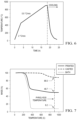
- FIG. 6 shows the pyrolysis temperature—time profile.
- the profile was obtained based on thermogravimetric analysis since the polymer precursor experiences two main mass losses during crosslinking and ceramization phases. The mass loss during ceramization is due to release of gasses from the precursor polymer. Rapid heat-up during the ceramization may lead to formation of defects and large pores. Hence, the heating rate in the temperature range of 450° C.-900° C. was chosen to be several times slower than the initial rate.
- the pyrolysis temperature—time cycle was as follows: from room temperature to 450° C. at a heating rate of 2° C./min, and from 450° C. to 900° C. at a heating rate of 0.5° C./min, followed by a hold at 900° C. for one hour.
- FIG. 7 shows the TGA results for the support bath (8.2), cured casted-sample (88.5), and cured printed-sample (49.7). Cured here implies that the printed and cast samples were first cured and the thermal analysis was performed on the cured samples. This experiment was conducted to further understand the interaction between the support bath and the printed ceramic by considering the cast samples (free of support bath) as the control.
- the cured-cast specimen does not show noticeable mass loss for temperature ⁇ 600° C. For higher temperature, up to 1000° C., there is a total mass loss of ⁇ 11.5%, which corresponds to ceramization.
- the cured-printed specimen shows an initial mass loss at similar temperature to the support bath, an indication that some residues of the support bath (mineral oil and silica nanoparticles) are left on the printed specimen after retrieval from the bath. The mineral oil part of this residue is evaporated in the process, leaving behind a coating of consolidated silica nanoparticles on the specimen. The thickness of this coating was estimated to be ⁇ 115 microns.
- the Weibull modulus is the shape parameter that maps a failure probability of a specimen in a range of stress. If the strength measurement exhibits a low statistical variation, the Weibull modulus will be high, demonstrating that the strength can be presented as a single value to describe the specimen to specimen performance. On the contrary, if the measurement shows a high variation, the calculated Weibull modulus will be low, an indication that the flaws are distributed inconsistently.
- the calculated Weibull moduli indicate that the variation in strength measurement of cast specimens was slightly higher than 3D-printed ones, expressing a higher variability in flaws distribution in cast samples.
- the rigid walls of the casting mold may prevent material shrinkage during cross-linking and result in formation of micro-cracks and pores.
- the final density of the pyrolyzed ceramic is estimated to be ⁇ 1.6 g/cm3.
Landscapes
- Engineering & Computer Science (AREA)
- Chemical & Material Sciences (AREA)
- Manufacturing & Machinery (AREA)
- Materials Engineering (AREA)
- Ceramic Engineering (AREA)
- Structural Engineering (AREA)
- Organic Chemistry (AREA)
- Mechanical Engineering (AREA)
- Inorganic Chemistry (AREA)
- Ceramic Products (AREA)
Abstract
Description
in which ρ is the density of the bath, L is the nozzle length immersed in the bath, d is the nozzle diameter, and η is the bath viscosity21. In our experiment, the nozzle speed was well below the critical speed that would cause recirculating wake (˜250 mm/s).
21. Assuming, a spherical geometry with the typical print cross-sectional area in this work (˜1.2 mm), the sinking speed is estimated to be ˜0.096 mm/s, which is rather small considering to the total printing duration. Given that the viscosity of the support bath depends on the shear rate (
21 in which γoil-polymer is the interfacial tension between the bath and the preceramic polymer solution, and σy is the yield stress of the bath (˜5.1 Pa). However, the smallest stable feature size in our work was ˜0.7 mm, without breakup of the printed polymer, and this is more attributed to the limitations of the printer and not the process itself.
Such analysis considers the variability in the ceramic strength as a function of flaw population in the material [32]. m is the Weibull modulus, and σ0 is the characteristic strength. Specimens' flexural strengths were ranked in an ascending order and assigned a probability using Pf=(i−0.5)/n, where n is the total number of specimens. Probabilities and the flexural strengths are presented in terms of ln(ln(1/1−Pf)) and ln(σ). Based on this analysis, the characteristic strength, which is the value of stress for Pf=63.2%, for the 3D-printed and casted ceramics was calculated to be ˜257 MPa and ˜82 MPa, respectively. The linear regression of the flexural strength yields the Weibull modulus of m=3.7 for 3D-printed specimens and m=2.0 for cast specimens.
Given the density of the preceramic polymer solution (1.1 g/cm3), the final density of the pyrolyzed ceramic is estimated to be ˜1.6 g/cm3.
- 1. Chen, Z.; Li, Z.; Li, J.; Liu, C.; Lao, C.; Fu, Y.; Liu, C.; Li, Y.; Wang, P.; He, Y., 3d Printing of Ceramics: A Review. Journal of the European Ceramic Society 2019, 39 (4), 661-687.
- 2. Zocca, A.; Colombo, P.; Gomes, C. M.; Gunster, J., Additive Manufacturing of Ceramics: Issues, Potentialities, and Opportunities. Journal of the American Ceramic Society 2015, 98 (7), 1983-2001.
- 3. Griffith, M. L.; Halloran, J. W., Freeform Fabrication of Ceramics Via Stereolithography. Journal of the American Ceramic Society 1996, 79 (10), 2601-2608.
- 4. Chartier, T.; Chaput, C.; Doreau, F.; Loiseau, M., Stereolithography of Structural Complex Ceramic Parts. Journal of Materials Science 2002, 37 (15), 3141-3147.
- 5. Lv, X.; Ye, F.; Cheng, L.; Fan, S.; Liu, Y., Binder Jetting of Ceramics: Powders, Binders, Printing Parameters, Equipment, and Post-Treatment. Ceramics International 2019, 45 (10), 12609-12624.
- 6. Bertrand, P.; Bayle, F.; Combe, C.; Goeuriot, P.; Smurov, I., Ceramic Components Manufacturing by Selective Laser Sintering. Applied Surface Science 2007, 254 (4), 989-992.
- 7. Shahzad, K.; Deckers, J.; Kruth, J.-P.; Vleugels, J., Additive Manufacturing of Alumina Parts by Indirect Selective Laser Sintering and Post Processing. Journal of Materials Processing Technology 2013, 213 (9), 1484-1494.
- 8. Franchin, G.; Wahl, L.; Colombo, P., Direct Ink Writing of Ceramic Matrix Composite Structures. Journal of the American Ceramic Society 2017, 100 (10), 4397-4401.
- 9. Colombo, P.; Mera, G.; Riedel, R.; Soraru, G. D., Polymer-Derived Ceramics: 40 Years of Research and Innovation in Advanced Ceramics. Journal of the American Ceramic Society 2010, 93 (7), 1805-1837.
- 10. Pham, T. A.; Kim, D. P.; Lim, T. W.; Park, S. H.; Yang, D. Y.; Lee, K. S., Three-Dimensional Sicn Ceramic Microstructures Via Nano-Stereolithography of Inorganic Polymer Photoresists. Advanced Functional Materials 2006, 16 (9), 1235-1241.
- 11. Martinez-Crespiera, S.; Ionescu, E.; Kleebe, H.-J.; Riedel, R., Pressureless Synthesis of Fully Dense and Crack-Free Sioc Bulk Ceramics Via Photo-Crosslinking and Pyrolysis of a Polysiloxane. Journal of the European Ceramic Society 2011, 31 (5), 913-919.
- 12. Shah, S. R.; Raj, R., Mechanical Properties of a Fully Dense Polymer Derived Ceramic Made by a Novel Pressure Casting Process. Acta Materialia 2002, 50 (16), 4093-4103.
- 13. Zanchetta, E.; Cattaldo, M.; Franchin, G.; Schwentenwein, M.; Homa, J.; Brusatin, G.; Colombo, P., Stereolithography of Sioc Ceramic Microcomponents. Advanced Materials 2016, 28 (2), 370-376.
- 14. Schwentenwein, M.; Homa, J., Additive Manufacturing of Dense Alumina Ceramics. International Journal of Applied Ceramic Technology 2015, 12 (1), 1-7.
- 15. Eckel, Z. C.; Zhou, C.; Martin, J. H.; Jacobsen, A. J.; Carter, W. B.; Schaedler, T. A., Additive Manufacturing of Polymer-Derived Ceramics. Science 2016, 351 (6268), 58-62.
- 16. Brigo, L.; Schmidt, J. E. M.; Gandin, A.; Michieli, N.; Colombo, P.; Brusatin, G., 3d Nanofabrication of Sioc Ceramic Structures. Advanced Science 2018, 5 (12), 1800937.
- 17. Hinton, T. J.; Jallerat, Q.; Palchesko, R. N.; Park, J. H.; Grodzicki, M. S.; Shue, H.-J.; Ramadan, M. H.; Hudson, A. R.; Feinberg, A. W., Three-Dimensional Printing of Complex Biological Structures by Freeform Reversible Embedding of Suspended Hydrogels. Science Advances 2015, 1 (9), e1500758.
- 18. O'Bryan, C. S.; Bhattacharjee, T.; Hart, S.; Kabb, C. P.; Schulze, K. D.; Chilakala, I.; Sumerlin, B. S.; Sawyer, W. G.; Angelini, T. E., Self-Assembled Micro-Organogels for 3d Printing Silicone Structures. Science Advances 2017, 3 (5), e1602800.
- 19. Bhattacharjee, T.; Zehnder, S. M.; Rowe, K. G.; Jain, S.; Nixon, R. M.; Sawyer, W. G.; Angelini, T. E., Writing in the Granular Gel Medium. Science Advances 2015, 1 (8), e1500655.
- 20. Lindahl, J.; Hassen, A.; Romberg, S.; Hedger, B.; Hedger Jr, P.; Walch, M.; DeLuca, T.; Morrison, W.; Kim, P.; Roschli, A.; Nuttall, D.; Czachowski, J.; Post, B.; Love, L.; Kunc, V. In Large-Scale Additive Manufacturing with Reactive Polymers, United States, 2018-10-01; United States, 2018.
- 21. O'Bryan, C. S.; Bhattacharjee, T.; Niemi, S. R.; Balachandar, S.; Baldwin, N.; Ellison, S. T.; Taylor, C. R.; Sawyer, W. G.; Angelini, T. E., Three-Dimensional Printing with Sacrificial Materials for Soft Matter Manufacturing. MRS Bulletin 2017, 42 (8), 571-577.
- 22. Li, J.; Lu, K.; Lin, T.; Shen, F., Preparation of Micro-/Mesoporous Sioc Bulk Ceramics. Journal of the American Ceramic Society 2015, 98 (6), 1753-1761.
- 23. Ionescu, E.; Kleebe, H. J.; Riedel, R., Silicon-Containing Polymer-Derived Ceramic Nanocomposites (Pdc-Ncs): Preparative Approaches and Properties. Chem Soc Rev 2012, 41 (15), 5032-5052.
- 24. Li, J. K.; Lu, K.; Lin, T. S.; Shen, F. Y., Preparation of Micro-/Mesoporous Sioc Bulk Ceramics. Journal of the American Ceramic Society 2015, 98 (6), 1753-1761.
- 25. Kulkarni, A.; Soraru, G.; Pearce, J., Polymer-Derived Sioc Replica of Material Extrusion-Based 3-D Printed Plastics. 2020, 32, 100988.
- 26. Jiang, H.; Wang, X.-H.; Lei, W.; Fan, G.-F.; Lu, W.-Z., Effects of Two-Step Sintering on Thermal and Mechanical Properties of Aluminum Nitride Ceramics by Impedance Spectroscopy Analysis. Journal of the European Ceramic Society 2019, 39 (2-3), 249-254.
- 27. Tian, X.; Yan, K.; Liu, H.; Zhao, J.; Yang, J., Effect of Co on Thermal and Mechanical Properties of Si3n4 Based Ceramic Tool Material. Ceramics International 2019, 45, 19435-19441.
- 28. Yuan, Q.; Chai, Z. F.; Huang, Z. R.; Huang, Q., A New Precursor of Liquid and Curable Polysiloxane for Highly Cost-Efficient Sioc-Based Composites. Ceramics International 2019, 45 (6), 7044-7048.
- 29. ASTM, Standard Test Method for Flexural Strength of Advanced Ceramics at Ambient Temperature-Cylindrical Rod Strength. In C1684-18, American Society of Testing Materials: 2019.
- 30. Astm C1239-13 (2018): Standard Practice for Reporting Uniaxial Strength Data and Estimating Weibull Distribution Parameters for Advanced Ceramics.
- 31. Khalili, A.; Kromp, K., Statistical Properties of Weibull Estimators. Journal of materials science 1991, 26 (24), 6741-6752.
- 32. Quinn, J. B.; Quinn, G. D., A Practical and Systematic Review of Weibull Statistics for Reporting Strengths of Dental Materials. dental materials 2010, 26 (2), 135-147.
- 33. Bakumov, V., et al., Mechanical and tribological properties of polymer-derived Si/C/N sub-millimetre thick miniaturized components fabricated by direct casting. Journal of the European Ceramic Society, 2012. 32(8): p. 1759-1767.
- 34. Sasikumar, P. V. W., et al., Polymer derived silicon oxycarbide ceramic monoliths: Microstructure development and associated materials properties. Ceramics International, 2018. 44(17): p. 20961-20967.
- 35. Zocca, A., et al., Additive manufacturing of SiSiC by layerwise slurry deposition and binder jetting (LSD-print). Journal of the European Ceramic Society, 2019.
- 36. Danzer, R., et al., Fracture statistics of ceramics-Weibull statistics and deviations from Weibull statistics. Engineering Fracture Mechanics, 2007. 74(18): p. 2919-2932.
- 37. Zhou, J., et al., Mechanical and Dielectric Properties of Two Types of Si3N4 Fibers Annealed at Elevated Temperatures. Materials, 2018. 11(9): p. 1498.
Claims (14)
Priority Applications (2)
| Application Number | Priority Date | Filing Date | Title |
|---|---|---|---|
| US17/304,443 US12030210B2 (en) | 2020-06-19 | 2021-06-21 | Additive manufacturing of polymer ceramics |
| US18/678,315 US20240316821A1 (en) | 2020-06-19 | 2024-05-30 | Additive manufacturing of polymer ceramics |
Applications Claiming Priority (3)
| Application Number | Priority Date | Filing Date | Title |
|---|---|---|---|
| US202063041364P | 2020-06-19 | 2020-06-19 | |
| US202163211897P | 2021-06-17 | 2021-06-17 | |
| US17/304,443 US12030210B2 (en) | 2020-06-19 | 2021-06-21 | Additive manufacturing of polymer ceramics |
Related Child Applications (1)
| Application Number | Title | Priority Date | Filing Date |
|---|---|---|---|
| US18/678,315 Division US20240316821A1 (en) | 2020-06-19 | 2024-05-30 | Additive manufacturing of polymer ceramics |
Publications (2)
| Publication Number | Publication Date |
|---|---|
| US20210394391A1 US20210394391A1 (en) | 2021-12-23 |
| US12030210B2 true US12030210B2 (en) | 2024-07-09 |
Family
ID=79022926
Family Applications (2)
| Application Number | Title | Priority Date | Filing Date |
|---|---|---|---|
| US17/304,443 Active 2041-07-30 US12030210B2 (en) | 2020-06-19 | 2021-06-21 | Additive manufacturing of polymer ceramics |
| US18/678,315 Pending US20240316821A1 (en) | 2020-06-19 | 2024-05-30 | Additive manufacturing of polymer ceramics |
Family Applications After (1)
| Application Number | Title | Priority Date | Filing Date |
|---|---|---|---|
| US18/678,315 Pending US20240316821A1 (en) | 2020-06-19 | 2024-05-30 | Additive manufacturing of polymer ceramics |
Country Status (1)
| Country | Link |
|---|---|
| US (2) | US12030210B2 (en) |
Families Citing this family (5)
| Publication number | Priority date | Publication date | Assignee | Title |
|---|---|---|---|---|
| CN112074394A (en) * | 2019-12-18 | 2020-12-11 | 清锋(北京)科技有限公司 | Printed matter processing system and method |
| US11471337B2 (en) * | 2020-04-30 | 2022-10-18 | Sprintray Inc. | 3D printed nasal pharyngeal and oral swabs |
| KR102474673B1 (en) * | 2020-10-15 | 2022-12-08 | 한국재료연구원 | Method of manufacturing free-standing ceramic 3D printing structure |
| CN118546002A (en) * | 2024-03-26 | 2024-08-27 | 成都大学 | Method for preparing PDC-RESiOC ceramic through photo-curing 3D printing |
| CN119661183B (en) * | 2024-12-16 | 2025-09-19 | 哈尔滨工业大学 | Method for preparing high-temperature-resistant broadband wave-absorbing inorganic polymer matrix composite component by 3D printing |
Citations (6)
| Publication number | Priority date | Publication date | Assignee | Title |
|---|---|---|---|---|
| US20160067918A1 (en) * | 2014-09-08 | 2016-03-10 | Empire Technology Development Llc | Methods and systems for making a three-dimensional object |
| US20160167312A1 (en) * | 2013-07-29 | 2016-06-16 | Carnegie Mellon University | Additive manufacturing of embedded materials |
| US20170341297A1 (en) * | 2016-05-27 | 2017-11-30 | Florida State University Research Foundation, Inc. | Polymeric Ceramic Precursors, Apparatuses, Systems, and Methods |
| US20180281295A1 (en) * | 2017-04-04 | 2018-10-04 | Massachusetts Institute Of Technology | Additive Manufacturing in Gel-Supported Environment |
| US20190160704A1 (en) * | 2017-09-22 | 2019-05-30 | Goodman Technologies LLC | 3D Printing of Silicon Carbide Structures |
| US20200308062A1 (en) * | 2019-03-28 | 2020-10-01 | Ut-Battelle, Llc | Slurry Mixtures for 3-D Slurry Extrusion of Artifacts |
Family Cites Families (1)
| Publication number | Priority date | Publication date | Assignee | Title |
|---|---|---|---|---|
| US10611694B2 (en) * | 2016-09-15 | 2020-04-07 | Board Of Regents, The University Of Texas System | Systems and methods for additive manufacturing of ceramics |
-
2021
- 2021-06-21 US US17/304,443 patent/US12030210B2/en active Active
-
2024
- 2024-05-30 US US18/678,315 patent/US20240316821A1/en active Pending
Patent Citations (13)
| Publication number | Priority date | Publication date | Assignee | Title |
|---|---|---|---|---|
| US20160167312A1 (en) * | 2013-07-29 | 2016-06-16 | Carnegie Mellon University | Additive manufacturing of embedded materials |
| US10150258B2 (en) * | 2013-07-29 | 2018-12-11 | Carnegie Mellon University | Additive manufacturing of embedded materials |
| US10005235B2 (en) * | 2014-09-08 | 2018-06-26 | Empire Technology Development Llc | Methods and systems for making a three-dimensional object |
| US20160067918A1 (en) * | 2014-09-08 | 2016-03-10 | Empire Technology Development Llc | Methods and systems for making a three-dimensional object |
| US20170341297A1 (en) * | 2016-05-27 | 2017-11-30 | Florida State University Research Foundation, Inc. | Polymeric Ceramic Precursors, Apparatuses, Systems, and Methods |
| US10384393B2 (en) * | 2016-05-27 | 2019-08-20 | Florida State University Research Foundation, Inc. | Polymeric ceramic precursors, apparatuses, systems, and methods |
| US10953605B2 (en) * | 2017-04-04 | 2021-03-23 | Massachusetts Institute of Technology, Cambridge, Massachusetts and Steeicase Incorporated | Additive manufacturing in gel-supported environment |
| US20180281295A1 (en) * | 2017-04-04 | 2018-10-04 | Massachusetts Institute Of Technology | Additive Manufacturing in Gel-Supported Environment |
| US20210178702A1 (en) * | 2017-04-04 | 2021-06-17 | Massachusetts Institute Of Technology | Additive manufacturing in gel-supported environment |
| US20210138737A1 (en) * | 2017-04-04 | 2021-05-13 | Massachusetts Institute Of Technology | Additive manufacturing in gel-supported environment |
| US20190160704A1 (en) * | 2017-09-22 | 2019-05-30 | Goodman Technologies LLC | 3D Printing of Silicon Carbide Structures |
| US10730203B2 (en) * | 2017-09-22 | 2020-08-04 | Goodman Technologies LLC | 3D printing of silicon carbide structures |
| US20200308062A1 (en) * | 2019-03-28 | 2020-10-01 | Ut-Battelle, Llc | Slurry Mixtures for 3-D Slurry Extrusion of Artifacts |
Non-Patent Citations (4)
| Title |
|---|
| "Materials, Keeping Cool . . . Even at 1,400° C," Additive Manufacturing, vol. 10, No. 2, Mar. 2021, copyright 2023, Gardner Business Media, Inc., 44 pages.https://am.mydigitalpublication.com/march-2021?m=59260&i=695077&p=1&ver=html5. |
| Mahmoudi et al., "3-Dimensional Printing of Ceramics through "Carving" a Gel and "Filling in" the Precursor Polymer," ACS Applied Materials & Interfaces, vol. 12, No. 28, Jun. 17, 2020, 26 pages. |
| Sigma-Aldrich, Product Information for Silica, fumed, Catalog No. S5505, 2012, Sigma-Aldrich (Year: 2012). * |
| Yifei Jin, Kaidong Song, Nevada Gellermann, and Yong Huang, Printing of Hydrophobic Materials in Fumed Silica Nanoparticle Suspension, 2019, ACS Applied Materials & Interfaces, 2019 11 (32), 29207-29217 DOI: 10.1021/acsami.9b07433 (Year: 2019). * |
Also Published As
| Publication number | Publication date |
|---|---|
| US20210394391A1 (en) | 2021-12-23 |
| US20240316821A1 (en) | 2024-09-26 |
Similar Documents
| Publication | Publication Date | Title |
|---|---|---|
| US12030210B2 (en) | Additive manufacturing of polymer ceramics | |
| Xiong et al. | 3D SiC containing uniformly dispersed, aligned SiC whiskers: Printability, microstructure and mechanical properties | |
| Mamatha et al. | Digital light processing of ceramics: An overview on process, materials and challenges | |
| Yang et al. | Silicon carbide whiskers reinforced SiOC ceramics through digital light processing 3D printing technology | |
| Xiong et al. | 3D printing of crack-free dense polymer-derived ceramic monoliths and lattice skeletons with improved thickness and mechanical performance | |
| Zanchetta et al. | Stereolithography of SiOC ceramic microcomponents | |
| Fu et al. | Multiple metals doped polymer-derived SiOC ceramics for 3D printing | |
| He et al. | Polymer-derived SiOC ceramic lattice with thick struts prepared by digital light processing | |
| Mahmoudi et al. | Three-dimensional printing of ceramics through “carving” a gel and “filling in” the precursor polymer | |
| Cramer et al. | Processing and properties of SiC composites made via binder jet 3D printing and infiltration and pyrolysis of preceramic polymer | |
| Lacelle et al. | Additive manufacturing of polymer derived ceramics: Materials, methods, and applications | |
| Grinchuk et al. | Effect of technological parameters on densification of reaction bonded Si/SiC ceramics | |
| Zhao et al. | Optimized preceramic polymer for 3D structured ceramics via fused deposition modeling | |
| Sarraf et al. | EVA-PVA binder system for polymer derived mullite made by material extrusion based additive manufacturing | |
| Mummareddy et al. | The fracture properties of metal‐ceramic composites manufactured via stereolithography | |
| JP2016137521A (en) | Porous ceramic materials for investment casting | |
| Ionescu et al. | Polymer processing of ceramics | |
| Yang et al. | Large-size Si3N4 ceramic fabricated by additive manufacturing using long-term stable hydrogel-based suspensions | |
| McClain et al. | Additive manufacturing of carbon fiber reinforced silicon carbide solid rocket nozzles | |
| Li et al. | Pore structure and thermal oxidation curing behavior of porous polymer derived ceramics with superhigh porosity fabricated by freeze casting | |
| Kemp et al. | Size effects in 3D‐printed polymer‐derived, zirconium diboride‐reinforced ceramic composites | |
| Wu et al. | Binder jetting printed in situ mullite strengthened alumina ceramics with excellent mechanical and thermal properties through multi-phase infiltration | |
| Konegger et al. | Bulk ceramic composites derived from a preceramic polysilazane with alumina and zirconia fillers | |
| Schelm et al. | Tailored surface properties of ceramic foams for liquid multiphase reactions | |
| Wang | Photoinduced thiol-ene click chemistry assisted additive manufacturing and freeze casting of polymer-derived ceramics |
Legal Events
| Date | Code | Title | Description |
|---|---|---|---|
| FEPP | Fee payment procedure |
Free format text: ENTITY STATUS SET TO UNDISCOUNTED (ORIGINAL EVENT CODE: BIG.); ENTITY STATUS OF PATENT OWNER: SMALL ENTITY |
|
| FEPP | Fee payment procedure |
Free format text: ENTITY STATUS SET TO SMALL (ORIGINAL EVENT CODE: SMAL); ENTITY STATUS OF PATENT OWNER: SMALL ENTITY |
|
| STPP | Information on status: patent application and granting procedure in general |
Free format text: DOCKETED NEW CASE - READY FOR EXAMINATION |
|
| STPP | Information on status: patent application and granting procedure in general |
Free format text: NON FINAL ACTION MAILED |
|
| STPP | Information on status: patent application and granting procedure in general |
Free format text: RESPONSE TO NON-FINAL OFFICE ACTION ENTERED AND FORWARDED TO EXAMINER |
|
| AS | Assignment |
Owner name: BOARD OF REGENTS, THE UNIVERSITY OF TEXAS SYSTEM, TEXAS Free format text: ASSIGNMENT OF ASSIGNORS INTEREST;ASSIGNORS:MINARY-JOLANDAN, MAJID;MAHMOUDI, MOHAMMADREZA;BURLISON, SCOTT R.;AND OTHERS;SIGNING DATES FROM 20210723 TO 20210724;REEL/FRAME:063468/0748 |
|
| STPP | Information on status: patent application and granting procedure in general |
Free format text: FINAL REJECTION MAILED |
|
| STPP | Information on status: patent application and granting procedure in general |
Free format text: NON FINAL ACTION MAILED |
|
| STPP | Information on status: patent application and granting procedure in general |
Free format text: RESPONSE TO NON-FINAL OFFICE ACTION ENTERED AND FORWARDED TO EXAMINER |
|
| STPP | Information on status: patent application and granting procedure in general |
Free format text: NOTICE OF ALLOWANCE MAILED -- APPLICATION RECEIVED IN OFFICE OF PUBLICATIONS |
|
| STPP | Information on status: patent application and granting procedure in general |
Free format text: PUBLICATIONS -- ISSUE FEE PAYMENT VERIFIED |
|
| STCF | Information on status: patent grant |
Free format text: PATENTED CASE |
|
| AS | Assignment |
Owner name: NATIONAL SCIENCE FOUNDATION, VIRGINIA Free format text: CONFIRMATORY LICENSE;ASSIGNOR:UNIVERSITY OF TEXAS DALLAS;REEL/FRAME:070761/0706 Effective date: 20210927 |