US12025916B2 - Resist underlayer film-forming composition that contains triaryldiamine-containing novolac resin to which aromatic vinyl compound is added - Google Patents
Resist underlayer film-forming composition that contains triaryldiamine-containing novolac resin to which aromatic vinyl compound is added Download PDFInfo
- Publication number
- US12025916B2 US12025916B2 US16/971,357 US201916971357A US12025916B2 US 12025916 B2 US12025916 B2 US 12025916B2 US 201916971357 A US201916971357 A US 201916971357A US 12025916 B2 US12025916 B2 US 12025916B2
- Authority
- US
- United States
- Prior art keywords
- group
- underlayer film
- resist underlayer
- resist
- forming composition
- Prior art date
- Legal status (The legal status is an assumption and is not a legal conclusion. Google has not performed a legal analysis and makes no representation as to the accuracy of the status listed.)
- Active, expires
Links
Classifications
-
- G—PHYSICS
- G03—PHOTOGRAPHY; CINEMATOGRAPHY; ANALOGOUS TECHNIQUES USING WAVES OTHER THAN OPTICAL WAVES; ELECTROGRAPHY; HOLOGRAPHY
- G03F—PHOTOMECHANICAL PRODUCTION OF TEXTURED OR PATTERNED SURFACES, e.g. FOR PRINTING, FOR PROCESSING OF SEMICONDUCTOR DEVICES; MATERIALS THEREFOR; ORIGINALS THEREFOR; APPARATUS SPECIALLY ADAPTED THEREFOR
- G03F7/00—Photomechanical, e.g. photolithographic, production of textured or patterned surfaces, e.g. printing surfaces; Materials therefor, e.g. comprising photoresists; Apparatus specially adapted therefor
- G03F7/004—Photosensitive materials
- G03F7/09—Photosensitive materials characterised by structural details, e.g. supports, auxiliary layers
- G03F7/11—Photosensitive materials characterised by structural details, e.g. supports, auxiliary layers having cover layers or intermediate layers, e.g. subbing layers
-
- G—PHYSICS
- G03—PHOTOGRAPHY; CINEMATOGRAPHY; ANALOGOUS TECHNIQUES USING WAVES OTHER THAN OPTICAL WAVES; ELECTROGRAPHY; HOLOGRAPHY
- G03F—PHOTOMECHANICAL PRODUCTION OF TEXTURED OR PATTERNED SURFACES, e.g. FOR PRINTING, FOR PROCESSING OF SEMICONDUCTOR DEVICES; MATERIALS THEREFOR; ORIGINALS THEREFOR; APPARATUS SPECIALLY ADAPTED THEREFOR
- G03F7/00—Photomechanical, e.g. photolithographic, production of textured or patterned surfaces, e.g. printing surfaces; Materials therefor, e.g. comprising photoresists; Apparatus specially adapted therefor
- G03F7/004—Photosensitive materials
- G03F7/09—Photosensitive materials characterised by structural details, e.g. supports, auxiliary layers
- G03F7/094—Multilayer resist systems, e.g. planarising layers
-
- C—CHEMISTRY; METALLURGY
- C08—ORGANIC MACROMOLECULAR COMPOUNDS; THEIR PREPARATION OR CHEMICAL WORKING-UP; COMPOSITIONS BASED THEREON
- C08G—MACROMOLECULAR COMPOUNDS OBTAINED OTHERWISE THAN BY REACTIONS ONLY INVOLVING UNSATURATED CARBON-TO-CARBON BONDS
- C08G12/00—Condensation polymers of aldehydes or ketones with only compounds containing hydrogen attached to nitrogen
- C08G12/02—Condensation polymers of aldehydes or ketones with only compounds containing hydrogen attached to nitrogen of aldehydes
- C08G12/04—Condensation polymers of aldehydes or ketones with only compounds containing hydrogen attached to nitrogen of aldehydes with acyclic or carbocyclic compounds
- C08G12/06—Amines
- C08G12/08—Amines aromatic
-
- C—CHEMISTRY; METALLURGY
- C08—ORGANIC MACROMOLECULAR COMPOUNDS; THEIR PREPARATION OR CHEMICAL WORKING-UP; COMPOSITIONS BASED THEREON
- C08G—MACROMOLECULAR COMPOUNDS OBTAINED OTHERWISE THAN BY REACTIONS ONLY INVOLVING UNSATURATED CARBON-TO-CARBON BONDS
- C08G61/00—Macromolecular compounds obtained by reactions forming a carbon-to-carbon link in the main chain of the macromolecule
- C08G61/12—Macromolecular compounds containing atoms other than carbon in the main chain of the macromolecule
-
- C—CHEMISTRY; METALLURGY
- C08—ORGANIC MACROMOLECULAR COMPOUNDS; THEIR PREPARATION OR CHEMICAL WORKING-UP; COMPOSITIONS BASED THEREON
- C08L—COMPOSITIONS OF MACROMOLECULAR COMPOUNDS
- C08L61/00—Compositions of condensation polymers of aldehydes or ketones; Compositions of derivatives of such polymers
- C08L61/04—Condensation polymers of aldehydes or ketones with phenols only
- C08L61/06—Condensation polymers of aldehydes or ketones with phenols only of aldehydes with phenols
-
- C—CHEMISTRY; METALLURGY
- C09—DYES; PAINTS; POLISHES; NATURAL RESINS; ADHESIVES; COMPOSITIONS NOT OTHERWISE PROVIDED FOR; APPLICATIONS OF MATERIALS NOT OTHERWISE PROVIDED FOR
- C09D—COATING COMPOSITIONS, e.g. PAINTS, VARNISHES OR LACQUERS; FILLING PASTES; CHEMICAL PAINT OR INK REMOVERS; INKS; CORRECTING FLUIDS; WOODSTAINS; PASTES OR SOLIDS FOR COLOURING OR PRINTING; USE OF MATERIALS THEREFOR
- C09D161/00—Coating compositions based on condensation polymers of aldehydes or ketones; Coating compositions based on derivatives of such polymers
- C09D161/20—Condensation polymers of aldehydes or ketones with only compounds containing hydrogen attached to nitrogen
- C09D161/22—Condensation polymers of aldehydes or ketones with only compounds containing hydrogen attached to nitrogen of aldehydes with acyclic or carbocyclic compounds
-
- G—PHYSICS
- G03—PHOTOGRAPHY; CINEMATOGRAPHY; ANALOGOUS TECHNIQUES USING WAVES OTHER THAN OPTICAL WAVES; ELECTROGRAPHY; HOLOGRAPHY
- G03F—PHOTOMECHANICAL PRODUCTION OF TEXTURED OR PATTERNED SURFACES, e.g. FOR PRINTING, FOR PROCESSING OF SEMICONDUCTOR DEVICES; MATERIALS THEREFOR; ORIGINALS THEREFOR; APPARATUS SPECIALLY ADAPTED THEREFOR
- G03F7/00—Photomechanical, e.g. photolithographic, production of textured or patterned surfaces, e.g. printing surfaces; Materials therefor, e.g. comprising photoresists; Apparatus specially adapted therefor
- G03F7/004—Photosensitive materials
- G03F7/0045—Photosensitive materials with organic non-macromolecular light-sensitive compounds not otherwise provided for, e.g. dissolution inhibitors
-
- G—PHYSICS
- G03—PHOTOGRAPHY; CINEMATOGRAPHY; ANALOGOUS TECHNIQUES USING WAVES OTHER THAN OPTICAL WAVES; ELECTROGRAPHY; HOLOGRAPHY
- G03F—PHOTOMECHANICAL PRODUCTION OF TEXTURED OR PATTERNED SURFACES, e.g. FOR PRINTING, FOR PROCESSING OF SEMICONDUCTOR DEVICES; MATERIALS THEREFOR; ORIGINALS THEREFOR; APPARATUS SPECIALLY ADAPTED THEREFOR
- G03F7/00—Photomechanical, e.g. photolithographic, production of textured or patterned surfaces, e.g. printing surfaces; Materials therefor, e.g. comprising photoresists; Apparatus specially adapted therefor
- G03F7/16—Coating processes; Apparatus therefor
- G03F7/168—Finishing the coated layer, e.g. drying, baking, soaking
-
- G—PHYSICS
- G03—PHOTOGRAPHY; CINEMATOGRAPHY; ANALOGOUS TECHNIQUES USING WAVES OTHER THAN OPTICAL WAVES; ELECTROGRAPHY; HOLOGRAPHY
- G03F—PHOTOMECHANICAL PRODUCTION OF TEXTURED OR PATTERNED SURFACES, e.g. FOR PRINTING, FOR PROCESSING OF SEMICONDUCTOR DEVICES; MATERIALS THEREFOR; ORIGINALS THEREFOR; APPARATUS SPECIALLY ADAPTED THEREFOR
- G03F7/00—Photomechanical, e.g. photolithographic, production of textured or patterned surfaces, e.g. printing surfaces; Materials therefor, e.g. comprising photoresists; Apparatus specially adapted therefor
- G03F7/20—Exposure; Apparatus therefor
-
- G—PHYSICS
- G03—PHOTOGRAPHY; CINEMATOGRAPHY; ANALOGOUS TECHNIQUES USING WAVES OTHER THAN OPTICAL WAVES; ELECTROGRAPHY; HOLOGRAPHY
- G03F—PHOTOMECHANICAL PRODUCTION OF TEXTURED OR PATTERNED SURFACES, e.g. FOR PRINTING, FOR PROCESSING OF SEMICONDUCTOR DEVICES; MATERIALS THEREFOR; ORIGINALS THEREFOR; APPARATUS SPECIALLY ADAPTED THEREFOR
- G03F7/00—Photomechanical, e.g. photolithographic, production of textured or patterned surfaces, e.g. printing surfaces; Materials therefor, e.g. comprising photoresists; Apparatus specially adapted therefor
- G03F7/20—Exposure; Apparatus therefor
- G03F7/2037—Exposure with X-ray radiation or corpuscular radiation, through a mask with a pattern opaque to that radiation
-
- H01L21/0275—
-
- H—ELECTRICITY
- H10—SEMICONDUCTOR DEVICES; ELECTRIC SOLID-STATE DEVICES NOT OTHERWISE PROVIDED FOR
- H10P—GENERIC PROCESSES OR APPARATUS FOR THE MANUFACTURE OR TREATMENT OF DEVICES COVERED BY CLASS H10
- H10P76/00—Manufacture or treatment of masks on semiconductor bodies, e.g. by lithography or photolithography
-
- H—ELECTRICITY
- H10—SEMICONDUCTOR DEVICES; ELECTRIC SOLID-STATE DEVICES NOT OTHERWISE PROVIDED FOR
- H10P—GENERIC PROCESSES OR APPARATUS FOR THE MANUFACTURE OR TREATMENT OF DEVICES COVERED BY CLASS H10
- H10P76/00—Manufacture or treatment of masks on semiconductor bodies, e.g. by lithography or photolithography
- H10P76/20—Manufacture or treatment of masks on semiconductor bodies, e.g. by lithography or photolithography of masks comprising organic materials
- H10P76/204—Manufacture or treatment of masks on semiconductor bodies, e.g. by lithography or photolithography of masks comprising organic materials of organic photoresist masks
- H10P76/2041—Photolithographic processes
- H10P76/2042—Photolithographic processes using lasers
-
- H—ELECTRICITY
- H10—SEMICONDUCTOR DEVICES; ELECTRIC SOLID-STATE DEVICES NOT OTHERWISE PROVIDED FOR
- H10P—GENERIC PROCESSES OR APPARATUS FOR THE MANUFACTURE OR TREATMENT OF DEVICES COVERED BY CLASS H10
- H10P76/00—Manufacture or treatment of masks on semiconductor bodies, e.g. by lithography or photolithography
- H10P76/40—Manufacture or treatment of masks on semiconductor bodies, e.g. by lithography or photolithography of masks comprising inorganic materials
- H10P76/405—Manufacture or treatment of masks on semiconductor bodies, e.g. by lithography or photolithography of masks comprising inorganic materials characterised by their composition, e.g. multilayer masks
Definitions
- the depth of focus decreases in association with the use of exposure light having a shorter wavelength, and thus the planarity of a coating film formed on a substrate must be improved for forming a desired resist pattern at high accuracy.
- the production of a semiconductor device having a fine design rule requires a resist underlayer film that enables formation of a flat (e.g., even) coating film on a substrate.
- a resist underlayer film-forming composition containing a crosslinkable compound having a C 2-10 alkoxymethyl group or a C 1-10 alkyl group see Patent Document 1.
- the composition exhibits good fillability when applied to a substrate having a hole pattern.
- thermosetting resist underlayer film-forming composition contains a polymer having a thermally crosslinkable functional group (e.g., a hydroxyl group), a crosslinking agent, and an acid catalyst (acid generator), the viscosity of the composition may increase as crosslinking reaction proceeds by baking during filling of a pattern (e.g., a hole or a trench structure) formed on a substrate with the composition, leading to insufficient filling of the pattern with the composition, resulting in poor planarity after formation of the film.
- a pattern e.g., a hole or a trench structure
- An object of the present invention is to improve the filling of a pattern with a composition during baking by improving the thermal reflow property of a polymer contained in the composition.
- an object of the present invention is to provide a resist underlayer film-forming composition containing a polymer having an introduced substituent (e.g., an alkyl group) capable of decreasing the glass transition temperature of the polymer for improving the thermal reflow property of the polymer, so that the composition exhibits a sufficiently low viscosity before initiation of a crosslinking reaction during baking, and forms a coating film of high planarity on a substrate.
- an introduced substituent e.g., an alkyl group
- a resist underlayer film-forming composition containing a novolac resin having a structural group (C) formed by reaction between a vinyl group of an aromatic vinyl compound (B) and an aromatic ring of an aromatic compound (A), which is a novolac resin prepared by reaction of a compound having at least two amino groups and at least three C 6-40 aromatic rings with an aldehyde or a ketone can exhibit improved filling into a pattern formed on a substrate, and thus can form a superior planarization film.
- the resist underlayer film-forming composition can form a resist underlayer film having planarity and thermal resistance by introducing an alkyl group or an additional substituent into the novolac resin contained in the composition.
- a second aspect of the present invention is the resist underlayer film-forming composition according to the first aspect, wherein the structural group (C) is a group of the following Formula (1):
- a third aspect of the present invention is the resist underlayer film-forming composition according to the second aspect, wherein R 1 is a divalent organic group prepared by removal of two hydrogen atoms from aromatic rings of a compound of the following Formula (2):
- a fourth aspect of the present invention is the resist underlayer film-forming composition according to the second aspect, wherein R 1 is a divalent organic group prepared by removal of two hydrogen atoms from aromatic rings of N,N′-diphenyl-1,4-phenylenediamine.
- a fifth aspect of the present invention is the resist underlayer film-forming composition according to any one of the second to fourth aspects, wherein R 3 is a hydrogen atom;
- a sixth aspect of the present invention is the resist underlayer film-forming composition according to any one of the second to fourth aspects, wherein R 3 is a hydrogen atom;
- a seventh aspect of the present invention is the resist underlayer film-forming composition according to any one of the second to sixth aspects, wherein T 1 is a phenylene group.
- An eighth aspect of the present invention is the resist underlayer film-forming composition according to the second aspect, wherein the structural group (C) is a group of the following Formula (1-1):
- a ninth aspect of the present invention is the resist underlayer film-forming composition according to any one of the first to eighth aspects, wherein the composition further comprises a crosslinking agent.
- a tenth aspect of the present invention is the resist underlayer film-forming composition according to any one of the first to ninth aspects, wherein the composition further comprises an acid and/or an acid generator.
- An eleventh aspect of the present invention is a resist underlayer film formed by applying the resist underlayer film-forming composition according to any one of the first to tenth aspects onto a semiconductor substrate, and then baking the composition.
- a twelfth aspect of the present invention is a method for producing a semiconductor device, the method comprising a step of forming, on a semiconductor substrate, a resist underlayer film from the resist underlayer film-forming composition according to any one of the first to tenth aspects; a step of forming a resist film on the resist underlayer film; a step of irradiating the resist film with light or electron beams, and then developing the resist film, to thereby form a resist pattern; a step of etching the resist underlayer film with the formed resist pattern; and a step of processing the semiconductor substrate with the patterned resist underlayer film.
- a thirteenth aspect of the present invention is a method for producing a semiconductor device, the method comprising a step of forming, on a semiconductor substrate, a resist underlayer film from the resist underlayer film-forming composition according to any one of the first to tenth aspects; a step of forming a hard mask on the resist underlayer film; a step of forming a resist film on the hard mask; a step of irradiating the resist film with light or electron beams, and then developing the resist film, to thereby form a resist pattern; a step of etching the hard mask with the formed resist pattern; a step of etching the resist underlayer film with the patterned hard mask; and a step of processing the semiconductor substrate with the patterned resist underlayer film.
- thermal reflow property during baking is improved by, for example, introducing an alkyl group, which generally decreases the glass transition temperature (Tg) of a polymer, into the skeleton of the main resin contained in the resist underlayer film-forming composition.
- Tg glass transition temperature
- the novolac resin contained in the resist underlayer film-forming composition of the present invention can exhibit crosslinkability during heating through introduction of a crosslinkable functional group to the end of the resin.
- a resist underlayer film formed from the resist underlayer film-forming composition of the present invention can be prevented from intermixing with the layer above the film.
- the present invention can provide a resist underlayer film-forming composition that can form a resist underlayer film exhibiting a good balance between thermal resistance, planarization, and etching resistance.
- the present invention is directed to a resist underlayer film-forming composition
- the resist underlayer film-forming composition contains the aforementioned novolac resin.
- the resist underlayer film-forming composition may optionally contain, for example, a solvent, a crosslinking agent, an acid, an acid generator, or a surfactant.
- the resist underlayer film-forming composition of the present invention has a solid content of 0.1 to 70% by mass, or 0.1 to 60% by mass.
- the “solid content” as used herein corresponds to the total amount of all components of the resist underlayer film-forming composition, except for the amount of the solvent.
- the amount of the aforementioned novolac resin in the solid content may be 1 to 100% by mass, or 1 to 99.9% by mass, or 50 to 99.9% by mass, or 50 to 95% by mass, or 50 to 90% by mass.
- the novolac resin used in the present invention has, at an end thereof, the structural group (C), preferably a structural group of Formula (1).
- the novolac resin has the structural group (C) of Formula (1); i.e., the structural group (C) formed by reaction between a vinyl group of the aromatic vinyl compound (B) and an aromatic ring of the aromatic compound (A), which is a novolac resin prepared by reaction of an organic compound having at least two amino groups and at least three C 6-40 aromatic rings with an aldehyde or a ketone.
- R 1 is a divalent group containing at least two amino groups and at least three C 6-40 aromatic rings;
- Examples of the aforementioned amino group include primary amino group, secondary amino group, and tertiary amino group.
- R 1 in Formula (1) is a divalent group containing at least two amino groups and at least three C 6-40 aromatic rings and forms the main chain of the novolac resin.
- R 1 may be a divalent group containing any of the aforementioned amino groups and any of the aforementioned aromatic rings.
- R 1 is preferably a divalent group containing two amino groups and three C 6-40 aromatic rings.
- R 1 in Formula (1) may be a divalent organic group prepared by removal of two hydrogen atoms from aromatic rings of a compound of Formula (2).
- Aromatic rings in the compound of Formula (2) form the novolac resin together with an aldehyde or a ketone.
- any two aromatic rings in Formula (2) are bonded to an aldehyde or a ketone to form the novolac resin.
- Ar 1 and Ar 3 , Ar 1 and Ar 2 , Ar 1 and Ar 1 , Ar 2 and Ar 2 , any two of the aryl groups of R 4 to R 8 , or any of Ar 1 to Ar 3 and any of the aryl groups of R 4 to R 8 may be bonded to an aldehyde or a ketone.
- the aromatic ring may be bonded to an aldehyde or a ketone.
- Ar 1 , Ar 2 , and Ar 3 are each independently a benzene ring or a naphthalene ring;
- the aromatic vinyl compound (B) may be, for example, a compound having a vinyl group having a structure of the following Formula (B-1):
- Examples of the aforementioned C 1-20 or C 1-10 alkoxy group include methoxy group, ethoxy group, n-propoxy group, i-propoxy group, n-butoxy group, i-butoxy group, s-butoxy group, t-butoxy group, n-pentoxy group, 1-methyl-n-butoxy group, 2-methyl-n-butoxy group, 3-methyl-n-butoxy group, 1,1-dimethyl-n-propoxy group, 1,2-dimethyl-n-propoxy group, 2,2-dimethyl-n-propoxy group, 1-ethyl-n-propoxy group, n-hexyloxy group, 1-methyl-n-pentyloxy group, 2-methyl-n-pentyloxy group, 3-methyl-n-pentyloxy group, 4-methyl-n-pentyloxy group, 1,1-dimethyl-n-butoxy group, 1,2-dimethyl-n-butoxy group, 1,3-dimethyl-n-butoxy group, 2,2-d
- Examples of the aforementioned C 6-40 aryl group include phenyl group, o-methylphenyl group, m-methylphenyl group, p-methylphenyl group, o-chlorophenyl group, m-chlorophenyl group, p-chlorophenyl group, o-fluorophenyl group, p-fluorophenyl group, o-methoxyphenyl group, p-methoxyphenyl group, p-nitrophenyl group, p-cyanophenyl group, ⁇ -naphthyl group, ⁇ -naphthyl group, o-biphenyl group, m-biphenyl group, p-biphenyl group, 1-anthryl group, 2-anthryl group, 9-anthryl group, 1-phenanthryl group, 2-phenanthryl group, 3-phenanthryl group, 4-phenanthryl group, 9-phenanthryl group, and
- the aforementioned heterocyclic group is preferably an organic group composed of a 5- or 6-membered heterocyclic ring containing a nitrogen atom, a sulfur atom, or an oxygen atom.
- the heterocyclic group include pyrrole group, furan group, thiophene group, imidazole group, oxazole group, thiazole group, pyrazole group, isoxazole group, isothiazole group, and pyridine group.
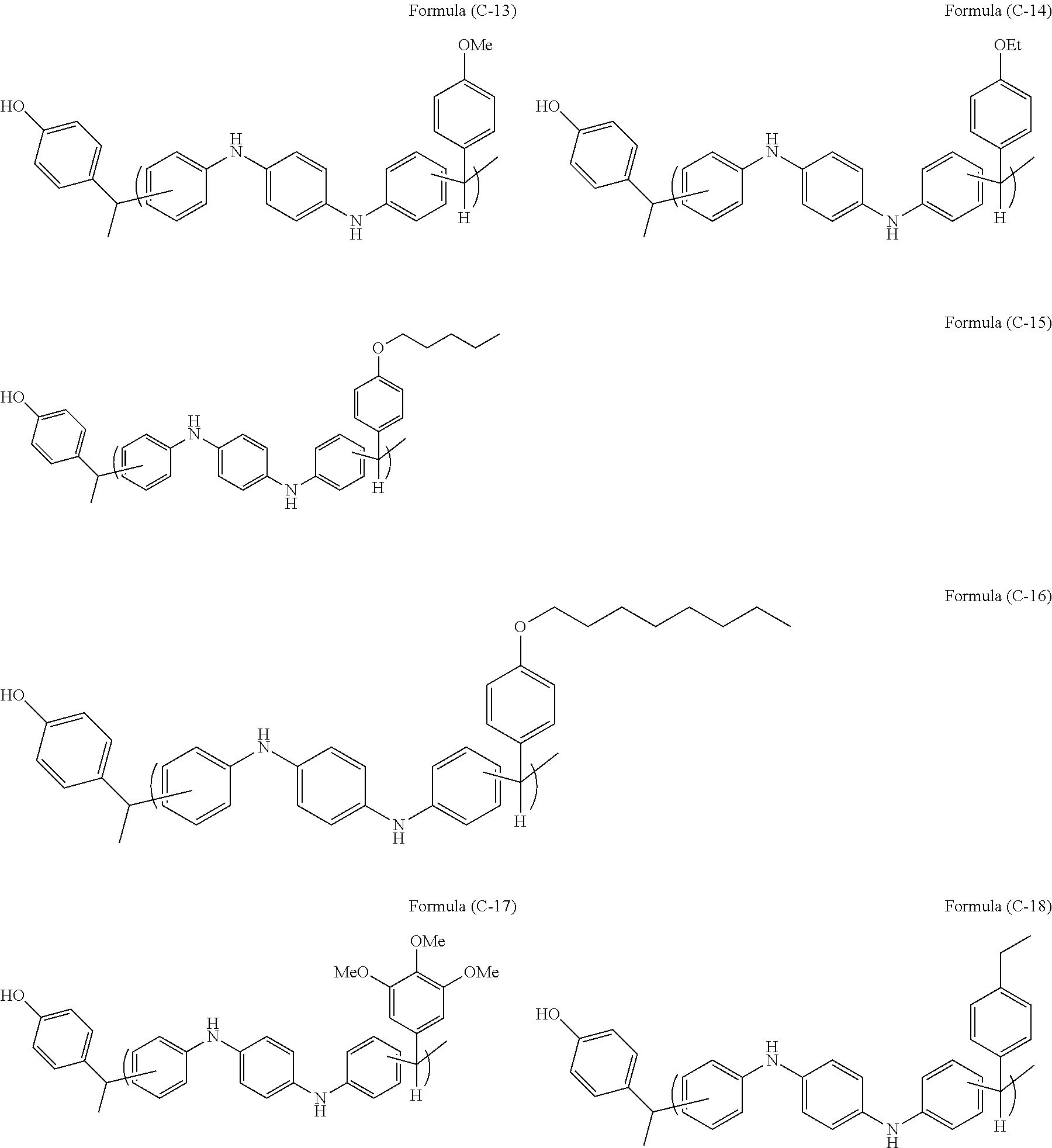
- R 1 in Formula (1) may be a divalent organic group prepared by removal of two hydrogen atoms from aromatic rings of N,N′-diphenyl-1,4-phenylenediamine. This compound has three benzene rings and may have a benzene ring as a substituent. Similar to the aforementioned case, any two of these benzene rings are bonded to the aldehyde or ketone to form the novolac resin.
- an acid and/or an acid generator may be added as a catalyst for promoting the aforementioned crosslinking reaction.
- the composition may contain an acidic compound such as p-toluenesulfonic acid, trifluoromethanesulfonic acid, pyridinium p-toluenesulfonate, salicylic acid, 5-sulfosalicylic acid, 4-phenolsulfonic acid, pyridinium 4-phenolsulfonate, camphorsulfonic acid, 4-chlorobenzenesulfonic acid, benzenedisulfonic acid, 1-naphthalenesulfonic acid, citric acid, benzoic acid, hydroxybenzoic acid, or naphthalenecarboxylic acid and/or a thermal acid generator such as 2,4,4,6-tetrabromocyclohexadienone, benzoin tosylate, 2-nitrobenzyl tosylate, or another organic sulfonic acid al
- Such an adhesion aid is incorporated in an amount of generally less than 5% by mass, preferably less than 2% by mass, relative to the total solid content of the resist underlayer film-forming composition for lithography.
- an acid generated from the acid generator through irradiation with electron beams reacts with an N-carboxyaminoxy group at a side chain of the polymer, and the polymer side chain decomposes into a hydroxy group, exhibits alkali solubility, and dissolves in an alkaline developer, to thereby form a resist pattern.
- the exposure light used for the aforementioned photoresist is actinic rays, such as near-ultraviolet rays, far-ultraviolet rays, or extreme-ultraviolet rays (e.g., EUV, wavelength: 13.5 nm); for example, light having a wavelength of 248 nm (KrF laser beam), 193 nm (ArF laser beam), or 157 nm (F2 laser beam).
- KrF laser beam KrF laser beam
- ArF laser beam 193 nm
- F2 laser beam 157 nm
- the dose of the exposure light is 1 to 2,000 mJ/cm 2 , or 10 to 1,500 mJ/cm 2 , or 50 to 1,000 mJ/cm 2 .
- a semiconductor device can be produced through a step of forming a resist underlayer film on a semiconductor substrate from the resist underlayer film-forming composition; a step of forming a resist film on the resist underlayer film; a step of irradiating the resist film with light or electron beams, and developing the resist film, to thereby form a resist pattern; a step of etching the resist underlayer film with the formed resist pattern; and a step of processing the semiconductor substrate with the patterned resist underlayer film.
- a resist may be applied directly to the resist underlayer film, or if necessary, the resist may be applied after formation of one to several layers of coating material on the resist underlayer film. This process reduces the pattern width of the resist. Thus, even when the resist is thinly applied for prevention of pattern collapse, the substrate can be processed with an appropriately selected etching gas.
- a 300-mL four-necked flask was charged with 41.98 g (0.161 mol) of N,N′-diphenyl-1,4-phenylenediamine (available from Tokyo Chemical Industry Co., Ltd.), 31.02 g (0.161 mol) of 4-amyloxybenzaldehyde (available from Tokyo Chemical Industry Co., Ltd.), 94.75 g (0.537 mol) of 4-(tert-butoxy)styrene (available from Wako Pure Chemical Industries, Ltd.), and 172.37 g of propylene glycol monomethyl ether (available from Kanto Chemical Co., Inc.).
- pDPA-BA was found to have a weight average molecular weight Mw of 4,100 as determined by GPC in terms of polystyrene and a polydispersity Mw/Mn of 2.22.
- a 100-mL four-necked flask was charged with 17.53 g (0.080 mol) of N-phenyl-1-naphthylamine (available from Tokyo Chemical Industry Co., Ltd.), 8.49 g (0.080 mol) of benzaldehyde (available from Tokyo Chemical Industry Co., Ltd.), and 62 g of propylene glycol monomethyl ether acetate (available from Kanto Chemical Co., Inc.).
- To the mixture was added 0.77 g (0.008 mol) of methanesulfonic acid (available from Tokyo Chemical Industry Co., Ltd.), and the resultant mixture was stirred and heated to 135° C. for dissolution and initiation of polymerization.
- pNP1NA-BA was found to have a weight average molecular weight Mw of 3,700 as determined by GPC in terms of polystyrene and a polydispersity Mw/Mn of 2.14.
- Each of the resist underlayer film-forming compositions prepared in Examples 1 and 2 and Comparative Examples 1 to 3 was applied onto a silicon wafer and heated on a hot plate at 400° C. for 90 seconds, to thereby form a resist underlayer film.
- the refractive index and attenuation coefficient of the resist underlayer film were measured at 193 nm.
- the refractive index and the attenuation coefficient were measured with an ellipsometer (VUV-VASE) available from J. A. Woollam Japan.
- the substrate was observed with a scanning electron microscope (S-4800) available from Hitachi High-Technologies Corporation, followed by measurement of the difference between the thickness of the substrate at the dense area (patterned area) and that at the open area (non-patterned area) (i.e., the difference in coating level between the dense area and the open area, which is called “Bias”).
- S-4800 scanning electron microscope
- Table 2 shows the thicknesses of these areas and the difference in coating level.
- the Bias is used for evaluation of the planarity; i.e., the smaller the Bias, the higher the planarity.
- the difference in coating level between the patterned area and the non-patterned area of the substrate can be adjusted to 10 to 60 nm, or 10 to 50 nm, or 10 to 30 nm.
- the present invention can provide a composition for forming a resist underlayer film which exhibits improved pattern fillability during baking by improving the thermal reflow property of a polymer contained in the composition, and which prevents mixing during application of a photoresist composition or formation of a different resist underlayer film.
Landscapes
- Physics & Mathematics (AREA)
- Chemical & Material Sciences (AREA)
- General Physics & Mathematics (AREA)
- Organic Chemistry (AREA)
- Engineering & Computer Science (AREA)
- Architecture (AREA)
- Health & Medical Sciences (AREA)
- Chemical Kinetics & Catalysis (AREA)
- Medicinal Chemistry (AREA)
- Polymers & Plastics (AREA)
- Structural Engineering (AREA)
- Spectroscopy & Molecular Physics (AREA)
- Wood Science & Technology (AREA)
- Materials Engineering (AREA)
- Life Sciences & Earth Sciences (AREA)
- Materials For Photolithography (AREA)
- Phenolic Resins Or Amino Resins (AREA)
- Optics & Photonics (AREA)
- Exposure And Positioning Against Photoresist Photosensitive Materials (AREA)
- Exposure Of Semiconductors, Excluding Electron Or Ion Beam Exposure (AREA)
Abstract

[wherein R1 is a divalent group containing at least two amino groups and at least three C6-40 aromatic rings]. R1 may be a divalent organic group prepared by removal of two hydrogen atoms from aromatic rings of a compound of the following Formula (2):

R1 may be a divalent organic group prepared by removal of two hydrogen atoms from aromatic rings of N,N′-diphenyl-1,4-phenylenediamine.
Description
-
- Patent Document 1: International Publication WO 2014/208542
- Patent Document 2: International Publication WO 2013/047516
- Patent Document 3: International Publication WO 2015/151803

[wherein
-
- R1 is a divalent group containing at least two amino groups and at least three C6-40 aromatic rings;
- R2 and R3 are each independently a hydrogen atom, a C1-10 alkyl group, a C6-40 aryl group, a heterocyclic group, or any combination of these; the alkyl group, the aryl group, and the heterocyclic group are each an organic group optionally substituted with a halogen atom, a nitro group, an amino group, a C1-10 alkyl group, a C6-40 aryl group, a formyl group, a carboxyl group, an alkoxy group, or a hydroxy group; and R2 and R3 optionally form a ring together with the carbon atom to which they are bonded;
- T1 is a C6-40 arylene group;
- T3 is a C1-10 alkyl group, a C2-10 alkenyl group, a C2-10 alkynyl group, a C6-40 aryl group, a hydroxy group, a cyano group, a nitro group, an amino group, a carboxyl group, an acetyl group, a hydroxymethyl group, a halogenomethyl group, a —Y—Z group, a halogen atom, or any combination of these; Y is an oxygen atom, a sulfur atom, a carbonyl group, or an ester group; and Z is a C1-10 alkyl group;
- T2 is a hydrogen atom, a methyl group, or a phenyl group;
- m is an integer of 0 to (5+2n);
- n is the degree of condensation of an aromatic ring forming the arylene group defined by T1; and
- m1 is an integer of 2 to 3,600].

[wherein
-
- Ar1, Ar2, and Ar3 are each independently a benzene ring or a naphthalene ring;
- R6, R7, and R8 are each independently a substituent on the corresponding ring and selected from the group consisting of a halogen atom, a nitro group, an amino group, a hydroxy group, a C1-10 alkyl group, a C2-10 alkenyl group, a C6-40 aryl group, and any combination of these; and the alkyl group, the alkenyl group, and the aryl group are each an organic group optionally containing an ether bond, a ketone bond, or an ester bond;
- R4 and R5 are each independently selected from the group consisting of a hydrogen atom, a C1-10 alkyl group, a C2-10 alkenyl group, a C6-40 aryl group, and any combination of these; and the alkyl group, the alkenyl group, and the aryl group are each an organic group optionally containing an ether bond, a ketone bond, or an ester bond; and
- n1, n2, and n3 are an integer of 0 to the number of maximum substitutions of R6, R7, and R8, respectively].
-
- R2 is an aryl group selected from a phenyl group, a naphthyl group, an anthryl group, and a pyrenyl group, and the aryl group is optionally substituted with a halogen atom, a nitro group, an amino group, a C1-10 alkyl group, a C1-10 alkoxy group, a C6-40 aryl group, a formyl group, a carboxyl group, or a hydroxy group.
-
- R2 is a phenyl group, and the phenyl group is optionally substituted with a halogen atom, a nitro group, an amino group, a C1-10 alkyl group, a C1-10 alkoxy group, a C6-40 aryl group, a formyl group, a carboxyl group, or a hydroxy group.

[wherein
-
- R2 and R3 are each independently a hydrogen atom, a C1-10 alkyl group, a C6-40 aryl group, a heterocyclic group, or any combination of these; the alkyl group, the aryl group, and the heterocyclic group are each an organic group optionally substituted with a halogen atom, a nitro group, an amino group, a C1-10 alkyl group, a C6-40 aryl group, a formyl group, a carboxyl group, an alkoxy group, or a hydroxy group; and R2 and R3 optionally form a ring together with the carbon atom to which they are bonded;
- T2 is a hydrogen atom, a methyl group, or a phenyl group; and
- m1 is an integer of 2 to 3,600].
-
- R2 and R3 are each independently a hydrogen atom, a C1-10 alkyl group, a C6-40 aryl group, a heterocyclic group, or any combination of these; the alkyl group, the aryl group, and the heterocyclic group are each an organic group optionally substituted with a halogen atom, a nitro group, an amino group, a C1-10 alkyl group, a C6-40 aryl group, a formyl group, a carboxyl group, an alkoxy group, or a hydroxy group; and R2 and R3 optionally form a ring together with the carbon atom to which they are bonded;
- T1 is a C6-40 arylene group;
- T3 is a C1-10 alkyl group, a C2-10 alkenyl group, a C2-10 alkynyl group, a C6-40 aryl group, a hydroxy group, a cyano group, a nitro group, an amino group, a carboxyl group, an acetyl group, a hydroxymethyl group, a halogenomethyl group, a —Y—Z group, a halogen atom, or any combination of these; Y is an oxygen atom, a sulfur atom, a carbonyl group, or an ester group; and Z is a C1-10 alkyl group;
- T2 is a hydrogen atom, a methyl group, or a phenyl group;
- m is an integer of 0 to (5+2n);
- n is the degree of condensation of an aromatic ring forming the arylene group defined by T1;
- T2 is preferably a methyl group; and
- m1 is an integer of 2 to 3,600, or an integer of 2 to 3,000, or an integer of 2 to 2,000, or an integer of 2 to 735, or an integer of 3 to 3,600, or an integer of 3 to 3,000, or an integer of 3 to 2,000, or an integer of 3 to 735, or an integer of 5 to 3,600, or an integer of 5 to 3,000, or an integer of 5 to 2,000, or an integer of 5 to 735.
-
- R6, R7, and R8 are each independently a substituent on the corresponding ring and selected from the group consisting of a halogen atom, a nitro group, an amino group, a hydroxy group, a C1-10 alkyl group, a C2-10 alkenyl group, a C6-40 aryl group, and any combination of these; and the alkyl group, the alkenyl group, and the aryl group are each an organic group optionally containing an ether bond, a ketone bond, or an ester bond;
- R4 and R5 are each independently selected from the group consisting of a hydrogen atom, a C1-10 alkyl group, a C2-10 alkenyl group, a C6-40 aryl group, and any combination of these; and the alkyl group, the alkenyl group, and the aryl group are each an organic group optionally containing an ether bond, a ketone bond, or an ester bond; and
- n1, n2, and n3 are an integer of 0 to the number of maximum substitutions of R6, R7, and R8, respectively. Generally, n1, n2, and n3 are each an integer of 0 to 4, or 0 to 3, or 0 to 2, or 0 to 1.

-
- T1 is a C6-40 arylene group;
- T3 is a C1-10 alkyl group, a C2-10 alkenyl group, a C2-10 alkynyl group, a C6-40 aryl group, a hydroxy group, a cyano group, a nitro group, an amino group, a carboxyl group, an acetyl group, a hydroxymethyl group, a halogenomethyl group, a —Y—Z group, a halogen atom, or any combination of these; Y is an oxygen atom, a sulfur atom, a carbonyl group, or an ester group; and Z is a C1-10 alkyl group;
- T2 is a hydrogen atom, a methyl group, or a phenyl group, and is preferably a hydrogen atom;
- m is an integer of 0 to (5+2n); and
- n is the degree of condensation of an aromatic ring forming the arylene group defined by T1.
-
- T2 is a hydrogen atom, a methyl group, or a phenyl group; and
- m1 is an integer of 2 to 3,600, or an integer of 2 to 3,000, or an integer of 2 to 2,000, or an integer of 2 to 735, or an integer of 3 to 3,600, or an integer of 3 to 3,000, or an integer of 3 to 2,000, or an integer of 3 to 735, or an integer of 5 to 3,600, or an integer of 5 to 3,000, or an integer of 5 to 2,000, or an integer of 5 to 735.




The selection ratio of dry etching rate=(the dry etching rate of each resist underlayer film)/(the dry etching rate of the resist film)
| TABLE 1 | ||||
| Selection | ||||
| Refractive | Attenuation | Wave- | ratio of | |
| index | coefficient | length | dry etching | |
| (n-value) | (k-value) | (nm) | rate | |
| Example 1 | 1.46 | 0.53 | 193 | 0.99 |
| Example 2 | 1.44 | 0.52 | 193 | 1.06 |
| Comparative Example 1 | 1.50 | 0.59 | 193 | 0.76 |
| Comparative Example 2 | 1.45 | 0.55 | 193 | 0.75 |
| Comparative Example 3 | 1.44 | 0.54 | 193 | 0.86 |
| TABLE 2 | |||
| DENSE/OPEN | |||
| DENSE | OPEN | Difference in | |
| Thickness | Thickness | coating level | |
| (nm) | (nm) | (nm) | |
| Example 1 | 115 nm | 141 nm | 26 nm |
| Example 2 | 107 nm | 133 nm | 26 nm |
| Comparative Example 1 | 70 nm | 143 nm | 73 nm |
| Comparative Example 2 | 75 nm | 145 nm | 70 nm |
| Comparative Example 3 | 71 nm | 149 nm | 78 nm |
Claims (13)


Applications Claiming Priority (3)
| Application Number | Priority Date | Filing Date | Title |
|---|---|---|---|
| JP2018-027571 | 2018-02-20 | ||
| JP2018027571 | 2018-02-20 | ||
| PCT/JP2019/006349 WO2019163834A1 (en) | 2018-02-20 | 2019-02-20 | Resist underlayer film forming composition that contains triaryldiamine-containing novolac resin to which aromatic vinyl compound is added |
Publications (2)
| Publication Number | Publication Date |
|---|---|
| US20200387072A1 US20200387072A1 (en) | 2020-12-10 |
| US12025916B2 true US12025916B2 (en) | 2024-07-02 |
Family
ID=67688301
Family Applications (1)
| Application Number | Title | Priority Date | Filing Date |
|---|---|---|---|
| US16/971,357 Active 2041-07-21 US12025916B2 (en) | 2018-02-20 | 2019-02-20 | Resist underlayer film-forming composition that contains triaryldiamine-containing novolac resin to which aromatic vinyl compound is added |
Country Status (6)
| Country | Link |
|---|---|
| US (1) | US12025916B2 (en) |
| JP (1) | JP7265225B2 (en) |
| KR (1) | KR102759780B1 (en) |
| CN (1) | CN111758075B (en) |
| TW (1) | TWI801504B (en) |
| WO (1) | WO2019163834A1 (en) |
Families Citing this family (3)
| Publication number | Priority date | Publication date | Assignee | Title |
|---|---|---|---|---|
| WO2021172296A1 (en) * | 2020-02-28 | 2021-09-02 | 日産化学株式会社 | Method for producing polymer |
| WO2022050405A1 (en) | 2020-09-07 | 2022-03-10 | 日産化学株式会社 | Wafer treatment method |
| JPWO2024096069A1 (en) * | 2022-11-02 | 2024-05-10 |
Citations (10)
| Publication number | Priority date | Publication date | Assignee | Title |
|---|---|---|---|---|
| WO2013047516A1 (en) | 2011-09-29 | 2013-04-04 | 日産化学工業株式会社 | Diarylamine novolac resin |
| WO2014208542A1 (en) | 2013-06-26 | 2014-12-31 | 日産化学工業株式会社 | Resist underlayer film forming composition containing substituted crosslinkable compound |
| WO2015151803A1 (en) | 2014-03-31 | 2015-10-08 | 日産化学工業株式会社 | Composition for resist underlayer film formation containing novolak resin into which aromatic vinyl compound was incorporated through addition |
| WO2016072316A1 (en) | 2014-11-04 | 2016-05-12 | 日産化学工業株式会社 | Resist underlayer film-forming composition including polymer provided with arylene groups |
| US20160266494A1 (en) | 2015-03-10 | 2016-09-15 | Myeong koo Kim | Polymers for hard masks, hard mask compositions including the same, and methods for forming a pattern of a semiconductor device using a hard mask composition |
| US20170110328A1 (en) | 2015-10-19 | 2017-04-20 | Samsung Sdi Co., Ltd. | Polymer, organic layer composition, and method of forming patterns |
| WO2017069063A1 (en) | 2015-10-19 | 2017-04-27 | 日産化学工業株式会社 | Resist underlayer film-forming composition containing long-chain alkyl group-containing novolac |
| WO2018043410A1 (en) | 2016-09-01 | 2018-03-08 | 日産化学工業株式会社 | Resist underlayer film forming composition containing triaryldiamine-containing novolac resin |
| US20180314145A1 (en) | 2017-04-28 | 2018-11-01 | Taiwan Semiconductor Manufacturing Co., Ltd. | Euv radiation modification methods and systems |
| US20190067021A1 (en) | 2017-08-28 | 2019-02-28 | Shin-Etsu Chemical Co., Ltd. | Composition for forming organic film, substrate for manufacturing semiconductor apparatus, method for forming organic film, patterning process, and polymer |
Family Cites Families (4)
| Publication number | Priority date | Publication date | Assignee | Title |
|---|---|---|---|---|
| KR100938065B1 (en) * | 2005-03-11 | 2010-01-21 | 신에쓰 가가꾸 고교 가부시끼가이샤 | Photoresist Underlayer Film Forming Material and Pattern Forming Method |
| JP4662063B2 (en) * | 2006-05-25 | 2011-03-30 | 信越化学工業株式会社 | Photoresist underlayer film forming material and pattern forming method |
| KR102285718B1 (en) * | 2013-09-19 | 2021-08-04 | 닛산 가가쿠 가부시키가이샤 | Composition for forming underlayer film of self-assembling film including aliphatic polycyclic structure |
| KR102417838B1 (en) * | 2014-08-08 | 2022-07-06 | 닛산 가가쿠 가부시키가이샤 | Resist underlayer film forming composition containing novolac resin reacted with aromatic methylol compound |
-
2019
- 2019-02-20 CN CN201980014513.9A patent/CN111758075B/en active Active
- 2019-02-20 WO PCT/JP2019/006349 patent/WO2019163834A1/en not_active Ceased
- 2019-02-20 JP JP2020501001A patent/JP7265225B2/en active Active
- 2019-02-20 TW TW108105671A patent/TWI801504B/en active
- 2019-02-20 US US16/971,357 patent/US12025916B2/en active Active
- 2019-02-20 KR KR1020207023398A patent/KR102759780B1/en active Active
Patent Citations (17)
| Publication number | Priority date | Publication date | Assignee | Title |
|---|---|---|---|---|
| US20140235059A1 (en) | 2011-09-29 | 2014-08-21 | Nissan Chemical Industries, Ltd | Diarylamine novolac resin |
| WO2013047516A1 (en) | 2011-09-29 | 2013-04-04 | 日産化学工業株式会社 | Diarylamine novolac resin |
| WO2014208542A1 (en) | 2013-06-26 | 2014-12-31 | 日産化学工業株式会社 | Resist underlayer film forming composition containing substituted crosslinkable compound |
| US20160139509A1 (en) | 2013-06-26 | 2016-05-19 | Nissan Chemical Industries, Ltd. | Resist underlayer film-forming composition containing substituted crosslinkable compound |
| WO2015151803A1 (en) | 2014-03-31 | 2015-10-08 | 日産化学工業株式会社 | Composition for resist underlayer film formation containing novolak resin into which aromatic vinyl compound was incorporated through addition |
| US20170097568A1 (en) | 2014-03-31 | 2017-04-06 | Nissan Chemical Industries, Ltd. | Resist underlayer film-forming composition containing novolac resin to which aromatic vinyl compound is added |
| US20170315445A1 (en) | 2014-11-04 | 2017-11-02 | Nissan Chemical Industries, Ltd. | Resist underlayer film-forming composition containing polymer having arylene group |
| WO2016072316A1 (en) | 2014-11-04 | 2016-05-12 | 日産化学工業株式会社 | Resist underlayer film-forming composition including polymer provided with arylene groups |
| US20160266494A1 (en) | 2015-03-10 | 2016-09-15 | Myeong koo Kim | Polymers for hard masks, hard mask compositions including the same, and methods for forming a pattern of a semiconductor device using a hard mask composition |
| US20170110328A1 (en) | 2015-10-19 | 2017-04-20 | Samsung Sdi Co., Ltd. | Polymer, organic layer composition, and method of forming patterns |
| JP2017078165A (en) | 2015-10-19 | 2017-04-27 | 三星エスディアイ株式会社Samsung SDI Co., Ltd. | Polymer, organic film composition, and pattern forming method |
| WO2017069063A1 (en) | 2015-10-19 | 2017-04-27 | 日産化学工業株式会社 | Resist underlayer film-forming composition containing long-chain alkyl group-containing novolac |
| WO2018043410A1 (en) | 2016-09-01 | 2018-03-08 | 日産化学工業株式会社 | Resist underlayer film forming composition containing triaryldiamine-containing novolac resin |
| US20190212649A1 (en) | 2016-09-01 | 2019-07-11 | Nissan Chemical Corporation | Resist underlayer film forming composition containing triaryldiamine-containing novolac resin |
| US20180314145A1 (en) | 2017-04-28 | 2018-11-01 | Taiwan Semiconductor Manufacturing Co., Ltd. | Euv radiation modification methods and systems |
| US20190067021A1 (en) | 2017-08-28 | 2019-02-28 | Shin-Etsu Chemical Co., Ltd. | Composition for forming organic film, substrate for manufacturing semiconductor apparatus, method for forming organic film, patterning process, and polymer |
| JP2019041059A (en) | 2017-08-28 | 2019-03-14 | 信越化学工業株式会社 | Organic film forming composition, semiconductor device manufacturing substrate, organic film forming method, pattern forming method, and polymer |
Non-Patent Citations (4)
| Title |
|---|
| Apr. 23, 2019 Search Report issued in International Patent Application No. PCT/JP2019/006349. |
| Apr. 23, 2019 Written Opinion of the International Searching Authority issued in International Patent Application No. PCT/JP2019/006349. |
| Jul. 27, 2022 Office Action issued in Taiwanese Patent Application No. 108105671. |
| Mar. 4, 2024 Office Action issued in Korean Patent Application No. 10-2020-7023398. |
Also Published As
| Publication number | Publication date |
|---|---|
| US20200387072A1 (en) | 2020-12-10 |
| CN111758075B (en) | 2025-01-28 |
| KR20200123117A (en) | 2020-10-28 |
| KR102759780B1 (en) | 2025-01-24 |
| TWI801504B (en) | 2023-05-11 |
| CN111758075A (en) | 2020-10-09 |
| WO2019163834A1 (en) | 2019-08-29 |
| JPWO2019163834A1 (en) | 2021-02-25 |
| TW201945417A (en) | 2019-12-01 |
| JP7265225B2 (en) | 2023-04-26 |
Similar Documents
| Publication | Publication Date | Title |
|---|---|---|
| US8993215B2 (en) | Resist underlayer film forming composition containing phenylindole-containing novolac resin | |
| US11650505B2 (en) | Resist underlayer film-forming composition containing novolac resin reacted with aromatic methylol compound | |
| US9261790B2 (en) | Resist underlayer film-forming composition containing copolymer resin having heterocyclic ring | |
| JP6066092B2 (en) | Diarylamine novolac resin | |
| US9263285B2 (en) | Composition for forming a resist underlayer film including hydroxyl group-containing carbazole novolac resin | |
| US12072629B2 (en) | Resist underlayer film-forming composition containing novolac resin to which aromatic vinyl compound is added | |
| US11300879B2 (en) | Resist underlayer film forming composition containing triaryldiamine-containing novolac resin | |
| JP6583630B2 (en) | Resist underlayer film forming composition containing novolak polymer having secondary amino group | |
| JP6124025B2 (en) | Resist underlayer film forming composition containing novolak resin having polynuclear phenols | |
| JP7265225B2 (en) | Composition for forming resist underlayer film containing triaryldiamine-containing novolak resin to which aromatic vinyl compound is added |
Legal Events
| Date | Code | Title | Description |
|---|---|---|---|
| AS | Assignment |
Owner name: NISSAN CHEMICAL CORPORATION, JAPAN Free format text: ASSIGNMENT OF ASSIGNORS INTEREST;ASSIGNORS:NISHIMAKI, HIROKAZU;SAITO, DAIGO;KARASAWA, RYO;AND OTHERS;REEL/FRAME:053709/0652 Effective date: 20200821 |
|
| STPP | Information on status: patent application and granting procedure in general |
Free format text: APPLICATION DISPATCHED FROM PREEXAM, NOT YET DOCKETED |
|
| STPP | Information on status: patent application and granting procedure in general |
Free format text: DOCKETED NEW CASE - READY FOR EXAMINATION |
|
| STPP | Information on status: patent application and granting procedure in general |
Free format text: NON FINAL ACTION MAILED |
|
| STPP | Information on status: patent application and granting procedure in general |
Free format text: RESPONSE TO NON-FINAL OFFICE ACTION ENTERED AND FORWARDED TO EXAMINER |
|
| STPP | Information on status: patent application and granting procedure in general |
Free format text: ALLOWED -- NOTICE OF ALLOWANCE NOT YET MAILED |
|
| STPP | Information on status: patent application and granting procedure in general |
Free format text: NOTICE OF ALLOWANCE MAILED -- APPLICATION RECEIVED IN OFFICE OF PUBLICATIONS |
|
| ZAAB | Notice of allowance mailed |
Free format text: ORIGINAL CODE: MN/=. |
|
| STPP | Information on status: patent application and granting procedure in general |
Free format text: AWAITING TC RESP., ISSUE FEE NOT PAID |
|
| STPP | Information on status: patent application and granting procedure in general |
Free format text: NOTICE OF ALLOWANCE MAILED -- APPLICATION RECEIVED IN OFFICE OF PUBLICATIONS |
|
| STPP | Information on status: patent application and granting procedure in general |
Free format text: PUBLICATIONS -- ISSUE FEE PAYMENT VERIFIED |
|
| STCF | Information on status: patent grant |
Free format text: PATENTED CASE |