US12024521B2 - Isoquinoline derivatives, methods of synthesis and uses thereof - Google Patents
Isoquinoline derivatives, methods of synthesis and uses thereof Download PDFInfo
- Publication number
- US12024521B2 US12024521B2 US17/363,712 US202117363712A US12024521B2 US 12024521 B2 US12024521 B2 US 12024521B2 US 202117363712 A US202117363712 A US 202117363712A US 12024521 B2 US12024521 B2 US 12024521B2
- Authority
- US
- United States
- Prior art keywords
- compound
- substituted
- alkyl
- mmol
- alkenyl
- Prior art date
- Legal status (The legal status is an assumption and is not a legal conclusion. Google has not performed a legal analysis and makes no representation as to the accuracy of the status listed.)
- Active
Links
Images


Classifications
-
- C—CHEMISTRY; METALLURGY
- C07—ORGANIC CHEMISTRY
- C07D—HETEROCYCLIC COMPOUNDS
- C07D401/00—Heterocyclic compounds containing two or more hetero rings, having nitrogen atoms as the only ring hetero atoms, at least one ring being a six-membered ring with only one nitrogen atom
- C07D401/02—Heterocyclic compounds containing two or more hetero rings, having nitrogen atoms as the only ring hetero atoms, at least one ring being a six-membered ring with only one nitrogen atom containing two hetero rings
- C07D401/06—Heterocyclic compounds containing two or more hetero rings, having nitrogen atoms as the only ring hetero atoms, at least one ring being a six-membered ring with only one nitrogen atom containing two hetero rings linked by a carbon chain containing only aliphatic carbon atoms
-
- C—CHEMISTRY; METALLURGY
- C07—ORGANIC CHEMISTRY
- C07D—HETEROCYCLIC COMPOUNDS
- C07D405/00—Heterocyclic compounds containing both one or more hetero rings having oxygen atoms as the only ring hetero atoms, and one or more rings having nitrogen as the only ring hetero atom
- C07D405/02—Heterocyclic compounds containing both one or more hetero rings having oxygen atoms as the only ring hetero atoms, and one or more rings having nitrogen as the only ring hetero atom containing two hetero rings
- C07D405/06—Heterocyclic compounds containing both one or more hetero rings having oxygen atoms as the only ring hetero atoms, and one or more rings having nitrogen as the only ring hetero atom containing two hetero rings linked by a carbon chain containing only aliphatic carbon atoms
-
- C—CHEMISTRY; METALLURGY
- C07—ORGANIC CHEMISTRY
- C07D—HETEROCYCLIC COMPOUNDS
- C07D409/00—Heterocyclic compounds containing two or more hetero rings, at least one ring having sulfur atoms as the only ring hetero atoms
- C07D409/02—Heterocyclic compounds containing two or more hetero rings, at least one ring having sulfur atoms as the only ring hetero atoms containing two hetero rings
- C07D409/06—Heterocyclic compounds containing two or more hetero rings, at least one ring having sulfur atoms as the only ring hetero atoms containing two hetero rings linked by a carbon chain containing only aliphatic carbon atoms
-
- C—CHEMISTRY; METALLURGY
- C07—ORGANIC CHEMISTRY
- C07D—HETEROCYCLIC COMPOUNDS
- C07D471/00—Heterocyclic compounds containing nitrogen atoms as the only ring hetero atoms in the condensed system, at least one ring being a six-membered ring with one nitrogen atom, not provided for by groups C07D451/00 - C07D463/00
- C07D471/02—Heterocyclic compounds containing nitrogen atoms as the only ring hetero atoms in the condensed system, at least one ring being a six-membered ring with one nitrogen atom, not provided for by groups C07D451/00 - C07D463/00 in which the condensed system contains two hetero rings
- C07D471/04—Ortho-condensed systems
-
- C—CHEMISTRY; METALLURGY
- C07—ORGANIC CHEMISTRY
- C07D—HETEROCYCLIC COMPOUNDS
- C07D487/00—Heterocyclic compounds containing nitrogen atoms as the only ring hetero atoms in the condensed system, not provided for by groups C07D451/00 - C07D477/00
- C07D487/02—Heterocyclic compounds containing nitrogen atoms as the only ring hetero atoms in the condensed system, not provided for by groups C07D451/00 - C07D477/00 in which the condensed system contains two hetero rings
- C07D487/04—Ortho-condensed systems
-
- C—CHEMISTRY; METALLURGY
- C07—ORGANIC CHEMISTRY
- C07D—HETEROCYCLIC COMPOUNDS
- C07D491/00—Heterocyclic compounds containing in the condensed ring system both one or more rings having oxygen atoms as the only ring hetero atoms and one or more rings having nitrogen atoms as the only ring hetero atoms, not provided for by groups C07D451/00 - C07D459/00, C07D463/00, C07D477/00 or C07D489/00
- C07D491/02—Heterocyclic compounds containing in the condensed ring system both one or more rings having oxygen atoms as the only ring hetero atoms and one or more rings having nitrogen atoms as the only ring hetero atoms, not provided for by groups C07D451/00 - C07D459/00, C07D463/00, C07D477/00 or C07D489/00 in which the condensed system contains two hetero rings
- C07D491/04—Ortho-condensed systems
- C07D491/044—Ortho-condensed systems with only one oxygen atom as ring hetero atom in the oxygen-containing ring
Definitions
- R 1 is hydrogen, —OR 22 , alkyl, alkenyl, aryl, substituted aryl, arylalkyl, substituted arylalkyl, heteroaryl, substituted heteroaryl, —NR 43 R 44 , —OPh, where Ph is optionally substituted phenyl,
- R 2 is hydrogen, —OR 23 , —CF 3 , alkyl, alkenyl, aryl, substituted aryl, arylalkyl, substituted arylalkyl, arylalkenyl, substituted arylalkenyl, heteroaryl, substituted heteroaryl, —NR 45 R 46 ,
- R 48 is hydrogen, alkyl, alkenyl, substituted alkyl, substituted alkenyl, or aryl
- R 55 is heteroarylalkyl, substituted heteroarylalkyl, heteroarylalkenyl, substituted heteroarylalkenyl, —NR 75 R 76 or —CH 2 R 77 R 78
- R 56 is hydrogen, alkyl or alkenyl
- R 57 is substituted aryl, heteroaryl or substituted heteroaryl; provided that when R 1 is hydrogen or —OR 22 , R 22 is alkyl and X is —C ⁇ C—, that R 2 is not hydrogen, —OR 23 , —CF 3 or
- R 3 -R 7 are not hydrogen in the compound of Formula (I) when X is —C ⁇ C—, or if each of R 3 -R 7 are hydrogen that R 8 is not hydrogen, —CONR 71 R 72 , —COR 73 or —CO 2 R 74 in the compound of Formula (I) when X is —C ⁇ C—; and provided that both R 1 and R 2 are not both alkyl.
- FIG. 3 illustrates preparation of compounds of Formula (I) where R 3 and R 4 are not hydrogen.
- FIG. 4 illustrates preparation of compounds of Formula (I) where R 3 and R 4 are not hydrogen and X is —CH 2 —.
- FIG. 5 illustrates preparation of compounds of Formula (I) where R 3 and R 4 are not hydrogen and X is absent.
- FIG. 6 illustrates preparation of compounds of Formula (I) and (II) where R 6 is not hydrogen.
- FIG. 7 illustrates preparation of compounds of Formula (I) and (II) where R 6 is fluorine.
- Alkenyl by itself or as part of another substituent, refers to an unsaturated branched, straight-chain or cyclic alkyl radical having at least one carbon-carbon double bond derived by the removal of one hydrogen atom from a single carbon atom of a parent alkene.
- the group may be in either the cis or trans conformation about the double bond(s).
- Cycloalkenyl by itself or as part of another substituent, refers to an unsaturated cyclic monovalent hydrocarbon radical derived by the removal of one hydrogen atom from a single carbon atom of a parent cycloalkene.
- Typical cycloalkenyl groups include, but are not limited to, cyclopropene, cyclobutene cyclopentene; etc.; and the like.
- a cycloalkenyl group comprises from 3 to 20 carbon atoms (C 1 -C 20 alkenyl).
- a cycloalkenyl group comprises from 3 to 10 carbon atoms (C 1 -C 10 alkenyl).
- Cycloheteroalkenyl by itself or as part of another substituent, refers to a cycloalkenyl group as defined herein in which one or more one or more of the carbon atoms (and optionally any associated hydrogen atoms), are each, independently of one another, replaced with the same or different heteroatoms or heteroatomic groups as defined in “heteroalkenyl” below.
- Typical parent aromatic ring systems include, but are not limited to, aceanthrylene, acenaphthylene, acephenanthrylene, anthracene, azulene, benzene, chrysene, coronene, fluoranthene, fluorene, hexacene, hexaphene, hexalene, as-indacene, s-indacene, indane, indene, naphthalene, octacene, octaphene, octalene, ovalene, penta-2,4-diene, pentacene, pentalene, pentaphene, perylene, phenalene, phenanthrene, picene, pleiadene, pyrene, pyranthrene, rubicene, triphenylene, trinaphthalene and the like.
- Solidvates refers to incorporation of solvents into to the crystal lattice of a compound described herein, in stoichiometric proportions, resulting in the formation of an adduct.
- Methods of making solvates include, but are not limited to, storage in an atmosphere containing a solvent, dosage forms that include the solvent, or routine pharmaceutical processing steps such as, for example, crystallization (i.e., from solvent or mixed solvents) vapor diffusion, etc.
- Solvates may also be formed, under certain circumstances, from other crystalline solvates or hydrates upon exposure to the solvent or upon suspension material in solvent. Solvates may crystallize in more than one form resulting in solvate polymorphism.
- Substituent groups useful for substituting unsaturated carbon atoms in the specified group or radical include —R a , halo, —O ⁇ , —OR b , —SR b , —S ⁇ , —NR c R c , trihalomethyl, —CF 3 , —CN, —OCN, —SCN, —NO, —NO 2 , —N 3 , —S(O) 2 O ⁇ , —S(O) 2 OR b , —OS(O) 2 R b , —OS(O) 2 OR b , —OS(O) 2 O ⁇ , —P(O)(O ⁇ ) 2 , —P(O)(OR b )(O ⁇ ), —P(O)(OR b )(OR b ), —C(O)R b , —C(S)R b , —C(NR b
- treating refers to inhibiting the disease or disorder, either physically, (e.g., stabilization of a discernible symptom), physiologically, (e.g., stabilization of a physical parameter) or both. In yet other embodiments, “treating” or “treatment” refers to delaying the onset of the disease or disorder.
- R 1 is hydrogen, —OR 22 , alkyl, alkenyl, aryl, substituted aryl, arylalkyl, substituted arylalkyl, heteroaryl, substituted heteroaryl, —NR 43 R 44 , —OPh, where Ph is optionally substituted phenyl,
- R 2 is hydrogen, —OR 23 , —CF 3 , arylalkyl, substituted arylalkyl, arylalkenyl, substituted arylalkenyl,
- R 1 is hydrogen, —OR 22 ,
- arylalkyl substituted arylalkyl, arylalkenyl, substituted arylalkenyl,
- R 2 is hydrogen, —OR 23 , —CF 3 , arylalkyl, substituted arylalkyl, arylalkenyl, substituted arylalkenyl,
- R 1 and R 2 along with the carbon atoms to which they are attached form an aryl, substituted aryl, heteroaryl or substituted heteroaryl ring.
- R 22 and R 23 are pyridyl or substituted pyridyl.
- R 9 is phenyl, substituted phenyl, imidazopyridine, substituted imidazopyridine, imidazopyrimidine, substituted imidazopyrimidine, imidazopyrazine, substituted imidazopyrazine, imidazopyridazine, substituted imidazopyridazine, indole, substituted indole, azaindole, substituted azaindole, pyrrolopyrazine, substituted pyrrolopyrazine, benzofuran, substituted benzofuran, benzothiophene, substituted benzothiophene, furopyrimidine, substituted furopyrimidine, thienopyrimidine, substituted thienopyrimidine, pyrazolopyrindine, substituted pyrazolopyrindine, pyrazolopyrimidine, substituted pyrazolopyrimidine, pyrazolopyrazine, substituted pyrazolopyrazine, pyrazolopyrazine
- R 1 is hydrogen, —OR 22 ,
- arylalkyl substituted arylalkyl, arylalkenyl, substituted arylalkenyl
- R 2 is hydrogen, —OR 23 , —CF 3 , arylalkyl, substituted arylalkyl, arylalkenyl, substituted arylalkenyl,
- R 1 is hydrogen, —OR 22 ,
- arylalkyl substituted arylalkyl, arylalkenyl, substituted arylalkenyl,
- R 2 is hydrogen, —OR 23 , —CF 3 , arylalkyl, substituted arylalkyl, arylalkenyl, substituted arylalkenyl,
- R 1 and R 2 along with the carbon atoms to which they are attached form an aryl, substituted aryl, heteroaryl or substituted heteroaryl ring.
- R 3 and R 4 are hydrogen.
- R 3 , R 4 and R 8 are hydrogen.
- R 5 -R 7 are hydrogen.
- R 5 -R 8 are hydrogen.
- R 3 -R 8 are hydrogen.
- R 22 and R 23 are pyridyl or substituted pyridyl.
- R 49 is hydrogen or alkyl
- Y is —CR 50 — or —N—
- Z is —CR 51 — or —N—
- R 50 and R 51 are independently, hydrogen, halo, alkyl, —OR 52 or —NR 53 R 54
- R 52 is alkyl
- R 53 and R 54 are independently hydrogen or alkyl.
- R 9 is
- R 3 is F, Cl, Br, —CH 3 , alkyl, alkenyl, —CF 3 —OCR 24 or —NR 25 R 26 .
- R 4 is F, Cl, Br, —CH 3 , alkyl, alkenyl, —CF 3 —OCR 24 or —NR 25 R 26 .
- R 5 is hydrogen or fluorine and R 6 is alkyl, methyl, alkenyl, fluorine, —OR 27 or —NR 28 R 29 .
- R 7 is alkyl, alkenyl, —CO 2 R 30 , —CONR 31 R 32 , —CH 2 NR 33 R 34 , —CH 2 R 42 or —CH 2 OR 35
- R 7 is alkyl, alkenyl, —CO 2 R 30 , —CONR 31 R 32 , —CH 2 NR 33 R 34 , —CH 2 R 42 or —CH 2 OR 35
- R 8 is hydrogen, —SO 2 R 47 , —OR 48 , —SO 2 NR 69 R 70 , —CONR 71 R 72 or —COR 73 , alkyl, substituted alkyl, alkenyl, substituted alkenyl, aryl, substituted aryl, heteroaryl or substituted heteroaryl.
- the active compound is included in the vehicle in an amount sufficient to exert a therapeutically useful effect in the absence of undesirable side effects on the patient treated.
- the therapeutically effective concentration may be predicted empirically by testing the compounds in in vitro and in vivo systems well known to those of skill in the art and then extrapolated therefrom for dosages for humans. Human doses are then typically fine-tuned in clinical trials and titrated to response.
- Disintegrating agents include croscarmellose sodium, sodium starch glycolate, alginic acid, corn starch, potato starch, bentonite, methylcellulose, agar and carboxymethylcellulose.
- Coloring agents include, for example, any of the approved certified water soluble FD and C dyes, mixtures thereof; and water insoluble FD and C dyes suspended on alumina hydrate and advanced coloring or anti-forgery color/opalescent additives known to those skilled in the art.
- Sweetening agents include sucrose, lactose, mannitol and artificial sweetening agents such as saccharin and any number of spray dried flavors.
- the solution or suspension in for example, propylene carbonate, vegetable oils or triglycerides, is in some embodiments encapsulated in a gelatin capsule.
- a gelatin capsule Such solutions, and the preparation and encapsulation thereof, are disclosed in U.S. Pat. Nos. 4,328,245; 4,409,239; and 4,410,545.
- the solution e.g., for example, in a polyethylene glycol, may be diluted with a sufficient quantity of a liquid vehicle, e.g., water, to be easily measured for administration.
- injectables can be prepared in conventional forms, either as liquid solutions or suspensions, solid forms suitable for solution or suspension in liquid prior to injection, or as emulsions.
- the injectables, solutions and emulsions also contain one or more excipients. Suitable excipients are, for example, water, saline, dextrose, glycerol or ethanol.
- suitable carriers include physiological saline or phosphate buffered saline (PBS), and solutions containing thickening and solubilizing agents, such as glucose, polyethylene glycol, and polypropylene glycol and mixtures thereof.
- PBS physiological saline or phosphate buffered saline
- thickening and solubilizing agents such as glucose, polyethylene glycol, and polypropylene glycol and mixtures thereof.
- Vehicles used in parenteral preparations include aqueous vehicles, nonaqueous vehicles, antimicrobial agents, isotonic agents, buffers, antioxidants, local anesthetics, suspending and dispersing agents, emulsifying agents, sequestering or chelating agents and other substances.
- aqueous vehicles examples include Sodium Chloride Injection, Ringers Injection, Isotonic Dextrose Injection, Sterile Water Injection, Dextrose and Lactated Ringers Injection.
- Nonaqueous parenteral vehicles include fixed oils of vegetable origin, cottonseed oil, corn oil, sesame oil and peanut oil.
- Antimicrobial agents in bacteriostatic or fungistatic concentrations must be added to parenteral preparations packaged in multiple-dose containers which include phenols or cresols, mercurials, benzyl alcohol, chlorobutanol, methyl and propyl p-hydroxybenzoic acid esters, thimerosal, benzalkonium chloride and benzethonium chloride.
- Isotonic agents include sodium chloride and dextrose. Buffers include phosphate and citrate. Antioxidants include sodium bisulfate. Local anesthetics include procaine hydrochloride. Suspending and dispersing agents include sodium carboxymethylcellulose, hydroxypropyl methylcellulose and polyvinylpyrrolidone. Emulsifying agents include Polysorbate 80 (Tween® 80). A sequestering or chelating agent of metal ions includes EDTA. Carriers also include ethyl alcohol, polyethylene glycol and propylene glycol for water miscible vehicles; and sodium hydroxide, hydrochloric acid, citric acid or lactic acid for pH adjustment.
- the concentration of compound is adjusted so that an injection provides an effective amount to produce the desired pharmacological effect.
- the exact dose depends on the age, weight, body surface area and condition of the patient or animal as is known in the art.
- the unit-dose parenteral preparations are packaged in an ampoule, a vial or a syringe with a needle. All preparations for parenteral administration must be sterile, as is known and practiced in the art.
- intravenous or intraarterial infusion of a sterile aqueous solution containing an active compound is an effective mode of administration.
- Another embodiment is a sterile aqueous or oily solution or suspension containing an active material injected as necessary to produce the desired pharmacological effect.
- Active ingredients provided herein can be administered by controlled release means or by delivery devices that are well known to those of ordinary skill in the art. Examples include, but are not limited to, those described in U.S. Pat. Nos. 3,845,770; 3,916,899; 3,536,809; 3,598,123; 4,008,719; 5,674,533; 5,059,595; 5,591,767; 5,120,548; 5,073,543; 5,639,476; 5,354,556; 5,639,480; 5,733,566; 5,739,108; 5,891,474; 5,922,356; 5,972,891; 5,980,945; 5,993,855; 6,045,830; 6,087,324; 6,113,943; 6,197,350; 6,248,363; 6,264,970; 6,267,981; 6,376,461; 6,419,961; 6,589,548; 6,613,358; 6,699,500 and 6,740,634.
- a controlled release system can be placed in proximity of the therapeutic target, i.e., thus requiring only a fraction of the systemic dose (see, e.g., Goodson, Medical Applications of Controlled Release , vol. 2, pp. 115-138 (1984)).
- a controlled release device is introduced into a subject in proximity of the site of inappropriate immune activation or a tumor. Other controlled release systems are discussed in the review by Langer ( Science 249:1527-1533 (1990)).
- lyophilized powders which can be reconstituted for administration as solutions, emulsions and other mixtures. They may also be reconstituted and formulated as solids or gels.
- the sterile, lyophilized powder is prepared by dissolving a compound provided herein, or a derivative thereof, in a suitable solvent.
- the solvent may contain an excipient which improves the stability or other pharmacological component of the powder or reconstituted solution, prepared from the powder.
- Excipients that may be used include, but are not limited to, an antioxidant, a buffer and a bulking agent.
- the excipient is selected from dextrose, sorbitol, fructose, corn syrup, xylitol, glycerin, glucose, sucrose and other suitable agent.
- the solvent may contain a buffer, such as citrate, sodium or potassium phosphate or other such buffer known to those of skill in the art at, at about neutral pH.
- the resulting solution will be apportioned into vials for lyophilization.
- Each vial will contain a single dosage or multiple dosages of the compound.
- the lyophilized powder can be stored under appropriate conditions, such as at about 4° C. to room temperature.
- Reconstitution of this lyophilized powder with water for injection provides a formulation for use in parenteral administration.
- the lyophilized powder is added to sterile water or other suitable carriers. The precise amount depends upon the selected compound. Such amount can be empirically determined.
- Topical mixtures are prepared as described for the local and systemic administration.
- the resulting mixture may be a solution, suspension, emulsions or the like and are formulated as creams, gels, ointments, emulsions, solutions, elixirs, lotions, suspensions, tinctures, pastes, foams, aerosols, irrigations, sprays, suppositories, bandages, dermal patches or any other formulations suitable for topical administration.
- the compounds or derivatives thereof may be formulated as aerosols for topical application, such as by inhalation (see, e.g., U.S. Pat. Nos. 4,044,126, 4,414,209, and 4,364,923, which describe aerosols for delivery of a steroid useful for treatment of inflammatory diseases, particularly asthma).
- These formulations for administration to the respiratory tract can be in the form of an aerosol or solution for a nebulizer, or as a microfine powder for insufflation, alone or in combination with an inert carrier such as lactose.
- the particles of the formulation will, in some embodiments, have mass median geometric diameters of less than 5 microns, in other embodiments less than 10 microns.
- Oral inhalation formulations of the compounds or derivatives suitable for inhalation include metered dose inhalers, dry powder inhalers and liquid preparations for administration from a nebulizer or metered dose liquid dispensing system.
- metered dose inhalers dry powder inhalers
- liquid preparations for administration from a nebulizer or metered dose liquid dispensing system for both metered dose inhalers and dry powder inhalers, a crystalline form of the compounds or derivatives is the preferred physical form of the drug to confer longer product stability.
- crystalline particles of the compounds or derivatives can be generated using supercritical fluid processing which offers significant advantages in the production of such particles for inhalation delivery by producing respirable particles of the desired size in a single step.
- a controlled particle size for the microcrystals can be selected to ensure that a significant fraction of the compounds or derivatives is deposited in the lung.
- these particles have a mass median aerodynamic diameter of about 0.1 to about 10 microns, in other embodiments, about 1 to about 5 microns and still other embodiments, about 1.2 to about 3 microns.
- HFA 134a (1,1,1,2-tetrafluoroethane) and HFA 227e (1,1,1,2,3,3,3-heptafluoropropane) and provided either alone or as a ratio to match the density of crystal particles of the compounds or derivatives.
- a ratio is also selected to ensure that the product suspension avoids detrimental sedimentation or cream (which can precipitate irreversible agglomeration) and instead promote a loosely flocculated system, which is easily dispersed when shaken.
- Loosely fluctuated systems are well regarded to provide optimal stability for pMDI canisters.
- the formulation contained no ethanol and no surfactants/stabilizing agents.
- the compounds may be formulated for local or topical application, such as for topical application to the skin and mucous membranes, such as in the eye, in the form of gels, creams, and lotions and for application to the eye or for intracisternal or intraspinal application.
- Topical administration is contemplated for transdermal delivery and also for administration to the eyes or mucosa, or for inhalation therapies. Nasal solutions of the active compound alone or in combination with other excipients can also be administered.
- the preparation may contain an esterified phosphonate compound dissolved or suspended in a liquid carrier, in particular, an aqueous carrier, for aerosol application.
- a liquid carrier in particular, an aqueous carrier
- the carrier may contain solubilizing or suspending agents such as propylene glycol, surfactants, absorption enhancers such as lecithin or cyclodextrin, or preservatives.
- Solutions particularly those intended for ophthalmic use, may be formulated as 0.01%-10% isotonic solutions, pH about 5-7.4, with appropriate salts.
- transdermal patches including iontophoretic and electrophoretic devices, and rectal administration, are also contemplated herein.
- Transdermal patches including iontophoretic and electrophoretic devices, are well known to those of skill in the art.
- such patches are disclosed in U.S. Pat. Nos. 6,267,983, 6,261,595, 6,256,533, 6,167,301, 6,024,975, 6,010715, 5,985,317, 5,983,134, 5,948,433 and 5,860,957.
- dosage forms for rectal administration are rectal suppositories, capsules and tablets for systemic effect.
- Rectal suppositories are used herein mean solid bodies for insertion into the rectum which melt or soften at body temperature releasing one or more pharmacologically or therapeutically active ingredients.
- Substances utilized in rectal suppositories are bases or vehicles and agents to raise the melting point.
- bases include cocoa butter (theobroma oil), glycerin-gelatin, carbowax (polyoxyethylene glycol) and appropriate mixtures of mono-, di- and triglycerides of fatty acids. Combinations of the various bases may be used.
- Agents to raise the melting point of suppositories include spermaceti and wax.
- Rectal suppositories may be prepared either by the compressed method or by molding.
- the weight of a rectal suppository in one embodiment, is about 2 to 3 gm.
- Tablets and capsules for rectal administration are manufactured using the same substance and by the same methods as for formulations for oral administration.
- the compounds provided herein, or derivatives thereof, may also be formulated to be targeted to a particular tissue, receptor, or other area of the body of the subject to be treated. Many such targeting methods are well known to those of skill in the art. All such targeting methods are contemplated herein for use in the instant compositions. For non-limiting examples of targeting methods, see, e.g., U.S. Pat. Nos.
- liposomal suspensions including tissue-targeted liposomes, such as tumor-targeted liposomes, may also be suitable as carriers. These may be prepared according to methods known to those skilled in the art. For example, liposome formulations may be prepared as described in U.S. Pat. No. 4,522,811. Briefly, liposomes such as multilamellar vesicles (MLV's) may be formed by drying down phosphatidyl choline and phosphatidyl serine (7:3 molar ratio) on the inside of a flask.
- MLV's multilamellar vesicles
- a solution of a compound provided herein in phosphate buffered saline lacking divalent cations (PBS) is added and the flask shaken until the lipid film is dispersed.
- PBS phosphate buffered saline lacking divalent cations
- the compounds or derivatives may be packaged as articles of manufacture containing packaging material, a compound or derivative thereof provided herein, which is effective for treatment, prevention or amelioration of one or more symptoms of the diseases or disorders, supra, within the packaging material, and a label that indicates that the compound or composition or derivative thereof, is used for the treatment, prevention or amelioration of one or more symptoms of the diseases or disorders, supra.
- packaging materials for use in packaging products are well known to those of skill in the art. See, e.g., U.S. Pat. Nos. 5,323,907, 5,052,558 and 5,033,252.
- packaging materials include, but are not limited to, blister packs, bottles, tubes, inhalers, pumps, bags, vials, containers, syringes, bottles, and any packaging material suitable for a selected formulation and intended mode of administration and treatment.
- a wide array of formulations of the compounds and compositions provided herein are contemplated as are a variety of treatments for any disease or disorder described herein.
- the compounds described herein, or pharmaceutical compositions thereof are administered or applied in a therapeutically effective amount.
- the physician will determine the dosage regimen that is most appropriate according to a preventive or curative treatment and according to the age, weight, stage of the disease and other factors specific to the subject to be treated.
- the amount of active ingredient in the formulations provided herein, which will be effective in the prevention or treatment of an infectious disease will vary with the nature and severity of the disease or condition, and the route by which the active ingredient is administered.
- the frequency and dosage will also vary according to factors specific for each subject depending on the specific therapy (e.g., therapeutic or prophylactic agents) administered, the severity of the infection, the route of administration, as well as age, body, weight, response, and the past medical history of the subject.
- specific therapy e.g., therapeutic or prophylactic agents
- Exemplary doses of a formulation include milligram or microgram amounts of the active compound per kilogram of subject (e.g., from about 1 microgram per kilogram to about 50 milligrams per kilogram, from about 10 micrograms per kilogram to about 30 milligrams per kilogram, from about 100 micrograms per kilogram to about 10 milligrams per kilogram, or from about 100 micrograms per kilogram to about 5 milligrams per kilogram).
- milligram or microgram amounts of the active compound per kilogram of subject e.g., from about 1 microgram per kilogram to about 50 milligrams per kilogram, from about 10 micrograms per kilogram to about 30 milligrams per kilogram, from about 100 micrograms per kilogram to about 10 milligrams per kilogram, or from about 100 micrograms per kilogram to about 5 milligrams per kilogram.
- a therapeutically effective dosage should produce a serum concentration of active ingredient of from about 0.001 ng/ml to about 50-200 ⁇ g/ml.
- the compositions in other embodiments, should provide a dosage of from about 0.0001 mg to about 70 mg of compound per kilogram of body weight per day.
- Dosage unit forms are prepared to provide from about 0.01 mg, 0.1 mg or 1 mg to about 500 mg, 1000 mg or 5000 mg, and in some embodiments from about 10 mg to about 500 mg of the active ingredient or a combination of essential ingredients per dosage unit form.
- the active ingredient may be administered at once or may be divided into a number of smaller doses to be administered at intervals of time. It is understood that the precise dosage and duration of treatment is a function of the disease being treated and may be determined empirically using known testing protocols or by extrapolation from in vivo or in vitro test data or subsequent clinical testing. It is to be noted that concentrations and dosage values may also vary with the severity of the condition to be alleviated. It is to be further understood that for any particular subject, specific dosage regimens should be adjusted over time according to the individual need and the professional judgment of the person administering or supervising the administration of the compositions and that the concentration ranges set forth herein are exemplary only and are not intended to limit the scope or practice of the claimed compositions.
- a therapeutically effective dose can be estimated initially from in vitro assays.
- a dose can be formulated in animal models to achieve a circulating concentration range that includes the IC 50 as determined in cell culture (i.e., the concentration of test compound that is lethal to 50% of a cell culture), or the IC 100 as determined in cell culture (i.e., the concentration of compound that is lethal to 100% of a cell culture).
- IC 50 as determined in cell culture
- IC 100 as determined in cell culture
- initial dosages can be determined from the dosages administered of known agents by comparing the IC 50 , MIC and/or I 100 of the specific compound disclosed herein with that of a known agent and adjusting the initial dosages accordingly.
- the optimal dosage may be obtained from these initial values by routine optimization
- a therapeutically effective dose of the compounds described herein will provide therapeutic benefit without causing substantial toxicity.
- Toxicity of compounds can be determined using standard pharmaceutical procedures in cell cultures or experimental animals, e.g., by determining the LD 50 (the dose lethal to 50% of the population) or the LD 100 (the dose lethal to 100% of the population). The dose ratio between toxic and therapeutic effect is the therapeutic index. Compounds which exhibit high therapeutic indices are preferred. The data obtained from these cell culture assays and animal studies can be used in formulating a dosage range that is not toxic for use in subjects.
- the dosage of the compounds described herein lies preferably within a range of circulating concentrations that include the effective dose with little or no toxicity.
- the dosage may vary within this range depending upon the dosage form employed and the route of administration utilized.
- the exact formulation, route of administration and dosage can be chosen by the individual physician in view of the patients condition (See, e.g., Fingl et al., 1975 , In: The Pharmacological Basis of Therapeutics , Ch. 1, p. 1).
- the therapy may be repeated intermittently.
- administration of the same formulation provided herein may be repeated and the administrations may be separated by at least 1 day, 2 days, 3 days, 5 days, 10 days, 15 days, 30 days, 45 days, 2 months, 75 days, 3 months, or 6 months.
- Methods of treating, preventing, or ameliorating symptoms of medical disorders such as, for example, amyotrophic lateral sclerosis or Alzheimer's disease in a patient with the disclosed compounds and pharmaceutical compositions are described herein.
- methods of using the disclosed compounds and pharmaceutical compositions as antivirals and antimicrobial agents are described herein.
- the disclosed compounds and pharmaceutical compositions are used to treat a patient with HIV.
- the disclosed compounds and pharmaceutical compositions are used to treat a patient with a staphylococcus A infection.
- therapeutically effective amounts of the compounds or compositions, described herein, supra are administered to the patient with the disorder or condition.
- the compounds and compositions disclosed herein may also be used in combination with one or more other active ingredients.
- the compounds may be administered in combination, or sequentially, with another therapeutic agent.
- Such other therapeutic agents include those known for treatment, prevention, or amelioration of one or more symptoms associated with amyotrophic lateral sclerosis or Alzheimer's disease.
- Other therapeutic agents include those known for treatment, prevention, or amelioration of one or more symptoms of viral or bacterial infection, particularly of HIV or staphylococcus A infection.
- any suitable combination of the compounds and compositions provided herein with one or more of the above therapeutic agents and optionally one or more further pharmacologically active substances are considered to be within the scope of the present disclosure.
- the compounds and compositions provided herein are administered prior to or subsequent to the one or more additional active ingredients.
- Example 2 6-benzyloxy-7,8-dimethoxy-1-[(E)-2-(6-methyl-1,3-benzodioxol-5-yl)vinyl]-1,2,3,4-tetrahydroisoquinoline (10) and 6-benzyloxy-5,7-dimethoxy-1-[(E)-2-(6-methyl-1,3-benzodioxol-5-yl)vinyl]-1,2,3,4-tetrahydroisoquinoline (6)
- Scheme 4 illustrates the preparation of compound 24.
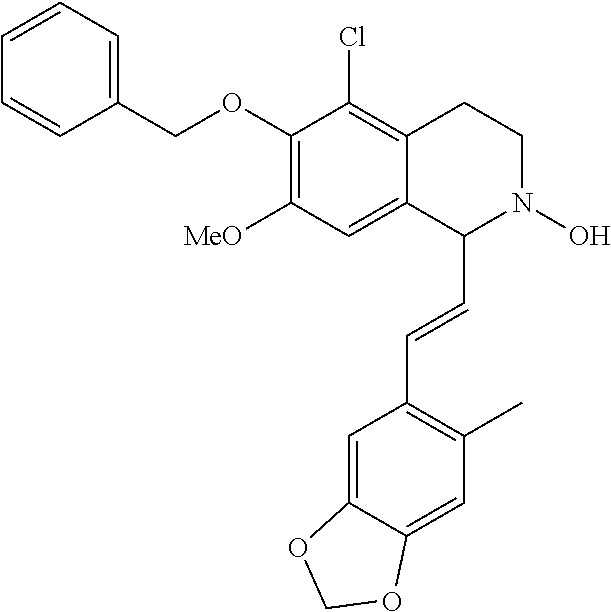
- Example 8 6-benzyloxy-2-hydroxy-7-methoxy-1-[(E)-2-(6-methyl-1,3-benzodioxol-5-yl)vinyl]-3,4-dihydro-1H-isoquinoline (36)
- Scheme 10 illustrates the preparation of compound 63.
- Nematodes were grown on standard NGM (Nematode Growth Media) plates until day 1 of adulthood, at which point they were collected and placed in 96-well plates and treated with the appropriate dose of compound or controls. Recordings of nematode movement were immediately started using WMicroTracker ONE instruments, providing an output of “Well Activity” over time. All drug treatments were performed in biological triplicates (Patten et al., JCI Insight. 2017 Nov. 16; 2(22):e97152. doi: 10.1172jci.insight.97152. PMID: 29202456; PMCID: PMC5752378.)
- Table 2 reports the biological activity of select compounds as measured by the nematode assay and the MT-2 spreading infection assay.
Landscapes
- Chemical & Material Sciences (AREA)
- Organic Chemistry (AREA)
- Pharmaceuticals Containing Other Organic And Inorganic Compounds (AREA)
- Nitrogen Condensed Heterocyclic Rings (AREA)
- Plural Heterocyclic Compounds (AREA)
- Heterocyclic Carbon Compounds Containing A Hetero Ring Having Oxygen Or Sulfur (AREA)
Abstract
Description

or a solvate, hydrate or salt thereof is provided wherein: X is absent, —CH2—, —CH2CH2—, —CH2CH2NR56R57, —C═C—, cycloheteroalkyl, cycloheteroalkenyl, substituted cycloheteroalkyl, substituted cycloheteroalkyl or

R1 is hydrogen, —OR22, alkyl, alkenyl, aryl, substituted aryl, arylalkyl, substituted arylalkyl, heteroaryl, substituted heteroaryl, —NR43R44, —OPh, where Ph is optionally substituted phenyl,

R2 is hydrogen, —OR23, —CF3, alkyl, alkenyl, aryl, substituted aryl, arylalkyl, substituted arylalkyl, arylalkenyl, substituted arylalkenyl, heteroaryl, substituted heteroaryl, —NR45R46,

or R1 and R2 along with the carbon atoms to which they are attached form an aryl, substituted aryl, heteroaryl or substituted heteroaryl ring; n is 0, 1, 2 or 3; o is 0, 1, 2 or 3; R3 and R4 are independently hydrogen, halo, alkyl, alkenyl, —OR24 or —NR25R26; R5 is hydrogen, fluoro, alkyl or alkenyl; R6 is hydrogen, fluoro, alkyl, alkenyl, —OR27 or —NR28R29; R7 is hydrogen, alkyl, alkenyl, —CO2R30, —CONR31R32, —CH2NR33R34, —CH2R42 or —CH2OR35; R8 is hydrogen, —SO2R47, —OR48, —SO2NR69R70, —CONR71R72, —COR73, —CO2R74, alkyl, substituted alkyl, alkenyl, substituted alkenyl, aryl, substituted aryl, heteroaryl or substituted heteroaryl; R9 is aryl, substituted aryl, heteroaryl, substituted heteroaryl, cycloheteroalkyl, cycloheteroalkenyl, substituted cycloheteroalkyl or substituted cycloheteroalkenyl; R10-R14 and R16-R20 are independently hydrogen, alkyl, alkenyl, halo, —CH2OR36, —CO2R37, —CONR38R39—NR40R41, cycloheteroalkyl, cycloheteroalkenyl, substituted cycloheteroalkyl or substituted cycloheteroalkenyl; R15 and R21 are independently hydrogen, alkyl or alkenyl; R22 and R23 are independently alkyl, alkenyl, halo substituted alkyl, substituted alkenyl, heteroaryl or substituted heteroaryl; R24, R27, R35 and R36 are independently alkyl, alkenyl, halo substituted alkyl or halo substituted alkenyl; R28, R29, R30-R33, R38-R41, R63-R74, R75, R77 and R79-R83 are independently hydrogen, alkyl or alkenyl; R25 and R26 are independently hydrogen, alkyl, alkenyl or together with the nitrogen atom to which they are attached form an aryl or substituted aryl group; R34 hydrogen, —SO2R63, —SO2NR64R65, —CONR66R67 or —COR68; R76 and R78 are independently hydrogen, —SO2R79, —SO2NR8OR81, —CONR82R83 or —COR84; R42 is cycloheteroalkenyl, substituted cycloheteroalkyl or substituted cycloheteroalkenyl; R43-46 are independently hydrogen, alkyl, alkenyl, aryl, substituted aryl, heteroaryl or substituted heteroaryl; R47 is alkyl, alkenyl. aryl or heteroaryl; R48 is hydrogen, alkyl, alkenyl, substituted alkyl, substituted alkenyl, or aryl; R55 is heteroarylalkyl, substituted heteroarylalkyl, heteroarylalkenyl, substituted heteroarylalkenyl, —NR75R76 or —CH2R77R78; R56 is hydrogen, alkyl or alkenyl; R57 is substituted aryl, heteroaryl or substituted heteroaryl; provided that when R1 is hydrogen or —OR22, R22 is alkyl and X is —C══C—, that R2 is not hydrogen, —OR23, —CF3 or

where R23 is alkyl, n is 1 and R16-R20 are hydrogen in the compound of Formula (I); provided that when R1 is

that at least one of R3-R7 are not hydrogen in the compound of Formula (I) when X is —C══C—, or if each of R3-R7 are hydrogen that R8 is not hydrogen, —CONR71R72, —COR73 or —CO2R74 in the compound of Formula (I) when X is —C══C—; and provided that both R1 and R2 are not both alkyl.

or a solvate, hydrate or salt thereof wherein: X is absent, —CH2—, —CH2CH2—, —CH2CH2NR56R57, —C═C—, cycloheteroalkyl, cycloheteroalkenyl, substituted cycloheteroalkyl, substituted cycloheteroalkyl or

R1 is hydrogen, —OR22, alkyl, alkenyl, aryl, substituted aryl, arylalkyl, substituted arylalkyl, heteroaryl, substituted heteroaryl, —NR43R44, —OPh, where Ph is optionally substituted phenyl,

R2 is hydrogen, —OR23, —CF3, alkyl, alkenyl, aryl, substituted aryl, arylalkyl, substituted arylalkyl, arylalkenyl, substituted arylalkenyl, heteroaryl, substituted heteroaryl, —NR45R46,

or R1 and R2 along with the carbon atoms to which they are attached form an aryl, substituted aryl, heteroaryl or substituted heteroaryl ring; n is 0, 1, 2 or 3; o is 0, 1, 2 or 3; R3 and R4 are independently hydrogen, halo, alkyl, alkenyl, —OR24 or —NR25R26; R5 is hydrogen, fluoro, alkyl or alkenyl; R6 is hydrogen, fluoro, alkyl, alkenyl, —OR27 or —NR28R29; R7 is hydrogen, alkyl, alkenyl, —CO2R30, —CONR31R32, —CH2NR33R34, —CH2R42 or —CH2OR35, R8 is hydrogen, —SO2R47, —OR48, —SO2NR69R70, —CONR71R72, —COR73, —CO2R74, alkyl, substituted alkyl, alkenyl, substituted alkenyl, aryl, substituted aryl, heteroaryl or substituted heteroaryl; R9 is aryl, substituted aryl, heteroaryl, substituted heteroaryl, cycloheteroalkyl, cycloheteroalkenyl, substituted cycloheteroalkyl or substituted cycloheteroalkenyl; R10-R14 and R16-R20 are independently hydrogen, alkyl, alkenyl, halo, —CH2OR36, —CO2R37, —CONR38R39—NR40R41, cycloheteroalkyl, cycloheteroalkenyl, substituted cycloheteroalkyl or substituted cycloheteroalkenyl; R15 and R21 are independently hydrogen, alkyl or alkenyl; R22 and R23 are independently alkyl, alkenyl, halo substituted alkyl, substituted alkenyl, heteroaryl or substituted heteroaryl; R24, R27, R35 and R36 are independently alkyl, alkenyl, halo substituted alkyl or halo substituted alkenyl; R28, R29, R30-R33, R38-R41, R63-R74, R75, R77 and R79-R83 are independently hydrogen, alkyl or alkenyl; R25 and R26 are independently hydrogen, alkyl, alkenyl or together with the nitrogen atom to which they are attached form an aryl or substituted aryl group; R34 is hydrogen, —SO2R63, —SO2NR64R65, —CONR66R67 or —COR68; R76 and R78 are independently hydrogen, —SO2R79, —SO2NR8OR81, —CONR82R83 or —COR84; R42 is cycloheteroalkenyl, substituted cycloheteroalkyl or substituted cycloheteroalkenyl; R43-46 are independently hydrogen, alkyl, alkenyl, aryl, substituted aryl, heteroaryl or substituted heteroaryl; R47 is alkyl, alkenyl. aryl or heteroaryl; R48 is hydrogen, alkyl, alkenyl, substituted alkyl, substituted alkenyl, or aryl; R55 is heteroarylalkyl, substituted heteroarylalkyl, heteroarylalkenyl, substituted heteroarylalkenyl, —NR75R76 or —CH2R77R78; R56 is hydrogen, alkyl or alkenyl; R57 is substituted aryl, heteroaryl or substituted heteroaryl; provided that when R1 is hydrogen or —OR22, R22 is alkyl and X is —C══C—, that R2 is not hydrogen, —OR23, —CF3 or

where R23 is alkyl, n is 1 and R16-R20 are hydrogen in the compound of Formula (I); provided that when R1 is

that at least one of R3-R7 are not hydrogen in the compound of Formula (I) when X is —C═C—, or if each of R3-R7 are hydrogen that R8 is not hydrogen, —CONR71R72, —COR73 or —CO2R74 in the compound of Formula (I) when X is —C══C—; and provided that both R1 and R2 are not both alkyl.

where R23 is alkyl or n is 1 and R16-R20 are hydrogen; when R1 is

that at least one of R3-R8 are not hydrogen in the compounds of Formulae (II)-(IV) and both R1 and R2 are not both alkyl.

arylalkyl, substituted arylalkyl or

In other embodiments, R2 is hydrogen, —OR23, —CF3, arylalkyl, substituted arylalkyl, arylalkenyl, substituted arylalkenyl,

In still other embodiments, R1 is hydrogen, —OR22,

arylalkyl, substituted arylalkyl, arylalkenyl, substituted arylalkenyl,

and R2 is hydrogen, —OR23, —CF3, arylalkyl, substituted arylalkyl, arylalkenyl, substituted arylalkenyl,

In still other embodiments, R1 and R2 along with the carbon atoms to which they are attached form an aryl, substituted aryl, heteroaryl or substituted heteroaryl ring.

In some of the above embodiments, R1 is hydrogen, —OR22,

arylalkyl, substituted arylalkyl, arylalkenyl, substituted arylalkenyl

In still other of the above embodiments, R2 is hydrogen, —OR23, —CF3, arylalkyl, substituted arylalkyl, arylalkenyl, substituted arylalkenyl,

In still other of the above embodiments, R1 is hydrogen, —OR22,

arylalkyl, substituted arylalkyl, arylalkenyl, substituted arylalkenyl,

and R2 is hydrogen, —OR23, —CF3, arylalkyl, substituted arylalkyl, arylalkenyl, substituted arylalkenyl,

In still other of the above embodiments, R1 and R2 along with the carbon atoms to which they are attached form an aryl, substituted aryl, heteroaryl or substituted heteroaryl ring. In still other of the above embodiments, R3 and R4 are hydrogen. In still other of the above embodiments, R3, R4 and R8 are hydrogen. In still other of the above embodiments, R5-R7 are hydrogen. In still other of the above embodiments, R5-R8 are hydrogen. In still other of the above embodiments, R3-R8 are hydrogen. Inn still other of the above embodiments, R22 and R23 are pyridyl or substituted pyridyl.


In other embodiments, a compound of structural formula (VII) is provided:

In still other embodiments, a compound of structural formula (VIII) is provided:


where R3 is F, Cl, Br, —CH3, alkyl, alkenyl, —CF3—OCR24 or —NR25R26.


where R4 is F, Cl, Br, —CH3, alkyl, alkenyl, —CF3—OCR24 or —NR25R26.


where R5 is hydrogen or fluorine and R6 is alkyl, methyl, alkenyl, fluorine, —OR27 or —NR28R29.


where R7 is alkyl, alkenyl, —CO2R30, —CONR31R32, —CH2NR33R34, —CH2R42 or —CH2OR35


where R7 is alkyl, alkenyl, —CO2R30, —CONR31R32, —CH2NR33R34, —CH2R42 or —CH2OR35


where R58 is hydrogen, alkyl, alkenyl, —CO2R59, —CONR60R61, or —CH2OR62; R59 is hydrogen, alkyl or alkenyl; R60 and R61 are independently hydrogen, alkyl or alkenyl; and R62 is alkyl or alkenyl.

where R7 is alkyl, alkenyl, —CO2R30, —CONR31R32, —CH2NR33R34, —CH2R42 or —CH2OR35


where R8 is hydrogen, —SO2R47, —OR48, —SO2NR69R70, —CONR71R72 or —COR73, alkyl, substituted alkyl, alkenyl, substituted alkenyl, aryl, substituted aryl, heteroaryl or substituted heteroaryl.


where R3 is F, Cl, Br, —CH3, alkyl, —CF3—OCR24 or —NR25R26 and R8 is hydrogen, —SO2R47, —OR48, —SO2NR69R70, —CONR71R72 or —COR73, alkyl, substituted alkyl, alkenyl, substituted alkenyl, aryl, substituted aryl, heteroaryl or substituted heteroaryl.


| TABLE 1 | |
 |
1 |
 |
2 |
 |
3 |
 |
4 |
 |
5 |
 |
6 |
 |
7 |
 |
8 |
 |
9 |
 |
10 |
 |
11 |
 |
12 |
 |
13 |
 |
14 |
 |
15 |
 |
16 |
 |
17 |
 |
18 |
 |
19 |
 |
20 |
 |
21 |
 |
22 |
 |
23 |
 |
24 |
 |
25 |
 |
26 |
 |
27 |
 |
28 |
 |
29 |
 |
30 |
 |
31 |
 |
32 |
 |
33 |
 |
34 |
 |
35 |
 |
36 |
 |
37 |
 |
38 |
 |
39 |
 |
40 |
 |
41 |
 |
42 |
 |
43 |
 |
44 |
 |
45 |
 |
46 |
 |
47 |
 |
48 |
 |
49 |
 |
50 |
 |
51 |
 |
52 |
 |
53 |
 |
54 |
 |
55 |
 |
56 |
 |
57 |
 |
58 |
 |
59 |
 |
60 |
 |
61 |
 |
62 |
 |
63 |


| TABLE 2 | ||
| Nematode assay | ||
| (Movements observed | ||
| over time normalized to | ||
| vehicle control with | ||
| maximum activity then | ||
| divided by that of the | ||
| positive control | ||
| compound Pimozide that | ||
| has been shown to protect | ||
| against neurodegeneration | ||
| Compound # | at 40 uM.) | HIV activity (μM) |
| 12 | 2.2 | 1.4 |
| 10 | 0.44 | 2.5 |
| 6 | 1.14 | 0.37 |
| 61 | 0.51 | 2.5 |
| 24 | 0.59 | 0.5 |
| 36 | 0.63 | 0.053 |
Claims (16)


Priority Applications (2)
| Application Number | Priority Date | Filing Date | Title |
|---|---|---|---|
| US17/363,712 US12024521B2 (en) | 2020-06-30 | 2021-06-30 | Isoquinoline derivatives, methods of synthesis and uses thereof |
| US18/662,524 US20240300962A1 (en) | 2020-06-30 | 2024-05-13 | Isoquinoline Derivatives, Methods of Synthesis and Uses Thereof |
Applications Claiming Priority (2)
| Application Number | Priority Date | Filing Date | Title |
|---|---|---|---|
| US202063046219P | 2020-06-30 | 2020-06-30 | |
| US17/363,712 US12024521B2 (en) | 2020-06-30 | 2021-06-30 | Isoquinoline derivatives, methods of synthesis and uses thereof |
Related Child Applications (1)
| Application Number | Title | Priority Date | Filing Date |
|---|---|---|---|
| US18/662,524 Continuation US20240300962A1 (en) | 2020-06-30 | 2024-05-13 | Isoquinoline Derivatives, Methods of Synthesis and Uses Thereof |
Publications (2)
| Publication Number | Publication Date |
|---|---|
| US20210403477A1 US20210403477A1 (en) | 2021-12-30 |
| US12024521B2 true US12024521B2 (en) | 2024-07-02 |
Family
ID=79032539
Family Applications (2)
| Application Number | Title | Priority Date | Filing Date |
|---|---|---|---|
| US17/363,712 Active US12024521B2 (en) | 2020-06-30 | 2021-06-30 | Isoquinoline derivatives, methods of synthesis and uses thereof |
| US18/662,524 Pending US20240300962A1 (en) | 2020-06-30 | 2024-05-13 | Isoquinoline Derivatives, Methods of Synthesis and Uses Thereof |
Family Applications After (1)
| Application Number | Title | Priority Date | Filing Date |
|---|---|---|---|
| US18/662,524 Pending US20240300962A1 (en) | 2020-06-30 | 2024-05-13 | Isoquinoline Derivatives, Methods of Synthesis and Uses Thereof |
Country Status (4)
| Country | Link |
|---|---|
| US (2) | US12024521B2 (en) |
| EP (1) | EP4149471A4 (en) |
| JP (1) | JP7828905B2 (en) |
| WO (1) | WO2022006228A1 (en) |
Cited By (1)
| Publication number | Priority date | Publication date | Assignee | Title |
|---|---|---|---|---|
| US20230037538A1 (en) * | 2021-06-24 | 2023-02-09 | Takeda Pharmaceutical Company Limited | Anti-als compounds |
Citations (74)
| Publication number | Priority date | Publication date | Assignee | Title |
|---|---|---|---|---|
| US3536809A (en) | 1969-02-17 | 1970-10-27 | Alza Corp | Medication method |
| US3598123A (en) | 1969-04-01 | 1971-08-10 | Alza Corp | Bandage for administering drugs |
| US3710795A (en) | 1970-09-29 | 1973-01-16 | Alza Corp | Drug-delivery device with stretched, rate-controlling membrane |
| US3845770A (en) | 1972-06-05 | 1974-11-05 | Alza Corp | Osmatic dispensing device for releasing beneficial agent |
| US3916899A (en) | 1973-04-25 | 1975-11-04 | Alza Corp | Osmotic dispensing device with maximum and minimum sizes for the passageway |
| USRE28819E (en) | 1972-12-08 | 1976-05-18 | Syntex (U.S.A.) Inc. | Dialkylated glycol compositions and medicament preparations containing same |
| US4008719A (en) | 1976-02-02 | 1977-02-22 | Alza Corporation | Osmotic system having laminar arrangement for programming delivery of active agent |
| US4044126A (en) | 1972-04-20 | 1977-08-23 | Allen & Hanburys Limited | Steroidal aerosol compositions and process for the preparation thereof |
| US4328245A (en) | 1981-02-13 | 1982-05-04 | Syntex (U.S.A.) Inc. | Carbonate diester solutions of PGE-type compounds |
| US4358603A (en) | 1981-04-16 | 1982-11-09 | Syntex (U.S.A.) Inc. | Acetal stabilized prostaglandin compositions |
| US4364923A (en) | 1972-04-20 | 1982-12-21 | Allen & Hanburs Limited | Chemical compounds |
| US4409239A (en) | 1982-01-21 | 1983-10-11 | Syntex (U.S.A.) Inc. | Propylene glycol diester solutions of PGE-type compounds |
| US4410545A (en) | 1981-02-13 | 1983-10-18 | Syntex (U.S.A.) Inc. | Carbonate diester solutions of PGE-type compounds |
| US4522811A (en) | 1982-07-08 | 1985-06-11 | Syntex (U.S.A.) Inc. | Serial injection of muramyldipeptides and liposomes enhances the anti-infective activity of muramyldipeptides |
| US5033252A (en) | 1987-12-23 | 1991-07-23 | Entravision, Inc. | Method of packaging and sterilizing a pharmaceutical product |
| US5052558A (en) | 1987-12-23 | 1991-10-01 | Entravision, Inc. | Packaged pharmaceutical product |
| US5059595A (en) | 1989-03-22 | 1991-10-22 | Bioresearch, S.P.A. | Pharmaceutical compositions containing 5-methyltetrahydrofolic acid, 5-formyltetrahydrofolic acid and their pharmaceutically acceptable salts in controlled-release form active in the therapy of organic mental disturbances |
| US5073543A (en) | 1988-07-21 | 1991-12-17 | G. D. Searle & Co. | Controlled release formulations of trophic factors in ganglioside-lipsome vehicle |
| US5120548A (en) | 1989-11-07 | 1992-06-09 | Merck & Co., Inc. | Swelling modulated polymeric drug delivery device |
| US5323907A (en) | 1992-06-23 | 1994-06-28 | Multi-Comp, Inc. | Child resistant package assembly for dispensing pharmaceutical medications |
| US5354556A (en) | 1984-10-30 | 1994-10-11 | Elan Corporation, Plc | Controlled release powder and process for its preparation |
| US5591767A (en) | 1993-01-25 | 1997-01-07 | Pharmetrix Corporation | Liquid reservoir transdermal patch for the administration of ketorolac |
| US5639480A (en) | 1989-07-07 | 1997-06-17 | Sandoz Ltd. | Sustained release formulations of water soluble peptides |
| US5639476A (en) | 1992-01-27 | 1997-06-17 | Euro-Celtique, S.A. | Controlled release formulations coated with aqueous dispersions of acrylic polymers |
| US5674533A (en) | 1994-07-07 | 1997-10-07 | Recordati, S.A., Chemical And Pharmaceutical Company | Pharmaceutical composition for the controlled release of moguisteine in a liquid suspension |
| US5709874A (en) | 1993-04-14 | 1998-01-20 | Emory University | Device for local drug delivery and methods for using the same |
| US5733566A (en) | 1990-05-15 | 1998-03-31 | Alkermes Controlled Therapeutics Inc. Ii | Controlled release of antiparasitic agents in animals |
| US5739108A (en) | 1984-10-04 | 1998-04-14 | Monsanto Company | Prolonged release of biologically active polypeptides |
| US5759542A (en) | 1994-08-05 | 1998-06-02 | New England Deaconess Hospital Corporation | Compositions and methods for the delivery of drugs by platelets for the treatment of cardiovascular and other diseases |
| US5840674A (en) | 1990-11-01 | 1998-11-24 | Oregon Health Sciences University | Covalent microparticle-drug conjugates for biological targeting |
| US5860957A (en) | 1997-02-07 | 1999-01-19 | Sarcos, Inc. | Multipathway electronically-controlled drug delivery system |
| US5891474A (en) | 1997-01-29 | 1999-04-06 | Poli Industria Chimica, S.P.A. | Time-specific controlled release dosage formulations and method of preparing same |
| US5900252A (en) | 1990-04-17 | 1999-05-04 | Eurand International S.P.A. | Method for targeted and controlled release of drugs in the intestinal tract and more particularly in the colon |
| US5922356A (en) | 1996-10-09 | 1999-07-13 | Sumitomo Pharmaceuticals Company, Limited | Sustained release formulation |
| US5948433A (en) | 1997-08-21 | 1999-09-07 | Bertek, Inc. | Transdermal patch |
| US5972891A (en) | 1992-12-07 | 1999-10-26 | Takeda Chemical Industries, Ltd. | Sustained-release preparation |
| US5972366A (en) | 1994-11-28 | 1999-10-26 | The Unites States Of America As Represented By The Secretary Of The Army | Drug releasing surgical implant or dressing material |
| US5980945A (en) | 1996-01-16 | 1999-11-09 | Societe De Conseils De Recherches Et D'applications Scientifique S.A. | Sustained release drug formulations |
| US5983134A (en) | 1995-04-23 | 1999-11-09 | Electromagnetic Bracing Systems Inc. | Electrophoretic cuff apparatus drug delivery system |
| US5985317A (en) | 1996-09-06 | 1999-11-16 | Theratech, Inc. | Pressure sensitive adhesive matrix patches for transdermal delivery of salts of pharmaceutical agents |
| US5985307A (en) | 1993-04-14 | 1999-11-16 | Emory University | Device and method for non-occlusive localized drug delivery |
| US5993855A (en) | 1995-09-18 | 1999-11-30 | Shiseido Company, Ltd. | Delayed drug-releasing microspheres |
| US6004534A (en) | 1993-07-23 | 1999-12-21 | Massachusetts Institute Of Technology | Targeted polymerized liposomes for improved drug delivery |
| US6010715A (en) | 1992-04-01 | 2000-01-04 | Bertek, Inc. | Transdermal patch incorporating a polymer film incorporated with an active agent |
| US6024975A (en) | 1992-04-08 | 2000-02-15 | Americare International Diagnostics, Inc. | Method of transdermally administering high molecular weight drugs with a polymer skin enhancer |
| US6039975A (en) | 1995-10-17 | 2000-03-21 | Hoffman-La Roche Inc. | Colon targeted delivery system |
| US6045830A (en) | 1995-09-04 | 2000-04-04 | Takeda Chemical Industries, Ltd. | Method of production of sustained-release preparation |
| US6048736A (en) | 1998-04-29 | 2000-04-11 | Kosak; Kenneth M. | Cyclodextrin polymers for carrying and releasing drugs |
| US6060082A (en) | 1997-04-18 | 2000-05-09 | Massachusetts Institute Of Technology | Polymerized liposomes targeted to M cells and useful for oral or mucosal drug delivery |
| US6071495A (en) | 1989-12-22 | 2000-06-06 | Imarx Pharmaceutical Corp. | Targeted gas and gaseous precursor-filled liposomes |
| US6087324A (en) | 1993-06-24 | 2000-07-11 | Takeda Chemical Industries, Ltd. | Sustained-release preparation |
| US6113943A (en) | 1996-10-31 | 2000-09-05 | Takeda Chemical Industries, Ltd. | Sustained-release preparation capable of releasing a physiologically active substance |
| US6120751A (en) | 1997-03-21 | 2000-09-19 | Imarx Pharmaceutical Corp. | Charged lipids and uses for the same |
| US6131570A (en) | 1998-06-30 | 2000-10-17 | Aradigm Corporation | Temperature controlling device for aerosol drug delivery |
| US6139865A (en) | 1996-10-01 | 2000-10-31 | Eurand America, Inc. | Taste-masked microcapsule compositions and methods of manufacture |
| US6167301A (en) | 1995-08-29 | 2000-12-26 | Flower; Ronald J. | Iontophoretic drug delivery device having high-efficiency DC-to-DC energy conversion circuit |
| US6197350B1 (en) | 1996-12-20 | 2001-03-06 | Takeda Chemical Industries, Ltd. | Method of producing a sustained-release preparation |
| US6248363B1 (en) | 1999-11-23 | 2001-06-19 | Lipocine, Inc. | Solid carriers for improved delivery of active ingredients in pharmaceutical compositions |
| US6256533B1 (en) | 1999-06-09 | 2001-07-03 | The Procter & Gamble Company | Apparatus and method for using an intracutaneous microneedle array |
| US6253872B1 (en) | 1996-05-29 | 2001-07-03 | Gmundner Fertigteile Gesellschaft M.B.H & Co., Kg | Track soundproofing arrangement |
| US6261595B1 (en) | 2000-02-29 | 2001-07-17 | Zars, Inc. | Transdermal drug patch with attached pocket for controlled heating device |
| US6264970B1 (en) | 1996-06-26 | 2001-07-24 | Takeda Chemical Industries, Ltd. | Sustained-release preparation |
| US6267983B1 (en) | 1997-10-28 | 2001-07-31 | Bando Chemical Industries, Ltd. | Dermatological patch and process for producing thereof |
| US6267981B1 (en) | 1995-06-27 | 2001-07-31 | Takeda Chemical Industries, Ltd. | Method of producing sustained-release preparation |
| US6271359B1 (en) | 1999-04-14 | 2001-08-07 | Musc Foundation For Research Development | Tissue-specific and pathogen-specific toxic agents and ribozymes |
| US6274552B1 (en) | 1993-03-18 | 2001-08-14 | Cytimmune Sciences, Inc. | Composition and method for delivery of biologically-active factors |
| US6316652B1 (en) | 1995-06-06 | 2001-11-13 | Kosta Steliou | Drug mitochondrial targeting agents |
| US6419961B1 (en) | 1996-08-29 | 2002-07-16 | Takeda Chemical Industries, Ltd. | Sustained release microcapsules of a bioactive substance and a biodegradable polymer |
| US6589548B1 (en) | 1998-05-16 | 2003-07-08 | Mogam Biotechnology Research Institute | Controlled drug delivery system using the conjugation of drug to biodegradable polyester |
| US6613358B2 (en) | 1998-03-18 | 2003-09-02 | Theodore W. Randolph | Sustained-release composition including amorphous polymer |
| US6740634B1 (en) | 1998-01-16 | 2004-05-25 | Takeda Chemical Industries, Ltd. | Sustained release compositions, process for producing the same and utilization thereof |
| WO2005025506A2 (en) | 2003-09-10 | 2005-03-24 | Map Pharmaceuticals, Inc. | Aerosol formulations for delivery of dihydroergotamine to the systemic circulation via pulmonary inhalation |
| US9518022B2 (en) * | 2014-12-15 | 2016-12-13 | Prosetta Antiviral Inc. | Anti-HIV compounds |
| US20170210736A1 (en) | 2014-07-25 | 2017-07-27 | Taisho Pharmaceutical Co., Ltd | Phenyl tetrahydroisoquinoline compound substituted with heteroaryl |
Family Cites Families (3)
| Publication number | Priority date | Publication date | Assignee | Title |
|---|---|---|---|---|
| IL157093A0 (en) * | 2001-03-27 | 2004-02-08 | Actelion Pharmaceuticals Ltd | 1,2,3,4-tetrahydroisoquinolines derivatives as urotensin ii receptor antagonists |
| ES2327737T3 (en) * | 2003-03-26 | 2009-11-03 | Actelion Pharmaceuticals Ltd. | DERIVATIVES OF TETRAHYDROISOQUINOLIL ACETAMIDE FOR USE AS ANTAGONIST OF OREXIN RECEPTORS. |
| CN110117271A (en) * | 2018-02-06 | 2019-08-13 | 中国科学院上海药物研究所 | Tetrahydroisoquinolicompounds compounds, preparation method, the medical composition and its use comprising such compound |
-
2021
- 2021-06-30 US US17/363,712 patent/US12024521B2/en active Active
- 2021-06-30 EP EP21832454.9A patent/EP4149471A4/en active Pending
- 2021-06-30 JP JP2022580942A patent/JP7828905B2/en active Active
- 2021-06-30 WO PCT/US2021/039821 patent/WO2022006228A1/en not_active Ceased
-
2024
- 2024-05-13 US US18/662,524 patent/US20240300962A1/en active Pending
Patent Citations (77)
| Publication number | Priority date | Publication date | Assignee | Title |
|---|---|---|---|---|
| US3536809A (en) | 1969-02-17 | 1970-10-27 | Alza Corp | Medication method |
| US3598123A (en) | 1969-04-01 | 1971-08-10 | Alza Corp | Bandage for administering drugs |
| US3710795A (en) | 1970-09-29 | 1973-01-16 | Alza Corp | Drug-delivery device with stretched, rate-controlling membrane |
| US4364923A (en) | 1972-04-20 | 1982-12-21 | Allen & Hanburs Limited | Chemical compounds |
| US4044126A (en) | 1972-04-20 | 1977-08-23 | Allen & Hanburys Limited | Steroidal aerosol compositions and process for the preparation thereof |
| US4414209A (en) | 1972-04-20 | 1983-11-08 | Allen & Hanburys Limited | Micronized aerosol steroids |
| US3845770A (en) | 1972-06-05 | 1974-11-05 | Alza Corp | Osmatic dispensing device for releasing beneficial agent |
| USRE28819E (en) | 1972-12-08 | 1976-05-18 | Syntex (U.S.A.) Inc. | Dialkylated glycol compositions and medicament preparations containing same |
| US3916899A (en) | 1973-04-25 | 1975-11-04 | Alza Corp | Osmotic dispensing device with maximum and minimum sizes for the passageway |
| US4008719A (en) | 1976-02-02 | 1977-02-22 | Alza Corporation | Osmotic system having laminar arrangement for programming delivery of active agent |
| US4410545A (en) | 1981-02-13 | 1983-10-18 | Syntex (U.S.A.) Inc. | Carbonate diester solutions of PGE-type compounds |
| US4328245A (en) | 1981-02-13 | 1982-05-04 | Syntex (U.S.A.) Inc. | Carbonate diester solutions of PGE-type compounds |
| US4358603A (en) | 1981-04-16 | 1982-11-09 | Syntex (U.S.A.) Inc. | Acetal stabilized prostaglandin compositions |
| US4409239A (en) | 1982-01-21 | 1983-10-11 | Syntex (U.S.A.) Inc. | Propylene glycol diester solutions of PGE-type compounds |
| US4522811A (en) | 1982-07-08 | 1985-06-11 | Syntex (U.S.A.) Inc. | Serial injection of muramyldipeptides and liposomes enhances the anti-infective activity of muramyldipeptides |
| US5739108A (en) | 1984-10-04 | 1998-04-14 | Monsanto Company | Prolonged release of biologically active polypeptides |
| US5354556A (en) | 1984-10-30 | 1994-10-11 | Elan Corporation, Plc | Controlled release powder and process for its preparation |
| US5033252A (en) | 1987-12-23 | 1991-07-23 | Entravision, Inc. | Method of packaging and sterilizing a pharmaceutical product |
| US5052558A (en) | 1987-12-23 | 1991-10-01 | Entravision, Inc. | Packaged pharmaceutical product |
| US5073543A (en) | 1988-07-21 | 1991-12-17 | G. D. Searle & Co. | Controlled release formulations of trophic factors in ganglioside-lipsome vehicle |
| US5059595A (en) | 1989-03-22 | 1991-10-22 | Bioresearch, S.P.A. | Pharmaceutical compositions containing 5-methyltetrahydrofolic acid, 5-formyltetrahydrofolic acid and their pharmaceutically acceptable salts in controlled-release form active in the therapy of organic mental disturbances |
| US5639480A (en) | 1989-07-07 | 1997-06-17 | Sandoz Ltd. | Sustained release formulations of water soluble peptides |
| US5120548A (en) | 1989-11-07 | 1992-06-09 | Merck & Co., Inc. | Swelling modulated polymeric drug delivery device |
| US6071495A (en) | 1989-12-22 | 2000-06-06 | Imarx Pharmaceutical Corp. | Targeted gas and gaseous precursor-filled liposomes |
| US5900252A (en) | 1990-04-17 | 1999-05-04 | Eurand International S.P.A. | Method for targeted and controlled release of drugs in the intestinal tract and more particularly in the colon |
| US5733566A (en) | 1990-05-15 | 1998-03-31 | Alkermes Controlled Therapeutics Inc. Ii | Controlled release of antiparasitic agents in animals |
| US5840674A (en) | 1990-11-01 | 1998-11-24 | Oregon Health Sciences University | Covalent microparticle-drug conjugates for biological targeting |
| US5639476A (en) | 1992-01-27 | 1997-06-17 | Euro-Celtique, S.A. | Controlled release formulations coated with aqueous dispersions of acrylic polymers |
| US6010715A (en) | 1992-04-01 | 2000-01-04 | Bertek, Inc. | Transdermal patch incorporating a polymer film incorporated with an active agent |
| US6024975A (en) | 1992-04-08 | 2000-02-15 | Americare International Diagnostics, Inc. | Method of transdermally administering high molecular weight drugs with a polymer skin enhancer |
| US5323907A (en) | 1992-06-23 | 1994-06-28 | Multi-Comp, Inc. | Child resistant package assembly for dispensing pharmaceutical medications |
| US5972891A (en) | 1992-12-07 | 1999-10-26 | Takeda Chemical Industries, Ltd. | Sustained-release preparation |
| US5591767A (en) | 1993-01-25 | 1997-01-07 | Pharmetrix Corporation | Liquid reservoir transdermal patch for the administration of ketorolac |
| US6274552B1 (en) | 1993-03-18 | 2001-08-14 | Cytimmune Sciences, Inc. | Composition and method for delivery of biologically-active factors |
| US5709874A (en) | 1993-04-14 | 1998-01-20 | Emory University | Device for local drug delivery and methods for using the same |
| US5985307A (en) | 1993-04-14 | 1999-11-16 | Emory University | Device and method for non-occlusive localized drug delivery |
| US6376461B1 (en) | 1993-06-24 | 2002-04-23 | Takeda Chemical Industries, Ltd. | Sustained-release preparation |
| US6087324A (en) | 1993-06-24 | 2000-07-11 | Takeda Chemical Industries, Ltd. | Sustained-release preparation |
| US6004534A (en) | 1993-07-23 | 1999-12-21 | Massachusetts Institute Of Technology | Targeted polymerized liposomes for improved drug delivery |
| US5674533A (en) | 1994-07-07 | 1997-10-07 | Recordati, S.A., Chemical And Pharmaceutical Company | Pharmaceutical composition for the controlled release of moguisteine in a liquid suspension |
| US5759542A (en) | 1994-08-05 | 1998-06-02 | New England Deaconess Hospital Corporation | Compositions and methods for the delivery of drugs by platelets for the treatment of cardiovascular and other diseases |
| US5972366A (en) | 1994-11-28 | 1999-10-26 | The Unites States Of America As Represented By The Secretary Of The Army | Drug releasing surgical implant or dressing material |
| US5983134A (en) | 1995-04-23 | 1999-11-09 | Electromagnetic Bracing Systems Inc. | Electrophoretic cuff apparatus drug delivery system |
| US6316652B1 (en) | 1995-06-06 | 2001-11-13 | Kosta Steliou | Drug mitochondrial targeting agents |
| US6267981B1 (en) | 1995-06-27 | 2001-07-31 | Takeda Chemical Industries, Ltd. | Method of producing sustained-release preparation |
| US6167301A (en) | 1995-08-29 | 2000-12-26 | Flower; Ronald J. | Iontophoretic drug delivery device having high-efficiency DC-to-DC energy conversion circuit |
| US6045830A (en) | 1995-09-04 | 2000-04-04 | Takeda Chemical Industries, Ltd. | Method of production of sustained-release preparation |
| US5993855A (en) | 1995-09-18 | 1999-11-30 | Shiseido Company, Ltd. | Delayed drug-releasing microspheres |
| US6039975A (en) | 1995-10-17 | 2000-03-21 | Hoffman-La Roche Inc. | Colon targeted delivery system |
| US5980945A (en) | 1996-01-16 | 1999-11-09 | Societe De Conseils De Recherches Et D'applications Scientifique S.A. | Sustained release drug formulations |
| US6253872B1 (en) | 1996-05-29 | 2001-07-03 | Gmundner Fertigteile Gesellschaft M.B.H & Co., Kg | Track soundproofing arrangement |
| US6264970B1 (en) | 1996-06-26 | 2001-07-24 | Takeda Chemical Industries, Ltd. | Sustained-release preparation |
| US6419961B1 (en) | 1996-08-29 | 2002-07-16 | Takeda Chemical Industries, Ltd. | Sustained release microcapsules of a bioactive substance and a biodegradable polymer |
| US5985317A (en) | 1996-09-06 | 1999-11-16 | Theratech, Inc. | Pressure sensitive adhesive matrix patches for transdermal delivery of salts of pharmaceutical agents |
| US6139865A (en) | 1996-10-01 | 2000-10-31 | Eurand America, Inc. | Taste-masked microcapsule compositions and methods of manufacture |
| US5922356A (en) | 1996-10-09 | 1999-07-13 | Sumitomo Pharmaceuticals Company, Limited | Sustained release formulation |
| US6699500B2 (en) | 1996-10-31 | 2004-03-02 | Takeda Chemical Industries, Ltd. | Sustained-release preparation capable of releasing a physiologically active substance |
| US6113943A (en) | 1996-10-31 | 2000-09-05 | Takeda Chemical Industries, Ltd. | Sustained-release preparation capable of releasing a physiologically active substance |
| US6197350B1 (en) | 1996-12-20 | 2001-03-06 | Takeda Chemical Industries, Ltd. | Method of producing a sustained-release preparation |
| US5891474A (en) | 1997-01-29 | 1999-04-06 | Poli Industria Chimica, S.P.A. | Time-specific controlled release dosage formulations and method of preparing same |
| US5860957A (en) | 1997-02-07 | 1999-01-19 | Sarcos, Inc. | Multipathway electronically-controlled drug delivery system |
| US6120751A (en) | 1997-03-21 | 2000-09-19 | Imarx Pharmaceutical Corp. | Charged lipids and uses for the same |
| US6060082A (en) | 1997-04-18 | 2000-05-09 | Massachusetts Institute Of Technology | Polymerized liposomes targeted to M cells and useful for oral or mucosal drug delivery |
| US5948433A (en) | 1997-08-21 | 1999-09-07 | Bertek, Inc. | Transdermal patch |
| US6267983B1 (en) | 1997-10-28 | 2001-07-31 | Bando Chemical Industries, Ltd. | Dermatological patch and process for producing thereof |
| US6740634B1 (en) | 1998-01-16 | 2004-05-25 | Takeda Chemical Industries, Ltd. | Sustained release compositions, process for producing the same and utilization thereof |
| US6613358B2 (en) | 1998-03-18 | 2003-09-02 | Theodore W. Randolph | Sustained-release composition including amorphous polymer |
| US6048736A (en) | 1998-04-29 | 2000-04-11 | Kosak; Kenneth M. | Cyclodextrin polymers for carrying and releasing drugs |
| US6589548B1 (en) | 1998-05-16 | 2003-07-08 | Mogam Biotechnology Research Institute | Controlled drug delivery system using the conjugation of drug to biodegradable polyester |
| US6131570A (en) | 1998-06-30 | 2000-10-17 | Aradigm Corporation | Temperature controlling device for aerosol drug delivery |
| US6271359B1 (en) | 1999-04-14 | 2001-08-07 | Musc Foundation For Research Development | Tissue-specific and pathogen-specific toxic agents and ribozymes |
| US6256533B1 (en) | 1999-06-09 | 2001-07-03 | The Procter & Gamble Company | Apparatus and method for using an intracutaneous microneedle array |
| US6248363B1 (en) | 1999-11-23 | 2001-06-19 | Lipocine, Inc. | Solid carriers for improved delivery of active ingredients in pharmaceutical compositions |
| US6261595B1 (en) | 2000-02-29 | 2001-07-17 | Zars, Inc. | Transdermal drug patch with attached pocket for controlled heating device |
| WO2005025506A2 (en) | 2003-09-10 | 2005-03-24 | Map Pharmaceuticals, Inc. | Aerosol formulations for delivery of dihydroergotamine to the systemic circulation via pulmonary inhalation |
| US20170210736A1 (en) | 2014-07-25 | 2017-07-27 | Taisho Pharmaceutical Co., Ltd | Phenyl tetrahydroisoquinoline compound substituted with heteroaryl |
| US9518022B2 (en) * | 2014-12-15 | 2016-12-13 | Prosetta Antiviral Inc. | Anti-HIV compounds |
Non-Patent Citations (14)
| Title |
|---|
| Brittain, H., Chapter 6, pp. 205-208 in Polymorphism in Pharmaceutical Solids, (Brittain, H. ed.), Marcel Dekker, Inc. New York, 1999. |
| Buchwald, Henry, et al. "Long-term, continuous intravenous heparin administration by an implantable infusion pump in ambulatory patients with recurrent venous thrombosis." Surgery 88.4 (1980): 507-516. |
| Database Registry Chemical Abstracts Service, Columbus, Ohio, Accession No. RN 19006-86-1. Entered STN: Nov. 16, 1984. * |
| Database Registry Chemical Abstracts Service, Columbus, Ohio, Accession No. RN 99611-92-4, Entered STN: Jan. 4, 1986. * |
| Goodson, Medical Applications of Controlled Release, vol. 2, pp. 115-138 (1984). |
| Guillory, K., Chapter 5, pp. 202-205 in Polymorphism in Pharmaceutical Solids, (Brittain, H. ed.), Marcel Dekker, Inc., New York, NY, 1999. |
| Holodiag, Pharmaparc II, Voie de l'Innovation, 27 100 Val de Reuil, France; accessed Jun. 29, 2023 http://www.holodiag.com. |
| Jens T. Carstensen, Drug Stability: Principles & Practice, 2d. Ed., Marcel Dekker, NY, NY, 1995, pp. 379-380. |
| Langer, Robert. "New methods of drug delivery." Science 249.4976 (1990): 1527-1533. |
| Patten SA, Aggad D, Martinez J, Tremblay E, Petrillo J, Armstrong GA, La Fontaine A, Maios C, Liao M, Ciura S, Wen KY, Rafuse V, Ichida J, Zinman L, Julien JP, Kabashi E, Robitaille R, Korngut L, Parker JA, Drapeau P. Neuroleptics as therapeutic compounds stabilizing neuromuscular transmission in amyotrophic lateral sclerosis. JCI Insight. Nov. 16, 2017;2(22):e97152. doi: 10.1172/jci.insight.97152. PMID: 29202456; PMCID: PMC5752378. |
| PubChem [Internet]. Bethesda (MD): National Library of Medicine (US), National Center for Biotechnology Information; 2004-. PubChem Compound Summary for CID 100137, 1-Phenyl-1,2,3,4-tetrahydroisoquinoline; [cited Jan. 19, 2022.]. Available from: https://pubchem.ncbi.nlm.nih.gov/compound/1-Phenyl-1_2_3_4-tetrahydroisoquinoline. |
| PubChem [Internet]. Bethesda (MD): National Library of Medicine (US), National Center for Biotechnology Information; 2004-. PubChem Compound Summary for CID 137882, 1-Phenylisoquinoline; [cited Jan. 19, 2022.]. Available from: https://pubchem.ncbi.nlm.nih.gov/compound/1-Phenylisoquinoline. |
| Saudek CD, Selam JL, Pitt HA, Waxman K, Rubio M, Jeandidier N, Turner D, Fischell RE, Charles MA. A preliminary trial of the programmable implantable medication system for insulin delivery. N Engl J Med. Aug. 31, 1989;321(9):574-9. |
| Sefton, CRC Crit. Ref. Biomed. Eng. 14:201 (1987). |
Cited By (1)
| Publication number | Priority date | Publication date | Assignee | Title |
|---|---|---|---|---|
| US20230037538A1 (en) * | 2021-06-24 | 2023-02-09 | Takeda Pharmaceutical Company Limited | Anti-als compounds |
Also Published As
| Publication number | Publication date |
|---|---|
| US20240300962A1 (en) | 2024-09-12 |
| US20210403477A1 (en) | 2021-12-30 |
| EP4149471A4 (en) | 2024-07-10 |
| EP4149471A1 (en) | 2023-03-22 |
| JP2023532312A (en) | 2023-07-27 |
| JP7828905B2 (en) | 2026-03-12 |
| WO2022006228A1 (en) | 2022-01-06 |
Similar Documents
| Publication | Publication Date | Title |
|---|---|---|
| US10246458B2 (en) | Ergoline compounds and uses thereof | |
| US8710092B2 (en) | Substituted indolo 4,3 FG quinolines useful for treating migraine | |
| US8841448B2 (en) | Fluoroergoline analogs | |
| US8895743B2 (en) | Methysergide derivatives | |
| US20240300962A1 (en) | Isoquinoline Derivatives, Methods of Synthesis and Uses Thereof | |
| US9012640B2 (en) | Cabergoline derivatives | |
| US20140039188A1 (en) | Novel iso-ergoline derivatives | |
| US10047077B2 (en) | Deuterated O-sulfated beta-lactam hydroxamic acids and deuterated N-sulfated beta-lactams | |
| US9815830B2 (en) | Isoergoline compounds and uses thereof | |
| US10085975B2 (en) | Selective high affinity α3β4 nicotinic acetylcholine receptor antagonists | |
| US12459901B2 (en) | Host-targeted pan-respiratory antiviral small molecule therapeutics | |
| US20250017910A1 (en) | 2-Thioxothiazolidine-4-One Derivatives And Their Uses | |
| US20240300905A1 (en) | Quinazoline Compounds and Uses |
Legal Events
| Date | Code | Title | Description |
|---|---|---|---|
| STPP | Information on status: patent application and granting procedure in general |
Free format text: DOCKETED NEW CASE - READY FOR EXAMINATION |
|
| STPP | Information on status: patent application and granting procedure in general |
Free format text: NON FINAL ACTION MAILED |
|
| STPP | Information on status: patent application and granting procedure in general |
Free format text: RESPONSE TO NON-FINAL OFFICE ACTION ENTERED AND FORWARDED TO EXAMINER |
|
| STPP | Information on status: patent application and granting procedure in general |
Free format text: NON FINAL ACTION MAILED |
|
| STPP | Information on status: patent application and granting procedure in general |
Free format text: FINAL REJECTION MAILED |
|
| STPP | Information on status: patent application and granting procedure in general |
Free format text: DOCKETED NEW CASE - READY FOR EXAMINATION |
|
| STPP | Information on status: patent application and granting procedure in general |
Free format text: NON FINAL ACTION MAILED |
|
| STPP | Information on status: patent application and granting procedure in general |
Free format text: RESPONSE TO NON-FINAL OFFICE ACTION ENTERED AND FORWARDED TO EXAMINER |
|
| STPP | Information on status: patent application and granting procedure in general |
Free format text: FINAL REJECTION MAILED |
|
| STPP | Information on status: patent application and granting procedure in general |
Free format text: RESPONSE AFTER FINAL ACTION FORWARDED TO EXAMINER |
|
| STPP | Information on status: patent application and granting procedure in general |
Free format text: NOTICE OF ALLOWANCE MAILED -- APPLICATION RECEIVED IN OFFICE OF PUBLICATIONS |
|
| STPP | Information on status: patent application and granting procedure in general |
Free format text: PUBLICATIONS -- ISSUE FEE PAYMENT RECEIVED |
|
| STPP | Information on status: patent application and granting procedure in general |
Free format text: AWAITING TC RESP, ISSUE FEE PAYMENT VERIFIED |
|
| STPP | Information on status: patent application and granting procedure in general |
Free format text: PUBLICATIONS -- ISSUE FEE PAYMENT VERIFIED |
|
| STCF | Information on status: patent grant |
Free format text: PATENTED CASE |