US12023861B2 - Three-dimensional printing - Google Patents
Three-dimensional printing Download PDFInfo
- Publication number
- US12023861B2 US12023861B2 US17/298,643 US201917298643A US12023861B2 US 12023861 B2 US12023861 B2 US 12023861B2 US 201917298643 A US201917298643 A US 201917298643A US 12023861 B2 US12023861 B2 US 12023861B2
- Authority
- US
- United States
- Prior art keywords
- build material
- agent
- hydrophilic
- fusing agent
- layers
- Prior art date
- Legal status (The legal status is an assumption and is not a legal conclusion. Google has not performed a legal analysis and makes no representation as to the accuracy of the status listed.)
- Active, expires
Links
Images



Classifications
-
- B—PERFORMING OPERATIONS; TRANSPORTING
- B29—WORKING OF PLASTICS; WORKING OF SUBSTANCES IN A PLASTIC STATE IN GENERAL
- B29C—SHAPING OR JOINING OF PLASTICS; SHAPING OF MATERIAL IN A PLASTIC STATE, NOT OTHERWISE PROVIDED FOR; AFTER-TREATMENT OF THE SHAPED PRODUCTS, e.g. REPAIRING
- B29C64/00—Additive manufacturing, i.e. manufacturing of three-dimensional [3D] objects by additive deposition, additive agglomeration or additive layering, e.g. by 3D printing, stereolithography or selective laser sintering
- B29C64/10—Processes of additive manufacturing
- B29C64/165—Processes of additive manufacturing using a combination of solid and fluid materials, e.g. a powder selectively bound by a liquid binder, catalyst, inhibitor or energy absorber
-
- B—PERFORMING OPERATIONS; TRANSPORTING
- B29—WORKING OF PLASTICS; WORKING OF SUBSTANCES IN A PLASTIC STATE IN GENERAL
- B29C—SHAPING OR JOINING OF PLASTICS; SHAPING OF MATERIAL IN A PLASTIC STATE, NOT OTHERWISE PROVIDED FOR; AFTER-TREATMENT OF THE SHAPED PRODUCTS, e.g. REPAIRING
- B29C64/00—Additive manufacturing, i.e. manufacturing of three-dimensional [3D] objects by additive deposition, additive agglomeration or additive layering, e.g. by 3D printing, stereolithography or selective laser sintering
- B29C64/10—Processes of additive manufacturing
- B29C64/188—Processes of additive manufacturing involving additional operations performed on the added layers, e.g. smoothing, grinding or thickness control
-
- B—PERFORMING OPERATIONS; TRANSPORTING
- B33—ADDITIVE MANUFACTURING TECHNOLOGY
- B33Y—ADDITIVE MANUFACTURING, i.e. MANUFACTURING OF THREE-DIMENSIONAL [3-D] OBJECTS BY ADDITIVE DEPOSITION, ADDITIVE AGGLOMERATION OR ADDITIVE LAYERING, e.g. BY 3-D PRINTING, STEREOLITHOGRAPHY OR SELECTIVE LASER SINTERING
- B33Y10/00—Processes of additive manufacturing
-
- B—PERFORMING OPERATIONS; TRANSPORTING
- B33—ADDITIVE MANUFACTURING TECHNOLOGY
- B33Y—ADDITIVE MANUFACTURING, i.e. MANUFACTURING OF THREE-DIMENSIONAL [3-D] OBJECTS BY ADDITIVE DEPOSITION, ADDITIVE AGGLOMERATION OR ADDITIVE LAYERING, e.g. BY 3-D PRINTING, STEREOLITHOGRAPHY OR SELECTIVE LASER SINTERING
- B33Y70/00—Materials specially adapted for additive manufacturing
-
- B—PERFORMING OPERATIONS; TRANSPORTING
- B29—WORKING OF PLASTICS; WORKING OF SUBSTANCES IN A PLASTIC STATE IN GENERAL
- B29K—INDEXING SCHEME ASSOCIATED WITH SUBCLASSES B29B, B29C OR B29D, RELATING TO MOULDING MATERIALS OR TO MATERIALS FOR MOULDS, REINFORCEMENTS, FILLERS OR PREFORMED PARTS, e.g. INSERTS
- B29K2105/00—Condition, form or state of moulded material or of the material to be shaped
- B29K2105/0005—Condition, form or state of moulded material or of the material to be shaped containing compounding ingredients
- B29K2105/0032—Pigments, colouring agents or opacifiyng agents
-
- B—PERFORMING OPERATIONS; TRANSPORTING
- B29—WORKING OF PLASTICS; WORKING OF SUBSTANCES IN A PLASTIC STATE IN GENERAL
- B29K—INDEXING SCHEME ASSOCIATED WITH SUBCLASSES B29B, B29C OR B29D, RELATING TO MOULDING MATERIALS OR TO MATERIALS FOR MOULDS, REINFORCEMENTS, FILLERS OR PREFORMED PARTS, e.g. INSERTS
- B29K2995/00—Properties of moulding materials, reinforcements, fillers, preformed parts or moulds
- B29K2995/0018—Properties of moulding materials, reinforcements, fillers, preformed parts or moulds having particular optical properties, e.g. fluorescent or phosphorescent
- B29K2995/002—Coloured
-
- B—PERFORMING OPERATIONS; TRANSPORTING
- B29—WORKING OF PLASTICS; WORKING OF SUBSTANCES IN A PLASTIC STATE IN GENERAL
- B29K—INDEXING SCHEME ASSOCIATED WITH SUBCLASSES B29B, B29C OR B29D, RELATING TO MOULDING MATERIALS OR TO MATERIALS FOR MOULDS, REINFORCEMENTS, FILLERS OR PREFORMED PARTS, e.g. INSERTS
- B29K2995/00—Properties of moulding materials, reinforcements, fillers, preformed parts or moulds
- B29K2995/0037—Other properties
- B29K2995/0092—Other properties hydrophilic
Definitions
- Three-dimensional (3D) printing may be an additive printing process used to make three-dimensional solid parts from a digital model.
- 3D printing is often used in rapid product prototyping, mold generation, mold master generation, and short run manufacturing.
- Some 3D printing techniques are considered additive processes because they involve the application of successive layers of material (which, in some examples, may include build material, binder and/or other printing liquid(s), or combinations thereof). This is unlike traditional machining processes, which often rely upon the removal of material to create the final part.
- Some 3D printing methods use chemical binders or adhesives to bind build materials together.
- FIG. 1 is a flow diagram depicting an example of a 3D printing method
- the surface properties of three-dimensionally printed objects are generally dictated by the properties of the bulk build material that is used.
- 3D printed objects generated with polyamide-6,6 are more hydrophilic than 3D printed objects generated with, e.g., polypropylene or polyamide-12.
- a hydrophilic agent may be used to generate 3D printed parts with tailored surface hydrophilicity, which may be vastly different from the intrinsic property of the bulk build material that is used. This is due to the fact that the hydrophilic agent is selectively jetted on the build material during the printing process.
- the ability to jet the hydrophilic agent via any suitable inkjet printing technique enables controlled (and potentially varying) hydrophilicity to be spatially incorporated into the periphery of 3D printed objects at the voxel level.
- hydrophilic agent disclosed herein alters the wetting property of the bulk build material without significant chemical modification to the bulk build material.
- composition As used herein, it is to be understood that the terms “material set” or “kit” may, in some instances, be synonymous with “composition.” Further, “material set” and “kit” are understood to be compositions comprising one or more components where the different components in the compositions are each contained in one or more containers, separately or in any combination, prior to and during printing but these components can be combined together during printing.
- the containers can be any type of a vessel, box, or receptacle made of any material.
- Suitable hydrophilic polymers include poly(acrylamide):
- the hydrophilic polymer may be a polyelectrolyte.
- the polyelectrolyte may be a strong polyelectrolyte that is fully dissociated and fully charged in the aqueous liquid vehicle.
- the polyelectrolyte may be a weak polyelectrolyte having a dissociation constant (pKa or pKb) ranging from about 2 to about 10, meaning that it partially dissociates in the aqueous liquid vehicle (at neutral pH), and thus is partially charged.
- the dissociated polyelectrolyte can be anionic.
- the polyelectrolyte is an anionic polyelectrolyte.
- Suitable anti-kogation agents include oleth-3-phosphate (e.g., commercially available as CRODAFOS® O3A or CRODAFOS® N-3 acid from Croda), dextran 500k, CRODAFOSTM HCE (phosphate-ester from Croda Int.), CRODAFOS® N10 (oleth-10-phosphate from Croda Int.), DISPERSOGEN® LFH (polymeric dispersing agent with aromatic anchoring groups, acid form, anionic, from Clariant), or a combination of oleth-3-phosphate and a low molecular weight (e.g., ⁇ 5,000) acrylic acid polymer (e.g., commercially available as CARBOSPERSETM K-7028 Polyacrylate from Lubrizol).
- oleth-3-phosphate e.g., commercially available as CRODAFOS® O3A or CRODAFOS® N-3 acid from Croda
- dextran 500k CROD
- the aqueous liquid vehicle of the hydrophilic agent may also include a buffer to prevent undesirable changes in the pH.
- buffers include TRIS (tris(hydroxymethyl)aminomethane or TRIZMA®), bis-tris propane, TES (2-[(2-Hydroxy-1,1-bis(hydroxymethyl)ethyl)amino]ethanesulfonic acid), MES (2-ethanesulfonic acid), MOPS (3-(N-morpholino)propanesulfonic acid), HEPES (4-(2-hydroxyethyl)-1-piperazineethanesulfonic acid), DIPSO (3-(N,N-Bis[2-hydroxyethyl]amino)-2-hydroxypropanesulfonic acid), Tricine (N-[tris(hydroxymethyl)methyl]glycine), HEPPSO ( ⁇ -Hydroxy-4-(2-hydroxyethyl)-1-piperazinepropanesulfonic acid monohydrate), POPSO (Piper
- the total amount of buffer(s) in the hydrophilic agent may range from greater than 0 wt % active to about 0.5 wt % active based on the total weight of the hydrophilic agent.
- the buffer(s) is/are present in the hydrophilic agent in an amount of about 0.1 wt % active (based on the total weight of the hydrophilic agent).
- the balance of the hydrophilic agent is water.
- the amount of water may vary depending upon the amounts of the hydrophilic polymer and any other components that are included. In an example, deionized water or purified water may be used.
- the fluid kit(s) and/or 3D printing kit(s) disclosed herein include one or more fusing agents.
- the fusing agent have substantial absorption (e.g., 80%) at least in the visible region (400 nm-780 nm). These examples of the fusing agent are referred to as the core fusing agent, or, in some instances, the black fusing agent.
- the energy absorber (or active material) in the core fusing agent may also absorb energy in the infrared region (e.g., 800 nm to 4000 nm). This absorption generates heat suitable for coalescing/fusing the build material composition in contact therewith during 3D printing, which leads to 3D objects (or 3D objects regions) having mechanical integrity and relatively uniform mechanical properties (e.g., strength, elongation at break, etc.). This absorption, however, also results in strongly colored, e.g., black, 3D objects (or 3D objects regions).
- Silicates can have the same or similar counterions as phosphates.
- Example silicates can include M 2 SiO 4 , M 2 Si 2 O 6 , and other silicates where M is a counterion having an oxidation state of +2.
- the silicate M 2 Si 2 O 6 can include Mg 2 Si 2 O 6 , Mg/CaSi 2 O 6 , MgCuSi 2 O 6 , Cu 2 Si 2 O 6 , Cu/ZnSi 2 O 6 , or other suitable combination of counterions.
- the phosphates and silicates described herein are not limited to counterions having a +2 oxidation state, and that other counterions can also be used to prepare other suitable near-infrared pigments.
- the core fusing agent may be a printing liquid formulation including near-infrared absorbing dyes as the active material. Examples of this printing liquid formulation are described in U.S. Pat. No. 9,133,344, incorporated herein by reference in its entirety. Some examples of the near-infrared absorbing dye are water-soluble near-infrared absorbing dyes selected from the group consisting of:
- M can be a divalent metal atom (e.g., copper, etc.) or can have OSO 3 Na axial groups filling any unfilled valencies if the metal is more than divalent (e.g., indium, etc.)
- R can be hydrogen or any C 1 -C 8 alkyl group (including substituted alkyl and unsubstituted alkyl)
- Z can be a counterion such that the overall charge of the near-infrared absorbing dye is neutral.
- the counterion can be sodium, lithium, potassium, NH 4 + , etc.
- near-infrared absorbing dyes or pigments may be used in the core fusing agent.
- Some examples include anthraquinone dyes or pigments, metal dithiolene dyes or pigments, cyanine dyes or pigments, perylenediimide dyes or pigments, croconium dyes or pigments, pyrilium or thiopyrilium dyes or pigments, boron-dipyrromethene dyes or pigments, or aza-boron-dipyrromethene dyes or pigments.
- the energy absorber of the primer fusing agent may, in some instances, be dispersed with a dispersant.
- the dispersant helps to uniformly distribute the energy absorber throughout the primer fusing agent.
- suitable dispersants include polymer or small molecule dispersants, charged groups attached to the energy absorber surface, or other suitable dispersants.
- the primer fusing agent includes cesium tungsten oxide (CTO) nanoparticles as the energy absorber.
- the CTO nanoparticles have a formula of Cs x WO 3 , where 0 ⁇ x ⁇ 1.
- the cesium tungsten oxide nanoparticles may give the primer fusing agent a light blue color.
- the strength of the color may depend, at least in part, on the amount of the CTO nanoparticles in the primer fusing agent.
- less of the CTO nanoparticles may be used in the primer fusing agent in order to achieve the white color.
- the CTO nanoparticles may be present in the primer fusing agent in an amount ranging from about 1 wt % to about 20 wt % (based on the total weight of the primer fusing agent).
- the multi-fluid kit and/or 3D printing kit include a detailing agent.
- the detailing agent may include a surfactant, a co-solvent, and a balance of water. In some examples, the detailing agent consists of these components, and no other components. In some other examples, the detailing agent may further include a colorant. In still some other examples, detailing agent consists of a colorant, a surfactant, a co-solvent, and a balance of water, with no other components. In yet some other examples, the detailing agent may further include additional components, such as anti-kogation agent(s), antimicrobial agent(s), and/or chelating agent(s) (each of which is described above in reference to the fusing agent).
- the colorant may be a dye of any color having substantially no absorbance in a range of 650 nm to 2500 nm.
- substantially no absorbance it is meant that the dye absorbs no radiation having wavelengths in a range of 650 nm to 2500 nm, or that the dye absorbs less than 10% of radiation having wavelengths in a range of 650 nm to 2500 nm.
- the dye may also be capable of absorbing radiation with wavelengths of 650 nm or less. As such, the dye absorbs at least some wavelengths within the visible spectrum, but absorbs little or no wavelengths within the near-infrared spectrum.
- the dye in the detailing agent may be selected so that its color matches the color of the active material in the fusing agent.
- the dye may be any azo dye having sodium or potassium counter ion(s) or any diazo (i.e., double azo) dye having sodium or potassium counter ion(s), where the color of azo or dye azo dye matches the color of the fusing agent.
- Some other commercially available examples of the dye used in the detailing agent include multipurpose black azo-dye based liquids, such as PRO-JET® Fast Black 1 (made available by Fujifilm Holdings), and black azo-dye based liquids with enhanced water fastness, such as PRO-JET® Fast Black 2 (made available by Fujifilm Holdings).
- multipurpose black azo-dye based liquids such as PRO-JET® Fast Black 1 (made available by Fujifilm Holdings)
- PRO-JET® Fast Black 2 made available by Fujifilm Holdings
- the colorant in the detailing agent may further include another dye.
- the other dye may be a cyan dye that is used in combination with any of the dyes disclosed herein.
- the other dye may also have substantially no absorbance above 650 nm.
- the other dye may be any colored dye that contributes to improving the hue and color uniformity of the final 3D part.
- the other dye include a salt, such as a sodium salt, an ammonium salt, or a potassium salt.
- a salt such as a sodium salt, an ammonium salt, or a potassium salt.
- Some specific examples include ethyl-[4-[[4-[ethyl-[(3-sulfophenyl) methyl] amino] phenyl]-(2-sulfophenyl) ethylidene]-1-cyclohexa-2,5-dienylidene]-[(3-sulfophenyl) methyl] azanium with a chemical structure of:
- the dye may be present in an amount ranging from about 1.00 wt % to about 3.00 wt % based on the total weight of the detailing agent.
- one dye e.g., the black dye
- the other dye e.g., the cyan dye
- the balance of the detailing agent is water. As such, the amount of water may vary depending upon the amounts of the other components that are included.
- the multi-fluid kit and/or 3D printing kit include a coloring agent.
- the coloring agent may include a colorant, a co-solvent, and a balance of water. In some examples, the coloring agent consists of these components, and no other components.
- the coloring agent may further include a binder (e.g., an acrylic latex binder, which may be a copolymer of any two or more of styrene, acrylic acid, methacrylic acid, methyl methacrylate, ethyl methacrylate, and butyl methacrylate) and/or a buffer.
- a binder e.g., an acrylic latex binder, which may be a copolymer of any two or more of styrene, acrylic acid, methacrylic acid, methyl methacrylate, ethyl methacrylate, and butyl methacrylate
- the coloring agent may further include additional components, such as dispersant(s), humectant(s), surfactant(s), anti-kogation agent(s), antimicrobial agent(s), and/or chelating agent(s) (each of which is described herein in reference to the hydrophilic agent and/or fusing agents).
- additional components such as dispersant(s), humectant(s), surfactant(s), anti-kogation agent(s), antimicrobial agent(s), and/or chelating agent(s) (each of which is described herein in reference to the hydrophilic agent and/or fusing agents).
- the colorant of the coloring agent is also capable of absorbing radiation with wavelengths of 650 nm or less. As such, the colorant absorbs at least some wavelengths within the visible spectrum, but absorbs little or no wavelengths within the near-infrared spectrum. This is in contrast to at least some examples of the energy absorber in the fusing agent, which absorbs wavelengths within the near-infrared spectrum and/or the infrared spectrum. As such, the colorant in the coloring agent will not substantially absorb the fusing radiation, and thus will not initiate coalescing/fusing of the build material composition in contact therewith when the build material composition is exposed to energy.
- An example of the pigment based coloring agent may include from about 1 wt % to about 10 wt % of pigment(s), from about 10 wt % to about 30 wt % of co-solvent(s), from about 1 wt % to about 10 wt % of dispersant(s), from about 0.1 wt % to about 5 wt % of binder(s), from 0.01 wt % to about 1 wt % of anti-kogation agent(s), from about 0.05 wt % to about 0.1 wt % antimicrobial agent(s), and a balance of water.
- Suitable flow aids include aluminum oxide (Al 2 O 3 ), tricalcium phosphate (E341), powdered cellulose (E460(ii)), magnesium stearate (E470b), sodium bicarbonate (E500), sodium ferrocyanide (E535), potassium ferrocyanide (E536), calcium ferrocyanide (E538), bone phosphate (E542), sodium silicate (E550), silicon dioxide (E551), calcium silicate (E552), magnesium trisilicate (E553a), talcum powder (E553b), sodium aluminosilicate (E554), potassium aluminum silicate (E555), calcium aluminosilicate (E556), bentonite (E558), aluminum silicate (E559), stearic acid (E570), and polydimethylsiloxane (E900).
- the flow aid is added in an amount ranging from greater than 0 wt % to less than 5 wt %, based upon the total weight
- the method 100 is shown schematically in FIG. 2 .
- a layer 10 of the build material composition 12 is applied on a build area platform 14 .
- a printing system may be used to apply the build material composition 12 .
- the printing system may include the build area platform 14 , a build material supply 16 containing the build material composition 12 , and a build material distributor 18 .
- the build material distributor 18 may be moved in the directions as denoted by the arrow 22 , e.g., along the y-axis, over the build material supply 16 and across the build area platform 14 to spread the layer 10 of the build material composition 12 over the build area platform 14 .
- the build material distributor 18 may also be returned to a position adjacent to the build material supply 16 following the spreading of the build material composition 12 .
- the build material distributor 18 may be a blade (e.g., a doctor blade), a roller, a combination of a roller and a blade, and/or any other device capable of spreading the build material composition 12 over the build area platform 14 .
- the build material distributor 18 may be a counter-rotating roller.
- the build material supply 16 or a portion of the build material supply 16 may translate along with the build material distributor 18 such that build material composition 12 is delivered continuously to the build area platform 14 rather than being supplied from a single location at the side of the printing system as depicted in FIG. 2 .
- the build material supply 16 may supply the build material composition 12 into a position so that it is ready to be spread onto the build area platform 14 .
- the build material distributor 18 may spread the supplied build material composition 12 onto the build area platform 14 .
- the controller (not shown) may process “control build material supply” data, and in response, control the build material supply 16 to appropriately position the particles of the build material composition 12 , and may process “control spreader” data, and in response, control the build material distributor 18 to spread the build material composition 12 over the build area platform 14 to form the layer 10 of the build material composition 12 thereon.
- FIG. 2 one build material layer 10 has been formed.
- the layer 10 has a substantially uniform thickness across the build area platform 14 .
- the build material layer 10 has a thickness ranging from about 50 ⁇ m to about 120 ⁇ m.
- the thickness of the build material layer 26 ranges from about 30 ⁇ m to about 300 ⁇ m. It is to be understood that thinner or thicker layers may also be used.
- the thickness of the build material layer 10 may range from about 20 ⁇ m to about 500 ⁇ m.
- the layer thickness may be about 2 ⁇ (i.e., 2 times) the average diameter of the build material composition particles at a minimum for finer part definition. In some examples, the layer thickness may be about 1.2 ⁇ the average diameter of the build material composition particles.
- the build material layer 10 may be exposed to heating.
- the heating temperature may be below the melting point or melting range of the polymeric material of the build material composition 12 .
- the pre-heating temperature may range from about 5° C. to about 50° C. below the melting point or the lowest temperature of the melting range of the polymeric material.
- the pre-heating temperature ranges from about 50° C. to about 205° C.
- the pre-heating temperature ranges from about 100° C. to about 190° C. It is to be understood that the pre-heating temperature may depend, in part, on the build material composition 12 used. As such, the ranges provided are some examples, and higher or lower temperatures may be used.
- Pre-heating the layer 10 may be accomplished by using any suitable heat source that exposes all of the build material composition 12 in the layer 10 to the heat.
- the heat source include a thermal heat source (e.g., a heater (not shown) integrated into the build area platform 14 (which may include sidewalls)) or a radiation source 24 .
- the fusing agent(s) 26 or 26 ′ is selectively applied on at least some of the build material composition 12 in the layer 10 to form a patterned portion 28 .
- a portion (e.g., patterned portion 28 ) of the layer 10 of the build material composition 12 is patterned with the fusing agent 26 , 26 ′.
- Either fusing agent 26 or 26 ′ may be used.
- the primer fusing agent 26 ′ may be used to pattern the build material composition 12 .
- the primer fusing agent 26 ′ is clear or slightly tinted, and thus the resulting 3D object layer 30 may appear white or the color of the build material composition 12 .
- the core fusing agent 26 may be used.
- the core fusing agent 26 is dark or black, and thus the resulting 3D object layer 30 may appear grey, black or another dark color.
- the two fusing agents 26 , 26 ′ may be used to pattern different portions of a single build material layer 10 , which will be described further in reference to FIG. 3 and FIG. 4 .
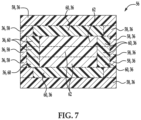
- Color may also be added by using the coloring agent (not shown), which will also be described further in reference to FIG. 7 .
- the volume of the fusing agent 26 , 26 ′ that is applied per unit of the build material composition 12 in the patterned portion 28 may be sufficient to absorb and convert enough electromagnetic radiation so that the build material composition 12 in the patterned portion 28 will coalesce/fuse.
- the volume of the fusing agent 26 , 26 ′ that is applied per unit of the build material composition 12 may depend, at least in part, on the energy absorber used, the energy absorber loading in the fusing agent 26 , 26 ′, and the build material composition 12 used.
- corresponding portion(s) 32 of the patterned portion 28 is/are also patterned with the hydrophilic agent 34 .
- the hydrophilic agent 34 may be applied in accordance with 3D object model wherever it is desirable for the final 3D object layer 30 to exhibit hydrophilicity. Utilizing a hydrophilic agent 34 that is separate from the fusing agent 26 , 26 ′ enables 3D objects with tailored hydrophilic areas to be formed. In the example shown in FIG. 2 , the 3D object layer 30 is an outermost layer, and thus forms one surface of the 3D object.
- the hydrophilic agent 34 is applied to impart hydrophilicity to this surface of the 3D object.
- the volume of the hydrophilic agent 34 that is applied per unit of the build material composition 12 in the portion 32 may depend upon whether it is desirable to impart hydrophilicity at the voxel surface and/or through the voxel volume, upon the desired hydrophilicity of the resulting portion(s) 36 of the 3D object layer 30 , and the volume of the fusing agent 26 , 26 ′ that is applied.
- the hydrophilic agent 34 can provide a cooling effect, and thus the ratio of hydrophilic agent 34 to fusing agent 26 or 26 ′ is controlled in order to achieve both fusing and a desired level of hydrophilicity.
- a weight ratio of the hydrophilic polymer in the selectively applied hydrophilic agent 34 to an energy absorber in the selectively applied fusing agent 26 , 26 ′ ranges from about 0.1 to about 5.
- the weight of the hydrophilic polymer applied to the portion 32 ranges from about 1.5 times to about 2.25 times more than the weight of the energy absorber applied to the portion 32 .
- the detailing agent 38 is also selectively applied to the portion(s) 40 of the layer 10 .
- the portion(s) 40 are not patterned with the fusing agent 26 , 26 ′ and thus are not to become part of the final 3D object layer 30 .
- Thermal energy generated during radiation exposure may propagate into the surrounding portion(s) 40 that do not have the fusing agent 26 , 26 ′ applied thereto. The propagation of thermal energy may be inhibited, and thus the coalescence of the non-patterned build material portion(s) 40 may be prevented, when the detailing agent 38 is applied to these portion(s) 44 .
- the entire layer 10 of the build material composition 12 is exposed to electromagnetic radiation (shown as EMR in FIG. 2 ).
- the electromagnetic radiation is emitted from the radiation source 24 .
- the length of time the electromagnetic radiation is applied for, or energy exposure time may be dependent, for example, on one or more of: characteristics of the radiation source 24 ; characteristics of the build material composition 12 ; and/or characteristics of the fusing agent 26 , 26 ′.
- the electromagnetic radiation exposure may be accomplished in a single radiation event or in multiple radiation events.
- the exposing of the build material composition 12 is accomplished in multiple radiation events.
- the number of radiation events ranges from 3 to 8.
- the exposure of the build material composition 12 to electromagnetic radiation may be accomplished in 3 radiation events. It may be desirable to expose the build material composition 12 to electromagnetic radiation in multiple radiation events to counteract a cooling effect that may be brought on by the amount of the agents 26 or 26 ′, 34 , 38 that is applied to the build material layer 10 . Additionally, it may be desirable to expose the build material composition 12 to electromagnetic radiation in multiple radiation events to sufficiently elevate the temperature of the build material composition 12 in the portion(s) 28 , 32 , without over heating the build material composition 12 in the non-patterned portion(s) 40 .
- the fusing agent 26 or 26 ′ enhances the absorption of the radiation, converts the absorbed radiation to thermal energy, and promotes the transfer of the thermal heat to the build material composition 12 in contact therewith.
- the fusing agent 26 , 26 ′ sufficiently elevates the temperature of the build material composition 12 in the portion 28 to a temperature above the melting point or within the melting range of the polymeric material, allowing coalescing/fusing (e.g., thermal merging, melting, binding, etc.) of the build material composition 12 to take place.
- the application of the electromagnetic radiation forms the 3D object layer 30 , which, in some examples, includes a hydrophilic portion 36 .
- the electromagnetic radiation has a wavelength ranging from 800 nm to 4000 nm, or from 800 nm to 1400 nm, or from 800 nm to 1200 nm. Radiation having wavelengths within the provided ranges may be absorbed (e.g., 80% or more of the applied radiation is absorbed) by the fusing agent 26 , 26 ′ and may heat the build material composition 12 in contact therewith, and may not be substantially absorbed (e.g., 25% or less of the applied radiation is absorbed) by the non-patterned build material composition 12 in portion(s) 40 .
- the 3D object layer 30 has a portion 36 with hydrophilicity (which corresponds with the portion 32 patterned with both the fusing agent 26 , 26 ′ and the hydrophilic agent 34 ).
- additional layer(s) may be formed thereon to create an example of the 3D object.
- additional build material composition 12 may be applied on the layer 30 .
- the fusing agent 26 or 26 ′ is then selectively applied on at least a portion of the additional build material composition 12 , according to the 3D object model.
- the hydrophilic agent 34 may also be applied, for example, if increased hydrophilicity is desired in the next layer.
- the detailing agent 38 may be applied in any area of the additional build material composition 12 where coalescence is not desirable.
- the application of additional build material composition 12 , the selective application of the agent(s) 26 or 26 ′, 34 , 38 , and the electromagnetic radiation exposure may be repeated a predetermined number of cycles to form the final 3D object 30 in accordance with the 3D object model.
- the method 100 includes iteratively applying the polymeric build material composition 12 to form individual build material layers 10 ; selectively applying the fusing agent 26 or 26 ′ on the individual build material layers 10 to form individual patterned portions 28 ; selectively applying the hydrophilic agent 34 onto at least a portion 32 of the individual patterned portions 28 ; and exposing the individual build material layers 10 to energy.
- the method 200 shown in FIG. 3 includes applying a polymeric build material to form a build material layer (reference numeral 202 ); based on a 3D object model, selectively applying a core fusing agent onto the build material layer, thereby forming a first patterned portion (reference numeral 204 ); based on the 3D object model, selectively applying a primer fusing agent and a hydrophilic agent onto the build material layer, thereby forming a second patterned portion adjacent to the first patterned portion, wherein the hydrophilic agent includes from 1 wt % to 12 wt % of a hydrophilic polymer dissolved in an aqueous liquid vehicle, wherein the hydrophilic polymer has a molar mass ranging from 1000 g/mol to 12,000 g/mol and is water-absorbent at a water to hydrophilic polymer weight ratio from 2:1 to 1000:1 (reference numeral 206 ); and exposing the build material layer to energy to selectively coalesce the patterned portions and form
- the method 200 is shown schematically in FIG. 4 .
- one layer 10 of the build material composition 12 is applied on the build area platform 14 as described in reference to FIG. 2 .
- the build material layer 10 may be exposed to pre-heating as described in reference to FIG. 2 .
- the core fusing agent(s) 26 is selectively applied on at least some of the build material composition 12 in the layer 10 to form a first patterned portion 28 ; and the primer fusing agent(s) 26 ′ and the hydrophilic agent 34 are selectively applied on at least some of the build material composition 12 in the layer 10 to form second patterned portion(s) 32 that are adjacent to the first patterned portion 28 .
- the first patterned portion 28 is generally located at an interior portion of the build material layer 10 and the second patterned portion 32 is generally located at an exterior portion of the build material layer 10 where it is desirable to impart hydrophilicity at one or more surface(s) of the 3D printed object layer 30 ′.
- the volume of the core fusing agent 26 that is applied per unit of the build material composition 12 in the first patterned portion 28 may be sufficient to absorb and convert enough electromagnetic radiation so that the build material composition 12 in the patterned portion 28 will coalesce/fuse.
- the volume of the primer fusing agent 26 ′ that is applied per unit of the build material composition 12 in the second patterned portion 32 may be sufficient to absorb and convert enough electromagnetic radiation so that the build material composition 12 in the second patterned portion 32 will coalesce/fuse.
- the volume of the hydrophilic agent 34 that is applied per unit of the build material composition 12 in the second patterned portion 32 may depend upon whether it is desirable to impart hydrophilicity at the voxel surface and/or through the voxel volume, upon the desired hydrophilicity of the resulting portion(s) 36 of the 3D object layer 30 , and the volume of the primer fusing agent 26 ′ that is applied.
- the weight ratio of the hydrophilic polymer to the energy absorber may be controlled in order to achieve both coalescence and hydrophilicity.
- the detailing agent 38 is also selectively applied to the portion(s) 40 of the layer 10 .
- the portion(s) 40 are not patterned with the fusing agent 26 , 26 ′ and thus are not to become part of the final 3D object layer 30 ′
- the entire layer 10 of the build material composition 12 is exposed to electromagnetic radiation (shown as EMR in FIG. 4 ). Radiation exposure may be accomplished as described in reference to FIG. 2 .
- the weight ratios of HA 2 :fusing agent for the example cube EC and of the control agen:fusing agent for the second comparative cube CC 2 were the same, and the weight ratio of the hydrophilic polymer:energy absorber was in accordance with the examples disclosed herein (e.g., 1:1-5:1).
- a drop of tap water was deposited on each of the cubes to perform a qualitative contact angle measurement test.
- the first comparative cube (CC 1 , no HA and no control agent) is on the left
- the second comparative cube CC 2 , control agent in outer layers
- the example cube EC, HA 2 in the outer layers
- the term “about” is used to provide flexibility to a numerical range endpoint by providing that a given value may be “a little above” or “a little below” the endpoint.
- the degree of flexibility of this term can be dictated by the particular variable and would be within the knowledge of those skilled in the art to determine based on experience and the associated description herein.
- when “about” is utilized to describe a value this is meant to encompass minor variations (up to +/ ⁇ 10%) from the stated value.
Landscapes
- Chemical & Material Sciences (AREA)
- Engineering & Computer Science (AREA)
- Materials Engineering (AREA)
- Manufacturing & Machinery (AREA)
- Physics & Mathematics (AREA)
- Mechanical Engineering (AREA)
- Optics & Photonics (AREA)
Abstract
Description

poly(vinyl alcohol)

or poly(hydroxy ethyl acrylate):

In any of these examples, n can be an integer, along with any capping groups that may be present, that provides the polymer with a molar mass ranging from about 1,000 g/mol to about 12,000 g/mol. As examples, n may range from about 10 to about 60, from about 12 to about 52, or from about 16 to about 40. “n” may also be selected so that the molar mass of the hydrophilic polymer ranges from about 1,000 g/mol to about 8,000 g/mol, or from about 1,200 g/mol to about 5,000 g/mol.

or copolymers thereof. In this example, n can be an integer, along with any capping groups that may be present, that provides the polymer with a molar mass ranging from about 1,000 g/mol to about 12,000 g/mol. As examples, n may range from about 10 to about 60, from about 12 to about 52, or from about 16 to about 40. “n” may also be selected so that the molar mass of the polyelectrolyte ranges from about 1,000 g/mol to about 8,000 g/mol, or from about 1,200 g/mol to about 5,000 g/mol.


and mixtures thereof. In the above formulations, M can be a divalent metal atom (e.g., copper, etc.) or can have OSO3Na axial groups filling any unfilled valencies if the metal is more than divalent (e.g., indium, etc.), R can be hydrogen or any C1-C8 alkyl group (including substituted alkyl and unsubstituted alkyl), and Z can be a counterion such that the overall charge of the near-infrared absorbing dye is neutral. For example, the counterion can be sodium, lithium, potassium, NH4 +, etc.

and mixtures thereof. For the hydrophobic near-infrared absorbing dyes, M can be a divalent metal atom (e.g., copper, etc.) or can include a metal that has Cl, Br, or OR′ (R′═H, CH3, COCH3, COCH2COOCH3, COCH2COCH3) axial groups filling any unfilled valencies if the metal is more than divalent, and R can be hydrogen or any C1-C8 alkyl group (including substituted alkyl and unsubstituted alkyl).

where R in the anthraquinone dyes or pigments may be hydrogen or any C1-C8 alkyl group (including substituted alkyl and unsubstituted alkyl), and R in the dithiolene may be hydrogen, COOH, SO3, NH2, any C1-C8 alkyl group (including substituted alkyl and unsubstituted alkyl), or the like.

where R in the perylenediimide dyes or pigments may be hydrogen or any C1-C5 alkyl group (including substituted alkyl and unsubstituted alkyl).


in which the total of a+b+c ranges from about 5 to about 60, or in other examples, from about 20 to about 30. An example of the ethoxylated glycerin is LIPONIC® EG-1 (LEG-1, glycereth-26, a+b+c=26, available from Lipo Chemicals).

(commercially available as Food Black 1); tetrasodium 6-amino-4-hydroxy-3-[[7-sulfonato-4-[(4-sulfonatophenyl)azo]-1-naphthyl]azo]naphthalene-2,7-disulfonate with a chemical structure of:

(commercially available as Food Black 2); tetrasodium (6E)-4-amino-5-oxo-3-[[4-(2-sulfonatooxyethylsulfonyl)phenyl]diazenyl]-6-[[4-(2-sulfonatooxyethylsulfonyl)phenyl]hydrazinylidenemaphthalene-2,7-disulfonate with a chemical structure of:

(commercially available as Reactive Black 31); tetrasodium (6E)-4-amino-5-oxo-3-[[4-(2-sulfonatooxyethylsulfonyl)phenyl]diazenyl]-6-[[4-(2-sulfonatooxyethylsulfonyl)phenyl]hydrazinylidene]naphthalene-2,7-disulfonate with a chemical structure of:

and combinations thereof. Some other commercially available examples of the dye used in the detailing agent include multipurpose black azo-dye based liquids, such as PRO-JET® Fast Black 1 (made available by Fujifilm Holdings), and black azo-dye based liquids with enhanced water fastness, such as PRO-JET® Fast Black 2 (made available by Fujifilm Holdings).

(commercially available as Acid Blue 9, where the counter ion may alternatively be sodium counter ions or potassium counter ions); sodium 4-[(E)-{4-[benzyl(ethyl)amino]phenyl}{(4E)-4-[benzyl(ethyl)iminio]cyclohexa-2,5-dien-1-ylidene}methyl]benzene-1,3-disulfonate with a chemical structure of:

(commercially available as Acid Blue 7); and a phthalocyanine with a chemical structure of:

(commercially available as Direct Blue 199); and combinations thereof.
| TABLE 1 | ||||
| HA 1* | HA 2 | Control | ||
| Category | Ingredient | (wt %) | (wt %) | (wt %) |
| Organic | 2-Pyrrolidone | 4 | 4 | 4 |
| Co-solvent | ||||
| Hydrophilic | Poly(acrylic acid | 7.5 | 10 | — |
| Polymer | sodium salt) | |||
| Surfactant | Tergitol ® 15-S-9 or | 0.85 | 0.85 | 0.85 |
| 15-S-12 | ||||
| Anti-kogation | Crodafos ® O3A | 0.5 | 0.5 | 0.5 |
| Agent | ||||
| Chelator | Trilon ® M (as is) | 0.05 | 0.05 | 0.05 |
| Biocide | Acticide ® B20 (as is) | 0.18 | 0.18 | 0.18 |
| Acticide ® M20 (as is) | 0.14 | 0.14 | 0.14 | |
| Buffer | Trizma ® or TRIS ® | 0.1 | 0.1 | 0.1 |
| Solvent | Water | Balance | Balance | Balance |
| *a couple drops of cyan dye were added to enhance visualization of the printed data | ||||
| TABLE 2 | ||
| FA | ||
| Category | Ingredient | (wt %) |
| Energy Absorber | CTO dispersion | 8 |
| Organic Co-Solvent | 2-pyrollidone | 19 |
| Surfactant | Tergitol ® 15-S-9 | 0.75 |
| Anti-kogation Agent | Crodafos ® O3A | 0.5 |
| Chelator | Trilon ® M (as is) | 0.0064 |
| Biocide | Acticide ® B20 | 0.036 |
| Stabilizers | Betaine | 8 |
| (from CTO dispersion) | ||
| Beta-alanine | 3 | |
| Solvent | Water | Balance |
Claims (11)
Applications Claiming Priority (3)
| Application Number | Priority Date | Filing Date | Title |
|---|---|---|---|
| USPCT/US2019/045313 | 2019-08-06 | ||
| PCT/US2019/045313 WO2021025690A1 (en) | 2019-08-06 | 2019-08-06 | Three-dimensional printing with polyelectrolytes |
| PCT/US2019/051720 WO2021025712A1 (en) | 2019-08-06 | 2019-09-18 | Three-dimensional printing |
Related Parent Applications (3)
| Application Number | Title | Priority Date | Filing Date |
|---|---|---|---|
| USPCT/US2019/453313 Continuation-In-Part | 2016-08-06 | ||
| PCT/US2019/045313 Continuation-In-Part WO2021025690A1 (en) | 2019-08-06 | 2019-08-06 | Three-dimensional printing with polyelectrolytes |
| PCT/US2019/051720 A-371-Of-International WO2021025712A1 (en) | 2019-08-06 | 2019-09-18 | Three-dimensional printing |
Related Child Applications (1)
| Application Number | Title | Priority Date | Filing Date |
|---|---|---|---|
| US18/662,874 Continuation US12447675B2 (en) | 2019-08-06 | 2024-05-13 | Three-dimensional printing |
Publications (2)
| Publication Number | Publication Date |
|---|---|
| US20220152923A1 US20220152923A1 (en) | 2022-05-19 |
| US12023861B2 true US12023861B2 (en) | 2024-07-02 |
Family
ID=74503953
Family Applications (4)
| Application Number | Title | Priority Date | Filing Date |
|---|---|---|---|
| US17/298,651 Active 2040-02-02 US12109757B2 (en) | 2019-08-06 | 2019-08-06 | Three-dimensional printing with polyelectrolytes |
| US17/298,643 Active 2036-11-30 US12023861B2 (en) | 2019-08-06 | 2019-09-18 | Three-dimensional printing |
| US18/662,874 Active US12447675B2 (en) | 2019-08-06 | 2024-05-13 | Three-dimensional printing |
| US19/198,103 Pending US20250262818A1 (en) | 2019-08-06 | 2025-05-04 | Three-dimensional printing |
Family Applications Before (1)
| Application Number | Title | Priority Date | Filing Date |
|---|---|---|---|
| US17/298,651 Active 2040-02-02 US12109757B2 (en) | 2019-08-06 | 2019-08-06 | Three-dimensional printing with polyelectrolytes |
Family Applications After (2)
| Application Number | Title | Priority Date | Filing Date |
|---|---|---|---|
| US18/662,874 Active US12447675B2 (en) | 2019-08-06 | 2024-05-13 | Three-dimensional printing |
| US19/198,103 Pending US20250262818A1 (en) | 2019-08-06 | 2025-05-04 | Three-dimensional printing |
Country Status (3)
| Country | Link |
|---|---|
| US (4) | US12109757B2 (en) |
| EP (2) | EP4010169B1 (en) |
| WO (2) | WO2021025690A1 (en) |
Citations (26)
| Publication number | Priority date | Publication date | Assignee | Title |
|---|---|---|---|---|
| US20050046067A1 (en) * | 2003-08-27 | 2005-03-03 | Christopher Oriakhi | Inorganic phosphate cement compositions for solid freeform fabrication |
| US20050059757A1 (en) | 2003-08-29 | 2005-03-17 | Z Corporation | Absorbent fillers for three-dimensional printing |
| US20050080191A1 (en) | 2003-10-14 | 2005-04-14 | Laura Kramer | Polymer systems with reactive and fusible properties for solid freeform fabrication |
| US7087109B2 (en) | 2002-09-25 | 2006-08-08 | Z Corporation | Three dimensional printing material system and method |
| US20060192315A1 (en) * | 2005-02-25 | 2006-08-31 | Isaac Farr | Core-shell solid freeform fabrication |
| US20060208388A1 (en) | 1999-11-05 | 2006-09-21 | Z Corporation | Material systems and methods of three-dimensional printing |
| CN101585549A (en) | 2009-06-18 | 2009-11-25 | 中盐制盐工程技术研究院 | Preparing method of industrial salt and method for preparing caustic soda through electrolysis |
| US20120289607A1 (en) | 2009-09-28 | 2012-11-15 | Haishan Xiong | Absorbent composition and methods thereof |
| EP2269808B1 (en) | 2003-05-21 | 2017-03-22 | 3D Systems Incorporated | Thermoplastic powder material system for appearance models from 3D printing systems |
| CN106925773A (en) | 2017-04-21 | 2017-07-07 | 深圳市创艺工业技术有限公司 | A kind of 3D printing material with self-cleaning performance |
| WO2017146741A1 (en) | 2016-02-26 | 2017-08-31 | Hewlett-Packard Development Company, L.P. | Color printing and three-dimensional (3d) printing |
| US20170247558A1 (en) | 2014-10-31 | 2017-08-31 | Hewlett-Packard Development Company, L.P. | Hydrophilic pigment dispersant for an inkjet ink |
| WO2017213666A1 (en) | 2016-06-10 | 2017-12-14 | Hewlett-Packard Development Company, L.P. | Material sets |
| US20180104894A1 (en) | 2016-05-13 | 2018-04-19 | Hewlett-Packard Development Company, L.P. | Three-dimensional printing |
| US20180126631A1 (en) | 2015-07-23 | 2018-05-10 | Hewlett-Packard Development Company, L.P. | Three-dimensional (3d) printing build material composition |
| CN108084342A (en) | 2017-11-27 | 2018-05-29 | 南京航空航天大学 | A kind of water soluble photo-curable 3D printing backing material and preparation method thereof |
| WO2018095837A1 (en) | 2016-11-23 | 2018-05-31 | Atheneum Optical Sciences, Llc | Three-dimensional printing of optical devices |
| CN108250704A (en) | 2016-12-28 | 2018-07-06 | 上海邦中新材料有限公司 | A kind of medical mask of 3D printing is resin dedicated |
| US20180194959A1 (en) | 2015-09-15 | 2018-07-12 | Hewlett-Packard Development Company, L.P. | White inks |
| US20180272607A1 (en) | 2015-10-21 | 2018-09-27 | Hewlett-Packard Development Company, L.P. | Three-dimensional (3d) printing |
| US20180290925A1 (en) | 2015-09-25 | 2018-10-11 | Commissariat à l'énergie atomique et aux énergies alternatives | Use of a geopolymer with superabsorbent polymer |
| US20180333914A1 (en) | 2016-10-25 | 2018-11-22 | Hewlett-Packard Development Company, L.P. | Three-dimensional (3d) printing |
| US20190030797A1 (en) | 2016-05-17 | 2019-01-31 | Hewlett-Packard Development Company, L.P. | 3d printer with tuned coolant droplets |
| US10293555B2 (en) | 2014-12-04 | 2019-05-21 | Ricoh Company, Ltd. | Liquid material for forming three-dimensional object and material set for forming three-dimensional object, and three-dimensional object producing method |
| WO2019108288A1 (en) | 2017-11-30 | 2019-06-06 | Hewlett-Packard Development Company, L.P. | Three-dimensional printing |
| US11485870B2 (en) | 2016-04-28 | 2022-11-01 | Hewlett-Packard Development Company, L.P. | Material sets |
Family Cites Families (1)
| Publication number | Priority date | Publication date | Assignee | Title |
|---|---|---|---|---|
| WO2007114895A2 (en) * | 2006-04-06 | 2007-10-11 | Z Corporation | Production of three-dimensional objects by use of electromagnetic radiation |
-
2019
- 2019-08-06 US US17/298,651 patent/US12109757B2/en active Active
- 2019-08-06 EP EP19940923.6A patent/EP4010169B1/en active Active
- 2019-08-06 WO PCT/US2019/045313 patent/WO2021025690A1/en not_active Ceased
- 2019-09-18 WO PCT/US2019/051720 patent/WO2021025712A1/en not_active Ceased
- 2019-09-18 EP EP19940703.2A patent/EP3966020B1/en active Active
- 2019-09-18 US US17/298,643 patent/US12023861B2/en active Active
-
2024
- 2024-05-13 US US18/662,874 patent/US12447675B2/en active Active
-
2025
- 2025-05-04 US US19/198,103 patent/US20250262818A1/en active Pending
Patent Citations (29)
| Publication number | Priority date | Publication date | Assignee | Title |
|---|---|---|---|---|
| US20060208388A1 (en) | 1999-11-05 | 2006-09-21 | Z Corporation | Material systems and methods of three-dimensional printing |
| US20060230984A1 (en) | 2002-09-25 | 2006-10-19 | Z Corporation | Three dimensional printing material system and method |
| US7087109B2 (en) | 2002-09-25 | 2006-08-08 | Z Corporation | Three dimensional printing material system and method |
| EP2269808B1 (en) | 2003-05-21 | 2017-03-22 | 3D Systems Incorporated | Thermoplastic powder material system for appearance models from 3D printing systems |
| US20050046067A1 (en) * | 2003-08-27 | 2005-03-03 | Christopher Oriakhi | Inorganic phosphate cement compositions for solid freeform fabrication |
| US20050059757A1 (en) | 2003-08-29 | 2005-03-17 | Z Corporation | Absorbent fillers for three-dimensional printing |
| US20050080191A1 (en) | 2003-10-14 | 2005-04-14 | Laura Kramer | Polymer systems with reactive and fusible properties for solid freeform fabrication |
| US20060192315A1 (en) * | 2005-02-25 | 2006-08-31 | Isaac Farr | Core-shell solid freeform fabrication |
| CN101585549A (en) | 2009-06-18 | 2009-11-25 | 中盐制盐工程技术研究院 | Preparing method of industrial salt and method for preparing caustic soda through electrolysis |
| US20120289607A1 (en) | 2009-09-28 | 2012-11-15 | Haishan Xiong | Absorbent composition and methods thereof |
| US20170247558A1 (en) | 2014-10-31 | 2017-08-31 | Hewlett-Packard Development Company, L.P. | Hydrophilic pigment dispersant for an inkjet ink |
| US10293555B2 (en) | 2014-12-04 | 2019-05-21 | Ricoh Company, Ltd. | Liquid material for forming three-dimensional object and material set for forming three-dimensional object, and three-dimensional object producing method |
| US20180126631A1 (en) | 2015-07-23 | 2018-05-10 | Hewlett-Packard Development Company, L.P. | Three-dimensional (3d) printing build material composition |
| US20180194959A1 (en) | 2015-09-15 | 2018-07-12 | Hewlett-Packard Development Company, L.P. | White inks |
| US20180290925A1 (en) | 2015-09-25 | 2018-10-11 | Commissariat à l'énergie atomique et aux énergies alternatives | Use of a geopolymer with superabsorbent polymer |
| US20180272607A1 (en) | 2015-10-21 | 2018-09-27 | Hewlett-Packard Development Company, L.P. | Three-dimensional (3d) printing |
| US20180311892A1 (en) | 2016-02-26 | 2018-11-01 | Hewlett-Packard Development Company, L.P. | Color printing and three-dimensional (3d) printing |
| WO2017146741A1 (en) | 2016-02-26 | 2017-08-31 | Hewlett-Packard Development Company, L.P. | Color printing and three-dimensional (3d) printing |
| US11485870B2 (en) | 2016-04-28 | 2022-11-01 | Hewlett-Packard Development Company, L.P. | Material sets |
| US20180104894A1 (en) | 2016-05-13 | 2018-04-19 | Hewlett-Packard Development Company, L.P. | Three-dimensional printing |
| US20190030797A1 (en) | 2016-05-17 | 2019-01-31 | Hewlett-Packard Development Company, L.P. | 3d printer with tuned coolant droplets |
| WO2017213666A1 (en) | 2016-06-10 | 2017-12-14 | Hewlett-Packard Development Company, L.P. | Material sets |
| US20190047216A1 (en) | 2016-06-10 | 2019-02-14 | Hewlett-Packard Development Company, L.P. | Material sets |
| US20180333914A1 (en) | 2016-10-25 | 2018-11-22 | Hewlett-Packard Development Company, L.P. | Three-dimensional (3d) printing |
| WO2018095837A1 (en) | 2016-11-23 | 2018-05-31 | Atheneum Optical Sciences, Llc | Three-dimensional printing of optical devices |
| CN108250704A (en) | 2016-12-28 | 2018-07-06 | 上海邦中新材料有限公司 | A kind of medical mask of 3D printing is resin dedicated |
| CN106925773A (en) | 2017-04-21 | 2017-07-07 | 深圳市创艺工业技术有限公司 | A kind of 3D printing material with self-cleaning performance |
| CN108084342A (en) | 2017-11-27 | 2018-05-29 | 南京航空航天大学 | A kind of water soluble photo-curable 3D printing backing material and preparation method thereof |
| WO2019108288A1 (en) | 2017-11-30 | 2019-06-06 | Hewlett-Packard Development Company, L.P. | Three-dimensional printing |
Non-Patent Citations (1)
| Title |
|---|
| Lubrizol, Product Data Sheet for Carbosperse K-7028, Apr. 27, 2021, 2 pages. |
Also Published As
| Publication number | Publication date |
|---|---|
| EP3966020A1 (en) | 2022-03-16 |
| EP4010169A1 (en) | 2022-06-15 |
| EP3966020A4 (en) | 2023-06-28 |
| US20250262818A1 (en) | 2025-08-21 |
| US20240293967A1 (en) | 2024-09-05 |
| EP3966020B1 (en) | 2024-12-11 |
| US20220152923A1 (en) | 2022-05-19 |
| EP4010169A4 (en) | 2023-05-03 |
| WO2021025690A1 (en) | 2021-02-11 |
| US12447675B2 (en) | 2025-10-21 |
| US12109757B2 (en) | 2024-10-08 |
| WO2021025712A1 (en) | 2021-02-11 |
| US20220152919A1 (en) | 2022-05-19 |
| EP4010169B1 (en) | 2025-02-12 |
Similar Documents
| Publication | Publication Date | Title |
|---|---|---|
| US11993010B2 (en) | Three-dimensional printing | |
| US11613670B2 (en) | Three-dimensional printing | |
| US12466127B2 (en) | Multi-fluid kit for three-dimensional (3D) printing, and three-dimensional printing | |
| US20210379824A1 (en) | Three-dimensional printing | |
| EP3986696B1 (en) | Three-dimensional printing | |
| US12187873B2 (en) | Three-dimensional printing | |
| US12447672B2 (en) | Three-dimensional printing | |
| US12447675B2 (en) | Three-dimensional printing | |
| US20210238414A1 (en) | Three-dimensional printing | |
| US20240025113A1 (en) | Three-dimensional printing | |
| US12233597B2 (en) | Three-dimensional printing | |
| US12428579B2 (en) | Three-dimensional printing | |
| US11396130B2 (en) | Three-dimensional printing | |
| US20240389584A1 (en) | Three-dimensional printing | |
| US20220250314A1 (en) | Three-dimensional printing |
Legal Events
| Date | Code | Title | Description |
|---|---|---|---|
| AS | Assignment |
Owner name: HEWLETT-PACKARD DEVELOPMENT COMPANY, L.P., TEXAS Free format text: ASSIGNMENT OF ASSIGNORS INTEREST;ASSIGNORS:DISCEKICI, EMRE HIRO;NEGRI JIMENEZ, GRACIELA E.;WOODRUFF, SHANNON REUBEN;REEL/FRAME:056394/0381 Effective date: 20190916 |
|
| STPP | Information on status: patent application and granting procedure in general |
Free format text: DOCKETED NEW CASE - READY FOR EXAMINATION |
|
| STPP | Information on status: patent application and granting procedure in general |
Free format text: NON FINAL ACTION MAILED |
|
| STPP | Information on status: patent application and granting procedure in general |
Free format text: RESPONSE TO NON-FINAL OFFICE ACTION ENTERED AND FORWARDED TO EXAMINER |
|
| STPP | Information on status: patent application and granting procedure in general |
Free format text: NON FINAL ACTION MAILED |
|
| STPP | Information on status: patent application and granting procedure in general |
Free format text: RESPONSE TO NON-FINAL OFFICE ACTION ENTERED AND FORWARDED TO EXAMINER |
|
| STPP | Information on status: patent application and granting procedure in general |
Free format text: NOTICE OF ALLOWANCE MAILED -- APPLICATION RECEIVED IN OFFICE OF PUBLICATIONS |
|
| STPP | Information on status: patent application and granting procedure in general |
Free format text: PUBLICATIONS -- ISSUE FEE PAYMENT VERIFIED |
|
| STCF | Information on status: patent grant |
Free format text: PATENTED CASE |
|
| AS | Assignment |
Owner name: PERIDOT PRINT LLC, CALIFORNIA Free format text: ASSIGNMENT OF ASSIGNORS INTEREST;ASSIGNOR:HEWLETT-PACKARD DEVELOPMENT COMPANY, L.P.;REEL/FRAME:070187/0001 Effective date: 20240116 Owner name: PERIDOT PRINT LLC, CALIFORNIA Free format text: ASSIGNMENT OF ASSIGNOR'S INTEREST;ASSIGNOR:HEWLETT-PACKARD DEVELOPMENT COMPANY, L.P.;REEL/FRAME:070187/0001 Effective date: 20240116 |
|
| AS | Assignment |
Owner name: PERIDOT PRINT LLC, CALIFORNIA Free format text: ASSIGNMENT OF ASSIGNORS INTEREST;ASSIGNOR:HEWLETT-PACKARD DEVELOPMENT COMPANY, L.P.;REEL/FRAME:071033/0175 Effective date: 20240116 Owner name: PERIDOT PRINT LLC, CALIFORNIA Free format text: ASSIGNMENT OF ASSIGNOR'S INTEREST;ASSIGNOR:HEWLETT-PACKARD DEVELOPMENT COMPANY, L.P.;REEL/FRAME:071033/0175 Effective date: 20240116 |