US12023406B2 - Gastric residence systems with release rate-modulating films - Google Patents
Gastric residence systems with release rate-modulating films Download PDFInfo
- Publication number
- US12023406B2 US12023406B2 US16/618,759 US201816618759A US12023406B2 US 12023406 B2 US12023406 B2 US 12023406B2 US 201816618759 A US201816618759 A US 201816618759A US 12023406 B2 US12023406 B2 US 12023406B2
- Authority
- US
- United States
- Prior art keywords
- gastric residence
- agent
- residence system
- release
- gastric
- Prior art date
- Legal status (The legal status is an assumption and is not a legal conclusion. Google has not performed a legal analysis and makes no representation as to the accuracy of the status listed.)
- Active, expires
Links
Images




Classifications
-
- A—HUMAN NECESSITIES
- A61—MEDICAL OR VETERINARY SCIENCE; HYGIENE
- A61K—PREPARATIONS FOR MEDICAL, DENTAL OR TOILETRY PURPOSES
- A61K9/00—Medicinal preparations characterised by special physical form
- A61K9/0012—Galenical forms characterised by the site of application
- A61K9/0053—Mouth and digestive tract, i.e. intraoral and peroral administration
- A61K9/0065—Forms with gastric retention, e.g. floating on gastric juice, adhering to gastric mucosa, expanding to prevent passage through the pylorus
-
- A—HUMAN NECESSITIES
- A61—MEDICAL OR VETERINARY SCIENCE; HYGIENE
- A61K—PREPARATIONS FOR MEDICAL, DENTAL OR TOILETRY PURPOSES
- A61K31/00—Medicinal preparations containing organic active ingredients
- A61K31/33—Heterocyclic compounds
- A61K31/395—Heterocyclic compounds having nitrogen as a ring hetero atom, e.g. guanethidine or rifamycins
- A61K31/435—Heterocyclic compounds having nitrogen as a ring hetero atom, e.g. guanethidine or rifamycins having six-membered rings with one nitrogen as the only ring hetero atom
- A61K31/44—Non condensed pyridines; Hydrogenated derivatives thereof
- A61K31/445—Non condensed piperidines, e.g. piperocaine
-
- A—HUMAN NECESSITIES
- A61—MEDICAL OR VETERINARY SCIENCE; HYGIENE
- A61K—PREPARATIONS FOR MEDICAL, DENTAL OR TOILETRY PURPOSES
- A61K31/00—Medicinal preparations containing organic active ingredients
- A61K31/33—Heterocyclic compounds
- A61K31/395—Heterocyclic compounds having nitrogen as a ring hetero atom, e.g. guanethidine or rifamycins
- A61K31/495—Heterocyclic compounds having nitrogen as a ring hetero atom, e.g. guanethidine or rifamycins having six-membered rings with two or more nitrogen atoms as the only ring heteroatoms, e.g. piperazine or tetrazines
- A61K31/505—Pyrimidines; Hydrogenated pyrimidines, e.g. trimethoprim
- A61K31/519—Pyrimidines; Hydrogenated pyrimidines, e.g. trimethoprim ortho- or peri-condensed with heterocyclic rings
-
- A—HUMAN NECESSITIES
- A61—MEDICAL OR VETERINARY SCIENCE; HYGIENE
- A61K—PREPARATIONS FOR MEDICAL, DENTAL OR TOILETRY PURPOSES
- A61K31/00—Medicinal preparations containing organic active ingredients
- A61K31/65—Tetracyclines
-
- A—HUMAN NECESSITIES
- A61—MEDICAL OR VETERINARY SCIENCE; HYGIENE
- A61K—PREPARATIONS FOR MEDICAL, DENTAL OR TOILETRY PURPOSES
- A61K47/00—Medicinal preparations characterised by the non-active ingredients used, e.g. carriers or inert additives; Targeting or modifying agents chemically bound to the active ingredient
- A61K47/06—Organic compounds, e.g. natural or synthetic hydrocarbons, polyolefins, mineral oil, petrolatum or ozokerite
- A61K47/08—Organic compounds, e.g. natural or synthetic hydrocarbons, polyolefins, mineral oil, petrolatum or ozokerite containing oxygen, e.g. ethers, acetals, ketones, quinones, aldehydes, peroxides
- A61K47/10—Alcohols; Phenols; Salts thereof, e.g. glycerol; Polyethylene glycols [PEG]; Poloxamers; PEG/POE alkyl ethers
-
- A—HUMAN NECESSITIES
- A61—MEDICAL OR VETERINARY SCIENCE; HYGIENE
- A61K—PREPARATIONS FOR MEDICAL, DENTAL OR TOILETRY PURPOSES
- A61K47/00—Medicinal preparations characterised by the non-active ingredients used, e.g. carriers or inert additives; Targeting or modifying agents chemically bound to the active ingredient
- A61K47/06—Organic compounds, e.g. natural or synthetic hydrocarbons, polyolefins, mineral oil, petrolatum or ozokerite
- A61K47/08—Organic compounds, e.g. natural or synthetic hydrocarbons, polyolefins, mineral oil, petrolatum or ozokerite containing oxygen, e.g. ethers, acetals, ketones, quinones, aldehydes, peroxides
- A61K47/14—Esters of carboxylic acids, e.g. fatty acid monoglycerides, medium-chain triglycerides, parabens or PEG fatty acid esters
-
- A—HUMAN NECESSITIES
- A61—MEDICAL OR VETERINARY SCIENCE; HYGIENE
- A61K—PREPARATIONS FOR MEDICAL, DENTAL OR TOILETRY PURPOSES
- A61K47/00—Medicinal preparations characterised by the non-active ingredients used, e.g. carriers or inert additives; Targeting or modifying agents chemically bound to the active ingredient
- A61K47/30—Macromolecular organic or inorganic compounds, e.g. inorganic polyphosphates
- A61K47/32—Macromolecular compounds obtained by reactions only involving carbon-to-carbon unsaturated bonds, e.g. carbomers, poly(meth)acrylates, or polyvinyl pyrrolidone
-
- A—HUMAN NECESSITIES
- A61—MEDICAL OR VETERINARY SCIENCE; HYGIENE
- A61K—PREPARATIONS FOR MEDICAL, DENTAL OR TOILETRY PURPOSES
- A61K47/00—Medicinal preparations characterised by the non-active ingredients used, e.g. carriers or inert additives; Targeting or modifying agents chemically bound to the active ingredient
- A61K47/30—Macromolecular organic or inorganic compounds, e.g. inorganic polyphosphates
- A61K47/34—Macromolecular compounds obtained otherwise than by reactions only involving carbon-to-carbon unsaturated bonds, e.g. polyesters, polyamino acids, polysiloxanes, polyphosphazines, copolymers of polyalkylene glycol or poloxamers
-
- A—HUMAN NECESSITIES
- A61—MEDICAL OR VETERINARY SCIENCE; HYGIENE
- A61K—PREPARATIONS FOR MEDICAL, DENTAL OR TOILETRY PURPOSES
- A61K9/00—Medicinal preparations characterised by special physical form
- A61K9/14—Particulate form, e.g. powders, Processes for size reducing of pure drugs or the resulting products, Pure drug nanoparticles
- A61K9/141—Intimate drug-carrier mixtures characterised by the carrier, e.g. ordered mixtures, adsorbates, solid solutions, eutectica, co-dried, co-solubilised, co-kneaded, co-milled, co-ground products, co-precipitates, co-evaporates, co-extrudates, co-melts; Drug nanoparticles with adsorbed surface modifiers
- A61K9/146—Intimate drug-carrier mixtures characterised by the carrier, e.g. ordered mixtures, adsorbates, solid solutions, eutectica, co-dried, co-solubilised, co-kneaded, co-milled, co-ground products, co-precipitates, co-evaporates, co-extrudates, co-melts; Drug nanoparticles with adsorbed surface modifiers with organic macromolecular compounds
Definitions
- the invention provides gastric residence systems which have segments covered with release rate-modulating polymer films.
- the invention also provides elongate members of gastric residence systems which have segments covered with release rate-modulating polymer films.
- the invention also provides segments covered with release rate-modulating polymer films suitable for use in gastric residence systems.
- the invention also provides elongate members covered with release rate-modulating polymer films suitable for use in gastric residence systems. Methods of making the segments, elongate members, and gastric residence systems are also provided. Methods of using the gastric residence systems are also provided.
- the invention can provide gastric residence systems which comprise a therapeutically effective amount of an agent or a pharmaceutically acceptable salt thereof, where the gastric residence system has a compacted configuration and an uncompacted configuration, the gastric residence system comprises a plurality of elongate members affixed to a central elastomer, each elongate member comprises at least two segments joined by linkers, where the linkers are configured to weaken or degrade to allow passage of the gastric residence system through the pylorus after the specified gastric residence period (for example, the linkers may soften and become flexible, or the linkers may no longer join the at least two segments of each elongate member after the specified gastric residence period); and where the segments of the elongate members comprise a carrier polymer and the adamantane-class drug or the pharmaceutically acceptable salt thereof, or the segments of the elongate members comprise a) a carrier polymer, b) at least one excipient, and c) the agent or the
- the invention can provide gastric residence systems which comprise a therapeutically effective amount of an adamantane-class drug or a pharmaceutically acceptable salt thereof, where the gastric residence system has a compacted configuration and an uncompacted configuration, the gastric residence system comprises a plurality of elongate members affixed to a central elastomer by linkers, where the linkers are configured to weaken or degrade to allow passage of the gastric residence system through the pylorus after the specified gastric residence period (for example, the linkers may soften and become flexible, or the linkers may no longer join the elongate members to the central elastomer after the specified gastric residence period).
- the elongate members comprise a carrier polymer and the adamantane-class drug or the pharmaceutically acceptable salt thereof.
- the elongate members further comprise at least one excipient.
- the gastric residence system is configured to release the adamantane-class drug or the pharmaceutically acceptable salt thereof over the specified gastric residence period.
- the adamantine-class drug or a pharmaceutically acceptable salt thereof can be memantine or a pharmaceutically acceptable salt thereof.
- At least one of the linkers can comprise an enteric polymer, or can comprise a polymer that degrades in a time-dependent manner in an aqueous environment.
- the gastric residence period of the system can be about four days, at least about four days, about seven days, or at least about seven days.
- the gastric residence period of the system can be about four days to about ten days, about four days to about eight days, or about seven days to about ten days.
- the invention can provide gastric residence systems which comprise a therapeutically effective amount of risperidone or a pharmaceutically acceptable salt thereof, where the gastric residence system has a compacted configuration and an uncompacted configuration, the gastric residence system comprises a plurality of elongate members affixed to a central elastomer by linkers, where the linkers are configured to weaken or degrade to allow passage of the gastric residence system through the pylorus after the specified gastric residence period (for example, the linkers may soften and become flexible, or the linkers may no longer join the elongate members to the central elastomer after the specified gastric residence period).
- the invention can provide gastric residence systems which comprise a therapeutically effective amount of donepezil or a pharmaceutically acceptable salt thereof, where the gastric residence system has a compacted configuration and an uncompacted configuration, the gastric residence system comprises a plurality of elongate members affixed to a central elastomer by linkers, where the linkers are configured to weaken or degrade to allow passage of the gastric residence system through the pylorus after the specified gastric residence period (for example, the linkers may soften and become flexible, or the linkers may no longer join the elongate members to the central elastomer after the specified gastric residence period).
- the one or more additional excipients can be selected from the group consisting of P407, Eudragit E, PEG, Polyvinylpyrrolidone (PVP), Polyvinyl acetate (PVAc), Polyvinyl alcohol (PVA), Eudragit RS, Eudragit RL, PLA, PLGA, PLA-PCL, polydioxanone, Crospovidone, Croscarmellose, HPMCAS, Lecithin, Taurocholate, SDS, Soluplus, Fatty acids, Kolliphor RH40; and linear block copolymers of dioxanone and ethylene glycol; linear block copolymers of lactide and ethylene glycol; linear block copolymers of lactide, ethylene glycol, trimethyl carbonate, and caprolactone; linear block copolymers of lactide, glycolide, and ethylene glycol; linear block copolymers of glycolide, polyethylene glycol, and ethylene glycol; linear copolymers of caprolactone and
- HPMCAS Hydroxypropyl methylcellulose acetate succinate
- the central elastomer can comprise silicone rubber.
- the agent or pharmaceutically acceptable salt thereof can comprise particles of the agent or a pharmaceutically acceptable salt thereof in the form of particles disposed in the carrier polymer, where at least about 80% of the mass of particles have sizes between about 1 micron and about 50 microns in diameter.
- the gastric residence system can comprise about 10 mg to about 600 mg of agent or a pharmaceutically acceptable salt thereof.
- the invention provides a formulation for extended release of an agent or a pharmaceutically acceptable salt thereof, comprising about 10% to about 30% of an agent or a pharmaceutically acceptable salt thereof; about 0.1% to about 4% of silica; about 5% to about 30% of an acrylate polymer or co-polymer; and about 0.2% to about 10% of a polyalkylene glycol; where the remainder of the composition comprises a polylactone.
- the formulation can further comprise about 0.1% to about 2% of an anti-oxidant material.
- the anti-oxidant material can comprise one or more compounds selected from the group consisting of Vitamin E, a tocopherol, a Vitamin E ester, a tocopherol ester, ascorbic acid, or a carotene, such as alpha-tocopherol, Vitamin E succinate, alpha-tocopherol succinate, Vitamin E acetate, alpha-tocopherol acetate, Vitamin E nicotinate, alpha-tocopherol nicotinate, Vitamin E linoleate, or alpha-tocopherol linoleate.
- the invention provides a segment of a gastric residence system, the segment comprising a carrier polymer; an agent or a salt thereof; and a release-rate modulating polymer film configured to control the release rate of the agent, wherein over a seven-day incubation of the segment in simulated gastric fluid, the amount of the agent or salt thereof released during day 5 is at least about 40% of the amount of agent or salt thereof released during day 2; and wherein at least about 7% of the total amount of agent in the segment is released on day 2 and at least about 7% of the total amount of agent is released on day 5.
- the invention provides a segment of a gastric residence system, the segment comprising a carrier polymer, an agent or a salt thereof; and a release-rate modulating polymer film configured to control the release rate of the agent, wherein the release-rate modulating polymer film is configured such that the release of agent from the segment in 40% ethanol/60% simulated gastric fluid over one hour is no more than about 40% higher compared to release of agent from an equivalent segment in 100% simulated gastric fluid over one hour.
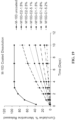
- FIG. 9 B depicts additional release rate profiles for formulations with increasing levels of TEC in PCL coating.
- FIG. 12 depicts the effect of ethyl cellulose coating on consistent drug serum levels of Memantine HCl, compared to an uncoated dosage form.
- compositions or methods are recited as “comprising” or “comprises” with respect to their various elements.
- those elements can be recited with the transitional phrase “consisting essentially of” or “consists essentially of” as applied to those elements.
- those elements can be recited with the transitional phrase “consisting of” or “consists of” as applied to those elements.
- a composition or method is disclosed herein as comprising A and B, the alternative embodiment for that composition or method of “consisting essentially of A and B” and the alternative embodiment for that composition or method of “consisting of A and B” are also considered to have been disclosed herein.
- embodiments recited as “consisting essentially of” or “consisting of” with respect to their various elements can also be recited as “comprising” as applied to those elements.
- embodiments recited as “consisting essentially of” with respect to their various elements can also be recited as “consisting of” as applied to those elements, and embodiments recited as “consisting of” with respect to their various elements can also be recited as “consisting essentially of” as applied to those elements.
- carrier material for the agent or pharmaceutically acceptable salt thereof in a gastric residence system influences the release profile of drug during the period of gastric residence, and is discussed in more detail below in the section “Carrier polymers for segments and elongate members (carrier polymer-agent component).” Release of drug can be modulated by a wide variety of excipients included in the carrier polymer-agent component. Soluble excipients include P407, Eudragit E, PEG, Polyvinylpyrrolidone (PVP), and Polyvinyl alcohol (PVA). Insoluble, wicking excipients include Eudragit RS and Eudragit RL.
- Degradable excipients include PLA, PLGA, PLA-PCL, polydioxanone, and linear copolymers of caprolactone and glycolide; polyaxial block copolymers of glycolide, caprolactone, and trimethylene carbonate; polyaxial block copolymers of glycolide, trimethylene carbonate, and lactide; polyaxial block copolymers of glycolide, trimethylene carbonate and polypropylene succinate; polyaxial block copolymers of caprolactone, lactide, glycolide, and trimethylene carbonate; polyaxial block copolymers of glycolide, trimethylene carbonate, and caprolactone; and linear block copolymers of lactide, caprolactone, and trimethylene carbonate; such as linear copolymers of caprolactone (95%) and glycolide (5%); polyaxial block copolymers of glycolide (68%), caprolactone (29%), and trimethylene carbonate (3%); polyaxial block copolymers of glycolide (86%), trimethylene carbonate
- Insoluble, swellable excipients include Polyvinyl acetate (PVAc), Crospovidone, Croscarmellose, HPMCAS, and linear block copolymers of dioxanone and ethylene glycol; linear block copolymers of lactide and ethylene glycol; linear block copolymers of lactide, ethylene glycol, trimethyl carbonate, and caprolactone; linear block copolymers of lactide, glycolide, and ethylene glycol; linear block copolymers of glycolide, polyethylene glycol, and ethylene glycol; such as linear block copolymers of dioxanone (80%) and ethylene glycol (20%); linear block copolymers of lactide (60%) and ethylene glycol (40%); linear block copolymers of lactide (68%), ethylene glycol (20%), trimethyl carbonate (10%), and caprolactone (2%); linear block copolymers of lactide (88%), glycolide (8%), and ethylene glycol (4%); linear block
- the current invention provides, inter alia, gastric residence systems, elongate m embers s of gastric residence systems, and segments for use in gastric residence systems and elongate members of gastric residence systems, which are coated with a release rate-modulating film.
- a release rate-modulating polymer film with the gastric residence systems, such as on the carrier polymer-agent segments of the gastric residence systems or on the elongate members of the gastric residence systems, provides several significant advantages over systems with carrier polymer-agent segments lacking a release rate-modulating film.
- Release rate-modulating polymer films reduce the burst release of agent upon initial contact with gastric fluid. Linearity of agent release over the residence period is improved by using release rate-modulating polymer films. Both of these advantages provide better regulation of dosing from the gastric residence systems.
- Some compositions of the release rate-modulating polymer films can also significantly reduce burst release upon exposure to alcohol, as compared to systems lacking such films.
- the release rate-modulating polymer films are coatings which can coat all or part of a carrier polymer-agent segment.
- the films can be continuous, discontinuous, flat, or textured. They can be a smooth coating over a segment, or can follow contours of pores that may be present on the surface of a segment.
- the release rate modulating film of any of the gastric residence systems disclosed herein does not cover the coupling polymers, enteric polymers, enteric linkers, time-dependent linkers, disintegrating polymers, disintegrating matrices, or other linkers of the gastric residence system. If a release-rate modulating polymer film is coated on the surface of an elongate member which comprises one or more linkers, such as a coupling polymer, enteric polymer, enteric linker, time-dependent linker, disintegrating polymer, disintegrating matrix, or other linker, the film is discontinuous and does not cover or coat the linkers.
- linkers such as a coupling polymer, enteric polymer, enteric linker, time-dependent linker, disintegrating polymer, disintegrating matrix, or other linker
- release rate-modulating film This is readily accomplished by applying a release rate-modulating film to segments which will comprise an elongate member, and then linking the coated segments together with linkers to form an elongate member; the segments comprising carrier polymer-agent (or agent salt) will thus be coated with the release rate-modulating film, but the linkers will not be coated with the release rate-modulating film.
- the films are typically applied to segments of the gastric residence systems.
- the films can also be applied to multi-segment elongate members prior to attachment of the multi-segment elongate members to a central elastomer.
- the films can also be applied to non-segmented elongate members (that is, elongate members which comprise only one segment) prior to attachment of the non-segmented elongate members to a central elastomer.
- the non-segmented elongate member can be attached to the central elastomer either directly or via a linker, such as a disintegrating matrix or coupling polymer.
- a linker such as a disintegrating matrix or coupling polymer.
- segment 102 and segment 103 are linked by linker 104 , and attached to a central elastomer 106 .
- the segments 102 and 104 comprise carrier polymer and agent (such as a drug).
- agent such as a drug
- Polyesters are a useful class of compounds for preparation of release rate-modulating polymer films.
- Polyesters that can be used in the invention include polyesters with aliphatic groups as their main chains, including polylactones such as polycaprolactone (PCL); polyglycolic acid (PGA); polylactic acid (PLA); poly(lactic-co-glycolic acid) (PLGA); polyhydroxyalkanoates (PHA) such as polyhydroxybutyrate (PHB), polyhydroxyvalerate (PHV), and poly(3-hydroxybutyrate-co-3-hydroxyvalerate) (PHBV); polyethylene adipate (PEA); polybutylene succinate (PBS); and polyesters with aromatic groups in their main chains, such as polyethylene terephthalate (PET), polybutylene terephthalate (PBT), polytrimethylene terephthalate (PTT), and polyethylene naphthalate (PEN).
- PCL polycaprolactone
- PGA polyglycolic acid
- PLA poly(lactic-co
- Heteropolymers including block or random copolymers, such as block or random copolymers incorporating the monomer constituents of the above polyesters, can also be used, including copolymers of lactide and caprolactone (poly-lactide-co-caprolactone; PLC). Mixtures of two or more polyesters can also be used.
- cellulose acetate (CA), ethyl cellulose (EC), and copolymers of acrylate and methacrylate esters can also be used as release rate-modulating polymer films.
- Mixtures of polymers from two or more different chemical classes of polymers can also be employed to form the release-rate modulating polymer films.
- Release rate modulating polymer films can comprise polyesters with a repeating unit of the form: —R 1 —O—C( ⁇ O)—
- R 1 is selected from the group consisting of C 1 -C 12 alkylene groups, such as C 1 -C 8 alkylene groups or C 1 -C 4 alkylene groups, ethers containing between two and twelve carbon atoms, two and eight carbon atoms or two and four carbon atoms, and polyethers containing between three and twelve carbon atoms or between three and eight carbon atoms.
- the polyesters can terminate with hydroxy groups, hydrogens, —C 1 —C12 alkyl groups, —C 1 -C 8 alkyl groups, or —C 1 -C 4 alkyl groups, or —C 1 -C 12 —OH, —C 1 -C 8 —OH, or —C 1 -C 4 —OH (alcohol) groups as appropriate.
- the R 1 groups can be the same moiety throughout the polymer to form a homopolymer.
- the R 1 groups can be chosen from two or more different moieties, to form a heteropolymer.
- the heteropolymer can be a random copolymer, or a block copolymer.
- Porogens can be organic or inorganic materials.
- Examples of porogens include alkali metal salts such as sodium chloride, sodium bromide, potassium chloride, potassium sulfate, potassium phosphate, sodium benzoate, sodium acetate, sodium citrate, potassium nitrate and the like; alkaline earth metal salts such as calcium chloride, calcium nitrate, and the like; and transition metal salts such as ferric chloride, ferrous sulfate, zinc sulfate, cupric chloride, and the like.
- alkali metal salts such as sodium chloride, sodium bromide, potassium chloride, potassium sulfate, potassium phosphate, sodium benzoate, sodium acetate, sodium citrate, potassium nitrate and the like
- alkaline earth metal salts such as calcium chloride, calcium nitrate, and the like
- transition metal salts such as ferric chloride, ferrous sulfate, zinc sulfate, cupric chloride, and the like.
- Plasticizers can also be added to further tune the properties of the release rate-modulating polymer films.
- Plasticizers that can be used include the classes of phthalates, phosphates, citrates, tartrates, adipates, sebacates, sulfonamides, succinates, glycolates, glycerolates, benzoates, myristates, and halogenated phenyls.
- Specific plasticizers that can be used include triacetin, triethyl citrate, PEG, poloxamer, tributyl citrate, and dibutyl sebacate. Triacetin and triethyl citrate (TEC) are particularly useful.
- the release-rate modulating polymer film can further comprise a permeable component which is permeable to the agent or pharmaceutically acceptable salt thereof, permeable to water, or permeable both to the agent or salt thereof and to water.
- Permeability components can thus function to increase the rate of water influx into the carrier polymer of the gastric residence system, and increase the rate of release of agent or salt thereof out of the gastric residence system.
- the permeable component can be a polymer or a swellable material.
- the permeable component can comprise about 1% to about 30% by weight of the film.
- the rate of passage of water, the rate of passage of agent or salt thereof, or both the rate of passage of water and the rate of passage of agent or salt thereof through the permeable component is up to about 1.5 times, up to about 2 times, up to about 3 times, up to about 4 times, up to about 5 times, up to about 6 times, up to about 7 times, up to about 8 times, about to about 10 times, up to about 15 times, up to about 20 times, up to about 25 times, up to about 50 times, or up to about 100 times faster, as compared to the rate of passage of water or the rate of passage of agent or salt thereof, or both the rate of passage of water and the rate of passage of agent or salt thereof through the release-rate modulating polymer film lacking permeable agent and lacking pores produced by removal of porogens.
- Polymer used in film about 40% to about 80%; porogen, about 3% to about 20%; plasticizer, about 3% to about 20%; anti-tack agent, about 0.5% to about 5%;
- Polymer used in film about 50% to about 72%; porogen, about 5% to about 20%; plasticizer, about 5% to about 20%; anti-tack agent, about 0.5% to about 5%; or
- polymers examples include polycaprolactone and polydioxanone; preferably, polycaprolactone is used as the polymer.
- any coating from Table COAT-1 and Table COAT-2 may be used as a release rate-modulating polymer film, for example in amounts of 1%, 1.5%, 2%, 2.5%, 3%, 3.5%, 4%, 4.5%, or 5% by weight of the elongate member or segment to which they are applied.
- the coatings can be used in any amount disclosed herein for the release-rate polymer films, such as about 1% to about 20%.
- Each row of the table below represents a coating formulation.
- Table COAT-2 lists specific amounts of ingredients that can be used in the film formulations.
- the amounts listed in Table COAT-2 can be varied by plus-or-minus 20% of each ingredient (for example, a composition with 10% P407 can vary between 8% P407 to 12% P407).
- the coatings can be used in any amount disclosed herein for the release-rate polymer films, such as about 1% to about 20%.
- Each row of the table below represents a coating formulation.
- Gastric residence systems can be prepared in different configurations.
- the “stellate” configuration of a gastric residence system is also known as a “star” (or “asterisk”) configuration.
- An example of a stellate system 100 is shown schematically in FIG. 1 A .
- Multiple elongate members, or “arms” (only one such arm, 108 , is labeled for clarity), are affixed to disk-shaped central elastomer 106 .
- the elongate members or arms depicted in FIG. 1 A are comprised of segments 102 and 103 , joined by a coupling polymer or linker region 104 (again, the components are only labeled in one arm for clarity) which serves as a linker region.
- FIG. 1 B shows a folded configuration 190 of the gastric residence system of FIG. 1 A (for clarity, only two arms are illustrated in FIG. 1 B ).
- Segments 192 and 193 , linker region 194 , elastomer 196 , and arm 198 of FIG. 1 B correspond to segments 102 and 103 , linker region 104 , elastomer 106 , and arm 108 of FIG. 1 A , respectively.
- the overall length of the system is reduced by approximately a factor of two, and the system can be conveniently placed in a container such as a capsule or other container suitable for oral administration.
- the capsule dissolves, releasing the gastric residence system.
- the gastric residence system then unfolds into its uncompacted state, which is retained in the stomach for the desired residence period.
- linker regions 104 are shown as slightly larger in diameter than the segments 102 and 103 in FIG. 1 A , they can be the same diameter as the segments, so that the entire elongate member 102 - 104 - 103 has a smooth outer surface.
- the stellate system may have an elongate member or arm composed of only one segment, which is attached to the central elastomer by a linker region. This corresponds to FIG. 1 A with the segments 103 omitted.
- the single-segment elongate members comprising segments 102 are then directly attached to central elastomer 106 via the linkers 104 .
- the linkers can comprise a coupling polymer or a disintegrating matrix.
- the segments 102 and 103 comprise a carrier polymer blended with an agent or drug.
- the segments 122 comprise a carrier polymer blended with an agent or drug.
- enteric coupling polymers also provides a manner of removing the gastric residence system prior to its designed residence time; should the system need to be removed, the patient can drink a mildly alkaline solution, such as a sodium bicarbonate solution, or take an antacid preparation such as hydrated magnesium hydroxide (milk of magnesia) or calcium carbonate, which will raise the pH level in the stomach and cause rapid degradation of the enteric coupling polymers.
- a mildly alkaline solution such as a sodium bicarbonate solution
- an antacid preparation such as hydrated magnesium hydroxide (milk of magnesia) or calcium carbonate
- release over day 5 is at least about 40% to about 90%, at least about 50% to about 90%, at least about 60% to about 90%, at least about 70% to about 90%, at least about 80% to about 90%, or at least about 40% to about 100%, of the amount of agent or salt released over day 2, in any of these embodiments, at least about 5% of the total amount of agent is released on day 2 and at least about 5% of the total amount of agent is released on day 5, at least about 5% of the total amount of agent is released on day 2 and at least about 7% of the total amount of agent is released on day 5, or at least about 7% of the total amount of agent is released on day 2 and at least about 7% of the total amount of agent is released on day 5.
- Total amount of agent refers to the amount of agent originally present in the segment.
- a segment of a gastric residence system comprising a carrier polymer and an agent or a salt thereof, where the segment has a release-rate modulating polymer film configured to control the release rate of the agent
- the release of agent from the segment with the film in simulated gastric fluid over a seven-day period is either i) at least about 60%, at least about 70%, at least about 75%, or at least about 80% (such as about 60% to about 70%, about 60% to about 80%, about 60% to about 90%, or about 60% to about 99%) of the release of agent from the second segment without the film in simulated gastric fluid over a seven-day period, or ii) at least about 60%, at least about 70%, at least about 75%, or at least about 80% (such as about 60% to about 70%, about 60% to about 80%, about 60% to about 90%, or about 60% to about 99%) of the total amount of agent originally present in the segment.
- Exemplary carrier polymers suitable for use in this invention include, but are not limited to, hydrophilic cellulose derivatives (such as hydroxypropylmethyl cellulose, hydroxypropyl cellulose, hydroxymethyl cellulose, hydroxyethyl cellulose, carboxymethylcellulose, sodium-carboxymethylcellulose), cellulose acetate phthalate, poly(vinyl pyrrolidone), ethylene/vinyl alcohol copolymer, poly(vinyl alcohol), carboxyvinyl polymer (Carbomer), Carbopol® acidic carboxy polymer, polycarbophil, poly(ethyleneoxide) (Polyox WSR), polysaccharides and their derivatives, polyalkylene oxides, polyethylene glycols, chitosan, alginates, pectins, acacia, tragacanth, guar gum, locust bean gum, vinylpyrrolidonevinyl acetate copolymer, dextrans, natural gum, agar, agarose, sodium alg
- Preferred soluble excipients include Eudragit E, polyethylene glycol (PEG), polyvinylpyrrolidone (PVP), polyvinyl acetate (PVAc), and polyvinyl alcohol (PVA).
- Preferred insoluble excipients include Eudragit RS and Eudragit RL.
- Preferred insoluble, swellable excipients include crospovidone, croscarmellose, hypromellose acetate succinate (HPMCAS), and carbopol.
- EUDRAGIT RS and EUDRAGIT RL are registered trademarks of Evonik (Darmstadt, Germany) for copolymers of ethyl acrylate, methyl methacrylate and methacrylic acid ester with quaternary ammonium groups (trimethylammonioethyl methacrylate chloride), having a molar ratio of ethyl acrylate, methyl methacrylate and trimethylammonioethyl methacrylate of about 1:2:0.2 in Eudragit® RL and about 1:2:0.1 in Eudragit® RS.
- Preferred insoluble, swellable excipients include crospovidone, croscarmellose, hypromellose acetate succinate (HPMCAS), carbopol, and linear block copolymers of dioxanone and ethylene glycol; linear block copolymers of lactide and ethylene glycol; linear block copolymers of lactide, ethylene glycol, trimethyl carbonate, and caprolactone; linear block copolymers of lactide, glycolide, and ethylene glycol; linear block copolymers of glycolide, polyethylene glycol, and ethylene glycol; such as linear block copolymers of dioxanone (80%) and ethylene glycol (20%); linear block copolymers of lactide (60%) and ethylene glycol (40%); linear block copolymers of lactide (68%), ethylene glycol (20%), trimethyl carbonate (10%), and caprolactone (2%); linear block copolymers of lactide (88%), glycolide (8%), and ethylene
- excipients that can be used in the segments of the gastric residence system are listed in the Excipient Table below.
- Agents which can be administered to or via the gastrointestinal tract can be used in the gastric residence systems of the invention.
- the agent is blended with the carrier polymer, and any other excipients or other additives to the carrier polymer, and formed into a segment for use in a gastric residence system.
- Agents include, but are not limited to, drugs, pro-drugs, biologics, and any other substance which can be administered to produce a beneficial effect on an illness or injury.
- statins such as rosuvastatin; nonsteroidal anti-inflammatory drugs (NSAIDs) such as meloxicam; selective serotonin reuptake inhibitors (SSRIs) such as escitalopram and citalopram; blood thinners, such as clopidogrel; steroids, such as prednisone; antipsychotics, such as aripiprazole and risperidone; analgesics, such as buprenorphine; opioid antagonists, such as naloxone; anti-asthmatics such as montelukast; anti-dementia drugs, such as memantine; cardiac glycosides such as digoxin; alpha blockers such as tamsulosin; cholesterol absorption inhibitors such as ezetimibe; anti-gout treatments, such as colchicine, antihistamines, such as loratadine and cetirizine, opioids, such as
- Biologics that can be used as agents in the gastric residence systems of the invention include proteins, polypeptides, polynucleotides, and hormones.
- exemplary classes of agents include, but are not limited to, analgesics; anti-analgesics; anti-inflammatory drugs; antipyretics; antidepressants; antiepileptics; antipsychotic agents; neuroprotective agents; anti-proliferatives, such as anti-cancer agents; antihistamines; antimigraine drugs; hormones; prostaglandins; antimicrobials, such as antibiotics, antifungals, antivirals, and antiparasitics; anti-muscarinics; anxiolytics; bacteriostatics; immunosuppressant agents; sedatives; hypnotics; antipsychotics; bronchodilators; anti-asthma drugs; cardiovascular drugs; anesthetics; anti-coagulants; enzyme inhibitors; steroidal agents; steroidal or non-steroidal anti-
- agent includes salts, solvates, polymorphs, and co-crystals of the aforementioned substances.
- the agent is selected from the group consisting of cetirizine, rosuvastatin, escitalopram, citalopram, risperidone, olanzapine, donepezil, and ivermectin.
- the agent is one that is used to treat a neuropsychiatric disorder, such as an anti-psychotic agent or an anti-dementia drug such as memantine.
- hydrophobic agents which can be used in the systems include aripiprazole, ivermectin, rosuvastatin, citalopram, and escitalopram.
- the elongate members, or segments of which the elongate members are comprised comprise agent or a pharmaceutically acceptable salt thereof.
- the agent or salt thereof for example, a drug
- the amount of agent by weight in the elongate members, or segments of which the elongate members are comprised can comprise at least about 40%, at least about 45%, at least about 50%, at least about 55%, or about 60%. In some embodiments, the amount of agent by weight in the elongate members, or segments of which the elongate members are comprised, can comprise about 40% to about 60%, about 45% to about 60%, about 50% to about 60%, about 55% to about 60%, about 40% to about 55%, about 40% to about 50%, or about 40% to about 45%.
- the amount of agent by weight in the elongate members, or segments of which the elongate members are comprised can comprise about 25% to about 60%, about 30% to about 60%, or about 35% to about 60%. In some embodiments, the amount of agent by weight in the elongate members, or segments of which the elongate members are comprised, can comprise about 51% to about 60%, about 52% to about 60%, about 53% to about 60%, about 54% to about 60%, about 55% to about 60%, about 56% to about 60%, or about 57% to about 60%. In some embodiments, the agent or pharmaceutically acceptable salt thereof is present in an amount by weight of between about 67% and about 150% of the weight of the carrier polymer.
- the use of a dispersant in the carrier polymer-agent component provides numerous advantages.
- the rate of elution of agent from the carrier polymer-agent component is affected by numerous factors as previously noted, including the composition and properties of the carrier polymer (which may itself comprise multiple polymeric and non-polymeric components); the physical and chemical properties of the agent; and the gastric environment. Avoiding burst release of agent, especially hydrophilic agents, and maintaining sustained release of the agent over the effective release period or residence period is an important characteristic of the systems.
- the use of a dispersant according to the invention enables better control of release rate and suppression of burst release. Burst release and release rate can be tuned by using varied concentrations of dispersant. For example, different dispersants and different excipients, at varying concentrations, can tune burst release of cetirizine in simulated gastric fluid.
- One particularly useful silicon dioxide is sold by Cabot Corporation (Boston, Massachusetts, USA) under the registered trademark CAB-O-SIL® M-5P (CAS #112945-52-5), which is hydrophilic-fumed silicon dioxide having a BET surface area of about 200 m2/g ⁇ 15 m2/g
- the mesh residue for this product on a 45 micron sieve is less than about 0.02%.
- the typical primary aggregate size is about 150 to about 300 nm, while individual particle sizes may range from about 5 nm to about 50 nm.
- Dispersants can comprise about 0.1% to about 4% of the carrier polymer-agent components, such as about 0.1% to about 3.5%, about 0.1% to about 3%, about 0.1% to about 2.5%, about 0.1% to about 2%, about 0.1% to about 15%, about 0.1%, to about 1%, about 0.1% to about 0.5%, or about 0.2% to about 0.8%.
- Stabilizers such as anti-oxidants including tocopherols, alpha-tocopherol, ascorbic acid, ascorbyl palmitate, butylated hydroxytoluene, butylated hydroxyanisole, and fumaric acid, can comprise about 0.1% to about 4% of the carrier polymer-agent components, such as about 0.1% to about 3.5%, about 0.1% to about 3%, about 0.1% to about 2.5%, about 0.1% to about 2%, about 0.1% to about 1.5%, about 0.1% to about 1%, about 0.1% to about 0.5%, or about 0.2% to about 0.8%.
- the carrier polymer-agent components such as about 0.1% to about 3.5%, about 0.1% to about 3%, about 0.1% to about 2.5%, about 0.1% to about 2%, about 0.1% to about 1.5%, about 0.1% to about 1%, about 0.1% to about 0.5%, or about 0.2% to about 0.8%.
- Anti-oxidant stabilizers that can be included in the systems to reduce or prevent oxidation of the agent include alpha-tocopherol (about 0.01 to about 0.05% v/v), ascorbic acid (about 0.01 to about 0.1% w/v), ascorbyl palmitate (about 0.01 to about 0.1% w/v), butylated hydroxytoluene (about 0.01 to about 0.1% w/w), butylated hydroxyanisole (about 0.01 to about 0.1% w/w), and fumaric acid (up to 3600 ppm).
- Vitamin E a tocopherol, a Vitamin E ester, a tocopherol ester, ascorbic acid, or a carotene, such as alpha-tocopherol, Vitamin E succinate, alpha-tocopherol succinate, Vitamin E acetate, alpha-tocopherol acetate, Vitamin E nicotinate, alpha-tocopherol nicotinate, Vitamin E linoleate, or alpha-tocopherol linoleate can be used as anti-oxidant stabilizers.
- Buffering or pH-stabilizer compounds that can be included in the systems to reduce or prevent degradation of agent at low pH include calcium carbonate, calcium lactate, calcium phosphate, sodium phosphate, and sodium bicarbonate. They are typically used in an amount of up to about 2% w/w.
- the buffering or pH-stabilizer compounds can comprise about 0.1% to about 4% of the carrier polymer-agent components, such as about 0.1% to about 3.5%, about 0.1% to about 3%, about 0.1% to about 2.5%, about 0.1% to about 2%, about 0.1% to about 1.5%, about 0.1% to about 1%, about 0.1% to about 0.5%, or about 0.2% to about 0.8%.
- the anti-oxidant stabilizers, pH stabilizers, and other stabilizer compounds are blended into the polymers containing the agent (or pharmaceutically acceptable salt thereof) by blending the stabilizer(s) into the molten carrier polymer-agent or agent salt mixture.
- the stabilizer(s) can be blended into molten carrier polymer prior to blending the agent (or salt thereof) into the polymer-stabilizer mixture; or the stabilizer(s) can be blended with agent (or salt thereof) prior to formulation of the blended agent (or salt thereof)-stabilizer mixture in the carrier polymer; or stabilizer(s), agent (or salt thereof), and molten carrier polymer can be blended simultaneously.
- Agent (or salt thereof) can also be blended with molten carrier polymer prior to blending the stabilizer(s) into the polymer-agent or agent salt mixture.
- less than about 10% of the agent (or salt thereof) remaining in the system is degraded or oxidized after a gastric residence period of about 24 hours. In one embodiment, less than about 10% of the agent (or salt thereof) remaining in the system is degraded or oxidized after a gastric residence period of about 48 hours. In one embodiment, less than about 10% of the agent (or salt thereof) remaining in the system is degraded or oxidized after a gastric residence period of about 72 hours. In one embodiment, less than about 10% of the agent (or salt thereof) remaining in the system is degraded or oxidized after a gastric residence period of about 96 hours.
- less than about 10% of the agent (or salt thereof) remaining in the system is degraded or oxidized after a gastric residence period of about five days. In some embodiments, less than about 10% of the agent (or salt thereof) remaining in the system is degraded or oxidized after a gastric residence period of about a week. In some embodiments, less than about 10% of the agent (or salt thereof) remaining in the system is degraded or oxidized after a gastric residence period of about two weeks.
- less than about 5% of the agent (or salt thereof) remaining in the system is degraded or oxidized after a gastric residence period of about 24 hours. In one embodiment, less than about 5% of the agent (or salt thereof) remaining in the system is degraded or oxidized after a gastric residence period of about 48 hours. In one embodiment, less than about 5% of the agent (or salt thereof) remaining in the system is degraded or oxidized after a gastric residence period of about 72 hours. In one embodiment, less than about 5% of the agent (or salt thereof) remaining in the system is degraded or oxidized after a gastric residence period of about 96 hours.
- less than about 5% of the agent (or salt thereof) remaining in the system is degraded or oxidized after a gastric residence period of about five days. In some embodiments, less than about 5% of the agent (or salt thereof) remaining in the system is degraded or oxidized after a gastric residence period of about a week. In some embodiments, less than about 5% of the agent (or salt thereof) remaining in the system is degraded or oxidized after a gastric residence period of about two weeks.
- the residence time of the gastric residence system is defined as the time between administration of the system to the stomach and exit of the system from the stomach.
- the gastric residence system has a residence time of about 24 hours, or up to about 24 hours.
- the gastric residence system has a residence time of about 48 hours, or up to about 48 hours.
- the gastric residence system has a residence time of about 72 hours, or up to about 72 hours.
- the gastric residence system has a residence time of about 96 hours, or up to about 96 hours, in one embodiment, the gastric residence system has a residence time of about 5 days, or up to about 5 days.
- the gastric residence system has a residence time of about 6 days, or up to about 6 days.
- the gastric residence system has a residence time of about 7 days (about one week), or up to about 7 days (about one week). In one embodiment, the gastric residence system has a residence time of about 10 days, or up to about 10 days. In one embodiment, the gastric residence system has a residence time of about 14 days (about two weeks), or up to about 14 days (about two weeks).
- the gastric residence system has a residence time between about 24 hours and about 7 days. In one embodiment, the gastric residence system has a residence time between about 48 hours and about 7 days. In one embodiment, the gastric residence system has a residence time between about 72 hours and about 7 days. In one embodiment, the gastric residence system has a residence time between about 96 hours and about 7 days. In one embodiment, the gastric residence system has a residence time between about 5 days and about 7 days. In one embodiment, the gastric residence system has a residence time between about 6 days and about 7 days.
- the gastric residence system has a residence time between about 24 hours and about 10 days. In one embodiment, the gastric residence system has a residence time between about 48 hours and about 10 days. In one embodiment, the gastric residence system has a residence time between about 72 hours and about 10 days. In one embodiment, the gastric residence system has a residence time between about 96 hours and about 10 days. In one embodiment, the gastric residence system has a residence time between about 5 days and about 10 days. In one embodiment, the gastric residence system has a residence time between about 6 days and about 10 days. In one embodiment, the gastric residence system has a residence time between about 7 days and about 10 days.
- the gastric residence system has a residence time between about 24 hours and about 14 days. In one embodiment, the gastric residence system has a residence time between about 48 hours and about 14 days. In one embodiment, the gastric residence system has a residence time between about 72 hours and about 14 days. In one embodiment, the gastric residence system has a residence time between about 96 hours and about 14 days. In one embodiment, the gastric residence system has a residence time between about 5 days and about 14 days. In one embodiment, the gastric residence system has a residence time between about 6 days and about 14 days. In one embodiment, the gastric residence system has a residence time between about 7 days and about 14 days. In one embodiment, the gastric residence system has a residence time between about 10 days and about 14 days.
- the gastric residence system releases a therapeutically effective amount of agent (or salt thereof) during at least a portion of the residence time or residence period during which the system resides in the stomach. In one embodiment, the system releases a therapeutically effective amount of agent (or salt thereof) during at least about 25% of the residence time. In one embodiment, the system releases a therapeutically effective amount of agent (or salt thereof) during at least about 50% of the residence time. In one embodiment, the system releases a therapeutically effective amount of agent (or salt thereof) during at least about 60% of the residence time. In one embodiment, the system releases a therapeutically effective amount of agent (or salt thereof) during at least about 70% of the residence time.
- the system releases a therapeutically effective amount of agent (or salt thereof) during at least about 75% of the residence time. In one embodiment, the system releases a therapeutically effective amount of agent (or salt thereof) during at least about 80% of the residence time, in one embodiment, the system releases a therapeutically effective amount of agent (or salt thereof) during at least about 85% of the residence time. In one embodiment, the system releases a therapeutically effective amount of agent (or salt thereof) during at least about 90% of the residence time. In one embodiment, the system releases a therapeutically effective amount of agent (or salt thereof) during at least about 95% of the residence time. In one embodiment, the system releases a therapeutically effective amount of agent (or salt thereof) during at least about 98% of the residence time. In one embodiment, the system releases a therapeutically effective amount of agent (or salt thereof) during at least about 99% of the residence time.
- the systems are optionally radiopaque, so that they can be located via abdominal X-ray if necessary.
- one or more of the materials used for construction of the system is sufficiently radiopaque for X-ray visualization.
- a radiopaque substance is added to one or more materials of the system, or coated onto one or more materials of the system, or are added to a small portion of the system.
- suitable radiopaque substances are barium sulfate, bismuth subcarbonate, bismuth oxychloride, and bismuth trioxide. It is preferable that these materials should not be blended into the polymers used to construct the gastric residence system, so as not to alter drug release from the carrier polymer, or desired properties of other system polymers. Metal striping or tips on a small portion of the system components can also be used, such as tungsten.
- the blend of carrier polymer-agent or carrier polymer-agent salt can comprise various excipients and other additives.
- Table CPE-1 lists combinations of excipients and other additives that can be used in combination with agent or salt thereof and carrier polymer in the compositions making up the elongate members or segments of elongate members of the gastric residence systems.
- excipients and other additives can be combined with agent or salt thereof (where the agent or agent salt comprises between about 10% to about 60% by weight of the composition) with the carrier polymer, such as polycaprolactone, making up the remainder of the composition.
- Excipients include the following, which can be used individually or in any combination, in amounts ranging from about 1% to about 30%, such as about 5% to about 20%, by weight of the composition: Kolliphor P407 (poloxamer 407, poly(ethylene glycol)-block-poly(propylene glycol)-block-poly(ethylene glycol)), Eudragit RS (Poly[Ethyl acrylate, methyl methacrylate, trimethylammonioethyl methacrylate chloride] 1:2:0.1), Eudragit RL (Poly[Ethyl acrylate, methyl methacrylate, trimethylammonioethyl methacrylate chloride] 1:2:0.2), PDO (polydioxanone), PEG-PCL, SIF (FaSSIF/FaSSGF powder from BioRelevant), EPO (dimethylaminoethyl methacrylate—butyl methacrylate—methyl methacrylate copolymer), Kollidon VA
- additives include silicon dioxide (comprising, for example, about 0.1% to about 5% by weight of the composition, such as about 0.1% to 1% or about 0.5%) and an anti-oxidant, such as alpha-tocopherol (comprising, for example, about 0.1% to about 5% by weight of the composition, such as about 0.1% to 1% or about 0.5%).
- silicon dioxide comprising, for example, about 0.1% to about 5% by weight of the composition, such as about 0.1% to 1% or about 0.5%)
- an anti-oxidant such as alpha-tocopherol
- Table CPE-2 lists specific amounts of excipients and other additives that can be used in combination with agent or salt thereof and carrier polymer in the compositions making up the elongate members or segments of elongate members of the gastric residence systems.
- Table CPE-2 can be varied by plus-or-minus 20% of each ingredient (for example, 0.5% silica can vary between 0.4% and 0.6% silica, as 20% of 0.5% is 0.1%).
- Each row of the table below represents a formulation of excipients and other additives for use with the carrier polymer and agent or salt thereof.
- the initial feedstocks for three-dimensional printing are polymers or polymer blends (e.g. enteric polymers, time-dependent polymers, or blends of one or more of an agent, an agent salt, a drug, an excipient, etc., with a carrier polymer, enteric polymers, or time-dependent polymers).
- the polymer or ingredients which are to be used for one region of the segment or elongate member to be manufactured are mixed and pelletized using hot melt extrusion.
- the polymer or blended polymer material is extruded through a circular die, creating a cylindrical fiber which is wound around a spool.
- Multiple spools are fed into the 3D printer (such as a Hyrel Printer, available from Hyrel 3D, Norcross, Georgia, United States), to be fed into their representative print heads.
- the print heads heat up and melt the material at the nozzle, and lay down a thin layer of material (polymer or polymer blend) in a specific position on the piece being manufactured.
- the material cools and hardens within seconds, and the next layer is added until the complete structure is formed.
- the quality of the dosage form is dependent on the feed rate, nozzle temperature, and printer resolution; feed rate and nozzle temperature can be adjusted to obtain the desired quality.
- Three-dimensional printing can be used to manufacture individual elongate members, or segments of elongate members. Three-dimensional printing can also be used to prepare a bulk configuration, such as a consolidated “slab,” similar to that prepared by co-extrusion methods described herein. The bulk configuration can be cut into individual pieces (that is, individual elongate members or individual segments) as needed.
- an entire elongate member, or “arm,” of the gastric residence system by three-dimensional printing of the elongate member is contemplated.
- producing a segment of an elongate member, or “arm,” of the gastric residence system by three-dimensional printing of the segment of an elongate member is contemplated.
- an elongate member or a segment thereof is produced by three-dimensional printing of adjacent portions of carrier polymer-agent or polymer-agent salt blend and linker material in a bulk configuration, such as a slab configuration.
- the three-dimensional printing can be followed by cutting the bulk configuration into pieces which have the desired shape of the elongate member or segment thereof.
- the three-dimensional printing can be followed by compression molding of portions of the bulk configuration into pieces which have the desired shape of the elongate member or segment thereof.
- Three-dimensional printing is often accomplished by feeding a rod or fiber of a solid material to a print head, where it is melted and deposited with subsequent solidification, in a technique known as fused deposition modeling (sometimes also called extrusion deposition); see U.S. Pat. Nos. 5,121,329 and 5,340,433.
- fused deposition modeling sometimes also called extrusion deposition
- the methods described herein for the manufacture of carrier polymer-drug components can also be used to manufacture feed material, which can be used in the manufacture via three-dimensional printing of components of the gastric residence systems.
- the appropriate molten polymers are then pumped through custom designed dies with multiple channels where they form the required geometry.
- the composite polymer block is cooled (water-cooled, air-cooled, or both) and cut or stamped into the desired shape, including, but not limited to, such shapes as triangular prisms, rectangular prisms, or cylinder sections (pie-shaped wedges).
- an elongate member or a segment thereof is produced by co-extruding adjacent portions of carrier polymer-agent or carrier polymer-agent salt blend and linker material in a bulk configuration, such as a slab configuration, while also co-extruding an additional polymer or polymers within the carrier polymer-agent or carrier polymer-agent salt blend, the linker material, or both the carrier polymer-agent (or agent salt) blend and the linker material.
- the co-extruding the additional polymer or polymers within the carrier polymer-agent or carrier polymer-agent salt blend, the linker material, or both the carrier polymer-agent (or agent salt) blend and the linker material can be performed in an islands-in-the-sea configuration.
- At least about 80% of the mass of the agent particles have sizes between about 1 micron and about 25 microns in diameter. In another embodiment, at least about 80% of the mass of the agent particles have sizes between about 1 micron and about 20 microns in diameter. In another embodiment, at least about 80% of the mass of the agent particles have sizes between about 1 micron and about 10 microns in diameter. In another embodiment, at least about 80% of the mass of the agent particles have sizes between about 1 micron and about 5 microns in diameter.
- Enteric polymers are relatively insoluble under acidic conditions, such as the conditions encountered in the stomach, but are soluble under the less acidic to basic conditions encountered in the small intestine. Enteric polymers which dissolve at about pH 5 or above can be used as coupling polymers, as the pH of the initial portion of the small intestine, the duodenum, ranges from about 5.4 to 6.1. If the gastric residence system passes intact through the pyloric valve, the enteric coupling polymer will dissolve and the components linked by the coupling polymer will break apart, allowing passage of the residence system through the small and large intestines.
- a polymer that degrades in a time-dependent manner can be readily prepared by mixing Plastoid B and triacetin; the degradation time of the Plastoid B-triacetin mixture can be extended by increasing the amount of Plastoid B used in the mixture (that is, using less triacetin in the mixture), while the degradation time can be decreased by decreasing the amount of Plastoid B used in the mixture (that is, using more triacetin in the mixture).
- the de-coupling or pyloric passage point in human, dog, or pig occurs when the system passes out of the stomach, that is, when it passes through the pylorus.
- the de-coupling or pyloric passage point occurs when the linker weakens to the point where it will break under the normal compressive forces of the stomach, typically about 0.1 Newton to 0.2 Newton.
- Linkage strength (breaking point) can be measured by any relevant test that serves to test coupling ability, that is, the force required to break the linker, such as the four-point bending flexural test (ASTM D790) described in Example 18 of WO 2017/070612, or Examples 12, 13, 15, 17, or 18 of WO 2017/100367.
- the de-coupling or pyloric passage point is reached when the linkers uncouple at about 0.2 N of force. In another embodiment, the de-coupling or pyloric passage point is reached when the linkers uncouple at about 0.1 N of force.
- the gastric residence systems can reach the pyloric passage point without any or all of the linkers actually breaking. If the linkers weaken or degrade to the point where they can no longer hold the gastric residence system in the stomach, even if one, some, or all of the linkers do not break, the gastric residence system will pass through the pylorus and into the small intestine (the pyloric passage point or passage point).
- linkers are used that weaken to the passage point after about two days in fasted-state simulated gastric fluid; after about three days in fasted-state simulated gastric fluid; after about four days in fasted-state simulated gastric fluid; after about five days in fasted-state simulated gastric fluid; after about six days in fasted-state simulated gastric fluid; after about seven days in fasted-state simulated gastric fluid; after about eight days in fasted-state simulated gastric fluid; after about nine days in fasted-state simulated gastric fluid; after about ten days in fasted-state simulated gastric fluid; or after about two weeks in fasted-state simulated gastric fluid.
- linkers are used that weaken to the passage point after about two days in fed-state simulated gastric fluid; after about three days in fed-state simulated gastric fluid; after about four days in fed-state simulated gastric fluid; after about five days in fed-state simulated gastric fluid; after about six days in fed-state simulated gastric fluid; after about seven days in fed-state simulated gastric fluid; after about eight days in fed-state simulated gastric fluid; after about nine days in fed-state simulated gastric fluid; after about ten days in fed-state simulated gastric fluid; or after about two weeks in fed-state simulated gastric fluid.
- linkers are used that weaken to the passage point after about two days in water at pH 1; after about three days in water at pH 1; after about four days in water at pH 1; after about five days in water at pH 1; after about six days in water at pH 1; after about seven days in water at pH 1; after about eight days in water at pH 1; after about nine days in water at pH 1; after about ten days in water at pH 1; or after about two weeks in water at pH 1.
- Elastomers also referred to as elastic polymers or tensile polymers
- the gastric residence system Upon dissolution of the capsule in the stomach, the gastric residence system expands into a shape which prevents passage of the system through the pyloric sphincter of the patient for the desired residence time of the system.
- the elastomer must be capable of being stored in a compacted configuration in a capsule for a reasonable shelf life, and of expanding to its original shape, or approximately its original shape, upon release from the capsule.
- the elastomer is a silicone elastomer.
- the elastomer is formed from a liquid silicone rubber (LSR), such as sold in the Dow Corning QP-1 liquid silicone rubber kit.
- LSR liquid silicone rubber
- the elastomer is crosslinked polycaprolactone.
- the elastomer is an enteric polymer, such as those listed in the Enteric Polymer Table.
- the coupling polymer(s) used in the system are also elastomers. Elastomers are preferred for use as the central polymer in the star-shaped or stellate design of the gastric residence systems.
- both the coupling polymer and elastomer are enteric polymers, which provides for more complete breakage of the system into the carrier polymer-agent pieces if the system enters the intestine, or if the patient drinks a mildly basic solution in order to induce passage of the system.
- Flexible coupling polymers i.e., elastomeric coupling polymers or elastomers
- a particularly preferred elastomer for use as the central elastomer of the stellate or star configuration is silicone rubber.
- Liquid silicone rubber (LSR) can be molded easily and cured into a desired shape.
- the Dow Corning QP-1 series comprising cross-linked dimethyl and methyl-vinyl siloxane copolymers and reinforcing silica, are examples of such silicone rubber polymers (see, for example, the Web site www.dowcoming.com/DataFiles/090276fe8018ed07.pdf.
- Non-segmented elongate members or elongate members comprising segments of carrier polymer-agent components can then be attached to the central silicone rubber elastomer.
- Another elastomer which can be used as the central elastomer in the stellate design is crosslinked polycaprolactone.
- the system must be able to adopt a compacted state with dimensions that enable the patient to swallow the system (or for the system to be introduced into the stomach by alternate means, such as a feeding tube or gastrostomy tube).
- the system is held in the compacted state by a container such as a capsule.
- the system Upon entry into the stomach, the system is then released from the container and adopts an uncompacted state, that is, an expanded conformation, with dimensions that prevent passage of the system through the pyloric sphincter, thus permitting retention of the system in the stomach.
- the system should be capable of being placed inside a standard-sized capsule of the type commonly used in pharmacy.
- the system should be capable of adopting a configuration which is about 0.5 to 1 mm smaller than the outer diameter shown, and about 1 to 2 mm shorter than the length shown in the Capsule Table.
- the system will be folded or compressed into a compacted state in order to fit into the capsule, for example, in a manner such as that shown in FIG. 1 B .
- the system will adopt a configuration suitable for gastric retention, for example, in a manner such as that shown in FIG. 1 A .
- Preferred capsule sizes are 00 and 00el (a 00el-size capsule has the approximate length of a 000 capsule and the approximate width of a 00 capsule), which then places constraints on the length and diameter of the folded system.
- the system adopts an uncompacted state with dimensions suitable to prevent passage of the gastric residence system through the pyloric sphincter.
- the system has at least two perpendicular dimensions, each of at least 2 cm in length; that is, the gastric residence system measures at least about 2 cm in length over at least two perpendicular directions.
- the perimeter of the system in its uncompacted state, when projected onto a plane has two perpendicular dimensions, each of at least 2 cm in length.
- the two perpendicular dimensions can independently have lengths of from about 2 cm to about 7 cm, about 2 cm to about 6 cm, about 2 cm to about 5 cm, about 2 cm to about 4 cm, about 2 cm to about 3 cm, about 3 cm to about 7 cm, about 3 cm to about 6 cm, about 3 cm to about 5 cm, about 3 cm to about 4 cm, about 4 cm to about 7 cm, about 4 cm to about 6 cm, about 4 cm to about 5 cm, or about 4 cm to about 4 cm. These dimensions prevent passage of the gastric residence system through the pyloric sphincter.
- the arms can have dimensions such that the system has at least two perpendicular dimensions, each of length as noted above. These two perpendicular dimensions are chosen as noted above in order to promote retention of the gastric residence system.
- the system is designed to eventually break apart in the stomach at the end of the desired residence time (residence period), at which point the remaining components of the system are of dimensions that permit passage of the system through the pyloric sphincter, small intestine, and large intestine. Finally, the system is eliminated from the body by defecation, or by eventual complete dissolution of the system. In the small and large intestines.
- coupling polymers or disintegrating matrices are placed in the gastric residence systems of the invention in a configuration such that, at the end of the desired residence period when the coupling polymers or disintegrating matrices break or dissolve, the uncoupled components of the gastric residence system have dimensions suitable for passage through the pyloric sphincter and elimination from the digestive tract.
- the choice of the individual polymers for the carrier polymer, coupling polymer, and elastomer influence many properties of the system, such as drug elution rate (dependent on the carrier polymer, as well as other factors), the residence time of the system (dependent on the degradation of any of the polymers, principally the coupling polymers), the uncoupling time of the system if it passes into the intestine (dependent primarily on the enteric degradation rate of the coupling polymer, as discussed herein), and the shelf life of the system in its compressed form (dependent primarily on properties of the elastomer).
- drug elution rate dependent on the carrier polymer, as well as other factors
- the residence time of the system dependent on the degradation of any of the polymers, principally the coupling polymers
- the uncoupling time of the system if it passes into the intestine dependent primarily on the enteric degradation rate of the coupling polymer, as discussed herein
- the shelf life of the system in its compressed form dependent primarily on properties of the elastomer.
- the rate of elution of drug from the carrier polymer-drug component is affected by numerous factors, including the composition and properties of the carrier polymer, which may itself be a mixture of several polymeric and non-polymeric components; the properties of the drug such as hydrophilicity/hydrophobicity, charge state, pKa, and hydrogen bonding capacity; and the properties of the gastric environment.
- the composition and properties of the carrier polymer which may itself be a mixture of several polymeric and non-polymeric components
- the properties of the drug such as hydrophilicity/hydrophobicity, charge state, pKa, and hydrogen bonding capacity
- the properties of the gastric environment In the aqueous environment of the stomach, avoiding burst release of a drug (where burst release refers to a high initial delivery of active pharmaceutical ingredient upon initial deployment of the system in the stomach), particularly a hydrophilic drug, and maintaining sustained release of the drug over a period of time of days to one or two weeks is challenging.
- the residence time of the systems in the stomach is adjusted by the choice of coupling polymers used in the linker regions.
- the systems will eventually break down in the stomach, despite the use of enteric coupling polymers, as the mechanical action of the stomach and fluctuating pH will eventually weaken the enteric coupling polymers.
- Coupling polymers which degrade in a time-dependent manner in the stomach can also be used to adjust the time until the system breaks apart, and hence adjust the residence time. Once the system breaks apart, it passes into the intestines and is then eliminated.
- the system components and polymers should not swell, or should have minimal swelling, in the gastric environment.
- the components should swell no more than about 20%, no more than about 10%, or preferably no more than about 5% when in the gastric environment over the period of residence.
- less than about 1.5% of the agent (or salt thereof) is degraded during manufacture. In one embodiment, less than about 1% of the agent (or salt thereof) is degraded during manufacture. In one embodiment, less than about 0.75% of the agent (or salt thereof) is degraded during manufacture. In one embodiment, less than about 0.5% of the agent (or salt thereof) is degraded during manufacture. In one embodiment, less than about 0.4% of the agent (or salt thereof) is degraded during manufacture. In one embodiment, less than about 0.3% of the agent (or salt thereof) is degraded during manufacture. In one embodiment, less than about 0.2% of the agent (or salt thereof) is degraded during manufacture.
- less than about 0.15% of the agent (or salt thereof) is degraded during manufacture. In one embodiment, less than about 0.1% of the agent (or salt thereof) is degraded during manufacture. In one embodiment, less than about 0.05% of the agent (or salt thereof) is degraded during manufacture. In one embodiment, less than about 0.04% of the agent (or salt thereof) is degraded during manufacture. In one embodiment, less than about 0.03% of the agent (or salt thereof) is degraded during manufacture. In one embodiment, less than about 0.02% of the agent (or salt thereof) is degraded during manufacture. In one embodiment, less than about 0.01% of the agent (or salt thereof) is degraded during manufacture.
- Hot melt extrusion can be used to prepare the carrier polymer-agent (or agent salt) components.
- Single-screw or, preferably, twin-screw systems can be used.
- carrier polymers should be used which can be melted at temperatures which do not degrade the agent or salt thereof. Otherwise, temperatures can be used which melt both the polymer and the agent or salt thereof.
- the elongate members, or “arms” of the gastric residence system can be affixed to the central elastomer in a number of ways.
- the central polymer can be cast or molded with short “asterisk” arms, and a linker polymer can be used to affix the elongate members to the asterisk arms of the central elastomer.
- the central elastomer can be formed in a mold into which the proximal ends of the elongate members protrude.
- the elastomer sets, cures, or otherwise hardens into its desired form with a portion of the elongate members extending into the body of the central elastomer.
- the central elastomer can be prepared with cavities into which the elongate members can be firmly inserted.
- the invention thus includes a method of making a gastric residence system, comprising preparing at least three elongate members formed from a material comprising any drug-carrier polymer-excipient formulation as disclosed herein; and attaching the elongate members to a central elastomer to form a gastric residence system.
- the elongate members can comprise at least one segment with a release rate-controlling polymer film.
- the elongate members of the gastric residence system project radially from the central elastomer, such as in a “hub and spoke” arrangement.
- a preferred number of elongate members or “arms” is six. However, stellate systems with three, four, five, seven, or eight elongate members can also be used.
- the gastric residence systems can be used to treat conditions requiring administration of a drug or agent over an extended period of time.
- a gastric residence system is administered to a human.
- administration of a gastric residence system periodically such as once weekly or once every two weeks can provide substantial advantages in patient compliance and convenience.
- the gastric residence systems of the invention can be administered once every three days, once every five days, once weekly, once every ten days, or once every two weeks.
- the administration frequency is timed to coincide with the designed gastric residence period of the gastric residence system which is administered, so that at about the same time that a gastric residence system passes out of the stomach after its residence period, a new gastric residence system is administered.
- the patient can swallow (or have administered to the stomach via other methods) a new gastric residence system at the end of the effective release period of the gastric residence system.
- the “effective release period” or “effective release time” is the time over which the gastric residence system releases an effective amount of the agent contained in the system.
- the substantially constant plasma level of agent provided by the gastric residence systems of the invention can range from at or above the trough level of the plasma level of agent when administered daily in a conventional oral formulation (that is, C min of agent administered daily in immediate-release formulation) to at or below the peak plasma level of agent when administered daily in a conventional oral formulation (that is, C max of agent administered daily in immediate-release formulation).
- the substantially constant plasma level of agent provided by the gastric residence systems of the invention can be about 50% to about 90% of the peak plasma level of agent when administered daily in a conventional oral formulation (that is, C max of agent administered daily in immediate-release formulation).
- the substantially constant plasma level of agent provided by the gastric residence systems of the invention can be about 75% to about 125% of the average plasma level of agent when administered daily in a conventional oral formulation (that is, C ave of agent administered daily in immediate-release formulation).
- the substantially constant plasma level of agent provided by the gastric residence systems of the invention can be at or above the trough level of plasma level of agent when administered daily in a conventional oral formulation (that is, C min of agent administered daily in immediate-release formulation), such as about 100% to about 150% of C min .
- the gastric residence systems of the invention can provide bioavailability of agent released from the system of at least about 50%, at least about 60%, at least about 70%, or at least about 80% of that provided by an immediate release form comprising the same amount of agent. As indicated above, the bioavailability is measured by the area under the plasma concentration-time curve (AUCinf).
- the gastric residence systems described herein provide a steady release of an agent or a pharmaceutically acceptable salt thereof over an extended period of time.
- the systems are designed to release a therapeutically effective amount of an agent or salt thereof over the period of residence in the stomach.
- the release of agent (or salt thereof) can be measured in vitro or in vivo to establish the dissolution profile (elution profile, release rate) of the agent (or salt thereof) from a given residence system.
- the dissolution profile can be specified as a percentage of the original amount of agent (or salt thereof) present in the system which elutes from the system over a given time period.
- the solubility of certain agents, or salts thereof can vary at different pH values.
- the solubility of risperidone is significantly higher at the more acidic end of the gastric pH range (e.g., pH 1.5) than at the less acidic end of the gastric pH range (e.g., pH 4.8).
- Risperidone will thus have a faster dissolution rate at the lower pH, and will have a tendency to be released faster from a gastric residence system at the lower pH. Since the pH of the stomach can vary over time due to several factors, reducing the variation in release rate of a given agent or salt thereof at different pH values aids in providing a linear dissolution profile over a given period of time.
- the gastric residence systems and the segments of gastric residence systems described herein, comprising a release-rate modulating film can have a pH-dependent release rate ratio RR pH , where the first pH is about 1.5 and the second pH is about 4.8, or alternatively where the first pH and the second pH are both between about pH 1 and about pH 6 and are at least about 3 pH units apart, of about 0.05 to about 20, of about 0.1 to about 10, of about 0.2 to about 5, of about 0.25 to about 4, about 0.3 to about 3, 0.4 to about 2.5, about 0.5 to about 2, about 0.6 to about 2, about 0.7 to about 2, about 0.8 to about 2, about 0.9 to about 2, about 1 to about 20, about 1 to about 10, about 1 to about 5, about 1 to about 4, about 1 to about 3, about 1 to about 2, about 1.1 to about 2, about 1.2 to about 2, about 1.3 to about 2, about 1.4 to about 2, or about 1.5 to about 2.
- RR pH pH-dependent release rate ratio
- Embodiment 4 A segment of a gastric residence system, the segment comprising: a carrier polymer, an agent or a salt thereof and a release-rate modulating polymer film configured to control the release rate of the agent or salt thereof, wherein the release-rate modulating polymer film is configured such that the release of agent or salt thereof from the segment in 40% ethanol/60% simulated gastric fluid over one hour is at least about 40% lower than the release of agent or salt thereof from a second segment in 40% ethanol/60%, simulated gastric fluid over one hour, the second segment comprising the same combination of carrier polymer and agent or salt thereof but lacking the release-rate modulating polymer film.
- Embodiment 6 The segment of embodiment 5, wherein the release of agent or salt thereof from the segment in simulated gastric fluid over a seven-day period is at least about 70% of the release of the total amount of agent or salt thereof originally present in the segment.
- Embodiment 11 The segment of a gastric residence system according to any one of embodiments 1-10, wherein the release-rate modulating polymer film comprises one or more polyester materials.
- Embodiment 19 The segment of any one of embodiments 1-17, wherein the porogen comprises a water-soluble polymer, a water-soluble small molecule, an inorganic salt, or an organic salt.
- Embodiment 30 A segment of a gastric residence system, the segment comprising: a carrier polymer; an agent or a salt thereof; a release-rate modulating polymer film, wherein the polymer film comprises a material selected from the group consisting of polycaprolactone, cellulose acetate, and ethyl cellulose.
- Embodiment 33 The segment of embodiment 31, wherein the polymer film comprises about 0.5% to about 5% of the total weight of the segment.
- Embodiment 35 The segment of embodiment 31, wherein the polymer film comprises about 1% to about 2% of the total weight of the segment.
- Embodiment 40 The segment of any one of embodiments 31-37, wherein the polymer film comprises polycaprolactone of about 10,000 to about 150,000 Mn.
- Embodiment 42 The segment of any one of embodiments 31-37, wherein the polymer film comprises polycaprolactone of about 90,000 Mn.
- Embodiment 44 A segment of a gastric residence system, the segment comprising: a carrier polymer; an agent or a salt thereof; and a release-rate modulating polymer film, wherein the polymer film further comprises a porogen.
- Embodiment 45 The segment of embodiment 44, wherein the porogen comprises a water-soluble polymer, a water-soluble small molecule, an inorganic salt, or an organic salt.
- Embodiment 46 The segment of embodiment 44 or embodiment 45, wherein the porogen comprises about 1% to about 30% by weight of the film.
- Embodiment 47 The segment of any one of embodiments 44-46, wherein the porogen is selected from the group consisting of alkali metal salts, sodium chloride, sodium bromide, potassium chloride, potassium sulfate, potassium phosphate, sodium benzoate, sodium acetate, sodium citrate, potassium nitrate, alkaline earth metal salts, calcium chloride, calcium nitrate, transition metal salts, ferric chloride, ferrous sulfate, zinc sulfate, cupric chloride, saccharides, sugars, such as sucrose, glucose, fructose, mannose, galactose, aldohexose, altrose, talose, lactose, cellulose, monosaccharides, disaccharides, water soluble polysaccharides, sorbitol, mannitol, organic aliphatic and aromatic oils, diols and polyols, polyhydric alcohols, poly(alkylene glycols), polyglycols
- Embodiment 48 The segment of any one of embodiments 44-46, wherein the porogen is selected from the group consisting of povidone, copovidone, and polyoxyl castor oil.
- Embodiment 50 The segment of embodiment 49, wherein the plasticizer comprises about 1% to 40% by weight of the film.
- Embodiment 51 The segment of embodiment 49 or embodiment 50, wherein the plasticizer is selected from the group consisting of phthalates, phosphates, citrates, tartrates, adipates, sebacates, sulfonamides, succinates, glycolates, glycerolates, benzoates, myristates, halogenated phenyls, triacetin, triethyl citrate, PEG, and poloxamer.
- the plasticizer is selected from the group consisting of phthalates, phosphates, citrates, tartrates, adipates, sebacates, sulfonamides, succinates, glycolates, glycerolates, benzoates, myristates, halogenated phenyls, triacetin, triethyl citrate, PEG, and poloxamer.
- Embodiment 52 The segment of embodiment 49 or embodiment 50, wherein the plasticizer is selected from the group consisting of triethyl citrate and triacetin.
- Embodiment 53 The segment of any one of embodiments 44-52, wherein the polymer film comprises polyester with a repeating unit of the form: —R 1 —O—C( ⁇ O)— wherein R 1 is selected from the group consisting of C 1 -C 12 alkylene groups, ethers containing between two and twelve carbon atoms, and polyethers containing between three and twelve carbon atoms.
- Embodiment 55 The segment of any one of embodiments 44-52, wherein the polymer film comprises polycaprolactone of about 10,000 to about 150,000 Mn.
- Embodiment 56 The segment of any one of embodiments 44-52, wherein the polymer film comprises polycaprolactone of about 80,000 Mn to about 110,000 Mn.
- Embodiment 57 The segment of any one of embodiments 44-52, wherein the polymer film comprises polycaprolactone of about 90,000 Mn.
- Embodiment 58 The segment of any one of embodiments 44-52, wherein the polymer film comprises polycaprolactone having intrinsic viscosity of about 1.5 dL/g to about 2.1 dL/g.
- Embodiment 59 A segment of a gastric residence system, the segment comprising: a carrier polymer; an agent or a salt thereof; and a release-rate modulating polymer film, wherein the polymer film further comprises a permeable component which is permeable to the agent or salt thereof and permeable to water.
- Embodiment 60 The segment of embodiment 59, wherein the permeable component is a polymer or a swellable material.
- Embodiment 61 The segment of embodiment 59 or embodiment 60, wherein the permeable component comprises about 1% to about 30% by weight of the film.
- Embodiment 62 The segment of any one of embodiments 59-61, wherein the permeable component is selected from the group consisting of SSG, crospovidone, croscarmellose, and Carbopol (PAA).
- the permeable component is selected from the group consisting of SSG, crospovidone, croscarmellose, and Carbopol (PAA).
- Embodiment 63 The segment of any one of embodiments 59-62, wherein the polymer film further comprises a plasticizer.
- Embodiment 66 The segment of embodiment 63 or embodiment 64, wherein the plasticizer is selected from the group consisting of triethyl citrate and triacetin.
- Embodiment 68 The segment of any one of embodiments 59-66, wherein the polymer film comprises polycaprolactone or polydioxanone.
- Embodiment 69 The segment of any one of embodiments 59-66, wherein the polymer film comprises polycaprolactone of about 10,000 to about 150,000 Mn.
- Embodiment 77 The method of embodiment 75, wherein the coating is performed by pan coating.
- Embodiment 82 A method of making a segment of a gastric residence system comprising: co-extruding a polymer film and a mixture of a carrier polymer and an agent or a salt thereof.
- Embodiment 88 The method of any one of embodiments 75-82, wherein the polymer film formulation comprises polycaprolactone having intrinsic viscosity of about 1.5 dL/g to about 2.1 dL/g.
- Embodiment 90 The method of any one of embodiments 75-88, wherein the porogen comprises a water-soluble polymer, a water-soluble small molecule, an inorganic salt, or an organic salt.
- Embodiment 91 The method of any one of embodiments 75-88, wherein the porogen comprises about 1% to about 30% by weight of the film.
- Embodiment 98 The method of embodiment 97, wherein the patient is a human.
- Embodiment 103 The gastric residence system of embodiment 101 or embodiment 102, wherein the elongate members are affixed to the central elastomer via linkers, wherein the linkers are configured to weaken or degrade to allow passage of the gastric residence system through the pylorus after the specified gastric residence period.
- Embodiment 106 The gastric residence system of embodiment 105, wherein the polymer film comprises polyester with a repeating unit of the form: —R 1 —O—C( ⁇ O)— wherein R 1 is selected from the group consisting of C 1 -C 12 alkylene groups, ethers containing between two and twelve carbon atoms, and polyethers containing between three and twelve carbon atoms.
- Embodiment 107 The gastric residence system of embodiment 106, wherein the polymer film comprises polycaprolactone or polydioxanone.
- Embodiment 115 The gastric residence system of any one of embodiments 112-114, wherein the porogen is selected from the group consisting of alkali metal salts, sodium chloride, sodium bromide, potassium chloride, potassium sulfate, potassium phosphate, sodium benzoate, sodium acetate, sodium citrate, potassium nitrate, alkaline earth metal salts, calcium chloride, calcium nitrate, transition metal salts, ferric chloride, ferrous sulfate, zinc sulfate, cupric chloride, saccharides, sugars, such as sucrose, glucose, fructose, mannose, galactose, aldohexose, altrose, talose, lactose, cellulose, monosaccharides, disaccharides, water soluble polysaccharides, sorbitol, mannitol, organic aliphatic and aromatic oils, diols and polyols, polyhydric alcohols, poly(alkylene glycols), poly
- Embodiment 116 The gastric residence system of any one of embodiments 112-114, wherein the porogen is selected from the group consisting of povidone, copovidone, and polyoxyl castor oil.
- Embodiment 117 The gastric residence system of any one of embodiments 101-116, wherein the polymer film further comprises a plasticizer.
- Embodiment 118 The gastric residence system of embodiment 117, wherein the plasticizer comprises triethyl citrate, triacetin, PEG, poloxamer, tributyl citrate, or dibutyl sebacate.
- Embodiment 119 The gastric residence system of embodiment 117 or embodiment 118, wherein the plasticizer comprises about 5% to about 30% by weight of the film.
- Embodiment 123 The gastric residence system of embodiment 122, wherein the polylactone comprises polycaprolactone.
- Embodiment 126 The gastric residence system of embodiment 123, wherein the polycaprolactone has an average M n of about 80,000.
- Embodiment 127 The gastric residence system of any one of embodiments 101-126, wherein the elongate members further comprise at least one excipient.
- an agent or a salt thereof configured to control the release rate of the agent or salt thereof; wherein over a seven-day incubation of the system in simulated gastric fluid, the amount of the agent or salt thereof released from the system during day 5 is at least about 40% of the amount of agent or salt thereof released during day 2; and wherein at least about 7% of the total amount of agent or salt thereof in the system is released on day 2 and at least about 7% of the total amount of agent or salt thereof is released on day 5.
- Embodiment 158 The gastric residence system of embodiment 156, wherein the release-rate modulating polymer film is coated onto the elongate member by coating the elongate member with a solution of a polymer film formulation to produce a film-coated elongate member; and drying the film-coated elongate member.
- Embodiment 167 A method of making a segment of a gastric residence system coated with a release-rate modulating polymer film or an elongate member of a gastric residence system coated with a release-rate modulating polymer film, comprising: co-extruding a polymer film and a mixture of a carrier polymer and an agent or a pharmaceutically acceptable salt thereof to form the segment or elongate member.
- Embodiment 181 A gastric residence system, made by any of the methods of embodiments 168-180.
- Embodiment 197 The gastric residence system of any one of embodiments 73, 74, 94, 95, 96, 101-165, 181, 183-190, 192 or 193, or the segment of any one of embodiments 1-72, 166, or 191, or the method of any one of embodiments 75-93, 97-99, 167-180, or 182, wherein the agent or pharmaceutically acceptable salt thereof comprises donepezil or a salt thereof.
- Embodiment 199 The gastric residence system of any one of embodiments 73, 74, 94, 95, 96, 101-165, 181, 183-190, 192 or 193, or the segment of any one of embodiments 1-72, 166, or 191, or the method of any one of embodiments 75-93, 97-99, 167-180, or 182, wherein the agent or pharmaceutically acceptable salt thereof comprises between about 10% to about 40% by weight of the elongate members or segment.
- Coating solutions were prepared by dissolving coating components into appropriate organic solvents. Compositions of coating solutions used in ethanol release studies are shown in FIG. 3 A . Drug arms were gripped with forceps, completely submerged in the coating solution, and immediately removed. Coated arms were dried in a fume hood overnight.
- Fasted state simulated gastric fluid was prepared per the manufacturer's instructions (www.biorelevant.com). Individual coated drug arms were incubated in 10 mL release media in a shaking incubator at 37° C. for 7 days. Drug content in the release media was typically analyzed after 6 hours, 24 hours, and then daily for up to 7 days by HPLC. At each time point, the entire volume of release media was replaced with fresh media.
- drug arm were incubated in 40% ethanol in FaSSGF for the first hour of the study. After one hour, the release media was sampled for analysis and the ethanolic release media was replaced with FaSSGF for the remainder of the 7-day study.
- Dip coating requires dissolution of coating polymers in a volatile solvent at a concentration sufficient to leave a continuous polymer film on a dipped material.
- Coating thickness, and in turn drug release rate, can be modulated by varying the solution concentration and/or viscosity.
- a minimum solution concentration of about 3% wt/vol was necessary to deposit a polymer layer that provided some control over drug release.
- Concentrations of 5-10% wt/vol are preferred for robust coating performance. This requires high solubility of PCL in the coating solvent and limits the possible solvent systems that can be used to apply coatings.
- FIG. 4 summarizes solvents used for dip coating PCL films.
- Dichloromethane and ethyl acetate were both able to dissolve PCL at high concentrations and to form uniform coatings with good performance.
- Ethyl acetate was chosen as the preferred solvent over dichloromethane for operator safety during processing.
- the appropriate solvent selection criteria include dissolution of an adequate concentration of porogen. If necessary, co-solvent systems such as ethyl acetate/isopropanol allow addition of porogens to a PCL coating solution.
- the coating process was performed by dipping the drug-loaded M77 formulation (arms) into a coating solution.
- Coating solutions of 80 k PCL were prepared in ethyl acetate at 5% w/v with 90:10 PCL to porogens (Kollidon VA64, Kolliphor RH40 and PVP).
- porogens Kerdon VA64, Kolliphor RH40 and PVP.
- PVP a co-solvent system of 8:2 ethyl acetate to isopropyl alcohol (IPA) was used.
- In vitro release (dissolution) assay described in Example 2A was performed to study the effect of addition of porogen to coating solution using various porogens.
- porogen added to the outer coating layer increases the cumulative 7 day release to >80%, similar to the cumulative 7-day release of the uncoated formulation, while controlling the burst release. Dissolution results from this study showed that a controlled release coating with porogens allows control of the burst release and improved linearity of release, while achieving a high 7-day cumulative drug release ( FIG. 5 ).
- Plasticizer Concentration in Coatings can be Used to Tune the Release Rate (Pan Coating)
- the coating solution was applied to a pre-weighed bed of placebo arms (approximately 450 g) with a small quantity (approximately 80 arms) of drug loaded arms spiked in.
- the pan speed was set at 20-22 RPM and the product temperature was approximately 40° C.
- the arms were dried for approximately 5 minutes to drive off any residual ethyl acetate.
- the entire hatch of coated placebo and drug loaded arms were weighed to determine the percent mass gain of coating applied. Drug arms were coated to approximately 1.5% and 2.5% w/w mass gain.
- the coating solution was applied to a pre-weighed bed of placebo arms (approximately 500 g) with a small quantity (approximately 80 arms) of M77 (27.5% w/w memantine, 66.5% w/w 80 k PCL, 5% w/w Kolliphor P407, 0.5% w/w Silica, 0.5% w/w ⁇ -tocopherol) drug loaded arms spiked in.
- the pan speed was set at 20-22 RPM and the product temperature was approximately 40° C. After coating, the arms were dried for approximately 5 minutes to drive off any residual ethyl acetate. The entire batch of coated placebo and drug loaded arms were weighed to determine the percent mass gain of coating applied. Drug arms were coated to approximately 2.5% w/w mass gain.
- the coating solution was applied to a pre-weighed bed of placebo arms (approximately 500 g) with a small quantity (approximately 80 arms; approximately 10 g) of M77 (27.5% w/w memantine, 66.5% w/w 80 k PCL, 5% w/w Kolliphor P407, 0.5% w/w silica, 0.5% w/w ⁇ -tocopherol) drug loaded aims spiked in.
- the pan speed was set at 20-22 RPM and the product temperature was approximately 40° C.
- the arms were dried for approximately 5 minutes to drive off any residual ethyl acetate.
- the entire batch of coated placebo and drug loaded arms were weighed to determine the percent mass gain of coating applied. Drug arms were coated to approximately 1.5% w/w mass gain.
- the dissolution data for these aims show that release rate can controlled at coating percent mass gains of less than 2.5% and as low as 1.5% ( FIG. 11 ).
- Dosage forms consisted of 90 ⁇ durometer polyurethane elastomers heat welded to M69 (27.5% w/w memantine, 56.5% w/w 80 k PCL, 12% w/w Eudragit RL, 3% w/w Kolliphor P407, 0.5% w/w Silica, 0.5% w/w ⁇ -tocopherol) drug arms that were dip coated with a solution of 5% PCL w/v in ethyl acetate.
- Memantine formulations were extruded at 35, 40, 45 and 55% w/w API (named M103, M104, M105 and M106 respectively). All extrusions were performed at a 500 g scale.
- the formulations in Table 4 were compounded and profile extruded using a Leistritz 18′′ hot melt extruder. Each formulation was bag blended to create a homogenous mixture. The blended powder was fed into the extruder hopper and compounded using a feed rate of 0.5 kg/hr. The extrudate was cooled and pelletized using an in-line cutter to make pellets of appropriate size mm) for profile extrusion.
- the first coating solution (C1) contained a 95:5 ratio of PCL to copovidone and 10% TEC by coating material, with 2% magnesium stearate as a processing aid.
- the second solution (C2) contained 80:20 ratio of PCL to copovidone and 15% TEC by coating material, with 2% magnesium stearate as a processing aid.
- the solution was then applied to drug loaded arms using a Vector LDCS pharmaceutical pan coater.
- the coating solution was applied to approximately 480 g placebo arms with approximately 5 g of M105 drug loaded arms spiked in.
- the pan speed was set at 20-22 RPM and the product temperature was approximately 40° C.
- the forth solution (C6) contained 80:20 ratio of PCL to copovidone and 20% TEC by coating material, with 2% magnesium stearate as a processing aid.
- the fifth solution (C7) contained 75:25 ratio of PCL to copovidone and 15% TEC by coating material, with 2% magnesium stearate as a processing aid.
- the sixth solution (C8) contained 80:20 ratio of PCL to copovidone and 10% TEC by coating material, with 2% magnesium stearate as a processing aid.
- Coating formulations are summarized in Table 5. The solution was then applied to drug loaded arms using a Vector LDCS pharmaceutical pan coater. The coating solution was applied to approximately 480 g placebo arms with approximately 5 g of M105 drug loaded arms spiked in.
- FIG. 22 shows a graph of dissolution of formulation M104 with C3 coating, C4 coating, and uncoated.
- FIG. 23 shows a graph of dissolution of formulation M104 with C5 coating, C6 coating, C7 coating, and uncoated.
- FIG. 24 shows a graph of dissolution of formulation M107 with C3 coating, C4 coating, C5 coating, and uncoated.
- FIG. 25 shows a graph of dissolution of formulation M107 with C6 coating, C7 coating, C8 coating, and uncoated.
- Drug Arm Formulation Preparation Doxycycline hyclate was blended with PCL and other excipients on a Haake MiniCTW micro-compounder by first adding PCL to form a bed on heated screws, followed by the powdered active pharmaceutical ingredient with excipients, then with the balance of required PCL. Batch mixing was performed at 100′C at 75 rpm for 10 minutes and sample was extruded at 20-30 rpm into 2-mm cylinders and compression molded to obtain 18 mm or 20 mm long triangular-cross section forms and allowed to cool and harden at room temperature. Arm formulations used are listed in Table 6.
- Dip coating Coating solutions were prepared by weighing excipients into a 20 mL scintillation vial, adding a magnetic stir bar, adding solvent, capping, and vortexing, and were allowed to stir at 25° C. (EC) or 40° C. (PCL) overnight until a clear, homogenous solution had been achieved.
- Compositions of coating solutions are listed in Table 7, as the percentage of coating material (e.g., 80 k PCL) in solution in the solvent indicated (e.g., ethyl acetate).
- Drug arms were gripped with forceps, completely submerged in the coating solution, and immediately removed. Coated arms were dried in a fume hood overnight.
- FaSSGF fasted state simulated gastric fluid
- FIG. 27 shows release curves from DX21 Doxycycline Hyclate hot melt extrusion (HME) formulations with 80 k PCL coatings.
- FIG. 28 show release curves from DX21 Doxycycline Hyclate HME formulations with ethyl cellulose coatings.
- FIG. 29 shows release curves from DX23 Doxycycline Hyclate HME formulations with 80 k PCL coatings.
- FIG. 30 show release curves from DX23 Doxycycline Hyclate HME formulations with ethyl cellulose coatings.
- Formulation 2 consisted of 40% risperidone, 5% dicalcium phosphate, 5% P407, 0.5% ⁇ -tocopherol succinate, 0.5% silica MSP, and 49% cryomilled Purac PC17 polycaprolactone.
- the coating solution was applied to a pre-weighed bed of placebo arms (approximately 450 g) with a small quantity (approximately 40 aims) of drug-loaded arms spiked in.
- the pan speed was set at 20-22 RPM and the product temperature was approximately 40° C. After coating, the arms were dried for approximately 5 minutes to drive off any residual ethyl acetate.
- the entire batch of coated placebo and drug loaded arms were weighed to determine the percent mass gain of coating applied. Drug arms were coated to approximately 4.5% w/w mass gain.
Landscapes
- Health & Medical Sciences (AREA)
- Chemical & Material Sciences (AREA)
- Life Sciences & Earth Sciences (AREA)
- Animal Behavior & Ethology (AREA)
- Public Health (AREA)
- Veterinary Medicine (AREA)
- Medicinal Chemistry (AREA)
- Pharmacology & Pharmacy (AREA)
- Epidemiology (AREA)
- General Health & Medical Sciences (AREA)
- Engineering & Computer Science (AREA)
- Chemical Kinetics & Catalysis (AREA)
- Oil, Petroleum & Natural Gas (AREA)
- General Chemical & Material Sciences (AREA)
- Inorganic Chemistry (AREA)
- Bioinformatics & Cheminformatics (AREA)
- Physiology (AREA)
- Proteomics, Peptides & Aminoacids (AREA)
- Nutrition Science (AREA)
- Medicinal Preparation (AREA)
- Pharmaceuticals Containing Other Organic And Inorganic Compounds (AREA)
- Medicines That Contain Protein Lipid Enzymes And Other Medicines (AREA)
- Agricultural Chemicals And Associated Chemicals (AREA)
Abstract
Description
—R1—O—C(═O)—
—Rn—O—C(═O)—
wherein when at least two or more of the different polyesters are homopolymers, the Rn group of any one of the homopolymers is different from the Rn group of any other of the homopolymers; and when at least two or more of the different polyesters are heteropolymers, each heteropolymer has a different varying pattern of Rn groups than the varying pattern of Rn groups of any of the other heteropolymers; and each Rn is selected from the group consisting of C1-C12 alkylene groups, ethers containing between two and twelve carbon atoms, and polyethers containing between three and twelve carbon atoms.
| TABLE COAT-1 |
| Coating Formulation |
| Eudragit RS | |
| PCL 55 k | |
| Ethyl Cellulose | |
| 75:25 PLGA | |
| 50:50 PLGA | |
| 25:75 PLGA | |
| 50:50 PLGA | |
| Ethyl Cellulose | |
| Cellulose Acetate | |
| PCL 55 k | |
| PCL 15 k | |
| PLGA 50:50 Ester Terminated 35-45 k | |
| PLGA 50:50 Acid Terminated 35-45 k | |
| PCL 80 k | |
| |
|
| |
|
| Polycaprolactone, copovidone, triethyl citrate, Mg stearate | |
| Ethyl Cellulose:PVP 1.3M | |
| PCL 80 k:TEC | |
| Ethyl Cellulose Cp10:TEC | |
| 80 k PCL:PVP | |
| 80 k PCL:Kolliphor RH40 | |
| 80 k PCL:Kollidon VA64 | |
| PCL 80 k:TEC | |
| Ethyl Cellulose Cp10:TEC | |
| PCL 55 k:P407 | |
| PCL 55 k:P188 | |
| PCL 55 k:PEG 10 k | |
| PCL 55 k:PEG 100 k | |
| PCL 55 k:P407 | |
| PCL 55 k:P188 | |
| PCL 55 k:PVP 1M | |
| Ethyl Cellulose:PEG 1M | |
| Ethyl Cellulose:PEG 100 k | |
| PCL 80 k:TEC | |
| Ethyl Cellulose Cp10:TEC | |
| PVP | |
| 80 k PCL:Kolliphor RH40 | |
| 80 k PCL:Kollidon VA64 | |
| TABLE COAT-2 |
| Coating Formulation |
| 9:1, PCL 55 k:P407 |
| 9:1, PCL 55 k:P188 |
| Eudragit RS |
| 9:1 PCL 55 k:PEG 10 k |
| 9:1 PCL 55 k:PEG 100 k |
| PCL 55 k |
| 9:1, PCL 55 k:P407 |
| 9:1, PCL 55 k:P188 |
| 9:1 PCL 55 k:PVP 1M |
| Ethyl Cellulose |
| 9:1 Ethyl Cellulose:PVP 1.3M |
| 9:1 Ethyl Cellulose:PEG 1M |
| 9:1 Ethyl Cellulose:PEG 100 k |
| 75:25 PLGA |
| 25:75 PLGA |
| 50:50 PLGA |
| Ethyl Cellulose |
| Cellulose Acetate |
| 9:1 Ethyl Cellulose:PEG 1M |
| 9:1 Cellulose Acetate TEG 1M |
| Cellulose Acetate |
| PCL 55 k |
| PCL 15 k |
| PLGA 50:50 Ester Terminated 35-45 k |
| PLGA 50:50 Acid Terminated 35-45 k |
| PCL 80 k |
| 9:1 PCL 80 k:TEC |
| 8:2 PCL 80 k:TEC |
| 7:3 PCL 80 k:TEC |
| Ethyl Cellulose |
| Ethyl Cellulose Cp 10 |
| 9:1 Ethyl Cellulose Cp10:TEC |
| 8:2 Ethyl Cellulose Cp10:TEC |
| 7:3 Ethyl Cellulose Cp10:TEC |
| 7:3 80 k PCL:PVP |
| 9:1 PVP |
| 7:3 80 k PCL:Kolliphor RH40 |
| 9:1 80 k PCL:Kolliphor RH40 |
| 7:3 80 k PCL:Kollidon VA64 |
| 9:1 80 k PCL:Kollidon VA64 |
| polycaprolactone 83.8%, copovidone 4.4%, Triethyl citrate 9.%8, Magnesium stearate % 2.0 |
| polycaprolactone 66.7%, copovidone 16.6%, Triethyl citrate 14.7%, Magnesium stearate 2.0% |
| polycaprolactone 48.0%, copovidone 20.6%, Triethyl citrate, 29.4%, Magnesium stearate 2.0%, |
| polycaprolactone 54.9%, copovidone 13.7%, Triethyl citrate 29.4%, Magnesium stearate 2.0% |
| polycaprolactone 54.9%, copovidone 23.5%, Triethyl citrate 19.6%, Magnesium stearate 2.0% |
| polycaprolactone 62.7%, copovidone 15.7%, Triethyl citrate 19.6%, Magnesium stearate 2.0% |
| polycaprolactone 62.5%, copovidone 20.8%, Triethyl citrate 14.7%, Magnesium stearate 2.0% |
| polycaprolactone 70.6%, copovidone 17.6%, Triethyl citrate 9.8%, Magnesium stearate 2.0% |
Film Thickness
| Excipient Table |
| Function | General examples | Specific examples |
| Polymeric and non-polymeric | Polyal kylene oxides | Kolliphor RH, Kolliphor P407, |
| solubilizers | Polyethoxylated castor oil | Soluplus, Cremophor, SDS |
| Detergents | ||
| Release-enhancing excipient | Acrylate polymers | Eudragit RL |
| (porogen or wic king agent) | Acrylate co-polymers | Eudragit RS |
| Polyvinylpyrrolidone | Eudragit E | |
| Linear bloc k copolymer of | ||
| dioxanone and ethylene glycol | ||
| (e.g., 80:20 ratio) | ||
| Dispersant | porous inorganic material | silica, hydrophilic-fumed silica, |
| polar inorganic material | hydrophobic colloidal silica, | |
| non-toxic metal oxides | magnesium aluminum silicate, | |
| amphiphilic organic molecules | stearate salts, calcium stearate, | |
| polysaccharides, cellulose, cellulose | magnesium stearate, | |
| derivatives | microcrystalline cellulose, | |
| fatty acids | carboxymethylcellulose, | |
| detergents | hypromellose, phospholipids, | |
| polyoxyethylene stearates, zinc | ||
| acetate, alginic acid, lecithin, | ||
| sodium lauryl sulfate, aluminum | ||
| oxide | ||
| Stabilizer/Preservative agent | Anti-oxidants | Tocopherols |
| Anti-microbial agents | Alpha-tocopherol | |
| Buffering substances/ | Ascorbic acid; ascorbate salts | |
| pH stabilizers | Carotenes | |
| Butylated hydroxytoluene (BHT) | ||
| Butylated hydroxyanisole (BHA) | ||
| Fumaric acid | ||
| calcium carbonate | ||
| calcium lactate | ||
| calcium phosphate | ||
| sodium phosphate | ||
| sodium bicarbonate | ||
Agents for Use in Gastric Residence Systems
| TABLE CPE-1 |
| Excipients and additives, in combination with agent or salt thereof |
| and carrier polymer |
| EPO, P407, Silica, α-tocopherol | |
| EPO, Silica, α-tocopherol | |
| Eudragit RL, Eudragit RS, Kolliphor P407, Silica, α-tocopherol | |
| Eudragit RL, Kolliphor P407, Silica, α-tocopherol | |
| Eudragit RL, Eudragit RS, Kolliphor P407, Silica, α-tocopherol | |
| Eudragit RL, Kolliphor P407, Silica, α-tocopherol | |
| Eudragit RL, Kolliphor P407, Silica, α-tocopherol | |
| Eudragit RS, P407, Silica, α-tocopherol | |
| Eudragit RS, Silica, α-tocopherol | |
| Kollidon VA64, Silica, α-tocopherol | |
| Kolliphor P407, Silica, α-tocopherol | |
| Kolliphor RH40, Silica, α-tocopherol | |
| PDO, Silica, α-tocopherol | |
| PEG-PCL, Silica, α-tocopherol | |
| Poly Vinyl Acetate, Silica, α-tocopherol | |
| PVP, Silica, α-tocopherol | |
| SIF, Silica, α-tocopherol | |
| Silica, P188, P407, α-tocopherol | |
| Silica, α-tocopherol | |
| TABLE CPE-2 |
| Excipients and additives, in combination with agent or salt thereof and carrier polymer |
| 0.5% Silica, 0.5% α-tocopherol |
| 0.5% Silica, 2% P407, 0.5% α-tocopherol |
| 0.5% Silica, 2% P188, 2% P407, 0.5% α-tocopherol |
| 0.5% Silica, 3% Eudragit RS, 2% P407, 0.5% α-tocopherol |
| 1% Kolliphor P407, 0.5% Silica, 0.5% α-tocopherol |
| 10% Eudragit RS, 2.5% P407, 2% Silica, 0.5% α-tocopherol |
| 10% Eudragit RS, 5% P407, 0.5% Silica, 0.5% α-tocopherol |
| 10% Eudragit RS, 5% P407, 2% Silica, 0.5% α-tocopherol |
| 12% Eudragit RL, 3% Kolliphor P407, 0.5% Silica, 0.5% α-tocopherol |
| 12% Eudragit RL, 5% Kolliphor P407, 0.5% Silica, 0.5% α-tocopherol |
| 14.78% Eudragit RS, 0.226% P407, 0.5% Silica, 0.5% α-tocopherol |
| 17.5% Eudragit RS, 5% P407, 0.5% Silica, 0.5% α-tocopherol |
| 19.8% Eudragit RS, 0.5% Silica, 0.5% α-tocopherol |
| 2% Kolliphor P407, 0.5% Silica, 0.5% α-tocopherol |
| 2% P407, 0.5% Silica, 0.5% α-tocopherol |
| 20% Eudragit RS, 2% P407, 0.5% Silica, 0.5% α-tocopherol |
| 21.25% Eudragit RS, 2.5% P407, 0.5% Silica, 0.5% α-tocopherol |
| 25% Eudragit RL, 5% P407, 0.5% Silica, 0.5% α-tocopherol |
| 25% Eudragit RS, 0.5% Silica, 0.5% α-tocopherol |
| 25% Eudragit RS, 5% P407, 0.5% Silica, 0.5% α-tocopherol |
| 3% Eudragit RL, 9% Eudragit RS, 5% Kolliphor P407, 0.5% Silica, 0.5% |
| α-tocopherol |
| 3.5% Eudragit RS, 2.5% P407, 2% Silica, 0.5% α-tocopherol |
| 3.5% Eudragit RS, 5% P407, 2% Silica, 0.5% α-tocopherol |
| 30% PDO, 0.5% Silica, 0.5% α-tocopherol |
| 39.5% PEG-PCL, 0.36% Silica, 0.36% α-tocopherol |
| 4.5% EPO, 4.5% P407, 0.5% Silica, 0.5% α-tocopherol |
| 5% Kolliphor P407, 0.5% Silica, 0.5% α-tocopherol |
| 5% Kolliphor RH40, 0.5% Silica, 0.5% α-tocopherol |
| 5% SIF, 0.5% Silica, 0.5% α-tocopherol |
| 6% Eudragit RL, 5% Kolliphor P407, 0.5% Silica, 0.5% α-tocopherol |
| 6% Eudragit RL, 6% Eudragit RS, 5% Kolliphor P407, 0.5% Silica, 0.5% |
| α-tocopherol |
| 6.75% Eudragit RS, 3.75% P407, 2% Silica, 0.5% α-tocopherol |
| 7% EPO, 2% P407, 0.5% Silica, 0.5% α-tocopherol |
| 9% EPO, 0.5% Silica, 0.5% α-tocopherol |
| 9% Eudragit RL, 3% Eudragit RS, 5% Kolliphor P407, 0.5% Silica, 0.5% |
| α-tocopherol |
| 9% Kollidon VA64, 0.5% Silica, 0.5% α-tocopherol |
| 9% Poly Vinyl Acetate, 0.5% Silica, 0.5% α-tocopherol |
| 9% PVP, 0.5% Silica, 0.5% α-tocopherol |
| 9% SIF, 0.5% Silica, 0.5% α-tocopherol |
Manufacture/Assembly of System: Three-Dimensional Printing
| Enteric Polymer Table |
| Dissolution | ||
| Polymer | pH | |
| Cellulose acetate phthalate | 6.0-6.4 | |
| Hydroxypropyl | 4.8 | |
| |
||
| Hydroxypropyl | 5.2 | |
| methylcellulose phthalate 55 | ||
| Polyvinylacetate phthalate | 5.0 | |
| Methacrylic acid-methyl | 6.0 | |
| methacrylate copolymer | ||
| (1:1) | ||
| Methacrylic acid-methyl | 6.5-7.5 | |
| methacrylate copolymer | ||
| (2:1) | ||
| Methacrylic acid-ethyl | 5.5 | |
| acrylate copolymer (2:1) | ||
| Shellac | 7.0 | |
| Hydroxypropyl | 7.0 | |
| methylcellulose acetate | ||
| succinate | ||
| Poly (methyl vinyl | 4.5-5.0 | |
| ether/maleic acid) monoethyl | ||
| ester | ||
| Poly (methyl vinyl | 5.4 | |
| ether/maleic acid) n-butyl | ||
| ester | ||
| Capsule Table |
| Outer | ||
| Capsule | Diameter | Length |
| Size | (mm) | (mm) |
| 000 | 9.9 | 26.1 |
| 00 | 8.5 | 23.3 |
| 0 | 7.6 | 21.7 |
| 1 | 6.9 | 19.4 |
| 2 | 6.3 | 18.0 |
| 3 | 5.8 | 15.9 |
| 4 | 5.3 | 14.3 |
| 5 | 4.9 | 11.1 |
F REL=100×(AUC A×DoseB)/(AUC B×DoseA)
where AUCA is the area under the curve for formulation A, AUCB is the area under the curve for formulation B, DoseA is the dosage of formulation A used, and DoseB is the dosage of formulation B used. AUC, the area under the curve for the plot of agent plasma concentration versus time, is usually measured at the same time (t) after administration of each formulation, in order to provide the relative bioavailability of the formulations at the same time point. AUCinf refers to the AUC measured or calculated over “infinite” time, that is, over a period of time starting with initial administration, and ending where the plasma level of the agent has dropped to a negligible amount.
RRpH=(rate of release at a first pH) divided by (rate of release at a second pH).
If the rates of release at the first and second pH are identical, the RRpH will be 1. If the rate of release at the first pH is higher than the rate of release at the second pH, the RRpH will be greater than 1, while if the rate of release at the first pH is lower than the rate of release at the second pH, the RRpH will be less than one. In order to reduce variability of release at different pH values, a value of RRpH as close to 1 as possible is desirable.
—R1—O—C(═O)—
wherein R1 is selected from the group consisting of C1-C12 alkylene groups, ethers containing between two and twelve carbon atoms, and polyethers containing between three and twelve carbon atoms.
—R1—O—C(═O)—
wherein R1 is selected from the group consisting of C1-C12 alkylene groups, ethers containing between two and twelve carbon atoms, and polyethers containing between three and twelve carbon atoms.
—R1—O—C(═O)—
wherein R1 is selected from the group consisting of C1-C12 alkylene groups, ethers containing between two and twelve carbon atoms, and polyethers containing between three and twelve carbon atoms.
—R1—O—C(═O)—
wherein R1 is selected from the group consisting of C1-C12 alkylene groups, ethers containing between two and twelve carbon atoms, and polyethers containing between three and twelve carbon atoms.
—R1—O—C(═O)—
wherein R1 is selected from the group consisting of C1-C12 alkylene groups, ethers containing between two and twelve carbon atoms, and polyethers containing between three and twelve carbon atoms.
—R1—O—C(═O)—
wherein R1 is selected from the group consisting of C1-C12 alkylene groups, ethers containing between two and twelve carbon atoms, and polyethers containing between three and twelve carbon atoms.
—R1—O—C(═O)—
wherein R1 is selected from the group consisting of C1-C12 alkylene groups, ethers containing between two and twelve carbon atoms, and polyethers containing between three and twelve carbon atoms.
| TABLE 1 |
| Representative formulations of memantine. |
| Formulation | Memantine | 80K PCL | Y- | X- | |
| Code | (% ww) | (% ww) | Excipient (% ww) | | value |
| M1 |
| 20 | 70 | 9% EPO, 0.5% Silica, 0.5% α-tocopherol | 0.16 | 59.35 | |
| | 20 | 70 | 9% P407, 0.5% Silica, 0.5% α-tocopherol | 0.18 | 23.36 |
| | 20 | 70 | 4.5% EPO, 4.5% P407, 0.5% Silica, 0.5% α-tocopherol | 0.16 | 25.48 |
| | 20 | 70 | 9% Poly Vinyl Acetate, 0.5% Silica, 0.5% α-tocopherol | 0.14 | 4.87 |
| | 20 | 70 | 9% PVP, 0.5% Silica, 0.5% α-tocopherol | 0.18 | 13.47 |
| | 20 | 70 | 9% Kollidon VA64, 0.5% Silica, 0.5% α-tocopherol | 0.08 | 28.63 |
| | 20 | 74 | 5% Kolliphor RH40, 0.5% Silica, 0.5% α-tocopherol | 0.09 | 9.41 |
| | 20 | 70 | 9% EPO, 0.5% Silica, 0.5% α-tocopherol | 0.19 | 33.77 |
| | 20 | 70 | 7% EPO, 2% P407, 0.5% Silica, 0.5% α-tocopherol | 0.20 | 37.33 |
| | 20 | 49 | 25% Eudragit RS, 5% P407, 0.5% Silica, 0.5% α-tocopherol | 0.11 | 89.73 |
| | 20 | 74 | 5% SIF, 0.5% Silica, 0.5% α-tocopherol | 0.12 | 9.81 |
| | 20 | 70 | 9% SIF. 0.5% Silica, 0.5% α-tocopherol | 0.22 | 28.97 |
| M21 | 20 | 49 | 25% Eudragit RL, 5% P407, 0.5% Silica, 0.5% α-tocopherol | 0.00 | 91.57 |
| M22 | 20 | 49 | 30% PDO, 0.5% Silica, 0.5% α-tocopherol | 0.00 | 20.04 |
| M23 | 20 | 70 | 9% EPO, 0.5% Silica, 0.5% α-tocopherol | 0.17 | 50.17 |
| M24 | 20 | 57 | 20% Eudragit RS, 2% P407, 0.5% Silica, 0.5% α-tocopherol | 0.17 | 57.73 |
| M25 | 20 | 59.2 | 19.8% Eudragit RS, 0.5% Silica, 0.5% α-tocopherol | 0.31 | 21.61 |
| M26 | 20 | 56.5 | 17.5% Eudragit RS, 5% P407, 0.5% Silica, 0.5% α-tocopherol | 0.18 | 70.45 |
| M27 | 20 | 64 | 10% Eudragit RS, 5% P407, 0.5% Silica, 0.5% α-tocopherol | 0.15 | 78.20 |
| M28 | 20 | 64 | 14.78% Eudragit RS, 0.226% P407, 0.5% Silica, 0.5% α-tocopherol | 0.22 | 16.08 |
| M29 | 20 | 54 | 25% Eudragit RS, 0.5% Silica, 0.5% α-tocopherol | 0.28 | 30.93 |
| M30 | 20 | 55.25 | 21.25% Eudragit RS, 2.5% P407, 0.5% Silica, 0.5% α-tocopherol | 0.23 | 45.59 |
| M31 | 20 | 49 | 25% Eudragit RS, 5% P407, 0.5% Silica, 0.5% α-tocopherol | 0.10 | 79.42 |
| M32 | 14.37 | 56.63 | 39.5% PEG-PCL, 0.36% Silica, 0.36% α-tocopherol | 0.00 | 6.27 |
| M33 | 20 | 62.5 | 10% Eudragit RS, 5% P407, 2% Silica, 0.5% α-tocopherol | 0.13 | 68.62 |
| M34 | 20 | 65 | 10% Eudragit RS, 2.5% P407, 2% Silica, 0.5% α-tocopherol | 0.23 | 22.65 |
| M35 | 20 | 69 | 3.5% Eudragit RS, 5% P407, 2% Silica, 0.5% α-tocopherol | 0.17 | 35.89 |
| M36 | 20 | 71.5 | 3.5% Eudragit RS, 2.5% P407, 2% Silica, 0.5% α-tocopherol | 0.12 | 11.14 |
| M37 | 22.5 | 64.5 | 6.75% Eudragit RS, 3.75% P407, 2% Silica, 0.5% α-tocopherol | 0.20 | 49.37 |
| M38 | 25 | 57.5 | 10% Eudragit RS, 5% P407, 2% Silica, 0.5% α-tocopherol | 0.12 | 74.11 |
| M39 | 25 | 64 | 3.5% Eudragit RS, 5% P407, 2% Silica, 0.5% α-tocopherol | 0.13 | 77.66 |
| M40 | 25 | 66.5 | 3.5% Eudragit RS, 2.5% P407, 2% Silica, 0.5% α-tocopherol | 0.19 | 20.43 |
| M41 | 20 | 64 | 10% Eudragit RS, 5% P407, 0.5% Silica, 0.5% α-tocopherol | 0.17 | 65.14 |
| M42 | 35 | 64 | 0.5% Silica, 0.5% α-tocopherol | 0.12 | 7.40 |
| M43 | 35 | 62 | 2% P407, 0.5% Silica, 0.5% α-tocopherol | 0.17 | 47.96 |
| M44 | 35 | 62 | 0.5% Silica, 2% P407, 0.5% α-tocopherol | 0.13 | 70.22 |
| M45 | 35 | 62 | 0.5% Silica, 2% P407, 0.5% α-tocopherol | 0.15 | 39.91 |
| M46 | 35 | 62 | 0.5% Silica, 2% P407, 0.5% α-tocopherol | 0.14 | 55.38 |
| M47 | 35 | 62 | 0.5% Silica, 2% P407, 0.5% α-tocopherol | 0.15 | 43.59 |
| M48 | 35 | 62 | 0.5% Silica, 2% P407, 0.5% α-tocopherol | 0.16 | 57.47 |
| M49 | 35 | 59 | 0.5% Silica, 3% Eudragit RS, 2% P407, 0.5% α-tocopherol | 0.08 | 86.84 |
| M50 | 35 | 60 | 0.5% Silica, 2% P188, 2% P407, 0.5% α-tocopherol | 0.09 | 87.84 |
| M51 | 40 | 57 | 0.5% Silica, 2% P407, 0.5% α-tocopherol | 0.05 | 91.39 |
| M52 | 40 | 59 | 0.5% Silica, 0.5% α-tocopherol | 0.14 | 14.08 |
| M53 | 45 | 52 | 0.5% Silica, 2% P407, 0.5% α-tocopherol | 0.00 | 86.72 |
| M54 | 45 | 54 | 0.5% Silica, 0.5% α-tocopherol | 0.11 | 79.42 |
| M55 | 50 | 47 | 0.5% Silica, 2% P407, 0.5% α-tocopherol | 0.00 | 85.24 |
| M56 | 50 | 49 | 0.5% Silica, 0.5% α-tocopherol | 0.00 | 90.63 |
| M57 | 20 | 62 | 12% Eudragit RL, 5% Kolliphor P407, 0.5% Silica, 0.5% | 0.01 | 85.77 |
| α-tocopherol | |||||
| M58 | 20 | 62 | 6% Eudragit RL, 6% Eudragit RS, 5% Kolliphor P407, 0.5% | 0.05 | 88.40 |
| Silica, 0.5% α-tocopherol | |||||
| M59 | 20 | 62 | 9% Eudragit RL, 3% Eudragit RS, 5% Kolliphor P407, 0.5% | 0.01 | 87.95 |
| Silica, 0.5% α-tocopherol | |||||
| M60 | 20 | 62 | 3% Eudragit RL, 9% Eudragit RS, 5% Kolliphor P407, 0.5% | 0.08 | 88.63 |
| Silica, 0.5% α-tocopherol | |||||
| M62 | 20 | 68 | 6% Eudragit RL, 5% Kolliphor P407, 0.5% Silica, 0.5% | 0.00 | 86.67 |
| α-tocopherol | |||||
| M77 | 27.5 | 66.5 | 5% Kolliphor P407, 0.5% Silica, 0.5% α-tocopherol | 1.42 | 91.30 |
| M104 | 40 | 58 | 1% Kolliphor P407, 0.5% Silica, 0.5% α-tocopherol | 0.01 | 103.8 |
| M107 | 45 | 52 | 2% Kolliphor P407, 0.5% Silica, 0.5% α-tocopherol | 0.00 | 94.8 |
Dip Coating
| TABLE 2 |
| Memantine formulations. |
| 80K | ||||
| Formulation | Memantine | PCL | ||
| Code | (% ww) | (% ww) | Excipient (% ww) | Coating |
| M57 |
| 20 | 62 | 12% Eudragit RL, 5% Kolliphor P407, | 6.67% ethyl cellulose w/v in | |
| 0.5% Silica, 0.5% α-tocopherol | acetone | |||
| M69 | 27.5 | 56.5 | 12% Eudragit RL, 3% Kolliphor P407, | 5% PCL w/v in ethyl acetate |
| 0.5% Silica, 0.5% α-tocopherol | ||||
| M77 | 27.5 | 66.5 | 5% Kolliphor P407, 0.5% Silica, 0.5% | 4.5% PCL/0.5% Kollidon VA64 |
| α-tocopherol | w/v in ethyl acetate | |||
| TABLE 3 |
| Coating formulations. |
| Coating Solution | |||||
| Formulation | Coating | Concentration | Y- | X- | |
| Code | Coating Formulation | Solvent | (% w/v) | value | value |
| M18 | 9:1, PCL 55 k:P407 | DCM | 33.3 | 0.94 | 30.92 |
| M18 | 9:1, PCL 55 k:P188 | DCM | 33.3 | 0.69 | 49.84 |
| M18 | Eudragit RS | DCM | 33.3 | 0.15 | 88.68 |
| M18 | 9:1 PCL 55 k:PEG 10 k | DCM | 33.3 | 0.95 | 33.73 |
| M18 | 9:1 PCL 55 k:PEG 100 k | DCM | 33.3 | 0.91 | 35.34 |
| M18 | PCL 55 k | DCM | 16.7 | 0.60 | 70.61 |
| M18 | 9:1, PCL 55 k:P407 | DCM | 16.7 | 0.62 | 54.22 |
| M18 | 9:1, PCL 55 k:P188 | DCM | 16.7 | 0.57 | 54.21 |
| M18 | 9:1 PCL 55 k:PVP 1M | DCM | 16.7 | 0.42 | 74.51 |
| M18 | Ethyl Cellulose | Acetone | 6.7 | 0.19 | 82.44 |
| M18 | 9:1 Ethyl Cellulose:PVP 1.3M | Acetone | 6.7 | 0.23 | 81.86 |
| M18 | 9:1 Ethyl Cellulose:PEG 1M | Acetone | 6.7 | 0.44 | 72.87 |
| M18 | 9:1 Ethyl Cellulose:PEG 100 k | Acetone | 6.7 | 0.28 | 79.19 |
| M18 | 75:25 PLGA | Acetone | 16.7 | 0.54 | 43.48 |
| M18 | 50:50 PLGA | Acetone | 16.7 | 0.49 | 61.98 |
| M18 | 25:75 PLGA | Acetone | 13.9 | 0.28 | 58.86 |
| M18 | 50:50 PLGA | Acetone | 13.9 | 0.13 | 81.72 |
| M18 | 50:50 PLGA | Acetone | 13.9 | 0.18 | 72.64 |
| M18 | Ethyl Cellulose | Acetone | 6.7 | 0.25 | 62.67 |
| M18 | Cellulose Acetate | Acetone | 6.7 | 0.11 | 79.50 |
| M18 | 9:1 Ethyl Cellulose:PEG 1M | Acetone | 6.7 | 0.16 | 72.18 |
| M18 | 9:1 Cellulose Acetate:PEG 1M | Acetone | 6.7 | 0.10 | 81.60 |
| M18 | Cellulose Acetate | Acetone | 10.0 | 0.16 | 69.48 |
| M18 | PCL 55 k | Acetone | 20.0 | 0.08 | 86.53 |
| M18 | PCL 15 k | Acetone | 20.0 | 0.07 | 87.36 |
| M18 | PLGA 50:50 Ester Terminated | Acetone | 16.7 | 0.39 | 56.45 |
| 35-45 k | |||||
| M18 | PLGA 50:50 Acid Terminated | Acetone | 16.7 | 0.26 | 72.86 |
| 35-45 k | |||||
| M18 | PCL 80 k | Acetone | 10.0 | 0.10 | 82.69 |
| M18 | PCL 80 k | Ethyl Acetate | 10.0 | 0.26 | 68.57 |
| M57 | Ethyl Cellulose | Acetone | 6.7 | 0.29 | 73.18 |
| M57 | PCL 80 k | Ethyl Acetate | 10.0 | 0.49 | 58.76 |
| M58 | Ethyl Cellulose | Acetone | 6.7 | 0.41 | 56.02 |
| M58 | PCL 80 k | Ethyl Acetate | 10.0 | 0.62 | 39.53 |
| M59 | Ethyl Cellulose | Acetone | 6.7 | 0.38 | 60.50 |
| M59 | PCL 80 k | Ethyl Acetate | 10.0 | 0.44 | 56.53 |
| M60 | Ethyl Cellulose | Acetone | 6.7 | 0.47 | 56.19 |
| M60 | PCL 80 k | Ethyl Acetate | 10.0 | 0.52 | 49.40 |
| M57 | PCL 80 k | Ethyl Acetate | 10.0 | 0.48 | 82.11 |
| M57 | PCL 80 k | Ethyl Acetate | 15.0 | 0.78 | 53.78 |
| M57 | 9:1 PCL 80 k:TEC | Ethyl Acetate | 15.0 | 0.65 | 60.77 |
| M57 | 8:2 PCL 80 k:TEC | Ethyl Acetate | 15.0 | 0.59 | 68.87 |
| M57 | 7:3 PCL 80 k:TEC | Ethyl Acetate | 15.0 | 0.36 | 88.57 |
| M57 | Ethyl Cellulose | Acetone | 6.7 | 0.45 | 78.07 |
| M57 | Ethyl Cellulose Cp 10 | Acetone | 6.7 | 0.21 | 92.28 |
| M57 | Ethyl Cellulose Cp 10 | Acetone | 13.3 | 0.21 | 90.63 |
| M57 | 9:1 Ethyl Cellulose Cp10:TEC | Acetone | 13.3 | 0.30 | 89.24 |
| M57 | 8:2 Ethyl Cellulose Cp10:TEC | Acetone | 13.3 | 0.30 | 91.88 |
| M57 | 7:3 Ethyl Cellulose Cp10:TEC | Acetone | 13.3 | 0.25 | 92.46 |
| M62 | PCL 80 k | Ethyl Acetate | 10.0 | 0.46 | 79.46 |
| M77 | PCL 80 k | Ethyl Acetate | 3.0 | 0.22 | 81.19 |
| M77 | PCL 80 k | Ethyl Acetate | 5.0 | 0.47 | 63.90 |
| M77 | PCL 80 k | Ethyl Acetate | 10.0 | 0.58 | 71.51 |
| M77 | 7:3 80 k PCL:PVP | 8:2 Ethyl | 5.0 | 0.03 | 90.69 |
| Acelate:IPA | |||||
| M77 | 9:1 PVP | 8:2 Ethyl | 5.0 | 0.23 | 84.89 |
| Acetate:IPA | |||||
| M77 | 7:3 80 k PCL:Kolliphor RH40 | Ethyl Acetate | 5.0 | 0.01 | 90.74 |
| M77 | 9:1 80 k PCL:Kolliphor RH40 | Ethyl Acetate | 5.0 | 0.29 | 82.26 |
| M77 | 7:3 80 k PCL:Kollidon VA64 | Ethyl Acetate | 5.0 | 0.05 | 89.56 |
| M77 | 9:1 80 k PCL:Kollidon VA64 | Ethyl Acetate | 5.0 | 0.21 | 86.21 |
| M104 | 1.25% weight gain of C3 (Table 5) | Ethyl Acetate | 3.3 | 0.01 | 100.03 |
| M104 | 2.5% weight gain of C3 (Table 5) | Ethyl Acetate | 3.3 | 0.01 | 101.12 |
| M107 | 1.25% weight gain of C3 (Table 5) | Ethyl Acetate | 3.3 | 0.00 | 95.85 |
| M107 | 2.5% weight gain of C3 (Table 5) | Ethyl Acetate | 3.3 | 0.00 | 92.99 |
| M104 | 1.25% weight gain of C4 (Table 5) | Ethyl Acetate | 3.3 | 0.08 | 100.02 |
| M104 | 2.5% weight gain of C4 (Table 5) | Ethyl Acetate | 3.3 | 0.09 | 92.20 |
| M107 | 1.25% weight gain of C4 (Table 5) | Ethyl Acetate | 3.3 | 0.00 | 100.00 |
| M107 | 2.5% weight gain of C4 (Table 5) | Ethyl Acetate | 3.3 | 0.01 | 99.96 |
| M104 | 1.25% weight gain of C5 (Table 5) | Ethyl Acetate | 3.3 | 0.01 | 100.85 |
| M104 | 2.5% weight gain of C5 (Table 5) | Ethyl Acetate | 3.3 | 0.01 | 99.56 |
| M107 | 1.25% weight gain of C5 (Table 5) | Ethyl Acetate | 3.3 | 0.00 | 84.45 |
| M107 | 2.5% weight gain of C5 (Table 5) | Ethyl Acetate | 3.3 | 0.00 | 97.68 |
| M104 | 1.25% weight gain of C6 (Table 5) | Ethyl Acetate | 3.3 | 0.49 | 81.38 |
| M104 | 2.5% weight gain of C6 (Table 5) | Ethyl Acetate | 3.3 | 0.81 | 54.35 |
| M107 | 1.25% weight gain of C6 (Table 5) | Ethyl Acetate | 3.3 | 0.39 | 94.73 |
| M107 | 2.5% weight gain of C6 (Table 5) | Ethyl Acetate | 3.3 | 0.80 | 62.42 |
| M104 | 1.25% weight gain of C7 (Table 5) | Ethyl Acetate | 3.3 | 0.07 | 96.68 |
| M104 | 2.5% weight gain of C7 (Table 5) | Ethyl Acetate | 3.3 | 0.36 | 100.41 |
| M107 | 1.25% weight gain of C7 (Table 5) | Ethyl Acetate | 3.3 | 0.00 | 91.11 |
| M107 | 2.5% weight gain of C7 (Table 5) | Ethyl Acetate | 3.3 | 0.21 | 98.27 |
| M107 | 1.25% weight gain of C8 (Table 5) | Ethyl Acetate | 3.3 | 0.56 | 86.36 |
| M107 | 2.5% weight gain of C8 (Table 5) | Ethyl Acetate | 3.3 | 0.83 | 46.97 |
| TABLE 4 |
| % Composition of Memantine High Drug Load Formulations |
| M103 | M104 | M105 | M106 | M107 | |
| Memantine HCl | 35.0 | 40.0 | 45.0 | 55.0 | 45.0 | |
| Polycaprolactone | 62.0 | 58.0 | 54.0 | 44.0 | 52.0 | |
| Poloxamer P407 | 2.0 | 1.0 | 0.0 | 0.0 | 2.0 | |
| Colloidal Silicon | 0.5 | 0.5 | 0.5 | 0.5 | 0.5 | |
| Dioxide | ||||||
| Vitamin E | 0.5 | 0.5 | 0.5 | 0.5 | 0.5 | |
| Succinate | ||||||
| Total | 100.0 | 100.0 | 100.0 | 100.0 | 100.0 | |
| TABLE 5 |
| % w/w Composition of Coating Formulations |
| C1 | C2 | C3 | C4 | C5 | C6 | C7 | C8 | ||
| polycaprolactone | 83.8 | 66.7 | 48.0 | 54.9 | 54.9 | 62.7 | 62.5 | 70.6 |
| copovidone | 4.4 | 16.6 | 20.6 | 13.7 | 23.5 | 15.7 | 20.8 | 17.6 |
| Triethyl citrate | 9.8 | 14.7 | 29.4 | 29.4 | 19.6 | 19.6 | 14.7 | 9.8 |
| Magnesium stearate | 2.0 | 2.0 | 2.0 | 2.0 | 2.0 | 2.0 | 2.0 | 2.0 |
| Total | 100.0 | 100.0 | 100.0 | 100.0 | 100.0 | 100.0 | 100.0 | 100.0 |
| TABLE 6 | ||
| Name | | Function |
| DX21 | ||
| 7% ERL + 5% P407 | Lead formulations for coating | |
| |
6% ERS + 6% ERL + 2% P407 | Lead formulations for coating |
| All formulations contained 25% Doxycycline Hyclate (granulated), 0.5% SiO2, 0.5% alpha-tocopherol, and balance 80 k PCL. | ||
| ERL—Eudragit RL; | ||
| ERS—Eudragit RS | ||
| TABLE 7 | |||
| Base Polymer | Coating solution composition | Solvent | |
| 80 k |
8% 80 k PCL | Ethyl acetate | |
| (Sigma) | 9% 80 k |
||
| 10% 80 k |
|||
| 12% 80 k |
|||
| 15% 80 k |
|||
| 18% 80 k |
|||
| 10% (9:1) 80 k PCL: |
|||
| 12% (9:1) 80 k PCL:TEC | |||
| Ethyl | 6.67% Ethyl cellulose Cp10 | Acetone | |
| cellulose (EC) | 12% Ethyl cellulose Cp10 | ||
| 13.34% |
|||
| 15% Ethyl cellulose Cp10 | |||
| 18% Ethyl cellulose Cp10 | |||
| TABLE 8 | |||
| 6 |
24 hour % Release | ||
| Rate Ratio | Rate Ratio | |||||
| Formulation | pH 1.5 | pH 4.8 | (pH 1.5/pH 4.8) | pH 1.5 | pH 4.8 | (pH 1.5/pH 4.8) |
| |
43.8 | 14.6 | 3.0 | 84.0 | 29.9 | 2.8 |
| |
16.4 | 10.5 | 1.6 | 55.7 | 27.5 | 2.0 |
| |
42.2 | 15.6 | 2.7 | 81.8 | 33.5 | 2.4 |
| |
12 9 | 9.4 | 1.4 | 40.8 | 25.1 | 1.6 |
Claims (57)
—Rn—O—C(═O)—
Priority Applications (1)
| Application Number | Priority Date | Filing Date | Title |
|---|---|---|---|
| US16/618,759 US12023406B2 (en) | 2017-06-09 | 2018-06-08 | Gastric residence systems with release rate-modulating films |
Applications Claiming Priority (5)
| Application Number | Priority Date | Filing Date | Title |
|---|---|---|---|
| US201762517732P | 2017-06-09 | 2017-06-09 | |
| US201762566111P | 2017-09-29 | 2017-09-29 | |
| US201862652128P | 2018-04-03 | 2018-04-03 | |
| PCT/US2018/036743 WO2018227147A1 (en) | 2017-06-09 | 2018-06-08 | Gastric residence systems with release rate-modulating films |
| US16/618,759 US12023406B2 (en) | 2017-06-09 | 2018-06-08 | Gastric residence systems with release rate-modulating films |
Related Parent Applications (1)
| Application Number | Title | Priority Date | Filing Date |
|---|---|---|---|
| PCT/US2018/036743 A-371-Of-International WO2018227147A1 (en) | 2017-06-09 | 2018-06-08 | Gastric residence systems with release rate-modulating films |
Related Child Applications (1)
| Application Number | Title | Priority Date | Filing Date |
|---|---|---|---|
| US18/667,866 Division US20240382418A1 (en) | 2017-06-09 | 2024-05-17 | Gastric residence systems with release rate-modulating films |
Publications (2)
| Publication Number | Publication Date |
|---|---|
| US20200146979A1 US20200146979A1 (en) | 2020-05-14 |
| US12023406B2 true US12023406B2 (en) | 2024-07-02 |
Family
ID=64566367
Family Applications (2)
| Application Number | Title | Priority Date | Filing Date |
|---|---|---|---|
| US16/618,759 Active 2039-02-15 US12023406B2 (en) | 2017-06-09 | 2018-06-08 | Gastric residence systems with release rate-modulating films |
| US18/667,866 Pending US20240382418A1 (en) | 2017-06-09 | 2024-05-17 | Gastric residence systems with release rate-modulating films |
Family Applications After (1)
| Application Number | Title | Priority Date | Filing Date |
|---|---|---|---|
| US18/667,866 Pending US20240382418A1 (en) | 2017-06-09 | 2024-05-17 | Gastric residence systems with release rate-modulating films |
Country Status (8)
| Country | Link |
|---|---|
| US (2) | US12023406B2 (en) |
| EP (1) | EP3634382A4 (en) |
| JP (2) | JP7274428B2 (en) |
| CN (1) | CN110996906A (en) |
| AU (2) | AU2018279853B2 (en) |
| CA (1) | CA3066658A1 (en) |
| TW (1) | TWI811221B (en) |
| WO (1) | WO2018227147A1 (en) |
Cited By (2)
| Publication number | Priority date | Publication date | Assignee | Title |
|---|---|---|---|---|
| US12447130B2 (en) | 2019-03-20 | 2025-10-21 | Lyndra Therapeutics, Inc. | Capsules and capsule coatings for gastric residence dosage forms |
| US12582608B2 (en) | 2019-03-20 | 2026-03-24 | Nortiva Bio, Inc. | Coatings for gastric residence dosage forms |
Families Citing this family (16)
| Publication number | Priority date | Publication date | Assignee | Title |
|---|---|---|---|---|
| EP2968392B1 (en) * | 2013-03-15 | 2020-08-05 | Elixirgen Therapeutics, Inc. | Methods of using zscan4 for rejuvenating human cells |
| AU2016342374B2 (en) | 2015-10-23 | 2022-08-04 | Nortiva Bio, Inc. | Gastric residence systems for sustained release of therapeutic agents and methods of use thereof |
| KR102796240B1 (en) | 2015-12-08 | 2025-04-16 | 린드라 테라퓨틱스 인코퍼레이티드 | Geometric configuration for the above dwelling system |
| US12109305B2 (en) | 2016-05-27 | 2024-10-08 | Lyndra Therapeutics, Inc. | Materials architecture for gastric residence systems |
| EP3518902A4 (en) | 2016-09-30 | 2020-07-08 | Lyndra, Inc. | STOMACH RESTORATION SYSTEMS FOR RETARD RELEASE OF ACTIVE SUBSTANCES |
| TWI811221B (en) * | 2017-06-09 | 2023-08-11 | 美商萊恩卓治療公司 | Gastric residence systems with release rate-modulating films |
| WO2020117855A1 (en) | 2018-12-03 | 2020-06-11 | Lyndra, Inc. | Stomach simulating device |
| WO2021092486A1 (en) * | 2019-11-08 | 2021-05-14 | Lyndra, Inc. | Formulations for release-rate modulating films for gastric residence systems |
| CA3160665A1 (en) * | 2019-11-08 | 2021-05-14 | Lyndra Therapeutics, Inc. | Gastric residence systems for administration of active agents |
| EP4121017A4 (en) * | 2020-03-17 | 2024-07-03 | Blaesi, Aron H. | STRUCTURED MULTI-EXCIPIENT EXPANDABLE DOSAGE FORM FOR SUSTAINED DRUG RELEASE |
| CN116234540A (en) | 2020-07-29 | 2023-06-06 | 赛康特集团有限责任公司 | Shape-guided controlled release and retention with a structure comprising cross-linked poly(sebacate) |
| JP2024503485A (en) * | 2021-01-19 | 2024-01-25 | リンドラ セラピューティクス, インコーポレイティド | Gastroretentive system for administering risperidone |
| AU2022270208A1 (en) * | 2021-05-05 | 2023-12-07 | Lyndra Therapeutics, Inc. | Gastric residence systems comprising methadone |
| EP4333823A4 (en) * | 2021-05-05 | 2025-04-09 | Lyndra Therapeutics, Inc. | Gastric residence systems comprising buprenorphine and naloxone |
| CN113434286B (en) * | 2021-05-15 | 2024-10-01 | 南京逸智网络空间技术创新研究院有限公司 | Energy efficiency optimization method suitable for mobile application processor |
| TW202430130A (en) * | 2022-10-18 | 2024-08-01 | 大陸商南京三迭紀醫藥科技有限公司 | Oral drug dosage forms for stomach retention |
Citations (155)
| Publication number | Priority date | Publication date | Assignee | Title |
|---|---|---|---|---|
| US1957564A (en) | 1932-11-23 | 1934-05-08 | Aubra T West | Expanding capsule body |
| US3154461A (en) | 1960-03-07 | 1964-10-27 | Minnesota Mining & Mfg | Matte-finish polymeric film and method of forming the same |
| US3531368A (en) | 1966-01-07 | 1970-09-29 | Toray Industries | Synthetic filaments and the like |
| US3716614A (en) | 1969-05-12 | 1973-02-13 | Toray Industries | Process of manufacturing collagen fiber-like synthetic superfine filament bundles |
| US3844285A (en) | 1969-08-28 | 1974-10-29 | Commw Scient Ind Res Org | Device for administration to ruminants |
| US3976764A (en) | 1974-03-12 | 1976-08-24 | Eisai Co., Ltd. | Solid therapeutic preparation remaining in stomach |
| US4304767A (en) | 1980-05-15 | 1981-12-08 | Sri International | Polymers of di- (and higher functionality) ketene acetals and polyols |
| JPS58174312A (en) | 1982-03-26 | 1983-10-13 | ミネソタ・マイニング・アンド・マニユフアクチユアリング・コンパニ− | Continuously releasing oral medicine dispensing device |
| US4525358A (en) | 1981-02-06 | 1985-06-25 | Ucb Pharmaceuticals, Inc. | 2-[4-(Diphenylmethyl)-1-piperazinyl]-acetic acids and their amides |
| EP0202159A2 (en) | 1985-05-10 | 1986-11-20 | Merck & Co. Inc. | Drug delivery device which can be retained in the stomach for a controlled period of time |
| JPS6226215A (en) | 1985-05-10 | 1987-02-04 | メルク エンド カムパニ− インコ−ポレ−テツド | Drug transmission device keeping in stomach during controlled time |
| US4676507A (en) | 1985-05-06 | 1987-06-30 | Patterson Bruce D | Puzzles forming platonic solids |
| EP0253554A2 (en) | 1986-07-15 | 1988-01-20 | Pfizer Inc. | Controlled release drug-containing fibers |
| US4735804A (en) | 1985-05-10 | 1988-04-05 | Merck & Co., Inc. | Drug delivery device which can be retained in the stomach for a controlled period of time |
| US4758436A (en) | 1985-05-29 | 1988-07-19 | Merck & Co., Inc. | Drug delivery device which can be retained in the stomach for a controlled period of time |
| US4767627A (en) | 1985-05-29 | 1988-08-30 | Merck & Co., Inc. | Drug delivery device which can be retained in the stomach for a controlled period of time |
| US4812012A (en) | 1986-12-12 | 1989-03-14 | Mitsubishi Rayon Company Ltd. | Optical fiber array having fiber islands in a polymer sea |
| EP0344939A2 (en) | 1988-05-31 | 1989-12-06 | Pfizer Inc. | Gastric retention system for controlled drug release |
| EP0388234A1 (en) | 1989-03-17 | 1990-09-19 | Carter Holt Harvey Plastic Products Group Limited | A drug administering device for insertion in a body cavity of an animal |
| EP0406015A1 (en) | 1989-06-30 | 1991-01-02 | Smithkline Beecham Corporation | Intermittent release dosage form |
| US4996058A (en) | 1987-09-18 | 1991-02-26 | Ciba-Geigy Corporation | Covered retard forms |
| EP0415671A2 (en) | 1989-08-31 | 1991-03-06 | Yamanouchi Pharmaceutical Co. Ltd. | Gastric retention device |
| US5007790A (en) | 1989-04-11 | 1991-04-16 | Depomed Systems, Inc. | Sustained-release oral drug dosage form |
| JPH03128934A (en) | 1989-09-20 | 1991-05-31 | Merck & Co Inc | Biodegradable thermosetting elastomer |
| US5121329A (en) | 1989-10-30 | 1992-06-09 | Stratasys, Inc. | Apparatus and method for creating three-dimensional objects |
| US5369142A (en) | 1993-01-15 | 1994-11-29 | The Ohio State University | Water soluble polymers containing amino acid residues for dental restoratives |
| US5491586A (en) | 1993-07-19 | 1996-02-13 | Reflexite Corporation | Elastomeric retroreflective structure |
| WO1997038969A1 (en) | 1996-04-12 | 1997-10-23 | Japan Atomic Energy Research Institute | pH-SENSITIVE POLYMERS |
| US5762637A (en) | 1996-08-27 | 1998-06-09 | Scimed Life Systems, Inc. | Insert molded catheter tip |
| US5840332A (en) | 1996-01-18 | 1998-11-24 | Perio Products Ltd. | Gastrointestinal drug delivery system |
| US5939467A (en) * | 1992-06-26 | 1999-08-17 | The Procter & Gamble Company | Biodegradable polymeric compositions and products thereof |
| WO2000025742A1 (en) | 1998-10-30 | 2000-05-11 | Lts Lohmann Therapie-Systeme Ag | Expandable gastroretentive therapeutical system with prolonged stomach retention time |
| US6120802A (en) | 1995-10-23 | 2000-09-19 | Basf Aktiengesellschaft | Method of producing multi-layer medicaments in solid form for oral or rectal administration |
| US6120803A (en) | 1997-08-11 | 2000-09-19 | Alza Corporation | Prolonged release active agent dosage form adapted for gastric retention |
| WO2001037812A2 (en) | 1999-11-29 | 2001-05-31 | Yissum Research Development Company Of The Hebrew University Of Jerusalem | Gastroretentive controlled release pharmaceutical dosage forms |
| USRE37314E1 (en) | 1991-07-01 | 2001-08-07 | Shionogi Seiyaku Kabushiki Kaisha | Pyrimidine derivatives |
| US6306439B1 (en) | 1994-02-28 | 2001-10-23 | Bayer Aktiengesellschaft | Expandable pharmaceutical forms |
| US6306420B1 (en) | 1994-09-02 | 2001-10-23 | Societe De Conseils De Recherches Et D'applications Scientifiques, S.A.S. | Methods and apparatus for the delivery of solid drug compositions |
| US6316460B1 (en) | 2000-01-26 | 2001-11-13 | Astrazeneca Ab | Pharmaceutical compositions |
| US20020022048A1 (en) | 2000-05-26 | 2002-02-21 | Bromberg Lev E. | Composite wafer for controlled drug delivery |
| US6375649B1 (en) | 1995-03-23 | 2002-04-23 | Advanced Animal Technology Limited | Substance delivery device |
| US20020132008A1 (en) | 2000-12-27 | 2002-09-19 | University Of Kentucky Research Foundation | pH-sensitive mucoadhesive film-forming gels and wax-film composites suitable for topical and mucosal delivery of molecules |
| US6488962B1 (en) | 2000-06-20 | 2002-12-03 | Depomed, Inc. | Tablet shapes to enhance gastric retention of swellable controlled-release oral dosage forms |
| US20030021822A1 (en) | 2001-07-25 | 2003-01-30 | Lloyd Greg A. | Method and apparatus for treating obesity and for delivering time-released medicaments |
| WO2003015745A1 (en) | 2001-08-16 | 2003-02-27 | The State Of Oregon Acting By And Through The State Board Of Higher Education On Behalf Of Oregon State University | Expandable gastric retention device |
| US20030232895A1 (en) | 2002-04-22 | 2003-12-18 | Hossein Omidian | Hydrogels having enhanced elasticity and mechanical strength properties |
| WO2004010978A1 (en) | 2002-07-25 | 2004-02-05 | Glaxo Group Limited | Multicomponent pharmaceutical dosage form |
| WO2004073690A1 (en) | 2003-02-19 | 2004-09-02 | Mnemoscience Gmbh | Self-expanding device for the gastrointestinal or urogenital area |
| US20040180086A1 (en) | 2002-10-11 | 2004-09-16 | Zebunnissa Ramtoola | Gastro-retentive levodopa delivery form |
| US20040219186A1 (en) | 2001-08-16 | 2004-11-04 | Ayres James W. | Expandable gastric retention device |
| JP2004325508A (en) | 2003-04-21 | 2004-11-18 | Fuji Photo Film Co Ltd | Resin composition and lithographic printing original plate |
| US6825308B1 (en) | 2003-10-29 | 2004-11-30 | Council Of Scientific And Industrial Research | Copolymers and preparation thereof |
| WO2004112755A1 (en) | 2003-06-18 | 2004-12-29 | John Michael Newton | Controlled release devices with lumens |
| US20050033331A1 (en) | 2003-07-28 | 2005-02-10 | Polymorfix, Inc., C/O Medventure Associates | Pyloric valve obstructing devices and methods |
| WO2005065660A2 (en) | 2003-12-31 | 2005-07-21 | Alpharma, Inc. | Ziprasidone formulations |
| US20050165136A1 (en) | 2002-01-23 | 2005-07-28 | Uab Research Foundation | Glass-ionomer cements containing amino acids |
| US20050175702A1 (en) | 2002-06-01 | 2005-08-11 | Muller-Schulte Detlef P. | Thermosensitive polymer carriers having a modifiable physical structure for biochemical analysis, diagnosis and therapy |
| US6962579B2 (en) | 1995-03-23 | 2005-11-08 | Advanced Animal Technology Limited | Substance delivery device |
| US20050249807A1 (en) | 2004-03-12 | 2005-11-10 | Adrian Brown | Pharmaceutical formulations |
| US20060069214A1 (en) | 2004-09-28 | 2006-03-30 | Zimmer Aktiengesellschaft | Method for the manufacture of polyesters |
| WO2006072948A2 (en) | 2005-01-06 | 2006-07-13 | Intec Pharma Ltd. | Gastro-retentive diagnostic assemblies |
| EP1687379A1 (en) | 2003-10-29 | 2006-08-09 | Clariant Produkte (Deutschland) GmbH | Water-based pigment preparations |
| WO2006084164A2 (en) | 2005-02-01 | 2006-08-10 | Emisphere Technologies, Inc. | Gastric retention and controlled release delivery system |
| US20060182788A1 (en) | 2005-01-27 | 2006-08-17 | Parminder Singh | Hydrophilic biocompatible adhesive formulations and uses |
| US20070048383A1 (en) | 2005-08-25 | 2007-03-01 | Helmus Michael N | Self-assembled endovascular structures |
| WO2007027812A2 (en) | 2005-08-29 | 2007-03-08 | Baronova, Inc. | Gastric retaining devices and methods |
| WO2007048223A2 (en) | 2005-10-25 | 2007-05-03 | Pharmascience Inc. | A gastric retention drug delivery system |
| US20070104754A1 (en) | 2005-11-08 | 2007-05-10 | Sterling Bernhard B | Method and system for treatment of eating disorders |
| US20070123809A1 (en) | 2005-07-26 | 2007-05-31 | Ram Weiss | Extending intrabody capsule |
| US20070129784A1 (en) | 2003-06-13 | 2007-06-07 | Mnemoscience Gmbh | Stents |
| WO2007083309A2 (en) | 2006-01-18 | 2007-07-26 | Intec Pharma Ltd. | Method and apparatus for forming delivery devices for oral intake of an agent |
| WO2007093999A1 (en) | 2006-02-15 | 2007-08-23 | Intec Pharma Ltd. | A gastro-retentive system for the delivery of macromolecules |
| US7276252B2 (en) | 2000-05-18 | 2007-10-02 | Massachusetts Institute Of Technology | Method and form of a drug delivery device, such as encapsulating a toxic core within a non-toxic region in an oral dosage form |
| US20070264307A1 (en) | 2006-05-15 | 2007-11-15 | Medtronic Vascular, Inc. | Biodegradable Modified Caprolactone Polymers for Fabricating and Coating Medical Devices |
| WO2008015162A1 (en) | 2006-08-01 | 2008-02-07 | Boehringer Ingelheim International Gmbh | Gastro retentive delivery system |
| US20080075766A1 (en) | 2006-09-25 | 2008-03-27 | Shun-Por Li | Multi-core dosage form having transparent outer coating |
| EP1911518A1 (en) | 2005-08-05 | 2008-04-16 | Shiga Prefecture | Material for transfer of substance in liquid comprising polymer blend |
| US20080241238A1 (en) | 2005-11-03 | 2008-10-02 | Sun Pharma Advanced Research Company Limited | Controlled Release Coated Tablets Having Prolonged Gastric Retention |
| US20080249156A1 (en) | 2007-04-09 | 2008-10-09 | Palepu Nageswara R | Combinations of statins and anti-obesity agent and glitazones |
| US20080260824A1 (en) | 2003-12-09 | 2008-10-23 | Spherics, Inc. | Bioadhesive Rate-Controlled Oral Dosage Formulations |
| WO2008140651A2 (en) | 2007-03-13 | 2008-11-20 | Olson Arthur J | Self-assembled polyhedra |
| US20080292691A1 (en) | 2007-05-25 | 2008-11-27 | Lloyd Greg A | Bariatric magnetic apparatus and method of manufacturing thereof |
| US20090092415A1 (en) | 2005-05-18 | 2009-04-09 | Canon Kabushiki Kaisha | Developer supply container |
| US20090105531A1 (en) | 2007-10-17 | 2009-04-23 | Searete Llc, A Limited Liability Corporation Of The State Of Delaware | Disintegrating digestive tract interaction system |
| US20090155326A1 (en) | 2007-11-12 | 2009-06-18 | Mack Brendan C | Layered drug delivery polymer monofilament fibers |
| US20090182424A1 (en) | 2005-03-01 | 2009-07-16 | Tulip Biotechnology Ltd. | Bioerodible self-deployable intragastric implants |
| US20090246142A1 (en) | 2006-03-10 | 2009-10-01 | Massachusetts Institute Of Technology | Triggered Self-Assembly of Nanoparticles In Vivo |
| WO2009132461A1 (en) | 2008-04-28 | 2009-11-05 | Electronic Dietary Foods Inc. | Bezoar-forming units for weight control |
| WO2009144558A1 (en) | 2008-04-18 | 2009-12-03 | Intec Pharma Ltd. | Carbidopa/lipodopa gastroretentive drug delivery |
| US20090324694A1 (en) | 2002-06-18 | 2009-12-31 | Euro-Celtique, S.A. | Gastroretentive drug delivery system comprising an extruded hydratable polymer |
| WO2010035273A2 (en) | 2008-09-29 | 2010-04-01 | Intec Pharma Ltd. | Novel gastroretentive delivery system |
| US7691151B2 (en) | 2006-03-31 | 2010-04-06 | Spiration, Inc. | Articulable Anchor |
| WO2010042879A2 (en) | 2008-10-10 | 2010-04-15 | Reva Medical, Inc. | Expandable slide and lock stent |
| WO2010064139A2 (en) | 2008-12-04 | 2010-06-10 | Intec Pharma Ltd. | Zaleplon gastroretentive drug delivery system |
| US20100152410A1 (en) | 2003-06-04 | 2010-06-17 | Rutgers, The State University Of New Jersey | High molecular weight polymers, devices and method for making and using same |
| WO2010099466A2 (en) | 2009-02-26 | 2010-09-02 | The Regents Of The University Of California | A supramolecular approach for preparation of size controllable nanoparticles |
| US20100256342A1 (en) | 2008-08-12 | 2010-10-07 | Francis Raymond Salemme | Protein nodes for controlled nanoscale assembly |
| US20100266655A1 (en) | 2007-05-25 | 2010-10-21 | Qlt Usa Inc | Sustained delivery formulations of risperidone compounds |
| US20100297009A1 (en) | 2007-03-13 | 2010-11-25 | Technion Research & Development Foundation Ltd. | Self-assembled polyhedral multimeric chemical structures |
| US20100316712A1 (en) | 2006-12-22 | 2010-12-16 | Combinatorx, Incorporated | Pharmaceutical compositions for treatment of parkinson's disease and related disorders |
| WO2011012369A2 (en) | 2009-07-29 | 2011-02-03 | Evonik Röhm Gmbh | Coating agent for the dip coating of capsule halves |
| US20110038912A1 (en) * | 2007-10-22 | 2011-02-17 | Affinergy Inc. | Compositions and methods for delivery of glycopeptide antibiotics to medical device surfaces |
| US20110052700A1 (en) | 2009-08-31 | 2011-03-03 | Depomed, Inc. | Gastric retentive pharmaceutical compositions for immediate and extended release of levosulpiride |
| WO2011032087A2 (en) | 2009-09-11 | 2011-03-17 | Replication Medical Inc. | Swellable polymeric device for dietary regulation |
| US20110097395A1 (en) | 2008-03-08 | 2011-04-28 | Najib Babul | Oral Pharmaceutical Compositions of Buprenorphine and Method of Use |
| EP2324822A2 (en) | 2009-11-20 | 2011-05-25 | Tyco Healthcare Group LP | Oral dosage forms for delivery of therapeutic agents comprising a mechnical fastener |
| US20110125091A1 (en) | 2009-05-15 | 2011-05-26 | Abbate Anthony J | Expandable devices and methods therefor |
| EP2329810A1 (en) | 2008-08-18 | 2011-06-08 | Team Academy Of Pharmaceutical Science | Gastric retention drug delivery system, preparation method and use thereof |
| US7964196B2 (en) | 2004-05-25 | 2011-06-21 | Chimeros, Inc. | Self-assembling nanoparticle drug delivery system |
| WO2011139796A2 (en) | 2010-04-27 | 2011-11-10 | The Johns Hopkins University | Self-folding sub-centimeter structures |
| WO2012003968A1 (en) | 2010-07-06 | 2012-01-12 | Grünenthal GmbH | Novel gastro- retentive dosage forms comprising a gaba analog and an opioid |
| US8158143B2 (en) | 2000-07-14 | 2012-04-17 | Helmholtz-Zentrum Geesthacht Zentrum Fuer Material- Und Kuestenforschung Gmbh | Systems for releasing active ingredients, based on biodegradable or biocompatible polymers with a shape memory effect |
| US20120116285A1 (en) | 2008-12-27 | 2012-05-10 | Duggirala Chandra S | Devices for treating obesity and methods of using those devices |
| US20120165793A1 (en) | 2010-12-22 | 2012-06-28 | Ethicon Endo-Surgery, Inc. | Pill Catchers |
| US20120165794A1 (en) | 2010-12-22 | 2012-06-28 | Ethicon Endo-Surgery, Inc. | Pill Catchers |
| WO2012087658A1 (en) | 2010-12-22 | 2012-06-28 | Ethicon Endo-Surgery, Inc. | Pill catchers |
| US8277843B2 (en) | 2006-09-04 | 2012-10-02 | Panacea Biotec Limited | Programmable buoyant delivery technology |
| US20120301547A1 (en) | 2009-11-26 | 2012-11-29 | Shanghai Institute Of Materia Medica, Chinese Academy Of Sciences | Paliperidone double-layered osmotic pump controlled release tablet and preparation method thereof |
| US20120321706A1 (en) | 2009-10-19 | 2012-12-20 | Intec Pharma Ltd. | Novel gastroretentive dosage forms of poorly soluble drugs |
| WO2013011438A1 (en) | 2011-07-15 | 2013-01-24 | Piramal Enterprises Limited | Alginate tube drug delivery system and method therefor |
| US8377453B2 (en) | 2008-03-11 | 2013-02-19 | Depomed, Inc. | Gastric retentive extended-release dosage forms comprising combinations of a non-opioid analgesic and an opioid analgesic |
| WO2013049188A1 (en) | 2011-09-26 | 2013-04-04 | Northeastern University | Customizable embedded sensors |
| US8414559B2 (en) | 2009-05-07 | 2013-04-09 | Rainbow Medical Ltd. | Gastroretentive duodenal pill |
| US20130131637A1 (en) | 2010-08-05 | 2013-05-23 | Taris Biomedical, Inc. | Implantable drug delivery devices for genitourinary sites |
| US20130226104A1 (en) | 2012-02-24 | 2013-08-29 | Elwha LLC, a limited liability company of the State of Delaware | Devices, systems, and methods to control stomach volume |
| US20130273135A1 (en) | 2008-03-25 | 2013-10-17 | University Of Utah Research Foundation | Controlled Release Combination Biomaterials |
| WO2014014348A1 (en) | 2012-07-16 | 2014-01-23 | APET Holding B.V. | Gastro-retentive drug delivery system |
| US20140052171A1 (en) | 2012-08-15 | 2014-02-20 | St. Jude Medical Puerto Rico Llc | Vascular closure device anchor |
| US20140050784A1 (en) | 2012-08-16 | 2014-02-20 | Teva Pharmaceuticals Usa, Inc. | Pharmaceutical compositions of memantine |
| CN103654903A (en) | 2013-11-27 | 2014-03-26 | 西安交通大学 | Magnetic biodegradable device for human digestive tract anastomosis |
| US20140249499A1 (en) | 2013-03-01 | 2014-09-04 | The Johns Hopkins University | Self-Actuating Chemomechanical Devices for Delivery and Extended Release of Therapeutic Agents in the Gastrointestinal Tract |
| WO2015083171A1 (en) | 2013-12-05 | 2015-06-11 | Tulip Medical Ltd. | Retentive devices and systems for in-situ release of pharmaceutical active agents |
| US9107816B2 (en) | 2011-02-04 | 2015-08-18 | Taris Biomedical Llc | Implantable device for controlled dissolution and diffusion of low solubility drug |
| US20150265536A1 (en) | 2011-12-09 | 2015-09-24 | Purdue Pharma L.P. | Pharmaceutical dosage forms comprising poly(epsilon-caprolactone) and polyethylene oxide |
| US20150335592A1 (en) | 2014-05-26 | 2015-11-26 | Grünenthal GmbH | Multiparticles safeguarded against ethanolic dose-dumping |
| US20150342877A1 (en) | 2014-06-02 | 2015-12-03 | Teva Pharmaceutical Industries Ltd. | Expandable gastroretentive dosage form |
| WO2015191925A1 (en) | 2014-06-11 | 2015-12-17 | Massachusetts Institute Of Technology | Self-assembled residence devices and related methods |
| US9220688B2 (en) | 2004-02-10 | 2015-12-29 | Slendine Sa | Device and method for reducing calorie intake |
| US20160317796A1 (en) | 2015-05-01 | 2016-11-03 | Massachusetts Institute Of Technology | Triggerable shape memory induction devices |
| US20170051099A1 (en) | 2014-04-29 | 2017-02-23 | The Brigham And Women's Hospital, Inc. | Polymeric materials for bio-applications |
| WO2017070612A1 (en) * | 2015-10-23 | 2017-04-27 | Lyndra, Inc. | Gastric residence systems for sustained release of therapeutic agents and methods of use thereof |
| WO2017100367A1 (en) | 2015-12-08 | 2017-06-15 | Lyndra, Inc. | Geometric configurations for gastric residence systems |
| US20170266112A1 (en) | 2014-06-11 | 2017-09-21 | Massachusetts Institute Of Technology | Residence structures and related methods |
| WO2017205844A2 (en) | 2016-05-27 | 2017-11-30 | Lyndra, Inc. | Materials architecture for gastric residence systems |
| WO2018064630A1 (en) | 2016-09-30 | 2018-04-05 | Lyndra, Inc. | Gastric residence systems for sustained delivery of adamantane-class drugs |
| WO2018227147A1 (en) | 2017-06-09 | 2018-12-13 | Lyndra, Inc. | Gastric residence systems with release rate-modulating films |
| US20180369138A1 (en) | 2015-12-01 | 2018-12-27 | Clexio Biosciences Ltd. | Gastric retentive devices |
| US10195143B2 (en) | 2015-12-02 | 2019-02-05 | Clexio Biosciences Ltd. | Devices and methods for preparing gastroretentive dosage forms |
| WO2019060458A1 (en) | 2017-09-20 | 2019-03-28 | Lyndra, Inc. | Encapsulation of gastric residence systems |
| WO2019111132A1 (en) | 2017-12-04 | 2019-06-13 | Clexio Biosciences Ltd. | Long acting gastric residence system |
| US20190290799A1 (en) | 2016-05-17 | 2019-09-26 | Bsn Medical Gmbh | Wound dressing or dermal patch |
| US20190366064A1 (en) | 2018-05-31 | 2019-12-05 | Massachusetts Institute Of Technology | Resident articles for gram-level dosing |
| US20200030589A1 (en) | 2016-12-02 | 2020-01-30 | Clexio Biosciences Ltd. | Gastric residence system |
| WO2020102650A2 (en) | 2018-11-15 | 2020-05-22 | Massachusetts Institute Of Technology | Thermally controlled reconfigurable medical devices |
| US20200230244A1 (en) | 2016-11-09 | 2020-07-23 | Massachusetts Institute Of Technology | Triggerable hydrogel compositions and related methods |
-
2018
- 2018-06-08 TW TW107119832A patent/TWI811221B/en active
- 2018-06-08 US US16/618,759 patent/US12023406B2/en active Active
- 2018-06-08 EP EP18813515.6A patent/EP3634382A4/en active Pending
- 2018-06-08 JP JP2019567245A patent/JP7274428B2/en active Active
- 2018-06-08 CA CA3066658A patent/CA3066658A1/en active Pending
- 2018-06-08 AU AU2018279853A patent/AU2018279853B2/en active Active
- 2018-06-08 WO PCT/US2018/036743 patent/WO2018227147A1/en not_active Ceased
- 2018-06-08 CN CN201880050719.2A patent/CN110996906A/en active Pending
-
2023
- 2023-05-01 JP JP2023075680A patent/JP7588177B2/en active Active
-
2024
- 2024-05-17 US US18/667,866 patent/US20240382418A1/en active Pending
- 2024-09-30 AU AU2024221711A patent/AU2024221711A1/en active Pending
Patent Citations (268)
| Publication number | Priority date | Publication date | Assignee | Title |
|---|---|---|---|---|
| US1957564A (en) | 1932-11-23 | 1934-05-08 | Aubra T West | Expanding capsule body |
| US3154461A (en) | 1960-03-07 | 1964-10-27 | Minnesota Mining & Mfg | Matte-finish polymeric film and method of forming the same |
| US3531368A (en) | 1966-01-07 | 1970-09-29 | Toray Industries | Synthetic filaments and the like |
| US3716614A (en) | 1969-05-12 | 1973-02-13 | Toray Industries | Process of manufacturing collagen fiber-like synthetic superfine filament bundles |
| US3844285A (en) | 1969-08-28 | 1974-10-29 | Commw Scient Ind Res Org | Device for administration to ruminants |
| US3976764A (en) | 1974-03-12 | 1976-08-24 | Eisai Co., Ltd. | Solid therapeutic preparation remaining in stomach |
| US4304767A (en) | 1980-05-15 | 1981-12-08 | Sri International | Polymers of di- (and higher functionality) ketene acetals and polyols |
| US4525358A (en) | 1981-02-06 | 1985-06-25 | Ucb Pharmaceuticals, Inc. | 2-[4-(Diphenylmethyl)-1-piperazinyl]-acetic acids and their amides |
| JPS58174312A (en) | 1982-03-26 | 1983-10-13 | ミネソタ・マイニング・アンド・マニユフアクチユアリング・コンパニ− | Continuously releasing oral medicine dispensing device |
| US4451260A (en) | 1982-03-26 | 1984-05-29 | Minnesota Mining And Manufacturing Company | Sustained release oral medicinal delivery device |
| US4676507A (en) | 1985-05-06 | 1987-06-30 | Patterson Bruce D | Puzzles forming platonic solids |
| EP0202159A2 (en) | 1985-05-10 | 1986-11-20 | Merck & Co. Inc. | Drug delivery device which can be retained in the stomach for a controlled period of time |
| JPS6226215A (en) | 1985-05-10 | 1987-02-04 | メルク エンド カムパニ− インコ−ポレ−テツド | Drug transmission device keeping in stomach during controlled time |
| US4735804A (en) | 1985-05-10 | 1988-04-05 | Merck & Co., Inc. | Drug delivery device which can be retained in the stomach for a controlled period of time |
| EP0202159B1 (en) | 1985-05-10 | 1991-07-03 | Merck & Co. Inc. | Drug delivery device which can be retained in the stomach for a controlled period of time |
| US4758436A (en) | 1985-05-29 | 1988-07-19 | Merck & Co., Inc. | Drug delivery device which can be retained in the stomach for a controlled period of time |
| US4767627A (en) | 1985-05-29 | 1988-08-30 | Merck & Co., Inc. | Drug delivery device which can be retained in the stomach for a controlled period of time |
| JPS6323815A (en) | 1986-07-15 | 1988-02-01 | ファイザ−・インコ−ポレ−テッド | Slow release drug-containing fiber |
| EP0253554A3 (en) | 1986-07-15 | 1988-07-20 | Pfizer Inc. | Controlled release drug-containing fibers |
| EP0253554A2 (en) | 1986-07-15 | 1988-01-20 | Pfizer Inc. | Controlled release drug-containing fibers |
| US4812012A (en) | 1986-12-12 | 1989-03-14 | Mitsubishi Rayon Company Ltd. | Optical fiber array having fiber islands in a polymer sea |
| US4996058A (en) | 1987-09-18 | 1991-02-26 | Ciba-Geigy Corporation | Covered retard forms |
| EP0344939B1 (en) | 1988-05-31 | 1993-01-27 | Pfizer Inc. | Gastric retention system for controlled drug release |
| JPH0229268A (en) | 1988-05-31 | 1990-01-31 | Pfizer Inc | Gastral retention system for gradual release of drug |
| US5002772A (en) | 1988-05-31 | 1991-03-26 | Pfizer Inc. | Gastric retention system for controlled drug release |
| EP0344939A2 (en) | 1988-05-31 | 1989-12-06 | Pfizer Inc. | Gastric retention system for controlled drug release |
| US5443843A (en) | 1988-05-31 | 1995-08-22 | Pfizer Inc. | Gastric retention system for controlled drug release |
| EP0388234A1 (en) | 1989-03-17 | 1990-09-19 | Carter Holt Harvey Plastic Products Group Limited | A drug administering device for insertion in a body cavity of an animal |
| US5007790A (en) | 1989-04-11 | 1991-04-16 | Depomed Systems, Inc. | Sustained-release oral drug dosage form |
| JPH0344318A (en) | 1989-06-30 | 1991-02-26 | Smithkline Beecham Corp | Intermittently releasing tablet |
| AU643219B2 (en) | 1989-06-30 | 1993-11-11 | Pfizer Inc. | Intermittent release dosage form |
| EP0406015A1 (en) | 1989-06-30 | 1991-01-02 | Smithkline Beecham Corporation | Intermittent release dosage form |
| EP0415671A2 (en) | 1989-08-31 | 1991-03-06 | Yamanouchi Pharmaceutical Co. Ltd. | Gastric retention device |
| CN1049787A (en) | 1989-08-31 | 1991-03-13 | 山之内制药株式会社 | Gastric retention device |
| JPH03163011A (en) | 1989-08-31 | 1991-07-15 | Yamanouchi Pharmaceut Co Ltd | Device stayed in stomach |
| RU2070029C1 (en) | 1989-08-31 | 1996-12-10 | Яманути Фармасьютикал Ко., Лтд. | Carrier for remedy for retaining it in stomach |
| AU6199090A (en) | 1989-08-31 | 1991-03-07 | Yamanouchi Pharmaceutical Co., Ltd. | Gastric retention device |
| JPH03128934A (en) | 1989-09-20 | 1991-05-31 | Merck & Co Inc | Biodegradable thermosetting elastomer |
| US5047464A (en) | 1989-09-20 | 1991-09-10 | Merck & Co., Inc. | Bioerodible thermoset elastomers |
| US5340433A (en) | 1989-10-30 | 1994-08-23 | Stratasys, Inc. | Modeling apparatus for three-dimensional objects |
| US5121329A (en) | 1989-10-30 | 1992-06-09 | Stratasys, Inc. | Apparatus and method for creating three-dimensional objects |
| USRE37314E1 (en) | 1991-07-01 | 2001-08-07 | Shionogi Seiyaku Kabushiki Kaisha | Pyrimidine derivatives |
| US5939467A (en) * | 1992-06-26 | 1999-08-17 | The Procter & Gamble Company | Biodegradable polymeric compositions and products thereof |
| US5369142A (en) | 1993-01-15 | 1994-11-29 | The Ohio State University | Water soluble polymers containing amino acid residues for dental restoratives |
| US5491586A (en) | 1993-07-19 | 1996-02-13 | Reflexite Corporation | Elastomeric retroreflective structure |
| US6306439B1 (en) | 1994-02-28 | 2001-10-23 | Bayer Aktiengesellschaft | Expandable pharmaceutical forms |
| US6306420B1 (en) | 1994-09-02 | 2001-10-23 | Societe De Conseils De Recherches Et D'applications Scientifiques, S.A.S. | Methods and apparatus for the delivery of solid drug compositions |
| US6375649B1 (en) | 1995-03-23 | 2002-04-23 | Advanced Animal Technology Limited | Substance delivery device |
| US6500168B1 (en) | 1995-03-23 | 2002-12-31 | Advanced Animal Technology Ltd. | Substance delivery device |
| EP0820258B1 (en) | 1995-03-23 | 2002-10-09 | Advanced Animal Technology Limited | Substance delivery device |
| US6780168B2 (en) | 1995-03-23 | 2004-08-24 | Advanced Animal Technology Limited | Substance delivery device |
| US6962579B2 (en) | 1995-03-23 | 2005-11-08 | Advanced Animal Technology Limited | Substance delivery device |
| US6436069B1 (en) | 1995-03-23 | 2002-08-20 | Advanced Animal Technology Limited | Substance delivery device |
| US6120802A (en) | 1995-10-23 | 2000-09-19 | Basf Aktiengesellschaft | Method of producing multi-layer medicaments in solid form for oral or rectal administration |
| US5840332A (en) | 1996-01-18 | 1998-11-24 | Perio Products Ltd. | Gastrointestinal drug delivery system |
| WO1997038969A1 (en) | 1996-04-12 | 1997-10-23 | Japan Atomic Energy Research Institute | pH-SENSITIVE POLYMERS |
| US5762637A (en) | 1996-08-27 | 1998-06-09 | Scimed Life Systems, Inc. | Insert molded catheter tip |
| US6548083B1 (en) | 1997-08-11 | 2003-04-15 | Alza Corporation | Prolonged release active agent dosage form adapted for gastric retention |
| US6120803A (en) | 1997-08-11 | 2000-09-19 | Alza Corporation | Prolonged release active agent dosage form adapted for gastric retention |
| RU2242219C2 (en) | 1998-10-30 | 2004-12-20 | Лтс Ломанн Терапи-Системе Аг | Expanding therapeutic gastroretention system for resident in the stomach for a long time |
| WO2000025742A1 (en) | 1998-10-30 | 2000-05-11 | Lts Lohmann Therapie-Systeme Ag | Expandable gastroretentive therapeutical system with prolonged stomach retention time |
| US6776999B1 (en) | 1998-10-30 | 2004-08-17 | Lts Lohmann Therapie-Systeme Ag | Expandable gastroretentive therapeutical system with prolonged stomach retention time |
| EP1124534B1 (en) | 1998-10-30 | 2004-01-14 | LTS LOHMANN THERAPIE-SYSTEME GmbH & CO.KG | Expandable gastroretentive therapeutical system with prolonged stomach retention time |
| WO2001037812A2 (en) | 1999-11-29 | 2001-05-31 | Yissum Research Development Company Of The Hebrew University Of Jerusalem | Gastroretentive controlled release pharmaceutical dosage forms |
| WO2001037812A3 (en) | 1999-11-29 | 2002-02-21 | Yissum Res Dev Co | Gastroretentive controlled release pharmaceutical dosage forms |
| US6685962B2 (en) | 1999-11-29 | 2004-02-03 | Yissum Research Development Company Of The Hebrew University Of Jerusalem | Gastroretentive controlled release pharmaceutical dosage forms |
| US6316460B1 (en) | 2000-01-26 | 2001-11-13 | Astrazeneca Ab | Pharmaceutical compositions |
| US7276252B2 (en) | 2000-05-18 | 2007-10-02 | Massachusetts Institute Of Technology | Method and form of a drug delivery device, such as encapsulating a toxic core within a non-toxic region in an oral dosage form |
| US20020022048A1 (en) | 2000-05-26 | 2002-02-21 | Bromberg Lev E. | Composite wafer for controlled drug delivery |
| US6488962B1 (en) | 2000-06-20 | 2002-12-03 | Depomed, Inc. | Tablet shapes to enhance gastric retention of swellable controlled-release oral dosage forms |
| US8158143B2 (en) | 2000-07-14 | 2012-04-17 | Helmholtz-Zentrum Geesthacht Zentrum Fuer Material- Und Kuestenforschung Gmbh | Systems for releasing active ingredients, based on biodegradable or biocompatible polymers with a shape memory effect |
| US20020132008A1 (en) | 2000-12-27 | 2002-09-19 | University Of Kentucky Research Foundation | pH-sensitive mucoadhesive film-forming gels and wax-film composites suitable for topical and mucosal delivery of molecules |
| US20030021822A1 (en) | 2001-07-25 | 2003-01-30 | Lloyd Greg A. | Method and apparatus for treating obesity and for delivering time-released medicaments |
| WO2003015745A1 (en) | 2001-08-16 | 2003-02-27 | The State Of Oregon Acting By And Through The State Board Of Higher Education On Behalf Of Oregon State University | Expandable gastric retention device |
| US20040219186A1 (en) | 2001-08-16 | 2004-11-04 | Ayres James W. | Expandable gastric retention device |
| US20050165136A1 (en) | 2002-01-23 | 2005-07-28 | Uab Research Foundation | Glass-ionomer cements containing amino acids |
| US20030232895A1 (en) | 2002-04-22 | 2003-12-18 | Hossein Omidian | Hydrogels having enhanced elasticity and mechanical strength properties |
| US20050175702A1 (en) | 2002-06-01 | 2005-08-11 | Muller-Schulte Detlef P. | Thermosensitive polymer carriers having a modifiable physical structure for biochemical analysis, diagnosis and therapy |
| US8586083B2 (en) | 2002-06-18 | 2013-11-19 | Euro-Celtique S.A. | Gastroretentive drug delivery system comprising an extruded hydratable polymer |
| US20090324694A1 (en) | 2002-06-18 | 2009-12-31 | Euro-Celtique, S.A. | Gastroretentive drug delivery system comprising an extruded hydratable polymer |
| EP1528916B1 (en) | 2002-07-25 | 2012-12-26 | Capsugel Belgium NV | Multicomponent pharmaceutical dosage form |
| WO2004010978A1 (en) | 2002-07-25 | 2004-02-05 | Glaxo Group Limited | Multicomponent pharmaceutical dosage form |
| US20040180086A1 (en) | 2002-10-11 | 2004-09-16 | Zebunnissa Ramtoola | Gastro-retentive levodopa delivery form |
| WO2004073690A1 (en) | 2003-02-19 | 2004-09-02 | Mnemoscience Gmbh | Self-expanding device for the gastrointestinal or urogenital area |
| JP2006518392A (en) | 2003-02-19 | 2006-08-10 | ニーモサイエンス ゲーエムベーハー | Self-expanding device for gastrointestinal tract or urogenital organ area |
| US20060142794A1 (en) | 2003-02-19 | 2006-06-29 | Mnemoscience Gmbh | Self-expanding device for the gastrointestinal or urogenital area |
| JP2004325508A (en) | 2003-04-21 | 2004-11-18 | Fuji Photo Film Co Ltd | Resin composition and lithographic printing original plate |
| US20100152410A1 (en) | 2003-06-04 | 2010-06-17 | Rutgers, The State University Of New Jersey | High molecular weight polymers, devices and method for making and using same |
| US20070129784A1 (en) | 2003-06-13 | 2007-06-07 | Mnemoscience Gmbh | Stents |
| WO2004112755A1 (en) | 2003-06-18 | 2004-12-29 | John Michael Newton | Controlled release devices with lumens |
| US20050033331A1 (en) | 2003-07-28 | 2005-02-10 | Polymorfix, Inc., C/O Medventure Associates | Pyloric valve obstructing devices and methods |
| EP1687379A1 (en) | 2003-10-29 | 2006-08-09 | Clariant Produkte (Deutschland) GmbH | Water-based pigment preparations |
| US6825308B1 (en) | 2003-10-29 | 2004-11-30 | Council Of Scientific And Industrial Research | Copolymers and preparation thereof |
| US20070131144A1 (en) | 2003-10-29 | 2007-06-14 | Winter Martin A | Water-based pigment preparations |
| US20080260824A1 (en) | 2003-12-09 | 2008-10-23 | Spherics, Inc. | Bioadhesive Rate-Controlled Oral Dosage Formulations |
| WO2005065660A3 (en) | 2003-12-31 | 2007-06-07 | Alpharma Inc | Ziprasidone formulations |
| WO2005065660A2 (en) | 2003-12-31 | 2005-07-21 | Alpharma, Inc. | Ziprasidone formulations |
| US9220688B2 (en) | 2004-02-10 | 2015-12-29 | Slendine Sa | Device and method for reducing calorie intake |
| US20050249807A1 (en) | 2004-03-12 | 2005-11-10 | Adrian Brown | Pharmaceutical formulations |
| US7964196B2 (en) | 2004-05-25 | 2011-06-21 | Chimeros, Inc. | Self-assembling nanoparticle drug delivery system |
| CN1754898A (en) | 2004-09-28 | 2006-04-05 | 吉玛股份公司 | Polyester manufacture method |
| US20060069214A1 (en) | 2004-09-28 | 2006-03-30 | Zimmer Aktiengesellschaft | Method for the manufacture of polyesters |
| WO2006072948A3 (en) | 2005-01-06 | 2006-11-02 | Intec Pharma Ltd | Gastro-retentive diagnostic assemblies |
| WO2006072948A2 (en) | 2005-01-06 | 2006-07-13 | Intec Pharma Ltd. | Gastro-retentive diagnostic assemblies |
| US20060182788A1 (en) | 2005-01-27 | 2006-08-17 | Parminder Singh | Hydrophilic biocompatible adhesive formulations and uses |
| WO2006084164A2 (en) | 2005-02-01 | 2006-08-10 | Emisphere Technologies, Inc. | Gastric retention and controlled release delivery system |
| WO2006084164A3 (en) | 2005-02-01 | 2006-11-23 | Emisphere Tech Inc | Gastric retention and controlled release delivery system |
| US20080153779A1 (en) | 2005-02-01 | 2008-06-26 | Jun Liao | Gastric Retention and Controlled Release Delivery System |
| US20110040318A1 (en) | 2005-03-01 | 2011-02-17 | Tulip Medical Ltd. | Bioerodible self-deployable intragastric implants |
| US20090182424A1 (en) | 2005-03-01 | 2009-07-16 | Tulip Biotechnology Ltd. | Bioerodible self-deployable intragastric implants |
| US8267888B2 (en) | 2005-03-01 | 2012-09-18 | Tulip Medical Ltd. | Bioerodible self-deployable intragastric implants |
| US20090092415A1 (en) | 2005-05-18 | 2009-04-09 | Canon Kabushiki Kaisha | Developer supply container |
| US8021384B2 (en) | 2005-07-26 | 2011-09-20 | Ram Weiss | Extending intrabody capsule |
| US20070123809A1 (en) | 2005-07-26 | 2007-05-31 | Ram Weiss | Extending intrabody capsule |
| EP1911518A1 (en) | 2005-08-05 | 2008-04-16 | Shiga Prefecture | Material for transfer of substance in liquid comprising polymer blend |
| US20070048383A1 (en) | 2005-08-25 | 2007-03-01 | Helmus Michael N | Self-assembled endovascular structures |
| WO2007027812A3 (en) | 2005-08-29 | 2009-04-23 | Baronova Inc | Gastric retaining devices and methods |
| WO2007027812A2 (en) | 2005-08-29 | 2007-03-08 | Baronova, Inc. | Gastric retaining devices and methods |
| WO2007048223A2 (en) | 2005-10-25 | 2007-05-03 | Pharmascience Inc. | A gastric retention drug delivery system |
| WO2007048223A3 (en) | 2005-10-25 | 2007-06-14 | Pharmascience Inc | A gastric retention drug delivery system |
| US20080241238A1 (en) | 2005-11-03 | 2008-10-02 | Sun Pharma Advanced Research Company Limited | Controlled Release Coated Tablets Having Prolonged Gastric Retention |
| US20070104754A1 (en) | 2005-11-08 | 2007-05-10 | Sterling Bernhard B | Method and system for treatment of eating disorders |
| WO2007083309A3 (en) | 2006-01-18 | 2007-09-27 | Intec Pharma Ltd | Method and apparatus for forming delivery devices for oral intake of an agent |
| US8753678B2 (en) | 2006-01-18 | 2014-06-17 | Intec Pharma Ltd. | Method and apparatus for forming delivery devices for oral intake of an agent |
| US8609136B2 (en) | 2006-01-18 | 2013-12-17 | Intec Pharma Ltd. | Method and apparatus for forming delivery devices for oral intake of an agent |
| WO2007083309A2 (en) | 2006-01-18 | 2007-07-26 | Intec Pharma Ltd. | Method and apparatus for forming delivery devices for oral intake of an agent |
| US8298574B2 (en) | 2006-01-18 | 2012-10-30 | Intec Pharma Ltd. | Method and apparatus for forming delivery devices for oral intake of an agent |
| WO2007093999A1 (en) | 2006-02-15 | 2007-08-23 | Intec Pharma Ltd. | A gastro-retentive system for the delivery of macromolecules |
| US20090246142A1 (en) | 2006-03-10 | 2009-10-01 | Massachusetts Institute Of Technology | Triggered Self-Assembly of Nanoparticles In Vivo |
| US7691151B2 (en) | 2006-03-31 | 2010-04-06 | Spiration, Inc. | Articulable Anchor |
| US20070264307A1 (en) | 2006-05-15 | 2007-11-15 | Medtronic Vascular, Inc. | Biodegradable Modified Caprolactone Polymers for Fabricating and Coating Medical Devices |
| WO2008015162A1 (en) | 2006-08-01 | 2008-02-07 | Boehringer Ingelheim International Gmbh | Gastro retentive delivery system |
| US8277843B2 (en) | 2006-09-04 | 2012-10-02 | Panacea Biotec Limited | Programmable buoyant delivery technology |
| US20080075766A1 (en) | 2006-09-25 | 2008-03-27 | Shun-Por Li | Multi-core dosage form having transparent outer coating |
| WO2008039698A1 (en) | 2006-09-25 | 2008-04-03 | Mcneil-Ppc, Inc. | Multi-core solid dosage form comprising a transparent coating between said cores |
| US20100316712A1 (en) | 2006-12-22 | 2010-12-16 | Combinatorx, Incorporated | Pharmaceutical compositions for treatment of parkinson's disease and related disorders |
| WO2008140651A2 (en) | 2007-03-13 | 2008-11-20 | Olson Arthur J | Self-assembled polyhedra |
| WO2008140651A3 (en) | 2007-03-13 | 2009-01-08 | Arthur J Olson | Self-assembled polyhedra |
| US20100297009A1 (en) | 2007-03-13 | 2010-11-25 | Technion Research & Development Foundation Ltd. | Self-assembled polyhedral multimeric chemical structures |
| US20100168439A1 (en) | 2007-03-13 | 2010-07-01 | Olson Arthur J | Self-assembled polyhedra |
| US20080249156A1 (en) | 2007-04-09 | 2008-10-09 | Palepu Nageswara R | Combinations of statins and anti-obesity agent and glitazones |
| US20080292691A1 (en) | 2007-05-25 | 2008-11-27 | Lloyd Greg A | Bariatric magnetic apparatus and method of manufacturing thereof |
| US20100266655A1 (en) | 2007-05-25 | 2010-10-21 | Qlt Usa Inc | Sustained delivery formulations of risperidone compounds |
| US8038659B2 (en) | 2007-10-17 | 2011-10-18 | The Invention Science Fund I, Llc | Disintegrating digestive tract interaction system |
| US20090105531A1 (en) | 2007-10-17 | 2009-04-23 | Searete Llc, A Limited Liability Corporation Of The State Of Delaware | Disintegrating digestive tract interaction system |
| US20110038912A1 (en) * | 2007-10-22 | 2011-02-17 | Affinergy Inc. | Compositions and methods for delivery of glycopeptide antibiotics to medical device surfaces |
| US20090155326A1 (en) | 2007-11-12 | 2009-06-18 | Mack Brendan C | Layered drug delivery polymer monofilament fibers |
| US20110097395A1 (en) | 2008-03-08 | 2011-04-28 | Najib Babul | Oral Pharmaceutical Compositions of Buprenorphine and Method of Use |
| US8377453B2 (en) | 2008-03-11 | 2013-02-19 | Depomed, Inc. | Gastric retentive extended-release dosage forms comprising combinations of a non-opioid analgesic and an opioid analgesic |
| US20130273135A1 (en) | 2008-03-25 | 2013-10-17 | University Of Utah Research Foundation | Controlled Release Combination Biomaterials |
| US9259387B2 (en) | 2008-04-18 | 2016-02-16 | Intec Pharma Ltd. | Carbidopa/levodopa gastroretentive drug delivery |
| WO2009144558A1 (en) | 2008-04-18 | 2009-12-03 | Intec Pharma Ltd. | Carbidopa/lipodopa gastroretentive drug delivery |
| US9072663B2 (en) | 2008-04-18 | 2015-07-07 | Intec Pharma Ltd. | Carbidopa/levodopa gastroretentive drug delivery |
| US8771730B2 (en) | 2008-04-18 | 2014-07-08 | Intec Pharma Ltd. | Carbidopa/Levodopa gastroretentive drug delivery |
| WO2009132461A1 (en) | 2008-04-28 | 2009-11-05 | Electronic Dietary Foods Inc. | Bezoar-forming units for weight control |
| US20100256342A1 (en) | 2008-08-12 | 2010-10-07 | Francis Raymond Salemme | Protein nodes for controlled nanoscale assembly |
| EP2329810A1 (en) | 2008-08-18 | 2011-06-08 | Team Academy Of Pharmaceutical Science | Gastric retention drug delivery system, preparation method and use thereof |
| US20110268666A1 (en) | 2008-09-29 | 2011-11-03 | Yissum Research Development Company of the Research University of Jerusalem, Ltd. | Novel gastroretentive delivery system |
| WO2010035273A3 (en) | 2008-09-29 | 2010-07-22 | Intec Pharma Ltd. | Novel gastroretentive delivery system |
| WO2010035273A2 (en) | 2008-09-29 | 2010-04-01 | Intec Pharma Ltd. | Novel gastroretentive delivery system |
| WO2010042879A3 (en) | 2008-10-10 | 2010-06-10 | Reva Medical, Inc. | Expandable slide and lock stent |
| US20110245909A1 (en) | 2008-10-10 | 2011-10-06 | Reva Medical, Inc. | Expandable slide and lock stent |
| CN102245127A (en) | 2008-10-10 | 2011-11-16 | 雷瓦医药公司 | Expandable slide and lock stent |
| WO2010042879A2 (en) | 2008-10-10 | 2010-04-15 | Reva Medical, Inc. | Expandable slide and lock stent |
| WO2010064100A1 (en) | 2008-12-04 | 2010-06-10 | Intec Pharma Ltd. | Baclofen gastroretentive drug delivery system |
| WO2010064139A3 (en) | 2008-12-04 | 2010-09-10 | Intec Pharma Ltd. | Zaleplon gastroretentive drug delivery system |
| WO2010064139A2 (en) | 2008-12-04 | 2010-06-10 | Intec Pharma Ltd. | Zaleplon gastroretentive drug delivery system |
| US20120116285A1 (en) | 2008-12-27 | 2012-05-10 | Duggirala Chandra S | Devices for treating obesity and methods of using those devices |
| WO2010099466A3 (en) | 2009-02-26 | 2011-01-06 | The Regents Of The University Of California | A supramolecular approach for preparation of size controllable nanoparticles |
| US20110305685A1 (en) | 2009-02-26 | 2011-12-15 | The Regents Of The University Of California | Supramolecular approach for preparation of size controllable nanoparticles |
| WO2010099466A2 (en) | 2009-02-26 | 2010-09-02 | The Regents Of The University Of California | A supramolecular approach for preparation of size controllable nanoparticles |
| US8414559B2 (en) | 2009-05-07 | 2013-04-09 | Rainbow Medical Ltd. | Gastroretentive duodenal pill |
| US20110125091A1 (en) | 2009-05-15 | 2011-05-26 | Abbate Anthony J | Expandable devices and methods therefor |
| JP2013500293A (en) | 2009-07-29 | 2013-01-07 | エボニック レーム ゲゼルシャフト ミット ベシュレンクテル ハフツング | Coating agent for dip coating of capsule pieces |
| WO2011012369A3 (en) | 2009-07-29 | 2011-09-15 | Evonik Röhm Gmbh | Coating agent for the dip coating of capsule halves |
| WO2011012369A2 (en) | 2009-07-29 | 2011-02-03 | Evonik Röhm Gmbh | Coating agent for the dip coating of capsule halves |
| US20110052700A1 (en) | 2009-08-31 | 2011-03-03 | Depomed, Inc. | Gastric retentive pharmaceutical compositions for immediate and extended release of levosulpiride |
| WO2011032087A2 (en) | 2009-09-11 | 2011-03-17 | Replication Medical Inc. | Swellable polymeric device for dietary regulation |
| WO2011032087A3 (en) | 2009-09-11 | 2011-06-30 | Replication Medical Inc. | Swellable polymeric device for dietary regulation |
| US20120321706A1 (en) | 2009-10-19 | 2012-12-20 | Intec Pharma Ltd. | Novel gastroretentive dosage forms of poorly soluble drugs |
| EP2324822A2 (en) | 2009-11-20 | 2011-05-25 | Tyco Healthcare Group LP | Oral dosage forms for delivery of therapeutic agents comprising a mechnical fastener |
| US20120301547A1 (en) | 2009-11-26 | 2012-11-29 | Shanghai Institute Of Materia Medica, Chinese Academy Of Sciences | Paliperidone double-layered osmotic pump controlled release tablet and preparation method thereof |
| US20130045530A1 (en) | 2010-04-27 | 2013-02-21 | The John Hopkins University | Self-folding sub-centimeter structures |
| WO2011139796A2 (en) | 2010-04-27 | 2011-11-10 | The Johns Hopkins University | Self-folding sub-centimeter structures |
| WO2011139796A3 (en) | 2010-04-27 | 2012-03-08 | The Johns Hopkins University | Self-folding sub-centimeter structures |
| US20120009261A1 (en) | 2010-07-06 | 2012-01-12 | Grünenthal GmbH | Novel gastro-retentive dosage forms |
| JP2013530193A (en) | 2010-07-06 | 2013-07-25 | グリュネンタール・ゲゼルシャフト・ミト・ベシュレンクテル・ハフツング | Novel gastroretentive dosage form containing GABA analog and opioid |
| WO2012003968A1 (en) | 2010-07-06 | 2012-01-12 | Grünenthal GmbH | Novel gastro- retentive dosage forms comprising a gaba analog and an opioid |
| US20130131637A1 (en) | 2010-08-05 | 2013-05-23 | Taris Biomedical, Inc. | Implantable drug delivery devices for genitourinary sites |
| WO2012087658A1 (en) | 2010-12-22 | 2012-06-28 | Ethicon Endo-Surgery, Inc. | Pill catchers |
| US20120165794A1 (en) | 2010-12-22 | 2012-06-28 | Ethicon Endo-Surgery, Inc. | Pill Catchers |
| US20120165793A1 (en) | 2010-12-22 | 2012-06-28 | Ethicon Endo-Surgery, Inc. | Pill Catchers |
| US9107816B2 (en) | 2011-02-04 | 2015-08-18 | Taris Biomedical Llc | Implantable device for controlled dissolution and diffusion of low solubility drug |
| WO2013011438A1 (en) | 2011-07-15 | 2013-01-24 | Piramal Enterprises Limited | Alginate tube drug delivery system and method therefor |
| WO2013049188A1 (en) | 2011-09-26 | 2013-04-04 | Northeastern University | Customizable embedded sensors |
| US20150265536A1 (en) | 2011-12-09 | 2015-09-24 | Purdue Pharma L.P. | Pharmaceutical dosage forms comprising poly(epsilon-caprolactone) and polyethylene oxide |
| US20130226104A1 (en) | 2012-02-24 | 2013-08-29 | Elwha LLC, a limited liability company of the State of Delaware | Devices, systems, and methods to control stomach volume |
| WO2014014348A1 (en) | 2012-07-16 | 2014-01-23 | APET Holding B.V. | Gastro-retentive drug delivery system |
| US20140052171A1 (en) | 2012-08-15 | 2014-02-20 | St. Jude Medical Puerto Rico Llc | Vascular closure device anchor |
| US20140050784A1 (en) | 2012-08-16 | 2014-02-20 | Teva Pharmaceuticals Usa, Inc. | Pharmaceutical compositions of memantine |
| US20140249499A1 (en) | 2013-03-01 | 2014-09-04 | The Johns Hopkins University | Self-Actuating Chemomechanical Devices for Delivery and Extended Release of Therapeutic Agents in the Gastrointestinal Tract |
| CN103654903A (en) | 2013-11-27 | 2014-03-26 | 西安交通大学 | Magnetic biodegradable device for human digestive tract anastomosis |
| US20180250226A1 (en) | 2013-12-05 | 2018-09-06 | Tulip Medical Ltd. | Retentive devices and systems for in-situ release of pharmaceutical active agents |
| WO2015083171A1 (en) | 2013-12-05 | 2015-06-11 | Tulip Medical Ltd. | Retentive devices and systems for in-situ release of pharmaceutical active agents |
| US20170051099A1 (en) | 2014-04-29 | 2017-02-23 | The Brigham And Women's Hospital, Inc. | Polymeric materials for bio-applications |
| US20150335592A1 (en) | 2014-05-26 | 2015-11-26 | Grünenthal GmbH | Multiparticles safeguarded against ethanolic dose-dumping |
| US20190365646A1 (en) | 2014-06-02 | 2019-12-05 | Clexio Biosciences Ltd. | Expandable gastroretentive dosage form |
| US10485758B2 (en) | 2014-06-02 | 2019-11-26 | Clexio Biosciences Ltd. | Expandable gastroretentive dosage form |
| US20200405635A1 (en) | 2014-06-02 | 2020-12-31 | Clexio Biosciences Ltd. | Expandable gastroretentive dosage form |
| WO2015187746A1 (en) | 2014-06-02 | 2015-12-10 | Teva Pharmaceutical Industries Ltd. | Expandable gastroretentive dosage form |
| US20150342877A1 (en) | 2014-06-02 | 2015-12-03 | Teva Pharmaceutical Industries Ltd. | Expandable gastroretentive dosage form |
| US20170128576A1 (en) | 2014-06-11 | 2017-05-11 | Massachusetts Institute Of Technology | Enteric elastomers |
| WO2015191922A1 (en) | 2014-06-11 | 2015-12-17 | Massachusetts Institute Of Technology | Enteric elastomers |
| US20230039421A1 (en) | 2014-06-11 | 2023-02-09 | Massachusetts Institute Of Technology | Residence structures and related methods |
| US11389399B2 (en) | 2014-06-11 | 2022-07-19 | Massachusetts Institute Of Technology | Residence structures and related methods |
| US20170135954A1 (en) | 2014-06-11 | 2017-05-18 | Massachusetts Institute Of Technology | Self-assembled residence devices and related methods |
| US11357723B2 (en) | 2014-06-11 | 2022-06-14 | Massachusetts Institute Of Technology | Residence structures and related methods |
| US20170266112A1 (en) | 2014-06-11 | 2017-09-21 | Massachusetts Institute Of Technology | Residence structures and related methods |
| US11246829B2 (en) | 2014-06-11 | 2022-02-15 | Massachusetts Institute Of Technology | Residence structures and related methods |
| US11077056B2 (en) | 2014-06-11 | 2021-08-03 | Massachusetts Institute Of Technology | Residence structures and related methods |
| US20210177750A1 (en) | 2014-06-11 | 2021-06-17 | Massachusetts Institute Of Technology | Residence structures and related methods |
| CA2951884A1 (en) | 2014-06-11 | 2015-12-17 | Massachusetts Institute Of Technology | Residence structures and related methods |
| US20210128460A1 (en) | 2014-06-11 | 2021-05-06 | Massachusetts Institute Of Technology | Residence structures and related methods |
| US20210113460A1 (en) | 2014-06-11 | 2021-04-22 | Massachusetts Institute Of Technology | Residence structures and related methods |
| US20210093564A1 (en) | 2014-06-11 | 2021-04-01 | Massachusetts Institute Of Technology | Residence structures and related methods |
| US10182985B2 (en) | 2014-06-11 | 2019-01-22 | Massachusetts Institute Of Technology | Residence structures and related methods |
| WO2015191925A1 (en) | 2014-06-11 | 2015-12-17 | Massachusetts Institute Of Technology | Self-assembled residence devices and related methods |
| US20190070108A1 (en) | 2014-06-11 | 2019-03-07 | Massachusetts Institute Of Technology | Residence structures and related methods |
| US20190070107A1 (en) | 2014-06-11 | 2019-03-07 | Massachusetts Institute Of Technology | Residence structures and related methods |
| US10716752B2 (en) | 2014-06-11 | 2020-07-21 | Massachusetts Institute Of Technology | Residence structures and related methods |
| US20190125667A1 (en) | 2014-06-11 | 2019-05-02 | Massachusetts Institute Of Technology | Residence structures and related methods |
| US20190133936A1 (en) | 2014-06-11 | 2019-05-09 | Massachusetts Institute Of Technology | Residence structures and related methods |
| US20190175500A1 (en) | 2014-06-11 | 2019-06-13 | Massachusetts Institute Of Technology | Residence structures and related methods |
| US10716751B2 (en) | 2014-06-11 | 2020-07-21 | Massachusetts Institute Of Technology | Residence structures and related methods |
| US10610482B2 (en) | 2014-06-11 | 2020-04-07 | Massachusetts Institute Of Technology | Residence structures and related methods |
| US10596110B2 (en) | 2014-06-11 | 2020-03-24 | Massachusetts Institute Of Technology | Residence structures and related methods |
| US20200085737A1 (en) | 2014-06-11 | 2020-03-19 | Massachusetts Institute Of Technology | Residence structures and related methods |
| US20200085736A1 (en) | 2014-06-11 | 2020-03-19 | Massachusetts Institute Of Technology | Residence structures and related methods |
| US20190298652A1 (en) | 2014-06-11 | 2019-10-03 | Massachusetts Institute Of Technology | Residence structures and related methods |
| WO2015191920A1 (en) | 2014-06-11 | 2015-12-17 | Massachusetts Institute Of Technology | Residence structures and related methods |
| US10532027B2 (en) | 2014-06-11 | 2020-01-14 | Massachusetts Institute Of Technology | Residence structures and related methods |
| US20170106099A1 (en) | 2014-06-11 | 2017-04-20 | Massachusetts Institute Of Technology | Residence structures and related methods |
| US10517819B2 (en) | 2014-06-11 | 2019-12-31 | Massachusetts Institute Of Technology | Residence structures and related methods |
| US10517820B2 (en) | 2014-06-11 | 2019-12-31 | Massachusetts Institute Of Technology | Residence structures and related methods |
| US20160317796A1 (en) | 2015-05-01 | 2016-11-03 | Massachusetts Institute Of Technology | Triggerable shape memory induction devices |
| WO2017070612A1 (en) * | 2015-10-23 | 2017-04-27 | Lyndra, Inc. | Gastric residence systems for sustained release of therapeutic agents and methods of use thereof |
| US20180311154A1 (en) | 2015-10-23 | 2018-11-01 | Lyndra, Inc. | Gastric residence systems for sustained release of therapeutic agents and methods of use thereof |
| US20180369138A1 (en) | 2015-12-01 | 2018-12-27 | Clexio Biosciences Ltd. | Gastric retentive devices |
| US10195143B2 (en) | 2015-12-02 | 2019-02-05 | Clexio Biosciences Ltd. | Devices and methods for preparing gastroretentive dosage forms |
| US20190262265A1 (en) | 2015-12-08 | 2019-08-29 | Lyndra, Inc. | Geometric configurations for gastric residence systems |
| WO2017100367A1 (en) | 2015-12-08 | 2017-06-15 | Lyndra, Inc. | Geometric configurations for gastric residence systems |
| US20190290799A1 (en) | 2016-05-17 | 2019-09-26 | Bsn Medical Gmbh | Wound dressing or dermal patch |
| US20190254966A1 (en) | 2016-05-27 | 2019-08-22 | Lyndra, Inc. | Materials architecture for gastric residence systems |
| WO2017205844A2 (en) | 2016-05-27 | 2017-11-30 | Lyndra, Inc. | Materials architecture for gastric residence systems |
| WO2017205844A3 (en) | 2016-05-27 | 2018-01-04 | Lyndra, Inc. | Materials architecture for gastric residence systems |
| US20190231697A1 (en) | 2016-09-30 | 2019-08-01 | Lyndra, Inc. | Gastric residence systems for sustained delivery of adamantane-class drugs |
| WO2018064630A1 (en) | 2016-09-30 | 2018-04-05 | Lyndra, Inc. | Gastric residence systems for sustained delivery of adamantane-class drugs |
| US11576866B2 (en) * | 2016-09-30 | 2023-02-14 | Lyndra Therapeutics, Inc. | Gastric residence systems for sustained delivery of adamantane-class drugs |
| US20200230244A1 (en) | 2016-11-09 | 2020-07-23 | Massachusetts Institute Of Technology | Triggerable hydrogel compositions and related methods |
| US20200376242A1 (en) | 2016-12-02 | 2020-12-03 | Clexio Biosciences Ltd. | Gastric residence system |
| US20200030589A1 (en) | 2016-12-02 | 2020-01-30 | Clexio Biosciences Ltd. | Gastric residence system |
| WO2018227147A1 (en) | 2017-06-09 | 2018-12-13 | Lyndra, Inc. | Gastric residence systems with release rate-modulating films |
| WO2019060458A1 (en) | 2017-09-20 | 2019-03-28 | Lyndra, Inc. | Encapsulation of gastric residence systems |
| WO2019111132A1 (en) | 2017-12-04 | 2019-06-13 | Clexio Biosciences Ltd. | Long acting gastric residence system |
| US20190365645A1 (en) | 2018-05-31 | 2019-12-05 | Massachusetts Institute Of Technology | Drug delivery articles for gram-level dosing |
| US20190366064A1 (en) | 2018-05-31 | 2019-12-05 | Massachusetts Institute Of Technology | Resident articles for gram-level dosing |
| WO2020102650A3 (en) | 2018-11-15 | 2020-08-20 | Massachusetts Institute Of Technology | Thermally controlled reconfigurable medical devices |
| WO2020102650A2 (en) | 2018-11-15 | 2020-05-22 | Massachusetts Institute Of Technology | Thermally controlled reconfigurable medical devices |
Non-Patent Citations (119)
| Title |
|---|
| Abraham, N. (May 15, 2015). "Dow Corning QP1-2 Liquid Silicone Rubber Supports Cost-Effective Medical Device Designs," Medical Design & Outsourcing, retrieved from the Internet https://www.medicaldesignandoutscourcing.com/dow-coming-qp1-2-liquid-silicone-rubber-supports-cost-effective-medical device-designs/, last visited Nov. 16, 2021, 8 pages. |
| Agrawal, A. et al. (Jul. 2006). "Clinical Relevance of the Nutcracker Esophagus: Suggested Revision of Criteria for Diagnosis," J Clin Gastroenterol. 40(6):504-509. |
| Ajili, S.H. et al. (Jun. 2009, e-pub. Jan. 3, 2009). "Polyurethane/Polycaprolactane Blend With Shape Memory Effect as a Proposed Material for Cardiovascular Implants," Acta Biomaterialia 5(5):1519-1530. |
| Alhnan, M.A. et al. (Aug. 2016; e-published on May 18, 2016). "Emergence of 3D Printed Dosage Forms: Opportunities and Challenges," Pharm. Res. 33(8):1817-1832, 38 pages. |
| Barbucci, R. et al. (1989). "Vinyl Polymers Containing Amido and Carboxyl Groups as Side Substituents, 2 a). Thermodynamic and Fourier-Transform Infrared Spectroscopic Studies for the Protonation of poly(N-Acryloylglycine) and the poly(N-N-acryoyl-6-aminocaproic acid)," Makromol. Chem. 190:2627-2638. |
| Belknap, R. et al. (Jan. 7, 2013). "Feasibility of an Ingestible Sensor-Based System for Monitoring Adherence to Tuberculosis Therapy," Plos One 8(1):e53373, pp. 1-5. |
| Bellinger, A.M. et al. (Nov. 16, 2016). "Oral, Ultra-Long-Lasting Drug Delivery: Application Toward Malaria Elimination Goals," Sci. Transl. Med. 8(365ra157): 1-12., (with Supplementary Material), 21 pages. |
| Byrne, C. et al. (Mar. 2007; e-pub. Dec. 18, 2006). "The Ingestible Telemetric Body Core Temperature Sensor: A Review of Validity and Exercise Applications," Brit J Sport Med. 41(3):126-133. |
| Cargill, R. et al. (Aug. 1988). "Controlled Gastric Emptying. 1. Effects of Physical Properties on Gastric Residence Times of Nondisintegrating Geometric Shapes in Beagle Dogs," Pharm Res. 5(8):533-536. |
| Cargill, R. et al. (Jun. 1989). "Controlled Gastric Emptying. II. In Vitro Erosion and Gastric Residence Times of an Erodible Device in Beagle Dogs," Pharm Res. 6(6):506-509. |
| Choudhry, N.K. et al. (Dec. 1, 2011; e-pub. Nov. 14, 2011). "Full Coverage for Preventive Medications After Myocardial Infarction," N Engl J Med. 365:2088-2097. |
| Chourasia, M.K. et al. (2003). "Pharmaceutical Approaches To Colon Targeted Drug Delivery Systems," J. Pharm. Pharmaceut Sci. 6(1):33-66. |
| Cirillo, G. et al. (Jan. 21, 2014). "Carbon Nanotubes Hybrid Hydrogels in Drug Delivery: A Perspective Review," BioMed Res Intl. 2014(Article ID 825017), 17 pages. |
| Cong, H.-P. et al. (2013, e-pub. Jul. 23, 2013). "Stretchable and Self-Healing Graphene Oxide-Polymer Composite Hydrogels: A Dual-Network Design," Chem Mater. 25:3357-3362. |
| Dash, S. et al. (May-Jun. 2010). "Kinetic Modeling on Drug Release From Controlled Drug Delivery Systems," Acta Poloniae Pharmaceutica 67(3):217-223. |
| Davies, G.C. et al. (Mar. 1993). "Release Characteristics, Ovarian Activity and Menstrual Bleeding Pattern with a Single Contraceptive Implant Releasing 3-Ketodesogestrel," Contraception 47(3):251-261. |
| Dumortier, G. et al. (Dec. 2006, e-pub. Nov. 11, 2006). "A Review of Poloxamer 407 Pharmaceutical and Pharmacological Characteristics," Pharmaceutical Research 23(12):2709-2728. |
| Dunn, D.L. et al. (2005). Wound Closure Manual Ethicon, Inc. A Johnson and Johnson company, 127 pages. |
| Edwards, D.A.W. (Nov. 1961). "Physiological Concepts of the Pylorus," Proceedings of the Royal Society of Medicine 54:930-933. |
| Ereqat, S. et al. (Sep. 2011). "MDR Tuberculosis and Non-Compliance With Therapy," Lancet Infect Dis. 11(9):662. |
| European Extended Search Report dated Jul. 5, 2019, for Application No. EP 16873798.9, filed on Apr. 26, 2018, 9 pages. |
| European Search Report dated May 27, 2019 for Application No. EP 16858392.0, filed on Apr. 26, 2018, 10 pages. |
| Evonik Industries AG, (Dec. 2012). Eudragit Technical Information Sheet, Eudragit L 100 and Eudragit S 100, Specification and Test Methods, 7 pages. |
| Extended European Search Report dated Dec. 20, 2017 for Application No. EP 15806017.8, filed on Apr. 26, 2018, 10 pages. |
| Extended European Search Report dated Feb. 23, 2018 for Application No. EP 15806483.2, filed Jun. 11, 2015, 8 pages. |
| Extended European Search Report dated Jun. 4, 2021 for Application No. EP 18813515.6, 8 pages. |
| Extended European Search Report dated Nov. 20, 2019 for Application No. EP 17803732.1, 9 pages. |
| Fallon, S.C. et al. (Apr. 2013). "The Surgical Management of Rapunzel Syndrome: A Case Series and Literature Review," J Pediatr Surg. 48(4):830-834. |
| Farra, R. et al. (Feb. 22, 2012; e-pub Feb. 16, 2012.). "First-In-Human Testing of a Wirelessly Controlled Drug Delivery Microchip," Sci Transl Med. 4(122):122ra21, 12 pages. |
| Fix, J.A. et al. (1993). "Controlled Gastric Emptying. III. Gastric Residence Time of a Nondisintegrating Geometric Shape in Human Volunteers," Pharm. Res. 10(7):1087-1089. |
| Fuhrmann, G. et al. (Jul. 2013). "Sustained Gastrointestinal Activity of Dendronized Polymer-Enzyme Conjugates," Nat Chem. 5:582-589. |
| Genco, A. et al. (2005). "Bioenterics Intragastric Balloon: The Italian Experience With 2,515 Patients," Obes Surg. 15:1161-1164. |
| Gordi, T. et al. (May 2008). "Pharmacokinetics of Gabapentin After A Single Day and at Steady State Following The Administration of Gastric-Retentive-Extended-Release And Immediate-Release Tablets: A Randomized, Open-Label, Multiple-Dose, Three-Way Crossover, Exploratory Study in Healthy Subjects," Clin Ther. 30(5):909-916. |
| Harrison, S.K. et al. (2006). "Comparison of Shear Modulus Test Methods," Virginia Tech. 8 pages. |
| Haslauer, C.M. et al. (Jul. 2015; e-published on Sep. 17, 2014). "Translating Textiles To Tissue Engineering: Creation And Evaluation Of Microporous, Biocompatible, Degradable Scaffolds Using Industry Relevant Manufacturing Approaches And Human Adipose Derived Stem Cells," J. Biomed. Mater. Res. B Appl. Biomater. 103(5):1050-1058, 22 pages. |
| Hiemke, C. et al. (Sep. 2011; e-published on Sep. 27, 2011). "AGNP Consensus Guidelines for Therapeutic Drug Monitoring in Psychiatry: Update 2011," Pharmacopsychiatry 44(6):195-235. |
| Huang, W.M. et al. (Jul.-Aug. 2010). "Shape Memory Materials," Materials Today 13(7-8):54-61. |
| Hwang, S.-J. et al. (1998). "Gastric Retentive Drug-Delivery Systems," Crit Rev Ther Drug Carrier Syst. 15(3):243-284. |
| International Preliminary Report on Patentability dated Apr. 11, 2019 for PCT Application No. PCT/US2017/054608 filed on Sep. 29, 2017, 16 pages. |
| International Preliminary Report on Patentability dated Dec. 10, 2019 for PCT Application No. PCT/US2018/036743 filed on Jun. 8, 2018, 16 pages. |
| International Preliminary Report on Patentability dated Dec. 22, 2016 for PCT Application No. PCT/US2015/035423 filed on Jun. 11, 2015, 11 pages. |
| International Preliminary Report on Patentability dated Dec. 6, 2018 for PCT Application No. PCT/US2017/034856, filed on May 26, 2017, 11 pages. |
| International Preliminary Report on Patentability dated Jun. 21, 2018 for PCT Application No. PCT/US2016/065453 filed on Dec. 7, 2016, 11 pages. |
| International Preliminary Report on Patentability dated May 3, 2018 for PCT Application No. PCT/US2016/058309 filed on Oct. 21, 2016, 6 pages. |
| International Preliminary Report on Patentability dated Nov. 16, 2017 for PCT Application No. PCT/US2016/030020 filed on Apr. 29, 2016, 8 pages. |
| International Preliminary Report on Patentability for PCT/US2015/035425 dated Dec. 15, 2016, filed Jun. 11, 2015, 6 pages. |
| International Preliminary Report on Patentability for PCT/US2015/035429 dated Dec. 15, 2016, filed Jun. 11, 2015, 8 pages. |
| International Search Report and Written Opinion dated Dec. 14, 2017 for PCT Application No. PCT/US2017/054608 filed on Sep. 29, 2017, 18 pages. |
| International Search Report and Written Opinion dated Dec. 29, 2016 for PCT Application No. PCT/US2016/058309 filed on Oct. 21, 2016, 8 pages. |
| International Search Report and Written Opinion dated Feb. 28, 2017 for PCT Application No. PCT/US2016/065453 filed on Dec. 7, 2016, 14 pages. |
| International Search Report and Written Opinion dated Jul. 21, 2016 for PCT Application No. PCT/US2016/030020 filed on Apr. 29, 2016, 10 pages. |
| International Search Report and Written Opinion dated Nov. 13, 2017 for PCT Application No. PCT/US2017/034856, filed on May 26, 2017, 15 pages. |
| International Search Report and Written Opinion dated Sep. 10, 2018 for PCT Application No. PCT/US2018/036743 filed on Jun. 8, 2018, 26 pages. |
| International Search Report and Written Opinion dated Sep. 15, 2015 for PCT Application No. PCT/US2015/035423 filed on Jun. 11, 2015, 13 pages. |
| International Search Report and Written Opinion for PCT/US2015/035425 dated Sep. 15, 2015, filed Jun. 11, 2015, 8 pages. |
| International Search Report and Written Opinion for PCT/US2015/035429 dated Sep. 15, 2015, filed Jun. 11, 2015, 9 pages. |
| Invitation to Pay Additional Fees and, Where Applicable, Protest Fee, dated Sep. 5, 2017, for PCT Application No. PCT/US2017/034856, filed on May 26, 2017, 3 pages. |
| Jantratid, E. et al. (Jul. 2008; e-pub. Apr. 11, 2008). "Dissolution Media Simulating Conditions in the Proximal Human Gastrointestinal Tract: An Update," Pharm. Res. 25(7):1663-1676. |
| Javed, I. et al. (2014). "Drug Release Optimization From Microparticles of Poly(ε-caprolactone) and Hydroxypropyl Methylcellulose Polymeric Blends: Formulation and Characterization," J. Drug Del. Sci. Tech. 24(6);607-612. |
| Kanis, L.A. et al. (2014). "Cellulose Acetate Butyrate/Poly(caprolactonetriol) Blends: Miscibility, Mechanical Properties, and in vivo Inflammatory Response," J. of Biomaterials Applications 29(5):654-661. |
| Kao, E.C. et al. (Jan. 1996). "Preparation of Glass Ionomer Cement Using N-acryloyl Substituted Amino Acid Monomers-Evaluationof Physical Properties," Dent Mater. 12:44-51. |
| Karim, Q.A. et al. (Sep. 3, 2010, e-pub. Jul. 19, 2010). "Effectiveness And Safety Of Tenofovir Gel, An Antiretroviral Microbicide, For The Prevention Of HIV Infection In Women," Science 329(5996):1168-1174, 19 pages. |
| Kethu, S.R. et al. (2012). "Endoluminal Bariatric Techniques," Gastrointestinal Endoscopy 76(1):1-7. |
| Khaled, S.A. et al. (Jan. 30, 2014). "Desktop 3D Printing of Controlled Release Pharmaceutical Bilayer Tablets," International Journal of Pharmaceutics 461(1-2):105-111, 17 pages. |
| Khanna, S.C. et al. (Sep. 1969). "Epoxy Resin Beads as a Pharmaceutical Dosage Form. I.: Method of Preparation," Journal of Pharmaceutical Sciences 58(9):1114-1117. |
| Kim, B.K. et al. (1996). "Polyurethanes Having Shape Memory Effects," Polymer 37(26):5781-5793. |
| Kim, Y.J. et al. (Dec. 24, 2013). "Biologically Derived Melanin Electrodes In Aqueous Sodium-Ion Energy Storage Devices," P Natl Acad Sci USA. 110(52): 20912-20917. |
| Lam, P.L. et al. (2014). "Advanced Progress of Microencapsulation Technologies: In Vivo and In Vitro Models for Studying Oral and Transdermal Drug Deliveries," J. Control Release 178:25-45. |
| Laulicht, B. et al. (Feb. 8, 2011). "Localization of Magnetic Pills," Proc Natl Acad Sci. 108(6):2252-2257. |
| Li, L.C. et al. (Oct. 16, 2002). "Polyanhydride Implant for Antibiotic Delivery—From the Bench to the Clinic," Adv Drug Deliv Rev. 54(7):963-986. |
| Lipton, S.A. (Jan. 2004). "Failures and Successes of NMDA Receptor Antagonists: Molecular Basis For the Use of Open-Channel Blockers Like Memantine in the Treatment of Acute and Chronic Neurologic Insults," NeuroRx: The Journal of the American Society for experimental Neuro Therapeutics 1(1):101-110. |
| Liu, Y. et al. (2009; e-pub. Aug. 29, 2008). "Review of Electro-Active Shape-Memory Polymer Composite," Compos Sci and Technol. 69(13):2064-2068. |
| López-Pousa, S. et al. (Sep. 2012). "Consumption of Pharmaceuticals in Primary Non-Alzheimer's Degenerative Dementias: A Cross-Sectional Study By the Registry of Dementias of Girona (ReDeGi)," Drugs Aging 29(9):733-740, 22 pages. |
| Marrazzo, J.M. et al. (Feb. 5, 2015). "Tenofovir-Based Preexposure Prophylaxis for HIV Infection Among African Women," N Engl J Med. 372(6):509-518. |
| Meng, Q. et al. (2009). "A Review of Shape Memory Polymer Composites and Blends," Composites Part A: Applied Science and Manufacturing 40(11):1661-1672. |
| Miao, L. et al. (2015). "Exploring the Tumor Microenvironment With Nanoparticles," Cancer Treat Res. 166:193-226, 36 pages. |
| Mintchev, M.P. et al. (Feb. 2010; e-pub Dec. 11, 2009). "Pilot Study of Temporary Controllable Gastric Pseudobezoars for Dynamic Non-Invasive Gastric Volume Reduction," Physiol Meas. 31(2):131-144. |
| Moes, A.J. (Jan. 1993). "Gastroretentive Dosage Forms," Crit Rev Ther Drug Carrier Syst. 10(2):143-195. |
| Mohr, R. et al. (Mar. 7, 2006; e-pub Feb. 28, 2006.). "Initiation of Shape-Memory Effect by Inductive Heating of Magnetic Nanoparticles in Thermoplastic Polymers," Proc Natl Acad Sci USA. 103(10):3540-3545. |
| Murphy, C.S. et al. (Oct. 2009). "Gastro-Retentive Drug Delivery Systems: Current Developments in Novel System Design and Evaluation," Curr. Drug Deliv. 6(5):451-460. |
| Muthu, M.S. et al. (2008). "Studies on Biodegradable Polymeric Nanoparticles of Risperidone: in vitro and in vivo Evaluation," Nanomedicine 3(3):305-319. |
| Nakamichi, K. (2004). "The Preparation of Enteric Solid Dispersions With Hydroxypropylmethylcellulose Acetate Succinate Using a Twin-Screw Extruder," J. Drug Del. Sci. Tech. 3(14):193-198. |
| Neto-Ferreira, R. et al. (2013). "Pleiotropic Effects of Rosuvastatin on the Glucose Metabolism and the Subcutaneous and Visceral Adipose Tissue Behavior in C57BI/6 Mice," Diabetology Metabol Synd. 5:32, 10 pages. |
| Olson, A.J. et al. (Dec. 26, 2007; e-pub Dec. 18, 2007). "Chemical Mimicry of Viral Capsid Self-Assembly," Proc Natl Acad Sci USA 104(52):20731-20736. |
| Osterberg, L. et al. (Aug. 4, 2005). "Adherence to Medication," N Engl J Med. 353(5):487-497. |
| Phadke, A. et al. (Mar. 20, 2012; e-pub Mar. 5, 2012). "Rapid Self-Healing Hydrogels," Proc Natl Acad Sci USA 109(12):4383-4388. |
| Phillips, M.R. et al. (Jul. 1998). "Gastric Trichobezoar: Case Report and Literature Review," Mayo Clin Proc. 73(7):653-656. |
| Pittenger, C. (Jun. 2015, e-published on Jun. 11, 2015). "Glutamate Modulators in the Treatment of Obsessive-Compulsive Disorder," Psychiatr. Ann. 45(6):308-315, 13 pages. |
| Pubchem (Oct. 27, 2022). "472403627—Polyoxyl 40 Hydrogenated Castor Oil," retrieved from the Internet: https://pubchem.ncbi.nlm.nih.gov/substance/472403627#section=Source, last visited Apr. 10, 2023, 5 pages. |
| Puso, M. A. et al. (Jan. 1, 2006). "A Stabilized Nodally Integrated Tetrahedral," International Journal for Numerical Methods in Engineering 67(6):841-867. |
| Rammes, G. et al. (Mar. 2008). "Pharmacodynamics of Memantine: An Update," Curr. Neuropharmacol. 6(1):55-78. |
| Ren, S. et al. (2009). "Noncovalently Connected Micelles Based on a β-cyclodextrin-Contaiing Polymer and Adamantane End-Capped Poly(e-ecaprolactone) via Host-Guest Interactions," J Polym Sci. 47:4267-4278. |
| Richter, J.E. et al. (Jun. 1987). "Esophageal Manometry in 95 Healthy Adult Volunteers. Variability of Pressures With Age and Frequency of "Abnormal" Contractions," Dig Dis Sci. 32(6):583-592. |
| Salessiotis, N. (Sep. 1972). "Measurement of the Diameter of the Pylorus in Man: Part I. Experimental Project for Clinical Application," The Amer J of Surgery. 124:331-333. |
| Salunke, D.M. et al. (Sep. 12, 1986). "Self-Assembly of Purified Polyomavirus Capsid Protein VP1," Cell 46(6):895-904, 10 pages. |
| Singer, S.J. et al. (Feb. 18, 1972). "The Fluid Mosaic Model of the Structure of Cell Membranes," Science 175(4023):720-731. |
| Singh, B.N. et al. (Feb. 3, 2000). "Floating Drug Delivery Systems: An Approach to Oral Controlled Drug Delivery Via Gastric Retention," J Control Release 63(3):235-259. |
| Singh, P. et al. (2015, e-pub, Dec. 18, 2014). "Synthesis and Characterization of Nano Micelles of poly(N-acrylamidohexanoic acid)-b-poly(N-vinylcaprolactam) Via RAFT Process: Solubilizing and Releasing of Hydrophobic Molecules," Polymer. 57:51-61. |
| Six-Pentagons (Dec. 23, 2017). "Six-Pentagons Polylink," retreived from http://makingmathvisible.com/polylinks/polylinks-3.html, lasted visited Dec. 23, 2017, 4 pages. |
| Szakács, R. et al. (2012). "The "Blue" Side of Glutamatergic Neurotransmission: NMDA Receptor Antagonists as Possible Novel Therapeutics for Major Depression," Neuropsychopharmacol. Hung. 14(1):29-40. |
| Tao, H. et al. (Feb. 21, 2012). "Silk-Based Conformal, Adhesive, Edible Food Sensors," Adv Mater. 24(8):1067-1072. |
| Timmer, C.J. et al. (Sep. 2000). "Pharmacokinetics of Etonogestrel and Ethinylestradiol Released From a Combined Contraceptive Vaginal Ring," Clin Pharmacokinet. 39(3):233-242. |
| Traverso, G. et al. (Mar. 26, 2015). "Special Delivery for the Gut," Nature. 519:S19. |
| Uhrich, K.E. et al. (1999, e-pub. Oct. 26, 1999). "Polyermic Systems for Controlled Drug Relase," Chem. Rev. 99:3181-3198. |
| Ursan, I.D. et al. (Mar.-Apr. 2013). "Three-Dimensional Drug Printing: A Structured Review," J. Am. Pharm. Assoc. 53(2):136-144. |
| US Dept Health "Q3C—Tables and List Guidance for Industy," (2017). Retrieved from www.fda.gov/downloads/drugs/guidances/ucm073395.pdf, last visited Jun. 2017, 10 pages. |
| US Dept. Health "Guidance for Industry: Size, Shape, and Other Physical Attributes of Generic Tables and Capsules," (2013). Retrieved from www.v.regulations.gov/#ldocumentDetail;D=FDA-2013-N-1434-0002, last visited Dec. 2013, 11 pages. |
| Welding Techniques for Thermoplastics (2021). retrieved from the Internet: URL:https://www.twi-global.com/technical-knowledge/job-knowledge/welding-techniques-forthermoplastics-055 (http://web.archive.org/web/20150416235739/http://www.twiglobal.com/technical-knowledge/job-knowledge/welding-techniques-for-thermoplastics-055/, last visited Mar. 17, 2021, 8 pages. |
| Whitesides, G.M. et al. (Mar. 29, 2002). "Self-Assembly at all Scales," Science 295(5564):2418-2421. |
| Wilber, A.W. et al. (Nov. 7, 2009). "Self-Assembly of Monodisperse Clusters: Dependence on Target Geometry," J Chem Phys. 131(17):175101, 14 pages. |
| Wilber, A.W. et al. (Nov. 7, 2009; e-pub. Nov. 2, 2009). "Monodisperse Self-Assembly in a Model With Protein-Like Interactions," J Chem Phys. 131(17):175102, 11 pages. |
| Won, Y.W. et al. (Dec. 2014). "Oligopeptide Complex for Targeted Non-Viral Gene Delivery to Adipocytes," Nat Mater.13:1157-1164. |
| Woodruff, Polymer-Polycaprolactone, Progress in Polym. Sci. p. 1217, Apr. 2010. * |
| Yang X, et al. (May 14, 2014), e-pub. May 5, 2014). "Triple Shape Memory Effect of Star-Shaped Polyurethane," ACS Appl Mater Interfaces 6(9):6545-6554. |
| Yerragunta, B. et al. (Jan.-Mar. 2015). "Development of a Novel 3-Month Drug Releasing Risperidone Microspheres," J. Pharm Bioall Sci. 7(1):37-44. |
| Yu, D.G. et al. (Sep. 2008). "Three-Dimensional Printing in Pharmaceutics: Promises and Problems," J. Pharm. Sci. 97(9):3666-3690. |
| Zhang, S. et al. (Oct. 2015; e-pub. Jul. 27, 2015). "A Ph-Responsive Supramolecular Polymer Gel as an Enteric Elastomer for Use in Gastric Devices," Nature Materials 14(10):1065-1071, 19 pages. |
| Zhang, X. et al. (2013; e-pub Oct. 15, 2012). "Biodegradable Shape Memory Nanocomposites With Thermal and Magnetic Field Responsiveness," J Biomater Sci Polym Ed. 24(9):1057-1070. |
| Zu, Y. et al. (2008, e-pub. Sep. 26, 2008). "Effect of Neutralization of poly(methacrylic acid-co-ethyl acrylate) on Drug Release from Enteric-Coated Pellets Upon Accelerated Storage," Drug Dev. Ind. Pharm. 33(4):457-473. |
Cited By (2)
| Publication number | Priority date | Publication date | Assignee | Title |
|---|---|---|---|---|
| US12447130B2 (en) | 2019-03-20 | 2025-10-21 | Lyndra Therapeutics, Inc. | Capsules and capsule coatings for gastric residence dosage forms |
| US12582608B2 (en) | 2019-03-20 | 2026-03-24 | Nortiva Bio, Inc. | Coatings for gastric residence dosage forms |
Also Published As
| Publication number | Publication date |
|---|---|
| US20240382418A1 (en) | 2024-11-21 |
| JP7274428B2 (en) | 2023-05-16 |
| EP3634382A1 (en) | 2020-04-15 |
| AU2024221711A1 (en) | 2024-10-17 |
| EP3634382A4 (en) | 2021-07-07 |
| CA3066658A1 (en) | 2018-12-13 |
| JP2020523306A (en) | 2020-08-06 |
| AU2018279853A1 (en) | 2020-01-02 |
| JP7588177B2 (en) | 2024-11-21 |
| TW201902459A (en) | 2019-01-16 |
| WO2018227147A1 (en) | 2018-12-13 |
| TWI811221B (en) | 2023-08-11 |
| US20200146979A1 (en) | 2020-05-14 |
| JP2023087016A (en) | 2023-06-22 |
| AU2018279853B2 (en) | 2024-07-04 |
| CN110996906A (en) | 2020-04-10 |
Similar Documents
| Publication | Publication Date | Title |
|---|---|---|
| US20240382418A1 (en) | Gastric residence systems with release rate-modulating films | |
| US20240423909A1 (en) | Materials architecture for gastric residence systems | |
| US11576866B2 (en) | Gastric residence systems for sustained delivery of adamantane-class drugs | |
| US20220409528A1 (en) | Gastric residence systems having a filament for improved gastric residence | |
| AU2016342374B2 (en) | Gastric residence systems for sustained release of therapeutic agents and methods of use thereof | |
| US20220387312A1 (en) | Gastric residence systems having arms with controlled stiffness for improved gastric residence | |
| US20240398701A1 (en) | Manufacturing methods for gastric residence systems | |
| TWI837082B (en) | Materials architecture for gastric residence systems | |
| TW202500122A (en) | Materials architecture for gastric residence systems |
Legal Events
| Date | Code | Title | Description |
|---|---|---|---|
| STPP | Information on status: patent application and granting procedure in general |
Free format text: DOCKETED NEW CASE - READY FOR EXAMINATION |
|
| AS | Assignment |
Owner name: LYNDRA THERAPEUTICS, INC., MASSACHUSETTS Free format text: CHANGE OF NAME;ASSIGNOR:LYNDRA, INC.;REEL/FRAME:056181/0512 Effective date: 20181008 Owner name: LYNDRA THERAPEUTICS, INC., MASSACHUSETTS Free format text: CHANGE OF NAME;ASSIGNOR:LYNDRA, INC.;REEL/FRAME:056181/0492 Effective date: 20181008 |
|
| STPP | Information on status: patent application and granting procedure in general |
Free format text: NON FINAL ACTION MAILED |
|
| STPP | Information on status: patent application and granting procedure in general |
Free format text: RESPONSE TO NON-FINAL OFFICE ACTION ENTERED AND FORWARDED TO EXAMINER |
|
| STPP | Information on status: patent application and granting procedure in general |
Free format text: NON FINAL ACTION MAILED |
|
| STPP | Information on status: patent application and granting procedure in general |
Free format text: RESPONSE TO NON-FINAL OFFICE ACTION ENTERED AND FORWARDED TO EXAMINER |
|
| AS | Assignment |
Owner name: ISP HOLDINGS LLC, CONNECTICUT Free format text: SECURITY INTEREST;ASSIGNOR:LYNDRA THERAPEUTICS, INC.;REEL/FRAME:060499/0525 Effective date: 20220711 |
|
| AS | Assignment |
Owner name: LYNDRA THERAPEUTICS, INC., MASSACHUSETTS Free format text: ASSIGNMENT OF ASSIGNORS INTEREST;ASSIGNORS:KANASTY, ROSEMARY;BHISE, NUPURA;ZALE, STEPHEN;AND OTHERS;SIGNING DATES FROM 20211020 TO 20220803;REEL/FRAME:061149/0216 |
|
| STPP | Information on status: patent application and granting procedure in general |
Free format text: FINAL REJECTION MAILED |
|
| STPP | Information on status: patent application and granting procedure in general |
Free format text: NON FINAL ACTION MAILED |
|
| STPP | Information on status: patent application and granting procedure in general |
Free format text: RESPONSE TO NON-FINAL OFFICE ACTION ENTERED AND FORWARDED TO EXAMINER |
|
| STPP | Information on status: patent application and granting procedure in general |
Free format text: NOTICE OF ALLOWANCE MAILED -- APPLICATION RECEIVED IN OFFICE OF PUBLICATIONS |
|
| STPP | Information on status: patent application and granting procedure in general |
Free format text: AWAITING TC RESP., ISSUE FEE NOT PAID |
|
| ZAAB | Notice of allowance mailed |
Free format text: ORIGINAL CODE: MN/=. |
|
| STPP | Information on status: patent application and granting procedure in general |
Free format text: NOTICE OF ALLOWANCE MAILED -- APPLICATION RECEIVED IN OFFICE OF PUBLICATIONS |
|
| STPP | Information on status: patent application and granting procedure in general |
Free format text: AWAITING TC RESP., ISSUE FEE NOT PAID |
|
| STPP | Information on status: patent application and granting procedure in general |
Free format text: NOTICE OF ALLOWANCE MAILED -- APPLICATION RECEIVED IN OFFICE OF PUBLICATIONS |
|
| AS | Assignment |
Owner name: LYNDRA THERAPEUTICS, INC., MASSACHUSETTS Free format text: RELEASE BY SECURED PARTY;ASSIGNOR:ISP HOLDINGS LLC;REEL/FRAME:065970/0490 Effective date: 20231227 Owner name: LYNDRA THERAPEUTICS, INC., MASSACHUSETTS Free format text: RELEASE OF SECURITY INTEREST;ASSIGNOR:ISP HOLDINGS LLC;REEL/FRAME:065970/0490 Effective date: 20231227 |
|
| STPP | Information on status: patent application and granting procedure in general |
Free format text: DOCKETED NEW CASE - READY FOR EXAMINATION |
|
| STPP | Information on status: patent application and granting procedure in general |
Free format text: ALLOWED -- NOTICE OF ALLOWANCE NOT YET MAILED |
|
| STPP | Information on status: patent application and granting procedure in general |
Free format text: NOTICE OF ALLOWANCE MAILED -- APPLICATION RECEIVED IN OFFICE OF PUBLICATIONS |
|
| STPP | Information on status: patent application and granting procedure in general |
Free format text: PUBLICATIONS -- ISSUE FEE PAYMENT VERIFIED |
|
| STCF | Information on status: patent grant |
Free format text: PATENTED CASE |
|
| AS | Assignment |
Owner name: ISP ACQUISITION COMPANY, INC., MASSACHUSETTS Free format text: ASSIGNMENT OF ASSIGNORS INTEREST;ASSIGNOR:LYNDRA THERAPEUTICS, INC.;REEL/FRAME:073610/0424 Effective date: 20250916 |
|
| AS | Assignment |
Owner name: NORTIVA BIO, INC., MASSACHUSETTS Free format text: CHANGE OF NAME;ASSIGNOR:ISP ACQUISITION COMPANY, INC.;REEL/FRAME:073607/0955 Effective date: 20251007 |
|
| FEPP | Fee payment procedure |
Free format text: ENTITY STATUS SET TO SMALL (ORIGINAL EVENT CODE: SMAL); ENTITY STATUS OF PATENT OWNER: SMALL ENTITY |