US12021074B2 - Integrated circuit including a capacitive structure of the metal-insulator-metal type and corresponding manufacturing method - Google Patents
Integrated circuit including a capacitive structure of the metal-insulator-metal type and corresponding manufacturing method Download PDFInfo
- Publication number
- US12021074B2 US12021074B2 US17/516,920 US202117516920A US12021074B2 US 12021074 B2 US12021074 B2 US 12021074B2 US 202117516920 A US202117516920 A US 202117516920A US 12021074 B2 US12021074 B2 US 12021074B2
- Authority
- US
- United States
- Prior art keywords
- metal
- layer
- conductive layer
- semiconductor substrate
- dielectric
- Prior art date
- Legal status (The legal status is an assumption and is not a legal conclusion. Google has not performed a legal analysis and makes no representation as to the accuracy of the status listed.)
- Active
Links
Images



Classifications
-
- H01L27/016—
-
- H—ELECTRICITY
- H10—SEMICONDUCTOR DEVICES; ELECTRIC SOLID-STATE DEVICES NOT OTHERWISE PROVIDED FOR
- H10D—INORGANIC ELECTRIC SEMICONDUCTOR DEVICES
- H10D1/00—Resistors, capacitors or inductors
- H10D1/60—Capacitors
- H10D1/68—Capacitors having no potential barriers
- H10D1/692—Electrodes
- H10D1/711—Electrodes having non-planar surfaces, e.g. formed by texturisation
- H10D1/716—Electrodes having non-planar surfaces, e.g. formed by texturisation having vertical extensions
-
- H—ELECTRICITY
- H10—SEMICONDUCTOR DEVICES; ELECTRIC SOLID-STATE DEVICES NOT OTHERWISE PROVIDED FOR
- H10D—INORGANIC ELECTRIC SEMICONDUCTOR DEVICES
- H10D86/00—Integrated devices formed in or on insulating or conducting substrates, e.g. formed in silicon-on-insulator [SOI] substrates or on stainless steel or glass substrates
- H10D86/80—Integrated devices formed in or on insulating or conducting substrates, e.g. formed in silicon-on-insulator [SOI] substrates or on stainless steel or glass substrates characterised by multiple passive components, e.g. resistors, capacitors or inductors
- H10D86/85—Integrated devices formed in or on insulating or conducting substrates, e.g. formed in silicon-on-insulator [SOI] substrates or on stainless steel or glass substrates characterised by multiple passive components, e.g. resistors, capacitors or inductors characterised by only passive components
-
- H01L21/707—
-
- H—ELECTRICITY
- H10—SEMICONDUCTOR DEVICES; ELECTRIC SOLID-STATE DEVICES NOT OTHERWISE PROVIDED FOR
- H10B—ELECTRONIC MEMORY DEVICES
- H10B41/00—Electrically erasable-and-programmable ROM [EEPROM] devices comprising floating gates
- H10B41/40—Electrically erasable-and-programmable ROM [EEPROM] devices comprising floating gates characterised by the peripheral circuit region
- H10B41/41—Electrically erasable-and-programmable ROM [EEPROM] devices comprising floating gates characterised by the peripheral circuit region of a memory region comprising a cell select transistor, e.g. NAND
-
- H—ELECTRICITY
- H10—SEMICONDUCTOR DEVICES; ELECTRIC SOLID-STATE DEVICES NOT OTHERWISE PROVIDED FOR
- H10B—ELECTRONIC MEMORY DEVICES
- H10B41/00—Electrically erasable-and-programmable ROM [EEPROM] devices comprising floating gates
- H10B41/40—Electrically erasable-and-programmable ROM [EEPROM] devices comprising floating gates characterised by the peripheral circuit region
- H10B41/42—Simultaneous manufacture of periphery and memory cells
-
- H—ELECTRICITY
- H10—SEMICONDUCTOR DEVICES; ELECTRIC SOLID-STATE DEVICES NOT OTHERWISE PROVIDED FOR
- H10D—INORGANIC ELECTRIC SEMICONDUCTOR DEVICES
- H10D1/00—Resistors, capacitors or inductors
- H10D1/60—Capacitors
- H10D1/62—Capacitors having potential barriers
- H10D1/66—Conductor-insulator-semiconductor capacitors, e.g. MOS capacitors
- H10D1/665—Trench conductor-insulator-semiconductor capacitors, e.g. trench MOS capacitors
-
- H—ELECTRICITY
- H10—SEMICONDUCTOR DEVICES; ELECTRIC SOLID-STATE DEVICES NOT OTHERWISE PROVIDED FOR
- H10D—INORGANIC ELECTRIC SEMICONDUCTOR DEVICES
- H10D1/00—Resistors, capacitors or inductors
- H10D1/60—Capacitors
- H10D1/68—Capacitors having no potential barriers
- H10D1/692—Electrodes
- H10D1/696—Electrodes comprising multiple layers, e.g. comprising a barrier layer and a metal layer
-
- H—ELECTRICITY
- H10—SEMICONDUCTOR DEVICES; ELECTRIC SOLID-STATE DEVICES NOT OTHERWISE PROVIDED FOR
- H10D—INORGANIC ELECTRIC SEMICONDUCTOR DEVICES
- H10D84/00—Integrated devices formed in or on semiconductor substrates that comprise only semiconducting layers, e.g. on Si wafers or on GaAs-on-Si wafers
- H10D84/01—Manufacture or treatment
-
- H—ELECTRICITY
- H10—SEMICONDUCTOR DEVICES; ELECTRIC SOLID-STATE DEVICES NOT OTHERWISE PROVIDED FOR
- H10D—INORGANIC ELECTRIC SEMICONDUCTOR DEVICES
- H10D84/00—Integrated devices formed in or on semiconductor substrates that comprise only semiconducting layers, e.g. on Si wafers or on GaAs-on-Si wafers
- H10D84/201—Integrated devices formed in or on semiconductor substrates that comprise only semiconducting layers, e.g. on Si wafers or on GaAs-on-Si wafers characterised by the integration of only components covered by H10D1/00 or H10D8/00, e.g. RLC circuits
- H10D84/204—Integrated devices formed in or on semiconductor substrates that comprise only semiconducting layers, e.g. on Si wafers or on GaAs-on-Si wafers characterised by the integration of only components covered by H10D1/00 or H10D8/00, e.g. RLC circuits of combinations of diodes or capacitors or resistors
- H10D84/206—Integrated devices formed in or on semiconductor substrates that comprise only semiconducting layers, e.g. on Si wafers or on GaAs-on-Si wafers characterised by the integration of only components covered by H10D1/00 or H10D8/00, e.g. RLC circuits of combinations of diodes or capacitors or resistors of combinations of capacitors and resistors
-
- H—ELECTRICITY
- H10—SEMICONDUCTOR DEVICES; ELECTRIC SOLID-STATE DEVICES NOT OTHERWISE PROVIDED FOR
- H10D—INORGANIC ELECTRIC SEMICONDUCTOR DEVICES
- H10D84/00—Integrated devices formed in or on semiconductor substrates that comprise only semiconducting layers, e.g. on Si wafers or on GaAs-on-Si wafers
- H10D84/201—Integrated devices formed in or on semiconductor substrates that comprise only semiconducting layers, e.g. on Si wafers or on GaAs-on-Si wafers characterised by the integration of only components covered by H10D1/00 or H10D8/00, e.g. RLC circuits
- H10D84/204—Integrated devices formed in or on semiconductor substrates that comprise only semiconducting layers, e.g. on Si wafers or on GaAs-on-Si wafers characterised by the integration of only components covered by H10D1/00 or H10D8/00, e.g. RLC circuits of combinations of diodes or capacitors or resistors
- H10D84/212—Integrated devices formed in or on semiconductor substrates that comprise only semiconducting layers, e.g. on Si wafers or on GaAs-on-Si wafers characterised by the integration of only components covered by H10D1/00 or H10D8/00, e.g. RLC circuits of combinations of diodes or capacitors or resistors of only capacitors
Definitions
- Embodiments and implementations relate to integrated circuits and, in particular, to capacitive elements of integrated circuits.
- a major need for embodiments of capacitive elements is to have the highest possible capacitive value per surface unit, referred to as “surface capacity”.
- MOS Metal Oxide Semiconductor
- Increasing the depth of the trenches allows to increase the surface capacity, but this approach is limited on the one hand by the etching time of the trenches directly proportional to the depth of the trenches, and on the other hand the tool used to etch deep trenches is not necessarily provided in given production lines, and its integration into a production line can represent a significant cost.
- an integrated circuit including a semiconductor substrate, a conductive layer above a front face of the substrate, a first metal track in a first metal level, a pre-metal dielectric region located between the conductive layer and the first metal level, and at least one capacitive structure called metal-insulator-metal-type capacitive structure located in the volume of the pre-metal dielectric region.
- the capacitive structure of the metal-insulator-metal type comprises a first metal layer configured to be electrically connected with the conductive layer, a second metal layer configured to be electrically connected with the first metal track, and a dielectric layer between the first metal layer and the second metal layer.
- the capacitive structures will be as metal-insulator-metal (MIM) type, although the capacitive elements usually designated by these terms are not conventionally located at the pre-metal dielectric region, but rather in the last metal levels of the interconnect where the constraints, which are in particular spatial, are different than in the pre-metal dielectric region.
- MIM metal-insulator-metal
- the capacitive structures of the metal-insulator-metal type located in the pre-metal dielectric region can consequently undergo spatial stresses determined by the other elements formed on the substrate. Nevertheless, the MIM-type capacitive structures according to this aspect can advantageously be disposed in a free space of the pre-metal dielectric but the underlying substrate surface of which is occupied by another element, such as for example a capacitive element of the MOS type as mentioned above, or else such as a resistive element located in or on the substrate.
- capacitive structures does not properly occupy any additional surface on the substrate and therefore allows to benefit from an additional capacitive interface and “free” in terms of overall dimension.
- the conductive layer is made of polycrystalline silicon and comprises a thin layer of metal silicide, and the first metal layer comprises a diffusion barrier layer in chemical bond with the thin layer of metal silicide.
- each capacitive structure of the metal-insulator-metal type is disposed in a trench in the volume of the pre-metal dielectric region, the first metal layer conforming to the sides and the bottom of the trench, the dielectric layer conforming to the sides and the bottom of the first metal layer, the second metal layer conforming to the sides and the bottom of the dielectric layer.
- the layers of metal, insulator and metal of the capacitive structures are arranged in U-shapes nested into each other, and in the length of the trenches, so as to increase the size of the interface between the first and the second conductive layer, and thus increase the capacitive value of each capacitive structure.
- a dielectric interface electrically insulates the conductive layer and the semiconductor substrate, the conductive layer and the dielectric interface being configured to form, with the semiconductor substrate, a capacitive structure of the metal-oxide-semiconductor type.
- the conductive layer is not only used to electrically connect the first metal layers of the MIM-type capacitive structures, but also to form a MOS-type capacitive structure. Consequently, the surface occupied on the substrate is exploited for the two types of capacitive structures, forming a capacitive element of greater capacitive value with equal overall dimensions.
- the conductive layer includes a horizontal part covering a surface of the semiconductor substrate and at least one vertical part extending deep into the substrate, perpendicularly to said surface.
- This embodiment is advantageous in terms of surface capacity, and in terms of the overall dimension of the electrical connections between the conductive layer and the vertical and horizontal parts of the MOS capacitive structure.
- the vertical part of the conductive layer has a structure similar to the structure of a vertical gate of a buried access transistor belonging to a memory cell of a non-volatile memory.
- the conductive layer is configured to be electrically connected to a second metal track of the first metal level
- the semiconductor substrate is configured to be electrically connected to a third metal track of the first metal level, the second metal track and the third metal track being able to be coupled with each other or with the first metal track.
- the conductive layer is located above a resistive conductive bar belonging to a resistive element having two terminals, the first metal track, the conductive layer, and the terminals of the resistive element being coupled so as to form a resistive-capacitive circuit with said at least one capacitive structure of the metal-insulator-metal type.
- the MIM-type capacitive structure is free in terms of overall dimension to form an RC circuit at the location of the resistive bar.
- an integrated circuit manufacturing method comprising: forming a conductive layer above a front face of a semiconductor substrate; forming a pre-metal dielectric region above the conductive layer; forming at least one capacitive structure called metal-insulator-metal-type capacitive structure in the volume of the pre-metal dielectric region, comprising forming a first metal layer configured to be electrically connected with the conductive layer, forming a dielectric layer on the first metal layer, and forming a second metal layer on the dielectric layer; and forming contacts through the pre-metal dielectric region and forming metal tracks of a first metal level above the pre-metal dielectric region, the contacts being configured to electrically connect the second metal layer with a first metal track of the first metal level.
- the conductive layer is formed of polycrystalline silicon
- the formation of the first conductive layer comprising a silicidation forming a thin layer of metal silicide on the conductive layer
- the formation of the first metal layer comprises a formation of a diffusion barrier layer
- the method comprising a non-oxidizing annealing step capable of generating a chemical bond between the diffusion barrier layer and the thin layer of metal silicide.
- each capacitive structure of the metal-insulator-metal type comprises an etching of a trench in the volume of the pre-metal dielectric region, the formation of the first metal layer comprising a conformal deposition conforming to the sides and the bottom of the trench, the formation of the dielectric layer comprising a conformal deposition conforming to the sides and the bottom of the first metal layer, and the formation of the second metal layer comprising an excess deposition conforming to the sides and the bottom of the dielectric layer and a filling of each trench followed by a mechanical-chemical planarization (or Chemical-Mechanical Polishing (CMP)) removing the excess of the second metal layer outside the trenches.
- CMP Chemical-Mechanical Polishing
- the formation of the conductive layer comprises a formation of a dielectric interface electrically insulating the conductive layer and the semiconductor substrate, and is configured so that the conductive layer and the dielectric interface form, with the semiconductor substrate, a capacitive structure of the metal-oxide-semiconductor type.
- the formation of the conductive layer comprises an etching of at least one trench extending in the substrate perpendicularly to a surface of the substrate, a filling of said at least one trench with a conductive material overflowing from the trench above a part of said surface, so that the conductive layer includes a horizontal part covering said surface and at least one vertical part extending deep into the substrate perpendicularly to said surface.
- the steps of etching said at least one trench and filling said at least one trench are carried out simultaneously with similar steps of forming a buried access transistor with a vertical gate of a method for manufacturing memory cells of a non-volatile memory.
- the method comprises a formation of contacts being configured to electrically connect the conductive layer with a second metal track of the first metal level, and a formation of contacts being configured to electrically connect the semiconductor substrate with a third metal track of the first metal level, the second metal track and the third metal track being able to be coupled with each other or with the first metal track.
- the method comprises a formation of a resistive conductive bar intended to belong to a resistive element having two terminals, the conductive layer being formed above the resistive conductive bar, the method comprising a coupling of the first metal track, of the conductive layer, and of the terminals of the resistive element so as to form a resistive-capacitive circuit with said at least one capacitive structure of the metal-insulator-metal type.
- FIG. 1 illustrates an example of an integrated circuit including capacitive structures of the metal-dielectric-metal (MIM) type
- FIGS. 2 to 9 illustrate steps in a method of manufacturing
- FIG. 10 illustrates in a perspective view the structure obtained by a method of the type of that described above in relation to FIGS. 2 to 9 ;
- FIG. 11 illustrates a top view of the structure of FIG. 10 ;
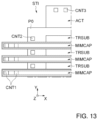
- FIGS. 12 and 13 illustrate perspective and top views, respectively, of an alternative to the structure of the integrated circuit illustrated by FIGS. 10 and 11 ;
- FIG. 14 illustrates application of capacitive structures described in relation to FIG. 1 in the context of manufacturing a resistive-capacitive RC circuit.
- FIG. 1 illustrates an example of an integrated circuit including in particular a semiconductor substrate SUB, typically made of silicon, capacitive structures of the metal-dielectric-metal (MIM) type, and a metal track PM 1 .
- a semiconductor substrate SUB typically made of silicon
- capacitive structures of the metal-dielectric-metal (MIM) type typically made of silicon
- a metal track PM 1 typically made of metal track
- capacitor structure(s) of the metal-dielectric-metal type can be designated directly by reference to the reference sign MIMCAP, that is to say by the terms “capacitive structure(s) MIMCAP”.
- a Front End Of Line (FEOL) semiconductor part includes the semiconductor substrate SUB and the semiconductor components produced in and on the substrate from a front face FA of the substrate, such as transistors, diodes or MOS-type capacitive elements.
- the front face FA of the substrate typically defines a horizontal plane, and the vertical is typically oriented with “the bottom” directed towards the volume of the substrate SUB and “the top” directed towards the outside of the front face FA where the components are formed.
- a Back End Of Line (BEOL) interconnection part includes a stack of metal levels M 1 .
- Each metal level comprises metal tracks PM 1 to trace the path of the interconnections, vias to contact the metal tracks of the neighboring metal levels, and inter-metal dielectric layers DIM 1 , CA 1 electrically insulating the metal tracks from the neighboring metal levels.
- the last interconnection levels are typically intended for the packaging of the integrated circuit packages.
- the Middle End Of Line (MEOL) part located between the semiconductor part FEOL and the interconnection part BEOL includes a dielectric region DPM, usually called a pre-metal dielectric, to electrically separate and insulate the structures formed in the semiconductor part FEOL and the first metal level M 1 of the interconnection part BEOL.
- DPM dielectric region
- metal contacts vertically pass through the pre-metal dielectric layer DPM to connect the components of the semiconductor part FEOL with a metal track of the first metal level M 1 .
- the pre-metal dielectric layer DPM is, for example, made of phosphosilicate glass or optionally of silicon dioxide.
- a stop layer AC, belonging to the pre-metal dielectric region DPM, may be provided at the semiconductor part FEOL to stop the etching of the contact formation.
- the capacitive structures MIMCAP are located in the part MEOL, in the volume of the pre-metal dielectric region DPM.
- the capacitive structures MIMCAP comprise a superposition of a first metal layer CM 1 , a dielectric layer CD and a second metal layer CM 2 .
- the first metal layer CM 1 of each capacitive structure MIMCAP is electrically connected with a conductive layer PS belonging to the semiconductor part FEOL.
- the conductive layer PS is located on the front face FA of the semiconductor substrate SUB.
- the second metal layer CM 2 of each capacitive structure MIMCAP is electrically connected with the first metal track PM 1 via a contact CNT 1 .
- the thickness of the dielectric layers CD, located between the first metal layer CM 1 and the second metal layer CM 2 of each capacitive structure MIMCAP, allows in particular to set the capacitive value of the capacitive structures MIMCAP.
- a trench is opened in the volume of the pre-metal dielectric region DPM to accommodate the capacitive structures MIMCAP.
- the trenches have a shape which is narrow in width (horizontally in the view of FIG. 1 ), elongated in length (perpendicularly to the view of FIG. 1 ), and have a depth (vertically in the view of FIG. 1 ) intended to allow the formation of contacts CNT 1 between the top of the capacitive structures MIMCAP and the first metal level M 1 .
- the trenches are formed so as to have the greatest possible density.
- the lateral space between two trenches can also be made as small as possible in this regard.
- the capacitive structures MIMCAP are thus arranged in parallel bars, spaced laterally and extending longitudinally, the bottom of which is in contact with the conductive layer PS, and enclosed in the volume of the pre-metal dielectric region DPM.
- the first metal layer CM 1 is formed by a thin layer of titanium nitride TiN, or optionally by a superposition of a thin layer of titanium Ti and a thin layer of titanium nitride TiN (it will be noted that strictly speaking, titanium nitride is a ceramic, but is usually considered as a metal compound in the semiconductor and microelectronics industry).
- the dielectric layer CD is formed by a metal oxide, advantageously chosen for its high dielectric permittivity (compared to the reference dielectric permittivity of silicon dioxide), such as for example tantalum oxide Ta 2 O 5 , or other metal or silicon oxides or nitrides.
- a metal oxide advantageously chosen for its high dielectric permittivity (compared to the reference dielectric permittivity of silicon dioxide), such as for example tantalum oxide Ta 2 O 5 , or other metal or silicon oxides or nitrides.
- the second metal layer CM 2 is formed by a superposition of a thin layer of titanium Ti and a thin layer of titanium nitride TiN (or optionally by a thin layer of titanium nitride TiN alone) and by a body made of metal such as tungsten W.
- the conductive layer PS is formed of polycrystalline silicon, and advantageously includes a thin layer of metal silicide SIM, for example cobalt silicide CoSi 2 , on the upper surface which is in electrical contact with the first metal layer CM 1 of the capacitive structures MIMCAP.
- metal silicide SIM for example cobalt silicide CoSi 2
- the contacts CNT 1 include a superposition of a diffusion barrier thin layer and a metal body.
- the thin diffusion barrier layers are for example made of titanium Ti and titanium nitride TiN, and the body is made of tungsten W.
- the examples given above for the first metal layer CM 1 and for the second metal layer CM 2 correspond to a use of thin diffusion barrier layers of the metal contacts CNT 1 , usually intended to limit the diffusion of the metal from the contacts to the materials of the semiconductor part FEOL, while being electrically conductive.
- the thin diffusion barrier layers advantageously allow to chemically bond the first metal layer CM 1 with the thin layer of metal silicide SIM of the conductive polycrystalline silicon layer PS.
- the chemical bond results from an annealing phase, and allows a better electrical connection.
- diffusion barrier materials thus allows to improve the electrical connection of the first metal layer CM 1 of the capacitive structures MIMCAP with the conductive layer PS and to enable a stable and controlled capacitive effect.
- the annealing phase after deposition of the thin diffusion barrier layers causes an alloy reaction between the silicon of the metal silicide and the material of the thin diffusion barrier layer (for example titanium). This reaction not only improves the access resistance between the thin diffusion barrier layers and the polycrystalline silicon, but also the reliability of this electrical contact.
- the structure is thus produced with less risk of defect at the contacts, and consequently it is not necessary to conventionally connect the first metal layer CM 1 of the capacitive structures MIMCAP to a specific metal line.
- the first metal layer CM 1 is indeed directly connected to the conductive layer of polycrystalline silicon PS.
- this allows to simplify, without deteriorating the reliability, the arrangement and manufacture of the various elements, in particular in order to optimize the density of the capacitive structures.
- the conductive layer PS can in turn be made, for example, in the same way as a gate of a MOS transistor or as an electrode of a MOS capacitive element, and in this case includes a dielectric interface OX electrically insulating the conductive layer PS and the semiconductor substrate SUB.
- the conductive layer PS and the dielectric interface OX can advantageously be specifically configured to form a capacitive structure of the metal-oxide-semiconductor MOSCAP type with the semiconductor substrate SUB.
- capacitor structure(s) of the metal-oxide-semiconductor type may be designated directly by reference to the reference sign “MOSCAP”, that is to say by the terms “capacitive structure(s) MOSCAP”.
- FIGS. 2 to 9 illustrate the results of steps of an exemplary method for manufacturing capacitive structures MIMCAP described in relation to FIG. 1 .
- the elements common to FIG. 1 and FIGS. 2 to 9 bear the same references and will not all be detailed in relation to each figure.
- FIG. 2 illustrates the result of the manufacturing steps of the semiconductor part FEOL and of the pre-metal dielectric region DPM, in an example of manufacturing an integrated circuit comprising a MOS-type capacitive structure, MOSCAP.
- the manufacture of the capacitive structure MOSCAP comprises a formation of the conductive layer P 0 on the substrate SUB, in the semiconductor part FEOL, thus configured to form a capacitive structure called metal-oxide-semiconductor capacitive structure MOSCAP, with the semiconductor substrate SUB,
- the capacitive structure MOSCAP could be planar, as for example shown in FIG. 1 , but the example of FIGS. 2 to 9 advantageously corresponds to a capacitive structure MO SCAP wherein the conductive layer P 0 includes a horizontal part H covering the front face FA of the substrate SUB and at least one vertical part V extending deep into the substrate SUB, perpendicularly to said front face FA.
- the formation of the conductive layer P 0 comprises an etching of trenches TRSUB extending in the substrate SUB perpendicularly to the front face FA, forming a dielectric interface OX on the front face FA and on the sides and bottoms of the etched trenches TRSUB of the substrate SUB.
- the dielectric interface OX will thus allow to electrically insulate the capacitive interface between the conductive layer P 0 and the semiconductor substrate SUB.
- the trenches TRSUB are then filled with the conductive material P 0 , for example polycrystalline silicon, overflowing from the trench TRSUB above a part of said surface FA.
- the conductive material P 0 is then in particular etched through a photolithographed mask so that the conductive layer P 0 includes the horizontal part H delimited on the front face FA and the vertical parts V in the trenches TRSUB.
- the horizontal part H and the vertical part V thus advantageously belong to a single monolithic structure, that is to say made of a block of a single material.
- the horizontal part H and the vertical part V can be formed separately and then be electrically connected, thus including a conductive material in the trenches TRSUB separate from the conductive material forming the conductive layer P 0 and covering the trenches.
- the steps of etching said at least one trench TRSUB and filling said at least one trench TRSUB can advantageously be carried out simultaneously with similar steps of forming a buried access transistor with a vertical gate of a method for manufacturing memory cells of a non-volatile memory.
- the manufacture of the capacitive structure MOSCAP can be implemented simultaneously with a step of etching trenches of similar structures in a memory region of the semiconductor substrate, and with a step of filling the etched trenches with a conductive material of a vertical gate, of a similar nature, belonging to buried access transistors of non-volatile memory cells.
- Memory cells typically further comprise a floating gate state transistor coupled in series with the access transistor.
- a silicidation of the conductive layer P 0 of polycrystalline silicon allows to form a thin layer of metal silicide SIM on the upper surface of the conductive layer P 0 .
- the pre-metal dielectric region DPM is then formed above the conductive layer P 0 and the front face FA of the substrate SUB.
- the formation of the pre-metal dielectric region DPM provides for forming a stop layer AC, for example made of silicon nitride, and forming the pre-metal dielectric volume itself, for example made of phosphosilicate glass or silicon dioxide.
- the upper part of the pre-metal dielectric region DPM is levelled by mechanical-chemical planarization.
- the original method for manufacturing the capacitive structure MOSCAP (wherein the manufacture of the capacitive structures MIMCAP is inscribed) would provide for the formation of metal contacts through the pre-metal dielectric region DPM.
- FIG. 3 illustrates the result of an etching step in the pre-metal dielectric layer DPM for the formation of capacitive structures MIMCAP.
- the openings OUV have a shape which is elongated in length (perpendicularly to the view of FIG. 3 ), and are disposed in parallel, spaced in the width direction (horizontally in the view of FIG. 3 ).
- Trenches TRDPM are opened in the volume of the pre-metal dielectric region DPM by means of anisotropic dry etching, for example reactive ion bombardment etching (for example, Reactive Ion Etching (RIE)).
- RIE reactive ion bombardment etching
- the RIE etching is configured to, initially, selectively etch the pre-metal dielectric material DPM, for example made of silicon oxide, and to be stopped by the material of the stop layer CA, located on the conductive layer P 0 , for example made of silicon nitride.
- the RIE etching is configured to selectively etch the stop layer CA so as to uncover the silicided surface SIM of the conductive layer P 0 at the bottom of the trenches TRDPM, and not or very little etch the pre-metal dielectric material DPM, for example made of silicon oxide.
- the trenches TRDPM thus open in the volume of the pre-metal dielectric part DPM will accommodate the capacitive structures MIMCAP.
- the trenches TRDPM which are open in the pre-metal dielectric part DPM are aligned with the vertical parts V of the conductive layer P 0 .
- the trenches TRDPM can be disposed staggered between each vertical part V of the conductive layer P 0 , or without any particular relationship with the position of the vertical parts V of the conductive layer P 0 .
- FIG. 4 illustrates the result of steps of forming a superposition of metal, insulating, and metal layers of the capacitive structures MIMCAP, after selectively removing the mask MSK.
- a first metal layer CM 1 is first deposited in a conformal manner, that is to say conforming, at a substantially constant thickness, to the contour of the structure on which it rests, that is to say on top of the pre-metal dielectric DPM, on the sides of the trenches TRDPM and the bottoms of the trenches TRDPM.
- the first metal layer CM 1 is thus in contact with the thin layer of metal silicide SIM of the conductive layer P 0 .
- the first metal layer CM 1 includes, for example, at least one thin layer of titanium nitride, optionally also a thin layer of titanium.
- the formation of the first metal layer CM 1 is, for example, made by a Physical Vapor Deposition (PVD) or by a Chemical Vapor Deposition (CVD), including its variants, for example with plasma assistance (PECVD), at low pressure (LPCVD), or by Atomic Layer Deposition (ALD), etc.
- PVD Physical Vapor Deposition
- CVD Chemical Vapor Deposition
- PECVD plasma assistance
- LPCVD low pressure
- ALD Atomic Layer Deposition
- the first metal layer CM 1 is advantageously formed by a step similar to the formation of a diffusion barrier layer usually provided for metal contacts.
- a dielectric layer CD is deposited in a conformal manner, on the first metal layer CM 1 , and in particular conforms to the sides and the bottoms of the first metal layer CM 1 located in the trenches TRDPM.
- the dielectric layer CD includes, for example, tantalum oxide or another dielectric material, such as a metal or silicon oxide or nitride.
- the formation of the dielectric layer CD is for example carried out by PVD or CVD.
- a second metal layer CM 2 is deposited so as to excessively stuff the free volume remaining inside the trenches TRDPM.
- the second metal layer CM 2 is thus electrically separated from the first metal layer CM 1 by the dielectric layer CD.
- the formation of the second metal layer CM 2 comprises depositing a thin layer of titanium and a thin layer of titanium nitride, or optionally only a thin layer of titanium nitride, then excessively filling the free volumes remaining inside the trenches TRDPM with a metal, for example tungsten.
- Forming the constituents of the second metal layer CM 2 is, for example, carried out by PVD or CVD.
- All the constituents of the second metal layer CM 2 can advantageously be formed by steps similar to a metal contact formation providing diffusion barrier layers.
- the manufacture of the capacitive structures MIMCAP is inscribed in an integrated circuit manufacturing method at the time of formation of the metal contacts.
- providing for the formation of the first metal layer CM 1 and of the second metal layer CM 2 with techniques similar, or even identical, to the techniques used to form the metal contacts allows, on the one hand, to use known and mastered techniques, and on the other hand, not to considerably modify the course of the integrated circuit production chain.
- the formation of additional capacitive structures MIMCAP can in this case use the same tools and the same reactors as those used in the conventional methods for manufacturing metal contacts.
- FIG. 5 illustrates the result of a mechanical-chemical planarization step removing the excess from the second metal layer CM 2 , the dielectric layer CD and the first metal layer CM 1 located on top of the pre-metal dielectric DPM. Furthermore, the mechanical-chemical planarization is configured to remove a significant thickness Epol from the upper parts of the pre-metal dielectric region DPM and the capacitive structures MIMCAP in the volume of the pre-metal dielectric region DPM.
- FIG. 6 illustrates the result of a deposition of a thickness Edep of the dielectric material DPM substantially equal to the thickness Epol removed by the mechanical-chemical planarization, to return to the original thickness of the pre-metal dielectric region DPM, that is to say to have substantially the same height as the pre-metal dielectric region obtained in relation to FIG. 2 .
- the capacitive structures MIMCAP have a narrow shape in width (horizontally in the view of FIG. 6 ), elongated in length (perpendicularly to the view of FIG. 6 ), and a depth (vertically in the view of FIG. 6 ) starting from a deviation of the thickness Edep from the top of the pre-metal dielectric region DPM, to the conductive layer P 0 .
- the thickness deviation Edep will allow to form contacts CNT 1 on top of the capacitive structures MIMCAP.
- FIG. 7 illustrates a step of etching holes to form the metal contacts, as would be provided in the conventional method, after the step of FIG. 2 .
- the anisotropic dry etching uses a mask MSKCNT, the pattern of which defines openings OUVCNT facing the second metal layers CM 2 of the capacitive structures MIMCAP.
- the alignment of the openings can withstand an offset over part of the thickness of the dielectric layer CD, without causing a short circuit between the second metal layer CM 2 and the first metal layer CM 1 .
- the openings will be enveloped and filled with conductive materials, and providing for a formation of contacts CNT 1 to electrically connect the second metal layer CM 2 of the capacitive structures MIMCAP, advantageously allows to avoid forming a short-circuit between the first metal layer CM 1 and the second metal layer CM 2 .
- alternatives to the steps described in relation to FIG. 4 or 5 could provide for electrically insulating the first metal layer CM 1 and the second metal layer CM 2 on the upper part of the capacitive structures MIMCAP.
- the mechanical-chemical planarization, on the structure of FIG. 4 could be stopped by the horizontal part of the dielectric layer CD. A free opening would thus be obtained on the top of the second metal layer CM 2 , but the first metal layer CM 1 would remain covered by the dielectric layer CD.
- the second metal layer CM 2 could be directly electrically contacted at its free opening by the metal track PM 1 , without risk of a short-circuit with the first metal layer CM 1 .
- the parts located outside the production of the capacitive element MIMCAP of the stack of the first metal layer CM 1 , of the dielectric layer CD and of the second metal layer CM 2 could moreover be etched.
- openings OUVCNT are moreover positioned opposite other locations of the part FEOL to be contacted, for example on a thin layer of metal silicide SIMSUB of a contact point CNTSUB on the front face FA of the substrate SUB, or on the thin layer of metal silicide of the conductive layer P 0 (not visible in FIG. 7 ).
- FIG. 8 illustrates the result of a formation of a metal contact diffusion barrier layer, for example a superposition of a thin layer of titanium and a thin layer of titanium nitride Ti/TiN, on the sides and the bottoms of the openings OUVCNT.
- a metal contact diffusion barrier layer for example a superposition of a thin layer of titanium and a thin layer of titanium nitride Ti/TiN, on the sides and the bottoms of the openings OUVCNT.
- a step of “filling with the barrier layer” (terms taken from the usual expression “barrier filling”), is advantageously implemented, for example by means of a non-oxidizing annealing.
- the step of filling with the barrier layer “barrier filling” allows to form an alloy between the material of the thin diffusion barrier layers, such as titanium, with the materials of the surfaces to be contacted, such as the silicon of the metal silicide SIM in order to strengthen the electrical contact between these layers.
- the step of filling with the barrier layer “barrier filling” improves in particular the electrical connection of the first metal layer CM 1 of the capacitive structures MIMCAP with the thin layer of metal silicide SIM of the conductive layer made of polycrystalline silicon P 0 .
- the metal body W of the contacts CNT 1 , CNT 3 ( FIG. 9 ) is formed, for example by means of an excess deposition of the metal W, typically tungsten, and of a levelling by mechanical-chemical planarization until reaching the top of the pre-metal dielectric region DPM.
- FIG. 9 shows the result of the formation of the first metal level M 1 .
- the first metal level M 1 comprises in this example a metal track PM 1 electrically connecting the second metal layers CM 2 of the capacitive structures MIMCAP together via first contacts CNT 1 , and also the substrate SUB via another contact CNT 3 .
- an additional capacitive interface between the conductive layer P 0 and the substrate SUB is provided, via the metal track PM 1 , by the capacitive structures MIMCAP, without taking up additional space on the substrate SUB.
- FIG. 10 illustrates in a perspective view the structure obtained by a method of the type of that described above in relation to FIGS. 2 to 9 , wherein the pre-metal dielectric region is made transparent.
- FIG. 11 illustrates a top view of the structure of FIG. 10 .
- the stacked elements are represented by transparency.
- FIGS. 10 and 11 are represented, the horizontal mentioned above being located in the plane XY longitudinally in the direction X and laterally in the direction Y, the vertical is directed by the direction Z.
- FIGS. 1 to 9 are thus represented in the plane YZ of this orientation.
- the capacitive structures MIMCAP are not aligned above the trenches TRSUB of the capacitive element MOSCAP, but are positioned opposite the spaces located between each trench TRSUB of the capacitive element MOSCAP.
- a first metal track PM 1 of the first metal level M 1 is connected via first contacts CNT 1 with the second metal layer CM 2 of the capacitive structures MIMCAP.
- a second metal track PM 2 of the first metal level M 1 is connected via second contacts CNT 2 with the conductive layer P 0 .
- a third metal track PM 3 of the first metal level M 1 is connected via third contacts CNT 3 with a region called the active region ACT of the substrate, containing the capacitive structure MOSCAP, and typically delimited by shallow insulation regions STI.
- the first metal track PM 1 constitutes a terminal of a first capacitive electrode E 1
- the second metal track PM 2 constitutes a terminal of a second capacitive electrode E 2
- the third metal track PM 3 constitutes a terminal of a third capacitive electrode E 3 .
- the capacitive structure MIMCAP includes the first electrode E 1 and the second electrode E 2
- the capacitive structure MOSCAP includes the second electrode E 2 and the third electrode E 3 .
- the capacitive structure MIMCAP and the capacitive structure MOSCAP are connected to the second common electrode E 2 .
- this allows to modulate the capacitive value of the circuit, by choosing to use either one or the combination of the two capacitive structures MIMCAP, MOSCAP.
- a longitudinal end of the capacitive structures MIMCAP is located substantially opposite the delimitation of the active region ACT by the insulation trenches STI.
- the first contacts CNT 1 are thus located towards the inside of the active region ACT, while the second contacts CNT 2 are located towards the outside of the active region ACT, above the insulation trenches STI.
- FIGS. 12 and 13 illustrate an alternative to the structure of the integrated circuit illustrated by FIGS. 10 and 11 .
- the capacitive structures MIMCAP are extended longitudinally towards the outside of the active region ACT, above the insulation trenches STI.
- the first contacts CNT 1 are thus located outside the conductive layer P 0
- the second contacts CNT 2 are located between the first contacts CNT 1 and the active region ACT, above the insulation trenches STI.
- the second contacts CNT 2 are positioned in the lateral spaces between the capacitive structures MIMCAP.
- the other elements of the integrated circuit are identical to the example illustrated in FIGS. 10 and 11 .
- FIG. 14 illustrates an example of application of capacitive structures MIMCAP of the metal-dielectric-metal “MIM” type, described in relation to FIG. 1 , in the context of manufacturing a resistive-capacitive RC circuit.
- MIMCAP metal-dielectric-metal “MIM” type
- FIG. 14 illustrates an example of application of capacitive structures MIMCAP of the metal-dielectric-metal “MIM” type, described in relation to FIG. 1 , in the context of manufacturing a resistive-capacitive RC circuit.
- the common elements described previously in relation to FIG. 1 bear the same references and will not all be detailed again.
- the conductive layer PS of the semiconductor part FEOL rests on another conductive layer P 1 , called resistive conductor bar P 1 and belonging to a resistive element RES.
- the resistive conductor bar P 1 is, for example, also made of polycrystalline silicon, and is formed on an insulation region STI, for example of the shallow insulation trench type.
- the resistive semiconductor bar P 1 is configured to have a resistive value and includes two open ends.
- the open ends include a thin layer of metal silicide SIM electrically coupled to metal tracks PMI, PMO of the first metal level M 1 via respective contacts CNTI, CNTO.
- the metal tracks PMI, PMO thus materialize the terminals IN, OUT of the resistive element RES.
- the conductive layer PS is electrically insulated from the resistive conductor bar P 1 by a dielectric thickness ONO, including for example a superposition of oxide, nitride and silicon oxide layers.
- the manufacture in particular of the resistive conductor bar P 1 , of the dielectric thickness ONO and of the conductive layer PS can be carried out in the manner of manufacturing floating-gate transistors, or even simultaneously during the same steps of the manufacturing method.
- the capacitive structures MIMCAP are manufactured in the pre-metal dielectric region DPM by means of a method of the type of the method described above in relation to FIGS. 3 to 9 .
- the output terminal By electrically coupling the first electrode E 1 of the capacitive structures MIMCAP with a terminal OUT of the resistive element RES, called the output terminal, and by electrically coupling the second terminal E 2 of the capacitive structures MIMCAP with a reference potential (that is to say the ground), one obtains the assembly of the electrical diagram of the RC series resistive-capacitive circuit of FIG. 14 .
- the output terminal OUT forms the output of the RC series resistive-capacitive circuit while the other terminal IN of the resistive element RES forms the input of the RC series resistive-capacitive circuit.
- resistive-capacitive RC circuits including a resistive element RES and a capacitive element MIMCAP, can be produced on a surface of the substrate SUB not larger than the surface occupied by the resistive element RES alone, thanks to the advantageous production of the capacitive structure MIMCAP in the volume of the pre-metal dielectric region.
- the invention is not limited to the embodiment and implementation described in relation to FIGS. 1 to 14 , but embraces all the variants, for example the materials chosen may be different from the examples given above, or else the elements of the semiconductor region FEOL located under the conductive layer PS, P 0 may be different and applied to other electrical assemblies.
Landscapes
- Engineering & Computer Science (AREA)
- Manufacturing & Machinery (AREA)
- Semiconductor Integrated Circuits (AREA)
Abstract
Description
Claims (17)
Priority Applications (3)
| Application Number | Priority Date | Filing Date | Title |
|---|---|---|---|
| CN202111293333.4A CN114446929B (en) | 2020-11-03 | 2021-11-03 | Integrated circuit comprising a metal-insulator-metal type capacitive structure and corresponding manufacturing method |
| CN202122670245.3U CN216624268U (en) | 2020-11-03 | 2021-11-03 | integrated circuit |
| US18/668,639 US20240312977A1 (en) | 2020-11-03 | 2024-05-20 | Integrated circuit including a capacitive structure of the metal-insulator-metal type and corresponding manufacturing method |
Applications Claiming Priority (2)
| Application Number | Priority Date | Filing Date | Title |
|---|---|---|---|
| FR2011274 | 2020-11-03 | ||
| FR2011274A FR3115926B1 (en) | 2020-11-03 | 2020-11-03 | Integrated circuit comprising a capacitive structure of the metal-insulator-metal type and corresponding manufacturing method |
Related Child Applications (1)
| Application Number | Title | Priority Date | Filing Date |
|---|---|---|---|
| US18/668,639 Division US20240312977A1 (en) | 2020-11-03 | 2024-05-20 | Integrated circuit including a capacitive structure of the metal-insulator-metal type and corresponding manufacturing method |
Publications (2)
| Publication Number | Publication Date |
|---|---|
| US20220139899A1 US20220139899A1 (en) | 2022-05-05 |
| US12021074B2 true US12021074B2 (en) | 2024-06-25 |
Family
ID=73793523
Family Applications (1)
| Application Number | Title | Priority Date | Filing Date |
|---|---|---|---|
| US17/516,920 Active US12021074B2 (en) | 2020-11-03 | 2021-11-02 | Integrated circuit including a capacitive structure of the metal-insulator-metal type and corresponding manufacturing method |
Country Status (2)
| Country | Link |
|---|---|
| US (1) | US12021074B2 (en) |
| FR (1) | FR3115926B1 (en) |
Families Citing this family (1)
| Publication number | Priority date | Publication date | Assignee | Title |
|---|---|---|---|---|
| TWI892929B (en) * | 2022-12-06 | 2025-08-01 | 南亞科技股份有限公司 | Semiconductor device and manufacturing method thereof |
Citations (12)
| Publication number | Priority date | Publication date | Assignee | Title |
|---|---|---|---|---|
| US20030203633A1 (en) * | 2002-04-25 | 2003-10-30 | Nishant Sinha | Methods for forming capacitor structures; and methods for removal of organic materials |
| US20090244971A1 (en) * | 2008-04-01 | 2009-10-01 | University Of Michigan | Memory cell structure, a memory device employing such a memory cell structure, and an integrated circuit having such a memory device |
| US20100148304A1 (en) * | 2008-12-11 | 2010-06-17 | Irfan Rahim | Integrated circuit decoupling capacitors |
| US20130043557A1 (en) | 2011-08-18 | 2013-02-21 | Taiwan Semiconductor Manufacturing Company, Ltd. | Vertically oriented semiconductor device and shielding structure thereof |
| US20130093045A1 (en) | 2011-10-13 | 2013-04-18 | Taiwan Semiconductor Manufacturing Company, Ltd. | Vertically oriented semiconductor device and shielding structure thereof |
| US8619464B1 (en) * | 2011-08-26 | 2013-12-31 | Altera Corporation | Static random-access memory having read circuitry with capacitive storage |
| US20150076657A1 (en) | 2013-09-16 | 2015-03-19 | Taiwan Semiconductor Manufacturing Co., Ltd. | Method for manufacturing semiconductor device and semiconductor device |
| US20160071850A1 (en) * | 2014-03-19 | 2016-03-10 | Renesas Electronics Corporation | Semiconductor Integrated Circuit Device and Method for Producing the Same |
| EP2999002A1 (en) | 2014-09-18 | 2016-03-23 | Services Petroliers Schlumberger | Capacitor cell and method for manufacturing same |
| EP3493284A1 (en) | 2017-11-30 | 2019-06-05 | Mediatek Inc. | Shielded mom capacitor |
| US10784267B1 (en) | 2019-05-02 | 2020-09-22 | Powerchip Semiconductor Manufacturing Corporation | Memory structure |
| US20220336346A1 (en) | 2021-04-19 | 2022-10-20 | Qualcomm Incorporated | Back-end-of-line (beol) high resistance (hi-r) conductor layer in a metal oxide metal (mom) capacitor |
-
2020
- 2020-11-03 FR FR2011274A patent/FR3115926B1/en active Active
-
2021
- 2021-11-02 US US17/516,920 patent/US12021074B2/en active Active
Patent Citations (12)
| Publication number | Priority date | Publication date | Assignee | Title |
|---|---|---|---|---|
| US20030203633A1 (en) * | 2002-04-25 | 2003-10-30 | Nishant Sinha | Methods for forming capacitor structures; and methods for removal of organic materials |
| US20090244971A1 (en) * | 2008-04-01 | 2009-10-01 | University Of Michigan | Memory cell structure, a memory device employing such a memory cell structure, and an integrated circuit having such a memory device |
| US20100148304A1 (en) * | 2008-12-11 | 2010-06-17 | Irfan Rahim | Integrated circuit decoupling capacitors |
| US20130043557A1 (en) | 2011-08-18 | 2013-02-21 | Taiwan Semiconductor Manufacturing Company, Ltd. | Vertically oriented semiconductor device and shielding structure thereof |
| US8619464B1 (en) * | 2011-08-26 | 2013-12-31 | Altera Corporation | Static random-access memory having read circuitry with capacitive storage |
| US20130093045A1 (en) | 2011-10-13 | 2013-04-18 | Taiwan Semiconductor Manufacturing Company, Ltd. | Vertically oriented semiconductor device and shielding structure thereof |
| US20150076657A1 (en) | 2013-09-16 | 2015-03-19 | Taiwan Semiconductor Manufacturing Co., Ltd. | Method for manufacturing semiconductor device and semiconductor device |
| US20160071850A1 (en) * | 2014-03-19 | 2016-03-10 | Renesas Electronics Corporation | Semiconductor Integrated Circuit Device and Method for Producing the Same |
| EP2999002A1 (en) | 2014-09-18 | 2016-03-23 | Services Petroliers Schlumberger | Capacitor cell and method for manufacturing same |
| EP3493284A1 (en) | 2017-11-30 | 2019-06-05 | Mediatek Inc. | Shielded mom capacitor |
| US10784267B1 (en) | 2019-05-02 | 2020-09-22 | Powerchip Semiconductor Manufacturing Corporation | Memory structure |
| US20220336346A1 (en) | 2021-04-19 | 2022-10-20 | Qualcomm Incorporated | Back-end-of-line (beol) high resistance (hi-r) conductor layer in a metal oxide metal (mom) capacitor |
Non-Patent Citations (1)
| Title |
|---|
| INPI Search Report and Written Opinion for FR Appl. No. 2011274, which is the priority French filing for the instant US filing, dated Jul. 19, 2021 (9 pages). |
Also Published As
| Publication number | Publication date |
|---|---|
| FR3115926A1 (en) | 2022-05-06 |
| FR3115926B1 (en) | 2023-06-09 |
| US20220139899A1 (en) | 2022-05-05 |
Similar Documents
| Publication | Publication Date | Title |
|---|---|---|
| US11910616B2 (en) | Three-dimensional memory device and method | |
| US10903213B2 (en) | Integrated circuit devices | |
| US10950689B2 (en) | Semiconductor device with a through-substrate via hole having therein a capacitor and a through-substrate via conductor | |
| US7268072B2 (en) | Method and structure for reducing contact aspect ratios | |
| CN118804595A (en) | Method for forming a three-dimensional memory device having a support structure for a stepped region | |
| US7294567B2 (en) | Semiconductor contact device and method | |
| US20250169068A1 (en) | Three-dimensional memory devices | |
| US11616011B2 (en) | IC having trench-based metal-insulator-metal capacitor | |
| KR102734580B1 (en) | Semiconductor device and method of manufacturing thereof | |
| CN114446928B (en) | MIM capacitor structure | |
| US20240381652A1 (en) | Three-dimensional memory devices with conductive spacers | |
| US20180337140A1 (en) | 3d integrated circuit device having a buttress structure for resisting deformation | |
| US7045842B2 (en) | Integrated circuit devices having self-aligned contact structures | |
| US20240312977A1 (en) | Integrated circuit including a capacitive structure of the metal-insulator-metal type and corresponding manufacturing method | |
| US6429069B1 (en) | SOI DRAM with buried capacitor under the digit lines utilizing a self aligning penetrating storage node contact formation | |
| US20220139899A1 (en) | Integrated circuit including a capacitive structure of the metal-insulator-metal type and corresponding manufacturing method | |
| CN101656254B (en) | Dynamic random access memory structure and manufacturing method thereof | |
| WO2023027786A1 (en) | Three-dimensional memory device with staircase etch stop structures and methods for forming the same | |
| US20080308902A1 (en) | Semiconductor device | |
| US12505880B2 (en) | Memory device and method for forming the same | |
| US7189613B2 (en) | Method and structure for metal-insulator-metal capacitor based memory device | |
| CN118742028A (en) | Semiconductor memory devices | |
| US20050014332A1 (en) | Method to improve bitline contact formation using a line mask | |
| CN120152278A (en) | Semiconductor device and method for manufacturing the same | |
| CN121941046A (en) | Semiconductor device with a semiconductor layer having a plurality of semiconductor layers |
Legal Events
| Date | Code | Title | Description |
|---|---|---|---|
| AS | Assignment |
Owner name: STMICROELECTRONICS (ROUSSET) SAS, FRANCE Free format text: ASSIGNMENT OF ASSIGNORS INTEREST;ASSIGNORS:FORNARA, PASCAL;SIMOLA, ROBERTO;REEL/FRAME:057993/0208 Effective date: 20210909 |
|
| STPP | Information on status: patent application and granting procedure in general |
Free format text: DOCKETED NEW CASE - READY FOR EXAMINATION |
|
| STPP | Information on status: patent application and granting procedure in general |
Free format text: NON FINAL ACTION MAILED |
|
| STPP | Information on status: patent application and granting procedure in general |
Free format text: RESPONSE TO NON-FINAL OFFICE ACTION ENTERED AND FORWARDED TO EXAMINER |
|
| STPP | Information on status: patent application and granting procedure in general |
Free format text: FINAL REJECTION MAILED |
|
| STPP | Information on status: patent application and granting procedure in general |
Free format text: RESPONSE AFTER FINAL ACTION FORWARDED TO EXAMINER |
|
| STPP | Information on status: patent application and granting procedure in general |
Free format text: ADVISORY ACTION MAILED |
|
| STPP | Information on status: patent application and granting procedure in general |
Free format text: DOCKETED NEW CASE - READY FOR EXAMINATION |
|
| STPP | Information on status: patent application and granting procedure in general |
Free format text: NON FINAL ACTION MAILED |
|
| STPP | Information on status: patent application and granting procedure in general |
Free format text: AWAITING TC RESP., ISSUE FEE NOT PAID |
|
| STPP | Information on status: patent application and granting procedure in general |
Free format text: NOTICE OF ALLOWANCE MAILED -- APPLICATION RECEIVED IN OFFICE OF PUBLICATIONS |
|
| STPP | Information on status: patent application and granting procedure in general |
Free format text: PUBLICATIONS -- ISSUE FEE PAYMENT VERIFIED |
|
| STCF | Information on status: patent grant |
Free format text: PATENTED CASE |