US12019365B2 - Variable aperture module, imaging lens module and electronic device - Google Patents
Variable aperture module, imaging lens module and electronic device Download PDFInfo
- Publication number
- US12019365B2 US12019365B2 US17/991,728 US202217991728A US12019365B2 US 12019365 B2 US12019365 B2 US 12019365B2 US 202217991728 A US202217991728 A US 202217991728A US 12019365 B2 US12019365 B2 US 12019365B2
- Authority
- US
- United States
- Prior art keywords
- contact point
- imaging lens
- optical axis
- positioning
- variable aperture
- Prior art date
- Legal status (The legal status is an assumption and is not a legal conclusion. Google has not performed a legal analysis and makes no representation as to the accuracy of the status listed.)
- Active
Links
Images




Classifications
-
- G—PHYSICS
- G03—PHOTOGRAPHY; CINEMATOGRAPHY; ANALOGOUS TECHNIQUES USING WAVES OTHER THAN OPTICAL WAVES; ELECTROGRAPHY; HOLOGRAPHY
- G03B—APPARATUS OR ARRANGEMENTS FOR TAKING PHOTOGRAPHS OR FOR PROJECTING OR VIEWING THEM; APPARATUS OR ARRANGEMENTS EMPLOYING ANALOGOUS TECHNIQUES USING WAVES OTHER THAN OPTICAL WAVES; ACCESSORIES THEREFOR
- G03B7/00—Control of exposure by setting shutters, diaphragms or filters, separately or conjointly
- G03B7/08—Control effected solely on the basis of the response, to the intensity of the light received by the camera, of a built-in light-sensitive device
- G03B7/081—Analogue circuits
- G03B7/085—Analogue circuits for control of aperture
-
- G—PHYSICS
- G03—PHOTOGRAPHY; CINEMATOGRAPHY; ANALOGOUS TECHNIQUES USING WAVES OTHER THAN OPTICAL WAVES; ELECTROGRAPHY; HOLOGRAPHY
- G03B—APPARATUS OR ARRANGEMENTS FOR TAKING PHOTOGRAPHS OR FOR PROJECTING OR VIEWING THEM; APPARATUS OR ARRANGEMENTS EMPLOYING ANALOGOUS TECHNIQUES USING WAVES OTHER THAN OPTICAL WAVES; ACCESSORIES THEREFOR
- G03B30/00—Camera modules comprising integrated lens units and imaging units, specially adapted for being embedded in other devices, e.g. mobile phones or vehicles
-
- G—PHYSICS
- G03—PHOTOGRAPHY; CINEMATOGRAPHY; ANALOGOUS TECHNIQUES USING WAVES OTHER THAN OPTICAL WAVES; ELECTROGRAPHY; HOLOGRAPHY
- G03B—APPARATUS OR ARRANGEMENTS FOR TAKING PHOTOGRAPHS OR FOR PROJECTING OR VIEWING THEM; APPARATUS OR ARRANGEMENTS EMPLOYING ANALOGOUS TECHNIQUES USING WAVES OTHER THAN OPTICAL WAVES; ACCESSORIES THEREFOR
- G03B9/00—Exposure-making shutters; Diaphragms
- G03B9/02—Diaphragms
-
- G—PHYSICS
- G03—PHOTOGRAPHY; CINEMATOGRAPHY; ANALOGOUS TECHNIQUES USING WAVES OTHER THAN OPTICAL WAVES; ELECTROGRAPHY; HOLOGRAPHY
- G03B—APPARATUS OR ARRANGEMENTS FOR TAKING PHOTOGRAPHS OR FOR PROJECTING OR VIEWING THEM; APPARATUS OR ARRANGEMENTS EMPLOYING ANALOGOUS TECHNIQUES USING WAVES OTHER THAN OPTICAL WAVES; ACCESSORIES THEREFOR
- G03B9/00—Exposure-making shutters; Diaphragms
- G03B9/02—Diaphragms
- G03B9/06—Two or more co-operating pivoted blades, e.g. iris type
Definitions
- the present disclosure relates to a variable aperture module, an imaging lens module and an electronic device, more particularly to a variable aperture module and an imaging lens module applicable to an electronic device.
- camera modules are applied to electronic devices in more fields than ever, such as portable devices (e.g., smartphones, action cameras), augmented reality (AR) or virtual reality (VR) head-mounted devices and aerial cameras.
- the hardware used in the camera modules are continuously upgraded, for example, larger image sensors and imaging lenses with better image quality.
- a larger image sensor provides better image quality, but the background in the picture may become blurry due to an overly shallow depth of field.
- a variable aperture assembly can be used to change the depth of field for adjusting the blur degree of the background and controlling the amount of incident light, such that arranging a variable aperture assembly in an optical system of an electronic device becomes a forward-looking subject.
- the blade of the conventional variable aperture assembly may be in the hysteresis state during its rotation, thereby causing the difference between the actual value and the theoretical value of the aperture size of the optical system and therefore generating unexpected imaging effect. Therefore, how to improve the structure of a variable aperture module for meeting the requirement of high-end-specification electronic devices is an important topic in this field nowadays.
- a variable aperture module includes a blade assembly, a positioning element, a driving part, and a plurality of pressing structures.
- the blade assembly includes a plurality of movable blades disposed around an optical axis to form a light passable hole with an adjustable size for different hole size states.
- Each of the plurality of movable blades has a positioning hole and a movement hole adjacent to the positioning hole.
- the positioning element includes a plurality of positioning structures disposed respectively corresponding to the positioning holes of the plurality of movable blades so as to position the plurality of movable blades.
- the driving part includes a rotation element disposed corresponding to the movement holes of the plurality of movable blades and rotatable with respect to the positioning element so as to drive the plurality of movable blades to rotate with respect to the plurality of positioning structures of the positioning element for adjusting a size of the light passable hole.
- the plurality of pressing structures are disposed respectively corresponding to the plurality of movable blades. Each of the plurality of pressing structures is at least disposed into at least one of the positioning hole and the movement hole of corresponding one among the plurality of movable blades, and each of the plurality of pressing structures at least presses against at least one of corresponding one among the plurality of positioning structures and the rotation element.
- an imaging lens module includes the aforementioned variable aperture module and an imaging lens, wherein the variable aperture module and the imaging lens are sequentially disposed along the optical axis from an object side to an image side, and light enters into the imaging lens via the light passable hole of the variable aperture module.
- an electronic device includes the aforementioned imaging lens module.
- FIG. 1 is a perspective view of an imaging lens module according to the 1st embodiment of the present disclosure
- FIG. 2 is an exploded view of the imaging lens module of FIG. 1 ;
- FIG. 3 is a perspective view of several components of the imaging lens module of FIG. 1 that have been sectioned;
- FIG. 4 is an enlarged view of AA region of FIG. 3 ;
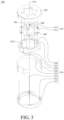
- FIG. 5 is an exploded view of a variable aperture module of the imaging lens module of FIG. 2 ;
- FIG. 6 is a schematic view showing the correspondence relationship of several components of the variable aperture module of FIG. 5 ;
- FIG. 7 is a top view of a movable blade of a blade assembly of the variable aperture module of FIG. 5 ;
- FIG. 8 is a perspective view of an imaging lens module according to the 2nd embodiment of the present disclosure.
- FIG. 9 is an exploded view of the imaging lens module of FIG. 8 ;
- FIG. 10 is a perspective view of several components of the imaging lens module of FIG. 8 that have been sectioned;
- FIG. 11 is an enlarged view of BB region of FIG. 10 ;
- FIG. 12 is an exploded view of a variable aperture module of the imaging lens module of FIG. 9 ;
- FIG. 13 is a cross-sectional view of part of a blade assembly of the variable aperture module sectioned along line 13 - 13 of FIG. 12 ;
- FIG. 14 is a top view of a movable blade of the blade assembly of the variable aperture module of FIG. 12 ;
- FIG. 15 is a top view of a movable blade of an imaging lens module according to the 3rd embodiment of the present disclosure.
- FIG. 16 is a top view of a movable blade of an imaging lens module according to the 4th embodiment of the present disclosure.
- FIG. 17 is a top view of a movable blade of an imaging lens module according to the 5th embodiment of the present disclosure.
- FIG. 18 is a top view of a movable blade of an imaging lens module according to the 6th embodiment of the present disclosure.
- FIG. 19 is a top view of a movable blade of an imaging lens module according to the 7th embodiment of the present disclosure.
- FIG. 20 is a top view of a movable blade of an imaging lens module according to the 8th embodiment of the present disclosure.
- FIG. 21 is a top view of a movable blade of an imaging lens module according to the 9th embodiment of the present disclosure.
- FIG. 22 is a top view of a movable blade of an imaging lens module according to the 10th embodiment of the present disclosure.
- FIG. 23 is a top view of a movable blade of an imaging lens module according to the 11th embodiment of the present disclosure.
- FIG. 24 is a top view of a movable blade of an imaging lens module according to the 12th embodiment of the present disclosure.
- FIG. 25 is a top view of a movable blade of an imaging lens module according to the 13th embodiment of the present disclosure.
- FIG. 26 is a top view of a movable blade of an imaging lens module according to the 14th embodiment of the present disclosure.
- FIG. 27 is an exploded view of an electronic device according to the 15th embodiment of the present disclosure.
- FIG. 28 is a schematic view showing the correspondence relationship of several components of an imaging lens module according to one embodiment of the present disclosure.
- FIG. 29 is a schematic view showing the correspondence relationship of several components of an imaging lens module according to another embodiment of the present disclosure.
- FIG. 30 is a schematic view showing the correspondence relationship of several components of an imaging lens module according to further another embodiment of the present disclosure.
- FIG. 31 is a schematic view showing the correspondence relationship of several components of an imaging lens module according to still another embodiment of the present disclosure.
- FIG. 32 is a schematic view showing the correspondence relationship of several components of an imaging lens module according to still further another embodiment of the present disclosure.
- the present disclosure provides an imaging lens module that includes a variable aperture module and an imaging lens.
- the variable aperture module and the imaging lens are sequentially disposed along an optical axis from an object side to an image side.
- the variable aperture module includes a blade assembly, a positioning element, a driving part and a plurality of pressing structures.
- the blade assembly includes a plurality of movable blades that are disposed around the optical axis to form a light passable hole with an adjustable size for different hole size states. Moreover, light enters into the imaging lens via the light passable hole of the variable aperture module. Each movable blade has a positioning hole and a movement hole adjacent to the positioning hole.
- the positioning element includes a plurality of positioning structures that are disposed respectively corresponding to the positioning holes of the plurality of movable blades so as to position the plurality of movable blades.
- each positioning structure can be a structure of the positioning element extending along a direction parallel to the optical axis.
- the driving part includes a rotation element.
- the rotation element can include a plurality of rotation structures that can be disposed respectively corresponding to the movement holes of the plurality of movable blades and can be movable in respective movement holes.
- the rotation element is rotatable with respect to the positioning element so as to drive the movable blades to rotate with respect to the positioning structures of the positioning element for adjusting the size of the light passable hole.
- each rotation structure can be a structure of the rotation element extending along a direction parallel to the optical axis. Therefore, it is favorable for accurately controlling the size of the light passable hole.
- each movable blade In each movable blade, one pressing structure is at least disposed into at least one of the positioning hole and the movement hole of the movable blade, and at least press against at least one of the positioning structure and the rotation element. Moreover, in each movable blade, the corresponding pressing structure can be disposed at a side of the positioning hole or a side of the movement hole. Therefore, it is favorable for increasing stability of manufacturing. Moreover, each movable blade can further has an inner surface and an outer surface at the movement hole thereof, the inner surface can be located closer to the positioning hole than the outer surface, and the corresponding pressing structure can be disposed on at least one of the inner surface and the outer surface. Therefore, it is favorable for determining the positon of the pressing structure depending on the convenience of manufacturing so as to increase production efficiency.
- the pressing structures With the arrangement of the pressing structures, it is favorable for reducing the backlashes between the movable blades and the positioning structures or between the movable blades and the rotation element and thus accurately controlling the positions of the movable blades, thereby reducing influence caused by hysteresis of the movable blades and reducing the aperture size difference between the actual value and the theoretical value. Moreover, by disposing the rotation structures to correspond to the movement holes of the movable blades, it is favorable for further accurately controlling the size of the light passable hole.
- Each movable blade can include a first surface layer, a second surface layer and an inner substrate layer.
- the inner substrate layer can be located between the first surface layer and the second surface layer.
- FIG. 13 which show the movable blade 211 according to the 2nd embodiment of the present disclosure, wherein the inner substrate layer 2115 is located between the first surface layer 2113 and the second surface layer 2114 , and the first surface layer 2113 and the second surface layer 2114 are located closer to the center CT of the light passable hole HL than the inner substrate layer 2115 .
- the driving part can further include a magnet and a coil.
- the magnet and the coil can be disposed corresponding to each other, and one of the magnet and the coil can be disposed on the rotation element. Therefore, the interaction force generated by the magnet and the coil is favorable for driving the rotation element to move with respect to the positioning element.
- the driving part can further include a base.
- the rotation element can be disposed on the base along a direction parallel to the optical axis.
- the supporting force provided by the base is sufficient for supporting the rotation element and therefore is favorable for securing the structural strength of the variable aperture module and achieving mass production conditions.
- the driving part can further include at least two bearing members that can be disposed either between the rotation element and the positioning element or between the rotation element and the base along a direction parallel to the optical axis so as to support rotational motion of the rotation element. Therefore, it is favorable for increasing stability of rotational motion of the rotation element.
- the number of the bearing members can be five or less. Therefore, it is favorable for maintaining manufacturing yield rate.
- each bearing member can be spherical, and all bearing members can be aligned on the same plane with respect to the optical axis. Therefore, it is favorable for further securing stability of rotational motion of the rotation element.
- Each bearing member can have a plurality of contact points that can be in physical contact with the rotation element, the positioning element or the base.
- the contact points can have an inner contact point, an outer contact point, an upper contact point and a lower contact point.
- the inner contact point can be located closer to the optical axis than the other contact points.
- the outer contact point can be located farther away from the optical axis than the other contact points.
- the upper contact point can be one of two contact points that are most spaced apart from each other in a direction parallel to the optical axis among all contact points.
- the lower contact point can be the other one of the two contact points that are most spaced apart from each other in the direction parallel to the optical axis among all contact points.
- the alignment through the inner contact point and the outer contact point helps to maintain the radial positions either between the rotation element and the positioning element or between the rotation element and the base
- the alignment through the upper contact point and the lower contact point helps to maintain the axial positions either between the rotation element and the positioning element or between the rotation element and the base.
- the number of all contact points can be four.
- the number of all contact points can be three. When the number of all contact points is three, one of the inner contact point and the outer contact point and one of the upper contact point and the lower contact point among all contact points can be the same contact point.
- the definition of “the remaining contact point” in Di is the lower contact point when the number of all contact points is four; the definition of “the remaining contact point” in Di is a contact point instead of the abovementioned inner and outer contact points, which may be the upper contact point or the lower contact point, when the number of all contact points is three.
- FIG. 28 shows Dt and Di according to the 1st embodiment of the present disclosure.
- the bearing member 933 a has a plurality of contact points 9330 a that are in physical contact with the rotation element 932 a and the base 931 a .
- the contact points 9330 a has four contact points, which are an inner contact point 9331 a , an outer contact point 9332 a , an upper contact point 9333 a and a lower contact point 9334 a .
- the inner contact point 9331 a is located closer to the optical axis OA than the other contact points and is in physical contact with the base 931 a at the lower left side of the bearing member 933 a depicted in FIG. 28 .
- the outer contact point 9332 a is located farther away from the optical axis OA than the other contact points and is in physical contact with the rotation element 932 a at the upper right side of the bearing member 933 a depicted in FIG. 28 .
- the upper contact point 9333 a is one of two contact points that are most spaced apart from each other in a direction parallel to the optical axis OA among the contact points 9330 a and is in physical contact with the rotation element 932 a at the upper side of the bearing member 933 a depicted in FIG. 28 .
- FIG. 29 is a schematic view showing the correspondence relationship of several components of an imaging lens module according to another embodiment of the present disclosure.
- the spherical bearing member 933 b is disposed between the rotation element 932 b and the base 931 b .
- the bearing member 933 b has a plurality of contact points 9330 b that are in physical contact with the rotation element 932 b and the base 931 b .
- the contact points 9330 b has three contact points, which are an outer contact point 9332 b and an upper contact point 9333 b as the same contact point, an inner contact point 9331 b and a lower contact point 9334 b .
- the inner contact point 9331 b is located closer to the optical axis OA than the other contact points and is in physical contact with the base 931 b at the left side of the bearing member 933 b depicted in FIG. 29 .
- the outer contact point 9332 b or the upper contact point 9333 b , is one of two contact points that are most spaced apart from each other in a direction parallel to the optical axis OA among the contact points 9330 b and is in physical contact with the rotation element 932 b at the upper right side of the bearing member 933 b depicted in FIG. 29 .
- the lower contact point 9334 b is the other one of the two contact points that are most spaced apart from each other in the direction parallel to the optical axis OA among the contact points 9330 b and is in physical contact with the base 931 b at the lower side of the bearing member 933 b depicted in FIG. 29 .
- FIG. 30 is a schematic view showing the correspondence relationship of several components of an imaging lens module according to further another embodiment of the present disclosure.
- the spherical bearing member 933 c is disposed between the rotation element 932 c and the base 931 c .
- the bearing member 933 c has a plurality of contact points 9330 c that are in physical contact with the rotation element 932 c and the base 931 c .
- the contact points 9330 c has four contact points, which are an inner contact point 9331 c , an outer contact point 9332 c , an upper contact point 9333 c and a lower contact point 9334 c .
- the inner contact point 9331 c is located closer to the optical axis OA than the other contact points and is in physical contact with the base 931 c at the left side of the bearing member 933 c depicted in FIG. 30 .
- the outer contact point 9332 c is located farther away from the optical axis OA than the other contact points and is in physical contact with the rotation element 932 c at the right side of the bearing member 933 c depicted in FIG. 30 .
- the upper contact point 9333 c is one of two contact points that are most spaced apart from each other in a direction parallel to the optical axis OA among the contact points 9330 c and is in physical contact with the rotation element 932 c at the upper side of the bearing member 933 c depicted in FIG. 30 .
- the lower contact point 9334 c is the other one of the two contact points that are most spaced apart from each other in the direction parallel to the optical axis OA among the contact points 9330 c and is in physical contact with the base 931 c at the lower side of the bearing member 933 c depicted in FIG. 30 .
- FIG. 31 is a schematic view showing the correspondence relationship of several components of an imaging lens module according to still another embodiment of the present disclosure.
- the spherical bearing member 933 d is more covered and disposed between the rotation element 932 d and the base 931 d .
- the bearing member 933 d has a plurality of contact points 9330 d that are in physical contact with the rotation element 932 d and the base 931 d .
- the contact points 9330 d has four contact points, which are an inner contact point 9331 d , an outer contact point 9332 d , an upper contact point 9333 d and a lower contact point 9334 d .
- the inner contact point 9331 d is located closer to the optical axis OA than the other contact points and is in physical contact with the base 931 d at the left side of the bearing member 933 d depicted in FIG. 31 .
- the outer contact point 9332 d is located farther away from the optical axis OA than the other contact points and is in physical contact with the rotation element 932 d at the right side of the bearing member 933 d depicted in FIG. 31 .
- the upper contact point 9333 d is one of two contact points that are most spaced apart from each other in a direction parallel to the optical axis OA among the contact points 9330 d and is in physical contact with the rotation element 932 d at the upper side of the bearing member 933 d depicted in FIG. 31 .
- the lower contact point 9334 d is the other one of the two contact points that are most spaced apart from each other in the direction parallel to the optical axis OA among the contact points 9330 d and is in physical contact with the base 931 d at the lower side of the bearing member 933 d depicted in FIG. 31 .
- FIG. 32 is a schematic view showing the correspondence relationship of several components of an imaging lens module according to still further another embodiment of the present disclosure.
- the spherical bearing member 933 e is disposed between the rotation element 932 e and the base 931 e .
- the bearing member 933 e has a plurality of contact points 9330 e that are in physical contact with the rotation element 932 e and the base 931 e .
- the contact points 9330 e has four contact points, which are an inner contact point 9331 e , an outer contact point 9332 e , an upper contact point 9333 e and a lower contact point 9334 e .
- the inner contact point 9331 e is located closer to the optical axis OA than the other contact points and is in physical contact with the rotation element 932 e at the upper left side of the bearing member 933 e depicted in FIG. 32 .
- the outer contact point 9332 e is located farther away from the optical axis OA than the other contact points and is in physical contact with the base 931 e at the right side of the bearing member 933 e depicted in FIG. 32 .
- the upper contact point 9333 e is one of two contact points that are most spaced apart from each other in a direction parallel to the optical axis OA among the contact points 9330 e and is in physical contact with the rotation element 932 e at the upper side of the bearing member 933 e depicted in FIG. 32 .
- the lower contact point 9334 e is the other one of the two contact points that are most spaced apart from each other in the direction parallel to the optical axis OA among the contact points 9330 e and is in physical contact with the base 931 e at the lower side of the bearing member 933 e depicted in FIG. 32 .
- FIG. 28 to FIG. 32 are schematically illustrated for better showing the physical contact relationship of the contact points with adjacent elements, and the contours of the adjacent elements may not in compliance with the actual production.
- the imaging lens disclosed in the present disclosure can have an f-number.
- the f-number is FNO, the following condition can be satisfied: 0.9 ⁇ FNO ⁇ 5.6.
- the imaging lens disclosed in the present disclosure can have a maximum field of view.
- FOV maximum field of view
- the following condition can be satisfied: 50 [deg.] ⁇ FOV ⁇ 105 [deg.]. Therefore, it is favorable for making the size of the light passable hole to be controllable.
- the present disclosure also provides an electronic device that includes the abovementioned imaging lens module.
- FIG. 1 is a perspective view of an imaging lens module according to the 1st embodiment of the present disclosure
- FIG. 2 is an exploded view of the imaging lens module of FIG. 1
- FIG. 3 is a perspective view of several components of the imaging lens module of FIG. 1 that have been sectioned
- FIG. 4 is an enlarged view of AA region of FIG. 3
- FIG. 5 is an exploded view of a variable aperture module of the imaging lens module of FIG. 2
- FIG. 6 is a schematic view showing the correspondence relationship of several components of the variable aperture module of FIG. 5
- FIG. 7 is a top view of a movable blade of a blade assembly of the variable aperture module of FIG. 5 .
- the imaging lens module 1 includes a variable aperture module 100 , an imaging lens 101 and a driving module 102 that are sequentially disposed along an optical axis OA from an object side to an image side.
- Light enters into the imaging lens 101 via a light passable hole HL of the variable aperture module 100 .
- the driving module 102 is able to move the imaging lens 101 so as to provide the imaging lens 101 with focus and anti-shake functions and is able to instruct the imaging lens 101 to photograph objects.
- the variable aperture module 100 includes a blade assembly 110 , a positioning element 120 , a driving part 130 and a plurality of pressing structures 140 .
- the blade assembly 110 includes a plurality of movable blades 111 that are disposed around the optical axis OA to form the abovementioned light passable hole HL with an adjustable size for different hole size states.
- Each movable blade 111 has a positioning hole 1111 and a movement hole 1112 adjacent to the positioning hole 1111 .
- the positioning element 120 includes a plurality of positioning structures 121 .
- Each positioning structure 121 is a structure of the positioning element 120 that extend downwards (extend towards the image side) along a direction parallel to the optical axis OA.
- the positioning structures 121 are disposed respectively corresponding to the positioning holes 1111 of the movable blades 111 so as to position the movable blades 111 . Further, the positioning element 120 covers the blade assembly 110 from the object side so as to protect the blade assembly 110 .
- the driving part 130 includes a base 131 , a rotation element 132 , four bearing members 133 , two magnets 134 , two coils 135 and a flexible circuit board 136 .
- the rotation element 132 is disposed on the base 131 along a direction parallel to the optical axis OA.
- the rotation element 132 includes a plurality of rotation structures 1321 .
- Each rotation structure 1321 is a structure of the rotation element 132 extend upwards (extend towards the object side) along a direction parallel to the optical axis OA.
- the rotation structures 1321 of the rotation element 132 are disposed respectively corresponding to the movement holes 1112 of the movable blades 111 and are movable in respective movement holes 1112 .
- the rotation element 132 is rotatable with respect to the positioning element 120 so as to drive the movable blades 111 to rotate with respect to the positioning structures 121 of the positioning element 120 for adjusting the size of the light passable hole HL.
- the spherical bearing members 133 are aligned on the same plane with respect to the optical axis OA and are disposed between the rotation element 132 and the base 131 along a direction parallel to the optical axis OA so as to support rotational motion of the rotation element 132 .
- Each bearing member 133 has a plurality of contact points 1330 in physical contact with the rotation element 132 and the base 131 .
- the contact points 1330 have an inner contact point, an outer contact point, an upper contact point and a lower contact point.
- There are various manners of physical contact of the bearing member 133 with the rotation element 132 and the base 131 through the contact points 1330 which can refer to the above descriptions for FIG. 28 to FIG. 32 and would not be repeated here.
- the magnets 134 are disposed in recesses (not numbered) of the rotation element 132 .
- the coils 135 are disposed on the flexible circuit board 136 to correspond to the magnets 134 .
- the flexible circuit board 136 is electrically connected to the driving module 102 so as to receive signals from the driving module 102 for adjusting the size of the light passable hole HL and therefore to change the current flowing through the coils 135 according to the received signals.
- the pressing structures 140 have flexibility, and each movable blade 111 and the corresponding pressing structure 140 disposed thereon are made in one piece.
- the pressing structure 140 is disposed at a side of the positioning hole 1111 close to the movement hole 1112 , and the pressing structure 140 presses against the positioning structure 121 so as to reduce the backlash between the movable blade 111 and the positioning structure 121 and thus accurately control the position of the movable blade 111 , thereby reducing influence caused by hysteresis of the movable blade 111 and reducing the difference between the actual value and the theoretical value of the aperture size of the imaging lens 101 .
- FIG. 8 is a perspective view of an imaging lens module according to the 2nd embodiment of the present disclosure
- FIG. 9 is an exploded view of the imaging lens module of FIG. 8
- FIG. 10 is a perspective view of several components of the imaging lens module of FIG. 8 that have been sectioned
- FIG. 11 is an enlarged view of BB region of FIG. 10
- FIG. 12 is an exploded view of a variable aperture module of the imaging lens module of FIG. 9
- FIG. 13 is a cross-sectional view of part of a blade assembly of the variable aperture module sectioned along line 13 - 13 of FIG. 12
- FIG. 14 is a top view of a movable blade of the blade assembly of the variable aperture module of FIG. 12 .
- the imaging lens module 2 includes a variable aperture module 200 , an imaging lens 201 and a driving module 202 that are sequentially disposed along an optical axis OA from an object side to an image side.
- Light enters into the imaging lens 201 via a light passable hole HL of the variable aperture module 200 .
- the driving module 202 is able to move the imaging lens 201 so as to provide the imaging lens 201 with focus and anti-shake functions and is able to instruct the imaging lens 201 to photograph objects.
- the blade assembly 210 includes a plurality of movable blades 211 that are disposed around the optical axis OA to form the abovementioned light passable hole HL with an adjustable size for different hole size states.
- Each movable blade 211 has a positioning hole 2111 and a movement hole 2112 adjacent to the positioning hole 2111 .
- Each movable blade 211 is a multi-layer structure composed of composite materials. Specifically, each movable blade 211 includes a first surface layer 2113 , a second surface layer 2114 and an inner substrate layer 2115 .
- the inner substrate layer 2115 is located between the first surface layer 2113 and the second surface layer 2114 , and the first surface layer 2113 and the second surface layer 2114 are located closer to the center CT of the light passable hole HL than the inner substrate layer 2115 , as shown in FIG. 12 and FIG. 13 .
- the positioning element 220 includes a plurality of positioning structures 221 .
- Each positioning structure 221 is a structure of the positioning element 220 that extend upwards (extend towards the object side) along a direction parallel to the optical axis OA.
- the positioning structures 221 are disposed respectively corresponding to the positioning holes 2111 of the movable blades 211 so as to position the movable blades 211 .
- the positioning element 220 and the cover 250 are respectively disposed from two opposite sides of the blade assembly 210 along directions parallel to the optical axis OA so as to protect the blade assembly 210 .
- the driving part 230 includes a base 231 , a rotation element 232 , four bearing members 233 , two magnets 234 , two coils 235 and a flexible circuit board 236 .
- the rotation element 232 is disposed on the base 231 along a direction parallel to the optical axis OA.
- the rotation element 232 includes a plurality of rotation structures 2321 .
- Each rotation structure 2321 is a structure of the rotation element 232 extend upwards (extend towards the object side) along a direction parallel to the optical axis OA.
- the rotation structures 2321 of the rotation element 232 are disposed respectively corresponding to the movement holes 2112 of the movable blades 211 and are movable in respective movement holes 2112 .
- the rotation element 232 is rotatable with respect to the positioning element 220 so as to drive the movable blades 211 to rotate with respect to the positioning structures 221 of the positioning element 220 for adjusting the size of the light passable hole HL.
- the spherical bearing members 233 are aligned on the same plane with respect to the optical axis OA and are disposed between the rotation element 232 and the base 231 along a direction parallel to the optical axis OA so as to support rotational motion of the rotation element 232 .
- Each bearing member 233 has a plurality of contact points 2330 in physical contact with the rotation element 232 and the base 231 .
- the contact points 2330 have an inner contact point, an outer contact point, an upper contact point and a lower contact point.
- There are various manners of physical contact of the bearing member 233 with the rotation element 232 and the base 231 through the contact points 2330 which can refer to the above descriptions for FIG. 28 to FIG. 32 and would not be repeated here.
- the magnets 234 are disposed in recesses (not numbered) of the rotation element 232 .
- the coils 235 are disposed on the flexible circuit board 236 to correspond to the magnets 234 .
- the flexible circuit board 236 is electrically connected to the driving module 202 so as to receive signals from the driving module 202 for adjusting the size of the light passable hole HL and therefore to change the current flowing through the coils 235 according to the received signals.
- the pressing structures 240 have flexibility, and each movable blade 211 and the corresponding pressing structure 240 disposed thereon are made in one piece.
- the pressing structure 240 is disposed at a side of the positioning hole 2111 close to the movement hole 2112 , and the pressing structure 240 presses against the positioning structure 221 so as to reduce the backlash between the movable blade 211 and the positioning structure 221 and thus accurately control the position of the movable blade 211 , thereby reducing influence caused by hysteresis of the movable blade 211 and reducing the difference between the actual value and the theoretical value of the aperture size of the imaging lens 201 .
- each movable blade 211 of this embodiment the arrangement of the pressing structure 240 disposed at a side of the positioning hole 2111 close to the movement hole 2112 is not intended to restrict the present disclosure.
- Different arrangements of pressing structures disposed on movable blades in some other embodiments of the present disclosure will be illustrated hereinafter.
- FIG. 15 is a top view of a movable blade of an imaging lens module according to the 3rd embodiment of the present disclosure.
- An imaging lens module (not numbered) provided in this embodiment is substantially similar to the imaging lens module 1 of the 1st embodiment in structure. Therefore, only difference between this and the 1st embodiment together with description relating to essential structure will be illustrated hereinafter.
- the pressing structure 840 a in this embodiment is shaped like a paper clip and is disposed at a side of the positioning hole 8111 a of the movable blade 811 a close to the movement hole 8112 a for pressing against the positioning structure (not shown in this embodiment).
- FIG. 16 is a top view of a movable blade of an imaging lens module according to the 4th embodiment of the present disclosure.
- the pressing structure 840 b in this embodiment is serpentine and is disposed at a side of the positioning hole 8111 b of the movable blade 811 b close to the movement hole 8112 b for pressing against the positioning structure (not shown in this embodiment).
- FIG. 17 is a top view of a movable blade of an imaging lens module according to the 5th embodiment of the present disclosure.
- An imaging lens module (not numbered) provided in this embodiment is substantially similar to the imaging lens module 1 of the 1st embodiment in structure. Therefore, only difference between this and the 1st embodiment together with description relating to essential structure will be illustrated hereinafter.
- the pressing structure 840 c in this embodiment is shaped like a “Z” letter and is disposed at a side of the positioning hole 8111 c of the movable blade 811 c close to the movement hole 8112 c for pressing against the positioning structure (not shown in this embodiment).
- FIG. 18 is a top view of a movable blade of an imaging lens module according to the 6th embodiment of the present disclosure.
- An imaging lens module (not numbered) provided in this embodiment is substantially similar to the imaging lens module 1 of the 1st embodiment in structure. Therefore, only difference between this and the 1st embodiment together with description relating to essential structure will be illustrated hereinafter.
- the pressing structure 840 d in this embodiment is shaped like a pantograph with only two intersections.
- the pressing structure 840 d is disposed at a side of the positioning hole 8111 d of the movable blade 811 d close to the movement hole 8112 d for pressing against the positioning structure (not shown in this embodiment).
- FIG. 19 is a top view of a movable blade of an imaging lens module according to the 7th embodiment of the present disclosure.
- An imaging lens module (not numbered) provided in this embodiment is substantially similar to the imaging lens module 1 of the 1st embodiment in structure. Therefore, only difference between this and the 1st embodiment together with description relating to essential structure will be illustrated hereinafter.
- the pressing structure 840 e in this embodiment is disposed at a side of the positioning hole 8111 e of the movable blade 811 e close to the movement hole 8112 e and an adjacent side thereof for pressing against the positioning structure (not shown in this embodiment).
- FIG. 20 is a top view of a movable blade of an imaging lens module according to the 8th embodiment of the present disclosure.
- An imaging lens module (not numbered) provided in this embodiment is substantially similar to the imaging lens module 1 of the 1st embodiment in structure. Therefore, only difference between this and the 1st embodiment together with description relating to essential structure will be illustrated hereinafter.
- the pressing structure 840 f in this embodiment is disposed on the outer surface 8117 f of the movable blade 811 f at the movement hole 8112 f for pressing against the rotation element (not shown in this embodiment).
- FIG. 21 is a top view of a movable blade of an imaging lens module according to the 9th embodiment of the present disclosure.
- An imaging lens module (not numbered) provided in this embodiment is substantially similar to the imaging lens module 1 of the 1st embodiment in structure. Therefore, only difference between this and the 1st embodiment together with description relating to essential structure will be illustrated hereinafter.
- each movable blade 811 g further has an inner surface 8116 g and an outer surface 8117 g at the movement hole 8112 g thereof, and the inner surface 8116 g is located closer to the positioning hole 8111 g than the outer surface 8117 g.
- FIG. 22 is a top view of a movable blade of an imaging lens module according to the 10th embodiment of the present disclosure.
- each movable blade 811 h further has an inner surface 8116 h and an outer surface 8117 h at the movement hole 8112 h thereof, and the inner surface 8116 h is located closer to the positioning hole 8111 h than the outer surface 8117 h.
- FIG. 23 is a top view of a movable blade of an imaging lens module according to the 11th embodiment of the present disclosure.
- An imaging lens module (not numbered) provided in this embodiment is substantially similar to the imaging lens module 1 of the 1st embodiment in structure. Therefore, only difference between this and the 1st embodiment together with description relating to essential structure will be illustrated hereinafter.
- the pressing structure 840 i in this embodiment is shaped like three arches and is disposed evenly around the inner wall (not numbered) of the positioning hole 8111 i of the movable blade 811 i for pressing against the positioning structure (not shown in this embodiment).
- FIG. 24 is a top view of a movable blade of an imaging lens module according to the 12th embodiment of the present disclosure.
- An imaging lens module (not numbered) provided in this embodiment is substantially similar to the imaging lens module 1 of the 1st embodiment in structure. Therefore, only difference between this and the 1st embodiment together with description relating to essential structure will be illustrated hereinafter.
- the pressing structure 840 j in this embodiment is shaped like four arches and is disposed evenly around the inner wall (not numbered) of the positioning hole 8111 j of the movable blade 811 j for pressing against the positioning structure (not shown in this embodiment).
- FIG. 25 is a top view of a movable blade of an imaging lens module according to the 13th embodiment of the present disclosure.
- An imaging lens module (not numbered) provided in this embodiment is substantially similar to the imaging lens module 1 of the 1st embodiment in structure. Therefore, only difference between this and the 1st embodiment together with description relating to essential structure will be illustrated hereinafter.
- FIG. 26 is a top view of a movable blade of an imaging lens module according to the 14th embodiment of the present disclosure.
- the pressing structure 840 m in this embodiment is shaped like eight arches and is disposed evenly around the inner wall (not numbered) of the positioning hole 8111 m of the movable blade 811 m for pressing against the positioning structure (not shown in this embodiment).
- FIG. 27 is an exploded view of an electronic device according to the 15th embodiment of the present disclosure.
- the imaging lens module 30 a is an ultra-telephoto lens
- the imaging lens module 30 b is a telephoto lens
- the imaging lens module 30 c is a wide-angle main lens
- the imaging lens module 30 d is an ultra-wide-angle lens.
- the imaging lens module 30 a may have a field of view ranging from 5 degrees to 30 degrees
- the imaging lens module 30 b may have a field of view ranging from 30 degrees to 60 degrees
- the imaging lens module 30 c may have a field of view ranging from 65 degrees to 30 degrees
- the imaging lens module 30 d may have a field of view ranging from 33 degrees to 175 degrees.
- variable aperture module and the imaging lens modules of the present disclosure installed in the electronic device 3 , and the present disclosure is not limited thereto.
- the variable aperture module and the imaging lens modules of the present disclosure can be optionally applied to optical systems with a movable focus.
- the variable aperture module and the imaging lens modules of the present disclosure feature good capability in aberration corrections and high image quality, and can be applied to 3D image capturing applications, in products such as digital cameras, mobile devices, digital tablets, smart televisions, network surveillance devices, dashboard cameras, vehicle backup cameras, multi-camera devices, image recognition systems, motion sensing input devices, wearable devices and other electronic imaging devices.
Landscapes
- Physics & Mathematics (AREA)
- General Physics & Mathematics (AREA)
- Studio Devices (AREA)
- Lens Barrels (AREA)
- Diaphragms For Cameras (AREA)
- Shutters For Cameras (AREA)
Abstract
A variable aperture module includes a blade assembly, a positioning element, a driving part and pressing structures. The blade assembly includes movable blades disposed around an optical axis to form a light passable hole with an adjustable size. Each movable blade has a positioning hole and a movement hole adjacent thereto. The positioning element includes positioning structures disposed respectively corresponding to the positioning holes. The driving part includes a rotation element disposed corresponding to the movement holes and is rotatable with respect to the positioning element. The pressing structures are disposed respectively corresponding to the movable blades. Each pressing structure is at least disposed into at least one of the positioning hole and the movement hole of the corresponding movable blade. Each pressing structure at least presses against at least one of the corresponding one positioning structure and the rotation element.
Description
This application claims priority to U.S. Provisional Application 63/409,122, filed on Sep. 22, 2022, which is incorporated by reference herein in its entirety.
The present disclosure relates to a variable aperture module, an imaging lens module and an electronic device, more particularly to a variable aperture module and an imaging lens module applicable to an electronic device.
With the development of semiconductor manufacturing technology, the performance of image sensors has been improved, and the pixel size thereof has been scaled down. Therefore, featuring high image quality becomes one of the indispensable features of an optical system nowadays. Furthermore, due to the rapid changes in technology, electronic devices equipped with optical systems are trending towards multi-functionality for various applications, and therefore the functionality requirements for the optical systems have been increasing.
Recently, camera modules are applied to electronic devices in more fields than ever, such as portable devices (e.g., smartphones, action cameras), augmented reality (AR) or virtual reality (VR) head-mounted devices and aerial cameras. Moreover, the hardware used in the camera modules are continuously upgraded, for example, larger image sensors and imaging lenses with better image quality. A larger image sensor provides better image quality, but the background in the picture may become blurry due to an overly shallow depth of field. Conventionally, a variable aperture assembly can be used to change the depth of field for adjusting the blur degree of the background and controlling the amount of incident light, such that arranging a variable aperture assembly in an optical system of an electronic device becomes a forward-looking subject. However, the blade of the conventional variable aperture assembly may be in the hysteresis state during its rotation, thereby causing the difference between the actual value and the theoretical value of the aperture size of the optical system and therefore generating unexpected imaging effect. Therefore, how to improve the structure of a variable aperture module for meeting the requirement of high-end-specification electronic devices is an important topic in this field nowadays.
According to one aspect of the present disclosure, a variable aperture module includes a blade assembly, a positioning element, a driving part, and a plurality of pressing structures. The blade assembly includes a plurality of movable blades disposed around an optical axis to form a light passable hole with an adjustable size for different hole size states. Each of the plurality of movable blades has a positioning hole and a movement hole adjacent to the positioning hole. The positioning element includes a plurality of positioning structures disposed respectively corresponding to the positioning holes of the plurality of movable blades so as to position the plurality of movable blades. The driving part includes a rotation element disposed corresponding to the movement holes of the plurality of movable blades and rotatable with respect to the positioning element so as to drive the plurality of movable blades to rotate with respect to the plurality of positioning structures of the positioning element for adjusting a size of the light passable hole. The plurality of pressing structures are disposed respectively corresponding to the plurality of movable blades. Each of the plurality of pressing structures is at least disposed into at least one of the positioning hole and the movement hole of corresponding one among the plurality of movable blades, and each of the plurality of pressing structures at least presses against at least one of corresponding one among the plurality of positioning structures and the rotation element.
According to another aspect of the present disclosure, an imaging lens module includes the aforementioned variable aperture module and an imaging lens, wherein the variable aperture module and the imaging lens are sequentially disposed along the optical axis from an object side to an image side, and light enters into the imaging lens via the light passable hole of the variable aperture module.
According to further another aspect of the present disclosure, an electronic device includes the aforementioned imaging lens module.
The disclosure can be better understood by reading the following detailed description of the embodiments, with reference made to the accompanying drawings as follows:
In the following detailed description, for purposes of explanation, numerous specific details are set forth in order to provide a thorough understanding of the disclosed embodiments. It will be apparent, however, that one or more embodiments may be practiced without these specific details. In other instances, well-known structures and devices are schematically shown in order to simplify the drawing.
The present disclosure provides an imaging lens module that includes a variable aperture module and an imaging lens. The variable aperture module and the imaging lens are sequentially disposed along an optical axis from an object side to an image side.
The variable aperture module includes a blade assembly, a positioning element, a driving part and a plurality of pressing structures.
The blade assembly includes a plurality of movable blades that are disposed around the optical axis to form a light passable hole with an adjustable size for different hole size states. Moreover, light enters into the imaging lens via the light passable hole of the variable aperture module. Each movable blade has a positioning hole and a movement hole adjacent to the positioning hole.
The positioning element includes a plurality of positioning structures that are disposed respectively corresponding to the positioning holes of the plurality of movable blades so as to position the plurality of movable blades. Moreover, each positioning structure can be a structure of the positioning element extending along a direction parallel to the optical axis. By designing the positioning structure as an upwardly or downwardly protruded structure, it is favorable for accurately controlling the size of the light passable hole.
The driving part includes a rotation element. The rotation element can include a plurality of rotation structures that can be disposed respectively corresponding to the movement holes of the plurality of movable blades and can be movable in respective movement holes. The rotation element is rotatable with respect to the positioning element so as to drive the movable blades to rotate with respect to the positioning structures of the positioning element for adjusting the size of the light passable hole. Moreover, each rotation structure can be a structure of the rotation element extending along a direction parallel to the optical axis. Therefore, it is favorable for accurately controlling the size of the light passable hole.
In each movable blade, one pressing structure is at least disposed into at least one of the positioning hole and the movement hole of the movable blade, and at least press against at least one of the positioning structure and the rotation element. Moreover, in each movable blade, the corresponding pressing structure can be disposed at a side of the positioning hole or a side of the movement hole. Therefore, it is favorable for increasing stability of manufacturing. Moreover, each movable blade can further has an inner surface and an outer surface at the movement hole thereof, the inner surface can be located closer to the positioning hole than the outer surface, and the corresponding pressing structure can be disposed on at least one of the inner surface and the outer surface. Therefore, it is favorable for determining the positon of the pressing structure depending on the convenience of manufacturing so as to increase production efficiency. Alternatively, in each movable blade, the corresponding pressing structure can be circumferentially disposed into the positioning hole or the movement hole. Therefore, it is favorable for increasing stability of the overall structure. Moreover, each movable blade and the corresponding pressing structure disposed thereon can be made in one piece. Therefore, it is favorable for simplifying the assembly process so as to increase production efficiency.
With the arrangement of the pressing structures, it is favorable for reducing the backlashes between the movable blades and the positioning structures or between the movable blades and the rotation element and thus accurately controlling the positions of the movable blades, thereby reducing influence caused by hysteresis of the movable blades and reducing the aperture size difference between the actual value and the theoretical value. Moreover, by disposing the rotation structures to correspond to the movement holes of the movable blades, it is favorable for further accurately controlling the size of the light passable hole.
Each movable blade can include a first surface layer, a second surface layer and an inner substrate layer. The inner substrate layer can be located between the first surface layer and the second surface layer. By designing the movable blade in the form of composite materials, it is favorable for meeting the requirement of thinness manufacturing. Moreover, in each movable blade, the first surface layer and the second surface layer can be located closer to the center of the light passable hole than the inner substrate layer. By designing the movable blade as a multi-layer structure, it is favorable for reducing reflection of diffuse light. Please refer to FIG. 12 and FIG. 13 , which show the movable blade 211 according to the 2nd embodiment of the present disclosure, wherein the inner substrate layer 2115 is located between the first surface layer 2113 and the second surface layer 2114, and the first surface layer 2113 and the second surface layer 2114 are located closer to the center CT of the light passable hole HL than the inner substrate layer 2115.
The driving part can further include a magnet and a coil. The magnet and the coil can be disposed corresponding to each other, and one of the magnet and the coil can be disposed on the rotation element. Therefore, the interaction force generated by the magnet and the coil is favorable for driving the rotation element to move with respect to the positioning element.
The driving part can further include a base. The rotation element can be disposed on the base along a direction parallel to the optical axis. The supporting force provided by the base is sufficient for supporting the rotation element and therefore is favorable for securing the structural strength of the variable aperture module and achieving mass production conditions.
The driving part can further include at least two bearing members that can be disposed either between the rotation element and the positioning element or between the rotation element and the base along a direction parallel to the optical axis so as to support rotational motion of the rotation element. Therefore, it is favorable for increasing stability of rotational motion of the rotation element. Moreover, the number of the bearing members can be five or less. Therefore, it is favorable for maintaining manufacturing yield rate. Moreover, each bearing member can be spherical, and all bearing members can be aligned on the same plane with respect to the optical axis. Therefore, it is favorable for further securing stability of rotational motion of the rotation element.
Each bearing member can have a plurality of contact points that can be in physical contact with the rotation element, the positioning element or the base. The contact points can have an inner contact point, an outer contact point, an upper contact point and a lower contact point. The inner contact point can be located closer to the optical axis than the other contact points. The outer contact point can be located farther away from the optical axis than the other contact points. The upper contact point can be one of two contact points that are most spaced apart from each other in a direction parallel to the optical axis among all contact points. The lower contact point can be the other one of the two contact points that are most spaced apart from each other in the direction parallel to the optical axis among all contact points. With the arrangement of contact points, it is favorable for performing alignment either between the rotation element and the positioning element or between the rotation element and the base so as to maintain the positions thereof during the rotational motion of the rotation element. Specifically, the alignment through the inner contact point and the outer contact point helps to maintain the radial positions either between the rotation element and the positioning element or between the rotation element and the base, and the alignment through the upper contact point and the lower contact point helps to maintain the axial positions either between the rotation element and the positioning element or between the rotation element and the base. Moreover, the number of all contact points can be four. Alternatively, the number of all contact points can be three. When the number of all contact points is three, one of the inner contact point and the outer contact point and one of the upper contact point and the lower contact point among all contact points can be the same contact point.
When a distance perpendicular to the optical axis between the inner contact point and the outer contact point is Dt, and a distance perpendicular to the optical axis between the inner contact point and the remaining contact point among all contact points is Di, the following condition can be satisfied: 0.3≤Di/Dt≤0.7. Therefore, it is favorable for balancing the force applied on the rotation element so as to ensure dynamic stability of elements during the rotational motion of the rotation element. Please be noted that the definition of “the remaining contact point” in Di is the lower contact point when the number of all contact points is four; the definition of “the remaining contact point” in Di is a contact point instead of the abovementioned inner and outer contact points, which may be the upper contact point or the lower contact point, when the number of all contact points is three. Please refer to FIG. 28 , which shows Dt and Di according to the 1st embodiment of the present disclosure.
Taking the arrangement of the bearing member disposed between the rotation element and the base as an example, there are various manners of physical contact of the bearing members with the rotation element and the base. The manners of physical contact of the bearing members and the rotation element and the base through contact points according to a plurality of embodiments of the present disclosure will be illustrated hereinafter. Please refer to FIG. 28 , which is a schematic view showing the correspondence relationship of several components of an imaging lens module according to one embodiment of the present disclosure. As shown in FIG. 28 , the spherical bearing member 933 a is disposed between the rotation element 932 a and the base 931 a. The bearing member 933 a has a plurality of contact points 9330 a that are in physical contact with the rotation element 932 a and the base 931 a. The contact points 9330 a has four contact points, which are an inner contact point 9331 a, an outer contact point 9332 a, an upper contact point 9333 a and a lower contact point 9334 a. The inner contact point 9331 a is located closer to the optical axis OA than the other contact points and is in physical contact with the base 931 a at the lower left side of the bearing member 933 a depicted in FIG. 28 . The outer contact point 9332 a is located farther away from the optical axis OA than the other contact points and is in physical contact with the rotation element 932 a at the upper right side of the bearing member 933 a depicted in FIG. 28 . The upper contact point 9333 a is one of two contact points that are most spaced apart from each other in a direction parallel to the optical axis OA among the contact points 9330 a and is in physical contact with the rotation element 932 a at the upper side of the bearing member 933 a depicted in FIG. 28 . The lower contact point 9334 a is the other one of the two contact points that are most spaced apart from each other in the direction parallel to the optical axis OA among the contact points 9330 a and is in physical contact with the base 931 a at the lower side of the bearing member 933 a depicted in FIG. 28 .
When a distance perpendicular to the optical axis OA between the inner contact point 9331 a and the outer contact point 9332 a is Dt, and a distance perpendicular to the optical axis OA between the inner contact point 9331 a and the lower contact point 9334 a is Di, the following condition is satisfied: Di/Dt=0.5.
Please refer to FIG. 29 , which is a schematic view showing the correspondence relationship of several components of an imaging lens module according to another embodiment of the present disclosure. As shown in FIG. 29 , the spherical bearing member 933 b is disposed between the rotation element 932 b and the base 931 b. The bearing member 933 b has a plurality of contact points 9330 b that are in physical contact with the rotation element 932 b and the base 931 b. The contact points 9330 b has three contact points, which are an outer contact point 9332 b and an upper contact point 9333 b as the same contact point, an inner contact point 9331 b and a lower contact point 9334 b. The inner contact point 9331 b is located closer to the optical axis OA than the other contact points and is in physical contact with the base 931 b at the left side of the bearing member 933 b depicted in FIG. 29 . The outer contact point 9332 b, or the upper contact point 9333 b, is one of two contact points that are most spaced apart from each other in a direction parallel to the optical axis OA among the contact points 9330 b and is in physical contact with the rotation element 932 b at the upper right side of the bearing member 933 b depicted in FIG. 29 . The lower contact point 9334 b is the other one of the two contact points that are most spaced apart from each other in the direction parallel to the optical axis OA among the contact points 9330 b and is in physical contact with the base 931 b at the lower side of the bearing member 933 b depicted in FIG. 29 .
When a distance perpendicular to the optical axis OA between the inner contact point 9331 b and the outer contact point 9332 b is Dt, and a distance perpendicular to the optical axis OA between the inner contact point 9331 b and the lower contact point 9334 b is Di, the following condition is satisfied: Di/Dt=0.59.
Please refer to FIG. 30 , which is a schematic view showing the correspondence relationship of several components of an imaging lens module according to further another embodiment of the present disclosure. As shown in FIG. 30 , the spherical bearing member 933 c is disposed between the rotation element 932 c and the base 931 c. The bearing member 933 c has a plurality of contact points 9330 c that are in physical contact with the rotation element 932 c and the base 931 c. The contact points 9330 c has four contact points, which are an inner contact point 9331 c, an outer contact point 9332 c, an upper contact point 9333 c and a lower contact point 9334 c. The inner contact point 9331 c is located closer to the optical axis OA than the other contact points and is in physical contact with the base 931 c at the left side of the bearing member 933 c depicted in FIG. 30 . The outer contact point 9332 c is located farther away from the optical axis OA than the other contact points and is in physical contact with the rotation element 932 c at the right side of the bearing member 933 c depicted in FIG. 30 . The upper contact point 9333 c is one of two contact points that are most spaced apart from each other in a direction parallel to the optical axis OA among the contact points 9330 c and is in physical contact with the rotation element 932 c at the upper side of the bearing member 933 c depicted in FIG. 30 . The lower contact point 9334 c is the other one of the two contact points that are most spaced apart from each other in the direction parallel to the optical axis OA among the contact points 9330 c and is in physical contact with the base 931 c at the lower side of the bearing member 933 c depicted in FIG. 30 .
When a distance perpendicular to the optical axis OA between the inner contact point 9331 c and the outer contact point 9332 c is Dt, and a distance perpendicular to the optical axis OA between the inner contact point 9331 c and the lower contact point 9334 c is Di, the following condition is satisfied: Di/Dt=0.5.
Please refer to FIG. 31 , which is a schematic view showing the correspondence relationship of several components of an imaging lens module according to still another embodiment of the present disclosure. As shown in FIG. 31 , the spherical bearing member 933 d is more covered and disposed between the rotation element 932 d and the base 931 d. The bearing member 933 d has a plurality of contact points 9330 d that are in physical contact with the rotation element 932 d and the base 931 d. The contact points 9330 d has four contact points, which are an inner contact point 9331 d, an outer contact point 9332 d, an upper contact point 9333 d and a lower contact point 9334 d. The inner contact point 9331 d is located closer to the optical axis OA than the other contact points and is in physical contact with the base 931 d at the left side of the bearing member 933 d depicted in FIG. 31 . The outer contact point 9332 d is located farther away from the optical axis OA than the other contact points and is in physical contact with the rotation element 932 d at the right side of the bearing member 933 d depicted in FIG. 31 . The upper contact point 9333 d is one of two contact points that are most spaced apart from each other in a direction parallel to the optical axis OA among the contact points 9330 d and is in physical contact with the rotation element 932 d at the upper side of the bearing member 933 d depicted in FIG. 31 . The lower contact point 9334 d is the other one of the two contact points that are most spaced apart from each other in the direction parallel to the optical axis OA among the contact points 9330 d and is in physical contact with the base 931 d at the lower side of the bearing member 933 d depicted in FIG. 31 .
When a distance perpendicular to the optical axis OA between the inner contact point 9331 d and the outer contact point 9332 d is Dt, and a distance perpendicular to the optical axis OA between the inner contact point 9331 d and the lower contact point 9334 d is Di, the following condition is satisfied: Di/Dt=0.5.
Please refer to FIG. 32 , which is a schematic view showing the correspondence relationship of several components of an imaging lens module according to still further another embodiment of the present disclosure. As shown in FIG. 32 , the spherical bearing member 933 e is disposed between the rotation element 932 e and the base 931 e. The bearing member 933 e has a plurality of contact points 9330 e that are in physical contact with the rotation element 932 e and the base 931 e. The contact points 9330 e has four contact points, which are an inner contact point 9331 e, an outer contact point 9332 e, an upper contact point 9333 e and a lower contact point 9334 e. The inner contact point 9331 e is located closer to the optical axis OA than the other contact points and is in physical contact with the rotation element 932 e at the upper left side of the bearing member 933 e depicted in FIG. 32 . The outer contact point 9332 e is located farther away from the optical axis OA than the other contact points and is in physical contact with the base 931 e at the right side of the bearing member 933 e depicted in FIG. 32 . The upper contact point 9333 e is one of two contact points that are most spaced apart from each other in a direction parallel to the optical axis OA among the contact points 9330 e and is in physical contact with the rotation element 932 e at the upper side of the bearing member 933 e depicted in FIG. 32 . The lower contact point 9334 e is the other one of the two contact points that are most spaced apart from each other in the direction parallel to the optical axis OA among the contact points 9330 e and is in physical contact with the base 931 e at the lower side of the bearing member 933 e depicted in FIG. 32 .
When a distance perpendicular to the optical axis OA between the inner contact point 9331 e and the outer contact point 9332 e is Dt, and a distance perpendicular to the optical axis OA between the inner contact point 9331 e and the lower contact point 9334 e is Di, the following condition is satisfied: Di/Dt=0.41.
Please be noted that FIG. 28 to FIG. 32 are schematically illustrated for better showing the physical contact relationship of the contact points with adjacent elements, and the contours of the adjacent elements may not in compliance with the actual production.
The imaging lens disclosed in the present disclosure can have an f-number. When the f-number is FNO, the following condition can be satisfied: 0.9≤FNO≤5.6. By changing the size of the light passable hole, it is favorable for making the f-number of the imaging lens module to be applicable to different photographing scenarios.
The imaging lens disclosed in the present disclosure can have a maximum field of view. When the maximum field of view is FOV, the following condition can be satisfied: 50 [deg.]≤FOV≤105 [deg.]. Therefore, it is favorable for making the size of the light passable hole to be controllable.
The present disclosure also provides an electronic device that includes the abovementioned imaging lens module.
According to the present disclosure, the aforementioned features and conditions can be utilized in numerous combinations so as to achieve corresponding effect.
According to the above description of the present disclosure, the following specific embodiments are provided for further explanation.
Please refer to FIG. 1 to FIG. 7 , where FIG. 1 is a perspective view of an imaging lens module according to the 1st embodiment of the present disclosure, FIG. 2 is an exploded view of the imaging lens module of FIG. 1 , FIG. 3 is a perspective view of several components of the imaging lens module of FIG. 1 that have been sectioned, FIG. 4 is an enlarged view of AA region of FIG. 3 , FIG. 5 is an exploded view of a variable aperture module of the imaging lens module of FIG. 2 , FIG. 6 is a schematic view showing the correspondence relationship of several components of the variable aperture module of FIG. 5 , and FIG. 7 is a top view of a movable blade of a blade assembly of the variable aperture module of FIG. 5 .
In this embodiment, the imaging lens module 1 includes a variable aperture module 100, an imaging lens 101 and a driving module 102 that are sequentially disposed along an optical axis OA from an object side to an image side. Light enters into the imaging lens 101 via a light passable hole HL of the variable aperture module 100. The driving module 102 is able to move the imaging lens 101 so as to provide the imaging lens 101 with focus and anti-shake functions and is able to instruct the imaging lens 101 to photograph objects.
The variable aperture module 100 includes a blade assembly 110, a positioning element 120, a driving part 130 and a plurality of pressing structures 140.
The blade assembly 110 includes a plurality of movable blades 111 that are disposed around the optical axis OA to form the abovementioned light passable hole HL with an adjustable size for different hole size states. Each movable blade 111 has a positioning hole 1111 and a movement hole 1112 adjacent to the positioning hole 1111.
The positioning element 120 includes a plurality of positioning structures 121. Each positioning structure 121 is a structure of the positioning element 120 that extend downwards (extend towards the image side) along a direction parallel to the optical axis OA. The positioning structures 121 are disposed respectively corresponding to the positioning holes 1111 of the movable blades 111 so as to position the movable blades 111. Further, the positioning element 120 covers the blade assembly 110 from the object side so as to protect the blade assembly 110.
The driving part 130 includes a base 131, a rotation element 132, four bearing members 133, two magnets 134, two coils 135 and a flexible circuit board 136.
The rotation element 132 is disposed on the base 131 along a direction parallel to the optical axis OA. The rotation element 132 includes a plurality of rotation structures 1321. Each rotation structure 1321 is a structure of the rotation element 132 extend upwards (extend towards the object side) along a direction parallel to the optical axis OA. The rotation structures 1321 of the rotation element 132 are disposed respectively corresponding to the movement holes 1112 of the movable blades 111 and are movable in respective movement holes 1112. The rotation element 132 is rotatable with respect to the positioning element 120 so as to drive the movable blades 111 to rotate with respect to the positioning structures 121 of the positioning element 120 for adjusting the size of the light passable hole HL.
The spherical bearing members 133 are aligned on the same plane with respect to the optical axis OA and are disposed between the rotation element 132 and the base 131 along a direction parallel to the optical axis OA so as to support rotational motion of the rotation element 132. Each bearing member 133 has a plurality of contact points 1330 in physical contact with the rotation element 132 and the base 131. The contact points 1330 have an inner contact point, an outer contact point, an upper contact point and a lower contact point. There are various manners of physical contact of the bearing member 133 with the rotation element 132 and the base 131 through the contact points 1330, which can refer to the above descriptions for FIG. 28 to FIG. 32 and would not be repeated here.
The magnets 134 are disposed in recesses (not numbered) of the rotation element 132. The coils 135 are disposed on the flexible circuit board 136 to correspond to the magnets 134.
The flexible circuit board 136 is electrically connected to the driving module 102 so as to receive signals from the driving module 102 for adjusting the size of the light passable hole HL and therefore to change the current flowing through the coils 135 according to the received signals.
The pressing structures 140 have flexibility, and each movable blade 111 and the corresponding pressing structure 140 disposed thereon are made in one piece. In each movable blade 111, the pressing structure 140 is disposed at a side of the positioning hole 1111 close to the movement hole 1112, and the pressing structure 140 presses against the positioning structure 121 so as to reduce the backlash between the movable blade 111 and the positioning structure 121 and thus accurately control the position of the movable blade 111, thereby reducing influence caused by hysteresis of the movable blade 111 and reducing the difference between the actual value and the theoretical value of the aperture size of the imaging lens 101.
When an f-number of the imaging lens 101 is FNO, the following condition is satisfied: 0.9≤FNO≤5.6.
When a maximum field of view of the imaging lens 101 is FOV, the following condition is satisfied: 50 [deg.]≤FOV≤105 [deg.].
Please refer to FIG. 8 to FIG. 14 , where FIG. 8 is a perspective view of an imaging lens module according to the 2nd embodiment of the present disclosure,
In this embodiment, the imaging lens module 2 includes a variable aperture module 200, an imaging lens 201 and a driving module 202 that are sequentially disposed along an optical axis OA from an object side to an image side. Light enters into the imaging lens 201 via a light passable hole HL of the variable aperture module 200. The driving module 202 is able to move the imaging lens 201 so as to provide the imaging lens 201 with focus and anti-shake functions and is able to instruct the imaging lens 201 to photograph objects.
The variable aperture module 200 includes a blade assembly 210, a positioning element 220, a driving part 230, a plurality of pressing structures 240 and a cover 250.
The blade assembly 210 includes a plurality of movable blades 211 that are disposed around the optical axis OA to form the abovementioned light passable hole HL with an adjustable size for different hole size states. Each movable blade 211 has a positioning hole 2111 and a movement hole 2112 adjacent to the positioning hole 2111.
Each movable blade 211 is a multi-layer structure composed of composite materials. Specifically, each movable blade 211 includes a first surface layer 2113, a second surface layer 2114 and an inner substrate layer 2115. The inner substrate layer 2115 is located between the first surface layer 2113 and the second surface layer 2114, and the first surface layer 2113 and the second surface layer 2114 are located closer to the center CT of the light passable hole HL than the inner substrate layer 2115, as shown in FIG. 12 and FIG. 13 .
The positioning element 220 includes a plurality of positioning structures 221. Each positioning structure 221 is a structure of the positioning element 220 that extend upwards (extend towards the object side) along a direction parallel to the optical axis OA. The positioning structures 221 are disposed respectively corresponding to the positioning holes 2111 of the movable blades 211 so as to position the movable blades 211. Further, the positioning element 220 and the cover 250 are respectively disposed from two opposite sides of the blade assembly 210 along directions parallel to the optical axis OA so as to protect the blade assembly 210.
The driving part 230 includes a base 231, a rotation element 232, four bearing members 233, two magnets 234, two coils 235 and a flexible circuit board 236.
The rotation element 232 is disposed on the base 231 along a direction parallel to the optical axis OA. The rotation element 232 includes a plurality of rotation structures 2321. Each rotation structure 2321 is a structure of the rotation element 232 extend upwards (extend towards the object side) along a direction parallel to the optical axis OA. The rotation structures 2321 of the rotation element 232 are disposed respectively corresponding to the movement holes 2112 of the movable blades 211 and are movable in respective movement holes 2112. The rotation element 232 is rotatable with respect to the positioning element 220 so as to drive the movable blades 211 to rotate with respect to the positioning structures 221 of the positioning element 220 for adjusting the size of the light passable hole HL.
The spherical bearing members 233 are aligned on the same plane with respect to the optical axis OA and are disposed between the rotation element 232 and the base 231 along a direction parallel to the optical axis OA so as to support rotational motion of the rotation element 232. Each bearing member 233 has a plurality of contact points 2330 in physical contact with the rotation element 232 and the base 231. The contact points 2330 have an inner contact point, an outer contact point, an upper contact point and a lower contact point. There are various manners of physical contact of the bearing member 233 with the rotation element 232 and the base 231 through the contact points 2330, which can refer to the above descriptions for FIG. 28 to FIG. 32 and would not be repeated here.
The magnets 234 are disposed in recesses (not numbered) of the rotation element 232. The coils 235 are disposed on the flexible circuit board 236 to correspond to the magnets 234.
The flexible circuit board 236 is electrically connected to the driving module 202 so as to receive signals from the driving module 202 for adjusting the size of the light passable hole HL and therefore to change the current flowing through the coils 235 according to the received signals.
The pressing structures 240 have flexibility, and each movable blade 211 and the corresponding pressing structure 240 disposed thereon are made in one piece. In each movable blade 211, the pressing structure 240 is disposed at a side of the positioning hole 2111 close to the movement hole 2112, and the pressing structure 240 presses against the positioning structure 221 so as to reduce the backlash between the movable blade 211 and the positioning structure 221 and thus accurately control the position of the movable blade 211, thereby reducing influence caused by hysteresis of the movable blade 211 and reducing the difference between the actual value and the theoretical value of the aperture size of the imaging lens 201.
When an f-number of the imaging lens 201 is FNO, the following condition is satisfied: 0.9≤FNO≤5.6.
When a maximum field of view of the imaging lens 201 is FOV, the following condition is satisfied: 50 [deg.]≤FOV≤105 [deg.].
In each movable blade 211 of this embodiment, the arrangement of the pressing structure 240 disposed at a side of the positioning hole 2111 close to the movement hole 2112 is not intended to restrict the present disclosure. Different arrangements of pressing structures disposed on movable blades in some other embodiments of the present disclosure will be illustrated hereinafter.
Please refer to FIG. 15 , which is a top view of a movable blade of an imaging lens module according to the 3rd embodiment of the present disclosure.
An imaging lens module (not numbered) provided in this embodiment is substantially similar to the imaging lens module 1 of the 1st embodiment in structure. Therefore, only difference between this and the 1st embodiment together with description relating to essential structure will be illustrated hereinafter.
Compared to the pressing structure 140 shaped like a pantograph in the 1st embodiment, the pressing structure 840 a in this embodiment is shaped like a paper clip and is disposed at a side of the positioning hole 8111 a of the movable blade 811 a close to the movement hole 8112 a for pressing against the positioning structure (not shown in this embodiment).
Please refer to FIG. 16 , which is a top view of a movable blade of an imaging lens module according to the 4th embodiment of the present disclosure.
An imaging lens module (not numbered) provided in this embodiment is substantially similar to the imaging lens module 1 of the 1st embodiment in structure. Therefore, only difference between this and the 1st embodiment together with description relating to essential structure will be illustrated hereinafter.
Compared to the pressing structure 140 shaped like a pantograph in the 1st embodiment, the pressing structure 840 b in this embodiment is serpentine and is disposed at a side of the positioning hole 8111 b of the movable blade 811 b close to the movement hole 8112 b for pressing against the positioning structure (not shown in this embodiment).
Please refer to FIG. 17 , which is a top view of a movable blade of an imaging lens module according to the 5th embodiment of the present disclosure.
An imaging lens module (not numbered) provided in this embodiment is substantially similar to the imaging lens module 1 of the 1st embodiment in structure. Therefore, only difference between this and the 1st embodiment together with description relating to essential structure will be illustrated hereinafter.
Compared to the pressing structure 140 shaped like a pantograph in the 1st embodiment, the pressing structure 840 c in this embodiment is shaped like a “Z” letter and is disposed at a side of the positioning hole 8111 c of the movable blade 811 c close to the movement hole 8112 c for pressing against the positioning structure (not shown in this embodiment).
Please refer to FIG. 18 , which is a top view of a movable blade of an imaging lens module according to the 6th embodiment of the present disclosure.
An imaging lens module (not numbered) provided in this embodiment is substantially similar to the imaging lens module 1 of the 1st embodiment in structure. Therefore, only difference between this and the 1st embodiment together with description relating to essential structure will be illustrated hereinafter.
Compared to the pressing structure 140 shaped like a pantograph with three intersections in the 1st embodiment, it is different that the pressing structure 840 d in this embodiment is shaped like a pantograph with only two intersections. Similarly, the pressing structure 840 d is disposed at a side of the positioning hole 8111 d of the movable blade 811 d close to the movement hole 8112 d for pressing against the positioning structure (not shown in this embodiment).
Please refer to FIG. 19 , which is a top view of a movable blade of an imaging lens module according to the 7th embodiment of the present disclosure.
An imaging lens module (not numbered) provided in this embodiment is substantially similar to the imaging lens module 1 of the 1st embodiment in structure. Therefore, only difference between this and the 1st embodiment together with description relating to essential structure will be illustrated hereinafter.
Compared to the pressing structure 140 disposed at only one side of the positioning hole 1111 of the movable blade 111 close to the movement hole 1112 in the 1st embodiment, the pressing structure 840 e in this embodiment is disposed at a side of the positioning hole 8111 e of the movable blade 811 e close to the movement hole 8112 e and an adjacent side thereof for pressing against the positioning structure (not shown in this embodiment).
Please refer to FIG. 20 , which is a top view of a movable blade of an imaging lens module according to the 8th embodiment of the present disclosure.
An imaging lens module (not numbered) provided in this embodiment is substantially similar to the imaging lens module 1 of the 1st embodiment in structure. Therefore, only difference between this and the 1st embodiment together with description relating to essential structure will be illustrated hereinafter.
In this embodiment, each movable blade 811 f further has an inner surface 8116 f and an outer surface 8117 f at the movement hole 8112 f thereof, and the inner surface 8116 f is located closer to the positioning hole 8111 f than the outer surface 8117 f.
Compared to the pressing structure 140 disposed in the positioning hole 1111 of the movable blade 111 in the 1st embodiment, the pressing structure 840 f in this embodiment is disposed on the outer surface 8117 f of the movable blade 811 f at the movement hole 8112 f for pressing against the rotation element (not shown in this embodiment).
Please refer to FIG. 21 , which is a top view of a movable blade of an imaging lens module according to the 9th embodiment of the present disclosure.
An imaging lens module (not numbered) provided in this embodiment is substantially similar to the imaging lens module 1 of the 1st embodiment in structure. Therefore, only difference between this and the 1st embodiment together with description relating to essential structure will be illustrated hereinafter.
In this embodiment, each movable blade 811 g further has an inner surface 8116 g and an outer surface 8117 g at the movement hole 8112 g thereof, and the inner surface 8116 g is located closer to the positioning hole 8111 g than the outer surface 8117 g.
Compared to the pressing structure 140 disposed in the positioning hole 1111 of the movable blade 111 in the 1st embodiment, the pressing structure 840 g in this embodiment is disposed on the inner surface 8116 g of the movable blade 811 g at the movement hole 8112 g for pressing against the rotation element (not shown in this embodiment).
Please refer to FIG. 22 , which is a top view of a movable blade of an imaging lens module according to the 10th embodiment of the present disclosure.
An imaging lens module (not numbered) provided in this embodiment is substantially similar to the imaging lens module 1 of the 1st embodiment in structure. Therefore, only difference between this and the 1st embodiment together with description relating to essential structure will be illustrated hereinafter.
In this embodiment, each movable blade 811 h further has an inner surface 8116 h and an outer surface 8117 h at the movement hole 8112 h thereof, and the inner surface 8116 h is located closer to the positioning hole 8111 h than the outer surface 8117 h.
Compared to the pressing structure 140 shaped like a pantograph and is disposed in the positioning hole 1111 of the movable blade 111 in the 1st embodiment, the pressing structure 840 h in this embodiment is provided with a plurality of curved portions and is disposed on the outer surface 8117 h of the movable blade 811 h at the movement hole 8112 h for pressing against the rotation element (not shown in this embodiment).
Please refer to FIG. 23 , which is a top view of a movable blade of an imaging lens module according to the 11th embodiment of the present disclosure.
An imaging lens module (not numbered) provided in this embodiment is substantially similar to the imaging lens module 1 of the 1st embodiment in structure. Therefore, only difference between this and the 1st embodiment together with description relating to essential structure will be illustrated hereinafter.
Compared to the pressing structure 140 shaped like a pantograph and is disposed at a side of the positioning hole 1111 of the movable blade 111 close to the movement hole 1112 in the 1st embodiment, the pressing structure 840 i in this embodiment is shaped like three arches and is disposed evenly around the inner wall (not numbered) of the positioning hole 8111 i of the movable blade 811 i for pressing against the positioning structure (not shown in this embodiment).
Please refer to FIG. 24 , which is a top view of a movable blade of an imaging lens module according to the 12th embodiment of the present disclosure.
An imaging lens module (not numbered) provided in this embodiment is substantially similar to the imaging lens module 1 of the 1st embodiment in structure. Therefore, only difference between this and the 1st embodiment together with description relating to essential structure will be illustrated hereinafter.
Compared to the pressing structure 140 shaped like a pantograph and is disposed at a side of the positioning hole 1111 of the movable blade 111 close to the movement hole 1112 in the 1st embodiment, the pressing structure 840 j in this embodiment is shaped like four arches and is disposed evenly around the inner wall (not numbered) of the positioning hole 8111 j of the movable blade 811 j for pressing against the positioning structure (not shown in this embodiment).
Please refer to FIG. 25 , which is a top view of a movable blade of an imaging lens module according to the 13th embodiment of the present disclosure.
An imaging lens module (not numbered) provided in this embodiment is substantially similar to the imaging lens module 1 of the 1st embodiment in structure. Therefore, only difference between this and the 1st embodiment together with description relating to essential structure will be illustrated hereinafter.
Compared to the pressing structure 140 shaped like a pantograph and is disposed at a side of the positioning hole 1111 of the movable blade 111 close to the movement hole 1112 in the 1st embodiment, the pressing structure 840 k in this embodiment is shaped like eight arches and is disposed evenly around the inner wall (not numbered) of the positioning hole 8111 k of the movable blade 811 k for pressing against the positioning structure (not shown in this embodiment).
Please refer to FIG. 26 , which is a top view of a movable blade of an imaging lens module according to the 14th embodiment of the present disclosure.
An imaging lens module (not numbered) provided in this embodiment is substantially similar to the imaging lens module 1 of the 1st embodiment in structure. Therefore, only difference between this and the 1st embodiment together with description relating to essential structure will be illustrated hereinafter.
Compared to the pressing structure 140 shaped like a pantograph and is disposed at a side of the positioning hole 1111 of the movable blade 111 close to the movement hole 1112 in the 1st embodiment, the pressing structure 840 m in this embodiment is shaped like eight arches and is disposed evenly around the inner wall (not numbered) of the positioning hole 8111 m of the movable blade 811 m for pressing against the positioning structure (not shown in this embodiment).
Please refer to FIG. 27 , which is an exploded view of an electronic device according to the 15th embodiment of the present disclosure.
An electronic device 3 provided in this embodiment is a smartphone including an imaging lens module 30 a, an imaging lens module 30 b, an imaging lens module 30 c, an imaging lens module 30 d, a flash module, a focus assist module, an image signal processor, a display module and an image software processor (not shown). The imaging lens module 30 a, the imaging lens module 30 b, the imaging lens module 30 c, and the imaging lens module 30 d are disposed on the same side of the electronic device 3, while the display module is disposed on the opposite side of the electronic device 3. Moreover, the imaging lens module 30 c is the imaging lens module 1 disclosed in the 1st embodiment. However, the present disclosure is not limited thereto. The imaging lens module 30 c may be the imaging lens module disclosed in any one of the abovementioned embodiments.
The imaging lens module 30 a is an ultra-telephoto lens, the imaging lens module 30 b is a telephoto lens, the imaging lens module 30 c is a wide-angle main lens, and the imaging lens module 30 d is an ultra-wide-angle lens. The imaging lens module 30 a may have a field of view ranging from 5 degrees to 30 degrees, the imaging lens module 30 b may have a field of view ranging from 30 degrees to 60 degrees, the imaging lens module 30 c may have a field of view ranging from 65 degrees to 30 degrees, and the imaging lens module 30 d may have a field of view ranging from 33 degrees to 175 degrees. In this embodiment, the imaging lens modules 30 a, 30 b, 30 c and 30 d have different fields of view, such that the electronic device 3 can have various magnification ratios so as to meet the requirement of optical zoom functionality. Moreover, the imaging lens module 30 a is an ultra-telephoto lens having a reflective element, which is favorable for thinness of the electronic device 3. In this embodiment, the electronic device 3 includes multiple imaging lens modules 30 a, 30 b, 30 c and 30 d, but the present disclosure is not limited to the number and arrangement of imaging lens modules.
When a user captures images of an object, the light rays converge in the imaging lens module 30 a, the imaging lens module 30 b, the imaging lens module 30 c or the imaging lens module 30 d to generate images, and the flash module is activated for light supplement. The focus assist module detects the object distance of the imaged object to achieve fast auto focusing. The image signal processor is configured to optimize the captured image to improve image quality and provided zooming function. The light beam emitted from the focus assist module can be either conventional infrared or laser. The display module can include a touch screen or a physical button. The image software processor having multiple functions to capture images and complete image processing, and the image processed by the image software processor can be displayed on the display module.
Please be noted that a lens cover of the electronic device 3 shown in FIG. 27 being spaced apart from the main body thereof is only for better showing the imaging lens modules inside the electronic device 3. It doesn't mean the lens cover have to be removable, and the present disclosure is not limited thereto.
The smartphone in these embodiments is only exemplary for showing the variable aperture module and the imaging lens modules of the present disclosure installed in the electronic device 3, and the present disclosure is not limited thereto. The variable aperture module and the imaging lens modules of the present disclosure can be optionally applied to optical systems with a movable focus. Furthermore, the variable aperture module and the imaging lens modules of the present disclosure feature good capability in aberration corrections and high image quality, and can be applied to 3D image capturing applications, in products such as digital cameras, mobile devices, digital tablets, smart televisions, network surveillance devices, dashboard cameras, vehicle backup cameras, multi-camera devices, image recognition systems, motion sensing input devices, wearable devices and other electronic imaging devices.
The foregoing description, for the purpose of explanation, has been described with reference to specific embodiments. It is to be noted that the present disclosure shows different data of the different embodiments; however, the data of the different embodiments are obtained from experiments. The embodiments were chosen and described in order to best explain the principles of the disclosure and its practical applications, to thereby enable others skilled in the art to best utilize the disclosure and various embodiments with various modifications as are suited to the particular use contemplated. The embodiments depicted above and the appended drawings are exemplary and are not intended to be exhaustive or to limit the scope of the present disclosure to the precise forms disclosed. Many modifications and variations are possible in view of the above teachings.
Claims (22)
1. A variable aperture module, comprising:
a blade assembly, comprising:
a plurality of movable blades, disposed around an optical axis to form a light passable hole with an adjustable size for different hole size states, wherein each of the plurality of movable blades has:
a positioning hole; and
a movement hole, adjacent to the positioning hole;
a positioning element, comprising:
a plurality of positioning structures, disposed respectively corresponding to the positioning holes of the plurality of movable blades so as to position the plurality of movable blades;
a driving part, comprising:
a rotation element, disposed corresponding to the movement holes of the plurality of movable blades and rotatable with respect to the positioning element so as to drive the plurality of movable blades to rotate with respect to the plurality of positioning structures of the positioning element for adjusting a size of the light passable hole; and
a plurality of pressing structures, disposed respectively corresponding to the plurality of movable blades, wherein each of the plurality of pressing structures is at least disposed into at least one of the positioning hole and the movement hole of corresponding one among the plurality of movable blades, and each of the plurality of pressing structures at least presses against at least one of corresponding one among the plurality of positioning structures and the rotation element;
wherein each of the plurality of movable blades comprises:
a first surface layer;
a second surface layer; and
an inner substrate layer, located between the first surface layer and the second surface layer;
wherein in each of the plurality of movable blades, the first surface layer and the second surface layer are located closer to a center of the light passable hole than the inner substrate layer.
2. The variable aperture module according to claim 1 , wherein the rotation element comprises a plurality of rotation structures disposed corresponding to the movement holes of the plurality of movable blades, and the plurality of rotation structures are respectively movable in the movement holes so as to adjust the size of the light passable hole.
3. The variable aperture module according to claim 2 , wherein each of the plurality of rotation structures is a structure of the rotation element extending along a direction parallel to the optical axis.
4. The variable aperture module according to claim 1 , wherein in each of the plurality of movable blades, a corresponding one of the plurality of pressing structures is disposed at a side of the positioning hole or a side of the movement hole.
5. The variable aperture module according to claim 4 , wherein each of the plurality of movable blades further has an inner surface and an outer surface at the movement hole thereof, the inner surface is located closer to the positioning hole than the outer surface, and corresponding one of the plurality of pressing structures is disposed on at least one of the inner surface and the outer surface.
6. The variable aperture module according to claim 1 , wherein in each of the plurality of movable blades, corresponding one of the plurality of pressing structures is circumferentially disposed into the positioning hole or the movement hole.
7. The variable aperture module according to claim 1 , wherein each of the plurality of positioning structures is a structure of the positioning element extending along a direction parallel to the optical axis.
8. The variable aperture module according to claim 1 , wherein each of the plurality of movable blades and corresponding one of the plurality of pressing structures disposed thereon are made in one piece.
9. The variable aperture module according to claim 1 , wherein the driving part further comprises:
a magnet; and
a coil, disposed corresponding to the magnet, wherein one of the magnet and the coil is disposed on the rotation element.
10. The variable aperture module according to claim 9 , wherein the driving part further comprises a base, and the rotation element is disposed on the base along a direction parallel to the optical axis.
11. The variable aperture module according to claim 10 , wherein the driving part further comprises at least two bearing members disposed between the rotation element and the base along a direction parallel to the optical axis so as to support rotational motion of the rotation element.
12. The variable aperture module according to claim 11 , wherein each of the at least two bearing members has four contact points in physical contact with the rotation element or the base, and the four contact points have:
an inner contact point, located closer to the optical axis than other contact points of the four contact points;
an outer contact point, located farther away from the optical axis than other contact points of the four contact points;
an upper contact point, being one of two contact points that are most spaced apart from each other in a direction parallel to the optical axis among the four contact points; and
a lower contact point, being another one of the two contact points that are most spaced apart from each other in the direction parallel to the optical axis among the four contact points.
13. The variable aperture module according to claim 12 , wherein a number of the at least two bearing members is five or less.
14. The variable aperture module according to claim 13 , wherein a distance perpendicular to the optical axis between the inner contact point and the outer contact point is Dt, a distance perpendicular to the optical axis between the inner contact point and the lower contact point is Di, and the following condition is satisfied:
0.3≤Di/Dt≤0.7.
0.3≤Di/Dt≤0.7.
15. The variable aperture module according to claim 11 , wherein each of the at least two bearing members has three contact points in physical contact with the rotation element or the base, and the three contact points have:
an inner contact point, located closer to the optical axis than other contact points of the three contact points;
an outer contact point, located farther away from the optical axis than other contact points of the three contact points;
an upper contact point, being one of two contact points that are most spaced apart from each other in a direction parallel to the optical axis among the three contact points; and
a lower contact point, being another one of the two contact points that are most spaced apart from each other in the direction parallel to the optical axis among the three contact points;
wherein one of the inner contact point and the outer contact point and one of the upper contact point and the lower contact point among the three contact points are a same contact point.
16. The variable aperture module according to claim 15 , wherein a number of the at least two bearing members is five or less.
17. The variable aperture module according to claim 16 , wherein a distance perpendicular to the optical axis between the inner contact point and the outer contact point is Dt, a distance perpendicular to the optical axis between the inner contact point and a remaining contact point among the three contact points is Di, and the following condition is satisfied:
0.3≤Di/Dt≤0.7.
0.3≤Di/Dt≤0.7.
18. The variable aperture module according to claim 9 , wherein the driving part further comprises at least two bearing members disposed between the rotation element and the positioning element along a direction parallel to the optical axis so as to support rotational motion of the rotation element.
19. An imaging lens module, comprising:
the variable aperture module of claim 1 ; and
an imaging lens, wherein the variable aperture module and the imaging lens are sequentially disposed along the optical axis from an object side to an image side, and light enters into the imaging lens via the light passable hole of the variable aperture module.
20. The imaging lens module according to claim 19 , wherein the imaging lens has an f-number, the f-number is FNO, and the following condition is satisfied:
0.9≤FNO≤5.6.
0.9≤FNO≤5.6.
21. The imaging lens module according to claim 19 , wherein the imaging lens has a maximum field of view, the maximum field of view is FOV, and the following condition is satisfied:
50 [deg.]≤FOV≤105 [deg.].
50 [deg.]≤FOV≤105 [deg.].
22. An electronic device, comprising:
the imaging lens module of claim 19 .
Priority Applications (2)
| Application Number | Priority Date | Filing Date | Title |
|---|---|---|---|
| US17/991,728 US12019365B2 (en) | 2022-09-22 | 2022-11-21 | Variable aperture module, imaging lens module and electronic device |
| US18/666,642 US12339578B2 (en) | 2022-09-22 | 2024-05-16 | Variable aperture module, imaging lens module and electronic device |
Applications Claiming Priority (2)
| Application Number | Priority Date | Filing Date | Title |
|---|---|---|---|
| US202263409122P | 2022-09-22 | 2022-09-22 | |
| US17/991,728 US12019365B2 (en) | 2022-09-22 | 2022-11-21 | Variable aperture module, imaging lens module and electronic device |
Related Child Applications (1)
| Application Number | Title | Priority Date | Filing Date |
|---|---|---|---|
| US18/666,642 Continuation US12339578B2 (en) | 2022-09-22 | 2024-05-16 | Variable aperture module, imaging lens module and electronic device |
Publications (2)
| Publication Number | Publication Date |
|---|---|
| US20240103342A1 US20240103342A1 (en) | 2024-03-28 |
| US12019365B2 true US12019365B2 (en) | 2024-06-25 |
Family
ID=84387574
Family Applications (2)
| Application Number | Title | Priority Date | Filing Date |
|---|---|---|---|
| US17/991,728 Active US12019365B2 (en) | 2022-09-22 | 2022-11-21 | Variable aperture module, imaging lens module and electronic device |
| US18/666,642 Active US12339578B2 (en) | 2022-09-22 | 2024-05-16 | Variable aperture module, imaging lens module and electronic device |
Family Applications After (1)
| Application Number | Title | Priority Date | Filing Date |
|---|---|---|---|
| US18/666,642 Active US12339578B2 (en) | 2022-09-22 | 2024-05-16 | Variable aperture module, imaging lens module and electronic device |
Country Status (5)
| Country | Link |
|---|---|
| US (2) | US12019365B2 (en) |
| EP (1) | EP4343425B1 (en) |
| CN (2) | CN117742058A (en) |
| DE (1) | DE202023104609U1 (en) |
| TW (1) | TWI833383B (en) |
Cited By (2)
| Publication number | Priority date | Publication date | Assignee | Title |
|---|---|---|---|---|
| US20240248373A1 (en) * | 2023-01-19 | 2024-07-25 | Largan Precision Co., Ltd. | Imaging lens module and electronic device |
| US20240302713A1 (en) * | 2022-09-22 | 2024-09-12 | Largan Precision Co., Ltd. | Variable aperture module, imaging lens module and electronic device |
Families Citing this family (3)
| Publication number | Priority date | Publication date | Assignee | Title |
|---|---|---|---|---|
| JP7423845B1 (en) * | 2023-07-07 | 2024-01-29 | エーエーシー オプティックス ソリューションズ ピーティーイー リミテッド | Imaging modules, cameras and electronic equipment |
| WO2025055961A1 (en) * | 2023-09-13 | 2025-03-20 | 宁波舜宇光电信息有限公司 | Lens driving device, variable aperture device, and camera module |
| CN119668006A (en) * | 2023-09-13 | 2025-03-21 | 宁波舜宇光电信息有限公司 | Variable aperture device and camera module |
Citations (11)
| Publication number | Priority date | Publication date | Assignee | Title |
|---|---|---|---|---|
| TW201303481A (en) | 2011-02-10 | 2013-01-16 | Tokyo Micro Inc | Iris device |
| JP2015079200A (en) | 2013-10-18 | 2015-04-23 | オリンパスイメージング株式会社 | Imaging device |
| CN110858048A (en) | 2018-08-22 | 2020-03-03 | 三星电机株式会社 | Aperture diaphragm and camera module including the same |
| CN110858870A (en) | 2018-08-22 | 2020-03-03 | 三星电机株式会社 | Aperture module and camera module including the same |
| US20210096445A1 (en) | 2019-06-26 | 2021-04-01 | SZ DJI Technology Co., Ltd. | Motor, shutter device, and photographing device |
| US20210200060A1 (en) | 2017-12-19 | 2021-07-01 | Nittoh Inc. | Diaphragm device and lens barrel |
| CN113885269A (en) | 2021-10-29 | 2022-01-04 | 河南皓泽电子股份有限公司 | Lens aperture adjusting device |
| CN114285242A (en) | 2021-12-30 | 2022-04-05 | 上海比路电子股份有限公司 | Iris diaphragm drive motor, imaging device, and electronic apparatus |
| WO2022090491A1 (en) | 2020-10-29 | 2022-05-05 | Memetis Gmbh | Actuator and optical assembly having actuator |
| CN217133471U (en) | 2022-02-25 | 2022-08-05 | 大立光电股份有限公司 | Aperture-controllable miniature camera module and electronic device |
| US11435647B2 (en) * | 2020-03-19 | 2022-09-06 | Canon Kabushiki Kaisha | Light shielding blade and image pickup apparatus |
Family Cites Families (4)
| Publication number | Priority date | Publication date | Assignee | Title |
|---|---|---|---|---|
| US2960016A (en) * | 1959-10-22 | 1960-11-15 | Polaroid Corp | Photographic shutter |
| JP6770124B2 (en) * | 2019-03-12 | 2020-10-14 | エーエーシー コミュニケーション テクノロジーズ(ジョウシュウ)カンパニーリミテッド | Blade drive, camera and portable electronics |
| CN114911112A (en) * | 2022-06-27 | 2022-08-16 | 河南皓泽电子股份有限公司 | Lens aperture adjusting device and base assembly thereof |
| TWI833383B (en) * | 2022-09-22 | 2024-02-21 | 大立光電股份有限公司 | Variable aperture module, imaging lens module and electronic device |
-
2022
- 2022-10-07 TW TW111138116A patent/TWI833383B/en active
- 2022-11-17 CN CN202211439851.7A patent/CN117742058A/en active Pending
- 2022-11-17 CN CN202223089261.4U patent/CN218825078U/en active Active
- 2022-11-21 US US17/991,728 patent/US12019365B2/en active Active
- 2022-12-02 EP EP22210996.9A patent/EP4343425B1/en active Active
-
2023
- 2023-08-14 DE DE202023104609.6U patent/DE202023104609U1/en active Active
-
2024
- 2024-05-16 US US18/666,642 patent/US12339578B2/en active Active
Patent Citations (15)
| Publication number | Priority date | Publication date | Assignee | Title |
|---|---|---|---|---|
| TW201303481A (en) | 2011-02-10 | 2013-01-16 | Tokyo Micro Inc | Iris device |
| JP2015079200A (en) | 2013-10-18 | 2015-04-23 | オリンパスイメージング株式会社 | Imaging device |
| US20210200060A1 (en) | 2017-12-19 | 2021-07-01 | Nittoh Inc. | Diaphragm device and lens barrel |
| US10969653B2 (en) | 2018-08-22 | 2021-04-06 | Samsung Electro-Mechanics Co., Ltd. | Aperture stop and camera module including the same |
| US10812692B2 (en) | 2018-08-22 | 2020-10-20 | Samsung Electro-Mechanics Co., Ltd. | Aperture module and camera module including the same |
| CN110858870A (en) | 2018-08-22 | 2020-03-03 | 三星电机株式会社 | Aperture module and camera module including the same |
| CN110858048A (en) | 2018-08-22 | 2020-03-03 | 三星电机株式会社 | Aperture diaphragm and camera module including the same |
| CN110858870B (en) | 2018-08-22 | 2021-07-13 | 三星电机株式会社 | Aperture module and camera module including the same |
| CN110858048B (en) | 2018-08-22 | 2021-11-23 | 三星电机株式会社 | Aperture diaphragm and camera module including the same |
| US20210096445A1 (en) | 2019-06-26 | 2021-04-01 | SZ DJI Technology Co., Ltd. | Motor, shutter device, and photographing device |
| US11435647B2 (en) * | 2020-03-19 | 2022-09-06 | Canon Kabushiki Kaisha | Light shielding blade and image pickup apparatus |
| WO2022090491A1 (en) | 2020-10-29 | 2022-05-05 | Memetis Gmbh | Actuator and optical assembly having actuator |
| CN113885269A (en) | 2021-10-29 | 2022-01-04 | 河南皓泽电子股份有限公司 | Lens aperture adjusting device |
| CN114285242A (en) | 2021-12-30 | 2022-04-05 | 上海比路电子股份有限公司 | Iris diaphragm drive motor, imaging device, and electronic apparatus |
| CN217133471U (en) | 2022-02-25 | 2022-08-05 | 大立光电股份有限公司 | Aperture-controllable miniature camera module and electronic device |
Non-Patent Citations (2)
| Title |
|---|
| European Search Report dated Aug. 31, 2023 in application No. 22210996.9. |
| TW Office Action dated Jul. 13, 2023 as received in Application No. 111138116. |
Cited By (3)
| Publication number | Priority date | Publication date | Assignee | Title |
|---|---|---|---|---|
| US20240302713A1 (en) * | 2022-09-22 | 2024-09-12 | Largan Precision Co., Ltd. | Variable aperture module, imaging lens module and electronic device |
| US12339578B2 (en) * | 2022-09-22 | 2025-06-24 | Largan Precision Co., Ltd. | Variable aperture module, imaging lens module and electronic device |
| US20240248373A1 (en) * | 2023-01-19 | 2024-07-25 | Largan Precision Co., Ltd. | Imaging lens module and electronic device |
Also Published As
| Publication number | Publication date |
|---|---|
| EP4343425B1 (en) | 2026-01-28 |
| US20240103342A1 (en) | 2024-03-28 |
| TWI833383B (en) | 2024-02-21 |
| DE202023104609U1 (en) | 2023-09-08 |
| CN218825078U (en) | 2023-04-07 |
| US20240302713A1 (en) | 2024-09-12 |
| CN117742058A (en) | 2024-03-22 |
| US12339578B2 (en) | 2025-06-24 |
| TW202414060A (en) | 2024-04-01 |
| EP4343425A1 (en) | 2024-03-27 |
Similar Documents
| Publication | Publication Date | Title |
|---|---|---|
| US12019365B2 (en) | Variable aperture module, imaging lens module and electronic device | |
| US11689809B2 (en) | Reflection module capable of image stabilization, camera module and electronic device | |
| US11650393B2 (en) | Camera module having axial assembling structures and electronic device | |
| US12189273B2 (en) | Image capturing unit, camera module and electronic device | |
| US12271106B2 (en) | Variable aperture module, imaging lens module and electronic device | |
| US12003855B2 (en) | Optical image stabilization driver device for stable movement of image sensor, camera module and electronic device | |
| US12007619B2 (en) | Imaging lens system, image capturing unit and electronic device | |
| EP4283398A1 (en) | Light pass aperture module, camera module and electronic device | |
| US20220394159A1 (en) | Camera module and electronic device | |
| US11575813B2 (en) | Imaging lens driving module, camera module and electronic device | |
| US20240094497A1 (en) | Imaging lens module, camera module and electronic device | |
| US20250110386A1 (en) | Adjustable aperture assembly, optical lens module, camera module and electronic device | |
| EP4492804B1 (en) | Camera module and electronic device | |
| US20250060653A1 (en) | Adjustable aperture module, imaging lens module, camera module and electronic device | |
| US20240248373A1 (en) | Imaging lens module and electronic device | |
| US12474593B2 (en) | Camera module, electronic device and vehicle device | |
| US20240361502A1 (en) | Optical lens module and electronic device | |
| US20240377707A1 (en) | Adjustable aperture module, imaging lens module, camera module and electronic device | |
| US20250294254A1 (en) | Sensor having ois with af functionality driving module and photographing device |
Legal Events
| Date | Code | Title | Description |
|---|---|---|---|
| STPP | Information on status: patent application and granting procedure in general |
Free format text: NOTICE OF ALLOWANCE MAILED -- APPLICATION RECEIVED IN OFFICE OF PUBLICATIONS |
|
| STPP | Information on status: patent application and granting procedure in general |
Free format text: PUBLICATIONS -- ISSUE FEE PAYMENT VERIFIED |
|
| STCF | Information on status: patent grant |
Free format text: PATENTED CASE |