US12014802B2 - Devices and methods for locating a sample read in a reference genome - Google Patents
Devices and methods for locating a sample read in a reference genome Download PDFInfo
- Publication number
- US12014802B2 US12014802B2 US16/820,711 US202016820711A US12014802B2 US 12014802 B2 US12014802 B2 US 12014802B2 US 202016820711 A US202016820711 A US 202016820711A US 12014802 B2 US12014802 B2 US 12014802B2
- Authority
- US
- United States
- Prior art keywords
- cells
- group
- groups
- stored
- sequence
- Prior art date
- Legal status (The legal status is an assumption and is not a legal conclusion. Google has not performed a legal analysis and makes no representation as to the accuracy of the status listed.)
- Active, expires
Links
Images




Classifications
-
- G—PHYSICS
- G16—INFORMATION AND COMMUNICATION TECHNOLOGY [ICT] SPECIALLY ADAPTED FOR SPECIFIC APPLICATION FIELDS
- G16B—BIOINFORMATICS, i.e. INFORMATION AND COMMUNICATION TECHNOLOGY [ICT] SPECIALLY ADAPTED FOR GENETIC OR PROTEIN-RELATED DATA PROCESSING IN COMPUTATIONAL MOLECULAR BIOLOGY
- G16B30/00—ICT specially adapted for sequence analysis involving nucleotides or amino acids
-
- G—PHYSICS
- G16—INFORMATION AND COMMUNICATION TECHNOLOGY [ICT] SPECIALLY ADAPTED FOR SPECIFIC APPLICATION FIELDS
- G16B—BIOINFORMATICS, i.e. INFORMATION AND COMMUNICATION TECHNOLOGY [ICT] SPECIALLY ADAPTED FOR GENETIC OR PROTEIN-RELATED DATA PROCESSING IN COMPUTATIONAL MOLECULAR BIOLOGY
- G16B30/00—ICT specially adapted for sequence analysis involving nucleotides or amino acids
- G16B30/10—Sequence alignment; Homology search
-
- G—PHYSICS
- G16—INFORMATION AND COMMUNICATION TECHNOLOGY [ICT] SPECIALLY ADAPTED FOR SPECIFIC APPLICATION FIELDS
- G16B—BIOINFORMATICS, i.e. INFORMATION AND COMMUNICATION TECHNOLOGY [ICT] SPECIALLY ADAPTED FOR GENETIC OR PROTEIN-RELATED DATA PROCESSING IN COMPUTATIONAL MOLECULAR BIOLOGY
- G16B40/00—ICT specially adapted for biostatistics; ICT specially adapted for bioinformatics-related machine learning or data mining, e.g. knowledge discovery or pattern finding
-
- H—ELECTRICITY
- H03—ELECTRONIC CIRCUITRY
- H03K—PULSE TECHNIQUE
- H03K5/00—Manipulating of pulses not covered by one of the other main groups of this subclass
- H03K5/22—Circuits having more than one input and one output for comparing pulses or pulse trains with each other according to input signal characteristics, e.g. slope, integral
Definitions
- referenced-aligned sequencing which uses a reference genome to locate sample reads within a sample genome
- the full reference genome is typically searched for each sample read to locate the sample read within the reference genome.
- Such reference-aligned sequencing also requires significant memory resources to store the full reference genome and a high computational cost to compare each sample read to the full reference genome.
- Conventional methods of referenced-aligned sequencing also have limited scalability. In more detail, conventional methods of referenced-aligned sequencing may randomly partition the sample reads into groups that are processed by a corresponding compute thread. However, each compute thread typically needs a large dedicated memory, such as a 16 GB DRAM, to store the entire reference genome.
- the reference genome may be stored in a single shared 16 GB DRAM, but as noted above for conventional de novo sequencing, this shared memory arrangement limits the number of cores and compute threads that can access the shared memory. Accordingly, there is a need to improve genome sequencing in terms of computational cost, memory resources, and scalability.
- FIG. 1 is a block diagram of a system for genome sequencing including a reference-guided device according to one or more embodiments.
- FIG. 2 illustrates an example of a plurality of groups of cells in a reference-guided device according to one or more embodiments.
- FIG. 3 is a graph depicting the uniqueness of substrings of different lengths in human reference genome H38.
- FIG. 4 A illustrates an example of identifying groups of cells in a reference-guided device where a stored current substring sequence matches a reference sequence according to one or more embodiments.
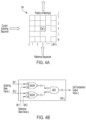
- FIG. 4 B is an example of circuitry for comparing a substring base value to a reference base value stored in a cell according to one or more embodiments.
- FIG. 4 C is an example of circuitry for comparing cell output values in a group of cells according to one or more embodiments.
- FIG. 5 is a flowchart for a sample read location process according to one or more embodiments.
- FIG. 6 is a flowchart for a match identification sub-process using logical operations according to one or more embodiments.
- FIG. 7 is a flowchart for a match identification sub-process using inner-products of reference vectors and substring vectors according to one or more embodiments.
- FIG. 1 is a block diagram of system 100 for genome sequencing including host 101 and reference-guided device 102 according to one or more embodiments.
- Host 101 communicates with reference-guided device 102 to determine a probabilistic location of a sample read within a reference genome.
- device 102 can provide host 101 with index 10 stored in memory 108 of device 102 indicating a probabilistic location of the sample read.
- device 102 may provide host 101 with another data structure or indication of the probabilistic location of the sample read.
- the sample reads, or sample substring sequences taken from the sample reads may initially be provided to reference-guided device 102 by host 101 and/or by another device not shown in FIG. 1 , such as by additional hosts, to determine probabilistic locations of the sample reads within a reference genome stored in one or more arrays 104 of device 102 .
- a read device that generates the sample reads such as an Illumina device (from Illumina, Inc. of San Diego, California) or a nanopore device may provide sample reads to reference-guided device 102 .
- RNA sequencing ribonucleic acid
- Host 101 can include, for example, a computer such as a desktop or server that may implement genome sequencing algorithms, such as a seed and extend algorithm for exact matching and/or a more computationally complex algorithm, such as a Burrows-Wheeler algorithm or Smith-Waterman algorithm for approximate matching of sample reads in a genome.
- genome sequencing algorithms such as a seed and extend algorithm for exact matching
- a more computationally complex algorithm such as a Burrows-Wheeler algorithm or Smith-Waterman algorithm for approximate matching of sample reads in a genome.
- device 102 may be used to preprocess sample reads before de novo or referenced-aligned sequencing.
- the probabilistic locations provided by reference-guided device 102 may replace or improve the efficiency of algorithms performed by host 101 in terms of memory resources and computational cost.
- reference-guided device 102 may replace or improve the efficiency of algorithms performed by host 101 in terms of memory resources and computational cost.
- the probabilistic locations of sample reads provided by device 102 can allow for improvements to the scalability of genome sequencing, thereby lowering the expense and time to perform de novo or reference-aligned genome sequencing.
- Reference-guided device 102 in some implementations can include, for example, one or more Application Specific Integrated Circuits (ASICs) or Field Programmable Gate Arrays (FPGAs) for generating index 10 indicating the probabilistic locations of sample substring sequences from a sample read relative to a reference genome.
- the probabilistic locations of the sample substring sequences can provide host 101 with a probabilistic location for the sample read from which the sample substring sequences were taken.
- host 101 or another device may provide reference-guided device 102 with a current sample substring sequence to load into the one or more arrays 104 of device 102 .
- host 101 or another device may provide reference-guided device 102 with a sample read and reference-guided device 102 may determine the sample substring sequences from the sample read to be loaded into the one or more arrays 104 .
- Host 101 and device 102 may or may not be physically co-located.
- host 101 and device 102 may communicate via a network, such as by using a Local Area Network (LAN) or Wide Area Network (WAN), such as the internet, or a data bus or fabric.
- LAN Local Area Network
- WAN Wide Area Network
- those of ordinary skill in the art will appreciate that other implementations may include multiple hosts 101 and/or multiple devices 102 for providing probabilistic locations of sample reads.
- host 101 and device 102 (or multiple hosts and devices) are integrated as a single device or system.
- device 102 includes one or more arrays 104 .
- a cell generally refers to a memory location for storing one or more values representing one or more nucleotides, referred to as bases in the present disclosure.
- array or arrays 104 can include cells that also include logic for performing one or more operations on a value or values stored in the cell.
- each cell in the one or more arrays can store a reference value representing a reference base from a reference genome and a sample value representing a base from a sample substring sequence.
- the cell may perform one or more operations to output a value that can be used by circuitry 106 or circuitry of the one or more arrays 104 to determine whether a group of cells in the one or more arrays 104 stores a reference sequence that matches the substring sequence stored in the group of cells.
- array(s) 104 can include one or more systolic arrays where a reference value representing a reference base from the reference genome is loaded, and a sample value representing a base from a sample substring sequence may be loaded into the cell for comparison to the reference value, before passing the sample value to a next cell in another group of cells of array(s) 104 .
- array or arrays 104 can include solid-state memory cells that may not perform operations to determine if the values stored in the cell match.
- circuitry 106 in some implementations may determine if the values stored in each cell match.
- array or arrays 104 may each store either a reference value representing a reference base or a sample value representing sample base. In such an implementation, cells storing reference values may be paired with cells storing sample values for comparison of the reference bases to the sample bases.
- the cells in array(s) 104 can include circuitry elements such as registers, latches, or flip-flops.
- solid-state memory may comprise one or more of various types of memory devices such as flash integrated circuits, Chalcogenide RAM (C-RAM), Phase Change Memory (PC-RAM or PRAM), Programmable Metallization Cell RAM (PMC-RAM or PMCm), Ovonic Unified Memory (OUM), Resistive RAM (RRAM), NAND memory (e.g., Single-Level Cell (SLC) memory, Multi-Level Cell (MLC) memory (i.e., two or more levels), or any combination thereof), NOR memory, Electrically Erasable Programmable Read-Only Memory (EEPROM) EEP-OM, Ferroelectric Memory (FeRAM), Magnetoresistive RAM (MRAM), other discrete Non-Volatile Memory (NVM) chips, or any combination thereof.
- flash integrated circuits e.g., Intel® 845555B Intel® 845555B Intel® 845555B Intel® 845555B Intel® 845555B Intel® 845555B Intel® 845555B Intel® 845555B Intel® 845555B Intel®
- Circuitry 106 can include, for example, hard-wired logic, analog circuitry and/or a combination thereof. In other implementations, circuitry 106 can include one or more ASICs, microcontrollers, Digital Signal Processors (DSPs), FPGAs, and/or a combination thereof. In some implementations, circuitry 106 can include one or more Systems on a Chip (SoCs), which may be combined with memory 108 . As discussed in more detail below, circuitry 106 is configured to identify groups of cells in array or arrays 104 where a stored reference sequence matches a current substring sequence stored in the group of cells.
- SoCs Systems on a Chip
- a reference sequence for reference bases from a reference genome can be stored in the group of cells.
- the reference sequence corresponds to an order of the cells in the respective group of cells.
- Each group of cells is configured to store a reference sequence representing a portion of a reference genome that partially overlaps at least one other portion of the reference genome represented by one or more other reference sequences stored in one or more other groups of cells. An example of the storage of such overlapping reference sequences in an array is discussed in more detail below with reference to FIG. 2 .
- each group of cells in array or arrays 104 is configured to store the same current substring sequence that corresponds to the order of the respective group of cells.
- circuitry 106 is configured to identify groups of cells among the plurality of groups of cells in array or arrays 104 where the stored current substring sequence matches the reference sequence stored in the groups of cells.
- the identification of groups of cells with matching sequences may be made in some implementations by circuitry 106 based on values output from the cells after performing at least one logical operation, such as an XNOR operation.
- the identification of groups of cells with matching sequences may be made by circuitry 106 based on values output from the cells after multiplying a reference value representing the reference base and a sample value representing the sample base.
- circuitry 106 may perform all of the operations on the values stored in the cells, instead of some of the operations being performed by the cells themselves.
- Memory 108 of device 102 can include, for example, a volatile memory, such as Dynamic Random Access Memory (DRAM), for storing index 10.
- memory 108 can include a nonvolatile memory, such as MRAM.
- index 10 can be used by host 101 to determine a probabilistic location of a sample read within the reference genome represented by the overlapping reference sequences loaded into or stored in array or arrays 104 .
- index 10 can include a data structure, such as a bitmap or other data structure indicating an index or position in the reference genome corresponding to the groups of cells identified as storing matching sequences.
- Circuitry 106 may update index 10 for different sample substring sequences that are loaded into each group of cells of array or arrays 104 .
- circuitry 106 may indicate a mean location in index 10 for a substring sequence that has multiple matching groups of cells. In other implementations, only a first matching group of cells for a particular substring sequence may be used, or circuitry 106 may not update index 10 at all for a substring sequence that has more than a single group of cells storing matching sequences.
- circuitry 106 in some implementations may output data directly to host 101 indicating groups of cells with matching sequences.
- implementations may include a different number or arrangement of components than shown for system 100 in the example of FIG. 1 .
- other implementations may combine host 101 and device 102 or may include a different number of devices 102 and/or hosts 101 .
- FIG. 2 illustrates an example of a plurality of groups of cells in reference-guided device 102 according to one or more embodiments.
- array 104 includes groups of cells 110 1 to 110 L-19 .
- groups of cells 110 1 to 110 L-19 in FIG. 2 are shown as columns, other implementations may include groups of cells that are not physically arranged as columns.
- array 104 may substitute a defective cell from one group of cells with another cell located in a pool of spare cells in a different portion of the same array or in a different array.
- L can equal the full length of the reference genome, such as 3.2 billion groups or columns of cells, as in the case of the full reference human genome H38.
- Other implementations may instead store overlapped reference sequences that have been shifted by a different number of reference bases, such as by two reference bases, so that fewer groups of cells or columns are needed, which allows for a smaller size of array 104 .
- shifting the overlap by more than one reference base can come at a cost of reducing the likelihood of finding matches for the substring sequence.
- each group of cells 110 stores a reference value (e.g., R1, R2, R3, etc.) representing a reference base and a sample value (S1, S2, S3, etc.) representing a sample base.
- Each reference value and each sample value can be represented by two bits, since there are four possible bases—Adenine (A), Guanine (G), Cytosine (C), and Thymine (T), in the case of DNA sequencing, for example.
- each group of cells 110 stores the same sample sequence of sample values S1 to S20, each group of cells 110 stores different partially overlapping reference sequences that are shifted by one reference base from a reference sequence stored in an adjacent group of cells.
- group of cells 110 1 stores a first reference sequence with reference values R1 to R20
- group of cells 110 2 stores a second reference sequence with reference values R2 to R21.
- the shifted-by offsets and resulting overlaps may be different across the cell groups than as shown in the example of FIG. 2 .
- the arrangement of storing partially overlapping reference sequences and substring sequences in array 104 ordinarily allows for an efficient locating of a probabilistic location of a sample read within the reference genome.
- the reference sequences only need to be loaded into or stored a single time in array 104 . Iterations of loading or storing different substring sequences from a sample read may then provide a probabilistic location of the sample read within the reference genome, which may be used by host 101 to intelligently sort sample reads into groups of reads for more efficient de novo or reference-aligned sequencing, as discussed in co-pending related application Ser. No. 16/821,849, and 16/822,010, incorporated by reference above.
- different implementations may use a first type of cell, such as a ROM or NAND flash cell, to store the reference sequences, and a second type of cell that is better suited to repeated overwrites with a better write endurance, such as an MRAM cell, to store substring sequences.
- a first type of cell such as a ROM or NAND flash cell
- a second type of cell that is better suited to repeated overwrites with a better write endurance, such as an MRAM cell, to store substring sequences.
- a substring sequence length of 20 is used in the example of FIG. 2 including sample values S1 to S20.
- the length of the substring sequence which corresponds to the number of cells in a group of cells or column, can be selected based on a desired uniqueness of the substring sequences within the reference genome relative to the number of cells and operations needed to identify groups of cells or columns storing matching sequences.
- FIG. 3 is a graph depicting the uniqueness of substring sequences of different lengths in human reference genome H38.
- the dashed line in FIG. 3 represents an expected profile if each base in reference genome H38 is chosen uniformly at random for the different substring lengths indicated along the x-axis.
- the solid line in FIG. 3 represents an observed uniqueness of substring sequences within reference genome H38 for the different substring lengths indicated along the x-axis. Specifically, 1,000 substring sequences having lengths between 1 and 44 bases were chosen randomly, and for each substring sequence, the number of matches in H38 were counted. The difference between the solid line and the dashed line in FIG. 3 shows that the distribution of bases in the reference genome is not entirely random. As a result, a slightly longer substring length can be used in practice than in the uniformly random profile to obtain more unique matches.
- substring sequences with lengths between 17 and 25 bases can provide a sufficient number of unique matches for most substring sequences (i.e., only matching at one location within H38) for locating the substring sequence within H38.
- a substring length shorter than 17 bases will require a greater number of substring sequences from a sample read to determine the probabilistic location of the sample read within the reference genome.
- a substring length shorter than 15 bases may fail to identify any unique matches within H38 for nearly all the substring sequences attempted.
- each group of cells 110 in FIG. 2 includes a predetermined number of 20 cells.
- a different substring length or a different predetermined number of cells in each group of cells may be preferred for other examples, such as when using a different reference genome or a portion of reference genome, as may be the case for medical diagnosis of a genetic condition related to a particular portion of a reference genome.
- different tradeoffs between computational cost, the number of cells, and accuracy in terms of a greater number of unique matches may also affect the number of cells used for each group of cells in array or arrays 104 .
- FIG. 4 A illustrates an example array for identifying groups of cells where a stored current substring sequence matches a reference sequence according to one or more embodiments.
- array 104 includes a plurality of groups of cells, as with the example of FIG. 2 discussed above.
- each group of cells is represented by a column number i, from 1 to L-(M ⁇ 1).
- Each cell within each group of cells, or column, is also represented by a row number j, from 1 to M.
- L-(M ⁇ 1) can correspond to the number of overlapping reference sequences from a reference genome
- M can correspond to a number of bases in a substring sequence, such as 20 bases, as with the example array 104 in FIG. 2 .
- Reference sequences for the reference genome can be loaded or stored in the groups of cells with each cell storing a reference value representing a reference base from the reference sequence. As discussed above, the reference sequences from one column or group of cells to the next group or column may overlap by a predetermined number of reference values or reference bases, such as by one, two or three reference values or bases. The order of cells in the group or column corresponds to the order of reference bases in the reference sequence.
- the reference sequences may be initially loaded or stored by a manufacturer of the reference-guided device for a particular reference genome before shipping the reference-guided device to a customer. In other implementations, the reference sequences may be loaded or stored by the customer in the field.
- a current substring sequence is loaded or stored in the groups of cells with each cell storing a sample value representing a sample base from the current substring sequence.
- Each group of cells or column can store the same current substring sequence.
- the order of cells in the group or column corresponds to the order of sample bases in the current substring sequence.
- array 104 can include a systolic array where the current substring sequence is passed from one group of cells or column to the next.
- a comparison is made between the reference value and the sample value in each cell, such as in cell i, j, and each cell provides a cell output value to circuitry 106 to identify columns or groups of cells where all of the reference values match all of the substring values.
- the position of the matching columns or groups of cells may then be used to update a data structure, such as index 10 in FIG. 1 .
- the position of the matching columns or groups of cells may instead be provided to another device, such as host 101 in FIG. 1 , without updating a data structure.
- FIG. 4 B is an example of circuitry for comparing a substring base value to a reference base value stored in a cell according to one or more embodiments.
- each substring base and reference base can be represented by two bits.
- an A base can be represented by the binary value 00
- a C base can be represented by the binary value 01
- a G base can be represented by the binary value 10
- a T base can be represented by the binary value 11.
- the bases can be represented by other values, as in the example of using inner-products discussed below with reference to FIG. 7 where bases can have values including 1 or ⁇ 1.
- circuitry within cell i,j includes two XNOR gates that output to an AND gate.
- a first bit of substring base value i,j stored in cell i,j is input into a first XNOR gate together with a first bit of reference base value i,j stored in cell i,j.
- a second bit of substring base value i, j is input into a second XNOR gate together with a second bit of reference base value i, j. If the two inputs of an XNOR gate match, the output has a high binary value of 1. On the other hand, if the two inputs of an XNOR gate do not match, the output has a low binary value of 0.
- the output value from each XNOR gate is input into the AND gate. If the two inputs are both 1, indicating a match for each of the first and second bits of the reference base value and substring base value, the cell comparison output value from the AND gate is a high binary value of 1. Otherwise, the cell comparison output value from the AND gate is a low binary value of 0. This high or low binary value is output from the cell to circuitry, such as to circuitry 106 in FIG. 1 , to identify columns or groups of cells where all of the reference base values match all of the substring base values stored in the group of cells.
- FIG. 4 C is an example of circuitry for comparing cell output values in a group of cells according to one or more embodiments.
- the cell comparison output values from each cell in a group of cells are input into an AND gate to produce a column output value for column i. If the cell comparison output values for all the cells 1 to M in column i indicate a match by all having high binary values of 1, the column output value from the AND gate for the column is a high binary value of 1. This column output value may be used to identify the column or group of cells as having a matching substring sequence and reference sequence.
- the circuitry shown in FIG. 4 C may be part of circuitry external to the array 104 or may be part of the array 104 .
- circuitry 106 may only use the first matching location, the first matching location with other matching locations, or may use all of the matching locations for locating the current substring sequence within the reference genome.
- the current substring sequence may result in no matches. For example, mutations or read errors in the sample read from which the substring sequence is taken may prevent a match or may cause errors in the matching.
- implementations may use different circuitry or a different process of identifying groups of cells where the stored reference sequence matches a substring sequence stored in the group of cells.
- an inner-product or dot product operation may instead be used to identify groups of cells storing matching sequences, instead of logic gates, as discussed in more detail below with reference to the match identification sub-process of FIG. 7 .
- the AND gate in FIG. 4 C may be replaced by circuitry for summing the cell comparison output values for a group of cells and then comparing the sum to the number of cells in the group of cells.
- the reference sequence for the group of cells matches the substring sequence if the sum from the cells in the group equals the number of cells in the group.
- FIG. 5 is a flowchart for a sample read location process according to one or more embodiments. The process of FIG. 5 may be performed, for example, by device 102 and/or host 101 in FIG. 1 .
- reference sequences are stored in respective groups of cells of a plurality of groups of cells for reference bases from a reference genome.
- the storage locations of the reference sequences correspond to an order of cells in the groups of cells.
- each reference sequence represents a portion of the reference genome that partially overlaps or is shifted from at least one other portion of the reference genome represented by one or more other reference sequences stored in one or more other groups of cells.
- reference-guided device 102 may receive the reference sequences or the reference genome from host 101 . In other implementations, reference-guided device 102 may come pre-configured from the manufacturer with the reference sequences programmed or stored in the groups of cells for a particular genome, such as human genome H38.
- the current substring sequence is stored in each group of cells of the plurality of groups of cells for sample bases from a sample read.
- the storage locations of the current substring sequence within each group of cells corresponds to an order of the group of cells.
- the current substring sequence may be received from host 101 or may be selected by device 102 from a sample read provided by host 101 .
- circuitry 106 of device 102 or host 101 may randomly select substring sequences from the sample read.
- circuitry 106 or host 101 may select substring sequences that are spaced throughout the sample read.
- circuitry 106 identifies groups of cells among the plurality of groups of cells where the stored reference sequence matches the current substring sequence stored in the group of cells.
- the identification of groups of cells may be made using logic gates, as in the examples discussed above for FIGS. 4 A to 4 C .
- the identification of groups of cells may be made by performing calculations using the stored reference values and sample values, as with the example match identification sub-process of FIG. 7 discussed below.
- circuitry 106 or host 101 determines whether the substring sequence stored in block 504 is the last substring sequence from the sample read to be stored in the groups of cells.
- a predetermined number of substring sequences may be iteratively stored in cells of device 102 for comparison to reference sequences from the reference genome. The number of different substring sequences taken from a sample read can depend on, for example, the length of the substring sequences (e.g., 20 bases in FIG.
- the length of the reference genome e.g., a short read from an Illumina device of 250 or 300 bases versus a long read from a nanopore device of 5,000 bases
- an accuracy of the process used to create the sample read e.g., a desired accuracy for locating the sample read within the reference genome.
- short reads of 250 or 300 bases can be located in a reference genome with only a few matching substring sequences. Such an example may only use ten substring sequences from sample reads to generate enough matches to locate the sample reads in the reference genome.
- the process proceeds to block 510 to overwrite the current substring sequence with a next substring sequence from the sample read to store the next substring sequence in the plurality of groups of cells.
- the process of FIG. 5 then returns back to block 506 to identify groups of cells where the reference sequence matches the next substring sequence.
- block 502 is not repeated, since the same reference sequences can be reused for the next substring sequence. Only having to load or store the reference sequences or reference genome a single time for multiple iterations of substring sequences from sample reads can improve the efficiency of the sample read location identification process.
- circuitry 106 or host 101 may determine in block 508 whether another substring sequence is needed to locate the sample read based on a number of previously tested substring sequences. For example, if four previous substring sequences have resulted in matches, a fifth substring sequence may not need to be tested. On the other hand, if the four previous substring sequences have not resulted in any matches, a fifth substring sequence can be loaded.
- the process proceeds to block 512 to determine a probabilistic location of the sample read within the reference genome based on the identified groups of cells for different substring sequences from the sample read.
- a first matching group of cells may be used as a location for each substring sequence, or alternatively, multiple matching groups of cells may be used as possible locations for the substring sequence, assuming some substring sequences result in multiple matching groups of cells.
- a substring sequence may have no matching locations due to errors in reading the sample or mutations in the sample.
- the location for the sample read determined in block 512 by circuitry 106 or host 101 can be probabilistic in the sense that multiple possible locations can be identified for the different substring sequences from the sample read, and a consensus or statistic derived from the matching locations can be used to probabilistically locate the sample read within the reference genome.
- a mean of all the locations of all of the matching groups of cells for all the substring sequences is used to identify a most likely location of the sample read within the reference genome.
- only one location for each substring sequence with a matching group of cells is used in the mean.
- a probabilistic location of the sample read may be determined by identifying the farthest apart locations within the reference genome that correspond to matching groups of cells for the substring sequences.
- one or more outlier locations with respect to a group of matching locations may be discarded in determining the probabilistic location of the sample read within the reference genome.
- FIG. 6 is a flowchart for a match identification sub-process using logical operations according to one or more embodiments.
- the sub-process of FIG. 6 may be performed by cells in array(s) 104 and/or circuitry 106 as part of block 506 in the sample read location process of FIG. 5 discussed above to identify groups of cells where stored reference sequences match a current substring sequence stored in the group of cells.
- At least one XNOR operation is performed in each cell of the plurality of groups of cells to compare a sample base from a current substring sequence with a reference base from a reference sequence.
- two XNOR gates and an AND gate may be used in the cells to compare the values stored in the cell for the reference base and the sample base.
- a comparison value is output from each cell of the plurality of groups of cells indicating whether the sample base for the cell matches the reference base for the cell.
- the comparison value may be either a high binary value of 1 or a low binary value of 0 indicating whether the reference value and the sample value stored in the cell match.
- FIG. 7 is a flowchart for a match identification sub-process that uses inner-products or dot products of reference vectors and substring vectors according to one or more embodiments.
- the sub-process of FIG. 7 may be performed by cells in array(s) 104 and/or circuitry 106 as part of block 506 in the sample read location process of FIG. 5 discussed above to identify groups of cells where stored reference sequences match a current substring sequence stored in the group of cells.
- a product is calculated for each cell of a first stored value representing a substring base and a second stored value representing a reference base.
- the substring values stored in a group of cells can represent a substring vector
- the reference values stored in the group of cells can represent a reference vector for the group of cells.
- each reference value and each sample value can be represented by two digits including 1 and/or ⁇ 1.
- the base C may have a value of 1,1
- the base G may have a value of ⁇ 1, ⁇ 1
- the base T may have a value of 1, ⁇ 1
- the base A may have a value of ⁇ 1,1.
- different combinations of 1 and ⁇ 1 may be used to represent the bases.
- circuitry 106 may calculate the product of the values stored in the cells.
- the products output from the cells are summed in block 706 .
- the sum of the products for each group of cells is then compared in block 708 to twice the number of cells in the group of cells or twice the length of the substring sequence.
- the sum of the products for each group of cells may be compared to a different predetermined multiple of the number of cells in the group. For example, in an implementation where the cells output a value of 1 indicating a match and a value of 0 indicating no match, the sum is compared to 1 multiplied by the total number of cells, rather than twice the number of cells in the group. Similarly, in an implementation where the cells output a value of 0 indicating a match, the sum is compared to 0 multiplied by the number of cells.
- circuitry 106 or host 101 identifies groups of cells where the sum of the products equals twice the number of cells in the group of cells or twice the length of the substring sequence.
- groups of cells have matching sequences because each product from the cells for such groups equal 1, and therefore add up to twice the number of cells (or twice the substring sequence length).
- the encoded reference sequence or reference vector is then [1,1,1,1, ⁇ 1,1, ⁇ 1, ⁇ 1] using the values assigned to the bases discussed above for block 702 .
- the encoded matching substring sequence or matching substring sequence vector would also be [1,1,1, ⁇ 1,1, ⁇ 1, ⁇ 1].
- the encoded non-matching substring sequence or non-matching substring sequence vector would be [ ⁇ 1, ⁇ 1, ⁇ 1, ⁇ 1, 1, ⁇ 1].
- the foregoing reference-guided devices and methods can ordinarily allow sample reads to be probabilistically located within a reference genome. This can improve the efficiency of de novo and reference-aligned sequencing by pre-processing sample reads into groups based on their locations in the reference genome for further sequencing. In the case of de novo sequencing, this can improve the scalability and efficiency of de novo sequencing by allowing more compute threads to access each localized group of sample reads in a smaller shared memory, as compared to conventional methods where a larger and more expensive memory is used to access all of the sample reads by a limited number of compute threads.
- the localized groups of sample reads can allow for only a smaller relevant portion of a reference genome to be stored in a smaller and less expensive memory for each localized group, while allowing for more compute threads to access the multiple smaller memories to improve scalability, as compared to a conventional reference-aligned sequencing that may use a single shared memory to store the full reference genome.
- a general purpose processor may be a microprocessor, but in the alternative, the processor may be any conventional processor, controller, microcontroller, or state machine.
- Processor or controller circuitry may also be implemented as a combination of computing devices, e.g., a combination of a DSP and a microprocessor, a plurality of microprocessors, an SoC, one or more microprocessors in conjunction with a DSP core, or any other such configuration.
- a software module may reside in RAM memory, flash memory, ROM memory, EPROM memory, EEPROM memory, registers, hard disk, a removable media, an optical media, or any other form of storage medium known in the art.
- An exemplary storage medium is coupled to processor or controller circuitry such that the processor or controller circuitry can read information from, and write information to, the storage medium.
- the storage medium may be integral to processor or controller circuitry.
- the processor or controller circuitry and the storage medium may reside in an ASIC or an SoC.
Landscapes
- Physics & Mathematics (AREA)
- Life Sciences & Earth Sciences (AREA)
- Engineering & Computer Science (AREA)
- Health & Medical Sciences (AREA)
- Medical Informatics (AREA)
- Theoretical Computer Science (AREA)
- Bioinformatics & Cheminformatics (AREA)
- Biophysics (AREA)
- Bioinformatics & Computational Biology (AREA)
- Biotechnology (AREA)
- Evolutionary Biology (AREA)
- General Health & Medical Sciences (AREA)
- Spectroscopy & Molecular Physics (AREA)
- Proteomics, Peptides & Aminoacids (AREA)
- Analytical Chemistry (AREA)
- Chemical & Material Sciences (AREA)
- Artificial Intelligence (AREA)
- Computer Vision & Pattern Recognition (AREA)
- Data Mining & Analysis (AREA)
- Evolutionary Computation (AREA)
- Software Systems (AREA)
- Bioethics (AREA)
- Databases & Information Systems (AREA)
- Epidemiology (AREA)
- Public Health (AREA)
- Nonlinear Science (AREA)
- Measuring Or Testing Involving Enzymes Or Micro-Organisms (AREA)
- Computational Linguistics (AREA)
- Computing Systems (AREA)
- General Engineering & Computer Science (AREA)
- General Physics & Mathematics (AREA)
- Mathematical Physics (AREA)
- Apparatus Associated With Microorganisms And Enzymes (AREA)
Abstract
Description
Claims (25)
Priority Applications (5)
| Application Number | Priority Date | Filing Date | Title |
|---|---|---|---|
| US16/820,711 US12014802B2 (en) | 2020-03-17 | 2020-03-17 | Devices and methods for locating a sample read in a reference genome |
| EP20925494.5A EP4121965B1 (en) | 2020-03-17 | 2020-07-01 | DEVICES AND METHODS FOR LOCATING A SAMPLE READ IN A REFERENCE GENOME |
| CN202080080230.7A CN114730615B (en) | 2020-03-17 | 2020-07-01 | Apparatus and method for locating sample reads in a reference genome |
| PCT/US2020/040570 WO2021188138A1 (en) | 2020-03-17 | 2020-07-01 | Devices and methods for locating a sample read in a reference genome |
| JP2022529856A JP7422228B2 (en) | 2020-03-17 | 2020-07-01 | Device and method for locating sample reads within a reference genome |
Applications Claiming Priority (1)
| Application Number | Priority Date | Filing Date | Title |
|---|---|---|---|
| US16/820,711 US12014802B2 (en) | 2020-03-17 | 2020-03-17 | Devices and methods for locating a sample read in a reference genome |
Publications (2)
| Publication Number | Publication Date |
|---|---|
| US20210295949A1 US20210295949A1 (en) | 2021-09-23 |
| US12014802B2 true US12014802B2 (en) | 2024-06-18 |
Family
ID=77746964
Family Applications (1)
| Application Number | Title | Priority Date | Filing Date |
|---|---|---|---|
| US16/820,711 Active 2043-04-20 US12014802B2 (en) | 2020-03-17 | 2020-03-17 | Devices and methods for locating a sample read in a reference genome |
Country Status (5)
| Country | Link |
|---|---|
| US (1) | US12014802B2 (en) |
| EP (1) | EP4121965B1 (en) |
| JP (1) | JP7422228B2 (en) |
| CN (1) | CN114730615B (en) |
| WO (1) | WO2021188138A1 (en) |
Families Citing this family (2)
| Publication number | Priority date | Publication date | Assignee | Title |
|---|---|---|---|---|
| US12073110B2 (en) | 2022-09-12 | 2024-08-27 | Micron Technology, Inc. | Sequence alignment with memory arrays |
| US12217796B2 (en) * | 2022-09-12 | 2025-02-04 | Micron Technology, Inc. | Sequence alignment with memory arrays |
Citations (18)
| Publication number | Priority date | Publication date | Assignee | Title |
|---|---|---|---|---|
| JP2005251192A (en) | 2005-02-18 | 2005-09-15 | Biomatics Inc | Biological sequence information processing method and device |
| US20100138376A1 (en) | 2007-01-24 | 2010-06-03 | Nicholas John Avis | Method and system for searching for patterns in data |
| CN101866357A (en) | 2010-06-11 | 2010-10-20 | 福建星网锐捷网络有限公司 | Method and device for updating items of three-state content addressing memory |
| US20130246698A1 (en) | 2012-03-14 | 2013-09-19 | Broadcom Corporation | Hybrid Memory for Search Operations |
| US8634247B1 (en) | 2012-11-09 | 2014-01-21 | Sandisk Technologies Inc. | NAND flash based content addressable memory |
| US20140136120A1 (en) | 2007-11-21 | 2014-05-15 | Cosmosid Inc. | Direct identification and measurement of relative populations of microorganisms with direct dna sequencing and probabilistic methods |
| US20140172824A1 (en) | 2012-12-17 | 2014-06-19 | Microsoft Corporation | Parallel local sequence alignment |
| EP2759952A1 (en) | 2013-01-28 | 2014-07-30 | Hasso-Plattner-Institut für Softwaresystemtechnik GmbH | Efficient genomic read alignment in an in-memory database |
| US20140347933A1 (en) | 2012-08-31 | 2014-11-27 | Aplus Flash Technology, Inc. | Nor-based bcam/tcam cell and array with nand scalability |
| US20140371110A1 (en) | 2013-01-17 | 2014-12-18 | Edico Genome, Corp. | Bioinformatics systems, apparatuses, and methods executed on an integrated circuit processing platform |
| US9600625B2 (en) | 2012-04-23 | 2017-03-21 | Bina Technologies, Inc. | Systems and methods for processing nucleic acid sequence data |
| US9639501B1 (en) | 2012-10-17 | 2017-05-02 | Firquest Llc | Apparatus and methods to compress data in a network device and perform ternary content addressable memory (TCAM) processing |
| US9734284B2 (en) | 2013-03-15 | 2017-08-15 | Micron Technology, Inc. | Hardware acceleration of short read mapping for genomic and other types of analyses |
| US20170235876A1 (en) | 2016-02-11 | 2017-08-17 | 10X Genomics, Inc. | Systems, methods, and media for de novo assembly of whole genome sequence data |
| US20190214111A1 (en) | 2016-10-11 | 2019-07-11 | Genomsys Sa | Method and systems for the representation and processing of bioinformatics data using reference sequences |
| CA2854084C (en) | 2011-11-18 | 2019-11-05 | The Regents Of The University Of California | Bambam: parallel comparative analysis of high-throughput sequencing data |
| US20210201163A1 (en) * | 2019-12-28 | 2021-07-01 | Intel Corporation | Genome Sequence Alignment System and Method |
| EP3673386B1 (en) * | 2017-08-24 | 2023-07-12 | Koninklijke Philips N.V. | Edit script verification for nucleic acid sequences with match operations and difference operations |
Family Cites Families (3)
| Publication number | Priority date | Publication date | Assignee | Title |
|---|---|---|---|---|
| CN103336916B (en) * | 2013-07-05 | 2016-04-06 | 中国科学院数学与系统科学研究院 | A kind of sequencing sequence mapping method and system |
| ES2922420T3 (en) * | 2016-10-11 | 2022-09-14 | Genomsys Sa | Efficient data structures for the representation of bioinformatics information |
| CN107403075B (en) * | 2017-08-02 | 2021-04-27 | 深圳市真迈生物科技有限公司 | Comparison method, device and system |
-
2020
- 2020-03-17 US US16/820,711 patent/US12014802B2/en active Active
- 2020-07-01 CN CN202080080230.7A patent/CN114730615B/en active Active
- 2020-07-01 WO PCT/US2020/040570 patent/WO2021188138A1/en not_active Ceased
- 2020-07-01 EP EP20925494.5A patent/EP4121965B1/en active Active
- 2020-07-01 JP JP2022529856A patent/JP7422228B2/en active Active
Patent Citations (22)
| Publication number | Priority date | Publication date | Assignee | Title |
|---|---|---|---|---|
| JP2005251192A (en) | 2005-02-18 | 2005-09-15 | Biomatics Inc | Biological sequence information processing method and device |
| US20100138376A1 (en) | 2007-01-24 | 2010-06-03 | Nicholas John Avis | Method and system for searching for patterns in data |
| US20140136120A1 (en) | 2007-11-21 | 2014-05-15 | Cosmosid Inc. | Direct identification and measurement of relative populations of microorganisms with direct dna sequencing and probabilistic methods |
| CN101866357A (en) | 2010-06-11 | 2010-10-20 | 福建星网锐捷网络有限公司 | Method and device for updating items of three-state content addressing memory |
| CA2854084C (en) | 2011-11-18 | 2019-11-05 | The Regents Of The University Of California | Bambam: parallel comparative analysis of high-throughput sequencing data |
| US20130246698A1 (en) | 2012-03-14 | 2013-09-19 | Broadcom Corporation | Hybrid Memory for Search Operations |
| US9600625B2 (en) | 2012-04-23 | 2017-03-21 | Bina Technologies, Inc. | Systems and methods for processing nucleic acid sequence data |
| US20140347933A1 (en) | 2012-08-31 | 2014-11-27 | Aplus Flash Technology, Inc. | Nor-based bcam/tcam cell and array with nand scalability |
| US9639501B1 (en) | 2012-10-17 | 2017-05-02 | Firquest Llc | Apparatus and methods to compress data in a network device and perform ternary content addressable memory (TCAM) processing |
| US9098403B2 (en) | 2012-11-09 | 2015-08-04 | Sandisk Technologies Inc. | NAND flash based content addressable memory |
| US8634247B1 (en) | 2012-11-09 | 2014-01-21 | Sandisk Technologies Inc. | NAND flash based content addressable memory |
| CN105051741A (en) | 2012-12-17 | 2015-11-11 | 微软技术许可有限责任公司 | Parallel local sequence alignment |
| US20140172824A1 (en) | 2012-12-17 | 2014-06-19 | Microsoft Corporation | Parallel local sequence alignment |
| US20140371110A1 (en) | 2013-01-17 | 2014-12-18 | Edico Genome, Corp. | Bioinformatics systems, apparatuses, and methods executed on an integrated circuit processing platform |
| US20190172558A1 (en) | 2013-01-17 | 2019-06-06 | Edico Genome, Corp. | Bioinformatics Systems, Apparatuses, and Methods Executed on an Integrated Circuit Processing Platform |
| EP2759952A1 (en) | 2013-01-28 | 2014-07-30 | Hasso-Plattner-Institut für Softwaresystemtechnik GmbH | Efficient genomic read alignment in an in-memory database |
| US9734284B2 (en) | 2013-03-15 | 2017-08-15 | Micron Technology, Inc. | Hardware acceleration of short read mapping for genomic and other types of analyses |
| US20170337325A1 (en) | 2013-03-15 | 2017-11-23 | Micron Technology, Inc. | Hardware Acceleration of Short Read Mapping for Genomic and Other Types of Analyses |
| US20170235876A1 (en) | 2016-02-11 | 2017-08-17 | 10X Genomics, Inc. | Systems, methods, and media for de novo assembly of whole genome sequence data |
| US20190214111A1 (en) | 2016-10-11 | 2019-07-11 | Genomsys Sa | Method and systems for the representation and processing of bioinformatics data using reference sequences |
| EP3673386B1 (en) * | 2017-08-24 | 2023-07-12 | Koninklijke Philips N.V. | Edit script verification for nucleic acid sequences with match operations and difference operations |
| US20210201163A1 (en) * | 2019-12-28 | 2021-07-01 | Intel Corporation | Genome Sequence Alignment System and Method |
Non-Patent Citations (44)
| Title |
|---|
| Altschul et al.; "Basic Local Alignment Search Tool"; May 15, 1990; Journal of molecular biology; available at: https://pubmed.ncbi.nlm.nih.gov/2231712/, 8 pages. |
| Araujo et al.; "Multiple Sequence Alignment using Hybrid Parallel Computing"; 2017 IEEE 17th International Conference on Bioinformatics and Bioengineering. |
| Benkrid et al.; "A highly parameterized and efficient FPGA-based skeleton for pairwise biological sequence alignment"; IEEE Transactions on Very Large Scale Integration (VLSI) Systems 17.4 (2009): 561-570; Apr. 2009. |
| Canzar et al.; "Short Read Mapping: An Algorithmic Tour"; Mar. 2017; Proc IEEE Inst Electr Electron Eng .; 54 pages; available at: https://www.ncbi.nlm.nih.gov/pmc/articles/PMC5425171/pdf/nihms854488.pdf. |
| Chin et al.; "Nonhybrid, finished microbial genome assemblies from long-read SMRT sequencing data"; Nature.com; Nature Methods; May 5, 2013; p. 563-569; available at: https://www.nature.com/articles/nmeth.2474. |
| Gamaarachchi et al.; "Featherweight long read alignment using partitioned reference indexes"; Nature.com; Scientific Reports; Mar. 13, 2019; 12 pages; available at: https://www.nature.com/articles/s41598-019-40739-8. |
| Garro et al.; "Using a programmable network switch TCAM to find the best alignment of two DNA sequences"; Nov. 1, 2016; IEEE 36th Central American and Panama Convention (CONCAPAN XXXVI); available at: https://ieeexplore.ieee.org/document/7942372, 5 pages. |
| Guo et al; "A systolic array-based FPGA parallel architecture for the BLAST algorithm"; International Scholarly Research Notices; 2012; available at https://www.ncbi.nlm.nih.gov/pmc/articles/PMC4417556/, 11 pages. |
| Hiatt et al.; "Parallel, tag-directed assembly of locally derived short sequence reads"; Nature.com; Nature Methods; Jan. 17, 2010; pp. 119-122; available at: https://www.nature.com/articles/nmeth.1416. |
| Houtgast et al.; "Hardware Acceleration of BWA-MEM Genomic Short Read Mapping for Longer Read Lengths"; Computational Biology and Chemistry; vol. 75; Aug. 2018; p. 54-64; available at https://doi.org/10.1016/j.compbiolchem.2018.03.024. |
| Houtgast, et al.; "An FPGA-Based Systolic Array to Accelerate the BWA-MEM Genomic Mapping Algorithm"; Delft University of Technology; Jul. 1, 2015; available at: http://pure.tudelft.nl/ws/files/10410158/3210798/pdf. |
| Huang et al.; "LW-FQZip 2: a parallelized reference-based compression of FASTQ files"; BMC Bioinformatics; Mar. 20, 2017; available at: https://bmcbioinformatics.biomedcentral.com/articles/10.1186/s12859-017-1588-x. |
| Huangfu, et al.; "RADAR: A 3D-ReRAM based DNA Alignment Accelerator Architecture"; Jun. 24, 2018; In Proceedings of the 55th Annual Design Automation Conference; https://seal.ece.ucsb.edu/sites/seal.ece.ucsb.edu/files/publications/a59-huangfu.pdf. |
| Hwang et al.; "Privacy-Preserving Compressed Reference-Oriented Alignment Map Using Decentralized Storage"; IEEE Access; Aug. 17, 2018; 12 pages; available at: https://ieeexplore.ieee.org/document/8438866. |
| International Search Report and Written Opinion dated Jun. 16, 2021 from International Application No. PCT/US2021/014952, 9 pages. |
| International Search Report and Written Opinion dated Oct. 11, 2020 from counterpart International Application No. PCT/US2020/040570, 18 pages. |
| International Search Report and Written Opinion dated Oct. 22, 2020; International Application No. PCT/US2020/040568, 11 pages. |
| International Search Report and Written Opinion dated Oct. 27, 2020 from counterpart International Application No. PCT/US2020/040530, 10 pages. |
| Jain et al.; "A fast adaptive algorithm for computing whole-genome homology maps"; Bioinformatics; 9 pages; Sep. 2018; available at: https://academic.oup.com/bioinformatics/article/34/17/1748/5093242. |
| Janin et al.; "BEETL-fastq: a searchable compressed archive for DNA reads"; Bioinformatics; vol. 30; Issue 19, Oct. 2014; pp. 2796-2801; available at: https://academic.oup.com/bioinformatics/article/30/19/2796/2422232. |
| Kaplan et al.; "A Resistive CAM Processing-in-Storage Architecture for DNA Sequence Alignment"; Jan. 17, 2017; 9 pages; available at: https://webee.technion.ac.il/people/ran/papers/ReCAMinStorageDNAsequenceIEEEmicro2017.pdf. |
| Kaplan et al.; "BioSEAL: In-Memory Biological Sequence Alignment Accelerator for Large-Scale Genomic Data"; Jan. 17, 2019; 14 pages; available at: https://arxiv.org/ftp/arxiv/papers/1901/1901.05959.pdf. |
| Kento Aoyama, "Development of Exome Analysis Pipeline on the K Computer", Trans. IPS Japan, Advanced Computing Systems (ACS), vol. 9 No.2 [online], Japan, IPS Japan, Jul. 14, 2016, vol. 9 No.2, p. 15-33, ISSN:1882-7829. |
| Khatamifard et al.; "A Non-volatile Near-Memory Read Mapping Accelerator"; Mar. 23, 2018; 12 pages; available at: https://arxiv.org/pdf/1709.02381.pdf. |
| Khatamifard et al.; "Read Mapping Near Non-Volatile Memory"; arXiv:1709.02381; May 5, 2020; available at: https://arxiv.org/abs/1709.02381, 13 pages. |
| Kim, et al.; "GRIM-Filter: Fast seed location filtering in DNA read mapping using processing-in-memory technologies"; BMC Genomics; vol. 19; Suppl. 2; May 9, 2018; 18 pages; available at: https://bmcgenomics.biomedcentral.com/articles/10.1186/s12864-018-4460-0. |
| Lala, PK. and Parkerson JP. A CAM (Content Addressable Memory)-based architecture for molecular sequence matching. Proceedings of the International Conference on Bioinformatics & Computational Biology (BIOCOMP). (Year: 2011). * |
| Li et al.; "NVSim-CAM: A Circuit-Level Simulator for EmergingNonvolatile Memory based Content-Addressable Memory"; 2017; 7 pages; available at: https://dl.acm.org/doi/pdf/10.1145/2966986.2967059. |
| Lischer et al.; "Reference-guided de novo assembly approach improves genome reconstruction for related species"; BMC Bioinformatics; Nov. 10, 2017; 12 pages; available at https://bmcbioinformatics.biomedcentral.com/articles/10.1186/s12859-017-1911-6. |
| Liu et al.; "A Customized Many-Core Hardware Acceleration Platform for Short Read Mapping Problems Using Distributed Memory Interface with 3D-Stacked Architecture"; Journal of Signal Processing Systems; Dec. 3, 2016; p. 327-341; available at https://link.springer.com/article/10.1007/s11265-016-1204-8. |
| McVicar, et al.; "FPGA Acceleration of Short Read Alignment"; arXiv preprint arXiv:1805.00106; Apr. 30, 2018; available at: http://arxiv.org/ftp/arxiv/papers/1805/1805.00106.pdf. |
| Oenning et al.; "CompStor Novos: low cost yet fast assembly-based variant calling for personal genomes"; bioRxiv; Cold Spring Harbor Laboratory; Dec. 4, 2018; 16 pages; available at: https://www.biorxiv.org/content/10.1101/486092v1. |
| Parag K Lala; "A CAM (Content Addressable Memory) Architecture for Codon Matching in DNA Sequences"; Current Journal of Applied Science and Technology; Jul. 10, 2015; available at https://www.journalcjast.com/index.php/CJAST/article/view/8357, 5 pages. |
| Pending U.S. Appl. No. 16/821,849, filed Mar. 17, 2020, entitled "Reference-Guided Genome Sequencing", Justin Kinney. |
| Pending U.S. Appl. No. 16/822,010, filed Mar. 18, 2020, entitled "Reference-Guided Genome Sequencing", Justin Kinney. |
| Pending U.S. Appl. No. 16/908,581, filed Jun. 22, 2020, entitled "Devices and Methods for Genome Sequencing", Wen Ma. |
| Pfeiffer, et al.; "Hardware enhanced biosequence alignment"; International Conference on METMBS '05; vol. 5; Jun. 23, 2005; available at: http://citeseerx.ist.psu.edu/viewdoc/download?doi=10.1.1.85.5807&rep=rep1&type=pdf. |
| Rauer C.& Finamore N. (2016). Accelerating Genomics Research with OpenCL™ and FPGAs, Altera, Now Part of Intel, Tech. Rep https://www.intel.com/content/dam/altera-www/global/en_US/pdfs/literature/wp/wp-accelerating-genomics-opencl-fpgas.pdf. 10 pages (Year: 2016). * |
| Shah et al; "Optimized and Portable FPGA-Based Systolic Cell Architecture for Smith-Waterman-Based DNA Sequence Alignment"; Journal of information and communication convergence engineering 14.1 (2016):26-34; Mar. 2016. |
| Simpson et al.; "Efficient de novo assembly of large genomes using compressed data structures"; Genome Research; Dec. 7, 2011; 10 pages; available at: https://genome.cshlp.org/content/22/3/549.full?sid=896285ab-62e4-4258-9e15-5cef59a88f0c. |
| Wilton et al.; "Faster sequence alignment through GPU-accelerated restriction of the seed-and-extend search space"; bioRxiv; Aug. 1, 2014; 7 pages; available at: https://www.biorxiv.org/content/10.1101/007641v1.full. |
| Xinyu Guo; "Design of A Systolic Array-Based FPGA Parallel Architecture for the BLAST Algorithm and Its Implementation"; The University of Toledo Digital Repository Theses and Dissertations; August 2012available at: http://citeseerx.ist.psu.edu/viewdoc/download?doi=10.1.1.917.6897&rep=rep1&type=pdf, 71 pages. |
| Ye at al.; "DBG2OLC: Efficient Assembly of Large Genomes Using Long Erroneous Reads of the Third Generation Sequencing Technologies"; Nature.com; Scientific Reports; Aug. 30, 2016; 9 pages; available at: https://www.nature.com/articles/srep31900. |
| Yu CK et al. A Smith-Waterman Systolic Cell. Excerpt 13th International Conference, FPL 2003, Proceedings, 375-384. (Year: 2003). * |
Also Published As
| Publication number | Publication date |
|---|---|
| EP4121965B1 (en) | 2025-12-31 |
| JP7422228B2 (en) | 2024-01-25 |
| EP4121965A1 (en) | 2023-01-25 |
| CN114730615B (en) | 2025-05-27 |
| CN114730615A (en) | 2022-07-08 |
| JP2023504376A (en) | 2023-02-03 |
| US20210295949A1 (en) | 2021-09-23 |
| WO2021188138A1 (en) | 2021-09-23 |
| EP4121965A4 (en) | 2024-04-24 |
Similar Documents
| Publication | Publication Date | Title |
|---|---|---|
| CN108153512B (en) | Four-step correlation full adder | |
| WO2020139425A2 (en) | On-chip non-volatile memory (nvm) search | |
| EP4121965B1 (en) | DEVICES AND METHODS FOR LOCATING A SAMPLE READ IN A REFERENCE GENOME | |
| CN114787930B (en) | Apparatus and methods for genome sequencing | |
| US20250124981A1 (en) | Sequence alignment with memory arrays | |
| US12006539B2 (en) | Reference-guided genome sequencing | |
| US12073110B2 (en) | Sequence alignment with memory arrays | |
| US11837330B2 (en) | Reference-guided genome sequencing | |
| US12061542B2 (en) | Memory device with latch-based neural network weight parity detection and trimming | |
| US20250157510A1 (en) | Storage device performing dummy read operation, and method of operating the same | |
| US20250181495A1 (en) | Memory die with on-chip binary vector database search | |
| US20250181242A1 (en) | Memory die with on-chip binary vector database search | |
| US20240062833A1 (en) | Page buffer counting for in-memory search | |
| Jiang et al. | DSHD-CAM: High-Throughput RRAM CAM Leveraging Dynamic Shifted Hamming Distance for Genome Analysis | |
| CN120299489A (en) | Memory device and method of operating a memory device |
Legal Events
| Date | Code | Title | Description |
|---|---|---|---|
| AS | Assignment |
Owner name: WESTERN DIGITAL TECHNOLOGIES, INC., CALIFORNIA Free format text: ASSIGNMENT OF ASSIGNORS INTEREST;ASSIGNOR:KINNEY, JUSTIN;REEL/FRAME:052130/0233 Effective date: 20200311 |
|
| FEPP | Fee payment procedure |
Free format text: ENTITY STATUS SET TO UNDISCOUNTED (ORIGINAL EVENT CODE: BIG.); ENTITY STATUS OF PATENT OWNER: LARGE ENTITY |
|
| AS | Assignment |
Owner name: JPMORGAN CHASE BANK, N.A., AS AGENT, ILLINOIS Free format text: SECURITY INTEREST;ASSIGNOR:WESTERN DIGITAL TECHNOLOGIES, INC.;REEL/FRAME:053482/0453 Effective date: 20200511 |
|
| STPP | Information on status: patent application and granting procedure in general |
Free format text: DOCKETED NEW CASE - READY FOR EXAMINATION |
|
| AS | Assignment |
Owner name: WESTERN DIGITAL TECHNOLOGIES, INC., CALIFORNIA Free format text: RELEASE OF SECURITY INTEREST AT REEL 053482 FRAME 0453;ASSIGNOR:JPMORGAN CHASE BANK, N.A.;REEL/FRAME:058966/0279 Effective date: 20220203 |
|
| AS | Assignment |
Owner name: JPMORGAN CHASE BANK, N.A., ILLINOIS Free format text: PATENT COLLATERAL AGREEMENT - A&R LOAN AGREEMENT;ASSIGNOR:WESTERN DIGITAL TECHNOLOGIES, INC.;REEL/FRAME:064715/0001 Effective date: 20230818 Owner name: JPMORGAN CHASE BANK, N.A., ILLINOIS Free format text: PATENT COLLATERAL AGREEMENT - DDTL LOAN AGREEMENT;ASSIGNOR:WESTERN DIGITAL TECHNOLOGIES, INC.;REEL/FRAME:067045/0156 Effective date: 20230818 |
|
| STPP | Information on status: patent application and granting procedure in general |
Free format text: NON FINAL ACTION MAILED |
|
| STPP | Information on status: patent application and granting procedure in general |
Free format text: RESPONSE TO NON-FINAL OFFICE ACTION ENTERED AND FORWARDED TO EXAMINER |
|
| STPP | Information on status: patent application and granting procedure in general |
Free format text: FINAL REJECTION MAILED |
|
| STPP | Information on status: patent application and granting procedure in general |
Free format text: RESPONSE AFTER FINAL ACTION FORWARDED TO EXAMINER |
|
| STPP | Information on status: patent application and granting procedure in general |
Free format text: NOTICE OF ALLOWANCE MAILED -- APPLICATION RECEIVED IN OFFICE OF PUBLICATIONS |
|
| ZAAB | Notice of allowance mailed |
Free format text: ORIGINAL CODE: MN/=. |
|
| STPP | Information on status: patent application and granting procedure in general |
Free format text: PUBLICATIONS -- ISSUE FEE PAYMENT VERIFIED |
|
| STCF | Information on status: patent grant |
Free format text: PATENTED CASE |
|
| AS | Assignment |
Owner name: SANDISK TECHNOLOGIES, INC., CALIFORNIA Free format text: ASSIGNMENT OF ASSIGNORS INTEREST;ASSIGNOR:WESTERN DIGITAL TECHNOLOGIES, INC.;REEL/FRAME:069169/0572 Effective date: 20241008 |
|
| AS | Assignment |
Owner name: JPMORGAN CHASE BANK, N.A., AS COLLATERAL AGENT, ILLINOIS Free format text: SECURITY AGREEMENT (SUPPLEMENTAL);ASSIGNOR:SANDISK TECHNOLOGIES, INC.;REEL/FRAME:069411/0486 Effective date: 20241030 |
|
| AS | Assignment |
Owner name: WESTERN DIGITAL TECHNOLOGIES, INC., CALIFORNIA Free format text: ASSIGNMENT OF ASSIGNORS INTEREST;ASSIGNOR:SANDISK TECHNOLOGIES, INC.;REEL/FRAME:070313/0706 Effective date: 20250206 |