CROSS-REFERENCE TO RELATED APPLICATIONS
This application claims the benefit of U.S. Ser. No. 63/070,792, filed Aug. 26, 2020, the disclosure of which is incorporated herein by reference in its entirety.
BACKGROUND
Neurodegenerative diseases are age-dependent disorders that are becoming increasingly prevalent, in part due to the increasing elderly population (Heemels, Nature (2016) 539:179).
For example, amyotrophic lateral sclerosis (ALS), also known as motor neuron disease, Lou Gehrig's disease, or Charcot's disease, is estimated to affect 30,000 Americans and over 400,000 people worldwide at any given time. Approximately 5,000 Americans are diagnosed with ALS every year. The disease causes the unrelenting death of motor neurons, resulting in a progressive paralysis that kills its victims within one to five years on average. Most people diagnosed with ALS live 3-5 years after their first signs of disease. About 10% of people with ALS survive at least 10 years. The variable rate of disease progression makes prognosis difficult to predict, and therapies challenging to develop.
Only two agents (riluzole and edaravone) have been approved by the FDA for treating ALS, and while both slow disease progression in a subset of patients, and can extend life by up to a few months, neither is able to treat or cure the disease.
Some inherited forms of ALS are caused by genetic mutations. The genetic change alters an enzyme within cells called copper-zinc superoxide dismutase (Cu—Zn superoxide dismutase, now called commonly SOD1). This enzyme serves to keep cells safe from metabolic waste that can cause damage if not rendered harmless.
The compound CuATSM has been shown by the rigorous methods established in the art to be protective in transgenic mouse models of ALS where the transgenic mice were engineered to express human SOD1 harboring mutations found in SOD1 familial ALS.
However, there is a need in the art for improved therapeutic agents that can treat neurological diseases and/or copper deficiency-related disorders.
SUMMARY
Provided herein are compounds useful in methods of treating or preventing a neurodegenerative disease in a subject in need thereof.
In one aspect, the disclosure provides a compound of Formula (I):
-
- or a pharmaceutically acceptable salt thereof, wherein L, R1, R2, R3, and R4 are as defined herein.
In an embodiment, the compound of Formula (I) is selected from the group consisting of Compounds 1-22, or pharmaceutically acceptable salts thereof.
In another aspect, the disclosure provides a compound of Formula (II):
-
- or a pharmaceutically acceptable salt thereof, wherein R1, R2, R3, and R4 are as defined herein.
In an embodiment, the compound of Formula (II) is selected from the group consisting of Compounds 23-46.
In another aspect, the disclosure provides a compound of Formula (III):
-
- or a pharmaceutically acceptable salt thereof, wherein L, R1, R2, and R3 are as defined herein.
In an embodiment, the compound of Formula (III) is selected from the group consisting of Compounds 47-53.
In another aspect, the disclosure provides a compound of Formula (IV):
-
- or a pharmaceutically acceptable salt thereof, wherein L, R1, R2, R3, and R4 are as defined herein.
In an embodiment, the compound of Formula (IV) is selected from the group consisting of Compounds 1-22, 57, 59-61, and 66-78.
In another aspect, the disclosure provides a compound of Formula (V):
-
- or pharmaceutically acceptable salts thereof, wherein R1, R2, R3, and R4 are as defined herein.
In an embodiment, the compound of Formula (V) is selected from the group consisting of Compounds 23-46 and 79-127.
In another aspect, the disclosure provides a compound selected from the group consisting of Compounds 56-65.
In another aspect, the disclosure provides a pharmaceutical composition comprising a compound of the disclosure, or a pharmaceutically acceptable salt thereof, and at least one pharmaceutically acceptable excipient, diluent, or carrier.
In another aspect, the disclosure provides a method of treating or preventing a neurodegenerative disease in a subject in need thereof, the method comprising administering to the subject a therapeutically effective amount of a compound of the disclosure.
In an embodiment, the neurodegenerative disease is amyotrophic lateral sclerosis (ALS), frontal temporal dementia (FTD), Parkinson's disease, Huntington's disease, and Alzheimer's disease. In another embodiment, the neurodegenerative disease is ALS. In a further embodiment, the ALS is familial or sporadic.
In another aspect, the disclosure provides a method of making a compound of the disclosure.
BRIEF DESCRIPTION OF THE FIGURES
FIG. 1A illustrates the compound muscle action potential (CMAP) change from baseline in male SOD1G93A mice after being treated with 10 mg/kg or 30 mg/kg CuATSM or vehicle daily for four weeks. FIG. 1B is the percent of baseline of the same cohort after CuATSM or vehicle dosing.
FIG. 2A illustrates the CMAP change from baseline after administering 10 mg/kg or 30 mg/kg Compound 25 or vehicle (control) to male SOD1G93A mice daily for five weeks. FIG. 2B illustrates the percent of baseline of the same cohort after Compound 25 or vehicle dosing.
FIG. 3A compares disease onset of vehicle-treated male SOD1G93A mice, mice treated with 10 mg/ kg Compound 25, or 30 mg/kg Compound 25. FIG. 3B compares survival of vehicle-treated male SOD1G93A mice, mice treated with 10 mg/ kg Compound 25, or 30 mg/kg Compound 25.
FIGS. 4A, 4B, 4C, and 4D demonstrate the benefits of chronic daily dosing of 30 mg/kg Compound 25 in a litter-matched and gender-balanced survival efficacy study compared to mice treated with vehicle. FIG. 4A illustrates the age of onset of neurological disease, FIG. 4B illustrates extended survival, FIG. 4C demonstrates improved body weight maintenance in Compound 25-treated mice, and FIG. 4D illustrates differences in neurological disease progression.
FIG. 5A illustrates CMAP change from baseline after administering 10 mg/kg or 30 mg/kg Compound 9 to male SOD1G93A mice compared to control mice after dosing daily for four weeks. FIG. 5B is the percent of baseline of the same cohort after Compound 9 or vehicle dosing.
FIG. 6A compares disease onset of vehicle-treated male SOD1G93A mice, mice treated with 10 mg/ kg Compound 9, or 30 mg/kg Compound 25. FIG. 6B compares survival of vehicle-treated male SOD1G93A mice, mice treated with 10 mg/ kg Compound 9, or 30 mg/kg Compound 9.
FIG. 7A illustrates the CMAP change from baseline after administering 10 mg/kg or 30 mg/kg Compound 24 or vehicle (control) to male SOD1G93A mice daily for three weeks. FIG. 7B illustrates the percent of baseline of the same cohort after Compound 24 or vehicle dosing.
FIG. 8A compares disease onset of vehicle-treated male SOD1G93A mice, mice treated with 10 mg/ kg Compound 24, or 30 mg/kg Compound 24. FIG. 8B compares survival of vehicle-treated male SOD1G93A mice, mice treated with 10 mg/ kg Compound 24, or 30 mg/kg Compound 24.
FIG. 9A illustrates the CMAP change from baseline after administering 10 mg/kg or 30 mg/kg Compound 37 or vehicle (control) to male SOD1G93A mice daily for four weeks. FIG. 9B illustrates the percent of baseline of the same cohort after Compound 37 or vehicle dosing.
FIG. 10A compares disease onset of vehicle-treated male SOD1G93A mice, mice treated with 10 mg/ kg Compound 37, or 30 mg/kg Compound 37. FIG. 10B compares survival of vehicle-treated male SOD1G93A mice, mice treated with 10 mg/ kg Compound 37, or 30 mg/kg Compound 37.
FIG. 11A depicts plasma and spinal cord concentrations of Compound 25 in female mice during the hours following administration.
FIG. 11B is a logarithmic depiction of the data in FIG. 11A.
FIG. 12A depicts plasma and spinal cord concentrations of Compound 25 in male mice during the hours following administration.
FIG. 12B is a logarithmic depiction of the data in FIG. 12A.
FIG. 13A depicts plasma and spinal cord concentrations of Compound 34 in female mice during the hours following administration.
FIG. 13B is a logarithmic depiction of the data in FIG. 13A.
FIG. 14A depicts plasma and spinal cord concentrations of Compound 34 in male mice during the hours following administration.
FIG. 14B is a logarithmic depiction of the data in FIG. 14A.
FIG. 15A depicts plasma and spinal cord concentrations of Compound 32 in female mice during the hours following administration.
FIG. 15B is a logarithmic depiction of the data in FIG. 15A.
FIG. 16A depicts plasma and spinal cord concentrations of Compound 32 in male mice during the hours following administration.
FIG. 16B is a logarithmic depiction of the data in FIG. 16A.
FIG. 17A depicts plasma and spinal cord concentrations of Compound 29 in female mice during the hours following administration.
FIG. 17B is a logarithmic depiction of the data in FIG. 17A.
FIG. 18A depicts plasma and spinal cord concentrations of Compound 29 in male mice during the hours following administration.
FIG. 18B is a logarithmic depiction of the data in FIG. 18A.
FIG. 19A illustrates the survival of female SOD1G93A mice treated with Compound 25 as compared to control.
FIG. 19B illustrates the survival of male SOD1G93A mice treated with Compound 25 as compared to control.
FIG. 20A illustrates the survival of female SOD1G93A mice treated with Compound 34 as compared to control.
FIG. 20B illustrates the survival of male SOD1G93A mice treated with Compound 34 as compared to control.
FIG. 21A illustrates the survival of female SOD1G93A mice treated with Compound 32 as compared to control.
FIG. 21B illustrates the survival of male SOD1G93A mice treated with Compound 32 as compared to control.
DETAILED DESCRIPTION
Provided herein are compounds of Formula (I):
and pharmaceutically acceptable salts thereof, compounds of Formula (II):
and pharmaceutically acceptable salts thereof, compounds of Formula (III):
and pharmaceutically acceptable salts thereof, compound of Formula (IV):
and pharmaceutically acceptable salts thereof, and compound of Formula (V):
and pharmaceutically acceptable salts thereof, all of which are useful in the treatment of neurological diseases and/or copper deficiency-related disorders.
Definitions
Listed below are definitions of various terms used herein. These definitions apply to the terms as they are used throughout this specification and claims, unless otherwise limited in specific instances, either individually or as part of a larger group.
Unless defined otherwise, all technical and scientific terms used herein generally have the same meaning as commonly understood by one of ordinary skill in the art to which this invention belongs. Generally, the nomenclature used herein and the laboratory procedures in cell culture, molecular genetics, organic chemistry, and peptide chemistry are those well-known and commonly employed in the art.
As used herein, the articles “a” and “an” refer to one or to more than one (i.e., to at least one) of the grammatical object of the article. By way of example, “an element” means one element or more than one element. Furthermore, use of the term “including” as well as other forms, such as “include,” “includes,” and “included,” is not limiting.
As used herein, the term “about” will be understood by persons of ordinary skill in the art and will vary to some extent on the context in which it is used. As used herein when referring to a measurable value such as an amount, a temporal duration, and the like, the term “about” is meant to encompass variations of ±20% or ±10%, including ±5%, 1%, and ±0.1% from the specified value, as such variations are appropriate to perform the disclosed methods.
As used in the specification and in the claims, the term “comprising” may include the embodiments “consisting of” and “consisting essentially of.” The terms “comprise(s),” “include(s),” “having,” “has,” “may,” “contain(s),” and variants thereof, as used herein, are intended to be open-ended transitional phrases, terms, or words that require the presence of the named ingredients/steps and permit the presence of other ingredients/steps. However, such description should be construed as also describing compositions or processes as “consisting of” and “consisting essentially of” the enumerated compounds, which allows the presence of only the named compounds, along with any pharmaceutically acceptable carriers, and excludes other compounds.
As used herein, the term “alkyl,” by itself or as part of another substituent means, unless otherwise stated, a straight or branched chain hydrocarbon having the number of carbon atoms designated (i.e., C1-C6 alkyl means an alkyl having one to six carbon atoms) and includes straight and branched chains. Examples include methyl, ethyl, propyl, isopropyl, butyl, isobutyl, tert-butyl, pentyl, neopentyl, and 1-hexyl.
As used herein, the term “haloalkyl” refers to an alkyl group, as defined above, substituted with one or more halo substituents, wherein alkyl and halo are as defined herein. Haloalkyl includes, by way of example, chloromethyl, trifluoromethyl, bromoethyl, chlorofluoroethyl, and the like.
As used herein, the term “alkoxy” refers to the group —O-alkyl, wherein alkyl is as defined herein. Alkoxy includes, by way of example, methoxy, ethoxy, n-propoxy, isopropoxy, n-butoxy, sec-butoxy, t-butoxy and the like.
As used herein, the term “halo” or “halogen” alone or as part of another substituent means, unless otherwise stated, a fluorine, chlorine, bromine, or iodine atom.
As used herein, the term “cycloalkyl” means a non-aromatic carbocyclic system that is partially or fully saturated having the number of carbon atoms designated. The cycloalkyl group may be a monocyclic, a fused polycyclic, a bridged polycyclic, or a spiro polycyclic carbocycle. The term “cycloalkyl” includes, but is not limited to, cyclopropyl, cyclobutyl, cyclopentyl, cyclohexyl, bicyclo[3.1.0]hexyl, spiro[3.3]heptanyl, and bicyclo[1.1.1]pentyl.
As used herein, the term “heterocyclyl” or “heterocycloalkyl” means a non-aromatic saturated or partially saturated monocyclic, fused polycyclic, bridged polycyclic, or spiro polycyclic ring system containing the number of ring atoms designated, and wherein the ring atoms are carbon atoms and 1, 2, 3, or 4 heteroatoms selected independently from N, O, and S. The term “heterocyclyl” includes cyclic esters (i.e., lactones) and cyclic amides (i.e., lactams) and also includes, but is not limited to, epoxidyl, oxetanyl, tetrahydrofuranyl, tetrahydropyranyl (i.e., oxanyl), pyranyl, dioxanyl, aziridinyl, azetidinyl, pyrrolidinyl, 2,5-dihydro-1H-pyrrolyl, oxazolidinyl, thiazolidinyl, piperidinyl, morpholinyl, piperazinyl, thiomorpholinyl, 1,3-oxazinanyl, 1,3-thiazinanyl, 2-azabicyclo[2.1.1]hexanyl, 5-azabicyclo[2.1.1]hexanyl, 6-azabicyclo[3.1.1]heptanyl, 2-azabicyclo[2.2.1]heptanyl, 3-azabicyclo[3.1.1]heptanyl, 2-azabicyclo[3.1.1]heptanyl, 3-azabicyclo[3.1.0]hexanyl, 2-azabicyclo[3.1.0]hexanyl, 3-azabicyclo[3.2.1]octanyl, 8-azabicyclo[3.2.1]octanyl, 3-oxa-7-azabicyclo[3.3.1]nonanyl, 3-oxa-9-azabicyclo[3.3.1]nonanyl, 2-oxa-5-azabicyclo[2.2.1]heptanyl, 6-oxa-3-azabicyclo[3.1.1]heptanyl, 2-azaspiro[3.3]heptanyl, 2-oxa-6-azaspiro[3.3]heptanyl, 2-oxaspiro[3.3]heptanyl, 2-oxaspiro[3.5]nonanyl, 3-oxaspiro[5.3]nonanyl, and 8-oxabicyclo[3.2.1]octanyl. Unless otherwise noted, the heterocycle or heterocycloalkyl is attached to its pendant group at any heteroatom or carbon atom that results in a stable structure.
As used herein, the term “aromatic” refers to a carbocycle or heterocycle with one or more polyunsaturated rings and having aromatic character, i.e., having (4n+2) delocalized rr (pi) electrons, where n is an integer.
As used herein, the term “aryl” means an aromatic carbocyclic system containing the designated number of ring atoms. Aryl groups can be a single rings or multiple rings (up to three rings) which are fused together or linked covalently. If the rings are fused, one of the rings must be fully unsaturated and the fused ring(s) may be fully saturated, partially unsaturated or fully unsaturated. The term “aryl” includes, but is not limited to, phenyl, naphthyl, indanyl, and 1,2,3,4-tetrahydronaphthalenyl.
As used herein, the term “heteroaryl” means an aromatic carbocyclic system containing 1, 2, 3, or 4 heteroatoms selected independently from N, O, and S. Heteroaryl groups may be single rings or multiple rings (up to three rings) which are fused together or linked covalently. If the rings are fused, one of the rings must be fully unsaturated and the fused ring(s) may be fully saturated, partially unsaturated or fully unsaturated. The term “heteroaryl” includes, but is not limited to, furyl, thienyl, oxazolyl, thiazolyl, imidazolyl, pyrazolyl, triazolyl, tetrazolyl, isoxazolyl, isothiazolyl, oxadiazolyl, thiadiazolyl, pyridinyl, pyridazinyl, pyrimidinyl, pyrazinyl, imidazo[1,2-a]pyridinyl, pyrazolo[1,5-a]pyridinyl, benzo[d][1,3]dioxolyl, 5,6,7,8-tetrahydroisoquinolinyl, 5,6,7,8-tetrahydroquinolinyl, 6,7-dihydro-5H-cyclopenta[b]pyridinyl, 6,7-dihydro-5H-cyclopenta[c]pyridinyl, 1,4,5,6-tetrahydrocyclopenta[c]pyrazolyl, 2,4,5,6-tetrahydrocyclopenta[c]pyrazolyl, 5,6-dihydro-4H-pyrrolo[1,2-b]pyrazolyl, 6,7-dihydro-5H-pyrrolo[1,2-b][1,2,4]triazolyl, 5,6,7,8-tetrahydro-[1,2,4]triazolo[1,5-a]pyridinyl, 4,5,6,7-tetrahydropyrazolo[1,5-a]pyridinyl, 4,5,6,7-tetrahydro-1H-indazolyl and 4,5,6,7-tetrahydro-2H-indazolyl. Unless otherwise noted, the heterocycle or heterocycloalkyl is attached to its pendant group at any heteroatom or carbon atom that results in a stable structure.
As used herein, the term “substituted” means that an atom or group of atoms has replaced hydrogen as the substituent attached to another group.
A “pharmaceutically acceptable salt” is intended to mean a salt of a free acid or base of compounds of the disclosure that are non-toxic, biologically tolerable, or otherwise biologically suitable for administration to the subject. It should possess the desired pharmacological activity of the parent compound. See, generally, G. S. Paulekuhn, et al., “Trends in Active Pharmaceutical Ingredient Salt Selection based on Analysis of the Orange Book Database”, J. Med. Chem., 2007, 50:6665-72, S. M. Berge, et al., “Pharmaceutical Salts”, J Pharm Sci., 1977, 66:1-19, and Handbook of Pharmaceutical Salts, Properties, Selection, and Use, Stahl and Wermuth, Eds., Wiley-VCH and VHCA, Zurich, 2002.
The term “treatment” refers to the application of one or more specific procedures used for the amelioration of a disease. In certain embodiments, the specific procedure is the administration of one or more pharmaceutical agents. “Treatment” of an individual (e.g. a mammal, such as a human) or a cell is any type of intervention used in an attempt to alter the natural course of the individual or cell. Treatment includes, but is not limited to, administration of a pharmaceutical composition, and may be performed either prophylactically or subsequent to the initiation of a pathologic event or contact with an etiologic agent. Treatment includes any desirable effect on the symptoms or pathology of a disease or condition, and may include, for example, minimal changes or improvements in one or more measurable markers of the disease or condition being treated.
As used herein, the term “prevent” or “prevention” means no disorder or disease development if none had occurred, or no further disorder or disease development if there had already been development of the disorder or disease. Also considered is the ability of one to prevent some or all of the symptoms associated with the disorder or disease.
As used herein, the term “use” includes any one or more of the following embodiments of the invention, respectively: the use in the treatment of pain the use for the manufacture of pharmaceutical compositions for use in the treatment of these diseases, e.g., in the manufacture of a medicament; methods of use of compounds of the invention in the treatment of these diseases; pharmaceutical preparations having compounds of the invention for the treatment of these diseases; and compounds of the invention for use in the treatment of these diseases; as appropriate and expedient, if not stated otherwise.
As used herein, the term “patient,” “individual,” or “subject” is intended to include organisms, e.g., prokaryotes and eukaryotes, which are capable of suffering from or afflicted with a disease, disorder or condition associated with the activity of a protein kinase. Examples of subjects include mammals, e.g., humans, dogs, cows, horses, pigs, sheep, goats, cats, mice, rabbits, rats, and transgenic non-human animals. In certain embodiments, the subject is a human, e.g., a human suffering from, at risk of suffering from, or potentially capable of suffering from, ALS. In another embodiment, the subject is a cell. The terms term “patient,” “individual,” or “subject” do not denote a particular age or sex.
When used with respect to methods of treatment/prevention and the use of the compounds and pharmaceutical compositions thereof described herein, an individual “in need thereof” may be an individual who has been diagnosed with or previously treated for the condition to be treated. With respect to prevention, the individual in need thereof may also be an individual who is at risk for a condition (e.g., a family history of the condition, life-style factors indicative of risk for the condition, etc.). Typically, when a step of administering a compound of the invention is disclosed herein, the invention further contemplates a step of identifying an individual or subject in need of the particular treatment to be administered or having the particular condition to be treated.
As used herein, the terms “effective amount,” “pharmaceutically effective amount,” and “therapeutically effective amount” refer to a nontoxic but sufficient amount of an agent to provide the desired biological result. That result may be reduction or alleviation of the signs, symptoms, or causes of a disease, or any other desired alteration of a biological system. An appropriate therapeutic amount in any individual case may be determined by one of ordinary skill in the art using routine experimentation.
As used herein, the term “composition” or “pharmaceutical composition” refers to a mixture of at least one compound useful within the invention with a pharmaceutically acceptable diluent, excipient, or carrier. The pharmaceutical composition facilitates administration of the compound to a patient or subject. Multiple techniques of administering a compound exist in the art including, but not limited to, intravenous, oral, aerosol, parenteral, ophthalmic, pulmonary, and topical administration.
The terms “combination,” “therapeutic combination,” or “pharmaceutical combination” as used herein refer to either a fixed combination in one dosage unit form, or non-fixed combination, or a kit of parts for the combined administration where two or more therapeutic agents may be administered independently, at the same time or separately within time intervals, especially where these time intervals allow that the combination partners show a cooperative, e.g., synergistic, effect.
The term “sporadic” refers to a neurodegenerative disease, ALS for example, that is not inherited. Sporadic ALS accounts for about 90% of cases, where the affected individual is the only member of the family with the disease. The cause of sporadic ALS is not well understood, but may be due to a combination of environmental and genetic risk factors.
The term “familial” refers to a neurodegenerative disease, ALS for example, that is inherited. Familial ALS accounts for about 10% of cases, where more than one person in the family has ALS and sometimes family members have frontotemporal dementia as well. People with familial ALS often start showing symptoms at earlier ages than in sporadic ALS. Familial ALS is most often autosomal dominant.
Compounds of the Disclosure
In one aspect, provided herein are compounds of Formula (I):
-
- or pharmaceutically acceptable salts thereof, wherein:
- L is C3-C7 cycloalkyl, C1-C6 alkyl, or absent
- R1 is C1-C6 alkyl optionally substituted with 5- to 10-membered heteroaryl, NH2, NH(C1-C6 alkyl), or N(C1-C6 alkyl)2;
- R2 is C1-C6 alkyl optionally substituted with 5- to 10-membered heteroaryl, NH2, NH(C1-C6 alkyl), or N(C1-C5 alkyl)2;
- R3 is C6-C10 aryl, 5- to 10-membered heteroaryl, C(O)NH—(C1-C6 alkyl)-PPh3, hydroxy, C1-C6 alkoxy, or O—(C1-C6 alkyl)-O—(C1-C6 alkyl), wherein the C6-C10 aryl is substituted one, two, or three times with the group R3a, and wherein the 5- to 10-membered heteroaryl is optionally substituted one, two, or three times with the group R3b;
- R3a independently for each occurrence is C3-C7 cycloalkyl or 4- to 8-membered heterocycle, wherein the 4- to 8-membered heterocycle is optionally further substituted one, two, or three times with C1-C3 alkyl;
- R3b independently for each occurrence is C1-C3 alkoxy, C3-C7 cycloalkyl, or 4- to 8-membered heterocycle, wherein the heterocycle is optionally further substituted one, two, or three times with C1-C3 alkyl; and
- R4 is hydrogen, C1-C3 alkyl, or C6-C10 aryl;
- provided that when L is absent, R3 is C6-C10 aryl substituted one, two, or three times with the group R3a; or when L is absent, R3 is 6- to 10-membered heteroaryl substituted one, two, or three times with the group R3b.
In an embodiment, L is C3-C7 cycloalkyl or C1-C6 alkyl. In an embodiment, L is C3-C7 cycloalkyl. In an embodiment, L is C1-C6 alkyl. In an embodiment, L is C3-C5 cycloalkyl or C1-C3 alkyl. In an embodiment, L is is C3-C5 cycloalkyl. In an embodiment, L is C1-C3 alkyl.
In an embodiment, L is —CH2—. In an embodiment, L is —CH2CH2—. In an embodiment, L is —CH2CH2CH2—. In an embodiment, L is —CH2CH2CH2CH2—. In an embodiment, L is —CH(CH3)—. In an embodiment, L is —CH(CH2CH3)—. In an embodiment, L is —C(CH3)2—.
In an embodiment, L is C3-C7 cycloalkyl or C3-C5 cycloalkyl, wherein the cycloalkyl group comprises a quaternary carbon that forms the point of attachment to group R3 and to the rest of the scaffold. Accordingly, in an embodiment, L is represented by one of the following groups:
In an embodiment, R1 is C1-6 alkyl. In an embodiment, R1 is C1-3 alkyl. In an embodiment, R1 is methyl or ethyl. In an embodiment, R1 is methyl. In an embodiment, R1 is ethyl.
In an embodiment, R2 is C1-6 alkyl. In an embodiment, R2 is C1-3 alkyl. In an embodiment, R2 is methyl or ethyl. In an embodiment, R2 is methyl. In an embodiment, R2 is ethyl.
In an embodiment, R1 and R2 are identical.
In an embodiment, R3 is C6-C10 aryl, 6- to 10-membered heteroaryl, C(O)NH—(C1-C6 alkyl)-PPh3, hydroxy, C1-C6 alkoxy, or O—(C1-C6 alkyl)-O—(C1-C6 alkyl), wherein the C6-C10 aryl is substituted one, two, or three times with the group R3a, and wherein the 5- to 10-membered heteroaryl is optionally substituted one, two, or three times with the group R3b.
In an embodiment, R3 is phenyl, pyridinyl, C(O)NH—(C1-C6 alkyl)-PPh3, hydroxy, C1-C6 alkoxy, or O—(C1-C6 alkyl)-O—(C1-C6 alkyl), wherein the phenyl is substituted one, two, or three times with the group R3a, and wherein the pyridinyl is optionally substituted one, two, or three times with the group R3b.
In an embodiment, R3 is phenyl, pyridinyl, C(O)NH—(C1-C6 alkyl)-PPh3, hydroxy, C1-C6 alkoxy, or O—(C1-C6 alkyl)-O—(C1-C6 alkyl), wherein the phenyl is substituted one time with the group R3a, and wherein the pyridinyl is optionally substituted one time with the group R3b.
In an embodiment, R3a independently for each occurrence is 4- to 8-membered heterocycle optionally further substituted one, two, or three times with C1-C3 alkyl. In an embodiment, R3a independently for each occurrence is 4- to 8-membered heterocycle optionally further substituted one time with methyl.
In an embodiment, R3a independently for each occurrence is pyrrolidinyl, pyrrolidinonyl, tetrahydrofuranyl, morpholinyl, thiomorpholinyl, piperidinyl, or piperazinyl, each of which is optionally further substituted one, two, or three times with C1-C3 alkyl. In an embodiment, R3a independently for each occurrence is pyrrolidinyl, pyrrolidinonyl, tetrahydrofuranyl, morpholinyl, thiomorpholinyl, piperidinyl, or piperazinyl, each of which is optionally further substituted one time with methyl. In an embodiment, R3a independently for each occurrence is pyrrolidinyl, pyrrolidinonyl, or morpholinyl. In an embodiment, R3a independently for each occurrence is represented by a group selected from the following:
In an embodiment, R3b independently for each occurrence is C1-C3 alkoxy or 4- to 8-membered heterocycle, wherein the heterocycle is optionally further substituted one, two, or three times with C1-C3 alkyl. In an embodiment, R3b independently for each occurrence is C1-C3 alkoxy or 4- to 8-membered heterocycle, wherein the heterocycle is optionally further substituted one time with methyl.
In an embodiment, R3b independently for each occurrence is C1-C3 alkoxy or a heterocycle selected from the group consisting of pyrrolidinyl, pyrrolidinonyl, tetrahydrofuranyl, morpholinyl, thiomorpholinyl, piperidinyl, and piperazinyl, wherein the heterocycle is optionally further substituted one, two, or three times with C1-C3 alkyl. In an embodiment, R3b independently for each occurrence is C1-C3 alkoxy or a heterocycle selected from the group consisting of pyrrolidinyl, pyrrolidinonyl, tetrahydrofuranyl, morpholinyl, thiomorpholinyl, piperidinyl, and piperazinyl, wherein the heterocycle is optionally further substituted one time with methyl. In an embodiment, R3b independently for each occurrence is methoxy or a heterocycle selected from the group consisting of pyrrolidinyl and morpholinyl. In an embodiment, R3b independently for each occurrence is represented by a group selected from the following:
In an embodiment, R4 is hydrogen, C1-C3 alkyl, or phenyl. In an embodiment, R4 is hydrogen, methyl, or phenyl. In an embodiment, R4 is hydrogen or C1-C3 alkyl. In an embodiment, R4 is hydrogen or methyl. In an embodiment, R4 is hydrogen. In an embodiment, R4 is methyl. In an embodiment, R4 is phenyl.
In an embodiment, the group represented by R3-L has one of the following structures:
In an embodiment, R3 is pyridinyl optionally substituted one, two, or three times with C1-C3 alkoxy or 4- to 8-membered heterocycle, wherein the 4- to 8-membered heterocycle is optionally substituted one time with C1-C3 alkyl.
In an embodiment, L is absent and R3 is pyridinyl substituted one, two, or three times with C1-C3 alkoxy.
In an embodiment, L is absent and R3 is phenyl substituted with 4- to 8-membered heterocycle.
In an embodiment, L is C3-C5 cycloalkyl or C1-C3 alkyl; R3 is pyridinyl optionally substituted one, two, or three times with 4- to 8-membered heterocycle; and R4 is methyl.
In an embodiment, the compound of Formula (I) has the structure of Compound 9:
Exemplary compounds of Formula (I) include the compounds described below, or pharmaceutically acceptable salts thereof:
In another aspect, provided herein are compounds of Formula (II):
-
- or pharmaceutically acceptable salts thereof, wherein:
- R1 is C1-C6 alkyl optionally substituted with 5- to 10-membered heteroaryl, NH2, NH(C1-C6 alkyl), or N(C1-C6 alkyl)2;
- R2 is C1-C6 alkyl optionally substituted with 5- to 10-membered heteroaryl, NH2, NH(C1-C6 alkyl), or N(C1-C6 alkyl)2;
- R3 is 4- to 8-membered heterocycle or 5-membered heteroaryl, wherein the 4- to 8-membered heterocycle is optionally substituted one, two, or three times with the group R3a, and wherein the 5-membered heteroaryl is optionally substituted one, two, or three times with the group R3b;
- R3a independently for each occurrence is C1-C6 alkyl, C1-C6 alkyl-(C6-C10 aryl), S(O)2H, S(O)2—(C1-C6 alkyl), S(O)2—(C3-C7 cycloalkyl), or S(O)2—(C6-C10 aryl);
- R3b independently for each occurrence is C1-C6 alkyl, C1-C6 alkoxy, C1-C6 haloalkyl, halo, nitro, cyano, C(O)-(4- to 8-membered heterocycle), or C1-C6 alkyl-(4- to 8-membered heterocycle), wherein each 4- to 8-membered heterocycle is optionally further substituted one, two, or three times with C1-C3 alkyl; and
- R4 is hydrogen or C1-3 alkyl.
In an embodiment, R1 is C1-6 alkyl. In an embodiment, R1 is C1-3 alkyl. In an embodiment, R1 is methyl or ethyl. In an embodiment, R1 is methyl. In an embodiment, R1 is ethyl.
In an embodiment, R2 is C1-6 alkyl. In an embodiment, R2 is C1-3 alkyl. In an embodiment, R2 is methyl or ethyl. In an embodiment, R2 is methyl. In an embodiment, R2 is ethyl.
In an embodiment, R1 and R2 are identical.
In an embodiment, R3 is 6-membered heterocycle or 5-membered heteroaryl, wherein the 6-membered heterocycle is optionally substituted one, two, or three times with the group R3a, and wherein the 5-membered heteroaryl is optionally substituted one, two, or three times with the group R3b.
In an embodiment, R3 is morpholinyl, piperidinyl, furyl, thiophenyl, or pyrazolyl, wherein the morpholinyl and piperidinyl are optionally substituted one, two, or three times with the group R3a, and wherein the furyl, thiophenyl, and pyrazolyl are optionally substituted one, two, or three times with the group R3b.
In an embodiment, R3 is furyl, thiophenyl, or pyrazolyl optionally substituted one, two, or three times with the group R3b. In an embodiment, R3 is furyl, thiophenyl, or pyrazolyl substituted one, two, or three times with the group R3b.
In an embodiment, R3 is furyl optionally substituted one, two, or three times with the group R3b. In an embodiment, R3 is furyl substituted one, two, or three times with the group R3b.
In an embodiment, R3 is morpholinyl or piperidinyl optionally substituted one, two, or three times with the group R3a.
In an embodiment, R3a independently for each occurrence is C1-C6 alkyl, C1-C6 alkyl-(C6-C10 aryl), S(O)2—(C1-C6 alkyl), or S(O)2—(C6-C10 aryl).
In an embodiment, R3a independently for each occurrence is C1-C6 alkyl, C1-C6 alkyl-(phenyl), S(O)2—(C1-C6 alkyl), or S(O)2-(phenyl).
In an embodiment, R3a independently for each occurrence is represented by a group selected from the following:
In an embodiment, R3b independently for each occurrence is C1-C6 alkyl, halo, nitro, C(O)-(4- to 8-membered heterocycle), or C1-C6 alkyl-(4- to 8-membered heterocycle), wherein each 4- to 8-membered heterocycle is optionally further substituted one, two, or three times with C1-C3 alkyl.
In an embodiment, R3b independently for each occurrence is C1-C6 alkyl, halo, nitro, C(O)-(4- to 8-membered heterocycle), or C1-C6 alkyl-(4- to 8-membered heterocycle), wherein each 4- to 8-membered heterocycle is independently selected from the group consisting of pyrrolidinyl, pyrrolidinonyl, tetrahydrofuranyl, morpholinyl, thiomorpholinyl, piperidinyl, and piperazinyl, and wherein each 4- to 8-membered heterocycle is optionally further substituted one, two, or three times with C1-C3 alkyl.
In an embodiment, R3b independently for each occurrence is C1-C6 alkyl, halo, nitro, C(O)-(4- to 8-membered heterocycle), or C1-C6 alkyl-(4- to 8-membered heterocycle), wherein each 4- to 8-membered heterocycle is independently selected from the group consisting of morpholinyl, piperidinyl, and piperazinyl, and wherein each 4- to 8-membered heterocycle is optionally further substituted one, two, or three times with methyl.
In an embodiment, R3b independently for each occurrence is represented by a group selected from the following:
In an embodiment, R4 is hydrogen or methyl. In an embodiment, R4 is hydrogen. In an embodiment, R4 is methyl.
In an embodiment, R3 is furyl substituted one, two, or three times with C(O)-(4- to 8-membered heterocycle) or C1-C6 alkyl-(4- to 8-membered heterocycle), wherein each 4- to 8-membered heterocycle is optionally further substituted one, two, or three times with C1-C3 alkyl.
In an embodiment, R3 is furyl substituted one, two, or three times with C(O)-(4- to 8-membered heterocycle) or C1-C6 alkyl-(4- to 8-membered heterocycle), wherein each 4- to 8-membered heterocycle is independently selected from the group consisting of pyrrolidinyl, pyrrolidinonyl, tetrahydrofuranyl, morpholinyl, thiomorpholinyl, piperidinyl, and piperazinyl, and wherein each 4- to 8-membered heterocycle is optionally further substituted one, two, or three times with C1-C3 alkyl.
In an embodiment, R3 is furyl substituted one, two, or three times with C(O)-(4- to 8-membered heterocycle) or C1-C6 alkyl-(4- to 8-membered heterocycle), wherein each 4- to 8-membered heterocycle is independently selected from the group consisting of morpholinyl, piperidinyl, and piperazinyl, and wherein each 4- to 8-membered heterocycle is optionally further substituted one, two, or three times with C1-C3 alkyl.
In an embodiment, R3 is furyl substituted one, two, or three times with C(O)-(morpholinyl) or C1-C6 alkyl-(morpholinyl).
In an embodiment, R3 is represented by a group selected from the following:
In an embodiment, the compound of Formula (II) has the structure of Compound 24:
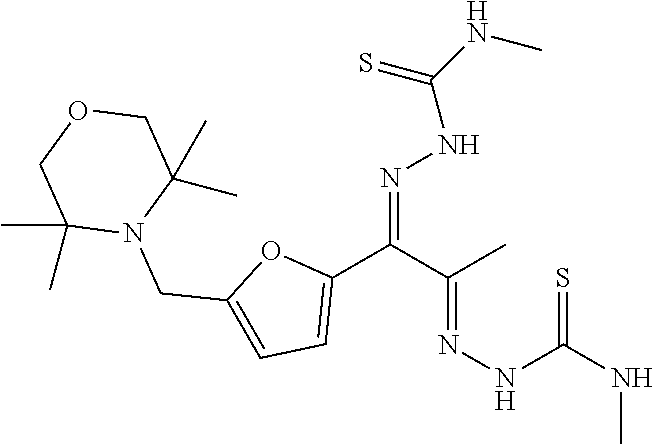
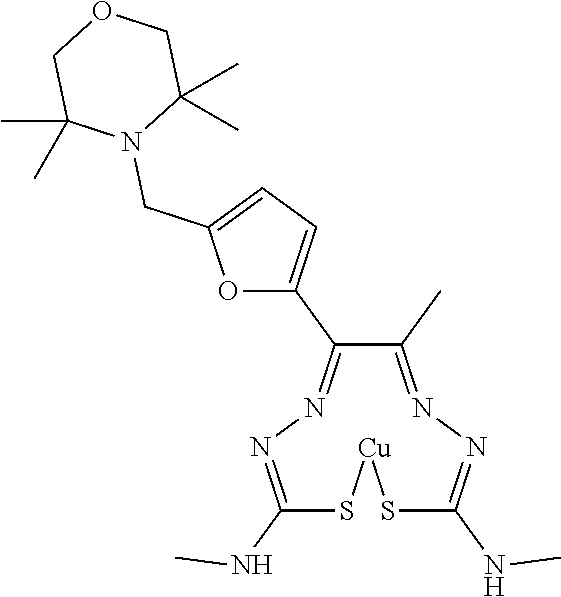
In an embodiment, the compound of Formula (II) has the structure of Compound 25:
In an embodiment the compound of Formula (II) has the structure of Compound 37:
Exemplary compounds of Formula (II) include the compounds described below, or pharmaceutically acceptable salts thereof:
In yet another aspect, provided herein are compounds of Formula (III):
-
- or pharmaceutically acceptable salts thereof, wherein:
- L is C1-C6 alkyl or absent
- R1 is C1-C6 alkyl optionally substituted with 5- to 10-membered heteroaryl, NH2, NH(C1-C6 alkyl), or N(C1-C6 alkyl)2;
- R2 is C1-C6 alkyl optionally substituted with 5- to 10-membered heteroaryl, NH2, NH(C1-C6 alkyl), or N(C1-C6 alkyl)2;
- R3 is C1-C6 alkyl, C1-C6 alkoxy, C1-C6 haloalkyl, halo, hydroxy, C(O)NH2, C(O)NH(C1-C6 alkyl), C(O)N(C1-C6 alkyl)2, or C(O)-(4- to 8-membered heterocycle), wherein the C1-C6 alkyl and the C1-C6 alkoxy are optionally substituted one, two, or three times with C6-C10 aryl, and wherein the C(O)-(4- to 8-membered heterocycle) is optionally substituted one, two, or three times with C1-C3 alkyl.
In an embodiment, L is C1-C3 alkyl or absent. In an embodiment, L is C1-C3 alkyl. In an embodiment, L is absent.
In an embodiment, R1 is C1-C6 alkyl optionally substituted with NH2, NH(C1-C6 alkyl), or N(C1-C6 alkyl)2. In an embodiment, R1 is C1-C6 alkyl optionally substituted with N(C1-C6 alkyl)2.
In an embodiment, R1 is C1-C3 alkyl optionally substituted with N(C1-C3 alkyl)2. In an embodiment, R1 is methyl or ethyl, wherein the ethyl is optionally substituted with N(CH2CH3)2.
In an embodiment, R2 is C1-C6 alkyl optionally substituted with NH2, NH(C1-C6 alkyl), or N(C1-C6 alkyl)2. In an embodiment, R2 is C1-C6 alkyl optionally substituted with N(C1-C6 alkyl)2.
In an embodiment, R2 is C1-C3 alkyl optionally substituted with N(C1-C3 alkyl)2. In an embodiment, R2 is methyl or ethyl, wherein the ethyl is optionally substituted with N(CH2CH3)2.
In an embodiment, R1 and R2 are identical.
In an embodiment, R3 is C1-C6 alkyl, C1-C6 alkoxy, hydroxy, or C(O)-(4- to 8-membered heterocycle), wherein the C1-C6 alkyl and the C1-C6 alkoxy are optionally substituted one time with C6-C10 aryl and wherein the C(O)-(4- to 8-membered heterocycle) is optionally substituted one time with C1-C3 alkyl.
In an embodiment, R3 is C1-C3 alkyl, C1-C3 alkoxy, hydroxy, or C(O)-(6-membered heterocycle), wherein the C1-C3 alkyl and the C1-C3 alkoxy are optionally substituted one time with phenyl.
In an embodiment, R3 is C1-C3 alkyl, C1-C3 alkoxy, hydroxy, or C(O)-(morpholinyl), wherein the C1-C3 alkyl and the C1-C3 alkoxy are optionally substituted one time with phenyl.
In an embodiment, the group represented by R3-L has one of the following structures:
In an embodiment, L is absent and R3 is C1-C6 alkyl.
Exemplary compounds of Formula (III) include the compounds described below, or pharmaceutically acceptable salts thereof:
In another aspect, provided herein are compounds of Formula (IV):
-
- or pharmaceutically acceptable salts thereof, wherein:
- L is C3-C7 cycloalkyl, C1-C6 alkyl, or absent;
- R1 is C1-C6 alkyl optionally substituted with 5- to 10-membered heteroaryl, NH2, NH(C1-C6 alkyl), or N(C1-C6 alkyl)2;
- R2 is C1-C6 alkyl optionally substituted with 5- to 10-membered heteroaryl, NH2, NH(C1-C6 alkyl), or N(C1-C6 alkyl)2;
- R3 is C6-C10 aryl, 5- to 10-membered heteroaryl, C3-C1 cycloalkyl, C(O)NH—(C1-C6 alkyl)-PPh3, hydroxy, C1-C6 alkoxy, or O—(C1-C6 alkyl)-O—(C1-C6 alkyl), wherein the C6-C10 aryl is substituted one, two, or three times with the group R3a, and wherein the 5- to 10-membered heteroaryl is optionally substituted one, two, or three times with the group R3b;
- R3a independently for each occurrence is C3-C7 cycloalkyl or 4- to 8-membered heterocycle, wherein the 4- to 8-membered heterocycle is optionally further substituted one, two, or three times with C1-C3 alkyl;
- R3b independently for each occurrence is C1-C3 alkyl, C1-C3 alkoxy, C3-C7 cycloalkyl, or 4- to 8-membered heterocycle, wherein the heterocycle is optionally further substituted one, two, or three times with C1-C3 alkyl; and
- R4 is hydrogen, C1-C3 alkyl, or C6-C10 aryl;
- provided that when L is absent, R3 is C6-C10 aryl substituted one, two, or three times with the group R3a; or when L is absent, R3 is 6- to 10-membered heteroaryl substituted one, two, or three times with the group R3b; or when L is absent, R3 is 6- to 10-membered heteroaryl optionally substituted one, two, or three times with the group R3b, and R4 is H.
In an embodiment, L is C3-C7 cycloalkyl or C1-C6 alkyl. In an embodiment, L is C3-C7 cycloalkyl. In an embodiment, L is C1-C6 alkyl. In an embodiment, L is C3-C5 cycloalkyl or C1-C3 alkyl. In an embodiment, L is is C3-C5 cycloalkyl. In an embodiment, L is C1-C3 alkyl.
In an embodiment, L is —CH2—. In an embodiment, L is —CH2CH2—. In an embodiment, L is —CH2CH2CH2—. In an embodiment, L is —CH2CH2CH2CH2—. In an embodiment, L is —CH(CH3)—. In an embodiment, L is —CH(CH2CH3)—. In an embodiment, L is —C(CH3)2—.
In an embodiment, L is C3-C7 cycloalkyl or C3-C5 cycloalkyl, wherein the cycloalkyl group comprises a quaternary carbon that forms the point of attachment to group R3 and to the rest of the scaffold. Accordingly, in an embodiment, L is represented by one of the following groups:
In an embodiment, R1 is C1-6 alkyl. In an embodiment, R1 is C1-3 alkyl. In an embodiment, R1 is methyl or ethyl. In an embodiment, R1 is methyl. In an embodiment, R1 is ethyl.
In an embodiment, R1 is C1-C6 alkyl optionally substituted with 5-membered heteroaryl. In an embodiment, R1 is C1-C6 alkyl optionally substituted with furyl. In an embodiment, R1 is CH2-furyl.
In an embodiment, R2 is C1-6 alkyl. In an embodiment, R2 is C1-3 alkyl. In an embodiment, R2 is methyl or ethyl. In an embodiment, R2 is methyl. In an embodiment, R2 is ethyl.
In an embodiment, R2 is C1-C6 alkyl optionally substituted with 5-membered heteroaryl.
In an embodiment, R2 is C1-C6 alkyl optionally substituted with furyl. In an embodiment, R2 is CH2-furyl.
In an embodiment, R1 and R2 are identical.
In an embodiment, R3 is C6-C10 aryl, 5- to 10-membered heteroaryl, C3-C10 cycloalkyl, or C1-C6 alkoxy, wherein the C6-C10 aryl is substituted one, two, or three times with the group R3a, and wherein the 5- to 10-membered heteroaryl is optionally substituted one, two, or three times with the group R3b.
In an embodiment, R3 is 5- to 10-membered heteroaryl or C3-C10 cycloalkyl, wherein the 5- to 10-membered heteroaryl is optionally substituted one, two, or three times with the group R3b.
In an embodiment, R3 is phenyl, pyrazolyl, pyridinyl, benzofuranyl, benzothiazolyl, benzodioxolyl, C3-C6 cycloalkyl, adamantyl, C(O)NH—(C1-C6 alkyl)-PPh3, hydroxy, C1-C6 alkoxy, or O—(C1-C6 alkyl)-O—(C1-C6 alkyl), wherein the phenyl is substituted one, two, or three times with the group R3a; and wherein the pyrazolyl, pyridinyl, benzofuranyl, benzothiazolyl, and benzodioxolyl are optionally substituted one, two, or three times with the group R3b.
In an embodiment, R3 is phenyl, pyrazolyl, pyridinyl, benzofuranyl, benzothiazolyl, benzodioxolyl, or C1-C6 alkoxy, wherein the pyrazolyl, pyridinyl, benzofuranyl, benzothiazolyl, and benzodioxolyl are optionally substituted one or two times with the group R3b.
In an embodiment, R3 is pyridinyl, benzofuranyl, or benzodioxolyl, wherein the pyridinyl, benzofuranyl, and benzodioxolyl are optionally substituted one or two times with the group R3b.
In an embodiment, R3 is benzofuranyl or benzodioxolyl, wherein the benzofuranyl and benzodioxolyl are optionally substituted one or two times with the group R3b.
In an embodiment, R3a independently for each occurrence is 4- to 8-membered heterocycle optionally further substituted one, two, or three times with C1-C3 alkyl. In an embodiment, R3a independently for each occurrence is 4- to 8-membered heterocycle optionally further substituted one time with methyl.
In an embodiment, R3a independently for each occurrence is pyrrolidinyl, pyrrolidinonyl, tetrahydrofuranyl, morpholinyl, thiomorpholinyl, piperidinyl, or piperazinyl, each of which is optionally further substituted one, two, or three times with C1-C3 alkyl. In an embodiment, R3a independently for each occurrence is pyrrolidinyl, pyrrolidinonyl, tetrahydrofuranyl, morpholinyl, thiomorpholinyl, piperidinyl, or piperazinyl, each of which is optionally further substituted one time with methyl. In an embodiment, R3a independently for each occurrence is pyrrolidinyl, pyrrolidinonyl, or morpholinyl. In an embodiment, R3a independently for each occurrence is represented by a group selected from the following:
In an embodiment, R3b independently for each occurrence is C1-C3 alkyl, C1-C3 alkoxy, or 4- to 8-membered heterocycle, wherein the heterocycle is optionally further substituted one, two, or three times with C1-C3 alkyl. In an embodiment, R3b independently for each occurrence is C1-C3 alkoxy or 4- to 8-membered heterocycle, wherein the heterocycle is optionally further substituted one time with methyl.
In an embodiment, R3b independently for each occurrence is C1-C3 alkyl, C1-C3 alkoxy, or a heterocycle selected from the group consisting of pyrrolidinyl, pyrrolidinonyl, tetrahydrofuranyl, morpholinyl, thiomorpholinyl, piperidinyl, and piperazinyl, wherein the heterocycle is optionally further substituted one, two, or three times with C1-C3 alkyl. In an embodiment, R3b independently for each occurrence is C1-C3 alkyl, C1-C3 alkoxy or a heterocycle selected from the group consisting of pyrrolidinyl, pyrrolidinonyl, tetrahydrofuranyl, morpholinyl, thiomorpholinyl, piperidinyl, and piperazinyl, wherein the heterocycle is optionally further substituted one time with methyl. In an embodiment, R3b independently for each occurrence is methyl, methoxy or a heterocycle selected from the group consisting of pyrrolidinyl and morpholinyl. In an embodiment, R3b independently for each occurrence is represented by a group selected from:
In an embodiment, R4 is hydrogen, C1-C3 alkyl, or phenyl. In an embodiment, R4 is hydrogen, methyl, or phenyl. In an embodiment, R4 is hydrogen or C1-C3 alkyl. In an embodiment, R4 is hydrogen or methyl. In an embodiment, R4 is hydrogen. In an embodiment, R4 is methyl. In an embodiment, R4 is phenyl.
In an embodiment, L is C1-C6 alkyl, and R3 is C1-C6 alkoxy.
In an embodiment, the group represented by R3-L is represented by one of the following:
In an embodiment, the group represented by R3-L is represented by one of the following:
In an embodiment, R3 is pyridinyl optionally substituted one, two, or three times with C1-C3 alkoxy or 4- to 8-membered heterocycle, wherein the 4- to 8-membered heterocycle is optionally substituted one time with C1-C3 alkyl.
In an embodiment, when L is absent, R3 is C6-C10 aryl substituted one, two, or three times with the group R3a; or when L is absent, R3 is 6- to 10-membered heteroaryl substituted one, two, or three times with the group R3b. In another embodiment, when L is absent, R3 is C6-C10 aryl substituted one, two, or three times with the group R3a; or when L is absent, R3 is 6- to 10-membered heteroaryl optionally substituted one, two, or three times with the group R3b, and R4 is H.
In an embodiment, when L is absent, R3 is pyridinyl substituted one, two, or three times with C1-C3 alkoxy.
In an embodiment, when L is absent, R3 is phenyl substituted with 4- to 8-membered heterocycle.
In an embodiment, when L is absent, R3 is C6-C10 aryl substituted one, two, or three times with the group R3a; or when L is absent, R3 is 6- to 10-membered heteroaryl substituted one, two, or three times with the group R3b.
In an embodiment, L is C3-C5 cycloalkyl or C1-C3 alkyl; R3 is pyridinyl optionally substituted one, two, or three times with 4- to 8-membered heterocycle; and R4 is methyl.
Exemplary compounds of Formula (IV) include the following compounds, or pharmaceutically acceptable salts thereof:
In an embodiment, the compound of Formula (IV) is one of the following compounds, or a pharmaceutically acceptable salt thereof:
In an embodiment, the compound of Formula (IV) has the structure of Compound 2:
In an embodiment, the compound of Formula (IV) has the structure of Compound 59:
In an embodiment, the compound of Formula (IV) has the structure of Compound 60:
In an embodiment, the compound of Formula (IV) has the structure of Compound 61:
In an embodiment, the compound of Formula (IV) has the structure of Compound 74:
In an embodiment, the compound of Formula (IV) has the structure of Compound 74:
In another aspect, provided herein are compounds of Formula (V):
-
- or pharmaceutically acceptable salts thereof, wherein:
- R1 is C1-C6 alkyl optionally substituted with 5- to 10-membered heteroaryl, NH2, NH(C1-C6 alkyl), or N(C1-C6 alkyl)2;
- R2 is C1-C6 alkyl optionally substituted with 5- to 10-membered heteroaryl, NH2, NH(C1-C6 alkyl), or N(C1-C6 alkyl)2;
- R6 is 4- to 8-membered heterocycle or 5-membered heteroaryl, wherein the 4- to 8-membered heterocycle is optionally substituted one, two, or three times with the group R3a, and wherein the 5-membered heteroaryl is optionally substituted one, two, or three times with the group R3b;
- R3a independently for each occurrence is C1-C6 alkyl, C1-C6 alkyl-(C6-C10 aryl), C1-C6 alkyl-(5- to 10-membered heteroaryl), S(O)2H, S(O)2—(C1-C6 alkyl), S(O)2—(C3-C7 cycloalkyl), or S(O)2—(C6-C10 aryl); wherein each heteroaryl is optionally further substituted one to four times with C1-C6 alkyl or C6-C10 aryl; and wherein each C6-C10 aryl is optionally further substituted one to four times with C1-C6 alkyl;
- R3b independently for each occurrence is C1-C6 alkyl, C1-C6 alkoxy, C1-C6 haloalkyl, C1-C6 alkyl-N(R5)2, (C1-C6 alkyl)-O—(C1-C6 alkyl), halo, nitro, cyano, C6-C10 aryl, C(O)-(4- to 8-membered heterocycle), C1-C6 alkyl-(C6-C10 aryl), C1-C6 alkyl-(5- to 10-membered heteroaryl), or C1-C6 alkyl-(4- to 8-membered heterocycle), wherein each 4- to 8-membered heterocycle, C6-C10 aryl, and 5- to 10-membered heteroaryl are optionally further substituted one to four times with C1-C3 alkyl, C1-C3 alkoxy, C1-C3 haloalkyl, or halo;
- R4 is hydrogen or C1-3 alkyl; and
- R5 independently for each occurrence is hydrogen, C1-C6 alkyl, or C1-C3 alkyl-(C6-C10 aryl).
In an embodiment, R1 is C1-6 alkyl. In an embodiment, R1 is C1-3 alkyl. In an embodiment, R1 is methyl or ethyl. In an embodiment, R1 is methyl. In an embodiment, R1 is ethyl.
In an embodiment, R1 is C1-C6 alkyl optionally substituted with 5-membered heteroaryl.
In an embodiment, R1 is C1-C6 alkyl optionally substituted with furyl. In an embodiment, R1 is CH2-furyl.
In an embodiment, R2 is C1-6 alkyl. In an embodiment, R2 is C1-3 alkyl. In an embodiment, R2 is methyl or ethyl. In an embodiment, R2 is methyl. In an embodiment, R2 is ethyl.
In an embodiment, R2 is C1-C6 alkyl optionally substituted with 5-membered heteroaryl. In an embodiment, R2 is C1-C6 alkyl optionally substituted with furyl. In an embodiment, R2 is CH2-furyl.
In an embodiment, R1 and R2 are identical.
In an embodiment, R3 is 5- to 6-membered heterocycle or 5-membered heteroaryl, wherein the 5- to 6-membered heterocycle is optionally substituted one, two, or three times with the group R3a, and wherein the 5-membered heteroaryl is optionally substituted one, two, or three times with the group R3b
In an embodiment, R3 is tetrahydrofuranyl, morpholinyl, piperidinyl, furyl, thiophenyl, pyrrolyl, oxazolyl, pyrazolyl, or imidazolyl, wherein the tetrahydrofuranyl, morpholinyl, and piperidinyl are optionally substituted one, two, or three times with the group R3a, and wherein the furyl, thiophenyl, pyrrolyl, oxazolyl, pyrazolyl, and imidazolyl are optionally substituted one, two, or three times with the group R3b.
In an embodiment, R3 is furyl, thiophenyl, oxazolyl, pyrazolyl, or imidazolyl optionally substituted one, two, or three times with the group R3b. In another embodiment, R3 is furyl, thiophenyl, oxazolyl, pyrazolyl, or imidazolyl substituted one, two, or three times with the group R3b.
In an embodiment, R3 is furyl optionally substituted one, two, or three times with the group R3b. In another embodiment, R3 is furyl substituted one, two, or three times with the group R3b.
In an embodiment, R3 is thiophenyl optionally substituted one, two, or three times with the group R3b. In another embodiment, R3 is thiophenyl substituted one, two, or three times with the group R3b.
In an embodiment, R3 is oxazolyl optionally substituted one, two, or three times with the group R3b. In another embodiment, R3 is oxazolyl substituted one, two, or three times with the group R3b.
In an embodiment, R3 is pyrazolyl optionally substituted one, two, or three times with the group R3b. In another embodiment, R3 is pyrazolyl substituted one, two, or three times with the group R3b.
In an embodiment, R3 is imidazolyl optionally substituted one, two, or three times with the group R3b. In another embodiment, R3 is imidazolyl substituted one, two, or three times with the group R3b.
In an embodiment, R3 is tetrahydrofuranyl, morpholinyl, or piperidinyl, each of which is optionally substituted one, two, or three times with the group R3a.
In an embodiment, R3a independently for each occurrence is C1-C6 alkyl, C1-C6 alkyl-(C6-C10 aryl), C1-C6 alkyl-(5- to 10-membered heteroaryl), S(O)2—(C1-C6 alkyl), or S(O)2—(C6-C10 aryl), wherein each heteroaryl is optionally further substituted one to four times with C1-C6 alkyl or C6-C10 aryl; and wherein each C6-C10 aryl is optionally further substituted one to four times with C1-C6 alkyl.
In an embodiment, R3a independently for each occurrence is C1-C6 alkyl, C1-C6 alkyl-(phenyl), C1-C6 alkyl-(5- to 6-membered heteroaryl), S(O)2—(C1-C5 alkyl), or S(O)2-(phenyl), wherein each heteroaryl is optionally further substituted one to four times with C1-C3 alkyl or phenyl; and wherein each phenyl is optionally further substituted one to four times with C1-C3 alkyl.
In an embodiment, R3a independently for each occurrence is:
In an embodiment, R3b independently for each occurrence is C1-C6 alkyl, C1-C6 alkyl-N(R5)2, (C1-C6 alkyl)-O—(C1-C6 alkyl), halo, nitro, C6-C10 aryl, C(O)-(4- to 8-membered heterocycle), C1-C6 alkyl-(C6-C10 aryl), C1-C6 alkyl-(5- to 10-membered heteroaryl), or C1-C6 alkyl-(4- to 8-membered heterocycle), wherein each 4- to 8-membered heterocycle, C6-C10 aryl, and 5- to 10-membered heteroaryl are optionally further substituted one to four times with C1-C3 alkyl, C1-C3 alkoxy, C1-C3 haloalkyl, or halo.
In an embodiment, R3b independently for each occurrence is C1-C6 alkyl, C1-C6 alkyl-N(R5)2, halo, C6-C10 aryl, C1-C6 alkyl-(4- to 8-membered heterocycle), or C1-C6 alkyl-(C6-C10 aryl), wherein each 4- to 8-membered heterocycle and C6-C10 aryl are optionally further substituted one to four times with C1-C3 alkyl, C1-C3 alkoxy, C1-C3 haloalkyl, or halo.
In an embodiment, R3b independently for each occurrence is C1-C6 alkyl, C1-C3 alkyl-N(R5)2, halo, phenyl, C1-C3 alkyl-(5- to 6-membered heterocycle), or C1-C6 alkyl-phenyl, wherein each 5- to 6-membered heterocycle and phenyl are optionally further substituted one to four times with C1-C3 alkyl or halo.
In an embodiment, R3b independently for each occurrence is C1-C6 alkyl, C1-C6 alkyl-N(R5)2, (C1-C6 alkyl)-O—(C1-C6 alkyl), halo, nitro, C6-C10 aryl, C(O)-(4- to 8-membered heterocycle), C1-C6 alkyl-(C6-C10 aryl), C1-C6 alkyl-(5- to 10-membered heteroaryl), or C1-C6 alkyl-(4- to 8-membered heterocycle), wherein each 4- to 8-membered heterocycle, C6-C1a aryl, and 5- to 10-membered heteroaryl are optionally further substituted one to four times with —CH3, —CH2CH3, —OCH3, —CH2F, CHF2, —CF3, —F, or —Cl.
In an embodiment, R3b independently for each occurrence is C1-C6 alkyl, C1-C6 alkyl-N(R5)2, (C1-C6 alkyl)-O—(C1-C6 alkyl), halo, nitro, phenyl, C(O)-(4- to 8-membered heterocycle), C1-C6 alkyl-phenyl, C1-C6 alkyl-(5- to 10-membered heteroaryl), or C1-C6 alkyl-(4- to 8-membered heterocycle); wherein each 4- to 8-membered heterocycle is independently selected from the group consisting of pyrrolidinyl, pyrrolidinonyl, tetrahydrofuranyl, morpholinyl, thiomorpholinyl, piperidinyl, and piperazinyl; wherein each 5- to 10-membered heteroaryl is selected from the group consisting of furyl and tetrahydroisoquinolinyl; and wherein each 4- to 8-membered heterocycle, phenyl, and 5- to 10-membered heteroaryl are optionally further substituted one to four times with —CH3, —CH2CH3, —OCH3, —CH2F, CHF2, —CF3, —F, or —Cl.
In an embodiment, R3b independently for each occurrence is C1-C6 alkyl, C1-C6 alkyl-N(R5)2, (C1-C6 alkyl)-O—(C1-C6 alkyl), halo, nitro, phenyl, C(O)-(4- to 8-membered heterocycle), C1-C6 alkyl-phenyl, C1-C6 alkyl-(5- to 10-membered heteroaryl), or C1-C6 alkyl-(4- to 8-membered heterocycle); wherein each 4- to 8-membered heterocycle is independently selected from the group consisting of pyrrolidinyl, morpholinyl, piperidinyl, and piperazinyl; wherein each 5- to 10-membered heteroaryl is selected from the group consisting of furyl and tetrahydroisoquinolinyl; and wherein each 4- to 8-membered heterocycle, phenyl, and 5- to 10-membered heteroaryl are optionally further substituted one to four times with —CH3, —OCH3, —CF3, or —F.
In an embodiment, R3b independently for each occurrence is:
In an embodiment, R3b independently for each occurrence is:
In an embodiment, R3b independently for each occurrence is:
In an embodiment, R3b independently for each occurrence is:
In an embodiment, R3b independently for each occurrence is:
In an embodiment, R3 is furyl optionally substituted one, two, or three times with C1-C6 alkyl, C1-C6 alkoxy, C1-C6 haloalkyl, C1-C6 alkyl-N(R5)2, (C1-C6 alkyl)-O—(C1-C6 alkyl), halo, nitro, cyano, C6-C10 aryl, C(O)-(4- to 8-membered heterocycle), C1-C6 alkyl-(C6-C10 aryl), C1-C6 alkyl-(5- to 10-membered heteroaryl), or C1-C6 alkyl-(4- to 8-membered heterocycle), wherein each 4- to 8-membered heterocycle, C6-C10 aryl, and 5- to 10-membered heteroaryl are optionally further substituted one to four times with C1-C3 alkyl, C1-C3 alkoxy, C1-C3 haloalkyl, or halo.
In an embodiment, R3 is furyl optionally substituted one, two, or three times with C1-C6 alkyl, C1-C6 alkyl-N(R5)2, halo, C(O)-(4- to 8-membered heterocycle), or C1-C6 alkyl-(4- to 8-membered heterocycle), wherein each 4- to 8-membered heterocycle is optionally further substituted one to four times with C1-C3 alkyl, C1-C3 alkoxy, C1-C3 haloalkyl, or halo.
In an embodiment, R3 is furyl optionally substituted one, two, or three times with C1-C6 alkyl-N(R5)2 or C1-C6 alkyl-(4- to 8-membered heterocycle), wherein each 4- to 8-membered heterocycle is optionally further substituted one to four times with C1-C3 alkyl, C1-C3 alkoxy, C1-C3 haloalkyl, or halo.
In an embodiment, R3 is furyl optionally substituted one time with C1-C3 alkyl-N(C1-C4 alkyl)2 or C1-C3 alkyl-(5- to 6-membered heterocycle), wherein the 5- to 6-membered heterocycle is optionally further substituted one to four times with C1-C3 alkyl.
In an embodiment, R3 is furyl substituted one time with C1-C3 alkyl-N(C1-C4 alkyl)2 or C1-C3 alkyl-(5- to 6-membered heterocycle), wherein the 5- to 6-membered heterocycle is optionally further substituted one to four times with C1-C3 alkyl.
In an embodiment, R3 is thiophenyl, oxazolyl, pyrazolyl, or imidazolyl, optionally substituted one, two, or three times with C1-C6 alkyl, halo, C6-C10 aryl, or C1-C6 alkyl-(C6-C10 aryl), wherein each C6-C10 aryl is optionally further substituted one to four times with C1-C3 alkyl, C1-C3 alkoxy, C1-C3 haloalkyl, or halo.
In an embodiment, R3 is thiophenyl, oxazolyl, pyrazolyl, or imidazolyl, optionally substituted one, two, or three times with methyl, ethyl, halo, phenyl, or C1-C3 alkyl-phenyl, wherein each phenyl is optionally further substituted one to four times with C1-C3 alkyl or halo.
In an embodiment, R3 is:
In an embodiment, R3 is:
In an embodiment, R3 is:
In an embodiment, R3 is:
In an embodiment, R3 is:
In an embodiment, R4 is hydrogen or methyl. In an embodiment, R4 is hydrogen. In an embodiment, R4 is methyl.
In an embodiment, R5 is C1-C6 alkyl or C1-C3 alkyl-(C6-C10 aryl). In another embodiment, R5 is C1-C4 alkyl or C1-C3 alkyl-phenyl. In another embodiment, R5 is C1-C4 alkyl or benzyl.
In an embodiment, when R1 is not methyl, R2 is not methyl, and R4 is not hydrogen, then R3b independently for each occurrence is C1-C6 alkyl, C1-C6 alkoxy, C1-C6 haloalkyl, C1-C6 alkyl-N(R5)2, (C1-C6 alkyl)-O—(C1-C6 alkyl), halo, nitro, cyano, C6-C10 aryl, C(O)-(4- to 8-membered heterocycle), C1-C6 alkyl-(C6-C10 aryl), C1-C6 alkyl-(5- to 10-membered heteroaryl), or C1-C6 alkyl-(4- to 8-membered heterocycle), wherein each 4- to 8-membered heterocycle, C6-C10 aryl, and 5- to 10-membered heteroaryl are optionally further substituted one or two times with C1-C3 alkyl, C1-C3 alkoxy, C1-C3 haloalkyl, or halo.
In an embodiment, when R4 is not hydrogen, then R3b independently for each occurrence is C1-C6 alkyl, C1-C6 alkoxy, C1-C6 haloalkyl, C1-C6 alkyl-N(R5)2, (C1-C6 alkyl)-O—(C1-C6 alkyl), halo, nitro, cyano, C6-C10 aryl, C(O)-(4- to 8-membered heterocycle), C1-C6 alkyl-(C6-C10 aryl), C1-C6 alkyl-(5- to 10-membered heteroaryl), or C1-C6 alkyl-(4- to 8-membered heterocycle), wherein each 4- to 8-membered heterocycle, C6-C10 aryl, and 5- to 10-membered heteroaryl are optionally further substituted one or two times with C1-C3 alkyl, C1-C3 alkoxy, C1-C3 haloalkyl, or halo.
In an embodiment, when R3 is oxazolyl, R3 does not have the following structure:
In a particular embodiment of the compound of Formula (V), or a pharmaceutically acceptable salt thereof:
-
- R1 is C1-C3 alkyl;
- R2 is C1-C3 alkyl;
- R3 is a 5-membered heteroaryl that is optionally substituted one, two, or three times with the group R3b;
- R3b independently for each occurrence is C1-C6 alkyl, C1-C6 alkyl-N(R5)2, (C1-C6 alkyl)-O—(C1-C6 alkyl), halo, C6-C10 aryl, C(O)-(4- to 8-membered heterocycle), C1-C6 alkyl-(C6-C10 aryl), C1-C6 alkyl-(5- to 10-membered heteroaryl), or C1-C6 alkyl-(4- to 8-membered heterocycle), wherein each 4- to 8-membered heterocycle, C6-C10 aryl, and 5- to 10-membered heteroaryl are optionally further substituted one to four times with C1-C3 alkyl, C1-C3 alkoxy, C1-C3 haloalkyl, or halo;
- R4 is hydrogen or methyl; and
- R5 independently for each occurrence is C1-C4 alkyl or benzyl.
In another embodiment of the compound of Formula (V), or a pharmaceutically acceptable salt thereof:
-
- R1 is C1-C3 alkyl;
- R2 is C1-C3 alkyl;
- R3 is a furyl that is optionally substituted one, two, or three times with the group R3b;
- R3b independently for each occurrence is C1-C6 alkyl-N(R5)2 or C1-C6 alkyl-(4- to 8-membered heterocycle), wherein each 4- to 8-membered heterocycle is optionally further substituted one to four times with C1-C3 alkyl, C1-C3 alkoxy, C1-C3 haloalkyl, or halo;
- R4 is hydrogen or methyl; and
- R5 independently for each occurrence is C1-C4 alkyl or benzyl.
In another embodiment of the compound of Formula (V), or a pharmaceutically acceptable salt thereof:
-
- R1 is C1-C3 alkyl;
- R2 is C1-C3 alkyl;
- R3 is a furyl that is optionally substituted one, two, or three times with the group R3b;
- R3b independently for each occurrence is C1-C6 alkyl-N(R5)2 or C1-C6 alkyl-(4- to 8-membered heterocycle), wherein each 4- to 8-membered heterocycle is optionally further substituted one to four times with C1-C3 alkyl, C1-C3 alkoxy, C1-C3 haloalkyl, or halo;
- R4 is hydrogen or methyl; and
- R5 independently for each occurrence is C1-C4 alkyl or benzyl;
- provided that when R1 is C2-C3 alkyl, R2 is C2-C3 alkyl, and R4 is methyl, then R3b independently for each occurrence is C1-C6 alkyl-N(R5)2 or C1-C6 alkyl-(4- to 8-membered heterocycle), wherein each 4- to 8-membered heterocycle is optionally further substituted one or two times with C1-C3 alkyl, C1-C3 alkoxy, C1-C3 haloalkyl, or halo.
In another embodiment of the compound of Formula (V), or a pharmaceutically acceptable salt thereof:
-
- R1 is C1-C3 alkyl;
- R2 is C1-C3 alkyl;
- R3 is a furyl that is optionally substituted one, two, or three times with the group R3b;
- R3b independently for each occurrence is C1-C6 alkyl-N(R5)2 or C1-C6 alkyl-(4- to 8-membered heterocycle), wherein each 4- to 8-membered heterocycle is optionally further substituted one to four times with C1-C3 alkyl, C1-C3 alkoxy, C1-C3 haloalkyl, or halo;
- R4 is hydrogen or methyl; and
- R5 independently for each occurrence is C1-C4 alkyl or benzyl;
- provided that when R4 is methyl, then R3b independently for each occurrence is C1-C6 alkyl-N(R5)2 or C1-C6 alkyl-(4- to 8-membered heterocycle), wherein each 4- to 8-membered heterocycle is optionally further substituted one or two times with C1-C3 alkyl, C1-C3 alkoxy, C1-C3 haloalkyl, or halo.
Exemplary compounds of Formula (V) include the following compounds, or pharmaceutically acceptable salts thereof:
In an embodiment, the compound of Formula (V) is one of the following compounds, or a pharmaceutically acceptable salt thereof:
In an embodiment, the compound of Formula (V) has the structure of Compound 25:
In an embodiment, the compound of Formula (V) has the structure of Compound 32:
In an embodiment the compound of Formula (V) has the structure of Compound 34:
In an embodiment the compound of Formula (V) has the structure of Compound 35:
In an embodiment the compound of Formula (V) has the structure of Compound 37:
In an embodiment the compound of Formula (V) has the structure of Compound 80:
In an embodiment the compound of Formula (V) has the structure of Compound 81:
In an embodiment the compound of Formula (V) has the structure of Compound 82:
In an embodiment the compound of Formula (V) has the structure of Compound 84:
In an embodiment the compound of Formula (V) has the structure of Compound 85:
In an embodiment the compound of Formula (V) has the structure of Compound 86:
In an embodiment the compound of Formula (V) has the structure of Compound 87:
In an embodiment the compound of Formula (V) has the structure of Compound 88:
In an embodiment the compound of Formula (V) has the structure of Compound 90:
In an embodiment the compound of Formula (V) has the structure of Compound 94:
In an embodiment the compound of Formula (V) has the structure of Compound 95:
In an embodiment the compound of Formula (V) has the structure of Compound 96:
In an embodiment the compound of Formula (V) has the structure of Compound 98:
In an embodiment the compound of Formula (V) has the structure of Compound 100:
In an embodiment the compound of Formula (V) has the structure of Compound 105:
In an embodiment the compound of Formula (V) has the structure of Compound 106:
In an embodiment the compound of Formula (V) has the structure of Compound 120:
In an embodiment the compound of Formula (V) has the structure of Compound 123:
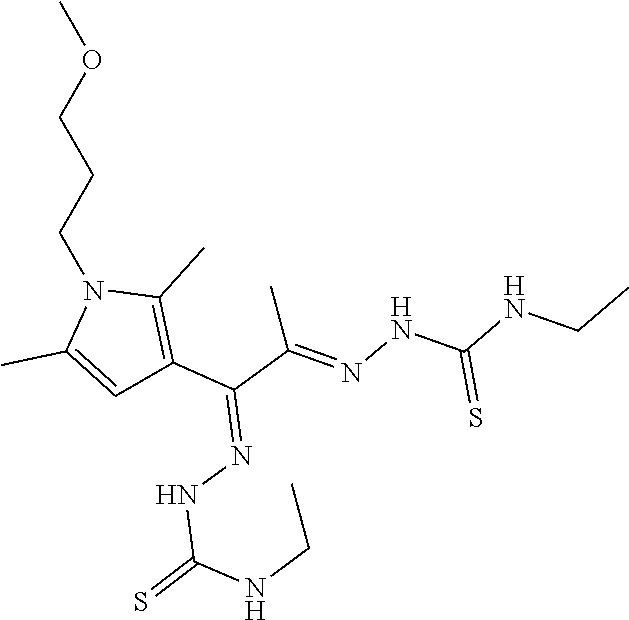
Another aspect of the present disclosure is a compound selected from the group consisting of the compounds described below, or a pharmaceutically acceptable salt thereof:
In an embodiment the disclosure provides a compound having the structure of Compound 54:
In another aspect, the present disclosure provides a compound having the structure of Compound 20:
A further aspect of the present disclosure is a compound selected from the group consisting of the compounds described below, or a pharmaceutically acceptable salt thereof:
A further aspect of the present disclosure is a compound selected from the group consisting of the compounds described below, or a pharmaceutically acceptable salt thereof:
In another aspect, the present disclosure also relates to synthetic intermediates of the copper complexes described herein. In some embodiments, the synthetic intermediate has a structure represented by Formula (I-A):
wherein variables L, R
1, R
2, R
3, and R
4 correspond to the variables of the same name as defined in Formula (I).
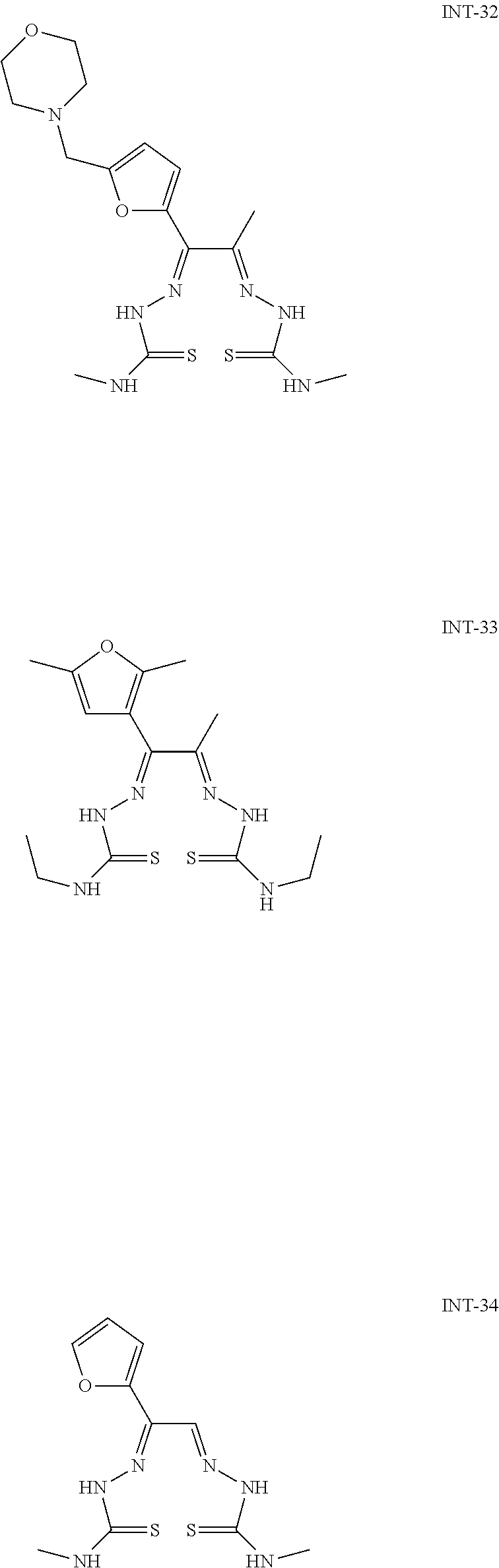
Exemplary synthetic intermediates represented by Formula (I-A) include the following:
In some embodiments, the synthetic intermediate has a structure represented by Formula (II-A):
wherein variables R
1, R
2, R
3, and R
4 correspond to the variables of the same name as defined in Formula (II).
Exemplary synthetic intermediates represented by Formula (II-A) include the following:
In some embodiments, the synthetic intermediate has a structure represented by Formula (III-A):
wherein variables L, R
1, R
2, and R
3 correspond to the variables of the same name as defined in Formula (III).
Exemplary synthetic intermediates represented by Formula (III-A) include the following:
In another aspect, the present disclosure also relates to synthetic intermediates of the copper complexes described herein. In some embodiments, the synthetic intermediate has a structure represented by Formula (IV-A):
wherein variables L, R
1, R
2, R
3, and R
4 correspond to the variables of the same name as defined in Formula (IV).
Exemplary synthetic intermediates represented by Formula (IV-A) include the following:
In some embodiments, the synthetic intermediate has a structure represented by Formula (V-A):
wherein variables R
1, R
2, R
3, and R
4 correspond to the variables of the same name as defined in Formula (V).
Exemplary synthetic intermediates represented by Formula (V-A) include the following:
Further exemplary synthetic intermediates of the disclosure include the following compounds:
Pharmaceutical Compositions
In another aspect, provided herein are pharmaceutical compositions comprising a compound of the disclosure, or a pharmaceutically acceptable salt thereof, and at least one pharmaceutically acceptable excipient, diluent, or carrier.
The formulation of therapeutic compositions and their subsequent administration (dosing) is within the skill of those in the art. Dosing is dependent on severity and responsiveness of the disease state to be treated, with the course of treatment lasting from several days to several months, or until a sufficient diminution of the disease state is achieved. Optimal dosing schedules can be calculated from measurements of drug accumulation in the body of the patient.
Persons of ordinary skill can easily determine optimum dosages, dosing methodologies and repetition rates. Optimum dosages may vary depending on the relative potencies of the compounds of the disclosure, and can generally be estimated based on EC50 values found to be effective in in vitro and in vivo animal models. In general, dosage is from 0.01 μg to 100 g/kg of body weight, and may be given once or more daily, weekly, monthly or yearly, or even once every 2 to 20 years. Persons of ordinary skill in the art can easily estimate repetition rates for dosing based on measured residence times and concentrations of the drug in bodily fluids or tissues. Following successful treatment, it may be desirable to have the patient undergo maintenance therapy to prevent the recurrence of the disease state, wherein a compound of the disclosure is administered in maintenance doses, ranging from 0.01 μg to 100 g/kg of body weight, once or more daily, to once every 20 years.
Different dosage regiments may be used to treat neurodegenerative diseases (e.g., ALS). In some embodiments, a daily dosage, such as any of the exemplary dosages described above, is administered once, twice, three times, or four times a day for three, four, five, six, seven, eight, nine, or ten days. Depending on the stage and severity of the disease being treated, a shorter treatment time (e.g., up to five days) may be employed along with a high dosage, or a longer treatment time (e.g., ten or more days, or weeks, or a month, or longer) may be employed along with a low dosage. In some embodiments, a once- or twice-daily dosage is administered every other day.
In an aspect, the compound of the disclosure may be administered alone or in combination with at least one pharmaceutically acceptable excipient. The expression “pharmaceutically acceptable” means acceptable for use in the pharmaceutical and veterinary arts, i.e., not being unacceptably toxic or otherwise unsuitable. Examples of pharmaceutically acceptable adjuvants, diluents, excipients and the like can be found in “Remington's: The Science and Practice of Pharmacy,” 21st Ed., Lippincott Williams and Wilkins, 2005, the contents of which are incorporated herein by reference.
The compounds of the disclosure, in pure form or in appropriate pharmaceutical compositions, can be administered via any of the accepted modes of administration or agents known in the art. The compounds of the disclosure can be administered, for example, orally, nasally, parenterally (intravenous, intramuscular, or subcutaneous), topically, transdermally, intravaginally, intravesically, intracistemally, or rectally. The dosage form can be, for example, a solid, semi-solid, lyophilized powder, or liquid dosage forms, such as for example, tablets, pills, soft elastic or hard gelatin capsules, powders, solutions, suspensions, suppositories, aerosols, or the like, for example, in unit dosage forms suitable for simple administration of precise dosages. Some examples of suitable pharmaceutical carriers, including pharmaceutical diluents, are gelatin capsules; sugars such as lactose and sucrose; starches such as corn starch and potato starch, cellulose derivatives such as sodium carboxymethyl cellulose, ethyl cellulose, methylcellulose, and cellulose acetate phthalate; gelatin; talc; stearic acid; magnesium stearate; vegetable oils such as peanut oil, cottonseed oil; sesame oil, olive oil, corn oil, and oil of theobroma; propylene glycol, glycerin; sorbitol; polyethylene glycol; water; agar; alginic acid; isotonic saline, and phosphate buffer solutions; as well as other compatible substances normally used in pharmaceutical formulations. A particular route of administration is oral, particularly one in which a convenient daily dosage regimen can be adjusted according to the degree of severity of the disease to be treated.
Auxiliary and adjuvant agents may include, for example, preserving, wetting, suspending, sweetening, flavoring, perfuming, emulsifying, and dispensing agents. Emulsifiers can include polysorbates, such as TWEEN, for example TWEEN-20 and TWEEN-80. Prevention of the action of microorganisms is generally provided by various antibacterial and antifungal agents, such as, parabens, chlorobutanol, phenol, sorbic acid, and the like. Isotonic agents, such as sugars, sodium chloride, and the like, may also be included. Prolonged absorption of an injectable pharmaceutical form can be brought about by the use of agents delaying absorption, for example, aluminum monostearate and gelatin. The auxiliary agents also can include wetting agents, emulsifying agents, pH buffering agents, and antioxidants, such as, for example, citric acid, sorbitan monolaurate, triethanolamine oleate, butylated hydroxytoluene, and the like.
Solid dosage forms can be prepared with coatings and shells, such as enteric coatings and others well-known in the art. They can contain pacifying agents and can be of such composition that they release a compound of the disclosure in a certain part of the intestinal tract in a delayed manner. Examples of embedded compositions that can be used are polymeric substances and waxes. The compound of the disclosure also can be in microencapsulated form, if appropriate, with one or more of the above-mentioned excipients.
Liquid dosage forms for oral administration include pharmaceutically acceptable emulsions, solutions, suspensions, syrups, and elixirs. Such dosage forms are prepared, for example, by dissolving, dispersing, etc., a compound of the disclosure, and optional pharmaceutical adjuvants in a carrier, such as, for example, water, saline, aqueous dextrose, glycerol, ethanol and the like; solubilizing agents and emulsifiers, as for example, ethyl alcohol, isopropyl alcohol, ethyl carbonate, ethyl acetate, benzyl alcohol, benzyl benzoate, propyleneglycol, 1,3-butyleneglycol, dimethyl formamide; oils, in particular, cottonseed oil, groundnut oil, corn germ oil, olive oil, castor oil and sesame oil, glycerol, tetrahydrofurfuryl alcohol, polyethyleneglycols and fatty acid esters of sorbitan; or mixtures of these substances, and the like, to thereby form a solution or suspension.
Generally, depending on the intended mode of administration, the pharmaceutically acceptable compositions will contain about 1% to 99% by weight of a compound disclosed herein, and 99% to 1% by weight of a pharmaceutically acceptable excipient. In one example, the composition will be between about 5% and about 75% by weight of a compound of the disclosure, with the rest being suitable pharmaceutical excipients.
Actual methods of preparing such dosage forms are known, or will be apparent, to those skilled in this art. Reference is made, for example, to Remington's Pharmaceutical Sciences, 18th Ed. (Mack Publishing Company, Easton, Pa., 1990).
Methods of Treatment
The methods described herein comprise administering a therapeutically effective amount of a compound disclosed herein to a subject in need thereof. A “therapeutically effective amount” is an amount of a compound of the disclosure that, when administered to a patient by itself, effectively treats a neurodegenerative disease. An amount that proves to be a “therapeutically effective amount” in a given instance, for a particular subject, may not be effective for 100% of subjects similarly treated for the disease or condition under consideration, even though such dosage is deemed a “therapeutically effective amount” by skilled practitioners. The amount of a compound of the disclosure that corresponds to a therapeutically effective amount is strongly dependent on the type of disease, stage of the disease, the age of the patient being treated, and other facts.
Accordingly, in an aspect, the disclosure provides a method of treating or preventing a neurodegenerative disease in a subject in need thereof, the method comprising administering to the subject a therapeutically effective amount of a compound of the disclosure. In particular, the method comprises administering to the subject a therapeutically effective amount of a compound of Formula (I), (II), (III), (IV), or (V). Non-limiting examples of neurodegenerative diseases that can be treated or prevented with the compounds disclosed herein include amyotrophic lateral sclerosis (ALS), frontal temporal dementia (FTD), Parkinson's disease, Huntington's disease, and Alzheimer's disease. In a preferred embodiment, the neurodegenerative disease to be treated or prevented by a compound of the disclosure is ALS. In an embodiment, the ALS is familial ALS. In an embodiment, the ALS is sporadic ALS.
While the amounts of the compounds disclosed herein should result in the effective treatment or prevention of neurodegenerative disease, the amounts are preferably not excessively toxic to the patient (i.e., the amounts are preferably within toxicity limits as established by medical guidelines). In some embodiments, either to prevent excessive toxicity or provide a more efficacious treatment, or both, of the neurodegenerative disease, a limitation on the total administered dosage is provided. Typically, the amounts considered herein are per day; however, half-day and two-day or three-day cycles are also considered herein.
In certain embodiments, the subject in need thereof is treatment naïve. In certain embodiments, the subject in need thereof has received previous treatment for ALS, wherein the previous treatment is other than administration of a compound of the disclosure, and wherein said previous treatment has been inadequate (e.g., assessed by the subject and/or a physician), ineffective, and/or has not resulted in a detectable improvement in one or more parameters or symptoms associated with ALS and/or has not caused a biological effect that is correlated with the underlying pathology giving rise to the symptoms of ALS.
In certain embodiments, the subject in need thereof is human, and the human has a genetic mutation associated with ALS. In further embodiments, the genetic mutation associated with ALS comprises a mutation in the SOD1 gene.
In certain embodiments, the compound of the disclosure is administered to the subject in combination with an additional ALS treatment therapy. Current treatment for ALS includes administration of riluzole and edaravone, which have been shown to be modestly effective. Other therapies for ALS include medications to treat specific symptoms associated with the disease, for example muscle relaxants such as baclofen or diazepam may be prescribed to treat muscle cramps, spasms, and spasticity. Gabapentin may be prescribed to help control pain. Such medicines like amitriptyline, trihexyphenidyl, scopaderm, and glycopyrrolate can be administered to treat excess saliva in the mouth due to difficulty swallowing. Medication may also be required for the treatment of constipation, fatigue, depression, difficulty sleeping, and pseudobulbar affect associated with ALS.
In certain embodiments, the compound of the disclosure is administered at a dose that achieves a plasma Cmax of about 50-650 ng/mL in the subject. The term “Cmax” is defined as the maximum concentration of active compound achieved in the plasma or spinal cord following administration of the drug.
In another aspect, the disclosure provides a method of treating, preventing, or diagnosing cancer in a subject in need thereof, the method comprising administering to the subject a therapeutically effective amount of a compound of the disclosure. In particular, isotopes (e.g., 64Cu) of the compounds disclosed herein may be used in PET imaging to detect the presence of cancer cells in a subject in need thereof. Accordingly, in another aspect, the disclosure provides a method of performing positron emission tomography (PET) imaging of a subject in need thereof, the method comprising administering to the subject an effective amount of a compound of the disclosure and subsequently performing a PET scan on the subject.
In yet another aspect, the disclosure provides a method of treating or preventing an infection in a subject in need thereof, the method comprising administering to the subject a therapeutically effective amount of a compound of the disclosure.
In a further aspect, the disclosure provides a method of treating a disease or disorder associated with aberrant copper metabolism (e.g., Menkes disease or Wilson's disease) in a subject in need thereof, the method comprising administering to the subject a therapeutically effective amount of a compound of the disclosure. In some embodiments, the subject has a congenital SOD1 deficiency or mutation. In some embodiments, the subject does not have a congenital SOD1 deficiency or mutation.
Preparation Methods
An aspect of the disclosure relates to a process for the preparation of a compound of Formula (I), or a pharmaceutically acceptable salt thereof, as described herein.
In an embodiment, the process comprises at least the step of mixing a compound of Formula (I-A):
with a copper (II) salt to form the compound of Formula (I), or a pharmaceutically acceptable salt thereof;
wherein:
-
- L is C3-C7 cycloalkyl, C1-C6 alkyl, or absent
- R1 is C1-C6 alkyl optionally substituted with 5- to 10-membered heteroaryl, NH2, NH(C1-C6 alkyl), or N(C1-C6 alkyl)2;
- R2 is C1-C6 alkyl optionally substituted with 5- to 10-membered heteroaryl, NH2, NH(C1-C6 alkyl), or N(C1-C6 alkyl)2;
- R3 is C6-C10 aryl, 5- to 10-membered heteroaryl, C(O)NH—(C1-C6 alkyl)-PPh3, hydroxy, C1-C6 alkoxy, or O—(C1-C6 alkyl)-O—(C1-C6 alkyl), wherein the C6-C10 aryl is substituted one, two, or three times with the group R3a, and wherein the 5-10-membered heteroaryl is optionally substituted one, two, or three times with the group R3b;
- R3a independently for each occurrence is C3-C7 cycloalkyl or 4- to 8-membered heterocycle, wherein the 4- to 8-membered heterocycle is optionally further substituted one, two, or three times with C1-C3 alkyl;
- R3b independently for each occurrence is C1-C3 alkoxy, C3-C7 cycloalkyl, or 4- to 8-membered heterocycle, wherein the heterocycle is optionally further substituted one, two, or three times with C1-C3 alkyl; and
- R4 is hydrogen, C1-C3 alkyl, or C6-C10 aryl;
- provided that when L is absent, R3 is C6-C10 aryl substituted one, two, or three times with the group R3a; or when L is absent, R3 is 6- to 10-membered heteroaryl substituted one, two, or three times with the group R3b.
In an embodiment, the copper (II) salt is CuCl2 or Cu(OAc)2, or a hydrate thereof.
Another aspect of the disclosure relates to a process for the preparation of a compound of Formula (II), or a pharmaceutically acceptable salt thereof, as described herein.
In an embodiment, the process comprises at least the step of mixing a compound of Formula (II-A):
with a copper (II) salt to form the compound of Formula (II);
wherein:
-
- R1 is C1-C6 alkyl optionally substituted with 5- to 10-membered heteroaryl, NH2, NH(C1-C6 alkyl), or N(C1-C6 alkyl)2;
- R2 is C1-C6 alkyl optionally substituted with 5- to 10-membered heteroaryl, NH2, NH(C1-C6 alkyl), or N(C1-C6 alkyl)2;
- R3 is 4- to 8-membered heterocycle or 5-membered heteroaryl, wherein the 4- to 8-membered heterocycle is optionally substituted one, two, or three times with the group R3a, and wherein the 5-membered heteroaryl is optionally substituted one, two, or three times with the group R3b;
- R3a independently for each occurrence is C1-C6 alkyl, C1-C6 alkyl-(C6-C10 aryl), S(O)2H, S(O)2—(C1-C6 alkyl), S(O)2—(C3-C7 cycloalkyl), or S(O)2—(C6-C10 aryl);
- R3b independently for each occurrence is C1-C6 alkyl, C1-C6 alkoxy, C1-C6 haloalkyl, halo, nitro, cyano, C(O)-(4- to 8-membered heterocycle), or C1-C6 alkyl-(4- to 8-membered heterocycle), wherein each 4- to 8-membered heterocycle is optionally further substituted one, two, or three times with C1-C3 alkyl; and
- R4 is hydrogen or C1-3 alkyl.
In an embodiment, the copper (II) salt is CuCl2 or Cu(OAc)2, or a hydrate thereof.
In another embodiment, the process comprises at least the steps of mixing a compound of Formula (II-A) with a zinc salt to form a compound of Formula (II-B):
and mixing the compound of Formula (II-B) with a copper (II) salt to form the compound of Formula (II).
In an embodiment, the zinc salt is Zn(OAc)2 or a hydrate thereof.
In an embodiment, the copper (II) salt is CuCl2 or Cu(OAc)2, or a hydrate thereof.
Yet another aspect of the disclosure relates to a process for the preparation of a compound of Formula (III), or a pharmaceutically acceptable salt thereof, as described herein.
In an embodiment, the process comprises at least the step of mixing a compound of Formula (III-A):
with a copper (II) salt to form the compound of Formula (III);
wherein:
-
- L is C1-C6 alkyl or absent
- R1 is C1-C6 alkyl optionally substituted with 5- to 10-membered heteroaryl, NH2, NH(C1-C6 alkyl), or N(C1-C6 alkyl)2;
- R2 is C1-C6 alkyl optionally substituted with 5- to 10-membered heteroaryl, NH2, NH(C1-C6 alkyl), or N(C1-C6 alkyl)2;
- R3 is C1-C6 alkyl, C1-C6 alkoxy, C1-C6 haloalkyl, halo, hydroxy, C(O)NH2, C(O)NH(C1-C6 alkyl), C(O)N(C1-C6 alkyl)2, or C(O)-(4- to 8-membered heterocycle), wherein the C1-C6 alkyl and the C1-C6 alkoxy are optionally substituted one, two, or three times with C6-C10 aryl, and wherein the C(O)-(4- to 8-membered heterocycle) is optionally substituted one, two, or three times with C1-C3 alkyl.
In an embodiment, the copper (II) salt is CuCl2 or Cu(OAc)2, or a hydrate thereof.
In another embodiment, the process comprises at least the steps of mixing a compound of Formula (III-A) with a zinc salt to form a compound of Formula (III-B):
and mixing the compound of Formula (III-B) with a copper (II) salt to form the compound of Formula (III).
In an embodiment, the zinc salt is Zn(OAc)2 or a hydrate thereof.
In an embodiment, the copper (II) salt is CuCl2 or Cu(OAc)2, or a hydrate thereof.
Another aspect of the disclosure relates to a process for the preparation of a compound of Formula (IV), or a pharmaceutically acceptable salt thereof, as described herein.
In an embodiment, the process comprises at least the step of mixing a compound of Formula (IV-A):
with a copper (II) salt to form the compound of Formula (IV), or a pharmaceutically acceptable salt thereof;
wherein variables L, R1, R2, R3, and R4 correspond to the variables of the same name as defined in Formula (IV).
In an embodiment, the copper (II) salt is CuCl2 or Cu(OAc)2, or a hydrate thereof
In yet another aspect of the disclosure relates to a process for the preparation of a compound of Formula (V), or a pharmaceutically acceptable salt thereof, as described herein.
In an embodiment, the process comprises at least the step of mixing a compound of Formula (V-A):
with a copper (II) salt to form the compound of Formula (V), or a pharmaceutically acceptable salt thereof;
wherein variables R1, R2, R3, and R4 correspond to the variables of the same name as defined in Formula (V).
In an embodiment, the copper (II) salt is CuCl2 or Cu(OAc)2, or a hydrate thereof.
In another embodiment, the process comprises at least the steps of mixing a compound of Formula (V-A) with a zinc salt to form a compound of Formula (V-B):
and mixing the compound of Formula (V-B) with a copper (II) salt to form the compound of Formula (V).
In an embodiment, the zinc salt is Zn(OAc)2 or a hydrate thereof.
In an embodiment, the copper (II) salt is CuCl2 or Cu(OAc)2, or a hydrate thereof.
EXAMPLES
The disclosure further relates to the following experimental examples. These examples are included merely for purposes of illustration of certain aspects and embodiments of the present disclosure, and are not intended to limit the disclosure. Thus, the disclosure should in no way be construed as being limited to the following examples, but rather, should be construed to encompass any and all variation which become evident as a result of the teaching provided herein.
Example 1: Preparation of Compounds 1-22
Synthesis of N-methoxy-N-methyl-2-(pyridin-4-yl)acetamide
To a stirred mixture of 4-pyridineacetic acid (4.2 g, 24.2 mmol), N,O-dimethylhydroxylamine (2.8 g, 29.1 mmol), HOBt (3.9 g, 29.1 mmol) and TEA (12 ml, 84.7 mmol) in DCM (100 ml) at 4° C. EDCl (5.6 g, 29.1 mmol) was added. The reaction was stirred overnight at ambient temperature. The mixture was washed with water (100 ml), and brine (100 ml). The organic layer was dried over anhydrous Na2SO4, filtered, and then concentrated under reduced pressure. The residue was purified by column chromatography (silica gel, eluent 100% DCM to 5% MeOH). Yield 2.9 g (66%). LCMS (C18 column 20×2 mm, particle size 2.5 μm, pore size 100A, water-acetonitrile+0.1% TFA, gradient 5 to 87% for 3 min, retention time 1.14 min). MS (ESI) m/z 232.3 [MH]+. 1H-NMR (400 MHz, CDCl3): δ (ppm) 3.21 (s, 3H), 3.66 (s, 3H), 3.78 (s, 2H), 7.24 (d, 2H), 8.55 (d, 2H).
Synthesis of 3-ethoxy-1-(pyridin-4-yl)but-3-en-2-one
A solution of ethyl vinyl ether (3.1 g, 42.9 mmol) in tetrahydrofuran (100 ml) was cooled to −78° C., and tert-butyllithium (1.7M, 23.0 ml, 38.8 mmol) in pentane was added. The mixture was warmed to 0° C. over 1 h period, stirred for 45 min, and cooled down to −30° C. A solution of N-methoxy-N-methyl-2-(pyridin-4-yl)acetamide (0.7 g, 3.8 mmol) in tetrahydrofuran (20 mL) was added, and reaction was stirred at 0° C. for 2 h. The progress of the reaction was monitored by TLC. The mixture was poured into aq. NH4Cl (100 ml) and extracted with Et2O (3×50 ml). The combined extracts were dried over Na2SO4, solution was decanted, and solvents were removed under reduced pressure. The titular compound was used for the next step without further purification. Yield 0.2 g (27%). LCMS (C18 column 20×2 mm, particle size 2.5 μm, pore size 100A, water-acetonitrile+0.1% TFA, gradient 5 to 87% for 3 min, retention time 0.72 min). MS (ESI) m/z 192.4 [MH]+. 1H-NMR (400 MHz, CDCl3): δ (ppm) 1.40 (t, 3H), 3.83 (q, 2H), 3.99 (s, 2H), 4.41 (d, 1H), 5.25 (d, 1H), 7.18 (dd, 1H), 8.55 (dd, 1H), 8.54 (dd, 2H).
Synthesis of INT-1 ((2Z,2′E)-2,2′-(1-(pyridin-4-yl)butane-2,3-diylidene)bis(N-methylhydrazine-1-carbothioamide))
3-Ethoxy-1-(pyridin-4-yl)but-3-en-2-one (0.2 g, 1.04 mmol) was dissolved in EtOH (5 ml), methyl thiosemicarbazide (0.22 g, 2.08 mmol) and 3 drops of H2SO4 were added and the reaction mixture was stirred for 4 h reflux and overnight at ambient temperature. The progress of the reaction was monitored by TLC. The precipitate was filtered, washed with EtOH, Et2O, and dried. Yield 0.21 g (60%). LCMS (C18 column 20×2 mm, particle size 2.5 μm, pore size 100A, water-acetonitrile+0.1% TFA, gradient 5 to 87% for 3 min, retention time 0.98 min). MS (ESI) m/z 338.9 [MH]+. 1H-NMR (400 MHz, DMSO-d6): δ (ppm) 2.28 (s, 3H), 2.98 (d, 3H), 3.02 (d, 3H), 4.76 (s, 2H), 7.72 (d, 2H), 8.36 (dd, 1H), 8.50 (dd, 1H), 8.78 (d, 2H), 10.35 (s, 1H), 10.85 (s, 1H).
Synthesis of INT-5 ((2Z,2′E)-2,2′-(5-(pyridin-4-yl)pentane-2,3-diylidene)bis(N-methylhydrazine-1-carbothioamide))
INT-5 was made using a procedure analogous to the procedure to prepare INT-1. Yield 1.54 g (85%). LCMS (C18 column 20×2 mm, particle size 2.5 μm, pore size 100A, water-acetonitrile+0.1% TFA, gradient 5 to 87% for 3 min, retention time 0.94 min). MS (ESI) m/z 352.5 [MH]+. 1H-NMR (400 MHz, DMSO-d6): δ (ppm) 2.15 (s, 3H), 2.66 (t, 2H), 3.01 (d, 6H), 3.28 (t, 2H), 7.32 (d, 2H), 8.21 (dd, 1H), 8.33 (dd, 1H), 8.45 (d, 2H), 10.21 (s, 1H), 10.67 (s, 1H).
Synthesis of INT-6 ((2Z,2′E)-2,2′-(5-(pyridin-3-yl)pentane-2,3-diylidene)bis(N-methylhydrazine-1-carbothioamide))
INT-6 was made using a procedure analogous to the procedure to prepare INT-1. Yield 0.42 g (49%). LCMS (C18 column 20×2 mm, particle size 2.5 μm, pore size 100A, water-acetonitrile+0.1% TFA, gradient 5 to 87% for 3 min, retention time 0.94 min). MS (ESI) m/z 352.4 [MH]+.
Synthesis of INT-9 ((2E,2′E)-2,2′-(1-(pyridin-3-yl)butane-2,3-diylidene)bis(N-methylhydrazine-1-carbothioamide))
INT-9 was made using a procedure analogous to the procedure to prepare INT-1. Yield 8.6 g (76%). LCMS (C18 column 20×2 mm, particle size 2.5 μm, pore size 100A, water-acetonitrile+0.1% TFA, gradient 5 to 87% for 3 min, retention time 0.91 min). MS (ESI) m/z 338.4 [MH]+.
Synthesis of INT-10 ((2E,2′E)-2,2′-(1-(6-methoxypyridin-3-yl)propane-1,2-diylidene)bis(N-ethylhydrazine-1-carbothioamide))
INT-10 was made using a procedure analogous to the procedure to prepare INT-1. Yield 1.2 g (46.2%). LCMS (C18 column 20×2 mm, particle size 2.5 μm, pore size 100A, water-acetonitrile+0.1% TFA, gradient 5 to 87% for 3 min, retention time 1.52 min, MS (ESI) m/z 382.0 [MH]+. 1H-NMR (400 MHz, CDCl3): δ (ppm) 0.94 (t, 3H), 1.15 (t, 3H), 2.35 (s, 3H), 3.34 (q, 2H), 3.60 (q, 2H), 3.91 (s, 3H), 6.44 (d, 1H), 7.62 (d, 1H), 8.05 (s, 1H), 8.68 (br.s, 1H), 9.54 (s, 1H), 10.71 (s, 1H).
Synthesis of INT-11 ((2E,2′E)-2,2′-(1-(6-methoxypyridin-3-yl)propane-1,2-diylidene)bis(N-methylhydrazine-1-carbothioamide))
INT-11 was made using a procedure analogous to the procedure to prepare INT-1. Yield 0.7 g (56.6%). LCMS (C18 column 20×2 mm, particle size 2.5 μm, pore size 100A, water-acetonitrile+0.1% TFA, gradient 5 to 87% for 3 min, retention time 1.41 min, MS (ESI) m/z 354.5 [MH]+. 1H-NMR (400 MHz, CDCl3): δ (ppm) 2.36 (s, 3H), 2.87 (s, 3H), 3.03 (s, 3H), 3.92 (s, 3H), 6.95 (d, 1H), 7.15 (br.s, 1H), 7.61 (d, 1H), 8.04 (s, 1H), 8.62 (br.s, 1H), 9.54 (s, 1H), 10.56 (s, 1H).
Synthesis of Compound 1
CuCl2·2H2O (0.08 g, 0.48 mmol) was added to INT-1 (0.15 g, 0.44 mmol) in ethanol (6 ml). The mixture was stirred overnight at ambient temperature. Complex was isolated as a red-brown powder. The formed precipitate was collected by filtration after cooling, washed with water (2×50 ml), ethanol (2×50 ml), and copious amounts of diethyl ether (5×50 ml), and then dried in vacuo. Yield 0.075 g (42%). LCMS (C18 column 20×2 mm, particle size 2.5 μm, pore size 100A, water-acetonitrile+0.1% TFA, gradient 5 to 87% for 4 min, retention time 1.29). MS (ESI) m/z 399.1 [MH]+.
Synthesis of Compound 5
The titular compound was prepared from INT-5 according to the method to prepare compound 1. Complex was isolated as a red-brown powder. The formed precipitate was collected by filtration after cooling, washed with water (2×50 ml), ethanol (2×50 ml), and copious amounts of diethyl ether (5×50 ml), and then dried in vacuo. Yield 0.5 g (78%). LCMS (C18 column 20×2 mm, particle size 2.5 μm, pore size 100A, water-acetonitrile+0.1% TFA, gradient 5 to 87% for 4 min, retention time 1.26). MS (ESI) m/z 413.4 [MH]+.
Synthesis of Compound 6
The titular compound was prepared from INT-6 according to the method to prepare compound 1. Complex was isolated as a red-brown powder. The formed precipitate was collected by filtration after cooling, washed with water (2×50 ml), ethanol (2×50 ml), and copious amounts of diethyl ether (5×50 ml), and then dried in vacuo. Yield 0.18 g (95%). LCMS (C18 column 20×2 mm, particle size 2.5 μm, pore size 100A, water-acetonitrile+0.1% TFA, gradient 5 to 87% for 4 min, retention time 1.25). MS (ESI) m/z 412.9 [MH]+.
Synthesis of Compound 9
The titular compound was prepared from INT-9 according to the method to prepare compound 1. Complex was isolated as a red-brown powder. The formed precipitate was collected by filtration after cooling, washed with water (2×50 ml), ethanol (2×50 ml), and copious amounts of diethyl ether (5×50 ml), and then dried in vacuo. Yield 2.3 g (97%). LCMS (C18 column 20×2 mm, particle size 2.5 μm, pore size 100A, water-acetonitrile+0.1% TFA, gradient 5 to 87% for 4 min, retention time 1.30). MS (ESI) m/z 399.1 [MH]+.
Synthesis of Compound 10
The titular compound was prepared from INT-10 according to the method to prepare compound 1. The formed complex was precipitated from the mixture as a red-brown powder. The precipitate was collected by filtration, washed with water, methanol, and diethyl ether, and then dried in vacuo. Yield 0.13 g (37.3%). LCMS (C18 column 20×2 mm, particle size 2.5 μm, pore size 100A, water-acetonitrile+0.1% TFA, gradient 5 to 87% for 4 min, retention time 2.31). MS (ESI) m/z 443.5 [MH]+.
Synthesis of Compound 11
The titular compound was prepared from INT-11 according to the method to prepare compound 1. The formed complex was precipitated from the mixture as a red-brown powder. The precipitate was collected by filtration, washed with water, methanol, and diethyl ether, and then dried in vacuo. Yield 0.12 g (34.5%). LCMS (C18 column 20×2 mm, particle size 2.5 μm, pore size 100A, water-acetonitrile+0.1% TFA, gradient 5 to 87% for 4 min, retention time 1.97). MS (ESI) m/z 415.3 [MH]+.
Synthesis of ethyl 2-(pyridin-3-yl)acetate
To a stirred solution of 3-pyridineacetic acid (25.0 g, 145 mmol) in EtOH (250 ml) at 0-5° C. was added SOCl2 (11.6 ml, 160 mmol) over period of 15 min. Then the reaction was heated to reflux for additional 16 h. EtOH was evaporated under reduced pressure. To the residue was added aq. 2M Na2CO3 (30 ml), and the resulting mixture was extracted with EtOAc (3×400 ml). Combined organic layers were washed with brine (100 mL), dried over anhydrous Na2SO4, filtered, and concentrated giving the titular compound as a colorless liquid. Yield 22.3 g (93%). 1H-NMR (400 MHz, CDCl3): δ (ppm): 1.26 (t, 3H), 3.62 (s, 2H), 4.17 (q, 2H), 7.27-7.28 (m, 1H), 7.64-7.65 (m, 1H), 8.53 (m, 2H).
Synthesis of ethyl 1-(pyridin-3-yl)cyclopentane-1-carboxylate
To a stirred suspension of sodium hydride (7.3 g, 181 mmol, 60% in oil) in dry THF (160 ml) at 0° C. was added dropwise a solution of ethyl 2-(pyridin-3-yl)acetate (10.0 g, 60.5 mmol) in dry THF (35 ml). The reaction mixture was stirred at 0° C. for 30 min (until ending gas formation). Then dibromo butane (19.6 g, 90.5 mmol) was added at 0° C. and the reaction mixture was stirred at ambient temperature for 14 h. Subsequently, the reaction mixture was quenched with aqueous saturated ammonium chloride (60 ml). The reaction mixture was extracted with EtOAc (3×40 ml). The organic phase was washed with brine (100 ml), dried over anhydrous Na2SO4, filtered, and concentrated. The obtained dark solid was purified by flash chromatography (silica gel, eluting with hexane-ethyl acetate, 4:1 to 1:1). Yield 9.8 g (74%). LCMS (C18 column 20×2 mm, particle size 2.5 μm, pore size 100A, water-acetonitrile+0.1% TFA, gradient 5 to 87% for 3 min, retention time 1.01 min). MS (ESI) m/z 220.6 [MH]+. 1H-NMR (400 MHz, CDCl3): δ (ppm) 1.16 (t, 3H), 1.74-1.78 (m, 4H), 1.88-1.98 (m, 2H), 2.67-2.73 (m, 2H), 4.09 (q, 2H), 7.23-7.27 (m, 1H), 7.67-7.71 (m, 1H), 8.49 (dd, 1H), 8.65 (dd, 1H).
Synthesis of 1-(pyridin-3-yl)cyclopentane-1-carboxylic Acid
A solution of ethyl 1-(pyridin-3-yl)cyclopentane-1-carboxylate (8.4 g, 38.5 mmol) in MeOH (60 ml) was added to 20% aqueous solution of LiOH (2.5 g, 96.2 mmol). The reaction mixture was stirred for 8 h at 60° C. Then the solvent was removed by freeze-drying, and the corresponding crude product was used for the next step without further purification. Yield 7 g (80%). LCMS (C18 column 20×2 mm, particle size 2.5 μm, pore size 100A, water-acetonitrile+0.1% TFA, gradient 5 to 87% for 3 min, retention time 0.82 min). MS (ESI) m/z 192.1 [MH]+. 1H-NMR (400 MHz, DMSO-d6): δ (ppm) 1.66-1.70 (m, 4H), 1.85-1.92 (m, 2H), 2.52-2.58 (m, 2H), 7.56 (dd, 1H), 7.98-8.02 (m, 1H), 8.58 (dd, 1H), 8.66 (d, 1H), 12.66 (br.s, 1H).
Synthesis of N-methoxy-N-methyl-1-(pyridin-3-yl)cyclopentane-1-carboxamide
To a stirred mixture of 1-(pyridin-3-yl)cyclopentane-1-carboxylic acid (5.0 g, 22.0 mmol), N,O-dimethylhydroxylamine (2.6 g, 26.4 mmol), HOBt (3.6 g, 26.4 mmol) and TEA (10.8 ml, 77 mmol) in DCM (150 ml) at 4° C. EDCl (5.1 g, 26.4 mmol) was added. The reaction was stirred overnight at ambient temperature. The mixture was washed with water (100 ml), and brine (100 ml). The organic layer was dried over anhydrous Na2SO4, filtered, and concentrated under reduced pressure. The residue was purified by column chromatography (silica gel, eluent 100% DCM to 5% MeOH) to afford the titular compound. Yield 2.5 g (49%). LCMS (C18 column 20×2 mm, particle size 2.5 μm, pore size 100A, water-acetonitrile+0.1% TFA, gradient 5 to 87% for 3 min, retention time 0.84 min). MS (ESI) m/z 235.3 [MH]+. 1H-NMR (400 MHz, CDCl3): δ (ppm) 1.66-1.81 (m, 4H), 2.05-2.11 (m, 2H), 2.42-2.48 (m, 2H), 2.89 (s, 3H), 3.13 (s, 3H), 7.34 (q, 1H), 7.65 (d, 1H), 8.49 (d, 1H), 8.59 (d, 1H).
Synthesis of 2-ethoxy-1-(1-(pyridin-3-yl)cyclopentyl)prop-2-en-1-one
A solution of ethyl vinyl ether (1.69 g, 23.6 mmol) in tetrahydrofuran (40 ml) was cooled to −78° C., and tert-butyllithium (1.7M, 13.0 ml, 21.5 mmol) in pentane was added. The mixture was warmed to 0° C. over 1 h period, stirred for 45 min, and cooled down to −30° C. A solution of N-methoxy-N-methyl-1-(pyridin-3-yl)cyclopentane-1-carboxamide (1.0 g, 4.3 mmol) in THF (15 ml) was added, and the reaction was stirred at 0° C. for 4 h. The progress of the reaction was monitored by TLC. The mixture was poured into aq NH4Cl (100 ml) and extracted with Et2O (3×50 ml). The combined extracts were dried over Na2SO4. The solution was decanted, and solvents were removed under reduced pressure. The titular compound was used without further purification. Yield 0.85 g (81%). LCMS (C18 column 20×2 mm, particle size 2.5 μm, pore size 100A, water-acetonitrile+0.1% TFA, gradient 5 to 87% for 3 min, retention time 1.11 min). MS (ESI) m/z 246.4 [MH]+. 1H-NMR (400 MHz, CDCl3): δ (ppm) 1.05 (t, 3H), 1.69-1.73 (m, 4H), 2.06-2.08 (m, 2H), 2.46-2.52 (m, 2H), 3.50 (q, 2H), 4.30 (d, 1H), 5.18 (d, 1H), 7.21-7.25 (m, 1H), 7.51-7.54 (m, 1H), 8.45 (dd, 1H), 8.52 (d, 1H).
Synthesis of INT-2 ((2Z,2′E)-2,2′-(1-(1-(pyridin-3-yl)cyclopentyl)propane-1,2-diylidene)bis(N-methylhydrazine-1-carbothioamide))
2-Ethoxy-1-(1-(pyridin-3-yl)cyclopentyl)prop-2-en-1-one (0.85 g, 3.5 mmol) was dissolved in EtOH (5 ml), methyl thiosemicarbazide (0.80 g, 7.7 mmol) and 3 drops of H2SO4 were added and the reaction mixture was stirred for 4 h at reflux and overnight at ambient temperature. The progress of the reaction was monitored by TLC. The precipitate was filtered, washed with EtOH, Et2O, and dried. Yield 0.21 g (15%). LCMS (C18 column 20×2 mm, particle size 2.5 μm, pore size 100A, water-acetonitrile+0.1% TFA, gradient 5 to 87% for 3 min, retention time 1.00 min). MS (ESI) m/z 392.3 [MH]+.
Synthesis of INT-3 ((2Z,2′E)-2,2′-(1-(1-(pyridin-3-yl)cyclobutyl)propane-1,2-diylidene)bis(N-methylhydrazine-1-carbothioamide))
INT-3 was made using a procedure analogous to the procedure to prepare INT-2. Yield 0.08 g (10%). LCMS (C18 column 20×2 mm, particle size 2.5 μm, pore size 100A, water-acetonitrile+0.1% TFA, gradient 5 to 87% for 3 min, retention time 1.01 min). MS (ESI) m/z 378.5 [MH]+.
Synthesis of INT-4 ((2Z,2′E)-2,2′-(4-(pyridin-3-yl)pentane-2,3-diylidene)bis(N-methylhydrazine-1-carbothioamide))
INT-4 was made using a procedure analogous to the procedure to prepare INT-2. Yield 0.58 g (42%). LCMS (C18 column 20×2 mm, particle size 2.5 μm, pore size 100A, water-acetonitrile+0.1% TFA, gradient 5 to 87% for 3 min, retention time 0.96 min). MS (ESI) m/z 352.3 [MH]+. 1H-NMR (400 MHz, DMSO-d6): δ (ppm) 1.52 (d, 3H), 2.24 (s, 3H), 2.90 (d, 3H), 3.00 (d, 3H), 5.23 (q, 1H), 7.32-7.34 (m, 1H), 7.39-7.42 (m, 1H), 7.62 (d, 1H), 8.40 (s, 1H), 8.46 (d, 2H), 9.84 (s, 1H), 10.30 (s, 1H).
Synthesis of Compound 2
CuCl2·2H2O (0.08 g, 0.5 mmol) was added to INT-2 (0.18 g, 0.46 mmol) in ethanol (6 mL). The mixture was stirred overnight at ambient temperature. Complex was isolated as a red-brown powder. The formed precipitate was collected by filtration after cooling, washed with water (2×50 ml), ethanol (2×50 ml), and copious amounts of diethyl ether (5×50 ml), and then dried in vacuo. Yield 0.08 g (39%). LCMS (C18 column 20×2 mm, particle size 2.5 μm, pore size 100A, water-acetonitrile+0.1% TFA, gradient 5 to 87% for 4 min, retention time 2.01). MS (ESI) m/z 453.4 [MH]+.
Synthesis of Compound 3
The titular compound was prepared from INT-3 according to the method to prepare compound 2. The formed complex was isolated as a red-brown powder. The formed precipitate was collected by filtration after cooling, washed with water (2×50 ml), ethanol (2×50 ml), and copious amounts of diethyl ether (5×50 ml), and then dried in vacuo. Yield 0.05 g (61%). LCMS (C18 column 20×2 mm, particle size 2.5 μm, pore size 100A, water-acetonitrile+0.1% TFA, gradient 5 to 87% for 4 min, retention time 1.49). MS (ESI) m/z 439.0 [MH]+.
Synthesis of Compound 4
The titular compound was prepared from INT-4 according to the method to prepare compound 2. Complex was isolated as a red-brown powder. The formed precipitate was collected by filtration after cooling, washed with water (2×50 ml), ethanol (2×50 ml), and copious amounts of diethyl ether (5×50 ml), and then dried in vacuo. Yield 0.61 g (89%). LCMS (C18 column 20×2 mm, particle size 2.5 μm, pore size 100A, water-acetonitrile+0.1% TFA, gradient 5 to 87% for 4 min, retention time 1.30). MS (ESI) m/z 413.5 [MH]+.
Synthesis of 2-(6-morpholinopyridin-3-yl)acetonitrile
A solution of (6-chloropyridin-3-yl)acetonitrile (1.8 g, 11.8 mmol), triethylamine (3.3 ml, 23.5 mmol) and morpholine (1.13 g, 13.1 mmol) in n-butanol (15 ml) was heated for 2 h at 150° C., and concentrated under reduced pressure. The residue was purified by column chromatography (silica gel, CCl4-ethyl acetate 8:2). Yield 0.7 g (29%). LCMS (C18 column 20×2 mm, particle size 2.5 μm, pore size 100A, water-acetonitrile+0.1% TFA, gradient 5 to 87% for 3 min, retention time 0.91 min). MS (ESI) m/z 204.1 [MH]+. 1H-NMR (400 MHz, DMSO-d6): δ (ppm) 2.42 (d, 4H), 3.69 (d, 4H), 3.86-3.88 (m, 2H), 6.83-6.87 (m, 1H), 7.52-7.55 (m, 1H), 8.08 (s, 1H).
Synthesis of 2-(6-morpholinopyridin-3-yl)acetic Acid
A mixture of 2-(6-morpholinopyridin-3-yl)acetonitrile (1.0 g, 5.2 mmol) in conc. hydrochloric acid (15 mL) was refluxed for 3 h. The liquids were stripped off in vacuo to yield the crude product as a white solid (1.40 g, 86.8%). LCMS (C18 column 20×2 mm, particle size 2.5 μm, pore size 100A, water-acetonitrile+0.1% TFA, gradient 5 to 87% for 3 min, retention time 0.51 min). MS (ESI) m/z 223.6 [MH]+. 1H-NMR (400 MHz, DMSO-d6): δ (ppm) 3.66 (s, 2H), 3.73 (s, 8H), 7.36 (d, 1H), 7.94 (dd, 1H), 7.97 (d, 1H), 13.94 (br.s, 1H).
Synthesis of N-methoxy-N-methyl-2-(6-morpholinopyridin-3-yl)acetamide
To a mixture of 2-(6-morpholinopyridin-3-yl)acetic acid (1.4 g, 4.5 mmol), N,O-dimethylhydroxylamine (0.53 g, 5.4 mmol), HOBt (0.73 g, 5.4 mmol) and TEA (2.2 ml, 15.7 mmol) in DCM (25 ml) at 4° C. EDCl (1.03 g, 5.4 mmol) was added. The reaction was stirred overnight at ambient temperature. The mixture was washed with water (100 ml), brine (100 ml). The organic layer was dried over anhydrous Na2SO4, filtered, and then concentrated under reduced pressure. The residue was purified by column chromatography (silica gel, eluent 100% DCM to 5% MeOH) to afford the crude titular product. Yield 1.0 g (84%). LCMS (C18 column 20×2 mm, particle size 2.5 μm, pore size 100A, water-acetonitrile+0.1% TFA, gradient 5 to 87% for 3 min, retention time 0.91 min). MS (ESI) m/z 266.5 [MH]+. 1H-NMR (400 MHz, CDCl3): δ (ppm) 3.20 (s, 3H), 3.48 (t, 4H), 3.65 (s, 2H), 3.68 (s, 3H), 3.82 (t, 4H), 6.63 (d, 1H), 7.52 (dd, 1H), 8.09 (d, 1H).
Synthesis of 3-ethoxy-1-(6-morpholinopyridin-3-yl)but-3-en-2-one
A solution of ethyl vinyl ether (3.0 g, 41.8 mmol) in tetrahydrofuran (50 ml) was cooled to −78° C., and tert-butyllithium (1.7M, 20.2 ml, 34.6 mmol) in pentane was added. The mixture was warmed to 0° C. over 1 h period, stirred for 45 min, cooled down to −30° C., and magnesium bromide etherate (8.9 g, 34.6 mmol) was added. The mixture was warmed to 0° C. over a period of 15 min and a solution of N-methoxy-N-methyl-2-(6-morpholinopyridin-3-yl)acetamide (1.0 g, 3.8 mmol) in tetrahydrofuran (20 mL) was added. The mixture was allowed to reach r.t. on its own accord and stirred overnight. The progress of the reaction was monitored by TLC. The mixture was poured into aq. NH4Cl (100 ml) and extracted with Et2O (3×50 ml). The combined extracts were dried over Na2SO4. The solution was decanted, and solvents were removed under reduced pressure. The titular compound was used for the next step without further purification. Yield 0.26 g (25%). LCMS (C18 column 20×2 mm, particle size 2.5 μm, pore size 100A, water-acetonitrile+0.1% TFA, gradient 5 to 87% for 3 min, retention time 0.96 min). MS (ESI) m/z 277.5 [MH]+. 1H-NMR (400 MHz, CDCl3): δ (ppm) 1.43 (t, 3H), 2.01-2.04 (m, 4H), 3.46-3.51 (m, 4H), 3.82 (q, 2H), 3.84 (s, 2H), 4.41 (d, 1H), 5.22 (d, 1H), 6.39 (dd, 1H), 7.38 (dd, 1H), 8.01 (dd, 1H).
Synthesis of INT-7 ((2E,2′E)-2,2′-(1-(6-morpholinopyridin-3-yl)butane-2,3-diylidene)bis(N-ethylhydrazine-1-carbothioamide))
3-Ethoxy-1-(6-morpholinopyridin-3-yl)but-3-en-2-one (0.26 g, 0.94 mmol) was dissolved in EtOH (5 ml), ethyl thiosemicarbazide (0.22 g, 1.88 mmol) and 3 drops of H2SO4 were added and the reaction mixture was stirred for 4 h at reflux and overnight at ambient temperature. The progress of the reaction was monitored by TLC. The precipitate was filtered, washed with EtOH, Et2O, and dried. Yield 0.41 g (97%). LCMS (C18 column 20×2 mm, particle size 2.5 μm, pore size 100A, water-acetonitrile+0.1% TFA, gradient 5 to 87% for 3 min, retention time 1.14 min). MS (ESI) m/z 451.5 [MH]+.
Synthesis of INT-8 ((2E,2′E)-2,2′-(1-(6-(pyrrolidin-1-yl)pyridin-3-yl)butane-2,3-diylidene)bis(N-ethylhydrazine-1-carbothioamide))
INT-8 was made using a procedure analogous to the procedure to prepare INT-7. Yield 0.25 g (99%). LCMS (C18 column 20×2 mm, particle size 2.5 μm, pore size 100A, water-acetonitrile+0.1% TFA, gradient 5 to 87% for 3 min, retention time 1.17 min). MS (ESI) m/z 435.5 [MH]+.
Synthesis of Compound 7
CuCl2·2H2O (0.07 g, 0.4 mmol) was added to INT-7 (0.18 g, 0.4 mmol) in ethanol (6 mL). The mixture was stirred overnight at ambient temperature. Complex was isolated as a red-brown powder. The formed precipitate was collected by filtration after cooling, washed with water (2×50 ml), ethanol (2×50 ml), and copious amounts of diethyl ether (5×50 ml), and then dried in vacuo. Yield 0.03 g (14%). LCMS (C18 column 20×2 mm, particle size 2.5 μm, pore size 100A, water-acetonitrile+0.1% TFA, gradient 5 to 87% for 4 min, retention time 1.55). MS (ESI) m/z 512.7 [MH]+.
Synthesis of Compound 8
The titular compound was prepared from INT-8 according to the method to prepare compound 7. Complex was isolated as a red-brown powder. The formed precipitate was collected by filtration after cooling, washed with water (2×50 ml), ethanol (2×50 ml), and copious amounts of diethyl ether (5×50 ml), and then dried in vacuo. Yield 0.05 g (16%). LCMS (C18 column 20×2 mm, particle size 2.5 μm, pore size 100A, water-acetonitrile+0.1% TFA, gradient 5 to 87% for 4 min, retention time 1.57). MS (ESI) m/z 496.5 [MH]+.
Synthesis of 1-(4-acetylphenyl)pyrrolidin-2-one
To a mixture of pyrrolidin-2-one (1.7 g, 20.0 mmol), 1-(4-iodophenyl)ethanone (4.1 g, 16.7 mmol), CuI (0.32 g, 1.67 mmol), glycine (0.25 g, 3.34 mmol) was added potassium phosphate (2.1 g, 40.0 mmol). A glass tube was evacuated, filled with argon at room temperature, and sealed. DMF (0.5 mL) was added under argon via syringe. The mixture was then stirred for 24 h at 100° C. The cooled mixture was partitioned between water and ethyl acetate. The organic layer was separated, and the aqueous layer was extracted with ethyl acetate. The combined organic extracts were washed with brine, dried over Na2SO4, filtered, and concentrated in vacuo. The residue was purified by column chromatography (silica gel, eluting with gradient 1:8 to 1:2 ethyl acetate-hexanes) to give the titular compound. Yield 3.2 g (94%). 1H-NMR (400 MHz, CDCl3): δ (ppm) 2.22 (m, 2H), 2.60 (s, 3H), 2.66 (t, 2H), 3.92 (t, 2H), 7.77 (dd, 2H), 7.99 (dd, 2H).
Synthesis of 2-oxo-2-(4-(2-oxopyrrolidin-1-yl)phenyl)acetaldehyde
A flask was charged with SeO2 (0.16 g, 1.5 mmol), 1,4-dioxane (3 ml), and water (0.5 ml). The mixture was heated to 50° C. and stirred until most of SeO2 was dissolved. 1-(4-acetylphenyl)pyrrolidin-2-one (0.3 g, 1.47 mmol) was added, and the reaction was heated at gentle reflux overnight. The progress of the reaction was monitored by TLC (CCl4-EtOAc 7:3). Selenium solids precipitated over the course of the reaction. The mixture was cooled over an ice bath and filtered through diatomaceous earth to remove the selenium. The filter cake was washed with portions of 1,4-dioxane. The filtrate was concentrated in vacuo until most of 1,4-dioxane was removed. The crude product was used for the next step without purification. Yield 0.25 g (83%).
Synthesis of INT-12 (2Z,2′E)-2,2′-(1-(4-(2-oxopyrrolidin-1-yl)phenyl)ethane-1,2-diylidene)bis(N-ethylhydrazine-1-carbothioamide)
2-Oxo-2-(4-(2-oxopyrrolidin-1-yl)phenyl)acetaldehyde (0.25 g, 1.2 mmol) was dissolved in EtOH (5 mL), ethyl thiosemicarbazide (0.35 g, 2.4 mmol) and 3 drops of H2SO4 were added and the reaction mixture was stirred for 4 h at reflux and for 15 h at ambient temperature. The progress of the reaction was monitored by TLC (CCl4-EtOAc 7:3). The formed precipitate was filtered, washed with EtOH, water, Et2O, and dried. Yield 0.45 g (73%). LCMS (C18 column 20×2 mm, particle size 2.5 μm, pore size 100A, water-acetonitrile+0.1% TFA, gradient 5 to 87% for 3 min, retention time 1.49 min). MS (ESI) m/z 420.5 [MH]+. 1H-NMR (400 MHz, DMSO-d6): δ (ppm) 1.15 (t, 3H), 1.19 (t, 3H), 2.94-2.11 (m, 2H), 2.28 (s, 1H0, 3.36-3.47 (m, 1H), 3.57-3.65 (m, 4H), 3.82 (t, 2H), 7.69-7.82 (m, 4H), 7.94 (d, 1H), 8.23 (s, 1H), 8.91 (t, 1H), 11.77 (s, 1H), 12.31 (s, 1H).
Synthesis of INT-14 ((2Z,2′E)-2,2′-(1-(4-(pyrrolidin-1-yl)phenyl)ethane-1,2-diylidene)bis(N-ethylhydrazine-1-carbothioamide))
INT-14 was made using a procedure analogous to the procedure to prepare INT-12. Yield 0.3 g (15.5%). LCMS (C18 column 20×2 mm, particle size 2.5 μm, pore size 100A, water-acetonitrile+0.1% TFA, gradient 5 to 87% for 3 min, retention time 1.92 min, MS (ESI) m/z 406.3 [MH]+. 1H-NMR (400 MHz, DMSO-d6): δ (ppm) 1.12-1.24 (m, 6H), 1.91-2.06 (m, 4H), 3.19-3.29 (m, 4H), 3.53-3.66 (m, 4H), 6.58 (d, 2H), 7.65 (d, 2H), 7.93 (br.s, 1H), 8.22 (s, 1H), 8.74 (br.s, 1H), 11.73 (s, 1H), 12.16 (s, 1H).
Synthesis of INT-15 ((2Z,2′E)-2,2′-(1-(4-morpholinophenyl)ethane-1,2-diylidene)bis(N-ethylhydrazine-1-carbothioamide))
INT-15 was made using a procedure analogous to the procedure to prepare INT-12. Yield 1.1 g (53.5%). LCMS (C18 column 20×2 mm, particle size 2.5 μm, pore size 100A, water-acetonitrile+0.1% TFA, gradient 5 to 87% for 3 min, retention time 1.66 min, MS (ESI) m/z 422.4 [MH]+. 1H-NMR (400 MHz, DMSO-d6): δ (ppm) 1.16 (t, 3H), 1.20 (t, 3H), 3.16-3.24 (m, 4H), 3.54-3.66 (m, 4H), 3.71-3.79 (m, 4H), 7.00 (d, 2H), 7.23 (br.s, 1H), 7.70 (d, 2H), 7.95 (br.s, 1H), 8.83 (br.s, 1H), 11.74 (s, 1H), 12.23 (s, 1H).
Synthesis of Compound 12
CuCl2·2H2O (0.16 g, 0.9 mmol) was added to INT-12 (0.4 g, 0.9 mmol) in ethanol. The mixture was stirred for 15 h at ambient temperature. The formed complex was precipitated from the mixture as a red-brown powder. The precipitate was collected by filtration, washed with water, methanol, and diethyl ether, and then dried in vacuo. Yield 0.016 g (4%). LCMS (C18 column 20×2 mm, particle size 2.5 μm, pore size 100A, water-acetonitrile+0.1% TFA, gradient 5 to 87% for 4 min, retention time 1.84). MS (ESI) m/z 481.3 [MH]+.
Synthesis of Compound 14
The titular compound was prepared from INT-14 according to the method to prepare compound 12. The formed complex precipitated as a red-brown powder. The precipitate was collected by filtration, washed with water, methanol, and diethyl ether, and then dried in vacuo. Yield 0.057 g (49.6%). LCMS (C18 column 20×2 mm, particle size 2.5 μm, pore size 100A, water-acetonitrile+0.1% TFA, gradient 5 to 87% for 4 min, retention time 2.34). MS (ESI) m/z 467.0 [MH]+.
Synthesis of Compound 15
The titular compound was prepared from INT-15 according to the method to prepare compound 12. The formed complex precipitated as a red-brown powder. The precipitate was collected by filtration, washed with water, methanol, and diethyl ether, and then dried in vacuo to afford the titular product. Yield 0.17 g (85%). LCMS (C18 column 20×2 mm, particle size 2.5 μm, pore size 100A, water-acetonitrile+0.1% TFA, gradient 5 to 87% for 4 min, retention time 1.97). MS (ESI) m/z 483.5 [MH]+.
Synthesis of 4-morpholinobenzonitrile
A stirred solution of 4-fluorobenzonitrile (2.0 g, 16.5 mmol) in anhydrous dimethylformamide (5 ml), morpholine (1.44 g, 16.5 mmol) and K2CO3 (2.85 g, 20.6 mmol) were added was heated for 18 h at 110° C. Water was added and formed precipitate was filtered, washed with water and hexane. Yield 2.6 g (83%). LCMS (C18 column 20×2 mm, particle size 2.5 μm, pore size 100A, water-acetonitrile+0.1% TFA, gradient 5 to 87% for 3 min, retention time 1.24 min). MS (ESI) m/z 189.1 [MH]+. 1H-NMR (400 MHz, DMSO-d6): δ (ppm) 3.27 (t, 4H), 3.72 (t, 4H), 7.02 (d, 2H), 7.60 (d, 2H).
Synthesis of 4-morpholinobenzoic Acid
A stirred solution of 4-morpholin-4-yl-benzonitrile (2.6 g, 14.7 mmol) and sodium hydroxide (2.2 g, 58.8 mmol) in a mixture of water (90 ml) and MeOH (5 ml) was heated to reflux over a water bath for 5 hours. Then the solution was cooled to room temperature and acidified with aq HCl (10%). The precipitate was filtered, washed with water, dried in vacuo at 60° C. and crystallized from EtOH to give compound 2. Yield 2.0 g (70%). 1H-NMR (400 MHz, DMSO-d6): δ (ppm) 3.12 (t, 2H), 3.24 (t, 2H), 3.73 (t, 4H), 6.96 (t, 2H), 7.77 (t, 2H), 12.31 (br.s, 1H).
Synthesis of N-methoxy-N-methyl-4-morpholinobenzamide
To a mixture of 4-morpholinobenzoic acid (1.4 g, 6.7 mmol), N,O-dimethylhydroxylamine (1.3 g, 8.7 mmol), HOBT (1.0 g, 7.7 mmol) and TEA (0.9 ml, 9 mmol) in DCM (25 ml) at 4° C. EDCl (1.4 g, 9 mmol) was added. The reaction was stirred overnight at ambient temperature. The mixture was washed with water (15 ml), aq. 1N HCl (20 ml), water (50 ml), brine (100 ml). The organic layer was dried over anhydrous Na2SO4, filtered, and then concentrated under reduced pressure. The residue was purified by column chromatography (silica gel, eluent 100% DCM to 5% MeOH) to afford the crude titular product. Yield 0.97 g (58%). LCMS (C18 column 20×2 mm, particle size 2.5 μm, pore size 100A, water-acetonitrile+0.1% TFA, gradient 5 to 87% for 3 min, retention time 1.12 min). MS (ESI) m/z 251.6 [MH]+. 1H-NMR (400 MHz, CDCl3): δ (ppm) 3.26 (t, 4H), 3.36 (s, 3H), 3.59 (s, 3H), 3.89 (t, 4H), 6.89 (d, 2H), 7.74 (d, 2H).
Synthesis of 2-ethoxy-1-(4-morpholinophenyl)prop-2-en-1-one
A solution of ethyl vinyl ether (0.9 g, 12.2 mmol) in dry tetrahydrofuran (25 ml) was cooled to −78° C., and tert-butyllithium (1.7M, 6.6 ml, 11.1 mmol) in pentane was added. The mixture was warmed to 0° C. over 1 h period, stirred for 45 min, and cooled down to −30° C. Then a solution of N-methoxy-N-methyl-4-morpholinobenzamide (0.93 g, 3.7 mmol) in THF (10 ml) was added, and the mixture was stirred at 0° C. for 4 h. The progress of the reaction was monitored by TLC. The mixture was poured into aq. NH4Cl (100 ml) and extracted with Et2O (3×100 ml). The combined extracts were dried over Na2SO4, filtered, and evaporated. The product was used for the next step without additional purification. Yield 0.6 g (62%). LCMS (C18 column 20×2 mm, particle size 2.5 μm, pore size 100A, water-acetonitrile+0.1% TFA, gradient 5 to 87% for 3 min, retention time 1.40 min). MS (ESI) m/z 262.0 [MH]+. 1H-NMR (400 MHz, CDCl3): δ (ppm) 1.42 (t, 3H), 3.33 (t, 4H), 3.87 (t, 4H), 3.94 (q, 2H), 4.65 (d, 1H), 4.91 (d, 1H), 6.87 (d, 2H), 7.92 (d, 2H).
Synthesis of INT-13 ((2Z,2′E)-2,2′-(1-(4-morpholinophenyl)propane-1,2-diylidene)bis(N-ethylhydrazine-1-carbothioamide))
2-Ethoxy-1-(4-morpholinophenyl)prop-2-en-1-one (0.6 g, 2.3 mmol) was dissolved in EtOH (5 ml), ethyl thiosemicarbazide (0.6 g, 5.1 mmol) and 3 drops of H2SO4 were added and the reaction mixture was stirred for 4 h at reflux and for 15 h at ambient temperature. The formed precipitate was filtered, washed with EtOH, water, Et2O, and dried. Yield 0.3 g (30%). LCMS (C18 column 20×2 mm, particle size 2.5 μm, pore size 100A, water-acetonitrile+0.1% TFA, gradient 5 to 87% for 3 min, retention time 1.49 min). MS (ESI) m/z 436.4 [MH]+. 1H-NMR (400 MHz, DMSO-d6): δ (ppm) 0.93 (t, 3H), 1.15 (t, 3H), 2.33 (s, 3H), 3.19 (t, 4H), 3.34-3.38 (m, 2H), 3.56-3.63 (m, 2H), 3.75 (t, 4H), 6.97 (t, 1H), 7.12 (q, 4H), 8.70 (s, 1H), 8.74 (t, 1H), 10.75 (s, 1H).
Synthesis of Compound 13
CuCl2 2H2O (0.07 g, 0.4 mmol) was added to INT-13 (0.17 g, 0.4 mmol) in ethanol. The mixture was stirred for 15 h at ambient temperature. The formed complex was precipitated from the mixture as a red-brown powder. The precipitate was collected by filtration, washed with water, methanol, and diethyl ether, and then dried in vacuo. Yield 0.2 g (99%). LCMS (C18 column 20×2 mm, particle size 2.5 μm, pore size 100A, water-acetonitrile+0.1% TFA, gradient 5 to 87% for 4 min, retention time 1.87). MS (ESI) m/z 497.4 [MH]+.
Synthesis of 1-(4-morpholinophenyl)-2-phenylethane-1,2-dione
To a stirred solution of 4-morpholinobenzaldehyde (24.0 g, 125 mmol) and benzaldehyde (13.3 g, 125 mmol) in EtOH (50 mL) was added a solution of potassium cyanide (0.43 g, 66 mmol) in water (35 ml). The mixture was stirred at reflux for 5 h, cooled down to ambient temperature. The solution was placed in a refrigerator for a fractional crystallization at ˜8° C. The formed precipitate primarily composed of the alpha-hydroxy ketone was removed by filtration and discarded, the filtrate was evaporated to dryness in vacuo. The residue was purified by column chromatography (silica gel, eluent EtOAc-hexane). Yield 2.2 g (6%). 1H-NMR (400 MHz, CDCl3): δ (ppm) 3.36-3.40 (m, 4H), 3.84-3.89 (m, 4H), 6.87 (d, 2H), 7.50 (dd, 2H), 7.64 (dd, 1H), 7.88 (d, 2H), 7.99 (d, 2H).
Synthesis of INT-16 ((2E,2′E)-2,2′-(1-(4-morpholinophenyl)-2-phenylethane-1,2-diylidene)bis(N-ethylhydrazine-1-carbothioamide))
1-(4-morpholinophenyl)-2-phenylethane-1,2-dione (0.61 g, 2.06 mmol, 1 eq) was dissolved in EtOH (15 ml), methyl thiosemicarbazide (0.45 g, 2 eq) and 3 drops of H2SO4 were added and the reaction mixture was stirred for 4 h at reflux and for 15 h at ambient temperature. The formed precipitate was filtered, washed with EtOH, water, Et2O, and dried. Yield 0.45 g (44%). 1H-NMR (400 MHz, DMSO-d6): δ (ppm) 1.13-1.19 (m, 6H), 3.17-3.20 (m, 4H), 3.55 (q, 4H), 3.70-3.75 (m, 4H), 6.94 (d, 2H), 7.42-7.47 (m, 3H), 7.55 (d, 2H), 7.70-7.74 (m, 2H), 8.88 (ddd, 2H), 9.49 (d, 2H).
Synthesis of INT-17 ((2E,2′E)-2,2′-(1-(4-morpholinophenyl)-2-phenylethane-1,2-diylidene)bis(N-methylhydrazine-1-carbothioamide))
INT-17 was made using a procedure analogous to the procedure to prepare INT-16. Yield 0.31 g (36%). 1H-NMR (400 MHz, DMSO-d6): δ (ppm) 2.99-3.06 (m, 6H), 3.17-3.20 (m, 4H), 3.70-3.74 (m, 4H), 6.94 (d, 2H), 7.42-7.47 (m, 3H), 7.55 (d, 2H), 7.70-7.74 (m, 2H), 8.84 (ddd, 2H), 9.49 (d, 2H).
Synthesis of Compound 16
Cu(OAc)2 2H2O (0.06 g, 1.1 eq) was added to INT-16 (0.12 g, 0.26 mmol, 1 eq) in ethanol. The mixture was stirred for 15 h at ambient temperature. The formed complex was precipitated from the mixture as a red-brown powder. The precipitate was collected by filtration, washed with water, methanol, and diethyl ether, and then dried in vacuo. Yield 0.03 g (22%). LCMS (C18 column 20×2 mm, particle size 2.5 μm, pore size 100A, water-acetonitrile+0.1% TFA, gradient 5 to 87% for 4 min, retention time 2.21 min). MS (ESI) m/z 559.0 [MH]+.
Synthesis of Compound 17
The titular compound was prepared from INT-17 according to the method to prepare compound 16. The formed complex was precipitated from the reaction mixture as a red-brown powder. The precipitate was collected by filtration, washed with water, methanol, and diethyl ether, and then dried in vacuo. Yield 0.03 g (22%). LCMS (C18 column 20×2 mm, particle size 2.5 μm, pore size 100A, water-acetonitrile+0.1% TFA, gradient 5 to 87% for 4 min, retention time 2.24 min). MS (ESI) m/z 531.2 [MH]+.
Synthesis of 5-hydroxy-N-methoxy-N-methylpentanamide
To a suspension of lactone (4 g, 40 mmol, 1 eq) and N,O-dimethylhydroxyamine hydrochloride (6.04 g, 1.55 eq) in THF (150 ml) at −20° C., 2.9 M solution of i-PrMgBr in 2-methyltetrahydrofuran (50 ml, 3.6 eq) was added dropwise over a period of 30 minutes. The mixture was stirred at −20° C. for 3 hours and quenched with 50 mL of saturated NH4Cl solution. The layers were separated and the aqueous layer was extracted three times with EtOAc. The combined organic layers were washed with brine, dried over anhydrous MgSO4 and concentrated in vacuo. The residue was purified by column chromatography (eluent 80/20 EtOAc/hexanes to 100% EtOAc). Yield 2.0 g (31%). NMR (400 MHz, CDCl3): 1.57-1.63 (m, 2H), 1.70-1.76 (m, 2H), 2.44-2.50 (m, 2H), 3.18 (s, 3H), 3.62 (t, 2H), 3.68 (s, 2H). LCMS (C18 column 20×2 mm, particle size 2.5 μm, pore size 100A, water-acetonitrile+0.1% TFA, gradient 5 to 87% for 3 min, retention time 0.90 min), MS (ESI) m/z 162.4 [MH]+.
Synthesis of 5-((tert-butyldiphenylsilyl)oxy)-N-methoxy-N-methylpentanamide
A mixture of 5-hydroxy-N-methoxy-N-methylpentanamide (2.1 g, 13 mmol, 1 eq), tert-butyldiphenylsilyl chloride (5.4 g, 5 ml, 1.5 eq), imidazole (1.6 g, 1.8 eq) and DMAP (0.16 g, 0.1 eq) in DMF (25 ml) was stirred for 15 h at ambient temperature. The reaction mixture was diluted with water (200 ml) and extracted with EtOAc (3×60 ml). Combined organic layers were dried over Na2SO4, filtered and solvents were evaporated. The residue was purified by column chromatography SiO2/hexane, hexane:EtOAc 5:1. Yield 3 g (58.6%). NMR (400 MHz, CDCl3): 1.20 (s, 9H), 1.60-1.66 (m, 2H), 1.70-1.78 (m, 2H), 2.41-2.47 (m, 2H), 3.19 (s, 3H), 3.65 (s, 3H), 3.70 (t, 2H), 7.38-7.44 (m, 6H), 7.66-7.71 (m, 4H). LCMS (C18 column 20×2 mm, particle size 2.5 μm, pore size 100A, water-acetonitrile+0.1% TFA, gradient 5 to 87% for 3 min, retention time 2.20 min), MS (ESI) m/z 400.5 [MH]+.
Synthesis of 7-((tert-butyldiphenylsilyl)oxy)-2-ethoxyhept-1-en-3-one
A solution of ethyl vinyl ether (1.8 g, 2.4 ml, 3.3 eq) in dry tetrahydrofuran (50 mL) was cooled to −78° C., and tert-butyllithium (1.7M, 13 ml, 3 eq) in pentane was added. The mixture was warmed to 0° C. over 1 h period, stirred for 45 min, and then cooled down to −30° C. 5-((tert-butyldiphenylsilyl)oxy)-N-methoxy-N-methylpentanamide was added (3.0 g, 7.5 mmol, 1 eq) in THF, and the mixture was stirred at 0° C. for 4 h. The progress of the reaction was monitored by TLC. The mixture was poured into aq NH4Cl and extracted with Et2O. The combined extracts were dried over Na2SO4, filtered and solvents were evaporated. The product was used for the next step without additional purification. Yield 2.5 g (81%). NMR (400 MHz, CDCl3): 1.02 (s, 9H), 1.35 (t, 3H), 1.58-1.62 (m, 2H), 1.70-1.76 (m, 2H), 2.69 (t, 2H), 3.68 (t, 2H), 3.81 (q, 2H), 4.40 (d, 1H), 5.18 (d, 1H), 7.38-7.43 (m, 6H), 7.64-7.68 (m, 4H).
Synthesis of (2Z,2′E)-2,2′-(7-((tert-butyldiphenylsilyl)oxy)heptane-2,3-diylidene)bis(N-ethylhydrazine-1-carbothioamide)
7-((tert-butyldiphenylsilyl)oxy)-2-ethoxyhept-1-en-3-one (2.0 g, 4.9 mmol, 1 eq) was dissolved in EtOH (50 ml), ethyl thiosemicarbazide (1.16 g, 2 eq) and 3 drops of H2SO4 were added. Reaction mixture was stirred and heated to reflux for 4 h and then maintained for 15 h at ambient temperature. The formed precipitate was filtered, washed with EtOH, water, Et2O, and dried. Yield 1.71 g (60%). NMR (400 MHz, DMSO-d6): 0.88 (s, 9H), 6.72 (t, 6H), 1.40-1.60 (m, 4H), 2.18 (s, 3H), 3.38-3.43 (m, 4H), 3.56-3.62 (m, 4H), 7.38-7.44 (m, 6H), 7.56-7.61 (m, 4H), 10.21-10.23 (m, 2H), 10.38-10.42 (m, 2H).
Synthesis of INT-18 ((2Z,2′E)-2,2′-(7-hydroxyheptane-2,3-diylidene)bis(N-ethylhydrazine-1-carbothioamide))
A mixture of (2Z,2′E)-2,2′-(7-((tert-butyldiphenylsilyl)oxy)heptane-2,3-diylidene)bis(N-ethylhydrazine-1-carbothioamide) (1.3 g, 2.3 mmol) and n-tetrabutylammonium fluoride trihydrate (0.88 g, 1.2 eq) in THF (25 ml) was stirred at ambient temperature for 15 h. The reaction mixture was diluted with water (150 ml) and extracted with EtOAc (3×60 ml). The organic layer was separated, dried over Na2SO4, filtered and solvents were evaporated. Yield 0.53 g (65%). NMR (400 MHz, DMSO-d6): 1.10-1.16 (m, 6H), 1.38-1.48 (m, 4H), 2.19 (s, 3H), 2.84-2.87 (m, 2H), 3.41-3.47 (m, 2H), 3.58-3.62 (m, 4H), 4.50 (t, 1H), 8.26-8.38 (m, 2H), 10.20 (s, 1H), 10.41 (s, 1H).
Synthesis of Compound 18
Cu(OAc)2·2H2O (0.12 g, 1.1 eq) was added to INT-18 (0.18 g, 0.5 mmol, 1 eq) in ethanol. The mixture was stirred for 15 h at ambient temperature. The formed complex was precipitated from the mixture as a red-brown powder. The precipitate was collected by filtration, washed with water, methanol, and diethyl ether, and then dried in vacuo. Yield 0.06 g (25%). LCMS (C18 column 20×2 mm, particle size 2.5 μm, pore size 100A, water-acetonitrile+0.1% TFA, gradient 5 to 87% for 4 min, retention time 1.74 min). MS (ESI) m/z 408.5 [MH]+.
Synthesis of (2-aminoethyl)triphenylphosphonium Bromide
A stirred solution of triphenylphosphine (4.3 g, 16.6 mmol) and 2-bromoethylamine hydrobromide (3.4 g, 16.6 mmol) in n-propanol (100 ml) was heated to reflux for 72 hr under nitrogen atmosphere. Then the mixture was cooled to r.t., solids were filtered, washed with portions of dry ether, and dried in vacuo. The product was dissolved in 50 ml of water, insoluble solids were filtered, and filtrate was concentrated in vacuo to dryness resulting in the titular compound (6.40 g, 100%). LCMS (C18 column 20×2 mm, particle size 2.5 μm, pore size 100A, water-acetonitrile+0.1% TFA, gradient 5 to 87% for 3 min, retention time 1.25 min, MS (ESI) m/z 306.5 [MH]+.
Synthesis of (4Z,5E)-4,5-bis(2-(methylcarbamothioyl)hydrazineylidene)pentanoic Acid
To a stirred solution of imidazole propionic acid (0.5 g, 3.6 mmol) in water (18 mL) a solution of NBS (0.63 g, 1 eq) in acetonitrile (5.5 mL) was added in a single portion. After stirring for 20 min. acetonitrile was removed in vacuo. To the reaction mixture a solution of sodium acetate trihydrate (0.7 g) and methyl thiosemicarbazide (1.12 g, 3 eq) in water (7.5 mL) was added. Crystals started forming within 5 min. The crystallization continued for 14 h at ambient temperature, the precipitate was filtered, and recrystallized from water. Yield 0.34 g (31.3%). LCMS (C18 column 20×2 mm, particle size 2.5 μm, pore size 100A, water-acetonitrile+0.1% TFA, gradient 5 to 87% for 3 min, retention time 1.10 min, MS (ESI) m/z 305.0 [MH]+. 1H-NMR (400 MHz, DMSO-d6): δ (ppm) 2.41 (br.s, 2H), 2.91 (br.s, 2H), 2.99 (br.s, 6H), 7.60 (s, 1H), 8.29 (br.s, 1H), 8.54 (br.s, 1H), 10.80 (s, 1H), 11.73 (s, 1H).
Synthesis of INT-19 ((2-((4Z,5E)-4,5-bis(2-(methylcarbamothioyl)hydrazineylidene)pentanamido)ethyl)triphenylphosphonium)
A mixture of (4Z,5E)-4,5-bis(2-(methylcarbamothioyl)hydrazineylidene)pentanoic acid (0.44 g, 1.4 mmol), (2-aminoethyl)triphenylphosphonium bromide (0.55 g, 1 eq.), EDCl (0.3 g, 1.1 eq), and HOBT (0.21 g, 1.1 eq) in DMF (15 ml) was stirred overnight at r.t. The reaction mixture was diluted with water (50 ml), extracted with dichloromethane (3×20 ml), extracts were dried over Na2SO4, filtered, and evaporated. Yield 0.2 g (23.3%). LCMS (C18 column 20×2 mm, particle size 2.5 μm, pore size 100A, water-acetonitrile+0.1% TFA, gradient 5 to 87% for 3 min, retention time 1.17 min, MS (ESI) m/z 592.8 [MH]+.
Synthesis of INT-20 ((2-((4Z,5E)-4,5-bis(2-carbamothioylhydrazineylidene)pentanamido)ethyl)triphenylphosphonium)
INT-20 was made using a procedure analogous to the procedure to prepare INT-19. Yield 0.76 g (74.4%). 1H-NMR (400 MHz, DMSO-d6): δ (ppm) 2.30-2.43 (m, 2H), 2.77-2.92 (m, 2H), 7.59 (s, 1H), 7.80 (br.s, 1H), 7.92 (br.s, 1H), 8.33 (br.s, 1H), 8.39 (br.s, 1H), 10.76 (s, 1H), 11.65 (s, 1H).
Synthesis of INT-21 ((2-((4Z,5E)-4,5-bis(2-(ethylcarbamothioyl)hydrazineylidene)pentanamido)ethyl)triphenylphosphonium)
INT-21 was made using a procedure analogous to the procedure to prepare INT-19. Yield 0.76 g (74.4%). LCMS (C18 column 20×2 mm, particle size 2.5 μm, pore size 100A, water-acetonitrile+0.1% TFA, gradient 5 to 87% for 3 min, retention time 1.33 min, MS (ESI) m/z 620.5 [MH]+. 1H-NMR (400 MHz, DMSO-d6): δ (ppm) 1.00-1.21 (m, 6H), 2.29 (br.s, 2H), 2.87 (br.s, 2H), 3.34 (br.s, 2H), 3.49-3.55 (m, 4H), 3.65-3.77 (m, 2H), 7.58 (s, 1H), 7.77-7.96 (m, 15H), 8.41 (br.s, 1H), 8.53 (br.s, 1H), 8.60 (br.s, 1H), 10.74 (s, 1H), 11.74 (s, 1H).
Synthesis of Compound 19
Cu(OAc)2·2H2O (0.025 g, 1.1 eq) was added to INT-19 (0.087 g, 0.1 mmol, 1 eq) in ethanol. The mixture was stirred for 15 h at ambient temperature. The formed complex was precipitated from the mixture as a red-brown powder. The precipitate was collected by filtration, washed with water, methanol, and diethyl ether, and then dried in vacuo. Yield 0.018 g (19%). LCMS (C18 column 20×2 mm, particle size 2.5 μm, pore size 100A, water-acetonitrile+0.1% TFA, gradient 5 to 87% for 4 min, retention time 1.56 min). MS (ESI) m/z 653.3 [MH]+.
Synthesis of Compound 20
The titular compound was prepared from INT-20 according to the method to prepare compound 19. The product was precipitated from the reaction mixture as a red-brown powder. The precipitate was collected by filtration, washed with water, methanol, and diethyl ether, and then dried in vacuo. Yield 0.09 g (45%). LCMS (C18 column 20×2 mm, particle size 2.5 μm, pore size 100A, water-acetonitrile+0.1% TFA, gradient 5 to 87% for 4 min, retention time 1.49 min). MS (ESI) m/z 625.3 [MH]+.
Synthesis of Compound 21
The titular compound was prepared from INT-21 according to the method to prepare compound 19. The product was precipitated from the reaction mixture as a red-brown powder.
The precipitate was collected by filtration, washed with water, methanol, and diethyl ether, and then dried in vacuo. Yield 0.09 g (45%). LCMS (C18 column 20×2 mm, particle size 2.5 μm, pore size 100A, water-acetonitrile+0.1% TFA, gradient 5 to 87% for 4 min, retention time 1.79 min). MS (ESI) m/z 681.2 [MH]+.
Synthesis of 2-(2-methoxyethoxy)acetyl chloride
To a solution of acid (1) (5.0 g, 37 mmol) in CH2Cl2 (100 mL) few drops of DMF were added followed by SOCl2 (13.3 g, 3 eq) and the mixture was stirred at ambient temperature for 15 h. The solvents were evaporated giving compound (2) (4.4 g, 78%) that was used for the next step without additional purification. NMR (400 MHz, CDCl3): 3.37 (s, 3H), 3.57-3.60 (m, 2H), 3.74-3.78 (m, 2H), 4.50 (s, 2H).
Synthesis of N-methoxy-2-(2-methoxyethoxy)-N-methylacetamide
To a solution of 2-(2-methoxyethoxy)acetyl chloride (4.4 g, 29 mmol) in CH2Cl2 (100 mL) N,O-dimethylhydroxylamine hydrochloride was added (3.4 g, 1.2 eq) followed by Et3N (11.7 g, 4 eq). The mixture was stirred at ambient temperature for 15 h, quenched with 10% aq HCl, extracted with EtOAc. The combined organic extracts were dried over Na2SO4, filtered and solvents were evaporated. The residue was purified on silica gel eluting with a gradient from 10% to 75% EtOAc in hexane giving compound (3) (2.7 g, 53%). NMR (400 MHz, CDCl3): 3.18 (s, 3H), 3.39 (s, 3H), 3.57-3.64 (m, 2H), 3.68 (s, 3H), 3.73-3.77 (m, 2H), 4.34 (s, 2H).
Synthesis of 3-ethoxy-1-(2-methoxyethoxy)but-3-en-2-one
A solution of ethyl vinyl ether (2.0 g, 2.7 ml, 3.3 eq) in dry tetrahydrofuran (75 mL) was cooled to −78° C., and tert-butyllithium (1.7M, 15 ml, 3 eq) in pentane was added. The mixture was warmed to 0° C. over 1 h period, stirred for 45 min, and then cooled down to −30° C. N-methoxy-2-(2-methoxyethoxy)-N-methylacetamide was added (1.53 g, 8.6 mmol, 1 eq) in THF, and the mixture was stirred at 0° C. for 4 h. The progress of the reaction was monitored by TLC. The mixture was poured into aq NH4Cl and extracted with Et2O. The combined extracts were dried over Na2SO4, filtered and solvents were evaporated. The product was used for the next step without additional purification. Yield 0.73 g (45%) NMR (400 MHz, DMSO-d6): 1.28 (t, 3H), 3.22 (s, 3H), 3.32 (s, 2H), 3.42-3.46 (m, 2H), 3.53-3.58 (m, 2H), 4.52 (s, 2H), 4.62 (d, 1H), 5.10 (d, 1H).
Synthesis of INT-22 ((2Z,2′E)-2,2′-(1-(2-methoxyethoxy)butane-2,3-diylidene)bis(N-methylhydrazine-1-carbothioamide))
3-ethoxy-1-(2-methoxyethoxy)but-3-en-2-one (0.73 g, 3.9 mmol, 1 eq) was dissolved in EtOH (100 ml), methyl thiosemicarbazide (0.82 g, 2 eq) and 3 drops of H2SO4 were added. Reaction mixture was stirred and heated to reflux for 4 h and then maintained for 15 h at ambient temperature. The formed precipitate was filtered, washed with EtOH, water, Et2O, and dried. Yield 0.2 g (15%). NMR (400 MHz, DMSO-d6): 2.20 (s, 3H), 3.02, 3.04 (m, 6H), 3.28 (s, 3H), 3.48-3.60 (m, 4H), 4.84 (s, 2H), 8.38-8.50 (m, 2H), 10.23 (s, 1H), 10.58 (s, 1H). LCMS (C18 column 20×2 mm, particle size 2.5 μm, pore size 100A, water-acetonitrile+0.1% TFA, gradient 5 to 87% for 3 min, retention time 1.34 min), MS (ESI) m/z 335.6 [MH]+.
Synthesis of Compound 22
Cu(OAc)2·2H2O (0.16 g, 1.1 eq) was added to thiosemacarbazone 5 (0.2 g, 0.66 mmol, 1 eq) in ethanol. The mixture was stirred for 15 h at ambient temperature. The formed complex was precipitated from the mixture as a red-brown powder. The precipitate was collected by filtration, washed with water, methanol, and diethyl ether, and then dried in vacuo. Yield 0.06 g (25%). LCMS (C18 column 20×2 mm, particle size 2.5 μm, pore size 100A, water-acetonitrile+0.1% TFA, gradient 5 to 87% for 4 min, retention time 1.77 min). MS (ESI) m/z 396.3 [MH]+.
Example 2: Preparation of Compounds 23-46
Synthesis of INT-25 ((2Z,2′E)-2,2′-(1-(furan-2-yl)propane-1,2-diylidene)bis(N-methylhydrazine-1-carbothioamide))
INT-25 was made using a procedure analogous to the procedure to prepare INT-1 of Example 1. Yield 6.78 g (78%). LCMS (C18 column 20×2 mm, particle size 2.5 μm, pore size 100A, water-acetonitrile+0.1% TFA, gradient 5 to 87% for 3 min, retention time 1.34 min). MS (ESI) m/z 313.4 [MH]+. 1H-NMR (400 MHz, CDCl3): δ (ppm) 2.25 (s, 3H), 3.20 (s, 3H), 3.28 (s, 3H), 6.62 (d, 1H), 6.84 (d, 1H), 7.31 (s, 1H), 7.33 (s, 1H), 7.53 (s, 1H), 7.71 (s, 1H), 8.79 (s, 1H), 10.52 (s, 1H).
Synthesis of INT-33 ((2E,2′E)-2,2′-(1-(2,5-dimethylfuran-3-yl)propane-1,2-diylidene)bis(N-ethylhydrazine-1-carbothioamide))
INT-33 was made using a procedure analogous to the procedure to prepare INT-1 of Example 1. Yield 1.8 g (48%). LCMS (C18 column 20×2 mm, particle size 2.5 μm, pore size 100A, water-acetonitrile+0.1% TFA, gradient 5 to 87% for 3 min, retention time 1.60 min). MS (ESI) m/z 369.5 [MH]+. 1H-NMR (400 MHz, DMSO-d6): δ (ppm) 1.07 (t, 3H), 1.15 (t, 3H), 2.06 (s, 3H), 2.28 (s, 3H), 2.30 (s, 3H), 3.41-3.48 (m, 2H), 3.55-3.63 (m, 2H), 6.09 (s, 1H), 6.84 (d, 1H), 7.37 (t, 1H), 8.69 (t, 1H), 9.52-10.52 (m, 1H).
Synthesis of INT-41 ((2E,2′E)-2,2′-(1-(1-ethyl-1H-pyrazol-5-yl)propane-1,2-diylidene)bis(N-methylhydrazine-1-carbothioamide))
INT-41 was made using a procedure analogous to the procedure to prepare INT-1 of Example 1. Yield 0.55 g (52.9%). LCMS (C18 column 20×2 mm, particle size 2.5 μm, pore size 100A, water-acetonitrile+0.1% TFA, gradient 5 to 87% for 3 min, retention time 0.83 min, MS (ESI) m/z 341.3 [MH]+.
Synthesis of Compound 25
The titular compound was prepared from INT-25 according to the method to prepare compound 1 of Example 1. Yield 6.2 g (76%). ICP/MS Sulfur: 17.36%, Copper: 16.518%. LCMS (C18 column 20×2 mm, particle size 2.5 μm, pore size 100A, water-acetonitrile+0.1% TFA, gradient 5 to 87% for 4 min, retention time 2.11 min). MS (ESI) m/z 374.1 [MH]+.
Synthesis of Compound 33
The titular compound was prepared from INT-33 according to the method to prepare compound 1 of Example 1. The product was isolated as a red-brown powder. The formed precipitate was collected by filtration after cooling, washed with water (2×50 ml), ethanol (2×50 ml), and copious amounts of diethyl ether (5×50 ml), and then dried in vacuo. Yield 0.7 g (75%). LCMS (C18 column 20×2 mm, particle size 2.5 μm, pore size 100A, water-acetonitrile+0.1% TFA, gradient 5 to 87% for 4 min, retention time 2.34 min). MS (ESI) m/z 430.5 [MH]+.
Synthesis of Compound 41
The titular compound was prepared from INT-41 according to the method to prepare compound 1 of Example 1. The product precipitated from the reaction mixture as a red-brown powder. The precipitate was collected by filtration, washed with water, methanol, and diethyl ether, and then dried in vacuo. Yield 0.18 g (55.7%). LCMS (C18 column 20×2 mm, particle size 2.5 μm, pore size 100A, water-acetonitrile+0.1% TFA, gradient 5 to 87% for 4 min, retention time 1.80 min). MS (ESI) m/z 401.8 [MH]+.
Synthesis of methyl 5-(3-oxopropyl)furan-2-carboxylate
Under inert atmosphere, to a stirred solution of methyl 5-bromofuroate (5.7 g, 28 mmol, 1 eq) in DMF (550 ml) were added allyl alcohol (2.28 g, 1.4 eq), Pd(OAc)2 (0.189 g, 0.03 eq), TEBAC (6.39 g, 1 eq) and Na2CO3 (6.85 g, 2 eq). Then the mixture was stirred at 80° C. for 2 h. Once the reaction has reached completion, the resulting mixture was filtered through Celite, concentrated at ≤40° C. in vacuo, diluted with ethyl acetate, washed with brine, concentrated in vacuo to dryness, and the residue was purified by column chromatography (ethyl acetate:hexane 1:3). Yield 2.7 g (53%). 1H-NMR (400 MHz, CDCl3): δ (ppm) 2.89 (dd, 2H), 3.05 (dd, 2H), 3.89 (s, 3H), 6.19 (s, 1H), 7.09 (s, 1H), 9.83 (s, 1H).
Synthesis of methyl 5-(3-morpholinopropyl)furan-2-carboxylate
Methyl 5-(3-oxopropyl)furan-2-carboxylate (1.6 g, 9 mmol, 1 eq) was dissolved in MeOH (90 ml) and molecular sieves 3A (2.64 g) were added to the solution. After stirring for 15 min, the mixture was cooled to 0° C. To the stirred solution of aldehyde was added a solution of morpholine (1.15 g, 1.5 eq) and acetic acid (1.05 g, 2 eq) in methanol (42 ml). After stirring for 2 min, NaBH3CN (1.66 g, 3 eq) was added. The resulting mixture was stirred for 14 h at 0° C. allowing to reach ambient temperature on its own accord. The reaction mixture was diluted with DCM, filtered through Celite, and filtrate was washed with aq. NaHCO3. The aqueous phase was extracted with DCM twice. The organic phase was dried over Na2SO4, filtered, and solvents were evaporated. The residue was purified by column chromatography (SiO2, eluting with EtOAc-hexane 1:5 to 1:3 to 1:1 to 100% EtOAc, and then with CH2Cl2-MeOH, 10:1). Yield 1.5 g (68%). LCMS (C18 column 20×2 mm, particle size 2.5 μm, pore size 100A, water-acetonitrile+0.1% TFA, gradient 5 to 87% for 3 min, retention time 0.28 min. MS (ESI) m/z 254.4 [MH]+, retention time 0.8 min. MS (ESI) m/z 254.6 [MH]+. 1H-NMR (400 MHz, CDCl3): δ (ppm) 1.86-1.94 (m, 2H), 2.39-2.44 (m, 2H), 2.44-2.53 (m, 4H), 2.66-2.86 (m, 2H), 3.68-3.77 (m, 4H), 3.88 (s, 3H), 6.16 (d, 1H), 7.11 (d, 1H).
Synthesis of 5-(3-morpholinopropyl)furan-2-carboxylic Acid
To a solution of methyl 5-(3-morpholinopropyl)furan-2-carboxylate (1.5 g, 6.0 mmol) in methanol (20 ml) was added a solution of NaOH (0.6 g, 2 eq) in water (5 ml) and the reaction mixture was stirred at room temperature overnight. Methanol was removed in vacuo, the residue was diluted with water and acidified to pH 1. The acidified solution was evaporated in vacuo to dryness and treated with isopropanol. Solid salts were filtered, and filtrate was evaporated in vacuo to dryness. Yield 1.4 g (73.5%). LCMS (C18 column 20×2 mm, particle size 2.5 μm, pore size 100A, water-acetonitrile+0.1% TFA, gradient 5 to 87% for 3 min, retention time 0.28 min. MS (ESI) m/z 240.4 [MH]+, retention time 0.67 min. MS (ESI) m/z 240.1 [MH]+. 1H-NMR (400 MHz, CDCl3): δ (ppm) 1.98-2.15 (m, 2H), 2.68-2.80 (m, 2H), 2.91-3.17 (m, 4H), 3.37-3.49 (m, 2H), 3.75-3.99 (m, 4H), 6.41 (s, 1H), 7.14 (s, 1H), 11.26 (br.s, 1H), 12.91 (br.s, 1H).
Synthesis of N-methoxy-N-methyl-5-(3-morpholinopropyl)furan-2-carboxamide
To a stirred mixture of 5-(3-morpholinopropyl)furan-2-carboxylic acid (1.2 g, 4.0 mmol, 1 eq), N,O-dimethylhydroxylamine (0.55 g, 1.3 eq), HOBt (0.65 g, 1.1 eq) and DIPEA (3 ml, 4 eq) in CH2Cl2 (25 ml) at 5° C. EDCl (0.83 g, 1 eq) was added. The reaction was stirred for 15 h at ambient temperature. The mixture was washed with water and brine. The organic layer was dried over anhydrous Na2SO4, filtered, and solvents were concentrated under reduced pressure. The product was used without further purification. Yield 0.9 g (73%). LCMS (C18 column 20×2 mm, particle size 2.5 μm, pore size 100A, water-acetonitrile+0.1% TFA, gradient 5 to 87% for 3 min, retention time 0.34 min. MS (ESI) m/z 283.6 [MH]+, retention time 0.85 min. MS (ESI) m/z 283.5 [MH]+. 1H-NMR (400 MHz, CDCl3): δ (ppm) 1.86-1.94 (m, 2H), 2.40-2.53 (m, 6H), 2.71-2.81 (m, 2H), 3.34 (s, 3H), 3.68-3.74 (m, 4H), 3.76 (s, 3H), 6.15 (d, 1H), 7.07 (d, 1H).
Synthesis of 1-(5-(3-morpholinopropyl)furan-2-yl)ethan-1-one
A solution of N-methoxy-N-methyl-5-(3-morpholinopropyl)furan-2-carboxamide (0.9 g, 3.0 M, 1 eq) in THF (50 ml) was cooled to 5° C. and methylmagnesium bromide solution in THF (3.4 M, 2.8 ml, 3 eq), was added. The reaction mixture was stirred at 5° C. for 2 h, poured into aq NH4Cl and extracted with Et2O. The combined extracts were dried over Na2SO4, and evaporated. The titular product was used in the next step without purification. Yield 0.6 g (79%). LCMS (C18 column 20×2 mm, particle size 2.5 μm, pore size 100A, water-acetonitrile+0.1% TFA, gradient 5 to 87% for 3 min, retention time 0.3 min, MS (ESI) m/z 238.4 [MH]+, retention time 0.8 min, MS (ESI) m/z 238.4 [MH]+. 1H-NMR (400 MHz, CDCl3): δ (ppm) 1.88-1.96 (m, 2H), 2.35-2.64 (m, 9H), 2.73-2.79 (m, 2H), 3.66-3.90 (m, 4H), 6.20 (s, 1H), 7.11 (s, 1H).
Synthesis of INT-23 ((2E,2′E)-2,2′-(1-(5-(3-morpholinopropyl)furan-2-yl)ethane-1,2-diylidene)bis(N-ethylhydrazine-1-carbothioamide))
A mixture of 1-(5-(3-morpholinopropyl)furan-2-yl)ethan-1-one (0.5 g, 2.0 mmol, 1 eq), NaBr (0.11 g, 0.5 eq), and DMSO (1.1 ml) was heated to 85° C., then H2SO4 (6 drops) was added (foaming), and the reaction temperature began to rise. The reaction was heated to 110-115° C. until the formation of dimethyl sulfide has stopped, and the reaction mixture became viscous. The formed viscous substance was dissolved in EtOH and to the solution added ethyl thiosemicarbazide (0.5 g, 2 eq). The reaction mixture was refluxed for 2 hours, then cooled to room temperature, solvents were evaporated in vacuo, the residue was dissolved in water (25 ml), neutralized with aq.sat. Na2CO3 and extracted with EtOAc (3×50 ml). The organic layer was separated, dried over Na2SO4, filtered, and solvents were evaporated. The residue was treated with water. The formed precipitate was filtered and washed with EtOH to give the pure titular compound. Yield 0.2 g (21%). LCMS (C18 column 20×2 mm, particle size 2.5 μm, pore size 100A, water-acetonitrile+0.1% TFA, gradient 5 to 87% for 3 min, retention time 1.18 min, MS (ESI) m/z 454.4 [MH]+.
Synthesis of INT-27 ((2E,2′E)-2,2′-(1-(5-(3-morpholinopropyl)furan-2-yl)ethane-1,2-diylidene)bis(N-methylhydrazine-1-carbothioamide))
INT-21 was made using a procedure analogous to the procedure to prepare INT-19. Yield 0.16 g (15%). LCMS (C18 column 20×2 mm, particle size 2.5 μm, pore size 100A, water-acetonitrile+0.1% TFA, gradient 5 to 87% for 3 min, retention time 1.02 min, MS (ESI) m/z 426.3 [MH]+.
Synthesis of Compound 23
CuCl2·2H2O (0.034 g, 1 eq) was added to the thiosemicarbazone 6 (0.09 g, 0.2 mmol, 1 eq) in ethanol. The mixture was stirred for 15 h at ambient temperature. The formed complex was precipitated out of the mixture as a red-brown powder. The precipitate was collected by filtration, washed with water, methanol, and diethyl ether, and then dried in vacuo. Yield 0.05 g (48%). LCMS (C18 column 20×2 mm, particle size 2.5 μm, pore size 100A, water-acetonitrile+0.1% TFA, gradient 5 to 87% for 4 min, retention time 1.56 min). MS (ESI) m/z 515.4 [MH]+.
Synthesis of Compound 27
The titular compound was prepared from INT-27 according to the method to prepare compound 23. The product was precipitated from the reaction mixture as a red-brown powder. The precipitate was collected by filtration, washed with water, methanol, and diethyl ether, and then dried in vacuo. Yield 0.095 g (87%). LCMS (C18 column 20×2 mm, particle size 2.5 μm, pore size 100A, water-acetonitrile+0.1% TFA, gradient 5 to 87% for 4 min, retention time 1.46 min). MS (ESI) m/z 487.5 [MH]+.
Synthesis of ethyl 5-(1-chloroethyl)furan-2-carboxylate
Zinc chloride (3.9 g, 28.6 mmol) was added to a solution of paraldehyde (17.3 g, 131.1 mmol) and ethyl 2-furoate (16.9 g, 120.7 mmol) in chloroform (36 mL). Hydrogen chloride was passed through the mixture during 5 h at 25-30° C. under vigorous stirring. Then, 250 mL of chloroform was added; the reaction mixture was washed with water (2×30 mL), and then dried over calcium chloride. Solvent was removed under reduced pressure, to give the target product 1 that was used for the next step without additional purification. Yield 35 g (31%). 1H-NMR (400 MHz, CDCl3): δ (ppm) 1.18 (d, 3H), 1.33 (t, 3H), 4.32 (q, 2H), 5.09 (q, 1H), 6.41 (d, 1H), 7.07 (d, 1H).
Synthesis of ethyl 5-(1-(piperidin-1-yl)ethyl)furan-2-carboxylate
A suspension of ethyl 5-(1-chloroethyl)furan-2-carboxylate (5.0 g, 24.6 mmol), piperidine (4.2 g, 49.2 mmol), and potassium carbonate (6.8 g, 49.2 mmol) in CH3CN (100 ml) was stirred at 50° C. for 12 h. The mixture was cooled to room temperature. CH3CN was removed by evaporation, and the residue was diluted with 20 ml of aq. 2N sodium carbonate and extracted with dichloromethane. The organic phase was washed with brine, dried over Na2SO4, filtered, and evaporated to dryness. The residue was purified by column chromatography (silica gel, eluent 100% DCM to 5% MeOH) to afford the titular product that was used for the next step without additional purification. Yield 5.1 g (82%). LCMS (C18 column 20×2 mm, particle size 2.5 μm, pore size 100A, water-acetonitrile+0.1% TFA, gradient 5 to 87% for 3 min, retention time 0.90 min). MS (ESI) m/z 252.1 [MH]+. 1H-NMR (400 MHz, CDCl3): δ (ppm) 1.36 (d, 2H), 1.38 (d, 3H), 1.44 (d, 3H), 1.58 (q, 4H), 2.35-2.41 (m, 2H), 2.48-2.53 (m, 2H), 3.81 (q, 1H), 4.35 (q, 2H), 6.29 (d, 1H), 7.17 (d, 1H).
Synthesis of 5-(1-(piperidin-1-yl)ethyl)furan-2-carboxylic Acid
A solution of ethyl 5-(1-(piperidin-1-yl)ethyl)furan-2-carboxylate (5.1 g, 20.3 mmol) in MeOH (50 ml) was added to a 20% aqueous solution of LiOH (1.6 g, 60.9 mmol). The reaction mixture was stirred for 8 h at 60° C. Then the solvent was removed by freeze-drying, and the corresponding crude product was used for the next step without further purification. Yield 4.4 g (83%). LCMS (C18 column 20×2 mm, particle size 2.5 μm, pore size 100A, water-acetonitrile+0.1% TFA, gradient 5 to 87% for 3 min, retention time 0.65 min). MS (ESI) m/z 224.4 [MH]+. 1H-NMR (400 MHz, DMSO-d6): δ (ppm) 1.33-1.38 (m, 2H), 1.43 (d, 3H), 1.57-1.61 (m, 4H), 2.07 (s, 1H), 2.60-2.63 (m, 2H), 4.07 (q, 2H), 4.32 (s, 1H), 6.52 (d, 1H), 7.04 (d, 1H).
Synthesis of N-methoxy-N-methyl-5-(1-(piperidin-1-yl)ethyl)furan-2-carboxamide
To a stirred mixture of 5-(1-(piperidin-1-yl)ethyl)furan-2-carboxylic acid (5.2 g, 20 mmol), N,O-dimethylhydroxylamine (2.3 g, 24 mmol), HOBt (3.2 g, 24 mmol) and TEA (12 ml, 90 mol) in DCM (80 ml) at 4° C. was added EDCl (4.6 g, 24 mmol) and the mixture was then stirred overnight at r.t. The mixture was washed with water (15 ml), brine (100 ml). The organic layer was dried over anhydrous Na2SO4 and then concentrated under reduced pressure. The residue was purified by column chromatography (silica gel, eluent 100% DCM to 5% MeOH) to afford crude product. Yield 2.2 g (42%). LCMS (C18 column 20×2 mm, particle size 2.5 μm, pore size 100A, water-acetonitrile+0.1% TFA, gradient 5 to 87% for 3 min, retention time 0.77 min). MS (ESI) m/z 267.5 [MH]+. 1H-NMR (400 MHz, CDCl3): δ (ppm) 1.38 (t, 2H), 1.46 (d, 3H), 1.54-1.60 (m, 4H), 2.36-2.41 (m, 2H), 2.50-2.55 (m, 2H), 3.33 (s, 3H), 3.78 (s, 3H), 3.81-3.87 (m, 1H), 6.26 (dd, 1H), 7.23 (dd, 1H).
Synthesis of 2-ethoxy-1-(5-(1-(piperidin-1-yl)ethyl)furan-2-yl)prop-2-en-1-one
A solution of ethyl vinyl ether (1.8 g, 24.4 mmol) in tetrahydrofuran (50 ml) was cooled to −78° C., and tert-butyllithium (1.7M, 14.0 ml, 22.2 mmol) in pentane was added. The mixture was warmed to 0° C. over 1 h period, stirred for 45 min, and cooled down to −30° C. To the mixture a solution of N-methoxy-N-methyl-5-(1-(piperidin-1-yl)ethyl)furan-2-carboxamide (1.0 g, 3.7 mmol) in THF (15 ml) was added, and the mixture was stirred at 0° C. for 4 h. The progress of the reaction was monitored by TLC. The mixture was poured into aq. NH4Cl (100 ml) and extracted with Et2O (3×50 ml). The combined extracts were dried over Na2SO4. The product solution was then decanted, and the solvent was removed under reduced pressure giving the titular compound that was used for the next step without further purification. Yield 1.1 g (87%). LCMS (C18 column 20×2 mm, particle size 2.5 μm, pore size 100A, water-acetonitrile+0.1% TFA, gradient 5 to 87% for 3 min, retention time 0.97 min). MS (ESI) m/z 278.6 [MH]+. 1H-NMR (400 MHz, CDCl3): δ (ppm) 1.38 (t, 2H), 1.46 (d, 3H), 1.47 (d, 3H), 1.55-1.63 (m, 4H), 2.38-2.44 (m, 2H), 2.51-2.56 (m, 2H), 3.81-3.87 (m, 1H), 3.93 (q, 2H), 4.58 (d, 1H), 5.33 (d, 1H), 6.31 (d, 1H), 7.47 (d, 1H).
Synthesis of INT-31 ((2Z,2′E)-2,2′-(1-(5-(1-(piperidin-1-yl)ethyl)furan-2-yl)propane-1,2-diylidene)bis(N-ethylhydrazine-1-carbothioamide))
2-Ethoxy-1-(5-(1-(piperidin-1-yl)ethyl)furan-2-yl)prop-2-en-1-one (1.1 g, 3.7 mmol) was dissolved in EtOH (30 ml), ethyl thiosemicarbazide (0.9 g, 7.4 mmol) and 3 drops of H2SO4 were added. The stirred reaction mixture was heated to reflux for 4 h and then maintained overnight at ambient temperature. The progress of the reaction was monitored by TLC (CCl4/EtOAc 7:3). The precipitate was filtered, washed with EtOH, water, Et2O, and dried. Yield 0.5 g (33%). LCMS (C18 column 20×2 mm, particle size 2.5 μm, pore size 100A, water-acetonitrile+0.1% TFA, gradient 5 to 87% for 3 min, retention time 1.17 min). MS (ESI) m/z 452.0 [MH]+. 1H-NMR (400 MHz, DMSO-d6): δ (ppm) 1.07 (t, 3H), 1.15 (t, 3H), 1.38-1.55 (m, 3H), 1.60-1.66 (m, 4H), 1.70-1.79 (m, 4H), 2.33 (s, 3H), 3.41-3.48 (m, 2H), 3.55-3.63 (m, 2H), 4.72 (s, 1H), 6.91 (dd, 1H), 7.14 (dd, 1H), 7.73 (t, 1H), 8.73 (t, 1H), 9.08-9.78 (m, 2H), 10.48 (s, 1H), 10.55 (s, 1H).
Synthesis of INT-24 ((2E,2′E)-2,2′-(1-(5-(morpholinomethyl)furan-2-yl)propane-1,2-diylidene)bis(N-ethylhydrazine-1-carbothioamide))
INT-24 was made using a procedure analogous to the procedure to prepare INT-31. Yield 4.6 g (63%). LCMS (C18 column 20×2 mm, particle size 2.5 μm, pore size 100A, water-acetonitrile+0.1% TFA, gradient 5 to 87% for 3 min, retention time 1.01 min). MS (ESI) m/z 440.5 [MH]+. 1H-NMR (400 MHz, DMSO-d6): δ (ppm) 1.10 (t, 3H), 1.16 (t, 3H), 1.39, 2.32 (s, 3H), 2.35-2.47 (m, 4H), 3.42-3.58 (m, 2H), 3.58-3.76 (m, 8H), 6.61 (s, 1H), 7.01 (s, 1H), 7.78 (br.s, 1H), 8.70 (br.s, 1H), 10.40 (s, 1H), 10.51 (s, 1H).
Synthesis of INT-32 ((2E,2′E)-2,2′-(1-(5-(morpholinomethyl)furan-2-yl)propane-1,2-diylidene)bis(N-methylhydrazine-1-carbothioamide))
INT-32 was made using a procedure analogous to the procedure to prepare INT-31. Yield 0.25 g (54%). LCMS (C18 column 20×2 mm, particle size 2.5 μm, pore size 100A, water-acetonitrile+0.1% TFA, gradient 5 to 87% for 3 min, retention time 1.06 min. MS (ESI) m/z 412.4 [MH]+. 1H-NMR (400 MHz, DMSO-d6): δ (ppm) 2.33 (s, 3H), 2.92-3.00 (m, 4H), 3.03-3.10 (m, 4H), 3.12-3.45 (m, 4H), 3.70-3.82 (m, 4H), 4.5 (s, 3H), 6.9 (s, 1H), 7.07 (s, 1H), 7.71 (s, 1H), 8.67 (s, 1H), 10.39 (s, 1H), 10.54 (s, 1H).
Synthesis of INT-37 ((2E,2′E)-2,2′-(1-(5-((4-methylpiperazin-1-yl)methyl)furan-2-yl)propane-1,2-diylidene)bis(N-ethylhydrazine-1-carbothioamide))
INT-37 was made using a procedure analogous to the procedure to prepare INT-31. Yield 0.9 g (61.5%). LCMS (C18 column 20×2 mm, particle size 2.5 μm, pore size 100A, water-acetonitrile+0.1% TFA, gradient 5 to 87% for 3 min, retention time 1.06 min). MS (ESI) m/z 453.5 [MH]+. 1H-NMR (400 MHz, DMSO-d6): δ (ppm) 1.10 (t, 3H), 1.16 (t, 3H), 1.39, 2.32 (s, 3H), 2.55-2.74 (m, 2H), 2.79-2.89 (M, 4H), 3.42-3.59 (m, 6H), 3.62 (q, 2H), 3.97 (s, 3H), 6.71 (s, 1H), 7.08 (s, 1H), 7.76 (s, 1H), 8.74 (s, 1H), 10.44 (s, 1H), 10.54 (s, 1H).
Synthesis of INT-39 ((2Z,2′E)-2,2′-(1-(5-(1-morpholinoethyl)furan-2-yl)propane-1,2-diylidene)bis(N-ethylhydrazine-1-carbothioamide))
INT-39 was made using a procedure analogous to the procedure to prepare INT-31. Yield 0.2 g (20%). LCMS (C18 column 20×2 mm, particle size 2.5 μm, pore size 100A, water-acetonitrile+0.1% TFA, gradient 5 to 87% for 3 min, retention time 1.11 min). MS (ESI) m/z 454.3 [MH]+. 1H-NMR (400 MHz, DMSO-d6): δ (ppm) 1.10 (t, 3H), 1.16 (t, 3H), 1.39 (dd, 3H), 2.32 (s, 3H), 2.34-2.38 (m, 2H), 2.47-2.49 (m, 2H), 3.48-3.53 (m, 2H), 3.56-3.65 (m, 4H), 3.60-3.65 (m, 2H), 3.84-3.90 (m, 1H), 6.56 (dd, 1H), 7.06 (dd, 1H), 7.87 (t, 1H), 8.70 (t, 1H), 10.47 (d, 1H), 10.59 (d, 1H).
Synthesis of Compound 31
CuCl2·2H2O (0.2 g, 2.4 mmol) was added to compound 6 (0.5 g, 1.2 mmol) in 30 ml of ethanol. The mixture was stirred for 15 h at ambient temperature. The formed precipitate was collected by filtration after cooling, washed with water (2×50 ml), ethanol (2×50 ml), and copious amounts of diethyl ether (5×50 ml), and then dried in vacuo Yield 0.4 g (75%). LCMS (C18 column 20×2 mm, particle size 2.5 μm, pore size 100A, water-acetonitrile+0.1% TFA, gradient 5 to 87% for 4 min, retention time 1.66 min). MS (ESI) m/z 513.3 [MH]+.
Synthesis of Compound 24
The titular compound was prepared from INT-24 according to the method to prepare compound 31. The product precipitated out of the reaction mixture as a red-brown powder. The precipitate was collected by filtration, washed with water, methanol, and diethyl ether, and then dried in vacuo. Yield 4.7 g (92%). LCMS (C18 column 20×2 mm, particle size 2.5 μm, pore size 100A, water-acetonitrile+0.1% TFA, gradient 5 to 87% for 4 min, retention time 1.48 min). MS (ESI) m/z 501.3 [MH]+.
Synthesis of Compound 32
The titular compound was prepared from INT-32 according to the method to prepare compound 31. The product precipitated from the reaction mixture as a red-brown powder. The precipitate was collected by filtration, washed with water, methanol, and diethyl ether, and then dried in vacuo. Yield 0.14 g (97%). LCMS (C18 column 20×2 mm, particle size 2.5 μm, pore size 100A, water-acetonitrile+0.1% TFA, gradient 5 to 87% for 4 min, retention time 1.38 min). MS (ESI) m/z 473.0 [MH]+.
Synthesis of Compound 37
The titular compound was prepared from INT-37 according to the method to prepare compound 31. The product precipitated from the reaction mixture as a red-brown powder. The precipitate was collected by filtration, washed with water, methanol, and diethyl ether, and then dried in vacuo. Yield 0.8 g (96%). LCMS (C18 column 20×2 mm, particle size 2.5 μm, pore size 100A, water-acetonitrile+0.1% TFA, gradient 5 to 87% for 4 min, retention time 1.52 min). MS (ESI) m/z 514.3 [MH]+.
Synthesis of Compound 39
The titular compound was prepared from INT-39 according to the method to prepare compound 31. The product precipitated from the reaction mixture as a red-brown powder. The precipitate was collected by filtration, washed with water (2×50 ml), ethanol (2×50 ml), and copious amounts of diethyl ether (5×50 ml), and then dried in vacuo. Yield 0.15 g (86%). LCMS (C18 column 20×2 mm, particle size 2.5 μm, pore size 100A, water-acetonitrile+0.1% TFA, gradient 5 to 87% for 4 min, retention time 1.57 min). MS (ESI) m/z 515.2 [MH]+.
Synthesis of methyl 5-(3-oxopropyl)furan-2-carboxylate
Under inert atmosphere, 5-bromo-methyl furoate (5.7 g, 28 mmol, 1 eq) was dissolved in 550 ml DMF. Allyl alcohol (2.28 g, 1.4 eq), Pd(OAc)2 (0.189 g, 0.03 eq), TEBAC (6.39 g, 1 eq) and Na2CO3 (6.85 g, 2 eq) were added. Then the mixture was stirred at 80° C. for 2 h. Upon completion, the resulting mixture was filtered through Celite, filtrate was concentrated in vacuo at ≤40° C., diluted with ethyl acetate, washed with brine, concentrated to dryness, and the residue was purified by column chromatography (silica gel, ethyl acetate-hexane 1:3). Yield 2.7 g (53%). 1H-NMR (400 MHz, CDCl3): δ (ppm) 2.89 (dd, 2H), 3.05 (dd, 2H), 3.89 (s, 3H), 6.19 (s, 1H), 7.09 (s, 1H), 9.83 (s, 1H).
Synthesis of methyl 5-(3-(piperidin-1-yl)propyl)furan-2-carboxylate
methyl 5-(3-oxopropyl)furan-2-carboxylate (2.7 g, 15 mmol, 1 eq) was dissolved in MeOH (150 ml), and molecular sieves (4.4 g) were added to the solution. After stirring for 15 min, the mixture was cooled down to 0° C. To the stirred solution of aldehyde 1 a solution of piperidine (1.9 g, 1.5 eq) and acetic acid (1.8 g, 2 eq) in methanol (70 ml) was added at 0° C. After stirring for 2 min, NaBH3CN (2.8 g, 3 eq) was added. The resulting mixture was stirred for 14 h allowing to warm up from 0° C. to room temperature on its own accord. Then the reaction mixture was diluted with DCM, filtered through Celite, and filtrate was washed with aq. NaHCO3. The aqueous phase was extracted with DCM twice. The organic phase was dried over Na2SO4, filtered, and concentrated in vacuo to dryness. The residue was purified by column chromatography (SiO2, eluting first with EtOAc/hexane, gradient 1:5 to 1:3 to 1:1 to 100% EtOAc, and afterwards with CH2Cl2/MeOH, 10:1). Yield 1.8 g (49%). LCMS (C18 column 20×2 mm, particle size 2.5 μm, pore size 100A, water-acetonitrile+0.1% TFA, gradient 5 to 87% for 3 min, retention time 0.94 min. MS (ESI) m/z 252.4 [MH]+. 1H-NMR (400 MHz, CDCl3): δ (ppm) 1.45-1.66 (m, 2H), 1.78-1.88 (m, 2H), 1.96-2.17 (m, 4H), 2.57-2.88 (m, 6H), 3.41-3.56 (m, 2H), 3.88 (s, 3H), 6.23 (s, 1H), 7.09 (s, 1H).
Synthesis of 5-(3-(piperidin-1-yl)propyl)furan-2-carboxylic Acid
To a stirred solution of methyl 5-(3-(piperidin-1-yl)propyl)furan-2-carboxylate (1.8 g, 7.0 mmol) in methanol (20 ml) a solution of NaOH (0.73 g, 2.6 eq) in water (25 ml) was added. The reaction mixture was stirred for 15 h at ambient temperature. Methanol was removed in vacuo, the residue diluted with water and acidified to pH 1. The acidified solution was evaporated to dryness and residue was treated with isopropanol. Solid salts were filtered, and filtrate was evaporated to dryness. Yield 1.35 g (68%). LCMS (C18 column 20×2 mm, particle size 2.5 μm, pore size 100A, water-acetonitrile+0.1% TFA, gradient 5 to 87% for 3 min, retention time 0.35 min. MS (ESI) m/z 238.3 [MH]+, retention time 0.86 min. MS (ESI) m/z 238.3 [MH]+.
Synthesis of N-methoxy-N-methyl-5-(3-(piperidin-1-yl)propyl)furan-2-carboxamide
To a mixture of methyl 5-(3-(piperidin-1-yl)propyl)furan-2-carboxylate (1.35 g, 5.0M, 1 eq), N,O-dimethylhydroxylamine (0.72 g, 1.3 eq), HOBt (0.83 g, 1.1 eq), and DIPEA (3.3 ml, 4 eq) in CH2Cl2 (25 ml) at 5° C. EDCl (1.04 g, 1.1 eq) was added. The reaction then was stirred for 15 h at ambient temperature. The mixture was washed with water and brine. The organic layer was dried over anhydrous Na2SO4, filtered, and concentrated under reduced pressure. Product was used further without purification. Yield 0.4 g (29%). LCMS (C18 column 20×2 mm, particle size 2.5 μm, pore size 100A, water-acetonitrile+0.1% TFA, gradient 5 to 87% for 3 min, retention time 0.35 min. MS (ESI) m/z 281.5 [MH]+, retention time 0.93 min. MS (ESI) m/z 281.3 [MH]+. 1H-NMR (400 MHz, CDCl3): δ (ppm) 1.38-1.48 (m, 2H), 1.55-1.64 (m, 4H), 1.86-1.97 (m, 2H), 2.31-2.48 (m, 6H), 2.69-2.81 (m, 2H), 3.34 (s, 3H), 3.76 (s, 3H), 6.14 (d, 1H), 7.07 (d, 1H).
Synthesis of 2-ethoxy-1-(5-(3-(piperidin-1-yl)propyl)furan-2-yl)prop-2-en-1-one
A solution of ethyl vinyl ether (0.72 g, 0.96 ml, 7 eq) in dry tetrahydrofuran (20 mL) was cooled to −78° C., and tert-butyllithium (1.7M, 5 ml, 6q) in pentane was added. The mixture was warmed to 0° C. over 1 h period, stirred for 45 min, and cooled down to −30° C. A solution of N-methoxy-N-methyl-5-(3-(piperidin-1-yl)propyl)furan-2-carboxamide (0.4 g, 1.4 mmol, 1 eq) in THF was added, and the mixture was stirred at 0° C. for 4 h. The progress of the reaction was monitored by TLC. The mixture was poured into aq NH4Cl and extracted with Et2O. The combined extracts were dried over Na2SO4, filtered, and evaporated in vacuo. The product was used for the next step without additional purification. Yield 0.39 g (93%). LCMS (C18 column 20×2 mm, particle size 2.5 μm, pore size 100A, water-acetonitrile+0.1% TFA, gradient 5 to 87% for 3 min, retention time 1.04 min. MS (ESI) m/z 292.3 [MH]+. 1H-NMR (400 MHz, CDCl3): δ (ppm) 1.18-1.48 (m, 5H), 1.50-1.64 (m, 4H), 1.82-2.03 (m, 2H), 2.27-2.48 (m, 6H), 2.62-2.78 (m, 2H), 3.84-3.98 (m, 2H), 3.92 (q, 2H), 4.56 (s, 1H), 5.31 (s, 1H), 6.21 (d, 1H), 7.44 (d, 1H).
Synthesis of INT-26 ((2E,2′E)-2,2′-(1-(5-(3-(piperidin-1-yl)propyl)furan-2-yl)propane-1,2-diylidene)bis(N-ethylhydrazine-1-carbothioamide))
2-ethoxy-1-(5-(3-(piperidin-1-yl)propyl)furan-2-yl)prop-2-en-1-one (0.41 g, 1.45 mmol, 1 eq) was dissolved in EtOH (10 ml), ethyl thiosemicarbazide (0.33 g, 2 eq) and 1 drop of H2SO4 were added. Reaction mixture was stirred and heated to reflux for 4 h and then maintained for 15 h at ambient temperature. The formed precipitate was filtered, washed with EtOH, water, Et2O and crystallized from EtOH. Yield 0.08 g (12%). LCMS (C18 column 20×2 mm, particle size 2.5 μm, pore size 100A, water-acetonitrile+0.1% TFA, gradient 5 to 87% for 3 min, retention time 1.21 min. MS (ESI) m/z 466.5 [MH]+. 1H-NMR (400 MHz, CDCl3): δ (ppm) 1.11 (t, 3H), 1.16 (t, 1H), 1.53-1.91 (m, 6H), 2.05-2.15 (m, 2H), 2.32 (s, 3H), 2.77-2.89 (m, 2H), 3.05-3.19 (m, 2H), 3.35-3.45 (m, 4H), 3.53 (q, 2H), 3.62 (q, 2H), 6.49 (s, 1H), 7.05 (s, 1H), 7.78 (s, 1H), 8.72 (s, 1H), 10.48 (s, 1H), 10.52 (s, 1H).
Synthesis of INT-28 ((2Z,2′E)-2,2′-(1-(5-(3-morpholinopropyl)furan-2-yl)butane-2,3-diylidene)bis(N-ethylhydrazine-1-carbothioamide))
INT-28 was made using a procedure analogous to the procedure to prepare INT-26. Yield 0.18 g (50%). LCMS (C18 column 20×2 mm, particle size 2.5 μm, pore size 100A, water-acetonitrile+0.1% TFA, gradient 5 to 87% for 3 min, retention time 1.15 min. MS (ESI) m/z 468.5 [MH]+. 1H-NMR (400 MHz, CDCl3): δ (ppm) 1.11 (t, 3H), 1.16 (t, 1H), 2.04-2.14 (m, 2H), 2.32 (s, 3H), 2.77-2.86 (m, 2H), 3.17-3.26 (m, 2H), 3.39-3.73 (m, 10H), 3.91-4.04 (m, 2H), 6.5 (s, 1H), 7.06 (s, 1H), 7.8 (s, 1H), 8.72 (s, 1H), 10.47 (s, 1H), 10.52 (s, 1H).
Synthesis of Compound 26
CuCl2·2H2O (0.026 g, 1 eq) was added to thiosemicarbazone 6 (0.07 g, 0.15 mmol, 1 eq) in ethanol. The mixture was stirred for 15 h at ambient temperature. The formed complex was precipitated from the mixture as a red-brown powder. The precipitate was collected by filtration, washed with water, methanol, and diethyl ether, and then dried in vacuo. Yield 0.054 g (68%). LCMS (C18 column 20×2 mm, particle size 2.5 μm, pore size 100A, water-acetonitrile+0.1% TFA, gradient 5 to 87% for 4 min, retention time 1.76 min). MS (ESI) m/z 527.5 [MH]+.
Synthesis of Compound 28
The titular compound was prepared from INT-28 according to the method to prepare compound 26. The product precipitated from the reaction mixture as a red-brown powder. The precipitate was collected by filtration, washed with water, methanol, and diethyl ether, and then dried in vacuo. Yield 0.14 g (85%). LCMS (C18 column 20×2 mm, particle size 2.5 μm, pore size 100A, water-acetonitrile+0.1% TFA, gradient 5 to 87% for 4 min, retention time 1.65 min). MS (ESI) m/z 529.0 [MH]+.
Synthesis of ethyl 5-(morpholinomethyl)furan-2-carboxylate
To a stirred solution of ethyl 2-chloromethyl-5-furoate (9.6 g, 50 mmol) in CH2Cl2 (200 ml) were added morpholine (4.43 g, 4.4 ml, 1 eq), triethylamine (10.3 g, 14 ml, 2 eq) and KI (0.1 g). The reaction mixture was stirred for 15 h at room temperature, then washed with water (3×50 ml). The organic layer was separated, dried over Na2SO4, filtered, and solvents were evaporated. Yield 8 g (66%). LCMS (C18 column 20×2 mm, particle size 2.5 μm, pore size 100A, water-acetonitrile+0.1% TFA, gradient 5 to 87% for 3 min, retention time 0.82 min). MS (ESI) m/z 240.1 [MH]+. 1H-NMR (400 MHz, CDCl3): δ (ppm) 1.38 (t, 3H), 2.50-2.55 (m, 4H), 3.62 (s, 3H), 3.70-3.75 (m, 4H), 4.37 (q, 2H), 6.36 (d, 1H), 7.13 (d, 1H).
Synthesis of 5-(morpholinomethyl)furan-2-carboxylate Hydrochloride
To a solution of ethyl 5-(morpholinomethyl)furan-2-carboxylate (4.6 g, 20 mmol) in methanol (100 ml) a solution of NaOH (2 g, 2 eq) in water (10 ml) was added, and the reaction mixture was stirred for 15 h at ambient temperature. Methanol was stripped off in vacuo, the residue diluted with water and acidified to pH 1. The acidified solution was evaporated to dryness and the residue was treated with isopropanol. Solid salts were filtered, and filtrate was evaporated to dryness. Yield 4.4 g (86%). LCMS (C18 column 20×2 mm, particle size 2.5 μm, pore size 100A, water-acetonitrile+0.1% TFA, gradient 5 to 87% for 3 min, retention time 0.29 min). MS (ESI) m/z 212.3 [MH]+.
Synthesis of N-methoxy-N-methyl-5-(morpholinomethyl)furan-2-carboxamide
A mixture of 5-(morpholinomethyl)furan-2-carboxylate hydrochloride (7.1 g, 29 mmol) and 1,1′-carbonyldiimidazole (5.57 g, 1.2 eq) in DMF (47 mL) was stirred at 60° C. for 30 min. Then N,O-dimethylhydroxylamine (3.35 g, 1.2 eq) and triethylamine (3.2 g, 4.4 ml, 1.1 eq) were added. The mixture was stirred at 80° C. for 16 h, then the volatiles were evaporated in vacuo, and the residue was partitioned between EtOAc and H2O. The organic layer was separated, dried over Na2SO4, filtered, and solvents were evaporated. Yield 7 g (96%). LCMS (C18 column 20×2 mm, particle size 2.5 μm, pore size 100A, water-acetonitrile+0.1% TFA, gradient 5 to 87% for 3 min, retention time 0.28 min. MS (ESI) m/z 255.6 [MH]+, retention time 0.78 min. MS (ESI) m/z 255.6 [MH]+. 1H-NMR (400 MHz, CDCl3): δ (ppm) 2.52-2.55 (m, 4H), 3.35 (s, 3H), 3.64 (s, 2H), 3.71-3.74 (m, 4H), 6.36 (d, 1H), 6.71 (d, 1H).
Synthesis of 1-(5-(morpholinomethyl)furan-2-yl)ethan-1-one
A solution of N-methoxy-N-methyl-5-(morpholinomethyl)furan-2-carboxamide (3.4 g, 13 mmol, 1 eq) in THF (150 ml) was cooled to 5° C. and methylmagnesium bromide solution in THF (1.4 M, 26 ml, 3 eq) was added. The reaction mixture was stirred at 5° C. for 2 h, poured into aq NH4Cl and extracted with Et2O. The combined extracts were dried over Na2SO4, filtered, and solvents were evaporated. Compound 3 was used for the next step without purification. Yield 2.6 g (93%). LCMS (C18 column 20×2 mm, particle size 2.5 μm, pore size 100A, water-acetonitrile+0.1% TFA, gradient 5 to 87% for 3 min, retention time 0.31 min, MS (ESI) m/z 210.1 [MH]+, retention time 0.67 min, MS (ESI) m/z 210.3 [MH]+. 1H-NMR (400 MHz, DMSO-d6): δ (ppm) 2.34-2.45 (m, 7H), 3.49-3.63 (m, 6H), 6.54 (s, 1H), 7.46 (s, 1H).
Synthesis of INT-29 ((2E,2′E)-2,2′-(1-(5-(morpholinomethyl)furan-2-yl)ethane-1,2-diylidene)bis(N-methylhydrazine-1-carbothioamide))
A mixture of 1-(5-(morpholinomethyl)furan-2-yl)ethan-1-one (1.4 g, 7.0 mmol, 1 eq), NaBr (0.33 g, 0.5 eq), and DMSO (3.45 ml) was heated to 85° C., then H2SO4 (6 drops) was added (foaming), and the reaction temperature began to rise. The reaction was heated to 110-115° C. until the formation of dimethyl sulfide has stopped, and the reaction mixture became viscous. The formed viscous substance was dissolved in EtOH and to the solution added methylthiosemicarbazide (1.41 g, 2 eq). The reaction mixture was refluxed for 2 hours, then cooled to room temperature, solvents were evaporated in vacuo, the residue was dissolved in water (25 ml), neutralized with aq.sat. Na2CO3 and extracted with EtOAc (3×50 ml). The organic layer was separated, dried over Na2SO4, filtered, and solvents were evaporated. The residue was treated with water. The formed precipitate was filtered and washed with EtOH to give the pure titular compound. Yield 0.7 g (26%). LCMS (C18 column 20×2 mm, particle size 2.5 μm, pore size 100A, water-acetonitrile+0.1% TFA, gradient 5 to 87% for 3 min, retention time 1.08 min, MS (ESI) m/z 398.3 [MH]+.
Synthesis of INT-38 ((2E,2′E)-2,2′-(1-(5-(morpholinomethyl)furan-2-yl)ethane-1,2-diylidene)bis(N-ethylhydrazine-1-carbothioamide))
INT-38 was made using a procedure analogous to the procedure to prepare INT-29. Yield 0.5 g (37%). LCMS (C18 column 20×2 mm, particle size 2.5 μm, pore size 100A, water-acetonitrile+0.1% TFA, gradient 5 to 87% for 3 min, retention time 1.12 min, MS (ESI) m/z 426.0 [MH]+.
Synthesis of Compound 29
CuCl2·2H2O (0.062 g, 1 eq) was added to thiosemicarbazone 6 (0.14 g, 0.4 mmol, 1 eq) in ethanol. The mixture was stirred for 15 h at ambient temperature. The formed complex was precipitated out of the mixture as a red-brown powder. The precipitate was collected by filtration, washed with water, methanol, and diethyl ether, and then dried in vacuo. Yield 0.055 g (32%). LCMS (C18 column 20×2 mm, particle size 2.5 μm, pore size 100A, water-acetonitrile+0.1% TFA, gradient 5 to 87% for 4 min, retention time 1.29 min). MS (ESI) m/z 459.5 [MH]+.
Synthesis of Compound 38
The titular compound was prepared from INT-36 according to the method to prepare compound 29. The product precipitated out of the reaction mixture as a red-brown powder. The precipitate was collected by filtration, washed with water, methanol, and diethyl ether, and then dried in vacuo. Yield 0.07 g (77%). LCMS (C18 column 20×2 mm, particle size 2.5 μm, pore size 100A, water-acetonitrile+0.1% TFA, gradient 5 to 87% for 4 min, retention time 1.47 min). MS (ESI) m/z 487.4 [MH]+.
Synthesis of 5-(morpholine-4-carbonyl)furan-2-carboxylic Acid
To a stirred solution of furan 2,5-dicarboxylic acid (5 g, 32 mmol, 1 eq) in DMF (100 ml) DIPEA was added (14.5 g, 19.5 ml, 3.5 eq), the reaction flask was flushed with argon, and the solution of TBTU (12.3 g, 1.2 eq) in DMF (75 ml) was added dropwise at ambient temperature over 1 h. The reaction mixture was stirred for an additional hour. Then morpholine was added in one portion and the mixture was stirred at ambient temperature for 2 h. The mixture was cooled in an ice-bath, HCl (2N, 170 ml) was added and the product was extracted with EtOAc, EtOAc was evaporated, the residue was washed with EtOH and ether. Yield 6.19 g (85%). LCMS (C18 column 20×2 mm, particle size 2.5 μm, pore size 100A, water-acetonitrile+0.1% TFA, gradient 5 to 87% for 3 min, retention time 0.33 min). MS (ESI) m/z 226.3 [MH]+, retention time 0.84 min). MS (ESI) m/z 226.3 [MH]+. 1H-NMR (400 MHz, DMSO-d6): δ (ppm) 3.52-3.88 (m, 8H), 7.09 (d, 1H), 7.29 (d, 1H).
Synthesis of N-methoxy-N-methyl-5-(morpholine-4-carbonyl)furan-2-carboxamide
To a mixture of 5-(morpholine-4-carbonyl)furan-2-carboxylic acid (2.6 g, 11 mmol, 1 eq), N,O-dimethylhydroxylamine (1.46 g, 1.3 eq), HOBT (1.71, 1 eq) and DIPEA (2 ml) in DCM (150 ml) was added EDCl (2.21 g, 1 eq) at 4° C. and the mixture was stirred overnight at room temperature. The reaction mixture was treated with water. The solid substance insoluble in water and DCM was removed by filtration. Organic layer was separated, dried over Na2SO4, filtered, and solvents were evaporated. The residue was purified by column chromatography (SiO2, CH2Cl2 100%). Yield 2.1 g (68%). LCMS (C18 column 20×2 mm, particle size 2.5 μm, pore size 100A, water-acetonitrile+0.1% TFA, gradient 5 to 87% for 3 min, retention time 0.95 min). MS (ESI) m/z 269.5 [MH]+. 1H-NMR (400 MHz, DMSO-d6): δ (ppm) 3.26 (s, 3H), 3.54-3.73 (m, 8H), 3.76 (s, 3H), 7.10 (d, 1H), 7.22 (d, 1H).
Synthesis of 1-(5-(morpholine-4-carbonyl)furan-2-yl)ethan-1-one
A solution of N-methoxy-N-methyl-5-(morpholine-4-carbonyl)furan-2-carboxamide (1.45 g, 5.4 mmol, 1 eq) in THF (50 ml) was cooled down to 5° C. and methylmagnesium bromide solution in THF (1.4M, 11 ml, 3 eq) was added. The reaction mixture was stirred at 5° C. for 2 h, poured into aq NH4Cl and extracted with Et2O. The combined extracts were dried over Na2SO4, filtered, and solvents were evaporated. The titular product was used for the next step without purification. Yield 0.45 g (37%). LCMS (C18 column 20×2 mm, particle size 2.5 μm, pore size 100A, water-acetonitrile+0.1% TFA, gradient 5 to 87% for 3 min, retention time 0.92 min). MS (ESI) m/z 224.4 [MH]+. 1H-NMR (400 MHz, DMSO-d6): δ (ppm) 2.46 (s, 3H), 3.57-3.79 (m, 8H), 3.76 (s, 3H), 7.14 (d, 1H), 7.50 (d, 1H).
Synthesis of 2-(5-(morpholine-4-carbonyl)furan-2-yl)-2-oxoacetaldehyde
A three-necked flask was charged with SeO2 (0.42 g, 1.4 eq), 1,4-dioxane (6 mL), and water (0.36 mL). The mixture was heated to 50° C. and stirred until most of SeO2 was dissolved. 1-(5-(Morpholine-4-carbonyl)furan-2-yl)ethan-1-one (0.6 g, 0.003M, 1 eq) was added, and the reaction was heated to gentle reflux overnight. Selenium solids precipitated during the course of the reaction. The mixture was cooled in an ice bath and filtered through diatomaceous earth to remove the selenium. The filter cake was washed with portions of 1,4-dioxane. The filtrate was concentrated to yield 0.5 g of crude titular product, it was used for the next step without purification. Yield 0.5 g (78%). LCMS (C18 column 20×2 mm, particle size 2.5 μm, pore size 100A, water-acetonitrile+0.1% TFA, gradient 5 to 87% for 3 min, retention time 0.92 min, MS (ESI) m/z 238.1 [MH]+.
Synthesis of INT-30 ((2E,2′E)-2,2′-(1-(5-(morpholine-4-carbonyl)furan-2-yl)ethane-1,2-diylidene)bis(N-ethylhydrazine-1-carbothioamide))
Crude 2-(5-(morpholine-4-carbonyl)furan-2-yl)-2-oxoacetaldehyde (0.5 g, 2.0 mmol, 1 eq) was dissolved in EtOH (25 ml), ethyl thiosemicarbazide (0.5 g, 2 eq) and 2 drops of H2SO4 were added. Reaction mixture was stirred and heated to reflux for 4 h and then maintained for 15 h at ambient temperature. Formed precipitate was filtered, washed with EtOH, MeCN, water, Et2O, and dried. Yield 0.25 g (27%). LCMS (C18 column 20×2 mm, particle size 2.5 μm, pore size 100A, water-acetonitrile+0.1% TFA, gradient 5 to 87% for 3 min, retention time 1.37 min, MS (ESI) m/z 440.5 [MH]+. 1H-NMR (400 MHz, DMSO-d6): δ (ppm) 1.00-1.26 (m, 6H), 3.43-4.09 (m, 13H), 7.19 (s, 1H), 7.24 (s, 1H), 6.06 (br.s, 1H), 8.92 (br.s, 1H), 11.98 (s, 1H), 12.29 (s, 1H).
Synthesis of Intermediate ZN-30
Zn(OAc)2 2H2O (0.19 g, 1.5 eq) was added to INT-30 (0.73 g, 2.0 mmol, 1 eq) in ethanol. The mixture was refluxed for 4 h. The formed complex was precipitated from the mixture as a yellow powder. The precipitate was collected by filtration, washed with water, methanol, and diethyl ether, and then dried in vacuo. Yield 0.175 g (61%). 1H-NMR (400 MHz, DMSO-d6): δ (ppm) 1.11 (t, 3H), 1.19 (t, 3H), 3.36-3.85 (m, 13H), 7.11 (s, 1H), 7.15 (s, 1H), 8.20 (s, 1H), 8.43 (s, 1H).
Synthesis of Compound 30
ZN-30 (0.175 g, 0.3 mmol, 1 eq) was dissolved in DMSO (4 ml) and a solution of CuCl2 2H2O (0.076 g, 1.1 eq) in water (4 ml) was added. The mixture was stirred for 5 min, filtered and washed with water and Et2O. Yield 0.08 g (46%). LCMS (C18 column 20×2 mm, particle size 2.5 μm, pore size 100A, water-acetonitrile+0.1% TFA, gradient 5 to 87% for 4 min, retention time 1.86 min). MS (ESI) m/z 501.3 [MH]+.
Synthesis of 2-(furan-2-yl)-2-oxoacetaldehyde
A three-necked flask was charged with SeO2 (3.2 g, 28.6 mmol), 1,4-dioxane (37 ml), and water (2.5 ml). The mixture was heated to 50° C. and stirred until most of SeO2 was dissolved. 1-(2-Furyl)ethanone (3 g, 27.2 mmol) was added, and the reaction was heated to gentle reflux overnight. The progress of the reaction was monitored by TLC (CCl4/EtOAc 7:3). Selenium solids precipitated during the course of the reaction. The mixture was cooled over an ice bath and filtered through diatomaceous earth to remove the selenium. The filter cake was washed with portions of 1,4-dioxane. The filtrate was concentrated to give 3.0 g of crude compound 1, it was used for the next step without purification. Yield 3.0 g (88%).
Synthesis of INT-34 ((2Z,2′E)-2,2′-(1-(furan-2-yl)ethane-1,2-diylidene)bis(N-methylhydrazine-1-carbothioamide))
2-(Furan-2-yl)-2-oxoacetaldehyde (0.7 g, 6 mmol) was dissolved in EtOH (20 mL), methyl thiosemicarbazide (1.3 g, 12 mmol) and 3 drops of H2SO4 were added. Reaction mixture was stirred and heated to reflux for 4 h and then maintained for 15 h at ambient temperature. The progress of the reaction was monitored by TLC (CCl4/EtOAc 7:3). The formed precipitate was filtered, washed with EtOH, water, Et2O, and dried. Yield 0.57 g (32%). LCMS (C18 column 20×2 mm, particle size 2.5 μm, pore size 100A, water-acetonitrile+0.1% TFA, gradient 5 to 87% for 3 min, retention time 1.35 min). MS (ESI) m/z 299.5 [MH]+. 1H-NMR (400 MHz, DMSO-d6): δ (ppm) 3.02 (d, 3H), 3.01 (d, 3H), 6.78 (q, 1H), 7.52 (d, 1H), 7.84 (s, 1H), 7.99-8.04 (m, 1H), 8.13 (dd, 1H), 8.88-8.92 (m, 1H), 10.81 (s, 1H), 11.79 (s, 1H).
Synthesis of INT-35 ((2Z,2′E)-2,2′-(1-(furan-2-yl)ethane-1,2-diylidene)bis(N-ethylhydrazine-1-carbothioamide)):
INT-35 was made using a procedure analogous to the procedure to prepare INT-34. Yield 0.47 g (24%). LCMS (C18 column 20×2 mm, particle size 2.5 μm, pore size 100A, water-acetonitrile+0.1% TFA, gradient 5 to 87% for 3 min, retention time 2.23 min). MS (ESI) m/z 327.5 [MH]+. 1H-NMR (400 MHz, DMSO-d6): δ (ppm) 1.07 (t, 3H), 1.15 (t, 3H), 3.41-3.48 (m, 2H), 3.55-3.63 (m, 2H), 6.78 (q, 1H), 7.52 (d, 1H), 7.84 (s, 1H), 7.99-8.04 (m, 1H), 8.13 (dd, 1H), 8.88-8.92 (m, 1H), 10.81 (s, 1H), 11.79 (s, 1H).
Synthesis of INT-36 ((2Z,2′E)-2,2′-(1-(5-nitrofuran-2-yl)ethane-1,2-diylidene)bis(N-ethylhydrazine-1-carbothioamide))
INT-36 was made using a procedure analogous to the procedure to prepare INT-34. Yield 0.02 g (24%). LCMS (C18 column 20×2 mm, particle size 2.5 μm, pore size 100A, water-acetonitrile+0.1% TFA, gradient 5 to 87% for 10 min, retention time 8.11 min). MS (ESI) m/z 372.5 [MH]+.
Synthesis of INT-40 ((2Z,2′E)-2,2′-(1-(5-bromothiophen-2-yl)ethane-1,2-diylidene)bis(N-ethylhydrazine-1-carbothioamide))
INT-40 was made using a procedure analogous to the procedure to prepare INT-34. Yield 0.24 g (39%). LCMS (C18 column 20×2 mm, particle size 2.5 μm, pore size 100A, water-acetonitrile+0.1% TFA, gradient 5 to 87% for 3 min, retention time 1.85 min). MS (ESI) m/z 422.4 [MH]+. 1H-NMR (400 MHz, DMSO-d6): δ (ppm) 1.15 (t, 3H), 1.18 (t, 3H), 3.41-3.49 (m, 4H), 7.25 (d, 1H), 7.33 (d, 1H), 8.09 (t, 1H), 8.16 (s, 1H), 8.60 (t, 1H), 11.75 (s, 1H), 11.90 (s, 1H).
Synthesis of Compound 34
CuCl2·2H2O (0.33 g, 1.9 mmol) was added to INT-34 (0.57 g, 1.9 mmol) in 10 ml of ethanol. The mixture was stirred overnight. Complex was isolated as a red-brown powder. The formed precipitate was collected by filtration after cooling, washed with water (2×50 ml), ethanol (2×50 ml), and copious amounts of diethyl ether (5×50 ml), and then dried in vacuo. Yield 0.3 g (47%). LCMS (C18 column 20×2 mm, particle size 2.5 μm, pore size 100A, water-acetonitrile+0.1% TFA, gradient 5 to 87% for 3 min, retention time 1.40 min). LCMS (C18 column 20×2 mm, particle size 2.5 μm, pore size 100A, water-acetonitrile+0.1% TFA, gradient 5 to 87% for 4 min, retention time 1.83 min). MS (ESI) m/z 360.3 [MH]+.
Synthesis of Compound 35
The titular compound was prepared from INT-35 according to the method to prepare compound 34. The product was collected by filtration after cooling, washed with water (2×50 ml), ethanol (2×50 ml), and copious amounts of diethyl ether (5×50 ml), and then dried in vacuo. Yield 0.3 g (57%). LCMS (C18 column 20×2 mm, particle size 2.5 μm, pore size 100A, water-acetonitrile+0.1% TFA, gradient 5 to 87% for 4 min, retention time 2.18 min). MS (ESI) m/z 388.5 [MH]+.
Synthesis of Compound 36
The titular compound was prepared from INT-36 according to the method to prepare compound 34. The product was isolated as a red-brown powder. Yield 0.026 g (40%). LCMS (C18 column 20×2 mm, particle size 2.5 μm, pore size 100A, water-acetonitrile+0.1% TFA, gradient 5 to 87% for 3 min, retention time 1.70 min). LCMS (C18 column 20×2 mm, particle size 2.5 μm, pore size 100A, water-acetonitrile+0.1% TFA, gradient 5 to 87% for 4 min, retention time 1.69 min). MS (ESI) m/z 433.2 [MH]+.
Synthesis of Compound 40
The titular compound was prepared from INT-40 according to the method to prepare compound 34. The product was isolated as a red-brown powder. The formed precipitate was collected by filtration after cooling, washed with water (2×50 ml), ethanol (2×50 ml), and copious amounts of diethyl ether (5×50 ml), and then dried in vacuo. Yield 0.01 g (6%). LCMS (C18 column 20×2 mm, particle size 2.5 μm, pore size 100A, water-acetonitrile+0.1% TFA, gradient 5 to 87% for 4 min, retention time 2.72 min). MS (ESI) m/z 484.1 [MH]+.
Synthesis of 1-(4-(phenylsulfonyl)morpholin-2-yl)ethan-1-one
To a solution of 1-morpholin-2-yl-ethanone (0.3 g, 2.3 mmol) in DCM (50 ml) triethylamine (0.59 g, 2.5 eq) was added at 5° C. followed by benzenesulfonyl chloride (0.51 g, 1.25 eq) The mixture was stirred at ambient temperature for 15 h, acidified with aq. 10% HCl, extracted with DCM. The combined organic extracts were dried over Na2SO4, filtered, and evaporated. The residue was purified by column chromatography (silica gel, eluent 10% EtOAc in hexane). Yield 0.30 g (48%). NMR (400 MHz, CDCl3): 2.20 (s, 3H), 2.22-2.28 (m, 1H), 2.46 (ddd, 1H), 3.58-3.61 (m, 1H), 3.76 (ddd, 1H), 3.90-3.95 (m, 1H), 4.00-4.09 (m, 2H), 7.54-7.60 (m, 2H), 7.63-7.67 (m, 1H), 7.77-7.80 (m, 2H).
Synthesis of INT-42 ((2Z,2′Z)-2,2′-(1-(4-(phenylsulfonyl)morpholin-2-yl)ethane-1,2-diylidene)bis(N-ethylhydrazine-1-carbothioamide))
A flask was charged with SeO2 (0.14 g, 1.1 eq), 1,4-dioxane (3.5 mL), and water (0.1 mL). The mixture was warmed up to 50° C. and was stirred until most of SeO2 was dissolved. 1-(4-(phenylsulfonyl)morpholin-2-yl)ethan-1-one was added, and the reaction was heated at gentle reflux for 4 h. Selenium solids were precipitated over the course of the reaction. The mixture was cooled over an ice bath and filtered through diatomaceous earth to remove the selenium. The filter cake was washed with portions of 1,4-dioxane. The filtrate was concentrated in vacuo until most of 1,4-dioxane was removed. The residue was dissolved in EtOH and filtered. To the filtrate thiosemicarbazide and 1 drop of H2SO4 were added and the reaction mixture was refluxed for 2 h. The precipitate was filtered. Yield 0.08 g (15%). LCMS (C18 column 20×2 mm, particle size 2.5 μm, pore size 100A, water-acetonitrile+0.1% TFA, gradient 5 to 87% for 3 min, retention time 1.62 min), MS (ESI) m/z 486.5 [MH]+.
Synthesis of Compound 42
INT-42 (0.08 g, 0.17 mmol) was dissolved in DMSO (0.4 ml) and a solution of CuCl2·2H2O (28 mg, 1.0 eq) in water (0.4 ml) was added. The mixture was stirred for 5 min, filtered, and precipitate was washed with saturated solution of potassium carbonate, water and Et2O. Yield 0.015 g (17%). LCMS (C18 column 20×2 mm, particle size 2.5 μm, pore size 100A, water-acetonitrile+0.1% TFA, gradient 5 to 87% for 4 min, retention time 2.27 min). MS (ESI) m/z 547.5 [MH]+.
Synthesis of Methyl morpholine-2-carboxylate Hydrochloride
To a suspension of morpholine-2 carboxylic acid (1.94 g, 15 mmol, 1 eq) in methanol (75 ml) thionyl chloride (8.8 g, 5.4 ml, 5 eq) was added dropwise at 0-10° C. The reaction mixture was stirred at room temperature for 1 h and then heated for 4 h to reflux. The reaction mixture was evaporated. Yield 2.3 g (85.6%). NMR (400 MHz, DMSO-d6): 2.78-3.15 (m, 3H), 3.25-3.35 (m, 1H), 3.69 (s, 3H), 3.69-3.81 (m, 1H), 3.95-4.05 (m, 1H), 4.60 (dd, 1H), 9.80-10.40 (m, 2H).
Synthesis of Methyl 4-(methylsulfonyl)morpholine-2-carboxylate
A mixture of methyl morpholine-2-carboxylate hydrochloride (2.3 g, 12.7 mmol, 1 eq), methanesulfonyl chloride (1.74 g, 1.1 ml, 1.2 eq) and triethylamine (3.2 g, 4.4 ml, 2.5 eq) in methylene chloride (100 ml) was stirred for 15 h at ambient temperature. The reaction mixture was washed with water, dried over Na2SO4, filtered, and solvents were evaporated. Yield 1.3 g (46%). NMR (400 MHz, CDCl3): 2.83 (s, 3H), 2.95-3.04 (m, 2H), 3.50-3.58 (m, 1H), 3.74-3.80 (m, 1H), 3.82 (s, 3H), 3.83-3.88 (m, 1H), 4.09 (ddd, 1H), 4.27 (dd, 1H).
Synthesis of 4-(methylsulfonyl)morpholine-2-carboxylic Acid
Methyl 4-(methylsulfonyl)morpholine-2-carboxylate (1.3 g, 5.8 mmol, 1 eq) was dissolved in methanol (50 ml) and a solution of NaOH (0.58 g, 2.5 eq) in water (10 ml) was added. The reaction mixture was stirred overnight at room temperature. Methanol was removed in vacuo, the residue diluted with water, acidified with conc. HCl to pH 1 and extracted with EtOAc. The organic layer was separated, dried over Na2SO4, filtered, and concentrated in vacuo. Yield 0.95 g (78%). NMR (400 MHz, DMSO-d6): 2.32 (s, 3H), 2.87-2.95 (m, 1H), 3.20-3.25 (m, 2H), 3.51-3.59 (m, 2H), 3.83-3.99 (m, 2H).
Synthesis of N-methoxy-N-methyl-4-(methylsulfonyl)morpholine-2-carboxamide
To a stirred solution of the 4-(methylsulfonyl)morpholine-2-carboxylic acid (0.97 g, 5 mmol, 1 eq) in THF (25 ml) at 0° C. carbonyldiimidazole (0.69 g, 0.5 eq) was added. Then N,O-dimethylhydroxylamine hydrochloride (0.45 g, 1 eq) and triethylamine (2.34 g, 3.2 ml, 5 eq) were added to the solution, and ice bath was removed. The reaction mixture was stirred at room temperature until disappearance of the acid, as determined using TLC. After completion, triethylamine hydrochloride was removed by filtration. Filtrate was concentrated to dryness via rotary evaporation. The residue was purified by a short-path silica gel column chromatography eluting with 20% ethyl acetate in hexane. Yield 0.26 g (22%). LCMS (C18 column 20×2 mm, particle size 2.5 μm, pore size 100A, water-acetonitrile+0.1% TFA, gradient 5 to 87% for 3 min, retention time 0.99 min), MS (ESI) m/z 253.1 [MH]+.
Synthesis of 2-ethoxy-1-(4-(methylsulfonyl)morpholin-2-yl)prop-2-en-1-one
A solution of ethyl vinyl ether (0.82 g, 1 ml, 11 eq) in dry tetrahydrofuran (20 mL) was cooled to −78° C., and tert-butyllithium (1.7M, 6 ml, 9.9 eq) in pentane was added. The mixture was warmed to 0° C. over 1 h period, stirred for 45 min, and then cooled down to −30° C. Magnesium bromide etherate (2.5 g, 9.9 eq) was added. Then the mixture was warmed to 0° C. over a 15 min period and N-methoxy-N-methyl-4-(methylsulfonyl)morpholine-2-carboxamide was added (0.26 g, 1 mmol, 1 eq) in THF. The mixture was stirred at 0° C. for 4 h. The progress of the reaction was monitored by TLC. The mixture was poured into aq NH4Cl and extracted with Et2O. The combined extracts were dried over Na2SO4, filtered and solvents evaporated. The product was used for the next step without additional purification. Yield 0.17 g (62%). LCMS (C18 column 20×2 mm, particle size 2.5 μm, pore size 100A, water-acetonitrile+0.1% TFA, gradient 5 to 87% for 3 min, retention time 1.36 min), MS (ESI) m/z 527.3 [2MH]+
Synthesis of INT-43 ((2Z,2′Z)-2,2′-(1-(4-(methylsulfonyl)morpholin-2-yl)propane-1,2-diylidene)bis(N-ethylhydrazine-1-carbothioamide))
2-Ethoxy-1-(4-(methylsulfonyl)morpholin-2-yl)prop-2-en-1-one (0.16 g, 0.6 mmol, 1 eq) was dissolved in EtOH (20 ml), ethyl thiosemicarbazide (0.14 g, 2 eq) and 1 drop of H2SO4 were added. Reaction mixture was stirred and heated to reflux for 4 h and then maintained for 15 h at ambient temperature. The formed precipitate was filtered, washed with EtOH, water, Et2O, and dried. Yield 0.15 g (55%). NMR (400 MHz, DMSO-d6): 1.10-1.21 (m, 6H), 1.47-1.53 (m, 1H), 2.16-2.21 (m, 1H), 2.47-2.55 (m, 4H), 2.78-2.84 (m, 1H), 2.95 (br.d, 1H), 3.08-3.16 (m, 1H), 3.30 (s, 3H), 3.42-3.50 (m, 4H), 7.78 (br.s, 1H), 8.69 (br.s, 1H), 10.75 (s, 1H), 12.18 (s, 1H). LCMS (C18 column 20×2 mm, particle size 2.5 μm, pore size 100A, water-acetonitrile+0.1% TFA, gradient 5 to 87% for 3 min, retention time 1.47 min), MS (ESI) m/z 438.4 [MH]+.
Synthesis of Compound 43
CuCl2·2H2O (0.058 g, 1 eq) was added to thiosemacarbazone 6 (0.15 g, 0.3 mmol, 1 eq) in ethanol. The mixture was stirred for 15 h at ambient temperature. The formed complex was precipitated from the mixture as a red-brown powder. The precipitate was collected by filtration, washed with water, methanol, and diethyl ether, and then dried in vacuo. Yield 0.07 g (41%). LCMS (C18 column 20×2 mm, particle size 2.5 μm, pore size 100A, water-acetonitrile+0.1% TFA, gradient 5 to 87% for 4 min, retention time 2.06 min). MS (ESI) m/z 499.5 [MH]+.
Synthesis of 4-(tert-butoxycarbonyl)morpholine-2-carboxylic Acid
Morpholine-2-carboxylic acid (2 g, 15.6 mmol) was dissolved in dioxane-water (8 ml/4 ml) mixture, then potassium carbonate (4.3 g, 2 eq) was added and the mixture was stirred for 30 min. Di-tert-butyl dicarbonate (3.7 g, 1.1 eq) was added and the reaction mixture was stirred overnight, solvents evaporated, the residue was dissolved in water and solution was acidified with 10% H2SO4, product was extracted with EtOAc. The organic layer was separated, dried over Na2SO4, filtered and solvents were evaporated. Yield 1.7 g (47%). NMR (400 MHz, DMSO-d6): 1.40 (s, 9H), 3.04-3.10 (m, 2H), 3.42-3.56 (m, 2H), 3.78-3.84 (m, 2H), 4.01-4.07 (m, 1H), 12.95 (br.s, 1H).
Synthesis of tert-butyl 2-(methoxy(methyl)carbamoyl)morpholine-4-carboxylate
A solution of CDI in THF (7 ml) was added to a solution of 4-(tert-butoxycarbonyl)morpholine-2-carboxylic acid in THF (7 ml) at 0° C. The mixture was stirred at RT for 1 h. Then the mixture was cooled to 0° C. and a suspension of triethylamine (0.7 ml) and N,O-dimethylhydroxylamine in MeCN (10 ml) was added at 0° C., and the reaction was stirred at r.t. for 16 h. Then solvents were evaporated, the residue was dissolved in DCM, solution was washed with water, acetic acid (20% solution), and sat.NaHCO3. The organic layer was separated, dried The organic layer was washed with water, separated, dried over Na2SO4, filtered and solvents were evaporated. The residue was purified by column chromatography SiO2/hexane:EtOAc 2:1. Yield 0.78 g (73%). NMR (400 MHz, CDCl3): 1.49 (s, 9H), 3.02 (br.s, 1H), 3.24 (s, 3H), 3.60 (dd, 1H), 3.75 (s, 3H), 3.90 (br.s, 1H), 4.00-4.30 (m, 2H), 4.85 (br.s, 1H).
Synthesis of tert-butyl 2-(2-ethoxyacryloyl)morpholine-4-carboxylate
A solution of ethyl vinyl ether (2 g, 2.6 ml, 11 eq) in dry tetrahydrofuran (75 mL) was cooled to −78° C., and tert-butyllithium (1.7M, 13 ml, 8.9 eq) in pentane was added. The mixture was warmed to 0° C. over 1 h period, stirred for 45 min, and then cooled down to −30° C. Magnesium bromide etherate (5.2 g, 8.9 eq) was added. Then the mixture was warmed to 0° C. over a 15 min period and tert-butyl 2-(methoxy(methyl)carbamoyl)morpholine-4-carboxylate was added (0.7 g, 2.6 mmol, 1 eq) in THF. The mixture was stirred at 0° C. for 4 h. The progress of the reaction was monitored by TLC. The mixture was poured into aq NH4Cl and extracted with Et2O. The combined extracts were dried over Na2SO4, and evaporated. The product was used for the next step without additional purification. Yield 0.6 g (82%). LCMS (C18 column 20×2 mm, particle size 2.5 μm, pore size 100A, water-acetonitrile+0.1% TFA, gradient 5 to 87% for 3 min, retention time 1.33 min), MS (ESI) m/z 286.1 [MH]+.
Synthesis of tert-butyl 2-((6E,8E)-8-methyl-4,11-dithioxo-3,5,6,9,10,12-hexaazatetradeca-6,8-dien-7-yl)morpholine-4-carboxylate
Tert-butyl 2-(2-ethoxyacryloyl)morpholine-4-carboxylate (0.39 g, 1.4 mmol, 1 eq) was dissolved in EtOH (150 ml), ethyl thiosemicarbazide (0.33 g, 2 eq) and 3 drops of H2SO4 were added. Reaction mixture was stirred and heated to reflux for 4 h and then maintained for 15 h at ambient temperature. The formed precipitate was filtered, washed with EtOH, water, Et2O, and dried. Yield 0.23 g (37.2%). NMR (400 MHz, DMSO-d6): 1.10-1.18 (m, 6H), 1.40 (br.d, 9H), 2.20 (s, 3H), 2.90-2.06 (m, 1H), 3.18 (br.s, 1H), 3.52-3.80 (m, 6H), 3.82-3.87 (m, 1H), 4.02-4.07 (m, 2H), 5.12 (br.s, 1H), 8.28 (br.s, 1H), 8.51 (t, 1H), 10.24 (s, 1H), 11.20 (br.s, 1H).
Synthesis of INT-44 (2E,2′E)-2,2′-(1-(morpholin-2-yl)propane-1,2-diylidene)bis(N-ethylhydrazine-1-carbothioamide) hydrochloride
To a solution of tert-butyl 2-((6E,8E)-8-methyl-4,11-dithioxo-3,5,6,9,10,12-hexaazatetradeca-6,8-dien-7-yl)morpholine-4-carboxylate (0.23 g, 0.5 mmol) in dioxane HCl/dioxane (3M, 6 ml) was added. The reaction mixture was stirred at room temperature overnight. Formed precipitate was filtered. Yield 0.15 g (76%). LCMS (C18 column 20×2 mm, particle size 2.5 μm, pore size 100A, water-acetonitrile+0.1% TFA, gradient 5 to 87% for 3 min, retention time 1.13 min), MS (ESI) m/z 360.4 [MH]+.
Synthesis of Compound 44
CuCl2·2H2O (0.036 g, 1 eq) was added to INT-44 (0.1 g, 0.2 mmol, 1 eq) in ethanol. The mixture was stirred for 15 h at ambient temperature. The formed complex was precipitated from the mixture as a red-brown powder. The precipitate was collected by filtration, washed with water, methanol, and diethyl ether, and then dried in vacuo. Yield 0.03 g (33%). LCMS (C18 column 20×2 mm, particle size 2.5 μm, pore size 100A, water-acetonitrile+0.1% TFA, gradient 5 to 87% for 4 min, retention time 1.47 min). MS (ESI) m/z 421.0 [MH]+.
Synthesis of 4-benzylmorpholine-2-carbonitrile
2-Chloroacetonitrile (6 g, 1.03 eq) was dissolved in toluene (16 ml). A solution of N-benzylethanolamine (10 g, 66 mmol) in toluene (5 ml) was added and the reaction mixture was stirred for 15 h at ambient temperature. Then toluene (30 ml) was added and the solution was cooled down to −5° C. Suspension of t-BuOK (7.6 g, 1.03 eq) in THF (128 ml) was slowly added and the mixture was stirred at −5° C. for 50 min. The mixture was washed with brine, dried and evaporated. The residue was purified by column chromatography (silica gel, hexane:EtOAc gradient 3:1 to 1:1. Yield 8.4 g (62.8%). LCMS (C18 column 20×2 mm, particle size 2.5 μm, pore size 100A, water-acetonitrile+0.1% TFA, gradient 5 to 87% for 3 min, retention time 1.22 min), MS (ESI) m/z 203.4 [MH]+.
Synthesis of 4-benzylmorpholine-2-carboxylic Acid
4-Benzylmorpholine-2-carbonitrile (1.6 g, 7.9 mmol, 1 eq) was dissolved in HCl (6M, 65 ml) and the reaction mixture was refluxed for 2.5 h. Then toluene (15 ml) was added and refluxing was continued for additional 3 h. The reaction mixture was evaporated to dryness. Yield 1.6 g (78.5%). LCMS (C18 column 20×2 mm, particle size 2.5 μm, pore size 100A, water-acetonitrile+0.1% TFA, gradient 5 to 87% for 3 min, retention time 0.65 min), MS (ESI) m/z 222.4 [MH]+.
Synthesis of 4-benzyl-N-methoxy-N-methylmorpholine-2-carboxamide
A solution of CDI (1.2 g, 1.2 eq) in THF (12 ml) was added to a solution of 4-benzylmorpholine-2-carboxylic acid (1.6 g, 6.2 mmol, 1 eq) and triethylamine (0.8 ml) in THF (12 ml) at 0° C. The mixture was stirred at room temperature for 1 h. Then the mixture was cooled to 0° C. and a suspension of triethylamine (1.2 ml) and N,O-dimethylhydroxylamine (0.73 g, 1.2 eq) in MeCN (17 ml) at 0° C. was added, and the reaction was stirred at room temperature for 16 h. Then the solvents were evaporated. The residue was dissolved in DCM, solution was washed with water, then with acetic acid (20% aq solution) and aq.sat. NaHCO3. The organic layer was separated, dried over Na2SO4, filtered and solvents were evaporated. Yield 0.9 g (54.8%). LCMS (C18 column 20×2 mm, particle size 2.5 μm, pore size 100A, water-acetonitrile+0.1% TFA, gradient 5 to 87% for 3 min, retention time 1.00 min), MS (ESI) m/z 265.1 [MH]+.
Synthesis of 1-(4-benzylmorpholin-2-yl)-2-ethoxyprop-2-en-1-one
A solution of ethyl vinyl ether (0.34 g, 0.5 ml, 3.3 eq) in dry tetrahydrofuran (20 mL) was cooled to −78° C., and tert-butyllithium (1.7M, 2.4 ml, 3 eq) in pentane was added. The mixture was warmed to 0° C. over 1 h period, stirred for 45 min, and then cooled down to −30° C. 4-Benzyl-N-methoxy-N-methylmorpholine-2-carboxamide was added (3.0 g, 7.5 mmol, 1 eq) in THF, and the mixture was stirred at 0° C. for 4 h. The progress of the reaction was monitored by TLC. The mixture was poured into aq NH4Cl and extracted with Et2O. The combined extracts were dried over Na2SO4, filtered and solvents were evaporated. The product was used for the next step without additional purification. Yield 0.3 g (82%). LCMS (C18 column 20×2 mm, particle size 2.5 μm, pore size 100A, water-acetonitrile+0.1% TFA, gradient 5 to 87% for 3 min, retention time 1.03 min), MS (ESI) m/z 276.1 [MH]+.
Synthesis of INT-45 ((2E,2′E)-2,2′-(1-(4-benzylmorpholin-2-yl)propane-1,2-diylidene)bis(N-ethylhydrazine-1-carbothioamide)
1-(4-Benzylmorpholin-2-yl)-2-ethoxyprop-2-en-1-one (0.3 g, 1 mmol, 1 eq) was dissolved in EtOH (10 ml), ethyl thiosemicarbazide (0.26 g, 2 eq) and 1 drop of H2SO4 were added. Reaction mixture was stirred and heated to reflux for 4 h and then maintained for 15 h at ambient temperature. The formed precipitate was filtered, washed with EtOH, water, Et2O, and dried. Yield 0.08 g (16%). NMR (400 MHz, DMSO-d6): 1.05 (t, 6H), 2.37 (s, 3H), 3.50-3.56 (m, 4H), 3.80 (br.s, 1H), 4.25 (br.s, 2H), 5.65 (br.s, 1H), 7.30-7.48 (m, 4H), 8.09 (br.s, 1H), 8.59 (br.s, 1H), 10.22 (s, 1H), 10.80 (br.s, 1H). LCMS (C18 column 20×2 mm, particle size 2.5 μm, pore size 100A, water-acetonitrile+0.1% TFA, gradient 5 to 87% for 3 min, retention time 1.20 min), MS (ESI) m/z 450.4 [MH]+.
Synthesis of Compound 45
CuCl2·2H2O (0.017 g, 1 eq) was added to INT-45 (0.045 g, 0.1 mmol, 1 eq) in ethanol. The mixture was stirred for 15 h at ambient temperature. The formed complex was precipitated from the mixture as a red-brown powder. The precipitate was collected by filtration, washed with water, methanol, and diethyl ether, and then dried in vacuo. Yield 0.035 g (68.5%). LCMS (C18 column 20×2 mm, particle size 2.5 μm, pore size 100A, water-acetonitrile+0.1% TFA, gradient 5 to 87% for 4 min, retention time 1.70 min). MS (ESI) m/z 511.3 [MH]+.
Synthesis of benzyl 4-(methoxy(methyl)carbamoyl)piperidine-1-carboxylate
To a mixture of 1-((benzyloxy)carbonyl)piperidine-4-carboxylic acid (21.2 g, 80.6 mmol), N,O-dimethylhydroxylamine (10.2 g, 96.7 mmol), HOET (12.1 g, 96.7 mmol) and TEA (18.5 ml, 241.8 mmol) in DCM (300 ml) was added EDCl (17.1 g, 96.7 mmol) at 4° C. and the mixture was stirred for 15 h at ambient temperature. The mixture was washed with water (50 ml), 1 N HCl (aq) (50 ml), water (100 ml), brine (150 ml). The organic layer was dried over anhydrous Na2SO4 and then concentrated under reduced pressure. The residue was purified by column chromatography (silica gel, eluent 100% DCM to 5% MeOH) to afford crude 1. Yield 22.7 g (92%). NMR (400 MHz, DMSO-d6): 1.36-1.43 (m, 2H), 1.64-1.70 (m, 2H), 2.84-2.98 (m, 2H), 3.09 (s, 3H), 3.68 (s, 3H), 4.00-4.06 (m, 2H), 5.07-s, 2H), 7.30-7.41 (m, 5H).
Synthesis of benzyl 4-(2-ethoxyacryloyl)piperidine-1-carboxylate
A solution of ethyl vinyl ether (2.0 g, 28.1 mmol) in dry tetrahydrofuran (45 ml) was cooled down to −78° C., and tert-butyllithium (1.7M, 15.6 ml, 25.5 mmol) in pentane was added. The mixture was warmed to 0° C. over 1 h period, stirred for 45 min, and then cooled down to −30° C. Benzyl 4-(methoxy(methyl)carbamoyl)piperidine-1-carboxylate (2.6 g, 8.5 mmol) was added in THF (15 ml), stirring at 0° C. for 4 h. The progress of the reaction was monitored by TLC. The mixture was poured into diluted NH4Cl (100 ml) and extracted with Et2O (3×100 ml). The combined extracts were dried over Na2SO4, filtered and solvents were evaporated. The product was used for the next step without additional purification. Yield 0.77 g (29%). LCMS (C18 column 20×2 mm, particle size 2.5 μm, pore size 100A, water-acetonitrile+0.1% TFA, gradient 5 to 87% for 3 min, retention time 1.58 min), MS (ESI) m/z 318.2 [MH]+.
Synthesis of benzyl 4-((6Z,8E)-8-methyl-4,11-dithioxo-3,5,6,9,10,12-hexaazatetradeca-6,8-dien-7-yl)piperidine-1-carboxylate
Benzyl 4-(2-ethoxyacryloyl)piperidine-1-carboxylate (1.5 g, 4.6 mmol) was dissolved in EtOH (80 ml), ethyl thiosemicarbazide (1.2 g, 10.1 mmol) and 3 drops of H2SO4 were added. Reaction mixture was stirred and heated to reflux for 4 h and then maintained for 15 h at ambient temperature. The formed precipitate was filtered, washed with EtOH, water, Et2O, and dried. Yield 0.3 g (14%). LCMS (C18 column 20×2 mm, particle size 2.5 μm, pore size 100A, water-acetonitrile+0.1% TFA, gradient 5 to 87% for 3 min, retention time 1.47 min), MS (ESI) m/z 492.2 [MH]+.
Synthesis of INT-46 ((2Z,2′E)-2,2′-(1-(piperidin-4-yl)propane-1,2-diylidene)bis(N-ethylhydrazine-1-carbothioamide))
Benzyl 4-((6Z,8E)-8-methyl-4,11-dithioxo-3,5,6,9,10,12-hexaazatetradeca-6,8-dien-7-yl)piperidine-1-carboxylate (0.35 g, 0.7 mmol) was dissolved in CF3COOH (5 ml) and solution was heated to refluxed for 2.5 h. After cooling down to ambient temperature, the reaction mixture was diluted with aq.sat. NaHCO3 solution, and extracted with CH2Cl2 (3×15 ml). The organic layer was washed with water, separated, dried over Na2SO4, filtered and solvents were evaporated. The residue was purified by column chromatography (silica gel, eluent 100% DCM to 5% MeOH) to afford the crude titular product. Yield 0.25 g (98%). LCMS (C18 column 20×2 mm, particle size 2.5 μm, pore size 100A, water-acetonitrile+0.1% TFA, gradient 5 to 87% for 3 min, retention time 1.11 min), MS (ESI) m/z 358.5 [MH]+.
Synthesis of Compound 46
Cu(OAc)2·2H2O (0.02 g, 0.09 mmol) was added to INT-46 (0.03 g, 0.08 mmol) in methanol. The mixture was stirred for 15 h at ambient temperature. The formed complex was precipitated from the mixture as a red-brown powder. The precipitate was collected by filtration, washed with water, methanol, and diethyl ether, and then dried in vacuo. Yield 0.04 g (90%). LCMS (C18 column 20×2 mm, particle size 2.5 μm, pore size 100A, water-acetonitrile+0.1% TFA, gradient 5 to 87% for 4 min, retention time 2.85 min). MS (ESI) m/z 419.5 [MH]+.
Example 3: Preparation of Compounds 47-53
Synthesis of 2-(cyclopent-2-en-1-yl)ethan-1-ol
To a stirred suspension of LiAlH4 (3.76 g, 99.0 mmol, 2.5 equiv) in THF (250 ml) a solution of cyclopent-2-eneacetic acid (5.0 g, 39.6 mmol, 1.0 equiv) in THF (50 ml) was slowly added at 0° C. The mixture was heated to reflux for 3 h, and then cooled to 0° C. The reaction was quenched with Na2SO4 (10%) and extracted with Et2O (3×100 ml). The combined extracts were dried over Na2SO4, filtered and evaporated. The product was used for the next step without additional purification. Yield 4.06 g (91%). 1H-NMR (400 MHz, CDCl3): δ (ppm) 1.40-1.48 (m, 1H), 1.50-1.51 (m, 1H), 1.56-1.64 (m, 1H), 1.67-1.76 (m, 1H), 2.04-2.13 (m, 1H), 2.27-2.37 (m, 2H), 2.78 (br.s, 1H), 3.66-3.75 (m, 2H), 5.68-5.71 (m, 1H), 5.74-5.76 (m, 1H).
Synthesis of tert-butyl(2-(cyclopent-2-en-1-yl)ethoxy)diphenylsilane
To a solution of 2-(cyclopent-2-en-1-yl)ethan-1-ol (4.05 g, 36.1 mmol) in dichloromethane (200 ml) was added tert-butyldiphenylsilyl chloride (11.9 g, 43.3 mmol), triethylamine (4.7 g, 46.9 mmol), and 4-(dimethylamino)pyridine (0.22 g, 1.8 mmol), the mixture was stirred at room temperature for 3 hours. After quenching the reaction by the addition of 1N hydrochloric acid, the mixture was extracted with dichloromethane. The organic extracts were washed with water, aq. sodium bicarbonate, and brine, dried over anhydrous sodium sulfate, filtered and then concentrated in vacuo. Flash chromatography (silica gel, hexane-ethyl acetate 50:1) of the residue gave compound 2. Yield 11.3 g (89%). 1H-NMR (400 MHz, DMSO-d6): δ (ppm) 0.99 (s, 9H), 1.26-1.35 (m, 1H), 1.43-1.51 (m, 1H), 1.61-1.69 (m, 1H), 1.88-1.97 (m, 1H), 2.13-2.30 (m, 2H), 2.70-2.76 (m, 1H), 3.68 (t, 2H), 5.62-5.65 (m, 1H), 5.66-5.70 (m, 1H), 7.41-7.46 (m, 6H), 7.60-7.62 (m, 4H).
Synthesis of 3-(2-((tert-butyldiphenylsilyl)oxy)ethyl)cyclopentane-1,2-diol
Tert-butyl(2-(cyclopent-2-en-1-yl)ethoxy)diphenylsilane (9.0 g, 25.6 mmol) was dissolved in an H2O-tBuOH (1:3) mixture then N-methylmorpholine N-oxide (3.9 g, 33.3 mmol) and OSO4 (0.004 g of 4% solution in water, 0.001 eq) were added. The reaction mixture was stirred at 60° C. until completion, monitoring by TLC (CHCl3—CH3OH 20:1), solid catalyst was filtered, rinsed with EtOAc, and the filtrate quenched with an aqueous solution of Na2S2O3 (10%). The aqueous layer was extracted with EtOAc, the organic extracts combined, dried over Na2SO4, filtered and solvents were evaporated. The crude product was purified by flash chromatography (gradient CHCl3-MeOH from 1:0 to 95:5), to afford diol 3. Yield 6.3 g (64%). LCMS (C18 column 20×2 mm, particle size 2.5 μm, pore size 100A, water-acetonitrile+0.1% TFA, gradient 5 to 87% for 3 min, retention time 1.99 min). MS (ESI) m/z 385.1 [MH]+. 1H-NMR (400 MHz, DMSO-d6): δ (ppm) 0.98 (s, 9H), 1.26-1.55 (m, 2H), 1.66-1.68 (m, 1H), 1.69-1.78 (m, 2H), 1.79-1.88 (m, 2H), 3.59-3.60 (m, 1H), 3.67 (q, 2H), 3.74-3.88 (m, 1H), 4.09 (dd, 1H), 4.32 (dd, 1H), 7.41-7.48 (m, 6H), 7.60-7.62 (m, 4H).
Synthesis of 3-(2-((tert-butyldiphenylsilyl)oxy)ethyl)cyclopentane-1,2-dione
Dimethyl sulfoxide (3.6 g, 46.8 mmol) was added to a stirred solution of oxalyl chloride (2.97 g, 23.4 mmol) in dichloromethane (100 ml) at −78° C. After 15 min a solution of 3-(2-((tert-butyldiphenylsilyl)oxy)ethyl)cyclopentane-1,2-diol (3.0 g, 7.9 mmol) in dichloromethane (20 ml) was slowly added (over period of 15 min) and the resulting solution was stirred at −78° C. for 1 h. Then triethylamine (7.3 g, 70 mmol) was added, the mixture was stirred for 15 min at −78° C. and then warmed to ambient temperature. The reaction mixture was washed with water, organic layer was dried over Na2SO4, filtered, and evaporated. Yield 1.6 g (54%). LCMS (C18 column 20×2 mm, particle size 2.5 μm, pore size 100A, water-acetonitrile+0.1% TFA, gradient 5 to 87% for 3 min, retention time 2.01 min). MS (ESI) m/z 381.1 [MH]+. 1H-NMR (400 MHz, DMSO-d6): δ (ppm) 0.97 (s, 9H), 1.90 (t, 1H), 2.27-2.35 (m, 2H), 2.46-2.51 (m, 2H), 3.52-3.46 (m, 2H), 3.63-3.86 (m, 2H), 7.41-7.48 (m, 6H), 7.60-7.62 (m, 4H).
Synthesis of (2E,2′E)-2,2′-(3-(2-((tert-butyldiphenylsilyl)oxy)ethyl)cyclopentane-1,2-diylidene)bis(N-ethylhydrazine-1-carbothioamide)
3-(2-((tert-butyldiphenylsilyl)oxy)ethyl)cyclopentane-1,2-dione (1.6 g, 4.2 mmol) was dissolved in EtOH (25 ml), ethyl thiosemicarbazide (1.02 g, 4.4 mmol) and 3 drops of H2SO4 were added and the reaction mixture was stirred for 4 h at reflux and for 15 h at ambient temperature. The formed precipitate was filtered, washed with EtOH, water, Et2O, and dried to afford the product 5. Yield 1.75 g (74%). LCMS (C18 column 20×2 mm, particle size 2.5 μm, pore size 100A, water-acetonitrile+0.1% TFA, gradient 5 to 87% for 3 min, retention time 2.58 min). MS (ESI) m/z 583.3 [MH]+. 1H-NMR (400 MHz, DMSO-d6): δ (ppm) 0.99 (s, 9H), 1.11 (t, 3H), 1.20 (t, 3H), 1.41-1.59 (m, 2H), 1.96-2.03 (m, 2H), 2.21-2.29 (m, 1H), 2.71-2.85 (m, 2H), 3.53-3.62 (m, 4H), 3.71-3.83 (m, 2H), 7.41-7.48 (m, 6H), 7.61-7.63 (m, 4H). 7.75 (t, 1H), 8.57 (t, 1H), 10.73 (s, 1H), 12.26 (s, 1H).
Synthesis of INT-47 ((2E,2′E)-2,2′-(3-(2-hydroxyethyl)cyclopentane-1,2-diylidene)bis(N-ethylhydrazine-1-carbothioamide))
To a solution of (2E,2′E)-2,2′-(3-(2-((tert-butyldiphenylsilyl)oxy)ethyl)cyclopentane-1,2-diylidene)bis(N-ethylhydrazine-1-carbothioamide) (0.85 g, 1.46 mmol) in THF (25 ml) was added triethylamine trihydrofluoride at ambient temperature. The resulting mixture was stirred at ambient temperature for 10 h, treated with sat. aq. ammonium chloride. The solution was extracted with ether, washed with aqueous sat. aq. ammonium chloride and brine. The organic layer was dried over Na2SO4, filtered, and solvents were concentrated under reduced pressure providing the crude titular product. Yield 0.18 g (36%). LCMS (C18 column 20×2 mm, particle size 2.5 μm, pore size 100A, water-acetonitrile+0.1% TFA, gradient 5 to 87% for 3 min, retention time 1.30 min). MS (ESI) m/z 345.0 [MH]+. 1H-NMR (400 MHz, DMSO-d6): δ (ppm) 1.28 (t, 3H), 1.35 (t, 3H), 1.58-1.81 (m, 2H), 1.86-1.95 (m, 1H), 2.03-2.13 (m, 1H), 2.24-2.33 (m, 1H), 2.44-2.57 (m, 1H), 2.65-2.77 (m, 1H), 2.85-2.93 (m, 1H), 3.31-3.53 (m, 1H), 3.68-2.82 (m, 5H), 7.25-7.32 (m, 1H), 7.41-7.48 (m, 1H), 8.75 (s, 1H), 12.27 (s, 1H).
Synthesis of ZN-47
Zn(OAc)2 2H2O (0.58 g, 2.7 mmol) was added to INT-47 (0.61 g, 1.8 mmol) in ethanol. The mixture was refluxed for 4 h. The formed complex was precipitated from the mixture as a yellow powder. The precipitate was collected by filtration, washed with water, methanol, and diethyl ether, and then dried in vacuo. Yield 0.72 g (99%). 1H-NMR (400 MHz, DMSO-d6): δ (ppm) 1.09 (t, 3H), 1.14 (t, 3H), 1.35-1.48 (m, 2H), 2.01-2.11 (m, 2H), 2.51-2.55 (m, 2H), 2.67-2.73 (m, 1H), 2.76-2.84 (m, 1H), 3.47-3.56 (m, 4H), 4.34 (t, 1H), 4.42 (t, 1H), 7.37 (br.s, 1H), 7.85 (t, 1H).
Synthesis of Compound 47
ZN-47 (0.72 g, 1.7 mmol) was dissolved in DMSO (3.6 ml) and a solution of CUCl2 2H2O (0.39 g, 1.9 mmol) in water (3.6 ml) was added. The mixture was stirred for 5 min, precipitate was filtered and washed with saturated solution of potassium carbonate, water and Et2O. Yield 0.09 g (13%). LCMS (C18 column 20×2 mm, particle size 2.5 μm, pore size 100A, water-acetonitrile+0.1% TFA, gradient 5 to 87% for 4 min, retention time 1.81 min). MS (ESI) m/z 406.5 [MH]+.
Synthesis of 2-(cyclopent-2-en-1-yl)ethan-1-ol
To a stirred suspension of LiAlH4 (4.14 g, 109.0 mmol) in THF (250 ml) cooled to 0° C., a solution of cyclopent-2-eneacetic acid (5.5 g, 43.6 mmol, 1.0 equiv) in THF (50 ml) was slowly added. The mixture was heated to reflux for 3 h, and then cooled to 0° C. The reaction was quenched with Na2SO4 (10%) and extracted with Et2O (3×100 ml). The combined extracts were dried over Na2SO4, filtered and evaporated. The product was used for the next step without additional purification. Yield 4.4 g (90%). 1H-NMR (400 MHz, CDCl3): δ (ppm) 1.40-1.49 (m, 1H), 1.50-1.51 (m, 1H), 1.58-1.64 (m, 1H), 1.67-1.76 (m, 1H), 2.04-2.13 (m, 1H), 2.42-2.37 (m, 2H), 2.78 (br.s, 1H), 3.69-3.77 (m, 2H), 5.68-5.71 (m, 1H), 5.74-5.77 (m, 1H).
Synthesis of ((2-(cyclopent-2-en-1-yl)ethoxy)methyl)benzene
To a stirred solution of 2-(cyclopent-2-en-1-yl)ethan-1-ol (1.0 g, 8.9 mmol) in DMF (12 ml) at 0° C. in one portion NaH (0.5 g, 13.5 mmol, 60-65% in mineral oil) was added. After stirring for 30 min to the solution was added benzyl chloride (2.03 g, 16.1 mmol). The reaction was stirred overnight, then quenched with water (15 ml) and extracted three times with Et2O. The combined extracts were washed with water, brine, dried over Na2SO4, filtered and solvents were evaporated. The crude product was used without purification. Yield 1.8 g (99%). 1H-NMR (400 MHz, DMSO-d6): δ (ppm) 1.33-1.41 (m, 1H), 1.46-1.55 (m, 1H), 1.61-1.69 (m, 1H), 1.93-2.02 (m, 1H), 2.14-2.33 (m, 2H), 2.70 (t, 1H), 3.47 (t, 2H), 4.45 (s, 2H), 5.70 (t, 2H), 7.25-7.32 (m, 3H), 7.34-7.45 (m, 2H).
Synthesis of 3-(2-(benzyloxy)ethyl)cyclopentane-1,2-diol
((2-(cyclopent-2-en-1-yl)ethoxy)methyl)benzene (2.2 g, 11.1 mmol) was dissolved in an H2O-tBuOH mixture (1:3) then N-methylmorpholine N-oxide (1.7 g, 14.4 mmol) and OSO4 (0.008 g of 4% solution in water, 0.001 eq) were added. The reaction mixture was stirred at 60° C. until completion, monitored by TLC (CHCl3—CH3OH 20:1), solid catalyst was filtered, rinsed with EtOAc, and the filtrate was quenched with an aqueous solution of Na2S2O3 (10%). The aqueous layer was extracted with EtOAc, the organic extracts were combined, dried over Na2SO4, filtered and solvents were evaporated. The crude product purified by flash chromatography (CHCl3-MeOH gradient 1:0 to 95:5), to afford the titular product. Yield 1.64 g (62%). LCMS (C18 column 20×2 mm, particle size 2.5 μm, pore size 100A, water-acetonitrile+0.1% TFA, gradient 5 to 87% for 3 min, retention time 1.20 min). MS (ESI) m/z 237.0 [MH]+. 1H-NMR (400 MHz, DMSO-d6): δ (ppm) 0.95-1.03 (m, 1H), 1.29-1.59 (m, 2H), 1.66-1.68 (m, 1H), 1.69-1.78 (m, 2H), 1.79-1.88 (m, 1H), 3.41-3.48 (m, 2H), 3.45 (qq, 1H), 3.75-3.91 (m, 1H), 4.09 (dd, 1H), 4.32 (dd, 1H), 4.41-4.48 (m, 2H), 7.25-7.36 (m, 5H).
Synthesis of 3-(2-(benzyloxy)ethyl)cyclopentane-1,2-dione
Dimethyl sulfoxide (6.1 g, 78.0 mmol) was added to a stirred solution of oxalyl chloride (4.9 g, 39.0 mmol) in dichloromethane (150 ml) at −78° C. After 15 min a solution of 3-(2-(benzyloxy)ethyl)cyclopentane-1,2-diol (3.1 g, 13.0 mmol) in dichloromethane (20 ml) was slowly added (over period of 15 min) and the resulting solution was stirred at −78° C. for 1 h. Then triethylamine (11.8 g, 117.0 mmol) was added, the mixture was stirred for 15 min at −78° C. and then warmed to ambient temperature. The reaction mixture was washed with water, organic layer was dried over Na2SO4, filtered and solvents were evaporated. Yield 2.6 g (87%). LCMS (C18 column 20×2 mm, particle size 2.5 μm, pore size 100A, water-acetonitrile+0.1% TFA, gradient 5 to 87% for 3 min, retention time 1.26 min). MS (ESI) m/z 233.1 [MH]+.
Synthesis of INT-48 ((2E,2′E)-2,2′-(3-(2-(benzyloxy)ethyl)cyclopentane-1,2-diylidene)bis(N-ethylhydrazine-1-carbothioamide))
3-(2-(benzyloxy)ethyl)cyclopentane-1,2-dione (2.6 g, 11.4 mmol) was dissolved in EtOH (35 ml), ethyl thiosemicarbazide (2.86 g, 23.9 mmol) and 3 drops of H2SO4 were added and the reaction mixture was stirred for 4 h at reflux and for 15 h at ambient temperature. The formed precipitate was filtered, washed with EtOH, water, Et2O, and dried to afford the product. Yield 0.40 g (9%). LCMS (C18 column 20×2 mm, particle size 2.5 μm, pore size 100A, water-acetonitrile+0.1% TFA, gradient 5 to 87% for 3 min, retention time 1.86 min). MS (ESI) m/z 435.4 [MH]+. 1H-NMR (400 MHz, DMSO-d6): δ (ppm) 1.12 (t, 3H), 1.19 (t, 3H), 1.46-1.58 (m, 2H), 2.05-2.15 (m, 1H), 2.22-2.32 (m, 1H), 2.53-2.58 (m, 1H), 2.74-2.82 (m, 2H), 3.41-3.63 (m, 6H), 4.47 (d, 2H), 7.26-7.37 (m, 5H), 7.77 (t, 1H), 8.66 (t, 1H), 10.74 (s, 1H), 12.25 (s, 1H).
Synthesis of INT-49 ((2E,2′E)-2,2′-(3-(2-methoxyethyl)cyclopentane-1,2-diylidene)bis(N-ethylhydrazine-1-carbothioamide))
INT-49 was made using a procedure analogous to the procedure to prepare INT-48. Yield 1.1 g (72%). 1H-NMR (400 MHz, DMSO-d6): δ (ppm) 1.73 (t, 2H), 1.97-2.01 (m, 2H), 2.24-2.27 (m, 1H), 2.36-2.39 (m, 1H), 2.53-2.57 (m, 1H), 2.62-2.67 (m, 1H), 3.12 (d, 3H), 3.38-3.45 (m, 1H).
Synthesis of Compound 48
Cu(OAc)2 2H2O (0.26 g, 1.12 mmol) was added to INT-48 5 (0.4 g, 0.92 mmol) in ethanol. The mixture was stirred for 15 h at ambient temperature. The formed complex was precipitated from the mixture as a red-brown powder. The precipitate was collected by filtration, washed with water, methanol, and diethyl ether, and then dried in vacuo. Yield 0.1 g (22%). LCMS (C18 column 20×2 mm, particle size 2.5 μm, pore size 100A, water-acetonitrile+0.1% TFA, gradient 5 to 87% for 4 min, retention time 1.98 min). MS (ESI) m/z 496.5 [MH]+.
Synthesis of Compound 49
The titular compound was prepared from INT-49 according to the method to prepare compound 48. The product precipitated from the reaction mixture as a red-brown powder. The precipitate was collected by filtration, washed with water, methanol, and diethyl ether, and then dried in vacuo. Yield 0.03 g (35%). LCMS (C18 column 20×2 mm, particle size 2.5 μm, pore size 100A, water-acetonitrile+0.1% TFA, gradient 5 to 87% for 4 min, retention time 2.33 min). MS (ESI) m/z 420.5 [MH]+.
Synthesis of 2-(cyclopent-2-en-1-yl)-1-morpholinoethan-1-one
Oxalyl chloride (2.41 g, 1.2 eq) was added to a solution of 2-cyclopentene-1-acetic acid (2.0 g, 16 mmol) in dichloromethane (100 ml), 1 drop of DMF was added and the mixture was stirred at ambient temperature for 2 h. Solvents were evaporated under reduced pressure, the residue was dissolved in EtOAc, to the solution were added Et3N (1.92 g, 1.2 eq) and morpholine (1.38 g, 1 eq). The reaction was stirred overnight at ambient temperature. The reaction mixture was washed with water, organic layer was dried over Na2SO4, filtered, and concentrated in vacuo. The residue was purified by column chromatography (SiO2, CH2Cl2— MeOH, 10:1). Yield 2.1 g (67.8%). LCMS (C18 column 20×2 mm, particle size 2.5 μm, pore size 100A, water-acetonitrile+0.1% TFA, gradient 5 to 87% for 3 min, retention time 1.16 min, MS (ESI) m/z 196.4 [MH]+. 1H-NMR (400 MHz, CDCl3): δ (ppm) 1.41-1.53 (m, 1H), 2.12-2.25 (m, 1H), 2.29-2.46 (m, 4H), 3.09-3.21 (m, 1H), 3.42-3.54 (m, 2H), 3.58-3.76 (m, 6H), 5.70-5.74 (m, 1H), 5.75-5.83 (m, 1H).
Synthesis of 2-(2,3-dihydroxycyclopentyl)-1-morpholinoethan-1-one
2-(Cyclopent-2-en-1-yl)-1-morpholinoethan-1-one (2.1 g, 10.7 mmol) was dissolved in an H2O-tBuOH mixture (1:3) and to the stirred solution N-methylmorpholine-N-oxide (1.64 eq) and OSO4 (0.035 g of 4% solution in water, 0.001 eq) were added. The reaction mixture was stirred at 60° C. for 4 h and then at ambient temperature for 15 h. The reaction was quenched with Na2S2O3 (10%) and extracted with EtOAc, organic layer was dried over Na2SO4, filtered and evaporated. Yield 1.7 g (68.9%). LCMS (C18 column 20×2 mm, particle size 2.5 μm, pore size 100A, water-acetonitrile+0.1% TFA, gradient 5 to 87% for 3 min, retention time 0.83 min, MS (ESI) m/z 230.3 [MH]+.
Synthesis of 3-(2-morpholino-2-oxoethyl)cyclopentane-1,2-dione
Dimethyl sulfoxide (1.5 g, 1.4 ml, 4 eq) was added to a stirred solution of oxalyl chloride (1.83 g, 1.2 ml, 3 eq) in dichloromethane (40 ml) at −78° C. After 5 min, a solution of 2-(2,3-dihydroxycyclopentyl)-1-morpholinoethan-1-one (1.1 g, 4.8 mmol, 1 eq) in dichloromethane (80 ml) was slowly added (over period of 15 min) and the resulting solution was stirred at −78° C. for 1 h. Then triethylamine (2.9 g, 4 ml, 6 eq) was added, the mixture was stirred for 15 min at −78° C. and then warmed to ambient temperature. The reaction mixture was washed with water, organic layer was dried over Na2SO4, filtered and evaporated. Yield 0.89 g (82.3%). LCMS (C18 column 20×2 mm, particle size 2.5 μm, pore size 100A, water-acetonitrile+0.1% TFA, gradient 5 to 87% for 3 min, retention time 0.88 min, MS (ESI) m/z 225.9 [MH]+.
Synthesis of INT-50 ((2Z,2′Z)-2,2′-(3-(2-morpholino-2-oxoethyl)cyclopentane-1,2-diylidene)bis(N-ethylhydrazine-1-carbothioamide))
3-(2-Morpholino-2-oxoethyl)cyclopentane-1,2-dione (0.89 g, 4 mmol, 1 eq) was dissolved in EtOH (25 ml), ethyl thiosemicarbazide (0.94 g, 2 eq) and 3 drops of H2SO4 were added and the reaction mixture was stirred for 4 h at reflux and for 15 h at ambient temperature. The formed precipitate was filtered, washed with EtOH, water and crystallized from isopropyl alcohol. Yield 0.6 g (35.5%). LCMS (C18 column 20×2 mm, particle size 2.5 μm, pore size 100A, water-acetonitrile+0.1% TFA, gradient 5 to 87% for 3 min, retention time 1.33 min, MS (ESI) m/z 428.5 [MH]+. 1H-NMR (400 MHz, CDCl3): δ (ppm) 1.14 (t, 3H), 1.20 (t, 3H), 1.46-1.56 (m, 1H), 2.14-2.21 (m, 1H), 2.45-2.55 (m, 2H), 2.74-2.87 (m, 1H), 2.89-2.96 (m, 1H), 3.06-3.13 (m, 1H), 3.46 (br.s, 4H), 3.53-3.65 (m, 8H), 7.78 (br.s, 1H), 8.69 (br.s, 1H), 10.75 (br.s, 1H), 12.18 (s, 1H).
Synthesis of ZN-50
Zn(OAc)2 2H2O (0.15 g, 1.5 eq) was added to INT-50 (0.2 g, 0.5 mmol, 1 eq) in ethanol. The mixture was refluxed for 4 h. The formed complex was precipitated out of the mixture as yellow powder. The precipitate was collected by filtration, washed with water, methanol, and diethyl ether, and then dried in vacuo. Yield 0.1 g (43.5%). 1H-NMR (400 MHz, CDCl3): δ (ppm) 1.1 (t, 3H), 1.15 (t, 3H), 1.37-1.49 (m, 1H), 2.06-2.17 (m, 1H), 2.33-2.47 (m, 2H), 2.77-2.87 (m, 1H), 2.88-2.96 (m, 1H), 3.00-3.09 (m, 1H), 3.40-3.65 (m, 12H), 7.40 (br.s, 1H), 7.95 (br.s, 1H).
Synthesis of Compound 50
ZN-50 (0.075 g, 0.15 mmol, 1 eq) was dissolved in DMSO (1.8 ml) and a solution of CuCl2 2H2O (0.034 g, 1.1 eq) in water (1.8 ml) was added. The mixture was stirred for 5 min, filtered, and precipitate was washed with saturated solution of potassium carbonate, water and Et2O. Yield 0.044 g (58.8%). LCMS (C18 column 20×2 mm, particle size 2.5 μm, pore size 100A, water-acetonitrile+0.1% TFA, gradient 5 to 87% for 4 min, retention time 1.85 min). MS (ESI) m/z 489.4 [MH]+.
Synthesis of INT-51 ((2E,2′E)-2,2′-(3-methylcyclopentane-1,2-diylidene)bis(N-methylhydrazine-1-carbothioamide))
3-Methyl-1,2-cyclopentanedione (2 g, 17.8 mmol, 1 eq) was dissolved in EtOH (100 ml), methylthiosemicarbazide (3.75 g, 2 eq) and 3 drops of H2SO4 were added and the reaction mixture was stirred for 4 h at reflux and for 15 h at ambient temperature. The formed precipitate was filtered, washed with EtOH, water, Et2O, and dried. Yield 3.87 g (80%). LCMS (C18 column 20×2 mm, particle size 2.5 μm, pore size 100A, water-acetonitrile+0.1% TFA, gradient 5 to 87% for 3 min, retention time 1.34 min, MS (ESI) m/z 287.0 [MH]+. 1H-NMR (400 MHz, DMSO-d6): δ (ppm) 1.05-1.27 (m, 9H), 1.35-1.48 (m, 1H), 2.01-2.15 (m, 1H), 2.47-2.56 (m, 1H), 2.71-2.82 (m, 2H), 3.49-3.63 (m, 4H), 7.74 (br.s, 1H), 8.65 (br.s, 1H), 10.74 (s, 1H), 12.23 (s, 1H).
Synthesis of INT-52 ((2E,2′E)-2,2′-(3-methylcyclopentane-1,2-diylidene)bis(N-ethylhydrazine-1-carbothioamide))
INT-52 was made using a procedure analogous to the procedure to prepare INT-51. Yield 5 g (90.5%). LCMS (C18 column 20×2 mm, particle size 2.5 μm, pore size 100A, water-acetonitrile+0.1% TFA, gradient 5 to 87% for 3 min, retention time 1.59 min, MS (ESI) m/z 315.1 [MH]+. 1H-NMR (400 MHz, DMSO-d6): δ (ppm) 1.16 (d, 3H), 1.36-1.47 (m, 1H), 2.09-2.16 (m, 1H), 2.45-2.65 (m, 1H), 2.69-2.82 (m, 2H), 3.02 (br.s, 6H), 7.88 (br.s, 1H), 8.60 (br.s, 1H), 10.82 (s, 1H), 12.33 (s, 1H).
Synthesis of INT-53 ((2E,2′E)-2,2′-(3-methylcyclopentane-1,2-diylidene)bis(N-(2-(diethylamino)ethyl)hydrazine-1-carbothioamide))
INT-53 was made using a procedure analogous to the procedure to prepare INT-51. Yield 0.5 g (25%). 1H-NMR (400 MHz, DMSO-d6): δ (ppm) 0.92-0.99 (m, 12H), 1.17 (d, 3H), 1.38-1.47 (m, 1H), 2.10-2.18 (m, 1H), 2.58-2.67 (m, 4H), 2.74-2.82 (m, 2H), 3.54-3.63 (m, 4H), 7.79 (br.s, 1H), 8.50 (br.s, 1H), 10.80 (s, 1H), 12.21 (s, 1H).
Synthesis of Compound 51
Cu(OAc)2 2H2O (0.61 g, 1.1 eq) was added to thiosemicarbazone 1 (0.73 g, 2.5 mmol, 1 eq) in ethanol. The mixture was stirred for 15 h at ambient temperature. The formed complex was precipitated from the mixture as a red-brown powder. The precipitate was collected by filtration, washed with water, methanol, and diethyl ether, and then dried in vacuo. Yield 0.46 g (51.9%). LCMS (C18 column 20×2 mm, particle size 2.5 μm, pore size 100A, water-acetonitrile+0.1% TFA, gradient 5 to 87% for 4 min, retention time 2.51 min). MS (ESI) m/z 348.0 [MH]+.
Synthesis of Compound 52
The titular compound was prepared from INT-52 according to the method to prepare compound 51. The complex precipitated out of the reaction mixture as a red-brown powder. The precipitate was collected by filtration, washed with water, methanol, and diethyl ether, and then dried in vacuo. Yield 0.7 g (79%). LCMS (C18 column 20×2 mm, particle size 2.5 μm, pore size 100A, water-acetonitrile+0.1% TFA, gradient 5 to 87% for 4 min, retention time 2.62 min). MS (ESI) m/z 376.3 [MH]+.
Synthesis of Compound 53
The titular compound was prepared from INT-53 according to the method to prepare compound 51. The product precipitated from the reaction mixture as a red-brown powder. The precipitate was collected by filtration, washed with water, methanol, and diethyl ether, and then dried in vacuo. Yield 0.07 g (15%). LCMS (C18 column 20×2 mm, particle size 2.5 μm, pore size 100A, water-acetonitrile+0.1% TFA, gradient 5 to 87% for 4 min, retention time 1.25 min). MS (ESI) m/z 518.3 [MH]+.
Example 4: Preparation of Compounds 54-65
Synthesis of INT-56 ((2Z,2′E)-2,2′-(1-(pyridin-4-yl)propane-1,2-diylidene)bis(N-ethylhydrazine-1-carbothioamide))
INT-55 was made using a procedure analogous to the procedure to prepare INT-1 of Example 1. Yield 0.030 g (5%). LCMS (C18 column 100×4.6 mm, 5.0 μm, pore size 100 Å, water-acetonitrile+0.1% TFA, gradient 5 to 87% for 10 min, retention time 5.01 min). MS (ESI) m/z 352.6 [MH]+. 1H-NMR (400 MHz, DMSO-d6): δ (ppm) 0.89 (t, 3H), 1.16 (t, 3H), 2.36 (s, 3H), 3.60 (m, 4H), 6.82 (t, 1H), 7.32 (d, 2H), 7.73 (d, 1H), 8.73 (d, 2H), 9.37 (s, 1H), 10.77 (s, 1H).
Synthesis of INT-58 ((2Z,2′E)-2,2′-(1-(pyridin-2-yl)propane-1,2-diylidene)bis(N-ethylhydrazine-1-carbothioamide))
INT-58 was made using a procedure analogous to the procedure to prepare INT-1 of Example 1. Yield 0.75 g (76.4%). 1H-NMR (400 MHz, DMSO D): δ (ppm) 0.99 (t, 3H), 1.16 (t, 3H), 2.38 (s, 3H), 3.36-3.46 (m, 2H), 3.56-3.66 (m, 2H), 7.36 (t, 1H), 7.55 (dd, 1H), 7.66 (d, 1H), 8.01 (t, 1H), 8.73-8.75 (m, 2H), 10.58 (s, 1H), 11.82 (s, 1H).
Synthesis of INT-62 ((2Z,2′E)-2,2′-(1-(pyridin-3-yl)propane-1,2-diylidene)bis(N-ethylhydrazine-1-carbothioamide))
INT-62 was made using a procedure analogous to the procedure to prepare INT-1 of Example 1. Yield 0.69 g (65%). LCMS (C18 column 100×4.6 mm, 5.0 μm, pore size 100 Å, water-acetonitrile+0.1% TFA, gradient 5 to 87% for 10 min, retention time 4.71 min). MS (ESI) m/z 352.1 [MH]+. 1H-NMR (400 MHz, DMSO-d6): δ (ppm) 0.90 (t, 3H), 1.15 (t, 3H), 2.37 (s, 3H), 3.60 (m, 4H), 6.81 (t, 1H), 7.53 (m, 1H), 7.71 (d, 1H), 8.43 (s, 1H), 8.65-8.70 (m, 2H), 9.73 (br.s, 1H), 10.65 (br.s, 1H).
Synthesis of INT-64 ((2E,2′E)-2,2′-(1-(4-(dimethylamino)phenyl)propane-1,2-diylidene)bis(N-ethylhydrazine-1-carbothioamide))
INT-64 was made using a procedure analogous to the procedure to prepare INT-1 of Example 1. Yield 0.67 g (68.4%). LCMS (C18 column 20×2 mm, particle size 2.5 μm, pore size 100A, water-acetonitrile+0.1% TFA, gradient 5 to 87% for 3 min, retention time 1.54 min, MS (ESI) m/z 394.5 [MH]+. 1H-NMR (400 MHz, DMSO-d6): δ (ppm) 0/94 (t, 3H), 1.15 (t, 3H), 2.33 (s, 3H), 2.87 (s, 6H), 6.85 (d, 2H), 7.02 (br.s), 7.11 (d, 2H), 8.71 (br.s, 1H), 10.72 (s, 1H).
Synthesis of Compound 56
The titular compound was prepared from INT-56 according to the method to prepare compound 1 of Example 1. Complex was isolated as a red-brown powder. The product was collected by filtration after cooling, washed with water (2×15 ml), ethanol (2×15 ml), and then dried in vacuo to afford the titular product. Yield 0.010 g (28%). LCMS (C18 column 20×2 mm, 2.5 μm, pore size 100 Å, water-acetonitrile+0.1% TFA, gradient 5 to 87% for 4 min, retention time 3.41 min). MS (ESI) m/z 413.5 [MH]+.
Synthesis of Compound 58
The titular compound was prepared from INT-58 according to the method to prepare compound 1 of Example 1. The product precipitated from the reaction mixture as a red-brown powder. The precipitate was collected by filtration, washed with water, methanol, diethyl ether, and then dried in vacuo. Yield 0.044 g (18.6%). LCMS (C18 column 20×2 mm, 2.5 μm, pore size 100 Å, water-acetonitrile+0.1% TFA, gradient 5 to 87% for 4 min, retention time 1.36 min). MS (ESI) m/z 413.4 [MH]+.
Synthesis of Compound 62
The titular compound was prepared from INT-62 according to the method to prepare compound 1 of Example 1. The product was isolated as a red-brown powder. The formed precipitate was collected by filtration after cooling, washed with water (2×15 ml), ethanol (2×15 ml), and then dried in vacuo. Yield 0.094 g (27%). LCMS (C18 column 20×2 mm, 2.5 μm, pore size 100 Å, water-acetonitrile+0.1% TFA, gradient 5 to 87% for 4 min, retention time 1.72 min). MS (ESI) m/z 413.5 [MH]+.
Synthesis of Compound 64
The titular compound was prepared from INT-64 according to the method to prepare compound 1 of Example 1. The product precipitated from the reaction mixture as a red-brown powder. The precipitate was collected by filtration, washed with water, methanol, and diethyl ether, and then dried in vacuo. Yield 0.037 g (18%). LCMS (C18 column 20×2 mm, particle size 2.5 μm, pore size 100A, water-acetonitrile+0.1% TFA, gradient 5 to 87% for 4 min, retention time 2.31 min). MS (ESI) m/z 455.1 [MH]+.
Synthesis of INT-63 ((2Z,2′E)-2,2′-(1-(4-(dimethylamino)phenyl)ethane-1,2-diylidene)bis(N-ethylhydrazine-1-carbothioamide))
INT-63 was made using a procedure analogous to the procedure to prepare INT-34 of Example 2. Yield 0.57 g (35%). LCMS (C18 column 20×2 mm, particle size 2.5 μm, pore size 100A, water-acetonitrile+0.1% TFA, gradient 5 to 87% for 3 min, retention time 1.63 min, MS (ESI) m/z 380.5 [MH]+. 1H-NMR (400 MHz, DMSO-d6): δ (ppm) 1.12-1.24 (m, 6H), 2.96 (s, 6H), 3.53-3.67 (m, 4H), 6.75 (d, 2H), 7.64 (d, 2H), 7.88 (br.s, 1H), 8.22 (s, 1H), 8.76 (br.s, 1H), 11.73 (s, 1H), 12.18 (s, 1H).
Synthesis of Compound 63
The titular compound was prepared from INT-63 according to the method to prepare compound 43 of Example 2. The product precipitated from the reaction mixture as a red-brown powder. The precipitate was collected by filtration, washed with water, methanol, and diethyl ether, and then dried in vacuo. Yield 0.075 g (47%). LCMS (C18 column 20×2 mm, particle size 2.5 μm, pore size 100A, water-acetonitrile+0.1% TFA, gradient 5 to 87% for 4 min, retention time 2.07 min). MS (ESI) m/z 441.1 [MH]+.
Synthesis of INT-55 ((2E,2′E)-2,2′-(pentane-2,3-diylidene)bis(N-(tert-butyl)hydrazine-1-carbothioamide))
INT-55 was made using a procedure analogous to the procedure to prepare INT-51 of Example 3. Yield 1.97 g (34%). NMR (400 MHz, DMSO-d6): 0.96 (s, 3H), 1.50 (s, 9H), 1.52 (s, 9H), 2.10 (s, 3H), 2.74 (q, 2H), 7.75 (s, 1H), 7.79 (s, 1H), 10.30-10.48 (m, 2H).
Synthesis of INT-65 ((2E,2′E)-2,2′-(pentane-2,3-diylidene)bis(N-ethylhydrazine-1-carbothioamide))
INT-65 was made using a procedure analogous to the procedure to prepare INT-51 of Example 3. Yield 2.37 g (49%). 1H-NMR (400 MHz, DMSO-d6): δ (ppm) 0.91 (t, 3H), 1.14 (t, 6H), 2.19 (s, 3H), 2.80 (q, 2H), 3.54 (q, 4H), 8.25-8.40 (m, 2H), 10.15 (s, 1H), 10.27 (s, 1H).
Synthesis of Compound 55
The titular compound was prepared from INT-55 according to the method to prepare compound 51 of Example 3. The product precipitated from the reaction mixture as a red-brown powder. The precipitate was collected by filtration, washed with water, methanol, and diethyl ether, and then dried in vacuo. Yield 0.4 g (82%). LCMS (C18 column 20×2 mm, particle size 2.5 μm, pore size 100A, water-acetonitrile+0.1% TFA, gradient 5 to 87% for 4 min, retention time 3.41 min). MS (ESI) m/z 420.6 [MH]+.
Synthesis of Compound 65
The titular compound was prepared from INT-65 according to the method to prepare compound 51 of Example 3. The formed complex was precipitated from the mixture as a red-brown powder. The precipitate was collected by filtration, washed with water, methanol, and diethyl ether, and then dried in vacuo. Yield 0.4 g (82%). LCMS (C18 column 20×2 mm, particle size 2.5 μm, pore size 100A, water-acetonitrile+0.1% TFA, gradient 5 to 87% for 4 min, retention time 2.68 min). MS (ESI) m/z 364.3 [MH]+.
Synthesis of N-(furan-2-ylmethyl)hydrazinecarbothioamide
To a solution of 2-(isothiocyanatomethyl)tetrahydrofuran (10 g, 71.8 mmol) in EtOH (100 ml) was added at 0° C. hydrazine hydrate (4.5 g, 89.75 mmol) and the reaction mixture was stirred for 3 h. The formed precipitate was collected by filtration, washed with ethanol (2×150 ml), and dried to afford 1. Yield 9.3 g (76%). 1H-NMR (400 MHz, DMSO-d6): δ (ppm) 1.52-1.60 (m, 1H), 1.76-1.90 (m, 3H), 3.39-3.45 (m, 1H), 3.59-3.66 (m, 2H), 3.76 (q, 1H), 3.93-3.99 (m, 1H), 4.47 (s, 2H), 7.74 (s, 1H), 8.67 (s, 1H).
Synthesis of INT-54 ((2Z,2′E)-2,2′-(pentane-2,3-diylidene)bis(N-(furan-2-ylmethyl)hydrazine-1-carbothioamide))
The 2,3-pentanedione (0.4 g, 4 mmol) was dissolved in EtOH (60 ml), N-(furan-2-ylmethyl)hydrazinecarbothioamide (1.37 g, 8 mmol), and 3 drops of H2SO4 were added and the reaction mixture was stirred for 4 h at reflux and additionally overnight at r.t. The progress of the reaction was monitored by TLC (CHCl3-MeOH 10:1). The precipitate was filtered, washed with EtOH, water, Et2O, and dried. Yield 0.9 g (55%). LCMS (C18 column 20×2 mm, particle size 2.5 μm, pore size 100A, water-acetonitrile+0.1% TFA, gradient 5 to 87% for 3 min, retention time 1.70 min). MS (ESI) m/z 407.5 [MH]+. 1H-NMR (400 MHz, DMSO-d6): δ (ppm) 0.90 (t, 3H), 2.19 (s, 3H), 2.90 (q, 2H), 4.82 (d, 4H), 6.27-6.29 (m, 2H), 6.40 (s, 2H), 7.58 (s, 2H), 8.65 (t, 1H), 8.73 (t, 1H), 10.42 (s, 1H), 10.53 (s, 1H).
Synthesis of Compound 54
Cu(OAc)2·2H2O (0.12 g, 1.1 eq) was added to INT-54 (0.2 g, 0.5 mmol, 1 eq) in ethanol. The mixture was stirred for 15 h at ambient temperature. The formed complex was precipitated from the mixture as a red-brown powder. The precipitate was collected by filtration, washed with water, methanol, and diethyl ether, and then dried in vacuo. Yield 0.022 g (9.5%). LCMS (C18 column 20×2 mm, particle size 2.5 μm, pore size 100A, water-acetonitrile+0.1% TFA, gradient 5 to 87% for 4 min, retention time 2.62 min). MS (ESI) m/z 468.4 [MH]+.
Synthesis of 2-oxo-2-(pyridin-2-yl)acetaldehyde
To a solution of 1-(pyridin-2-yl)ethan-1-one (10.0 g, 82.5 mmol) in DMSO (150 ml) 47% HBr (28 ml, 247.5 mmol) was added and the mixture was stirred at 60° C. overnight. The reaction was quenched with NaHCO3 and diluted with water to a total volume of 1000 ml. The product was extracted with EtOAc (3×150 ml), the combined organic layers were dried over anhydrous Na2SO4, filtered, and solvents were removed under reduced pressure yielding crude product as a yellow oil. Yield 2.8 g (23%). LCMS (C18 column 20×2 mm, 2.5 μm, pore size 100 Å, water-acetonitrile+0.1% TFA, gradient 5 to 87% for 3 min, retention time 0.32 min). MS (ESI) m/z 136.1 [MH]+.
Synthesis of INT-57 ((2Z,2′E)-2,2′-(1-(pyridin-2-yl)ethane-1,2-diylidene)bis(N-ethylhydrazine-1-carbothioamide))
Ethyl thiosemicarbazide (1.76 g, 14.0 mmol) and 1 drop of H2SO4 were added to a solution of 2-oxo-2-(pyridin-2-yl)acetaldehyde (1.0 g, 7.0 mmol) in EtOH (50 ml), the reaction was heated to reflux for 4 h. The precipitate was filtered, washed with EtOH, Et2O and dried. Yield 0.123 g (5.9%). LCMS (C18 column 20×2 mm, 2.5 μm, pore size 100 Å, water-acetonitrile+0.1% TFA, gradient 5 to 87% for 3 min, retention time 1.41 min). MS (ESI) m/z 338.3 [MH]+. 1H-NMR (400 MHz, DMSO-d6): δ (ppm) 1.21 (dt, 6H), 3.56-3.70 (m, 4H), 7.42 (dd, 1H), 7.86-7.93 (m, 2H), 8.41 (d, 1H), 8.58 (d, 1H), 8.89 (s, 1H), 8.79 (s, 1H), 9.20 (t, 1H), 12.01 (s, 1H), 12.80 (s, 1H).
Synthesis of INT-59 ((2Z,2′E)-2,2′-(1-(pyridin-3-yl)ethane-1,2-diylidene)bis(N-methylhydrazine-1-carbothioamide))
INT-59 was made using a procedure analogous to the procedure to prepare INT-57. Yield 0.53 g (19%). LCMS (C18 column 20×2 mm, 2.5 μm, pore size 100 Å, water-acetonitrile+0.1% TFA, gradient 5 to 87% for 10 min, retention time 4.49 min). MS (ESI) m/z 310.4 [MH]+. 1H-NMR (400 MHz, DMSO-d6): δ (ppm) 3.0 (s, 3H), 3.06 (s, 3H), 7.80 (dd, 1H), 8.2 (s, 1H), 8.58 (d, 1H), 8.78 (d, 1H), 8.89 (s, 1H), 8.92-8.98 (m, 1H), 9.16 (s, 1H), 11.78 (s, 1H), 12.09 (s, 1H).
Synthesis of INT-60 ((2Z,2′E)-2,2′-(1-(pyridin-3-yl)ethane-1,2-diylidene)bis(N-ethylhydrazine-1-carbothioamide))
INT-60 was made using a procedure analogous to the procedure to prepare INT-57. Yield 0.90 g (30%). LCMS (C18 column 20×2 mm, 2.5 μm, pore size 100 Å, water-acetonitrile+0.1% TFA, gradient 5 to 87% for 10 min, retention time 5.26 min). MS (ESI) m/z 338.5 [MH]+. 1H-NMR (400 MHz, DMSO-d6): δ (ppm) 1.17 (t, 6H), 3.61 (q, 4H), 7.47 (dd, 1H), 8.0 (t, 1H), 8.18 (d, 1H), 8.22 (s, 1H), 8.62 (d, 1H), 8.98-9.07 (m, 1H), 11.77 (s, 1H), 12.31 (s, 1H).
Synthesis of INT-61 ((2Z,2′E)-2,2′-(1-(pyridin-4-yl)ethane-1,2-diylidene)bis(N-ethylhydrazine-1-carbothioamide))
INT-61 was made using a procedure analogous to the procedure to prepare INT-57. Yield 180 mg (7%). LCMS (C18 column 20×2 mm, 2.5 μm, pore size 100 Å, water-acetonitrile+0.1% TFA, gradient 5 to 87% for 10 min, retention time 4.97 min). MS (ESI) m/z 338.5 [MH]+. 1H-NMR (400 MHz, DMSO-d6): δ (ppm) 1.18 (t, 3H), 1.20 (t, 3H), 3.58 (q, 2H), 3.64 (q, 2H), 7.80 (d, 1H), 8.04 (t, 1H), 8.24 (s, 1H), 8.65 (d, 1H), 9.12 (t, 1H), 11.79 (s, 1H), 12.47 (s, 1H).
Synthesis of Compound 57
To a solution of INT-57 (0.123 g, 0.365 mmol) in EtOH (10 ml) a solution of CuCl2·2H2O (0.062 g, 0.365 mmol) in EtOH (2 ml) was added. The mixture was stirred overnight at r.t. The formed precipitate was collected by filtration, washed with water (2×10 ml), ethanol (2×10 ml), diethyl ether (5×5 ml), and dried in vacuo. Yield 0.06 g (41.4%). LCMS (C18 column 20×2 mm, 2.5 μm, pore size 100 Å, water-acetonitrile+0.1% TFA, gradient 5 to 87% for 4 min, retention time 1.39). MS (ESI) m/z 399.0 [MH]+.
Synthesis of Compound 59
The titular compound was prepared from INT-59 according to the method to prepare compound 57. The titular product was collected by filtration, washed with water (2×50 ml), ethanol (2×50 ml), and diethyl ether (5×50 ml), and then dried in vacuo. Yield 230 mg (95%). LCMS (C18 column 20×2 mm, 2.5 μm, pore size 100 Å, water-acetonitrile+0.1% TFA, gradient 5 to 87% for 4 min, retention time 1.34, 1.47 min. MS (ESI) m/z 371.0 [MH]+.
Synthesis of Compound 60
The titular compound was prepared from INT-60 according to the method to prepare compound 57. The titular product was collected by filtration, washed with water (2×50 ml), ethanol (2×50 ml), and diethyl ether (5×50 ml), and then dried in vacuo. Yield 218 mg (92%). LCMS (C18 column 20×2 mm, 2.5 μm, pore size 100 Å, water-acetonitrile+0.1% TFA, gradient 5 to 87% for 4 min, retention time 1.58, 1.73 min. MS (ESI) m/z 399.0 [MH]+.
Synthesis of Compound 61
The titular compound was prepared from INT-61 according to the method to prepare compound 57. The product was collected by filtration, washed with water (2×50 ml), ethanol (2×50 ml), and diethyl ether (5×50 ml), and then dried in vacuo. Yield 140 mg (66%). LCMS (C18 column 20×2 mm, 2.5 μm, pore size 100 Å, water-acetonitrile+0.1% TFA, gradient 5 to 87% for 4 min, retention time 1.48, 1.66 min. MS (ESI) m/z 399.0 [MH]+.
Example 5: Preparation of Compounds 66-78
Synthesis of N-methoxy-N-methyl-2-(pyridin-3-yl)acetamide
To a mixture of 3-pyridineacetic acid (25.0 g, 0.144 mol), Weinreb amine (16.8 g, 0.172 mol), HOBt (23.3 g, 0.172 mol), and triethylamine (71 ml, 0.5 mol) in DCM (400 ml) at 5° C. was added EDCl (33.2 g, 172 mol) and reaction was stirred for 15 h at ambient temperature. The mixture was washed with water (150 ml) and brine (250 ml). The organic layer was dried over anh. Na2SO4, filtered, and then concentrated under reduced pressure. The residue was purified by column chromatography (silica gel, eluent EtOAc-hexane, 2:1) to afford compound 1. Yield 20.0 g (77%). 1H-NMR (400 MHz, CDCl3), δ (ppm): 8.63-8.27 (m, 2H), 7.65 (d, J=7.8 Hz, 1H), 7.28-7.03 (m, 1H), 3.76 (s, 2H), 3.67 (s, 3H), 3.19 (s, 3H).
Synthesis of 1-(pyridin-3-yl)propan-2-one
A solution of N-methoxy-N-methyl-2-(pyridin-3-yl)acetamide (9.5 g, 52.7 mmol, 1 eq) in THF (200 ml) was cooled to 5° C. and methylmagnesium bromide (1.4M in THF, 46.5 ml, 3 eq) was added. The reaction mixture was stirred at 5° C. for 2 h, poured into aq NH4Cl and extracted with Et2O. The combined extracts were dried over anh. Na2SO4 and evaporated in vacuo. Compound 2 was used for the next step without purification. Yield 6.1 g (86%). LC-MS 0.27 min, m/z 136.6 [MH]+. 1H-NMR (400 MHz, CDCl3), δ (ppm): 8.48 (d, J=4.7 Hz, 1H), 8.41 (s, 1H), 7.50 (d, J=7.8 Hz, 1H), 7.31-7.12 (m, 1H), 3.67 (d, J=19.5 Hz, 2H), 2.18 (s, 3H).
Synthesis of INT-66 ((2Z,2′E)-2,2′-(3-(pyridin-3-yl)propane-1,2-diylidene)bis(N-methylhydrazine-1-carbothioamide))
A mixture of 1-(pyridin-3-yl)propan-2-one (1.3 g, 6.9 mmol, 1 eq), NaBr (0.7 g, 1 eq) and DMSO (2 ml) was heated to 85° C. and H2SO4 (6 drops) was added (foaming, exothermic). The reaction was heated at 110-115° C. until the formation of dimethyl sulfide has stopped, and the reaction mixture became viscous. The formed viscous oil was dissolved in EtOH and methylthiosemicarbazide (2.023 g, 2 eq) was added. The reaction mixture was heated to reflux for 4 h, then stirred overnight at rt. The precipitate was collected by filtration, washed with EtOH, MeCN, water, Et2O, and dried to afford the titular product. Yield 0.95 g (30%). LC-MS 0.97 min, m/z 324.6 [MH]+.
Synthesis of Compound 66
Copper(II) acetate dihydrate (0.72 g, 1.1 eq) was added to a stirred solution of INT-66 (0.12 g, 0.38 mmol, 1 eq) in ethanol. The mixture was stirred for 15 h at rt. The formed complex precipitated as a red-brown powder. The precipitate was collected by filtration, washed with water, methanol, diethyl ether, and dried in vacuo. Yield 0.14 g (99%).
Synthesis of N-methoxy-N-methyl-2-(pyridin-4-yl)acetamide
To a mixture of 4-pyridineacetic acid (4.2 g, 24.2 mmol), Weinreb amine (2.8 g, 29.0 mmol), HOBt (3.9 g, 29.0 mmol), and triethylamine (11.9 ml, 84.7 mmol) in DCM (100 ml) at 5° C. was added EDCl (5.6 g, 29.0 mmol) and reaction was stirred for 15 h at rt. The mixture was washed with water (150 ml) and brine (250 ml). The organic layer was dried over anh. Na2SO4, filtered, and then concentrated under reduced pressure. The residue was purified by column chromatography (silica gel, eluent EtOAc-hexane 2:1) to afford the titular compound. Yield 2.9 g (66%). LC-MS 0.97 min, m/z 324.6 [MH]+. 1H-NMR (400 MHz, CDCl3), δ (ppm): 8.55 (d, J=5.3 Hz, 2H), 7.36-7.08 (m, 2H), 3.78 (s, 2H), 3.66 (s, 3H), 3.21 (s, 3H).
Synthesis of 3-ethoxy-1-(pyridin-4-yl)but-3-en-2-one
A solution of ethyl vinyl ether (4.1 ml, 41.8 mmol) in dry THF (30 ml) was cooled to −78° C., and tert-butyllithium (1.7M in pentane, 23 ml, 38.8 mmol) was added. The mixture was warmed to 0° C. over 1 h period, stirred for 45 min, and cooled down to −30° C. A solution of N-methoxy-N-methyl-2-(pyridin-4-yl)acetamide (0.7 g, 3.8 mmol) in THF (15 ml) was added, and the reaction was stirred at 0° C. for 4 h. The progress of the reaction was monitored by TLC. The mixture was poured into aq. NH4Cl (30 ml) and extracted with Et2O (3×50 ml). The combined extracts were dried over anh. Na2SO4, filtered, and evaporated in vacuo. The product was used for the next step without additional purification. Yield 0.2 g (27%). LC-MS 0.66 min, m/z 192.4 [MH]+. 1H-NMR (400 MHz, CDCl3), δ (ppm): 8.54 (dd, J=4.4, 1.6 Hz, 2H), 7.23-7.06 (m, 2H), 5.23 (t, J=11.8 Hz, 1H), 4.42 (t, J=14.5 Hz, 1H), 3.99 (s, 2H), 3.83 (q, J=7.0 Hz, 2H), 1.40 (t, J=7.0 Hz, 3H).
Synthesis of INT-67 ((2Z,2′E)-2,2′-(1-(pyridin-4-yl)butane-2,3-diylidene)bis(N-methylhydrazine-1-carbothioamide))
3-Ethoxy-1-(pyridin-4-yl)but-3-en-2-one (0.2 g, 1.05 mmol, 1 eq) was dissolved in EtOH (20 ml), methylthiosemicarbazide (0.22 g, 2.1 mmol, 2 eq) and 3 drops of H2SO4 were added and the reaction mixture was heated to reflux for 4 h and then stirred for 15 h at rt. The formed precipitate was filtered, washed with EtOH, water, Et2O, and dried. Yield 0.21 g (60.2%). LC-MS 0.91 min, m/z 338.9 [MH]+. 1H-NMR (400 MHz, DMSO), δ (ppm): 10.85 (s, 1H), 10.35 (s, 1H), 8.78 (d, J=6.6 Hz, 2H), 8.51 (d, J=4.6 Hz, 1H), 8.34 (d, J=4.5 Hz, 1H), 7.72 (d, J=6.5 Hz, 2H), 4.76 (s, 2H), 3.00 (dd, J=14.4, 4.6 Hz, 6H), 2.28 (s, 3H).
Synthesis of Compound 67
Copper(II) acetate dihydrate (0.09 g, 0.46 mmol) was added to a stirred solution of thiosemicarbazone 3 (0.15 g, 0.44 mmol) in ethanol. The mixture was stirred for 15 h at rt. The formed complex precipitated as a red-brown powder. The precipitate was collected by filtration, washed with water, methanol, diethyl ether, and dried in vacuo. Yield 0.075 g (42.3%).
Synthesis of ethyl 2-(pyridin-3-yl)acetate
To a stirred solution of 3-pyridineacetic acid (25.0 g, 145 mmol) in EtOH (250 ml) at 0-5° C. was added SOCl2 (11.6 ml, 160 m mol) in small portions over 15 min interval. After completing addition, the reaction was heated to reflux for additional 16 h, and EtOH was evaporated under reduced pressure. To the residue was added 2M aqueous Na2CO3 (30 ml), and the resulting mixture was extracted with EtOAc (3×400 ml). The combined organic layers were washed with brine (100 mL), dried over anh. Na2SO4, filtered, and concentrated in vacuo to afford compound 1 as a colorless liquid. Yield 22.3 g (93%). 1H-NMR (400 MHz, CDCl3), δ (ppm): 1.26 (t, 3H), 3.62 (s, 2H), 4.17 (q, 2H), 7.27-7.28 (m, 1H), 7.64-7.65 (m, 1H), 8.53 (m, 2H).
Synthesis of ethyl 1-(pyridin-3-yl)cyclopentane-1-carboxylate
To a stirred suspension of sodium hydride (7.3 g, 181 mmol, 60% in mineral oil) in dry THF (160 ml) at 0° C. was added dropwise a solution of ethyl 2-(pyridin-3-yl)acetate (10.0 g, 60.5 mmol) in dry THF (35 ml). The reaction mixture was stirred at 0° C. until no more effervescence. Then 1,4-dibromobutane (19.6 g, 90.5 mmol) was added at 0° C. and the reaction mixture was stirred for 14 h at rt. Subsequently, the reaction mixture was quenched with aqueous saturated ammonium chloride (60 ml). The reaction mixture was extracted with EtOAc (3×40 ml). The organic phase was washed with brine (100 ml), dried over anh. Na2SO4, filtered, and concentrated in vacuo to dryness. Crude material (19 g) was obtained as a dark solid, and then was purified by flash chromatography (silica gel, eluent hexane/ethyl acetate from 4:1 to 1:1). Yield 9.8 g (74%). LC-MS 1.01 min, m/z 220.6 [MH]+. 1H-NMR (400 MHz, CDCl3), δ (ppm): 1.16 (t, 3H), 1.74-1.78 (m, 4H), 1.88-1.98 (m, 2H), 2.67-2.73 (m, 2H), 4.09 (q, 2H), 7.23-7.27 (m, 1H), 7.67-7.71 (m, 1H), 8.49 (dd, 1H), 8.65 (dd, 1H).
Synthesis of 1-(pyridin-3-yl)cyclopentane-1-carboxylic Acid
A solution of ethyl 1-(pyridin-3-yl)cyclopentane-1-carboxylate (8.4 g, 38.5 mmol) in MeOH (60 ml) was added to a solution of LiOH (2.5 g, 96.2 mmol) in water (10 ml). The reaction mixture was stirred at 60° C. for 8 h. Then the solvent was removed by freeze-drying, and the corresponding crude product was used for the next step without further purification. Yield 7 g (80%). LC-MS 0.82 min, m/z 192.1 [MH]+. 1H-NMR (400 MHz, DMSO-d6), δ (ppm): 1.66-1.70 (m, 4H), 1.85-1.92 (m, 2H), 2.52-2.58 (m, 2H), 7.56 (dd, 1H), 7.98-8.02 (m, 1H), 8.58 (dd, 1H), 8.66 (d, 1H), 12.66 (br.s, 1H).
Synthesis of N-methoxy-N-methyl-1-(pyridin-3-yl)cyclopentane-1-carboxamide
To a mixture of 1-(pyridin-3-yl)cyclopentane-1-carboxylic acid (5.0 g, 22.0 mmol), Weinreb amine (2.6 g, 26.4 mmol), HOBt (3.6 g, 26.4 mmol), and triethylamine (10.8 ml, 77 mmol) in DCM (150 ml) at 4° C. was added EDCl (5.1 g, 26.4 mmol) and reaction was stirred overnight at rt. Then the mixture was washed with water (100 ml) and brine (100 ml). The organic layer was dried over anh. Na2SO4 and then concentrated under reduced pressure. The residue was purified by column chromatography (silica gel, eluent DCM 100% to DCM/MeOH 95:5 v/v) to afford crude product. Yield 2.5 g (49%). LC-MS 0.84 min, m/z 235.3 [MH]+. 1H-NMR (400 MHz, CDCl3), δ (ppm): 1.66-1.81 (m, 4H), 2.05-2.11 (m, 2H), 2.42-2.48 (m, 2H), 2.89 (s, 3H), 3.13 (s, 3H), 7.34 (q, 1H), 7.65 (d, 1H), 8.49 (d, 1H), 8.59 (d, 1H).
Synthesis of 1-(1-(pyridin-3-yl)cyclopentyl)ethan-1-one
A solution of N-methoxy-N-methyl-1-(pyridin-3-yl)cyclopentane-1-carboxamide (1.27 g, 5.42 mmol, 1 eq) in THF (100 ml) was cooled to 5° C. and methylmagnesium bromide (1.4M in THF, 39.1 ml, 10 eq) was added. The reaction mixture was stirred at 5° C. for 2 h, poured into aq NH4Cl and extracted with Et2O. The combined extracts were dried over anh. Na2SO4, and evaporated in vacuo. The titular product was used for the next step without purification. Yield 1 g (97%). LC-MS 1.14 min, m/z 190.6 [MH]+.
Synthesis of INT-68 ((2Z,2′E)-2,2′-(1-(1-(pyridin-3-yl)cyclopentyl)ethane-1,2-diylidene)bis(N-methylhydrazine-1-carbothioamide))
Compound 6. A mixture of 1-(1-(pyridin-3-yl)cyclopentyl)ethan-1-one (1.3 g, 6.9 mmol, 1 eq), NaBr (0.7 g, 1 eq) and DMSO (2 ml) was heated to 85° C. and H2SO4 (6 drops) was added (foaming, exothermic). The reaction was heated at 110-115° C. until the formation of dimethyl sulfide has stopped, and the reaction mixture became viscous. The formed viscous oil was dissolved in EtOH and methylthiosemicarbazide (1.44 g, 2 eq) was added. The reaction mixture was heated to reflux for 4 h, then stirred overnight at rt. The precipitate was collected by filtration, washed with EtOH, MeCN, water, Et2O, and dried to afford the titular product. Yield 0.5 g (19%). LC-MS 1.10 min, m/z 378.8 [MH]+. 1H-NMR (400 MHz, DMSO), δ (ppm): 12.05 (s, 1H), 11.51 (s, 1H), 8.57 (s, 2H), 8.44 (d, J=3.9 Hz, 1H), 7.76 (dd, J=24.5, 5.8 Hz, 2H), 7.59 (s, 1H), 7.36 (dd, J=7.7, 4.8 Hz, 1H), 3.02 (dd, J=46.9, 4.3 Hz, 6H), 2.50 (s, 1H), 2.46 (s, 2H), 2.00 (d, J=12.5 Hz, 2H), 1.64 (s, 4H).
Synthesis of Compound 68
Copper(II) chloride dihydrate (0.078 g, 0.46 mmol) was added to a stirred solution of INT-68 (0.16 g, 0.42 mmol) in ethanol (30 ml). The mixture was stirred for 15 h at rt. Complex was isolated as a red-brown powder. The formed precipitate was filtered, washed with water (2×50 ml), ethanol (2×50 ml), and copious amounts of diethyl ether (5×50 ml), and then dried in vacuo. Yield 0.04 g (22%).
Synthesis of ethyl 2-(pyridin-3-yl)acetate
To a stirred solution of 3-pyridineacetic acid (25.0 g, 145 mmol) in EtOH (250 ml) at 0-5° C. was added SOCl2 (11.6 ml, 160 m mol) over 15 min interval. After completing addition, the reaction was heated to reflux for additional 16 h, then EtOH was evaporated under reduced pressure. To the residue was added 2M aqueous Na2CO3 (30 ml), and the resulting mixture was extracted with EtOAc (3×400 ml). The combined organic layers were washed with brine (100 mL), dried over anh. Na2SO4, filtered, and concentrated in vacuo to afford the titular product as a colorless liquid. Yield 22.3 g (93%). 1H-NMR (400 MHz, CDCl3), δ (ppm): 1.26 (t, 3H), 3.62 (s, 2H), 4.17 (q, 2H), 7.27-7.28 (m, 1H), 7.64-7.65 (m, 1H), 8.53 (m, 2H).
Synthesis of ethyl 2-(pyridin-3-yl)butanoate
To a solution of ethyl 2-(pyridin-3-yl)acetate (10.08 g, 61 mmol) in THF (100 mL) was added sodium hydride (2.54 g, 66 mmol, 60% dispersion in mineral oil) in small portions. After stirring at rt for 10 min, iodoethane (5.1 ml, 66 mmol) was added, and the resulting mixture was stirred overnight at rt. Then the reaction mixture was quenched with aq. solution NH4Cl, extracted with EtOAc, dried over anh. Na2SO4, filtered, and concentrated in vacuo resulting in compound 2 as a colorless liquid. Yield 10.6 g (86%). LC-MS 0.77 min, m/z 194.1 [MH]+. 1H-NMR (400 MHz, CDCl3), δ (ppm): 0.91 (t, J=8 Hz, 3H), 1.22 (t, J=8 Hz, 3H), 1.74-1.85 (m, 1H), 2.07-2.18 (m, 1H), 3.46 (t, J=7.6 Hz, 1H), 4.07-4.21 (m, 2H), 7.25-7.28 (m, 1H), 7.67-7.70 (m, 1H), 8.51-8.54 (m, 2H).
Synthesis of 2-(pyridin-3-yl)butanoic Acid
A solution of ethyl 2-(pyridin-3-yl)butanoate (10.6 g, 54.8 mmol) in MeOH (60 ml) was added to a solution of NaOH (5.5 g, 137.2 mmol) in water (22 ml). The reaction mixture was stirred for 8 h at rt. Then the solvent was removed by freeze-drying, and the corresponding crude product was used for the next step without further purification. Yield 10.3 g (93%). LC-MS 0.51 min, m/z 166.1 [MH]+. 1H-NMR (400 MHz, CDCl3), δ (ppm): 0.81 (t, J=6.8 Hz, 3H), 1.67-1.78 (m, 1H), 1.96-2.05 (m, 1H), 2.08 (s, 1H), 3.60 (t, J=7.6 Hz, 1H), 7.53-7.56 (m, 1H), 7.92-7.95 (m, 1H), 8.56-8.61 (m, 2H).
Synthesis of N-methoxy-N-methyl-2-(pyridin-3-yl)butanamide
To a mixture of 2-(pyridin-3-yl)butanoic acid (10.3 g, 51.0 mmol), Weinreb amine (5.9 g, 61.2 mmol), HOBt (8.3 g, 61.2 mmol), and triethylamine (25 ml, 176 mmol) in DCM (150 ml) at 4° C. was added EDCl (11.7 g, 61.2 mmol) and reaction was stirred overnight at rt. The mixture was washed with water (100 ml) and brine (100 ml). The organic layer was dried over anh. Na2SO4 and then concentrated under reduced pressure. The residue was purified by column chromatography (silica gel, eluent DCM 100% to DCM/MeOH 95:5 v/v) to afford crude product. Yield 7.3 g (68%). LC-MS 0.76 min, m/z 208.9 [MH]+. 1H-NMR (400 MHz, CDCl3), δ (ppm): 0.90 (t, J=7.6 Hz, 3H), 1.73-1.80 (m, 1H), 2.08-2.15 (m, 1H), 3.17 (s, 3H), 3.57 (s, 3H), 3.91-3.96 (m, 1H), 7.26-7.28 (m, 1H), 7.74-7.77 (m, 1H), 8.48-8.50 (m, 1H), 8.53 (d, J=2 Hz, 1H).
Synthesis of 2-ethoxy-4-(pyridin-3-yl)hex-1-en-3-one
A solution of ethyl vinyl ether (4.3 ml, 45.1 mmol) in dry tetrahydrofuran (30 ml) was cooled to −78° C., and tert-butyllithium (1.7M in pentane, 24 ml, 41 mmol) was added. The mixture was warmed to 0° C. over 1 h period, stirred for 45 min, and cooled down to −30° C. A solution of N-methoxy-N-methyl-2-(pyridin-3-yl)butanamide (1.7 g, 8.2 mmol) in THF (35 ml) was added, and the reaction was stirred at 0° C. for 4 h. The progress of the reaction was monitored by TLC. The mixture was poured into aq. NH4Cl (30 ml) and extracted with Et2O (3×50 ml). The combined extracts were dried over anh. Na2SO4, filtered, and evaporated in vacuo. The product was used for the next step without additional purification. Yield 1.15 g (64%). LC-MS 1.15 min, m/z 219.9 [MH]+. 1H-NMR (400 MHz, CDCl3), δ (ppm): 0.86 (t, J=7.2 Hz, 3H), 1.34 (t, J=6.8 Hz, 3H), 1.68-1.79 (m, 1H), 2.04-2.15 (m, 1H), 3.62-3.70 (m, 1H), 3.74-3.82 (m, 1H), 4.27 (t, J=8 Hz, 1H), 4.35 (d, J=2 Hz, 1H), 5.20 (d, J=2.8 Hz, 1H), 7.23-7.27 (m, 1H), 7.55-7.58 (m, 1H), 8.47-8.49 (m, 1H), 8.52 (d, J=2 Hz, 1H).
Synthesis of INT-69 ((2Z,2′E)-2,2′-(3-(pyridin-3-yl)pentane-1,2-diylidene)bis(N-methylhydrazine-1-carbothioamide))
Compound 6. To a stirred solution of 2-ethoxy-4-(pyridin-3-yl)hex-1-en-3-one (0.89 g, 4.05 mmol, 1 eq) in EtOH (20 ml) methyl thiosemicarbazide (0.85 g, 8.1 mmol, 2 eq) and 3 drops of H2SO4 were added and the reaction mixture was heated to reflux for 4 h, and then stirred for 15 h at rt. The formed precipitate was filtered, washed with EtOH, water, Et2O, and dried. Yield 0.67 g (45%). LC-MS 1.01 min, m/z 366.3 [MH]+.
Synthesis of Compound 69
Copper(II) chloride dihydrate (0.12 g, 0.73 mmol) was added to a stirred solution of INT-69 (0.24 g, 0.67 mmol) in ethanol (30 ml). The mixture was stirred overnight at rt. Complex was isolated as a red-brown powder. The formed precipitate was filtered, washed with water (2×50 ml), ethanol (2×50 ml), and copious amounts of diethyl ether (5×50 ml), and then dried in vacuo. Yield 0.13 g (45%).
Synthesis of 2-oxo-2-(pyridin-4-yl)acetaldehyde
To a solution of 1-pyridin-4-ylethanone (10.0 g, 82.5 mmol) in DMSO (100 ml) was added conc. HBr (28 ml, 247.5 mmol) and the mixture was stirred at 50° C. overnight. The reaction mixture was quenched with NaHCO3 then diluted with water to a total volume of 1000 ml. The obtained solution was extracted with EtOAc (3×150 ml), the combined organic layers were dried over anh. Na2SO4 and evaporated in vacuo to give the product 1 as a yellow oil. Yield 2.0 g (18%). LC-MS 0.35 min, m/z 136.1 [MH]+.
Synthesis of INT-70 ((2Z,2′E)-2,2′-(1-(pyridin-4-yl)ethane-1,2-diylidene)bis(N-methylhydrazine-1-carbothioamide))
To a solution of 2-oxo-2-(pyridin-4-yl)acetaldehyde (1.2 g, 8.9 mmol) in EtOH (100 ml) was added methyl thiosemicarbazide (1.87 g, 19.8 mmol) followed by 2 drops of H2SO4 then the reaction mixture was heated to reflux for 4 h and stirred overnight at rt. The precipitate was filtered, washed with EtOH, Et2O, and dried to afford compound 2. Yield 70 mg (4%). LC-MS (reverse phase C18 column 20×2 mm, 2.5 μm, pore size 100 Å, water-acetonitrile+0.1% TFA, gradient 5 to 87% over 10 min) 4.27 min, (ESI) m/z 310.1 [MH]+.
Synthesis of Compound 70
To a solution of INT-70 (70 mg, 0.2 mmol) in EtOH (10 ml) was added a solution of copper(II) chloride dihydrate (42 mg, 0.22 mmol) in EtOH (2 ml). The mixture was stirred overnight at rt. The formed precipitate was collected by filtration, washed with water (2×5 ml), ethanol (2×5 ml), diethyl ether (5×5 ml), and then dried in vacuo to give the product as a dry powder. Yield 42 mg (50%).
Synthesis of 1-(pyridin-3-yl)propan-2-one
A solution of N-methoxy-N-methyl-2-(pyridin-3-yl)acetamide (9.5 g, 52.7 mmol, 1 eq) in THF (200 ml) was cooled to 5° C. and methylmagnesium bromide (1.4M in THF, 46.5 ml, 3 eq) was added. The reaction mixture was stirred at 5° C. for 2 h, poured into aq NH4Cl and extracted with Et2O. The combined extracts were dried over anh. Na2SO4, and evaporated in vacuo. The titular product was used for the next step without purification. Yield 6.1 g (86%). LC-MS 0.27 min, m/z 136.6 [MH]+. 1H-NMR (400 MHz, CDCl3), δ (ppm): 8.48 (d, J=4.7 Hz, 1H), 8.41 (s, 1H), 7.50 (d, J=7.8 Hz, 1H), 7.31-7.12 (m, 1H), 3.67 (d, J=19.5 Hz, 2H), 2.18 (s, 3H).
Synthesis of INT-71 ((2Z,2′E)-2,2′-(3-(pyridin-3-yl)propane-1,2-diylidene)bis(N-ethylhydrazine-1-carbothioamide))
A mixture of 1-(pyridin-3-yl)propan-2-one (1.5 g, 11.1 mmol, 1 eq), NaBr (1.14 g, 1 eq) and DMSO (2 ml) was heated to 85° C. and H2SO4 (6 drops) was added (foaming, exothermic). The reaction was heated at 110-115° C. until the formation of dimethyl sulfide has stopped, and the reaction mixture became viscous. The formed viscous oil was dissolved in EtOH and ethylthiosemicarbazide (2.64 g, 2 eq) was added. The reaction mixture was heated to reflux for 4 h, then stirred overnight at rt. The precipitate was collected by filtration, washed with EtOH, MeCN, water, Et2O, and dried to afford the titular product. Yield 0.175 g (4.5%). LC-MS 1.19 min, m/z 352.8 [MH]+.
Synthesis of Compound 71
Copper(II) acetate dihydrate (0.055 g, 1 eq) was added to a stirred solution of INT-71 (0.175 g, 0.5 mmol, 1 eq) in ethanol. The mixture was stirred for 15 h at rt. The formed complex precipitated as a red-brown powder. The precipitate was collected by filtration, washed with water, methanol, diethyl ether, and dried in vacuo. Yield 0.14 g (69%).
Synthesis of 3-((3r,5r,7r)-adamantan-1-yl)-N-methoxy-N-methylpropanamide
To a stirred mixture of 3-((3r,5r,7r)-adamantan-1-yl)propanoic acid (5 g, 24 mmol), N,O-dimethylhydroxylamine (2.81 g, 1.2 eq), HOBt (3.89 g, 1.2 eq), and triethylamine (8.5 ml, 6.11 g, 2.5 eq) in DCM (50 ml) at 5° C. was added EDCl (5.52 g, 1.2 eq) and reaction was stirred for 15 h at rt. The mixture was washed with water and brine. The organic layer was dried over anh. Na2SO4 and then concentrated under reduced pressure. The product was purified by column chromatography (silica gel, eluent CCl 4 100% then CCl4/EtOAc 8:2). Yield 3.5 g (58%). LC-MS 1.88 min, m/z 252.4 [MH]+. 1H-NMR (400 MHz, CDCl3), δ (ppm): 3.71 (d, J=1.6 Hz, 3H), 3.19 (s, 3H), 2.42-2.31 (m, 2H), 1.97 (s, 3H), 1.72 (d, J=11.9 Hz, 3H), 1.68-1.58 (m, 4H), 1.50 (s, 6H), 1.43 (dd, J=9.8, 7.1 Hz, 2H).
Synthesis of 5-((3r,5r,7r)-adamantan-1-yl)-2-ethoxypent-1-en-3-one
A solution of ethyl vinyl ether (2.01 g, 2.7 ml, 3.3 eq) in dry THF (150 ml) was cooled to −78° C., and tert-butyllithium (1.7M in pentane, 16 ml, 3 eq) was added. The mixture was warmed to 0° C. over 1 h period, stirred for 45 min, and then cooled down to −30° C. A solution of 3-((3r,5r,7r)-adamantan-1-yl)-N-methoxy-N-methylpropanamide (2.12 g, 8.4 mmol) in THF (15 ml) was added and stirring continued at 0° C. for 4 h. The mixture was poured into aq. NH4Cl (100 ml) and extracted with Et2O (3×100 ml). The combined extracts were dried over anh. Na2SO4, filtered, and solvents were evaporated in vacuo. The product was used for the next step without additional purification. Yield 2.2 g (99.9%). 1H-NMR (400 MHz, CDCl3), δ (ppm): 5.18 (s, 1H), 4.36 (d, J=33.6 Hz, 1H), 3.82 (q, J=6.9 Hz, 2H), 2.64 (dd, J=20.9, 13.1 Hz, 2H), 1.97 (s, 4H), 1.79-1.53 (m, 8H), 1.56-1.15 (m, 13H).
Synthesis of INT-72 ((2E,2′E)-2,2′-(5-((3r,5r,7r)-adamantan-1-yl)pentane-2,3-diylidene)bis(N-ethylhydrazine-1-carbothioamide)
5-((3r,5r,7r)-adamantan-1-yl)-2-ethoxypent-1-en-3-one (2.21 g, 8.4 mmol) was dissolved in EtOH (60 ml), ethylthiosemicarbazide (2.01 g, 2 eq) and 3 drops of H2SO4 were added. The stirred reaction mixture was heated to reflux for 4 h and then maintained for 15 h at rt. The formed precipitate was filtered, washed with EtOH, aq.sat. Na2CO3, water, Et2O, and dried. Yield 2.2 g (59.6%). LC-MS 2.17 min, m/z 437.5 [MH]+.
Synthesis of Compound 72
Copper(II) chloride dihydrate (0.23 g, 1 eq) was added to a stirred solution of INT-72 (0.59 g) in ethanol. The mixture was stirred for 15 h at rt. The formed complex precipitated as a red-brown powder. The precipitate was collected by filtration, washed with water, diethyl ether, and dried. Yield 0.61 g (90.8%).
Synthesis of 3-cyclopentyl-N-methoxy-N-methylpropanamide
To a stirred mixture of 3-cyclopentylpropanoic acid (3.12 g, 21.9 mmol), N,O-dimethylhydroxylamine (2.57 g, 1.2 eq), HOBt (4.03 g, 1.2 eq), and triethylamine (6.1 ml, 4.43 g, 2 eq) in DCM (100 ml) at 5° C. was added EDCl (5.05 g, 1.2 eq) and reaction was stirred for 15 h at rt. The mixture was washed with water and brine. The organic layer was dried over anh. Na2SO4 and then concentrated under reduced pressure. The product was purified by column chromatography (silica gel, eluent DCM 100% to DCM/MeOH 99:1). Yield 3.11 g (76.5%). LC-MS 1.63 min, m/z 186.4 [MH]+. 1H-NMR (400 MHz, CDCl3), δ (ppm): 3.69 (s, 3H), 3.19 (s, 3H), 2.42 (dd, J=18.1, 10.2 Hz, 2H), 2.53-2.33 (m, 2H), 1.87-1.73 (m, 4H), 1.70-1.57 (m, 5H), 1.58-1.44 (m, 2H), 1.19-1.01 (m, 2H).
Synthesis of 5-cyclopentyl-2-ethoxypent-1-en-3-one
A solution of ethyl vinyl ether (3.85 g, 5.1 ml, 6.6 eq) in dry THF (100 ml) was cooled to −78° C., and tert-butyllithium (1.7M in pentane, 28 ml, 6 eq) was added. The mixture was warmed to 0° C. over 1 h period, stirred for 45 min, and then cooled down to −30° C. A solution of 3-cyclopentyl-N-methoxy-N-methylpropanamide (1.5 g, 8 mmol) in THF (15 ml) was added and stirring continued at 0° C. for 4 h. The mixture was poured into aq. NH4Cl (100 ml) and extracted with Et2O (3×100 ml). The combined extracts were dried over anh. Na2SO4, filtered, and solvents were evaporated in vacuo. The product was used for the next step without additional purification. Yield 1.05 g (99.0%). LC-MS 0.91 min, m/z 180.9 [MH]+.
Synthesis of INT-73 ((2E,2′E)-2,2′-(5-cyclopentylpentane-2,3-diylidene)bis(N-ethylhydrazine-1-carbothioamide))
5-cyclopentyl-2-ethoxypent-1-en-3-one (1.05 g, 8 mmol) was dissolved in EtOH (25 ml), ethylthiosemicarbazide (1.93 g, 2 eq) and 3 drops of H2SO4 were added. The stirred reaction mixture was heated to reflux for 4 h and then maintained for 15 h at rt. The formed precipitate was filtered, washed with EtOH, aq.sat. Na2CO3, water, Et2O, and dried. Yield 2 g (68%). LC-MS 1.83 min, m/z 371.5 [MH]+.
Synthesis of Compound 73
Copper(II) chloride dihydrate (0.23 g, 1 eq) was added to a stirred solution of INT-73 (0.5 g, 1.3 mmol) in ethanol. The mixture was stirred for 15 h at rt. The formed complex precipitated as a red-brown powder. The precipitate was collected by filtration, washed with water, diethyl ether, and dried. Yield 0.5 g (88.7%).
Synthesis of INT-74 ((2Z,2′Z)-2,2′-(3-methoxypropane-1,2-diylidene)bis(N-ethylhydrazine-1-carbothioamide))
A three-necked flask was charged with SeO2 (3.6 g, 1.05 eq), 1,4-dioxane (70 mL), and water (14 mL). The mixture was heated to 50° C. and stirred until most of SeO2 dissolves. 1-methoxypropan-2-one (2.72 g, 30.9 mmol) was added, and the reaction was heated to gentle reflux overnight. Selenium solids precipitated during the course of the reaction. The mixture was cooled in an ice bath and filtered through diatomaceous earth to remove selenium. The filter cake was washed with portions of 1,4-dioxane. The filtrate was evaporated to dryness and dissolved in EtOH (100 ml). Ethylthiosemicarbazide (7.35 g, 2 eq) and 3 drops of H2SO4 were added. The stirred reaction mixture was heated to reflux for 4 h. Formed precipitate was filtered, washed with EtOH, aq.sat. Na2CO3, water, Et2O, and dried. Yield 2.4 g (25.5%). LC-MS 1.37 min, m/z 305.5 [MH]+.
Synthesis of Compound 74
Copper(II) chloride dihydrate (0.1 g, 1 eq) was added to a stirred solution of INT-74 (0.184 g, 0.6 mmol) in ethanol. The mixture was stirred for 15 h at rt. The formed complex precipitated as a red-brown powder. The precipitate was collected by filtration, washed with water, diethyl ether, and dried. Yield 0.1 g (45.2%).
Synthesis of INT-75 ((2Z,2′E)-2,2′-(1-(benzo[d][1,3]dioxol-5-yl)ethane-1,2-diylidene)bis(N-methylhydrazine-1-carbothioamide))
A three-necked flask was charged with SeO2 (2.12 g, 1.05 eq), 1,4-dioxane (41 mL), and water (9 mL). The mixture was heated to 50° C. and stirred until most of SeO2 dissolves. 1-(benzo[d][1,3]dioxol-5-yl)ethan-1-one (2.72 g, 30.9 mmol) was added, and the reaction was heated to gentle reflux overnight. Selenium solids precipitated during the course of the reaction. The mixture was cooled in an ice bath and filtered through diatomaceous earth to remove selenium. The filter cake was washed with portions of 1,4-dioxane. The filtrate was evaporated to dryness and dissolved in EtOH (100 ml). Methylthiosemicarbazide (3.84 g, 2 eq) and 3 drops of H2SO4 were added. The stirred reaction mixture was heated to reflux for 4 h. Formed precipitate was filtered, washed with EtOH, aq.sat. Na2CO3, water, Et2O, and dried. Yield 2.16 g (33.5%). LC-MS 1.53 min, m/z 353.3 [MH]+. 1H-NMR (400 MHz, DMSO-d6), δ (ppm): 12.13 (s, 1H), 11.71 (s, 1H), 8.82 (d, J=4.3 Hz, 1H), 8.21-8.04 (m, 2H), 7.60 (d, J=1.5 Hz, 1H), 7.18 (d, J=8.2 Hz, 1H), 6.98 (d, J=8.2 Hz, 1H), 6.08 (s, 2H), 3.04 (dd, J=15.0, 4.5 Hz, 6H).
Synthesis of ZN-75
Zinc acetate (0.28 g, 1.5 eq) was added to INT-75 (0.36 g, 1 mmol) in ethanol. The mixture was heated to reflux for 4 h. The formed complex precipitated as a yellow powder. The precipitate was collected by filtration, washed with water, methanol, diethyl ether, and dried in vacuo. Yield 0.33 g (76.8%).
Synthesis of Compound 75
ZN-75 (0.32 g, 0.8 mmol) was dissolved in DMSO (9 ml) and a solution of Cu(OAc)2*H2O (0.17 g, 1.1 eq) in water (9 ml) was added. The mixture was stirred for 5 min, filtered, and precipitate was washed with saturated solution of potassium carbonate, water, and Et2O. Yield 0.15 g (48.5%).
Synthesis of 2-(3,5-dimethyl-1H-pyrazol-1-yl)-N-methoxy-N-methylacetamide
To a stirred mixture of 2-(3,5-dimethyl-1H-pyrazol-1-yl)acetic acid (1.95 g, 12.6 mmol), N,O-dimethylhydroxylamine (1.48 g, 1.2 eq), HOBt (2.32 g, 1.2 eq), and triethylamine (3.5 ml, 2.54 g, 2 eq) in DCM (80 ml) at 5° C. was added EDCl (2.9 g, 1.2 eq) and reaction was stirred for 15 h at rt. The mixture was washed with water and brine. The organic layer was dried over anh. Na2SO4 and then concentrated under reduced pressure. The product was used further without additional purification. Yield 1.7 g (68.1%). LC-MS 0.88 min, m/z 198.3 [MH]+. 1H-NMR (400 MHz, CDCl3), δ (ppm): 5.88 (s, 1H), 4.98 (s, 2H), 3.79 (s, 3H), 3.22 (s, 3H), 2.23 (d, J=6.6 Hz, 6H).
Synthesis of 1-(3,5-dimethyl-1H-pyrazol-1-yl)-3-ethoxybut-3-en-2-one
A solution of ethyl vinyl ether (6.83 g, 9 ml, 11 eq) in dry THF (150 ml) was cooled to −78° C., and tert-butyllithium (1.7M in pentane, 50 ml, 10 eq) was added. The mixture was warmed to 0° C. over 1 h period, stirred for 45 min, and then cooled down to −30° C. A solution of 2-(3,5-dimethyl-1H-pyrazol-1-yl)-N-methoxy-N-methylacetamide (1.7 g, 8.6 mmol) in THF (20 ml) was added and stirring continued at 0° C. for 4 h. The mixture was poured into aq. NH4Cl (100 ml) and extracted with Et2O (3×100 ml). The combined extracts were dried over anh. Na2SO4, filtered, and solvents were evaporated in vacuo. The product was used for the next step without additional purification. Yield 0.4 g (22.2%). LC-MS 1.15 min, m/z 209.1 [MH]+.
Synthesis of INT-76 ((2E,2′E)-2,2′-(1-(3,5-dimethyl-1H-pyrazol-1-yl)butane-2,3-diylidene)bis(N-ethylhydrazine-1-carbothioamide))
1-(3,5-dimethyl-1H-pyrazol-1-yl)-3-ethoxybut-3-en-2-one (0.4 g, 1.9 mmol) was dissolved in EtOH (15 ml), ethylthiosemicarbazide (0.46 g, 2 eq) and 1 drop of H2SO4 were added. The stirred reaction mixture was heated to reflux for 4 h and then maintained for 15 h at rt. The formed precipitate was filtered, washed with EtOH, aq.sat. Na2CO3, water, Et2O, and dried. Yield 0.05 g (6.8%). LC-MS 1.62 min, m/z 383.5 [MH]+.
Synthesis of Compound 76
Copper(II) chloride dihydrate (0.23 g, 1 eq) was added to a stirred solution of INT-76 (0.5 g, 1.3 mmol) in ethanol. The mixture was stirred for 15 h at rt. The formed complex precipitated as a red-brown powder. The precipitate was collected by filtration, washed with water, diethyl ether, and dried. Yield 0.5 g (88.7%).
Synthesis of INT 77 ((2Z,2′Z)-2,2′-(1-(7-methoxybenzofuran-2-yl)ethane-1,2-diylidene)bis(N-methylhydrazine-1-carbothioamide))
A three-necked flask was charged with SeO2 (1.84 g, 1.05 eq), 1,4-dioxane (36 mL), and water (8 mL). The mixture was heated to 50° C. and stirred until most of SeO2 dissolves. 1-(7-methoxybenzofuran-2-yl)ethan-1-one (3 g, 15.8 mmol) was added, and the reaction was heated to gentle reflux overnight. Selenium solids precipitated during the course of the reaction. The mixture was cooled in an ice bath and filtered through diatomaceous earth to remove selenium. The filter cake was washed with portions of 1,4-dioxane. The filtrate was evaporated to dryness and dissolved in EtOH (100 ml). Methylthiosemicarbazide (3.32 g, 2 eq) and 3 drops of H2SO4 were added. The stirred reaction mixture was heated to reflux for 4 h. Formed precipitate was filtered, washed with EtOH, aq.sat. Na2CO3, water, Et2O, and dried. Yield 2.15 g (36%). LC-MS 1.63 min, m/z 379.3 [MH]+.
Synthesis of Compound 77
Copper(II) chloride dihydrate (0.15 g, 1 eq) was added to a stirred solution of INT-77 (0.34 g, 0.89 mmol) in ethanol. The mixture was stirred for 15 h at rt. The formed complex precipitated as a red-brown powder. The precipitate was collected by filtration, washed with water, diethyl ether, and dried. Yield 0.34 g (86.8%).
Synthesis of 4-(benzo[d]thiazol-2-yl)-N-methoxybutanamide
To a stirred mixture of 4-(benzo[d]thiazol-2-yl)butanoic acid (1.22 g, 5.5 mmol), N,O-dimethylhydroxylamine (0.65 g, 1.2 eq), HOBt (0.89 g, 1.2 eq), and triethylamine (2 ml, 1.44 g, 2.5 eq) in DCM (50 ml) at 5° C. was added EDCl (1.27 g, 1.2 eq) and reaction was stirred for 15 h at rt. The mixture was washed with water and brine. The organic layer was dried over anh. Na2SO4 and then concentrated under reduced pressure. The product was used further without additional purification. Yield 1.46 g (99.9%). LC-MS 1.3 min, m/z 265.1 [MH]+. 1H-NMR (400 MHz, CDCl3), δ (ppm): 7.92 (dd, J=46.1, 8.1 Hz, 2H), 7.41 (dt, J=15.2, 7.3 Hz, 2H), 3.66 (s, 3H), 3.33-3.11 (m, 5H), 2.60 (t, J=7.1 Hz, 2H), 2.25 (p, J=7.3 Hz, 2H).
Synthesis of 6-(benzo[d]thiazol-2-yl)-2-ethoxyhex-1-en-3-one
A solution of ethyl vinyl ether (1.2 g, 1.6 ml, 5.5 eq) in dry THF (40 ml) was cooled to −78° C., and tert-butyllithium (1.7M in pentane, 9.4 ml, 5 eq) was added. The mixture was warmed to 0° C. over 1 h period, stirred for 45 min, and then cooled down to −30° C. A solution of 4-(benzo[d]thiazol-2-yl)-N-methoxybutanamide (0.8 g, 3 mmol) in THF (5 ml) was added and stirring continued at 0° C. for 4 h. The mixture was poured into aq. NH4Cl (15 ml) and extracted with Et2O (3×25 ml). The combined extracts were dried over anh. Na2SO4, filtered, and solvents were evaporated in vacuo. The product was used for the next step without additional purification. Yield 0.83 g (99.6%). LC-MS 1.62 min, m/z 276.3 [MH]+.
Synthesis of INT-78 ((2E,2′E)-2,2′-(6-(benzo[d]thiazol-2-yl)hexane-2,3-diylidene)bis(N-methylhydrazine-1-carbothioamide))
6-(benzo[d]thiazol-2-yl)-2-ethoxyhex-1-en-3-one (086 g, 3.1 mmol) was dissolved in EtOH (30 ml), methylthiosemicarbazide (0.66 g, 2 eq) and 1 drop of H2SO4 were added. The stirred reaction mixture was heated to reflux for 4 h and then maintained for 15 h at rt. The formed precipitate was filtered, washed with EtOH, aq.sat. Na2CO3, water, Et2O, and dried. Yield 0.79 g (60.1%). LC-MS 1.57 min, m/z 422.3 [MH]+. 1H-NMR (400 MHz, DMSO-d6), δ (ppm): 10.61 (s, 1H), 10.24 (s, 1H), 8.40 (d, J=4.4 Hz, 1H), 8.23 (d, J=4.5 Hz, 1H), 8.07 (dd, J=25.5, 8.0 Hz, 2H), 7.44 (dt, J=33.7, 7.7 Hz, 2H), 3.21 (t, J=7.2 Hz, 2H), 3.14-2.92 (m, 8H), 2.21 (s, 3H), 1.89 (d, J=7.3 Hz, 2H).
Synthesis of Compound 78
Copper(II) chloride dihydrate (0.32 g, 1 eq) was added to a stirred solution of INT-78 (0.79 g, 1.3 mmol) in ethanol. The mixture was stirred for 15 h at rt. The formed complex precipitated as a red-brown powder. The precipitate was collected by filtration, washed with water, diethyl ether, and dried. Yield 0.66 g (73.2%).
Example 6: Preparation of Compounds 79-127
Synthesis of ethyl 5-(piperidin-1-ylmethyl)furan-2-carboxylate
To a solution of ethyl 5-(chloromethyl)furan-2-carboxylate (5 g, 27 mmol) in CH3CN (150 ml) were added piperidine (2.56 g, 1 eq), potassium carbonate (7.33 g, 2 eq), and potassium iodide (1.3 g, 0.3 eq). The reaction mixture was stirred overnight at rt. Solids were filtered and filtrate was concentrated in vacuo. The residue was dissolved in DCM and washed with water (3×50 ml). Organic layer was separated, dried over anh. Na2SO4, filtered, and solvents were evaporated in vacuo. Yield 3.6 g (57%). LC-MS 0.87 min, m/z 238.3 [MH]+. 1H-NMR (400 MHz, DMSO-d6), δ (ppm): 7.22 (d, J=3.4 Hz, 1H), 6.48 (d, J=3.4 Hz, 1H), 4.26 (q, J=7.1 Hz, 2H), 3.50 (s, 2H), 2.34 (s, 4H), 1.56-1.42 (m, 4H), 1.40-1.22 (m, 5H).
Synthesis of 5-(piperidin-1-ylmethyl)furan-2-carboxylic Acid
To a solution of ethyl 5-(piperidin-1-ylmethyl)furan-2-carboxylate (3.6 g, 15 mmol) in methanol (80 ml), a solution of NaOH (1.52 g, 2.5 eq) in water (10 ml) was added, and the reaction mixture was stirred for 15 h at rt. Methanol was removed in vacuo, the residue was diluted with water and acidified to pH 1. The acidified solution was evaporated to dryness and treated with acetonitrile. Solids were filtered, and filtrate was evaporated in vacuo to dryness. Yield 2.94 g (79%). LC-MS 0.61 min, m/z 210.4 [MH]+. 1H NMR (400 MHz, DMSO-d6), δ (ppm): 13.31 (br.s, 1H), δ 10.96 (br.s, 1H), 7.26 (s, 1H), δ 6.92 (s, 1H), 4.40 (s, 1H), 3.14-3.41 (br.s, 2H), 2.76-3.10 (br.s, 2H), 1.34-1.91 (m, 6H).
Synthesis of N-methoxy-N-methyl-5-(piperidin-1-ylmethyl)furan-2-carboxamide
To a stirred mixture of 5-(piperidin-1-ylmethyl)furan-2-carboxylic acid (2.94 g, 12 mmol), N,O-dimethylhydroxylamine (1.4 g, 1.2 eq), HOBt (2.2 g, 1.2 eq), and triethylamine (6.7 ml, 4.84 g, 4 eq) in DCM (100 ml) at 5° C. was added EDCl (2.75 g, 1.2 eq) and reaction was stirred for 15 h at rt. The mixture was washed with water and brine. The organic layer was dried over anh. Na2SO4 and then concentrated under reduced pressure. Product was used without further purification. Yield 2.2 g (73%). LC-MS 0.76 min, m/z 253.4 [MH]+. 1H-NMR (400 MHz, CDCl3), δ (ppm): 7.09 (d, J=3.4 Hz, 1H), 6.36 (d, J=3.4 Hz, 1H), 3.77 (s, 3H), 3.66 (s, 2H), 3.34 (s, 3H), 2.42 (d, J=68.1 Hz, 4H), 1.61 (dt, J=11.1, 5.6 Hz, 4H), 1.42 (d, J=5.4 Hz, 2H).
Synthesis of 1-(5-(piperidin-1-ylmethyl)furan-2-yl)ethan-1-one
A solution of N-methoxy-N-methyl-5-(piperidin-1-ylmethyl)furan-2-carboxamide (2.2 g, 8.7 mmol) in THF (100 ml) was cooled to 5° C. and methylmagnesium bromide (1.4M in THF, 19 ml, 3 eq) was added. The reaction mixture was stirred at 5° C. for 2 h, poured into aq NH4Cl and extracted with Et2O. The combined extracts were dried over anh. Na2SO4, filtered, and solvents were evaporated in vacuo. Compound 5 was used for the next step without purification. Yield 1.7 g (94.6%). LC-MS 0.74 min, m/z 208.1 [MH]+. 1H-NMR (400 MHz, CDCl3), δ (ppm): 7.14 (d, J=3.5 Hz, 1H), δ 6.37 (d, J=3.4 Hz, 1H), δ 3.61 (s, 2H), δ 2.47 (s, 7H), δ 1.60 (dt, J=11.0, 5.6 Hz, 4H), δ 1.48-1.39 (m, 2H).
Synthesis of INT-79 ((2E,2′E)-2,2′-(1-(5-(piperidin-1-ylmethyl)furan-2-yl)ethane-1,2-diylidene)bis(N-methylhydrazine-1-carbothioamide))
A mixture of 1-(5-(piperidin-1-ylmethyl)furan-2-yl)ethan-1-one (1.15 g, 5.5 mmol), NaBr (0.57 g, 1 eq), and DMSO (3 ml) was heated to 85° C., then H2SO4 (6 drops) was added (foaming, exothermic). The reaction was heated to 110-115° C. until the formation of dimethyl sulfide has stopped, and the reaction mixture became viscous. The formed viscous substance was dissolved in EtOH, solids were filtered and methylthiosemicarbazide (1.16 g, 2 eq) was added to the filtrate. The reaction mixture was heated to reflux for 2 h, then cooled to rt, solvents were evaporated in vacuo, the residue was dissolved in water (25 ml), neutralized with aq.sat. K2CO3 and extracted with EtOAc (3×50 ml). The organic layer was separated, dried over anh. Na2SO4, filtered, and solvents were evaporated in vacuo. The residue was treated with water. The formed precipitate was filtered and washed with EtOH to give pure titular product. Yield 1.16 g (52.8%). LC-MS 1.08 min, m/z 396.1 [MH]+. 1H-NMR (400 MHz, DMSO-d6), δ (ppm): 11.67 (s, 1H), 8.75 (s, 1H), 7.19 (s, 1H), 6.93 (d, J=3.1 Hz, 1H), 6.44 (d, J=2.9 Hz, 1H), 6.13 (s, 1H), 5.37 (s, 1H), 3.45 (d, J=22.7 Hz, 2H), 3.33 (m, 3H), 2.76 (d, J=4.2 Hz, 3H), 2.35 (s, 4H), 1.41-1.55 (m, 6H).
Synthesis of Compound 79
Copper(II) chloride dihydrate (0.08 g, 1 eq) was added to a stirred solution of INT-79 (0.186 g, 0.47 mmol) in ethanol. The mixture was stirred for 15 h at rt. The formed complex precipitated as a red-brown powder. The precipitate was collected by filtration, washed with water, methanol, diethyl ether, and dried in vacuo. Yield 0.1 g (46.5%).
Synthesis of ethyl 5-((2,2,6,6-tetramethylpiperidin-1-yl)methyl)furan-2-carboxylate
To a solution of ethyl 5-(chloromethyl)furan-2-carboxylate (6.75 g, 35.8 mmol) in CH3CN (150 ml) were added 2,2,6,6-tetramethylpiperidine (5.06 g, 1 eq), potassium carbonate (9.89 g, 2 eq), and sodium iodide (1.07, 0.2 eq). The reaction mixture was stirred overnight at rt. Solids were filtered, and filtrate was concentrated in vacuo. The residue was dissolved in DCM and washed with water (3×50 ml). Organic layer was separated, dried over anh. Na2SO4, filtered, and solvents were evaporated in vacuo. Yield 10.5 g (99.9%). LC-MS 1.01 min, m/z 294.6. 1H-NMR (400 MHz, DMSO-d6), δ (ppm): 7.19 (t, J=10.1 Hz, 1H), 6.43 (t, J=16.6 Hz, 1H), 4.24 (q, J=7.1 Hz, 2H), 3.72 (s, 2H), 1.53 (d, J=3.3 Hz, 2H), 1.45-1.39 (m, 4H), 1.26 (t, J=7.1 Hz, 3H), 0.99 (s, 12H).
Synthesis of 5-((2,2,6,6-tetramethylpiperidin-1-yl)methyl)furan-2-carboxylic Acid
To a solution of ethyl 5-((2,2,6,6-tetramethylpiperidin-1-yl)methyl)furan-2-carboxylate (10.5 g, 354.8 mmol) in methanol (200 ml) was added a solution of NaOH (3.58 g, 2.5 eq) in water (20 ml) and the reaction mixture was stirred overnight at rt. Methanol was removed in vacuo, the residue was diluted with water and acidified with conc. HCl to pH 1. The acidified solution was evaporated to dryness and treated with acetonitrile. Solids were filtered and filtrate was evaporated in vacuo to dryness. Yield 10.8 g (99.8%). LC-MS 0.88 min, m/z 266.5 [MH]+.
Synthesis of N-methoxy-N-methyl-5-((2,2,6,6-tetramethylpiperidin-1-yl)methyl)furan-2-carboxamide
To a stirred mixture of 5-((2,2,6,6-tetramethylpiperidin-1-yl)methyl)furan-2-carboxylic acid (10.8 g, 35.8 mmol), N,O-dimethylhydroxylamine (4.18 g, 1.2 eq), HOBt (5.8 g, 1.2 eq), and triethylamine (18 ml, 12.94 g, 3.5 eq) in DCM (200 ml) at 5° C. was added EDCl (8.38 g, 1.2 eq) and reaction was stirred for 15 h at rt. The mixture was washed with water and brine. The organic layer was dried over anh. Na2SO4 and then concentrated under reduced pressure. Product was purified by column chromatography (SiO2, eluent CCl4/EtOAc from 8:2 to 7:3, then CHCl3/MeOH from 99:1 to 98:2). Yield 7.42 g (75.9%). LC-MS 0.74 min, m/z 269.5 [MH]+. 1H-NMR (400 MHz, CDCl3), δ (ppm): 7.08 (d, J=3.4 Hz, 1H), 6.33 (s, 1H), 3.76 (s, 3H), 3.71 (m, 6H), 3.33 (s, 3H), 3.16-2.98 (m, 2H), 1.02 (d, J=6.5 Hz, 12H).
Synthesis of 1-(5-((2,2,6,6-tetramethylpiperidin-1-yl)methyl)furan-2-yl)ethan-1-one
A solution of N-methoxy-N-methyl-5-((2,2,6,6-tetramethylpiperidin-1-yl)methyl)furan-2-carboxamide (6 g, 19.4 mmol) in THF (120 ml) was cooled to 5° C. and methylmagnesium bromide (3.4M in THF/toluene, 17 ml, 3 eq) was added. The reaction mixture was stirred at 5° C. for 2 h, poured into aq NH4Cl and extracted with Et2O. The combined extracts were dried over anh. Na2SO4, filtered, and solvents were evaporated in vacuo. Compound 5 was used for the next step without purification. Yield 4.2 g (82%). LCMS 0.67 min, m/z 264.6 [MH]+. 1H-NMR (400 MHz, CDCl3), δ (ppm): 7.12 (d, J=3.3 Hz, 1H), 6.52-6.35 (m, 1H), 3.77 (s, 2H), 2.43 (d, J=0.9 Hz, 3H), 1.63-1.55 (m, 2H), 1.48 (dd, J=15.2, 10.0 Hz, 4H), 1.03 (t, J=2.1 Hz, 12H).
Synthesis of INT-80 ((2E,2′E)-2,2′-(1-(5-((2,2,6,6-tetramethylpiperidin-1-yl)methyl)furan-2-yl)ethane-1,2-diylidene)bis(N-methylhydrazine-1-carbothioamide))
A mixture of 1-(5-((2,2,6,6-tetramethylpiperidin-1-yl)methyl)furan-2-yl)ethan-1-one (0.93 g, 3.5 mmol), NaBr (0.36 g, 1 eq), and DMSO (1.8 ml) was heated to 85° C., then H2SO4 (6 drops) was added (foaming, exothermic). The reaction was heated to 110-115° C. until the formation of dimethyl sulfide has stopped, and the reaction mixture became viscous. The formed viscous substance was dissolved in EtOH, solids were filtered and methylthiosemicarbazide (1.16 g, 2 eq) was added to the filtrate. The reaction mixture was heated to reflux for 2 h, then cooled to rt, solvents were evaporated in vacuo, the residue was dissolved in water (25 ml), neutralized with aq.sat. K2CO3 and extracted with EtOAc (3×60 ml). The organic layer was separated, dried over anh. Na2SO4, filtered, and solvents were evaporated in vacuo. The residue was treated with water. The formed precipitate was filtered and washed with EtOH to give pure titular product. Yield 1.05 g (65.8%). LC-MS 1.17 min, m/z 452.3 [MH]+.
Synthesis of Compound 80
Copper(II) chloride dihydrate (0.036 g, 1 eq) was added to a stirred solution of INT-80 (0.099 g, 4.7 mmol) in ethanol. The mixture was stirred for 15 h at rt. The formed complex precipitated as a red-brown powder. The precipitate was collected by filtration, washed with water, methanol, diethyl ether, and dried in vacuo. Yield 0.08 g (71.2%).
Synthesis of ethyl 5-((3,3,5,5-tetramethylmorpholino)methyl)furan-2-carboxylate
To a solution of ethyl 5-(chloromethyl)furan-2-carboxylate (4 g, 21.2 mmol) in CH3CN (100 ml) were added 2,2,6,6-tetramethylmorpholine hydrochloride (3.81 g, 1 eq), potassium carbonate (8.79 g, 3 eq), and potassium iodide (1.06 g, 0.3 eq). The reaction mixture was stirred overnight at rt. Solids were filtered and filtrate was concentrated in vacuo. The residue was dissolved in DCM and washed with water (3×50 ml). Organic layer was separated, dried over anh. Na2SO4, filtered, and solvents were evaporated in vacuo. Yield 4.9 g (78.2%). LC-MS 0.98 min, m/z 296.5 [MH]+. 1H-NMR (400 MHz, CDCl3), δ (ppm): 7.10 (d, J=3.4 Hz, 1H), 6.38 (d, J=3.4 Hz, 1H), 4.42-4.29 (m, 2H), 3.77 (s, 2H), 3.43 (s, 4H), 1.44-1.35 (m, 3H), 1.03 (s, 12H).
Synthesis of 5-((3,3,5,5-tetramethylmorpholino)methyl)furan-2-carboxylic Acid
To a solution of ethyl 5-((3,3,5,5-tetramethylmorpholino)methyl)furan-2-carboxylate (4.9 g, 16.6 mmol) in methanol (100 ml) was added a solution of NaOH (1.66 g, 2.5 eq) in water (10 ml) and the reaction mixture was stirred overnight at rt. Methanol was removed in vacuo, the residue was diluted with water and acidified with conc. HCl to pH 1. The acidified solution was evaporated to dryness and treated with acetonitrile. Solids were filtered and filtrate was evaporated in vacuo to dryness. Yield 3.91 g (77.6%). LC-MS 0.74 min, m/z 268.6 [MH]+.
Synthesis of N-methoxy-N-methyl-5-((3,3,5,5-tetramethylmorpholino)methyl)furan-2-carboxamide
To a stirred mixture of 5-((3,3,5,5-tetramethylmorpholino)methyl)furan-2-carboxylic acid (3.91 g, 12.9 mmol), N,O-dimethylhydroxylamine (1.51 g, 1.2 eq), HOBt (2.36 g, 1.2 eq), and triethylamine (7.2 ml, 5.2 g, 4 eq) in DCM (100 ml) at 5° C. was added EDCl (2.96 g, 1.2 eq) and reaction was stirred for 15 h at rt. The mixture was washed with water and brine. The organic layer was dried over anh. Na2SO4 and then concentrated under reduced pressure. Product was purified by column chromatography (SiO2, eluent CCl4/EtOAc from 8:2 to 2:1). Yield 2.3 g (57.6%). LC-MS 0.78 min, m/z 311.5 [MH]+. 1H-NMR (400 MHz, DMSO-d6), δ (ppm): 7.08 (d, J=3.1 Hz, 1H), 6.41 (s, 1H), 3.73 (s, 5H), 3.31 (d, J=2.6 Hz, 6H), 3.21 (s, 3H), 0.98 (s, 12H).
Synthesis of 1-(5-((3,3,5,5-tetramethylmorpholino)methyl)furan-2-yl)ethan-1-one
A solution of N-methoxy-N-methyl-5-((3,3,5,5-tetramethylmorpholino)methyl)furan-2-carboxamide (1.3 g, 4.2 mmol) in THF (50 ml) was cooled to 5° C. and methylmagnesium bromide (1.4M in THF, 9 ml, 3 eq) was added. The reaction mixture was stirred at 5° C. for 2 h, poured into aq NH4Cl and extracted with Et2O. The combined extracts were dried over anh. Na2SO4, filtered, and solvents were evaporated in vacuo. Compound 5 was used for the next step without purification. Yield 1.0 g (90%). LC-MS 0.80 min, m/z 266.3 [MH]+. 1H-NMR (400 MHz, DMSO-d6), δ (ppm): 7.35 (d, J=3.2 Hz, 1H), 6.48 (s, 1H), 3.74 (s, 2H), 3.31 (s, 6H), 2.35 (s, 3H), 0.97 (s, 12H).
Synthesis of INT-81 ((2E,2′E)-2,2′-(1-(5-((3,3,5,5-tetramethylmorpholino)methyl)furan-2-yl)ethane-1,2-diylidene)bis(N-methylhydrazine-1-carbothioamide))
A mixture of 1-(5-((3,3,5,5-tetramethylmorpholino)methyl)furan-2-yl)ethan-1-one (0.48 g, 1.8 mmol), NaBr (0.19 g, 1 eq), and DMSO (1 ml) was heated to 85° C., then H2SO4 (3 drops) was added (foaming, exothermic). The reaction was heated to 110-115° C. until the formation of dimethyl sulfide has stopped, and the reaction mixture became viscous. The formed viscous substance was dissolved in EtOH, solids were filtered and methylthiosemicarbazide (1.16 g, 2 eq) was added to the filtrate. The reaction mixture was heated to reflux for 2 h, then cooled to rt, solvents were evaporated in vacuo, the residue was dissolved in water (25 ml), neutralized with aq.sat. K2CO3 and extracted with EtOAc (3×60 ml). The organic layer was separated, dried over anh. Na2SO4, filtered, and solvents were evaporated in vacuo. The residue was treated with water. The formed precipitate was filtered and washed with EtOH to give pure titular product. Yield 0.28 g (34%). LC-MS 1.05 min, m/z 454.4 [MH]+.
Synthesis of Compound 81
Copper(II) chloride dihydrate (0.053, 1 eq) was added to a stirred solution of INT-81 (0.14 g, 0.3 mmol) in ethanol. The mixture was stirred for 15 h at rt. The formed complex precipitated as a red-brown powder. The precipitate was collected by filtration, washed with water, methanol, diethyl ether, and dried in vacuo. Yield 0.15 g (94.2%).
Synthesis of ethyl 5-((diisopropylamino)methyl)furan-2-carboxylate
To a solution of ethyl 5-(chloromethyl)furan-2-carboxylate (7.78 g, 41.2 mmol) in CH3CN (150 ml) were added diisopropylamine (4.17 g, 5.8 ml, 1 eq), potassium carbonate (11.4 g, 2 eq), and sodium iodide (1.27 g, 0.2 eq). The reaction mixture was stirred overnight at rt. Solids were filtered and filtrate was concentrated in vacuo. The residue was dissolved in DCM and washed with water (3×50 ml). Organic layer was separated, dried over anh. Na2SO4, filtered, and solvents were evaporated in vacuo. Yield 10 g (95.7%). LC-MS 0.93 min, m/z 254.3 [MH]+. 1H-NMR (400 MHz, DMSO-d6), δ (ppm): 7.19 (d, J=3.4 Hz, 1H), 6.40 (d, J=3.4 Hz, 1H), 4.25 (q, J=7.1 Hz, 2H), 3.66 (s, 2H), 3.00 (hept, J=6.5 Hz, 2H), 1.27 (t, J=7.1 Hz, 3H), 0.97 (d, J=6.6 Hz, 12H).
Synthesis of 5-((diisopropylamino)methyl)furan-2-carboxylic Acid
To a solution of ethyl 5-((diisopropylamino)methyl)furan-2-carboxylate (10 g, 39.5 mmol) in methanol (65 ml) was added a solution of NaOH (1.66 g, 2.5 eq) in water (20 ml) and the reaction mixture was stirred overnight at rt. Methanol was removed in vacuo, the residue was diluted with water and acidified with conc. HCl to pH 1. The acidified solution was evaporated to dryness and treated with acetonitrile. Solids were filtered, and filtrate was evaporated in vacuo to dryness. Yield 9.53 g (92.2%). LC-MS 0.6 min, m/z 226.5 [MH]+.
Synthesis of 5-((diisopropylamino)methyl)-N-methoxy-N-methylfuran-2-carboxamide
To a stirred mixture of 5-((diisopropylamino)methyl)furan-2-carboxylic acid (9.53 g, 36.4 mmol), N,O-dimethylhydroxylamine (4.26 g, 1.2 eq), HOBt (5.9 g, 1.2 eq) and triethylamine (18 ml, 12.94 g, 3.5 eq) in DCM (100 ml) at 5° C. was added EDCl (2.96 g, 1.2 eq) and reaction was stirred for 15 h at rt. The mixture was washed with water and brine. The organic layer was dried over anh. Na2SO4 and then concentrated under reduced pressure. Product was purified by column chromatography (SiO2, eluent CCl4/EtOAc from 8:2 to 2:1). Yield 2.3 g (57.6%). LC-MS 0.78 min, m/z 311.5 [MH]+. 1H-NMR (400 MHz, CDCl3), δ (ppm): 7.08 (d, J=3.4 Hz, 1H), 6.33 (s, 1H), 3.76 (s, 3H), 3.71 (s, 2H), 3.33 (s, 3H), 3.18-2.94 (m, 2H), 1.02 (d, J=6.5 Hz, 12H).
Synthesis of 1-(5-((diisopropylamino)methyl)furan-2-yl)ethan-1-one
A solution of 5-((diisopropylamino)methyl)-N-methoxy-N-methylfuran-2-carboxamide (2.68 g, 10 mmol) in THF (75 ml) was cooled to 5° C. and methylmagnesium bromide (1.4 M in THF, 22 ml, 3 eq) was added. The reaction mixture was stirred at 5° C. for 2 h, poured into aq NH4Cl and extracted with Et2O. The combined extracts were dried over anh. Na2SO4, filtered, and solvents were evaporated in vacuo. Compound 5 was used for the next step without purification. Yield 2.0 g (89.7%). LC-MS 0.87 min, m/z 224.4 [MH]+. 1H-NMR (400 MHz, DMSO-d6), δ (ppm): 7.13 (d, J=3.5 Hz, 1H), 6.38 (s, 1H), 3.70 (s, 2H), 3.08 (dt, J=12.7, 6.2 Hz, 2H), 2.44 (s, 3H), 1.04 (d, J=6.5 Hz, 12H).
Synthesis of INT 82 ((2E,2′E)-2,2′-(1-(5-((diisopropylamino)methyl)furan-2-yl)ethane-1,2-diylidene)bis(N-methylhydrazine-1-carbothioamide))
A mixture of 1-(5-((diisopropylamino)methyl)furan-2-yl)ethan-1-one (1.0 g, 4.5 mmol), NaBr (0.46 g, 1 eq), and DMSO (2.5 ml) was heated to 85° C., then H2SO4 (3 drops) was added (foaming, exothermic). The reaction was heated to 110-115° C. until the formation of dimethyl sulfide has stopped, and the reaction mixture became viscous. The formed viscous substance was dissolved in EtOH, solids were filtered and methylthiosemicarbazide (0.94 g, 2 eq) was added to the filtrate. The reaction mixture was heated to reflux for 2 h, then cooled to rt, solvents were evaporated in vacuo, the residue was dissolved in water (25 ml), neutralized with aq.sat. K2CO3 and extracted with EtOAc (3×60 ml). The organic layer was separated, dried over anh. Na2SO4, filtered, and solvents were evaporated in vacuo. The residue was treated with water. The formed precipitate was filtered and washed with EtOH to give pure titular compound. Yield 0.4 g (21.7%). LC-MS 1.12 min, m/z 412.3 [MH]+.
Synthesis of Compound 82
Copper(II) chloride dihydrate (0.041, 1 eq) was added to a stirred solution of INT-82 (0.1 g, 0.24 mmol) in ethanol. The mixture was stirred for 15 h at ambient temperature. The formed complex precipitated as a red-brown powder. The precipitate was collected by filtration, washed with water, methanol, diethyl ether, and dried in vacuo. Yield 0.066 g (57.3%).
Synthesis of INT-83 ((2E,2′E)-2,2′-(1-(5-(piperidin-1-ylmethyl)furan-2-yl)ethane-1,2-diylidene)bis(N-ethylhydrazine-1-carbothioamide))
A mixture of 1-(5-(piperidin-1-ylmethyl)furan-2-yl)ethan-1-one (1.2 g, 5.8 mmol), NaBr (0.6 g, 1 eq), and DMSO (3 ml) was heated to 85° C., then H2SO4 (3 drops) was added (foaming, exothermic). The reaction was heated to 110-115° C. until the formation of dimethyl sulfide has stopped, and the reaction mixture became viscous. The formed viscous substance was dissolved in EtOH, solids were filtered and ethylthiosemicarbazide (1.16 g, 2 eq) was added to the filtrate. The reaction mixture was heated to reflux for 2 h, then cooled to rt, solvents were evaporated in vacuo, the residue was dissolved in water (25 ml), neutralized with aq.sat. K2CO3 and extracted with EtOAc (3×50 ml). The organic layer was separated, dried over anh. Na2SO4, filtered, and solvents were evaporated in vacuo. The residue was treated with water. The formed precipitate was filtered and washed with EtOH to give pure titular product. Yield 0.85 g (34.7%). LC-MS 1.2 min, m/z 424.5 [MH]+.
Synthesis of Compound 83
Copper(II) chloride dihydrate (0.043 g, 1 eq) was added to a stirred solution of INT-83 (0.107 g, 0.25 mmol) in ethanol. The mixture was stirred for 15 h at rt. The formed complex precipitated as a red-brown powder. The precipitate was collected by filtration, washed with water, methanol, diethyl ether, and dried in vacuo. Yield 0.082 g (66.8%).
Synthesis of INT-84 ((2E,2′E)-2,2′-(1-(5-((2,2,6,6-tetramethylpiperidin-1-yl)methyl)furan-2-yl)ethane-1,2-diylidene)bis(N-ethylhydrazine-1-carbothioamide))
A mixture of 1-(5-((2,2,6,6-tetramethylpiperidin-1-yl)methyl)furan-2-yl)ethan-1-one (0.9 g, 3.4 mmol), NaBr (0.35 g, 1 eq), and DMSO (1.8 ml) was heated to 85° C., then H2SO4 (6 drops) was added (foaming, exothermic). The reaction was heated to 110-115° C. until the formation of dimethyl sulfide has stopped, and the reaction mixture became viscous. The formed viscous substance was dissolved in EtOH, solids were filtered and ethylthiosemicarbazide (1.16 g, 2 eq) was added to the filtrate. The reaction mixture was heated to reflux for 2 h, then cooled to rt, solvents were evaporated in vacuo, the residue was dissolved in water (25 ml), neutralized with aq.sat. K2CO3 and extracted with EtOAc (3×60 ml). The organic layer was separated, dried over anh. Na2SO4, filtered, and solvents were evaporated in vacuo. The residue was treated with water. The formed precipitate was filtered and washed with EtOH to give pure titular product. Yield 0.6 g (36.6%). LC-MS 1.19 min, m/z 480.6 [MH]+.
Synthesis of Compound 84
Copper(II) chloride dihydrate (0.068 g, 1 eq) was added to a stirred solution of INT-84 (0.192 g, 4.7 mmol) in ethanol. The mixture was stirred for 15 h at rt. The formed complex precipitated as a red-brown powder. The precipitate was collected by filtration, washed with water, methanol, diethyl ether, and dried in vacuo. Yield 0.08 g (37%).
Synthesis of INT-85 ((2E,2′E)-2,2′-(1-(5-((3,3,5,5-tetramethylmorpholino)methyl)furan-2-yl)ethane-1,2-diylidene)bis(N-ethylhydrazine-1-carbothioamide))
A mixture of 1-(5-((3,3,5,5-tetramethylmorpholino)methyl)furan-2-yl)ethan-1-one (0.4 g, 1.5 mmol), NaBr (0.16 g, 1 eq), and DMSO (1 ml) was heated to 85° C., then H2SO4 (3 drops) was added (foaming, exothermic). The reaction was heated to 110-115° C. until the formation of dimethyl sulfide has stopped, and the reaction mixture became viscous. The formed viscous substance was dissolved in EtOH, solids were filtered and ethylthiosemicarbazide (0.36 g, 2 eq) was added to the filtrate. The reaction mixture was heated to reflux for 2 h, then cooled to rt, solvents were evaporated in vacuo, the residue was dissolved in water (25 ml), neutralized with aq.sat. K2CO3 and extracted with EtOAc (3×60 ml). The organic layer was separated, dried over anh. Na2SO4, filtered, and solvents were evaporated. The residue was treated with water. The formed precipitate was filtered and washed with EtOH to give pure titular product. Yield 0.24 g (32.4%). LC-MS 1.25 min, m/z 482.5 [MH]+.
Synthesis of Compound 85
Copper(II) chloride dihydrate (0.053, 1 eq) was added to a stirred solution of INT-85 (0.15 g, 0.3 mmol) in ethanol. The mixture was stirred for 15 h at rt. The formed complex precipitated as a red-brown powder. The precipitate was collected by filtration, washed with water, methanol, diethyl ether, and dried in vacuo. Yield 0.11 g (65.1%).
Synthesis of INT-86 ((2E,2′E)-2,2′-(1-(5-((diisopropylamino)methyl)furan-2-yl)ethane-1,2-diylidene)bis(N-ethylhydrazine-1-carbothioamide))
A mixture of 1-(5-((diisopropylamino)methyl)furan-2-yl)ethan-1-one (1.0 g, 4.5 mmol), NaBr (0.46 g, 1 eq), and DMSO (2.5 ml) was heated to 85° C., then H2SO4 (3 drops) was added (foaming, exothermic). The reaction was heated to 110-115° C. until the formation of dimethyl sulfide has stopped, and the reaction mixture became viscous. The formed viscous substance was dissolved in EtOH, solids were filtered and ethylthiosemicarbazide (1.07 g, 2 eq) was added to the filtrate. The reaction mixture was heated to reflux for 2 h, then cooled to room temperature, solvents were evaporated in vacuo, the residue was dissolved in water (25 ml), neutralized with aq.sat. K2CO3 and extracted with EtOAc (3×60 ml). The organic layer was separated, dried over anh. Na2SO4, filtered, and solvents were evaporated in vacuo. The residue was treated with water. The formed precipitate was filtered and washed with EtOH to give pure titular product. Yield 0.5 g (25.4%). LC-MS 1.18 min, m/z 440.7 [MH]+.
Synthesis of Compound 86
Copper(II) chloride dihydrate (0.049, 1 eq) was added to a stirred solution of INT-86 (0.126 g, 0.29 mmol) in ethanol. The mixture was stirred for 15 h at rt. The formed complex precipitated as a red-brown powder. The precipitate was collected by filtration, washed with water, methanol, diethyl ether, and dried in vacuo. Yield 0.063 g (43.8%).
Synthesis of 2-ethoxy-1-(5-(piperidin-1-ylmethyl)furan-2-yl)prop-2-en-1-one
A solution of ethyl vinyl ether (3.93 g, 5.2 ml, 5.5 eq) in dry THF (100 mL) was cooled to −78° C., and tert-butyllithium (1.7M in pentane, 31 ml, 5 eq) was added. The mixture was warmed to 0° C. over 1 h period, stirred for 45 min, and cooled down to −30° C. A solution of N-methoxy-N-methyl-5-(piperidin-1-ylmethyl)furan-2-carboxamide (2.5 g, 9.9 mmol, 1 eq) in THF was added, and then the reaction was stirred at 0° C. for 4 h. The progress of the reaction was monitored by TLC. The mixture was poured into aq NH4Cl and extracted with Et2O. The combined extracts were dried over anh. Na2SO4, filtered, and solvents were evaporated in vacuo. The product was used for the next step without additional purification. Yield 2.3 g (88%). LC-MS 1.00 min, m/z 264.1 [MH]+.
Synthesis of INT-87 ((2E,2′E)-2,2′-(1-(5-(piperidin-1-ylmethyl)furan-2-yl)propane-1,2-diylidene)bis(N-methylhydrazine-1-carbothioamide))
2-ethoxy-1-(5-(piperidin-1-ylmethyl)furan-2-yl)prop-2-en-1-one (1.15 g, 4.4 mmol, 1 eq) was dissolved in EtOH (10 ml), methylthiosemicarbazide (0.918 g, 2 eq) and 3 drops of H2SO4 were added. The stirred reaction mixture was heated for 4 h to reflux and then maintained for 15 h at rt. The formed precipitate was filtered, washed with EtOH, water, Et2O, and dried. Yield 1.1 g (61.5%). LC-MS 1.04 min, m/z 410.4 [MH]+.
Synthesis of Compound 87
Copper(II) chloride dihydrate (0.183 g, 1.1 eq) was added to INT-87 (0.4 g, 9.8 mmol, 1 eq) in ethanol. The mixture was stirred for 15 h at rt. The formed complex precipitated as a red-brown powder. The precipitate was collected by filtration, washed with water, methanol, diethyl ether, and dried. Yield 0.16 g (34.8%).
Synthesis of 2-ethoxy-1-(5-((2,2,6,6-tetramethylpiperidin-1-yl)methyl)furan-2-yl)prop-2-en-1-one
A solution of ethyl vinyl ether (3.65 g, 4.85 ml, 6.6 eq) in dry THF (80 mL) was cooled to −78° C., and tert-butyllithium (1.6 M in pentane, 28 ml, 6 eq) was added. The mixture was warmed to 0° C. over 1 h period, stirred for 45 min, and cooled down to −30° C. A solution of N-methoxy-N-methyl-5-((2,2,6,6-tetramethylpiperidin-1-yl)methyl)furan-2-carboxamide (2.06 g, 7.7 mmol) in THF was added, and the mixture was stirred for 4 h at 0° C. The progress of the reaction was monitored by TLC (hexane/EtOAc 10:1). The mixture was poured into aq NH4Cl and extracted with Et2O. The combined extracts were dried over anh. Na2SO4, filtered, and evaporated. The product was used for the next step without additional purification. Yield 2.09 g (97.5%). LC-MS 0.87 min, m/z 280.7 [MH]+.
Synthesis of INT-88 ((2E,2′E)-2,2′-(1-(5-((2,2,6,6-tetramethylpiperidin-1-yl)methyl)furan-2-yl)propane-1,2-diylidene)bis(N-methylhydrazine-1-carbothioamide))
2-ethoxy-1-(5-((2,2,6,6-tetramethylpiperidin-1-yl)methyl)furan-2-yl)prop-2-en-1-one (1 g, 3.6 mmol) was dissolved in EtOH (50 ml), methylthiosemicarbazide (0.75 g, 2 eq) and 3 drops of H2SO4 were added. The stirred reaction mixture was heated to reflux for 4 h and then maintained for 15 h at rt. The formed precipitate was filtered, washed with EtOH, potassium carbonate solution, water, Et2O, and dried. Yield 0.56 g (36.7%). LC-MS 1.08 min, m/z 426.3 [MH]+.
Synthesis of Compound 88
Copper(II) chloride dihydrate (0.049 g, 1 eq) was added to INT-88 (0.126 g, 0.3 mmol, 1 eq) in ethanol. The mixture was stirred for 15 h at rt. The formed complex precipitated as a red-brown powder. The precipitate was collected by filtration, washed with water, methanol, diethyl ether, and dried. Yield 0.063 g (43.8%).
Synthesis of 2-ethoxy-1-(5-((3,3,5,5-tetramethylmorpholino)methyl)furan-2-yl)prop-2-en-1-one
A solution of ethyl vinyl ether (1.53 g, 2.03 ml, 6.6 eq) in dry THF (25 mL) was cooled to −78° C., and tert-butyllithium (1.6M in pentane, 12 ml, 6 eq) was added. The mixture was warmed to 0° C. over 1 h period, stirred for 45 min, and cooled down to −30° C. A solution of N-methoxy-N-methyl-5-((3,3,5,5-tetramethylmorpholino)methyl)furan-2-carboxamide (2 g, 6.4 mmol) in THF was added, and the mixture was stirred for 4 h at 0° C. The progress of the reaction was monitored by TLC (hexane/EtOAc 10:1). The mixture was poured into aq NH4Cl and extracted with Et2O. The combined extracts were dried over anh. Na2SO4, filtered, and evaporated in vacuo. The product was used for the next step without additional purification. Yield 1 g (96.5%). LC-MS 1.05 min, m/z 322.8 [MH]+.
Synthesis of INT-89 ((2E,2′E)-2,2′-(1-(5-((3,3,5,5-tetramethylmorpholino)methyl)furan-2-yl)propane-1,2-diylidene)bis(N-methylhydrazine-1-carbothioamide))
2-ethoxy-1-(5-((3,3,5,5-tetramethylmorpholino)methyl)furan-2-yl)prop-2-en-1-one (0.5 g, 1.6 mmol) was dissolved in EtOH (15 ml), methylthiosemicarbazide (0.33 g, 2 eq) and 3 drops of H2SO4 were added. The stirred reaction mixture was heated to reflux for 4 h and then maintained for 15 h at rt. The formed precipitate was filtered, washed with EtOH, potassium carbonate solution, water, Et2O, and dried. Yield 0.28 g (38.5%). LC-MS 1.09 min, m/z 468.8 [MH]+.
Synthesis of Compound 89
Copper(II) chloride dihydrate (0.05 g, 1 eq) was added to INT-89 (0.137 g, 0.3 mmol 1 eq) in ethanol. The mixture was stirred for 15 h at rt. The formed complex precipitated as a red-brown powder. The precipitate was collected by filtration, washed with water, methanol, diethyl ether, and dried. Yield 0.135 g (89.7%).
Synthesis of 1-(5-((diisopropylamino)methyl)furan-2-yl)-2-ethoxyprop-2-en-1-one
A solution of ethyl vinyl ether (1.53 g, 2.03 ml, 6.6 eq) in dry THF (25 mL) was cooled to −78° C., and tert-butyllithium (1.6M in pentane, 12 ml, 6 eq) was added. The mixture was warmed to 0° C. over 1 h period, stirred for 45 min, and cooled down to −30° C. A solution of 5-((diisopropylamino)methyl)-N-methoxy-N-methylfuran-2-carboxamide (2 g, 6.4 mmol) in THF was added and mixture was stirred for 4 h at 0° C. The progress of the reaction was monitored by TLC (hexane/EtOAc 10:1). The mixture was poured into aq NH4Cl and extracted with Et2O. The combined extracts were dried over anh. Na2SO4, filtered, and evaporated in vacuo. The product was used for the next step without additional purification. Yield 1 g (96.5%). LC-MS 1.05 min, m/z 322.8 [MH]+.
Synthesis of INT-90 ((2E,2′E)-2,2′-(1-(5-((diisopropylamino)methyl)furan-2-yl)propane-1,2-diylidene)bis(N-methylhydrazine-1-carbothioamide))
1-(5-((diisopropylamino)methyl)furan-2-yl)-2-ethoxyprop-2-en-1-one (1 g, 3.6 mmol) was dissolved in EtOH (25 ml), methylthiosemicarbazide (0.37 g, 2 eq) and 3 drops of H2SO4 were added. The stirred reaction mixture was heated to reflux for 4 h and then maintained for 15 h at rt. The formed precipitate was filtered, washed with EtOH, potassium carbonate solution, water, Et2O, and dried. Yield 0.56 g (36.7%). LC-MS 1.1 min, m/z 426.4 [MH]+.
Synthesis of Compound 90
Copper(II) chloride dihydrate (0.04 g, 1 eq) was added to INT-90 (0.1 g, 2.4 mmol 1 eq) in ethanol. The mixture was stirred for 15 h at rt. The formed complex precipitated as a red-brown powder. The precipitate was collected by filtration, washed with water, methanol, and diethyl ether, and dried. Yield 0.025 g (21.7%)
Synthesis of INT-91 ((2E,2′E)-2,2′-(1-(5-(piperidin-1-ylmethyl)furan-2-yl)propane-1,2-diylidene)bis(N-ethylhydrazine-1-carbothioamide))
2-ethoxy-1-(5-(piperidin-1-ylmethyl)furan-2-yl)prop-2-en-1-one (1.15 g, 4.4 mmol, 1 eq) was dissolved in EtOH (10 ml), ethyl thiosemicarbazide (1.04 g, 2 eq) and 3 drops of H2SO4 were added. The stirred reaction mixture was heated to reflux for 4 h and then maintained for 15 h at rt. The formed precipitate was filtered, washed with EtOH, water, Et2O, and dried. Yield 0.5 g (26.1%). LC-MS 1.27 min, m/z 438.5 [MH]+.
Synthesis of Compound 91
Copper(II) chloride dihydrate (0.214 g, 1.1 eq) was added to INT-91 (0.5 g, 11.4 mmol, 1 eq) in ethanol. The mixture was stirred for 15 h at rt. The formed complex precipitated as a red-brown powder. The precipitate was collected by filtration, washed with water, methanol, diethyl ether, and dried. Yield 0.51 g (89.9%).
Synthesis of INT-92 ((2E,2′E)-2,2′-(1-(5-((2,2,6,6-tetramethylpiperidin-1-yl)methyl)furan-2-yl)propane-1,2-diylidene)bis(N-ethylhydrazine-1-carbothioamide))
2-ethoxy-1-(5-((2,2,6,6-tetramethylpiperidin-1-yl)methyl)furan-2-yl)prop-2-en-1-one (1 g, 3.1 mmol) was dissolved in EtOH (50 ml), ethyl thiosemicarbazide (0.75 g, 2 eq) and 3 drops of H2SO4 were added. The stirred reaction mixture was heated to reflux for 4 h and then maintained for 15 h at rt. The formed precipitate was filtered, washed with EtOH, potassium carbonate solution, water, Et2O, and dried. Yield 0.80 g (51.9%). LC-MS 1.19 min, m/z 494.7 [MH]+.
Synthesis of Compound 92
Copper(II) chloride dihydrate (0.24 g, 1 eq) was added to INT-92 (0.083 g, 1 eq) in ethanol. The mixture was stirred for 15 h at rt. The formed complex precipitated as a red-brown powder. The precipitate was collected by filtration, washed with water, methanol, diethyl ether, and dried. Yield 0.23 g (85.2%)
Synthesis of INT-92 ((2E,2′E)-2,2′-(1-(5-((3,3,5,5-tetramethylmorpholino)methyl)furan-2-yl)propane-2-diylidene)bis(1N-ethylhydrazine-1-carbothioamide))
2-ethoxy-1-(5-((3,3,5,5-tetramethyl morpholino)methyl)furan-2-yl)prop-2-en-1-one (0.5 g, 1.6 mmol) was dissolved in EtOH (15 ml), ethylthiosemicarbazide (0.37 g, 2 eq) and 3 drops of H2SO4 were added. The stirred reaction mixture was heated to reflux for 4 h and then maintained for 15 h at rt. The formed precipitate was filtered, washed with EtOH, potassium carbonate solution, water, Et2O, and dried. Yield 0.24 g (31.1%). LC-MS 1.26 min m/z 496.6 [MH]+.
Synthesis of Compound 93
Copper(II) chloride dihydrate (0.04 g, 1 eq) was added to INT-93 (0.130 g, 0.3 mmol, 1 eq) in ethanol. The mixture was stirred for 15 h at rt. The formed complex precipitated as a red-brown powder. The precipitate was collected by filtration, washed with water, methanol, diethyl ether, and dried. Yield 0.14 g (98.7%).
Synthesis of INT-94 ((2E,2′E)-2,2′-(1-(5-((diisopropylamino)methyl)furan-2-yl)propane-1,2-diylidene)bis(N-ethylhydrazine-1-carbothioamide))
1-(5-((diisopropylamino)methyl)furan-2-yl)-2-ethoxyprop-2-en-1-one (1 g, 3.6 mmol) was dissolved in EtOH (25 ml), ethyl thiosemicarbazide (0.85 g, 2 eq) and 3 drops of H2SO4 were added. The stirred reaction mixture was heated to reflux for 4 h and then maintained for 15 h at rt. The formed precipitate was filtered, washed with EtOH, potassium carbonate solution, water, Et2O, and dried. Yield 0.8 g (49.3%). LC-MS 1.23 min, m/z 454.5 [MH]+.
Synthesis of Compound 94
Copper(II) chloride dihydrate (0.05 g, 1 eq) was added to INT-94 (0.126 g, 0.3 mmol 1 eq) in ethanol. The mixture was stirred for 15 h at rt. The formed complex precipitated as a red-brown powder. The precipitate was collected by filtration, washed with water, methanol, diethyl ether, and dried. Yield 0.063 g (43.8%).
Synthesis of N-methoxy-N-methyl-2-phenyloxazole-4-carboxamide
To a stirred mixture of 2-phenyloxazole-4-carboxylic acid (3.8 g, 20 mmol), N,O-dimethylhydroxylamine (2.35 g, 1.2 eq), HOBt (3.69 g, 1.2 eq), and triethylamine (6.02 g, 8.9 ml, 3 eq) in DCM (150 ml) at 5° C. was added EDCl (4.62 g, 1.2 eq) and reaction was stirred for 15 h at rt. The mixture was washed with water and brine. The organic layer was dried over anh. Na2SO4 and then concentrated under reduced pressure. Product was used without further purification. Yield 2.46 g (52.7%). LC-MS 1.2 min, m/z 233.1 [MH]+.
Synthesis of 1-(2-phenyloxazol-4-yl)ethan-1-one
A solution of N-methoxy-N-methyl-2-phenyloxazole-4-carboxamide (1.49 g, 6.4 mmol) in THF (40 ml) was cooled to 5° C. and methylmagnesium bromide (1.4M in THF, 14 ml, 3 eq) was added. The reaction mixture was stirred at 5° C. for 2 h, poured into aq NH4Cl and extracted with Et2O. The combined extracts were dried over anh. Na2SO4, filtered, and solvents were evaporated in vacuo. Compound 5 was used for the next step without purification. Yield 0.8 g (66.6%). LC-MS 1.44 min, m/z 188.4 [MH]+. 1H-NMR (400 MHz, CDCl3), δ (ppm): 8.31-8.10 (m, 2H), 7.89 (s, 1H), 7.57-7.42 (m, 3H), 2.68 (s, 3H).
Synthesis of INT-95 ((2Z,2′E)-2,2′-(1-(2-phenyloxazol-4-yl)ethane-1,2-diylidene)bis(N-methylhydrazine-1-carbothioamide))
A three-necked flask was charged with SeO2 (0.26 g, 1.1 eq), 1,4-dioxane (7 mL), and water (0.2 mL). The mixture was heated to 50° C. and stirred until most of SeO2 was dissolved. 1-(2-phenyloxazol-4-yl)ethan-1-one (0.4 g, 2.1 mmol) was added, and the reaction was heated to gentle reflux overnight. Selenium solids precipitated during the course of the reaction. The mixture was cooled in an ice bath and filtered through diatomaceous earth to remove selenium. The filter cake was washed with portions of 1,4-dioxane. The filtrate was evaporated to dryness and dissolved in EtOH (20 ml). Methylthiosemicarbazide (0.45 g, 2 eq) and 3 drops of H2SO4 were added. The stirred reaction was heated to reflux for 4 h. Formed precipitate was filtered, washed with EtOH, aq.sat. Na2CO3, water, Et2O, and dried. Yield 0.13 g (16.2%). LC-MS 1.37 min, m/z 376.5 [MH]+. 1H-NMR (400 MHz, DMSO-d6), δ (ppm): 11.67 (s, 1H), 10.85 (s, 1H), 8.89 (d, J=4.5 Hz, 1H), 8.76 (s, 1H), 7.80 (s, 1H), 7.56-7.32 (m, 5H), 6.88 (d, J=4.7 Hz, 1H), 3.00 (t, J=16.0 Hz, 3H), 2.70 (d, J=4.6 Hz, 3H).
Synthesis of Compound 95
Copper(II) chloride dihydrate (0.06 g, 1 eq) was added to a stirred solution of INT-95 (0.13 g, 0.34 mmol) in ethanol. The mixture was stirred for 15 h at rt. The formed complex precipitated as a red-brown powder. The precipitate was collected by filtration, washed with water, diethyl ether, and dried. Yield 0.065 g (43%).
Synthesis of INT-96 ((2Z,2′E)-2,2′-(1-(2-phenyloxazol-4-yl)ethane-1,2-diylidene)bis(N-ethylhydrazine-1-carbothioamide))
A three-necked flask was charged with SeO2 (0.55 g, 1.2 eq), 1,4-dioxane (14 mL), and water (0.4 mL). The mixture was heated to 50° C. and stirred until most of SeO2 dissolves. 1-(2-phenyloxazol-4-yl)ethan-1-one (0.78 g, 4.2 mmol) was added, and the reaction was heated to gentle reflux overnight. Selenium solids precipitated during the course of the reaction. The mixture was cooled in an ice bath and filtered through diatomaceous earth to remove selenium. The filter cake was washed with portions of 1,4-dioxane. The filtrate was evaporated to dryness and dissolved in EtOH (40 ml). Ethylthiosemicarbazide (0.99 g, 2 eq) and 3 drops of H2SO4 were added. The stirred reaction mixture was heated to reflux for 4 h. The formed precipitate was filtered, washed with EtOH, aq.sat. Na2CO3, water, Et2O, and dried. Yield 0.19 g (11.3%). LC-MS 1.51 min, m/z 404.6 [MH]+. 1H-NMR (400 MHz, DMSO-d6), δ (ppm): 11.65 (s, 1H), 10.76 (s, 1H), 8.93 (t, J=5.7 Hz, 1H), 8.77 (s, 1H), 7.82 (s, 1H), 7.60-7.30 (m, 5H), 6.87 (t, J=5.9 Hz, 1H), 3.67-3.53 (m, 2H), 3.29-3.19 (m, 2H), 1.16 (t, J=7.1 Hz, 3H), 0.88 (t, J=7.1 Hz, 3H).
Synthesis of Compound 96
Copper(II) chloride dihydrate (0.077 g, 1 eq) was added to a stirred solution of INT-96 (0.18 g, 0.45 mmol) in ethanol. The mixture was stirred for 15 h at rt. The formed complex precipitated as a red-brown powder. The precipitate was collected by filtration, washed with water, diethyl ether, and dried Yield 0.11 g (52.2%).
Synthesis of N-methoxy-N,1-dimethyl-1H-imidazole-4-carboxamide
A mixture of 1-methyl-1H-imidazole-4-carboxylic acid (2.7 g, 22 mmol) and 1,1′-carbonyldiimidazole (4.21 g, 1.2 eq) in DMF (100 mL) was stirred at 60° C. for 30 min. Then N,O-dimethylhydroxylamine (2.11 g, 1 eq) and triethylamine (2.41 g, 3.3 ml, 1.1 eq) were added. The mixture was stirred at 80° C. for 16 h, then the volatiles were evaporated in vacuo, and the residue was partitioned between EtOAc and H2O. The organic layer was separated, dried over anh. Na2SO4, filtered, and solvents were evaporated in vacuo. The residue was purified by column chromatography (silica gel, eluent DCM 100% to DCM/MeOH 98:2 v/v). Yield 1.24 g (33.9%). LC-MS 0.64 min, m/z 170.3 [MH]+. 1H-NMR (400 MHz, CDCl3), δ (ppm): 7.51 (d, J=20.8 Hz, 1H), 7.45 (s, 1H), 3.73 (t, J=12.7 Hz, 6H), 3.46 (d, J=11.0 Hz, 3H).
Synthesis of 2-ethoxy-1-(1-methyl-1H-imidazol-4-yl)prop-2-en-1-one
A solution of ethyl vinyl ether (3.4 g, 4.5 ml, 6.6 eq) in dry THF (100 ml) was cooled to −78° C., and tert-butyllithium (1.7M in pentane, 24 ml, 6 eq) was added. The mixture was warmed to 0° C. over 1 h period, stirred for 45 min, and then cooled down to −30° C. A solution of N-methoxy-N,1-dimethyl-1H-imidazole-4-carboxamide (1.2 g, 7 mmol) in THF (15 ml) was added, and stirring continued at 0° C. for 4 h. The mixture was poured into aq. NH4Cl (100 ml) and extracted with Et2O (3×100 ml). The combined extracts were dried over anh. Na2SO4, filtered, and solvents were evaporated in vacuo. The product was used in the next step without additional purification. Yield 1 g (78.2%). LC-MS 0.76 min, m/z 181.1 [MH]+.
Synthesis of INT-97 ((2E,2′E)-2,2′-(1-(1-methyl-1H-imidazol-4-yl)propane-1,2-diylidene)bis(N-methylhydrazine-1-carbothioamide))
2-ethoxy-1-(1-methyl-1H-imidazol-4-yl)prop-2-en-1-one (0.5 g, 2.7 mmol) was dissolved in EtOH (15 ml), methylthiosemicarbazide (0.58 g, 2 eq) and 2 drops of H2SO4 were added. The stirred reaction mixture was heated to reflux for 4 h and then maintained for 15 h at rt. The formed precipitate was filtered, washed with EtOH, aq.sat. Na2CO3, water, Et2O, and dried. Yield 0.17 g (18.8%). LC-MS 1.11 min, m/z 327.4 [MH]+.
Synthesis of Compound 97
Copper(II) chloride dihydrate (0.1 g, 1 eq) was added to a stirred solution of INT-97 (0.17 g, 0.52 mmol) in ethanol. The mixture was stirred for 15 h at rt. The formed complex precipitated as a red-brown powder. The precipitate was collected by filtration, washed with water, diethyl ether, and dried. Yield 0.043 g (21.3%).
Synthesis of INT-98 ((2E,2′E)-2,2′-(1-(1-methyl-1H-imidazol-4-yl)propane-1,2-diylidene)bis(N-ethylhydrazine-1-carbothioamide))
2-ethoxy-1-(1-methyl-1H-imidazol-4-yl)prop-2-en-1-one (0.5 g, 2.7 mmol) was dissolved in EtOH (15 ml), ethylthiosemicarbazide (0.66 g, 2 eq) and 3 drops of H2SO4 were added. The stirred reaction mixture was heated to reflux for 4 h and then maintained for 15 h at rt. The formed precipitate was filtered, washed with EtOH, aq.sat. Na2CO3, water, Et2O, and dried. Yield 0.134 g (13.6%). LC-MS 1.32 min, m/z 355.6 [MH]+.
Synthesis of Compound 98
Copper(II) chloride dihydrate (0.065 g, 1 eq) was added to a stirred solution of INT-98 (0.115 g, 0.32 mmol) in ethanol. The mixture was stirred for 15 h at rt. The formed complex precipitated as a red-brown powder. The precipitate was collected by filtration, washed with water, diethyl ether, and dried. Yield 0.072 g (53.4%).
Synthesis of N-methoxy-N,1-dimethyl-1H-imidazole-5-carboxamide
To a stirred mixture of 1-methyl-1H-imidazole-5-carboxylic acid (1.07 g, 8.4 mmol), N,O-dimethylhydroxylamine (0.99 g, 1.2 eq), HOBt (1.56 g, 1.2 eq), and triethylamine (2.2 ml, 1.6 g, 2 eq) in DCM (50 ml) at 5° C. was added EDCl (1.85 g, 1.2 eq) and reaction was stirred for 15 h at rt. The mixture was washed with water and brine. The organic layer was dried over anh. Na2SO4 and then concentrated under reduced pressure. The product was purified by column chromatography (silica gel, eluent 100% DCM to DCM/MeOH 99:1). Yield 0.6 g (41.8%). LC-MS 0.38 min, m/z 169.9 [MH]+. 1H-NMR (400 MHz, CDCl3), δ (ppm): 7.75 (s, 1H), 7.55 (d, J=19.3 Hz, 1H), 3.96-3.89 (m, 3H), 3.78-3.64 (m, 3H), 3.38-3.28 (m, 3H).
Synthesis of 2-ethoxy-1-(1-methyl-1H-imidazol-5-yl)prop-2-en-1-one
A solution of ethyl vinyl ether (1.57 g, 2.1 ml, 6.6 eq) in dry THF (20 ml) was cooled to −78° C., and tert-butyllithium (1.7M in pentane, 12 ml, 6 eq) was added. The mixture was warmed to 0° C. over 1 h period, stirred for 45 min, and then cooled down to −30° C. A solution of N-methoxy-N,1-dimethyl-1H-imidazole-5-carboxamide (0.56 g, 7 mmol) in THF (15 ml) was added, and stirring continued at 0° C. for 4 h. The mixture was poured into aq. NH4Cl (100 ml) and extracted with Et2O (3×100 ml). The combined extracts were dried over anh. Na2SO4, filtered, and solvents were evaporated in vacuo. The product was used for the next step without additional purification. Yield 0.5 g (83.8%). LC-MS 0.91 min, m/z 180.9 [MH]+.
Synthesis of INT-99 ((2E,2′E)-2,2′-(1-(1-methyl-1H-imidazol-5-yl)propane-1,2-diylidene)bis(N-methylhydrazine-1-carbothioamide))
2-ethoxy-1-(1-methyl-1H-imidazol-5-yl)prop-2-en-1-one (0.25 g, 1.4 mmol) was dissolved in EtOH (15 ml), methylthiosemicarbazide (0.29 g, 2 eq) and 3 drops of H2SO4 were added. The stirred reaction mixture was heated to reflux for 4 h and then maintained for 15 h at rt. The formed precipitate was filtered, washed with EtOH, aq.sat. Na2CO3, water, Et2O, and dried. Yield 0.073 g (16.1%). LC-MS 0.91 min, m/z 327.1 [MH]+.
Synthesis of Compound 99
Copper(II) chloride dihydrate (0.038 g, 1 eq) was added to a stirred solution of INT-99 (0.073 g, 0.22 mmol) in ethanol. The mixture was stirred for 15 h at rt. The formed complex precipitated as a red-brown powder. The precipitate was collected by filtration, washed with water, diethyl ether, and dried. Yield 0.07 g (80.5%).
Synthesis of INT-100 ((2E,2′E)-2,2′-(1-(1-methyl-1H-imidazol-5-yl)propane-1,2-diylidene)bis(N-ethylhydrazine-1-carbothioamide))
2-ethoxy-1-(1-methyl-1H-imidazol-5-yl)prop-2-en-1-one (0.25 g, 1.4 mmol) was dissolved in EtOH (15 ml), ethylthiosemicarbazide (0.33 g, 2 eq) and 3 drops of H2SO4 were added. The stirred reaction mixture was heated to reflux for 4 h and then maintained for 15 h at rt. The formed precipitate was filtered, washed with EtOH, aq.sat. Na2CO3, water, Et2O, and dried. Yield 0.13 g (26.4%). LC-MS 1.04 min, m/z 355.5 [MH]+.
Synthesis of Compound 100
Copper(II) chloride dihydrate (0.062 g, 1 eq) was added to a stirred solution of INT-100 (0.13 g, 0.36 mmol) in ethanol. The mixture was stirred for 15 h at rt. The formed complex precipitated as a red-brown powder. The precipitate was collected by filtration, washed with water, diethyl ether, and dried. Yield 0.073 g (47.8%).
Synthesis of N-methoxy-N,1-dimethyl-1H-pyrrole-2-carboxamide
To a stirred mixture of 1-methyl-1H-pyrrole-2-carboxylic acid (5.4 g, 43.1 mmol), N,O-dimethylhydroxylamine (5.05 g, 1.2 eq), HOBt (7.93 g, 1.2 eq) and Triethylamine (12 ml, 8.7 g, 2 eq) in DCM (200 ml) at 5° C. was added EDCl (9.93 g, 1.2 eq) and reaction was stirred for 15 h at rt. The mixture was washed with water and brine. The organic layer was dried over anh. Na2SO4 and then concentrated under reduced pressure. Product was used without further purification. Yield 6.5 g (80.5%). LC-MS 0.38 min, m/z 169.9 [MH]+. 1H-NMR (400 MHz, CDCl3), δ (ppm): 6.93 (dd, J=4.0, 1.7 Hz, 1H), 6.86-6.60 (m, 1H), 6.13 (dd, J=4.0, 2.6 Hz, 1H), 3.92 (s, 3H), 3.71 (s, 3H), 3.34 (s, 3H).
Synthesis of 2-ethoxy-1-(1-methyl-1H-pyrrol-2-yl)prop-2-en-1-one
A solution of ethyl vinyl ether (4.53 g, 6 ml, 6.6 eq) in dry THF (80 ml) was cooled to −78° C., and tert-butyllithium (1.7M in pentane, 33 ml, 6 eq) was added. The mixture was warmed to 0° C. over 1 h period, stirred for 45 min, and then cooled down to −30° C. A solution of N-methoxy-N,1-dimethyl-1H-pyrrole-2-carboxamide (1.6 g, 9.5 mmol) in THF (25 ml) was added and stirring continued at 0° C. for 4 h. The mixture was poured into aq. NH4Cl (100 ml) and extracted with Et2O (3×100 ml). The combined extracts were dried over anh. Na2SO4, filtered, and solvents were evaporated in vacuo. The product was used for the next step without additional purification. Yield 1.64 g (96.2%).
Synthesis of INT-101 ((2E,2′E)-2,2′-(1-(1-methyl-1H-pyrrol-2-yl)propane-1,2-diylidene)bis(N-methylhydrazine-1-carbothioamide))
2-ethoxy-1-(1-methyl-1H-pyrrol-2-yl)prop-2-en-1-one (0.82 g, 4.6 mmol) was dissolved in EtOH (15 ml), methylthiosemicarbazide (0.96 g, 2 eq) and 3 drops of H2SO4 were added. The stirred reaction mixture was heated to reflux for 4 h and then maintained for 15 h at rt. The solvent was evaporated in vacuo. The residue was dissolved in EtOAc and washed with aq.sat. NaHCO3, water, dried with anh. Na2SO4, and concentrated under reduced pressure. The residue was purified by column chromatography (silica gel, eluent CCl4/EtOAc 7:3). Yield 0.22 g (14.5%). LC-MS 1.34 min, m/z 326.5 [MH]+.
Synthesis of Compound 101
Copper(II) chloride dihydrate (0.12 g, 1 eq) was added to a stirred solution of INT-101 (0.22 g, 0.66 mmol) in ethanol. The mixture was stirred for 15 h at rt. The formed complex precipitated as a red-brown powder. The precipitate was collected by filtration, washed with water, diethyl ether, and dried. Yield 0.22 g (84.1%).
Synthesis of INT-102 ((2E,2′E)-2,2′-(1-(1-methyl-1H-pyrrol-2-yl)propane-1,2-diylidene)bis(N-ethylhydrazine-1-carbothioamide))
2-ethoxy-1-(1-methyl-1H-pyrrol-2-yl)prop-2-en-1-one (0.82 g, 4.6 mmol) was dissolved in EtOH (15 ml), ethylthiosemicarbazide (1.1 g, 2 eq) and 3 drops of H2SO4 were added. The stirred reaction mixture was heated to reflux for 4 h and then maintained for 15 h at rt. The solvent was evaporated in vacuo. The residue was dissolved in EtOAc and washed with aq.sat. NaHCO3, water, dried with anh. Na2SO4 and concentrated under reduced pressure. The residue was purified by column chromatography (silica gel, eluent CCl4/EtOAc 7:3). Yield 0.13 g (8.03%). LC-MS 1.56 min, m/z 354.3 [MH]+.
Synthesis of Compound 102
Copper(II) chloride dihydrate (0.06 g, 1 eq) was added to a stirred solution of INT-102 (0.13 g, 0.37 mmol) in ethanol. The mixture was stirred for 15 h at rt. The formed complex precipitated as a red-brown powder; precipitate was collected by filtration, washed with water, diethyl ether, and dried. Yield 0.13 g (91%).
Synthesis of 1-(4-fluorobenzyl)-N-methoxy-N,2,5-trimethyl-1H-pyrrole-3-carboxamide
To a stirred mixture of 1-(4-fluorobenzyl)-2,5-dimethyl-1H-pyrrole-3-carboxylic acid (5.1 g, 20.6 mmol), N,O-dimethylhydroxylamine (2.41 g, 1.2 eq), HOBt (3.8 g, 1.2 eq), and triethylamine (5.7 ml, 6.3 g, 2 eq) in DCM (200 ml) at 5° C. was added EDCl (4.74 g, 1.2 eq) and reaction was then stirred for 15 h at rt. The mixture was washed with water and brine. The organic layer was dried over anh. Na2SO4 and then concentrated under reduced pressure. The residue was purified by column chromatography (silica gel, eluent hexane/EtOAc 2:1). Yield 2.8 g (46.8%). LC-MS 1.51 min, m/z 291.3 [MH]+. 1H-NMR (400 MHz, CDCl3), δ (ppm): 6.99 (d, J=6.3 Hz, 2H), 6.87 (s, 2H), 6.32 (s, 1H), 5.01 (s, 2H), 3.80-3.61 (m, 3H), 3.46-3.13 (m, 3H), 2.41 (s, 3H), 2.13 (s, 3H).
Synthesis of 2-ethoxy-1-(1-(4-fluorobenzyl)-2,5-dimethyl-1H-pyrrol-3-yl)prop-2-en-1-one
A solution of ethyl vinyl ether (1.97 g, 2.61 ml, 6.6 eq) in dry THF (50 ml) was cooled to −78° C., and tert-butyllithium (1.7M in pentane, 14 ml, 6 eq) was added. The mixture was warmed to 0° C. over 1 h period, stirred for 45 min, and then cooled down to −30° C. A solution of 1-(4-fluorobenzyl)-N-methoxy-N,2,5-trimethyl-1H-pyrrole-3-carboxamide (1.2 g, 4.1 mmol) in THF (25 ml) was added and stirring continued for 4 h at 0° C. The mixture was poured into aq. NH4Cl (100 ml) and extracted with Et2O (3×100 ml). The combined extracts were dried over anh. Na2SO4, filtered, and solvents were evaporated in vacuo. The product was used for the next step without additional purification. Yield 1.2 g (96.3%). LC-MS 1.70 min, m/z 302.3 [MH]+.
Synthesis of INT-103 ((2E,2′E)-2,2′-(1-(1-(4-fluorobenzyl)-2,5-dimethyl-1H-pyrrol-3-yl)propane-1,2-diylidene)bis(N-methylhydrazine-1-carbothioamide))
2-ethoxy-1-(1-(4-fluorobenzyl)-2,5-dimethyl-1H-pyrrol-3-yl)prop-2-en-1-one (0.6 g, 2 mmol) was dissolved in EtOH (15 ml), methylthiosemicarbazide (0.42 g, 2 eq) and 3 drops of H2SO4 were added. The stirred reaction mixture was heated to reflux for 4 h and then maintained for 15 h at rt. The formed precipitate was filtered, washed with EtOH, aq.sat. Na2CO3, water, Et2O, and dried. Yield 0.32 g (35.9%). LC-MS 1.68 min, m/z 448.1 [MH]+. 1H-NMR (400 MHz, DMSO-d6), δ (ppm): 10.58 (s, 1H), 8.99 (s, 1H), 8.62 (d, J=4.4 Hz, 1H), 7.37 (d, J=4.5 Hz, 1H), 7.17 (t, J=8.8 Hz, 2H), 7.07-6.83 (m, 2H), 5.86 (s, 1H), 5.16 (s, 2H), 3.03 (d, J=4.5 Hz, 3H), 2.86 (d, J=4.7 Hz, 3H), 2.32 (s, 3H), 2.16 (s, 3H), 1.87 (s, 3H).
Synthesis of Compound 103
Copper(II) chloride dihydrate (0.12 g, 1 eq) was added to a stirred solution of INT-103 (0.32 g, 0.7 mmol) in ethanol. The mixture was stirred for 15 h at rt. The formed complex precipitated as a red-brown powder. The precipitate was collected by filtration, washed with water, diethyl ether, and dried. Yield 0.31 g (86.5%).
Synthesis of INT-104 ((2E,2′E)-2,2′-(1-(1-(4-fluorobenzyl)-2,5-dimethyl-1H-pyrrol-3-yl)propane-1,2-diylidene)bis(N-ethylhydrazine-1-carbothioamide))
2-ethoxy-1-(1-(4-fluorobenzyl)-2,5-dimethyl-1H-pyrrol-3-yl)prop-2-en-1-one (0.6 g, 2 mmol) was dissolved in EtOH (15 ml), ethylthiosemicarbazide (0.47 g, 2 eq) and 3 drops of H2SO4 were added. The stirred reaction mixture was heated to reflux for 4 h and then maintained for 15 h at rt. The formed precipitate was filtered, washed with EtOH, aq.sat. Na2CO3, water, Et2O, and dried. Yield 0.24 g (25.3%). LC-MS 1.83 min, m/z 476.5 [MH]+. 1H-NMR (400 MHz, DMSO-d6), δ (ppm): 10.58-10.25 (m, 1H), 8.90 (s, 1H), 8.67 (t, J=5.9 Hz, 1H), 7.37 (s, 1H), 7.17 (t, J=8.8 Hz, 2H), 7.07-6.87 (m, 2H), 5.87 (s, 1H), 5.16 (s, 2H), 3.67-3.54 (m, 2H), 3.40 (dd, J=13.5, 7.0 Hz, 2H), 2.32 (s, 3H), 2.12 (d, J=20.2 Hz, 3H), 1.89 (s, 3H), 1.15 (t, J=7.1 Hz, 3H), 0.92 (t, J=7.2 Hz, 3H).
Synthesis of Compound 104
Copper(II) chloride dihydrate (0.085 g, 1 eq) was added to a stirred solution of INT-104 (0.24 g, 0.5 mmol) in ethanol. The mixture was stirred for 15 h at rt. The formed complex precipitated as a red-brown powder. The precipitate was collected by filtration, washed with water, diethyl ether, and dried. Yield 0.12 g (43%).
Synthesis of N-methoxy-N,1-dimethyl-1H-pyrazole-5-carboxamide
To a stirred mixture of 1-methyl-1H-pyrazole-5-carboxylic acid (4 87 g, 38.6 mmol), N,O-dimethylhydroxylamine (4.52 g, 1.2 eq), HOBt (6.26 g, 1.2 eq), and triethylamine (13.6 ml, 9.88 g, 2.5 eq) in DCM (200 ml) at 5° C. was added EDCl (8.88 g, 1.2 eq) and reaction was then stirred for 15 h at rt. The mixture was washed with water and brine. The organic layer was dried over anh. Na2SO4 and then concentrated under reduced pressure. The product was used without further purification. Yield 6.45 g (98.7%). LC-MS 0.86 min, m/z 170.4 [MH]+. 1H-NMR (400 MHz, CDCl3), δ (ppm): 7.47 (d, J=2.0 Hz, 1H), 6.76 (d, J=2.0 Hz, 1H), 4.12 (s, 3H), 3.67 (d, J=11.4 Hz, 3H), 3.35 (s, 3H).
Synthesis of 2-ethoxy-1-(1-methyl-1H-pyrazol-5-yl)prop-2-en-1-one
A solution of ethyl vinyl ether (2.25 g, 3 ml, 3.3 eq) in dry THF (100 ml) was cooled to −78° C., and tert-butyllithium (1.7M in pentane, 17.5 ml, 3 eq) was added. The mixture was warmed to 0° C. over 1 h period, stirred for 45 min, and then cooled down to −30° C. A solution of N-methoxy-N,1-dimethyl-1H-pyrazole-5-carboxamide (1.6 g, 9.5 mmol) in THF (25 ml) was added and stirring continued at 0° C. for 4 h. The mixture was poured into aq. NH4Cl (100 ml) and extracted with Et2O (3×100 ml). The combined extracts were dried over anh. Na2SO4, filtered, and solvents were evaporated in vacuo. The product was used for the next step without additional purification. Yield 1.7 g (99%). LC-MS 1.29 min, m/z 181.1 [MH]+.
Synthesis of INT-105 ((2E,2′E)-2,2′-(1-(1-methyl-1H-pyrazol-5-yl)propane-1,2-diylidene)bis(N-methylhydrazine-1-carbothioamide))
2-ethoxy-1-(1-methyl-1H-pyrazol-5-yl)prop-2-en-1-one (1.7 g, 9.5 mmol) was dissolved in EtOH (50 ml), methylthiosemicarbazide (2 g, 2 eq) and 3 drops of H2SO4 were added. The stirred reaction mixture was heated to reflux for 4 h and then maintained for 15 h at rt. The formed precipitate was filtered, washed with EtOH, aq.sat. Na2CO3, water, Et2O, and dried. Yield 1.81 g (58.6%). LC-MS 1.17 min, m/z 327.5 [MH]+. 1H-NMR (400 MHz, DMSO-d6), δ (ppm): 10.70 (s, 1H), 9.43 (s, 1H), 8.75 (d, J=4.5 Hz, 1H), 7.61 (d, J=1.9 Hz, 1H), 7.09 (d, J=4.6 Hz, 1H), 6.41 (d, J=1.9 Hz, 1H), 3.57 (s, 3H), 3.02 (t, J=11.5 Hz, 3H), 2.89 (t, J=4.7 Hz, 3H), 2.37 (s, 3H).
Synthesis of Compound 105
Copper(II) chloride dihydrate (0.19 g, 1 eq) was added to a stirred solution of INT-105 (0.36 g, 1.1 mmol) in ethanol. The mixture was stirred for 15 h at rt. The formed complex precipitated as a red-brown powder. The precipitate was collected by filtration, washed with water, diethyl ether, and dried. Yield 0.38 g (87%).
Synthesis of INT-106 ((2E,2′E)-2,2′-(1-(1-methyl-1H-pyrazol-5-yl)propane-1,2-diylidene)bis(N-ethylhydrazine-1-carbothioamide))
2-ethoxy-1-(1-methyl-1H-pyrazol-5-yl)prop-2-en-1-one (2.3 g, 12.9 mmol) was dissolved in EtOH (75 ml), methylthiosemicarbazide (2 g, 2 eq) and 3 drops of H2SO4 were added. The stirred reaction mixture was heated to reflux for 4 h and then maintained for 15 h at rt. The formed precipitate was filtered, washed with EtOH, aq.sat. Na2CO3, water, Et2O, and dried. Yield 1.81 g (58.6%). LC-MS 1.34 min, m/z 355.4 [MH]+. 1H-NMR (400 MHz, DMSO-d6), δ (ppm): 10.82 (s, 1H), 9.50 (s, 1H), 8.78 (s, 1H), 7.82-7.43 (m, 1H), 6.94 (s, 1H), 6.58-6.13 (m, 1H), 3.74-3.53 (m, 5H), 3.45-3.27 (m, 2H), 2.44-2.03 (m, 3H), 1.34-1.05 (m, 3H), 1.07-0.78 (m, 3H).
Synthesis of Compound 106
Copper(II) chloride dihydrate (0.11 g, 1 eq) was added to a stirred solution of INT-106 (0.22 g, 0.6 mmol) in ethanol. The mixture was stirred for 15 h at rt. The formed complex precipitated as a red-brown powder. The precipitate was collected by filtration, washed with water, diethyl ether, and dried. Yield 0.12 g (44.9%)
Synthesis of N-methoxy-1-(3-methoxypropyl)-N,2,5-trimethyl-1H-pyrrole-3-carboxamide
To a stirred mixture of 1-(3-methoxypropyl)-2,5-dimethyl-1H-pyrrole-3-carboxylic acid (5 g, 23.7 mmol), N,O-dimethylhydroxylamine (2.77 g, 1.2 eq), HOBt (3.84 g, 1.2 eq), and triethylamine (8.5 ml, 6.11 g, 2.5 eq) in DCM (200 ml) at 5° C. was added EDCl (5.44 g, 1.2 eq) and reaction was stirred for 15 h at rt. The mixture was washed with water and brine. The organic layer was dried over anh. Na2SO4 and then concentrated under reduced pressure. The residue was purified by column chromatography (silica gel, CCl4/EtOAc from 8:2 to 1:3). Yield 3.7 g (61.5%). LC-MS 1.26 min, m/z 255.6 [MH]+. 1H-NMR (400 MHz, CDCl3), δ (ppm): 6.32 (d, J=0.9 Hz, 1H), 4.02-3.80 (m, 2H), 3.44-3.26 (m, 5H), 2.55 (s, 3H), 2.22 (s, 3H), 1.98-1.74 (m, 2H).
Synthesis of 2-ethoxy-1-(1-(3-methoxypropyl)-2,5-dimethyl-1H-pyrrol-3-yl)prop-2-en-1-one
A solution of ethyl vinyl ether (1.68 g, 2.2 ml, 3.3 eq) in dry THF (100 ml) was cooled to −78° C., and tert-butyllithium (1.7M in pentane, 13.2 ml, 3 eq) was added. The mixture was warmed to 0° C. over 1 h period, stirred for 45 min, and then cooled down to −30° C. A solution of N-methoxy-1-(3-methoxypropyl)-N,2,5-trimethyl-1H-pyrrole-3-carboxamide (1.8 g, 7 mmol) in THF (25 ml) was added and stirring continued for 4 h at 0° C. The mixture was poured into aq. NH4Cl (100 ml) and extracted with Et2O (3×100 ml). The combined extracts were dried over anh. Na2SO4, filtered, and solvents were evaporated in vacuo. The product was used for the next step without additional purification. Yield 1.74 g (92%). LC-MS 1.51 min, m/z 266.4 [MH]+.
Synthesis of INT-107 ((2E,2′E)-2,2′-(1-(1-(3-methoxypropyl)-2,5-dimethyl-1H-pyrrol-3-yl)propane-1,2-diylidene)bis(N-methylhydrazine-1-carbothioamide))
2-ethoxy-1-(1-(3-methoxypropyl)-2,5-dimethyl-1H-pyrrol-3-yl)prop-2-en-1-one (0.85 g, 3.2 mmol) was dissolved in EtOH (50 ml), methylthiosemicarbazide (0.67 g, 2 eq) and 3 drops of H2SO4 were added. The stirred reaction mixture was heated to reflux for 4 h and then maintained for 15 h at rt. The formed precipitate was filtered, washed with EtOH, aq.sat. Na2CO3, water, Et2O, and dried. Yield 0.5 g (37.5%). LC-MS 1.78 min, m/z 412.5 [MH]+.
Synthesis of Compound 107
Copper(II) chloride dihydrate (0.06 g, 1 eq) was added to a stirred solution of INT-107 (0.155 g, 0.4 mmol) in ethanol. The mixture was stirred for 15 h at rt. The formed complex precipitated as a red-brown powder. The precipitate was collected by filtration, washed with water, diethyl ether, and dried. Yield 0.037 g (20.7%).
Synthesis of INT-108 ((2E,2′E)-2,2′-(1-(1-(3-methoxypropyl)-2,5-dimethyl-1H-pyrrol-3-yl)propane-1,2-diylidene)bis(N-ethylhydrazine-1-carbothioamide))
2-ethoxy-1-(1-(3-methoxypropyl)-2,5-dimethyl-1H-pyrrol-3-yl)prop-2-en-1-one (0.9 g, 3.4 mmol) was dissolved in EtOH (50 ml), ethylthiosemicarbazide (0.81 g, 2 eq) and 3 drops of H2SO4 were added. The stirred reaction mixture was heated to reflux for 4 h and then maintained for 15 h at rt. The formed precipitate was filtered, washed with EtOH, aq.sat. Na2CO3, water, Et2O, and dried. Yield 0.37 g (24.8%). LC-MS 1.71 min, m/z 440.5 [MH]+.
Synthesis of Compound 108
Copper(II) chloride dihydrate (0.144 g, 1 eq) was added to a stirred solution of INT-108 (0.37 g, 0.84 mmol) in ethanol. The mixture was stirred for 15 h at rt. The formed complex precipitated as a red-brown powder. The precipitate was collected by filtration, washed with water, diethyl ether, and dried. Yield 0.26 g (60.9%).
Synthesis of N-methoxy-N,1,2-trimethyl-5-phenyl-1H-pyrrole-3-carboxamide
To a stirred mixture of 1,2-dimethyl-5-phenyl-1H-pyrrole-3-carboxylic acid (3.28 g, 15.2 mmol), N,O-dimethylhydroxylamine (1.78 g, 1.2 eq), HOBt (2.47 g, 1.2 eq), and triethylamine (5.5 ml, 3.95 g, 2.5 eq) in DCM (200 ml) at 5° C. was added EDCl (3.5 g, 1.2 eq) and reaction was stirred for 15 h at rt. The mixture was washed with water and brine. The organic layer was dried over anh. Na2SO4 and then concentrated under reduced pressure. The residue was purified by column chromatography (silica gel, CCl4/EtOAc from 9:1 to 1:3). Yield 3.5 g (88.9%). LC-MS 1.44 min, m/z 259.4 [MH]+. 1H-NMR (400 MHz, CDCl3), δ (ppm): δ 7.51-7.23 (m, 5H), 6.64-6.46 (m, 1H), 3.70 (ddd, J=6.1, 3.1, 1.4 Hz, 3H), 3.58-3.45 (m, 3H), 3.34 (ddd, J=6.0, 3.1, 1.4 Hz, 3H), 2.64-2.48 (m, 3H).
Synthesis of 1-(1,2-dimethyl-5-phenyl-1H-pyrrol-3-yl)-2-ethoxyprop-2-en-1-one
A solution of ethyl vinyl ether (3.22 g, 4.3 ml, 3.3 eq) in dry THF (130 ml) was cooled to −78° C., and tert-butyllithium (1.7M in pentane, 25 ml, 3 eq) was added. The mixture was warmed to 0° C. over 1 h period, stirred for 45 min, and then cooled down to −30° C. A solution of N-methoxy-N,1,2-trimethyl-5-phenyl-1H-pyrrole-3-carboxamide (3.5 g, 13.5 mmol) in THF (25 ml) was added and stirring continued at 0° C. for 4 h. The mixture was poured into aq. NH4Cl (100 ml) and extracted with Et2O (3×100 ml). The combined extracts were dried over anh. Na2SO4, filtered, and solvents were evaporated in vacuo. The product was used for the next step without additional purification. Yield 3.45 g (94.5%). LC-MS 1.71 min, m/z 270.6 [MH]+.
Synthesis of INT-109 ((2E,2′E)-2,2′-(1-(1,2-dimethyl-5-phenyl-1H-pyrrol-3-yl)propane-1,2-diylidene)bis(N-methylhydrazine-1-carbothioamide))
1-(1,2-dimethyl-5-phenyl-1H-pyrrol-3-yl)-2-ethoxyprop-2-en-1-one (1.75 g, 6.5 mmol) was dissolved in EtOH (50 ml), methylthiosemicarbazide (1.37 g, 2 eq) and 3 drops of H2SO4 were added. The stirred reaction mixture was heated to reflux for 4 h and then maintained for 15 h at rt. The formed precipitate was filtered, washed with EtOH, aq.sat. Na2CO3, water, Et2O, and dried. Yield 0.91 g (33.6%). LC-MS 1.65 min, m/z 416.6 [MH]+. 1H-NMR (400 MHz, DMSO-d6), δ (ppm): 10.58 (s, 1H), 9.07 (s, 1H), 8.64 (d, J=4.6 Hz, 1H), 7.67-7.11 (m, 6H), 6.17 (s, 1H), 3.57 (s, 3H), 3.04 (d, J=4.5 Hz, 3H), 2.94 (d, J=4.7 Hz, 3H), 2.34 (s, 3H), 2.08 (d, J=20.8 Hz, 3H).
Synthesis of Compound 109
Copper(II) chloride dihydrate (0.082 g, 1 eq) was added to a stirred solution of INT-109 (0.2 g, 0.48 mmol) in ethanol. The mixture was stirred for 15 h at rt. The formed complex precipitated as a red-brown powder. The precipitate was collected by filtration, washed with water, diethyl ether, and dried. Yield 0.2 g (87.7%).
Synthesis of INT-110 ((2E,2′E)-2,2′-(1-(1,2-dimethyl-5-phenyl-1H-pyrrol-3-yl)propane-1,2-diylidene)bis(N-ethylhydrazine-1-carbothioamide))
1-(1,2-dimethyl-5-phenyl-1H-pyrrol-3-yl)-2-ethoxyprop-2-en-1-one (1.7 g, 6.3 mmol) was dissolved in EtOH (50 ml), ethylthiosemicarbazide (1.5 g, 2 eq) and 3 drops of H2SO4 were added. The stirred reaction mixture was heated to reflux for 4 h and then maintained for 15 h at rt. The formed precipitate was filtered, washed with EtOH, aq.sat. Na2CO3, water, Et2O, and dried. Yield 1.03 g (36.8%). LC-MS 1.85 min, m/z 444.9 [MH]+. 1H-NMR (400 MHz, DMSO-d6), δ (ppm): 10.64 (s, 1H), 9.01 (s, 1H), 8.69 (t, J=5.7 Hz, 1H), 7.59-7.13 (m, 6H), 6.16 (s, 1H), 3.73-3.52 (m, 5H), 3.49-3.33 (m, 2H), 2.34 (s, 3H), 2.05 (s, 3H), 1.24-1.09 (m, 3H), 0.88 (t, J=7.2 Hz, 3H).
Synthesis of Compound 110
Copper(II) chloride dihydrate (0.077 g, 1 eq) was added to a stirred solution of INT-110 (0.2 g, 0.45 mmol) in ethanol. The mixture was stirred for 15 h at rt. The formed complex precipitated as a red-brown powder. The precipitate was collected by filtration, washed with water, diethyl ether, and dried. Yield 0.15 g (66.3%).
Synthesis of N-methoxy-N-methyl-5-(m-tolyl)oxazole-4-carboxamide
To a stirred mixture of 5-(m-tolyl)oxazole-4-carboxylic acid (2.02 g, 9.9 mmol), N,O-dimethylhydroxylamine (1.16 g, 1.2 eq), HOBt (1.83 g, 1.2 eq), and triethylamine (2.7 ml, 1.96 g, 2 eq) in DCM (50 ml) at 5° C. was added EDCl (2.28 g, 1.2 eq) and reaction was stirred for 15 h at rt. The mixture was washed with water and brine. The organic layer was dried over anh. Na2SO4 and then concentrated under reduced pressure. The residue was purified by column chromatography (silica gel, eluent hexane/EtOAc 3:1). Yield 1.92 g (78.4%). LC-MS 1.24 min, m/z 247.4 [MH]+. 1H-NMR (400 MHz, CDCl3), δ (ppm): 7.89 (s, 1H), 7.65 (d, J=6.4 Hz, 2H), 7.33 (t, J=8.0 Hz, 1H), 7.22 (d, J=7.4 Hz, 1H), 3.76 (s, 3H), 3.39 (s, 3H), 2.41 (s, 3H).
Synthesis of 2-ethoxy-1-(5-(m-tolyl)oxazol-4-yl)prop-2-en-1-one
A solution of ethyl vinyl ether (3.7 g, 4.9 ml, 6.6 eq) in dry THF (100 ml) was cooled to −78° C., and tert-butyllithium (1.7M in pentane, 27 ml, 6 eq) was added. The mixture was warmed to 0° C. over 1 h period, stirred for 45 min, and then cooled down to −30° C. A solution of compound 2 (1.92 g, 7.8 mmol) in THF (15 ml) was added and stirring continued at 0° C. for 4 h. The mixture was poured into aq. NH4Cl (100 ml) and extracted with Et2O (3×100 ml). The combined extracts were dried over anh. Na2SO4, filtered, and solvents were evaporated in vacuo. The product was used for the next step without additional purification. Yield 1.98 g (99%). LC-MS 0.64 min, m/z 431.5 [MH]+.
Synthesis of INT-111 ((2E,2′E)-2,2′-(1-(5-(m-tolyl)oxazol-4-yl)propane-1,2-diylidene)bis(N-ethylhydrazine-1-carbothioamide))
2-ethoxy-1-(5-(m-tolyl)oxazol-4-yl)prop-2-en-1-one (0.98 g, 7.7 mmol) was dissolved in EtOH (15 ml), ethylthiosemicarbazide (1.86 g, 2 eq) and 3 drops of H2SO4 were added. The stirred reaction mixture was heated to reflux for 4 h and then maintained for 15 h at rt. The formed precipitate was filtered, washed with EtOH, aq.sat. Na2CO3, water, Et2O, and dried. Yield 0.8 g (23%). LC-MS 1.68 min), m/z 432.5 [MH]+.
Synthesis of Compound 111
Copper(II) chloride dihydrate (0.071 g, 1 eq) was added to a stirred solution of INT-111 (0.18 g, 0.42 mmol) in ethanol. The mixture was stirred for 15 h at rt. The formed complex precipitated as a red-brown powder. The precipitate was collected by filtration, washed with water, diethyl ether, and dried. Yield 0.153 g (78.9%).
Synthesis of N-methoxy-5-(4-methoxyphenyl)-N-methyloxazole-4-carboxamide
To a stirred mixture of 5-(4-methoxyphenyl)oxazole-4-carboxylic acid (4 g, 18.2 mmol), N,O-dimethylhydroxylamine (2.14 g, 1.2 eq), HOBt (3.35 g, 1.2 eq), and triethylamine (5 ml, 3.6 g, 2 eq) in DCM (100 ml) at 5° C. was added EDCl (2.28 g, 1.2 eq) and reaction was stirred for 15 h at rt. The mixture was washed with water and brine. The organic layer was dried over anh. Na2SO4 and then concentrated under reduced pressure. The residue was purified by column chromatography (silica gel, eluent hexane/EtOAc 2:1). Yield 4 g (83.6%). LC-MS 1.23 min, m/z 263.4 [MH]+. 1H-NMR (400 MHz, CDCl3), δ (ppm): 8.00-7.68 (m, 3H), 7.05-6.86 (m, 2H), 3.86 (s, 3H), 3.78 (s, 3H), 3.39 (s, 3H).
Synthesis of 2-ethoxy-1-(5-(4-methoxyphenyl)oxazol-4-yl)prop-2-en-1-one
A solution of ethyl vinyl ether (3.7 g, 4.9 ml, 6.6 eq) in dry THF (100 ml) was cooled to −78° C., and tert-butyllithium (1.7M in pentane, 27 ml, 6 eq) was added. The mixture was warmed to 0° C. over 1 h period, stirred for 45 min, and then cooled down to −30° C. A solution of N-methoxy-5-(4-methoxyphenyl)-N-methyloxazole-4-carboxamide (1.92 g, 7.8 mmol) in THF (15 ml) was added and stirring continued at 0° C. for 4 h. The mixture was poured into aq. NH4Cl (100 ml) and extracted with Et2O (3×100 ml). The combined extracts were dried over anh. Na2SO4, filtered, and solvents were evaporated in vacuo. The product was used for the next step without additional purification. Yield 1.98 g (99%).
Synthesis of INT-112 ((2E,2′E)-2,2′-(1-(5-(4-methoxyphenyl)oxazol-4-yl)propane-1,2-diylidene)bis(N-ethylhydrazine-1-carbothioamide))
2-ethoxy-1-(5-(4-methoxyphenyl)oxazol-4-yl)prop-2-en-1-one (0.98 g, 7.7 mmol) was dissolved in EtOH (15 ml), ethylthiosemicarbazide (1.86 g, 2 eq) and 3 drops of H2SO4 were added. The stirred reaction mixture was heated to reflux for 4 h and then maintained for 15 h at rt. The formed precipitate was filtered, washed with EtOH, aq.sat. Na2CO3, water, Et2O, and dried. Yield 0.8 g (23%). LC-MS 1.68 min), m/z 432.5 [MH]+.
Synthesis of Compound 112
Copper(II) chloride dihydrate (0.071 g, 1 eq) was added to a stirred solution of INT-112 (0.18 g, 0.42 mmol) in ethanol. The mixture was stirred for 15 h at rt. The formed complex precipitated as a red-brown powder. The precipitate was collected by filtration, washed with water, diethyl ether, and dried. Yield 0.153 g (78.9%).
Synthesis of N-methoxy-5-(4-methoxyphenyl)-N,1,2-trimethyl-1H-pyrrole-3-carboxamide
To a stirred mixture of 5-(4-methoxyphenyl)-1,2-dimethyl-1H-pyrrole-3-carboxylic acid (3 g, 12.2 mmol), N,O-dimethylhydroxylamine (1.43 g, 1.2 eq), HOBt (1.98 g, 1.2 eq), and triethylamine (4.3 ml, 3.09 g, 2.5 eq) in DCM (100 ml) at 5° C. was added EDCl (2.81 g, 1.2 eq) and reaction was stirred for 15 h at rt. The mixture was washed with water and brine. The organic layer was dried over anh. Na2SO4 and then concentrated under reduced pressure. The residue was purified by column chromatography (silica gel, eluent CCl4/EtOAc from 8:2 to 1:3). Yield 2.1 g (59.5%). LC-MS 1.4 min, m/z 289.4 [MH]+. 1H-NMR (400 MHz, CDCl3), δ (ppm): 7.41-7.17 (m, 2H), 6.96 (d, J=8.7 Hz, 2H), 6.49 (s, 1H), 3.86 (s, 2H), 3.70 (s, 2H), 3.48 (s, 2H), 3.34 (s, 2H), 2.56 (s, 2H).
Synthesis of 2-ethoxy-1-(5-(4-methoxyphenyl)-1,2-dimethyl-1H-pyrrol-3-yl)prop-2-en-1-one
A solution of ethyl vinyl ether (1.73 g, 2.3 ml, 3.3 eq) in dry THF (130 ml) was cooled to −78° C., and tert-butyllithium (1.7M in pentane, 14 ml, 6 eq) was added. The mixture was warmed to 0° C. over 1 h period, stirred for 45 min, and then cooled down to −30° C. A solution of N-methoxy-5-(4-methoxyphenyl)-N,1,2-trimethyl-1H-pyrrole-3-carboxamide (2.1 g, 7.3 mmol) in THF (15 ml) was added and stirring continued at 0° C. for 4 h. The mixture was poured into aq. NH4Cl (100 ml) and extracted with Et2O (3×100 ml). The combined extracts were dried over anh. Na2SO4, filtered, and solvents were evaporated in vacuo. The product was used for the next step without additional purification. Yield 2.12 g (97.2%). LC-MS 1.68 min, m/z 300.4 [MH]+.
Synthesis of INT-113 ((2E,2′E)-2,2′-(1-(5-(4-methoxyphenyl)-1,2-dimethyl-1H-pyrrol-3-yl)propane-1,2-diylidene)bis(N-ethylhydrazine-1-carbothioamide))
2-ethoxy-1-(5-(4-methoxyphenyl)-1,2-dimethyl-1H-pyrrol-3-yl)prop-2-en-1-one (1.9 g, 6.3 mmol) was dissolved in EtOH (50 ml), ethylthiosemicarbazide (1.851 g, 2 eq) and 3 drops of H2SO4 were added. The stirred reaction mixture was heated to reflux for 4 h and then maintained for 15 h at rt. The formed precipitate was filtered, washed with EtOH, aq.sat. Na2CO3, water, Et2O, and dried. Yield 0.8 g (23%). LC-MS 1.82 min, m/z 474.5 [MH]+.
Synthesis of Compound 113
Copper(II) chloride dihydrate (0.091 g, 1 eq) was added to a stirred solution of INT-113 (0.25 g, 0.5 mmol) in ethanol. The mixture was stirred for 15 h at rt. The formed complex precipitated as a red-brown powder. The precipitate was collected by filtration, washed with water, diethyl ether, and dried. Yield 0.12 g (42.5%).
Synthesis of INT-114 ((2E,2′E)-2,2′-(1-(5-(4-methoxyphenyl)oxazol-4-yl)propane-1,2-diylidene)bis(N-methylhydrazine-1-carbothioamide))
2-ethoxy-1-(5-(4-methoxyphenyl)oxazol-4-yl)prop-2-en-1-one (0.78 g, 2.85 mmol) was dissolved in EtOH (15 ml), methylthiosemicarbazide (0.6 g, 2 eq) and 3 drops of H2SO4 were added. The stirred reaction mixture was heated to reflux for 4 h and then maintained for 15 h at rt. The formed precipitate was filtered, washed with EtOH, aq.sat. Na2CO3, water, Et2O, and dried. Yield 0.2 g (216.7%). LC-MS 1.42 min, m/z 420.3 [MH]+.
Synthesis of Compound 114
Copper(II) chloride dihydrate (0.081 g, 1 eq) was added to a stirred solution of INT-114 (0.2 g, 0.48 mmol) in ethanol. The mixture was stirred for 15 h at rt. The formed complex precipitated as a red-brown powder. The precipitate was collected by filtration, washed with water, diethyl ether, and dried. Yield 0.188 g (81.9%).
Synthesis of N-methoxy-N-methyl-5-(3-(trifluoromethyl)phenyl)oxazole-4-carboxamide
To a stirred mixture of 5-(3-(trifluoromethyl)phenyl)oxazole-4-carboxylic acid (2.0 g, 7.7 mmol), N,O-dimethylhydroxylamine (0.91 g, 1.2 eq), HOBt (1.43 g, 1.2 eq), and triethylamine (1.14 ml, 0.83 g, 2 eq) in DCM (50 ml) at 5° C. was added EDCl (1.79 g, 1.2 eq) and reaction was stirred for 15 h at rt. The mixture was washed with water and brine. The organic layer was dried over anh. Na2SO4 and then concentrated under reduced pressure. Product was used without further purification. Yield 2.0 g (85.6%). LC-MS 1.51 min, m/z 301.5 [MH]+. 1H-NMR (400 MHz, CDCl3), δ (ppm): 8.12 (s, 2H), 7.95 (s, 1H), 7.66 (d, J=7.7 Hz, 1H), 7.57 (t, J=7.9 Hz, 1H), 3.79 (s, 3H), 3.41 (s, 3H).
Synthesis of 2-ethoxy-1-(5-(3-(trifluoromethyl)phenyl)oxazol-4-yl)prop-2-en-1-one
A solution of ethyl vinyl ether (1.08 g, 1.4 ml, 6.6 eq) in dry THF (20 ml) was cooled to −78° C., and tert-butyllithium (1.7M in pentane, 8 ml, 6 eq) was added. The mixture was warmed to 0° C. over 1 h period, stirred for 45 min, and then cooled down to −30° C. A solution of N-methoxy-N-methyl-5-(3-(trifluoromethyl)phenyl)oxazole-4-carboxamide (0.68 g, 2.3 mmol) in THF (15 ml) was added and stirring continued at 0° C. for 4 h. The mixture was poured into aq. NH4Cl (100 ml) and extracted with Et2O (3×100 ml). The combined extracts were dried over anh. Na2SO4, filtered, and solvents were evaporated in vacuo. The product was used for the next step without additional purification. Yield 0.7 g (100%). LC-MS 0.64 min, m/z 431.5 [MH]+.
Synthesis of INT-115 ((2E,2′E)-2,2′-(1-(5-(3-(trifluoromethyl)phenyl)oxazol-4-yl)propane-1,2-diylidene)bis(N-methylhydrazine-1-carbothioamide))
2-ethoxy-1-(5-(3-(trifluoromethyl)phenyl)oxazol-4-yl)prop-2-en-1-one (0.7 g, 2.2 mmol) was dissolved in EtOH (25 ml), methylthiosemicarbazide (0.48 g, 2 eq) and 3 drops of H2SO4 were added. The stirred reaction mixture was heated to reflux for 4 h and then maintained for 15 h at rt. The solvent was evaporated in vacuo. The residue was dissolved in EtOAc and washed with aq.sat. NaHCO3, water, dried with anh. Na2SO4 and concentrated under reduced pressure. The residue was purified by column chromatography (silica gel, eluent CCl4/EtOAc 7:3). Yield 0.12 g (11.6%). LC-MS 1.56 min, m/z 458.5 [MH]+.
Synthesis of Compound 115
Copper(II) chloride dihydrate (0.039 g, 1 eq) was added to a stirred solution of INT-115 (0.1 g, 0.23 mmol) in ethanol. The mixture was stirred for 15 h at rt. The formed complex precipitated as a red-brown powder. The precipitate was collected by filtration, washed with water, diethyl ether, and dried. Yield 0.1 g (89.6%).
Synthesis of ethyl 5-((2,6-dimethylmorpholino)methyl)furan-2-carboxylate
To a solution of ethyl 5-(chloromethyl)furan-2-carboxylate (3 g, 15.9 mmol) in CH3CN (100 ml) were added 2,6-dimethylmorpholine (1.92 g, 1.05 eq), potassium carbonate (4.4 g, 2 eq), and sodium iodide (0.48 g, 0.2 eq). The reaction mixture was stirred overnight at rt. Solids were filtered and filtrate was concentrated in vacuo. The residue was dissolved in DCM and washed with water (3×50 ml). Organic layer was separated, dried over anh. Na2SO4, filtered, and solvents were evaporated in vacuo. The product was used without further purification. Yield 4.2 g (98.8%). LC-MS 0.88 min, m/z 268.3 [MH]+.
Synthesis of 5-((2,6-dimethylmorpholino)methyl)furan-2-carboxylic Acid
To a solution of ethyl 5-((2,6-dimethylmorpholino)methyl)furan-2-carboxylate (4.25 g, 15.9 mmol mmol) in methanol (100 ml) was added a solution of NaOH (3.58 g, 2.5 eq) in water (10 ml) and the reaction mixture was stirred overnight at rt. Methanol was removed in vacuo, the residue was diluted with water and acidified with conc. HCl to pH 1. The acidified solution was evaporated to dryness and treated with acetonitrile. Solids were filtered, and filtrate was evaporated in vacuo to dryness. Yield 4.38 g (99.9%). LC-MS 0.6 min, m/z 240.3 [MH]+.
Synthesis of 5-((2,6-dimethylmorpholino)methyl)-N-methoxy-N-methylfuran-2-carboxamide
To a stirred mixture of 5-((2,6-dimethylmorpholino)methyl)furan-2-carboxylic acid (4.38 g, 15.9 mmol), N,O-dimethylhydroxylamine (1.86 g, 1.2 eq), HOBt (2.57 g, 1.2 eq), and triethylamine (8 ml, 5.75 g, 3.5 eq) in DCM (100 ml) at 5° C. was added EDCl (3.65 g, 1.2 eq) and reaction was stirred for 15 h at rt. The mixture was washed with water and brine. The organic layer was dried over anh. Na2SO4 and then concentrated under reduced pressure. Product was purified by column chromatography (SiO2, eluent CCl4/EtOAc from 8:2 to 7:3, then CHCl3/MeOH from 99:1 to 98:2). Yield 2.1 g (46.8%). LC-MS 0.69 min, m/z 283.5 [MH]+. 1H-NMR (400 MHz, CDCl3), δ (ppm): 7.11 (d, J=3.4 Hz, 1H), 6.36 (d, J=3.4 Hz, 1H), 3.78 (s, 3H), 3.69 (ddd, J=12.5, 8.3, 4.1 Hz, 2H), 3.64 (d, J=15.3 Hz, 2H), 3.35 (s, 3H), 2.75 (d, J=10.4 Hz, 2H), 1.86 (t, J=10.7 Hz, 2H), 1.15 (d, J=6.3 Hz, 6H).
Synthesis of 1-(5-((2,6-dimethylmorpholino)methyl)furan-2-yl)-2-ethoxyprop-2-en-1-one
A solution of ethyl vinyl ether (1.77 g, 2.35 ml, 3.3 eq) in dry THF (130 mL) was cooled to −78° C., and tert-butyllithium (1.6M in pentane, 14 ml, 3 eq) was added. The mixture was warmed to 0° C. over 1 h period, stirred for 45 min, and cooled down to −30° C. A solution of 5-((2,6-dimethylmorpholino)methyl)-N-methoxy-N-methylfuran-2-carboxamide (2.1 g, 7.4 mmol) in THF was added, and the mixture was stirred at 0° C. for 4 h. The progress of the reaction was monitored by TLC (hexane/EtOAc 10:1). The mixture was poured into aq NH4Cl and extracted with Et2O. The combined extracts were dried over anh. Na2SO4, filtered, and evaporated in vacuo. The product was used for the next step without additional purification. Yield 2.1 g (96.2%). LC-MS 1.00 min, m/z 294.4 [MH]+.
Synthesis of INT-116 ((2E,2′E)-2,2′-(1-(5-((2,6-dimethylmorpholino)methyl)furan-2-yl)propane-1,2-diylidene)bis(N-ethylhydrazine-1-carbothioamide))
1-(5-((2,6-dimethylmorpholino)methyl)furan-2-yl)-2-ethoxyprop-2-en-1-one (2.12 g, 7.2 mmol) was dissolved in EtOH (150 ml), ethylthiosemicarbazide (1.72 g, 2 eq) and 3 drops of H2SO4 were added. The stirred reaction mixture was heated to reflux for 4 h and then maintained for 15 h at rt. The formed precipitate was filtered, washed with EtOH, potassium carbonate solution, water, Et2O and dried. Yield 1.17 g (34.6%). LC-MS 1.20 min, m/z 468.3 [MH]+.
Synthesis of Compound 116
Copper(II) chloride dihydrate (0.15 g, 1 eq) was added to INT-116 (0.41 g, 8.7 mmol, 1 eq) in ethanol. The mixture was stirred for 15 h at rt. The formed complex precipitated from the mixture as a red-brown powder. The precipitate was collected by filtration, washed with water, methanol, diethyl ether, and dried. Yield 0.46 g (98.9%)
Synthesis of ethyl 5-((3-(trifluoromethyl)piperidin-1-yl)methyl)furan-2-carboxylate
To a solution of ethyl 5-(chloromethyl)furan-2-carboxylate (2.5 g, 13.2 mmol) in CH3CN (100 ml) were added 3-(trifluoroethyl)piperidine (2.03 g, 1 eq), potassium carbonate (5.5 g, 3 eq), and potassium iodide (0.66 g, 0.3 eq). The reaction mixture was stirred overnight rt. Solids were filtered and filtrate was concentrated in vacuo. The residue was dissolved in DCM and washed with water (3×50 ml). Organic layer was separated, dried over anh. Na2SO4, filtered, and solvents were evaporated in vacuo. The product was used without purification. Yield 3.9 g (96.3%). LC-MS 1.00 min m/z 306.3 [MH]+.
Synthesis of 5-((3-(trifluoromethyl)piperidin-1-yl)methyl)furan-2-carboxylic Acid
To a solution of ethyl 5-((3-(trifluoromethyl)piperidin-1-yl)methyl)furan-2-carboxylate (3.9 g, 12.7 mmol) in methanol (80 ml), a solution of NaOH (1.27 g, 2.5 eq) in water (10 ml) was added, and the reaction mixture was stirred for 15 h at rt. Methanol was removed in vacuo, the residue was diluted with water and acidified to pH 1. The acidified solution was evaporated to dryness and treated with acetonitrile. Solid salts were filtered, and filtrate was evaporated in vacuo to dryness. Yield 3.88 g (96.8%). LC-MS 0.7 min, m/z 278.5 [MH]+.
Synthesis of N-methoxy-N-methyl-5-((3-(trifluoromethyl)piperidin-1-yl)methyl)furan-2-carboxamide
To a stirred mixture of 5-((3-(trifluoromethyl)piperidin-1-yl)methyl)furan-2-carboxylic acid (3.88 g, 12.4 mmol), N,O-dimethylhydroxylamine (1.45 g, 1.2 eq), HOBt (2.23 g, 1.2 eq), and triethylamine (6.9 ml, 5 g, 4 eq) in DCM (100 ml) at 5° C. was added EDCl (2.85 g, 1.2 eq) and reaction was stirred for 15 h at rt. The mixture was washed with water and brine. The organic layer was dried over anh. Na2SO4 and then concentrated under reduced pressure. The residue was purified by column chromatography (silica gel, eluent CCl4/EtOAc 1:1). Yield 2.91 g (73.5%). LC-MS 0.93 min, m/z 321.4 [MH]+. 1H-NMR (400 MHz, CDCl3), δ (ppm): 7.11 (d, J=3.4 Hz, 1H), 6.34 (d, J=3.3 Hz, 1H), 3.78 (s, 3H), 3.68 (s, 2H), 3.35 (s, 3H), 3.07 (d, J=10.7 Hz, 1H), 2.92 (d, J=11.3 Hz, 1H), 2.50-2.23 (m, 1H), 2.15-1.99 (m, 2H), 1.94 (d, J=12.2 Hz, 1H), 1.75 (d, J=19.3 Hz, 1H), 1.59 (q, J=13.1 Hz, 1H).
Synthesis of 1-(5-((3-(trifluoromethyl)piperidin-1-yl)methyl)furan-2-yl)ethan-1-one
A solution of N-methoxy-N-methyl-5-((3-(trifluoromethyl)piperidin-1-yl)methyl)furan-2-carboxamide (1.75 g, 5.4 mmol) in THF (50 ml) was cooled to 5° C. and methylmagnesium bromide (3.4M in THF, 4.8 ml, 3 eq) was added. The reaction mixture was stirred at 5° C. for 2 h, poured into aq. NH4Cl and extracted with Et2O. The combined extracts were dried over anh. Na2SO4, filtered, and solvents were evaporated in vacuo. Compound 5 was used for the next step without purification. Yield 1.25 g (83.1%). LC-MS 0.84 min, m/z 376/3 [MH]+. 1H-NMR (400 MHz, CDCl3), δ (ppm): 7.14 (d, J=3.5 Hz, 1H), 6.37 (d, J=3.5 Hz, 1H), 3.67 (d, J=14.9 Hz, 2H), 3.12-3.02 (m, 1H), 2.90 (d, J=11.1 Hz, 1H), 2.47 (s, 3H), 2.40-2.26 (m, 1H), 2.13-2.01 (m, 2H), 1.77 (d, J=13.3 Hz, 1H), 1.69-1.53 (m, 1H), 1.35-1.16 (m, 1H).
Synthesis of INT-117 ((2E,2′E)-2,2′-(1-(5-((3-(trifluoromethyl)piperidin-1-yl)methyl)furan-2-yl)ethane-1,2-diylidene)bis(N-ethylhydrazine-1-carbothioamide))
A mixture of 1-(5-((3-(trifluoromethyl)piperidin-1-yl)methyl)furan-2-yl)ethan-1-one (1.25 g, 4.5 mmol), NaBr (0.47 g, 1 eq), and DMSO (2.5 ml) was heated to 85° C., then H2SO4 (6 drops) was added (foaming, exothermic). The reaction was heated to 110-115° C. until the formation of dimethyl sulfide has stopped, and the reaction mixture became viscous. The formed viscous substance was dissolved in EtOH, solids were filtered and ethylthiosemicarbazide (1.08 g, 2 eq) was added to the filtrate. The reaction mixture was refluxed for 2 hours, then cooled to room temperature. Formed precipitate was filtered, washed with EtOH, aq.sat. K2CO3, water, Et2O, and dried. Yield 0.54 g (24.2%). LC-MS 1.30 min, m/z 492.3 [MH]+.
Synthesis of Compound 117
Copper(II) chloride dihydrate (0.19 g, 1 eq) was added to a stirred solution of INT-117 (0.54 g, 1.1 mmol) in ethanol. The mixture was stirred for 15 h at rt. The formed complex precipitated as a red-brown powder. The precipitate was collected by filtration, washed with water, methanol, diethyl ether, and dried in vacuo. Yield 0.4 g (67.2%).
Synthesis of ethyl 5-((3,4-dihydroisoquinolin-2(1H)-yl)methyl)furan-2-carboxylate
To a solution of ethyl 5-(chloromethyl)furan-2-carboxylate (2.96 g, 15.7 mmol) in CH3CN (100 ml) were added 1,2,3,4-tetrahydroisoquinoline (2.09 g, 1 eq), potassium carbonate (6.51 g, 3 eq), and potassium iodide (0.78 g, 0.3 eq). The reaction mixture was stirred overnight at rt. Solids were filtered and filtrate was concentrated in vacuo. The residue was dissolved in DCM and washed with water (3×50 ml). Organic layer was separated, dried over anh. Na2SO4, filtered, and solvents were evaporated in vacuo. The residue was purified by column chromatography (silica gel, eluent hexane/EtOAc 10:1). Yield 3.81 g (85.08%). LC-MS 1.07 min, m/z 286.4 [MH]+. 1H-NMR (400 MHz, DMSO-d6), δ (ppm): 7.25 (d, J=2.4 Hz, 1H), 7.09 (s, 3H), 7.02 (s, 1H), 6.58 (s, 1H), 4.26 (dt, J=9.3, 4.7 Hz, 2H), 3.74 (s, 2H), 3.57 (s, 2H), 2.81 (s, 2H), 2.72 (s, 2H), 1.35-1.19 (m, 3H).
Synthesis of 5-((3,4-dihydroisoquinolin-2(1H)-yl)methyl)furan-2-carboxylic Acid
To a solution of ethyl 5-((3,4-dihydroisoquinolin-2(1H)-yl)methyl)furan-2-carboxylate (3.81 g, 13.3 mmol) in methanol (100 ml) a solution of NaOH (1.33 g, 2.5 eq) in water (10 ml) was added and the reaction mixture was stirred for 15 h at rt. Methanol was removed in vacuo, the residue was diluted with water and acidified to pH 1. The acidified solution was evaporated to dryness and treated with acetonitrile. Solids were filtered, and filtrate was evaporated in vacuo to dryness. Yield 3.9 g (99.4%). LC-MS 0.76 min and 0.86 min, m/z 258.0 [MH]+.
Synthesis of 5-((3,4-dihydroisoquinolin-2(1H)-yl)methyl)-N-methoxy-N-methylfuran-2-carboxamide
To a stirred mixture of 5-((3,4-dihydroisoquinolin-2(1H)-yl)methyl)furan-2-carboxylic acid (3.9 g, 13.3 mmol), N,O-dimethylhydroxylamine (1.55 g, 1.2 eq), HOBt (2.44 g, 1.2 eq), and triethylamine (7.4 ml, 537 g, 4 eq) in DCM (100 ml) at 5° C. was added EDCl (3.05 g, 1.2 eq) and reaction was stirred for 15 h at rt. The mixture was washed with water and brine. The organic layer was dried over anh. Na2SO4 and then concentrated under reduced pressure. Yield 2.42 g (60.7%). LC-MS 0.90 min, m/z 301.4 [MH]+. 1H-NMR (400 MHz, CDCl3), δ (ppm): 7.28 (s, 1H), 7.12 (m, 3H), 7.02 (s, 1H), 6.43 (s, 1H), 3.85 (s, 2H), 3.78 (s, 3H), 3.74 (s, 2H), 3.36 (s, 3H), 2.93 (s, 2H), 2.85 (s, 2H).
Synthesis of 1-(5-((3,4-dihydroisoquinolin-2(1H)-yl)methyl)furan-2-yl)ethan-1-one
A solution of 5-((3,4-dihydroisoquinolin-2(1H)-yl)methyl)-N-methoxy-N-methylfuran-2-carboxamide (2.42 g, 8 mmol) in THF (75 ml) was cooled to 5° C. and methylmagnesium bromide (3.4M in 2-methylTHF, 7 ml, 3 eq) was added. The reaction mixture was stirred at 5° C. for 2 h, poured into aq NH4Cl and extracted with Et2O. The combined extracts were dried over anh. Na2SO4, filtered, and solvents were evaporated in vacuo. Compound 5 was used for the next step without purification. Yield 1.72 g (83.6%). LC-MS 0.46 min, m/z 256.5 [MH]+. 1H-NMR (400 MHz, CDCl3), δ (ppm): 7.17 (t, J=5.2 Hz, 1H), 7.15-7.08 (m, 3H), 7.02 (d, J=5.5 Hz, 1H), 6.46 (d, J=3.5 Hz, 1H), 3.83 (s, 2H), 3.73 (s, 2H), 2.94 (t, J=5.8 Hz, 2H), 2.84 (t, J=5.8 Hz, 2H), 2.48 (s, 3H).
Synthesis of (2E,2′E)-2,2′-(1-(5-((3,4-dihydroisoquinolin-2(1H)-yl)methyl)furan-2-yl)ethane-1,2-diylidene)bis(N-ethylhydrazine-1-carbothioamide)
A mixture of 1-(5-((3,4-dihydroisoquinolin-2(1H)-yl)methyl)furan-2-yl)ethan-1-one (0.89 g, 3.5 mmol), NaBr (0.36 g, 1 eq), and DMSO (2 ml) was heated to 85° C., then H2SO4 (3 drops) was added (foaming, exothermic). The reaction was heated to 110-115° C. until the formation of dimethyl sulfide has stopped, and the reaction mixture became viscous. The formed viscous substance was dissolved in EtOH, solids were filtered and ethylthiosemicarbazide (0.83 g, 2 eq) was added to the filtrate. The reaction mixture was refluxed for 2 h, then cooled to rt. Formed precipitate was filtered, washed with EtOH, aq.sat. K2CO3, water, Et2O, and dried. Yield 0.52 g (31.6%). LC-MS 1.34 min, m/z 472.4 [MH]+.
Synthesis of Compound 118
Copper(II) chloride dihydrate (0.19 g, 1 eq) was added to a stirred solution of INT-118 (0.18 g, 0.4 mmol) in ethanol. The mixture was stirred for 15 h at rt. The formed complex precipitated as a red-brown powder. The precipitate was collected by filtration, washed with water, methanol, diethyl ether, and dried in vacuo. Yield 0.053 g (26%).
Synthesis of ethyl 5-((benzyl(butyl)amino)methyl)furan-2-carboxylate
To a solution of methyl 5-(chloromethyl)furan-2-carboxylate (3.0 g, 15.9 mmol) in CH3CN (200 ml) were added N-benzylbutylamine (2.73 g, 1.05 eq), potassium carbonate (4.4 g, 2 eq), and potassium iodide (0.48 g, 0.2 eq). The reaction mixture was stirred overnight at rt. Solids were filtered and filtrate was concentrated in vacuo. The residue was dissolved in DCM and washed with water (3×75 ml). Organic layer was separated, dried over anh. Na2SO4, filtered, and solvents were evaporated in vacuo. The product was used without further purification. Yield 5 g (99.7%). LC-MS 1.16 min, m/z 316.3 [MH]+. 1H-NMR (400 MHz, CDCl3), δ (ppm): δ 7.48-7.24 (m, 5H), 7.13 (d, J=3.4 Hz, 1H), 6.33 (d, J=3.2 Hz, 1H), 4.37 (q, J=7.1 Hz, 2H), 3.69 (s, 2H), 3.62 (s, 2H), 2.49 (t, J=7.2 Hz, 2H), 1.54 (dd, J=19.9, 12.2 Hz, 2H), 1.42-1.26 (m, 5H), 0.89 (t, J=7.3 Hz, 3H).
Synthesis of 5-((benzyl(butyl)amino)methyl)furan-2-carboxylic Acid
To a solution of ethyl 5-((benzyl(butyl)amino)methyl)furan-2-carboxylate (5 g, 15.9 mmol) in methanol (30 ml) a solution of NaOH (1.33 g, 2.5 eq) in water (10 ml) was added and the reaction mixture was stirred for 15 h at rt. Methanol was removed in vacuo, the residue was diluted with water and acidified to pH 1. The acidified solution was evaporated to dryness and treated with acetonitrile. Solids were filtered, and filtrate was evaporated in vacuo to dryness. Yield 5.14 g (99.9%). LC-MS 0.9 min, m/z 288.4 [MH]+.
Synthesis of 5-((benzyl(butyl)amino)methyl)-N-methoxy-N-methylfuran-2-carboxamide
To a stirred mixture of 5-((benzyl(butyl)amino)methyl)furan-2-carboxylic acid (5 g, 15.4 mmol), N,O-dimethylhydroxylamine (1.8 g, 1.2 eq), HOBt (2.5 g, 1.2 eq), and triethylamine (7.8 ml, 5.6 g, 3.5 eq) in DCM (100 ml) at 5° C. was added EDCl (3.55 g, 1.2 eq) and reaction was stirred for 15 h at rt. The mixture was washed with water and brine. The organic layer was dried over anh. Na2SO4 and then concentrated under reduced pressure. Yield 4 g (78.4%). LC-MS 1.06 min, m/z 331.4 [MH]+. 1H-NMR (400 MHz, DMSO-d6), δ (ppm): 7.37-7.28 (m, 4H), 7.23 (t, J=6.6 Hz, 1H), 7.12 (d, J=3.4 Hz, 1H), 6.48 (d, J=3.4 Hz, 1H), 3.73 (s, 3H), 3.64 (s, 2H), 3.32 (s, 2H), 3.20 (d, J=18.8 Hz, 3H), 2.38 (t, J=7.1 Hz, 2H), 1.53-1.37 (m, 2H), 1.32-1.18 (m, 2H), 0.80 (t, J=7.3 Hz, 3H).
Synthesis of 1-(5-((benzyl(butyl)amino)methyl)furan-2-yl)ethan-1-one
A solution of 5-((benzyl(butyl)amino)methyl)-N-methoxy-N-methylfuran-2-carboxamide (3 g, 9.1 mmol) in THF (200 ml) was cooled to 5° C. and methylmagnesium bromide (3.4M in 2-methylTHF, 8 ml, 3 eq) was added. The reaction mixture was stirred at 5° C. for 2 h, poured into aq NH4Cl and extracted with Et2O. The combined extracts were dried over anh. Na2SO4, filtered, and solvents were evaporated in vacuo. Compound 5 was used for the next step without purification. Yield 2.45 g (94.6%). LC-MS 1.04 min, m/z 286.5 [MH]+. 1H-NMR (400 MHz, CDCl3), δ (ppm): 7.45-7.19 (m, 5H), 7.14 (d, J=3.4 Hz, 1H), 6.36 (d, J=3.3 Hz, 1H), 3.68 (d, J=16.3 Hz, 2H), 3.63 (s, 2H), 2.64-2.45 (m, 5H), 1.59-1.48 (m, 2H), 1.32 (dt, J=25.1, 8.9 Hz, 2H), 0.89 (t, J=7.3 Hz, 3H).
Synthesis of INT-119 ((2E,2′E)-2,2′-(1-(5-((benzyl(butyl)amino)methyl)furan-2-yl)ethane-1,2-diylidene)bis(N-ethylhydrazine-1-carbothioamide))
A mixture of 1-(5-((benzyl(butyl)amino)methyl)furan-2-yl)ethan-1-one (1 g, 3.5 mmol), NaBr (0.36 g, 1 eq), and DMSO (2 ml) was heated to 85° C., then H2SO4 (3 drops) was added (foaming, exothermic). The reaction was heated to 110-115° C. until the formation of dimethyl sulfide has stopped, and the reaction mixture became viscous. The formed viscous substance was dissolved in EtOH, solids were filtered and ethylthiosemicarbazide (0.83 g, 2 eq) was added to the filtrate. The reaction mixture was refluxed for 2 h then cooled to room temperature. Formed precipitate was filtered, washed with EtOH, aq.sat. K2CO3, water, Et2O, and dried. Yield 0.51 g (29%). LC-MS 1.41 min, m/z 502.5 [MH]+.
Synthesis of Compound 119
Copper(II) chloride dihydrate (0.088 g, 1 eq) was added to a stirred solution of INT-119 (0.26 g, 0.5 mmol) in ethanol. The mixture was stirred for 15 h at rt. The formed complex precipitated as a red-brown powder. The precipitate was collected by filtration, washed with water, methanol, diethyl ether, and dried in vacuo. Yield 0.25 g (84.7%).
Synthesis of ethyl 5-((2-methylpyrrolidin-1-yl)methyl)furan-2-carboxylate
To a solution of methyl 5-(chloromethyl)furan-2-carboxylate (3.11 g, 16.5 mmol) in CH3CN (100 ml) were added 2-methylpyrrolidine (1.4 g, 1 eq), potassium carbonate (6.84 g, 3 eq), and potassium iodide (0.82 g, 0.3 eq). The reaction mixture was stirred overnight at rt. Solids were filtered and filtrate was concentrated in vacuo. The residue was dissolved in DCM and washed with water (3×50 ml). Organic layer was separated, dried over anh. Na2SO4, filtered, and solvents were evaporated in vacuo. The residue was purified by column chromatography (silica gel, eluent hexane/EtOAc 10:1). Yield 3.84 g (98.1%). LC-MS 0.95 min, m/z 238.1 [MH]+. 1H-NMR (400 MHz, CDCl3), δ (ppm): 7.11 (d, J=3.4 Hz, 1H), 6.31 (d, J=3.4 Hz, 1H), 4.34 (q, J=7.1 Hz, 2H), 3.96 (d, J=14.6 Hz, 1H), 3.47 (d, J=14.6 Hz, 1H), 3.06 (td, J=8.8, 2.7 Hz, 1H), 2.50-2.36 (m, 1H), 2.30 (q, J=8.9 Hz, 1H), 1.99-1.86 (m, 1H), 1.79 (dd, J=5.1, 3.0 Hz, 1H), 1.85-1.57 (m, 2H), 1.45 (m, 1H), 1.31-1.20 (m, 1H), 1.14 (d, J=6.0 Hz, 3H).
Synthesis of 5-((2-methylpyrrolidin-1-yl)methyl)furan-2-carboxylic Acid
To a solution of ethyl 5-((2-methylpyrrolidin-1-yl)methyl)furan-2-carboxylate (3.84 g, 16.2 mmol) in methanol (100 ml) a solution of NaOH (1.62 g, 2.5 eq) in water (10 ml) was added and the reaction mixture was stirred for 15 h at rt. Methanol was removed in vacuo, the residue was diluted with water and acidified to pH 1. The acidified solution was evaporated to dryness and treated with acetonitrile. Solids were filtered, and filtrate was evaporated in vacuo to dryness. Yield 3.09 g (77.7%). LC-MS 0.63 min, m/z 210.4 [MH]+.
Synthesis of N-methoxy-N-methyl-5-((2-methylpyrrolidin-1-yl)methyl)furan-2-carboxamide
To a stirred mixture of 5-((2-methylpyrrolidin-1-yl)methyl)furan-2-carboxylic acid (3.09 g, 12.6 mmol), N,O-dimethylhydroxylamine (1.47 g, 1.2 eq), HOBt (2.31 g, 1.2 eq), and triethylamine (5.3 ml, 3.85 g, 3 eq) in DCM (100 ml) at 5° C. was added EDCl (2.89 g, 1.2 eq) and reaction was stirred for 15h at rt. The mixture was washed with water and brine. The organic layer was dried over anh. Na2SO4 and then concentrated under reduced pressure. The residue was purified by column chromatography (silica gel, eluent hexane/EtOAc 1:1). Yield 2.41 g (76%). LC-MS 0.73 min, m/z 253.4 [MH]+. Yield 2.42 g (60.7%). 1H NMR (400 MHz, DMSO-d6) δ 9.02 (d, J=3.4 Hz, 1H), 8.27 (d, J=3.4 Hz, 1H), 5.90 (t, J=13.1 Hz, 1H), 5.69 (s, 3H), 5.48 (t, J=13.0 Hz, 1H), 5.27 (s, 3H), 5.02 (td, J=9.0, 2.7 Hz, 1H), 4.45-4.34 (m, 1H), 4.28 (q, J=8.9 Hz, 1H), 3.90-3.78 (m, 1H), 3.78-3.64 (m, 1H), 3.63-3.51 (m, 1H), 3.44-3.30 (m, 1H), 3.08 (d, J=6.0 Hz, 3H).
Synthesis of 1-(5-((2-methylpyrrolidin-1-yl)methyl)furan-2-yl)ethan-1-one
A solution of N-methoxy-N-methyl-5-((2-methylpyrrolidin-1-yl)methyl)furan-2-carboxamide (2.41 g, 9.5 mmol) in THF (75 ml) was cooled to 5° C. and methylmagnesium bromide (3.4M in 2-methylTHF, 8.5 ml, 3 eq) was added. The reaction mixture was stirred at 5° C. for 2 h, poured into aq NH4Cl and extracted with Et2O. The combined extracts were dried over anh. Na2SO4, filtered, and solvents were evaporated in vacuo. Compound 5 was used for the next step without purification. Yield 1.35 g (68.1%). LC-MS 0.68 min, m/z 207.9 [MH]+. 1H-NMR (400 MHz, CDCl3), δ (ppm): 7.14 (d, J=3.5 Hz, 1H), 6.38 (d, J=3.2 Hz, 1H), 3.98 (d, J=14.7 Hz, 1H), 3.51 (d, J=14.8 Hz, 1H), 3.10 (t, J=7.3 Hz, 1H), 2.47 (s, 4H), 2.34 (dd, J=17.8, 9.1 Hz, 1H), 1.94 (dt, J=12.3, 9.8 Hz, 1H), 1.78 (d, J=8.5 Hz, 1H), 1.72-1.62 (m, 1H), 1.46 (dd, J=23.5, 14.0 Hz, 1H), 1.16 (d, J=6.0 Hz, 3H).
Synthesis of INT-120 ((2E,2′E)-2,2′-(1-(5-((2-methylpyrrolidin-1-yl)methyl)furan-2-yl)ethane-1,2-diylidene)bis(N-ethylhydrazine-1-carbothioamide))
A mixture of 1-(5-((2-methylpyrrolidin-1-yl)methyl)furan-2-yl)ethan-1-one (0.75 g, 3.6 mmol), NaBr (0.37 g, 1 eq), and DMSO (2 ml) was heated to 85° C., then H2SO4 (2 drops) was added (foaming, exothermic). The reaction was heated to 110-115° C. until the formation of dimethyl sulfide has stopped, and the reaction mixture became viscous. The formed viscous substance was dissolved in EtOH, solids were filtered and ethylthiosemicarbazide (0.86 g, 2 eq) was added to the filtrate. The reaction mixture was refluxed for 2 h, then cooled to rt. Formed precipitate was filtered, washed with EtOH, aq.sat. K2CO3, water, Et2O, and dried. Yield 0.5 g (32.6%). LC-MS 1.21 min, m/z 424.4 [MH]+.
Synthesis of Compound 120
Copper(II) chloride dihydrate (0.12 g, 1 eq) was added to a stirred solution of INT-120 (0.3 g, 0.7 mmol) in ethanol. The mixture was stirred for 15h at rt. The formed complex precipitated as a red-brown powder. The precipitate was collected by filtration, washed with water, methanol, diethyl ether, and dried in vacuo. Yield 0.3 g (92.7%).
Synthesis of 1-(furan-2-ylmethyl)-N-methoxy-N,2,5-trimethyl-1H-pyrrole-3-carboxamide
To a stirred mixture of 1-(furan-2-ylmethyl)-2,5-dimethyl-1H-pyrrole-3-carboxylic acid (3.27 g, 14.9 mmol), N,O-dimethylhydroxylamine (1.74 g, 1.2 eq), HOBt (2.42 g, 1.2 eq), and triethylamine (5.3 ml, 3.81 g, 2.5 eq) in DCM (50 ml) at 5° C. was added EDCl (3.43 g, 1.2 eq) and reaction was stirred for 15h at rt. The mixture was washed with water and brine. The organic layer was dried over anh. Na2SO4 and then concentrated under reduced pressure. The product was purified by column chromatography (silica gel, eluent DCM 100% then DCM/EtOAc 8:2). Yield 2.8 g (71.6%). 1H-NMR (400 MHz, CDCl3), δ (ppm): 7.35 (s, 1H), 6.35-6.28 (m, 1H), 6.24 (s, 1H), 6.05 (d, J=3.2 Hz, 1H), 4.94 (s, 2H), 3.67 (s, 3H), 3.30 (s, 3H), 2.53 (s, 3H), 2.27 (s, 3H).
Synthesis of 2-ethoxy-1-(1-(furan-2-ylmethyl)-2,5-dimethyl-1H-pyrrol-3-yl)prop-2-en-1-one
A solution of ethyl vinyl ether (4.23 g, 5.6 ml, 5.5 eq) in dry THF (130 ml) was cooled to −78° C., and tert-butyllithium (1.7M in pentane, 33 ml, 5 eq) was added. The mixture was warmed to 0° C. over 1h period, stirred for 45 min, and then cooled down to −30° C. A solution of 1-(furan-2-ylmethyl)-N-methoxy-N,2,5-trimethyl-1H-pyrrole-3-carboxamide (0.56 g, 7 mmol) in THF (15 ml) was added, and stirring continued at 0° C. for 4 h. The mixture was poured into aq. NH4Cl (100 ml) and extracted with Et2O (3×100 ml). The combined extracts were dried over anh. Na2SO4, filtered, and solvents were evaporated. The product was used for the next step without additional purification. Yield 1.6 g (99.8%). LC-MS 1.56 min, m/z 274.5 [MH]+.
Synthesis of INT-121 ((2E,2′E)-2,2′-(1-(1-(furan-2-ylmethyl)-2,5-dimethyl-1H-pyrrol-3-yl)propane-1,2-diylidene)bis(N-methylhydrazine-1-carbothioamide))
2-ethoxy-1-(1-(furan-2-ylmethyl)-2,5-dimethyl-1H-pyrrol-3-yl)prop-2-en-1-one (2.91 g, 10.6 mmol) was dissolved in EtOH (150 ml), methylthiosemicarbazide (2.24 g, 2 eq) and 3 drops of H2SO4 were added. The stirred reaction mixture was heated to reflux for 4h and then maintained for 15h at rt. The formed precipitate was filtered, washed with EtOH, aq.sat. Na2CO3, water, Et2O, and dried. Yield 1.6 g (35.8%). LC-MS 1.63 min, m/z 420.5 [MH]+.
Synthesis of Compound 121
Copper(II) chloride dihydrate (0.31 g, 1 eq) was added to a stirred solution of INT-121 (0.75 g, 1 mmol) in ethanol. The mixture was stirred for 15h at rt. The formed complex precipitated as a red-brown powder. The precipitate was collected by filtration, washed with water, diethyl ether, and dried. Yield 0.6 g (68.9%).
Synthesis of ethyl 5-((dibutylamino)methyl)furan-2-carboxylate
To a solution of methyl 5-(chloromethyl)furan-2-carboxylate (4 g, 21.2 mmol) in CH3CN (200 ml) were added di-butylamine (2.88 g, 1.05 eq), potassium carbonate (5.86 g, 2 eq), and potassium iodide (0.63 g, 0.2 eq). The reaction mixture was stirred overnight at rt. Solids were filtered and filtrate was concentrated in vacuo. The residue was dissolved in DCM and washed with water (3×100 ml). Organic layer was separated, dried over Na2SO4, filtered, and solvents were evaporated. The product was used without purification. Yield 5.9 g (98.9%). LC-MS 1.08 min, m/z 282.5 [MH]+. 1H-NMR (400 MHz, CDCl3), δ (ppm): 7.12 (d, J=3.3 Hz, 1H), 6.30 (d, J=3.4 Hz, 1H), 4.47-4.25 (m, 2H), 3.71 (d, J=12.0 Hz, 2H), 2.54-2.31 (m, 4H), 1.53-1.20 (m, 12H), 0.90 (t, J=7.3 Hz, 6H).
Synthesis of 5-((dibutylamino)methyl)furan-2-carboxylic Acid
To a solution of ethyl 5-((dibutylamino)methyl)furan-2-carboxylate (5.9 g, 21 mmol) in methanol (50 ml) a solution of NaOH (2.1 g, 2.5 eq) in water (10 ml) was added and the reaction mixture was stirred for 15h at rt. Methanol was removed in vacuo, the residue was diluted with water and acidified to pH 1. The acidified solution was evaporated to dryness and treated with acetonitrile. Solids were filtered and filtrate was evaporated in vacuo to dryness. Yield 6.07 g (99.9%). LC-MS 1.09 min, m/z 254.9 [MH]+.
Synthesis of 5-((dibutylamino)methyl)-N-methoxy-N-methylfuran-2-carboxamide
To a stirred mixture of 5-((dibutylamino)methyl)furan-2-carboxylic acid (6.07 g, 21 mmol), N,O-dimethylhydroxylamine (2.45 g, 1.2 eq), HOBt (3.4 g, 1.2 eq), and triethylamine (10.3 ml, 7.4 g, 3.5 eq) in DCM (100 ml) at 5° C. was added EDCl (4.81 g, 1.2 eq) and reaction was stirred for 15h at rt. The mixture was washed with water and brine. The organic layer was dried over anh. Na2SO4 and then concentrated under reduced pressure. The product was purified by column chromatography (silica gel, eluent DCM 100% then DCM/MeOH 96:4). Yield 4.28 g (69%). LC-MS 0.93 min, m/z 297.6 [MH]+. 1H-NMR (400 MHz, CDCl3), δ (ppm): 7.10 (d, J=3.4 Hz, 1H), 6.31 (d, J=3.3 Hz, 1H), 3.77 (s, 3H), 3.72 (s, 2H), 3.34 (s, 3H), 2.53-2.40 (m, 4H), 1.46 (dt, J=14.9, 7.4 Hz, 4H), 1.30 (dt, J=14.7, 7.3 Hz, 4H), 0.90 (t, J=7.3 Hz, 6H).
Synthesis of 1-(5-((dibutylamino)methyl)furan-2-yl)-2-ethoxyprop-2-en-1-one
A solution of ethyl vinyl ether (2.68 g, 3.55 ml, 5.5 eq) in dry THF (130 mL) was cooled to −78° C., and tert-butyllithium (1.6M in pentane, 21 ml, 5 eq) was added. The mixture was warmed to 0° C. over 1h period, stirred for 45 min, and cooled down to −30° C. A solution of 5-((dibutylamino)methyl)-N-methoxy-N-methylfuran-2-carboxamide (2.1 g, 7.4 mmol) in THF was added and the mixture was stirred at 0° C. for 4 h. The progress of the reaction was monitored by TLC (hexane/EtOAc 10:1). The mixture was poured into aq NH4Cl and extracted with Et2O. The combined extracts were dried over anh. Na2SO4, filtered, and evaporated in vacuo. The product was used for the next step without additional purification. Yield 2.07 g (99.8%). LC-MS 1.19 min, m/z 308.6 [MH]+.
Synthesis of INT-122 ((2E,2′E)-2,2′-(1-(5-((dibutylamino)methyl)furan-2-yl)ethane-1,2-diylidene)bis(N-ethylhydrazine-1-carbothioamide))
1-(5-((dibutylamino)methyl)furan-2-yl)-2-ethoxyprop-2-en-1-one (2.07 g, 6.7 mmol) was dissolved in EtOH (150 ml), ethylthiosemicarbazide (1.6 g, 2 eq) and 3 drops of H2SO4 were added. The stirred reaction mixture was heated to reflux for 4h and then maintained for 15h at rt. The formed precipitate was filtered, washed with EtOH, potassium carbonate solution, water, Et2O, and dried. Yield 0.79 g (24.3%). LC-MS 1.32 min, m/z 482.4 [MH]+.
Synthesis of Compound 122
Copper(II) chloride dihydrate (0.18 g, 1 eq) was added to INT-122 (0.51 g, 1 mmol) in ethanol. The mixture was stirred for 15 h at rt. The formed complex precipitated as a red-brown powder. The precipitate was collected by filtration, washed with water, methanol, diethyl ether, and dried. Yield 0.41 g (71.3%).
Synthesis of INT-123 ((2Z,2′Z)-2,2′-(1-(5-chlorothiophen-2-yl)ethane-1,2-diylidene)bis(N-ethylhydrazine-1-carbothioamide))
A three-necked flask was charged with SeO2 (0.76 g, 1.05 eq), 1,4-dioxane (14 mL), and water (2.5 mL). The mixture was heated to 50° C. and stirred until most of SeO2 dissolves. 1-(5-chlorothiophen-2-yl)ethan-1-one (1 g, 6.2 mmol) was added, and the reaction was heated to gentle reflux overnight. Selenium solids precipitated during the course of the reaction. The mixture was cooled in an ice bath and filtered through diatomaceous earth to remove selenium. The filter cake was washed with portions of 1,4-dioxane. The filtrate was evaporated to dryness and dissolved in EtOH (50 ml). Ethylthiosemicarbazide (1.48 g, 2 eq) and 3 drops of H2SO4 were added. The stirred reaction mixture was heated to reflux for 4h. Formed precipitate was filtered, washed with EtOH, aq.sat. Na2CO3, water, Et2O, and dried. The product was crystallized from acetonitrile. Yield 1.3 g (55.8%). LC-MS 1.78 min, m/z 377.4 [MH]+.
Synthesis of Compound 123
Copper(II) chloride dihydrate (0.095 g, 1 eq) was added to a stirred solution of INT-123 (0.21 g, 0.6 mmol) in ethanol. The mixture was stirred for 15h at rt. The formed complex precipitated as a red-brown powder. The precipitate was collected by filtration, washed with water, diethyl ether, and dried. Yield 0.24 g (98.7%).
Synthesis of N-methoxy-1-(2-methoxyethyl)-N,2,5-trimethyl-1H-pyrrole-3-carboxamide
To a stirred mixture of 1-(2-methoxyethyl)-2,5-dimethyl-1H-pyrrole-3-carboxylic acid (2.69 g, 13.6 mmol), N,O-dimethylhydroxylamine (1.6 g, 1.2 eq), HOBt (2.5 g, 1.2 eq), and triethylamine (3.8 ml, 2.76 g, 2 eq) in DCM (100 ml) at 5° C. was added EDCl (3.14 g, 1.2 eq) and reaction was stirred for 15h at rt. The mixture was washed with water and brine. The organic layer was dried over anh. Na2SO4 and then concentrated under reduced pressure. The product was used further without additional purification. Yield 2.33 g (71.1%). LC-MS 1.15 min, m/z 241.4. [MH]+. 1H-NMR (400 MHz, CDCl3), δ (ppm): 6.19 (s, 1H), 3.96 (q, J=6.4 Hz, 2H), 3.66 (t, J=3.3 Hz, 3H), 3.58-3.44 (m, 2H), 3.36-3.21 (m, 6H), 2.47 (s, 3H), 2.22 (s, 3H).
Synthesis of 2-ethoxy-1-(1-(2-methoxyethyl)-2,5-dimethyl-1H-pyrrol-3-yl)prop-2-en-1-one
A solution of ethyl vinyl ether (2.01 g, 2.7 ml, 6.7 eq) in dry THF (50 ml) was cooled to −78° C., and tert-butyllithium (1.7M in pentane, 15 ml, 6 eq) was added. The mixture was warmed to 0° C. over 1h period, stirred for 45 min, and then cooled down to −30° C. A solution of N-methoxy-1-(2-methoxyethyl)-N,2,5-trimethyl-1H-pyrrole-3-carboxamide (1 g, 4.1 mmol) in THF (15 ml) was added and stirring continued at 0° C. for 4 h. The mixture was poured into aq. NH4Cl (50 ml) and extracted with Et2O (3×50 ml). The combined extracts were dried over anh. Na2SO4, filtered, and solvents were evaporated in vacuo. The product was used for the next step without additional purification. Yield 1.02 g (98%). LC-MS 1.41 min, m/z 252.4 [MH]+.
Synthesis of INT-124 ((2E,2′E)-2,2′-(1-(1-(2-methoxyethyl)-2,5-dimethyl-1H-pyrrol-3-yl)propane-1,2-diylidene)bis(N-ethylhydrazine-1-carbothioamide))
2-ethoxy-1-(1-(2-methoxyethyl)-2,5-dimethyl-1H-pyrrol-3-yl)prop-2-en-1-one (1.02 g, 4 mmol) was dissolved in EtOH (25 ml), ethylthiosemicarbazide (0.99 g, 2 eq) and 3 drops of H2SO4 were added. The stirred reaction mixture was heated to reflux for 4h and then maintained for 15h at rt. The formed precipitate was filtered, washed with EtOH, aq.sat. Na2CO3, water, Et2O, and dried. Yield 0.48 g (27%). LC-MS 1.63 min, m/z 426.0 [MH]+.
Synthesis of Compound 124
Copper(II) chloride dihydrate (0.23 g, 1 eq) was added to a stirred solution of INT-124 (0.5 g, 1.3 mmol) in ethanol. The mixture was stirred for 15h at rt. The formed complex precipitated as a red-brown powder. The precipitate was collected by filtration, washed with water, diethyl ether, and dried. Yield 0.5 g (88.7%).
Synthesis of ethyl 5-((3-(trifluoromethyl)piperidin-1-yl)methyl)furan-2-carboxylate
To a solution of ethyl 5-(chloromethyl)furan-2-carboxylate (2.5 g, 13.2 mmol) in CH3CN (100 ml) were added 3-(trifluoroethyl)piperidine (2.03 g, 1 eq), potassium carbonate (5.5 g, 3 eq), and potassium iodide (0.66 g, 0.3 eq). The reaction mixture was stirred overnight at rt. Solids were filtered and filtrate was concentrated in vacuo. The residue was dissolved in DCM and washed with water (3×50 ml). Organic layer was separated, dried over anh. Na2SO4, filtered, and solvents were evaporated in vacuo. Yield 3.9 g (96.3%). LC-MS 1.00 min, m/z 306.3 [MH]+.
Synthesis of 5-((3-(trifluoromethyl)piperidin-1-yl)methyl)furan-2-carboxylic Acid
To a solution of ethyl 5-((3-(trifluoromethyl)piperidin-1-yl)methyl)furan-2-carboxylate (3.9 g, 12.7 mmol) in methanol (80 ml) a solution of NaOH (1.27 g, 2.5 eq) in water (10 ml) was added and the reaction mixture was stirred for 15h at rt. Methanol was removed in vacuo, the residue was diluted with water and acidified to pH 1. The acidified solution was evaporated to dryness and treated with acetonitrile. Solids were filtered and filtrate was evaporated in vacuo to dryness. Yield 3.88 g (96.8%). LC-MS 0.7 min, m/z 278.5 [MH]+.
Synthesis of N-methoxy-N-methyl-5-((3-(trifluoromethyl)piperidin-1-yl)methyl)furan-2-carboxamide
To a stirred mixture of 5-((3-(trifluoromethyl)piperidin-1-yl)methyl)furan-2-carboxylic acid (3.88 g, 12.4 mmol), N,O-dimethylhydroxylamine (1.45 g, 1.2 eq), HOBt (2.23 g, 1.2 eq), and triethylamine (6.9 ml, 5 g, 4 eq) in DCM (100 ml) at 5° C. was added EDCl (2.85 g, 1.2 eq) and reaction was stirred for 15h at rt. The mixture was washed with water and brine. The organic layer was dried over anh. Na2SO4 and then concentrated under reduced pressure. The residue was purified by column chromatography (silica gel, eluent CCl4/EtOAc 1:1). Yield 2.91 g (73.5%). LC-MS 0.93 min, m/z 321.4 [MH]+. 1H NMR (400 MHz, CDCl3), δ (ppm): 7.11 (d, J=3.4 Hz, 1H), 6.34 (d, J=3.3 Hz, 1H), 3.78 (s, 3H), 3.68 (s, 2H), 3.35 (s, 3H), 3.07 (d, J=10.7 Hz, 1H), 2.92 (d, J=11.3 Hz, 1H), 2.50-2.23 (m, 1H), 2.15-1.99 (m, 2H), 1.94 (d, J=12.2 Hz, 1H), 1.75 (d, J=19.3 Hz, 1H), 1.59 (q, J=13.1 Hz, 1H).
Synthesis of 2-ethoxy-1-(5-((3-(trifluoromethyl)piperidin-1-yl)methyl)furan-2-yl)prop-2-en-1-one
A solution of ethyl vinyl ether (1.66 g, 2.2 ml, 6.7 eq) in dry THF (80 mL) was cooled to −78° C., and tert-butyllithium (1.7M in pentane, 12 ml, 6 eq) was added. The mixture was warmed to 0° C. over 1h period, stirred for 45 min, and cooled down to −30° C. A solution of N-methoxy-N-methyl-5-((3-(trifluoromethyl)piperidin-1-yl)methyl)furan-2-carboxamide (1.1 g, 3.4 mmol) in THF was added, and then the reaction was stirred at 0° C. for 4 h. The progress of the reaction was monitored by TLC. The mixture was poured into aq NH4Cl and extracted with Et2O. The combined extracts were dried over anh. Na2SO4, filtered, and solvents were evaporated in vacuo. The product was used for the next step without additional purification. Yield 1.13 g (99%). LC-MS 1.1 min, m/z 332.6 [MH]+.
Synthesis of INT-125 ((2E,2′E)-2,2′-(1-(5-((3-(trifluoromethyl)piperidin-1-yl)methyl)furan-2-yl)propane-1,2-diylidene)bis(N-methylhydrazine-1-carbothioamide))
2-ethoxy-1-(5-((3-(trifluoromethyl)piperidin-1-yl)methyl)furan-2-yl)prop-2-en-1-one (1.13 g, 3.3 mmol, 1 eq) was dissolved in EtOH (50 ml), methylthiosemicarbazide (0.72 g, 2 eq) and 3 drops of H2SO4 were added. The stirred reaction mixture was heated to reflux for 4h and then maintained for 15h at rt. The formed precipitate was filtered, washed with EtOH, water, Et2O, and dried. The product was purified by column chromatography (silica gel, eluent CCl4/EtOAc 1:1) Yield 0.22 g (13.2%). LC-MS 1.15 min, m/z 478.5 [MH]+.
Synthesis of Compound 125
Copper(II) chloride dihydrate (0.183 g, 1.1 eq) was added to INT-125 (0.4 g, 9.8 mmol, 1 eq) in ethanol. The mixture was stirred for 15h at rt. The formed complex precipitated as a red-brown powder. The precipitate was collected by filtration, washed with water, methanol, diethyl ether, and dried. Yield 0.16 g (34.8%).
Synthesis of N-methoxy-N-methyltetrahydrofuran-3-carboxamide
To a stirred mixture of tetrahydrofuran-3-carboxylic acid (3.71 g, 31.9 mmol), N,O-dimethylhydroxylamine (3.74 g, 1.2 eq), HOBt (5.87 g, 1.2 eq), and triethylamine (8.9 ml, 6.46 g, 2 eq) in DCM (100 ml) at 5° C. was added EDCl (7.35 g, 1.2 eq) and reaction was stirred for 15h at rt. The mixture was washed with water and brine. The organic layer was dried over anh. Na2SO4 and then concentrated under reduced pressure. The product was purified by column chromatography (silica gel, eluent DCM 100% then DCM/EtOAc 8:2). Yield 3.06 g (60.1%). 1H-NMR (400 MHz, CDCl3), δ (ppm): 4.01 (t, J=8.3 Hz, 1H), 3.89-3.73 (m, 3H), 3.68 (d, J=1.0 Hz, 3H), 3.38 (dd, J=17.7, 10.3 Hz, 1H), 3.18 (d, J=11.2 Hz, 3H), 2.25-2.14 (m, 1H), 2.10-1.97 (m, 1H).
Synthesis of 2-ethoxy-1-(tetrahydrofuran-3-yl)prop-2-en-1-one
A solution of ethyl vinyl ether (4.48 g, 6 ml, 6.6 eq) in dry THF (1000 ml) was cooled to −78° C., and tert-butyllithium (1.7M in pentane, 33 ml, 6 eq) was added. The mixture was warmed to 0° C. over 1h period, stirred for 45 min, and then cooled down to −30° C. A solution of N-methoxy-N-methyltetrahydrofuran-3-carboxamide (0.56 g, 7 mmol) in THF (15 ml) was added, and stirring continued at 0° C. for 4 h. The mixture was poured into aq. NH4Cl (100 ml) and extracted with Et2O (3×100 ml). The combined extracts were dried over anh. Na2SO4, filtered, and solvents were evaporated in vacuo. The product was used for the next step without additional purification. Yield 1.6 g (99.8%). LC-MS 0.91 min, m/z 180.9 [MH]+.
Synthesis of INT-126 ((2E,2′E)-2,2′-(1-(tetrahydrofuran-3-yl)propane-1,2-diylidene)bis(N-ethylhydrazine-1-carbothioamide))
2-ethoxy-1-(tetrahydrofuran-3-yl)prop-2-en-1-one (1.6 g, 9.4 mmol) was dissolved in EtOH (15 ml), ethylthiosemicarbazide (0.33 g, 2 eq) and 3 drops of H2SO4 were added. The stirred reaction mixture was heated to reflux for 4h and then maintained for 15h at rt. The formed precipitate was filtered, washed with EtOH, aq.sat. Na2CO3, water, Et2O, and dried. The product was purified by crystallization from CH3CN. Yield 0.13 g (26.4%). LC-MS 1.25 min, m/z 317.3 [MH]+.
Synthesis of Compound 126
Copper(II) chloride dihydrate (0.17 g, 1 eq) was added to a stirred solution of INT-126 (0.32 g, 1 mmol) in ethanol. The mixture was stirred for 15h at rt. The formed complex precipitated as a red-brown powder. The precipitate was collected by filtration, washed with water, diethyl ether, and dried. Yield 0.34 g (88.7%).
Synthesis of N-methoxy-N-methyl-1-((5-methyl-2-(m-tolyl)oxazol-4-yl)methyl)piperidine-4-carboxamide
To a stirred mixture of 1-((5-methyl-2-(m-tolyl)oxazol-4-yl)methyl)piperidine-4-carboxylic acid (5.1 g, 16.2 mmol), N,O-dimethylhydroxylamine (1.9 g, 1.2 eq), HOBt (2.63 g, 1.2 eq), and triethylamine (5.6 ml, 4.03 g, 2.5 eq) in DCM (50 ml) at 5° C. was added EDCl (3.73 g, 1.2 eq) and reaction was stirred for 15h at rt. The mixture was washed with water and brine. The organic layer was dried over anh. Na2SO4 and then concentrated under reduced pressure. Product was purified by column chromatography (SiO2, eluent DCM 100% then DCM/MeOH 96:4). Yield 2.3 g (39.7%). LC-MS 1.16 min, m/z 358.5 [MH]+. 1H-NMR (400 MHz, CDCl3), δ (ppm): 7.87 (s, 1H), 7.81 (d, J=7.7 Hz, 1H), 7.32 (t, J=7.7 Hz, 1H), 7.22 (d, J=7.6 Hz, 1H), 3.70 (s, 3H), 3.51 (s, 2H), 3.18 (s, 3H), 3.06 (d, J=11.1 Hz, 2H), 2.67 (s, 1H), 2.40 (d, J=1.1 Hz, 6H), 2.15 (s, 2H), 1.89 (dd, J=22.2, 10.5 Hz, 2H), 1.78 (s, 2H).
Synthesis of 2-ethoxy-1-(1-((5-methyl-2-(m-tolyl)oxazol-4-yl)methyl)piperidin-4-yl)prop-2-en-1-one
A solution of ethyl vinyl ether (2.55 g, 3.4 ml, 5.5 eq) in dry THF (130 ml) was cooled to −78° C., and tert-butyllithium (1.7M in pentane, 20 ml, 5 eq) was added. The mixture was warmed to 0° C. over 1h period, stirred for 45 min, and then cooled down to −30° C. A solution of N-methoxy-N-methyl-1-((5-methyl-2-(m-tolyl)oxazol-4-yl)methyl)piperidine-4-carboxamide (2.3 g, 6.4 mmol) in THF (15 ml) was added and stirring continued at 0° C. for 4 h. The mixture was poured into aq. NH4Cl (100 ml) and extracted with Et2O (3×100 ml). The combined extracts were dried over anh. Na2SO4, filtered, and solvents were evaporated in vacuo. The product was used for the next step without additional purification. Yield 2.37 g (100%). LC-MS 1.25 min, m/z 369.4 [MH]+.
Synthesis of INT-127 ((2E,2′E)-2,2′-(1-(1-((5-methyl-2-(m-tolyl)oxazol-4-yl)methyl)piperidin-4-yl)propane-1,2-diylidene)bis(N-methylhydrazine-1-carbothioamide))
2-ethoxy-1-(1-((5-methyl-2-(m-tolyl)oxazol-4-yl)methyl)piperidin-4-yl)prop-2-en-1-one (2.37 g, 2.2 mmol) was dissolved in EtOH (150 ml), methylthiosemicarbazide (1.35 g, 2 eq) and 3 drops of H2SO4 were added. The stirred reaction mixture was heated to reflux for 4h and then maintained for 15h at rt. The solvent was evaporated in vacuo. The residue was dissolved in EtOAc and washed with aq.sat. NaHCO3, water, dried over anh. Na2SO4 and concentrated under reduced pressure. The residue was purified by column chromatography (silica gel, eluent DCM/MeOH 96:4). Yield 0.44 g (13.3%). LC-MS 1.31 min, m/z 515.3 [MH]+.
Synthesis of Compound 127
Copper(II) chloride dihydrate (0.024 g, 1 eq) was added to a stirred solution of INT-127 (0.073 g, 0.14 mmol) in ethanol. The mixture was stirred for 15h at rt. The formed complex precipitated as a red-brown powder. The precipitate was collected by filtration, washed with water, diethyl ether, and dried. Yield 0.057 g (69.7%).
Example 7: Efficacy of Copper Compounds in SOD1G93A Mice
The SOD1G93A transgenic mouse model of ALS has been the most widely used animal model since the 1990s. The mouse was genetically engineered to overexpress a mutant form of the human Cu/Zn superoxide dismutase 1 (SOD1) gene harboring an ALS-associated glycine to alanine mutation at amino acid position 93 (G93A). These mice replicate many of the features of ALS, such as motor neuron loss, muscle wasting, progressive paralysis and decreased survival. Additionally, the SOD1G93A mouse model has shown to be ideal for drug screening because of early onset of the disease and moderate progression.
The mice were treated with vehicle, 10 mg/kg or 30 mg/kg CuATSM or one of the derivatives: Compound 25 (2% DMSO, 10% KolliphorHS15), Compound 9 (0.5% methylcellulose), Compound 24 (0.5% methylcellulose, 0.4% TWEEN-80), and Compound 37 (0.5% methylcellulose, 0.4% TWEEN-80). Measurements were taken to assess compound muscle action potential (CMAP), neuroscore, and disease onset and survival.
Methods:
Neuroscore
Neuroscore is a neurological scoring system based on visual observations of the hindlimb designed to assess the neuromuscular function of SOD1G93A mice. The hindlimb is observed due to this being the earliest reported neurological sign of disease in SOD1G93A mice. This method provides an unbiased assessment of onset of paresis (slight or partial paralysis) and the progression and severity of the paralysis. This method has also proven to be sensitive enough to identify drug-induced changes in disease progression. Neuroscore is assigned on a 0-4 scale corresponding to the following observations: NS0=the hindlimbs present with a normal splay; NS1=hindlimbs present with an abnormal splay; NS2=the hindlimbs show signs of paresis or are partially paralyzed; NS3=rigid paralysis in the hindlimbs; NS4=the mouse is unable to right itself up. These measurements were used in the current study to assess disease onset.
Disease Onset and Survival
It has been shown that SOD1G93A mice have significantly shortened lifespans compared to wild-type mice. The onset of disease in the SOD1G93A mice typically happens around age day 90-100, with mice eventually succumbing to the disease around age day 120-130. For comparison, a wild-type mouse of the same background may live up to 2 years. The onset of the disease in the current study was defined as the time to observe a neuroscore of NS2 in the mouse, while a neuroscore of a NS4 was considered to be the humane end-point. Reported p-values to illustrate statistical significant represent a log-rank test.
Compound Muscle Action Potential (CMAP)
Compound muscle action potential (CMAP) is an electrophysiological technique that assesses the functional integrity of motor axons. Male SOD1G93A mice were treated with vehicle (control), 10 mg/kg, or 30 mg/kg every day for five weeks starting at about age day 50 via oral gavage. The response was measured in the innervated tibialis anterior (TA) muscle using an implanted recording electrode. To establish baseline CMAP measurements, the mice were were anesthetized, and the sciatic nerve was stimulated using implanted microelectrodes which provided small electrical currents prior to treatment with the compound or vehicle. Mice were then randomized into each treatment cohort. After daily dosing and at the end of the experiment, CMAP data was recorded and compared to the baseline measurements to calculate change from baseline and % of baseline. Data was calculated and represented as a mean±SEM, and statistics were calculated with a one-way ANOVA with Dunnett's Multiple Comparison Test vs. control mice; * p<0.05, ** p<0.01.
Results:
CuATSM
CuATSM has been used in clinical studies as an experimental treatment for ALS, but suffers from certain drawbacks that can limit its use as a therapeutic agent. CuATSM has been shown to possess a high affinity for copper, potentially causing this agent to be an inefficient delivery vehicle to bypass the distribution system that naturally limits copper transport into the central nervous system. Further, CuATSM has a compact, symmetric structure, which contributes to another limitation associated with this compound: its compact structure allows the ATSM ligand component to rapidly form extremely stable crystals, which causes several challenges in making and formulating this compound, hindering its ability to serve as suitable pharmacological agent.
Male SOD1G93A mice were treated with 10 mg/kg (n=9) or 30 mg/kg CuATSM (n=8) or vehicle (0.5% methylcellulose, 0.4% TWEEN-80, 0.9% normal saline; n=9). Changes from baseline CMAP values were observed for each cohort of mice. After four weeks of daily dosing with CuATSM or vehicle, no differences in the changes from baseline (FIG. 1A) or percent of baseline CMAP (FIG. 1B) values were observed between the different cohorts.
Compound 25
SOD1G93A mice treated with 10 mg/kg (n=9) or 30 mg/kg (n=9) of Compound 25 or vehicle (2% DMSO, 10% KolliphorHS15; n=8) daily for 15 days. Treatments were performed daily starting at about age 50 by oral gavage. Compound muscle action potential (CMAP) was recorded for each cohort of mice, as a change from baseline after five weeks of dosing. The mice administered either 10 mg/kg or 30 mg/kg Compound 25 exhibited significant change in CMAP measurements from baseline compared to control mice (FIG. 2A). FIG. 2B illustrates CMAP data as a percentage of baseline after 5 weeks of dosing. The mice who received 10 mg/kg or 30 mg/kg Compound 25 demonstrated significantly less change than the mice receiving vehicle.
It was found that chronic daily dosing produced several beneficial effects which included a delayed disease onset (FIG. 3A) as measured by the onset of paresis and the neuroscore. Disease onset seen in mice receiving Compound 25 was more delayed compared to mice receiving vehicle, with mice receiving 30 mg/kg displaying significantly delayed onset (113 days) compared to the mice receiving 10 mg/kg (103 days) and the control mice receiving vehicle (98 days).
Survival was also observed based on the neuroscore testing, and once a mouse reached a neuroscore of NS4, it was determined the mouse had reached a humane end-point, and survival was recorded. Treatment with Compound 25 extended median survival by 7 days (126 days) for mice receiving 30 mg/kg and 6 days (125 days) for mice receiving 10 mg/kg, compared to the mice receiving vehicle (119 days) (FIG. 3B).
Due to the significant improvement of the mice that received Compound 25, additional measurements were observed in mice that were chronically dosed daily with 30 mg/kg of Compound 25 and compared to control mice. Overall, Compound 25 displayed benefits in a survival efficacy study based on the onset of definitive neurological disease measured as a proportion at onset (FIG. 4A), proportion of the cohort surviving as a function of age (FIG. 4B), change in body weight (FIG. 4C), and ordinal expected score by median age at the time the mice reached a neurological score of NS4 (FIG. 4D).
Compound 9
Like Compound 25, male SOD1G93A mice were dosed with 10 mg/kg (n=8) or 30 mg/kg (n=8) of Compound 9, or vehicle (0.5% methylcellulose; n=9). Treatment began around age Day 50 via oral gavage and were administered to the mice daily. CMAP values were recorded for the cohorts after four weeks of dosing with Compound 9 or vehicle, and are illustrated as either change from baseline (FIG. 5A) or % of baseline (FIG. 5B). Disease onset (FIG. 6A) and survival (FIG. 6B), and there was no significant difference observed between the mice given either dose of Compound 9 or vehicle. Overall, Compound 9 did not significantly affect disease onset or survival in SOD1G93A mice.
Compound 24
Male SOD1G93A mice were dosed with 10 mg/kg (n=9) or 30 mg/kg (n=9) Compound 24, or vehicle (0.5% methylcellulose, 0.4% TWEEN-80; n=9) daily starting around age Day 50 via oral gavage. CMAP values were recorded for the cohorts after five weeks of dosing with Compound 24 or with the vehicle. CMAP data is illustrated as either change from the baseline (FIG. 7A) or % of baseline (FIG. 7B). Mice treated with Compound 24 at either dose did not significantly improve CMAP values over the control mice.
Despite no significant improvement in CMAP values, mice administered 30 mg/kg Compound 24 daily experienced a significant delay in disease onset (FIG. 8A) and survival (FIG. 8B). Mice treated with 30 mg/kg of the compound saw an improvement of median disease onset by 16 days over the control (disease onset at day 124). The same mice saw extended survival by 11 days, with median survival at 137 days as compared to 126 days observed in the control mice.
Compound 37
Male SOD1G93A mice were dosed with 10 mg/kg (n=9) or 30 mg/kg (n=9) Compound 37, or with vehicle as a control (0.5% methylcellulose, 0.4% TWEEN-80; n=9) daily starting around age Day 50 via oral gavage. CMAP values were measured after four weeks of dosing. CMAP data is illustrated as either change from baseline (FIG. 9A) or % of baseline (FIG. 9B). Treatment with Compound 37 did not attenuate the CMAP decline in ALS mice.
Similarly, when disease onset (FIG. 10A) and survival (FIG. 10B) were measured in mice treated with Compound 37 at either dose of 10 mg/kg or 30 mg/kg, neither dose significantly affected either parameters over mice treated with vehicle.
Example 8: In Vitro Activity of Cu Complexes
In vitro activity of the ligands and their Cu and Zn complexes was determined as their ability to promote viability of human neurogenic cells in a cell-based assay. Cells were treated with the compounds added to the culture medium for 7 days. Cell viability was determined at the end of the treatment period using the CellTiter Blue® cell viability assay (Promega). The corresponding EC50 values were calculated using nonlinear regression fitting of the standard variable slope dose response model provided in the GraphPad Prizm software.
Activity ranges of compounds of the disclosure are provided in Table 1 according to the following key:
-
- A: EC50 between 0.5 nM and 10 nM;
- B: EC50 between 11 nM and 25 nM;
- C: EC50 between 26 nM and 50 nM:
- D: EC50 between 51 nM and 100 nM; and
- E: EC50 between 101 nM and 500 nM.
| TABLE 1 |
| |
| Cpd # |
Structure |
Activity |
| |
| Cu-ATSM |
|
D |
| |
| Cu-PTSM |
|
A |
| |
| 1 |
|
C |
| |
| 2 |
|
A |
| |
| 3 |
|
C |
| |
| 4 |
|
B |
| |
| 5 |
|
C |
| |
| 6 |
|
C |
| |
| 7 |
|
E |
| |
| 8 |
|
D |
| |
| 9 |
|
C |
| |
| 10 |
|
C |
| |
| 11 |
|
B |
| |
| 12 |
|
A |
| |
| 13 |
|
D |
| |
| 14 |
|
D |
| |
| 15 |
|
B |
| |
| 17 |
|
B |
| |
| 18 |
|
D |
| |
| 19 |
|
E |
| |
| 20 |
|
E |
| |
| 21 |
|
D |
| |
| 24 |
|
C |
| |
| 25 |
|
A |
| |
| 29 |
|
B |
| |
| 30 |
|
B |
| |
| 31 |
|
C |
| |
| 32 |
|
A |
| |
| 33 |
|
C |
| |
| 34 |
|
A |
| |
| 35 |
|
B |
| |
| 36 |
|
C |
| |
| 37 |
|
B |
| |
| 38 |
|
C |
| |
| 39 |
|
D |
| |
| 41 |
|
B |
| |
| 43 |
|
B |
| |
| 44 |
|
A |
| |
| 45 |
|
C |
| |
| 46 |
|
C |
| |
| 47 |
|
E |
| |
| 48 |
|
E |
| |
| 49 |
|
D |
| |
| 50 |
|
D |
| |
| 53 |
|
C |
| |
| 54 |
|
A |
| |
| 55 |
|
C |
| |
| 56 |
|
B |
| |
| 58 |
|
B |
| |
| 59 |
|
A |
| |
| 60 |
|
A |
| |
| 61 |
|
A |
| |
| 62 |
|
B |
| |
| 63 |
|
C |
| |
| 65 |
|
C |
| |
| 66 |
|
A |
| |
| 68 |
|
D |
| |
| 69 |
|
C |
| |
| 71 |
|
B |
| |
| 73 |
|
D |
| |
| 74 |
|
A |
| |
| 75 |
|
B |
| |
| 77 |
|
A |
| |
| 78 |
|
D |
| |
| 79 |
|
B |
| |
| 80 |
|
B |
| |
| 81 |
|
B |
| |
| 82 |
|
A |
| |
| 83 |
|
B |
| |
| 84 |
|
B |
| |
| 85 |
|
B |
| |
| 86 |
|
B |
| |
| 87 |
|
A |
| |
| 88 |
|
B |
| |
| 89 |
|
C |
| |
| 90 |
|
A |
| |
| 91 |
|
A |
| |
| 92 |
|
E |
| |
| 93 |
|
D |
| |
| 94 |
|
A |
| |
| 95 |
|
A |
| |
| 96 |
|
B |
| |
| 98 |
|
A |
| |
| 99 |
|
C |
| |
| 100 |
|
A |
| |
| 101 |
|
B |
| |
| 102 |
|
E |
| |
| 104 |
|
B |
| |
| 105 |
|
A |
| |
| 106 |
|
A |
| |
| 107 |
|
C |
| |
| 109 |
|
B |
| |
| 110 |
|
D |
| |
| 111 |
|
E |
| |
| 112 |
|
E |
| |
| 113 |
|
D |
| |
| 114 |
|
D |
| |
| 115 |
|
C |
| |
| 116 |
|
B |
| |
| 118 |
|
D |
| |
| 119 |
|
C |
| |
| 120 |
|
A |
| |
| 121 |
|
C |
| |
| 122 |
|
B |
| |
| 123 |
|
A |
| |
| 126 |
|
C |
| |
| 127 |
|
B |
| |
Example 9: Analysis of Compounds 25 and 34 in Mouse Plasma and Spinal Cord Tissue
Mouse spinal cord samples were homogenized by first thawing frozen tissues in an ice bath, where samples were kept when not actively being processed. Phosphate buffered saline (200 μL), pH 7.4, was added to each tissue, which was homogenized by ultrasonication with a microprobe at 40% output for approximately 15 sec. Homogenate samples were stored frozen at −70° C. until analysis.
Mouse plasma samples or spinal cord homogenate samples (20 μL) were added to polypropylene test tubes containing 150 μL of extraction buffer [ammonium phosphate dibasic:ammonium citrate tribasic:ammonium hydroxide:water (0.880:1.05:1.70:˜98.3, w/w/v/v)]. Internal standard solution (10 μL of 100 ng/mL) was added to each tube. Compound 25 was the internal standard for Compound 34 and vice versa. All tubes were mixed by vortexing. The contents of each tube were transferred to appropriate wells of a Biotage Isolute SLE+ plate (200 μL size; Uppsala, Sweden). Samples were briefly loaded onto the plate with positive pressure (˜1 psi) and allowed to rest for 5 minutes. Dichloromethane (1 mL) was added to each well and allowed to flow through via gravity. Brief positive pressure (˜1 psi) was used to complete the elution process. All wells of the receiver plate were supplemented with 25 μL of 4% propylene glycol in isopropanol (v/v). The solvent was evaporated under a stream of nitrogen, and the samples were reconstituted with 300 μL of [0.2% formic acid, 10 mM ammonium formate in water]: [0.2% formic acid, 10 mM ammonium formate in acetonitrile:water (9:1, v/v)], (1:1, v/v). The plate was capped, lightly vortex mixed, and stored at 10° C. pending analysis.
Separate tubes for the calibrators were prepared similarly using blank mouse plasma (K2EDTA) or blank spinal cord homogenate as appropriate.
The extracts were analyzed using an Agilent 1200 HPLC system (Agilent, Santa Clara, CA) coupled to an API5500 mass analyzer (SCIEX, Foster City, CA). Analytes were chromatographically separated using a Kinetex® PhenylHexyl column (50×2.1 mm, 2.6 μm; Phenomenex, Torrance, CA) using a mobile phase system consisting of Mobile Phase A (0.2% formic acid, 10 mM ammonium formate in water) and Mobile Phase B (0.2% formic acid, 10 mM ammonium formate in acetonitrile:water (9:1, v/v)). The following gradient profile was used.
| |
|
| |
|
Flow Rate |
|
|
| |
Time (min) |
(mL/min) |
% A |
% B |
| |
|
| |
| |
Initial |
300 |
50 |
50 |
| |
0.50 |
300 |
50 |
50 |
| |
2.50 |
300 |
20 |
80 |
| |
2.51 |
300 |
2 |
98 |
| |
3.00 |
300 |
2 |
98 |
| |
3.01 |
300 |
50 |
50 |
| |
4.00 |
300 |
50 |
50 |
| |
|
The mobile phase was nebulized using heated nitrogen in a Turbo-V source/interface set to electrospray positive ionization mode. The ionized compounds were detected using multiple reaction monitoring with transitions m/z 373.95>300.9 (Compound 25) and 360>286.9 (Compound 34).
The peak heights of Compounds 25 and 34 were acquired using Analyst v. 1.6.2 (SCIEX, Framingham, MA). The calibration curve was obtained by fitting the peak height ratios of the analyte/I.S. and the standard concentrations to a quadratic equation with 1/x2 weighting, using Analyst. The equation of the calibration curve was then used to interpolate the concentrations of the analyte in the samples using their peak height ratios. Results for Compound 25 are depicted in FIGS. 11A, 11B, 12A, 12B. Results for Compound 34 are depicted in FIGS. 13A, 13B, 14A, 14B.
Example 10: Analysis of Compounds 32 and 29 in Mouse Plasma and Spinal Cord Tissue
Mouse spinal cord samples were homogenized by first thawing frozen tissues in an ice bath, where samples were kept when not actively being processed. Phosphate buffered saline (200 μL), pH 7.4, was added to each tissue, which was homogenized by ultrasonication with a microprobe at 40% output for approximately 15 sec. Homogenate samples were stored frozen at −70° C. until analysis.
Mouse plasma samples or spinal cord homogenate samples (20 μL) were added to wells of a Biotage Isolute PPT+ plate (Uppsala, Sweden) containing 200 μL of acetonitrile. Internal standard solution (20 μL of 50 ng/mL) was added to each tube. Compound 32 was the internal standard for Compound 29 and vice versa. The samples were mixed gently by aspiration and dispensing using a multi-channel pipette, then they were allowed to rest for 5 min. Positive pressure was used to push the samples into the receiver plate. Deionized water (300 μL) was added to each well, and the plate was capped and lightly vortex mixed prior to storage at 10° C. pending analysis.
Separate tubes for the calibrators were prepared similarly using blank mouse plasma (K2EDTA) or blank spinal cord homogenate as appropriate.
The extracts were analyzed using an Agilent 1200 HPLC system (Agilent, Santa Clara, CA) coupled to an API5500 mass analyzer (SCIEX, Foster City, CA). Analytes were chromatographically separated using an ACE Excel 2 C18-PFP column (100×2.1 mm, 2 μm; Mac-Mod, Chadds Ford, PA) using a mobile phase system consisting of Mobile Phase A (0.2% formic acid, 10 mM ammonium formate in water) and Mobile Phase B (0.2% formic acid, 10 mM ammonium formate in acetonitrile:water (9:1, v/v)). The following gradient profile was used.
| |
|
| |
|
Flow Rate |
|
|
| |
Time (min) |
(mL/min) |
% A |
% B |
| |
|
| |
| |
Initial |
300 |
60 |
40 |
| |
0.50 |
300 |
60 |
40 |
| |
2.50 |
300 |
10 |
90 |
| |
3.00 |
300 |
10 |
90 |
| |
3.01 |
300 |
60 |
40 |
| |
4.00 |
300 |
60 |
40 |
| |
|
The mobile phase was nebulized using heated nitrogen in a Turbo-V source/interface set to electrospray positive ionization mode. The ionized compounds were detected using multiple reaction monitoring with transitions m/z 473.05>385.9 (Compound 32) and 458.95>371.9 (Compound 29).
The peak heights of Compound 32 and Compound 29 were acquired using Analyst v. 1.6.2 (SCIEX, Framingham, MA). The calibration curve was obtained by fitting the peak height ratios of the analyte/I.S. and the standard concentrations to a quadratic equation with 1/x2 weighting, using Analyst. The equation of the calibration curve was then used to interpolate the concentrations of the analyte in the samples using their peak height ratios. The peak heights used for the calculations were not rounded. Results for Compound 32 are depicted in FIGS. 15A, 15B, 16A, 16B. Results for Compound 29 are depicted in FIGS. 17A, 17B, 18A, 18B.