US12012403B2 - Aryl sulfonyl compounds as CCR6 inhibitors - Google Patents

Aryl sulfonyl compounds as CCR6 inhibitors Download PDF

Info

Publication number
US12012403B2
US12012403B2 US17/820,281 US202217820281A US12012403B2 US 12012403 B2 US12012403 B2 US 12012403B2 US 202217820281 A US202217820281 A US 202217820281A US 12012403 B2 US12012403 B2 US 12012403B2
Authority
US
United States
Prior art keywords
pyridin
mmol
sulfonyl
piperidin
phenyl
Prior art date
Legal status (The legal status is an assumption and is not a legal conclusion. Google has not performed a legal analysis and makes no representation as to the accuracy of the status listed.)
Active
Application number
US17/820,281
Other versions
US20230125684A1 (en
Inventor
Penglie Zhang
Daniel R. Marshall
Howard S. Roth
Aubrie Harland
Current Assignee (The listed assignees may be inaccurate. Google has not performed a legal analysis and makes no representation or warranty as to the accuracy of the list.)
Chemocentryx Inc
Original Assignee
Chemocentryx Inc
Priority date (The priority date is an assumption and is not a legal conclusion. Google has not performed a legal analysis and makes no representation as to the accuracy of the date listed.)
Filing date
Publication date
Application filed by Chemocentryx Inc filed Critical Chemocentryx Inc
Priority to US17/820,281 priority Critical patent/US12012403B2/en
Assigned to CHEMOCENTRYX, INC. reassignment CHEMOCENTRYX, INC. ASSIGNMENT OF ASSIGNORS INTEREST (SEE DOCUMENT FOR DETAILS). Assignors: HARLAND, AUBRIE, MARSHALL, DANIEL L., ROTH, Howard S., ZHANG, PENGLIE
Publication of US20230125684A1 publication Critical patent/US20230125684A1/en
Application granted granted Critical
Publication of US12012403B2 publication Critical patent/US12012403B2/en
Active legal-status Critical Current
Anticipated expiration legal-status Critical

Links

Classifications

    • CCHEMISTRY; METALLURGY
    • C07ORGANIC CHEMISTRY
    • C07DHETEROCYCLIC COMPOUNDS
    • C07D471/00Heterocyclic compounds containing nitrogen atoms as the only ring hetero atoms in the condensed system, at least one ring being a six-membered ring with one nitrogen atom, not provided for by groups C07D451/00 - C07D463/00
    • C07D471/02Heterocyclic compounds containing nitrogen atoms as the only ring hetero atoms in the condensed system, at least one ring being a six-membered ring with one nitrogen atom, not provided for by groups C07D451/00 - C07D463/00 in which the condensed system contains two hetero rings
    • C07D471/04Ortho-condensed systems
    • CCHEMISTRY; METALLURGY
    • C07ORGANIC CHEMISTRY
    • C07DHETEROCYCLIC COMPOUNDS
    • C07D401/00Heterocyclic compounds containing two or more hetero rings, having nitrogen atoms as the only ring hetero atoms, at least one ring being a six-membered ring with only one nitrogen atom
    • C07D401/02Heterocyclic compounds containing two or more hetero rings, having nitrogen atoms as the only ring hetero atoms, at least one ring being a six-membered ring with only one nitrogen atom containing two hetero rings
    • C07D401/12Heterocyclic compounds containing two or more hetero rings, having nitrogen atoms as the only ring hetero atoms, at least one ring being a six-membered ring with only one nitrogen atom containing two hetero rings linked by a chain containing hetero atoms as chain links
    • CCHEMISTRY; METALLURGY
    • C07ORGANIC CHEMISTRY
    • C07DHETEROCYCLIC COMPOUNDS
    • C07D401/00Heterocyclic compounds containing two or more hetero rings, having nitrogen atoms as the only ring hetero atoms, at least one ring being a six-membered ring with only one nitrogen atom
    • C07D401/14Heterocyclic compounds containing two or more hetero rings, having nitrogen atoms as the only ring hetero atoms, at least one ring being a six-membered ring with only one nitrogen atom containing three or more hetero rings
    • CCHEMISTRY; METALLURGY
    • C07ORGANIC CHEMISTRY
    • C07DHETEROCYCLIC COMPOUNDS
    • C07D405/00Heterocyclic compounds containing both one or more hetero rings having oxygen atoms as the only ring hetero atoms, and one or more rings having nitrogen as the only ring hetero atom
    • C07D405/14Heterocyclic compounds containing both one or more hetero rings having oxygen atoms as the only ring hetero atoms, and one or more rings having nitrogen as the only ring hetero atom containing three or more hetero rings
    • CCHEMISTRY; METALLURGY
    • C07ORGANIC CHEMISTRY
    • C07DHETEROCYCLIC COMPOUNDS
    • C07D413/00Heterocyclic compounds containing two or more hetero rings, at least one ring having nitrogen and oxygen atoms as the only ring hetero atoms
    • C07D413/14Heterocyclic compounds containing two or more hetero rings, at least one ring having nitrogen and oxygen atoms as the only ring hetero atoms containing three or more hetero rings
    • CCHEMISTRY; METALLURGY
    • C07ORGANIC CHEMISTRY
    • C07DHETEROCYCLIC COMPOUNDS
    • C07D417/00Heterocyclic compounds containing two or more hetero rings, at least one ring having nitrogen and sulfur atoms as the only ring hetero atoms, not provided for by group C07D415/00
    • C07D417/14Heterocyclic compounds containing two or more hetero rings, at least one ring having nitrogen and sulfur atoms as the only ring hetero atoms, not provided for by group C07D415/00 containing three or more hetero rings
    • CCHEMISTRY; METALLURGY
    • C07ORGANIC CHEMISTRY
    • C07DHETEROCYCLIC COMPOUNDS
    • C07D471/00Heterocyclic compounds containing nitrogen atoms as the only ring hetero atoms in the condensed system, at least one ring being a six-membered ring with one nitrogen atom, not provided for by groups C07D451/00 - C07D463/00
    • C07D471/02Heterocyclic compounds containing nitrogen atoms as the only ring hetero atoms in the condensed system, at least one ring being a six-membered ring with one nitrogen atom, not provided for by groups C07D451/00 - C07D463/00 in which the condensed system contains two hetero rings
    • C07D471/08Bridged systems
    • CCHEMISTRY; METALLURGY
    • C07ORGANIC CHEMISTRY
    • C07DHETEROCYCLIC COMPOUNDS
    • C07D471/00Heterocyclic compounds containing nitrogen atoms as the only ring hetero atoms in the condensed system, at least one ring being a six-membered ring with one nitrogen atom, not provided for by groups C07D451/00 - C07D463/00
    • C07D471/02Heterocyclic compounds containing nitrogen atoms as the only ring hetero atoms in the condensed system, at least one ring being a six-membered ring with one nitrogen atom, not provided for by groups C07D451/00 - C07D463/00 in which the condensed system contains two hetero rings
    • C07D471/10Spiro-condensed systems
    • CCHEMISTRY; METALLURGY
    • C07ORGANIC CHEMISTRY
    • C07DHETEROCYCLIC COMPOUNDS
    • C07D487/00Heterocyclic compounds containing nitrogen atoms as the only ring hetero atoms in the condensed system, not provided for by groups C07D451/00 - C07D477/00
    • C07D487/02Heterocyclic compounds containing nitrogen atoms as the only ring hetero atoms in the condensed system, not provided for by groups C07D451/00 - C07D477/00 in which the condensed system contains two hetero rings
    • C07D487/04Ortho-condensed systems
    • CCHEMISTRY; METALLURGY
    • C07ORGANIC CHEMISTRY
    • C07DHETEROCYCLIC COMPOUNDS
    • C07D491/00Heterocyclic compounds containing in the condensed ring system both one or more rings having oxygen atoms as the only ring hetero atoms and one or more rings having nitrogen atoms as the only ring hetero atoms, not provided for by groups C07D451/00 - C07D459/00, C07D463/00, C07D477/00 or C07D489/00
    • C07D491/02Heterocyclic compounds containing in the condensed ring system both one or more rings having oxygen atoms as the only ring hetero atoms and one or more rings having nitrogen atoms as the only ring hetero atoms, not provided for by groups C07D451/00 - C07D459/00, C07D463/00, C07D477/00 or C07D489/00 in which the condensed system contains two hetero rings
    • C07D491/10Spiro-condensed systems
    • C07D491/107Spiro-condensed systems with only one oxygen atom as ring hetero atom in the oxygen-containing ring
    • CCHEMISTRY; METALLURGY
    • C07ORGANIC CHEMISTRY
    • C07DHETEROCYCLIC COMPOUNDS
    • C07D491/00Heterocyclic compounds containing in the condensed ring system both one or more rings having oxygen atoms as the only ring hetero atoms and one or more rings having nitrogen atoms as the only ring hetero atoms, not provided for by groups C07D451/00 - C07D459/00, C07D463/00, C07D477/00 or C07D489/00
    • C07D491/12Heterocyclic compounds containing in the condensed ring system both one or more rings having oxygen atoms as the only ring hetero atoms and one or more rings having nitrogen atoms as the only ring hetero atoms, not provided for by groups C07D451/00 - C07D459/00, C07D463/00, C07D477/00 or C07D489/00 in which the condensed system contains three hetero rings
    • C07D491/20Spiro-condensed systems
    • CCHEMISTRY; METALLURGY
    • C07ORGANIC CHEMISTRY
    • C07DHETEROCYCLIC COMPOUNDS
    • C07D498/00Heterocyclic compounds containing in the condensed system at least one hetero ring having nitrogen and oxygen atoms as the only ring hetero atoms
    • C07D498/02Heterocyclic compounds containing in the condensed system at least one hetero ring having nitrogen and oxygen atoms as the only ring hetero atoms in which the condensed system contains two hetero rings
    • C07D498/04Ortho-condensed systems
    • CCHEMISTRY; METALLURGY
    • C07ORGANIC CHEMISTRY
    • C07DHETEROCYCLIC COMPOUNDS
    • C07D498/00Heterocyclic compounds containing in the condensed system at least one hetero ring having nitrogen and oxygen atoms as the only ring hetero atoms
    • C07D498/02Heterocyclic compounds containing in the condensed system at least one hetero ring having nitrogen and oxygen atoms as the only ring hetero atoms in which the condensed system contains two hetero rings
    • C07D498/10Spiro-condensed systems
    • CCHEMISTRY; METALLURGY
    • C07ORGANIC CHEMISTRY
    • C07DHETEROCYCLIC COMPOUNDS
    • C07D513/00Heterocyclic compounds containing in the condensed system at least one hetero ring having nitrogen and sulfur atoms as the only ring hetero atoms, not provided for in groups C07D463/00, C07D477/00 or C07D499/00 - C07D507/00
    • C07D513/02Heterocyclic compounds containing in the condensed system at least one hetero ring having nitrogen and sulfur atoms as the only ring hetero atoms, not provided for in groups C07D463/00, C07D477/00 or C07D499/00 - C07D507/00 in which the condensed system contains two hetero rings
    • C07D513/04Ortho-condensed systems
    • CCHEMISTRY; METALLURGY
    • C07ORGANIC CHEMISTRY
    • C07FACYCLIC, CARBOCYCLIC OR HETEROCYCLIC COMPOUNDS CONTAINING ELEMENTS OTHER THAN CARBON, HYDROGEN, HALOGEN, OXYGEN, NITROGEN, SULFUR, SELENIUM OR TELLURIUM
    • C07F7/00Compounds containing elements of Groups 4 or 14 of the Periodic Table
    • C07F7/02Silicon compounds
    • C07F7/08Compounds having one or more C—Si linkages
    • C07F7/18Compounds having one or more C—Si linkages as well as one or more C—O—Si linkages
    • C07F7/1804Compounds having Si-O-C linkages

Definitions

  • Chemokines are chemotactic cytokines that are released by a wide variety of cells to attract macrophages, T cells, eosinophils, basophils and neutrophils to sites of inflammation (reviewed in Schall, Cytokine, 3:165-183 (1991), Schall, et al., Curr Opin. Immunol. 6:865-873 (1994) and Murphy, Rev. Immun., 12:593-633 (1994)).
  • chemokines in addition to stimulating chemotaxis, other changes can be selectively induced by chemokines in responsive cells, including changes in cell shape, transient rises in the concentration of intracellular free calcium ions ([Ca2+]), granule exocytosis, integrin upregulation, formation of bioactive lipids (e.g., leukotrienes) and respiratory burst, associated with leukocyte activation.
  • the chemokines are early triggers of the inflammatory response, causing inflammatory mediator release, chemotaxis and extravasation to sites of infection or inflammation.
  • chemokines There are two main classes of chemokines, CXC (alpha) and CC (beta), depending on whether the first two cysteines are separated by a single amino acid (C-X-C) or are adjacent (C—C).
  • the alpha-chemokines such as interleukin-8 (IL-8), neutrophil-activating protein-2 (NAP-2) and melanoma growth stimulatory activity protein (MGSA) are chemotactic primarily for neutrophils
  • beta-chemokines such as RANTES, MIP-la, MIP-lb, monocyte chemotactic protein-1 (MCP-1), MCP-2, MCP-3 and eotaxin are chemotactic for macrophages, T-cells, eosinophils and basophils (Deng, et al., Nature, 381:661-666 (1996)).
  • chemokines bind specific cell-surface receptors belonging to the family of G-protein-coupled seven-transmembrane-domain proteins (reviewed in Horuk, Trends Pharm. Sci., 15:159-165 (1994)) which are termed “chemokine receptors.”
  • chemokine receptors On binding their cognate ligands, chemokine receptors transduce an intracellular signal though the associated trimeric G protein, resulting in a rapid increase in intracellular calcium concentration.
  • CX3CR1 fractalkine receptor
  • CX3CR1 can bind to the fractalkine chemokine, which is distinguished by a series of three amino acids between the first two cysteines.
  • Chemokine receptors have been implicated as being important mediators of inflammatory and immunoregulatory disorders and diseases, including asthma and allergic diseases, as well as autoimmune pathologies such as rheumatoid arthritis and atherosclerosis.
  • CCR6 is known to be expressed primarily in B cells, IL17 secreting T cells, regulatory T cells and dendritic cells and shows strong binding to its cognate ligand CCL20 (MIP-3 ⁇ ). It is expressed on approximately 30-60% of adult peripheral blood effector/memory CD4+ T cells. CCR6 is involved in leukocyte homing to inflamed tissue, particularly the skin and lungs and is co-expressed on almost all T cells that have a skin homing phenotype, the CLA+ T cells. Thus CCR6 may be an important player in skin pathologies in which leukocytes participate.
  • CCR6 expression has been linked to psoriasis in the following manner.
  • a large majority of skin-homing CD4 T cells in the peripheral blood express CCR6 with a greater degree of CCL20-mediated chemotaxis occurring in T cells isolated from psoriatic patients (Homey, et. al., JI, 2000).
  • IL17 secreting cells are central agents in several inflammatory diseases. T cells, such as ⁇ T cells and TH17 T cells produce IL17 after activation.
  • the pathogenic effects of IL17 have been associated with human diseases such as rheumatoid arthritis (Patel D D et.
  • CCR6+ T cells isolated from psoriatic patients preferentially secrete IL-17A, IL22, and TNF ⁇ when compared to healthy controls (Kagami, et. al., J Invest. Dermatol., 2010).
  • ccl20 mRNA was up-regulated in lesional psoriatic skin samples (Homey, et. al., JI, 2000; Val-Nosjean, et. al., JEM, 2000).
  • CCR6 knock-out mice were protected from IL-23 driven psoriasis.
  • compositions of the compounds of formula (I) are also provided.
  • alkyl by itself or as part of another substituent, means, unless otherwise stated, a straight or branched chain hydrocarbon radical, having the number of carbon atoms designated (i.e. C 1-8 means one to eight carbons).
  • alkyl groups include methyl, ethyl, n-propyl, isopropyl, n-butyl, t-butyl, isobutyl, sec-butyl, n-pentyl, n-hexyl, n-heptyl, n-octyl, and the like.
  • alkenyl refers to an unsaturated alkyl group having one or more double bonds.
  • Cycloalkyl is also meant to refer to bicyclic and polycyclic hydrocarbon rings such as, for example, bicyclo[2.2.1]heptane, bicyclo[2.2.2]octane, etc.
  • heterocycloalkane or “heterocycloalkyl” refers to a cycloalkyl group that contain from one to five heteroatoms selected from N, O, and S, wherein the nitrogen and sulfur atoms are optionally oxidized, and the nitrogen atom(s) are optionally quaternized.
  • the heterocycloalkane may be a monocyclic, a bicyclic or a polycylic ring system.
  • heterocycloalkane groups include pyrrolidine, imidazolidine, pyrazolidine, butyrolactam, valerolactam, imidazolidinone, hydantoin, dioxolane, phthalimide, piperidine, 1,4-dioxane, morpholine, thiomorpholine, thiomorpholine-S-oxide, thiomorpholine-S,S-oxide, piperazine, pyran, pyridone, 3-pyrroline, thiopyran, pyrone, tetrahydrofuran, tetrahydrothiophene, quinuclidine, and the like.
  • a heterocycloalkane group can be attached to the remainder of the molecule through a ring carbon or a heteroatom.
  • alkylene by itself or as part of another substituent means a divalent radical derived from an alkane, as exemplified by —CH 2 CH 2 CH 2 CH 2 —.
  • an alkyl (or alkylene) group will have from 1 to 24 carbon atoms, with those groups having 10 or fewer carbon atoms being preferred in the present invention.
  • a “lower alkyl” or “lower alkylene” is a shorter chain alkyl or alkylene group, generally having four or fewer carbon atoms.
  • alkenylene” and alkynylene refer to the unsaturated forms of “alkylene” having double or triple bonds, respectively.
  • a wavy line, “ ”, that intersects a single, double or triple bond in any chemical structure depicted herein, represent the point attachment of the single, double, or triple bond to the remainder of the molecule.
  • alkoxy alkylamino and “alkylthio” (or thioalkoxy) are used in their conventional sense, and refer to those alkyl groups attached to the remainder of the molecule via an oxygen atom, an amino group, or a sulfur atom, respectively. Additionally, for dialkylamino groups, the alkyl portions can be the same or different and can also be combined to form a 3-7 membered ring with the nitrogen atom to which each is attached. Accordingly, a group represented as dialkylamino or —NR a R b is meant to include piperidinyl, pyrrolidinyl, morpholinyl, azetidinyl and the like.
  • hydroxyalkyl refers to an alkyl group where one, two, or three of the hydrogen atoms is substituted with a hydroxy (—OH) group. In some embodiments, the hydroxyalkyl has one to two hydroxy groups. In some embodiments, the hydroxyalkyl has one hydroxy group. As for the alkyl portion, hydroxyalkyl groups can have any suitable number of carbon atoms, such as C 1 -6, and can be straight or branched. Hydroxyalkyl groups include, for example, hydroxymethyl, 1-hydroxylethyl, 2-hydroxyethyl, 2-hydroxylpropan-2-yl, etc.
  • di-(C 1-4 alkyl)amino-C 1-4 alkyl refers to an amino group bearing two C 1-4 alkyl groups that can be the same or different (e.g., methyl, ethyl, propyl, isopropyl, n-butyl, sec-butyl, isobutyl and tert-butyl) and which is attached to the remainder of the molecule through a C 1-4 alkyl group (a one to four carbon alkylene linking group).
  • di-(C 1-4 alkyl)amino-C 1-4 alkyl groups include dimethylaminomethyl, 2-(ethyl(methyl)amino)ethyl, 3-(dimethylamino)butyl, and the like.
  • halo or “halogen,” by themselves or as part of another substituent, mean, unless otherwise stated, a fluorine, chlorine, bromine, or iodine atom. Additionally, terms such as “haloalkyl,” are meant to include monohaloalkyl and polyhaloalkyl.
  • C 1-4 haloalkyl is mean to include trifluoromethyl, 2,2,2-trifluoroethyl, 4-chlorobutyl, 3-bromopropyl, and the like.
  • aryl means, unless otherwise stated, a polyunsaturated, typically aromatic, hydrocarbon group which can be a single ring or multiple rings (up to three rings) which are fused together or linked covalently.
  • heteroaryl refers to aryl groups (or rings) that contain from one to five heteroatoms selected from N, O, and S, wherein the nitrogen and sulfur atoms are optionally oxidized, and the nitrogen atom(s) are optionally quaternized.
  • a heteroaryl group can be attached to the remainder of the molecule through a heteroatom.
  • Non-limiting examples of aryl groups include phenyl, naphthyl and biphenyl, while non-limiting examples of heteroaryl groups include pyridyl, pyridazinyl, pyrazinyl, pyrimindinyl, triazinyl, quinolinyl, quinoxalinyl, quinazolinyl, cinnolinyl, phthalazinyl, benzotriazinyl, purinyl, benzimidazolyl, benzopyrazolyl, benzotriazolyl, benzisoxazolyl, isobenzofuryl, isoindolyl, indolizinyl, benzotriazinyl, thienopyridinyl, thienopyrimidinyl, pyrazolopyrimidinyl, imidazopyridines, benzothiaxolyl, benzofuranyl, benzothienyl, indolyl, quinolyl
  • arylalkyl is meant to include those radicals in which an aryl group is attached to an alkyl group (e.g., benzyl, phenethyl, and the like).
  • heteroaryl-alkyl is meant to include those radicals in which a heteroaryl group is attached to an alkyl group (e.g., pyridylmethyl, thiazolylethyl, and the like).
  • heteroatom is meant to include oxygen (O), nitrogen (N), sulfur (S) and silicon (Si).
  • the phrase “5- or 6-membered heterocyclic ring having 1 or 2 heteroatoms as ring vertices selected from N, O and S” refers to a single ring have 5 or 6 ring vertices, wherein 1 or 2 of the ring vertices are heteroatoms (N, O, or S).
  • Examples of such rings include morpholine, pyrrolidine, tetrahydrofuran, thiomorpholine, piperidine, piperazine, and the like.
  • the ring may have 0 or 1 double bond between ring vertices.
  • bicyclic 9- or 10-membered fused aromatic or heteroaromatic ring having 0 to 4 heteroatoms as ring vertices selected from N, O, S, and S(O) 2 refers to a ring system in which two adjacent ring vertices of a first ring are also adjacent ring vertices of a second ring (i.e., a fused ring system), and wherein at least one of the two rings is aromatic.
  • both rings have aromatic character (e.g., naphthalene, quinolone, quinazoline, benzimidazole, benzothiophene, benzopyrazole).
  • only one ring is aromatic (e.g., indane, 1,2,3,4-tetrahydronaphthalene, 5,6,7,8-tetrahydroquinoline, 1,2,3,4-tetrahydroisoquinoline).
  • aromatic e.g., indane, 1,2,3,4-tetrahydronaphthalene, 5,6,7,8-tetrahydroquinoline, 1,2,3,4-tetrahydroisoquinoline).
  • dicyclic 5- or 6-membered aromatic or heteroaromatic ring having 0 to 3 heteroatoms as ring vertices selected from N, O and S refers to a single ring which is aromatic (phenyl) or heteroaromatic (e.g., pyridine, thiophene, furan, pyrimidine, pyrazine).
  • a “3- to 6-membered spirocyclic ring” refers to a group having two points of attachment to a carbon atom that is a ring vertex or part of an alkylene group.
  • spiroheterocyclic ring “spiroheterocyclyl” or “spiroheterocycloalkyl” refer to a saturated or partially unsaturated bicyclic ring having 6 to 12 ring atoms, where the two rings are connected via a single carbon atom (also called the spiroatom).
  • Spiroheterocyclyl groups have from one to five heteroatoms selected from N, O, and S as ring vertices, and the nitrogen atom(s) are optionally quaternized.
  • Partially unsaturated spiroheterocycloalkyl groups have a double bond in one of the rings.
  • Representative examples include, but are not limited to, 2,6-diazaspiro[3.3]heptane, 2,6-diazaspiro[3.4]octane, 2-azaspiro[3.4]octane, 2-azaspiro[3.5]-nonane, 2,7-diazaspiro[4.4]nonane, and the like.
  • salts are meant to include salts of the active compounds which are prepared with relatively nontoxic acids or bases, depending on the particular substituents found on the compounds described herein.
  • base addition salts can be obtained by contacting the neutral form of such compounds with a sufficient amount of the desired base, either neat or in a suitable inert solvent.
  • salts derived from pharmaceutically-acceptable inorganic bases include aluminum, ammonium, calcium, copper, ferric, ferrous, lithium, magnesium, manganic, manganous, potassium, sodium, zinc and the like.
  • Salts derived from pharmaceutically-acceptable organic bases include salts of primary, secondary and tertiary amines, including substituted amines, cyclic amines, naturally-occurring amines and the like, such as arginine, betaine, caffeine, choline, N,N′-dibenzylethylenediamine, diethylamine, 2-diethylaminoethanol, 2-dimethylaminoethanol, ethanolamine, ethylenediamine, N-ethylmorpholine, N-ethylpiperidine, glucamine, glucosamine, histidine, hydrabamine, isopropylamine, lysine, methylglucamine, morpholine, piperazine, piperidine, polyamine resins, procaine, purines, theobromine, triethylamine, trimethylamine, tripropylamine, tromethamine and the like.
  • acid addition salts can be obtained by contacting the neutral form of such compounds with a sufficient amount of the desired acid, either neat or in a suitable inert solvent.
  • pharmaceutically acceptable acid addition salts include those derived from inorganic acids like hydrochloric, hydrobromic, nitric, carbonic, monohydrogencarbonic, phosphoric, monohydrogenphosphoric, dihydrogenphosphoric, sulfuric, monohydrogensulfuric, hydriodic, or phosphorous acids and the like, as well as the salts derived from relatively nontoxic organic acids like acetic, propionic, isobutyric, malonic, benzoic, succinic, suberic, fumaric, mandelic, phthalic, benzenesulfonic, p-tolylsulfonic, citric, tartaric, methanesulfonic, and the like.
  • salts of amino acids such as arginate and the like, and salts of organic acids like glucuronic or galactunoric acids and the like (see, for example, Berge, S. M., et al, “Pharmaceutical Salts”, Journal of Pharmaceutical Science, 1977, 66, 1-19).
  • Certain specific compounds of the present invention contain both basic and acidic functionalities that allow the compounds to be converted into either base or acid addition salts.
  • the neutral forms of the compounds may be regenerated by contacting the salt with a base or acid and isolating the parent compound in the conventional manner.
  • the parent form of the compound differs from the various salt forms in certain physical properties, such as solubility in polar solvents, but otherwise the salts are equivalent to the parent form of the compound for the purposes of the present invention.
  • the present invention provides compounds which are in a prodrug form.
  • Prodrugs of the compounds described herein are those compounds that readily undergo chemical changes under physiological conditions to provide the compounds of the present invention.
  • prodrugs can be converted to the compounds of the present invention by chemical or biochemical methods in an ex vivo environment. For example, prodrugs can be slowly converted to the compounds of the present invention when placed in a transdermal patch reservoir with a suitable enzyme or chemical reagent.
  • Certain compounds of the present invention can exist in unsolvated forms as well as solvated forms, including hydrated forms. In general, the solvated forms are equivalent to unsolvated forms and are intended to be encompassed within the scope of the present invention. Certain compounds of the present invention may exist in multiple crystalline or amorphous forms. In general, all physical forms are equivalent for the uses contemplated by the present invention and are intended to be within the scope of the present invention.
  • Certain compounds of the present invention possess asymmetric carbon atoms (optical centers) or double bonds; the racemates, diastereomers, geometric isomers, regioisomers and individual isomers (e.g., separate enantiomers) are all intended to be encompassed within the scope of the present invention.
  • the compounds of the present invention may also contain unnatural proportions of atomic isotopes at one or more of the atoms that constitute such compounds. Unnatural proportions of an isotope may be defined as ranging from the amount found in nature to an amount consisting of 100% of the atom in question.
  • the compounds may incorporate radioactive isotopes, such as for example tritium ( 3 H), iodine-125 ( 125 I) or carbon-14 ( 14 C), or non-radioactive isotopes, such as deuterium ( 2 H) or carbon-13 ( 13 C).
  • radioactive isotopes such as for example tritium ( 3 H), iodine-125 ( 125 I) or carbon-14 ( 14 C), or non-radioactive isotopes, such as deuterium ( 2 H) or carbon-13 ( 13 C).
  • isotopic variants of the compounds of the invention may find additional utility, including but not limited to, as diagnostic and/or imaging reagents, or as cytotoxic/radiotoxic therapeutic agents.
  • isotopic variants of the compounds of the invention can have altered pharmacokinetic and pharmacodynamic characteristics which can contribute to enhanced safety, tolerability or efficacy during treatment. All isotopic variations of the compounds of the present invention, whether radioactive or not, are intended to be encompassed within
  • acid isosteres means, unless otherwise stated, a group which can replace a carboxylic acid, having an acidic functionality and steric and electronic characteristics that provide a level of activity (or other compound characteristic such as solubility) similar to a carboxylic acid.
  • Representative acid isosteres include, hydroxamic acids, sulfonic acids, sulfinic acids, sulfonamides, acyl-sulfonamides, phosphonic acids, phosphinic acids, phosphoric acids, tetrazole, and oxo-oxadiazoles.
  • cis or trans are used in their conventional sense in the chemical arts, i.e., referring to the position of the substituents to one another relative to a reference plane, e.g., a double bond, or a ring system, such as a decalin-type ring system or a hydroquinolone ring system: in the cis isomer, the substituents are on the same side of the reference plane, in the trans isomer the substituents are on opposite sides.
  • a reference plane e.g., a double bond
  • a ring system such as a decalin-type ring system or a hydroquinolone ring system
  • the present invention derives from the discovery that compounds of formula I act as potent antagonists of the CCR6 receptor.
  • the compounds have in vivo anti-inflammatory activity and have superior pharmacokinetic properties. Accordingly, the compounds provided herein are useful in pharmaceutical compositions, methods for the treatment of CCR6-mediated diseases, and as controls in assays for the identification of competitive CCR6 antagonists.
  • compounds of Formula (I) are provided wherein Y is a bicyclic 9- or 10-membered fused aromatic or heteroaromatic ring having 0 to 4 heteroatoms as ring vertices selected from N, O and S, and which is substituted with 0 to 5 R 2 . In some embodiments, Y is substituted with 0, 1, 2, 3 or 4 R 2 substituents. In related embodiments, compounds of Formula (I) are provided wherein Y is a bicyclic 9- or 10-membered fused aromatic or heteroaromatic ring selected from the group consisting of
  • Y is substituted with 0, 1, 2, 3 or 4 R 2 substituents.
  • compounds of Formula (I) are provided wherein Y is a bicyclic 9- or 10-membered fused aromatic or heteroaromatic ring selected from the group consisting of
  • Y is substituted with 0, 1, 2, or 3 R 2 substituents.
  • compounds of Formula (I) are provided wherein Y is a bicyclic 9- or 10-membered fused aromatic or heteroaromatic ring selected from the group consisting of
  • Y is substituted with 0, 1, 2, 3 or 4 R 2 substituents.
  • compounds of Formula (I) are provided wherein Y is a 4- to 7-membered monocyclic heterocyclic ring having 1 or 2 heteroatoms as ring vertices selected from N, O and S, and which is substituted with 0 to 5 R 2 . In some embodiments, Y is substituted with 0, 1, 2, 3 or 4 R 2 substituents.
  • Y is a 4- to 7-membered monocyclic heterocyclic ring selected from the group consisting of azetidine, pyrrolidine, piperidine, piperazine, morpholine, thiomorpholine, dihydropyran, tetrahydropyridine and diazepine, and which is substituted with 0 to 5 R 2 , and in some embodiments, each Y ring is substituted with 0, 1, 2, 3 or 4 R 2 substituents.
  • Y is a 4- to 7-membered monocyclic heterocyclic ring selected from the group consisting of
  • each of which is substituted with 0 to 5 R 2 .
  • each Y is substituted with 0, 1, 2, 3 or 4 R 2 substituents.
  • compounds of Formula (I) are provided wherein Y is a 6- to 12-membered fused or bridged heterocyclic ring having 1 to 4 heteroatoms as ring vertices selected from N, O and S, and which is substituted with 0 to 6 R 2 .
  • Y is substituted with 0, 1, 2, 3, 4 or 5 R 2 substituents.
  • Y is a 6- to 12-membered fused or bridged heterocyclic ring selected from the group consisting of
  • each of which is substituted with 0 to 4 R 2 .
  • each Y is substituted with 0, 1, 2, or 3 R 2 substituents.
  • compounds of Formula (I) are provided wherein Y is a 7- to 12-membered spiroheterocyclic ring having 1 to 4 heteroatoms as ring vertices selected from N, O and S, and which is substituted with 0 to 6 R 2 .
  • Y is substituted with 0, 1, 2, 3, 4 or 5 R 2 substituents.
  • Y is a 7- to 12-membered spiroheterocyclic ring selected from the group consisting of
  • each of which is substituted with 0 to 4 R 2 .
  • each Y is substituted with 0, 1, 2, or 3 R 2 substituents.
  • compounds of Formula (I), or any embodiments noted above are provided wherein R 3 is H, Z is O, and X is N.
  • compounds of Formula (I) are provided (as well as any embodiments noted above for Y and Ar 1 or combinations), wherein R 3 is H, Z is O, and X is CH.
  • compounds of Formula (Ia) are provided wherein each R 1 is independently selected from the group consisting of CH 3 , CF 3 and CN.
  • compounds of Formula (Ia) are provided wherein Y is a bicyclic 9- or 10-membered fused aromatic or heteroaromatic ring having 0 to 4 heteroatoms as ring vertices selected from N, O, S and S(O) 2 , and which is substituted with 0 to 5 R 2 .
  • compounds of Formula (Ia) are provided wherein Y is a 6- to 12-membered fused or bridged heterocyclic ring having 1 to 4 heteroatoms as ring vertices selected from N, O, S and S(O) 2 , and which is substituted with 0 to 6 R 2 .
  • compounds of Formula (Ia) are provided wherein Y is a 7- to 12-membered spiroheterocyclic ring having 0 to 4 heteroatoms as ring vertices selected from N, O and S, and which is substituted with 0 to 5 R 2 .
  • compounds of Formula (Ia) are provided wherein Y is a 4- to 7-membered monocyclic heterocyclic ring having 1 or 2 heteroatoms as ring vertices selected from N, O, S and S(O) 2 , and which is substituted with 0 to 5 R 2 .
  • R 1 is —CN or —CF 3 .
  • compounds of Formula (Ia1) are provided wherein Y is selected from the group consisting of:
  • compounds of Formula (Ia1) are provided wherein Y is selected from the group consisting of:
  • compounds of Formula (Ia1) are provided wherein Y is selected from the group consisting of:
  • compounds of Formula (Ia1) are provided wherein Y is selected from the group consisting of:
  • the subscript m is 0 (R 3 is absent). In other embodiments, including the embodiments noted above, the subscript m is 1. In still other embodiments, including the embodiments noted above, the subscript m is 2.
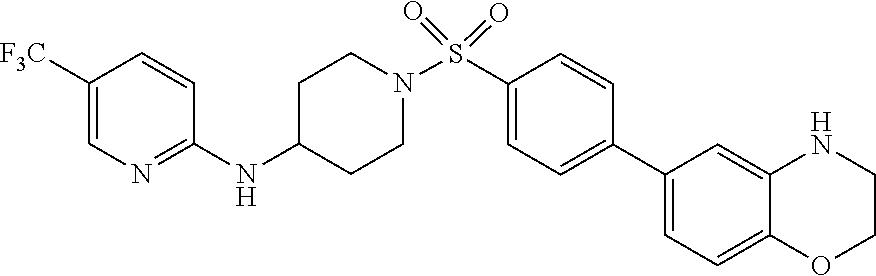
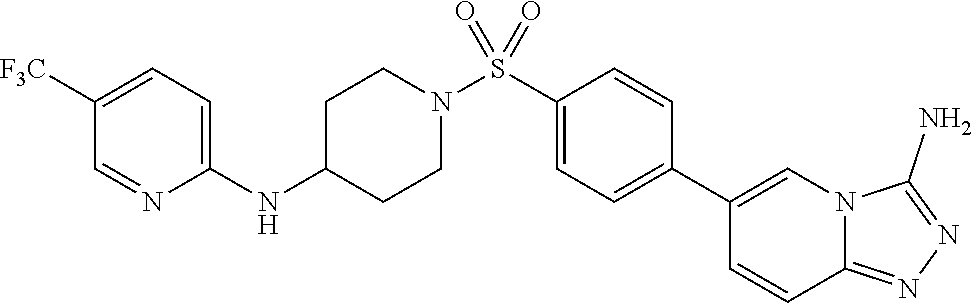
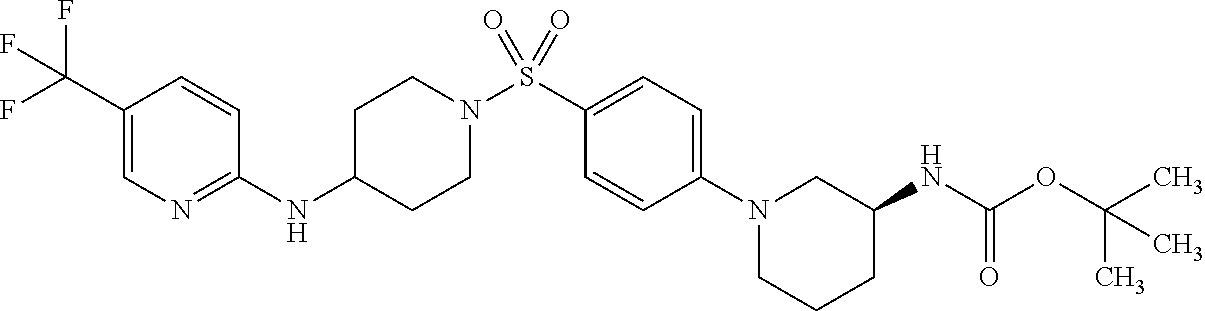
  • the compounds of Formula (I) are selected from the compounds provided in Table 1.
  • each compound is also provided as additional embodiments as a pharmaceutically acceptable salt, hydrate, solvate, N-oxide or rotamer thereof, in addition to a free base or otherwise neutral form.
  • the protecting group can be removed under appropriate conditions to give 1-NH piperidines IV as a free-base or protonated species with counterion.
  • This amine can be further treated with base and 4-bromosulfonyl chlorides V bearing, substitutions if required, in a sulfonamidation reaction to give 4-aminopyridyl-1-N-sulfonamides VI.
  • compositions for modulating CCR6, activity in humans and animals will typically contain a pharmaceutical carrier or diluent.
  • composition as used herein is intended to encompass a product comprising the specified ingredients in the specified amounts, as well as any product which results, directly or indirectly, from combination of the specified ingredients in the specified amounts.
  • pharmaceutically acceptable it is meant the carrier, diluent or excipient must be compatible with the other ingredients of the formulation and not deleterious to the recipient thereof.
  • compositions for the administration of the compounds of this invention may conveniently be presented in unit dosage form and may be prepared by any of the methods well known in the art of pharmacy and drug delivery. All methods include the step of bringing the active ingredient into association with the carrier which constitutes one or more accessory ingredients.
  • the pharmaceutical compositions are prepared by uniformly and intimately bringing the active ingredient into association with a liquid carrier or a finely divided solid carrier or both, and then, if necessary, shaping the product into the desired formulation.
  • the active object compound is included in an amount sufficient to produce the desired effect upon the process or condition of diseases.
  • compositions containing the active ingredient may be in a form suitable for oral use, for example, as tablets, troches, lozenges, aqueous or oily suspensions, dispersible powders or granules, emulsions and self emulsifications as described in U.S. Pat. No. 6,451,339, hard or soft capsules, syrups, elixirs, solutions, buccal patch, oral gel, chewing gum, chewable tablets, effervescent powder and effervescent tablets.
  • compositions intended for oral use may be prepared according to any method known to the art for the manufacture of pharmaceutical compositions and such compositions may contain one or more agents selected from the group consisting of sweetening agents, flavoring agents, coloring agents, antioxidants and preserving agents in order to provide pharmaceutically elegant and palatable preparations.
  • Tablets contain the active ingredient in admixture with non-toxic pharmaceutically acceptable excipients which are suitable for the manufacture of tablets.
  • excipients may be for example, inert diluents, such as cellulose, silicon dioxide, aluminum oxide, calcium carbonate, sodium carbonate, glucose, mannitol, sorbitol, lactose, calcium phosphate or sodium phosphate; granulating and disintegrating agents, for example, corn starch, or alginic acid; binding agents, for example PVP, cellulose, PEG, starch, gelatin or acacia, and lubricating agents, for example magnesium stearate, stearic acid or talc.
  • the tablets may be uncoated or they may be coated, enterically or otherwise, by known techniques to delay disintegration and absorption in the gastrointestinal tract and thereby provide a sustained action over a longer period.
  • a time delay material such as glyceryl monostearate or glyceryl distearate may be employed. They may also be coated by the techniques described in the U.S. Pat. Nos. 4,256,108; 4,166,452; and 4,265,874 to form osmotic therapeutic tablets for control release.
  • Formulations for oral use may also be presented as hard gelatin capsules wherein the active ingredient is mixed with an inert solid diluent, for example, calcium carbonate, calcium phosphate or kaolin, or as soft gelatin capsules wherein the active ingredient is mixed with water or an oil medium, for example peanut oil, liquid paraffin, or olive oil.
  • emulsions can be prepared with a non-water miscible ingredient such as oils and stabilized with surfactants such as mono-diglycerides, PEG esters and the like.
  • Aqueous suspensions contain the active materials in admixture with excipients suitable for the manufacture of aqueous suspensions.
  • excipients are suspending agents, for example sodium carboxymethylcellulose, methylcellulose, hydroxy-propylmethylcellulose, sodium alginate, polyvinyl-pyrrolidone, gum tragacanth and gum acacia; dispersing or wetting agents may be a naturally-occurring phosphatide, for example lecithin, or condensation products of an alkylene oxide with fatty acids, for example polyoxy-ethylene stearate, or condensation products of ethylene oxide with long chain aliphatic alcohols, for example heptadecaethyleneoxycetanol, or condensation products of ethylene oxide with partial esters derived from fatty acids and a hexitol such as polyoxyethylene sorbitol monooleate, or condensation products of ethylene oxide with partial esters derived from fatty acids and hexitol anhydrides, for example polyethylene sorbitan mono
  • the aqueous suspensions may also contain one or more preservatives, for example ethyl, or n-propyl, p-hydroxybenzoate, one or more coloring agents, one or more flavoring agents, and one or more sweetening agents, such as sucrose or saccharin.
  • preservatives for example ethyl, or n-propyl, p-hydroxybenzoate
  • coloring agents for example ethyl, or n-propyl, p-hydroxybenzoate
  • coloring agents for example ethyl, or n-propyl, p-hydroxybenzoate
  • flavoring agents for example ethyl, or n-propyl, p-hydroxybenzoate
  • sweetening agents such as sucrose or saccharin.
  • Oily suspensions may be formulated by suspending the active ingredient in a vegetable oil, for example arachis oil, olive oil, sesame oil or coconut oil, or in a mineral oil such as liquid paraffin.
  • the oily suspensions may contain a thickening agent, for example beeswax, hard paraffin or cetyl alcohol. Sweetening agents such as those set forth above, and flavoring agents may be added to provide a palatable oral preparation. These compositions may be preserved by the addition of an anti-oxidant such as ascorbic acid.
  • Dispersible powders and granules suitable for preparation of an aqueous suspension by the addition of water provide the active ingredient in admixture with a dispersing or wetting agent, suspending agent and one or more preservatives.
  • a dispersing or wetting agent e.g., glycerol, glycerol, glycerol, glycerol, glycerol, glycerol, glycerin, glycerin, glycerin, glycerin, glycerin, sorbitol, sorbitol, sorbitol, sorbitol, sorbitol, sorbitol, sorbitol, sorbitol, sorbitol, sorbitol, glycerol, glycerol, glycerol, glycerol, glycerol, glycerol, glycerol, glycerol, glycerol
  • the pharmaceutical compositions of the invention may also be in the form of oil-in-water emulsions.
  • the oily phase may be a vegetable oil, for example olive oil or arachis oil, or a mineral oil, for example liquid paraffin or mixtures of these.
  • Suitable emulsifying agents may be naturally-occurring gums, for example gum acacia or gum tragacanth, naturally-occurring phosphatides, for example soy bean, lecithin, and esters or partial esters derived from fatty acids and hexitol anhydrides, for example sorbitan monooleate, and condensation products of the said partial esters with ethylene oxide, for example polyoxyethylene sorbitan monooleate.
  • the emulsions may also contain sweetening and flavoring agents.
  • Syrups and elixirs may be formulated with sweetening agents, for example glycerol, propylene glycol, sorbitol or sucrose. Such formulations may also contain a demulcent, a preservative and flavoring and coloring agents.
  • Oral solutions can be prepared in combination with, for example, cyclodextrin, PEG and surfactants.
  • the pharmaceutical compositions may be in the form of a sterile injectable aqueous or oleagenous suspension.
  • This suspension may be formulated according to the known art using those suitable dispersing or wetting agents and suspending agents which have been mentioned above.
  • the sterile injectable preparation may also be a sterile injectable solution or suspension in a non-toxic parenterally-acceptable diluent or solvent, for example as a solution in 1,3-butane diol.
  • the acceptable vehicles and solvents that may be employed are water, Ringer's solution and isotonic sodium chloride solution.
  • sterile, fixed oils are conventionally employed as a solvent or suspending medium.
  • any bland fixed oil may be employed including synthetic mono- or diglycerides.
  • fatty acids such as oleic acid find use in the preparation of injectables.
  • compositions of the present invention may also be administered in the form of suppositories for rectal administration of the drug.
  • These compositions can be prepared by mixing the drug with a suitable non-irritating excipient which is solid at ordinary temperatures but liquid at the rectal temperature and will therefore melt in the rectum to release the drug.
  • Such materials include cocoa butter and polyethylene glycols.
  • the compounds can be administered via ocular delivery by means of solutions or ointments. Still further, transdermal delivery of the subject compounds can be accomplished by means of iontophoretic patches and the like.
  • creams, ointments, jellies, solutions or suspensions, etc., containing the compounds of the present invention are employed. As used herein, topical application is also meant to include the use of mouth washes and gargles.
  • the compounds of the invention may be formulated for depositing into a medical device, which may include any of variety of conventional grafts, stents, including stent grafts, catheters, balloons, baskets or other device that can be deployed or permanently implanted within a body lumen.
  • a medical device which may include any of variety of conventional grafts, stents, including stent grafts, catheters, balloons, baskets or other device that can be deployed or permanently implanted within a body lumen.
  • a medical device may include any of variety of conventional grafts, stents, including stent grafts, catheters, balloons, baskets or other device that can be deployed or permanently implanted within a body lumen.
  • the inhibitory agent of this invention may be deposited within a medical device, such as a stent, and delivered to the treatment site for treatment of a portion of the body.
  • Stents have been used as delivery vehicles for therapeutic agents (i.e., drugs).
  • Intravascular stents are generally permanently implanted in coronary or peripheral vessels.
  • Stent designs include those of U.S. Pat. No. 4,733,655 (Palmaz), U.S. Pat. No. 4,800,882 (Gianturco), or U.S. Pat. No. 4,886,062 (Wiktor).
  • Such designs include both metal and polymeric stents, as well as self-expanding and balloon-expandable stents.
  • Stents may also used to deliver a drug at the site of contact with the vasculature, as disclosed in U.S. Pat. No. 5,102,417 (Palmaz) and in International Patent Application Nos.
  • WO 91/12779 Medtronic, Inc.
  • WO 90/13332 Cedars-Sanai Medical Center
  • U.S. Pat. No. 5,419,760 Narciso, Jr.
  • U.S. Pat. No. 5,429,634 Narciso, Jr.
  • Stents have also been used to deliver viruses to the wall of a lumen for gene delivery, as disclosed in U.S. Pat. No. 5,833,651 (Donovan et al.).
  • the term “deposited” means that the inhibitory agent is coated, adsorbed, placed, or otherwise incorporated into the device by methods known in the art.
  • the inhibitory agent may be embedded and released from within (“matrix type”) or surrounded by and released through (“reservoir type”) polymer materials that coat or span the medical device.
  • the inhibitory agent may be entrapped within the polymer materials or coupled to the polymer materials using one or more the techniques for generating such materials known in the art.
  • the inhibitory agent may be linked to the surface of the medical device without the need for a coating by means of detachable bonds and release with time, can be removed by active mechanical or chemical processes, or are in a permanently immobilized form that presents the inhibitory agent at the implantation site.
  • the inhibitory agent may be incorporated with polymer compositions during the formation of biocompatible coatings for medical devices, such as stents.
  • the coatings produced from these components are typically homogeneous and are useful for coating a number of devices designed for implantation.
  • the polymer may be either a biostable or a bioabsorbable polymer depending on the desired rate of release or the desired degree of polymer stability, but a bioabsorbable polymer is preferred for this embodiment since, unlike a biostable polymer, it will not be present long after implantation to cause any adverse, chronic local response.
  • Bioabsorbable polymers that could be used include, but are not limited to, poly(L-lactic acid), polycaprolactone, polyglycolide (PGA), poly(lactide-co-glycolide) (PLLA/PGA), poly(hydroxybutyrate), poly(hydroxybutyrate-co-valerate), polydioxanone, polyorthoester, polyanhydride, poly(glycolic acid), poly(D-lactic acid), poly(L-lactic acid), poly(D,L-lactic acid), poly(D,L-lactide) (PLA), poly (L-lactide) (PLLA), poly(glycolic acid-co-trimethylene carbonate) (PGA/PTMC), polyethylene oxide (PEO), polydioxanone (PDS), polyphosphoester, polyphosphoester urethane, poly(amino acids), cyanoacrylates, poly(trimethylene carbonate), poly(iminocarbonate), copoly(ether-esters) (e.g.,
  • biostable polymers with a relatively low chronic tissue response such as polyurethanes, silicones, and polyesters could be used and other polymers could also be used if they can be dissolved and cured or polymerized on the medical device such as polyolefins, polyisobutylene and ethylene-alphaolefin copolymers; acrylic polymers and copolymers, vinyl halide polymers and copolymers, such as polyvinyl chloride; polyvinylpyrrolidone; polyvinyl ethers, such as polyvinyl methyl ether; polyvinylidene halides, such as polyvinylidene fluoride and polyvinylidene chloride; polyacrylonitrile, polyvinyl ketones; polyvinyl aromatics, such as polystyrene, polyvinyl esters, such as polyvinyl acetate; copolymers of vinyl monomers with each other and olefins, such as ethylene-methyl methacrylate copo
  • Polymers and semipermeable polymer matrices may be formed into shaped articles, such as valves, stents, tubing, prostheses and the like.
  • the inhibitory agent of the invention is coupled to a polymer or semipermeable polymer matrix that is formed as a stent or stent-graft device.
  • polymers are applied to the surface of an implantable device by spin coating, dipping or spraying. Additional methods known in the art can also be utilized for this purpose. Methods of spraying include traditional methods as well as microdeposition techniques with an inkjet type of dispenser. Additionally, a polymer can be deposited on an implantable device using photo-patterning to place the polymer on only specific portions of the device. This coating of the device provides a uniform layer around the device which allows for improved diffusion of various analytes through the device coating.
  • the inhibitory agent is formulated for release from the polymer coating into the environment in which the medical device is placed.
  • the inhibitory agent is released in a controlled manner over an extended time frame (e.g., months) using at least one of several well-known techniques involving polymer carriers or layers to control elution. Some of these techniques were previously described in U.S. Patent Application 20040243225A1.
  • the reagents and reaction conditions of the polymer compositions can be manipulated so that the release of the inhibitory agent from the polymer coating can be controlled.
  • the diffusion coefficient of the one or more polymer coatings can be modulated to control the release of the inhibitory agent from the polymer coating.
  • the diffusion coefficient of the one or more polymer coatings can be controlled to modulate the ability of an analyte that is present in the environment in which the medical device is placed (e.g.
  • Yet another embodiment of the invention includes a device having a plurality of polymer coatings, each having a plurality of diffusion coefficients. In such embodiments of the invention, the release of the inhibitory agent from the polymer coating can be modulated by the plurality of polymer coatings.
  • the release of the inhibitory agent from the polymer coating is controlled by modulating one or more of the properties of the polymer composition, such as the presence of one or more endogenous or exogenous compounds, or alternatively, the pH of the polymer composition.
  • the properties of the polymer composition such as the presence of one or more endogenous or exogenous compounds, or alternatively, the pH of the polymer composition.
  • certain polymer compositions can be designed to release a inhibitory agent in response to a decrease in the pH of the polymer composition.
  • certain polymer compositions can be designed to release the inhibitory agent in response to the presence of hydrogen peroxide.
  • the present invention provides methods of treating or preventing a CCR6-mediated condition or disease by administering to a subject having such a condition or disease, a therapeutically effective amount of any compound of the invention.
  • Preferred compounds for use in the present methods are those compounds provided above as preferred embodiments, as well as compounds specifically exemplified in the Examples below, and provided with specific structures herein.
  • the “subject” is defined herein to include animals such as mammals, including, but not limited to, primates (e.g., humans), cows, sheep, goats, horses, dogs, cats, rabbits, rats, mice and the like. In preferred embodiments, the subject is a human.
  • CCR6-mediated condition or disease and related phrases and terms refer to a condition or disease characterized by inappropriate, e.g., less than or greater than normal, CCR6 functional activity.
  • Inappropriate CCR6 functional activity might arise as the result of CCR6 expression in cells which normally do not express CCR6, increased CCR6 expression (leading to, e.g., inflammatory and immunoregulatory disorders and diseases) or decreased CCR6 expression.
  • Inappropriate CCR6 functional activity might also arise as the result of CCL20 secretion by cells which normally do not secrete CCL20, increased CCL20 expression (leading to, e.g., inflammatory and immunoregulatory disorders and diseases) or decreased CCL20 expression.
  • a CCR6-mediated condition or disease may be completely or partially mediated by inappropriate CCR6 functional activity.
  • a CCR6-mediated condition or disease is one in which modulation of CCR6 results in some effect on the underlying condition or disease (e.g., a CCR6 antagonist results in some improvement in patient well-being in at least some patients).
  • terapéuticaally effective amount means the amount of the subject compound that will elicit the biological or medical response of a tissue, system, animal or human that is being sought by the researcher, veterinarian, medical doctor or other clinician.
  • diseases or conditions associated with inflammation, infection and cancer can be treated or prevented with the present compounds and compositions.
  • diseases or conditions including chronic diseases, of humans or other species can be treated with inhibitors of CCR6 function.
  • diseases or conditions include: (1) allergic diseases such as systemic anaphylaxis or hypersensitivity responses, drug allergies, insect sting allergies and food allergies, (2) inflammatory bowel diseases, such as Crohn's disease, ulcerative colitis, ileitis and enteritis, (3) vaginitis, (4) psoriasis and inflammatory dermatoses such as dermatitis, eczema, atopic dermatitis, allergic contact dermatitis, urticaria and pruritus, Vitiligo (5) vasculitis, (6) spondyloarthropathies, (7) scleroderma, (8) asthma and respiratory allergic diseases such as allergic asthma, allergic rhinitis, hypersensitivity lung diseases and the like, (9) autoimmune diseases, such as arthritis (including r
  • the present methods are directed to the treatment of diseases or conditions selected from allergic diseases, psoriasis, skin conditions such as atopic dermatitis and asthma and scleroderma.
  • modulation of CCR6 dependent regulatory T cell trafficking may be modulated to treat diseases or conditions including cancers, infectious diseases (viral infections, e.g., HIV infection, and bacterial infections) and immunosuppressive diseases such as organ transplant conditions and skin transplant conditions.
  • infectious diseases viral infections, e.g., HIV infection, and bacterial infections
  • immunosuppressive diseases such as organ transplant conditions and skin transplant conditions.
  • organ transplant conditions is meant to include bone marrow transplant conditions and solid organ (e.g., kidney, liver, lung, heart, pancreas or combination thereof) transplant conditions.
  • the compounds of the present invention may be administered by oral, parenteral (e.g., intramuscular, intraperitoneal, intravenous, ICV, intracisternal injection or infusion, subcutaneous injection, or implant), inhalation, nasal, vaginal, rectal, sublingual, or topical routes of administration and may be formulated, alone or together, in suitable dosage unit formulations containing conventional non-toxic pharmaceutically acceptable carriers, adjuvants and vehicles appropriate for each route of administration.
  • the present invention also contemplates administration of the compounds of the present invention in a depot formulation.
  • agents that modulate CCR6 activity can be combined in treatment regimens with other therapeutic agents and/or with chemotherapeutic agents or radiation.
  • the amount of chemotherapeutic agent or radiation is an amount which would be sub-therapeutic if provided without combination with a composition of the invention.
  • “combinations” can involve combinations in treatments (i.e., two or more drugs can be administered as a mixture, or at least concurrently or at least introduced into a subject at different times but such that both are in the bloodstream of a subject at the same time).
  • compositions of the current invention may be administered prior to or subsequent to a second therapeutic regimen, for instance prior to or subsequent to a dose of chemotherapy or irradiaition.
  • the compounds of the present invention are accordingly useful in the prevention and treatment of a wide variety of inflammatory and immunoregulatory disorders and diseases.
  • an appropriate dosage level will generally be about 0.001 to 100 mg per kg patient body weight per day which can be administered in single or multiple doses.
  • the dosage level will be about 0.01 to about 25 mg/kg per day; more preferably about 0.05 to about 10 mg/kg per day.
  • a suitable dosage level may be about 0.01 to 25 mg/kg per day, about 0.05 to 10 mg/kg per day, or about 0.1 to 5 mg/kg per day. Within this range the dosage may be 0.005 to 0.05, 0.05 to 0.5 or 0.5 to 5.0 mg/kg per day.
  • compositions are preferably provided in the form of tablets containing 1.0 to 1000 milligrams of the active ingredient, particularly 1.0, 5.0, 10.0, 15.0. 20.0, 25.0, 50.0, 75.0, 100.0, 150.0, 200.0, 250.0, 300.0, 400.0, 500.0, 600.0, 750.0, 800.0, 900.0, and 1000.0 milligrams of the active ingredient for the symptomatic adjustment of the dosage to the patient to be treated.
  • the compounds may be administered on a regimen of 1 to 4 times per day, preferably once or twice per day.
  • the specific dose level and frequency of dosage for any particular patient may be varied and will depend upon a variety of factors including the activity of the specific compound employed, the metabolic stability and length of action of that compound, the age, body weight, hereditary characteristics, general health, sex and diet of the subject, as well as the mode and time of administration, rate of excretion, drug combination, and the severity of the particular condition for the subject undergoing therapy.
  • the compounds and compositions of the present invention can be combined with other compounds and compositions having related utilities to prevent and treat the condition or disease of interest, such as inflammatory or autoimmune disorders, conditions and diseases, including inflammatory bowel disease, rheumatoid arthritis, osteoarthritis, psoriatic arthritis, polyarticular arthritis, multiple sclerosis, allergic diseases, psoriasis, atopic dermatitis and asthma, and those pathologies noted above.
  • inflammatory or autoimmune disorders including inflammatory bowel disease, rheumatoid arthritis, osteoarthritis, psoriatic arthritis, polyarticular arthritis, multiple sclerosis, allergic diseases, psoriasis, atopic dermatitis and asthma, and those pathologies noted above.
  • the present compounds and compositions may be used in conjunction with an anti-inflammatory or analgesic agent such as an opiate agonist, a lipoxygenase inhibitor, such as an inhibitor of 5-lipoxygenase, a cyclooxygenase inhibitor, such as a cyclooxygenase-2 inhibitor, an interleukin inhibitor, such as an interleukin-1 inhibitor, an NMDA antagonist, an inhibitor of nitric oxide or an inhibitor of the synthesis of nitric oxide, a non steroidal anti-inflammatory agent, or a cytokine-suppressing anti-inflammatory agent, for example with a compound such as acetaminophen, aspirin, codeine, fentanyl, ibuprofen, indomethacin, ketorolac, morphine, naproxen, phenacetin, piroxicam, a steroidal analgesic,
  • an anti-inflammatory or analgesic agent such as an opiate agonist, a
  • the instant compounds and compositions may be administered with an analgesic listed above; a potentiator such as caffeine, an H2 antagonist (e.g., ranitidine), simethicone, aluminum or magnesium hydroxide; a decongestant such as phenylephrine, phenylpropanolamine, pseudoephedrine, oxymetazoline, ephinephrine, naphazoline, xylometazoline, propylhexedrine, or levo desoxy ephedrine; an antitussive such as codeine, hydrocodone, caramiphen, carbetapentane, or dextromethorphan; a diuretic; and a sedating or non sedating antihistamine.
  • a potentiator such as caffeine, an H2 antagonist (e.g., ranitidine), simethicone, aluminum or magnesium hydroxide
  • a decongestant such as phenylephrine, phenylprop
  • compounds and compositions of the present invention may be used in combination with other drugs that are used in the treatment, prevention, suppression or amelioration of the diseases or conditions for which compounds and compositions of the present invention are useful.
  • Such other drugs may be administered, by a route and in an amount commonly used therefor, contemporaneously or sequentially with a compound or composition of the present invention.
  • a pharmaceutical composition containing such other drugs in addition to the compound or composition of the present invention is preferred.
  • the pharmaceutical compositions of the present invention include those that also contain one or more other active ingredients or therapeutic agents, in addition to a compound or composition of the present invention.
  • Examples of other therapeutic agents that may be combined with a compound or composition of the present invention, either administered separately or in the same pharmaceutical compositions, include, but are not limited to: (a) VLA-4 antagonists, (b) corticosteroids, such as beclomethasone, methylprednisolone, betamethasone, prednisone, prenisolone, dexamethasone, fluticasone, hydrocortisone, budesonide, triamcinolone, salmeterol, salmeterol, salbutamol, formeterol; (c) immunosuppressants such as cyclosporine (cyclosporine A, Sandimmune®, Neoral®), tacrolirnus (FK-506, Prograf®), rapamycin (sirolimus, Rapamune®), Tofacitinib (Xeljanz®) and other FK-506 type immunosuppressants, and rycophenolate, e.g., mycophenolate mofetil (C
  • the weight ratio of the compound of the present invention to the second active ingredient may be varied and will depend upon the effective dose of each ingredient. Generally, an effective dose of each will be used. Thus, for example, when a compound of the present invention is combined with an NSAID the weight ratio of the compound of the present invention to the NSAID will generally range from about 1000:1 to about 1:1000, preferably about 200:1 to about 1:200. Combinations of a compound of the present invention and other active ingredients will generally also be within the aforementioned range, but in each case, an effective dose of each active ingredient should be used.
  • Reagents and solvents used below can be obtained from commercial sources such as Aldrich Chemical Co. (Milwaukee, Wisconsin, USA). 1 H-NMR were recorded on a Varian Mercury 400 MHz NMR spectrometer. Significant peaks are provided relative to TMS and are tabulated in the order: multiplicity (s, singlet; d, doublet; t, triplet; q, quartet; m, multiplet) and number of protons. Mass spectrometry results are reported as the ratio of mass over charge, followed by the relative abundance of each ion (in parenthesis). In tables, a single m/e value is reported for the M+H (or, as noted, M ⁇ H) ion containing the most common atomic isotopes.
  • Electrospray ionization (ESI) mass spectrometry analysis was conducted on a Hewlett-Packard MSD electrospray mass spectrometer using the HP1100 HPLC equipped with an Agilent Zorbax SB-C18, 2.1 ⁇ 50 mm, 5 ⁇ column for sample delivery. Normally the analyte was dissolved in methanol at 0.1 mg/mL and 1 microlitre was infused with the delivery solvent into the mass spectrometer, which scanned from 100 to 1500 daltons. All compounds could be analyzed in the positive ESI mode, using acetonitrile/water with 1% formic acid as the delivery solvent. The compounds provided below could also be analyzed in the negative ESI mode, using 2 mM NH 4 OAc in acetonitrile/water as delivery system.
  • HPLC High Pressure Liquid Chromatography
  • DMF Dimethyl formamide
  • TFA Trifluoroacetic Acid
  • THF Tetrahydrofuran
  • EtOAc Ethyl acetate
  • BOC 2 O di-tertbutyl dicarbonate or BOC anhydride
  • HPLC High Pressure Liquid Chromatography
  • DIPEA Diisopropyl ethylamine
  • HBTU O-(benzotriazol-1-yl)-N,N,N′,N′-tetramethyluronium hexafluorophosphate
  • dppf 1,1′-Bis(diphenylphosphino)ferrocene
  • Pd 2 (dba) 3 Tris(dibenzylideneacetone)dipalladium(0)
  • DIPEA diisopropylethylamine
  • DMP dimethylphthalate
  • Me methyl
  • Et ethyl
  • DCM dichloromethane.
  • Step a To a round-bottom flask were added 1-Boc-4-aminopiperidine (10.01 g, 50.0 mmol, 1.0 equiv), K 2 CO 3 (20.73 g, 150.0 mmol, 3.0 equiv), DMF (100 mL), and 2-fluoro-5-(trifluoromethyl)-pyridine (12.1 mL, 100.0 mmol, 2.0 equiv). The reaction mixture was stirred at 100° C. overnight. The reaction mixture was cooled to rt, diluted with H 2 O (200 mL) and brine (100 mL), and extracted with EtOAc (3 ⁇ 200 mL).
  • Step b To a round-bottom flask were added tert-butyl 4-((5-(trifluoromethyl)pyridin-2-yl)amino)piperidine-1-carboxylate (11.37 g, 32.9 mmol, 1.0 equiv), dioxane (100 mL), and 4 M HCl/dioxane (100 mL). The reaction mixture was stirred at rt overnight. The reaction mixture was concentrated and dried under vacuum to yield N-(piperidin-4-yl)-5-(trifluoromethyl)pyridin-2-amine hydrochloride as an off-white solid.
  • Step c To a round-bottom flask were added N-(piperidin-4-yl)-5-(trifluoromethyl)pyridin-2-amine hydrochloride (4.23 g, 15.0 mmol, 1.0 equiv), THE (75 mL), iPr 2 NEt (10.5 mL, 60.0 mmol, 4.0 equiv), and 4-bromobenzensulfonyl chloride (5.75 g, 22.5 mmol, 1.5 equiv). The reaction mixture was stirred at rt for 1 h. The resulting solid was filtered, and the filtrate was concentrated.
  • Example 2 1′-(2-Aminoethyl)-5′-(4-((4-((5-(trifluoromethyl)pyridin-2-yl)amino)piperidin-1-yl)sulfonyl)phenyl)spiro[cyclopropane-1,3′-pyrrolo[2,3-b]pyridin]-2′(1′H)-one
  • Step a To a solution of tert-butyl (2-(2′-oxo-5′-(4-((4-((5-(trifluoromethyl)pyridin-2-yl)amino)piperidin-1-yl)sulfonyl)phenyl)spiro[cyclopropane-1,3′-pyrrolo[2,3-b]pyridin]-1′(2′H)-yl)ethyl)carbamate (88.0 mg; 0.13 mmol) in 1 mL of CH 2 Cl 2 was added 1 mL of TFA. The mixture stirred for 16 h. LC-MS indicated the desired product.
  • Step b 2-(2-((tert-butyldimethylsilyl)oxy)ethyl)-5-(4-((4-((5-(trifluoromethyl)pyridin-2-yl)amino)piperidin-1-yl)sulfonyl)phenyl)isoindolin-1-one (38.9 mg; 0.06 mmol) in 1 mL of THF was added 0.1 mL of 1 M TBAF in THF. The mixture stirred for 1 h. LC-MS indicates the desired product. The reaction was diluted with 10 mL of EtOAc, washed with 3 ⁇ 5 mL of H 2 O and 10 mL of brine.
  • Example 6 1′-Methyl-5-(4-((4-((5-(trifluoromethyl)pyridin-2-yl)amino)piperidin-1-yl)sulfonyl)phenyl)spiro[indoline-3,4′-piperidin]-2-one
  • Example 17 6-(4-((4-((5-(Trifluoromethyl)pyridin-2-yl)amino)piperidin-1-yl)sulfonyl)phenyl)-[1,2,4]triazolo[4,3-a]pyridin-3-amine
  • Step a A mixture of N-(piperidin-4-yl)-5-(trifluoromethyl)pyridin-2-amine hydrochloride (282 mg, 1.0 mmol), 4-bromo-3-methylbenzenesulfonyl chloride (404 mg, 1.5 mmol), and K 2 CO 3 (553 mg, 4.0 mmol) in 2-methyltetrahydrofuran (10 mL) and water (2 mL) was stirred at room temperature for 1.5 hours.
  • Step b To N-(1-((4-bromo-3-methylphenyl)sulfonyl)piperidin-4-yl)-5-(trifluoromethyl)pyridin-2-amine (48 mg, 0.10 mmol) in a septum-cap vial were added K 2 CO 3 (30 mg, 0.22 mmol), 5-(4,4,5,5-tetramethyl-1,3,2-dioxaborolan-2-yl)indolin-2-one (31 mg, 0.12 mmol), dioxane (1.5 mL) and water (0.5 mmol). The mixture was sparged with nitrogen for 20 minutes.
  • Example 21 1′-(2-Hydroxyethyl)-5′-(4-((4-((5-(trifluoromethyl)pyridin-2-yl)amino)piperidin-1-yl)sulfonyl)phenyl)-2,3,5,6-tetrahydrospiro[pyran-4,3′-pyrrolo[2,3-b]pyridin]-2′(1′H)-one
  • Step a To N-[1-[4-(4,4,5,5-tetramethyl-1,3,2-dioxaborolan-2-yl)phenyl]sulfonyl-4-piperidyl]-5-(trifluoromethyl)pyridin-2-amine (40.0 mg, 0.08 mmol) in 2.25 mL dioxane were added K 2 CO 3 (25.0 mg, 0.18 mmol), 5-bromo-1-[2-[tert-butyl(dimethyl)silyl]oxyethyl]spiro[pyrrolo[2,3-b]pyridine-3,4′-tetrahydropyran]-2-one (40.0 mg, 0.10 mmol), Pd(dppf)Cl 2 .DCM (9.0 mg, 0.01 mmol) and 0.75 mL of water.
  • Step b 2-(2-((tert-butyldimethylsilyl)oxy)ethyl)-5-(4-((4-((5-(trifluoromethyl)pyridin-2-yl)amino)piperidin-1-yl)sulfonyl)phenyl)isoindolin-1-one (57.0 mg; 0.08 mmol) in 1 mL of THF was added 0.1 mL of 1 M TBAF in THF. The mixture stirred for 1 h. LC-MS indicates the desired product. The reaction was diluted with 10 mL of EtOAc, washed with 3 ⁇ 5 mL of H 2 O and 10 mL of brine.
  • Step a To N-[1-[4-(4,4,5,5-tetramethyl-1,3,2-dioxaborolan-2-yl)phenyl]sulfonyl-4-piperidyl]-5-(trifluoromethyl)pyridin-2-amine (40.0 mg, 0.07 mmol) in 2.25 mL dioxane were added K 2 CO 3 (25.0 mg, 0.18 mmol), 1-[2-[tert-butyl(dimethyl)silyl]oxyethyl]-5-[4-[[4-[[5-(trifluoromethyl)-2-pyridyl]amino]-1-piperidyl]sulfonyl]phenyl]pyrrolo[2,3-b]pyridine-3-carbonitrile (40.0 mg, 0.11 mmol), Pd(dppf)Cl 2 .DCM (9.0 mg, 0.01 mmol) and 0.75 mL of water.
  • Example 27 1′-Acetyl-5-(4-((4-((5-(trifluoromethyl)pyridin-2-yl)amino)piperidin-1-yl)sulfonyl)phenyl) spiro[indoline-3,4′-piperidin]-2-one
  • Step a To N-[1-[4-(4,4,5,5-tetramethyl-1,3,2-dioxaborolan-2-yl)phenyl]sulfonyl-4-piperidyl]-5-(trifluoromethyl)pyridin-2-amine (40.0 mg, 0.07 mmol) in 2.25 mL dioxane were added K 2 CO 3 (25.0 mg, 0.18 mmol), 1-[2-[tert-butyl(dimethyl)silyl]oxyethyl]-5-[4-[[4-[[5-(trifluoromethyl)-2-pyridyl]amino]-1-piperidyl]sulfonyl]phenyl]pyrrolo[2,3-b]pyridine-3-carbonitrile (40.0 mg, 0.11 mmol), Pd(dppf)Cl 2 .DCM (9.0 mg, 0.01 mmol) and 0.75 mL of water.
  • Step b To a solution of 1-(2-((tert-butyldimethylsilyl)oxy)ethyl)-5-(4-((4-((5-(trifluoromethyl)pyridin-2-yl)amino)piperidin-1-yl)sulfonyl)phenyl)-1H-pyrrolo[2,3-b]pyridine-3-carbonitrile (42.5 mg; 0.06 mmol) in 1 mL of THF is added 0.1 mL of 1 M TBAF in THF. The mixture stirred for 1 h. LC-MS indicates the desired product.
  • Example 46 7-Methoxy-5-(4-((4-((5-(trifluoromethyl)pyridin-2-yl)amino)piperidin-1-yl)sulfonyl)phenyl)indolin-2-one
  • Example 52 5′-(4-((4-((5-(Trifluoromethyl)pyridin-2-yl)amino)piperidin-1-yl)sulfonyl) phenyl)spiro[cyclopropane-1,3′-pyrrolo[2,3-b]pyridin]-2′(1′H)-one
  • Example 53 1-Cyclopropyl-6-(4-((4-((5-(trifluoromethyl)pyridin-2-yl)amino)piperidin-1-yl)sulfonyl) phenyl)-1,3-dihydro-2H-benzo[d]imidazol-2-one
  • Example 54 1-(5-(4-((4-((5-(Trifluoromethyl)pyridin-2-yl)amino)piperidin-1-yl)sulfonyl)phenyl)isoindolin-2-yl)ethan-1-one
  • Example 58 7-(4-((4-((5-(Trifluoromethyl)pyridin-2-yl)amino)piperidin-1-yl)sulfonyl)phenyl)quinazoline-2,4(1H,3H)-dione
  • Example 60 6-(4-((4-((5-(Trifluoromethyl)pyridin-2-yl)amino)piperidin-1-yl)sulfonyl)phenyl)phthalazin-1(2H)-one
  • Example 62 4-(4-((4-((5-(Trifluoromethyl)pyridin-2-yl)amino)piperidin-1-yl)sulfonyl)phenyl)-1H-indole-7-carboxamide
  • Example 65 5′-(4-((4-((5-(Trifluoromethyl)pyridin-2-yl)amino)piperidin-1-yl)sulfonyl)phenyl)-2,3,5,6-tetrahydro-spiro[pyran-4,3′-pyrrolo[2,3-b]pyridin]-2′(1′H)-one
  • Example 68 6-(4-((4-((5-(Trifluoromethyl)pyridin-2-yl)amino)piperidin-1-yl)sulfonyl)phenyl)-1,3-dihydro-2H-imidazo[4,5-b]pyridin-2-one
  • Example 70 N,N-dimethyl-5-(4-((4-((5-(trifluoromethyl)pyridin-2-yl)amino)piperidin-yl)sulfonyl) cyclohexa-1,3-dien-1-yl)-1H-indazol-3-amine
  • Example 72 7-(4-((4-((5-(Trifluoromethyl)pyridin-2-yl)amino)piperidin-1-yl)sulfonyl)phenyl)-2H-benzo[b][1,4]oxazin-3(4H)-one
  • Example 78 6-(4-((4-((5-(Trifluoromethyl)pyridin-2-yl)amino)piperidin-1-yl)sulfonyl)phenyl)oxazolo[5,4-b]pyridin-2-amine
  • Example 84 5-(Trifluoromethyl)-N-(1-((4-(3-(trifluoromethyl)-1H-indazol-5-yl)phenyllsulfonyl)piperidin-4-yl)pyridin-2-amine
  • Example 88 1-Methyl-5-(4-((4-((5-(trifluoromethyl)pyridin-2-yl)amino)piperidin-1-yl)sulfonyl)phenyl)-1H-indazole-3-carbonitrile
  • Example 90 6-(4-((4-((5-(Trifluoromethyl)pyridin-2-yl)amino)piperidin-1-yl)sulfonyl)phenyl)isoindolin-1-one
  • Example 100 2-(4-((4-((5-(trifluoromethyl)pyridin-2-yl)amino)piperidin-1-yl)sulfonyl)phenyl)-4,5,6,7-tetrahydrothiazolo[5,4-c]pyridin-5-ium chloride
  • Example 102 5-(4-((4-((5-(Trifluoromethyl)pyridin-2-yl)amino)piperidin-1-yl)sulfonyl)phenyl)indolin-2-one
  • Example 104 N-(1-((4-(1H-benzo[d]imidazol-5-yl)phenyl)sulfonyl)piperidin-4-yl)-5-(trifluoromethyl)pyridin-2-amine
  • Example 105 tert-Butyl 4-oxo-2-(4-((4-((5-(trifluoromethyl)pyridin-2-yl)amino)piperidin-1-yl)sulfonyl)phenyl)-6,7-dihydrothiazolo[5,4-c]pyridine-5(4H)-carboxylate
  • Example 110 5-(4-((4-((5-(Trifluoromethyl)pyridin-2-yl)amino)piperidin-1-yl)sulfonyl)phenyl)isoindolin-1-one
  • Example 112 N-(1-((4-(1H-Indol-5-yl)phenyl)sulfonyl)piperidin-4-yl)-5-(trifluoromethyl)pyridin-2-amine
  • N-(1-((4-fluorophenyl)sulfonyl)piperidin-4-yl)-5-(trifluoromethyl)pyridin-2-amine 48 mg 0.12 mmol
  • N-phenylpiperidin-4-amine 42 mg, 0.24 mmol
  • potassium carbonate 66 mg, 0.48 mmol
  • the reaction mixture was cooled to room temperature and diluted with water (10 mL).
  • Example 116 4-(4-((4-((5-(trifluoromethyl)pyridin-2-yl)amino)piperidin-1-yl)sulfonyl)phenyl)piperazin-2-one
  • a chemotaxis assay can be used to determine the efficacy of potential receptor antagonists at blocking the migration mediated through chemokine receptors, such as CCR6.
  • This assay is routinely performed using the ChemoTX® microchamber system with a 5- ⁇ m pore-sized polycarbonate membrane.
  • Chemokine receptor-expressing cells are required for such an assay.
  • Ba/F3 cells Pieracios et al., Nature, 309:126, 1984
  • transfected with the gene for human CCR6 under control of the CMV promotor were used.
  • hCCR6-transfected Ba/F 3 cells are first grown for 24 hr in medium supplemented with sodium butyrate, which increases CCR6 transcription via the CMV promotor.
  • the prepared Ba/F3 cells are collected by centrifugation at 400 ⁇ g at room temperature, then suspended at 4 million/ml in human serum.
  • the compound being tested is serially diluted from a maximum final concentration of 10 ⁇ M (or an equivalent volume of its solvent (DMSO)) and is then added to the cell/serum mixture.
  • DMSO DMSO
  • recombinant human CCL20 MIP-3 ⁇ /LARC
  • EC 50 concentration 10 nM
  • the 5- ⁇ m (pore size) polycarbonate membrane is placed onto the plate, and 20 ⁇ L of the cell/compound mixture is transferred onto each well of the membrane.
  • the plates are incubated at 37° C. for 45 minutes, after which the polycarbonate membranes are removed and 5 ⁇ l of the DNA-intercalating dye CyQUANT (Invitrogen, Carlsbad, CA) is added to the lower wells.
  • CyQUANT Invitrogen, Carlsbad, CA
  • the amount of fluorescence, corresponding to the number of migrated cells, is measured using a Spectrafluor Plus plate reader (TECAN, San Jose, CA).

Landscapes

  • Chemical & Material Sciences (AREA)
  • Organic Chemistry (AREA)
  • Pharmaceuticals Containing Other Organic And Inorganic Compounds (AREA)
  • Acyclic And Carbocyclic Compounds In Medicinal Compositions (AREA)

Abstract

Compounds of formula (I) are provided which are useful in the treatment of diseases or conditions modulated at least in part by CCR6:

Description

CROSS-REFERENCES TO RELATED APPLICATIONS
This application claims the benefit of priority under 35 U.S.C § 119(e) to U.S. Provisional Application Ser. No. 63/234,274 filed Aug. 18, 2021, the disclosure of which is incorporated herein by reference in its entirety.
STATEMENT AS TO RIGHTS TO INVENTIONS MADE UNDER FEDERALLY SPONSORED RESEARCH AND DEVELOPMENT
NOT APPLICABLE
REFERENCE TO A “SEQUENCE LISTING,” A TABLE, OR A COMPUTER PROGRAM LISTING APPENDIX SUBMITTED ON A COMPACT DISK
NOT APPLICABLE
BACKGROUND OF THE INVENTION
Chemokines are chemotactic cytokines that are released by a wide variety of cells to attract macrophages, T cells, eosinophils, basophils and neutrophils to sites of inflammation (reviewed in Schall, Cytokine, 3:165-183 (1991), Schall, et al., Curr Opin. Immunol. 6:865-873 (1994) and Murphy, Rev. Immun., 12:593-633 (1994)). In addition to stimulating chemotaxis, other changes can be selectively induced by chemokines in responsive cells, including changes in cell shape, transient rises in the concentration of intracellular free calcium ions ([Ca2+]), granule exocytosis, integrin upregulation, formation of bioactive lipids (e.g., leukotrienes) and respiratory burst, associated with leukocyte activation. Thus, the chemokines are early triggers of the inflammatory response, causing inflammatory mediator release, chemotaxis and extravasation to sites of infection or inflammation.
There are two main classes of chemokines, CXC (alpha) and CC (beta), depending on whether the first two cysteines are separated by a single amino acid (C-X-C) or are adjacent (C—C). The alpha-chemokines, such as interleukin-8 (IL-8), neutrophil-activating protein-2 (NAP-2) and melanoma growth stimulatory activity protein (MGSA) are chemotactic primarily for neutrophils, whereas beta-chemokines, such as RANTES, MIP-la, MIP-lb, monocyte chemotactic protein-1 (MCP-1), MCP-2, MCP-3 and eotaxin are chemotactic for macrophages, T-cells, eosinophils and basophils (Deng, et al., Nature, 381:661-666 (1996)). The chemokines bind specific cell-surface receptors belonging to the family of G-protein-coupled seven-transmembrane-domain proteins (reviewed in Horuk, Trends Pharm. Sci., 15:159-165 (1994)) which are termed “chemokine receptors.”
On binding their cognate ligands, chemokine receptors transduce an intracellular signal though the associated trimeric G protein, resulting in a rapid increase in intracellular calcium concentration. There are at least eleven human chemokine receptors that bind or respond to beta-chemokines and at least seven human chemokine receptors that bind to the alpha chemokines. Additionally CX3CR1 (fractalkine receptor) can bind to the fractalkine chemokine, which is distinguished by a series of three amino acids between the first two cysteines. Chemokine receptors, have been implicated as being important mediators of inflammatory and immunoregulatory disorders and diseases, including asthma and allergic diseases, as well as autoimmune pathologies such as rheumatoid arthritis and atherosclerosis.
CCR6 is known to be expressed primarily in B cells, IL17 secreting T cells, regulatory T cells and dendritic cells and shows strong binding to its cognate ligand CCL20 (MIP-3α). It is expressed on approximately 30-60% of adult peripheral blood effector/memory CD4+ T cells. CCR6 is involved in leukocyte homing to inflamed tissue, particularly the skin and lungs and is co-expressed on almost all T cells that have a skin homing phenotype, the CLA+ T cells. Thus CCR6 may be an important player in skin pathologies in which leukocytes participate.
CCR6 expression has been linked to psoriasis in the following manner. In humans, a large majority of skin-homing CD4 T cells in the peripheral blood express CCR6 with a greater degree of CCL20-mediated chemotaxis occurring in T cells isolated from psoriatic patients (Homey, et. al., JI, 2000). IL17 secreting cells are central agents in several inflammatory diseases. T cells, such as γδ T cells and TH17 T cells produce IL17 after activation. The pathogenic effects of IL17 have been associated with human diseases such as rheumatoid arthritis (Patel D D et. al., Ann Rheum Dis 2013), multiple sclerosis (Zepp J, Wu L, and X Li Trends Immunol 2011), and psoriasis (Martin D A et. al., J Invest Dermatol 2012). Evidence strongly linking IL17 with psoriasis include gene wide association studies that show strong association between psoriasis and genes upstream (IL-23) or downstream (NFκb) of IL17 signaling pathways as well as efficacy in targeting IL17 in a clinical setting (Martin D A et. al., J Invest Dermat. 2012; Papp et. al., NEJM, 2012; Papp et. al., NEJM, 2012). In addition to enhanced CCL20-mediated chemotaxis, CCR6+ T cells isolated from psoriatic patients preferentially secrete IL-17A, IL22, and TNFα when compared to healthy controls (Kagami, et. al., J Invest. Dermatol., 2010). Lastly, ccl20 mRNA was up-regulated in lesional psoriatic skin samples (Homey, et. al., JI, 2000; Dieu-Nosjean, et. al., JEM, 2000). In mice, CCR6 knock-out mice were protected from IL-23 driven psoriasis. Thus, a multitude of evidence in both mice and men suggest a protective role for CCR6 blockade in psoriasis and psoriasis-like models.
Recent work on the search for CCR6 inhibitor compounds is described in Tawaraishi, et al., Bioorg. Med. Chem. Lett. 28:3067-3072 (2018).
In view of the clinical importance of CCR6, the identification of compounds that modulate CCR6 function represent an attractive avenue into the development of new therapeutic agents. Such compounds and methods for their use are provided herein.
BRIEF SUMMARY OF THE INVENTION
Described herein are compounds having formula (I):
Figure US12012403-20240618-C00002

wherein Ar1, X, Y, Z, Ring A, the subscript m, R3 and R4 have the meanings provided in the Detailed Description below. The compounds have utility in the treatment of diseases or conditions modulated at least in part by CCR6.
Pharmaceutical compositions of the compounds of formula (I) are also provided.
Further provided in the present disclosure preparative methods for the synthesis of compounds of formula (I), as well as selected intermediates useful in the preparation.
BRIEF DESCRIPTION OF THE DRAWINGS
NOT APPLICABLE.
DETAILED DESCRIPTION OF THE INVENTION Abbreviation and Definitions
The term “alkyl”, by itself or as part of another substituent, means, unless otherwise stated, a straight or branched chain hydrocarbon radical, having the number of carbon atoms designated (i.e. C1-8 means one to eight carbons). Examples of alkyl groups include methyl, ethyl, n-propyl, isopropyl, n-butyl, t-butyl, isobutyl, sec-butyl, n-pentyl, n-hexyl, n-heptyl, n-octyl, and the like. The term “alkenyl” refers to an unsaturated alkyl group having one or more double bonds. Similarly, the term “alkynyl” refers to an unsaturated alkyl group having one or more triple bonds. Examples of such unsaturated alkyl groups include vinyl, 2-propenyl, crotyl, 2-isopentenyl, 2-(butadienyl), 2,4-pentadienyl, 3-(1,4-pentadienyl), ethynyl, 1- and 3-propynyl, 3-butynyl, and the higher homologs and isomers. The term “cycloalkyl” refers to hydrocarbon rings having the indicated number of ring atoms (e.g., C3-6cycloalkyl) and being fully saturated or having no more than one double bond between ring vertices. “Cycloalkyl” is also meant to refer to bicyclic and polycyclic hydrocarbon rings such as, for example, bicyclo[2.2.1]heptane, bicyclo[2.2.2]octane, etc. The term “heterocycloalkane” or “heterocycloalkyl” refers to a cycloalkyl group that contain from one to five heteroatoms selected from N, O, and S, wherein the nitrogen and sulfur atoms are optionally oxidized, and the nitrogen atom(s) are optionally quaternized. The heterocycloalkane may be a monocyclic, a bicyclic or a polycylic ring system. Non limiting examples of heterocycloalkane groups include pyrrolidine, imidazolidine, pyrazolidine, butyrolactam, valerolactam, imidazolidinone, hydantoin, dioxolane, phthalimide, piperidine, 1,4-dioxane, morpholine, thiomorpholine, thiomorpholine-S-oxide, thiomorpholine-S,S-oxide, piperazine, pyran, pyridone, 3-pyrroline, thiopyran, pyrone, tetrahydrofuran, tetrahydrothiophene, quinuclidine, and the like. A heterocycloalkane group can be attached to the remainder of the molecule through a ring carbon or a heteroatom.
The term “alkylene” by itself or as part of another substituent means a divalent radical derived from an alkane, as exemplified by —CH2CH2CH2CH2—. Typically, an alkyl (or alkylene) group will have from 1 to 24 carbon atoms, with those groups having 10 or fewer carbon atoms being preferred in the present invention. A “lower alkyl” or “lower alkylene” is a shorter chain alkyl or alkylene group, generally having four or fewer carbon atoms. Similarly, “alkenylene” and “alkynylene” refer to the unsaturated forms of “alkylene” having double or triple bonds, respectively.
As used herein, a wavy line, “
Figure US12012403-20240618-P00001
”, that intersects a single, double or triple bond in any chemical structure depicted herein, represent the point attachment of the single, double, or triple bond to the remainder of the molecule.
The terms “alkoxy,” “alkylamino” and “alkylthio” (or thioalkoxy) are used in their conventional sense, and refer to those alkyl groups attached to the remainder of the molecule via an oxygen atom, an amino group, or a sulfur atom, respectively. Additionally, for dialkylamino groups, the alkyl portions can be the same or different and can also be combined to form a 3-7 membered ring with the nitrogen atom to which each is attached. Accordingly, a group represented as dialkylamino or —NRaRb is meant to include piperidinyl, pyrrolidinyl, morpholinyl, azetidinyl and the like.
The term “hydroxyalkyl” refers to an alkyl group where one, two, or three of the hydrogen atoms is substituted with a hydroxy (—OH) group. In some embodiments, the hydroxyalkyl has one to two hydroxy groups. In some embodiments, the hydroxyalkyl has one hydroxy group. As for the alkyl portion, hydroxyalkyl groups can have any suitable number of carbon atoms, such as C1-6, and can be straight or branched. Hydroxyalkyl groups include, for example, hydroxymethyl, 1-hydroxylethyl, 2-hydroxyethyl, 2-hydroxylpropan-2-yl, etc.
The term “di-(C1-4 alkyl)amino-C1-4 alkyl” refers to an amino group bearing two C1-4 alkyl groups that can be the same or different (e.g., methyl, ethyl, propyl, isopropyl, n-butyl, sec-butyl, isobutyl and tert-butyl) and which is attached to the remainder of the molecule through a C1-4 alkyl group (a one to four carbon alkylene linking group). Examples of di-(C1-4 alkyl)amino-C1-4 alkyl groups include dimethylaminomethyl, 2-(ethyl(methyl)amino)ethyl, 3-(dimethylamino)butyl, and the like.
The terms “halo” or “halogen,” by themselves or as part of another substituent, mean, unless otherwise stated, a fluorine, chlorine, bromine, or iodine atom. Additionally, terms such as “haloalkyl,” are meant to include monohaloalkyl and polyhaloalkyl. For example, the term “C1-4 haloalkyl” is mean to include trifluoromethyl, 2,2,2-trifluoroethyl, 4-chlorobutyl, 3-bromopropyl, and the like.
The term “aryl” means, unless otherwise stated, a polyunsaturated, typically aromatic, hydrocarbon group which can be a single ring or multiple rings (up to three rings) which are fused together or linked covalently. The term “heteroaryl” refers to aryl groups (or rings) that contain from one to five heteroatoms selected from N, O, and S, wherein the nitrogen and sulfur atoms are optionally oxidized, and the nitrogen atom(s) are optionally quaternized. A heteroaryl group can be attached to the remainder of the molecule through a heteroatom. Non-limiting examples of aryl groups include phenyl, naphthyl and biphenyl, while non-limiting examples of heteroaryl groups include pyridyl, pyridazinyl, pyrazinyl, pyrimindinyl, triazinyl, quinolinyl, quinoxalinyl, quinazolinyl, cinnolinyl, phthalazinyl, benzotriazinyl, purinyl, benzimidazolyl, benzopyrazolyl, benzotriazolyl, benzisoxazolyl, isobenzofuryl, isoindolyl, indolizinyl, benzotriazinyl, thienopyridinyl, thienopyrimidinyl, pyrazolopyrimidinyl, imidazopyridines, benzothiaxolyl, benzofuranyl, benzothienyl, indolyl, quinolyl, isoquinolyl, isothiazolyl, pyrazolyl, indazolyl, pteridinyl, imidazolyl, triazolyl, tetrazolyl, oxazolyl, isoxazolyl, thiadiazolyl, pyrrolyl, thiazolyl, furyl, thienyl and the like. Substituents for each of the above noted aryl and heteroaryl ring systems are selected from the group of acceptable substituents described below.
The term “arylalkyl” is meant to include those radicals in which an aryl group is attached to an alkyl group (e.g., benzyl, phenethyl, and the like). Similarly, the term “heteroaryl-alkyl” is meant to include those radicals in which a heteroaryl group is attached to an alkyl group (e.g., pyridylmethyl, thiazolylethyl, and the like).
As used herein, the term “heteroatom” is meant to include oxygen (O), nitrogen (N), sulfur (S) and silicon (Si).
More specifically, the phrase “5- or 6-membered heterocyclic ring having 1 or 2 heteroatoms as ring vertices selected from N, O and S” refers to a single ring have 5 or 6 ring vertices, wherein 1 or 2 of the ring vertices are heteroatoms (N, O, or S). Examples of such rings include morpholine, pyrrolidine, tetrahydrofuran, thiomorpholine, piperidine, piperazine, and the like. The ring may have 0 or 1 double bond between ring vertices.
The phrase “bicyclic 9- or 10-membered fused aromatic or heteroaromatic ring having 0 to 4 heteroatoms as ring vertices selected from N, O, S, and S(O)2” refers to a ring system in which two adjacent ring vertices of a first ring are also adjacent ring vertices of a second ring (i.e., a fused ring system), and wherein at least one of the two rings is aromatic. In some embodiments, both rings have aromatic character (e.g., naphthalene, quinolone, quinazoline, benzimidazole, benzothiophene, benzopyrazole). In some embodiments, only one ring is aromatic (e.g., indane, 1,2,3,4-tetrahydronaphthalene, 5,6,7,8-tetrahydroquinoline, 1,2,3,4-tetrahydroisoquinoline).
The phrase “monocyclic 5- or 6-membered aromatic or heteroaromatic ring having 0 to 3 heteroatoms as ring vertices selected from N, O and S” refers to a single ring which is aromatic (phenyl) or heteroaromatic (e.g., pyridine, thiophene, furan, pyrimidine, pyrazine).
A “3- to 6-membered spirocyclic ring” refers to a group having two points of attachment to a carbon atom that is a ring vertex or part of an alkylene group. For example, the group:
Figure US12012403-20240618-C00003

is a bicyclic 9- or 10-membered fused aromatic or heteroaromatic ring having 1 heteroatom as a ring vertex, and which is substituted with a 3-membered spirocyclic ring and oxo.
The terms “spiroheterocyclic ring” “spiroheterocyclyl” or “spiroheterocycloalkyl” refer to a saturated or partially unsaturated bicyclic ring having 6 to 12 ring atoms, where the two rings are connected via a single carbon atom (also called the spiroatom). Spiroheterocyclyl groups have from one to five heteroatoms selected from N, O, and S as ring vertices, and the nitrogen atom(s) are optionally quaternized. Partially unsaturated spiroheterocycloalkyl groups have a double bond in one of the rings. Representative examples include, but are not limited to, 2,6-diazaspiro[3.3]heptane, 2,6-diazaspiro[3.4]octane, 2-azaspiro[3.4]octane, 2-azaspiro[3.5]-nonane, 2,7-diazaspiro[4.4]nonane, and the like.
The term “pharmaceutically acceptable salts” is meant to include salts of the active compounds which are prepared with relatively nontoxic acids or bases, depending on the particular substituents found on the compounds described herein. When compounds of the present invention contain relatively acidic functionalities, base addition salts can be obtained by contacting the neutral form of such compounds with a sufficient amount of the desired base, either neat or in a suitable inert solvent. Examples of salts derived from pharmaceutically-acceptable inorganic bases include aluminum, ammonium, calcium, copper, ferric, ferrous, lithium, magnesium, manganic, manganous, potassium, sodium, zinc and the like. Salts derived from pharmaceutically-acceptable organic bases include salts of primary, secondary and tertiary amines, including substituted amines, cyclic amines, naturally-occurring amines and the like, such as arginine, betaine, caffeine, choline, N,N′-dibenzylethylenediamine, diethylamine, 2-diethylaminoethanol, 2-dimethylaminoethanol, ethanolamine, ethylenediamine, N-ethylmorpholine, N-ethylpiperidine, glucamine, glucosamine, histidine, hydrabamine, isopropylamine, lysine, methylglucamine, morpholine, piperazine, piperidine, polyamine resins, procaine, purines, theobromine, triethylamine, trimethylamine, tripropylamine, tromethamine and the like. When compounds of the present invention contain relatively basic functionalities, acid addition salts can be obtained by contacting the neutral form of such compounds with a sufficient amount of the desired acid, either neat or in a suitable inert solvent. Examples of pharmaceutically acceptable acid addition salts include those derived from inorganic acids like hydrochloric, hydrobromic, nitric, carbonic, monohydrogencarbonic, phosphoric, monohydrogenphosphoric, dihydrogenphosphoric, sulfuric, monohydrogensulfuric, hydriodic, or phosphorous acids and the like, as well as the salts derived from relatively nontoxic organic acids like acetic, propionic, isobutyric, malonic, benzoic, succinic, suberic, fumaric, mandelic, phthalic, benzenesulfonic, p-tolylsulfonic, citric, tartaric, methanesulfonic, and the like. Also included are salts of amino acids such as arginate and the like, and salts of organic acids like glucuronic or galactunoric acids and the like (see, for example, Berge, S. M., et al, “Pharmaceutical Salts”, Journal of Pharmaceutical Science, 1977, 66, 1-19). Certain specific compounds of the present invention contain both basic and acidic functionalities that allow the compounds to be converted into either base or acid addition salts.
The neutral forms of the compounds may be regenerated by contacting the salt with a base or acid and isolating the parent compound in the conventional manner. The parent form of the compound differs from the various salt forms in certain physical properties, such as solubility in polar solvents, but otherwise the salts are equivalent to the parent form of the compound for the purposes of the present invention.
In addition to salt forms, the present invention provides compounds which are in a prodrug form. Prodrugs of the compounds described herein are those compounds that readily undergo chemical changes under physiological conditions to provide the compounds of the present invention. Additionally, prodrugs can be converted to the compounds of the present invention by chemical or biochemical methods in an ex vivo environment. For example, prodrugs can be slowly converted to the compounds of the present invention when placed in a transdermal patch reservoir with a suitable enzyme or chemical reagent.
Certain compounds of the present invention can exist in unsolvated forms as well as solvated forms, including hydrated forms. In general, the solvated forms are equivalent to unsolvated forms and are intended to be encompassed within the scope of the present invention. Certain compounds of the present invention may exist in multiple crystalline or amorphous forms. In general, all physical forms are equivalent for the uses contemplated by the present invention and are intended to be within the scope of the present invention.
Certain compounds of the present invention possess asymmetric carbon atoms (optical centers) or double bonds; the racemates, diastereomers, geometric isomers, regioisomers and individual isomers (e.g., separate enantiomers) are all intended to be encompassed within the scope of the present invention. The compounds of the present invention may also contain unnatural proportions of atomic isotopes at one or more of the atoms that constitute such compounds. Unnatural proportions of an isotope may be defined as ranging from the amount found in nature to an amount consisting of 100% of the atom in question. For example, the compounds may incorporate radioactive isotopes, such as for example tritium (3H), iodine-125 (125I) or carbon-14 (14C), or non-radioactive isotopes, such as deuterium (2H) or carbon-13 (13C). Such isotopic variations can provide additional utilities to those described elsewhere with this application. For instance, isotopic variants of the compounds of the invention may find additional utility, including but not limited to, as diagnostic and/or imaging reagents, or as cytotoxic/radiotoxic therapeutic agents. Additionally, isotopic variants of the compounds of the invention can have altered pharmacokinetic and pharmacodynamic characteristics which can contribute to enhanced safety, tolerability or efficacy during treatment. All isotopic variations of the compounds of the present invention, whether radioactive or not, are intended to be encompassed within the scope of the present invention.
The term “and acid isosteres” means, unless otherwise stated, a group which can replace a carboxylic acid, having an acidic functionality and steric and electronic characteristics that provide a level of activity (or other compound characteristic such as solubility) similar to a carboxylic acid. Representative acid isosteres include, hydroxamic acids, sulfonic acids, sulfinic acids, sulfonamides, acyl-sulfonamides, phosphonic acids, phosphinic acids, phosphoric acids, tetrazole, and oxo-oxadiazoles.
Compounds of the invention having formula I can exist in different isomeric forms. As used herein, the terms cis or trans are used in their conventional sense in the chemical arts, i.e., referring to the position of the substituents to one another relative to a reference plane, e.g., a double bond, or a ring system, such as a decalin-type ring system or a hydroquinolone ring system: in the cis isomer, the substituents are on the same side of the reference plane, in the trans isomer the substituents are on opposite sides. Additionally, different conformers are contemplated by the present invention, as well as distinct rotamers. Conformers are conformational isomers that can differ by rotations about one or more 6 bonds. Rotamers are conformers that differ by rotation about only a single a bond.
General
The present invention derives from the discovery that compounds of formula I act as potent antagonists of the CCR6 receptor. The compounds have in vivo anti-inflammatory activity and have superior pharmacokinetic properties. Accordingly, the compounds provided herein are useful in pharmaceutical compositions, methods for the treatment of CCR6-mediated diseases, and as controls in assays for the identification of competitive CCR6 antagonists.
Compounds
In one aspect, provided herein are compounds of Formula I:
Figure US12012403-20240618-C00004
    • or a pharmaceutically acceptable salt, hydrate, solvate, N-oxide, optically enriched form, or rotamer thereof,
      wherein
    • X is N or C H;
    • Z is O or N(Rf)—, wherein Rf is selected from the group consisting of hydrogen, C1-4 alkyl, C1-4 haloalkyl, C1-4 hydroxyalkyl, and C3-6 cycloalkyl;
    • Ring A is a benzene or pyridine ring;
    • Ar1 is a monocyclic 5- or 6-membered aromatic or heteroaromatic ring having 0 to 3 heteroatoms as ring vertices selected from N, O, and S, substituted with from 0 to 5 R1 substituents independently selected from the group consisting of halogen, CN, C1-8 alkyl, C3-8 cycloalkyl, C2-8 alkenyl, C2-8 alkynyl, C1-8 haloalkyl, C1-8 hydroxyalkyl, —ORa, and —NRaRb;
    • each Ra and Rb is independently selected from the group consisting of hydrogen, hydroxyl, C1-4 alkyl, C1-4 haloalkyl, C1-4 hydroxyalkyl, and C3-6 cycloalkyl;
    • Y is selected from the group consisting of:
      • i) bicyclic 9- or 10-membered fused aromatic or heteroaromatic ring having 0 to 4 heteroatoms as ring vertices selected from N, O, S and S(O)2, and which is substituted with 0 to 5 R2;
      • ii) 4- to 7-membered monocyclic heterocyclic ring having 1 or 2 heteroatoms as ring vertices selected from N, O, S and S(O)2, and which is substituted with 0 to 5 R2;
      • iii) 6- to 12-membered fused or bridged heterocyclic ring having 1 to 4 heteroatoms as ring vertices selected from N, O, S and S(O)2, and which is substituted with 0 to 6 R2; and
      • iv) 7- to 12-membered spiroheterocyclic ring having 0 to 4 heteroatoms as ring vertices selected from N, O and S, and which is substituted with 0 to 6 R2;
    • each R2 is independently selected from the group consisting of halogen, CN, C1-8 alkyl, C3-8 cycloalkyl, C2-8 alkenyl, C2-8 alkynyl, C1-8 haloalkyl, C1-8 hydroxyalkyl, —ORc, —SRc, —OSi(Rc)3, —CORc, —CO2Rc, —NRcRd, —NRcRd, —CONRcRd, —(CO)2NRcRd, —NRcCO2Rd, —NRcCORd, —NRcCONRcRd, —NRcSO2Rd, —SO2Rd, —CO—C1-4 hydroxyalkyl, —SO2NRcRd, —X2—NRcRd, —X2—CONRcRd, —X2—NRcCONRcRd, —X2—NRcCO2Rd, —X2—NRcCORd, —X2—NRcSO2Rd, —CO—X2—NRcCORd, oxo, 4- to 7-membered heterocyclic ring having 1 or 2 heteroatoms as ring vertices selected from N, O, S and S(O)2, 5- or 6-membered heteroaryl, and —X2-5- or 6-membered heteroaryl; and wherein the 5- or 6-membered heteroaryl ring and the 4- to 7-membered heterocyclic ring of R2 have from 1 to 3 heteromatoms selected from N, O, and S, and are each unsubstituted or substituted with one or two members independently selected from the group consisting of halogen, hydroxyl, amino, C1-4 alkyl, C1-4 alkoxy, C1-4 haloalkyl, —CORc, —CO2Rc, and —CONRcRd; and wherein two R2 groups attached to the same carbon atom are optionally combined to form a 3- to 6-membered spirocyclic ring or a 3- to 6-membered spiroheterocyclic ring having 1 to 3 heteroatoms as ring vertices selected from N, O and S, and which is unsubstituted or substituted with 1 or 2 members independently selected from C1-4 alkyl, —CORc, —CO2Rc, and —CONRcRd;
    • each Rc and Rd is independently selected from the group consisting of hydrogen, hydroxyl, C1-6 alkyl, C1-6 haloalkyl, C1-6 hydroxyalkyl, and C3-6 cycloalkyl; or Rc and Rd, when attached to the same nitrogen atom are joined to form a 4- to 7-membered heterocyclic ring having from 0 to 2 additional heteroatoms as ring vertices selected from O, S, S(O), S(O)2, NH and N(C1-4 alkyl);
    • each Re is selected from the group consisting of phenyl;
    • X2 is C1-4 alkylene or cyclopropyl;
    • the subscript m is 0, 1 or 2;
    • each R3 is a member independently selected from the group consisting of halogen, CN, C1-4 alkyl, C1-4 alkoxy, C3-8 cycloalkyl, C1-4 haloalkyl, C1-4 haloalkoxy, and C2-4 hydroxyalkyl; and
    • R4 is a member selected from the group consisting of H, C1-4 alkyl, C3-8 cycloalkyl, and C1-4 haloalkyl.
In one group of embodiments, compounds of Formula (I) are provided wherein Y is a bicyclic 9- or 10-membered fused aromatic or heteroaromatic ring having 0 to 4 heteroatoms as ring vertices selected from N, O and S, and which is substituted with 0 to 5 R2. In some embodiments, Y is substituted with 0, 1, 2, 3 or 4 R2 substituents. In related embodiments, compounds of Formula (I) are provided wherein Y is a bicyclic 9- or 10-membered fused aromatic or heteroaromatic ring selected from the group consisting of
Figure US12012403-20240618-C00005

each of which is substituted with 0 to 5 R2. In some embodiments, Y is substituted with 0, 1, 2, 3 or 4 R2 substituents. In other related embodiments, compounds of Formula (I) are provided wherein Y is a bicyclic 9- or 10-membered fused aromatic or heteroaromatic ring selected from the group consisting of
Figure US12012403-20240618-C00006
Figure US12012403-20240618-C00007

each of which is substituted with 0 to 3 R2. In some embodiments, Y is substituted with 0, 1, 2, or 3 R2 substituents. In still other related embodiments, compounds of Formula (I) are provided wherein Y is a bicyclic 9- or 10-membered fused aromatic or heteroaromatic ring selected from the group consisting of
Figure US12012403-20240618-C00008

each of which is substituted with 0 to 5 R2. In some embodiments, Y is substituted with 0, 1, 2, 3 or 4 R2 substituents.
In another group of embodiments, compounds of Formula (I) are provided wherein Y is a 4- to 7-membered monocyclic heterocyclic ring having 1 or 2 heteroatoms as ring vertices selected from N, O and S, and which is substituted with 0 to 5 R2. In some embodiments, Y is substituted with 0, 1, 2, 3 or 4 R2 substituents. In some related embodiments, Y is a 4- to 7-membered monocyclic heterocyclic ring selected from the group consisting of azetidine, pyrrolidine, piperidine, piperazine, morpholine, thiomorpholine, dihydropyran, tetrahydropyridine and diazepine, and which is substituted with 0 to 5 R2, and in some embodiments, each Y ring is substituted with 0, 1, 2, 3 or 4 R2 substituents. In other related embodiments, Y is a 4- to 7-membered monocyclic heterocyclic ring selected from the group consisting of
Figure US12012403-20240618-C00009

each of which is substituted with 0 to 5 R2. In some embodiments, each Y is substituted with 0, 1, 2, 3 or 4 R2 substituents.
In yet another group of embodiments, compounds of Formula (I) are provided wherein Y is a 6- to 12-membered fused or bridged heterocyclic ring having 1 to 4 heteroatoms as ring vertices selected from N, O and S, and which is substituted with 0 to 6 R2. In some embodiments, Y is substituted with 0, 1, 2, 3, 4 or 5 R2 substituents. In some related embodiments, Y is a 6- to 12-membered fused or bridged heterocyclic ring selected from the group consisting of
Figure US12012403-20240618-C00010

each of which is substituted with 0 to 4 R2. In some embodiments, each Y is substituted with 0, 1, 2, or 3 R2 substituents.
In still another group of embodiments, compounds of Formula (I) are provided wherein Y is a 7- to 12-membered spiroheterocyclic ring having 1 to 4 heteroatoms as ring vertices selected from N, O and S, and which is substituted with 0 to 6 R2. In some embodiments, Y is substituted with 0, 1, 2, 3, 4 or 5 R2 substituents. In some related embodiments, Y is a 7- to 12-membered spiroheterocyclic ring selected from the group consisting of
Figure US12012403-20240618-C00011

each of which is substituted with 0 to 4 R2. In some embodiments, each Y is substituted with 0, 1, 2, or 3 R2 substituents.
In some embodiments, compounds of Formula (I), or any embodiments noted above, are provided wherein Ar1 is phenyl, substituted with from 1 to 3 R1 substituents.
In other embodiments, compounds of Formula (I) or any embodiments noted above for the ‘Y’ groups, are provided wherein Ar1 is pyridyl, substituted with from 1 to 3 R1 substituents.
In some embodiments, compounds of Formula (I), or any embodiments noted above, are provided wherein R3 is H, Z is O, and X is N. In other embodiments, compounds of Formula (I) are provided (as well as any embodiments noted above for Y and Ar1 or combinations), wherein R3 is H, Z is O, and X is CH.
In some embodiments, compounds of Formula (I), or any embodiments noted above, are provided having Formula (Ia):
Figure US12012403-20240618-C00012
In some selected embodiments, compounds of Formula (Ia) are provided wherein each R1 is independently selected from the group consisting of CH3, CF3 and CN. In one group of embodiments, compounds of Formula (Ia) are provided wherein Y is a bicyclic 9- or 10-membered fused aromatic or heteroaromatic ring having 0 to 4 heteroatoms as ring vertices selected from N, O, S and S(O)2, and which is substituted with 0 to 5 R2. In another group of embodiments, compounds of Formula (Ia) are provided wherein Y is a 6- to 12-membered fused or bridged heterocyclic ring having 1 to 4 heteroatoms as ring vertices selected from N, O, S and S(O)2, and which is substituted with 0 to 6 R2. In yet another group of embodiments, compounds of Formula (Ia) are provided wherein Y is a 7- to 12-membered spiroheterocyclic ring having 0 to 4 heteroatoms as ring vertices selected from N, O and S, and which is substituted with 0 to 5 R2. In still another group of embodiments, compounds of Formula (Ia) are provided wherein Y is a 4- to 7-membered monocyclic heterocyclic ring having 1 or 2 heteroatoms as ring vertices selected from N, O, S and S(O)2, and which is substituted with 0 to 5 R2.
In other embodiments, compounds of Formula (I), or any embodiments noted above, are provided having Formula (Ia1):
Figure US12012403-20240618-C00013

wherein R1 is —CN or —CF3.
In some embodiments, compounds of Formula (Ia1) are provided wherein Y is selected from the group consisting of:
Figure US12012403-20240618-C00014

each of which is substituted with 0 to 5 R2.
In some embodiments, compounds of Formula (Ia1) are provided wherein Y is selected from the group consisting of:
Figure US12012403-20240618-C00015
Figure US12012403-20240618-C00016

each of which is substituted with 0 to 3 R2.
In some embodiments, compounds of Formula (Ia1) are provided wherein Y is selected from the group consisting of:
Figure US12012403-20240618-C00017

each of which is substituted with 0 to 5 R2.
In some embodiments, compounds of Formula (Ia1) are provided wherein Y is selected from the group consisting of:
Figure US12012403-20240618-C00018

each of which is substituted with 0 to 4 R2.
In some embodiments, including the embodiments noted above, the subscript m is 0 (R3 is absent). In other embodiments, including the embodiments noted above, the subscript m is 1. In still other embodiments, including the embodiments noted above, the subscript m is 2.
In still other selected embodiments, the compounds of Formula (I) are selected from the compounds provided in Table 1.
For all of the embodiments noted above, each compound is also provided as additional embodiments as a pharmaceutically acceptable salt, hydrate, solvate, N-oxide or rotamer thereof, in addition to a free base or otherwise neutral form.
Preparation of Compounds
The schemes in the Examples below provide certain synthetic routes that can be followed to access certain compounds of the present invention. Other routes or modification of the routes presented below would be readily apparent to a skilled artisan and are within the scope of the present invention.
General Synthetic Methods
Figure US12012403-20240618-C00019
Suitably 1-N-protected 4-amino-piperidines I can be reacted with 2-halo-5-substituted pyridines II (X=F or Cl) and base in an SNAr displacement reaction to form 4-aminopyridyl piperidines III. The protecting group can be removed under appropriate conditions to give 1-NH piperidines IV as a free-base or protonated species with counterion. This amine can be further treated with base and 4-bromosulfonyl chlorides V bearing, substitutions if required, in a sulfonamidation reaction to give 4-aminopyridyl-1-N-sulfonamides VI.
Figure US12012403-20240618-C00020
4-Aminopyridyl-1-N-piperidinyl-sulfonamides VI can be further elaborated in a direct Suzuki cross-coupling reaction (A=Boron species; Aryl/Hetaryl boronic acids or esters) or a Miyura Bromide/Boronic ester exchange on bromide VI, followed by Suzuki coupling with Aryl/Hetaryl bromides (A=Br) to give final compounds VII.
Pharmaceutical Compositions
In addition the compounds provided above, the compositions for modulating CCR6, activity in humans and animals will typically contain a pharmaceutical carrier or diluent.
The term “composition” as used herein is intended to encompass a product comprising the specified ingredients in the specified amounts, as well as any product which results, directly or indirectly, from combination of the specified ingredients in the specified amounts. By “pharmaceutically acceptable” it is meant the carrier, diluent or excipient must be compatible with the other ingredients of the formulation and not deleterious to the recipient thereof.
The pharmaceutical compositions for the administration of the compounds of this invention may conveniently be presented in unit dosage form and may be prepared by any of the methods well known in the art of pharmacy and drug delivery. All methods include the step of bringing the active ingredient into association with the carrier which constitutes one or more accessory ingredients. In general, the pharmaceutical compositions are prepared by uniformly and intimately bringing the active ingredient into association with a liquid carrier or a finely divided solid carrier or both, and then, if necessary, shaping the product into the desired formulation. In the pharmaceutical composition the active object compound is included in an amount sufficient to produce the desired effect upon the process or condition of diseases.
The pharmaceutical compositions containing the active ingredient may be in a form suitable for oral use, for example, as tablets, troches, lozenges, aqueous or oily suspensions, dispersible powders or granules, emulsions and self emulsifications as described in U.S. Pat. No. 6,451,339, hard or soft capsules, syrups, elixirs, solutions, buccal patch, oral gel, chewing gum, chewable tablets, effervescent powder and effervescent tablets. Compositions intended for oral use may be prepared according to any method known to the art for the manufacture of pharmaceutical compositions and such compositions may contain one or more agents selected from the group consisting of sweetening agents, flavoring agents, coloring agents, antioxidants and preserving agents in order to provide pharmaceutically elegant and palatable preparations. Tablets contain the active ingredient in admixture with non-toxic pharmaceutically acceptable excipients which are suitable for the manufacture of tablets. These excipients may be for example, inert diluents, such as cellulose, silicon dioxide, aluminum oxide, calcium carbonate, sodium carbonate, glucose, mannitol, sorbitol, lactose, calcium phosphate or sodium phosphate; granulating and disintegrating agents, for example, corn starch, or alginic acid; binding agents, for example PVP, cellulose, PEG, starch, gelatin or acacia, and lubricating agents, for example magnesium stearate, stearic acid or talc. The tablets may be uncoated or they may be coated, enterically or otherwise, by known techniques to delay disintegration and absorption in the gastrointestinal tract and thereby provide a sustained action over a longer period. For example, a time delay material such as glyceryl monostearate or glyceryl distearate may be employed. They may also be coated by the techniques described in the U.S. Pat. Nos. 4,256,108; 4,166,452; and 4,265,874 to form osmotic therapeutic tablets for control release.
Formulations for oral use may also be presented as hard gelatin capsules wherein the active ingredient is mixed with an inert solid diluent, for example, calcium carbonate, calcium phosphate or kaolin, or as soft gelatin capsules wherein the active ingredient is mixed with water or an oil medium, for example peanut oil, liquid paraffin, or olive oil. Additionally, emulsions can be prepared with a non-water miscible ingredient such as oils and stabilized with surfactants such as mono-diglycerides, PEG esters and the like.
Aqueous suspensions contain the active materials in admixture with excipients suitable for the manufacture of aqueous suspensions. Such excipients are suspending agents, for example sodium carboxymethylcellulose, methylcellulose, hydroxy-propylmethylcellulose, sodium alginate, polyvinyl-pyrrolidone, gum tragacanth and gum acacia; dispersing or wetting agents may be a naturally-occurring phosphatide, for example lecithin, or condensation products of an alkylene oxide with fatty acids, for example polyoxy-ethylene stearate, or condensation products of ethylene oxide with long chain aliphatic alcohols, for example heptadecaethyleneoxycetanol, or condensation products of ethylene oxide with partial esters derived from fatty acids and a hexitol such as polyoxyethylene sorbitol monooleate, or condensation products of ethylene oxide with partial esters derived from fatty acids and hexitol anhydrides, for example polyethylene sorbitan monooleate. The aqueous suspensions may also contain one or more preservatives, for example ethyl, or n-propyl, p-hydroxybenzoate, one or more coloring agents, one or more flavoring agents, and one or more sweetening agents, such as sucrose or saccharin.
Oily suspensions may be formulated by suspending the active ingredient in a vegetable oil, for example arachis oil, olive oil, sesame oil or coconut oil, or in a mineral oil such as liquid paraffin. The oily suspensions may contain a thickening agent, for example beeswax, hard paraffin or cetyl alcohol. Sweetening agents such as those set forth above, and flavoring agents may be added to provide a palatable oral preparation. These compositions may be preserved by the addition of an anti-oxidant such as ascorbic acid.
Dispersible powders and granules suitable for preparation of an aqueous suspension by the addition of water provide the active ingredient in admixture with a dispersing or wetting agent, suspending agent and one or more preservatives. Suitable dispersing or wetting agents and suspending agents are exemplified by those already mentioned above. Additional excipients, for example sweetening, flavoring and coloring agents, may also be present.
The pharmaceutical compositions of the invention may also be in the form of oil-in-water emulsions. The oily phase may be a vegetable oil, for example olive oil or arachis oil, or a mineral oil, for example liquid paraffin or mixtures of these. Suitable emulsifying agents may be naturally-occurring gums, for example gum acacia or gum tragacanth, naturally-occurring phosphatides, for example soy bean, lecithin, and esters or partial esters derived from fatty acids and hexitol anhydrides, for example sorbitan monooleate, and condensation products of the said partial esters with ethylene oxide, for example polyoxyethylene sorbitan monooleate. The emulsions may also contain sweetening and flavoring agents.
Syrups and elixirs may be formulated with sweetening agents, for example glycerol, propylene glycol, sorbitol or sucrose. Such formulations may also contain a demulcent, a preservative and flavoring and coloring agents. Oral solutions can be prepared in combination with, for example, cyclodextrin, PEG and surfactants.
The pharmaceutical compositions may be in the form of a sterile injectable aqueous or oleagenous suspension. This suspension may be formulated according to the known art using those suitable dispersing or wetting agents and suspending agents which have been mentioned above. The sterile injectable preparation may also be a sterile injectable solution or suspension in a non-toxic parenterally-acceptable diluent or solvent, for example as a solution in 1,3-butane diol. Among the acceptable vehicles and solvents that may be employed are water, Ringer's solution and isotonic sodium chloride solution. In addition, sterile, fixed oils are conventionally employed as a solvent or suspending medium. For this purpose any bland fixed oil may be employed including synthetic mono- or diglycerides. In addition, fatty acids such as oleic acid find use in the preparation of injectables.
The compounds of the present invention may also be administered in the form of suppositories for rectal administration of the drug. These compositions can be prepared by mixing the drug with a suitable non-irritating excipient which is solid at ordinary temperatures but liquid at the rectal temperature and will therefore melt in the rectum to release the drug.
Such materials include cocoa butter and polyethylene glycols. Additionally, the compounds can be administered via ocular delivery by means of solutions or ointments. Still further, transdermal delivery of the subject compounds can be accomplished by means of iontophoretic patches and the like. For topical use, creams, ointments, jellies, solutions or suspensions, etc., containing the compounds of the present invention are employed. As used herein, topical application is also meant to include the use of mouth washes and gargles.
The compounds of the invention may be formulated for depositing into a medical device, which may include any of variety of conventional grafts, stents, including stent grafts, catheters, balloons, baskets or other device that can be deployed or permanently implanted within a body lumen. As a particular example, it would be desirable to have devices and methods which can deliver compounds of the invention to the region of a body which has been treated by interventional technique.
In exemplary embodiment, the inhibitory agent of this invention may be deposited within a medical device, such as a stent, and delivered to the treatment site for treatment of a portion of the body.
Stents have been used as delivery vehicles for therapeutic agents (i.e., drugs). Intravascular stents are generally permanently implanted in coronary or peripheral vessels. Stent designs include those of U.S. Pat. No. 4,733,655 (Palmaz), U.S. Pat. No. 4,800,882 (Gianturco), or U.S. Pat. No. 4,886,062 (Wiktor). Such designs include both metal and polymeric stents, as well as self-expanding and balloon-expandable stents. Stents may also used to deliver a drug at the site of contact with the vasculature, as disclosed in U.S. Pat. No. 5,102,417 (Palmaz) and in International Patent Application Nos. WO 91/12779 (Medtronic, Inc.) and WO 90/13332 (Cedars-Sanai Medical Center), U.S. Pat. No. 5,419,760 (Narciso, Jr.) and U.S. Pat. No. 5,429,634 (Narciso, Jr.), for example. Stents have also been used to deliver viruses to the wall of a lumen for gene delivery, as disclosed in U.S. Pat. No. 5,833,651 (Donovan et al.).
The term “deposited” means that the inhibitory agent is coated, adsorbed, placed, or otherwise incorporated into the device by methods known in the art. For example, the inhibitory agent may be embedded and released from within (“matrix type”) or surrounded by and released through (“reservoir type”) polymer materials that coat or span the medical device. In the later example, the inhibitory agent may be entrapped within the polymer materials or coupled to the polymer materials using one or more the techniques for generating such materials known in the art. In other formulations, the inhibitory agent may be linked to the surface of the medical device without the need for a coating by means of detachable bonds and release with time, can be removed by active mechanical or chemical processes, or are in a permanently immobilized form that presents the inhibitory agent at the implantation site.
In one embodiment, the inhibitory agent may be incorporated with polymer compositions during the formation of biocompatible coatings for medical devices, such as stents. The coatings produced from these components are typically homogeneous and are useful for coating a number of devices designed for implantation.
The polymer may be either a biostable or a bioabsorbable polymer depending on the desired rate of release or the desired degree of polymer stability, but a bioabsorbable polymer is preferred for this embodiment since, unlike a biostable polymer, it will not be present long after implantation to cause any adverse, chronic local response. Bioabsorbable polymers that could be used include, but are not limited to, poly(L-lactic acid), polycaprolactone, polyglycolide (PGA), poly(lactide-co-glycolide) (PLLA/PGA), poly(hydroxybutyrate), poly(hydroxybutyrate-co-valerate), polydioxanone, polyorthoester, polyanhydride, poly(glycolic acid), poly(D-lactic acid), poly(L-lactic acid), poly(D,L-lactic acid), poly(D,L-lactide) (PLA), poly (L-lactide) (PLLA), poly(glycolic acid-co-trimethylene carbonate) (PGA/PTMC), polyethylene oxide (PEO), polydioxanone (PDS), polyphosphoester, polyphosphoester urethane, poly(amino acids), cyanoacrylates, poly(trimethylene carbonate), poly(iminocarbonate), copoly(ether-esters) (e.g., PEO/PLA), polyalkylene oxalates, polyphosphazenes and biomolecules such as fibrin, fibrinogen, cellulose, starch, collagen and hyaluronic acid, polyepsilon caprolactone, polyhydroxy butyric acid, polyorthoesters, polyacetals, polydihydropyrans, polycyanoacrylates, cross linked or amphipathic block copolymers of hydrogels, and other suitable bioabsorbable poplymers known in the art. Also, biostable polymers with a relatively low chronic tissue response such as polyurethanes, silicones, and polyesters could be used and other polymers could also be used if they can be dissolved and cured or polymerized on the medical device such as polyolefins, polyisobutylene and ethylene-alphaolefin copolymers; acrylic polymers and copolymers, vinyl halide polymers and copolymers, such as polyvinyl chloride; polyvinylpyrrolidone; polyvinyl ethers, such as polyvinyl methyl ether; polyvinylidene halides, such as polyvinylidene fluoride and polyvinylidene chloride; polyacrylonitrile, polyvinyl ketones; polyvinyl aromatics, such as polystyrene, polyvinyl esters, such as polyvinyl acetate; copolymers of vinyl monomers with each other and olefins, such as ethylene-methyl methacrylate copolymers, acrylonitrile-styrene copolymers, ABS resins, and ethylene-vinyl acetate copolymers; pyran copolymer; polyhydroxy-propyl-methacrylamide-phenol; polyhydroxyethyl-aspartamide-phenol; polyethyleneoxide-polylysine substituted with palmitoyl residues; polyamides, such as Nylon 66 and polycaprolactam; alkyd resins, polycarbonates; polyoxymethylenes; polyimides; polyethers; epoxy resins, polyurethanes; rayon; rayon-triacetate; cellulose, cellulose acetate, cellulose butyrate; cellulose acetate butyrate; cellophane; cellulose nitrate; cellulose propionate; cellulose ethers; and carboxymethyl cellulose.
Polymers and semipermeable polymer matrices may be formed into shaped articles, such as valves, stents, tubing, prostheses and the like.
In one embodiment of the invention, the inhibitory agent of the invention is coupled to a polymer or semipermeable polymer matrix that is formed as a stent or stent-graft device.
Typically, polymers are applied to the surface of an implantable device by spin coating, dipping or spraying. Additional methods known in the art can also be utilized for this purpose. Methods of spraying include traditional methods as well as microdeposition techniques with an inkjet type of dispenser. Additionally, a polymer can be deposited on an implantable device using photo-patterning to place the polymer on only specific portions of the device. This coating of the device provides a uniform layer around the device which allows for improved diffusion of various analytes through the device coating.
In preferred embodiments of the invention, the inhibitory agent is formulated for release from the polymer coating into the environment in which the medical device is placed. Preferably, the inhibitory agent is released in a controlled manner over an extended time frame (e.g., months) using at least one of several well-known techniques involving polymer carriers or layers to control elution. Some of these techniques were previously described in U.S. Patent Application 20040243225A1.
Moreover, as described for example in U.S. Pat. No. 6,770,729, the reagents and reaction conditions of the polymer compositions can be manipulated so that the release of the inhibitory agent from the polymer coating can be controlled. For example, the diffusion coefficient of the one or more polymer coatings can be modulated to control the release of the inhibitory agent from the polymer coating. In a variation on this theme, the diffusion coefficient of the one or more polymer coatings can be controlled to modulate the ability of an analyte that is present in the environment in which the medical device is placed (e.g. an analyte that facilitates the breakdown or hydrolysis of some portion of the polymer) to access one or more components within the polymer composition (and for example, thereby modulate the release of the inhibitory agent from the polymer coating). Yet another embodiment of the invention includes a device having a plurality of polymer coatings, each having a plurality of diffusion coefficients. In such embodiments of the invention, the release of the inhibitory agent from the polymer coating can be modulated by the plurality of polymer coatings.
In yet another embodiment of the invention, the release of the inhibitory agent from the polymer coating is controlled by modulating one or more of the properties of the polymer composition, such as the presence of one or more endogenous or exogenous compounds, or alternatively, the pH of the polymer composition. For example, certain polymer compositions can be designed to release a inhibitory agent in response to a decrease in the pH of the polymer composition. Alternatively, certain polymer compositions can be designed to release the inhibitory agent in response to the presence of hydrogen peroxide.
Methods of Treating Diseases Modulated by CCR6
In one aspect, the present invention provides methods of treating or preventing a CCR6-mediated condition or disease by administering to a subject having such a condition or disease, a therapeutically effective amount of any compound of the invention. Preferred compounds for use in the present methods are those compounds provided above as preferred embodiments, as well as compounds specifically exemplified in the Examples below, and provided with specific structures herein. The “subject” is defined herein to include animals such as mammals, including, but not limited to, primates (e.g., humans), cows, sheep, goats, horses, dogs, cats, rabbits, rats, mice and the like. In preferred embodiments, the subject is a human.
As used herein, the phrase “CCR6-mediated condition or disease” and related phrases and terms refer to a condition or disease characterized by inappropriate, e.g., less than or greater than normal, CCR6 functional activity. Inappropriate CCR6 functional activity might arise as the result of CCR6 expression in cells which normally do not express CCR6, increased CCR6 expression (leading to, e.g., inflammatory and immunoregulatory disorders and diseases) or decreased CCR6 expression. Inappropriate CCR6 functional activity might also arise as the result of CCL20 secretion by cells which normally do not secrete CCL20, increased CCL20 expression (leading to, e.g., inflammatory and immunoregulatory disorders and diseases) or decreased CCL20 expression. A CCR6-mediated condition or disease may be completely or partially mediated by inappropriate CCR6 functional activity. However, a CCR6-mediated condition or disease is one in which modulation of CCR6 results in some effect on the underlying condition or disease (e.g., a CCR6 antagonist results in some improvement in patient well-being in at least some patients).
The term “therapeutically effective amount” means the amount of the subject compound that will elicit the biological or medical response of a tissue, system, animal or human that is being sought by the researcher, veterinarian, medical doctor or other clinician.
Diseases and conditions associated with inflammation, infection and cancer can be treated or prevented with the present compounds and compositions. In one group of embodiments, diseases or conditions, including chronic diseases, of humans or other species can be treated with inhibitors of CCR6 function. These diseases or conditions include: (1) allergic diseases such as systemic anaphylaxis or hypersensitivity responses, drug allergies, insect sting allergies and food allergies, (2) inflammatory bowel diseases, such as Crohn's disease, ulcerative colitis, ileitis and enteritis, (3) vaginitis, (4) psoriasis and inflammatory dermatoses such as dermatitis, eczema, atopic dermatitis, allergic contact dermatitis, urticaria and pruritus, Vitiligo (5) vasculitis, (6) spondyloarthropathies, (7) scleroderma, (8) asthma and respiratory allergic diseases such as allergic asthma, allergic rhinitis, hypersensitivity lung diseases and the like, (9) autoimmune diseases, such as arthritis (including rheumatoid and psoriatic) as well as for instance Hashimoto's thyroiditis and Grave's disease, multiple sclerosis, systemic lupus erythematosus, type I diabetes, glomerulonephritis, and the like, (10) graft rejection (including allograft rejection and graft-v-host disease), and (11) other diseases in which undesired inflammatory responses are to be inhibited, such as atherosclerosis, myositis, neurodegenerative diseases (e.g., Alzheimer's disease), encephalitis, meningitis, hepatitis, nephritis, sepsis, sarcoidosis, allergic conjunctivitis, otitis, chronic obstructive pulmonary disease, sinusitis, Behcet's syndrome and gout.
Preferably, the present methods are directed to the treatment of diseases or conditions selected from allergic diseases, psoriasis, skin conditions such as atopic dermatitis and asthma and scleroderma.
In another group of embodiments, modulation of CCR6 dependent regulatory T cell trafficking may be modulated to treat diseases or conditions including cancers, infectious diseases (viral infections, e.g., HIV infection, and bacterial infections) and immunosuppressive diseases such as organ transplant conditions and skin transplant conditions. The term “organ transplant conditions” is meant to include bone marrow transplant conditions and solid organ (e.g., kidney, liver, lung, heart, pancreas or combination thereof) transplant conditions.
Depending on the disease to be treated and the subject's condition, the compounds of the present invention may be administered by oral, parenteral (e.g., intramuscular, intraperitoneal, intravenous, ICV, intracisternal injection or infusion, subcutaneous injection, or implant), inhalation, nasal, vaginal, rectal, sublingual, or topical routes of administration and may be formulated, alone or together, in suitable dosage unit formulations containing conventional non-toxic pharmaceutically acceptable carriers, adjuvants and vehicles appropriate for each route of administration. The present invention also contemplates administration of the compounds of the present invention in a depot formulation.
Those of skill in the art will understand that agents that modulate CCR6 activity can be combined in treatment regimens with other therapeutic agents and/or with chemotherapeutic agents or radiation. In some cases, the amount of chemotherapeutic agent or radiation is an amount which would be sub-therapeutic if provided without combination with a composition of the invention. Those of skill in the art will appreciate that “combinations” can involve combinations in treatments (i.e., two or more drugs can be administered as a mixture, or at least concurrently or at least introduced into a subject at different times but such that both are in the bloodstream of a subject at the same time). Additionally, compositions of the current invention may be administered prior to or subsequent to a second therapeutic regimen, for instance prior to or subsequent to a dose of chemotherapy or irradiaition.
The compounds of the present invention are accordingly useful in the prevention and treatment of a wide variety of inflammatory and immunoregulatory disorders and diseases.
In the treatment or prevention of conditions which require chemokine receptor modulation an appropriate dosage level will generally be about 0.001 to 100 mg per kg patient body weight per day which can be administered in single or multiple doses. Preferably, the dosage level will be about 0.01 to about 25 mg/kg per day; more preferably about 0.05 to about 10 mg/kg per day. A suitable dosage level may be about 0.01 to 25 mg/kg per day, about 0.05 to 10 mg/kg per day, or about 0.1 to 5 mg/kg per day. Within this range the dosage may be 0.005 to 0.05, 0.05 to 0.5 or 0.5 to 5.0 mg/kg per day. For oral administration, the compositions are preferably provided in the form of tablets containing 1.0 to 1000 milligrams of the active ingredient, particularly 1.0, 5.0, 10.0, 15.0. 20.0, 25.0, 50.0, 75.0, 100.0, 150.0, 200.0, 250.0, 300.0, 400.0, 500.0, 600.0, 750.0, 800.0, 900.0, and 1000.0 milligrams of the active ingredient for the symptomatic adjustment of the dosage to the patient to be treated. The compounds may be administered on a regimen of 1 to 4 times per day, preferably once or twice per day.
It will be understood, however, that the specific dose level and frequency of dosage for any particular patient may be varied and will depend upon a variety of factors including the activity of the specific compound employed, the metabolic stability and length of action of that compound, the age, body weight, hereditary characteristics, general health, sex and diet of the subject, as well as the mode and time of administration, rate of excretion, drug combination, and the severity of the particular condition for the subject undergoing therapy.
Diseases and conditions associated with inflammation, immune disorder, infection and cancer can be treated or prevented with the present compounds, compositions, and methods.
The compounds and compositions of the present invention can be combined with other compounds and compositions having related utilities to prevent and treat the condition or disease of interest, such as inflammatory or autoimmune disorders, conditions and diseases, including inflammatory bowel disease, rheumatoid arthritis, osteoarthritis, psoriatic arthritis, polyarticular arthritis, multiple sclerosis, allergic diseases, psoriasis, atopic dermatitis and asthma, and those pathologies noted above.
For example, in the treatment or prevention of inflammation or autimmunity or for example arthritis associated bone loss, the present compounds and compositions may be used in conjunction with an anti-inflammatory or analgesic agent such as an opiate agonist, a lipoxygenase inhibitor, such as an inhibitor of 5-lipoxygenase, a cyclooxygenase inhibitor, such as a cyclooxygenase-2 inhibitor, an interleukin inhibitor, such as an interleukin-1 inhibitor, an NMDA antagonist, an inhibitor of nitric oxide or an inhibitor of the synthesis of nitric oxide, a non steroidal anti-inflammatory agent, or a cytokine-suppressing anti-inflammatory agent, for example with a compound such as acetaminophen, aspirin, codeine, fentanyl, ibuprofen, indomethacin, ketorolac, morphine, naproxen, phenacetin, piroxicam, a steroidal analgesic, sufentanyl, sunlindac, tenidap, and the like. Similarly, the instant compounds and compositions may be administered with an analgesic listed above; a potentiator such as caffeine, an H2 antagonist (e.g., ranitidine), simethicone, aluminum or magnesium hydroxide; a decongestant such as phenylephrine, phenylpropanolamine, pseudoephedrine, oxymetazoline, ephinephrine, naphazoline, xylometazoline, propylhexedrine, or levo desoxy ephedrine; an antitussive such as codeine, hydrocodone, caramiphen, carbetapentane, or dextromethorphan; a diuretic; and a sedating or non sedating antihistamine.
Likewise, compounds and compositions of the present invention may be used in combination with other drugs that are used in the treatment, prevention, suppression or amelioration of the diseases or conditions for which compounds and compositions of the present invention are useful. Such other drugs may be administered, by a route and in an amount commonly used therefor, contemporaneously or sequentially with a compound or composition of the present invention. When a compound or composition of the present invention is used contemporaneously with one or more other drugs, a pharmaceutical composition containing such other drugs in addition to the compound or composition of the present invention is preferred. Accordingly, the pharmaceutical compositions of the present invention include those that also contain one or more other active ingredients or therapeutic agents, in addition to a compound or composition of the present invention. Examples of other therapeutic agents that may be combined with a compound or composition of the present invention, either administered separately or in the same pharmaceutical compositions, include, but are not limited to: (a) VLA-4 antagonists, (b) corticosteroids, such as beclomethasone, methylprednisolone, betamethasone, prednisone, prenisolone, dexamethasone, fluticasone, hydrocortisone, budesonide, triamcinolone, salmeterol, salmeterol, salbutamol, formeterol; (c) immunosuppressants such as cyclosporine (cyclosporine A, Sandimmune®, Neoral®), tacrolirnus (FK-506, Prograf®), rapamycin (sirolimus, Rapamune®), Tofacitinib (Xeljanz®) and other FK-506 type immunosuppressants, and rycophenolate, e.g., mycophenolate mofetil (CellCept®); (d) antihistamines (H1-histamine antagonists) such as bromopheniramine, chlorpheniramine, dexchloipheniramine, triprolidine, clemastine, diphenhydramine, diphenylpyraline, tripelennamine, hydroxyzine, methdilazine, promethazine, trimeprazine, azatadine, cyproheptadine, antazoline, pheniramine pyrilamine, astemizole, terfenadine, loratadine, cetirizine, fexofenadine, descarboethoxyloratadine, and the like; (e) non steroidal anti asthmatics (e.g., terbutaline, metaproterenol, fenoterol, isoetharine, albuterol, bitolterol and pirbuterol), theophylline, cromolyn sodium, atropine, ipratropium bromide, leukotriene antagonists (e.g., zafmlukast, montelukast, pranlukast, iralukast, pobilukast and SKB-106,203), leukotriene biosynthesis inhibitors (zileuton, BAY-1005); (f) non steroidal anti-inflammatory agents (NSAIDs) such as propionic acid derivatives (e.g., alminoprofen, benoxaprofen, bucloxic acid, carprofen, fenbufen, fenoprofen, fluprofen, flurbiprofen, ibuprofen, indoprofen, ketoprofen, niroprofen, naproxen, oxaprozin, pirprofen, pranoprofen, suprofen, tiaprofenic acid and tioxaprofen), acetic acid derivatives (e.g., indomethacin, acemetacin, alclofenac, clidanac, diclofenac, fenclofenac, fenclozic acid, fentiazac, furofenac, ibufenac, isoxepac, oxpinac, sulindac, tiopinac, tolmetin, zidometacin and zomepirac), fenamic acid derivatives (e.g., flufenamic acid, meclofenamic acid, mefenamic acid, niflumic acid and tolfenamic acid), biphenylcarboxylic acid derivatives (e.g., diflunisal and flufenisal), oxicams (e.g., isoxicam, piroxicam, sudoxicam and tenoxican), salicylates (e.g., acetyl salicylic acid and sulfasalazine) and the pyrazolones (e.g., apazone, bezpiperylon, feprazone, mofebutazone, oxyphenbutazone and phenylbutazone); (g) cyclooxygenase-2 (COX-2) inhibitors such as celecoxib (Celebrex®) and rofecoxib (Vioxx®); (h) inhibitors of phosphodiesterase type IV (PDE IV); (i) gold compounds such as auranofin and aurothioglucose, (j) etanercept (Enbrel®), (k) antibody therapies such as orthoclone (OKT3), daclizumab (Zenapax®), basiliximab (Simulect®) and infliximab (Remicade®), adalimumab (Humira®), golimumab (Simponi®), rituximab (Rituxan®), tocilizumab (Actemra®), (1) other antagonists of the chemokine receptors, especially CCR5, CXCR2, CXCR3, CCR2, CCR3, CCR4, CCR7, CX3CR1 and CXCR6; (m) lubricants or emollients such as petrolatum and lanolin, (n) keratolytic agents (e.g., tazarotene), (o) vitamin D3 derivatives, e.g., calcipotriene or calcipotriol (Dovonex®), (p) PUVA, (q) anthralin (Drithrocreme®), (r) etretinate (Tegison®) and isotretinoin and (s) multiple sclerosis therapeutic agents such as interferon β-1β (Betaseron®), interferon (0-la (Avonex®), azathioprine (Imurek®, Imuran®), glatiramer acetate (Capoxone®), a glucocorticoid (e.g., prednisolone) and cyclophosphamide (t) DMARDS such as methotrexate and leflunomide (u) other compounds such as 5-aminosalicylic acid and prodrugs thereof, hydroxychloroquine; D-penicillamine; antimetabolites such as azathioprine, 6-mercaptopurine and methotrexate; DNA synthesis inhibitors such as hydroxyurea and microtubule disrupters such as colchicine and proteasome inhibitors such as bortezomib (Velcade®). The weight ratio of the compound of the present invention to the second active ingredient may be varied and will depend upon the effective dose of each ingredient. Generally, an effective dose of each will be used. Thus, for example, when a compound of the present invention is combined with an NSAID the weight ratio of the compound of the present invention to the NSAID will generally range from about 1000:1 to about 1:1000, preferably about 200:1 to about 1:200. Combinations of a compound of the present invention and other active ingredients will generally also be within the aforementioned range, but in each case, an effective dose of each active ingredient should be used.
EXAMPLES
The following examples are offered to illustrate, but not to limit the claimed invention.
Reagents and solvents used below can be obtained from commercial sources such as Aldrich Chemical Co. (Milwaukee, Wisconsin, USA). 1H-NMR were recorded on a Varian Mercury 400 MHz NMR spectrometer. Significant peaks are provided relative to TMS and are tabulated in the order: multiplicity (s, singlet; d, doublet; t, triplet; q, quartet; m, multiplet) and number of protons. Mass spectrometry results are reported as the ratio of mass over charge, followed by the relative abundance of each ion (in parenthesis). In tables, a single m/e value is reported for the M+H (or, as noted, M−H) ion containing the most common atomic isotopes.
Isotope patterns correspond to the expected formula in all cases. Electrospray ionization (ESI) mass spectrometry analysis was conducted on a Hewlett-Packard MSD electrospray mass spectrometer using the HP1100 HPLC equipped with an Agilent Zorbax SB-C18, 2.1×50 mm, 5μ column for sample delivery. Normally the analyte was dissolved in methanol at 0.1 mg/mL and 1 microlitre was infused with the delivery solvent into the mass spectrometer, which scanned from 100 to 1500 daltons. All compounds could be analyzed in the positive ESI mode, using acetonitrile/water with 1% formic acid as the delivery solvent. The compounds provided below could also be analyzed in the negative ESI mode, using 2 mM NH4OAc in acetonitrile/water as delivery system.
The following abbreviations are used in the Examples and throughout the description of the invention:
HPLC, High Pressure Liquid Chromatography; DMF, Dimethyl formamide; TFA, Trifluoroacetic Acid; THF, Tetrahydrofuran; EtOAc, Ethyl acetate; BOC2O, di-tertbutyl dicarbonate or BOC anhydride; HPLC, High Pressure Liquid Chromatography; DIPEA, Diisopropyl ethylamine; HBTU, O-(benzotriazol-1-yl)-N,N,N′,N′-tetramethyluronium hexafluorophosphate; dppf, 1,1′-Bis(diphenylphosphino)ferrocene; Pd2(dba)3, Tris(dibenzylideneacetone)dipalladium(0); DIPEA, diisopropylethylamine; DMP, dimethylphthalate; Me, methyl; Et, ethyl; DCM, dichloromethane.
Compounds within the scope of this invention can be synthesized as described below, using a variety of reactions known to the skilled artisan. One skilled in the art will also recognize that alternative methods may be employed to synthesize the target compounds of this invention, and that the approaches described within the body of this document are not exhaustive, but do provide broadly applicable and practical routes to compounds of interest.
Certain molecules claimed in this patent can exist in different enantiomeric and diastereomeric forms and all such variants of these compounds are claimed.
The detailed description of the experimental procedures used to synthesize key compounds in this text lead to molecules that are described by the physical data identifying them as well as by the structural depictions associated with them.
Those skilled in the art will also recognize that during standard work up procedures in organic chemistry, acids and bases are frequently used. Salts of the parent compounds are sometimes produced, if they possess the necessary intrinsic acidity or basicity, during the experimental procedures described within this patent.
Procedure for N-(1-((4-bromophenyl)sulfonyl)piperidin-4-yl)-5-(trifluoromethyl)pyridin-2-amine (Intermediate 1)
Figure US12012403-20240618-C00021
Step a: To a round-bottom flask were added 1-Boc-4-aminopiperidine (10.01 g, 50.0 mmol, 1.0 equiv), K2CO3 (20.73 g, 150.0 mmol, 3.0 equiv), DMF (100 mL), and 2-fluoro-5-(trifluoromethyl)-pyridine (12.1 mL, 100.0 mmol, 2.0 equiv). The reaction mixture was stirred at 100° C. overnight. The reaction mixture was cooled to rt, diluted with H2O (200 mL) and brine (100 mL), and extracted with EtOAc (3×200 mL). The combined organic layers were washed with brine (2×100 mL), dried over MgSO4, filtered, and concentrated. Purification by silica gel column chromatography (0-100% MTBE/hexanes) yielded tert-butyl 4-((5-(trifluoromethyl)pyridin-2-yl)amino)piperidine-1-carboxylate as a pale yellow solid.
Step b: To a round-bottom flask were added tert-butyl 4-((5-(trifluoromethyl)pyridin-2-yl)amino)piperidine-1-carboxylate (11.37 g, 32.9 mmol, 1.0 equiv), dioxane (100 mL), and 4 M HCl/dioxane (100 mL). The reaction mixture was stirred at rt overnight. The reaction mixture was concentrated and dried under vacuum to yield N-(piperidin-4-yl)-5-(trifluoromethyl)pyridin-2-amine hydrochloride as an off-white solid.
Step c: To a round-bottom flask were added N-(piperidin-4-yl)-5-(trifluoromethyl)pyridin-2-amine hydrochloride (4.23 g, 15.0 mmol, 1.0 equiv), THE (75 mL), iPr2NEt (10.5 mL, 60.0 mmol, 4.0 equiv), and 4-bromobenzensulfonyl chloride (5.75 g, 22.5 mmol, 1.5 equiv). The reaction mixture was stirred at rt for 1 h. The resulting solid was filtered, and the filtrate was concentrated. Purification by silica gel column chromatography (0-100% EtOAc/hexanes) yielded N-(1-((4-bromophenyl)sulfonyl)piperidin-4-yl)-5-(trifluoromethyl)pyridin-2-amine as a pale yellow solid.
General Procedure for N-(1-((4-(4,4,5,5-tetramethyl-1,3,2-dioxaborolan-2-yl)phenyl)sulfonyl)piperidin-4-yl)-5-(trifluoromethyl)pyridin-2-amine (Intermediate 2)
Figure US12012403-20240618-C00022
To a 50-mL rbf equipped with stir bar are added the bromide (1.0 equiv), bis(pinacolato)diboron (2.0 equiv), KOAc (2.0 equiv), and Pd(dppf)Cl2.DCM (0.1 equiv). The reaction vessel is placed under vacuum for 2 min. Next, anhydrous dioxane (˜15-20 mL, from a fresh bottle) is added to the reaction vessel via syringe and N2 gas is bubbled through the reaction mixture for 2 min. The reaction is heated to 100° C. for 16 h and monitored by LC-MS.
Once product conversion is complete, the crude reaction contents are adhered to Celite® and a normal phase column is run using EtOAc:hex (product elutes at 50% EtOAc). Fractions containing product are combined and concentrated under reduced pressure to yield an off-white solid. N-(1-((4-(4,4,5,5-tetramethyl-1,3,2-dioxaborolan-2-yl)phenyl)sulfonyl)piperidin-4-yl)-5-(trifluoro-methyl)pyridin-2-amine
Example 1: 1-(2-(dimethylamino)ethyl)-5-(4-((4-((5-(trifluoromethyl)pyridin-2-yl)amino)piperidin-1-yl)sulfonyl)phenyl)-1H-pyrrolo[2,3-b]pyridine-3-carbonitrile
Figure US12012403-20240618-C00023
To a solution of 1-(2-aminoethyl)-5-(4-((4-((5-(trifluoromethyl)pyridin-2-yl)amino)piperidin-1-yl)sulfonyl)phenyl)-1H-pyrrolo[2,3-b]pyridine-3-carbonitrile (40 mg; 0.06 mmol) in 1 mL of CH3CN is added AcOH (100 uL; 1.6 mmol) and Formalin (50 uL). The mixture stirs for 1 h. To this is added NaBH(CN)3 (10 mg, 0.15 mmol). The mixture stirs at RT for 60 h. LC-MS indicates the desired product. The reaction is cooled diluted with 50 mL of EtOAc, filtered through a syringe filter and concentrated. The material is purified by reverse phase preparative HPLC to give 1-(2-(dimethylamino)ethyl)-5-(4-((4-((5-(trifluoromethyl)pyridin-2-yl)amino)piperidin-1-yl)sulfonyl)phenyl)-1H-pyrrolo[2,3-b]pyridine-3-carbonitrile. MS: (ES) m/z calculated for C29H30F3N7O2S [M+H]+ 598.2, found 598.0. 1H NMR (400 MHz, DMSO-d6) δ 8.87 (d, J=2.1 Hz, 1H), 8.63 (s, 1H), 8.59 (d, J=2.1 Hz, 1H), 8.23-8.16 (m, 1H), 8.11 (d, J=8.2 Hz, 2H), 7.86 (d, J=8.2 Hz, 2H), 7.59 (dd, J=8.9, 2.5 Hz, 1H), 7.34 (d, J=7.3 Hz, 1H), 6.53 (d, J=9.0 Hz, 1H), 4.75 (t, J=6.1 Hz, 2H), (m, 5H), 2.87 (d, J=4.4 Hz, 6H), 2.60-2.36 (m, 2H), 2.01-1.92 (m, 2H), 1.50 (q, J=11.3, 10.7 Hz, 2H).
Example 2: 1′-(2-Aminoethyl)-5′-(4-((4-((5-(trifluoromethyl)pyridin-2-yl)amino)piperidin-1-yl)sulfonyl)phenyl)spiro[cyclopropane-1,3′-pyrrolo[2,3-b]pyridin]-2′(1′H)-one
Figure US12012403-20240618-C00024
Step a: To a solution of tert-butyl (2-(2′-oxo-5′-(4-((4-((5-(trifluoromethyl)pyridin-2-yl)amino)piperidin-1-yl)sulfonyl)phenyl)spiro[cyclopropane-1,3′-pyrrolo[2,3-b]pyridin]-1′(2′H)-yl)ethyl)carbamate (88.0 mg; 0.13 mmol) in 1 mL of CH2Cl2 was added 1 mL of TFA. The mixture stirred for 16 h. LC-MS indicated the desired product. The mixture was concentrated to give 1′-(2-aminoethyl)-5′-(4-((4-((5-(trifluoromethyl)pyridin-2-yl)amino)piperidin-1-yl)sulfonyl)phenyl)spiro[cyclopropane-1,3′-pyrrolo[2,3-b]pyridin]-2′(1′H)-one. MS: (ES) m/z calculated for C28H29F3N6O3S [M+H]+ 587.2, found 587.0 1H NMR (400 MHz, DMSO-d6) δ 8.53 (d, J=2.1 Hz, 1H), 8.20 (d, J=2.5 Hz, 1H), 7.95 (d, J=8.2 Hz, 2H), 7.86 (d, J=2.1 Hz, 1H), 7.81 (d, J=8.5 Hz, 2H), 7.58 (dd, J=9.0, 2.6 Hz, 1H), 7.29 (d, J=7.3 Hz, 1H), 6.52 (d, J=8.9 Hz, 1H), 3.81 (td, J=24.3, 21.7, 11.9 Hz, 2H), 3.55 (d, J=12.1 Hz, 2H), 2.82 (t, J=6.9 Hz, 1H), 2.60-2.43 (m, 2H), 1.98-1.90 (m, 2H), 1.82 (q, J=4.0 Hz, 2H), 1.71-1.56 (m, 2H), 1.56-1.41 (m, 2H).
Step b: 2-(2-((tert-butyldimethylsilyl)oxy)ethyl)-5-(4-((4-((5-(trifluoromethyl)pyridin-2-yl)amino)piperidin-1-yl)sulfonyl)phenyl)isoindolin-1-one (38.9 mg; 0.06 mmol) in 1 mL of THF was added 0.1 mL of 1 M TBAF in THF. The mixture stirred for 1 h. LC-MS indicates the desired product. The reaction was diluted with 10 mL of EtOAc, washed with 3×5 mL of H2O and 10 mL of brine. The organic phase was dried with MgSO4, filtered and concentrated. The crude residue was purified by SiO2 prep plate chromatography to give 2-(2-hydroxyethyl)-5-[4-[[4-[[5-(trifluoromethyl)-2-pyridyl]amino]-1-piperidyl]sulfonyl]phenyl]isoindolin-1-one. (ES) m/z calculated for C27H27F3N4O4S [M+H]+ 561.2, found 560.9. 1H NMR (400 MHz, DMSO-d6) δ 8.20 (d, J=2.4 Hz, 1H), 7.99 (dd, J=9.2, 2.4 Hz, 3H), 7.85 (dd, J=8.4, 2.0 Hz, 3H), 7.78 (d, J=7.9 Hz, 1H), 7.58 (dd, J=9.1, 2.6 Hz, 1H), 7.29 (d, J=7.4 Hz, 1H), 6.52 (d, J=8.8 Hz, 1H), 4.93-4.79 (m, 1H), 4.62 (s, 2H), 3.76 (bs, 1H), 3.67-3.52 (m, 6H), 2.63-2.40 (m, 2H), 1.95 (d, J=12.7 Hz, 2H), 1.58-1.43 (m, 2H).
Example 3: 1-(2-(3-Cyano-5-(4-((4-((5-(trifluoromethyl)pyridin-2-yl)amino)piperidin-1-yl)sulfonyl)phenyl)-1H-pyrrolo[2,3-b]pyridin-1-yl)ethyl)urea
Figure US12012403-20240618-C00025
To a solution of 1-(2-aminoethyl)-5-(4-((4-((5-(trifluoromethyl)pyridin-2-yl)amino)piperidin-1-yl)sulfonyl)phenyl)-1H-pyrrolo[2,3-b]pyridine-3-carbonitrile (50 mg; 0.08 mmol) in 2 mL of CH3CN was added DIPEA (68 uL, 0.38 mmol) and TMS isocyanate (23.5 uL, 0.17 mmol). The mixture was stirred at RT for 2 h. LC-MS indicates the desired product. The reaction is concentrated, diluted with 15 mL of EtOAc, washed with 10 mL of sat NH4Cl and sat. brine. The organic phase is dried with MgSO4, filtered and concentrated. The residue purified by SiO2 chromatography to give 1-(2-(3-Cyano-5-(4-((4-((5-(trifluoromethyl)pyridin-2-yl)amino)piperidin-1-yl)sulfonyl)phenyl)-1H-pyrrolo[2,3-b]pyridin-1-yl)ethyl)urea (27.3 mg; 0.04 mmol, 57.3% yield). MS: (ES) m/z calculated for C28H27F3N8O3S [M+H]+ 613.2, found 612.9. 1H NMR (400 MHz, DMSO-d6) δ 8.83 (d, J=2.1 Hz, 1H), 8.53-8.43 (m, 2H), 8.20 (d, J=2.5 Hz, 1H), 8.10 (d, J=8.4 Hz, 2H), 7.84 (d, J=8.3 Hz, 2H), 7.58 (dd, J=8.9, 2.6 Hz, 1H), 7.30 (d, J=7.4 Hz, 1H), 6.53 (d, J=8.9 Hz, 1H), 6.06 (t, J=6.0 Hz, 1H), 4.37 (t, J=5.8 Hz, 2H), 3.74 (d, J=12.9 Hz, 1H), 3.58 (d, J=12.0 Hz, 2H), 3.46 (q, J=5.9 Hz, 2H), 2.63-2.40 (m, 2H), 2.00-1.90 (m, 2H), 1.49 (q, J=13.1, 11.9 Hz, 2H).
Example 4: tert-Butyl (2-(2′-oxo-5′-(4-((4-((5-(trifluoromethyl)pyridin-2-yl)amino)piperidin-1-yl)sulfonyl)phenyl)spiro[cyclopropane-1,3′-pyrrolo[2,3-b]pyridin]-1′(2′H)-yl)ethyl)carbamate
Figure US12012403-20240618-C00026
To N-[1-[4-(4,4,5,5-tetramethyl-1,3,2-dioxaborolan-2-yl)phenyl]sulfonyl-4-piperidyl]-5-(trifluoromethyl)pyridin-2-amine (150.0 mg, 0.30 mmol) in 4.8 mL dioxane were added K2CO3 (75.0 mg, 0.54 mmol), tert-butyl N-[2-(5′-bromo-2′-oxo-spiro[cyclopropane-1,3′-pyrrolo[2,3-b]pyridine]-1′-yl)ethyl]carbamate (150.0 mg, 0.39 mmol), Pd(dppf)Cl2.DCM (27.0 mg, 0.03 mmol) and 1.2 mL of water. The mixture was sparged with nitrogen for 10 minutes. The vial was sealed, the mixture stirred at 100° C. for 2 h, and cooled when the reaction had proceeded to completion. The mixture was purified via SiO2 gel chromatography, to give tert-butyl (2-(2′-oxo-5′-(4-((4-((5-(trifluoromethyl)pyridin-2-yl)amino)piperidin-1-yl)sulfonyl)phenyl)spiro[cyclopropane-1,3′-pyrrolo[2,3-b]pyridin]-1′(2′H)-yl)ethyl)carbamate. MS: (ES) m/z calculated for C33H37F3N6O5SSi [M+H]+ 687.3, found 687.0. 1H NMR (400 MHz, DMSO-d6) δ 8.52 (d, J=2.1 Hz, 1H), 8.20 (d, J=2.7 Hz, 1H), 7.94 (d, J=8.2 Hz, 2H), 7.90-7.77 (m, 3H), 7.58 (dd, J=9.0, 2.5 Hz, 1H), 7.29 (d, J=7.3 Hz, 1H), 6.94 (t, J=6.0 Hz, 1H), 6.52 (d, J=9.0 Hz, 1H), 3.84 (q, J=8.5, 7.2 Hz, 2H), 3.75 (s, 1H), 3.61-3.50 (m, 2H), 2.60-2.40 (m, 3H), 1.95 (d, J=13.3 Hz, 2H), 1.80 (q, J=3.8 Hz, 2H), 1.61 (q, J=4.5, 3.9 Hz, 2H), 1.48 (q, J=12.3, 11.3 Hz, 2H), 1.29 (s, 9H).
Example 5: 2-Oxo-5-(4-((4-((5-(trifluoromethyl)pyridin-2-yl)amino)piperidin-1-yl)sulfonyl)phenyl)indoline-7-carboxamide
Figure US12012403-20240618-C00027
To methyl 2-oxo-5-(4-((4-((5-(trifluoromethyl)pyridin-2-yl)amino)piperidin-1-yl)sulfonyl)phenyl)indoline-7-carboxylate in a septum-cap vial were added (NH4)2CO3 (21 mg, 0.22 mmol), HATU (25 mg, 0.067 mmol) and 1 mL DMF, followed by DIPEA (39 μL, 0.22 mmol). The reaction stirred at RT for 1 hour. Once complete, the reaction was quenched with dI H2O, and purified via reverse-phase HPLC to give 2-oxo-5-(4-((4-((5-(trifluoromethyl)pyridin-2-yl)amino)piperidin-1-yl)sulfonyl)phenyl)indoline-7-carboxamide. MS: (ES) m/z calculated for C26H24F3N5O4S [M+H]+ 560.2, found 560. 1H NMR (400 MHz, DMSO-d6) δ 9.99 (s, 1H), 8.31 (s, 1H), 8.23 (s, 1H), 8.12 (s, 1H), 8.02-7.97 (m, 2H), 7.85-7.79 (m, 3H), 7.65-7.59 (m, 2H), 7.42 (bs, 1H), 6.58 (d, J=9.0 Hz, 1H), 3.81-3.69 (m, 1H), 3.65-3.54 (m, 4H), 2.62-2.51 (m, 2H), 2.02-1.92 (m, 2H), 1.57-1.42 (m, 2H).
Example 6: 1′-Methyl-5-(4-((4-((5-(trifluoromethyl)pyridin-2-yl)amino)piperidin-1-yl)sulfonyl)phenyl)spiro[indoline-3,4′-piperidin]-2-one
Figure US12012403-20240618-C00028
To 2-oxo-5-(4-((4-((5-(trifluoromethyl)pyridin-2-yl)amino)piperidin-1-yl)sulfonyl)phenyl)spiro[indoline-3,4′-piperidin]-1′-ium chloride and 13 μL 37% formaldehyde in MeOH (1 mL) in a septum-cap vial were added NaBH(CN)3 (7 mg, 0.11 mmol) and 20 μL acetic acid. The reaction stirred at RT for one hour. Once complete, the reaction mixture was purified via reverse-phase HPLC to give 1′-methyl-5-(4-((4-((5-(trifluoromethyl)pyridin-2-yl)amino)piperidin-1-yl)sulfonyl)phenyl)spiro[indoline-3,4′-piperidin]-2-one. MS: (ES) m/z calculated for C30H32F3N5O3S [M+H]+ 600.2, found 600. 1H NMR (400 MHz, DMSO-d6) δ 10.59 (s, 1H), 8.24-8.20 (m, 1H), 7.93-7.88 (m, 2H), 7.84-7.75 (m, 3H), 7.65-7.56 (m, 2H), 7.31 (d, J=7.3 Hz, 1H), 6.99 (d, J=8.1 Hz, 1H), 6.54 (d, J=8.9 Hz, 1H), 3.81-3.71 (m, 1H), 3.62-3.53 (m, 2H), 2.88 (bs, 1H), 2.69 (bs, 1H), 2.60-2.52 (m, 2H), 2.46-2.30 (m, 3H), 2.01-1.77 (m, 6H), 1.56-1.44 (m, 2H).
Example 7: 5-(4-((4-((5-(Trifluoromethyl)pyridin-2-yl)amino)piperidin-1-yl)sulfonyl)phenyl)-1H-pyrazolo[3,4-b]pyrazin-3-amine
Figure US12012403-20240618-C00029
To N-(1-((4-(4,4,5,5-tetramethyl-1,3,2-dioxaborolan-2-yl)phenyl)sulfonyl)piperidin-4-yl)-5-(trifluoro-methyl)pyridin-2-amine in a septum-cap vial were added K2CO3 (41 mg, 0.29 mmol), 7-bromo-1,4-dihydroisoquinolin-3(2H)-one (22 mg, 0.10 mmol), and Pd(dppf)Cl2.DCM (8.0 mg, 0.010 mmol). To this were added 1.6 mL dioxane and 0.4 mL of water. The mixture was sparged with nitrogen for 20 minutes. The vial was sealed, the mixture stirred at 100° C. for 1 hour, and cooled when the reaction had proceeded to completion. The mixture was purified via SiO2 gel chromatography and reverse-phase HPLC to give 5-(4-((4-((5-(trifluoromethyl)pyridin-2-yl)amino)piperidin-1-yl)sulfonyl)phenyl)-1H-pyrazolo[3,4-b]pyrazin-3-amine. MS: (ES) m/z calculated for C26H25F3N4O3S [M+H]+ 531.2, found 531. 1H NMR (400 MHz, DMSO-d6) δ 8.22 (s, 1H), 8.08 (s, 1H), 7.97-7.92 (m, 2H), 7.84-7.80 (m, 2H), 7.71 (s, 1H), 7.67-7.63 (m, 1H), 7.60 (dd, J=9.0, 2.6 Hz, 1H), 7.36 (d, J=8.0 Hz, 1H), 7.31 (d, J=7.3 Hz, 1H), 6.54 (d, J=8.9 Hz, 1H), 4.43 (s, 2H), 3.82-3.72 (m, 1H), 3.61-3.53 (m, 2H), 3.51 (s, 2H), 2.64-2.53 (m, 2H), 2.01-1.91 (m, 2H), 1.57-1.43 (m, 2H).
Example 8: 2-Oxo-5-(4-((4-((5-(trifluoromethyl)pyridin-2-yl)amino)piperidin-1-yl)sulfonyl)phenyl)indoline-7-carboxylic acid
Figure US12012403-20240618-C00030
Methyl 2-oxo-5-(4-((4-((5-(trifluoromethyl)pyridin-2-yl)amino)piperidin-1-yl)sulfonyl)phenyl)indoline-7-carboxylate (76 mg, 0.13 mmol), K2CO3 (20 mg, 0.15 mmol), and 1 mL of 4:1 dioxane:H2O were added to a septum-cap vial. The reaction was heated to 50° C. and stirred for 75 min. Once complete, the reaction cooled to RT and solid precipitated and was separated via filtration. The solid was re-suspended in dI H2O, acidified using a few drops of glacial acetic acid, and extracted with EtOAc to give 2-oxo-5-(4-((4-((5-(trifluoromethyl)pyridin-2-yl)amino)piperidin-1-yl)sulfonyl)phenyl)indoline-7-carboxylic acid. MS: (ES) m/z calculated for C26H23F3N4O5S [M−H] 531.6, found 531. 1H NMR (400 MHz, DMSO-d6) δ 10.12 (s, 1H), 8.23-8.21 (m, 1H), 8.04-8.01 (m, 1H), 7.94-7.90 (m, 2H), 7.87-7.84 (m, 1H), 7.83-7.79 (m, 2H), 7.59 (dd, J=9.0, 2.5 Hz, 1H), 7.35 (d, J=7.3 Hz, 1H), 6.55 (d, J=8.9 Hz, 1H), 3.83-3.72 (m, 1H), 3.65 (s, 2H), 3.60-3.51 (m, 2H), 2.62-2.53 (m, 2H), 2.00-1.91 (m, 2H), 1.56-1.43 (m, 2H), —COOH not obs.
Example 9: 3,3-Dimethyl-5-(4-((4-((5-(trifluoromethyl)pyridin-2-yl)amino)piperidin-1-yl)sulfonyl)phenyl)isoindolin-1-one
Figure US12012403-20240618-C00031
To N-(1-((4-(4,4,5,5-tetramethyl-1,3,2-dioxaborolan-2-yl)phenyl)sulfonyl)piperidin-4-yl)-5-(trifluoro-methyl)pyridin-2-amine in a septum-cap vial were added K2CO3 (41 mg, 0.29 mmol), 5-bromo-3,3-dimethylisoindolin-1-one (23 mg, 0.10 mmol), and Pd(dppf)Cl2.DCM (8.0 mg, 0.010 mmol). To this were added 1.6 mL dioxane and 0.4 mL of water. The mixture was sparged with nitrogen for 20 minutes. The vial was sealed, the mixture stirred at 100° C. for 1 hour, and cooled when the reaction had proceeded to completion. The mixture was purified via reverse-phase HPLC to give 3,3-dimethyl-5-(4-((4-((5-(trifluoromethyl)pyridin-2-yl)amino)piperidin-1-yl)sulfonyl)phenyl)isoindolin-1-one. MS: (ES) m/z calculated for C27H27F3N4O3S [M+H]+ 545.2, found 545. 1H NMR (400 MHz, DMSO-d6) δ 8.73 (s, 1H), 8.20 (s, 1H), 8.06-7.98 (m, 3H), 7.87-7.79 (m, 3H), 7.70 (d, J=7.9 Hz, 1H), 7.58 (dd, J=8.9, 2.4 Hz, 1H), 7.29 (d, J=7.2 Hz, 1H), 6.52 (d, J=8.9 Hz, 1H), 3.81-3.68 (m, 1H), 3.60-3.51 (m, 2H), 2.59-2.53 (m, 2H), 1.99-1.90 (m, 2H), 1.55-1.42 (m, 8H).
Example 10: 3-(4-((4-((5-(Trifluoromethyl)pyridin-2-yl)amino)piperidin-1-yl)sulfonyl)phenyl)-6,7-dihydro-5H-pyrrolo[3,4-b]pyridin-5-one
Figure US12012403-20240618-C00032
To N-(1-((4-(4,4,5,5-tetramethyl-1,3,2-dioxaborolan-2-yl)phenyl)sulfonyl)piperidin-4-yl)-5-(trifluoro-methyl)pyridin-2-amine in a septum-cap vial were added K2CO3 (41 mg, 0.29 mmol), 3-bromo-6,7-dihydro-5H-pyrrolo[3,4-b]pyridin-5-one (21 mg, 0.10 mmol), and Pd(dppf)Cl2.DCM (8.0 mg, 0.010 mmol). To this were added 1.6 mL dioxane and 0.4 mL of water. The mixture was sparged with nitrogen for 20 minutes. The vial was sealed, the mixture stirred at 100° C. for 1 hour, and cooled when the reaction had proceeded to completion. The mixture was purified via reverse-phase HPLC to give 3-(4-((4-((5-(trifluoromethyl)pyridin-2-yl)amino)piperidin-1-yl)sulfonyl)phenyl)-6,7-dihydro-5H-pyrrolo[3,4-b]pyridin-5-one. MS: (ES) m/z calculated for C24H22F3N5O3S [M+H]+ 518.2, found 518. 1H NMR (400 MHz, DMSO-d6) δ 9.18 (d, J=2.2 Hz, 1H), 8.94 (s, 1H), 8.42 (d, J=2.2 Hz, 1H), 8.22 (s, 1H), 8.13 (d, J=8.1 Hz, 2H), 7.87 (d, J=8.1 Hz, 2H), 7.60 (dd, J=8.7, 2.0 Hz, 1H), 7.32 (d, J=7.3 Hz, 1H), 6.54 (d, J=8.9 Hz, 1H), 4.52 (s, 2H), 3.84-3.72 (m, 1H), 3.63-3.53 (m, 2H), 2.64-2.55 (m, 2H), 2.02-1.92 (m, 2H), 1.57-1.43 (m, 2H).
Example 11: 6-(4-((4-((5-(Trifluoromethyl)pyridin-2-yl)amino)piperidin-1-yl)sulfonyl)phenyl)-3,4-dihydroquinazolin-2(1H)-one
Figure US12012403-20240618-C00033
To N-(1-((4-(4,4,5,5-tetramethyl-1,3,2-dioxaborolan-2-yl)phenyl)sulfonyl)piperidin-4-yl)-5-(trifluoro-methyl)pyridin-2-amine in a septum-cap vial were added K2CO3 (41 mg, 0.29 mmol), 6-bromo-1,4-dihydroisoquinolin-3(2H)-one (22 mg, 0.10 mmol), and Pd(dppf)Cl2.DCM (8.0 mg, 0.010 mmol). To this were added 1.6 mL dioxane and 0.4 mL of water. The mixture was sparged with nitrogen for 20 minutes. The vial was sealed, the mixture stirred at 100° C. for 1 hour, and cooled when the reaction had proceeded to completion. The mixture was purified via reverse-phase HPLC to give 6-(4-((4-((5-(trifluoromethyl)pyridin-2-yl)amino)piperidin-1-yl)sulfonyl)phenyl)-3,4-dihydroquinazolin-2(1H)-one. MS: (ES) m/z calculated for C25H24F3N5O3S [M+H]+ 532.2, found 532. 1H NMR (400 MHz, DMSO-d6) δ 9.23 (d, J=2.0 Hz, 1H), 8.22 (s, 1H), 7.87 (d, J=8.5 Hz, 2H), 7.74 (d, J=8.4 Hz, 2H), 7.63-7.51 (m, 4H), 7.31 (d, J=7.3 Hz, 1H), 6.94-6.86 (m, 2H), 6.54 (d, J=8.9 Hz, 1H), 4.40 (s, 2H), 3.82-3.70 (m, 1H), 3.60-3.49 (m, 3H), 2.61-2.50 (m, 2H), 2.01-1.90 (m, 2H), 1.57-1.42 (m, 2H).
Example 12: N-(2-(3-Cyano-5-(4-((4-((5-(trifluoromethyl)pyridin-2-yl)amino)piperidin-1-yl)sulfonyl)phenyl-1H-pyrrolo[2,3-b]pyridin-1-yl)ethyl)acetamide
Figure US12012403-20240618-C00034
To a solution of 1-(2-aminoethyl)-5-(4-((4-((5-(trifluoromethyl)pyridin-2-yl)amino)piperidin-1-yl)sulfonyl)phenyl)-1H-pyrrolo[2,3-b]pyridine-3-carbonitrile (50 mg; 0.08 mmol) in 1 mL of DMF, is added AcOH (10 mg; 0.1 mmol), DIPEA (101 uL, 0.58 mmol) and HATU (50 mg; 0.13 mmol). The mixture was stirred for 2 h. LC-MS indicated the desired product. The reaction was diluted with 15 mL of EtOAc, washed with 10 mL of sat NH4Cl and sat. brine. The organic phase was dried with MgSO4, filtered and concentrated. The residue purified by prep plate SiO2 chromatography to give N-(2-(3-cyano-5-(4-((4-((5-(trifluoromethyl)pyridin-2-yl)amino)piperidin-1-yl)sulfonyl)phenyl)-1H-pyrrolo[2,3-b]pyridin-1-yl)ethyl)acetamide. MS: (ES) m/z calculated for C28H28F3N7O3S [M+H]+ 612.2, found 611.9. 1H NMR (400 MHz, DMSO-d6) δ 8.84 (d, J=2.1 Hz, 1H), 8.55 (s, 1H), 8.51 (d, J=2.1 Hz, 1H), 8.23-8.17 (m, 1H), 8.10 (d, J=8.3 Hz, 2H), 7.95 (q, J=7.2, 6.6 Hz, 1H), 7.84 (d, J=8.1 Hz, 2H), 7.58 (dd, J=9.0, 2.5 Hz, 1H), 7.31 (t, J=6.2 Hz, 1H), 6.53 (d, J=8.9 Hz, 1H), 4.37 (dt, J=18.0, 5.5 Hz, 2H), 3.80-3.72 (m, 1H), 3.63-3.41 (m, 4H), 2.62-2.43 (m, 2H), 2.00-1.91 (m, 2H), 1.72 (s, 3H), 1.57-1.42 (m, 2H).
Example 13: 6-(4-((4-((5-(Trifluoromethyl)pyridin-2-yl)amino)piperidin-1-yl)sulfonyl)phenyl)-1,4-dihydroisoquinolin-3(2H)-one
Figure US12012403-20240618-C00035
To N-(1-((4-(4,4,5,5-tetramethyl-1,3,2-dioxaborolan-2-yl)phenyl)sulfonyl)piperidin-4-yl)-5-(trifluoro-methyl)pyridin-2-amine in a septum-cap vial were added K2CO3 (41 mg, 0.29 mmol), 6-bromo-1,4-dihydroisoquinolin-3(2H)-one (22 mg, 0.10 mmol), and Pd(dppf)Cl2.DCM (8.0 mg, 0.010 mmol). To this were added 1.6 mL dioxane and 0.4 mL of water. The mixture was sparged with nitrogen for 20 minutes. The vial was sealed, the mixture stirred at 100° C. for 1 hour, and cooled when the reaction had proceeded to completion. The mixture was purified via SiO2 gel chromatography to give 6-(4-((4-((5-(trifluoromethyl)pyridin-2-yl)amino)piperidin-1-yl)sulfonyl)phenyl)-1,4-dihydroisoquinolin-3(2H)-one. MS: (ES) m/z calculated for C26H25F3N4O3S [M+H]+ 531.2, found 531. 1H NMR (400 MHz, DMSO-d6) δ 8.22 (s, 1H), 8.07 (bs, 1H), 7.94 (d, J=8.4 Hz, 2H), 7.82 (d, J=8.4 Hz, 2H), 7.65-7.57 (m, 3H), 7.42 (d, J=8.4 Hz, 1H), 7.32 (d, J=7.3 Hz, 1H), 6.54 (d, J=8.9 Hz, 1H), 4.40 (s, 2H), 3.83-3.72 (m, 1H), 3.62-3.51 (m, 4H), 2.62-2.52 (m, 2H), 2.00-1.92 (m, 2H), 1.56-1.44 (m, 2H).
Example 14: 1-(2-aminoethyl)-5-(4-((4-((5-(trifluoromethyl)pyridin-2-yl)amino)piperidin-1-yl)sulfonyl)phenyl)-1H-pyrrolo[2,3-b]pyridine-3-carbonitrile
Figure US12012403-20240618-C00036
To a solution of tert-butyl N-[2-[3-cyano-5-[4-[[4-[[5-(trifluoromethyl)-2-pyridyl]amino]-1-piperidyl]sulfonyl]phenyl]pyrrolo[2,3-b]pyridin-1-yl]ethyl]carbamate (155 mg; 0.23 mmol) in 2 mL of CH2Cl2 was added 2 mL of 4.0M HCl. The mixture stirred for 16 h. LC-MS indicated the desired product. The mixture was concentrated to give 1-(2-aminoethyl)-5-(4-((4-((5-(trifluoromethyl)pyridin-2-yl)amino)piperidin-1-yl)sulfonyl)phenyl)-1H-pyrrolo[2,3-b]pyridine-3-carbonitrile. MS: (ES) m/z calculated for C27H26F3N7O2S [M+H]+ 570.2, found 569.9.
Example 15: tert-Butyl (2-(3-cyano-5-(4-((4-((5-(trifluoromethyl)pyridin-2-yl)amino)piperidin-1-yl)sulfonyl)phenyl)-1H-pyrrolo[2,3-b]pyridin-1-yl)ethyl)carbamate
Figure US12012403-20240618-C00037
To N-[1-[4-(4,4,5,5-tetramethyl-1,3,2-dioxaborolan-2-yl)phenyl]sulfonyl-4-piperidyl]-5-(trifluoromethyl)pyridin-2-amine (150.0 mg, 0.29 mmol) in 7.2 mL dioxane were added K2CO3 (75.0 mg, 0.53 mmol), tert-butyl N-[2-(5-bromo-3-cyano-pyrrolo[2,3-b]pyridin-1-yl)ethyl]carbamate (150.0 mg, 0.41 mmol), Pd(dppf)Cl2.DCM (27.0 mg, 0.03 mmol) and 1.8 mL of water. The mixture was sparged with nitrogen for 10 minutes. The vial was sealed, the mixture stirred at 100° C. for 2 h, and cooled when the reaction had proceeded to completion. The mixture was purified via SiO2 gel chromatography, to give tert-butyl (2-(3-cyano-5-(4-((4-((5-(trifluoromethyl)pyridin-2-yl)amino)piperidin-1-yl)sulfonyl)phenyl)-1H-pyrrolo[2,3-b]pyridin-1-yl)ethyl)carbamate. MS: (ES) m/z calculated for C32H34F3N7O4S [M+H]+ 670.2, found 670.0.
Example 16: 2-Amino-6-(4-((4-((5-(trifluoromethyl)pyridin-2-yl)amino)piperidin-1-yl)sulfonyl)phenyl)quinazolin-4(1H)-one
Figure US12012403-20240618-C00038
To N-(1-((4-(4,4,5,5-tetramethyl-1,3,2-dioxaborolan-2-yl)phenyl)sulfonyl)piperidin-4-yl)-5-(trifluoro-methyl)pyridin-2-amine in a septum-cap vial were added K2CO3 (41 mg, 0.29 mmol), 2-amino-6-bromoquinazolin-4(1H)-one (23 mg, 0.10 mmol), and Pd(dppf)Cl2.DCM (8.0 mg, 0.010 mmol). To this were added 1.6 mL dioxane and 0.4 mL of water. The mixture was sparged with nitrogen for 20 minutes. The vial was sealed, the mixture stirred at 100° C. for 2 hours, and cooled when the reaction had proceeded to completion. The mixture was purified via reverse-phase HPLC to give 2-amino-6-(4-((4-((5-(trifluoromethyl)pyridin-2-yl)amino)piperidin-1-yl)sulfonyl)phenyl)quinazolin-4(1H)-one. MS: (ES) m/z calculated for C25H23F3N6O3S [M+H]+ 545.2, found 545. 1H NMR (400 MHz, DMSO-d6) δ 8.24-8.20 (m, 2H), 8.02-7.95 (m, 3H), 7.82 (d, J=8.5 Hz, 2H), 7.59 (dd, J=9.0, 2.7 Hz, 1H), 7.35-7.28 (m, 2H), 6.61 (bs, 2H), 6.54 (d, J=8.9 Hz, 1H), 3.84-3.70 (m, 1H), 3.61-3.51 (m, 2H), 2.65-2.52 (m, 2H), 2.01-1.92 (m, 2H), 1.57-1.43 (m, 2H).
Example 17: 6-(4-((4-((5-(Trifluoromethyl)pyridin-2-yl)amino)piperidin-1-yl)sulfonyl)phenyl)-[1,2,4]triazolo[4,3-a]pyridin-3-amine
Figure US12012403-20240618-C00039
To N-(1-((4-(4,4,5,5-tetramethyl-1,3,2-dioxaborolan-2-yl)phenyl)sulfonyl)piperidin-4-yl)-5-(trifluoro-methyl)pyridin-2-amine in a septum-cap vial were added K2CO3 (41 mg, 0.29 mmol), 6-bromo-[1,2,4]triazolo[4,3-a]pyridin-3-amine (21 mg, 0.10 mmol), and Pd(dppf)Cl2.DCM (8.0 mg, 0.010 mmol). To this were added 1.6 mL dioxane and 0.4 mL of water. The mixture was sparged with nitrogen for 20 minutes. The vial was sealed, the mixture stirred at 100° C. for 2 hours, and cooled when the reaction had proceeded to completion. The mixture was purified via reverse-phase HPLC to give 6-(4-((4-((5-(trifluoromethyl)pyridin-2-yl)amino)piperidin-1-yl)sulfonyl)phenyl)-[1,2,4]triazolo[4,3-a]pyridin-3-amine. MS: (ES) m/z calculated for C23H22F3N7O2S [M+H]+ 518.2, found 518. 1H NMR (400 MHz, DMSO-d6) δ 8.64 (s, 1H), 8.22 (s, 1H), 7.98 (d, J=8.4 Hz, 2H), 7.89 (d, J=8.5 Hz, 2H), 7.63-7.57 (m, 3H), 7.31 (d, J=7.2 Hz, 1H), 6.74 (bs, 2H), 6.54 (d, J=8.9 Hz, 1H), 3.82-3.71 (m, 1H), 3.62-3.52 (m, 2H), 2.64-2.53 (m, 2H), 2.01-1.92 (m, 2H), 1.57-1.44 (m, 2H).
Example 18: 5-(4-((4-((5-(Trifluoromethyl)pyridin-2-yl)amino)piperidin-1-yl)sulfonyl)phenyl)-1H-pyrazolo[3,4-b]pyrazin-3-amine
Figure US12012403-20240618-C00040
To N-(1-((4-(4,4,5,5-tetramethyl-1,3,2-dioxaborolan-2-yl)phenyl)sulfonyl)piperidin-4-yl)-5-(trifluoro-methyl)pyridin-2-amine in a septum-cap vial were added K2CO3 (41 mg, 0.29 mmol), 5-bromo-1H-pyrazolo[3,4-b]pyrazin-3-amine (21 mg, 0.10 mmol), and Pd(dppf)Cl2.DCM (8.0 mg, 0.010 mmol). To this were added 1.6 mL dioxane and 0.4 mL of water. The mixture was sparged with nitrogen for 20 minutes. The vial was sealed, the mixture stirred at 100° C. for 2 hours, and cooled when the reaction had proceeded to completion. The mixture was purified via reverse-phase HPLC to give 5-(4-((4-((5-(trifluoromethyl)pyridin-2-yl)amino)piperidin-1-yl)sulfonyl)phenyl)-1H-pyrazolo[3,4-b]pyrazin-3-amine. MS: (ES) m/z calculated for C22H21F3N8O2S [M+H]+ 519.2, found 519. 1H NMR (400 MHz, DMSO-d6) δ 12.57 (s, 1H), 9.15 (s, 1H), 8.41 (d, J=8.5 Hz, 2H), 8.22 (d, J=2.4 Hz, 1H), 7.89 (d, J=8.6 Hz, 2H), 7.59 (dd, J=9.1, 2.7 Hz, 1H), 7.30 (d, J=7.3 Hz, 1H), 6.54 (d, J=8.9 Hz, 1H), 5.88 (s, 2H), 3.83-3.72 (m, 1H), 3.62-3.53 (m, 2H), 2.69-2.57 (m, 2H), 1.96 (d, J=12.1 Hz, 2H), 1.56-1.43 (m, 2H).
Example 19: 5-(2-methyl-4-((4-((5-(trifluoromethyl)pyridin-2-yl)amino)piperidin-1-yl)sulfonyl)phenyl)indolin-2-one
Figure US12012403-20240618-C00041
Step a: A mixture of N-(piperidin-4-yl)-5-(trifluoromethyl)pyridin-2-amine hydrochloride (282 mg, 1.0 mmol), 4-bromo-3-methylbenzenesulfonyl chloride (404 mg, 1.5 mmol), and K2CO3 (553 mg, 4.0 mmol) in 2-methyltetrahydrofuran (10 mL) and water (2 mL) was stirred at room temperature for 1.5 hours. The aqueous layer was removed, and the organic layer was concentrated and purified by SiO2 gel chromatography (0-100% EtOAc/hexanes) to give N-(1-((4-bromo-3-methylphenyl)sulfonyl)piperidin-4-yl)-5-(trifluoromethyl)pyridin-2-amine.
Step b: To N-(1-((4-bromo-3-methylphenyl)sulfonyl)piperidin-4-yl)-5-(trifluoromethyl)pyridin-2-amine (48 mg, 0.10 mmol) in a septum-cap vial were added K2CO3 (30 mg, 0.22 mmol), 5-(4,4,5,5-tetramethyl-1,3,2-dioxaborolan-2-yl)indolin-2-one (31 mg, 0.12 mmol), dioxane (1.5 mL) and water (0.5 mmol). The mixture was sparged with nitrogen for 20 minutes. Pd(dppf)Cl2.DCM (8 mg, 0.010 mmol) was added, and the mixture was sparged with nitrogen for an additional 5 minutes. The vial was sealed, the mixture stirred at 100° C. for 17 hours, and cooled when the reaction had proceeded to completion. The reaction mixture was diluted with EtOAc (10 mL), filtered through Celite®, and concentrated. The mixture was purified via SiO2 gel followed by preparative reverse-phase HPLC to give 5-(2-methyl-4-((4-((5-(trifluoromethyl)pyridin-2-yl)amino)piperidin-1-yl)sulfonyl)phenyl)indolin-2-one. MS: (ES) m/z calculated for C26H26F3N4O3S [M+H]+ 531.17, found 531.3. 1H NMR (400 MHz, DMSO-d6) δ 10.52 (s, 1H), 8.26-8.20 (m, 1H), 7.70-7.54 (m, 3H), 7.46-7.39 (m, 1H), 7.36-7.29 (m, 1H), 7.28-7.24 (m, 1H), 7.24-7.18 (m, 1H), 6.95-6.87 (m, 1H), 6.60-6.51 (m, 1H), 3.84-3.70 (m, 1H), 3.63-3.48 (m, 4H), 2.62-2.50 (m, 2H), 2.36 (s, 3H), 2.03-1.90 (m, 2H), 1.59-1.44 (m, 2H).
Example 20: 2,2-Dimethyl-7-(4-((4-((5-(trifluoromethyl)pyridin-2-yl)amino)piperidin-1-yl)sulfonyl)phenyl)-2H-benzo[b][1,4]oxazin-3(4H)-one
Figure US12012403-20240618-C00042
To N-(1-((4-(4,4,5,5-tetramethyl-1,3,2-dioxaborolan-2-yl)phenyl)sulfonyl)piperidin-4-yl)-5-(trifluoromethyl)pyridin-2-amine (51 mg, 0.10 mmol) in a septum-cap vial were added K2CO3 (41 mg, 0.30 mmol), 7-bromo-2,2-dimethyl-2H-benzo[b][1,4]oxazin-3(4H)-one (31 mg, 0.12 mmol), dioxane (1.5 mL) and water (0.5 mmol). The mixture was sparged with nitrogen for 20 minutes. Pd(dppf)Cl2.DCM (8 mg, 0.010 mmol) was added, and the mixture was sparged with nitrogen for an additional 5 minutes. The vial was sealed, the mixture stirred at 100° C. for 17 hours, and cooled when the reaction had proceeded to completion. The reaction mixture was diluted with EtOAc (10 mL), filtered through Celite®, and concentrated. The mixture was purified via SiO2 gel chromatography followed by preparative reverse-phase HPLC to give 2,2-dimethyl-7-(4-((4-((5-(trifluoromethyl)pyridin-2-yl)amino)piperidin-1-yl)sulfonyl)phenyl)-2H-benzo[b][1,4]oxazin-3(4H)-one. MS: (ES) m/z calculated for C27H28F3N4O4S [M+H]+ 561.18, found 561.3. 1H NMR (400 MHz, DMSO-d6) δ 10.82 (s, 1H), 8.22 (s, 1H), 7.92 (d, J=8.6 Hz, 2H), 7.77 (d, J=8.5 Hz, 2H), 7.59 (dd, J=9.0, 2.5 Hz, 1H), 7.43-7.37 (m, 2H), 7.31 (d, J=7.3 Hz, 1H), 7.01 (d, J=8.0 Hz, 1H), 6.54 (d, J=8.9 Hz, 1H), 3.82-3.70 (m, 1H), 3.60-3.51 (m, 2H), 2.62-2.53 (m, 2H), 2.00-1.91 (m, 2H), 1.55-1.46 (m, 2H), 1.44 (s, 6H).
Example 21: 1′-(2-Hydroxyethyl)-5′-(4-((4-((5-(trifluoromethyl)pyridin-2-yl)amino)piperidin-1-yl)sulfonyl)phenyl)-2,3,5,6-tetrahydrospiro[pyran-4,3′-pyrrolo[2,3-b]pyridin]-2′(1′H)-one
Figure US12012403-20240618-C00043
Step a: To N-[1-[4-(4,4,5,5-tetramethyl-1,3,2-dioxaborolan-2-yl)phenyl]sulfonyl-4-piperidyl]-5-(trifluoromethyl)pyridin-2-amine (40.0 mg, 0.08 mmol) in 2.25 mL dioxane were added K2CO3 (25.0 mg, 0.18 mmol), 5-bromo-1-[2-[tert-butyl(dimethyl)silyl]oxyethyl]spiro[pyrrolo[2,3-b]pyridine-3,4′-tetrahydropyran]-2-one (40.0 mg, 0.10 mmol), Pd(dppf)Cl2.DCM (9.0 mg, 0.01 mmol) and 0.75 mL of water. The mixture was sparged with nitrogen for 10 minutes. The vial was sealed, the mixture stirred at 100° C. for 16 h, and cooled when the reaction had proceeded to completion. The mixture was purified via SiO2 gel chromatography, to give 1′-(2-((tert-butyldimethylsilyl)oxy)ethyl)-5′-(4-((4-((5-(trifluoromethyl)pyridin-2-yl)amino)piperidin-1-yl)sulfonyl)phenyl)-2,3,5,6-tetrahydrospiro[pyran-4,3′-pyrrolo[2,3-b]pyridin]-2′(1′H)-one. MS: (ES) m/z calculated for C33H42F3N4O4SSi [M+H]+ 746.3, found 746.0.
Step b: 2-(2-((tert-butyldimethylsilyl)oxy)ethyl)-5-(4-((4-((5-(trifluoromethyl)pyridin-2-yl)amino)piperidin-1-yl)sulfonyl)phenyl)isoindolin-1-one (57.0 mg; 0.08 mmol) in 1 mL of THF was added 0.1 mL of 1 M TBAF in THF. The mixture stirred for 1 h. LC-MS indicates the desired product. The reaction was diluted with 10 mL of EtOAc, washed with 3×5 mL of H2O and 10 mL of brine. The organic phase was dried with MgSO4, filtered and concentrated. The crude residue was purified by SiO2 prep plate chromatography to give 1′-(2-hydroxyethyl)-5′-(4-((4-((5-(trifluoromethyl)pyridin-2-yl)amino)piperidin-1-yl)sulfonyl)phenyl)-2,3,5,6-tetrahydrospiro[pyran-4,3′-pyrrolo[2,3-b]pyridin]-2′(1′H)-one. (ES) m/z calculated for C30H32F3N5O5S [M+H]+ 632.2, found 632.2. 1H NMR (400 MHz, DMSO-d6) 8.58 (d, J=2.0 Hz, 1H), 8.32 (d, J=2.1 Hz, 1H), 8.20 (s, 1H), 8.00 (d, J=8.5 Hz, 2H), 7.81 (d, J=8.5 Hz, 2H), 7.58 (dd, J=8.9, 2.5 Hz, 1H), 7.30 (d, J=7.3 Hz, 1H), 6.53 (d, J=8.9 Hz, 1H), 4.89-4.77 (m, 1H), 4.03 (ddd, J=11.8, 7.4, 4.1 Hz, 3H), 3.88 (dt, J=11.4, 5.0 Hz, 2H), 3.78 (m, 3H), 3.65 (t, J=6.2 Hz, 2H), 3.57 (d, J=11.9 Hz, 2H), 2.60-2.40 (m, 2H), 2.00-1.91 (m, 2H), 1.89-1.73 (m, 3H), 1.49 (q, J=12.6, 11.1 Hz, 2H).
Example 22: 2-(2-Hydroxyethyl)-5-(4-((4-((5-(trifluoromethyl)pyridin-2-yl)amino)piperidin-1-yl)sulfonyl)phenyl)isoindolin-1-one
Figure US12012403-20240618-C00044
Step a: To N-[1-[4-(4,4,5,5-tetramethyl-1,3,2-dioxaborolan-2-yl)phenyl]sulfonyl-4-piperidyl]-5-(trifluoromethyl)pyridin-2-amine (40.0 mg, 0.07 mmol) in 2.25 mL dioxane were added K2CO3 (25.0 mg, 0.18 mmol), 1-[2-[tert-butyl(dimethyl)silyl]oxyethyl]-5-[4-[[4-[[5-(trifluoromethyl)-2-pyridyl]amino]-1-piperidyl]sulfonyl]phenyl]pyrrolo[2,3-b]pyridine-3-carbonitrile (40.0 mg, 0.11 mmol), Pd(dppf)Cl2.DCM (9.0 mg, 0.01 mmol) and 0.75 mL of water. The mixture was sparged with nitrogen for 10 minutes. The vial was sealed, the mixture stirred at 100° C. for 16 h, and cooled when the reaction had proceeded to completion. The mixture was purified via SiO2 gel chromatography, to give 2-(2-((tert-butyldimethylsilyl)oxy)ethyl)-5-(4-((4-((5-(trifluoromethyl)pyridin-2-yl)amino)piperidin-1-yl)sulfonyl)phenyl)isoindolin-1-one. MS: (ES) m/z calculated for C33H41F3N4O4SSi [M+H]+ 675.3, found 675.0.
Example 23: 6-(4-((4-((5-(Trifluoromethyl)pyridin-2-yl)amino)piperidin-1-yl)sulfonyl)phenyl)-1,3-dihydro-2H-pyrrolo[3,2-b]pyridin-2-one
Figure US12012403-20240618-C00045
To N-(1-((4-(4,4,5,5-tetramethyl-1,3,2-dioxaborolan-2-yl)phenyl)sulfonyl)piperidin-4-yl)-5-(trifluoro-methyl)pyridin-2-amine in a septum-cap vial were added K2CO3 (41 mg, 0.29 mmol), 6-bromo-1,3-dihydro-2H-pyrrolo[3,2-b]pyridin-2-one (21 mg, 0.10 mmol), and Pd(dppf)Cl2.DCM (8.0 mg, 0.010 mmol). To this were added 1.6 mL dioxane and 0.4 mL of water. The mixture was sparged with nitrogen for 20 minutes. The vial was sealed, the mixture stirred at 100° C. for 2 hours, and cooled when the reaction had proceeded to completion. The mixture was purified via SiO2 gel chromatography and reverse-phase HPLC to give 6-(4-((4-((5-(trifluoromethyl)pyridin-2-yl)amino)piperidin-1-yl)sulfonyl)phenyl)-1,3-dihydro-2H-pyrrolo[3,2-b]pyridin-2-one. MS: (ES) m/z calculated for C24H22F3N5O3S [M+H]+ 518.2, found 518. 1H NMR (400 MHz, DMSO-d6) δ 10.76 (s, 1H), 8.46 (d, J=2.0 Hz, 1H), 8.22 (s, 1H), 7.97 (d, J=8.4 Hz, 2H), 7.84 (d, J=8.4 Hz, 2H), 7.60 (dd, J=8.9, 2.5 Hz, 1H), 7.40 (d, J=2.0 Hz, 1H), 7.32 (d, J=7.3 Hz, 1H), 6.54 (d, J=9.0 Hz, 1H), 3.84-3.72 (m, 1H), 3.62-3.51 (m, 2H), 2.64-2.54 (m, 2H), 2.01-1.93 (m, 2H), 1.57-1.43 (m, 2H), one methylene under residual solvent peak.
Example 24: N-(1-((4-(4-methyl-1H-pyrrolo[2,3-b]pyridin-5-yl)phenyl)sulfonyl)piperidin-4-yl)-5-(trifluoromethyl)pyridin-2-amine
Figure US12012403-20240618-C00046
To N-(1-((4-(4,4,5,5-tetramethyl-1,3,2-dioxaborolan-2-yl)phenyl)sulfonyl)piperidin-4-yl)-5-(trifluoromethyl)pyridin-2-amine (51 mg, 0.10 mmol) in a septum-cap vial were added K2CO3 (41 mg, 0.30 mmol), 5-bromo-4-methyl-1H-pyrrolo[2,3-b]pyridine (25 mg, 0.12 mmol), dioxane (1.5 mL) and water (0.5 mmol). The mixture was sparged with nitrogen for 20 minutes. Pd(dppf)Cl2.DCM (8 mg, 0.010 mmol) was added, and the mixture was sparged with nitrogen for an additional 5 minutes. The vial was sealed, the mixture stirred at 100° C. for 16 hours, and cooled when the reaction had proceeded to completion. The reaction mixture was diluted with EtOAc (10 mL), filtered through Celite®, and concentrated. The mixture was purified via SiO2 gel chromatography followed by preparative reverse-phase HPLC to give N-(1-((4-(4-methyl-1H-pyrrolo[2,3-b]pyridin-5-yl)phenyl)sulfonyl)piperidin-4-yl)-5-(trifluoromethyl)pyridin-2-amine. MS: (ES) m/z calculated for C25H25F3N5O2S [M+H]+ 516.17, found 516.3. 1H NMR (400 MHz, DMSO-d6) δ 11.74 (s, 1H), 8.24 (s, 1H), 8.12 (s, 1H), 7.83 (d, J=7.6 Hz, 2H), 7.71 (d, J=7.8 Hz, 2H), 7.64-7.57 (m, 1H), 7.54-7.48 (m, 1H), 7.37-7.30 (m, 1H), 6.64-6.53 (m, 2H), 3.87-3.71 (m, 1H), 3.67-3.56 (m, 2H), 2.65-2.52 (m, 2H), 2.50 (s, 3H), 2.04-1.94 (m, 2H), 1.60-1.45 (m, 2H).
Example 25: N-(1-((4-(6-methyl-1H-pyrrolo[2,3-b]pyridin-5-yl)phenyl)sulfonyl)piperidin-4-yl)-5-(trifluoromethyl)pyridin-2-amine
Figure US12012403-20240618-C00047
To N-(1-((4-(4,4,5,5-tetramethyl-1,3,2-dioxaborolan-2-yl)phenyl)sulfonyl)piperidin-4-yl)-5-(trifluoromethyl)pyridin-2-amine (51 mg, 0.10 mmol) in a septum-cap vial were added K2CO3 (41 mg, 0.30 mmol), 5-bromo-6-methyl-1H-pyrrolo[2,3-b]pyridine (25 mg, 0.12 mmol), dioxane (1.5 mL) and water (0.5 mmol). The mixture was sparged with nitrogen for 20 minutes. Pd(dppf)Cl2.DCM (8 mg, 0.010 mmol) was added, and the mixture was sparged with nitrogen for an additional 5 minutes. The vial was sealed, the mixture stirred at 100° C. for 16 hours, and cooled when the reaction had proceeded to completion. The reaction mixture was diluted with EtOAc (10 mL), filtered through Celite®, and concentrated. The mixture was purified via SiO2 gel chromatography followed by preparative reverse-phase HPLC to give N-(1-((4-(6-methyl-1H-pyrrolo[2,3-b]pyridin-5-yl)phenyl)sulfonyl)piperidin-4-yl)-5-(trifluoromethyl)pyridin-2-amine. MS: (ES) m/z calculated for C25H25F3N5O2S [M+H]+ 516.17, found 516.3. 1H NMR (400 MHz, DMSO-d6) δ 11.62 (s, 1H), 8.24 (s, 1H), 7.87-7.78 (m, 3H), 7.70 (d, J=7.4 Hz, 2H), 7.62 (d, J=8.9 Hz, 1H), 7.45 (s, 1H), 7.34 (s, 1H), 6.61-6.51 (m, 1H), 6.45 (s, 1H), 3.86-3.72 (m, 1H), 3.67-3.55 (m, 2H), 2.64-2.50 (m, 2H), 2.50 (s, 3H), 2.06-1.92 (m, 2H), 1.60-1.44 (m, 2H).
Example 26: 2-Oxo-5-(4-((4-((5-(trifluoromethyl)pyridin-2-yl)amino)piperidin-1-yl)sulfonyl)phenyl)spiro[indoline-3,4′-piperidine]-1′-carboxamide
Figure US12012403-20240618-C00048
To 2-oxo-5-(4-((4-((5-(trifluoromethyl)pyridin-2-yl)amino)piperidin-1-yl)sulfonyl)phenyl)spiro[indoline-3,4′-piperidin]-1′-ium chloride in a septum-cap vial were added THE (3 mL) and DIPEA (56 μL, 0.32 mmol) followed by (Trimethylsilyl)isocyanate (12 μL, 0.090 mmol). The mixture stirred at RT until the reaction had proceeded to completion. The mixture was purified via reverse-phase HPLC to give 2-oxo-5-(4-((4-((5-(trifluoromethyl)pyridin-2-yl)amino)piperidin-1-yl)sulfonyl)phenyl)spiro[indoline-3,4′-piperidine]-1′-carboxamide. MS: (ES) m/z calculated for C30H31F3N6O4S [M+H]+ 629.2, found 629.
Example 27: 1′-Acetyl-5-(4-((4-((5-(trifluoromethyl)pyridin-2-yl)amino)piperidin-1-yl)sulfonyl)phenyl) spiro[indoline-3,4′-piperidin]-2-one
Figure US12012403-20240618-C00049
To 2-oxo-5-(4-((4-((5-(trifluoromethyl)pyridin-2-yl)amino)piperidin-1-yl)sulfonyl)phenyl)spiro[indoline-3,4′-piperidin]-1′-ium chloride in a septum-cap vial were added DMF (1 mL) and DIPEA (56 μL, 0.32 mmol) followed by acetic acid (9 μL, 0.090 mmol) and then HATU (37 mg, 0.096 mmol). The mixture stirred at RT until the reaction had proceeded to completion. The mixture was purified via reverse-phase HPLC to give 1′-acetyl-5-(4-((4-((5-(trifluoromethyl)pyridin-2-yl)amino)piperidin-1-yl)sulfonyl)phenyl) spiro[indoline-3,4′-piperidin]-2-one. MS: (ES) m/z calculated for C31H32F3N5O4S [M+H]+ 628.2, found 628. 1H NMR (400 MHz, DMSO-d6) δ 10.61 (s, 1H), 8.20 (s, 1H), 7.98-7.82 (m, 3H), 7.80-7.69 (m, 2H), 7.65-7.54 (m, 2H), 7.32-7.24 (m, 1H), 6.97 (d, J=8.2 Hz, 1H), 6.52 (d, J=9.1 Hz, 1H), 4.05-3.92 (m, 1H), 3.89-3.49 (m, 6H), 2.59-2.49 (m, 2H), 2.06 (s, 3H), 1.98-1.85 (m, 3H), 1.84-1.61 (m, 3H), 1.56-1.39 (m, 2H).
Example 28: Methyl 2-oxo-5-(4-((4-((5-(trifluoromethyl)pyridin-2-yl)amino)piperidin-1-yl)sulfonyl)phenyl) indoline-7-carboxylate
Figure US12012403-20240618-C00050
To N-(1-((4-(4,4,5,5-tetramethyl-1,3,2-dioxaborolan-2-yl)phenyl)sulfonyl)piperidin-4-yl)-5-(trifluoro-methyl)pyridin-2-amine in a septum-cap vial were added K2CO3 (41 mg, 0.29 mmol), methyl 5-bromo-2-oxoindoline-7-carboxylate (26 mg, 0.1 mmol), and Pd(dppf)Cl2.DCM (8.0 mg, 0.010 mmol). To this were added 1.6 mL dioxane and 0.4 mL of water. The mixture was sparged with nitrogen for 20 minutes. The vial was sealed, the mixture stirred at 100° C. for 2 hours, and cooled when the reaction had proceeded to completion. The mixture was purified via SiO2 gel chromatography and reverse-phase HPLC to give methyl 2-oxo-5-(4-((4-((5-(trifluoromethyl)pyridin-2-yl)amino)piperidin-1-yl)sulfonyl)phenyl) indoline-7-carboxylate. MS: (ES) m/z calculated for C27H25F3N4O5S [M+H]+ 575.2, found 575. 1H NMR (400 MHz, DMSO-d6) δ 10.46 (s, 1H), 8.20 (s, 1H), 8.02 (s, 1H), 7.97-7.75 (m, 5H), 7.63-7.54 (m, 1H), 7.34 (d, J=8.7 Hz, 1H), 6.53 (d, J=9.4 Hz, 1H), 3.88 (s, 3H), 3.79-3.69 (m, 1H), 3.70-3.60 (m, 2H), 3.60-3.48 (m, 2H), 2.62-2.52 (m, 2H), 2.00-1.87 (m, 2H), 1.57-1.39 (m, 2H).
Example 29: 2-Oxo-5-(4-((4-((5-(trifluoromethyl)pyridin-2-yl)amino)piperidin-1-yl)sulfonyl)phenyl)spiro[indoline-3,4′-piperidin]-1′-ium chloride
Figure US12012403-20240618-C00051
To tert-butyl-2-oxo-5-(4-((4-((5-(trifluoromethyl)pyridin-2-yl)amino)piperidin-1-yl)sulfonyl)phenyl) spiro[indoline-3,4′-piperidine]-1′-carboxylate in a septum-cap vial were added 2 mL dioxane and contents were stirred to dissolve. Once dissolved 0.5 mL 4M HCl in dioxane added and reaction stirred for 24 h at RT. Once complete, solvent was removed under reduced pressure and the residue was resuspended in CH3CN and lyophilized to give 2-oxo-5-(4-((4-((5-(trifluoromethyl)pyridin-2-yl)amino)piperidin-1-yl)sulfonyl)phenyl)spiro[indoline-3,4′-piperidin]-1′-ium chloride. MS: (ES) m/z calculated for C29H30F3N5O3S [M+H]+ 586.2, found 586. 1H NMR (400 MHz, DMSO-d6) δ 10.70 (s, 1H), 8.22 (d, J=3.8 Hz, 1H), 8.05-7.55 (m, 7H), 7.32 (s, 1H), 7.06-6.97 (m, 1H), 6.54 (d, J=9.0 Hz, 1H), 3.82-3.69 (m, 1H), 3.64-3.52 (m, 2H), 3.43-3.38 (m, 2H, under residual H2O peak), 3.26-3.14 (m, 2H), 2.62-2.52 (m, 2H), 2.05-1.81 (m, 6H), 1.59-1.42 (m, 2H).
Example 30: 1-(2-Hydroxyethyl)-5-(4-((4-((5-(trifluoromethyl)pyridin-2-yl)amino)piperidin-1-yl)sulfonyl)phenyl)-1H-pyrrolo[2,3-b]pyridine-3-carbonitrile
Figure US12012403-20240618-C00052
Step a: To N-[1-[4-(4,4,5,5-tetramethyl-1,3,2-dioxaborolan-2-yl)phenyl]sulfonyl-4-piperidyl]-5-(trifluoromethyl)pyridin-2-amine (40.0 mg, 0.07 mmol) in 2.25 mL dioxane were added K2CO3 (25.0 mg, 0.18 mmol), 1-[2-[tert-butyl(dimethyl)silyl]oxyethyl]-5-[4-[[4-[[5-(trifluoromethyl)-2-pyridyl]amino]-1-piperidyl]sulfonyl]phenyl]pyrrolo[2,3-b]pyridine-3-carbonitrile (40.0 mg, 0.11 mmol), Pd(dppf)Cl2.DCM (9.0 mg, 0.01 mmol) and 0.75 mL of water. The mixture was sparged with nitrogen for 10 minutes. The vial was sealed, the mixture stirred at 100° C. for 16 h, and cooled when the reaction had proceeded to completion. The mixture was purified via SiO2 gel chromatography, to give 1-(2-((tert-butyldimethylsilyl)oxy)ethyl)-5-(4-((4-((5-(trifluoromethyl)pyridin-2-yl)amino)piperidin-1-yl)sulfonyl)phenyl)-1H-pyrrolo[2,3-b]pyridine-3-carbonitrile. MS: (ES) m/z calculated for C33H39F3N6O3SSi [M+H]+ 685.3, found 685.0.
Step b: To a solution of 1-(2-((tert-butyldimethylsilyl)oxy)ethyl)-5-(4-((4-((5-(trifluoromethyl)pyridin-2-yl)amino)piperidin-1-yl)sulfonyl)phenyl)-1H-pyrrolo[2,3-b]pyridine-3-carbonitrile (42.5 mg; 0.06 mmol) in 1 mL of THF is added 0.1 mL of 1 M TBAF in THF. The mixture stirred for 1 h. LC-MS indicates the desired product. The reaction was diluted with 10 mL of EtOAc, washed with 3×5 mL of H2O and 10 mL of brine. The organic phase was dried with MgSO4, filtered and concentrated. The material was purified by reverse phase preparative HPLC to give 1-(2-Hydroxyethyl)-5-(4-((4-((5-(trifluoromethyl)pyridin-2-yl)amino)piperidin-1-yl)sulfonyl)phenyl)-1H-pyrrolo[2,3-b]pyridine-3-carbonitrile. (ES) m/z calculated for C27H25F3N6O3S [M+H]+ 571.2, found 570.9. 1H NMR (400 MHz, DMSO-d6) δ 8.86 (d, J=1.7 Hz, 1H), 8.81 (d, J=1.8 Hz, 1H), 8.36 (s, 1H), 8.21 (d, J=2.3 Hz, 1H), 8.13 (d, J=8.5 Hz, 2H), 7.88 (d, J=8.5 Hz, 2H), 7.58 (dd, J=9.0, 2.6 Hz, 1H), 7.30 (d, J=7.3 Hz, 1H), 6.53 (d, J=8.9 Hz, 1H), 5.11 (t, J=5.5 Hz, 1H), 4.88 (t, J=5.2 Hz, 2H), 3.96 (q, J=5.3 Hz, 2H), 3.76 (bs, 1H), 3.58 (d, J=11.8 Hz, 2H), 2.64-2.51 (m, 2H), 1.96 (d, J=12.6 Hz, 2H), 1.50 (d, J=11.4 Hz, 2H).
Example 31: N-(1-((4-(4-fluoro-1H-pyrrolo[2,3-b]pyridin-5-yl)phenyl)sulfonyl)piperidin-4-yl)-5-(trifluoromethyl)pyridin-2-amine
Figure US12012403-20240618-C00053
To N-(1-((4-(4,4,5,5-tetramethyl-1,3,2-dioxaborolan-2-yl)phenyl)sulfonyl)piperidin-4-yl)-5-(trifluoromethyl)pyridin-2-amine (51 mg, 0.10 mmol) in a septum-cap vial were added K2CO3 (41 mg, 0.30 mmol), 5-bromo-4-fluoro-1H-pyrrolo[2,3-b]pyridine (26 mg, 0.12 mmol), dioxane (1.5 mL) and water (0.5 mmol). The mixture was sparged with nitrogen for 20 minutes. Pd(dppf)Cl2.DCM (8 mg, 0.010 mmol) was added, and the mixture was sparged with nitrogen for an additional 5 minutes. The vial was sealed, the mixture stirred at 100° C. for 2 hours, and cooled when the reaction had proceeded to completion. The reaction mixture was concentrated and purified via SiO2 gel chromatography followed by preparative reverse-phase HPLC to give N-(1-((4-(4-fluoro-1H-pyrrolo[2,3-b]pyridin-5-yl)phenyl)sulfonyl)piperidin-4-yl)-5-(trifluoromethyl)pyridin-2-amine. MS: (ES) m/z calculated for C24H22F4N5O2S [M+H]+ 520.14, found 520.3. 1H NMR (400 MHz, DMSO-d6) δ 12.20 (s, 1H), 8.42 (d, J=10.3 Hz, 1H), 8.23 (s, 1H), 7.91 (d, J=8.7 Hz, 2H), 7.87 (d, J=8.7 Hz, 2H), 7.62-7.58 (m, 2H), 7.33 (d, J=7.3 Hz, 1H), 6.64 (d, J=3.4 Hz, 1H), 6.55 (d, J=8.9 Hz, 1H), 3.86-3.74 (m, 1H), 3.63-3.55 (m, 2H), 2.65-2.57 (m, 2H), 2.02-1.94 (m, 2H), 1.58-1.46 (m, 2H).
Example 32: 2,2-dimethyl-6-(4-((4-((5-(trifluoromethyl)pyridin-2-yl)amino)piperidin-1-yl)sulfonyl)phenyl)-2H-benzo[b][1,4]oxazin-3(4H)-one
Figure US12012403-20240618-C00054
To N-(1-((4-(4,4,5,5-tetramethyl-1,3,2-dioxaborolan-2-yl)phenyl)sulfonyl)piperidin-4-yl)-5-(trifluoromethyl)pyridin-2-amine (51 mg, 0.10 mmol) in a septum-cap vial were added K2CO3 (41 mg, 0.30 mmol), 6-bromo-2,2-dimethyl-2H-benzo[b][1,4]oxazin-3(4H)-one (31 mg, 0.12 mmol), dioxane (1.5 mL) and water (0.5 mmol). The mixture was sparged with nitrogen for 20 minutes. Pd(dppf)Cl2.DCM (8 mg, 0.010 mmol) was added, and the mixture was sparged with nitrogen for an additional 5 minutes. The vial was sealed, the mixture stirred at 100° C. for 2 hours, and cooled when the reaction had proceeded to completion. The reaction mixture was concentrated and purified via SiO2 gel chromatography followed by preparative reverse-phase HPLC to give 2,2-dimethyl-6-(4-((4-((5-(trifluoromethyl)pyridin-2-yl)amino)piperidin-1-yl)sulfonyl)phenyl)-2H-benzo[b][1,4]oxazin-3(4H)-one. MS: (ES) m/z calculated for C27H28F3N4O4S [M+H]+ 561.18, found 561.3. 1H NMR (400 MHz, DMSO-d6) δ 10.81 (s, 1H), 8.22 (s, 1H), 7.82 (s, 4H), 7.60 (dd, J=9.0, 2.6 Hz, 1H), 7.34 (dd, J=8.3, 2.2 Hz, 1H), 7.31 (d, J=7.4 Hz, 1H), 7.21 (d, J=2.2 Hz, 1H), 7.08 (d, J=8.3 Hz, 1H), 6.54 (d, J=8.7 Hz, 1H), 3.84-3.70 (m, 1H), 3.60-3.50 (m, 2H), 2.62-2.54 (m, 2H), 2.01-1.90 (m, 2H), 1.57-1.47 (m, 2H), 1.44 (s, 6H).
Example 33: N-(1-((4-(2,3-Dihydrobenzo[b][1,4]dioxin-6-yl)phenyl)sulfonyl)piperidin-4-yl)-5-(trifluoromethyl)pyridin-2-amine
Figure US12012403-20240618-C00055
To N-(1-((4-bromophenyl)sulfonyl)piperidin-4-yl)-5-(trifluoromethyl)pyridin-2-amine (46 mg, 0.10 equiv) were added K2CO3 (41 mg, 0.30 mmol), benzodioxane-6-boronic acid (22 mg, 0.12 mmol), dioxane (1.5 mL), and water (0.5 mL), and Pd(dppf)Cl2.DCM (33 mg, 0.040 mmol) in a septum-cap vial. The mixture was sparged with nitrogen for 20 minutes. Pd(dppf)Cl2.DCM (8 mg, 0.010 mmol) was added, and the mixture was sparged with nitrogen for an additional 5 minutes. The vial was sealed, the mixture stirred at 100° C. for 2 hours, and cooled when the reaction had proceeded to completion. The reaction mixture was diluted with EtOAc (10 mL), filtered through Celite®, and concentrated. The mixture was purified via SiO2 gel chromatography, followed by preparative reverse-phase HPLC to give N-(1-((4-(2,3-dihydrobenzo[b][1,4]dioxin-6-yl)phenyl)sulfonyl)piperidin-4-yl)-5-(trifluoromethyl)pyridin-2-amine. MS: (ES) m/z calculated for C25H25F3N3O4S [M+H]+ 520.15, found 520.3. 1H NMR (400 MHz, DMSO-d6) δ 8.22 (s, 1H), 7.88 (d, J=8.7 Hz, 2H), 7.76 (d, J=8.6 Hz, 2H), 7.59 (dd, J=8.8, 2.4 Hz, 1H), 7.31 (d, J=7.4 Hz, 1H), 7.29 (d, J=2.3 Hz, 1H), 7.25 (dd, J=8.4, 2.3 Hz, 1H), 6.99 (d, J=8.4 Hz, 1H), 6.54 (d, J=9.0 Hz, 1H), 4.30 (s, 4H), 3.82-3.70 (m, 1H), 3.59-3.50 (m, 2H), 2.61-2.52 (m, 2H), 2.02-1.91 (m, 2H), 1.56-1.43 (m, 2H).
Example 34: 2-(2-Hydroxyethyl)-6-(4-((4-((5-(trifluoromethyl)pyridin-2-yl)amino)piperidin-1-yl)sulfonyl)phenyl)isoindolin-1-one
Figure US12012403-20240618-C00056
2-(2-((tert-butyldimethylsilyl)oxy)ethyl)-6-(4-((4-((5-(trifluoromethyl)pyridin-2-yl)amino)piperidin-1-yl)sulfonyl)phenyl)isoindolin-1-one (35.0 mg; 0.05 mmol) in 1 mL of THF is added 0.1 mL of 1 M TBAF in THF. The mixture stirred for 1 h. LC-MS indicates the desired product. The reaction was diluted with 10 mL of EtOAc, washed with 3×5 mL of H2O and 10 mL of brine. The organic phase is dried with MgSO4, filtered and concentrated. The material was purified by reverse phase preparative HPLC to give 2-(2-hydroxyethyl)-6-(4-((4-((5-(trifluoromethyl)pyridin-2-yl)amino)piperidin-1-yl)sulfonyl)phenyl)isoindolin-1-one. MS: (ES) m/z calculated for C27H27F3N4O4S [M+H]+ 5610.2, found 560.9.
Example 35: N-(1-((4-(2′,3′,5′,6′-tetrahydrospiro[indoline-3,4′-pyran]-5-yl)phenyl)sulfonyl)piperidin-4-yl)-5-(trifluoromethyl)pyridin-2-amine
Figure US12012403-20240618-C00057
To N-[1-[4-(4,4,5,5-tetramethyl-1,3,2-dioxaborolan-2-yl)phenyl]sulfonyl-4-piperidyl]-5-(trifluoromethyl)pyridin-2-amine (50.0 mg, 0.10 mmol) in 2.25 mL dioxane were added K2CO3 (25.0 mg, 0.18 mmol), 5-bromospiro[indoline-3,4′-tetrahydropyran] (40.0 mg, 0.15 mmol), Pd(dppf)Cl2.DCM (9.0 mg, 0.01 mmol) and 0.75 mL of water. The mixture was sparged with nitrogen for 10 minutes. The vial was sealed, the mixture stirred at 100° C. for 16 h, and cooled when the reaction had proceeded to completion. The mixture was purified via SiO2 gel chromatography, to give N-(1-((4-(2′,3′,5′,6′-tetrahydrospiro[indoline-3,4′-pyran]-5-yl)phenyl)sulfonyl)piperidin-4-yl)-5-(trifluoromethyl)pyridin-2-amine. MS: (ES) m/z calculated for C29H31F3N4O3S [M+H]+ 573.2, found 573.0
Example 36: N-(1-((4-(3,4-dihydro-2H-benzo[b][1,4]oxazin-6-yl)phenyl)sulfonyl)piperidin-4-yl)-5-(trifluoromethyl)pyridin-2-amine
Figure US12012403-20240618-C00058
To N-(1-((4-(4,4,5,5-tetramethyl-1,3,2-dioxaborolan-2-yl)phenyl)sulfonyl)piperidin-4-yl)-5-(trifluoromethyl)pyridin-2-amine (51 mg, 0.10 mmol) in a septum-cap vial were added K2CO3 (41 mg, 0.30 mmol), 6-bromo-3,4-dihydro-2H-benzo[b][1,4]oxazine (26 mg, 0.12 mmol), dioxane (1.5 mL) and water (0.5 mmol). The mixture was sparged with nitrogen for 20 minutes. Pd(dppf)Cl2.DCM (8 mg, 0.010 mmol) was added, and the mixture was sparged with nitrogen for an additional 5 minutes. The vial was sealed, the mixture stirred at 100° C. for 2 hours, and cooled when the reaction had proceeded to completion. The reaction mixture was diluted with EtOAc (10 mL), filtered through Celite®, and concentrated. The mixture was purified via SiO2 gel chromatography (0-100% EtOAc/hexanes), followed by preparative reverse-phase HPLC (H2O/MeCN+0.1% TFA), to give N-(1-((4-(3,4-dihydro-2H-benzo[b][1,4]oxazin-6-yl)phenyl)sulfonyl)piperidin-4-yl)-5-(trifluoromethyl)pyridin-2-amine. MS: (ES) m/z calculated for C25H26F3N4O3S [M+H]+ 519.17, found 519.3. 1H NMR (400 MHz, DMSO-d) S 8.22 (s, 1H), 7.77 (s, 4H), 7.60 (d, J=9.0 Hz, 1H), 7.30 (d, J=6.2 Hz, 1H), 6.93 (s, 1H), 6.87 (d, J=8.3 Hz, 1H), 6.76 (d, J=8.4 Hz, 1H), 6.54 (d, J=9.0 Hz, 1H), 5.96 (s, 1H), 4.17 (s, 2H), 3.83-3.69 (m, 1H), 3.60-3.48 (m, 2H), 3.34-3.29 (m, 2H), 2.63-2.50 (m, 2H), 2.01-1.90 (m, 2H), 1.57-1.43 (m, 2H).
Example 37: 5-(4-((4-((5-(Trifluoromethyl)pyridin-2-yl)amino)piperidin-1-yl)sulfonyl)phenyl)-2′,3′,5′,6′-tetrahydrospiro[indoline-3,4′-pyran]-2-one
Figure US12012403-20240618-C00059
To N-[1-[4-(4,4,5,5-tetramethyl-1,3,2-dioxaborolan-2-yl)phenyl]sulfonyl-4-piperidyl]-5-(trifluoromethyl)pyridin-2-amine (50.0 mg, 0.10 mmol) in 2.25 mL dioxane were added K2CO3 (25.0 mg, 0.18 mmol), 5-bromospiro[indoline-3,4′-tetrahydropyran]-2-one (40.0 mg, 0.15 mmol), Pd(dppf)Cl2.DCM (9.0 mg, 0.01 mmol) and 0.75 mL of water. The mixture was sparged with nitrogen for 10 minutes. The vial was sealed, the mixture stirred at 100° C. for 16 h, and cooled when the reaction had proceeded to completion. The mixture was purified via SiO2 gel chromatography, to give 5-(4-((4-((5-(trifluoromethyl)pyridin-2-yl)amino)piperidin-1-yl)sulfonyl)phenyl)-2′,3′,5′,6′-tetrahydrospiro[indoline-3,4′-pyran]-2-one. MS: (ES) m/z calculated for C29H29F3N4O4S [M+H]+ 587.2, found 586.9. 1H NMR (400 MHz, DMSO-d6) δ 10.58 (s, 1H), 8.20 (d, J=2.5 Hz, 1H), 7.93 (d, J=8.5 Hz, 2H), 7.87 (d, J=1.9 Hz, 1H), 7.76 (d, J=8.5 Hz, 2H), 7.60 (ddd, J=14.5, 8.5, 2.2 Hz, 2H), 7.30 (d, J=7.3 Hz, 1H), 6.97 (d, J=8.1 Hz, 1H), 6.52 (d, J=8.9 Hz, 1H), 4.06 (ddd, J=11.8, 8.4, 3.5 Hz, 2H), 3.90-3.72 (m, 3H), 3.59-3.51 (m, 2H), 2.59-2.37 (m, 2H), 2.00-1.80 (m, 4H), 1.73 (dt, J=13.6, 4.4 Hz, 2H), 1.56-1.41 (m, 2H).
Example 38: 5′-(4-((4-((5-(Trifluoromethyl)pyridin-2-yl)amino)piperidin-1-yl)sulfonyl)phenyl)spiro[cyclopropane-1,3′-indolin]-2′-one
Figure US12012403-20240618-C00060
To N-[1-[4-(4,4,5,5-tetramethyl-1,3,2-dioxaborolan-2-yl)phenyl]sulfonyl-4-piperidyl]-5-(trifluoromethyl)pyridin-2-amine (50.0 mg, 0.10 mmol) in 2.25 mL dioxane were added K2CO3 (25.0 mg, 0.18 mmol), 5′-bromospiro[cyclopropane-1,3′-indoline]-2′-one (35.0 mg, 0.15 mmol), Pd(dppf)Cl2.DCM (9.0 mg, 0.01 mmol) and 0.75 mL of water. The mixture was sparged with nitrogen for 10 minutes. The vial was sealed, the mixture stirred at 100° C. for 16 h, and cooled when the reaction had proceeded to completion. The mixture was purified via SiO2 gel chromatography, to give 5′-(4-((4-((5-(trifluoromethyl)pyridin-2-yl)amino)piperidin-1-yl)sulfonyl)phenyl)spiro[cyclopropane-1,3′-indolin]-2′-one. MS: (ES) m/z calculated for C27H25F3N4O3S [M+H]+ 543.2, found 443.0. 1H NMR (400 MHz, DMSO-d6) δ 10.72 (s, 1H), 8.20 (d, J=2.5 Hz, 1H), 7.88 (d, J=8.5 Hz, 2H), 7.76 (d, J=8.5 Hz, 2H), 7.57 (ddd, J=7.8, 5.2, 2.2 Hz, 2H), 7.42 (d, J=1.9 Hz, 1H), 7.29 (d, J=7.3 Hz, 1H), 7.01 (d, J=8.1 Hz, 1H), 6.52 (d, J=8.9 Hz, 1H), 3.73 (d, J=11.6 Hz, 1H), 3.54 (dd, J=10.4, 6.0 Hz, 2H), 2.56-2.43 (m, 2H), 1.94 (d, J=13.1 Hz, 2H), 1.69 (q, J=3.8 Hz, 2H), 1.57-1.41 (m, 4H).
Example 39: 2-(2-((tert-Butyldimethylsilyl)oxy)ethyl)-6-(4-((4-((5-(trifluoromethyl)pyridin-2-yl)amino)piperidin-1-yl)sulfonyl)phenyl)isoindolin-1-one
Figure US12012403-20240618-C00061
To N-[1-[4-(4,4,5,5-tetramethyl-1,3,2-dioxaborolan-2-yl)phenyl]sulfonyl-4-piperidyl]-5-(trifluoromethyl)pyridin-2-amine (50.0 mg, 0.10 mmol) in 2.25 mL dioxane were added K2CO3 (25.0 mg, 0.18 mmol), 6-bromo-2-[2-[tert-butyl(dimethyl)silyl]oxyethyl]isoindolin-1-one (46.0 mg, 0.12 mmol), Pd(dppf)Cl2.DCM (9.0 mg, 0.01 mmol) and 0.75 mL of water. The mixture was sparged with nitrogen for 10 minutes. The vial was sealed, the mixture stirred at 100° C. for 16 h, and cooled when the reaction had proceeded to completion. The mixture was purified via SiO2 gel chromatography, to give 2-(2-((tert-butyldimethylsilyl)oxy)ethyl)-6-(4-((4-((5-(trifluoromethyl)pyridin-2-yl)amino)piperidin-1-yl)sulfonyl)phenyl)isoindolin-1-one. MS: (ES) m/z calculated for C33H41F3N4O4SSi [M+H]+ 675.3, found 675.0. 1H NMR (400 MHz, DMSO-d6) 8.20 (s, 1H), 8.07-7.95 (m, 4H), 7.82 (d, J=7.8 Hz, 2H), 7.75 (d, J=7.9 Hz, 1H), 7.58 (dd, J=8.8, 2.5 Hz, 1H), 7.30 (d, J=7.3 Hz, 1H), 6.52 (d, J=9.0 Hz, 1H), 4.61 (s, 2H), 3.67-3.52 (m, 4H), 3.38 (s, 1H), 3.28 (s, 2H), 2.63-2.43 (m, 2H), 1.99-1.91 (m, 2H), 1.49 (q, J=10.5, 9.2 Hz, 2H), 0.82 (s, 9H), 0.0 (s, 6H).
Example 40: 2-(3-Cyano-5-(4-((4-((5-(trifluoromethyl)pyridin-2-yl)amino)piperidin-1-yl)sulfonyl)phenyl)-1H-pyrrolo[2,3-b]pyridin-1-yl)acetamide
Figure US12012403-20240618-C00062
To N-(1-((4-(4,4,5,5-tetramethyl-1,3,2-dioxaborolan-2-yl)phenyl)sulfonyl)piperidin-4-yl)-5-(trifluoromethyl)pyridin-2-amine (51 mg, 0.10 mmol) in a septum-cap vial were added K2CO3 (41 mg, 0.30 mmol), 2-(5-bromo-3-cyano-1H-pyrrolo[2,3-b]pyridin-1-yl)acetamide (42 mg, 0.15 mmol), dioxane (1.5 mL) and water (0.5 mmol). The mixture was sparged with nitrogen for 20 minutes. Pd(dppf)Cl2.DCM (8 mg, 0.010 mmol) was added, and the mixture was sparged with nitrogen for an additional 5 minutes. The vial was sealed, the mixture stirred at 100° C. for 2 hours, and cooled when the reaction had proceeded to completion. The reaction mixture was concentrated and purified via preparative reverse-phase HPLC (H2O/MeCN+0.1% TFA) to give 2-(3-cyano-5-(4-((4-((5-(trifluoromethyl)pyridin-2-yl)amino)piperidin-1-yl)sulfonyl)phenyl)-1H-pyrrolo[2,3-b]pyridin-1-yl)acetamide. MS: (ES) m/z calculated for C27H25F3N7O3S [M+H]+ 584.17, found 584.4. 1H NMR (400 MHz, DMSO-d6) δ 8.82 (d, J=2.1 Hz, 1H), 8.54-8.52 (m, 2H), 8.24-8.20 (m, 1H), 8.12 (d, J=8.5 Hz, 2H), 7.86 (d, J=8.5 Hz, 2H), 7.82 (s, 1H), 7.60 (dd, J=9.0, 2.5 Hz, 1H), 7.39 (s, 1H), 7.32 (d, J=7.3 Hz, 1H), 6.54 (d, J=8.9 Hz, 1H), 5.04 (s, 2H), 3.84-3.72 (m, 1H), 3.63-3.52 (m, 2H), 2.65-2.54 (m, 2H), 2.02-1.93 (m, 2H), 1.58-1.45 (m, 2H).
Example 41: 2-(1-Oxo-6-(4-((4-((5-(trifluoromethyl)pyridin-2-yl)amino)piperidin-1-yl)sulfonyl)phenyl)isoindolin-2-yl)acetamide
Figure US12012403-20240618-C00063
To N-[1-[4-(4,4,5,5-tetramethyl-1,3,2-dioxaborolan-2-yl)phenyl]sulfonyl-4-piperidyl]-5-(trifluoromethyl)pyridin-2-amine (50.0 mg, 0.10 mmol) in 2.25 mL dioxane were added K2CO3 (25.0 mg, 0.18 mmol), 2-(6-bromo-1-oxo-isoindolin-2-yl)acetamide (35.0 mg, 0.13 mmol), Pd(dppf)Cl2.DCM (9.0 mg, 0.01 mmol) and 0.75 mL of water. The mixture was sparged with nitrogen for 10 minutes. The vial was sealed, the mixture stirred at 100° C. for 16 h, and cooled when the reaction had proceeded to completion. The mixture was purified via SiO2 gel chromatography, to give 2-(1-Oxo-6-(4-((4-((5-(trifluoromethyl)pyridin-2-yl)amino)piperidin-1-yl)sulfonyl)phenyl)isoindolin-2-yl)acetamide. MS: (ES) m/z calculated for C27H26F3N5O4S [M+H]+ 574.2, found 573.9. 1H NMR (400 MHz, DMSO-d6) δ 8.20 (d, J=2.4 Hz, 1H), 8.10-7.97 (m, 4H), 7.86-7.79 (d, J=8.0 Hz, 2H), 7.75 (d, J=7.9 Hz, 1H), 7.62-7.54 (m, 2H), 7.30 (d, J=7.2 Hz, 1H), 7.22-7.16 (m, 1H), 6.52 (d, J=8.9 Hz, 1H), 4.57 (s, 2H), 4.15 (s, 2H), 3.76 (dd, J=15.0, 8.1 Hz, 1H), 3.56 (d, J=12.3 Hz, 2H), 2.64-2.50 (m, 2H), 1.99-1.90 (m, 2H), 1.49 (q, J=9.7, 9.3 Hz, 2H).
Example 42: 1-Cyclopropyl-6-(4-((4-((5-(trifluoromethyl)pyridin-2-yl)amino)piperidin-1-yl)sulfonyl)phenyl)-1,3-dihydro-2H-benzo[d]imidazol-2-one
Figure US12012403-20240618-C00064
To N-[1-[4-(4,4,5,5-tetramethyl-1,3,2-dioxaborolan-2-yl)phenyl]sulfonyl-4-piperidyl]-5-(trifluoromethyl)pyridin-2-amine (50.0 mg, 0.10 mmol) in 2.25 mL dioxane were added K2CO3 (25.0 mg, 0.18 mmol), 5-bromo-3-(oxetan-3-yl)-1H-benzimidazol-2-one (35.0 mg, 0.13 mmol), Pd(dppf)Cl2.DCM (9.0 mg, 0.01 mmol) and 0.75 mL of water. The mixture was sparged with nitrogen for 10 minutes. The vial was sealed, the mixture stirred at 100° C. for 16 h, and cooled when the reaction had proceeded to completion. The mixture was purified via SiO2 gel chromatography, to give 1-cyclopropyl-6-(4-((4-((5-(trifluoromethyl)pyridin-2-yl)amino)piperidin-1-yl)sulfonyl)phenyl)-1,3-dihydro-2H-benzo[d]imidazol-2-one. MS: (ES) m/z calculated for C27H26F3N5O2S [M+H]+ 574.2, found 573.9. 1H NMR (400 MHz, DMSO-d6) □ 11.18 (s, 1H), 8.20 (d, J=2.5 Hz, 1H), 7.91 (d, J=8.4 Hz, 2H), 7.80 (d, J=8.5 Hz, 2H), 7.76 (d, J=1.8 Hz, 1H), 7.58 (dd, J=8.9, 2.6 Hz, 1H), 7.43 (dd, J=8.2, 1.7 Hz, 1H), 7.30 (d, J=7.4 Hz, 1H), 7.14 (d, J=8.1 Hz, 1H), 6.52 (d, J=8.9 Hz, 1H), 5.53 (p, J=6.9 Hz, 1H), 5.14 (t, J=6.5 Hz, 2H), 4.95 (q, J=7.6 Hz, 2H), 3.75 (s, 1H), 3.54 (d, J=11.0 Hz, 2H), 3.38-3.27 (m, 1H), 2.62-2.50 (m, 1H), 1.95 (d, J=13.7 Hz, 2H), 1.49 (q, J=11.0, 10.1 Hz, 2H).
Example 43: (N-(1-((4-(6-fluoro-1H-pyrrolo[2,3-b]pyridin-5-yl)phenyl)sulfonyl)piperidin-4-yl)-5-(trifluoromethyl)pyridin-2-amine
Figure US12012403-20240618-C00065
To N-(1-((4-(4,4,5,5-tetramethyl-1,3,2-dioxaborolan-2-yl)phenyl)sulfonyl)piperidin-4-yl)-5-(trifluoromethyl)pyridin-2-amine (51 mg, 0.10 mmol) in a septum-cap vial were added K2CO3 (41 mg, 0.30 mmol), 5-bromo-6-fluoro-1H-pyrrolo[2,3-b]pyridine (26 mg, 0.12 mmol), dioxane (1.5 mL) and water (0.5 mmol). The mixture was sparged with nitrogen for 20 minutes.
Pd(dppf)Cl2.DCM (8 mg, 0.010 mmol) was added, and the mixture was sparged with nitrogen for an additional 5 minutes. The vial was sealed, the mixture stirred at 100° C. for 1 hour, and cooled when the reaction had proceeded to completion. The reaction mixture was diluted with EtOAc (10 mL), filtered through Celite®, and concentrated. The mixture was purified via SiO2 gel chromatography (0-100% EtOAc/hexanes), followed by preparative reverse-phase HPLC (H2O/MeCN+0.1% TFA) to give (N-(1-((4-(6-fluoro-1H-pyrrolo[2,3-b]pyridin-5-yl)phenyl)sulfonyl)piperidin-4-yl)-5-(trifluoromethyl)pyridin-2-amine. MS: (ES) m/z calculated for C24H22F4N5O2S [M+H]+ 520.14, found 520.3 1H NMR (400 MHz, DMSO-d6) δ 11.96 (s, 1H), 8.33 (d, J=10.0 Hz, 1H), 8.23 (s, 1H), 7.89 (d, J=8.7 Hz, 2H), 7.85 (d, J=8.2 Hz, 2H), 7.60 (d, J=8.8 Hz, 1H), 7.53 (s, 1H), 7.33 (d, J=7.4 Hz, 1H), 6.62-6.50 (m, 2H), 3.86-3.72 (m, 1H), 3.67-3.49 (m, 2H), 2.65-2.55 (m, 2H), 2.04-1.92 (m, 2H), 1.59-1.46 (m, 2H).
Example 44: 5-(4-((4-((5-(Trifluoromethyl)pyridin-2-yl)amino)piperidin-1-yl)sulfonyl) phenyl)-1,3-dihydro-2H-pyrrolo[2,3-c]pyridin-2-one
Figure US12012403-20240618-C00066
To N-(1-((4-(4,4,5,5-tetramethyl-1,3,2-dioxaborolan-2-yl)phenyl)sulfonyl)piperidin-4-yl)-5-(trifluoro-methyl)pyridin-2-amine in a septum-cap vial were added K2CO3 (41 mg, 0.29 mmol), 5-bromo-1,3-dihydro-2H-pyrrolo[2,3-c]pyridin-2-one (21 mg, 0.10 mmol), and Pd(dppf)Cl2.DCM (8.0 mg, 0.010 mmol). To this were added 1.6 mL dioxane and 0.4 mL of water. The mixture was sparged with nitrogen for 20 minutes. The vial was sealed, the mixture stirred at 100° C. for 1 hour, and cooled when the reaction had proceeded to completion. The mixture was purified via SiO2 gel chromatography and reverse-phase HPLC to give 5-(4-((4-((5-(trifluoromethyl)pyridin-2-yl)amino)piperidin-1-yl)sulfonyl) phenyl)-1,3-dihydro-2H-pyrrolo[2,3-c]pyridin-2-one. MS: (ES) m/z calculated for C24H22F3N5O3S [M+H]+ 518.2, found 518. 1H NMR (400 MHz, DMSO-d6) δ 10.75 (s, 1H), 8.26 (dd, J=18.6, 8.3 Hz, 3H), 8.13-7.94 (m, 3H), 7.82 (d, J=7.8 Hz, 1H), 7.61 (d, J=9.7 Hz, 1H), 7.38 (bs, 1H), 6.56 (d, J=9.1 Hz, 1H), 3.82-3.51 (m, 5H), 2.64-2.54 (m, 2H), 2.03-1.89 (m, 2H), 1.50 (d, J=13.0 Hz, 2H).
Example 45: tert-Butyl-2-oxo-5-(4-((4-((5-(trifluoromethyl)pyridin-2-yl)amino)piperidin-1-yl)sulfonyl)phenyl)spiro[indoline-3,4′-piperidine]-1′-carboxylate
Figure US12012403-20240618-C00067
To N-(1-((4-(4,4,5,5-tetramethyl-1,3,2-dioxaborolan-2-yl)phenyl)sulfonyl)piperidin-4-yl)-5-(trifluoro-methyl)pyridin-2-amine in a septum-cap vial were added K2CO3 (160 mg, 1.2 mmol), tert-butyl 5-bromo-2-oxospiro[indoline-3,4′-piperidine]-1′-carboxylate (150 mg, 0.40 mmol), and Pd(dppf)Cl2.DCM (32 mg, 0.040 mmol). To this were added 3.2 mL dioxane and 0.8 mL of water. The mixture was sparged with nitrogen for 20 minutes. The vial was sealed, the mixture stirred at 100° C. for 1 hour, and cooled when the reaction had proceeded to completion. The mixture was purified via SiO2 gel to give tert-butyl-2-oxo-5-(4-((4-((5-(trifluoromethyl)pyridin-2-yl)amino)piperidin-1-yl)sulfonyl)phenyl)spiro[indoline-3,4′-piperidine]-1′-carboxylate. MS: (ES) m/z calculated for C34H38F3N5O5S [M+H]+ 686.3, found 686. 1H NMR (400 MHz, DMSO-d6) δ 10.61 (s, 1H), 8.20 (s, 1H), 7.93 (d, J=8.1 Hz, 2H), 7.85 (s, 1H), 7.75 (d, J=8.1 Hz, 2H), 7.65-7.53 (m, 2H), 7.29 (d, J=7.3 Hz, 1H), 6.97 (d, J=8.0 Hz, 1H), 6.52 (d, J=9.0 Hz, 1H), 3.79-3.62 (m, 5H), 3.60-3.50 (m, 2H), 2.61-2.49 (m, 2H), 2.00-1.90 (m, 2H), 1.84-1.65 (m, 4H), 1.43 (s, 11H).
Example 46: 7-Methoxy-5-(4-((4-((5-(trifluoromethyl)pyridin-2-yl)amino)piperidin-1-yl)sulfonyl)phenyl)indolin-2-one
Figure US12012403-20240618-C00068
To N-(1-((4-(4,4,5,5-tetramethyl-1,3,2-dioxaborolan-2-yl)phenyl)sulfonyl)piperidin-4-yl)-5-(trifluoro-methyl)pyridin-2-amine in a septum-cap vial were added K2CO3 (41 mg, 0.29 mmol), 5-bromo-7-methoxyindolin-2-one (24 mg, 0.10 mmol), and Pd(dppf)Cl2.DCM (8 mg, 0.010 mmol). To this were added 1.6 mL dioxane and 0.4 mL of water. The mixture was sparged with nitrogen for 20 minutes. The vial was sealed, the mixture stirred at 100° C. for 1 hour, and cooled when the reaction had proceeded to completion. The mixture was purified via SiO2 gel chromatography and reverse-phase HPLC to give 7-methoxy-5-(4-((4-((5-(trifluoromethyl)pyridin-2-yl)amino)piperidin-1-yl)sulfonyl)phenyl)indolin-2-one. MS: (ES) m/z calculated for C26H25F3N4O4S [M+H]+ 547.2, found 547. 1H NMR (400 MHz, DMSO-d6) δ 10.60 (s, 1H), 8.23 (s, 1H), 7.92 (d, J=8.2 Hz, 2H), 7.78 (d, J=8.1 Hz, 2H), 7.62 (d, J=7.8 Hz, 1H), 7.39 (s, 1H), 7.27 (s, 2H), 6.57 (d, J=9.0 Hz, 1H), 3.92 (s, 3H), 3.82-3.69 (m, 1H), 3.62-3.51 (m, 4H), 2.61-2.51 (m, 2H), 2.01-1.91 (m, 2H), 1.57-1.44 (m, 2H).
Example 47: 1-Methyl-5-(4-((4-((5-(trifluoromethyl)pyridin-2-yl)amino)piperidin-1-yl)sulfonyl)phenyl)-1H-indazol-3-amine
Figure US12012403-20240618-C00069
To N-(1-((4-(4,4,5,5-tetramethyl-1,3,2-dioxaborolan-2-yl)phenyl)sulfonyl)piperidin-4-yl)-5-(trifluoro-methyl)pyridin-2-amine in a septum-cap vial were added K2CO3 (41 mg, 0.29 mmol), 5-bromo-N-methyl-1H-pyrazolo[3,4-b]pyridin-3-amine (22 mg, 0.10 mmol), and Pd(dppf)Cl2.DCM (8 mg, 0.010 mmol). To this were added 1.6 mL dioxane and 0.4 mL of water. The mixture was sparged with nitrogen for 20 minutes. The vial was sealed, the mixture stirred at 100° C. for 1 hour, and cooled when the reaction had proceeded to completion. The mixture was purified via reverse-phase HPLC to give 1-methyl-5-(4-((4-((5-(trifluoromethyl)pyridin-2-yl)amino)piperidin-1-yl)sulfonyl)phenyl)-1H-indazol-3-amine. MS: (ES) m/z calculated for C25H25F3N6O2S [M+H]+ 531.2, found 531. 1H NMR (400 MHz, DMSO-d6) δ 8.22 (s, 1H), 8.17 (d, J=1.3 Hz, 1H), 7.93 (d, J=8.4 Hz, 2H), 7.82 (d, J=8.5 Hz, 2H), 7.71 (dd, J=8.9, 1.8 Hz, 1H), 7.59 (dd, J=8.9, 2.6 Hz, 1H), 7.46 (d, J=8.8 Hz, 1H), 7.31 (d, J=7.2 Hz, 1H), 6.54 (d, J=8.9 Hz, 1H), 5.60 (s, 2H), 3.77 (s, 3H), 3.61-3.52 (m, 2H), 2.63-2.54 (m, 2H), 2.01-1.91 (m, 2H), 1.58-1.45 (m, 2H).
Example 48: 7-(4-((4-((5-(Trifluoromethyl)pyridin-2-yl)amino)piperidin-1-yl)sulfonyl)phenyl)-3,4-dihydroquinolin-2(1H)-one
Figure US12012403-20240618-C00070
To N-(1-((4-(4,4,5,5-tetramethyl-1,3,2-dioxaborolan-2-yl)phenyl)sulfonyl)piperidin-4-yl)-5-(trifluoro-methyl)pyridin-2-amine in a septum-cap vial were added K2CO3 (41 mg, 0.29 mmol), 7-bromo-3,4-dihydroquinolin-2(1H)-one (22 mg, 0.10 mmol), and Pd(dppf)Cl2.DCM (8 mg, 0.010 mmol). To this were added 1.6 mL dioxane and 0.4 mL of water. The mixture was sparged with nitrogen for 20 minutes. The vial was sealed, the mixture stirred at 100° C. for 1 hour, and cooled when the reaction had proceeded to completion. The mixture was purified via SiO2 gel chromatography and reverse-phase HPLC to give 7-(4-((4-((5-(trifluoromethyl)pyridin-2-yl)amino)piperidin-1-yl)sulfonyl)phenyl)-3,4-dihydroquinolin-2(1H)-one. MS: (ES) m/z calculated for C26H25F3N4O3S [M+H]+ 531.2, found 531. 1H NMR (400 MHz, DMSO-d6) δ 10.24 (s, 1H), 8.22 (app s, 1H), 7.91-7.75 (m, 4H), 7.65-7.54 (m, 1H), 7.39-7.25 (m, 3H), 7.21-7.13 (m, 1H), 6.60-6.48 (m, 1H), 3.85-3.71 (m, 1H), 3.62-3.47 (m, 2H), 3.33-3.23 (m, 2H, under residual H2O peak), 2.99-2.85 (m, 2H), 2.65-2.55 (m, 2H), 2.02-1.88 (m, 2H), 1.58-1.40 (m, 2H).
Example 49: 2-(4-((4-((5-(trifluoromethyl)pyridin-2-yl)amino)piperidin-1-yl)sulfonyl)phenyl)-6,7-dihydrothiazolo [5,4-c]pyridin-4(5H)-one
Figure US12012403-20240618-C00071
To N-(1-((4-(4,4,5,5-tetramethyl-1,3,2-dioxaborolan-2-yl)phenyl)sulfonyl)piperidin-4-yl)-5-(trifluoro-methyl)pyridin-2-amine in a septum-cap vial were added K2CO3 (41 mg, 0.29 mmol), 2-bromo-6,7-dihydrothiazolo[5,4-c]pyridin-4(5H)-one (23 mg, 0.10 mmol), and Pd(dppf)Cl2.DCM (8 mg, 0.010 mmol). To this were added 1.6 mL dioxane and 0.4 mL of water. The mixture was sparged with nitrogen for 20 minutes. The vial was sealed, the mixture stirred at 100° C. for 1 hour, and cooled when the reaction had proceeded to completion. The mixture was purified via SiO2 gel chromatography and reverse-phase HPLC to give 2-(4-((4-((5-(trifluoromethyl)pyridin-2-yl)amino)piperidin-1-yl)sulfonyl)phenyl)-6,7-dihydrothiazolo [5,4-c]pyridin-4(5H)-one. MS: (ES) m/z calculated for C23H22F3N5O3S2 [M+H]+ 538.1, found 538. 1H NMR (400 MHz, DMSO-d6) δ 8.25 (d, J=8.5 Hz, 1H), 8.22 (s, 1H), 8.04 (bs, 1H), 7.89 (d, J=8.5 Hz, 2H), 7.59 (dd, J=9.0, 2.6 Hz, 1H), 7.29 (d, J=7.4 Hz, 1H), 6.53 (d, J=8.9 Hz, 1H), 3.84-3.73 (m, 1H), 3.61-3.50 (m, 4H), 3.12-3.03 (m, 2H), 2.69-2.58 (m, 2H), 1.99-1.91 (m, 2H), 1.55-1.41 (m, 2H).
Example 50: N-Methyl-5-(4-((4-((5-(trifluoromethyl)pyridin-2-yl)amino)piperidin-1-yl)sulfonyl)phenyl)-1H-pyrazolo[3,4-b]pyridin-3-amine
Figure US12012403-20240618-C00072
To N-(1-((4-(4,4,5,5-tetramethyl-1,3,2-dioxaborolan-2-yl)phenyl)sulfonyl)piperidin-4-yl)-5-(trifluoro-methyl)pyridin-2-amine in a septum-cap vial were added K2CO3 (41 mg, 0.29 mmol), 5-bromo-N-methyl-1H-pyrazolo[3,4-b]pyridin-3-amine (22 mg, 0.10 mmol), and Pd(dppf)Cl2.DCM (8 mg, 0.010 mmol). To this were added 1.6 mL dioxane and 0.4 mL of water. The mixture was sparged with nitrogen for 20 minutes. The vial was sealed, the mixture stirred at 100° C. for 1 hour, and cooled when the reaction had proceeded to completion. The mixture was purified via reverse-phase HPLC to give N-Methyl-5-(4-((4-((5-(trifluoromethyl)pyridin-2-yl)amino)piperidin-1-yl)sulfonyl)phenyl)-1H-pyrazolo[3,4-b]pyridin-3-amine. MS: (ES) m/z calculated for C24H24F3N7O2S [M+H]+ 532.2, found 532. 1H NMR (400 MHz, DMSO-d6) δ 12.21 (s, 1H), 8.78 (d, J=2.2 Hz, 1H), 8.51 (d, J=2.2 Hz, 1H), 8.22 (s, 1H), 7.96 (d, J=8.2 Hz, 2H), 7.85 (d, J=8.2 Hz, 2H), 7.60 (dd, J=9.0, 2.5 Hz, 1H), 7.31 (d, J=7.3 Hz, 1H), 6.54 (d, J=8.8 Hz, 1H), 6.34 (d, J=5.3 Hz, 1H), 3.84-3.72 (s, 1H), 3.63-3.52 (m, 2H), 2.89 (d, J=5.0 Hz, 3H), 2.64-2.56 (m, 2H), 2.03-1.92 (m, 2H), 1.59-1.44 (m, 2H).
Example 51: 5-(4-((4-((4-(Trifluoromethyl)phenyl)amino)piperidin-1-yl)sulfonyl)phenyl)indolin-2-one
Figure US12012403-20240618-C00073
To 1-((4-bromophenyl)sulfonyl)-N-(4-(trifluoromethyl)phenyl)piperidin-4-amine in a septum-cap vial were added K2CO3 (41 mg, 0.29 mmol), 5-(4,4,5,5-tetramethyl-1,3,2-dioxaborolan-2-yl)indolin-2-one (28 mg, 0.10 mmol), and Pd(dppf)Cl2.DCM (8 mg, 0.010 mmol). To this were added 1.6 mL dioxane and 0.4 mL of water. The mixture was sparged with nitrogen for 20 minutes. The vial was sealed, the mixture stirred at 100° C. for 1 hour, and cooled when the reaction had proceeded to completion. The mixture was purified via SiO2 gel chromatography to give 5-(4-((4-((4-(trifluoromethyl)phenyl)amino)piperidin-1-yl)sulfonyl)phenyl)indolin-2-one. MS: (ES) m/z calculated for C26H24F3N3O3S [M+H]+ 516.2, found 516. 1H NMR (400 MHz, DMSO-d6) δ 10.57 (s, 1H), 7.89 (d, J=8.3 Hz, 2H), 7.78 (d, J=8.4 Hz, 2H), 7.66-7.57 (m, 2H), 7.33-7.27 (m, 2H), 6.95 (d, J=8.0 Hz, 1H), 6.64 (d, J=8.5 Hz, 2H), 6.28 (d, J=7.9 Hz, 1H), 3.65-3.53 (m, 4H), 3.32-3.29 (m, 1H, under residual solvent peak), 2.59-2.50 (m, 2H), 2.02-1.92 (m, 2H), 1.51-1.37 (m, 2H).
Example 52: 5′-(4-((4-((5-(Trifluoromethyl)pyridin-2-yl)amino)piperidin-1-yl)sulfonyl) phenyl)spiro[cyclopropane-1,3′-pyrrolo[2,3-b]pyridin]-2′(1′H)-one
Figure US12012403-20240618-C00074
To N-(1-((4-(4,4,5,5-tetramethyl-1,3,2-dioxaborolan-2-yl)phenyl)sulfonyl)piperidin-4-yl)-5-(trifluoro-methyl)pyridin-2-amine in a septum-cap vial were added K2CO3 (41 mg, 0.29 mmol), 5′-bromospiro[cyclopropane-1,3′-indolin]-2′-one (25 mg, 0.10 mmol), and Pd(dppf)Cl2.DCM (8 mg, 0.010 mmol). To this were added 1.6 mL dioxane and 0.4 mL of water. The mixture was sparged with nitrogen for 20 minutes. The vial was sealed, the mixture stirred at 100° C. for 2 hours, and cooled when the reaction had proceeded to completion. The mixture was purified via SiO2 gel chromatography and reverse-phase HPLC to give 5′-(4-((4-((5-(trifluoromethyl)pyridin-2-yl)amino)piperidin-1-yl)sulfonyl) phenyl)spiro[cyclopropane-1,3′-pyrrolo[2,3-b]pyridin]-2′(1′H)-one. MS: (ES) m/z calculated for C26H24F3N5O3S [M+H]+ 544.2, found 544. 1H NMR (400 MHz, DMSO-d6) δ 11.38 (s, 1H), 8.49 (d, J=2.1 Hz, 1H), 8.22 (d, J=2.4 Hz, 1H), 7.96 (d, J=8.5 Hz, 2H), 7.86-7.79 (m, 3H), 7.61 (dd, J=8.7, 2.2 Hz, 1H), 7.37 (s, 1H), 6.55 (d, J=8.9 Hz, 1H), 3.79-3.65 (m, 1H, under residual H2O peak), 3.61-3.53 (m, 2H), 2.58-2.43 (m, 2H, under DMSO solvent peak), 2.02-1.91 (m, 2H), 1.79 (q, J=3.9 Hz, 2H), 1.59 (q, J=3.7 Hz, 2H), 1.57-1.43 (m, 2H).
Example 53: 1-Cyclopropyl-6-(4-((4-((5-(trifluoromethyl)pyridin-2-yl)amino)piperidin-1-yl)sulfonyl) phenyl)-1,3-dihydro-2H-benzo[d]imidazol-2-one
Figure US12012403-20240618-C00075
To N-(1-((4-(4,4,5,5-tetramethyl-1,3,2-dioxaborolan-2-yl)phenyl)sulfonyl)piperidin-4-yl)-5-(trifluoro-methyl)pyridin-2-amine in a septum-cap vial were added K2CO3 (41 mg, 0.29 mmol), 6-bromo-1-cyclopropyl-1,3-dihydro-2H-benzo[d]imidazol-2-one (25 mg, 0.10 mmol), and Pd(dppf)Cl2.DCM (8 mg, 0.010 mmol). To this were added 1.6 mL dioxane and 0.4 mL of water. The mixture was sparged with nitrogen for 20 minutes. The vial was sealed, the mixture stirred at 100° C. for 2 hours, and cooled when the reaction had proceeded to completion. The mixture was purified via SiO2 gel chromatography and reverse-phase HPLC to give 1-cyclopropyl-6-(4-((4-((5-(trifluoromethyl)pyridin-2-yl)amino)piperidin-1-yl)sulfonyl) phenyl)-1,3-dihydro-2H-benzo[d]imidazol-2-one. MS: (ES) m/z calculated for C27H26F3N5O3S [M+H]+ 558.2, found 558. 1H NMR (400 MHz, DMSO-d6) δ 10.93 (s, 1H), 8.23 (app s, 1H), 7.92 (d, J=8.5 Hz, 2H), 7.81 (d, J=8.5 Hz, 2H), 7.61 (dd, J=9.1, 2.5 Hz, 1H), 7.46 (s, 1H), 7.42-7.26 (m, 2H), 7.08 (d, J=8.1 Hz, 1H), 6.56 (d, J=9.0 Hz, 1H), 3.83-3.70 (m, 1H), 3.61-3.51 (m, 2H), 2.95-2.85 (m, 1H), 2.62-2.52 (m, 2H), 2.02-1.92 (m, 2H), 1.59-1.43 (m, 2H), 1.10-1.00 (m, 2H), 0.95-0.88 (m, 2H).
Example 54: 1-(5-(4-((4-((5-(Trifluoromethyl)pyridin-2-yl)amino)piperidin-1-yl)sulfonyl)phenyl)isoindolin-2-yl)ethan-1-one
Figure US12012403-20240618-C00076
To N-(1-((4-(isoindolin-5-yl)phenyl)sulfonyl)piperidin-4-yl)-5-(trifluoromethyl)pyridin-2-amine in a septum-cap vial were added DMF (2 mL) and DIPEA (26 μL, 0.15 mmol) followed by acetic acid (3 μL, 0.050 mmol) and then HATU (28 mg, 0.075 mmol). The mixture stirred at RT until the reaction had proceeded to completion. The mixture was purified via reverse-phase HPLC to give 1-(5-(4-((4-((5-(trifluoromethyl)pyridin-2-yl)amino)piperidin-1-yl)sulfonyl)phenyl)isoindolin-2-yl)ethan-1-one. MS: (ES) m/z calculated for C27H27F3N4O3S [M+H]+ 545.2, found 545. 1H NMR (400 MHz, DMSO-d6) δ 8.23 (app s, 1H), 7.97-7.92 (m, 2H), 7.86-7.81 (m, 2H), 7.77-7.68 (m, 2H), 7.63 (dd, J=9.1, 2.6 Hz, 1H), 7.50 (t, J=7.2 Hz, 1H), 7.46-7.39 (m, 1H), 6.58 (d, J=8.8 Hz, 1H), 4.90 (d, J=5.6 Hz, 2H), 4.68 (d, J=8.0 Hz, 2H), 3.81-3.71 (m, 1H), 3.62-3.51 (m, 2H), 2.61-2.53 (m, 2H), 2.09 (d, J=2.1 Hz, 3H), 2.01-1.91 (m, 2H), 1.58-1.44 (m, 2H).
Example 55: 5-(4-((4-((5-(Trifluoromethyl)pyridin-2-yl)amino)piperidin-1-yl)sulfonyl)phenyl)isoindoline-2-carboxamide
Figure US12012403-20240618-C00077
To N-(1-((4-(isoindolin-5-yl)phenyl)sulfonyl)piperidin-4-yl)-5-(trifluoromethyl)pyridin-2-amine in a septum-cap vial were added DCM (3 mL) and DIPEA (26 μL, 0.15 mmol) followed by (Trimethylsilyl)isocyanate (13 μL, 0.10 mmol). The mixture stirred at RT until the reaction had proceeded to completion. The mixture was purified via reverse-phase HPLC to give 5-(4-((4-((5-(trifluoromethyl)pyridin-2-yl)amino)piperidin-1-yl)sulfonyl)phenyl)isoindoline-2-carboxamide. MS: (ES) m/z calculated for C26H26F3N5O3S [M+H]+ 546.2, found 546. 1H NMR (400 MHz, DMSO-d6) δ 8.22 (s, 1H), 7.98-7.92 (m, 2H), 7.82 (dd, J=8.6, 2.2 Hz, 2H), 7.73-7.65 (m, 2H), 7.61 (dd, J=8.9, 2.5 Hz, 1H), 7.47 (d, J=7.7 Hz, 1H), 7.35 (bs, 1H), 6.55 (d, J=8.9 Hz, 1H), 6.01 (bs, 2H), 4.70-4.56 (m, 4H), 3.57-3.44 (m, 3H, under residual H2O peak), 2.63-2.53 (m, 2H), 2.02-1.91 (m, 2H), 1.58-1.45 (m, 2H).
Example 56: 5-(4-((4-((4-(Trifluoromethyl)phenyl)amino)piperidin-1-yl)sulfonyl)phenyl)-1H-indazole-3-carbonitrile
Figure US12012403-20240618-C00078
To 1-((4-(4,4,5,5-tetramethyl-1,3,2-dioxaborolan-2-yl)phenyl)sulfonyl)-N-(4-(trifluoromethyl)phenyl) piperidin-4-amine in a septum-cap vial were added K2CO3 (41 mg, 0.29 mmol), 5-bromo-1H-indazole-3-carbonitrile (22 mg, 0.10 mmol), and Pd(dppf)Cl2.DCM (8 mg, 0.010 mmol). To this were added 1.6 mL dioxane and 0.4 mL of water. The mixture was sparged with nitrogen for 20 minutes. The vial was sealed, the mixture stirred at 100° C. for 3 hours, and cooled when the reaction had proceeded to completion. The mixture was purified via reverse-phase HPLC to give 5-(4-((4-((4-(trifluoromethyl) phenyl)amino)piperidin-1-yl)sulfonyl)phenyl)-1H-indazole-3-carbonitrile. MS: (ES) m/z calculated for C26H22F3N5O2S [M+H]+ 526.2, found 526. 1H NMR (400 MHz, DMSO-d6) δ 8.29-8.21 (m, 1H), 8.14-8.03 (m, 2H), 7.98-7.78 (m, 4H), 7.34-7.23 (m, 2H), 6.68-6.58 (m, 2H), 3.67-3.54 (m, 2H), 3.40-3.27 (m, 1H), 2.60-2.51 (m, 2H), 2.02-1.88 (m, 2H), 1.51-1.35 (m, 2H).
Example 57: 5-(4-((4-((4-(Trifluoromethyl)phenyl)amino)piperidin-1-yl)sulfonyl)phenyl)-1H-pyrrolo[2,3-b]pyridine-3-carbonitrile
Figure US12012403-20240618-C00079
To 1-((4-(4,4,5,5-tetramethyl-1,3,2-dioxaborolan-2-yl)phenyl)sulfonyl)-N-(4-(trifluoromethyl)phenyl) piperidin-4-amine in a septum-cap vial were added K2CO3 (41 mg, 0.29 mmol), 5-bromo-1H-pyrrolo[2,3-b]pyridine-3-carbonitrile (22 mg, 0.10 mmol), and Pd(dppf)Cl2.DCM (8 mg, 0.010 mmol). To this were added 1.6 mL dioxane and 0.4 mL of water. The mixture was sparged with nitrogen for 20 minutes. The vial was sealed, the mixture stirred at 100° C. for 1 hours, and cooled when the reaction had proceeded to completion. The mixture was purified via reverse-phase HPLC to give 5-(4-((4-((4-(trifluoromethyl) phenyl)amino)piperidin-1-yl)sulfonyl)phenyl)-1H-pyrrolo[2,3-b]pyridine-3-carbonitrile. MS: (ES) m/z calculated for C26H22F3N5O2S [M+H]+ 526.2, found 526. 1H NMR (400 MHz, DMSO-d6) δ 13.03 (bs, 1H), 8.83 (s, 1H), 8.60-8.45 (m, 2H), 8.20-8.07 (m, 2H), 7.92-7.80 (m, 2H), 7.38-7.25 (m, 2H), 6.71-6.59 (m, 2H), 3.69-3.55 (m, 2H), 3.42-3.28 (m, 1H), 2.63-2.53 (m, 2H), 2.03-1.90 (m, 2H), 1.53-1.36 (m, 2H).
Example 58: 7-(4-((4-((5-(Trifluoromethyl)pyridin-2-yl)amino)piperidin-1-yl)sulfonyl)phenyl)quinazoline-2,4(1H,3H)-dione
Figure US12012403-20240618-C00080
To N-(1-((4-(4,4,5,5-tetramethyl-1,3,2-dioxaborolan-2-yl)phenyl)sulfonyl)piperidin-4-yl)-5-(trifluoro-methyl)pyridin-2-amine in a septum-cap vial were added K2CO3 (41 mg, 0.29 mmol), 7-bromoquinazoline-2,4(1H,3H)-dione (24 mg, 0.10 mmol), and Pd(dppf)Cl2.DCM (8 mg, 0.010 mmol). To this were added 1.6 mL dioxane and 0.4 mL of water. The mixture was sparged with nitrogen for 20 minutes. The vial was sealed, the mixture stirred at 100° C. for 24 hours, and cooled when the reaction had proceeded to completion. The mixture was purified via reverse-phase HPLC to give 7-(4-((4-((5-(trifluoromethyl)pyridin-2-yl)amino)piperidin-1-yl)sulfonyl)phenyl)quinazoline-2,4(1H,3H)-dione. MS: (ES) m/z calculated for C25H22F3N5O4S [M+H]+ 546.1, found 546. 1H NMR (400 MHz, DMSO-d6) δ 11.39 (s, 1H), 11.30 (s, 1H), 8.23 (s, 1H), 8.05-7.85 (m, 5H), 7.66-7.50 (m, 2H), 7.48-7.40 (m, 1H), 7.34 (app bs, 1H), 6.60-6.50 (m, 1H), 3.57-3.44 (m, 3H, under residual H2O), 2.68-2.55 (m, 2H), 2.02-1.90 (m, 2H), 1.58-1.43 (m, 2H).
Example 59: N-(1-((4-(isoindolin-5-yl)phenyl)sulfonyl)piperidin-4-yl)-5-(trifluoromethyl)pyridin-2-amine
Figure US12012403-20240618-C00081
To N-(1-((4-(4,4,5,5-tetramethyl-1,3,2-dioxaborolan-2-yl)phenyl)sulfonyl)piperidin-4-yl)-5-(trifluoro-methyl)pyridin-2-amine in a septum-cap vial were added K2CO3 (82 mg, 0.58 mmol), 5-bromoisoindoline (39 mg, 0.20 mmol), and Pd(dppf)Cl2.DCM (16 mg, 0.020 mmol).
To this were added 1.6 mL dioxane and 0.4 mL of water. The mixture was sparged with nitrogen for 20 minutes. The vial was sealed, the mixture stirred at 100° C. for 1.3 hours, and cooled when the reaction had proceeded to completion. The mixture was purified via reverse-phase HPLC to give N-(1-((4-(isoindolin-5-yl)phenyl)sulfonyl)piperidin-4-yl)-5-(trifluoromethyl)pyridin-2-amine. MS: (ES) m/z calculated for C25H25F3N4O2S [M+H]+ 503.2, found 503. 1H NMR (400 MHz, DMSO-d6) δ 9.57-9.37 (m, 2H), 8.27-8.18 (m, 1H), 8.03-7.73 (m, 6H), 7.67-7.51 (m, 2H), 7.38-7.30 (m, 1H), 6.60-6.51 (m, 1H), 4.66-4.49 (m, 4H), 3.84-3.69 (m, 1H), 3.65-3.51 (m, 2H), 2.66-2.51 (m, 2H), 2.06-1.88 (m, 2H), 1.61-1.42 (m, 2H).
Example 60: 6-(4-((4-((5-(Trifluoromethyl)pyridin-2-yl)amino)piperidin-1-yl)sulfonyl)phenyl)phthalazin-1(2H)-one
Figure US12012403-20240618-C00082
To N-(1-((4-(4,4,5,5-tetramethyl-1,3,2-dioxaborolan-2-yl)phenyl)sulfonyl)piperidin-4-yl)-5-(trifluoro-methyl)pyridin-2-amine in a septum-cap vial were added K2CO3 (41 mg, 0.29 mmol), 6-bromophthalazin-1(2H)-one (22 mg, 0.10 mmol), and Pd(dppf)Cl2.DCM (8 mg, 0.010 mmol). To this were added 1.6 mL dioxane and 0.4 mL of water. The mixture was sparged with nitrogen for 20 minutes. The vial was sealed, the mixture stirred at 100° C. for 1.5 hours, and cooled when the reaction had proceeded to completion. The mixture was purified via reverse-phase HPLC to give 6-(4-((4-((5-(trifluoromethyl)pyridin-2-yl)amino)piperidin-1-yl)sulfonyl)phenyl)phthalazin-1(2H)-one. MS: (ES) m/z calculated for C25H22F3N5O3S [M+H]+530.2, found 530. 1H NMR (400 MHz, DMSO-d6) δ 12.75 (s, 1H), 8.50-8.42 (m, 1H), 8.40-8.30 (m, 2H), 8.29-8.19 (m, 2H), 8.16-8.06 (m, 2H), 7.98-7.86 (m, 2H), 7.66-7.56 (m, 1H), 7.39-7.29 (m, 1H), 6.60-6.50 (m, 1H), 3.86-3.72 (m, 1H), 3.66-3.55 (m, 2H), 2.70-2.56 (m, 2H), 2.03-1.90 (m, 2H), 1.58-1.42 (m, 2H).
Example 61: 2-(4-((4-((5-(Trifluoromethyl)pyridin-2-yl)amino)piperidin-1-yl)sulfonyl)phenyl)benzo[d]thiazole-6-carbonitrile
Figure US12012403-20240618-C00083
To N-(1-((4-(4,4,5,5-tetramethyl-1,3,2-dioxaborolan-2-yl)phenyl)sulfonyl)piperidin-4-yl)-5-(trifluoro-methyl)pyridin-2-amine in a septum-cap vial were added K2CO3 (41 mg, 0.29 mmol), 2-bromobenzo[d]thiazole-6-carbonitrile (23 mg, 0.10 mmol), and Pd(dppf)Cl2.DCM (8 mg, 0.010 mmol). To this were added 1.6 mL dioxane and 0.4 mL of water. The mixture was sparged with nitrogen for 20 minutes. The vial was sealed, the mixture stirred at 100° C. for 1.5 hours, and cooled when the reaction had proceeded to completion. The mixture was purified via reverse-phase HPLC to give 2-(4-((4-((5-(trifluoromethyl)pyridin-2-yl)amino)piperidin-1-yl)sulfonyl)phenyl)benzo[d]thiazole-6-carbonitrile. MS: (ES) m/z calculated for C25H20F3N5O2S2 [M+H]+ 544.1, found 544. 1H NMR (400 MHz, DMSO-d6) δ 8.87 (s, 1H), 8.46-8.37 (m, 2H), 8.35-8.27 (m, 1H), 8.22 (s, 1H), 8.06-7.93 (m, 3H), 7.65-7.57 (m, 1H), 7.43-7.33 (m, 1H), 6.60-6.51 (m, 1H), 3.84-3.72 (m, 1H), 3.64-3.54 (m, 2H), 2.72-2.60 (m, 2H), 2.03-1.91 (m, 2H), 1.57-1.42 (m, 2H).
Example 62: 4-(4-((4-((5-(Trifluoromethyl)pyridin-2-yl)amino)piperidin-1-yl)sulfonyl)phenyl)-1H-indole-7-carboxamide
Figure US12012403-20240618-C00084
To N-(1-((4-(4,4,5,5-tetramethyl-1,3,2-dioxaborolan-2-yl)phenyl)sulfonyl)piperidin-4-yl)-5-(trifluoro-methyl)pyridin-2-amine in a septum-cap vial were added K2CO3 (41 mg, 0.29 mmol), 4-bromo-1H-indole-7-carboxamide (23 mg, 0.10 mmol), and Pd(dppf)Cl2.DCM (8 mg, 0.010 mmol). To this were added 1.6 mL dioxane and 0.4 mL of water. The mixture was sparged with nitrogen for 20 minutes. The vial was sealed, the mixture stirred at 100° C. for 1.5 hours, and cooled when the reaction had proceeded to completion. The mixture was purified via reverse-phase HPLC to give 4-(4-((4-((5-(trifluoromethyl)pyridin-2-yl)amino)piperidin-1-yl)sulfonyl)phenyl)-1H-indole-7-carboxamide. MS: (ES) m/z calculated for C26H24F3N5O3S [M+H]+ 544.2, found 544. 1H NMR (400 MHz, DMSO-d6) δ 11.39 (s, 1H), 8.30-8.12 (m, 2H), 8.03-7.79 (m, 5H), 7.68-7.59 (m, 1H), 7.54-7.39 (m, 3H), 7.30-7.21 (m, 1H), 6.69-6.54 (m, 2H), 3.88-3.72 (m, 1H), 3.67-3.53 (m, 2H), 2.68-2.55 (m, 2H), 2.04-1.91 (m, 2H), 1.63-1.44 (m, 2H).
Example 63: 6-(4-((4-((5-(Trifluoromethyl)pyridin-2-yl)amino)piperidin-1-yl)sulfonyl)phenyl)benzo[d]isothiazol-3(2H)-one 1,1-dioxide
Figure US12012403-20240618-C00085
To N-(1-((4-(4,4,5,5-tetramethyl-1,3,2-dioxaborolan-2-yl)phenyl)sulfonyl)piperidin-4-yl)-5-(trifluoro-methyl)pyridin-2-amine in a septum-cap vial were added K2CO3 (41 mg, 0.29 mmol), 6-bromobenzo[d]isothiazol-3(2H)-one 1,1-dioxide (26 mg, 0.10 mmol), and Pd(dppf)Cl2.DCM (8 mg, 0.010 mmol). To this were added 1.6 mL dioxane and 0.4 mL of water. The mixture was sparged with nitrogen for 20 minutes. The vial was sealed, the mixture stirred at 100° C. for 1.5 hours, and cooled when the reaction had proceeded to completion. The mixture was purified via reverse-phase HPLC to give 6-(4-((4-((5-(trifluoromethyl)pyridin-2-yl)amino)piperidin-1-yl)sulfonyl)phenyl)benzo[d]isothiazol-3(2H)-one 1,1-dioxide. MS: (ES) m/z calculated for C24H21F3N4O5S2 [M+H]+ 567.1, found 567. 1H NMR (400 MHz, DMSO-d6) δ 8.51 (s, 1H), 8.29-8.20 (m, 2H), 8.16-8.09 (m, 2H), 8.08-7.99 (m, 1H), 7.92-7.83 (m, 2H), 7.61 (d, J=8.9 Hz, 1H), 7.42-7.32 (m, 1H), 6.56 (d, J=8.5 Hz, 1H), 3.85-3.71 (m, 1H, under residual H2O peak), 3.64-3.51 (m, 2H), 2.71-2.54 (m, 2H), 2.03-1.90 (m, 2H), 1.58-1.42 (m, 2H).
Example 64: 5-(4-((4-((5-(Trifluoromethyl)pyridin-2-yl)amino)piperidin-1-yl)sulfonyl)phenyl)benzo[d]isothiazol-3(2H)-one 1,1-dioxide
Figure US12012403-20240618-C00086
To N-(1-((4-(4,4,5,5-tetramethyl-1,3,2-dioxaborolan-2-yl)phenyl)sulfonyl)piperidin-4-yl)-5-(trifluoro-methyl)pyridin-2-amine in a septum-cap vial were added K2CO3 (41 mg, 0.29 mmol), 5-bromobenzo[d]isothiazol-3(2H)-one 1,1-dioxide (26 mg, 0.10 mmol), and Pd(dppf)Cl2.DCM (8 mg, 0.010 mmol). To this were added 1.6 mL dioxane and 0.4 mL of water. The mixture was sparged with nitrogen for 20 minutes. The vial was sealed, the mixture stirred at 100° C. for 1.3 hours, and cooled when the reaction had proceeded to completion. The mixture was purified via reverse-phase HPLC to give 5-(4-((4-((5-(trifluoromethyl)pyridin-2-yl)amino)piperidin-1-yl)sulfonyl)phenyl)benzo[d]isothiazol-3(2H)-one 1,1-dioxide. MS: (ES) m/z calculated for C24H21F3N4O5S2 [M+H]+ 567.1, found 567. 1H NMR (400 MHz, DMSO-d6) δ 8.36-8.18 (m, 4H), 8.16-8.04 (m, 2H), 7.94-7.82 (m, 2H), 7.68-7.58 (m, 1H), 7.44 (bs, 1H), 6.58 (d, J=8.8 Hz, 1H), 3.85-3.71 (m, 1H), 3.65-3.51 (m, 2H), 2.67-2.54 (m, 2H), 2.03-1.89 (m, 2H), 1.59-1.43 (m, 2H).
Example 65: 5′-(4-((4-((5-(Trifluoromethyl)pyridin-2-yl)amino)piperidin-1-yl)sulfonyl)phenyl)-2,3,5,6-tetrahydro-spiro[pyran-4,3′-pyrrolo[2,3-b]pyridin]-2′(1′H)-one
Figure US12012403-20240618-C00087
To N-(1-((4-(4,4,5,5-tetramethyl-1,3,2-dioxaborolan-2-yl)phenyl)sulfonyl)piperidin-4-yl)-5-(trifluoro-methyl)pyridin-2-amine in a septum-cap vial were added K2CO3 (41 mg, 0.29 mmol), 5′-bromo-2,3,5,6-tetrahydrospiro[pyran-4,3′-pyrrolo[2,3-b]pyridin]-2′(1′H)-one (28 mg, 0.10 mmol), and Pd(dppf)Cl2.DCM (8 mg, 0.010 mmol). To this were added 1.6 mL dioxane and 0.4 mL of water. The mixture was sparged with nitrogen for 20 minutes. The vial was sealed, the mixture stirred at 100° C. for 1.3 hours, and cooled when the reaction had proceeded to completion. The mixture was purified via reverse-phase HPLC to give 5′-(4-((4-((5-(trifluoromethyl)pyridin-2-yl)amino)piperidin-1-yl)sulfonyl)phenyl)-2,3,5,6-tetrahydro-spiro[pyran-4,3′-pyrrolo[2,3-b]pyridin]-2′(1′H)-one. MS: (ES) m/z calculated for C28H28F3N5O4S [M+H]+ 588.2, found 588. 1H NMR (400 MHz, DMSO-d6) δ 11.26 (s, 1H), 8.53 (s, 1H), 8.30 (s, 1H), 8.26 (s, 1H), 8.07-7.96 (m, 2H), 7.87-7.75 (m, 2H), 7.67-7.58 (m, 1H), 7.40 (bs, 1H), 6.57 (d, J=8.9 Hz, 1H), 4.08-3.97 (m, 2H), 3.95-3.83 (m, 2H), 3.82-3.69 (m, 1H), 3.65-3.52 (m, 2H), 2.62-2.52 (m, 2H), 2.03-1.91 (m, 2H), 1.84 (s, 4H), 1.59-1.42 (m, 2H).
Example 66: 6-(4-((4-((5-(Trifluoromethyl)pyridin-2-yl)amino)piperidin-1-yl)sulfonyl)phenyl)oxazolo[4,5-b]pyridin-2(3H)-one
Figure US12012403-20240618-C00088
To N-(1-((4-(4,4,5,5-tetramethyl-1,3,2-dioxaborolan-2-yl)phenyl)sulfonyl)piperidin-4-yl)-5-(trifluoro-methyl)pyridin-2-amine in a septum-cap vial were added K2CO3 (41 mg, 0.29 mmol), 6-bromooxazolo[4,5-b]pyridin-2(3H)-one (21 mg, 0.10 mmol), and Pd(dppf)Cl2.DCM (8 mg, 0.010 mmol). To this were added 1.6 mL dioxane and 0.4 mL of water. The mixture was sparged with nitrogen for 20 minutes. The vial was sealed, the mixture stirred at 100° C. for 1.3 hours, and cooled when the reaction had proceeded to completion. The mixture was purified via reverse-phase HPLC to give 6-(4-((4-((5-(trifluoromethyl)pyridin-2-yl)amino)piperidin-1-yl)sulfonyl)phenyl)oxazolo[4,5-b]pyridin-2(3H)-one. MS: (ES) m/z calculated for C23H20F3N5O4S [M+H]+ 520.1, found 520. 1H NMR (400 MHz, DMSO-d6) δ 12.64 (s, 1H), 8.49 (s, 1H), 8.23 (s, 1H), 8.13 (s, 1H), 8.05-7.95 (m, 2H), 7.88-7.77 (m, 2H), 7.67-7.57 (m, 1H), 7.46-7.31 (m, 1H), 6.56 (d, J=9.1 Hz, 1H), 3.84-3.70 (m, 1H), 3.65-3.49 (m, 2H), 2.64-2.54 (m, 2H), 2.03-1.88 (m, 2H), 1.59-1.42 (m, 2H).
Example 67: 7-(4-((4-((5-(Trifluoromethyl)pyridin-2-yl)amino)piperidin-1-yl)sulfonyl)phenyl)-3,4-dihydroisoquinolin-1(2H)-one
Figure US12012403-20240618-C00089
To N-(1-((4-(4,4,5,5-tetramethyl-1,3,2-dioxaborolan-2-yl)phenyl)sulfonyl)piperidin-4-yl)-5-(trifluoro-methyl)pyridin-2-amine in a septum-cap vial were added K2CO3 (49 mg, 0.35 mmol), 7-bromo-3,4-dihydroisoquinolin-1(2H)-one (25 mg, 0.12 mmol), and Pd(dppf)Cl2.DCM (10 mg, 0.012 mmol). To this were added 1.6 mL dioxane and 0.4 mL of water. The mixture was sparged with nitrogen for 20 minutes. The vial was sealed, the mixture stirred at 100° C. for 1.5 hours, and cooled when the reaction had proceeded to completion. The mixture was purified via SiO2 gel chromatography and reverse-phase HPLC to give 7-(4-((4-((5-(trifluoromethyl)pyridin-2-yl)amino)piperidin-1-yl)sulfonyl)phenyl)-3,4-dihydroisoquinolin-1(2H)-one. MS: (ES) m/z calculated for C26H25F3N4O3S [M+H]+ 531.2, found 531. 1H NMR (400 MHz, DMSO-d6) δ 8.29-8.15 (m, 2H), 8.08 (s, 1H), 8.01-7.93 (m, 2H), 7.93-7.80 (m, 3H), 7.63 (d, J=8.8 Hz, 1H), 7.52-7.38 (m, 2H), 6.58 (d, J=8.9 Hz, 1H), 3.85-3.70 (m, 1H), 3.63-3.51 (m, 2H), 3.47-3.36 (m, 2H), 3.03-2.91 (m, 2H), 2.64-2.53 (m, 2H), 2.02-1.88 (m, 2H), 1.58-1.42 (m, 2H).
Example 68: 6-(4-((4-((5-(Trifluoromethyl)pyridin-2-yl)amino)piperidin-1-yl)sulfonyl)phenyl)-1,3-dihydro-2H-imidazo[4,5-b]pyridin-2-one
Figure US12012403-20240618-C00090
To N-(1-((4-(4,4,5,5-tetramethyl-1,3,2-dioxaborolan-2-yl)phenyl)sulfonyl)piperidin-4-yl)-5-(trifluoro-methyl)pyridin-2-amine in a septum-cap vial were added K2CO3 (49 mg, 0.35 mmol), 6-bromo-1,3-dihydro-2H-imidazo[4,5-b]pyridin-2-one (25 mg, 0.12 mmol), and Pd(dppf)Cl2.DCM (10 mg, 0.012 mmol). To this were added 1.6 mL dioxane and 0.4 mL of water. The mixture was sparged with nitrogen for 20 minutes. The vial was sealed, the mixture stirred at 100° C. for 1.5 hours, and cooled when the reaction had proceeded to completion. The mixture was purified via SiO2 gel chromatography and reverse-phase HPLC to give 6-(4-((4-((5-(trifluoromethyl)pyridin-2-yl)amino)piperidin-1-yl)sulfonyl)phenyl)-1,3-dihydro-2H-imidazo[4,5-b]pyridin-2-one. MS: (ES) m/z calculated for C23H21F3N6O3S [M+H]+ 519.1, found 519. 1H NMR (400 MHz, DMSO-d6) δ 11.54 (s, 1H), 11.08 (s, 1H), 8.26 (d, J=22.5 Hz, 2H), 7.99-7.92 (m, 2H), 7.85-7.77 (m, 2H), 7.65-7.58 (m, 1H), 7.55 (s, 1H), 7.42-7.31 (m, 1H), 6.56 (d, J=8.4 Hz, 1H), 3.86-3.71 (m, 1H, under residual H2O peak), 3.62-3.52 (m, 2H), 2.63-2.53 (m, 2H), 2.02-1.91 (m, 2H), 1.58-1.43 (m, 2H).
Example 69: 5-(4-((4-((5-(Trifluoromethyl)pyridin-2-yl)amino)piperidin-1-yl)sulfonyl)cyclohexa-1,3-dien-1-yl)-1H-pyrazolo[3,4-b]pyridin-3-amine
Figure US12012403-20240618-C00091
To N-(1-((4-(4,4,5,5-tetramethyl-1,3,2-dioxaborolan-2-yl)phenyl)sulfonyl)piperidin-4-yl)-5-(trifluoro-methyl)pyridin-2-amine in a septum-cap vial were added K2CO3 (82 mg, 0.58 mmol), 5-bromo-1H-pyrazolo[3,4-b]pyridin-3-amine (42 mg, 0.20 mmol), and Pd(dppf)Cl2.DCM (16 mg, 0.020 mmol). To this were added 1.6 mL dioxane and 0.4 mL of water. The mixture was sparged with nitrogen for 20 minutes. The vial was sealed, the mixture stirred at 100° C. for 1.5 hours, and cooled when the reaction had proceeded to completion. The mixture was purified via SiO2 gel chromatography and reverse-phase HPLC to give 5-(4-((4-((5-(trifluoromethyl)pyridin-2-yl)amino)piperidin-1-yl)sulfonyl)cyclohexa-1,3-dien-1-yl)-1H-pyrazolo[3,4-b]pyridin-3-amine. MS: (ES) m/z calculated for C23H24F3N7O2S [M+H]+ 520.2, found 520. 1H NMR (400 MHz, DMSO-d6) δ 12.16 (s, 1H), 8.78 (s, 1H), 8.55 (s, 1H), 8.22 (s, 1H), 7.97 (d, J=7.8 Hz, 2H), 7.86 (d, J=8.2 Hz, 2H), 7.60 (d, J=8.9 Hz, 1H), 7.31 (d, J=6.0 Hz, 1H), 6.54 (d, J=7.8 Hz, 1H), 5.73 (bs, 2H), 3.86-3.71 (m, 1H), 3.62-3.51 (m, 2H), 2.65-2.54 (m, 2H), 2.03-1.92 (m, 2H), 1.59-1.44 (m, 2H).
Example 70: N,N-dimethyl-5-(4-((4-((5-(trifluoromethyl)pyridin-2-yl)amino)piperidin-yl)sulfonyl) cyclohexa-1,3-dien-1-yl)-1H-indazol-3-amine
Figure US12012403-20240618-C00092
To N-(1-((4-(4,4,5,5-tetramethyl-1,3,2-dioxaborolan-2-yl)phenyl)sulfonyl)piperidin-4-yl)-5-(trifluoro-methyl)pyridin-2-amine in a septum-cap vial were added K2CO3 (82 mg, 0.58 mmol), 5-bromo-N,N-dimethyl-1H-indazol-3-amine (47 mg, 0.20 mmol), and Pd(dppf)Cl2.DCM (16 mg, 0.020 mmol). To this were added 1.6 mL dioxane and 0.4 mL of water. The mixture was sparged with nitrogen for 20 minutes. The vial was sealed, the mixture stirred at 100° C. for 1.5 hours, and cooled when the reaction had proceeded to completion. The mixture was purified via SiO2 gel chromatography and reverse-phase HPLC to give N,N-dimethyl-5-(4-((4-((5-(trifluoromethyl)pyridin-2-yl)amino)piperidin-1-yl)sulfonyl) cyclohexa-1,3-dien-1-yl)-1H-indazol-3-amine. MS: (ES) m/z calculated for C26H29F3N6O2S [M+H]+ 547.2, found 547. 1H NMR (400 MHz, DMSO-d6) δ 12.04 (s, 1H), 8.22 (s, 1H), 8.13 (s, 1H), 8.03-7.94 (m, 2H), 7.84-7.74 (m, 2H), 7.72-7.65 (m, 1H), 7.63-7.55 (m, 1H), 7.50-7.42 (m, 1H), 7.31 (d, J=7.0 Hz, 1H), 6.59-6.51 (m, 1H), 3.84-3.71 (m, 1H), 3.63-3.50 (m, 2H), 3.04 (s, 6H), 2.64-2.51 (m, 2H), 2.03-1.90 (m, 2H), 1.58-1.43 (m, 2H).
Example 71: 5-(4-((4-((5-(Trifluoromethyl)pyridin-2-yl)amino)piperidin-1-yl)sulfonyl)phenyl)-1,3-dihydro-2H-pyrrolo[2,3-b]pyridin-2-one
Figure US12012403-20240618-C00093
To N-(1-((4-(4,4,5,5-tetramethyl-1,3,2-dioxaborolan-2-yl)phenyl)sulfonyl)piperidin-4-yl)-5-(trifluoro-methyl)pyridin-2-amine in a septum-cap vial were added K2CO3 (82 mg, 0.58 mmol), 5-bromo-1,3-dihydro-2H-pyrrolo[2,3-b]pyridin-2-one (34 mg, 0.20 mmol), and Pd(dppf)Cl2.DCM (16 mg, 0.020 mmol). To this were added 1.6 mL dioxane and 0.4 mL of water. The mixture was sparged with nitrogen for 20 minutes. The vial was sealed, the mixture stirred at 100° C. for 1.5 hours, and cooled when the reaction had proceeded to completion. The mixture was purified via SiO2 gel chromatography and reverse-phase HPLC to give 5-(4-((4-((5-(trifluoromethyl)pyridin-2-yl)amino)piperidin-1-yl)sulfonyl)phenyl)-1,3-dihydro-2H-pyrrolo[2,3-b]pyridin-2-one. MS: (ES) m/z calculated for C24H22F3N5O3S [M+H]+ 518.2, found 518. 1H NMR (400 MHz, DMSO-d6) δ 11.20 (s, 1H), 8.49 (d, J=2.1 Hz, 1H), 8.23 (s, 1H), 7.98 (s, 1H), 7.94 (d, J=8.4 Hz, 2H), 7.81 (d, J=8.5 Hz, 2H), 7.63 (dd, J=9.3, 2.6 Hz, 1H), 7.48-7.35 (m, 1H), 6.58 (d, J=9.0 Hz, 1H), 3.82-3.68 (m, 1H), 3.65 (s, 2H), 3.62-3.52 (m, 2H), 2.62-2.52 (m, 2H), 2.02-1.91 (m, 2H), 1.58-1.42 (m, 2H).
Example 72: 7-(4-((4-((5-(Trifluoromethyl)pyridin-2-yl)amino)piperidin-1-yl)sulfonyl)phenyl)-2H-benzo[b][1,4]oxazin-3(4H)-one
Figure US12012403-20240618-C00094
To N-(1-((4-bromophenyl)sulfonyl)piperidin-4-yl)-5-(trifluoromethyl)pyridin-2-amine in a septum-cap vial were added K2CO3 (45 mg, 0.32 mmol), 7-(4,4,5,5-tetramethyl-1,3,2-dioxaborolan-2-yl)-2H-benzo[b][1,4]oxazin-3(4H)-one (30 mg, 0.11 mmol), and Pd(dppf)Cl2.DCM (9 mg, 0.011 mmol). To this were added 1.6 mL dioxane and 0.4 mL of water. The mixture was sparged with nitrogen for 20 minutes. The vial was sealed, the mixture stirred at 100° C. for 1.5 hours, and cooled when the reaction had proceeded to completion. The mixture was purified via SiO2 gel chromatography to give 7-(4-((4-((5-(trifluoromethyl)pyridin-2-yl)amino)piperidin-1-yl)sulfonyl)phenyl)-2H-benzo[b][1,4]oxazin-3(4H)-one. MS: (ES) m/z calculated for C25H23F3N4O4S [M+H]+ 533.2, found 533. 1H NMR (400 MHz, DMSO-d6) δ 10.89 (s, 1H), 8.22 (s, 1H), 7.91 (d, J=8.1 Hz, 2H), 7.78 (d, J=7.9 Hz, 2H), 7.60 (d, J=8.7 Hz, 1H), 7.39 (app s, 1H), 7.30 (d, J=7.4 Hz, 1H), 7.02 (d, J=8.9 Hz, 1H), 6.54 (d, J=9.1 Hz, 1H), 4.65 (s, 2H), 3.83-3.69 (m, 1H), 3.62-3.47 (m, 2H), 2.64-2.54 (m, 2H), 2.03-1.89 (m, 2H), 1.58-1.41 (m, 2H).
Example 73: 6-(4-((4-((5-(Trifluoromethyl)pyridin-2-yl)amino)piperidin-1-yl)sulfonyl)phenyl)-3,4-dihydroisoquinolin-1(2H)-one
Figure US12012403-20240618-C00095
To N-(1-((4-(4,4,5,5-tetramethyl-1,3,2-dioxaborolan-2-yl)phenyl)sulfonyl)piperidin-4-yl)-5-(trifluoro-methyl)pyridin-2-amine in a septum-cap vial were added K2CO3 (41 mg, 0.29 mmol), 6-bromo-3,4-dihydroisoquinolin-1(2H)-one (22 mg, 0.10 mmol), and Pd(dppf)Cl2.DCM (8 mg, 0.010 mmol). To this were added 1.6 mL dioxane and 0.4 mL of water. The mixture was sparged with nitrogen for 20 minutes. The vial was sealed, the mixture stirred at 100° C. for 1.5 hours, and cooled when the reaction had proceeded to completion. The mixture was purified via SiO2 gel chromatography to give 6-(4-((4-((5-(trifluoromethyl)pyridin-2-yl)amino)piperidin-1-yl)sulfonyl)phenyl)-3,4-dihydroisoquinolin-1(2H)-one. MS: (ES) m/z calculated for C26H25F3N4O3S [M+H]+ 531.2, found 531. 1H NMR (400 MHz, DMSO-d6) δ 8.22 (s, 1H), 8.05-7.94 (m, 4H), 7.85 (d, J=8.2 Hz, 2H), 7.78-7.69 (m, 2H), 7.60 (d, J=9.3 Hz, 1H), 7.30 (d, J=7.3 Hz, 1H), 6.58-6.51 (m, 1H), 3.85-3.72 (m, 1H), 3.62-3.53 (m, 2H), 3.47-3.39 (m, 2H), 3.05-2.95 (m, 2H), 2.64-2.55 (m, 2H), 2.02-1.91 (m, 2H), 1.57-1.44 (m, 2H).
Example 74: N-(1-((4-(3-methoxy-1H-indazol-5-yl)phenyl)sulfonyl)piperidin-4-yl)-5-(trifluoromethyl)pyridin-2-amine
Figure US12012403-20240618-C00096
To N-(1-((4-(4,4,5,5-tetramethyl-1,3,2-dioxaborolan-2-yl)phenyl)sulfonyl)piperidin-4-yl)-5-(trifluoro-methyl)pyridin-2-amine in a septum-cap vial were added K2CO3 (41 mg, 0.29 mmol), 5-bromo-3-methoxy-1H-indazole (22 mg, 0.10 mmol), and Pd(dppf)Cl2.DCM (8 mg, 0.010 mmol). To this were added 1.6 mL dioxane and 0.4 mL of water. The mixture was sparged with nitrogen for 20 minutes. The vial was sealed, the mixture stirred at 100° C. for 1 hour, and cooled when the reaction had proceeded to completion. The mixture was purified via SiO2 gel chromatography to give N-(1-((4-(3-methoxy-1H-indazol-5-yl)phenyl)sulfonyl)piperidin-4-yl)-5-(trifluoromethyl)pyridin-2-amine. MS: (ES) m/z calculated for C25H24F3N5O3S [M+H]+ 532.2, found 532. 1H NMR (400 MHz, DMSO-d6) δ 12.11 (s, 1H), 8.22 (s, 1H), 8.03-7.93 (m, 3H), 7.83-7.73 (m, 3H), 7.60 (d, J=9.2 Hz, 1H), 7.50 (d, J=8.6 Hz, 1H), 7.31 (d, J=7.2 Hz, 1H), 6.54 (d, J=9.1 Hz, 1H), 4.04 (s, 3H), 3.84-3.72 (m, 1H), 3.62-3.50 (m, 2H), 2.64-2.53 (m, 2H), 2.06-1.89 (m, 2H), 1.59-1.43 (m, 2H).
Example 75: 6-(4-((4-((5-(Trifluoromethyl)pyridin-2-yl)amino)piperidin-1-yl)sulfonyl)phenyl)-3,4-dihydroquinolin-2(1H)-one
Figure US12012403-20240618-C00097
To N-(1-((4-bromophenyl)sulfonyl)piperidin-4-yl)-5-(trifluoromethyl)pyridin-2-amine in a septum-cap vial were added K2CO3 (45 mg, 0.32 mmol), 6-(4,4,5,5-tetramethyl-1,3,2-dioxaborolan-2-yl)-3,4-dihydroquinolin-2(1H)-one (29 mg, 0.11 mmol), and Pd(dppf)Cl2.DCM (9 mg, 0.011 mmol). To this were added 1.6 mL dioxane and 0.4 mL of water. The mixture was sparged with nitrogen for 20 minutes. The vial was sealed, the mixture stirred at 100° C. for 1 hour, and cooled when the reaction had proceeded to completion. The mixture was purified via SiO2 gel chromatography to give 6-(4-((4-((5-(trifluoromethyl)pyridin-2-yl)amino)piperidin-1-yl)sulfonyl)phenyl)-3,4-dihydroquinolin-2(1H)-one. MS: (ES) m/z calculated for C26H25F3N4O3S [M+H]+ 531.2, found 531. 1H NMR (400 MHz, DMSO-d6) δ 10.26 (s, 1H), 8.22 (s, 1H), 7.89 (d, J=7.8 Hz, 2H), 7.78 (d, J=8.2 Hz, 2H), 7.66-7.53 (m, 3H), 7.35-7.25 (m, 1H), 6.98 (d, J=8.5 Hz, 1H), 6.54 (d, J=9.1 Hz, 1H), 3.82-3.70 (m, 1H), 3.60-3.50 (m, 2H), 2.97 (t, J=7.6 Hz, 2H), 2.63-2.54 (m, 2H), 2.00-1.90 (m, 2H), 1.58-1.42 (m, 2H), one methylene presumably under solvent peak.
Example 76: 6-(4-((4-((5-(Trifluoromethyl)pyridin-2-yl)amino)piperidin-1-yl)sulfonyl)phenyl)-1H-indole-2-carbonitrile
Figure US12012403-20240618-C00098
To N-(1-((4-(4,4,5,5-tetramethyl-1,3,2-dioxaborolan-2-yl)phenyl)sulfonyl)piperidin-4-yl)-5-(trifluoro-methyl)pyridin-2-amine in a septum-cap vial were added K2CO3 (41 mg, 0.29 mmol), 6-bromo-1H-indole-2-carbonitrile (22 mg, 0.10 mmol), and Pd(dppf)Cl2.DCM (8 mg, 0.010 mmol). To this were added 1.6 mL dioxane and 0.4 mL of water. The mixture was sparged with nitrogen for 20 minutes. The vial was sealed, the mixture stirred at 100° C. for 1 hour, and cooled when the reaction had proceeded to completion. The mixture was purified via SiO2 gel chromatography to give 6-(4-((4-((5-(trifluoromethyl)pyridin-2-yl)amino)piperidin-1-yl)sulfonyl)phenyl)-1H-indole-2-carbonitrile. MS: (ES) m/z calculated for C26H22F3N5O2S [M+H]+ 526.2, found 526. 1H NMR (400 MHz, DMSO-d6) δ 12.60 (s, 1H), 8.22 (s, 1H), 8.00 (d, J=8.2 Hz, 2H), 7.88-7.77 (m, 4H), 7.63-7.53 (m, 2H), 7.44 (s, 1H), 7.31 (d, J=7.3 Hz, 1H), 6.54 (d, J=9.2 Hz, 1H), 3.84-3.71 (m, 1H), 3.63-3.51 (m, 2H), 2.65-2.54 (m, 2H), 2.02-1.91 (m, 2H), 1.58-1.44 (m, 2H).
Example 77: 5-(4-((4-((5-(Trifluoromethyl)pyridin-2-yl)amino)piperidin-1-yl)sulfonyl)phenyl)-1H-indole-3-carboxamide
Figure US12012403-20240618-C00099
To N-(1-((4-(4,4,5,5-tetramethyl-1,3,2-dioxaborolan-2-yl)phenyl)sulfonyl)piperidin-4-yl)-5-(trifluoro-methyl)pyridin-2-amine in a septum-cap vial were added K2CO3 (41 mg, 0.29 mmol), 5-bromo-1H-indole-3-carboxamide (23 mg, 0.10 mmol), and Pd(dppf)Cl2.DCM (8 mg, 0.010 mmol). To this were added 1.6 mL dioxane and 0.4 mL of water. The mixture was sparged with nitrogen for 20 minutes. The vial was sealed, the mixture stirred at 100° C. for 12 hours, and cooled when the reaction had proceeded to completion. The mixture was purified via SiO2 gel chromatography and reverse-phase HPLC to give 5-(4-((4-((5-(trifluoromethyl)pyridin-2-yl)amino)piperidin-1-yl)sulfonyl)phenyl)-1H-indole-3-carboxamide. MS: (ES) m/z calculated for C26H24F3N5O3S [M+H]+ 544.2, found 544. 1H NMR (400 MHz, DMSO-d6) δ 11.70 (s, 1H), 8.51 (s, 1H), 8.23 (s, 1H), 8.10 (s, 1H), 7.93 (d, J=7.9 Hz, 2H), 7.83 (d, J=8.3 Hz, 2H), 7.65-7.50 (m, 4H), 7.46-7.36 (m, 1H), 6.63-6.52 (m, 1H), 3.84-3.71 (m, 1H), 3.62-3.49 (m, 2H), 2.66-2.56 (m, 2H), 2.03-1.90 (m, 2H), 1.59-1.46 (m, 2H).
Example 78: 6-(4-((4-((5-(Trifluoromethyl)pyridin-2-yl)amino)piperidin-1-yl)sulfonyl)phenyl)oxazolo[5,4-b]pyridin-2-amine
Figure US12012403-20240618-C00100
To N-(1-((4-(4,4,5,5-tetramethyl-1,3,2-dioxaborolan-2-yl)phenyl)sulfonyl)piperidin-4-yl)-5-(trifluoro-methyl)pyridin-2-amine in a septum-cap vial were added K2CO3 (82 mg, 0.58 mmol), 6-bromooxazolo[4,5-b]pyridin-2-amine (42 mg, 0.20 mmol), and Pd(dppf)Cl2.DCM (16 mg, 0.020 mmol). To this were added 1.6 mL dioxane and 0.4 mL of water. The mixture was sparged with nitrogen for 20 minutes. The vial was sealed, the mixture stirred at 100° C. for 1 hour, and cooled when the reaction had proceeded to completion. The mixture was purified via SiO2 gel chromatography to give 6-(4-((4-((5-(trifluoromethyl)pyridin-2-yl)amino)piperidin-1-yl)sulfonyl)phenyl)oxazolo[5,4-b]pyridin-2-amine. MS: (ES) m/z calculated for C23H21F3N6O3S [M+H]+ 519.1, found 519. 1H NMR (400 MHz, DMSO-d6) δ 8.23 (app s, 2H), 8.00 (d, J=8.1 Hz, 2H), 7.94-7.88 (m, 3H), 7.82 (d, J=8.0 Hz, 2H), 7.60 (d, J=9.2 Hz, 1H), 7.31 (d, J=7.1 Hz, 1H), 6.54 (d, J=9.1 Hz, 1H), 3.84-3.71 (m, 1H), 3.63-3.52 (m, 2H), 2.65-2.54 (m, 2H), 2.07-1.88 (m, 2H), 1.59-1.43 (m, 2H).
Example 79: 5-(4-((4-((5-(Trifluoromethyl)pyridin-2-yl)amino)piperidin-1-yl)sulfonyl)phenyl)benzo-[d]oxazol-2(3H)-one
Figure US12012403-20240618-C00101
To N-(1-((4-(4,4,5,5-tetramethyl-1,3,2-dioxaborolan-2-yl)phenyl)sulfonyl)piperidin-4-yl)-5-(trifluoro-methyl)pyridin-2-amine in a septum-cap vial were added K2CO3 (82 mg, 0.58 mmol), 5-bromobenzo[d]oxazol-2(3H)-one (42 mg, 0.20 mmol), and Pd(dppf)Cl2.DCM (16 mg, 0.020 mmol). To this were added 1.6 mL dioxane and 0.4 mL of water. The mixture was sparged with nitrogen for 20 minutes. The vial was sealed, the mixture stirred at 100° C. for 1 hour, and cooled when the reaction had proceeded to completion. The mixture was purified via SiO2 gel chromatography to give 5-(4-((4-((5-(trifluoromethyl)pyridin-2-yl)amino)piperidin-1-yl)sulfonyl)phenyl)benzo-[d]oxazol-2(3H)-one. MS: (ES) m/z calculated for C24H21F3N4O4S [M+H]+ 519.1, found 519. 1H NMR (400 MHz, DMSO-d6) δ 11.87 (s, 1H), 8.22 (s, 1H), 7.93 (d, J=7.9 Hz, 2H), 7.81 (d, J=7.3 Hz, 2H), 7.60 (d, J=9.0 Hz, 1H), 7.52-7.38 (m, 3H), 7.31 (d, J=7.6 Hz, 1H), 6.54 (d, J=8.9 Hz, 1H), 3.85-3.69 (m, 1H), 3.63-3.49 (m, 2H), 2.64-2.54 (m, 2H), 2.03-1.90 (m, 2H), 1.58-1.43 (m, 2H).
Example 80: N-(1-((4-(1H-pyrrolo[2,3-b]pyridin-4-yl)phenyl)sulfonyl)piperidin-4-yl)-5-(trifluoromethyl)pyridin-2-amine
Figure US12012403-20240618-C00102
To N-(1-((4-(4,4,5,5-tetramethyl-1,3,2-dioxaborolan-2-yl)phenyl)sulfonyl)piperidin-4-yl)-5-(trifluoro-methyl)pyridin-2-amine in a septum-cap vial were added K2CO3 (41 mg, 0.29 mmol), 4-bromo-1H-pyrrolo[2,3-b]pyridine (19 mg, 0.10 mmol), and Pd(dppf)Cl2.DCM (8 mg, 0.010 mmol). To this were added 1.6 mL dioxane and 0.4 mL of water. The mixture was sparged with nitrogen for 20 minutes. The vial was sealed, the mixture stirred at 100° C. for 1 hour, and cooled when the reaction had proceeded to completion. The mixture was purified via SiO2 gel chromatography to give N-(1-((4-(1H-pyrrolo[2,3-b]pyridin-4-yl)phenyl)sulfonyl)piperidin-4-yl)-5-(trifluoromethyl)pyridin-2-amine. MS: (ES) m/z calculated for C24H22F3N5O2S [M+H]+ 502.2, found 502. 1H NMR (400 MHz, DMSO-d6) δ 11.93 (s, 1H), 8.35 (d, J=4.9 Hz, 1H), 8.23 (s, 1H), 8.05 (d, J=8.1 Hz, 2H), 7.92 (d, J=7.9 Hz, 2H), 7.66-7.56 (m, 2H), 7.36-7.25 (m, 2H), 6.68 (s, 1H), 6.55 (d, J=9.1 Hz, 1H), 3.86-3.74 (m, 1H), 3.65-3.56 (m, 2H), 2.68-2.58 (m, 2H), 2.03-1.93 (m, 2H), 1.61-1.42 (m, 2H).
Example 81: 6-(4-((4-((5-(Trifluoromethyl)pyridin-2-yl)amino)piperidin-1-yl)sulfonyl)phenyl)indolin-2-one
Figure US12012403-20240618-C00103
To N-(1-((4-(4,4,5,5-tetramethyl-1,3,2-dioxaborolan-2-yl)phenyl)sulfonyl)piperidin-4-yl)-5-(trifluoro-methyl)pyridin-2-amine in a septum-cap vial were added K2CO3 (82 mg, 0.58 mmol), 6-bromoindolin-2-one (42 mg, 0.20 mmol), and Pd(dppf)Cl2.DCM (16 mg, 0.020 mmol).
To this were added 1.6 mL dioxane and 0.4 mL of water. The mixture was sparged with nitrogen for 20 minutes. The vial was sealed, the mixture stirred at 100° C. for 1 hour, and cooled when the reaction had proceeded to completion. The mixture was purified via SiO2 gel chromatography and reverse-phase HPLC to give 6-(4-((4-((5-(trifluoromethyl)pyridin-2-yl)amino)piperidin-1-yl)sulfonyl)phenyl)indolin-2-one. MS: (ES) m/z calculated for C25H23F3N4O3S [M+H]+ 517.2, found 517. 1H NMR (400 MHz, DMSO-d6) δ 10.56 (s, 1H), 8.22 (s, 1H), 7.92-7.78 (m, 4H), 7.60 (d, J=9.1 Hz, 1H), 7.38-7.25 (m, 3H), 7.10 (s, 1H), 6.54 (d, J=9.0 Hz, 1H), 3.84-3.73 (m, 1H), 3.61-3.50 (m, 4H), 2.63-2.54 (m, 2H), 2.01-1.92 (m, 2H), 1.57-1.44 (m, 2H).
Example 82: 6-(4-((4-((5-(Trifluoromethyl)pyridin-2-yl)amino)piperidin-1-yl)sulfonyl)phenyl)imidazo[1,2-a]pyridine-3-carboxamide
Figure US12012403-20240618-C00104
To N-(1-((4-(4,4,5,5-tetramethyl-1,3,2-dioxaborolan-2-yl)phenyl)sulfonyl)piperidin-4-yl)-5-(trifluoro-methyl)pyridin-2-amine in a septum-cap vial were added K2CO3 (41 mg, 0.29 mmol), 6-bromoimidazo[1,2-a]pyridine-3-carbonitrile (22 mg, 0.10 mmol), and Pd(dppf)Cl2.DCM (8 mg, 0.010 mmol). To this were added 1.6 mL dioxane and 0.4 mL of water. The mixture was sparged with nitrogen for 20 minutes. The vial was sealed, the mixture stirred at 100° C. for 12 hours, and cooled when the reaction had proceeded to completion. The mixture was purified via SiO2 gel chromatography and reverse-phase HPLC to give 6-(4-((4-((5-(trifluoromethyl)pyridin-2-yl)amino)piperidin-1-yl)sulfonyl)phenyl)imidazo[1,2-a]pyridine-3-carboxamide. MS: (ES) m/z calculated for C25H23F3N6O3S [M+H]+ 545.2, found 545. 1H NMR (400 MHz, DMSO-d6) δ 9.91 (s, 1H), 8.51 (s, 1H), 8.27-8.13 (m, 2H), 8.07-7.87 (m, 6H), 7.72-7.56 (m, 2H), 7.46-7.33 (m, 1H), 6.57 (d, J=9.0 Hz, 1H), 3.85-3.73 (m, 1H), 3.63-3.52 (m, 2H), 2.68-2.56 (m, 2H), 2.03-1.92 (m, 2H), 1.59-1.44 (m, 2H).
Example 83: 6-(4-((4-((5-(Trifluoromethyl)pyridin-2-yl)amino)piperidin-1-yl)sulfonyl)phenyl)benzo-[d]oxazol-2-amine
Figure US12012403-20240618-C00105
To N-(1-((4-(4,4,5,5-tetramethyl-1,3,2-dioxaborolan-2-yl)phenyl)sulfonyl)piperidin-4-yl)-5-(trifluoro-methyl)pyridin-2-amine in a septum-cap vial were added K2CO3 (41 mg, 0.29 mmol), 6-bromobenzo[d]oxazol-2-amine (21 mg, 0.10 mmol), and Pd(dppf)Cl2.DCM (8 mg, 0.010 mmol). To this were added 1.6 mL dioxane and 0.4 mL of water. The mixture was sparged with nitrogen for 20 minutes. The vial was sealed, the mixture stirred at 100° C. for 12 hours, and cooled when the reaction had proceeded to completion. The mixture was purified via SiO2 gel chromatography and reverse-phase HPLC to give 6-(4-((4-((5-(trifluoromethyl)pyridin-2-yl)amino)piperidin-1-yl)sulfonyl)phenyl)benzo-[d]oxazol-2-amine. MS: (ES) m/z calculated for C24H22F3N5O3S [M+H]+ 518.2, found 518. 1H NMR (400 MHz, DMSO-d6) δ 8.26-8.19 (m, 1H), 7.99-7.90 (m, 2H), 7.83-7.74 (m, 3H), 7.67-7.49 (m, 4H), 7.36-7.25 (m, 2H), 6.58-6.50 (m, 1H), 3.84-3.70 (m, 1H), 3.62-3.52 (m, 2H), 2.63-2.54 (m, 2H), 2.02-1.91 (m, 2H), 1.61-1.43 (m, 2H).
Example 84: 5-(Trifluoromethyl)-N-(1-((4-(3-(trifluoromethyl)-1H-indazol-5-yl)phenyllsulfonyl)piperidin-4-yl)pyridin-2-amine
Figure US12012403-20240618-C00106
To N-(1-((4-(4,4,5,5-tetramethyl-1,3,2-dioxaborolan-2-yl)phenyl)sulfonyl)piperidin-4-yl)-5-(trifluoro-methyl)pyridin-2-amine in a septum-cap vial were added K2CO3 (41 mg, 0.29 mmol), 5-bromo-3-(trifluoromethyl)-1H-indazole (26 mg, 0.10 mmol), and Pd(dppf)Cl2.DCM (8 mg, 0.010 mmol). To this were added 1.6 mL dioxane and 0.4 mL of water. The mixture was sparged with nitrogen for 20 minutes. The vial was sealed, the mixture stirred at 100° C. for 12 hours, and cooled when the reaction had proceeded to completion. The mixture was purified via SiO2 gel chromatography and reverse-phase HPLC to give 5-(trifluoromethyl)-N-(1-((4-(3-(trifluoromethyl)-1H-indazol-5-yl)phenyl)sulfonyl)piperidin-4-yl)pyridin-2-amine. MS: (ES) m/z calculated for C25H21F6N5O2S [M+H]+ 570.1, found 570. 1H NMR (400 MHz, DMSO-d6) δ 8.25-8.19 (m, 1H), 8.14-8.07 (m, 1H), 8.07-7.98 (m, 2H), 7.97-7.80 (m, 4H), 7.64-7.56 (m, 1H), 7.34-7.28 (m, 1H), 6.59-6.50 (m, 1H), 3.84-3.70 (m, 1H), 3.65-3.52 (m, 2H), 2.64-2.55 (m, 2H), 2.02-1.90 (m, 2H), 1.59-1.44 (m, 2H).
Example 85: 5-(4-((4-((5-(Trifluoromethyl)pyridin-2-yl)amino)piperidin-1-yl)sulfonyl)phenyl)-1H-pyrrolo[2,3-b]pyridine-3-carbonitrile
Figure US12012403-20240618-C00107
A solution of 4:1 dioxane:dI H2O was prepared and degassed for 20 min under vacuum with vigorous stirring. While the solvent system is degassing, N-(1-((4-(4,4,5,5-tetramethyl-1,3,2-dioxaborolan-2-yl)phenyl)sulfonyl)piperidin-4-yl)-5-(trifluoromethyl)pyridin-2-amine (100 mg, 0.20 mmol, 1.0 equiv), 5-bromo-1H-pyrrolo[2,3-b]pyridine-3-carbonitrile (43 mg, 0.20 mmol, 1.0 equiv), K2CO3 (43 mg, 0.60 mmol, 3.0 equiv), and Pd(dppf)Cl2.DCM (16 mg, 0.02 mmol, 0.1 equiv) were added to a separate vessel along with a stir bar. Once the solvent system was thoroughly degassed, nitrogen gas was bubbled through the 4:1 solvent system for 20 min with vigorous stirring. After the solvent system atmosphere was thoroughly replaced by nitrogen gas, 2 mL of the 4:1 dioxane:DI H2O solution was added to the reaction vessel containing the reagents. Nitrogen gas was then bubbled through the reaction vessel for ˜ 2 min, then removed. The reaction was heated at 100° C. and stirred for 3 h and monitored by LC-MS. Once reaction was complete, the reaction contents were adhered to Celite® and a normal phase column (12 g column, gradient: 0%-100% EtOAc in DCM) was run. The product eluted at ˜60% EtOAc. Pure fractions were combined and the solvent was removed under reduced pressure to yield the title compound as an off-white solid (48 mg, 46%). MS: (ES) m/z calculated for C25H21F3N6O2S [M+H]+ 526.5, found 527. 1H NMR (400 MHz, DMSO-d6) δ 13.02 (s, 1H), 8.82 (s, 1H), 8.61-8.46 (m, 2H), 8.22 (s, 1H), 8.12 (d, J=8.1 Hz, 2H), 7.85 (d, J=8.2 Hz, 2H), 7.60 (dd, J=9.0, 2.6 Hz, 1H), 7.31 (d, J=7.2 Hz, 1H), 6.55 (d, J=8.8 Hz, 1H), 3.84-3.71 (m, 1H), 3.64-3.52 (m, 2H), 2.65-2.54 (m, 2H), 2.03-1.91 (m, 2H), 1.59-1.43 (m, 2H).
Example 86: N-(1-((4-(1H-pyrrolo[2,3-b]pyridin-5-yl)phenyl)sulfonyl)piperidin-4-yl)-5-(trifluoromethyl)pyridin-2-amine
Figure US12012403-20240618-C00108
To N-(1-((4-(4,4,5,5-tetramethyl-1,3,2-dioxaborolan-2-yl)phenyl)sulfonyl)piperidin-4-yl)-5-(trifluoro-methyl)pyridin-2-amine in a septum-cap vial were added K2CO3 (41 mg, 0.29 mmol), 5-bromo-1H-pyrrolo[2,3-b]pyridine (19 mg, 0.10 mmol), and Pd(dppf)Cl2.DCM (8 mg, 0.010 mmol). To this were added 1.6 mL dioxane and 0.4 mL of water. The mixture was sparged with nitrogen for 20 minutes. The vial was sealed, the mixture stirred at 100° C. for 12 hours, and cooled when the reaction had proceeded to completion. The mixture was purified via SiO2 gel chromatography and reverse-phase HPLC to give N-(1-((4-(1H-pyrrolo[2,3-b]pyridin-5-yl)phenyl)sulfonyl)piperidin-4-yl)-5-(trifluoromethyl)pyridin-2-amine. MS: (ES) m/z calculated for C24H22F3N5O2S [M+H]+ 502.2, found 502. 1H NMR (400 MHz, DMSO-d6) δ 11.84 (s, 1H), 8.62 (s, 1H), 8.39-8.32 (m, 1H), 8.23 (app s, 1H), 8.06-7.97 (m, 2H), 7.87-7.78 (m, 2H), 7.65-7.51 (m, 2H), 7.35-7.27 (m, 1H), 6.60-6.50 (m, 2H), 3.84-3.72 (m, 1H), 3.63-3.52 (m, 2H), 2.65-2.54 (m, 2H), 2.02-1.92 (m, 2H), 1.60-1.44 (m, 2H).
Example 87: 1-Methyl-5-(4-((4-((5-(trifluoromethyl)pyridin-2-yl)amino)piperidin-1-yl)sulfonyl)phenyl)-1H-indazole-3-carboxamide
Figure US12012403-20240618-C00109
1-Methyl-5-(4-((4-((5-(trifluoromethyl)pyridin-2-yl)amino)piperidin-1-yl)sulfonyl)phenyl)-1H-indazole-3-carboxamide isolated as hydrolysis product from 1-methyl-5-[4-[[4-[[5-(trifluoromethyl)-2-pyridyl]amino]-1-piperidyl]sulfonyl]phenyl]indazole-3-carbonitrile. MS: (ES) m/z calculated for C26H25F3N6O3S [M+H]+ 559.2, found 558.9. Example 88: 1-Methyl-5-(4-((4-((5-(trifluoromethyl)pyridin-2-yl)amino)piperidin-1-yl)sulfonyl)phenyl)-1H-indazole-3-carbonitrile
Figure US12012403-20240618-C00110
To N-[1-[4-(4,4,5,5-tetramethyl-1,3,2-dioxaborolan-2-yl)phenyl]sulfonyl-4-piperidyl]-5-(trifluoromethyl)pyridin-2-amine (50.0 mg, 0.10 mmol) in 2.25 mL dioxane were added K2CO3 (45.0 mg, 0.32 mmol), 5-bromo-1-methyl-indazole-3-carbonitrile (50.0 mg, 0.21 mmol), Pd(dppf)Cl2.DCM (10.0 mg, 0.01 mmol) and 0.75 mL of water. The mixture was sparged with nitrogen for 10 minutes. The vial was sealed, the mixture stirred at 100° C. for 16 h, and cooled when the reaction had proceeded to completion. The mixture was purified via SiO2 gel chromatography, to give 1-methyl-5-[4-[[4-[[5-(trifluoromethyl)-2-pyridyl]amino]-1-piperidyl]sulfonyl]phenyl]indazole-3-carbonitrile. MS: (ES) m/z calculated for C26H23F3N6O2S [M+H]+ 541.2, found 540.9.
Example 89: N-(1-((4-(2-methyl-1H-benzo[d]imidazol-5-yl)phenyl)sulfonyl)piperidin-4-yl)-5-(trifluoromethyl)pyridin-2-amine
Figure US12012403-20240618-C00111
To N-(1-((4-bromophenyl)sulfonyl)piperidin-4-yl)-5-(trifluoromethyl)pyridin-2-amine in a septum-cap vial were added K2CO3 (45 mg, 0.32 mmol), (3-methyl-1H-indazol-5-yl)boronic acid (19 mg, 0.11 mmol), and Pd(dppf)Cl2.DCM (9.0 mg, 0.011 mmol). To this were added 1.6 mL dioxane and 0.4 mL of water. The mixture was sparged with nitrogen for 20 minutes. The vial was sealed, the mixture stirred at 100° C. for 16-24 hours, and cooled when the reaction had proceeded to completion. The mixture was purified via SiO2 gel chromatography and preparative reverse-phase HPLC to give N-(1-((4-(2-methyl-1H-benzo[d]imidazol-5-yl)phenyl)sulfonyl)piperidin-4-yl)-5-(trifluoromethyl)pyridin-2-amine. MS: (ES) m/z calculated for C25H24F3N5O2S [M+H]+ 516.2, found 516. 1H NMR (400 MHz, DMSO-d6) δ 8.20 (s, 1H), 8.08 (s, 1H), 8.05-7.96 (m, 2H), 7.92-7.80 (m, 4H), 7.62-7.53 (m, 1H), 7.36-7.29 (m, 1H), 6.56-6.49 (m, 1H), 3.81-3.69 (m, 1H), 3.64-3.53 (m, 2H), 2.79 (s, 3H), 2.60-2.51 (m, 2H), 2.02-1.90 (m, 2H), 1.58-1.43 (m, 2H).
Example 90: 6-(4-((4-((5-(Trifluoromethyl)pyridin-2-yl)amino)piperidin-1-yl)sulfonyl)phenyl)isoindolin-1-one
Figure US12012403-20240618-C00112
To N-(1-((4-(4,4,5,5-tetramethyl-1,3,2-dioxaborolan-2-yl)phenyl)sulfonyl)piperidin-4-yl)-5-(trifluoro-methyl)pyridin-2-amine in a septum-cap vial were added K2CO3 (41 mg, 0.29 mmol), 6-bromoisoindolin-1-one (21 mg, 0.10 mmol), and Pd(dppf)Cl2.DCM (8 mg, 0.010 mmol). To this were added 1.6 mL dioxane and 0.4 mL of water. The mixture was sparged with nitrogen for 20 minutes. The vial was sealed, the mixture stirred at 100° C. for 24 hours, and cooled when the reaction had proceeded to completion. The mixture was purified via SiO2 gel chromatography and reverse-phase HPLC to give 6-(4-((4-((5-(trifluoromethyl)pyridin-2-yl)amino)piperidin-1-yl)sulfonyl)phenyl)isoindolin-1-one. MS: (ES) m/z calculated for C25H23F3N4O3S [M+H]+ 517.2, found 517. 1H NMR (400 MHz, DMSO-d6) δ 8.69 (s, 1H), 8.23 (s, 1H), 8.11-7.95 (m, 4H), 7.91-7.81 (m, 2H), 7.74 (dd, J=6.9, 3.3 Hz, 1H), 7.66-7.57 (m, 1H), 7.46-7.33 (m, 1H), 6.62-6.52 (m, 1H), 4.46 (s, 2H), 3.85-3.71 (m, 1H), 3.65-3.51 (m, 2H), 2.65-2.55 (m, 2H), 2.05-1.90 (m, 2H), 1.60-1.43 (m, 2H).
Example 91: N-(1-((4-(3-methyl-1H-indazol-5-yl)phenyl)sulfonyl)piperidin-4-yl)-5-(trifluoromethyl)pyridin-2-amine
Figure US12012403-20240618-C00113
To N-(1-((4-bromophenyl)sulfonyl)piperidin-4-yl)-5-(trifluoromethyl)pyridin-2-amine in a septum-cap vial were added K2CO3 (45 mg, 0.32 mmol), (3-methyl-1H-indazol-5-yl)boronic acid (19 mg, 0.11 mmol), and Pd(dppf)Cl2.DCM (9.0 mg, 0.011 mmol). To this were added 1.6 mL dioxane and 0.4 mL of water. The mixture was sparged with nitrogen for 20 minutes. The vial was sealed, the mixture stirred at 100° C. for 16-24 hours, and cooled when the reaction had proceeded to completion. The mixture was purified via SiO2 gel chromatography and preparative reverse-phase HPLC to give N-(1-((4-(3-methyl-1H-indazol-5-yl)phenyl)sulfonyl)piperidin-4-yl)-5-(trifluoromethyl)pyridin-2-amine. MS: (ES) m/z calculated for C25H24F3N5O2S [M+H]+ 516.2, found 516. 1H NMR (400 MHz, DMSO-d6) δ 8.23 (s, 1H), 8.13 (s, 1H), 8.01 (d, J=8.1 Hz, 2H), 7.82 (d, J=8.1 Hz, 2H), 7.74 (d, J=8.8 Hz, 1H), 7.66-7.55 (m, 2H), 7.46-7.37 (m, 1H), 6.57 (d, J=9.1 Hz, 1H), 3.85-3.70 (m, 1H), 3.63-3.53 (m, 2H), 2.64-2.53 (m, 5H), 2.04-1.92 (m, 2H), 1.61-1.44 (m, 2H).
Example 92: 5-(4-((4-((5-(Trifluoromethyl)pyridin-2-yl)amino)piperidin-1-yl)sulfonyl)phenyl)-1H-indazole-3-carboxamide
Figure US12012403-20240618-C00114
To N-(1-((4-(4,4,5,5-tetramethyl-1,3,2-dioxaborolan-2-yl)phenyl)sulfonyl)piperidin-4-yl)-5-(trifluoro-methyl)pyridin-2-amine in a septum-cap vial were added K2CO3 (41 mg, 0.29 mmol), 5-bromo-1H-indazole-3-carboxamide (23 mg, 0.10 mmol), and Pd(dppf)Cl2.DCM (8 mg, 0.010 mmol). To this were added 1.6 mL dioxane and 0.4 mL of water. The mixture was sparged with nitrogen for 20 minutes. The vial was sealed, the mixture stirred at 100° C. for 16 hours, and cooled when the reaction had proceeded to completion. The mixture was purified via SiO2 gel chromatography and reverse-phase HPLC to give 5-(4-((4-((5-(trifluoromethyl)pyridin-2-yl)amino)piperidin-1-yl)sulfonyl)phenyl)-1H-indazole-3-carboxamide. MS: (ES) m/z calculated for C25H23F3N6O3S [M+H]+ 545.2, found 545. 1H NMR (400 MHz, DMSO-d6) δ 13.68 (s, 1H), 8.48 (s, 1H), 8.21 (s, 1H), 7.96 (d, J=8.1 Hz, 2H), 7.88-7.70 (m, 5H), 7.62-7.56 (m, 1H), 7.48-7.32 (m, 2H), 6.55 (d, J=8.8 Hz, 1H), 3.83-3.70 (m, 1H), 3.61-3.49 (m, 2H), 2.64-2.54 (m, 2H), 2.01-1.89 (m, 2H), 1.58-1.43 (m, 2H).
Example 93: N-(1-((4-(1H-indazol-5-yl)phenyl)sulfonyl)piperidin-4-yl)-5-(trifluoromethyl)pyridin-2-amine
Figure US12012403-20240618-C00115
To N-(1-((4-(4,4,5,5-tetramethyl-1,3,2-dioxaborolan-2-yl)phenyl)sulfonyl)piperidin-4-yl)-5-(trifluoro-methyl)pyridin-2-amine in a septum-cap vial were added K2CO3 (41 mg, 0.29 mmol), 5-bromo-1H-indazole (19 mg, 0.10 mmol), and Pd(dppf)Cl2.DCM (8 mg, 0.010 mmol).
To this were added 1.6 mL dioxane and 0.4 mL of water. The mixture was sparged with nitrogen for 20 minutes. The vial was sealed, the mixture stirred at 100° C. for 24 hours, and cooled when the reaction had proceeded to completion. The mixture was purified via SiO2 gel chromatography and reverse-phase HPLC to give N-(1-((4-(1H-indazol-5-yl)phenyl)sulfonyl)piperidin-4-yl)-5-(trifluoromethyl)pyridin-2-amine. MS: (ES) m/z calculated for C24H22F3N5O2S [M+H]+ 502.2, found 502. 1H NMR (400 MHz, DMSO-d6) δ 8.27-8.14 (m, 3H), 7.99 (d, J=8.3 Hz, 2H), 7.83 (d, J=8.1 Hz, 2H), 7.76 (dd, J=8.9, 1.7 Hz, 1H), 7.72-7.59 (m, 2H), 7.52-7.42 (m, 1H), 6.59 (d, J=9.1 Hz, 1H), 3.83-3.71 (m, 1H), 3.64-3.54 (m, 2H), 2.64-2.54 (m, 2H), 2.03-1.93 (m, 2H), 1.59-1.46 (m, 2H).
Example 94: 6-(4-((4-((5-(Trifluoromethyl)pyridin-2-yl)amino)piperidin-1-yl)sulfonyl)phenyl)benzo-[d]oxazol-2(3H)-one
Figure US12012403-20240618-C00116
To N-(1-((4-(4,4,5,5-tetramethyl-1,3,2-dioxaborolan-2-yl)phenyl)sulfonyl)piperidin-4-yl)-5-(trifluoro-methyl)pyridin-2-amine in a septum-cap vial were added K2CO3 (41 mg, 0.29 mmol), 6-bromobenzo[d]oxazol-2(3H)-one (21 mg, 0.10 mmol), and Pd(dppf)Cl2.DCM (8 mg, 0.010 mmol). To this were added 1.6 mL dioxane and 0.4 mL of water. The mixture was sparged with nitrogen for 20 minutes. The vial was sealed, the mixture stirred at 100° C. for 24 hours, and cooled when the reaction had proceeded to completion. The mixture was purified via SiO2 gel chromatography and reverse-phase HPLC to give 6-(4-((4-((5-(trifluoromethyl)pyridin-2-yl)amino)piperidin-1-yl)sulfonyl)phenyl)benzo-[d]oxazol-2(3H)-one. MS: (ES) m/z calculated for C24H21F3N4O4S [M+H]+ 519.1, found 519. 1H NMR (400 MHz, DMSO-d6) δ 11.84 (s, 1H), 8.23 (app s, 1H), 7.95 (d, J=8.1 Hz, 2H), 7.86-7.73 (m, 3H), 7.65-7.54 (m, 2H), 7.44-7.36 (m, 1H), 7.23 (d, J=8.1 Hz, 1H), 6.57 (d, J=9.0 Hz, 1H), 3.83-3.71 (m, 1H), 3.62-3.52 (m, 2H), 2.62-2.53 (m, 2H), 2.02-1.91 (m, 2H), 1.58-1.44 (m, 2H).
Example 95: 5-(4-((4-((5-(Trifluoromethyl)pyridin-2-yl)amino)piperidin-1-yl)sulfonyl)phenyl)-1H-indole-2-carboxamide
Figure US12012403-20240618-C00117
To N-(1-((4-(4,4,5,5-tetramethyl-1,3,2-dioxaborolan-2-yl)phenyl)sulfonyl)piperidin-4-yl)-5-(trifluoro-methyl)pyridin-2-amine in a septum-cap vial were added K2CO3 (41 mg, 0.29 mmol), 5-bromo-1H-indole-2-carboxamide (23 mg, 0.10 mmol), and Pd(dppf)Cl2.DCM (8 mg, 0.010 mmol). To this were added 1.6 mL dioxane and 0.4 mL of water. The mixture was sparged with nitrogen for 20 minutes. The vial was sealed, the mixture stirred at 100° C. for 24 hours, and cooled when the reaction had proceeded to completion. The mixture was purified via SiO2 gel chromatography and reverse-phase HPLC to give 5-(4-((4-((5-(trifluoromethyl)pyridin-2-yl)amino)piperidin-1-yl)sulfonyl)phenyl)-1H-indole-2-carboxamide. MS: (ES) m/z calculated for C26H24F3N5O3S [M+H]+ 544.2, found 544. 1H NMR (300 MHz, DMSO-d6) δ 11.71 (s, 1H), 8.23 (app s, 1H), 8.06-7.94 (m, 3H), 7.83-7.76 (m, 2H), 7.66-7.49 (m, 3H), 7.45-7.36 (m, 1H), 7.23 (s, 1H), 6.58 (dd, J=8.2, 4.2 Hz, 1H), 3.86-3.66 (m, 3H), 3.63-3.51 (m, 2H), 2.63-2.53 (m, 2H), 2.01-1.90 (m, 2H), 1.61-1.43 (m, 2H).
Example 96: 2-Amino-5-(4-((4-((5-(trifluoromethyl)pyridin-2-yl)amino)piperidin-1-yl)sulfonyl)phenyl)-1H-indole-3-carbonitrile
Figure US12012403-20240618-C00118
To N-(1-((4-(4,4,5,5-tetramethyl-1,3,2-dioxaborolan-2-yl)phenyl)sulfonyl)piperidin-4-yl)-5-(trifluoro-methyl)pyridin-2-amine in a septum-cap vial were added K2CO3 (41 mg, 0.29 mmol), 2-amino-5-bromo-1H-indole-3-carbonitrile (23 mg, 0.10 mmol), and Pd(dppf)Cl2.DCM (8 mg, 0.010 mmol). To this were added 1.6 mL dioxane and 0.4 mL of water. The mixture was sparged with nitrogen for 20 minutes. The vial was sealed, the mixture stirred at 100° C. for 24 hours, and cooled when the reaction had proceeded to completion. The mixture was purified via SiO2 gel chromatography and reverse-phase HPLC to give 2-amino-5-(4-((4-((5-(trifluoromethyl)pyridin-2-yl)amino)piperidin-1-yl)sulfonyl)phenyl)-1H-indole-3-carbonitrile. MS: (ES) m/z calculated for C26H23F3N6O2S [M+H]+ 541.2, found 541. 1H NMR (300 MHz, DMSO-d6) δ 10.88 (s, 1H), 8.24 (app s, 1H), 7.93 (d, J=8.3 Hz, 2H), 7.78 (d, J=8.3 Hz, 2H), 7.62 (dd, J=9.0, 2.5 Hz, 1H), 7.52-7.38 (m, 2H), 7.35-7.23 (m, 2H), 6.58 (d, J=8.9 Hz, 1H), 3.75-3.58 (m, 3H, under residual H2O peak), 2.64-2.54 (m, 2H), 2.04-1.89 (m, 2H), 1.59-1.44 (m, 2H).
Example 97: 5-(4-((4-((5-(Trifluoromethyl)pyridin-2-yl)amino)piperidin-1-yl)sulfonyl)phenyl)-1H-indazole-3-carbonitrile
Figure US12012403-20240618-C00119
To N-(1-((4-(4,4,5,5-tetramethyl-1,3,2-dioxaborolan-2-yl)phenyl)sulfonyl)piperidin-4-yl)-5-(trifluoro-methyl)pyridin-2-amine in a septum-cap vial were added K2CO3 (41 mg, 0.29 mmol), 5-bromo-1H-indazole-3-carbonitrile (22 mg, 0.10 mmol), and Pd(dppf)Cl2.DCM (8 mg, 0.010 mmol). To this were added 1.6 mL dioxane and 0.4 mL of water. The mixture was sparged with nitrogen for 20 minutes. The vial was sealed, the mixture stirred at 100° C. for 24 hours, and cooled when the reaction had proceeded to completion. The mixture was purified via SiO2 gel chromatography and reverse-phase HPLC to give 5-(4-((4-((5-(trifluoromethyl)pyridin-2-yl)amino)piperidin-1-yl)sulfonyl)phenyl)-1H-indazole-3-carbonitrile. MS: (ES) m/z calculated for C25H21F3N6O2S [M+H]+ 527.2, found 527. 1H NMR (300 MHz, DMSO-d6) δ 8.30-8.21 (m, 2H), 8.09 (d, J=8.3 Hz, 2H), 7.99-7.81 (m, 4H), 7.62 (dd, J=9.1, 2.6 Hz, 1H), 7.45-7.36 (m, 1H), 6.57 (d, J=8.9 Hz, 1H), 3.75-3.58 (m, 3H, under residual H2O peak), 2.65-2.53 (m, 2H), 2.03-1.92 (m, 2H), 1.60-1.44 (m, 2H).
Example 98: 6-(4-((4-((5-(Trifluoromethyl)pyridin-2-yl)amino)piperidin-1-yl)sulfonyl)phenyl)-1H-indole-3-carbonitrile
Figure US12012403-20240618-C00120
To N-(1-((4-(4,4,5,5-tetramethyl-1,3,2-dioxaborolan-2-yl)phenyl)sulfonyl)piperidin-4-yl)-5-(trifluoro-methyl)pyridin-2-amine in a septum-cap vial were added K2CO3 (41 mg, 0.29 mmol), 6-bromo-1H-indole-3-carbonitrile (22 mg, 0.10 mmol), and Pd(dppf)Cl2.DCM (8 mg, 0.010 mmol). To this were added 1.6 mL dioxane and 0.4 mL of water. The mixture was sparged with nitrogen for 20 minutes. The vial was sealed, the mixture stirred at 100° C. for 24 hours, and cooled when the reaction had proceeded to completion. The mixture was purified via SiO2 gel chromatography and reverse-phase HPLC to give 6-(4-((4-((5-(trifluoromethyl)pyridin-2-yl)amino)piperidin-1-yl)sulfonyl)phenyl)-1H-indole-3-carbonitrile. MS: (ES) m/z calculated for C26H22F3N5O2S [M+H]+ 526.2, found 526. 1H NMR (300 MHz, DMSO-d6) δ 12.40 (d, J=3.1 Hz, 1H), 8.35 (d, J=2.9 Hz, 1H), 8.23 (app s, 1H), 7.99 (d, J=8.5 Hz, 2H), 7.91-7.81 (m, 3H), 7.78 (d, J=8.3 Hz, 1H), 7.69-7.57 (m, 2H), 7.40 (d, J=4.8 Hz, 1H), 6.58 (d, J=9.0 Hz, 1H), 3.75-3.58 (m, 3H, under residual H2O peak), 2.66-2.55 (m, 2H), 2.03-1.91 (m, 2H), 1.60-1.42 (m, 2H).
Example 99: 2-(4-((4-((5-(Trifluoromethyl)pyridin-2-yl)amino)piperidin-1-yl)sulfonyl)phenyl)-6,7-dihydrothiazolo-[5,4-c]pyridine-5(4H)-carboxamide
Figure US12012403-20240618-C00121
To 2-(4-((4-((5-(trifluoromethyl)pyridin-2-yl)amino)piperidin-1-yl)sulfonyl)phenyl)-4,5,6,7-tetrahydro-thiazolo[5,4-c]pyridin-5-ium chloride in a septum-cap vial were added DCM (3 mL) and DIPEA (35 μL, 0.20 mmol) followed by (Trimethylsilyl)isocyanate (27 uL, 0.20 mmol). The mixture stirred at RT until the reaction had proceeded to completion. The mixture was purified via SiO2 gel chromatography to give 2-(4-((4-((5-(trifluoromethyl)pyridin-2-yl)amino)piperidin-1-yl)sulfonyl)phenyl)-6,7-dihydrothiazolo-[5,4-c]pyridine-5(4H)-carboxamide. MS: (ES) m/z calculated for C24H25F3N6O3S2 [M+H]+ 567.2, found 567. 1H NMR (300 MHz, DMSO-d6) δ 8.22 (s, 1H), 8.13 (d, J=8.5 Hz, 2H), 7.85 (d, J=8.5 Hz, 2H), 7.59 (dd, J=8.9, 2.6 Hz, 1H), 7.28 (d, J=7.4 Hz, 1H), 6.54 (d, J=8.9 Hz, 1H), 6.23 (bs, 2H), 4.67 (s, 2H), 3.84-3.75 (m, 1H), 3.69 (t, J=5.7 Hz, 2H), 3.62-3.50 (m, 2H), 2.85 (t, J=5.8 Hz, 2H), 2.69-2.58 (m, 2H), 2.01-1.89 (m, 2H), 1.58-1.42 (m, 2H).
Example 100: 2-(4-((4-((5-(trifluoromethyl)pyridin-2-yl)amino)piperidin-1-yl)sulfonyl)phenyl)-4,5,6,7-tetrahydrothiazolo[5,4-c]pyridin-5-ium chloride
Figure US12012403-20240618-C00122
To tert-butyl 4-oxo-2-(4-((4-((5-(trifluoromethyl)pyridin-2-yl)amino)piperidin-1-yl)sulfonyl)phenyl)-6,7-dihydrothiazolo[5,4-c]pyridine-5(4H)-carboxylate in a septum-cap vial were added 3 mL dioxane and 15 drops of conc. HCl. The mixture stirred at RT for 90 min and the solvent was removed when the reaction had proceeded to completion. The mixture was dissolved in minimal MeOH and acetone and solid precipitated and was filtered to give 2-(4-((4-((5-(trifluoromethyl)pyridin-2-yl)amino)piperidin-1-yl)sulfonyl)phenyl)-4,5,6,7-tetrahydrothiazolo[5,4-c]pyridin-5-ium chloride. MS: (ES) m/z calculated for C23H24F3N5O2S2 (Free base) [M+H]+ 524.1, found 524. 1H NMR (400 MHz, DMSO-d6) 1H NMR (400 MHz, DMSO-d6) δ 9.69-9.60 (m, 2H), 8.22 (s, 1H), 8.17 (d, J=8.3 Hz, 2H), 7.88 (d, J=8.5 Hz, 2H), 7.67 (d, J=8.4 Hz, 1H), 6.64 (d, J=9.1 Hz, 1H), 4.53-4.46 (m, 2H), 3.84-3.74 (m, 1H), 3.64-3.55 (m, 2H), 3.56-3.46 (m, 2H), 3.11 (t, J=6.2 Hz, 2H), 2.64-2.54 (m, 2H), 2.02-1.91 (m, 2H), 1.57-1.44 (m, 2H).
Example 101: 5-(4-((4-((5-(Trifluoromethyl)pyridin-2-yl)amino)piperidin-1-yl)sulfonyl)phenyl)-1H-benzo[d]imidazol-2-amine
Figure US12012403-20240618-C00123
To N-(1-((4-(4,4,5,5-tetramethyl-1,3,2-dioxaborolan-2-yl)phenyl)sulfonyl)piperidin-4-yl)-5-(trifluoro-methyl)pyridin-2-amine in a septum-cap vial were added K2CO3 (41 mg, 0.29 mmol), 5-bromo-1H-benzo[d]imidazol-2-amine (21 mg, 0.10 mmol), and Pd(dppf)Cl2.DCM (8 mg, 0.010 mmol). To this were added 1.6 mL dioxane and 0.4 mL of water. The mixture was sparged with nitrogen for 20 minutes. The vial was sealed, the mixture stirred at 100° C. for 16 hours, and cooled when the reaction had proceeded to completion. The mixture was purified via reverse-phase HPLC to give 5-(4-((4-((5-(trifluoromethyl)pyridin-2-yl)amino)piperidin-1-yl)sulfonyl)phenyl)-1H-benzo[d]imidazol-2-amine. MS: (ES) m/z calculated for C24H23F3N6O2S [M+H]+ 517.2, found 517. 1H NMR (400 MHz, DMSO-d6) δ 10.85 (bs, 1H), 8.22 (s, 1H), 7.94-7.85 (m, 2H), 7.76 (d, J=8.1 Hz, 2H), 7.62-7.56 (m, 1H), 7.48 (s, 1H), 7.35-7.17 (m, 3H), 6.54 (d, J=9.0 Hz, 1H), 6.37-6.24 (m, 2H), 3.83-3.69 (m, 1H), 3.60-3.50 (m, 2H), 2.63-2.53 (m, 2H), 2.01-1.91 (m, 2H), 1.59-1.44 (m, 2H).
Example 102: 5-(4-((4-((5-(Trifluoromethyl)pyridin-2-yl)amino)piperidin-1-yl)sulfonyl)phenyl)indolin-2-one
Figure US12012403-20240618-C00124
To N-(1-((4-bromophenyl)sulfonyl)piperidin-4-yl)-5-(trifluoromethyl)pyridin-2-amine in a septum-cap vial were added K2CO3 (45 mg, 0.32 mmol), 5-(4,4,5,5-tetramethyl-1,3,2-dioxaborolan-2-yl)indolin-2-one (28 mg, 0.11 mmol), and Pd(dppf)Cl2.DCM (9.0 mg, 0.011 mmol). To this were added 1.6 mL dioxane and 0.4 mL of water. The mixture was sparged with nitrogen for 20 minutes. The vial was sealed, the mixture stirred at 100° C. for 16 hours, and cooled when the reaction had proceeded to completion. The mixture was purified via SiO2 gel chromatography and preparative reverse-phase HPLC to give 5-(4-((4-((5-(trifluoromethyl)pyridin-2-yl)amino)piperidin-1-yl)sulfonyl)phenyl)indolin-2-one. MS: (ES) m/z calculated for C25H23F3N4O3S [M+H]+ 517.2, found 517. 1H NMR (400 MHz, DMSO-d6) δ 10.56 (s, 1H), 8.22 (s, 1H), 7.88 (d, J=8.2 Hz, 2H), 7.78 (d, J=8.2 Hz, 2H), 7.65-7.56 (m, 3H), 7.31 (d, J=7.1 Hz, 1H), 6.95 (d, J=8.1 Hz, 1H), 6.54 (d, J=8.9 Hz, 1H), 3.82-3.70 (m, 1H), 3.61-3.51 (m, 2H), 2.62-2.52 (m, 2H), 2.01-1.92 (m, 2H), 1.57-1.44 (m, 2H).
Example 103: N-(1-((4-(1H-benzo[d][1,2,3]triazol-5-yl)phenyl)sulfonyl)piperidin-4-yl)-5-(trifluoromethyl)pyridin-2-amine
Figure US12012403-20240618-C00125
To N-(1-((4-bromophenyl)sulfonyl)piperidin-4-yl)-5-(trifluoromethyl)pyridin-2-amine in a septum-cap vial were added K2CO3 (45 mg, 0.32 mmol), (1H-benzo[d][1,2,3]triazol-5-yl)boronic acid (18 mg, 0.11 mmol), and Pd(dppf)Cl2.DCM (9.0 mg, 0.011 mmol). To this were added 1.6 mL dioxane and 0.4 mL of water. The mixture was sparged with nitrogen for 20 minutes. The vial was sealed, the mixture stirred at 100° C. for 16 hours, and cooled when the reaction had proceeded to completion. The mixture was purified via reverse-phase HPLC to give N-(1-((4-(1H-benzo[d][1,2,3]triazol-5-yl)phenyl)sulfonyl)piperidin-4-yl)-5-(trifluoromethyl)pyridin-2-amine. MS: (ES) m/z calculated for C23H21F3N6O2S [M+H]+ 503.2, found 503. 1H NMR (400 MHz, DMSO-d6) δ 8.30 (bs, 1H), 8.23 (s, 1H), 8.11-8.01 (m, 3H), 7.90-7.81 (m, 3H), 7.61 (d, J=8.8 Hz, 1H), 7.37 (bs, 1H), 6.56 (d, J=9.2 Hz, 1H), 3.84-3.74 (m, 1H), 3.64-3.55 (m, 2H), 2.64-2.55 (m, 2H), 2.02-1.92 (m, 2H), 1.58-1.46 (m, 2H).
Example 104: N-(1-((4-(1H-benzo[d]imidazol-5-yl)phenyl)sulfonyl)piperidin-4-yl)-5-(trifluoromethyl)pyridin-2-amine
Figure US12012403-20240618-C00126
To N-(1-((4-bromophenyl)sulfonyl)piperidin-4-yl)-5-(trifluoromethyl)pyridin-2-amine in a septum-cap vial were added K2CO3 (45 mg, 0.32 mmol), 5-(4,4,5,5-tetramethyl-1,3,2-dioxaborolan-2-yl)-1H-benzo[d]imidazole (26 mg, 0.11 mmol), and Pd(dppf)Cl2.DCM (9.0 mg, 0.011 mmol). To this were added 1.6 mL dioxane and 0.4 mL of water. The mixture was sparged with nitrogen for 20 minutes. The vial was sealed, the mixture stirred at 100° C. for 16 hours, and cooled when the reaction had proceeded to completion. The mixture was purified via reverse-phase HPLC to give N-(1-((4-(1H-benzo[d]imidazol-5-yl)phenyl)sulfonyl)piperidin-4-yl)-5-(trifluoromethyl)pyridin-2-amine. MS: (ES) m/z calculated for C24H22F3N5O2S [M+H]+ 502.2, found 502. 1H NMR (400 MHz, DMSO-d6) δ 12.63 (bs, 1H), 8.31 (s, 1H), 8.22 (s, 1H), 7.99 (d, J=7.9 Hz, 2H), 7.82 (d, J=8.1 Hz, 2H), 7.64-7.55 (m, 2H), 7.31 (d, J=7.1 Hz, 1H), 6.55 (d, J=8.9 Hz, 1H), 3.84-3.73 (m, 1H), 3.62-3.52 (m, 2H), 2.65-2.54 (m, 2H), 2.01-1.93 (m, 2H), 1.58-1.44 (m, 2H).
Example 105: tert-Butyl 4-oxo-2-(4-((4-((5-(trifluoromethyl)pyridin-2-yl)amino)piperidin-1-yl)sulfonyl)phenyl)-6,7-dihydrothiazolo[5,4-c]pyridine-5(4H)-carboxylate
Figure US12012403-20240618-C00127
To N-(1-((4-(4,4,5,5-tetramethyl-1,3,2-dioxaborolan-2-yl)phenyl)sulfonyl)piperidin-4-yl)-5-(trifluoro-methyl)pyridin-2-amine in a septum-cap vial were added K2CO3 (82 mg, 0.59 mmol), tert-butyl 7-bromo-3,4-dihydroisoquinoline-2(1H)-carboxylate (62 mg, 0.20 mmol), and Pd(dppf)Cl2.DCM (16 mg, 0.020 mmol). To this were added 1.6 mL dioxane and 0.4 mL of water. The mixture was sparged with nitrogen for 20 minutes. The vial was sealed, the mixture stirred at 100° C. for 16 hours, and cooled when the reaction had proceeded to completion. The mixture was purified via SiO2 gel chromatography to give Tert-butyl 4-oxo-2-(4-((4-((5-(trifluoromethyl)pyridin-2-yl)amino)piperidin-1-yl)sulfonyl)phenyl)-6,7-dihydrothiazolo[5,4-c]pyridine-5(4H)-carboxylate. MS: (ES) m/z calculated for C28H32F3N5O4S2 [M+H]+ 624.2, found 624. 1H NMR (400 MHz, DMSO-d6) δ 8.22 (s, 1H), 8.13 (d, J=8.2 Hz, 2H), 7.85 (d, J=8.3 Hz, 2H), 7.59 (dd, J=8.8, 2.1 Hz, 1H), 7.29 (d, J=7.2 Hz, 1H), 6.54 (d, J=8.9 Hz, 1H), 4.69 (s, 2H), 3.81-3.75 (m, 1H), 3.71 (t, J=5.8 Hz, 2H), 3.60-3.52 (m, 2H), 2.91-2.82 (m, 2H), 2.68-2.56 (m, 2H), 2.02-1.88 (m, 2H), 1.56-1.38 (m, 11H).
Example 106: 5-(4-((4-((5-(Trifluoromethyl)pyridin-2-yl)amino)piperidin-1-yl)sulfonyl)phenyl)-1H-indazol-3-amine
Figure US12012403-20240618-C00128
To N-(1-((4-bromophenyl)sulfonyl)piperidin-4-yl)-5-(trifluoromethyl)pyridin-2-amine in a septum-cap vial were added K2CO3 (45 mg, 0.32 mmol), 5-(4,4,5,5-tetramethyl-1,3,2-dioxaborolan-2-yl)-1H-indazol-3-amine (28 mg, 0.11 mmol), and Pd(dppf)Cl2.DCM (9.0 mg, 0.011 mmol). To this were added 1.6 mL dioxane and 0.4 mL of water. The mixture was sparged with nitrogen for 20 minutes. The vial was sealed, the mixture stirred at 100° C. for 16 hours, and cooled when the reaction had proceeded to completion. The mixture was purified via reverse-phase HPLC to give 5-(4-((4-((5-(trifluoromethyl)pyridin-2-yl)amino)piperidin-1-yl)sulfonyl)phenyl)-1H-indazol-3-amine. MS: (ES) m/z calculated for C24H23F3N6O2S [M+H]+ 517.2, found 518. 1H NMR (400 MHz, DMSO-d6) δ 11.58 (bs, 1H), 8.22 (s, 1H), 8.18 (s, 1H), 7.92 (d, J=8.4 Hz, 2H), 7.82 (d, J=8.3 Hz, 2H), 7.66 (dd, J=8.7, 1.8 Hz, 1H), 7.59 (dd, J=8.9, 2.6 Hz, 1H), 7.36 (d, J=8.7 Hz, 1H), 7.31 (d, J=7.3 Hz, 1H), 6.54 (d, J=8.9 Hz, 1H), 5.64 (bs, 2H), 3.83-3.72 (m, 1H), 3.61-3.51 (m, 2H), 2.64-2.51 (m, 2H), 2.02-1.91 (m, 2H), 1.58-1.44 (m, 2H).
Example 107: 5-(4-((4-((5-(Trifluoromethyl) pyridin-2-yl)amino)piperidin-1-yl)sulfonyl)phenyl)-1H-indole-2-carbonitrile
Figure US12012403-20240618-C00129
To N-(1-((4-(4,4,5,5-tetramethyl-1,3,2-dioxaborolan-2-yl)phenyl)sulfonyl)piperidin-4-yl)-5-(trifluoro-methyl)pyridin-2-amine in a septum-cap vial were added K2CO3 (81 mg, 0.59 mmol), 5-bromo-1H-indole-2-carbonitrile (43 mg, 0.20 mmol), and Pd(dppf)Cl2.DCM (16 mg, 0.020 mmol). To this were added 1.6 mL dioxane and 0.4 mL of water. The mixture was sparged with nitrogen for 20 minutes. The vial was sealed, the mixture stirred at 100° C. for 16 hours, and cooled when the reaction had proceeded to completion. The mixture was purified via SiO2 gel chromatography and preparative reverse-phase HPLC to give 5-(4-((4-((5-(trifluoromethyl) pyridin-2-yl)amino)piperidin-1-yl)sulfonyl)phenyl)-1H-indole-2-carbonitrile. MS: (ES) m/z calculated for C26H22F3N5O2S [M+H]+ 526.2, found 526. 1H NMR (400 MHz, DMSO-d6) δ 12.58 (s, 1H), 8.23 (s, 1H), 8.10 (s, 1H), 7.98 (d, J=8.5 Hz, 2H), 7.82 (d, J=8.5 Hz, 2H), 7.76 (dd, J=8.7, 1.8 Hz, 1H), 7.65-7.59 (m, 2H), 7.50-7.40 (m, 2H), 6.58 (d, J=9.1 Hz, 1H), 3.83-3.71 (m, 1H), 3.62-3.53 (m, 2H), 2.63-2.52 (m, 2H), 2.02-1.92 (m, 2H), 1.57-1.44 (m, 2H).
Example 108: 5-(4-((4-((5-(Trifluoromethyl)pyridin-2-yl)amino)piperidin-1-yl)sulfonyl)phenyl)-1H-indole-3-carbonitrile
Figure US12012403-20240618-C00130
To N-(1-((4-(4,4,5,5-tetramethyl-1,3,2-dioxaborolan-2-yl)phenyl)sulfonyl)piperidin-4-yl)-5-(trifluoro-methyl)pyridin-2-amine in a septum-cap vial were added K2CO3 (81 mg, 0.59 mmol), 5-bromo-1H-indole-3-carbonitrile (43 mg, 0.20 mmol), and Pd(dppf)Cl2.DCM (16 mg, 0.020 mmol). To this were added 1.6 mL dioxane and 0.4 mL of water. The mixture was sparged with nitrogen for 20 minutes. The vial was sealed, the mixture stirred at 100° C. for 16 hours, and cooled when the reaction had proceeded to completion. The mixture was purified via SiO2 gel chromatography and preparative reverse-phase HPLC to give 5-(4-((4-((5-(trifluoromethyl) pyridin-2-yl)amino)piperidin-1-yl)sulfonyl)phenyl)-1H-indole-3-carbonitrile. MS: (ES) m/z calculated for C26H22F3N5O2S [M+H]+ 526.2, found 526. 1H NMR (400 MHz, DMSO-d6) δ 12.37 (s, 1H), 8.35 (s, 1H), 8.23 (s, 1H), 8.03 (d, J=8.4 Hz, 2H), 7.99 (s, 1H), 7.82 (d, J=8.3 Hz, 2H), 7.70 (s, 2H), 7.62 (d, J=9.0 Hz, 1H), 7.43 (bs, 1H), 6.58 (d, J=9.1 Hz, 1H), 3.83-3.73 (m, 1H), 3.63-3.53 (m, 2H), 2.64-2.53 (m, 2H), 2.02-1.92 (m, 2H), 1.59-1.45 (m, 2H).
Example 109: 5-(4-((4-((5-(Trifluoromethyl)pyridin-2-yl)amino)piperidin-1-yl)sulfonyl)phenyl)-1,3-dihydro-2H-benzo[d]-imidazol-2-one
Figure US12012403-20240618-C00131
To N-(1-((4-bromophenyl)sulfonyl)piperidin-4-yl)-5-(trifluoromethyl)pyridin-2-amine in a septum-cap vial were added K2CO3 (45 mg, 0.32 mmol), (2-oxo-2,3-dihydro-1H-benzo[d]imidazol-5-yl)boronic acid (28 mg, 0.11 mmol), and Pd(dppf)Cl2.DCM (9.0 mg, 0.011 mmol). To this were added 1.6 mL dioxane and 0.4 mL of water. The mixture was sparged with nitrogen for 20 minutes. The vial was sealed, the mixture stirred at 100° C. for 16 hours, and cooled when the reaction had proceeded to completion. The mixture was purified via SiO2 gel chromatography and preparative reverse-phase HPLC to give 5-(4-((4-((5-(trifluoromethyl)pyridin-2-yl)amino)piperidin-1-yl)sulfonyl)phenyl)-1,3-dihydro-2H-benzo[d]-imidazol-2-one. MS: (ES) m/z calculated for C24H22F3N5O3S [M+H]+ 518.2, found 518. 1H NMR (400 MHz, DMSO-d6) δ 10.81 (d, J=7.1 Hz, 2H), 8.23 (s, 1H), 7.88 (d, J=8.3 Hz, 2H), 7.78 (d, J=8.3 Hz, 2H), 7.63-7.59 (m, 1H), 7.40-7.33 (m, 2H), 7.26 (s, 1H), 7.05 (d, J=8.1 Hz, 1H), 6.56 (d, J=9.1 Hz, 1H), 3.81-3.72 (m, 1H), 3.60-3.52 (m, 2H), 2.62-2.51 (m, 2H), 2.01-1.91 (m, 2H), 1.58-1.43 (m, 2H).
Example 110: 5-(4-((4-((5-(Trifluoromethyl)pyridin-2-yl)amino)piperidin-1-yl)sulfonyl)phenyl)isoindolin-1-one
Figure US12012403-20240618-C00132
To N-(1-((4-bromophenyl)sulfonyl)piperidin-4-yl)-5-(trifluoromethyl)pyridin-2-amine in a septum-cap vial were added K2CO3 (45 mg, 0.32 mmol), 5-(4,4,5,5-tetramethyl-1,3,2-dioxaborolan-2-yl)isoindolin-1-one (28 mg, 0.11 mmol), and Pd(dppf)Cl2.DCM (9.0 mg, 0.011 mmol). To this were added 1.6 mL dioxane and 0.4 mL of water. The mixture was sparged with nitrogen for 20 minutes. The vial was sealed, the mixture stirred at 100° C. for 16 hours, and cooled when the reaction had proceeded to completion. The mixture was purified via SiO2 gel chromatography and preparative reverse-phase HPLC to give 5-(4-((4-((5-(trifluoromethyl)pyridin-2-yl)amino)piperidin-1-yl)sulfonyl)phenyl)isoindolin-1-one. MS: (ES) m/z calculated for C25H23F3N4O3S [M+H]+ 517.2, found 517. 1H NMR (400 MHz, DMSO-d6) δ 8.67 (s, 1H), 8.24-8.22 (m, 1H), 8.01 (d, J=8.4 Hz, 2H), 7.96 (s, 1H), 7.89-7.84 (m, 3H), 7.80 (d, J=7.9 Hz, 1H), 7.61 (dd, J=9.1, 2.5 Hz, 1H), 7.41-7.34 (m, 1H), 6.56 (d, J=8.9 Hz, 1H), 4.46 (s, 2H), 3.82-3.73 (m, 1H), 3.63-3.53 (m, 2H), 2.65-2.54 (m, 2H), 2.02-1.92 (m, 2H), 1.57-1.44 (m, 2H).
Example 111: 5-(4-((4-((5-(Trifluoromethyl)pyridin-2-yl)amino)piperidin-1-yl)sulfonyl)phenyl)benzo[d]-oxazol-2-amine
Figure US12012403-20240618-C00133
To N-(1-((4-bromophenyl)sulfonyl)piperidin-4-yl)-5-(trifluoromethyl)pyridin-2-amine in a septum-cap vial were added K2CO3 (45 mg, 0.32 mmol), 5-(4,4,5,5-tetramethyl-1,3,2-dioxaborolan-2-yl)benzo[d]oxazol-2-amine (28 mg, 0.11 mmol), and Pd(dppf)Cl2.DCM (9.0 mg, 0.011 mmol). To this were added 1.6 mL dioxane and 0.4 mL of water. The mixture was sparged with nitrogen for 20 minutes. The vial was sealed, the mixture stirred at 100° C. for 16 hours, and cooled when the reaction had proceeded to completion. The mixture was purified via SiO2 gel chromatography and preparative reverse-phase HPLC to give 5-(4-((4-((5-(trifluoromethyl)pyridin-2-yl)amino)piperidin-1-yl)sulfonyl)phenyl)benzo[d]-oxazol-2-amine. MS: (ES) m/z calculated for C24H22F3N5O3S [M+H]+ 518.2, found 518. 1H NMR (400 MHz, DMSO-d6) δ 8.24 (app s, 1H), 7.94 (d, J=8.5 Hz, 2H), 7.89 (bs, 2H), 7.80 (d, J=8.4 Hz, 2H), 7.64 (dd, J=8.9, 2.5 Hz, 1H), 7.59 (d, J=1.8 Hz, 1H), 7.52-7.46 (m, 2H), 7.40 (dd, J=8.3, 1.9 Hz, 1H), 6.59 (d, J=8.9 Hz, 1H), 3.83-3.72 (m, 1H), 3.62-3.54 (m, 2H), 2.62-2.51 (m, 2H), 2.01-1.92 (m, 2H), 1.59-1.45 (m, 2H).
Example 112: N-(1-((4-(1H-Indol-5-yl)phenyl)sulfonyl)piperidin-4-yl)-5-(trifluoromethyl)pyridin-2-amine
Figure US12012403-20240618-C00134
To N-(1-((4-bromophenyl)sulfonyl)piperidin-4-yl)-5-(trifluoromethyl)pyridin-2-amine in a septum-cap vial were added K2CO3 (45 mg, 0.32 mmol), 5-(4,4,5,5-tetramethyl-1,3,2-dioxaborolan-2-yl)-1H-indole (26 mg, 0.11 mmol), and Pd(dppf)Cl2.DCM (9.0 mg, 0.011 mmol). To this were added 1.6 mL dioxane and 0.4 mL of water. The mixture was sparged with nitrogen for 20 minutes. The vial was sealed, the mixture stirred at 100° C. for 16 hours, and cooled when the reaction had proceeded to completion. The mixture was purified via SiO2 gel chromatography and preparative reverse-phase HPLC to give N-(1-((4-(1H-indol-5-yl)phenyl)sulfonyl)piperidin-4-yl)-5-(trifluoromethyl)pyridin-2-amine. MS: (ES) m/z calculated for C25H23F3N4O2S [M+H]+ 501.2, found 501. 1H NMR (400 MHz, DMSO-d6) δ 11.27 (s, 1H), 8.23 (app s, 1H), 7.95 (d, J=8.2 Hz, 2H), 7.79 (d, J=8.4 Hz, 2H), 7.63 (d, J=8.8 Hz, 1H), 7.55-7.40 (m, 4H), 6.58 (d, J=9.0 Hz, 1H), 6.53 (t, J=2.5 Hz, 1H), 3.82-3.70 (m, 1H), 3.61-3.52 (m, 2H), 2.63-2.52 (m, 2H), 2.03-1.91 (m, 2H), 1.59-1.45 (m, 2H).
Example 113: N-(1-((4-(2,3-Dihydro-1H-inden-5-yl)phenyl)sulfonyl)piperidin-4-yl)-5-(trifluoromethyl)pyridin-2-amine
Figure US12012403-20240618-C00135
To N-(1-((4-bromophenyl)sulfonyl)piperidin-4-yl)-5-(trifluoromethyl)pyridin-2-amine in a septum-cap vial were added K2CO3 (45 mg, 0.32 mmol), 2-(2,3-dihydro-1H-inden-5-yl)-4,4,5,5-tetramethyl-1,3,2-dioxaborolane (26 mg, 0.11 mmol), and Pd(dppf)Cl2.DCM (9 mg, 0.01 mmol). To this were added 1.6 mL dioxane and 0.4 mL of water. The mixture was sparged with nitrogen for 20 minutes. The vial was sealed, the mixture stirred at 100° C. for 16 hours, and cooled when the reaction had proceeded to completion. The mixture was purified via SiO2 gel chromatography and preparative reverse-phase HPLC to give N-(1-((4-(2,3-dihydro-1H-inden-5-yl)phenyl)sulfonyl)piperidin-4-yl)-5-(trifluoromethyl)pyridin-2-amine. MS: (ES) m/z calculated for C26H26F3N3O2S [M+H]+ 502.2, found 502. 1H NMR (400 MHz, DMSO-d6) δ 8.23 (app s, 1H), 7.91 (d, J=8.4 Hz, 2H), 7.80 (d, J=8.4 Hz, 2H), 7.64-7.59 (m, 2H), 7.53-7.49 (m, 1H), 7.43-7.34 (d, J=8.2 Hz, 2H), 6.57 (d, J=8.9 Hz, 1H), 3.82-3.72 (m, 1H), 3.61-3.51 (m, 2H), 2.93 (dt, J=11.5, 7.4 Hz, 4H), 2.62-2.52 (m, 2H), 2.06 (p, J=7.4 Hz, 2H), 2.01-1.91 (m, 2H), 1.58-1.44 (m, 2H).
Example 114: N-(1-((4-(piperidin-1-yl)phenyl)sulfonyl)piperidin-4-yl)-5-(trifluoromethyl)pyridin-2-amine
Figure US12012403-20240618-C00136
To a septum-cap vial were added piperidine (13 mg, 0.15 mmol), N-(1-((4-bromophenyl)sulfonyl)piperidin-4-yl)-5-(trifluoromethyl)pyridin-2-amine (46 mg, 0.10 mmol), (+/−)-BINAP (12 mg, 0.020 mmol), NaOtBu (19 mg, 0.20 mmol), and dioxane (2 mL). The mixture was sparged with N2 for 20 minutes. Pd2(dba)3 (9 mg, 0.010 mmol) was added, and the reaction mixture was sparged with N2 for 5 minutes and stirred at 90° C. for 3 hours. The reaction mixture was cooled to room temperature, diluted with ethyl acetate (10 mL), filtered through Celite, and concentrated. Purification by SiO2 gel chromatography (hexanes/ethyl acetate), followed by preparative reverse-phase HPLC gave N-(1-((4-(piperidin-1-yl)phenyl)sulfonyl)piperidin-4-yl)-5-(trifluoromethyl)pyridin-2-amine. MS: (ES) m/z calculated for C22H28F3N4O2S [M+H]+ 469.2, found 469.2. 1H NMR (400 MHz, DMSO-d6) δ 8.22 (d, J=2.5 Hz, 1H), 7.60 (dd, J=9.0, 2.6 Hz, 1H), 7.49 (d, J=9.0 Hz, 2H), 7.29 (d, J=7.3 Hz, 1H), 7.05 (d, J=9.1 Hz, 2H), 6.55 (d, J=8.9 Hz, 1H), 3.71 (s, 1H), 3.52-3.41 (m, 2H), 3.38-3.30 (m, 4H), 2.42 (dd, J=12.0, 9.4 Hz, 2H), 1.98-1.87 (m, 2H), 1.59 (d, J=3.9 Hz, 6H), 1.53-1.41 (m, 2H).
Example 115: N-(1-((4-(4-(phenylamino)piperidin-1-yl)phenyl)sulfonyl)piperidin-4-yl)-5-(trifluoromethyl)pyridin-2-amine
Figure US12012403-20240618-C00137
A mixture of N-(1-((4-fluorophenyl)sulfonyl)piperidin-4-yl)-5-(trifluoromethyl)pyridin-2-amine (48 mg 0.12 mmol), N-phenylpiperidin-4-amine (42 mg, 0.24 mmol), and potassium carbonate (66 mg, 0.48 mmol) in NMP (1 mL) was stirred at 120° C. for 12 hours. The reaction mixture was cooled to room temperature and diluted with water (10 mL). The resulting solid was filtered, washed with water, and purified by SiO2 gel chromatography (hexanes/ethyl acetate), followed by preparative reverse-phase HPLC to give N-(1-((4-(4-(phenylamino)piperidin-1-yl)phenyl)sulfonyl)piperidin-4-yl)-5-(trifluoromethyl)pyridin-2-amine. MS: (ES) m/z calculated for C28H33F3N5O2S [M+H]+ 560.2, found 560.4. 1H NMR (400 MHz, DMSO-d6) δ 8.23 (d, J=1.7 Hz, 1H), 7.60 (dd, J=9.0, 2.6 Hz, 1H), 7.51 (d, J=8.9 Hz, 2H), 7.30 (d, J=7.3 Hz, 1H), 7.12-7.02 (m, 4H), 6.61 (d, J=8.0 Hz, 2H), 6.55 (d, J=8.9 Hz, 1H), 6.51 (t, J=7.3 Hz, 1H), 5.50 (d, J=8.2 Hz, 1H), 3.94-3.84 (m, 2H), 3.71 (s, 1H), 3.48 (d, J=12.0 Hz, 3H), 3.12-3.00 (m, 2H), 2.43 (t, J=11.1 Hz, 2H), 1.97 (t, J=15.3 Hz, 4H), 1.56-1.34 (m, 4H).
Example 116: 4-(4-((4-((5-(trifluoromethyl)pyridin-2-yl)amino)piperidin-1-yl)sulfonyl)phenyl)piperazin-2-one
Figure US12012403-20240618-C00138
To a septum-cap vial were added 2-oxopiperazine (15 mg, 0.15 mmol), N-(1-((4-bromophenyl)sulfonyl)piperidin-4-yl)-5-(trifluoromethyl)pyridin-2-amine (46 mg, 0.10 mmol), RuPhos (19 mg, 0.040 mmol), NaOtBu (19 mg, 0.20 mmol), and dioxane (2 mL). The mixture was sparged with N2 for 20 minutes. Pd2(dba)3 (9 mg, 0.010 mmol) was added, and the reaction mixture was sparged with N2 for 5 minutes and stirred at 90° C. for 16 hours. The reaction mixture was cooled to room temperature, diluted with ethyl acetate (10 mL), filtered through Celite, and concentrated. Purification by SiO2 gel chromatography (hexanes/ethyl acetate, then ethyl acetate/methanol) gave 4-(4-((4-((5-(trifluoromethyl)pyridin-2-yl)amino)piperidin-1-yl)sulfonyl)phenyl)piperazin-2-one. MS: (ES) m/z calculated for C21H25F3N5O3S [M+H]+ 484.2, found 484.2. 1H NMR (300 MHz, DMSO-d6) δ 8.24-8.17 (m, 2H), 7.62-7.56 (m, 1H), 7.55 (d, J=9.0 Hz, 2H), 7.30-7.25 (m, 1H), 7.04 (d, J=9.0 Hz, 2H), 6.55 (d, J=9.0 Hz, 1H), 3.88 (s, 2H), 3.71 (s, 1H), 3.78-3.62 (m, 1H), 3.59-3.53 (m, 2H), 3.51-3.42 (m, 3H), 2.45-2.38 (m, 2H), 2.00-1.89 (m, 2H), 1.56-1.40 (m, 2H).
Biological Example 1: Migration Assay
A chemotaxis assay can be used to determine the efficacy of potential receptor antagonists at blocking the migration mediated through chemokine receptors, such as CCR6. This assay is routinely performed using the ChemoTX® microchamber system with a 5-μm pore-sized polycarbonate membrane. Chemokine receptor-expressing cells are required for such an assay. In this case, Ba/F3 cells (Palacios et al., Nature, 309:126, 1984) transfected with the gene for human CCR6 under control of the CMV promotor were used. To begin such an assay, hCCR6-transfected Ba/F3 cells are first grown for 24 hr in medium supplemented with sodium butyrate, which increases CCR6 transcription via the CMV promotor. The prepared Ba/F3 cells, are collected by centrifugation at 400×g at room temperature, then suspended at 4 million/ml in human serum. The compound being tested is serially diluted from a maximum final concentration of 10 μM (or an equivalent volume of its solvent (DMSO)) and is then added to the cell/serum mixture. Separately, recombinant human CCL20 (MIP-3α/LARC) at its EC50 concentration (10 nM) is placed in the lower wells of the ChemoTX® plate. The 5-μm (pore size) polycarbonate membrane is placed onto the plate, and 20 μL of the cell/compound mixture is transferred onto each well of the membrane. The plates are incubated at 37° C. for 45 minutes, after which the polycarbonate membranes are removed and 5 μl of the DNA-intercalating dye CyQUANT (Invitrogen, Carlsbad, CA) is added to the lower wells. The amount of fluorescence, corresponding to the number of migrated cells, is measured using a Spectrafluor Plus plate reader (TECAN, San Jose, CA).
Compounds in Table 1 having an IC50 value in the migration assay of less than 5 nM are labeled (+++); from 5-100 nM are labeled (++); and less than or equal to 10 μM but above 100 nM are labeled (+).
TABLE 1
Compound Structure Potency
1.001
Figure US12012403-20240618-C00139
++
1.002
Figure US12012403-20240618-C00140
++
1.003
Figure US12012403-20240618-C00141
+++
1.004
Figure US12012403-20240618-C00142
++
1.005
Figure US12012403-20240618-C00143
+++
1.006
Figure US12012403-20240618-C00144
+
1.007
Figure US12012403-20240618-C00145
++
1.008
Figure US12012403-20240618-C00146
+
1.009
Figure US12012403-20240618-C00147
+++
1.010
Figure US12012403-20240618-C00148
++
1.011
Figure US12012403-20240618-C00149
+++
1.012
Figure US12012403-20240618-C00150
+++
1.013
Figure US12012403-20240618-C00151
++
1.014
Figure US12012403-20240618-C00152
+++
1.015
Figure US12012403-20240618-C00153
+++
1.016
Figure US12012403-20240618-C00154
+++
1.017
Figure US12012403-20240618-C00155
++
1.018
Figure US12012403-20240618-C00156
+
1.019
Figure US12012403-20240618-C00157
++
1.020
Figure US12012403-20240618-C00158
++
1.021
Figure US12012403-20240618-C00159
++
1.022
Figure US12012403-20240618-C00160
++
1.023
Figure US12012403-20240618-C00161
+++
1.024
Figure US12012403-20240618-C00162
+++
1.025
Figure US12012403-20240618-C00163
++
1.026
Figure US12012403-20240618-C00164
++
1.027
Figure US12012403-20240618-C00165
+++
1.028
Figure US12012403-20240618-C00166
++
1.029
Figure US12012403-20240618-C00167
+++
1.030
Figure US12012403-20240618-C00168
+++
1.031
Figure US12012403-20240618-C00169
++
1.032
Figure US12012403-20240618-C00170
+
1.033
Figure US12012403-20240618-C00171
+++
1.034
Figure US12012403-20240618-C00172
++
1.035
Figure US12012403-20240618-C00173
++
1.036
Figure US12012403-20240618-C00174
+++
1.037
Figure US12012403-20240618-C00175
+++
1.038
Figure US12012403-20240618-C00176
++
1.039
Figure US12012403-20240618-C00177
+++
1.040
Figure US12012403-20240618-C00178
++
1.041
Figure US12012403-20240618-C00179
++
1.042
Figure US12012403-20240618-C00180
++
1.043
Figure US12012403-20240618-C00181
+
1.044
Figure US12012403-20240618-C00182
++
1.045
Figure US12012403-20240618-C00183
++
1.046
Figure US12012403-20240618-C00184
+++
1.047
Figure US12012403-20240618-C00185
++
1.048
Figure US12012403-20240618-C00186
++
1.049
Figure US12012403-20240618-C00187
+++
1.050
Figure US12012403-20240618-C00188
++
1.051
Figure US12012403-20240618-C00189
+++
1.052
Figure US12012403-20240618-C00190
++
1.053
Figure US12012403-20240618-C00191
+++
1.054
Figure US12012403-20240618-C00192
+++
1.055
Figure US12012403-20240618-C00193
+++
1.056
Figure US12012403-20240618-C00194
+++
1.057
Figure US12012403-20240618-C00195
++
1.058
Figure US12012403-20240618-C00196
+
1.059
Figure US12012403-20240618-C00197
+++
1.060
Figure US12012403-20240618-C00198
++
1.061
Figure US12012403-20240618-C00199
++
1.062
Figure US12012403-20240618-C00200
++
1.063
Figure US12012403-20240618-C00201
++
1.064
Figure US12012403-20240618-C00202
+++
1.065
Figure US12012403-20240618-C00203
++
1.066
Figure US12012403-20240618-C00204
+++
1.067
Figure US12012403-20240618-C00205
+++
1.068
Figure US12012403-20240618-C00206
+++
1.069
Figure US12012403-20240618-C00207
++
1.070
Figure US12012403-20240618-C00208
+++
1.071
Figure US12012403-20240618-C00209
+++
1.072
Figure US12012403-20240618-C00210
+++
1.073
Figure US12012403-20240618-C00211
+++
1.074
Figure US12012403-20240618-C00212
++
1.075
Figure US12012403-20240618-C00213
+++
1.076
Figure US12012403-20240618-C00214
+++
1.077
Figure US12012403-20240618-C00215
++
1.078
Figure US12012403-20240618-C00216
++
1.079
Figure US12012403-20240618-C00217
++
1.080
Figure US12012403-20240618-C00218
++
1.081
Figure US12012403-20240618-C00219
+++
1.082
Figure US12012403-20240618-C00220
++
1.083
Figure US12012403-20240618-C00221
++
1.084
Figure US12012403-20240618-C00222
++
1.085
Figure US12012403-20240618-C00223
+++
1.086
Figure US12012403-20240618-C00224
+++
1.087
Figure US12012403-20240618-C00225
++
1.088
Figure US12012403-20240618-C00226
+++
1.089
Figure US12012403-20240618-C00227
+++
1.090
Figure US12012403-20240618-C00228
+++
1.091
Figure US12012403-20240618-C00229
+++
1.092
Figure US12012403-20240618-C00230
++
1.093
Figure US12012403-20240618-C00231
+++
1.094
Figure US12012403-20240618-C00232
++
1.095
Figure US12012403-20240618-C00233
+++
1.096
Figure US12012403-20240618-C00234
++
1.097
Figure US12012403-20240618-C00235
+++
1.098
Figure US12012403-20240618-C00236
++
1.099
Figure US12012403-20240618-C00237
+++
1.100
Figure US12012403-20240618-C00238
+++
1.101
Figure US12012403-20240618-C00239
++
1.102
Figure US12012403-20240618-C00240
+
1.103
Figure US12012403-20240618-C00241
++
1.104
Figure US12012403-20240618-C00242
++
1.105
Figure US12012403-20240618-C00243
++
1.106
Figure US12012403-20240618-C00244
+
1.107
Figure US12012403-20240618-C00245
++
1.108
Figure US12012403-20240618-C00246
+++
1.109
Figure US12012403-20240618-C00247
+
1.110
Figure US12012403-20240618-C00248
+++
1.111
Figure US12012403-20240618-C00249
+
1.112
Figure US12012403-20240618-C00250
+++
1.113
Figure US12012403-20240618-C00251
++
1.114
Figure US12012403-20240618-C00252
+++
1.115
Figure US12012403-20240618-C00253
++
1.116
Figure US12012403-20240618-C00254
++
1.117
Figure US12012403-20240618-C00255
+++
1.118
Figure US12012403-20240618-C00256
+++
1.119
Figure US12012403-20240618-C00257
+
1.120
Figure US12012403-20240618-C00258
+
1.121
Figure US12012403-20240618-C00259
++
1.122
Figure US12012403-20240618-C00260
++
1.123
Figure US12012403-20240618-C00261
++
1.124
Figure US12012403-20240618-C00262
++
1.125
Figure US12012403-20240618-C00263
++
1.126
Figure US12012403-20240618-C00264
++
1.127
Figure US12012403-20240618-C00265
++
1.128
Figure US12012403-20240618-C00266
+
1.129
Figure US12012403-20240618-C00267
++
1.130
Figure US12012403-20240618-C00268
+
1.131
Figure US12012403-20240618-C00269
+
1.132
Figure US12012403-20240618-C00270
+
1.133
Figure US12012403-20240618-C00271
+
1.134
Figure US12012403-20240618-C00272
+
1.135
Figure US12012403-20240618-C00273
++
1.136
Figure US12012403-20240618-C00274
++
1.137
Figure US12012403-20240618-C00275
+
1.138
Figure US12012403-20240618-C00276
+
1.139
Figure US12012403-20240618-C00277
+
1.140
Figure US12012403-20240618-C00278
++
1.141
Figure US12012403-20240618-C00279
++
1.142
Figure US12012403-20240618-C00280
++
1.143
Figure US12012403-20240618-C00281
++
1.144
Figure US12012403-20240618-C00282
+
1.145
Figure US12012403-20240618-C00283
++
1.146
Figure US12012403-20240618-C00284
+++
1.147
Figure US12012403-20240618-C00285
++
1.148
Figure US12012403-20240618-C00286
+++
1.149
Figure US12012403-20240618-C00287
++
1.150
Figure US12012403-20240618-C00288
++
1.151
Figure US12012403-20240618-C00289
+++
1.152
Figure US12012403-20240618-C00290
+++
1.153
Figure US12012403-20240618-C00291
++
1.154
Figure US12012403-20240618-C00292
+++
1.155
Figure US12012403-20240618-C00293
+++
1.156
Figure US12012403-20240618-C00294
++
1.157
Figure US12012403-20240618-C00295
++
1.158
Figure US12012403-20240618-C00296
++
1.159
Figure US12012403-20240618-C00297
+
1.160
Figure US12012403-20240618-C00298
+++
1.161
Figure US12012403-20240618-C00299
++
1.162
Figure US12012403-20240618-C00300
+
1.163
Figure US12012403-20240618-C00301
++
1.164
Figure US12012403-20240618-C00302
+
1.165
Figure US12012403-20240618-C00303
+++
1.166
Figure US12012403-20240618-C00304
++
1.167
Figure US12012403-20240618-C00305
++
1.168
Figure US12012403-20240618-C00306
++
1.169
Figure US12012403-20240618-C00307
+
1.170
Figure US12012403-20240618-C00308
+
1.171
Figure US12012403-20240618-C00309
+
1.172
Figure US12012403-20240618-C00310
+++
1.173
Figure US12012403-20240618-C00311
++
1.174
Figure US12012403-20240618-C00312
+
1.175
Figure US12012403-20240618-C00313
++
1.176
Figure US12012403-20240618-C00314
++
1.177
Figure US12012403-20240618-C00315
++
1.178
Figure US12012403-20240618-C00316
+
1.179
Figure US12012403-20240618-C00317
++
1.180
Figure US12012403-20240618-C00318
++
1.181
Figure US12012403-20240618-C00319
++
1.182
Figure US12012403-20240618-C00320
++
1.183
Figure US12012403-20240618-C00321
++
1.184
Figure US12012403-20240618-C00322
++
1.185
Figure US12012403-20240618-C00323
++
1.186
Figure US12012403-20240618-C00324
+
1.187
Figure US12012403-20240618-C00325
++
1.188
Figure US12012403-20240618-C00326
++
1.189
Figure US12012403-20240618-C00327
+
1.190
Figure US12012403-20240618-C00328
+
1.191
Figure US12012403-20240618-C00329
+
1.192
Figure US12012403-20240618-C00330
+
1.193
Figure US12012403-20240618-C00331
+
1.194
Figure US12012403-20240618-C00332
++
1.195
Figure US12012403-20240618-C00333
+
1.196
Figure US12012403-20240618-C00334
+
1.197
Figure US12012403-20240618-C00335
+
1.198
Figure US12012403-20240618-C00336
++
1.199
Figure US12012403-20240618-C00337
+
1.200
Figure US12012403-20240618-C00338
++
1.201
Figure US12012403-20240618-C00339
+
1.202
Figure US12012403-20240618-C00340
++
1.203
Figure US12012403-20240618-C00341
++
1.204
Figure US12012403-20240618-C00342
++
1.205
Figure US12012403-20240618-C00343
++
1.206
Figure US12012403-20240618-C00344
++
1.207
Figure US12012403-20240618-C00345
+
1.208
Figure US12012403-20240618-C00346
+
1.209
Figure US12012403-20240618-C00347
+
1.210
Figure US12012403-20240618-C00348
++
1.211
Figure US12012403-20240618-C00349
+
1.212
Figure US12012403-20240618-C00350
+
1.213
Figure US12012403-20240618-C00351
+
1.214
Figure US12012403-20240618-C00352
++
1.215
Figure US12012403-20240618-C00353
++
1.216
Figure US12012403-20240618-C00354
++
1.217
Figure US12012403-20240618-C00355
++
1.218
Figure US12012403-20240618-C00356
+
1.219
Figure US12012403-20240618-C00357
+
1.220
Figure US12012403-20240618-C00358
++
1.221
Figure US12012403-20240618-C00359
++
1.222
Figure US12012403-20240618-C00360
++
1.223
Figure US12012403-20240618-C00361
++
1.224
Figure US12012403-20240618-C00362
+
1.225
Figure US12012403-20240618-C00363
+
1.226
Figure US12012403-20240618-C00364
++
1.227
Figure US12012403-20240618-C00365
+
1.228
Figure US12012403-20240618-C00366
++
1.229
Figure US12012403-20240618-C00367
+
1.230
Figure US12012403-20240618-C00368
++
1.231
Figure US12012403-20240618-C00369
+
1.232
Figure US12012403-20240618-C00370
+
1.233
Figure US12012403-20240618-C00371
++
1.234
Figure US12012403-20240618-C00372
++
1.235
Figure US12012403-20240618-C00373
++
1.236
Figure US12012403-20240618-C00374
++
1.237
Figure US12012403-20240618-C00375
1.238
Figure US12012403-20240618-C00376
1.239
Figure US12012403-20240618-C00377
It is understood that the examples and embodiments described herein are for illustrative purposes only and that various modifications or changes in light thereof will be suggested to persons skilled in the art and are to be included within the spirit and purview of this application and scope of the appended claims.
All publications, patents, and patent applications cited herein are hereby incorporated by reference in their entirety for all purposes.

Claims (21)

What is claimed is:
1. A compound having formula (I):
Figure US12012403-20240618-C00378
or a pharmaceutically acceptable salt, hydrate, solvate, N-oxide, optically enriched form, or rotamer thereof,
wherein
X is N or CH;
Z is O or —N(Rf)—, wherein Rf is selected from the group consisting of hydrogen, C1-4 alkyl, C1-4 haloalkyl, C1-4 hydroxyalkyl, and C3-6 cycloalkyl;
Ring A is a benzene or pyridine ring;
Ar1 is a monocyclic 5- or 6-membered aromatic or heteroaromatic ring having 0 to 3 heteroatoms as ring vertices selected from N, O, and S, substituted with from 1 to 5 R1 substituents independently selected from the group consisting of halogen, CN, C1-8 alkyl, C3-8 cycloalkyl, C2-8 alkenyl, C2-8 alkynyl, C1-8 haloalkyl, C1-8 hydroxyalkyl,
—ORa, and —NRaRb;
each Ra and Rb is independently selected from the group consisting of hydrogen, hydroxyl, C1-4 alkyl, C1-4 haloalkyl, C1-4 hydroxyalkyl, and C3-6 cycloalkyl;
Y is selected from the group consisting of:
i) bicyclic 9- or 10-membered fused aromatic or heteroaromatic ring having 0 to 4 heteroatoms as ring vertices selected from N, O, S and S(O)2, and which is substituted with 0 to 5 R2;
ii) 4- to 7-membered monocyclic heterocyclic ring having 1 or 2 heteroatoms as ring vertices selected from N, O, S and S(O)2, and which is substituted with 0 to 5 R2;
iii) 6- to 12-membered fused or bridged heterocyclic ring having 1 to 4 heteroatoms as ring vertices selected from N, O, S and S(O)2, and which is substituted with 0 to 6 R2; and
iv) 7- to 12-membered spiroheterocyclic ring having 0 to 4 heteroatoms as ring vertices selected from N, O and S, and which is substituted with 0 to 6 R2;
each R2 is independently selected from the group consisting of halogen, CN, C1-8 alkyl, C3-8 cycloalkyl, C2-8 alkenyl, C2-8 alkynyl, haloalkyl, hydroxyalkyl, —ORc, —SRc, —OSi(Rc)3, —CORc, —CO2Rc, —NRcRd, —NRcRd, —CONRcRd, —(CO)2NRcRd, —NRcCO2Rd, —NRcCORd, —NRcCONRcRd, —NRCSO2Rd, —SO2Rd, —CO—C1-4 hydroxyalkyl, —SO2NRcRd, —X2—NRcRd, —X2—CONRcRd, —X2—NRcCONRcRd, —X2—NRcCO2Rd, —X2—NRcCORd, —X2—NRcSO2Rd, —CO—X2—NRcCORd, oxo, 4- to 7-membered heterocyclic ring having 1 or 2 heteroatoms as ring vertices selected from N, O, S and S(O)2, 5- or 6-membered heteroaryl, and —X2-5- or 6-membered heteroaryl; and wherein the 5- or 6-membered heteroaryl ring and the 4- to 7-membered heterocyclic ring of R2 have from 1 to 3 heteroatoms selected from N, O, and S, and are each unsubstituted or substituted with one or two members independently selected from the group consisting of halogen, hydroxyl, amino, C1-4 alkyl, C1-4 alkoxy, C1-4 haloalkyl, —CORc, —CO2Rc, and —CONRcRd; and wherein two R2 groups attached to the same carbon atom are optionally combined to form a 3- to 6-membered spirocyclic ring or a 3- to 6-membered spiroheterocyclic ring having 1 to 3 heteroatoms as ring vertices selected from N, O and S, and which is unsubstituted or substituted with 1 or 2 members independently selected from C1-4 alkyl, —CORc, —CO2Rc, and —CONRcRd;
each Rc and Rd is independently selected from the group consisting of hydrogen, hydroxyl, C1-6 alkyl, C1-6 haloalkyl, C1-6 hydroxyalkyl, and C3-6 cycloalkyl; or Rc and Rd, when attached to the same nitrogen atom are joined to form a 4- to 7-membered heterocyclic ring having from 0 to 2 additional heteroatoms as ring vertices selected from O, S, S(O), S(O)2, NH and N(C1-4 alkyl);
each Re is selected from the group consisting of phenyl;
X2 is C1-4 alkylene or cyclopropyl;
the subscript m is 0, 1 or 2;
each R3 is a member independently selected from the group consisting of halogen, CN, C1-4 alkyl, C1-4 alkoxy, C3-8 cycloalkyl, C1-4 haloalkyl, C1-4 haloalkoxy, and C2-4 hydroxyalkyl; and
R4 is a member selected from the group consisting of H, C1-4 alkyl, C3-8 cycloalkyl, and C1-4 haloalkyl.
2. A compound having formula (I):
Figure US12012403-20240618-C00379
or a pharmaceutically acceptable salt, hydrate, solvate, N-oxide, optically enriched form, or rotamer thereof,
wherein
X is N or CH;
Z is O or —NH;
Ring A is a benzene or pyridine ring;
Ar1 is a 5- or 6-membered aromatic or heteroaromatic ring, substituted with from 1 to 5 R1 substituents independently selected from the group consisting of halogen, CN, C1-8 alkyl, C3-8 cycloalkyl, C2-8 alkenyl, C2-8 alkynyl, C1-8 haloalkyl, C1-8 hydroxyalkyl, —ORa, and —NRaRb;
each Ra and Rb is independently selected from the group consisting of hydrogen, hydroxyl, halogen, cyano, C1-4 alkyl, C1-4 haloalkyl, C1-4 hydroxyalkyl, and C3-6 cycloalkyl;
Y is selected from the group consisting of:
i) bicyclic 9- or 10-membered fused aromatic or heteroaromatic ring having 0 to 4 heteroatoms as ring vertices selected from N, O, S and S(O)2, and which is substituted with 0 to 5 R2;
ii) 4- to 7-membered monocyclic heterocyclic ring having 1 or 2 heteroatoms as ring vertices selected from N, O, S and S(O)2, and which is substituted with 0 to 5 R2;
iii) 6- to 12-membered fused or bridged heterocyclic ring having 1 to 4 heteroatoms as ring vertices selected from N, O, S and S(O)2, and which is substituted with 0 to 6 R2; and
iv) 7- to 12-membered spiroheterocyclic ring having 0 to 4 heteroatoms as ring vertices selected from N, O and S, and which is substituted with 0 to 6 R2;
each R2 is independently selected from the group consisting of halogen, CN, C1-8 alkyl, C3-8 cycloalkyl, C2-8 alkenyl, C2-8 alkynyl, haloalkyl, hydroxyalkyl, —ORc, —SRc, —OSi(Rc)3, —CORc, —CO2Rc, —NRcRd, —NRcRd, —CONRcRd, —(CO)2NRcRd, —NRcCO2Rd, —NRcCORd, —NRcCONRcRd, —NRCSO2Rd, —SO2Rd, —CO—C1-4 hydroxyalkyl, —SO2NRcRd, —X2—NRcRd, —X2—CONRcRd, —X2—NRcCONRcRd, —X2—NRcCO2Rd, —X2—NRcCORd, —X2—NRcSO2Rd, —CO—X2—NRcCORd, oxo, 4- to 7-membered heterocyclic ring having 1 or 2 heteroatoms as ring vertices selected from N, O, S and S(O)2, 5- or 6-membered heteroaryl, and —X2-5- or 6-membered heteroaryl; and wherein the 5- or 6-membered heteroaryl ring and the 4- to 7-membered heterocyclic ring of R2 are each unsubstituted or substituted with one or two members independently selected from the group consisting of halogen, hydroxyl, amino, C1-4 alkyl, C1-4 alkoxy, C1-4 haloalkyl, —CORc, —CO2Rc, and —CONRcRd; and wherein two R2 groups attached to the same carbon atom are optionally combined to form a 3- to 6-membered spirocyclic or spiroheterocyclic ring having 0 to 3 heteroatoms as ring vertices selected from N, O and S, and which is unsubstituted or substituted with 1 or 2 members independently selected from C1-4 alkyl, —CORc, —CO2Rc, and —CONRcRd;
each Rc and Rd is independently selected from the group consisting of hydrogen, hydroxyl, halogen, cyano, C1-6 alkyl, C1-6 haloalkyl, C1-6 hydroxyalkyl, and C3-6 cycloalkyl; or Rc and Rd, when attached to the same nitrogen atom are joined to form a 4- to 7-membered heterocyclic ring having from 0 to 2 additional heteroatoms as ring vertices selected from O, S, S(O), S(O)2, NH and N(C1-4 alkyl);
each Re is selected from the group consisting of phenyl;
X2 is C1-4 alkylene or cyclopropyl;
the subscript m is 0, 1 or 2;
each R3 is a member independently selected from the group consisting of halogen, CN, C1-4 alkyl, C1-4 alkoxy, C3-8 cycloalkyl, C1-4 haloalkyl, C1-4 haloalkoxy, and C2-4 hydroxyalkyl; and
R4 is a member selected from the group consisting of H, C1-4 alkyl, C3-8 cycloalkyl, and C1-4 haloalkyl.
3. A compound of claim 1, or a pharmaceutically acceptable salt, hydrate, solvate, N-oxide or rotamer thereof, wherein Y is a bicyclic 9- or 10-membered fused aromatic or heteroaromatic ring having 0 to 4 heteroatoms as ring vertices selected from N, O and S, and which is substituted with 0 to 5 R2.
4. A compound of claim 3, or a pharmaceutically acceptable salt, hydrate, solvate, N-oxide or rotamer thereof, wherein Y is a bicyclic 9- or 10-membered fused aromatic or heteroaromatic ring selected from the group consisting of
Figure US12012403-20240618-C00380
each of which is substituted with 0 to 5 R2.
5. A compound of claim 3, or a pharmaceutically acceptable salt, hydrate, solvate, N-oxide or rotamer thereof, wherein Y is a bicyclic 9- or 10-membered fused aromatic or heteroaromatic ring selected from the group consisting of
Figure US12012403-20240618-C00381
Figure US12012403-20240618-C00382
each of which is substituted with 0 to 3 R2.
6. A compound of claim 1, or a pharmaceutically acceptable salt, hydrate, solvate, N-oxide or rotamer thereof, wherein Y is a 4- to 7-membered monocyclic heterocyclic ring having 1 or 2 heteroatoms as ring vertices selected from N, O and S, and which is substituted with 0 to 5 R2.
7. A compound of claim 6, or a pharmaceutically acceptable salt, hydrate, solvate, N-oxide or rotamer thereof, wherein Y is a 4- to 7-membered monocyclic heterocyclic ring selected from the group consisting of
Figure US12012403-20240618-C00383
each of which is substituted with 0 to 5 R2.
8. A compound of claim 1, or a pharmaceutically acceptable salt, hydrate, solvate, N-oxide or rotamer thereof, wherein Y is a 6- to 12-membered fused or bridged heterocyclic ring having 1 to 4 heteroatoms as ring vertices selected from N, O and S, and which is substituted with 0 to 6 R2.
9. A compound of claim 8, or a pharmaceutically acceptable salt, hydrate, solvate, N-oxide or rotamer thereof, wherein Y is a 6- to 12-membered fused or bridged heterocyclic ring selected from the group consisting of
Figure US12012403-20240618-C00384
each of which is substituted with 0 to 4 R2.
10. A compound of claim 1, or a pharmaceutically acceptable salt, hydrate, solvate, N-oxide or rotamer thereof, wherein Y is a 7- to 12-membered spiroheterocyclic ring having 0 to 4 heteroatoms as ring vertices selected from N, O and S, and which is substituted with 0 to 6 R2.
11. A compound of claim 10, or a pharmaceutically acceptable salt, hydrate, solvate, N-oxide or rotamer thereof, wherein Y is a 7- to 12-membered spiroheterocyclic ring selected from the group consisting of
Figure US12012403-20240618-C00385
each of which is substituted with 0 to 4 R2.
12. A compound of claim 1, wherein Ar1 is pyridyl, substituted with from 1 to 3 R1 substituents.
13. A compound of claim 1, or a pharmaceutically acceptable salt, hydrate, solvate, N-oxide or rotamer thereof, wherein Z is O, and X is N.
14. A compound of claim 1, having the formula (Ia1):
Figure US12012403-20240618-C00386
wherein R1 is —CN or —CF3.
15. A compound of claim 14, wherein Y is selected from the group consisting of
Figure US12012403-20240618-C00387
each of which is substituted with 0 to 5 R2.
16. A compound of claim 14, wherein Y is selected from the group consisting of
Figure US12012403-20240618-C00388
Figure US12012403-20240618-C00389
each of which is substituted with from 0 to 3 R2.
17. A compound of claim 14, wherein Y is selected from the group consisting of
Figure US12012403-20240618-C00390
each of which is substituted with 0 to 5 R2.
18. A compound of claim 14, wherein Y is selected from the group consisting of
Figure US12012403-20240618-C00391
each of which is substituted with 0 to 4 R2.
19. A compound of claim 1, selected from the group consisting of
Figure US12012403-20240618-C00392
Figure US12012403-20240618-C00393
Figure US12012403-20240618-C00394
Figure US12012403-20240618-C00395
Figure US12012403-20240618-C00396
Figure US12012403-20240618-C00397
Figure US12012403-20240618-C00398
Figure US12012403-20240618-C00399
Figure US12012403-20240618-C00400
Figure US12012403-20240618-C00401
Figure US12012403-20240618-C00402
Figure US12012403-20240618-C00403
Figure US12012403-20240618-C00404
Figure US12012403-20240618-C00405
Figure US12012403-20240618-C00406
Figure US12012403-20240618-C00407
Figure US12012403-20240618-C00408
Figure US12012403-20240618-C00409
Figure US12012403-20240618-C00410
Figure US12012403-20240618-C00411
Figure US12012403-20240618-C00412
Figure US12012403-20240618-C00413
Figure US12012403-20240618-C00414
Figure US12012403-20240618-C00415
Figure US12012403-20240618-C00416
Figure US12012403-20240618-C00417
Figure US12012403-20240618-C00418
Figure US12012403-20240618-C00419
Figure US12012403-20240618-C00420
Figure US12012403-20240618-C00421
Figure US12012403-20240618-C00422
Figure US12012403-20240618-C00423
Figure US12012403-20240618-C00424
Figure US12012403-20240618-C00425
Figure US12012403-20240618-C00426
Figure US12012403-20240618-C00427
Figure US12012403-20240618-C00428
Figure US12012403-20240618-C00429
Figure US12012403-20240618-C00430
Figure US12012403-20240618-C00431
Figure US12012403-20240618-C00432
Figure US12012403-20240618-C00433
Figure US12012403-20240618-C00434
Figure US12012403-20240618-C00435
Figure US12012403-20240618-C00436
or a pharmaceutically acceptable salt thereof.
20. A pharmaceutical composition comprising a compound of claim 1, or a pharmaceutically acceptable salt, hydrate, solvate, N-oxide or rotamer thereof, with a pharmaceutically acceptable excipient.
21. A method of treating a disease or condition modulated at least in part by CCR6, comprising administering to a subject in need thereof, a compound of claim 1, or a pharmaceutically acceptable salt, hydrate, solvate, N-oxide or rotamer thereof.
US17/820,281 2021-08-18 2022-08-17 Aryl sulfonyl compounds as CCR6 inhibitors Active US12012403B2 (en)

Priority Applications (1)

Application Number Priority Date Filing Date Title
US17/820,281 US12012403B2 (en) 2021-08-18 2022-08-17 Aryl sulfonyl compounds as CCR6 inhibitors

Applications Claiming Priority (2)

Application Number Priority Date Filing Date Title
US202163234274P 2021-08-18 2021-08-18
US17/820,281 US12012403B2 (en) 2021-08-18 2022-08-17 Aryl sulfonyl compounds as CCR6 inhibitors

Publications (2)

Publication Number Publication Date
US20230125684A1 US20230125684A1 (en) 2023-04-27
US12012403B2 true US12012403B2 (en) 2024-06-18

Family

ID=85239789

Family Applications (1)

Application Number Title Priority Date Filing Date
US17/820,281 Active US12012403B2 (en) 2021-08-18 2022-08-17 Aryl sulfonyl compounds as CCR6 inhibitors

Country Status (8)

Country Link
US (1) US12012403B2 (en)
EP (1) EP4387965A4 (en)
JP (1) JP2024532119A (en)
CN (1) CN118019735A (en)
AU (1) AU2022328634A1 (en)
CA (1) CA3229226A1 (en)
MX (1) MX2024002173A (en)
WO (1) WO2023023534A2 (en)

Families Citing this family (2)

* Cited by examiner, † Cited by third party
Publication number Priority date Publication date Assignee Title
IL310368A (en) * 2021-08-18 2024-03-01 Chemocentryx Inc Aryl sulfonyl (hydroxy) piperidines as ccr6 inhibitors
TW202435874A (en) * 2023-02-06 2024-09-16 瑞士商赫孚孟拉羅股份公司 Novel compounds

Citations (46)

* Cited by examiner, † Cited by third party
Publication number Priority date Publication date Assignee Title
WO2002074761A1 (en) 2001-03-20 2002-09-26 Merck & Co., Inc. Substituted n-arylsulfonyl-proline derivatives as potent cell adhesion inhibitors
WO2003042174A1 (en) 2001-11-14 2003-05-22 Schering Corporation Cannabinoid receptor ligands
WO2003076438A1 (en) 2002-03-13 2003-09-18 Janssen Pharmaceutica N.V. Piperazinyl-, piperidinyl- and morpholinyl-derivatives as novel inhibitors of histone deacetylase
WO2003076430A1 (en) 2002-03-13 2003-09-18 Janssen Pharmaceutica N.V. Amino-derivatives as novel inhibitors of histone deacetylase
WO2003076395A1 (en) 2002-03-13 2003-09-18 Janssen Pharmaceutica N.V. Carbonylamino-derivatives as novel inhibitors of histone deacetylase
WO2003076401A1 (en) 2002-03-13 2003-09-18 Janssen Pharmaceutica N.V. Sulfonylamino-derivatives as novel inhibitors of histone deacetylase
WO2004033632A2 (en) 2002-10-04 2004-04-22 Bristol-Myers Squibb Company Hydantoin derivatives as inhibitors of matrix metalloproteinases and/or tnf-alpha converting enzyme (tace)
WO2005014593A1 (en) 2003-08-12 2005-02-17 F. Hoffmann-La Roche Ag Thiazole derivatives as npy antagonists
WO2005014579A1 (en) 2003-07-21 2005-02-17 Astrazeneca Ab Imidazol derivatives of piperdine as histamine antagonists
JP2005119987A (en) 2003-10-15 2005-05-12 Ajinomoto Co Inc Acylsulfonamide derivative
WO2006034341A2 (en) 2004-09-20 2006-03-30 Xenon Pharmaceuticals Inc. Pyridazine derivatives for inhibiting human stearoyl-coa-desaturase
WO2007037187A1 (en) 2005-09-27 2007-04-05 Shionogi & Co., Ltd. Sulfonamide derivative having pgd2 receptor antagonistic activity
WO2007047431A2 (en) 2005-10-12 2007-04-26 Kalypsys, Inc. Sulfonyl-substituted aryl compounds as modulators of peroxisome proliferator activated receptors
WO2007092435A2 (en) 2006-02-07 2007-08-16 Wyeth 11-beta hsd1 inhibitors
WO2008077057A2 (en) 2006-12-18 2008-06-26 Inspire Pharmaceuticals, Inc. Cytoskeletal active rho kinase inhibitor compounds, composition and use
US20080255222A1 (en) 2000-09-27 2008-10-16 Applied Research Systems Ars Holding N.V. Pharmaceutically active benzsulfonamide derivatives as inhibitors of protein junkinases
WO2009158587A1 (en) 2008-06-26 2009-12-30 Inspire Pharmaceuticals, Inc. Method for treating pulmonary diseases using rho kinase inhibitor compounds
WO2010065782A1 (en) 2008-12-04 2010-06-10 Inspire Pharmaceuticals, Inc. Method for treating pulmonary diseases using rho kinase inhibitor compounds
WO2010075376A2 (en) 2008-12-23 2010-07-01 Abbott Laboratories Anti-viral compounds
WO2011078370A1 (en) 2009-12-25 2011-06-30 杏林製薬株式会社 Novel parabanic acid derivative and drug having the same as active ingredient
WO2011088192A1 (en) 2010-01-13 2011-07-21 Tempero Pharmaceuticals, Inc. Compounds and methods
WO2012012282A1 (en) 2010-07-19 2012-01-26 Inspire Pharmaceuticals, Inc. Bifunctional rho kinase inhibitor compounds, composition and use
WO2012015760A1 (en) 2010-07-27 2012-02-02 Inspire Pharmaceuticals, Inc. Method for treating ophthalmic diseases using kinase inhibitor compounds in prodrug forms
WO2013157021A1 (en) 2012-04-20 2013-10-24 Advinus Therapeutics Limited Bicyclic compounds, compositions and medicinal applications thereof
WO2014127350A1 (en) 2013-02-18 2014-08-21 The Scripps Research Institute Modulators of vasopressin receptors with therapeutic potential
WO2015058163A2 (en) 2013-10-18 2015-04-23 Syros Pharmaceuticals, Inc. Inhibitors of cyclin-dependent kinase 7 (cdk7)
WO2015078374A1 (en) 2013-11-27 2015-06-04 Genentech, Inc. Substituted benzamides and methods of use thereof
US20150175547A1 (en) 2013-12-02 2015-06-25 Chemocentryx, Inc. Ccr6 compounds
WO2015123465A1 (en) 2014-02-13 2015-08-20 Incyte Corporation Cyclopropylamines as lsd1 inhibitors
US20160206613A1 (en) 2015-01-21 2016-07-21 The Texas A&M University System Inhibitors of activin-like receptor kinases
US20160289212A1 (en) 2015-04-01 2016-10-06 Enanta Pharmaceuticals, Inc. Hepatitis b antiviral agents
WO2016205633A1 (en) 2015-06-18 2016-12-22 Cephalon, Inc. 1, 4-substituted piperidine derivatives
WO2016210296A1 (en) 2015-06-26 2016-12-29 Dana-Farber Cancer Institute, Inc. 4,6-pyrimidinylene derivatives and uses thereof
WO2017070320A1 (en) 2015-10-21 2017-04-27 University Of Pittsburgh - Of The Commonwealth System Of Higher Education Phenyl indole allosteric inhibitors of p97 atpase
WO2017172802A1 (en) 2016-03-30 2017-10-05 Genentech, Inc. Substituted benzamides and methods of use thereof
WO2017212425A1 (en) 2016-06-08 2017-12-14 Glaxosmithkline Intellectual Property Development Limited Chemical compounds as atf4 pathway inhibitors
WO2018098361A1 (en) 2016-11-22 2018-05-31 Dana-Farber Cancer Institute, Inc. Inhibitors of cyclin-dependent kinase 12 (cdk12) and uses thereof
WO2018106818A1 (en) 2016-12-07 2018-06-14 Kura Oncology, Inc. Methods of promoting beta cell proliferation
WO2019204505A2 (en) 2018-04-18 2019-10-24 Theras, Inc. K-ras modulators with a vinyl sulfonamide moiety
WO2019204442A1 (en) 2018-04-18 2019-10-24 Theras, Inc. K-ras modulators with a cyanoacrylamide moiety
WO2020006497A1 (en) 2018-06-29 2020-01-02 Kinnate Biopharma Inc. Inhibitors of cyclin-dependent kinases
WO2020014599A1 (en) 2018-07-13 2020-01-16 Teqla Therapeutics, Inc. Use of bcl6 inhibitors for treating autoimmune diseases
WO2021102361A1 (en) 2019-11-22 2021-05-27 The Regents Of The University Of California Caspase 6 inhibitors and uses thereof
CN113135896A (en) 2020-01-18 2021-07-20 正大天晴药业集团股份有限公司 Methylpyrazole derivatives as RET inhibitors
WO2022173849A1 (en) 2021-02-10 2022-08-18 Qilu Regor Therapeutics Inc. (hetero)arylamino-cyclohexyl-sulfonyl derivatives as ccr6 inhibitors
US20230133406A1 (en) 2021-08-18 2023-05-04 Chemocentryx, Inc. Aryl Sulfonyl (Hydroxy) Piperidines as CCR6 Inhibitors

Family Cites Families (1)

* Cited by examiner, † Cited by third party
Publication number Priority date Publication date Assignee Title
US20250009745A1 (en) * 2021-02-05 2025-01-09 Shanghai Qilu Pharmaceutical Research And Development Centre Ltd. Cdk inhibitor

Patent Citations (60)

* Cited by examiner, † Cited by third party
Publication number Priority date Publication date Assignee Title
US20080255222A1 (en) 2000-09-27 2008-10-16 Applied Research Systems Ars Holding N.V. Pharmaceutically active benzsulfonamide derivatives as inhibitors of protein junkinases
WO2002074761A1 (en) 2001-03-20 2002-09-26 Merck & Co., Inc. Substituted n-arylsulfonyl-proline derivatives as potent cell adhesion inhibitors
WO2003042174A1 (en) 2001-11-14 2003-05-22 Schering Corporation Cannabinoid receptor ligands
WO2003076438A1 (en) 2002-03-13 2003-09-18 Janssen Pharmaceutica N.V. Piperazinyl-, piperidinyl- and morpholinyl-derivatives as novel inhibitors of histone deacetylase
WO2003076430A1 (en) 2002-03-13 2003-09-18 Janssen Pharmaceutica N.V. Amino-derivatives as novel inhibitors of histone deacetylase
WO2003076395A1 (en) 2002-03-13 2003-09-18 Janssen Pharmaceutica N.V. Carbonylamino-derivatives as novel inhibitors of histone deacetylase
WO2003076401A1 (en) 2002-03-13 2003-09-18 Janssen Pharmaceutica N.V. Sulfonylamino-derivatives as novel inhibitors of histone deacetylase
WO2003076400A1 (en) 2002-03-13 2003-09-18 Janssen Pharmaceutica N.V. New inhibitors of histone deacetylase
WO2003076421A1 (en) 2002-03-13 2003-09-18 Janssen Pharmaceutica N.V. Aminocarbonyl-derivatives as novel inhibitors of histone deacetylase
WO2003075929A1 (en) 2002-03-13 2003-09-18 Janssen Pharmaceutica N.V. Inhibitors of histone deacetylase
WO2004033632A2 (en) 2002-10-04 2004-04-22 Bristol-Myers Squibb Company Hydantoin derivatives as inhibitors of matrix metalloproteinases and/or tnf-alpha converting enzyme (tace)
WO2004033632A3 (en) 2002-10-04 2004-07-15 Bristol Myers Squibb Co Hydantoin derivatives as inhibitors of matrix metalloproteinases and/or tnf-alpha converting enzyme (tace)
WO2005014579A1 (en) 2003-07-21 2005-02-17 Astrazeneca Ab Imidazol derivatives of piperdine as histamine antagonists
WO2005014593A1 (en) 2003-08-12 2005-02-17 F. Hoffmann-La Roche Ag Thiazole derivatives as npy antagonists
JP2005119987A (en) 2003-10-15 2005-05-12 Ajinomoto Co Inc Acylsulfonamide derivative
WO2006034341A2 (en) 2004-09-20 2006-03-30 Xenon Pharmaceuticals Inc. Pyridazine derivatives for inhibiting human stearoyl-coa-desaturase
WO2006034341A3 (en) 2004-09-20 2006-05-18 Xenon Pharmaceuticals Inc Pyridazine derivatives for inhibiting human stearoyl-coa-desaturase
WO2007037187A1 (en) 2005-09-27 2007-04-05 Shionogi & Co., Ltd. Sulfonamide derivative having pgd2 receptor antagonistic activity
US8153793B2 (en) 2005-09-27 2012-04-10 Shionogi & Co., Ltd. Sulfonamide derivative having PGD2 receptor antagonistic activity
WO2007047431A2 (en) 2005-10-12 2007-04-26 Kalypsys, Inc. Sulfonyl-substituted aryl compounds as modulators of peroxisome proliferator activated receptors
WO2007047431A3 (en) 2005-10-12 2007-06-07 Kalypsys Inc Sulfonyl-substituted aryl compounds as modulators of peroxisome proliferator activated receptors
WO2007092435A2 (en) 2006-02-07 2007-08-16 Wyeth 11-beta hsd1 inhibitors
WO2007092435A3 (en) 2006-02-07 2007-12-27 Wyeth Corp 11-beta hsd1 inhibitors
WO2008077057A2 (en) 2006-12-18 2008-06-26 Inspire Pharmaceuticals, Inc. Cytoskeletal active rho kinase inhibitor compounds, composition and use
WO2008077057A3 (en) 2006-12-18 2008-08-21 Inspire Pharmaceuticals Inc Cytoskeletal active rho kinase inhibitor compounds, composition and use
WO2009158587A1 (en) 2008-06-26 2009-12-30 Inspire Pharmaceuticals, Inc. Method for treating pulmonary diseases using rho kinase inhibitor compounds
WO2010065782A1 (en) 2008-12-04 2010-06-10 Inspire Pharmaceuticals, Inc. Method for treating pulmonary diseases using rho kinase inhibitor compounds
WO2010075376A2 (en) 2008-12-23 2010-07-01 Abbott Laboratories Anti-viral compounds
WO2010075376A3 (en) 2008-12-23 2010-09-30 Abbott Laboratories Anti-viral compounds
US9163017B2 (en) 2008-12-23 2015-10-20 Abbvie Inc. Anti-viral compounds
WO2011078370A1 (en) 2009-12-25 2011-06-30 杏林製薬株式会社 Novel parabanic acid derivative and drug having the same as active ingredient
WO2011088192A1 (en) 2010-01-13 2011-07-21 Tempero Pharmaceuticals, Inc. Compounds and methods
WO2012012282A1 (en) 2010-07-19 2012-01-26 Inspire Pharmaceuticals, Inc. Bifunctional rho kinase inhibitor compounds, composition and use
WO2012015760A1 (en) 2010-07-27 2012-02-02 Inspire Pharmaceuticals, Inc. Method for treating ophthalmic diseases using kinase inhibitor compounds in prodrug forms
WO2013157021A1 (en) 2012-04-20 2013-10-24 Advinus Therapeutics Limited Bicyclic compounds, compositions and medicinal applications thereof
WO2014127350A1 (en) 2013-02-18 2014-08-21 The Scripps Research Institute Modulators of vasopressin receptors with therapeutic potential
WO2015058163A2 (en) 2013-10-18 2015-04-23 Syros Pharmaceuticals, Inc. Inhibitors of cyclin-dependent kinase 7 (cdk7)
WO2015058163A3 (en) 2013-10-18 2015-06-11 Syros Pharmaceuticals, Inc. Heteromaromatic compounds useful for the treatment of prolferative diseases
WO2015078374A1 (en) 2013-11-27 2015-06-04 Genentech, Inc. Substituted benzamides and methods of use thereof
US20150175547A1 (en) 2013-12-02 2015-06-25 Chemocentryx, Inc. Ccr6 compounds
WO2015123465A1 (en) 2014-02-13 2015-08-20 Incyte Corporation Cyclopropylamines as lsd1 inhibitors
US20160206613A1 (en) 2015-01-21 2016-07-21 The Texas A&M University System Inhibitors of activin-like receptor kinases
US20160289212A1 (en) 2015-04-01 2016-10-06 Enanta Pharmaceuticals, Inc. Hepatitis b antiviral agents
WO2016205633A1 (en) 2015-06-18 2016-12-22 Cephalon, Inc. 1, 4-substituted piperidine derivatives
WO2016210296A1 (en) 2015-06-26 2016-12-29 Dana-Farber Cancer Institute, Inc. 4,6-pyrimidinylene derivatives and uses thereof
WO2017070320A1 (en) 2015-10-21 2017-04-27 University Of Pittsburgh - Of The Commonwealth System Of Higher Education Phenyl indole allosteric inhibitors of p97 atpase
WO2017172802A1 (en) 2016-03-30 2017-10-05 Genentech, Inc. Substituted benzamides and methods of use thereof
US20200297710A1 (en) 2016-06-08 2020-09-24 Glaxosmithkline Intellectual Property Development Limited Chemical Compounds
WO2017212425A1 (en) 2016-06-08 2017-12-14 Glaxosmithkline Intellectual Property Development Limited Chemical compounds as atf4 pathway inhibitors
WO2018098361A1 (en) 2016-11-22 2018-05-31 Dana-Farber Cancer Institute, Inc. Inhibitors of cyclin-dependent kinase 12 (cdk12) and uses thereof
WO2018106818A1 (en) 2016-12-07 2018-06-14 Kura Oncology, Inc. Methods of promoting beta cell proliferation
WO2019204442A1 (en) 2018-04-18 2019-10-24 Theras, Inc. K-ras modulators with a cyanoacrylamide moiety
WO2019204505A3 (en) 2018-04-18 2019-11-28 Theras, Inc. K-ras modulators with a vinyl sulfonamide moiety
WO2019204505A2 (en) 2018-04-18 2019-10-24 Theras, Inc. K-ras modulators with a vinyl sulfonamide moiety
WO2020006497A1 (en) 2018-06-29 2020-01-02 Kinnate Biopharma Inc. Inhibitors of cyclin-dependent kinases
WO2020014599A1 (en) 2018-07-13 2020-01-16 Teqla Therapeutics, Inc. Use of bcl6 inhibitors for treating autoimmune diseases
WO2021102361A1 (en) 2019-11-22 2021-05-27 The Regents Of The University Of California Caspase 6 inhibitors and uses thereof
CN113135896A (en) 2020-01-18 2021-07-20 正大天晴药业集团股份有限公司 Methylpyrazole derivatives as RET inhibitors
WO2022173849A1 (en) 2021-02-10 2022-08-18 Qilu Regor Therapeutics Inc. (hetero)arylamino-cyclohexyl-sulfonyl derivatives as ccr6 inhibitors
US20230133406A1 (en) 2021-08-18 2023-05-04 Chemocentryx, Inc. Aryl Sulfonyl (Hydroxy) Piperidines as CCR6 Inhibitors

Non-Patent Citations (7)

* Cited by examiner, † Cited by third party
Title
Database Registry Chemical Abstracts Service, Columbus, Ohio, Accession No. RN 2197659-25-7, Entered STN: Mar. 23, 2018. *
International Search Report dated Feb. 23, 2023 corresponding to PCT/US2022/075047 filed Aug. 17, 2022; 11 pages.
International Search Report dated Mar. 2023 corresponding to PCT/US2022/075045 filed Aug. 17, 2022; 11 pages.
Martina, Maria Grazia et al., "Discovery of small-moelcules targeting the CCL20/CCR6 axis as first-in-class inhibitors for inflammatory bowel diseases," European Journal of Medicinal Chemistry (Aug. 29, 2022) 243:114703; 11 pages.
Pubchem, Substance Record for SID 160846779, Modify Date: Sep. 9, 2020 [retrieved on Dec. 1, 2022]; Retrieved from the Internet: <URL: https://pubchem.ncbi.nlm.nih.giv/substance/ 160846779>; 1 page.
Pubchem, Substance Record for SID 350049627, Modify Date: Dec. 20, 2017 [retrieved on Dec. 12, 2022]; p. 2, figure, this is a purchasable chemical; 1 page.
Tawaraishi, Taisuke et al., "Identification of a novel series of potent and selective CCR6 inhibitors as biological probes," Bioorganic & Medicinal Chemistry Letters (Jul. 30, 2018) 28:3067-3072.

Also Published As

Publication number Publication date
JP2024532119A (en) 2024-09-05
MX2024002173A (en) 2024-03-26
CA3229226A1 (en) 2023-02-23
EP4387965A4 (en) 2025-07-09
WO2023023534A2 (en) 2023-02-23
WO2023023534A3 (en) 2024-04-04
CN118019735A (en) 2024-05-10
EP4387965A2 (en) 2024-06-26
AU2022328634A1 (en) 2024-02-22
US20230125684A1 (en) 2023-04-27

Similar Documents

Publication Publication Date Title
US12018016B2 (en) Aryl sulfonyl (hydroxy) piperidines as CCR6 inhibitors
US7435831B2 (en) Bicyclic and bridged nitrogen heterocycles
US10786494B2 (en) CCR6 compounds
US7777035B2 (en) Azaindazole compounds and methods of use
US8481545B2 (en) 3-(imidazolyl)-pyrazolo[3,4-b] pyridines
US7576106B2 (en) Piperidine derivatives and methods of use
CA2857302A1 (en) Use of inhibitors of the activity or function of pi3k
US12012403B2 (en) Aryl sulfonyl compounds as CCR6 inhibitors
US20180369213A1 (en) Antagonists of chemokine receptors
CN117813086A (en) Arylsulfonyl(hydroxy)piperidines as CCR6 inhibitors
HK1229729A1 (en) Ccr6 compounds
HK1229729B (en) Ccr6 compounds

Legal Events

Date Code Title Description
FEPP Fee payment procedure

Free format text: ENTITY STATUS SET TO UNDISCOUNTED (ORIGINAL EVENT CODE: BIG.); ENTITY STATUS OF PATENT OWNER: LARGE ENTITY

FEPP Fee payment procedure

Free format text: ENTITY STATUS SET TO SMALL (ORIGINAL EVENT CODE: SMAL); ENTITY STATUS OF PATENT OWNER: LARGE ENTITY

AS Assignment

Owner name: CHEMOCENTRYX, INC., CALIFORNIA

Free format text: ASSIGNMENT OF ASSIGNORS INTEREST;ASSIGNORS:ZHANG, PENGLIE;MARSHALL, DANIEL L.;ROTH, HOWARD S.;AND OTHERS;REEL/FRAME:061894/0953

Effective date: 20220824

FEPP Fee payment procedure

Free format text: ENTITY STATUS SET TO UNDISCOUNTED (ORIGINAL EVENT CODE: BIG.); ENTITY STATUS OF PATENT OWNER: LARGE ENTITY

FEPP Fee payment procedure

Free format text: ENTITY STATUS SET TO SMALL (ORIGINAL EVENT CODE: SMAL); ENTITY STATUS OF PATENT OWNER: LARGE ENTITY

Free format text: ENTITY STATUS SET TO UNDISCOUNTED (ORIGINAL EVENT CODE: BIG.); ENTITY STATUS OF PATENT OWNER: LARGE ENTITY

STPP Information on status: patent application and granting procedure in general

Free format text: DOCKETED NEW CASE - READY FOR EXAMINATION

STPP Information on status: patent application and granting procedure in general

Free format text: NON FINAL ACTION MAILED

STPP Information on status: patent application and granting procedure in general

Free format text: RESPONSE TO NON-FINAL OFFICE ACTION ENTERED AND FORWARDED TO EXAMINER

STPP Information on status: patent application and granting procedure in general

Free format text: NON FINAL ACTION MAILED

STPP Information on status: patent application and granting procedure in general

Free format text: RESPONSE TO NON-FINAL OFFICE ACTION ENTERED AND FORWARDED TO EXAMINER

STPP Information on status: patent application and granting procedure in general

Free format text: NOTICE OF ALLOWANCE MAILED -- APPLICATION RECEIVED IN OFFICE OF PUBLICATIONS

STPP Information on status: patent application and granting procedure in general

Free format text: PUBLICATIONS -- ISSUE FEE PAYMENT VERIFIED

STCF Information on status: patent grant

Free format text: PATENTED CASE