US12004747B2 - Tissue-joining member, and use thereof - Google Patents
Tissue-joining member, and use thereof Download PDFInfo
- Publication number
- US12004747B2 US12004747B2 US16/977,350 US201916977350A US12004747B2 US 12004747 B2 US12004747 B2 US 12004747B2 US 201916977350 A US201916977350 A US 201916977350A US 12004747 B2 US12004747 B2 US 12004747B2
- Authority
- US
- United States
- Prior art keywords
- joining member
- temperature
- tissue
- laminate body
- collagen
- Prior art date
- Legal status (The legal status is an assumption and is not a legal conclusion. Google has not performed a legal analysis and makes no representation as to the accuracy of the status listed.)
- Active, expires
Links
- 238000005304 joining Methods 0.000 title claims abstract description 146
- 108010035532 Collagen Proteins 0.000 claims abstract description 110
- 102000008186 Collagen Human genes 0.000 claims abstract description 110
- 229920001436 collagen Polymers 0.000 claims abstract description 108
- 238000010438 heat treatment Methods 0.000 claims abstract description 71
- 239000012790 adhesive layer Substances 0.000 claims abstract description 47
- 230000036760 body temperature Effects 0.000 claims abstract description 40
- 238000000034 method Methods 0.000 claims abstract description 40
- 238000001816 cooling Methods 0.000 claims abstract description 23
- 239000000463 material Substances 0.000 claims description 31
- XLYOFNOQVPJJNP-UHFFFAOYSA-N water Substances O XLYOFNOQVPJJNP-UHFFFAOYSA-N 0.000 claims description 8
- 108010045569 atelocollagen Proteins 0.000 claims description 7
- 210000001519 tissue Anatomy 0.000 description 72
- 239000000835 fiber Substances 0.000 description 46
- 241000283690 Bos taurus Species 0.000 description 26
- 239000010410 layer Substances 0.000 description 26
- 210000001715 carotid artery Anatomy 0.000 description 24
- 241001465754 Metazoa Species 0.000 description 22
- 239000000853 adhesive Substances 0.000 description 18
- 230000001070 adhesive effect Effects 0.000 description 18
- 210000002808 connective tissue Anatomy 0.000 description 14
- 239000000049 pigment Substances 0.000 description 13
- 239000012620 biological material Substances 0.000 description 9
- 208000026062 Tissue disease Diseases 0.000 description 7
- 229920001971 elastomer Polymers 0.000 description 5
- 210000000813 small intestine Anatomy 0.000 description 5
- 241000251468 Actinopterygii Species 0.000 description 4
- 241000270322 Lepidosauria Species 0.000 description 4
- 241000124008 Mammalia Species 0.000 description 4
- 239000004809 Teflon Substances 0.000 description 4
- 229920006362 Teflon® Polymers 0.000 description 4
- 210000000988 bone and bone Anatomy 0.000 description 4
- 230000006378 damage Effects 0.000 description 4
- 230000002950 deficient Effects 0.000 description 4
- 230000036425 denaturation Effects 0.000 description 4
- 238000004925 denaturation Methods 0.000 description 4
- 230000000694 effects Effects 0.000 description 4
- 210000005036 nerve Anatomy 0.000 description 4
- -1 polydimethylsiloxane Polymers 0.000 description 4
- 102000004169 proteins and genes Human genes 0.000 description 4
- 108090000623 proteins and genes Proteins 0.000 description 4
- 210000003491 skin Anatomy 0.000 description 4
- 241000251539 Vertebrata <Metazoa> Species 0.000 description 3
- 238000003763 carbonization Methods 0.000 description 3
- 210000000845 cartilage Anatomy 0.000 description 3
- 150000001875 compounds Chemical class 0.000 description 3
- 230000018044 dehydration Effects 0.000 description 3
- 238000006297 dehydration reaction Methods 0.000 description 3
- 125000003630 glycyl group Chemical group [H]N([H])C([H])([H])C(*)=O 0.000 description 3
- 239000007943 implant Substances 0.000 description 3
- 238000001000 micrograph Methods 0.000 description 3
- 231100000956 nontoxicity Toxicity 0.000 description 3
- 210000000056 organ Anatomy 0.000 description 3
- 229920003229 poly(methyl methacrylate) Polymers 0.000 description 3
- 239000004926 polymethyl methacrylate Substances 0.000 description 3
- 238000003825 pressing Methods 0.000 description 3
- 230000002441 reversible effect Effects 0.000 description 3
- 239000005060 rubber Substances 0.000 description 3
- JOYRKODLDBILNP-UHFFFAOYSA-N Ethyl urethane Chemical compound CCOC(N)=O JOYRKODLDBILNP-UHFFFAOYSA-N 0.000 description 2
- 108010010803 Gelatin Proteins 0.000 description 2
- 239000002390 adhesive tape Substances 0.000 description 2
- 125000000539 amino acid group Chemical group 0.000 description 2
- 150000001413 amino acids Chemical class 0.000 description 2
- 230000003872 anastomosis Effects 0.000 description 2
- 230000000740 bleeding effect Effects 0.000 description 2
- 230000017531 blood circulation Effects 0.000 description 2
- 210000004204 blood vessel Anatomy 0.000 description 2
- 229920001577 copolymer Polymers 0.000 description 2
- 230000007850 degeneration Effects 0.000 description 2
- 239000000412 dendrimer Substances 0.000 description 2
- 229920000736 dendritic polymer Polymers 0.000 description 2
- 239000000806 elastomer Substances 0.000 description 2
- 238000005516 engineering process Methods 0.000 description 2
- 239000012530 fluid Substances 0.000 description 2
- 239000008273 gelatin Substances 0.000 description 2
- 229920000159 gelatin Polymers 0.000 description 2
- 235000019322 gelatine Nutrition 0.000 description 2
- 235000011852 gelatine desserts Nutrition 0.000 description 2
- 230000023597 hemostasis Effects 0.000 description 2
- 239000005457 ice water Substances 0.000 description 2
- 230000005499 meniscus Effects 0.000 description 2
- 229930014626 natural product Natural products 0.000 description 2
- 230000003287 optical effect Effects 0.000 description 2
- 238000000879 optical micrograph Methods 0.000 description 2
- 210000000578 peripheral nerve Anatomy 0.000 description 2
- 108090000765 processed proteins & peptides Proteins 0.000 description 2
- 230000000451 tissue damage Effects 0.000 description 2
- 231100000827 tissue damage Toxicity 0.000 description 2
- 206010003210 Arteriosclerosis Diseases 0.000 description 1
- 241000283707 Capra Species 0.000 description 1
- 229920000089 Cyclic olefin copolymer Polymers 0.000 description 1
- 241000283073 Equus caballus Species 0.000 description 1
- 229920000181 Ethylene propylene rubber Polymers 0.000 description 1
- 102000010834 Extracellular Matrix Proteins Human genes 0.000 description 1
- 108010037362 Extracellular Matrix Proteins Proteins 0.000 description 1
- 241000282326 Felis catus Species 0.000 description 1
- 108010080379 Fibrin Tissue Adhesive Proteins 0.000 description 1
- SXRSQZLOMIGNAQ-UHFFFAOYSA-N Glutaraldehyde Chemical compound O=CCCCC=O SXRSQZLOMIGNAQ-UHFFFAOYSA-N 0.000 description 1
- 206010061218 Inflammation Diseases 0.000 description 1
- 229920000459 Nitrile rubber Polymers 0.000 description 1
- 241000283973 Oryctolagus cuniculus Species 0.000 description 1
- 241000282577 Pan troglodytes Species 0.000 description 1
- 241001494479 Pecora Species 0.000 description 1
- 241000009328 Perro Species 0.000 description 1
- 239000005062 Polybutadiene Substances 0.000 description 1
- 229920002873 Polyethylenimine Polymers 0.000 description 1
- 229920002367 Polyisobutene Polymers 0.000 description 1
- 239000004743 Polypropylene Substances 0.000 description 1
- 239000004793 Polystyrene Substances 0.000 description 1
- 239000004372 Polyvinyl alcohol Substances 0.000 description 1
- 241000288906 Primates Species 0.000 description 1
- 241000700159 Rattus Species 0.000 description 1
- 241000220317 Rosa Species 0.000 description 1
- 238000011579 SCID mouse model Methods 0.000 description 1
- 241000555745 Sciuridae Species 0.000 description 1
- 239000004830 Super Glue Substances 0.000 description 1
- 241000282898 Sus scrofa Species 0.000 description 1
- 229920006311 Urethane elastomer Polymers 0.000 description 1
- QYKIQEUNHZKYBP-UHFFFAOYSA-N Vinyl ether Chemical compound C=COC=C QYKIQEUNHZKYBP-UHFFFAOYSA-N 0.000 description 1
- 239000002253 acid Substances 0.000 description 1
- NIXOWILDQLNWCW-UHFFFAOYSA-N acrylic acid group Chemical group C(C=C)(=O)O NIXOWILDQLNWCW-UHFFFAOYSA-N 0.000 description 1
- 229920000800 acrylic rubber Polymers 0.000 description 1
- 125000003275 alpha amino acid group Chemical group 0.000 description 1
- 150000001412 amines Chemical class 0.000 description 1
- 238000010171 animal model Methods 0.000 description 1
- 208000011775 arteriosclerosis disease Diseases 0.000 description 1
- 210000000941 bile Anatomy 0.000 description 1
- 210000001124 body fluid Anatomy 0.000 description 1
- NNBFNNNWANBMTI-UHFFFAOYSA-M brilliant green Chemical compound OS([O-])(=O)=O.C1=CC(N(CC)CC)=CC=C1C(C=1C=CC=CC=1)=C1C=CC(=[N+](CC)CC)C=C1 NNBFNNNWANBMTI-UHFFFAOYSA-M 0.000 description 1
- 239000001506 calcium phosphate Substances 0.000 description 1
- 229910000389 calcium phosphate Inorganic materials 0.000 description 1
- 235000011010 calcium phosphates Nutrition 0.000 description 1
- 230000000052 comparative effect Effects 0.000 description 1
- 238000007796 conventional method Methods 0.000 description 1
- 238000004132 cross linking Methods 0.000 description 1
- 238000005520 cutting process Methods 0.000 description 1
- 210000004207 dermis Anatomy 0.000 description 1
- 238000010586 diagram Methods 0.000 description 1
- 239000004205 dimethyl polysiloxane Substances 0.000 description 1
- 230000005674 electromagnetic induction Effects 0.000 description 1
- 238000002674 endoscopic surgery Methods 0.000 description 1
- 229920005558 epichlorohydrin rubber Polymers 0.000 description 1
- FGBJXOREULPLGL-UHFFFAOYSA-N ethyl cyanoacrylate Chemical compound CCOC(=O)C(=C)C#N FGBJXOREULPLGL-UHFFFAOYSA-N 0.000 description 1
- 210000002744 extracellular matrix Anatomy 0.000 description 1
- 239000000834 fixative Substances 0.000 description 1
- 229920001973 fluoroelastomer Polymers 0.000 description 1
- 229920002313 fluoropolymer Polymers 0.000 description 1
- 239000006260 foam Substances 0.000 description 1
- 230000004927 fusion Effects 0.000 description 1
- 239000003292 glue Substances 0.000 description 1
- 229920002681 hypalon Polymers 0.000 description 1
- 230000001771 impaired effect Effects 0.000 description 1
- 230000006698 induction Effects 0.000 description 1
- 230000004054 inflammatory process Effects 0.000 description 1
- 150000002484 inorganic compounds Chemical class 0.000 description 1
- 229910010272 inorganic material Inorganic materials 0.000 description 1
- 206010022694 intestinal perforation Diseases 0.000 description 1
- 208000028867 ischemia Diseases 0.000 description 1
- 229920003049 isoprene rubber Polymers 0.000 description 1
- 210000003041 ligament Anatomy 0.000 description 1
- 239000007788 liquid Substances 0.000 description 1
- 210000004185 liver Anatomy 0.000 description 1
- 210000004072 lung Anatomy 0.000 description 1
- 230000001926 lymphatic effect Effects 0.000 description 1
- 210000001365 lymphatic vessel Anatomy 0.000 description 1
- 238000011580 nude mouse model Methods 0.000 description 1
- 210000000496 pancreas Anatomy 0.000 description 1
- 230000035515 penetration Effects 0.000 description 1
- 229920003023 plastic Polymers 0.000 description 1
- 239000004033 plastic Substances 0.000 description 1
- 229920001084 poly(chloroprene) Polymers 0.000 description 1
- 229920000435 poly(dimethylsiloxane) Polymers 0.000 description 1
- 229920000058 polyacrylate Polymers 0.000 description 1
- 229920002857 polybutadiene Polymers 0.000 description 1
- 229920001155 polypropylene Polymers 0.000 description 1
- 229920001296 polysiloxane Polymers 0.000 description 1
- 229920002223 polystyrene Polymers 0.000 description 1
- 229920001343 polytetrafluoroethylene Polymers 0.000 description 1
- 239000004810 polytetrafluoroethylene Substances 0.000 description 1
- 229920002451 polyvinyl alcohol Polymers 0.000 description 1
- 239000004800 polyvinyl chloride Substances 0.000 description 1
- 229920000915 polyvinyl chloride Polymers 0.000 description 1
- 239000012779 reinforcing material Substances 0.000 description 1
- 239000003829 resin cement Substances 0.000 description 1
- 239000004065 semiconductor Substances 0.000 description 1
- 229920002050 silicone resin Polymers 0.000 description 1
- 229920002379 silicone rubber Polymers 0.000 description 1
- 239000004945 silicone rubber Substances 0.000 description 1
- 241000894007 species Species 0.000 description 1
- 238000010186 staining Methods 0.000 description 1
- 238000003860 storage Methods 0.000 description 1
- 229920003048 styrene butadiene rubber Polymers 0.000 description 1
- 238000001356 surgical procedure Methods 0.000 description 1
- 210000002435 tendon Anatomy 0.000 description 1
- QORWJWZARLRLPR-UHFFFAOYSA-H tricalcium bis(phosphate) Chemical compound [Ca+2].[Ca+2].[Ca+2].[O-]P([O-])([O-])=O.[O-]P([O-])([O-])=O QORWJWZARLRLPR-UHFFFAOYSA-H 0.000 description 1
- 229920002554 vinyl polymer Polymers 0.000 description 1
Images


Classifications
-
- A—HUMAN NECESSITIES
- A61—MEDICAL OR VETERINARY SCIENCE; HYGIENE
- A61B—DIAGNOSIS; SURGERY; IDENTIFICATION
- A61B17/00—Surgical instruments, devices or methods
- A61B17/08—Wound clamps or clips, i.e. not or only partly penetrating the tissue ; Devices for bringing together the edges of a wound
- A61B17/085—Wound clamps or clips, i.e. not or only partly penetrating the tissue ; Devices for bringing together the edges of a wound with adhesive layer
-
- A—HUMAN NECESSITIES
- A61—MEDICAL OR VETERINARY SCIENCE; HYGIENE
- A61L—METHODS OR APPARATUS FOR STERILISING MATERIALS OR OBJECTS IN GENERAL; DISINFECTION, STERILISATION OR DEODORISATION OF AIR; CHEMICAL ASPECTS OF BANDAGES, DRESSINGS, ABSORBENT PADS OR SURGICAL ARTICLES; MATERIALS FOR BANDAGES, DRESSINGS, ABSORBENT PADS OR SURGICAL ARTICLES
- A61L24/00—Surgical adhesives or cements; Adhesives for colostomy devices
- A61L24/04—Surgical adhesives or cements; Adhesives for colostomy devices containing macromolecular materials
- A61L24/10—Polypeptides; Proteins
- A61L24/102—Collagen
-
- A—HUMAN NECESSITIES
- A61—MEDICAL OR VETERINARY SCIENCE; HYGIENE
- A61L—METHODS OR APPARATUS FOR STERILISING MATERIALS OR OBJECTS IN GENERAL; DISINFECTION, STERILISATION OR DEODORISATION OF AIR; CHEMICAL ASPECTS OF BANDAGES, DRESSINGS, ABSORBENT PADS OR SURGICAL ARTICLES; MATERIALS FOR BANDAGES, DRESSINGS, ABSORBENT PADS OR SURGICAL ARTICLES
- A61L24/00—Surgical adhesives or cements; Adhesives for colostomy devices
- A61L24/001—Use of materials characterised by their function or physical properties
-
- A—HUMAN NECESSITIES
- A61—MEDICAL OR VETERINARY SCIENCE; HYGIENE
- A61L—METHODS OR APPARATUS FOR STERILISING MATERIALS OR OBJECTS IN GENERAL; DISINFECTION, STERILISATION OR DEODORISATION OF AIR; CHEMICAL ASPECTS OF BANDAGES, DRESSINGS, ABSORBENT PADS OR SURGICAL ARTICLES; MATERIALS FOR BANDAGES, DRESSINGS, ABSORBENT PADS OR SURGICAL ARTICLES
- A61L24/00—Surgical adhesives or cements; Adhesives for colostomy devices
- A61L24/001—Use of materials characterised by their function or physical properties
- A61L24/0015—Medicaments; Biocides
-
- A—HUMAN NECESSITIES
- A61—MEDICAL OR VETERINARY SCIENCE; HYGIENE
- A61L—METHODS OR APPARATUS FOR STERILISING MATERIALS OR OBJECTS IN GENERAL; DISINFECTION, STERILISATION OR DEODORISATION OF AIR; CHEMICAL ASPECTS OF BANDAGES, DRESSINGS, ABSORBENT PADS OR SURGICAL ARTICLES; MATERIALS FOR BANDAGES, DRESSINGS, ABSORBENT PADS OR SURGICAL ARTICLES
- A61L31/00—Materials for other surgical articles, e.g. stents, stent-grafts, shunts, surgical drapes, guide wires, materials for adhesion prevention, occluding devices, surgical gloves, tissue fixation devices
- A61L31/04—Macromolecular materials
- A61L31/043—Proteins; Polypeptides; Degradation products thereof
- A61L31/044—Collagen
-
- A—HUMAN NECESSITIES
- A61—MEDICAL OR VETERINARY SCIENCE; HYGIENE
- A61L—METHODS OR APPARATUS FOR STERILISING MATERIALS OR OBJECTS IN GENERAL; DISINFECTION, STERILISATION OR DEODORISATION OF AIR; CHEMICAL ASPECTS OF BANDAGES, DRESSINGS, ABSORBENT PADS OR SURGICAL ARTICLES; MATERIALS FOR BANDAGES, DRESSINGS, ABSORBENT PADS OR SURGICAL ARTICLES
- A61L31/00—Materials for other surgical articles, e.g. stents, stent-grafts, shunts, surgical drapes, guide wires, materials for adhesion prevention, occluding devices, surgical gloves, tissue fixation devices
- A61L31/14—Materials characterised by their function or physical properties, e.g. injectable or lubricating compositions, shape-memory materials, surface modified materials
-
- A—HUMAN NECESSITIES
- A61—MEDICAL OR VETERINARY SCIENCE; HYGIENE
- A61B—DIAGNOSIS; SURGERY; IDENTIFICATION
- A61B18/00—Surgical instruments, devices or methods for transferring non-mechanical forms of energy to or from the body
- A61B18/18—Surgical instruments, devices or methods for transferring non-mechanical forms of energy to or from the body by applying electromagnetic radiation, e.g. microwaves
- A61B18/20—Surgical instruments, devices or methods for transferring non-mechanical forms of energy to or from the body by applying electromagnetic radiation, e.g. microwaves using laser
- A61B18/203—Surgical instruments, devices or methods for transferring non-mechanical forms of energy to or from the body by applying electromagnetic radiation, e.g. microwaves using laser applying laser energy to the outside of the body
-
- A—HUMAN NECESSITIES
- A61—MEDICAL OR VETERINARY SCIENCE; HYGIENE
- A61B—DIAGNOSIS; SURGERY; IDENTIFICATION
- A61B18/00—Surgical instruments, devices or methods for transferring non-mechanical forms of energy to or from the body
- A61B2018/00005—Cooling or heating of the probe or tissue immediately surrounding the probe
- A61B2018/00011—Cooling or heating of the probe or tissue immediately surrounding the probe with fluids
- A61B2018/00017—Cooling or heating of the probe or tissue immediately surrounding the probe with fluids with gas
-
- A—HUMAN NECESSITIES
- A61—MEDICAL OR VETERINARY SCIENCE; HYGIENE
- A61B—DIAGNOSIS; SURGERY; IDENTIFICATION
- A61B18/00—Surgical instruments, devices or methods for transferring non-mechanical forms of energy to or from the body
- A61B2018/00005—Cooling or heating of the probe or tissue immediately surrounding the probe
- A61B2018/00047—Cooling or heating of the probe or tissue immediately surrounding the probe using Peltier effect
-
- A—HUMAN NECESSITIES
- A61—MEDICAL OR VETERINARY SCIENCE; HYGIENE
- A61B—DIAGNOSIS; SURGERY; IDENTIFICATION
- A61B18/00—Surgical instruments, devices or methods for transferring non-mechanical forms of energy to or from the body
- A61B2018/00315—Surgical instruments, devices or methods for transferring non-mechanical forms of energy to or from the body for treatment of particular body parts
- A61B2018/00452—Skin
-
- A—HUMAN NECESSITIES
- A61—MEDICAL OR VETERINARY SCIENCE; HYGIENE
- A61B—DIAGNOSIS; SURGERY; IDENTIFICATION
- A61B18/00—Surgical instruments, devices or methods for transferring non-mechanical forms of energy to or from the body
- A61B2018/00636—Sensing and controlling the application of energy
- A61B2018/00642—Sensing and controlling the application of energy with feedback, i.e. closed loop control
-
- A—HUMAN NECESSITIES
- A61—MEDICAL OR VETERINARY SCIENCE; HYGIENE
- A61B—DIAGNOSIS; SURGERY; IDENTIFICATION
- A61B18/00—Surgical instruments, devices or methods for transferring non-mechanical forms of energy to or from the body
- A61B2018/00636—Sensing and controlling the application of energy
- A61B2018/00666—Sensing and controlling the application of energy using a threshold value
- A61B2018/00678—Sensing and controlling the application of energy using a threshold value upper
-
- A—HUMAN NECESSITIES
- A61—MEDICAL OR VETERINARY SCIENCE; HYGIENE
- A61B—DIAGNOSIS; SURGERY; IDENTIFICATION
- A61B18/00—Surgical instruments, devices or methods for transferring non-mechanical forms of energy to or from the body
- A61B2018/00636—Sensing and controlling the application of energy
- A61B2018/00696—Controlled or regulated parameters
- A61B2018/00702—Power or energy
- A61B2018/00708—Power or energy switching the power on or off
-
- A—HUMAN NECESSITIES
- A61—MEDICAL OR VETERINARY SCIENCE; HYGIENE
- A61B—DIAGNOSIS; SURGERY; IDENTIFICATION
- A61B18/00—Surgical instruments, devices or methods for transferring non-mechanical forms of energy to or from the body
- A61B2018/00636—Sensing and controlling the application of energy
- A61B2018/00773—Sensed parameters
- A61B2018/00791—Temperature
-
- A—HUMAN NECESSITIES
- A61—MEDICAL OR VETERINARY SCIENCE; HYGIENE
- A61L—METHODS OR APPARATUS FOR STERILISING MATERIALS OR OBJECTS IN GENERAL; DISINFECTION, STERILISATION OR DEODORISATION OF AIR; CHEMICAL ASPECTS OF BANDAGES, DRESSINGS, ABSORBENT PADS OR SURGICAL ARTICLES; MATERIALS FOR BANDAGES, DRESSINGS, ABSORBENT PADS OR SURGICAL ARTICLES
- A61L2300/00—Biologically active materials used in bandages, wound dressings, absorbent pads or medical devices
- A61L2300/40—Biologically active materials used in bandages, wound dressings, absorbent pads or medical devices characterised by a specific therapeutic activity or mode of action
- A61L2300/442—Colorants, dyes
-
- A—HUMAN NECESSITIES
- A61—MEDICAL OR VETERINARY SCIENCE; HYGIENE
- A61N—ELECTROTHERAPY; MAGNETOTHERAPY; RADIATION THERAPY; ULTRASOUND THERAPY
- A61N5/00—Radiation therapy
- A61N5/06—Radiation therapy using light
- A61N5/0613—Apparatus adapted for a specific treatment
- A61N5/0616—Skin treatment other than tanning
-
- A—HUMAN NECESSITIES
- A61—MEDICAL OR VETERINARY SCIENCE; HYGIENE
- A61N—ELECTROTHERAPY; MAGNETOTHERAPY; RADIATION THERAPY; ULTRASOUND THERAPY
- A61N5/00—Radiation therapy
- A61N5/06—Radiation therapy using light
- A61N5/0613—Apparatus adapted for a specific treatment
- A61N5/0625—Warming the body, e.g. hyperthermia treatment
-
- A—HUMAN NECESSITIES
- A61—MEDICAL OR VETERINARY SCIENCE; HYGIENE
- A61N—ELECTROTHERAPY; MAGNETOTHERAPY; RADIATION THERAPY; ULTRASOUND THERAPY
- A61N5/00—Radiation therapy
- A61N5/06—Radiation therapy using light
- A61N5/067—Radiation therapy using light using laser light
Definitions
- the present invention relates to a tissue-joining member and use thereof. Specifically, the present invention relates to a tissue-joining member, a laminate body, a using method thereof, and a treatment system.
- the present application claims priority based on Japanese Patent Application No. 2018-037082 filed in Japan on Mar. 2, 2018, the contents of which are incorporated by reference herein.
- Examples of a conventional method for joining a living tissue include a suture method using a thread, a method using a staple (for example, see Patent Literature 1), a press-bonding method, and the like.
- Patent Literature 1 Japanese Patent Laid-Open No. 2018-020149
- the present invention has been made in view of the circumstances, and provides a technique for joining a living tissue without causing tissue disorders.
- fibers are loosened and expanded by heating collagen fibers in a living tissue to a temperature higher than body temperature.
- loosened fibers contract and return to an original state by lowering the temperature of expanded collagen fibers to body temperature or lower.
- the invention includes following aspects.
- a tissue-joining member according to a first aspect of the invention comprises a non-crosslinked fibrous collagen.
- the joining member of the above-mentioned first aspect may be film-like, sheet-like, or sponge-like.
- the joining member of the above-mentioned first aspect substantially may not comprise water.
- the non-crosslinked fibrous collagen may be an atelocollagen.
- a laminate body according to a second aspect of the invention comprises:
- the laminate body of the above-mentioned second aspect may comprise a second adhesive layer that is layered between the support and the joining member.
- the support or the second adhesive layer comprises a temperature-sensitive material at least in part thereof.
- a using method according to a third aspect of the invention which is the method using the joining member of the first aspect or the laminate body of the second aspect, comprises:
- a treatment system comprises the joining member according to the first aspect or the laminate body according to the second aspect;
- the heating unit may be a laser.
- tissue-joining member the laminate body, the method using thereof, and the treatment system, a live tissue can be joined without causing tissue disorders.
- FIG. 1 is a bottom view showing an example of a laminate body of the present embodiment.
- FIG. 2 is a cross-sectional view showing an example of the laminate body of the present embodiment.
- FIG. 3 is a cross-sectional view showing an example of a laminate body of the present embodiment.
- FIG. 4 is a cross-sectional view showing an example of a laminate body of the present embodiment.
- FIG. 5 is a cross-sectional view showing an example of a laminate body of the present embodiment.
- FIG. 6 is a schematic process view showing an example of a method for using a joining member or a laminate body of the present embodiment.
- FIG. 7 is electron microscope images showing an arterial collagen at 4° C. and 45° C. in Reference Example 1.
- FIG. 8 is a diagram showing a procedure for joining a bovine carotid artery using a laminate body in Example 1.
- FIG. 9 is an optical microscope image and an electron microscope image of the joined bovine carotid artery (Group A) in Example 1.
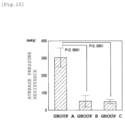
- FIG. 10 is a graph showing results of a pressure resistance test of the joined bovine carotid artery in Example 1.
- a tissue-joining member of the present embodiment (hereinafter it may be simply referred to as “joining member”) contains a non-crosslinked fibrous collagen.
- the non-crosslinked fibrous collagen in the joining member of the present embodiment, by heating to about less than 60° C. and greater than body temperature, the non-crosslinked fibrous collagen can be relaxed and expanded as shown in the examples below. Therefore, in the heating state, a phenomenon called fitting occurs, in which thin collagen fibers are entangled with each other, by pressing the non-crosslinked fibrous collagen of the joining member of the present embodiment in close contact with the collagen fibers in a living tissue.
- the collagen fibers can contract and tighten while the collagen fibers are still fitted, and the collagen fibers can be brought into a bonded state.
- the joining member of the present embodiment it is possible to join a living tissue without causing a tissue disorder such as denaturation and destruction of tissue components of the living tissue. That is, a living tissue can be joined without bleeding, hardening, dehydration, carbonization or the like caused by tissue damage.
- the joining member of the present embodiment has an effect of hemostasis at a joined portion of a living tissue, and an effect of preventing leakage of bodily fluids such as bile, pancreatic fluid and lymphatic fluid, and leakage of gas such as lung leakage.
- collagen is one of proteins mainly constituting dermis, ligaments, tendons, bones, cartilage and the like of vertebrates, and is a main component of an extracellular matrix of a multicellular animal.
- an amino acid residue constituting a peptide chain of a collagen protein has a primary structure of “-G (glycine residue) -X (amino acid X) -Y (amino acid Y)” (where X and Y each independently represent an arbitrary amine acid residue), in which glycine residues repeat every three residues.
- one peptide chain constituting the collagen protein is referred to as an ⁇ -chain.
- collagen In a collagen, three ⁇ -chains are gathered in a manner shifted by one amino acid residue respectively and the glycine residues come to the center, so as to form a loose right-handed helical structure. Further, hereinafter, this helical structure may be referred to as “collagen molecule”.
- fibrous collagen or “collagen fiber” means that the collagen molecules are gradually displaced and gathered in large numbers to form fibers, and a thickness thereof is about several tens of nm or more and hundreds of nm or less. “Fibrous collagen” or “collagen fiber” may be referred to as “collagen fibril”.
- collagen fiber bundle means a structure in which several hundreds of thousands or more and several millions or less of the collagen fibers are bundled, and the thickness thereof is about several ⁇ m or more and several tens of ⁇ m or less.
- the “collagen fiber bundle” may be referred to as “collagen fiber”.
- “denaturation” means that a three-dimensional structure is clearly and irreversibly changed even if the amino acid sequence of the protein is unchanged.
- expanding of the fibrous collagen is a minor change, which corresponds to a change in a quaternary structure of the protein and is highly likely to be reversible. Therefore, “denaturation” in the present description does not include expanding of the fibrous collagen.
- the joining member of the present embodiment contains a non-crosslinked fibrous collagen as a main component.
- non-crosslinked fibrous collagen refers to fibrous collagen that is not crosslinked or has no crosslinking groups.
- the fibrous collagen includes non-crosslinked fibrous collagen and crosslinked fibrous collagen.
- the fibrous collagen preferably forms a collagen fiber bundle as shown in FIGS. 1 to 5 described below.
- a content of the non-crosslinked fibrous collagen in the fibrous collagen can be appropriately selected according to a type of a tissue to be joined.
- the content of the non-crosslinked fibrous collagen in the fibrous collagen is preferably 50% by mass or more, more preferably 70% by mass or more, further preferably 90% by mass or more, particularly preferably 95% by mass or more, and most preferably 100% by mass, based on a total mass of the fibrous collagen.
- the content of the non-crosslinked fibrous collagen in fibrous collagen is set to the lower limit or more, it is possible to relax and expand a more sufficient amount of non-crosslinked fibrous collagen and to more effectively fit collagen fibers in a living tissue. Thereby, a living tissue can be joined more reliably. In addition, elasticity of the joined collagenous tissue can be maintained.
- fibrous collagen used for the joining member of the present embodiment an atelocollagen is preferable because of low antigenicity and high biocompatibility thereof.
- a type of the fibrous collagen may be any of type I, type II, and type III fibrous collagen. These fibrous collagens may be used alone or in combination of two or more types.
- the type of the fibrous collagen can be appropriately selected according to a type of a collagen tissue to be joined.
- the joining member of the present embodiment preferably has a shape having a certain area in order to cover a joined portion of the tissue, and can be film-like, sheet-like, or sponge-like. A size of the joining member can be appropriately adjusted to match a surface area of the joined portion.
- film means a film-like shape having a thickness of less than 250 ⁇ m
- sheet means a thin plate-like shape having a thickness of 250 ⁇ m or more
- sponge means a structure that is thicker than the sheet, has more voids than the sheet, has a low density, and has a high elasticity.
- a thickness of a sponge-like joining member is approximately 1 cm or more, but is not limited thereto.
- the “thickness” as used herein means a thickness of an entire film-like joining member, an entire sheet-like joining member or an entire sponge-like joining member, and for example, a thickness of a film-like joining member, a sheet-like joining member or a sponge-like joining member formed of a plurality of layers means a total thickness of all the layers constituting the film-like joining member, the sheet-like joining member, or the sponge-like joining member.
- the thickness of the joining member of the present embodiment can be, for example, 1 ⁇ m or more and 10 cm or less.
- the joining member of the present embodiment substantially does not contain water. That is, it means that the fibrous collagen contained in the joining member of the present embodiment is not a gelatin.
- substantially does not contain water means a state of not containing water at all.
- the phrase means a state of containing a very small amount of water to an extent that the non-crosslinked fibrous collagens do not fit together when portions of the non-crosslinked fibrous collagen contained in one joining member of the present embodiment are overlapped and heated, or non-crosslinked fibrous collagens contained in two joining member of the present embodiment are layered and heated so as to overlap with each other.
- it is possible to prevent the fibrous collagens contained in the joining member of the present embodiment from being fitted to each other at the time of storage under a high-temperature environment.
- FIG. 1 is a bottom view showing an example of a laminate body of the present embodiment.
- FIG. 2 is a cross-sectional view showing an example of the laminate body of the present embodiment.
- a laminate body 10 shown in FIGS. 1 and 2 includes a joining member 1 , a first adhesive layer 2 and a support 3 .
- the joining member 1 is layered on one surface of the support 3 , and the first adhesive layer 2 is layered on the same surface as the surface of the support 3 on which the joining member 1 is layered, in a region on which the joining member 1 is not layered.
- the joining member 1 includes a collagen fiber bundle in which a fibrous collagen is bundled.
- this collagen fiber bundle includes a non-crosslinked fibrous collagen.
- the laminate body 10 can be pressed and fixed to a joined portion of a tissue.
- the joining member 1 can be brought into close contact with the tissue with a constant pressure being applied to the tissue.
- the laminate body of the present embodiment may further include a second adhesive layer between the support and the joining member.
- the second adhesive layer can be easily peeled off from the joining member.
- FIG. 3 is a cross-sectional view showing an example of a laminate body of the present embodiment. Further, in drawings subsequent to FIG. 3 , the same components as those shown in the already described drawings are denoted by the same reference numerals as those in the already described drawings, and the detailed description thereof will be omitted.
- a laminate body 20 shown in FIG. 3 is the same as the laminate body 10 shown in FIG. 2 except that a second adhesive layer 4 is provided between the support 3 and the joining member 1 . That is, the laminate body 20 includes the joining member 1 , the first adhesive layer 2 , the support 3 and the second adhesive layer 4 . In addition, the joining member 1 , the second adhesive layer 4 , and the support 3 are layered in this order. Further, the first adhesive layer 2 is layered on the same surface as the surface of the support 3 on which the joining member 1 and the second adhesive layer 4 are layered, in a region on which the joining member 1 and the second adhesive layer 4 are not layered.
- the joining member 1 can be fixed onto the support 3 until the support 3 and the first adhesive layer 2 are removed.
- the support or the second adhesive layer may include, at least in part, a temperature-sensitive material configured to allow naked eyes or a sensor to sense that the joined portion has reached an optimum temperature (less than 60° C. and greater than body temperature).
- FIG. 4 is a cross-sectional view showing an example of a laminate body of the present embodiment.
- a laminate body 30 shown in FIG. 4 is the same as the laminate body 10 shown in FIG. 2 except that the support 3 includes a temperature-sensitive material-containing layer 5 in a part thereof. That is, the laminate body 30 includes the joining member 1 , the adhesive layer 2 , and the support 3 . The joining member 1 is layered on one surface of the support 3 . The first adhesive layer 2 is layered on the same surface as the surface of the support 3 on which the joining member 1 is layered, in a region on which the joining member 1 is not layered. Further, the support 3 includes the temperature-sensitive material-containing layer 5 in a part thereof.
- the laminate body is adhered with the temperature-sensitive material-containing layer 5 in the support 3 being arranged so as to be aligned with a joined portion, so that it can be sensed by the naked eyes or the sensor that the joined portion has reached an optimum temperature (less than 60° C. and greater than body temperature).
- FIG. 5 is a cross-sectional view showing an example of a laminate body of the present embodiment.
- a laminate body 40 shown in FIG. 5 is the same as the laminate body 20 shown in FIG. 3 except that the second adhesive layer 4 includes the temperature-sensitive material-containing layer 5 in a part thereof. That is, the laminate body 40 includes the joining member 1 , the first adhesive layer 2 , the support 3 , and the second adhesive layer 4 . In addition, the joining member 1 , the second adhesive layer 4 , and the support 3 are layered in this order. In addition, the first adhesive layer 2 is layered on the same surface as the surface of the support 3 on which the joining member 1 and the second adhesive layer 4 are layered, in a region on which the joining member 1 and the second adhesive layer 4 are not layered. Further, the second adhesive layer 4 includes the temperature-sensitive material-containing layer 5 in a part thereof.
- the laminate body 40 is adhered with the temperature-sensitive material-containing layer 5 in the second adhesive layer 4 being arranged so as to be aligned with a joined portion, so that it can be sensed by the naked eyes or the sensor that the joined portion has reached an optimum temperature (less than 60° C. and greater than body temperature).
- the laminate body of the present embodiment is not limited to those shown in FIGS. 1 to 5 , and in a range in which the effect of the laminate body of the present embodiment is not impaired, some configurations of those shown in FIGS. 1 to 5 may be changed or deleted, or other configurations may be further added to those described above.
- the layered bodies shown in FIGS. 1 to 5 have rectangular planar shapes, but other shapes can also be used.
- a planar shape of the laminate body include, but are not limited to, a polygonal shape (including a regular polygon shape or the like), a semicircular shape, an elliptical shape, a substantially circular shape, and the like.
- a thickness of the temperature-sensitive material-containing layer 5 is the same as a thickness of the support 3 , but the thickness of the temperature-sensitive material-containing layer 5 may be smaller than the thickness of the support 3 .
- either the support 3 or the second adhesive layer 4 may include the temperature-sensitive material-containing layer 5 .
- the temperature-sensitive material-containing layer 5 may be provided between the support 3 and the joining member 1 , between the joining member 1 and the second adhesive layer 4 , between the second adhesive layer 4 and the support 3 or on the support 3 .
- An adhesive forming the first adhesive layer is only required to show no toxicity to a living body.
- a type of the adhesive can be appropriately selected according to a type of a tissue to be adhered and a material of the support.
- Examples of the first adhesive include, but are not limited to, an adhesive made of a synthetic compound, an adhesive made of a natural compound, a double-sided tape, and the like.
- Examples of the adhesive made of the synthetic compound include an urethane adhesive, a cyanoacrylate adhesive, a polymethyl methacrylate (PMMA), a calcium phosphate adhesive, a resin cement, and the like.
- Examples of the adhesive made of the natural compound include fibrin glue, gelatin glue, and the like.
- double-sided tape tapes used in medical applications or the like are suitably used.
- examples of the double-sided tape include tapes having a structure in which an adhesive is layered on both sides of a supporting tape.
- examples of the adhesive used for the double-sided tape include a known adhesive which is rubber-based, acrylic-based, urethane-based, silicone-based, or vinyl ether-based, or the like.
- the double-sided tape include, a double-sided tape for attachment to skin manufactured by 3 M Japan Ltd. (product numbers: 1510, 1504 XL, 1524, and the like), a double-sided adhesive tape for skin manufactured by Nitto Denko Corporation (product numbers: ST 502, ST 534, and the like), a double-sided medicinal tape manufactured by Nichiban Medical Corp. (product numbers: #1088, #1022, #1010, #809SP, #414125, #1010R, #1088R, #8810 R, #2110 R, and the like), a thin type foam based double-sided adhesive tape manufactured by DIC Corp. (product numbers: #84010, #84015, #84020, and the like), and the like.
- the first adhesive layer may be formed of one type among those exemplified above, or may be formed of two or more types.
- a thickness of the first adhesive layer can be, for example, 1 ⁇ m or more and 1000 ⁇ m or less.
- the “thickness of the first adhesive layer” as used herein means a thickness of the entire first adhesive layer, and for example, a thickness of a first adhesive layer formed of a plurality of layers means a total thickness of all the layers constituting the first adhesive layer.
- a second adhesive forming the second adhesive layer is only required to show no toxicity to a living body, have low adhesiveness to a fibrous collagen, and have high adhesiveness to the support. By using such a second adhesive, the support can be attached to and detached from the fibrous collagen.
- Such a second adhesive can be appropriately selected from those exemplified in “First adhesive” according to the type of material constituting the support.
- a material of the support is only required to show no toxicity to a living body, and have low adhesiveness to a collagen.
- the material of the support is preferably a material that transmits the laser. Examples of the material of the support include, but are not limited to, an elastomer material, a plastic containing a dendritic polymer, a copolymer, and the like.
- elastomer material examples include urethane rubber, nitrile rubber, silicone rubber, silicone resin (for example, polydimethylsiloxane), fluororubber, acrylic rubber, isoprene rubber, ethylene propylene rubber, chlorosulfonated polyethylene rubber, epichlorohydrin rubber, chloroprene rubber, styrene butadiene rubber, butadiene rubber, polyisobutylene rubber, and the like.
- dendritic polymer examples include polyvinyl chloride, polyvinyl alcohol, polymethyl methacrylate, polydimethylsiloxane monomethacrylate, cyclic olefin polymer, fluorocarbon polymer, polytetrafluoroethylene (Teflon (registered trademark)), polystyrene, polypropylene, polyethyleneimine, and the like.
- copolymer examples include polyvinyl acetate-co-maleic anhydride, polystyrene-co-maleic anhydride, polyethylene-co-acrylic acid, derivatives thereof, and the like.
- the support may be formed of one type among materials exemplified above, or may be formed of two or more types.
- a thickness of the support can be, for example, 1 ⁇ m or more and 2000 ⁇ m or less.
- the “thickness of the support” as used herein means the thickness of the entire support, and for example, a thickness of a support formed of a plurality of layers means a total thickness of all the layers constituting the support.
- the temperature-sensitive material is used to sense, by the naked eyes or the sensor, that the joined portion has reached the optimum temperature (less than 60° C. and greater than body temperature) by heating.
- the temperature-sensitive material include a thermochromic pigment, and the like.
- thermochromic pigment may be a reversible pigment that decolorizes (or whitens) when the temperature rises to the optimum temperature and develops color when the temperature drops below the optimum temperature, and may be a reversible pigment that develops color when the temperature rises to the optimum temperature and decolorizes (or whitens) when the temperature drops below the optimum temperature.
- thermochromic pigment examples include inorganic compounds such as Ag 2 HgI 4 and Cu 2 HgI 4 .
- thermochromic pigment examples include, blue, violet, black, red, rose red, green, emerald green and the like.
- thermochromic pigments examples include, but are not limited to, pigments having a color erasing start of 30° C. or higher and 50° C. or lower, an intermediate color setting temperature of 35° C. or higher and 55° C. or lower, and a color erasing completion of 40° C. or higher and 60° C. or lower, among OR series, DR series and ER series manufactured by Kirokusozai Sogo Kenkyusho Co.
- the thermochromic pigment may be composed of one type among those exemplified above, or may be composed of two or more types.
- a thickness of a temperature-sensitive material-containing layer can be, for example, 100 nm or more and 1000 ⁇ m or less.
- the “thickness of a temperature-sensitive material-containing layer” as used herein means the thickness of the entire temperature-sensitive material-containing layer, and for example, a thickness of a temperature-sensitive material-containing layer formed of a plurality of layers means a total thickness of all the layers constituting the temperature-sensitive material-containing layer.
- FIG. 6 is a schematic process view showing an example of a method for using the joining member or the laminate body of the present embodiment.
- the method for using the joining member or the laminate body of the present embodiment includes a heating step and a cooling step. Each step will be described in detail below.
- the joining member or the laminate body, which is layered on a tissue is heated to less than 60° C. and greater than body temperature.
- the joining member 1 in order to join a collagenous tissue 100 of a living body in a living tissue such as skin, first, the joining member 1 (laminate body 10 ) is adhered onto a cut portion of the collagen tissue 100 of the living body. Next, the joining member 1 (laminate body 10 ) is heated. At this time, it is estimated that, first, the temperature of moisture in the collagenous tissue of the cut living body rises, so that the temperature of the collagenous tissue of the cut living body rises, and then, the temperature of the adhered joining member 1 (laminate body 10 ) rises to a similar temperature.
- a lower limit of a heating temperature can be higher than body temperature.
- Body temperature can be appropriately selected according to an animal species to be joined.
- the animal species to be joined is a thermophilic animal such as fish, amphibian and reptile
- body temperature is appropriately adjusted according to an ambient temperature.
- the lower limit of the heating temperature can be 4° C., preferably 10° C., more preferably 15° C., and further preferably 20° C.
- body temperature is about 40° C. or higher and 43° C. or lower.
- the lower limit of the heating temperature can be 43° C., preferably 45° C., and more preferably 47° C.
- body temperature is about 35° C. or higher and 39° C. or lower.
- the lower limit of the heating temperature can be 39° C., preferably 40° C., more preferably 42° C., further preferably 45° C., and particularly preferably 47° C.
- body temperature is about 36° C. or higher and 42° C. or lower.
- the lower limit of the heating temperature can be 42° C., preferably 45° C., and more preferably 47° C.
- an upper limit of the heating temperature can be less than 60° C., preferably 55° C. or lower, and more preferably 52° C. or lower.
- the heating temperature can be set to be greater than 39° C. and less than 60° C., preferably 40° C. or higher and 55° C. or lower, more preferably 42° C. or higher and 55° C. or lower, further preferably 45° C. or higher and 55° C. or lower, and particularly preferably 47° C. or higher and 52° C. or lower.
- the collagen fibers can be more effectively relaxed and expanded. Meanwhile, by setting the heating temperature to the upper limit or less, it is possible to more effectively prevent tissue components of a living tissue from being denatured and destroyed. This makes it possible to more effectively prevent tissue disorders of the living tissue.
- the heating method is only required to non-invasively heat a joined portion in the temperature range in a short time, and examples thereof include a heating method using a laser, an RF wave dielectric heating method, an RF wave electromagnetic induction heating method, a microwave heating method, an ultrasonic heating method and the like.
- a heating method using a laser is preferable because it can heat a local portion to a target temperature in a short time in a non-contact manner.
- a wavelength can be set to, for example, about 350 nm or more and 6000 nm or less, for example, about 400 nm or more and 4000 nm or less, for example, about 1470 nm or more and 1950 nm or less.
- a heating time can be set to a short time of, for example, about 1 second or more and 60 seconds or less.
- a method for pressing the joined portion include a method for fixing the laminate body to a surrounding tissue of the living tissue by using a laminate body including a support, a joining member, and a first adhesive layer.
- the heated joining member or laminate body is cooled.
- An upper limit of a cooling temperature can be body temperature or lower.
- a lower limit of the cooling temperature can be a lower limit of body temperature of the animal species to be joined.
- Body temperature can be appropriately selected according to the animal species to be joined. Body temperature of each animal species is as exemplified in the “heating step”.
- the cooling temperature can be 20° C. or lower, and preferably 0° C. or higher and 15° C. or lower.
- the cooling temperature can be 43° C. or lower, and preferably 40° C. or higher and 43° C. or lower.
- the cooling temperature can be 39° C. or lower, and preferably 35° C. or higher and 38° C. or lower.
- the temperature can be 42° C. or lower, and preferably 36° C. or higher and 42° C. or lower.
- the collagen fibers in the living tissue and the non-crosslinked fibrous collagen contained in the joining member can be contracted and tightened while maintaining the fitted state, and the collagen fibers can be joined to each other. Therefore, it is possible to join the living tissue by using the joining member and the laminate body of the present embodiment.
- examples of a cooling method include a method of standing at room temperature, a method of applying cool air to the joined portion, a body surface cooling method using such as a Peltier element, a compressed gas, an ice bag, a cooling blanket, an ice water tank, or the like.
- the joining member and the laminate body of the present embodiment may be used for joining a living tissue, or may be used for joining a living tissue and an artificial object.
- the present invention provides a method for joining a living tissue using the joining member or the laminate body.
- the present invention provides a method for joining a living tissue and an artificial object using the joining member or the laminate body.
- the joining member and the laminate body of the present embodiment are preferably used in joining of nerves (peripheral nerves, central nerves, and the like), organs (liver, pancreas, and the like), bones, teeth, a tissue without blood flow (cartilage, meniscus, and the like), or the like.
- nerves peripheral nerves, central nerves, and the like
- organs liver, pancreas, and the like
- bones teeth
- a tissue without blood flow cartilage, meniscus, and the like
- a tissue without blood flow cartilage, meniscus, and the like
- tissue without blood flow cartilage, meniscus, and the like
- it is preferably used for joining a living tissue and an artificial organ or an implant device.
- the artificial organ or the implant device examples include artificial skin, cochlear implants, pacemakers, bone plates and the like.
- the joining member and the laminate body of the present embodiment as a reinforcing material in joining of living tissue by a staple used in the conventional surgery, it is possible to perform anastomosis with higher reliability.
- the treatment system of the present embodiment includes the joining member according to the embodiment or the laminate body according to the embodiment, and a heating unit.
- a living tissue without causing degeneration and destruction of tissue components of a living tissue. That is, a living tissue can be joined without bleeding, hardening, dehydration, carbonization or the like caused by tissue damage.
- the heating unit is only required to be configured to heat the joining member or the laminate body to less than 60° C. and greater than body temperature.
- Specific examples of the heating unit include a laser, an RF wave generator (dielectric and induction), a microwave generator, an ultrasonic generator and the like.
- a laser is preferable because it can instantaneously heat a local area.
- the treatment system of the present embodiment may further include a temperature control unit.
- the temperature control unit is only required to be configured to control the heating unit such that the temperature of the joining member or the laminate body heated by the heating unit becomes less than 60° C. and greater than body temperature.
- the temperature control unit can include, for example, a thermometer or a temperature sensor and a control circuit.
- the thermometer or the temperature sensor and the heating unit can be connected to the control circuit. Thereby, the temperature of the joining member or the laminate body heated by the heating unit can be sensed by using the thermometer or the temperature sensor, and heating by the heating unit can be terminated by the control circuit when the temperature detected by the thermometer or the temperature sensor falls within a temperature range less than 60° C. and greater than body temperature.
- thermochromic pigment when the laminate body includes a thermochromic pigment, a sensor for identifying a change in color of the thermochromic pigment may be provided in place of the thermometer or the temperature sensor. At this time, the sensor and the heating unit can be connected to the control circuit. Thereby, the change in color of the thermochromic pigment in the laminate body heated by the heating unit can be detected by using the sensor, and when the color of the thermochromic pigment is decolorized or colored at the temperature range less than 60° C. and greater than body temperature, the sensor identifies the change in color, so that the heating by the heating unit can be terminated by the control circuit.
- the treatment system of the present embodiment may further include a cooling unit in addition to the components.
- a cooling unit include a Peltier element, a compressed gas, a cold air generation device, an ice bag, a cooling blanket, an ice water tank, and the like.
- the temperature control unit may control the cooling unit such that the temperature of the joining member or the laminate body heated by the heating unit becomes less than body temperature.
- the treatment system of the present embodiment may further include a fixing portion in addition to the components.
- the fixing portion is only required to be configured to fix the joining member or the laminate body at a desired position so as not to peel off, and examples thereof include a clamp and a surgical tape.
- the treatment system of the present embodiment can be used, for example, in the following procedure.
- the temperature control unit heats the joining member or the laminate body by using the heating unit while detecting the temperature, and relaxes and expands the collagen fibers in the living tissue and the non-crosslinked body contained in the joining member or the laminate body to fit them.
- the temperature control unit heats the joining member or the laminate body by using the heating unit while detecting the temperature, and relaxes and expands the collagen fibers in the living tissue and the non-crosslinked body contained in the joining member or the laminate body to fit them.
- the temperature control unit when the temperature of the joining member or the laminate body is in a range less than 60° C. and greater than body temperature, the heating of the joining member or the laminate body by the heating unit is terminated by the temperature control unit or the like.
- the collagen fibers in the living tissue and the non-crosslinked fibrous collagen contained in the joining member or the laminate body can be contracted and tightened while maintaining the fitted state, and the collagen fibers can be joined to each other. Therefore, it is possible to join the living tissues by using the treatment system of the present embodiment.
- a vertebrate is preferable as an application object of the treatment system of the present embodiment.
- a vertebrate include fish, amphibian, reptile, bird, mammal, and the like.
- mammalian is preferable.
- mammalian include, but are not limited to, human, chimpanzee and other primates; and domestic animals, pet animals, and laboratory animals such as dog, cat, rabbit, horse, sheep, goat, cow, pig, rat (including nude rat), mouse, (including nude mouse and SCID mouse), and marmot.
- human is preferable as mammalian.
- a temperature change of collagen in a bovine carotid artery adventitia was observed. Specifically, a bovine carotid artery was allowed to stand for 48 hours in a fixative (glutaraldehyde) at 4° C. and 45° C.
- FIG. 7 a left image shows a result of keeping the temperature at 4° C., and a right image shows the result of keeping the temperature at 45° C.
- FIG. 8 A procedure of the joining test is shown in FIG. 8 . Specifically, first, all layers of a half circumference of a bovine carotid artery having an outer diameter of about 8 mm were incised, and both ends of a layer of blood vessel were matched and brought into close contact with each other.
- a biomaterial collagen manufactured by Koken Co., Ltd., content of non-crosslinked atelocollagen fibers in atelocollagen fibers: 90% by mass or more
- a Teflon sheet was wound on the arterial adventitia-deficient portion and pressure-bonded.
- the incision portion was irradiated with a laser (wavelength: 1950 nm, fiber laser) set at a maximum temperature of 55° C. for 2 seconds, and cooled to about 37° C.
- a laser wavelength: 1950 nm, fiber laser
- a bovine carotid artery in which a biomaterial collagen was used to cover the arterial adventitia-deficient portion of the incision portion, and a Teflon sheet was wound on the arterial adventitia-deficient portion and pressure-bonded, but laser irradiation was not performed hereinafter, the bovine carotid artery subjected to the treatment may be referred to as “Group B”
- a bovine carotid artery in which laser irradiation was performed without covering the incision portion with a biomaterial collagen hereinafter, the bovine carotid artery subjected to the treatment may be referred to as “Group C” were also prepared.
- a tissue piece of a cross section of the joined portion of each bovine carotid artery in Groups A to C obtained in “1.” was prepared, and for some of the tissue pieces, Masson's Trichrome staining was used to stain the biomaterial collagen red and the collagen fiber bundle in the bovine carotid adventitia into a blue color. Observation was performed using an optical microscope (manufactured by Carl Zeiss, magnification: 400 times) and a scanning electron microscope (manufactured by Hitachi High-Technologies Corporation, magnification: 30,000 times), and comparative examination was performed. Representative results for Group A are shown in FIG. 9 . Two upper images in FIG.
- FIG. 9 are optical microscope images, where a left image is a bright field image, and a right image is a stained image.
- three lower images in FIG. 9 are electron microscope images, where a left image corresponds to a biomaterial collagen portion.
- a middle image corresponds to a fitting portion between the biomaterial collagen and the collagen fiber bundle in the bovine carotid artery adventitia.
- a right image corresponds to the collagen fiber bundle portion in the bovine carotid artery adventitia.
- a perforation model having a diameter of about 3 mm was prepared in a small intestine of a pig. Then, a perforation portion was covered with a biomaterial collagen having a length of 10 mm ⁇ a width of 10 mm ⁇ a thickness of 0.3 mm (manufactured by Koken Co., Ltd., content of non-crosslinked atelocollagen fibers in atelocollagen fibers: 50% by mass or more), wound by a Teflon sheet and pressure-bonded, and then irradiated with a semiconductor laser (wavelength: 1400 to 1950 nm, fiber laser) set to a maximum temperature of 52° C. for 10 seconds and cooled to about room temperature (15° C. or higher and 35° C.
- a semiconductor laser wavelength: 1400 to 1950 nm, fiber laser
- Group A the small intestine of a pig subjected to the treatment
- Group B a small intestine of a pig in which a perforation portion was sutured and closed
- Group A was significantly higher (p ⁇ 0.0001).
- two types of collagen fibers one having no striped patterns derived from the biomaterial collagen, and one having striped patterns derived from the collagen in the small intestine of a pig, were entangled with each other (not shown).
- the joining member and the laminate body of the present embodiment it is possible to join a living tissue without causing a tissue disorder.
- the joining member and the laminate body of the present embodiment are preferably used in joining such as nerves (peripheral nerves, central nerves, and the like), bones, and tissues without blood flow (cartilage, meniscus, and the like).
Landscapes
- Health & Medical Sciences (AREA)
- Life Sciences & Earth Sciences (AREA)
- Surgery (AREA)
- General Health & Medical Sciences (AREA)
- Veterinary Medicine (AREA)
- Public Health (AREA)
- Animal Behavior & Ethology (AREA)
- Epidemiology (AREA)
- Heart & Thoracic Surgery (AREA)
- Engineering & Computer Science (AREA)
- Vascular Medicine (AREA)
- Chemical & Material Sciences (AREA)
- Materials Engineering (AREA)
- Nuclear Medicine, Radiotherapy & Molecular Imaging (AREA)
- Biomedical Technology (AREA)
- Medical Informatics (AREA)
- Molecular Biology (AREA)
- Materials For Medical Uses (AREA)
- Laser Surgery Devices (AREA)
Abstract
Description
-
- a support;
- a joining member according to the first aspect of the joining member, which is layered on one surface of the support; and
- a first adhesive layer that is layered on said one surface of the support in a region on which the joining member is not layered.
-
- a heating step in which the joining member or the laminate body is heated to less than 60° C. and greater than body temperature after having being layered on the tissue; and
- a cooling step in which the heated joining member or laminate body is cooled to body temperature or lower.
-
- a heating unit. The treatment system according to the above-mentioned fourth aspect may comprise further a temperature control unit configured to control the heating unit such that a temperature of the joining member or the laminate body heated by the heating unit is less than 60° C. and greater than body temperature.
| TABLE 1 | ||||
| Pressure resistance | ||||
| Collagen | Heating by laser | (average value) [mmHg] | ||
| Group A | + | + | 303.6 ± 55.2 |
| Group B | + | − | 50.8 ± 33.0 |
| Group C | − | + | 49.0 ± 11.8 |
-
- 1 joining member; 2 first adhesive layer; 3 support; 4 second adhesive layer; 5 temperature-sensitive material-containing layer; 10, 20, 30, 40 laminate body; 100 collagenous tissue of a living body
Claims (13)
Applications Claiming Priority (3)
| Application Number | Priority Date | Filing Date | Title |
|---|---|---|---|
| JP2018037082 | 2018-03-02 | ||
| JP2018-037082 | 2018-03-02 | ||
| PCT/JP2019/007317 WO2019167943A1 (en) | 2018-03-02 | 2019-02-26 | Tissue-joining member, and use thereof |
Publications (2)
| Publication Number | Publication Date |
|---|---|
| US20210106332A1 US20210106332A1 (en) | 2021-04-15 |
| US12004747B2 true US12004747B2 (en) | 2024-06-11 |
Family
ID=67805816
Family Applications (1)
| Application Number | Title | Priority Date | Filing Date |
|---|---|---|---|
| US16/977,350 Active 2041-10-07 US12004747B2 (en) | 2018-03-02 | 2019-02-26 | Tissue-joining member, and use thereof |
Country Status (4)
| Country | Link |
|---|---|
| US (1) | US12004747B2 (en) |
| EP (1) | EP3744358A4 (en) |
| JP (1) | JP7444455B2 (en) |
| WO (1) | WO2019167943A1 (en) |
Families Citing this family (1)
| Publication number | Priority date | Publication date | Assignee | Title |
|---|---|---|---|---|
| JP2025078895A (en) * | 2022-03-31 | 2025-05-21 | 株式会社ジェイメック | Irradiation device and irradiation method |
Citations (8)
| Publication number | Priority date | Publication date | Assignee | Title |
|---|---|---|---|---|
| US4233360A (en) | 1975-10-22 | 1980-11-11 | Collagen Corporation | Non-antigenic collagen and articles of manufacture |
| WO1992013578A1 (en) | 1990-07-09 | 1992-08-20 | Bausch & Lomb Incorporated | A biologically derived medical adhesive and its uses |
| JPH0759812A (en) | 1993-08-27 | 1995-03-07 | Koken Co Ltd | Wound cover material and method for producing the same |
| JPH0833700A (en) | 1994-01-24 | 1996-02-06 | Imedex | Surgical adhesive composition based on non-crosslinked collagen modified by oxidative degradation |
| WO2000009018A1 (en) | 1998-08-10 | 2000-02-24 | Fibrogen, Inc. | Collagen type i and type iii hemostatic compositions for use as a vascular sealant and wound dressing |
| US6623963B1 (en) * | 1999-12-20 | 2003-09-23 | Verigen Ag | Cellular matrix |
| US20060159731A1 (en) * | 2002-06-03 | 2006-07-20 | Yissum Research Development Company Of The Hebrew University Of Jerusalem | Multi-layer collagenic article useful for wounds healing and a method for its production thereof |
| US20070034667A1 (en) | 2005-08-15 | 2007-02-15 | Holsten Henry E | Surgical stapling instruments including a cartridge having multiple staple sizes |
Family Cites Families (4)
| Publication number | Priority date | Publication date | Assignee | Title |
|---|---|---|---|---|
| CA1073360A (en) * | 1975-10-22 | 1980-03-11 | John R. Daniels | Non-antigenic collagen and articles of manufacture |
| JPH0774239B2 (en) * | 1986-09-04 | 1995-08-09 | 新田ゼラチン株式会社 | Manufacturing method of high gel strength acid soluble collagen for cell culture |
| US9173698B2 (en) | 2010-09-17 | 2015-11-03 | Aesculap Ag | Electrosurgical tissue sealing augmented with a seal-enhancing composition |
| DE102017215177B4 (en) | 2016-09-02 | 2024-10-10 | Idex Biometrics Asa | Method for producing a cover element suitable for a fingerprint sensor |
-
2019
- 2019-02-26 JP JP2020503523A patent/JP7444455B2/en active Active
- 2019-02-26 EP EP19760210.5A patent/EP3744358A4/en not_active Withdrawn
- 2019-02-26 WO PCT/JP2019/007317 patent/WO2019167943A1/en not_active Ceased
- 2019-02-26 US US16/977,350 patent/US12004747B2/en active Active
Patent Citations (12)
| Publication number | Priority date | Publication date | Assignee | Title |
|---|---|---|---|---|
| US4233360A (en) | 1975-10-22 | 1980-11-11 | Collagen Corporation | Non-antigenic collagen and articles of manufacture |
| WO1992013578A1 (en) | 1990-07-09 | 1992-08-20 | Bausch & Lomb Incorporated | A biologically derived medical adhesive and its uses |
| JPH04231961A (en) | 1990-07-09 | 1992-08-20 | Bausch & Lomb Inc | Collagen medical adhesive and use thereof |
| JPH0759812A (en) | 1993-08-27 | 1995-03-07 | Koken Co Ltd | Wound cover material and method for producing the same |
| JPH0833700A (en) | 1994-01-24 | 1996-02-06 | Imedex | Surgical adhesive composition based on non-crosslinked collagen modified by oxidative degradation |
| US5618551A (en) | 1994-01-24 | 1997-04-08 | Imedex | Biocompatible bioresorbable and non-toxic adhesive composition for surgical use |
| WO2000009018A1 (en) | 1998-08-10 | 2000-02-24 | Fibrogen, Inc. | Collagen type i and type iii hemostatic compositions for use as a vascular sealant and wound dressing |
| JP2002524110A (en) | 1998-08-10 | 2002-08-06 | フィブロジェン, インコーポレイテッド | Collagen type I and collagen type III hemostatic compositions for use as vascular sealants and wound dressings - Patents.com |
| US6623963B1 (en) * | 1999-12-20 | 2003-09-23 | Verigen Ag | Cellular matrix |
| US20060159731A1 (en) * | 2002-06-03 | 2006-07-20 | Yissum Research Development Company Of The Hebrew University Of Jerusalem | Multi-layer collagenic article useful for wounds healing and a method for its production thereof |
| US20070034667A1 (en) | 2005-08-15 | 2007-02-15 | Holsten Henry E | Surgical stapling instruments including a cartridge having multiple staple sizes |
| JP2018020149A (en) | 2006-05-18 | 2018-02-08 | コヴィディエン リミテッド パートナーシップ | Surgical stapling instruments including cartridge having multiple staple sizes |
Non-Patent Citations (8)
Also Published As
| Publication number | Publication date |
|---|---|
| JPWO2019167943A1 (en) | 2021-03-25 |
| WO2019167943A1 (en) | 2019-09-06 |
| EP3744358A4 (en) | 2021-10-27 |
| US20210106332A1 (en) | 2021-04-15 |
| JP7444455B2 (en) | 2024-03-06 |
| EP3744358A1 (en) | 2020-12-02 |
Similar Documents
| Publication | Publication Date | Title |
|---|---|---|
| US8956390B2 (en) | Devices and methods for applying bolster materials to surgical fastening apparatuses | |
| US5972007A (en) | Energy-base method applied to prosthetics for repairing tissue defects | |
| RU2203095C2 (en) | Biologically compatible glue | |
| AU739161B2 (en) | Prosthetic with collagen for tissue repair | |
| CN106821438B (en) | A kind of previous anastomotic reinforces sub-assembly and its application method | |
| US20100298873A1 (en) | Surgical suture material with anchoring elements | |
| JP5789799B2 (en) | Porous body manufacturing method, cell or tissue supply support manufacturing method, and tissue supply body manufacturing method | |
| CA2701183A1 (en) | Absorbable adhesives and their formulation for use in medical applications | |
| US6632450B1 (en) | Adherable biomaterial patches and methods for producing and for using same | |
| US20210236130A1 (en) | Sutureless Repair of Soft Tissue | |
| JP2008178670A5 (en) | ||
| US20210106332A1 (en) | Tissue-joining member, and use thereof | |
| Sasaki et al. | Principles and development of collagen-mediated tissue fusion induced by laser irradiation | |
| JP2022064878A (en) | Surgical implant for repairing defect in spinal dura mater | |
| von Sochaczewski et al. | A continuous suture anastomosis outperforms a simple interrupted suture anastomosis in esophageal elongation | |
| CA3084334A1 (en) | Sheet-like decellularized material and artificial blood vessel using the material | |
| US20230200966A1 (en) | Tissue wrap device with attachment features | |
| WO2020185851A1 (en) | Anastomosing stent and methods of use | |
| Brewster et al. | A biodegradable vascular coupling device for end-to-end anastomosis | |
| 佐々木駿 | Principles and development of collagen-mediated tissue fusion induced by laser irradiation | |
| US11998654B2 (en) | Securing implants and medical devices | |
| KR20180015156A (en) | A sheet of a living body tissue, a tubular structure obtained from the sheet, and an artificial blood vessel made of the tubular structure | |
| WO2007030892A1 (en) | Method of tissue repair iii | |
| Zikry | Evaluation of poly (vinyl alcohol) cryogel as viscoelastic reconstruction graft for the ascending aorta | |
| Czamara | A Fastening Device for Rotator Cuff Repair |
Legal Events
| Date | Code | Title | Description |
|---|---|---|---|
| FEPP | Fee payment procedure |
Free format text: ENTITY STATUS SET TO UNDISCOUNTED (ORIGINAL EVENT CODE: BIG.); ENTITY STATUS OF PATENT OWNER: SMALL ENTITY |
|
| FEPP | Fee payment procedure |
Free format text: ENTITY STATUS SET TO SMALL (ORIGINAL EVENT CODE: SMAL); ENTITY STATUS OF PATENT OWNER: SMALL ENTITY |
|
| STPP | Information on status: patent application and granting procedure in general |
Free format text: APPLICATION DISPATCHED FROM PREEXAM, NOT YET DOCKETED |
|
| AS | Assignment |
Owner name: CI LABO INC., JAPAN Free format text: ASSIGNMENT OF ASSIGNORS INTEREST;ASSIGNORS:IKEDA, TETSUO;SASAKI, SHUN;OKI, EIJI;AND OTHERS;SIGNING DATES FROM 20200820 TO 20210125;REEL/FRAME:056743/0649 |
|
| AS | Assignment |
Owner name: IKEDA, TETSUO, JAPAN Free format text: ASSIGNMENT OF ASSIGNORS INTEREST;ASSIGNOR:CI LABO INC.;REEL/FRAME:056792/0783 Effective date: 20210315 |
|
| STPP | Information on status: patent application and granting procedure in general |
Free format text: DOCKETED NEW CASE - READY FOR EXAMINATION |
|
| STPP | Information on status: patent application and granting procedure in general |
Free format text: NON FINAL ACTION MAILED |
|
| STPP | Information on status: patent application and granting procedure in general |
Free format text: RESPONSE TO NON-FINAL OFFICE ACTION ENTERED AND FORWARDED TO EXAMINER |
|
| STPP | Information on status: patent application and granting procedure in general |
Free format text: NOTICE OF ALLOWANCE MAILED -- APPLICATION RECEIVED IN OFFICE OF PUBLICATIONS |
|
| ZAAB | Notice of allowance mailed |
Free format text: ORIGINAL CODE: MN/=. |
|
| STPP | Information on status: patent application and granting procedure in general |
Free format text: PUBLICATIONS -- ISSUE FEE PAYMENT VERIFIED |
|
| STCF | Information on status: patent grant |
Free format text: PATENTED CASE |