US11999694B2 - Delivery of therapeutic alkaloid compounds - Google Patents

Delivery of therapeutic alkaloid compounds Download PDF

Info

Publication number
US11999694B2
US11999694B2 US17/976,150 US202217976150A US11999694B2 US 11999694 B2 US11999694 B2 US 11999694B2 US 202217976150 A US202217976150 A US 202217976150A US 11999694 B2 US11999694 B2 US 11999694B2
Authority
US
United States
Prior art keywords
alkyl
compound
formula
phenyl
membered heteroaryl
Prior art date
Legal status (The legal status is an assumption and is not a legal conclusion. Google has not performed a legal analysis and makes no representation as to the accuracy of the status listed.)
Active
Application number
US17/976,150
Other versions
US20230159455A1 (en
Inventor
Jacob M. Hooker
Michael S. Placzek
Current Assignee (The listed assignees may be inaccurate. Google has not performed a legal analysis and makes no representation or warranty as to the accuracy of the list.)
Sensorium Therapeutics Inc
Original Assignee
Sensorium Therapeutics Inc
Priority date (The priority date is an assumption and is not a legal conclusion. Google has not performed a legal analysis and makes no representation as to the accuracy of the date listed.)
Filing date
Publication date
Application filed by Sensorium Therapeutics Inc filed Critical Sensorium Therapeutics Inc
Priority to US17/976,150 priority Critical patent/US11999694B2/en
Assigned to SENSORIUM THERAPEUTICS, INC. reassignment SENSORIUM THERAPEUTICS, INC. ASSIGNMENT OF ASSIGNORS INTEREST (SEE DOCUMENT FOR DETAILS). Assignors: PLACZEK, MICHAEL S., HOOKER, Jacob M.
Publication of US20230159455A1 publication Critical patent/US20230159455A1/en
Priority to US18/405,058 priority patent/US12269800B2/en
Application granted granted Critical
Publication of US11999694B2 publication Critical patent/US11999694B2/en
Priority to US19/069,687 priority patent/US20250243161A1/en
Active legal-status Critical Current
Anticipated expiration legal-status Critical

Links

Images

Classifications

    • CCHEMISTRY; METALLURGY
    • C07ORGANIC CHEMISTRY
    • C07DHETEROCYCLIC COMPOUNDS
    • C07D209/00Heterocyclic compounds containing five-membered rings, condensed with other rings, with one nitrogen atom as the only ring hetero atom
    • C07D209/02Heterocyclic compounds containing five-membered rings, condensed with other rings, with one nitrogen atom as the only ring hetero atom condensed with one carbocyclic ring
    • C07D209/04Indoles; Hydrogenated indoles
    • C07D209/10Indoles; Hydrogenated indoles with substituted hydrocarbon radicals attached to carbon atoms of the hetero ring
    • C07D209/12Radicals substituted by oxygen atoms
    • AHUMAN NECESSITIES
    • A61MEDICAL OR VETERINARY SCIENCE; HYGIENE
    • A61KPREPARATIONS FOR MEDICAL, DENTAL OR TOILETRY PURPOSES
    • A61K45/00Medicinal preparations containing active ingredients not provided for in groups A61K31/00 - A61K41/00
    • A61K45/06Mixtures of active ingredients without chemical characterisation, e.g. antiphlogistics and cardiaca
    • AHUMAN NECESSITIES
    • A61MEDICAL OR VETERINARY SCIENCE; HYGIENE
    • A61PSPECIFIC THERAPEUTIC ACTIVITY OF CHEMICAL COMPOUNDS OR MEDICINAL PREPARATIONS
    • A61P25/00Drugs for disorders of the nervous system
    • A61P25/22Anxiolytics
    • CCHEMISTRY; METALLURGY
    • C07ORGANIC CHEMISTRY
    • C07DHETEROCYCLIC COMPOUNDS
    • C07D401/00Heterocyclic compounds containing two or more hetero rings, having nitrogen atoms as the only ring hetero atoms, at least one ring being a six-membered ring with only one nitrogen atom
    • C07D401/02Heterocyclic compounds containing two or more hetero rings, having nitrogen atoms as the only ring hetero atoms, at least one ring being a six-membered ring with only one nitrogen atom containing two hetero rings
    • C07D401/12Heterocyclic compounds containing two or more hetero rings, having nitrogen atoms as the only ring hetero atoms, at least one ring being a six-membered ring with only one nitrogen atom containing two hetero rings linked by a chain containing hetero atoms as chain links
    • CCHEMISTRY; METALLURGY
    • C07ORGANIC CHEMISTRY
    • C07DHETEROCYCLIC COMPOUNDS
    • C07D403/00Heterocyclic compounds containing two or more hetero rings, having nitrogen atoms as the only ring hetero atoms, not provided for by group C07D401/00
    • C07D403/02Heterocyclic compounds containing two or more hetero rings, having nitrogen atoms as the only ring hetero atoms, not provided for by group C07D401/00 containing two hetero rings
    • C07D403/12Heterocyclic compounds containing two or more hetero rings, having nitrogen atoms as the only ring hetero atoms, not provided for by group C07D401/00 containing two hetero rings linked by a chain containing hetero atoms as chain links
    • CCHEMISTRY; METALLURGY
    • C07ORGANIC CHEMISTRY
    • C07DHETEROCYCLIC COMPOUNDS
    • C07D405/00Heterocyclic compounds containing both one or more hetero rings having oxygen atoms as the only ring hetero atoms, and one or more rings having nitrogen as the only ring hetero atom
    • C07D405/02Heterocyclic compounds containing both one or more hetero rings having oxygen atoms as the only ring hetero atoms, and one or more rings having nitrogen as the only ring hetero atom containing two hetero rings
    • C07D405/12Heterocyclic compounds containing both one or more hetero rings having oxygen atoms as the only ring hetero atoms, and one or more rings having nitrogen as the only ring hetero atom containing two hetero rings linked by a chain containing hetero atoms as chain links
    • CCHEMISTRY; METALLURGY
    • C07ORGANIC CHEMISTRY
    • C07DHETEROCYCLIC COMPOUNDS
    • C07D409/00Heterocyclic compounds containing two or more hetero rings, at least one ring having sulfur atoms as the only ring hetero atoms
    • C07D409/02Heterocyclic compounds containing two or more hetero rings, at least one ring having sulfur atoms as the only ring hetero atoms containing two hetero rings
    • C07D409/12Heterocyclic compounds containing two or more hetero rings, at least one ring having sulfur atoms as the only ring hetero atoms containing two hetero rings linked by a chain containing hetero atoms as chain links
    • CCHEMISTRY; METALLURGY
    • C07ORGANIC CHEMISTRY
    • C07DHETEROCYCLIC COMPOUNDS
    • C07D475/00Heterocyclic compounds containing pteridine ring systems
    • C07D475/02Heterocyclic compounds containing pteridine ring systems with an oxygen atom directly attached in position 4
    • C07D475/04Heterocyclic compounds containing pteridine ring systems with an oxygen atom directly attached in position 4 with a nitrogen atom directly attached in position 2
    • CCHEMISTRY; METALLURGY
    • C07ORGANIC CHEMISTRY
    • C07DHETEROCYCLIC COMPOUNDS
    • C07D487/00Heterocyclic compounds containing nitrogen atoms as the only ring hetero atoms in the condensed system, not provided for by groups C07D451/00 - C07D477/00
    • C07D487/02Heterocyclic compounds containing nitrogen atoms as the only ring hetero atoms in the condensed system, not provided for by groups C07D451/00 - C07D477/00 in which the condensed system contains two hetero rings
    • C07D487/04Ortho-condensed systems
    • CCHEMISTRY; METALLURGY
    • C07ORGANIC CHEMISTRY
    • C07DHETEROCYCLIC COMPOUNDS
    • C07D487/00Heterocyclic compounds containing nitrogen atoms as the only ring hetero atoms in the condensed system, not provided for by groups C07D451/00 - C07D477/00
    • C07D487/02Heterocyclic compounds containing nitrogen atoms as the only ring hetero atoms in the condensed system, not provided for by groups C07D451/00 - C07D477/00 in which the condensed system contains two hetero rings
    • C07D487/10Spiro-condensed systems
    • CCHEMISTRY; METALLURGY
    • C07ORGANIC CHEMISTRY
    • C07DHETEROCYCLIC COMPOUNDS
    • C07D491/00Heterocyclic compounds containing in the condensed ring system both one or more rings having oxygen atoms as the only ring hetero atoms and one or more rings having nitrogen atoms as the only ring hetero atoms, not provided for by groups C07D451/00 - C07D459/00, C07D463/00, C07D477/00 or C07D489/00
    • C07D491/02Heterocyclic compounds containing in the condensed ring system both one or more rings having oxygen atoms as the only ring hetero atoms and one or more rings having nitrogen atoms as the only ring hetero atoms, not provided for by groups C07D451/00 - C07D459/00, C07D463/00, C07D477/00 or C07D489/00 in which the condensed system contains two hetero rings
    • C07D491/10Spiro-condensed systems
    • C07D491/113Spiro-condensed systems with two or more oxygen atoms as ring hetero atoms in the oxygen-containing ring
    • CCHEMISTRY; METALLURGY
    • C07ORGANIC CHEMISTRY
    • C07DHETEROCYCLIC COMPOUNDS
    • C07D491/00Heterocyclic compounds containing in the condensed ring system both one or more rings having oxygen atoms as the only ring hetero atoms and one or more rings having nitrogen atoms as the only ring hetero atoms, not provided for by groups C07D451/00 - C07D459/00, C07D463/00, C07D477/00 or C07D489/00
    • C07D491/12Heterocyclic compounds containing in the condensed ring system both one or more rings having oxygen atoms as the only ring hetero atoms and one or more rings having nitrogen atoms as the only ring hetero atoms, not provided for by groups C07D451/00 - C07D459/00, C07D463/00, C07D477/00 or C07D489/00 in which the condensed system contains three hetero rings
    • C07D491/20Spiro-condensed systems
    • CCHEMISTRY; METALLURGY
    • C07ORGANIC CHEMISTRY
    • C07DHETEROCYCLIC COMPOUNDS
    • C07D495/00Heterocyclic compounds containing in the condensed system at least one hetero ring having sulfur atoms as the only ring hetero atoms
    • C07D495/02Heterocyclic compounds containing in the condensed system at least one hetero ring having sulfur atoms as the only ring hetero atoms in which the condensed system contains two hetero rings
    • C07D495/04Ortho-condensed systems
    • CCHEMISTRY; METALLURGY
    • C07ORGANIC CHEMISTRY
    • C07DHETEROCYCLIC COMPOUNDS
    • C07D495/00Heterocyclic compounds containing in the condensed system at least one hetero ring having sulfur atoms as the only ring hetero atoms
    • C07D495/02Heterocyclic compounds containing in the condensed system at least one hetero ring having sulfur atoms as the only ring hetero atoms in which the condensed system contains two hetero rings
    • C07D495/10Spiro-condensed systems
    • CCHEMISTRY; METALLURGY
    • C07ORGANIC CHEMISTRY
    • C07DHETEROCYCLIC COMPOUNDS
    • C07D497/00Heterocyclic compounds containing in the condensed system at least one hetero ring having oxygen and sulfur atoms as the only ring hetero atoms
    • C07D497/02Heterocyclic compounds containing in the condensed system at least one hetero ring having oxygen and sulfur atoms as the only ring hetero atoms in which the condensed system contains two hetero rings
    • C07D497/10Spiro-condensed systems
    • CCHEMISTRY; METALLURGY
    • C07ORGANIC CHEMISTRY
    • C07DHETEROCYCLIC COMPOUNDS
    • C07D498/00Heterocyclic compounds containing in the condensed system at least one hetero ring having nitrogen and oxygen atoms as the only ring hetero atoms
    • C07D498/02Heterocyclic compounds containing in the condensed system at least one hetero ring having nitrogen and oxygen atoms as the only ring hetero atoms in which the condensed system contains two hetero rings
    • C07D498/10Spiro-condensed systems
    • CCHEMISTRY; METALLURGY
    • C07ORGANIC CHEMISTRY
    • C07DHETEROCYCLIC COMPOUNDS
    • C07D513/00Heterocyclic compounds containing in the condensed system at least one hetero ring having nitrogen and sulfur atoms as the only ring hetero atoms, not provided for in groups C07D463/00, C07D477/00 or C07D499/00 - C07D507/00
    • C07D513/02Heterocyclic compounds containing in the condensed system at least one hetero ring having nitrogen and sulfur atoms as the only ring hetero atoms, not provided for in groups C07D463/00, C07D477/00 or C07D499/00 - C07D507/00 in which the condensed system contains two hetero rings
    • C07D513/10Spiro-condensed systems
    • CCHEMISTRY; METALLURGY
    • C07ORGANIC CHEMISTRY
    • C07DHETEROCYCLIC COMPOUNDS
    • C07D519/00Heterocyclic compounds containing more than one system of two or more relevant hetero rings condensed among themselves or condensed with a common carbocyclic ring system not provided for in groups C07D453/00 or C07D455/00
    • CCHEMISTRY; METALLURGY
    • C07ORGANIC CHEMISTRY
    • C07FACYCLIC, CARBOCYCLIC OR HETEROCYCLIC COMPOUNDS CONTAINING ELEMENTS OTHER THAN CARBON, HYDROGEN, HALOGEN, OXYGEN, NITROGEN, SULFUR, SELENIUM OR TELLURIUM
    • C07F7/00Compounds containing elements of Groups 4 or 14 of the Periodic Table
    • C07F7/02Silicon compounds
    • C07F7/08Compounds having one or more C—Si linkages
    • C07F7/18Compounds having one or more C—Si linkages as well as one or more C—O—Si linkages
    • C07F7/1804Compounds having Si-O-C linkages

Definitions

  • the present disclosure relates to the field of medicine, including the discovery of novel alkaloid compounds useful for inhibiting the serotonin transporter protein (5-HTT).
  • Plants of the genus Sceletium contain indole alkaloids having biological activity useful in treating mental health conditions such as mild to moderate depression.
  • Natural extracts of Sceletium tortuosum an indigenous herb of South Africa also referred to as “kougoed”, “channa” or “kanna,” can contain the pharmacologically active alkaloids.
  • Mesembrine and mesembrenol are pharmacologically active alkaloids present in Sceletium tortuosum extracts used for treatment of anxiety, stress and mental health conditions.
  • Natural products obtained from plants of the genus Sceletium contain varying amounts of ( ⁇ ) mesembrine and (+)/( ⁇ ) mesembrenone.
  • the structure of mesembrine also known as 3a-(3,4-dimethoxyphenyl)-octahydro-1-methyl-6H-indol-6-one, has been reported by Popelak et al., Naturwiss.47,156 (1960), and the configuration by P W Jeffs et al., J. Am. Chem. Soc. 91, 3831 (1969).
  • Naturally occurring ( ⁇ ) mesembrine from Sceletium tortuosum has been reported as having serotonin (5-HT) uptake inhibitory activity useful in treating mental health conditions such as mild to moderate depression.
  • bioactive plant extracts for therapeutic consumption can vary widely both seasonally and between different Sceletium tortuosum plants, and fail to provide a sufficiently reproducible and stable phytochemical profile of desired biologically active components.
  • Plants of the genus Sceletium and extracts thereof can vary widely in terms of the total alkaloid content, as well as the chemistry and relative concentrations of individual Sceletium plant derived alkaloids.
  • mesembrine is unstable under a variety of conditions that can occur during extraction from plant material, as well as during storage and formulation of the extract. For example, mesembrine has been reported to be unstable under conditions of fermentation, exposure to light, exposure to heat, and in an aqueous medium.
  • mesembrine has been limited by the variability and instability of these compounds content in natural extract products and the instability and pharmacokinetic profile of these compounds as obtained from natural products.
  • compositions comprising higher purity, predictable, stable and reproducible forms of therapeutic alkaloid compounds such as mesembrine.
  • oral pharmaceutical compositions providing pure therapeutic alkaloid compositions having desired pharmacokinetic properties upon administration.
  • isolated and stabilized forms of (+) mesembrine, and pharmaceutical compositions comprising markedly different properties than the naturally occurring compositions obtained from plant extracts.
  • prodrug compounds that, when administered orally or intravenously to a subject, convert to mesembrine in vivo.
  • the compounds allow for sustained release of mesembrine thereby extending exposure of mesembrine in the brain compared to a subject receiving an equivalent oral or intravenous dose of mesembrine itself.
  • the sustained release and extended brain exposure to mesembrine will address recognized therapeutic shortcomings attributed to the pharmacokinetics of mesembrine.
  • the prodrug compounds provide improved duration of action of mesembrine for enhanced therapeutic benefit.
  • the compound is of formula (I-1):
  • the compound is of formula (I-1):
  • the compound of formula (I) is a compound of formula (IIa):
  • the compound is of formula (IIa-1):
  • the compound of formula (I) is a compound of formula (IIIa):
  • R 1 , and R 3 are as defined herein.
  • the compound of formula (I) is a compound of formula (IIIb):
  • R 1 and R 3 are as defined herein.
  • the compound is of formula (IIIa-1):
  • the compound is of formula (IIIb-1):
  • the compound of formula (I) is a compound of formula (IVa):
  • R 1 and R 4 are as defined herein.
  • the compound is of formula (IVa-1):
  • the compound is of formula (IA):
  • R 10 and R 11 are as defined herein, for example as a biologically labile moiety selected to provide in vivo conversion of a compound of Formula (IA) to mesembrine.
  • the compound is of formula (IB-1) or formula (IB-2):
  • R 10 and R 11 are as defined herein, for example as a biologically labile moiety selected to provide in vivo conversion of a compound of Formula (IA) to mesembrine.
  • the compound is of formula (V):
  • the compound is of formula (V-1):
  • the compound is selected from the group consisting of:
  • the compound is selected from the group consisting of:
  • the compound is selected from the group consisting of:
  • the compound is selected from:
  • the compounds described herein convert to mesembrine as measured by HPLC after 24 hours at a pH of 2 (0.01 M HCl) and a temperature of 37° C. in the Hydrolysis Assay of Example A1.
  • the compounds described herein convert to mesembrine as measured by HPLC in the Hydrolysis Assay of Example A2 in SGF.
  • the present application relates to compounds that can be converted to mesembrine under conditions encountered within the body, such as upon oral administration.
  • compounds are provided that hydrolyze to form mesembrine under acidic conditions (e.g., pH 2) at 37° C.
  • acidic conditions e.g., pH 2
  • Applicant has discovered compounds useful for isolating stable forms of individual stereoisomers of mesembrine.
  • the invention is based in part on the discovery of compounds having useful and markedly different from naturally occurring mesembrine, but that can be converted to mesembrine under biologically relevant conditions.
  • Certain compounds provided herein convert to mesembrine under physiologically relevant conditions, using the Hydrolysis Assay of Example A1.
  • other compounds provided herein can form mesembrine under biologically relevant acidic conditions.
  • certain compounds provided herein convert to mesembrine at acidic pH and temperatures between room temperature and human body temperature (e.g., Compound 37 converted to mesembrine at acidic pH 2.0 in the Hydrolysis Assay at temperatures of 25 or 37° C., as provided in the data in Example A1).
  • certain compounds provided herein convert to mesembrine at acidic pH and temperatures above room temperature including at human body temperature (e.g., Compound 13 converted to mesembrine at acidic pH 2.0 in the Hydrolysis Assay at temperatures of 37 and 50° C. but not at 5° C., as provided in the data in Example A1).
  • the naturally occurring compound ( ⁇ ) mesembrine herein “Compound 001” did not further hydrolyze under a variety of biologically relevant conditions ranging from acidic (pH 2.0 in 0.01 M HCl) to neutral buffered conditions (pH 7.4 in 20 mM PBS) from room temperature (25° C.) to elevated temperature (40° C.) (in the Hydrolysis Assay described in Example A1).
  • compositions comprising (+) mesembrine,
  • (+) mesembrine compositions can comprise stabilized (+) mesembrine in the absence of levels of ( ⁇ ) mesembrine detectable by HPLC.
  • mesembrine compositions comprise enriched in (+) mesembrine compared to ( ⁇ ) mesembrine.
  • Scheme 1 provides a method of preparing mesembrenone, followed by conversion to mesembrine.
  • compositions can comprise greater than 15% (w/w) mesembrine of the total alkaloid content in composition.
  • the present disclosure provides a method of treating a mental disorder, comprising administering to the subject a compound of the present disclosure.
  • FIG. 1 is a series of LCMS graphs obtained from compound 013 in the acid hydrolysis assay of Example A1.
  • FIG. 2 is a series of LCMS graphs obtained from compound 014 in the acid hydrolysis assay of Example A1.
  • FIG. 3 is a table of SFC separation methods used to separate certain compounds.
  • FIG. 4 is a table describing purification methods used to separate certain compounds.
  • FIGS. 5 A and 5 B are graphs showing the plasma and brain concentrations-time profiles (mean) of 043 and 001 in male C57BL/6 mice following a single oral administration of 043 (Dose: 75 mg/kg) shown in a linear scale ( FIG. 5 A ) and a semi-log scale ( FIG. 5 B ).
  • Prodrug compound 043 efficiently converts to 001 in vivo.
  • FIG. 7 is a graph showing the plasma and brain concentrations-time profiles (mean) of compound 317 following i.v. administration of the compound (Dose: 2 mg/kg).
  • Compound 317 converts to 001 in vivo, providing quantifiable levels of 001 up to 60 min in plasm and 2 hours in brain.
  • FIG. 8 is a graph showing the plasma and brain concentrations-time profiles (mean) of compound 334 following i.v. administration of the compound (Dose: 2 mg/kg).
  • Compound 334 converts to 001 in vivo, providing quantifiable levels of 001 up to 60 min in plasma and 2 hours in brain.
  • FIG. 9 is a graph showing the plasma and brain concentrations-time profiles (mean) of compound 001 following oral administration of the compound (Dose: 10 mg/kg). 001 is quantifiable up to 60 min in brain and 2 hours in plasma.
  • FIG. 10 is a graph showing mesembrine produced as a metabolite from an administered mesembrine prodrug in mice, and shows the plasma and brain concentrations-time profiles (mean) of compound 305 following oral administration of the compound (Dose: 10 mg/kg).
  • 001 is quantifiable up to 3 hours in brain and 2 hours in plasma.
  • FIG. 11 A is a graph showing the brain levels of 001 (mesembrine), and shows a % D/cc-time profile for compound 001 (i.v. Dose: 2 mg/kg). In rats, 001 brain levels fall below limit of quantification after 2 hours.
  • FIG. 11 B is a graph showing the brain levels of 001 (mesembrine) produced as a metabolite from compound 316 shows a % D/cc-time profile for compound 316 (i.v. Dose: 2 mg/kg).
  • Compound 316 converts to 001 in vivo in rat, and 001 brain levels are quantifiable up to 3 hours.
  • FIG. 12 is a graph of the brain levels of 001 (mesembrine) produced as a metabolite from compound 303 compared to administration of 001, and shows that administration of prodrug compound 303 extends concentration of 001 in rat brain (2 mg/kg Compd 303, iv), compared to compound 001 administration (2 mg/kg, iv).
  • Compound 303 converts to 001 in vivo in rat, and 001 brain levels were quantifiable up to 4 hours, compared to just 2 hours when 001 is administered.
  • the present invention is based, at least in part, on mesembrine and analogs thereof.
  • ( ⁇ ) mesembrine is bioactive with certain desirable pharmacologic effects, certain other properties are less than ideal for use as a therapeutic.
  • the pharmacokinetics described for ( ⁇ ) mesembrine show rapid metabolism and excretion, which an undesirably low half-life in plasma of less than 2 hours.
  • ADME absorption, distribution, metabolism and excretion
  • PK pharmacokinetics
  • At least some of the compounds have the shared properties characterized by one or more of the following: (1) they have a function group manipulation at, or related to, the ketone; (2) the modification to the structure impacts physiochemical properties; (3) they break down in the presence of aqueous acid to form mesembrine (e.g., ( ⁇ ) mesembrine); (4) they are intended to tune the ADME/PK of mesembrine (e.g., ( ⁇ ) mesembrine) in vivo.
  • An in vitro aqueous hydrolysis assay to that may predict parameters associated with absorption and pharmacokinetics in vivo is also described here.
  • mesembrine (001) has a rapid onset but short duration of action in vivo.
  • prodrugs In combination with its poor bioavailability, the short duration of action warrants development of prodrugs forms that address these deficiencies.
  • compounds described herein address these deficiencies by hydrolyzing to mesembrine in vivo. Indeed, brain time-concentration plots after administration of prodrugs described herein demonstrate slow but continual release of mesembrine in vivo. In certain embodiments, these effects may be due to the increased lipophilicity and steric bulk of the prodrug.
  • compounds described herein can form mesembrine (e.g., ( ⁇ ) mesembrine) under biologically relevant conditions.
  • compounds of disclosed herein e.g., compounds of Formula (I)
  • can hydrolyze in highly acidic environments e.g., pH of about 2 at room temperature or more comparably stringent conditions typically encountered within the alimentary canal of a mammal
  • % F bioabsorption
  • mesembrine e.g., ( ⁇ ) mesembrine
  • a compound according to the present disclosure is a compound of formula (I):
  • a compound according to the present disclosure is of formula (I):
  • a compound according to the present disclosure is of formula (I):
  • R 1 is H or C 1 -C 7 alkyl
  • the compound is of the compound is of formula (I-1):
  • the compound is of formula (I-1):
  • the compound is of formula (I-1):
  • ring A is
  • each of W and Z is independently O, NH, or S. In some embodiments, W is O. In some embodiments, W is NH. In some embodiments, W is S.
  • each R 2 is independently C 1 -C 3 alkyl, C 2 -C 6 alkenyl, —COOH, —CONH 2 , C 3 -C 10 cycloalkyl, phenyl, 5- to 7-membered heterocyclyl, or 5- to 7-membered heteroaryl, wherein each hydrogen atom in C 1 -C 3 alkyl, C 2 -C 6 alkenyl, phenyl, 5- to 7-membered heterocyclyl and 5- to 7-membered heteroaryl is optionally substituted by —OH, C 1 -C 3 alkyl, C 1 -C 3 alkoxy, aryloxy, C 1 -C 3 alkanol, or —NO 2 , wherein each hydrogen atom in C 1 -C 3 alkoxy and aryloxy is optionally substituted by C 1 -C 3 alkoxy or phenyl.
  • each R 2 is independently C 1 -C 3 alkyl, C 2 -C 6 alkenyl, —COOH, —CONH 2 , phenyl, 5- to 7-membered heterocyclyl, or 5- to 7-membered heteroaryl.
  • each hydrogen atom in C 1 -C 3 alkyl, C 2 -C 6 alkenyl, phenyl, 5- to 7-membered heterocyclyl and 5- to 7-membered heteroaryl is optionally substituted by —OH, C 1 -C 3 alkyl, C 1 -C 3 alkoxy, C 1 -C 3 alkanol, or —NO 2 .
  • R 2 is —COOH, —CONH 2 , phenyl, 5- to 7-membered heterocyclyl, or 5- to 7-membered heteroaryl, wherein each hydrogen atom in phenyl, 5- to 7-membered heterocyclyl and 5- to 7-membered heteroaryl is optionally substituted by —OH, C 1 -C 3 alkyl, C 1 -C 3 alkoxy, aryloxy, C 1 -C 3 alkanol, or —NO 2 , wherein each hydrogen atom in C 1 -C 3 alkoxy and aryloxy is optionally substituted by C 1 -C 3 alkoxy or phenyl.
  • R 2 is phenyl, wherein each hydrogen atom in phenyl is optionally substituted by —OH, C 1 -C 3 alkyl, C 1 -C 3 alkoxy, or —NO 2 .
  • R 2 is 5- to 7-membered heterocyclyl or 5- to 7-membered heteroaryl, wherein each hydrogen atom in 5- to 7-membered heterocyclyl and 5- to 7-membered heteroaryl is optionally substituted by —OH, C 1 -C 3 alkyl, C 1 -C 3 alkoxy, C 1 -C 3 alkanol, or —NO 2 .
  • R 2 is pyridyl.
  • R 2 is
  • R 2 is —COOH or —CONH 2 .
  • two R 2 s on a single carbon atom combine to form ⁇ O.
  • two instances of R 2 on a single carbon atom combine to form ⁇ O; or two adjacent R 2 s together with the carbon atoms to which they are attached combine to form 5- to 7-membered heteroaryl or phenyl, wherein each hydrogen atom in 5- to 7-membered heteroaryl or phenyl is optionally substituted by —OH, C 1 -C 3 alkyl, or C 1 -C 3 alkanol,
  • two adjacent R 2 s together with the carbon atoms to which they are attached combine to form 5- to 7-membered heteroaryl, wherein each hydrogen atom in 5- to 7-membered heteroaryl is optionally substituted by —OH, C 1 -C 3 alkyl, or C 1 -C 3 alkanol.
  • the two R 2 s together with the carbon atoms to which they are attached combine to form pyridyl, wherein each hydrogen atom in pyridyl is optionally substituted by —OH, C 1 -C 3 alkyl, or C 1 -C 3 alkanol.
  • m is 1 or 2.
  • n 0, 1, or 2. In some embodiments, n is 0. In some embodiments, n is 1. In some embodiments, n is 2.
  • n 0, 1, 2, or 3. In some embodiments, n is 0. In some embodiments, n is 1. In some embodiments, n is 2. In some embodiments, n is 3.
  • R 3 is —OSi(C 1 -C 6 alkyl) 3 or —OC(O)C 1 -C 6 alkyl. In some embodiments, R 3 is —OSi(C 1 -C 6 alkyl) 3 . In some embodiments, R 3 is —OC(O)C 1 -C 6 alkyl (e.g., methyl).
  • R 3 is —OSi(C 1 -C 6 alkyl) 3 , —OC(O)C 1 -C 6 alkyl, —OC(O)C 2 -C 6 alkenyl, —OC(O)C 3 -C 10 cycloalkyl, —OC(O)phenyl, —OC(O)-5- to 7-membered heteroaryl, wherein each hydrogen atom in C 1 -C 6 alkyl, C 2 -C 6 alkenyl, C 3 -C 10 cycloalkyl, phenyl, and 5- to 7-membered heteroaryl is optionally substituted by halogen, C 1 -C 6 alkyl, C 1 -C 3 alkoxy, nitro, —N(C 1 -C 3 alkyl) 2 , C 1 -C 3 haloalkyl, cyano, phenyl, or phenoxy.
  • R 3 is —OC(O)C 1 -C 6 alkyl and the C 1 -C 6 alkyl is methyl, ethyl, butyl, isobutyl, tertbutyl, or 2-methylbutyl, wherein each hydrogen atom in methyl, ethyl, butyl, isobutyl, tertbutyl, and 2-methylbutyl is optionally substituted by halogen or phenyl.
  • R 3 is —OC(O)C 2 -C 6 alkenyl (e.g., isopropenyl or butenyl).
  • R 3 is —OC(O)C 3 -C 10 cycloalkyl (e.g., cyclopropyl or cyclohexyl).
  • R 3 is —OC(O)phenyl, wherein each hydrogen atom in phenyl is optionally substituted by methyl, isopropyl, tertbutyl, chloro, fluoro, CF 3 , —CHF 2 , cyano, —N(CH 3 ) 2 , methoxy, or nitro.
  • —OC(O)-5- to 7-membered heteroaryl which may be optionally substituted (e.g., pyridyl or thiophenyl, wherein each hydrogen atom in pyridyl or thiophenyl is optionally substituted by methyl).
  • R 3 is —OC(O)C 1 -C 6 alkyl and the C 1 -C 6 alkyl is ethyl, propyl, butyl, pentyl, or hexyl, wherein each hydrogen atom in methyl, ethyl, propyl, butyl, pentyl, and hexyl is optionally substituted by methyl, ethyl, methoxy or —O(CH 2 ) p OCH 3 ; and p is 2, 3, or 4.
  • R 3 is —OC(O)C 1 -C 6 alkyl and the C 1 -C 6 alkyl is ethyl, propyl, butyl, pentyl, or hexyl, wherein each hydrogen atom in methyl, ethyl, propyl, butyl, pentyl, and hexyl is optionally substituted by methyl, ethyl, methoxy or —O(CH 2 )
  • R 3 is —OC(O)C 3 -C 10 cycloalkyl (e.g., cyclopropyl or cyclohexyl). In some embodiments, the C 3 -C 10 cycloalkyl is cyclohexyl.
  • R 3 is —OC(O)phenyl, wherein each hydrogen atom in phenyl is optionally substituted by methyl, isopropyl, tertbutyl, chloro, fluoro, CF 3 , —CHF 2 , cyano, —N(CH 3 ) 2 , -methoxy, or nitro.
  • R 3 is —OC(O)phenyl, wherein each hydrogen atom in phenyl is optionally substituted by methyl.
  • R 3 is —OC(O)phenyl, wherein one hydrogen atom in phenyl is substituted by methyl.
  • R 3 is —OC(O)-5- to 7-membered heteroaryl, for example pyridyl or thiophenyl, wherein each hydrogen atom in pyridyl or thiophenyl is optionally substituted by methyl.
  • the 5- to 7-membered heteroaryl is pyridyl wherein each hydrogen atom in pyridyl is optionally substituted by methyl.
  • the 5- to 7-membered heteroaryl is unsubstituted pyridyl.
  • R 3 is —OC(O)C 1 -C 6 alkyl, —OC(O)C 3 -C 10 cycloalkyl, —OC(O)phenyl, —OC(O)-5- to 7-membered heteroaryl, wherein each hydrogen atom in C 1 -C 6 alkyl, C 3 -C 10 cycloalkyl, phenyl, and 5- to 7-membered heteroaryl is optionally substituted by C 1 -C 6 alkyl, C 1 -C 3 alkoxy, or —O(CH 2 ) p OCH 3 ; and p is 2, 3, or 4.
  • the C 1 -C 6 alkyl is unsubstituted or is substituted by methoxy.
  • the C 3 -C 10 cycloalkyl is unsubstituted cyclohexyl.
  • phenyl is monosubstituted, for example by methyl.
  • the 5- to 7-membered heteroaryl is unsubstituted pyridyl.
  • R 3 is —OC(O)C 1 -C 6 alkyl, —OC(O)C 2 -C 6 alkenyl, —OC(O)C 3 -C 10 cycloalkyl, —OC(O)phenyl, or —OC(O)-5- to 7-membered heteroaryl, wherein each hydrogen atom in C 1 -C 6 alkyl, C 2 -C 6 alkenyl, C 3 -C 10 cycloalkyl, phenyl, and 5- to 7-membered heteroaryl is optionally substituted by halogen, C 1 -C 6 alkyl, C 1 -C 3 alkoxy, nitro, —N(C 1 -C 3 alkyl) 2 , C 1 -C 3 haloalkyl, cyano, phenyl, or —O(CH 2 ) p OCH 3 ; and p is 2, 3, or 4.
  • R 4 is OH, C 1 -C 6 alkoxy, or —NHC(O)-5- to 7-membered heteroaryl.
  • each hydrogen atom in 5- to 7-membered heteroaryl is optionally substituted by —OH, C 1 -C 3 alkyl, or C 1 -C 3 alkanol.
  • R 4 is —OR 5 or —N(R 5 ) 2 .
  • R 4 is OR 5 wherein R 5 is H, C 1 -C 6 alkyl, C 3 -C 10 cycloalkyl, C 3 -C 6 heterocycloalkyl or phenyl, wherein each hydrogen atom in C 1 -C 6 alkyl, C 3 -C 6 heterocycloalkyl and phenyl is optionally substituted with —OH, C 1 -C 6 alkoxy, 5- to 7-membered heteroaryl, phenyl, phenoxy, C 3 -C 6 cycloalkyl, —C(O)OC 1 -C 6 alkyl, C 3 -C 10 cycloalkyl, or —COOH.
  • R 4 is —N(R 5 ) 2 wherein each R 5 is independently H (preferably one is H), —C 1 -C 6 alkyl, —C(O)-5- to 7-membered heteroaryl, —C(O)-phenyl, phenyl, —C(O)—C 1 -C 3 alkyl, —(O)—C 3 -C 10 cycloalkyl, —C(O)N(H)-phenyl, —C(O)N(H)-pyridyl, —C(O)COOH, or —CONH 2 , wherein each hydrogen atom in —C 1 -C 6 alkyl, —C(O)-5- to 7-membered heteroaryl, —C(O)-phenyl, phenyl, —(O)—C 1 -C 3 alkyl, and —C(O)N(H)-phenyl, is optionally substituted by hal
  • R 4 is —N(R 5 ) 2 and one R 5 is H and the other R 5 is —C(O)N(H)-phenyl optionally substituted by —COOH.
  • each R 5 is H, C 1 -C 6 alkyl, C 3 -C 6 heterocycloalkyl, C 3 -C 10 cycloalkyl, C 1 -C 6 alkoxy, phenyl, 5- to 10-membered heteroaryl, —C(O)-5- to 7-membered heteroaryl, —(O)—C 1 -C 8 alkyl, —(O)—C 3 -C 10 cycloalkyl, —C(O)-phenyl, —C(O)N(H)-phenyl, —C(O)N(H)-5- to 7-membered heteroaryl, —C(O)N(H)—C 1 -C 6 alkyl, —C(O)C(O)OH, or —CONH 2 , wherein each hydrogen atom in C 1 -C 6 alkyl, C 3 -C 6 heterocycloalkyl, C 3 -C 10 cycloalkyl, C 1
  • each R 5 is H, C 1 -C 6 alkyl, C 3 -C 6 heterocycloalkyl, C 1 -C 6 alkoxy, phenyl, —C(O)-5- to 7-membered heteroaryl, —C(O)—C 1 -C 3 alkyl, —C(O)-phenyl, —C(O)N(H)-phenyl, or —CONH 2 .
  • each hydrogen atom in C 1 -C 6 alkyl, C 1 -C 6 alkoxy phenyl, and 5- to 7-membered heteroaryl is optionally substituted by halogen, OH, C 1 -C 3 alkyl, C 3 -C 6 cycloalkyl, phenyl, 5- to 7-membered heteroaryl aryloxy (e.g., phenoxy), C 1 -C 6 alkoxy, C 1 -C 3 alkanol, —COOH, —C(O)C 1 -C 6 alkyl, or —C(O)OC 1 -C 6 alkyl.
  • R 5 is 5- to 10-membered heteroaryl
  • each of R 6 and R 7 is independently C 1 -C 3 alkyl, for example methyl.
  • R 1 is H or C 1 -C 7 alkyl. In some embodiments, R 1 is C 1 -C 3 alkyl. In some embodiments, R 1 is methyl.
  • the compound is of formula (V)
  • the compound is of formula (V-1)
  • the L in >L-R 14 can be absent such that the R 14 moiety forms two single bonds to the ring structure.
  • the L in >L- can cooperate with the carbon to which the two single bonds are attached to form a 3-7 membered heterocycle (e.g.,
  • L-R 14 is ⁇ N—R 14 , ⁇ N—NH—R 14 , ⁇ N—O—R 14 , ⁇ N—OC 1 -C 6 alkyl-R 14 , or ⁇ N—OC 1 -C 6 alkyl-O—N ⁇ R 14 .
  • the L in -L-R 14 can be such that the R 14 moiety forms a single bond to the ring structure (e.g., —R 14 ). In some embodiments, -L-R 14 is —O—R 14 .
  • R 14 comprises a GRAS moiety. In some embodiments, R 14 is selected from
  • the compounds of Formula (I) can be obtained by reacting mesembrine with a compound designated as Generally Recognized as Safe (GRAS) by the U.S. Food and Drug Administration (FDA) (G) under sections 201(s) and 409 of the U.S. federal Food, Drug and Cosmetics Act (FDCA), and under the corresponding implementing regulations in 21 CFR 170.3 and 21 CFR 170.30.
  • GRAS Generally Recognized as Safe
  • FDA U.S. Food and Drug Administration
  • FDCA U.S. Food and Drug Administration
  • compounds that convert to mesembrine can be obtained by reaction of either compound with lactic acid, glycolic acid, ascorbic acid (vitamin C), and pyridoxine (vitamin B6) derivatives.
  • Table 2 provides examples of compounds that can be reacted to obtain compounds of Formula (I) by the reaction: Compound M+Compound R ⁇ Compound C.
  • RAC or rac indicates a racemic mixture
  • DIAST indicates a specific diastereomer.
  • a compound may be depicted with or bonds, such a depiction may be denoting relative stereochemistry based on elution peaks from a chiral separation.
  • Compounds of Formula (I) including compounds of Formula (IIa) can be prepared as described with respect to exemplary compounds in the examples below.
  • a ketone such as mesembrine
  • an acid catalyst such as p-toluenesulfonic acid or methanesulfonic acid
  • a solvent such as toluene
  • the compound of formula (I) is a compound of formula (IX):
  • R 60 is hydrogen or methyl.
  • a compound of formula (I) can convert to mesembrine (e.g., ( ⁇ ) mesembrine) upon oral administration to a mammal and upon hydrolysis in sufficiently acidic conditions (e.g., pH 2 at 37 degrees C.), where R 60 is defined with respect to Formula (IX) above.
  • mesembrine e.g., ( ⁇ ) mesembrine
  • sufficiently acidic conditions e.g., pH 2 at 37 degrees C.
  • Compounds of Formula (IX) can be prepared as described with respect to compounds in the examples below.
  • a ketone, such as mesembrine with an appropriate alpha-hydroxy carboxylic acid, with a Lewis acid, such as boron trifluoride etherate, in a solvent, such as dichloromethane, is a method to prepare compounds of Formula (IX).
  • a compound of formula (IX) where R 60 is methyl can be obtained by reacting mesembrine with lactic acid (e.g., with TsOH, toluene).
  • the compound can be a lactate or glycolate derivative of mesembrine.
  • R 60 in Scheme 2 is as defined above with respect to Formula (I-B).
  • Table 2 provides non-limiting examples of certain compounds of Formula (IX).
  • the compound of Formula (I) is a compound of Formula (X) or a pharmaceutically acceptable salt thereof:
  • Z is S or O; and R 12 is hydroxyl or amino.
  • a compound of Formula (X) can convert to mesembrine (e.g., ( ⁇ ) mesembrine) upon oral administration to a mammal and upon hydrolysis in sufficiently acidic conditions (e.g., pH 2 at 37° C.), where Z, and Ru are as defined with respect to Formula (X) above.
  • mesembrine e.g., ( ⁇ ) mesembrine
  • sufficiently acidic conditions e.g., pH 2 at 37° C.
  • Compounds of Formula (X) can be prepared as described with respect to exemplary compounds in the examples below.
  • treatment of a ketone, such as mesembrine, with an appropriate alpha-amino carboxylic acid or alpha-amino amide, in a solvent, such as ethanol, at an elevated temperature is a method to prepare compounds of Formula (X).
  • Table 3 provides non-limiting examples of certain compounds of Formula (X).
  • the compound of Formula (I) is a compound of Formula (XI) or a pharmaceutically acceptable salt thereof:
  • a compound of Formula (XI) can convert to mesembrine (e.g., ( ⁇ ) mesembrine) upon oral administration to a mammal and upon hydrolysis in sufficiently acidic conditions (e.g., pH 2 at 37° C.).
  • the compound can be an ascorbate derivative of mesembrine.
  • Compounds of Formula (XI) can be prepared as described with respect to compounds in the examples below.
  • treatment of a ketone such as mesembrine, with a naturally occurring diol, such as ascorbic acid, with an acid catalyst in a solvent, such as toluene is a method to prepare compounds of Formula (XI).
  • mesembrine can be reacted with ascorbic acid (e.g., TsOH, acetone) to obtain a compound of Formula (XI).
  • ascorbic acid e.g., TsOH, acetone
  • Table 4 provides non-limiting examples of certain compounds of Formula (XI).
  • the compound of Formula (I) is a compound of Formula (XII) or a pharmaceutically acceptable salt thereof:
  • a compound of Formula (XII) can be a compound of Formula (XII-1) that converts to mesembrine (e.g., ( ⁇ ) mesembrine) upon oral administration to a mammal and upon hydrolysis in sufficiently acidic conditions (e.g., pH 2 at 37° C.).
  • mesembrine e.g., ( ⁇ ) mesembrine
  • acidic conditions e.g., pH 2 at 37° C.
  • Compounds of Formula (XII) can be prepared as described with respect to exemplary compounds in the examples below.
  • a ketone such as mesembrine
  • a compound such as pyridoxine or an analog thereof (e.g., a vitamin B6 analog)
  • an acid catalyst in a solvent is a method to prepare compounds of Formula (XII).
  • Table 5 provides non-limiting examples of certain compounds of Formula (XII).
  • a compound of Formula (I) can be a compound of Formula (XIII) or a pharmaceutically acceptable salt thereof:
  • R 9 is hydroxyl, methoxy, or —NH—C(O)-6-member nitrogen-containing heteroaryl.
  • the 6-member nitrogen-containing heteroaryl is pyridine.
  • a compound of Formula (XIII) can convert to mesembrine (e.g., ( ⁇ ) mesembrine) under acidic conditions, such as upon oral administration to a mammal.
  • a compound of Formula (XIII) can convert to mesembrine (e.g., ( ⁇ ) mesembrine) due to the reaction by enzyme, gastric acid and the like under the physiological conditions in the body of a mammal.
  • a compound of Formula (XIV) can be a compound of Formula (XIV-1) or Formula (XIV-2), or a pharmaceutically acceptable salt thereof:
  • R 8 is —Si(CH 3 ) 3 or —(O)—CH 3 .
  • Compounds of Formula (XIV) including compounds of Formula (XIV-1) and Formula (XIV 2) can be prepared as described with respect to exemplary compounds in the examples below.
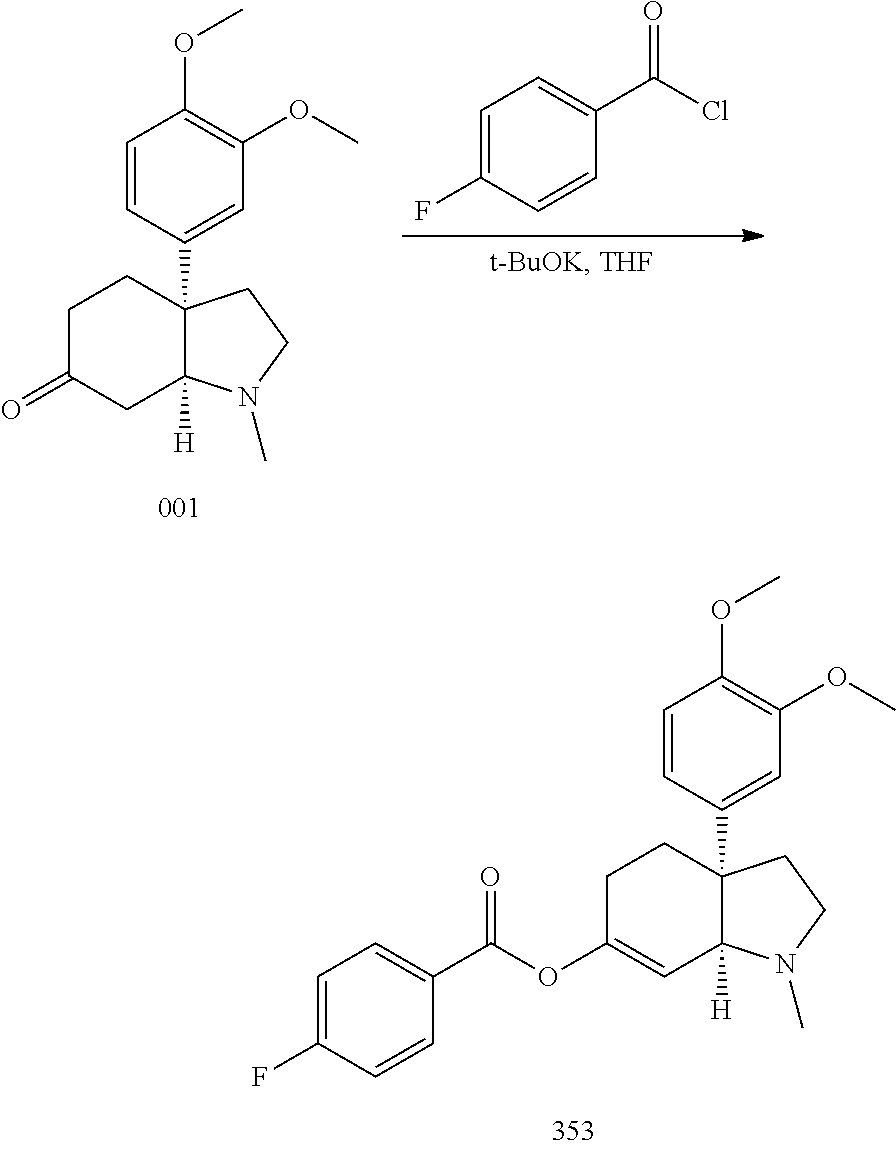
  • treating a ketone, such as mesembrine, with an appropriate base, such as potassium tert-butoxide, and an acid anhydride, in a solvent, such as THF, is a method to prepare compounds of Formula (XIV).
  • Table 8 provides non-limiting examples of certain compounds of Formula (XIV).
  • the compound is a compound of Formula (XV) or a pharmaceutically acceptable salt thereof
  • W and Z in Formula (XV) are each O. In some embodiments, W and Z in Formula (XV) are each S. In some embodiments, W and Z in Formula (XV) are each NH. In some embodiments, W is NH and Z is S in Formula (XV). In some embodiments, W is O and Z is S in Formula (XV). In some embodiments, W is CH 2 and Z is O in Formula (XV). In some embodiments, W is CH 2 and Z is NH in Formula (XV).
  • a compound of Formula (XV) can be a compound of Formula (XV-1):
  • Table 9 provides non-limiting examples of certain compounds of Formula (XV).
  • compositions can comprise greater than 15% (w/w) mesembrine of the total alkaloid content in composition. In some embodiments, compositions can comprise greater than 50% (w/w) mesembrine of the total alkaloid content in composition. In some embodiments, compositions can comprise greater than 90% (w/w) mesembrine of the total alkaloid content in composition. In some embodiments, compositions can comprise greater than 99% (w/w) mesembrine of the total alkaloid content in composition.
  • compositions can comprise greater than 15% (w/w) of mesembrine (e.g., ( ⁇ ) mesembrine) of the total alkaloid content in composition. In some embodiments, compositions can comprise greater than 50% (w/w) mesembrine (e.g., ( ⁇ ) mesembrine) of the total alkaloid content in composition. In some embodiments, compositions can comprise greater than 90% (w/w) mesembrine (e.g., ( ⁇ ) mesembrine) of the total alkaloid content in composition. In some embodiments, compositions can comprise greater than 99% (w/w) mesembrine (e.g., ( ⁇ ) mesembrine) of the total alkaloid content in composition.
  • many prodrugs of mesembrine are disclosed herein.
  • converting mesembrine to a prodrug can be performed by modifying the ketone on the fused ring.
  • the modification can be take the form of a protecting group.
  • Illustrative ketone protecting groups are known in the art as described in Greene's Protective Groups in Organic Synthesis, fourth edition, the disclosure of which is hereby incorporated by reference.
  • Illustrative ketone protecting groups include acyclic ketals, cyclic ketals, chiral ketals, dithio ketals, cyclic dithio ketals, monothiol ketals, cyclic monothiol ketals, cyanohydrins, hydrazones, oximes, pyrrole carbinols, O-silylimdazoyl aminals, cyclic aminals, and benzothiazoles.
  • Ketones may also be protected by protecting the enolate, for example by trimethylsilyl enol ethers, and enamines,
  • a method of isolating stable forms of (+) mesembrenone and ( ⁇ ) mesembrenone is provided.
  • the method minimizes racemization of mesembrenone.
  • stereoisomer analogs of (+) mesembrenone and ( ⁇ ) mesembrenone can be formed.
  • the (+)/( ⁇ ) mesembrenone analogs can then be separated.
  • the (+) analog is then be converted to (+) mesembrine.
  • the ( ⁇ ) analog is then converted to ( ⁇ ) mesembrine.
  • the conversion can be performed by hydrolysis, preferably in the presence of an acid.
  • a method of extending the pharmacokinetic properties of mesembrine is described.
  • the pharmacokinetic properties of mesembrine is extended by forming a prodrug, for example by modifying the ketone on the fused ring.
  • compounds of Formula (I-1) can form mesembrine (e.g., ( ⁇ ) mesembrine) under biologically relevant conditions, including compounds of formula (I-1), formula (IIa-1), formula (IIIc-1), and formula (IVa-1).
  • methods of administering a therapeutic alkaloid compound comprise the oral administration of a compound of formula (I-1), formula (IIa-1), formula (IIIc-1), and formula (IVa-1).
  • methods of administering a therapeutically effective amount of mesembrine can comprise the step of administering a compound of formula (IIa-1).
  • methods of treating a patient suffering from a disease comprise administering to a patient a composition comprising a compound disclosed herein for the treatment or prevention of a mental health disorder.
  • methods of treating a patient suffering from a disease comprise administering to a patient a composition comprising a compound disclosed herein for the treatment or prevention of a diagnosed condition selected from anxiety and depression.
  • a method comprises the administration to a patient in need thereof of a therapeutically effective amount of a compound of Formula (I) for the treatment of depression.
  • a method comprises the administration to a patient in need thereof of a therapeutically effective amount of a compound of Formula (I) for the treatment of a condition selected from the group consisting of: anxiety associated with depression, anxiety with depression, mixed anxiety and depressive disorder.
  • a method comprises the administration to a patient in need thereof of a therapeutically effective amount of a compound of Formula (I) for the treatment of anxiety and hysteria or anxiety and depression.
  • the compound disclosed herein is administered to the patient in a unit dose. In some embodiments, the compound disclosed herein is prescribed to a patient in an oral unit dose for such as a capsule or tablet once or more times per day. In some embodiments, a compound disclosed herein is administered to a patient for the treatment of a disease or condition for which mesembrine is safe and effective for treatment. In some embodiments, a method comprises the administration to a patient in need thereof of a therapeutically effective amount of a compound of Formula (I) for the treatment of anxiety.
  • a method comprises the administration to a patient in need thereof of a therapeutically effective amount of a compound of Formula (I) for the treatment of a disease selected from the group consisting of mild to moderate depression and major depressive episodes. In some embodiments, a method comprises the administration to a patient in need thereof of a therapeutically effective amount of a compound of Formula (I) for the treatment of a disease selected from the group consisting of psychological and psychiatric disorders where anxiety is present. In some embodiments, a method comprises the administration to a patient in need thereof of a therapeutically effective amount of a compound of Formula (I) for the treatment of major depressive episodes.
  • a method comprises the administration to a patient in need thereof of a therapeutically effective amount of a compound of Formula (I) for the treatment of a disease selected from the group consisting of alcohol and drug dependence, bulimia nervosa, and obsessive-compulsive disorders.
  • a disease selected from the group consisting of alcohol and drug dependence, bulimia nervosa, and obsessive-compulsive disorders.
  • an amount of from 20 micrograms to 2 milligrams of a compound of Formula (I) is orally administered to a patient to treat the patient in need thereof with a therapeutic compound selected from the group consisting of ( ⁇ ) mesembrine, (+) mesembrine, and ( ⁇ )/(+) mesembrine,.
  • an amount of from 20 micrograms to 2 milligrams of a compound of Formula (I) is orally administered to a patient to treat the patient in need thereof with ( ⁇ ) mesembrine.
  • the present application is directed to a pharmaceutical composition comprising an active pharmaceutical ingredient.
  • the pharmaceutical composition comprises a compound as disclosed herein as the active pharmaceutical ingredient (API) and a pharmaceutically acceptable carrier comprising one or more excipients.
  • the pharmaceutical composition optionally further comprises an additional therapeutic compound (i.e., agent) with the pharmaceutically acceptable carrier.
  • the pharmaceutical composition can be a medicament.
  • compositions include those known in the art.
  • the choice of a pharmaceutically acceptable carrier can depend, for example, on the desired route of administration of the composition.
  • a pharmaceutical composition (preparation) can be administered to a subject by any of a number of routes of administration including, for example, parenteral administration (e.g. intravenously, subcutaneously, or intramuscularly), oral administration (for example, tablets, and capsules); absorption through the oral mucosa (e.g., sublingually) or transdermally (for example as a patch applied to the skin) or topically (for example, as a cream, ointment or spray applied to the skin).
  • parenteral administration e.g. intravenously, subcutaneously, or intramuscularly
  • oral administration for example, tablets, and capsules
  • absorption through the oral mucosa e.g., sublingually
  • transdermally for example as a patch applied to the skin
  • topically for example, as a cream, ointment or spray applied to
  • compositions comprising compounds of Formula (I) or pharmaceutically acceptable salts thereof can be formulated for oral administration.
  • a compound provided herein can be combined with suitable compendial excipients to form an oral unit dosage form, such as a capsule or tablet, containing a target dose of a compound of Formula (I).
  • the drug product can be prepared by first manufacturing the compound of Formula (I) as an active pharmaceutical ingredient (API), followed by roller compaction/milling with intragranular excipients and blending with extra granular excipients.
  • a Drug Product can contain the selected compound of Formula (I) as the API and excipient components in a tablet in a desired dosage strength of a compound of Formula (1). The blended material can be compressed to form tablets and then film coated.
  • the excipients can be selected from materials appropriate for inclusion in a pharmaceutical composition for an intended purpose and route of delivery including providing a desired manufacturing and stability properties and/or desired in vivo characteristics or other properties to the pharmaceutical composition.
  • the pharmaceutical composition can include a compound of Formula (I) as the API in combination with a filler (e.g., a form of microcrystalline cellulose), a dry binder or disintegrant (e.g., a cross-linked polymer), a glidant (e.g., colloidal silicon dioxide) and/or a lubricant (e.g., magnesium stearate).
  • a filler e.g., a form of microcrystalline cellulose
  • a dry binder or disintegrant e.g., a cross-linked polymer
  • a glidant e.g., colloidal silicon dioxide
  • a lubricant e.g., magnesium stearate
  • the pharmaceutical composition can comprise a material such as an extended release or disintegrant involved in carrying or transporting the API pharmaceutical agent from one organ, or portion of the body, to another organ, or portion of the body of a subject, including materials to desirable control the absorption of the API in the intestine.
  • a material such as an extended release or disintegrant involved in carrying or transporting the API pharmaceutical agent from one organ, or portion of the body, to another organ, or portion of the body of a subject, including materials to desirable control the absorption of the API in the intestine.
  • the formulations may conveniently be presented in unit dosage form and may be prepared by any methods well known in the art of pharmacy.
  • the amount of active ingredient which can be combined with a carrier material to produce a single dosage form will vary depending upon the host being treated, the particular mode of administration.
  • the amount of active ingredient that can be combined with a carrier material to produce a single dosage form will generally be that amount of the compound which produces a therapeutic effect.
  • active compounds can be given per se or as a pharmaceutical composition containing, for example, 0.1 to 99.5% (more preferably, 0.5 to 90%) of active ingredient in combination with a pharmaceutically acceptable carrier.
  • Methods of preparing these formulations or compositions include the step of bringing into association an active compound, such as a compound of the invention, with the carrier and, optionally, one or more accessory ingredients.
  • an active compound such as a compound of the invention
  • the formulations are prepared by uniformly and intimately bringing into association a compound of the present invention with liquid carriers, or finely divided solid carriers, or both, and then, if necessary, shaping the product.
  • the active ingredient is mixed with one or more pharmaceutically acceptable carriers, such as sodium citrate or dicalcium phosphate, and/or any of the following: (1) fillers or extenders, (2) binders, (3) humectants, (4) disintegrating agents, (5) solution retarding agents, (6) absorption accelerators, (7) wetting agents, (8) absorbents, (9) lubricants, (10) complexing agents, and (11) coloring agents.
  • pharmaceutically acceptable carriers such as sodium citrate or dicalcium phosphate, and/or any of the following: (1) fillers or extenders, (2) binders, (3) humectants, (4) disintegrating agents, (5) solution retarding agents, (6) absorption accelerators, (7) wetting agents, (8) absorbents, (9) lubricants, (10) complexing agents, and (11) coloring agents.
  • the pharmaceutical compositions may also comprise buffering agents. Solid compositions of a similar type may also be employed as fillers in soft and hard-filled gelatin capsules using suitable excipients.
  • compositions according to the present invention may contain conventional pharmaceutical carriers and/or auxiliary agents.
  • he pharmaceutical compositions according to the present invention may contain conventional carrier agents including a binder, a lubricant and/or a glidant selected from those products and materials generally used in pharmaceutical industry for preparation of pharmaceutical compositions for an intended route of administration.
  • a tablet may be made by compression or molding, optionally with one or more accessory ingredients.
  • Compressed tablets may be prepared using binder (for example, gelatin or hydroxypropylmethyl cellulose), lubricant, inert diluent, preservative, disintegrant (for example, sodium starch glycolate or cross-linked sodium carboxymethyl cellulose), surface-active or dispersing agent.
  • Molded tablets may be made by molding in a suitable machine a mixture of the powdered compound moistened with an inert liquid diluent.
  • Liquid dosage forms useful for oral administration include pharmaceutically acceptable carriers and the active ingredient provided as a solid form for reconstitution prior to administration or as a liquid (e.g., solutions, suspensions, or emulsions).
  • a liquid dosage forms may contain inert diluents commonly used in the art.
  • formulations of pharmaceutically acceptable compositions for injection can include aqueous solutions such as water or physiologically buffered saline or other solvents or vehicles suitable for the intended route of administration.
  • the pharmaceutical composition is formulated for parenteral administration.
  • the therapeutically effective amount of a pharmaceutical composition can be determined by human clinical trials to determine the safe and effective dose for a patient with a relevant diagnosis. It is generally understood that the effective amount of the compound may vary according to the weight, sex, age, and medical history of the subject. Other factors which influence the effective amount may include, but are not limited to, the severity of the patient's condition, the disorder being treated, the stability of the compound, and, if desired, another type of therapeutic agent being administered with the compound of the invention. A larger total dose can be delivered by multiple administrations of the pharmaceutical composition at a dose and dose interval determined to be safe and effective for the patient.
  • compositions and methods of the present disclosure includes the use of pharmaceutically acceptable salts of compounds of the invention in the compositions and methods of the present invention.
  • Pharmaceutically-acceptable salts include, for example, acid-addition salts and base-addition salts.
  • the acid that is added to a compound to form an acid-addition salt can be an organic acid or an inorganic acid.
  • a base that is added to a compound to form a base-addition salt can be an organic base or an inorganic base.
  • a pharmaceutically-acceptable salt is a metal salt
  • a pharmaceutically-acceptable salt is an ammonium salt.
  • a pharmaceutically acceptable acid addition salt can exist as various solvates, such as with water, methanol, ethanol, dimethylformamide, and the like. Mixtures of such solvates can also be prepared.
  • the source of such solvate can be from the solvent of crystallization, inherent in the solvent of preparation or crystallization, or adventitious to such solvent.
  • agent is used herein to denote a chemical compound (such as an organic or inorganic compound, a mixture of chemical compounds), a biological macromolecule (such as a nucleic acid, an antibody, including parts thereof as well as humanized, chimeric and human antibodies and monoclonal antibodies, a protein or portion thereof, e.g., a peptide, a lipid, a carbohydrate), or an extract made from biological materials such as bacteria, plants, fungi, or animal (particularly mammalian) cells or tissues.
  • Agents include, for example, agents whose structure is known, and those whose structure is not known.
  • a “patient,” “subject,” or “individual” are used interchangeably and refer to either a human or a non-human animal. These terms include mammals, such as humans, primates, livestock animals (including bovines, porcines, etc.), companion animals (e.g., canines, felines, etc.) and rodents (e.g., mice and rats).
  • Treating” a condition or patient refers to taking steps to obtain beneficial or desired results, including clinical results.
  • treatment is an approach for obtaining beneficial or desired results, including clinical results.
  • Beneficial or desired clinical results can include, but are not limited to, alleviation or amelioration of one or more symptoms or conditions, diminishment of extent of disease, stabilized (i.e., not worsening) state of disease, preventing spread of disease, delay or slowing of disease progression, amelioration or palliation of the disease state, and remission (whether partial or total), whether detectable or undetectable.
  • Treatment can also mean prolonging survival as compared to expected survival if not receiving treatment.
  • preventing is art-recognized, and when used in relation to a condition, such as a local recurrence (e.g., pain), a disease such as cancer, a syndrome complex such as heart failure or any other medical condition, is well understood in the art, and includes administration of a composition which reduces the frequency of, or delays the onset of, symptoms of a medical condition in a subject relative to a subject which does not receive the composition.
  • a condition such as a local recurrence (e.g., pain)
  • a disease such as cancer
  • a syndrome complex such as heart failure or any other medical condition
  • prevention of cancer includes, for example, reducing the number of detectable cancerous growths in a population of patients receiving a prophylactic treatment relative to an untreated control population, and/or delaying the appearance of detectable cancerous growths in a treated population versus an untreated control population, e.g., by a statistically and/or clinically significant amount.
  • administering or “administration of” a substance, a compound or an agent to a subject can be carried out using one of a variety of methods known to those skilled in the art.
  • a compound or an agent can be administered, intravenously, arterially, intradermally, intramuscularly, intraperitoneally, subcutaneously, ocularly, sublingually, orally (by ingestion), intranasally (by inhalation), intraspinally, intracerebrally, and transdermally (by absorption, e.g., through a skin duct).
  • a compound or agent can also appropriately be introduced by rechargeable or biodegradable polymeric devices or other devices, e.g., patches and pumps, or formulations, which provide for the extended, slow or controlled release of the compound or agent.
  • Administering can also be performed, for example, once, a plurality of times, and/or over one or more extended periods.
  • a compound or an agent is administered orally, e.g., to a subject by ingestion.
  • the orally administered compound or agent is in an extended release or slow release formulation, or administered using a device for such slow or extended release.
  • the phrase “conjoint administration” refers to any form of administration of two or more different therapeutic agents such that the second agent is administered while the previously administered therapeutic agent is still effective in the body (e.g., the two agents are simultaneously effective in the patient, which may include synergistic effects of the two agents).
  • the different therapeutic compounds can be administered either in the same formulation or in separate formulations, either concomitantly or sequentially.
  • an individual who receives such treatment can benefit from a combined effect of different therapeutic agents.
  • a “therapeutically effective amount” or a “therapeutically effective dose” of a drug or agent is an amount of a drug or an agent that, when administered to a subject will have the intended therapeutic effect.
  • the full therapeutic effect does not necessarily occur by administration of one dose, and may occur only after administration of a series of doses.
  • a therapeutically effective amount may be administered in one or more administrations.
  • the precise effective amount needed for a subject will depend upon, for example, the subject's size, health and age, and the nature and extent of the condition being treated, such as cancer or MDS. The skilled worker can readily determine the effective amount for a given situation by routine experimentation.
  • the terms “optional” or “optionally” mean that the subsequently described event or circumstance may occur or may not occur, and that the description includes instances where the event or circumstance occurs as well as instances in which it does not.
  • “optionally substituted alkyl” refers to the alkyl may be substituted as well as where the alkyl is not substituted.
  • substituents and substitution patterns on the compounds of the present invention can be selected by one of ordinary skilled person in the art to result chemically stable compounds which can be readily synthesized by techniques known in the art, as well as those methods set forth below, from readily available starting materials. If a substituent is itself substituted with more than one group, it is understood that these multiple groups may be on the same carbon or on different carbons, so long as a stable structure results.
  • the term “optionally substituted” refers to the replacement of one to six hydrogen radicals in a given structure with the radical of a specified substituent including, but not limited to: hydroxyl, hydroxyalkyl, alkoxy, halogen, alkyl, nitro, silyl, acyl, acyloxy, aryl, cycloalkyl, heterocyclyl, amino, aminoalkyl, cyano, haloalkyl, haloalkoxy, —OCO—CH 2 —O-alkyl, —OP(O)(O-alkyl) 2 or —CH 2 —OP(O)(O-alkyl) 2 .
  • “optionally substituted” refers to the replacement of one to four hydrogen radicals in a given structure with the substituents mentioned above. More preferably, one to three hydrogen radicals are replaced by the substituents as mentioned above. It is understood that the substituent can be further substituted.
  • alkyl refers to saturated aliphatic groups, including but not limited to C 1 -C 10 straight-chain alkyl groups, C 1 -C 10 branched-chain alkyl groups, cycloalkyl (alicyclic) groups, alkyl-substituted cycloalkyl groups, and cycloalkyl-substituted alkyl groups.
  • the “alkyl” group refers to C 1 -C 7 straight-chain alkyl groups or C 1 -C 7 branched-chain alkyl groups.
  • the “alkyl” group refers to C 1 -C 3 straight-chain alkyl groups or C 1 -C 3 branched-chain alkyl groups.
  • Examples of “alkyl” include, but are not limited to, methyl, ethyl, 1-propyl, 2-propyl, n-butyl, sec-butyl, tert-butyl, 1-pentyl, 2-pentyl, 3-pentyl, neo-pentyl, 1-hexyl, 2-hexyl, 3-hexyl, 1-heptyl, 2-heptyl, 3-heptyl, 4-heptyl, 1-octyl, 2-octyl, 3-octyl or 4-octyl and the like.
  • the “alkyl” group may be optionally substituted.
  • haloalkyl refers to an alkyl group substituted with at least one hydrogen atom on a carbon replaced by a halogen.
  • Illustrative halogens include fluoro, chloro, bromo, and iodo.
  • Illustrative haloalkyl groups include trifluoromethyl and 2,2,2-trifluoroethyl, etc.
  • alkoxyalkyl refers to an alkyl group substituted with an alkoxy group and may be represented by the general formula alkyl-O-alkyl.
  • C x-y or “C x -C y ”, when used in conjunction with a chemical moiety, such as, acyl, acyloxy, alkyl, alkenyl, alkynyl, or alkoxy is meant to include groups that contain from x to y carbons in the chain.
  • Coalkyl indicates a hydrogen where the group is in a terminal position, a bond if internal.
  • a C 1-6 alkyl group for example, contains from one to six carbon atoms in the chain.
  • alkylamino refers to an amino group substituted with at least one alkyl group.
  • alkylthio refers to a thiol group substituted with an alkyl group and may be represented by the general formula alkylS—.
  • amide refers to a group
  • R e and R f each independently represent a hydrogen or hydrocarbyl group, or R e and R f taken together with the N atom to which they are attached complete a heterocycle having from 4 to 8 atoms in the ring structure.
  • acyl is art-recognized and refers to a group represented by the general formula hydrocarbylC(O)—, preferably alkylC(O)—.
  • acylamino is art-recognized and refers to an amino group substituted with an acyl group and may be represented, for example, by the formula hydrocarbylC(O)NH—.
  • acyloxy is art-recognized and refers to a group represented by the general formula hydrocarbylC(O)O—, preferably alkylC(O)O—.
  • alkoxy refers to an alkyl group having an oxygen attached thereto.
  • the “alkoxy” group refers to C 1 -C 7 straight-chain alkoxy groups or C 1 -C 7 branched-chain alkoxy groups.
  • Representative alkoxy groups include methoxy, ethoxy, propoxy, tert-butoxy and the like.
  • aryloxy refers to an aryl group having an oxygen attached thereto.
  • the “aryloxy” group refers to C 6 -C 10 aryloxy groups or 5-7-membered heteroaryloxy groups.
  • Representative aryloxy groups include phenoxy (C 6 H 5 —O—) and the like.
  • amine and “amino” are art-recognized and refer to both unsubstituted and substituted amines and salts thereof, e.g., a moiety that can be represented by
  • R e , R f , and R g each independently represent a hydrogen or a hydrocarbyl group, or R e and R f taken together with the N atom to which they are attached complete a heterocycle having from 4 to 8 atoms in the ring structure.
  • aminoalkyl refers to an alkyl group substituted with an amino group.
  • aralkyl refers to an alkyl group substituted with an aryl group.
  • aryl as used herein include substituted or unsubstituted single-ring aromatic groups in which each atom of the ring is carbon.
  • the ring is a 5- to 7-membered ring, more preferably a 6-membered ring, for example a phenyl.
  • aryl also includes polycyclic ring systems having two or more cyclic rings in which two or more carbons are common to two adjoining rings wherein at least one of the rings is aromatic, e.g., the other cyclic rings can be cycloalkyls, cycloalkenyls, cycloalkynyls, aryls, heteroaryls, and/or heterocyclyls.
  • Aryl groups include benzene, naphthalene, phenanthrene, phenol, aniline, and the like.
  • R e and R f independently represent hydrogen or a hydrocarbyl group.
  • Carbocyclylalkyl refers to an alkyl group substituted with a carbocycle group.
  • Carbocycle includes 5-7 membered monocyclic and 8-12 membered bicyclic rings. Each ring of a bicyclic carbocycle may be selected from saturated, unsaturated and aromatic rings. Carbocycle includes bicyclic molecules in which one, two or three or more atoms are shared between the two rings.
  • fused carbocycle refers to a bicyclic carbocycle in which each of the rings shares two adjacent atoms with the other ring. Each ring of a fused carbocycle may be selected from saturated, unsaturated and aromatic rings.
  • an aromatic ring e.g., phenyl
  • a saturated or unsaturated ring e.g., cyclohexane, cyclopentane, or cyclohexene.
  • Exemplary “carbocycles” include cyclopentane, cyclohexane, bicyclo[2.2.1]heptane, 1,5-cyclooctadiene, 1,2,3,4-tetrahydronaphthalene, bicyclo[4.2.0]oct-3-ene, naphthalene and adamantane.
  • Exemplary fused carbocycles include decalin, naphthalene, 1,2,3,4-tetrahydronaphthalene, bicyclo[4.2.0]octane, 4,5,6,7-tetrahydro-1H-indene and bicyclo[4.1.0]hept-3-ene.
  • “Carbocycles” may be substituted at any one or more positions capable of bearing a hydrogen atom.
  • Carbocyclylalkyl refers to an alkyl group substituted with a carbocycle group.
  • carbonate is art-recognized and refers to a group —OCO 2 —.
  • esters refers to a group —C(O)OR 9 wherein R 9 represents a hydrocarbyl group.
  • halo and “halogen” as used herein means halogen and includes chloro, fluoro, bromo, and iodo.
  • heteroalkyl and “heteroaralkyl”, as used herein, refers to an alkyl group substituted with a hetaryl group.
  • heteroaryl and “hetaryl” include substituted or unsubstituted aromatic single ring structures, preferably 5- to 7-membered rings, more preferably 5- to 6-membered rings, whose ring structures include at least one heteroatom, preferably one to four heteroatoms, more preferably one or two heteroatoms.
  • heteroaryl and “hetaryl” also include polycyclic ring systems having two or more cyclic rings in which two or more carbons are common to two adjoining rings wherein at least one of the rings is heteroaromatic, e.g., the other cyclic rings can be cycloalkyls, cycloalkenyls, cycloalkynyls, aryls, heteroaryls, and/or heterocyclyls.
  • Heteroaryl groups include, for example, pyrrole, furan, thiophene, imidazole, oxazole, thiazole, pyrazole, pyridine, pyrazine, pyridazine, and pyrimidine, and the like.
  • heteroatom as used herein means an atom of any element other than carbon or hydrogen. Preferred heteroatoms are nitrogen, oxygen, and sulfur.
  • heterocyclylalkyl refers to an alkyl group substituted with a heterocycle group.
  • heterocyclyl refers to substituted or unsubstituted non-aromatic ring structures, preferably 3- to 10-membered rings, more preferably 3- to 7-membered rings, whose ring structures include at least one heteroatom, preferably one to four heteroatoms, more preferably one or two heteroatoms.
  • heterocyclyl and “heterocyclic” also include polycyclic ring systems having two or more cyclic rings in which two or more carbons are common to two adjoining rings wherein at least one of the rings is heterocyclic, e.g., the other cyclic rings can be cycloalkyls, cycloalkenyls, cycloalkynyls, aryls, heteroaryls, and/or heterocyclyls.
  • Heterocyclyl groups include, for example, piperidine, piperazine, pyrrolidine, morpholine, lactones, lactams, and the like.
  • hydrocarbyl refers to a group that is bonded through a carbon atom that does not have a ⁇ O or ⁇ S substituent, and typically has at least one carbon-hydrogen bond and a primarily carbon backbone, but may optionally include heteroatoms.
  • groups like methyl, ethoxyethyl, 2-pyridyl, and even trifluoromethyl are considered to be hydrocarbyl for the purposes of this application, but substituents such as acetyl (which has a ⁇ O substituent on the linking carbon) and ethoxy (which is linked through oxygen, not carbon) are not.
  • Hydrocarbyl groups include, but are not limited to aryl, heteroaryl, carbocycle, heterocycle, alkyl, alkenyl, alkynyl, and combinations thereof.
  • hydroxyalkyl refers to an alkyl group substituted with a hydroxy group.
  • lower when used in conjunction with a chemical moiety, such as, acyl, acyloxy, alkyl, alkenyl, alkynyl, or alkoxy is meant to include groups where there are ten or fewer atoms in the substituent, preferably six or fewer.
  • acyl, acyloxy, alkyl, alkenyl, alkynyl, or alkoxy substituents defined herein are respectively lower acyl, lower acyloxy, lower alkyl, lower alkenyl, lower alkynyl, or lower alkoxy, whether they appear alone or in combination with other substituents, such as in the recitations hydroxyalkyl and aralkyl (in which case, for example, the atoms within the aryl group are not counted when counting the carbon atoms in the alkyl substituent).
  • polycyclyl refers to two or more rings (e.g., cycloalkyls, cycloalkenyls, cycloalkynyls, aryls, heteroaryls, and/or heterocyclyls) in which two or more atoms are common to two adjoining rings, e.g., the rings are “fused rings”.
  • Each of the rings of the polycycle can be substituted or unsubstituted.
  • each ring of the polycycle contains from 3 to 10 atoms in the ring, preferably from 5 to 7.
  • sulfate is art-recognized and refers to the group —OSO 3 H, or a pharmaceutically acceptable salt thereof.
  • R e and R f independently represents hydrogen or hydrocarbyl.
  • sulfoxide is art-recognized and refers to the group —S(O)—.
  • sulfonate is art-recognized and refers to the group SO 3 H, or a pharmaceutically acceptable salt thereof.
  • substituted refers to moieties having substituents replacing a hydrogen on one or more carbons of the backbone. It will be understood that “substitution” or “substituted with” includes the implicit proviso that such substitution is in accordance with permitted valence of the substituted atom and the substituent, and that the substitution results in a stable compound, e.g., which does not spontaneously undergo transformation such as by rearrangement, cyclization, elimination, etc. As used herein, the term “substituted” is contemplated to include all permissible substituents of organic compounds.
  • the permissible substituents include acyclic and cyclic, branched and unbranched, carbocyclic and heterocyclic, aromatic and non-aromatic substituents of organic compounds.
  • the permissible substituents can be one or more and the same or different for appropriate organic compounds.
  • the heteroatoms such as nitrogen may have hydrogen substituents and/or any permissible substituents of organic compounds described herein which satisfy the valences of the heteroatoms.
  • Substituents can include any substituents described herein, for example, a halogen, a hydroxyl, a carbonyl (such as a carboxyl, an alkoxycarbonyl, a formyl, or an acyl), a thiocarbonyl (such as a thioester, a thioacetate, or a thioformate), an alkoxyl, a phosphoryl, a phosphate, a phosphonate, a phosphinate, an amino, an amido, an amidine, an imine, a cyano, a nitro, an azido, a sulfhydryl, an alkylthio, a sulfate, a sulfonate, a sulfamoyl, a sulfonamido, a sulfonyl, a heterocyclyl, an aralkyl, or an aromatic or heteroaromatic mo
  • thioalkyl refers to an alkyl group substituted with a thiol group.
  • thioester refers to a group —C(O)SR e or —SC(O)R e
  • R e represents a hydrocarbyl
  • thioether is equivalent to an ether, wherein the oxygen is replaced with a sulfur.
  • urea is art-recognized and may be represented by the general formula
  • R e and R f independently represent hydrogen or a hydrocarbyl.
  • modulate includes the inhibition or suppression of a function or activity (such as cell proliferation) as well as the enhancement of a function or activity.
  • “Pharmaceutically acceptable salt” or “salt” is used herein to refer to an acid addition salt or a basic addition salt which is suitable for or compatible with the treatment of patients.
  • pharmaceutically acceptable acid addition salt means any non-toxic organic or inorganic salt of any base compounds represented by Formula I.
  • Illustrative inorganic acids which form suitable salts include hydrochloric, hydrobromic, sulfuric and phosphoric acids, as well as metal salts such as sodium monohydrogen orthophosphate and potassium hydrogen sulfate.
  • Illustrative organic acids that form suitable salts include mono-, di-, and tricarboxylic acids such as glycolic, lactic, pyruvic, malonic, succinic, glutaric, fumaric, malic, tartaric, citric, ascorbic, maleic, benzoic, phenylacetic, cinnamic and salicylic acids, as well as sulfonic acids such as p-toluene sulfonic and methanesulfonic acids.
  • the mono- or di-acid salts can be formed, and such salts may exist in either a hydrated, solvated or substantially anhydrous form.
  • the acid addition salts of compounds of Formula I are more soluble in water and various hydrophilic organic solvents, and generally demonstrate higher melting points in comparison to their free base forms.
  • the selection of the appropriate salt will be known to one skilled in the art.
  • Other non-pharmaceutically acceptable salts e.g., oxalates, may be used, for example, in the isolation of compounds of Formula I for laboratory use, or for subsequent conversion to a pharmaceutically acceptable acid addition salt.
  • pharmaceutically acceptable basic addition salt means any non-toxic organic or inorganic base addition salt of any acid compounds represented by Formula I or any of their intermediates.
  • Illustrative inorganic bases which form suitable salts include lithium, sodium, potassium, calcium, magnesium, or barium hydroxide.
  • Illustrative organic bases which form suitable salts include aliphatic, alicyclic, or aromatic organic amines such as methylamine, trimethylamine and picoline or ammonia. The selection of the appropriate salt will be known to a person skilled in the art.
  • phrases “pharmaceutically acceptable” is employed herein to refer to those compounds, materials, compositions, and/or dosage forms which are, within the scope of sound medical judgment, suitable for use in contact with the tissues of human beings and animals without excessive toxicity, irritation, allergic response, or other problem or complication, commensurate with a reasonable benefit/risk ratio.
  • pharmaceutically acceptable carrier means a pharmaceutically acceptable material, composition or vehicle, such as a liquid or solid filler, diluent, excipient, solvent or encapsulating material. Each carrier must be “acceptable” in the sense of being compatible with the other ingredients of the formulation and not injurious to the patient.
  • parenteral administration and “administered parenterally” as used herein means modes of administration other than enteral and topical administration, usually by injection, and includes, without limitation, intravenous, intraocular (such as intravitreal), intramuscular, intraarterial, intrathecal, intracapsular, intraorbital, intracardiac, intradermal, intraperitoneal, transtracheal, subcutaneous, subcuticular, intraarticular, subcapsular, subarachnoid, intraspinal and intrasternal injection and infusion.
  • intravenous, intraocular such as intravitreal
  • intramuscular intraarterial
  • intrathecal intracapsular
  • intraorbital intracardiac
  • intradermal intraperitoneal
  • transtracheal subcutaneous, subcuticular, intraarticular, subcapsular, subarachnoid, intraspinal and intrasternal injection and infusion.
  • compositions suitable for parenteral administration comprise one or more active compounds in combination with one or more pharmaceutically acceptable sterile isotonic aqueous or nonaqueous solutions, dispersions, suspensions or emulsions, or sterile powders which may be reconstituted into sterile injectable solutions or dispersions just prior to use, which may contain antioxidants, buffers, bacteriostats, solutes which render the formulation isotonic with the blood of the intended recipient or suspending or thickening agents.
  • Many of the compounds useful in the methods and compositions of this disclosure have at least one stereogenic center in their structure. This stereogenic center may be present in a R or a S configuration, said R and S notation is used in correspondence with the rules described in Pure Appl. Chem.
  • Prodrug or “pharmaceutically acceptable prodrug” refers to a compound that is metabolized, for example hydrolyzed or oxidized, in the host after administration to form mesembrine.
  • Typical examples of prodrugs include compounds that have biologically labile or cleavable (protecting) groups on a functional moiety of the active compound.
  • Prodrugs include compounds that can be oxidized, reduced, aminated, deaminated, hydroxylated, dehydroxylated, hydrolyzed, dehydrolyzed, alkylated, dealkylated, acylated, deacylated, phosphorylated, or dephosphorylated to produce the active compound.
  • prodrugs examples include using ester or phosphoramidate as biologically labile or cleavable (protecting) groups.
  • the prodrugs of this disclosure are metabolized to produce mesembrine.
  • the present disclosure includes within its scope, prodrugs of the compounds described herein. Conventional procedures for the selection and preparation of suitable prodrugs are described, for example, in “Design of Prodrugs” Ed. H. Bundgaard, Elsevier, 1985.
  • pharmaceutically acceptable carrier means a pharmaceutically acceptable material, composition or vehicle, such as a liquid or solid filter, diluent, excipient, solvent or encapsulating material useful for formulating a drug for medicinal or therapeutic use.
  • Log of solubility is used in the art to quantify the aqueous solubility of a compound.
  • the aqueous solubility of a compound significantly affects its absorption and distribution characteristics. A low solubility often goes along with a poor absorption.
  • LogS value is a unit stripped logarithm (base 10) of the solubility measured in mol/liter.
  • compounds described herein are compounds of formula (I):
  • the compound is of formula (I-1):
  • the compound of formula (I) is a compound of formula (IIa):
  • R 1 , R 2 , m, n, W, and Z are as defined herein.
  • the compound is of formula (IIa-1):
  • the compound of formula (I) is a compound of formula (IIIa):
  • the compound of formula (I) is a compound of formula (IIIb):
  • R 1 and R 3 are as defined herein.
  • the compound is of formula (IIIc-1):
  • the compound is of formula (IIIb-1):
  • the compound is of formula (IIIb-1):
  • the compound of formula (I) is a compound of formula (IVa):
  • the compound is of formula (IVa-1):
  • the compound is of formula (IA):
  • R 10 and R 11 are as defined herein, for example as a biologically labile moiety selected to provide in vivo conversion of a compound of Formula (IA) to mesembrine.
  • the compound is of formula (IB-1)
  • the compound is selected from the group consisting of:
  • the compound is selected from the group consisting of:
  • the compound is selected from the group consisting of:
  • the compound is selected from the group consisting of:
  • the compound is selected from the group consisting of:
  • the compound is selected from the group consisting of:
  • compounds described herein can form mesembrine (e.g., ( ⁇ ) mesembrine) under biologically relevant conditions.
  • compounds of disclosed herein e.g., compounds of Formula (I)
  • can hydrolyze in highly acidic environments e.g., pH of about 2 at room temperature or more comparably stringent conditions typically encountered within the alimentary canal of a mammal
  • % F bioabsorption
  • mesembrine e.g., ( ⁇ ) mesembrine
  • a compound according to the present disclosure is of formula (I):
  • ring A is
  • each of W and Z is independently O, NH, or S. In some embodiments, W is O. In some embodiments, W is NH. In some embodiments, W is S.
  • each R 2 is independently C 1 -C 3 alkyl, —COOH, —CONH 2 , phenyl, 5- to 7-membered heterocyclyl, or 5- to 7-membered heteroaryl.
  • each hydrogen atom in phenyl, 5- to 7-membered heterocyclyl and 5- to 7-membered heteroaryl is optionally substituted by —OH, C 1 -C 3 alkyl, C 1 -C 3 alkoxy, C 1 -C 3 alkanol, or —NO 2 .
  • R 2 is —COOH, —CONH 2 , phenyl, 5- to 7-membered heterocyclyl, or 5- to 7-membered heteroaryl, wherein each hydrogen atom in phenyl, 5- to 7-membered heterocyclyl and 5- to 7-membered heteroaryl is optionally substituted by —OH, C 1 -C 3 alkyl, C 1 -C 3 alkoxy, C 1 -C 3 alkanol, or —NO 2 .
  • R 2 is phenyl, wherein each hydrogen atom in phenyl is optionally substituted by —OH, C 1 -C 3 alkyl, C 1 -C 3 alkoxy, or —NO 2 .
  • R 2 is 5- to 7-membered heterocyclyl or 5- to 7-membered heteroaryl, wherein each hydrogen atom in 5- to 7-membered heterocyclyl and 5- to 7-membered heteroaryl is optionally substituted by —OH, C 1 -C 3 alkyl, C 1 -C 3 alkoxy, C 1 -C 3 alkanol, or —NO 2 .
  • R 2 is pyridyl. In some embodiments, R 2 is
  • R 2 is —COOH or —CONH 2 .
  • two R 2 s on a single carbon atom combine to form ⁇ O.
  • two adjacent R 2 s together with the carbon atoms to which they are attached combine to form 5- to 7-membered heteroaryl, wherein each hydrogen atom in 5- to 7-membered heteroaryl is optionally substituted by —OH, C 1 -C 3 alkyl, or C 1 -C 3 alkanol.
  • the two R 2 s together with the carbon atoms to which they are attached combine to form pyridyl, wherein each hydrogen atom in pyridyl is optionally substituted by —OH, C 1 -C 3 alkyl, or C 1 -C 3 alkanol.
  • m is 1 or 2.
  • n 0, 1, or 2. In some embodiments, n is 0. In some embodiments, n is 1. In some embodiments, n is 2.
  • R 3 is —OSi(C 1 -C 6 alkyl) 3 or —OC(O)C 1 -C 6 alkyl. In some embodiments, R 3 is —OSi(C 1 -C 6 alkyl) 3 . In some embodiments, R 3 is —OC(O)C 1 -C 6 alkyl (e.g., —OC(O)CH 3 ).
  • R 4 is OH, C 1 -C 6 alkoxy, or —NHC(O)-5- to 7-membered heteroaryl.
  • each hydrogen atom in 5- to 7-membered heteroaryl is optionally substituted by —OH, C 1 -C 3 alkyl, or C 1 -C 3 alkanol.
  • R 1 is H or C 1 -C 7 alkyl. In some embodiments, R 1 is C 1 -C 3 alkyl. In some embodiments, R 1 is methyl.
  • the compounds of Formula (I) can be obtained by reacting mesembrine or with a compound designated as Generally Recognized as Safe (GRAS) by the U.S. Food and Drug Administration (FDA) (G) under sections 201(s) and 409 of the U.S. federal Food, Drug and Cosmetics Act (FDCA), and under the corresponding implementing regulations in 21 CFR 170.3 and 21 CFR 170.30.
  • GRAS Generally Recognized as Safe
  • FDA U.S. Food and Drug Administration
  • FDCA U.S. Food and Drug Administration
  • novel compounds that convert to mesembrine can be obtained by reaction of either compound with lactic acid, glycolic acid, ascorbic acid (vitamin C), and pyridoxine (vitamin B6) derivatives.
  • Table provides examples of compounds that can be reacted to obtain compounds of Formula (I) by the reaction: Compound M+Compound R ⁇ Compound C.
  • Reactant M Reactant R Product Compound C (R 8 ) 2 O or R 8 —X Wherein the dashed bond is present or absent.
  • RAC or rac indicates a racemic mixture
  • DIAST indicates a specific diastereomer.
  • a compound may be depicted with or bonds, such a depiction may be denoting relative stereochemistry based on elution peaks from a chiral separation.
  • Compounds of Formula (I) including compounds of Formula (IIa) and Formula (IIb) can be prepared as described with respect to exemplary compounds in the examples below.
  • a ketone such as mesembrine
  • an acid catalyst such as p-toluenesulfonic acid or methanesulfonic acid
  • a solvent such as toluene
  • the compound of formula (I) is a compound of formula (IX):
  • a compound of formula (I) can be a compound of Formula (IX-1) that converts to mesembrine (e.g., ( ⁇ ) mesembrine) upon oral administration to a mammal and upon hydrolysis in sufficiently acidic conditions (e.g., pH 2 at 37 degrees C.), where R 60 is defined with respect to Formula (IX) above.
  • mesembrine e.g., ( ⁇ ) mesembrine
  • Compounds of Formula (IX) including compounds of Formula (IX-1) can be prepared as described with respect to compounds in the examples below.
  • a ketone such as mesembrine
  • a Lewis acid such as boron trifluoride etherate
  • a solvent such as dichloromethane
  • a compound of formula (IX-1) where R 60 is methyl can be obtained by reacting mesembrine with lactic acid (e.g., with TsOH, toluene).
  • the compound can be a lactate or glycolate derivative of mesembrine.
  • R 60 in Scheme 2 is as defined above with respect to Formula (I-B).
  • the compound of Formula (I) is a compound of Formula (X) or a pharmaceutically acceptable salt thereof:
  • a compound of Formula (X) can be a compound of Formula (X-1) that converts to mesembrine (e.g., ( ⁇ ) mesembrine) upon oral administration to a mammal and upon hydrolysis in sufficiently acidic conditions (e.g., pH 2 at 37° C.), where Z, and R 12 are as defined with respect to Formula (X) above.
  • mesembrine e.g., ( ⁇ ) mesembrine
  • Compounds of Formula (X) including compounds of Formula (X-1) can be prepared as described with respect to exemplary compounds in the examples below.
  • treatment of a ketone, such as mesembrine, with an appropriate alpha-amino carboxylic acid or alpha-amino amide, in a solvent, such as ethanol, at an elevated temperature is a method to prepare compounds of Formula (X).
  • the compound of Formula (I) is a compound of Formula (XI) or a pharmaceutically acceptable salt thereof:
  • a compound of Formula (XI) can be a compound of Formula (XI-1) that converts to mesembrine (e.g., ( ⁇ ) mesembrine) upon oral administration to a mammal and upon hydrolysis in sufficiently acidic conditions (e.g., pH 2 at 37° C.).
  • mesembrine e.g., ( ⁇ ) mesembrine
  • sufficiently acidic conditions e.g., pH 2 at 37° C.
  • Compounds of Formula (XI) including compounds of Formula (XI-1) and Formula (XI-2) can be prepared as described with respect to compounds in the examples below.
  • treatment of a ketone such as mesembrine, with a naturally occurring diol, such as ascorbic acid, with an acid catalyst in a solvent, such as toluene is a method to prepare compounds of Formula (XI).
  • mesembrine can be reacted with ascorbic acid (e.g., TsOH, acetone) to obtain a compound of Formula (XI-1).
  • the compound of Formula (I) is a compound of Formula (XII) or a pharmaceutically acceptable salt thereof:
  • a compound of Formula (XII) can be a compound of Formula (XII-1) that converts to mesembrine (e.g., ( ⁇ ) mesembrine) upon oral administration to a mammal and upon hydrolysis in sufficiently acidic conditions (e.g., pH 2 at 37° C.).
  • mesembrine e.g., ( ⁇ ) mesembrine
  • acidic conditions e.g., pH 2 at 37° C.
  • Compounds of Formula (XII) including compounds of Formula (XII-1) can be prepared as described with respect to exemplary compounds in the examples below.
  • a ketone such as mesembrine
  • a compound such as pyridoxine or an analog thereof (e.g., a vitamin B6 analog)
  • an acid catalyst in a solvent is a method to prepare compounds of Formula (XII).
  • Table 5 provides non-limiting examples of certain compounds of Formula (XII).
  • a compound of Formula (I) can be a compound of Formula (XIII) or a pharmaceutically acceptable salt thereof:
  • R 9 is hydroxyl, methoxy, or —NH—C(O)-6-member nitrogen-containing heteroaryl.
  • the 6-member nitrogen-containing heteroaryl is pyridine.
  • a compound of Formula (XIII) can convert to mesembrine (e.g., ( ⁇ ) mesembrine) under acidic conditions, such as upon oral administration to a mammal.
  • a compound of Formula (XIII) can convert to mesembrine (e.g., ( ⁇ ) mesembrine) due to the reaction by enzyme, gastric acid and the like under the physiological conditions in the body of a mammal.
  • a compound of Formula (XIV) can be a compound of Formula (XIV-1) or Formula (XIV-2), or a pharmaceutically acceptable salt thereof:
  • R 8 is —Si(CH 3 ) 3 or —(O)—CH 3 .
  • Compounds of Formula (XIV) including compounds of Formula (XIV-1) and Formula (XIV 2) can be prepared as described with respect to exemplary compounds in the examples below.
  • treating a ketone, such as mesembrine, with an appropriate base, such as potassium tert-butoxide, and an acid anhydride, in a solvent, such as THF, is a method to prepare compounds of Formula (XIV).
  • Table 8 provides non-limiting examples of certain compounds of Formula (XIV).
  • the compound is a compound of Formula (XV) or a pharmaceutically acceptable salt thereof:
  • W and Z in Formula (XV) are each O. In some embodiments, W and Z in Formula (XV) are each S. In some embodiments, W and Z in Formula (XV) are each NH. In some embodiments, W is NH and Z is S in Formula (XV). In some embodiments, W is O and Z is S in Formula (XV). In some embodiments, W is CH 2 and Z is O in Formula (XV). In some embodiments, W is CH 2 and Z is NH in Formula (XV).
  • a compound of Formula (XV) can be a compound of Formula (XV-1):
  • Table 9 provides non-limiting examples of certain compounds of Formula (I-A).
  • compositions can comprise greater than 15% (w/w) mesembrine of the total alkaloid content in composition. In some embodiments, compositions can comprise greater than 50% (w/w) mesembrine of the total alkaloid content in composition. In some embodiments, compositions can comprise greater than 90% (w/w) mesembrine of the total alkaloid content in composition. In some embodiments, compositions can comprise greater than 99% (w/w) mesembrine of the total alkaloid content in composition.
  • compositions can comprise greater than 15% (w/w) of mesembrine (e.g., ( ⁇ ) mesembrine) of the total alkaloid content in composition. In some embodiments, compositions can comprise greater than 50% (w/w) mesembrine (e.g., ( ⁇ ) mesembrine) of the total alkaloid content in composition. In some embodiments, compositions can comprise greater than 90% (w/w) mesembrine (e.g., ( ⁇ ) mesembrine) of the total alkaloid content in composition. In some embodiments, compositions can comprise greater than 99% (w/w) mesembrine (e.g., ( ⁇ ) mesembrine) of the total alkaloid content in composition.
  • many prodrugs of mesembrine are disclosed herein.
  • converting mesembrine to a prodrug can be performed by modifying the ketone on the fused ring.
  • the modification can be take the form of a protecting group.
  • Illustrative ketone protecting groups are known in the art as described in Greene's Protective Groups in Organic Synthesis, fourth edition, the disclosure of which is hereby incorporated by reference.
  • Illustrative ketone protecting groups include acyclic ketals, cyclic ketals, chiral ketals, dithio ketals, cyclic dithio ketals, monothiol ketals, cyclic monothiol ketals, cyanohydrins, hydrazones, oximes, pyrrole carbinols, O-silylimdazoyl aminals, cyclic aminals, and benzothiazoles.
  • Ketones may also be protected by protecting the enolate, for example by trimethylsilyl enol ethers, and enamines,
  • a method of isolating stable forms of (+) mesembrenone and ( ⁇ ) mesembrenone is provided.
  • the method minimizes racemization of mesembrenone.
  • stereoisomer analogs of (+) mesembrenone and ( ⁇ ) mesembrenone can be formed.
  • the (+)/( ⁇ ) mesembrenone analogs can then be separated.
  • the (+) analog can then be converted to (+) mesembrenone.
  • the ( ⁇ ) analog can then be converted to ( ⁇ ) mesembrenone.
  • the conversion can be performed by hydrolysis, preferably in the presence of an acid.
  • a method of extending the pharmacokinetic properties of mesembrine is described.
  • the pharmacokinetic properties of mesembrine is extended by forming a prodrug, for example by modifying the ketone on the fused ring.
  • compounds of Formula (I-1) can form mesembrine (e.g., ( ⁇ ) mesembrine) under biologically relevant conditions, including compounds of formula (I-1), formula (IIa-1), formula (IIIc-1), and formula (IVa-1).
  • methods of administering a therapeutic alkaloid compound comprise the oral administration of a compound of formula (I-1), formula (IIa-1), formula (IIIc-1), and formula (IVa-1).
  • methods of administering a therapeutically effective amount of mesembrine can comprise the step of administering a compound of formula (IIa-1).
  • a compound according to the present disclosure is a compound of formula (I):
  • a compound according to the present disclosure is a compound of formula (I):
  • R 3 is —OC(O)C 1 -C 6 alkyl, —OC(O)C 3 -C 10 cycloalkyl, —OC(O)phenyl, wherein each hydrogen atom in C 1 -C 6 alkyl, C 3 -C 10 cycloalkyl, and phenyl, is optionally substituted by halogen, C 1 -C 6 alkyl, C 1 -C 3 alkoxy, nitro, —N(C 1 -C 3 alkyl) 2 , C 1 -C 3 haloalkyl, cyano, phenyl, phenoxy or —O(CH 2 ) p OCH 3 ; and
  • a compound according to the present disclosure is a compound of formula (I):
  • a compound according to the present disclosure is a compound of formula (I):
  • R 3 is —OC(O)C 1 -C 6 alkyl.
  • a compound according to the present disclosure is a compound of formula (I):
  • a compound according to the present disclosure is a compound of formula (I):
  • R 3 is —OC(O)phenyl, wherein each hydrogen atom in phenyl is optionally substituted by C 1 -C 6 alkyl.
  • a compound according to the present disclosure is a compound of formula (I):
  • R 3 is —OC(O)phenyl, wherein each hydrogen atom in phenyl is optionally substituted by methyl.
  • a compound according to the present disclosure is a compound of formula (I):
  • a compound according to the present disclosure is a compound of formula (I):
  • R 3 is —OC(O)C 6 cycloalkyl, wherein C 6 cycloalkyl is optionally substituted by halogen, C 1 -C 6 alkyl, C 1 -C 3 alkoxy, nitro, —N(C 1 -C 3 alkyl) 2 , C 1 -C 3 haloalkyl, cyano, phenyl, phenoxy or —O(CH 2 ) p OCH 3 ; and
  • a compound according to the present disclosure is a compound of formula (I):
  • R 3 is —OC(O)C 6 cycloalkyl.
  • a compound according to the present disclosure is a compound of formula (IIIb-2):
  • R 3b is C 1 -C 6 alkyl, C 3 -C 6 cycloalkyl, phenyl, or 5- to 7-membered heteroaryl, wherein each hydrogen atom in C 1 -C 6 alkyl, C 3 -C 6 cycloalkyl, phenyl, and 5- to 7-membered heteroaryl is optionally substituted by halogen, C 1 -C 6 alkyl, C 1 -C 3 alkoxy, nitro, —N(C 1 -C 3 alkyl) 2 , C 1 -C 3 haloalkyl, cyano, phenyl, phenoxy or —O(CH 2 ) p OCH 3 ; and
  • a compound according to the present disclosure is a compound of formula (IIIb-2):
  • a compound according to the present disclosure is a compound of formula (IIIb-2):
  • a compound according to the present disclosure is a compound of formula (IIIb-2):
  • a compound according to the present disclosure is a compound of formula (IIIb-2):
  • a compound according to the present disclosure is a compound of formula (IIIb-2):
  • the compound is of formula (I):
  • the compound is of formula (I):
  • the compound is of formula (I):
  • the compound is of formula (I):
  • the compound is of formula (I):
  • the compound is of formula (I):
  • the compound is of formula (I):
  • the compound is of formula (I):
  • the compound is of formula (I):
  • the compound is of formula (I):
  • the compound is of formula (I):
  • the compound is of formula (I):
  • the compound is of formula (I):
  • the compound is of formula (I):
  • the compound is of formula (I):
  • the compound is of formula (V):
  • the compound is of formula (V):
  • the compound is of formula (V):
  • the compound is of formula (V):
  • X 1 is >L-R 14 , wherein L is absent or a linker and where > denotes the two single bonds to the cyclohexane ring such that the ring containing X 1 forms a C 3 -C 6 alkyl ring, which is optionally substituted by C 1 -C 3 alkanol.
  • LC/MS spectra were obtained using Agilent 1200 ⁇ G1956A or SHIMADZU LCMS-2020. Standard LC/MS conditions were as follows (running time 1.55 minutes):
  • FIG. 3 is a table of SFC separation methods used to separate certain compounds
  • FIG. 4 is a table describing purification methods used to separate certain compounds.
  • Step 1 3′a-(3,4-dimethoxyphenyl)-1′-methyl-spiro[1,3-dioxolane-2,6′-2,3,4,5,7,7a-hexahydroindole] (Compound 013)
  • COMPOUND 043 LC-MS (ESI + ) m/z 334.2 (M+H) + ; 1 H NMR (400 MHz, CDCl 3 ) ⁇ 6.86-6.79 (m, 2H), 6.77-6.70 (m, 1H), 4.00-3.87 (m, 2H), 3.85-3.75 (m, 8H), 3.24-3.15 (m, 1H), 2.64 (s, 1H), 2.30 (s, 3H), 2.23-2.12 (m, 2H), 2.02-1.85 (m, 3H), 1.88-1.69 (m, 3H), 1.38-1.28 (m, 1H).
  • Step 1 (7′aS)-3′a-(3,4-dimethoxyphenyl)-1′-methyl-spiro[1,3-dithiolane-2,6′-2,3,4,5,7,7a-hexahydroindole] (014)
  • the residue was diluted with saturated sodium bicarbonate solution 20 mL to adjust pH to 7, and extracted with EtOAc (10 mL ⁇ 3). The combined organic layers were washed with brine (5 mL ⁇ 3), dried over anhydrous sodium sulfate, filtered and concentrated under reduced pressure to give a residue.
  • the residue was purified by prep-HPLC (column: Welch Ultimate XB—NH2 250*50*10 um; mobile phase: [Hexane-EtOH]; B %: 10%-15%, 20 min) to give the title compound (80 mg) as a white solid.
  • Step 2 (3′aS,7′aS)-3′a-(3,4-dimethoxyphenyl)-1′-methyl-spiro[1,3-dithiolane-2,6′-2,3,4,5,7,7a-hexahydroindole] (045 & 046)
  • the racemic compound (80 mg) was separated by SFC (column: DAICEL CHIRALCEL OJ(250 mm*30 mm,10 um); mobile phase: [0.1%NH 3 H 2 O EtOH]; B %: 25%-25%, 6.55; 79 min) to give (3′aS,7′aS)-3′a-(3,4-dimethoxyphenyl)-1′-methyl-spiro[1,3-dithiolane-2,6′-2,3,4,5,7,7a-hexahydroindole] (20.0 mg, peak 1) as a yellow gum and (3′aR,7′aR)-3′a-(3,4-dimethoxyphenyl)-1′-methyl-spiro[1,3-dithiolane-2,6′-2,3,4,5,7,7a-hexahydroindole] (20 mg, peak 2) as a yellow gum.
  • Step 1 N-[[(3a5,7a5)-3a-(3,4-dimethoxyphenyl)-1-methyl-2,3,4,5,7,7a-hexahydroindol ylidene]amino]pyridine-3-carboxamide (036)
  • Step 2 (E,3aS,7aS)-3a-(3,4-dimethoxyphenyl)-N-methoxy-1-methyl-2,3,4,5,7,7a-hexahydroindol-6-imine (038) and (Z,3a5,7a5)-3a-(3,4-dimethoxyphenyl)-N-methoxy-1-methyl-2,3,4,5,7,7a-hexahydroindol-6-imine (035)
  • Step 1 (3′aS,4R,7′aS)-3′a-(3,4-dimethoxyphenyl)-1′-methyl-4-phenyl-spiro[1,3-dioxolane-2,6′-2,3,4,5,7,7a-hexahydroindole] (081)
  • the aqueous layer was extracted with ethyl acetate (35 mL).
  • the organic layer was separated, dried over anhydrous Na 2 SO 4 , filtered and concentrated under reduced pressure to give the residue.
  • Step 2 (3′aS,7′aS)-3′a-(3,4-dimethoxyphenyl)-1′-methyl-4-(3-pyridyl)spiro[1,3-dioxolane-2,6′-2,3,4,5,7,7a-hexahydroindole] (109)
  • Step 2 (3′aS,7′aS)-3′a-(3,4-dimethoxyphenyl)-1′-methyl-4-(4-pyridyl)spiro[1,3-dioxolane-2,6′-2,3,4,5,7,7a-hexahydroindole] (110)
  • Step 2 (3′aS,7′aS)-3′a-(3,4-dimethoxyphenyl)-4-(3-methoxyphenvl)-1′-methyl-spiro[1,3-dioxolane-2,6′-2,3,4,5,7,7a-hexahydroindole]
  • Step 2 (3′aS,7′aS)-3′a-(3,4-dimethoxyphenyl)-1′-methyl-4-(3-nitrophenyl)spiro[1,3-dioxolane-2,6′-2,3,4,5,7,7a-hexahydroindole]
  • reaction mixture was quenched by addition Saturated sodium thiosum thiosulfate solution 20 mL at 0° C., and then diluted with water 20 mL and extracted with EtOAc (20 mL*3). The combined organic layers were washed with saturated salt solution (30 mL*2), dried over [Na 2 SO 4 ], filtered and concentrated under reduced pressure to give a residue.
  • Step 2 N-[[(3a5,7a5)-3a-(3,4-dimethoxyphenyl)-1-methyl-2,3,4,5,7,7a-hexahydroindol-6-ylidene]amino]-2-phenyl-ethanamine (159)
  • Step-1 (2S)-2-[[4-[(2-amino-4-hydroxy-pteridin-6-yl)methylamino]benzoyl]amino]-5-(2-tert-butoxycarbonylhydrazino)-5-oxo-pentanoic acid (2)
  • Step-3 (2S)-5-[2-[(3aS,7aS)-3a-(3,4-dimethoxyphenyl)-1-methyl-2,3,4,5,7,7a-hexahydroindol-6-ylidene]hydrazino]-2-[[4-[(2-amino-4-hydroxy-pteridin-6-yl)methylamino]benzoyl]amino]-5-oxo-pentanoic acid (172)
  • the peak1 was purified by prep-HPLC (column: Welch Xtimate C 18 150*25 mm*5 um; mobile phase: [water(TFA)-ACN]; B %: 10%-40%, 10 min) to give the 10-[(2S,3S)-3-[(3′aS,4R)-3′a-(3,4-dimethoxyphenyl)-1′-methyl-spiro[1,3-dioxolane-2,6′-2,3,4,5,7,7a-hexahydroindole]-4-yl]-2,3-dihydroxy-propyl]-7,8-dimethyl-benzo[g]pteridine-2,4-dione (10.9 mg, 5% yield) was obtained as a orange solid
  • the peak2 was (1aR,3aR,6aS,6bR)-6a-(3,4-dimethoxyphenyl)-4-methyl-1a,3,3a,5,6,6b-hexahydrooxi
  • the crude product was purified by reversed-phase HPLC(column: Phenomenex C 18 150*25 mm*10 um; mobile phase: [water (NH4HCO3)-ACN]; B %: 41%-71%, 8 min), to give N-[[(3aS, 7aS)-3a-(3,4-dimethoxyphenyl)-1methyl-2,3,4,5,7,7a-hexahydroindol-6-ylidene]amino]-4-chloro-aniline (25.4 mg, 13% yield) as a yellow solid.
  • the residue was purified by prep-HPLC (basic condition: column: Welch Xtimate C 18 150*25 mm*5 um; mobile phase: [water(NH 3 H 2 O)-ACN]; B %: 30%-60%, 8 min) and prep-HPLC (neutral condition: column: Phenomenex C 18 150*25 mm*10 um; mobile phase: [water (NH4HCO3)-ACN]; B %: 26%-56%, 8 min) to give the title compound (78.2 mg, 32% yield) as white solid.
  • prep-HPLC basic condition: column: Welch Xtimate C 18 150*25 mm*5 um; mobile phase: [water(NH 3 H 2 O)-ACN]; B %: 30%-60%, 8 min
  • prep-HPLC neutral condition: column: Phenomenex C 18 150*25 mm*10 um; mobile phase: [water (NH4HCO3)-ACN]; B %: 26%-56%, 8 min
  • Step 4 2-[2-[(3a5,7a5)-3a-(3,4-dimethoxyphenyl)-1-methyl-2,3,4,5,7,7a-hexahydroindol-6-ylidene]hydrazino]-2-oxo-acetic acid (241)
  • Step 2 3-[2-[(3a5,7a5)-3a-(3,4-dimethoxyphenyl)-1-methyl-2,3,4,5,7,7a-hexahydroindol-6-ylidene]hydrazino]-2-oxo-ethyl]-5-methyl-hexanoic acid

Landscapes

  • Chemical & Material Sciences (AREA)
  • Organic Chemistry (AREA)
  • Health & Medical Sciences (AREA)
  • Veterinary Medicine (AREA)
  • Medicinal Chemistry (AREA)
  • Pharmacology & Pharmacy (AREA)
  • Life Sciences & Earth Sciences (AREA)
  • Animal Behavior & Ethology (AREA)
  • General Health & Medical Sciences (AREA)
  • Public Health (AREA)
  • Epidemiology (AREA)
  • Engineering & Computer Science (AREA)
  • Bioinformatics & Cheminformatics (AREA)
  • Biomedical Technology (AREA)
  • Neurology (AREA)
  • Neurosurgery (AREA)
  • Chemical Kinetics & Catalysis (AREA)
  • General Chemical & Material Sciences (AREA)
  • Nuclear Medicine, Radiotherapy & Molecular Imaging (AREA)
  • Pharmaceuticals Containing Other Organic And Inorganic Compounds (AREA)
  • Nitrogen Condensed Heterocyclic Rings (AREA)

Abstract

Disclosed are prodrug compounds that can be converted to mesembrine under biologically relevant conditions, such as hydrolysis in vivo; and related methods of preparing and using these compounds. Stable preparations of isolated mesembrine stereoisomers are also provided.

Description

RELATED APPLICATIONS
This application claims the benefit of priority to U.S. Provisional Patent Application Nos. 63/273,688, filed Oct. 29, 2021; and 63/352,810, filed Jun. 16, 2022.
TECHNICAL FIELD
The present disclosure relates to the field of medicine, including the discovery of novel alkaloid compounds useful for inhibiting the serotonin transporter protein (5-HTT).
BACKGROUND
Plants of the genus Sceletium contain indole alkaloids having biological activity useful in treating mental health conditions such as mild to moderate depression. Natural extracts of Sceletium tortuosum, an indigenous herb of South Africa also referred to as “kougoed”, “channa” or “kanna,” can contain the pharmacologically active alkaloids. Mesembrine and mesembrenol are pharmacologically active alkaloids present in Sceletium tortuosum extracts used for treatment of anxiety, stress and mental health conditions.
Natural products obtained from plants of the genus Sceletium contain varying amounts of (−) mesembrine and (+)/(−) mesembrenone. The structure of mesembrine, also known as 3a-(3,4-dimethoxyphenyl)-octahydro-1-methyl-6H-indol-6-one, has been reported by Popelak et al., Naturwiss.47,156 (1960), and the configuration by P W Jeffs et al., J. Am. Chem. Soc. 91, 3831 (1969). Naturally occurring (−) mesembrine from Sceletium tortuosum has been reported as having serotonin (5-HT) uptake inhibitory activity useful in treating mental health conditions such as mild to moderate depression.
Figure US11999694-20240604-C00001
An analysis of a standardized commercial extract of Sceletium tortuosum was reported in 2011 (obtained as a product under the tradename, Zembrin®) as having 0.35-0.45% total alkaloids, with mesembrenone and mesembrenol comprising ≥60%, and mesembrine contributing <20% (See Harvey et al., “Pharmacological actions of the South African medicinal and functional food plant Sceletium tortuosum and its principal alkaloids,” Journal of Ethnopharmacology 137 (2011) 1124-11292011 and Murbach et. al., “A toxicological safety assessment of a standardized extract of Sceletium tortuosum (Zembrin®) in rats,” Food and Chemical Toxicology 74 (2014) 190-199). The extract gave >80% inhibition at serotonin (5-HT) transporter with potency of the isolated alkaloids at the 5-HT transporter reported as shown in Table A below (Harvey et al., 2011). Referring to the data in Table A, concentration-dependent inhibition was found, with mesembrine being the more active compound (i.e., 20 times more potent than mesembrenone and 87 times more active than mesembrenol) in the 5-HT transporter assay. A toxicological safety assessment of this standardized extract was subsequently reported in 2014 (Murbach et al., 2014).
Table A. Summary of analysis of the concentration response curves of alkaloids on binding to the 5-HT transporter (Harvey et al., 2011)
5-HT transporter (SERT)
Compound Ki (nM) nH
Mesembrine 1.4 1.0
Mesembrenone 27 1.0
However, bioactive plant extracts for therapeutic consumption can vary widely both seasonally and between different Sceletium tortuosum plants, and fail to provide a sufficiently reproducible and stable phytochemical profile of desired biologically active components. Plants of the genus Sceletium and extracts thereof can vary widely in terms of the total alkaloid content, as well as the chemistry and relative concentrations of individual Sceletium plant derived alkaloids. In addition, mesembrine is unstable under a variety of conditions that can occur during extraction from plant material, as well as during storage and formulation of the extract. For example, mesembrine has been reported to be unstable under conditions of fermentation, exposure to light, exposure to heat, and in an aqueous medium.
The therapeutic use of mesembrine has been limited by the variability and instability of these compounds content in natural extract products and the instability and pharmacokinetic profile of these compounds as obtained from natural products.
There remains an unmet need for pharmaceutical compositions comprising higher purity, predictable, stable and reproducible forms of therapeutic alkaloid compounds such as mesembrine. In addition, there is a need for oral pharmaceutical compositions providing pure therapeutic alkaloid compositions having desired pharmacokinetic properties upon administration. Finally, there is an unmet need for isolated and stabilized forms of (+) mesembrine, and pharmaceutical compositions comprising markedly different properties than the naturally occurring compositions obtained from plant extracts.
SUMMARY
Described are prodrug compounds that, when administered orally or intravenously to a subject, convert to mesembrine in vivo. Remarkably, the compounds allow for sustained release of mesembrine thereby extending exposure of mesembrine in the brain compared to a subject receiving an equivalent oral or intravenous dose of mesembrine itself. The sustained release and extended brain exposure to mesembrine will address recognized therapeutic shortcomings attributed to the pharmacokinetics of mesembrine. The prodrug compounds provide improved duration of action of mesembrine for enhanced therapeutic benefit.
Described herein are compounds of formula (I):
Figure US11999694-20240604-C00002

or a pharmaceutically acceptable salt thereof, wherein
    • R1 is C1-C7 alkyl or H; and
    • ring A is
Figure US11999694-20240604-C00003

wherein * denotes the attachment points of ring A to the compound of formula (I), and wherein
    • each of W and Z is independently O, NH, or S;
    • each R2 is independently C1-C3 alkyl, C2-C6 alkenyl, —COOH, —CONH2, C3-C10 cycloalkyl, phenyl, 5- to 7-membered heterocyclyl, or 5- to 7-membered heteroaryl, wherein each hydrogen atom in C1-C3 alkyl, C2-C6 alkenyl, phenyl, 5- to 7-membered heterocyclyl and 5- to 7-membered heteroaryl is optionally substituted by —OH, C1-C3 alkyl, C1-C3 alkoxy, aryloxy, C1-C3 alkanol, or —NO2, wherein each hydrogen atom in C1-C3 alkoxy and aryloxy is optionally substituted by C1-C3 alkoxy or phenyl; or two R2s on a single carbon atom combine to form ═O; or two adjacent R2s together with the carbon atoms to which they are attached combine to form 5- to 7-membered heteroaryl or phenyl, wherein each hydrogen atom in 5- to 7-membered heteroaryl or phenyl is optionally substituted by —OH, C1-C3 alkyl, or C1-C3 alkanol;
    • m is 1 or 2;
    • n is 0, 1, 2, or 3;
    • R3 is —OSi(C1-C6 alkyl)3, —OC(O)C1-C6 alkyl, —OC(O)C2-C6 alkenyl, —OC(O)C3-C10 cycloalkyl, —OC(O)phenyl, —OC(O)-5- to 7-membered heteroaryl, wherein each hydrogen atom in C1-C6 alkyl, C2-C6 alkenyl, C3-C10 cycloalkyl, phenyl, and 5- to 7-membered heteroaryl is optionally substituted by halogen, C1-C6 alkyl, C1-C3 alkoxy, nitro, —N(C1-C3 alkyl)2, C1-C3 haloalkyl, cyano, phenyl, phenoxy or —O(CH2)pOCH3;
    • p is 2, 3, or 4;
    • R4 is —OR5 or —N(R5)2;
    • each R5 is H, C1-C6 alkyl, C3-C6 heterocycloalkyl, C3-C10 cycloalkyl, C1-C6 alkoxy, phenyl, 5- to 10-membered heteroaryl, —C(O)-5- to 7-membered heteroaryl, —C(O)—C1-C8 alkyl, —C(O)—C3-C10 cycloalkyl, —C(O)-phenyl, —C(O)N(H)-phenyl, —C(O)N(H)-5- to 7-membered heteroaryl, —C(O)N(H)—C1-C6 alkyl, —C(O)C(O)OH, or —CONH2, wherein each hydrogen atom in C1-C6 alkyl, C3-C6 heterocycloalkyl, C3-C10 cycloalkyl, C1-C6 alkoxy, phenyl, 5- to 10-membered heteroaryl, —C(O)-5- to 7-membered heteroaryl, —C(O)—C1-C8 alkyl, —C(O)—C3-C10 cycloalkyl, —C(O)-phenyl, —C(O)N(H)-phenyl, —C(O)N(H)-5- to 7-membered heteroaryl, and —C(O)N(H)—C1-C6 alkyl is optionally substituted by halogen, OH, C1-C3 alkyl, C3-C10 cycloalkyl optionally substituted by —COOH, phenyl, 5- to 7-membered heteroaryl, aryloxy, C1-C6 alkoxy, C1-C3 alkanol, C3-C6 heterocycloalkyl optionally substituted with methyl, —COOH, —S(O)2CH3, —C(O)C1-C6 alkyl, or —C(O)OC1-C6 alkyl; and
    • each of R6 and R7 is independently C1-C3 alkyl.
In certain embodiments, the compound is of formula (I-1):
Figure US11999694-20240604-C00004

or a pharmaceutically acceptable salt thereof, wherein
    • R1 is H or C1-C7 alkyl; and
    • ring A is
Figure US11999694-20240604-C00005

wherein * denotes the attachment points of ring A to the compound of formula (I), and wherein
    • each of W and Z is independently O, NH, or S;
    • each R2 is independently C1-C3 alkyl, C2-C6 alkenyl, —COOH, —CONH2, C3-C10 cycloalkyl, phenyl, 5- to 7-membered heterocyclyl, or 5- to 7-membered heteroaryl, wherein each hydrogen atom in C1-C3 alkyl, C2-C6 alkenyl, phenyl, 5- to 7-membered heterocyclyl and 5- to 7-membered heteroaryl is optionally substituted by —OH, C1-C3 alkyl, C1-C3 alkoxy, aryloxy, C1-C3 alkanol, or —NO2, wherein each hydrogen atom in C1-C3 alkoxy and aryloxy is optionally substituted by C1-C3 alkoxy or phenyl; or two R2s on a single carbon atom combine to form ═O; or two adjacent R2s together with the carbon atoms to which they are attached combine to form 5- to 7-membered heteroaryl or phenyl, wherein each hydrogen atom in 5- to 7-membered heteroaryl or phenyl is optionally substituted by —OH, C1-C3 alkyl, or C1-C3 alkanol,
    • m is 1 or 2,
    • n is 0, 1, or 2,
    • R3 is —OSi(C1-C6 alkyl)3, —OC(O)C1-C6 alkyl, —OC(O)C2-C6 alkenyl, —OC(O)C3-C10 cycloalkyl, —OC(O)phenyl, —OC(O)-5- to 7-membered heteroaryl, wherein each hydrogen atom in C1-C6 alkyl, C2-C6 alkenyl, C3-C10 cycloalkyl, phenyl, and 5- to 7-membered heteroaryl is optionally substituted by halogen, C1-C6 alkyl, C1-C3 alkoxy, nitro, —N(C1-C3 alkyl)2, C1-C3 haloalkyl, cyano, phenyl, or phenoxy;
    • R4 is —OR5 or —N(R5)2;
    • each R5 is H, C1-C6 alkyl, C3-C6 heterocycloalkyl, C3-C10 cycloalkyl, C1-C6 alkoxy, phenyl, 5- to 10-membered heteroaryl, —C(O)-5- to 7-membered heteroaryl, —C(O)—C1-C8 alkyl, —C(O)—C3-C10 cycloalkyl, —C(O)-phenyl, —C(O)N(H)-phenyl, —C(O)N(H)-5- to 7-membered heteroaryl, —C(O)N(H)—C1-C6 alkyl, —C(O)C(O)OH, or —CONH2, wherein each hydrogen atom in C1-C6 alkyl, C3-C6 heterocycloalkyl, C3-C10 cycloalkyl, C1-C6 alkoxy, phenyl, 5- to 10-membered heteroaryl, —C(O)-5- to 7-membered heteroaryl, —C(O)—C1-C8 alkyl, —C(O)—C3-C10 cycloalkyl, —C(O)-phenyl, —C(O)N(H)-phenyl, —C(O)N(H)-5- to 7-membered heteroaryl, and —C(O)N(H)—C1-C6 alkyl is optionally substituted by halogen, OH, C1-C3 alkyl, C3-C10 cycloalkyl optionally substituted by —COOH, phenyl, 5- to 7-membered heteroaryl, aryloxy, C1-C6 alkoxy, C1-C3 alkanol, C3-C6 heterocycloalkyl optionally substituted with methyl, —COOH, —S(O)2CH3, —C(O)C1-C6 alkyl, or —C(O)OC1-C6 alkyl; and
    • each of R6 and R7 is independently C1-C3 alkyl.
In certain embodiments, the compound is of formula (I-1):
Figure US11999694-20240604-C00006

or a pharmaceutically acceptable salt thereof, wherein
    • R1 is C1-C7 alkyl or H; and
    • ring A is
Figure US11999694-20240604-C00007

wherein * denotes the attachment points of ring A to the compound of formula (I), and wherein
    • each of W and Z is independently O, NH, or S;
    • each R2 is independently C1-C3 alkyl, C2-C6 alkenyl, —COOH, —CONH2, C3-C10 cycloalkyl, phenyl, 5- to 7-membered heterocyclyl, or 5- to 7-membered heteroaryl, wherein each hydrogen atom in C1-C3 alkyl, C2-C6 alkenyl, phenyl, 5- to 7-membered heterocyclyl and 5- to 7-membered heteroaryl is optionally substituted by —OH, C1-C3 alkyl, C1-C3 alkoxy, aryloxy, C1-C3 alkanol, or —NO2, wherein each hydrogen atom in C1-C3 alkoxy and aryloxy is optionally substituted by C1-C3 alkoxy or phenyl; or two R2s on a single carbon atom combine to form ═O; or two adjacent R2s together with the carbon atoms to which they are attached combine to form 5- to 7-membered heteroaryl or phenyl, wherein each hydrogen atom in 5- to 7-membered heteroaryl or phenyl is optionally substituted by —OH, C1-C3 alkyl, or C1-C3 alkanol;
    • m is 1 or 2;
    • n is 0, 1, or 2;
    • R3 is —OSi(C1-C6 alkyl)3, —OC(O)C1-C6 alkyl, —OC(O)C2-C6 alkenyl, —OC(O)C3-C10 cycloalkyl, —OC(O)phenyl, —OC(O)-5- to 7-membered heteroaryl, wherein each hydrogen atom in C1-C6 alkyl, C2-C6 alkenyl, C3-C10 cycloalkyl, phenyl, and 5- to 7-membered heteroaryl is optionally substituted by halogen, C1-C6 alkyl, C1-C3 alkoxy, nitro, —N(C1-C3 alkyl)2, C1-C3 haloalkyl, cyano, phenyl, or phenoxy or —O(CH2)pOCH3;
    • p is 2, 3, or 4;
    • R4 is —OR5 or —N(R5)2;
    • each R5 is H, C1-C6 alkyl, C3-C6 heterocycloalkyl, C3-C10 cycloalkyl, C1-C6 alkoxy, phenyl, —C(O)-5- to 7-membered heteroaryl, —C(O)—C1-C8 alkyl, —C(O)—C3-C10 cycloalkyl, —C(O)-phenyl, —C(O)N(H)-phenyl, C(O)N(H)-5- to 7-membered heteroaryl, —C(O)N(H)—C1-C6 alkyl, —C(O)C(O)OH, or —CONH2, wherein each hydrogen atom in C1-C6 alkyl, C3-C6 heterocycloalkyl, C3-C10 cycloalkyl, C1-C6 alkoxy, phenyl, —C(O)-5- to 7-membered heteroaryl, —C(O)—C1-C8 alkyl, —C(O)—C3-C10 cycloalkyl, —C(O)-phenyl, —C(O)N(H)-phenyl, C(O)N(H)-5- to 7-membered heteroaryl, and —C(O)N(H)—C1-C6 alkyl is optionally substituted by halogen, OH, C1-C3 alkyl, C3-C10 cycloalkyl optionally substituted by —COOH, phenyl, 5- to 7-membered heteroaryl, aryloxy, C1-C6 alkoxy, C1-C3 alkanol, C3-C6 heterocycloalkyl optionally substituted with methyl, —COOH, —S(O)2CH3, —C(O)C1-C6 alkyl, or —C(O)OC1-C6 alkyl;
    • each of R6 and R7 is independently C1-C3 alkyl; and
    • the compound of formula (I-1) has the absolute stereochemistry shown.
In certain embodiments, the compound of formula (I) is a compound of formula (IIa):
Figure US11999694-20240604-C00008
    • or a pharmaceutically acceptable salt thereof, wherein R1, R2, m, n, W, and Z are as defined herein.
In certain embodiments, the compound is of formula (IIa-1):
Figure US11999694-20240604-C00009

or a pharmaceutically acceptable salt thereof, wherein R1, R2, m, n, W, and Z are as defined herein; and the compound of formula (IIa-1) has the absolute stereochemistry shown.
In certain embodiments, the compound of formula (I) is a compound of formula (IIIa):
Figure US11999694-20240604-C00010

or a pharmaceutically acceptable salt thereof, wherein R1, and R3 are as defined herein.
In certain embodiments, the compound of formula (I) is a compound of formula (IIIb):
Figure US11999694-20240604-C00011

or a pharmaceutically acceptable salt thereof, wherein R1 and R3 are as defined herein.
In certain embodiments, the compound is of formula (IIIa-1):
Figure US11999694-20240604-C00012

or a pharmaceutically acceptable salt thereof, wherein R1 and R3 are as defined herein; and the compound of formula (IIIa-1) has the absolute stereochemistry shown.
In certain embodiments, the compound is of formula (IIIb-1):
Figure US11999694-20240604-C00013

or a pharmaceutically acceptable salt thereof, wherein R1 and R3 are as defined herein or a pharmaceutically acceptable salt thereof; and the compound of formula (IIIb-1) has the absolute stereochemistry shown.
In certain embodiments, the compound of formula (I) is a compound of formula (IVa):
Figure US11999694-20240604-C00014

or a pharmaceutically acceptable salt thereof, wherein R1 and R4 are as defined herein.
In certain embodiments, the compound is of formula (IVa-1):
Figure US11999694-20240604-C00015
    • or a pharmaceutically acceptable salt thereof, wherein R1 and R4 are as defined herein; and the compound of formula (IVa-1) has the absolute stereochemistry shown.
In certain embodiments, the compound is of formula (IA):
Figure US11999694-20240604-C00016

or a pharmaceutically acceptable salt thereof, and R10 and R11 are as defined herein, for example as a biologically labile moiety selected to provide in vivo conversion of a compound of Formula (IA) to mesembrine.
In certain embodiments, the compound is of formula (IB-1) or formula (IB-2):
Figure US11999694-20240604-C00017

or a pharmaceutically acceptable salt thereof, wherein R10 and R11 are as defined herein, for example as a biologically labile moiety selected to provide in vivo conversion of a compound of Formula (IA) to mesembrine.
In certain embodiments, the compound is of formula (V):
Figure US11999694-20240604-C00018

or a pharmaceutically acceptable salt thereof,
    • wherein
    • ring A is
Figure US11999694-20240604-C00019

wherein * denotes the attachment points of ring A to the compound of formula (I), and wherein
    • R6 is C1-C3 alkyl;
    • X1 is >L-R14, wherein L is absent or a linker and where > denotes the two single bonds to the cyclohexane ring such that the ring containing X1 forms a C3-C6 alkyl ring, which is optionally substituted by C1-C3 alkanol;
    • X2 is =L-R14, wherein L is absent or a linker;
    • X3 is -L-R14, wherein L is absent or a linker; and
    • R14 comprises a generally recognized as safe (GRAS) compound.
In some embodiments, the compound is of formula (V-1):
Figure US11999694-20240604-C00020
    • or a pharmaceutically acceptable salt thereof,
    • wherein
    • ring A is
Figure US11999694-20240604-C00021

wherein * denotes the attachment points of ring A to the compound of formula (I), and wherein
    • R6 is C1-C3 alkyl;
    • X1 is >L-R14, wherein L is absent or a linker and where > denotes the two single bonds to the cyclohexane ring such that the ring containing X1 forms a C3-C6 alkyl ring, which is optionally substituted by C1-C3 alkanol;
    • X2 is =L-R14, wherein L is absent or a linker;
    • X3 is -L-R14, wherein L is absent or a linker;
    • R14 comprises a generally recognized as safe (GRAS) compound; and
    • the compound of formula (V-1) has the absolute stereochemistry shown.
In some embodiments, the compound is selected from the group consisting of:
Figure US11999694-20240604-C00022
Figure US11999694-20240604-C00023
Figure US11999694-20240604-C00024
Figure US11999694-20240604-C00025
Figure US11999694-20240604-C00026
Figure US11999694-20240604-C00027
Figure US11999694-20240604-C00028
Figure US11999694-20240604-C00029
Figure US11999694-20240604-C00030
Figure US11999694-20240604-C00031
Figure US11999694-20240604-C00032
Figure US11999694-20240604-C00033
Figure US11999694-20240604-C00034
Figure US11999694-20240604-C00035
Figure US11999694-20240604-C00036
Figure US11999694-20240604-C00037
Figure US11999694-20240604-C00038
Figure US11999694-20240604-C00039
Figure US11999694-20240604-C00040
Figure US11999694-20240604-C00041
Figure US11999694-20240604-C00042
Figure US11999694-20240604-C00043
Figure US11999694-20240604-C00044
Figure US11999694-20240604-C00045
Figure US11999694-20240604-C00046
Figure US11999694-20240604-C00047
Figure US11999694-20240604-C00048
Figure US11999694-20240604-C00049
Figure US11999694-20240604-C00050
Figure US11999694-20240604-C00051
Figure US11999694-20240604-C00052
Figure US11999694-20240604-C00053
Figure US11999694-20240604-C00054
Figure US11999694-20240604-C00055
Figure US11999694-20240604-C00056
Figure US11999694-20240604-C00057
Figure US11999694-20240604-C00058
Figure US11999694-20240604-C00059
Figure US11999694-20240604-C00060
Figure US11999694-20240604-C00061
Figure US11999694-20240604-C00062
Figure US11999694-20240604-C00063
Figure US11999694-20240604-C00064
Figure US11999694-20240604-C00065

or a pharmaceutically acceptable salt thereof.
In some embodiments, the compound is selected from the group consisting of:
Figure US11999694-20240604-C00066
Figure US11999694-20240604-C00067
Figure US11999694-20240604-C00068
Figure US11999694-20240604-C00069
Figure US11999694-20240604-C00070
Figure US11999694-20240604-C00071
Figure US11999694-20240604-C00072
Figure US11999694-20240604-C00073
Figure US11999694-20240604-C00074
Figure US11999694-20240604-C00075
Figure US11999694-20240604-C00076
Figure US11999694-20240604-C00077
Figure US11999694-20240604-C00078
Figure US11999694-20240604-C00079
Figure US11999694-20240604-C00080
Figure US11999694-20240604-C00081
Figure US11999694-20240604-C00082
Figure US11999694-20240604-C00083
Figure US11999694-20240604-C00084
Figure US11999694-20240604-C00085
Figure US11999694-20240604-C00086
Figure US11999694-20240604-C00087
Figure US11999694-20240604-C00088
Figure US11999694-20240604-C00089
Figure US11999694-20240604-C00090
Figure US11999694-20240604-C00091
Figure US11999694-20240604-C00092
Figure US11999694-20240604-C00093
Figure US11999694-20240604-C00094
Figure US11999694-20240604-C00095
Figure US11999694-20240604-C00096
Figure US11999694-20240604-C00097
Figure US11999694-20240604-C00098
Figure US11999694-20240604-C00099
Figure US11999694-20240604-C00100
Figure US11999694-20240604-C00101
Figure US11999694-20240604-C00102
Figure US11999694-20240604-C00103
Figure US11999694-20240604-C00104
Figure US11999694-20240604-C00105
Figure US11999694-20240604-C00106
Figure US11999694-20240604-C00107
Figure US11999694-20240604-C00108

or a pharmaceutically acceptable salt thereof; or a pharmaceutically acceptable salt thereof.
In some embodiments, the compound is selected from the group consisting of:
Figure US11999694-20240604-C00109
Figure US11999694-20240604-C00110
Figure US11999694-20240604-C00111
Figure US11999694-20240604-C00112
Figure US11999694-20240604-C00113
Figure US11999694-20240604-C00114
Figure US11999694-20240604-C00115
Figure US11999694-20240604-C00116
Figure US11999694-20240604-C00117
Figure US11999694-20240604-C00118
Figure US11999694-20240604-C00119
Figure US11999694-20240604-C00120
Figure US11999694-20240604-C00121
Figure US11999694-20240604-C00122
Figure US11999694-20240604-C00123
Figure US11999694-20240604-C00124
Figure US11999694-20240604-C00125
Figure US11999694-20240604-C00126
Figure US11999694-20240604-C00127
Figure US11999694-20240604-C00128
Figure US11999694-20240604-C00129
Figure US11999694-20240604-C00130
Figure US11999694-20240604-C00131
Figure US11999694-20240604-C00132
Figure US11999694-20240604-C00133
Figure US11999694-20240604-C00134
Figure US11999694-20240604-C00135
Figure US11999694-20240604-C00136
Figure US11999694-20240604-C00137
Figure US11999694-20240604-C00138
Figure US11999694-20240604-C00139
Figure US11999694-20240604-C00140
Figure US11999694-20240604-C00141
Figure US11999694-20240604-C00142
Figure US11999694-20240604-C00143
Figure US11999694-20240604-C00144
Figure US11999694-20240604-C00145
Figure US11999694-20240604-C00146
Figure US11999694-20240604-C00147
Figure US11999694-20240604-C00148
Figure US11999694-20240604-C00149
Figure US11999694-20240604-C00150
Figure US11999694-20240604-C00151
Figure US11999694-20240604-C00152

or a pharmaceutically acceptable salt thereof; and the compound has the absolute stereochemistry shown.
In some embodiments, the compound is selected from
Figure US11999694-20240604-C00153
Figure US11999694-20240604-C00154
In certain embodiments, the compounds described herein convert to mesembrine as measured by HPLC after 24 hours at a pH of 2 (0.01 M HCl) and a temperature of 37° C. in the Hydrolysis Assay of Example A1.
In certain embodiments, the compounds described herein convert to mesembrine as measured by HPLC in the Hydrolysis Assay of Example A2 in SGF.
The present application relates to compounds that can be converted to mesembrine under conditions encountered within the body, such as upon oral administration. In some embodiments, compounds are provided that hydrolyze to form mesembrine under acidic conditions (e.g., pH 2) at 37° C. In addition, Applicant has discovered compounds useful for isolating stable forms of individual stereoisomers of mesembrine.
The invention is based in part on the discovery of compounds having useful and markedly different from naturally occurring mesembrine, but that can be converted to mesembrine under biologically relevant conditions. Certain compounds provided herein convert to mesembrine under physiologically relevant conditions, using the Hydrolysis Assay of Example A1. In some embodiments, other compounds provided herein can form mesembrine under biologically relevant acidic conditions. For example, in some embodiments, certain compounds provided herein convert to mesembrine at acidic pH and temperatures between room temperature and human body temperature (e.g., Compound 37 converted to mesembrine at acidic pH 2.0 in the Hydrolysis Assay at temperatures of 25 or 37° C., as provided in the data in Example A1). In some embodiments, certain compounds provided herein convert to mesembrine at acidic pH and temperatures above room temperature including at human body temperature (e.g., Compound 13 converted to mesembrine at acidic pH 2.0 in the Hydrolysis Assay at temperatures of 37 and 50° C. but not at 5° C., as provided in the data in Example A1). In contrast, the naturally occurring compound (−) mesembrine (herein “Compound 001”) did not further hydrolyze under a variety of biologically relevant conditions ranging from acidic (pH 2.0 in 0.01 M HCl) to neutral buffered conditions (pH 7.4 in 20 mM PBS) from room temperature (25° C.) to elevated temperature (40° C.) (in the Hydrolysis Assay described in Example A1).
In some embodiments, compounds are provided that permit the separation and isolation of stable form of the (+) form of mesembrine separated from the naturally occurring (−) form of mesembrine. In certain embodiments, this disclosure provides compositions comprising (+) mesembrine,
Figure US11999694-20240604-C00155

or a pharmaceutically acceptable salt thereof.
In some embodiments, (+) mesembrine compositions can comprise stabilized (+) mesembrine in the absence of levels of (−) mesembrine detectable by HPLC. In some embodiments, mesembrine compositions comprise enriched in (+) mesembrine compared to (−) mesembrine. Scheme 1 provides a method of preparing mesembrenone, followed by conversion to mesembrine.
The Examples provide non-limiting examples of reactions of racemic- and (+) and (−) mesembrine with various reactive compounds to obtain compounds disclosed herein. In some embodiments, compositions can comprise greater than 15% (w/w) mesembrine of the total alkaloid content in composition.
In certain embodiments, the present disclosure provides a method of treating a mental disorder, comprising administering to the subject a compound of the present disclosure.
Numerous embodiments are further provided that can be applied to any aspect of the present invention described herein.
BRIEF DESCRIPTION OF THE DRAWINGS
FIG. 1 is a series of LCMS graphs obtained from compound 013 in the acid hydrolysis assay of Example A1.
FIG. 2 is a series of LCMS graphs obtained from compound 014 in the acid hydrolysis assay of Example A1.
FIG. 3 is a table of SFC separation methods used to separate certain compounds.
FIG. 4 is a table describing purification methods used to separate certain compounds.
FIGS. 5A and 5B are graphs showing the plasma and brain concentrations-time profiles (mean) of 043 and 001 in male C57BL/6 mice following a single oral administration of 043 (Dose: 75 mg/kg) shown in a linear scale (FIG. 5A) and a semi-log scale (FIG. 5B). Prodrug compound 043 efficiently converts to 001 in vivo.
FIG. 6 is a graph showing the plasma and brain concentration-time profile (mean±SD) of 001 (mesembrine) in male C57BL/6 mice (n=3 per time point) following single intravenous administration of 001 (Dose: 2 mg/kg). 001 falls below limit of quantification after 30 min in plasma, and 60 min in brain.
FIG. 7 is a graph showing the plasma and brain concentrations-time profiles (mean) of compound 317 following i.v. administration of the compound (Dose: 2 mg/kg). Compound 317 converts to 001 in vivo, providing quantifiable levels of 001 up to 60 min in plasm and 2 hours in brain.
FIG. 8 is a graph showing the plasma and brain concentrations-time profiles (mean) of compound 334 following i.v. administration of the compound (Dose: 2 mg/kg). Compound 334 converts to 001 in vivo, providing quantifiable levels of 001 up to 60 min in plasma and 2 hours in brain.
FIG. 9 is a graph showing the plasma and brain concentrations-time profiles (mean) of compound 001 following oral administration of the compound (Dose: 10 mg/kg). 001 is quantifiable up to 60 min in brain and 2 hours in plasma.
FIG. 10 is a graph showing mesembrine produced as a metabolite from an administered mesembrine prodrug in mice, and shows the plasma and brain concentrations-time profiles (mean) of compound 305 following oral administration of the compound (Dose: 10 mg/kg). 001 is quantifiable up to 3 hours in brain and 2 hours in plasma.
FIG. 11A is a graph showing the brain levels of 001 (mesembrine), and shows a % D/cc-time profile for compound 001 (i.v. Dose: 2 mg/kg). In rats, 001 brain levels fall below limit of quantification after 2 hours.
FIG. 11B is a graph showing the brain levels of 001 (mesembrine) produced as a metabolite from compound 316 shows a % D/cc-time profile for compound 316 (i.v. Dose: 2 mg/kg). Compound 316 converts to 001 in vivo in rat, and 001 brain levels are quantifiable up to 3 hours.
FIG. 12 is a graph of the brain levels of 001 (mesembrine) produced as a metabolite from compound 303 compared to administration of 001, and shows that administration of prodrug compound 303 extends concentration of 001 in rat brain (2 mg/kg Compd 303, iv), compared to compound 001 administration (2 mg/kg, iv). Compound 303 converts to 001 in vivo in rat, and 001 brain levels were quantifiable up to 4 hours, compared to just 2 hours when 001 is administered.
DETAILED DESCRIPTION
The present invention is based, at least in part, on mesembrine and analogs thereof. Although (−) mesembrine is bioactive with certain desirable pharmacologic effects, certain other properties are less than ideal for use as a therapeutic. For example, the pharmacokinetics described for (−) mesembrine show rapid metabolism and excretion, which an undesirably low half-life in plasma of less than 2 hours. To take advantage of the desirable properties of (−) mesembrine and improve upon absorption, distribution, metabolism and excretion (ADME) that impact pharmacokinetics (PK), compounds have been developed and described here. At least some of the compounds have the shared properties characterized by one or more of the following: (1) they have a function group manipulation at, or related to, the ketone; (2) the modification to the structure impacts physiochemical properties; (3) they break down in the presence of aqueous acid to form mesembrine (e.g., (−) mesembrine); (4) they are intended to tune the ADME/PK of mesembrine (e.g., (−) mesembrine) in vivo. An in vitro aqueous hydrolysis assay to that may predict parameters associated with absorption and pharmacokinetics in vivo is also described here. As described herein, mesembrine (001) has a rapid onset but short duration of action in vivo. In combination with its poor bioavailability, the short duration of action warrants development of prodrugs forms that address these deficiencies. In certain embodiments, compounds described herein address these deficiencies by hydrolyzing to mesembrine in vivo. Indeed, brain time-concentration plots after administration of prodrugs described herein demonstrate slow but continual release of mesembrine in vivo. In certain embodiments, these effects may be due to the increased lipophilicity and steric bulk of the prodrug.
Exemplarly Compounds of the Invention
In certain embodiments, compounds described herein can form mesembrine (e.g., (−) mesembrine) under biologically relevant conditions. For example, in some embodiments, compounds of disclosed herein (e.g., compounds of Formula (I)) can hydrolyze in highly acidic environments (e.g., pH of about 2 at room temperature or more comparably stringent conditions typically encountered within the alimentary canal of a mammal) at a rate that is advantageous for providing a desired bioabsorption (% F) following oral administration by a mammal and leading to a desired pharmacokinetic profile of mesembrine (e.g., (−) mesembrine) to the mammal.
In some embodiments, a compound according to the present disclosure is a compound of formula (I):
Figure US11999694-20240604-C00156
    • or a pharmaceutically acceptable salt thereof, wherein
    • R1 is or C1-C7 alkyl or H; and
    • ring A is
Figure US11999694-20240604-C00157

wherein * denotes the attachment points of ring A to the compound of formula (I), and wherein
    • each of W and Z is independently O, NH, or S;
    • each R2 is independently C1-C3 alkyl, C2-C6 alkenyl, —COOH, —CONH2, C3-C10 cycloalkyl, phenyl, 5- to 7-membered heterocyclyl, or 5- to 7-membered heteroaryl, wherein each hydrogen atom in C1-C3 alkyl, C2-C6 alkenyl, phenyl, 5- to 7-membered heterocyclyl and 5- to 7-membered heteroaryl is optionally substituted by —OH, C1-C3 alkyl, C1-C3 alkoxy, aryloxy, C1-C3 alkanol, or —NO2, wherein each hydrogen atom in C1-C3 alkoxy and aryloxy is optionally substituted by C1-C3 alkoxy or phenyl; or two R2s on a single carbon atom combine to form ═O; or two adjacent R2s together with the carbon atoms to which they are attached combine to form 5- to 7-membered heteroaryl or phenyl, wherein each hydrogen atom in 5- to 7-membered heteroaryl or phenyl is optionally substituted by —OH, C1-C3 alkyl, or C1-C3 alkanol;
    • m is 1 or 2;
    • n is 0, 1, 2, or 3;
    • R3 is —OSi(C1-C6 alkyl)3, —OC(O)C1-C6 alkyl, —OC(O)C2-C6 alkenyl, —OC(O)C3-C10 cycloalkyl, —OC(O)phenyl, —OC(O)-5- to 7-membered heteroaryl, wherein each hydrogen atom in C1-C6 alkyl, C2-C6 alkenyl, C3-C10 cycloalkyl, phenyl, and 5- to 7-membered heteroaryl is optionally substituted by halogen, C1-C6 alkyl, C1-C3 alkoxy, nitro, —N(C1-C3 alkyl)2, C1-C3 haloalkyl, cyano, phenyl, phenoxy or —O(CH2)pOCH3;
    • p is 2, 3, or 4;
    • R4 is —OR5 or —N(R5)2;
    • each R5 is H, C1-C6 alkyl, C3-C6 heterocycloalkyl, C3-C10 cycloalkyl, C1-C6 alkoxy, phenyl, 5- to 10-membered heteroaryl, —C(O)-5- to 7-membered heteroaryl, —C(O)—C1-C8 alkyl, —C(O)—C3-C10 cycloalkyl, —C(O)-phenyl, —C(O)N(H)-phenyl, —C(O)N(H)-5- to 7-membered heteroaryl, —C(O)N(H)—C1-C6 alkyl, —C(O)C(O)OH, or —CONH2, wherein each hydrogen atom in C1-C6 alkyl, C3-C6 heterocycloalkyl, C3-C10 cycloalkyl, C1-C6 alkoxy, phenyl, 5- to 10-membered heteroaryl, —C(O)-5- to 7-membered heteroaryl, —C(O)—C1-C8 alkyl, —C(O)—C3-C10 cycloalkyl, —C(O)-phenyl, —C(O)N(H)-phenyl, —C(O)N(H)-5- to 7-membered heteroaryl, and —C(O)N(H)—C1-C6 alkyl is optionally substituted by halogen, OH, C1-C3 alkyl, C3-C10 cycloalkyl optionally substituted by —COOH, phenyl, 5- to 7-membered heteroaryl, aryloxy, C1-C6 alkoxy, C1-C3 alkanol, C3-C6 heterocycloalkyl optionally substituted with methyl, —COOH, —S(O)2CH3, —C(O)C1-C6 alkyl, or —C(O)OC1-C6 alkyl; and
    • each of R6 and R7 is independently C1-C3 alkyl.
In some embodiments, a compound according to the present disclosure is of formula (I):
Figure US11999694-20240604-C00158

or a pharmaceutically acceptable salt thereof, wherein
    • R1 is H or C1-C7 alkyl; and
    • ring A is
Figure US11999694-20240604-C00159

wherein * denotes the attachment points of ring A to the compound of formula (I), and wherein
    • each of W and Z is independently O, NH, or S;
    • each R2 is independently C1-C3 alkyl, —COOH, —CONH2, phenyl, 5- to 7-membered heterocyclyl, or 5- to 7-membered heteroaryl, wherein each hydrogen atom in phenyl, 5- to 7-membered heterocyclyl and 5- to 7-membered heteroaryl is optionally substituted by —OH, C1-C3 alkyl, C1-C3 alkoxy, C1-C3 alkanol, or —NO2, or two R2s on a single carbon atom combine to form ═O; or two adjacent R2s together with the carbon atoms to which they are attached combine to form 5- to 7-membered heteroaryl, wherein each hydrogen atom in 5- to 7-membered heteroaryl is optionally substituted by —OH, C1-C3 alkyl, or C1-C3 alkanol;
    • m is 1 or 2;
    • n is 0, 1, or 2;
    • R3 is —OSi(C1-C6 alkyl)3 or —OC(O)C1-C6 alkyl; and
    • R4 is OH, C1-C6 alkoxy, or —NHC(O)-5- to 7-membered heteroaryl, wherein each hydrogen atom in 5- to 7-membered heteroaryl is optionally substituted by —OH, C1-C3 alkyl, or C1-C3 alkanol.
In some embodiments, a compound according to the present disclosure is of formula (I):
Figure US11999694-20240604-C00160

or a pharmaceutically acceptable salt thereof, wherein
R1 is H or C1-C7 alkyl; and
    • ring A is
Figure US11999694-20240604-C00161

wherein * denotes the attachment points of ring A to the compound of formula (I), and wherein
    • each of W and Z is independently O, NH, or S;
    • each R2 is independently C1-C3 alkyl, C2-C6 alkenyl, —COOH, —CONH2, C3-C10 cycloalkyl, phenyl, 5- to 7-membered heterocyclyl, or 5- to 7-membered heteroaryl, wherein each hydrogen atom in C1-C3 alkyl, C2-C6 alkenyl, phenyl, 5- to 7-membered heterocyclyl and 5- to 7-membered heteroaryl is optionally substituted by —OH, C1-C3 alkyl, C1-C3 alkoxy, aryloxy, C1-C3 alkanol, or —NO2, wherein each hydrogen atom in C1-C3 alkoxy and aryloxy is optionally substituted by C1-C3 alkoxy or phenyl; or two R2s on a single carbon atom combine to form ═O; or two adjacent R2s together with the carbon atoms to which they are attached combine to form 5- to 7-membered heteroaryl or phenyl, wherein each hydrogen atom in 5- to 7-membered heteroaryl or phenyl is optionally substituted by —OH, C1-C3 alkyl, or C1-C3 alkanol;
    • m is 1 or 2;
    • n is 0, 1, or 2;
    • R3 is —OSi(C1-C6 alkyl)3, —OC(O)C1-C6 alkyl, —OC(O)C2-C6 alkenyl, —OC(O)C3-C10 cycloalkyl, —OC(O)phenyl, —OC(O)-5- to 7-membered heteroaryl, wherein each hydrogen atom in C1-C6 alkyl, C2-C6 alkenyl, C3-C10 cycloalkyl, phenyl, and 5- to 7-membered heteroaryl is optionally substituted by halogen, C1-C6 alkyl, C1-C3 alkoxy, nitro, —N(C1-C3 alkyl)2, C1-C3 haloalkyl, cyano, phenyl, or phenoxy;
    • R4 is —OR5 or —N(R5)2;
    • each R5 is H, C1-C6 alkyl, C3-C6 heterocycloalkyl, C3-C10 cycloalkyl, C1-C6 alkoxy, phenyl, 5- to 10-membered heteroaryl, —C(O)-5- to 7-membered heteroaryl, —C(O)—C1-C8 alkyl, —C(O)—C3-C10 cycloalkyl, —C(O)-phenyl, —C(O)N(H)-phenyl, —C(O)N(H)-5- to 7-membered heteroaryl, —C(O)N(H)—C1-C6 alkyl, —C(O)C(O)OH, or —CONH2, wherein each hydrogen atom in C1-C6 alkyl, C3-C6 heterocycloalkyl, C3-C10 cycloalkyl, C1-C6 alkoxy, phenyl, 5- to 10-membered heteroaryl, —C(O)-5- to 7-membered heteroaryl, —C(O)—C1-C8 alkyl, —C(O)—C3-C10 cycloalkyl, —C(O)-phenyl, —C(O)N(H)-phenyl, —C(O)N(H)-5- to 7-membered heteroaryl, and —C(O)N(H)—C1-C6 alkyl is optionally substituted by halogen, OH, C1-C3 alkyl, C3-C10 cycloalkyl optionally substituted by —COOH, phenyl, 5- to 7-membered heteroaryl, aryloxy, C1-C6 alkoxy, C1-C3 alkanol, C3-C6 heterocycloalkyl optionally substituted with methyl, —COOH, —S(O)2CH3, —C(O)C1-C6 alkyl, or —C(O)OC1-C6 alkyl; and
    • each of R6 and R7 is independently C1-C3 alkyl.
In some embodiments, the compound is of the compound is of formula (I-1):
Figure US11999694-20240604-C00162
    • or a pharmaceutically acceptable salt thereof, wherein
    • R1 is C1-C7 alkyl or H; and
    • ring A is
Figure US11999694-20240604-C00163

wherein * denotes the attachment points of ring A to the compound of formula (I), and wherein
    • each of W and Z is independently O, NH, or S;
    • each R2 is independently C1-C3 alkyl, C2-C6 alkenyl, —COOH, —CONH2, C3-C10 cycloalkyl, phenyl, 5- to 7-membered heterocyclyl, or 5- to 7-membered heteroaryl, wherein each hydrogen atom in C1-C3 alkyl, C2-C6 alkenyl, phenyl, 5- to 7-membered heterocyclyl and 5- to 7-membered heteroaryl is optionally substituted by —OH, C1-C3 alkyl, C1-C3 alkoxy, aryloxy, C1-C3 alkanol, or —NO2, wherein each hydrogen atom in C1-C3 alkoxy and aryloxy is optionally substituted by C1-C3 alkoxy or phenyl; or two R2s on a single carbon atom combine to form ═O; or two adjacent R2s together with the carbon atoms to which they are attached combine to form 5- to 7-membered heteroaryl or phenyl, wherein each hydrogen atom in 5- to 7-membered heteroaryl or phenyl is optionally substituted by —OH, C1-C3 alkyl, or C1-C3 alkanol;
    • m is 1 or 2;
    • n is 0, 1, 2, or 3;
    • R3 is —OSi(C1-C6 alkyl)3, —OC(O)C1-C6 alkyl, —OC(O)C2-C6 alkenyl, —OC(O)C3-C10 cycloalkyl, —OC(O)phenyl, —OC(O)-5- to 7-membered heteroaryl, wherein each hydrogen atom in C1-C6 alkyl, C2-C6 alkenyl, C3-C10 cycloalkyl, phenyl, and 5- to 7-membered heteroaryl is optionally substituted by halogen, C1-C6 alkyl, C1-C3 alkoxy, nitro, —N(C1-C3 alkyl)2, C1-C3 haloalkyl, cyano, phenyl, or phenoxy or —O(CH2)pOCH3;
    • p is 2, 3, or 4;
    • R4 is —OR5 or —N(R5)2;
    • each R5 is H, C1-C6 alkyl, C3-C6 heterocycloalkyl, C3-C10 cycloalkyl, C1-C6 alkoxy, phenyl, —C(O)-5- to 7-membered heteroaryl, —C(O)—C1-C8 alkyl, —C(O)—C3-C10 cycloalkyl, —C(O)-phenyl, —C(O)N(H)-phenyl, C(O)N(H)-5- to 7-membered heteroaryl, —C(O)N(H)—C1-C6 alkyl, —C(O)C(O)OH, or —CONH2, wherein each hydrogen atom in C1-C6 alkyl, C3-C6 heterocycloalkyl, C3-C10 cycloalkyl, C1-C6 alkoxy, phenyl, —C(O)-5- to 7-membered heteroaryl, —C(O)—C1-C8 alkyl, —C(O)—C3-C10 cycloalkyl, —C(O)-phenyl, —C(O)N(H)-phenyl, C(O)N(H)-5- to 7-membered heteroaryl, and —C(O)N(H)—C1-C6 alkyl is optionally substituted by halogen, OH, C1-C3 alkyl, C3-C10 cycloalkyl optionally substituted by —COOH, phenyl, 5- to 7-membered heteroaryl, aryloxy, C1-C6 alkoxy, C1-C3 alkanol, C3-C6 heterocycloalkyl optionally substituted with methyl, —COOH, —S(O)2CH3, —C(O)C1-C6 alkyl, or —C(O)OC1-C6 alkyl;
    • each of R6 and R7 is independently C1-C3 alkyl; and
    • the compound of formula (I-1) has the absolute stereochemistry shown.
In certain embodiments, the compound is of formula (I-1):
Figure US11999694-20240604-C00164
    • or a pharmaceutically acceptable salt thereof, wherein
    • R1 is H or C1-C7 alkyl; and
    • ring A is
Figure US11999694-20240604-C00165

wherein * denotes the attachment points of ring A to the compound of formula (I), and wherein
    • each of W and Z is independently O, NH, or S;
    • each R2 is independently C1-C3 alkyl, C2-C6 alkenyl, —COOH, —CONH2, C3-C10 cycloalkyl, phenyl, 5- to 7-membered heterocyclyl, or 5- to 7-membered heteroaryl, wherein each hydrogen atom in C1-C3 alkyl, C2-C6 alkenyl, phenyl, 5- to 7-membered heterocyclyl and 5- to 7-membered heteroaryl is optionally substituted by —OH, C1-C3 alkyl, C1-C3 alkoxy, aryloxy, C1-C3 alkanol, or —NO2, wherein each hydrogen atom in C1-C3 alkoxy and aryloxy is optionally substituted by C1-C3 alkoxy or phenyl; or two R2s on a single carbon atom combine to form ═O; or two adjacent R2s together with the carbon atoms to which they are attached combine to form 5- to 7-membered heteroaryl or phenyl, wherein each hydrogen atom in 5- to 7-membered heteroaryl or phenyl is optionally substituted by —OH, C1-C3 alkyl, or C1-C3 alkanol,
    • m is 1 or 2,
    • n is 0, 1, or 2,
    • R3 is —OSi(C1-C6 alkyl)3, —OC(O)C1-C6 alkyl, —OC(O)C2-C6 alkenyl, —OC(O)C3-C10 cycloalkyl, —OC(O)phenyl, —OC(O)-5- to 7-membered heteroaryl, wherein each hydrogen atom in C1-C6 alkyl, C2-C6 alkenyl, C3-C10 cycloalkyl, phenyl, and 5- to 7-membered heteroaryl is optionally substituted by halogen, C1-C6 alkyl, C1-C3 alkoxy, nitro, —N(C1-C3 alkyl)2, C1-C3 haloalkyl, cyano, phenyl, or phenoxy;
    • R4 is —OR5 or —N(R5)2;
    • each R5 is H, C1-C6 alkyl, C3-C6 heterocycloalkyl, C3-C10 cycloalkyl, C1-C6 alkoxy, phenyl, 5- to 10-membered heteroaryl, —C(O)-5- to 7-membered heteroaryl, —C(O)—C1-C8 alkyl, —C(O)—C3-C10 cycloalkyl, —C(O)-phenyl, —C(O)N(H)-phenyl, —C(O)N(H)-5- to 7-membered heteroaryl, —C(O)N(H)—C1-C6 alkyl, —C(O)C(O)OH, or —CONH2, wherein each hydrogen atom in C1-C6 alkyl, C3-C6 heterocycloalkyl, C3-C10 cycloalkyl, C1-C6 alkoxy, phenyl, 5- to 10-membered heteroaryl, —C(O)-5- to 7-membered heteroaryl, —C(O)—C1-C8 alkyl, —C(O)—C3-C10 cycloalkyl, —C(O)-phenyl, —C(O)N(H)-phenyl, —C(O)N(H)-5- to 7-membered heteroaryl, and —C(O)N(H)—C1-C6 alkyl is optionally substituted by halogen, OH, C1-C3 alkyl, C3-C10 cycloalkyl optionally substituted by —COOH, phenyl, 5- to 7-membered heteroaryl, aryloxy, C1-C6 alkoxy, C1-C3 alkanol, C3-C6 heterocycloalkyl optionally substituted with methyl, —COOH, —S(O)2CH3, —C(O)C1-C6 alkyl, or —C(O)OC1-C6 alkyl; and
    • each of R6 and R7 is independently C1-C3 alkyl.
In certain embodiments, the compound is of formula (I-1):
Figure US11999694-20240604-C00166

or a pharmaceutically acceptable salt thereof, wherein
    • R1 is H or C1-C7 alkyl; and
    • ring A is
Figure US11999694-20240604-C00167

wherein * denotes the attachment points of ring A to the compound of formula (I), and wherein
    • each of W and Z is independently O, NH, or S;
    • each R2 is independently C1-C3 alkyl, C2-C6 alkenyl, —COOH, —CONH2, C3-C10 cycloalkyl, phenyl, 5- to 7-membered heterocyclyl, or 5- to 7-membered heteroaryl, wherein each hydrogen atom in C1-C3 alkyl, C2-C6 alkenyl, phenyl, 5- to 7-membered heterocyclyl and 5- to 7-membered heteroaryl is optionally substituted by —OH, C1-C3 alkyl, C1-C3 alkoxy, aryloxy, C1-C3 alkanol, or —NO2, wherein each hydrogen atom in C1-C3 alkoxy and aryloxy is optionally substituted by C1-C3 alkoxy or phenyl; or two R2s on a single carbon atom combine to form ═O; or two adjacent R2s together with the carbon atoms to which they are attached combine to form 5- to 7-membered heteroaryl or phenyl, wherein each hydrogen atom in 5- to 7-membered heteroaryl or phenyl is optionally substituted by —OH, C1-C3 alkyl, or C1-C3 alkanol,
    • m is 1 or 2,
    • n is 0, 1, or 2,
    • R3 is —OSi(C1-C6 alkyl)3, —OC(O)C1-C6 alkyl, —OC(O)C2-C6 alkenyl, —OC(O)C3-C10 cycloalkyl, —OC(O)phenyl, —OC(O)-5- to 7-membered heteroaryl, wherein each hydrogen atom in C1-C6 alkyl, C2-C6 alkenyl, C3-C10 cycloalkyl, phenyl, and 5- to 7-membered heteroaryl is optionally substituted by halogen, C1-C6 alkyl, C1-C3 alkoxy, nitro, —N(C1-C3 alkyl)2, C1-C3 haloalkyl, cyano, phenyl, or phenoxy;
    • R4 is —OR5 or —N(R5)2;
    • each R5 is H, C1-C6 alkyl, C3-C6 heterocycloalkyl, C3-C10 cycloalkyl, C1-C6 alkoxy, phenyl, 5- to 10-membered heteroaryl, —C(O)-5- to 7-membered heteroaryl, —C(O)—C1-C8 alkyl, —C(O)—C3-C10 cycloalkyl, —C(O)-phenyl, —C(O)N(H)-phenyl, —C(O)N(H)-5- to 7-membered heteroaryl, —C(O)N(H)—C1-C6 alkyl, —C(O)C(O)OH, or —CONH2, wherein each hydrogen atom in C1-C6 alkyl, C3-C6 heterocycloalkyl, C3-C10 cycloalkyl, C1-C6 alkoxy, phenyl, 5- to 10-membered heteroaryl, —C(O)-5- to 7-membered heteroaryl, —C(O)—C1-C8 alkyl, —C(O)—C3-C10 cycloalkyl, —C(O)-phenyl, —C(O)N(H)-phenyl, —C(O)N(H)-5- to 7-membered heteroaryl, and —C(O)N(H)—C1-C6 alkyl is optionally substituted by halogen, OH, C1-C3 alkyl, C3-C10 cycloalkyl optionally substituted by —COOH, phenyl, 5- to 7-membered heteroaryl, aryloxy, C1-C6 alkoxy, C1-C3 alkanol, C3-C6 heterocycloalkyl optionally substituted with methyl, —COOH, —S(O)2CH3, —C(O)C1-C6 alkyl, or —C(O)OC1-C6 alkyl; and
    • each of R6 and R7 is independently C1-C3 alkyl; and
    • the compound of formula (I-1) has the absolute stereochemistry shown.
In some embodiments, ring A is
Figure US11999694-20240604-C00168

wherein * denotes the attachment points of ring A to the compound of formula (I).
In some embodiments, each of W and Z is independently O, NH, or S. In some embodiments, W is O. In some embodiments, W is NH. In some embodiments, W is S.
In some embodiments, each R2 is independently C1-C3 alkyl, C2-C6 alkenyl, —COOH, —CONH2, C3-C10 cycloalkyl, phenyl, 5- to 7-membered heterocyclyl, or 5- to 7-membered heteroaryl, wherein each hydrogen atom in C1-C3 alkyl, C2-C6 alkenyl, phenyl, 5- to 7-membered heterocyclyl and 5- to 7-membered heteroaryl is optionally substituted by —OH, C1-C3 alkyl, C1-C3 alkoxy, aryloxy, C1-C3 alkanol, or —NO2, wherein each hydrogen atom in C1-C3 alkoxy and aryloxy is optionally substituted by C1-C3 alkoxy or phenyl. In some embodiments, each R2 is independently C1-C3 alkyl, C2-C6 alkenyl, —COOH, —CONH2, phenyl, 5- to 7-membered heterocyclyl, or 5- to 7-membered heteroaryl. In some embodiments, each hydrogen atom in C1-C3 alkyl, C2-C6 alkenyl, phenyl, 5- to 7-membered heterocyclyl and 5- to 7-membered heteroaryl is optionally substituted by —OH, C1-C3 alkyl, C1-C3 alkoxy, C1-C3 alkanol, or —NO2. In some embodiments, R2 is —COOH, —CONH2, phenyl, 5- to 7-membered heterocyclyl, or 5- to 7-membered heteroaryl, wherein each hydrogen atom in phenyl, 5- to 7-membered heterocyclyl and 5- to 7-membered heteroaryl is optionally substituted by —OH, C1-C3 alkyl, C1-C3 alkoxy, aryloxy, C1-C3 alkanol, or —NO2, wherein each hydrogen atom in C1-C3 alkoxy and aryloxy is optionally substituted by C1-C3 alkoxy or phenyl. In some embodiments, R2 is phenyl, wherein each hydrogen atom in phenyl is optionally substituted by —OH, C1-C3 alkyl, C1-C3 alkoxy, or —NO2. In some embodiments, R2 is 5- to 7-membered heterocyclyl or 5- to 7-membered heteroaryl, wherein each hydrogen atom in 5- to 7-membered heterocyclyl and 5- to 7-membered heteroaryl is optionally substituted by —OH, C1-C3 alkyl, C1-C3 alkoxy, C1-C3 alkanol, or —NO2. In some embodiments, R2 is pyridyl. In some embodiments, R2 is
Figure US11999694-20240604-C00169

wherein * denotes the point of attachment of R2 the compound. In some embodiments, R2 is —COOH or —CONH2.
In some embodiments, two R2s on a single carbon atom combine to form ═O.
In some embodiments, two instances of R2 on a single carbon atom combine to form ═O; or two adjacent R2s together with the carbon atoms to which they are attached combine to form 5- to 7-membered heteroaryl or phenyl, wherein each hydrogen atom in 5- to 7-membered heteroaryl or phenyl is optionally substituted by —OH, C1-C3 alkyl, or C1-C3 alkanol, In some embodiments, two adjacent R2s together with the carbon atoms to which they are attached combine to form 5- to 7-membered heteroaryl, wherein each hydrogen atom in 5- to 7-membered heteroaryl is optionally substituted by —OH, C1-C3 alkyl, or C1-C3 alkanol. In some embodiments, the two R2s together with the carbon atoms to which they are attached combine to form pyridyl, wherein each hydrogen atom in pyridyl is optionally substituted by —OH, C1-C3 alkyl, or C1-C3 alkanol.
In some embodiments, m is 1 or 2.
In some n is 0, 1, or 2. In some embodiments, n is 0. In some embodiments, n is 1. In some embodiments, n is 2.
In some n is 0, 1, 2, or 3. In some embodiments, n is 0. In some embodiments, n is 1. In some embodiments, n is 2. In some embodiments, n is 3.
In some embodiments, R3 is —OSi(C1-C6 alkyl)3 or —OC(O)C1-C6 alkyl. In some embodiments, R3 is —OSi(C1-C6 alkyl)3. In some embodiments, R3 is —OC(O)C1-C6 alkyl (e.g., methyl).
In some embodiments, R3 is —OSi(C1-C6 alkyl)3, —OC(O)C1-C6 alkyl, —OC(O)C2-C6 alkenyl, —OC(O)C3-C10 cycloalkyl, —OC(O)phenyl, —OC(O)-5- to 7-membered heteroaryl, wherein each hydrogen atom in C1-C6 alkyl, C2-C6 alkenyl, C3-C10 cycloalkyl, phenyl, and 5- to 7-membered heteroaryl is optionally substituted by halogen, C1-C6 alkyl, C1-C3 alkoxy, nitro, —N(C1-C3 alkyl)2, C1-C3 haloalkyl, cyano, phenyl, or phenoxy. In some embodiments, of R3 is —OC(O)C1-C6 alkyl and the C1-C6 alkyl is methyl, ethyl, butyl, isobutyl, tertbutyl, or 2-methylbutyl, wherein each hydrogen atom in methyl, ethyl, butyl, isobutyl, tertbutyl, and 2-methylbutyl is optionally substituted by halogen or phenyl. In some embodiments, R3 is —OC(O)C2-C6 alkenyl (e.g., isopropenyl or butenyl). In some embodiments, is —OC(O)C3-C10 cycloalkyl (e.g., cyclopropyl or cyclohexyl). In some embodiments, R3 is —OC(O)phenyl, wherein each hydrogen atom in phenyl is optionally substituted by methyl, isopropyl, tertbutyl, chloro, fluoro, CF3, —CHF2, cyano, —N(CH3)2, methoxy, or nitro. In some embodiments, —OC(O)-5- to 7-membered heteroaryl, which may be optionally substituted (e.g., pyridyl or thiophenyl, wherein each hydrogen atom in pyridyl or thiophenyl is optionally substituted by methyl).
In some embodiments, R3 is —OC(O)C1-C6 alkyl and the C1-C6 alkyl is ethyl, propyl, butyl, pentyl, or hexyl, wherein each hydrogen atom in methyl, ethyl, propyl, butyl, pentyl, and hexyl is optionally substituted by methyl, ethyl, methoxy or —O(CH2)pOCH3; and p is 2, 3, or 4. In some embodiments, R3 is
Figure US11999694-20240604-C00170
In some embodiments, R3 is —OC(O)C3-C10 cycloalkyl (e.g., cyclopropyl or cyclohexyl). In some embodiments, the C3-C10 cycloalkyl is cyclohexyl.
In some embodiments, R3 is —OC(O)phenyl, wherein each hydrogen atom in phenyl is optionally substituted by methyl, isopropyl, tertbutyl, chloro, fluoro, CF3, —CHF2, cyano, —N(CH3)2, -methoxy, or nitro. In some embodiments, R3 is —OC(O)phenyl, wherein each hydrogen atom in phenyl is optionally substituted by methyl. In some embodiments, R3 is —OC(O)phenyl, wherein one hydrogen atom in phenyl is substituted by methyl.
In some embodiments, R3 is —OC(O)-5- to 7-membered heteroaryl, for example pyridyl or thiophenyl, wherein each hydrogen atom in pyridyl or thiophenyl is optionally substituted by methyl. In some embodiments, the 5- to 7-membered heteroaryl is pyridyl wherein each hydrogen atom in pyridyl is optionally substituted by methyl. In some embodiments, the 5- to 7-membered heteroaryl is unsubstituted pyridyl.
In some embodiments, R3 is —OC(O)C1-C6 alkyl, —OC(O)C3-C10 cycloalkyl, —OC(O)phenyl, —OC(O)-5- to 7-membered heteroaryl, wherein each hydrogen atom in C1-C6 alkyl, C3-C10 cycloalkyl, phenyl, and 5- to 7-membered heteroaryl is optionally substituted by C1-C6 alkyl, C1-C3 alkoxy, or —O(CH2)pOCH3; and p is 2, 3, or 4. In some embodiments, the C1-C6 alkyl is unsubstituted or is substituted by methoxy. In some embodiments, the C3-C10 cycloalkyl is unsubstituted cyclohexyl. In some embodiments, phenyl is monosubstituted, for example by methyl. In some embodiments, the 5- to 7-membered heteroaryl is unsubstituted pyridyl.
In some embodiments, R3 is —OC(O)C1-C6 alkyl, —OC(O)C2-C6 alkenyl, —OC(O)C3-C10 cycloalkyl, —OC(O)phenyl, or —OC(O)-5- to 7-membered heteroaryl, wherein each hydrogen atom in C1-C6 alkyl, C2-C6 alkenyl, C3-C10 cycloalkyl, phenyl, and 5- to 7-membered heteroaryl is optionally substituted by halogen, C1-C6 alkyl, C1-C3 alkoxy, nitro, —N(C1-C3 alkyl)2, C1-C3 haloalkyl, cyano, phenyl, or —O(CH2)pOCH3; and p is 2, 3, or 4.
In some embodiments, R4 is OH, C1-C6 alkoxy, or —NHC(O)-5- to 7-membered heteroaryl. In some embodiments, each hydrogen atom in 5- to 7-membered heteroaryl is optionally substituted by —OH, C1-C3 alkyl, or C1-C3 alkanol.
In some embodiments, R4 is —OR5 or —N(R5)2.
In some embodiments, R4 is OR5 wherein R5 is H, C1-C6 alkyl, C3-C10 cycloalkyl, C3-C6 heterocycloalkyl or phenyl, wherein each hydrogen atom in C1-C6 alkyl, C3-C6 heterocycloalkyl and phenyl is optionally substituted with —OH, C1-C6 alkoxy, 5- to 7-membered heteroaryl, phenyl, phenoxy, C3-C6 cycloalkyl, —C(O)OC1-C6 alkyl, C3-C10 cycloalkyl, or —COOH.
In some embodiments, R4 is —N(R5)2 wherein each R5 is independently H (preferably one is H), —C1-C6 alkyl, —C(O)-5- to 7-membered heteroaryl, —C(O)-phenyl, phenyl, —C(O)—C1-C3 alkyl, —(O)—C3-C10 cycloalkyl, —C(O)N(H)-phenyl, —C(O)N(H)-pyridyl, —C(O)COOH, or —CONH2, wherein each hydrogen atom in —C1-C6 alkyl, —C(O)-5- to 7-membered heteroaryl, —C(O)-phenyl, phenyl, —(O)—C1-C3 alkyl, and —C(O)N(H)-phenyl, is optionally substituted by halogen, aryloxy, carboxylate, phenyl, —S(O)2CH3, C1-C3 alkoxy, C3-C6 cycloalkyl optionally substituted by carboxylate, or 5- to 7-membered heterocyclyl optionally substituted by methyl.
In some embodiments, R4 is —N(R5)2 and one R5 is H and the other R5 is —C(O)N(H)-phenyl optionally substituted by —COOH.
In some embodiments, each R5 is H, C1-C6 alkyl, C3-C6 heterocycloalkyl, C3-C10 cycloalkyl, C1-C6 alkoxy, phenyl, 5- to 10-membered heteroaryl, —C(O)-5- to 7-membered heteroaryl, —(O)—C1-C8 alkyl, —(O)—C3-C10 cycloalkyl, —C(O)-phenyl, —C(O)N(H)-phenyl, —C(O)N(H)-5- to 7-membered heteroaryl, —C(O)N(H)—C1-C6 alkyl, —C(O)C(O)OH, or —CONH2, wherein each hydrogen atom in C1-C6 alkyl, C3-C6 heterocycloalkyl, C3-C10 cycloalkyl, C1-C6 alkoxy, phenyl, 5- to 10-membered heteroaryl, —C(O)-5- to 7-membered heteroaryl, —(O)—C1-C8 alkyl, —(O)—C3-C10 cycloalkyl, —C(O)-phenyl, —C(O)N(H)-phenyl, —C(O)N(H)-5- to 7-membered heteroaryl, and —C(O)N(H)—C1-C6 alkyl is optionally substituted by halogen, OH, C1-C3 alkyl, C3-C10 cycloalkyl optionally substituted by —COOH, phenyl, 5- to 7-membered heteroaryl, aryloxy, C1-C6 alkoxy, C1-C3 alkanol, C3-C6 heterocycloalkyl optionally substituted with methyl, —COOH, —S(O)2CH3, —C(O)C1-C6 alkyl, or —C(O)OC1-C6 alkyl. In some embodiments, each R5 is H, C1-C6 alkyl, C3-C6 heterocycloalkyl, C1-C6 alkoxy, phenyl, —C(O)-5- to 7-membered heteroaryl, —C(O)—C1-C3 alkyl, —C(O)-phenyl, —C(O)N(H)-phenyl, or —CONH2. In some embodiments, each hydrogen atom in C1-C6 alkyl, C1-C6 alkoxy phenyl, and 5- to 7-membered heteroaryl is optionally substituted by halogen, OH, C1-C3 alkyl, C3-C6 cycloalkyl, phenyl, 5- to 7-membered heteroaryl aryloxy (e.g., phenoxy), C1-C6 alkoxy, C1-C3 alkanol, —COOH, —C(O)C1-C6 alkyl, or —C(O)OC1-C6 alkyl. In some embodiments, R5 is 5- to 10-membered heteroaryl
Figure US11999694-20240604-C00171
In some embodiments, each of R6 and R7 is independently C1-C3 alkyl, for example methyl.
In some embodiments, R1 is H or C1-C7 alkyl. In some embodiments, R1 is C1-C3 alkyl. In some embodiments, R1 is methyl.
In some embodiments, the compound is of formula (V)
Figure US11999694-20240604-C00172

or a pharmaceutically acceptable salt thereof,
    • wherein
    • ring A is
Figure US11999694-20240604-C00173

wherein * denotes the attachment points of ring A to the compound of formula (I), and wherein
    • R6 is C1-C3 alkyl;
    • X1 is >L-R14, wherein L is absent or a linker and where >denotes the two single bonds to the cyclohexane ring such that the ring containing X1 forms a C3-C6 alkyl ring, which is optionally substituted by C1-C3 alkanol;
    • X2 is =L-R14, wherein L is absent or a linker;
    • X3 is -L-R14, wherein L is absent or a linker; and
    • R14 comprises a generally recognized as safe (GRAS) compound.
In some embodiments, the compound is of formula (V-1)
Figure US11999694-20240604-C00174
    • or a pharmaceutically acceptable salt thereof,
    • wherein
    • ring A is
Figure US11999694-20240604-C00175

wherein * denotes the attachment points of ring A to the compound of formula (I), and wherein
    • R6 is C1-C3 alkyl;
    • X1 is >L-R14, wherein L is absent or a linker and where >denotes the two single bonds to the cyclohexane ring such that the ring containing X1 forms a C3-C6 alkyl ring, which is optionally substituted by C1-C3 alkanol;
    • X2 is =L-R14, wherein L is absent or a linker;
    • X3 is -L-R14, wherein L is absent or a linker;
    • R14 comprises a generally recognized as safe (GRAS) compound; and
    • the compound of formula (V-1) has the absolute stereochemistry shown.
In some embodiments, the L in >L-R14 can be absent such that the R14 moiety forms two single bonds to the ring structure. In some embodiments, the L in >L- can cooperate with the carbon to which the two single bonds are attached to form a 3-7 membered heterocycle (e.g.,
Figure US11999694-20240604-C00176

wherein the * denotes the carbon of the cyclohexyl ring).
In some embodiments, the L in =L-R14 can be such that the R14 moiety forms a double bond to the ring structure (e.g., ═R14). In some embodiments, =L-R14 is ═N—R14, ═N—NH—R14, ═N—O—R14, ═N—OC1-C6 alkyl-R14, or ═N—OC1-C6 alkyl-O—N═R14.
In some embodiments, the L in -L-R14 can be such that the R14 moiety forms a single bond to the ring structure (e.g., —R14). In some embodiments, -L-R14 is —O—R14.
In some embodiments, R14 comprises a GRAS moiety. In some embodiments, R14 is selected from
Figure US11999694-20240604-C00177

where the * denotes the carbon of the cyclohexyl ring when L is absent.
In some embodiments, the compounds of Formula (I) can be obtained by reacting mesembrine with a compound designated as Generally Recognized as Safe (GRAS) by the U.S. Food and Drug Administration (FDA) (G) under sections 201(s) and 409 of the U.S. federal Food, Drug and Cosmetics Act (FDCA), and under the corresponding implementing regulations in 21 CFR 170.3 and 21 CFR 170.30. For example, compounds that convert to mesembrine can be obtained by reaction of either compound with lactic acid, glycolic acid, ascorbic acid (vitamin C), and pyridoxine (vitamin B6) derivatives. Table 2 provides examples of compounds that can be reacted to obtain compounds of Formula (I) by the reaction: Compound M+Compound R→Compound C.
TABLE 2
Reactant M Reactant R Product Compound C
Figure US11999694-20240604-C00178
Figure US11999694-20240604-C00179
Figure US11999694-20240604-C00180
Figure US11999694-20240604-C00181
Figure US11999694-20240604-C00182
Figure US11999694-20240604-C00183
Figure US11999694-20240604-C00184
Figure US11999694-20240604-C00185
Figure US11999694-20240604-C00186
Figure US11999694-20240604-C00187
Figure US11999694-20240604-C00188
Figure US11999694-20240604-C00189
Figure US11999694-20240604-C00190
Figure US11999694-20240604-C00191
Figure US11999694-20240604-C00192
Figure US11999694-20240604-C00193
(R8)2O or R8—X
Figure US11999694-20240604-C00194
Figure US11999694-20240604-C00195
Figure US11999694-20240604-C00196
Figure US11999694-20240604-C00197
Unless otherwise indicated in the tables of compounds herein, the abbreviation RAC or rac indicates a racemic mixture, and DIAST indicates a specific diastereomer. In illustrative embodiments, although a compound may be depicted with
Figure US11999694-20240604-P00001
or
Figure US11999694-20240604-P00002
bonds, such a depiction may be denoting relative stereochemistry based on elution peaks from a chiral separation.
Compounds of Formula (I) including compounds of Formula (IIa) can be prepared as described with respect to exemplary compounds in the examples below. In general, treatment of a ketone, such as mesembrine, with an appropriate diol or dithiane, and an acid catalyst, such as p-toluenesulfonic acid or methanesulfonic acid, in a solvent, such as toluene, at an elevated temperature is a method to prepare compounds of Formula (IIa).
TABLE 1
Exemplary Compounds of Formula Ila
Figure US11999694-20240604-C00198
Figure US11999694-20240604-C00199
Figure US11999694-20240604-C00200
Figure US11999694-20240604-C00201
Figure US11999694-20240604-C00202
Figure US11999694-20240604-C00203
Figure US11999694-20240604-C00204
Figure US11999694-20240604-C00205
In some embodiments, the compound of formula (I) is a compound of formula (IX):
Figure US11999694-20240604-C00206

or a pharmaceutically acceptable salt thereof, and R60 is hydrogen or methyl.
In some embodiments, a compound of formula (I) can convert to mesembrine (e.g., (−) mesembrine) upon oral administration to a mammal and upon hydrolysis in sufficiently acidic conditions (e.g., pH 2 at 37 degrees C.), where R60 is defined with respect to Formula (IX) above.
Compounds of Formula (IX) can be prepared as described with respect to compounds in the examples below. In general treatment of a ketone, such as mesembrine, with an appropriate alpha-hydroxy carboxylic acid, with a Lewis acid, such as boron trifluoride etherate, in a solvent, such as dichloromethane, is a method to prepare compounds of Formula (IX). For example, a compound of formula (IX) where R60 is methyl can be obtained by reacting mesembrine with lactic acid (e.g., with TsOH, toluene). In some embodiments, the compound can be a lactate or glycolate derivative of mesembrine. R60 in Scheme 2 is as defined above with respect to Formula (I-B).
Table 2 provides non-limiting examples of certain compounds of Formula (IX).
TABLE 2
Exemplary Compounds of Formula IX
Figure US11999694-20240604-C00207
Figure US11999694-20240604-C00208
In some embodiments, the compound of Formula (I) is a compound of Formula (X) or a pharmaceutically acceptable salt thereof:
Figure US11999694-20240604-C00209

wherein Z is S or O; and R12 is hydroxyl or amino.
In some embodiments, a compound of Formula (X) can convert to mesembrine (e.g., (−) mesembrine) upon oral administration to a mammal and upon hydrolysis in sufficiently acidic conditions (e.g., pH 2 at 37° C.), where Z, and Ru are as defined with respect to Formula (X) above.
Compounds of Formula (X) can be prepared as described with respect to exemplary compounds in the examples below. In general, treatment of a ketone, such as mesembrine, with an appropriate alpha-amino carboxylic acid or alpha-amino amide, in a solvent, such as ethanol, at an elevated temperature is a method to prepare compounds of Formula (X).
Table 3 provides non-limiting examples of certain compounds of Formula (X).
TABLE 3
Exemplary Compounds of Formula X
Figure US11999694-20240604-C00210
Figure US11999694-20240604-C00211
Figure US11999694-20240604-C00212
Figure US11999694-20240604-C00213
In some embodiments, the compound of Formula (I) is a compound of Formula (XI) or a pharmaceutically acceptable salt thereof:
Figure US11999694-20240604-C00214
In some embodiments, a compound of Formula (XI) can convert to mesembrine (e.g., (−) mesembrine) upon oral administration to a mammal and upon hydrolysis in sufficiently acidic conditions (e.g., pH 2 at 37° C.). In some embodiments, the compound can be an ascorbate derivative of mesembrine.
Compounds of Formula (XI) can be prepared as described with respect to compounds in the examples below. In general, treatment of a ketone such as mesembrine, with a naturally occurring diol, such as ascorbic acid, with an acid catalyst in a solvent, such as toluene, is a method to prepare compounds of Formula (XI). In some embodiments, mesembrine can be reacted with ascorbic acid (e.g., TsOH, acetone) to obtain a compound of Formula (XI).
Table 4 provides non-limiting examples of certain compounds of Formula (XI).
TABLE 4
Exemplary Compounds of Formula XI
Figure US11999694-20240604-C00215
In some embodiments, the compound of Formula (I) is a compound of Formula (XII) or a pharmaceutically acceptable salt thereof:
Figure US11999694-20240604-C00216
In some embodiments, a compound of Formula (XII) can be a compound of Formula (XII-1) that converts to mesembrine (e.g., (−) mesembrine) upon oral administration to a mammal and upon hydrolysis in sufficiently acidic conditions (e.g., pH 2 at 37° C.).
Compounds of Formula (XII) can be prepared as described with respect to exemplary compounds in the examples below. In general treatment of a ketone such as mesembrine with a compound such as pyridoxine or an analog thereof (e.g., a vitamin B6 analog), with an acid catalyst in a solvent is a method to prepare compounds of Formula (XII).
Table 5 provides non-limiting examples of certain compounds of Formula (XII).
TABLE 5
Exemplary Compounds of Formula XII
Figure US11999694-20240604-C00217
In some embodiments, a compound of Formula (I) can be a compound of Formula (XIII) or a pharmaceutically acceptable salt thereof:
Figure US11999694-20240604-C00218

wherein R9 is hydroxyl, methoxy, or —NH—C(O)-6-member nitrogen-containing heteroaryl. In some embodiments, the 6-member nitrogen-containing heteroaryl is pyridine.
In some embodiments, a compound of Formula (XIII) can convert to mesembrine (e.g., (−) mesembrine) under acidic conditions, such as upon oral administration to a mammal. For example, a compound of Formula (XIII) can convert to mesembrine (e.g., (−) mesembrine) due to the reaction by enzyme, gastric acid and the like under the physiological conditions in the body of a mammal.
Table 6 provides non-limiting examples of certain compounds of Formula (XIII)
TABLE 6
Exemplary Compounds of Formula (XIII).
Figure US11999694-20240604-C00219
Figure US11999694-20240604-C00220
Figure US11999694-20240604-C00221
Figure US11999694-20240604-C00222
Figure US11999694-20240604-C00223
In certain embodiments, the invention relates to a compound of Formula (XIV), or a pharmaceutically acceptable salt thereof, as defined above. In some embodiments, a compound of Formula (XIV) can be a compound of Formula (XIV-1) or Formula (XIV-2), or a pharmaceutically acceptable salt thereof:
Figure US11999694-20240604-C00224

wherein R8 is —Si(CH3)3 or —(O)—CH3.
Compounds of Formula (XIV) including compounds of Formula (XIV-1) and Formula (XIV 2) can be prepared as described with respect to exemplary compounds in the examples below. In general, treating a ketone, such as mesembrine, with an appropriate base, such as potassium tert-butoxide, and an acid anhydride, in a solvent, such as THF, is a method to prepare compounds of Formula (XIV).
Table 8 provides non-limiting examples of certain compounds of Formula (XIV).
TABLE 8
Exemplary Compounds of Formula (XIV).
Figure US11999694-20240604-C00225
Figure US11999694-20240604-C00226
Figure US11999694-20240604-C00227
Figure US11999694-20240604-C00228
In some embodiments, the compound is a compound of Formula (XV) or a pharmaceutically acceptable salt thereof
Figure US11999694-20240604-C00229

wherein
    • n is 0 or 1;
    • W and Z are each independently CH2, O, S or NH, provided that at least one of W or Z is O, S or NH; and
    • R10, R20, R30 and R40 are each hydrogen.
In some embodiments, W and Z in Formula (XV) are each O. In some embodiments, W and Z in Formula (XV) are each S. In some embodiments, W and Z in Formula (XV) are each NH. In some embodiments, W is NH and Z is S in Formula (XV). In some embodiments, W is O and Z is S in Formula (XV). In some embodiments, W is CH2 and Z is O in Formula (XV). In some embodiments, W is CH2 and Z is NH in Formula (XV).
In some embodiments, a compound of Formula (XV) can be a compound of Formula (XV-1):
Figure US11999694-20240604-C00230

Compounds of Formula (XV) including compounds of Formula (XV-1) can be prepared as described with respect to exemplary compounds in the examples below.
Table 9 provides non-limiting examples of certain compounds of Formula (XV).
TABLE 9
Exemplary Compounds of Formula XV
Figure US11999694-20240604-C00231
Figure US11999694-20240604-C00232
Figure US11999694-20240604-C00233
Figure US11999694-20240604-C00234
A total synthesis of (±)-mesembrine has also been reported (Jeffs P. Sceletium alkaloids. In: Jeffs P. The Alkaloids: Chemistry and Physiology. Vol 19. New York, NY: Academic Press; 1981:1-80). Mesembrine alkaloids have been synthesized in a manner similar to that of Amaryllidaceae alkaloids (e.g., Roe C, Sandoe E J, Stephenson G R, Anson C E. Stereoselectivity in the organoiron-mediated synthesis of (±)-mesembrine. Tetrahedron Lett. 2008; 49(4):650-653; and Shamma M, Rodriguez H R. The synthesis of (+)-mesembrine. Tetrahedron. 1968; 24(22):6583-6589.5714008).
In some embodiments, compositions can comprise greater than 15% (w/w) mesembrine of the total alkaloid content in composition. In some embodiments, compositions can comprise greater than 50% (w/w) mesembrine of the total alkaloid content in composition. In some embodiments, compositions can comprise greater than 90% (w/w) mesembrine of the total alkaloid content in composition. In some embodiments, compositions can comprise greater than 99% (w/w) mesembrine of the total alkaloid content in composition.
In some embodiments, compositions can comprise greater than 15% (w/w) of mesembrine (e.g., (−) mesembrine) of the total alkaloid content in composition. In some embodiments, compositions can comprise greater than 50% (w/w) mesembrine (e.g., (−) mesembrine) of the total alkaloid content in composition. In some embodiments, compositions can comprise greater than 90% (w/w) mesembrine (e.g., (−) mesembrine) of the total alkaloid content in composition. In some embodiments, compositions can comprise greater than 99% (w/w) mesembrine (e.g., (−) mesembrine) of the total alkaloid content in composition.
In some embodiments, many prodrugs of mesembrine (e.g., (−) mesembrine) are disclosed herein. Illustratively, converting mesembrine to a prodrug can be performed by modifying the ketone on the fused ring. In some embodiments, the modification can be take the form of a protecting group. Illustrative ketone protecting groups are known in the art as described in Greene's Protective Groups in Organic Synthesis, fourth edition, the disclosure of which is hereby incorporated by reference. Illustrative ketone protecting groups include acyclic ketals, cyclic ketals, chiral ketals, dithio ketals, cyclic dithio ketals, monothiol ketals, cyclic monothiol ketals, cyanohydrins, hydrazones, oximes, pyrrole carbinols, O-silylimdazoyl aminals, cyclic aminals, and benzothiazoles. Ketones may also be protected by protecting the enolate, for example by trimethylsilyl enol ethers, and enamines,
In some embodiments, a method of isolating stable forms of (+) mesembrenone and (−) mesembrenone is provided. In illustrative embodiments, the method minimizes racemization of mesembrenone. In some embodiments, stereoisomer analogs of (+) mesembrenone and (−) mesembrenone can be formed. The (+)/(−) mesembrenone analogs can then be separated. The (+) analog is then be converted to (+) mesembrine. The (−) analog is then converted to (−) mesembrine. The conversion can be performed by hydrolysis, preferably in the presence of an acid.
In illustrative embodiments, a method of extending the pharmacokinetic properties of mesembrine is described. In illustrative embodiments, the pharmacokinetic properties of mesembrine is extended by forming a prodrug, for example by modifying the ketone on the fused ring.
In some embodiments, compounds of Formula (I-1) can form mesembrine (e.g., (−) mesembrine) under biologically relevant conditions, including compounds of formula (I-1), formula (IIa-1), formula (IIIc-1), and formula (IVa-1). In certain embodiments, methods of administering a therapeutic alkaloid compound comprise the oral administration of a compound of formula (I-1), formula (IIa-1), formula (IIIc-1), and formula (IVa-1). In certain embodiments, methods of administering a therapeutically effective amount of mesembrine can comprise the step of administering a compound of formula (IIa-1).
In some embodiments, methods of treating a patient suffering from a disease comprise administering to a patient a composition comprising a compound disclosed herein for the treatment or prevention of a mental health disorder. In some embodiments, methods of treating a patient suffering from a disease comprise administering to a patient a composition comprising a compound disclosed herein for the treatment or prevention of a diagnosed condition selected from anxiety and depression. In some embodiments, a method comprises the administration to a patient in need thereof of a therapeutically effective amount of a compound of Formula (I) for the treatment of depression. In some embodiments, a method comprises the administration to a patient in need thereof of a therapeutically effective amount of a compound of Formula (I) for the treatment of a condition selected from the group consisting of: anxiety associated with depression, anxiety with depression, mixed anxiety and depressive disorder. In some embodiments, a method comprises the administration to a patient in need thereof of a therapeutically effective amount of a compound of Formula (I) for the treatment of anxiety and hysteria or anxiety and depression.
In some embodiments, the compound disclosed herein is administered to the patient in a unit dose. In some embodiments, the compound disclosed herein is prescribed to a patient in an oral unit dose for such as a capsule or tablet once or more times per day. In some embodiments, a compound disclosed herein is administered to a patient for the treatment of a disease or condition for which mesembrine is safe and effective for treatment. In some embodiments, a method comprises the administration to a patient in need thereof of a therapeutically effective amount of a compound of Formula (I) for the treatment of anxiety. In some embodiments, a method comprises the administration to a patient in need thereof of a therapeutically effective amount of a compound of Formula (I) for the treatment of a disease selected from the group consisting of mild to moderate depression and major depressive episodes. In some embodiments, a method comprises the administration to a patient in need thereof of a therapeutically effective amount of a compound of Formula (I) for the treatment of a disease selected from the group consisting of psychological and psychiatric disorders where anxiety is present. In some embodiments, a method comprises the administration to a patient in need thereof of a therapeutically effective amount of a compound of Formula (I) for the treatment of major depressive episodes. In some embodiments, a method comprises the administration to a patient in need thereof of a therapeutically effective amount of a compound of Formula (I) for the treatment of a disease selected from the group consisting of alcohol and drug dependence, bulimia nervosa, and obsessive-compulsive disorders. In some embodiments, an amount of from 20 micrograms to 2 milligrams of a compound of Formula (I) is orally administered to a patient to treat the patient in need thereof with a therapeutic compound selected from the group consisting of (−) mesembrine, (+) mesembrine, and (−)/(+) mesembrine,. In some embodiments, an amount of from 20 micrograms to 2 milligrams of a compound of Formula (I) is orally administered to a patient to treat the patient in need thereof with (−) mesembrine.
Pharmaceutical Compositions
In certain embodiments, the present application is directed to a pharmaceutical composition comprising an active pharmaceutical ingredient. In certain embodiments, the pharmaceutical composition comprises a compound as disclosed herein as the active pharmaceutical ingredient (API) and a pharmaceutically acceptable carrier comprising one or more excipients. In some embodiments, the pharmaceutical composition optionally further comprises an additional therapeutic compound (i.e., agent) with the pharmaceutically acceptable carrier. The pharmaceutical composition can be a medicament.
Pharmaceutically acceptable carriers include those known in the art. The choice of a pharmaceutically acceptable carrier can depend, for example, on the desired route of administration of the composition. A pharmaceutical composition (preparation) can be administered to a subject by any of a number of routes of administration including, for example, parenteral administration (e.g. intravenously, subcutaneously, or intramuscularly), oral administration (for example, tablets, and capsules); absorption through the oral mucosa (e.g., sublingually) or transdermally (for example as a patch applied to the skin) or topically (for example, as a cream, ointment or spray applied to the skin).
In some embodiments, pharmaceutical compositions comprising compounds of Formula (I) or pharmaceutically acceptable salts thereof can be formulated for oral administration. For example, a compound provided herein can be combined with suitable compendial excipients to form an oral unit dosage form, such as a capsule or tablet, containing a target dose of a compound of Formula (I). The drug product can be prepared by first manufacturing the compound of Formula (I) as an active pharmaceutical ingredient (API), followed by roller compaction/milling with intragranular excipients and blending with extra granular excipients. A Drug Product can contain the selected compound of Formula (I) as the API and excipient components in a tablet in a desired dosage strength of a compound of Formula (1). The blended material can be compressed to form tablets and then film coated. The excipients can be selected from materials appropriate for inclusion in a pharmaceutical composition for an intended purpose and route of delivery including providing a desired manufacturing and stability properties and/or desired in vivo characteristics or other properties to the pharmaceutical composition. In some embodiments, the pharmaceutical composition can include a compound of Formula (I) as the API in combination with a filler (e.g., a form of microcrystalline cellulose), a dry binder or disintegrant (e.g., a cross-linked polymer), a glidant (e.g., colloidal silicon dioxide) and/or a lubricant (e.g., magnesium stearate). In some embodiments, the pharmaceutical composition can comprise a material such as an extended release or disintegrant involved in carrying or transporting the API pharmaceutical agent from one organ, or portion of the body, to another organ, or portion of the body of a subject, including materials to desirable control the absorption of the API in the intestine.
The formulations may conveniently be presented in unit dosage form and may be prepared by any methods well known in the art of pharmacy. The amount of active ingredient which can be combined with a carrier material to produce a single dosage form will vary depending upon the host being treated, the particular mode of administration. The amount of active ingredient that can be combined with a carrier material to produce a single dosage form will generally be that amount of the compound which produces a therapeutic effect. For use in the methods of this invention, active compounds can be given per se or as a pharmaceutical composition containing, for example, 0.1 to 99.5% (more preferably, 0.5 to 90%) of active ingredient in combination with a pharmaceutically acceptable carrier.
Methods of preparing these formulations or compositions include the step of bringing into association an active compound, such as a compound of the invention, with the carrier and, optionally, one or more accessory ingredients. In general, the formulations are prepared by uniformly and intimately bringing into association a compound of the present invention with liquid carriers, or finely divided solid carriers, or both, and then, if necessary, shaping the product.
To prepare solid dosage forms for oral administration, the active ingredient is mixed with one or more pharmaceutically acceptable carriers, such as sodium citrate or dicalcium phosphate, and/or any of the following: (1) fillers or extenders, (2) binders, (3) humectants, (4) disintegrating agents, (5) solution retarding agents, (6) absorption accelerators, (7) wetting agents, (8) absorbents, (9) lubricants, (10) complexing agents, and (11) coloring agents. In the case of capsules (including sprinkle capsules and gelatin capsules), tablets and pills, the pharmaceutical compositions may also comprise buffering agents. Solid compositions of a similar type may also be employed as fillers in soft and hard-filled gelatin capsules using suitable excipients. The pharmaceutical compositions according to the present invention may contain conventional pharmaceutical carriers and/or auxiliary agents. In some embodiments, he pharmaceutical compositions according to the present invention may contain conventional carrier agents including a binder, a lubricant and/or a glidant selected from those products and materials generally used in pharmaceutical industry for preparation of pharmaceutical compositions for an intended route of administration.
A tablet may be made by compression or molding, optionally with one or more accessory ingredients. Compressed tablets may be prepared using binder (for example, gelatin or hydroxypropylmethyl cellulose), lubricant, inert diluent, preservative, disintegrant (for example, sodium starch glycolate or cross-linked sodium carboxymethyl cellulose), surface-active or dispersing agent. Molded tablets may be made by molding in a suitable machine a mixture of the powdered compound moistened with an inert liquid diluent.
Liquid dosage forms useful for oral administration include pharmaceutically acceptable carriers and the active ingredient provided as a solid form for reconstitution prior to administration or as a liquid (e.g., solutions, suspensions, or emulsions). In addition to the active ingredient, a liquid dosage forms may contain inert diluents commonly used in the art. For example, formulations of pharmaceutically acceptable compositions for injection can include aqueous solutions such as water or physiologically buffered saline or other solvents or vehicles suitable for the intended route of administration. In some embodiments, the pharmaceutical composition is formulated for parenteral administration.
The therapeutically effective amount of a pharmaceutical composition can be determined by human clinical trials to determine the safe and effective dose for a patient with a relevant diagnosis. It is generally understood that the effective amount of the compound may vary according to the weight, sex, age, and medical history of the subject. Other factors which influence the effective amount may include, but are not limited to, the severity of the patient's condition, the disorder being treated, the stability of the compound, and, if desired, another type of therapeutic agent being administered with the compound of the invention. A larger total dose can be delivered by multiple administrations of the pharmaceutical composition at a dose and dose interval determined to be safe and effective for the patient.
The present disclosure includes the use of pharmaceutically acceptable salts of compounds of the invention in the compositions and methods of the present invention. Pharmaceutically-acceptable salts include, for example, acid-addition salts and base-addition salts. The acid that is added to a compound to form an acid-addition salt can be an organic acid or an inorganic acid. A base that is added to a compound to form a base-addition salt can be an organic base or an inorganic base. In some embodiments, a pharmaceutically-acceptable salt is a metal salt, in some embodiments, a pharmaceutically-acceptable salt is an ammonium salt. For example, a pharmaceutically acceptable acid addition salt can exist as various solvates, such as with water, methanol, ethanol, dimethylformamide, and the like. Mixtures of such solvates can also be prepared. The source of such solvate can be from the solvent of crystallization, inherent in the solvent of preparation or crystallization, or adventitious to such solvent.
Definitions
Unless otherwise defined herein, scientific and technical terms used in this application shall have the meanings that are commonly understood by those of ordinary skill in the art. Generally, nomenclature used in connection with, and techniques of, chemistry, cell and tissue culture, molecular biology, cell and cancer biology, neurobiology, neurochemistry, virology, immunology, microbiology, pharmacology, genetics and protein and nucleic acid chemistry, described herein, are those well known and commonly used in the art.
The methods and techniques of the present disclosure are generally performed, unless otherwise indicated, according to conventional methods well known in the art and as described in various general and more specific references that are cited and discussed throughout this specification. See, e.g. “Principles of Neural Science”, McGraw-Hill Medical, New York, N.Y. (2000); Motulsky, “Intuitive Biostatistics”, Oxford University Press, Inc. (1995); Lodish et al., “Molecular Cell Biology, 4th ed.”, W. H. Freeman & Co., New York (2000); Griffiths et al., “Introduction to Genetic Analysis, 7th ed.”, W. H. Freeman & Co., N.Y. (1999); and Gilbert et al., “Developmental Biology, 6th ed.”, Sinauer Associates, Inc., Sunderland, MA (2000).
All of the above, and any other publications, patents and published patent applications referred to in this application are specifically incorporated by reference herein. In case of conflict, the present specification, including its specific definitions, will control.
The term “agent” is used herein to denote a chemical compound (such as an organic or inorganic compound, a mixture of chemical compounds), a biological macromolecule (such as a nucleic acid, an antibody, including parts thereof as well as humanized, chimeric and human antibodies and monoclonal antibodies, a protein or portion thereof, e.g., a peptide, a lipid, a carbohydrate), or an extract made from biological materials such as bacteria, plants, fungi, or animal (particularly mammalian) cells or tissues. Agents include, for example, agents whose structure is known, and those whose structure is not known.
A “patient,” “subject,” or “individual” are used interchangeably and refer to either a human or a non-human animal. These terms include mammals, such as humans, primates, livestock animals (including bovines, porcines, etc.), companion animals (e.g., canines, felines, etc.) and rodents (e.g., mice and rats).
“Treating” a condition or patient refers to taking steps to obtain beneficial or desired results, including clinical results. As used herein, and as well understood in the art, “treatment” is an approach for obtaining beneficial or desired results, including clinical results. Beneficial or desired clinical results can include, but are not limited to, alleviation or amelioration of one or more symptoms or conditions, diminishment of extent of disease, stabilized (i.e., not worsening) state of disease, preventing spread of disease, delay or slowing of disease progression, amelioration or palliation of the disease state, and remission (whether partial or total), whether detectable or undetectable. “Treatment” can also mean prolonging survival as compared to expected survival if not receiving treatment.
The term “preventing” is art-recognized, and when used in relation to a condition, such as a local recurrence (e.g., pain), a disease such as cancer, a syndrome complex such as heart failure or any other medical condition, is well understood in the art, and includes administration of a composition which reduces the frequency of, or delays the onset of, symptoms of a medical condition in a subject relative to a subject which does not receive the composition. Thus, prevention of cancer includes, for example, reducing the number of detectable cancerous growths in a population of patients receiving a prophylactic treatment relative to an untreated control population, and/or delaying the appearance of detectable cancerous growths in a treated population versus an untreated control population, e.g., by a statistically and/or clinically significant amount.
“Administering” or “administration of” a substance, a compound or an agent to a subject can be carried out using one of a variety of methods known to those skilled in the art. For example, a compound or an agent can be administered, intravenously, arterially, intradermally, intramuscularly, intraperitoneally, subcutaneously, ocularly, sublingually, orally (by ingestion), intranasally (by inhalation), intraspinally, intracerebrally, and transdermally (by absorption, e.g., through a skin duct). A compound or agent can also appropriately be introduced by rechargeable or biodegradable polymeric devices or other devices, e.g., patches and pumps, or formulations, which provide for the extended, slow or controlled release of the compound or agent. Administering can also be performed, for example, once, a plurality of times, and/or over one or more extended periods.
Appropriate methods of administering a substance, a compound or an agent to a subject will also depend, for example, on the age and/or the physical condition of the subject and the chemical and biological properties of the compound or agent (e.g., solubility, digestibility, bioavailability, stability and toxicity). In some embodiments, a compound or an agent is administered orally, e.g., to a subject by ingestion. In some embodiments, the orally administered compound or agent is in an extended release or slow release formulation, or administered using a device for such slow or extended release.
As used herein, the phrase “conjoint administration” refers to any form of administration of two or more different therapeutic agents such that the second agent is administered while the previously administered therapeutic agent is still effective in the body (e.g., the two agents are simultaneously effective in the patient, which may include synergistic effects of the two agents). For example, the different therapeutic compounds can be administered either in the same formulation or in separate formulations, either concomitantly or sequentially. Thus, an individual who receives such treatment can benefit from a combined effect of different therapeutic agents.
A “therapeutically effective amount” or a “therapeutically effective dose” of a drug or agent is an amount of a drug or an agent that, when administered to a subject will have the intended therapeutic effect. The full therapeutic effect does not necessarily occur by administration of one dose, and may occur only after administration of a series of doses. Thus, a therapeutically effective amount may be administered in one or more administrations. The precise effective amount needed for a subject will depend upon, for example, the subject's size, health and age, and the nature and extent of the condition being treated, such as cancer or MDS. The skilled worker can readily determine the effective amount for a given situation by routine experimentation.
As used herein, the terms “optional” or “optionally” mean that the subsequently described event or circumstance may occur or may not occur, and that the description includes instances where the event or circumstance occurs as well as instances in which it does not. For example, “optionally substituted alkyl” refers to the alkyl may be substituted as well as where the alkyl is not substituted.
It is understood that substituents and substitution patterns on the compounds of the present invention can be selected by one of ordinary skilled person in the art to result chemically stable compounds which can be readily synthesized by techniques known in the art, as well as those methods set forth below, from readily available starting materials. If a substituent is itself substituted with more than one group, it is understood that these multiple groups may be on the same carbon or on different carbons, so long as a stable structure results.
As used herein, the term “optionally substituted” refers to the replacement of one to six hydrogen radicals in a given structure with the radical of a specified substituent including, but not limited to: hydroxyl, hydroxyalkyl, alkoxy, halogen, alkyl, nitro, silyl, acyl, acyloxy, aryl, cycloalkyl, heterocyclyl, amino, aminoalkyl, cyano, haloalkyl, haloalkoxy, —OCO—CH2—O-alkyl, —OP(O)(O-alkyl)2 or —CH2—OP(O)(O-alkyl)2. Preferably, “optionally substituted” refers to the replacement of one to four hydrogen radicals in a given structure with the substituents mentioned above. More preferably, one to three hydrogen radicals are replaced by the substituents as mentioned above. It is understood that the substituent can be further substituted.
As used herein, the term “alkyl” refers to saturated aliphatic groups, including but not limited to C1-C10 straight-chain alkyl groups, C1-C10 branched-chain alkyl groups, cycloalkyl (alicyclic) groups, alkyl-substituted cycloalkyl groups, and cycloalkyl-substituted alkyl groups. Preferably, the “alkyl” group refers to C1-C7 straight-chain alkyl groups or C1-C7 branched-chain alkyl groups. Most preferably, the “alkyl” group refers to C1-C3 straight-chain alkyl groups or C1-C3 branched-chain alkyl groups. Examples of “alkyl” include, but are not limited to, methyl, ethyl, 1-propyl, 2-propyl, n-butyl, sec-butyl, tert-butyl, 1-pentyl, 2-pentyl, 3-pentyl, neo-pentyl, 1-hexyl, 2-hexyl, 3-hexyl, 1-heptyl, 2-heptyl, 3-heptyl, 4-heptyl, 1-octyl, 2-octyl, 3-octyl or 4-octyl and the like. The “alkyl” group may be optionally substituted.
The term “haloalkyl” refers to an alkyl group substituted with at least one hydrogen atom on a carbon replaced by a halogen. Illustrative halogens include fluoro, chloro, bromo, and iodo.
Illustrative haloalkyl groups include trifluoromethyl and 2,2,2-trifluoroethyl, etc.
The term “alkoxyalkyl” refers to an alkyl group substituted with an alkoxy group and may be represented by the general formula alkyl-O-alkyl.
The term “Cx-y” or “Cx-Cy”, when used in conjunction with a chemical moiety, such as, acyl, acyloxy, alkyl, alkenyl, alkynyl, or alkoxy is meant to include groups that contain from x to y carbons in the chain. Coalkyl indicates a hydrogen where the group is in a terminal position, a bond if internal. A C1-6alkyl group, for example, contains from one to six carbon atoms in the chain.
The term “alkylamino”, as used herein, refers to an amino group substituted with at least one alkyl group.
The term “alkylthio”, as used herein, refers to a thiol group substituted with an alkyl group and may be represented by the general formula alkylS—.
The term “amide”, as used herein, refers to a group
Figure US11999694-20240604-C00235

wherein Re and Rf each independently represent a hydrogen or hydrocarbyl group, or Re and Rf taken together with the N atom to which they are attached complete a heterocycle having from 4 to 8 atoms in the ring structure.
The term “acyl” is art-recognized and refers to a group represented by the general formula hydrocarbylC(O)—, preferably alkylC(O)—.
The term “acylamino” is art-recognized and refers to an amino group substituted with an acyl group and may be represented, for example, by the formula hydrocarbylC(O)NH—.
The term “acyloxy” is art-recognized and refers to a group represented by the general formula hydrocarbylC(O)O—, preferably alkylC(O)O—.
The term “alkoxy” refers to an alkyl group having an oxygen attached thereto. Preferably, the “alkoxy” group refers to C1-C7 straight-chain alkoxy groups or C1-C7 branched-chain alkoxy groups. Representative alkoxy groups include methoxy, ethoxy, propoxy, tert-butoxy and the like.
The term “aryloxy” refers to an aryl group having an oxygen attached thereto. Preferably, the “aryloxy” group refers to C6-C10 aryloxy groups or 5-7-membered heteroaryloxy groups. Representative aryloxy groups include phenoxy (C6H5—O—) and the like.
The terms “amine” and “amino” are art-recognized and refer to both unsubstituted and substituted amines and salts thereof, e.g., a moiety that can be represented by
Figure US11999694-20240604-C00236

wherein Re, Rf, and Rg, each independently represent a hydrogen or a hydrocarbyl group, or Re and Rf taken together with the N atom to which they are attached complete a heterocycle having from 4 to 8 atoms in the ring structure.
The term “aminoalkyl”, as used herein, refers to an alkyl group substituted with an amino group.
The term “aralkyl”, as used herein, refers to an alkyl group substituted with an aryl group.
The term “aryl” as used herein include substituted or unsubstituted single-ring aromatic groups in which each atom of the ring is carbon. Preferably the ring is a 5- to 7-membered ring, more preferably a 6-membered ring, for example a phenyl. The term “aryl” also includes polycyclic ring systems having two or more cyclic rings in which two or more carbons are common to two adjoining rings wherein at least one of the rings is aromatic, e.g., the other cyclic rings can be cycloalkyls, cycloalkenyls, cycloalkynyls, aryls, heteroaryls, and/or heterocyclyls. Aryl groups include benzene, naphthalene, phenanthrene, phenol, aniline, and the like.
The term “carbamate” is art-recognized and refers to a group
Figure US11999694-20240604-C00237

wherein Re and Rf independently represent hydrogen or a hydrocarbyl group.
The term “carbocyclylalkyl”, as used herein, refers to an alkyl group substituted with a carbocycle group.
The term “carbocycle” includes 5-7 membered monocyclic and 8-12 membered bicyclic rings. Each ring of a bicyclic carbocycle may be selected from saturated, unsaturated and aromatic rings. Carbocycle includes bicyclic molecules in which one, two or three or more atoms are shared between the two rings. The term “fused carbocycle” refers to a bicyclic carbocycle in which each of the rings shares two adjacent atoms with the other ring. Each ring of a fused carbocycle may be selected from saturated, unsaturated and aromatic rings. In an exemplary embodiment, an aromatic ring, e.g., phenyl, may be fused to a saturated or unsaturated ring, e.g., cyclohexane, cyclopentane, or cyclohexene. Any combination of saturated, unsaturated and aromatic bicyclic rings, as valence permits, is included in the definition of carbocyclic. Exemplary “carbocycles” include cyclopentane, cyclohexane, bicyclo[2.2.1]heptane, 1,5-cyclooctadiene, 1,2,3,4-tetrahydronaphthalene, bicyclo[4.2.0]oct-3-ene, naphthalene and adamantane. Exemplary fused carbocycles include decalin, naphthalene, 1,2,3,4-tetrahydronaphthalene, bicyclo[4.2.0]octane, 4,5,6,7-tetrahydro-1H-indene and bicyclo[4.1.0]hept-3-ene. “Carbocycles” may be substituted at any one or more positions capable of bearing a hydrogen atom.
The term “carbocyclylalkyl”, as used herein, refers to an alkyl group substituted with a carbocycle group.
The term “carbonate” is art-recognized and refers to a group —OCO2—.
The term “carboxy”, as used herein, refers to a group represented by the formula —CO2H.
The term “ester”, as used herein, refers to a group —C(O)OR9 wherein R9 represents a hydrocarbyl group.
The terms “halo” and “halogen” as used herein means halogen and includes chloro, fluoro, bromo, and iodo.
The terms “hetaralkyl” and “heteroaralkyl”, as used herein, refers to an alkyl group substituted with a hetaryl group.
The terms “heteroaryl” and “hetaryl” include substituted or unsubstituted aromatic single ring structures, preferably 5- to 7-membered rings, more preferably 5- to 6-membered rings, whose ring structures include at least one heteroatom, preferably one to four heteroatoms, more preferably one or two heteroatoms. The terms “heteroaryl” and “hetaryl” also include polycyclic ring systems having two or more cyclic rings in which two or more carbons are common to two adjoining rings wherein at least one of the rings is heteroaromatic, e.g., the other cyclic rings can be cycloalkyls, cycloalkenyls, cycloalkynyls, aryls, heteroaryls, and/or heterocyclyls. Heteroaryl groups include, for example, pyrrole, furan, thiophene, imidazole, oxazole, thiazole, pyrazole, pyridine, pyrazine, pyridazine, and pyrimidine, and the like.
The term “heteroatom” as used herein means an atom of any element other than carbon or hydrogen. Preferred heteroatoms are nitrogen, oxygen, and sulfur.
The term “heterocyclylalkyl”, as used herein, refers to an alkyl group substituted with a heterocycle group.
The terms “heterocyclyl”, “heterocycle”, and “heterocyclic” refer to substituted or unsubstituted non-aromatic ring structures, preferably 3- to 10-membered rings, more preferably 3- to 7-membered rings, whose ring structures include at least one heteroatom, preferably one to four heteroatoms, more preferably one or two heteroatoms. The terms “heterocyclyl” and “heterocyclic” also include polycyclic ring systems having two or more cyclic rings in which two or more carbons are common to two adjoining rings wherein at least one of the rings is heterocyclic, e.g., the other cyclic rings can be cycloalkyls, cycloalkenyls, cycloalkynyls, aryls, heteroaryls, and/or heterocyclyls. Heterocyclyl groups include, for example, piperidine, piperazine, pyrrolidine, morpholine, lactones, lactams, and the like.
The term “hydrocarbyl”, as used herein, refers to a group that is bonded through a carbon atom that does not have a ═O or ═S substituent, and typically has at least one carbon-hydrogen bond and a primarily carbon backbone, but may optionally include heteroatoms. Thus, groups like methyl, ethoxyethyl, 2-pyridyl, and even trifluoromethyl are considered to be hydrocarbyl for the purposes of this application, but substituents such as acetyl (which has a ═O substituent on the linking carbon) and ethoxy (which is linked through oxygen, not carbon) are not. Hydrocarbyl groups include, but are not limited to aryl, heteroaryl, carbocycle, heterocycle, alkyl, alkenyl, alkynyl, and combinations thereof.
The term “hydroxyalkyl”, as used herein, refers to an alkyl group substituted with a hydroxy group.
The term “lower” when used in conjunction with a chemical moiety, such as, acyl, acyloxy, alkyl, alkenyl, alkynyl, or alkoxy is meant to include groups where there are ten or fewer atoms in the substituent, preferably six or fewer. A “lower alkyl”, for example, refers to an alkyl group that contains six or fewer carbon atoms, preferably four or fewer. In certain embodiments, acyl, acyloxy, alkyl, alkenyl, alkynyl, or alkoxy substituents defined herein are respectively lower acyl, lower acyloxy, lower alkyl, lower alkenyl, lower alkynyl, or lower alkoxy, whether they appear alone or in combination with other substituents, such as in the recitations hydroxyalkyl and aralkyl (in which case, for example, the atoms within the aryl group are not counted when counting the carbon atoms in the alkyl substituent).
The terms “polycyclyl”, “polycycle”, and “polycyclic” refer to two or more rings (e.g., cycloalkyls, cycloalkenyls, cycloalkynyls, aryls, heteroaryls, and/or heterocyclyls) in which two or more atoms are common to two adjoining rings, e.g., the rings are “fused rings”. Each of the rings of the polycycle can be substituted or unsubstituted. In certain embodiments, each ring of the polycycle contains from 3 to 10 atoms in the ring, preferably from 5 to 7.
The term “sulfate” is art-recognized and refers to the group —OSO3H, or a pharmaceutically acceptable salt thereof.
The term “sulfonamide” is art-recognized and refers to the group represented by the general formulae
Figure US11999694-20240604-C00238

wherein Re and Rf independently represents hydrogen or hydrocarbyl.
The term “sulfoxide” is art-recognized and refers to the group —S(O)—.
The term “sulfonate” is art-recognized and refers to the group SO3H, or a pharmaceutically acceptable salt thereof.
The term “sulfone” is art-recognized and refers to the group —S(O)2—.
The term “substituted” refers to moieties having substituents replacing a hydrogen on one or more carbons of the backbone. It will be understood that “substitution” or “substituted with” includes the implicit proviso that such substitution is in accordance with permitted valence of the substituted atom and the substituent, and that the substitution results in a stable compound, e.g., which does not spontaneously undergo transformation such as by rearrangement, cyclization, elimination, etc. As used herein, the term “substituted” is contemplated to include all permissible substituents of organic compounds. In a broad aspect, the permissible substituents include acyclic and cyclic, branched and unbranched, carbocyclic and heterocyclic, aromatic and non-aromatic substituents of organic compounds. The permissible substituents can be one or more and the same or different for appropriate organic compounds. For purposes of this invention, the heteroatoms such as nitrogen may have hydrogen substituents and/or any permissible substituents of organic compounds described herein which satisfy the valences of the heteroatoms. Substituents can include any substituents described herein, for example, a halogen, a hydroxyl, a carbonyl (such as a carboxyl, an alkoxycarbonyl, a formyl, or an acyl), a thiocarbonyl (such as a thioester, a thioacetate, or a thioformate), an alkoxyl, a phosphoryl, a phosphate, a phosphonate, a phosphinate, an amino, an amido, an amidine, an imine, a cyano, a nitro, an azido, a sulfhydryl, an alkylthio, a sulfate, a sulfonate, a sulfamoyl, a sulfonamido, a sulfonyl, a heterocyclyl, an aralkyl, or an aromatic or heteroaromatic moiety. It will be understood by those skilled in the art that the moieties substituted on the hydrocarbon chain can themselves be substituted, if appropriate.
The term “thioalkyl”, as used herein, refers to an alkyl group substituted with a thiol group.
The term “thioester”, as used herein, refers to a group —C(O)SRe or —SC(O)Re
wherein Re represents a hydrocarbyl.
The term “thioether”, as used herein, is equivalent to an ether, wherein the oxygen is replaced with a sulfur.
The term “urea” is art-recognized and may be represented by the general formula
Figure US11999694-20240604-C00239

wherein Re and Rf independently represent hydrogen or a hydrocarbyl.
The term “modulate” as used herein includes the inhibition or suppression of a function or activity (such as cell proliferation) as well as the enhancement of a function or activity.
“Pharmaceutically acceptable salt” or “salt” is used herein to refer to an acid addition salt or a basic addition salt which is suitable for or compatible with the treatment of patients.
The term “pharmaceutically acceptable acid addition salt” as used herein means any non-toxic organic or inorganic salt of any base compounds represented by Formula I. Illustrative inorganic acids which form suitable salts include hydrochloric, hydrobromic, sulfuric and phosphoric acids, as well as metal salts such as sodium monohydrogen orthophosphate and potassium hydrogen sulfate. Illustrative organic acids that form suitable salts include mono-, di-, and tricarboxylic acids such as glycolic, lactic, pyruvic, malonic, succinic, glutaric, fumaric, malic, tartaric, citric, ascorbic, maleic, benzoic, phenylacetic, cinnamic and salicylic acids, as well as sulfonic acids such as p-toluene sulfonic and methanesulfonic acids. The mono- or di-acid salts can be formed, and such salts may exist in either a hydrated, solvated or substantially anhydrous form. In general, the acid addition salts of compounds of Formula I are more soluble in water and various hydrophilic organic solvents, and generally demonstrate higher melting points in comparison to their free base forms. The selection of the appropriate salt will be known to one skilled in the art. Other non-pharmaceutically acceptable salts, e.g., oxalates, may be used, for example, in the isolation of compounds of Formula I for laboratory use, or for subsequent conversion to a pharmaceutically acceptable acid addition salt.
The term “pharmaceutically acceptable basic addition salt” as used herein means any non-toxic organic or inorganic base addition salt of any acid compounds represented by Formula I or any of their intermediates. Illustrative inorganic bases which form suitable salts include lithium, sodium, potassium, calcium, magnesium, or barium hydroxide. Illustrative organic bases which form suitable salts include aliphatic, alicyclic, or aromatic organic amines such as methylamine, trimethylamine and picoline or ammonia. The selection of the appropriate salt will be known to a person skilled in the art.
The phrase “pharmaceutically acceptable” is employed herein to refer to those compounds, materials, compositions, and/or dosage forms which are, within the scope of sound medical judgment, suitable for use in contact with the tissues of human beings and animals without excessive toxicity, irritation, allergic response, or other problem or complication, commensurate with a reasonable benefit/risk ratio.
The phrase “pharmaceutically acceptable carrier” as used herein means a pharmaceutically acceptable material, composition or vehicle, such as a liquid or solid filler, diluent, excipient, solvent or encapsulating material. Each carrier must be “acceptable” in the sense of being compatible with the other ingredients of the formulation and not injurious to the patient.
The phrases “parenteral administration” and “administered parenterally” as used herein means modes of administration other than enteral and topical administration, usually by injection, and includes, without limitation, intravenous, intraocular (such as intravitreal), intramuscular, intraarterial, intrathecal, intracapsular, intraorbital, intracardiac, intradermal, intraperitoneal, transtracheal, subcutaneous, subcuticular, intraarticular, subcapsular, subarachnoid, intraspinal and intrasternal injection and infusion. Pharmaceutical compositions suitable for parenteral administration comprise one or more active compounds in combination with one or more pharmaceutically acceptable sterile isotonic aqueous or nonaqueous solutions, dispersions, suspensions or emulsions, or sterile powders which may be reconstituted into sterile injectable solutions or dispersions just prior to use, which may contain antioxidants, buffers, bacteriostats, solutes which render the formulation isotonic with the blood of the intended recipient or suspending or thickening agents. Many of the compounds useful in the methods and compositions of this disclosure have at least one stereogenic center in their structure. This stereogenic center may be present in a R or a S configuration, said R and S notation is used in correspondence with the rules described in Pure Appl. Chem. (1976), 45, 11-30. The disclosure contemplates all stereoisomeric forms such as enantiomeric and diastereoisomeric forms of the compounds, salts, prodrugs or mixtures thereof (including all possible mixtures of stereoisomers). See, e.g., WO 01/062726.
Furthermore, certain compounds which contain alkenyl groups may exist as Z (zusammen) or E (entgegen) isomers. In each instance, the disclosure includes both mixture and separate individual isomers.
Some of the compounds may also exist in tautomeric forms. Such forms, although not explicitly indicated in the formulae described herein, are intended to be included within the scope of the present disclosure.
“Prodrug” or “pharmaceutically acceptable prodrug” refers to a compound that is metabolized, for example hydrolyzed or oxidized, in the host after administration to form mesembrine. Typical examples of prodrugs include compounds that have biologically labile or cleavable (protecting) groups on a functional moiety of the active compound. Prodrugs include compounds that can be oxidized, reduced, aminated, deaminated, hydroxylated, dehydroxylated, hydrolyzed, dehydrolyzed, alkylated, dealkylated, acylated, deacylated, phosphorylated, or dephosphorylated to produce the active compound. Examples of prodrugs include using ester or phosphoramidate as biologically labile or cleavable (protecting) groups. The prodrugs of this disclosure are metabolized to produce mesembrine. The present disclosure includes within its scope, prodrugs of the compounds described herein. Conventional procedures for the selection and preparation of suitable prodrugs are described, for example, in “Design of Prodrugs” Ed. H. Bundgaard, Elsevier, 1985.
The phrase “pharmaceutically acceptable carrier” as used herein means a pharmaceutically acceptable material, composition or vehicle, such as a liquid or solid filter, diluent, excipient, solvent or encapsulating material useful for formulating a drug for medicinal or therapeutic use.
The term “Log of solubility”, “LogS” or “logS” as used herein is used in the art to quantify the aqueous solubility of a compound. The aqueous solubility of a compound significantly affects its absorption and distribution characteristics. A low solubility often goes along with a poor absorption. LogS value is a unit stripped logarithm (base 10) of the solubility measured in mol/liter.
Alternative Embodiments
In some embodiments, compounds described herein are compounds of formula (I):
Figure US11999694-20240604-C00240

or a pharmaceutically acceptable salt thereof, wherein
    • R1 is H or C1-C7 alkyl; and
    • ring A is
Figure US11999694-20240604-C00241

wherein * denotes the attachment points of ring A to the compound of formula (I), and wherein
    • each of W and Z is independently O, NH, or S;
    • each R2 is independently C1-C3 alkyl, —COOH, —CONH2, phenyl, 5- to 7-membered heterocyclyl, or 5- to 7-membered heteroaryl, wherein each hydrogen atom in phenyl, 5- to 7-membered heterocyclyl and 5- to 7-membered heteroaryl is optionally substituted by —OH, C1-C3 alkyl, C1-C3 alkoxy, C1-C3 alkanol, or —NO2, or two R4s on a single carbon atom combine to form ═O; or two adjacent R4s together with the carbon atoms to which they are attached combine to form 5- to 7-membered heteroaryl, wherein each hydrogen atom in 5- to 7-membered heteroaryl is optionally substituted by —OH, C1-C3 alkyl, or C1-C3 alkanol,
    • m is 1 or 2,
    • n is 0, 1, or 2,
    • R3 is —OSi(C1-C6 alkyl)3 or —OC(O)C1-C6 alkyl; and
    • R4 is OH, C1-C6 alkoxy, or —NHC(O)-5- to 7-membered heteroaryl, wherein each hydrogen atom in 5- to 7-membered heteroaryl is optionally substituted by —OH, C1-C3 alkyl, or C1-C3 alkanol.
In certain embodiments, the compound is of formula (I-1):
Figure US11999694-20240604-C00242

or a pharmaceutically acceptable salt thereof, wherein
    • R1 is H or C1-C7 alkyl: and
ring A is
Figure US11999694-20240604-C00243

wherein * denotes the attachment points of ring A to the compound of formula (I), and wherein
    • each of W and Z is independently O, NH, or S;
    • each R2 is independently C1-C3 alkyl, —COOH, —CONH2, phenyl, 5- to 7-membered heterocyclyl, or 5- to 7-membered heteroaryl, wherein each hydrogen atom in phenyl, 5- to 7-membered heterocyclyl and 5- to 7-membered heteroaryl is optionally substituted by —OH, C1-C3 alkyl, C1-C3 alkoxy, C1-C3 alkanol, or —NO2, or two R4s on a single carbon atom combine to form =0; or two adjacent R4s together with the carbon atoms to which they are attached combine to form 5- to 7-membered heteroaryl, wherein each hydrogen atom in 5- to 7-membered heteroaryl is optionally substituted by —OH, C1-C3 alkyl, or C1-C3 alkanol,
    • m is 1 or 2,
    • n is 0, 1, or 2,
    • R3 is —OSi(C1-C6 alkyl)3 or —OC(O)C1-C6 alkyl; and
    • R4 is OH, C1-C6 alkoxy, or —NHC(O)-5- to 7-membered heteroaryl, wherein each hydrogen atom in 5- to 7-membered heteroaryl is optionally substituted by —OH, C1-C3 alkyl, or C1-C3 alkanol; and
    • the compound of formula (I-1) has the absolute stereochemistry shown.
In certain embodiments, the compound of formula (I) is a compound of formula (IIa):
Figure US11999694-20240604-C00244

or a pharmaceutically acceptable salt thereof, wherein R1, R2, m, n, W, and Z are as defined herein.
In certain embodiments, the compound is of formula (IIa-1):
Figure US11999694-20240604-C00245
    • or a pharmaceutically acceptable salt thereof, wherein R1, R2, m, n, W, and Z are as defined herein; and the compound of formula (IIa-1) has the absolute stereochemistry shown.
In certain embodiments, the compound of formula (I) is a compound of formula (IIIa):
Figure US11999694-20240604-C00246
    • or a pharmaceutically acceptable salt thereof, wherein R1, and R3 are as defined herein.
In certain embodiments, the compound of formula (I) is a compound of formula (IIIb):
Figure US11999694-20240604-C00247

or a pharmaceutically acceptable salt thereof, wherein R1 and R3 are as defined herein.
In certain embodiments, the compound is of formula (IIIc-1):
Figure US11999694-20240604-C00248

formula (IIIa-1) or a pharmaceutically acceptable salt thereof, wherein R1 and R3 are as defined herein; and the compound of formula (IIIc-1) has the absolute stereochemistry shown.
In certain embodiments, the compound is of formula (IIIb-1):
Figure US11999694-20240604-C00249

formula (IIIb-1) or a pharmaceutically acceptable salt thereof, wherein R1 and R3 are as defined herein or a pharmaceutically acceptable salt thereof.
In certain embodiments, the compound is of formula (IIIb-1):
Figure US11999694-20240604-C00250

formula (IIIb-1) or a pharmaceutically acceptable salt thereof, wherein R1 and R3 are as defined herein or a pharmaceutically acceptable salt thereof; and the compound of formula (IIIb-1) has the absolute stereochemistry shown.
In certain embodiments, the compound of formula (I) is a compound of formula (IVa):
Figure US11999694-20240604-C00251
    • or a pharmaceutically acceptable salt thereof, wherein R1 and R4 are as defined herein.
In certain embodiments, the compound is of formula (IVa-1):
Figure US11999694-20240604-C00252
    • or a pharmaceutically acceptable salt thereof, wherein R1 and R4 are as defined herein; and the compound of formula (IVa-1) has the absolute stereochemistry shown.
In certain embodiments, the compound is of formula (IA):
Figure US11999694-20240604-C00253

or a pharmaceutically acceptable salt thereof, wherein the dashed bond is absent or present, and R10 and R11 are as defined herein, for example as a biologically labile moiety selected to provide in vivo conversion of a compound of Formula (IA) to mesembrine.
In certain embodiments, the compound is of formula (IB-1)
Figure US11999694-20240604-C00254

or formula (IB-2)
Figure US11999694-20240604-C00255
    • or a pharmaceutically acceptable salt thereof, wherein R10 and R11 are as defined herein, for example as a biologically labile moiety selected to provide in vivo conversion of a compound of Formula (IA) to mesembrine.
In some embodiments, the compound is selected from the group consisting of:
Figure US11999694-20240604-C00256
Figure US11999694-20240604-C00257
Figure US11999694-20240604-C00258
Figure US11999694-20240604-C00259
Figure US11999694-20240604-C00260
Figure US11999694-20240604-C00261
Figure US11999694-20240604-C00262
Figure US11999694-20240604-C00263
Figure US11999694-20240604-C00264
Figure US11999694-20240604-C00265
Figure US11999694-20240604-C00266
Figure US11999694-20240604-C00267
Figure US11999694-20240604-C00268
Figure US11999694-20240604-C00269
Figure US11999694-20240604-C00270
Figure US11999694-20240604-C00271
Figure US11999694-20240604-C00272
Figure US11999694-20240604-C00273
Figure US11999694-20240604-C00274
Figure US11999694-20240604-C00275
Figure US11999694-20240604-C00276
Figure US11999694-20240604-C00277
Figure US11999694-20240604-C00278
Figure US11999694-20240604-C00279
Figure US11999694-20240604-C00280
Figure US11999694-20240604-C00281
Figure US11999694-20240604-C00282
Figure US11999694-20240604-C00283
Figure US11999694-20240604-C00284
Figure US11999694-20240604-C00285
Figure US11999694-20240604-C00286
Figure US11999694-20240604-C00287
Figure US11999694-20240604-C00288
Figure US11999694-20240604-C00289
Figure US11999694-20240604-C00290
Figure US11999694-20240604-C00291
Figure US11999694-20240604-C00292
Figure US11999694-20240604-C00293
Figure US11999694-20240604-C00294
Figure US11999694-20240604-C00295
Figure US11999694-20240604-C00296
Figure US11999694-20240604-C00297
Figure US11999694-20240604-C00298
Figure US11999694-20240604-C00299
Figure US11999694-20240604-C00300

or a pharmaceutically acceptable salt thereof.
In some embodiments, the compound is selected from the group consisting of:
Figure US11999694-20240604-C00301
Figure US11999694-20240604-C00302
Figure US11999694-20240604-C00303
Figure US11999694-20240604-C00304
Figure US11999694-20240604-C00305
Figure US11999694-20240604-C00306
Figure US11999694-20240604-C00307
Figure US11999694-20240604-C00308
Figure US11999694-20240604-C00309
Figure US11999694-20240604-C00310
Figure US11999694-20240604-C00311
Figure US11999694-20240604-C00312
Figure US11999694-20240604-C00313
Figure US11999694-20240604-C00314
Figure US11999694-20240604-C00315
Figure US11999694-20240604-C00316
Figure US11999694-20240604-C00317
Figure US11999694-20240604-C00318
Figure US11999694-20240604-C00319
Figure US11999694-20240604-C00320
Figure US11999694-20240604-C00321
Figure US11999694-20240604-C00322
Figure US11999694-20240604-C00323
Figure US11999694-20240604-C00324
Figure US11999694-20240604-C00325
Figure US11999694-20240604-C00326
Figure US11999694-20240604-C00327
Figure US11999694-20240604-C00328
Figure US11999694-20240604-C00329
Figure US11999694-20240604-C00330
Figure US11999694-20240604-C00331
Figure US11999694-20240604-C00332
Figure US11999694-20240604-C00333
Figure US11999694-20240604-C00334
Figure US11999694-20240604-C00335
Figure US11999694-20240604-C00336
Figure US11999694-20240604-C00337
Figure US11999694-20240604-C00338
Figure US11999694-20240604-C00339
Figure US11999694-20240604-C00340
Figure US11999694-20240604-C00341
Figure US11999694-20240604-C00342
Figure US11999694-20240604-C00343
Figure US11999694-20240604-C00344

or a pharmaceutically acceptable salt thereof.
In some embodiments, the compound is selected from the group consisting of:
Figure US11999694-20240604-C00345
Figure US11999694-20240604-C00346
Figure US11999694-20240604-C00347
Figure US11999694-20240604-C00348
Figure US11999694-20240604-C00349
Figure US11999694-20240604-C00350
Figure US11999694-20240604-C00351
Figure US11999694-20240604-C00352
Figure US11999694-20240604-C00353
Figure US11999694-20240604-C00354
Figure US11999694-20240604-C00355
Figure US11999694-20240604-C00356
Figure US11999694-20240604-C00357
Figure US11999694-20240604-C00358
Figure US11999694-20240604-C00359
Figure US11999694-20240604-C00360
Figure US11999694-20240604-C00361
Figure US11999694-20240604-C00362
Figure US11999694-20240604-C00363
Figure US11999694-20240604-C00364
Figure US11999694-20240604-C00365
Figure US11999694-20240604-C00366
Figure US11999694-20240604-C00367
Figure US11999694-20240604-C00368
Figure US11999694-20240604-C00369
Figure US11999694-20240604-C00370
Figure US11999694-20240604-C00371
Figure US11999694-20240604-C00372
Figure US11999694-20240604-C00373
Figure US11999694-20240604-C00374
Figure US11999694-20240604-C00375
Figure US11999694-20240604-C00376
Figure US11999694-20240604-C00377
Figure US11999694-20240604-C00378
Figure US11999694-20240604-C00379
Figure US11999694-20240604-C00380
Figure US11999694-20240604-C00381
Figure US11999694-20240604-C00382
Figure US11999694-20240604-C00383
Figure US11999694-20240604-C00384
Figure US11999694-20240604-C00385
Figure US11999694-20240604-C00386
Figure US11999694-20240604-C00387
Figure US11999694-20240604-C00388
Figure US11999694-20240604-C00389
Figure US11999694-20240604-C00390
Figure US11999694-20240604-C00391

or a pharmaceutically acceptable salt thereof; or a pharmaceutically acceptable salt thereof; wherein the compound has the absolute stereochemistry shown.
In some embodiments, the compound is selected from the group consisting of:
Figure US11999694-20240604-C00392
Figure US11999694-20240604-C00393
Figure US11999694-20240604-C00394
Figure US11999694-20240604-C00395
Figure US11999694-20240604-C00396
Figure US11999694-20240604-C00397
Figure US11999694-20240604-C00398
Figure US11999694-20240604-C00399
Figure US11999694-20240604-C00400

or a pharmaceutically acceptable salt thereof.
In some embodiments, the compound is selected from the group consisting of:
Figure US11999694-20240604-C00401
Figure US11999694-20240604-C00402
Figure US11999694-20240604-C00403
Figure US11999694-20240604-C00404
Figure US11999694-20240604-C00405
Figure US11999694-20240604-C00406
Figure US11999694-20240604-C00407
Figure US11999694-20240604-C00408
Figure US11999694-20240604-C00409

or a pharmaceutically acceptable salt thereof.
In some embodiments, the compound is selected from the group consisting of:
Figure US11999694-20240604-C00410
Figure US11999694-20240604-C00411
Figure US11999694-20240604-C00412
Figure US11999694-20240604-C00413
Figure US11999694-20240604-C00414
Figure US11999694-20240604-C00415

or a pharmaceutically acceptable salt thereof; and the compound has the absolute stereochemistry shown.
In certain embodiments, compounds described herein can form mesembrine (e.g., (−) mesembrine) under biologically relevant conditions. For example, in some embodiments, compounds of disclosed herein (e.g., compounds of Formula (I)) can hydrolyze in highly acidic environments (e.g., pH of about 2 at room temperature or more comparably stringent conditions typically encountered within the alimentary canal of a mammal) at a rate that is advantageous for providing a desired bioabsorption (% F) following oral administration by a mammal and leading to a desired pharmacokinetic profile of mesembrine (e.g., (−) mesembrine) to the mammal.
In some embodiments, a compound according to the present disclosure is of formula (I):
Figure US11999694-20240604-C00416

or a pharmaceutically acceptable salt thereof.
In some embodiments, ring A is
Figure US11999694-20240604-C00417

wherein * denotes the attachment points of ring A to the compound of formula (I).
In some embodiments, each of W and Z is independently O, NH, or S. In some embodiments, W is O. In some embodiments, W is NH. In some embodiments, W is S.
In some embodiments, each R2 is independently C1-C3 alkyl, —COOH, —CONH2, phenyl, 5- to 7-membered heterocyclyl, or 5- to 7-membered heteroaryl. In some embodiments, each hydrogen atom in phenyl, 5- to 7-membered heterocyclyl and 5- to 7-membered heteroaryl is optionally substituted by —OH, C1-C3 alkyl, C1-C3 alkoxy, C1-C3 alkanol, or —NO2. In some embodiments, R2 is —COOH, —CONH2, phenyl, 5- to 7-membered heterocyclyl, or 5- to 7-membered heteroaryl, wherein each hydrogen atom in phenyl, 5- to 7-membered heterocyclyl and 5- to 7-membered heteroaryl is optionally substituted by —OH, C1-C3 alkyl, C1-C3 alkoxy, C1-C3 alkanol, or —NO2. In some embodiments, R2 is phenyl, wherein each hydrogen atom in phenyl is optionally substituted by —OH, C1-C3 alkyl, C1-C3 alkoxy, or —NO2. In some embodiments, R2 is 5- to 7-membered heterocyclyl or 5- to 7-membered heteroaryl, wherein each hydrogen atom in 5- to 7-membered heterocyclyl and 5- to 7-membered heteroaryl is optionally substituted by —OH, C1-C3 alkyl, C1-C3 alkoxy, C1-C3 alkanol, or —NO2. In some embodiments, R2 is pyridyl. In some embodiments, R2 is
Figure US11999694-20240604-C00418

wherein * denotes the point of attachment of R2 the compound. In some embodiments, R2 is —COOH or —CONH2.
In some embodiments, two R2s on a single carbon atom combine to form ═O.
In some embodiments, two adjacent R2s together with the carbon atoms to which they are attached combine to form 5- to 7-membered heteroaryl, wherein each hydrogen atom in 5- to 7-membered heteroaryl is optionally substituted by —OH, C1-C3 alkyl, or C1-C3 alkanol. In some embodiments, the two R2s together with the carbon atoms to which they are attached combine to form pyridyl, wherein each hydrogen atom in pyridyl is optionally substituted by —OH, C1-C3 alkyl, or C1-C3 alkanol.
In some embodiments, m is 1 or 2.
In some n is 0, 1, or 2. In some embodiments, n is 0. In some embodiments, n is 1. In some embodiments, n is 2.
In some embodiments, R3 is —OSi(C1-C6 alkyl)3 or —OC(O)C1-C6 alkyl. In some embodiments, R3 is —OSi(C1-C6 alkyl)3. In some embodiments, R3 is —OC(O)C1-C6 alkyl (e.g., —OC(O)CH3).
In some embodiments, R4 is OH, C1-C6 alkoxy, or —NHC(O)-5- to 7-membered heteroaryl. In some embodiments, each hydrogen atom in 5- to 7-membered heteroaryl is optionally substituted by —OH, C1-C3 alkyl, or C1-C3 alkanol.
In some embodiments, R1 is H or C1-C7 alkyl. In some embodiments, R1 is C1-C3 alkyl. In some embodiments, R1 is methyl.
In some embodiments, the compounds of Formula (I) can be obtained by reacting mesembrine or with a compound designated as Generally Recognized as Safe (GRAS) by the U.S. Food and Drug Administration (FDA) (G) under sections 201(s) and 409 of the U.S. federal Food, Drug and Cosmetics Act (FDCA), and under the corresponding implementing regulations in 21 CFR 170.3 and 21 CFR 170.30. For example, novel compounds that convert to mesembrine can be obtained by reaction of either compound with lactic acid, glycolic acid, ascorbic acid (vitamin C), and pyridoxine (vitamin B6) derivatives. Table provides examples of compounds that can be reacted to obtain compounds of Formula (I) by the reaction: Compound M+Compound R→Compound C.
Reactant M Reactant R Product Compound C
Figure US11999694-20240604-C00419
Figure US11999694-20240604-C00420
Figure US11999694-20240604-C00421
Figure US11999694-20240604-C00422
Figure US11999694-20240604-C00423
Figure US11999694-20240604-C00424
Figure US11999694-20240604-C00425
Figure US11999694-20240604-C00426
Figure US11999694-20240604-C00427
Figure US11999694-20240604-C00428
Figure US11999694-20240604-C00429
Figure US11999694-20240604-C00430
Figure US11999694-20240604-C00431
Figure US11999694-20240604-C00432
Figure US11999694-20240604-C00433
Figure US11999694-20240604-C00434
(R8)2O or R8—X
Figure US11999694-20240604-C00435
Figure US11999694-20240604-C00436
Figure US11999694-20240604-C00437
Figure US11999694-20240604-C00438

Wherein the dashed bond is present or absent.
Unless otherwise indicated in the tables of compounds herein, the abbreviation RAC or rac indicates a racemic mixture, and DIAST indicates a specific diastereomer. In illustrative embodiments, although a compound may be depicted with
Figure US11999694-20240604-P00003
or
Figure US11999694-20240604-P00004
bonds, such a depiction may be denoting relative stereochemistry based on elution peaks from a chiral separation.
Compounds of Formula (I) including compounds of Formula (IIa) and Formula (IIb) can be prepared as described with respect to exemplary compounds in the examples below. In general, treatment of a ketone, such as mesembrine, with an appropriate diol or dithiane, and an acid catalyst, such as p-toluenesulfonic acid or methanesulfonic acid, in a solvent, such as toluene, at an elevated temperature is a method to prepare compounds of Formula (IIa-IIb).
TABLE 1
Exemplary Compounds of Formula Ila-IIb
Figure US11999694-20240604-C00439
Figure US11999694-20240604-C00440
Figure US11999694-20240604-C00441
Figure US11999694-20240604-C00442
Figure US11999694-20240604-C00443
Figure US11999694-20240604-C00444
Figure US11999694-20240604-C00445
Figure US11999694-20240604-C00446
In some embodiments, the compound of formula (I) is a compound of formula (IX):
Figure US11999694-20240604-C00447

or a pharmaceutically acceptable salt thereof, wherein the dashed bond is absent or present, and R60 is hydrogen or methyl.
In some embodiments, a compound of formula (I) can be a compound of Formula (IX-1) that converts to mesembrine (e.g., (−) mesembrine) upon oral administration to a mammal and upon hydrolysis in sufficiently acidic conditions (e.g., pH 2 at 37 degrees C.), where R60 is defined with respect to Formula (IX) above.
Figure US11999694-20240604-C00448

Compounds of Formula (IX) including compounds of Formula (IX-1) can be prepared as described with respect to compounds in the examples below. In general treatment of a ketone, such as mesembrine, with an appropriate alpha-hydroxy carboxylic acid, with a Lewis acid, such as boron trifluoride etherate, in a solvent, such as dichloromethane, is a method to prepare compounds of Formula (IX). For example, a compound of formula (IX-1) where R60 is methyl can be obtained by reacting mesembrine with lactic acid (e.g., with TsOH, toluene). In some embodiments, the compound can be a lactate or glycolate derivative of mesembrine. R60 in Scheme 2 is as defined above with respect to Formula (I-B).
Table provides non-limiting examples of certain compounds of Formula (IX).
TABLE
Exemplary Compounds of Formula IX
Figure US11999694-20240604-C00449
Figure US11999694-20240604-C00450
In some embodiments, the compound of Formula (I) is a compound of Formula (X) or a pharmaceutically acceptable salt thereof:
Figure US11999694-20240604-C00451

wherein the dashed bond is absent or present, Z is S or O; and R12 is hydroxyl or amino.
In some embodiments, a compound of Formula (X) can be a compound of Formula (X-1) that converts to mesembrine (e.g., (−) mesembrine) upon oral administration to a mammal and upon hydrolysis in sufficiently acidic conditions (e.g., pH 2 at 37° C.), where Z, and R12 are as defined with respect to Formula (X) above.
Figure US11999694-20240604-C00452

Compounds of Formula (X) including compounds of Formula (X-1) can be prepared as described with respect to exemplary compounds in the examples below. In general, treatment of a ketone, such as mesembrine, with an appropriate alpha-amino carboxylic acid or alpha-amino amide, in a solvent, such as ethanol, at an elevated temperature is a method to prepare compounds of Formula (X).
Table provides non-limiting examples of certain compounds of Formula (X).
TABLE
Exemplary Compounds of Formula X
Figure US11999694-20240604-C00453
Figure US11999694-20240604-C00454
Figure US11999694-20240604-C00455
Figure US11999694-20240604-C00456
In some embodiments, the compound of Formula (I) is a compound of Formula (XI) or a pharmaceutically acceptable salt thereof:
Figure US11999694-20240604-C00457

wherein the dashed bond is absent or present.
In some embodiments, a compound of Formula (XI) can be a compound of Formula (XI-1) that converts to mesembrine (e.g., (−) mesembrine) upon oral administration to a mammal and upon hydrolysis in sufficiently acidic conditions (e.g., pH 2 at 37° C.).
Figure US11999694-20240604-C00458
Compounds of Formula (XI) including compounds of Formula (XI-1) and Formula (XI-2) can be prepared as described with respect to compounds in the examples below. In general, treatment of a ketone such as mesembrine, with a naturally occurring diol, such as ascorbic acid, with an acid catalyst in a solvent, such as toluene, is a method to prepare compounds of Formula (XI). In some embodiments, mesembrine can be reacted with ascorbic acid (e.g., TsOH, acetone) to obtain a compound of Formula (XI-1).
Table provides non-limiting examples of certain compounds of Formula (XI).
TABLE
Exemplary Compounds of Formula XI
Figure US11999694-20240604-C00459
In some embodiments, the compound of Formula (I) is a compound of Formula (XII) or a pharmaceutically acceptable salt thereof:
Figure US11999694-20240604-C00460

wherein the dashed bond is absent or present.
In some embodiments, a compound of Formula (XII) can be a compound of Formula (XII-1) that converts to mesembrine (e.g., (−) mesembrine) upon oral administration to a mammal and upon hydrolysis in sufficiently acidic conditions (e.g., pH 2 at 37° C.).
Figure US11999694-20240604-C00461
Compounds of Formula (XII) including compounds of Formula (XII-1) can be prepared as described with respect to exemplary compounds in the examples below. In general treatment of a ketone such as mesembrine, with a compound such as pyridoxine or an analog thereof (e.g., a vitamin B6 analog), with an acid catalyst in a solvent is a method to prepare compounds of Formula (XII).
Table 5 provides non-limiting examples of certain compounds of Formula (XII).
TABLE
Exemplary Compounds of Formula XII
Figure US11999694-20240604-C00462
In some embodiments, a compound of Formula (I) can be a compound of Formula (XIII) or a pharmaceutically acceptable salt thereof:
Figure US11999694-20240604-C00463

wherein R9 is hydroxyl, methoxy, or —NH—C(O)-6-member nitrogen-containing heteroaryl. In some embodiments, the 6-member nitrogen-containing heteroaryl is pyridine.
In some embodiments, a compound of Formula (XIII) can convert to mesembrine (e.g., (−) mesembrine) under acidic conditions, such as upon oral administration to a mammal. For example, a compound of Formula (XIII) can convert to mesembrine (e.g., (−) mesembrine) due to the reaction by enzyme, gastric acid and the like under the physiological conditions in the body of a mammal.
Table 6 provides non-limiting examples of certain compounds of Formula (XIII)
TABLE 6
Exemplary Compounds of Formula (XIII).
Figure US11999694-20240604-C00464
Figure US11999694-20240604-C00465
Figure US11999694-20240604-C00466
Figure US11999694-20240604-C00467
Figure US11999694-20240604-C00468
In certain embodiments, the invention relates to a compound of Formula (XIV), or a pharmaceutically acceptable salt thereof, as defined above. In some embodiments, a compound of Formula (XIV) can be a compound of Formula (XIV-1) or Formula (XIV-2), or a pharmaceutically acceptable salt thereof:
Figure US11999694-20240604-C00469
wherein R8 is —Si(CH3)3 or —(O)—CH3.
Compounds of Formula (XIV) including compounds of Formula (XIV-1) and Formula (XIV 2) can be prepared as described with respect to exemplary compounds in the examples below. In general, treating a ketone, such as mesembrine, with an appropriate base, such as potassium tert-butoxide, and an acid anhydride, in a solvent, such as THF, is a method to prepare compounds of Formula (XIV).
Table 8 provides non-limiting examples of certain compounds of Formula (XIV).
TABLE 8
Exemplary Compounds of Formula (XIV).
Figure US11999694-20240604-C00470
Figure US11999694-20240604-C00471
Figure US11999694-20240604-C00472
Figure US11999694-20240604-C00473
In some embodiments, the compound is a compound of Formula (XV) or a pharmaceutically acceptable salt thereof:
Figure US11999694-20240604-C00474

wherein
    • the dashed bond is absent or present;
    • n is 0 or 1,
    • W and Z are each independently CH2, O, S or NH, provided that at least one of W or Z is O, S or NH; and
    • R10, R20, R30 and R40 are each hydrogen.
In some embodiments, W and Z in Formula (XV) are each O. In some embodiments, W and Z in Formula (XV) are each S. In some embodiments, W and Z in Formula (XV) are each NH. In some embodiments, W is NH and Z is S in Formula (XV). In some embodiments, W is O and Z is S in Formula (XV). In some embodiments, W is CH2 and Z is O in Formula (XV). In some embodiments, W is CH2 and Z is NH in Formula (XV).
In some embodiments, a compound of Formula (XV) can be a compound of Formula (XV-1):
Figure US11999694-20240604-C00475

Compounds of Formula (XV) including compounds of Formula (XV-1) and Formula (XV-2) can be prepared as described with respect to exemplary compounds in the examples below.
Table 9 provides non-limiting examples of certain compounds of Formula (I-A).
TABLE 9
Exemplary Compounds of Formula XV
Figure US11999694-20240604-C00476
Figure US11999694-20240604-C00477
Figure US11999694-20240604-C00478
Figure US11999694-20240604-C00479
A total synthesis of (±)-mesembrine has also been reported (Jeffs P. Sceletium alkaloids. In: Jeffs P. The Alkaloids: Chemistry and Physiology. Vol 19. New York, NY: Academic Press; 1981:1-80). Mesembrine alkaloids have been synthesized in a manner similar to that of Amaryllidaceae alkaloids (e.g., Roe C, Sandoe E J, Stephenson G R, Anson C E. Stereoselectivity in the organoiron-mediated synthesis of (±)-mesembrine. Tetrahedron Lett. 2008; 49(4):650-653; and Shamma M, Rodriguez H R. The synthesis of (+)-mesembrine. Tetrahedron. 1968; 24(22):6583-6589.5714008).
In some embodiments, compositions can comprise greater than 15% (w/w) mesembrine of the total alkaloid content in composition. In some embodiments, compositions can comprise greater than 50% (w/w) mesembrine of the total alkaloid content in composition. In some embodiments, compositions can comprise greater than 90% (w/w) mesembrine of the total alkaloid content in composition. In some embodiments, compositions can comprise greater than 99% (w/w) mesembrine of the total alkaloid content in composition.
In some embodiments, compositions can comprise greater than 15% (w/w) of mesembrine (e.g., (−) mesembrine) of the total alkaloid content in composition. In some embodiments, compositions can comprise greater than 50% (w/w) mesembrine (e.g., (−) mesembrine) of the total alkaloid content in composition. In some embodiments, compositions can comprise greater than 90% (w/w) mesembrine (e.g., (−) mesembrine) of the total alkaloid content in composition. In some embodiments, compositions can comprise greater than 99% (w/w) mesembrine (e.g., (−) mesembrine) of the total alkaloid content in composition.
In some embodiments, many prodrugs of mesembrine (e.g., (−) mesembrine) are disclosed herein. Illustratively, converting mesembrine to a prodrug can be performed by modifying the ketone on the fused ring. In some embodiments, the modification can be take the form of a protecting group. Illustrative ketone protecting groups are known in the art as described in Greene's Protective Groups in Organic Synthesis, fourth edition, the disclosure of which is hereby incorporated by reference. Illustrative ketone protecting groups include acyclic ketals, cyclic ketals, chiral ketals, dithio ketals, cyclic dithio ketals, monothiol ketals, cyclic monothiol ketals, cyanohydrins, hydrazones, oximes, pyrrole carbinols, O-silylimdazoyl aminals, cyclic aminals, and benzothiazoles. Ketones may also be protected by protecting the enolate, for example by trimethylsilyl enol ethers, and enamines,
In some embodiments, a method of isolating stable forms of (+) mesembrenone and (−) mesembrenone is provided. In illustrative embodiments, the method minimizes racemization of mesembrenone. In some embodiments, stereoisomer analogs of (+) mesembrenone and (−) mesembrenone can be formed. The (+)/(−) mesembrenone analogs can then be separated. The (+) analog can then be converted to (+) mesembrenone. The (−) analog can then be converted to (−) mesembrenone. The conversion can be performed by hydrolysis, preferably in the presence of an acid.
In illustrative embodiments, a method of extending the pharmacokinetic properties of mesembrine is described. In illustrative embodiments, the pharmacokinetic properties of mesembrine is extended by forming a prodrug, for example by modifying the ketone on the fused ring.
In some embodiments, compounds of Formula (I-1) can form mesembrine (e.g., (−) mesembrine) under biologically relevant conditions, including compounds of formula (I-1), formula (IIa-1), formula (IIIc-1), and formula (IVa-1). In certain embodiments, methods of administering a therapeutic alkaloid compound comprise the oral administration of a compound of formula (I-1), formula (IIa-1), formula (IIIc-1), and formula (IVa-1). In certain embodiments, methods of administering a therapeutically effective amount of mesembrine can comprise the step of administering a compound of formula (IIa-1).
In some embodiments, a compound according to the present disclosure is a compound of formula (I):
Figure US11999694-20240604-C00480
    • or a pharmaceutically acceptable salt thereof,
    • wherein
    • R1 is C1-C7 alkyl; and
    • ring A is
Figure US11999694-20240604-C00481

wherein * denotes the attachment points of ring A to the compound of formula (I), and wherein
    • R3 is —OSi(C1-C6 alkyl)3, —OC(O)C1-C6 alkyl, —OC(O)C2-C6 alkenyl, —OC(O)C3-C10 cycloalkyl, —OC(O)phenyl, —OC(O)-5- to 7-membered heteroaryl, wherein each hydrogen atom in C1-C6 alkyl, C2-C6 alkenyl, C3-C10 cycloalkyl, phenyl, and 5- to 7-membered heteroaryl is optionally substituted by halogen, C1-C6 alkyl, C1-C3 alkoxy, nitro, —N(C1-C3 alkyl)2, C1-C3 haloalkyl, cyano, phenyl, phenoxy or —O(CH2)pOCH3; and
    • p is 2, 3, or 4.
In some embodiments, a compound according to the present disclosure is a compound of formula (I):
Figure US11999694-20240604-C00482
    • or a pharmaceutically acceptable salt thereof,
    • wherein
    • R1 is C1-C7 alkyl; and
    • ring A is
Figure US11999694-20240604-C00483

wherein * denotes the attachment points of ring A to the compound of formula (I), and wherein
R3 is —OC(O)C1-C6 alkyl, —OC(O)C3-C10 cycloalkyl, —OC(O)phenyl, wherein each hydrogen atom in C1-C6 alkyl, C3-C10 cycloalkyl, and phenyl, is optionally substituted by halogen, C1-C6 alkyl, C1-C3 alkoxy, nitro, —N(C1-C3 alkyl)2, C1-C3 haloalkyl, cyano, phenyl, phenoxy or —O(CH2)pOCH3; and
    • p is 2, 3, or 4.
In some embodiments, a compound according to the present disclosure is a compound of formula (I):
Figure US11999694-20240604-C00484
    • or a pharmaceutically acceptable salt thereof,
    • wherein
    • R1 is methyl; and
    • ring A is
Figure US11999694-20240604-C00485

wherein * denotes the attachment points of ring A to the compound of formula (I), and wherein
    • R3 is —OC(O)C1-C6 alkyl, —OC(O)C3-C10 cycloalkyl, —OC(O)phenyl, wherein each hydrogen atom in C1-C6 alkyl, C3-C10 cycloalkyl, and phenyl, is optionally substituted by halogen, C1-C6 alkyl, C1-C3 alkoxy, C1-C3 haloalkyl, or —O(CH2)pOCH3; and
    • p is 2, 3, or 4.
In some embodiments, a compound according to the present disclosure is a compound of formula (I):
Figure US11999694-20240604-C00486
    • or a pharmaceutically acceptable salt thereof,
    • wherein
    • R1 is methyl; and
    • ring A is
Figure US11999694-20240604-C00487

wherein * denotes the attachment points of ring A to the compound of formula (I), and wherein
R3 is —OC(O)C1-C6 alkyl.
In some embodiments, a compound according to the present disclosure is a compound of formula (I):
Figure US11999694-20240604-C00488
    • or a pharmaceutically acceptable salt thereof, wherein
    • R1 is methyl; and
    • ring A is
Figure US11999694-20240604-C00489

wherein * denotes the attachment points of ring A to the compound of formula (I), and wherein
    • R3 is —OC(O)phenyl, wherein each hydrogen atom in phenyl is optionally substituted by halogen, C1-C6 alkyl, C1-C3 alkoxy, nitro, —N(C1-C3 alkyl)2, C1-C3 haloalkyl, cyano, phenyl, phenoxy or —O(CH2)pOCH3; and
    • p is 2, 3, or 4.
In some embodiments, a compound according to the present disclosure is a compound of formula (I):
Figure US11999694-20240604-C00490
    • or a pharmaceutically acceptable salt thereof, wherein
    • R1 is methyl; and
    • ring A is
Figure US11999694-20240604-C00491

wherein * denotes the attachment points of ring A to the compound of formula (I), and wherein
R3 is —OC(O)phenyl, wherein each hydrogen atom in phenyl is optionally substituted by C1-C6 alkyl.
In some embodiments, a compound according to the present disclosure is a compound of formula (I):
Figure US11999694-20240604-C00492
    • or a pharmaceutically acceptable salt thereof, wherein
    • R1 is or C1-C7 alkyl; and
    • ring A is
Figure US11999694-20240604-C00493

wherein * denotes the attachment points of ring A to the compound of formula (I), and wherein
R3 is —OC(O)phenyl, wherein each hydrogen atom in phenyl is optionally substituted by methyl.
In some embodiments, a compound according to the present disclosure is a compound of formula (I):
Figure US11999694-20240604-C00494
    • or a pharmaceutically acceptable salt thereof, wherein
    • R1 is methyl; and
    • ring A is
Figure US11999694-20240604-C00495

wherein * denotes the attachment points of ring A to the compound of formula (I), and wherein
    • R3 is —OC(O)C3-C10 cycloalkyl, wherein C3-C10 cycloalkyl is optionally substituted by halogen, C1-C6 alkyl, C1-C3 alkoxy, nitro, —N(C1-C3 alkyl)2, C1-C3 haloalkyl, cyano, phenyl, phenoxy or —O(CH2)pOCH3; and
    • p is 2, 3, or 4.
In some embodiments, a compound according to the present disclosure is a compound of formula (I):
Figure US11999694-20240604-C00496
    • or a pharmaceutically acceptable salt thereof, wherein
    • R1 is methyl; and
    • ring A is
Figure US11999694-20240604-C00497

wherein * denotes the attachment points of ring A to the compound of formula (I), and wherein
R3 is —OC(O)C6 cycloalkyl, wherein C6 cycloalkyl is optionally substituted by halogen, C1-C6 alkyl, C1-C3 alkoxy, nitro, —N(C1-C3 alkyl)2, C1-C3 haloalkyl, cyano, phenyl, phenoxy or —O(CH2)pOCH3; and
    • p is 2, 3, or 4.
In some embodiments, a compound according to the present disclosure is a compound of formula (I):
Figure US11999694-20240604-C00498
    • or a pharmaceutically acceptable salt thereof, wherein
    • R1 is methyl; and
    • ring A is
Figure US11999694-20240604-C00499

wherein * denotes the attachment points of ring A to the compound of formula (I), and wherein
R3 is —OC(O)C6 cycloalkyl.
In some embodiments, a compound according to the present disclosure is a compound of formula (IIIb-2):
Figure US11999694-20240604-C00500
    • or a pharmaceutically acceptable salt thereof, wherein
R3b is C1-C6 alkyl, C3-C6 cycloalkyl, phenyl, or 5- to 7-membered heteroaryl, wherein each hydrogen atom in C1-C6 alkyl, C3-C6 cycloalkyl, phenyl, and 5- to 7-membered heteroaryl is optionally substituted by halogen, C1-C6 alkyl, C1-C3 alkoxy, nitro, —N(C1-C3 alkyl)2, C1-C3 haloalkyl, cyano, phenyl, phenoxy or —O(CH2)pOCH3; and
    • p is 2, 3, or 4.
In some embodiments, a compound according to the present disclosure is a compound of formula (IIIb-2):
Figure US11999694-20240604-C00501
    • or a pharmaceutically acceptable salt thereof, wherein R3b is C1-C6 alkyl optionally substituted with methoxy.
In some embodiments, a compound according to the present disclosure is a compound of formula (IIIb-2):
Figure US11999694-20240604-C00502
    • or a pharmaceutically acceptable salt thereof, wherein R3b is C1-C6 alkyl.
In some embodiments, a compound according to the present disclosure is a compound of formula (IIIb-2):
Figure US11999694-20240604-C00503
    • or a pharmaceutically acceptable salt thereof, wherein
    • R3b is C3-C6 cycloalkyl.
In some embodiments, a compound according to the present disclosure is a compound of formula (IIIb-2):
Figure US11999694-20240604-C00504
    • or a pharmaceutically acceptable salt thereof, wherein R3b is phenyl, optionally substituted by C1-C6 alkyl.
In some embodiments, a compound according to the present disclosure is a compound of formula (IIIb-2):
Figure US11999694-20240604-C00505
    • or a pharmaceutically acceptable salt thereof, wherein R3b is phenyl, optionally substituted by methyl.
In certain embodiments, the compound is of formula (I):
Figure US11999694-20240604-C00506

or a pharmaceutically acceptable salt thereof, wherein
    • R1 is C1-C7 alkyl or H; and
    • ring A is
Figure US11999694-20240604-C00507

wherein * denotes the attachment points of ring A to the compound of formula (I), and wherein
    • each of W and Z is independently O, NH, or S;
    • each R2 is independently C1-C3 alkyl, C2-C6 alkenyl, —COOH, —CONH2, phenyl, 5- to 7-membered heterocyclyl, or 5- to 7-membered heteroaryl, wherein each hydrogen atom in C1-C3 alkyl, C2-C6 alkenyl, phenyl, 5- to 7-membered heterocyclyl and 5- to 7-membered heteroaryl is optionally substituted by —OH, C1-C3 alkyl, C1-C3 alkoxy, aryloxy, C1-C3 alkanol, or —NO2, wherein each hydrogen atom in C1-C3 alkoxy and aryloxy is optionally substituted by C1-C3 alkoxy or phenyl; or two R2s on a single carbon atom combine to form ═O; or two adjacent R2s together with the carbon atoms to which they are attached combine to form 5- to 7-membered heteroaryl, wherein each hydrogen atom in 5- to 7-membered heteroaryl is optionally substituted by —OH, C1-C3 alkyl, or C1-C3 alkanol
    • m is 1 or 2,
    • n is 0, 1, 2, 3 or 4;
    • R3 is —OSi(C1-C6 alkyl)3, —OC(O)C1-C6 alkyl, —OC(O)C2-C6 alkenyl, —OC(O)C3-C10 cycloalkyl, —OC(O)phenyl, —OC(O)-5- to 7-membered heteroaryl, wherein each hydrogen atom in C1-C6 alkyl, C2-C6 alkenyl, C3-C10 cycloalkyl, phenyl, and 5- to 7-membered heteroaryl is optionally substituted by halogen, C1-C6 alkyl, C1-C3 alkoxy, nitro, —N(C1-C3 alkyl)2, C1-C3 haloalkyl, cyano, phenyl, or phenoxy;
    • R4 is —OR5 or —N(R5)2;
    • each R5 is H, C1-C6 alkyl, C3-C6 heterocycloalkyl, C3-C10 cycloalkyl, C1-C6 alkoxy, phenyl, 5- to 10-membered heteroaryl, —C(O)-5- to 7-membered heteroaryl, —(O)—C1-C8 alkyl, —C(O)—C3-C10 cycloalkyl, —C(O)-phenyl, —C(O)N(H)-phenyl, —C(O)N(H)-5- to 7-membered heteroaryl, —C(O)N(H)—C1-C6 alkyl, —C(O)C(O)OH, or —CONH2, wherein each hydrogen atom in C1-C6 alkyl, C3-C6 heterocycloalkyl, C3-C10 cycloalkyl, C1-C6 alkoxy, phenyl, 5- to 10-membered heteroaryl, —C(O)-5- to 7-membered heteroaryl, —(O)—C1-C8 alkyl, —(O)—C3-C10 cycloalkyl, —C(O)-phenyl, —C(O)N(H)-phenyl, —C(O)N(H)-5- to 7-membered heteroaryl, and —C(O)N(H)—C1-C6 alkyl is optionally substituted by halogen, OH, C1-C3 alkyl, C3-C10 cycloalkyl optionally substituted by —COOH, phenyl, 5- to 7-membered heteroaryl, aryloxy, C1-C6 alkoxy, C1-C3 alkanol, C3-C6 heterocycloalkyl optionally substituted with methyl, —COOH, —S(O)2CH3, —C(O)C1-C6 alkyl, or —C(O)OC1-C6 alkyl; and
    • each of R6 and R7 is independently C1-C3 alkyl.
In certain embodiments, the compound is of formula (I):
Figure US11999694-20240604-C00508

or a pharmaceutically acceptable salt thereof, wherein
    • R1 is methyl; and
    • ring A is
Figure US11999694-20240604-C00509

wherein * denotes the attachment points of ring A to the compound of formula (I), and wherein
    • each of W and Z is independently O, NH, or S;
    • each R2 is independently C1-C3 alkyl, —COOH, —CONH2, phenyl, 5- to 7-membered heterocyclyl, or 5- to 7-membered heteroaryl, wherein each hydrogen atom in C1-C3 alkyl, C2-C6 alkenyl, phenyl, 5- to 7-membered heterocyclyl and 5- to 7-membered heteroaryl is optionally substituted by —OH, C1-C3 alkyl, C1-C3 alkoxy, aryloxy, C1-C3 alkanol, or —NO2; or two R2s on a single carbon atom combine to form ═O; or two adjacent R2s together with the carbon atoms to which they are attached combine to form 5- to 7-membered heteroaryl, wherein each hydrogen atom in 5- to 7-membered heteroaryl is optionally substituted by —OH, C1-C3 alkyl, or C1-C3 alkanol;
    • m is 1 or 2; and
    • n is 0, 1, 2, 3 or 4.
In certain embodiments, the compound is of formula (I):
Figure US11999694-20240604-C00510

or a pharmaceutically acceptable salt thereof, wherein
    • R1 is methyl; and
    • ring A is
Figure US11999694-20240604-C00511

wherein * denotes the attachment points of ring A to the compound of formula (I), and wherein
    • each of W and Z is independently O, NH, or S;
    • m is 1 or 2;
    • n is 0; or n is 1 and R2 is C1-C3 alkyl, —COOH, —CONH2, phenyl, or a 6-membered heterocyclyl comprising at least one nitrogen heteroatom; or n is 2, 3 or 4 and two R2s on a single carbon atom combine to form ═O and the remaining R2 (if present) is C1-C3 alkyl;
    • wherein each hydrogen atom in phenyl or 6-membered heteroaryl in R2 is optionally substituted by —OH, C1-C3 alkyl, C1-C3 alkoxy, or —NO2; and
    • m is 1.
In certain embodiments, the compound is of formula (I):
Figure US11999694-20240604-C00512

or a pharmaceutically acceptable salt thereof, wherein
    • R1 is methyl; and
    • ring A is
Figure US11999694-20240604-C00513

wherein * denotes the attachment points of ring A to the compound of formula (I), and wherein
    • each of W and Z is independently O, NH, or S;
    • m is 1; and
    • n is 0; or n is 1 and R2 is methyl, —COOH, —CONH2, phenyl, or a 6-membered heterocyclyl comprising at least one nitrogen heteroatom; or n is 2, 3 or 4 with two R2s on a single carbon atom combine to form ═O and the remaining R2 (if present) is methyl, wherein each hydrogen atom in phenyl or 6-membered heteroaryl in R2 is optionally substituted by —OH, methyl, methoxy, or —NO2.
In certain embodiments, the compound is of formula (I):
Figure US11999694-20240604-C00514

or a pharmaceutically acceptable salt thereof, wherein
    • R1 is methyl; and
    • ring A is
Figure US11999694-20240604-C00515

wherein * denotes the attachment points of ring A to the compound of formula (I), and wherein
    • each of W and Z is independently O, NH, or S;
    • m is 1; and
    • n is 1 and R2 is
Figure US11999694-20240604-C00516

wherein * denotes the point of attachment of R2 the compound.
In certain embodiments, the compound is of formula (I):
Figure US11999694-20240604-C00517

or a pharmaceutically acceptable salt thereof, wherein
    • R1 is methyl; and
    • ring A is
Figure US11999694-20240604-C00518

wherein * denotes the attachment points of ring A to the compound of formula (I), and wherein
    • each of W and Z is independently O, NH, or S;
    • m is 1; and
    • n is 2, 3 or 4; and
    • two adjacent R2s together with the carbon atoms to which they are attached combine to form 5- to 7-membered heteroaryl comprising a nitrogen heteroatom, wherein each hydrogen atom in 5- to 7-membered heteroaryl is optionally substituted by —OH, C1-C3 alkyl, or C1-C3 alkanol.
In certain embodiments, the compound is of formula (I):
Figure US11999694-20240604-C00519

or a pharmaceutically acceptable salt thereof, wherein
    • R1 is methyl; and
    • ring A is
Figure US11999694-20240604-C00520

wherein * denotes the attachment points of ring A to the compound of formula (I), and wherein
    • each of W and Z is independently O, NH, or S;
    • m is 1; and
    • n is 2, 3 or 4; and
    • two adjacent Res together with the carbon atoms to which they are attached combine to form 6-membered heteroaryl comprising a nitrogen heteroatom, wherein each hydrogen atom in 6-membered heteroaryl is optionally substituted by —OH, C1-C3 alkyl, or C1-C3 alkanol.
In certain embodiments, the compound is of formula (I):
Figure US11999694-20240604-C00521

or a pharmaceutically acceptable salt thereof, wherein
    • R1 is methyl; and
    • ring A is
Figure US11999694-20240604-C00522

wherein * denotes the attachment points of ring A to the compound of formula (I), and wherein
    • each of W and Z is independently O, NH, or S;
    • m is 1; and
    • n is 0.
In certain embodiments, the compound is of formula (I):
Figure US11999694-20240604-C00523

or a pharmaceutically acceptable salt thereof, wherein
    • R1 is methyl; and
    • ring A is
Figure US11999694-20240604-C00524

wherein * denotes the attachment points of ring A to the compound of formula (I), and wherein
    • each of W and Z is independently O, NH, or S;
    • m is 1; and
    • n is 1 and R2 is methyl, —COOH, or —CONH2.
In certain embodiments, the compound is of formula (I):
Figure US11999694-20240604-C00525

or a pharmaceutically acceptable salt thereof, wherein
    • R1 is methyl; and
    • ring A is
Figure US11999694-20240604-C00526

wherein * denotes the attachment points of ring A to the compound of formula (I), and wherein
    • each of W and Z is independently O, NH, or S;
    • m is 1; and
    • n is 1 and R2 is phenyl or a 6-membered heterocyclyl comprising at least one nitrogen heteroatom, wherein each hydrogen atom in phenyl or 6-membered heteroaryl in R2 is optionally substituted by —OH, methyl, methoxy, or —NO2.
In certain embodiments, the compound is of formula (I):
Figure US11999694-20240604-C00527

or a pharmaceutically acceptable salt thereof, wherein
    • R1 is methyl; and
    • ring A is
Figure US11999694-20240604-C00528

wherein * denotes the attachment points of ring A to the compound of formula (I), and wherein
    • each of W and Z is independently O, NH, or S;
    • m is 1; and
    • n is 2 or 3 with two R2s on a single carbon atom combine to form ═O and the remaining R2 (if present) is methyl;
    • wherein each hydrogen atom in phenyl or 6-membered heteroaryl in R2 is optionally substituted by —OH, methyl, methoxy, or —NO2.
In certain embodiments, the compound is of formula (I):
Figure US11999694-20240604-C00529

or a pharmaceutically acceptable salt thereof, wherein
    • R1 is methyl; and
    • ring A is
Figure US11999694-20240604-C00530

wherein * denotes the attachment points of ring A to the compound of formula (I), and wherein
    • R3 is —OSi(C1-C6 alkyl)3, —OC(O)C1-C6 alkyl, —OC(O)C2-C6 alkenyl, —OC(O)C3-C10 cycloalkyl, —OC(O)phenyl, —OC(O)-5- to 7-membered heteroaryl, wherein each hydrogen atom in C1-C6 alkyl, C2-C6 alkenyl, C3-C10 cycloalkyl, phenyl, and 5- to 7-membered heteroaryl is optionally substituted by halogen, C1-C6 alkyl, C1-C3 alkoxy, nitro, —N(C1-C3 alkyl)2, C1-C3 haloalkyl, cyano, phenyl, or phenoxy;
    • R4 is —OR5 or —N(R5)2;
    • each R5 is H, C1-C6 alkyl, C3-C6 heterocycloalkyl, C3-C10 cycloalkyl, C1-C6 alkoxy, phenyl, 5- to 10-membered heteroaryl, —C(O)-5- to 7-membered heteroaryl, —(O)—C1-C8 alkyl, —C(O)—C3-C10 cycloalkyl, —C(O)-phenyl, —C(O)N(H)-phenyl, —C(O)N(H)-5- to 7-membered heteroaryl, —C(O)N(H)—C1-C6 alkyl, —C(O)C(O)OH, or —CONH2, wherein each hydrogen atom in C1-C6 alkyl, C3-C6 heterocycloalkyl, C3-C10 cycloalkyl, C1-C6 alkoxy, phenyl, 5- to 10-membered heteroaryl, —C(O)-5- to 7-membered heteroaryl, —(O)—C1-C8 alkyl, —(O)—C3-C10 cycloalkyl, —C(O)-phenyl, —C(O)N(H)-phenyl, —C(O)N(H)-5- to 7-membered heteroaryl, and —C(O)N(H)—C1-C6 alkyl is optionally substituted by halogen, OH, C1-C3 alkyl, C3-C10 cycloalkyl optionally substituted by —COOH, phenyl, 5- to 7-membered heteroaryl, aryloxy, C1-C6 alkoxy, C1-C3 alkanol, C3-C6 heterocycloalkyl optionally substituted with methyl, —COOH, —S(O)2CH3, —C(O)C1-C6 alkyl, or —C(O)OC1-C6 alkyl; and
    • each of R6 and R7 is independently C1-C3 alkyl.
In certain embodiments, the compound is of formula (I):
Figure US11999694-20240604-C00531

or a pharmaceutically acceptable salt thereof, wherein
    • R1 is methyl; and
    • ring A is
Figure US11999694-20240604-C00532

wherein * denotes the attachment points of ring A to the compound of formula (I), and wherein
    • R4 is —OR5 or —N(R5)2; and
    • each R5 is H, C1-C6 alkyl, C3-C6 heterocycloalkyl, C3-C10 cycloalkyl, C1-C6 alkoxy, phenyl, 5- to 10-membered heteroaryl, —C(O)-5- to 7-membered heteroaryl, —(O)—C1-C8 alkyl, —C(O)—C3-C10 cycloalkyl, —C(O)-phenyl, —C(O)N(H)-phenyl, —C(O)N(H)-5- to 7-membered heteroaryl, —C(O)N(H)—C1-C6 alkyl, —C(O)C(O)OH, or —CONH2, wherein each hydrogen atom in C1-C6 alkyl, C3-C6 heterocycloalkyl, C3-C10 cycloalkyl, C1-C6 alkoxy, phenyl, 5- to 10-membered heteroaryl, —C(O)-5- to 7-membered heteroaryl, —(O)—C1-C8 alkyl, —(O)—C3-C10 cycloalkyl, —C(O)-phenyl, —C(O)N(H)-phenyl, —C(O)N(H)-5- to 7-membered heteroaryl, and —C(O)N(H)—C1-C6 alkyl is optionally substituted by halogen, OH, C1-C3 alkyl, C3-C10 cycloalkyl optionally substituted by —COOH, phenyl, 5- to 7-membered heteroaryl, aryloxy, C1-C6 alkoxy, C1-C3 alkanol, C3-C6 heterocycloalkyl optionally substituted with methyl, —COOH, —S(O)2CH3, —C(O)C1-C6 alkyl, or —C(O)OC1-C6 alkyl.
In certain embodiments, the compound is of formula (I):
Figure US11999694-20240604-C00533

or a pharmaceutically acceptable salt thereof, wherein
    • R1 is methyl; and
    • ring A is
Figure US11999694-20240604-C00534

wherein * denotes the attachment points of ring A to the compound of formula (I), and wherein
    • R4 is —OR5 or —N(R5)2; and
    • each R5 is H, C1-C6 alkyl, C3-C6 heterocycloalkyl, C3-C10 cycloalkyl, C1-C6 alkoxy, phenyl, 5- to 10-membered heteroaryl, —C(O)-5- to 7-membered heteroaryl, —(O)—C1-C8 alkyl, —C(O)—C3-C10 cycloalkyl, —C(O)-phenyl, —C(O)N(H)-phenyl, —C(O)N(H)-5- to 7-membered heteroaryl, —C(O)N(H)—C1-C6 alkyl, —C(O)C(O)OH, or —CONH2, wherein each hydrogen atom in C1-C6 alkyl, C3-C6 heterocycloalkyl, C3-C10 cycloalkyl, C1-C6 alkoxy, phenyl, 5- to 10-membered heteroaryl, —C(O)-5- to 7-membered heteroaryl, —(O)—C1-C8 alkyl, —(O)—C3-C10 cycloalkyl, —C(O)-phenyl, —C(O)N(H)-phenyl, —C(O)N(H)-5- to 7-membered heteroaryl, and —C(O)N(H)—C1-C6 alkyl is optionally substituted by halogen, OH, C1-C3 alkyl, C3-C10 cycloalkyl optionally substituted by —COOH, phenyl, 5- to 7-membered heteroaryl, aryloxy, C1-C6 alkoxy, C1-C3 alkanol, C3-C6 heterocycloalkyl optionally substituted with methyl, —COOH, —S(O)2CH3, —C(O)C1-C6 alkyl, or —C(O)OC1-C6 alkyl.
In certain embodiments, the compound is of formula (I):
Figure US11999694-20240604-C00535

or a pharmaceutically acceptable salt thereof, wherein
    • R1 is methyl; and
    • ring A is
Figure US11999694-20240604-C00536

wherein * denotes the attachment points of ring A to the compound of formula (I), and
    • each of R6 and R7 is independently C1-C3 alkyl.
In certain embodiments, the compound is of formula (V):
Figure US11999694-20240604-C00537

or a pharmaceutically acceptable salt thereof,
    • wherein
    • ring A is
Figure US11999694-20240604-C00538

wherein * denotes the attachment points of ring A to the compound of formula (I), and wherein
    • each of W and Z is independently O, NH, or S;
    • R6 is C1-C3 alkyl;
    • X1 is >L-R14, wherein L is absent or a linker and where >denotes the two single bonds to the cyclohexane ring such that the ring containing X1 forms a C3-C6 alkyl ring, which is optionally substituted by C1-C3 alkanol;
    • X2 is =L-R14, wherein L is absent or a linker;
    • X3 is -L-R14, wherein L is absent or a linker; and
    • R14 comprises a generally recognized as safe (GRAS) compound.
In certain embodiments, the compound is of formula (V):
Figure US11999694-20240604-C00539

or a pharmaceutically acceptable salt thereof,
    • wherein
    • ring A is
Figure US11999694-20240604-C00540

wherein * denotes the attachment points of ring A to the compound of formula (I), and wherein
    • R6 is C1-C3 alkyl;
    • X1 is >L-R14, wherein L is absent or a linker and where > denotes the two single bonds to the cyclohexane ring such that the ring containing X1 forms a C3-C6 alkyl ring, which is optionally substituted by C1-C3 alkanol;
    • X2 is =L-R14, wherein L is absent or a linker;
    • X3 is -L-R14, wherein L is absent or a linker; and
    • wherein —L-R14 is selected from
Figure US11999694-20240604-C00541

and
    • the * denotes the carbon of the cyclohexyl ring when L is absent.
In certain embodiments, the compound is of formula (V):
Figure US11999694-20240604-C00542

or a pharmaceutically acceptable salt thereof,
    • wherein
    • ring A is
Figure US11999694-20240604-C00543

wherein * denotes the attachment points of ring A to the compound of formula (I), and wherein
    • R6 is C1-C3 alkyl;
    • X1 is >L-R14, wherein L is absent or a linker and where > denotes the two single bonds to the cyclohexane ring such that the ring containing X1 forms a C3-C6 alkyl ring, which is optionally substituted by C1-C3 alkanol;
    • X2 is =L-R14, wherein L is absent or a linker;
    • X3 is -L-R14, wherein L is absent or a linker; and
    • wherein —L-R14 is selected from
Figure US11999694-20240604-C00544

and
    • the * denotes the carbon of the cyclohexyl ring when L is absent.
In certain embodiments, the compound is of formula (V):
Figure US11999694-20240604-C00545

or a pharmaceutically acceptable salt thereof,
    • wherein
    • ring A is
Figure US11999694-20240604-C00546

wherein * denotes the attachment points of ring A to the compound of formula (I), and wherein
X1 is >L-R14, wherein L is absent or a linker and where > denotes the two single bonds to the cyclohexane ring such that the ring containing X1 forms a C3-C6 alkyl ring, which is optionally substituted by C1-C3 alkanol.
EXAMPLES
LC/MS spectra were obtained using Agilent 1200\G1956A or SHIMADZU LCMS-2020. Standard LC/MS conditions were as follows (running time 1.55 minutes):
Acidic condition: Mobile Phase A: 0.0375% TFA in water (v/v). Mobile Phase B: 0.01875% TFA in acetonitrile (v/v); Column: Kinetex EVO C18 30*2.1 mm, 5 μm.
Basic condition: Mobile Phase A: 0.025% NH3·H2O in water (v/v). Mobile Phase B: Acetonitrile; Column: Kinetex EVO C18 2.1×30 mm, 5 μm.
5-95AB_0.8 min
Instrument SHIMADZU LCMS-2020;
Software LabSolution Version 5.97SP1
HPLC Column Kinetex ® EVO C18 2.1 × 30 mm 5 um
Mobile Phase A: 0.0375% TFA in water (v/v)
B: 0.01875% TFA in Acetonitrile (v/v)
Gradient Time (min) B (%) Flow(mL/min)
0.00 5.0 2.0
0.60 95.0 2.0
0.78 95.0 2.0
0.79 5.0 2.0
0.80 5.0 2.0
Column Temp 50° C.
Detector PDA (220 nm & 254 nm)
MS Ionization source ESI
Drying Gas N2
Drying Gas Flow 15 (L/min)
DL Voltage 120 (v)
Qarray DC Voltage 20 (V)
MS Polarity Positive
MS Mode Scan
Mass range 100-1000
Table of Abbreviations
Ac Acetyl
Et Ethyl
Me Methyl
Ms Methanesulfonyl
Ts p-Toluenesulfonyl
Tol toluene
HPLC High Performance Liquid Chromatography
DMSO Dimethyl sulfoxide
LC-MS Liquid chromatography - mass spectrometry
NMR Nuclear magnetic resonance
m multiplet
d Doublet
s singlet
t triplet
SFC Supercritical fluid chromatography
IPA isopropanol
ESI Electrospray ionization
EtOAC Ethyl acetate
t-buOK Potassium tertbutoxide
ACN acetonitrile
MS Molecular sieves
DCM dichloromethane
TMS trimethylsilyl
Bu Butyl
DCC N,N'-Dicyclohexylcarbodiimide
DMAP 4-dimethylaminopyridine
EDCI 1-ethyl-3-(3-dimethylaminopropyl)carbodiimide
hr hours
min minutes
PE petroleum Ether
Bn Benzyl
BOC tert-Butyloxycarbonyl
CDI Carbonyldiimidazole
DEAD Diethyl azodicarboxylate
NMO N-Methylmorpholine N-oxide
Ph Phenyl
TEA Triethylamine
THF Tetrahydrofuran
TFA Trifluoroacetic Acid

Summary of Mesembrine Compound Designations
Compound Racemic (−) enantiomer (+) enantiomer
Mesembrine Compound 022 Compound 001 Compound 002
The synthesis of certain exemplary compounds is described below. In addition to the synthetic methods provided in the Examples, FIG. 3 is a table of SFC separation methods used to separate certain compounds, and FIG. 4 is a table describing purification methods used to separate certain compounds.
Example 1 Synthesis of Compound 013, Including Compounds 043 and 044
Figure US11999694-20240604-C00547
Step 1—3′a-(3,4-dimethoxyphenyl)-1′-methyl-spiro[1,3-dioxolane-2,6′-2,3,4,5,7,7a-hexahydroindole] (Compound 013)
Figure US11999694-20240604-C00548
To a solution of 3a-(3,4-dimethoxyphenyl)-1-methyl-2,3,4,5,7,7a-hexahydroindol-6-one (500 mg, 1.73 mmol) and ethylene glycol (2.50 g, 40.2 mmol, 2.25 mL) in Tol. (20 mL) was added MsOH (112 mg, 1.17 mmol). The mixture was stirred at 130° C. for 16 hours under N2 atmosphere. On completion, the reaction mixture was concentrated in vacuo to give the residue. The residue was purified by prep-HPLC (neutral condition: column: Welch Ultimate XB—NH 2 250*50*10 um; mobile phase: [Hexane-EtOH]; B %: 5%-15%, 15 min) to give 3′a-(3,4-dimethoxyphenyl)-1′-methyl-spiro[1,3-dioxolane-2,6′-2,3,4,5,7,7a-hexahydroindole] (120 mg) as a yellow oil. LC-MS (ESI+) m/z 334.3 (M+H)+. 1H NMR (400 MHz, DMSO-d6) δ 6.99-6.68 (m, 3H), 3.94-3.69 (m, 10H), 2.95 (dt, J=3.2, 8.8 Hz, 1H), 2.74 (t, J=4.0 Hz, 1H), 2.28-2.16 (m, 3H), 2.08 (s, 2H), 1.98-1.80 (m, 3H), 1.79-1.71 (m, 2H), 1.60-1.45 (m, 1H), 1.33-1.15 (m, 1H).
Step 2—Isolation of Compounds 044 & 043
Figure US11999694-20240604-C00549
3′a-(3,4-dimethoxyphenyl)-1′-methyl-spiro[1,3-dioxolane-2,6′-2,3,4,5,7,7a-hexahydroindole] (120 mg) was separated by SFC (column: DAICEL CHIRALPAK IC(250 mm*30 mm, 10 um); mobile phase: [0.1% NH3H2O IPA]; B %: 40%-40%, 3.2; 50 min) to give 044 (58.1 mg) as a yellow oil and 043 (53.5 mg) as a yellow oil.
COMPOUND 044: LC-MS (ESI+) m/z 334.2 (M+H)+; 1H NMR (400 MHz, CDCL3) δ 6.87-6.79 (m, 2H), 6.76-6.70 (m, 1H), 4.02-3.87 (m, 2H), 3.85-3.74 (m, 8H), 3.20 (dt, J=2.8, 9.2 Hz, 1H), 2.63 (s, 1H), 2.30 (s, 3H), 2.24-2.11 (m, 2H), 2.01-1.89 (m, 3H), 1.88-1.81 (m, 2H), 1.79-1.74 (m, 1H), 1.33 (dt, J=3.2, 13.2 Hz, 1H).
COMPOUND 043: LC-MS (ESI+) m/z 334.2 (M+H)+; 1H NMR (400 MHz, CDCl3) δ 6.86-6.79 (m, 2H), 6.77-6.70 (m, 1H), 4.00-3.87 (m, 2H), 3.85-3.75 (m, 8H), 3.24-3.15 (m, 1H), 2.64 (s, 1H), 2.30 (s, 3H), 2.23-2.12 (m, 2H), 2.02-1.85 (m, 3H), 1.88-1.69 (m, 3H), 1.38-1.28 (m, 1H).
Example 2 Synthesis of Compound 014, Including Compounds 045 and 046
Figure US11999694-20240604-C00550
Step 1—(7′aS)-3′a-(3,4-dimethoxyphenyl)-1′-methyl-spiro[1,3-dithiolane-2,6′-2,3,4,5,7,7a-hexahydroindole] (014)
Figure US11999694-20240604-C00551
A mixture of (3aS,7aS)-3a-(3,4-dimethoxyphenyl)-1-methyl-2,3,4,5,7,7a-hexahydroindol-6-one (200 mg, 691 umol, 022), ethane-1,2-dithiol (1.63 g, 17.2 mmol, 1.45 mL) and MsOH (13.2 mg, 138 umol) in toluene (10 mL) was heated to reflux at 120° C. and remove water by Dean-Stark trap. On completion, the reaction mixture was concentrated under reduced pressure to remove toluene (10 mL). The residue was diluted with saturated sodium bicarbonate solution 20 mL to adjust pH to 7, and extracted with EtOAc (10 mL×3). The combined organic layers were washed with brine (5 mL×3), dried over anhydrous sodium sulfate, filtered and concentrated under reduced pressure to give a residue. The residue was purified by prep-HPLC (column: Welch Ultimate XB—NH2 250*50*10 um; mobile phase: [Hexane-EtOH]; B %: 10%-15%, 20 min) to give the title compound (80 mg) as a white solid. 1H NMR (400 MHz, CDCl3) δ 6.97-6.86 (m, 2H), 6.86-6.74 (m, 1H), 3.90 (d, J=6.0 Hz, 6H), 3.38-3.15 (m, 5H), 2.79 (s, 1H), 2.52-2.31 (m, 7H), 2.04-1.89 (m, 3H), 1.88-1.73 (m, 2H). LC-MS (ESI+) m/z 366.0 (M+H)
Step 2—(3′aS,7′aS)-3′a-(3,4-dimethoxyphenyl)-1′-methyl-spiro[1,3-dithiolane-2,6′-2,3,4,5,7,7a-hexahydroindole] (045 & 046)
Figure US11999694-20240604-C00552
The racemic compound (80 mg) was separated by SFC (column: DAICEL CHIRALCEL OJ(250 mm*30 mm,10 um); mobile phase: [0.1%NH3H2O EtOH]; B %: 25%-25%, 6.55; 79 min) to give (3′aS,7′aS)-3′a-(3,4-dimethoxyphenyl)-1′-methyl-spiro[1,3-dithiolane-2,6′-2,3,4,5,7,7a-hexahydroindole] (20.0 mg, peak 1) as a yellow gum and (3′aR,7′aR)-3′a-(3,4-dimethoxyphenyl)-1′-methyl-spiro[1,3-dithiolane-2,6′-2,3,4,5,7,7a-hexahydroindole] (20 mg, peak 2) as a yellow gum.
045: LC-MS (ESI+) m/z 366.5 (M+H)+. 1H NMR (400 MHz, CDCL3) δ 6.97-6.86 (m, 2H), 6.83 (d, J=8.4 Hz, 1H), 3.90 (d, J=5.6 Hz, 6H), 3.43-3.16 (m, 5H), 2.79 (s, 1H), 2.50-2.32 (m, 7H), 2.03-1.74 (m, 5H).
046: LC-MS (ESI+) m/z 366.6 (M+H)+. 1H NMR (400 MHz, CDCL3) δ 6.93-6.87 (m, 2H), 6.85-6.81 (m, 1H), 3.90 (d, J=5.6 Hz, 6H), 3.35-3.16 (m, 5H), 2.79 (s, 1H), 2.51-2.33 (m, 7H), 2.04-1.73 (m, 5H)
Example 3 Prophetic Synthesis of Compound 27
Figure US11999694-20240604-C00553
Example 4 Prophetic Synthesis of Compound 28
Figure US11999694-20240604-C00554
Example 5 Synthesis of Compounds 69 1 (3′aS,7′aS)-3′a -(3,4-dimethoxyphenyl)-1′-methyl-spiro[1,3-oxathiolane-2,6′-2,3,4,5,7,7a -hexahydroindole] (069)
Figure US11999694-20240604-C00555
To a solution of (3aS,7aS)-3a-(3,4-dimethoxyphenyl)-1-methyl-2,3,4,5,7,7a-hexahydroindol one (100 mg, 345 umol, from 001), 2-sulfanylethanol (675 mg, 8.64 mmol, 602 uL) in toluene (4 mL) was added MsOH (9.96 mg, 103 umol, 7.38 uL). The mixture was stirred at 120° C. for 8 hours. On completion, the reaction mixture was concentrated in vacuo to give a residue. The reaction mixture was quenched by adding into a cold saturated aqueous NaClO solution (3 mL). The aqueous layer was extracted with ethyl acetate (5 mL×2). The organic layer was separated, dried over anhydrous Na2SO4, filtered and concentrated under reduced pressure to give the residue. The residue was purified by prep-HPLC (column: Welch Xtimate C18 150*25 mm*5 um; mobile phase: [water (ammonia hydroxide v/v)-ACN]; B %: 20%-50%, 10 min) to give the title compound (10.1 mg, 9.8% yield) as yellow oil.
LC-MS (ESI+) m/z 350.4 (M+H)+.
1H NMR (400 MHz, CDCl3) δ 6.97-6.77 (m, 3H), 4.22-4.05 (m, 1H), 4.03-3.94 (m, 1H), 3.93-3.84 (m, 6H), 3.35-3.21 (m, 1H), 3.09-2.92 (m, 2H), 2.80 (d, J=1.0 Hz, 1H), 2.68-2.45 (m, 1H), 2.39 (s, 3H), 2.34-2.29 (m, 2H), 2.26-2.18 (m, 1H), 2.09-1.99 (m, 1H), 1.97-1.87 (m, 1H), 1.86-1.75 (m, 1H), 1.60 (s, 1H), 1.35-1.23 (m, 1H).
Example 6 Synthesis of (3′aR,7′aR)-3′a-(3,4-dimethoxyphenyl)-1′-methyl-spiro[1,3-oxathiolane-2,6′-2,3,4,5,7,7a -hexahydroindole] (070)
Figure US11999694-20240604-C00556
To a solution of (3aR,7aR)-3a-(3,4-dimethoxyphenyl)-1-methyl-2,3,4,5,7,7a-hexahydroindol-6-one (300 mg, 1.04 mmol, from 002), 2-sulfanylethanol (2.03 g, 25.9 mmol, 1.81 mL) in toluene (2 mL) was added MsOH (29.8 mg, 311 umol, 22.1 uL). The mixture was stirred at 120° C. for 8 hours. On completion, the reaction mixture was concentrated in vacuo to give a residue. The reaction mixture was quenched by adding into a cold saturated aqueous NaClO solution (3 mL). The aqueous layer was extracted with ethylacetate (5 mL×2). The organic layer was separated, dried over anhydrous Na2SO4, filtered and concentrated under reduced pressure to give the residue. The residue was purified by prep-HPLC (column: Welch Xtimate C18 150*25 mm*5 um; mobile phase: [water (NH3H2O)-ACN]; B %: 41%-71%, 8 min) to give the title compound (12.8 mg, 11% yield) as yellow gum.
LC-MS (ESI+) m/z 350.3 (M+H)+.
1H NMR (400 MHz, CDCL3) δ 6.92-6.86 (m, 2H), 6.85-6.81 (m, 1H), 4.36-4.25 (m, 1H), 4.22-4.10 (m, 1H), 3.89 (d, J=6.4 Hz, 6H), 3.23 (t, J=7.2 Hz, 1H), 3.10-2.94 (m, 2H), 2.66 (d, J=2.0 Hz, 1H), 2.37 (s, 3H), 2.35-2.18 (m, 3H), 2.14-2.05 (m, 1H), 2.04-1.92 (m, 2H), 1.91-1.77 (m, 1H), 1.37-1.26 (m, 2H).
Example 7 Prophetic Synthesis of Compound 6
Figure US11999694-20240604-C00557
Example 8 Prophetic Synthesis of Compound 7
Figure US11999694-20240604-C00558
Example 9 Prophetic Synthesis of Compound 29
Figure US11999694-20240604-C00559
Example 10 Prophetic Synthesis of Compound 32
Figure US11999694-20240604-C00560
Example 11 Prophetic Synthesis of Compound 33
Figure US11999694-20240604-C00561
Example 12 Prophetic Synthesis of Compound 34
Figure US11999694-20240604-C00562
Example 13 Prophetic Synthesis of Compound 5
Figure US11999694-20240604-C00563
Example 14 Prophetic Synthesis of 008
Figure US11999694-20240604-C00564
Example 15 Synthesis of Compound 36 Step 1—N-[[(3a5,7a5)-3a-(3,4-dimethoxyphenyl)-1-methyl-2,3,4,5,7,7a-hexahydroindol ylidene]amino]pyridine-3-carboxamide (036)
Figure US11999694-20240604-C00565
To a solution of 3a-(3,4-dimethoxyphenyl)-1-methyl-2,3,4,5,7,7a-hexahydroindol-6-one (200 mg, 691 umol) and pyridine-3-carbohydrazide (142 mg, 1.04 mmol) in EtOH (2 mL) was added AcOH (4.15 mg, 69.2 umol, 3.95 uL). The mixture was stirred at 60° C. for 2 hr. On completion, the reaction mixture was concentrated in vacuo to give the residue. The residue was purified by prep-HPLC (column: Welch Xtimate C18 150*25 mm*5 um; mobile phase: [water(NH3H2O)-ACN]; B %: 10%-40%, 8 min) to give the N-[[(3aS,7aS)-3a-(3,4-dimethoxyphenyl)-1-methyl-2,3,4,5,7,7a-hexahydroindol-6-ylidene]amino]pyridine-3-carboxamide (237 mg) as a yellow solid. LC-MS (ESI+) m/z 409.3 (M+H). 1H NMR (400 MHz, CHLOROFORM-d) δ 9.22-8.88 (m, 1H), 9.26-8.47 (m, 1H), 8.88-8.44 (m, 1H), 8.27-8.07 (m, 1H), 7.49-7.35 (m, 1H), 6.98-6.76 (m, 3H), 3.96-3.82 (m, 6H), 3.04 (t, J=7.8 Hz, 1H), 2.98-2.75 (m, 2H), 2.72-2.51 (m, 1H), 2.48-2.25 (m, 5H), 2.24-2.18 (m, 1H), 2.17 (br s, 2H), 2.09-1.97 (m, 2H).
Example 16 Synthesis of Compounds 35 and 38
Figure US11999694-20240604-C00566
Step 1—3-[3-(3-Hydroxypropoxy)propoxy]propyl 4-methylbenzenesulfonate (2)
Figure US11999694-20240604-C00567
To a solution of (3aS,7aS)-3a-(3,4-dimethoxyphenyl)-1-methyl-2,3,4,5,7,7a-hexahydroindol-6-one (200 mg, 691 umol) in EtOH (10 mL) was added AcOH (420 mg, 6.99 mmol, 0.4 mL) and O-methylhydroxylamine; hydrochloride (115 mg, 1.38 mmol). The mixture was stirred at 60° C. for 16 hours. The reaction mixture was quenched by addition saturated sodium bicarbonate solution 5 mL at 25° C., and then diluted with H2O 10 mL at 25° C., and extracted with EtOAc 30 mL (10 mL×3). The combined organic layers were filtered and concentrated under reduced pressure to give (3aS,7aS)-3a-(3,4-dimethoxyphenyl)-N-methoxy-1-methyl-2,3,4,5,7,7a-hexahydro indol-6-imine (150 mg) was obtained as brown oil.
Step 2—(E,3aS,7aS)-3a-(3,4-dimethoxyphenyl)-N-methoxy-1-methyl-2,3,4,5,7,7a-hexahydroindol-6-imine (038) and (Z,3a5,7a5)-3a-(3,4-dimethoxyphenyl)-N-methoxy-1-methyl-2,3,4,5,7,7a-hexahydroindol-6-imine (035)
Figure US11999694-20240604-C00568
The residue was purified by prep-HPLC (neutral condition: column: Waters xbridge 150*25 mm 10 um; mobile phase: [water (NH4HCO3)-ACN]; B %: 22%-52%, 11 min). The reaction mixture was filtered, concentrated in vacuo to give (E,3aS,7aS)-3a-(3,4-dimethoxyphenyl)-N-methoxy-1-methyl-2,3,4,5,7,7a-hexahydroindol-6-imine (038, 66.3 mg) as a yellow gum and (Z,3aS,7aS)-3a-(3,4-dimethoxyphenyl)-N-methoxy-1-methyl-2,3,4,5,7,7a-hexahydroindol-6-imine (035, 18.6 mg) as a yellow gum.
038:
LC-MS (ESI+) m/z 319.0 (M+H)+. 1H NMR (400 MHz, CDCl3) δ 6.92-6.85 (m, 2H), 6.85-6.82 (m, 1H), 3.89 (d, J=5.6 Hz, 6H), 3.83 (s, 3H), 3.12-3.03 (m, 1H), 2.86 (t, J=4.8 Hz, 1H), 2.62-2.47 (m, 3H), 2.38 (s, 3H), 2.30 (dt, J=7.2, 9.6 Hz, 1H), 2.25-2.11 (m, 2H), 2.10-1.86 (m, 3H).
035: LC-MS (ESI+) m/z 319.6 (M+H)+. 1H NMR (400 MHz, CDCl3) δ 6.96-6.88 (m, 2H), 6.87-6.83 (m, 1H), 3.91 (d, J=6.0 Hz, 6H), 3.85 (s, 3H), 3.38 (dd, J=2.4, 16.0 Hz, 1H), 3.28-3.19 (m, 1H), 2.81 (s, 1H), 2.39 (s, 3H), 2.37-2.27 (m, 2H), 2.21-2.04 (m, 4H), 2.04-1.91 (m, 2H).
Example 17 Synthesis of Compounds 37 and 68
Figure US11999694-20240604-C00569
To a solution of (3aS,7aS)-3a-(3,4-dimethoxyphenyl)-1-methyl-2,3,4,5,7,7a-hexahydroindol-6-one (100 mg, 345 umol) in EtOH (5.0 mL) was added AcOH (2.08 mg, 34.56 umol) and NH2OH.HCl (48.0 mg, 691 umol). The reaction mixture was allowed to stir at 60° C. for 2 hr and then filtered and concentrated in vacuo. The residue was purified by prep-HPLC (basic condition:column:Welch Xtimate C18 150*25 mm*5 um; mobile phase: [water(NH3H2O)-ACN]; B %: 15%-45%, 8 min) to give a mixure of E/Z isomers, 037 and 068, (20.0 mg, 28%) as a white solid. LC-MS (ESI+) m/z 305.4 (M+H) + 1H NMR (400 MHz, CDCl3) δ 7.31 (s, 1H), 6.84-6.73 (m, 3H), 3.81 (d, J=6.4 Hz, 6H), 3.03 (s, 1H), 2.82 (s, 1H), 2.63-2.43 (m, 3H), 2.33 (s, 3H), 2.29-2.21 (m, 1H), 2.15 (ddd, J=5.2, 8.4, 18.0 Hz, 1H), 2.09-1.91 (m, 3H), 1.90-1.78 (m, 1H).
Example 18 Synthesis of a Compound
To a solution of 3a-(3,4-dimethoxyphenyl)-1-methyl-2,3,4,5,7,7a-hexahydroindol-6-one (20 mg, 69.12 umol,) in THF (2 mL) was added Ac2O (8.47 mg, 82.94 umol) at −78° C. with stirring. The mixture was stirred at −78° C. for 30 min, and then to the mixture was added t-BuOK (6.98, 6.20 umol) under N2. The mixture was stirred at 25° C. for 16 hour. On completion, the reaction mixture was filtered and concentrated in vacuo. The residue was purified by prep-HPLC (column:Welch Xtimate C 18 150*25 mm*5 um; mobile phase: [water (NH3H2O)-ACN]; B %: 10%-40%, 8 min basic condition) to give the title compound (20 mg) as a yellow oil. LC-MS (ESI+) m/z 332.0 (M+H)+. 1H NMR (400 MHz, CHLOROFORM-d) δ=7.17 (d, J=10.4 Hz, 1H), 7.06 (dd, J=1.2, 10.4 Hz, 1H), 6.90-6.78 (m, 3H), 6.20 (d, J=10.0 Hz, 1H), 3.94-3.86 (m, 6H), 3.36-3.20 (m, 2H), 3.15-3.05 (m, 1H), 2.91 (s, 2H), 2.87 (s, 1H), 2.51-2.12 (m, 5H), 2.02 (s, 3H), 1.95 (s, 1H).
Example 19 Synthesis of Compound 026
Figure US11999694-20240604-C00570
To a solution of (3aS,7aS)-3a-(3,4-dimethoxyphenyl)-1-methyl-2,3,4,5,7,7a-hexahydroindol-6-one (100 mg, 345 umol) in THF (4 mL) was added t-BuOK (1 M in THF, 691 uL) at 0° C., then the mixture was stirred at 0° C. for 30 mins. Then acetyl chloride (29.8 mg, 380 umol, 27.1 uL) was added and the mixture was stirred at 0° C. for 2 hours. On completion, the reaction mixture was filtered, concentrated in vacuo to give the residue. The residue was purified by prep-HPLC (column: Phenomenex luna C18 150*25 mm*10 um; mobile phase: [water(FA)-ACN]; B %: 12%-42%, 8 min) to give [(3aS,7aS)-3a-(3,4-dimethoxyphenyl)-1-methyl-3,4,5,7a-tetrahydro-2H-indol-6-yl] acetate (15.3 mg, 43.92 umol, 29.11% yield, 91% purity) as a yellow gum.
LC-MS (ESI+) m/z 332.1 (M+H)+.
1H NMR (400 MHz, CDCl3) δ=6.94-6.75 (m, 3H), 5.75 (d, J=2.8 Hz, 1H), 3.90-3.88 (m, 6H), 3.50-3.47 (m, 1H), 3.40-3.20 (m, 1H), 2.60-2.56 (m, 3H), 2.40-2.27 (m, 4H), 2.26 (s, 3H), 2.01-1.75 (m, 3H).
Example 22 Synthesis of 081 Step 1—(3′aS,4R,7′aS)-3′a-(3,4-dimethoxyphenyl)-1′-methyl-4-phenyl-spiro[1,3-dioxolane-2,6′-2,3,4,5,7,7a-hexahydroindole] (081)
Figure US11999694-20240604-C00571
To a solution of (3aS,7aS)-3a-(3,4-dimethoxyphenyl)-1-methyl-2,3,4,5,7,7a-hexahydroindol-6-one (200 mg, 691 umol) and (1R)-1-phenylethane-1,2-diol (1.91 g, 13.8 mmol), 4A MS (30.0 mg, 691 umol) in DCM (5.0 mL) was added dropwise BF3.Et2O (196 mg, 1.38 mmol, 170 uL) at 0° C., and then the mixture was stirred at 25° C. for 16 hours. On completion, the reaction mixture was quenched by adding it to a cold saturated aqueous sodium hydroxide solution till pH=7. The aqueous layer was extracted with ethyl acetate (35 mL). The organic layer was separated, dried over anhydrous Na2SO4, filtered and concentrated under reduced pressure to give the residue. The residue was purified by prep-HPLC (neutral condition: column: Phenomenex C18 150*25 mm*10 um; mobile phase: [water(NH4HCO3)-ACN]; B %: 30%-60%, 5 min) to give (3′aS,4R,7′aS)-3′a-(3,4-dimethoxyphenyl)-1′-methyl-4-phenyl-spiro[1,3-dioxolane-2,6′-2,3,4,5,7,7a-hexahydroindole] (143 mg) was obtained as a brown gum.
LC-MS (ESI+) m/z 410.1 (M+H)+
1H NMR (400 MHz, CDCl3) δ 7.43-7.29 (m, 5H), 6.99-6.91 (m, 2H), 6.87-6.82 (m, 1H), 5.18-5.01 (m, 1H), 4.42 (dd, J=6.0, 8.4 Hz, 1H), 3.99-3.84 (m, 6H), 3.77-3.67 (m, 1H), 3.41-3.19 (m, 1H), 2.89-2.71 (m, 1H), 2.43 (s, 1H), 2.39-2.18 (m, 3H), 2.17-1.98 (m, 3H), 1.97-1.86 (m, 1H), 1.83-1.73 (m, 1H), 1.72-1.43 (m, 3H).
Example 23 (3′aS,7′aS)-3′a-(3,4-dimethoxyphenyl)-1′-methyl-4-(3-pyridyl)spiro[1,3-dioxolane-2,6′-2,3,4,5,7,7a-hexahydroindole] (109)
Figure US11999694-20240604-C00572
Step 1-1-(3-pyridyl)ethane-1,2-diol (2)
Figure US11999694-20240604-C00573
To a solution of 1,4-bis[(S)-[(2R,4S,5R)-5-ethylquinuclidin-2-yl]-(6-methoxy-4-quinolyl)methoxy] phthalazine (9.39 g, 12.0 mmol) in t-BuOH (30 mL) an H2O (30 mL) was added 3-vinylpyridine (700 mg, 6.66 mmol). The mixture was stirred at 25° C. for 96 hours with excluded light. The reaction mixture was then cooled to 0° C., and Na2SO3 (839 mg, 6.66 mmol) was added. The mixture was then stirred at 25° C. for 1 hour. On completion, the mixture was poured to the water (20 mL) and extracted with ethyl acetate (200 mL). The organic layers was dried by sodium sulfate, filtered and concentrated in vacuo to give the residue. The crude product was purified by reversed-phase HPLC (0.1% NH3·H2O) to give 1-(3-pyridyl)ethane-1,2-diol (170 mg, 17% yield) as a yellow oil.
LC-MS (ESI+) m/z 140.1 (M+H)+
1H NMR (400 MHz, DMSO-d6) δ 8.53 (d, J=2.0 Hz, 1H), 8.44 (dd, J=1.6, 4.8 Hz, 1H), 7.76-7.70 (m, 1H), 7.34 (ddd, J=0.8, 4.8, 8.0 Hz, 1H), 5.41 (d, J=4.4 Hz, 1H), 4.80 (t, J=5.6 Hz, 1H), 4.63-4.53 (m, 1H), 3.57-3.48 (m, 1H), 3.48-3.40 (m, 1H).
Step 2—(3′aS,7′aS)-3′a-(3,4-dimethoxyphenyl)-1′-methyl-4-(3-pyridyl)spiro[1,3-dioxolane-2,6′-2,3,4,5,7,7a-hexahydroindole] (109)
Figure US11999694-20240604-C00574
To a solution of (3aS,7aS)-3a-(3,4-dimethoxyphenyl)-1-methyl-2,3,4,5,7,7a-hexahydroindol-6-one (100 mg, 345 umol) and 1-(3-pyridyl)ethane-1,2-diol (96.1 mg, 691 umol) in THF (1.0 mL) was added BF3.Et2O (98.1 mg, 691 umol, 85.3 uL). The mixture was stirred at 60° C. for 16 hours. On completion, the reaction mixture concentrated in vacuo to give the residue. And then the residue was quenched by adding it to a cold saturated aqueous sodium hydrogen carbonate solution till pH=8. The aqueous layer was extracted with ethyl acetate (60 mL). The organic layer was separated, dried over anhydrous Na2SO4, filtered and concentrated under reduced pressure to give the residue. The residue was purified by prep-HPLC (basic condition:column: Welch Xtimate C18 150*25 mm*5 um; mobile phase: [water(NH3H2O)-ACN]; B %: 30%-60%, 8 min) to give (3′aS,7′aS)-3′a-(3,4-dimethoxyphenyl)-1′-methyl-4-(3-pyridyl)spiro[1,3-dioxolane-2,6′-2,3,4,5,7,7a-hexahydroindole] (56.22 mg, 38% yield) as a yellow gum.
LC-MS (ESI+) m/z 411.3 (M+H)+
1H NMR (400 MHz, CDCl3) δ 8.75-8.48 (m, 2H), 7.72 (d, J=9.2 Hz, 1H), 7.32 (s, 1H), 7.07-6.72 (m, 3H), 5.30-4.93 (m, 1H), 4.58-4.19 (m, 1H), 4.00-3.83 (m, 6H), 3.81-3.58 (m, 1H), 3.50-3.09 (m, 1H), 2.76 (s, 1H), 2.58-2.35 (m, 3H), 2.34-2.16 (m, 3H), 2.10-1.97 (m, 2H), 1.97-1.77 (m, 2H), 1.75-1.63 (m, 1H), 1.28 (s, 1H).
Example 24 (3′aS,7′aS)-3′a-(3,4-dimethoxyphenyl)-1′-methyl-4-(4-pyridyl)spiro[1,3-dioxolane-2,6′-2,3,4,5,7,7a-hexahydroindole] (110)
Figure US11999694-20240604-C00575
Step 1—1-(4-pyridyl)ethane-1,2-diol (2)
Figure US11999694-20240604-C00576
To a solution of 4-vinylpyridine (10 g, 95.1 mmol, 10.2 mL) in acetone (120 mL) was added dropwise KMnO4 (10.5 g, 66.5 mmol) and MgSO4 (3.43 g, 28.5 mmol) in H2O (200 mL) at 0° C., Then the mixture was stirred at 25° C. for 16 hours. After addition, the mixture was stirred at this temperature for 10 min, and then benzene-1,4-diol (1.05 g, 9.51 mmol, 1.42 mL) was added dropwise at 25° C. The mixture was diluted by ethyl acetate (300 mL) and washed by brine (200 mL). The organic layers was dried by sodium sulfate, filtered and concentrated in vacuo to give the residue. The crude product was purified by reversed-phase HPLC (0.1% NH3H2O) to give 1-(4-pyridyl)ethane-1,2-diol (1.8 g, 12.2% yield) was obtained as a brown oil.
LC-MS (ESI+) m/z 140.1 (M+H)+
1H NMR (400 MHz, DMSO-d6) δ 8.51-8.47 (m, 2H), 7.37-7.32 (m, 2H), 5.48 (d, J=4.4 Hz, 1H), 4.82 (s, 1H), 4.59-4.51 (m, 1H), 3.46 (s, 2H).
Step 2—(3′aS,7′aS)-3′a-(3,4-dimethoxyphenyl)-1′-methyl-4-(4-pyridyl)spiro[1,3-dioxolane-2,6′-2,3,4,5,7,7a-hexahydroindole] (110)
Figure US11999694-20240604-C00577
To a solution of (3aS,7aS)-3a-(3,4-dimethoxyphenyl)-1-methyl-2,3,4,5,7,7a-hexahydroindol-6-one (200 mg, 691 umol), 1-(4-pyridyl)ethane-1,2-diol (192.3 mg, 1.38 mmol) and 4A MS (50 mg) in THF (1.0 mL) was added BF3.Et2O (196 mg, 1.38 mmol, 170 uL). The mixture was stirred at 75° C. for 48 hours. On completion, the reaction mixture concentrated in vacuo to give the residue. And then the residue was quenched by adding it to a cold saturated aqueous sodium hydrogen carbonate solution till pH=8. The aqueous layer was extracted with ethyl acetate (60 mL). The organic layer was separated, dried over anhydrous Na2SO4, filtered and concentrated under reduced pressure to give the residue. The residue was purified by prep-HPLC (basic condition: column: Welch Xtimate C18 150*25 mm*5 um; mobile phase: [water(NH3H2O)-ACN]; B %: 30%-60%, 8 min) to give (3′aS,7′aS)-3′a-(3,4-dimethoxyphenyl)-1′-methyl-4-(4-pyridyl)spiro[1,3-dioxolane-2,6′-2,3,4,5,7,7a-hexahydroindole] (85.52 mg, 29% yield) was obtained as a yellow gum.
LC-MS (ESI+) m/z 411.2 (M+H)+
1H NMR (400 MHz, CDCl3) δ 8.70-8.49 (m, 2H), 7.31-7.31 (m, 1H), 7.34-7.29 (m, 1H), 6.98-6.90 (m, 2H), 6.87-6.81 (m, 1H), 5.20-4.97 (m, 1H), 4.54-4.23 (m, 1H), 3.97-3.86 (m, 6H), 3.82-3.60 (m, 1H), 3.40-3.17 (m, 1H), 2.79 (d, J=16.0 Hz, 1H), 2.56-2.42 (m, 3H), 2.28-2.27 (m, 2H), 2.41-2.20 (m, 2H), 2.04 (d, J=13.2 Hz, 2H), 1.95-1.75 (m, 2H), 1.75-1.40 (m, 1H).
Example 25 (3′aS,7′aS)-3′a-(3,4-dimethoxyphenyl)-4-(3-methoxyphenyl)-1′-methyl-spiro[1,3-dioxolane-2,6′-2,3,4,5,7,7a-hexahydroindole] (111)
Figure US11999694-20240604-C00578
Step 1—1-(3-methoxyphenyl)ethane-1,2-diol (Int2)
Figure US11999694-20240604-C00579
To a solution of 1-methoxy-3-vinyl-benzene (2 g, 14.9 mmol, 2.07 mL) in Acetone (4.5 mL) and H2O (0.5 mL) was added NMO (2.62 g, 22.3 mmol, 2.36 mL) and OsO4 (379 mg, 1.49 mmol, 77.3 uL) at 0° C. The mixture was stirred at 25° C. for 12 hours. The mixture was poured to the aq.Na2S2O4 (50 mL), after quenching, a wet starch potassium iodide test paper was negative (pH<8), then add extracted with ethyl acetate (50 mL). After extraction, the water phase was tested negative with wet starch potassium iodide paper (PH<8), and the waste liquid was poured into the waste liquid barrel. The organic layers was dried by sodium sulfate, filtered and concentrated in vacuo to give the residue. The crude product was purified by reversed-phase HPLC (0.1% NH3·H2O). The 1-(3-methoxyphenyl)ethane-1,2-diol (1.80 g, 71% yield) was obtained as a yellow solid.
1H NMR (400 MHz, CDCl3) δ 7.25-7.20 (m, 1H), 6.89-6.84 (m, 2H), 6.80-6.75 (m, 1H), 4.81-4.69 (m, 1H), 3.74 (s, 3H), 3.72-3.67 (m, 1H), 3.63-3.56 (m, 1H), 2.36-1.96 (m, 2H)
Step 2—(3′aS,7′aS)-3′a-(3,4-dimethoxyphenyl)-4-(3-methoxyphenvl)-1′-methyl-spiro[1,3-dioxolane-2,6′-2,3,4,5,7,7a-hexahydroindole]
Figure US11999694-20240604-C00580
To a solution of (3aS,7aS)-3a-(3,4-dimethoxyphenyl)-1-methyl-2,3,4,5,7,7a-hexahydroindol-6-one (200 mg, 691 umol) and 1-(3-methoxyphenyl)ethane-1,2-diol (1.16 g, 6.91 mmol) in DCM (5 mL) was added BF3.Et2O (490 mg, 3.46 mmol, 426 uL). The mixture was stirred at 25° C. for 2 hr. The mixture was poured to the water (50 mL) and extracted with DCM (30 mL). The organic layers was dried by sodium sulfate, filtered and concentrated in vacuo to give the residue. The residue was purified by prep-HPLC (column: Phenomenex luna C18 150*25 mm*10 um; mobile phase: [water(FA)-ACN]; B %: 23%-53%, 15 min) to give the (3′aS,7′aS)-3′a-(3,4-dimethoxyphenyl)-4-(3-methoxyphenyl)-1′-methyl-spiro[1,3-dioxolane-2,6′-2,3,4,5,7,7a-hexahydroindole] (123 mg, 36.4% yield) as a gray solid.
LC-MS (ESI+) m/z 440.5 (M+H)+.
1H NMR (400 MHz, CDCl3) δ 8.25-7.62 (m, 1H), 7.18-7.13 (m, 1H), 6.96-6.58 (m, 6H), 5.33-4.96 (m, 1H), 4.63-4.26 (m, 1H), 4.23-4.02 (m, 1H), 3.90 (br d, J=8.0 Hz, 1H), 3.83 (d, J=19.0 Hz, 6H), 3.78-3.66 (m, 2H), 3.64-3.64 (m, 1H), 3.67 (s, 1H), 3.40-3.23 (m, 1H), 3.17-3.04 (m, 3H), 2.42-2.20 (m, 3H), 2.16-2.04 (m, 2H), 1.89-1.53 (m, 3H).
Example i26 (3′aS,7′aS)-3′a-(3,4-dimethoxyphenyl)-1′-methyl-4-(3-nitrophenyl)spiro[1,3-dioxolane-2,6′-2,3,4,5,7,7a-hexahydroindole] (113)
Figure US11999694-20240604-C00581
Step 1—1-1-nitro-3-vinyl-benzene
Figure US11999694-20240604-C00582
To a solution of 1-nitro-3-vinyl-benzene (500 mg, 3.35 mmol, CAS #586-39-0) in THF (5 mL) and H2O (1 mL) was added was added dipotassium; dioxido(dioxo)osmium; dihydrate (1.85 g, 5.03 mmol) and 4-methyl-4-oxido-morpholin-4-ium (1.18 g, 10.0 mmol, 1.06 mL), and then mixture stirred at 75° C. for 16 hours. On completion, the mixture was quenched with water (20 mL) and extracted with ethyl acetate (30 mL×3), the combined organic phase was dried over anhydrous sodium sulfate, filtered and concentrated to give a residue. The residue was purified by column chromatography (SiO2, Dichloromethane/Methanol=20/1) to give the title compound (126 mg, 687 umol, 20% yield) as yellow solid.
1H NMR (400 MHz, CDCl3) δ=8.29 (s, 1H), 8.17 (dd, J=1.2, 8.4 Hz, 1H), 7.73 (d, J=7.6 Hz, 1H), 7.60-7.54 (m, 1H), 4.96 (dd, J=3.6, 8.0 Hz, 1H), 4.13 (d, J=7.4 Hz, 1H), 3.92-3.62 (m, 3H).
Step 2—(3′aS,7′aS)-3′a-(3,4-dimethoxyphenyl)-1′-methyl-4-(3-nitrophenyl)spiro[1,3-dioxolane-2,6′-2,3,4,5,7,7a-hexahydroindole]
Figure US11999694-20240604-C00583
To a solution of 1-(3-nitrophenyl)ethane-1,2-diol (100 mg, 545 umol) and (3aS,7aS)-3a-(3,4-dimethoxyphenyl)-1-methyl-2,3,4,5,7,7a-hexahydroindol-6-one (110.59 mg, 382 umol) in DCM (3 mL) was added BF3.Et2O (232 mg, 1.64 mmol, 202 uL) at 0° C. The mixture was stirred at 25° C. for 16 hours. On completion, the reaction mixture was filtered and concentrated in vacuo. The residue was purified by prep-HPLC (column: Phenomenex luna C18 150*25 mm*10 um; mobile phase: [water(FA)-ACN]; B %: 15%-45%, 10 min), to give the title compound (34.2 mg, 40% yield) as a yellow oil.
LC-MS (ESI+) m/z 455 (M+H)+
1H NMR (400 MHz, CDCl3) δ=8.29-8.13 (m, 2H), 7.80 (s, 2H), 6.89 (br s, 3H), 5.65-5.00 (m, 1H), 4.78-4.44 (m, 1H), 4.36-4.13 (m, 1H), 4.07-3.51 (m, 8H), 3.21-3.09 (m, 1H), 3.02 (s, 3H), 2.30 (br d, J=14.4 Hz, 6H), 2.06-1.72 (m, 2H).
Example 27 −(3a′S,7a′S)-3a′-(3,4-dimethoxyphenyl)-1′-methyl-4-(4-nitrophenyl)octahydrospiro[[1,3]diox olane-2,6′-indole](114)
Figure US11999694-20240604-C00584
To a solution of 1-(4-nitrophenyl)ethane-1,2-diol (200 mg, 1.09 mmol,) and (3aS,7aS)-3a-(3,4-dimethoxyphenyl)-1-methyl-2,3,4,5,7,7a-hexahydroindol-6-one (220 mg, 763 umol) in DCM (3 mL) was added BF3.Et2O (464 mg, 3.27 mmol, 403 uL). The mixture was stirred at 120° C. for 16 hours. On completion, the reaction mixture was quenched by addition Saturated sodium thiosum thiosulfate solution 20 mL at 0° C., and then diluted with water 20 mL and extracted with EtOAc (20 mL*3). The combined organic layers were washed with saturated salt solution (30 mL*2), dried over [Na2SO4], filtered and concentrated under reduced pressure to give a residue. The residue was purified by prep-HPLC (column: Phenomenex luna C18 150*25 mm*10 um; mobile phase: [water(FA)-ACN]; B %: 18%-48%, 10 min) to give (3′aS,7′aS)-3′a-(3,4-dimethoxyphenyl)-1′-methyl-4-(4-nitrophenyl)spiro[1,3-dioxolane-2,6′-2,3,4,5,7,7a-hexahydroindole] (114 mg, 23% yield) as a white solid.
114: LC-MS (ESI+) m/z 455.21 (M+H)±;
1H NMR (400 MHz, CDCl3) δ=8.29-8.17 (m, 2H), 7.68-7.58 (m, 1H), 7.55-7.46 (m, 1H), 6.92-6.81 (m, 3H), 5.66-5.15 (m, 1H), 4.79-4.20 (m, 2H), 3.92 (d, J=10.0 Hz, 8H), 3.33-2.86 (m, 4H), 2.50-1.73 (m, 8H).
Example 28 N-[[(3aS,7aS)-3a-(3,4-dimethoxyphenyl)-1-methyl-2,3,4,5,7,7a-hexahydroindol-6-ylidene]amino]-5-[(3aS,4S,6aR)-2-oxo-1,3,3a,4,6,6a-hexahydrothieno[3,4-d]imidazol-4-yl]pentanamide (158)
Figure US11999694-20240604-C00585
To a solution of (3aS,7aS)-3a-(3,4-dimethoxyphenyl)-1-methyl-2,3,4,5,7,7a-hexahydroindol-6-one (200 mg, 691 umol) and 5-[(3aS,4S,6aR)-2-oxo-1,3,3a,4,6,6a-hexahydrothieno[3,4-d]imidazol-4-yl] pentanehydrazide (357 mg, 1.38 mmol) in EtOH (4.0 mL) was added AcOH (4.15 mg, 69.1 umol). The mixture was stirred at 60° C. for 2 hours. On completion, the residue was purified by prep-HPLC (neutral condition: column: Phenomenex C18 150*25 mm*10 um; mobile phase: [water(NH4HCO3)-ACN]; B %: 12%-42%, 8 min) to give N-[[(3aS,7aS)-3a-(3,4-dimethoxyphenyl)-1-methyl-2,3,4,5,7,a-hexahydroindol-6-ylidene]amino]-5-[(3aS,4S,6aR)-2-oxo-1,3,3a,4,6,6a-hexahydrothieno[3,4-d]imidazol-4-yl]pentanamide (50 mg, 13% yield) as a white solid.
LC-MS (ESI+) m/z 530.2 (M+H)+
1H NMR (400 MHz, DMSO-d6) δ 10.10-9.74 (m, 1H), 7.07-6.75 (m, 3H), 6.50-6.27 (m, 2H), 4.32 (d, J=7.2 Hz, 1H), 4.14 (d, J=3.2 Hz, 1H), 3.85-3.64 (m, 6H), 3.19-3.02 (m, 2H), 2.89-2.75 (m, 2H), 2.58 (d, J=12.4 Hz, 2H), 2.39-2.25 (m, 5H), 2.23-2.12 (m, 2H), 2.10-1.89 (m, 4H), 1.68-1.44 (m, 5H), 1.40-1.30 (m, 2H), 1.28-1.22 (m, 1H).
Example 29 N-[[(3aS,7aS)-3a-(3,4-dimethoxyphenyl)-1-methyl-2,3,4,5,7,7a-hexahydroindol-6-ylidene]amino]pyridine-4-carboxamide (157)
Figure US11999694-20240604-C00586
To a solution of (3aS, 7aS)-3a-(3, 4-dimethoxyphenyl)-1-methyl-2,3,4,5,7,7a-hexahydroindol-6-one (200 mg, 691 umol) and pyridine-4-carbohydrazide (142 mg, 1.04 mmol) in EtOH (2 mL) was added AcOH (2.08 mg, 34.5 umol, 1.98 uL), then the mixture was stirred at 60° C. for 2 hours. On completion, the reaction mixture was filtered, concentrated in vacuo to give the residue. The residue was purified by prep-HPLC (basic condition)(column: Welch Xtimate C18 150*25 mm*5 um; mobile phase:[water(NH3H2O)-ACN]; B %: 12%-42%, 8 min) to give the crude, then the crude was purified by SFC (column: DAICEL CHIRALCEL OD (250 mm*30 mm, 10 um); mobile phase: [Neu-ETOH]; B %: 30%-30%, C; 8.5; 40 min) to give N-[[(3aS,7aS)-3a-(3,4-dimethoxyphenyl)-1-methyl-2,3,4,5,7,7a-hexahydroindol-6-ylidene]amino]pyridine-4-carboxamide (38.5 mg, 38% yield) as an off-white solid.
LC-MS (ESI+) m/z 409.2 (M+H)
1H NMR (400 MHz, CDCl3) δ=8.90-8.60 (m, 3H), 7.70-7.55 (m, 2H), 6.80-6.60 (m, 3H), 3.10-2.88 (m, 3H), 2.50-2.40 (m, 3H), 2.35-2.10 (m, 3H), 2.10-1.89 (m, 5H).
Example 30 N-[[(3aS,7aS)-3a-(3,4-dimethoxyphenyl)-1-methyl-2,3,4,5,7,7a-hexahydroindol-6-ylidene]amino]-2-phenyl-ethanamine (159)
Figure US11999694-20240604-C00587
Step 1 2-phenylethylhydrazine (2)
Figure US11999694-20240604-C00588
To a solution of 2-bromoethylbenzene (2.00 g, 10.8 mmol, 1.46 mL) in EtOH (10 mL) was added N2H4·H2O (10.3 g, 174 mmol, 10 mL, 85% purity). The mixture was stirred at 60° C. for 2 hours. On completion, the reaction mixture was quenched by adding it to a cold saturated aqueous 2N HCl solution (5 mL) adjusted to pH=1-2. The aqueous layer was extracted with ethylacetate (5 mL×2). The organic layer was separated, dried over anhydrous Na2SO4, filtered and concentrated under reduced pressure to give the residue. The residue was purified by reverse phase flash [ACN/(0.1% NH3·H2O in water), 0% to 90%] to give the title compound (900 mg, 61% yield) as yellow oil.
LC-MS (ESI+) m/z 137.0 (M+H)+.
1H NMR (400 MHz, DMSO-d6) δ 10.52-9.87 (m, 1H), 9.57-8.94 (m, 1H), 7.37-7.18 (m, 5H), 3.11 (s, 2H), 2.87 (d, J=2.0 Hz, 2H).
Step 2 N-[[(3a5,7a5)-3a-(3,4-dimethoxyphenyl)-1-methyl-2,3,4,5,7,7a-hexahydroindol-6-ylidene]amino]-2-phenyl-ethanamine (159)
Figure US11999694-20240604-C00589
To a solution of 2-phenylethylhydrazine (358 mg, 2.07 mmol, HCl), (3aS,7aS)-3a-(3,4-dimethoxyphenyl)-1-methyl-2,3,4,5,7,7a-hexahydroindol-6-one (400 mg, 1.38 mmol) in EtOH (5 mL) was added AcOH (498 mg, 8.29 mmol, 474 uL). The mixture was stirred at 25° C. for 1 hour. On completion, the reaction mixture was concentrated in vacuo to give a residue. The residue was purified by prep-HPLC (column: Welch Ultimate XB—SiOH 250*50*10 um; mobile phase: [Hexane-EtOH (0.1% NH3·H2O)]; B %: 5%-35%, 20 min) to give the title compound (47.4 mg, 47% yield) as yellow gum.
LC-MS (ESI+) m/z 408.4 (M+H)+.
1H NMR (400 MHz, CDCl3) δ 7.30 (s, 1H), 7.25 (s, 1H), 7.23-7.08 (m, 3H), 6.94-6.73 (m, 3H), 3.88 (d, J=7.2 Hz, 6H), 3.52-3.41 (m, 1H), 3.39-3.27 (m, 1H), 3.22-3.03 (m, 1H), 2.92-2.74 (m, 3H), 2.56-2.28 (m, 4H), 2.16-1.89 (m, 4H), 1.69-1.49 (m, 3H), 1.36-1.20 (m, 2H).
Example 31 (2S)-5-[2-[(3aS,7aS)-3a-(3,4-dimethoxyphenyl)-1-methyl-2,3,4,5,7,7a-hexahydroindol-6-ylidene]hydrazino]-2-[[4-[(2-amino-4-hydroxy-pteridin-6-yl)methylamino]benzoyl]amino]-5-oxo-pentanoic acid (172)
Figure US11999694-20240604-C00590
Step-1-(2S)-2-[[4-[(2-amino-4-hydroxy-pteridin-6-yl)methylamino]benzoyl]amino]-5-(2-tert-butoxycarbonylhydrazino)-5-oxo-pentanoic acid (2)
Figure US11999694-20240604-C00591
To a solution of (2S)-2-[[4-[(2-amino-4-hydroxy-pteridin-6-yl)methylamino]benzoyl]amino]pentanedioic acid (3.00 g, 6.80 mmol, CAS: 59-30-3) in DMSO (30 mL) was added DCC (1.40 g, 6.80 mmol) and tert-butyl N-aminocarbamate (898 mg, 6.80 mmol). The mixture was stirred at 25° C. for 1 hours. On completion, the mixture was filtered was residue was purified by reversed-phase HPLC (0.1% NH3H2O) to give (2S)-2-[[4-[(2-amino-4-hydroxy-pteridin-6-yl) methylamino]benzoyl]amino]-5-(2-tert-butoxycarbonylhydrazino)-5-oxo-pentanoic acid (610 mg, 977 umol, 15.51% yield, 96% purity) was obtained as a yellow solid.
LC-MS (ESI+) m/z 556.2 (M+H)+,
1H NMR (400 MHz, DMSO-d6) δ 9.51 (br s, 1H), 8.64 (s, 2H), 8.11-7.95 (m, 1H), 7.70-7.58(m, 2H), 7.09-6.87(m, 3H), 6.64 (br d, J=8.2 Hz, 2H), 4.48 (br d, J=5.4 Hz, 3H), 4.32-4.19 (m, 1H), 2.10-1.85 (m, 3H), 1.38 (br s, 9H).
Step—2-(2S)-2-[[4-[(2-amino-4-hydroxyl-pteridin-6-yl) methylamino]benzoyl] amino]-5-hydrazino-5-oxo-pentanoic acid (3)
Figure US11999694-20240604-C00592
To a solution of (2S)-2-[[4-[(2-amino-4-hydroxyl-pteridin-6-yl) methylamino]benzoyl]amino]-5-(2-tert-butoxycarbonylhydrazino)-5-oxo-pentanoic acid (500 mg, 990.02 umol) in DCM (2 mL) was added HCl/dioxane (3 mL, 1 M). The mixture was stirred at 25° C. for 0.5 hours. On completion, the reaction mixture was concentrated in vacuo to give a residue. The crude product (2S)-2-[[4-[(2-amino-4-hydroxyl-pteridin-6-yl) methylamino]benzoyl]amino]-5-hydrazino-5-oxo-pentanoic acid (580 mg, 891.47 umol, 90.05% yield, 70% purity) was used into the next step without further purification.
3: LC-MS (ESI+) m/z 455.9 (M+H)+,
1H NMR (400 MHz, DMSO-d6) δ 11.18-10.82 (m, 1H), 8.74 (s, 1H), 8.27-8.15 (m, 2H), 7.73-7.62 (m, 2H), 7.33 (s, 1H), 7.21 (s, 1H), 7.08 (s, 1H), 6.66 (d, J=8.2 Hz, 2H), 4.57 (s, 2H), 4.46-4.28 (m, 2H), 2.36-2.30 (m, 2H), 2.20-1.90 (m, 3H).
Step-3—(2S)-5-[2-[(3aS,7aS)-3a-(3,4-dimethoxyphenyl)-1-methyl-2,3,4,5,7,7a-hexahydroindol-6-ylidene]hydrazino]-2-[[4-[(2-amino-4-hydroxy-pteridin-6-yl)methylamino]benzoyl]amino]-5-oxo-pentanoic acid (172)
Figure US11999694-20240604-C00593
To a solution of (2S)-2-[[4-[(2-amino-4-hydroxyl-pteridin-6-yl)methylamino]benzoyl]amino]-5-hydrazino-5-oxo-pentanoic acid (307 mg, 674.09 umol) and (3aS, 7aS)-3a-(3,4-dimethoxyphenyl)-1-methyl-2,3,4,5,7,7a-hexahydroindol-6-one (234 mg, 808.91 umol) in EtOH (2 mL). The mixture was stirred at 60° C. for 2 hours. On completion, the mixture was filtered was residue. The crude product was triturated with THE (1 mL) at 25° C. for 12 h, to give (2S)-5-[2-[(3aS,7aS)-3a-(3,4-dimedioxyphenyl)-1-methyl-2,3,4,5,7,7a-hexahydroindol-6-ylidene]hydrazino]-2-[[4-[(2-amino-4-hydroxy-pteridin-6-yl) methylamino]benzoyl] amino]-5-oxo-pentanoic acid (260 mg, 48.19% yield, 90.81% purity). The crude product was triturated with ACN (1 mL) at 25° C. for 30 min and the crude product was triturated with EtOH 1 mL) at 65° C. for 1 h was obtained as a yellow solid (12.55 mg. 97.61% purity).
LC-MS (ESI+) m/z 727.3 (M+H)+,
1H NMR (400 MHz, DMSOd6) δ 8.65 (s, 1H), 7.68-7.61 (m, 3H), 7.00-6.85 (m, 5H), 6.66-6.60 (m, 3H), 4.50-4.46 (m, 3H), 3.80-3.70 (m, 6H), 2.98-2.82 (m, 5H), 2.73(s, 1H), 2.31-2.27(m, 1H), 2.23-1.86 (m, 8H).
Example 32 10-[(2S,3S)-3-[(3′aS,4R)-3′a-(3,4-dimethoxyphenyl)-1′-methyl-spiro[1,3-dioxolane-2,6′-2,3,4,5,7,7a-hexahydroindole]-4-yl]-2,3-dihydroxy-propyl]-7,8-dimethyl-benzol[g]pteridine-2,4-dione (174) and 10-[(2S)-2-[(3′aS,4S,5R)-3′a-(3,4-dimethoxyphenyl)-5-(hydroxymethyl)-1′-methyl-spiro[1,3-dioxolane-2,6′-2,3,4,5,7,7a-hexahydroindole]-4-yl]-2-hydroxy-ethyl]-7,8-dimethyl-benzo[g]pteridine-2,4-dione (196)
Figure US11999694-20240604-C00594
To a solution of 7,8-dimethyl-10-[(2S,3S,4R)-2,3,4,5-tetrahydroxypentyl]benzo[g]pteridine-2,4-dione (2.60 g, 6.91 mmol,) in THF (10 mL) was added BF3.Et2O (981 mg, 6.91 mmol,) and 4 A MS (6.91 mmol) at 25° C. Then the mixture was added (3aS,7aS)-3a-(3,4-dimethoxyphenyl)-1-methyl-2,3,4,5,7,7a-hexahydroindol-6-one (1.00 g, 3.46 mmol). The mixture was stirred at 75° C. for 48 hours. The mixture was poured to the NaHCO3 solution (50 ml) and extracted with ethyl acetate (300 mL). The organic layers was dried by sodium sulfate, filtered and concentrated in vacuo to give the residue. The residue was purified by column: Phenomenex Luna C18 200*40 mm*10 um; mobile phase: [water(TFA)-ACN]; B %: 10%-40%, 10 min to give the 10-[(2S,3S)-3-[(3′aS,4R,7′aS)-3′a-(3,4-dimethoxyphenyl)-1′-methyl-spiro[1,3-dioxolane-2,6′-2,3,4,5,7,7a-hexahydroindole]-4-yl]-2,3-dihydroxy-propyl]-7,8-dimethyl-benzo[g]pteridine-2,4-dione (210 mg, 35% yield) was obtained as a red solid.
10-[(2S,3S)-3-[(3′aS,4R,7′aS)-3′a-(3,4-dimethoxyphenyl)-1′-methyl-spiro[1,3-dioxolane-2,6′-2,3,4,5,7,7a-hexahydroindole]-4-yl]-2,3-dihydroxy-propyl]-7,8-dimethyl-benzo[g]pteridine-2,4-dione was separated by SFC (column: DAICEL CHIRALPAK IE(250 mm*30 mm,10 um); mobile phase: [Neu-ETOH]; B %: 20%-20%, C20; 80 min) to give the peak 1 and peak 2. The peak1 was purified by prep-HPLC (column: Welch Xtimate C18 150*25 mm*5 um; mobile phase: [water(TFA)-ACN]; B %: 10%-40%, 10 min) to give the 10-[(2S,3S)-3-[(3′aS,4R)-3′a-(3,4-dimethoxyphenyl)-1′-methyl-spiro[1,3-dioxolane-2,6′-2,3,4,5,7,7a-hexahydroindole]-4-yl]-2,3-dihydroxy-propyl]-7,8-dimethyl-benzo[g]pteridine-2,4-dione (10.9 mg, 5% yield) was obtained as a orange solid The peak2 was (1aR,3aR,6aS,6bR)-6a-(3,4-dimethoxyphenyl)-4-methyl-1a,3,3a,5,6,6b-hexahydrooxireno[2,3-e]indol-2-one (66.2 mg, 29% yield) obtained as an orange solid.
174: LC-MS (ESI+) m/z 648.2 (M+H)+; 1H NMR (400 MHz, METHANOL-d4) δ=8.01 (s, 1H), 7.98 (s, 1H), 7.02 (s, 1H), 7.00 (s, 2H), 5.00-5.00 (m, 1H), 5.13-4.98 (m, 1H), 4.98-4.94 (m, 1H), 4.55 (d, J=6.0Hz, 1H), 4.45 (d, J=4.4 Hz, 1H), 4.29-4.21 (m, 2H), 4.21-4.15 (m, 2H), 3.96-3.89 (m, 1H), 3.87 (d, J=8.4 Hz, 6H), 3.43-3.35 (m, 2H), 3.19 (s, 3H), 2.61 (s, 3H), 2.51 (s, 3H), 2.48 (s, 2H), 2.36-2.22 (m, 2H), 2.17-2.10 (m, 1H), 2.06-1.95 (m, 1H), 1.80-1.71 (m, 1H), 1.65-1.57 (m, 1H), 1.81-1.56 (m, 1H)
196: LC-MS (ESI+) m/z 648.1 (M+H)±; 1H NMR (400 MHz, METHANOL-d4) δ=7.91 (s, 1H), 7.84 (s, 1H), 7.00-6.95 (m, 1H), 7.00-6.95 (m, 1H), 6.95-6.84 (m, 1H), 6.94-6.81 (m, 1H), 5.31-5.03 (m, 1H), 4.78 (d, J=12.0 Hz, 1H), 4.39-4.29 (m, 2H), 4.28-4.14 (m, 1H), 4.13-4.04 (m, 1H), 3.81-3.81 (m, 1H), 3.86-3.81 (m, 2H), 3.79 (d, J=7.6 Hz, 6H), 3.19 (s, 1H), 2.99 (d, J=6.4 Hz, 1H), 2.44-2.38 (m, 6H), 2.31 (s, 3H), 2.25-2.18 (m, 1H), 2.18-2.05 (m, 3H), 2.05-1.95 (m, 2H), 1.88 (s, 1H), 1.79 (d, J=14.0 Hz, 1H), 1.69-1.59 (m, 1H), 1.58-1.58 (m, 1H), 1.56-1.44 (m, 1H), 1.57-1.44 (m, 1H), 1.42 (d, J=2.8 Hz, 1H), 1.29 (s, 2H).
Example 33 3a-(3,4-dimethoxyphenyl)-6,6-dimethoxy-1-methyl-2,3,4,5,7,7a-hexahydroindole (190)
Figure US11999694-20240604-C00595
A mixture of (3aS,7aS)-3a-(3,4-dimethoxyphenyl)-1-methyl-2,3,4,5,7,7a-hexahydroindol-6-one (200 mg, 691 umol), 4 A MS (30 mg), BF3.Et2O (196 mg, 1.38 mmol, 170 uL) in MeOH (2.0 mL) was degassed and purged with N2 for 3 times, and then the mixture was stirred at 25° C. for 2 hours under N2 atmosphere. On completion, the reaction mixture was quenched by adding it to a cold saturated sodium bicarbonate solution till pH=8. The aqueous layer was extracted with ethyl acetate (50 mL). The organic layer was separated, dried over anhydrous Na2SO4, filtered and concentrated under reduced pressure to give the residue. The residue was purified by prep-HPLC (neutral condition: column: Phenomenex C18 150*25 mm*10 um; mobile phase: [water(NH4HCO3)-ACN]; B %: 10%-40%, 8 min) to give (3aS,7aS)-3a-(3,4-dimethoxyphenyl)-6,6-dimethoxy-1-methyl-2,3,4,5,7,7a-hexahydroindole (43.1 mg, 18% yield) as a colorless oil.
LC-MS (ESI+) m/z 336.0 (M+H)+
1H NMR (400 MHz, CDCl3) δ 6.92 (s, 2H), 6.83 (d, J=8.0 Hz, 1H), 3.90 (d, J=9.6 Hz, 6H), 3.25 (s, 3H), 3.20 (s, 3H), 3.14-3.01 (m, 1H), 2.92 (d, J=5.6 Hz, 1H), 2.39 (s, 4H), 2.14-1.97 (m, 4H), 1.96-1.83 (m, 2H), 1.80-1.72 (m, 1H), 1.54-1.41 (m, 1H).
Example 34 [[(3aS,7aS)-3a-(3,4-dimethoxyphenyl)-1-methyl-2,3,4,5,7,7a-hexahydroindol-6-ylidene]amino]urea (197)
Figure US11999694-20240604-C00596
To a solution of (3aS,7aS)-3a-(3,4-dimethoxyphenyl)-1-methyl-2,3,4,5,7,7a-hexahydroindol-6-one (200 mg, 691 umol, 001) in EtOH (1 mL) was added aminourea;hydrochloride (77.0 mg, 69 umol). The mixture was stirred at 60° C. for 2 hours. On completion, the mixture was concentrated to give the crude. The crude product was triturated with (DCM:PE=5:1) at 25° C. for 30 mins to give [[(3aS, 7aS)-3a -(3,4-dimethoxyphenyl)-1-methyl-2,3,4,5,7,7a-hexahydroindol-6-ylidene] amino] urea (92.3 mg, 40% yield) as a yellow solid.
LC-MS (ESI+) m/z 347.2 (M+H)+,
1H NMR (400 MHz, DMSO-d6) δ=8.95 (s, 1H), 6.96-6.88 (m, 2H), 6.84-6.81 (m, 1H), 6.27-6.19 (m, 2H), 4.08(br s, 1H), 3.74(d, J=4.4 Hz, 6H), 3.58-3.48 (m, 1H), 3.01-2.85 (m, 5H), 2.25(br d, J=15.4 Hz, 4H), 2.00 (br d, J=10.0 Hz, 1H), 1.93-1.78 (m, 1H), 1.73-1.57 (m, 1H).
Example 35 N-1-[[(3aR)-3a-(3,4-dimethoxyphenyl)-1-methyl-2,3,4,5,7,7a-hexahydroindol-6-ylidene]amino]-3-phenyl-urea (198)
Figure US11999694-20240604-C00597
To a solution of (3aS)-3a-(3,4-dimethoxyphenyl)-1-methyl-2,3,4,5,7,7a-hexahydroindol-6-one (50.0 mg, 172 umol) and 1-amino-3-phenyl-urea (26.1 mg, 173 umol) in EtOH (2 mL) was added CH3COOH (10.4 mg, 173 umol). The mixture was stirred at 60° C. for 12 hours. On completion, the reaction mixture was concentrated in vacuo to give 1-[[(3aR)-3a-(3,4-dimethoxyphenyl) methyl-2,3,4,5,7,7a-hexahydroindol-6-ylidene]amino]-3-phenyl-urea (38.1 mg, 95% yield) as a yellow solid.
LC-MS (ESI+) m/z 423.2 (M+H)+
1H NMR (400 MHz, CDCl3) δ=8.28-8.18 (m, 1H), 7.76-7.72 (m, 1H), 7.54 (s, 2H), 7.52-7.47 (m, 2H), 7.36-7.30 (m, 1H), 6.83 (d, J=2.4 Hz, 2H), 3.94-3.85 (m, 6H), 3.16-3.01 (m, 1H), 3.00-2.84 (m, 1H), 2.80-2.60 (m, 2H), 2.56-2.47 (m, 1H), 2.40 (d, J=12.8 Hz, 3H), 2.36-2.28 (m, 2H), 2.27-2.21 (m, 1H), 2.08 (s, 2H), 2.04-1.95 (m, 2H).
Example 36 (3aS)-N-tert-butoxy-3a-(3,4-dimethoxyphenyl)-1-methyl-2,3,4,5,7,7a-hexahydroindol-6-imine) (199)
Figure US11999694-20240604-C00598
To a solution of (3aS,7aS)-3a-(3,4-dimethoxyphenyl)-1-methyl-2,3,4,5,7,7a-hexahydroindol-6-one (200 mg, 691 umol) in EtOH (2 mL) was added CH3COOH (4.15 mg, 69.1 umol,) and O-tert-butylhydroxylamine; hydrochloride (173 mg, 1.38 mmol). The mixture was stirred at 60° C. for 3 hours. On completion, the reaction mixture was concentrated in vacuo to give the residue. The residue was purified by prep-HPLC column: Phenomenex C18 150*25 mm*10 um; mobile phase: [water(NH4HCO3)-ACN]; B %: 44%-74%, 8 min) to give (3aS,7aS)-N-tert-butoxy-3a-(3,4-dimethoxyphenyl)-1-methyl-2,3,4,5,7,7a-hexahydroindol-6-imine (54 mg, 27% yield) as a yellow gum.
LC-MS (ESI+) m/z 361.3 (M+H)+
1H NMR (400 MHz, CDCl3) δ 6.87-6.70 (m, 3H), 5.20-5.05 (m, 1H), 3.86-3.76 (m, 6H), 3.75-3.38 (m, 2H), 3.07-2.73 (m, 2H), 2.68-2.41 (m, 3H), 2.31 (s, 3H), 2.23 (d, J=4.8 Hz, 2H), 2.16-1.97 (m, 3H), 1.94 (s, 1H), 1.89-1.80 (m, 1H), 1.78-1.60 (m, 2H), 1.51-1.45 (m, 2H), 1.30-1.15 (m, 1H).
Example 37 (3aS,7aS)-3a-(3,4-dimethoxyphenyl)-N-ethoxy-1-methyl-2,3,4,5,7,7a-hexahydroindol-6-imine (200)
Figure US11999694-20240604-C00599
To a solution of (3aS,7aS)-3a-(3,4-dimethoxyphenyl)-1-methyl-2,3,4,5,7,7a-hexahydroindol-6-one (150 mg, 518. umol,) in EtOH (2 mL) was added CH3COOH (3.11 mg, 51.8 umol, 2.96 uL) and O-ethylhydroxylamine;hydrochloride (101 mg, 1.04 mmol). The mixture was stirred at 60° C. for 2 hours. On completion, the reaction mixture was concentrated in vacuo to give the residue. The residue was purified by prep-HPLC (column: Phenomenex C18 150*25 mm*10 um; mobile phase: [water(NH4HCO3)-ACN]; B %: 25%-55%, 8 min) to give (3aS,7aS)-3a-(3,4-dimethoxyphenyl)-N-ethoxy-1-methyl-2,3,4,5,7,7a-hexahydroindol-6-imine (119 mg, 77% yield) as a yellow oil.
LC-MS (ESI+) m/z 330. (M+H)+
1H NMR (400 MHz, CD3OD) δ=7.02-6.82 (m, 3H), 4.09-3.96 (m, 2H), 3.86-3.76 (m, 6H), 3.23-3.09 (m, 1H), 3.05-2.96 (m, 1H), 2.96-2.86 (m, 1H), 2.69-2.60 (m, 1H), 2.49-2.43 (m, 1H), 2.40-2.33 (m, 3H), 2.32-2.24 (m, 1H), 2.23-1.90 (m, 6H), 1.36-1.12 (m, 3H).
Example 38 2-[[(3aS,7aS)-3a-(3,4-dimethoxyphenyl)-1-methyl-2,3,4,5,7,7a-hexahydroindol-6-ylidene]amino]oxyacetic acid (201)
Figure US11999694-20240604-C00600
A mixture of (3aS,7aS)-3a-(3,4-dimethoxyphenyl)-1-methyl-2,3,4,5,7,7a-hexahydroindol-6-one (200 mg, 691 umol), 2-aminooxyacetic acid (176 mg, 1.38 mmol), AcOH (4.15 mg, 69.1 umol, 3.95 uL) in EtOH (2.0 mL) was degassed and purged with N2 for 3 times, and then the mixture was stirred at 60° C. for 2 hours under N2 atmosphere. On completion, the reaction mixture was concentrated in vacuo to give the residue. The residue was purified by prep-HPLC (neutral condition:column: Phenomenex Luna C18 150*25 mm*10 um; mobile phase: [water(NH4HCO3)-ACN]; B %: 7%-37%, 8 min) to give 2-[[(3aS,7aS)-3a-(3,4-dimethoxyphenyl)-1-methyl-2,3,4,5,7,7a-hexahydroindol-6-ylidene]amino]oxyacetic acid (44.57 mg, 21% yield) as a white solid.
LC-MS (ESI+) m/z 363.0 (M+H)+
1H NMR (400 MHz, CDCl3) δ 6.83-6.65 (m, 3H), 4.50-4.31 (m, 2H), 3.87-3.75 (m, 6H), 3.51-3.40 (m, 1H), 3.67-3.28 (m, 1H), 2.90-2.66 (m, 3H), 2.58 (s, 2H), 2.57-2.47 (m, 1H), 2.41-2.17 (m, 2H), 2.16-1.97 (m, 3H), 1.96-1.75 (m, 1H).
Example 39 tert-butyl 2-[[(3aS,7aS)-3a-(3,4-dimethoyphenyl)-1-methyl-2,3,4,5,7,7a-hexahydroindol-6-ylidene]amino]oxyacetate (202)
Figure US11999694-20240604-C00601
A mixture of (3aS,7aS)-3a-(3,4-dimethoxyphenyl)-1-methyl-2,3,4,5,7,7a-hexahydroindol-6-one (200 mg, 691 umol), tert-butyl 2-aminooxyacetate (203 mg, 1.38 mmol), AcOH (4.15 mg, 69.1 umol, 3.95 uL) in EtOH (2.0 mL) was degassed and purged with N2 for 3 times, and then the mixture was stirred at 60° C. for 2 hours under N2 atmosphere. On completion, the reaction mixture was concentrated in vacuo to give the residue. The residue was purified by prep-HPLC (neutral condition: column: Phenomenex C18 150*25 mm*10 um; mobile phase: [water(NH4HCO3)-ACN]; B %: 41%-71%, 8 min) to give tert-butyl 2-[[(3aS,7aS)-3a-(3,4-dimethoxyphenyl)-1-methyl-2,3,4,5,7,7a-hexahydroindol-6-ylidene]amino]oxyacetate (224 mg, 74% yield) as a yellow gum.
LC-MS (ESI+) m/z 419.3 (M+H)+
1H NMR (400 MHz, CD3OD) δ 7.07-6.88 (m, 3H), 4.45 (d, J=12.0 Hz, 2H), 3.92-3.75 (m, 6H), 3.20-2.88 (m, 2H), 2.68-2.45 (m, 2H), 2.41-2.36 (m, 3H), 2.36-2.16 (m, 3H), 2.15-1.95 (m, 4H), 1.49 (s, 9H).
Example 40 2-[[(3aS,7aS)-3a-(3,4-dimethoxyphenyl)-1-methyl-2,3,4,5,7,7a-hexahydroindol-6-ylidene]amino]oxyethanol (203)
Figure US11999694-20240604-C00602
To a solution of (3aS,7aS)-3a-(3,4-dimethoxyphenyl)-1-methyl-2,3,4,5,7,7a-hexahydroindol-6-one (100 mg, 345 umol) in EtOH (1.0 mL) was added AcOH (2.08 mg, 34.5 umol, 1.98 uL) and 2-aminooxyethanol (53.3 mg, 691 umol). The mixture was stirred at 60° C. for 2 hours. The reaction mixture was concentrated in vacuo to give the residue. The residue was purified by prep-HPLC (column: Phenomenex C18 150*25 mm*10 um; mobile phase: [water(NH4HCO3)-ACN]; B %: 12%-42%, 8 min) to give the 2-[[(3aS,7aS)-3a-(3,4-dimethoxyphenyl)-1-methyl-2,3, 4,5,7,7a-hexahy droindol-6-ylidene]amino]oxyethanol (140 mg, 93% yield) as a yellow solid.
LC-MS (ESI+) m/z 304.1 (M+H)+.
1H NMR (400 MHz, CDCl3) δ 6.96-6.82 (m, 3H), 4.22-4.12 (m, 2H), 3.93-3.89 (m, 6H), 3.87-3.47 (m, 2H), 3.50-3.19 (m, 1H), 3.08 (br t, J=8.0 Hz, 1H), 2.88 (br d, J=12.6 Hz, 1H), 2.64-2.46 (m, 2H), 2.44-2.35 (m, 3H), 2.35-2.19 (m, 2H), 2.19-2.11 (m, 2H), 2.10-2.03 (m, 1H), 2.02-1.89 (m, 2H).
Example 41 −(E,3aS,7aS)-3a-(3,4-dimethoxyphenyl)-N-(1-methoxy-1-methyl-ethoxy)-1-methyl-2,3,4,5,7,7a-hexahydroindol-6-imine (204) and (Z,3aS,7aS)-3a-(3,4-dimethoxyphenyl)-N-(1-methoxy-1-methyl-ethoxy)-1-methyl-2,3,4,5,7,7a-hexahydroindol-6-imine (219)
Figure US11999694-20240604-C00603
To a solution of (3aS,7aS)-3a-(3,4-dimethoxyphenyl)-1-methyl-2,3,4,5,7,7a-hexahydroindol-6-one (200 mg, 691 umol) in EtOH (1.0 mL) was added AcOH (4.15 mg, 69.1 umol, 3.95 uL) and O-(1-methoxy-1-methyl-ethyl)hydroxylamine (145 mg, 1.38 mmol). The mixture was stirred at 60° C. for 2 hours. The reaction mixture was concentrated in vacuo to give the (3aS,7aS)-3a-(3,4-dimethoxyphenyl)-N-(1-methoxy-1-methyl-ethoxy)-1-methyl-2,3,4,5,7,7a-hexahydroindol-6-imine (200 mg, 50% yield) as a yellow oil.
LC-MS (ESI+) m/z 377.2 (M+H)+.
The (3aR,7aS)-3a-(3-cyclopropyl-4,5-dimethoxy-phenyl)-1-methyl-2,3,7,7a-tetrahydroindol one was purified by prep-HPLC (column: Welch Xtimate C18 150*25 mm*5 um; mobile phase: [water(NH3H2O)-ACN]; B %: 35%-65%, 8 min) to give the (E,3aS,7aS)-3a-(3,4-dimethoxyphenyl)-N-(1-methoxy-1-methyl-ethoxy)-1-methyl-2,3,4,5,7,7a-hexahydroindol-6-imine (134 mg, 66% yield) as a colorless oil and(Z,3aS,7aS)-3a-(3,4-dimethoxyphenyl)-N-(1-methoxy-1-methyl-ethoxy)-1-methyl-2,3,4,5,7,7a-hexahydroindol-6-imine (34.0 mg, 16% yield) as a yellow oil.
204
LC-MS (ESI+) m/z 337.2 (M+H)+.
1H NMR (400 MHz, CDCl3) δ 6.90-6.83 (m, 2H), 6.82-6.78 (m, 1H), 3.89 (d, J=12 Hz, 6H), 3.17 (s, 3H), 3.07 (br d, J=1.6 Hz, 1H), 2.97-2.83 (m, 1H), 2.80-2.66 (m, 1H), 2.65-2.53 (m, 1H), 2.52-2.47 (m, 1H), 2.46-2.37 (m, 3H), 2.34-2.26 (m, 1H), 2.24-2.01 (m, 4H), 1.98-1.87 (m, 1H), 1.47 (s, 3H), 1.40 (s, 3H).
219
LC-MS (ESI+) m/z 337.2 (M+H)+.
1H NMR (400 MHz, CDCl3) δ 6.97-6.88 (m, 2H), 6.87-6.82 (m, 1H), 3.90 (br d, J=7.4 Hz, 6H), 3.43 (br d, J=16 Hz, 1H), 3.24 (s, 3H), 3.21-3.14 (m, 1H), 2.88-2.74 (m, 1H), 2.47-2.40 (m, 1H), 2.36 (s, 3H), 2.33-2.24 (m, 1H), 2.19-1.94 (m, 6H), 1.47 (br d, J=4.4 Hz, 6H)
Example 42 (3aS,7aS)-N-(cyclopropylmethoxy)-3a-(3,4-dimethoxyphenyl)-1-methyl-2,3,4,5,7,7a-hexahydroindol-6-imine (205)
Figure US11999694-20240604-C00604
A mixture of (3aS,7aS)-3a-(3,4-dimethoxyphenyl)-1-methyl-2,3,4,5,7,7a-hexahydroindol-6-one (100 mg, 345 umol), O-(cyclopropylmethyl)hydroxylamine (85.4 mg, 691 umol), AcOH (2.08 mg, 34.5 umol) in EtOH (1 mL) was degassed and purged with N2 for 3 times, and then the mixture was stirred at 60° C. for 1 hours under N2 atmosphere. On completion, the reaction mixture was concentrated in vacuo to give the residue. The residue was purified by prep-HPLC (column: Phenomenex C18 150*25 mm*10 um; mobile phase: [water(NH4HCO3)-ACN]; B %: 34%-64%, 8 min)) to give (3aS,7aS)-N-(cyclopropylmethoxy)-3a-(3,4-dimethoxyphenyl)-1-methyl-2,3,4,5,7,7a-hexahydroindol-6-imine (20 mg, 20% yield) as a yellow oil.
LC-MS (ESI+) m/z 358.2 (M+H)+
1H NMR (400 MHz, CDCl3) δ=7.04-6.78 (m, 3H), 3.95-3.83 (m, 8H), 3.52-3.00 (m, 1H), 2.91-2.75 (m, 1H), 2.43-2.24 (m, 6H), 2.20-2.17 (m, 2H), 2.17-2.03 (m, 2H), 2.00-1.88 (m, 2H), 1.24-1.00 (m, 1H), 0.67-0.45 (m, 2H), 0.38-0.14 (m, 2H).
Example 43 (3aS,7aS)-3a-(3,4-dimethoxyphenyl)-1-methyl-N-tetrahydropyran-2-yloxy-2,3,4,5,7,7a-hexahydroindol-6-imine (206)
Figure US11999694-20240604-C00605
A mixture of (3aS,7aS)-3a-(3,4-dimethoxyphenyl)-1-methyl-2,3,4,5,7,7a-hexahydroindol-6-one (100 mg, 345 umol), O-tetrahydropyran-2-ylhydroxylamine (80.9 mg, 691 umol), AcOH (2.08 mg, 34.5 umol, 1.98 uL) in EtOH (1.0 mL) was degassed and purged with N2 for 3 times, and then the mixture was stirred at 60° C. for 2 hours under N2 atmosphere. On completion, the reaction mixture was concentrated in vacuo to give the residue. The residue was purified by prep-HPLC (column: Welch Xtimate C18 150*25 mm*5 um; mobile phase: [water (ammonia hydroxide v/v)-ACN]; B %: 34%-64%, 2 min) to give (3aS,7aS)-3a-(3,4-dimethoxyphenyl)-1-methyl-N-tetrahydropyran-2-yloxy-2,3,4,5,7,7a-hexahydroindol-6-imine (66.4 mg, 54% yield) as a colorless gum.
LC-MS (ESI+) m/z 389.2 (M+H)+
1H NMR (400 MHz, CDCl3) δ 6.87-6.70 (m, 3H), 5.20-5.05 (m, 1H), 3.86-3.76 (m, 6H), 3.75-3.38 (m, 2H), 3.07-2.73 (m, 2H), 2.68-2.41 (m, 3H), 2.31 (s, 3H), 2.23 (d, J=5.0 Hz, 2H), 2.16-1.97 (m, 3H), 1.94 (s, 1H), 1.89-1.80 (m, 1H), 1.78-1.60 (m, 2H), 1.51-1.45 (m, 2H), 1.30-1.15 (m, 1H).
Example 44 (3aS,7aS)-3a-(3,4-dimethoxyphenyl)-1-methyl-N-phenoxy-2,3,4,5,7,7a-hexahydroindol-6-imine (207)
Figure US11999694-20240604-C00606
A mixture of (3aS,7aS)-3a-(3,4-dimethoxyphenyl)-1-methyl-2,3,4,5,7,7a-hexahydroindol-6-one (200 mg, 691 umol), O-phenylhydroxylamine; hydrochloride (201 mg, 1.38 mmol) in EtOH (2 mL) was added AcOH (4.15 mg, 69.1 umol), and then the mixture was stirred at 60° C. for 2 hours under N2 atmosphere. On completion, the reaction mixture was concentrated in vacuo to give the residue. The residue was purified by prep-HPLC (column: Phenomenex C18 150*25 mm*10 um; mobile phase: [water(NH4HCO3)-ACN]; B %: 45%-75%, 8 min) to give (3aS,7aS)-3a-(3,4-dimethoxyphenyl)-1-methyl-N-phenoxy-2,3,4,5,7,7a-hexahydroindol-6-imine (30 mg, 14% yield) as a white oil.
LC-MS (ESI+) m/z 381.2 (M+H)+
1H NMR (400 MHz, CDCl3) δ=7.35-7.28 (m, 2H), 7.22-7.12 (m, 2H), 7.04-6.95 (m, 1H), 6.94-6.89 (m, 1H), 6.88 (d, J=1.6 Hz, 1H), 6.86-6.82 (m, 1H), 4.05-3.79 (m, 6H), 3.29-3.05 (m, 1H), 2.90 (br d, J=12.8 Hz, 1H), 2.83-2.62 (m, 2H), 2.59-2.37 (m, 4H), 2.36-2.16 (m, 3H), 2.09-1.93 (m, 3H).
Example 45 (3aS,7aS)-N-benzyloxy-3a-(3,4-dimethoxyphenyl)-1-methyl-2,3,4,5,7,7a-hexahydroindol-6-imine (208)
Figure US11999694-20240604-C00607
A mixture of (3aS,7aS)-3a-(3,4-dimethoxyphenyl)-1-methyl-2,3,4,5,7,7a-hexahydroindol-6-one (200 mg, 691 umol), O-benzylhydroxylamine (85.1 mg, 533 umol), AcOH (4.15 mg, 69.1 umol, 3.95 uL), in EtOH (1 mL) was degassed and purged with N2 for 3 times, and then the mixture was stirred at 60° C. for 2 hr under N2 atmosphere. On completion, the reaction mixture was concentrated in vacuo to give the residue. The residue was purified by prep-HPLC (column: Welch Xtimate C18 150*25 mm*5 um; mobile phase: [water(NH3H2O)-ACN]; B %: 45%-75%, 8 min) to (3aS,7aS)-N-benzyloxy-3a-(3,4-dimethoxyphenyl)-1-methyl-2,3,4,5,7,7a-hexahydroindol-6-imine (40 mg, 19% yield) as a white oil.
LC-MS (ESI+) m/z 395.2 (M+H)+
1H NMR (400 MHz, CDCl3) δ=7.31-7.25 (m, 2H), 7.22-7.17 (m, 3H), 6.96-6.63 (m, 3H), 5.18-4.71 (m, 2H), 3.98-3.68 (m, 6H), 3.22-2.88 (m, 1H), 2.85-2.64 (m, 1H), 2.61-2.40 (m, 3H), 2.29 (s, 3H), 2.24-2.15 (m, 2H), 2.11-2.04 (m, 2H), 1.94-1.76 (m, 2H).
Example 46 (3aS,7aS)-3a-(3,4-dimethoxyphenyl)-N-ethoxy-1-methyl-2,3,4,5,7,7a-hexahydroindol-6-imine (209)
Figure US11999694-20240604-C00608
To a solution of (3aS,7aS)-3a-(3,4-dimethoxyphenyl)-1-methyl-2,3,4,5,7,7a-hexahydroindol-6-one (150 mg, 518 umol) in EtOH (1 mL) was added CH3COOH (3.11 mg, 51.8 umol) and O-(3-pyridylmethyl)hydroxylamine (96.5 mg, 777 umol). The mixture was stirred at 60° C. for 2 hours. On completion, the reaction mixture was concentrated in vacuo to give the residue. The residue was purified by prep-HPLC (column: Phenomenex C18 150*25 mm*10 um; mobile phase: [water (NH4HCO3)-ACN]; B %: 22%-52%, 8 min) to give (3aS)-3a-(3,4-dimethoxyphenyl)-1-methyl-N-(3-pyridylmethoxy)-2,3,4,5,7,7a-hexahydroindol-6-imine (99 mg 66% yield) as a yellow oil.
LC-MS (ESI+) m/z 396.1 (M+H)+
1H NMR (400 MHz, METHANOL-d4) δ=8.53-8.44 (m, 1H), 7.94-7.72 (m, 1H), 7.51-7.31 (m, 1H), 7.02-6.83 (m, 3H), 5.23-4.98 (m, 2H), 3.89-3.75 (m, 6H), 3.00 (d, J=2.0 Hz, 1H), 2.91 (d, J=5.2 Hz, 1H), 2.70-2.59 (m, 1H), 2.58-2.41 (m, 2H), 2.40-2.32 (m, 3H), 2.32-2.23 (m, 1H), 1.97 (d, J=6.8 Hz, 5H)
Example 47 (3aS,7aS)-N-[2-[[(3aS,7aS)-3a-(3,4-dimethoxyphenyl)-1-methyl-2,3,4,5,7,7a-hexahvdroindol-6-ylidene]amino]oxyethoxy]-3a-(3,4-dimethoxyphenyl)-1-methyl-2,3,4,5,7,7a-hexahydroindol-6-imine (210)
Figure US11999694-20240604-C00609
To a solution of (3aS,7aS)-3a-(3,4-dimethoxyphenyl)-1-methyl-2,3,4,5,7,7a-hexahydroindol-6-one (105 mg, 363 umol) in EtOH (1.0 mL) was added 2-azaniumyloxyethoxyammonium; dichloride (30.0 mg, 181 umol). The mixture was stirred at 60° C. for 2 hours. The reaction mixture was concentrated in vacuo to give the residue. The residue was purified by prep-HPLC (column: Waters xbridge 150*25 mm 10 um; mobile phase: [water(NH4HCO3)-ACN]; B %: 38%-68%,8 min) to give the (3aS,7aS)-N-[2-[[(3aS,7aS)-3a-(3,4-dimethoxyphenyl)-1-methyl-2,3,4,5,7,7a-hexahydroindol-6-ylidene]amino]oxyethoxy]-3a-(3,4-dimethoxyphenyl)-1-methyl-2,3,4,5,7,7a-hexahydroindol-6-imine (89.3 mg., 88% yield) as a white solid.
LC-MS (ESI+) m/z 635.4 (M+H)+.
1H NMR (400 MHz, CDCl3) δ 6.86-6.72 (m, 6H), 4.20-4.11 (m, 4H), 3.85-3.77 (m, 12H), 3.39-3.26 (m, 1H), 3.15-3.04 (m, 1H), 2.97 (br t, J=8.0 Hz, 1H), 2.79-2.65 (m, 2H), 2.53-2.39 (m, 4H), 2.30-2.26 (m, 4H), 2.25-2.16 (m, 4H), 2.15-2.10 (m, 1H), 2.09-2.01 (m, 3H), 2.00-1.93 (m, 3H), 1.92-1.85 (m, 3H), 1.84-1.74 (m, 2H), 1.55-1.55 (m, 1H).
Example 48 3′aS,7′aS)-3′a-(3,4-dimethoxyphenyl)-1′,4-dimethyl-spiro[1,3-dioxolane-2,6′-2,3,4,5,7,7a -hexahydroindole] (211)
Figure US11999694-20240604-C00610
A mixture of (3aS,7aS)-3a-(3,4-dimethoxyphenyl)-1-methyl-2,3,4,5,7,7a-hexahydroindol-6-one (100 mg, 345 umol), propane-1,2-diol (316 mg, 4.20 mmol), BF3.Et2O (4.90 mg, 34.6 umolL) in DCM (3 mL) was degassed and purged with N2 for 3 times, and then the mixture was stirred at 25° C. for 4 hours under N2 atmosphere. On completion, the reaction liquid was dried with a rotary evaporator. The residue was purified by prep-HPLC (neutral condition:column:Waters xbridge 150*25 mm 10 um; mobile phase: [water(NH4HCO3)-ACN]; B %: 15%-45%, 9 min) to give the title compound (37.21 mg, 30.4% yield) as yellow gum.
LC-MS (ESI+) m/z 348.2 (M+H)+.
1H NMR (400 MHz, CDCl3) δ 6.99-6.85 (m, 2H), 6.84-6.77 (m, 1H), 4.23-4.07 (m, 1H), 3.88 (d, J=8.0 Hz, 6H), 3.57-3.39 (m, 1H), 3.36-3.14 (m, 1H), 2.79-2.59 (m, 1H), 2.38 (s, 3H), 2.29-2.16 (m, 2H), 2.11-1.81 (m, 5H), 1.72-1.61 (m, 2H), 1.38-1.27 (m, 4H).
Example 49 (2S,3′aS)-3′a-(3,4-dimethoxyphenyl)-1′-methyl-4-propyl-spiro[1,3-dioxolane-2,6′-2,3,4,5,7,7a-hexahydroindole] (238) and (2R,3′aS)-3′a-(3,4-dimethoxyphenyl)-1′-methyl-4-propyl-spiro[1,3-dioxolane-2,6′-2,3,4,5,7,7a-hexahydroindole] (212)
Figure US11999694-20240604-C00611
To a solution of (3aS,7aS)-3a-(3,4-dimethoxyphenyl)-1-methyl-2,3,4,5,7,7a-hexahydroindol one (100 mg, 346 umol), pentane-1,2-diol (540 mg, 5.18 mmol) and pentane-1,2-diol (540 mg, 5.18 mmol) in DCM (3 mL) was added BF3.Et2O (49.1 mg, 345 umol). The mixture was stirred at 25° C. for 2 hours. On completion, the reaction mixture was concentrated in vacuo to give a residue. The residue was purified by prep-HPLC (column: Waters xbridge 150*25 mm 10 um; mobile phase: [water(NH3H2O)-ACN]; B %: 52%-82%, 9 min) to give (2S,3′aS)-3′a-(3,4-dimethoxyphenyl)-1′-methyl-4-propyl-spiro[1,3-dioxolane-2,6′-2,3,4,5,7,7a-hexahydroindole] (30 mg, 23% yield) as white oil and (2R,3′aS)-3′a-(3,4-dimethoxyphenyl)-1′-methyl-4-propyl-spiro[1,3-dioxolane-2,6′-2,3,4,5,7,7a-hexahydroindole] (30 mg, 22% yield) as a white oil. 238
LC-MS (ESI+) m/z 454.3 (M+H)+
1H NMR (400 MHz, CDCl3) δ 6.94-6.88 (m, 2H), 6.81 (d, J=8.4 Hz, 1H), 4.18-4.12 (m, 1H), 4.03-3.92 (m, 1H), 3.88 (d, J=8.0 Hz, 6H), 3.59-3.43 (m, 1H), 3.24-3.02 (m, 1H), 2.75 (d, J=12.8 Hz, 1H), 2.34 (d, J=12.8 Hz, 3H), 2.25-2.12 (m, 1H), 2.08-1.92 (m, 4H), 1.85-1.63 (m, 3H), 1.55-1.45 (m, 2H), 1.44-1.27 (m, 3H), 0.95 (dt, J=2.0, 7.2 Hz, 3H).
212
LC-MS (ESI+) m/z 376.2 (M+H)+
1H NMR (400 MHz, CDCl3) δ=6.94-6.88 (m, 2H), 6.81 (d, J=8.4 Hz, 1H), 4.03-3.92 (m, 3H), 3.88 (d, J=8.0 Hz, 6H), 3.59-3.43 (m, 1H), 3.24-3.02 (m, 1H), 2.75 (d, J=12.8 Hz, 1H), 2.34 (d, J=12.8 Hz, 3H), 2.25-2.12 (m, 1H), 2.08-1.92 (m, 4H), 1.85-1.63 (m, 2H), 1.44-1.27 (m, 4H), 0.95 (dt, J=2.2, 7.2 Hz, 3H).
Example 50 (3′aS,7′aS)-3′a-(3,4-dimethoxyphenyl)-1′-methyl-4,5-divinyl-spiro[1,3-dioxolane-2,6′-2,3,4,5,7,7a-hexahydroindole] (213)
Figure US11999694-20240604-C00612
To a solution of (3aS,7aS)-3a-(3,4-dimethoxyphenyl)-1-methyl-2,3,4,5,7,7a-hexahydroindol-6-one (200 mg, 691 nmol, 001) in DCM (2 mL) was added hexa-1,5-diene-3,4-diol (158 mg, 1.38 mmol) and BF3.Et2O) (294 mg, 2.07 mmol). The mixture was stirred at 25° C. for 12 hours. On completion, the mixture was filtered and concentrated to give a residue. The residue was purified by prep-TLC(SiO2, DCM: MeOH=10:1) to give (3′aS,7′aS)-3′a-(3,4--dimethoxyphenyl)-1′-methyl-4,5-divinyl-spiro[1,3-dioxolane-2,6′-2,3,4,5,7,7a-hexahydroindole] (68.8 mg, 24% yield) as a yellow gum.
LC-MS (ESI+) nih 385.23 (M+H)+,
1H NMR (400 MHz, DMSO-d6) δ 7.05-6.81 (m, 3H), 5.94-5.59 (m, 2H), 5.41-5.14 (m, 4H), 4.80-4.47 (m, 1H), 4.26-3.99(m, 1H), 3.74 (br d, J=6.4 Hz, 6H), 3.13-2.69 (m, 2H), 2.27-2.14 (m, 3H), 2.13-1.80 (m, 5H), 1.79-1.58 (m, 2H), 1.37-1.09 (m, 2H).
Example 51 (3′aS,7′aS)-4-(benzyloxymethyl)-3′a-(3,4-dimethoxyphenyl)-1′-methyl-spiro[1,3-dioxolane-2,6′-2,3,4,5,7,7a-hexahydroindole] (215)
Figure US11999694-20240604-C00613
A mixture of (3aS,7aS)-3a-(3,4-dimethoxyphenyl)-1-methyl-2,3,4,5,7,7a-hexahydroindol-6-one (100 mg, 346 umol), 3-benzyloxypropane-1,2-diol (756 mg, 4.20 mmol), BF3.Et2O (4.90 mg, 34.6 umol, 4.27 uL) in DCM (2 mL) was degassed and purged with N2 for 3 times, and then the mixture was stirred at 25° C. for 4 hours under N2 atmosphere. On completion, the reaction mixture was concentrated in vacuo to give a residue. The residue was purified by prep-HPLC (neutral condition:column: Phenomenex C18 150*25 mm*10 um; mobile phase: [water(NH4HCO3)-ACN]; B %: 30%-60%, 8 min) to give the title compound (75.0 mg, 46% yield) as yellow gum.
LC-MS (ESI+) m/z 454.2 (M+H)+.
1H NMR (400 MHz, CDCl3) δ 7.39-7.28 (m, 5H), 6.93-6.85 (m, 2H), 6.80 (dd, J=1.2, 8.2 Hz, 1H), 4.64-4.47 (m, 2H), 4.39-4.19 (m, 1H), 4.18-4.01 (m, 1H), 3.88 (d, J=6.0 Hz, 6H), 3.60-3.36 (m, 2H), 3.32-3.11 (m, 1H), 2.69 (d, J=11.2 Hz, 1H), 2.41-2.32 (m, 3H), 2.30-2.16 (m, 2H), 2.11-1.92 (m, 4H), 1.71-1.61 (m, 2H), 1.45-1.23 (m, 1H).
Example 52 (3′aS,7′aS)-3′a-(3,4-dimethoxyphenyl)-4-[(2-methoxyphenoxy)methyl]-1′-methyl-spiro[1,3-dioxolane-2,6′-2,3,4,5,7,7a-hexahydroindole] (216)
Figure US11999694-20240604-C00614
To a solution of (3aS,7aS)-3a-(3,4-dimethoxyphenyl)-1-methyl-2,3,4,5,7,7a-hexahydroindol-6-one (100 mg, 345 umol), 3-(2-methoxyphenoxy)propane-1,2-diol (102 mg, 518 umol) in DCM (3 mL) was added BF3.Et2O (49.0 mg, 345 umol, 42.6 uL). The mixture was stirred at 25° C. for 1 hours. On completion, the reaction mixture was concentrated in vacuo to give a residue. The residue was purified by prep-HPLC (column: Phenomenex C18 150*25 mm*10 um; mobile phase: [water (NH4HCO3)-ACN]; B %: 28%-58%, 8 min) to give the title compound (118 mg, 73% yield) as white oil. LC-MS (ESI+) m/z 470.2 (M+H)+. 1H NMR (400 MHz, CDCl3) δ=7.00-6.86 (m, 6H), 6.81 (dd, J=3.2, 8.2 Hz, 1H), 4.64-4.54 (m, 1H), 4.30-4.14 (m, 1H), 4.12-4.03 (m, 1H), 4.01-3.92 (m, 2H), 3.88 (d, J=6.8 Hz, 6H), 3.86-3.82 (m, 3H), 3.35-3.18 (m, 1H), 2.71 (d, J=0.8 Hz, 1H), 2.42-2.33 (m, 3H), 2.30-2.20 (m, 2H), 2.12 (d, J=16.0 Hz, 1H), 2.08-1.94 (m, 3H), 1.92-1.80 (m, 1H), 1.69 (d, J=8.0 Hz, 1H), 1.49-1.22 (m, 1H).
Example 53 N-[[(3aS)-3a-(3,4-dimethoxyphenyl)-1-methyl-2,3,4,5,7,7a-hexahydroindol-6-ylidene]amino]-4-fluoro-benzamide (220)
Figure US11999694-20240604-C00615
To a solution of (3aS)-3a-(3,4-dimethoxyphenyl)-1-methyl-2,3,4,5,7,7a-hexahydroindol-6-one (100 mg, 346 umol) and 4-fluorobenzohydrazide (53.3 mg, 346 umol) in EtOH (2 mL) was added CH3COOH (20.8 mg, 346 umol, 19.8 uL). The mixture was stirred at 60° C. for 1 hours. On completion, the reaction mixture was concentrated in vacuo to give a residue to give N-[[(3aS)-3a-(3,4-dimethoxyphenyl)-1-methyl-2,3,4,5,7,7a-hexahydroindol-6-ylidene]amino]-4-fluoro-benzamide (11.87 mg, 7.7% yield) as Off-White Solid.
LC-MS (ESI+) m/z 462.2 (M+H)+
1H NMR (400 MHz, CDCl3) δ 8.63-8.45 (m, 1H), 7.79 (s, 2H), 7.12 (t, J=8.8 Hz, 2H), 6.99-6.77 (m, 3H), 3.92-3.83 (m, 6H), 3.07 (t, J=8.0 Hz, 1H), 2.99-2.84 (m, 2H), 2.82-2.63 (m, 1H), 2.45-2.36 (m, 4H), 2.35-2.20 (m, 2H), 2.12 (s, 2H), 2.10-1.97 (m, 2H).
Example 54 N-[[(3aS, 7aS)-3a-(3,4-dimethoxyphenyl)-1-methyl-2,3,4,5,7,7a-hexahydroindol-6-ylidene]amino]-4-chloro-aniline (221)
Figure US11999694-20240604-C00616
To a solution of (3aS,7aS)-3a-(3,4-dimethoxyphenyl)-1-methyl-2,3,4,5,7,7a-hexahydroindol-6-one (100 mg, 345.58 umol, 001) in EtOH (1 mL) and (4-chlorophenyl)bydrazine (98 mg, 691 umol) was added AcOH (2 mg, 34.5 umol). The mixture was stirred at 60° C. for 2 hours. On completion, the mixture was filtered and concentrated to give the crude. The crude product was purified by reversed-phase HPLC(column: Phenomenex C18 150*25 mm*10 um; mobile phase: [water (NH4HCO3)-ACN]; B %: 41%-71%, 8 min), to give N-[[(3aS, 7aS)-3a-(3,4-dimethoxyphenyl)-1methyl-2,3,4,5,7,7a-hexahydroindol-6-ylidene]amino]-4-chloro-aniline (25.4 mg, 13% yield) as a yellow solid.
LC-MS (ESI+) m/z 414.1 (M+H)+,
1H NMR (400 MHz, DMSO-d6) δ=8.68 (s, 1H), 7.15 (br d, J=8.8 Hz, 2H), 7.02 (br d, J=9.4 Hz, 2H), 6.88 (br d, J=2.0 Hz, 3H), 3.72 (d, J=3.4 Hz, 6H), 2.90 (br d, J=7.2 Hz, 1H), 2.79-2.73 (m, 1H), 2.64-2.60 (m, 1H), 2.24 (s, 3H), 2.21-2.06 (m, 4H), 2.05-1.81 (m, 4H).
Example 55 N-[[(3aS,7aS)-3a-(3,4-dimethoxyphenyl)-1-methyl-2,3,4,5,7,7a-hexahydroindol-6-ylidene]amino]acetamide (222)
Figure US11999694-20240604-C00617
To a solution of (3aS,7aS)-3a-(3,4-dimethoxyphenyl)-1-methyl-2,3,4,5,7,7a-hexahydroindol-6-one (001; 100 mg, 345 umol) and acetohydrazide (25.6 mg, 345 umol) in EtOH (5 mL) was added AcOH (10.4 mg, 172 umol,). The mixture was stirred at 60° C. for 12 hours. On completion, the mixture was filtered and concentrated in vacuo to give the residue. The residue was purified by pre-HPLC (column: Waters xbridge 150*25 mm 10 um; mobile phase: [water(NH4HCO3)-ACN]; B %: 10%-40%, 8 min). to give N-[[(3aS,7aS)-3a-(3,4-dimethoxyphenyl)-1-methyl-2,3,4,5,7,7a-hexahydroindol-6-ylidene]amino]acetamide (38.0 mg, 32% yield) as a white solid.
LC-MS (ESI+) m/z 346.20 (M+H).
1H NMR (400 MHz, CDCl3) δ=8.39-7.95 (m, 1H), 6.95-6.77 (m, 3H), 3.96-3.83 (m, 6H), 3.27-3.03 (m, 1H), 3.02-2.86 (m, 1H), 2.81-2.69 (m, 1H), 2.66-2.48 (m, 1H), 2.47-2.32 (m, 4H), 2.28 (s, 3H), 2.26-2.10 (m, 3H), 2.09-1.85 (m, 3H).
Example 56 N-[[(3aS,7aS)-3a-(3,4-dimethoxyphenyl)-1-methyl-2,3,4,5,7,7a-hexahydroindol-6-ylidene]amino]-2-phenoxy-acetamide (223)
Figure US11999694-20240604-C00618
A mixture of (3aS,7aS)-3a-(3,4-dimethoxyphenyl)-1-methyl-2,3,4,5,7,7a-hexahydroindol-6-one (150 mg, 518 umol), 2-phenoxyacetohydrazide (86.1 mg, 518 umol), HCl/dioxane (4 M, 1.3 uL) in EtOH (3 mL) was degassed and purged with N2 for 3 times, and then the mixture was stirred at 60° C. for 4 hours under N2 atmosphere. The residue was purified by prep-HPLC (basic condition: column: Welch Xtimate C18 150*25 mm*5 um; mobile phase: [water(NH3H2O)-ACN]; B %: 30%-60%, 8 min) and prep-HPLC (neutral condition: column: Phenomenex C18 150*25 mm*10 um; mobile phase: [water (NH4HCO3)-ACN]; B %: 26%-56%, 8 min) to give the title compound (78.2 mg, 32% yield) as white solid.
LC-MS (ESI+) m/z 438.1 (M+H)+.
1H NMR (400 MHz, CDCl3) δ 9.08 (s, 1H), 7.32 (t, J=8.0 Hz, 2H), 7.14-6.94 (m, 2H), 6.90 (d, J=8.0 Hz, 2H), 6.85-6.79 (m, 2H), 5.10-4.44 (m, 2H), 3.94-3.85 (m, 6H), 3.46-2.92 (m, 2H), 2.90-2.47 (m, 3H), 2.45-2.14 (m, 6H), 2.12-1.78 (m, 3H).
Example 57 (3aS,7aS)-3a-(3,4-dimethoxyphenyl)-1-methyl-N-(2-phenoxyethoxy)-2,3,4,5,7,7a-hexahydrondol-6-imine (234)
Figure US11999694-20240604-C00619
To a solution of (3aS,7aS)-3a-(3,4-dimethoxyphenyl)-1-methyl-2,3,4,5,7,7a-hexahydroindol-6-one (100 mg, 345 umol) in EtOH (1.0 mL) was added O-(2-phenoxyethyl)hydroxylamine; hydrochloride (131 mg, 691 umol). The mixture was stirred at 60° C. for 2 hours. The reaction mixture was concentrated in vacuo to give the residue. The residue was purified by prep-HPLC (column: Waters xbridge 150*25 mm 10 um; mobile phase: [water(NH4HCO3)-ACN]; B %: 42%-72%, 8 min) to give the (3aS,7aS)-3a-(3,4-dimethoxyphenyl)-1-methyl-N-(2-phenoxyethoxy)-2,3,4,5,7,7a-hexahydroindol-6-imine (78.0 mg, 52% yield) as a colorless gum.
LC-MS (ESI+) m/z 425.4 (M+H)+.
1H NMR (400 MHz, CDCl3) δ 7.30 (s, 1H), 7.26 (d, J=2.0 Hz, 1H), 6.98-6.89 (m, 3H), 6.89-6.75 (m, 3H), 4.41-4.34 (m, 2H), 4.24-4.16 (m, 2H), 3.92-3.83 (m, 6H), 3.28-2.99 (m, 1H), 2.90-2.74 (m, 1H), 2.61-2.51 (m, 2H), 2.35 (br d, J=13.8 Hz, 3H), 2.32-2.21 (m, 2H), 2.18-2.01 (m, 3H), 2.00-1.93 (m, 1H), 1.92-1.84 (m, 1H).
Example 58 N-[[(3aS,7aS)-3a-(3,4-dimethoxyphenyl)-1-methyl-2,3,4,5,7,7a-hexahydroindol-6-ylidene]amino]-4-chloro-benzamide (240)
Figure US11999694-20240604-C00620
To a solution of (3aS,7aS)-3a-(3,4-dimethoxyphenyl)-1-methyl-2,3,4,5,7,7a-hexahydroindol-6-one (100 mg, 345 umol) 4-chlorobenzohydrazide (118 mg, 691 umol) in EtOH (1 mL) was added AcOH (2 mg, 34.5 umol) and. The mixture was stirred at 60° C. for 2 hours. On completion, the mixture was filtered and concentrated to give the residue, the residue was purified by prep-TLC (SiO2, DCM: MeOH=10:1) to N-[[(3aS,7aS)-3a-(3,4-dimethoxyphenyl)-1-methyl-2,3,4,5,7,7a-hexahydroindol-6-ylidene]amino]-4-chloro-benzamide (41.7 mg, 17% yield) as a yellow solid.
LC-MS (ESI+) m/z 442.1 (M+H)+m
1H NMR (400 MHz, DMSO-d6) δ=10.82-10.23 (m, 1H), 7.83 (br d, J=8.8 Hz, 2H), 7.63-7.45 (m, 2H), 7.01-6.82 (m, 3H), 3.79-3.71 (m, 6H), 3.10-3.00 (m, 1H), 2.94 (br t, J=7.6 Hz, 1H), 2.80 (br d, J=3.2 Hz, 1H), 2.65-2.56(m, 2H), 2.48-2.17 (m, 5H), 2.08-2.02 (m, 1H), 2.00-1.88(m, 3H).
Example 59 2-[2-[(3aS,7aS)-3a-(3,4-dimethoxyphenyl)-1-methyl-2,3,4,5,7,7a-hexahydroindol-6-ylidene]hydrazino]-2-oxo-acetic acid (241)
Figure US11999694-20240604-C00621
methyl 2-(2-tert-butoxycarbonylhydrazino)-2-oxo-acetate (Int3)
Figure US11999694-20240604-C00622
To a solution of tert-butyl N-aminocarbamate (2.00 g, 15.1 mmol) in DCM (5.0 mL) was added DIEA (3.91 g, 30.2 mmol, 5.27 mL) and DMAP (369 mg, 3.03 mmol) then add methyl 2-chloro-2-oxo-acetate (2.04 g, 16.6 mmol, 1.53 mL) to the mixture. The mixture was stirred at 0° C. for 2 hours. The mixture was poured to the water (100 mL) and extracted with DCM (30 mL). The organic layers was dried by sodium sulfate, filtered and concentrated in vacuo to give the residue. The residue was purified by column chromatography (SiO2, DCM:MeOH=10:1) to give the methyl 2-(2-tert-butoxycarbonylhydrazino)-2-oxo-acetate (500 mg, 14% yield) as a yellow solid.
1H NMR (400 MHz, CDCl3) δ 8.63 (br s, 1H), 6.77-6.43 (m, 1H), 3.86 (s, 3H), 1.42 (s, 9H)
Step 2—2-(2-tert-butoxycarbonylhydrazino)-2-oxo-acetic acid (Int4
Figure US11999694-20240604-C00623
To a solution of methyl 2-(2-tert-butoxycarbonylhydrazino)-2-oxo-acetate (400 mg, 1.83 mmol) in EtOH (3.0 mL) was added NaOH (1 M, 1.83 mL). The mixture was stirred at 25° C. for 6 hours. The reaction mixture was concentrated in vacuo to give the residue. The reaction mixture was concentrated in vacuo to give the 2-(2-tert-butoxycarbonylhydrazino)-2-oxo-acetic acid (360 mg, 93% yield) as a yellow solid.
1H NMR (400 MHz, CDCl3) δ 1.40 (s, 9H)
Step 3—2-hydrazino-2-oxo-acetic acid (Int 5)
Figure US11999694-20240604-C00624
To a solution of 2-(2-tert-butoxycarbonylhydrazino)-2-oxo-acetic acid (350 mg, 1.71 mmol) in DCM (5.0 mL) was added HCl/dioxane (4 M, 1.0 mL). The mixture was stirred at 25° C. for 1 hour. The reaction mixture was filtered, concentrated in vacuo to give the 2-hydrazino-2-oxo-acetic acid (235 mg, 88% yield, HCl) was obtained as a yellow solid.
Step 4—2-[2-[(3a5,7a5)-3a-(3,4-dimethoxyphenyl)-1-methyl-2,3,4,5,7,7a-hexahydroindol-6-ylidene]hydrazino]-2-oxo-acetic acid (241)
Figure US11999694-20240604-C00625
To a solution of (3aS,7aS)-3a-(3,4-dimethoxyphenyl)-1-methyl-2,3,4,5,7,7a-hexahydroindol-6-one (200 mg, 691 umol) in EtOH (1.0 mL) was added AcOH (41.5 mg, 691 umol, 39.5 uL) and 2-hydrazino-2-oxo-acetic acid (215 mg, 2.07 mmol). The mixture was stirred at 60° C. for 2 hours. The reaction mixture was concentrated in vacuo to give the residue. The residue was purified by prep-HPLC (column: Waters xbridge 150*25 mm 10 um; mobile phase: [water(NH4HCO3)-ACN]; B %: 0%-30%, 9 min) to give the 2-[2-[(3aS,7aS)-3a-(3,4-dimethoxyphenyl)-1-methyl-2,3,4,5,7,7a-hexahydroindol-6-ylidene]hydrazino]-2-oxo-acetic acid (42.6 mg, 16% yield) as a yellow solid.
LC-MS (ESI+) m/z 376.2 (M+H)+.
1H NMR (400 MHz, CDCl3) δ 10.14 (br s, 1H), 8.11-7.36 (m, 1H), 7.01-6.64 (m, 3H), 3.95-3.78 (m, 6H), 3.74-3.59 (m, 1H), 3.32-3.17 (m, 1H), 3.05-2.96 (m, 1H), 2.81 (br s, 2H), 2.72-2.62 (m, 1H), 2.53 (br d, J=11.8 Hz, 1H), 2.46-2.33 (m, 3H), 2.30-2.23 (m, 1H), 2.22-2.13 (m, 1H), 2.02 (br d, J=9.2 Hz, 1H).
Example 60 3-[2-[2-[(3aS,7aS)-3a-(3,4-dimethoxyphenyl)-1-methyl-2,3,4,5,7,7a-hexahydroindol-6-ylidene]hydrazino]-2-oxo-ethyl]-5-methyl-hexanoic acid (242)
Figure US11999694-20240604-C00626
Step 1—3-(2-hydrazino-2-oxo-ethyl)-5-methyl-hexanoic acid (Int2)
Figure US11999694-20240604-C00627
TA mixture of N2H4H2O (780 mg, 15.3 mmol, 757 uL, 98% purity, 1.3 eq) and NaOH (470 mg, 11.7 mmol) in H2O (6 mL) was degas sed and purged with N2 for 3 times, and then the mixture of 4-isobutyltetrahydropyran-2,6-dione (2 g, 11.7 mmol) in Tol (8 mL) was added above mixture. The mixture was stirred 0° C. for 2 hours. On complete, the reaction mixture was filtered, concentrated in vacuo to give the residue 3-(2-hydrazino-2-oxo-ethyl)-5-methyl-hexanoic acid (2 g, 8.90 mmol, 75% yield) as a white solid.
1H NMR (400 MHz, CD3OD) δ=2.26-1.95 (m, 5H), 1.60-1.44 (m, 1H), 1.19-0.97 (m, 2H), 0.77 (dd, J=1.9, 6.6 Hz, 6H)
Step 2—3-[2-[2-[(3a5,7a5)-3a-(3,4-dimethoxyphenyl)-1-methyl-2,3,4,5,7,7a-hexahydroindol-6-ylidene]hydrazino]-2-oxo-ethyl]-5-methyl-hexanoic acid
Figure US11999694-20240604-C00628
To a solution of (3 aS,7aS)-3 a-(3,4-dimethoxyphenyl)-1-methyl-2,3,4,5,7,7a-hexahydroindol-6-one (200.00 mg, 691.16 umol, 1 eq) in EtOH (1 mL) was added AcOH (4.15 mg, 69.1 umol) and 3-(2-hydrazino-2-oxo-ethyl)-5-methyl-hexanoic acid (209 mg, 1.04 mmol,). The mixture was stirred at 60° C. for 1 hr. On complete, the reaction mixture was filtered, concentrated in vacuo to give the residue. The residue was purified by prep-HPLC (column: Welch Xtimate C18 150*25 mm*5 um; mobile phase: [water (ammonia hydroxide v/v)-ACN]; B %: 0%-30%, 2 min) to give 3-[2-[2-[(3aS,7aS)-3a-(3,4-dimethoxyphenyl)-1-methyl-2,3,4,5,7,7a-hexahydroindol-6-ylidene]hydrazino]-2-oxo-ethyl]-5-methyl-hexanoic acid (41.1 mg, 12% yield) as a white solid.)
LC-MS (ESI+) m/z 475.1 (M+H)+.
1H NMR (400 MHz, CDCl3) 6.94-6.60 (m, 3H), 5.12-4.19 (m, 2H), 4.07-3.64 (m, 6H), 3.49-3.00 (m, 4H), 2.80-2.74 (m, 1H), 2.70-2.60 (m, 1H), 2.55-2.48 (m, 3H), 2.45-2.40 (m, 1H), 2.40-2.30 (m, 3H), 2.28-2.20 (m, 2H), 2.20-2.10 (m, 2H), 2.10-2.00 (m, 3H), 1.64 (m, 1H), 1.27-1.09 (m, 1H), 0.92-0.68 (m, 6H).
Example 61 1-1-[[[(3aS,7aS)-3a-(3,4-dimethoxyphenvl)-1-methyl-2,3,4,5,7,7a-hexahydroindol-6-ylidene]amino]carbamoyl]cyclopropanecarboxylic acid (243)
Figure US11999694-20240604-C00629
Step 1—1-(hydrazinecarbonyl)cyclopropanecarboxylic acid (Int 2)
Figure US11999694-20240604-C00630
To a solution of 6,6-dimethyl-5,7-dioxaspiro[2.5]octane-4,8-dione (500 mg, 2.94 mmol) in ACN (5.0 mL) was added hydrazine; hydrate (173 mg, 2.94 mmol, 168 uL, 85% purity) in ACN (1 mL) for 5 minutes. The mixture was stirred at 20° C. for 16 hours. On completion, the reaction mixture was filtered, concentrated in vacuo to give 1-(hydrazinecarbonyl)cyclopropanecarboxylic acid (300 mg, 49% yield) as a brown solid.
1H NMR (400 MHz, DMSO-d6) δ 1.25-1.06 (m, 4H).
Step 2—1-[[[(3a5,7a5)-3a-(3,4-dimethoxyphenyl)-1-methyl-2,3,4,5,7,7a-hexahydroindol-6-ylidene]amino]carbamoyl]cyclopropanecarboxylic acid (243)
Figure US11999694-20240604-C00631
A mixture of (3aS,7aS)-3a-(3,4-dimethoxyphenyl)-1-methyl-2,3,4,5,7,7a-hexahydroindol-6-one (150 mg, 518 umol), 1-(hydrazinecarbonyl)cyclopropanecarboxylic acid (149 mg, 1.04 mmol), AcOH (3.11 mg, 51.8 umol, 2.96 uL) in EtOH (1.0 mL) was degassed and purged with N2 for 3 times, and then the mixture was stirred at 60° C. for 2 hours under N2 atmosphere. On completion, the reaction mixture was filtered, concentrated in vacuo to give the residue. The crude product was purified by re-crystallization from ethyl acetate (6.0 mL) at 25° C. and column chromatography (SiO2, by prep-TLC (SiO2, DCM:MeOH=10:1) to give 1-[[[(3aS,7aS)-3a-(3,4-dimethoxyphenyl)-1-methyl-2,3,4,5,7,7a-hexahydroindol-6-ylidene]amino]carbamoyl]cyclopropanecarboxylic acid (31.6 mg, 26% yield) as a yellow solid.
LC-MS (ESI+) m/z 416.1 (M+H)+
1H NMR (400 MHz, CDCl3) δ 13.27 (s, 1H), 6.91-6.63 (m, 3H), 3.83 (d, J=9.0 Hz, 6H), 3.64-3.47 (m, 2H), 3.07 (s, 2H), 2.79 (d, J=17.3 Hz, 2H), 2.70 (s, 4H), 2.59-2.43 (m, 2H), 2.40-2.30 (m, 1H), 2.27-2.15 (m, 1H), 2.08-2.00 (m, 1H), 1.62-1.53 (m, 1H), 1.41-1.31 (m, 2H), 1.43-1.28 (m, 1H).
Example 62 2-[[[(3aS,7aS)-3a-(3,4-dimethoxyphenyl)-1-methyl-2,3,4,5,7,7a-hexahydroindol-6-ylidene]amino]carbamoyl]benzoic acid (244)
Figure US11999694-20240604-C00632
Step 1—2-(hydrazinecarbonyl)benzoic acid (2)
Figure US11999694-20240604-C00633
To a solution of isobenzofuran-1,3-dione (2.0 g, 13.5 mmol) in ACN (20 mL) was added hydrazine; hydrate (795 mg, 13.5 mmol, 772 uL, 85% purity) in ACN (5.0 mL) for 10 minutes. The mixture was stirred at 20° C. for 16 hours. On completion, the reaction mixture was filtered, concentrated in vacuo to give the residue. The crude product was purified by re-crystallization from H2O (10 mL) at 20° C. to give 2-(hydrazinecarbonyl)benzoic acid (2.1 g, 69% yield) as a white solid.
1H NMR (400 MHz, DMSO-d6) δ 8.08 (dd, J=3.6, 6.0 Hz, 1H), 7.89 (dd, J=3.2, 6.0 Hz, 1H), 7.74-7.66 (m, 2H), 7.52-7.49 (m, 1H).
Step 2—2-[[[(3a5,7a5)-3a-(3,4-dimethoxyphenyl)-1-methyl-2,3,4,5,7,7a-hexahydroindol-6-ylidene]amino]carbamoyl]benzoic acid (244)
Figure US11999694-20240604-C00634
A mixture of (3aS,7aS)-3a-(3,4-dimethoxyphenyl)-1-methyl-2,3,4,5,7,7a-hexahydroindol-6-one (200 mg, 691 umol), 2-(hydrazinecarbonyl)benzoic acid (249 mg, 1.38 mmol), AcOH (4.15 mg, 69.1 umol, 3.95 uL) in EtOH (3.0 mL) was degassed and purged with N2 for 3 times, and then the mixture was stirred at 40° C. for 2 hours under N2 atmosphere. On completion, the reaction mixture was filtered, concentrated in vacuo to give the residue. The crude product was purified by re-crystallization from ethyl acetate (10 mL) at 20° C. and column chromatography (SiO2, by prep-TLC (SiO2, DCM:MeOH=10:1) to give 2-[[[(3aS,7aS)-3a-(3,4-dimethoxyphenyl)-1-methyl-2,3,4,5,7,7a-hexahydroindol-6-ylidene]amino]carbamoyl]benzoic acid (11. 59 mg, 10% yield) as a brown gum.
LC-MS (ESI+) m/z 452.1 (M+H)+
1H NMR (400 MHz, CDCl3) δ 7.92-7.48 (m, 2H), 7.41-7.23 (m, 2H), 6.91-6.49 (m, 3H), 3.88-3.72 (m, 6H), 3.69-3.44 (m, 2H), 3.25-2.97 (m, 2H), 2.72 (s, 3H), 2.54 (d, J=3.6 Hz, 1H), 2.47-2.27 (m, 3H), 2.20-2.01 (m, 2H), 1.99-1.80 (m, 2H).
Example 63 4-[2-[(3aS,7aS)-3a-(3,4-dimethoxyphenyl)-1-methyl-2,3,4,5,7,7a-hexahydroindol-6-ylidene]hydrazino]-4-oxo-butanoic acid (245)
Figure US11999694-20240604-C00635
To a solution of (3aS,7aS)-3a-(3,4-dimethoxyphenyl)-1-methyl-2,3,4,5,7,7a-hexahydroindol-6-one (150 mg, 518 umol) in EtOH (2 mL) was added 4-hydrazino-4-oxo-butanoic acid; hydrochloride (131 mg, 777 umol). The mixture was stirred at 60° C. for 2 hours. On completion, the reaction mixture was filtered, concentrated in vacuo to give the residue. The residue was purified by prep-HPLC (column: Welch Xtimate C18 150*25 mm*5 um; mobile phase: [water(NH3H2O)-ACN]; B %: 1%-30%, 8 min) to give the 4-[2-[(3aS,7aS)-3a-(3,4-dimethoxyphenyl)-1-methyl-2,3,4,5,7,7a-hexahydroindol-6-ylidene]hydrazino]-4-oxo-butanoic acid (21mg, 5.1% yield) as white solid.
LC-MS (ESI+) m/z 404.1 (M+H)+.
1H NMR (400 MHz, CD3OD) δ=7.05-6.84 (m, 3H), 3.89-3.78 (m, 6H), 3.57-3.45 (m, 1H), 2.99-2.84 (m, 1H), 2.80-2.62 (m, 5H), 2.60-2.52 (m, 3H), 2.52-2.47 (m, 1H), 2.41-2.40 (m, 1H), 2.40-2.31 (m, 1H), 2.31-2.15 (m, 2H), 2.15-1.85 (m, 3H).
Example 64 (3aS,7aS)-3a-(3,4-dimethoxyphenyl)-1-methyl-2,3,4,5,7,7a-hexahydroindol-6-one (249 and 270)
Figure US11999694-20240604-C00636
To a solution of (3aS,7aS)-3a-(3,4-dimethoxyphenyl)-1-methyl-2,3,4,5,7,7a-hexahydroindol-6-one (99.78 mg, 344.81 umol, 1 eq) and 1-amino-3-(2-chlorophenyl)urea (64 mg, 344.81 umol, 1 eq) in EtOH (2 mL) was added AcOH (207.07 ug, 3.45 umol, 1.97e-1 uL, 0.01 eq). The mixture was stirred at 60° C. for 16 hr. On completion, filtered to remove the insoluble. The filter liquor was concentrated in vacuo. The residue was purified by prep-HPLC (basic condition column: Welch Xtimate C18 150*25 mm*5 um; mobile phase: [water (ammonia hydroxide v/v)-ACN]; B %: 38%-68%, 2 min). to give 1-[(E)-[(3aS,7aS)-3a-(3,4-dimethoxyphenyl)-1-methyl-2,3,4,5,7,7a-hexahydroindol-6-ylidene]amino]-3-(2-chlorophenyl)urea (42.62 mg, 27.05% yield) was obtained as a white solid and 1-[(Z)-[(3aS,7aS)-3a-(3,4-dimethoxyphenyl)-1-methyl-2,3,4,5,7,7a-hexahydroindol-6-ylidene]amino]-3-(2-chlorophenyl)urea (6.52 mg, 4.14% yield) was obtained as a white solid.
249: LC-MS (ESI+) m/z 457.10 (M+H)
1H NMR (400 MHz, CDCL3) δ=8.92 (s, 1H), 8.33 (dd, J=1.4, 8.3 Hz, 1H), 7.49 (s, 1H), 7.37 (dd, J=1.4, 8.0 Hz, 1H), 7.25 (br d, J=1.4 Hz, 1H), 6.99 (dt, J=1.5, 7.7 Hz, 1H), 6.90-6.79 (m, 3H), 3.88 (d, J=2.3 Hz, 6H), 3.05 (br s, 1H), 2.89 (br s, 1H), 2.73 (br d, J=4.1 Hz, 1H), 2.64 (br s, 1H), 2.39 (s, 3H), 2.36-2.26 (m, 2H), 2.21 (br s, 1H), 2.15-1.96 (m, 4H)
270: LC-MS (ESI+) m/z 457.10 (M+H)
1H NMR (400 MHz, CDCL3) δ=8.94 (s, 1H), 8.35 (dd, J=1.3, 8.3 Hz, 1H), 7.88 (br s, 1H), 7.36 (dd, J=1.4, 8.0 Hz, 1H), 7.27-7.23 (m, 1H), 7.03-6.81 (m, 4H), 3.90 (d, J=7.4 Hz, 6H), 3.31-3.17 (m, 1H), 2.93 (br s, 1H), 2.89-2.78 (m, 1H), 2.64-2.51 (m, 1H), 2.38 (s, 3H), 2.38-2.32 (m, 1H), 2.27 (ddd, J=3.9, 10.3, 14.4 Hz, 2H), 2.22-2.13 (m, 1H), 2.12-2.03 (m, 3H).
Example 65 1-[[(3aS,7aS)-3a-(3,4-dimethoxyphenyl)-1-methyl-2,3,4,5,7,7a-hexahydroindol-6-ylidene]amino]-3-(4-methoxyphenyl)urea (254)
Figure US11999694-20240604-C00637
Step 1—phenyl N-(4-methoxyphenyl)carbamate (Int3)
Figure US11999694-20240604-C00638
A mixture of 4-methoxyaniline (2.0 g, 16.2 mmol), phenyl carbonochloridate (2.80 g, 17.8 mmol, 2.24 mL,), NaHCO3 (2.73 g, 32.5 mmol) in THF (10 mL) and H2O (10 mL) was degassed and purged with N2 for 3 times, and then phenyl carbonochloridate (2.80 g, 17.7 mmol) was added above mixture, the mixture was stirred at 0° C. for 1 hour under N2 atmosphere. On completion, the mixture was poured to the water (100 mL) and extracted with ethyl acetate (30 mL*3). The organic layers was dried by sodium sulfate, filtered and concentrated in vacuo to give phenyl N-(4-methoxyphenyl)carbamate (2.4 g, 8.39 mmol, 51% yield,) as a gray solid.
LC-MS (ESI+) m/z 244.2 (M+H)+
1H NMR (400 MHz, CDCl3) δ=7.42 (q, J=8.0 Hz, 3H), 7.31-7.28 (m, 1H), 7.26-7,20 (m, 1H), 6.97-6.89 (m, 2H), 6.88-6.81 (m, 2H), 3.84 (s, 3H).
Step 2—1-amino-3-(4-methoxyphenyl)urea (Int 4)
Figure US11999694-20240604-C00639
A mixture of phenyl N-(4-methoxyphenyl)carbamate (1.0 g, 4.11 mmol), N2H4·H2O (605 mg, 10.2 mmol, 587 uL, 85% purity) in ACN (10 mL) was degassed and purged with N2 for 3 times, and then the mixture was stirred at 25° C. for 16 hours under N2 atmosphere. On completion, the reaction mixture was filtered, concentrated in vacuo to give the residue. The residue was triturated with EA for 10 mins to give 1-amino-3-(4-methoxyphenyl)urea (560 mg, 75% yield) as a white solid.
LC-MS (ESI+) m/z 183.1 (M+H)+
1H NMR (400 MHz, CDCl3) δ=7.96 (br s, 1H), 7.39-7.37 (m, 1H), 7.37-7.34 (m, 1H), 6.89-6.87 (m, 1H), 6.86-6.84 (m, 1H), 6.16 (br s, 1H), 3.95-3.57 (m, 3H)
Step-3-1-[[(3aS,7aS)-3a-(3,4-dimethoxyphenyl)-1-methyl-2,3,4,5,7,7a-hexahydroindol-6-ylidene]amino]-3-(4-methoxyphenyl)urea (254)
Figure US11999694-20240604-C00640
A mixture of 1-amino-3-(4-methoxyphenyl)urea (93.9 mg, 518. umol,), (3aS,7aS)-3a-(3,4-dimethoxyphenyl)-1-methyl-2.3,4,5.7,7a-hexahydroindol-6-one (150 mg, 518 umol,), AcOH (3.11 mg, 51.8 umol) in EtOH (1 mL) was degassed and purged with N for 3 dines, and then the mixture was stirred at 60° C. for 1 hr under N2 atmosphere. On completion, the mixture was filtered to give residue, the residue purified by prep-TLC (DCM:MeOH=5:1) to give 1-[(E)-[(3aS,7aS)-3a-(3,4-dimetho xyphenyl)-1-methyl-2,3,4,5,7,7a-hexahydroindol-6-ylidene]amino]-3-(4-methoxyphenyl)urea (61.0 mg, 59% yield) as a yellow solid
LC-MS (ESI+) m/z 453.2 (M+H)+,
1H NMR (400 MHz, CDCl3) δ=8.04 (s, 1H), 7.49-7.38 (m, 2H), 7.29 (br s, 1H), 7.27 (s, 1H), 6.90-6.88 (m, 1H), 6.87-6.86 (m, 2H), 3.94-3.87 (m, 6H), 3.85-3.78 (m, 3H), 3.16-2.84 (m, 2H), 2.97-2.52 (m, 2H), 2.46-2.36 (m, 3H), 2.31-2.19 (m, 3H), 2.15-1.94 (m, 4H).
Example 66 1-[[(3aS,7aS)-3a-(3,4-dimethoxyphenyl)-1-methyl-2,3,4,5,7,7a-hexahydroindol-6-ylidene]amino]-3-(4-methylsulfonylphenyl)urea (255)
Figure US11999694-20240604-C00641
Step 1 phenyl N-(4-methylsulfonylphenyl)carbamate (3)
Figure US11999694-20240604-C00642
A mixture of 4-methylsulfonylaniline (1.00 g, 5.84 mmol) CAS #5470-49-5, phenyl carbonochloridate (210 mg, 1.34 mmol, 168 uL) CAS #1885-14-9, Py (196 mg, 2.48 mmol, 0.200 mL) in DCM (10 mL) was degassed and purged with N2 for 3 times, and then the mixture was stirred at 25° C. for 12 hours under N2 atmosphere. On completion, the mixture was quenched with water (10 mL) and extracted with ethyl acetate (15 mL×3), the combined organic phase was dried over anhydrous sodium sulfate, filtered and concentrated to give a residue. The residue was purified by column chromatography (SiO2, Petroleum ether/Ethyl acetate=1/1 to 0/1) to give the title compound (760 mg, 44% yield) as white solid.
LC-MS (ESI+) m/z 291.8 (M+H)+.
1H NMR (400 MHz, CDCl3) δ 7.84 (d, J=8.8 Hz, 2H), 7.58 (d, J=8.8 Hz, 2H), 7.40-7.30 (m, 2H), 7.22-7.18 (m, 1H), 7.12 (d, J=8.0 Hz, 2H), 2.98 (s, 3H).
Step 2 1-amino-3-(4-methylsulfonylphenyl)burea (4)
Figure US11999694-20240604-C00643
A mixture of phenyl N-(4-methylsulfonylphenyl)carbamate (660 mg, 2.27 mmol), NH2NH2·H2O (667 mg, 11.3 mmol, 647 uL, 85% purity) in dioxane (10 mL) was degassed and purged with N2 for 3 times, and then the mixture was stirred at 100° C. for 5 hours under N2 atmosphere. On completion, the reaction mixture was filtered. The crude compound was used into the next step without further purification to give the title compound (400 mg, 69% yield) as white solid.
LC-MS (ESI+) m/z 230.0 (M+H)+.
1H NMR (400 MHz, DMSO-d6) δ 9.14 (s, 1H), 7.85-7.72 (m, 4H), 4.42 (s, 2H), 3.13 (s, 3H).
Step 3 1-[[(3a5,7a5)-3a-(3,4-dimethoxyphenyl)-1-methyl-2,3,4,5,7,7a-hexahydroindol-6-ylidene]amino]-3-(4-methylsulfonylphenyl)urea (255)
Figure US11999694-20240604-C00644
A mixture of (3aS,7aS)-3a-(3,4-dimethoxyphenyl)-1-methyl-2,3,4,5,7,7a-hexahydroindol-6-one (467 mg, 1.61 mmol), 1-amino-3-(4-methylsulfonylphenyl)urea (370 mg, 1.61 mmol), AcOH (96.9 mg, 1.61 mmol, 92.3 uL) in EtOH (7 mL) was degassed and purged with N2 for 3 times, and then the mixture was stirred at 60° C. for 1 hour under N2 atmosphere. On completion, the reaction mixture was concentrated in vacuo to give a residue. The crude compound was used into the next step without further purification to give the title compound (700 mg, 79% yield) as off-white solid.
LC-MS (ESI+) m/z 501.2 (M+H)+.
1H NMR (400 MHz, CDCl3) δ 8.59-8.54 (m, 2H), 7.88 (d, J=8.4 Hz, 2H), 7.76-7.71 (m, 2H), 6.83 (s, 3H), 3.88 (d, J=4.8 Hz, 6H), 3.15 (t, J=7.6 Hz, 1H), 3.05 (s, 3H), 2.80-2.66 (m, 2H), 2.46-2.43 (m, 3H), 2.28-2.22 (m, 1H), 2.15-2.10 (m, 2H), 2.07-2.02 (m, 5H).
Example 67 [[(3aS,7aS)-3a-(3,4-dimethoxyphenyl)-1-methyl-2,3,4,5,7,7a-hexahydroindol-6-ylidene]amino]-3-[2-(2-thienyl)ethyl]urea (256)
Figure US11999694-20240604-C00645
Step 1—2,2,2-trifluoroethyl N-[2-(2-thienyl)ethyl]carbamate
Figure US11999694-20240604-C00646
To a solution of 2-(2-thienyl) ethanamine (1.0 g, 7.86 mmol, 917 uL) bis (2,2,2-trifluoroethyl, CAS#30433-91-1) carbonate (1.95 g, 8.65 mmol) in DCM (10 mL) was added TEA (875 mg, 8.65 mmol, 1.20 mL). The mixture was stirred at 25° C. for 3 hours. On completion, the reaction mixture was concentrated in vacuo to give a residue. It wasn't purification to give 2,2,2-trifluoroethyl N-[2-(2-thienyl)ethyl] Carbamate (2.00 g, 70% yield) as white oil.
1H NMR (400 MHz, CDCl3) δ 7.19 (d, J=5.2 Hz, 1H), 6.97 (dd, J=3.6, 5.2 Hz, 1H), 6.85 (d, J=3.2 Hz, 1H), 5.06 (s, 1H), 4.47 (q, J=8.4 Hz, 2H), 3.51 (q, J=6.4 Hz, 2H), 3.07 (t, J=6.4 Hz, 2H).
Step 2—1-amino-3-[2-(2-thienyl)ethyl]urea
Figure US11999694-20240604-C00647
To a solution of 2,2,2-trifluoro-N-[2-(2-thienyl)ethyl] acetamide (1.8 g, 8.06 mmol) in EtOH (6 mL) was added hydrazine; hydrate (2.37 g, 40.3 mmol, 2.31 mL, 85% purity). The mixture was stirred at 60° C. for 1.5 hours. On completion, the reaction mixture was quenched by adding it to a cold saturated aqueous NH4Cl solution (5 mL). The aqueous layer was extracted with ethyl acetate (5 mL×2). The organic layer was separated, dried over anhydrous Na2SO4, filtered and concentrated under reduced pressure to give the residue. The residue was used to the next step directly without further purification. Gave 1-amino-3-[2-(2-thienyl)ethyl]urea (2.00 g, 70% yield) as white oil.
LC-MS (ESI+) m/z 186.0 (M+H)+
1H NMR (400 MHz, CDCl3) δ 7.16 (dd, J=1.2, 5.2 Hz, 1H), 6.96 (dd, J=3.6, 5.2 Hz, 1H), 6.86 (d, J=3.2 Hz, 1H), 6.21 (s, 1H), 5.89-5.74 (m, 1H), 3.54 (q, J=6.4 Hz, 2H), 3.06 (t, J=6.8 Hz, 2H).
Step 3—1-[[(3aS,7aS)-3a-(3,4-dimethoxyphenyl)-1-methyl-2,3,4,5,7,7a-hexahydroindol-6-ylidene]amino]-3-[2-(2-thienyl)ethyl]urea (256)
Figure US11999694-20240604-C00648
To a solution of (3aS,7aS)-3a-(3,4-dimethoxyphenyl)-1-methyl-2,3,4,5,7,7a-hexahydroindol-6-one (100 mg, 346 umol) and 1-amino-3-[2-(2-thienyl)ethyl]urea (64.0 mg, 346 umol) in EtOH (3 mL) was added AcOH (20.8 mg, 346 umol, 19.8 uL). The mixture was stirred at 60° C. for 1 hours. On completion, the reaction mixture was concentrated in vacuo to give a residue. It wasn't purification to give 1-[[(3aS,7aS)-3a-(3,4-dimethoxyphenyl)-1-methyl-2,3,4,5,7,7a-hexahydroindol-6-ylidene]amino]-3-[2-(2-thienyl)ethyl]urea (148 mg, 88% yield) as yellow Gum.
LC-MS (ESI+) m/z 457.2 (M+H)+
1H NMR (400 MHz, CDCl3) δ 8.20 (s, 1H), 7.19-7.13 (m, 1H), 7.00-6.93 (m, 1H), 6.89-6.85 (m, 1H), 6.82-6.78 (m, 2H), 6.48-6.40 (m, 1H), 3.91-3.86 (m, 6H), 3.57 (tt, J=6.8, 14.0 Hz, 4H), 3.15-3.01 (m, 3H), 2.99-2.87 (m, 1H), 2.74-2.49 (m, 2H), 2.42-2.38 (m, 3H), 2.29-2.20 (m, 3H), 2.37-2.20 (m, 3), 2.17-2.07 (m, 2H), 2.02-1.92 (m, 2H).
Example 68 1-[[(3aS,7aS)-3a-(3,4-dimethoxyphenyl)-1-methyl-2,3,4,5,7,7a-hexahydroindol-6-ylidene]amino]-3-[4-(4-methylpiperazin-1-yl)phenyl]urea (257)
Figure US11999694-20240604-C00649
Step 1 N-[4-(4-methylpiperazin-1-yl)phenyl]imidazole-1-carboxamide (2)
Figure US11999694-20240604-C00650
A mixture of 4-(4-methylpiperazin-1-yl)aniline (1.00 g, 5.23 mmol) CAS#16153-81-4, CDI (1.06 g, 6.54 mmol) CAS#530-62-1 in DCM (20 mL) was degassed and purged with N2 for 3 times, and then the mixture was stirred at 25° C. for 1 hour under N2 atmosphere. On completion, the reaction mixture was concentrated in vacuo to give a residue. The crude compound was used into the next step without further purification to give the title compound (3.4 g, crude) as black solid.
1H NMR (400 MHz, CDCl3) δ 7.69 (s, 3H), 7.45 (d, J=8.8 Hz, 1H), 7.23 (d, J=8.8 Hz, 1H), 7.11 (s, 5H), 6.98-6.78 (m, 2H), 3.18 (td, J=4.8, 16.8 Hz, 4H), 2.67-2.52 (m, 4H), 2.45-2.39 (m, 1H), 2.37 (d, J=2.0 Hz, 2H)
Step 2 1-amino-3-[4-(4-methylpiperazin-1-yl)phenyl]urea (3)
Figure US11999694-20240604-C00651
A mixture of N-[4-(4-methylpiperazin-1-yl)phenyl]imidazole-1-carboxamide (3.00 g, 10.5 mmol), NH2NH2·H2O (6.19 g, 105 mmol, 6.01 mL, 85% purity) in dioxane (20 mL) was degassed and purged with N2 for 3 times, and then the mixture was stirred at 45° C. for 1 hour under N2 atmosphere. On completion, the reaction mixture was filtered. The residue was purified by reverse-phase (basic condition) to give the title compound (250 mg, 8% yield) as brown solid.
LC-MS (ESI+) m/z 250.2 (M+H)+.
1H NMR (400 MHz, CDCl3) δ 7.88 (d, J=1.6 Hz, 1H), 7.38-7.32 (m, 2H), 6.93-6.88 (m, 2H), 5.84 (s, 1H), 3.82 (s, 2H), 3.21-3.15 (m, 4H), 2.62-2.58 (m, 4H), 2.37 (s, 3H).
Step 3 1-[[(3a5,7a5)-3a-(3,4-dimethoxyphenyl)-1-methyl-2,3,4,5,7,7a-hexahydroindol-6-ylidene]amino]-3-[4-(4-methylpiperazin-1-yl)phenyl]urea (257)
Figure US11999694-20240604-C00652
A mixture of (3 aS,7aS)-3a-(3,4-dimethoxyphenyl)-1-methyl-2,3,4,5,7,7a-hexahydroindol-6-one (255 mg, 882 umol), 1-amino-3-[4-(4-methylpiperazin-1-yl)phenyl]urea (220 mg, 882 umol, AcOH (53.0 mg, 882 umol, 50.5 uL) in EtOH (5 mL) was degassed and purged with N2 for 3 times, and then the mixture was stirred at 60° C. for 1 hour under N2 atmosphere. On completion, the reaction mixture was concentrated in vacuo to give a residue. The crude compound was used into the next step without further purification to give the title compound (420 mg, 84% yield) as brown solid.
LC-MS (ESI+) m/z 521.3 (M+H)+.
1H NMR (400 MHz, CDCl3) δ 8.36 (s, 1H), 8.23-7.97 (m, 1H), 7.39 (d, J=8.8 Hz, 2H), 6.97-6.85 (m, 3H), 6.82 (s, 2H), 3.93-3.85 (m, 6H), 3.24-3.20 (m, 3H), 3.14 (t, J=7.2 Hz, 1H), 3.02 (t, J=5.2 Hz, 1H), 2.80-2.77 (m, 3H), 2.75-2.57 (m, 2H), 2.44 (d, J=1.6 Hz, 3H), 2.42-2.29 (m, 3H), 2.24-2.09 (m, 3H), 2.03 (s, 6H).
Example 69 4-[[[[(3aS,7aS)-3a-(3,4-dimethoxyphenyl)-1-methyl-2,3,4,5,7,7a-hexahydroindol-6-ylidene]amino]carbamoylamino]methyl]cyclohexanecarboxylic acid (258)
Figure US11999694-20240604-C00653
Step 1—4-(aminomethyl)cyclohexanecarboxylic acid (2)
Figure US11999694-20240604-C00654
To a solution of 4-(aminomethyl)cyclohexanecarboxylic acid (0.5 g, 3.18 mmol) and phenylmethanol (2.60 g, 24.04 mmol, 2.50 mL) in toluene (10 mL) was added TsOH (629 mg, 3.66 mmol). The mixture was stirred at 130° C. for 24 hour. On completion, The solution was allowed to cool to room temp, and the product crystallized. The mixture was vacuum filtered, washed with ether and dried in a vacuum oven to give benzyl 4-(aminomethyl)cyclohexanecarboxylate (0.5 g, 63% yield) was obtained as a white solid.
2: LC-MS (ESI+) m/z 248.16 (M+H)+;
1H NMR (400 MHz, CD3OD) δ=7.76-7.68 (m, 2H), 7.40-7.29 (m, 2H), 7.24 (d, J=8.0 Hz, 2H), 5.15-5.10 (m, 2H), 2.83-2.75 (m, 3H), 2.43-2.26 (m, 4H), 2.12-2.00 (m, 3H), 1.95-1.80 (m, 3H), 1.69-1.54 (m, 2H), 1.53-1.34 (m, 3H), 1.16-0.98 (m, 3H)
Step 2—benzyl 4-(aminomethyl)cyclohexanecarboxvlate (4)
Figure US11999694-20240604-C00655
A mixture of benzyl 4-(aminomethyl)cyclohexanecarboxylate (0.5 g, 2.02 mmol, 1 eq), CDI (327 mg, 2.02 mmol), Boc-NHNH2 (267 mg, 2.02 mmol) and TEA (145 mg, 1.44 mmol, 0.2 mL) in DMF (5 mL) was degassed and purged with N2 for 3 times, and then the mixture was stirred at 25° C. for 3 hr under N2 atmosphere. On completion, filtered to remove the insoluble. The filter liquor was concentrated in vacuo. The crude product was purified by reversed-phase HPLC(0.1% NH3·H2O) to give benzyl 4-[[(tert-butoxycarbonylamino)carbamoylamino]methyl]cyclohexanecarboxylate (0.2 g, 24% yield) as a white solid.
LC-MS (ESI+) m/z 306.10 (M+H-100)+;
1H NMR (400 MHz, CD3OD) δ=7.34 (s, 2H), 5.10 (s, 2H), 3.06-2.93 (m, 2H), 2.38-2.20 (m, 1H), 2.05-1.93 (m, 2H), 1.84 (br dd, J=2.4, 13.2 Hz, 2H), 1.47 (s, 9H), 1.44 (br d, J=3.4 Hz, 1H), 1.43-1.32 (m, 2H), 1.05-0.90 (m, 2H)
Step 3—benzyl 4-[[(tert-butoxycarbonylamino)carbamoylamino]methyl]cyclohexanecarboxylate (int 5)
Figure US11999694-20240604-C00656
A mixture of benzyl 4-[[(tert-butoxycarbonylamino)carbamoylamino]methyl]cyclohexanecarboxylate (0.2 g, 493.23 umol, 1 eq), Pd/C (20 mg, 493.23 umol, 0.5 mL, 10% purity, 1 eq) in MeOH (4 mL) was degassed and purged with N2 for 3 times, and then the mixture was stirred at 25° C. for 3 hr under H2 atmosphere. On completion, filtered to remove the insoluble. The filter liquor was concentrated in vacuo to give 4-[[(tert-butoxycarbonylamino)carbamoylamino]methyl]cyclohexanecarboxylic acid (120 mg, 77.15% yield) was obtained as a white solid.
LC-MS (ESI+) m/z 316.18 (M+H)+;
1H NMR (400 MHz, MeOD) δ=2.97 (d, J=6.8 Hz, 2H), 2.21-2.09 (m, 1H), 1.94 (br dd, J=2.6, 13.3 Hz, 2H), 1.84-1.72 (m, 2H), 1.43 (s, 9H), 1.39-1.28 (m, 2H), 1.00-0.87 (m, 2H)
Step 4—4-[[(tert-butoxycarbonylamino)carbamoylamino]methyl]cyclohexanecarboxylic acid (6)
Figure US11999694-20240604-C00657
To a solution of 4-[[(tert-butoxycarbonylamino)carbamoylamino]methyl]cyclohexanecarboxylic acid (120 mg, 380 umol, 1 eq) in DCM (1 mL) was added TFA (770 mg, 6.75 mmol, 0.5 mL). The mixture was stirred at 0° C. for 1 hr. On completion, filtered to remove the insoluble. The filter liquor was concentrated in vacuo to give 4-[(hydrazinecarbonylamino)methyl]cyclohexanecarboxylic acid (80 mg, 97% yield) as a white solid.
1H NMR (400 MHz, CD3OD) δ=3.13-2.95 (m, 2H), 2.22 (ddd, J=3.6, 8.6, 12.1 Hz, 1H), 2.05-1.94 (m, 2H), 1.89-1.77 (m, 2H), 1.47 (s, 1H), 1.40 (dt, J=3.3, 12.7 Hz, 2H), 1.08-0.92 (m, 2H)
Step 5-4-[[[[(3aS,7aS)-3a-(3,4-dimethoxyphenyl)-1-methyl-2,3,4,5,7,7a-hexahydroindol-6-ylidene]amino]carbamoylamino]methyl]cyclohexanecarboxylic acid (258)
Figure US11999694-20240604-C00658
To a solution of (3aS,7aS)-3a-(3,4-dimethoxyphenyl)-1-methyl-2,3,4,5,7,7a-hexahydroindol-6-one (70 mg, 241 umol, EC3674-161-P1) and 4-[(hydrazinecarbonylamino)methyl]cyclohexanecarboxylic acid (52.0 mg, 241 umol) in EtOH (2 mL) was added AcOH (145 ug, 2.42 umol). The mixture was stirred at 60° C. for 16 hr. On completion, filtered to remove the insoluble. The filter liquor was concentrated in vacuo. The crude product was purified by prep-HPLC (column: Waters xbridge 150*25 mm 10 um; mobile phase: [water(NH4HCO3)-ACN]; B %: 3%-33%, 9 min). to give 4-[[[[(3aS,7aS)-3a-(3,4-dimethoxyphenyl)-1-methyl-2,3,4,5,7,7a-hexahydroindol-6-ylidene]amino]carbamoylamino]methyl]cyclohexanecarboxylic acid (30 mg, 25% yield) as a white solid.
LC-MS (ESI+) m/z 487.20 (M+H)+;
1H NMR (400 MHz, CDCl3) δ=7.89 (s, 1H), 6.85-6.73 (m, 3H), 6.29 (br t, J=6.4 Hz, 1H), 3.88 (s, 6H), 3.27-3.22 (m, 1H), 3.07 (br dd, J=6.8, 13.4 Hz, 2H), 2.97 (br t, J=4.6 Hz, 1H), 2.73-2.67 (m, 1H), 2.63-2.57 (m, 1H), 2.42-2.38 (m, 3H), 2.31-2.18 (m, 4H), 2.10-1.93 (m, 6H), 1.87 (br d, J=11.0 Hz, 2H), 1.53-1.46 (m, 1H), 1.45-1.36 (m, 2H), 1.06-0.96 (m, 2H).
Example 70 4-[[[(3aS,7aS)-3a-(3,4-dimethoxyphenyl)-1-methyl-2,3,4,5,7,7a-hexahydroindol-6-ylidene]amino]carbamoylamino]benzoic acid (259)
Figure US11999694-20240604-C00659
Step 1—4-(phenoxycarbonylamino)benzoic acid (3)
Figure US11999694-20240604-C00660
To a solution of 4-aminobenzoic acid (1.00 g, 7.29 mmol, CAS-15043-0) in H2O (2 was added NaOH (1 M, 7.29 mL) and phenyl carbonochloridate (1.14 g. 7.29 mmol). The mixture was stirred at 0° C. for 2 hours. On completion, the mixture was quenched with water (20 mL) and extracted with ethyl acetate (25 mL×3), the combined organic phase was dried over anhydrous sodium sulfate, filtered and concentrated to give a residue. The crude product 4-(phenoxycarbonylamino)benzoic acid (1.0 g, 53% yield) was used into the next step without further purification.
1H NMR (400 MHz, DMSO-d6) δ 12.71 (br s, 1H), 10.60 (s, 1H), 7.97-7.87 (m, 2H), 7.62 (d, J=8.4 Hz, 2H), 7.44 (d d, J=7.4, 8.2 Hz, 3H), 7.26 (br d, J=1.2 Hz, 2H).
Step 2—4-(hydrazinecarbonylamino)benzoic acid (4)
Figure US11999694-20240604-C00661
To a solution of 4-(phenoxycarbonylamino)benzoic acid (500 mg, 1.94 mmol) in EtOH (5 mL) was added hydrazine; hydrate (343 mg, 5.83 mmol). The mixture was stirred at 60° C. for 6 hours. On completion, the mixture was filtered. The crude product 4-(hydrazinecarbonylamino)benzoic acid (300 mg, 79% yield) was used into the next step without further purification. 1H NMR (400 MHz, DMSO-d6) δ 9.04 (br s, 1H), 7.86-7.72 (m, 2H), 7.71-7.53 (m, 2H).
Step-3—4-[[[(3aS,7aS)-3a-(3,4-dimethoxyphenyl)-1-methyl-2,3,4,5,7,7a-hexahydroindol-6-ylidene]amino]carbamoylamino]benzoic acid (259)
Figure US11999694-20240604-C00662
To a solution of 4-(hydrazinecarbonylamino)benzoic acid (70 mg, 358 umol) and (3aS,7aS)-3a-(3,4-dimethoxyphenyl)-1-methyl-2,3,4,5,7,7a-hexahydroindol-6-one (103 mg, 358 umol) in EtOH (1 mL) was added AcOH (2 mg, 35.9 umol). The mixture was stirred at 60° C. for 1.5 hours. On completion, the mixture was filtered. The crude product was triturated with EtOH (1 mL) at 25° C. for 1.0 min to give 4-[[[(3aS,7aS)-3a-(3,4-dimethoxyphenyl)-1-methyl-2,3,4,5,7,7a-hexahydroindol-6-ylidene]amino]carbamoylamino]benzoic acid (130 mg, 95% purity) as a of-white solid.
LC-MS (ESI+) m/z 467.2 (M+H)+,
1H NMR (400 MHz, DMSO-d6) δ 9.49 (s, 1H), 9.11-8.90 (m, 1H), 7.89-7.79 (m, 2H), 7.73(d, J=8.4 Hz, 2H), 6.94-6.81 (m, 3H), 3.74 (d, J=11.2 Hz, 6H), 2.91(br t, J=7.2 Hz, 1H), 2.77 (t, J=4.4 Hz, 1H), 2.65 (br dd, J=3.2, 14.4 Hz, 1H), 2.38-2.31 (m, 1H), 2.27(s, 3H), 2.22-2.13(m, 1H), 2.12-1.84 (m, 6H).
Example 71 N-[[(3aS,7aS)-3a-(3,4-dimethoxyphenvl)-1-methyl-3,4,5,7a-tetrahydro-2H-indol-6-yl]pentanoate (268)
Figure US11999694-20240604-C00663
To a solution of (3aS,7aS)-3a-(3,4-dimethoxyphenyl)-1-methyl-2,3,4,5,7,7a-hexahydroindol one (150 mg, 518 umol) and pentanoyl pentanoate (193 mg, 1.04 mmol CAS#2082-59-9) in THF (3 mL) was added LDA (2 M, 259 uL). The mixture was stirred at −78-25° C. for 1 hour. On completion, the reaction mixture was quenched by adding it to a cold saturated aqueous NH4Cl solution (3 mL). The aqueous layer was extracted with ethyl acetate (5 mL×2). The organic layer was separated, dried over anhydrous Na2SO4, filtered and concentrated under reduced pressure to give the residue. The residue was purified by prep-TLC (SiO2, DCM: MeOH=10:1) to give N-[[(3aS,7aS)-3a-(3,4-dimethoxyphenyl)-1-methyl-3,4,5,7a-tetrahydro-2H-indol-6-yl] pentanoate (24 mg, 59% yield) as an off-white gum.
LC-MS (ESI+) m/z 374.4 (M+H)+
1H NMR (400 MHz, CDCl3) δ 6.99-6.79 (m, 3H), 5.71-5.68 (m, 1H), 3.94-3.83 (m, 6H), 3.20 (dt, J=2.0, 8.4 Hz, 1H), 2.85 (d, J=4.4 Hz, 1H), 2.65-2.44 (m, 1H), 2.40-2.37 (m, 3H), 2.31-2.10 (m, 4H), 2.05-1.86 (m, 2H), 1.83 (d, J=4.4 Hz, 1H), 1.78-1.70 (m, 1H), 1.70-1.56 (m, 2H), 1.40-1.29 (m, 2H), 0.92 (t, J=7.2 Hz, 3H).
Example 72 1 N-[[(3aS,7aS)-3a-(3,4-dimethoxyphenyl)-1-methyl-2,3,4,5,7,7a-hexahydroindol-6-ylidene]amino]adamantane-1-carboxamide (271)
Figure US11999694-20240604-C00664
A mixture of (3aS,7aS)-3a-(3,4-dimethoxyphenyl)-1-methyl-2,3,4,5,7,7a-hexahydroindol-6-one (100 mg, 345 umol), adamantane-1-carbohydrazide (67.1 mg, 345 umol, CAS#17846-15-0) in EtOH (2.00 mL) was degassed and purged with N2 for 3 times, and then the mixture was stirred at 60° C. for 2 hours under N2 atmosphere. On completion, the reaction mixture was concentrated in vacuo to give a residue. The crude compound was used into the next step without further purification to give the title compound (110 mg, 77% yield) as white solid.
LC-MS (ESI+) m/z 466.3 (M+H)+.
1H NMR (400 MHz, CDCl3) δ 8.20 (s, 1H), 6.87-6.78 (m, 3H), 4.00-3.81 (m, 6H), 3.27-2.78 (m, 2H), 2.74 (s, 1H), 2.42 (d, J=1.2 Hz, 3H), 2.31 (dd, J=4.8, 9.6 Hz, 3H), 2.04 (s, 4H), 2.00-1.83 (m, 7H), 1.81-1.51 (m, 9H)
Example 73 1-[(E,3aS,7aS)-N-(1-adamantylmethoxy)-3a-(3,4-dimethoxyphenyl)-1-methyl-2.3.4.5.7.7a-hexahydroindol-6-imine- (275)
Figure US11999694-20240604-C00665
Step 1—N-[2-(1-adamantylmethoxy)isoindoline-1,3-dione (Int 3)
Figure US11999694-20240604-C00666
To a solution of 1-adamantylmethanol (2 g, 12.0 mmol CAS#17471-43-1) and 2-hydroxyisoindoline-1, 3-dione (1.96 g, 12.0 mmol CAS# 524-38-9) in THF (10 mL) was added PPh3 (4.73 g, 18.0 mmol) and DIAD (3.65 g, 18.0 mmol, 3.51 mL). The mixture was stirred at 25° C. for 12 hours. On completion, the reaction mixture was concentrated in vacuo to give a residue. The residue was purified by column chromatography (SiO2, Petroleum ether/Ethyl acetate=10:1) to give N-[2-(1-adamantylmethoxy) isoindoline-1, 3-dione (1g, 30% yield) as off-white oil.
LC-MS (ESI+) m/z 311.9 (M+H)+
1H NMR (400 MHz, CDCl3) δ 7.83 (dd, J=3.2, 5.2 Hz, 2H), 7.74 (dd, J=3.2, 5.6 Hz, 2H), 3.80 (s, 2H), 2.04 (s, 3H), 1.80-1.70 (m, 12H).
Step2—O-(1-adamantylmethyl)hydroxylamine- (Int 4)
Figure US11999694-20240604-C00667
To a solution of 2-(1-adamantylmethoxy) isoindoline-1,3-dione (500 mg, 1.61 mmol) in EtOH (5 mL) was added NH2NH2·H2O (473 mg, 8.03 mmol, 459 uL, 85% purity). The mixture was stirred at 60° C. for 3 hours. On completion, the reaction mixture was quenched by adding it to a cold saturated aqueous NH4CI solution (5 mL). The aqueous layer was extracted with ethyl acetate (5 mL×2). The organic layer was separated, dried over anhydrous Na2SO4, filtered and concentrated under reduced pressure to give the residue. The residue was purified by column chromatography (SiO2, Petroleum ether/Ethyl acetate=10/1 to 0/1) to give O-(1-adamantylmethyl) hydroxylamine (270 mg, 38% yield) as a yellow solid.
LC-MS (ESI+) m/z 311.9 (M+H)+
1H NMR (400 MHz, CDCl3) δ=5.58-5.13 (m, 2H), 3.30-3.30 (m, 2H), 1.97 (s, 3H), 1.77-1.60 (m, 7H), 1.55 (d, J=2.4 Hz, 6H).
Step3—1-[(E,3aS,7aS)-N-(1-adamantylmethoxy)-3a-(3,4-dimethoxyphenyl)-1-methyl-2,3,4,5,7,7a-hexahydroindol-6-imine- (275)
Figure US11999694-20240604-C00668
To a solution of (3aS,7aS)-3a-(3,4-dimethoxyphenyl)-1-methyl-2,3,4,5,7,7a-hexahydroindol-6-one (100 mg, 346 umol) and O-(1-adamantylmethyl)hydroxylamine (62.7 mg, 346 umol) in EtOH (3 mL) was added AcOH (20.8 mg, 346 umol, 19.8 uL). The mixture was stirred at 60° C. for 1 hour. On completion, the reaction mixture was concentrated in vacuo to give a residue. The residue was purified by prep-HPLC (column: Phenomenex luna C18 150*25 mm*10 um; mobile phase: [water(FA)-ACN]; B %: 24%-54%, 9 min). to give 1-[(E,3aS,7aS)-N-(1-adamantylmethoxy)-3a-(3,4-dimethoxyphenyl)-1-methyl-2,3,4,5,7,7a-hexahydroindol-6-imine (108 mg, 68% yield) as a white gum.
LC-MS (ESI+) m/z 457.2 (M+H)+
1H NMR (400 MHz, CDCl3) δ=6.82-6.75 (m, 3H), 3.92-3.85 (m, 6H), 3.68-3.58 (m, 2H), 3.52-3.37 (m, 1H), 3.36-3.24 (m, 1H), 2.83-2.70 (m, 3H), 2.62 (s, 4H), 2.55-2.47 (m, 3H), 2.45-2.37 (m, 3H), 2.29 (dd, J=6.6, 10.4 Hz, 2H), 2.18-2.06 (m, 2H), 2.01-1.86 (m, 4H), 1.74-1.66 (m, 3H), 1.61 (d, J=13.6 Hz, 3H).
Example 74 (3aS,7aS)-N-[2-(1-adamantyl)ethoxy]-3a-(3,4-dimethoxyphenyl)-1-methyl-2,3,4,5,7,7a-hexahydroindol-6-imine- (276)
Figure US11999694-20240604-C00669
Step 1—2-[2-(1-adamantyl) ethoxy]isoindoline-1,3-dione (Int 3)
Figure US11999694-20240604-C00670
To a solution of 2-(1-adamantyl)ethanol (1 g, 5.55 mmol) and 2-hydroxyisoindoline-1,3-dione (904 mg, 5.55 mmol) in THF (20 mL) was added PPh3 (2.18 g, 8.32 mmol) and DIAD (1.68 g, 8.32 mmol, 1.62 mL,). The mixture was stirred at 0° C. for 5 hours. On completion, the reaction mixture was quenched by addition water 20 mL at 25° C., and then diluted with water 20 mL and extracted with EtOAc (50 mL*3). The combined organic layers were washed with saturated salt solution 20 mL (20 mL*2), dried over [Na2SO4], filtered and concentrated under reduced pressure to give a residue. The residue was purified by column chromatography (SiO2, Petroleum ether/Ethyl acetate=10/1 to 10/1) to give 2-[2-(1-adamantyl) ethoxy]isoindoline-1,3-dione (0.7 g, 38% yield) as a white solid.
2: LC-MS (ESI+) m/z 326.00 (M+H)+;
1H NMR (400 MHz, CDCl3) δ 7.89-7.69 (m, 4H), 4.28 (t, J=7.4 Hz, 2H), 1.97 (br s, 3H), 1.73-1.62 (m, 8H), 1.58 (d, J=2.4 Hz, 6H)
Step 2—O-[2-(1-adamantyl)ethyl]hydroxylamine (int 4)
Figure US11999694-20240604-C00671
To a solution of 2-[2-(1-adamantyl)ethoxy]isoindoline-1,3-dione (0.7 g, 2.15 mmol) in DCM (2.5 mL) and EtOH (0.5 mL) was added NH2NH2·H2O (430 mg, 8.60 mmol, 418 uL). The mixture was stirred at 25° C. for 16 hours. On completion, the mixture was filtered to remove the insoluble. The filter liquor was concentrated in vacuo to give O-[2-(1-adamantyl)ethyl]hydroxylamine (130 mg, 30% yield) as a colourless oil.
4: LC-MS (ESI+) m/z 196.17 (M+H−100)+;
1H NMR (400 MHz, CDCl3) δ 5.74-4.98 (m, 2H), 3.73 (t, J=7.4 Hz, 2H), 1.94 (br s, 3H), 1.72-1.60 (m, 6H), 1.52 (d, J=2.4 Hz, 6H), 1.36 (t, J=7.4 Hz, 2H)
Step 3—(3a5,7a5)-N-[2-(1-adamantyl)ethoxy]-3a-(3,4-dimethoxyphenyl)-1-methyl-2,3,4,5,7,7a-hex ahydroindol-6-imine (276)
Figure US11999694-20240604-C00672
To a solution of (3aS,7aS)-3a-(3,4-dimethoxyphenyl)-1-methyl-2,3,4,5,7,7a-hexahydroindol-6-one (150 mg, 518 umol) in EtOH (2 mL) was added AcOH (3.11 mg, 51.8 umol, 2.96 uL) and O-[2-(1-adamantyl)ethyl]hydroxylamine (121 mg, 622 umol). The mixture was stirred at 60° C. for 3 hours. On completion, filtered to remove the insoluble. The filter liquor was concentrated in vacuo. The crude product was purified by prep-HPLC (column: Waters xbridge 150*25 mm 10 um; mobile phase: [water(NH4HCO3)-ACN]; B %: 80%-100%, 8 min) to give (3aS,7aS)-N-[2-(1-adamantyl)ethoxy]-3a-(3,4-dimethoxyphenyl)-1-methyl-2,3,4,5,7,7a-hexahydroindol-6-imine (130 mg, 53% yield) as a white gum.
LC-MS (ESI+) m/z 46720 (M+H)+;
1H NMR (400 MHz, CDCl3) δ=6.94-6.79 (m, 3H), 4.13-4.01 (m, 2H), 3.92-3.84 (m, 6H), 3.25-3.00 (m, 1H), 2.89-2.72 (m, 1H), 2.62-2.46 (m, 2H), 2.37 (s, 3H), 2.32-2.24 (m, 1H), 2.22-2.11 (m, 2H), 2.10-1.99 (m, 2H), 1.97-1.89 (m, 4H), 1.72-1.67 (m, 3H), 1.62 (br d, J=10.6 Hz, 4H), 1.56-1.49 (m, 6H), 1.47-1.37 (m, 2H).
Example 75 (3′aS,7′aS)-4-(1-adamantyl)-3′a-(3,4-dimethoxyphenyl)-1′-methyl-spiro[1,3-dioxolane-2,6′-2,3,4,5,7,7a-hexahydroindole]- (281)
Figure US11999694-20240604-C00673
Step 1 1-(1-adamantyl)-2-methylsulfinyl-ethanone- (int.2)
Figure US11999694-20240604-C00674
To a solution of DMSO (6.00 g, 76.81 mmol, 6.00 mL) was added NaH (576 mg, 14.4 mmol, 60% purity) at 0° C. Then ethyl adamantane-1-carboxylate (1 g, 4.80 mmol) in THF (5 mL) was added dropwise to the mixture. The mixture was stirred at 65° C. for 1 hour under N2 atmosphere. On completion, the mixture was poured to NH4Cl aq (20 mL) and extracted with ethyl acetate (50 mL). The organic layers was dried by sodium sulfate, filtered and concentrated in vacuo to give the 1-(1-adamantyl)-2-methylsulfinyl-ethanone (1.2 g, 83% yield) as yellow solid.
LC-MS (ESI+) m/z 241.1 (M+H)+.
1H NMR (400 MHz, CDCl3) δ=4.18 (d, J=15.2 Hz, 1H), 3.80 (d, J=15.2 Hz, 1H), 2.73 (s, 3H), 2.09 (s, 3H), 1.83 (d, J=2.4 Hz, 5H), 1.68 (s, 7H).
Step 2 [1-(1-adamantyl)-2-methylsulfanyl-2-oxo-ethyl] acetate- (int.3)
Figure US11999694-20240604-C00675
To a solution of 1-(1-adamantyl)-2-methylsulfinyl-ethanone (1.2 g, 4.99 mmol) was added sodium; acetate (901 mg, 11.0 mmol) and Ac2O (10.7 g, 104 mmol, 9.82 mL). The mixture was stirred at 110° C. for 4 hours. On completion, the mixture was poured to the water (10 mL) and extracted with ethyl acetate (30 mL). The organic layers was dried by sodium sulfate, filtered and concentrated in vacuo to give the [1-(1-adamantyl)-2-methylsulfanyl-2-oxo-ethyl] acetate (900 mg, 64% yield) as a yellow solid.
1H NMR (400 MHz, CDCl3) δ=6.21 (s, 1H), 2.14 (s, 3H), 2.02 (s, 3H), 1.97-1.90 (m, 6H), 1.85-1.63 (m, 12H)
Step 3 1-(1-adamantyl)ethane-1,2-diol- (int.4)
Figure US11999694-20240604-C00676
To a solution of [1-(1-adamantyl)-2-methylsulfanyl-2-oxo-ethyl] acetate (450 mg, 1.59 mmol) in THF (5 mL) was added LiAlH4 (90.7 mg, 2.39 mmol) in THF (5 mL) at 0° C. The mixture was stirred at 70° C. for 3 hours. On completion, the mixture was poured to the water (10 mL) and extracted with ethyl acetate (30 mL). The organic layers was dried by sodium sulfate, filtered and concentrated in vacuo to give the residue. The residue purified by prep-TLC (petroleum ether:ethyl acetate=5:1).to give 1-(1-adamantyl)ethane-1,2-diol (100 mg, 30% yield) as a white solid.
1H NMR (400 MHz, CDCl3-d) δ=3.82-3.65 (m, 1H), 3.62-3.50 (m, 1H), 3.27-3.14 (m, 1H), 1.97 (s, 3H), 1.77-1.45 (m, 14H)
Step 3 (3′aS,7′aS)-4-(1-adamantyl)-3′a-(3,4-dimethoxyphenyl)-1′-methyl-spiro[1,3-dioxolane-2,6′-2,3,4,5,7,7a-hexahydroindole]- (281)
Figure US11999694-20240604-C00677
To a solution of (3aS,7aS)-3a-(3,4-dimethoxyphenyl)-1-methyl-2,3,4,5,7,7a-hexahydroindol-6-one (29.4 mg, 101 umol) and 1-(1-adamantyl)ethane-1,2-diol (60 mg, 305 umol) in THF (1 mL) was added BF3.Et2O (28.9 mg, 204 umol, 25.2 uL,) and 4A MS (102 umol). The mixture was stirred at 70° C. for 72 hours. On completion, the reaction mixture was filtered, concentrated in vacuo to give the residue. The residue was purified by prep-HPLC (column: Phenomenex luna C18 150*25 mm*10 um; mobile phase: [water(FA)-ACN]; B %: 32%-62%, 58 min) to give (3′aS,7′aS)-4-(1-adamantyl)-3′a-(3,4-dimethoxyphenyl)-1′-methyl-spiro[1,3-dioxolane-2,6′-2,3,4,5,7,7a-hexahydroindole] (7.00 mg, 7.0% yield) as a white solid.
LC-MS (ESI+) m/z 468.2 (M+H)+.
1H NMR (400 MHz, CDCl3) δ=6.89-6.79 (m, 3H), 4.37 (d, J=7.2 Hz, 1H), 4.20-4.07 (m, 1H), 3.93 (s, 3H), 3.89 (s, 3H), 3.85-3.80 (m, 1H), 3.77-3.67 (m, 1H), 3.44 (s, 1H), 3.23-3.08 (m, 3H), 2.40-2.32 (m, 1H), 2.31-2.25 (m, 2H), 2.20-2.09 (m, 3H), 1.97 (s, 3H), 1.73-1.63 (m, 12H), 1.46 (s, 2H), 1.30-1.25 (m, 1H).
Example 76 [(3a5,7a5)-3a-(3,4-dimethoxyphenyl)-1-methyl-3,4,5,7a-tetrahydro-2H-indol-6-yl] 2-methylbenzoate (298)
Figure US11999694-20240604-C00678
To a solution of (3 aS,7aS)-3a-(3,4-dimethoxyphenyl)-1-methyl-2,3,4,5,7,7a-hexahydroindol-6-one (100 mg, 345 umol) in THF (1.0 mL) was added t-BuOK (1 M, 691 uL) and (2-methylbenzoyl) 2-methylbenzoate (175 mg, 691 umol) at 0° C. The mixture was stirred at 25° C. for 2 hours. The reaction mixture was concentrated in vacuo to give the residue. The residue purified by prep-TLC (DCM:MeOH=10:1) to give the [(3aS,7aS)-3a-(3,4-dimethoxyphenyl)-1-methyl-3,4,5,7a-tetrahydro-2H-indol-6-yl] 2-methylbenzoate (52.1 mg, 35% yield) was obtained as a white solid.
LC-MS (ESI+) m/z 408.1 (M+H)+.
1H NMR (400 MHz, CDCl3) δ 7.94-7.85 (m, 1H), 7.40-7.31 (m, 1H), 7.22-7.19 (m, 1H), 7.17 (s, 1H), 6.88 (d, J=1.8 Hz, 1H), 6.85-6.75 (m, 2H), 5.78 (d, J=4.4 Hz, 1H), 3.87 (s, 3H), 3.81 (s, 3H), 3.19 (br t, J=7.6 Hz, 1H), 2.90 (br s, 1H), 2.52 (s, 3H), 2.37 (s, 3H), 2.32-2.22 (m, 2H), 2.18-2.06 (m, 2H), 1.91 (br d, J=6.4 Hz, 2H), 1.77-1.68 (m, 1H).
Example 77 1-[[(3aS,7aS)-3a-(3,4-dimethoxyphenyl)-1-methyl-2,3,4,5,7,7a-hexahydroindol-6-ylidene]amino]-3-(3-pyridyl)urea (299)
Figure US11999694-20240604-C00679
Step 1—phenyl N-(3-pyridyl)carbamate (Int3)
Figure US11999694-20240604-C00680
To a solution of pyridin-3-amine (2.00 g, 21.2 mmol) in THF (5.0 mL) and H2O (5.0 mL) was added NaHCO3 (1.79 g, 21.2 mmol, 826 uL) and phenyl carbonochloridate (3.33 g, 21.2 mmol, 2.66 mL) at 0° C. The mixture was stirred at 25° C. for 0.5 hour. The mixture was poured to the water (50 mL) and extracted with ethyl acetate (50 mL). The organic layers was dried by sodium sulfate, filtered and concentrated in vacuo to give the residue. The residue was purified by column chromatography (SiO2, petroleum ether:ethyl acetate=5:1) to give the phenyl N-(3-pyridyl)carbamate (4.00 g, 59% yield) as a yellow solid.
LC-MS (ESI+) m/z 215.0 (M+H)+.
1H NMR (400 MHz, DMSO-d6) δ 10.46 (br s, 1H), 8.70 (d, J=2.4 Hz, 1H), 8.33-8.20 (m, 1H), 7.94 (br d, J=8.4 Hz, 1H), 7.47-7.43 (m, 1H), 7.39-7.34 (m, 1H), 7.30-7.22 (m, 3H).
Step 2—1-amino-3-(3-pyridyl)urea (Int4)
Figure US11999694-20240604-C00681
To a solution of phenyl N-(3-pyridyl)carbamate (2.00 g, 9.34 mmol) in ACN (10 mL) was added NH2NH2·H2O (1.37 g, 23.3 mmol, 1.33 mL, 85% purity). The mixture was stirred at 25° C. for 2 hours. The reaction mixture was concentrated in vacuo to give the 1-amino-3-(3-pyridyl)urea (970 mg, 67% yield) as a white solid.
LC-MS (ESI+) m/z 153.1 (M+H)+.
1H NMR (400 MHz, CDCl3) δ 8.54 (d, J=2.4 Hz, 1H), 8.33-8.25 (m, 2H), 8.16-8.11 (m, 1H), 7.26-7.23 (m, 1H), 6.09 (br s, 1H)
Step 3 1-[[(3a5,7a5)-3a-(3,4-dimethoxyphenyl)-1-methyl-2,3,4,5,7,7a-hexahydroindol-6-ylidene]amino]-3-(3-pyidyl)urea (299)
Figure US11999694-20240604-C00682
To a solution of (3aS,7aS)-3a-(3,4-dimethoxyphenyl)-1-methyl-2,3,4,5,7,7a-hexahydroindol-6-one (100 mg, 345 umol) in EtOH (1.0 mL) was added AcOH (2.08 mg, 34.5 umol, 1.98 uL) and 1-amino-3-(3-pyridyl)urea (78.8 mg, 518 umol). The mixture was stirred at 60° C. for 2 hours. The reaction mixture was concentrated in vacuo to give the residue. The residue purified by prep-TLC (DCM:MeOH=10:1) to give the 1-[[(3aS,7aS)-3a-(3,4-dimethoxyphenyl)-1-methyl-2,3,4,5,7,7a-hexahydroindol-6-ylidene]amino]-3-(3-pyridyl)urea (29.0 mg, 19% yield) as a white solid.
LC-MS (ESI+) m/z 424.2 (M+H)+.
1H NMR (400 MHz, CDCl3) δ 8.59 (br d, J=2.8 Hz, 1H), 8.30 (br d, J=16.8 Hz, 2H), 8.21-8.07 (m, 1H), 7.66 (br d, J=1.8 Hz, 1H), 7.28 (br d, J=2.8 Hz, 1H), 6.85 (br d, J=2.4 Hz, 3H), 3.95-3.84 (m, 6H), 3.28-3.02 (m, 1H), 2.98-2.84 (m, 1H), 2.82-2.70 (m, 1H), 2.69-2.51 (m, 1H), 2.41 (br s, 3H), 2.37 (br s, 2H), 2.27-2.18 (m, 1H), 2.17-1.93 (m, 4H).
Example 78 (3′aS,7′aS)-3′a-(3,4-dimethoxyphenyl)-1′-methyl-spiro[1,3-benzodioxole-2,6′-2,3,4,5,7,7a-hexahydroindole] (300)
Figure US11999694-20240604-C00683
A mixture of (3aS,7aS)-3a-(3,4-dimethoxyphenyl)-1-methyl-2,3,4,5,7,7a-hexahydroindol-6-one (150 mg, 518 umol), benzene-1,2-diol (285 mg, 2.59 mmol, 432 uL), BF3.Et2O (147 mg, 1.04 mmol, 127 uL), 4A MS (10 mg, 518.37 umol) in DCM (2.0 mL) was degassed and purged with N2 for 3 times, and then the mixture was stirred at 25° C. for 2 hours under N2 atmosphere. On completion, the reaction mixture was filtered, concentrated in vacuo to give the residue. The residue was purified by prep-HPLC (neutral condition: column: Waters xbridge 150*25 mm 10 um; mobile phase: [water(NH4HCO3)-ACN]; B %: 43%-73%, 11 min) to give (3′aS,7′aS)-3′a-(3,4-dimethoxyphenyl)-1′-methyl-spiro[1,3-benzodioxole-2,6′-2,3,4,5,7,7a-hexahydroindole] (25.51 mg, 16% yield) as an off-white solid.
LC-MS (ESI+) m/z 382.1 (M+H)+
1H NMR (400 MHz, CDCl3) δ 6.89-6.84 (m, 1H), 6.84-6.79 (m, 2H), 6.79-6.74 (m, 1H), 6.73-6.66 (m, 2H), 6.65-6.59 (m, 1H), 3.82 (d, J=8.0 Hz, 6H), 3.31-3.19 (m, 1H), 2.72 (s, 1H), 2.42-2.36 (m, 1H), 2.35-2.32 (m, 1H), 2.31 (s, 3H), 2.21 (q, J=9.2 Hz, 1H), 2.10-1.89 (m, 4H), 1.88-1.78 (m, 1H), 1.61 (dt, J=3.2, 13.2 Hz, 1H).
Example 79 (Z,3aS,7aS)-N-(1-adamantyloxy)-3a-(3,4-dimethoxyphenyl)-1-methyl-2,3,4,5,7,7a-hexahydroindol-6-imine (274) and (Z,3aS,7aS)-N-(1-adamantyloxy)-3a-(3,4-dimethoxyphenyl)-1-methyl-2,3,4,5,7,7a-hexahydroindol-6-imine (301)
Figure US11999694-20240604-C00684
Step 1—2-(1-adamantyloxy)isoindoline-1,3-dione
Figure US11999694-20240604-C00685
To a solution of 2-hydroxyisoindoline-1,3-dione (2.00 g, 12.3 mmol) and adamantan-1-ol (1.87 g, 12.2 mmol) in DCM (10 mL) was added BF3.Et2O (3.48 g, 24.5 mmol, 3.03 mL) at 0° C. The mixture was stirred at 25° C. for 16 hours. On completion, the reaction mixture was filtered, concentrated in vacuo to give the residue. The residue was purified by column chromatography (SiO2, petroleum ether:ethyl acetate=10:1) to give 2-(1-adamantyloxy)isoindoline-1,3-dione (1.40 g, 35% yield) as a white solid.
1H NMR (400 MHz, DMSO-d6) δ=7.86 (s, 4H), 3.32 (s, 6H), 2.15 (s, 3H), 1.85 (d, J=2.6 Hz, 7H), 1.58 (s, 7H)
Step 2—1-amino-3-(4-pyridyl)urea
Figure US11999694-20240604-C00686
To a solution of 2-(1-adamantyloxy)isoindoline-1,3-dione (700 mg, 2.35 mmol) in DCM (1 mL)and EtOH (5 mL) was added NH2NH2·H2O (277 mg, 4.71 mmol, 269 uL, 85% purity). The mixture was stirred at 25° C. for 16 hours. On completion, the reaction mixture was filtered and concentrated in vacuo to give 1-amino-3-(4-pyridyl)urea (165 mg, 61% yield) as a white solid. 1H NMR (400 MHz, DMSO-d6) δ=5.30 (s, 2H), 2.07 (s, 3H), 1.65 (d, J=2.8 Hz, 6H), 1.62-1.59 (m, 1H), 1.62-1.49 (m, 5H)
Step 3—1-amino-3-(4-pyridyl)urea
Figure US11999694-20240604-C00687
To a solution of O-(1-adamantyl)hydroxylamine (52.5 mg, 314 umol) and (3aS,7aS)-3a-(3,4-dimethoxyphenyl)-1-methyl-2,3,4,5,7,7a-hexahydroindol-6-one (100 mg, 346 umol) in EtOH (2 mL) was added CH3COOH (1.89 mg, 31.4 umol). The mixture was stirred at 60° C. for 2 hours. On completion, the reaction mixture was filtered, concentrated in vacuo to give the residue. The residue was purified by prep-HPLC (column: Waters xbridge 150*25 mm 10 um; mobile phase: [water(NH4HCO3)-ACN]; B %: 65%-95%, 8 min) to give (Z,3aS,7aS)-N-(1-adamantyloxy)-3a-(3,4-dimethoxyphenyl)-1-methyl-2,3,4,5,7,7a-hexahydroindol-6-imine (46.5 mg, 31% yield) as white gum and (Z,3aS,7aS)-N-(1-adamantyloxy)-3a-(3,4-dimethoxyphenyl)-1-methyl-2,3,4,5,7,7a-hexahydroindol-6-imine (20 mg, 13% yield) as a white solid.
274
LC-MS (ESI+) m/z 439.2 (M+H)+
1H NMR (400 MHz, CDCl3) δ=6.88-6.76 (m, 3H), 3.88 (d, J=6.5 Hz, 6H), 3.11-2.95 (m, 1H), 2.83 (d, J=2.0 Hz, 1H), 2.74-2.60 (m, 1H), 2.43 (d, J=5.0 Hz, 2H), 2.37 (s, 3H), 2.31-2.23 (m, 1H), 2.15 (s, 4H), 2.08 (br d, J=4.9 Hz, 1H), 1.98 (d, J=4.0 Hz, 1H), 1.92-1.85 (m, 1H), 1.81 (d, J=2.4 Hz, 6H), 1.71-1.54 (m, 9H)
LC-MS (ESI+) m/z 439.2 (M+H)+
1H NMR (400 MHz, CDCl3-d) δ=6.99-6.79 (m, 3H), 3.89 (d, J=6.0 Hz, 6H), 3.52-3.36 (m, 1H), 3.42 (d, J=16.4 Hz, 1H), 3.16 (s, 1H), 2.73 (s, 1H), 2.35 (s, 4H), 2.30-2.22 (m, 1H), 2.21-2.10 (m, 5H), 2.08 (d, J=5.3 Hz, 1H), 2.03-1.97 (m, 2H), 1.86 (s, 6H), 1.66 (s, 6H), 1.57 (s, 3H).
Example 80 N-[[(3aS,7aS)-3a-(3,4-dimethoxyphenyl)-1-methyl-3,4,7,7a-tetrahydro-2H-indol-6-yl] 3,4-dimethoxybenzoate (302)
Figure US11999694-20240604-C00688
To a solution of (3aS,7aS)-3a-(3,4-dimethoxyphenyl)-1-methyl-2,3,4,5,7,7a-hexahydroindol-6-one (100 mg, 346 umol) and 3,4-dimethoxybenzoyl chloride (139 mg, 692 umol) in THF (2 mL) was added t-BuOK (1 M, 691 uL). The mixture was stirred at 25° C. for 1 hour. On completion, the reaction mixture was concentrated in vacuo to give a residue. The residue was purified by prep-HPLC (column: Welch Ultimate C18 150*25 mm*5 um; mobile phase: [water(FA)-ACM]; B %: 12%-42%, 10 min) to give N-[[(3aS,7aS)-3a-(3,4-dimethoxyphenyl)-1-methyl-3,4,7,7a-tetrahydro-2H-indol-6-yl]3,4-dimethoxybenzoate (60.3 mg, 49% yield) as White Solid.
LC-MS (ESI+) m/z 454.1 (M+H)+
1H NMR (400 MHz, CDCl3) δ 7.75-7.51 (m, 2H), 7.01-6.79 (m, 3H), 5.85 (d, J=4.4 Hz, 1H), 3.98-3.87 (m, 12H), 3.33-3.16 (m, 1H), 2.92 (d, J=1.2 Hz, 1H), 2.42 (s, 2H), 2.37-2.11 (m, 3H), 1.98 (d, J=6.4 Hz, 1H), 1.80 (d, J=13.2 Hz, 1H), 1.63-1.54 (m, 3H).
Example 81 N-[[(3aS,7aS)-3a-(3,4-dimethoxyphenyl)-1-methyl-3,4,7,7a-tetrahvdro-2H-indol-6-yl] 4-methylbenzoate (303)
Figure US11999694-20240604-C00689
To a solution of (3aS,7aS)-3a-(3,4-dimethoxyphenyl)-1-methyl-2,3,4,5,7,7a-hexahydroindol-6-one (100 mg, 346 umol) and (4-methylbenzoyl) 4-methylbenzoate (176 mg, 691 umol) in THF (2 mL) was added t-BuOK (1 M, 691 uL) and. The mixture was stirred at 25° C. for 1 hours. On completion, the reaction mixture was concentrated in vacuo to give a residue. The residue was purified by prep-HPLC (column: Phenomenex luna C18 150*25 mm*10 um; mobile phase: [water(FA)-ACN]; B %: 19%-49%, 58 min) to give N-[[(3aS,7aS)-3a-(3,4-dimethoxyphenyl)-1-methyl-3,4,7,7a-tetrahydro-2H-indol-6-yl] 4-methylbenzoate (66.2 mg, 45.6% yield) as white gum.
LC-MS (ESI+) m/z 408.3 (M+H)+
1H NMR (400 MHz, CDCl3) δ 8.48 (s, 1H), 7.95 (d, J=8.0 Hz, 2H), 7.25 (s, 1H), 6.87 (s, 3H), 5.89 (dd, J=1.6, 4.8 Hz, 1H), 3.91 (d, J=18.4 Hz, 6H), 3.76-3.49 (m, 2H), 2.82 (dd, J=2.4, 6.8 Hz, 1H), 2.70 (s, 3H), 2.43 (s, 3H), 2.40-2.36 (m, 3H), 2.16-1.94 (m, 2H), 1.86 (dd, J=2.8, 13.2 Hz, 1H).
Example 82 (3aS,7aS)-3a-(3,4-dimethoxyphenyl)-1-methyl-2,3,4,5,7,7a-hexahydroindol-6-one (304)
Figure US11999694-20240604-C00690
To a solution of (3aS,7aS)-3a-(3,4-dimethoxyphenyl)-1-methyl-2,3,4,5,7,7a-hexahydroindol-6-one (100 mg, 345.58 umol, 1 eq) and (2-methyl-6-nitro-benzoyl) 2-methyl-6-nitro-benzoate (237.95 mg, 691.16 umol, 2 eq) in THF (2 mL) was added t-BuOK (38.78 mg, 345.58 umol, 1 eq). The mixture was stirred at 25° C. for 16 hr. On completion, filtered to remove the insoluble. The filter liquor was concentrated in vacuo. The residue was purified by prep-HPLC (column: Waters xbridge 150*25 mm 10 um; mobile phase: [water(NH4HCO3)-ACN]; B %: 43%-73%, 9 min). to give [(3aS,7aS)-3a-(3,4-dimethoxyphenyl)-1-methyl-3,4,5,7a-tetrahydro-2H-indol-6-yl]2-methyl-6-nitro-benzoate (10 mg, 6.39% yield) as a yellow solid.
LC-MS (ESI+) m/z 453.10 (M+H)
1H NMR (400 MHz, CDCl3) δ=8.04 (d, J=8.4 Hz, 1H), 7.63-7.41 (m, 2H), 6.97-6.82 (m, 3H), 5.99 (br d, J=3.2 Hz, 1H), 3.90 (d, J=17.2 Hz, 6H), 3.33-3.17 (m, 1H), 3.03-2.87 (m, 1H), 2.57-2.40 (m, 6H), 2.37-2.16 (m, 4H), 2.12-1.98 (m, 2H), 1.88-1.79 (m, 1H).
Example 83 [(3aS,7aS)-3a-(3,4-dimethoxyphenyl)-1-methyl-3,4,7,7a-tetrahydro-2H-indol-6-yl] 4-tert-butylbenzoate (305)
Figure US11999694-20240604-C00691
To a solution of (3aS,7aS)-3a-(3,4-dimethoxyphenyl)-1-methyl-2,3,4,5,7,7a-hexahydroindol-6-one (100 mg, 345 umol) in THF (1 mL) was added t-BuOK (1 M, 691 uL) at 0° C. for 30 min. Then the mixture was added (4-tert-butylbenzoyl) 4-tert-butylbenzoate (233 mg, 691 umol). The mixture was stirred at 25° C. for 2 hours. On completion, the reaction mixture was filtered, concentrated in vacuo to give the residue. The residue was purified by prep-HPLC (column: Waters xbridge 150*25 mm 10 um; mobile phase: [water(NH4HCO3)-ACN]; B %: 60%-90%, 8 min) to give [(3aS,7aS)-3a-(3,4-dimethoxyphenyl)-1-methyl-3,4,7,7a-tetrahydro-2H-indol-6-yl] 4-tert-butylbenzoate (10 mg, 6% yield,) as an off-white solid.
LC-MS (ESI+) m/z 450.1 (M+H)+
1H NMR (400 MHz, CDCl3) δ=8.02-7.95 (m, 2H), 7.47 (d, J=8.8 Hz, 2H), 6.96-6.84 (m, 3H), 5.85 (d, J=4.8 Hz, 1H), 3.94 (s, 3H), 3.91-3.86 (m, 3H), 3.30-3.17 (m, 1H), 3.01-2.88 (m, 1H), 2.42 (s, 3H), 2.21 (s, 1H), 2.35-2.13 (m, 3H), 1.97 (d, J=6.0 Hz, 2H), 1.84-1.73 (m, 1H), 1.59 (s, 11H), 1.35 (s, 9H).
Example 84 [(3aS,7aS)-3a-(3,4-dimethoxyphenyl)-1-methyl-3,4,7,7a-tetrahydro-2H-indol-6-yl] 4-tert-butylbenzoate (306)
Figure US11999694-20240604-C00692
To a solution of (3aS,7aS)-3a-(3,4-dimethoxyphenyl)-1-methyl-2,3,4,5,7,7a-hexahydroindol-6-one (95.4 mg, 329 umol) in THF (1 mL) was added t-BuOK (1 M, 659.21 uL) at 0° C. for 30 mins. Then the mixture was added (2,2-diphenylacetyl) 2,2-diphenylacetate (267.8 mg, 659 umol). The mixture was stirred at 25° C. for 2 hours. On completion, the reaction mixture was filtered, concentrated in vacuo to give the residue. The residue was purified by prep-HPLC (column: Waters xbridge 150*25 mm 10 um; mobile phase: [water(NH4HCO3)-ACN]; B %: 50%-80%, 8 min) to give [(3aS,7aS)-3a-(3,4-dimethoxyphenyl)-1-methyl-3,4,5,7a-tetrahydro-2H-indol-6-yl] 2,2-diphenylacetate (20 mg, 13% yield) as a white gum.
LC-MS (ESI+) m/z 484.2 (M+H)+
1H NMR (400 MHz, CDCl3) δ=7.36-7.28 (m, 9H), 7.26 (s, 1H), 6.88-6.78 (m, 3H), 5.72 (d, J=4.8 Hz, 1H), 5.19-5.18 (m, 1H), 5.07 (s, 1H), 3.87 (d, J=6.8 Hz, 6H), 3.23-3.09 (m, 1H), 2.91-2.80 (m, 1H), 2.37 (s, 3H), 2.31-2.10 (m, 4H), 1.81 (d, J=8.8 Hz, 2H), 1.75-1.69 (m, 1H).
Example 85 [(3aS,7aS)-3a-(3,4-dimethoxyphenyl)-1-methyl-3,4,5,7a-tetrahydro-2H-indol-6-yl] 3-(dimethylamino)benzoate (307)
Figure US11999694-20240604-C00693
A mixture of (3aS,7aS)-3a-(3,4-dimethoxyphenyl)-1-methyl-2,3,4,5,7,7a-hexahydroindol-6-one (100 mg, 345 umol), [3-(dimethylamino)benzoyl] 3-(dimethylamino)benzoate (215 mg, 691 umol) CAS#4629-50-9, t-BuOK (1 M, 691 uL) in THF (3 mL) was degassed and purged with N2 for 3 times, and then the mixture was stirred at 25° C. for 1 hour under N2 atmosphere. On completion, the reaction mixture was concentrated in vacuo to give a residue. The residue was purified by prep-HPLC (neutral condition: column: Waters xbridge 150*25 mm 10 um; mobile phase: [water (NH4HCO3)-ACN]; B %: 44%-74%, 8 min) to give the title compound (55.0 mg, 36% yield) as white solid.
LC-MS (ESI+) m/z 437.1 (M+H)+.
1H NMR (400 MHz, CDCl3) δ 7.45-7.34 (m, 2H), 7.33-7.28 (m, 1H), 6.98-6.89 (m, 3H), 6.89-6.83 (m, 1H), 5.85 (d, J=4.4 Hz, 1H), 3.98-3.84 (m, 6H), 3.24 (t, J=7.2 Hz, 1H), 3.00 (s, 6H), 2.93 (s, 1H), 2.42 (s, 3H), 2.37-2.14 (m, 4H), 2.03-1.94 (m, 2H), 1.83-1.76 (m, 1H).
Example 86 [(3aS,7aS)-3a-(3,4-dimethoxyphenyl)-1-methyl-3,4,7,7a-tetrahydro-2H-indol-6-yl] pyridine-3-carboxylate (308)
Figure US11999694-20240604-C00694
Step 1—pyridine-3-carbonyl pyridine-3-carboxylate (2)
Figure US11999694-20240604-C00695
To a solution of nicotinic acid (1 g, 8.12 mmol) in DCM (10 mL) was added 3-(ethyliminomethyleneamino)-N,N-dimethyl-propan-1-amine; hydrochloride (1.56 g, 8.12 mmol). The mixture was stirred at 25° C. for 4 hours. On completion, the mixture was diluted by dichloromethane (50 mL) and washed by water (50 mL) and saturated sodium bicarbonate solution (50 mL). The organic layers was dried by sodium sulfate, filtered and concentrated in vacuo to give pyridine-3-carbonyl pyridine-3-carboxylate (500 mg, 18% yield) as a white solid.
LC-MS (ESI+) m/z 228.8 (M+H)+
1H NMR (400 MHz, CDCl3) δ 10.01 (s, 2H), 9.57 (d, J=1.6 Hz, 2H), 9.09 (s, 2H), 8.19 (s, 2H).
Step 2—[(3a5,7a5)-3a-(3,4-dimethoxyphenyl)-1-methyl-3,4,7,7a-tetrahydro-2H-indol-6-yl]pyridine-3-carboxylate (308)
Figure US11999694-20240604-C00696
To a solution of (3aS,7aS)-3a-(3,4-dimethoxyphenyl)-1-methyl-2,3,4,5,7,7a-hexahydroindol-6-one (100 mg, 345 umol) in THF (2.0 mL) was added t-BuOK (1 M, 691 uL) was stirred at 0° C. for 10 minutes. Then pyridine-3-carbonyl pyridine-3-carboxylate (157 mg, 691 umol) was added in the mixture. The mixture was stirred at 40° C. for 2 hours. On completion, the reaction mixture was filtered, concentrated in vacuo to give the residue. The residue was purified by prep-HPLC (neutral condition: column: Waters xbridge 150*25 mm 10 um; mobile phase: [water(NH4HCO3)-ACN]; B %: 25%-55%, 8 min) to give [(3aS,7aS)-3a-(3,4-dimethoxyphenyl)-1-methyl-3,4,5,7a-tetrahydro-2H-indol-6-yl]pyridine-3-carboxylate (30.97 mg, 19% yield) as a yellow solid.
LC-MS (ESI+) m/z 395.0 (M+H)+
1H NMR (400 MHz, CDCl3) δ 9.27 (d, J=1.6 Hz, 1H), 8.82 (dd, J=1.2, 4.8 Hz, 1H), 8.33 (d, J=8.0 Hz, 1H), 7.43 (dd, J=4.8, 8.0 Hz, 1H), 7.04-6.71 (m, 3H), 5.92 (d, J=4.4 Hz, 1H), 3.93 (d, J=18.4 Hz, 5H), 3.31 (d, J=7.6 Hz, 1H), 3.10-2.93 (m, 1H), 2.48 (s, 3H), 2.35-2.31 (m, 1H), 2.30-2.19 (m, 2H), 2.02 (d, J=3.2 Hz, 2H), 1.95-1.88 (m, 1H), 1.84 (d, J=13.2 Hz, 1H).
Example 87 [(3aS,7aS)-3a-(3,4-dimethoxyphenyl)-1-methyl-3,4,5,7a-tetrahydro-2H-indol-6-yl] 2,2-dimethylpropanoate (309)
Figure US11999694-20240604-C00697
To a solution of (3aS,7aS)-3a-(3,4-dimethoxyphenyl)-1-methyl-2,3,4,5,7,7a-hexahydroindol-6-one (100 mg, 345 umol) in THF (1.0 mL) was added t-BuOK (1 M, 691 uL) was stirred at 0° C. for 10 minutes. Then 2,2-dimethylpropanoyl chloride (83.3 mg, 691 umol) was added in the mixture. The mixture was stirred at 25° C. for 2 hours. On completion, the reaction mixture was filtered, concentrated in vacuo to give the residue. The residue was purified by prep-HPLC (column: Waters xbridge 150*25 mm 10 μm; mobile phase: [water(NH4HCO3)-ACN]; B %: 40%-70%, 9 min) to give [(3aS,7aS)-3a-(3,4-dimethoxyphenyl)-1-methyl-3,4,5,7a-tetrahydro-2H-indol-6-yl]2,2-dimethylpropanoate (42.8 mg, 85% yield) as a white solid.
LC-MS (ESI+) m/z 374.1 (M+H)+
1H NMR (400 MHz, CDCl3) δ 6.99-6.76 (m, 3H), 5.67 (d, J=4.8 Hz, 1H), 3.89 (d, J=13.2 Hz, 6H), 3.25-3.17 (m, 1H), 2.87 (d, J=3.6 Hz, 1H), 2.39 (s, 3H), 2.34-2.07 (m, 4H), 1.81 (d, J=7.2 Hz, 2H), 1.79-1.71 (m, 1H), 1.23 (s, 9H).
Example 88 N-[[(3aS,7aS)-3a-(3,4-thMethoxyphenyl)-1-methyl-3,4,5,7a-tetrahydro-2H-indol-6-yl] 4-(trifluoromethyl)benzoate (310)
Figure US11999694-20240604-C00698
To a solution of (3aS,7aS)-3a-(3,4-dimethoxyphenyl)-1-methyl-2,3,4,5,7,7a-hexahydroindol-6-one (100 mg, 346 umol) and [4-(trifluoromethyl)benzoyl] 4-(trifluoromethyl)benzoate (313 mg, 864 umol) in THF (2 mL) was added t-BuOK (1 M, 692 uL). The mixture was stirred at 25° C. for 1 hour. On completion, the reaction mixture was concentrated in vacuo to give a residue. The residue was purified by prep-HPLC (column: Phenomenex luna C18 150*25 mm*10 um; mobile phase: [water(FA)-ACN]; B %: 20%-50%, 58 min) to give N-[[(3aS,7aS)-3a-(3,4-dimethoxyphenyl)-1-methyl-3,4,7,7a-tetrahydro-2H-indol-6-yl] 4-(trifluoromethyl)benzoate (52.6 mg, 31% yield) as yellow gum.
LC-MS (ESI+) m/z 462.3 (M+H)+
1H NMR (400 MHz, CDCl3) δ 8.19 (d, J=8.4 Hz, 2H), 7.74 (d, J=8.4 Hz, 2H), 6.91-6.80 (m, 3H), 5.95 (d, J=3.6 Hz, 1H), 3.92 (d, J=16.4 Hz, 6H), 3.84-3.67 (m, 2H), 2.96-2.83 (m, 1H), 2.76 (s, 3H), 2.51-2.31 (m, 3H), 2.19-1.98 (m, 2H), 1.90 (d, J=12.8 Hz, 1H).
Example 89 N-[[(3aS,7aS)-3a-(3,4-dimethoxyphenyl)-1-methyl-3,4,7,7a-tetrahvdro-2H-indol-6-yl] 3,4,5-trimethoxybenzoate (311)
Figure US11999694-20240604-C00699
To a solution of (3aS,7aS)-3a-(3,4-dimethoxyphenyl)-1-methyl-2,3,4,5,7,7a-hexahydroindol-6-one (100 mg, 346 umol) and [4-(trifluoromethyl)benzoyl] 4-(trifluoromethyl)benzoate (313 mg, 864 umol) in THF (2 mL) was added t-BuOK (1 M, 692 uL). The mixture was stirred at 25° C. for 1 hours. On completion, the reaction mixture was concentrated in vacuo. The residue was purified by prep-HPLC (column: Phenomenex luna C18 150*25 mm*10 um; mobile phase: [water(FA)-ACN]; B %: 12%-42%, 58 min) to give a residue. N-[[(3aS, 7aS)-3a-(3,4-dimethoxyphenyl)-1-methyl-3,4,7,7a-tetrahydro-2H-indol-6-yl] 3,4,5-trimethoxybenzoate (46.0 mg, 38% yield) as yellow gum.
LC-MS (ESI+) m/z 484.0 (M+H)+
1H NMR (400 MHz, CDCl3) δ 7.26-7.21 (m, 2H), 6.84-6.81 (m, 2H), 5.83 (dd, J=1.6, 4.4 Hz, 1H), 3.91-3.79 (m, 15H), 3.75-3.63 (m, 1H), 3.59 (d, J=2.0 Hz, 1H), 2.87-2.74 (m, 1H), 2.72-2.62 (m, 3H), 2.41-2.28 (m, 2H), 2.09-1.94 (m, 2H), 1.87-1.79 (m, 1H).
Example 90 [(3aS,7aS)-3a-(3,4-dimethoxyphenyl)-1-methyl-3,4,5,7a-tetrahydro-2H-indol-6-yl] cyclopropanecarboxylate (312)
Figure US11999694-20240604-C00700
To a solution of (3aS,7aS)-3a-(3,4-dimethoxyphenyl)-1-methyl-2,3,4,5,7,7a-hexahydroindol-6-one (100 mg, 345 umol) in THF (1.0 mL) was added t-BuOK (1 M, 691 uL) was stirred at 0° C. for 10 minutes. Then cyclopropanecarbonyl cyclopropanecarboxylate (106 mg, 691 umol) was added in the mixture. The mixture was stirred at 25° C. for 1 hour. On completion, the reaction mixture was filtered, concentrated in vacuo to give the residue. The residue was purified by prep-HPLC (neutral condition:column: Waters xbridge 150*25 mm 10 um; mobile phase: [water(NH4HCO3)-ACN]; B %: 30%-60%, 8 min) to give [(3aS,7aS)-3a-(3,4-dimethoxyphenyl)-1-methyl-3,4,5,7a-tetrahydro-2H-indol-6-yl] cyclopropanecarboxylate (44.6 mg, 43% yield) as a yellow gum.
LC-MS (ESI+) m/z 358.2 (M+H)+
1H NMR (400 MHz, CDCl3) δ 7.02-6.75 (m, 3H), 5.73 (dd, J=1.6, 4.8 Hz, 1H), 3.89 (d, J=9.2 Hz, 6H), 3.28-3.16 (m, 1H), 2.87 (d, J=4.0 Hz, 1H), 2.40 (s, 3H), 2.35-2.09 (m, 4H), 1.92-1.80 (m, 2H), 1.75 (d, J=14.0 Hz, 1H), 1.67 (dt, J=4.0, 8.4 Hz, 1H), 1.06 (s, 2H), 0.98-0.87 (m, 2H).
Synthesis 91: [(3aS,7aS)-3a-(3,4-dimethoxyphenyl)-1-methyl-3,4,5,7a-tetrahydro-2H-indol-6-yl](E)-2-methylbut-2-enoate (313)
Figure US11999694-20240604-C00701
To a solution of (3aS,7aS)-3a-(3,4-dimethoxyphenyl)-1-methyl-2,3,4,5,7,7a-hexahydroindol-6-one (100 mg, 345 umol) in THF (1.0 mL) was added t-BuOK (1 M, 691 uL) and [(E)-2-methylbut-2-enoyl] (E)-2-methylbut-2-enoate (126 mg, 691 umol) at 0° C. The mixture was stirred at 25° C. for 1 hour. The reaction mixture was concentrated in vacuo to give the residue. The residue was purified by prep-HPLC (column: Waters xbridge 150*25 mm 10 um; mobile phase: [water(NH4HCO3)-ACN]; B %: 38%-68%, 8 min) to give the[(3aS,7aS)-3a-(3,4-dimethoxyphenyl)-1-methyl-3,4,5,7a-tetrahydro-2H-indol-6-yl](E)-2-methylbut-2-enoate (66.1 mg, 64% yield) as a yellow gum.
LC-MS (ESI+) m/z 372.2 (M+H)+.
1H NMR (400 MHz, CDCl3) δ 6.99-6.80 (m, 4H), 5.74 (d, J=4.6 Hz, 1H), 3.90 (d, J=15.6 Hz, 6H), 3.25 (br t, J=7.8 Hz, 1H), 2.93 (br s, 1H), 2.43 (s, 3H), 2.37-2.13 (m, 4H), 1.91-1.87 (m, 2H), 1.85 (d, J=1.0 Hz, 3H), 1.84 (s, 2H), 1.79 (br d, J=3.2 Hz, 1H), 1.76 (br d, J=3.2 Hz, 1H).
Example 92 [(3aS,7aS)-3a-(3,4-dimethoxyphenyl)-1-methyl-3,4,7,7a-tetrahydro-2H-indol-6-yl] cyclohexanecarboxylate (314)
Figure US11999694-20240604-C00702
To a solution of (3aS,7aS)-3a-(3,4-dimethoxyphenyl)-1-methyl-2,3,4,5,7,7a-hexahydroindol-6-one (150 mg, 518.37 μmol) cyclohexanecarbonyl cyclohexanecarboxylate (247 mg, 1.04 mmol) in THF (1 mL) was added potassium; 2-methylpropan-2-olate (174 mg, 1.56 mmol), the mixture was stirred at 0° C. for 2 hours. On completion, the mixture was filtered and concentrated to give a residue. The crude product was purified by reversed-phase HPLC(column: Welch Xtimate C18 150*25 mm*5 um; mobile phase: [water(NH4HCO3)-ACN]; B %: 45%-75%, 2 min) to give [(3aS,7aS)-3a-(3,4-dimethoxyphenyl)-1-methyl-3,4,5,7a-tetrahydro-2H-indol-6-yl]cyclohexanecarboxylate (70 mg, 86% purity). The residue was purified by prep-TLC (SiO2, DCM:MeOH=10:1) to give [(3aS,7aS)-3a-(3,4-dimethoxyphenyl)-1-methyl-3,4,5,7a-tetrahydro-2H-indol-6-yl]cyclohexanecarboxylate (24.0 mg, 95% purity) as a yellow gum.
LC-MS (ESI+) m/z 400.2 (M+H)+,
1H NMR (400 MHz, CDCl3) δ 6.90-6.78 (m, 3H), 5.69 (br d, J=4.4 Hz, 1H), 3.88 (d, J=12.4 Hz, 6H), 3.35-3.13 (m, 1H), 3.03-2.82 (m, 1H), 2.48-2.36 (m, 3H), 2.29-2.15 (m, 3H), 1.96-1.88 (m, 2H), 1.84 (br s, 2H), 1.78-1.71 (m, 3H), 1.66 (br s, 4H), 1.36-1.20 (m, 4H).
Example 93 [(3aS,7aS)-3a-(3,4-dimethoxyphenyl)-1-methyl-3,4,5,7a-tetrahydro-2H-indol-6-yl]-2-methylprop-2-enoate (315)
Figure US11999694-20240604-C00703
To a solution of (3aS,7aS)-3a-(3,4-dimethoxyphenyl)-1-methyl-2,3,4,5,7,7a-hexahydroindol-6-one (100 mg, 345 umol) and 2-methylprop-2-enoyl 2-methylprop-2-enoate (112 mg, 95% purity) in THF (2 mL) was added t-BuOK (38.9 mg, 346 umol). The mixture was stirred at 25° C. for 16 hours. On completion, filtered to remove the insoluble. The filter liquor was concentrated in vacuo. The residue was purified by prep-HPLC (column: Waters xbridge 150*25 mm 10 um; mobile phase: [water(NH4HCO3)-ACN]; B %: 30%-60%, 9 min) to give [(3aS,7aS)-3a-(3,4-dimethoxyphenyl)-1-methyl-3,4,5,7a-tetrahydro-2H-indol-6-yl] 2-methylprop-2-enoate (34.62 mg, 28.03% yield) as a yellow gum.
LC-MS (ESI+) m/z 358.10 (M+H)
1H NMR (400 MHz, CDCl3) δ=6.90-6.81 (m, 3H), 6.16 (s, 1H), 5.76 (d, J=4.8 Hz, 1H), 5.64 (t, J=1.6 Hz, 1H), 3.89 (d, J=14.4 Hz, 6H), 3.29-3.19 (m, 1H), 2.92 (br d, J=2.4 Hz, 1H), 2.42 (s, 3H), 2.26-2.20 (m, 2H), 1.95 (s, 3H), 1.88 (br d, J=6.4 Hz, 2H), 1.79-1.74 (m, 1H), 1.52-1.30 (m, 2H).
Example 94 [(3aS,7aS)-3a-(3,4-dimethoxy phenyl)-1-methyl-3,4,5,7a-tetrahydro-2H-indol-6-yl] 3-methyl pentanoate (316)
Figure US11999694-20240604-C00704
Step 1—3-methylpentanoyl chloride
Figure US11999694-20240604-C00705
To a solution of 3-methylpentanoic acid (500 mg, 4.30 mmol) in DCM (5 mL) was add dropwise SOCl2 (512 mg, 4.30 mmol). The mixture was stirred at 25° C. for 1 hours under N2 atmosphere. On completion, the mixture was concentrated to give 3-methylpentanoyl chloride (500 mg) as a yellow oil.
2:
1H NMR (400 MHz, CDCl3) δ 2.89 (dd, J=6.0, 16.4 Hz, 1H), 2.69 (dd, J=8.0, 16.4 Hz, 1H), 2.10-1.88 (m, 1H), 1.47-1.25 (m, 2H), 1.14-0.80 (m, 6H).
Step 2—[(3As,7aS)-3a-(3,4-dimethoxy phenyl)-1-methyl-3,4,5,7a-tetrahydro-2H-indol-6-yl] 3-methyl pentanoate (316)
Figure US11999694-20240604-C00706
To a solution of (3aS,7aS)-3a-(3,4-dimethoxyphenyl)-1-methyl-2,3,4,5,7,7a-hexahydroindol-6-one (150 mg, 518 umol) and 3-methylpentanoyl chloride (139 mg, 1.04 mmol) in THF (2 mL) was added t-BuOK (174 mg, 1.56 mmol). The mixture was stirred at 25° C. for 1 hours under N2 atmosphere. On completion, the mixture was filtered and concentrated to give a residue. The residue was purified by prep—HPLC (column: Phenomenex luna C18 150*25 mm*10 um; mobile phase: [water(FA)-ACN]; B %: 37%-67%, 58 min) to give [(3aS,7aS)-3a-(3,4-dimethoxy phenyl)-1-methyl-3, 4, 5, 7a-tetrahydro-2H-indol-6-yl] 3-methyl pentanoate (45.55 mg, 96.54% purity) as a brown gum.
LC-MS (ESI+) m/z 388.4 (M+H)+,
1H NMR (400 MHz, CDCl3) δ 6.87-6.76 (m, 3H), 5.75 (br d, J=4.4 Hz, 1H), 3.93-3.69 (m, 8H), 3.10-2.92 (m, 1H), 2.79 (s, 3H), 2.53-2.34 (m, 4H), 2.19 (ddd, J=3.2, 8.4, 14.8 Hz, 1H), 2.09-2.00 (m, 1H), 1.97-1.81 (m, 3H), 1.42-1.18 (m, 2H), 1.04-0.79 (m, 6H).
Example 95 [(3aS,7aS)-3a-(3,4-dimethoxyphenyl)-1-methyl-3,4,5,7a-tetrahydro-2H-indol-6-yl] propanoate (317)
Figure US11999694-20240604-C00707
A mixture of (3aS,7aS)-3a-(3,4-dimethoxyphenyl)-1-methyl-2,3,4,5,7,7a-hexahydroindol-6-one (100 mg, 345 umol), propanoyl propanoate (89.9 mg, 691. umol, 89.1 uL), t-BuOK (1 M, 691 uL) in THF (3.00 mL) was degassed and purged with N2 for 3 times, and then the mixture was stirred at 0-25° C. for 1 hour under N2 atmosphere. On completion, the reaction mixture was concentrated in vacuo to give a residue. The residue was purified by prep-HPLC (neutral condition:column: Waters xbridge 150*25 mm 10 um; mobile phase: [water(NH4HCO3)-ACN]; B %: 28%-58%, 9 min) to give the title compound (45.0 mg, 36% yield) as white gum.
LC-MS (ESI+) m/z 346.1 (M+H)+.
1H NMR (400 MHz, CDCl3) δ 7.01-6.74 (m, 3H), 5.86-5.61 (m, 1H), 3.88 (d, J=12.8 Hz, 6H), 3.32-3.12 (m, 1H), 2.86 (d, J=4.0 Hz, 1H), 2.44-2.40 (m, 2H), 2.39-2.35 (m, 3H), 2.32-2.12 (m, 4H), 1.84 (d, J=3.6 Hz, 1H), 1.78-1.72 (m, 2H), 1.16 (t, J=7.6 Hz, 3H).
Example 96 [(3aS,7aS)-3a-(3,4-dimethoxyphenyl)-1-methyl-3,4,5,7a-tetrahydro-2H-indol-6-yl] 3-methylbutanoate (334)
Figure US11999694-20240604-C00708
A mixture of (3aS,7aS)-3a-(3,4-dimethoxyphenyl)-1-methyl-2,3,4,5,7,7a-hexahydroindol-6-one (100 mg, 345 umol), 3-methylbutanoyl 3-methylbutanoate (128 mg, 691 umol), t-BuOK (1 M, 691 uL) in THF (3 mL) was degassed and purged with N2 for 3 times, and then the mixture was stirred at 0-25° C. for 2 hours under N2 atmosphere. On completion, the reaction mixture was filtered and the filtrate was concentrated under reduced pressure to give a residue. The residue was purified by prep-HPLC (FA condition:column: Phenomenex luna C18 150*25 mm*10 um; mobile phase: [water(FA)-ACN]; B %: 32%-62%, 10 min) to give the title compound (20.0 mg, 14% yield) as yellow gum.
LC-MS (ESI+) m/z 374.2 (M+H)+.
1H NMR (400 MHz, CDCl3) δ 6.83 (s, 2H), 5.77-5.68 (m, 1H), 3.89 (d, J=9.2 Hz, 6H), 3.73-3.44 (m, 2H), 2.78 (s, 1H), 2.65 (s, 3H), 2.54-2.21 (m, 5H), 2.19-2.05 (m, 1H), 2.03-1.72 (m, 3H), 0.98 (dd, J=1.2, 6.6 Hz, 6H).
Example 97 [(3aS,7aS)-3a-(3,4-dimethoxyphenyl)-1-methyl-3,4,5,7a-tetrahydro-2H-indol-6-yl]4-(dimethylamino)benzoate (355)
Figure US11999694-20240604-C00709
To a solution of (3aS,7aS)-3a-(3,4-dimethoxyphenyl)-1-methyl-2,3,4,5,7,7a-hexahydroindol-6-one (100 mg, 345 umol) in THF (1.0 mL) was added t-BuOK (1 M, 691 uL) and 4-(dimethylamino) benzoyl chloride (127 mg, 691 umol) at 0° C. The mixture was stirred at 25° C. for 2 hours. The reaction mixture was filtered, concentrated in vacuo to give the residue. The residue was purified by prep-HPLC (column: Welch Ultimate C18 150*25 mm*5 um; mobile phase: [water(FA)-ACN]; B %: 18%-48%, 10 min) to give the [(3aS,7aS)-3a-(3,4-dimethoxyphenyl)-1-methyl-3,4,5,7a-tetrahydro-2H-indol-6-yl] 4-(dimethylamino)benzoate (15.2 mg, 15% yield) as a white solid.
LC-MS (ESI+) m/z 437.3 (M+H)+.
1H NMR (400 MHz, CDCl3) δ 7.91 (d, J=8.4 Hz, 2H), 6.95-6.81 (m, 3H), 6.65 (d, J=8.6 Hz, 2H), 5.83 (br d, J=4.0 Hz, 1H), 3.96-3.85 (m, 6H), 3.76-3.50 (m, 2H), 3.44-3.35 (m, 1H), 3.06 (s, 6H), 2.61 (s, 3H), 2.43-2.26 (m, 3H), 2.11-1.92 (m, 2H), 1.82 (br d, J=12.0 Hz, 1H).
Example 98 1-4-[2-[(3aS,7aS)-3a-(3,4-dimethoxyphenyl)-1-methyl-2,3,4,5,7,7a-hexahydroindol-6-ylidene]hydrazino]benzoic acid (363)
Figure US11999694-20240604-C00710
To a solution of (3aS,7aS)-3a-(3,4-dimethoxyphenyl)-1-methyl-2,3,4,5,7,7a-hexahydroindol-6-one (100 mg, 345 umol) and 4-hydrazinobenzoic acid (55.2 mg, 362 umol) in EtOH (1 mL) was added AcOH (2.08 mg, 34.5 umol), The mixture was stirred at 60° C. for 2 hours. On completion, The mixture was lyophilization to give 4-[2-[(3aS, 7aS)-3a -(3,4-dimethoxy phenyl)-1-methyl-2,3,4,5,7,7a-hexahy droindol-6-ylidene] hydrazine] benzoic acid (146 mg, 98% yield) as an orange solid.
LC-MS (ESI+) m/z 424.3 (M+H)+,
1H NMR (400 MHz, DMSO-d6) δ 9.11 (s, 1H), 7.73 (d, J=8.8 Hz, 2H), 7.05 (d, J=8.8 Hz, 2H), 6.92-6.86 (m, 3H), 3.74-3.70 (m, 6H), 2.90 (br t, J=7.2 Hz, 1H), 2.77 (br t, J=4.4 Hz, 1H), 2.70-2.64 (m, 1H), 2.43-2.31 (m, 2H), 2.29-2.23 (m, 3H), 2.20-2.07 (m, 3H), 2.00-1.92 (m, 3H).
Example 99 1-N-[[(3aS,7aS)-3a-(3,4-dimethoxyphenyl)-1-methyl-2,3,4,5,7,7a-hexahydroindol-6-vlidene]amino]pvrazin-2-amine (365)
Figure US11999694-20240604-C00711
To a solution of (3aS,7aS)-3a-(3,4-dimethoxyphenyl)-1-methyl-2,3,4,5,7,7a-hexahydroindol-6-one (100 mg, 345.58 umol) and pyrazin-2-ylhydrazine (38.0 mg, 345 umol) in EtOH (1 mL) was added AcOH (2.08 mg, 34.56 umol), The mixture was stirred at 60° C. for 2 hours. On completion, the mixture was concentrated to give a residue. The crude product was purified by reversed-phase HPLC (column: Waters xbridge 150*25 mm 10 um; mobile phase: [water (NH4HCO3)-ACN]; B %: 18%-48%, 8 min) to give N-[[(3aS,7aS)-3a -(3,4-dimethoxy phenyl) -1-methyl-2,3,4,5,7,7a-hexahydroindol-6-ylidene]amino]pyrazine-2-amine (49.7 mg, 37% yield) as a brown gum.
LC-MS (ESI+) m/z 382.1 (M+H)+,
1H NMR (400 MHz, DMSO-d6) δ 9.52 (s, 1H), 8.49-8.36 (m, 1H), 8.05 (dd, J=1.6, 2.4 Hz, 1H), 7.95-7.86 (m, 1H), 6.94-6.86 (m, 3H), 3.73 (d, J=7.2 Hz, 6H), 2.94-2.87 (m, 1H), 2.77 (br t, J=4.4 Hz, 1H), 2.70-2.63 (m, 2H), 2.34-2.27 (m, 1H), 2.25 (s, 3H), 2.21-2.14 (m, 2H), 2.10-2.04 (m, 1H), 2.00-1.91 (m, 3H).
Example 100 N-[[(3aS,7aS)-3a-(3,4-dimethoxyphenyl)-1-methyl-2,3,4,5,7,7a-hexahydroindol-6-ylidene] amino]quinolin-2-amine 366)
Figure US11999694-20240604-C00712
To a solution of (3aS,7aS)-3a-(3,4-dimethoxyphenyl)-1-methyl-2,3,4,5,7,7a-hexahydroindol-6-one (100 mg, 345 umol) in EtOH (1.0 mL) was added AcOH (2.08 mg, 34.5 umol, 1.98 uL) and 2-quinolylhydrazine (110 mg, 691 umol). The mixture was stirred at 60° C. for 2 hours. The reaction mixture was concentrated in vacuo to give the residue. The residue was purified by prep-HPLC (column: Welch Xtimate C18 150*25 mm*5 um; mobile phase: [water(NH3H2O)-ACN]; B %: 36%-66%, 8 min) to give the N-[[(3aS,7aS)-3a-(3,4-dimethoxyphenyl)-1-methyl-2,3,4,5,7,7a-hexahydroindol-6-ylidene]amino]quinolin-2-amine (54.9 mg, 55% yield) as a yellow solid.
LC-MS (ESI+) m/z 431.3 (M+H)+.
1H NMR (400 MHz, CDCl3) δ 8.08-7.96 (m, 1H), 7.76-7.62 (m, 2H), 7.62-7.50 (m, 2H), 7.34-7.28 (m, 1H), 7.01-6.83 (m, 2H), 6.83-6.75 (m, 1H), 3.94-3.82 (m, 6H), 3.13-2.99 (m, 1H), 2.97-2.89 (m, 1H), 2.89-2.78 (m, 1H), 2.72-2.56 (m, 1H), 2.41 (s, 3H), 2.40-2.21 (m, 3H), 2.19-1.97 (m, 4H).
Example 101 N-[(3aS,7aS)-3a-3,4-imethoxyphenyl)-methyl-,3,4,5,7,7a-hexahydroindol-ylidene] amino-m-tolyl)methanamine (367)
Figure US11999694-20240604-C00713
To a solution of (3aS,7aS)-3a-(3,4-dimethoxyphenyl)-1-methyl-2,3,4,5,7,7a-hexahydroindol one (100 mg, 345 umol) in EtOH (5 mL) was added m-tolylmethylhydrazine (71.6 mg, 414 umol, HCl). The mixture was stirred at 60° C. for 4 hours. On completion, filtered to remove the insoluble. The filter liquor was concentrated in vacuo. The residue was purified by prep-HPLC (column: Welch Xtimate C18 150*25 mm*5 um; mobile phase: [water(NH3H2O)-ACN]; B %: 28%-58%, 8 min) to give N-[[(3aS,7aS)-3a-(3,4-dimethoxyphenyl)-1-methyl-2,3,4,5,7,7a-hexahydroindol-6-ylidene]amino]-1-(m-tolyl)methanamine (10 mg, 24.2 umol, 7.1% yield) as a yellow gum.
LC-MS (ESI+) m/z 408.4)
1H NMR (400 MHz, CDCl3) δ=7.23-7.05 (m, 4H), 6.86-6.75 (m, 3H), 4.34-4.25 (m, 2H), 3.87 (d, J=5.1 Hz, 6H), 3.06-2.97 (m, 1H), 2.86 (t, J=5.4 Hz, 1H), 2.72 (dd, J=4.8, 14.8 Hz, 1H), 2.56-2.50 (m, 1H), 2.37 (s, 3H), 2.34 (s, 3H), 2.28-2.21 (m, 2H), 2.20-2.10 (m, 2H), 2.07-1.99 (m, 2H), 1.95-1.87 (m, 2H).
Example 102 N-[[(3aS,7aS)-3a-(3,4-dimethoxyphenyl)-1-methyl-2,3,4,5,7,7a-hexahydroindol-6-ylidene]amino]-1-(3-pyridyl)methanamine (370)
Figure US11999694-20240604-C00714
To a solution of (3aS,7aS)-3a-(3,4-dimethoxyphenyl)-1-methyl-2,3,4,5,7,7a-hexahydroindol-6-one (150 mg, 518 umol) and 3-pyridylmethylhydrazine (63.8 mg, 518 umol) in EtOH (2 mL) was added AcOH (3.11 mg, 51.8 umol, 2.96 uL). The mixture was stirred at 60° C. for 2 hours. On completion, the reaction mixture was filtered, concentrated in vacuo to give the residue. The residue was purified by prep-HPLC (column: Welch Xtimate C 18 150*25 mm*5 um;mobile phase: [water(NH3H2O)-ACN]; B %: 15%-45%, 8 min) to give N-[[(3aS,7aS)-3a-(3,4-dimethoxyphenyl)-1-methyl-2,3,4,5,7,7a-hexahydroindol-6-ylidene]amino]-1-(3-pyridyl)methanamine (78.3 mg, 52% yield) as a yellow gum.
LC-MS (ESI+) m/z 395.4 (M+H)
1H NMR (400 MHz, CDCl3) δ=8.58 (d, J=2.0 Hz, 1H), 8.54-8.49 (m, 1H), 7.68 (d, J=7.9 Hz, 1H), 7.26-7.22 (m, 1H), 6.93-6.70 (m, 3H), 4.89-4.42 (m, 1H), 4.40-4.28 (m, 2H), 3.95-3.80 (m, 6H), 3.02 (s, 1H), 2.93-2.78 (m, 1H), 2.77-2.61 (m, 1H), 2.58-2.48 (m, 1H), 2.42-2.32 (m, 3H), 2.31-2.18 (m, 2H), 2.17-1.99 (m, 3H), 1.96-1.80(m, 2H).
Example 103 Synthesis of (3aS,7aS)-3a-(3,4-dimethoxyphenyl)-1-methyloctahydrospiro[indole-6,2′-[1,3]dioxolane]-4′-carboxylic acid (214)
Figure US11999694-20240604-C00715
A mixture of (3aS,7aS)-3a-(3,4-dimethoxyphenyl)-1-methyloctahydro-6H-indol-6-one (200 mg, 691 umol), 2,3-dihydroxypropanoic acid (733 mg, 6.91 mmol), and BF3Et2O (98.1 mg, 691 umol, 85.3 uL) in toluene (3 mL) was degassed and purged with N 2 3 times. The reaction mixture was allowed to stir at 60° C. for 12 hr under an atmosphere of N2. The reaction mixture was concentrated in vacuo and the residue was purified by prep-HPLC (neutral condition: column: Waters xbridge 150*25 mm 10 um; mobile phase: [water (NH4HCO3)-ACN]; B %: 1%-30%, 8 min) and prep-HPLC (neutral condition: column: Waters xbridge 150*25 mm 10 um; mobile phase: [water (NH4HCO3)-ACN]; B %: 0%-30%, 9 min) to give 214 (15.0 mg, 28%) as white solid. LC-MS (ESI+) m/z 377.9 (M+H)+. 1H NMR (400 MHz, CDCl3) δ 6.88-6.82 (m, 1H), 6.79-6.74 (m, 2H), 4.71-4.62 (m, 1H), 4.54 (t, J=8.4 Hz, 1H), 4.25 (dd, J=7.2, 8.4 Hz, 1H), 4.00 (dt, J=6.4, 12.4 Hz, 1H), 3.90 (d, J=5.6 Hz, 6H), 3.65 (d, J=5.2 Hz, 1H), 3.10 (dd, J=5.6, 12.0 Hz, 1H), 2.88 (s, 3H), 2.70 (d, J=14.8 Hz, 2H), 2.45-2.35 (m, 3H), 2.08 (d, J=14.4 Hz, 1H), 1.93 (dd, J=5.2, 15.2 Hz, 1H), 1.79-1.63 (m, 2H).
Example 104 Synthesis of 5-(2-((3aS,7aS)-3a-(3,4-dimethoxyphenyl)-1-methyloctahydro-6H-indol-6-ylidene)hydrazineyl)-5-oxopentanoic acid (246)
Figure US11999694-20240604-C00716
Step 1: Synthesis of 5-hydrazineyl-5-oxopentanoic acid
To a solution of hydrazine hydrate (5.16 g, 87.6 mmol, 5.01 mL, 85% purity) in ACN (100 mL) was added tetrahydropyran-2,6-dione (10 g, 87.6 mmol) in ACN (100 mL). The reaction mixture was allowed to stir at 25° C. for 0.5 hr and then filtered and concentrated in vacuo to give 5-hydrazineyl-5-oxopentanoic acid (10 g, 70%) as a white solid. 1H NMR (400 MHz, DMSO-d6) δ=7.69-5.56 (m, 4H), 2.25-1.96 (m, 4H), 1.80-1.56 (m, 2H).
Step 2: Synthesis of 5-(2-((3aS,7aS)-3a-(3,4-dimethoxyphenyl)-1-methyloctahydro-6H-indol-6-ylidene)hydrazineyl)-5-oxopentanoic acid (246)
To a solution of 001 (100 mg, 345 umol) in EtOH (1 mL) was added CH3COOH (2.08 mg, 34.6 umol) and 5-hydrazineyl-5-oxopentanoic acid (60.6 mg, 415 umol). The reaction mixture was allowed to stir at 60° C. for 2 hr and then filtered. The solution was concentrated in vacuo and the residue was purified by prep-HPLC (column: Welch Xtimate C 18 150*25 mm*5 um; mobile phase: [water (NH3H2O)-ACN]; B %: 1%-25%, 8 min) to give 246 (8.00 mg, 5.6%) as an off-white solid. LC-MS (ESI+) m/z 418.3 (M+H)+ 1H NMR (400 MHz, CDCl3) δ=8.60 (s, 1H), 6.98-6.78 (m, 3H), 3.99-3.82 (m, 6H), 3.42-3.31 (m, 1H), 3.22-3.15 (m, 2H), 2.97 (s, 1H), 2.85 (d, J=3.6 Hz, 1H), 2.61 (d, J=3.6 Hz, 1H), 2.71-2.60 (m, 1H), 2.55 (s, 2H), 2.51-2.40 (m, 2H), 2.37-2.28 (m, 3H), 2.27-2.15 (m, 2H), 2.13-2.06 (m, 2H), 2.02 (d, J=6.8 Hz, 2H).
Example 105 Synthesis of 2-((3aS,7aS)-3a-(3,4-dimethoxyphenyl)-1-methyloctahydro-6H-indol-6-ylidene)-N-(pyridin-4-yl)hydrazine-1-carboxamide (252)
Figure US11999694-20240604-C00717
Step 1: Synthesis of phenyl pyridin-4-ylcarbamate
To a solution of pyridin-4-amine (1 g, 10.6 mmol, 1.79 mL) in THF (20 mL) and H2O (2 mL) was added NaHCO3 (1.07 g, 12.7 mmol) at 0° C. Phenyl carbonochloridate (1.75 g, 11.2 mmol, 1.40 mL) in THF (20 mL) was added and the reaction mixture was allowed to stir at 25° C. for 0.5 hour. The reaction mixture was concentrated in vacuo to give phenyl pyridin-4-ylcarbamate (550 mg, 22%) as a white solid. 1H NMR (400 MHz, DMSO-d6) δ=10.70 (s, 1H), 8.48-8.41 (m, 2H), 7.50-7.42 (m, 4H), 7.34-7.22 (m, 3H).
Step 2: Synthesis of N-(pyridin-4-yl)hydrazinecarboxamide
To a solution of phenyl pyridin-4-ylcarbamate (360 mg, 1.68 mmol) in ACN (5 mL) was added hydrazine hydrate (198 mg, 3.36 mmol). The reaction mixture was allowed to stir at 25° C. for 3 hr and then filtered. The solution was concentrated in vacuo to give N-(pyridin-4-yl)hydrazinecarboxamide (165 mg, 61%) as a white solid. 1H NMR (400 MHz, DMSO-d6) δ=9.04 (s, 1H), 8.32-8.27 (m, 2H), 7.70 (d, J=1.2 Hz, 1H), 7.55 (s, 2H), 4.42 (s, 2H).
Step 3: Synthesis of 2-((3aS,7aS)-3a-(3,4-dimethoxyphenyl)-1-methyloctahydro-6H-indol-6-ylidene)-N-(pyridin-4-yl)hydrazine-1-carboxamide (252)
To a solution of 001 (313 mg, 1.08 mmol) and N-(pyridin-4-yl)hydrazinecarboxamide (165 mg, 1.08 mmol) in EtOH (5 mL) was added CH3COOH (6.51 mg, 108 umol). The reaction mixture was allowed to stir at 60° C. for 2 hr. The reaction mixture was filtered and concentrated in vacuo to give 252 (334 mg, 70% yield) as white solid. LC-MS (ESI+) m/z 424.2 (M+H)+ 1H NMR (400 MHz, CDCl3) δ=8.51-8.42 (m, 3H), 8.18 (s, 1H), 7.63-7.39 (m, 2H), 7.01-6.74 (m, 3H), 3.95-3.84 (m, 6H), 3.10 (t, J=7.6 Hz, 1H), 2.97 (t, J=4.8 Hz, 1H), 2.82-2.57 (m, 2H), 2.57-2.48 (m, 1H), 2.47-2.29 (m, 5H), 2.29-2.20 (m, 1H), 2.16-2.09 (m, 2H), 2.05-1.98 (m, 1H).
Example 106 Synthesis of 2-((3aS,7aS)-3a-(3,4-dimethoxyphenyl)-1-methyloctahydro-6H-indol-6-ylidene)-N-(pyridin-2-yl)hydrazine-1-carboxamide (253)
Figure US11999694-20240604-C00718
Step 1: Synthesis of phenyl pyridin-2-ylcarbamate
To a solution of pyridin-2-amine (2.00 g, 21.2 mmol) in THF (5.0 mL) and H2O (5.0 mL) was added NaHCO3 (1.79 g, 21.2 mmol, 826 uL) and phenyl carbonochloridate (3.33 g, 21.2 mmol, 2.66 mL) at 0° C. The mixture was allowed to stir at 25° C. for 10 min. The reaction mixture was poured into water (100 mL) and extracted with ethyl acetate (100 mL). The organic solutions were combined and dried over sodium sulfate, filtered and concentrated in vacuo. The residue was purified by column chromatography (SiO2, petroleum ether:ethyl acetate=5:1) to give phenyl pyridin-2-ylcarbamate (210 mg, 3.7%) as a yellow solid. LC-MS (ESI+) m/z 215.2 (M+H)+. 1H NMR (400 MHz, CDCl3) δ 9.26 (s, 1H), 8.36-8.28 (m, 1H), 7.98 (d, J=8.4 Hz, 1H), 7.70-7.62 (m, 1H), 7.40-7.31 (m, 2H), 7.23-7.20 (m, 1H), 7.18-7.13 (m, 2H), 7.01-6.92 (m, 1H).
Step 2: Synthesis of N-(pyridin-2-yl)hydrazinecarboxamide
To a solution of phenyl pyridin-2-ylcarbamate (210 mg, 980 umol) in ACN (5.0 mL) was added NH2NH2·H2O (144 mg, 2.45 mmol, 140 uL, 85% purity). The mixture was allowed to stir at 25° C. for 2 hr. The reaction mixture was filtered and concentrated in vacuo to give N-(pyridin-2-yl)hydrazinecarboxamide (50.0 mg, 33%) as a yellow solid. LC-MS (ESI+) m/z 153.1 (M+H)+.
1H NMR (400 MHz, CDCl3) δ 10.82-9.56 (m, 1H), 8.63 (br s, 1H), 8.13 (br d, J=4.4 Hz, 1H), 7.60-7.49 (m, 1H), 7.08-6.66 (m, 2H), 4.29-3.58 (m, 2H).
Step 3: Synthesis of 2-((3aS,7aS)-3a-(3,4-dimethoxyphenyl)-1-methyloctahydro-6H-indol-6-ylidene)-N-(pyridin-2-yl)hydrazine-1-carboxamide (253)
To a solution of 001 (50 mg, 173 umol) in EtOH (1.0 mL) was added N-(pyridin-2-yl)hydrazinecarboxamide (39.4 mg, 259 umol) and AcOH (1.04 mg, 17.2 umol). The mixture was allowed to stir at 60° C. for 2 hr. The reaction mixture was filtered and concentrated in vacuo. The residue was purified by re-crystallization from EtOAc (10 mL) at 25° C. to give 253 (23.0 mg, 31%) as a white solid. LC-MS (ESI+) m/z 424.3 (M+H)+. 1H NMR (400 MHz, CDCl3) δ 8.96-8.54 (m, 1H), 7.60 (t, J=8.0 Hz, 1H), 6.96-6.70 (m, 4H), 3.85-3.78 (m, 6H), 3.23-2.91 (m, 1H), 2.87-2.74 (m, 1H), 2.73-2.43 (m, 2H), 2.38-2.09 (m, 6H), 2.08-1.87 (m, 4H).
Example 107 Synthesis of 4-(2-((3aS,7aS)-3a-(3,4-dimethoxyphenyl)-1-methyloctahydro-6H-indol-6-ylidene)hydrazine-1-carboxamido)butanoic acid (260)
Figure US11999694-20240604-C00719
Step 1: Synthesis of 4-(phenoxycarbonylamino) butanoic acid
To a solution of 4-aminobutanoic acid (5 g, 48.49 mmol) in H2O (5 mL) was added dropwise NaOH (1 M, 5 mL) and then phenyl carbonochloridate (7.59 g, 48.5 mmol). The mixture was allowed to stir at 0° C. for 2 hr under an atmosphere of N2. The reaction was quenched by the addition of water (20 mL) and the solution was extracted with ethyl acetate (25 mL×3). The organic solutions were combined, dried over anhydrous sodium sulfate, filtered and concentrated. The residue was purified by column chromatography (SiO2, Petroleum ether/Ethyl acetate=1:1 to 0:1) to give 4-(phenoxycarbonylamino) butanoic acid (1 g) as a yellow solid which was used without purification. 1H NMR (400 MHz, CDCl3) δ 7.41-7.33 (m, 2H), 7.24-7.18 (m, 1H), 7.13 (br d, J=7.6 Hz, 2H), 5.18 (br s, 1H), 3.36 (q, J=6.4 Hz, 2H), 2.48 (t, J=7.2 Hz, 2H), 2.01-1.86 (m, 2H).
Step 3: Synthesis of 4-(hydrazinecarbonylamino) butanoic acid
To a solution of 4-(phenoxycarbonylamino)butanoic acid (300 mg, 1.34 mmol) in EtOH (2 mL) was added hydrazine hydrate (395 mg, 6.72 mmol, 85% purity). The mixture was allowed to stir at 60° C. for 6 hr under an atmosphere of N2. The reaction mixture was concentrated and the residue was triturated with EtOH:PE (2:1) at 25° C. for 10 mins to give 4-(hydrazinecarbonylamino)butanoic acid (150 mg, 58%) as a yellow solid. 1H NMR (400 MHz, DMSO-d6) δ 6.87 (br s, 1H), 6.36 (br s, 1H), 3.15-2.85 (m, 2H), 2.09 (t, J=7.4 Hz, 2H), 1.58 (m, 2H).
Step 3: Synthesis of 4-(2-((3aS,7aS)-3a-(3,4-dimethoxyphenyl)-1-methyloctahydro-6H-indol-6-ylidene)hydrazine-1-carboxamido)butanoic acid (260)
To a solution of 4-(hydrazinecarbonylamino) butanoic acid (60.0 mg, 372 umol) and (3aS,7aS)-3a-(3,4-dimethoxyphenyl)-1-methyl-2,3,4,5,7,7a-hexahydroindol-6-one (107 mg, 372 umol) in EtOH (1 mL) was added AcOH (11.0 mg, 186 umol). The mixture was allowed to stir at 60° C. for 2 hr under N2 atmosphere. On completion, the mixture was filtered and concentrated to give a residue. The residue was purified by prep-HPLC (column: Welch Xtimate C18 150*25 mm*5 um; mobile phase: [water(NH3H2O)-ACN]; B %: 1%-27%,8 min) to give 4-[[[(3aS,7aS)-3a-(3,4-dimethoxy phenyl)-1-methyl-2,3,4,5,7,7a-hexahydroindol-6-ylidene]amino]carbamoyl amino] butanoic acid (50.0 mg, 76% purity) as a white solid. Then the residue was purified by prep-HPLC (column: Waters xbridge 150*25 mm 10 um; mobile phase: [water(NH4HCO3)-ACN]; B %: 1%-31%, 8 min) to give 260 (10.0 mg, 6.7%) as a white solid. LC-MS (ESI+) m/z 433.1 (M+H)+. 1H NMR (400 MHz, CDCl3) δ 8.23 (s, 1H), 6.91-6.82 (m, 3H), 6.34 (br dd, J=2.4, 9.2 Hz, 1H), 3.92-3.87 (m, 6H), 3.74 (dt, J=7.8, 15.2 Hz, 1H), 3.25 (td, J=4.8, 9.2 Hz, 1H), 3.21-3.11 (m, 2H), 2.71-2.68 (m, 1H), 2.46 (s, 3H), 2.38 (br d, J=8.4 Hz, 2H), 2.35-2.30 (m, 2H), 2.28-2.24 (m, 1H), 2.23-2.17 (m, 2H), 2.16-2.11 (m, 1H), 2.10-1.98 (m, 3H), 1.95-1.87 (m, 2H).
Example 108 Synthesis of (3aS,7aS)-3a-(3,4-dimethoxyphenyl)-6-(2-(4-fluorophenyl)-hydrazineylidene)-1-methyloctahydro-1H-indole (361)
Figure US11999694-20240604-C00720
A solution of 001 (100 mg, 346 umol) and (4-fluorophenyl) hydrazine hydrochloride (56.2 mg, 346 umol) in EtOH (2 mL) was allowed to stir at 60° C. for 1 hr. The reaction mixture was concentrated in vacuo and the residue was purified by prep-HPLC (column: Waters Xbridge 150*25 mm*5 um; mobile phase: [water (NH4HCO3)-ACN]; B %: 33%-63%, 10 min) to give 361 (10.6 mg, 10%) as a yellow solid. LC-MS (ESI+) m/z 398.3 (M+H)+. 1H NMR (400 MHz, CDCl3) δ 6.96-6.91 (m, 3H), 6.88-6.84 (m, 1H), 6.83-6.78 (m, 2H), 6.68 (s, 1H), 3.85 (d, J=13.6 Hz, 6H), 3.08 (s, 1H), 3.02-2.92 (m, 1H), 2.86 (dd, J=4.4, 14.8 Hz, 1H), 2.72-2.57 (m, 1H), 2.44 (s, 2H), 2.36-2.27 (m, 1H), 2.36-2.24 (m, 3H), 2.20-2.14 (m, 1H), 2.03-1.93 (m, 2H), 1.36-1.22 (m, 3H).
Example 109 Synthesis of (3aS,7aS)-3a-(3,4-dimethoxyphenyl)-1-methyl-6-(2-(3-methylpyridin-2-yl)hydrazineylidene)octahydro-1H-indole (364)
Figure US11999694-20240604-C00721
To a solution of 001 (46.8 mg, 380 umol) in EtOH (1.0 mL) was added AcOH (2.08 mg, 34.5 umol). The reaction mixture was allowed to stir at 60° C. for 2 hr and then filtered and concentrated in vacuo. The resulting residue was purified by reversed-phase HPLC (0.1% NH3·H2O) to give 364 (87.5 mg, 62%) as a brown gum. LC-MS (ESI+) m/z 395.3 (M+H)+ 1H NMR (400 MHz, CDCl3) δ 8.19 (d, J=4.4 Hz, 1H), 7.31 (d, J=6.8 Hz, 1H), 7.10 (s, 1H), 6.91-6.85 (m, 2H), 6.84-6.79 (m, 1H), 6.70 (dd, J=5.2, 7.2 Hz, 1H), 3.86 (d, J=5.2 Hz, 5H), 3.04-3.03 (m, 1H), 3.06-2.97 (m, 2H), 2.96-2.91 (m, 1H), 2.71 (dd, J=6.4, 14.4 Hz, 1H), 2.40 (s, 3H), 2.38-2.30 (m, 2H), 2.29 (s, 1H), 2.16 (s, 1H), 2.13 (s, 3H), 2.07 (s, 1H), 2.05-1.96 (m, 2H).
Example 110 Synthesis of (3aS,7aS)-3a-(3,4-dimethoxyphenyl)-1-methyl-6-(2-(pyridin-2-ylmethyl)hydrazineylidene)octahydro-1H-indole (369)
Figure US11999694-20240604-C00722
To a solution of 001 (200 mg, 691 umol) in EtOH (1.0 mL) was added AcOH (4.15 mg, 69.1 umol, 3.95 uL) and 2-pyridylmethylhydrazine;hydrochloride (110 mg, 691 umol). The reaction mixture was allowed to stir at 60° C. for 2 hr and then concentrated in vacuo. The resulting residue was purified by prep-HPLC (column: Waters xbridge 150*25 mm 10 um; mobile phase: [water(NH4HCO3)-ACN]; B %: 18%-48%, 8 min) to give 369 (19.8 mg, 9.6%) as a yellow solid. LC-MS (ESI+) m/z 395.3 (M+H)+. 1H NMR (400 MHz, CDCl3) δ 8.61-8.42 (m, 1H), 7.64 (t, J=8.0 Hz, 1H), 7.37-7.29 (m, 1H), 7.21-7.09 (m, 1H), 6.96-6.77 (m, 3H), 4.54-4.32 (m, 2H), 3.92-3.85 (m, 6H), 3.10-2.94 (m, 1H), 2.93-2.77 (m, 1H), 2.61 (br s, 1H), 2.58-2.43 (m, 1H), 2.39-2.31 (m, 3H), 2.30-2.19 (m, 3H), 2.17-2.00 (m, 3H), 1.99-1.92 (m, 1H).
Example 111 Synthesis of (3aS,7aS)-6-((4-chlorobenzyl)oxy)-3a-(3,4-dimethoxyphenyl)-1-methyl-2,3,3a,4,5,7a-hexahydro-1H-indole (352)
Figure US11999694-20240604-C00723
A mixture of 001(100 mg, 346 umol), (4-chlorobenzoyl) 4-chlorobenzoate (204 mg, 691 umol), and t-BuOK (1M in THF, 691 uL) in THF (1.50 mL) was degassed and purged with N 2 3 times. The reaction mixture was allowed to stir at 25° C. for 1 hr under an atmosphere of N2 and then concentrated in vacuo. The resulting residue was purified by prep-HPLC (FA condition: column: Phenomenex luna C18 150*25 mm*10 um; mobile phase: [water(FA)-ACN]; B %: 23%-53%, 10 min) to give 352 (60.0 mg, 40%) as off-white solid. LC-MS (ESI+) m/z 428.8 (M+H)+.
1H NMR (400 MHz, CDCl3) δ 8.00 (d, J=8.4 Hz, 2H), 7.44 (d, J=8.4 Hz, 2H), 6.86 (s, 3H), 5.90 (d, J=3.2 Hz, 1H), 3.91 (d, J=17.2 Hz, 6H), 3.69-3.57 (m, 1H), 3.49 (s, 1H), 2.84-2.58 (m, 4H), 2.46-2.28 (m, 3H), 2.15-1.93 (m, 2H), 1.91-1.79 (m, 1H).
Example 112 Synthesis of (3aS,7aS)-3a-(3,4-dimethoxyphenyl)-1-methyl-2,3,3a,4,5,7a-hexahydro-1H-indol-6-yl 4-fluorobenzoate (353)
Figure US11999694-20240604-C00724
A mixture of 001 (100 mg, 346 umol), (4-fluorobenzoyl) 4-fluorobenzoate (181 mg, 691 umol), and t-BuOK (1M in THF, 691 uL) in THF (1.50 mL) was degassed and purged with N 2 3 times. The reaction mixture was allowed to stir at 0˜25° C. for 1 hr under an atmosphere of N2 and then oncentrated in vacuo. The residue was purified by prep-HPLC (FA condition:column: Phenomenex luna C18 150*25 mm*10 um; mobile phase: [water(FA)-ACN]; B %: 23%-53%, 10 min) to give 353 (61.9 mg, 42%) as white gum.
LC-MS (ESI+) m/z 412.3 (M+H)+. 1H NMR (400 MHz, CDCl3) δ 8.08 (dd, J=5.6, 8.4 Hz, 2H), 7.14 (t, J=8.4 Hz, 2H), 6.86 (s, 3H), 5.90 (d, J=3.2 Hz, 1H), 3.91 (d, J=17.2 Hz, 6H), 3.76-3.64 (m, 1H), 3.58 (s, 1H), 2.80 (d, J=8.4 Hz, 1H), 2.70 (s, 3H), 2.48-2.28 (m, 3H), 2.16-1.94 (m, 2H), 1.87 (d, J=13.6 Hz, 1H).
Example 113 Synthesis of (3aS,7aS)-3a-(3,4-dimethoxyphenyl)-1-methyl-2,3,3a,4,5,7a-hexahydro-1H-indol-6-yl 4-cyanobenzoate (354)
Figure US11999694-20240604-C00725
To a solution of 001 (200 mg, 691 umol) and 4-cyanobenzoyl chloride (229 mg, 1.38 mmol) in THF (2 mL) was added t-BuOK (1M in THF, 1.38 mL). The reaction mixture was allowed to stir at 25° C. for 1 hr and then concentrated in vacuo. The residue was purified by prep-HPLC (column: Phenomenex luna C18 150*25 mm*10 um; mobile phase: [water(FA)-ACN]; B %: 12%-42%, 10 min) to give 354 (62.3 mg, 21% yield) as a yellow solid. LC-MS (ESI+) m/z 419.3 (M+H)+ 1H NMR (400 MHz, CDCl3) δ 8.17 (d, J=8.4 Hz, 2H), 7.77 (d, J=8.4 Hz, 2H), 6.90-6.80 m, 3H), 5.94 (dd, J=4.4 Hz, 1H), 3.91 (d, J=14.8 Hz, 6H), 3.79-3.69 (m, 1H), 3.63 (d, J=2.8 Hz, 1H), 2.83 (d, J=9.6 Hz, 1H), 2.72 (s, 3H), 2.47-2.32 (m, 3H), 2.16-2.06 (m, 1H), 2.06-1.96 (m, 1H), 1.88 (dd, J=13.2 Hz, 1H).
Example 114 Synthesis of (3aS,7aS)-3a-(3,4-dimethoxyphenyl)-1-methyl-2,3,3a,4,5,7a-hexahydro-1H-indol-6-yl 4-isopropylbenzoate (371)
Figure US11999694-20240604-C00726
To a solution of 001 (150 mg, 518 umol) in THF (0.5 mL) was added t-BuOK (1M in THF, 1.04 mL). The reaction mixture was allowed to stir at 0° C. for 10 min and then 4-isopropylbenzoyl chloride (189 mg, 1.04 mmol) was added. The reaction mixture was allowed to stir at 25° C. for 2 hr and then was filtered and concentrated in vacuo. The resulting residue was purified by prep-HPLC (FA condition: column: Phenomenex luna C18 150*25 mm*10 um; mobile phase: [water (FA)-ACN]; B %: 24%-54%, 58 min) to give 371 (88.5 mg, 43%) as a white solid. LC-MS (ESI+) m/z 436.3 (M+H)+ 1H NMR (400 MHz, CDCl3) δ 8.48 (s, 1H), 8.00 (d, J=8.4 Hz, 2H), 7.33 (d, J=8.4 Hz, 2H), 6.88 (s, 3H), 5.89 (d, J=3.2 Hz, 1H), 3.92 (d, J=17.2 Hz, 6H), 3.74 (dd, J=7.2, 10.0 Hz, 2H), 2.99 (s, 1H), 2.92 (dd, J=4.2, 8.4 Hz, 1H), 2.75 (s, 3H), 2.51-2.32 (m, 3H), 2.11 (d, J=3.2 Hz, 2H), 1.93-1.82 (m, 1H), 1.29 (d, J=6.8 Hz, 6H).
Example 115 Synthesis of (3aS,7aS)-3a-(3,4-dimethoxyphenyl)-1-methyl-2,3,3a,4,5,7a-hexahydro-1H-indol-6-yl 2,6-dimethylbenzoate (372)
Figure US11999694-20240604-C00727
To a solution of 001 (120 mg, 414 umol) in THF (1.0 mL) was added t-BuOK (1M in THF, 829 uL). The mixture was allowed to stir at 0° C. for 10 min and then 2,6-dimethylbenzoyl chloride (139 mg, 829 umol) was added. The reaction mixture was allowed to stir at 25° C. for 2 hr and then filtered and concentrated in vacuo. The residue was purified by prep-HPLC (column: Phenomenex luna C18 150*25 mm*10 um; mobile phase: [water(FA)-ACN]; B %: 20%-50%, 10 min) to give 372 (86.7 mg, 72%) as a white solid. LC-MS (ESI+) m/z 421.9 (M+H)+ 1H NMR (400 MHz, CDCl3) δ 7.22 (d, J=7.6 Hz, 1H), 7.06 (d, J=7.6 Hz, 2H), 6.96-6.77 (m, 3H), 5.98-5.87 (m, 1H), 3.92 (d, J=15.2 Hz, 6H), 3.70-3.51 (m, 2H), 2.91-2.78 (m, 1H), 2.70 (s, 3H), 2.44-2.40 (m, 2H), 2.37 (s, 6H), 2.21-1.99 (m, 3H), 1.93-1.83 (m, 1H).
Example 116 Synthesis of (3aS,7aS)-3a-(3,4-dimethoxyphenyl)-1-methyl-2,3,3a,4,5,7a-hexahydro-1H-indol-6-yl 2,3-dimethylbenzoate (373)
Figure US11999694-20240604-C00728
To a solution of 001 (150 mg, 518 umol) in THF (1.0 mL) was added t-BuOK (1M in THF, 1.04 mL) and 2,3-dimethylbenzoyl chloride (175 mg, 1.04 mmol) at 0° C. The reaction mixture was allowed to stir at 25° C. for 1 hr and then concentrated in vacuo. The residue was purified by prep-HPLC (column: Waters Xbridge BEH C18 100*30 mm*10 um; mobile phase: [water (ammonia hydroxide v/v)-ACN]; B %: 55%-85%, 2 min) to give 373 (83.5 mg, 55%) as a white solid.
LC-MS (ESI+) m/z 422.3 (M+H)+. 1H NMR (400 MHz, CDCl3) δ 7.69 (d, J=7.8 Hz, 1H), 7.31 (br d, J=7.6 Hz, 1H), 7.14 (t, J=7.6 Hz, 1H), 6.96 (d, J=1.8 Hz, 1H), 6.94-6.89 (m, 1H), 6.88-6.83 (m, 1H), 5.86 (br d, J=4.4 Hz, 1H), 4.00-3.83 (m, 6H), 3.31-3.17 (m, 1H), 2.93 (br d, J=4.0 Hz, 1H), 2.53-2.37 (m, 6H), 2.33 (s, 3H), 2.30-2.16 (m, 3H), 2.02-1.93 (m, 2H), 1.86-1.60 (m, 2H).
Example 117 Synthesis of (3aS,7aS)-3a-(3,4-dimethoxyphenyl)-1-methyl-2,3,3a,4,5,7a-hexahydro-1H-indol-6-yl 3-methylbenzoate (374)
Figure US11999694-20240604-C00729
To a solution of 001 (150 mg, 518 umol) and 3-methylbenzoyl chloride (160 g, 1.04 mmol, 137 uL) in THF (3 mL) was added t-BuOK (1M in THF, 1.04 mL). The reaction mixture was allowed to stir at 25° C. for 1 hour and then filtered. The filtrate was concentrated under reduced pressure. The residue was purified by prep-HPLC (column: Waters xbridge 150*25 mm 10 um; mobile phase: [water (NH4HCO3)-ACN]; B %: 45%-75%, 8 min) to give 374 (91.5 mg, 59%) as a yellow gum.
LC-MS (ESI+) m/z 408.3 (M+H). 1H NMR (400 MHz, CDCl3) δ=7.90-7.80 (m, 2H), 7.45-7.31 (m, 2H), 6.96-6.80 (m, 3H), 5.85 (d, J=4.4 Hz, 1H), 3.97-3.86 (m, 6H), 3.26-3.19 (m, 1H), 2.92 (d, J=4.4 Hz, 1H), 2.42 (d, J=4.0 Hz, 6H), 2.36-2.12 (m, 4H), 1.97 (d, J=6.8 Hz, 2H), 1.81 (d, J=3.2 Hz, 1H).
Example 118 Synthesis of (3aS,7aS)-3a-(3,4-dimethoxyphenyl)-1-methyl-2,3,3a,4,5,7a-hexahydro-1H-indol-6-yl 3-(tert-butyl)benzoate (375)
Figure US11999694-20240604-C00730
To a solution of 001 (150 mg, 518 umol) in THF (1.0 mL) was added t-BuOK (1M in THF, 1.04 mL) and 3-tert-butylbenzoyl chloride (204 mg, 1.04 mmol) at 0° C. The reaction mixture was allowed to stir at 25° C. for 2 hr and then concentrated in vacuo. The residue was purified by prep-HPLC (column: Phenomenex luna C18 150*25 mm*10 um; mobile phase: [water(FA)-ACN]; B %: 26%-56%, 8 min) to give 375 (107 mg, 71%) as a white solid. LC-MS (ESI+) m/z 450.5 (M+H)+. 1H NMR (400 MHz, CDCl3) δ 8.47 (s, 1H), 8.08 (t, J=1.8 Hz, 1H), 7.88 (d, J=7.8 Hz, 1H), 7.70-7.57 (m, 1H), 7.40 (t, J=7.8 Hz, 1H), 6.87 (s, 3H), 5.95-5.82 (m, 1H), 3.94 (s, 3H), 3.89 (s, 3H), 3.77-3.62 (m, 2H), 2.98-2.80 (m, 1H), 2.73 (s, 3H), 2.52-2.29 (m, 3H), 2.20-1.95 (m, 2H), 1.92-1.82 (m, 1H), 1.36 (s, 9H).
Example 119 Synthesis of (3aS,7aS)-3a-(3,4-dimethoxyphenyl)-1-methyl-2,3,3a,4,5,7a-hexahydro-1H-indol-6-yl octanoate (395)
Figure US11999694-20240604-C00731
To a solution of 001 (150 mg, 518 umol) and octanoyl octanoate (280 mg, 1.04 mmol) in THF (2 mL) was added t-BuOK (1M in THF, 1.04 mL). The mixture was allowed to stir at 25° C. for 3 hr and then concentrated in vacuo. The residue was purified by prep-HPLC (column: Waters xbridge 150*25 mm 10 um; mobile phase: [water (NH4HCO3)-ACN]; B %: 50%-80%, 9 min) to give 395 (35.5 mg, 16%) as a colorless oil.
LC-MS (ESI+) m/z. 416.6 (M+H)+ 1H NMR (400 MHz, CDCl3) δ 6.87 (s, 1H), 6.85-6.80 (m, 2H), 5.72-5.68 (m, 1H), 3.88 (d, J=12.0 Hz, 6H), 3.24 (t, J=7.6 Hz, 1H), 2.92 (s, 1H), 2.41 (s, 3H), 2.36 (t, J=7.6 Hz, 3H), 2.28-2.12 (m, 4H), 1.92-1.79 (m, 2H), 1.78-1.70 (m, 1H), 1.63 (m, 2H), 1.37-1.21 (m, 9H), 0.93-0.83 (m, 3H).
Example 120 Synthesis of (3aS,7aS)-3a-(3,4-dimethoxyphenyl)-1-methyl-2,3,3a,4,5,7a-hexahydro-1H-indol-6-yl 3-ethylhexanoate (398)
Figure US11999694-20240604-C00732
Step 1: Synthesis of (2,5-dioxopyrrolidin-1-yl) 3-ethylhexanoate
To a solution of 3-ethylhexanoic acid (50.0 mg, 346 umol) and 1-hydroxypyrrolidine-2,5-dione (59.8 mg, 520 umol) in DCM (2 mL) was added EDCI (99.7 mg, 520 umol) and DMAP (4.24 mg, 34.6 umol). The reaction mixture was allowed to stir at 25° C. for 30 min and then quenched by adding it to a cold saturated aqueous NH4Cl solution (3 ml). The aqueous solution was extracted with ethyl acetate (5 ml×2). The organic solutions were separated, combined, dried over anhydrous Na2SO4, filtered and concentrated under reduced pressure to give (2,5-dioxopyrrolidin-1-yl) 3-ethylhexanoate (166 mg) as white oil. 1H NMR (400 MHz, CDCl3) δ=2.93-2.83 (m, 4H), 2.54 (d, J=6.8 Hz, 2H), 2.03-1.85 (m, 1H), 1.50-1.30 (m, 6H), 0.98-0.82 (m, 6H).
Step 2: Synthesis of (3aS,7aS)-3a-(3,4-dimethoxyphenyl)-1-methyl-2,3,3a,4,5,7a-hexahydro-1H-indol-6-yl 3-ethylhexanoate (398)
To a solution of (2,5-dioxopyrrolidin-1-yl) 3-ethylhexanoate (83.3 mg, 345 umol) and 001 (50.0 mg, 172 umol) in THF (2 mL) was added t-BuOK (2M in THF, 172.8 uL). The reaction mixture was allowed to stir at 25° C. for 1 hr and concentrated in vacuo. The residue was purified by prep-HPLC (column: Phenomenex luna C18 150*25 mm*10 um; mobile phase: [water (FA)-ACN]; B %: 25%-55%, 8 min) to give 398 (8.18 mg, 6%) as white oil. LC-MS (ESI+) m/z 416.4 (M+H)+. 1H NMR (400 MHz, CDCl3) δ 6.92-6.76 (m, 3H), 5.70 (d, J=4.4 Hz, 1H), 3.88 (d, J=10.8 Hz, 6H), 3.36-3.15 (m, 1H), 3.08-2.80 (m, 1H), 2.44 (s, 3H), 2.35-2.13 (m, 6H), 1.93-1.81 (m, 3H), 1.44-1.17 (m, 7H), 0.99-0.82 (m, 6H).
Example 121 Synthesis of (3aS,7aS)-3a-(3,4-dimethoxyphenyl)-1-methyl-2,3,3a,4,5,7a-hexahydro-1H-indol-6-yl 2-methylheptanoate (400)
Figure US11999694-20240604-C00733
Step 1: Synthesis of (2,5-dioxopyrrolidin-1-yl) 2-methylheptanoate
To a solution of 2-methylheptanoic acid (1.0 g, 6.93 mmol) and 1-hydroxypyrrolidine-2,5-dione (877 mg, 7.63 mmol) in DCM (10 mL) was added EDCI (1.99 g, 10.4 mmol) and DMAP (84.7 mg, 693 umol). The reaction mixture was allowed to stir at 25° C. for 16 hr and then poured into water (20 mL) and extracted with ethyl acetate (60 mL). The organic layers were combined, dried by sodium sulfate, filtered and concentrated in vacuo to give (2,5-dioxopyrrolidin-1-yl) 2-methylheptanoate (1 g, 53%) as a off-white oil. 1H NMR (400 MHz, CDCl3) δ 2.85-2.62 (m, 5H), 1.79-1.64 (m, 1H), 1.57-1.43 (m, 1H), 1.40-1.31 (m, 2H), 1.29-1.15 (m, 7H), 0.90-0.75 (m, 3H).
Step 2: Synthesis of (3aS,7aS)-3a-(3,4-dimethoxyphenyl)-1-methyl-2,3,3a,4,5,7a-hexahydro-1H-indol-6-yl 2-methylheptanoate (400)
To a solution of 001 (200 mg, 691 umol) in THF (2.0 mL) was added t-BuOK (1M in THF, 1.38 mL). The reaction mixtgure was allowed to stir at 0° C. for 10 min and then (2,5-dioxopyrrolidin-1-yl) 2-methylheptanoate (333 mg, 1.38 mmol) was added. The reaction mixture was allowed to stir at 25° C. for 2 hr and then filtered and concentrated in vacuo. The residue was purified by prep-HPLC (FA condition: column: Phenomenex luna C18 150*25 mm*10 um; mobile phase: [water(FA)-ACN]; B %: 27%-57%, 58 min) to give 400 (92.1 mg, 46%) as a yellow gum. LC-MS (ESI+) m/z 416.9 (M+H)+. 1H NMR (400 MHz, CDCl3) δ 6.95-6.78 (m, 3H), 5.70 (d, J=4.4 Hz, 1H), 3.90 (d, J=12.0 Hz, 6H), 3.24 (s, 1H), 2.92 (s, 1H), 2.49 (ddd, J=2.0, 7.2, 14.0 Hz, 1H), 2.42 (s, 3H), 2.38-2.30 (m, 1H), 2.29-2.13 (m, 3H), 1.90-1.81 (m, 2H), 1.79-1.62 (m, 2H), 1.48-1.39 (m, 1H), 1.37-1.26 (m, 6H), 1.18 (dd, J=2.4, 6.8 Hz, 3H), 0.89 (dt, J=3.6, 6.8 Hz, 3H).
Example 122 Synthesis of (3aS,7aS)-3a-(3,4-dimethoxyphenyl)-1-methyl-2,3,3a,4,5,7a-hexahydro-1H-indol-6-yl 2-ethylhexanoate (401)
Figure US11999694-20240604-C00734
To a solution of 001 (100 mg, 346 umol) and 2-ethylhexanoyl chloride (112 mg, 691 umol, 120 uL) in THF (3 mL) was added t-BuOK (1M in THF, 691.2 uL). The reaction mixture was allowed to stir at 25° C. for 3 hr and then concentrated in vacuo to give a residue. The residue was purified by prep-HPLC (column: Welch Ultimate C18 150*25 mm*5 um; mobile phase: [water(FA)-ACN]; B %: 23%-53%, 10 min) to give 401 (80 mg, 39% yield) as a yellow gum. LC-MS (ESI+) m/z. 416.2 (M+H)+. 1H NMR (400 MHz, CDCl3) δ 6.94-6.75 (m, 3H), 5.69 (d, J=4.4 Hz, 1H), 3.88 (d, J=10.4 Hz, 6H), 3.37 (s, 1H), 3.24-3.04 (m, 1H), 2.51 (s, 3H), 2.36-2.18 (m, 4H), 1.76 (d, J=3.6 Hz, 1H), 1.71-1.43 (m, 5H), 1.38-1.19 (m, 6H), 1.00-0.82 (m, 6H).
Example 123 Synthesis of (3aS,7aS)-3a-(3,4-dimethoxyphenyl)-1-methyl-2,3,3a,4,5,7a-hexahydro-1H-indol-6-yl 2-methylpentanoate (402)
Figure US11999694-20240604-C00735
Step 1: Synthesis of (2,5-dioxopyrrolidin-1-yl) 2-methylpentanoate
To a solution of 2-methylpentanoic acid (1.00 g, 8.61 mmol) in DCM (5.0 mL) was added EDCI (2.48 g, 12.9 mmol) and DMAP (105 mg, 861 umol), followed by 1-hydroxypyrrolidine-2,5-dione (1.09 g, 9.47 mmol). The reaction mixture was allowed to stir at 25° C. for 2 hr and then poured into water (50 mL) and extracted with DCM (50 mL). The organic layers were combined, dried over sodium sulfate, filtered and concentrated in vacuo to give (2,5-dioxopyrrolidin-1-yl) 2-methylpentanoate (1.50 g, 65%) as a yellow solid. 1H NMR (400 MHz, CDCl3) δ 2.86-2.65 (m, 5H), 1.78-1.63 (m, 1H), 1.56-1.42 (m, 1H), 1.41-1.33 (m, 2H), 1.24 (d, J=7.0 Hz, 3H), 0.88 (t, J=7.4 Hz, 3H).
Step 2: Synthesis of (3aS,7aS)-3a-(3,4-dimethoxyphenyl)-1-methyl-2,3,3a,4,5,7a-hexahydro-1H-indol-6-yl 2-methylpentanoate (402)
To a solution of 001 (150 mg, 518 umol) in THF (1.0 mL) was added t-BuOK (1M in THF, 1.04 mL) and (2,5-dioxopyrrolidin-1-yl) 2-methylpentanoate (221 mg, 1.04 mmol) at 0° C. The reaction mixture was allowed to stir at 25° C. for 2 hr and then concentrated in vacuo. The residue was purified by prep-HPLC (column: Welch Ultimate C18 150*25 mm*5 um; mobile phase: [water(FA)-ACN]; B %: 17%-47%, 10 min) to give 402 (63.1 mg, 40%) as a yellow gum. LC-MS (ESI+) m/z 388.2 (M+H)+. 1H NMR (400 MHz, CDCl3) δ 8.47 (s, 1H), 6.83 (s, 3H), 5.77-5.65 (m, 1H), 3.88 (d, J=9.6 Hz, 6H), 3.64-3.48 (m, 1H), 3.40 (br s, 1H), 2.74-2.64 (m, 1H), 2.60 (s, 3H), 2.57-2.48 (m, 1H), 2.40-2.19 (m, 3H), 2.00-1.75 (m, 3H), 1.73-1.60 (m, 1H), 1.52-1.26 (m, 3H), 1.20-1.13 (m, 3H), 0.97-0.85 (m, 3H).
Example 124 Synthesis of (3aS,7aS)-3a-(3,4-dimethoxyphenyl)-1-methyl-2,3,3a,4,5,7a-hexahydro-1H-indol-6-yl 5-methoxypentanoate (404)
Figure US11999694-20240604-C00736
Step 1: Synthesis of (2,5-dioxopyrrolidin-1-yl) 5-methoxypentanoate
To the solution of 5-methoxypentanoic acid (2 g, 15.1 mmol) and 1-hydroxypyrrolidine-2,5-dione (1.74 g, 15.1 mmol) in THF (5 mL) was added EDCI (5.80 g, 30.2 mmol) and DMAP (185 mg, 1.51 mmol). The reaction mixture was allowed to stir 25° C. for 2 hr and then poured into water (50 mL) and extracted with ethyl acetate (30 mL). The organic solutions were combined, dried over sodium sulfate, filtered and concentrated in vacuo to give (2,5-dioxopyrrolidin-1-yl) 5-methoxypentanoate (2 g, 57%) as a white solid. 1H NMR (400 MHz, CDCl3) δ=3.47-3.36 (m, 2H), 3.33-3.27 (m, 3H), 2.92-2.77 (m, 4H), 1.93-1.72 (m, 2H), 1.72-1.59 (m, 4H).
Step 2: Synthesis of (3aS,7aS)-3a-(3,4-dimethoxyphenyl)-1-methyl-2,3,3a,4,5,7a-hexahydro-1H-indol-6-yl 5-methoxypentanoate (404)
To a solution of 001 (300 mg, 1.16 mmol) in THF (3 mL) was added t-BuOK (1M in THF, 2.31 mL). The reaction mixture was allowed to stir at 0° C. for 30 min, then (2,5-dioxopyrrolidin-1-yl) 5-methoxypentanoate (795 mg, 3.47 mmol) was added. The reaction mixture was allowed to stir at 25° C. for 2 hr and then poured into water (30 mL) and extracted with ethyl acetate (30 mL). The organic solutions were combined, dried over sodium sulfate, filtered and concentrated in vacuo. The residue was purified by prep-HPLC(column: Phenomenex luna C18 150*25 mm*10 um; mobile phase: [water(FA)-ACN]; B %:12%-42%, 8 min) to give 404 (29.0 mg, 72 umol, 9.7%) as a yellow gum. LC-MS (ESI+) m/z. 404.2 (M+H)+. 1H NMR (400 MHz, CDCl3) δ=6.82 (s, 3H), 5.72 (d, J=3.6 Hz, 1H), 3.88 (d, J=8.8 Hz, 6H), 3.59-3.44 (m, 1H), 3.39 (t, J=6.4 Hz, 2H), 3.32 (m, 4H), 2.70-2.53 (m, 4H), 2.42 (t, J=7.2 Hz, 2H), 2.37-2.28 (m, 3H), 1.97-1.83 (m, 2H), 1.81-1.67 (m, 3H), 1.66-1.57 (m, 2H).
Example 125 Synthesis of (3aS,7aS)-3a-(3,4-dimethoxyphenyl)-1-methyl-2,3,3a,4,5,7a-hexahydro-1H-indol-6-yl 2-methylbutanoate (425)
Figure US11999694-20240604-C00737
Step 1: Synthesis of (2,5-dioxopyrrolidin-1-yl) 2-methylbutanoate
To a solution of 2-methylbutanoic acid (1.00 g, 8.61 mmol, 1.07 mL) and 1-hydroxypyrrolidine-2,5-dione (1.49 g, 12.9 mmol) in DCM (7 mL) was added EDCI (2.48 g, 12.9 mmol). The reaction mixture was allowed to stir at 0-25° C. for 2 hr and then a saturated aqueous NH4CI solution (3 ml) was added. The aqueous solution was extracted with DCM (5 ml×2). The organic solutions were combined, dried over anhydrous Na2SO4, filtered and concentrated under reduced pressure to give (2,5-dioxopyrrolidin-1-yl) 2-methylbutanoate (1.67 g) as a white oil. 1H NMR (400 MHz, CDCl3) δ 2.75 (s, 4H), 2.69-2.58 (m, 1H), 1.77-1.65 (m, 1H), 1.63-1.51 (m, 1H), 1.23 (d, J=7.2 Hz, 3H), 1.16-1.07 (m, 1H), 0.95 (t, J=7.2 Hz, 3H).
Step 2: Synthesis of (3aS,7aS)-3a-(3,4-dimethoxyphenyl)-1-methyl-2,3,3a,4,5,7a-hexahydro-1H-indol-6-yl 2-methylbutanoate (425)
To a solution of 001 (150 mg, 519 umol) in THF (3 mL) was added dropwise t-BuOK (1M in THF, 1.04 mL) at 0° C. After the addition was complete, the reaction mixture was allowed to stir at 0° C. for 30 min and then (2,5-dioxopyrrolidin-1-yl) 2-methylbutanoate (207 mg, 1.04 mmol) was added dropwise at 0° C. The resulting mixture was allowed to stir at 25° C. for 2 hr and then concentrated in vacuo. The residue was purified by prep-HPLC (column: Phenomenex luna C18 150*25 mm*10 um; mobile phase: [water(FA)-ACN]; B %: 10%-40%, 10 min) to give 425 (70 mg, 45.7%) as a yellow oil. LC-MS (ESI+) m/z 374.2 (M+H)+. 1H NMR (400 MHz, CDCl3) δ 6.87-6.79 (m, 3H), 5.70 (dd, J=1.6, 4.4 Hz, 1H), 3.88 (d, J=10.8 Hz, 6H), 3.50-3.41 (m, 1H), 3.33-3.15 (m, 2H), 2.54 (s, 3H), 2.50-2.39 (m, 1H), 2.36-2.21 (m, 3H), 1.96-1.81 (m, 2H), 1.80-1.64 (m, 2H), 1.58-1.42 (m, 1H), 1.21-1.13 (m, 3H), 1.00-0.87 (m, 3H).
Example 126 Synthesis of (3aS,7aS)-3a-(3,4-dimethoxyphenyl)-1-methyl-2,3,3a,4,5,7a-hexahydro-1H-indol-6-yl 2-ethylbutanoate (426)
Figure US11999694-20240604-C00738
Step 1: Synthesis of (2,5-dioxopyrrolidin-1-yl)2-ethylbutanoate
A mixture of 2-ethylbutanoic acid (1.00 g, 8.6 mmol, 1.1 mL), 1-hydroxypyrrolidine-2,5-dione (1.50 g, 13 mmol), and EDCI (2.50 g, 13 mmol) in DCM (10 mL) was degassed and purged with N 2 3 times. The reaction mixture was allowed to stir at 25° C. for 3 hours under an atmpsphere of N2 and then quenched by the addition of water (10 mL) and extracted with DCM (10 mL×3). The organic solutions were combined, dried, filtered and concentrated to give (2,5-dioxopyrrolidin-1-yl)2-ethylbutanoate (1.67 g, 86%) as colorless liquid. 1H NMR (400 MHz, CDCl3) δ 2.99-2.20 (m, 4H), 1.84-1.76 (m, 1H), 1.74-1.66 (m, 2H), 1.63-1.60 (m, 2H), 1.09-0.93 (m, 6H).
Step 2: Synthesis of (3aS,7aS)-3a-(3,4-dimethoxyphenyl)-1-methyl-2,3,3a,4,5,7a-hexahydro-1H-indol-6-yl 2-ethylbutanoate (426)
To a solution of 001 (200 mg, 691 umol) in THF (5.0 mL) was added dropwise t-BuOK (1M in THF, 1.4 mL) at 0° C. After the addition was complete, the mixture was allowed to stir at this temperature for 15 min, and then (2,5-dioxopyrrolidin-1-yl) 2-ethylbutanoate (295 mg, 1.4 mmol) was added. The reaction mixture was allowed to stir at 25° C. for 1 hr and then concentrated in vacuo. The residue was purified by prep-HPLC (FA condition: column: Phenomenex Luna C18 150*25 mm*10 um; mobile phase: [water(FA)-ACN]; B %: 13%-43%, 15 min) to give 426 (25.8 mg, 12%) as brown gum. LC-MS (ESI+) m/z 388.3 (M+H)+. 1H NMR (400 MHz, CDCl3) δ 6.96-6.72 (m, 3H), 5.69 (d, J=4.4 Hz, 1H), 3.88 (d, J=11.2 Hz, 6H), 3.36-3.20 (m, 1H), 3.00 (s, 1H), 2.45 (s, 3H), 2.31-2.17 (m, 4H), 1.86 (d, J=6.0 Hz, 3H), 1.76 (dd, J=3.2, 12.6 Hz, 1H), 1.69-1.60 (m, 2H), 1.59-1.47 (m, 2H), 0.92 (dt, J=5.2, 7.2 Hz, 6H).
Example 127 Synthesis of (3aS,7aS)-3a-(3,4-dimethoxyphenyl)-1-methyl-2,3,3a,4,5,7a-hexahydro-1H-indol-6-yl 2,2-dimethylpentanoate (429)
Figure US11999694-20240604-C00739
Step 1: Synthesis of 2,2-dimethylpentanoic anhydride
To a solution of 2,2-dimethylpentanoic acid (2 g, 15.3 mmol, 2.17 mL) in DCM (30 mL) was added DCC (2.54 g, 12.2 mmol, 2.49 mL). The mixture was allowed to stir at 25° C. for 10 minutes and then concentrated in vacuo. The residue was purified by column chromatography (SiO2, Petroleum ether/Ethyl acetate=20/1 to 1/1) to give 2,2-dimethylpentanoic anhydride (830 mg) as white oil. 1H NMR (400 MHz, CDCl3) δ 1.60-1.51 (m, 4H), 1.41-1.20 (m, 16H), 0.93 (t, J=7.2 Hz, 6H).
Step 2: Synthesis of (3aS,7aS)-3a-(3,4-dimethoxyphenyl)-1-methyl-2,3,3a,4,5,7a-hexahydro-1H-indol-6-yl 2,2-dimethylpentanoate (429)
To a solution of 001 (150 mg, 518 umol) and 2,2-dimethylpentanoyl 2,2-dimethylpentanoate (251 mg, 1.04 mmol) in THF (3 mL) was added t-BuOK (1M in THF, 518 uL). The mixture was allowed to stir at 25° C. for 1 hr and then concentrated in vacuo. The residue was purified by prep-HPLC (column: Phenomenex luna C18 150*25 mm*10 um; mobile phase: [water (FA)-ACN]; B %: 16%-46%, 10 min) to give 429 (92.4 mg) as white oil. LC-MS (ESI+) m/z 402.6 (M+H)+. 1H NMR (400 MHz, CDCl3) δ 6.83 (s, 3H), 5.67 (d, J=4.4 Hz, 1H), 3.88 (d, J=10.0 Hz, 6H), 3.60-3.50 (m, 1H), 3.42 (s, 1H), 2.82-2.66 (m, 1H), 2.61 (s, 3H), 2.42-2.19 (m, 3H), 1.97-1.74 (m, 3H), 1.61-1.45 (m, 2H), 1.34-1.12 (m, 8H), 0.90 (t, J=7.2 Hz, 3H).
Example 128 Synthesis of (3aS,7aS)-3a-(3,4-dimethoxyphenyl)-1-methyl-2,3,3a,4,5,7a-hexahydro-1H-indol-6-yl 2-ethyl-2-methylbutanoate (430)
Figure US11999694-20240604-C00740
Step 1: Synthesis of 2-ethyl-2-methylbutanoyl chloride
To a solution of 2-ethyl-2-methyl-butanoic acid (400 mg, 3.07 mmol) in DCM (4 mL) was added (COCl)2 (780 mg, 6.15 mmol, 538 uL) and DMF (22.5 mg, 307 umol, 23.6 uL) at 0° C. The mixture was allowed to stir at 25° C. for 17 hr. The reaction mixture was filtered and concentrated in vacuo to give 2-ethyl-2-methylbutanoyl chloride (100 mg) as a yellow liquid.
Step 2: Synthesis of (3aS,7aS)-3a-(3,4-dimethoxyphenyl)-1-methyl-2,3,3a,4,5,7a-hexahydro-1H-indol-6-yl 2-ethyl-2-methylbutanoate (430)
To a solution of 001 (100 mg, 346 umol) in THF (2 mL) was added t-BuOK (1M, 691 uL) at 0° C. over 10 min. To this mixture was added 2-ethyl-2-methylbutanoyl chloride (103 mg, 691 umol). The reaction mixture was allowed to stir at 25° C. for 2 hr and then filtered and concentrated in vacuo. The residue was purified by prep-HPLC (column: Phenomenex luna C18 150*25 mm*10 um; mobile phase: [water(FA)-ACN]; B %: 12%-42%,8 min) to give 430 (47 mg) as a yellow gum. LC-MS (ESI+) m/z 402.2 (M+H)+. 1H NMR (400 MHz, CDCl3) δ=6.93-6.72 (m, 3H), 5.74-5.62 (m, 1H), 3.88 (d, J=8.4 Hz, 6H), 3.76 (s, 2H), 3.10-2.88 (m, 1H), 2.76 (s, 3H), 2.53-2.27 (m, 3H), 2.09-1.78 (m, 3H), 1.77-1.62 (m, 2H), 1.57-1.41 (m, 2H), 1.11 (s, 3H), 0.97-0.73 (m, 6H).
Example 129 Synthesis of (3aS,7aS)-3a-(3,4-dimethoxyphenyl)-1-methyl-2,3,3a,4,5,7a-hexahydro-1H-indol-6-yl 3,3-dimethylbutanoate (431)
Figure US11999694-20240604-C00741
To a solution of 001 (150 mg, 518 umol) in THF (5 mL) was added t-BuOK (1M in THF, 1.04 mL) at 0° C. The reaction mixture was allowed to stir at 0° C. for 30 min. To the reaction mixture was added 3,3-dimethylbutanoyl chloride (140 mg, 1.04 mmol, 144 uL). The reaction mixture was allowed to stir at 25° C. for 1 hr and then filtered and concentrated in vacuo. The residue was purified by prep-HPLC (column: Waters xbridge 150*25 mm 10 um; mobile phase: [water(NH4HCO3)-ACN]; B %: 45%-75%, 8 min) to give 431 (70 mg) as a yellow gum. LC-MS (ESI+) m/z 388.2 (M+H)+. 1H NMR (400 MHz, CDCl3) δ=6.90-6.69 (m, 3H), 5.65 (d, J=3.2 Hz, 1H), 3.83 (d, J=11.4 Hz, 6H), 3.28-3.12 (m, 1H), 2.90 (s, 1H), 2.51-2.04 (m, 9H), 1.81 (s, 2H), 1.74-1.66 (m, 1H), 0.99 (s, 9H).
Example 130 Synthesis of (3aS,7aS)-3a-(3,4-dimethoxyphenyl)-1-methyl-2,3,3a,4,5,7a-hexahydro-1H-indol-6-yl 2,2-dimethylbutanoate (428)
Figure US11999694-20240604-C00742
To a solution of 001(150 mg, 518 umol) in THF (1.0 mL) was added t-BuOK (1 M in THF, 1.04 mL). The reaction mixture was allowed to stir at 0° C. for 30 min, then 2,2-dimethylbutanoyl chloride (139 mg, 1.04 mmol) was added at 0° C. The reaction mixture was allowed to stir at 25° C. for 2 hr and then concentrated in vacuo. The residue was purified by prep-HPLC (column: Phenomenex luna C18 150*25 mm*10 um; mobile phase: [water(FA)-ACN]; B %: 18%-38%, 58 min) to give 428 (45.6 mg) as a yellow gum. LC-MS (ESI+) m/z 388.3 (M+H)+. 1H NMR (400 MHz, CDCl3) δ 6.89-6.76 (m, 3H), 5.68 (d, J=4.8 Hz, 1H), 3.89 (d, J=9.2 Hz, 6H), 3.74-3.64 (m, 2H), 2.89 (br d, J=3.2 Hz, 1H), 2.72 (s, 3H), 2.48-2.28 (m, 3H), 2.03-1.87 (m, 2H), 1.86-1.77 (m, 1H), 1.67-1.53 (m, 2H), 1.19 (d, J=3.4 Hz, 6H), 0.86 (t, J=7.6 Hz, 3H).
Example 131 Synthesis of (3aS,7aS)-3a-(3,4-dimethoxyphenyl)-1-methyl-2,3,3a,4,5,7a-hexahydro-1H-indol-6-yl 2-propylpentanoate (427)
Figure US11999694-20240604-C00743
Step 1: Synthesis of 2,5-dioxopyrrolidin-1-yl 2-propylpentanoate
To a solution of 1-hydroxypyrrolidine-2,5-dione (877 mg, 7.62 mmol) and 2-propylpentanoic acid (1.0 g, 6.93 mmol, 1.11 mL) in DCM (10 mL) was added EDCI (1.99 g, 10.4 mmol) and DMAP (84.7 mg, 693 umol). The mixture was allowed to stir at 25° C. for 2 hr and then poured into water (20 mL). The solution was extracted with ethyl acetate (60 mL). The organic solutions were combined, dried over sodium sulfate, filtered and concentrated in vacuo to give 2,5-dioxopyrrolidin-1-yl 2-propylpentanoate (1.5 g) as a yellow oil. 1H NMR (400 MHz, CDCl3) δ 2.84 (d, J=4.2 Hz, 4H), 2.75-2.64 (m, 1H), 1.73-1.67 (m, 1H), 1.65-1.37 (m, 7H), 0.96 (t, J=7.2 Hz, 6H).
Step 2: Synthesis of (3aS,7aS)-3a-(3,4-dimethoxyphenyl)-1-methyl-2,3,3a,4,5,7a-hexahydro-1H-indol-6-yl 2-propylpentanoate (427)
To a solution of 001 (150 mg, 518 umol) in THF (1.5 mL) was added t-BuOK (1 M, 1.04 mL). The reaction mixture was allowed to stir at 0° C. for 10 min and then 2,5-dioxopyrrolidin-1-yl2-propylpentanoate (250 mg, 1.04 mmol) was added. The reaction mixture was allowed to stir at 25° C. for 2 hr and then concentrated. The residue was purified by prep-HPLC (column: Welch Xtimate C18 150*25 mm*5 um; mobile phase: [water(NH3H2O)-ACN]; B %: 64%-94%, min) to give 427 (19.64 mg, 13% yield) as a yellow gum. LC-MS (ESI+) m/z 416.2 (M+H)+. 1H NMR (400 MHz, CDCl3) δ 6.86-6.65 (m, 3H), 5.59 (d, J=4.4 Hz, 1H), 3.80 (d, J=10.8 Hz, 6H), 3.13 (t, J=7.6 Hz, 1H), 2.80 (s, 1H), 2.34-2.31 (m, 3H), 2.25-2.02 (m, 4H), 1.76 (d, J=6.8 Hz, 2H), 1.65 (d, J=3.2 Hz, 2H), 1.59-1.48 (m, 2H), 1.41-1.31 (m, 2H), 1.30-1.17 (m, 4H), 0.83 (dt, J=4.0, 7.2 Hz, 6H).
Example 132 Synthesis of (3aS,7aS)-3a-(3,4-dimethoxyphenyl)-1-methyl-2,3,3a,4,5,7a-hexahydro-1H-indol-6-yl 4-methylpentanoate (399)
Figure US11999694-20240604-C00744
Step 1: Synthesis of 2,5-dioxopyrrolidin-1-yl 4-methylpentanoate
To a solution of 4-methylpentanoic acid (150 mg, 1.29 mmol, 162 uL) and 1-hydroxypyrrolidine-2,5-dione (222 mg, 1.94 mmol) in DCM (3 mL) was added EDCI (371 mg, 1.94 mmol) and DMAP (15.7 mg, 129 umol). The reaction mixture was allowed to stir at 25° C. for 2 hr. The reaction was quenched by the addition of an aqueous saturated solution of NH4Cl (50 ml). The aqueous solution was extracted with DCM (5 ml×3). The organic solutions were was combined, dried over anhydrous Na2SO4, filtered and concentrated under reduced pressure to give 2,5-dioxopyrrolidin-1-yl 4-methylpentanoate (200 mg) as white oil. 1H NMR (400 MHz, CDCl3) δ 2.83-2.74 (m, 4H), 2.58-2.49 (m, 2H), 1.62-1.54 (m, 3H), 0.87 (d, J=6.2 Hz, 6H).
Step 2: Synthesis of (3aS,7aS)-3a-(3,4-dimethoxyphenyl)-1-methyl-2,3,3a,4,5,7a-hexahydro-1H-indol-6-yl 4-methylpentanoate (399)
To a solution of 001 (120 mg, 414 umol) and 2,5-dioxopyrrolidin-1-yl 4-methylpentanoate (176 mg, 829 umol) in THF (3 mL) was added t-BuOK (1M in THF, 414 uL). The reaction mixture was allowed to stir at 25° C. for 2 hr and then concentrated in vacuo. The residue obtained was purified by prep-HPLC (column: Phenomenex luna C18 150*25 mm*10 um; mobile phase: [water (FA)-ACN]; B %: 18%-48%, 8 min) to give 399 (30 mg) as white oil. LC-MS (ESI+) m/z 388.3 (M+H)+.1H NMR (400 MHz, CDCl3) δ 6.78-6.73 (m, 3H), 5.64 (dd, J=1.6, 4.4 Hz, 1H), 3.81 (d, J=10.4 Hz, 6H), 3.42-3.32 (m, 1H), 3.17 (s, 1H), 2.46 (s, 4H), 2.35-2.11 (m, 5H), 1.90-1.65 (m, 3H), 1.57-1.41 (m, 3H), 0.89-0.80 (m, 6H).
Example 133 Synthesis of 2-((3aS,7aS)-3a-(3,4-dimethoxyphenyl)-1-methyloctahydro-6H-indol-6-ylidene)-N-(3-hydroxyphenyl)hydrazine-1-carboxamide (251)
Figure US11999694-20240604-C00745
Step 1: Synthesis of phenyl (3-hydroxyphenyl)carbamate
To a solution of 3-aminophenol (1 g, 9.16 mmol) in THF (5.0 mL) and H2O (5.0 mL) was added NaHCO3 (769 mg, 9.16 mmol, 356 uL). Phenyl carbonochloridate (1.43 g, 9.16 mmol, 1.15 mL) was then added at 0° C. over 2 minutes. The reaction mixture was allowed to stir and warm to 20° C. over 5 minutes. The reaction mixture was diluted with ethyl acetate. The organic solution was separated and the aqueous solution was extracted with ethyl acetate (3×30 mL). The organic solutions were combined, washed with 5% hydrochloric acid (3×30 mL), dried over sodium sulfate, filtered and concentrated in vacuo to give phenyl phenyl (3-hydroxyphenyl) carbamate (1.5 g) as a yellow solid. LC-MS (ESI+) m/z 368.9 (M+H)+ 1H NMR (400 MHz, DMSO-d6) δ 10.10 (s, 1H), 9.76-8.84 (m, 1H), 7.47-7.37 (m, 2H), 7.31-7.13 (m, 3H), 7.12-7.00 (m, 2H), 6.97-6.89 (m, 1H), 6.71 (s, 1H), 6.50-6.38 (m, 1H).
Step 2: Synthesis of N-(3-hydroxyphenyl)hydrazinecarboxamide
To a solution of phenyl (3-hydroxyphenyl)carbamate (500 mg, 2.18 mmol) in ACN (5.0 mL) was added NH2NH2·H2O (272 mg, 5.45 mmol, 265 uL) in ACN (1.0 mL) over 5 minutes. The reaction mixture was allowed to stir at 20° C. for 4 hr and was then filtered and concentrated in vacuo. The crude product was purified by re-crystallization from EtOAc (5.0 mL) at 20° C. to give N-(3-hydroxyphenyl)hydrazinecarboxamide (350 mg) as a yellow solid. LC-MS (ESI+) m/z 168.1(M+H)+ 1H NMR (400 MHz, DMSO-d6) δ 8.48 (s, 1H), 7.33 (s, 1H), 7.11 (s, 1H), 7.05-6.89 (m, 1H), 6.80 (dd, J=1.2, 8.0 Hz, 1H), 6.32 (ddd, J=1.2, 2.4, 8.0 Hz, 1H), 4.31 (s, 2H).
Step 3: Synthesis of 2-((3aS,7aS)-3a-(3,4-dimethoxyphenyl)-1-methyloctahydro-6H-indol-6-ylidene)-N-(3-hydroxyphenyl)hydrazine-1-carboxamide (251)
A mixture of 001 (150 mg, 518 umol), 1-amino-3-(3-hydroxyphenyl)urea (103 mg, 622 umol) and AcOH (3.11 mg, 51.8 umol, 2.96 uL) in EtOH (2.0 mL) was degassed and purged with N2 for 3 times, and then the mixture was stirred at 40° C. for 1 hours under N2 atmosphere. On completion, the reaction mixture was filtered, concentrated in vacuo to give the residue. The crude product was purified by re-crystallization from EA (10 mL) at 25° C. and column chromatography (SiO2, DCM:MeOH=10:1) to give 251 (34.0 mg) as a white solid. LC-MS (ESI+) m/z 439.2 (M+H)+ 1H NMR (400 MHz, CDCl3) δ 8.21 (s, 1H), 7.54-7.42 (m, 1H), 7.16 (t, J=8.0 Hz, 1H), 6.85 (s, 3H), 6.78 (d, J=7.6 Hz, 1H), 6.57 (d, J=6.0 Hz, 1H), 3.90 (d, J=4.4 Hz, 6H), 3.08 (d, J=6.0 Hz, 1H), 2.94 (s, 1H), 2.82-2.53 (m, 2H), 2.42 (s, 3H), 2.39-2.28 (m, 2H), 2.23 (s, 1H), 2.18-2.07 (m, 2H), 2.06-1.90 (m, 2H).
Example 134 Synthesis of (3aS,7aS)-3a-(3,4-dimethoxyphenyl)-1-methyl-2,3,3a,4,5,7a-hexahydro-1H-indol-6-yl 3-(2-methoxyethoxy)propanoate (405)
Figure US11999694-20240604-C00746
To a solution of 001 (200 mg, 691 umol) in THF (2.0 mL) was added LDA (2M in THF, 691 uL) and (2,5-dioxopyrrolidin-1-yl)3-(2-methoxyethoxy)propanoate (339 mg, 1.38 mmol) at 0° C. The mixture was allowed to stir at 0° C. for 2 hr. The mixture was poured into saturated aqueous NH4Cl (100 mL) and extracted with ethyl acetate (100 mL). The organic solutions were separated, combined, dried over sodium sulfate, filtered and concentrated in vacuo. The residue was purified by prep-HPLC (column: Phenomenex luna C18 150*25 mm*10 um; mobile phase: [water(FA)-ACN]; B %: 7%-37%, 8 min) to give 405 (121 mg) as a yellow gum. LC-MS (ESI+) m/z 420.1 (M+H)+. 1H NMR (400 MHz, CDCl3) δ 8.51-8.30 (m, 1H), 7.01-6.90 (m, 1H), 6.89-6.75 (m, 2H), 5.86-5.73 (m, 1H), 4.14-4.03 (m, 1H), 3.95-3.83 (m, 6H), 3.80-3.74 (m, 2H), 3.74-3.64 (m, 1H), 3.64-3.56 (m, 2H), 3.56-3.49 (m, 2H), 3.43-3.32 (m, 3H), 3.11-2.95 (m, 1H), 2.73-2.65 (m, 4H), 2.61 (s, 2H), 2.50-2.21 (m, 3H), 2.04-1.94 (m, 1H), 1.92-1.75 (m, 1H).
Example 135 Synthesis of (3aS,7aS)-3a-(3,4-dimethoxyphenyl)-1-methyl-2,3,3a,4,5,7a-hexahydro-1H-indol-6- yl 2,4,6-trimethylbenzoate (356)
Figure US11999694-20240604-C00747
To a solution of 001 (100 mg, 345 umol) in THF (1.5 mL) was added t-BuOK (1M, 691 uL) and 2,4,6-trimethylbenzoyl chloride (94.7 mg, 518 umol). The reaction mixture was allowed to stir at 25° C. for 2 hr and then concentrated in vacuo. The residue was purified by prep-HPLC (column:
Phenomenex luna C18 150*25 mm*10 um; mobile phase: [water(FA)-ACN]; B %: 28%-58%, 58 min) to give 356 (150 mg) as a white solid. LC-MS (ESI+) m/z 436.4 (M+H)+. 1H NMR (400 MHz, CDCl3) δ=8.42 (s, 1H), 6.94-6.82 (m, 5H), 6.05-5.83 (m, 1H), 3.90 (d, J=15.0 Hz, 6H), 3.59 (s, 2H), 2.91-2.76 (m, 1H), 2.68 (s, 3H), 2.50-2.35 (m, 3H), 2.34-2.27 (m, 9H), 2.11 (d, J=3.1 Hz, 2H), 1.94-1.82 (m, 1H).
Example 136 Synthesis of (3aS,7aS)-3a-(3,4-dimethoxyphenyl)-1-methyl-2,3,3a,4,5,7a-hexahydro-1H-indol-6-yl 3-aminopropanoate (397)
Figure US11999694-20240604-C00748
Step 1: Synthesis of (3aS,7aS)-3a-(3,4-dimethoxyphenyl)-1-methyl-2,3,3a,4,5,7a-hexahydro-1H-indol-6-yl 3-((tert-butoxyc arbonyl)amino)propanoate
To a solution of 001 (150 mg, 518 umol) and (2,5-dioxopyrrolidin-1-yl) 3-(tert-butoxycarbonylamino)propanoate (593 mg, 2.07 mmol) in THF (4 mL) was added t-BuOK (2M in THF, 1.04 mL). The reaction mixture was allowed to stir at 25° C. for 3 hr and was then concentrated in vacuo. The residue was purified by prep-HPLC (column: Phenomenex luna C18 150*25 mm*10 um; mobile phase: [water (FA)-ACN]; B %: 10%-40%,10 min) to give (3aS,7aS)-3a-(3,4-dimethoxyphenyl)-1-methyl-2,3,3a,4,5,7a-hexahydro-1H-indol-6-yl 3-((tert-butoxycarbonyl)amino)propanoate (120 mg, 60%) as white oil. LC-MS (ESI+) m/z 461.8 (M+H)+. 1H NMR (400 MHz, CDCl3) δ 6.88-6.69 (m, 1H), 5.98-4.77 (m, 1H), 4.07-3.69 (m, 2H), 3.57-3.31 (m, 3H), 2.63 (s, 1H), 2.49-2.16 (m, 8H), 1.45 (s, 9H).
Step 2: Synthesis of (3aS,7aS)-3a-(3,4-dimethoxyphenyl)-1-methyl-2,3,3a,4,5,7a-hexahydro-1H-indol-6-yl 3-aminopropanoate (397)
To a mixture of (3aS,7aS)-3a-(3,4-dimethoxyphenyl)-1-methyl-2,3,3a,4,5,7a-hexahydro-1H-indol-6-yl 3-((tert-butoxycarbonyl)amino)propanoate (50.0 mg, 108.56 umol) in DCM (2 mL) was added TFA (12.4 mg, 108 umol) in one portion at 25° C. under and atmosphere of N2. The reactioin mixture was allowed to stir at 25° C. for 30 min and concentrated in vacuo. The residue was purified by prep-HPLC (column: Waters Atlantis T3 150*30 mm*5 um; mobile phase: [water (TFA)-ACN]; B %: 5%-35%, 15 min) to give 397 (19.9 mg, 60%) as white oil. LC-MS (ESI+) m/z 361.1 (M+H)+. 1H NMR (400 MHz, CDCl3) δ 8.64-8.19 (m, 2H), 6.84-6.84 (m, 1H), 6.91-6.66 (m, 2H), 6.06 (s, 1H), 4.18-4.03 (m, 1H), 3.94-3.80 (m, 7H), 3.32 (s, 2H), 3.10-2.78 (m, 6H), 2.51 (t, J=7.2 Hz, 2H), 2.31-2.22 (m, 1H), 2.45-2.22 (m, 4H), 2.07 (d, J=17.2 Hz, 1H), 1.90 (d, J=11.2 Hz, 1H), 1.83-1.71 (m, 1H).
Example A1 Hydrolysis Assay
50 uL of compound (10 mM) in DMSO was diluted into 950 uL of HCl aqueous solution (0.01 M) to a final concentration of 0.5 mM. The hydrolysis kinetics was under a certain temperature and measured by LCMS at a certain time interval. The corresponding LCMS chromatograms were recorded and the conversions were calculated. The hydrolysis conditions and the data were summarized in below table. LCMS spectra were obtained using Agilent 1200\G1956A or SHIMADZU LCMS-2020. Standard LCMS conditions were as follows (running time 1.55 minutes):
Acidic condition: Mobile Phase A: 0.0375% TFA in water (v/v). Mobile Phase B: 0.01875% TFA in acetonitrile (v/v); Column: Kinetex EVO C18 30*2.1 mm, 5 μm.
Basic condition: Mobile Phase A: 0.025% NH3·H2O in water (v/v). Mobile Phase B: Acetonitrile; Column: Kinetex EVO C18 2.1×30 mm, 5 μm.
Conversion (%)=peak area 1/(peak area 1+peak area 2)*100%, peak area 1 is the integration of hydrolyzed product, peak area 2 is the integration of starting material. Results are shown in Table 10.
TABLE 10
Compound Conversion
ID Conditions Time (%) Notes
026 pH = 2.0, 25° C., 0-48 (h) 0 Stable;
0.5 mM, 0.01M HCl Mixture of
two isomers
037 pH = 2.0, 37° C., 10 (min) 59 Mixture of
0.5 mM, 0.01M HCl 60 (min) 84 E/Z
90 (min) 87
013 pH = 2.0, 25° C., 0-24 (h) 0 Stable
0.5 mM, 0.01M HCl
pH = 2.0, 37° C., 16 (h) 17
0.5 mM, 0.01M HCl 24 (h) 22
42 (h) 35
56 (h) 50
7 (d) 77
pH = 2.0, 50° C., 10 (min) 1
0.5 mM, 0.01M HCl 40 (min) 2
120 (min) 19
22 (h) 90
001 pH = 2.0, 25° C., 0-24 (h) 0 Stable
0.5 mM, 0.01M HC1
pH = 2.0, 40° C., 0-24 (h) 0 Stable
0.5 mM, 0.01M HC1
PH = 7.4, 25° C., 0-24 (h) 0 Stable
0.5 mM, PBS (20 mM)
PH = 7.4, 40° C., 0-24 (h) 0 Stable
0.5 mM, PBS (20 mM)
014 pH = 2.0, 25° C., 0-24 (h) 0 Stable
0.5 mM, 0.01M HC1
036 pH = 2.0, 37° C., 0 0 Hydrolyzed
0.5 mM, 0.01M HC1 1 (min) 100 rapidly
FIG. 1 is a series of LCMS graphs obtained from 013 in the acid hydrolysis assay of Example A1. FIG. 2 is a series of LCMS graphs obtained from 014 in the acid hydrolysis assay of Example A1
Example A2 Hydrolysis Assay
General Method Description of Hydrolysis Assay—Condition 1 (SGF)
50 uL of compound (10 mM) in DMSO was diluted into 950 uL of Simulated Gastric Fluid (SGF) with pepsin (pH 1.5) to a final concentration of 0.5 mM. The hydrolysis kinetics were conducted at 37° C. and measured by LCMS at a certain time interval.
General Method Description of Hydrolysis Assay—Condition 2 (DI Water)
50 uL of compound (10 mM) in DMSO was diluted into 950 uL of DI water to a final concentration of 0.5 mM. The hydrolysis kinetics were conducted at 25° C. and measured by LCMS at a certain time interval.
The corresponding LCMS chromatogram were recorded and the conversions were calculated by integration of each peak.
Note:
1) LCMS spectra were obtained using Agilent 1200\G1956A or SHIMADZU LCMS-2020. Standard LCMS conditions were as follows (running time 1.55 minutes):
    • Acidic condition: Mobile Phase A: 0.0375% TFA in water (v/v). Mobile Phase B: 0.01875% TFA in acetonitrile (v/v); Column: Kinetex EVO C18 30*2.1 mm, 5 μm.
    • Basic condition: Mobile Phase A: 0.025% NH3·H2O in water (v/v). Mobile Phase B: Acetonitrile; Column: Kinetex EVO C18 2.1×30 mm, 5 μm.
2) Conversion (%)=peak area 1/(peak area 1+peak area 2)*100%, peak area 1 is the integration of hydrolyzed product, peak area 2 is the integration of starting material.
TABLE 11
Condition 1 Condition 2
Time Conversion Conversion
Compound (min) (%) (%)
26 1 0 0
5 0 0
30 0 0
1 (h) 0 0
4 (h) 0 0
24 (h) 0 0
35 1 0 Not Tested
5 0 NT
30 5.4 NT
1 (h) 13.1 NT
4 (h) 35.2 NT
24 (h) 38.9 NT
36 1 100 NT
5 100 NT
30 100 NT
1 (h) 100 NT
4 (h) 100 NT
24 (h) 100 NT
37 1 0 NT
5 0 NT
30 82.3 NT
1 (h) 89 NT
4 (h) 89.2 NT
24 (h) 89.5 NT
38 1 0 NT
5 0 NT
30 1.3 NT
1 (h) 11.9 NT
4 (h) 31.3 NT
24 (h) 49.9 NT
43 1 0 NT
5 0 NT
30 0 NT
1 (h) 0 NT
4 (h) 0 NT
24 (h) 0 NT
44 1 0 NT
5 0 NT
30 0 NT
1 (h) 0 NT
4 (h) 0 NT
24 (h) 0 NT
45 1 0 NT
5 0 NT
30 0 NT
1 (h) 0 NT
4 (h) 0 NT
24 (h) 0 NT
46 1 0 NT
5 0 NT
30 0 NT
1 (h) 0 NT
4 (h) 0 NT
24 (h) 0 NT
69 1 0 NT
5 0 NT
30 0 NT
1 (h) 0 NT
4 (h) 0 NT
24 (h) 0 NT
70 1 0 NT
5 0 NT
30 0 NT
1 (h) 0 NT
4 (h) 0 NT
24 (h) 0 NT
80 1 0 NT
5 0 NT
30 0 NT
1 (h) 0 NT
4 (h) 0 NT
24 (h) 0 NT
81 1 0 NT
5 0 NT
30 0 NT
1 (h) 0 NT
4 (h) 0 NT
24 (h) 0 NT
109 1 0 NT
5 0 NT
30 0 NT
1 (h) 0 NT
4 (h) 0 NT
24 (h) 0 NT
110 1 0 NT
5 0 NT
30 0 NT
1 (h) 0 NT
4 (h) 0 NT
24 (h) 0 NT
111 1 0 NT
5 0 NT
30 0 NT
1 (h) 0 NT
4 (h) 0 NT
24 (h) 0 NT
113 1 0 NT
5 0 NT
30 0 NT
1 (h) 0 NT
4 (h) 0 NT
24 (h) 0 NT
114 1 0 NT
5 0 NT
30 0 NT
1 (h) 0 NT
4 (h) 0 NT
24 (h) 0 NT
157 1 100 NT
5 100 NT
30 100 NT
1 (h) 100 NT
4 (h) 100 NT
24 (h) 100 NT
158 1 41.8 0
5 100 12.1
30 100 12.6
1 (h) 100 13.7
4 (h) 100 14.7
24 (h) 100 51.1
159 1 77 NT
5 91 NT
30 100 NT
1 (h) 100 NT
4 (h) 100 NT
24 (h) 100 NT
172 1 100 50*
5 100 70*
30 100 100
1 (h) 100 100
4 (h) 100 100
24 (h) 100 100
174 1 0 NT
5 0 NT
30 0 NT
1 (h) 0 NT
4 (h) 0 NT
24 (h) 0 NT
190 1 0 0
5 8.30 0
30 82.97 0
1 (h) 100 0
4 (h) 100 0
24 (h) 100 0
196 1 0 NT
5 0 NT
30 0 NT
1 (h) 0 NT
4 (h) 0 NT
24 (h) 0 NT
197 1 0 0
5 0 0
30 0 0
1 (h) 0 0
4 (h) 0 0
24 (h) 0 0
198 1 0.86 0.2
5 1 0.21
30 1 0.22
1 (h) 1 0.55
4 (h) 1 0.89
24 (h) 1 0.8
199 1 0 0
5 0 0
30 0 0
1 (h) 4.2 0
4 (h) 23.6 0
24 (h) 27.3 0
200 1 0 0
5 0 0
30 0 0
1 (h) 2.1 0
4 (h) 27.7 0
24 (h) 34.1 0
201 1 0 0
5 0 0
30 0 0
1 (h) 0 0
4 (h) 7.1 0
24 (h) 14.7 0
202 1 0 0
5 0 0
30 0 0
1 (h) 1.12/0 0
4 (h) 3.01/6.42 0
24 (h) 64.4/6.42 0
203 1 0 0
5 0 0
30 0 0
1 (h) 0 0
4 (h) 18.58 0
24 (h) 26.48 0
204 1 100/0 0
5 100/0 0
30 0/100 0
1 (h) 0/100 0
4 (h) 0/100 0
24 (h) 0/100 0
205 1 0 0
5 0 0
30 4.5 0
1 (h) 9.4 0
4 (h) 16.7 0
24 (h) 19.3 0
206 1 0 0
5 0 0
30 1.41/0 0
1 (h) 7.83/2.57 0
4 (h) 0/77.75 0
24 (h) 0/100 0
207 1 0 0
5 0 0
30 0 0
1 (h) 0 0
4 (h) 1.5 0
24 (h) 7.9 0
208 1 0 0
5 0 0
30 0 0
1 (h) 0 0
4 (h) 11.5 0
24 (h) 12 0
209 1 0 0
5 0 0
30 0 0
1 (h) 0 0
4 (h) 0 0
24 (h) 0 0
210 1 0 0
5 0 0
30 3.48 0
1 (h) 7.51 0
4 (h) 14.75 0
24 (h) 15.35 0
211 1 0 NT
5 0 NT
30 0 NT
1 (h) 0 NT
4 (h) 0 NT
24 (h) 0 NT
212 1 0 NT
5 0 NT
30 0 NT
1 (h) 0 NT
4 (h) 0 NT
24 (h) 0 NT
213 1 0 NT
5 0 NT
30 0 NT
1 (h) 0 NT
4 (h) 0 NT
24 (h) 0 NT
215 1 0 NT
5 0 NT
30 6.1 NT
1 (h) 15.2 NT
4 (h) 25.8 NT
24 (h) 46.8 NT
216 1 0 0
5 0 0
30 0 0
1 (h) 0 0
4 (h) 0 0
24 (h) 0 0
219 1 100/0 0
5 100/0 0
30 0/100 0
1 (h) 0/100 0
4 (h) 0/100 0
24 (h) 0/100 0
220 1 86.72%  20.02%
5 100% 21.53%
30 100% 22.27%
1 (h) 100% 55.36%
4 (h) 100% 88.25%
24 (h) 100% 89.93%
221 1 0 0
5 0 0
30 2.9 0
1 (h) 3.4 0
4 (h) 17.5 0
24 (h) 95.1 0
222 1 100 10
5 100 20
30 100 50
1 (h) 100 100
4 (h) 100 100
24 (h) 100 100
223 1 100 9.8
5 100 10.4
30 100 13.5
1 (h) 100 18.5
4 (h) 100 50.1
24 (h) 100 81.3
234 1 0 0
5 0 0
30 0 0
1 (h) 0 0
4 (h) 2.16 0
24 (h) 2.63 0
238 1 0 NT
5 0 NT
30 0 NT
1 (h) 0 NT
4 (h) 0 NT
24 (h) 0 NT
240 1 84 35.7
5 100 30
30 100 40.5
1 (h) 100 43.3
4 (h) 100 54.2
24 (h) 100 100
241 1 100 0
5 100 28
30 100 30
1 (h) 100 52
4 (h) 100 86
24 (h) 100 100
242 1 75.01 33.46
5 95.02 36.51
30 96.13 38.53
1 (h) 97.72 40.8
4 (h) 98.02 55.46
24 (h) 98.34 55.7
243 1 80.17 0
5 100 0
30 100 0
1 (h) 100 0
4 (h) 100 27.04
24 (h) 100 46.78
244 1 33.93 0
5 100 0
30 100 4.08
1 (h) 100 15.25
4 (h) 100 24.59
24 (h) 100 66.56
245 1 60 25
5 100 35
30 100 50
1 (h) 100 100
4 (h) 100 100
24 (h) 100 100
249 1 0 0
5 70.48 0
30 96.4 0
1 (h) 96.5 0
4 (h) 96.72 9.23
24 (h) 96.8 24.65
254 1 0 0
5 2.4 0
30 84.7 0
1 (h) 91.9 1.1
4 (h) 91.9 16.2
24 (h) 92 17.6
255 1 20.9 0
5 65.2 0
30 88.6 0
1 (h) 89.8 2.4
4 (h) 88.1 8.4
24 (h) 88 6
256 1 0 0
5 0 0
30 100 0
1 (h) 100% 0
4 (h)  23% 43%
24 (h) 100% 0
257 1 4.6 0
5 54.1 0
30 100 5
1 (h) 100 8
4 (h) 100 30
24 (h) 100 95
258 1 0 0
5 0 0
30 42.82 0
1 (h) 100 0
4 (h) 100 0
24 (h) 100 0
259 1 3.6 0
5 4.1 0
30 16.5 0
1 (h) 25 2
4 (h) 29.5 4.3
24 (h) 31.9 7.8
268 1 0 0
5 0 0
30 0 0
1 (h) 0 0
4 (h) 0 0
24 (h) 0 0
270 1 0 0
5 0 0
30 1 0
1 (h) 1 0
4 (h) 1 1
24 (h) 1 1
274 1 0 0
5 0 0
30 0 0
1 (h) 0 0
4 (h) 35.5 0
24 (h) 39.91 0
298 1 0 0
5 0 0
30 0 0
1 (h) 0 0
4 (h) 0 0
24 (h) 0 0
299 1 53 0
5 100 0
30 100 0
1 (h) 100 0
4 (h) 100 8
24 (h) 100 13
301 1 0 0
5 0 0
30 0 0
1 (h) 0 0
4 (h) 100 0
24 (h) 100 0
302 1 0 0
5 0 0
30 0 0
1 (h) 0 0
4 (h) 0 0
24 (h) 0 0
303 1 0 0
5 0 0
30 0 0
1 (h) 0 0
4 (h) 0 0
24 (h) 0 0
304 1 0 0
5 0 0
30 0 0
1 (h) 0 0
4 (h) 0 0
24 (h) 0 0
305 1 0 0
5 0 0
30 0 0
1 (h) 0 0
4 (h) 0 0
24 (h) 0 0
306 1 0 0
5 0 0
30 0 0
1 (h) 0 0
4 (h) 0 0
24 (h) 0 0
309 1 0 0
5 0 0
30 0 0
1 (h) 0 0
4 (h) 0 0
24 (h) 0 0
310 1 0 0
5 0 0
30 0 0
1 (h) 0 0
4 (h) 0 0
24 (h) 0 0
311 1 0 0
5 0 0
30 0 0
1 (h) 0 0
4 (h) 0 0
24 (h) 0 0
312 1 0 0
5 0 0
30 0 0
1 (h) 0 0
4 (h) 0 0
24 (h) 0 0
313 1 0 0
5 0 0
30 0 0
1 (h) 0 0
4 (h) 0 0
24 (h) 0 0
314 1 0 0
5 0 0
30 0 0
1 (h) 0 0
4 (h) 0 0
24 (h) 0 0
315 1 0 0
5 0 0
30 0 0
1 (h) 0 0
4 (h) 0 0
24 (h) 0 0
316 1 0 0
5 0 0
30 0 0
1 (h) 0 0
4 (h) 0 0
24 (h) 0 0
317 1 0 0
5 0 0
30 0 0
1 (h) 0 0
4 (h) 0 0
24 (h) 0 0
334 1 0 0
5 0 0
30 0 0
1 (h) 0 0
4 (h) 0 0
24 (h) 0 0
355 1 0 0
5 0 0
30 0 0
1 (h) 0 0
4 (h) 0 0
24 (h) 0 0
363 1 0 0
5 0 0
30 0 0
1 (h) 2.1 0
4 (h) 27.1 0
24 (h) 46.7 8.1
365 1 0 0
5 8.9 0
30 47.1 10.11
1 (h) 77.4 11.33
4 (h) 94.1 12.6
24 (h) 100 17.4
366 1 0 0
5 8.9 0
30 47.1 10.11
1 (h) 77.4 11.33
4 (h) 94.1 12.6
24 (h) 100 17.4
367 1 100 5
5 100 8.3
30 100 11.5
1 (h) 100 11.92
4 (h) 100 13.32
24 (h) 100 20
370 1 20 0
5 40 0
30 100 0
1 (h) 100 10
4 (h) 100 30
24 (h) 100 70
214 1 0 0
5 0 0
30 0 0
1 (h) 0 0
4 (h) 0 0
24 (h) 0 0
246 1 100 40
5 100 50
30 100 60
1 (h) 100 75
4 (h) 100 100
24 (h) 100 100
251 1 6.91 0
5 100 0
30 100 0
1 (h) 100 0
4 (h) 100 0
24 (h) 100 15.18
252 1 0 21.5
5 100 22
30 100 26.1
1 (h) 100 28
4 (h) 100 50.1
24 (h) 100 70.1
253 1 0 0
5 89.79 0
30 100 0
1 (h) 100 0
4 (h) 100 3.38
24 (h) 100 28.89
260 1 25.8 0
5 32.0 0
30 65.5 0
1 (h) 73.6 13.4
4 (h) 89.1 24.1
24 (h) 90.5 14.0
271 1 100 78.3
5 100 70.3
30 100 82
1 (h) 100 85.7
4 (h) 100 94.5
24 (h) 100 100
275 1 0 0
5 0 0
30 0 0
1 (h) 0 0
4 (h) 0 0
24 (h) 2.17 0
276 1 0 0
5 0 0
30 0 0
1 (h) 2.77 0
4 (h) 5.48 0
24 (h) 5.5 0
281 1 0 0
5 0 0
30 0 0
1 (h) 0 0
4 (h) 0 0
24 (h) 0 0
300 1 0 0
5 0 0
30 0 0
1 (h) 0 0
4 (h) 0 0
24 (h) 0 0
361 1 10 0
5 100 0
30 100 0
1 (h) 100 0
4 (h) 100 45
24 (h) 100 100
364 1 10 0
5 100 0
30 14.91 0
1 (h) 16.09 35.78
4 (h) 77.07 47
24 (h) 90.5 78.89
369 1 30 0
5 100 0
30 100 0
1 (h) 100 0
4 (h) 100 45
24 (h) 100 50
293 1 0.0 0.0
5 0.0 0.0
30 0.0 0.0
1 (h) 0.0 0.0
4 (h) 0.0 0.0
24 (h) 0.0 0.0
Example A3 Plasma Stability Assay
Compound stability in mouse and human plasma was measured by incubating compound with mouse or human plasma at 37° C. in a microwell plate for sequential time points, monitoring pro-drug disappearance and metabolite appearance (mesembrine). A 20 mM stock solution of test compounds were prepared by dissolving appropriate amount of compounds in DMSO. These were diluted in DMSO to prepare a stock of 1 mM. A 1 mM stock was further diluted 200-folds in mice or human plasma (pre-warmed at 37° C. for 15 minutes) to attain a final concentration of 5 μM respectively (0.5% DMSO). Positive controls and test compounds spiked into 400 μL aliquot (n=2) mice or human plasma and were incubated in a CO2 incubator at 37° C. An aliquot of 50 μL was withdrawn at 0, 0.25, 0.5, 1, 2, 4 hrs and immediately quenched with 400 μL of ice-cold acetonitrile containing internal standard followed by storing at minus 2-8° C. All the samples were thawed at room temperature. Samples were vortexed for 5 min followed by centrifugation at 4000 RPM for 15 min at 4° C. An aliquot of 100 μL was transferred to 96-well deep plate and submitted for analysis by LC-MS/MS. The concentrations of test compounds and positive control were quantified in the test samples using LC-MS/MS.
Results reported as % of prodrug compound remaining at time point, and % of metabolite (mesembrine, 001) accumulated at time point. The data is represented in the table below.
TABLE 12
Mouse Plasma Human Plasma
Time Prodrug Compound Prodrug Compound
Compound (min) (%) 001 (%) (%) 001 (%)
Compound 0.0 100.0 0 100.0 0
of example 15 98.6 0 >99 0
 18 30 99.3 0 >99 0
60 86.4 0 >99 0
120 90.9 0 >99 0
240 63.9 0 93.6 0
268 0.0 100.0 84.7 100.0 73.4
15 7.0 82.0 10.0 77.6
30 2.8 85.0 6.8 87.4
60 0.0 85.8 0.0 84.5
120 0.0 78.4 0.0 89.2
240 0.0 75.9 0.0 69.5
298 0.0 100.0 NC 100.0 1.8
15 69.0 34.0 >99 2.8
30 46.1 44.5 >99 4.0
60 20.3 60.1 97.5 4.9
120 5.1 64.3 >99 8.9
240 2.2 64.8 90.9 12.1
302 0.0 100.0 7.0 100.0 0.1
15 58.2 31.2 95.3 0.5
30 28.3 46.8 96.0 1.0
60 5.5 60.7 94.4 2.2
120 1.1 55.2 87.1 5.1
240 0.9 62.1 75.8 10.6
303 0.0 100.0 NC 100.0 3.1
15 0.3 93.3 >99 6.4
30 0.2 93.1 92.2 11.3
60 0.1 89.5 84.9 17.7
120 0.1 86.7 73.0 31.1
240 0.1 85.4 49.7 44.2
304 0.0 100.0 0.3 100.0 0.2
15 87.1 0.3 >99 0.3
30 88.6 0.4 97.8 0.2
60 85.8 0.4 94.7 0.4
120 84.3 0.6 99.9 0.5
240 88.9 1.5 98.0 0.6
305 0.0 100.0 NC 100.0 0.2
15 3.3 70.1 >99 0.4
30 1.1 65.6 96.2 1.2
60 0.9 67.8 92.6 2.3
120 0.9 63.6 97.5 5.0
240 0.9 29.9 83.1 9.6
306 0.0 100.0 NC 100.0 3.0
15 6.2 90.5 89.5 16.6
30 NC 64.4 75.2 28.7
60 1.6 90.5 53.7 46.0
120 0.4 91.4 32.4 64.2
240 0.1 89.8 13.8 77.9
307 0.0 100.0 NC 100.0 0.9
15 18.1 73.4 88.5 1.6
30 3.8 81.1 87.6 5.4
60 0.1 86.3 83.0 9.0
120 0.0 79.9 71.1 17.9
240 0.0 79.0 57.5 29.6
308 0.0 100.0 NC 100.0 NC
15 3.7 59.8 68.0 29.3
30 1.5 60.0 43.8 36.8
60 0.1 58.3 14.1 47.4
120 0.0 57.7 2.3 50.7
240 0.0 58.2 0.7 50.8
309 0.0 100.0 NC 100.0 5.7
15 34.6 61.7 64.5 26.5
30 24.9 63.7 41.4 36.5
60 8.2 62.6 16.5 50.1
120 0.0 63.2 3.6 56.1
240 0.0 60.9 2.0 54.8
310 0.0 100.0 NC 100.0 NC
15 0.4 58.2 89.9 NC
30 0.1 62.2 84.5 NC
60 0.1 59.4 77.3 32.1
120 0.1 54.3 63.4 37.4
240 0.1 54.6 35.1 51.2
311 0.0 100.0 4.4 100.0 3.1
15 73.1 14.9 91.7 3.3
30 53.7 23.5 93.9 3.8
60 24.8 36.1 95.9 5.8
120 3.5 41.6 84.7 7.7
240 0.4 42.8 68.1 14.0
312 0.0 100.0 NC 100.0 0.0
15 3.5 66.1 8.1 68.9
30 1.6 70.8 6.2 70.1
60 2.2 64.4 20.9 66.5
120 2.8 61.7 10.5 68.0
240 0.8 61.5 13.8 68.4
313 0.0 100.0 NC 100.0 4.3
15 2.1 37.2 62.2 19.0
30 0.7 36.3 35.1 28.2
60 0.1 37.1 12.8 35.6
120 0.0 35.2 2.4 35.9
240 0.0 35.0 0.4 37.6
314 0.0 100.0 NC 100.0 4.0
15 1.1 68.2 16.9 32.8
30 1.5 69.0 2.3 71.0
60 0.9 67.5 0.1 82.0
120 1.0 67.1 0.0 76.2
240 1.5 68.3 0.0 70.9
315 0.0 100.0 NC 100.0 3.0
15 5.3 60.4 16.6 62.5
30 2.4 61.9 2.3 68.1
60 1.3 61.9 0.5 59.5
120 2.0 57.3 0.2 70.2
240 1.9 55.8 0.0 66.0
317 0.0 100.0 NC 100.0 NC
15 0.0 75.6 7.6 69.6
30 0.0 83.3 0.7 70.8
60 0.0 78.6 0.0 75.1
120 0.0 78.3 0.0 71.7
240 0.0 75.2 0.0 70.1
334 0.0 100.0 NC 100.0 NC
15 4.7 73.1 37.7 63.6
30 0.0 70.9 18.4 63.7
60 0.0 68.8 3.7 65.4
120 0.0 70.0 0.7 65.1
240 0.0 68.5 0.0 63.8
355 0.0 100.0 0.0 100.0 0.0
15 50.6 65.5 >99 0.0
30 30.8 80.3 >99 0.0
60 9.9 93.5 >99 0.0
120 0.5 91.7 >99 0.0
240 0.0 57.0 93.2 0.0
373 0.0 100 0.00 100 0
15 82 0.00 93.9 0
30 64 7.30 96.5 0
60 41 15.00 81.4 0
120 12 18.60 66.1 0
240 1 12.00 17.2 0
353 0.0 100 47.7 100 0
15 0 55 95.4 8.1
30 0 51.6 90.1 10.6
60 0 50.6 79.7 16.5
120 0 46.4 55.3 22.3
240 0 29.3 39.6 36.6
354 0.0 100 33.27 100 0.00
15 5 32.79 93 20.89
30 7 32.69 72 22.39
60 5 29.45 42 24.31
120 4 27.14 13 27.74
240 0 20.12 1 15.59
371 0.0 100 28.4 100 0.00
15 10 31.54 99 0.00
30 0 29.63 92 0.00
60 0 30.25 87 2.67
120 0 26.59 78 5.08
240 0 19.82 27 3.85
372 0.0 100 0 100 0.00
15 92 0 97 0.00
30 91 0 99 0.00
60 88 0 94 0.00
120 73 0 81 0.00
240 64 0 38 0.00
374 0.0 100 16.48 100 0.00
15 33 23.61 98 0.00
30 4 31.23 88 3.19
60 0 31.44 84 5.92
120 0 29.64 62 9.01
240 0 14.56 11 7.54
375 0.0 100 41.82 100 0.00
15 11 45.54 >99 0.00
30 2 45.99 >99 3.77
60 0 41.28 97 13.57
120 0 42.28 57 9.80
240 0 29.74 26 11.03
259 0.0 100 0 100 9.4
15 86.2 0.08 >99 14.7
30 81.0 0.1 96.6 16.8
60 67.6 0.2 85.7 24.5
120 38.7 0.3 70.0 36.4
240 19.8 0.5 54.3 48.8
316 0.0 100 66.4 100 45.7
15 4.8 73.4 1.4 71.8
30 0.9 81.7 1.3 83.5
60 0 80.5 0.4 87.6
120 0 68.3 0.2 84.6
240 0 61.1 0.05 74.7
001 0.0 100.0 N/A 100.0 N/A
15 >99 N/A >99 N/A
30 97.8 N/A >99 N/A
60 >99 N/A >99 N/A
120 >99 N/A >99 N/A
240 >99 N/A >99 N/A
352 0.0 100.0 40.2 100.0 0.0
15 0.0 40.4 89.1 8.2
30 0.0 41.8 97.4 10.1
60 0.0 41.3 87.1 14.3
120 0.0 38.5 56.1 18.1
240 0.0 23.8 54.5 35.1
Example A4 Plasma Stability Assay
Compound stability in rat and human plasma was measured by incubating compound with rat or human plasma at 37° C. in a microwell plate for sequential time points, monitoring pro-drug disappearance and metabolite appearance (mesembrine, 001). A 1 mM stock solution of test compounds were prepared by dissolving appropriate amount of compounds in DMSO. The 1 mM stock was further diluted 200-folds in rat or human plasma to attain a final concentration of 10 μM respectively (0.5% DMSO). 50 uL aliquots of positive controls and test compounds spiked into rat or human plasma (n=2) were added to a pre-warmed plate (37° C.) and shaken at 50 rpm. At each respective time point, the reaction was stopped by adding 500 μL of acetonitrile containing internal standards (100 nM aprozolam, 200 nM caffeine, 100 nM tolbutamide). All samples were vortexed for 10 minutes, followed by centrifugation at 3,220 g for 30 minutes to precipitate proteins. 100 μL of the supernatant is transferred to a new plate. The supernatant will be diluted with ultrapure water according to the LC-MS signal response and peak shape. The concentrations of test compounds and positive control were quantified in the test samples using LC-MS/MS. Results reported as % of prodrug compound remaining at time point, and % of metabolite (mesembrine, 001) accumulated at time point. The data is represented in the table below.
TABLE 13
Rat Plasma Human Plasma
Time Prodrug Compound Prodrug Compound
Compound (min) (%) 001 (%) (%) 001 (%)
001 0.0 N/A 100.0 N/A 100.0
10 N/A >99 N/A >99
30 N/A >99 N/A >99
60 N/A 97.3 N/A >99
120 N/A >99 N/A >99
240 N/A 98.3 N/A >99
026 0.0 100.0 96.2 100.0 >99
10 0.0 >99 40.3 >99
30 0.0 >99 23.5 >99
60 0.0 >99 12.0 >99
120 0.0 >99 3.4 >99
240 0.0 >99 0.8 >99
356 0.0 100.0 0.3 100.0 0.2
10 >99 0.4 >99 0.3
30 >99 0.5 >99 0.3
60 >99 0.5 >99 0.3
120 >99 0.5 >99 0.2
240 95.8 0.5 >99 0.3
371 0.0 100.0 46.5 100.0 7.2
10 5.0 >99 >99 8.2
30 0.2 >99 94.4 9.5
60 0.1 >99 90.7 11.7
120 0.0 >99 91.3 14.6
240 0.0 >99 78.0 18.9
372 0.0 100.0 0.3 100.0 0.3
10 >99 0.5 >99 0.3
30 >99 0.6 >99 0.3
60 >99 0.7 >99 0.3
120 98.4 0.8 >99 0.3
240 >99 0.8 >99 0.3
373 0.0 100.0 3.4 100.0 0.3
10 81.0 27.3 96.3 0.9
30 58.4 60.9 >99 1.2
60 26.8 89.8 94.8 2.3
120 5.2 >99 89.9 3.5
240 1.3 >99 96.3 6.0
374 0.0 100.0 33.2 100.0 1.3
10 9.7 >99 >99 3.4
30 0.3 >99 >99 5.6
60 0.1 >99 >99 9.1
120 0.0 >99 >99 14.9
240 0.0 >99 95.4 25.1
395 0.0 100.0 >99 100.0 >99
10 0.3 >99 13.9 >99
30 0.1 >99 3.5 >99
60 0.1 >99 1.1 >99
120 0.1 >99 0.3 >99
240 0.1 >99 0.1 >99
397 0.0 100.0 >99 100.0 91.8
10 10.5 >99 2.2 >99
30 0.5 >99 0.5 97.6
60 0.1 >99 0.1 >99
120 0.1 >99 0.2 >99
240 0.1 >99 0.0 >99
398 0.0 100.0 44.8 100.0 8.7
10 2.8 80.9 96.4 25.9
30 0.7 78.7 85.0 43.1
60 0.1 81.8 72.4 51.9
120 0.0 91.6 51.6 77.5
240 0.0 78.2 25.5 88.6
399 0.0 100.0 >99 100.0 >99
10 0.0 >99 5.6 >99
30 0.0 >99 1.1 >99
60 0.0 >99 0.5 >99
120 0.0 >99 0.3 >99
240 0.0 >99 0.2 >99
400 0.0 100.0 23.3 100.0 37.9
10 12.6 >99 34.7 92.0
30 0.6 >99 11.6 >99
60 0.1 >99 5.2 >99
120 0.1 >99 2.3 >99
240 0.0 >99 1.9 >99
401 0.0 100.0 2.8 100.0 1.2
10 84.5 27.0 95.9 2.1
30 55.8 52.7 >99 3.5
60 33.8 70.3 96.6 4.4
120 16.3 76.8 94.4 5.6
240 3.3 85.7 93.4 8.9
402 0.0 100.0 41.8 100.0 51.1
10 3.5 >99 11.3 >99
30 0.1 >99 2.9 >99
60 0.0 >99 2.1 >99
120 0.0 >99 1.6 >99
240 0.0 >99 1.1 >99
404 0.0 100.0 >99 100.0 >99
10 0.3 >99 22.9 >99
30 0.3 >99 11.5 >99
60 0.3 >99 7.6 >99
120 0.3 >99 3.8 >99
240 0.2 >99 1.6 >99
405 0.0 100.0 71.4 100.0 79.0
10 0.1 91.8 >99 84.1
30 0.0 88.2 95.0 77.6
60 0.1 86.9 87.0 93.0
120 0.0 81.2 65.7 94.1
240 0.0 81.4 46.7 93.8
425 0.0 100.0 23.0 100.0 83.5
10 4.4 94.3 6.5 86.8
30 0.1 94.5 4.8 89.9
60 0.0 96.5 4.0 89.7
120 0.0 96.8 3.0 84.9
240 0.0 96.4 1.9 89.1
426 0.0 100.0 3.6 100.0 1.2
10 70.2 40.9 87.1 2.7
30 33.2 87.9 80.3 5.1
60 9.5 >99 79.2 7.2
120 0.9 >99 73.6 10.3
240 0.1 >99 66.4 13.4
427 0.0 100.0 2.6 100.0 0.3
10 93.6 19.3 >99 0.8
30 73.4 46.9 96.6 1.0
60 43.9 69.9 96.9 1.4
120 16.0 95.8 95.5 2.0
240 2.3 >99 91.2 3.2
428 0.0 100.0 1.5 100.0 1.7
10 90.3 14.5 82.9 8.2
30 69.9 37.8 74.5 15.7
60 41.7 60.6 69.1 23.7
120 18.1 83.6 56.8 36.4
240 3.9 >99 46.0 47.1
429 0.0 100.0 1.2 100.0 0.6
10 90.4 11.3 >99 2.9
30 83.9 27.5 96.3 6.3
60 71.9 49.8 95.3 10.4
120 50.8 79.6 91.8 17.4
240 26.2 >99 84.6 26.7
430 0.0 100.0 0.2 100.0 0.0
10 98.2 0.8 >99 0.1
30 98.3 1.7 >99 0.1
60 97.1 2.6 >99 0.2
120 94.1 4.2 >99 0.3
240 92.8 6.7 95.9 0.4
431 0.0 100.0 1.7 100.0 1.5
10 74.5 28.8 82.1 11.6
30 45.7 70.6 69.0 23.4
60 16.5 >99 62.8 35.0
120 2.3 >99 52.6 52.3
240 0.2 >99 37.4 68.9
Example B1 SERT Inhibition Assay
SERT inhibition was measured using a Neruotransmitter Transportation Fluorescence assay. Briefly, stable 5HTT cells were prepared in a 384 microwell plate. Compounds were prepared by in assay buffer (20 mM HEPES in HBSS, 0.1% BSA). The compounds were added to the plated cells and incubated for 30 minutes at 37° C. 25 μL of dye solution (Molecular Devices Neurotransmitter Transporter Uptake Assay Kit) was added per well and incubated for 30 minutes at 37° C. The plates were then read on a plate reader.
The in vitro SERT inhibition was measured for the compounds listed in the table below. The results are provided as follows: A: IC50<=50 nM or lower; B: 50 nM<IC50<=100 nM; C: 100 nM<IC50<=500 nM; D: 500 nM<IC50<=1 micromolar; E: IC50>1 micromolar. Results are shown in Table 14.
TABLE 14
Compound SERT IC50 (nM)
036 A
038 A
026 E
035 A
037 A
045 E
046 C
070 C
080 A
081 A
109 A
043 A
044 E
110 A
111 A
157 A
158 A
159 A
242 A
258 A
303 A
317 A
372 A
373 A
Example B2 Pharmacokinetics of 043 and 001
Total twelve male mice were used in this study. Animals were administered through oral route with solution formulation of 043 at 75 mg/kg dose. The formulation vehicle used was normal saline. Blood samples (approximately 60 μL) were collected under light isoflurane anesthesia from a set of two mice at 0.25, 0.5, 1, 2, 4 and 8 h. The blood samples were collected at each time point in labeled micro centrifuge tube containing K2EDTA as anticoagulant and PMSF (100 mM; 10 μL/mL of blood) as a stabilizer. Plasma samples were separated by centrifugation of whole blood and stored below −70° C. until bioanalysis. Following blood collection, immediately animals were sacrificed followed by abdominal vena-cava was cut open and whole body was perfused from heart using 10 mL of normal saline. Brain samples were collected from set of two mice at 0.25, 0.5, 1, 2, 4 and 8 h. After isolation, brain samples were rinsed three times in ice cold normal saline (for 5-10 seconds/rinse using ˜10-20 mL normal saline in disposable petri dish for each rinse) and dried on blotting paper. Brain samples were homogenized using ice-cold phosphate buffer saline (pH-7.4) and PMSF (100 mM; 10 μL/mL of blood) as a stabilizer. Brain homogenates were stored below −70±10° C. until analysis. Total homogenate volume was three times of the brain weight.
The plasma and brain concentration-time data of 043 and 001 was used for the pharmacokinetic analysis. Plasma and brain samples were quantified by fit-for-purpose LC-MS/MS method.
LLOQ: 043-01N: 1.03 ng/mL for plasma and 2.06 ng/mL for brain; 001: 2.04 ng/mL for plasma and brain.
The extraction procedure for plasma/brain samples and the spiked plasma/brain calibration standards were identical:
A 25 μL of study sample plasma/brain (dilution applied to some samples) or spiked plasma calibration standard was added to individual pre-labeled micro-centrifuge tubes followed by 100 μL of internal standard prepared in acetonitrile (Glipizide-500 ng/mL) was added except for blank, where 100 μL of acetonitrile was added. Samples were vortexed for 5 minutes. Samples were centrifuged for 10 minutes at a speed of 4000 rpm at 4° C. Following centrifugation, 100 μL of clear supernatant was transferred in 96 well plates and analyzed using LC-MS/MS.
Following a single oral at 75 mg/kg dose administration of 043 in male C57BL/6 Mice, peak plasma concentrations were observed at 0.50 h, suggesting rapid absorption. Brain concentrations were quantifiable up to 4 h with brain exposure-Kp was <1.
Following a single oral at 75 mg/kg dose administration of 043 in male C57BL/6 Mice, peak plasma concentrations of 001 were observed at 0.50 h, suggesting rapid absorption of metabolite. Brain concentrations were quantifiable up to 4 h with brain exposure-Kp was 2.55. The results are summarized in Table 15 and shown in FIGS. 5A and 5B, which show plasma and brain levels of 001 (mesembrine) and prodrug compound 043 in mice following 75 mg/kg po administration of compound 043 in mice. Prodrug compound 043 efficiently converts to 001 in vivo. Dashed lines represent concentrations of 001 in plasma (▴) and brain (▾) following administration of 043. These data indicate mesembrine prodrugs with modification to the ketone, can efficiently hydrolyze and convert to mesembrine in vivo and allow duration of action to be improved.
TABLE 15
Pharmacokinetic data of 043 and 001 in male C57BL/6 mice following
a single oral administration of 043 (Dose: 75 mg/kg, PO)
Dose Tmax Cmax AUClast
Analyte Matrix Route (mg/kg) (h) (ng/mL) (h*ng/mL)
043 Plasma PO 75 0.50 3392.53 2555.07
001 Plasma PO 0.50 230.83 195.38
Brain- Brain-
Dose Tmax Cmax AUClast Kp Kp
Matrix Route (mg/kg) (h) (ng/mL) (h*ng/mL) (Cmax) (AUClast)
043 Brain PO 75 0.50 2684.81 1787.23 0.79 0.70
001 Brain PO 0.50 602.12 498.04 2.61 2.55
General Procedure for Intravenous Pharmacokinetic Study in Mice:
Male C57/BL6 mice were used to evaluate each compound, with n=3 mice/time point. Animals were administered through intravenous route with solution formulation at 2 mg/kg dose. The formulation vehicle used was 1% NMP and 99% normal saline. Blood samples (approximately 60 μL) were collected under light isoflurane anesthesia from a set of three mice at each time point. The blood samples were collected at each time point in labeled micro centrifuge tube containing K2EDTA as anticoagulant and phenyl methyl sulfonyl fluoride [PMSF (100 mM; 10 μL/mL of blood)] as a stabilizer. Plasma samples were separated by centrifugation of whole blood and stored below −70° C. until bioanalysis. Following blood collection, immediately, animals were sacrificed, and vena-cava was cut open and blood was drained. Whole body was perfused from heart using 10 mL of normal saline. Brain samples were collected from set of three mice at each time point. After isolation, brain samples were rinsed three times in ice cold normal saline (for 5-10 seconds/rinsed using ˜10-20 mL normal saline in disposable petri dish for each rinse), dried on blotting paper and weighed. Brain samples were homogenized using 2 volumes of ice-cold PBS (pH-7.4) of brain weight. Total homogenate volume was three times of the brain weight. Brain homogenates were stored below −70±10° C. until analysis. Concentrations of compound (or compound and metabolite) in mouse plasma and brain samples were determined by fit for purpose LC-MS/MS method.
Example B3 Pharmacokinetics of 001 in Mice (iv)
Plasma and brain concentration-time profile (mean±SD) of 001 (mesmebrine) in male C57BL/6 mice (n=3 per time point) following single intravenous administration of 001 (dose: 2 mg/kg). Plasma and brain samples were collected from set of three mice at each time point: 1, 2, 5, 15, 30, 60, 120, 180 min. Plasma levels of 001 not detectable at 60, 120, 180 min. Brain levels of 001 not detectable at 120, 180 min. The results are shown in FIG. 6 , which shows plasma and brain levels of 001 following 2 mg/kg iv administration of compound 001 in mice. 001 falls below limit of quantification after 30 min in plasma, and 60 min in brain. Rapidly decreasing concentrations of 001 indicate fast clearance of the drug, hampering its potential as an oral therapeutic. This duration of action is insufficient for QD (once per day) or BID (twice per day) dosing.
Example B4 Pharmacokinetics of 001 in Mice Following 317 Administration (iv)
The plasma and brain concentration-time data of 317 and 001 were used for the pharmacokinetic analysis. Plasma and brain concentration-time profile (mean±SD) of 001 (mesmebrine) in male C57BL/6 mice (n=3 per time point) following single intravenous administration of pro-drug 317 (dose: 2 mg/kg). Plasma and brain samples were collected from set of three mice at each time point: 5, 15, 30, 60, 120 min. Plasma levels of 001 not detectable at 120 min. Plasma, CSF and brain samples were quantified by fit-for-purpose LC-MS/MS method. The results are shown in FIG. 7 , which Plasma and brain levels of 001 following 2 mg/kg iv administration of compound 317 in mice. Compound 317 converts to 001 in vivo, providing quantifiable levels of 001 up to 60 min in plasm and 2 hours in brain. These data demonstrate that mesembrine prodrugs with a lipophilic enol ester (propionate) can provide extended levels of 001 in brain, as indicated by 2 hour brain concentration. These data also show a 2× improvement of 001 brain Tlast (time of last measurable concentration) compared to mesembrine dosing.
Example B5 Pharmacokinetics of 001 in Mice Following 334 Administration (iv)
The plasma and brain concentration-time data of 334 and 001 were used for the pharmacokinetic analysis. Plasma and brain concentration-time profile (mean±SD) of 001 (mesmebrine) in male C57BL/6 mice (n=3 per time point) following single intravenous administration of pro-drug 334 (dose: 2 mg/kg). Plasma and brain samples were collected from set of three mice at each time point: 5, 15, 30, 60, 120 min. Plasma levels of 001 not detectable at 120 min. Plasma, CSF and brain samples were quantified by fit-for-purpose LC-MS/MS method. The results are shown in FIG. 8 , which shows Plasma and brain levels of 001 following 2 mg/kg iv administration of compound 334 in mice. Compound 334 converts to 001 in vivo, providing quantifiable levels of 001 up to 60 min in plasm and 2 hours in brain. These data demonstrate that a mesembrine-prodrug with lipophilic enol ester and increased steric bulk (3-methylbutanoate) can provide increased concentration (compared to 317 in FIG. 7 ), while providing extended levels of 001 in brain, as indicated by the 2-hour brain time point.
TABLE 16
C0 AUClast
Compound ID Matrix (ng/mL) (h * ng/mL)
Mesembrine (001) Plasma 561 51
334 (001 measured) Plasma 354 134
317 (001 measured) Plasma 535 92
Mesembrine (001) Brain 1498 150
334 (001 measured) Brain 1752 357
317 (001 measured) Brain 1884 425
Pharmacokinetic data comparing 001 levels following administration of 001 or prod-drug 317 or pro-drug 334 in male C57BL/6 mice following a single intravenous administration (Dose: 2 mg/kg, IV).
General Procedure for Oral Dose Pharmacokinetic Study in Mice:
Total thirty-five male mice were used for each study with n=5 mice/time point. Animals were administered through oral route with solution formulation at 10 mg/kg dose. The formulation vehicle used was normal saline. Blood samples (approximately 60 μL) were collected under light isoflurane anesthesia from a set of five mice at 0.083, 0.25, 0.50, 1.0, 1.5, 2.0 and 3.0 h. The blood samples were collected at each time point in labeled micro centrifuge tube containing K2EDTA as anticoagulant. Plasma samples were separated by centrifugation of whole blood and stored below −70° C. until bioanalysis. Following blood collection, immediately animals were sacrificed followed by abdominal vena-cava was cut open and whole body was perfused from heart using 10 mL of normal saline. Brain samples were collected from set of five mice at 0.083, 0.25, 0.50, 1.0, 1.5, 2.0 and 3.0 h. After isolation, brain samples were rinsed three times in ice cold normal saline (for 5-10 seconds/rinsed using ˜10-20 mL normal saline in disposable petri dish for each rinse), dried on blotting paper and weighed. Brain samples were homogenized using ice-cold phosphate buffer saline (pH-7.4). Brain homogenates were stored below −70±10° C. until analysis. Total homogenate volume was three times of the brain weight.
Example B6 Pharmacokinetics of 001 in Mice (po)
The plasma and brain concentration-time data of 001 was used for the pharmacokinetic analysis. Plasma and brain concentration-time profile (mean±SD) of 001 (mesmebrine) in male C57BL/6 mice (n=5 per time point) following oral administration of 001 (dose: 10 mg/kg, po). Plasma and brain samples were collected from set of three mice at each time point: 5, 15, 30, 60, 90, 120, 180 min. Plasma levels of 001 not detectable at 180 min. Brain levels of 001 not detectable at 90, 120, 180 min. Plasma and brain samples were quantified by fit-for-purpose LC-MS/MS method. The results are shown in FIG. 9 , which shows plasma and brain levels of 001 following 10 mg/kg po administration of compound 001 in mice. 001 is quantifiable up to 60 min in brain and 2 hours in plasma. These data demonstrate 001 has poor bioavailability (%F<10%) and fast clearance in mice. Oral dose of 001 provides low systemic concentrations compared to i.v. dosing, likely due to high first pass effect. This is further evidence that 001 has a rapid onset but short duration of action in vivo, compounded by poor bioavailability, warranting prodrugs that can overcome these deficiencies.
Example B7 Pharmacokinetics of 001 in Mice Following 305 Administration (po)
Plasma and brain concentration-time profile (mean±SD) of 001 (mesmebrine) in male C57BL/6 mice (n=2 per time point) following oral administration of 305 (dose: 10 mg/kg, po). Plasma and brain samples were collected from set of three mice at each time point: 15, 30, 60, 120, 180 min. Brain levels of 001 not detectable at 180 min. The results are shown in FIG. 10 , which shows plasma and brain levels of 001 as a metabolite following 10 mg/kg po administration of compound 305 in mice. 001 is quantifiable up to 3 hours in brain and 2 hours in plasma. These time-concentration plots demonstrate slow but continual release of 001 in vivo (as indicated by steady concentrations over time) following oral dose of prodrug due to increased lipophilicity and steric bulk (tert-butyl(benzoate)) of the prodrug moiety. Prodrug compound 305 provides extended concentrations of 001 over time compared to the equivalent oral dose of mesembrine.
Example B8 Pharmacokinetic Studies of Prodrug and Metabolite (001) Following Intravenous Administration in Male SD Rat
2 mg/kg of compound was administered intravenously to male SD rats (formulated in 1% NMP and 99% saline v/v). Plasma and brain samples were collected at 9 time points (n=3 per time point) from 0-4 hours post dose, to measure concentrations of prodrug and metabolite (001). Brain samples were homogenized with PBS (W/V, 1:3). Plasma/brain samples were mixed with acetonitrile containing internal standard. The samples were vortexed then centrifuged at 4 degrees Celsius for 15 minutes. The supernatant was diluted with water (1:2 V/V) and analyzed by LC/MS/MS for quantitative analysis. Concentration of parent/prodrug and metabolite (001) in brain were calculated for each time point. Area under the curve (AUC) was calculated and divided by dose to account for molecular weight difference of prodrug and metabolite (AUC/D). The Brain AUC ratio was calculated by dividing the Brain AUC/D for each prodrug and metabolite (001) by the Brain AUC/D obtained from Study ID #1. A brain AUC ratio >1.0 indicates an increase in brain concentration of 001 following administration of prodrug. Compound 001 Limit of Quantification: 0.00016% D/cc (0.5 ng/mL). Results are shown in FIGS. 11A, 11B, and 12 . FIG. 11A shows brain levels of 001 following 2 mg/kg iv administration of compound 001 in rat. In rats, 001 brain levels fall below limit of quantification after 2 hours. Further evidence of the drug's rapid clearance and short duration of action. FIG. 11B shows brain levels of 001 as a metabolite following 2 mg/kg iv administration of compound 316 in rat. Compound 316 converts to 001 in vivo in rat, and 001 brain levels are quantifiable up to 3 hours. These data further demonstrate that mesembrine-prodrugs with a lipophilic enol ester and increased steric bulk (3-methylpentanoate) can provide increased concentration while providing extended levels of 001 in brain, as indicated by 3-hour brain time point (in comparison, mesembrine concentration at 3-hour time point was below quantifiable levels, FIG. 11A). FIG. 12 shows brain levels of 001 as a metabolite following 2 mg/kg iv administration of compound 303, overlaid with brain levels of 001 following 2 mg/kg iv administration of 001 in rat. Compound 303 converts to 001 in vivo in rat, and 001 brain levels were quantifiable up to 4 hours, compared to just 2 hours when 001 is administered. In comparison to mesembrine (001), prodrug compound 303 provides a flatter curve of 001 concentration (●) with slower clearance due to gradual conversion of 303 to 001 in vivo. The time-concentration profile of 001 from compound 303 administration, provides extended concentrations and potentially longer duration of action of 001 in vivo compared to dosing of mesembrine (001). Consistent with compound 305, compound 303 has a lipophilic aromatic prodrug moiety (4-methylbenzoate).
TABLE 17
Compound Compound Brain
Study ID Administered Detected AUC ratio
1 001 001 1.00
2 268 268 0.01
001 1.21
3 298 298 1.20
001 0.42
4 303 303 0.31
001 1.21
5 316 316 0.18
001 1.22
6 317 317 BLQ
001 1.10
7 334 334 0.14
001 1.19

Claims (21)

The invention claimed is:
1. A compound of formula (I):
Figure US11999694-20240604-C00749
or a pharmaceutically acceptable salt thereof, wherein
R1is or C1-C7alkyl or H; and
ring A
Figure US11999694-20240604-C00750
wherein * denotes the attachment points of ring A to the compound of formula (I), and wherein
R3 is —OSi(C1-C6 alkyl)3, —OC(O)C1-C6 alkyl, —OC(O)C2-C6 alkenyl, —OC(O)C3-C10 cycloalkyl, —OC(O)phenyl, —OC(O)-5- to 7-membered heteroaryl, wherein each hydrogen atom in C1-C6 alkyl, C2-C6 alkenyl, C3-C10 cycloalkyl, phenyl, and 5- to 7-membered heteroaryl is optionally substituted by halogen, C1-C6 alkyl, C1-C3 alkoxy, nitro, —N(C1-C3 alkyl)2, C1-C3 haloalkyl, cyano, phenyl, phenoxy or —O(CH2)pOCH3; and
p is 2, 3, or 4.
2. The compound of claim 1, wherein the compound is of formula (IIIb-1)
Figure US11999694-20240604-C00751
or a pharmaceutically acceptable salt thereof.
3. The compound of claim 1, wherein R3 is —OC(O)C1-C6 alkyl.
4. The compound of claim 1, wherein R3 is —OC(O)CH3.
5. The compound of claim 1, wherein R3 is
Figure US11999694-20240604-C00752
6. The compound of claim 1, wherein R3 is —OC(O)—C2-C6 alkenyl; wherein the C2-C6 alkenyl is isopropenyl or butenyl.
7. The compound of claim 1, wherein the compound is a compound of formula (IIIb-1)
Figure US11999694-20240604-C00753
or a pharmaceutically acceptable salt thereof, wherein:
R1 is methyl; and
R3 is —OC(O)C1-C6 alkyl, —OC(O)(cyclohexyl), —OC(O)phenyl, or —OC(O)-(6-membered heteroaryl), wherein each hydrogen atom in C1-C6 alkyl, cyclohexyl, phenyl, and 6-membered heteroaryl is optionally substituted by C1-C6 alkyl, C1-C3 alkoxy, or —O(CH2)pOCH3; and
p is 2, 3, or 4.
8. The compound of claim 7, wherein R3 is —OC(O)C1-C6 alkyl, and the C1-C6 alkyl is unsubstituted.
9. The compound of claim 7, wherein the C1-C6 alkyl is substituted by methoxy.
10. A compound of formula (IIIb-1)
Figure US11999694-20240604-C00754
or a pharmaceutically acceptable salt thereof, wherein:
R1 is methyl; and
R3 is —OC(O)C1-C6 alkyl, wherein the C1-C6 alkyl is unsubstituted; or
R3 is —OC(O)phenyl, wherein the phenyl is optionally monosubstituted with an unsubstituted C1-C6 alkyl.
11. The compound of claim 10, wherein R3 is —OC(O)C1-C6 alkyl.
12. The compound of claim 1, wherein the compound is
Figure US11999694-20240604-C00755
or a pharmaceutically acceptable salt thereof.
13. The compound of claim 1, wherein the compound is
Figure US11999694-20240604-C00756
or a pharmaceutically acceptable salt thereof.
14. The compound of claim 1, wherein the compound is
Figure US11999694-20240604-C00757
or a pharmaceutically acceptable salt thereof.
15. The compound of claim 1, wherein the compound is
Figure US11999694-20240604-C00758
or a pharmaceutically acceptable salt thereof.
16. The compound of claim 1, wherein the compound is
Figure US11999694-20240604-C00759
or a pharmaceutically acceptable salt thereof.
17. A compound of the formula:
Figure US11999694-20240604-C00760
or a pharmaceutically acceptable salt thereof, wherein R3 is —OC(O)alkyl optionally substituted by alkoxy, —OH, halogen, or −O(CH2)pCH3; and p is 2, 3, or 4.
18. The compound of claim 17, wherein R3 is —OC(O)alkyl substituted by fluoro, —OH, methoxy or −O(CH2)pOCH3; and p is 2, 3, or 4.
19. The compound of claim 18, wherein R3 is —OC(O)alkyl substituted by fluoro, methoxy, or —O(CH2)2OCH3.
20. The compound of claim 17, selected from the group consisting of:
Figure US11999694-20240604-C00761
Figure US11999694-20240604-C00762
Figure US11999694-20240604-C00763
Figure US11999694-20240604-C00764
Figure US11999694-20240604-C00765
Figure US11999694-20240604-C00766
or a pharmaceutically acceptable salt thereof.
21. The compound of claim 17, selected from the group consisting of:
Figure US11999694-20240604-C00767
Figure US11999694-20240604-C00768
Figure US11999694-20240604-C00769
Figure US11999694-20240604-C00770
Figure US11999694-20240604-C00771
Figure US11999694-20240604-C00772
or a pharmaceutically acceptable salt thereof.
US17/976,150 2021-10-29 2022-10-28 Delivery of therapeutic alkaloid compounds Active US11999694B2 (en)

Priority Applications (3)

Application Number Priority Date Filing Date Title
US17/976,150 US11999694B2 (en) 2021-10-29 2022-10-28 Delivery of therapeutic alkaloid compounds
US18/405,058 US12269800B2 (en) 2021-10-29 2024-01-05 Delivery of therapeutic alkaloid compounds
US19/069,687 US20250243161A1 (en) 2021-10-29 2025-03-04 Delivery of therapeutic alkaloid compounds

Applications Claiming Priority (3)

Application Number Priority Date Filing Date Title
US202163273688P 2021-10-29 2021-10-29
US202263352810P 2022-06-16 2022-06-16
US17/976,150 US11999694B2 (en) 2021-10-29 2022-10-28 Delivery of therapeutic alkaloid compounds

Related Child Applications (1)

Application Number Title Priority Date Filing Date
US18/405,058 Continuation US12269800B2 (en) 2021-10-29 2024-01-05 Delivery of therapeutic alkaloid compounds

Publications (2)

Publication Number Publication Date
US20230159455A1 US20230159455A1 (en) 2023-05-25
US11999694B2 true US11999694B2 (en) 2024-06-04

Family

ID=86158630

Family Applications (4)

Application Number Title Priority Date Filing Date
US17/976,150 Active US11999694B2 (en) 2021-10-29 2022-10-28 Delivery of therapeutic alkaloid compounds
US18/705,647 Pending US20250051277A1 (en) 2021-10-29 2022-10-28 Delivery of therapeutic alkaloid compounds
US18/405,058 Active US12269800B2 (en) 2021-10-29 2024-01-05 Delivery of therapeutic alkaloid compounds
US19/069,687 Pending US20250243161A1 (en) 2021-10-29 2025-03-04 Delivery of therapeutic alkaloid compounds

Family Applications After (3)

Application Number Title Priority Date Filing Date
US18/705,647 Pending US20250051277A1 (en) 2021-10-29 2022-10-28 Delivery of therapeutic alkaloid compounds
US18/405,058 Active US12269800B2 (en) 2021-10-29 2024-01-05 Delivery of therapeutic alkaloid compounds
US19/069,687 Pending US20250243161A1 (en) 2021-10-29 2025-03-04 Delivery of therapeutic alkaloid compounds

Country Status (3)

Country Link
US (4) US11999694B2 (en)
TW (1) TW202325275A (en)
WO (1) WO2023076586A1 (en)

Cited By (1)

* Cited by examiner, † Cited by third party
Publication number Priority date Publication date Assignee Title
US12269800B2 (en) 2021-10-29 2025-04-08 Sensorium Therapeutics, Inc. Delivery of therapeutic alkaloid compounds

Families Citing this family (3)

* Cited by examiner, † Cited by third party
Publication number Priority date Publication date Assignee Title
WO2024026059A2 (en) * 2022-07-29 2024-02-01 Sensorium Therapeutics, Inc. Delivery of therapeutic alkaloid compounds
WO2024102461A1 (en) * 2022-11-11 2024-05-16 Sensorium Therapeutics, Inc. Alkyl-substituted derivatives of mesembrine and mesembrenone and therapeutic uses thereof
WO2025101939A1 (en) * 2023-11-10 2025-05-15 Sensorium Therapeutics, Inc. Therapeutic alkaloid compounds

Citations (32)

* Cited by examiner, † Cited by third party
Publication number Priority date Publication date Assignee Title
WO1997046234A1 (en) 1996-06-04 1997-12-11 African Natural Health Cc Pharmaceutical compositions containing mesembrine and related compounds
WO2000000184A2 (en) 1998-06-26 2000-01-06 Delack Elaine A Use of histamine h2 mimicking substances for the treatment of multiple sclerosis
US20040044029A1 (en) 2002-08-14 2004-03-04 Dart Michael J. Azabicyclic compounds are central nervous system active agents
WO2005051381A1 (en) 2003-11-26 2005-06-09 Biovitrum Ab Substituted urea-octatydroindols as antagonists of melanin concentrating hormone receptor 1 (MCH1R)
WO2006050057A2 (en) 2004-10-28 2006-05-11 Celgene Corporation Methods and compositions using pde4 modulators for treatment and management of central nervous system injury
EP1671651A1 (en) 1999-08-21 2006-06-21 Altana Pharma AG Synergistic combination of PDE inhibitors and beta 2 adrenoceptor agonists
WO2008019106A1 (en) 2006-08-04 2008-02-14 Artesian Therapeutics, Inc. Methods and compositions for the treatment of pulmonary hypertension using a combination of a calcium channel blocker and a phosphodiesterase inhibitor
WO2010106495A1 (en) 2009-03-20 2010-09-23 H.L. Hall & Sons Limited Sceletium extract and uses thereof
WO2010106494A1 (en) 2009-03-20 2010-09-23 H.L. Hall & Sons Limited Use of pharmaceutical compositions containing mesembrenone
CN102000069A (en) 2010-10-14 2011-04-06 陆志雷 Mesembrianthemum-containing alkaloid and pharmaceutical compositions of related compounds
CN102153501A (en) 2011-01-28 2011-08-17 中国科学院上海有机化学研究所 Chiral nitrogen-containing heterocyclic compound, and synthesis method and application thereof
WO2012101058A1 (en) 2011-01-24 2012-08-02 Novartis Ag 4-tolyl-ethynyl-octahydro-indole-1-ester derivatives
US8344001B2 (en) 2007-06-11 2013-01-01 High Point Pharmaceuticals, Llc Heterocyclic H3 antagonists
WO2014155351A1 (en) 2013-03-28 2014-10-02 Botanical Resource Holdings Proprietary Limited Stabilized mesembrine compositions
US8865723B2 (en) 2012-10-25 2014-10-21 Tetra Discovery Partners Llc Selective PDE4 B inhibition and improvement in cognition in subjects with brain injury
WO2015048590A1 (en) 2013-09-27 2015-04-02 Sher Justin Nutraceutical compositon for pde4 inhibition, enhanced dopamine metabolism and long term potentiation
US9220708B2 (en) 2011-08-08 2015-12-29 Prosonix Limited Pharmaceutical compositions
WO2016049595A1 (en) 2014-09-26 2016-03-31 Tetra Discovery Partners, LLC Heteroaryl inhibitors of pde4
WO2016157045A1 (en) 2015-03-27 2016-10-06 Botanical Resource Holdings (Proprietary) Limited Cancer treatment composition
WO2016203347A1 (en) 2015-06-17 2016-12-22 Pfizer Inc. Tricyclic compounds and their use as phosphodiesterase inhibitors
WO2019021196A1 (en) 2017-07-26 2019-01-31 Hg&H Pharmaceuticals (Pty) Ltd Mesembrenol and/or mesembranol for prophylaxis and treatment of patients suffering from epilepsy and associated diseases
US20190070184A1 (en) 2017-05-09 2019-03-07 Cardix Therapeutics LLC Deuterated pharmaceutical compositions and methods of treating cardiovascular diseases
US20190231786A1 (en) 2017-05-09 2019-08-01 Cardix Therapeutics LLC Pharmaceutical compositions and methods of treating cardiovascular diseases
US10864239B1 (en) 2019-10-30 2020-12-15 Plant Synergy Inc. High yield extraction method for and products of kanna plants
WO2021086345A1 (en) 2019-10-30 2021-05-06 Plant Synergy Inc. High yield extraction method for and products of kanna plants
CN113072576A (en) 2021-04-07 2021-07-06 四川大学 Chiral sildenafil, synthetic method and application
WO2022140417A1 (en) 2020-12-21 2022-06-30 Kanna Health Ltd. Methods for delay of ejaculation in human males
WO2023004428A1 (en) 2021-07-22 2023-01-26 Kanna Health Ltd. Novel compounds and uses thereof
WO2023069455A1 (en) 2021-10-19 2023-04-27 Kirkland Justin Mesembrine derivatives
WO2023076586A1 (en) 2021-10-29 2023-05-04 Sensorium Therapeutics, Inc. Delivery of therapeutic alkaloid compounds
WO2023076534A1 (en) 2021-10-29 2023-05-04 Sensorium Therapeutics, Inc. Delivery of therapeutic alkaloid compounds
WO2023076547A1 (en) 2021-10-29 2023-05-04 Sensorium Therapeutics, Inc. Deuterated forms of alkaloid compounds and therapeutic uses thereof

Family Cites Families (11)

* Cited by examiner, † Cited by third party
Publication number Priority date Publication date Assignee Title
TWI657825B (en) 2018-04-04 2019-05-01 美進醫藥公司 Pharmaceutical compositions and methods of treating cardiovascular disease
WO2022187725A1 (en) 2021-03-05 2022-09-09 Sensorium Bio Inc. Cell culture system and methods of using
US20250073206A1 (en) 2021-10-29 2025-03-06 Sensorium Therapeutics, Inc. Solid forms of mesembrine and therapeutic uses thereof
EP4486339A1 (en) 2022-03-02 2025-01-08 Kanna Health Ltd. Compounds for the use in the treatment of mood disorders
GB2619907A (en) 2022-04-01 2023-12-27 Kanna Health Ltd Novel crystalline salt forms of mesembrine
WO2023225773A1 (en) 2022-05-23 2023-11-30 Sensorium Therapeutics, Inc. Solid forms of mesembrine and therapeutic uses thereof
WO2024015559A2 (en) 2022-07-15 2024-01-18 Sensorium Therapeutics, Inc. Solid forms of mesembrine and therapeutic uses thereof
WO2024026059A2 (en) 2022-07-29 2024-02-01 Sensorium Therapeutics, Inc. Delivery of therapeutic alkaloid compounds
GB2623122A (en) 2022-10-07 2024-04-10 Kanna Health Ltd Preparation of mesembrine
WO2024102461A1 (en) 2022-11-11 2024-05-16 Sensorium Therapeutics, Inc. Alkyl-substituted derivatives of mesembrine and mesembrenone and therapeutic uses thereof
WO2024102991A1 (en) 2022-11-11 2024-05-16 Sensorium Therapeutics, Inc. Therapeutic alkaloid compounds

Patent Citations (43)

* Cited by examiner, † Cited by third party
Publication number Priority date Publication date Assignee Title
WO1997046234A1 (en) 1996-06-04 1997-12-11 African Natural Health Cc Pharmaceutical compositions containing mesembrine and related compounds
US6288104B1 (en) 1996-06-04 2001-09-11 African Natural Health Cc Pharmaceutical compositions containing mesembrine and related compounds
WO2000000184A2 (en) 1998-06-26 2000-01-06 Delack Elaine A Use of histamine h2 mimicking substances for the treatment of multiple sclerosis
EP1671651A1 (en) 1999-08-21 2006-06-21 Altana Pharma AG Synergistic combination of PDE inhibitors and beta 2 adrenoceptor agonists
US20040044029A1 (en) 2002-08-14 2004-03-04 Dart Michael J. Azabicyclic compounds are central nervous system active agents
WO2005051381A1 (en) 2003-11-26 2005-06-09 Biovitrum Ab Substituted urea-octatydroindols as antagonists of melanin concentrating hormone receptor 1 (MCH1R)
US20050239841A1 (en) 2003-11-26 2005-10-27 Andrew Browning New compounds
WO2006050057A2 (en) 2004-10-28 2006-05-11 Celgene Corporation Methods and compositions using pde4 modulators for treatment and management of central nervous system injury
WO2008019106A1 (en) 2006-08-04 2008-02-14 Artesian Therapeutics, Inc. Methods and compositions for the treatment of pulmonary hypertension using a combination of a calcium channel blocker and a phosphodiesterase inhibitor
US8344001B2 (en) 2007-06-11 2013-01-01 High Point Pharmaceuticals, Llc Heterocyclic H3 antagonists
WO2010106495A1 (en) 2009-03-20 2010-09-23 H.L. Hall & Sons Limited Sceletium extract and uses thereof
WO2010106494A1 (en) 2009-03-20 2010-09-23 H.L. Hall & Sons Limited Use of pharmaceutical compositions containing mesembrenone
US8552051B2 (en) 2009-03-20 2013-10-08 H. L. Hall & Sons Limited Use of pharmaceutical compositions containing mesembrenone
US9381220B2 (en) 2009-03-20 2016-07-05 H. L. Hall & Sons Limited Sceletium extract and uses thereof
US8980338B2 (en) 2009-03-20 2015-03-17 H.L. Hall & Sons Limited Sceletium extract and uses thereof
CN102000069A (en) 2010-10-14 2011-04-06 陆志雷 Mesembrianthemum-containing alkaloid and pharmaceutical compositions of related compounds
WO2012101058A1 (en) 2011-01-24 2012-08-02 Novartis Ag 4-tolyl-ethynyl-octahydro-indole-1-ester derivatives
CN102153501A (en) 2011-01-28 2011-08-17 中国科学院上海有机化学研究所 Chiral nitrogen-containing heterocyclic compound, and synthesis method and application thereof
US9220708B2 (en) 2011-08-08 2015-12-29 Prosonix Limited Pharmaceutical compositions
US8865723B2 (en) 2012-10-25 2014-10-21 Tetra Discovery Partners Llc Selective PDE4 B inhibition and improvement in cognition in subjects with brain injury
WO2014155351A1 (en) 2013-03-28 2014-10-02 Botanical Resource Holdings Proprietary Limited Stabilized mesembrine compositions
WO2015048590A1 (en) 2013-09-27 2015-04-02 Sher Justin Nutraceutical compositon for pde4 inhibition, enhanced dopamine metabolism and long term potentiation
WO2016049595A1 (en) 2014-09-26 2016-03-31 Tetra Discovery Partners, LLC Heteroaryl inhibitors of pde4
US11173142B2 (en) 2015-03-27 2021-11-16 Botanical Resource Holdings (Proprietary) Limited Cancer treatment composition
WO2016157045A1 (en) 2015-03-27 2016-10-06 Botanical Resource Holdings (Proprietary) Limited Cancer treatment composition
US20180064685A1 (en) 2015-03-27 2018-03-08 Botanical Resource Holdings (Proprietary) Limited Cancer treatment composition
WO2016203347A1 (en) 2015-06-17 2016-12-22 Pfizer Inc. Tricyclic compounds and their use as phosphodiesterase inhibitors
US11491159B2 (en) 2017-05-09 2022-11-08 CARDIX Therapeutics, LLC Pharmaceutical compositions and methods of treating cardiovascular diseases
US20190070184A1 (en) 2017-05-09 2019-03-07 Cardix Therapeutics LLC Deuterated pharmaceutical compositions and methods of treating cardiovascular diseases
US20190231786A1 (en) 2017-05-09 2019-08-01 Cardix Therapeutics LLC Pharmaceutical compositions and methods of treating cardiovascular diseases
US10758544B2 (en) 2017-05-09 2020-09-01 CARDIX Therapeutics, LLC Pharmaceutical compositions and methods of treating cardiovascular diseases
US11266651B2 (en) 2017-05-09 2022-03-08 CARDIX Therapeutics, LLC Pharmaceutical compositions and methods of treating cardiovascular diseases
WO2019021196A1 (en) 2017-07-26 2019-01-31 Hg&H Pharmaceuticals (Pty) Ltd Mesembrenol and/or mesembranol for prophylaxis and treatment of patients suffering from epilepsy and associated diseases
WO2019021196A9 (en) 2017-07-26 2019-05-23 Hg&H Pharmaceuticals (Pty) Ltd Mesembrenol and/or mesembranol for prophylaxis and treatment of patients suffering from epilepsy and associated diseases
WO2021086345A1 (en) 2019-10-30 2021-05-06 Plant Synergy Inc. High yield extraction method for and products of kanna plants
US10864239B1 (en) 2019-10-30 2020-12-15 Plant Synergy Inc. High yield extraction method for and products of kanna plants
WO2022140417A1 (en) 2020-12-21 2022-06-30 Kanna Health Ltd. Methods for delay of ejaculation in human males
CN113072576A (en) 2021-04-07 2021-07-06 四川大学 Chiral sildenafil, synthetic method and application
WO2023004428A1 (en) 2021-07-22 2023-01-26 Kanna Health Ltd. Novel compounds and uses thereof
WO2023069455A1 (en) 2021-10-19 2023-04-27 Kirkland Justin Mesembrine derivatives
WO2023076586A1 (en) 2021-10-29 2023-05-04 Sensorium Therapeutics, Inc. Delivery of therapeutic alkaloid compounds
WO2023076534A1 (en) 2021-10-29 2023-05-04 Sensorium Therapeutics, Inc. Delivery of therapeutic alkaloid compounds
WO2023076547A1 (en) 2021-10-29 2023-05-04 Sensorium Therapeutics, Inc. Deuterated forms of alkaloid compounds and therapeutic uses thereof

Non-Patent Citations (65)

* Cited by examiner, † Cited by third party
Title
Baillie et al., "Therapeutic targeting of 3′,5′-cyclic nucleotide phosphodiesterases: inhibition and beyond," Nature Reviews Drug Discovery, 18: 770-796 (2019).
Berkov et al., "GC-MS analysis of Amaryllidaceae and Sceletium-type alkaloids in bioactive fractions from Narcissus cv. Hawera" Rapid Commun Mass Spectrom, 35:e9116 (2021).
Chiu et al., "Proof-of-Concept Randomized Controlled Study of Cognition Effects of the Proprietary Extract Sceletium tortuosum (Zembrin) Targeting Phosphodiesterase-4 in Cognitively Healthy Subjects: Implications for Alzheimer's Dementia," Evidence-Based Complementary and Alternative Medicine, vol. 2014: Article ID 682014 pp. 1-9 (2014).
Database Registry Chemical Abstracts Service, Columbus, Ohio, Accession No. RN 109645-39-8, Entered STN: Aug. 8, 1987. *
Database Registry Chemical Abstracts Service, Columbus, Ohio, Accession No. RN 41759-66-4, Entered STN: Nov. 16, 1984. *
Database Registry Chemical Abstracts Service, Columbus, Ohio, Accession No. RN 41855-11-2, Entered STN: Nov. 16, 1984. *
Dimpfel et al., "Effect of Zembrin and four of its alkaloid constituents on electric excitability of the rat hippocampus," Journal of Ethnopharmacology, 223: pp. 135-141 (2018).
Dimpfel et al., "Electropharmacogram of Sceletium tortuosum extract based on spectral local field power in conscious freely moving rats," Journal of Ethnopharmacology, 177: 140-147 (2016).
Dimpfel et al., "Psychophysiological Effects of Zembrin® Using Quantitative EEG Source Density in Combination with Eye-Tracking in 60 Healthy Subjects. A Double-Blind, Randomized, Placebo-Controlled, 3-Armed Study with Parallel Design," Neuroscience and Medicine, 7: 114-132 (2016).
Fountain., "The Effects of Sceletium tortuosum in the Chick Anxiety-Depression Model," Thesis for the University of Mississippi: 31 pages (2017).
Fujita et al., "Quantification of brain phosphodiesterase 4 in rat with (R)-[11C] Rolipram-PET," NeuroImage, 26: 1201-1210 (2005).
Gericke et al., "Sceletium—A review update," Journal of Ethnopharmacology, 119: 653-663 (2008).
Gericke, "Kabbo's! Kwai?: the past, present and possible future of kanna", The ethnopharmacological search for psychoactive drugs: 122-150 (2018).
Harvey et al., "Pharmacological actions of the South African medicinal and functional food plant Sceletium tortuosum and its principal alkaloids," Journal of Ethnopharmacology, 137: pp. 1124-1129 (2011).
Hoffman et al., "Ergogenic Effects of 8 Days of Sceletium Tortuosum Supplementation on Mood, Visual Tracking, and Reaction in Recreationally Trained Men and Women," The Journal of Strength and Conditioning Research, 34(9): 2476-2481 (2020).
International Search Report and Written Opinion for Application No. PCT/US18/31505 dated Jul. 23, 2018.
International Search Report and Written Opinion for Application No. PCT/US22/48128 dated Feb. 7, 2023.
International Search Report and Written Opinion for International Application No. PCT/US22/48152 dated Mar. 1, 2023.
International Search Report and Written Opinion for International Application No. PCT/US22/48206 dated Mar. 29, 2023.
Invitation to Pay Additonal Fees for Application No. PCT/US22/48152 dated Jan. 3, 2023.
Invitation to Pay Additonal Fees for Application No. PCT/US22/48206 dated Jan. 3, 2023.
Jeffs et al., "Late stages in the biosynthesis of mesembrine: sceletenone as a precursor to the cis-3a-(3, 4-dimethoxyphenyl) octahydroindole alkaloids", Journal of the Chemical Society, Chemical Communications 2: 60-61 (1977).
Jeffs et al., "Sceletium alkaloids. Structures of five new bases from Sceletium namaquens", The Journal of Organic Chemistry 47(19): 3611-3617 (1982).
Jeffs, et al. ‘Sceletium Alkaloids in the Alkaloids’, Chapter 1, The Alkaloids, vol. XIX, 1981, Academic Press, Inc., pp. 1-80.
Johson et al., "An evolutionary analysis of cAMP-specific Phosphodiesterase 4 alternative splicing," BMC Evolutionary Biology, 10: Article 247 pp. 1-14 (2010).
Krstenansky., "Mesembrine alkaloids: Review of their occurrence, chemistry, and pharmacology," Journal of Ethnopharmacology, 195: 10-19 (2017).
Loria et al., "Effects of Sceletium tortuosum in rats," Journal of Ethnopharmacology, 155: pp. 731-735 (2014).
Luo et al., "A network pharmacology-based approach to explore the therapeutic potential of Sceletium tortuosum in the treatment of neurodegenerative disorders," PLOS ONE, 17(8): 21 pages (2022).
Manda et al., "Quantification of mesembrine and mesembrenone in mouse plasma using UHPLC-QToF-MS: Application to a pharmacokinetic study," Biomedical Chromatography, 31(3): Article e3815 pp. 1-7 (2017).
Manganyi et al., "A Chewable Cure "Kanna": Biological and Pharmaceutical Properties of Sceletium tortuosum," Molecules, 26: Article 2557 pp. 1-15 (2021).
Maphanga et al., "Mesembryanthemum tortuosum L. alkaloids modify anxiety-like bahaviour in a zebrafish model," Journal of Ethnopharmacology, 290: 13 pages (2022).
Martin et al., "Mass spectra of Sceletium alkaloids" Organic Mass Spectrometry, 11(1):1-19 (1976).
Meyer et al., "GC-MS, LC-MSn, LC-high resolution-MSn, and NMR studies on the metabolism and toxicological detection of mesembrine and mesembrenone, the main alkaloids of the legal high "Kanna" isolated from Sceletium tortuosum," Analytical and Bioanalytical Chemistry, 407: 761-778 and Supplementary Information (2015).
Murbach et al., "A toxicological safety assessment of a standardized extract of Sceletium tortuosum (Zembrin) in rats," Food and Chemical Toxicology, 74: pp. 190-199 (2014).
Nell et al., "A Randomized, Double-Blind, Parallel-Group, Placebo-Controlled Trial of Extract Sceletium tortuosum (Zembrin) in Healthy Adults," The Journal of Alternative and Complementary Medicine, 19(11): 898-904 (2013).
Oh-Ishi, et al. ‘Synthesis of dl-Mesembrine and Its Trans Isomer’, Tetrahedron Letters, 1968, vol. 52, pp. 5445-5448.
Olatunji et al., "Sceletium tortuosum: A review on its phytochemistry, pharmacokinetics, biological and clinical activities," Journal of Ethnopharmacology, 280: Article 114476 pp. 1-15 (2021).
Olatunji et al., "Sceletium tortuosum: A review on its phytochemistry, pharmacokinetics, biological, pre-clinical and clinical activities," Journal of Ethnopharmacology, 287 (2022) Article 114711, pp. 1-16.
Pansare, et al. ‘Stereoselective Synthesis of 3-Aryloctahydroindoles and Application in a Formal Synthesis of (−)-Pancracine’, Organic Letters, 2010, vol. 12(3), pp. 556-559.
Parrott et al., "Incorporation and controlled release of silyl ether prodrugs from PRINT nanoparticles", Journal of the American Chemical Society 134(18): 7978-7982 (2012).
Patnala et al., "Medicinal use of Sceletium: Characterization of Phytochemical Components of Sceletium Plant Species using HPLC with UV and Electrospray Ionization—Tandem Mass Spectroscopy," J Pharm Pharm Sci, 18(4): 414-423 (2015).
Patnala, S., "Pharmaceutical Analysis and Quality of Complementary Medicines: Sceletium and Associated Products," Sceletium Review Thesis, Rhodes University: 251 pages (2007).
Perez et al., "Evaluating prodrug strategies for esterase-triggered release of alcohols" Chem Med Chem, 8(10): 1662-1667 (2013).
Plenge et al., "The antidepressant drug vilazodone is an allosteric inhibitor of the serotonin transporter," Nature Communications, 12: Article No. 5063 pp. 1-12 (2021).
Pubchem 23088482.
Pubchem CID 499683 (2005).
Reay et al., "Sceletium tortuosum (Zembrin®) ameliorates experimentally induced anxiety in healthy volunteers," Human Psychopharmacology: Clinical & Experimental, 35(6): 1-7 (2020).
Reyes-Irisarri et al., "Differential distribution of PDE4B splice variant mRNAs in rat brain and the effects of systemic administration of LPS in their expression," Synapse, 62: 74-79 (2008).
Richter et al., "PDE4 as a target for cognition enhancement," Expert Opin Ther Targets, 17(9): pp. 1011-1027 (2013).
Roscher et al., "Forensic analysis of mesembrine alkaloids in S celetium tortuosum by nonaqueous capillary electrophoresis mass spectrometry", Electrophoresis 33(11): 1567-1570 (2012).
Said et al., "Antidepressant potential of Mesembryanthemum cordifolium roots assisted by metabolomic analysis and virtual screening," Natural Product Research: pp. 1-6 (2020).
Scherman et al., "[3H]Dihydrotetrabenazine, a New In Vitro Monoaminergic Probe for Human Brain," Journal of Neurochemistry, 50(4): 1131-1136 (1988).
Singh, "Utilization of nanotechnology for formulation development, optimization and evaluation of brain targeted drug delivery system," Thesis submitted to Lovely Professional University: 59 pages (2015).
Spina, "PDE4 inhibitors: current status," British Journal of Pharmacology, 155: 308-315 (2008).
Takano et al., "A Nonhuman Primate PET Study: Measurement of Brain PDE4 Occupancy by Roflumilast Using (R)-[11C] Rolipram," Molecular Imaging and Biology, 20: 615-622 (2018).
Terburg et al., "Acute Effects of Sceletium tortuosum (Zembrin), a Dual 5-HT Reuptake and PDE4 Inhibitor, in the Human Amygdala and its Connection to the Hypothalamus," Neuropsychopharmacology, 38: 2708-2716 (2013).
Tibbo et al., "Phosphodiesterase 4B: Master Regulator of Brain Signaling," Cells, 9(5): Article 1254 pp. 1-17 (2020).
Van der Aart et al., "Quantification of human brain PDE4 occupancy by GSK356278: A [11C](R)-rolipram PET study," Journal of Cerebral Blood Flow & Metabolism, 38(11): 2033-2040 (2018).
Viljoen et al., "Formulation of Medicated Chewing Gum Containing Sceletium tortuosum and Process Optimization Utilizing the SeDeM Diagram Expert System," AAPS PharmSciTech, 22: Article No. 102 pp. 1-15 (2021).
Wakabayashi et al., "Monkey, rat, and first in human evaluation of [18F]PF-06445974, a PET radioligand that preferentially labels phosphodiesterase 4B," Journal of Nuclear Medicine, 62(Supplement 1): Abstract 1054 pp. 1-2 (2021).
Walker et al., "In Vivo Evaluation of 11C-DASB for Quantitative SERT Imaging in Rats and Mice," The Journal of Nuclear Medicine, 57(1): 115-121 (2016).
Zhang et al., "Comparison of the Pharmacological Profiles of Selective PDE4B and PDE4D Inhibitors in the Central Nervous System," Scientific Reports, 7: Article No. 40115 pp. 1-10 (2017).
Zhang et al., "The Discovery of a Novel Phosphodiesterase (PDE) 4B-Preferring Radioligand for Positron Emission Tomography (PET) Imaging," Journal of Medicinal Chemistry, 60: 8538-8551 and Supplementary Information (2017).
Zhu et al., "The antidepressant- and anxiolytic-like effects of resveratrol: Involvement of phosphodiesterase-4D inhibition," Neuropharmacology, 153: 20-31 (2019).
Zucker et al., "Characterization of high-affinity [3H]TBZOH binding to the human platelet vesicular monoamine transporter," Life Sciences, 69: 231-2317 (2001).

Cited By (1)

* Cited by examiner, † Cited by third party
Publication number Priority date Publication date Assignee Title
US12269800B2 (en) 2021-10-29 2025-04-08 Sensorium Therapeutics, Inc. Delivery of therapeutic alkaloid compounds

Also Published As

Publication number Publication date
US12269800B2 (en) 2025-04-08
TW202325275A (en) 2023-07-01
WO2023076586A1 (en) 2023-05-04
US20250051277A1 (en) 2025-02-13
US20230159455A1 (en) 2023-05-25
US20250243161A1 (en) 2025-07-31
US20240246910A1 (en) 2024-07-25

Similar Documents

Publication Publication Date Title
US11999694B2 (en) Delivery of therapeutic alkaloid compounds
TWI654171B (en) Carotenoid derivatives, their pharmacologically acceptable salts, or their pharmacologically acceptable esters or amidines
KR20200086385A (en) Cap-dependent endonuclease inhibitors
US20250059156A1 (en) Therapeutic alkaloid compounds
US20240408119A1 (en) Delivery of therapeutic alkaloid compounds
AU2021353722A1 (en) Benzamide compound and use thereof
WO2023076534A1 (en) Delivery of therapeutic alkaloid compounds
US20240400508A1 (en) Alkyl-substituted derivatives of mesembrine and mesembrenone and therapeutic uses thereof
US20140057950A1 (en) Derivatives of englerin for the treatment of cancer
JP2025506445A (en) Inducers of KLF2 and methods of use thereof
US12410128B1 (en) Therapeutic alkaloid compounds
US20240409566A1 (en) Delivery of therapeutic alkaloid compounds
AU2025271545B2 (en) Therapeutic alkaloid compounds
WO2024211476A2 (en) Therapeutic alkaloid compounds
US20250011281A1 (en) Therapeutic alkaloid compounds
WO2024229175A2 (en) Delivery of therapeutic alkaloid compounds
WO2025111234A1 (en) Therapeutic alkaloid compounds
JP2026505742A (en) Polycyclic compounds for the treatment of nervous system disorders and tumors

Legal Events

Date Code Title Description
FEPP Fee payment procedure

Free format text: ENTITY STATUS SET TO UNDISCOUNTED (ORIGINAL EVENT CODE: BIG.); ENTITY STATUS OF PATENT OWNER: SMALL ENTITY

FEPP Fee payment procedure

Free format text: ENTITY STATUS SET TO SMALL (ORIGINAL EVENT CODE: SMAL); ENTITY STATUS OF PATENT OWNER: SMALL ENTITY

AS Assignment

Owner name: SENSORIUM THERAPEUTICS, INC., MASSACHUSETTS

Free format text: ASSIGNMENT OF ASSIGNORS INTEREST;ASSIGNORS:HOOKER, JACOB M.;PLACZEK, MICHAEL S.;SIGNING DATES FROM 20221129 TO 20221202;REEL/FRAME:062068/0981

STPP Information on status: patent application and granting procedure in general

Free format text: NON FINAL ACTION MAILED

STPP Information on status: patent application and granting procedure in general

Free format text: RESPONSE TO NON-FINAL OFFICE ACTION ENTERED AND FORWARDED TO EXAMINER

STPP Information on status: patent application and granting procedure in general

Free format text: NON FINAL ACTION MAILED

STPP Information on status: patent application and granting procedure in general

Free format text: RESPONSE TO NON-FINAL OFFICE ACTION ENTERED AND FORWARDED TO EXAMINER

STPP Information on status: patent application and granting procedure in general

Free format text: NOTICE OF ALLOWANCE MAILED -- APPLICATION RECEIVED IN OFFICE OF PUBLICATIONS

STPP Information on status: patent application and granting procedure in general

Free format text: DOCKETED NEW CASE - READY FOR EXAMINATION

STPP Information on status: patent application and granting procedure in general

Free format text: NOTICE OF ALLOWANCE MAILED -- APPLICATION RECEIVED IN OFFICE OF PUBLICATIONS

STPP Information on status: patent application and granting procedure in general

Free format text: PUBLICATIONS -- ISSUE FEE PAYMENT VERIFIED

STCF Information on status: patent grant

Free format text: PATENTED CASE