US11986992B2 - Methods for forming films and their related computing devices - Google Patents
Methods for forming films and their related computing devices Download PDFInfo
- Publication number
- US11986992B2 US11986992B2 US17/048,026 US201917048026A US11986992B2 US 11986992 B2 US11986992 B2 US 11986992B2 US 201917048026 A US201917048026 A US 201917048026A US 11986992 B2 US11986992 B2 US 11986992B2
- Authority
- US
- United States
- Prior art keywords
- polymer
- units
- max
- unitless
- tear
- Prior art date
- Legal status (The legal status is an assumption and is not a legal conclusion. Google has not performed a legal analysis and makes no representation as to the accuracy of the status listed.)
- Active, expires
Links
- 238000000034 method Methods 0.000 title claims abstract description 65
- 230000003044 adaptive effect Effects 0.000 claims abstract description 10
- 229920000642 polymer Polymers 0.000 claims description 170
- 238000001125 extrusion Methods 0.000 claims description 63
- 229920006254 polymer film Polymers 0.000 claims description 45
- 230000000704 physical effect Effects 0.000 claims description 42
- 229910052735 hafnium Inorganic materials 0.000 claims description 22
- 239000003054 catalyst Substances 0.000 claims description 20
- VBJZVLUMGGDVMO-UHFFFAOYSA-N hafnium atom Chemical compound [Hf] VBJZVLUMGGDVMO-UHFFFAOYSA-N 0.000 claims description 18
- 230000008569 process Effects 0.000 claims description 15
- 239000004712 Metallocene polyethylene (PE-MC) Substances 0.000 claims description 9
- 238000010438 heat treatment Methods 0.000 claims description 4
- 229920000098 polyolefin Polymers 0.000 abstract description 2
- 239000000203 mixture Substances 0.000 description 21
- -1 polyethylene Polymers 0.000 description 19
- VGGSQFUCUMXWEO-UHFFFAOYSA-N Ethene Chemical compound C=C VGGSQFUCUMXWEO-UHFFFAOYSA-N 0.000 description 13
- 239000005977 Ethylene Substances 0.000 description 13
- 230000006870 function Effects 0.000 description 11
- LIKMAJRDDDTEIG-UHFFFAOYSA-N 1-hexene Chemical compound CCCCC=C LIKMAJRDDDTEIG-UHFFFAOYSA-N 0.000 description 10
- 229910052726 zirconium Inorganic materials 0.000 description 10
- QCWXUUIWCKQGHC-UHFFFAOYSA-N Zirconium Chemical compound [Zr] QCWXUUIWCKQGHC-UHFFFAOYSA-N 0.000 description 9
- 239000000155 melt Substances 0.000 description 9
- 229920000573 polyethylene Polymers 0.000 description 9
- 239000004711 α-olefin Substances 0.000 description 9
- KWKAKUADMBZCLK-UHFFFAOYSA-N 1-octene Chemical compound CCCCCCC=C KWKAKUADMBZCLK-UHFFFAOYSA-N 0.000 description 8
- 239000004698 Polyethylene Substances 0.000 description 8
- 229910052723 transition metal Inorganic materials 0.000 description 8
- AQZWEFBJYQSQEH-UHFFFAOYSA-N 2-methyloxaluminane Chemical compound C[Al]1CCCCO1 AQZWEFBJYQSQEH-UHFFFAOYSA-N 0.000 description 7
- JRZJOMJEPLMPRA-UHFFFAOYSA-N olefin Natural products CCCCCCCC=C JRZJOMJEPLMPRA-UHFFFAOYSA-N 0.000 description 7
- OFBQJSOFQDEBGM-UHFFFAOYSA-N Pentane Chemical compound CCCCC OFBQJSOFQDEBGM-UHFFFAOYSA-N 0.000 description 6
- 238000004458 analytical method Methods 0.000 description 6
- 125000001495 ethyl group Chemical group [H]C([H])([H])C([H])([H])* 0.000 description 6
- 239000012968 metallocene catalyst Substances 0.000 description 6
- 125000002496 methyl group Chemical group [H]C([H])([H])* 0.000 description 6
- 239000012190 activator Substances 0.000 description 5
- 230000008901 benefit Effects 0.000 description 5
- 125000004432 carbon atom Chemical group C* 0.000 description 5
- 238000006116 polymerization reaction Methods 0.000 description 5
- 125000001436 propyl group Chemical group [H]C([*])([H])C([H])([H])C([H])([H])[H] 0.000 description 5
- ZGEGCLOFRBLKSE-UHFFFAOYSA-N 1-Heptene Chemical compound CCCCCC=C ZGEGCLOFRBLKSE-UHFFFAOYSA-N 0.000 description 4
- VYPSYNLAJGMNEJ-UHFFFAOYSA-N Silicium dioxide Chemical compound O=[Si]=O VYPSYNLAJGMNEJ-UHFFFAOYSA-N 0.000 description 4
- 229920001577 copolymer Polymers 0.000 description 4
- 238000010828 elution Methods 0.000 description 4
- YWAKXRMUMFPDSH-UHFFFAOYSA-N pentene Chemical compound CCCC=C YWAKXRMUMFPDSH-UHFFFAOYSA-N 0.000 description 4
- 239000007787 solid Substances 0.000 description 4
- VXNZUUAINFGPBY-UHFFFAOYSA-N 1-Butene Chemical compound CCC=C VXNZUUAINFGPBY-UHFFFAOYSA-N 0.000 description 3
- YXFVVABEGXRONW-UHFFFAOYSA-N Toluene Chemical compound CC1=CC=CC=C1 YXFVVABEGXRONW-UHFFFAOYSA-N 0.000 description 3
- 238000005227 gel permeation chromatography Methods 0.000 description 3
- TVMXDCGIABBOFY-UHFFFAOYSA-N n-Octanol Natural products CCCCCCCC TVMXDCGIABBOFY-UHFFFAOYSA-N 0.000 description 3
- 239000002904 solvent Substances 0.000 description 3
- CRSBERNSMYQZNG-UHFFFAOYSA-N 1-dodecene Chemical compound CCCCCCCCCCC=C CRSBERNSMYQZNG-UHFFFAOYSA-N 0.000 description 2
- IJGRMHOSHXDMSA-UHFFFAOYSA-N Atomic nitrogen Chemical compound N#N IJGRMHOSHXDMSA-UHFFFAOYSA-N 0.000 description 2
- PPBRXRYQALVLMV-UHFFFAOYSA-N Styrene Chemical compound C=CC1=CC=CC=C1 PPBRXRYQALVLMV-UHFFFAOYSA-N 0.000 description 2
- 238000006243 chemical reaction Methods 0.000 description 2
- 150000001875 compounds Chemical class 0.000 description 2
- 239000003085 diluting agent Substances 0.000 description 2
- 238000005194 fractionation Methods 0.000 description 2
- 238000012685 gas phase polymerization Methods 0.000 description 2
- 238000010348 incorporation Methods 0.000 description 2
- 238000012986 modification Methods 0.000 description 2
- 230000004048 modification Effects 0.000 description 2
- 230000003287 optical effect Effects 0.000 description 2
- 230000000630 rising effect Effects 0.000 description 2
- 239000000377 silicon dioxide Substances 0.000 description 2
- 238000000196 viscometry Methods 0.000 description 2
- IZSHZLKNFQAAKX-UHFFFAOYSA-N 5-cyclopenta-2,4-dien-1-ylcyclopenta-1,3-diene Chemical class C1=CC=CC1C1C=CC=C1 IZSHZLKNFQAAKX-UHFFFAOYSA-N 0.000 description 1
- 239000004215 Carbon black (E152) Substances 0.000 description 1
- VEXZGXHMUGYJMC-UHFFFAOYSA-M Chloride anion Chemical compound [Cl-] VEXZGXHMUGYJMC-UHFFFAOYSA-M 0.000 description 1
- UFHFLCQGNIYNRP-UHFFFAOYSA-N Hydrogen Chemical compound [H][H] UFHFLCQGNIYNRP-UHFFFAOYSA-N 0.000 description 1
- 239000002841 Lewis acid Substances 0.000 description 1
- RTAQQCXQSZGOHL-UHFFFAOYSA-N Titanium Chemical compound [Ti] RTAQQCXQSZGOHL-UHFFFAOYSA-N 0.000 description 1
- 229910052770 Uranium Inorganic materials 0.000 description 1
- RLEZACANRPOGPQ-UHFFFAOYSA-L [Cl-].[Cl-].C1CC2CC=CC=C2C1[Zr+2]([SiH](C)C)C1C2=CC=CCC2CC1 Chemical compound [Cl-].[Cl-].C1CC2CC=CC=C2C1[Zr+2]([SiH](C)C)C1C2=CC=CCC2CC1 RLEZACANRPOGPQ-UHFFFAOYSA-L 0.000 description 1
- 230000001133 acceleration Effects 0.000 description 1
- 230000004913 activation Effects 0.000 description 1
- 150000001336 alkenes Chemical class 0.000 description 1
- 230000004075 alteration Effects 0.000 description 1
- 238000013459 approach Methods 0.000 description 1
- 230000004888 barrier function Effects 0.000 description 1
- IAQRGUVFOMOMEM-UHFFFAOYSA-N butene Natural products CC=CC IAQRGUVFOMOMEM-UHFFFAOYSA-N 0.000 description 1
- 238000004364 calculation method Methods 0.000 description 1
- 239000003426 co-catalyst Substances 0.000 description 1
- 238000010276 construction Methods 0.000 description 1
- 238000001816 cooling Methods 0.000 description 1
- 125000004122 cyclic group Chemical group 0.000 description 1
- 230000001351 cycling effect Effects 0.000 description 1
- 125000000058 cyclopentadienyl group Chemical group C1(=CC=CC1)* 0.000 description 1
- 238000011157 data evaluation Methods 0.000 description 1
- 230000001419 dependent effect Effects 0.000 description 1
- 238000013461 design Methods 0.000 description 1
- 238000011161 development Methods 0.000 description 1
- 238000007865 diluting Methods 0.000 description 1
- 229940069096 dodecene Drugs 0.000 description 1
- 238000002474 experimental method Methods 0.000 description 1
- 238000010528 free radical solution polymerization reaction Methods 0.000 description 1
- 239000007789 gas Substances 0.000 description 1
- 238000001641 gel filtration chromatography Methods 0.000 description 1
- 229930195733 hydrocarbon Natural products 0.000 description 1
- 150000002430 hydrocarbons Chemical class 0.000 description 1
- 239000001257 hydrogen Substances 0.000 description 1
- 229910052739 hydrogen Inorganic materials 0.000 description 1
- 239000012535 impurity Substances 0.000 description 1
- 239000004615 ingredient Substances 0.000 description 1
- 229910001504 inorganic chloride Inorganic materials 0.000 description 1
- 229910052809 inorganic oxide Inorganic materials 0.000 description 1
- 238000010030 laminating Methods 0.000 description 1
- 150000007517 lewis acids Chemical class 0.000 description 1
- 238000004811 liquid chromatography Methods 0.000 description 1
- 239000000463 material Substances 0.000 description 1
- 239000002480 mineral oil Substances 0.000 description 1
- 235000010446 mineral oil Nutrition 0.000 description 1
- 238000002156 mixing Methods 0.000 description 1
- 239000000178 monomer Substances 0.000 description 1
- 229910052757 nitrogen Inorganic materials 0.000 description 1
- 239000003921 oil Substances 0.000 description 1
- 125000002524 organometallic group Chemical group 0.000 description 1
- 238000004806 packaging method and process Methods 0.000 description 1
- 229920003023 plastic Polymers 0.000 description 1
- 239000004033 plastic Substances 0.000 description 1
- 229920005638 polyethylene monopolymer Polymers 0.000 description 1
- 239000002685 polymerization catalyst Substances 0.000 description 1
- QQONPFPTGQHPMA-UHFFFAOYSA-N propylene Natural products CC=C QQONPFPTGQHPMA-UHFFFAOYSA-N 0.000 description 1
- 125000004805 propylene group Chemical group [H]C([H])([H])C([H])([*:1])C([H])([H])[*:2] 0.000 description 1
- 238000010926 purge Methods 0.000 description 1
- 239000012260 resinous material Substances 0.000 description 1
- 239000002002 slurry Substances 0.000 description 1
- 230000003381 solubilizing effect Effects 0.000 description 1
- 238000003756 stirring Methods 0.000 description 1
- 238000012956 testing procedure Methods 0.000 description 1
- 229910052719 titanium Inorganic materials 0.000 description 1
- 239000010936 titanium Substances 0.000 description 1
- 150000003623 transition metal compounds Chemical class 0.000 description 1
- 150000003624 transition metals Chemical class 0.000 description 1
Images


Classifications
-
- B—PERFORMING OPERATIONS; TRANSPORTING
- B29—WORKING OF PLASTICS; WORKING OF SUBSTANCES IN A PLASTIC STATE IN GENERAL
- B29C—SHAPING OR JOINING OF PLASTICS; SHAPING OF MATERIAL IN A PLASTIC STATE, NOT OTHERWISE PROVIDED FOR; AFTER-TREATMENT OF THE SHAPED PRODUCTS, e.g. REPAIRING
- B29C48/00—Extrusion moulding, i.e. expressing the moulding material through a die or nozzle which imparts the desired form; Apparatus therefor
- B29C48/25—Component parts, details or accessories; Auxiliary operations
- B29C48/92—Measuring, controlling or regulating
-
- B—PERFORMING OPERATIONS; TRANSPORTING
- B29—WORKING OF PLASTICS; WORKING OF SUBSTANCES IN A PLASTIC STATE IN GENERAL
- B29C—SHAPING OR JOINING OF PLASTICS; SHAPING OF MATERIAL IN A PLASTIC STATE, NOT OTHERWISE PROVIDED FOR; AFTER-TREATMENT OF THE SHAPED PRODUCTS, e.g. REPAIRING
- B29C48/00—Extrusion moulding, i.e. expressing the moulding material through a die or nozzle which imparts the desired form; Apparatus therefor
- B29C48/001—Combinations of extrusion moulding with other shaping operations
- B29C48/0018—Combinations of extrusion moulding with other shaping operations combined with shaping by orienting, stretching or shrinking, e.g. film blowing
-
- B—PERFORMING OPERATIONS; TRANSPORTING
- B29—WORKING OF PLASTICS; WORKING OF SUBSTANCES IN A PLASTIC STATE IN GENERAL
- B29C—SHAPING OR JOINING OF PLASTICS; SHAPING OF MATERIAL IN A PLASTIC STATE, NOT OTHERWISE PROVIDED FOR; AFTER-TREATMENT OF THE SHAPED PRODUCTS, e.g. REPAIRING
- B29C48/00—Extrusion moulding, i.e. expressing the moulding material through a die or nozzle which imparts the desired form; Apparatus therefor
- B29C48/03—Extrusion moulding, i.e. expressing the moulding material through a die or nozzle which imparts the desired form; Apparatus therefor characterised by the shape of the extruded material at extrusion
- B29C48/09—Articles with cross-sections having partially or fully enclosed cavities, e.g. pipes or channels
- B29C48/10—Articles with cross-sections having partially or fully enclosed cavities, e.g. pipes or channels flexible, e.g. blown foils
-
- C—CHEMISTRY; METALLURGY
- C08—ORGANIC MACROMOLECULAR COMPOUNDS; THEIR PREPARATION OR CHEMICAL WORKING-UP; COMPOSITIONS BASED THEREON
- C08F—MACROMOLECULAR COMPOUNDS OBTAINED BY REACTIONS ONLY INVOLVING CARBON-TO-CARBON UNSATURATED BONDS
- C08F10/00—Homopolymers and copolymers of unsaturated aliphatic hydrocarbons having only one carbon-to-carbon double bond
- C08F10/02—Ethene
-
- C—CHEMISTRY; METALLURGY
- C08—ORGANIC MACROMOLECULAR COMPOUNDS; THEIR PREPARATION OR CHEMICAL WORKING-UP; COMPOSITIONS BASED THEREON
- C08J—WORKING-UP; GENERAL PROCESSES OF COMPOUNDING; AFTER-TREATMENT NOT COVERED BY SUBCLASSES C08B, C08C, C08F, C08G or C08H
- C08J5/00—Manufacture of articles or shaped materials containing macromolecular substances
- C08J5/18—Manufacture of films or sheets
-
- B—PERFORMING OPERATIONS; TRANSPORTING
- B29—WORKING OF PLASTICS; WORKING OF SUBSTANCES IN A PLASTIC STATE IN GENERAL
- B29K—INDEXING SCHEME ASSOCIATED WITH SUBCLASSES B29B, B29C OR B29D, RELATING TO MOULDING MATERIALS OR TO MATERIALS FOR MOULDS, REINFORCEMENTS, FILLERS OR PREFORMED PARTS, e.g. INSERTS
- B29K2023/00—Use of polyalkenes or derivatives thereof as moulding material
- B29K2023/04—Polymers of ethylene
- B29K2023/06—PE, i.e. polyethylene
-
- B—PERFORMING OPERATIONS; TRANSPORTING
- B29—WORKING OF PLASTICS; WORKING OF SUBSTANCES IN A PLASTIC STATE IN GENERAL
- B29L—INDEXING SCHEME ASSOCIATED WITH SUBCLASS B29C, RELATING TO PARTICULAR ARTICLES
- B29L2023/00—Tubular articles
- B29L2023/001—Tubular films, sleeves
-
- C—CHEMISTRY; METALLURGY
- C08—ORGANIC MACROMOLECULAR COMPOUNDS; THEIR PREPARATION OR CHEMICAL WORKING-UP; COMPOSITIONS BASED THEREON
- C08J—WORKING-UP; GENERAL PROCESSES OF COMPOUNDING; AFTER-TREATMENT NOT COVERED BY SUBCLASSES C08B, C08C, C08F, C08G or C08H
- C08J2323/00—Characterised by the use of homopolymers or copolymers of unsaturated aliphatic hydrocarbons having only one carbon-to-carbon double bond; Derivatives of such polymers
- C08J2323/02—Characterised by the use of homopolymers or copolymers of unsaturated aliphatic hydrocarbons having only one carbon-to-carbon double bond; Derivatives of such polymers not modified by chemical after treatment
- C08J2323/04—Homopolymers or copolymers of ethene
- C08J2323/06—Polyethene
-
- C—CHEMISTRY; METALLURGY
- C08—ORGANIC MACROMOLECULAR COMPOUNDS; THEIR PREPARATION OR CHEMICAL WORKING-UP; COMPOSITIONS BASED THEREON
- C08J—WORKING-UP; GENERAL PROCESSES OF COMPOUNDING; AFTER-TREATMENT NOT COVERED BY SUBCLASSES C08B, C08C, C08F, C08G or C08H
- C08J2323/00—Characterised by the use of homopolymers or copolymers of unsaturated aliphatic hydrocarbons having only one carbon-to-carbon double bond; Derivatives of such polymers
- C08J2323/02—Characterised by the use of homopolymers or copolymers of unsaturated aliphatic hydrocarbons having only one carbon-to-carbon double bond; Derivatives of such polymers not modified by chemical after treatment
- C08J2323/04—Homopolymers or copolymers of ethene
- C08J2323/08—Copolymers of ethene
Definitions
- the disclosure relates methods for forming films, primarily, films made from polyolefin polymer, using a model that estimates (A) the machine direction tear of a polymer film based on the physical properties of the polymer and the blown film extrusion conditions or (B) the necessary physical properties of the polymer and the necessary blown film extrusion conditions to achieve a polymer film with a desired machine direction tear.
- the disclosure also relates to computing devices employing such methods.
- Blown film techniques are common ways polyethylene films are manufactured. Such films can be used to make bags, plastic wrap, agricultural film, laminating films, barrier films, industrial packaging, shrink-wrap films, etc. Each application requires different film properties.
- the film properties depend on, among other things, the polyethylene composition and the extrusion conditions.
- the combination of compositions and conditions are significant.
- manufacturers rely on their experience and expertise to guide them through trial and error experimentation. This process to achieve the desired film properties is time consuming (e.g., the experience could take months and the expertise is developed over decades of film conversion) and is costly. More effective techniques are needed to at least narrow the combinations of compositions and conditions to be tested to produce useful and marketable films.
- the invention provides for method for forming a film, the method comprising: generating (1) one or more estimated physical properties of a Polymer A and (2) one or more estimated blown film extrusion conditions using a model comprising a multivariate adaptive regression splines (MARS)-derived algorithm with an input of a desired machine direction tear for a polymer film comprising the Polymer A, wherein Polymer A is a metallocene polyethylene (mPE) synthesized using a hafnium transition metal metallocene-type catalyst system; heating Polymer A to produce a molten Polymer A; and extruding the molten Polymer A using the one or more blown film extrusion conditions to produce the film.
- MPE multivariate adaptive regression splines
- the invention provides for method for forming a film, the method comprising: generating an estimated Tear MD for a polymer film comprising Polymer A using a model comprising a multivariate adaptive regression splines (MARS)-derived algorithm with inputs of one or more physical properties of the Polymer A and one or more blown film extrusion conditions, wherein Polymer A is a metallocene polyethylene (mPE) synthesized using a hafnium transition metal metallocene-type catalyst system; heating Polymer A to produce a molten Polymer A; and extruding the molten Polymer A using the one or more blown film extrusion conditions to produce the film.
- MPE metallocene polyethylene
- the invention provides for a computing device that may comprise: a processor; a memory coupled to the processor; and instructions provided to the memory, wherein the instructions are executable by the processor to perform the methods described above.
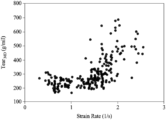
- FIG. 1 is a plot of the Tear MD as a function of strain rate for Polymer A.
- FIGS. 2 A and 2 B are plots of the Tear MD as a function of strain rate for Polymer B.
- FIGS. 3 A and 3 B are plots of the Tear MD as a function of strain rate for Polymer C.
- FIG. 4 A is a plot of the measured Tear MD versus the estimated Tear MD , each represented as ln(Tear MD ) in the plot with a 1:1 line inserted for reference.
- FIG. 4 B is a plot of the measured Tear MD versus the estimated Tear MD for the 30 additional polymer films with a 1:1 line inserted for reference.
- the present disclosure relates a model that estimates (A) the machine direction tear of a polymer film based on the physical properties of the polymer and the blown film extrusion conditions or (B) the necessary physical properties of the polymer and the necessary blown film extrusion conditions to achieve a polymer film with a desired machine direction tear.
- the model comprises a multivariate adaptive regression splines-derived algorithm and is specific to polymer films that comprise a hafnium (Hf) metallocene polyethylene referred to herein as Polymer A.
- metalocene catalyst is defined to comprise at least one transition metal compound containing one or more substituted or unsubstituted cyclopentadienyl moiety (Cp) (typically two Cp moieties) in combination with a Group 4, 5, or 6 transition metal, such as, zirconium, hafnium, and titanium.
- Cp substituted or unsubstituted cyclopentadienyl moiety
- mPEs metallocene polyethylenes
- Polymer A refers to mPEs synthesized using a hafnium transition metal metallocene-type catalyst system. The properties of Polymer A are provided further herein.
- Polymer B refers to mPEs synthesized using a supported catalyst with a bridged bis(alkyl-substituted dicyclopentadienyl) zirconium dichloride transition metal component and methyl alumoxane cocatalyst.
- the properties of Polymer B are provided further herein.
- Polymer C refers to mPEs synthesized using a supported catalyst with a bridged bis-indenyl zirconocene transition metal component and methyl alumoxane cocatalyst.
- the properties of Polymer C are provided further herein.
- melt flow rate is measured at 190° C. and 2.16 kg per ASTM D1238-13.
- heavy load melt flow rate is measured at 190° C. and 21.6 kg per ASTM D1238-13.
- flow rate ratio is the HLMFR divided by the MFR.
- ⁇ a bulk density ( ⁇ ) is measured per ASTM D1505-10.
- a molecular weight can be reported as number average (M n ), weight average (M w ) and z-average (M z ) as determined by gel permeation chromatography (GPC) as described in “Modern Size-Exclusion Liquid Chromatography, Practice of Gel Permeation and Gel Filtration Chromatography” by W. W. Yau, J. J. Kirkland and D. D. Bly (John Wiley & Sons, 1979); further reference to this text will indicate the chapter and page of “GPC-Yau.”
- a polydispersity index refers to M w /M n .
- blown film extrusion refers to a process where a polymer melt is extruded through a circular die followed by bubble-like expansion.
- melt temperature refers to the polymer melt temperature at the extruder die, which has units of ° F. unless otherwise specified.
- output rate is the extruder throughput, which has units of lb/hr unless otherwise specified.
- process time is the calculated time for the polymer melt to travel from the die exit to the frost line height (FLH), which has units of mm unless otherwise specified.
- DDR draw down ratio
- PT process time
- machine direction tear refers to Elmendorf Tear, which is measured per ASTM D1922-15 but is reported as a normalized value relative to the film thickness with the units of grams per mil (g/mil), unless otherwise specified.
- model refers to a system of one or more algorithms.
- an algorithm carries its normal meaning and refers without limitation to any series of repeatable steps that result in a discrete value or values.
- an algorithm may include any mathematical, statistical, positional, or relational calculation between any numbers of user-specified, preset, automatically-determined, or industry- or system-acceptable data elements.
- various algorithms may be performed on subject data elements in relation to a previously defined data evaluation sample in order to produce a single, meaningful data value.
- MARS multivariate adaptive regression splines
- non-transitory, computer-readable medium refers to any tangible storage that participates in providing instructions to a processor for execution.
- Such a medium may take many forms, including but not limited to, non-volatile media, and volatile media.
- Non-volatile media includes, for example, NVRAM, or magnetic or optical disks.
- Volatile media includes dynamic memory, such as main memory.
- Computer-readable media may include, for example, a floppy disk, a flexible disk, hard disk, magnetic tape, or any other magnetic medium, magneto-optical medium, a CD-ROM, any other optical medium, a RAM, a PROM, and EPROM, a FLASH-EPROM, a solid state medium like a holographic memory, a memory card, or any other memory chip or cartridge, or any other physical medium from which a computer can read.
- the computer-readable media is configured as a database, it is to be understood that the database may be any type of database, such as relational, hierarchical, object-oriented, and/or the like. Accordingly, exemplary embodiments of the present techniques may be considered to include a tangible storage medium or tangible distribution medium and prior art-recognized equivalents and successor media, in which the software implementations embodying the present techniques are stored.
- Polymer A includes mPEs with unique properties as compared to other mPEs.
- Tear MD as a function of strain rate of Polymer A has a very different trend than other mPEs.
- FIG. 1 is a plot of the Tear MD as a function of strain rate during blown film extrusion process for a plurality of films composed of Polymer A.
- FIGS. 2 A and 2 B are plots of the Tear MD as a function of strain rate during blown film extrusion process for a plurality of films composed of Polymer B.
- FIGS. 3 A and 3 B are plots of the Tear MD as a function of strain rate during blown film extrusion process for a plurality of films composed of Polymer C.
- FIGS. 1 , 2 A, and 3 A have the same axis sizes for comparison, and FIGS. 2 B and 3 B are zoomed in version of FIGS. 2 A and 3 A , respectively.
- FIGS. 1 , 2 A, and 3 A A comparison of FIGS. 1 , 2 A, and 3 A illustrates that Polymer A has different properties than Tear MD properties than other mPEs. Therefore, general trends or knowledge gleaned from working with other mPEs relative to Tear MD are not applicable to Polymer A. Accordingly, to produce polymer films of Polymer A with a desired Tear MD , a producer will have to use a trial and error approach, which can be time consuming and costly.
- the present disclosure provides a model that includes a correlation between Tear MD and a combination of Polymer A physical properties and blown film extrusion conditions.
- the correlation is derived using multivariate adaptive regression splines (MARS).
- MARS multivariate adaptive regression splines
- the model may be used either to estimate Tear MD of a polymer film based on the physical properties of Polymer A and the blown film extrusion conditions intended to use or to estimate which physical properties of Polymer A and blown film extrusion conditions are needed to produce a polymer film with a desired Tear MD .
- the physical properties of Polymer A that can be used in the correlation include, but are not limited to, a bulk density, a melt flow rate, a high load melt flow rate, a flow rate ratio, molecular weight (Mw, Mn, and/or Mz), polydispersity index, and any combination thereof.
- the blown film extrusion conditions that can be used in the correlation include, but are not limited to, an output rate, a frost line height, a blow up ratio, a draw down ratio, a die size, a die gap, a melt temperature, a process time, a strain rate, a final film thickness, extruder screw speed, and any combination thereof.
- Deriving the algorithm can involve performing a MARS analysis on data that includes Tear MD values and the corresponding Polymer A properties and the corresponding blown film extrusion conditions.
- the MARS analysis produces an algorithm that can be used in the models described herein.
- EQ. 4 is example MARS-derived algorithm that correlates physical properties of Polymer A (specifically, bulk density, melt flow rate, and flow rate ratio) and blown film extrusion conditions (specifically, melt temperature, strain rate, and process time) with Tear MD .
- Ln(Tear MD ) a 1 +a 2 *max(0 ,a 3 ⁇ MT) ⁇ a 4 *max(0,MT ⁇ a 3 )+ a 5 *max(0,STR ⁇ a 6 )+ a 7 * ⁇ *max(0,MT ⁇ a 3 )+ a 8 *OR*max(0,STR ⁇ a 9 ) ⁇ a 10 *MFR*max(0 , a 11 ⁇ PT)+ a 12 *MFR*max(0 ,a 13 ⁇ STR)+ a 19 *FRR*max(0,STR ⁇ a 13 ) ⁇ a 18 *max(0,MT ⁇ a 14 )*max(0,STR ⁇ a 13 ) ⁇ a 15 *max(0 ,a 16 ⁇ PT)*max(0,STR ⁇ a 17 ), EQ.
- a 1 -a 19 are coefficients derived from experimental data, max(0, x-constant) and max(0, constant-x) result in unitless values, a 1 is unitless, a 2 is unitless, a 3 has units ° F., a 4 is unitless, a 5 is unitless, a 6 has units 1/s, a 7 has units cm 3 /g, a 8 has units hr/lb, a 9 has units 1/s, a 10 has units 10 min/g, a 11 has units s, a 12 has units 10 min/g, a 13 has units 1/s, a 14 has units ° F., a 15 is unitless, a 16 has units s, a 17 has units 1/s, a 18 is unitless, a 19 is unitless, and Tear MD , has units g/mil.
- MARS-derived algorithms can be calculated from experimental data (combinations of Polymer A physical properties, extrusion conditions, and resultant Tear MD ). Such models can include any number of Polymer A physical properties and extrusion conditions to correlate with Tear MD .
- an alternative MARS-derived algorithm can correlate physical properties of Polymer A (specifically, bulk density, melt flow rate, and flow rate ratio) and blown film extrusion conditions (specifically, melt temperature, strain rate, process time, and final film thickness) with Tear MD .
- the MARS-derived algorithm can be updated by adding more data points from which the algorithm is derived.
- a method can include updating (re-deriving) an existing MARS-derived algorithm based on Tear MD data for one or more produced polymer films comprising the Polymer A and corresponding data for the one or more physical properties of the Polymer A and the one or more blown film extrusion conditions.
- Updates can include updating the MARS-derived algorithm using the same combination of Polymer A properties and extrusion conditions. Updates can include updating MARS-derived algorithm using additional or fewer Polymer A properties and/or additional or fewer extrusion conditions.
- the MARS-derived algorithm of EQ. 4 can be updated with the same combination of Polymer A properties and extrusion conditions, which would update the coefficient values.
- the MARS-derived algorithm of EQ. 4 can be updated to further include final film thickness as an extrusion condition, which would result in more terms in the algorithm.
- the models described herein include a MARS-derived algorithm that correlates the physical properties of Polymer A and the blown film extrusion conditions with the Tear MD of the final blown film.
- the models can be applied in either direction of the correlation. That is, the models can be applied to generate (A) the Tear MD of a polymer film based on the physical properties of the polymer and the blown film extrusion conditions or (B) the necessary physical properties of the polymer and the necessary blown film extrusion conditions to achieve a polymer film with a desired Tear MD .
- a method of the present disclosure can include generating an estimated Tear MD for a polymer film comprising Polymer A using a model comprising a MARS-derived algorithm (e.g., EQ. 4 or a variation thereof) with inputs of one or more desired physical properties of the Polymer A and one or more desired blown film extrusion conditions.
- This method can be performed iteratively to generate a Tear MD for more than one combination of Polymer A physical properties and extrusion conditions.
- the iterative method may be useful, for example, when several Polymer A compositions are available. Additionally, iterative method may be useful, for example, when more than one blown film extrusion line is available. For a manufacturer, this may be useful in determining the capabilities of the existing equipment and in evaluating upgrades and new equipment.
- the foregoing methods of the present disclosure can optionally further include producing a polymer film with the Polymer A composition physical properties and extrusion conditions.
- the combination of Polymer A physical properties ⁇ 5% and extrusion conditions ⁇ 5% used to produce the polymer film can be those initially used in the model or those from an iterative analysis.
- the slight variation ( ⁇ 5%) in the Polymer A physical properties and/or the extrusion conditions allows for using the model and then using slightly different compositions/conditions due to the compositions of Polymer A available and the blown film extrusion equipment capabilities.
- Another method of the present disclosure can include generating one or more estimated physical properties of a Polymer A and one or more estimated blown film extrusion conditions using a model comprising a MARS-derived algorithm (e.g., EQ. 4 or a variation thereof) with an input of a desired Tear MD for a polymer film comprising the Polymer A.
- the output can be one or more sets of physical properties and extrusion conditions. That is, more than one combination of Polymer A physical properties and extrusion conditions can produce a Tear MD .
- a choice between which combination to use may be determined by the compositions of Polymer A available, the blown film extrusion equipment capabilities, and other polymer film properties associated with the combination.
- a first combination of Polymer A physical properties and extrusion conditions may produce a polymer film with a first haze
- a second combination of Polymer A physical properties and extrusion conditions may produce a polymer film with a second haze.
- the desired haze value may be considered when determining which Polymer A physical properties and extrusion conditions to use in producing polymer films.
- the other polymer film properties considered may be evaluated by other models and/or may be determined experimentally. If determined experimentally, the number of experiments and associated time and cost are greatly reduced because the model of the present disclosure greatly reduces the number of combinations of Polymer A physical properties and extrusion conditions to be tested.
- the blown film extrusion conditions and physical properties may be slightly varied to account for the compositions of Polymer A available and the blown film extrusion equipment capabilities.
- the method can further include forming the polymer film using the one or more estimated blown film extrusion conditions ⁇ 5% with the Polymer A having the one or more estimated physical properties ⁇ 5%.
- the one or more estimated blown film extrusion conditions includes a melt temperature of about 100° C.
- the polymer film may be produced with a melt temperature of about 95° C. to about 105° C.
- the polymer film may be produced with a Polymer A composition having a MFR of about 0.50 g/10 min to 0.56 about g/10 min.
- Additional methods include updating the MARS-based algorithm based on the polymer films produced in the foregoing methods.
- the polymer films produced using the Polymer A properties/extrusion conditions determined based on the model with a desired Tear MD input can be tested where the measured Tear MD , the properties of the Polymer A used, and the extrusion conditions used are input as data points for updating (re-deriving) the MARS-based algorithm.
- polymer films can be produced using Polymer A and the Tear MD measured. The corresponding data can be used as data points for updating the MARS-based algorithm.
- the methods described herein can be performed on computing devices (or processor-based devices) that include a processor; a memory coupled to the processor; and instructions provided to the memory, wherein the instructions are executable by the processor to perform the methods described herein.
- the instructions can be a portion of code on a non-transitory computer readable medium.
- Any suitable processor-based device may be utilized for implementing all or a portion of embodiments of the present techniques, including without limitation personal computers, networks personal computers, laptop computers, computer workstations, mobile devices, multi-processor servers or workstations with (or without) shared memory, high performance computers, and the like.
- embodiments may be implemented on application specific integrated circuits (ASICs) or very large scale integrated (VLSI) circuits.
- Polymer A comprises from 70.0 mole % to or 100.0 mole % of units derived from ethylene.
- the lower limit on the range of ethylene content may be from 70.0 mole %, 75.0 mole %, 80.0 mole %, 85.0 mole %, 90.0 mole %, 92.0 mole %, 94.0 mole %, 95.0 mole %, 96.0 mole %, 97.0 mole %, 98.0 mole %, or 99.0 mole % based on the mole % of polymer units derived from ethylene.
- the Polymer A may have an upper ethylene limit of 80.0 mole %, 85.0 mole %, 90.0 mole %, 92.0 mole %, 94.0 mole %, 95.0 mole %, 96.0 mole %, 97.0 mole %, 98.0 mole %, 99.0 mole %, 99.5 mole %, or 100.0 mole %, based on polymer units derived from ethylene.
- the polyethylene polymer may have less than 50.0 mole % of polymer units derived from a C 3 -C 20 olefin, preferably, an alpha-olefin, e.g., hexene or octene.
- the lower limit on the range of C 3 -C 20 olefin-content may be 25.0 mole %, 20.0 mole %, 15.0 mole %, 10.0 mole %, 8.0 mole %, 6.0 mole %, 5.0 mole %, 4.0 mole %, 3.0 mole %, 2.0 mole %, 1.0 mole %, or 0.5 mole %, based on polymer units derived from the C 3 -C 20 olefin.
- the upper limit on the range of C 3 -C 20 olefin-content may be 20.0 mole %, 15.0 mole %, 10.0 mole %, 8.0 mole %, 6.0 mole %, 5.0 mole %, 4.0 mole %, 3.0 mole %, 2.0 mole %, or 1.0 mole %, based on polymer units derived from the C 3 to C 20 olefin. Any of the lower limits may be combined with any of the upper limits to form a range. Comonomer content is based on the total content of all monomers in the polymer.
- Polymer A may have minimal long chain branching (i.e., less than 1.0 long-chain branch/1000 carbon atoms, preferably particularly 0.05 to 0.50 long-chain branch/1000 carbon atoms). Such values are characteristic of a linear structure that is consistent with a branching index (as defined below) of g′ vis ⁇ 0.980, 0.985, ⁇ 0.99, ⁇ 0.995, or 1.0. While such values are indicative of little to no long chain branching, some long chain branches may be present (i.e., less than 1.0 long-chain branch/1000 carbon atoms, preferably less than 0.5 long-chain branch/1000 carbon atoms, particularly 0.05 to 0.50 long-chain branch/1000 carbon atoms).
- branching index as defined below
- Polymer A may have a bulk density of from about 0.910 to about 0.925 g/cm 3 , from about 0.910 to about 0.923 g/cm 3 , from about 0.910 to about 0.920 g/cm 3 , from about 0.915 to about 0.921 g/cm 3 , from about 0.910 to about 0.918 g/cm 3 , from about 0.912 to about 0.918 g/cm 3 , or from about 0.912 to 0.917 g/cm 3 .
- the M w of Polymer A may be from about 15,000 to about 500,000 g/mol, from about 20,000 to about 250,000 g/mol, from about 25,000 to about 150,000 g/mol, from about 150,000 to about 400,000 g/mol, from about 200,000 to about 400,000 g/mol, or from about 250,000 to about 350,000 g/mol.
- Polymer A may have a polydispersity index of from about 1.5 to about 5.0, from about 2.0 to about 4.0, from about 3.0 to about 4.0, or from about 2.5 to about 4.0.
- Polymer A may have M z to M w ratio greater than about 1.5, or greater than about 1.7, or greater than about 2.0. In some embodiments, this ratio is from about 1.7 to about 3.5, from about 2.0 to about 3.0, or from about 2.2 to about 3.0.
- Polymer A may have a MFR (190° C./2.16 kg) of about 0.1 to about 300 g/10 min, about 0.1 to about 100 g/10 min, about 0.1 to about 50 g/10 min, about 0.1 g/10 min to about 5.0 g/10 min, about 0.1 g/10 min to about 3.0 g/10 min, about 0.1 g/10 min to about 2.0 g/10 min, about 0.1 g/10 min to about 1.2 g/10 min, about 0.2 g/10 min to about 1.5 g/10 min, about 0.2 g/10 min to about 1.1 g/10 min, about 0.3 g/10 min to about 1.0 g/10 min, about 0.4 g/10 min to about 1.0 g/10 min, about 0.5 g/10 min to about 1.0 g/10 min, about 0.6 g/10 min to about 1.0 g/10 min, about 0.7 g/10 min to about 1.0 g/10 min, or about 0.75 g/10 min to about 0.95 g/10 min.
- MFR 190° C./2
- Polymer A may have a FFR of from about 10.0 to about 50.0, from about 15.0 to about 45.0, from about 20.0 to about 40.0, from about 20.0 to about 35.0, from about 22 to about 38, from about 20 to about 32, from about 25 to about 31, or from about 28 to about 30.
- Polymer A may contain less than 5.0 ppm hafnium, less than 2.0 ppm hafnium, less than 1.5 ppm hafnium, or less than 1.0 ppm hafnium.
- Polymer A may contain from about 0.01 ppm to about 2 ppm hafnium, from about 0.01 ppm to about 1.5 ppm hafnium, or from about 0.01 ppm to about 1.0 ppm hafnium.
- the amount of hafnium is greater than the amount of zirconium in Polymer A.
- the ratio of hafnium to zirconium is at least about 2.0, at least about 10.0, at least about 15, at least about 17.0, at least about 20.0, at least about 25.0, at least about 50.0, at least about 100.0, at least about 200.0, or at least about 500.0 or more.
- zirconium generally is present as an impurity in hafnium, it will be realized in some embodiments where particularly pure hafnium-containing catalysts are used, the amount of zirconium may be extremely low, resulting in a virtually undetectable or undetectable amount of zirconium in Polymer A. Thus, the upper limit on the ratio of hafnium to zirconium in Polymer A may be quite large.
- Polymer A may have at least a first peak and a second peak in a comonomer distribution analysis, wherein the first peak has a maximum at a log(M w ) value of 4.0 to 5.4, 4.3 to 5.0, or 4.5 to 4.7; and a temperature rising elution fraction (TREF) elution temperature of 70.0° C. to 100.0° C., 80.0° C. to 95.0° C., or 85.0° C. to 90.0° C.
- the second peak in the comonomer distribution analysis has a maximum at a log(M w ) value of 5.0 to 6.0, 5.3 to 5.7, or 5.4 to 5.6; and a TREF elution temperature of 40.0° C.
- TREF is described in Wild, et al., J. Poly. Sci., Poly. Phys. Ed., Vol. 20, p. 441 (1982) and U.S. Pat. No. 5,008,204, which are fully incorporated herein by reference.
- Polymer A may have one or more of the following properties: a MFR (190° C./2.16 kg) of from about 0.1 g/10 min to about 5.0 g/10 min; a FRR of from about 15 to about 30; a M w of from about 20,000 to about 200,000 g/mol; a M w /M n , of from about 2.0 to about 4.5; and a density of from about 0.910 to about 0.925 g/cm 3 .
- a MFR 190° C./2.16 kg
- the amount of hafnium is greater than the amount of zirconium and a ratio of hafnium to zirconium (ppm/ppm) may be at least about 2.0, at least about 10.0, at least about 15.0, at least about 17.0, at least about 20.0, or at least about 25.0.
- Polymer A may have an orthogonal comonomer distribution.
- orthogonal comonomer distribution is used herein to mean across the molecular weight range of the ethylene polymer, comonomer contents for the various polymer fractions are not substantially uniform and a higher molecular weight fraction thereof generally has a higher comonomer content than that of a lower molecular weight fraction.
- substantially uniform comonomer distribution is used herein to mean that comonomer content of the polymer fractions across the molecular weight range of the ethylene-based polymer vary by ⁇ 10.0 wt %.
- a substantially uniform comonomer distribution may refer to ⁇ 8.0 wt %, ⁇ 5.0 wt %, or ⁇ 2.0 wt %. Both a substantially uniform and an orthogonal comonomer distribution may be determined using fractionation techniques such as gel permeation chromatography-differential viscometry (GPC-DV), temperature rising elution fraction-differential viscometry (TREF-DV) or cross-fractionation techniques.
- GPC-DV gel permeation chromatography-differential viscometry
- TREF-DV temperature rising elution fraction-differential viscometry
- cross-fractionation techniques such as gel permeation chromatography-differential viscometry (GPC-DV), temperature rising elution fraction-differential viscometry (TREF-DV) or cross-fractionation techniques.
- the melt strength of Polymer A at a particular temperature may be determined with a Gottfert Rheotens Melt Strength Apparatus.
- a polymer melt strand extruded from the capillary die is gripped between two counter-rotating wheels on the apparatus.
- the take-up speed is increased at a constant acceleration of 2.4 mm/sec 2 .
- the maximum pulling force (in the unit of cN) achieved before the strand breaks or starts to show draw-resonance is determined as the melt strength.
- the temperature of the rheometer is set at 190° C.
- the capillary die has a length of 30 mm and a diameter of 2 mm.
- the polymer melt is extruded from the die at a speed of 10 mm/sec.
- the distance between the die exit and the wheel contact point should be 122 mm.
- the melt strength of Polymer A may be in the range from about 1 to about 100 cN, about 1 to about 50 cN, about 1 to about 25 cN, about 3 to about 15 cN, about 4 to about 12 cN, or about 5 to about 10 cN.
- Polymer B includes ethylene-based polymers comprising ⁇ 50.0 wt % of polymer units derived from ethylene and ⁇ 50.0 wt % preferably 1.0 wt % to 35.0 wt %, even more preferably 1 to 6 wt % of polymer units derived from a C 3 to C 20 alpha-olefin comonomer (for example, hexene or octene).
- ethylene-based polymers comprising ⁇ 50.0 wt % of polymer units derived from ethylene and ⁇ 50.0 wt % preferably 1.0 wt % to 35.0 wt %, even more preferably 1 to 6 wt % of polymer units derived from a C 3 to C 20 alpha-olefin comonomer (for example, hexene or octene).
- Polymer B may have a bulk density of ⁇ about 0.910 g/cm 3 , ⁇ about 0.915 g/cm 3 , ⁇ about 0.920 g/cm 3 , ⁇ about 0.925 g/cm 3 , ⁇ about 0.930 g/cm 3 , or ⁇ about 0.940 g/cm 3 .
- Polymer B may have a bulk density of ⁇ about 0.950 g/cm 3 , e.g., ⁇ about 0.940 g/cm 3 , ⁇ about 0.930 g/cm 3 , ⁇ about 0.925 g/cm 3 , ⁇ about 0.920 g/cm 3 , or ⁇ about 0.915 g/cm 3 . Ranges expressly disclosed include ranges formed by combinations of any of the above-enumerated values (e.g., 0.910 to 0.950 g/cm 3 , 0.910 to 0.930 g/cm 3 , 0.910 to 0.925 g/cm 3 , etc.).
- Polymer B may have a MFR (190° C./2.16 kg) of ⁇ about 0.5 g/10 min, e.g., ⁇ about 0.5 g/10 min, ⁇ about 0.7 g/10 min, ⁇ about 0.9 g/10 min, ⁇ about 1.1 g/10 min, ⁇ about 1.3 g/10 min, ⁇ about 1.5 g/10 min, or ⁇ about 1.8 g/10 min.
- MFR 190° C./2.16 kg
- the MFR may be ⁇ about 8.0 g/10 min, ⁇ about 7.5 g/10 min, ⁇ about 5.0 g/10 min, ⁇ about 4.5 g/10 min, ⁇ about 3.5 g/10 min, ⁇ about 3.0 g/10 min, ⁇ about 2.0 g/10 min, e.g., ⁇ about 1.8 g/10 min, ⁇ about 1.5 g/10 min, ⁇ about 1.3 g/10 min, ⁇ about 1.1 g/10 min, ⁇ about 0.9 g/10 min, or ⁇ about 0.7 g/10 min, 0.5 to 2.0 g/10 min, particularly 0.75 to 1.5 g/10 min Ranges expressly disclosed include ranges formed by combinations of any of the above-enumerated values (e.g., about 0.5 to about 8.0 g/10 min, about 0.7 to about 1.8 g/10 min, about 0.9 to about 1.5 g/10 min, about 0.9 to 1.3, about 0.9 to 1.1 g/10 min, about 1.0 g/10 min, etc.).
- Polymer B may have a density of 0.910 to 0.920 g/cm 3 , a MFR of 0.5 to 8.0 g/10 min, and a composition distribution index (CDBI) of 60.0% to 80.0% (preferably between 65% and 80%).
- the FRR for Polymer B is typically from about 15 to about 20.
- the term “Composition distribution breadth index” (CDBI) is defined as the weight percentage of the copolymer molecules having a comonomer content within 50% of the median total molar comonomer content.
- the CDBI of a copolymer is readily determined utilizing well known techniques for isolating individual fractions of a sample of the copolymer. One such technique is TREF.
- Polymer C includes ethylene-based polymers having about 99.0 to about 80.0 wt %, 99.0 to 85.0 wt %, 99.0 to 87.5 wt %, 99.0 to 90.0 wt %, 99.0 to 92.5 wt %, 99.0 to 95.0 wt %, or 99.0 to 97.0 wt %, of polymer units derived from ethylene and about 1.0 to about 20.0 wt %, 1.0 to 15.0 wt %, 1.0 to 12.5 wt %, 1.0 to 10.0 wt %, 1.0 to 7.5 wt %, 1.0 to 5.0 wt %, or 1.0 to 3.0 wt % of polymer units derived from one or more C 3 to C 20 ⁇ -olefin comonomers, preferably C 3 to C 10 ⁇ -olefins, and more preferably C 4 to C 8 ⁇ -olefins.
- the ⁇ -olefin comonomer may be linear, branched, cyclic and/or substituted, and two or more comonomers may be used, if desired.
- suitable comonomers include propylene, butene, 1-pentene; 1-pentene with one or more methyl, ethyl, or propyl substituents; 1-hexene; 1-hexene with one or more methyl, ethyl, or propyl substituents; 1-heptene; 1-heptene with one or more methyl, ethyl, or propyl substituents; 1-octene; 1-octene with one or more methyl, ethyl, or propyl substituents; 1-nonene; 1-nonene with one or more methyl, ethyl, or propyl substituents; ethyl, methyl, or dimethyl-substituted 1-decene; 1-dodecene;
- Polymer C comprises from about 8 wt % to about 15 wt %, of C 3 -C 10 ⁇ -olefin derived units, and from about 92 wt % to about 85 wt % ethylene derived units, based upon the total weight of the polymer.
- Polymer C can comprise from about 9 wt % to about 12 wt %, of C 3 -C 10 ⁇ -olefin derived units, and from about 91 wt % to about 88 wt % ethylene derived units, based upon the total weight of the polymer.
- Polymer C may have a MFR (190° C./2.16 kg) of ⁇ about 0.10 g/10 min, ⁇ about 0.15 g/10 min, ⁇ about 0.18 g/10 min, ⁇ about 0.20 g/10 min, ⁇ about 0.22 g/10 min, ⁇ about 0.25 g/10 min, ⁇ about 0.28, or ⁇ about 0.30 g/10 min Additionally, Polymer C may have a MFR ⁇ about 3.0 g/10 min, ⁇ about 2.0 g/10 min, ⁇ about 1.5 g/10 min, ⁇ about 1.0 g/10 min, ⁇ about 0.75 g/10 min, ⁇ about 0.50 g/10 min, ⁇ about 0.40 g/10 min, ⁇ about 0.30 g/10 min, ⁇ about 0.25 g/10 min, ⁇ about 0.22 g/10 min, ⁇ about 0.20 g/10 min, ⁇ about 0.18 g/10 min, or ⁇ about 0.15 g/10 min Ranges expressly disclosed include, but are not limited to, ranges formed by combinations of
- Polymer C may have a FRR of the first additional polyethylene polymers may be from 25 to 80, alternatively, from 25 to 60, alternatively, from about 30 to about 55, and alternatively, from about 35 to about 50.
- Polymer C may have a density ⁇ about 0.905 g/cm 3 , ⁇ about 0.910 g/cm 3 , ⁇ about 0.912 g/cm 3 , ⁇ about 0.913 g/cm 3 , ⁇ about 0.915 g/cm 3 , ⁇ about 0.916 g/cm 3 , ⁇ about 0.917 g/cm 3 , ⁇ about 0.918 g/cm 3 .
- Polymer C may have a density ⁇ about 0.945 g/cm 3 , e.g., ⁇ about 0.940 g/cm 3 , ⁇ about 0.937 g/cm 3 , ⁇ about 0.935 g/cm 3 , ⁇ about 0.930 g/cm 3 , ⁇ about 0.925 g/cm 3 , ⁇ about 0.920 g/cm 3 , or ⁇ about 0.918 g/cm 3 .
- Ranges expressly disclosed include, but are not limited to, ranges formed by combinations of any of the above-enumerated values (e.g., from about 0.905 to about 0.945 g/cm 3 , 0.910 to about 0.935 g/cm 3 , 0.912 to 0.930 g/cm 3 , 0.916 to 0.925 g/cm 3 , 0.918 to 0.920 g/cm 3 , etc.).
- Polymer C may have a polydispersity index of about 2.5 to about 5.5, preferably 3.0 to 4.0.
- the melt strength may be in the range from about 1 to about 100 cN, about 1 to about 50 cN, about 1 to about 25 cN, about 3 to about 15 cN, about 4 to about 12 cN, or about 5 to about 10 cN.
- Polymer C may also be characterized by an averaged 1% secant modulus (M) of from 10,000 to 60,000 psi (pounds per square inch), alternatively, from 20,000 to 40,000 psi, alternatively, from 20,000 to 35,000 psi, alternatively, from 25,000 to 35,000 psi, and alternatively, from 28,000 to 33,000 psi, and a relation between M and the dart drop impact strength (DIS) in g/mil complying with EQ. 5.
- DIS dart drop impact strength
- e represents 2.7183, the base Napierian logarithm
- M is the averaged modulus in psi
- DIS is the 26 inch dart impact strength.
- the DIS is preferably from about 120 to about 1000 g/mil, even more preferably, from about 150 to about 800 g/mil.
- the branching index, g′ is inversely proportional to the amount of branching. Thus, lower values for g′ indicate relatively higher amounts of branching.
- Polymer C has a g′vis of 0.85 to 0.99, particularly, 0.87 to 0.97, 0.89 to 0.97, 0.91 to 0.97, 0.93 to 0.95, or 0.97 to 0.99.
- Polymer C may be made by any suitable polymerization method including solution polymerization, slurry polymerization, supercritical, and gas phase polymerization using supported or unsupported catalyst systems, such as a system incorporating a metallocene catalyst.
- Metallocene catalysts generally require activation with a suitable co-catalyst, or activator, in order to yield an “active metallocene catalyst” (i.e., an organometallic complex with a vacant coordination site that can coordinate, insert, and polymerize olefins).
- Active catalyst systems generally include not only the metallocene complex, but also an activator, such as an alumoxane or a derivative thereof (preferably methyl alumoxane), an ionizing activator, a Lewis acid, or a combination thereof.
- Alkylalumoxanes typically methyl alumoxane and modified methylalumoxanes
- the catalyst system may be supported on a carrier, typically an inorganic oxide or chloride or a resinous material such as, for example, polyethylene or silica.
- Zirconium transition metal metallocene-type catalyst systems are particularly suitable.
- metallocene catalysts and catalyst systems useful in producing Polymer C include those described in, U.S. Pat. Nos. 5,466,649, 6,476,171, 6,225,426, and 7,951,873, and in the references cited therein, all of which are fully incorporated herein by reference.
- Particularly useful catalyst systems include supported dimethylsilyl bis(tetrahydroindenyl) zirconium dichloride.
- Supported polymerization catalyst may be deposited on, bonded to, contacted with, or incorporated within, adsorbed or absorbed in, or on, a support or carrier.
- the metallocene is introduced onto a support by slurrying a presupported activator in oil, a hydrocarbon such as pentane, solvent, or non-solvent, then adding the metallocene as a solid while stirring.
- the metallocene may be finely divided solids.
- the metallocene is typically of very low solubility in the diluting medium, it is found to distribute onto the support and be active for polymerization. Very low solubilizing media such as mineral oil (e.g., KAYDOTM or DRAKOLTM) or pentane may be used.
- the diluent can be filtered off and the remaining solid shows polymerization capability much as would be expected if the catalyst had been prepared by traditional methods such as contacting the catalyst with methylalumoxane in toluene, contacting with the support, followed by removal of the solvent. If the diluent is volatile, such as pentane, it may be removed under vacuum or by nitrogen purge to afford an active catalyst.
- the mixing time may be greater than 4 hours, but shorter times are suitable.
- a continuous cycle is employed where in one part of the cycle of a reactor, a cycling gas stream, otherwise known as a recycle stream or fluidizing medium, is heated in the reactor by the heat of polymerization. This heat is removed in another part of the cycle by a cooling system external to the reactor.
- a cycling gas stream otherwise known as a recycle stream or fluidizing medium
- compositions and methods are described herein in terms of “comprising” various components or steps, the compositions and methods can also “consist essentially of” or “consist of” the various components and steps.
- FIG. 1 is the plot of the Tear MD as a function of strain rate for Polymer A.
- the data in FIG. 1 and the corresponding physical properties of Polymer A (specifically, bulk density, melt flow rate, and flow rate ratio) and blown film extrusion conditions (specifically, melt temperature, strain rate, and process time) were analyzed with MARS to derive a MARS-based algorithm that correlates the Tear MD to the Polymer A properties and the blown film extrusion conditions.
- the resultant MARS-based algorithm is EQ. 4.
- FIG. 4 A is a plot of the measured Tear MD versus the estimated Tear MD , each represented as ln(Tear MD ) in the plot. A 1:1 line is inserted for reference of accurate correlations. As the plot illustrates, the MARS-based algorithm generates estimated Tear MD values with reasonable accuracy. The standard deviation for FIG. 4 A is 53 g/mil.
- FIG. 4 B is a plot of the measured Tear MD versus the estimated Tear MD for the 30 additional polymer films again with reasonable agreement between the measured and estimated values.
- the data from the 30 additional polymer films could be used to re-derive the MARS-based algorithm for increased accuracy.
- compositions and methods are described in terms of “comprising,” “containing,” or “including” various components or steps, the compositions and methods can also “consist essentially of” or “consist of” the various components and steps. All numbers and ranges disclosed above may vary by some amount. Whenever a numerical range with a lower limit and an upper limit is disclosed, any number and any included range falling within the range is specifically disclosed. In particular, every range of values (of the form, “from about a to about b,” or, equivalently, “from approximately a to b,” or, equivalently, “from approximately a-b”) disclosed herein is to be understood to set forth every number and range encompassed within the broader range of values.
Landscapes
- Engineering & Computer Science (AREA)
- Chemical & Material Sciences (AREA)
- Mechanical Engineering (AREA)
- Manufacturing & Machinery (AREA)
- Health & Medical Sciences (AREA)
- Chemical Kinetics & Catalysis (AREA)
- Medicinal Chemistry (AREA)
- Polymers & Plastics (AREA)
- Organic Chemistry (AREA)
- Materials Engineering (AREA)
- Extrusion Moulding Of Plastics Or The Like (AREA)
- Manufacture Of Macromolecular Shaped Articles (AREA)
Abstract
Description
STR=(V film −V die)/FLH EQ. 1,
where Vfilm is the polymer film travel velocity above the frost line, and Vdie is the polymer travel velocity at the extruder.
DDR=V film /V die EQ. 2.
As used herein, the term “process time” (PT) is calculated according to EQ. 3, which is seconds (s) unless otherwise specified.
PT=FLH/[(V film −V die)/log(V film /V die)] EQ. 3.
Ln(TearMD)=a 1 +a 2*max(0,a 3−MT)−a 4*max(0,MT−a 3)+a 5*max(0,STR−a 6)+a 7*ρ*max(0,MT−a 3)+a 8*OR*max(0,STR−a 9)−a 10*MFR*max(0, a 11−PT)+a 12*MFR*max(0,a 13−STR)+a 19*FRR*max(0,STR−a 13)−a 18*max(0,MT−a 14)*max(0,STR−a 13)−a 15*max(0,a 16−PT)*max(0,STR−a 17), EQ. 4
where a1-a19 are coefficients derived from experimental data, max(0, x-constant) and max(0, constant-x) result in unitless values, a1 is unitless, a2 is unitless, a3 has units ° F., a4 is unitless, a5 is unitless, a6 has
DIS≥0.8*[100+e (11.71−0.000268M+2.183×10
Claims (6)
Ln(TearMD)=a 1 +a 2*max(0,a 3−MT)−a 4*max(0,MT−a 3)+a 5*max(0,STR−a 6)+a 7*ρ*max(0,MT−a 3)+a 8*OR*max(0,STR−a 9)−a 10*MFR*max(0,a 11−PT)+a 12*MFR*max(0,a 13−STR)+a 19*FRR*max(0,STR−a 13)−a 18*max(0,MT−a 14)*max(0,STR−a 13)−a 15*max(0,a 16−PT)*max(0,STR−a 17),
Ln(TearMD)=a 1 +a 2*max(0,a 3−MT)−a 4*max(0,MT−a 3)+a 5*max(0,STR−a 6)+a 7*ρ*max(0,MT−a 3)+a 8*OR*max(0,STR−a 9)−a 10*MFR*max(0,a 11−PT)+a 12*MFR*max(0,a 13−STR)+a 19*FRR*max(0,STR−a 13)−a 18*max(0,MT−a 14)*max(0,STR−a 13)−a 15*max(0,a 16−PT)*max(0,STR−a 17),
Priority Applications (1)
| Application Number | Priority Date | Filing Date | Title |
|---|---|---|---|
| US17/048,026 US11986992B2 (en) | 2018-05-22 | 2019-05-22 | Methods for forming films and their related computing devices |
Applications Claiming Priority (6)
| Application Number | Priority Date | Filing Date | Title |
|---|---|---|---|
| US201862674877P | 2018-05-22 | 2018-05-22 | |
| EP18177657 | 2018-06-14 | ||
| EP18177657.6 | 2018-06-14 | ||
| EP18177657 | 2018-06-14 | ||
| US17/048,026 US11986992B2 (en) | 2018-05-22 | 2019-05-22 | Methods for forming films and their related computing devices |
| PCT/US2019/033512 WO2019226766A1 (en) | 2018-05-22 | 2019-05-22 | Methods for forming films and their related computing devices |
Publications (2)
| Publication Number | Publication Date |
|---|---|
| US20210107202A1 US20210107202A1 (en) | 2021-04-15 |
| US11986992B2 true US11986992B2 (en) | 2024-05-21 |
Family
ID=66867785
Family Applications (1)
| Application Number | Title | Priority Date | Filing Date |
|---|---|---|---|
| US17/048,026 Active 2041-06-09 US11986992B2 (en) | 2018-05-22 | 2019-05-22 | Methods for forming films and their related computing devices |
Country Status (4)
| Country | Link |
|---|---|
| US (1) | US11986992B2 (en) |
| EP (1) | EP3797132A1 (en) |
| CN (1) | CN112154174B (en) |
| WO (1) | WO2019226766A1 (en) |
Families Citing this family (2)
| Publication number | Priority date | Publication date | Assignee | Title |
|---|---|---|---|---|
| DE102016119869A1 (en) * | 2016-10-18 | 2018-04-19 | Reifenhäuser GmbH & Co. KG Maschinenfabrik | Method and plant for producing a plastic film |
| WO2025221361A1 (en) * | 2024-04-19 | 2025-10-23 | ExxonMobil Technology and Engineering Company | Setting reactor operator parameters based on polymer properties and/or polymer film properties |
Citations (7)
| Publication number | Priority date | Publication date | Assignee | Title |
|---|---|---|---|---|
| US20030096128A1 (en) | 2001-07-19 | 2003-05-22 | Farley James Mcleod | Polyethylene films with improved physical properties |
| WO2005049663A2 (en) * | 2002-10-15 | 2005-06-02 | Exxonmobil Chemical Patents Inc. | On-line measurement and control of polymer properties by raman spectroscopy |
| US7116414B2 (en) | 2001-11-09 | 2006-10-03 | Exxonmobil Chemical Patents Inc. | On-line measurement and control of polymer properties by raman spectroscopy |
| US20090297810A1 (en) | 2008-05-30 | 2009-12-03 | Fiscus David M | Polyethylene Films and Process for Production Thereof |
| US20130319131A1 (en) | 2012-05-31 | 2013-12-05 | Chevron Phillips Chemical Company Lp | Controlling Melt Fracture in Bimodal Resin Pipe |
| US20150293005A1 (en) | 2014-04-09 | 2015-10-15 | Exxonmobil Chemical Patents Inc. | On-Line FT-NIR Method to Determine Particle Size and Distribution |
| US9695290B2 (en) | 2012-11-21 | 2017-07-04 | Exxonmobil Chemical Patents Inc. | Films comprising ethylene-based polymers and methods of making same |
Family Cites Families (20)
| Publication number | Priority date | Publication date | Assignee | Title |
|---|---|---|---|---|
| US4588790A (en) | 1982-03-24 | 1986-05-13 | Union Carbide Corporation | Method for fluidized bed polymerization |
| US4543399A (en) | 1982-03-24 | 1985-09-24 | Union Carbide Corporation | Fluidized bed reaction systems |
| US5008204A (en) | 1988-02-02 | 1991-04-16 | Exxon Chemical Patents Inc. | Method for determining the compositional distribution of a crystalline copolymer |
| FR2634212B1 (en) | 1988-07-15 | 1991-04-19 | Bp Chimie Sa | APPARATUS AND METHOD FOR POLYMERIZATION OF GASEOUS OLEFINS IN A FLUIDIZED BED REACTOR |
| US5352749A (en) | 1992-03-19 | 1994-10-04 | Exxon Chemical Patents, Inc. | Process for polymerizing monomers in fluidized beds |
| US5436304A (en) | 1992-03-19 | 1995-07-25 | Exxon Chemical Patents Inc. | Process for polymerizing monomers in fluidized beds |
| US5317036A (en) | 1992-10-16 | 1994-05-31 | Union Carbide Chemicals & Plastics Technology Corporation | Gas phase polymerization reactions utilizing soluble unsupported catalysts |
| EP1623999A1 (en) | 1993-04-26 | 2006-02-08 | ExxonMobil Chemical Patents Inc. | Process for polymerizing monomers in fluidized beds |
| US5462999A (en) | 1993-04-26 | 1995-10-31 | Exxon Chemical Patents Inc. | Process for polymerizing monomers in fluidized beds |
| ZA943399B (en) | 1993-05-20 | 1995-11-17 | Bp Chem Int Ltd | Polymerisation process |
| US5408181A (en) * | 1993-08-30 | 1995-04-18 | Auburn International, Inc. | NMR system for measuring polymer properties |
| US5466649A (en) | 1993-10-15 | 1995-11-14 | Exxon Chemical Patents Inc. | Polymerization catalyst systems, their production and use |
| US5453471B1 (en) | 1994-08-02 | 1999-02-09 | Carbide Chemicals & Plastics T | Gas phase polymerization process |
| US5616661A (en) | 1995-03-31 | 1997-04-01 | Union Carbide Chemicals & Plastics Technology Corporation | Process for controlling particle growth during production of sticky polymers |
| US6225426B1 (en) | 1996-04-10 | 2001-05-01 | Uniroyal Chemical Company, Inc. | Process for producing polyolefin elastomer employing a metallocene catalyst |
| US6255426B1 (en) | 1997-04-01 | 2001-07-03 | Exxon Chemical Patents, Inc. | Easy processing linear low density polyethylene |
| US6242545B1 (en) | 1997-12-08 | 2001-06-05 | Univation Technologies | Polymerization catalyst systems comprising substituted hafinocenes |
| IL158787A0 (en) * | 2001-05-11 | 2004-05-12 | Transform Pharmaceuticals Inc | Medthod and system for planning, performing, and assessing high-throughput screening of multicomponent chemical compositions and solid forms of compounds |
| US7951873B2 (en) | 2006-05-05 | 2011-05-31 | Exxonmobil Chemical Patents Inc. | Linear low density polymer blends and articles made therefrom |
| CN104903100B (en) | 2012-12-18 | 2017-11-14 | 埃克森美孚化学专利公司 | Polyethylene film and its manufacturing method |
-
2019
- 2019-05-22 WO PCT/US2019/033512 patent/WO2019226766A1/en not_active Ceased
- 2019-05-22 EP EP19731023.8A patent/EP3797132A1/en active Pending
- 2019-05-22 US US17/048,026 patent/US11986992B2/en active Active
- 2019-05-22 CN CN201980034113.4A patent/CN112154174B/en active Active
Patent Citations (7)
| Publication number | Priority date | Publication date | Assignee | Title |
|---|---|---|---|---|
| US20030096128A1 (en) | 2001-07-19 | 2003-05-22 | Farley James Mcleod | Polyethylene films with improved physical properties |
| US7116414B2 (en) | 2001-11-09 | 2006-10-03 | Exxonmobil Chemical Patents Inc. | On-line measurement and control of polymer properties by raman spectroscopy |
| WO2005049663A2 (en) * | 2002-10-15 | 2005-06-02 | Exxonmobil Chemical Patents Inc. | On-line measurement and control of polymer properties by raman spectroscopy |
| US20090297810A1 (en) | 2008-05-30 | 2009-12-03 | Fiscus David M | Polyethylene Films and Process for Production Thereof |
| US20130319131A1 (en) | 2012-05-31 | 2013-12-05 | Chevron Phillips Chemical Company Lp | Controlling Melt Fracture in Bimodal Resin Pipe |
| US9695290B2 (en) | 2012-11-21 | 2017-07-04 | Exxonmobil Chemical Patents Inc. | Films comprising ethylene-based polymers and methods of making same |
| US20150293005A1 (en) | 2014-04-09 | 2015-10-15 | Exxonmobil Chemical Patents Inc. | On-Line FT-NIR Method to Determine Particle Size and Distribution |
Also Published As
| Publication number | Publication date |
|---|---|
| EP3797132A1 (en) | 2021-03-31 |
| CN112154174A (en) | 2020-12-29 |
| US20210107202A1 (en) | 2021-04-15 |
| CN112154174B (en) | 2024-02-06 |
| WO2019226766A1 (en) | 2019-11-28 |
Similar Documents
| Publication | Publication Date | Title |
|---|---|---|
| RU2740918C1 (en) | Double catalyst system for producing lldpe copolymers with improved processability | |
| RU2705086C2 (en) | High escr polymers for use in blow molding | |
| US10927205B2 (en) | Polymerization processes and polymers made therefrom | |
| CA3176860C (en) | Dual catalyst system for producing lldpe and mdpe copolymers with long chain branching for film applications | |
| EP4185620A1 (en) | Multimodal ethylene copolymer | |
| EP3851463A1 (en) | Olefinic polymer | |
| US11859024B2 (en) | Dual catalyst system for producing polyethylene with long chain branching for blow molding applications | |
| KR102796010B1 (en) | Dual catalyst system for producing high density polyethylenes with long chain branching | |
| CN115397873B (en) | Bimodal linear low density polyethylene copolymer | |
| EP3851462A1 (en) | Catalyst for olefin polymerization | |
| CN110520297B (en) | Novel polyethylene compositions and methods of making and using the same | |
| KR20170055149A (en) | Ethylene copolymer having excellent processing properties | |
| RU2421476C2 (en) | Method of producing branched polypropylene | |
| US20210107202A1 (en) | Methods for Forming Films and Their Related Computing Devices | |
| US20220119564A1 (en) | Process to produce a polymer and polymer | |
| EP3532509B1 (en) | Controlling reactor split and a product parameter | |
| US20240228682A1 (en) | Polyethylene copolymer with broad short chain branching distribution | |
| RU2852818C1 (en) | Copolymer of bimodal linear low-density polyethylene | |
| RU2834225C1 (en) | Low-density bimodal linear polyethylene copolymer | |
| JP2025529119A (en) | Blow-molding polyethylene compositions with improved swelling behavior | |
| JP2025529117A (en) | Blow-molding polyethylene compositions with improved swelling behavior |
Legal Events
| Date | Code | Title | Description |
|---|---|---|---|
| FEPP | Fee payment procedure |
Free format text: ENTITY STATUS SET TO UNDISCOUNTED (ORIGINAL EVENT CODE: BIG.); ENTITY STATUS OF PATENT OWNER: LARGE ENTITY |
|
| STPP | Information on status: patent application and granting procedure in general |
Free format text: APPLICATION DISPATCHED FROM PREEXAM, NOT YET DOCKETED |
|
| STPP | Information on status: patent application and granting procedure in general |
Free format text: DOCKETED NEW CASE - READY FOR EXAMINATION |
|
| STPP | Information on status: patent application and granting procedure in general |
Free format text: NON FINAL ACTION MAILED |
|
| STPP | Information on status: patent application and granting procedure in general |
Free format text: RESPONSE TO NON-FINAL OFFICE ACTION ENTERED AND FORWARDED TO EXAMINER |
|
| STPP | Information on status: patent application and granting procedure in general |
Free format text: FINAL REJECTION MAILED |
|
| STPP | Information on status: patent application and granting procedure in general |
Free format text: RESPONSE AFTER FINAL ACTION FORWARDED TO EXAMINER |
|
| STPP | Information on status: patent application and granting procedure in general |
Free format text: NOTICE OF ALLOWANCE MAILED -- APPLICATION RECEIVED IN OFFICE OF PUBLICATIONS |
|
| STPP | Information on status: patent application and granting procedure in general |
Free format text: NOTICE OF ALLOWANCE MAILED -- APPLICATION RECEIVED IN OFFICE OF PUBLICATIONS |
|
| STPP | Information on status: patent application and granting procedure in general |
Free format text: PUBLICATIONS -- ISSUE FEE PAYMENT VERIFIED |
|
| STCF | Information on status: patent grant |
Free format text: PATENTED CASE |