US11974120B2 - System and method for securing a communication network - Google Patents
System and method for securing a communication network Download PDFInfo
- Publication number
- US11974120B2 US11974120B2 US17/589,564 US202217589564A US11974120B2 US 11974120 B2 US11974120 B2 US 11974120B2 US 202217589564 A US202217589564 A US 202217589564A US 11974120 B2 US11974120 B2 US 11974120B2
- Authority
- US
- United States
- Prior art keywords
- network
- security
- information
- slice
- incoming message
- Prior art date
- Legal status (The legal status is an assumption and is not a legal conclusion. Google has not performed a legal analysis and makes no representation as to the accuracy of the status listed.)
- Active
Links
- 230000006854 communication Effects 0.000 title claims abstract description 58
- 238000004891 communication Methods 0.000 title claims abstract description 57
- 238000000034 method Methods 0.000 title claims description 19
- 230000006870 function Effects 0.000 claims abstract description 156
- 238000013507 mapping Methods 0.000 claims description 17
- 239000000284 extract Substances 0.000 claims description 11
- 238000012986 modification Methods 0.000 claims description 7
- 230000004048 modification Effects 0.000 claims description 7
- 238000004458 analytical method Methods 0.000 claims description 5
- 238000007689 inspection Methods 0.000 claims description 4
- 238000010295 mobile communication Methods 0.000 claims description 3
- 230000001960 triggered effect Effects 0.000 claims description 2
- 230000003449 preventive effect Effects 0.000 abstract description 2
- 230000008447 perception Effects 0.000 abstract 1
- 238000010586 diagram Methods 0.000 description 10
- 230000007812 deficiency Effects 0.000 description 6
- 238000007726 management method Methods 0.000 description 5
- 238000012545 processing Methods 0.000 description 5
- 238000013475 authorization Methods 0.000 description 4
- 238000010200 validation analysis Methods 0.000 description 4
- 230000001010 compromised effect Effects 0.000 description 3
- 238000000605 extraction Methods 0.000 description 3
- 230000036541 health Effects 0.000 description 3
- 230000011664 signaling Effects 0.000 description 3
- 238000013459 approach Methods 0.000 description 2
- 230000008901 benefit Effects 0.000 description 2
- 238000013461 design Methods 0.000 description 2
- 238000005516 engineering process Methods 0.000 description 2
- 230000007246 mechanism Effects 0.000 description 2
- 241000238876 Acari Species 0.000 description 1
- 241000700605 Viruses Species 0.000 description 1
- LWZFANDGMFTDAV-BURFUSLBSA-N [(2r)-2-[(2r,3r,4s)-3,4-dihydroxyoxolan-2-yl]-2-hydroxyethyl] dodecanoate Chemical compound CCCCCCCCCCCC(=O)OC[C@@H](O)[C@H]1OC[C@H](O)[C@H]1O LWZFANDGMFTDAV-BURFUSLBSA-N 0.000 description 1
- 238000003491 array Methods 0.000 description 1
- 238000012517 data analytics Methods 0.000 description 1
- 238000013500 data storage Methods 0.000 description 1
- 230000001934 delay Effects 0.000 description 1
- 238000004519 manufacturing process Methods 0.000 description 1
- 230000003334 potential effect Effects 0.000 description 1
- 230000002265 prevention Effects 0.000 description 1
- 230000008569 process Effects 0.000 description 1
- 238000000926 separation method Methods 0.000 description 1
- 238000012360 testing method Methods 0.000 description 1
Images


Classifications
-
- H—ELECTRICITY
- H04—ELECTRIC COMMUNICATION TECHNIQUE
- H04W—WIRELESS COMMUNICATION NETWORKS
- H04W12/00—Security arrangements; Authentication; Protecting privacy or anonymity
- H04W12/03—Protecting confidentiality, e.g. by encryption
- H04W12/037—Protecting confidentiality, e.g. by encryption of the control plane, e.g. signalling traffic
-
- H—ELECTRICITY
- H04—ELECTRIC COMMUNICATION TECHNIQUE
- H04L—TRANSMISSION OF DIGITAL INFORMATION, e.g. TELEGRAPHIC COMMUNICATION
- H04L63/00—Network architectures or network communication protocols for network security
- H04L63/02—Network architectures or network communication protocols for network security for separating internal from external traffic, e.g. firewalls
- H04L63/0209—Architectural arrangements, e.g. perimeter networks or demilitarized zones
-
- H—ELECTRICITY
- H04—ELECTRIC COMMUNICATION TECHNIQUE
- H04L—TRANSMISSION OF DIGITAL INFORMATION, e.g. TELEGRAPHIC COMMUNICATION
- H04L63/00—Network architectures or network communication protocols for network security
- H04L63/02—Network architectures or network communication protocols for network security for separating internal from external traffic, e.g. firewalls
- H04L63/0227—Filtering policies
-
- H—ELECTRICITY
- H04—ELECTRIC COMMUNICATION TECHNIQUE
- H04L—TRANSMISSION OF DIGITAL INFORMATION, e.g. TELEGRAPHIC COMMUNICATION
- H04L63/00—Network architectures or network communication protocols for network security
- H04L63/14—Network architectures or network communication protocols for network security for detecting or protecting against malicious traffic
- H04L63/1441—Countermeasures against malicious traffic
-
- H—ELECTRICITY
- H04—ELECTRIC COMMUNICATION TECHNIQUE
- H04W—WIRELESS COMMUNICATION NETWORKS
- H04W12/00—Security arrangements; Authentication; Protecting privacy or anonymity
- H04W12/08—Access security
- H04W12/088—Access security using filters or firewalls
-
- H—ELECTRICITY
- H04—ELECTRIC COMMUNICATION TECHNIQUE
- H04W—WIRELESS COMMUNICATION NETWORKS
- H04W12/00—Security arrangements; Authentication; Protecting privacy or anonymity
- H04W12/12—Detection or prevention of fraud
- H04W12/121—Wireless intrusion detection systems [WIDS]; Wireless intrusion prevention systems [WIPS]
- H04W12/122—Counter-measures against attacks; Protection against rogue devices
Definitions
- the present disclosure relates to mobile core network communication security for 5G, and slicing and virtualization security and communication of virtual network functions. More particularly the disclosure relates to a system and method for securing a sliced wireless communication network by dividing the network into a plurality of internal security zones.
- Network slicing in modern wireless communication networks such as Fifth Generation (5G) mobile wireless communication networks, allows using of virtualized and logical networks on the same physical network architecture.
- a network slice is a logical block in a network, tailored to serve the purposes or requirements of a specific application.
- Such purposes include, for example, massive Machine Type Communication (mMTC) to serve Internet of Things (IoT) devices, enhanced Mobile Broadband (eMBB) to serve entertainment applications, Vehicle to X (V2X) to serve connected/self-driven cars, and applications that need high-speed Ultra-Reliable Low Latency Communications (URLLC), and Mobile Virtual Network Operator (MVNO).
- mMTC massive Machine Type Communication
- IoT Internet of Things
- eMBB enhanced Mobile Broadband
- V2X Vehicle to X
- URLLC Ultra-Reliable Low Latency Communications
- MVNO Mobile Virtual Network Operator
- Network slicing is an enabler technology that allows the connecting of all kind of partners to the communication network.
- Typical use cases include traffic management, self-driving cars, smart city, health, factories, private network, military (as extension to their own network), police, ports, and entertainment.
- the communication network is a critical infrastructure and need to be protected as such. Therefore, potential attacks on slices and network can have severe impacts on the availability, integrity and data confidentiality, of all the use cases.
- 5G also provides for all new use cases much better location tracking features, that allow tracking in range of few meters or even more precise.
- Each network slice has certain characteristics related to Quality of Service (QoS), for example, to support large bandwidth or short round-trip times etc.
- QoS Quality of Service
- a slice in the core network consists of a group of Network Functions (NFs) which support that slice.
- NFs Network Functions
- Those network functions can be exclusively assigned to that slice or can be shared among different slices.
- a shared network function can provide services to several slices.
- the network function may be virtual or physical.
- a physical node may host several network functions in 5G or future networks. It may even integrate legacy nodes from previous generations.
- a network function can also be a router or a proxy.
- network functions mentioned in the figures are typical examples related to slicing, but network slices may also encompass other types of network functions and nodes or a combination of thereof. Examples are application servers, session management functions, packet gateways, serving gateways, home subscriber server, policy and charging rules function, policy control functions, equipment identity register, charging function, network data analytics function, network exposure function, short message service function, user data repository, authentication server function among others.
- Slice 1 would have its own dedicated network functions like a User Plane Function (UPF) for data, Policy Control Function (PCF) for policy control etc.
- UPF User Plane Function
- PCF Policy Control Function
- Slice-1 would not only consist of the dedicated network functions in the Slice-1 ‘box’, but also the UDR (Unified Data Repository), AMF (Access Management Function) and Security Edge Protection Proxy (SEPP) from the shared network functions ‘box’.
- UDR Unified Data Repository
- AMF Access Management Function
- SEPP Security Edge Protection Proxy
- the network functions in the shared box would be available to be used by the slices and the hosting operator.
- the Slice 1 gaming company may want to offer content close to the proximity of the user and therefore they take ownership of the User Plane Function (UPF).
- UPF User Plane Function
- AMF Access Management Function
- Slice-2 would also consist of network functions dedicated to it and additionally the shared network functions UDR, SEPP and AMF would also be made available to Slice 2.
- the network functions in the slice are generally managed by the host network operator, like deploying new virtual instances in case of load. But the content and the details in the network function may be managed by the third-party business partners. Further, the hosting operator may not give third party business partners full access to all its network functions, and therefore it may not share some of the network functions with its business partners in Slice 1 and Slice-2 as illustrated in the ‘not shared box’ in FIG. 1 . This approach of having not-shared network functions, shared network functions, and slice-dedicated network functions is done to allow maximum flexibility.
- IP Internet Protocol
- TLS Transport Layer Security
- IPSec IP security
- NRF Network Resource Function
- SCP Service Communication Proxy
- the communication network comprises of two slices, and that Slice-2 is compromised and has gone rogue.
- Slice-2 is compromised and has gone rogue.
- an operator will have many partners health, automotive, entertainment, smart city allocated the use of a slice it is prudent to assume, that one of them could be compromised.
- the rogue network function which is part of Slice-2 would first establish a TLS connection to the NRF 201 .
- the rogue network function is authorised to contact the NRF since it is part of Slice-2 202 .
- the rogue network function which is part of Slice-2 would subsequently request the NRF for a token to access Slice-1 on the shared Network Function (NF) server wherein said request would specify slice identity as ‘Slice-1’ 203 .
- the NRF would check in turn check if the network function that the rogue slice wants to access is allowed to be accessed, but since the target network function is a shared network function for Slice-1 and Slice-2, the performed check would not result in dropping the request.
- NF Network Function
- the rogue network function is consequently allowed to access the shared network function 204 and a valid token for Slice-1 on the shared NF server would be generated which would be sent to the rogue network function by the NRF 205 .
- the rogue network belonging to Slice-2 further presents to the shared network function server the token for Slice-1 206 , and since the shared network function would rely on the NRF to have performed all necessary authorisation checks, the token is accepted by the shared network function 207 . If the transport/IP layer security is used between the network function belonging to Slice 2 and the shared network function, a valid connection would be established.
- the service request from the rogue network would be delivered which could be sensitive personal data such as user identity, user location or in other words the attack has revealed the user identity to the hacker that is controlling the rogue network which is part of Slice-2.
- a potential attack scenario could be that a slice for logistics may go rogue and obtain information via the means above from users belonging to a military slice.
- Another potential network challenge is related to the HTTP header of 5G messages sent between network functions, and the validation of elements within incoming messages. This has been illustrated in FIG. 3 .
- the rogue network function which is part of Slice-2 would first establish a TLS connection to the NRF 301 .
- the rogue network function is authorised to contact the NRF since it is which is part of Slice-2.
- the rogue network function requests an access token from the NRF for a service specifying Slice identity as Slice-2, which would be authorised by the NRF since its valid 302 and the NRF subsequently responds with the requested access token 303 .
- the rogue network function further creates a HTTP message with a service request for Slice-2 and an overload header for Slice-1 304 .
- the shared network function receiving said message would validate the token for the usage of the network function Application Programming Interface (API) issued to Slice-2 and the overload header information would potentially not be further cross checked against the token used for the network function API service access 305 . Consequently, the service providing network function would assume that Slice-1 is overloaded and hence should not be contacted, for example with notifications 305 . This overload situation would be stored with the corresponding time information given in the header and the service would be delivered to Slice-2 as requested 306 . Hence despite normal service operations, Slice-1 would be marked as overloaded resulting in a denial-of-service attack against Slice-1. Methods and systems known in the art are not equipped to prevent an attack of this sort which could potentially result in partial network delays or outages of critical elements of the network.
- API Application Programming Interface
- FIG. 4 illustrates another potential attack due to deficiencies in the art. It is assumed that the Access Management Function (AMF) is shared between Slice-1 and Slice-2. As illustrated in FIG. 4 , a rogue network function belonging to Slice-2 would first register as a service consumer with NRF 401 and then send a request to use the services of AMF for Slice-2 402 . Since AMF is shared between Slice-1 and Slice-2, the NRF would generate a token 403 and send it to the rogue network function in Slice-2 404 . The rogue network function subsequently creates a service request to AMF with token for Slice 2 in which a User Equipment (UE) identity from Slice-1 is mentioned in the service request 404 .
- UE User Equipment
- the AMF would assume that the NRF has performed all authorization duties, and it only checks if the token is valid 405 . However, this validity check solely verifies the correctness of the NRF issued token for Slice 2 and whether the request is initiated from the correct network function belonging to Slice 2.
- the AMF does not validate whether the UE identity mentioned in the service request belongs to Slice 2, and therefore it would assume that the request is valid and would hence respond to the service request, for example by providing location information of the UE in Slice-1, to the rogue network function.
- a foreign government could track through the AMF location service governmental personnel.
- the outlined attacks may result in fraudulent charges, as services are used by the rogue slice and in some cases with another user's identity.
- TLS and IPSec are used for cloud security in cloud deployments of virtualized functions, they do not protect against those attacks. It can be assumed that the attacker is using an existing partner, or it could also be an existing partner is compromised, for example through malware. In both cases a partner would launch attacks against other slices using the specific structure of messages in the communication network.
- WO 2020/068521 discloses techniques for providing network slice-based security in mobile networks by extracting network slice information for user traffic associated with the new session at the security platform, and determining a security policy to apply at the security platform to the new session based on the network slice information.
- WO 2020/068521 stand-up against attacks coming from user traffic from end user devices, and not from network functions associated with existing trusted business partners in the core network.
- the security platforms of WO 2020/068521 sit on interfaces that carry user data traffic, and does not protect the core network and control plane traffic.
- the security platform of WO 2020/068521 detect a virus in user traffic, i.e. from an infected device, but does not filter messages coming from network functions associated with trusted business partners.
- the present invention relates to a system and method for securing control plane traffic in a sliced wireless communication network by dividing the network into a plurality of internal security zones and allocating a dedicated pre-configured security guard for each internal security zone, that extends existing cloud security as set out in the appended claims.
- a system for securing control plane traffic in a sliced communication network that is adapted to run a plurality of network functions.
- the system includes a plurality of security guards, each placed at an edge of an internal security zone, wherein the internal security zone is formed by grouping one or more network functions, and a non-transitory means having a plurality of instructions stored thereon which configures each security guard to receive an incoming message from a requestor external to corresponding internal security zone, wherein the requestor is a network function of a third party; extract identity information of the requestor based on the incoming message from the network transport layer and IP layer during security channel establishment; extract message attributes and message body information of the incoming message from the network application layer; validate each of the extracted identity information, message attributes, and incoming message body information, against each other, and a business policy between the third party, and an operator of corresponding internal security zone, and against threat intelligence analytics data; compute one or more risk scores indicating security threat levels for the associated internal security zone and incidence
- the business policy includes a mapping of sensitive information elements and slice identifiers, and a mapping of slice identities and network functions.
- each security guard is configured to perform validation by matching of identity information with one of: information from messaging layer and identity elements, slice identity, and the mapping of slice and network functions.
- each security guard is configured to perform validation by matching service request identifier, and the access token with sensitive information elements, the mapping of sensitive information elements and network functions, and slice and node information from an authorization token.
- each security guard is deployed between one of: sliced network and an interconnection network, two network slices, shared and non-shared network functions, dedicated network functions and a shared infrastructure, and 5G network functions, and elements of legacy generations.
- each security guard is collocated with one of: a Network Resource Function (NRF), a Network Slice Selection Function (NSSF), a Service Communication Proxy (SCP), a Security Edge Protection Proxy (SEPP), Protocol interworking functions (IWFs) for legacy support, a Diameter Routing Agent (DRA) and a firewall.
- NRF Network Resource Function
- NSSF Network Slice Selection Function
- SCP Service Communication Proxy
- SEPP Security Edge Protection Proxy
- IWFs Protocol interworking functions for legacy support
- DRA Diameter Routing Agent
- each security guard is one of: a virtualized instance and a physical network node.
- the sliced communication network system is adapted to run a plurality of network functions.
- the system as per a preferred embodiment of the present invention comprises a plurality of security guards and a non-transitory memory means.
- Each internal security zone has a dedicated security guard on the network application layer.
- the plurality of internal security zones comprises one or more network slices, one or more shared network functions, one or more non-shared network functions, one or more network functions dedicated for each communication network slice, interconnection networks, and legacy network nodes.
- the memory means has a plurality of instructions stored on it which configures each security guard to extract information from incoming messages to each internal security zone. It will be appreciated that the memory means can be stored locally on site or at a remote location. Said information comprises at least two or more of the following: identity information pertaining to one or more incoming messages from the network transport layer, incoming message attributes from the network application layer, and incoming message body information from the network application layer.
- the security guards are configured to validate the extracted identity information, incoming message attributes, and the incoming message body information against each other.
- the extracted information is also validated against a service specification policy for the communication network and against external threat intelligence analytics data which includes attack heuristics, existing attack patterns, attack correlation with other protocols, threat intelligence feeds, and historical slice data.
- the service specification policy data can be dynamically fetched, fed into the policy in regular intervals e.g. attacker node updates or be provided in an internal or external repository.
- the service specification policy is a technical instantiation of a business agreement between third-party partners, and/or between third party partners and the network operator.
- the service specification policy includes a list of mappings between slice-identities and network functions/nodes and defines the network security approaches agreed between the third-party business partners and between the third-party business partners and the host network operator.
- each security guard is further configured to compute one or more risk scores indicating security threat levels for the associated internal security zone and incidence of an attack on the associated internal security zone, based on the validated identity information, message body information, and message attributes. If the one or more risk scores exceeds a predetermined threshold which indicates a higher security threat level or an incidence of an attack against the associated internal security zone, the security guard is configured to either enrich the incoming message with risk score or threat information or prevent delivery of incoming messages or modify the incoming message before delivery.
- the security guard is also configured to take additional network security measures such as raising a security alarm, forwarding the incoming message to a Security Information Centre, quarantining the incoming message, and forwarding the incoming message for further inspection, to generate decisions on further traffic actions, and threat analysis for internal and external use, such as use in threat feeds and other correlations.
- a method for securing control plane traffic in a sliced communication network is provided.
- the communication network is adapted to run a plurality of network functions and is divided into a plurality of network security zones.
- the method comprises the steps of allocating a dedicated security guard for each internal security zone and configuring each security guard to extract identity information pertaining to one or more incoming messages from the network transport layer, extract incoming message attributes from the network application layer, and extract incoming message body information from the network application layer.
- the extracted identity information comprises at least two of: node identity information, network function identity information, and slice information associated with the requestor.
- the extracted message attributes comprises at least two of: service request identifiers (provide location or similar), slice identities used in the message attributes slice related header information, and an access token from service request.
- the extracted message body information comprises values of sensitive information elements which includes one or more of the following: user location related information, user identity, user group identity, session identifiers, service identifiers, software identifiers and charging identifiers.
- the method further comprises the step of configuring the security guard to validate the extracted identity information, application network message attributes and message body information against each other, and against a service specification policy for the communication network, and against external or internal threat intelligence analytics data.
- the analytics data can include one or more of the following: attack heuristics, existing attack patterns, attack correlation with external protocols, attack correlation with lower layers of the communication network, threat intelligence feeds, and historical slice data.
- the security guard is further configured to calculate one or more risk scores based on the validated information.
- the one or more risk scores quantifies the security threat level for each associated internal security zone and indicates incidence of an attack against the associated internal security zone.
- the method further includes the step of configuring the security guard to modify one or more incoming messages or preventing delivery of one or more incoming messages, or triggering additional network security measures, if at least one risk score exceeds a predetermined threshold.
- the sliced communication network is a fifth-generation or sixth generation and/or future wireless mobile communication network.
- a sliced communication network can be used by various applications which may include applications wherein a high density of personal information or information related to national security may be handled, such as for example, applications related to health care, military networks, or connected cars.
- applications related to health care, military networks, or connected cars.
- the consequences of cyberattacks on such communication networks could be catastrophic.
- the attacks could potentially reveal user's location, divert traffic, and perform financial fraud.
- Those vulnerabilities pose a problem for the security of those sensitive customers and for the availability of the mobile network.
- the present invention plugs security vulnerabilities in sliced communication networks and therefore prevents data theft and cyber fraud due to network security breaches.
- the present invention further prevents network outages and consequent financial losses and fraudulent service usage and other implications due to denial-of-service attacks.
- the present invention protects the network as a critical infrastructure, and focuses on the control plane traffic i.e., communication between core network functions of different security levels inside or connected to an operator network.
- the present invention stands-up against attacks coming from network functions associated with existing trusted business partners of a host operator, and not from phones, devices, or user terminals.
- FIG. 1 is a schematic diagram illustrating a conventional sliced communication network adapted to run a plurality of network functions.
- FIG. 2 is a schematic diagram illustrating a network security breach in a conventional sliced communication network due to deficiencies in the art.
- FIG. 3 is a schematic diagram illustrating another network security breach in a conventional sliced communication network due to deficiencies in the art.
- FIG. 4 is a schematic diagram illustrating another network security breach in a conventional sliced communication network due to deficiencies in the art.
- FIG. 5 is a schematic diagram illustrating the architecture of a system as per a preferred embodiment of the present invention.
- FIG. 6 is a schematic diagram illustrating the architecture of a system as per another preferred embodiment of the present invention.
- FIG. 7 is a block diagram illustrating processing of incoming messages for each internal security zone by each dedicated security guard.
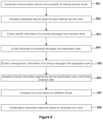
- FIG. 8 is a flow diagram illustrating a method as per a preferred embodiment of the present invention.
- the present invention relates to a system and method for securing control plane traffic in a sliced communication network, for example, a fifth generation wireless mobile communication network, and more particularly to a system and method for securing the control plane traffic in a sliced wireless communication network by dividing the network into a plurality of internal security zones on network application layer and allocating a dedicated pre-configured security guard for each internal security zone.
- the network is divided into internal security zones based on security levels of each zone, for example, network functions having the same security level are grouped together into one internal security zone.
- the internal security zones may comprise of one or more network functions which belong to one or more slices.
- a slice can be serving use cases such as Massive Machine Type Communication (MTC) and Mission Critical MTC.
- MTC Massive Machine Type Communication
- a security zone contains zero or more shared network functions, one or more non-shared network functions, one or more network functions dedicated for each communication network slice, interconnection networks, and legacy network nodes such as a second generation or third generation or fourth generation network mode connected to the sliced communication network via an interworking function.
- the plurality of network functions may be physical or virtual.
- a network function may be a legacy node e.g. 2G, 3G or 4G network nodes that is connected to a 5G core network via an interworking function.
- the present invention may also apply to future networks 6G and beyond.
- FIG. 5 and FIG. 6 are schematic diagrams illustrating the architecture of a system as per various preferred embodiments of the present invention.
- the system comprises a plurality of security guards 501 such that each internal security zone has a security guard 501 dedicated to it.
- the system further comprises a non-transitory memory means having a plurality of instructions stored thereon which configures each of the security guards 501 to have a specific set of features which enables prevention of breach of network security.
- the memory means may be any internal or external device or web-based data storage mechanism adapted to store data.
- the network (including third parties) is divided in zones with different trust or technology level. On the edges of each of those zones, a security guard 501 is placed.
- Each security guard 501 may either be standalone or may be collocated with an existing or new network function. This may include collocation with Network Resource Function (NRF), Network Slice Selection Function (NSSF), Service Communication Proxy (SCP), Security Edge Protection Proxy (SEPP), Protocol interworking functions (IWFs) for legacy support, Diameter Routing Agent (DRA) or with an existing firewall.
- the security guard 501 may be a virtualized instance or a physical network node.
- the security guard can also be deployed in collocation with a standard network function and deployed as a protection for that individual function e.g. for the UDM.
- the security guard 501 can be deployed at the following example points in a 5G network:
- Each security guard 501 is configured to receive an incoming message from a requestor external to corresponding internal security zone, wherein the requestor is a network function of a third party. Thereafter, each security guard is configured to perform an information extraction phase based on the incoming message, which includes:
- Each security guard 501 has a business policy stored. That policy can be the technical instantiation of a service level agreement between a third party and an operator, a slice owner and an operator. That policy can also be the risk policy of an operator regarding to its legacy or internal security zones.
- the policy might be pre-installed or fetched from an external database. This policy at least contains the following lists, sensitive information element, slice identifier mapping, and a list of mappings between slice-identities and network function/nodes.
- Each security guard 501 is then configured to process the extracted information.
- the security guard 501 matches at least one slice specific information with a business related service information and information from lower layer or inside the message body.
- the security guard 501 matches transport and IP layer identity information (e.g. TLS/IPSec end point information) with information from messaging layer and identity elements therein (e.g. OCI header slice information, node information, network function information used therein), slice identify information from service API related requests (e.g. slice identity S-NSSAI), and business information on slice/node mapping.
- transport and IP layer identity information e.g. TLS/IPSec end point information
- information from messaging layer and identity elements therein e.g. OCI header slice information, node information, network function information used therein
- slice identify information from service API related requests e.g. slice identity S-NSSAI
- business information on slice/node mapping e.g. TLS/IPSec end point information
- the security guard 501 performs matching with threat intelligence analytics data like attack heuristics, existing attack patterns, analytics from other sources (e.g. attack correlation with other protocols, threat intelligence feeds, historical slice data).
- threat intelligence analytics data like attack heuristics, existing attack patterns, analytics from other sources (e.g. attack correlation with other protocols, threat intelligence feeds, historical slice data).
- the security guard 501 performs matching of service request identity and token with business logic and sensitive elements in requests, business information on slice/user list and slice and node information from authorization token.
- the security guard 501 performs matching extracted security and identity information against a service level policy to determine the correctness and potential risk of such requests and take potential actions.
- the security guard 501 calculates a risk score, which has two elements, clear trigger which indicate that this is an attack, and at least one score indicating the threat level based on the accumulated values of the weighted individual checks.
- the users pertain to third-party business partners in the core network, and not end users.
- the user of the present invention would be a mobile core network function residing e.g., in a big car manufacturing plant and trying to extract all location information from a competing car manufacturers test cars.
- the incoming messages come from partners which are more or less trustworthy and target other parts of the network for mobility information, fraud or similar.
- Each security guard 501 is configured to extract information from each incoming message designated for its associated internal security zone.
- FIG. 7 illustrates the processing of incoming messages for each internal security zone by each dedicated security guard 501 .
- Such extracted information includes identity information pertaining to one or more incoming messages from lower stack layers (the network transport layer).
- the extracted identity information can also include node identity information, network function identity information, and network slice identity information.
- Such extracted information can further include incoming message related attributes and incoming message body information extracted from the network application layer.
- the extracted incoming message related attributes includes high level information such as service request identifiers, slice related information in incoming message headers, and information related to access tokens in service requests.
- the extracted incoming message body information can include values of sensitive information elements such as user location requests, user identity requests, user equipment identity requests, session identifiers, and charging identifiers.
- the information extracted by the security guard 501 is stored in the memory means for further processing.
- the security guard 501 is configured to validate each of the extracted identity information, incoming network application message attributes, and incoming message body information, against each other, against a service specification policy for the communication network, and against external or internal threat intelligence analytics data which includes attack heuristics, existing attack patterns, attack correlation with external protocols, attack correlation with lower layers of the communication network, threat intelligence feeds, and historical slice data.
- the extracted identity information is matched against the incoming message attributes
- the incoming message body information is matched against various specifications/data points in the service specification policy
- service request identities and access tokens are matched against sensitive information elements in requests and slice/node information, etc.
- the service specification policy is a technical instantiation of a service level policy between third party business partners and/or third party business partners and host network operators, and includes information pertaining to sensitive information elements, slice identifiers, and mappings between slice identities and network functions.
- Each security guard 501 is configured to validate the information extracted from the incoming messages to each internal security zone, to ascertain the potential risks associated with each said incoming message and its related information (for example split messages or containers). Based on the validation of the extracted information, each security guard 501 is adapted to compute one or more risk scores indicating security threat levels for the associated internal security zone and incidence of an attack on the associated internal security zone due to each incoming message. If one or more of the computed risk scores exceeds a predetermined threshold, each security guard 501 is configured to modify the incoming message or prevent delivery of the incoming message, and/or trigger additional network security measures.
- Modification of the incoming message includes enriching the incoming message with the computed risk score and threat information, correcting the message by for example dropping part of the incoming message requesting for sensitive information elements or by correcting parts of the incoming message or by correcting message formatting.
- the triggered additional network security measures include raising a security alarm, forwarding the incoming message to a Security Information Centre, quarantining the incoming message, and taking traffic actions, and forwarding the incoming message for further inspection and threat analysis and further threat feeds and correlations.
- FIG. 8 is a flow diagram illustrating a method for securing control plane traffic in a sliced communication network that is adapted to run a plurality of network functions.
- the communication network is divided into a plurality of internal security zones 801 .
- the plurality of internal security zones comprises one or more network slices, one or more shared network functions, one or more non-shared network functions, one or more network functions dedicated for each communication network slice, interconnection networks, and legacy network nodes.
- a dedicated security guard is allocated for each internal security zone 802 .
- Each security guard may either be standalone or may be collocated with one or more network functions or proxies.
- Each security guard is configured to monitor and extract information from incoming messages to its dedicated internal security zone.
- the messages are from third party business partners of a host operator in the core network.
- Such extracted information comprises of message identity information from the network transport layer 803 , incoming message attributes from the network application layer 804 , and incoming message body information from the network application layer 805 .
- Each security guard is configured to validate the extracted information against each other and against a service specification policy for the communication network 806 .
- the extracted information is also validated by the security guard against external threat intelligence analytics data 806 .
- threat intelligence analytics data includes attack heuristics, existing attack patterns, attack correlation with external protocols, threat intelligence feeds, and historical slice data.
- the service specification policy is a technical instantiation of a service level policy between the third-party business partners or between the third-party business partners and the host network partner. It includes information pertaining to sensitive information elements, slice identifiers, and mappings between slice identities and network functions.
- each security guard is further configured to compute one or more risk scores indicating security threat levels for the associated internal security zone and incidence of an attack on the associated internal security zone due to each incoming message.
- Each security guard is also configured to initiate security attack preventive measures if at least one risk score exceeds a predetermined threshold 808 .
- Such measures include modification of one or more incoming messages or preventing delivery of one or more incoming messages or triggering additional security measures.
- additional network security measures include raising a security alarm, forwarding the incoming message to a Security Information Centre, quarantining the incoming message, to generate decisions on further traffic actions, and threat analysis for internal and external use, such as use in threat feeds and other correlations.
- the system and method described in the present disclosure may be implemented using various means.
- the system described in the present disclosure may be implemented in hardware, firmware, software, cloud native or any combination thereof.
- the processing units, or processors(s) or controller(s) may be implemented within one or more application specific integrated circuits (ASICs), digital signal processors (DSPs), digital signal processing devices (DSPDs), programmable logic devices (PLDs), field programmable gate arrays (FPGAs), processors, controllers, micro-controllers, microprocessors, electronic devices, other electronic units designed to perform the functions described herein, or a combination thereof.
- ASICs application specific integrated circuits
- DSPs digital signal processors
- DSPDs digital signal processing devices
- PLDs programmable logic devices
- FPGAs field programmable gate arrays
- processors controllers, micro-controllers, microprocessors, electronic devices, other electronic units designed to perform the functions described herein, or a combination thereof.
- software code may be stored in the memory means and executed by a processor.
- the memory means may be implemented within the processor unit or external to the processor unit.
- the term “memory” refers to any type of volatile memory or non-volatile memory.
Landscapes
- Engineering & Computer Science (AREA)
- Computer Security & Cryptography (AREA)
- Computer Networks & Wireless Communication (AREA)
- Signal Processing (AREA)
- Computer Hardware Design (AREA)
- Computing Systems (AREA)
- General Engineering & Computer Science (AREA)
- Data Exchanges In Wide-Area Networks (AREA)
Abstract
Description
-
- Between the network and the interconnection network (Interconnection Network (IPX))
- Between network slices (inter-slice communication)
- Between shared and non-shared network functions
- Between the dedicated network functions and the shared infrastructure, and
- Between the 5G network functions and elements of legacy generations such as 2G, 3G and 4G.
-
- Low level extraction—The
security guard 501 extracts node or network function identity information of the requestor from lower stack layers (i.e. transport or IP layer) during the security channel establishment. This identity information pertains to at least one of: node, network function, and slice information associated with the requestor. - Extraction of message related attributes from the application layer—The message high level information includes service request identifier, slice identities used in message related attributes, access token from service request, and header and potential slice related information in the message
- Extraction of message body information from the application layer—The message body information includes identification of sensitive information elements such as location, charging identifier, and policy information, and extracting the values if the sensitive elements are found.
- Low level extraction—The
-
- Enrich message with score and threat information and
- Forward message to SIEM (Security Information Center)
- Quarantining message,
- Forwarding messages for further inspection and threat analysis
- Raising an alarm
- Correlating the attack information with other attack information e.g. from interconnection firewall, legacy protocol protection, bad actor list
- Correcting message:
- Dropping of part of the message e.g. requests of sensitive elements,
- Replacing and correcting parts of the message e.g. slice identifier (optional)
- Correcting message formatting aspect (optional)
- Silently:
- Dropping of whole message silently (also mandatory feature)
- Dropping of part of the message e.g. requests of sensitive elements
Claims (10)
Applications Claiming Priority (3)
| Application Number | Priority Date | Filing Date | Title |
|---|---|---|---|
| EP21154426 | 2021-01-29 | ||
| EP21154426 | 2021-01-29 | ||
| EP21154426.7 | 2021-01-29 |
Publications (2)
| Publication Number | Publication Date |
|---|---|
| US20220248220A1 US20220248220A1 (en) | 2022-08-04 |
| US11974120B2 true US11974120B2 (en) | 2024-04-30 |
Family
ID=74418359
Family Applications (1)
| Application Number | Title | Priority Date | Filing Date |
|---|---|---|---|
| US17/589,564 Active US11974120B2 (en) | 2021-01-29 | 2022-01-31 | System and method for securing a communication network |
Country Status (2)
| Country | Link |
|---|---|
| US (1) | US11974120B2 (en) |
| EP (1) | EP4037361A1 (en) |
Families Citing this family (2)
| Publication number | Priority date | Publication date | Assignee | Title |
|---|---|---|---|---|
| CN115967565A (en) * | 2022-12-23 | 2023-04-14 | 北京庚图科技有限公司 | Battlefield situation sensing method, system, terminal equipment and storage medium |
| CN116668178A (en) * | 2023-07-04 | 2023-08-29 | 大唐林州热电有限责任公司 | Electric power secondary safety protection system |
Citations (9)
| Publication number | Priority date | Publication date | Assignee | Title |
|---|---|---|---|---|
| US20190021047A1 (en) * | 2015-07-22 | 2019-01-17 | Zte Corporation | Method and System for Selecting Network Slice |
| US20190098569A1 (en) * | 2016-06-03 | 2019-03-28 | Huawei Technologies Co., Ltd. | Network slice determining method and system, and apparatus |
| US20190110195A1 (en) * | 2016-04-27 | 2019-04-11 | Nec Corporation | Key derivation method, communication system, communication terminal, and communication device |
| WO2019197883A1 (en) * | 2018-04-13 | 2019-10-17 | Telefonaktiebolaget Lm Ericsson (Publ) | Methods and systems for performing multi-domain network slice selection and approval |
| US10462653B1 (en) * | 2018-09-27 | 2019-10-29 | Palo Alto Networks, Inc. | Service-based security per data network name in mobile networks |
| WO2020068521A1 (en) | 2018-09-27 | 2020-04-02 | Palo Alto Networks, Inc. | Network slice-based security in mobile networks |
| US11321464B2 (en) * | 2017-12-22 | 2022-05-03 | Wipro Limited | Method and system for generating cognitive security intelligence for detecting and preventing malwares |
| US20220295283A1 (en) * | 2020-11-02 | 2022-09-15 | Wins Co., Ltd. | Apparatus and method for traffic security processing in 5g mobile edge computing slicing service |
| US11510052B2 (en) * | 2018-08-09 | 2022-11-22 | Huawei Technologies Co., Ltd. | Identity information processing method, device, and system |
Family Cites Families (1)
| Publication number | Priority date | Publication date | Assignee | Title |
|---|---|---|---|---|
| JP6190518B2 (en) * | 2014-03-19 | 2017-08-30 | 日本電信電話株式会社 | Analysis rule adjustment device, analysis rule adjustment system, analysis rule adjustment method, and analysis rule adjustment program |
-
2022
- 2022-01-31 US US17/589,564 patent/US11974120B2/en active Active
- 2022-01-31 EP EP22154313.5A patent/EP4037361A1/en active Pending
Patent Citations (9)
| Publication number | Priority date | Publication date | Assignee | Title |
|---|---|---|---|---|
| US20190021047A1 (en) * | 2015-07-22 | 2019-01-17 | Zte Corporation | Method and System for Selecting Network Slice |
| US20190110195A1 (en) * | 2016-04-27 | 2019-04-11 | Nec Corporation | Key derivation method, communication system, communication terminal, and communication device |
| US20190098569A1 (en) * | 2016-06-03 | 2019-03-28 | Huawei Technologies Co., Ltd. | Network slice determining method and system, and apparatus |
| US11321464B2 (en) * | 2017-12-22 | 2022-05-03 | Wipro Limited | Method and system for generating cognitive security intelligence for detecting and preventing malwares |
| WO2019197883A1 (en) * | 2018-04-13 | 2019-10-17 | Telefonaktiebolaget Lm Ericsson (Publ) | Methods and systems for performing multi-domain network slice selection and approval |
| US11510052B2 (en) * | 2018-08-09 | 2022-11-22 | Huawei Technologies Co., Ltd. | Identity information processing method, device, and system |
| US10462653B1 (en) * | 2018-09-27 | 2019-10-29 | Palo Alto Networks, Inc. | Service-based security per data network name in mobile networks |
| WO2020068521A1 (en) | 2018-09-27 | 2020-04-02 | Palo Alto Networks, Inc. | Network slice-based security in mobile networks |
| US20220295283A1 (en) * | 2020-11-02 | 2022-09-15 | Wins Co., Ltd. | Apparatus and method for traffic security processing in 5g mobile edge computing slicing service |
Non-Patent Citations (2)
| Title |
|---|
| EP21154426.7. Search Report (dated Jul. 22, 2021). |
| Hu et al. "4th revised baseline text for X.nsom-sec: security requirements and architecture network slice management and orchestration." Int'l Telecommunication Union, Telecommunication Standardization Sector, SG17-5D3561 Study Group. (Apr. 20-30, 2021). |
Also Published As
| Publication number | Publication date |
|---|---|
| EP4037361A1 (en) | 2022-08-03 |
| US20220248220A1 (en) | 2022-08-04 |
Similar Documents
| Publication | Publication Date | Title |
|---|---|---|
| US12074852B1 (en) | Private network request forwarding | |
| US20230171285A1 (en) | Edge network-based account protection service | |
| US10505900B2 (en) | Data leak protection in upper layer protocols | |
| US9723019B1 (en) | Infected endpoint containment using aggregated security status information | |
| US10382436B2 (en) | Network security based on device identifiers and network addresses | |
| US9591011B2 (en) | Techniques for separating the processing of clients' traffic to different zones in software defined networks | |
| US8881281B1 (en) | Application and network abuse detection with adaptive mitigation utilizing multi-modal intelligence data | |
| US12250553B2 (en) | Network cyber security platform | |
| CN109327426A (en) | A kind of firewall attack defense method | |
| US11178108B2 (en) | Filtering for network traffic to block denial of service attacks | |
| Park et al. | Session management for security systems in 5g standalone network | |
| US11974120B2 (en) | System and method for securing a communication network | |
| EP3967020B1 (en) | Using the state of a request routing mechanism to inform attack detection and mitigation | |
| KR102046612B1 (en) | The system for defending dns amplification attacks in software-defined networks and the method thereof | |
| Bojjagani et al. | Early DDoS Detection and Prevention with Traced-Back Blocking in SDN Environment. | |
| RU2445692C1 (en) | Method to provide information security during user access to external information resources via internet | |
| US20150223065A1 (en) | Network Signalling Message Verification | |
| EP4589884A1 (en) | Apparatus for secure network communications | |
| CN120034346A (en) | Message transmission method and device | |
| Honda | Realization of DDoS Resilience through XDP-Based Communication Control with Individual Identification Tokens in UDP Data | |
| CN121151894A (en) | Security service authorization methods, devices, equipment, media and procedures products | |
| Watson | Network protocol design with Machiavellian robustness |
Legal Events
| Date | Code | Title | Description |
|---|---|---|---|
| FEPP | Fee payment procedure |
Free format text: ENTITY STATUS SET TO UNDISCOUNTED (ORIGINAL EVENT CODE: BIG.); ENTITY STATUS OF PATENT OWNER: SMALL ENTITY |
|
| FEPP | Fee payment procedure |
Free format text: ENTITY STATUS SET TO SMALL (ORIGINAL EVENT CODE: SMAL); ENTITY STATUS OF PATENT OWNER: SMALL ENTITY |
|
| STPP | Information on status: patent application and granting procedure in general |
Free format text: DOCKETED NEW CASE - READY FOR EXAMINATION |
|
| STPP | Information on status: patent application and granting procedure in general |
Free format text: NON FINAL ACTION MAILED |
|
| AS | Assignment |
Owner name: ADAPTIVE MOBILE SECURITY LIMITED, IRELAND Free format text: ASSIGNMENT OF ASSIGNORS INTEREST;ASSIGNORS:MC DAID, CATHAL;HOLTMANNS, SILKE;SIGNING DATES FROM 20230919 TO 20230923;REEL/FRAME:065173/0724 |
|
| STCC | Information on status: application revival |
Free format text: WITHDRAWN ABANDONMENT, AWAITING EXAMINER ACTION |
|
| STPP | Information on status: patent application and granting procedure in general |
Free format text: RESPONSE TO NON-FINAL OFFICE ACTION ENTERED AND FORWARDED TO EXAMINER |
|
| STPP | Information on status: patent application and granting procedure in general |
Free format text: NOTICE OF ALLOWANCE MAILED -- APPLICATION RECEIVED IN OFFICE OF PUBLICATIONS |
|
| ZAAB | Notice of allowance mailed |
Free format text: ORIGINAL CODE: MN/=. |
|
| STPP | Information on status: patent application and granting procedure in general |
Free format text: PUBLICATIONS -- ISSUE FEE PAYMENT VERIFIED |
|
| STCF | Information on status: patent grant |
Free format text: PATENTED CASE |