US11965716B2 - Landmine, UEO or IED detection and destruction system - Google Patents
Landmine, UEO or IED detection and destruction system Download PDFInfo
- Publication number
- US11965716B2 US11965716B2 US17/629,230 US202017629230A US11965716B2 US 11965716 B2 US11965716 B2 US 11965716B2 US 202017629230 A US202017629230 A US 202017629230A US 11965716 B2 US11965716 B2 US 11965716B2
- Authority
- US
- United States
- Prior art keywords
- ueo
- ied
- landmine
- location
- headgear
- Prior art date
- Legal status (The legal status is an assumption and is not a legal conclusion. Google has not performed a legal analysis and makes no representation as to the accuracy of the status listed.)
- Active, expires
Links
Images


Classifications
-
- F—MECHANICAL ENGINEERING; LIGHTING; HEATING; WEAPONS; BLASTING
- F41—WEAPONS
- F41H—ARMOUR; ARMOURED TURRETS; ARMOURED OR ARMED VEHICLES; MEANS OF ATTACK OR DEFENCE, e.g. CAMOUFLAGE, IN GENERAL
- F41H11/00—Defence installations; Defence devices
- F41H11/12—Means for clearing land minefields; Systems specially adapted for detection of landmines
- F41H11/13—Systems specially adapted for detection of landmines
- F41H11/136—Magnetic, electromagnetic, acoustic or radiation systems, e.g. ground penetrating radars or metal-detectors
-
- F—MECHANICAL ENGINEERING; LIGHTING; HEATING; WEAPONS; BLASTING
- F41—WEAPONS
- F41H—ARMOUR; ARMOURED TURRETS; ARMOURED OR ARMED VEHICLES; MEANS OF ATTACK OR DEFENCE, e.g. CAMOUFLAGE, IN GENERAL
- F41H1/00—Personal protection gear
- F41H1/04—Protection helmets
-
- F—MECHANICAL ENGINEERING; LIGHTING; HEATING; WEAPONS; BLASTING
- F41—WEAPONS
- F41H—ARMOUR; ARMOURED TURRETS; ARMOURED OR ARMED VEHICLES; MEANS OF ATTACK OR DEFENCE, e.g. CAMOUFLAGE, IN GENERAL
- F41H7/00—Armoured or armed vehicles
- F41H7/005—Unmanned ground vehicles, i.e. robotic, remote controlled or autonomous, mobile platforms carrying equipment for performing a military or police role, e.g. weapon systems or reconnaissance sensors
-
- F—MECHANICAL ENGINEERING; LIGHTING; HEATING; WEAPONS; BLASTING
- F42—AMMUNITION; BLASTING
- F42D—BLASTING
- F42D5/00—Safety arrangements
- F42D5/04—Rendering explosive charges harmless, e.g. destroying ammunition; Rendering detonation of explosive charges harmless
Definitions
- This invention relates to military equipment.
- it concerns a landmine or unexploded ordnance (UEO) or improvised explosive device (IED) detection and destruction system using ground penetrating (GPR) radar to detect and guide a ballistic weapon to destroy the landmine, UEO or IED.
- the location of the landmine, UEO or IED is visually communicated to any personnel within the vicinity of, and endangered by the landmine, UEO or IED suitably through intelligent visors of smart helmets or headgear worn by the personnel, soldiers or combatants.
- GPR ground penetrating
- the invention resides in a landmine, UEO or IED detection and destruction system, comprising:
- GPR ground penetrating
- a guided ballistic weapon adapted to fire a projectile at to destroy the landmine, UEO or IED;
- a microprocessor controller in cooperation with the radar, wherein the location of the landmine, UEO or IED is used to control and guide the ballistic weapon, and a wireless protocol transceiver adapted to send the location of the landmine, UEO or IED to
- the location of the landmine, UEO or IED is communicated to any personnel in the vicinity of the landmine, UEO or IED.
- the radar is adapted to detect landmines, UEO or IED within a distance of 10 meters of a walking or running soldier or combatant.
- the radar is incorporated into a helmet or headgear or visor of a helmet or headgear worn by a soldier or bomb disposal personnel.
- the radar is associated with a remote controlled unmanned armored vehicle controlled by a bomb disposal personnel, soldier or combatant walking or running behind the vehicle.
- the guided ballistic weapon is mounted on the remote controlled unmanned armored vehicle.
- the radar is associated with a tank and the guided ballistic weapon is the cannon of the tank.
- the guided ballistic weapon can be carried by a soldier typically, a scout or leader positioned at the front of a squad or platoon. It may comprise a portable rocket launcher often commonly referred to as a apelooka or stovepipe.
- the microprocessor controller in cooperation with the radar and the wireless protocol transceiver adapted to send the location information can be incorporated into the helmet or headgear.
- the central command computer is located at a base camp or headquarters.
- the central command computer can be located in an armored vehicle, aircraft, drone or tank.
- the location of the landmine, UEO or IED is communicated by the central command computer to any personnel within the vicinity of the landmine, UEO or IED via a wireless telecommunications protocol.
- the wireless telecommunications protocol preferably includes Bluetooth, or an equivalent wireless personal area network.
- the location of the landmine, UEO or IED is communicated by the central computer to any personnel within the vicinity of the landmine, UEO or IED via the wireless telecommunications protocol through transceivers located in the smart helmets or headgear worn by the soldiers.
- the smart helmets or headgear have heads up display visors wherein the location of the landmine, UEO or IED is visually displayed.
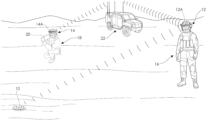
- FIG. 1 shows a soldier locating a landmine, UEO or IED and communicating its location.
- FIG. 2 is a drawing of a remote controlled armored vehicle equipped with a guided ballistic weapon.
- FIG. 1 shows a landmine 10 buried in the ground.
- the terrestrial or ground penetrating (GPR) radar specially adapted to detect and locate landmines, UEO or IED is incorporated into the helmets 12 , 14 or headgear or the visors thereof respectively of bomb disposal personnel or soldiers 16 , 18 .
- the radar is adapted to detect landmines, UEO or IED within a distance of 10 meters from a walking or running soldier or combatant 16 .
- Guided ballistic weapon 20 is adapted to fire a projectile at to destroy landmine 10 can be carried by a soldier 18 such as a scout or leader at the front of a squad or platoon.
- a soldier 18 such as a scout or leader at the front of a squad or platoon.
- a portable rocket launcher 20 often commonly referred to in military vernacular, as a karoka or stovepipe.
- Microprocessor controllers in cooperation with the radar and the wireless protocol transceivers adapted to send the location information of the buried landmine 10 can be incorporated into the smart helmets 12 , 14 worn by personnel 16 , 18 .
- Information of the location of the landmine is transmitted to a central command computer located at base headquarters or a mobile armored vehicle 22 and is communicated to any personnel 16 , 18 in the vicinity of the landmine 10 .
- the wireless telecommunications protocol used preferably includes Bluetooth, or an equivalent wireless personal area network.
- the helmets 12 , 14 or headgear have heads up display visors 12 a , 14 a wherein the location of the landmine 10 can be displayed as a visual on the visor.
- FIG. 2 shows a remote controlled unmanned armored vehicle 30 with a guided ballistic weapon in the form of a Gatling or machine gun 32 mounted atop the armored vehicle.
- the radar which detects the landmine 11 is incorporated in the helmet of soldier 36 operating a remote control 38 which controls the gun 32 .
- Information of the location of the landmine or improvised explosive device 11 is sent via a wireless protocol and transmitted to a central command computer 40 located at a base camp or headquarters.
- the system can be associated with a tank and the guided ballistic weapon comprises the main cannon of the tank.
- the system can be or associated with or operated from aircraft or airborne drones.
- the wireless telecommunications protocol preferably includes Bluetooth, or an equivalent wireless personal area network.
Landscapes
- Engineering & Computer Science (AREA)
- General Engineering & Computer Science (AREA)
- Physics & Mathematics (AREA)
- Acoustics & Sound (AREA)
- Electromagnetism (AREA)
- Radar Systems Or Details Thereof (AREA)
- Professional, Industrial, Or Sporting Protective Garments (AREA)
Abstract
Description
Claims (13)
Applications Claiming Priority (3)
| Application Number | Priority Date | Filing Date | Title |
|---|---|---|---|
| AU2019902588A AU2019902588A0 (en) | 2019-07-22 | A landmine, ueo or ied detection and destruction system | |
| AU2019902588 | 2019-07-22 | ||
| PCT/AU2020/000068 WO2021011987A1 (en) | 2019-07-22 | 2020-07-16 | A landmine, ueo or ied detection and destruction system |
Publications (2)
| Publication Number | Publication Date |
|---|---|
| US20220268555A1 US20220268555A1 (en) | 2022-08-25 |
| US11965716B2 true US11965716B2 (en) | 2024-04-23 |
Family
ID=74192395
Family Applications (1)
| Application Number | Title | Priority Date | Filing Date |
|---|---|---|---|
| US17/629,230 Active 2040-07-16 US11965716B2 (en) | 2019-07-22 | 2020-07-16 | Landmine, UEO or IED detection and destruction system |
Country Status (3)
| Country | Link |
|---|---|
| US (1) | US11965716B2 (en) |
| AU (1) | AU2020317055B2 (en) |
| WO (1) | WO2021011987A1 (en) |
Citations (7)
| Publication number | Priority date | Publication date | Assignee | Title |
|---|---|---|---|---|
| GB2330801A (en) * | 1997-07-10 | 1999-05-05 | Bodenseewerk Geraetetech | Detecting and eliminating land mines |
| US20030034778A1 (en) * | 2001-08-17 | 2003-02-20 | Nelson Carl. V. | Portable metal detection and classification system |
| US7565941B2 (en) * | 2004-03-15 | 2009-07-28 | Cunningham John P | Motorized vehicle |
| WO2016157077A2 (en) | 2015-03-30 | 2016-10-06 | Director General, Defence Research & Development Organisation (Drdo) | A vehicle and method for detecting and neutralizing an incendiary object |
| US20170045337A1 (en) * | 2014-04-21 | 2017-02-16 | Seoul National University Of Technology Center For Industry Collaboration | Smart wearable mine detector |
| US20170270761A1 (en) * | 2014-08-26 | 2017-09-21 | Emb Safety Helmet Pty Ltd | A computerised tracking and proximity warning method and system for personnel, plant and equipment operating both above and below the ground or their movement therebetween |
| EP3372949A1 (en) * | 2015-11-05 | 2018-09-12 | Ontech Security, S.L. | Weapons and explosives detector and detection method |
-
2020
- 2020-07-16 WO PCT/AU2020/000068 patent/WO2021011987A1/en not_active Ceased
- 2020-07-16 AU AU2020317055A patent/AU2020317055B2/en active Active
- 2020-07-16 US US17/629,230 patent/US11965716B2/en active Active
Patent Citations (7)
| Publication number | Priority date | Publication date | Assignee | Title |
|---|---|---|---|---|
| GB2330801A (en) * | 1997-07-10 | 1999-05-05 | Bodenseewerk Geraetetech | Detecting and eliminating land mines |
| US20030034778A1 (en) * | 2001-08-17 | 2003-02-20 | Nelson Carl. V. | Portable metal detection and classification system |
| US7565941B2 (en) * | 2004-03-15 | 2009-07-28 | Cunningham John P | Motorized vehicle |
| US20170045337A1 (en) * | 2014-04-21 | 2017-02-16 | Seoul National University Of Technology Center For Industry Collaboration | Smart wearable mine detector |
| US20170270761A1 (en) * | 2014-08-26 | 2017-09-21 | Emb Safety Helmet Pty Ltd | A computerised tracking and proximity warning method and system for personnel, plant and equipment operating both above and below the ground or their movement therebetween |
| WO2016157077A2 (en) | 2015-03-30 | 2016-10-06 | Director General, Defence Research & Development Organisation (Drdo) | A vehicle and method for detecting and neutralizing an incendiary object |
| EP3372949A1 (en) * | 2015-11-05 | 2018-09-12 | Ontech Security, S.L. | Weapons and explosives detector and detection method |
Non-Patent Citations (2)
| Title |
|---|
| International Search Report, dated Sep. 28, 2020, by the ISA/AU, re International Application No. PCT/AU2020/000068. |
| Written Opinion, dated Sep. 28, 2020, by the ISA/AU, re International Application No. PCT/AU2020/000068. |
Also Published As
| Publication number | Publication date |
|---|---|
| AU2020317055B2 (en) | 2025-07-24 |
| WO2021011987A1 (en) | 2021-01-28 |
| US20220268555A1 (en) | 2022-08-25 |
| AU2020317055A1 (en) | 2022-03-10 |
Similar Documents
| Publication | Publication Date | Title |
|---|---|---|
| Bowyer | Dictionary of military terms | |
| EP3060871B1 (en) | System, device and method for the prevention of friendly fire incidents | |
| Glenn | Combat in Hell: A Consideration of Constrained Urban Warfare | |
| US11965716B2 (en) | Landmine, UEO or IED detection and destruction system | |
| Bilina et al. | Developments in Establishment of Minefields by UAVs: A Response to Conflict in Ukraine | |
| Dorn | Peacekeepers in Combat: Fighter Jets and Bombers in the Congo, 1961–1963 | |
| Neville | The SAS 1983-2014 | |
| Bilenko et al. | A LIST OF TACTICAL AND TECHNICAL CHARACTERISTICS OF COMBAT EQUIPMENT OF SECURITY FORCES PERSONNEL, WHICH ARE SUBJECT TO REGULATION | |
| Neville | The British army in Afghanistan 2006–14: Task Force Helmand | |
| Neville | Takur Ghar: The SEALs and Rangers on Roberts Ridge, Afghanistan 2002 | |
| Onopriyenko et al. | JUSTIFICATION OF THE FORCES AND EQUIPMENT OF THE NATIONAL GUARD OF UKRAINE INVOLVED IN PERFORMING THE TASKS OF PROTECTING CRITICAL INFRASTRUCTURE AGAINST AIR TARGETS | |
| Szulc | METHODS AND TECHNIQUES FOR COUNTERING UNMANNED COMBAT ASSETS ON THE MODERN BATTLEFIELD | |
| Imber | Warfare Redefined: Lethal Autonomous Weapons Systems and the UN's Failure to Regulate | |
| MANEV et al. | Mechatronics systems in armored fighting vehicles | |
| Pushies | Weapons of Delta Force | |
| Bryant | Weapons of the US Army Rangers | |
| Villar | Unmanned Ground Systems in Future Warfare | |
| Weiss et al. | Ballistic Shield. | |
| Gulla | Target allocation for field artillery | |
| Slocombe | Funding approval given for army mortar replacements | |
| Bohannon | DNNE FUSES INFANTRYMEN’S CAPABILITIES WITH TECHNOLOGICAL ADVANCEMENTS | |
| Brown | OPMSA Overview For the Armaments for the Army Transformation Conference | |
| Lerner | Futures Meeting November 2009 | |
| Borjes et al. | PEO Ammunition--We Make the Ammo, You Make the Difference | |
| Crowley | Means of Delivering or Dispersing Riot Control Agents |
Legal Events
| Date | Code | Title | Description |
|---|---|---|---|
| FEPP | Fee payment procedure |
Free format text: ENTITY STATUS SET TO UNDISCOUNTED (ORIGINAL EVENT CODE: BIG.); ENTITY STATUS OF PATENT OWNER: SMALL ENTITY |
|
| FEPP | Fee payment procedure |
Free format text: ENTITY STATUS SET TO SMALL (ORIGINAL EVENT CODE: SMAL); ENTITY STATUS OF PATENT OWNER: SMALL ENTITY |
|
| STPP | Information on status: patent application and granting procedure in general |
Free format text: DOCKETED NEW CASE - READY FOR EXAMINATION |
|
| AS | Assignment |
Owner name: JJ1 HOLDINGS PTY LTD, AUSTRALIA Free format text: ASSIGNMENT OF ASSIGNORS INTEREST;ASSIGNOR:JONES, JEANETTE MARY;REEL/FRAME:061485/0610 Effective date: 20221012 |
|
| STPP | Information on status: patent application and granting procedure in general |
Free format text: RESPONSE TO NON-FINAL OFFICE ACTION ENTERED AND FORWARDED TO EXAMINER |
|
| STPP | Information on status: patent application and granting procedure in general |
Free format text: FINAL REJECTION MAILED |
|
| STPP | Information on status: patent application and granting procedure in general |
Free format text: DOCKETED NEW CASE - READY FOR EXAMINATION |
|
| STPP | Information on status: patent application and granting procedure in general |
Free format text: NOTICE OF ALLOWANCE MAILED -- APPLICATION RECEIVED IN OFFICE OF PUBLICATIONS |
|
| ZAAB | Notice of allowance mailed |
Free format text: ORIGINAL CODE: MN/=. |
|
| STPP | Information on status: patent application and granting procedure in general |
Free format text: PUBLICATIONS -- ISSUE FEE PAYMENT VERIFIED |
|
| STCF | Information on status: patent grant |
Free format text: PATENTED CASE |