US11958873B2 - Proteasome activity enhancing compounds - Google Patents
Proteasome activity enhancing compounds Download PDFInfo
- Publication number
- US11958873B2 US11958873B2 US17/644,969 US202117644969A US11958873B2 US 11958873 B2 US11958873 B2 US 11958873B2 US 202117644969 A US202117644969 A US 202117644969A US 11958873 B2 US11958873 B2 US 11958873B2
- Authority
- US
- United States
- Prior art keywords
- optionally substituted
- compound
- pharmaceutically acceptable
- prodrug
- solvate
- Prior art date
- Legal status (The legal status is an assumption and is not a legal conclusion. Google has not performed a legal analysis and makes no representation as to the accuracy of the status listed.)
- Active, expires
Links
Classifications
-
- C—CHEMISTRY; METALLURGY
- C07—ORGANIC CHEMISTRY
- C07F—ACYCLIC, CARBOCYCLIC OR HETEROCYCLIC COMPOUNDS CONTAINING ELEMENTS OTHER THAN CARBON, HYDROGEN, HALOGEN, OXYGEN, NITROGEN, SULFUR, SELENIUM OR TELLURIUM
- C07F7/00—Compounds containing elements of Groups 4 or 14 of the Periodic Table
- C07F7/02—Silicon compounds
- C07F7/08—Compounds having one or more C—Si linkages
- C07F7/18—Compounds having one or more C—Si linkages as well as one or more C—O—Si linkages
- C07F7/1804—Compounds having Si-O-C linkages
-
- C—CHEMISTRY; METALLURGY
- C07—ORGANIC CHEMISTRY
- C07B—GENERAL METHODS OF ORGANIC CHEMISTRY; APPARATUS THEREFOR
- C07B59/00—Introduction of isotopes of elements into organic compounds ; Labelled organic compounds per se
- C07B59/002—Heterocyclic compounds
-
- C—CHEMISTRY; METALLURGY
- C07—ORGANIC CHEMISTRY
- C07D—HETEROCYCLIC COMPOUNDS
- C07D209/00—Heterocyclic compounds containing five-membered rings, condensed with other rings, with one nitrogen atom as the only ring hetero atom
- C07D209/02—Heterocyclic compounds containing five-membered rings, condensed with other rings, with one nitrogen atom as the only ring hetero atom condensed with one carbocyclic ring
- C07D209/04—Indoles; Hydrogenated indoles
- C07D209/10—Indoles; Hydrogenated indoles with substituted hydrocarbon radicals attached to carbon atoms of the hetero ring
- C07D209/12—Radicals substituted by oxygen atoms
-
- C—CHEMISTRY; METALLURGY
- C07—ORGANIC CHEMISTRY
- C07D—HETEROCYCLIC COMPOUNDS
- C07D209/00—Heterocyclic compounds containing five-membered rings, condensed with other rings, with one nitrogen atom as the only ring hetero atom
- C07D209/02—Heterocyclic compounds containing five-membered rings, condensed with other rings, with one nitrogen atom as the only ring hetero atom condensed with one carbocyclic ring
- C07D209/04—Indoles; Hydrogenated indoles
- C07D209/10—Indoles; Hydrogenated indoles with substituted hydrocarbon radicals attached to carbon atoms of the hetero ring
- C07D209/14—Radicals substituted by nitrogen atoms, not forming part of a nitro radical
-
- C—CHEMISTRY; METALLURGY
- C07—ORGANIC CHEMISTRY
- C07D—HETEROCYCLIC COMPOUNDS
- C07D401/00—Heterocyclic compounds containing two or more hetero rings, having nitrogen atoms as the only ring hetero atoms, at least one ring being a six-membered ring with only one nitrogen atom
- C07D401/02—Heterocyclic compounds containing two or more hetero rings, having nitrogen atoms as the only ring hetero atoms, at least one ring being a six-membered ring with only one nitrogen atom containing two hetero rings
- C07D401/06—Heterocyclic compounds containing two or more hetero rings, having nitrogen atoms as the only ring hetero atoms, at least one ring being a six-membered ring with only one nitrogen atom containing two hetero rings linked by a carbon chain containing only aliphatic carbon atoms
-
- C—CHEMISTRY; METALLURGY
- C07—ORGANIC CHEMISTRY
- C07D—HETEROCYCLIC COMPOUNDS
- C07D401/00—Heterocyclic compounds containing two or more hetero rings, having nitrogen atoms as the only ring hetero atoms, at least one ring being a six-membered ring with only one nitrogen atom
- C07D401/14—Heterocyclic compounds containing two or more hetero rings, having nitrogen atoms as the only ring hetero atoms, at least one ring being a six-membered ring with only one nitrogen atom containing three or more hetero rings
-
- C—CHEMISTRY; METALLURGY
- C07—ORGANIC CHEMISTRY
- C07D—HETEROCYCLIC COMPOUNDS
- C07D403/00—Heterocyclic compounds containing two or more hetero rings, having nitrogen atoms as the only ring hetero atoms, not provided for by group C07D401/00
- C07D403/02—Heterocyclic compounds containing two or more hetero rings, having nitrogen atoms as the only ring hetero atoms, not provided for by group C07D401/00 containing two hetero rings
- C07D403/06—Heterocyclic compounds containing two or more hetero rings, having nitrogen atoms as the only ring hetero atoms, not provided for by group C07D401/00 containing two hetero rings linked by a carbon chain containing only aliphatic carbon atoms
-
- C—CHEMISTRY; METALLURGY
- C07—ORGANIC CHEMISTRY
- C07D—HETEROCYCLIC COMPOUNDS
- C07D417/00—Heterocyclic compounds containing two or more hetero rings, at least one ring having nitrogen and sulfur atoms as the only ring hetero atoms, not provided for by group C07D415/00
- C07D417/14—Heterocyclic compounds containing two or more hetero rings, at least one ring having nitrogen and sulfur atoms as the only ring hetero atoms, not provided for by group C07D415/00 containing three or more hetero rings
-
- C—CHEMISTRY; METALLURGY
- C07—ORGANIC CHEMISTRY
- C07D—HETEROCYCLIC COMPOUNDS
- C07D471/00—Heterocyclic compounds containing nitrogen atoms as the only ring hetero atoms in the condensed system, at least one ring being a six-membered ring with one nitrogen atom, not provided for by groups C07D451/00 - C07D463/00
- C07D471/02—Heterocyclic compounds containing nitrogen atoms as the only ring hetero atoms in the condensed system, at least one ring being a six-membered ring with one nitrogen atom, not provided for by groups C07D451/00 - C07D463/00 in which the condensed system contains two hetero rings
- C07D471/04—Ortho-condensed systems
-
- C—CHEMISTRY; METALLURGY
- C07—ORGANIC CHEMISTRY
- C07D—HETEROCYCLIC COMPOUNDS
- C07D519/00—Heterocyclic compounds containing more than one system of two or more relevant hetero rings condensed among themselves or condensed with a common carbocyclic ring system not provided for in groups C07D453/00 or C07D455/00
-
- C—CHEMISTRY; METALLURGY
- C07—ORGANIC CHEMISTRY
- C07B—GENERAL METHODS OF ORGANIC CHEMISTRY; APPARATUS THEREFOR
- C07B2200/00—Indexing scheme relating to specific properties of organic compounds
- C07B2200/05—Isotopically modified compounds, e.g. labelled
Definitions
- Protein homeostasis a balance between protein synthesis, folding, trafficking, aggregation, and degradation, referred to as protein homeostasis, utilizing sensors and networks of pathways [Sitia et al., Nature 426: 891-894, 2003; Ron et al., Nat Rev Mol Cell Biol 8: 519-529, 2007].
- the cellular maintenance of protein homeostasis, or proteostasis refers to controlling the conformation, binding interactions, location and concentration of individual proteins making up the proteome.
- Protein folding in vivo is accomplished through interactions between the folding polypeptide chain and macromolecular cellular components, including multiple classes of chaperones and folding enzymes, which minimize aggregation [Wiseman et al., Cell 131: 809-821, 2007]. Whether a given protein folds in a certain cell type depends on the distribution, concentration, and subcellular localization of chaperones, folding enzymes, metabolites and the like [Wiseman et al.]. Human loss of function diseases are often the result of a disruption of normal protein homeostasis, typically caused by a mutation in a given protein that compromises its cellular folding, leading to efficient degradation [Cohen et al., Nature 426: 905-909, 2003]. Human gain of function diseases are similarly frequently the result of a disruption in protein homeostasis, such as the accumulation of misfolded proteins, leading to protein aggregation [Balch et al. (2008), Science 319: 916-919].
- the proteasome is a large protein complex of multiple subunits which acts as a protease to degrade misfolded proteins. Most proteasome substrates are targeted for degradation by the covalent attachment of ubiquitin moieties which are recognized by the proteasome [Lee et al. (2010), Nature 467(7312): 179-184]. Proteins with longer ubiquitin chains tend to have a stronger association with the proteasome than those with smaller chains [Lee et al. (2010); Proctor et al. (2007), BMC Systems Biology 1: 17]. The length of the ubiquitin chains is modulated, in part, by proteasome-associated deubiquitinating enzymes. One such mammalian deubiquitinating enzyme is Usp14 which has been shown to act as an inhibitor of the proteasome [Lee et al. (2010)].
- proteasome dysfunction and dysfunction in proteostasis have been implicated in a diverse range of diseases including for example, neurodegenerative disease, metabolic diseases, inflammatory diseases, and cancer.
- the proteasome has decreased ability to degrade misfolded or abnormal proteins, leading to the presence of toxic protein aggregates.
- the enhancement of proteasome activity can be therapeutic for any disease characterized by deficient proteasome activity, or deficient activity of other components of the ubiquitin-proteasome pathway including, but not limited to, von Hippel-Lindau disease, spinocerebellar ataxia 1, Angelman syndrome, giant axon neuropathy, inclusion body myopathy with Paget disease of bone and frontotemporal dementia (IBMPFD), and others [Lehman, N. L., (2009), Acta Neuropathologica, 118(3), 329-347; Weihl et al., (2007), Neuromuscular Disorders, 17, 87-87].
- deficient proteasome activity or deficient activity of other components of the ubiquitin-proteasome pathway including, but not limited to, von Hippel-Lindau disease, spinocerebellar ataxia 1, Angelman syndrome, giant axon neuropathy, inclusion body myopathy with Paget disease of bone and frontotemporal dementia (IBMPFD), and others [Lehman,
- Enhancing proteasome activity is also therapeutic for diseases in which proteasome substrates are involved and contribute to pathology, but which do not satisfy a strict definition of proteinopathies.
- numerous oncoproteins are proteasome substrates and their ability to promote cancer can potentially be attenuated by enhancing proteasome activity.
- the present invention is based, in part, on the discovery that compounds of the invention inhibit Usp14.
- the present invention is directed to compounds encompassed by the Formulae (I), (II), (III), (IV), and (V), or a pharmaceutically acceptable salt, solvate, clathrate or prodrug of any of thereof, compositions thereof, methods for the treatment of a condition associated with a dysfunction in proteostasis, methods for enhancing proteasome activity and methods for treating cancer or tumor.
- the invention is directed to a compound having the Formula (I):
- the invention is directed to a compound having the Formula (II):
- the invention is directed to a compound having the Formula (III):
- the invention is directed to a compound having the Formula (IV):
- the invention is directed to a compound having the Formula (V):
- R 1 , R 2 , R c , R d , R i , R 3f and n are as defined above for Formula (III);
- the invention is directed to a pharmaceutical composition
- a pharmaceutical composition comprising a pharmaceutically acceptable carrier or excipient and a compound of Formula (I), (II), (III), (IV), or (V), or a pharmaceutically acceptable salt, solvate, clathrate or prodrug thereof.
- the invention is directed to a method of inhibiting deubiquitination activity of a Usp14 protein comprising contacting the Usp14 protein with an effective amount of a compound of Formula (I), (II), (III), (IV), or (V), or a pharmaceutically acceptable salt, solvate, clathrate or prodrug thereof, in an amount sufficient to inhibit deubiquitination activity of the Usp14 protein.
- the invention is directed to a method of enhancing protein degradation by a proteasome in a cell comprising contacting the cell with an effective amount of a compound of Formula (I), (II), (III), (IV), or (V) or a pharmaceutically acceptable salt, solvate, clathrate or prodrug thereof, in an amount sufficient to enhance protein degradation by the proteasome.
- the invention encompasses a method of treating a patient suffering from a condition associated with a dysfunction in proteostasis comprising administering to said patient an effective amount of a compound of Formula (I), (II), (III), (IV), or (V), or a pharmaceutically acceptable salt, solvate, clathrate or prodrug thereof.
- the invention is directed to a method of enhancing proteasome function in a subject in need thereof comprising administering to said subject an effective amount of a compound of Formula (I), (II), (III), (IV), or (V), or a pharmaceutically acceptable salt, solvate, clathrate or prodrug thereof.
- the invention is directed to a method for treating a condition characterized by deficient proteasome activity or deficiency of other components of the ubiquitin-proteasome pathway in a subject comprising administering to said subject an effective amount of a compound of Formula (I), (II), (III), (IV), or (V), or a pharmaceutically acceptable salt, solvate, clathrate or prodrug thereof.
- the invention encompasses a method of treating cancer or a tumor in a subject in need thereof comprising administering to said subject an effective amount of a compound of Formula (I), (II), (III), (IV), or (V), a pharmaceutically acceptable salt, solvate, clathrate or prodrug thereof.
- the invention is a pharmaceutical composition comprising:
- a cell encompasses both a single cell and a combination of two or more cells.
- the present invention is directed to compounds of Formulae (I), (II), (III), (IV) and (V), or a pharmaceutically acceptable salt, solvate, clathrate or prodrug thereof, pharmaceutical compositions thereof, methods of use thereof in the treatment of conditions associated with a dysfunction in proteostasis, methods of enhancing proteasome activity and methods for treating cancer or a tumor.
- the invention is directed to a compound of Formula (I), provided that when D is 4-chlorophenyl, --A is ⁇ O, Q 1 is C(R a ), R a is methyl, Z is 1-piperidinyl, 4-hydroxy-1-piperidinyl or 1-pyrrolidinyl, and each of R 1 and R 2 is hydrogen, then at least one of Q 2 , Q 3 , Q 4 , and Q 5 is not CH; and provided that when D is selected from the group consisting of phenyl, 4-chlorophenyl, 4-methylphenyl and 4-methoxyphenyl, --A is ⁇ O, Q 1 is C(R a ), R a is methyl, Z is 1-piperidinyl or 4-morpholinyl, each of R 1 and R 2 is hydrogen, and Q 2 and Q 5 are each CH, then Q 3 and Q 4 are not C(OCH 3 ) and C(Br), respectively.
- D is 4-chlorophenyl
- --A is ⁇ O
- the invention encompasses a compound having the Formula (I), or a pharmaceutically acceptable salt, solvate, clathrate or prodrug thereof.
- the compound has the Formula (I), wherein --A is ⁇ O, or is a pharmaceutically acceptable salt, solvate, clathrate or prodrug thereof.
- the compound has the Formula (I), wherein --A is —OH, or is a pharmaceutically acceptable salt, solvate, clathrate or prodrug thereof.
- the compound has the Formula (I), wherein --A is —C 1 -C 10 alkyl, optionally substituted, or is a pharmaceutically acceptable salt, solvate, clathrate or prodrug thereof.
- the compound has the Formula (I), wherein --A is —C 2 -C 12 alkenyl, optionally substituted, or is a pharmaceutically acceptable salt, solvate, clathrate or prodrug thereof.
- the compound has the Formula (I), wherein each of R 1 and R 2 is independently selected from the group consisting of hydrogen, optionally substituted C 1 -C 10 alkyl, optionally substituted C 2 -C 10 alkenyl, optionally substituted C 2 -C 10 alkynyl, optionally substituted C 3 -C 12 cycloalkyl, optionally substituted C 3 -C 12 cycloalkenyl, optionally substituted aryl, halo, OR c , NR d R d , C(O)OR c , NO 2 , CN, C(O)R c , C(O)C(O)R c , C(O)NR d R d , NR d C(O)R c , NR d S(O) n R c , N(R d )(COOR c ), NR d C(O)C(O)R c , NR d C(O)C(O
- the compound has the Formula (I), wherein R 1 and R 2 are each independently selected from hydrogen and optionally substituted C 1 -C 10 alkyl, or is a pharmaceutically acceptable salt, solvate, clathrate or prodrug thereof. In some embodiments, R 1 and R 2 are each hydrogen.
- the compound has the Formula (I), wherein D is optionally substituted C 3 -C 12 cycloalkyl, optionally substituted C 3 -C 12 cycloalkenyl, optionally substituted aryl, optionally substituted heteroaryl, or optionally substituted heterocyclic, or is a pharmaceutically acceptable salt, solvate, clathrate or prodrug thereof.
- D is optionally substituted aryl or an optionally substituted heteroaryl.
- D is an optionally substituted heteroaryl.
- D is an optionally substituted heteroaryl, wherein said heteroaryl comprises at least one ring nitrogen atom.
- D is an optionally substituted pyridinyl or an optionally substituted pyrimidinyl.
- D is optionally substituted phenyl.
- the compound has the Formula (I), wherein Q 1 is C(R d ), and R d is selected from the group consisting of hydrogen, optionally substituted C 1 -C 10 alkyl, optionally substituted C 2 -C 10 alkenyl, optionally substituted C 2 -C 10 alkynyl, optionally substituted C 3 -C 12 cycloalkyl, optionally substituted C 3 -C 12 cycloalkenyl, optionally substituted aryl, halo, OR c , NR d R d , C(O)OR c , NO 2 , CN, C(O)R c , C(O)C(O)R c , C(O)NR d R d , NR d C(O)R c , NR d S(O) n R c , N(R d )(COOR c ), NR d C(O)C(O)R c ,
- R d is selected from hydrogen and optionally substituted C 1 -C 10 alkyl. In some embodiments, R d is an optionally substituted C 1 -C 4 alkyl. In yet additional embodiments, R d is methyl.
- the compound has the Formula (I), wherein one or two of Q 2 , Q 3 , Q 4 and Q 5 is nitrogen and the remaining of Q 2 , Q 3 , Q 4 and Q 5 are each independently C(R 3 ), or is a pharmaceutically acceptable salt, solvate, clathrate or prodrug thereof.
- Q 2 is nitrogen and Q 3 , Q 4 and Q 5 are each independently C(R 3 ).
- Q 3 , Q 4 and Q 5 are each CH.
- both Q 2 and Q 3 are nitrogen and Q 4 and Q 5 are each independently C(R 3 ).
- Q 3 is nitrogen and Q 2 , Q 4 and Q 5 are each independently C(R 3 ).
- Q 4 is nitrogen and Q 2 , Q 3 and Q 5 are each independently C(R 3 ).
- Q 5 is nitrogen and Q 2 , Q 3 and Q 4 are each independently C(R 3 ).
- the compound has the Formula (I), wherein Q 3 is C(R 3b ) and R 3b is selected from the group consisting of hydrogen, halo, NR d R d , NO 2 , CN, optionally substituted C 1 -C 10 alkyl, C(O)OR c , C(O)R c NR d C(O)R c , and OR c , or is a pharmaceutically acceptable salt, solvate, clathrate or prodrug thereof.
- Q 4 and Q 5 are each CH.
- the compound has the Formula (I), wherein each of Q 2 , Q 3 , Q 4 and Q 5 is C(R 3 ).
- the compound has the Formula (I), wherein Z is an optionally substituted heterocyclic containing at least one ring nitrogen atom or NR b R b , or is a pharmaceutically acceptable salt, solvate, clathrate or prodrug thereof.
- Z is an optionally substituted N-heterocyclic.
- Z is selected from optionally substituted pyrrolidinyl and optionally substituted piperidinyl.
- Z is selected from optionally substituted 1-pyrrolidinyl and optionally substituted 1-piperidinyl.
- Z is optionally substituted 1-piperidinyl.
- the compound has the Formula (I), wherein Z is:
- G is absent, C(R n ), O or S; each R m and R n are each independently selected from the group consisting of hydrogen, optionally substituted C 1 -C 10 alkyl, optionally substituted C 2 -C 10 alkenyl, optionally substituted C 2 -C 10 alkynyl, optionally substituted C 3 -C 12 cycloalkyl, optionally substituted C 3 -C 12 cycloalkenyl, optionally substituted aryl, halo, N 3 , OR c , NR d R d , C(O)OR c , NO 2 , CN, C(O)R c , C(O)C(O)R c , C(O)NR d R d , NR d C(O)R c , NR d S(O) n R c , N(R d )(COOR c ), NR d C(O)C(O)R c ,
- the compound has the Formula (I), wherein Z is an optionally substituted cycloalkyl, or is a pharmaceutically acceptable salt, solvate, clathrate or prodrug thereof.
- the invention is directed to a compound having the Formula (II), or a pharmaceutically acceptable salt, solvate, clathrate or prodrug thereof.
- the compound has the Formula (II), wherein R 1 and R 2 are each independently selected from hydrogen and optionally substituted C 1 -C 10 alkyl, or is a pharmaceutically acceptable salt, solvate, clathrate or prodrug thereof. In additional embodiments, R 1 and R 2 are each hydrogen.
- the compound has the Formula (II), wherein Q 1 is C(R a ) and Q 2 is C(R 3 ) or nitrogen, wherein each of R a and R 3 is independently selected from the group consisting hydrogen and optionally substituted C 1 -C 10 alkyl, or is a pharmaceutically acceptable salt, solvate, clathrate or prodrug thereof.
- R a is an optionally substituted C 1 -C 4 alkyl.
- R a is methyl.
- the compound has the Formula (II), wherein each of R 3b and R 3c is independently selected from the group consisting of hydrogen, halo, NR d R d , NO 2 , CN, optionally substituted C 1 -C 10 alkyl, C(O)OR c , C(O)R c , NR d C(O)R c , and OR c , or is a pharmaceutically acceptable salt, solvate, clathrate or prodrug thereof.
- the compound has the Formula (II), wherein Z is an optionally substituted heterocyclic containing at least one ring nitrogen atom or NR b R b , or is a pharmaceutically acceptable salt, solvate, clathrate or prodrug thereof.
- Z is an optionally substituted N-heterocyclic or NR b R b .
- Z is an optionally substituted N-heterocyclic.
- Z is selected from optionally substituted pyrrolidinyl and optionally substituted piperidinyl.
- Z is selected from optionally substituted 1-pyrrolidinyl and optionally substituted 1-piperidinyl.
- Z is optionally substituted 1-piperidinyl.
- the compound has the Formula (II), wherein one of Q 6 and Q 7 is nitrogen and the other is C(R a ), or is a pharmaceutically acceptable salt, solvate, clathrate or prodrug thereof.
- the compound has the Formula (II), wherein each of Q 6 and Q 7 is C(R a ), or is a pharmaceutically acceptable salt, solvate, clathrate or prodrug thereof.
- the compound has the Formula (II), wherein R 3f is selected from the group consisting of hydrogen, optionally substituted C 1 -C 10 alkyl, optionally substituted C 2 -C 10 alkenyl, optionally substituted C 2 -C 10 alkynyl, optionally substituted C 3 -C 12 cycloalkyl, optionally substituted C 3 -C 12 cycloalkenyl, optionally substituted aryl, halo, N 3 , OR c , NR d R d , C(O)OR c , NO 2 , CN, C(O)R c , C(O)C(O)R c , C(O)NR d R d , NR d C(O)R c , NR d S(O) n R c , N(R d )(COOR c ), NR d C(O)C(O)R c , NR d C
- R 3e and R 3g are each hydrogen.
- R 3f is selected from the group consisting of hydrogen, halo, N 3 , C(O)OR c , CN, C(O)R c , C(O)C(O)R c , C(O)NR d R d , NO 2 and NR d R d .
- R 3f is selected from the group consisting of halo, N 3 , C(O)OR c , CN, C(O)R c , C(O)C(O)R c , C(O)NR d R d , NO 2 and NR d R d .
- the compound has the Formula (III), or a pharmaceutically acceptable salt, solvate, clathrate or prodrug thereof.
- the compound has the Formula (III), wherein R 1 is selected from the group consisting of hydrogen, optionally substituted C 1 -C 10 alkyl, optionally substituted C 2 -C 10 alkenyl, optionally substituted C 2 -C 10 alkynyl, optionally substituted C 3 -C 12 cycloalkyl, optionally substituted C 3 -C 12 cycloalkenyl, optionally substituted aryl, halo, OR c , NR d R d , C(O)OR c , NO 2 , CN, C(O)R c , C(O)C(O)R c , C(O)NR d R d , NR d C(O)R c , NR d S(O) n R c , N(R d )(COOR c ), NR d C(O)C(O)R c , NR d C(O)NR d R
- the compound has the Formula (III), wherein R 1 and R 2 are each independently selected from hydrogen and optionally substituted C 1 -C 10 alkyl, or is a pharmaceutically acceptable salt, solvate, clathrate or prodrug thereof. In some embodiments, R 1 and R 2 are each hydrogen.
- the compound has the Formula (III), wherein at least one of R 3a , R 3b , R 3c and R g is not hydrogen, or is a pharmaceutically acceptable salt, solvate, clathrate or prodrug thereof.
- the compound has the Formula (III), provided that when R 3e is bromo, then R 3b is not methoxy.
- the compound has the Formula (III), wherein each of R 3b and R 3c is independently selected from the group consisting of hydrogen, halo, NR d R d , NO 2 , CN, optionally substituted C 1 -C 10 alkyl, C(O)OR c , C(O)R c NR d C(O)R c , OC(O)R c and OR c , or is a pharmaceutically acceptable salt, solvate, clathrate or prodrug thereof.
- the compound has the Formula (III), wherein each of R 3b and R 3c is independently selected from the group consisting of hydrogen, halo, NR d R d , NO 2 , CN, optionally substituted C 1 -C 10 alkyl, C(O)OR c , C(O)R c , NR d C(O)R c , OC(O)R c , OR c , optionally substituted C 3 -C 6 cycloalkyl, optionally substituted heterocyclic and optionally substituted heteroaryl.
- one of R 3b and R 3c is hydrogen and the other of R 3b and R 3c is selected from the group consisting of halo, NR d R d , NO 2 , CN, optionally substituted C 1 -C 10 alkyl, C(O)OR c , C(O)R c , NR d C(O)R c , OC(O)R c , OR c , optionally substituted C 3 -C 6 cycloalkyl, optionally substituted heterocyclic and optionally substituted heteroaryl.
- one of R 3b and R 3c is hydrogen, and the other of R 3b and R 3c is C 1 -C 10 alkyl optionally substituted with one or more substituents selected from the group consisting of halo, C(O)OR′, C(O)NR′′R′′, S(O) 2 , S(O) 2 NR′′R′′, NR′′S(O) 2 R c , N′′C(O)R c , N′′C(O)OR′, N′′C(O)NR′′R′′, CN, OR′, NR′′R′′, optionally substituted heterocyclic, and optionally substituted heteroaryl, and optionally further substituted; wherein each R′ is independently selected from the group consisting of hydrogen, optionally substituted C 1 -C 10 alkyl, optionally substituted C 2 -C 10 alkenyl, optionally substituted C 2 -C 10 alkynyl, optionally substituted C 3 -C 12 cycloalkyl, optionally
- the compound has the Formula (III), wherein one of Q 6 and Q 7 is nitrogen and the other is C(R h ), or is a pharmaceutically acceptable salt, solvate, clathrate or prodrug thereof.
- the compound has the Formula (III), wherein Q 6 and Q 7 are each independently C(R h ), or is a pharmaceutically acceptable salt, solvate, clathrate or prodrug thereof.
- the compound has the Formula (III), wherein R 3b , R 3c and R g are each hydrogen and R 3a is selected from the group consisting of halo, NR d R d , NO 2 , CN, optionally substituted C 1 -C 10 alkyl, C(O)OR c , C(O)R c NR d C(O)R c , OC(O)R c and OR c .
- Q 6 and Q 7 are each independently C(R h ), or is a pharmaceutically acceptable salt, solvate, clathrate or prodrug thereof.
- Q 6 and Q 7 are each independently C(R h ) and Z is selected from optionally substituted 1-pyrrolidinyl and optionally substituted 1-piperidinyl.
- the compound has the Formula (III), wherein R 3f is selected from the group consisting of hydrogen, optionally substituted C 1 -C 10 alkyl, optionally substituted C 2 -C 10 alkenyl, optionally substituted C 2 -C 10 alkynyl, optionally substituted C 3 -C 12 cycloalkyl, optionally substituted C 3 -C 12 cycloalkenyl, optionally substituted aryl, halo, N 3 , OR c , NR d R d , C(O)OR c , NO 2 , CN, C(O)R c , C(O)C(O)R c , C(O)NR d R d , NR d C(O)R c , NR d S(O) n R c , N(R d )(COOR c ), NR d C(O)C(O)R c , NR d C(O)C(O)
- R 3e and R 3g are each hydrogen.
- R 3f is selected from the group consisting of hydrogen, halo, N 3 , C(O)OR c , CN, C(O)R c , C(O)C(O)R c , C(O)NR d R d , NO 2 and NR d R d .
- R 3f is selected from the group consisting of halo, N 3 , C(O)OR c , CN, C(O)R c , C(O)C(O)R c , C(O)NR d R d , NO 2 and NR d R d .
- the compound has the Formula (III), wherein Z 1 is selected from optionally substituted 1-pyrrolidinyl and optionally substituted 1-piperidinyl, or is a pharmaceutically acceptable salt, solvate, clathrate or prodrug thereof.
- Z 1 is optionally substituted 1-piperidinyl.
- Z 1 is an optionally substituted 1-pyrrolidinyl.
- the invention is directed to a compound having the Formula (IV), or a pharmaceutically acceptable salt, solvate, clathrate or prodrug thereof.
- the compound has the Formula (IV), wherein R j is selected from the group consisting of hydrogen, optionally substituted C 1 -C 10 alkyl, optionally substituted C 2 -C 10 alkenyl, optionally substituted C 2 -C 10 alkynyl, optionally substituted C 3 -C 12 cycloalkyl, optionally substituted C 3 -C 12 cycloalkenyl, optionally substituted aryl, halo, OR c , NR d R d , C(O)OR c , NO 2 , CN, C(O)R c , C(O)C(O)R c , C(O)NR d R d , NR d C(O)R c , NR d S(O) n R c , N(R d )(COOR c ), NR d C(O)C(O)R c , NR d C(O)NR d R
- the compound has the Formula (IV), wherein R 1 and R 2 are each independently selected from hydrogen and optionally substituted C 1 -C 10 alkyl, or is a pharmaceutically acceptable salt, solvate, clathrate or prodrug thereof. In yet an additional embodiment, R 1 and R 2 are each hydrogen.
- the compound has the Formula (IV), wherein each of R 3b and R 3c is independently selected from the group consisting of hydrogen, halo, NR d R d , NO 2 , CN, optionally substituted C 1 -C 10 alkyl, C(O)OR c , C(O)R c , NR d C(O)R c , OC(O)R c , and OR c , or is a pharmaceutically acceptable salt, solvate, clathrate or prodrug thereof.
- the compound has the Formula (IV), wherein each of R 3b and R 3c is independently selected from the group consisting of hydrogen, halo, NR d R d , NO 2 , CN, optionally substituted C 1 -C 10 alkyl, C(O)OR c , C(O)R c , NR d C(O)R c , OC(O)R c , OR c , optionally substituted C 3 -C 6 cycloalkyl, optionally substituted heterocyclic and optionally substituted heteroaryl.
- one of R 3b and R 3c is hydrogen and the other of R 3b and R 3c is selected from the group consisting of halo, NR d R d , NO 2 , CN, optionally substituted C 1 -C 10 alkyl, C(O)OR c , C(O)R c , NR d C(O)R c , OC(O)R c , OR c , optionally substituted C 3 -C 6 cycloalkyl, optionally substituted heterocyclic, and optionally substituted heteroaryl.
- one of R 3b and R 3c is hydrogen, and the other of R 3b and R 3c is C 1 -C 10 alkyl optionally substituted with one or more substituents selected from the group consisting of halo, C(O)OR′, C(O)NR′′R′′, S(O) 2 , S(O) 2 NR′′R′′, NR′′S(O) 2 R c , N′′C(O)R c , N′′C(O)OR′, N′′C(O)NR′′R′′, OR′, NR′′R′′, CN, optionally substituted heterocyclic, and optionally substituted heteroaryl, and is optionally further substituted; wherein each R′ is independently selected from the group consisting of hydrogen, optionally substituted C 1 -C 10 alkyl, optionally substituted C 2 -C 10 alkenyl, optionally substituted C 2 -C 10 alkynyl, optionally substituted C 3 -C 12 cycloalkyl, optional
- the compound has the Formula (IV), wherein R 3f is selected from the group consisting of hydrogen, optionally substituted C 1 -C 10 alkyl, optionally substituted C 2 -C 10 alkenyl, optionally substituted C 2 -C 10 alkynyl, optionally substituted C 3 -C 12 cycloalkyl, optionally substituted C 3 -C 12 cycloalkenyl, optionally substituted aryl, halo, N 3 , OR c , NR d R d , C(O)OR c , NO 2 , CN, C(O)R c , C(O)C(O)R c , C(O)NR d R d , NR d C(O)R c , NR d S(O) n R c , N(R d )(COOR c ), NR d C(O)C(O)R c , NR d C(O)C(O)
- R 3f is selected from the group consisting of hydrogen, halo, N 3 , C(O)OR c , CN, C(O)R c , C(O)C(O)R c , C(O)NR d R d , NO 2 and NR d R d .
- R 3f is selected from the group consisting of halo, N 3 , C(O)OR c , CN, C(O)R c , C(O)C(O)R c , C(O)NR d R d , NO 2 and NR d R d .
- R 3f is selected from the group consisting of halo and CN.
- R 3f is selected from chloro and CN.
- R 3f is CN.
- R 3f is chloro
- R j is methyl
- R 3f is selected from the group consisting of halo, N 3 , C(O)OR c , CN, C(O)R c , C(O)C(O)R c , C(O)NR d R d , NO 2 and NR d R d .
- the compound has the Formula (IV), wherein R g and R 3b are both hydrogen and R 3c is optionally substituted C 1 -C 6 alkyl, CN and OR c , or is a pharmaceutically acceptable salt, solvate, clathrate or prodrug thereof.
- R 3e is methyl optionally substituted with an NR d R d , NR d C(O)R c , OR c , CR c R c C(O)OR c , and CR c R c C(O)NR d R d .
- the compound has the Formula (IV), wherein R g and R 3c are both hydrogen and R 3b is optionally substituted C 1 -C 6 alkyl, CN and OR c , or is a pharmaceutically acceptable salt, solvate, clathrate or prodrug thereof.
- the compound has the Formula (IV), wherein Z is selected from optionally substituted 1-pyrrolidinyl and optionally substituted 1-piperidinyl, or is a pharmaceutically acceptable salt, solvate, clathrate or prodrug thereof.
- Z is optionally substituted 1-piperidinyl.
- Z is an optionally substituted 1-pyrrolidinyl.
- the compound has the Formula (IV), wherein Z is:
- G is absent, C(R n ), O or S; each R m and R n are each independently selected from the group consisting of hydrogen, optionally substituted C 1 -C 10 alkyl, optionally substituted C 2 -C 10 alkenyl, optionally substituted C 2 -C 10 alkynyl, optionally substituted C 3 -C 12 cycloalkyl, optionally substituted C 3 -C 12 cycloalkenyl, optionally substituted aryl, halo, N 3 , OR c , NR d R d , C(O)OR c , NO 2 , CN, C(O)R c , C(O)C(O)R c , C(O)NR d R d , NR d C(O)R c , NR d S(O) n R c , N(R d )(COOR c ), NR d C(O)C(O)R c ,
- the compound has the Formula (V), wherein Z 2 is an optionally substituted 1-piperidinyl, or is a pharmaceutically acceptable salt, solvate, clathrate or prodrug thereof.
- the compound has the Formula (V), wherein Z 2 is an optionally substituted 1-pyrrolidinyl, or is a pharmaceutically acceptable salt, solvate, clathrate or prodrug thereof.
- the compound has the Formula (V), wherein R 1 is an optionally substituted C 1 -C 4 alkyl, or is a pharmaceutically acceptable salt, solvate, clathrate or prodrug thereof.
- R 1 is an optionally substituted methyl or optionally substituted ethyl. In certain additional aspects, R 1 is methyl.
- the compound has the Formula (V), wherein R 3f is selected from the group consisting of hydrogen, halo, N 3 , C(O)OR c , CN, C(O)R c , C(O)C(O)R c , C(O)NR d R d , NO 2 and NR d R d , or is a pharmaceutically acceptable salt, solvate, clathrate or prodrug thereof.
- R 3f is selected from the group consisting of halo, N 3 , C(O)OR c , CN, C(O)R c , C(O)C(O)R c , C(O)NR d R d , NO 2 and NR d R d .
- the compound has the Formula (V), wherein R 3b is hydrogen, and R 3e is selected from the group consisting of optionally substituted C 1 -C 6 alkyl, CN and OR c , or is a pharmaceutically acceptable salt, solvate, clathrate or prodrug thereof.
- the compound has the Formula (V), wherein R 3c is hydrogen, and R 3b is selected from the group consisting of optionally substituted C 1 -C 6 alkyl, CN and OR c , or is a pharmaceutically acceptable salt, solvate, clathrate or prodrug thereof.
- the compound has the Formula (V), wherein R 1 is methyl, R 3f is selected from the group consisting of halo, N 3 , C(O)OR c , CN, C(O)R c , C(O)C(O)R c , C(O)NR d R d , NO 2 and NR d R d , and Z 2 is an optionally substituted 1-piperidinyl, or is a pharmaceutically acceptable salt, solvate, clathrate or prodrug thereof.
- R 1 is methyl
- R 3f is halo or CN
- Z 2 is an optionally substituted 1-piperidinyl.
- the present invention additionally encompasses the compounds shown below in Table 1:
- alkyl refers to both branched and straight-chain saturated aliphatic hydrocarbon groups having the specified number of carbon atoms; for example, “C 1 -C 10 alkyl” denotes alkyl having 1 to 10 carbon atoms.
- alkyl examples include, but are not limited to, methyl, ethyl, n-propyl, i-propyl, n-butyl, i-butyl, sec-butyl, t-butyl, n-pentyl, n-hexyl, 2-methylbutyl, 2-methylpentyl, 2-ethylbutyl, 3-methylpentyl, and 4-methylpentyl.
- alkenyl refers to both straight and branched-chain moieties having the specified number of carbon atoms and having at least one carbon-carbon double bond.
- alkynyl refers to both straight and branched-chain moieties having the specified number or carbon atoms and having at least one carbon-carbon triple bond.
- cycloalkyl refers to cyclic alkyl moieties having 3 or more carbon atoms.
- examples of cycloalkyl include, but are not limited to, cyclopropyl, cyclobutyl, cyclopentyl, cyclohexyl, cycloheptyl and adamantyl.
- cycloalkenyl refers to cyclic alkenyl moieties having 3 or more carbon atoms.
- cycloalkynyl refers to cyclic alkynyl moieties having 5 or more carbon atoms.
- heterocyclic encompasses heterocycloalkyl, heterocycloalkenyl, heterobicycloalkyl, heterobicycloalkenyl, heteropolycycloalkyl, heteropolycycloalkenyl, and the like.
- Heterocycloalkyl refers to cycloalkyl groups containing one or more heteroatoms (O, S, or N) within the ring.
- Heterocycloalkenyl as used herein refers to cycloalkenyl groups containing one or more heteroatoms (O, S or N) within the ring.
- Heterobicycloalkyl refers to bicycloalkyl groups containing one or more heteroatoms (O, S or N) within a ring.
- Heterobicycloalkenyl refers to bicycloalkenyl groups containing one or more heteroatoms (O, S or N) within a ring.
- the foregoing heterocyclic groups may be C-attached or heteroatom-attached (where such is possible).
- N-heterocyclic denotes that the heterocyclic group is N-attached.
- Z is N-heterocyclic, it is N-attached to the carbon to which R 1 and R 2 are attached.
- N-heterocyclic include, but are not limited to, pyrrolind-1-yl (1-pyrrolidinyl), piperidin-1-yl (1-piperidinyl), piperazin-1-yl (1-piperazinyl) and morpholin-1-yl (1-morpholinyl).
- Cycloalkyl, cycloalkenyl, heterocyclic, groups also include groups similar to those described above for each of these respective categories, but which are substituted with one or more oxo moieties.
- aryl refers to mono- or polycyclic aromatic carbocyclic ring systems.
- a polycyclic aryl is a polycyclic ring system that comprises at least one aromatic ring.
- Polycyclic aryls can comprise fused rings, covalently attached rings or a combination thereof.
- aryl embraces aromatic radicals, such as, phenyl, naphthyl, indenyl, tetrahydronaphthyl, and indanyl.
- An aryl group may be substituted or unsubstituted.
- the aryl is a C 4 -C 10 aryl.
- heteroaryl refers to aromatic carbocyclic groups containing one or more heteroatoms (O, S, or N) within a ring.
- a heteroaryl group can be monocyclic or polycyclic.
- a heteroaryl group may additionally be substituted or unsubstituted.
- the heteroaryl groups of this invention can also include ring systems substituted with one or more oxo moieties.
- a polycyclic heteroaryl can comprise fused rings, covalently attached rings or a combination thereof.
- a polycyclic heteroaryl is a polycyclic ring system that comprises at least one aromatic ring containing one or more heteroatoms within a ring.
- Polycyclic aryls can comprise fused rings, covalently attached rings or a combination thereof.
- heteroaryl groups include, but are not limited to, pyridinyl, pyridazinyl, imidazolyl, pyrimidinyl, pyrazolyl, triazolyl, pyrazinyl, quinolyl, isoquinolyl, tetrazolyl, furyl, thienyl, isoxazolyl, thiazolyl, oxazolyl, isothiazolyl, pyrrolyl, quinolinyl, isoquinolinyl, indolyl, benzimidazolyl, benzofuranyl, cinnolinyl, indazolyl, indolizinyl, phthalazinyl, triazinyl, isoindolyl, purinyl, oxadiazolyl, thiadiazolyl, furazanyl, benzofurazanyl, benzothiophenyl, benzotriazolyl, benzothiazolyl, benzo
- heteroaryl groups may be C-attached or heteroatom-attached (where such is possible).
- a group derived from pyrrole may be pyrrol-1-yl (N-attached) or pyrrol-3-yl (C-attached).
- the heteroaryl is 4- to 10-membered heteroaryl.
- substituted refers to substitution by independent replacement of one, two, or three or more of the hydrogen atoms with substituents including, but not limited to, —C 1 -C 12 alkyl, —C 2 -C 12 alkenyl, —C 2 -C 12 alkynyl, —C 3 -C 12 cycloalkyl, —C 3 -C 12 cycloalkenyl, C 3 -C 12 cycloalkynyl, -heterocyclic, —F, —Cl, —Br, —I, —OH, —NO 2 , —N 3 , —CN, —NH 2 , oxo, thioxo, —NHR x , —NR x R x , dialkylamino, -diarylamino, -diheteroarylamino, —OR x , —C(O)R y , —
- haloalkyl refers to an alkyl group having 1 to (2n+1) substituent(s) independently selected from F, Cl, Br or I, where n is the maximum number of carbon atoms in the alkyl group.
- H is the symbol for hydrogen
- N is the symbol for nitrogen
- S is the symbol for sulfur
- O is the symbol for oxygen
- Me is an abbreviation for methyl.
- Non-limiting examples of optionally substituted aryl are phenyl, substituted phenyl, napthyl and substituted naphthyl.
- Certain of the compounds described herein contain one or more asymmetric centers and may thus give rise to enantiomers, diastereomers, and other stereoisomeric forms that may be defined, in terms of absolute stereochemistry, as (R)- or (S)-.
- the present invention is meant to include all such possible isomers, including racemic mixtures, optically pure forms and intermediate mixtures.
- Optically active (R)- and (S)-isomers may be prepared using chiral synthons or chiral reagents, or resolved using conventional techniques. “Isomers” are different compounds that have the same molecular formula. “Stereoisomers” are isomers that differ only in the way the atoms are arranged in space.
- Enantiomers are a pair of stereoisomers that are non-superimposable mirror images of each other. A 1:1 mixture of a pair of enantiomers is a “racemic” mixture. The term “( ⁇ )” is used to designate a racemic mixture where appropriate.
- “Diastereoisomers” are stereoisomers that have at least two asymmetric atoms, but which are not mirror-images of each other. The absolute stereochemistry is specified according to the Cahn-Ingold-Prelog R-S system. When a compound is a pure enantiomer the stereochemistry at each chiral carbon may be specified by either R or S.
- Resolved compounds whose absolute configuration is unknown can be designated (+) or ( ⁇ ) depending on the direction (dextro- or levorotatory) which they rotate plane polarized light at the wavelength of the sodium D line.
- the compounds described herein contain olefinic double bonds or other centers of geometric asymmetry, and unless specified otherwise, it is intended that the compounds include both E and Z geometric isomers. Likewise, all tautomeric forms are also intended to be included.
- enantiomerically pure means a stereomerically pure composition of a compound.
- a stereochemically pure composition is a composition that is free or substantially free of other stereoisomers of that compound.
- an enantiomerically pure composition of the compound is free or substantially free of the other enantiomer.
- an enantiomerically pure composition is free or substantially free of the other diastereomers.
- a compound has an R-configuration at a specific position when it is present in excess compared to the compound having an S-configuration at that position.
- a compound has an S-configuration at a specific position when it is present in excess compared to the compound having an R-configuration at that position.
- atoms making up the compounds of the present invention are intended to include isotopic forms of such atoms.
- Isotopes include those atoms having the same atomic number but different mass numbers.
- Isotopes of hydrogen include, for example, tritium and deuterium
- isotopes of carbon include, for example, 13 C and 14 C.
- the invention therefore encompasses embodiments in which one or more of the hydrogen atoms in Formula (I), (II), (III), (IV), and (V), or a compound described herein, are replaced with deuterium.
- the invention also encompasses embodiments wherein one or more of the carbon atoms in Formula (I), (II), (III), (IV), and (V), is replaced with silicon atoms.
- the invention additionally encompasses embodiment wherein one or more of the nitrogen atoms in Formula (I), (II), (III), (IV), and (V), or a compound described herein are oxidized to N-oxide.
- a copper-catalyzed arylation of substituted indole or aza-indole of type A with substituted halobezenes affords intermediate B (Scheme I). 1,2 Additionally, nucleophilic-aromatic substitution of electron poor benzenes with indole A affords product B.
- a Friedel-Crafts acylation with an acyl chloride or chloro acetyl chloride, in conjunction with an aluminum-based Lewis acid and/or pyridine provides compounds X 4 or ⁇ . 5 In intermediate ⁇ the chloride is easily displaced with a variety of O 6 and N 7 -based nucleophiles, followed in some instances by further modifications, to provide desired compounds of type E and ⁇ , respectively.
- Substituted indoles and aza-indoles of type A are prepared via a Larock indole synthesis from substituted alkynes and halogenated anilines or aminopyridines of type M. 9,10 Compounds of type A are also be prepared directly from compounds of type M by treating with ketones, copper (II) salts, and palladium (II) salts. 10 Alternatively, compounds of type A are also prepared in a step-wise fashion from compounds of type M through Sonogoshira couplings with terminal alkynes to afford compounds of type N, 11,12 which are then cyclized by treating with a base to compounds of type A. 12
- Indazole compounds of type P will be made via copper (I)-catalyzed annulations of substituted aldehydes (II) and substituted aryl hydrazines ( ⁇ ). 13 Intermediates like P will be further modified through processes analogous to those described above (Scheme 1) to afford compounds of type ⁇ .
- the invention encompasses pharmaceutically acceptable salts of the compounds described herein.
- the invention is directed to pharmaceutically acceptable salts of compounds of the invention and pharmaceutical compositions thereof.
- a “pharmaceutically acceptable salt” includes an ionic bond-containing product of the reaction between the disclosed compound with either an acid or a base, suitable for administering to a subject.
- Pharmaceutically acceptable salts are well known in the art and are described, for example, in Berge et al. (1977), Pharmaceutical Salts. Journal of Pharmaceutical Sciences, 69(1): 1-19, the contents of which are herein incorporated by reference.
- a non-limiting example of a pharmaceutically acceptable salt is an acid salt of a compound containing an amine or other basic group which can be obtained by reacting the compound with a suitable organic or inorganic acid.
- pharmaceutically acceptable salts also can be metallic salts including, but not limited to, sodium, magnesium, calcium, lithium and aluminum salts.
- Further examples of pharmaceutically acceptable salts include hydrochlorides, hydrobromides, sulfates, methanesulfonates, nitrates, maleates, acetates, citrates, fumarates, tartrates (e.g.
- Salts can also be formed with suitable organic bases when the compound comprises an acid functional group such as —C(O)OH or —SO 3 H.
- bases suitable for the formation of a pharmaceutically acceptable base addition salts with compounds of the present invention include organic bases that are nontoxic and strong enough to react with the acid functional group.
- Such organic bases include amino acids such as arginine and lysine, mono-, di-, and triethanolamine, choline, mono-, di-, and trialkylamine, such as methylamine, dimethylamine, and trimethylamine, guanidine, N-benzylphenethylamine, N-methylglucosamine, N-methylpiperazine, morpholine, ethylendiamine, tris(hydroxymethyl)aminomethane and the like.
- amino acids such as arginine and lysine, mono-, di-, and triethanolamine
- choline such as methylamine, dimethylamine, and trimethylamine
- guanidine N-benzylphenethylamine, N-methylglucosamine, N-methylpiperazine, morpholine, ethylendiamine, tris(hydroxymethyl)aminomethane and the like.
- the invention also includes hydrates of the compounds described herein, including, for example, solvates of the compounds described herein, pharmaceutical compositions comprising the solvates and methods of use of the solvates.
- the invention is a solvate of a compound of Formula (I), (II), (III), (IV), or (V), or a compound described herein, or a pharmaceutical composition thereof.
- prodrugs of the compounds described herein for example, prodrugs of a compound of Formula (I), (II), (III), (IV), or (V), or a compound described herein, or a pharmaceutical composition of any of thereof or method of use of the prodrug.
- the invention additionally includes clathrates of the compounds described herein, pharmaceutical compositions comprising the clathrates, and methods of use of the clathrates.
- the invention is directed to clathrates of a compound of Formula (I), (II), (III), (IV), or (V), or a compound described herein, or a pharmaceutical composition thereof.
- the invention encompasses a method of inhibiting deubiquitination activity of a Usp14 protein comprising contacting the Usp14 protein with a compound described herein, or a pharmaceutically acceptable salt, solvate, clathrate or prodrug thereof, in an amount sufficient to inhibit deubiquitination activity of the Usp14 protein.
- a cell is contacted with the compound described herein or a pharmaceutically acceptable salt, solvate, clathrate or prodrug thereof, in an amount sufficient to inhibit deubiquitination activity of the Usp14 protein.
- the invention also encompasses a method of enhancing protein degradation by a proteasome in a cell comprising contacting the cell with a compound of a compound described herein, or a pharmaceutically acceptable salt, solvate, clathrate or prodrug thereof, in an amount sufficient to enhance protein degradation by the proteasome.
- the invention includes pharmaceutical compositions comprising a pharmaceutically acceptable carrier or excipient and a compound described herein.
- the compounds of Formulae (I), (II), (III), (IV), and (V), or a pharmaceutically acceptable salt, solvate, clathrate or prodrug, or a compound described herein, can be administered in pharmaceutical compositions comprising a pharmaceutically acceptable carrier or excipient.
- the excipient can be chosen based on the expected route of administration of the composition in therapeutic applications.
- the route of administration of the composition depends on the condition to be treated. For example, intravenous injection may be preferred for treatment of a systemic disorder and oral administration may be preferred to treat a gastrointestinal disorder.
- the route of administration and the dosage of the composition to be administered can be determined by the skilled artisan without undue experimentation in conjunction with standard dose-response studies. Relevant circumstances to be considered in making those determinations include the condition or conditions to be treated, the choice of composition to be administered, the age, weight, and response of the individual patient, and the severity of the patient's symptoms.
- compositions comprising compounds of Formulae (I), (II), (III), (IV), and (V), or a pharmaceutically acceptable salt, solvate, clathrate or prodrug, or a compound described herein, can be administered by a variety of routes including, but not limited to, parenteral, oral, pulmonary, ophthalmic, nasal, rectal, vaginal, aural, topical, buccal, transdermal, intravenous, intramuscular, subcutaneous, intradermal, intraocular, intracerebral, intralymphatic, intraarticular, intrathecal and intraperitoneal.
- compositions can also include, depending on the formulation desired, pharmaceutically-acceptable, non-toxic carriers or diluents, which are defined as vehicles commonly used to formulate pharmaceutical compositions for animal or human administration.
- diluent is selected so as not to affect the biological activity of the pharmacologic agent or composition. Examples of such diluents are distilled water, physiological phosphate-buffered saline, Ringer's solutions, dextrose solution, and Hank's solution.
- the pharmaceutical composition or formulation may also include other carriers, adjuvants, or nontoxic, nontherapeutic, nonimmunogenic stabilizers and the like.
- compositions can also include large, slowly metabolized macromolecules such as proteins, polysaccharides such as chitosan, polylactic acids, polyglycolic acids and copolymers (such as latex functionalized SEPHAROSETM, agarose, cellulose, and the like), polymeric amino acids, amino acid copolymers, and lipid aggregates (such as oil droplets or liposomes).
- macromolecules such as proteins, polysaccharides such as chitosan, polylactic acids, polyglycolic acids and copolymers (such as latex functionalized SEPHAROSETM, agarose, cellulose, and the like), polymeric amino acids, amino acid copolymers, and lipid aggregates (such as oil droplets or liposomes).
- compositions can be administered parenterally such as, for example, by intravenous, intramuscular, intrathecal or subcutaneous injection.
- Parenteral administration can be accomplished by incorporating a composition into a solution or suspension.
- solutions or suspensions may also include sterile diluents such as water for injection, saline solution, fixed oils, polyethylene glycols, glycerine, propylene glycol or other synthetic solvents.
- Parenteral formulations may also include antibacterial agents such as, for example, benzyl alcohol or methyl parabens, antioxidants such as, for example, ascorbic acid or sodium bisulfite and chelating agents such as EDTA.
- Buffers such as acetates, citrates or phosphates and agents for the adjustment of tonicity such as sodium chloride or dextrose may also be added.
- the parenteral preparation can be enclosed in ampules, disposable syringes or multiple dose vials made of glass or plastic.
- auxiliary substances such as wetting or emulsifying agents, surfactants, pH buffering substances and the like can be present in compositions.
- Other components of pharmaceutical compositions are those of petroleum, animal, vegetable, or synthetic origin, for example, peanut oil, soybean oil, and mineral oil.
- glycols such as propylene glycol or polyethylene glycol are preferred liquid carriers, particularly for injectable solutions.
- Injectable formulations can be prepared either as liquid solutions or suspensions; solid forms suitable for solution in, or suspension in, liquid vehicles prior to injection can also be prepared.
- the preparation also can also be emulsified or encapsulated in liposomes or micro particles such as polylactide, polyglycolide, or copolymer for enhanced adjuvant effect, as discussed above [Langer, Science 249: 1527, 1990 and Hanes, Advanced Drug Delivery Reviews 28: 97-119, 1997].
- the compositions and pharmacologic agents described herein can be administered in the form of a depot injection or implant preparation which can be formulated in such a manner as to permit a sustained or pulsatile release of the active ingredient.
- Additional formulations suitable for other modes of administration include oral, intranasal, and pulmonary formulations, suppositories, transdermal applications and ocular delivery.
- binders and carriers include, for example, polyalkylene glycols or triglycerides; such suppositories can be formed from mixtures containing the active ingredient in the range of about 0.5% to about 10%, preferably about 1% to about 2%.
- Oral formulations include excipients, such as pharmaceutical grades of mannitol, lactose, starch, magnesium stearate, sodium saccharine, cellulose, and magnesium carbonate. Topical application can result in transdermal or intradermal delivery.
- Transdermal delivery can be achieved using a skin patch or using transferosomes.
- a skin patch or using transferosomes.
- the pharmaceutical compositions can be incorporated with excipients and used in the form of tablets, troches, capsules, elixirs, suspensions, syrups, wafers, chewing gums and the like.
- Tablets, pills, capsules, troches and the like may also contain binders, excipients, disintegrating agent, lubricants, glidants, sweetening agents, and flavoring agents.
- binders include microcrystalline cellulose, gum tragacanth or gelatin.
- excipients include starch or lactose.
- disintegrating agents include alginic acid, corn starch and the like.
- lubricants include magnesium stearate or potassium stearate.
- glidant is colloidal silicon dioxide.
- sweetening agents include sucrose, saccharin and the like.
- flavoring agents include peppermint, methyl salicylate, orange flavoring and the like. Materials used in preparing these various compositions should be pharmaceutically pure and non-toxic in the amounts used. In another embodiment, the composition is administered as a tablet or a capsule.
- tablets may be coated with shellac, sugar or both.
- a syrup or elixir may contain, in addition to the active ingredient, sucrose as a sweetening agent, methyl and propylparabens as preservatives, a dye and a flavoring such as cherry or orange flavor, and the like.
- a pharmaceutical composition may be presented as pessaries, tampons, creams, gels, pastes, foams or spray.
- nasally administering or nasal administration includes administering the composition to the mucus membranes of the nasal passage or nasal cavity of the patient.
- pharmaceutical compositions for nasal administration of a composition include therapeutically effective amounts of the compounds prepared by well-known methods to be administered, for example, as a nasal spray, nasal drop, suspension, gel, ointment, cream or powder. Administration of the composition may also take place using a nasal tampon or nasal sponge.
- suitable formulations may include biocompatible oil, wax, gel, powder, polymer, or other liquid or solid carriers.
- Such formulations may be administered by applying directly to affected tissues, for example, a liquid formulation to treat infection of conjunctival tissue can be administered dropwise to the subject's eye, or a cream formulation can be administered to the skin.
- Rectal administration includes administering the pharmaceutical compositions into the rectum or large intestine. This can be accomplished using suppositories or enemas.
- Suppository formulations can easily be made by methods known in the art. For example, suppository formulations can be prepared by heating glycerin to about 120° C., dissolving the pharmaceutical composition in the glycerin, mixing the heated glycerin after which purified water may be added, and pouring the hot mixture into a suppository mold.
- Transdermal administration includes percutaneous absorption of the composition through the skin.
- Transdermal formulations include patches, ointments, creams, gels, salves and the like.
- pulmonary will also mean to include a tissue or cavity that is contingent to the respiratory tract, in particular, the sinuses.
- an aerosol formulation containing the active agent a manual pump spray, nebulizer or pressurized metered-dose inhaler as well as dry powder formulations are contemplated.
- Suitable formulations of this type can also include other agents, such as antistatic agents, to maintain the disclosed compounds as effective aerosols.
- a drug delivery device for delivering aerosols comprises a suitable aerosol canister with a metering valve containing a pharmaceutical aerosol formulation as described and an actuator housing adapted to hold the canister and allow for drug delivery.
- the canister in the drug delivery device has a head space representing greater than about 15% of the total volume of the canister.
- the compound intended for pulmonary administration is dissolved, suspended or emulsified in a mixture of a solvent, surfactant and propellant. The mixture is maintained under pressure in a canister that has been sealed with a metering valve.
- the invention also encompasses a method of treating a patient suffering from a condition associated with a dysfunction in protein homeostasis comprising administering to said patient a therapeutically effective amount of a compound described herein.
- Treating” or “treatment” includes preventing or delaying the onset of the symptoms, complications, or biochemical indicia of a disease, alleviating or ameliorating the symptoms or arresting or inhibiting further development of the disease, condition, or disorder.
- a “subject” is an animal to be treated or in need of treatment.
- a “patient” is a human subject in need of treatment.
- an “effective amount” refers to that amount of an agent that is sufficient to achieve a desired and/or recited effect.
- an “effective amount” of the therapeutic agent that is sufficient to ameliorate of one or more symptoms of a disorder and/or prevent advancement of a disorder, cause regression of the disorder and/or to achieve a desired effect.
- the term “inhibiting” or “decreasing” encompasses causing a net decrease by either direct or indirect means.
- the term “increasing” or “enhancing” means to cause a net gain by either direct or indirect means.
- the invention encompasses the treatment of a condition associated with a dysfunction in proteostasis.
- Proteostasis refers to protein homeostasis.
- Dysfunction in protein homeostasis is a result of protein misfolding, protein aggregation, defective protein trafficking or protein degradation.
- Exemplary proteins of which there can be a dysfunction in proteostasis, for example that can exist in a misfolded state include, but are not limited to, glucocerebrosidase, hexosamine A, cystic fibrosis transmembrane conductance regulator, aspartylglucsaminidase, ⁇ -galactosidase A, cysteine transporter, acid ceremidase, acid ⁇ -L-fucosidase, protective protein, cathepsin A, acid ⁇ -glucosidase, acid ⁇ -galactosidase, iduronate 2-sulfatase, ⁇ -L-iduronidase, galactocerebrosidase, acid ⁇ -mannosidase, acid ⁇ -mannosidase, arylsulfatase B, arylsulfatase A, N-acetylgalactosamine-6-sulfate sulfat
- the protein is selected from the group consisting of huntingtin, tau, alpha-synuclein, ⁇ 1 anti-trypsin and superoxide dismutase.
- Protein conformational diseases encompass gain of function disorders and loss of function disorders.
- the protein conformational disease is a gain of function disorder.
- gain of function disorder is a disease characterized by increased aggregation-associated proteotoxicity. In these diseases, aggregation exceeds clearance inside and/or outside of the cell.
- Gain of function diseases include, but are not limited to neurodegenerative diseases associated with aggregation of polyglutamine, Lewy body diseases, amyotrophic lateral sclerosis, transthyretin-associated aggregation diseases, Alzheimer's disease, Machado-Joseph disease, cerebral B-amyloid angiopathy, retinal ganglion cell degeneration, tautopathies (progressive supranuclear palsy, corticobasal degeneration, frontotemporal lobar degeneration), cerebral hemorrhage with amyloidosis, Alexander disease, Serpinopathies, familial amyloidotic neuropathy, senile systemic amyloidosis, ApoAI amyloidosis, ApoAII amyloidosis, ApoAIV amyloidosis, familial amyloidosis of the Finnish type, lysoyzme amyloidosis, fibrinogen amyloidosis, dialysis amyloidosis, inclusion body
- Neurodegenerative diseases associated with aggregation of polyglutamine include, but are not limited to, Huntington's disease, dentatorubral and pallidoluysian atrophy, several forms of spino-cerebellar ataxia, and spinal and bulbar muscular atrophy.
- Alzheimer's disease is characterized by the formation of two types of aggregates: extracellular aggregates of A ⁇ peptide and intracellular aggregates of the microtubule associated protein tau.
- Transthyretin-associated aggregation diseases include, for example, senile systemic amyloidoses and familial amyloidotic neuropathy.
- Lewy body diseases are characterized by an aggregation of ⁇ -synuclein protein and include, for example, Parkinson's disease.
- Prion diseases also known as transmissible spongiform encephalopathies or TSEs
- TSEs transmissible spongiform encephalopathies
- Exemplary human prion diseases are Creutzfeldt-Jakob Disease (CJD), Variant Creutzfeldt-Jakob Disease, Gerstmann-Straussler-Scheinker Syndrome, Fatal Familial Insomnia and Kuru.
- Additional neurodegenerative diseases include tauopathies, Frontal Lobe Dementia (FLD), Dementias (including, but not limited to, Dementia with Lewy bodies (DLB), familial dementia, Serpinopathies, Down's Syndrome dementia), Multiple Sclerosis, and Neuropathic pain.
- the protein conformation disease is a loss of function disorder.
- Loss of function diseases are a group of diseases characterized by inefficient folding of a protein resulting in excessive degradation of the protein.
- Loss of function diseases include, for example, lysosomal storage diseases.
- Lysosomal storage diseases are a group of diseases characterized by a specific lysosomal enzyme deficiency which may occur in a variety of tissues, resulting in the build-up of molecules normally degraded by the deficient enzyme.
- the lysosomal enzyme deficiency can be in a lysosomal hydrolase or a protein involved in the lysosomal trafficking.
- Lysosomal storage diseases include, but are not limited to, aspartylglucosaminuria, Fabry's disease, Batten disease, Cystinosis, Farber, Fucosidosis, Galactasidosialidosis, Gaucher's disease (including Types 1, 2 and 3), Gm1 gangliosidosis, Hunter's disease, Hurler-Scheie's disease, Krabbe's disease, ⁇ -Mannosidosis, ⁇ -Mannosidosis, Maroteaux-Lamy's disease, Metachromatic Leukodystrophy, Morquio A syndrome, Morquio B syndrome, Mucolipidosis II, Mucolipidosis III, Neimann-Pick Disease (including Types A, B and C), Pompe's disease, Sandhoff disease, Sanfilippo syndrome (including Types A, B, C and D), Schindler disease, Schindler-Kanzaki disease, Sialidosis, Sly syndrome, Tay-Sach's disease and Wolman disease.
- the disease associated with a dysfunction in proteostasis is a myopathy.
- the myopathy is selected from the group consisting of Duchenne muscular dystrophy (DMD), Becker's muscular dystrophy (BMD), Spinal muscular atrophy (SMA), Spinal-Bulbar Muscular Atrophy (SBMA), Inclusion body myositis, Freidreich's Ataxia, multiple systems atrophy, spinocerebellar ataxias and seipinopathies.
- the disease associated with a dysfunction in proteostasis is a cardiovascular disease.
- Cardiovascular diseases include, but are not limited to, coronary artery disease, myocardial infarction, stroke, restenosis and arteriosclerosis.
- Conditions associated with a dysfunction of proteostasis also include ischemic conditions, such as, ischemia/reperfusion injury, myocardial ischemia, stable angina, unstable angina, stroke, ischemic heart disease and cerebral ischemia.
- the disease associated with a dysfunction in proteostasis is diabetes and/or complications of diabetes, including, but not limited to, diabetic retinopathy, cardiomyopathy, neuropathy, nephropathy, and impaired wound healing.
- the disease associated with a dysfunction in proteostasis is an ocular disease including, but not limited to, age-related macular degeneration (AMD), diabetic macular edema (DME), diabetic retinopathy, glaucoma, cataracts, retinitis pigmentosa (RP) and dry macular degeneration.
- AMD age-related macular degeneration
- DME diabetic macular edema
- RP retinitis pigmentosa
- dry macular degeneration including, but not limited to, age-related macular degeneration (AMD), diabetic macular edema (DME), diabetic retinopathy, glaucoma, cataracts, retinitis pigmentosa (RP) and dry macular degeneration.
- the condition associated with a dysfunction in proteostasis is selected from the group consisting of Huntington's disease, Alzheimer's disease, Parkinson's disease, amyotrophic lateral sclerosis, diabetes and complications thereof, ocular diseases and cancer or tumor.
- hemoglobinopathies inflammatory diseases, intermediate filament diseases, drug-induced lung damage and hearing loss.
- the invention also encompasses methods for the treatment of hemoglobinopathies (such as sickle cell anemia), an inflammatory disease (such as inflammatory bowel disease, colitis, ankylosing spondylitis), intermediate filament diseases (such as non-alcoholic and alcoholic fatty liver disease) and drug induced lung damage (such as methotrexate-induced lung damage).
- the invention additionally encompasses methods for treating hearing loss, such as noise-induced hearing loss, aminoglycoside-induced hearing loss, and cisplatin-induced hearing loss.
- the compound of the present invention can be used to treat a disease or condition characterized by deficient proteasome activity or deficient activity of other components of the ubiquitin-proteasome pathway.
- Such conditions include, for example, Hippel-Lindau disease, spino-cerebellar ataxia 1, Angelman syndrome, giant axon neuropathy, inclusion body myopathy with Paget disease, and frontotemporal dementia.
- the invention encompasses a method for the treatment of a condition selected from the group consisting of Parkinson's disease, Alzheimer's disease, Frontotemporal lobar dementia (FTLD), Progressive Supranuclear Palsy (PSP), Amyotrophic lateral sclerosis (ALS), Spinocerebellar ataxia (SCA), Retinitis pigmentosum, prion diseases and autism.
- a condition selected from the group consisting of Parkinson's disease, Alzheimer's disease, Frontotemporal lobar dementia (FTLD), Progressive Supranuclear Palsy (PSP), Amyotrophic lateral sclerosis (ALS), Spinocerebellar ataxia (SCA), Retinitis pigmentosum, prion diseases and autism.
- FTLD Frontotemporal lobar dementia
- PSP Progressive Supranuclear Palsy
- ALS Amyotrophic lateral sclerosis
- SCA Spinocerebellar ataxia
- Retinitis pigmentosum prion diseases and autism
- the invention includes methods for the treatment of a condition associated with a dysfunction in proteostasis comprising administering to a patient in need thereof an effective amount of a compound of Formula (I), (II), (III), (IV), or (V), or a pharmaceutically acceptable salt, solvate, clathrate or prodrug, or the compounds described herein, and a second agent (e.g., a second therapeutic agent).
- a second agent e.g., a second therapeutic agent
- the compound encompassed by Formula (I), (II), (III), (IV), or (V), or a pharmaceutically acceptable salt, solvate, clathrate or prodrug, or a compound described herein is administered substantially simultaneously as the second agent.
- substantially simultaneously it is meant that the compound of (I), (II), (III), (IV), or (V), or a pharmaceutically acceptable salt, solvate, clathrate or prodrug, or a compound described herein, is administered before, at the same time, and/or after the administration of the second agent, and encompasses, for example, administration within the same treatment session or as part of the same treatment regimen.
- Exemplary second agents include pharmacologic chaperones and proteostasis regulators (such as, those described below).
- the invention encompasses a method for treating a condition characterized by deficient proteasome activity or deficiency of other components of the ubiquitin-proteasome pathway in a subject comprising administering to said subject an effective amount of a compound of the invention, or a pharmaceutically acceptable salt, solvate, clathrate or prodrug thereof.
- the invention is directed to a pharmaceutical composition
- a pharmaceutical composition comprising a compound of (I), (II), (III), (IV), or (V), or a pharmaceutically acceptable salt, solvate, clathrate or prodrug thereof, or a compound described herein, and a second agent, wherein the second agent is selected from the group consisting of a pharmacologic chaperone and a proteostasis regulator.
- the invention also encompasses a method of treating a patient suffering from a condition associated with a dysfunction in proteostasis comprising administering a therapeutically effective amount of a compound of the invention and a second agent, wherein the second agent is a pharmacologic chaperone.
- Pharmacologic chaperones or kinetic stabilizers refer to compounds that bind an existing steady state level of the folded mutant protein and chemically enhance the folding equilibrium by stabilizing the fold [Bouvier, Chem Biol 14: 241-242, 2007; Fan et al., Nat Med 5: 112-115, 1999; Sawkar et al., Proc Natl Acad Sci USA 99:15428-15433, 2002; Johnson and Kelly, Accounts of Chemical Research 38: 911-921, 2005].
- the pharmacologic chaperone is administered in amount that in combination with a compound described herein in an amount that is sufficient to treat a patient suffering from a condition associated with a dysfunction in proteostasis. Exemplary pharmacologic chaperones are described in U.S.
- the invention is a method of treating a patient suffering from a condition associated with a dysfunction in proteostasis comprising administering to said patient an effective amount of a compound described herein or a pharmaceutically acceptable salt, solvate, clathrate or prodrug, of any of thereof, and a second agent, wherein the second agent is a proteostasis regulator.
- proteostasis regulator refers to small molecules, siRNA and biologicals (including, for example, proteins) that enhance cellular protein homeostasis.
- proteostasis regulators can be agents that influence protein synthesis, folding, trafficking and degradation pathways.
- Proteostasis regulators encompass pharmacologic agents that stimulate the heat shock response (HSR) signaling activity.
- HSR heat shock response
- Proteostasis regulators function by manipulating signaling pathways, including, but not limited to, the heat shock response or the unfolded protein response, or both, resulting in transcription and translation of proteostasis network components.
- Proteostasis regulators can enhance the folding, trafficking and function of proteins (for example, mutated proteins).
- Proteostasis regulators can also regulate protein chaperones by upregulating transcription or translation of the protein chaperone, or inhibiting degradation of the protein chaperone.
- proteostasis regulators can influence the biology of folding, often by the coordinated increase in chaperone and folding enzyme levels and macromolecules that bind to partially folded conformational ensembles, thus enabling their progression to intermediates with more native structure and ultimately increasing the concentration of folded mutant protein for export.
- the proteostasis regulator is distinct from a chaperone in that the proteostasis regulator can enhance the homeostasis of a mutated protein but does not bind the mutated protein.
- proteostasis regulators can upregulate an aggregation pathway or a disaggregase activity.
- Exemplary proteostasis regulators are the celastrols, MG-132 and L-type Ca 2+ channel blockers (e.g., dilitiazem and verapamil).
- the term “celastrols” refers to celastrol and derivatives or analogs thereof, including, but not limited to, those celastrol derivatives described in Westerheide et al., J Biol Chem, 2004. 279(53): p. 56053-60, the contents of which are expressly incorporated by reference herein.
- Celastrol derivatives include, for example, celastrol methyl ester, dihydrocelastrol diacetate, celastrol butyl ether, dihydrocelastrol, celastrol benzyl ester, primesterol, primesterol diacetate and triacetate of celastrol.
- the proteostasis regulator is a heat shock response activator.
- a heat shock response activator is an agent that indirectly or directly activates the heat shock response, for example, by directly or indirectly activating heat shock transcription factor 1 (HSF1), inhibiting Hsp90, and/or activating chaperone expression (Westerheide et al., J Biol Chem, 2004. 279(53): p.
- HSF1 heat shock transcription factor 1
- heat shock response activator is a small molecule heat shock response activator.
- the invention also encompasses a method of treating cancer or a tumor in a patient in need thereof comprising administering to said patient an effective amount of a compound of Formula (I), (II), (III), (IV), or (V), or a compound described herein or a pharmaceutically acceptable salt, solvate, clathrate or prodrug, of any of thereof.
- the invention additionally encompasses a method of treating cancer or a tumor in a patient in need thereof comprising administering to said patient an effective amount of a compound described herein.
- Cancers that can be treated according to methods of the present invention include, but are not limited to, breast cancer, colon cancer, pancreatic cancer, prostate cancer, lung cancer, ovarian cancer, cervical cancer, multiple myeloma, basal cell carcinoma, neuroblastoma, hematologic cancer, rhabdomyosarcoma, liver cancer, skin cancer, leukemia, basal cell carcinoma, bladder cancer, endometrial cancer, glioma, lymphoma, and gastrointestinal cancer.
- the invention is a method of treating cancer or a tumor comprising administering a compound of Formula (I), (II), (III), (IV), or (V), or a compound described herein or a pharmaceutically acceptable salt, solvate, clathrate or prodrug, or any of thereof, in combination with the administration of a chemotherapeutic agent.
- Chemotherapeutic agents that can be utilized include, but are not limited to, alkylating agents such as cyclosphosphamide (CYTOXAN®); alkyl sulfonates such as busulfan, improsulfan and piposulfan; aziridines such as benzodopa, carboquone, meturedopa, and uredopa; ethylenimines and methylamelamines including altretamine, triethylenemelamine, trietylenephosphoramide, triethylenethiophosphaoramide and trimethylolomelamine; nitrogen mustards such as chlorambucil, chlomaphazine, cholophosphamide, estramustine, ifosfamide, mechlorethamine, mechlorethamine oxide hydrochloride, melphalan, novembichin, phenesterine, prednimustine, trofosfamide, uracil mustard; nitrosureas such as carmus
- paclitaxel (TAXOL®, Bristol-Myers Squibb Oncology, Princeton, N.J.) and docetaxel (TAXOTERE®; Aventis Antony, France); chlorambucil; gemcitabine; 6-thioguanine; mercaptopurine; methotrexate; platinum analogs such as cisplatin and carboplatin; vinblastine; platinum; etoposide (VP-16); ifosfamide; mitomycin C; mitoxantrone; vincristine; vinorelbine; navelbine; novantrone; teniposide; daunomycin; aminopterin; xeloda; ibandronate; CPT-11; topoisomerase inhibitor RFS 2000; difluoromethylomithine (DMFO); retinoic acid; esperamicins; capecitabine; and pharmaceutically acceptable salts, acids or derivatives of any of the above.
- DMFO difluoromethyl
- anti-hormonal agents that act to regulate or inhibit hormone action on tumors
- anti-estrogens including for example tamoxifen, raloxifene, aromatase inhibiting 4(5)-imidazoles, 4-hydroxytamoxifen, trioxifene, keoxifene, LY 117018, onapristone, and toremifene (Fareston); and anti-androgens such as flutamide, nilutamide, bicalutamide, leuprolide, and goserelin; and pharmaceutically acceptable salts, acids or derivatives of any of the above.
- the invention is a method of treating cancer or a tumor comprising administering to a patient in need thereof an effective amount of a compound of Formula (I), (II), (III), (IV), or (V), or a compound described herein or a pharmaceutically acceptable salt, solvate, clathrate or prodrug, of any of thereof, in combination with radiation therapy.
- the invention is a method of treating a viral infection comprising administering to a subject in need thereof an effective amount of a compound of Formula (I), (II), (III), (IV), or (V), or a compound described herein or a pharmaceutically acceptable salt, solvate, clathrate or prodrug, or any of thereof.
- the viral infection is an infection from a virus of the flavivirus family. Examples of viruses in the flavivirus family include, for example, Dengue virus, West Nile virus, Japanese encephalitis virus, yellow fever virus and tick-borne encephalitis viruses.
- the virus is the La Crosse virus.
- the virus is Dengue virus or West Nile virus.
- a mixture of a substituted 2-methylindole (1 equiv.) or substituted indole B (1 equiv.), copper (I) iodide (0.05 equiv.), and potassium phosphate (1.70 equiv.) in 1,4-dioxane (0.2 M) is sparged with nitrogen gas for 0.5 h.
- trans-(+/ ⁇ )-1,2-cyclohexanediamine (0.05 equiv.) and aryl halide (1 equiv.) are then added to the flask at room temperature and the resulting reaction mixture is heated at 110° C. for one to two days.
- reaction mixture After cooling to room temperature, the reaction mixture is filtered through celite and the filter pad is washed with ethyl acetate. The filtrate is concentrated to afford the crude product mixture, which is purified by column chromatography on silica gel (100-200 mesh) to intermediate C.
- a mixture of a substituted 2-methylindole B (1 equiv.) or alternatively substituted indole B (1 equiv.), 4-fluoro substituted benzene (2 equiv.), 18-crown-6 (2 equiv.) and 37%-potassium fluoride/aluminum oxide (15:1 w/w relative to indole) in dimethylsulfoxide (0.15 M) is heated at 100° C. The progress of the reaction is followed by TLC and HPLC. After cooling to room temperature, the reaction mixture is filtered and the filtrate is extracted with ethyl acetate. The organic extract is washed with water and brine. The organic phase is then dried over sodium sulfate and concentrated to obtain the crude product mixture. The crude product is purified by column chromatography on (100-200 mesh) silica to afford Intermediate C.
- a mixture of indole B (1 equiv.), aryl halide (1.2 equiv.), cesium fluoride (2.50 equiv.), copper(I) iodide (0.05 equiv.) and N,N-dimethylethylenediamine (0.10 equiv.) is prepared in dry tetrahydrofuran (0.6 M relative to indole B) and then stirred at 70° C. under an inert atmosphere. After cooling to room temperature the reaction mixture is diluted with water and extracted with ethyl acetate. The organic extracts are combined, washed with water and brine, dried over sodium sulfate and then concentrated to afford crude product. The crude product is purified by the column chromatography using (100-200 mesh) silica gel to obtain intermediate C.
- Neat chloro acetyl chloride (1.5 equiv.) is added to the reaction mixture in a drop-wise manner and the resulting mixture is stirred at 0° C. for 0.5 h.
- Intermediate C (1 equiv.) is dissolved in dichloromethane (0.6 M) and then added to the reaction mixture. The mixture is allowed to warm to room temperature and is then heated at reflux. The progress of the reaction is monitored by TLC and HPLC. After cooling to room temperature, the reaction mixture is poured into ice water and the mixture is extracted with dichloromethane.
- a mixture of m-toludine (5.00 g, 0.046 mol), anhydrous copper (II) acetate (18.6 g, 0.093 mol), palladium (II) acetate (0.208 g, 0.930 mmol) and acetone (25 mL) in dimethylsulfoxide (25 mL) was heated at 90° C. for 18 h. After cooling to room temperature, the reaction mixture was poured into cold water and then extracted with ethyl acetate (2 ⁇ 250 mL). The organic layer was separated and then washed with water and brine.
- the aqueous mixture was then basified with an aqueous, saturated solution of sodium bicarbonate and then extracted with dichloromethane (3 ⁇ 10 mL). The combined organic extracts were dried over anhydrous sodium sulfate and then evaporated in vacuo. The resulting crude product mixture was purified by column chromatography on (60-120 mesh) silica gel using ethyl acetate as the eluant.
- the organic layer was washed with brine, dried over anhydrous sodium sulfate, and then concentrated under reduced pressure to obtain the crude product mixture.
- the crude product was purified by column chromatography on 100-200 mesh silica gel using an ethyl acetate-hexanes gradient as the eluant to afford XIV (3.5 g, 44%) as a white solid.
- Lithium aluminum hydride (1.06 g, 2.80 mol) was added in a portionwise manner to a solution of XIV (2.0 g, 0.007 mol) in anhydrous tetrahydrofuran (50 mL) being maintained at 0° C. under nitrogen atmosphere.
- the resulting mixture was allowed to warm to room temperature and stir for 4 h.
- the reaction mixture was quenched through the addition of ethyl acetate (100 mL) at 0° C. and the resulting mixture was allowed to stir for 0.5 h.
- the mixture was filtered through a pad of celite and the filter pad was washed with ethyl acetate (2 ⁇ 100 mL).
- the crude product was purified by column chromatography on 100-200 mesh silica gel using an ethyl acetate-hexanes gradient to afford product 118 (0.100 g, 59%) as a brown liquid, which solidified into an amorphous mass upon standing.
- intermediate I (1 equiv.) in anhydrous N,N-dimethylformamide (0.3 M) is added solid potassium tert-butoxide or sodium tert-butoxide (2.0 equiv.) in a portion-wise manner.
- the resulting mixture is allowed to stir at room temperature and the progress of the reaction is monitored by HPLC and TLC.
- the reaction mixture is then poured into cold water and extracted with diethyl ether.
- the organic layer is then dried over anhydrous sodium sulfate and then concentrated under vacuum to afford intermediate J.
- reaction mixture is then diluted with water and extracted with ethyl acetate.
- the combined organic extracts are washed with water and brine solution before drying over sodium sulfate.
- the crude product mixture is purified by the column chromatography using (100-200 mesh) silica gel to afford compound P.
- reaction mixture was diluted with cold water (100 mL) and extracted with ethyl acetate (3 ⁇ 250 mL). The combined organic extracts were washed with brine (25 mL) and then dried over anhydrous sodium sulfate.
- reaction mixture was allowed to slowly warm to room temperature and then stir for 12 h. The progress of the reaction was monitored by TLC. Upon completion the reaction mixture was diluted with water and extracted with ethyl acetate (3 ⁇ 50 mL). The combined organic layers were washed with water, brine, and then dried over sodium sulfate. After filtration the organic layer was concentrated in vacuo. The remaining crude product mixture was purified by the column chromatography using 100-200 mesh silica gel and eluted with 30% ethyl acetate in hexanes to afford compound XXXV (1.0 g, 50%) as an off-white solid.
- the organic layer was then concentrated in vacuo and the crude product mixture was purified by column chromatography using 100-200 mesh silica gel and 20% ethyl acetate in hexanes as the eluant.
- the yellow material obtained after purification was a mixture of compounds XXXVI and XXXVII (0.45 g, 56%). The mixture was used without any further purification.
- intermediate R (1 equiv.) in dichloromethane (0.05 M relative to R) is added a substituted boronic acid (2 equiv.), 3 ⁇ molecular sieves (5.5 g), pyridine (0.6 M relative to R), and copper(II) acetate (2 equiv.).
- a substituted boronic acid (2 equiv.)
- 3 ⁇ molecular sieves 5.5 g
- pyridine 0.6 M relative to R
- copper(II) acetate 2 equiv.
- the resulting mixture is allowed to stir open to air for 24 h at room temperature.
- the reaction mixture is then filtered through a pad of celite and the filtrate is evaporated.
- the remaining crude product mixture is purified by column chromatography on 100-200 mesh silica gel to afford intermediate S.
- intermediate S (1 equiv.) in acetone (0.01 M relative to S), being maintained at 0° C.
- potassium permanganate 24 equiv.
- the reaction mixture is allowed to warm to room temperature and the progress of the reaction is monitored by TLC and HPLC.
- the reaction mixture is then cooled in an ice water bath and slowly quenched through the addition of aqueous 10% hydrogen peroxide solution. After complete disappearance of color, the mixture is further diluted with 10% hydrochloric acid.
- the precipitate that is formed is collected by filtration and washed with water. The solid is allowed to dry in a stream of air before purification by column chromatography on 100-200 mesh silica gel to afford intermediate T.
- reaction mixture is diluted with water and extracted with ethyl acetate.
- organic extracts are dried over sodium sulfate and condensed in vacuo.
- the crude product mixture is purified by column chromatography on 100-200 mesh silica gel to afford intermediate U.
- intermediate U (1 equiv.) in acetonitrile (0.05 M relative to U) is added piperidine (1.5 equiv.) and triethylamine (2 equiv.).
- the reaction mixture is allowed to stir at room temperature and the progress of the reaction is monitored by HPLC and TLC. Upon completion, the reaction mixture is diluted with water and the precipitate that forms is collected via filtration. Drying the material in air affords intermediate V.
- Examples 11-12 1-(1-(4-Chlorophenyl)-2-hydroxy-1H-indol-3-yl)-2-(piperidin-1-yl)ethan-1-one (Compound 131), 1-(1-(4-Chlorophenyl)-2-methoxy-1H-indol-3-yl)-2-(piperidin-1-yl)ethan-1-one (Compound 132)
- reaction mixture was allowed to stir at room temperature for 3 h and was then treated with 6N hydrochloric acid (10 mL; effervescence was seen during addition of acid).
- the reaction mixture was diluted with water (10 mL) and then extracted with ethyl acetate (25 mL ⁇ 3). The combined organic extracts were dried over sodium sulfate and condensed in vacuo.
- the crude product mixture was purified by column chromatography on 100-200 mesh silica gel using 10% ethyl acetate in hexanes as the eluant to afford compound XLV (0.15 g, 7%) as a pale yellow solid.
- a mixture of a substituted 2-methylindole (1 equiv.) or substituted indole Z (1 equiv.), copper(I) iodide (0.05 equiv.), and potassium phosphate (1.70 equiv.) in 1,4-dioxane (0.2 M) is sparged with nitrogen gas for 0.5 h.
- trans-(+/ ⁇ )-1,2-cyclohexanediamine (0.05 equiv.) and aryl halide (1 equiv.) are then added to the flask at room temperature and the resulting reaction mixture is heated at 110° C. for one to two days.
- reaction mixture After cooling to room temperature, the reaction mixture is filtered through celite and the filter pad is washed with ethyl acetate. The filtrate is concentrated to afford the crude product mixture, which is purified by column chromatography on silica gel (100-200 mesh) to intermediate AA.
- a mixture of a substituted 2-methylindole Z (1 equiv.) or alternatively substituted indole Z (1 equiv.), 4-fluoro substituted benzene (2 equiv.), 18-crown-6 (2 equiv.) and 37%-potassium fluoride/aluminum oxide (15:1 w/w relative to indole) in dimethylsulfoxide (0.15 M) is heated at 100° C. The progress of the reaction is followed by TLC and HPLC. After cooling to room temperature, the reaction mixture is filtered and the filtrate is extracted with ethyl acetate. The organic extract is washed with water and brine. The organic phase is then dried over sodium sulfate and concentrated to obtain the crude product mixture. The crude product is purified by column chromatography on (100-200 mesh) silica to afford Intermediate AA.
- a mixture of indole Z (1 equiv.), aryl halide (1.2 equiv.), cesium fluoride (2.50 equiv.), copper(I) iodide (0.05 equiv.) and N,N-dimethylethylenediamine (0.10 equiv.) is prepared in dry tetrahydrofuran (0.6 M relative to indole Z) and then stirred at 70° C. under an inert atmosphere. After cooling to room temperature the reaction mixture is diluted with water and extracted with ethyl acetate. The organic extracts are combined, washed with water and brine, dried over sodium sulfate and then concentrated to afford crude product. The crude product is purified by the column chromatography using 100-200 mesh silica gel to obtain intermediate AA.
- a stirred suspension of aluminum trichloride (1.5 equiv.) in dichloromethane (0.1 M relative to AA) is cooled to 0° C.
- Neat chloro acetyl chloride (1.5 equiv.) is added to the reaction mixture in a drop-wise manner and the resulting mixture is stirred at 0° C. for 0.5 h.
- Intermediate AA (1 equiv.) is dissolved in dichloromethane (0.6 M) and then added to the reaction mixture.
- the mixture is allowed to warm to room temperature and is then heated at reflux.
- the progress of the reaction is monitored by TLC and HPLC. After cooling to room temperature, the reaction mixture is poured into ice water and the mixture is extracted with dichloromethane.
- reaction mixture was concentrated under reduced pressure and the remaining crude product was treated with ice cold water (10 mL), followed by an aqueous saturated sodium bicarbonate solution (10 mL). The mixture was extracted with ethyl acetate (2 ⁇ 100 mL) and the combined organic extracts were evaporated under reduced pressure.
- a mixture of indole AG (1 equiv.), aryl halide (1.2 equiv.), cesium fluoride (2.50 equiv.), copper (I) iodide (0.05 equiv.) and N,N-dimethylethylenediamine (0.10 equiv.) is prepared in dry tetrahydrofuran (0.6 M relative to indole AG) and then stirred at 70° C. under an inert atmosphere. After cooling to room temperature the reaction mixture is diluted with water and extracted with ethyl acetate. The organic extracts are combined, washed with water and brine, dried over sodium sulfate and then concentrated to afford crude product. The crude product is purified by the column chromatography using 100-200 mesh silica gel to obtain intermediate AH.
- Compound 106 was prepared using methods similar to those described in Examples 16 and 17.
- Examples 19-20 1-(6-(((tert-Butyldimethylsilyl)oxy)methyl)-1-(4-chlorophenyl)-2-methyl-1H-indol-3-yl)-2-(piperidin-1-yl)ethan-1-one (Compound 153), 1-(1-(4-Chlorophenyl)-6-(hydroxymethyl)-2-methyl-1H-indol-3-yl)-2-(piperidin-1-yl)ethan-1-one (Compound 182)
- Examples 21-23 2-((1-(4-Chlorophenyl)-2-methyl-3-(2-(piperidin-1-yl)acetyl)-1H-indol-6-yl)methyl)isoindoline-1,3-dione (Compound 152), 1-(6-(Aminomethyl)-1-(4-chlorophenyl)-2-methyl-1H-indol-3-yl)-2-(piperidin-1-yl)ethan-1-one (Compound 185), 1-(1-(4-chlorophenyl)-6-((Dimethylamino)methyl)-2-methyl-1H-indol-3-yl)-2-(piperidin-1-yl)ethan-1-one (Compound 188)
- the aqueous mixture was extracted with ethyl acetate (3 ⁇ 100 mL) and the combined organic extracts were dried over anhydrous sodium sulfate.
- the organic layer was concentrated under reduced pressure to obtain the crude product mixture, which was purified by silica gel chromatography using a gradient of 5-7% ethyl acetate in hexanes as the eluant to afford LVII (4.8 g, 83%) as a pale yellow solid.
- the crude product mixture was purified by column chromatography on silica gel (100-200 mesh) using 30% ethyl acetate in hexanes as the eluent to afford LXVII (0.1 g, 25%) as an off-white solid.
- the material was carried forward without any further purification or characterization.
- Examples 29-31 1-(4-Chlorophenyl)-2-methyl-3-(2-(piperidin-1-yl)acetyl)-1H-indol-6-yl Acetate (Compound 172), 1-(1-(4-Chlorophenyl)-6-hydroxy-2-methyl-1H-indol-3-yl)-2-(piperidin-1-yl)ethan-1-one (Compound 148), 2-((1-(4-Chlorophenyl)-2-methyl-3-(2-(piperidin-1-yl)acetyl)-1H-indol-6-yl)oxy)acetamide (Compound 179)
- the phases of the filtrate were separated and the organic layer was washed with water and brine. The organic layer was then dried over sodium sulfate and concentrated under vacuum to obtain the crude product.
- the crude product was purified by chromatography on (100-200 mesh) silica gel using 30% ethyl acetate in hexanes as the eluant to afford XCII (0.35 g, 37%) as an off-white solid.
- Examples 34-35 N-(1-(4-Cyanophenyl)-2-methyl-3-(2-(piperidin-1-yl)acetyl)-1H-indol-5-yl)-N-methylacetamide (Compound 196), 4-(2-Methyl-5-(methylamino)-3-(2-(piperidin-1-yl)acetyl)-1H-indol-1-yl)benzonitrile (Compound 199)
- the organic layer was then dried over anhydrous sodium sulfate and concentrated under vacuum to obtain the crude product.
- the crude product mixture was purified by column chromatography on basic alumina using 5% methanol in dichloromethane as the eluant to afford IC (0.150 g, 18%) as an off-white solid.
- Examples 38-40 Ethyl 3-(1-(4-Cyanophenyl)-2-methyl-3-(2-(piperidin-1-yl)acetyl)-1H-indol-6-yl)propanoate (Compound 133), 3-(1-(4-Cyanophenyl)-2-methyl-3-(2-(piperidin-1-yl)acetyl)-1H-indol-6-yl)propanoic Acid (Compound 201), 3-(1-(4-Cyanophenyl)-2-methyl-3-(2-(piperidin-1-yl)acetyl)-1H-indol-6-yl)propanamide (Compound 194)
- Examples 41-42 2-(1-(4-Cyanophenyl)-2-methyl-3-(2-(piperidin-1-yl)acetyl)-1H-indol-6-yl)acetic Acid (Compound 198), 2-(1-(4-Cyanophenyl)-2-methyl-3-(2-(piperidin-1-yl)acetyl)-1H-indol-6-yl)acetamide (Compound 203)
- the organic layer was dried over anhydrous sodium sulfate and then concentrated under vacuum to obtain a pale-brown sticky mass.
- the crude product mixture was purified by chromatography on neutral alumina, using 1% methanol in dichloromethane as the eluant, to afford 203 (25 mg, 25%) as a pale brown solid.
- reaction mixture was diluted with water (30 mL) and the mixture was extracted with ethyl acetate (30 mL ⁇ 4). The combined organic extracts were dried over anhydrous sodium sulfate and concentrated under reduced pressure to obtain the crude product mixture.
- the crude product mixture was further purified by column chromatography on neutral alumina using 15% ethyl acetate in hexanes as eluent to afford CV (0.30 g, 36%) as an off-white, amorphous paste.
- reaction mixture was diluted with water (50 mL) and the mixture was extracted with ethyl acetate (2 ⁇ 25 mL). The combined organic extracts were washed with a brine solution (2 ⁇ 25 mL) and then dried over anhydrous sodium sulfate. The organic layer was condensed in vacuo to afford the crude product mixture, which was purified by column chromatography on neutral alumina using 2% methanol in dichloromethane as eluent to get afford the target compound. The following four compounds were prepared by this method.
- the combined organic extracts were dried over anhydrous sodium sulfate and concentrated under reduced pressure to obtain the crude product.
- the crude product mixture was purified by column chromatography on neutral alumina, using 15% ethyl acetate in hexanes as eluent, to obtain CIX (0.800 g, 30%) as a brown, viscous oil.
- Compound 342 was prepared using methods similar to those described in Example 49.
- Examples 51-52 2-(1-(4-Cyanophenyl)-2-methyl-3-(2-(piperidin-1-yl)acetyl)-1H-indol-6-yl)ethyl Acetate (205), 4-(6-(2-Hydroxyethyl)-2-methyl-3-(2-(piperidin-1-yl)acetyl)-1H-indol-1-yl)benzonitrile (207)
- a hydrochloric acid solution (10% in water, 3 mL) was added to compound 205 (0.08 g, 0.180 mmol) and the resultant mixture was allowed to stir at room temperature for 26 h.
- the reaction mixture was condensed in vacuo and the remaining residue was neutralized with an aqueous saturated solution of sodium bicarbonate.
- the precipitate that formed was collected by filtration and washed with water.
- the solid was allowed to dry in a stream of air and was then purified by column chromatography on neutral alumina using 2% methanol in ethyl acetate to afford a solid (40 mg).
- the solid was triturated with diethylether and allowed to dry to obtain 207 (15 mg, 21%) as a grey solid.
- Examples 53-56 Ethyl 3-(1-(4-Cyanophenyl)-2,5-dimethyl-3-(2-(piperidin-1-yl)acetyl)-1H-pyrrolo[3,2-b]pyridin-6-yl)propanoate (200), 3-(1-(4-Cyanophenyl)-2,5-dimethyl-3-(2-(piperidin-1-yl)acetyl)-1H-pyrrolo[3,2-b]pyridin-6-yl)propanoic Acid Hydrochloride Salt (202), 3-(1-(4-Cyanophenyl)-2,5-dimethyl-3-(2-(piperidin-1-yl)acetyl)-1H-pyrrolo[3,2-b]pyridin-6-yl)-N,N-diethylpropanamide (204), 3-(1-(4-Cyanophenyl)-2,5-dimethyl-3-(2-(piperidin-1-yl
- the reaction mixture was diluted with water (100 mL) and the mixture was extracted with ethyl acetate (75 mL ⁇ 3). The combined organic extracts were washed with brine (100 mL ⁇ 3), dried over anhydrous sodium sulfate, and concentrated under reduced pressure to obtain the crude product.
- the crude product mixture was purified by column chromatography on silica gel (100-200 mesh), using 2% methanol in dichloromethane as the eluent, to afford CXXX (1.5 g, 67%) as a pale orange solid.
- the organic layer was dried over anhydrous sodium sulfate and then concentrated under reduced pressure to obtain the crude product.
- the crude product mixture was purified by column chromatography on neutral alumina, using 3% methanol in dichloromethane as eluent, to afford 210 (0.14 g, 31%) as an off-white solid.
- Examples 58-59 4-(2-Methyl-3-(2-(piperidin-1-yl)acetyl)-5-(2H-1,2,3-triazol-2-yl)-1H-pyrrolo[3,2-b]pyridin-1-yl)benzonitrile (208), 4-(2-Methyl-3-(2-(piperidin-1-yl)acetyl)-5-(1H-1,2,3-triazol-1-yl)-1H-pyrrolo[3,2-b]pyridin-1-yl)benzonitrile (209)
- reaction mixture was quenched by through the addition of an aqueous ammonium chloride solution (50 mL) and then poured onto cold water (100 mL). The mixture was extracted with ethyl acetate (2 ⁇ 100 mL) and the combined organic extracts were dried over sodium sulfate, filtered, and concentrated in vaccuo. The remaining crude product mixture was purified by column chromatography on silica, using 30% ethyl acetate in hexanes as the eluant, to afford CXLIII (1.9 g, 47%) as an off-white solid.
- Examples 61-62 Ethyl (R)-3-(1-(4-Cyanophenyl)-2-methyl-3-(2-(piperidin-1-yl)acetyl)-1H-pyrrolo[3,2-b]pyridin-6-yl)butanoate (350), Ethyl (S)-3-(1-(4-Cyanophenyl)-2-methyl-3-(2-(piperidin-1-yl)acetyl)-1H-pyrrolo[3,2-b]pyridin-6-yl)butanoate (351)
- the reaction mixture was filtered through a bed of celite and the filtrate was diluted with ethyl acetate (20 mL). The mixture was washed with water (3 ⁇ 10 mL) and brine, dried over anhydrous sodium sulfate and concentrated under vacuum to afford crude product.
- the crude product mixture was purified by column chromatography on neutral alumina, using 30% ethyl acetate in hexanes as the eluant, to afford CL (0.300 g, 23%) as an off-white solid.
- the crude product mixture was purified by column chromatography on neutral alumina, using 30% ethyl acetate in hexanes as the eluant, to afford a racemic mixture of 350 and 351 (0.40 g, 36%) as an off-white solid.
- the enantiomers were separated by chiral stationary phase HPLC.
Landscapes
- Chemical & Material Sciences (AREA)
- Organic Chemistry (AREA)
- Pharmaceuticals Containing Other Organic And Inorganic Compounds (AREA)
Abstract
Description

or a pharmaceutically acceptable salt, solvate, clathrate or prodrug thereof; wherein:
-
- D is selected from the group consisting of hydrogen, optionally substituted C1-C10 alkyl, optionally substituted C2-C10 alkenyl, optionally substituted C2-C10 alkynyl, optionally substituted C3-C12 cycloalkyl, optionally substituted C3-C12 cycloalkenyl, optionally substituted aryl, halo, ORc, NRdRd, C(O)ORc, NO2, CN, C(O)Rc, C(O)C(O)Rc, C(O)NRdRd, NRdC(O)Rc, NRdS(O)nRc, N(Rd)(COORc), NRdC(O)C(O)Rc, NRdC(O)NRdRd, NRdS(O)nNRdRd, NRdS(O)nRc, S(O)nRc, S(O)nNRdRd, OC(O)ORc, (C═NRd)Rc, optionally substituted heterocyclic and optionally substituted heteroaryl;
- --A is selected from the group consisting of, ═O, —OH, —C1-C10 alkyl and —C2-C12 alkenyl, wherein the —C1-C10 alkyl and —C2-C12 alkenyl are each optionally substituted;
- Q1 is C(Ra) or nitrogen;
- Each of Q2, Q3, Q4 and Q5 is independently selected from the group consisting of C(R3) and nitrogen; wherein at least two of Q2, Q3, Q4 and Q5 are each independently C(R3);
- Each of R1 and R2 is independently selected from the group consisting of hydrogen, optionally substituted C1-C10 alkyl, optionally substituted C2-C10 alkenyl, optionally substituted C2-C10 alkynyl, optionally substituted C3-C12 cycloalkyl, optionally substituted C3-C12 cycloalkenyl, optionally substituted aryl, halo, N3, ORc, NRdRd, C(O)ORc, NO2, CN, C(O)Rc, C(O)C(O)Rc, C(O)NRdRd, NRdC(O)Rc, NRdS(O)nRc, N(Rd)(COORc), NRdC(O)C(O)Rc, NRdC(O)NRdRd, NRdS(O)nNRdRd, NRdS(O)nRc, S(O)nRc, S(O)nNRdRd, OC(O)ORc, (C═NRd)Rc, OC(O)Rc, optionally substituted heterocyclic and optionally substituted heteroaryl;
- Each R3 is independently selected from the group consisting of hydrogen, optionally substituted C1-C10 alkyl, optionally substituted C2-C10 alkenyl, optionally substituted C2-C10 alkynyl, optionally substituted C3-C12 cycloalkyl, optionally substituted C3-C12 cycloalkenyl, optionally substituted aryl, halo, ORc, N3, NRdRd, C(O)ORc, NO2, CN, C(O)Rc, C(O)C(O)Rc, C(O)NRdRd, NRdC(O)Rc, NRdS(O)nRc, N(Rd)(COORc), NRdC(O)C(O)Rc, NRdC(O)NRdRd, NRdS(O)nNRdRd, NRdS(O)nRc, S(O)nRc, S(O)nNRdRd, OC(O)ORc, (C═NRd)Rc, OC(O)Rc, optionally substituted heterocyclic and optionally substituted heteroaryl;
- Z is selected from the group consisting of NRbRb, optionally substituted aryl, optionally substituted heterocyclic, optionally substituted heteroaryl, optionally substituted C3-C12 cycloalkyl, optionally substituted C3-C12 cycloalkenyl, and ORc;
- Each Ra is independently selected from the group consisting of hydrogen, optionally substituted C1-C10 alkyl, optionally substituted C2-C10 alkenyl, optionally substituted C2-C10 alkynyl, optionally substituted C3-C12 cycloalkyl, optionally substituted C3-C12 cycloalkenyl, optionally substituted aryl, halo, N3, ORc, NRdRd, C(O)ORc, NO2, CN, C(O)Rc, C(O)C(O)Rc, C(O)NRdRd, NRdC(O)Rc, NRdS(O)nRc, N(Rd)(COORc), NRdC(O)C(O)Rc, NRdC(O)NRdRd, NRdS(O)nNRdRd, NRdS(O)nRc, S(O)nRc, S(O)nNRdRd, OC(O)ORc, (C═NRd)Rc, OC(O)Rc, optionally substituted heterocyclic, and optionally substituted heteroaryl;
- Each Rb is independently selected from the group consisting of hydrogen, optionally substituted C1-C10 alkyl, optionally substituted C2-C10 alkenyl, optionally substituted C2-C10 alkynyl, optionally substituted C1-C10 alkoxy, optionally substituted C3-C12 cycloalkyl, optionally substituted C3-C12 cycloalkenyl, optionally substituted heterocyclic, optionally substituted aryl, and optionally substituted heteroaryl;
- Each Rc is independently selected from the group consisting of hydrogen, optionally substituted C1-C10 alkyl, optionally substituted C2-C10 alkenyl, optionally substituted C2-C10 alkynyl, optionally substituted C3-C12 cycloalkyl, optionally substituted C3-C12 cycloalkenyl, optionally substituted heterocyclic, optionally substituted aryl, and optionally substituted heteroaryl;
- Each Rd is independently selected from the group consisting of hydrogen, optionally substituted C1-C10 alkyl, optionally substituted C2-C10 alkenyl, optionally substituted C2-C10 alkynyl, optionally substituted C1-C10 alkoxy, optionally substituted C3-C12 cycloalkyl, optionally substituted C3-C12 cycloalkenyl, optionally substituted heterocyclic, optionally substituted aryl, and optionally substituted heteroaryl; or two geminal Rd groups are taken together with the nitrogen atom to which they are attached to form an optionally substituted heterocyclic or an optionally substituted heteroaryl;
- Each Re is independently selected from the group consisting of hydrogen, optionally substituted C1-C10 alkyl, optionally substituted C2-C10 alkenyl, optionally substituted C2-C10 alkynyl, optionally substituted C3-C12 cycloalkyl, optionally substituted C3-C12 cycloalkenyl, optionally substituted heterocyclic, optionally substituted aryl and optionally substituted heteroaryl; and
- each n is independently 0, 1 or 2.

-
- wherein Q1, Ra, Q2, R1, R2, R3, Z, Rb, Rc, Rd, Re, and n are as defined above for Formula (I);
- Q6 and Q7 are each independently selected from the group consisting of C(Rh) and nitrogen;
- Each Rh is independently selected from the group consisting of independently selected from the group consisting of hydrogen, optionally substituted C1-C10 alkyl, optionally substituted C2-C10 alkenyl, optionally substituted C2-C10 alkynyl, optionally substituted C3-C12 cycloalkyl, optionally substituted C3-C12 cycloalkenyl, optionally substituted aryl, halo, N3, ORc, NRdRd, C(O)ORc, NO2, CN, C(O)Rc, C(O)C(O)Rc, C(O)NRdRd, NRdC(O)Rc, NRdS(O)nRc, N(Rd)(COORc), NRdC(O)C(O)Rc, NRdC(O)NRdRd, NRdS(O)nNRdRd, NRdS(O)nRc, S(O)nRc, S(O)nNRdRd, OC(O)ORc, (C═NRd)Rc, OC(O)Rc, optionally substituted heterocyclic, and optionally substituted heteroaryl;
- R3e, R3f and R3g are each independently selected from the group consisting of hydrogen, optionally substituted C1-C10 alkyl, optionally substituted C2-C10 alkenyl, optionally substituted C2-C10 alkynyl, optionally substituted C3-C12 cycloalkyl, optionally substituted C3-C12 cycloalkenyl, optionally substituted aryl, halo, N3, ORc, NRdRd, C(O)ORc, NO2, CN, C(O)Rc, C(O)C(O)Rc, C(O)NRdRd, NRdC(O)Rc, NRdS(O)nRc, N(Rd)(COORc), NRdC(O)C(O)Rc, NRdC(O)NRdRd, NRdS(O)nNRdRd, NRdS(O)nRc, S(O)nRc, S(O)nNRdRd, OC(O)ORc, (C═NRd)Rc, OC(O)Rc, optionally substituted heterocyclic, and optionally substituted heteroaryl;
- Each of R3b and R3c is independently selected from the group consisting of hydrogen, optionally substituted C1-C10 alkyl, optionally substituted C2-C10 alkenyl, optionally substituted C2-C10 alkynyl, optionally substituted C3-C12 cycloalkyl, optionally substituted C3-C12cycloalkenyl, optionally substituted aryl, halo, N3, ORc, NRdRd, C(O)ORc, NO2, CN, C(O)Rc, C(O)C(O)Rc, C(O)NRdRd, NRdC(O)Rc, NRdS(O)nRc, N(Rd)(COORc), NRdC(O)C(O)Rc, NRdC(O)NRdRd, NRdS(O)nNRdRd, NRdS(O)nRc, S(O)nRc, S(O)nNRdRd, OC(O)ORc, (C═NRd)Rc, OC(O)Rc, optionally substituted heterocyclic, and optionally substituted heteroaryl; and
- Rg is selected from the group consisting of hydrogen, optionally substituted C1-C10 alkyl, optionally substituted C2-C10 alkenyl, optionally substituted C2-C10 alkynyl, optionally substituted C3-C12 cycloalkyl, optionally substituted C3-C12 cycloalkenyl, optionally substituted aryl, halo, N3, ORc, NRdRd, C(O)ORc, NO2, CN, C(O)Rc, C(O)C(O)Rc, C(O)NRdRd, NRdC(O)Rc, NRdS(O)nRc, N(Rd)(COORc), NRdC(O)C(O)Rc, NRdC(O)NRdRd, NRdS(O)nNRdRd, NRdS(O)nRc, S(O)nRc, S(O)nNRdRd, OC(O)ORc, (C═NRd)Rc, OC(O)Rc, optionally substituted heterocyclic, and optionally substituted heteroaryl.

wherein:
-
- R1, R2, Rb, Rc, Rd, R3e, R3f, R3g, Rg, R3b, R3c, Q6, Q7 and n and are as defined above for Formula (II);
- R3a is selected from the group consisting of hydrogen, optionally substituted C1-C10 alkyl, optionally substituted C2-C10 alkenyl, optionally substituted C2-C10 alkynyl, optionally substituted C3-C12 cycloalkyl, optionally substituted C3-C12 cycloalkenyl, optionally substituted aryl, halo, N3, ORc, NRdRd, C(O)ORc, NO2, CN, C(O)Rc, C(O)C(O)Rc, C(O)NRdRd, NRdC(O)Rc, NRdS(O)nRc, N(Rd)(COORc), NRdC(O)C(O)Rc, NRdC(O)NRdRd, NRdS(O)nNRdRd, NRdS(O)nRc, S(O)nRc, S(O)nNRdRd, OC(O)ORc, (C═NRd)Rc, OC(O)Rc, optionally substituted heterocyclic, and optionally substituted heteroaryl; and
- Z1 is selected from the group consisting of NRbRb and N-heterocyclic; and
- Ri is selected from the group consisting of hydrogen, optionally substituted C1-C10 alkyl, optionally substituted C2-C10 alkenyl, optionally substituted C2-C10 alkynyl, optionally substituted C3-C12 cycloalkyl, optionally substituted C3-C12 cycloalkenyl, optionally substituted aryl, halo, N3, ORc, NRdRd, C(O)ORc, NO2, CN, C(O)Rc, C(O)C(O)Rc, C(O)NRdRd, NRdC(O)Rc, NRdS(O)nRc, N(Rd)(COORc), NRdC(O)C(O)Rc, NRdC(O)NRdRd, NRdS(O)nNRdRd, NRdS(O)nRc, S(O)nRc, S(O)nNRdRd, OC(O)ORc, (C═NRd)Rc, OC(O)Rc, optionally substituted heterocyclic, and optionally substituted heteroaryl.

-
- wherein R1, R2, Rb, Rc, Rd, R3f, Rg, R3b, R3c and Z are as defined above for Formula (II);
- Rj is selected from the group consisting of hydrogen, optionally substituted C1-C10 alkyl, optionally substituted C2-C10 alkenyl, optionally substituted C2-C10 alkynyl, optionally substituted C3-C12 cycloalkyl, optionally substituted C3-C12 cycloalkenyl, optionally substituted aryl, halo, N3, ORc, NRdRd, C(O)ORc, NO2, CN, C(O)Rc, C(O)C(O)Rc, C(O)NRdRd, NRdC(O)Rc, NRdS(O)nRc, N(Rd)(COORc), NRdC(O)C(O)Rc, NRdC(O)NRdRd, NRdS(O)nNRdRd, NRdS(O)nRc, S(O)nRc, S(O)nNRdRd, OC(O)ORc, (C═NRd)Rc, OC(O)Rc, optionally substituted heterocyclic, and optionally substituted heteroaryl.

wherein R1, R2, Rc, Rd, Ri, R3f and n are as defined above for Formula (III);
-
- one of R3b and R3c is hydrogen and the other of R3b and R3c is selected from the group consisting of optionally substituted C1-C10 alkyl, optionally substituted C2-C10 alkenyl, optionally substituted C2-C10 alkynyl, optionally substituted C3-C12 cycloalkyl, optionally substituted C3-C12 cycloalkenyl, optionally substituted aryl, halo, N3, ORc, NRdRd, C(O)ORc, NO2, CN, C(O)Rc, C(O)C(O)Rc, C(O)NRdRd, NRdC(O)Rc, NRdS(O)nRc, N(Rd)(COORc), NRdC(O)C(O)Rc, NRdC(O)NRdRd, NRdS(O)nNRdRd, NRdS(O)nRc, S(O)nRc, S(O)nNRdRd, OC(O)ORc, (C═NRd)Rc, OC(O)Rc, optionally substituted heterocyclic, and optionally substituted heteroaryl; and
- Z2 is optionally substituted 1-pyrrolidinyl or optionally substituted 1-piperidinyl.
-
- a pharmaceutically acceptable carrier or excipient;
- an agent selected from the group consisting of a proteostasis regulator and a pharmacologic chaperone; and
- a compound of Formula (I), (II), (III), (IV), or (V), or a pharmaceutically acceptable salt, solvate, clathrate or prodrug thereof.

wherein G is absent, C(Rn), O or S; each Rm and Rn are each independently selected from the group consisting of hydrogen, optionally substituted C1-C10 alkyl, optionally substituted C2-C10 alkenyl, optionally substituted C2-C10 alkynyl, optionally substituted C3-C12 cycloalkyl, optionally substituted C3-C12 cycloalkenyl, optionally substituted aryl, halo, N3, ORc, NRdRd, C(O)ORc, NO2, CN, C(O)Rc, C(O)C(O)Rc, C(O)NRdRd, NRdC(O)Rc, NRdS(O)nRc, N(Rd)(COORc), NRdC(O)C(O)Rc, NRdC(O)NRdRd, NRdS(O)nNRdRd, NRdS(O)nRc, S(O)nRc, S(O)nNRdRd, OC(O)ORc, (C═NRd)Rc, OC(O)Rc, optionally substituted heterocyclic, and optionally substituted heteroaryl, and wherein n, Rc and Rd are as defined above, or is a pharmaceutically acceptable salt, solvate, clathrate or prodrug thereof. In some embodiments, G is O. In yet additional embodiments, G is S.

wherein G is absent, C(Rn), O or S; each Rm and Rn are each independently selected from the group consisting of hydrogen, optionally substituted C1-C10 alkyl, optionally substituted C2-C10 alkenyl, optionally substituted C2-C10 alkynyl, optionally substituted C3-C12 cycloalkyl, optionally substituted C3-C12 cycloalkenyl, optionally substituted aryl, halo, N3, ORc, NRdRd, C(O)ORc, NO2, CN, C(O)Rc, C(O)C(O)Rc, C(O)NRdRd, NRdC(O)Rc, NRdS(O)nRc, N(Rd)(COORc), NRdC(O)C(O)Rc, NRdC(O)NRdRd, NRdS(O)nNRdRd, NRdS(O)nRc, S(O)nRc, S(O)nNRdRd, OC(O)ORc, (C═NRd)Rc, OC(O)Rc, optionally substituted heterocyclic, and optionally substituted heteroaryl, and wherein n, Rc and Rd are as defined above, or is a pharmaceutically acceptable salt, solvate, clathrate or prodrug thereof. In some embodiments, G is O. In yet additional embodiments, G is S. In yet an additional embodiment, the invention is directed to a compound having the Formula (V), or a pharmaceutically acceptable salt, solvate, clathrate or prodrug thereof.
| TABLE 1 | |
| Com- | |
| pound | |
| No. | Chemical Structure |
| 30 |
 |
| 31 |
 |
| 34 |
 |
| 86 |
 |
| 87 |
 |
| 88 |
 |
| 98 |
 |
| 104 |
 |
| 106 |
 |
| 108 |
 |
| 109 |
 |
| 115 |
 |
| 116 |
 |
| 118 |
 |
| 119 |
 |
| 120 |
 |
| 123 |
 |
| 125 |
 |
| 126 |
 |
| 127 |
 |
| 128 |
 |
| 130 |
 |
| 131 |
 |
| 132 |
 |
| 133 |
 |
| 141 |
 |
| 142 |
 |
| 144 |
 |
| 145 |
 |
| 146 |
 |
| 147 |
 |
| 148 |
 |
| 149 |
 |
| 150 |
 |
| 151 |
 |
| 152 |
 |
| 153 |
 |
| 154 |
 |
| 155 |
 |
| 156 |
 |
| 160 |
 |
| 161 |
 |
| 162 |
 |
| 163 |
 |
| 164 |
 |
| 165 |
 |
| 166 |
 |
| 167 |
 |
| 168 |
 |
| 169 |
 |
| 170 |
 |
| 171 |
 |
| 172 |
 |
| 173 |
 |
| 174 |
 |
| 175 |
 |
| 176 |
 |
| 177 |
 |
| 178 |
 |
| 179 |
 |
| 180 |
 |
| 181 |
 |
| 182 |
 |
| 183 |
 |
| 184 |
 |
| 185 |
 |
| 186 |
 |
| 187 |
 |
| 188 |
 |
| 189 |
 |
| 190 |
 |
| 191 |
 |
| 192 |
 |
| 193 |
 |
| 194 |
 |
| 195 |
 |
| 196 |
 |
| 197 |
 |
| 198 |
 |
| 199 |
 |
| 200 |
 |
| 201 |
 |
| 202 |
 |
| 203 |
 |
| 204 |
 |
| 205 |
 |
| 206 |
 |
| 207 |
 |
| 208 |
 |
| 209 |
 |
| 210 |
 |
| 211 |
 |
| 212 |
 |
| 213 |
 |
| 214 |
 |
| 215 |
 |
| 216 |
 |
| 217 |
 |
| 218 |
 |
| 219 |
 |
| 220 |
 |
| 230 |
 |
| 231 |
 |
| 233 |
 |
| 234 |
 |
| 235 |
 |
| 236 |
 |
| 237 |
 |
| 238 |
 |
| 239 |
 |
| 240 |
 |
| 241 |
 |
| 242 |
 |
| 243 |
 |
| 244 |
 |
| 245 |
 |
| 246 |
 |
| 247 |
 |
| 248 |
 |
| 249 |
 |
| 250 |
 |
| 251 |
 |
| 252 |
 |
| 253 |
 |
| 254 |
 |
| 255 |
 |
| 256 |
 |
| 257 |
 |
| 258 |
 |
| 259 |
 |
| 260 |
 |
| 261 |
 |
| 262 |
 |
| 263 |
 |
| 264 |
 |
| 265 |
 |
| 266 |
 |
| 267 |
 |
| 268 |
 |
| 269 |
 |
| 270 |
 |
| 271 |
 |
| 272 |
 |
| 273 |
 |
| 274 |
 |
| 275 |
 |
| 276 |
 |
| 277 |
 |
| 278 |
 |
| 279 |
 |
| 280 |
 |
| 281 |
 |
| 282 |
 |
| 283 |
 |
| 284 |
 |
| 285 |
 |
| 286 |
 |
| 287 |
 |
| 288 |
 |
| 289 |
 |
| 290 |
 |
| 291 |
 |
| 292 |
 |
| 294 |
 |
| 295 |
 |
| 296 |
 |
| 297 |
 |
| 298 |
 |
| 299 |
 |
| 300 |
 |
| 301 |
 |
| 302 |
 |
| 303 |
 |
| 304 |
 |
| 305 |
 |
| 306 |
 |
| 307 |
 |
| 308 |
 |
| 309 |
 |
| 310 |
 |
| 311 |
 |
| 312 |
 |
| 314 |
 |
| 315 |
 |
| 318 |
 |
| 319 |
 |
| 320 |
 |
| 321 |
 |
| 324 |
 |
| 325 |
 |
| 326 |
 |
| 327 |
 |
| 328 |
 |
| 329 |
 |
| 330 |
 |
| 331 |
 |
| 332 |
 |
| 335 |
 |
| 336 |
 |
| 337 |
 |
| 338 |
 |
| 339 |
 |
| 340 |
 |
| 341 |
 |
| 342 |
 |
| 343 |
 |
| 344 |
 |
| 345 |
 |
| 346 |
 |
| 347 |
 |
| 348 |
 |
| 349 |
 |
| 350 |
 |
| 351 |
 |
| 352 |
 |
| 353 |
 |
| 354 |
 |
| 355 |
 |
| 356 |
 |
| 357 |
 |
| 359 |
 |
| 360 |
 |
| 361 |
 |
| 362 |
 |
| 363 |
 |
| 364 |
 |
| 365 |
 |
| 366 |
 |
| 367 |
 |
| 368 |
 |
| 369 |
 |
| 370 |
 |
| 371 |
 |
| 372 |
 |
| 373 |
 |
| 374 |
 |
| 381 |
 |
| 382 |
 |
| 383 |
 |
| 384 |
 |
| 385 |
 |
| 386 |
 |
| 387 |
 |
| 388 |
 |
| 389 |
 |
| 390 |
 |
| 391 |
 |
| 392 |
 |
| 393 |
 |
| 394 |
 |
| 395 |
 |
| 396 |
 |
| 397 |
 |
| 398 |
 |
| 399 |
 |
| 400 |
 |
| 401 |
 |
| 402 |
 |


Method of Preparing Intermediate B:


Method of Preparing General Intermediate I from G:


Method of Preparing General Intermediate R:


Method of Preparing General Intermediate Y from 5-Bromo-2-methyl-3-nitropyridine (X):


Method of Preparing General Intermediate AE:


| TABLE 2 | ||||
| General | ||||
| Synthetic | ||||
| Compound | Route | |||
| No. | Number | Structure | 1H NMR | LC-MS |
| 30 | 1 |
 |
1H NMR (400 MHz, CDCl3): δ 8.47 (dd, 1H), 8.39 (s, 1H), 7.52-7.58 (m, 2H), 7.40-7.48 (m, 3H), 7.28-7.38 (m, 2H), 3.68-3.78 (m, 1H), 3.65 (s, 2H), 2.88-2.95 (m, 2H), 2.28-2.38 (m, 2H), 1.88-1.97 (m, 2H), 1.60-1.70 (m, 2H) | LC RT = 8.9 min; MS: [M + H, 35/37Cl]+ = 369/371 m/z |
| 31 | 1 |
 |
1H NMR (400 MHz, CDCl3): δ 8.48 (s, 1H), 8.40-8.47 (m, 1H), 7.52-7.58 (m, 2H), 7.45-7.50 (m, 2H), 7.40-7.44 (m, 1H), 7.26-7.37 (m, 2H), 3.60 (s, 2H), 2.40-2.60 (m, 4H), 1.58-1.64 (m, 4H), 1.40-1.50 (m, 2H) | LC RT = 9.7 min; MS: [M + H, 35/37Cl]+ = 353/355 m/z |
| 34 | 1 |
 |
1H NMR (400 MHz, CDCl3): δ 8.45 (d, 1H), 8.24 (s, 1H), 7.50 (q, 4H), 7.42 (d, 1H), 7.34 (m, 1H), 3.85 (s, 2H), 2.70-2.73 (m, 4H), 1.79-1.91 (m, 4H) | LC RT = 9.9 min; MS: [M + H, 35/37Cl]+ = 339/341 m/z |
| 86 | 1 |
 |
1H NMR (400 MHz, CDCl3): δ 7.99 (d, 1H), 7.55 (dd, 2H), 7.22-7.30 (m, 3H), 7.17 (t, 1H), 6.99 (d, 1H), 3.85 (s, 2H), 3.70-3.78 (m, 1H), 2.92-3.00 (m, 2H), 2.58 (s, 3H), 2.40-2.50 (m, 2H), 1.92-2.00 (m, 2H), 1.68-1.75 (m, 2H). | LC RT = 11.1 min; MS: [M + H, 35/37Cl]+ = 383/385 m/z |
| 87 | 1 |
 |
1H NMR (400 MHz, CDCl3): δ 8.01 (d, 1H), 7.55 (dd, 2H), 7.22-7.30 (m, 3H), 7.16 (t, 1H), 6.98 (d, 1H), 3.82 (s, 2H), 2.60-2.88 (m, 4H), 2.58 (s, 3H), 1.62-1.72 (m, 4H), 1.42-1.50 (m, 2H). | LC RT = 12.1 min; MS: [M + H, 35/37Cl]+ = 367/369 m/z |
| 88 | 1 |
 |
1H NMR (400 MHz, CDCl3): δ 7.98 (d, 1H), 7.54 (dd, 2H), 7.22-7.30 (m, 3H), 7.16 (t, 1H), 6.99 (d, 1H), 4.02 (s, 2H), 2.75-2.85 (m, 4H), 2.59 (s, 3H), 1.80-1.90 (m, 4H). | LC RT = 11.8 min; MS: [M + H, 35/37Cl]+ = 353/355 m/z |
| 98 | 1 |
 |
1H NMR (400 MHz, CDCl3): δ 7.76 (d, 1H), 7.57 (d, 2H), 7.26 (d, 2H), 6.90 (d, 2H), 3.77 (s, 2H), 2.63-2.76 (m, 4H), 2.59 (s, 3H), 1.64-1.75 (m, 4H), 1.45-1.56 (m, 2H). | LC RT = 10.8 min; MS: [M + H, 35/37Cl]+ = 385/387 m/z |
| 106 |
 |
1H NMR (400 MHz, DMSO- d6): δ 7.73 (m, 1H), 7.65 (d, 2H), 7.42 (d, 2H), 7.00-7.04 (m, 3H), 5.06 (m, 1H), 4.75 (br s, 1H), 2.83 (m, 1H), 2.40-2.48 (m, 5H), 1.46-1.56 (m, 4H), 1.38-1.44 (m, 2H). | LC RT = 11.2 min; MS: [M + H, 35/37Cl]+ − H2O = 351/353 m/z | |
| 108 | 1 |
 |
1H NMR (400 MHz, DMSO- d6): δ 8.19 (br s, 1H), 8.12 (d, 2H), 8.09 (s, 1H), 7.57-7.59 (m, 3H), 7.24 (t, 1H), 7.16 (t, 1H), 6.98 (d, 1H), 3.63 (s, 2H), 2.56 (s, 3H), 2.45-2.52 (brm, 4 H), 1.47-1.55 (brm, 4H), 1.35-1.42 (m, 2H). | LC RT = 6.6 min; MS: [M + H]+ = 376 m/z |
| 115 | 1 |
 |
1H NMR (400 MHz, CDCl3): δ 8.48 (s, 1H), 8.44 (d, 1H), 7.43-7.47 (m, 3H), 7.45 (d, 2H), 7.31 (d, 1H), 4.78 (s, 2H), 3.57 (s, 2H), 2.48-2.58 (m, 4H), 1.58-1.65 (m, 4H), 1.42-1.48 (m, 2H). | LC RT = 5.7 min; MS: [M + H, 35/37Cl]+ = 383/385 m/z |
| 116 |
 |
1H NMR (400 MHz, CDCl3): δ 8.60 (dd, 1H), 7.90 (dd, 2H), 7.48 (dd, 2H), 7.31 (dd, 1H), 7.11 (dd, 1H), 3.39 (d, 2H), 2.65 (s, 3H), 1.83 (m, 1H), 1.62-1.72 (m, 4H), 1.15-1.28 (m, 4H), 1.08-1.12 (m, 2H). | LC RT = 10.1 min; MS: [M + H]+ = 358 m/z | |
| 118 | 1 |
 |
1H NMR (400 MHz, CDCl3): δ 8.51 (s, 1H), 8.46 (d, 1H), 7.57 (d, 2H), 7.46 (d, 2H), 7.40 (s, 1H), 7.35 (dd, 1H), 5.19 (s, 2H), 3.58 (s, 2H), 2.48-2.58 (m, 4H), 2.07 (s, 3H), 1.58-1.65 (m, 4H), 1.40-1.48 (m, 2H). | LC RT = 8.2 min; MS: [M + H, 35/37Cl]+ = 425/427 m/z |
| 119 |
 |
1H NMR (400 MHz, DMSO- d6): δ 8.82 (s, 1H), 8.30 (d, 1H), 7.66-7.75 (m, 5H), 7.37 (d, 1H). 4.10 (s, 2H), 3.63 (s, 3H), 2.43-2.46 (4H), 1.49-1.52 (m, 4H), 1.38-1.40 (m, 2H). | LC RT = 4.9 min; MS: [M + H, 35/37Cl]+ = 396/398 m/z | |
| 120 |
 |
1H NMR (400 MHz, DMSO- d6): δ 9.44 (s, 1H), 8.56 (s, 1H), 8.06 (d, 1H), 7.69 (dd, 4H), 6.84 (m, 1H), 6.80 (dd, 1H), 3.56 (s, 2H), 2.46 (brs, 4H), 1.48-1.54 (m, 4H), 1.36-1.40 (m, 2H) | LC RT = 7.5 min; MS: [M + H, 35/37Cl]+ = 369/371 m/z | |
| 126 |
 |
1H NMR (400 MHz, CDCl3): δ 7.79 (s, 2H), 7.70 (s, 1H), 7.52 (d, 2H), 7.23-7.25 (m, obscured by solvent, 2H), 5.26 (m, 1H), 3.86 (s, 3H), 3.09 (m, 1H), 2.84-2.88 (m, 2H), 2.55-2.70 (m, 3H), 2.29 (s, 3H), 1.70-1.80 (m, 6H) | LC RT = 8.1 min; MS: [M + H, 35/37Cl]+ = 427/429 m/z | |
| 127 | 2 |
 |
1H NMR (400 MHz, CDCl3): δ 13.87 (br s, 1H), 7.89 (d, 2H), 7.44 (d, 2H), 7.10 (d, 1H), 6.30 (d, 1H), 3.50 (s, 2H), 2.60-2.64 (m, 4H), 2.51 (s, 3H), 1.82 (s, 3H), 1.49- 1.64 (m, 4H), 1.20-1.32 (m, 2H). | LC RT = 6.0 min; MS: [M + H, 35/37Cl]+ = 375 m/z |
| 128 |
 |
1H NMR (400 MHz, CDCl3): δ 8.47 (br s, 1H), 7.60 (m, 1H), 7.08 (m, 1H), 4.25 (s, 2H), 2.77 (s, 3H), 2.67 (br s, 4H), 1.62-1.69 (m, 4H), 1.44-1.48 (m, 2H). | LC RT = 5.0 min; MS: [M + H]+ = 258 m/z | |
| 130 |
 |
1H NMR (400 MHz, CDCl3): δ 7.78 (d, 1 H), 7.51 (d, 2H), 7.26-7.23-7.25 (m, 2H, partially obscured by solvent), 7.11 (d, 1H), 7.03 (s, 1H), 5.23 (m, 1H), 4.69 (s, 2H), 3.14 (t, 1H), 2.86 (br s, 2H), 2.65 (br s, 2H), 2.55 (m, 1H) 2.26 (s, 3H), 1.71- 1.75 (m, 4H), 1.53-1.55 (m, 2H). | LC RT = 6.4 min; MS: [M + H, 35/37Cl]+ = 399/401 m/z | |
| 131 | 3 |
 |
1H NMR (400 MHz, DMSO- d6): δ 9.89 (br s, 1H), 7.95 (d, 2H), 7.55-7.53 (m, 2H), 7.46-7.44 (m, 2H), 6.87 (t, 1H), 6.78-6.75 (m, 2H), 4.29 (s, 2H), 3.32 (br s, 4H), 1.75-1.77 (m, 4H), 1.54 (br s, 2H). | LC RT = 11.1 min; MS: [M + H, 35/37Cl]+ = 369/371 m/z |
| 132 | 3 |
 |
1H NMR (400 MHz, CDCl3); δ 8.15 (d, 1H), 7.40-7.43 (m, 4H), 7.05 (t, 1H), 6.97 (t, 1H), 6.82 (d, 1H), 4.89 (s, 2H), 3.84-3.89 (m, 2H), 3.31-3.36 (m, 5H), 2.03- 2.09 (m, 2H), 1.82-1.91 (m, 2H), 1.65-1.78 (m, 2H) | LC RT = 7.5 min; MS: [M + H, 35/37Cl]+ = 383/385 m/z |
| 133 | 1 |
 |
1H NMR (400 MHz, DMSO- d6): δ 8.15 (d, 2H), 7.98 (d, 1H), 7.72 (d, 2H), 7.13 (d, 1H), 6.85 (s, 1H), 3.97 (q, 2H), 3.61 (s, 2H), 2.86 (t, 2H), 2.58-2.45 (m, 9H), 1.55-1.45 (m, 4H), 1.42-1.38 (m, 2H), 1.08 (t, 3H) | LC RT = 7.1 min; MS: [M + H]+ = 458 m/z |
| 141 |
 |
1H NMR (400 MHz, CDCl3): δ 8.34 (d, 1H), 8.26 (m, 1H), 7.89 (d, 2H), 7.54 (d, 2H), 7.26-7.28 (m, 1H), 3.77 (s, 2H), 2.68 (s, 3H), 2.64 (br s, 4H), 1.63-1.68 (m, 4H), 1.45-1.50 (m, 2H). | LC RT = 9.3 min; MS: [M + H]+ = 359 m/z | |
| 142 | 1 |
 |
1H NMR (400 MHz, DMSO- d6): δ 8.08 (d, 1H), 7.73 (d, 2H), 7.54 (d, 2H), 7.25 (t, 1H), 7.16 (t, 1H), 6.98 (d, 1H), 6.76 (m, 1H), 3.68 (s, 2H), 3.23 (m, 1H), 2.88-2.93 (m, 2H), 2.54 (s, 3H), 2.14- 2.18 (m, 2H), 1.66-1.72 (m, 2H), 1.39-1.47 (m, 2H), 1.37 (s, 9H). | LC RT = 11.7 min; MS: [M + H, 35/37Cl]+ = 482/484 m/z |
| 144 |
 |
1H NMR (400 MHz, CDCl3): δ 8.44 (d, 1H), 8.39 (s, 1H), 7.94 (d, 2H), 7.88 (d, 1H), 7.52 (d, 2H), 3.75 (s, 2H), 2.65 (s, 3H), 2.56-2.61 (m, 4H), 1.60-1.67 (m, 4H), 1.46- 1.49 (m, 2H). | LC RT = 8.3 min; MS: [M + H]+ = 359 m/z | |
| 145 | 1 |
 |
1H NMR (400 MHz, CDCl3): δ 7.77 (m, 1H), 7.56 (d, 2H), 7.26-7.33 (m, 4H), 7.04 (t, 1H), 6.88-6.99 (m, 4H), 3.68 (s, 2H), 2.58 (s, 3H), 2.50- 2.55 (m, 4H), 1.57-1.64 (m, 4H), 1.43-1.45 (m, 2H). | LC RT = 14.0 min; MS: [M + H, 35/37Cl]+ = 459/461 m/z |
| 146 | 1 |
 |
1H NMR (400 MHz, CDCl3) δ: 7.78 (d, 2H), 7.53 (d, 1H), 7.40-7.38 (d, 2H), 7.21 (m, 1H), 6.65 (d, 1H), 4.04 (s, 2H), 3.52 (S, 3H), 2.93 (br s, 4H), 2.46 (s, 3H), 1.75-1.79 (m, 4H), 1.29-1.31 (m, 2H). | LC RT = 7.4 min; MS: [M + H]+ = 388 m/z |
| 147 | 1 |
 |
1H NMR (400 MHz, DMSO- d6): δ 8.25 (d, 1H), 8.09 (d, 1H), 7.88 (d, 2H), 7.72 (d, 2H), 7.53 (d, 2H), 7.25 (t, 1H), 7.14-7.20 (m, 3H), 6.97 (d, 1H), 3.78 (m, 1H), 2.95- 3.00 (m, 2H), 2.55 (s, 3H), 2.23 (t, 2H), 1.74-1.79 (m, 2H), 1.57-1.62 (m, 2H) | LC RT = 12.0 min; MS: [M + H, 35/37Cl]+ = 527/529 m/z |
| 148 | 1 |
 |
1H NMR (400 MHz, CDCl3): δ 7.87 (d, 1H), 7.53 (d, 2H), 7.23 (d, 2H), 6.80 (dd, 1H), 6.44 (d, 1H), 3.73 (s, 2H), 2.60 (bm, 4H), 2.54 (s, 3H), 1.40-1.67 (m, 6H) | LC RT = 10.4 min; MS: [M + H, 35/37Cl]+ = 383/385 m/z |
| 149 | 2 |
 |
1H NMR (400 MHz, CDCl3) δ 8.59 (m, 1H), 8.43 (m, 1H), 7.65 (m, 1H), 7.59 (m, 1H), 7.29 (dd, 1H), 7.12 (dd, 1H), 4.33 (s, 2H), 2.65-2.69 (m, 7H), 1.65-1.72 (m, 4H), 1.45-1.51 (m, 2H) | LC RT = 9.3 min; MS: [M + H, 35/37Cl]+ = 369/371 m/z |
| 150 | 1 |
 |
1H NMR (400 MHz, DMSO- d6): δ 9.10 (s, 1H), 8.06 (m, 1H), 7.76 (d, 2H), 7.61 (d, 2H), 7.17 (d, 1H), 3.63 (s, 2H), 2.58 (s, 3H), 2.50 (brs, 4H, occluded by solvent), 1.48-1.54 (m, 4H), 1.37-1.44 (m, 2H). | LC RT = 10.9 min; MS: [M + H, 35/37Cl]+ = 412/414 m/z |
| 151 |
 |
1H NMR (400 MHz, CDCl3): δ 9.34 (s, 1H), 8.36 (d, 1H), 7.93 (dd, 2H), 7.48 (dd, 2H), 6.95 (m, 1H), 3.77 (s, 2H), 2.62 (s, 3H), 2.42-2.60 (m, 4H), 1.60-1.67 (m, 4H) 1.47- 1.51 (m, 2H). | LC RT = 9.6 min; MS: [M + H]+ = 359 m/z | |
| 152 |
 |
1H NMR (400 MHz, CDCl3) δ 7.93 (d, 1H), 7.79-7.83 (m, 2H), 7.67-7.69 (m, 2H), 7.57 (d, 2H), 7.37 (d, 1H), 7.23- 7.24 (d, 1H, occluded by solvent), 7.10 (s, 1H), 4.84 (s, 2H), 3.78 (bs, 2H), 2.61 (bs, 4H), 2.55 (s, 3H), 1.65 (bs, 4H), 1.49 (bs, 2H) | LC RT = 8.3 min; MS: [M + H, 35/37Cl]+ = 526/528 m/z | |
| 153 |
 |
1H NMR (400 MHz, CDCl3) δ 7.93 (d, 1H), 7.54 (d, 2H), 7.25-7.23 (m, 2H, partially obscured by solvent), 7.20 (d, 1H), 6.98 (s, 1H), 4.76 (S, 2H), 3.88 (s, 2H), 2.69- 2.72 (m, 4H), 2.58 (s, 3H), 1.71-1.68 (m, 4H), 1.47-1.49 (m, 2H), 0.86 (s, 9H), 0.02 (s, 6H). | LC RT = 5.4 min; MS: [M + H, 35/37Cl]+ = 511/513 m/z | |
| 155 | 1 |
 |
1H NMR (400 MHz, CDCl3): δ 7.63 (s, 1H), 7.55 (d, 2H), 7.26 (d, 2H), 6.84 (dd, 2H), 3.90 (s, 3H), 3.77 (s, 2H), 2.64-2.72 (m, 4H), 2.58 (s, 3H), 1.60-1.77 (m, 4H), 1.40-1.58 (m, 2H). | LC RT = 11.2 min; MS: [M + H, 35/37Cl]+ = 397/399 m/z |
| 156 | 1 |
 |
1H NMR (400 MHz, CDCl3): δ 7.79 (s, 1H), 7.56 (d, 2H), 7.25 (d, 2H), 7.01 (d, 1H), 6.88 (d, 1H), 3.96 (brs, 2H), 2.89 (br s, 4H), 2.58 (s, 3H), 2.49 (s, 3H), 1.71-1.88 (m, 4H), 1.47-1.70 (m, 2H). | LC RT = 11.4 min; MS: [M + H, 35/37Cl]+ = 381/383 m/z |
| 160 | 1 |
 |
1H NMR (400 MHz, CDCl3): δ 8.03 (d, 1H), 7.90 (d, 2H), 7.48 (d, 2H), 7.30 (t, 1H), 7.19 (t, 1H), 6.99 (d, 1H), 3.79 (s, 2H), 2.57-2.65 (bs, 7H), 1.62-1.70 (m, 4H), 1.42-1.50 (bm, 2H) | LC RT = 12.4 min; MS: [M + H]+ = 358 m/z |
| 161 | 2 |
 |
1H NMR (400 MHz, CDCl3): δ 8.56 (dd, 1H), 7.56 (d, 2H), 7.24-7.30 (m, 3H, partially obscured by solvent), 7.08 (dd, 1H), 4.34 (s, 2H), 2.66-2.68 (m, 4H), 2.64 (s, 3H), 1.66-1.72 (m, 4H), 1.46-1.50 (m, 2H). | LC RT = 6.2 min; MS: [M + H, 35/37Cl]+ = 368/370 m/z |
| 162 | 2 |
 |
1H NMR (400 MHz, CDCl3): δ 8.59 (dd, 1H), 7.90 (d, 2H), 7.47 (d, 2H), 7.31 (dd, 1H), 7.11 (dd, 1H), 4.33 (s, 2H), 2.64-2.68 (bm, 7H), 1.64-1.72 (m, 4H), 1.42-1.50 (bm, 2H) | LC RT = 6.9 min; MS: [M + H]+ = 359 m/z |
| 163 | 1 |
 |
1H NMR (400 MHz, CDCl3): δ 8.51 (s, 1H), 7.93 (d, 2H), 7.48 (d, 2H), 7.43 (dd, 1H), 7.03 (d, 1H), 3.67 (s, 2H), 2.61 (s, 3H), 2.55-2.59 (m, 3H), 1.65-1.60 (m, 4H), 1.45-1.49 (m, 2H) | LC RT = 7.6 min; MS: [M + H]+ = 383 m/z |
| 164 | 1 |
 |
1H NMR (400 MHz, CDCl3): δ 8.48 (d, 2H), 8.03 (d, 1H), 7.56 (d, 2H), 7.33 (t, 1H), 7.22 (t, 1H), 7.04 (d, 1H), 3.93 (brs, 2H), 2.70-2.88 (m, 4H), 2.64 (s, 3H), 1.75 (brs, 4 H), 1.53 (brs, 2H). | LC RT = 10.2 min; MS: [M + H]+ = 378 m/z |
| 165 | 2 |
 |
1H NMR (400 MHz, CDCl3): δ 7.92 (d, 2H), 7.48 (d, 2H), 7.38 (m, 1H), 6.74 (m, 1H), 4.22 (s, 2H), 2.66-2.70 (m, 4H), 2.65 (s, 3H), 1.65-1.72 (m, 2H), 1.46-1.52 (m, 2H). | LC RT = 7.5 min; MS: [M + H]+ = 377 m/z |
| 167 | 1 |
 |
1H NMR (400 MHz, CDCl3): δ 7.86 (d, 2H), 7.47 (d, 2H), 7.10 (t, 1H), 6.66 (m, 1H), 3.94 (s, 3H), 3.88 (s, 2H), 2.53-2.57 (m, 4H), 2.32 (s, 3H), 1.60-1.66 (m, 4H), 1.43-1.47 (m, 2H) | LC RT = 8.1 min; MS: [M + H]+ = 388 m/z |
| 168 | 1 |
 |
1H NMR (400 MHz, CDCl3): δ 7.89 (d, 2H), 7.47 (d, 2H), 7.10 (m, 1H), 6.94 (m, 1H), 6.79 (d, 2H), 3.85 (s, 2H), 2.54-2.58 (m, 4H), 2.44 (s, 3H), 1.58-1.63 (m, 2H), 1.42-1.45 (m, 2H) | LC RT = 11.0 min; MS: [M + H]+ = 376 m/z |
| 169 | 1 |
 |
1H NMR (400 MHz, CDCl3): δ 7.95-7.87 (m, 3H), 7.46 (d, 2H), 1.72 (d, 1H), 6.77 (s, 1H), 3.78 (s, 2H), 2.60-2.57 (bm, 7H), 2.38 (s, 3H), 1.68- 1.62 (m, 4H), 1.50-1.46 (bm, 2H) | LC RT = 10.9 min; MS: [M + H]+ = 372 m/z |
| 170 | 1 |
 |
1H NMR (400 MHz, CDCl3): δ 7.82-7.85 (m, 3H), 7.48 (d, 2H), 7.19 (m, 1H), 6.88 (m, 1H), 3.75 (s, 2H), 2.59 (br s, 4H), 2.52 (s, 3H), 1.61-1.67 (m, 4H), 1.46-1.48 (m, 2H) | LC RT = 10.4 min; MS: [M + H]+ = 376 m/z |
| 171 | 1 |
 |
1H NMR (400 MHz, CDCl3): δ 8.06 (d, 1H), 7.96 (dd, 1H), 7.67 (m, 1H), 7.58 (d, 2H), 7.25-7.28 (m, 2H, partially obscured by solvent), 3.87 (s, 3H), 3.77 (s, 2H), 2.57-2.63 (m, 7H), 1.61-68 (m, 4 H), 1.42-1.49 (m, 2H) | LC RT = 12.4 min; MS: [M + H, 35/37Cl]+ = 425/427 m/z |
| 172 |
 |
1H NMR (400 MHz, CDCl3): δ 8.02 (d, 1H), 7.54 (d, 2H), 7.25 (d, 2H), 7.00 (d, 1H), 6.71 (s, 1H), 3.74 (s, 2H), 2.52-2.64 (bm, 7H), 2.25 (s, 3H), 1.58-1.68 (bm, 4H), 1.46 (bs, 2H) | LC RT = 14.4 min; [M + H, 35/37Cl]+ = 425/427 m/z | |
| 173 | 1 |
 |
1H NMR (400 MHz, DMSO- d6): δ 7.73 (d, 2H), 7.58- 7.65 (m, 3H), 6.94 (d, 1H), 4.02 (s, 2H), 2.52-2.58 (m, 7H), 1.49-1.52 (m, 4H), 1.38-1.43 (m, 2H) | LC RT = 8.2 min; MS: [M + H, 35/37Cl]+ = 386/388 m/z |
| 175 | 1 |
 |
1H NMR (400 MHz, CDCl3): δ 8.19 (d, 1H), 7.90-7.98 (m, 3H), 7.53 (m, 1H), 7.45-7.51 (m, 2H), 7.29 (s, 1H), 3.70 (s, 2H), 2.64 (s, 3H), 2.56- 2.65 (m, 4H), 1.60-1.65 (m 4H), 1.46-1.48 (m, 2H) | LC RT = 10.7 min; MS: [M + H]+ = 383 m/z |
| 176 | 1 |
 |
1H NMR (400 MHz, CDCl3): δ 7.80 (dd, 1H), 7.91 (d, 2H), 7.47 (d, 2H), 7.05 (td, 1H), 6.68 (dd, 1H), 3.81 (s, 2H), 2.67-2.71 (m, 4H), 2.58 (s, 3H), 1.65-1.71 (m, 4H), 1.48-1.52 (m, 2H) | LC RT = 10.4 min; MS: [M + H]+ = 376 m/z |
| 177 | 1 |
 |
1H NMR (400 MHz, CDCl3) δ: 7.89 (d, 2H), 7.45 (d, 2H), 7.25 (d, 1H), 6.59 (d, 1H), 4.44 (bs, 2H), 4.04 (s, 3H), 2.79 (bs, 2H), 2.63 (s, 3H), 1.77 (bs, 4H), 1.60 (bs, 4H) | LC RT = 7.7 min; MS: [M + H]+ = 389 m/z |
| 178 | 1 |
 |
1H NMR (400 MHz, CDCl3): δ 7.91 (d, 1H), 7.55 (d, 2H), 7.25-7.27 (m, 2H, partially obscured by solvent), 6.92 (dd, 1H), 6.44 (m, 1H), 3.75 (br s, 2H), 3.74 (s, 3H), 2.59 (br s, 4H), 2.54 (s, 3H), 1.61-1.68 (m, 4H), 1.45-1.47 (m, 2H) | LC RT = 8.3 min; MS: [M + H, 35/37Cl]+ = 397/399 m/z |
| 179 |
 |
1H NMR (400 MHz, CDCl3): δ 7.99 (d, 1H), 7.57 (d, 2H), 7.24 (d, 2H), 6.93 (dd, 1H), 6.54 (bs, 1H), 6.47 (d, 1H), 5.53 (bs, 1H), 4.43 (s, 2H), 3.72 (s, 2H), 2.57-2.65 (bm, 4H), 2.55 (s, 3H), 1.60-1.68 (m, 4H), 1.42-1.50 (bm, 2H) | LC RT = 9.9 min; MS: [M + H, 35/37Cl]+ = 440/442 m/z | |
| 180 | 1 |
 |
1H NMR (400 MHz, CDCl3): δ 7.89-7.95 (m, 3H), 7.46 (d, 2H), 7.20 (d, 1H), 6.80 (s, 1H), 3.78 (s, 2H), 2.87-2.94 (bm, 1H), 2.57-2.65 (bm, 7H), 1.63-1.67 (bm, 4H), 1.47 (bs, 2H), 1.21 (d, 6H) | LC RT = 9.1 min; MS [M + H]+ = 400 m/z |
| 181 | 2 |
 |
1H NMR (400 MHz, CDCl3): δ 8.77 (m, 1H), 8.62 (m, 1H), 7.97 (d, 1H), 7.87 (dd, 1H), 7.33 (m, 1H), 7.16 (dd, 1H), 4.33 (s, 2H), 2.64-2.70 (m, 7H), 1.65-1.72 (m, 4H), 1.47-1.51 (m, 2H) | LC RT = 5.9 min; MS: [M + H]+ = 360 m/z |
| 182 |
 |
1H NMR (400 MHz, CDCl3): δ 7.99 (d, 1H), 7.56 (d, 2H), 2.24-7.27 (m, 3H partially obscured by solvent), 4.71 (s, 2H), 3.77 (s, 2H), 2.56- 2.63 (m, 7H), 1.62-1.68 (m, 4H), 1.45-1.49 (m, 2H) | LC RT = 7.3 min; MS: [M + H, 35/37Cl]+ = 397/399 m/z | |
| 183 |
 |
1H NMR (400 MHz, DMSO- d6): δ 8.36 (t, 1H), 8.15 (d, 2H), 8.00 (s, 1H), 7.72 (d, 2H), 7.08 (d, 1H), 6.96 (d, 1H), 4.34 (d, 2H), 3.60 (s, 2H), 2.55 (s, 3H), 2.46 (s, 3H), 1.85 (s, 3H), 1.49-1.08 (m, 4H), 1.39 (brs, 2H) | LC RT = 6.9 min; MS: [M + H]+ = 429 m/z | |
| 184 | 2 |
 |
1H NMR (400 MHz, CDCl3): δ 8.42 (s, 1H), 7.90 (d, 2H), 7.46 (d, 2H), 7.09 (s, 1H), 4.35 (s, 2H), 2.69 (bs, 2H), 2.64 (s, 3H), 2.39 (s, 3H), 1.70 (bs, 4H), 1.61 (brs, 4H) | LC RT = 7.2 min; MS: [M + H]+ = 373 m/z |
| 185 |
 |
1H NMR (400 MHz, CDCl3): δ 7.96 (d, 1H), 7.55 (d, 2H), 7.26 (m, 2H, occluded by solvent), 7.21 (s, 1H), 6.93 (s, 1H), 3.89 (s, 2H), 3.79 (s, 2H), 2.62 (bs, 4H), 2.57 (s, 3H), 1.66-1.59 (m, 6H) | LC RT = 8.3 min; MS: [M + H, 35/37Cl]+ = 396/398 m/z | |
| 186 |
 |
1H NMR (400 MHz, CDCl3): δ 7.87 (d, 2H), 7.46 (d, 2H), 7.38 (m, 1H), 6.80 (d, 1H), 6.60 (dd, 1H), 3.71 (s, 2H), 3.68 (br s, 2H), 2.56-2.62 (m 7H), 1.62-1.68 (m, 4H), 1.45-1.50 (m, 2H) | LC RT = 5.8 min; MS: [M + H]+ = 373 m/z | |
| 187 |
 |
1H NMR (400 MHz, CDCl3): δ 8.11 (m, 1H), 7.90 (d, 2H), 7.57 (dd, 1H), 7.45-7.51 (m, 3H), 6.93 (d, 1H), 3.76 (s, 2H), 2.65 (br s, 4H), 2.60 (s, 3H), 1.61-1.66 (m, 4H), 1.47-1.50 (m, 2H), 1.34 (s, 9 H) | LC RT = 6.4 min; MS: [M + H]+ = 457 m/z | |
| 188 |
 |
1H NMR (400 MHz, DMSO- d6): δ 8.03 (d, 1H), 7.74 (d, 2H), 7.53 (d, 2H), 7.20 (d, 1H), 6.92 (bs, 1H), 3.79- 3.41 (m, 4H), 2.54 (s, 3H), 2.16 (bs, 6H), 1.54 (bs, 4H), 1.42 (bs 2H) | LC RT = 6.6 min; MS: [M + H, 35/37Cl]+ = 424/426 m/z | |
| 189 | 2 |
 |
1H NMR (400 MHz, CDCl3): δ 8.42 (s, 1H), 7.91 (d, 2H), 7.47 (d, 2H), 7.10 (s, 1H), 4.66-4.82 (m, 1H), 4.40 (s, 2H), 3.20 (m, 1H), 2.90 (m, 1H), 2.59-2.64 (m, 4H), 2.45 (m, 1H), 2.39 (s, 3H), 1.98 (m, 1H), 1.86 (m, 1H), 1.59- 1.69 (m, 2H partially obscured by solvent). | LC RT = 7.1 min; MS: [M + H]+ = 391 m/z |
| 190 | 2 |
 |
1H NMR (400 MHz, DMSO- d6): δ 8.41 (s, 1H), 8.15 (d, 2H), 7.79 (d, 2H), 7.33 (s, 1H), 4.62-4.76 (m, 1H), 4.25 (s, 2H), 2.74-2.78 (m, 2H), 2.55-2.57 (m, 4H), 2.36 (s, 3H), 1.84-1.91 (m, 2H), 1.70-1.74 (m, 2H) plus 1H obscured by solvent. | LC RT = 7.1 min; MS: [M + H]+ = 391 m/z |
| 191 |
 |
1H NMR (400 MHz, CDCl3) δ 8.17 (brs, 1H), 7.89 (d, 2H), 7.48 (d, 2H), 7.40 (dd, 1H), 7.28 (brs, 1H), 6.94 (d, 1H), 3.75 (s, 2H), 2.57 (brs, 7H), 2.21 (s, 3H), 166-1.63 (m, 4H), 1.47 (brs, 2H) | LC RT = 5.9 min; MS: [M + H]+ = 415 m/z | |
| 192 | 3 |
 |
1H NMR (400 MHz, DMSO- d6) δ 7.93-7.91 (d, 1H), 7.70-7.68 (d, 2H), 7.54-7.52 (d, 1H), 7.19-7.15 (t, 1H), 7.10-7.06 (t, 1H), 6.91-6.89 (d, 1H), 3.59 (s, 2H), 2.68 (s, 2H), 2.47 (m, 4H), 1.50- 1.48 (m, 4H), 1.38 (m, 2H) | LC RT = 7.4 min; MS [M + H, 35/37Cl]+ 396/398 m/z |
| 193 | 1 |
 |
1H NMR (400 MHz, DMSO- d6) δ 8.15 (d, 2H), 7.90 (s, 1H), 7.75 (d, 2H), 6.98 (s, 1H), 3.92 (s, 3H), 3.59 (s, 2H), 2.55 (s, 3H), 2.51-2.46 (brm, 4H, occluded by solvent), 1.50 (brs, 4H), 1.39 (brs, 2H) | LC RT = 10.0 min; MS [M + H]+ = 472 m/z |
| 194 |
 |
1H NMR (400 MHz, DMSO- d6): δ 8.15 (d, 2H), 7.97 (d, 1H), 7.73 (d, 2H), 7.23 (s, 1H), 7.12 (d, 1H), 6.85 (s, 1H), 6.74 (s, 1H), 3.61 (s, 2H), 2.81 (t, 2H), 2.53 (s, 3H), 2.49-2.41 (m, 4H, occluded by solvent), 2.29 (t, 2H), 1.52-1.48 (m, 4H), 1.41-1.38 (m, 2H) | LC RT = 5.5 min; MS: [M + H]+ = 429 m/z | |
| 195 | 2 |
 |
1H NMR (400 MHz, DMSO- d6): δ 7.89 (d, 2H), 7.45 (d, 2H), 7.03 (s, 1H), 4.36 (s, 2H), 2.70 (brs, 4H), 2.63 (s, 3H), 2.61 (s, 3H), 2.30 (s, 3H), 1.71-1.60 (m, 4H), 1.48 (brs, 2H) | LC RT = 7.3 min; MS: [M + H]+ = 387 m/z |
| 196 |
 |
1H NMR (400 MHz, CDCl3): δ 7.97 (s, 1H), 7.92 (d, 2H), 7.50 (d, 2H), 6.98 (d, 2H), 3.67 (s, 2H), 3.29 (s, 3H), 2.69 (s, 3H), 2.58 (brs, 4H), 1.88 (s, 3H), 1.67-1.56 (m, 4H), 1.24 (brs, 2H) | LC RT = 10.2 min; MS: [M + H]+ = 429 m/z | |
| 197 | 1 |
 |
1H NMR (400 MHz, CDCl3): δ 7.97 (d, 1H), 7.90 (d, 2H), 7.47 (d, 2H), 7.22 (d, 1H), 6.91 (s, 1H), 4.10 (q, 2H), 3.78 (s, 2H), 3.62 (s, 2H), 2.60 (brs, 4H), 2.58 (s, 3H), 1.69-1.45 (m, 6H), 1.21 (t, 3H) | LC RT = 7.8 min; MS: [M + H]+ = 444 m/z |
| 198 |
 |
1H NMR (400 MHz, DMSO- d6): δ 12.27 (brs, 1H), 9.66 (brs, 1H), 8.21 (d, 2H), 8.03 (d, 1H), 7.75 (d, 2H), 7.25 (d, 1H), 6.98 (s, 1H), 4.87 (s, 2H), 3.62 (s, 2H), 3.53 (brd, 2H), 3.11 (brs, 2H), 2.58 (s, 3H), 1.85 (brs, 4H), 1.74 (brd, 1H), 1.41 (brs, 2H) | LC RT = 5.9 min; MS: [M + H]+ = 416 m/z | |
| 199 |
 |
1H NMR (400 MHz, CDCl3): δ 7.86 (d, 2H), 7.46 (d, 2H), 7.28 (brs, 1H), 6.82 (d, 1H), 6.55 (dd, 1H), 3.73 (brs, 2H), 2.92 (s, 3H), 2.62 (brs, 4H), 2.58 (s, 3H), 1.66-1.42 (brm, 6H) | LC RT = 5.5 min; MS: [M + H]+ = 387 m/z | |
| 200 | 2 |
 |
1H NMR (400 MHz, CDCl3): δ 7.90 (d, 2H), 7.44 (d, 2H), 7.07 (s, 1H), 4.36 (s, 2H), 4.08 (q, 2H), 2.98 (t, 2H), 2.79 (brs, 4H), 2.67 (3H), 2.63 (s, 3H), 2.55 (t, 2H), 1.68 (brs, 4H), 1.49 (brs, 2H), 1.20 (t, 3H) | LC RT = 13.1 min; MS: [M + H]+ = 473 m/z |
| 201 |
 |
1H NMR (400 MHz, DMSO- d6): δ 12.09 (brs, 1H), 9.67 (brs, 1H), 8.18 (d, 2H), 7.99 (d, 1H), 7.73 (d, 2H), 7.21 (brs, 1H), 6.93 (brs, 1H), 4.87 (brs, 2H), 3.48 (dd, 1H), 3.42 (dd, 1H), 3.02 (brs, 2H), 2.85 (t, 2H), 2.56 (s, 3H), 2.53 (s, 2H, occluded by solvent), 1.95- 1.42 (brm, 6H) | LC RT = 2.3 min; MS: [M + H]+ = 430 m/z | |
| 202 |
 |
1H NMR (400 MHz, DMSO- d6): δ 9.83 (brs, 1H), 8.19 (d, 2H), 7.79 (d, 2H), 7.43 (s, 1H), 5.10 (d, 2H), 3.55 (brd, 2H), 3.18 (brd, 2H), 2.91 (t, 2H), 2.68 (s, 3H), 2.65 (s, 3H), 2.53 (t, 2H, occluded by solvent), 1.88 (brs, 4H), 1.84 (brd, 1H), 1.47 (brd, 1H) | LC RT = 6.4 min; MS: [M + H]+ = 445 m/z | |
| 203 |
 |
1H NMR (400 MHz, DMSO- d6): δ 8.17 (d, 2H), 7.99 (d, 1H), 7.73 (d, 2H), 7.36 (brs, 1H), 7.16 (d, 1H), 6.92 (s, 1H), 6.80 (s, 1H), 3.63 (s, 2H), 3.37 (s, 2H), 2.54 (2, 3H), 2.46 (brs, 4H, occluded by solvent), 1.50 (brs, 4H), 1.40 (brs, 2H) | LC RT = 6.5 min; MS: [M + H]+ = 415 m/z | |
| 204 |
 |
1H NMR (400 MHz, DMSO- d6): δ 8.14 (d, 2H), 7.75 (d, 2H), 7.23 (s, 1H), 4.20 (brs, 2H), 3.23-3.16 (m, 4H), 2.88 (t, 2H), 2.62 (brs, 4H), 2.56 (s, 3H), 2.54 (d, 2H), 1.54 (brs, 4H), 1.42 (brs, 2H), 0.97 (t, 3H), 0.88 (t, 3H) | LC RT = 11.4 min; MS: [M + H]+ = 500 m/z | |
| 205 |
 |
1H NMR (400 MHz, CDCl3): δ 7.95 (d, 1H), 7.91 (d, 2H), 7.47 (d, 2H), 7.16 (dd, 1H), 6.82 (s, 1H), 4.22 (t, 2H), 3.78 (s, 2H), 2.95 (t, 2H), 2.62 (brs, 4H), 2.59 (s, 3H), 1.99 (s, 3H), 1.67 (brs, 4H), 1.47 (brs, 2H) | LC RT = 7.7 min; MS: [M + H]+ = 444 m/z | |
| 206 |
 |
1H NMR (400 MHz, CDCl3): δ 7.97 (d, 1H), 7.91 (d, 2H), 7.48 (d, 2H), 7.41 (dd, 1H), 6.95 (s, 1H), 6.70 (dd, 1H), 5.67 (d, 2H), 5.18 (d, 1H), 3.77 (s, 2H), 2.61 (brs, 4H), 2.59 (s, 3H), 1.69-1.60 (m, 4H), 1.48 (brs, 2H) | LC RT = 7.8 min; MS: [M + H]+ = 384 m/z | |
| 207 |
 |
1H NMR (400 MHz, CDCl3): δ 7.96 (d, 1H), 7.90 (d, 2H), 7.47 (d, 2H), 7.18 (d, 1H), 6.85 (s, 1H), 3.85-3.82 (m, 4H), 2.89 (t, 2H), 2.64 (brs, 4H), 2.59 (s, 3H), 1.69-1.37 (brm, 6H, partially occluded by solvent) | LC RT = 6.9 min; MS: [M + H]+ = 402 m/z | |
| 208 |
 |
1H NMR (400 MHz, DMSO- d6): δ 8.20-8.17 (m, 4H), 7.89-7.86 (m, 3H), 7.76 (d, 1H), 4.20 (s, 2H), 2.63 (brs, 4H), 2.62 (s, 3H), 1.47 (brs, 4H), 1.38 (brs, 2H) | LC RT = 8.9 min; MS: [M + H]+ = 426 m/z | |
| 209 |
 |
1H NMR (400 MHz, DMSO- d6): δ 8.88 (s, 1H), 8.19 (d, 2H), 8.04 (s, 1H), 7.96 (d, 1H), 7.87 (d, 2H), 7.82 (d, 1H), 4.21 (s, 2H), 2.65 (s, 3H), 2.62 (brs, 4H), 1.52 (brs, 4H), 1.41 (brs, 2H) | LC RT = 8.7 min; MS: [M + H]+ = 426 m/z | |
| 210 |
 |
1H NMR (400 MHz, DMSO- d6): δ 8.14 (d, 2H), 7.75 (d, 2H), 7.25 (s, 2H), 6.78 (s, 1H), 4.18 (brs, 2H), 2.85 (t, 2H), 2.61-2.51 (m, 10H), 2.30 (t, 2H), 1.51 (brs, 4H), 1.41 (brs, 2H) | LC RT = 7.2 min; MS: [M + H]+ = 444 m/z | |
| 296 |
 |
1H NMR (400 MHz, DMSO): δ 8.45 (d, 1H), 7.92 (d, 2H), 7.44 (d, 2H), 7.15 (d, 1H), 5.53 (s, 1H), 4.30 (s, 2H), 4.26 (t, 1H), 3.39-3.33 (m, 8H), 3.02 (t, 2H), 2.72-2.64 (overlapped s and m, 7H), 2.46 (t, 2H), 1.71-1.65 (m, 4H), 1.48-1.47 (m, 2H) | LC RT = 10.0 min; MS: [M + H]+ 518 m/z | |
| 297 | 4 |
 |
1H NMR (400 MHz, CDCl3) δ 8.61 (d, 1H), 7.93 (d, 2H), 7.46 (d, 2H), 7.44 (d, 1H), 4.26 (s, 2H), 2.72-2.70 (m, 4H), 2.64 (s, 3H), 1.69-1.67 (m, 4H), 1.49-1.48 (m, 2H) | LC RT = 10.7 min; MS [M + H]+ 437 m/z |
| 298 |
 |
1H NMR (400 MHz, CDCl3): δ 8.43 (d, 1H), 7.89 (d, 2H), 7.47 (d, 2H), 7.37 (d, 1H), 4.32 (s, 2H), 3.67 (s, 2H), 3.51-3.48 (m, 2H), 3.47-3.41 (m, 2H), 2.67-2.64 (m, 7H), 1.97-1.93 (m, 2H), 1.98-1.85 (m, 2H), 1.69 (m, 4H), 1.48 (m, 2H), 1.25-1.21 (t, 3H) | LC RT = 7.5 min; MS: [M + H]+ = 468 m/z | |
| 299 |
 |
1H NMR (400 MHz, CDCl3): δ 8.45 (d, 1H), 7.91 (d, 2H), 7.46 (d, 2H), 7.16 (d, 1H), 5.51 (brs, 1H), 4.30 (s, 2H), 3.28-3.23 (m, 4H), 3.02 (t, 2H), 2.66-2.64 (overlapped m and s, 7H), 2.45 (t, 2H), 1.71-1.66 (m, 6H), 1.49-1.47 (m, 2H) | LC RT = 7.6 min; MS: [M + H]+ = 513 m/z | |
| 300 | 2 |
 |
1H NMR (400 MHz, CDCl3): δ 8.85 (s, 1H), 7.96 (d, J = 8.5 Hz, 2H), 7.50-7.48 (overlapped d and s, 3H), 4.34 (s, 2H), 2.83-2.75 (m, 4H), 2.69 (s, 3H), 1.79-1.64 (m, 4H), 1.54 (m obscured by solvent signal, 2H) | LC RT = 10.2 min; MS: [M + H]+ = 427 m/z |
| 301 |
 |
1H NMR (400 MHz, CDCl3): δ 8.68 (s, 1H), 7.95-7.93 (d, 2H), 7.49-7.45 (overlapped d and s, 3H), 6.78 (t, 1H), 4.45 (s, 2H), 2.85 (m, 4H), 2.69 (s, 3H), 1.78 (m, 4H), 1.53 (m, 2H) | LC RT = 8.4 min; MS: (M + H) = 409 m/z | |
| 302 | 2 |
 |
1H NMR (400 MHz, CDCl3): δ 8.92 (s, 1H), 8.18 (d, 2H), 7.86-7.84 (overlapped d and s, 3H), 4.61 (brs obscured by occluded solvent signal, 1H, D2O exchangable), 4.28 (m, 2H), 3.49-3.41 (overlapped m, 2H), 2.94 (m, 2H), 2.62 (s, 3H), 2.35 (m, 2H), 1.75 (m, 2H), 1.46 (m, 2H) | LC RT = 5.8 min; MS: [M + H]+ = 443 m/z |
| 303 |
 |
1H NMR (400 MHz, CDCl3): δ 8.42 (d, 1H), 7.58 (d, 2H), 7.25 (d, 2H), 7.15 (d, 1H), 4.30 (s, 2H), 3.36-3.37 (m, 2H), 3.26 (q, 2H), 2.96 (t, 2H), 2.74 (s, 3H), 2.66 (brs, 4H), 2.63 (s, 3H), 1.70-1.67 (m, 4H), 1.49 (m, 2H), 1.18 (t, 3H) | LC RT = 8.1 min; MS: [M + H]+ = 517 m/z | |
| 304 |
 |
1H NMR (400 MHz, CDCl3): δ 8.46 (d, 1H), 7.92 (d, 2H), 7.46 (d, 2H), 7.15 (d, 1H), 5.63 (brs, 1H), 4.32 (s, 2H), 3.35 (s, 4H), 3.03 (t, 2H), 2.74-2.66 (m, 4H), 2.64 (s, 2H), 2.48 (t, 2H), 1.70-1.66 (m, 4H), 1.49-1.48 (m, 2H) | LC RT = 8.1 min; MS: [M + H]+ = 499 m/z | |
| 305 |
 |
1H NMR (400 MHz, CDCl3): δ 8.73 (d, 1H), 7.94 (d, 2H), 7.66 (d, 1H), 7.48 (d, 2H), 7.36 (d, 1H), 6.34 (d, 1H), 5.53 (t, 1H), 4.31 (s, 2H), 3.43-3.38 (m, 2H), 2.67 (overlapped m and s, 7H), 1.69 (m, 4H), 1.48 (m, 2H), 1.19 (t, 3H) | LC RT = 8.8 min; MS: [M + H]+ = 456 m/z | |
| 306 | 4 |
 |
1H NMR (400 MHz, DMSO- d6): δ 8.65 (d, 1H), 8.15 (d, 2H), 7.82 (d, 2H), 7.77 (d, 1H), 4.72-4.67 (d, 1H), 3.92- 3.87 (d, 1H) geminal coupling, 3.28 (obscured by solvent signal, 1H), 2.63- 2.56 (m, 1H), 2.56 (s, 3H), 2.28-2.26 (m, 1H), 1.94-1.87 (m, 1H), 1.72-1.64 (m, 2H), 1.33-1.27 (m, 1H), 1.07 (d, 3H) | LC RT = 10.7 min; MS: [M + H, 79/81Br]+ = 437/439 m/z |
| 307 | 4 |
 |
1H NMR (400 MHz, DMSO- d6): δ 8.65 (d, 1H), 8.15 (d, 2H), 7.82 (d, 2H), 7.77 (d, 1H), 4.69 (d, 1H), 3.88 (d, 1H) geminal coupling, 3.33- 3.25 (m, 1H), 2.62-2.56 (m, 1H), 2.56 (s, 3H), 2.28-2.26 (m, 1H), 1.92-1.86 (m, 1H), 1.72-1.63 (m, 2H), 1.35-1.30 (m, 1H), 1.06 (d, 3H) | LC RT = 10.7 min; MS: [M + H, 79/81Br]+ = 437/439 m/z |
| 308 | 4 |
 |
1H NMR (400 MHz, DMSO- d6): δ 8.64 (d, 1H), 8.15 (d, 2H), 7.82 (d, 2H), 7.77 (d, 1H), 4.39, 4.27 (q, 2H), 2.91-2.87 (m, 1H), 2.73-2.66 (m, 1H), 2.59-2.55 (m, 1H), 2.55 (s, 3H), 1.65-1.62 (m, 2H), 1.59-1.42 (m, 2H), 1.33-1.15 (overlapped m, 2H), 1.01 (d, 3H) | LC RT = 11.0 min; MS: [M + H, 79/81Br]+ = 451/453 m/z |
| 309 | 4 |
 |
1H NMR (400 MHz, DMSO- d6): δ 8.64 (d, 1H), 8.15 (d, 2H), 7.81 (d, 2H), 7.77 (d, 1H), 4.39, 4.27 (q, 2H), 2.91-2.88 (m, 1H), 2.73-2.69 (m, 1H), 2.60-2.59 (m, 1H), 2.59-2.55 (m, 1H), 2.55 (s, 3H), 1.66-1.62 (m, 2H), 1.59-1.42 (m, 2H), 1.33-1.17 (m, 2H), 1.01 (d, 3H) | LC RT = 11.0 min; MS: [M + H, 79/81Br]+ = 451/453 m/z |
| 310 | 4 |
 |
1H NMR (400 MHz, CDCl3): δ 8.64 (d, 1H), 8.15 (d, 2H), 7.82 (d, 2H), 7.77 (d, 1H), 4.21 (s, 2H), 2.87-2.83 (m, 2H), 2.55 (s, 3H), 1.74-1.67 (m, 2H), 1.63-1.55 (m, 2H), 1.03 (s, 6H) | LC RT = 10.8 min; MS: [M + H, 79/81Br]+ = 451/453 m/z |
| 311 | 4 |
 |
1H NMR (400 MHz, DMSO- d6): δ 8.64 (d, 1H), 8.15 (d, 2H), 7.82 (d, 2H), 7.77 (d, 1H), 4.16 (s, 2H), 3.23 (s, 3H), 3.19-3.17 (m, 1H), 2.88-2.85 (m, 2H), 2.56 (s, 3H), 2.33 (bs, 2H), 1.85- 1.82 (m, 2H), 1.45-1.42 (m, 2H) | LC RT = 11.1 min; MS: [M + H, 79/81Br]+ = 467/469 m/z |
| 312 | 4 |
 |
1H NMR (400 MHz, DMSO- d6): δ 8.64 (d, 1H), 8.15 (d, 2H), 7.82 (d, 2H), 7.77 (d, 1H), 4.41 (t, 1H), 4.16 (s, 2H), 3.24 (t, 2H), 2.99 (m, 2H), 2.57 (s, 3H), 2.15-2.09 (m, 2H), 1.64-1.62 (m, 2H), 1.40-1.33 (m, 1H), 1.18-1.15 (m, 2H) | LC RT = 7.8 min; MS: [M + H, 79/81Br]+ = 467/469 m/z |
| 314 | 4 |
 |
1H NMR (400 MHz, DMSO- d6): δ 8.65 (d, 1H), 8.15 (d, 2H), 7.82 (d, 2H), 7.77 (d, 1H), 5.72-5.65 (m, 2H), 4.24 (s, 2H), 3.13 (s, 2H), 2.74- 2.71 (t, 2H), 2.57 (s, 3H), 2.09 (s, 2H) | LC RT = 7.4 min; MS: [M + H, 79/81Br]+ = 435/437 m/z |
| 315 | 4 |
 |
1H NMR (400 MHz, DMSO- d6): δ 8.65 (d, 1H), 8.15 (d, 2H), 7.82 (d, 2H), 7.77 (d, 1H), 5.82 (s, 2H), 4.48 (s, 2H), 3.65 (s, 4H), 2.57 (s, 3H) | LC RT = 7.9 min; MS: [M + H, 79/81Br]+ = 421/423 m/z |
| 318 | 4 |
 |
1H NMR (400 MHz, CDCl3): δ 8.62 (d, 1H), 7.92 (d, 2H), 7.51-7.43 (overlapped d and s, 2H), 4.32 (s, 2H), 2.67- 2.65 (m, 2H), 2.63 (s, 3H), 1.65-1.55 (m, 6H), 1.14 (s, 6H) | LC RT = 10.9 min; MS: [M + H, 79/81Br]+ = 465/467 m/z |
| 319 |
 |
1H NMR (400 MHz, DMSO- d6): δ 8.61 (d, 1H), 8.14 (d, 2H), 7.82 (d, 2H), 7.57 (d, 1H), 4.91 (s, 2H), 4.15 (s, 2H), 2.85-2.83 (overlapped s, 6H), 2.58 (s, 3H), 2.55- 2.44 (m, 4H), 1.54-1.49 (m, 4H), 1.42-1.37 (m, 2H) | LC RT = 6.6 min; MS: [M + H]+= 484 m/z | |
| 320 | 4 |
 |
1H NMR (400 MHz, DMSO- d6): δ 8.64 (d, 1H), 8.15 (d, 2H), 7.82 (d, 2H), 7.77 (d, 1H), 4.12 (s, 2H), 2.56-2.55 (m, 2H) reduced split signal for CH3 | LC RT = 8.0 min; MS: [M + H, 79/81Br]+ = 447/449 m/z |
| 321 |
 |
1H NMR (400 MHz, DMSO- d6): δ 8.96 (d, 1H), 8.16 (d, 2H), 8.07 (d, 1H), 7.89 (d, 1H), 7.81 (d, 2H), 7.61 (d, 1H), 4.53 (d, 1H), 4.18 (s, 2H), 3.46-3.41 (m, 1H), 2.88-2.85 (m, 2H), 2.57 (s, 3H), 2.29-2.23 (m, 2H), 1.70-1.68 (m, 2H), 1.44-1.35 (m, 2H) | LC RT = 6.1 min; MS: [M + H]+ = 537 m/z | |
| 324 | 4 |
 |
1H NMR (400 MHz, DMSO- d6): δ 8.65 (d, 1H), 8.16 (d, 2H), 7.82 (d, 2H), 7.79 (d, 1H), 4.36 (s, 2H), 3.15 (t, 2H), 2.95 (t, 2H), 2.58 (s, 3H), 2.32-2.21 (m, 2H) | LC RT = 9.0 min; MS: [M + H, 79/81Br]+ = 459/461 m/z |
| 325 | 4 |
 |
1H NMR (400 MHz, CDCl3): δ 8.60 (d, 1H), 7.93 (dd, 2H), 7.47-7.44 (overlapped d and s, 3H), 4.36 (s, 2H), 3.50 (t, 4H), 2.63 (s, 3H), 2.21 (quin, 2H) | LC RT = 6.6 min; MS: [M + H, 79/81Br]+ = 409/411 m/z |
| 326 | 5 |
 |
1H NMR (400 MHz, CDCl3): δ 8.34 (d, 1H), 7.94 (d, 2H), 7.48 (d, 2H), 6.77 (d, 1H), 4.62 (s, 2H), 3.81 (s, 3H), 3.08 (m, 4H), 2.63 (s, 3H), 1.92 (m, 6H) | LC RT = 5.1 min; MS: [M − H]+ = 389 m/z |
| 327 | 4 |
 |
1H NMR (400 MHz, DMSO- d6): δ 8.65 (d, 1H), 8.16 (d, 2H), 7.81 (d, 2H), 7.79 (d, 1H), 4.43 (s, 2H), 3.20-3.19 (m, 4H), 3.12-3.11 (m, 4H), 2.58 (s, 3H) | LC RT = 6.6 min; MS: [M + H, 79/81Br]+ = 487/489 m/z |
| 328 | 4 |
 |
1H NMR (400 MHz, DMSO- d6): δ 8.64 (d, 1H), 8.15 (d, 2H), 7.82 (d, 2H), 7.77 (d, 1H), 4.67 (d, 1H), 4.64 (d, 1H), 4.17 (q, 2H), 3.25-3.22 (m, 1H), 3.15-3.10 (m, 1H), 3.02-2.98 (m, 1H), 2.87-2.84 (m, 1H), 2.57 (s, 3H), 2.20- 2.19 (m, 1H), 2.10 (t, 1H), 1.72-1.70 (m, 1H), 1.45-1.38 (m, 1H) | LC RT = 5.8 min; MS: [M + H, 79/81Br]+ = 469/471 m/z |
| 329 | 4 |
 |
1H NMR (400 MHz, CDCl3): δ 8.61 (d, 1H), 7.93 (d, 2H), 7.47 (d, 2H), 7.45 (d, 1H), 4.29 (s, 2H), 3.83-3.81 (m, 4H), 2.75-2.73 (m, 4H), 2.64 (s, 3H) | LC RT = 6.8 min; MS: [M + H, 79/81Br]+ = 439/441 m/z |
| 330 | 4 |
 |
1H NMR (400 MHz, CDCl3): δ 8.61 (d, 1H), 7.93 (d, 2H), 7.46 (d, 2H), 7.44 (d, 1H), 4.29 (s, 2H), 2.77 (br s, 4H), 2.64 (s, 3H), 2.55 (br s, 4H), 2.31 (s, 3H) | LC RT = 5.8 min; MS: [M + H, 79/81Br]+ = 452/454 m/z |
| 331 | 4 |
 |
1H NMR (400 MHz, CDCl3): δ 8.61 (d, 1H), 7.93 (d, 2H), 7.47 (d, 2H), 7.45 (d, 1H), 4.31 (s, 2H), 2.99-2.97 (m, 4H), 2.79-2.76 (m, 4H), 2.64 (s, 3H) | LC RT = 8.1 min; MS: [M + H, 79/81Br]+ = 455/457 m/z |
| 332 | 4 |
 |
1H NMR (400 MHz, DMSO- d6) δ 8.65 (d, 1H), 8.15 (d, 2H), 7.82 (d, 2H), 7.77 (d, 1H), 4.32 (d, 1H), 4.23 (d, 1H), 4.17 (d, 2H), 3.65 (s, 1H), 3.52 (br s, 1H), 2.67- 2.63 (m, 1H), 2.57 (s, 3H), 2.56 (s, obscured by solvent signal, 1H) 1.68-1.63 (m, 1H), 1.58-1.53 (m, 1H) | LC RT = 5.8 min; MS: [M + H, 79/81Br]+ = 469/471 m/z |
| 335 | 2 |
 |
1H NMR (400 MHz, CDCl3): δ 8.58 (d, 1H), 7.91 (d, 2H), 7.47 (d, 2H), 7.31 (d, 1H), 7.13-7.12 (m, 1H), 4.39 (s, 2H), 3.76 (m, 1H), 3.07-3.04 (m, 2H), 2.67 (s, 3H), 2.50- 2.42 (m, 2H), 1.99-1.96 (m, 2H), 1.78-1.72 (m, 2H), 1.39 (brs, 1H) | LC RT = 6.4 min; MS: [M + H]+ = 375 m/z |
| 336 | 2 |
 |
1H NMR (400 MHz, DMSO- d6): δ 8.56 (d, 1H), 8.17 (d, 2H), 7.79 (d, 2H), 7.31-7.15 (m, 3H), 4.24 (brs, 2H), 3.34-3.21 (m, 1H, occluded by solvent peak), 2.53 (brs, 4H), 1.54 (brs, 4H), 1.42 (brs, 2H), 1.28 (d, 6H) | LC RT = 1.7 min; MS: [M + H]+ 387 m/z |
| 337 | 1 |
 |
1H NMR (400 MHz, CDCl3): δ 7.99 (d, 1H), 7.90 (d, 1H), 7.48 (d, 2H), 7.33-7.29 (m, 1H), 7.22-7.17 (m, 1H), 7.00 (d, 1H), 3.90 (s, 2H), 3.81- 3.77 (m, 1H), 3.04-3.01 (m, 2H), 2.60 (s, 3H), 2.54-2.50 (m, 2H), 2.09 (s, 1H), 1.99- 1.97 (br, 2H), 1.76-1.68 (m, 2H) | LC RT = 6.4 min; MS: [M + H]+ 374 m/z |
| 338 | 4 |
 |
1H NMR (400 MHz, CDCl3): δ 8.60 (d, 1H), 7.93 (d, 2H), 7.47 (d, 2H), 7.44 (d, 1H), 4.29 (s, 2H), 3.09-3.07 (m, 2H), 2.64 (s, 3H), 2.03-2.00 (m, 2H), 1.78-1.72 (m, 3H), 0.86 (d, 6H), 0.61-0.55 (m, 1H) | LC RT = 10.7 min; MS: [M + H, 79/81Br]+ = 465/467 m/z |
| 339 | 5 |
 |
1H NMR (400 MHz, CDCl3): δ 8.29 (d, 1H), 7.93 (d, 2H), 7.47 (d, 2H), 6.75 (d, 1H), 4.79 (s, 2H), 4.1 (overlapped signals, 2H), 3.78 (s, 3H), 3.71-3.70 (m, 1H), 3.59-3.57 (m, 1H), 3.50 (br, 2H), 2.62 (s, 3H), 1.99- 1.84 (br, 4H) | LC RT = 5.9 min; MS: [M + H]+ = 405 m/z |
| 340 | 5 |
 |
1H NMR (400 MHz, CDCl3): δ 8.32 (d, 1H), 7.93 (d, 2H), 7.48 (d, 2H), 6.77 (d, 1H), 4.59 (m, 2H), 4.00 (q, 2H), 3.34 (m, 4H), 3.10 (m, 1H), 2.63 (s, 3H), 1.87 (m, 2H), 1.57 (m obscured by solvent obscured by adjacent t, 1H), 1.41 (t, 3H) | LC RT = 6.4 min; MS: [M − H]+ = 419 m/z |
| 341 | 5 |
 |
1H NMR (400 MHz, CDCl3): δ 8.38 (s, 1H), 7.90 (d, 2H), 7.45 (d, 2H), 6.86 (s, 1H), 4.33 (s, 2H), 4.10 (brt, 2H), 3.75-3.71 (brm, 3H), 3.43 (s, 3H), 3.07-3.02 (brm, 2H), 2.62 (s, 3H), 2.46 (t, 2H), 1.99-1.92 (brm, 2H), 1.73 (q, 2H) | LC RT = 6.8 min; MS: [M + H]+ = 448 m/z |
| 342 |
 |
1H NMR (400 MHz, CDCl3): δ 8.44 (d, 1H), 7.73-7.71 (m, 2H), 7.58-7.56 (m, 2H), 7.37 (d, 1H), 7.04 (t, 1H), 4.54 (d, 1H), 4.18 (s, 2H), 3.46-3.43 (m, 1H), 3.19-3.14 (m, 2H), 2.89-2.93 (m, 4H), 2.81 (s, 3H), 2.55 (s obscured by solvent signal, 3H), 2.29- 2.24 (m, 2H), 1.71-1.70 (m, 2H), 1.46-1.38 (m, 2H) | LC RT = 7.2 min; MS: [M + H, 35/37Cl]+ = 505/507 m/z | |
| 343 | 4 |
 |
1H NMR (300 MHz, DMSO- d6): δ 8.63 (s, 1H), 8.15 (d, J = 8.4 Hz, 2H), 7.80 (d, J = 8.1 Hz, 2H), 7.76 (s, 1H), 4.63 (s, 4H), 4.23 (s, 2H), 3.48 (s, 4H), 2.56 (s, 3H) | LC RT = 2.2 min; MS: [M + H, 79/81Br] = 451/453 m/z |
| 344 | 4 |
 |
1H NMR (300 MHz, DMSO- d6): δ 8.65 (s, 1H), 8.16 (d, J = 8.4 Hz, 2H), 7.82 (d, 2H), 7.78 (s, 1H), 7.74 (s, 1H), 4.28 (s, 2H), 3.20 (brs, 4H), 2.83 (t, 2H), 2.58 (s, 3H) | LC RT = 2.4 min; MS: [M + H, 79/81Br] = 452/454 m/z |
| 345 | 4 |
 |
1H NMR (300 MHz, DMSO- d6): δ 8.65 (s, 1H), 8.15 (d, 2H), 7.82 (d, 2H), 7.77 (s, 1H), 4.46 (s, 2H), 3.82 (t, 2H), 2.90 (s, 2H), 2.57 (s, 3H), 1.76-1.71 (m, 2H), 1.53-1.48 (m, 2H) | LC RT = 2.3 min; MS: [M + H, 79/81Br] = 439/441 m/z |
| 346 |
 |
1H NMR (400 MHz, DMSO- d6): δ 8.43 (d, 1H), 7.72 (d, 2H), 7.56 (d, 2H), 7.32 (d, 1H), 4.17 (s, 2H), 2.80 (t, 2H), 2.60-2.50 (m, 9H), 2.43 (brs, 4H), 1.64 (brs, 4H), 1.54-1.49 (brm, 4H), 1.42- 1.37 (brm, 2H) | LC RT = 5.0 min; MS: [M + H]+ = 465 m/z | |
| 347 | 5 |
 |
1H NMR (400 MHz, CDCl3): δ 8.33 (d, 1H), 7.91 (d, 2H), 7.46 (d, 2H), 6.77 (d, 1H), 4.42 (s, 2H), 3.89 (t, 2H), 3.81 (s, 1H), 3.12 (s, 1H), 2.61 (s, 5H), 2.03 (br, 2H), 1.84-1.75 (m, 4H), 1.02 (t, 3H), 0.88 (m, 2H) | LC RT = 10.9 min; MS: [M + H]+ = 433 m/z |
| 348 | 4 |
 |
1H NMR (400 MHz, CDCl3): δ 8.60 (d, 1H), 7.92 (d, 2H), 7.92 (d, 2H), 7.44 (d, 1H), 4.19 (s, 2H), 2.63 (s, 3H), 2.59 (br s, 1H), 2.36-2.31 (m, 2H), 1.99-1.96 (m, 2H), 1.41 (obscured by solvent signal, 1H), 1.30-1.24 (m, 2H), 0.99 (d, 6H) | LC RT = 8.1 min; MS: [M + H, 79/81Br] = 465/467 m/z |
| 349 | 4 |
 |
1H NMR (400 MHz, CDCl3): δ 8.60 (d, 1H), 7.93 (d, 2H), 7.93 (d, 2H), 7.44 (d, 1H), 4.22 (s, 2H), 2.63 (s, 4H), 2.39 (br s, 2H), 1.99-1.97 (m, 2H), 1.55 (obscured by solvent signal, 1H), 1.31- 1.24 (m, 2H), 0.99 (d, 6H) | LC RT = 8.1 min; MS: [M + H, 79/81Br] = 465/467 m/z |
| 350 |
 |
1H NMR (400 MHz, CDCl3): δ 8.50 (s, 1H), 7.92 (d, 2H), 7.46 (d, 2H), 7.12 (s, 1H), 4.33 (s, 2H), 4.08-3.99 (m, 2H), 3.36 (dt, 1H), 2.72-2.56 (m, 10H), 1.70 (brs, 2H), 1.49 (brs, 2H), 1.30 (d, 3H), 1.15 (t, 3H) | LC RT = 5.7 min; MS: [M + H]+ = 473 m/z | |
| 351 |
 |
1H NMR (400 MHz, CDCl3): δ 8.50 (s, 1H), 7.92 (d, 2H), 7.46 (d, 2H), 7.12 (s, 1H), 4.33 (s, 2H), 4.05-4.02 (m, 2H), 3.40-3.33 (brm, 1H), 2.68 (brs, 4H), 2.64 (s, 3H), 2.58 (d, 2H), 1.70 (brs, 4H), 1.49 (brs, 2H), 1.30 (d, 3H), 1.15 (t, 3H) | LC RT = 5.7 min; MS: [M + H]+ = 473 m/z | |
| 352 | 4 |
 |
1H NMR (400 MHz, DMSO- d6): δ 8.64 (d, 1H), 8.15 (d, 2H), 7.82 (d, 2H), 7.77 (d, 1H), 4.17 (brs, 2H), 2.99 (brd, 2H), 2.57 (s, 3H), 2.14 (brs, 10 H), 1.65 (brd, J = 12.5 Hz, 2H), 1.45 (brs, 1H), 1..18-1.11 (brm, 2H) | LC RT = 6.9 min; MS: [M + H, 79/81Br] = 494/496 m/z |
| 353 | 4 |
 |
1H NMR (400 MHz, CDCl3): δ 8.60 (d, 1H), 7.93 (d, 2H), 7.46 (d, 2H), 7.45 (d, 1H), 4.37 (s, 2H), 3.80 (brs, 1H), 3.08 (brs, 2H), 2.65 (s, 3H), 2.57 (brs, 2H), 2.06 (brs, 2H), 1.79-1.72 (m, 2H) | LC RT = 6.3 min; MS: [M + H, 79/81Br] = 453/455 m/z |
| 354 | 4 |
 |
1H NMR (400 MHz, CDCl3): δ 8.63 (d, 1H), 7.96 (d, 2H), 7.49 (d, 2H), 7.47 (d, 1H), 4.31 (s, 2H), 3.21 (brd, 2H), 2.67 (s, 3H), 2.63 (d, 2H), 2.26 (t, 2H), 1.78 (brs, 1H), 1.75 (brs, 1H), 1.50-1.38 (brm, 3H) | LC RT = 6.3 min; MS: [M + H, 79/81Br] = 466/468 m/z |
| 355 | 4 |
 |
1H NMR (400 MHz, CDCl3): δ 8.61 (s, 1H), 7.93 (d, 2H), 7.48-7.46 (m, 3H), 4.35 (d, 1H), 4.23 (d, 1H), 3.84 (s, 1H), 3.58 (s, 1H), 3.08, (brd, 1H), 2.90 (brs, 1H), 2.64 (brs, 4H), 2.52-2.45 (brm, 1H), 1.84-1.76 (brm, 3H), 1.24 (s, 2H) | LC RT = 8.0 min; MS: [M + H, 79/81Br] = 469/471 m/z |
| 356 | 4 |
 |
1H NMR (400 MHz, CDCl3): δ 8.61 (s, 1H), 7.93 (d, 2H), 7.48-7.46 (m, 3H), 4.35 (d, 1H), 4.23 (d, 1H), 3.84 (s, 1H), 3.61-3.57 (m, 1H), 3.11-3.07 (m, 1H), 2.93- 2.89 (m, 1H), 2.66-2.62 (m, 4H), 2.49 (dt, 1H), 1.84-1.76 (brm, 3H), 1.24 (s, 2H) | LC RT = 8.0 min; MS: [M + H]+ = 469/471 m/z |
| 357 |
 |
1H NMR (400 MHz, DMSO- d6): δ 8.46 (s, 1H), 7.72 (d, 2H), 7.57 (d, 2H), 7.41 (s, 1H), 6.83 (s, 2H), 4.55 (d, 1H), 4.18 (s, 2H), 3.47-3.24 (m, 4H, occluded by solvent peak); 3.10-3.06 (m, 2H), 2.90-2.86 (m, 2H), 2.55 (s, 3H), 2.26 (t, 2H), 1.73-1.69 (m, 2H), 1.45-1.36 (m, 2H) | LC RT = 6.7 min; MS: [M + H, 35/37Cl]+ = 491/493 m/z | |
| 359 | 4 |
 |
1H NMR (300 MHz, MeOH- d4): δ 8.61 (s, 1H), 8.03 (d, 2H), 7.71 (s, 1H), 7.65 (d, 2H), 5.13 (s, 2H), 4.43 (d, 2H), 4.18 (d, 2H), 2.65 (s, 3H), 2.40 (t, 2H), 2.27 (t, 2H), 1.91-1.83 (m, 2H) | LC RT = 1.8 min; MS: [M + H]+ = 451 m/z |
| 360 |
 |
1H NMR (400 MHz, DMSO- d6): δ 8.49 (s, 1H), 8.17 (d, 2H), 7.80 (d, 2H), 7.36 (s, 1H), 4.18 (s, 2H), 3.64 (s, 2H), 2.58-2.49 (m, 7H), 2.39 (brs, 4H), 1.65 (brs, 4H), 1.55-1.48 (m, 4H), 1.42-1.38 (brm, 2H) | LC RT = 7.7 min; MS: [M + H]+ = 442 m/z | |
| 361 |
 |
1H NMR (300 MHz, DMSO- d6): δ 8.42 (s, 1H), 8.16 (d, 2H), 7.76 (apparent d, 2H), 7.75 (brs, 1H), 7.30 (s, 1H), 4.54 (d, 1H), 4.19 (s, 2H), 3.45 (brs, 1H), 3.01 (dd, 2H), 2.89 (t, 4H), 2.74 (t, 1H), 2.56 (s, 3H), 2.38 (t, 2H), 2.29 (brs, 2H), 2.01 (dt, 2H), 1.75-1.69 (m, 2H), 1.49-1.33 (m, 2H) | LC RT = 1.8 min; MS: [M + H]+ = 512 m/z | |
| 362 |
 |
1H NMR (300 MHz, DMSO- d6): δ 8.42 (s, 1H), 8.16 (d, 2H), 7.85 (t, 1H), 7.77 (d, 2H), 7.31 (s, 1H), 4.55 (brs, 1H), 4.21 (brs, 2H), 3.46 (brs, 2H), 3.03 (dd, 2H), 2.90 (t, 4H), 2.57 (s, 3H), 2.37 (t, 2H), 2.31 (t, 2H), 1.75-1.70 (brm, 2H), 1.55 (q, 2H), 1.47-1.36 (m, 2H) | LC RT = 2.7 min; MS: [M + H]+ = 513 m/z | |
| 363 | 5 |
 |
1H NMR (400 MHz, DMSO- d6): δ 8.30 (s, 1H), 7.71 (d, 2H), 7.57 (d, 2H), 7.01 (s, 1H), 4.16 (s, 2H), 4.10 (brs, 2H), 3.63 (brs, 2H), 3.28 (s, 3H), 3.23 (s, 3H), 3.17 (brs, 1H), 2.89-2.84 (m, 2H), 2.51 (s, 3H, occluded by solvent peak), 2.31 (t, 2H), 1.87- 1.81 (m, 2H), 1.45-1.41 (m, 2H) | LC RT = 20.3 min; MS: [M + H, 35/37Cl]+ = 472/474 m/z |
| 364 | 5 |
 |
1H NMR (400 MHz, DMSO- d6): δ 8.31 (s, 1H), 7.71 (d, 2H), 7.57 (d, 2H), 7.00 (s, 1H), 4.14 (s, 2H), 4.12-4.08 (m, 2H), 3.64-3.61 (m, 2H), 3.31 (s, 2H, occluded by solvent), 3.28 (s, 3H), 2.54 (brs, 2H), 2.50 (s, 3H, occluded by solvent), 1.53- 1.49 (m, 4H), 1.40 (brs, 2H) | LC RT = 10.8 min; MS: [M + H, 35/37Cl]+ = 442/444 m/z |
| 365 | 4 |
 |
1H NMR (400 MHz, CDCl3): δ 8.58 (s, 1H), 7.59-7.56 (m, 2H), 7.41 (d, 1H), 7.23 (m, 2H), 4.27 (s, 2H), 4.12 (q, 2H), 3.13 (d, 2H), 2.62 (s, 3H), 2.29-2.23 (m, 4H), 1.85, brs, 1H), 1.74 (brs, 1H), 1.71 (brs, 1H), 1.54- 1.45 (m, 2H), 1.24 (t, 3H), | LC RT = 10.4 min; MS: [M + H, 79/81Br] = 523/525 m/z |
| 366 | 4 |
 |
1H NMR (400 MHz, CDCl3): δ 8.57 (s, 1H), 7.59-7.56 (m, 2H), 7.41 (d, 1H), 7.26-7.23 (m, 2H, occluded by solvent), 4.27 (s, 2H), 4.11 (q, 2H), 3.07 (brd, 2H), 2.61 (s, 3H), 2.27-2.15 (m, 4H), 2.07-2.03 (m, 1H), 1.82-1.59 (m, 3H), 1.24 (t, 3H), 1.03 (brs, 1H) | LC RT = 12.6 min; MS: [M + H, 79/81Br] = 523/525 m/z |
| 367 | 4 |
 |
1H NMR (400 MHz, CDCl3): δ 8.57 (s, 1H), 7.60-7.56 (m, 2H), 7.42 (d, 1H), 7.26-7.22 (m, 2H), occluded by solvent), 4.29 (s, 2H), 3.12 (brs, 2H), 2.85-2.76 (m, 1H), 2.62 (s, 3H), 2.33 (t, 2H), 1.92 (brd, 2H), 1.70-1.59 (m, 2H) | LC RT = 8.6 min; MS: [M + H, 79/81Br] = 452/454 m/z |
| 368 | 4 |
 |
1H NMR (400 MHz, CDCl3): δ 8.58 (s, 1H), 7.59-7.54 (m, 2H), 7.41 (d, 1H), 7.26-7.21 (m, 2H, occluded by solvent), 4.28 (s, 2H), 4.18 (q, J = 7.2 Hz, 2H), 3.39 (s, 2H), 3.17 (brd, 2H), 2.23 (brt, 2H), 1.76 (brd, 2H), 1.49-1.42 (m, 3H), 1.27 (t, 3H) | LC RT = 8.0 min; MS: [M + H, 79/81Br] = 552/554 m/z |
| 369 | 5 |
 |
1H NMR (400 MHz, DMSO- d6): δ 8.32 (d, 1H), 8.15 (d, 2H), 7.79 (d, 2H), 7.71 (brs, 1H), 7.04 (d, 1H), 4.18 (s, 2H), 3.77 (s, 3H), 3.39-3.33 (m, 1H), 3.03 (d, 2H), 2.70- 2.67 (m, 2H), 2.53 (s, 3H), 2.20-2.13 (m, 2H), 1.70 (brs, 1H), 1.67 (brs, 1H), 1.55 (brs, 1H), 1.28-1.10 (m, 2H) | LC RT = 7.1 min; MS: [M + H]+ = 418 m/z |
| 370 | 5 |
 |
1H NMR (400 MHz, DMSO- d6): δ 8.33 (s, 1H), 8.15 (d, 2H), 7.79 (d, 2H), 7.03 (s, 1H), 4.15 (s, 2H), 3.77 (s, 3H), 2.98 (brd, 2H), 2.53 (s, 3H), 2.14 (brt, 2H), 2.09 (s, 6H), 2.03 (d, 2H), 1.64 (brd, 2H), 1.41 (brs, 1H), 1.16- 1.06 (m, 2H) | LC RT = 11.4 min; MS: [M + H]+ = 446 m/z |
| 371 | 4 |
 |
1H NMR (400 MHz, MeOH- d4): δ 8.63 (s, 1H), 7.73-7.67 (m, 3H), 7.49 (brs, 2H), 5.05 (brs, 2H), 3.65 (brs, 2H), 3.21 (brs, 2H), 2.69 (s, 3H), 2.27 (s, 2H), 2.08-1.95 (m, 7H), 1.70-1.64 (m, 2H), 1.29 (brs, 1H) | LC RT = 7.0 min; MS: [M + H, 79/81Br] = 504/506 m/z |
| 372 | 2 |
 |
1H NMR (400 MHz, DMSO- d6): δ 8.67 (d, 1H), 8.54 (d, 1H), 8.18 (d, 2H), 7.94 (d, 2H), 7.56 (dd, 1H), 2.90 (s, 3H), 2.07 (brs, 4H), 1.30 (brs, 6H) | LC RT = 1.9 min; MS: [M + H]+ = 413 m/z |
| 373 | 4 |
 |
1H NMR (400 MHz, CDCl3): δ 8.61 (d, 1H), 7.93 (d, 2H), 7.47 (d, 2H), 7.45 (d, 1H), 4.64 (brs, 1H), 4.43 (brs, 1H), 3.27 (brs, 1H), 2.62 (s, 3H), 1.78 (brs, 2H), 1.66 (brs, 2H), 1.57 (brs, 2H), 1.15 (brs, 6H) | LC RT = 6.6 min; MS: [M + H, 79/81Br] = 465/467 m/z |
| 374 | 4 |
 |
1H NMR (400 MHz, CDCl3): δ 8.61 (d, 1H), 7.93 (d, 2H), 7.46 (d, 2H), 7.45 (d, 1H), 4.67-4.61 (m, 1H), 4.45-4.38 (m, 1H), 3.30 (brs, 2H), 2.62 (s, 3H), 1.78 (brs, 2H), 1.75- 1.40 (brm, 4H), 1.15 (brs, 6H) | LC RT = 6.6 min; MS: [M + H, 79/81Br] = 465/467 m/z |
| 381 |
 |
1H NMR (400 MHz, DMSO- d6): δ 8.41 (d, 1H), 8.18 (d, 2H), 8.13 (d, 2H), 7.80 (d, 2H), 7.36 (d, 1H), 4.17 (s, 2H), 2.57 (s, 8H), 1.52 (m, 4H), 1.41 (m, 2H), 0.59-0.55 (m, 2H), 0.35-0.33 (m, 2H) | LC RT = 7.6 min; MS [M + H]+ = 456 m/z | |
| 382 |
 |
1H NMR at 100° C. (400 MHz, CDCl3): δ 8.43 (s, 1H), 8.12 (m, 2H), 7.74 (m, 2H), 7.34 (s, 1H), 4.43 (s, 2H), 3.78 (s, 1H), 3.36 (m, 2H), 2.93 (m, 7H), 2.60 (s, 3H), 1.74-1.60 (m, 4H), 1.51-1.47 (m, 2H), 1.13 (t, 3H) | LC RT = 6.4 min; MS [M + H]+ = 458 m/z | |
| 383 |
 |
1H NMR (400 MHz, CDCl3): δ 8.45 (d, 1H), 7.91 (d, 2H), 7.47 (d, 2H), 7.31 (d, 1H), 5.41 (brs, 1H), 4.31 (s, 2H), 3.55 (s, 2H), 3.26-3.19 (m, 2H), 2.67-2.62 (m, 7H), 1.70-1.63 (m, 4H), 1.48 (m, 2H), 1.07 (t, 3H) | LC RT = 10.3 min; MS [M + H]+ = 444 m/z | |
| 384 |
 |
1H NMR (400 MHz, CDCl3): δ 8.48 (d, 1H), 7.91 (d, 2H), 7.48 (d, 2H), 7.27 (d, 1H), 4.31 (s, 2H), 4.12 (q, 2H), 3.66 (s, 2H), 2.65 (s, 7H), 1.71-1.61 (m, 4H), 1.47 (brs, 2H), 1.24 (t, 3H) | LC RT = 8.1 min; MS [M + H]+ = 445 m/z | |
| 385 | 2 |
 |
1H NMR (400 MHz, DMSO- d6): δ 8.58 (d, 1H), 8.16 (d, 2H), 7.82 (d, 2H), 7.68 (d, 1H). 4.17 (brs, 2H), 2.58- 2.50 (m, 7H), 1.54 (brs, 4H), 1.41 (brs, 2H) | LC RT = 6.3 min; MS: [M + H, 35/37Cl]+ = 393/395 m/z |
| 386 | 4 |
 |
1H NMR (400 MHz, DMSO- d6 at 80° C.): δ 8.62 (s, 1H), 7.74-7.67 (m, 3H), 7.59 (d, 2H), 4.15 (s, 2H), 3.01 (brs, 4H), 2.75-2.63 (m, 2H), 2.55 (s, 3H), 2.33-2.24 (m, 2H), 1.91 (s, 1H), 1.78 (brs, 1H), 1.70 (brd, 2H), 1.58 (brs, 1H), 1.27-1.19 (m, 2H) | LC RT = 6.3 min; MS: [M + H, 35/37Cl, 79/81Br]+ = 535/537 m/z |
| 387 | 2 |
 |
1H NMR (400 MHz, CDCl3): δ 8.42 (s, 1H), 7.56 (d, 2H), 7.22 (d, occluded by solvent, 2H), 7.09 (s, 1H), 4.30 (s, 2H), 2.93 (t, 2H), 2.73-2.62 (m, 6H), 2.61 (s, 3H), 2.33 (t, 2H), 1.71-1.64 (m, 4H), 1.58-1.51 (m, 2H), 1.47 (brs, 2H), 0.85 (t, 3H), | LC RT = 9.6 min; MS: [M + H, 35/37Cl]+ = 466/468 m/z |
| 388 | 2 |
 |
1H NMR (400 MHz, DMSO- d6): δ 8.53 (d, 1H), 7.72 (d, 2H), 7.58 (d, 2H), 7.45 (d, 1H), 7.20 (dd, 1H), 4.54 (d, 1H), 4.20 (s, 2H), 3.46 (brs, 1H), 2.91-2.86 (m, 2H), 2.56 (s, 3H), 2.28 (t, 2H), 1.72 (brd, 2H), 1.46-1.37 (m, 2H) | LC RT = 5.5 min; MS: [M +H, 35/37Cl]+ = 384/386 m/z |
| 389 | 1 |
 |
1H NMR (400 MHz, DMSO- d6): δ 8.08 (d, 1H), 7.56- 7.46 (m, 4H), 7.23 (t, 1H), 7.16 (t, 1H), 6.93 (d, 1H), 3.65 (s, 2H), 3.45 (brs, 1H), 2.80 (brd, 2H), 2.53 (s, 3H), 2.22 (t, 2H), 1.71 (brd, 2H), 1.41-1.37 (m, 2H) | LC RT = 10.2 min; MS: [M + H]+ = 367 m/z |
| 390 | 1 |
 |
1H NMR (400 MHz, CDCl3): δ 7.97 (d, 1H), 7.56 (d, 2H), 7.31-7.25 (m, 3H), 7.17 (t, 1H), 7.00 (d, 1H), 3.91 (s, 2H), 3.03 (d, 2H), 2.61-2.54 (m, 5H), 2.14 (dt, 2H), 1.82 (s, 1H), 1.74 (d, 2H) | LC RT = 13.7 min; MS: [M + H, 35/37Cl]+ = 451/453 m/z |
| 391 | 1 |
 |
1H NMR (400 MHz, DMSO- d6): δ 8.08 (d, 1H), 7.83- 7.70 (m, 2H), 7.40 (brd, 1H), 7.25 (t, 1H), 7.17 (t, 1H), 7.00 (d, 1H), 4.55 (d, 1H), 3.65 (s, 2H), 3.45 (brs, 1H), 2.80 (brd, 2H), 2.55 (s, 3H), 2.22 (t, 2H), 1.71 (brs, 2H), 1.44-1.35 (m, 2H) | LC RT = 10.1 min; MS: [M + H]+= 385 m/z |
| 392 | 1 |
 |
1H NMR (400 MHz, DMSO- d6): δ 8.62 (d, 1H), 8.11 (d, 1H), 8.09 (d, 1H), 7.83 (d, 1H), 7.25 (t, 1H), 7.17 (t, 1H), 7.03 (d, 1H), 4.54 (d, 1H), 3.66 (s, 2H), 3.49-3.41 (m, 1H), 2.80 (brd, 2H), 2.52 (s, 3H), 2.22 (t, 2H), 1.70 (brd, 2H), 1.45-1.35 (m, 2H) | LC RT = 1.0 min; MS: [M + H, 35/37Cl]+ = 384/386 m/z |
| 393 | 1 |
 |
1H NMR (400 MHz, DMSO- d6): δ 8.95 (s, 1H), 8.43-8.35 (m, 2H), 8.09 (d, 1H), 7.28 (t, 1H), 7.21 (t, 1H), 7.07 (d, 1H), 4.54 (d, 2H), 3.67 (s, 2H), 3.50-3.39 (m, 1H), 2.83-2.75 (m, 2H), 2.55 (s, 3H), 2.22 (dt, 2H), 1.76-1.68 (m, 2H), 1.49-1.31 (m, 2H) | LC RT = 1.5 min; MS: [M + H]+ = 375 m/z |
| 394 | 1 |
 |
1H NMR (400 MHz, DMSO- d6): δ 8.11 (dd, 1H), 7.18 (d, 2H), 7.54 (d, 2H), 7.10 (dt, 1H), 6.77 (dd, 1H), 4.56 (d, 1H), 3.62 (s, 3H), 3.46-3.42 (m, 1H), 2.79 (brd, 1H), 2.53 (s, 3H), 2.21 (dt, 2H), 1.70 (brd, 2H), 1.43-1.33 (m, 2H) | LC RT = 5.6 min; MS: [M + H, 35/37Cl]+ = 401/403 m/z |
| 395 | 1 |
 |
1H NMR (400 MHz, DMSO- d6): δ 8.81 (d, 1H), 8.73 (s, 1H), 8.10 (d, 1H), 8.02 (dt, 1H), 7.72 (dd, 1H), 7.26 (t, 1H), 7.18 (t, 1H), 6.96 (d, 1H), 4.54 (d, 1H), 3.66 (s, 2H), 3.48-3.43 (m, 1H), 2.80 (brd, 2H), 2.55 (s, 3H), 2.23 (t, 2H), 1.73 (brd, 2H), 1.44- 1.35 (m, 2H) | LC RT = 1.0 min; MS: [M + H]+ = 350 m/z |
| 396 | 1 |
 |
1H NMR (400 MHz, DMSO- d6): δ 8.87 (d, 2H), 8.10 (d, 1H), 7.61 (d, 2H), 7.27 (t, 1H), 7.19 (t, 1H), 7.10 (d, 1H), 4.54 (d, 1H), 3.66 (s, 2H), 3.48-3.43 (m, 1H), 2.80 (brd, 2H), 2.59 (s, 3H), 2.23 (s, 3H), 1.71 (brd, 2H), 1.44- 1.35 (m, 2H) | LC RT = 0.7 min; MS: [M+ H]+ = 350 m/z |
| 397 | 1 |
 |
1H NMR (400 MHz, DMSO- d6): δ 8.75 (d, 2H), 8.20- 8.07 (m, 2H), 7.69-7.61 (m, 2H, 7.27-7.10 (m, 3H), 4.54 (d, 1H), 3.66 (s, 2H), 3.46 (brs, 1H), 2.80 (brd, 2H), 2.61 (s, 3H), 2.28 (t, 2H), 1.71 (brd, 2H), 1.44-1.23 (m, 2H) | LC RT = 1.4 min; MS: [M + H]+ = 350 m/z |
| 398 | 1 |
 |
1H NMR (400 MHz, DMSO- d6): δ 8.82 (d, 1H), 8.29 (dd, 1H), 8.09 (d, 1H), 7.75 (d, 1H), 7.29-7.17 (m, 3H), 4.54 (d, 1H), 3.65 (s, 2H), 3.48- 3.42 (m, 1H), 2.81-2.76 (m, 2H), 2.67 (s, 3H), 2.22 (t, 2H), 1.70 (brd, 2H), 1.43- 1.34 (m, 2H) | LC RT = 2.0 min; MS: [M + H, 35/37Cl]+ = 384/386 m/z |
| 399 | 1 |
 |
1H NMR (400 MHz, DMSO- d6): δ 8.10 (d, 1H), 7.70 (d, 2H), 7.59 (d, 2H), 7.24-7.16 (m, 2H), 7.06 (d, 1H), 3.80 (s, 2H), 2.49 (brs, occluded by solvent, 4H), 2.31-2.27 (m, 1H), 1.50 (brs, 2H), 1.41 (brs, 2H), 0.87-0.83 (m, 2H), 0.44-0.41 (m, 2H) | LC RT = 2.0 min; MS: [M + H, 35/37Cl]+ = 393/395 m/z |
| 400 | 1 |
 |
1H NMR (400 MHz, DMSO- d6): δ 9.19 (s, 2H), 8.08 (d, 1H), 7.74 (d, 1H), 7.29-7.22 (m, 2H), 4.53 (brs, 1H), 3.68 (s, 2H), 3.44 (brs, 1H), 2.80- 2.73 (m, 5H), 2.22 (brt, 2H), 1.70 (brd, 2H), 1.40-1.33 (m, 2H) | LC RT = 1.6 min; MS: [M + H, 35/37Cl]+ = 385/387 m/z |
| 401 | 1 |
 |
1H NMR (400 MHz, DMSO- d6): δ 7.99 (d, 1H), 7.72 (d, 2H), 7.55 (d, 2H), 7.25 (t, 1H), 7.16 (t, 1H), 6.90 (t, 1H), 3.70 (s, 2H), 2.96-2.89 (m, 2H), 2.50 (brs, occluded by solvent, 4H), 1.51 (brs, 4H), 1.43 (brs, 2H), 1.05 (t, 3H) | LC RT = 1.9 min; MS: [M + H, 35/37Cl]+ = 381/383 m/z |
| 402 | 1 |
 |
1H NMR (400 MHz, DMSO- d6): δ 8.11 (s, 1H), 8.10 (d, 1H), 7.40 (d, 1H), 7.33-7.25 (m, 2H), 4.54 (brs, 1H), 3.66 (brs, 2H), 3.45 (brs, 1H), 2.78 (brs, 2H), 2.68 (s, 3H), 2.22 (brs, 2H), 1.70 (brd, 2H), 1.39-1.22 (m, 2H) | LC RT = 1.2 min; MS: [M + H, 35/37Cl]+ = 390/392 m/z |
| TABLE 3 | ||
| Compound No. | Chemical Structure | IC50 Category |
| 30 |
 |
I |
| 31 |
 |
I |
| 34 |
 |
I |
| 86 |
 |
III |
| 87 |
 |
III |
| 88 |
 |
III |
| 98 |
 |
III |
| 106 |
 |
I |
| 108 |
 |
I |
| 115 |
 |
I |
| 116 |
 |
I |
| 118 |
 |
I |
| 119 |
 |
I |
| 120 |
 |
I |
| 126 |
 |
I |
| 127 |
 |
I |
| 128 |
 |
I |
| 130 |
 |
I |
| 131 |
 |
I |
| 132 |
 |
I |
| 133 |
 |
III |
| 141 |
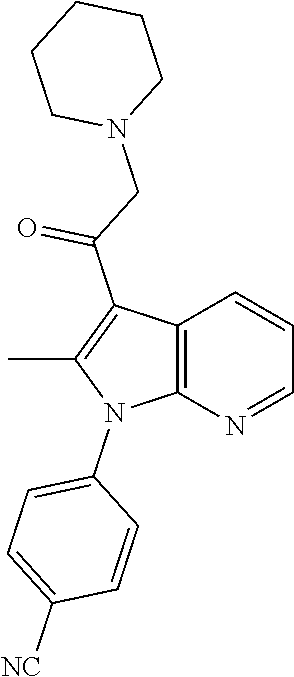 |
II |
| 142 |
 |
II |
| 144 |
 |
II |
| 145 |
 |
II |
| 146 |
 |
II |
| 147 |
 |
II |
| 148 |
 |
II |
| 149 |
 |
II |
| 150 |
 |
II |
| 151 |
 |
II |
| 152 |
 |
II |
| 153 |
 |
II |
| 155 |
 |
III |
| 156 |
 |
III |
| 160 |
 |
III |
| 161 |
 |
III |
| 162 |
 |
III |
| 163 |
 |
III |
| 164 |
 |
III |
| 165 |
 |
III |
| 167 |
 |
III |
| 168 |
 |
III |
| 169 |
 |
III |
| 170 |
 |
III |
| 171 |
 |
III |
| 172 |
 |
III |
| 173 |
 |
III |
| 175 |
 |
III |
| 176 |
 |
III |
| 177 |
 |
III |
| 178 |
 |
III |
| 179 |
 |
III |
| 180 |
 |
III |
| 181 |
 |
III |
| 182 |
 |
III |
| 183 |
 |
III |
| 184 |
 |
III |
| 185 |
 |
III |
| 186 |
 |
III |
| 187 |
 |
III |
| 188 |
 |
III |
| 189 |
 |
III |
| 190 |
 |
III |
| 191 |
 |
III |
| 192 |
 |
I |
| 193 |
 |
II |
| 194 |
 |
III |
| 195 |
 |
III |
| 196 |
 |
III |
| 197 |
 |
III |
| 198 |
 |
III |
| 199 |
 |
III |
| 200 |
 |
III |
| 201 |
 |
III |
| 202 |
 |
III |
| 203 |
 |
III |
| 204 |
 |
III |
| 205 |
 |
III |
| 206 |
 |
III |
| 207 |
 |
III |
| 208 |
 |
III |
| 209 |
 |
III |
| 210 |
 |
III |
| 296 |
 |
III |
| 297 |
 |
III |
| 298 |
 |
III |
| 299 |
 |
III |
| 300 |
 |
III |
| 301 |
 |
III |
| 302 |
 |
III |
| 303 |
 |
III |
| 304 |
 |
III |
| 305 |
 |
III |
| 306 |
 |
III |
| 307 |
 |
III |
| 308 |
 |
III |
| 309 |
 |
III |
| 310 |
 |
III |
| 311 |
 |
III |
| 312 |
 |
II |
| 314 |
 |
II |
| 315 |
 |
III |
| 318 |
 |
III |
| 319 |
 |
III |
| 320 |
 |
III |
| 321 |
 |
III |
| 324 |
 |
I |
| 325 |
 |
I |
| 326 |
 |
III |
| 327 |
 |
I |
| 328 |
 |
I |
| 329 |
 |
I |
| 330 |
 |
I |
| 331 |
 |
III |
| 332 |
 |
III |
| 335 |
 |
III |
| 336 |
 |
I |
| 337 |
 |
III |
| 338 |
 |
I |
| 339 |
 |
III |
| 340 |
 |
III |
| 341 |
 |
III |
| 342 |
 |
III |
| 343 |
 |
I |
| 344 |
 |
I |
| 345 |
 |
I |
| 346 |
 |
III |
| 347 |
 |
III |
| 348 |
 |
I |
| 349 |
 |
III |
| 350 |
 |
III |
| 351 |
 |
III |
| 352 |
 |
III |
| 353 |
 |
III |
| 354 |
 |
III |
| 355 |
 |
III |
| 356 |
 |
III |
| 357 |
 |
III |
| 359 |
 |
I |
| 360 |
 |
III |
| 361 |
 |
III |
| 362 |
 |
III |
| 363 |
 |
III |
| 364 |
 |
III |
| 365 |
 |
II |
| 366 |
 |
II |
| 367 |
 |
II |
| 368 |
 |
II |
| 369 |
 |
III |
| 370 |
 |
III |
| 371 |
 |
I |
| 372 |
 |
I |
| 373 |
 |
II |
| 374 |
 |
II |
| 381 |
 |
III |
| 382 |
 |
III |
| 383 |
 |
III |
| 384 |
 |
III |
| 385 |
 |
III |
| 386 |
 |
I |
| 387 |
 |
III |
| 388 |
 |
III |
| 389 |
 |
III |
| 390 |
 |
I |
| 391 |
 |
II |
| 392 |
 |
II |
| 393 |
 |
II |
| 394 |
 |
I |
| 395 |
 |
I |
| 396 |
 |
I |
| 397 |
 |
I |
| 398 |
 |
II |
| 399 |
 |
I |
| 400 |
 |
I |
| 401 |
 |
II |
| 402 |
 |
I |
Claims (35)


Priority Applications (1)
| Application Number | Priority Date | Filing Date | Title |
|---|---|---|---|
| US17/644,969 US11958873B2 (en) | 2013-11-12 | 2021-12-17 | Proteasome activity enhancing compounds |
Applications Claiming Priority (6)
| Application Number | Priority Date | Filing Date | Title |
|---|---|---|---|
| US201361903330P | 2013-11-12 | 2013-11-12 | |
| PCT/US2014/065204 WO2015073528A1 (en) | 2013-11-12 | 2014-11-12 | Proteasome activity enhancing compounds |
| US15/153,379 US9850262B2 (en) | 2013-11-12 | 2016-05-12 | Proteasome activity enhancing compounds |
| US15/830,261 US20180282352A1 (en) | 2013-11-12 | 2017-12-04 | Proteasome activity enhancing compounds |
| US16/902,019 US11242361B2 (en) | 2013-11-12 | 2020-06-15 | Proteasome activity enhancing compounds |
| US17/644,969 US11958873B2 (en) | 2013-11-12 | 2021-12-17 | Proteasome activity enhancing compounds |
Related Parent Applications (1)
| Application Number | Title | Priority Date | Filing Date |
|---|---|---|---|
| US16/902,019 Continuation US11242361B2 (en) | 2013-11-12 | 2020-06-15 | Proteasome activity enhancing compounds |
Publications (3)
| Publication Number | Publication Date |
|---|---|
| US20220298181A1 US20220298181A1 (en) | 2022-09-22 |
| US20230242557A9 US20230242557A9 (en) | 2023-08-03 |
| US11958873B2 true US11958873B2 (en) | 2024-04-16 |
Family
ID=53057962
Family Applications (4)
| Application Number | Title | Priority Date | Filing Date |
|---|---|---|---|
| US15/153,379 Expired - Fee Related US9850262B2 (en) | 2013-11-12 | 2016-05-12 | Proteasome activity enhancing compounds |
| US15/830,261 Abandoned US20180282352A1 (en) | 2013-11-12 | 2017-12-04 | Proteasome activity enhancing compounds |
| US16/902,019 Expired - Fee Related US11242361B2 (en) | 2013-11-12 | 2020-06-15 | Proteasome activity enhancing compounds |
| US17/644,969 Active 2035-01-12 US11958873B2 (en) | 2013-11-12 | 2021-12-17 | Proteasome activity enhancing compounds |
Family Applications Before (3)
| Application Number | Title | Priority Date | Filing Date |
|---|---|---|---|
| US15/153,379 Expired - Fee Related US9850262B2 (en) | 2013-11-12 | 2016-05-12 | Proteasome activity enhancing compounds |
| US15/830,261 Abandoned US20180282352A1 (en) | 2013-11-12 | 2017-12-04 | Proteasome activity enhancing compounds |
| US16/902,019 Expired - Fee Related US11242361B2 (en) | 2013-11-12 | 2020-06-15 | Proteasome activity enhancing compounds |
Country Status (2)
| Country | Link |
|---|---|
| US (4) | US9850262B2 (en) |
| WO (1) | WO2015073528A1 (en) |
Families Citing this family (13)
| Publication number | Priority date | Publication date | Assignee | Title |
|---|---|---|---|---|
| WO2015073528A1 (en) * | 2013-11-12 | 2015-05-21 | Proteostasis Therapeutics, Inc. | Proteasome activity enhancing compounds |
| WO2018094106A2 (en) | 2016-11-16 | 2018-05-24 | University Of South Florida | ALLOSTERIC ANTAGONISTS OF GPRC6a AND THEIR USE IN MITIGATING PROTEINOPATHIES |
| EP3305786A3 (en) | 2018-01-22 | 2018-07-25 | Bayer CropScience Aktiengesellschaft | Condensed bicyclic heterocycle derivatives as pesticides |
| WO2020006296A1 (en) | 2018-06-27 | 2020-01-02 | Proteostasis Therapeutics, Inc. | Proteasome activity enhancing compounds |
| WO2020006269A1 (en) | 2018-06-27 | 2020-01-02 | Proteostasis Therapeutics, Inc. | Proteasome activity enhancing compounds |
| WO2020017569A1 (en) | 2018-07-17 | 2020-01-23 | 日本ケミファ株式会社 | T-type calcium channel blocker |
| LT3860998T (en) | 2018-10-05 | 2024-06-25 | Annapurna Bio Inc. | COMPOUNDS AND COMPOSITIONS FOR THE TREATMENT OF CONDITIONS ASSOCIATED WITH APJ RECEPTOR ACTIVITY |
| US20220226299A1 (en) | 2019-03-29 | 2022-07-21 | Nippon Chemiphar Co., Ltd. | Use of t-type calcium channel blocker for treating pruritus |
| CN110343104A (en) * | 2019-08-27 | 2019-10-18 | 陈建江 | A kind of synthetic method of 2- methyl -7- azaindole |
| CN115811976A (en) * | 2020-04-01 | 2023-03-17 | 修复治疗公司 | Methods of using MYT1 inhibitors |
| ES3067113T3 (en) * | 2020-04-01 | 2026-05-19 | Repare Therapeutics Inc | N-phenyl substituted indole derivatives as myt1 inhibitors for the treatment of cancer |
| US12655150B2 (en) | 2021-03-26 | 2026-06-16 | Cedilla Therapeutics, Inc. | TEAD inhibitors and uses thereof |
| JP2025172328A (en) * | 2024-05-13 | 2025-11-26 | 和彦 中村 | IGF-1 production promoter and its application |
Citations (137)
| Publication number | Priority date | Publication date | Assignee | Title |
|---|---|---|---|---|
| GB1073521A (en) | 1963-03-20 | 1967-06-28 | Benger Lab Ltd | Indole derivatives |
| GB1410783A (en) | 1972-01-20 | 1975-10-22 | Wyeth John & Brother Ltd | N-substituted 4-amidopyridines tetrahydropyridines and piperidines |
| US4148895A (en) | 1975-12-19 | 1979-04-10 | Hoechst Aktiengesellschaft | Basically substituted indole derivatives |
| US4290940A (en) | 1979-06-28 | 1981-09-22 | Ciba-Geigy Corporation | Pyrrole stabilizers for chlorine-containing thermoplastics |
| US4814344A (en) | 1986-10-03 | 1989-03-21 | Glaxo Group Limited | Indole derivatives |
| EP0562832A1 (en) | 1992-03-23 | 1993-09-29 | Sankyo Company Limited | Indole and indazole derivatives, for the treatment and prophylaxis of cerebral disorders, their preparation and their use |
| DE4325204A1 (en) | 1993-07-27 | 1995-02-02 | Matthias Dr Lehr | Acylpyrrolealkanoic acids and their derivatives as inhibitors of phospholipase A2 |
| EP0639573A1 (en) | 1993-08-03 | 1995-02-22 | Hoechst Aktiengesellschaft | Benzocondensed five membered heterocycles, process of their preparation, their use as drug, as diagnostic means and pharmaceuticals containing it |
| WO1995013266A1 (en) | 1993-11-12 | 1995-05-18 | Merckle Gmbh Chem.-Pharm. Fabrik | Acylpyrrole-alkanoic acids and indole-2-alkanoic acids plus their derivatives for use as inhibitors of phospholipase a¿2? |
| JPH07133274A (en) | 1993-11-09 | 1995-05-23 | Sankyo Co Ltd | Pyprole derivative |
| JPH08225535A (en) | 1994-11-15 | 1996-09-03 | Dai Ichi Seiyaku Co Ltd | Indazole derivative |
| US5561149A (en) | 1986-07-30 | 1996-10-01 | Sandoz Ltd. | Use of certain imidazol carbazols in treating stress-related manic-depressive disorders |
| WO1996032379A1 (en) | 1995-04-10 | 1996-10-17 | Fujisawa Pharmaceutical Co., Ltd. | INDOLE DERIVATIVES AS cGMP-PDE INHIBITORS |
| WO1997036881A1 (en) | 1996-04-03 | 1997-10-09 | Merck & Co., Inc. | Inhibitors of farnesyl-protein transferase |
| WO1997046226A2 (en) | 1996-06-03 | 1997-12-11 | Hoechst Aktiengesellschaft | USE OF INHIBITORS OF THE CELLULAR Na+/H+ EXCHANGER (NHE) FOR PREPARING A MEDICAMENT FOR NORMALIZING SERUM LIPIDS |
| WO1998027089A1 (en) | 1996-12-16 | 1998-06-25 | Allelix Biopharmaceuticals Inc. | 5-alkyl indole compounds as 5-ht1d-like ligands |
| JPH10508321A (en) | 1995-09-01 | 1998-08-18 | イーライ・リリー・アンド・カンパニー | Indolyl neuropeptide Y receptor antagonist |
| US5852046A (en) | 1993-08-03 | 1998-12-22 | Hoechst Aktiengesellschaft | Benzo-fused heterocyclic compounds having a 5-membered ring processes for their preparation their use as medicaments their use as diagnostic agents and medicaments containing them |
| US5859035A (en) | 1996-04-03 | 1999-01-12 | Merck & Co., Inc. | Arylheteroaryl inhibitors of farnesyl-protein transferase |
| JPH11503758A (en) | 1995-04-19 | 1999-03-30 | アボツト・ラボラトリーズ | Indole-3-carbonyl and indole-3-sulfonyl derivatives as platelet activating factor antagonists |
| WO1999043672A1 (en) | 1998-02-25 | 1999-09-02 | Genetics Institute, Inc. | Inhibitors of phospholipase a2 |
| JP2000063354A (en) | 1998-08-21 | 2000-02-29 | Sumitomo Pharmaceut Co Ltd | Pyrrole derivatives |
| US6063782A (en) | 1994-01-19 | 2000-05-16 | Sankyo Company, Limited | Pyrrolopyridazine derivatives |
| US6201129B1 (en) | 1995-02-01 | 2001-03-13 | Univ. College Cardiff Consultants | Tricyclic derivatives and their use as anti-cancer agents |
| JP2001151771A (en) * | 1999-09-10 | 2001-06-05 | Kyowa Hakko Kogyo Co Ltd | Nitrogen-containing aromatic heterocyclic derivatives |
| WO2001044182A2 (en) | 1999-12-16 | 2001-06-21 | Eli Lilly And Company | New synthesis of spla2 inhibitors |
| US6310217B1 (en) | 1996-08-01 | 2001-10-30 | Merckle Gmbh | Acylpyrroledicarboxylic acids and acylindoledicarboxylic acids and their derivatives as inhibitors of cytosolic phospholipase A2 |
| US20020037887A1 (en) | 2000-07-28 | 2002-03-28 | Pintor Jesus J. | Method for reducing intraocular pressure using indole derivatives |
| JP2002510622A (en) | 1998-04-02 | 2002-04-09 | アスタ メディカ アクチエンゲゼルシャフト | Indolyl-3-glyoxylic acid derivative having antitumor activity |
| US6469171B1 (en) | 1998-06-25 | 2002-10-22 | The Australian National University | Syntheses of a variety of lamellarin compounds and analogues |
| US6500853B1 (en) | 1998-02-28 | 2002-12-31 | Genetics Institute, Llc | Inhibitors of phospholipase enzymes |
| JP2003501476A (en) | 1999-06-15 | 2003-01-14 | ブリストルーマイヤーズ スクイブ カンパニー | Antiviral indoleoxoacetylpiperazine derivatives |
| WO2003041644A2 (en) | 2001-11-09 | 2003-05-22 | Scios Inc. | Method to treat cystic fibrosis |
| US6589954B1 (en) | 1998-05-22 | 2003-07-08 | Scios, Inc. | Compounds and methods to treat cardiac failure and other disorders |
| US6627645B2 (en) | 2000-04-28 | 2003-09-30 | Acadia Pharmaceuticals, Inc. | Muscarinic agonists |
| WO2004020409A1 (en) | 2002-08-29 | 2004-03-11 | Merck & Co., Inc. | Indoles having anti-diabetic activity |
| US20040122096A1 (en) | 1996-06-03 | 2004-06-24 | Hoechst Aktiengesellschaft | Use of inhibitors of the cellular Na+/H+ exchanger (NHE) for preparing a medicament for normalizing serum lipids |
| WO2004104007A1 (en) | 2003-05-22 | 2004-12-02 | Pharmacia Italia S.P.A. | Pyrazolo-quinazoline derivatives,process for their preparation and their use as kinase inhibitors |
| US6828344B1 (en) | 1998-02-25 | 2004-12-07 | Genetics Institute, Llc | Inhibitors of phospholipase enzymes |
| WO2005021558A2 (en) | 2003-08-14 | 2005-03-10 | Cephalon, Inc. | Proteasome inhibitors and methods of using the same |
| US6867209B1 (en) | 1998-05-22 | 2005-03-15 | Scios, Inc. | Indole-type derivatives as inhibitors of p38 kinase |
| WO2005025515A2 (en) | 2003-09-12 | 2005-03-24 | California Institute Of Technology | Proteasome pathway inhibitors and related methods |
| US20050075348A1 (en) | 2001-03-12 | 2005-04-07 | Millennium Pharmaceuticals, Inc. | Functionalized heterocycles as modulators of chemokine receptor function and methods of use therefor |
| WO2005066126A1 (en) | 2003-12-23 | 2005-07-21 | Eli Lilly And Company | Cb1 modulator compounds |
| WO2005121175A2 (en) | 2004-06-08 | 2005-12-22 | Novartis Vaccines And Diagnostics Inc. | Env polypeptide complexes and methods of use |
| US20060116379A1 (en) | 2000-06-29 | 2006-06-01 | Tomoyuki Ogawa | Compounds exhibiting type X sPLA2 inhibiting effect |
| US20060135540A1 (en) | 2004-11-30 | 2006-06-22 | Jack Lin | PPAR active compounds |
| WO2006087355A1 (en) | 2005-02-16 | 2006-08-24 | Solvay Pharmaceuticals B.V. | 1h-imidiazole derivatives as cannabinoid cb2 receptor modulators |
| WO2006125324A1 (en) | 2005-05-27 | 2006-11-30 | Queen's University At Kingston | Treatment of protein folding disorders |
| US20070185184A1 (en) | 2005-09-16 | 2007-08-09 | Serenex, Inc. | Carbazole derivatives |
| CN101016294A (en) | 2007-03-13 | 2007-08-15 | 中国人民武装警察部队医学院 | Substituted indole-3-oxalamide derivative with multiple bioactivity |
| WO2007095561A2 (en) | 2006-02-15 | 2007-08-23 | Allergan, Inc. | Indole-3-carboxylic acid amide, ester, thioamide and thiol ester compounds bearing aryl or heteroaryl groups having sphingosine-1-phosphate (s1p) receptor antagonist biological activity |
| US20070203121A1 (en) | 2004-08-10 | 2007-08-30 | Laboratorios Del Dr. Esteve S.A | Substituted indole compounds, their preparation and use in medicaments |
| EP1837329A1 (en) | 2005-01-14 | 2007-09-26 | Dainippon Sumitomo Pharma Co., Ltd. | Novel heteroaryl derivative |
| WO2008024978A2 (en) | 2006-08-24 | 2008-02-28 | Serenex, Inc. | Tetrahydroindolone and tetrahydroindazolone derivatives |
| US20080171772A1 (en) | 2007-01-11 | 2008-07-17 | Beard Richard L | 6-substituted indole-3-carboxylic acid amide compounds having sphingosine-1-phosphate (s1p) receptor antagonist biological activity |
| US20080188453A1 (en) | 2006-10-31 | 2008-08-07 | Adams Mark E | Mapk/erk kinase inhibitors |
| WO2008100867A2 (en) | 2007-02-12 | 2008-08-21 | Intermune, Inc. | Novel inhibitors hepatitis c virus replication |
| US7417063B2 (en) | 2004-04-13 | 2008-08-26 | Bristol-Myers Squibb Company | Bicyclic heterocycles useful as serine protease inhibitors |
| WO2008109702A1 (en) | 2007-03-08 | 2008-09-12 | Irm Llc | Compounds and compositions as modulators of gpr119 activity |
| US7425642B2 (en) | 2003-07-15 | 2008-09-16 | Dainippon Sumitomo Pharma Co. ,Ltd. | Heteroaryl derivative |
| WO2008120818A1 (en) | 2007-03-29 | 2008-10-09 | Asubio Pharma Co., Ltd. | Indole derivative having cpla2 inhibitory activity, use of the same and method for producing the same |
| WO2008147536A1 (en) | 2007-05-24 | 2008-12-04 | President And Fellows For Harvard College | Methods and compositions for enhancing proteasome activity |
| WO2009013010A2 (en) | 2007-07-26 | 2009-01-29 | Laboratorios Del Dr. Esteve, S.A. | 5ht6-ligands such as sulfonamide derivatives in drug- induced weight-gain |
| EP2020230A1 (en) | 2007-08-01 | 2009-02-04 | Laboratorios del Dr. Esteve S.A. | Combination of at least two 5-HT6-Ligands |
| WO2009023623A1 (en) | 2007-08-10 | 2009-02-19 | H, Lundbeck A/S | Heteroaryl amide analogues |
| US7528165B2 (en) | 2001-12-13 | 2009-05-05 | National Health Research Institutes | Indole compounds |
| US20090118503A1 (en) | 2007-06-20 | 2009-05-07 | Kevin Sprott | Faah inhibitors |
| WO2009062118A2 (en) | 2007-11-07 | 2009-05-14 | Foldrx Pharmaceuticals, Inc. | Modulation of protein trafficking |
| US20090143371A1 (en) | 2007-12-04 | 2009-06-04 | Bernd Buettelmann | Isoxazole-pyridine derivatives |
| WO2009071577A1 (en) | 2007-12-05 | 2009-06-11 | Glaxo Group Limited | Oxadiazole derivatives and their use as nicotinic acetylcholine receptor modulators |
| WO2009073620A2 (en) | 2007-11-30 | 2009-06-11 | Newlink Genetics | Ido inhibitors |
| US20090163545A1 (en) | 2007-12-21 | 2009-06-25 | University Of Rochester | Method For Altering The Lifespan Of Eukaryotic Organisms |
| WO2009097141A1 (en) | 2008-01-31 | 2009-08-06 | Joslin Diabetes Center | Methods for treatment of kallikrein-related disorders |
| JP2009179589A (en) | 2008-01-30 | 2009-08-13 | Pharma Ip | Antiviral agent |
| US20090215750A1 (en) | 2008-02-25 | 2009-08-27 | Joe Timothy Bamberg | Pyrrolopyrazine kinase inhibitors |
| WO2009108551A2 (en) | 2008-02-25 | 2009-09-03 | H. Lundbeck A/S | Heteroaryl amide analogues |
| US20090227538A1 (en) | 2005-11-03 | 2009-09-10 | Fruechtel Joerg | N-(Hetero)Aryl Indole Derivatives as Pesticides |
| WO2009117676A2 (en) | 2008-03-20 | 2009-09-24 | Forest Laboratories Holdings Limited | Novel piperidine derivatives as inhibitors of stearoyl-coa desaturase |
| WO2009118292A1 (en) | 2008-03-24 | 2009-10-01 | Novartis Ag | Arylsulfonamide-based matrix metalloprotease inhibitors |
| WO2009127686A1 (en) | 2008-04-16 | 2009-10-22 | Karo Bio Ab | Novel estrogen receptor ligands |
| US20090264384A1 (en) | 2004-11-01 | 2009-10-22 | Nuada, Inc. | Indole, benzimidazole, and benzolactam boronic acid compounds, analogs thereof and methods of use thereof |
| WO2009130481A1 (en) | 2008-04-24 | 2009-10-29 | F2G Ltd | Pyrrole antifungal agents |
| WO2009136175A1 (en) | 2008-05-07 | 2009-11-12 | Medical Research Council | Compounds for use in stabilizing p53 mutants |
| US7632955B2 (en) | 2001-12-13 | 2009-12-15 | National Health Research Institutes | Indole compounds |
| US20090318446A1 (en) | 2005-01-11 | 2009-12-24 | Cyclacel Limited | 4-(1H-Indol-3-yl)-Pyrimidin-2-Ylamine Derivatives and Their Use in Therapy |
| WO2009158371A1 (en) | 2008-06-26 | 2009-12-30 | Smithklike Beecham Corporation | Inhibitors of akt activity |
| WO2009158011A1 (en) | 2008-06-26 | 2009-12-30 | Amgen Inc. | Alkynyl alcohols as kinase inhibitors |
| EP2141163A1 (en) | 2008-07-02 | 2010-01-06 | Bayer Schering Pharma AG | Substituted thiazolidinones, their production and utilisation as medicine |
| WO2010006234A2 (en) | 2008-07-11 | 2010-01-14 | National Health Research Institutes | Anticancer oral formulation |
| WO2010015816A2 (en) | 2008-08-06 | 2010-02-11 | Summit Corporation Plc | Treatment of lysosomal storage disorders and other proteostatic diseases |
| WO2010019391A1 (en) | 2008-08-12 | 2010-02-18 | Merck Sharp & Dohme Corp. | N-heterocyclic m1 receptor positive allosteric modulators |
| US20100074955A1 (en) | 2006-09-19 | 2010-03-25 | Laboratorios Del Dr. Esteve, S.A. | Combination of NMDA-Receptor Ligand and a Compound With 5-HT6 Receptor Affinity |
| US20100087446A1 (en) | 2007-04-26 | 2010-04-08 | Chakravarty Prasun K | 2-substituted indole derivatives as calcium channel blockers |
| US20100087415A1 (en) | 2008-10-03 | 2010-04-08 | Calcimedica, Inc. | Inhibitors of store operated calcium release |
| US20100099726A1 (en) | 2006-08-04 | 2010-04-22 | Lewis Cantley | Inhibitors of pyruvate kinase and methods of treating disease |
| WO2010067123A1 (en) | 2008-12-12 | 2010-06-17 | Astrazeneca Ab | 2- (piperidin-1-yl) -4-heterocyclyl-thiazole-5-carboxylic acid derivatives against bacterial infections |
| US20100190768A1 (en) | 2005-09-30 | 2010-07-29 | Dainippon Sumitomo Pharma Co., Ltd. | Novel fused pyrole derivative |
| US7767817B2 (en) | 2003-09-05 | 2010-08-03 | Binghe Wang | Water soluble boronic acid fluorescent reporter compounds and methods of use thereof |
| US20100197708A1 (en) | 2006-08-07 | 2010-08-05 | John Jeffrey Talley | Indole compounds |
| US20100204282A1 (en) | 2007-02-05 | 2010-08-12 | Hutchinson John H | Reverse indoles as 5-lipoxygenase-activating protein (FLAP) inhibitors |
| US20100249069A1 (en) | 2007-05-08 | 2010-09-30 | Donello John E | S1p3 receptor inhibitors for treating pain |
| WO2010139982A1 (en) | 2009-06-02 | 2010-12-09 | The University Of Sheffield | Indole derivatives for the stimulation of stem cell proliferation |
| US20110009453A1 (en) | 2008-03-17 | 2011-01-13 | Donello John E | s1p3 receptor inhibitors for treating inflammation |
| WO2011038579A1 (en) | 2009-09-30 | 2011-04-07 | Zhejiang Beta Pharma Inc. | Compounds and compositions as protein kinase inhibitors |
| US20110098483A1 (en) | 2008-03-27 | 2011-04-28 | University Of Southern California | Substituted Nitrogen Heterocycles and Synthesis and Uses Thereof |
| US20110144090A1 (en) | 2009-08-10 | 2011-06-16 | Amy Elder | Compounds and methods of use thereof |
| WO2011094545A2 (en) | 2010-01-28 | 2011-08-04 | President And Fellows Of Harvard College | Compositions and methods for enhancing proteasome activity |
| WO2011127333A2 (en) | 2010-04-09 | 2011-10-13 | University Of Louisville Research Foundation, Inc. | Compounds for treating disease, for administering, and for pharmaceutical compositions |
| WO2011133653A1 (en) | 2010-04-22 | 2011-10-27 | Mars, Incorporated | Inhibitors of arginase and their therapeutic applications |
| US20110319403A1 (en) | 2009-03-18 | 2011-12-29 | Schering Corporation | Bicyclic compounds as inhibitors of diacylglycerol acyltransferase |
| US20120006417A1 (en) | 2007-04-13 | 2012-01-12 | Cla-Val Co. | System and method for hydraulically managing fluid pressure downstream from a main valve between set points |
| US8097644B2 (en) | 2006-03-28 | 2012-01-17 | Allergan, Inc. | Indole compounds having sphingosine-1-phosphate (S1P) receptor antagonist |
| WO2012012712A2 (en) | 2010-07-23 | 2012-01-26 | President And Fellows Of Harvard College | Tricyclic proteasome activity enhancing compounds |
| US20120064175A1 (en) | 2010-05-20 | 2012-03-15 | Synta Pharmaceuticals Corp. | HSP90 Inhibitors for Treating Non-Small Cell Lung Cancer in Wild-Type EGFR and/or KRAS Patients |
| US20120071448A1 (en) | 2009-05-05 | 2012-03-22 | Allergan, Inc. | S1P3 Receptor Inhibitors for Treating Conditions of the Eye |
| WO2012078757A2 (en) | 2010-12-08 | 2012-06-14 | Synta Pharmaceuticals Corp. | Combination breast cancer therapy with hsp90 inhibitory compounds |
| WO2012096919A1 (en) | 2011-01-11 | 2012-07-19 | Synta Pharmaceuticals Corp. | Combination therapy of hsp90 inhibitory compounds with proteasome inhibitors |
| WO2012106343A2 (en) | 2011-02-01 | 2012-08-09 | The Board Of Trustees Of The University Of Illinois | Hdac inhibitors and therapeutic methods using the same |
| WO2012116247A1 (en) | 2011-02-25 | 2012-08-30 | Synta Pharmaceuticals Corp. | Hsp90 inhibitory compounds in treating jak/stat signaling-mediated cancers |
| WO2012116061A1 (en) | 2011-02-23 | 2012-08-30 | Synta Pharmaceuticals Corp. | Combination therapy of hsp90 inhibitory compounds with radiotherapy |
| US20120245186A1 (en) | 2009-10-19 | 2012-09-27 | Synta Pharmaceuticals Corp. | Combination cancer therapy with hsp90 inhibitory compounds |
| WO2012141796A2 (en) | 2011-02-24 | 2012-10-18 | Synta Pharmaceuticals Corp. | Prostate cancer therapy with hsp90 inhibitory compounds |
| WO2012162293A1 (en) | 2011-05-23 | 2012-11-29 | Synta Pharmaceuticals Corp. | Combination therapy of hsp90 inhibitory compounds with mek inhibitors |
| WO2012162584A1 (en) | 2011-05-26 | 2012-11-29 | Synta Pharmaceuticals Corp. | Combination therapy of hsp90 inhibitory compounds with chk inhibitors |
| WO2012162372A1 (en) | 2011-05-24 | 2012-11-29 | Synta Pharmaceuticals Corp. | Combination therapy of hsp90 inhibitory compounds with mtor/p13k inhibitors |
| US20120316193A1 (en) | 2011-05-12 | 2012-12-13 | Proteostasis Therapeutics, Inc. | Proteostasis regulators |
| WO2013006864A2 (en) | 2011-07-07 | 2013-01-10 | Synta Pharmaceuticals Corp. | Treating cancer with hsp90 inhibitory compounds |
| US20130029948A1 (en) | 2011-05-27 | 2013-01-31 | Amira Pharmaceuticals, Inc. | Heterocyclic autotaxin inhibitors and uses thereof |
| WO2013014104A1 (en) | 2011-07-22 | 2013-01-31 | Universite Joseph Fourier | Bis-indolic derivatives, their uses in particular as antibacterials |
| WO2013067162A1 (en) | 2011-11-02 | 2013-05-10 | Synta Pharmaceuticals Corp. | Cancer therapy using a combination of hsp90 inhibitors with topoisomerase i inhibitors |
| WO2013067165A1 (en) | 2011-11-02 | 2013-05-10 | Synta Pharmaceuticals Corp. | Combination therapy of hsp90 inhibitors with platinum-containing agents |
| WO2013074594A1 (en) | 2011-11-14 | 2013-05-23 | Synta Pharmaceuticals Corp. | Combination therapy of hsp90 inhibitors with braf inhibitors |
| US20130150385A1 (en) | 2010-04-19 | 2013-06-13 | Synta Pharmaceuticals Corp. | Cancer therapy using a combination of a hsp90 inhibitory compounds and a egfr inhibitor |
| US20130156755A1 (en) | 2010-04-19 | 2013-06-20 | Synta Pharmaceuticals Corp. | Cancer therapy using a combination of a hsp90 inhibitory compounds and a vegf inhibitor |
| US20130171105A1 (en) | 2010-05-24 | 2013-07-04 | Synta Pharmaceuticals Corp. | Cancer therapy using a combination of a hsp90 inhibitory compound and a topoisomerase ii inhibitor |
| US9850262B2 (en) * | 2013-11-12 | 2017-12-26 | Proteostasis Therapeutics, Inc. | Proteasome activity enhancing compounds |
-
2014
- 2014-11-12 WO PCT/US2014/065204 patent/WO2015073528A1/en not_active Ceased
-
2016
- 2016-05-12 US US15/153,379 patent/US9850262B2/en not_active Expired - Fee Related
-
2017
- 2017-12-04 US US15/830,261 patent/US20180282352A1/en not_active Abandoned
-
2020
- 2020-06-15 US US16/902,019 patent/US11242361B2/en not_active Expired - Fee Related
-
2021
- 2021-12-17 US US17/644,969 patent/US11958873B2/en active Active
Patent Citations (156)
| Publication number | Priority date | Publication date | Assignee | Title |
|---|---|---|---|---|
| GB1073521A (en) | 1963-03-20 | 1967-06-28 | Benger Lab Ltd | Indole derivatives |
| GB1410783A (en) | 1972-01-20 | 1975-10-22 | Wyeth John & Brother Ltd | N-substituted 4-amidopyridines tetrahydropyridines and piperidines |
| US4148895A (en) | 1975-12-19 | 1979-04-10 | Hoechst Aktiengesellschaft | Basically substituted indole derivatives |
| US4290940A (en) | 1979-06-28 | 1981-09-22 | Ciba-Geigy Corporation | Pyrrole stabilizers for chlorine-containing thermoplastics |
| US5561149A (en) | 1986-07-30 | 1996-10-01 | Sandoz Ltd. | Use of certain imidazol carbazols in treating stress-related manic-depressive disorders |
| US4814344A (en) | 1986-10-03 | 1989-03-21 | Glaxo Group Limited | Indole derivatives |
| EP0562832A1 (en) | 1992-03-23 | 1993-09-29 | Sankyo Company Limited | Indole and indazole derivatives, for the treatment and prophylaxis of cerebral disorders, their preparation and their use |
| DE4325204A1 (en) | 1993-07-27 | 1995-02-02 | Matthias Dr Lehr | Acylpyrrolealkanoic acids and their derivatives as inhibitors of phospholipase A2 |
| EP0639573A1 (en) | 1993-08-03 | 1995-02-22 | Hoechst Aktiengesellschaft | Benzocondensed five membered heterocycles, process of their preparation, their use as drug, as diagnostic means and pharmaceuticals containing it |
| US5852046A (en) | 1993-08-03 | 1998-12-22 | Hoechst Aktiengesellschaft | Benzo-fused heterocyclic compounds having a 5-membered ring processes for their preparation their use as medicaments their use as diagnostic agents and medicaments containing them |
| JPH07133274A (en) | 1993-11-09 | 1995-05-23 | Sankyo Co Ltd | Pyprole derivative |
| WO1995013266A1 (en) | 1993-11-12 | 1995-05-18 | Merckle Gmbh Chem.-Pharm. Fabrik | Acylpyrrole-alkanoic acids and indole-2-alkanoic acids plus their derivatives for use as inhibitors of phospholipase a¿2? |
| US6063782A (en) | 1994-01-19 | 2000-05-16 | Sankyo Company, Limited | Pyrrolopyridazine derivatives |
| JPH08225535A (en) | 1994-11-15 | 1996-09-03 | Dai Ichi Seiyaku Co Ltd | Indazole derivative |
| US6201129B1 (en) | 1995-02-01 | 2001-03-13 | Univ. College Cardiff Consultants | Tricyclic derivatives and their use as anti-cancer agents |
| JPH11503445A (en) | 1995-04-10 | 1999-03-26 | 藤沢薬品工業株式会社 | Indole derivatives as cGMP-PDE inhibitors |
| WO1996032379A1 (en) | 1995-04-10 | 1996-10-17 | Fujisawa Pharmaceutical Co., Ltd. | INDOLE DERIVATIVES AS cGMP-PDE INHIBITORS |
| JPH11503758A (en) | 1995-04-19 | 1999-03-30 | アボツト・ラボラトリーズ | Indole-3-carbonyl and indole-3-sulfonyl derivatives as platelet activating factor antagonists |
| JPH10508321A (en) | 1995-09-01 | 1998-08-18 | イーライ・リリー・アンド・カンパニー | Indolyl neuropeptide Y receptor antagonist |
| WO1997036881A1 (en) | 1996-04-03 | 1997-10-09 | Merck & Co., Inc. | Inhibitors of farnesyl-protein transferase |
| US5859035A (en) | 1996-04-03 | 1999-01-12 | Merck & Co., Inc. | Arylheteroaryl inhibitors of farnesyl-protein transferase |
| US20040122096A1 (en) | 1996-06-03 | 2004-06-24 | Hoechst Aktiengesellschaft | Use of inhibitors of the cellular Na+/H+ exchanger (NHE) for preparing a medicament for normalizing serum lipids |
| WO1997046226A2 (en) | 1996-06-03 | 1997-12-11 | Hoechst Aktiengesellschaft | USE OF INHIBITORS OF THE CELLULAR Na+/H+ EXCHANGER (NHE) FOR PREPARING A MEDICAMENT FOR NORMALIZING SERUM LIPIDS |
| US6310217B1 (en) | 1996-08-01 | 2001-10-30 | Merckle Gmbh | Acylpyrroledicarboxylic acids and acylindoledicarboxylic acids and their derivatives as inhibitors of cytosolic phospholipase A2 |
| WO1998027089A1 (en) | 1996-12-16 | 1998-06-25 | Allelix Biopharmaceuticals Inc. | 5-alkyl indole compounds as 5-ht1d-like ligands |
| US6828344B1 (en) | 1998-02-25 | 2004-12-07 | Genetics Institute, Llc | Inhibitors of phospholipase enzymes |
| WO1999043672A1 (en) | 1998-02-25 | 1999-09-02 | Genetics Institute, Inc. | Inhibitors of phospholipase a2 |
| US6500853B1 (en) | 1998-02-28 | 2002-12-31 | Genetics Institute, Llc | Inhibitors of phospholipase enzymes |
| JP2002510622A (en) | 1998-04-02 | 2002-04-09 | アスタ メディカ アクチエンゲゼルシャフト | Indolyl-3-glyoxylic acid derivative having antitumor activity |
| US6867209B1 (en) | 1998-05-22 | 2005-03-15 | Scios, Inc. | Indole-type derivatives as inhibitors of p38 kinase |
| US6589954B1 (en) | 1998-05-22 | 2003-07-08 | Scios, Inc. | Compounds and methods to treat cardiac failure and other disorders |
| US6469171B1 (en) | 1998-06-25 | 2002-10-22 | The Australian National University | Syntheses of a variety of lamellarin compounds and analogues |
| JP2000063354A (en) | 1998-08-21 | 2000-02-29 | Sumitomo Pharmaceut Co Ltd | Pyrrole derivatives |
| JP2003501476A (en) | 1999-06-15 | 2003-01-14 | ブリストルーマイヤーズ スクイブ カンパニー | Antiviral indoleoxoacetylpiperazine derivatives |
| JP2001151771A (en) * | 1999-09-10 | 2001-06-05 | Kyowa Hakko Kogyo Co Ltd | Nitrogen-containing aromatic heterocyclic derivatives |
| WO2001044182A2 (en) | 1999-12-16 | 2001-06-21 | Eli Lilly And Company | New synthesis of spla2 inhibitors |
| US6627645B2 (en) | 2000-04-28 | 2003-09-30 | Acadia Pharmaceuticals, Inc. | Muscarinic agonists |
| US7238713B2 (en) | 2000-04-28 | 2007-07-03 | Acadia Pharmaceuticals, Inc. | Muscarinic agonists |
| US20050113357A1 (en) | 2000-04-28 | 2005-05-26 | Anderson Carl-Magnus A. | Muscarinic agonists |
| US20060116379A1 (en) | 2000-06-29 | 2006-06-01 | Tomoyuki Ogawa | Compounds exhibiting type X sPLA2 inhibiting effect |
| US20020037887A1 (en) | 2000-07-28 | 2002-03-28 | Pintor Jesus J. | Method for reducing intraocular pressure using indole derivatives |
| US20050075348A1 (en) | 2001-03-12 | 2005-04-07 | Millennium Pharmaceuticals, Inc. | Functionalized heterocycles as modulators of chemokine receptor function and methods of use therefor |
| WO2003041644A2 (en) | 2001-11-09 | 2003-05-22 | Scios Inc. | Method to treat cystic fibrosis |
| US7528165B2 (en) | 2001-12-13 | 2009-05-05 | National Health Research Institutes | Indole compounds |
| US7632955B2 (en) | 2001-12-13 | 2009-12-15 | National Health Research Institutes | Indole compounds |
| WO2004020409A1 (en) | 2002-08-29 | 2004-03-11 | Merck & Co., Inc. | Indoles having anti-diabetic activity |
| WO2004104007A1 (en) | 2003-05-22 | 2004-12-02 | Pharmacia Italia S.P.A. | Pyrazolo-quinazoline derivatives,process for their preparation and their use as kinase inhibitors |
| US7482354B2 (en) | 2003-05-22 | 2009-01-27 | Nerviano Medical Sciences S.R.L. | Pyrazolo-quinazoline derivatives, process for their preparation and their use as kinase inhibitors |
| US7425642B2 (en) | 2003-07-15 | 2008-09-16 | Dainippon Sumitomo Pharma Co. ,Ltd. | Heteroaryl derivative |
| US7576206B2 (en) | 2003-08-14 | 2009-08-18 | Cephalon, Inc. | Proteasome inhibitors and methods of using the same |
| WO2005021558A2 (en) | 2003-08-14 | 2005-03-10 | Cephalon, Inc. | Proteasome inhibitors and methods of using the same |
| US7767817B2 (en) | 2003-09-05 | 2010-08-03 | Binghe Wang | Water soluble boronic acid fluorescent reporter compounds and methods of use thereof |
| WO2005025515A2 (en) | 2003-09-12 | 2005-03-24 | California Institute Of Technology | Proteasome pathway inhibitors and related methods |
| JP2007519631A (en) | 2003-12-23 | 2007-07-19 | イーライ リリー アンド カンパニー | CB1 modulator compound |
| WO2005066126A1 (en) | 2003-12-23 | 2005-07-21 | Eli Lilly And Company | Cb1 modulator compounds |
| US7417063B2 (en) | 2004-04-13 | 2008-08-26 | Bristol-Myers Squibb Company | Bicyclic heterocycles useful as serine protease inhibitors |
| WO2005121175A2 (en) | 2004-06-08 | 2005-12-22 | Novartis Vaccines And Diagnostics Inc. | Env polypeptide complexes and methods of use |
| US8197819B2 (en) | 2004-06-08 | 2012-06-12 | Novartis Vaccines And Diagnostics, Inc. | Env polypeptide complexes and methods of use |
| US20070203121A1 (en) | 2004-08-10 | 2007-08-30 | Laboratorios Del Dr. Esteve S.A | Substituted indole compounds, their preparation and use in medicaments |
| US20090264384A1 (en) | 2004-11-01 | 2009-10-22 | Nuada, Inc. | Indole, benzimidazole, and benzolactam boronic acid compounds, analogs thereof and methods of use thereof |
| US20060135540A1 (en) | 2004-11-30 | 2006-06-22 | Jack Lin | PPAR active compounds |
| US20090318446A1 (en) | 2005-01-11 | 2009-12-24 | Cyclacel Limited | 4-(1H-Indol-3-yl)-Pyrimidin-2-Ylamine Derivatives and Their Use in Therapy |
| EP1837329A1 (en) | 2005-01-14 | 2007-09-26 | Dainippon Sumitomo Pharma Co., Ltd. | Novel heteroaryl derivative |
| US7781479B2 (en) | 2005-01-14 | 2010-08-24 | Dainippon Sumitomo Pharma Co., Ltd. | Heteroaryl derivatives |
| WO2006087355A1 (en) | 2005-02-16 | 2006-08-24 | Solvay Pharmaceuticals B.V. | 1h-imidiazole derivatives as cannabinoid cb2 receptor modulators |
| WO2006125324A1 (en) | 2005-05-27 | 2006-11-30 | Queen's University At Kingston | Treatment of protein folding disorders |
| US20070185184A1 (en) | 2005-09-16 | 2007-08-09 | Serenex, Inc. | Carbazole derivatives |
| US20100190768A1 (en) | 2005-09-30 | 2010-07-29 | Dainippon Sumitomo Pharma Co., Ltd. | Novel fused pyrole derivative |
| US20090227538A1 (en) | 2005-11-03 | 2009-09-10 | Fruechtel Joerg | N-(Hetero)Aryl Indole Derivatives as Pesticides |
| WO2007095561A2 (en) | 2006-02-15 | 2007-08-23 | Allergan, Inc. | Indole-3-carboxylic acid amide, ester, thioamide and thiol ester compounds bearing aryl or heteroaryl groups having sphingosine-1-phosphate (s1p) receptor antagonist biological activity |
| US8097644B2 (en) | 2006-03-28 | 2012-01-17 | Allergan, Inc. | Indole compounds having sphingosine-1-phosphate (S1P) receptor antagonist |
| US20100099726A1 (en) | 2006-08-04 | 2010-04-22 | Lewis Cantley | Inhibitors of pyruvate kinase and methods of treating disease |
| US20100197708A1 (en) | 2006-08-07 | 2010-08-05 | John Jeffrey Talley | Indole compounds |
| WO2008024978A2 (en) | 2006-08-24 | 2008-02-28 | Serenex, Inc. | Tetrahydroindolone and tetrahydroindazolone derivatives |
| US20100074955A1 (en) | 2006-09-19 | 2010-03-25 | Laboratorios Del Dr. Esteve, S.A. | Combination of NMDA-Receptor Ligand and a Compound With 5-HT6 Receptor Affinity |
| US20080188453A1 (en) | 2006-10-31 | 2008-08-07 | Adams Mark E | Mapk/erk kinase inhibitors |
| US20080171772A1 (en) | 2007-01-11 | 2008-07-17 | Beard Richard L | 6-substituted indole-3-carboxylic acid amide compounds having sphingosine-1-phosphate (s1p) receptor antagonist biological activity |
| US20100204282A1 (en) | 2007-02-05 | 2010-08-12 | Hutchinson John H | Reverse indoles as 5-lipoxygenase-activating protein (FLAP) inhibitors |
| US20090047246A1 (en) | 2007-02-12 | 2009-02-19 | Intermune, Inc. | Novel inhibitors of hepatitis c virus replication |
| WO2008100867A2 (en) | 2007-02-12 | 2008-08-21 | Intermune, Inc. | Novel inhibitors hepatitis c virus replication |
| WO2008109702A1 (en) | 2007-03-08 | 2008-09-12 | Irm Llc | Compounds and compositions as modulators of gpr119 activity |
| CN101016294A (en) | 2007-03-13 | 2007-08-15 | 中国人民武装警察部队医学院 | Substituted indole-3-oxalamide derivative with multiple bioactivity |
| US20100113777A1 (en) | 2007-03-29 | 2010-05-06 | Asubio Pharma Co., Ltd. | INDOLE DERIVATIVES HAVING cPLA2 INHIBITING ACTIVITY AND APPLICATIONS AND PRODUCTION METHODS OF THE SAME |
| EP2141148A1 (en) | 2007-03-29 | 2010-01-06 | Asubio Pharma Co., Ltd. | Indole derivative having cpla2 inhibitory activity, use of the same and method for producing the same |
| WO2008120818A1 (en) | 2007-03-29 | 2008-10-09 | Asubio Pharma Co., Ltd. | Indole derivative having cpla2 inhibitory activity, use of the same and method for producing the same |
| US8293781B2 (en) | 2007-03-29 | 2012-10-23 | Daiichi Sankyo Company, Limited | Indole derivatives having cPLA2 inhibiting activity and applications and production methods of the same |
| US20120006417A1 (en) | 2007-04-13 | 2012-01-12 | Cla-Val Co. | System and method for hydraulically managing fluid pressure downstream from a main valve between set points |
| US20100087446A1 (en) | 2007-04-26 | 2010-04-08 | Chakravarty Prasun K | 2-substituted indole derivatives as calcium channel blockers |
| US20100249069A1 (en) | 2007-05-08 | 2010-09-30 | Donello John E | S1p3 receptor inhibitors for treating pain |
| WO2008147536A1 (en) | 2007-05-24 | 2008-12-04 | President And Fellows For Harvard College | Methods and compositions for enhancing proteasome activity |
| US20090118503A1 (en) | 2007-06-20 | 2009-05-07 | Kevin Sprott | Faah inhibitors |
| WO2009013010A2 (en) | 2007-07-26 | 2009-01-29 | Laboratorios Del Dr. Esteve, S.A. | 5ht6-ligands such as sulfonamide derivatives in drug- induced weight-gain |
| EP2020230A1 (en) | 2007-08-01 | 2009-02-04 | Laboratorios del Dr. Esteve S.A. | Combination of at least two 5-HT6-Ligands |
| US20090264457A1 (en) | 2007-08-01 | 2009-10-22 | Xavier Codony-Soler | Combination of at least two 5HT6-Ligands |
| WO2009023623A1 (en) | 2007-08-10 | 2009-02-19 | H, Lundbeck A/S | Heteroaryl amide analogues |
| WO2009062118A2 (en) | 2007-11-07 | 2009-05-14 | Foldrx Pharmaceuticals, Inc. | Modulation of protein trafficking |
| US20100331297A1 (en) | 2007-11-07 | 2010-12-30 | Foldrx Pharmaceuticals, Inc. | Modulation of protein trafficking |
| WO2009073620A2 (en) | 2007-11-30 | 2009-06-11 | Newlink Genetics | Ido inhibitors |
| US20090143371A1 (en) | 2007-12-04 | 2009-06-04 | Bernd Buettelmann | Isoxazole-pyridine derivatives |
| WO2009071577A1 (en) | 2007-12-05 | 2009-06-11 | Glaxo Group Limited | Oxadiazole derivatives and their use as nicotinic acetylcholine receptor modulators |
| US20090163545A1 (en) | 2007-12-21 | 2009-06-25 | University Of Rochester | Method For Altering The Lifespan Of Eukaryotic Organisms |
| JP2009179589A (en) | 2008-01-30 | 2009-08-13 | Pharma Ip | Antiviral agent |
| WO2009097141A1 (en) | 2008-01-31 | 2009-08-06 | Joslin Diabetes Center | Methods for treatment of kallikrein-related disorders |
| WO2009108551A2 (en) | 2008-02-25 | 2009-09-03 | H. Lundbeck A/S | Heteroaryl amide analogues |
| US20090215750A1 (en) | 2008-02-25 | 2009-08-27 | Joe Timothy Bamberg | Pyrrolopyrazine kinase inhibitors |
| US20110009453A1 (en) | 2008-03-17 | 2011-01-13 | Donello John E | s1p3 receptor inhibitors for treating inflammation |
| WO2009117676A2 (en) | 2008-03-20 | 2009-09-24 | Forest Laboratories Holdings Limited | Novel piperidine derivatives as inhibitors of stearoyl-coa desaturase |
| WO2009118292A1 (en) | 2008-03-24 | 2009-10-01 | Novartis Ag | Arylsulfonamide-based matrix metalloprotease inhibitors |
| US20110098483A1 (en) | 2008-03-27 | 2011-04-28 | University Of Southern California | Substituted Nitrogen Heterocycles and Synthesis and Uses Thereof |
| WO2009127686A1 (en) | 2008-04-16 | 2009-10-22 | Karo Bio Ab | Novel estrogen receptor ligands |
| WO2009130481A1 (en) | 2008-04-24 | 2009-10-29 | F2G Ltd | Pyrrole antifungal agents |
| WO2009136175A1 (en) | 2008-05-07 | 2009-11-12 | Medical Research Council | Compounds for use in stabilizing p53 mutants |
| WO2009158371A1 (en) | 2008-06-26 | 2009-12-30 | Smithklike Beecham Corporation | Inhibitors of akt activity |
| WO2009158011A1 (en) | 2008-06-26 | 2009-12-30 | Amgen Inc. | Alkynyl alcohols as kinase inhibitors |
| EP2141163A1 (en) | 2008-07-02 | 2010-01-06 | Bayer Schering Pharma AG | Substituted thiazolidinones, their production and utilisation as medicine |
| WO2010006234A2 (en) | 2008-07-11 | 2010-01-14 | National Health Research Institutes | Anticancer oral formulation |
| WO2010015816A2 (en) | 2008-08-06 | 2010-02-11 | Summit Corporation Plc | Treatment of lysosomal storage disorders and other proteostatic diseases |
| WO2010019391A1 (en) | 2008-08-12 | 2010-02-18 | Merck Sharp & Dohme Corp. | N-heterocyclic m1 receptor positive allosteric modulators |
| US20100087415A1 (en) | 2008-10-03 | 2010-04-08 | Calcimedica, Inc. | Inhibitors of store operated calcium release |
| WO2010067123A1 (en) | 2008-12-12 | 2010-06-17 | Astrazeneca Ab | 2- (piperidin-1-yl) -4-heterocyclyl-thiazole-5-carboxylic acid derivatives against bacterial infections |
| US20110319403A1 (en) | 2009-03-18 | 2011-12-29 | Schering Corporation | Bicyclic compounds as inhibitors of diacylglycerol acyltransferase |
| US20120022057A1 (en) | 2009-03-18 | 2012-01-26 | Schering Corporation | Bicyclic compounds as inhibitors of diacyglycerol acyltransferase |
| US20120071448A1 (en) | 2009-05-05 | 2012-03-22 | Allergan, Inc. | S1P3 Receptor Inhibitors for Treating Conditions of the Eye |
| WO2010139982A1 (en) | 2009-06-02 | 2010-12-09 | The University Of Sheffield | Indole derivatives for the stimulation of stem cell proliferation |
| US20110144090A1 (en) | 2009-08-10 | 2011-06-16 | Amy Elder | Compounds and methods of use thereof |
| WO2011038579A1 (en) | 2009-09-30 | 2011-04-07 | Zhejiang Beta Pharma Inc. | Compounds and compositions as protein kinase inhibitors |
| US20120245186A1 (en) | 2009-10-19 | 2012-09-27 | Synta Pharmaceuticals Corp. | Combination cancer therapy with hsp90 inhibitory compounds |
| WO2011094545A2 (en) | 2010-01-28 | 2011-08-04 | President And Fellows Of Harvard College | Compositions and methods for enhancing proteasome activity |
| US20130045992A1 (en) | 2010-01-28 | 2013-02-21 | President And Fellows Of Harvard College | Compositions and Methods for Enhancing Proteasome Activity |
| US20160214989A1 (en) | 2010-01-28 | 2016-07-28 | President And Fellows Of Harvard College | Compositions and Methods for Enhancing Proteasome Activity |
| WO2011127333A2 (en) | 2010-04-09 | 2011-10-13 | University Of Louisville Research Foundation, Inc. | Compounds for treating disease, for administering, and for pharmaceutical compositions |
| US20130156755A1 (en) | 2010-04-19 | 2013-06-20 | Synta Pharmaceuticals Corp. | Cancer therapy using a combination of a hsp90 inhibitory compounds and a vegf inhibitor |
| US20130150385A1 (en) | 2010-04-19 | 2013-06-13 | Synta Pharmaceuticals Corp. | Cancer therapy using a combination of a hsp90 inhibitory compounds and a egfr inhibitor |
| WO2011133653A1 (en) | 2010-04-22 | 2011-10-27 | Mars, Incorporated | Inhibitors of arginase and their therapeutic applications |
| US20120064175A1 (en) | 2010-05-20 | 2012-03-15 | Synta Pharmaceuticals Corp. | HSP90 Inhibitors for Treating Non-Small Cell Lung Cancer in Wild-Type EGFR and/or KRAS Patients |
| US20130171105A1 (en) | 2010-05-24 | 2013-07-04 | Synta Pharmaceuticals Corp. | Cancer therapy using a combination of a hsp90 inhibitory compound and a topoisomerase ii inhibitor |
| WO2012012712A2 (en) | 2010-07-23 | 2012-01-26 | President And Fellows Of Harvard College | Tricyclic proteasome activity enhancing compounds |
| WO2012078757A2 (en) | 2010-12-08 | 2012-06-14 | Synta Pharmaceuticals Corp. | Combination breast cancer therapy with hsp90 inhibitory compounds |
| WO2012096919A1 (en) | 2011-01-11 | 2012-07-19 | Synta Pharmaceuticals Corp. | Combination therapy of hsp90 inhibitory compounds with proteasome inhibitors |
| WO2012106343A2 (en) | 2011-02-01 | 2012-08-09 | The Board Of Trustees Of The University Of Illinois | Hdac inhibitors and therapeutic methods using the same |
| WO2012116061A1 (en) | 2011-02-23 | 2012-08-30 | Synta Pharmaceuticals Corp. | Combination therapy of hsp90 inhibitory compounds with radiotherapy |
| WO2012141796A2 (en) | 2011-02-24 | 2012-10-18 | Synta Pharmaceuticals Corp. | Prostate cancer therapy with hsp90 inhibitory compounds |
| WO2012116247A1 (en) | 2011-02-25 | 2012-08-30 | Synta Pharmaceuticals Corp. | Hsp90 inhibitory compounds in treating jak/stat signaling-mediated cancers |
| US20120316193A1 (en) | 2011-05-12 | 2012-12-13 | Proteostasis Therapeutics, Inc. | Proteostasis regulators |
| US9556166B2 (en) | 2011-05-12 | 2017-01-31 | Proteostasis Therapeutics, Inc. | Proteostasis regulators |
| WO2012162293A1 (en) | 2011-05-23 | 2012-11-29 | Synta Pharmaceuticals Corp. | Combination therapy of hsp90 inhibitory compounds with mek inhibitors |
| WO2012162372A1 (en) | 2011-05-24 | 2012-11-29 | Synta Pharmaceuticals Corp. | Combination therapy of hsp90 inhibitory compounds with mtor/p13k inhibitors |
| WO2012162584A1 (en) | 2011-05-26 | 2012-11-29 | Synta Pharmaceuticals Corp. | Combination therapy of hsp90 inhibitory compounds with chk inhibitors |
| US20130029948A1 (en) | 2011-05-27 | 2013-01-31 | Amira Pharmaceuticals, Inc. | Heterocyclic autotaxin inhibitors and uses thereof |
| WO2013006864A2 (en) | 2011-07-07 | 2013-01-10 | Synta Pharmaceuticals Corp. | Treating cancer with hsp90 inhibitory compounds |
| WO2013014104A1 (en) | 2011-07-22 | 2013-01-31 | Universite Joseph Fourier | Bis-indolic derivatives, their uses in particular as antibacterials |
| WO2013067165A1 (en) | 2011-11-02 | 2013-05-10 | Synta Pharmaceuticals Corp. | Combination therapy of hsp90 inhibitors with platinum-containing agents |
| WO2013067162A1 (en) | 2011-11-02 | 2013-05-10 | Synta Pharmaceuticals Corp. | Cancer therapy using a combination of hsp90 inhibitors with topoisomerase i inhibitors |
| WO2013074594A1 (en) | 2011-11-14 | 2013-05-23 | Synta Pharmaceuticals Corp. | Combination therapy of hsp90 inhibitors with braf inhibitors |
| US9850262B2 (en) * | 2013-11-12 | 2017-12-26 | Proteostasis Therapeutics, Inc. | Proteasome activity enhancing compounds |
| US11242361B2 (en) * | 2013-11-12 | 2022-02-08 | Proteostasis Therapeutics, Inc. | Proteasome activity enhancing compounds |
Non-Patent Citations (52)
| Title |
|---|
| Abdel-Motaleb et al., "Studies with azoles and benzoazoles: A novel simple approach for synthesis of 3-functionally substituted 3-acylinoles", Journal of Heterocyclic Chemistry, 2007, vol. 44, No. 1, pp. 109-114. |
| Aparoy et al., "Pharmacophore modeling and virtual screening for designing potential 5-Lipoxygenase inhibitors", Bioorganic & Medicinal Chemistry Letters, 2010, vol. 20, No. 3, pp. 1013-1018. |
| Brana et al., "Synthesis and biological activity of N,N-dialkylaminoalkyl-substituted bisindolyl and diphenyl pyrazolone derivatives", Bioorganic & Medicinal Chemistry, Pergamon, GB, Jan. 1, 2006, vol. 14, No. 1, pp. 9-16. |
| CAplus Accession No. 1929:33387. |
| CAS Registry No. 1026840-66-3, STN Entry Date Jun. 9, 2008. |
| CAS Registry No. 1027660-19-0, STN Entry Date Jun. 12, 2008. |
| CAS Registry No. 500774-96-9, STN Entry Date Mar. 27, 2003. |
| CAS Registry No. 857810-06-1, STN Entry Date Aug. 1, 2005. |
| CAS RN 133674-62-1, STN Entry Date May 10, 1991. |
| CAS RN 169501-21-7, STN Entry Date Nov. 1, 1995. |
| CAS RN 57248-18-7, STN Entry Date Nov. 16, 1984. |
| CAS RN 784194-52-1, STN Entry Date Nov. 19, 2004. |
| Cavalli et al., "Toward a Pharmacophore for Drugs Inducing the Long QT Syndrome: Insights from a CoMFA Study of HERG K+ Channel Blockers", Journal of Medicinal Chemistry, Aug. 1, 2002, vol. 45, No. 18, pp. 3844-3853. |
| Chemical Abstracts Service (CAS), American Chemical Society, Columbus, OH, CAS Registry Nos. 1266150-22-4, 1266193-66-1, 1266131-49-0, 1266216-33-4 and 1379916-32-1 (2021): 6 pages. |
| De Freitas et al., "Development of CoMFA and CoMSIA models of affinity and selectivity for indole ligands of cannabinoid CB1 and CB2 receptors", European Journal of Medicinal Chemistry, 2009, vol. 44, pp. 2482-2496. |
| Donnez et al., "Uterine fibroid management: from the present to the future." Human Reproduction Update, 2016, vol. 22, No. 6, pp. 665-686. |
| Foley et al., U.S. Appl. No. 15/402,628, filed Jan. 10, 2017, 155 pages. |
| Gadaginamath et al., "Synthesis and antimicrobial activity of 4-isogramines, 4-arylthiomethyl and 3-aminoacetyl derivatives of 2-methylindoles", Revue Roumaine de Chimie, 1995, vol. 40, No. 3, pp. 265-273. |
| Gadaginamath et al., "Synthesis and Antimicrobial Activity of Novel 3-Thiazolyl/Imidazo (2,1-b)-1 ,3,4-Thiadiazolyi/oknilinoacetyi/PhenoxyacetylIndole Derivatives", Indian Journal of Heterocyclic Chemistry, 1999, vol. 1, pp. 33-38. |
| Gitto et al., "Development of 3-substituted-1H-indole derivatives as NR2B/NMDA receptor antagonists", Organic & Medicinal Chemistry, 2009, vol. 17, No. 4, pp. 1640-1647. |
| International Search Report dated Oct. 24, 2011, from PCT/US2011/022929. |
| Iwaki et al., "Water-Soluble Melatonins: Syntheses of Melatonins Carrying a Glycosyl Group at the 1-Position", Heterocyles, 2003, Vol., No. 6, pp. 1411-1418. |
| Jaung et al., "Synthesis and keto-enol isomerism of 1-alkyl-2-methyl-5,6-dicyano-3-[2-(5-alkylamino-2, 3-dicyanopyrazin-6-yI)-1-hydroxyethenyq-pyrrolo [2, 3-b] pyrazine", Dyes and Pigments, 2001, vol. 48, pp. 133-141. |
| JP 2001151771 An English Machine Translation ProQuest Dialog, Feb. 9, 2017, pp. 1-81. |
| JP-2001151771-A (2001) ProQuest English machine translation; p. 1-90. * |
| Kang et al., "Cell Cycle Arrest and Cytochrome c-mediated Apoptotic Induction in A549 Human Lung Cancer Cells by MCS-C2, an Analog of Sangivamycin", Journal of Microbiology and Biotechnology, 2010, vol. 20, No. 2, pp. 428-432. |
| Kumar et al., "A facile and regioselective synthesis of 1,4-disubstituted 1,2,3-triazoles using click chemistry", Tetrahedron Letters, 2009, vol. 50, No. 18, pp. 2065-2068. |
| Lee et al., "Enhancement of Proteasome Activity by a Small-Molecule Inhibitor of Usp14", Nature, 2010, vol. 467, No. 7312, pp. 179-184. |
| Liu et al., "Discovery of a Peroxisome Proliferator Activated Receptor γ (PPARγ) Modulator with Balanced PPARα Activity for the Treatment of Type 2 Diabetes and Dyslipidemia", J. Med. Chem., 2009, vol. 52, No. 14, pp. 4443-4453. |
| Machine Translation of JP2001151771A, p. 1-40, retrieved from https://www4j-platpat.inpit.gajp/cgi-bin/trao _web_agi_ejje?u=http://www4.j-platpat.inpit . . . . |
| Marchand et al., "Synthesis and structure-activity relationships of N-aryl(indol-3-yl)glyoxamides as antitumor agents", Bioorganic & Medicinal Chemistry, 2009, vol. 17, No. 18, pp. 6715-6727. |
| Office Action dated Aug. 18, 2014 from U.S. Appl. No. 13/575,812. |
| Office Action dated Dec. 31, 2014 from U.S. Appl. No. 13/468,757. |
| Office Action dated Feb. 5, 2015 from U.S. Appl. No. 13/575,812. |
| Office Action dated Jul. 14, 2014 from U.S. Appl. No. 13/468,757. |
| Preobrazhenskaya et al., "Synthesis and Study of the Pharmacological Activity of 1-(Indolyl-3′)-2-Alkylaminoethanols", Pharmaceutical Chemistry Journal, 1970, pp. 532-536. Retrieved from the Internet: URL:http://rd.springer.com/content/pdf/10.1007/BF00763238.pdf [retrieved on Oct. 7, 2014]. |
| Rao et al., "An efficient, mild, and selective Ullmann-type N-arylation of indoles catalyzed by copper(I) complex", Tetrahedron, 2009, vol. 65, No. 23, pp. 4619-4624. |
| Registry (STN) CAS Registration No. 314261-13-7. |
| Registry (STN) CAS Registration No. 325742-01-6. |
| Registry (STN) CAS Registration No. 380907-35-7. |
| Registry (STN) CAS Registration No. 670268-20-9. |
| Rowinsky et al., "Phase 1 study of the protein deubiquitinase inhibitor VLX1570 in patients with relapsed and/or refractory multiple myeloma", Investigational New Drugs, 2020, vol. 38, pp. 1448-1453. |
| Skin Cancer Foundation (Melanoma Prevention Guidelines, obtained from http://www.skincancer.org/skin-cancer-information/melanoma/melanoma-prevention-guidelines on Oct. 18, 2015; pp. 1-3. |
| Stearns et al., "Synthesis and biological evaluation of 6-ary1-6H-pyrrolo[3,4-d]pyridazine derivatives: high affinity ligands to the a26 subunit of voltage gated calcium channels", Bioorganic & Medicinal Chemistry Letters, 2004, vol. 14, No. 5, pp. 1295-1298. |
| STN International, File Registry [online] RN 1266216-33-4, RN 1266208-38-1, RN 1266193-66-1, RN 1266184-43-3, RN 1266168-16-4, RN 1266155-14-9, RN 1266153-33-6, RN 1266150-22-4, RN 1266137-42-1, RN 1266131-49-0. |
| Supplementary European Search Report from EP 11 73 7731 dated Jul. 3, 2014, 8 pages. |
| Trader et al., "Establishment of a suite of assays that support the discovery of proteasome stimulators", Biochimica et Biophysica Acta (BBA), 2017, vol. 1861, pp. 892-899. |
| Van Zandt et al., "Discovery of 3-[(4,5,7-Trifluorobenzothiazol-2-yOmethyffindole-N-acetic Acid (Lidorestat) and Congeners as Highly Potent and Selective Inhibitors of Aldose Reductase for Treatment of Chronic Diabetic Complications", J. Med. Chem., 2005, vol. 48, pp. 3141-3152. |
| Verweij, M., "Preventive Medicine Between Obligation and Aspiration" 2000, Springer-Science and Business Media p. 1-190 (Ch. 3 excerpt provided), 2000, 31 pages. |
| Vidovic et al., "A Combined Ligand- and Structure-Based Virtual Screening Protocol Identifies Submicromolar PPARγ Partial Agonists", Chem Med Chem, 2011, vol. 6, No. 1, pp. 94-103. |
| Wolff, M.E., Burger's Medicinal Chemistry and Drug Discovery, Fifth Ed., vol. 1, Principles and Practice, 1997, pp. 975-977. |
| Zhang et al.,"Drug Development Targeting the Ubiquitin-Proteasome System (UPS) for the Treatment of Human Cancers", Cancers, 2020, vol. 12, No. 902. 34 pages. |
Also Published As
| Publication number | Publication date |
|---|---|
| US20230242557A9 (en) | 2023-08-03 |
| US20200308198A1 (en) | 2020-10-01 |
| US20160333031A1 (en) | 2016-11-17 |
| US9850262B2 (en) | 2017-12-26 |
| US20220298181A1 (en) | 2022-09-22 |
| US11242361B2 (en) | 2022-02-08 |
| US20180282352A1 (en) | 2018-10-04 |
| WO2015073528A1 (en) | 2015-05-21 |
Similar Documents
| Publication | Publication Date | Title |
|---|---|---|
| US11242361B2 (en) | Proteasome activity enhancing compounds | |
| RU2682245C1 (en) | Indazolie wnt signal pathway inhibitors and their therapeutic applications | |
| US7678803B2 (en) | Quinazoline derivatives for the treatment of cancer | |
| RU2627693C2 (en) | INDAZOLE-3-CARBOXAMIDES AND THEIR USE AS WNT/β-CATENIN SIGNAL INHIBITORS | |
| CN1795195B (en) | Novel pyridopyrazines and their use as kinase modulators | |
| ES2427166T3 (en) | Novel tricyclic heterocyclic compound | |
| EP2707101B1 (en) | Proteostasis regulators | |
| US20090099178A1 (en) | Indazole compounds and methods of use thereof | |
| CZ2002617A3 (en) | Imidazo [1,2-a] pyridine and pyrazolo [2,3-a] pyridine derivatives, a process for their preparation and a pharmaceutical composition containing them | |
| TW200418834A (en) | Indolyl pyrazinone derivatives useful for treating hyper-proliferative disorders | |
| US12319698B2 (en) | Proteasome activity enhancing compounds | |
| KR20060038376A (en) | Novel pyridopyrazines and their use as kinase modulators | |
| CN111448193B (en) | SRPK1 inhibitors | |
| CN110267940A (en) | Tetrasubstituted olefin compounds and their uses | |
| EP2521726B1 (en) | 5-oxo-5,8-dihydropyrido[2,3-d]pyrimidine derivatives as camkii kinases inhibitors for the treatment of cardiovascular diseases | |
| CN118159535A (en) | Small molecule STING antagonists | |
| WO2023020209A1 (en) | Urea compound containing 2-heteroaromatic ring substitution, preparation method therefor and use thereof | |
| TW202321232A (en) | Small molecule sting antagonists | |
| CN105008346B (en) | Pyrimidine derivatives as phosphodiesterase 10 (PDE-10) inhibitors | |
| CN119504570A (en) | Benzamide compounds, pharmaceutical compositions and uses | |
| US7501449B2 (en) | 2H -or 3H-benzo[e]indazol-1-yl carbamate derivatives, the preparation and therapeutic use thereof | |
| EP4313972B1 (en) | Indoline derivatives as ddrs inhibitors | |
| HK40050827B (en) | Proteasome activity enhancing compounds | |
| HK1195525B (en) | Proteostasis regulators | |
| HK1195525A (en) | Proteostasis regulators |
Legal Events
| Date | Code | Title | Description |
|---|---|---|---|
| FEPP | Fee payment procedure |
Free format text: ENTITY STATUS SET TO UNDISCOUNTED (ORIGINAL EVENT CODE: BIG.); ENTITY STATUS OF PATENT OWNER: LARGE ENTITY |
|
| AS | Assignment |
Owner name: PROTEOSTASIS THERAPEUTICS, INC., MASSACHUSETTS Free format text: ASSIGNMENT OF ASSIGNORS INTEREST;ASSIGNORS:CULLEN, MATTHEW;HAUCK, SHEILA;GENG, BOLIN;AND OTHERS;SIGNING DATES FROM 20160809 TO 20200701;REEL/FRAME:059286/0710 |
|
| STPP | Information on status: patent application and granting procedure in general |
Free format text: DOCKETED NEW CASE - READY FOR EXAMINATION |
|
| FEPP | Fee payment procedure |
Free format text: PETITION RELATED TO MAINTENANCE FEES GRANTED (ORIGINAL EVENT CODE: PTGR); ENTITY STATUS OF PATENT OWNER: LARGE ENTITY |
|
| STPP | Information on status: patent application and granting procedure in general |
Free format text: NON FINAL ACTION MAILED |
|
| STPP | Information on status: patent application and granting procedure in general |
Free format text: RESPONSE TO NON-FINAL OFFICE ACTION ENTERED AND FORWARDED TO EXAMINER |
|
| STPP | Information on status: patent application and granting procedure in general |
Free format text: NOTICE OF ALLOWANCE MAILED -- APPLICATION RECEIVED IN OFFICE OF PUBLICATIONS |
|
| AS | Assignment |
Owner name: KINETA, INC., WASHINGTON Free format text: CHANGE OF NAME;ASSIGNOR:YUMANITY THERAPEUTICS, INC.;REEL/FRAME:065841/0300 Effective date: 20221216 Owner name: YUMANITY THERAPEUTICS, INC., MASSACHUSETTS Free format text: CHANGE OF NAME;ASSIGNOR:PROTEOSTASIS THERAPEUTICS, INC.;REEL/FRAME:065841/0165 Effective date: 20201222 |
|
| STPP | Information on status: patent application and granting procedure in general |
Free format text: PUBLICATIONS -- ISSUE FEE PAYMENT VERIFIED |
|
| STCF | Information on status: patent grant |
Free format text: PATENTED CASE |