US11926633B2 - Synthesis methods for upadacitinib and intermediate thereof - Google Patents
Synthesis methods for upadacitinib and intermediate thereof Download PDFInfo
- Publication number
- US11926633B2 US11926633B2 US17/272,369 US201917272369A US11926633B2 US 11926633 B2 US11926633 B2 US 11926633B2 US 201917272369 A US201917272369 A US 201917272369A US 11926633 B2 US11926633 B2 US 11926633B2
- Authority
- US
- United States
- Prior art keywords
- compound
- added
- upadacitinib
- formula
- application
- Prior art date
- Legal status (The legal status is an assumption and is not a legal conclusion. Google has not performed a legal analysis and makes no representation as to the accuracy of the status listed.)
- Active, expires
Links
Classifications
-
- C—CHEMISTRY; METALLURGY
- C07—ORGANIC CHEMISTRY
- C07D—HETEROCYCLIC COMPOUNDS
- C07D487/00—Heterocyclic compounds containing nitrogen atoms as the only ring hetero atoms in the condensed system, not provided for by groups C07D451/00 - C07D477/00
- C07D487/12—Heterocyclic compounds containing nitrogen atoms as the only ring hetero atoms in the condensed system, not provided for by groups C07D451/00 - C07D477/00 in which the condensed system contains three hetero rings
- C07D487/14—Ortho-condensed systems
-
- C—CHEMISTRY; METALLURGY
- C07—ORGANIC CHEMISTRY
- C07D—HETEROCYCLIC COMPOUNDS
- C07D207/00—Heterocyclic compounds containing five-membered rings not condensed with other rings, with one nitrogen atom as the only ring hetero atom
- C07D207/02—Heterocyclic compounds containing five-membered rings not condensed with other rings, with one nitrogen atom as the only ring hetero atom with only hydrogen or carbon atoms directly attached to the ring nitrogen atom
- C07D207/04—Heterocyclic compounds containing five-membered rings not condensed with other rings, with one nitrogen atom as the only ring hetero atom with only hydrogen or carbon atoms directly attached to the ring nitrogen atom having no double bonds between ring members or between ring members and non-ring members
- C07D207/08—Heterocyclic compounds containing five-membered rings not condensed with other rings, with one nitrogen atom as the only ring hetero atom with only hydrogen or carbon atoms directly attached to the ring nitrogen atom having no double bonds between ring members or between ring members and non-ring members with hydrocarbon radicals, substituted by hetero atoms, attached to ring carbon atoms
-
- C—CHEMISTRY; METALLURGY
- C07—ORGANIC CHEMISTRY
- C07D—HETEROCYCLIC COMPOUNDS
- C07D207/00—Heterocyclic compounds containing five-membered rings not condensed with other rings, with one nitrogen atom as the only ring hetero atom
- C07D207/02—Heterocyclic compounds containing five-membered rings not condensed with other rings, with one nitrogen atom as the only ring hetero atom with only hydrogen or carbon atoms directly attached to the ring nitrogen atom
- C07D207/04—Heterocyclic compounds containing five-membered rings not condensed with other rings, with one nitrogen atom as the only ring hetero atom with only hydrogen or carbon atoms directly attached to the ring nitrogen atom having no double bonds between ring members or between ring members and non-ring members
- C07D207/10—Heterocyclic compounds containing five-membered rings not condensed with other rings, with one nitrogen atom as the only ring hetero atom with only hydrogen or carbon atoms directly attached to the ring nitrogen atom having no double bonds between ring members or between ring members and non-ring members with hetero atoms or with carbon atoms having three bonds to hetero atoms with at the most one bond to halogen, e.g. ester or nitrile radicals, directly attached to ring carbon atoms
- C07D207/16—Carbon atoms having three bonds to hetero atoms with at the most one bond to halogen, e.g. ester or nitrile radicals
-
- C—CHEMISTRY; METALLURGY
- C07—ORGANIC CHEMISTRY
- C07D—HETEROCYCLIC COMPOUNDS
- C07D241/00—Heterocyclic compounds containing 1,4-diazine or hydrogenated 1,4-diazine rings
- C07D241/02—Heterocyclic compounds containing 1,4-diazine or hydrogenated 1,4-diazine rings not condensed with other rings
- C07D241/10—Heterocyclic compounds containing 1,4-diazine or hydrogenated 1,4-diazine rings not condensed with other rings having three double bonds between ring members or between ring members and non-ring members
- C07D241/14—Heterocyclic compounds containing 1,4-diazine or hydrogenated 1,4-diazine rings not condensed with other rings having three double bonds between ring members or between ring members and non-ring members with hetero atoms or with carbon atoms having three bonds to hetero atoms with at the most one bond to halogen, e.g. ester or nitrile radicals, directly attached to ring carbon atoms
- C07D241/20—Nitrogen atoms
-
- C—CHEMISTRY; METALLURGY
- C07—ORGANIC CHEMISTRY
- C07D—HETEROCYCLIC COMPOUNDS
- C07D487/00—Heterocyclic compounds containing nitrogen atoms as the only ring hetero atoms in the condensed system, not provided for by groups C07D451/00 - C07D477/00
- C07D487/02—Heterocyclic compounds containing nitrogen atoms as the only ring hetero atoms in the condensed system, not provided for by groups C07D451/00 - C07D477/00 in which the condensed system contains two hetero rings
- C07D487/04—Ortho-condensed systems
-
- Y—GENERAL TAGGING OF NEW TECHNOLOGICAL DEVELOPMENTS; GENERAL TAGGING OF CROSS-SECTIONAL TECHNOLOGIES SPANNING OVER SEVERAL SECTIONS OF THE IPC; TECHNICAL SUBJECTS COVERED BY FORMER USPC CROSS-REFERENCE ART COLLECTIONS [XRACs] AND DIGESTS
- Y02—TECHNOLOGIES OR APPLICATIONS FOR MITIGATION OR ADAPTATION AGAINST CLIMATE CHANGE
- Y02P—CLIMATE CHANGE MITIGATION TECHNOLOGIES IN THE PRODUCTION OR PROCESSING OF GOODS
- Y02P20/00—Technologies relating to chemical industry
- Y02P20/50—Improvements relating to the production of bulk chemicals
- Y02P20/55—Design of synthesis routes, e.g. reducing the use of auxiliary or protecting groups
Definitions
- This application relates to the pharmaceutical synthesis field, in particular, to a JAK inhibitor upadacitinib intermediate and a preparation method therefor, and in addition, to a preparation method for a JAK inhibitor upadacitinib.
- RA rheumatoid arthritis
- PsA psoriatic arthritis
- JAK inhibitors are one of the effective treatments for such immune system diseases.
- upadacitinib as AbbVie's new drug for the treatment of rheumatoid arthritis and psoriatic arthritis
- JAK1 is a new JAK1 inhibitor JAK1 is a kinase, which plays a key role in the pathophysiologic processes of various inflammatory diseases including rheumatoid arthritis (RA), Crohn's disease (CD), ulcerative colitis (UC), psoriatic arthritis (PsA), etc.
- RA rheumatoid arthritis
- CD Crohn's disease
- UC ulcerative colitis
- PsA psoriatic arthritis
- the first purpose of this application is to provide a novel compound suitable as an intermediate for the synthesis of upadacitinib and a preparation method thereof.
- the second purpose of this application is to provide a method for synthesizing key intermediates of upadacitinib using the provided novel compounds and finally synthesizing upadacitinib.
- the present disclosure provides a compound, having a structure as shown in formula II:
- R is a protective group of nitrogen atom, and R 1 is an open-chain or cyclic amino group.
- Position 3 of the compound of formula II is the WO configuration
- Position 4 is the (S) configuration.
- protective group of nitrogen atoms various types of protective groups known in the art can be selected, and there is no particular limitation.
- preferred protecting groups are benzyl, benzyloxycarbonyl, and allyloxycarbonyl.
- the open-chain amino group generally refers to various chain-like amino groups, and the number of carbon atoms contained in the open-Chain amino group is usually 1 to 20, preferably 1 to 12, more preferably 1 to 6.
- the cyclic amino group generally refers to various cyclic amino groups, and may be a saturated or unsaturated ring, usually a 3- to 8-membered ring, preferably a 3- to 6-membered ring, and more preferably a 4-membered ring, a 5-membered ring or a 6-membered ring.
- the ring may contain heteroatoms other than nitrogen such as oxygen atoms.
- R 1 is selected from the group consisting of C1-6 akylamino, C1-6 alkoxyamino, C1-6 alkyl C1-6 alkyl his-substituted amino, C1-6 alkoxy C1-6 alkoxy bis-substituted amino.
- C1-6 alkoxy C1-6 alkyl his-substituted amino wherein C1-6 alkyl may specifically be methyl, ethyl, propyl, isopropyl and the like.
- R 1 is selected from the group consisting of C1-3 alkylamino, C1-3 alkoxyamino, C1-3 alkyl C1-3 alkyl dis-substituted amino, C1-3 alkoxy C1-3 alkoxy dis-substituted amino. C1-3 alkoxy C1-3 alkyl dis-substituted amino.
- R 1 comprises, but is not limited to, methylamino, ethylamino, dimethylamino, diethylamino, methylethylamino, methoxyamino, ethoxy amino, dimethoxyamino, diethylaminoamino, methyl methoxyamino, methyl ethoxyamino, ethyl ethoxyamino, ethyl methoxyamino, and the like.
- R 1 is selected from the group consisting of nitrogen-containing four-membered heterocyclic groups, nitrogen-containing five-membered heterocyclic groups, and nitrogen-containing six-membered heterocyclic groups, and the nitrogen atom contained in the nitrogen-containing four-membered heterocyclic groups, the nitrogen-contained five-membered heterocyclic groups and the nitrogen-containing six-membered heterocyclic groups is connected to the carbon atom of the carbonyl in Formula II, and the rings of these heterocyclic groups independently contain or dos not contain oxygen atoms.
- R 1 is selected from the group consisting of nitrogen-containing four-membered heterocyclic groups, nitrogen-containing five-membered heterocyclic groups, and nitrogen-containing six-membered heterocyclic groups, and the rings of the nitrogen-containing four-membered heterocyclic groups, the nitrogen-containing five-membered heterocyclic groups and the nitrogen-containing six-membered heterocyclic groups respectively contains one oxygen atom, and the oxygen atom and the nitrogen atom on the ring are in non-adjacent positions.
- R 1 is selected from the group consisting of morpholinyl, 1-methyl-1-methoxyamino, 1-ethyl-1-methoxyamino, 1-methyl-1-ethoxyamino, and 1-ethyl-1-ethoxyamino.
- the typical compound. II has a structure described in Formula II-a or II-b:
- This application further provides a synthesis method for Compound H, which comprises a step of reacting Compound I with a secondary amine compound to prepare Compound H, where the secondary amine compound is R 1 H or a salt thereof,
- secondary amine compound examples include morpholine, dimethylhydroxylamine hydrochloride and the like.
- the compound of Formula II can be prepared from the compound of Formula I by condensation reaction methods known in the art, using such as DCC, EDC and other reagents to promote the dehydration condensation reaction.
- the reaction is carried out in the presence of O-(benzotriazol-1-yl)-N,N,N′,N′-tetramethyluronium tetrafluoroborate and/or diisopropylethylamine.
- the method comprises: (1) obtaining a mixed system containing Compound I, O-(benzotriazol-1-yl)-N,N,N′,N′-tetramethyluronium tetrafluoroborate, a secondary amine compound and a solvent; (2) controlling the temperature of the mixed system at 0 to 10° C., adding diisopropylethylamine dropwise, after the dropwise addition is completed, heating up to room temperature to react.
- the compound of Formula II obtained by the method of this application is a (3R,4S) chiral compound, and the isomer content of the target compound in the obtained product is not higher than 20%.
- a charge molar ratio of Compound I, the secondary amine compound, O-(benzotriazolyl)-N,N,N′,N′-tetramethyluronium tetrafluoroborate and diisopropylethylamine is 1:1:1:1 to 1:2:2:3.
- the present disclosure also relates to a compound (Compound III) with a structure shown in Formula III:
- R is a protective group of nitrogen atoms.
- Position 3 of the compound of formula III is the (R) configuration
- Position 4 is the (S) configuration
- protective group of nitrogen atoms
- various types of protective groups known in the art can be Selected, and there is no particular limitation.
- preferred protecting groups are benzyl benzyloxycarbonyl, and allyloxycarbonyl.
- This application further provides a synthesis method for Compound III, which comprises a step of reacting Compound II described in the present application with a methyl metal reagent to prepare Compound III:
- R and R 1 in the formula are respectively the same as previous.
- the methyl metal reagent is selected from the group consisting of methyl lithium reagents and methyl Grignard reagents.
- the methyl Grignard reagent may specifically be, for example, methyl magnesium bromide.
- the compound of Formula III obtained by the method of this application is a (3R,4S) chiral compound, and the isomer content of the target compound in the obtained product is not higher than 70%.
- the method further comprises a step of obtaining Compound III by the method for preparing Compound III described in this application, and/or a step of obtaining Compound II by the method for preparing Compound. II described in this application.
- This application further provides a synthesis method for upadacitinib, which comprises a step of preparing tire compound of Formula IV by the synthesis method for the compound of Formula IV described in this application.
- the synthesis method for upadacitinib further comprises a step of preparing Compound VII, and the step of preparing Compound VII comprises removing acetone from Compound VI under basic conditions followed by ring-closing to afford Compound VII:
- the R 2 is hydrogen, fluorine, chlorine, bromine, iodine or a C1-20 hydrocarbon
- P3 is hydrogen, fluorine, chlorine, bromine, iodine or a C1-20 hydrocarbon
- X is bromine or iodine.
- the C1-20 hydrocarbon generally refers to a C1-20 hydrocarbyl, preferably a C1-20 alkyl, more preferably a C1-12 alkyl, and even more preferably a C1-6 alkyl.
- step of preparing Compound VII further comprises causing Compound V and 2-methyl-3-butyn-2-ol to undergo a coupling reaction under the catalysis of a transition metal catalyst to produce Compound VI:
- R 2 and R 3 are respectively the same as previous; X is bromine or iodine.
- the basic condition is formed by adding one or more bases selected from the group consisting of sodium hydroxide, potassium hydroxide, potassium tert-butoxide, and sodium hydride.
- the transition metal catalyst may be selected from the group consisting of a palladium catalyst and a copper catalyst.
- the R 2 is hydrogen and R 3 is bromine; R in the compound of Formula IV is benzyloxycarbonyl.
- the method for preparing Compound VII in this application has a yield comparable to the existing method. And at the same time, because 2-methyl-3-Butyn-2-ol is a relatively low-cost material, compared with the expensive trimethylsilyl acetylene used in the prior art, the cost of upadacitinib prepared by the synthetic method of this application is significantly reduced.
- the synthetic method for upadacitinib further comprises a step of deprotecting Compound XII to obtain Compound XIII, and a step of causing Compound XIII, N,N′-carbonyldiimidazole, 2,2,2-trifluoroethylamine to react and produce Compound XIV:
- Ts represents 4-toluenesulfonyl
- R is the same as previous.
- the synthesis method for the above Compound XIV can effectively avoid the formation of di-substituted impurities in the last step of the synthesis of the active pharmaceutical ingredients (API), which is of great significance for the preparation of high quality API.
- upadacitinib (Compound 18) is synthesized via the following synthetic route:
- the method for the synthesis of upadacitinib of the present application significantly reduces cost, and is environmentally-friendly. And the quality of the final product is well controlled.
- the implementation conditions employed by the embodiments may be further adjusted according to particular requirements, and undefined implementation conditions usually are conditions in conventional experiments.
- the brown chemical reagents used in the following embodiments are all commercially available chemical reagents or can be prepared by referring to the methods in WO2013043826A1 and WO2017066775A1.
- TsCl 4-toluenesulfonyl chloride
- Cbz benzyloxycarbonyl protective group
- TBTU O-(benzotriazol-1-yl)-N,N,N′,N′-tetramethyluronium tetrafluoroborate
- X-Phos 2-dicyclohexylphosphorus-2′,4′,6′-triisopropylbiphenyl
- Boc anhydride di-tert-butyl dicarbonate
- CDI N,N′-carbonyldiimidazole.
- the NMR data of Compound 2 are as follows: 1 H NMR (400 MHz, CDCl 3 ) ⁇ 7.36-7.34 (m, 5H), 5.15-5.11 (m, 2H), 3.83-3.27 (m, 13H), 2.26-2.19 (m, 1H), 1.39-1.35 (m, 2H), 0.95-0.89 (m, 3H).
- the NMR data of Compound 3 are as follows: 1 H NMR (400 MHz, CDCl 3 ) ⁇ 7.38-7.31 (m, 5H), 5.18-5.08 (m, 2H), 3.76-3.72 (m, 1H), 3.69 (s, 3H), 3.62-3.34 (m, 4H), 3.18 (s, 3H), 3.39-3.33 (m, 1H), 1.33-1.25 (m, 2H), 0.93-0.88 (m, 3H).
- the NMR data of Compound 4 are as follows: 1 H NMR (400 MHz, CDCl 3 ) ⁇ 7.37-7.30 (m, 5H), 5.15-5.12 (m, 2H), 3.72-3.65 (m, 1H), 3.58-3.19 (m, 4H), 2.38-2.34 (m, 1H), 2.18 (s, 3H), 1.40-1.26 (m, 2H), 0.96-0.91 (m, 3H).
- the NMR data of Compound 4 are as follows: 1 H NMR (400 CDCl 3 ) ⁇ 7.37-7.30 (m, 5H), 5.15-5.12 (m, 2H), 3.72-3.65 (m, 1H), 3.58-3.19 (m, 4H), 2.38-2.34 (m, 1H), 2.18 (s, 3H), 1.40-1.26 (m, 2H), 0.96-0.91 (m, 3H).
- the NNW, data of Compound 11 are as follows: 1 H NMR (400 MHz, d-DMSO) ⁇ 8.58 (s, 1H), 8.37-8.36 (m, 1H), 8.00-7.98 (dd, 2H), 7.45-7.42 (m, 2H), 7.02-7.01 (m, 1H), 2.34 (s, 3H).
- the NMR data of Compound 12 are as follows: 1 H NMR (400 MHz, d-DMSO) ⁇ 9.08 (s, 1H), 8.05-8.03 (m, 2H), 7.93-7.92 (m, 1H), 7.49 (s, 1H), 7.30-7.28 (m, 1H), 6.63-6.62 (m, 1H), 4.51 (s, 1H), 2.39 (s, 3H), 1.54 (s, 9H).
- the aqueous phase was extracted once with 180 mL of isopropyl acetate.
- the organic phases were combined, and washed twice with 180 mL of 4% sodium bicarbonate solution, once with 180 mL of water.
- the organic phase was concentrated under reduced pressure, added 468 mL of methanol, then the mixture was warmed to 35′C, stirred for 0.5 h, then added 70 mg seed, stirred for another 0.5 h. added 54 mL of water, and stirred overnight.
- the resulting suspension was filtered.
- the solid was dried to give 42.08 g of Compound 13, with a yield of 62.57%.
- the NMR data of Compound 13 are as follows: 1 H NMR (400 MHz, d-DMSO) ⁇ 8.74 (s, 1H), 8.21-8.17 (m, 1H), 8.00-7.97 (m, 2H), 7.44-7.42 (m, 2H), 7.34-7.27 (m, 5H), 6.79-6.66 (m, 1H), 5.06-5.05 (m, 2H), 4.74 (s, 2H), 3.65-3.58 (m, 1H), 3.52-3.43 (m, 3H), 3.21-3.16 (m, 1H), 2.40-2.38 (m, 1H), 2.34 (s, 3H), 1.29-1.46 (m, 10H), 1.29-1.23 (m, 1H), 0.91-0.86 (m, 3H).
- the NMR data of Compound 14 are as follows: 1 H NMR (400 MHz, d-DMSO) ⁇ 12.30 (s, 1H), 8.59 (s, 1H), 7.58-7.57 (m, 1H), 7.45-7.31 (m, 6H), 7.00-6.97 (m, 1H), 5.15-5.13 (m, 2H), 4.39-4.34 (m, 1H), 3.93-3.71 (m, 3H), 3.34-3.28 (m, 1H), 2.57-2.50 (m, 1H), 1.09-1.02 (m, 1H), 0.91-0.83 (m, 1H), 0.63-0.58 (m, 3H).
- NMR data of Compound 15 are as follows: NMR (400 MHz, d-DMSO) ⁇ 8.77 (s, 1H), 8.04-8.02 (m, 2H), 7.98-7.97 (m, 1H), 7.70-7.69 (m, 1H), 7.44-7.29 (m, 1H), 5.16-5.08 (m, 2H), 4.35-4.30 (m, 1H), 3.87-3.70 (m, 3H), 3.34-3.27 (m, 1H), 2.47-2.46 (m, 1H), 2.33 (s, 3H), 0.99-0.94 (m, 1H), 0.88-0.82 (m, 1H), 0.60-0.55 (m, 3H).
- the NMR data of Compound 15 are as follows: 1 H NMR (400 MHz, d-DMSO) ⁇ 8.77 (s, 1H), 8.04-8.02 (m, 2H), 7.98-7.97 (m, 1H), 7.70-7.69 (m, 1H), 7.44-7.29 (m, 1H), 5.16-5.08 (m, 2H), 4.35-4.30 (m, 1H), 3.87-3.70 (m, 3H), 3.34-3.27 (m, 1H), 2.47-2.46 (m, 1H), 2.33 (s, 3H), 0.99-0.94 (m, 1H), 0.88-0.82 (m, 1H), 0.60-0.55 (m, 3H).
- the NMR data of Compound 16 are as follows: 1 H NMR (400 MHz, d-DMSO) ⁇ 9.89 (br, 1H), 8.79 (s, 1H), 8.04-8.00 (m, 3H), 7.90 (s, 1H), 7.45-7.43 (m, 3H), 4.45-4.43 (m, 1H), 3.72-3.61 (m, 3H), 3.18-3.13 (m, 1H), 2.61-2.57 (m, 1H), 2.33 (s, 3H), 0.90-0.86 (m, 2H), 0.59-0.56 (m, 3H).
- the NMR data of Compound 17 are as follows: 1 H NMR (400 MHz, d-DMSO) ⁇ 8.77 (s, 1H), 8.05-8.03 (d, 2H), 7.99-7.97 (d, 1H), 7.59 (s, 1H), 7.46-7.43 (m, 3H), 6.94 (1, 1H), 4.34-4.29 (m, 1H), 3.88-3.65 (m, 5H), 3.27-3.23 (m, 1H), 2.46-2.54 (m, 1H), 2.35 (s, 3H), 1.04-0.99 (m, 1H), 0.82-0.77 (m, 1H), 0.63-0.60 (m, 3H).
- the NMR data of Compound 18 are as follows: Ili NMR (400 MHz, d-DMSO) ⁇ 12.27 (s, 1H), 8.58 (s, 1H), 7.47-7.43 (m, 2H), 7.00-6.94 (m, 2H), 4.38-4.3.3 (m, 1H), 3.92-3.67 (m, 5H), 3.33-3.25 (m, 1H), 2.59-2.54 (m, 1H), 1.14-1.08 (m, 1H), 0.86-0.78 (m, 1H), 0.65-0.62 (m, 3H).
Landscapes
- Chemical & Material Sciences (AREA)
- Organic Chemistry (AREA)
- Organic Low-Molecular-Weight Compounds And Preparation Thereof (AREA)
- Plural Heterocyclic Compounds (AREA)
Abstract
Description


wherein, R is a protective group of nitrogen atom, and R1 is an open-chain or cyclic amino group.

In Formula II-a or II-b, the definition of R is the same as previous.

The definitions of R and Pa in the formula are respectively the same as previous.

wherein, R is a protective group of nitrogen atoms.

The definitions of R and R1 in the formula are respectively the same as previous.
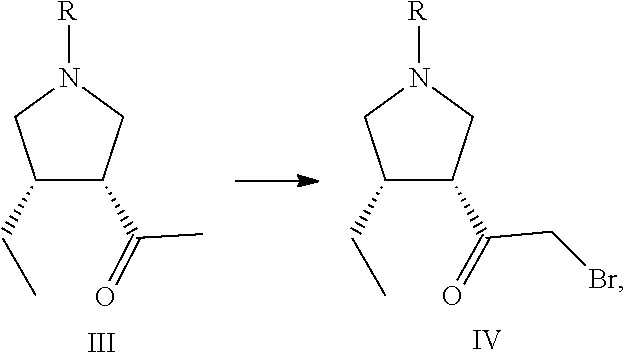
the definition of R in the formula is the same as previous.

The R2 is hydrogen, fluorine, chlorine, bromine, iodine or a C1-20 hydrocarbon; P3 is hydrogen, fluorine, chlorine, bromine, iodine or a C1-20 hydrocarbon; X is bromine or iodine.

The definitions of R2 and R3 are respectively the same as previous; X is bromine or iodine.


Claims (2)

Applications Claiming Priority (5)
| Application Number | Priority Date | Filing Date | Title |
|---|---|---|---|
| CN201811008444.4A CN110872250B (en) | 2018-08-31 | 2018-08-31 | Two compounds and their preparation methods and their use in the synthesis of Ucitinib |
| CN201811008444.4 | 2018-08-31 | ||
| CN201811083531.6A CN110903254B (en) | 2018-09-17 | 2018-09-17 | Synthetic method of heterocyclic intermediate applied to JAK inhibitor drugs |
| CN201811083531.6 | 2018-09-17 | ||
| PCT/CN2019/102443 WO2020043033A2 (en) | 2018-08-31 | 2019-08-26 | Synthesis methods for upadacitinib and intermediate thereof |
Publications (2)
| Publication Number | Publication Date |
|---|---|
| US20210323971A1 US20210323971A1 (en) | 2021-10-21 |
| US11926633B2 true US11926633B2 (en) | 2024-03-12 |
Family
ID=69643168
Family Applications (1)
| Application Number | Title | Priority Date | Filing Date |
|---|---|---|---|
| US17/272,369 Active 2041-03-07 US11926633B2 (en) | 2018-08-31 | 2019-08-26 | Synthesis methods for upadacitinib and intermediate thereof |
Country Status (7)
| Country | Link |
|---|---|
| US (1) | US11926633B2 (en) |
| EP (1) | EP3845521B1 (en) |
| ES (1) | ES2997858T3 (en) |
| HR (1) | HRP20250035T1 (en) |
| HU (1) | HUE069611T2 (en) |
| PL (1) | PL3845521T3 (en) |
| WO (1) | WO2020043033A2 (en) |
Families Citing this family (5)
| Publication number | Priority date | Publication date | Assignee | Title |
|---|---|---|---|---|
| WO2020202183A1 (en) | 2019-03-29 | 2020-10-08 | Mylan Laboratories Limited | The process for the preparation of upadacitinib and its intermediates |
| JP7648027B2 (en) * | 2019-12-19 | 2025-03-18 | クリア、スペイン、エセ、ア、ウ | Processes and intermediates for the preparation of upadacitinib |
| CN114621127A (en) * | 2020-12-08 | 2022-06-14 | 苏州鹏旭医药科技有限公司 | Synthesis method of substituted pyrroline |
| CN115417802A (en) * | 2021-05-16 | 2022-12-02 | 上海鼎雅药物化学科技有限公司 | Preparation method of sepiatinib and intermediate thereof |
| CN117285537B (en) * | 2023-11-27 | 2024-02-06 | 中节能万润股份有限公司 | A kind of preparation method of upatinib |
Citations (3)
| Publication number | Priority date | Publication date | Assignee | Title |
|---|---|---|---|---|
| WO2011068881A1 (en) | 2009-12-01 | 2011-06-09 | Abbott Laboratories | Novel tricyclic compounds |
| CN108368121A (en) | 2015-10-16 | 2018-08-03 | 艾伯维公司 | Preparation of (3S,4R)-3-ethyl-4-(3H-imidazo[1,2-a]pyrrolo[2,3-e]pyrazin-8-yl)-N-(2,2, 2-trifluoroethyl)pyrrolidine-1-carboxamide and method for its solid state form |
| WO2020202183A1 (en) * | 2019-03-29 | 2020-10-08 | Mylan Laboratories Limited | The process for the preparation of upadacitinib and its intermediates |
Family Cites Families (4)
| Publication number | Priority date | Publication date | Assignee | Title |
|---|---|---|---|---|
| ZA200704888B (en) | 2004-11-22 | 2009-02-25 | Vertex Pharma | Pyrrolopyrazines and pyrazolopyrazines useful as inhibitors of protein kinases |
| US20130072470A1 (en) | 2011-09-21 | 2013-03-21 | Abbvie Inc. | Novel tricyclic compounds |
| CN106432246B (en) | 2015-08-05 | 2020-07-07 | 广东东阳光药业有限公司 | Heteroaromatic compounds and their application in medicine |
| AU2017292650A1 (en) * | 2016-07-06 | 2018-12-13 | H. Lundbeck A/S | PDE9 inhibitors for treatment of peripheral diseases |
-
2019
- 2019-08-26 HU HUE19855338A patent/HUE069611T2/en unknown
- 2019-08-26 EP EP19855338.0A patent/EP3845521B1/en active Active
- 2019-08-26 WO PCT/CN2019/102443 patent/WO2020043033A2/en not_active Ceased
- 2019-08-26 US US17/272,369 patent/US11926633B2/en active Active
- 2019-08-26 PL PL19855338.0T patent/PL3845521T3/en unknown
- 2019-08-26 ES ES19855338T patent/ES2997858T3/en active Active
- 2019-08-26 HR HRP20250035TT patent/HRP20250035T1/en unknown
Patent Citations (3)
| Publication number | Priority date | Publication date | Assignee | Title |
|---|---|---|---|---|
| WO2011068881A1 (en) | 2009-12-01 | 2011-06-09 | Abbott Laboratories | Novel tricyclic compounds |
| CN108368121A (en) | 2015-10-16 | 2018-08-03 | 艾伯维公司 | Preparation of (3S,4R)-3-ethyl-4-(3H-imidazo[1,2-a]pyrrolo[2,3-e]pyrazin-8-yl)-N-(2,2, 2-trifluoroethyl)pyrrolidine-1-carboxamide and method for its solid state form |
| WO2020202183A1 (en) * | 2019-03-29 | 2020-10-08 | Mylan Laboratories Limited | The process for the preparation of upadacitinib and its intermediates |
Non-Patent Citations (5)
| Title |
|---|
| "Find ETDs Home » Thesis Resources » Find ETDs" Online: "https://ndltd.org/thesis-resources/find-etds/" Accessed Jan. 31, 2023. * |
| Bartlett "Exploiting Chemical Diversity for Drug Discovery" Edited by Paul A Bartlett and Michael Entzeroth, The Royal Society of Chemistry, 2006, pp. 113-118. * |
| Irwin "ZINC—A Free Database of Commercially Available Compounds for Virtual Screening" J. Chem. Inf. Model. 2005, 45, 177-182. * |
| Kim "PubChem in 2021: new data content and improved web interfaces" Nucleic Acids Research, 2021, vol. 49, Database issue Published online Nov. 5, 2020. * |
| STN Registry/Zregistry (CAS Registrysm) Sep. 2016 2 pages. * |
Also Published As
| Publication number | Publication date |
|---|---|
| EP3845521B1 (en) | 2024-11-06 |
| WO2020043033A2 (en) | 2020-03-05 |
| EP3845521A4 (en) | 2022-08-24 |
| EP3845521A2 (en) | 2021-07-07 |
| WO2020043033A3 (en) | 2020-04-16 |
| EP3845521C0 (en) | 2024-11-06 |
| HUE069611T2 (en) | 2025-03-28 |
| US20210323971A1 (en) | 2021-10-21 |
| ES2997858T3 (en) | 2025-02-18 |
| HRP20250035T1 (en) | 2025-03-14 |
| PL3845521T3 (en) | 2025-03-10 |
Similar Documents
| Publication | Publication Date | Title |
|---|---|---|
| US20210323971A1 (en) | Synthesis methods for upadacitinib and intermediate thereof | |
| AU2011327903A1 (en) | Drug derivatives | |
| WO2004083217A1 (en) | An improved process for the preparation of cefoxitin | |
| EP3766869A1 (en) | Simple preparation method for avibactam | |
| WO2016016766A2 (en) | A process for the preparation of isavuconazonium or its salt thereof | |
| WO2006013887A1 (en) | Novel imidazolidine derivatives | |
| CN114805314A (en) | Synthesis method of Ensaitevir | |
| US10421716B2 (en) | Process for preparing alpha-carboxamide pyrrolidine derivatives | |
| WO2016207364A1 (en) | Process for the preparation of a xanthine-based compound | |
| JP2018090551A (en) | L-carnosine derivative or salt thereof, and method for producing L-carnosine or salt thereof | |
| CN115135646B (en) | Substituted polycyclic compounds, pharmaceutical compositions and uses thereof | |
| CA3196642A1 (en) | Process for preparing heterocyclic methanone compounds and aza-bicyclo intermediates thereof | |
| US20220371995A1 (en) | Synthesis method for halofuginone and halofuginone intermediates | |
| AU738462B2 (en) | Process for the synthesis of chloropurine intermediates | |
| EP4628492A1 (en) | Preparation method for linker-drug conjugate and intermediate thereof | |
| JPH0641463B2 (en) | Method for producing thiotetronic acid | |
| CN108623602A (en) | A method of prepare and purify and replaces Buddhist nun according to Shandong | |
| CN111499600A (en) | A kind of synthetic method of polysubstituted 2,3-dihydrofuran compounds | |
| CN113816955B (en) | RET kinase inhibitor intermediate and preparation method thereof | |
| WO2004050654A1 (en) | Synthesis of pyrrolidine compound and salt thereof | |
| CN111560021B (en) | Degaitinib intermediate and preparation method thereof | |
| US20200172514A1 (en) | Processes for the Preparation of Veliparib and Intermediates Thereof | |
| US8664409B2 (en) | Process for the preparation of (poly) aminoalkylaminoacetamide derivatives of epipodophyllotoxin useful for their applications in therapeutics as anticancer agent | |
| US8124776B2 (en) | Process and intermediates for preparing arzoxifene | |
| JP5797662B2 (en) | 5-Amino-4-hydroxypentoylamide |
Legal Events
| Date | Code | Title | Description |
|---|---|---|---|
| AS | Assignment |
Owner name: SUZHOU PENGXU PHARMATECH CO., LTD, CHINA Free format text: ASSIGNMENT OF ASSIGNORS INTEREST;ASSIGNORS:WANG, PENG;LI, PIXU;WEI, QIANG;AND OTHERS;REEL/FRAME:055440/0455 Effective date: 20210223 |
|
| FEPP | Fee payment procedure |
Free format text: ENTITY STATUS SET TO UNDISCOUNTED (ORIGINAL EVENT CODE: BIG.); ENTITY STATUS OF PATENT OWNER: SMALL ENTITY |
|
| FEPP | Fee payment procedure |
Free format text: ENTITY STATUS SET TO SMALL (ORIGINAL EVENT CODE: SMAL); ENTITY STATUS OF PATENT OWNER: SMALL ENTITY |
|
| STPP | Information on status: patent application and granting procedure in general |
Free format text: DOCKETED NEW CASE - READY FOR EXAMINATION |
|
| STPP | Information on status: patent application and granting procedure in general |
Free format text: NON FINAL ACTION MAILED |
|
| STPP | Information on status: patent application and granting procedure in general |
Free format text: RESPONSE TO NON-FINAL OFFICE ACTION ENTERED AND FORWARDED TO EXAMINER |
|
| STPP | Information on status: patent application and granting procedure in general |
Free format text: NOTICE OF ALLOWANCE MAILED -- APPLICATION RECEIVED IN OFFICE OF PUBLICATIONS |
|
| STPP | Information on status: patent application and granting procedure in general |
Free format text: PUBLICATIONS -- ISSUE FEE PAYMENT RECEIVED |
|
| STPP | Information on status: patent application and granting procedure in general |
Free format text: PUBLICATIONS -- ISSUE FEE PAYMENT VERIFIED |
|
| STCF | Information on status: patent grant |
Free format text: PATENTED CASE |