US11909047B2 - Oligomer of N,N′-di(hetero)aryl-5,10-dihydrophenazine, cathode active material, cathode, battery thereof, and process for preparing same - Google Patents
Oligomer of N,N′-di(hetero)aryl-5,10-dihydrophenazine, cathode active material, cathode, battery thereof, and process for preparing same Download PDFInfo
- Publication number
- US11909047B2 US11909047B2 US16/971,646 US201816971646A US11909047B2 US 11909047 B2 US11909047 B2 US 11909047B2 US 201816971646 A US201816971646 A US 201816971646A US 11909047 B2 US11909047 B2 US 11909047B2
- Authority
- US
- United States
- Prior art keywords
- dppz
- oligomer
- battery
- cathode
- dihydrophenazine
- Prior art date
- Legal status (The legal status is an assumption and is not a legal conclusion. Google has not performed a legal analysis and makes no representation as to the accuracy of the status listed.)
- Active, expires
Links
Images


Classifications
-
- C—CHEMISTRY; METALLURGY
- C07—ORGANIC CHEMISTRY
- C07D—HETEROCYCLIC COMPOUNDS
- C07D241/00—Heterocyclic compounds containing 1,4-diazine or hydrogenated 1,4-diazine rings
- C07D241/36—Heterocyclic compounds containing 1,4-diazine or hydrogenated 1,4-diazine rings condensed with carbocyclic rings or ring systems
- C07D241/38—Heterocyclic compounds containing 1,4-diazine or hydrogenated 1,4-diazine rings condensed with carbocyclic rings or ring systems with only hydrogen or carbon atoms directly attached to the ring nitrogen atoms
- C07D241/46—Phenazines
-
- H—ELECTRICITY
- H01—ELECTRIC ELEMENTS
- H01M—PROCESSES OR MEANS, e.g. BATTERIES, FOR THE DIRECT CONVERSION OF CHEMICAL ENERGY INTO ELECTRICAL ENERGY
- H01M4/00—Electrodes
- H01M4/02—Electrodes composed of, or comprising, active material
- H01M4/36—Selection of substances as active materials, active masses, active liquids
- H01M4/60—Selection of substances as active materials, active masses, active liquids of organic compounds
- H01M4/602—Polymers
- H01M4/606—Polymers containing aromatic main chain polymers
- H01M4/608—Polymers containing aromatic main chain polymers containing heterocyclic rings
-
- C—CHEMISTRY; METALLURGY
- C07—ORGANIC CHEMISTRY
- C07D—HETEROCYCLIC COMPOUNDS
- C07D403/00—Heterocyclic compounds containing two or more hetero rings, having nitrogen atoms as the only ring hetero atoms, not provided for by group C07D401/00
- C07D403/14—Heterocyclic compounds containing two or more hetero rings, having nitrogen atoms as the only ring hetero atoms, not provided for by group C07D401/00 containing three or more hetero rings
-
- H—ELECTRICITY
- H01—ELECTRIC ELEMENTS
- H01M—PROCESSES OR MEANS, e.g. BATTERIES, FOR THE DIRECT CONVERSION OF CHEMICAL ENERGY INTO ELECTRICAL ENERGY
- H01M10/00—Secondary cells; Manufacture thereof
- H01M10/05—Accumulators with non-aqueous electrolyte
- H01M10/052—Li-accumulators
- H01M10/0525—Rocking-chair batteries, i.e. batteries with lithium insertion or intercalation in both electrodes; Lithium-ion batteries
-
- H—ELECTRICITY
- H01—ELECTRIC ELEMENTS
- H01M—PROCESSES OR MEANS, e.g. BATTERIES, FOR THE DIRECT CONVERSION OF CHEMICAL ENERGY INTO ELECTRICAL ENERGY
- H01M10/00—Secondary cells; Manufacture thereof
- H01M10/05—Accumulators with non-aqueous electrolyte
- H01M10/054—Accumulators with insertion or intercalation of metals other than lithium, e.g. with magnesium or aluminium
-
- H—ELECTRICITY
- H01—ELECTRIC ELEMENTS
- H01M—PROCESSES OR MEANS, e.g. BATTERIES, FOR THE DIRECT CONVERSION OF CHEMICAL ENERGY INTO ELECTRICAL ENERGY
- H01M4/00—Electrodes
- H01M4/02—Electrodes composed of, or comprising, active material
- H01M2004/026—Electrodes composed of, or comprising, active material characterised by the polarity
- H01M2004/028—Positive electrodes
-
- Y—GENERAL TAGGING OF NEW TECHNOLOGICAL DEVELOPMENTS; GENERAL TAGGING OF CROSS-SECTIONAL TECHNOLOGIES SPANNING OVER SEVERAL SECTIONS OF THE IPC; TECHNICAL SUBJECTS COVERED BY FORMER USPC CROSS-REFERENCE ART COLLECTIONS [XRACs] AND DIGESTS
- Y02—TECHNOLOGIES OR APPLICATIONS FOR MITIGATION OR ADAPTATION AGAINST CLIMATE CHANGE
- Y02E—REDUCTION OF GREENHOUSE GAS [GHG] EMISSIONS, RELATED TO ENERGY GENERATION, TRANSMISSION OR DISTRIBUTION
- Y02E60/00—Enabling technologies; Technologies with a potential or indirect contribution to GHG emissions mitigation
- Y02E60/10—Energy storage using batteries
Definitions
- the present invention relates to the secondary battery field and particularly relates to polymer-based organic battery materials and their related applications in batteries.
- Electrical energy storage systems play a critical role in enabling utilization of electricity generated from intermittent renewable energy sources, and impact profoundly the renewable energy future of a sustainable society.
- lithium-ion battery as an example, in addition to the capacity, the cell voltage and the charge/discharge performance of state-of-the-art battery systems, safety, cost, weight, sustainability and environmental friendliness are important properties of charge storage systems.
- the ever growing market for small and thin mobile devices requires small, thin, and lightweight battery systems that also need to be flexible for some applications.
- Organic electrode materials in particular polymers, display an inherent advantage, e.g., they are flexible and their redox properties can be tailored in a straightforward way by adjusting the structure using organic synthesis approaches and are being extensively researched recently. More interestingly, most of these organic are electroactive, not only towards lithium but in principle any metal, because their redox mechanism is based on conversion reactions. Therefore, it is promising that organic materials applied in lithium-ion batteries could be successfully extended to sodium, magnesium, zinc and air-batteries.
- N,N′-substituted phenazine derivatives are of particular interest. These molecules undergo two successive one-electron transfer reactions (see FIG. 1 a ), thus can be categorized as p-type molecules, which usually show higher redox potential than the n-type ones.
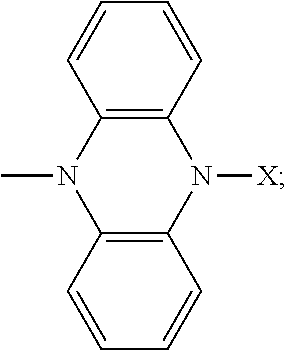
- the inventors of the present invention have made attempts to manipulate the conjugation of phenazine derivatives and surprisingly found that an oligomer of phenazine derivatives as shown in the following formula (I) can be suitably used as a high-voltage organic battery cathode material.
- X is same or different, H or substituted or unsubstituted aryl or heteroaryl; Y is H or
- R is substituted or unsubstituted arylene or heteroarylene; and n is from 3 to 30, preferably 4 to 20, more preferably 6 to 10 and still more preferably 8 to 9.
- the redox active electron localized on the dihydrophenazine unit in this oligomer is believed to contribute to the good electrochemical performances.
- the present invention also provides an oligomer mixture comprising two or more oligomer as recited above.
- hal represents halogen atom, such as Cl, Br, I, X′ is same or different substituted or unsubstituted aryl or heteroaryl; Y′ is
- a process for preparing the oligomer of formula (I), comprising further isolating the oligomer from the above recited oligomer mixture or the oligomer mixture prepared by the above process.
- the isolation is to purify by Physical Vapor Deposition instrument.
- the present invention provides a cathode active material comprising an oligomer of the above formula (I) or an oligomer mixture thereof; a cathode and a battery comprising the above cathode active material.
- the battery can be selected from the group consisting of Li-ion battery, Na-based battery and Mg-based battery and so on.
- the invention provides the use of an oligomer of the above formula (I) or an oligomer mixture thereof for the preparation of cathode active material.
- the present invention provides the use of monomeric N,N-diphenyl-5,10-dihyfrophenazine (briefed as DPPZ and shown below) for preparing cathode active material as well.
- FIG. 1 a shows chemical structure and redox mechanism of N,N-substituted phenazine derivatives
- FIG. 1 b shows the substitution of phenyl, methyl, vinyl and ethynyl on the N atoms of dihydrophenazine
- FIG. 1 c is schematic demonstration of the optimized molecular geometry of N,N-substituted phenazine derivatives.
- FIG. 2 a shows ⁇ -LP- ⁇ bonding geometry, wherein the upper panel depicts the N 2p lone pair (LP) electron and the ⁇ orbital of the neighbouring aromatic ring, and the lower panel depicts the bonding of the N 2p orbital and ⁇ orbital of the aromatic ring.
- ⁇ 23 b and ⁇ 23 are the orbitals from the benzene bridge and three aromatic rings, respectively.
- FIG. 2 b is HOMO and LUMO profiles of a oligomer of N,N-diphenyl-5,10-dihydrophenazine (briefed as p-DPPZ hereinafter) unit, FIG.
- FIG. 2 c is calculated HOMO of p-DPPZ in the charged state (upper panel) and the schematically illustration of the donor-cation-donor chain during the charging/discharging process
- FIG. 2 d shows electron transfer dynamics between adjacent p-DPPZ units, the “+” sign stands for the positively charged p-DPPZ unit and E B is the kinetic barrier for the electron transfer.
- FIG. 3 shows MALDI-TOF Mass spectrum of p-DPPZ.
- FIG. 4 shows thermogravimetric analysis (TGA) of p-DPPZ in N 2 and in air at a heating rate of 10° C./min.
- FIG. 5 shows differential scanning calorimeter (DSC) analysis of p-DPPZ in N 2 at a heating rate of 10° C./min.
- FIGS. 6 a and 6 b show high-resolution transmission electron microscopy (HRTEM) images of representative p-DPPZ particles and FIG. 6 c shows corresponding energy dispersive X-ray spectroscopy (EDX) analysis.
- HRTEM transmission electron microscopy
- EDX energy dispersive X-ray spectroscopy
- FIG. 7 shows electrochemical performance of p-DPPZ Li cell, wherein FIG. 7 a shows charge/discharge profile, FIG. 7 b shows corresponding specific charge/discharge capacity (Cs), Coulombic efficiency (CE) and energy efficiency (EE) with current rate of 1/4 C (upper panel) and 1 C (lower panel) for 500 cycles, FIG. 7 c shows power performance with current rate of 1/2, 1, 2 and 5 C and FIG. 7 d shows a comparison of discharge voltage, specific capacity and energy density distribution of p-DPPZ with other organic materials for Li-ion batteries.
- Cs charge/discharge capacity
- CE Coulombic efficiency
- EE energy efficiency
- FIG. 8 shows redox behaviour of DPPZ, wherein FIG. 8 a shows CV profiles of DPPZ recorded at a sweeping rate of 10 mV s ⁇ 1 for 100 cycles, FIG. 8 b shows RDE profiles upon DPPZ oxidation on a glassy carbon electrode at a sweeping rate of 10 mV s ⁇ 1 with 7 rotation speed of 2500, 3025, 3600, 4225, 4900, 5625 and 6400 rpm.
- FIG. 8 c shows Levich plots of limiting current (i lim ) versus the square root of rotation speed ( ⁇ 1/2 ) and
- FIG. 8 d shows overpotential ( ⁇ ) dependent current density as a function of ⁇ ⁇ 1/2 derived from the RDE profiles. 8 overpotentials of 5, 10, 15, 20, 30, 40, 60 and 80 mV are used.
- FIG. 8 e shows ⁇ as a function of the logarithm of kinetic current (i K ).
- FIG. 9 a shows the molecular surface electrostatic potential (ESP) of DPPZ, DPPZ + and DPPZ 2+ .
- the charge density around the molecules is calculated using B3lyp level theory and 6-31 g(d,p) basis set using Gaussian 09 package and plot the picture using Gview after geometry optimization.
- R being substituted or unsubstituted arylene or heteroarylene, preferably, substituted or unsubstituted arylene or heteroarylene with 6 to 20 carbon atoms, the aromaticity of dihydrophenazine unit could be enhanced by keeping the phenazine-ring in plane and benefits for retaining the molecular stability
- arylene refers to a group wherein a hydrogen atom is removed from an “aryl” group.
- the “aryl” group denotes an aromatic carbocyclic group, consisting of a single ring or multiple rings either condensed or linked by a covalent bond such as, but not limited to, phenyl, naphthyl, phenanthryl, and biphenyl.
- the “aryl” group may be substituted by any known substituent.
- the aryl may be substituted by any suitable groups, such as, but not limited to, one or more substituents each independently selected from for example, halogen, S, —OR 1 , —COR 1 , —COOR 1 , —OCOOR 1 , —CN, —SR 1 , —(C1-C8)alkyl, —O—(C1-C8)alkyl, wherein R 1 each independently is H, (C1-C6)alkyl, or aryl.
- substituents each independently selected from for example, halogen, S, —OR 1 , —COR 1 , —COOR 1 , —OCOOR 1 , —CN, —SR 1 , —(C1-C8)alkyl, —O—(C1-C8)alkyl, wherein R 1 each independently is H, (C1-C6)alkyl, or aryl.
- heteroarylene refers to a group wherein a hydrogen atom is removed from a “heteroaryl” group.
- an “heteroaryl” group denotes an aromatic carbocyclic group, radical derived from a mono- or polycyclic heteroaromatic ring containing one or three, preferably 1-2, heteroatoms selected from the group consisting of N, O and S.
- heteroaryl is a monocyclic ring
- it is preferably a radical of a 5-6-membered ring such as, but not limited to, pyrrolyl, furyl, thienyl, thiazinyl, pyrazolyl, pyrazinyl, imidazolyl, oxazolyl, isoxazolyl, thiazolyl, isothiazolyl, pyridyl, pyrimidinyl, 1,2,3-thiazinyl, 1,3,4-thiazinyl, and 1,3,5-thiazinyl.
- a 5-6-membered ring such as, but not limited to, pyrrolyl, furyl, thienyl, thiazinyl, pyrazolyl, pyrazinyl, imidazolyl, oxazolyl, isoxazolyl, thiazolyl, isothiazolyl, pyridyl, pyrimidinyl,
- Polycyclic heteroaryl radicals are preferably composed of two rings such as, but not limited to, benzofuryl, isobenzofuryl, benzothienyl, indolyl, quinolinyl, isoquinolinyl, imidazo[1,2-c]pyridyl, benzimidazolyl, benzthiazolyl, benzoxazolyl, pyrido[1,2- ⁇ ]pyrimidinyl and 1,3-benzodioxinyl.
- heteroaryl may be substituted by any suitable groups, such as, but not limited to, one or more substituents each independently selected from halogen, S, —OR 1 , —COR 1 , —COOR 1 , —OCOOR 1 , —CN, —SR 1 , —(C1-C8)alkyl, —O—(C1-C8)alkyl, wherein R 1 each independently is H, (C1-C6)alkyl, or aryl. It is to be understood that when a polycyclic heteroaryl is substituted, the substitution may be in any of the carbocyclic and/or heterocyclic rings.
- substituents each independently selected from halogen, S, —OR 1 , —COR 1 , —COOR 1 , —OCOOR 1 , —CN, —SR 1 , —(C1-C8)alkyl, —O—(C1-C8)alkyl, wherein R 1 each independently is H, (C1
- the present inventors have compared different kinds groups of phenyl, methyl, vinyl and ethynyl (see FIG. 1 b ) as substituted group on the N atoms of dihydrophenazine in this regard.
- DFT density functional theory
- the ⁇ -LP- ⁇ bonding can be formed along three aromatic ring that further stabilizes the structure. There are also very weak ⁇ bonding between the benzene connector ⁇ 23 b and ⁇ 23 due to the weak orthogonal overlap. Four electrons from the aromatic ring occupy the bonding orbital, while the two N-2p z orbital electrons occupy the anti-bonding orbitals. However, the degenerate ⁇ ( ⁇ 2 and ⁇ 3 ) orbital have the same energy with different symmetry. Their bonding with the N-2p z orbitals causes the week splitting of the degeneracy to form the HOMO of DPPZ.
- the HOMO should be the it anti-bond orbital.
- two electrons from HOMO are depleted from each N atom.
- the removal of antibonding electrons can enhance the stability of the structure, which leading to the slight structure variation by means of bond length contraction and elongation.
- the patterns of bond length change correspond well to the ⁇ -LP- ⁇ bonding mode of HOMO.
- the remaining two electrons from N 2p orbitals keep the ⁇ -LP- ⁇ bonding intact as shown in the upper panel of FIG. 2 c .
- Such it bonding configuration keeps DPPZ stable both in charged and discharged states.
- the HOMO is mainly localized in the three-aromatic ring, so the oligomer would benefit from such localized electron structure, which is free of interaction between active unit, to achieve good voltage profile and high density of active sites.
- p-DPPZ forms donor-acceptor-donor chain and cation-acceptor-cation chain structure in natural and charged state, respectively, as shown in the lower panel of FIG. 2 c .
- Such structures relief the strong charge-charge interaction makes the p-DPPZ maintaining high stability during the charge/discharge process.
- the electron transfer kinetics can benefit from such chain structure.
- the kinetic barrier for electron transfer can be sophisticated by replacing benzene unit with other functional group with a lower LUMO level close to the ideal LUMO level ( FIG. 2 d ). With such structural tuning, it's possible for the oligomer to exhibits higher electrical conductivity, which is beneficial for fast charging capability and reducing the inactive carbon content of the electrode, thus further enhancing the power and energy density.
- the present inventors accomplished the invention by finding out that an oligomer of phenazine derivatives as shown in formula (I) or a mixture thereof is suitably used as a high-voltage organic battery cathode material,
- X is same or different, H or substituted or unsubstituted aryl or heteroaryl; Y is H or
- R is substituted or unsubstituted arylene or heteroarylene; and n is from 3 to 30.
- R in formula (I) is substituted or unsubstituted m-, or p-phenylene, more preferably, R in formula (I) is p-phenylene.
- X in formula (I) is same or different H or phenyl
- Y in formula (I) is H
- R is p-phenylene
- X in formula (I) is same or different H or phenyl
- Y in formula (I) is H
- R is p-phenylene, and n is 8 and/or 9.
- an oligomer mixture comprising two or more oligomer of the above formula (I) which can be also used as cathode active material.
- an oligomer mixture may comprise two, or three, or fore, or five, or more oligomers of the formula (I) wherein n is any integer selected from the range of 3 to 30, for example, n can be selected from the group consisting of 3, 4, 5, 6, 7, 8, 9, 10, 11, 12, and 13, and so on.
- an oligomer mixture comprises two or more oligomers of the formula (I) wherein n is 4 to 20, more preferably 6 to 10 and still more preferably 8 to 9 is provided.
- an oligomer mixture comprises two oligomers of the formula (I) wherein n is 4, 5 respectively, or an oligomer mixture comprises two oligomers of the formula (I) wherein n is 8, 9 respectively and an oligomer mixture comprises two oligomers of the formula (I) wherein n is 11, 12 respectively.
- hal represents halogen atom, such as Cl, Br or I
- X′ is same or different substituted or unsubstituted aryl or heteroaryl
- Y′ is
- steps 2) and 3) are not necessary. In some situations, both steps 2) and 3) are omitted and in other situations, either step 2) or 3) is omitted. In the situation wherein both steps 2) and 3) are performed, the sequence of step 2) and 3) is not particularly limited, either step 2) or step 3) can be performed prior to the other step.
- 5,10-dihydrophenazine is reacted with 1,4-dibromobenzene in the presence of Pd-containing catalyst (such as Pd(OAc) 2 ).
- Pd-containing catalyst such as Pd(OAc) 2
- the temperature and reacting time can be suitably adjusted depending on the intended polymerization degree.
- 5-phenyl-5,10-dihydrophenazine solution was added for end capping.
- bromobenzene was added into reaction mixture for end capping.
- the time period for endcapping can be suitably adjusted in accordance with the desired products.
- a process for preparing the oligomer of formula (I), comprising further isolating the oligomer from the oligomer mixture prepared by the above process.
- the isolation is to purify by Physical Vapor Deposition instrument.
- the present invention provides a cathode active material comprising an oligomer of the above formula (I) or an oligomer mixture thereof; a cathode and a battery comprising the above cathode active material.
- the battery can be selected from the group consisting of Li-ion battery, Na-based battery and Mg-based battery and so on.
- the invention provides the use of an oligomer of the above formula (I) or an oligomer mixture thereof for the preparation of cathode active material.
- the as-synthesized p-DPPZ typically is composed of 8-9 repeating units (see FIG. 3 ), which are insoluble in most organic solvents and electrolytes.
- the p-DPPZ showed good thermal stability with decomposition temperature at 470° C. in N 2 and 380° C. in air. And no obvious glass transition or melting in the temperature range of 0-300° C. confirmed by thermogravimetric analysis (TGA) and differential scanning calorimetry (DSC), respectively (see FIG. 4 and FIG. 5 ).
- TGA thermogravimetric analysis
- DSC differential scanning calorimetry
- Pd particles should come from the Pd(OAc) 2 catalyst during the polymerization, and the weight fraction is less than 0.5% according to the TGA analysis.
- the electrode was prepared by mixing the as-prepared p-DPPZ, Super P carbon (Timcal Graphite & Carbon), and polyvinylidene fluoride binder (Fisher Scientific) with a weight ratio of 75:15:10 in N-methyl-2-pyrrolidone (anhydrous, Fisher Scientific). The mixture was thoroughly mixed in a Thinky centrifugal mixer (ARE-300) to form the homogenous slurry, which was then casted on an Al foil and dried in vacuum at 115° C. for 12 hrs. The electrode was 10 mm in diameter, and the average mass loading was ca. 2.5 mg. cm ⁇ 2 .
- the cell was assembled with a standard CR2032 coin cell using metallic lithium as the anode, Celgard 2500 as the separator, and 1M LiPF6 in ethylene carbonate/diethyl carbonate (1:1, v: v, BASF Corp.) as the electrolyte.
- Each of the upper and lower panel of FIG. 7 a shows a total 500 charge/discharge cycles of the p-DPPZ
- the charge/discharge profiles showed good consistency and small voltage hysteresis.
- the slightly increased omic polarization at 1 C was ca. 100 mV, which is possibly resulted from the more serious Li dendrite formation at higher current density after long cycling.
- the discharge capacity reached ca. 185 and 145 mAh ⁇ g ⁇ 1 , and eventually stabilized at ca. 150 and 130 mAh ⁇ g ⁇ 1 at 1/4 C and 1 C, respectively, as summarized in FIG. 7 b.
- the rate capability as shown in FIG. 7 c demonstrated that the p-DPPZ electrode was able to deliver an average specific capacity of 150, 140, 110, and 65 mAh ⁇ g ⁇ 1 with corresponding current rate of 1/2, 1, 2 and 5 C, respectively.
- the cell showed good capacity retention at each current rate, and the capacity recovered back to 150 mAh ⁇ g ⁇ 1 when current rate decreased from 5 C to 1/2 C.
- the capacity drop at high current rate might result from the moderate electron transfer rate and the internal resistance of the electrode, of which the conductive carbon only takes 15% of the total electrode weight. Nevertheless, at moderate current rate, 1/2 C for instance, the p-DPPZ was able to deliver a galvanometric energy density of ca.
- FIG. 8 a shows the cyclic voltammetry (CV) profiles of a 1.14 mM solution of DPPZ in 1M LiPF6 ethylene carbonate/diethyl carbonate (1:1, v: v) on a glassy carbon electrode.
- CV cyclic voltammetry
- the x-intercept gave the exchange current, through which the electron transfer rate constant could be calculated to be 7.7 ⁇ 10 ⁇ 3 and 4.2 ⁇ 10 ⁇ 2 cm ⁇ s ⁇ 1 for the redox reaction of DPPZ ⁇ e ⁇ ⁇ DPPZ + and DPPZ + ⁇ e ⁇ ⁇ DPPZ 2+ , respectively. Both rate constants are comparable with other known organic materials for battery application.
- the diffusion coefficient of DPPZ and DPPZ + is calculated to be ca. 1.5 ⁇ 10 ⁇ 6 and 1.3 ⁇ 10 ⁇ 6 cm 2 ⁇ s ⁇ 1 , respectively.
- the reciprocal of the current at overpotentials of 5, 10, 15, 20, 30, 40, 60 and 80 mV is plotted versus the reciprocal of the square root of the rotation rate.
- the data for each potential are fitted with a straight line; the intercept gives the reciprocal of kinetic current, i K , the current in the absence of mass transport limitations (the extrapolation to infinite rotation rate).
- the x-intercept gives the exchange current, i0, in the plot of ⁇ as a function of lgi K .
- the exchange current is equal to nFk 0 C, where k 0 is the electron transfer rate constant of DPPZ or DPPZ + .
- the electron transfer rate constant is calculated to be 7.7 ⁇ 10 ⁇ 3 and 4.2 ⁇ 10 ⁇ 2 cm ⁇ s ⁇ 1 for the redox reaction of DPPZ ⁇ e ⁇ ⁇ DPPZ + and DPPZ + ⁇ e ⁇ ⁇ DPPZ 2+ , respectively.
- Electron configurations of all the molecules were calculated by DFT method within the framework of the Gaussian 09 package.
- the standard Pople basis set, 6-31G++(d,p), combined with the Lee-Yang-Parr exchange correlation functional (B3LYP) was used for all calculations.
- B3LYP Lee-Yang-Parr exchange correlation functional
- EC/DEC are used as the solvents within the SMD.
- the thermal correction to Gibbs free energy is obtained from vibrational frequency calculations in the solvent model. No negative frequency is found in any of the optimized structures.
- the calculated redox potential of this molecule is 0.97 V and ⁇ 0.04 V (vs.
- the solvent molecules will have preferential positions within the solvation sphere based on the charge density distribution of the DPPZ + /DPPZ 2+ molecule, resulting in the dissolution of DPPZ + /DPPZ 2+ .
- the dissolution causes serious shuttle effect to prevent the cell from stable cycling.
- a practical way is to polymerize DPPZ into polymer/oligomer as have been achieved in the present invention.
Landscapes
- Chemical & Material Sciences (AREA)
- Organic Chemistry (AREA)
- Engineering & Computer Science (AREA)
- Chemical Kinetics & Catalysis (AREA)
- Electrochemistry (AREA)
- General Chemical & Material Sciences (AREA)
- Materials Engineering (AREA)
- Manufacturing & Machinery (AREA)
- Battery Electrode And Active Subsutance (AREA)
- Organic Low-Molecular-Weight Compounds And Preparation Thereof (AREA)
Abstract
Description

R is substituted or unsubstituted arylene or heteroarylene; and n is from 3 to 30, preferably 4 to 20, more preferably 6 to 10 and still more preferably 8 to 9.


R is substituted or unsubstituted arylene or heteroarylene; and n is from 3 to 30.

R is p-phenylene.

R is p-phenylene, and n is 8 and/or 9.


Claims (3)


Applications Claiming Priority (1)
| Application Number | Priority Date | Filing Date | Title |
|---|---|---|---|
| PCT/CN2018/087501 WO2019218347A1 (en) | 2018-05-18 | 2018-05-18 | Oligomer of n,n'-di(hetero)aryl-5,10-dihydrophenazine, cathode active material, cathode, battery thereof, and process for preparing same |
Publications (2)
| Publication Number | Publication Date |
|---|---|
| US20200388847A1 US20200388847A1 (en) | 2020-12-10 |
| US11909047B2 true US11909047B2 (en) | 2024-02-20 |
Family
ID=68539229
Family Applications (1)
| Application Number | Title | Priority Date | Filing Date |
|---|---|---|---|
| US16/971,646 Active 2040-07-31 US11909047B2 (en) | 2018-05-18 | 2018-05-18 | Oligomer of N,N′-di(hetero)aryl-5,10-dihydrophenazine, cathode active material, cathode, battery thereof, and process for preparing same |
Country Status (3)
| Country | Link |
|---|---|
| US (1) | US11909047B2 (en) |
| CN (1) | CN112352335B (en) |
| WO (1) | WO2019218347A1 (en) |
Families Citing this family (7)
| Publication number | Priority date | Publication date | Assignee | Title |
|---|---|---|---|---|
| WO2020205796A1 (en) | 2019-03-29 | 2020-10-08 | Cornell University | Phenazine copolymers and uses thereof |
| JP7698261B2 (en) * | 2021-03-12 | 2025-06-25 | ソフトバンク株式会社 | Active material for secondary battery, electrode for secondary battery, secondary battery and aircraft |
| CN114149525B (en) * | 2021-12-02 | 2023-07-04 | 上海电力大学 | 2H phenazine linear polymer, preparation method and application thereof in lithium ion battery |
| CN114539173B (en) * | 2022-02-18 | 2023-06-02 | 内蒙古科技大学 | A four-electron double-linked hydroxyphenazine derivative and its derivatives, preparation method and application |
| CN115275345B (en) * | 2022-08-22 | 2025-12-19 | 中国科学技术大学 | Ester electrolyte containing bromobenzene additive for sodium metal battery and sodium metal battery |
| CN115745972B (en) * | 2022-11-11 | 2024-01-30 | 电子科技大学 | A kind of nitrogen-containing organic cathode material and its preparation method and application |
| CN119504616A (en) * | 2024-11-22 | 2025-02-25 | 宁波华瓴光学技术有限公司 | Application of anode materials in improving redox potential, electrochromic devices |
Citations (3)
| Publication number | Priority date | Publication date | Assignee | Title |
|---|---|---|---|---|
| DE4325591A1 (en) | 1993-07-30 | 1995-02-02 | Hoechst Ag | Dihydrophenazine polymers |
| JP2011113839A (en) | 2009-11-27 | 2011-06-09 | Murata Mfg Co Ltd | Electrode active material and secondary battery |
| WO2014189122A1 (en) | 2013-05-24 | 2014-11-27 | 国立大学法人九州大学 | Compound, light-emitting material, and organic light-emitting element |
Family Cites Families (2)
| Publication number | Priority date | Publication date | Assignee | Title |
|---|---|---|---|---|
| KR20070005149A (en) * | 2005-07-05 | 2007-01-10 | 삼성에스디아이 주식회사 | Negative electrode active material, manufacturing method thereof and lithium battery employing same |
| FR2961634B1 (en) * | 2010-06-17 | 2013-02-15 | Centre Nat Rech Scient | PROCESS FOR THE PRODUCTION OF A LITHIUM OR SODIUM BATTERY |
-
2018
- 2018-05-18 WO PCT/CN2018/087501 patent/WO2019218347A1/en not_active Ceased
- 2018-05-18 US US16/971,646 patent/US11909047B2/en active Active
- 2018-05-18 CN CN201880090236.5A patent/CN112352335B/en active Active
Patent Citations (3)
| Publication number | Priority date | Publication date | Assignee | Title |
|---|---|---|---|---|
| DE4325591A1 (en) | 1993-07-30 | 1995-02-02 | Hoechst Ag | Dihydrophenazine polymers |
| JP2011113839A (en) | 2009-11-27 | 2011-06-09 | Murata Mfg Co Ltd | Electrode active material and secondary battery |
| WO2014189122A1 (en) | 2013-05-24 | 2014-11-27 | 国立大学法人九州大学 | Compound, light-emitting material, and organic light-emitting element |
Non-Patent Citations (4)
| Title |
|---|
| Goodson "Palladium-Catalyzed Synthesis of Pure, Regiodefined Polymeric Triarylamines" J. Am. Chem. Soc. 1999, 121, 7527-7539. * |
| Lee, Minah "Multi-electron redox phenazine for ready-to-charge organic batteries." Green Chemistry, 2017, 19(13), 2980-2985. * |
| Muench, S.; Wild, A.; Friebe, C.; Haupler, B.; Janoschka, T.; Schubert, U. S. Chem. Rev. 2016, 116, 9438. * |
| Tran Van, Francois et al., "Polyethyleneoxide-dihydrophenazine block copolymer as a cathode material for lithium-polymer batteries" Electrochimica Acta, vol. 43, No. 14, Dec. 31, 1998. |
Also Published As
| Publication number | Publication date |
|---|---|
| US20200388847A1 (en) | 2020-12-10 |
| WO2019218347A1 (en) | 2019-11-21 |
| CN112352335B (en) | 2022-05-17 |
| CN112352335A (en) | 2021-02-09 |
Similar Documents
| Publication | Publication Date | Title |
|---|---|---|
| Dai et al. | Manipulation of conjugation to stabilize N redox-active centers for the design of high-voltage organic battery cathode | |
| US11909047B2 (en) | Oligomer of N,N′-di(hetero)aryl-5,10-dihydrophenazine, cathode active material, cathode, battery thereof, and process for preparing same | |
| Acker et al. | Conjugated copolymer design in phenothiazine-based battery materials enables high mass loading electrodes | |
| Qin et al. | Recent advances in developing organic electrode materials for multivalent rechargeable batteries | |
| Wang et al. | Poly (dithieno [3, 2-b: 2’, 3’-d] pyrrole) twisting redox pendants enabling high current durability in all-organic proton battery | |
| Lee et al. | Recent progress in organic electrodes for Li and Na rechargeable batteries | |
| Obrezkov et al. | An ultrafast charging polyphenylamine-based cathode material for high rate lithium, sodium and potassium batteries | |
| Ba et al. | Benzoquinone-based polyimide derivatives as high-capacity and stable organic cathodes for lithium-ion batteries | |
| Wang et al. | A fluorinated polycarbonate based all solid state polymer electrolyte for lithium metal batteries | |
| Cui et al. | High Performance Solid Polymer Electrolytes for Rechargeable Batteries: A Self‐Catalyzed Strategy toward Facile Synthesis | |
| Wu et al. | Nanostructured conjugated ladder polymers for stable and fast lithium storage anodes with high‐capacity | |
| Slesarenko et al. | New tetraazapentacene-based redox-active material as a promising high-capacity organic cathode for lithium and potassium batteries | |
| Ruby Raj et al. | Perylenedianhydride-based polyimides as organic cathodes for rechargeable lithium and sodium batteries | |
| US10297829B2 (en) | Polyanthraquinone-based organic cathode for high-performance rechargeable magnesium-ion batteries | |
| EP3182501B1 (en) | Electrolyte for nonaqueous secondary battery and nonaqueous secondary battery using the same | |
| Liu et al. | Phenothiazine-based copolymer with redox functional backbones for organic battery cathode materials | |
| KR20160074474A (en) | Hybrid electrode for non-aqueous electrolyte secondary battery | |
| US20210167388A1 (en) | Organic triptycene-based molecules having one or more arylene diimide groups attached forming a crosslinked framework useful for lithium ion battery electrodes | |
| Ruby Raj et al. | Recent advances in development of organic battery materials for monovalent and multivalent metal-ion rechargeable batteries | |
| Wu et al. | High performance phenothiazine-based battery materials achieved by synergistic steric blocking and extended conjugation | |
| Ma et al. | Tubular polypyrrole with chloride ion dopants as an ultrafast organic anode for high‐power lithium‐ion batteries | |
| Guo et al. | Small‐molecule organic cathodes with carbon coating for highly efficient potassium‐ion batteries | |
| Liang et al. | Versatile Zn-salt additive enabling superior solid polymer electrolyte for dendrite-free all-solid-state Li metal batteries | |
| Cao et al. | Organic cathode materials for rechargeable batteries | |
| Su et al. | Poly [tris (thienylphenyl) amine] derivatives as a performance-improved cathode material for lithium ion batteries |
Legal Events
| Date | Code | Title | Description |
|---|---|---|---|
| AS | Assignment |
Owner name: SOOCHOW UNIVERSITY, CHINA Free format text: ASSIGNMENT OF ASSIGNORS INTEREST;ASSIGNORS:ZHAO, YU;DAI, GAOLE;QIAN, YUMIN;AND OTHERS;SIGNING DATES FROM 20200819 TO 20200820;REEL/FRAME:053556/0617 |
|
| FEPP | Fee payment procedure |
Free format text: ENTITY STATUS SET TO UNDISCOUNTED (ORIGINAL EVENT CODE: BIG.); ENTITY STATUS OF PATENT OWNER: SMALL ENTITY |
|
| FEPP | Fee payment procedure |
Free format text: ENTITY STATUS SET TO SMALL (ORIGINAL EVENT CODE: SMAL); ENTITY STATUS OF PATENT OWNER: SMALL ENTITY |
|
| STPP | Information on status: patent application and granting procedure in general |
Free format text: DOCKETED NEW CASE - READY FOR EXAMINATION |
|
| STPP | Information on status: patent application and granting procedure in general |
Free format text: NON FINAL ACTION MAILED |
|
| STPP | Information on status: patent application and granting procedure in general |
Free format text: RESPONSE TO NON-FINAL OFFICE ACTION ENTERED AND FORWARDED TO EXAMINER |
|
| STPP | Information on status: patent application and granting procedure in general |
Free format text: NOTICE OF ALLOWANCE MAILED -- APPLICATION RECEIVED IN OFFICE OF PUBLICATIONS |
|
| STPP | Information on status: patent application and granting procedure in general |
Free format text: PUBLICATIONS -- ISSUE FEE PAYMENT RECEIVED |
|
| STPP | Information on status: patent application and granting procedure in general |
Free format text: PUBLICATIONS -- ISSUE FEE PAYMENT VERIFIED |
|
| STCF | Information on status: patent grant |
Free format text: PATENTED CASE |