US11904599B2 - Cleaning system and method - Google Patents
Cleaning system and method Download PDFInfo
- Publication number
- US11904599B2 US11904599B2 US17/917,699 US202117917699A US11904599B2 US 11904599 B2 US11904599 B2 US 11904599B2 US 202117917699 A US202117917699 A US 202117917699A US 11904599 B2 US11904599 B2 US 11904599B2
- Authority
- US
- United States
- Prior art keywords
- cleaning
- fluid
- ultrasonic
- trough
- roller
- Prior art date
- Legal status (The legal status is an assumption and is not a legal conclusion. Google has not performed a legal analysis and makes no representation as to the accuracy of the status listed.)
- Active, expires
Links
Images



Classifications
-
- B—PERFORMING OPERATIONS; TRANSPORTING
- B41—PRINTING; LINING MACHINES; TYPEWRITERS; STAMPS
- B41F—PRINTING MACHINES OR PRESSES
- B41F35/00—Cleaning arrangements or devices
- B41F35/006—Cleaning arrangements or devices for impression cylinders
-
- B—PERFORMING OPERATIONS; TRANSPORTING
- B41—PRINTING; LINING MACHINES; TYPEWRITERS; STAMPS
- B41F—PRINTING MACHINES OR PRESSES
- B41F35/00—Cleaning arrangements or devices
- B41F35/02—Cleaning arrangements or devices for forme cylinders
-
- B—PERFORMING OPERATIONS; TRANSPORTING
- B41—PRINTING; LINING MACHINES; TYPEWRITERS; STAMPS
- B41F—PRINTING MACHINES OR PRESSES
- B41F35/00—Cleaning arrangements or devices
- B41F35/04—Cleaning arrangements or devices for inking rollers
-
- B—PERFORMING OPERATIONS; TRANSPORTING
- B41—PRINTING; LINING MACHINES; TYPEWRITERS; STAMPS
- B41F—PRINTING MACHINES OR PRESSES
- B41F35/00—Cleaning arrangements or devices
- B41F35/06—Cleaning arrangements or devices for offset cylinders
-
- B—PERFORMING OPERATIONS; TRANSPORTING
- B41—PRINTING; LINING MACHINES; TYPEWRITERS; STAMPS
- B41P—INDEXING SCHEME RELATING TO PRINTING, LINING MACHINES, TYPEWRITERS, AND TO STAMPS
- B41P2235/00—Cleaning
- B41P2235/10—Cleaning characterised by the methods or devices
- B41P2235/14—Cleaning characterised by the methods or devices using ultrasonic energy
Definitions
- the present invention relates to method of cleaning a print roller using an ultrasonic cleaning bar and a system for providing the same.
- Printing is the process of transferring an image onto a substrate using ink.
- a roller engraved with an image to be printed is partially immersed in a quantity of ink and rotated.
- the ink collects in the engraved parts of the roller. Excess ink is scraped away by a doctor blade as the roller rotates, so that only the ink within the engraved parts of the cylinder remains.
- the roller is brought into contact with a substrate, for example paper.
- the substrate is typically pressed against the cylinder using a pressure roller positioned on an opposite side of the substrate to the cylinder.
- the ink contained in the engraved parts of the cylinder is transferred onto the substrate to form the image.
- ink is transferred to a fountain roller by at least partially submerging the fountain roller in a quantity of ink or by using an ink chamber having doctor blades.
- the fountain roller transfers ink to an anilox roller, which comprises a matrix of identical cells engraved onto its outer surface. As the anilox roller rotates, excess ink is scraped away using a doctor blade such that only the ink within the cells remains.
- the anilox roller transfers the ink to a print roller, which is engraved with the imaged desired to be printed.
- the print roller contacts a substrate to transfer the image onto the substrate. Typically, the substrate is typically pressed against the print roller using an impression roller on an opposite side of the substrate to the print roller.
- the volume of ink in the engraved parts of the image carrying rollers must be precisely controlled so as to ensure consistent print quality. Over time, however, dried ink builds up within the engraved parts of the rollers. The dried ink acts to reduce the volume of the engraved parts of the rollers, which degrades the quality of the printed image. For example, the printed image may appear fainter, the image may be the wrong colour, or the edges of the printed image may be less precise. It is known to mitigate this problem by cleaning the engraved rollers so as to remove the dried ink.
- cleaning processes require that the engraved roller is removed from the printing machine and immersed in a bath of cleaning fluid containing a surfactant. In some cleaning processes, transducers are used to induce ultrasonic waves within the cleaning fluid which acts to loosen the dried ink from the surface of the engraved roller.
- removing a roller from a printing machine is a complex task which requires detailed knowledge of the operation of the printing machine and as such can only be performed by skilled workers.
- the rollers may be up to around 3 m in length and may weigh up to 1 tonne, and thus specialist lifting machinery may be required to remove the roller which adds additional expense to the cleaning process.
- the amount of down time required to remove a roller to be cleaned may be relatively long, often taking an hour or more. This problem is compounded for full colour printing machines, which typically comprise seven or more rollers that require cleaning.
- the printing machine cannot be used to generate revenue whilst it is being cleaned, and therefore cleaning of the engraved rollers is relatively expensive in terms of lost revenue.
- removing the engraved roller from the printing machine runs the risk that it will be damaged and must therefore be replaced.
- the amount of cleaning fluid contained in the bath is typically significantly greater than the volume of the roller itself.
- Each cleaning operation therefore consumes a large quantity of cleaning fluid which is environmentally wasteful.
- the volume of the bath is relatively large, the ultrasonic waves induced in the cleaning fluid dissipate and lose strength before they are reflected from the surface of the roller being cleaned. As such, the cleaning operation is typically not able to remove all of the dried ink from the roller. The cleaning operation is therefore inefficient in terms of time taken, dissipation of ultrasonic energy and consumption of cleaning fluid.
- cleaning fluid can be fed to the ink chamber in place of the ink to be printed.
- the cleaning fluid contacts the surface of the roller to be cleaned and removes dried ink.
- this requires that the ink chamber is emptied, often causing ink to be wasted.
- the cleaning fluid is continuously circulated through the ink chamber (that is to say, the cleaning fluid is supplied to the ink chamber at the same rate that it is removed from the ink chamber).
- continuously circulating cleaning fluid through the ink chamber results in a large amount of cleaning fluid being used which is environmentally wasteful.
- a method of cleaning a print roller comprising:
- the trough When the trough is filled with cleaning fluid and the ultrasonic energy source is activated, ultrasonic oscillations are generated within the cleaning fluid.
- the oscillations of the cleaning fluid mechanically vibrates solid contaminant matter that has dried onto the surface of the print roller. The vibrations cause the contaminant matter to break up and detach from the ink-carrying surface.
- the cleaning routine is run at least two times in succession the cleaning process is improved significantly.
- relatively large particles of contaminant are removed from the ink-carrying surface.
- these large particles act to dampen the ultrasonic oscillations and prevent smaller particles from being removed.
- the cleaning fluid can become saturated making it more difficult to hold further contaminant particles in suspension even if the period of time that the ultrasonic energy source is activated is prolonged.
- the second cleaning operation is able to more effectively remove smaller contaminant particles from the ink-carrying surface. This is particularly effective for removing particles that are contained at the bottom of the ink cells of an anilox roller. Consequently the use of two cleaning routines is able to better restore the print roller to its original geometry and ensure that every cell has the same volume for containing printing ink. The cleaning process therefore ensures that metering of ink by the print roller is more accurate and the performance of the print roller is improved.
- print roller encompasses substantially any roller within a printing system which may require cleaning due to contact with ink.
- the print roller may be, for example, an anilox roller.
- ultrasonic energy source encompasses substantially any means of generating ultrasonic waves within the cleaning fluid. This may include, for example, an ultrasonic transducer.
- ink-carrying surface encompasses substantially any surface of the print roller that is configured to contact ink and which may have become contaminated. This may include, for example, an outer surface of the print roller, and more particularly a cylindrical outer surface of the print roller.
- the ink-carrying surface may include concavities, for example in the case of an anilox roller the ink-carrying surface may comprise one or more ink-metering cells.
- trough encompasses a region of space for containing a fluid that is partially defined by the ink-carrying surface and partially defined by the ultrasonic cleaning bar. That is to say, at least one of the surfaces defining the trough is the ink-carrying surface, and the other surface(s) defining the trough is (are) part of the ultrasonic cleaning bar.
- contaminants encompasses any foreign matter that does not form part of the print roller. This primarily encompasses ink from the printing process in which the print roller is used that has solidified on the ink-carrying surface of the print roller. However, other possible contaminants that are removed during cleaning includes, for example dust, dirt, grease or the like.
- draining encompasses removing the suspension of cleaning fluid and contaminants from the ultrasonic cleaning bar such that the ultrasonic cleaning bar is substantially empty.
- the term “in succession” encompasses executing the cleaning routine a number of times in a row without using the print roller in a printing operation. That is to say, running the multiple cleaning routines consecutively in such a manner that the print roller is not used in any intermediate processes that would be likely to cause the ink-carrying surface to be contaminated. For example, where the print roller is within a printing machine, the printing machine is not used to perform a printing operation between cleaning routines. Alternatively, if the print roller has been removed from the printing machine and placed on a separate driving apparatus, the print roller is not replaced within the printing machine until all of the cleaning routines are complete.
- the method may comprise executing the cleaning routine three times in succession before cleaning of the print roller is complete.
- the cleaning routine may be executed only (and not more than) three times in succession before cleaning of the roller is complete.
- the cleaning routine is executed three times, even smaller particles of contaminant are removed from the ink-carrying surface of the print roller and the cleaning process is further improved.
- increasing the number of times that the cleaning routine is executed increases the amount of contaminant that is removed from the ink-carrying surface, however the increase in the amount of ink removed decreases asymptotally with each additional cleaning routine. It has been found by experimentation that executing the printing routine three times optimises the overall time taken to clean the print roller versus the amount of contaminant that is removed. Nevertheless, in alternative embodiments, the cleaning routine may be executed four, five or more times in succession.
- the method may further comprise preventing cleaning fluid draining from the trough whilst the ultrasonic energy source is activated.
- the method may further comprise providing an outlet valve to control the flow of fluid leaving the trough, and executing the cleaning routine may comprise maintaining the outlet valve in a closed configuration to prevent cleaning fluid draining from the trough whilst the ultrasonic energy source is activated.
- the outlet valve is closed during the cleaning routine, the cleaning fluid captured within the trough is not flowing and therefore the vibrations produced by the by the ultrasonic energy source are better able to permeate through the cleaning fluid to reach the ink-carrying surface of the print roller.
- the method may comprise rotating the print roller whilst the cleaning routine is being executed. By rotating the print roller when the cleaning routine is being executed, the area of the ink-carrying surface that is cleaned may be increased.
- the period of time may be chosen based upon based upon the angular velocity of the print roller, such that the period of time is at least equal to the amount of time taken for the roller to complete one full rotation.
- the print roller may be driven by surface contact between a roller driver (comprising, for example, a motor and a drive wheel) rotating at a constant speed.
- a roller driver comprising, for example, a motor and a drive wheel
- the angular velocity of the print roller will be dependent upon the diameter of the print roller (smaller-diameter print rollers will rotate at a faster angular velocity than larger-diameter print rollers).
- the period of time may be chosen based upon the amount of time taken for the print roller to complete two, three, four or substantially any number of rotations.
- the print roller may be rotated such that the ink-carrying surface has a linear velocity in the range of around 1 m ⁇ min ⁇ 1 to around 7 m ⁇ min ⁇ 1 , more preferably in the range of around 3 m ⁇ min ⁇ 1 to around 5 m ⁇ min ⁇ 1 , or most preferably around 4 m ⁇ min ⁇ 1 .
- the print roller may be rotated such that the ink-carrying surface has a linear velocity of up to 10 m ⁇ min ⁇ 1 .
- the linear velocity of the ink-carrying surface is the tangential velocity of a point on the ink-carrying surface relative to an axis of rotation, for example a central axis of the print roller.
- the ink-carrying surface moves past the trough of the ultrasonic cleaning bar such that only a portion of the ink-carrying surface is in contact with the cleaning fluid at any one time. If the ink-carrying surface is moving too quickly relative to the trough, the portion of the ink-carrying surface being cleaned will not be in contact with the cleaning fluid long enough for the ultrasonic vibrations to shake contaminants loose from the ink-carrying surface. However, if the ink-carrying surface is moving too slowly cleaning may take too long.
- the period of time may be at least around three minutes. Generally, it is only preferable to start draining the cleaning fluid once the cleaning fluid has become saturated with contaminants. Waiting until the cleaning fluid is saturated ensures that the entire capacity of the cleaning fluid to absorb contaminants is used, and therefore less cleaning fluid is wasted. It has been found by experiment that three minutes is generally the fastest period of time it may take for the cleaning fluid to become saturated with contaminants and therefore it is preferable that the period of time is at least around three minutes. Additionally, for the majority of print rollers, around three minutes is sufficient time to allow the print roller to complete at least one full rotation.
- the period of time may be no more than around seven minutes. Generally, the longer that the ultrasonic energy source is activated for, the more contaminants that removed from the ink-carrying surface. However, at some point the cleaning fluid will become saturated with contaminants and the ability of the cleaning fluid to absorb more contaminants is diminished. It has been found by experimentation that increasing the period of time beyond around seven minutes provides little extra benefit as the cleaning fluid is likely to have become saturated by this point. Therefore it is preferable if the period of time is not more than around seven minutes. More preferably, the period of time may be in the range of around three minutes to around seven minutes
- the period of time may be around five minutes. It has been found by experimentation when the period of time is around five minutes this provides a good balance between allowing the cleaning fluid to become saturated with contaminants but without wasting additional time once the cleaning fluid as become saturated.
- the method may further comprise, before the first cleaning routine is executed, attaching the ultrasonic cleaning bar to a printing machine.
- the method may comprise, after the final cleaning routine is executed, removing the ultrasonic cleaning bar from the printing machine. That is to say, the ultrasonic cleaning bar may be used in-situ within the printing machine, such that the ultrasonic cleaning bar is only present within the printing machine for the duration of the cleaning operation, and is removed when the printing machine is used for printing. As such, the ultrasonic cleaning bar does not need to be present on the printing machine at all times, and therefore one ultrasonic cleaning be can be used to clean multiple print rollers.
- the method may comprise, before the first cleaning routine is executed, removing the print roller from a printing machine and placing the print roller within a driving apparatus.
- the method may comprise, after the final cleaning routine is executed, replacing the print roller within the printing machine. That is to say, the print roller may be removed from the printing machine and cleaning away from the printing machine. In some printing machines it may not be possible to attach the ultrasonic cleaning bar to the printing machine and therefore the roller must be removed from the printing machine before it can be cleaned.
- the method may comprise monitoring the volume of cleaning fluid in the trough and preventing execution of the cleaning routine if the amount of cleaning fluid is less than a fill volume.
- a fill volume When the volume of cleaning fluid in the trough is less than the fill volume, there may not be enough cleaning fluid in the trough to absorb the ultrasonic vibrations from the ultrasonic energy source. Executing the cleaning routine in such circumstances may therefore cause damage to the ultrasonic cleaning bar.
- the method may further comprise monitoring the volume of cleaning fluid in the trough whilst the cleaning routine is being executed, and introducing cleaning fluid to the trough to compensate for any leakage of cleaning fluid out of the trough whilst the cleaning routine is being executed.
- some fluid may leak from the trough, for example around any sealing members such as doctor blades or gaskets as the print roller rotates.
- Introducing new cleaning fluid to the trough may ensure that the amount of cleaning fluid in the trough is equal to or greater than the fill volume when the cleaning routine is being executed. As such, damage to the ultrasonic cleaning bar is avoided.
- the method may comprise forming a seal between the ultrasonic cleaning bar and the ink-carrying surface.
- a seal is formed between the ink-carrying surface and the ultrasonic cleaning bar this ensures that cleaning fluid leakage out of the trough is minimised.
- the method may comprise introducing a surfactant to the cleaning fluid.
- the cleaning fluid may comprise a surfactant when it is delivered to the trough.
- a system for cleaning a print roller comprising:
- the system executes the cleaning routine at least twice before cleaning of the print roller is complete.
- the system may be configured to execute the cleaning routine three times in succession before cleaning of the print roller is complete.
- the system may comprise an outlet valve to control the flow of fluid leaving the trough, and wherein executing the cleaning routine comprises maintaining the outlet valve in a closed configuration to prevent cleaning fluid draining from the trough whilst the ultrasonic energy source is activated.
- the ultrasonic cleaning bar may comprise the outlet valve.
- the outlet valve may be a separate component to the ultrasonic cleaning bar (e.g. part of a control unit).
- the system may comprise a drive wheel configured to contact the ink-carrying surface of the print roller to cause the print roller to rotate whilst the cleaning routine is being executed.
- the period of time may be chosen based upon based upon the angular velocity of the print roller, such that the period of time is at least equal to the amount of time taken for the roller to complete one full rotation.
- the period of time may be at least around three minutes, and/or or not more than around seven minutes.
- the period of time may be around five minutes.
- the ultrasonic cleaning bar may comprise a fluid sensor configured to detect the presence of cleaning fluid in the trough.
- the ultrasonic cleaning bar may define a fill volume, and the fluid sensor may be aligned with the free surface of the cleaning fluid when the cleaning fluid has filled the trough to the fill volume. That is to say, the fluid sensor may be positioned level with the free surface of the cleaning fluid when the trough has been filled to the fill volume.
- the trough may, in practice, be filled with more cleaning fluid than the fill volume so that the free surface of the cleaning fluid is above the fluid sensor.
- the system may be configured to monitor the volume of cleaning fluid in the trough using the fluid sensor and is further configured to prevent execution of the cleaning routine if the amount of cleaning fluid is less than the fill volume.
- the ultrasonic energy source may be positioned between the fluid sensor and the base of the trough.
- the ultrasonic energy source may be spaced vertically below the fluid sensor and vertically above the base of the trough.
- the system may be configured to monitor the volume of cleaning fluid in the trough whilst the cleaning routine is being executed, and is further configured to introduce cleaning fluid to the trough to compensate for any leakage of cleaning fluid out of the trough whilst the cleaning routine is being executed.
- the ultrasonic cleaning bar may comprise a sealing member configured to form a substantially fluid-tight seal against the ink-carrying surface of the print roller.
- the sealing member may comprise, for example, a doctor blade.
- the system may further comprise a driving apparatus configured to support the print roller for rotation when it has been removed from a printing machine, and wherein the system is configured to execute the cleaning routine when the print roller is supported by the driving apparatus.
- FIG. 1 is a schematic representation of a system for cleaning a print roller
- FIG. 2 is a front view of an ultrasonic cleaning bar mounted to a portion of a printing machine
- FIG. 3 is a perspective view of a bracket for mounting an ultrasonic cleaning bar to a printing machine
- FIG. 4 is a perspective cross-sectional view of an ultrasonic cleaning bar mounted to a portion of a printing machine
- FIG. 5 is a schematic cross-sectional view of a first embodiment of an ultrasonic cleaning bar mounted to a roller of a printing machine;
- FIG. 6 is a schematic cross-sectional view of a second embodiment of an ultrasonic cleaning bar mounted to a roller of a printing machine;
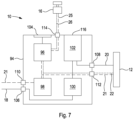
- FIG. 7 is a schematic view of a control unit
- FIG. 8 is a schematic view of a plug for an ultrasonic cleaning bar.
- FIG. 1 shows a cleaning system 2 for cleaning a roller 4 of a printing machine 6 .
- the print roller may be, for example, an engraved roller, and in particular may be an anilox roller.
- the print roller 4 comprises an axle 8 configured to support the print roller 4 for rotation.
- the cleaning system 2 comprises a control unit 10 , an ultrasonic cleaning bar 12 , a first bracket 14 , a second bracket 15 and a roller driver 16 .
- the ultrasonic cleaning bar 12 comprises a plurality of ultrasonic energy sources in the form of ultrasonic transducers 72 that are configured to generate ultrasonic vibrations.
- the control unit 10 receives fluid from a first fluid line 18 and dispenses fluid from a second fluid line 20 .
- the first fluid line 18 is connected to a fluid source, such as, for example, a factory water supply.
- the ultrasonic cleaning bar 12 receives fluid from the second fluid line 20 and dispenses fluid from a third fluid line 22 .
- the third fluid line 22 removes waste fluid from the ultrasonic cleaning bar 12 , and is typically connected to a drain or a factory waste disposal system.
- the control unit 10 is connected to an electrical power source by a first power line 21 .
- the ultrasonic cleaning bar 12 is connected to the control unit 10 by a second power line 23 so as to supply electrical power to the ultrasonic cleaning bar 12 .
- the ultrasonic cleaning bar 12 is further connected to the control unit 10 by a first communications line 24 so that the ultrasonic cleaning bar 12 and the control unit 10 may send and receive control signals therebetween.
- the control unit 10 is connected to the roller driver 16 by a third power line 25 so as to supply electrical power to the roller driver 16 .
- the control unit 10 is further connected to the roller driver 16 by a second communications line 26 so that the roller driver 16 and the control unit 10 may send and receive control signals therebetween.
- the control signals sent between the control unit 10 , ultrasonic cleaning bar 12 and roller driver 16 are electrical control signals, however the control signals may additionally or alternatively comprise optical or wireless control signals.
- FIG. 2 shows a side view of the ultrasonic cleaning bar 12 in an assembled state within a printing machine 6 .
- the ultrasonic cleaning bar 12 is generally elongate and defines a longitudinal axis extending generally parallel to the axle 8 of the roller 4 .
- the printing machine 6 further comprises an ink chamber 13 .
- the ink chamber 13 is pivotally mounted within the printing machine 6 so that it can be moved into and out of contact with the roller 4 . In the position shown in FIG. 2 , the ink chamber 13 has been pivoted away from the roller 4 . However, in normal use the ink chamber 13 engages the roller 4 in approximately the same position as the position of the ultrasonic cleaning bar 12 shown in FIG. 2 .
- the ultrasonic cleaning bar 12 comprises a first pin 28 , a second pin 30 , a third pin 32 and a fourth pin 34 .
- the first and second pins 28 , 30 are co-linear and are positioned at longitudinally opposite ends of the ultrasonic cleaning bar 12 .
- the third and fourth pins 32 , 34 are co-linear and are positioned at longitudinally opposite ends of the ultrasonic cleaning bar 12 .
- the first and second pins 28 , 30 are spaced apart from the third and fourth pins 32 , 34 in a lateral direction perpendicular to a longitudinal axis of the ultrasonic cleaning bar 12 .
- the first pin 28 and the third pin 32 are configured to be received by the first bracket 14 .
- the second pin 30 and the fourth pin 34 are configured to be received by the second bracket 15 .
- the first and second brackets 14 , 15 are mountable to the printing machine 6 either side of the roller 4 .
- FIG. 3 shows a perspective view of the first bracket 14 .
- the bracket 14 comprises a rear surface 36 , a front surface 38 and a raised surface 40 which are generally co-planar.
- the front surface 38 and the raised surface 40 are connected by a guide surface 42 which extends in a normal direction relative to the front and raised surfaces 38 , 40 .
- the front surface 38 , raised surface 40 and guide surface 42 co-operate to define a lower channel 44 , an upper channel 46 and a neck region 48 .
- the lower channel 44 terminates in a lower end face 52 defined by the guide surface 42
- the upper channel 46 terminates in an upper end face 54 also defined by the guide surface 42 .
- the lower channel 44 and upper channel 46 are connected by the neck region 48 , such that the lower channel 44 and upper channel 46 form a generally U-shaped recess relative to the raised surface 40 .
- the lower channel 44 defines a sloping portion 52 of the guide surface 42 which extends from the neck 48 to the lower end face 52 .
- the bracket 14 comprises a plurality of mounting holes 50 which are configured to receive fasteners for securing the mounting bracket to a frame of the printing machine 6 .
- the mounting holes 50 comprise countersunk openings configured to receive corresponding countersunk screws, which ensures correct centring of the bracket relative to the frame of the printing machine 6 .
- Different models of printing machine 6 have different frame geometries, and therefore the exact positions of the mounting holes 50 may be chosen in dependence upon the geometry of the printing machine 6 .
- the second bracket 15 is substantially identical to the first bracket 14 , but is mirrored in a plane defined by the raised surface 40 .
- the first and second brackets 14 , 15 are mounted to a frame of the printing machine 6 either side of the roller 4 .
- the brackets 14 , 15 are mounted such that the lower and upper channels 44 , 46 face generally towards the roller 4 whilst the necks 48 face generally away from the roller 4 .
- the user orients the ultrasonic cleaning bar 12 so that its longitudinal axis extends generally parallel to the axle 8 of the roller 4 .
- the first and second pins 28 , 30 rest upon the sloping portions 56 of the brackets 14 , 15 .
- the ultrasonic cleaning bar 12 is held in a resting configuration by the brackets 14 , 15 in which the ultrasonic cleaning bar 12 is supported by the printing machine 6 but is not in contact with the roller 4 .
- the ultrasonic cleaning bar 12 is held in a cleaning configuration by the brackets 14 , 15 in which the ultrasonic cleaning bar 12 engages the roller 4 .
- the lower and upper channels 44 , 46 act to guide the ultrasonic cleaning bar 12 into the resting and cleaning configurations and therefore assist the user when mounting the ultrasonic cleaning bar 12 to the printing machine 6 .
- the geometries of the lower and upper channels 44 , 46 prevent the ultrasonic cleaning bar 12 from being fitted incorrectly. Fitting and removal of the ultrasonic cleaning bar 12 from the printing machine 6 using the brackets 14 , 15 is therefore simple and fast. Due to their relatively small size, the brackets 14 , 15 may be left in place within the printing machine 6 when the ultrasonic cleaning bar 12 has been removed so as to save time during the next cleaning operation.
- FIG. 4 shows a perspective cross-sectional view of the ultrasonic cleaning bar 12 mounted within the printing machine 6 .
- the ultrasonic cleaning bar 12 further comprises a pair of arms 58 at either end of the ultrasonic printing bar 12 (only one arm 58 is shown in FIG. 4 ).
- the arms 58 are configured to engage a frame 60 of the printing machine 6 . It will be appreciated that different models of printing machine 6 will have different frame geometries, and therefore the specific shape of the arms 58 will be dependent upon the model of printing machine 6 .
- the printing machine 6 is a Gmürt Evolution.
- Each arm 58 comprises a bolt 62 extending from an end of the arm 58 , the bolt 62 being configured to act as a catch to receive a corresponding latch of the printing machine 6 .
- the latch of the printing machine 6 engages the bolt 62 of the arm 58 to hold the ultrasonic cleaning bar 12 in the cleaning configuration.
- the arm 58 therefore prevents accidental pivoting of the ultrasonic cleaning bar 12 out of the cleaning configuration.
- the brackets 14 , 15 are manufactured as single integral piece and in particular are manufactured from a polymer such as nylon, polyurethane, polytetrafluoroethylene, or the like. However, it will be appreciated that the brackets 14 , 15 may be manufactured from any suitable material. In alternative embodiment, the brackets 14 , 15 may not be made from a single integral piece.
- the rear surface 36 and front surface 38 may be manufactured from a single flat plate, and the raised surface 40 and the guide surface 42 may be manufactured from a block of material that is subsequently attached to the flat plate.
- the ultrasonic cleaning bar 12 described above comprises pins 28 , 30 , 32 , 34 which engage the brackets 14 , 15
- the ultrasonic cleaning bar 12 may comprise substantially any formation which is able to engage the brackets 14 , 15 so as to hold the ultrasonic cleaning bar 12 in the cleaning or resting configuration.
- such formations may comprise rails configured to be received within grooves.
- the brackets 14 , 15 may be replaced with pins, and the pins 28 , 30 , 32 , 34 of the ultrasonic cleaning bar 12 may be replaced with geometry equivalent to the brackets 14 , 15 of the embodiment described above. That is to say, the printing machine may comprise a “male” formation and the ultrasonic cleaning bar may comprise a “female” formation configured to receive the “male” formation.
- the ultrasonic cleaning bar 12 may comprise one or more switches configured to detect when the ultrasonic cleaning bar has been mounted to the brackets.
- a switch may be positioned on one the end of the ultrasonic cleaning bar 12 adjacent one of the formations. The switch may be positioned such that the switch is actuated when the ultrasonic cleaning bar 12 is received by the brackets 14 , 15 in the cleaning configuration.
- the switch may communicate with the control unit 10 , and the control unit 10 may be configured to prevent the ultrasonic transducers 72 from being activated and/or the trough 82 from being filled when the switch is not actuated. As such, the switches ensure that the ultrasonic cleaning bar is only filled with cleaning fluid when it is in the correct position in relation to the roller 4 .
- FIG. 5 shows a schematic cross-sectional side view of the ultrasonic cleaning bar 12 in the cleaning configuration relative to the roller 4 .
- the ultrasonic cleaning bar 12 comprises a body 64 , a doctor blade 66 , a pair of end caps 68 , a cover member 70 , and a plurality of ultrasonic transducers 72 .
- the body 64 is generally L-shaped and defines a base 74 having a lip 76 .
- the lip 76 extends upwardly from the base 74 , and is inclined at an obtuse angle relative to the base 74 .
- the doctor blade 66 extends generally upwards from the lip 76 so as to form a generally U-shaped channel along the longitudinal axis.
- the doctor blade 66 is mounted to the lip 76 by a fastener 78 .
- the interface between the doctor blade 66 and the lip 76 is sealed by a pair of gaskets 80 such that fluid cannot leak between the doctor blade 66 and the lip 74 .
- substantially any suitable mounting arrangement may be employed to fix the doctor blade 66 to the lip 74 in a fluid tight fashion.
- the doctor blade 66 engages the roller 4 when the ultrasonic cleaning bar 12 is in the cleaning configuration (as shown in FIG. 5 ) and forms a fluid tight seal therebetween.
- the end caps 68 are positioned at longitudinally opposite ends of the ultrasonic cleaning bar 12 .
- the end caps 68 are mounted to the body 64 and are configured to provide a fluid tight seal between the body 64 , the doctor blade 66 and the roller 4 .
- the end caps 68 are generally planar, and define a curved side edge having a corresponding radius of curvature to the roller 4 .
- the end caps 68 , body 64 and doctor blade 66 co-operate to define a trough 82 configured to contain a cleaning fluid.
- the body 64 comprises an inlet port 84 which is connected to the second fluid line 20 which is configured to deliver fluid to the trough 82 and an outlet port 85 and an outlet valve 87 connected to the third fluid line 22 .
- the outlet valve 87 is preferably electronically actuable in response to a control signal from the control unit 10 .
- the ultrasonic cleaning bar 12 further comprises a level sensor 86 (i.e. a fluid sensor) configured to detect the presence of cleaning fluid within the trough 82 .
- the level sensor 86 is positioned close to the top of the body 64 vertically above the ultrasonic transducers 72 .
- the position of the level sensor corresponds to the position of the free surface 88 of the cleaning fluid when the trough 82 has been filled to a fill volume.
- the fill volume is the minimum volume of fluid that the trough 82 should contain before the ultrasonic transducers 72 are activated.
- the level sensor 86 may be any suitable sensor for detecting the presence of a fluid, for example an ultrasonic sensor, a contact sensor, a float sensor or the like.
- the system performs a cleaning routine.
- the outlet valve 87 is closed and the trough 82 is filled with cleaning fluid until it reaches the level sensor 86 .
- the cleaning fluid comprises, for example, a mixture of heated water and a surfactant or detergent or the like.
- the cleaning system 2 (via the control unit 10 ) is configured so that the ultrasonic transducers 72 are not activated until the cleaning fluid has been detected by the level sensor 86 .
- the ultrasonic transducers 72 cannot be activated until they are below the free surface 88 of the cleaning fluid. This ensures that the vibrational energy produced by the ultrasonic transducers 72 is dissipated within the cleaning fluid. If the cleaning fluid is not present, the ultrasonic vibrations will be conducted away from the ultrasonic transducers 72 primarily by the body 64 , which may cause damage to the body 64 and/or the ultrasonic transducers 72 .
- the ultrasonic transducers 72 are activated for a period of time and the roller driver 16 is activated to begin rotation of the print roller 4 .
- the ultrasonic vibrations permeate the cleaning fluid and dislodge the contaminants from the outer surface 91 of the print roller 4 .
- the surfactant acts to weaken the surface tension between the cleaning fluid and the contaminants, thus enabling the contaminants to be dislodge more easily.
- the period of time for which the ultrasonic transducers 72 are active is preferably in the range of around three minutes to around seven minutes, and is more preferably around five minutes.
- the period of time is preferably chosen to be longer than the length of time it takes for the roller driver 16 to rotate the print roller 4 by one whole rotation.
- the period of time is chosen in dependence upon the volume of the cells of the print roller 4 being cleaned. It has been found that the smaller the volume of the cells, the more difficult it is for the ultrasonic waves to shake contaminant loose from the outer surface 91 and therefore the longer it takes to clean the print roller 4 . However, for most commercial print rollers, it has been found that a period of around five minutes provides enough cleaning time even if the cells are relatively small.
- the level sensor 86 monitors the volume of fluid in the trough 82 . If the free surface 88 drops below the level sensor 86 , the cleaning system 2 (via the control unit 10 ) will supply additional cleaning fluid via the inlet port 84 to compensate for the leaked cleaning fluid.
- the cleaning fluid will be saturated with contaminants (i.e. dried ink, dirt, grease or the like) and must be removed from the trough 82 .
- the outlet valve 87 is opened and the cleaning fluid is emptied from the trough 82 via the outlet port 85 .
- the cleaning fluid captured within the trough 82 is not flowing and therefore the vibrations produced by the by the ultrasonic transducers 72 are better able to permeate through the cleaning fluid.
- the amount of cleaning fluid used is not more than the volume of the trough 82 , and therefore cleaning of the roller 4 can be performed using a relatively small amount of fluid.
- the cleaning routine is completed. However, in the majority of cases some contaminant will have remained on the print roller 4 . This is because the cleaning fluid becomes saturated with contaminant during the cleaning routine and this can impede the transmission of ultrasonic vibrations to the outer surface 91 , thus limiting the removal of further contaminant from the roller 4 . Additionally, the cleaning fluid may reach a point where it is no longer possible or it becomes increasingly difficult to hold further particles of contaminant in suspension.
- control unit 10 The flow of fluid through the second fluid line 20 to the trough 82 is controlled by control unit 10 .
- the control unit 10 is configured so that as soon as the level sensor 86 detects the presence of cleaning fluid, fluid flow through the second fluid line 20 is turned off, thus preventing the trough 82 from being over-filled.
- the control unit 10 may be configured to wait for a predetermined period of time after the level sensor 86 detects the presence of cleaning fluid before turning off fluid flow through the second fluid line 20 . This will provide additional cleaning fluid within the trough 82 to account for any accidental leakage during the cleaning operation.
- the ultrasonic cleaning bar 12 may comprise a pair of level sensors 86 spaced vertically apart from one another, and the control unit 10 may be configured to ensure that the free surface 88 stays between the two level sensors 86 .
- the control unit 10 may be configured to ensure that the free surface 88 stays between the two level sensors 86 .
- the control unit 10 may be configured to ensure that the free surface 88 stays between the two level sensors 86 .
- the fluid flow through the second fluid line 20 may be switched off, and if a lower one of the fluid sensors subsequently detects that the cleaning fluid is no longer present the fluid flow through the second fluid line 20 may be switched on.
- the ultrasonic transducers 72 are spaced apart along the longitudinal axis of the ultrasonic cleaning bar 12 (i.e. from left to right in FIG. 2 ) and are encased by the cover member 70 .
- the ultrasonic transducers 72 may be mounted to the body 64 in any suitable way so that when the ultrasonic transducers 72 are activated, vibrational energy from the ultrasonic transducers 72 is transferred through the body 64 and into the fluid contained in the trough 82 .
- the ultrasonic transducers 72 may each comprise a housing which is mounted to the body 64 by bonding, and may further comprise piezoelectric elements which are secured within the housing by a fastener, such as a bolt.
- the body 64 is preferably made from a metal such as stainless steel. It has been found that the use of non-metallic materials such as carbon fibre for the body 64 dampens the ultrasonic vibrations generated by the ultrasonic transducers 72 , whereas the use of metal, and in particular stainless steel, in fact promotes resonance of the ultrasonic vibrations thereby enhancing the cleaning effect.
- the ultrasonic transducers 72 are positioned so that they are vertically above the doctor blade 66 . As such, when the trough 82 is filled with cleaning fluid, there is a large area between the roller 4 between a free surface 88 (i.e. top surface) of the cleaning fluid and the doctor blade 66 in which the cleaning fluid directly contacts the roller 4 . During use, the ultrasonic vibrations permeate the cleaning fluid and impinge upon an outer surface 91 (i.e. an ink-carrying surface) of the roller 4 . Where the roller 4 is an anilox roller, the outer surface 91 of the roller 4 will comprise a plurality of engraved cells within which may contain dried contaminants, such as for example dried ink, dirt, grease or the like.
- the ultrasonic vibrations are transmitted into the cells and act to dislodge the contaminants, thus cleaning the roller 4 .
- the ultrasonic transducers 72 a primary vibrational frequency which is variable up to 3 kHz, and further harmonic frequencies in the range 18 to 20 kHz and 150 to 180 kHz. Due to the shape of the body 64 of the ultrasonic cleaning bar 12 , the ultrasonic transducers are positioned relatively close to the outer surface 91 of the roller 4 . Typically, during use the ultrasonic transducers are around 15 to 30 mm away from the outer surface 91 of the roller 4 . As such, the amplitude of the ultrasonic vibrations in the cleaning fluid is still strong at the outer surface 91 of the roller 4 . As such, the ultrasonic cleaning bar 12 provides improved cleaning of the roller 4 .
- the ultrasonic transducers 72 are spaced apart from one another at regular intervals along the longitudinal axis.
- the ultrasonic transducers 72 may be spaced apart by around 75 to 150 mm.
- the ultrasonic transducers 72 may be spaced apart from one another at irregular intervals.
- the ultrasonic transducers 72 may be operated simultaneously, or may be operated individually in a staggered fashion.
- the roller driver 16 comprises a drive wheel 90 which is rotatable about an axle 92 under the action of a motor (not shown).
- the roller driver 16 is mounted to the frame of the printing machine 6 such that an outer surface 93 of the drive wheel 90 frictionally engages an outer surface 91 of the roller 4 .
- the roller driver 16 may be mounted to the frame of the printing machine 6 via a mounting.
- the mounting may comprise, for example, a stud attached to the frame of the printing machine 6 and the roller driver 16 may comprise a bracket configured to connect the roller driver 16 to the stud.
- the mounting is preferably configured to permit the roller driver 16 to move between an engaged position and a rest position. In the engaged position, the drive wheel 90 of the roller driver 16 frictionally engages the outer surface 91 of the roller 4 , and in the rest position the drive wheel 90 of the roller driver 16 is not in contact with the roller 4 .
- the roller driver 16 may be secured in any suitable manner.
- the roller driver 16 may be mounted to a frame which is independent of the printing machine 6 , so as to place the drive wheel 90 in contact with the roller 4 .
- the drive wheel 90 of the roller driver 16 may define a width in the direction of the axle 92 which is relatively narrow in comparison to the roller 4 of the printing machine (such as for example a few centimetres).
- the drive wheel 90 may have a diameter of around 100 mm and a width of around 20 to 40 mm.
- the roller driver may have any configuration which is suitable for imparting rotation on the roller 4 by frictional contact.
- the motor of the roller driver is activated, causing the drive wheel 90 to rotate, and transferring rotational motion to the roller 4 via frictional contact between the outer surface 93 of the drive wheel 90 and the outer surface 91 of the roller 4 .
- the roller 4 rotates relative to the ultrasonic cleaning bar 12 about the axle 8 .
- different parts of the outer surface 91 of the roller 4 come into contact with the cleaning fluid in the trough 82 .
- the rotation of the roller 4 therefore ensures that the whole surface of the roller 4 is cleaned by the ultrasonic cleaning bar 12 after one full rotation of the roller 4 .
- the roller 4 may be rotated in either direction about the axle 8 without affecting the ability of the doctor blade 66 to seal against the roller 4 .
- the roller driver 16 may not be present, and instead the printing machine 6 may be operated to rotate the print roller at a desired speed (e.g. using the internal drive components of the printing machine 6 ).
- the control unit 10 may communicate with the printing machine 6 to drive the rotation of the print roller 4 at the desired speed.
- the outer surface 93 of the drive wheel 90 is coated with a layer of material that is soft in comparison to the material of the roller 4 , and which provides good frictional contact with the outer surface 91 of the roller 4 .
- the outer surface 93 of the drive wheel 90 comprises a 60 shore hardness rubber, however it will be appreciated that any suitable material may be used, for example a polymer material, a nitrile material, a polyurethane or the like. Because the material of the outer surface 93 of the drive wheel 90 is soft in comparison to the roller 4 , this minimises the risk that the drive wheel 90 and roller 4 will damage the outer surface 91 of the roller 4 . Furthermore, because the material of the outer surface 93 of the drive wheel 90 provides good frictional contact, this minimises the risk that the drive wheel 90 will slip relative to the roller 4 , which may reduce the cleaning performance.
- the ultrasonic cleaning bar 12 may be used with rollers 4 of different diameters.
- the roller driver 16 When the roller driver 16 is used, the roller 4 is driven by surface contact between the outer surface 93 of the drive wheel 90 and the outer surface 91 of the roller 4 , the velocity of the outer surface 91 of the roller 4 is directly controlled by the rotational input of the roller driver 16 . As such, for a given rotational speed of the drive wheel 90 , the outer surface 91 of the roller 4 will advance past the trough 82 of the ultrasonic cleaning bar 12 at the same rate regardless of the diameter of the roller 4 . Therefore, the roller driver 16 provides the advantage that it is able to precisely control the surface velocity of the roller 4 so as to ensure that the roller 4 advances at the correct surface velocity for the cleaning operation. This avoids the need to re-program the control unit 10 when the ultrasonic cleaning system 2 is used with rollers of different sizes (for example, where the ultrasonic cleaning system 2 is used with different models of printing machine).
- FIG. 6 shows a second embodiment of an ultrasonic cleaning bar 12 ′ according to the present invention.
- the second embodiment of the ultrasonic cleaning bar 12 ′ differs from the first embodiment in that the ultrasonic cleaning bar comprises body 64 ′ having a pair of longitudinally extending sides 74 ′.
- the sides 74 ′ define a pair of longitudinally extending lips 76 ′.
- a lower one of the lips 76 ′ extends generally upwards and a second, opposite, one of the lips 76 ′ is extends generally downwards.
- the lips 76 ′ support a pair of doctor blades 66 ′ which face towards one another and engage the outer surface 91 of the roller 4 .
- the doctor blades 66 ′ are mounted to the lips 76 ′ via fasteners 78 ′ and sealed by sealing members 80 ′.
- the sides 74 ′, lips 76 ′ and doctor blades 66 ′ co-operate to define a trough 82 ′ therebetween.
- the ends of the trough 82 ′ are sealed by end plates 68 ′ so as to prevent leakage of fluid out of the trough.
- the trough 82 ′ is therefore sealed on all sides.
- the trough can be oriented in any direction with respect to gravity, without causing fluid leakage. This is advantageous where the geometry of the printing machine 6 is such that it would not be possible to orient the trough 82 of the first embodiment of the ultrasonic cleaning bar 12 in an upright position.
- FIG. 7 shows a schematic view of a control unit 10 according to the present invention.
- the control unit 10 comprises a housing 94 , a controller 96 , a pulse generator 98 , a heater 100 , a dosing unit 102 and a user input panel 104 .
- the housing 94 comprises a fluid inlet port 106 which is connectable to the first fluid line 18 and a fluid outlet port 108 which is connectable to the second fluid line 20 .
- the housing 94 further comprises a power inlet socket 110 connectable to the first power line 21 , a first outlet socket 112 connectable to the second power line 23 and the first communications line 24 , and a second outlet socket 114 connectable to the third power line 25 and the second communications line 26 .
- Fluid is received by the fluid inlet port 106 and is channelled to the heater 100 . Movement of the fluid is driven by the pressure of the fluid from the first fluid line 18 (i.e. the pressure of the factory water supply).
- the control unit 10 may additional comprise a pump and/or a tank for driving movement of the cleaning fluid.
- the control unit 10 additionally comprises a valve (not shown) for selectively permitting fluid flow to the second fluid line 20 .
- the valve may be part of or coupled to the fluid inlet port 110 and/or the fluid outlet port 112 .
- the heater 100 is an in-line heater configured to heat the fluid as it moves. However, in alternative embodiments, the heater 100 may comprise a tank having heating elements for heating fluid contained in the tank. The heater 100 is configured to heat the fluid to around 30° C. However, in yet further embodiments the control unit 10 may not comprise a heater 100 . In such embodiments, the fluid inlet port 106 may be connected directly to the dosing unit 102 .
- the dosing unit 102 introduces a predetermined amount of surfactant into the heated fluid. Typically, the amount of surfactant required is 10 ml per litre of fluid.
- the temperature of the heated fluid may be chosen so as to ensure that the surfactant will rapidly dissolve into the fluid so that it is evenly dissipated. Furthermore, it has been found that heating the fluid, cleaning performance is increased and dried ink is more easily dislodged.
- the dosing unit 102 is accessible via a door 116 of the housing 94 . The door 116 permits the surfactant in the dosing unit 102 to be refilled once it has been consumed. Once the surfactant has been introduced into the cleaning fluid, the cleaning fluid is channelled out of the control unit 10 via the fluid outlet port 108 and into the trough 82 of the ultrasonic cleaning bar 12 .
- the controller 98 communicates with the ultrasonic cleaning bar 12 via the first outlet socket 112 .
- the controller 98 is configured to send and receive control signals from the ultrasonic transducers 72 and the level sensor 86 .
- the controller 96 communicates with the roller driver 16 via the second outlet socket 114 and is configured to activate, deactivate and control the speed of the drive wheel 90 of the roller driver 16 .
- the controller 96 is further configured communicate with the pulse generator 98 and the user input panel 104 .
- the user inputs a “start” command to the user input panel 104 .
- the control unit 10 then begins to fill the trough 82 with cleaning fluid via the second fluid line 20 .
- the control unit 10 continues to fill the trough 82 until the presence of the cleaning fluid is detected by the level sensor 86 .
- the level sensor 86 communicates that cleaning fluid has been detected to the controller 96 , and subsequently the controller 96 shuts off fluid flow to the trough 82 (for example by deactivating the second fluid line 20 ).
- the controller 96 communicates with the pulse generator 98 which produces an oscillating electrical power output which drives the ultrasonic transducers 72 .
- the frequency of the electrical power output from the ultrasonic generator 98 is chosen so as to cause the ultrasonic transducers to generate a primary vibrational frequency which is variable up to 3 kHz, and further harmonic frequencies in the range 18 to 20 kHz and 150 to 180 kHz.
- the control unit 10 then communicates with the roller driver 16 to cause the drive wheel 90 to rotate at a predetermined angular velocity.
- the roller driver 16 causes the roller 4 to rotate, thereby cleaning the whole surface of the roller 4 .
- the roller 4 is driven so that the outer surface 91 of the roller 4 has a surface velocity of around 4 m ⁇ min ⁇ 1 (metres per minute), however this speed may be within the range of around 1 m ⁇ min ⁇ 1 to around 7 m ⁇ min ⁇ 1 , or more preferably in the range of around 3 m ⁇ min ⁇ 1 to around 5 m ⁇ min ⁇ 1 .
- the outer surface 91 may be rotated with a linear velocity of up to 10 m ⁇ min ⁇ 1 .
- the control unit 10 continues to drive the ultrasonic transducers 72 and the roller driver 82 until either the user inputs a “stop” command into the user input panel 104 , or until a predetermined cleaning period has elapsed.
- the predetermined cleaning period is chosen so that the whole surface of the roller 4 has been cleaned.
- the predetermined cleaning period may be chosen in dependence upon the diameter of the roller 4 and the desired surface speed produced by the roller driver 16 (which may be input into the controller 96 by the user).
- the predetermined cleaning period may be input by the user, or may selected from a database stored by or associated with the controller 96 of the control unit 10 .
- the predetermined cleaning period is around 5, 10, 15 or 20 minutes.
- the controller 96 deactivates the pulse generator 98 and stops driving the ultrasonic transducers 72 .
- the controller 96 communicates with the ultrasonic cleaning bar 12 and causes the outlet valve 87 of the ultrasonic cleaning bar 12 to open, permitting the cleaning fluid in the trough 82 to empty via the third fluid line 22 .
- the cleaning system 2 may be used with rollers 4 of different lengths.
- the length of the ultrasonic cleaning bar 12 In order to support the ultrasonic cleaning bar 12 either side of the roller 4 , the length of the ultrasonic cleaning bar 12 must be approximately the same as the length of the roller 4 .
- the cleaning system 2 may comprise ultrasonic cleaning bars 12 of various different lengths.
- the ultrasonic transducers 72 In order to provide cleaning along the whole length of the roller 4 , the ultrasonic transducers 72 should not be spaced apart too far. Therefore, longer ultrasonic cleaning bars 12 will require more ultrasonic transducers 72 in order to provide adequate cleaning.
- the pulse generator 96 may only be able to provide sufficient energy to power a number of ultrasonic transducers 72 .
- the control unit 10 may comprise more than one pulse generator 96 .
- the control unit 10 may comprise two, three or any suitable number of pulse generators 96 . Where the control unit 10 comprises more than one pulse generator 96 , it is able to provide power to ultrasonic cleaning bars 12 having more than four ultrasonic transducers 72 .
- each ultrasonic cleaning bar 12 comprises a plug configured to be received by the first outlet socket 112 .
- the plug 120 comprises six electrical contact pins 120 a - c arranged in pairs. The pins 120 are received by corresponding receptacles of the first outlet socket 112 to create an electrical connection therebetween.
- Each pair of pins 120 a - c comprises a first pin for feeding electrical current from the control unit 10 to the ultrasonic cleaning bar 12 and a second pin for returning the electrical current from the ultrasonic cleaning bar 12 to the control unit 10 (e.g. a “live” pin and a “neutral” pin).
- Each pair of pins 120 a - c is electrically connected to four ultrasonic transducers 72 .
- each pair of pins 120 a - c is electrically powered by a separate pulse generator 96 .
- a first pair of pins 120 a is powered by a first pulse generator 96
- a second pair of pins 120 b is powered by a second pulse generator 96
- a third pair of pins is powered by a third pulse generator 96 .
- the plug 118 of FIG. 8 comprises three pairs of pins 120 a - c
- the plug 118 is able to connect the control unit 10 to an ultrasonic cleaning bar 12 comprising twelve ultrasonic transducers 72 (such as the ultrasonic cleaning bar 12 shown in FIG. 1 ).
- each pair of pins 120 a - c may be connected any suitable number of ultrasonic transducers 72 , for example one to six ultrasonic transducers.
- the plug 118 may be used with an ultrasonic cleaning bar comprising fewer than twelve ultrasonic transducers.
- the plug 118 may be used with an ultrasonic cleaning bar 12 comprising eight ultrasonic transducers 72 .
- each pair of pins 120 a - c powers four ultrasonic transducers 72 , all eight ultrasonic transducers 72 can be powered using only the first pair of pins 120 a and the second pair of pins 120 b .
- the plug 118 may be manufactured without the third pair of pins 120 c , or the third pair of pins 120 c may be present but electrically disconnected from any other components.
- the plug 118 is therefore configured to automatically connect the correct number of pulse generators 96 to the ultrasonic transducers 72 .
- the user is able to simply plug any ultrasonic cleaning bar 12 into the control unit 10 , as the configuration of the plug 118 will ensure that the correct amount of power is drawn from the control unit 10 .
- the user input panel 104 may comprise one or more buttons in communication with the controller 96 . Additionally or alternatively, the user input panel 104 may comprise a screen, and in particular a touch screen, configured to display a graphical user interface.
- the user input panel 104 provides a means for the user to adjust the parameters of the cleaning operation, for example the frequency of the electrical pulses generated by the pulse generator 98 , the duration of the cleaning cycle itself, the speed of the roller driver 16 etc.
- control unit 10 may comprise additional fluid outlet ports and outlet sockets configured to connect the control unit 10 to additional ultrasonic heating bars 12 .
- the control unit 10 can be used to control a plurality of separate ultrasonic heating bars 12 .
- a user may mount a first ultrasonic heating bar 12 to a first roller 4 of a printing machine 6 and initiate an ultrasonic cleaning cycle. Whilst the first roller 4 is being cleaned, the user may mount a second ultrasonic cleaning bar 12 to a second roller 4 of the same or a different printing machine 6 . Once the cleaning cycle of the first roller 4 is complete, the user can use the control unit 10 to initiate the cleaning cycle for the second roller 4 .
- the user can dismount the first ultrasonic cleaning bar 12 and mount it to a third roller 4 of the same or a different printing machine. As such, by using a plurality of ultrasonic cleaning bars 12 the user can save time when cleaning multiple rollers 4 .
- the print roller 4 discussed above is described as remaining in place on the printing machine 6 , it will be appreciated that in alternative embodiments the print roller 4 may be removed from the printing machine 6 and placed on a driving apparatus which is separate to the printing machine 6 .
- the ultrasonic cleaning bar 12 may be integrated within the driving apparatus.
- the ultrasonic cleaning bar 12 may be modified so that it is a permanent part of the driving apparatus (i.e. such that it is not removable using the pins 28 , 30 , 32 , 34 ).
- the driving apparatus maybe configured to rotate the print roller 4 relative to the ultrasonic cleaning bar 12 so as to clean the outer surface 91 of the print roller 4 in substantially the same manner as described above with reference to the printing machine 6 and/or the roller driver 16 .
- the driving apparatus may comprise an axle support for supporting the print roller for rotation about the axle 8 , and the roller driver 16 .
Landscapes
- Inking, Control Or Cleaning Of Printing Machines (AREA)
Abstract
Description
-
- providing an ultrasonic cleaning bar having at least one ultrasonic energy source;
- engaging the ultrasonic cleaning bar with an ink-carrying surface of the print roller, the ultrasonic cleaning bar and the ink-carrying surface defining a trough therebetween for containing a cleaning fluid;
- executing a cleaning routine, the cleaning routine comprising: filling the trough with the cleaning fluid so that the cleaning fluid contacts the ink-carrying surface;
- activating the ultrasonic energy source for a period of time to remove contaminants from the ink-carrying surface of the print roller so that the contaminants become suspended in the cleaning fluid; and draining the suspension of cleaning fluid and contaminants from the trough;
- wherein the method comprises executing the cleaning routine at least two times in succession before cleaning of the print roller is complete.
-
- an ultrasonic cleaning bar having at least one ultrasonic energy source, wherein the ultrasonic cleaning bar is engageable with an ink-carrying surface of a print roller to define a trough therebetween for containing a cleaning fluid;
- wherein the system is configured to execute a cleaning routine, the cleaning routine comprising:
- filling the ultrasonic cleaning bar with the cleaning fluid so that the cleaning fluid contacts the ink-carrying surface;
- activating the ultrasonic energy source for a period of time to remove contaminants from the ink-carrying surface of the print roller so that the contaminants become suspended in the cleaning fluid; and
- draining the suspension of cleaning fluid and contaminants from the trough;
- wherein the system is configured execute the cleaning routine at least two times in succession before cleaning of the print roller is complete.
Claims (18)
Applications Claiming Priority (4)
| Application Number | Priority Date | Filing Date | Title |
|---|---|---|---|
| GBGB2005190.0A GB202005190D0 (en) | 2020-04-08 | 2020-04-08 | Cleaning system and mnethod |
| GB2005190.0 | 2020-04-08 | ||
| GB2005190 | 2020-04-08 | ||
| PCT/GB2021/050860 WO2021205170A1 (en) | 2020-04-08 | 2021-04-08 | Cleaning system and method |
Publications (2)
| Publication Number | Publication Date |
|---|---|
| US20230150257A1 US20230150257A1 (en) | 2023-05-18 |
| US11904599B2 true US11904599B2 (en) | 2024-02-20 |
Family
ID=70768882
Family Applications (1)
| Application Number | Title | Priority Date | Filing Date |
|---|---|---|---|
| US17/917,699 Active 2041-04-08 US11904599B2 (en) | 2020-04-08 | 2021-04-08 | Cleaning system and method |
Country Status (4)
| Country | Link |
|---|---|
| US (1) | US11904599B2 (en) |
| EP (1) | EP4126550B1 (en) |
| GB (1) | GB202005190D0 (en) |
| WO (1) | WO2021205170A1 (en) |
Citations (19)
| Publication number | Priority date | Publication date | Assignee | Title |
|---|---|---|---|---|
| US5058611A (en) | 1989-03-27 | 1991-10-22 | Sonicor Instrument Corporation | Process and apparatus for the ultrasonic cleaning of a printing cylinder |
| US5240506A (en) | 1989-03-27 | 1993-08-31 | Sonicor Instrument Corporation | Process for the ultrasonic cleaning of a printing cylinder |
| EP0611651A1 (en) | 1993-01-11 | 1994-08-24 | Komori Corporation | Cleaning apparatus for printing press |
| EP0693378A1 (en) | 1994-07-22 | 1996-01-24 | Baldwin-Gegenheimer GmbH | Apparatus for cleaning cylinders |
| EP0765749A1 (en) | 1995-09-28 | 1997-04-02 | WindmÀ¶ller & Hölscher | Doctor blade assembly for the inking device with circulation of ink in a rotary printing machine |
| US5694846A (en) * | 1991-06-06 | 1997-12-09 | Baldwin Graphics Systems, Inc. | Fountain solution supply system |
| US5842418A (en) | 1995-05-08 | 1998-12-01 | Seratek Llc | Apparatus and method for cleaning a roller |
| DE29918488U1 (en) | 1999-10-20 | 1999-12-30 | MAN Roland Druckmaschinen AG, 63075 Offenbach | Sheet-fed rotary printing machine with printing units for multi-color printing and at least one coating unit |
| GB2346113A (en) | 1999-01-26 | 2000-08-02 | Roland Man Druckmasch | Roller cleaning apparatus on a rotary printing press |
| FR2794402A1 (en) | 1999-06-01 | 2000-12-08 | Serigraphie Carpentier | Method of cleaning serigraphic printing frames has involves dropping frame into tank and projecting ultrasound onto it |
| DE10145902A1 (en) | 2001-09-18 | 2003-04-10 | Andreas H Stranz | Method for cleaning surfaces of machine parts while in working mode uses wide jet nozzle to direct cleaning fluid onto surface to be cleaned only |
| DE10148401A1 (en) | 2001-09-29 | 2003-04-17 | Karl Beis | Surface cleaning installation, using ultrasound with one or more sonotrodes |
| US6907826B1 (en) | 1999-06-30 | 2005-06-21 | OCé PRINTING SYSTEMS GMBH | Method and device for printing a base material and cleaning a printing roller |
| GB2417924A (en) | 2004-09-10 | 2006-03-15 | Alphasonics Ltd | Ultrasonic chambered doctor blade |
| EP1990693A1 (en) | 2006-03-02 | 2008-11-12 | Kabushi Kaisha Toshiba | Cleaning apparatus, cleaning method, pattern forming apparatus and pattern forming method |
| WO2011072681A1 (en) | 2009-12-14 | 2011-06-23 | Benny Petersen | An ink distributor unit for a rotary printing machine |
| JP2011183369A (en) | 2010-03-07 | 2011-09-22 | Kiyoshi Network:Kk | Ultrasonic cleaning apparatus |
| EP2011653B1 (en) | 2007-07-02 | 2012-02-08 | Heidelberger Druckmaschinen Aktiengesellschaft | Washing device for a cylinder in a printing machine |
| US8671506B2 (en) | 2009-04-23 | 2014-03-18 | Heidelberger Druckmaschinen Ag | Washing device |
-
2020
- 2020-04-08 GB GBGB2005190.0A patent/GB202005190D0/en not_active Ceased
-
2021
- 2021-04-08 WO PCT/GB2021/050860 patent/WO2021205170A1/en not_active Ceased
- 2021-04-08 US US17/917,699 patent/US11904599B2/en active Active
- 2021-04-08 EP EP21719217.8A patent/EP4126550B1/en active Active
Patent Citations (23)
| Publication number | Priority date | Publication date | Assignee | Title |
|---|---|---|---|---|
| US5058611A (en) | 1989-03-27 | 1991-10-22 | Sonicor Instrument Corporation | Process and apparatus for the ultrasonic cleaning of a printing cylinder |
| US5240506A (en) | 1989-03-27 | 1993-08-31 | Sonicor Instrument Corporation | Process for the ultrasonic cleaning of a printing cylinder |
| US5291827A (en) | 1989-03-27 | 1994-03-08 | Sonicor Instrument Corporation | Process and apparatus for the ultrasonic cleaning of a printing cylinder |
| US5694846A (en) * | 1991-06-06 | 1997-12-09 | Baldwin Graphics Systems, Inc. | Fountain solution supply system |
| EP0611651A1 (en) | 1993-01-11 | 1994-08-24 | Komori Corporation | Cleaning apparatus for printing press |
| EP0693378A1 (en) | 1994-07-22 | 1996-01-24 | Baldwin-Gegenheimer GmbH | Apparatus for cleaning cylinders |
| US5842418A (en) | 1995-05-08 | 1998-12-01 | Seratek Llc | Apparatus and method for cleaning a roller |
| EP0765749A1 (en) | 1995-09-28 | 1997-04-02 | WindmÀ¶ller & Hölscher | Doctor blade assembly for the inking device with circulation of ink in a rotary printing machine |
| DE19902957A1 (en) | 1999-01-26 | 2000-08-03 | Roland Man Druckmasch | Dosing device on a rotary printing machine |
| GB2346113A (en) | 1999-01-26 | 2000-08-02 | Roland Man Druckmasch | Roller cleaning apparatus on a rotary printing press |
| FR2794402A1 (en) | 1999-06-01 | 2000-12-08 | Serigraphie Carpentier | Method of cleaning serigraphic printing frames has involves dropping frame into tank and projecting ultrasound onto it |
| US6907826B1 (en) | 1999-06-30 | 2005-06-21 | OCé PRINTING SYSTEMS GMBH | Method and device for printing a base material and cleaning a printing roller |
| DE29918488U1 (en) | 1999-10-20 | 1999-12-30 | MAN Roland Druckmaschinen AG, 63075 Offenbach | Sheet-fed rotary printing machine with printing units for multi-color printing and at least one coating unit |
| EP1097813A2 (en) | 1999-10-20 | 2001-05-09 | MAN Roland Druckmaschinen AG | Sheet-fed rotary printing press with printing units for multicolour printing and at least one coating unit |
| US6371024B1 (en) | 1999-10-20 | 2002-04-16 | Man Roland Druckmaschinen Ag | Sheet-fed printing machine with cleaning system |
| DE10145902A1 (en) | 2001-09-18 | 2003-04-10 | Andreas H Stranz | Method for cleaning surfaces of machine parts while in working mode uses wide jet nozzle to direct cleaning fluid onto surface to be cleaned only |
| DE10148401A1 (en) | 2001-09-29 | 2003-04-17 | Karl Beis | Surface cleaning installation, using ultrasound with one or more sonotrodes |
| GB2417924A (en) | 2004-09-10 | 2006-03-15 | Alphasonics Ltd | Ultrasonic chambered doctor blade |
| EP1990693A1 (en) | 2006-03-02 | 2008-11-12 | Kabushi Kaisha Toshiba | Cleaning apparatus, cleaning method, pattern forming apparatus and pattern forming method |
| EP2011653B1 (en) | 2007-07-02 | 2012-02-08 | Heidelberger Druckmaschinen Aktiengesellschaft | Washing device for a cylinder in a printing machine |
| US8671506B2 (en) | 2009-04-23 | 2014-03-18 | Heidelberger Druckmaschinen Ag | Washing device |
| WO2011072681A1 (en) | 2009-12-14 | 2011-06-23 | Benny Petersen | An ink distributor unit for a rotary printing machine |
| JP2011183369A (en) | 2010-03-07 | 2011-09-22 | Kiyoshi Network:Kk | Ultrasonic cleaning apparatus |
Non-Patent Citations (8)
| Title |
|---|
| "SONO The World's First On-Press Ultrasonic Anilox Cleaner," Absolute, Nov. 20, 2019, https://thisissono.com/ 4 pages. |
| International Search Report and Written Opinion issued for PCT/GB2018/050643, dated May 28, 2018, 15 pages. |
| International Search Report and Written Opinion issued for PCT/GB2019/052858, dated Apr. 17, 2020, 21 pages. |
| International Search Report and Written Opinion issued for PCT/GB2021/050860, dated Jul. 12, 2021, 12 pages. |
| Search Report issued for UK Patent Application No. GB1816441.8, dated Apr. 5, 2019, 5 pages. |
| Search Report issued for UK Patent Application No. GB1816441.8, dated Jun. 25, 2020, 4 pages. |
| Search Report issued for UK Patent Application No. GB2005190.0, dated Sep. 21, 2020, 2 pages. |
| SONO Brochure; Absolute Engineering Ltd. 2018, 2 pages. |
Also Published As
| Publication number | Publication date |
|---|---|
| EP4126550B1 (en) | 2024-09-04 |
| GB202005190D0 (en) | 2020-05-20 |
| EP4126550A1 (en) | 2023-02-08 |
| WO2021205170A1 (en) | 2021-10-14 |
| US20230150257A1 (en) | 2023-05-18 |
| EP4126550C0 (en) | 2024-09-04 |
Similar Documents
| Publication | Publication Date | Title |
|---|---|---|
| JP5569366B2 (en) | Belt cleaning device, belt conveying device, and image recording device | |
| EP3305534A1 (en) | Recording apparatus | |
| US11904599B2 (en) | Cleaning system and method | |
| EP4257362B1 (en) | Cleaning system and method | |
| JP2006347000A (en) | Droplet discharge device having cleaning function and cleaning method of droplet discharge device | |
| EP0346871B1 (en) | Photo-sensitive printing plate automatic developing apparatus | |
| CN210676183U (en) | Environment-friendly color press ink horn belt cleaning device | |
| CN209257637U (en) | A kind of disposable laminating machine | |
| CN214083491U (en) | Anilox roller assembly | |
| CN212190359U (en) | Cleaning basket | |
| CN215041384U (en) | High-efficient belt cleaning device of galley roller | |
| CN223302396U (en) | Printing roller cleaning device | |
| CN101665020A (en) | Method for operating a cleaning apparatus of a printing press | |
| CN222470131U (en) | Glass bottle inner wall cleaning device | |
| CN220716950U (en) | Alcohol spraying cleaning and wiping machine | |
| JP2727302B2 (en) | Printing equipment | |
| CN220240034U (en) | Sand cleaning machine for valve processing | |
| US7125456B2 (en) | Method for cleaning a washing device of an offset printing machine | |
| JP4053441B2 (en) | Cleaning device for charging roller | |
| CN211445911U (en) | Cylinder equipment for chromizing | |
| CN115229646B (en) | Polishing device for silicon steel sheet processing and application method thereof | |
| JPS637343Y2 (en) | ||
| CN213996875U (en) | Pipette tip cleaning box | |
| CN112428688A (en) | Anilox roll assembly and cleaning method thereof | |
| JP2001286837A (en) | Washing device for roller |
Legal Events
| Date | Code | Title | Description |
|---|---|---|---|
| AS | Assignment |
Owner name: ABSOLUTE ENGINEERING LIMITED, UNITED KINGDOM Free format text: ASSIGNMENT OF ASSIGNORS INTEREST;ASSIGNORS:WHITESIDE, ANTONY;GALLAGHER, PETER;REEL/FRAME:061348/0862 Effective date: 20210916 |
|
| FEPP | Fee payment procedure |
Free format text: ENTITY STATUS SET TO UNDISCOUNTED (ORIGINAL EVENT CODE: BIG.); ENTITY STATUS OF PATENT OWNER: SMALL ENTITY |
|
| FEPP | Fee payment procedure |
Free format text: ENTITY STATUS SET TO SMALL (ORIGINAL EVENT CODE: SMAL); ENTITY STATUS OF PATENT OWNER: SMALL ENTITY |
|
| STPP | Information on status: patent application and granting procedure in general |
Free format text: NON FINAL ACTION MAILED |
|
| STPP | Information on status: patent application and granting procedure in general |
Free format text: RESPONSE TO NON-FINAL OFFICE ACTION ENTERED AND FORWARDED TO EXAMINER |
|
| STPP | Information on status: patent application and granting procedure in general |
Free format text: NOTICE OF ALLOWANCE MAILED -- APPLICATION RECEIVED IN OFFICE OF PUBLICATIONS |
|
| STPP | Information on status: patent application and granting procedure in general |
Free format text: PUBLICATIONS -- ISSUE FEE PAYMENT RECEIVED |
|
| STPP | Information on status: patent application and granting procedure in general |
Free format text: PUBLICATIONS -- ISSUE FEE PAYMENT VERIFIED |
|
| STCF | Information on status: patent grant |
Free format text: PATENTED CASE |