US11897915B2 - Sugar derivatives and uses thereof to prepare novel senolytic agents - Google Patents
Sugar derivatives and uses thereof to prepare novel senolytic agents Download PDFInfo
- Publication number
- US11897915B2 US11897915B2 US17/944,019 US202217944019A US11897915B2 US 11897915 B2 US11897915 B2 US 11897915B2 US 202217944019 A US202217944019 A US 202217944019A US 11897915 B2 US11897915 B2 US 11897915B2
- Authority
- US
- United States
- Prior art keywords
- substituted
- alkyl
- aryl
- mmol
- cycloheteroalkyl
- Prior art date
- Legal status (The legal status is an assumption and is not a legal conclusion. Google has not performed a legal analysis and makes no representation as to the accuracy of the status listed.)
- Active
Links
Classifications
-
- C—CHEMISTRY; METALLURGY
- C07—ORGANIC CHEMISTRY
- C07H—SUGARS; DERIVATIVES THEREOF; NUCLEOSIDES; NUCLEOTIDES; NUCLEIC ACIDS
- C07H9/00—Compounds containing a hetero ring sharing at least two hetero atoms with a saccharide radical
- C07H9/02—Compounds containing a hetero ring sharing at least two hetero atoms with a saccharide radical the hetero ring containing only oxygen as ring hetero atoms
- C07H9/04—Cyclic acetals
-
- A—HUMAN NECESSITIES
- A61—MEDICAL OR VETERINARY SCIENCE; HYGIENE
- A61P—SPECIFIC THERAPEUTIC ACTIVITY OF CHEMICAL COMPOUNDS OR MEDICINAL PREPARATIONS
- A61P43/00—Drugs for specific purposes, not provided for in groups A61P1/00-A61P41/00
-
- C—CHEMISTRY; METALLURGY
- C07—ORGANIC CHEMISTRY
- C07H—SUGARS; DERIVATIVES THEREOF; NUCLEOSIDES; NUCLEOTIDES; NUCLEIC ACIDS
- C07H13/00—Compounds containing saccharide radicals esterified by carbonic acid or derivatives thereof, or by organic acids, e.g. phosphonic acids
- C07H13/02—Compounds containing saccharide radicals esterified by carbonic acid or derivatives thereof, or by organic acids, e.g. phosphonic acids by carboxylic acids
- C07H13/04—Compounds containing saccharide radicals esterified by carbonic acid or derivatives thereof, or by organic acids, e.g. phosphonic acids by carboxylic acids having the esterifying carboxyl radicals attached to acyclic carbon atoms
-
- C—CHEMISTRY; METALLURGY
- C07—ORGANIC CHEMISTRY
- C07H—SUGARS; DERIVATIVES THEREOF; NUCLEOSIDES; NUCLEOTIDES; NUCLEIC ACIDS
- C07H15/00—Compounds containing hydrocarbon or substituted hydrocarbon radicals directly attached to hetero atoms of saccharide radicals
- C07H15/02—Acyclic radicals, not substituted by cyclic structures
- C07H15/04—Acyclic radicals, not substituted by cyclic structures attached to an oxygen atom of the saccharide radical
-
- C—CHEMISTRY; METALLURGY
- C07—ORGANIC CHEMISTRY
- C07H—SUGARS; DERIVATIVES THEREOF; NUCLEOSIDES; NUCLEOTIDES; NUCLEIC ACIDS
- C07H15/00—Compounds containing hydrocarbon or substituted hydrocarbon radicals directly attached to hetero atoms of saccharide radicals
- C07H15/26—Acyclic or carbocyclic radicals, substituted by hetero rings
-
- C—CHEMISTRY; METALLURGY
- C07—ORGANIC CHEMISTRY
- C07H—SUGARS; DERIVATIVES THEREOF; NUCLEOSIDES; NUCLEOTIDES; NUCLEIC ACIDS
- C07H23/00—Compounds containing boron, silicon or a metal, e.g. chelates or vitamin B12
-
- C—CHEMISTRY; METALLURGY
- C07—ORGANIC CHEMISTRY
- C07H—SUGARS; DERIVATIVES THEREOF; NUCLEOSIDES; NUCLEOTIDES; NUCLEIC ACIDS
- C07H3/00—Compounds containing only hydrogen atoms and saccharide radicals having only carbon, hydrogen, and oxygen atoms
- C07H3/02—Monosaccharides
-
- C—CHEMISTRY; METALLURGY
- C07—ORGANIC CHEMISTRY
- C07H—SUGARS; DERIVATIVES THEREOF; NUCLEOSIDES; NUCLEOTIDES; NUCLEIC ACIDS
- C07H5/00—Compounds containing saccharide radicals in which the hetero bonds to oxygen have been replaced by the same number of hetero bonds to halogen, nitrogen, sulfur, selenium, or tellurium
- C07H5/02—Compounds containing saccharide radicals in which the hetero bonds to oxygen have been replaced by the same number of hetero bonds to halogen, nitrogen, sulfur, selenium, or tellurium to halogen
-
- C—CHEMISTRY; METALLURGY
- C07—ORGANIC CHEMISTRY
- C07H—SUGARS; DERIVATIVES THEREOF; NUCLEOSIDES; NUCLEOTIDES; NUCLEIC ACIDS
- C07H7/00—Compounds containing non-saccharide radicals linked to saccharide radicals by a carbon-to-carbon bond
- C07H7/02—Acyclic radicals
Definitions
- novel sugar derivatives which are intermediates for preparing senolytic agents that selectively kill senescent cells associated with numerous pathologies and diseases, including age-related pathologies and diseases.
- Senescent cells which are cells in replicative arrest, accumulate in aging individuals and may contribute partially or significantly to cell and tissue deterioration that underlies aging and age-related diseases (e.g., see Childs et al., Nat. Rev. Drug Discov. 16 (2017) 718-735). Cells may also become senescent after exposure to an environmental, chemical, or biological insult or as a result of disease (e.g., see Demaria et al., Cancer Discovery 7 (2017) 165-176; Schafer et al., Nat. Commun. 8 (2017) doi:10.1038/ncomms14532).
- the senolytic agent may be a specific inhibitor of one or more Bcl-2 anti-apoptotic protein family members where the inhibitor inhibits at least Bcl-xL (e.g., a Bcl-2/Bcl-xL/Bcl-w inhibitor; a selective Bcl-xL inhibitor; a Bcl-xL/Bcl-w inhibitor, (e.g., Navitoclax, ABT-737, A1331852, A1155463); see e.g., Childs et al., supra; Zhu et al., Aging 9 (2017) 955-965; Yosef et al., Nature Commun.
- Bcl-xL e.g., a Bcl-2/Bcl-xL/Bcl-w inhibitor
- a selective Bcl-xL inhibitor e.g., Navitoclax, ABT-737, A1331852, A1155463
- Akt kinase specific inhibitor e.g., MK-2206
- a receptor tyrosine kinase inhibitor e.g., dasatinib, see Zhu et al., Aging Cell 14 (2015) 654-658
- a CDK4/6 inhibitor e.g., palbociclib, see Whittaker et al., Pharmacol. Ther. 173 (2017) 83-105
- an mTOR inhibitor e.g., rapamycin, see Laberge et al., Nat. Cell Biol. 17 (2015) 1049-1061
- an MDM2 inhibitor e.g., Nutlin-3, RG-7112, see U.S. Pat. Appl.
- an Hsp90 inhibitor e.g., 17-DMAG, ganetespib, see Fuhrmann-Stroissnigg et al., Nat. Commun. 8 (2017) doi: 10.1038/s41467-017-00314-z
- a flavone e.g., quercetin, fisetin, see Zhu et al., Aging Cell 14 (2015) 654-658; Zhu et al., Aging 9 (2017) 955-965
- a histone deacetylase inhibitor e.g., panobinostat, see e.g., Samaraweera et al., Sci. Rep. 7 (2017) 1900. doi: 10.1038/s41598-017-01964-1).
- R 1 is —H, —R 15 , —C(O)R 16 or —NH 2 ;
- R 2 is —H, —F, —OH, —OC(O)R 9 or —OC(O)OR 10 ;
- R 3 is —H, —F, —OH, —OC(O)R 11 or —OC(O)OR 12 ;
- R 4 is —H, —F, —OH, —OC(O)R 13 or —OC(O)OR 14 ; alternatively, both R 3 and R 4 together with the atoms to which they are bonded form a 5 membered cyclic acetal which is substituted by R 19 at the acetal carbon; alternatively, both R 3 and R 4 together with the atoms to which they are bonded form a 5 membered cyclic carbonate;
- R 5 is —CH 3 , —CH 2 OH, —OC(O)R 17 or
- R 1 is —H, —R 15 , —NH 2 or —C(O)R 16 ;
- R 2 is —H, —F, —OH, —OC(O)R 9 or —OC(O)OR 10 ;
- R 3 is —H, —F, —OH, —OC(O)R 11 or —OC(O)OR 12 ;
- R 4 is —H, —F, —OH, —OC(O)R 13 or —OC(O)OR 14 ; alternatively, both R 3 and R 4 together with the atoms to which they are bonded form a 5 membered cyclic acetal which is substituted by R 19 at the acetal carbon; alternatively, both R 3 and R 4 together with the atoms to which they are bonded form a 5 membered cyclic carbonate;
- R 5 is —CH 2 F, —CHF 2 or —CF 3 ;
- R 6 is
- the terms “about” and “approximately,” when used in connection with a property with a numeric value or range of values indicate that the value or range of values may deviate to an extent deemed reasonable to one of ordinary skill in the art while still describing the particular property. Specifically, the terms “about” and “approximately,” when used in this context, indicate that the numeric value or range of values may vary by 5%, 4%, 3%, 2%, 1%, 0.9%, 0.8%, 0.7%, 0.6%, 0.5%, 0.4%, 0.3%, 0.2% or 0.1% of the recited value or range of values. Also, the singular forms “a” and “the” include plural references unless the context clearly dictates otherwise. Thus, e.g., reference to “the compound” includes a plurality of such compounds and reference to “the assay” includes reference to one or more assays and equivalents thereof known to those skilled in the art.
- a dash (“-”) that is not between two letters or symbols is used to indicate a point of attachment for a substituent. For example, —C(O)NH 2 is attached through the carbon atom.
- a dash at the front or end of a chemical group is a matter of convenience; chemical groups may be depicted with or without one or more dashes without losing their ordinary meaning.
- a wavy line drawn through a line in a structure indicates a point of attachment of a group. Unless chemically or structurally required, no directionality is indicated or implied by the order in which a chemical group is written or named.
- C u-v indicates that the following group has from u to v carbon atoms. It should be understood that u to v carbons includes u+1 to v, u+2 to v, u+3+v, etc. carbons, u+1 to u+3 to v, u+1 to u+4 to v, u+2 to u+4 to v, etc. and cover all possible permutation of u and v.
- Alkyl by itself or as part of another substituent, refers to a saturated or unsaturated, branched, straight-chain or cyclic monovalent hydrocarbon radical derived by the removal of one hydrogen atom from a single carbon atom of a parent alkane.
- Typical alkyl groups include, but are not limited to, methyl; ethyl; propyls such as propan-1-yl, propan-2-yl, etc.; butyls such as butan-1-yl, butan-2-yl, 2-methyl-propan-1-yl, 2-methyl-propan-2-yl, etc.; and the like.
- an alkyl group comprises from 1 to 20 carbon atoms (C 1 -C 20 alkyl).
- an alkyl group comprises from 1 to 10 carbon atoms (C 1 -C 10 alkyl).
- an alkyl group comprises from 1 to 6 carbon atoms (C 1 -C 6 alkyl).
- Alkenyl by itself or as part of another substituent, refers to an unsaturated branched, straight-chain or cyclic alkyl radical having at least one carbon-carbon double bond derived by the removal of one hydrogen atom from a single carbon atom of a parent alkene.
- the group may be in either the cis or trans conformation about the double bond(s).
- Typical alkenyl groups include, but are not limited to, ethenyl; propenyls such as prop-1-en-1-yl, prop-1-en-2-yl, prop-2-en-1-yl (allyl), prop-2-en-2-yl, cycloprop-1-en-1-yl; cycloprop-2-en-1-yl; butenyls such as but-1-en-1-yl, but-1-en-2-yl, 2-methyl-prop-1-en-1-yl, but-2-en-1-yl, but-2-en-1-yl, but-2-en-2-yl, buta-1,3-dien-1-yl, buta-1,3-dien-2-yl, cyclobut-1-en-1-yl, cyclobut-1-en-3-yl, cyclobuta-1,3-dien-1-yl, etc.; and the like.
- an alkenyl group comprises from 1 to 20 carbon atoms (C 1 -C 20 alkenyl). Inn other embodiments, an alkenyl group comprises from 1 to 10 carbon atoms (C 1 -C 10 alkenyl). In still other embodiments, an alkenyl group comprises from 1 to 6 carbon atoms (C 1 -C 6 alkenyl).
- Alkynyl by itself or as part of another substituent refers to an unsaturated branched, straight-chain or cyclic alkyl radical having at least one carbon-carbon triple bond derived by the removal of one hydrogen atom from a single carbon atom of a parent alkyne.
- Typical alkynyl groups include, but are not limited to, ethynyl; propynyls such as prop-1-yn-1-yl, prop-2-yn-1-yl, etc.; butynyls such as but-1-yn-1-yl, but-1-yn-3-yl, but-3-yn-1-yl, etc.; and the like.
- an alkynyl group comprises from 1 to 20 carbon atoms (C 1 -C 20 alkynyl). In other embodiments, an alkynyl group comprises from 1 to 10 carbon atoms (C 1 -C 10 alkynyl). In still other embodiments, an alkynyl group comprises from 1 to 6 carbon atoms (C 1 -C 6 alkynyl).
- Aryl by itself or as part of another substituent, refers to a monovalent aromatic hydrocarbon group derived by the removal of one hydrogen atom from a single carbon atom of a parent aromatic ring system, as defined herein.
- Typical aryl groups include, but are not limited to, groups derived from aceanthrylene, acenaphthylene, acephenanthrylene, anthracene, azulene, benzene, chrysene, coronene, fluoranthene, fluorene, hexacene, hexaphene, hexalene, as-indacene, s-indacene, indane, indene, naphthalene, octacene, octaphene, octalene, ovalene, penta-2,4-diene, pentacene, pentalene, pentaphene, perylene, phenalene, phen
- an aryl group comprises from 6 to 20 carbon atoms (C 6 -C 20 aryl). In other embodiments, an aryl group comprises from 6 to 15 carbon atoms (C 6 -C 15 aryl). In still other embodiments, an aryl group comprises from 6 to 10 carbon atoms (C 6 -C 10 aryl).
- Arylalkyl by itself or as part of another substituent, refers to an acyclic alkyl group in which one of the hydrogen atoms bonded to a carbon atom, typically a terminal or sp 3 carbon atom, is replaced with an aryl group as, as defined herein.
- Typical arylalkyl groups include, but are not limited to, benzyl, 2-phenylethan-1-yl, 2-phenylethen-1-yl, naphthylmethyl, 2-naphthylethan-1-yl, 2-naphthylethen-1-yl, naphthobenzyl, 2-naphthophenylethan-1-yl and the like.
- an arylalkyl group is (C 6 -C 30 ) arylalkyl, e.g., the alkyl moiety of the arylalkyl group is (C 1 -C 10 ) alkyl and the aryl moiety is (C 6 -C 20 ) aryl.
- an arylalkyl group is (C 6 -C 20 ) arylalkyl, e.g., the alkyl moiety of the arylalkyl group is (C 1 -C 8 ) alkyl and the aryl moiety is (C 6 -C 12 ) aryl.
- an arylalkyl group is (C 6 -C 15 ) arylalkyl, e.g., the alkyl moiety of the arylalkyl group is (C 1 -C 5 ) alkyl and the aryl moiety is (C 6 -C 10 ) aryl.
- Arylalkenyl by itself or as part of another substituent, refers to an acyclic alkenyl group in which one of the hydrogen atoms bonded to a carbon atom, is replaced with an aryl group as, as defined herein.
- an arylalkenyl group is (C 6 -C 30 ) arylalkenyl, e.g., the alkenyl moiety of the arylalkenyl group is (C 1 -C 10 ) alkenyl and the aryl moiety is (C 6 -C 20 ) aryl.
- an arylalkenyl group is (C 6 -C 20 ) arylalkenyl, e.g., the alkenyl moiety of the arylalkenyl group is (C 1 -C 8 ) alkenyl and the aryl moiety is (C 6 -C 12 ) aryl.
- an arylalkenyl group is (C 6 -C 15 ) arylalkenyl, e.g., the alkenyl moiety of the arylalkenyl group is (C 1 -C 5 ) alkenyl and the aryl moiety is (C 6 -C 10 ) aryl.
- Arylalkynyl refers to an acyclic alkynyl group in which one of the hydrogen atoms bonded to a carbon atom, is replaced with an aryl group as, as defined herein.
- an arylalkynyl group is (C 6 -C 30 ) arylalkynyl, e.g., the alkynyl moiety of the arylalkynyl group is (C 1 -C 10 ) alkynyl and the aryl moiety is (C 6 -C 20 ) aryl.
- an arylalkynyl group is (C 6 -C 20 ) arylalkynyl, e.g., the alkynyl moiety of the arylalkenyl group is (C 1 -C 8 ) alkynyl and the aryl moiety is (C 6 -C 12 ) aryl.
- an arylalkynyl group is (C 6 -C 15 ) arylalkynyl, e.g., the alkynyl moiety of the arylalkynyl group is (C 1 -C 5 ) alkynyl and the aryl moiety is (C 6 -C 10 ) aryl.
- Cycloalkyl by itself or as part of another substituent, refers to a saturated cyclic monovalent hydrocarbon radical derived by the removal of one hydrogen atom from a single carbon atom of a parent cycloalkane.
- Typical cycloalkyl groups include, but are not limited to, cyclopropyl, cyclobutyl, cyclopentyl cycopentenyl; etc.; and the like.
- a cycloalkyl group comprises from 3 to 20 carbon atoms (C 1 -C 15 cycloalkyl).
- a cycloalkyl group comprises from 3 to 10 carbon atoms (C 1 -C 10 cycloalkyl).
- a cycloalkyl group comprises from 3 to 8 carbon atoms (C 1 -C 8 cycloalkyl).
- cyclic monovalent hydrocarbon radical also includes multicyclic hydrocarbon ring systems having a single radical and between 3 and 12 carbon atoms.
- Exemplary multicyclic cycloalkyl rings include, for example, norbornyl, pinyl, and adamantyl.
- Cycloalkenyl by itself or as part of another substituent, refers to an unsaturated cyclic monovalent hydrocarbon radical derived by the removal of one hydrogen atom from a single carbon atom of a parent cycloalkene.
- Typical cycloalkenyl groups include, but are not limited to, cyclopropene, cyclobutene cyclopentene; etc.; and the like.
- a cycloalkenyl group comprises from 3 to 20 carbon atoms (C 1 -C 20 cycloalkenyl).
- a cycloalkenyl group comprises from 3 to 10 carbon atoms (C 1 -C 10 cycloalkenyl).
- a cycloalkenyl group comprises from 3 to 8 carbon atoms (C 1 -C 8 cycloalkenyl).
- cyclic monovalent hydrocarbon radical also includes multicyclic hydrocarbon ring systems having a single radical and between 3 and 12 carbon atoms.
- Cycloheteroalkyl by itself or as part of another substituent, refers to a cycloalkyl group as defined herein in which one or more one or more of the carbon atoms (and optionally any associated hydrogen atoms), are each, independently of one another, replaced with the same or different heteroatoms or heteroatomic groups as defined in “heteroalkyl” below.
- a cycloheteroalkyl group comprises from 3 to 20 carbon and hetero atoms ( 1-20 cycloheteroalkyl).
- a cycloheteroalkyl group comprises from 3 to 10 carbon and hetero atoms ( 1-10 cycloheteroalkyl).
- a cycloheteroalkyl group comprises from 3 to 8 carbon and hetero atoms (1.8 cycloheteroalkyl).
- cyclic monovalent heteroalkyl radical also includes multicyclic heteroalkyl ring systems having a single radical and between 3 and 12 carbon and at least one hetero atom.
- Cycloheteroalkenyl by itself or as part of another substituent, refers to a cycloalkenyl group as defined herein in which one or more one or more of the carbon atoms (and optionally any associated hydrogen atoms), are each, independently of one another, replaced with the same or different heteroatoms or heteroatomic groups as defined in “heteroalkenyl” below.
- a cycloheteroalkenyl group comprises from 3 to 20 carbon and hetero atoms ( 1-20 cycloheteroalkenyl).
- a cycloheteroalkenyl group comprises from 3 to 10 carbon and hetero atoms ( 1-10 ) cycloheteroalkenyl).
- a cycloheteroalkenyl group comprises from 3 to 8 carbon and heteroatoms ( 1-8 cycloheteroalkenyl).
- cyclic monovalent heteroalkenyl radical also includes multicyclic heteroalkenyl ring systems having a single radical and between 3 and 12 carbon and at least one hetero atoms.
- “Compounds,” refers to compounds encompassed by structural formulae disclosed herein and includes any specific compounds within these formulae whose structure is disclosed herein. Compounds may be identified either by their chemical structure and/or chemical name. The chemical structure is determinative of the identity of the compound.
- the compounds described herein may contain one or more chiral centers and/or double bonds and therefore, may exist as stereoisomers, such as double-bond isomers (i.e., geometric isomers), enantiomers or diastereomers. Accordingly, the chemical structures depicted herein encompass the stereoisomerically pure form depicted in the structure (e.g., geometrically pure, enantiomerically pure or diastereomerically pure).
- the chemical structures depicted herein also encompass the enantiomeric and stereoisomeric derivatives of the compound depicted. Enantiomeric and stereoisomeric mixtures can be resolved into their component enantiomers or stereoisomers using separation techniques or chiral synthesis techniques well known to the skilled artisan.
- the compounds may also exist in several tautomeric forms including the enol form, the keto form and mixtures thereof. Accordingly, the chemical structures depicted herein encompass all possible tautomeric forms of the illustrated compounds.
- the compounds described also include isotopically labeled compounds where one or more atoms have an atomic mass different from the atomic mass conventionally found in nature.
- isotopes examples include, but are not limited to, 2 H, 3 H, 11 C, 13 C, 14 C, 15 N, 18 O, 17 O, etc.
- Compounds may exist in unsolvated forms as well as solvated forms, including hydrated forms. In general, compounds may be hydrated or solvated. Certain compounds may exist in multiple crystalline or amorphous forms. In general, all physical forms are equivalent for the uses contemplated herein and are intended to be within the scope of the present disclosure. Further, it should be understood, when partial structures of the compounds are illustrated, that brackets indicate the point of attachment of the partial structure to the rest of the molecule.
- Halo by itself or as part of another substituent refers to a radical —F, —Cl, —Br or —I.
- Heteroalkyl refer to an alkyl, group, in which one or more of the carbon atoms (and optionally any associated hydrogen atoms), are each, independently of one another, replaced with the same or different heteroatoms or heteroatomic groups.
- Typical heteroatoms or heteroatomic groups which can replace the carbon atoms include, but are not limited to, —O—, —S—, —N—, —Si—, —NH—, —S(O)—, —S(O) 2 —, —S(O)NH—, —S(O) 2 NH— and the like and combinations thereof.
- the heteroatoms or heteroatomic groups may be placed at any interior position of the alkyl, alkenyl or alkynyl groups.
- Typical heteroatomic groups which can be included in these groups include, but are not limited to, —O—, —S—, —O—O—, —S—S—, —O—S—, —NR 501 R 502 , ⁇ N—N ⁇ , —N ⁇ N—, —N ⁇ N—NR 503 R 404 , —PR 505 —, —P(O) 2 —, —POR 506 —, —O—P(O) 2 —, —SO—, —SO 2 —, —SnR 507 R 508 and the like, where R 501 , R 502 , R 503 , R 504 , R 505 , R 506 , R 507 and R 508 are independently hydrogen, alkyl, aryl, substituted aryl, heteroalkyl, heteroaryl or substituted heteroaryl.
- an heteroalkyl group comprises from 1 to 20 carbon and hetero atoms (1-20 heteroalkyl). In other embodiments, an heteroalkyl group comprises from 1 to 10 carbon and hetero atoms ( 1-10 heteroalkyl). In still other embodiments, an heteroalkyl group comprises from 1 to 6 carbon and hetero atoms ( 1 -6 heteroalkyl).
- Heteroalkenyl refers to an alkenyl group in which one or more of the carbon atoms (and optionally any associated hydrogen atoms), are each, independently of one another, replaced with the same or different heteroatoms or heteroatomic groups.
- Typical heteroatoms or heteroatomic groups which can replace the carbon atoms include, but are not limited to, —O—, —S—, —N—, —Si—, —NH—, —S(O)—, —S(O) 2 —, —S(O)NH—, —S(O) 2 NH— and the like and combinations thereof.
- the heteroatoms or heteroatomic groups may be placed at any interior position of the alkyl, alkenyl or alkynyl groups.
- Typical heteroatomic groups which can be included in these groups include, but are not limited to, —O—, —S—, —O—O—, —S—S—, —O—S—, —NR 501 R 502 , ⁇ N—N ⁇ , —N ⁇ N—, —N ⁇ N—NR 503 R 404 , —PR 505 —, —P(O) 2 —, —POR 506 —, —O—P(O) 2 —, —SO—, —SO 2 —, —SnR 507 R 508 and the like, where R 501 , R 502 , R 503 , R 504 , R 505 , R 506 , R 507 and R 508 are independently hydrogen, alkyl, aryl, substituted aryl, heteroalkyl, heteroaryl or substituted heteroaryl.
- an heteroalkenyl group comprises from 1 to 20 carbon and hetero atoms ( 1-20 heteroalkenyl). In other embodiments, an heteroalkenyl group comprises from 1 to 10 carbon and hetero atoms ( 1-10 heteroalkenyl). In still other embodiments, an heteroalkenyl group comprises from 1 to 6 carbon and hetero atoms ( 1-6 heteroalkenyl).
- Heteroaryl by itself or as part of another substituent, refers to a monovalent heteroaromatic radical derived by the removal of one hydrogen atom from a single atom of a parent heteroaromatic ring systems, as defined herein.
- Typical heteroaryl groups include, but are not limited to, groups derived from acridine, ⁇ -carboline, chromane, chromene, cinnoline, furan, imidazole, indazole, indole, indoline, indolizine, isobenzofuran, isochromene, isoindole, isoindoline, isoquinoline, isothiazole, isoxazole, naphthyridine, oxadiazole, oxazole, perimidine, phenanthridine, phenanthroline, phenazine, phthalazine, pteridine, purine, pyran, pyrazine, pyrazole,
- the heteroaryl group comprises from 5 to 20 ring atoms (5-20 membered heteroaryl). In other embodiments, the heteroaryl group comprises from 5 to 10 ring atoms (5-10 membered heteroaryl).
- Exemplary heteroaryl groups include those derived from furan, thiophene, pyrrole, benzothiophene, benzofuran, benzimidazole, indole, pyridine, pyrazole, quinoline, imidazole, oxazole, isoxazole and pyrazine.
- Heteroarylalkyl by itself or as part of another substituent refers to an acyclic alkyl group in which one of the hydrogen atoms bonded to a carbon atom, typically a terminal or sp 3 carbon atom, is replaced with a heteroaryl group.
- the heteroarylalkyl group is a 6-21 membered heteroarylalkyl, e.g., the alkyl moiety of the heteroarylalkyl is (C 1 -C 6 ) alkyl and the heteroaryl moiety is a 5-15-membered heteroaryl.
- the heteroarylalkyl is a 6-13 membered heteroarylalkyl, e.g., the alkyl moiety is (C 1 -C 3 ) alkyl and the heteroaryl moiety is a 5-10 membered heteroaryl.
- Heteroarylalkenyl by itself or as part of another substituent refers to an acyclic alkenyl group in which one of the hydrogen atoms bonded to a carbon atom, is replaced with a heteroaryl group.
- the heteroarylalkenyl group is a 6-21 membered heteroarylalkyl, e.g., the alkenyl moiety of the heteroarylalkenyl is (C 1 -C 6 ) alkenyl and the heteroaryl moiety is a 5-15-membered heteroaryl.
- the heteroarylalkenyl is a 6-13 membered heteroarylalkenyl, e.g., the alkenyl moiety is (C 1 -C 3 ) alkyl and the heteroaryl moiety is a 5-10 membered heteroaryl.
- Heteroarylalkynyl by itself or as part of another substituent refers to an acyclic alkenyl group in which one of the hydrogen atoms bonded to a carbon atom, is replaced with a heteroaryl group.
- the heteroarylalkynyl group is a 6-21 membered heteroarylalkyl, e.g., the alkynyl moiety of the heteroarylalkynyl is (C 1 -C 6 ) alkynyl and the heteroaryl moiety is a 5-15-membered heteroaryl.
- the heteroarylalkynyl is a 6-13 membered heteroarylalkynyl, e.g., the alkynyl moiety is (C 1 -C 3 ) alkyl and the heteroaryl moiety is a 5-10 membered heteroaryl.
- “Hydrates,” refers to incorporation of water into to the crystal lattice of a compound described herein, in stoichiometric proportions, resulting in the formation of an adduct.
- Methods of making hydrates include, but are not limited to, storage in an atmosphere containing water vapor, dosage forms that include water, or routine pharmaceutical processing steps such as, for example, crystallization (i.e., from water or mixed aqueous solvents), lyophilization, wet granulation, aqueous film coating, or spray drying. Hydrates may also be formed, under certain circumstances, from crystalline solvates upon exposure to water vapor, or upon suspension of the anhydrous material in water.
- Hydrates may also crystallize in more than one form resulting in hydrate polymorphism. See e.g., (Guillory, K., Chapter 5, pp. 202205 in Polymorphism in Pharmaceutical Solids , (Brittain, H. ed.), Marcel Dekker, Inc., New York, NY, 1999).
- the above methods for preparing hydrates are well within the ambit of those of skill in the art, are completely conventional and do not require any experimentation beyond what is typical in the art.
- Hydrates may be characterized and/or analyzed by methods well known to those of skill in the art such as, for example, single crystal X-ray diffraction, X-ray powder diffraction, polarizing optical microscopy, thermal microscopy, thermogravimetry, differential thermal analysis, differential scanning calorimetry, IR spectroscopy, Raman spectroscopy and NMR spectroscopy. (Brittain, H., Chapter 6, pp. 205208 in Polymorphism in Pharmaceutical Solids , (Brittain, H. ed.), Marcel Dekker, Inc. New York, 1999).
- Parent aromatic Ring System refers to an unsaturated cyclic or polycyclic ring system having a conjugated p electron system. Specifically included within the definition of “parent aromatic ring system” are fused ring systems in which one or more of the rings are aromatic and one or more of the rings are saturated or unsaturated, such as, for example, fluorene, indane, indene, phenalene, etc.
- Typical parent aromatic ring systems include, but are not limited to, aceanthrylene, acenaphthylene, acephenanthrylene, anthracene, azulene, benzene, chrysene, coronene, fluoranthene, fluorene, hexacene, hexaphene, hexalene, as-indacene, s-indacene, indane, indene, naphthalene, octacene, octaphene, octalene, ovalene, penta-2,4-diene, pentacene, pentalene, pentaphene, perylene, phenalene, phenanthrene, picene, pleiadene, pyrene, pyranthrene, rubicene, triphenylene, trinaphthalene and the like.
- Parent Heteroaromatic Ring System refers to a parent aromatic ring system in which one or more carbon atoms (and optionally any associated hydrogen atoms) are each independently replaced with the same or different heteroatom. Typical heteroatoms to replace the carbon atoms include, but are not limited to, N, P, O, S, Si, etc. Specifically included within the definition of “parent heteroaromatic ring system” are fused ring systems in which one or more of the rings are aromatic and one or more of the rings are saturated or unsaturated, such as, for example, benzodioxan, benzofuran, chromane, chromene, indole, indoline, xanthene, etc.
- Typical parent heteroaromatic ring systems include, but are not limited to, arsindole, carbazole, b-carboline, chromane, chromene, cinnoline, furan, imidazole, indazole, indole, indoline, indolizine, isobenzofuran, isochromene, isoindole, isoindoline, isoquinoline, isothiazole, isoxazole, naphthyridine, oxadiazole, oxazole, perimidine, phenanthridine, phenanthroline, phenazine, phthalazine, pteridine, purine, pyran, pyrazine, pyrazole, pyridazine, pyridine, pyrimidine, pyrrole, pyrrolizine, quinazoline, quinoline, quinolizine, quinoxaline, tetrazole, thi
- “Pharmaceutically acceptable salt,” refers to a salt of a compound which possesses the desired pharmacological activity of the parent compound.
- Such salts include: (1) acid addition salts, formed with inorganic acids such as hydrochloric acid, hydrobromic acid, sulfuric acid, nitric acid, phosphoric acid, and the like; or formed with organic acids such as acetic acid, propionic acid, hexanoic acid, cyclopentanepropionic acid, glycolic acid, pyruvic acid, lactic acid, malonic acid, succinic acid, malic acid, maleic acid, fumaric acid, tartaric acid, citric acid, benzoic acid, 3-(4-hydroxybenzoyl) benzoic acid, cinnamic acid, mandelic acid, methanesulfonic acid, ethanesulfonic acid, 1,2-ethane-disulfonic acid, 2-hydroxyethanesulfonic acid, benzenesulfonic acid, 4-ch
- Prodrug refers to a derivative of a drug molecule that requires a transformation within the body to release the active drug. Prodrugs are frequently, although not necessarily, pharmacologically inactive until converted to the parent drug.
- “Promoiety” as used herein, refers to a form of protecting group that when used to mask a functional group within a drug molecule converts the drug into a prodrug. Typically, the promoiety will be attached to the drug via bond(s) that are cleaved by enzymatic or non-enzymatic means in vivo.
- Protecting group refers to a grouping of atoms that when attached to a reactive functional group in a molecule masks, reduces or prevents reactivity of the functional group during chemical synthesis. Examples of protecting groups can be found in Green et al., “Protective Groups in Organic Chemistry”, (Wiley, 2 nd ed. 1991) and Harrison et al., “Compendium of Synthetic Organic Methods”, Vols. 1-8 (John Wiley and Sons, 1971-1996).
- Representative amino protecting groups include, but are not limited to, formyl, acetyl, trifluoroacetyl, benzyl, benzyloxycarbonyl (“CBZ”), tert-butoxycarbonyl (“Boc”), trimethylsilyl (“TMS”), 2-trimethylsilyl-ethanesulfonyl (“SES”), trityl and substituted trityl groups, allyloxycarbonyl, 9-fluorenylmethyloxycarbonyl (“FMOC”), nitro-veratryloxycarbonyl (“NVOC”) and the like.
- hydroxy protecting groups include, but are not limited to, those where the hydroxy group is either acylated or alkylated such as benzyl, and trityl ethers as well as alkyl ethers, tetrahydropyranyl ethers, trialkylsilyl ethers and allyl ethers.
- SAHF senescence-associated heterochromatin foci
- “Senolytic agent” as used herein refers to an agent that “selectively” (preferentially or to a greater degree) destroys, kills, removes, or facilitates selective destruction of senescent cells.
- the senolytic agent destroys or kills a senescent cell in a biologically, clinically, and/or statistically significant manner compared with its capability to destroy or kill a non-senescent cell.
- a senolytic agent is used in an amount and for a time sufficient that selectively kills established senescent cells but is insufficient to kill a non-senescent cell in a clinically significant or biologically significant manner.
- the senolytic agents described herein alter at least one signaling pathway in a manner that induces (i.e., initiates, stimulates, triggers, activates, promotes) and results in death of the senescent cell.
- Solidvates refers to incorporation of solvents into to the crystal lattice of a compound described herein, in stoichiometric proportions, resulting in the formation of an adduct.
- Methods of making solvates include, but are not limited to, storage in an atmosphere containing a solvent, dosage forms that include the solvent, or routine pharmaceutical processing steps such as, for example, crystallization (i.e., from solvent or mixed solvents) vapor diffusion, etc.
- Solvates may also be formed, under certain circumstances, from other crystalline solvates or hydrates upon exposure to the solvent or upon suspension material in solvent. Solvates may crystallize in more than one form resulting in solvate polymorphism.
- Solvates may be characterized and/or analyzed by methods well known to those of skill in the art such as, for example, single crystal X-ray diffraction, X-ray powder diffraction, polarizing optical microscopy, thermal microscopy, thermogravimetry, differential thermal analysis, differential scanning calorimetry, IR spectroscopy, Raman spectroscopy and NMR spectroscopy. (Brittain, H., Chapter 6, pp. 205208 in Polymorphism in Pharmaceutical Solids , (Brittain, H. ed.), Marcel Dekker, Inc. New York, 1999).
- “Substituted,” when used to modify a specified group or radical, means that one or more hydrogen atoms of the specified group or radical are each, independently of one another, replaced with the same or different substituent(s).
- Substituent groups useful for substituting saturated carbon atoms in the specified group or radical include R a , halo, —O ⁇ , ⁇ O, —OR b , —SR b , —S ⁇ , ⁇ S, —NR c R c , —NR b , ⁇ N—OR b , trihalomethyl, —CF 3 , —CN, —OCN, —SCN, —NO, —NO 2 , —N—OR b , —N—NR c R c , —NR b S(O) 2 R b , ⁇ N 2 , —N 3 , —S(O) 2 R b , —S(O) 2 NR b R
- —NR c R c is meant to include —NH 2 , —NH-alkyl, N-pyrrolidinyl and N-morpholinyl.
- substituent groups useful for substituting saturated carbon atoms in the specified group or radical include R a , halo, —OR b , —NR c R c , trihalomethyl, —CN, —NR b S(O) 2 R b , —C(O)R b , —C(O)NR b —OR b , —C(O)OR b , —C(O)OR b , —C(O)NR c R c , —OC(O)R b , —OC(O)OR b , —OS(O) 2 NR c NR c , —OC(O)NR c R c , and —NR b C(O)OR b , where each R a is independently alkyl
- Substituent groups useful for substituting unsaturated carbon atoms in the specified group or radical include —R a , halo, —O ⁇ , —OR b , —SR b , —S ⁇ , —NR c R c , trihalomethyl, —CF 3 , —CN, —OCN, —SCN, —NO, —NO 2 , —N 3 , —S(O) 2 O ⁇ , —S(O) 2 OR b , —OS(O) 2 R b , —OS(O) 2 OR b , —OS(O) 2 O ⁇ , —P(O)(O ⁇ ) 2 , —P(O)(OR b )(O ⁇ ), —P(O)(OR b )(OR b ), —C(O)R b , —C(S)R b , —C(NR b
- substituent groups useful for substituting unsaturated carbon atoms in the specified group or radical include —R a , halo, —OR b , —SR b , —NR c R c , trihalomethyl, —CN, —S(O) 2 OR b , —C(O)R b , —C(O)OR b , —C(O)NR c R c , —OC(O)R b , —OC(O)OR b , —OS(O) 2 NR c NR c , —NR b C(O)R b and —NR b C(O)OR b , where R a , R b and R c are as previously defined.
- Substituent groups useful for substituting nitrogen atoms in heteroalkyl and cycloheteroalkyl groups include, but are not limited to, —R a , —O ⁇ , —OR b , —SR b , —S ⁇ , —NR c R c , trihalomethyl, —CF 3 , —CN, —NO, —NO 2 , —S(O) 2 R b , —S(O) 2 O ⁇ , —S(O) 2 OR b , —OS(O) 2 R b , —OS(O) 2 O ⁇ , —OS(O) 2 OR b , —P(O)(O ⁇ ) 2 , —P(O)(OR b )(O ⁇ ), —P(O)(OR b )(OR b ), —C(O)R b , —C(S)R b ,
- substituent groups useful for substituting nitrogen atoms in heteroalkyl and cycloheteroalkyl groups include, R a , halo, —OR b , —NR c R c , trihalomethyl, —CN, —S(O) 2 OR b , —OS(O) 2 R b , —OS(O) 2 OR b , —C(O)R b , —C(NR b )R b , —C(O)OR b , —C(O)NR c R c , —OC(O)R b , —OC(O)OR b , —OS(O) 2 NR c NR c , —NR b C(O)R b and —NR b C(O)OR b , where R a , R b and R c are as previously defined.
- the substituents used to substitute a specified group can be further substituted, typically with one or more of the same or different groups selected from the various groups specified above.
- “Senolytic agent” as used herein refers to an agent that “selectively” (preferentially or to a greater degree) destroys, kills, removes, or facilitates selective destruction of senescent cells.
- the senolytic agent destroys or kills a senescent cell in a biologically, clinically, and/or statistically significant manner compared with its capability to destroy or kill a non-senescent cell.
- a senolytic agent is used in an amount and for a time sufficient that selectively kills established senescent cells but is insufficient to kill a non-senescent cell in a clinically significant or biologically significant manner.
- the senolytic agents described herein alter at least one signaling pathway in a manner that induces (i.e., initiates, stimulates, triggers, activates, promotes) and results in death of the senescent cell.
- novel compounds which may be incorporated in novel senolytic agents (see co-pending U.S. patent application Ser. No. 17/943,824) and novel diagnostic agents (see co-pending U.S. patent application Ser. No. 17/943,836).
- novel senolytic agents may have improved selectivity for killing senescent cells while having minimal toxicity towards non-senescent cells.
- novel diagnostic agents may identify novel sugars which may be incorporated into novel senolytic agents
- R 1 is —H, —R 15 , —C(O)R 16 or —NH 2 ;
- R 2 is —H, —F, —OH, —OC(O)R 9 or —OC(O)OR 10 ;
- R 3 is —H, —F, —OH, —OC(O)R 11 or —OC(O)OR 12 ;
- R 4 is —H, —F, —OH, —OC(O)R 13 or —OC(O)OR 14 ; alternatively, both R 3 and R 4 together with the atoms to which they are bonded form a 5 membered cyclic acetal which is substituted by R 19 at the acetal carbon; alternatively, both R 3 and R 4 together with the atoms to which they are bonded form a 5 membered cyclic carbonate;
- R 5 is —CH 3 , —CH 2 OH, —OC(O)R
- R 1 is not —CH 3 , allyl —C(O)CH 3 , —C(O)Ph, —C 2 H 5 , octyl, —CH(CH 3 ) 2 , —(CH 3 ) 3 , or dodecyl. In other embodiments, R 1 is not —H.
- R 2 is —H or —F and R 3 is —H or —F. In other embodiments, R 2 is —H or —F and R 4 is —H or —F.
- R 3 is —H or —F and R 4 is —H or —F.
- R 2 is —H or —F
- R 3 is —F and R 7 is —F.
- R 2 is —H or —F
- R 4 is —F and R 6 is —F.
- R 3 is —H or —F
- R 4 is —F and R 6 is —F.
- R 2 is —F
- R 8 is —F and R 3 is —H or —F.
- R 2 is —F, R 8 is —F and R 4 is —H or —F.
- R 3 is —F, R 7 is —F and R 4 is —H or —F.
- R 2 is —F and R 8 is —F.
- R 3 is —F and R 7 is —F.
- R 4 is —F and R 6 is —F.
- R 2 is —H or —F.
- R 3 is —H or —F.
- R 4 is —H or —F.
- R 9 -R 19 are independently alkyl, alkenyl, aryl, substituted aryl, cycloalkyl, or cycloheteroalkyl. In other embodiments, R 9 -R 19 are independently (C 1 -C 4 ) alkyl, (C 1 -C 4 ) alkenyl, phenyl, substituted phenyl, (C 5 -C 7 ) cycloalkyl or (C 5 -C 7 ) cycloheteroalkyl.
- R 1 is —H. In some other of the above embodiments, R 1 is —CH 3 . In still some other of the above embodiments, R 1 is —C(O)CH 3 or —C(O)Ph.
- R 1 is —H, —R 15 , —NH 2 or —C(O)R 16 ;
- R 2 is —H, —F, —OH, —OC(O)R 9 or —OC(O)OR 10 ;
- R 3 is —H, —F, —OH, —OC(O)R 11 or —OC(O)OR 12 ;
- R 4 is —H, —F, —OH, —OC(O)R 13 or —OC(O)OR 14 ; alternatively, both R 3 and R 4 together with the atoms to which they are bonded form a 5 membered cyclic acetal which is substituted by R 19 at the acetal carbon; alternatively, both R 3 and R 4 together with the atoms to which they are bonded form a 5 membered cyclic carbonate;
- R 5 is —CH 2 F, —CHF 2 or —CF 3 ;
- R 6 is —CH 2 F, —
- R 1 is not —CH 3 , —C(O)CH 3 , allyl, octyl, dodecyl or substituted phenyl when R 5 is —CH 2 F. In other embodiments, R 1 is not —CH 3 , —C(O)Ph, —C(O)CH 3 , allyl, octyl, dodecyl or substituted phenyl. In still other embodiments, R 1 is not —H.
- R 2 is —H or —F and R 3 is —H or —F. In other embodiments, R 2 is —H or —F and R 4 is —H or —F. In still other embodiments, R 3 is —H or —F and R 4 is —H or —F.
- R 2 is —H or —F
- R 3 is —F and R 7 is —F.
- R 2 is —H or —F
- R 4 is —F and R 6 is —F.
- R 3 is —H or —F
- R 4 is —F and R 6 is —F.
- R 2 is —F
- R 8 is —F and R 3 is —H or —F.
- R 2 is —F
- R 8 is —F and R 4 is —H or —F.
- R 3 is —F
- R 7 is —F and R 4 is —H or —F.
- R 2 is —F and R 8 is —F.
- R 3 is —F and R 7 is —F.
- R 4 is —F and R 6 is —F.
- R 2 is —H or —F.
- R 3 is —H or —F.
- R 4 is —H or —F.
- R 9 -R 16 and R 19 are independently alkyl, alkenyl, aryl, substituted aryl, cycloalkyl or cycloheteroalkyl. In other embodiments, R 9 -R 16 and R 19 are independently (C 1 -C 4 ) alkyl, (C 1 -C 4 ) alkenyl, phenyl, substituted phenyl, (C 5 -C 7 ) cycloalkyl or (C 5 -C 7 ) cycloheteroalkyl.
- R 1 is —H. In some other of the above embodiments, R 1 is —CH 3 . In still some other of the above embodiments, R 1 is —C(O)CH 3 or —C(O)Ph.
- Scheme 1 illustrate preparation of compound 211.
- 1,2,3,4-Tetra-O-acetyl-L-fucose (205) (101 g, 0.3 mol) was dissolved in anhydrous dichloromethane (500 mL) and cooled to 0° C. Then, HBr (33% in AcOH, 135 mL) was added, and the reaction mixture was allowed to warm to room temperature with stirring for 2 h. The reaction mixture was poured into an ice/water mixture and the organic layer was separated.
- p-Toluenesulfonyl chloride (6.69 g, 35.1 mmol, 1.10 eq) was added and the mixture was stirred vigorously for 2 days and then filtered through Celite. The filtrate was evaporated, and the residue was diluted with dichloromethane (150 mL). The organic solution was washed with water (2 ⁇ 50 mL), dried (sodium sulfate) and evaporated. The crude material was purified by column chromatography on silica gel using 7:3 dichloromethane: 2-methyltetrahydrofuran as the eluant.
- the first component to elute was 1,6-anhydro-2,4-di-O-p-tolylsulfonyl- ⁇ -D-glucopyranose which separated easily.
- the second component was the desired product (214) ( ⁇ 8 g colorless oil) which was contaminated with the other regioisomer 1,6-anhydro-2-O-p-tolylsulfonyl-o-D-glucopyranose which was difficult to separate.
- the mixture was recrystallized from a mixture of acetone, ether, and petroleum ether (b.p. 30-60° C.) to give the desired product (214) as white needles.
- the solution was cooled and then quenched with water (50 mL).
- the mixture was extracted with dichloromethane (2 ⁇ 50 mL) and the combined organic phases were washed with brine (100 mL).
- the organic solution was dried over sodium sulfate, filtered, and concentrated under reduced pressure.
- 1,2:5,6-Di-O-isopropylidene-alpha-D-glucofuranose (218) (5000 mg, 19.2 mmol, 1.00 eq) was dissolved in pyridine (30 mL) and 4-(dimethylamino)pyridine (235 mg, 1.92 mmol, 0.1000 eq) was added followed by p-toluenesulfonyl chloride (7.32 g, 38.4 mmol, 2.00 eq). The pale-yellow reaction mixture was stirred at room temperature overnight. TLC analysis (EtOAc/cyclohexane 1:2) showed ⁇ 1:1 starting material to product.
- Scheme 4 illustrate preparation of compounds 227, 228 and 229.
- Example 7 [(2R,3S,4R,5S,6S)-4,5,6-triacetoxy-2-(fluoromethyl)tetrahydropyran-3-yl]acetate (228) and [(2R,3S,4R,5S,6R)-4,5,6-triacetoxy-2-(fluoromethyl)tetrahydropyran-3-yl] acetate (229)
- Scheme 5 illustrate preparation of compound 230.
- reaction mixture was stirred at room temperature for 30 minutes and then transferred slowly via cannula to a solution of benzoyl chloride (4.1 mL, 35.1 mmol, 1.25 eq.) in pyridine (50 mL). After 24 h, the reaction mixture was diluted with dichloromethane and then poured slowly over an ice-cooled aqueous solution of saturated NaHCO 3 . The organic layer was separated, dried (Na 2 SO 4 ), filtered and volatiles evaporated to give a crude product as a colorless oil (14.3 g).
- 1,2:5,6-Di-O-isopropylidene- ⁇ -D-gulofuranose (237) (3.00 g, 11.5 mmol, 1 eq.) was dissolved in dichloromethane (20 mL) and the solution cooled to ⁇ 10° C.
- 4-(Dimethylamino)pyridine (2.82 g, 23.1 mmol, 2.00 eq) was added to the reaction mixture followed by slow addition of (Diethylamino)sulfur trifluoride (3.0 mL, 23.1 mmol, 2.00 eq).
- the reaction mixture was allowed to warm to room temperature and monitored by TLC (7:3 cyclohexane: ethyl acetate).
- reaction mixture was allowed to warm to room temperature and monitored by TLC (3:7 ethyl acetate: cyclohexane). After 24 h, TLC showed a major sport at R f 0.5 for the expected product.
- the reaction mixture was concentrated, and the residue evaporated from toluene (5 mL). The crude oil was partitioned between ethyl acetate and aqueous saturated NaHCO 3 .
- Scheme 8 illustrate preparation of compound 242 and 243.
- Method A Chromlith, C-18, 50 ⁇ 4.6 mm; 1.5 mL/minutes flow rate, ELSD and 254 nm UV detection; mobile phase A: 0.1% TFA in water; mobile phase B: 0.1% TFA in acetonitrile; 5 to 100% mobile phase B over 6 minutes; ambient temperature.
Landscapes
- Chemical & Material Sciences (AREA)
- Organic Chemistry (AREA)
- Health & Medical Sciences (AREA)
- Life Sciences & Earth Sciences (AREA)
- Engineering & Computer Science (AREA)
- General Health & Medical Sciences (AREA)
- Biochemistry (AREA)
- Biotechnology (AREA)
- Genetics & Genomics (AREA)
- Molecular Biology (AREA)
- Bioinformatics & Cheminformatics (AREA)
- Chemical Kinetics & Catalysis (AREA)
- General Chemical & Material Sciences (AREA)
- Medicinal Chemistry (AREA)
- Nuclear Medicine, Radiotherapy & Molecular Imaging (AREA)
- Pharmacology & Pharmacy (AREA)
- Animal Behavior & Ethology (AREA)
- Public Health (AREA)
- Veterinary Medicine (AREA)
- Crystallography & Structural Chemistry (AREA)
- Pharmaceuticals Containing Other Organic And Inorganic Compounds (AREA)
- Medicines That Contain Protein Lipid Enzymes And Other Medicines (AREA)
- Saccharide Compounds (AREA)
Abstract
Description

or pharmaceutically available salts, hydrate and solvates thereof is provided, where R1 is —H, —R15, —C(O)R16 or —NH2; R2 is —H, —F, —OH, —OC(O)R9 or —OC(O)OR10; R3 is —H, —F, —OH, —OC(O)R11 or —OC(O)OR12; R4 is —H, —F, —OH, —OC(O)R13 or —OC(O)OR14; alternatively, both R3 and R4 together with the atoms to which they are bonded form a 5 membered cyclic acetal which is substituted by R19 at the acetal carbon; alternatively, both R3 and R4 together with the atoms to which they are bonded form a 5 membered cyclic carbonate; R5 is —CH3, —CH2OH, —OC(O)R17 or —OC(O)OR18; R6 is —H or —F; R7 is —H or —F; R8 is —H or —F; R9-R18 are independently alkyl, substituted alkyl, alkenyl, substituted alkenyl, alkynyl, substituted alkynyl, aryl, substituted aryl, cycloalkyl, substituted cycloalkyl, cycloalkenyl, substituted cycloalkenyl, cycloheteroalkyl, substituted cycloheteroalkyl, cycloheteroalkenyl, substituted cycloheteroalkenyl, heteroaryl or substituted heteroaryl; and R19 is alkyl, substituted alkyl, aryl, substituted aryl, cycloalkyl, substituted cycloalkyl, cycloheteroalkyl, substituted cycloheteroalkyl, heteroaryl or substituted heteroaryl; provided that only one or two of R2, R3 or R4 is —F; provided that R6 is —F only if R4 is —F, R7 is —F only if R3 is —F; and R8 is —F only if R2 is —F; provided that when R1 is H and R5 is —CH3 and R3 and R4 are —OH then R2 is not —H or —F; provided that when R1 is H and R5 is —CH3 and R2 and R4 are —OH then R3 is not —H or —F; provided that when R1 is H and R5 is —CH3 and R4—H then R2 and R3 are not both —OH; provided that when R1 is —CH3 or —C(O)CH3, R2 is —F and R5 is —CH3 then R3 is not —F; provided that when R1 is —CH3 or —C(O)CH3, R2 is —F and R5 is —CH3 then R3 and R4 are not both —OH, —OC(O)Ph or —OC(O)CH3; provided that when R1 is —CH3, R2 is —F and R5 is —CH3 then R3 is not —OC(O)CH3 and R4 is not —OC(O)Ph; provided that when R1 is —C(O)Ph, R2 is —F and R5 is —CH3 then R3 and R4 are not both —C(O)Ph; provided that when R1 is —C(O)Ph, R4 is —F and R5 is —CH3 then R2 and R3 are not both —C(O)Ph; provided that when R1 is —C(O)CH3, R4 is —F and R5 is —CH3 then R2 and R3 are not both —C(O)CH3; provided that when R1 is —CH(CH3)2 or —(CH3)3, R2 is —F and R5 is —CH3 then R3 and R4 are not both —C(O)CH3; provided that when R1 is —CH3, R2 is —H and R5 is —CH3 then R3 and R4 are not both —C(O)CH3; provided that when R1 is —CH3, —C2H5, R3 is —F and R5 is —CH3 then R2 and R4 are not both —OH; provided that when R1 is —CH3, R4 is —F and R5 is —CH3 then R3 and R4 are not both —OH or —C(O)CH3; provided that when R1 is —CH3, —C(O)CH3, —C2H5, allyl, octyl or dodecyl, R2 is —F and R5 is —CH2OH or —OC(O)R17 then R3 and R4 are not both —OH; provided that when R1 is —CH3, R2 is —F and R5 is —CH2OH or —OC(O)R17 then R3 and R4 are not both —C(O)Ph or —C(O)CH3; provided that when R1 is —CH3, octyl, dodecyl, R3 is —F and R5 is —CH2OH or —OC(O)R17 then R2 and R4 are not both —OH; provided that when R1 is —CH3, R3 is —F and R5 is —CH2OH or —OC(O)R17 then R2 and R4 are not both —OC(O)CH3 or —C(O)Ph; provided that when R1 is —CH3, R4 is —F and R5 is —CH2OH or —OC(O)R17 then R2 and R3 are not both —OH.

or pharmaceutically available salts, hydrate and solvates thereof is provided, where R1 is —H, —R15, —NH2 or —C(O)R16; R2 is —H, —F, —OH, —OC(O)R9 or —OC(O)OR10; R3 is —H, —F, —OH, —OC(O)R11 or —OC(O)OR12; R4 is —H, —F, —OH, —OC(O)R13 or —OC(O)OR14; alternatively, both R3 and R4 together with the atoms to which they are bonded form a 5 membered cyclic acetal which is substituted by R19 at the acetal carbon; alternatively, both R3 and R4 together with the atoms to which they are bonded form a 5 membered cyclic carbonate; R5 is —CH2F, —CHF2 or —CF3; R6 is —H or —F; R7 is —H or —F; R8 is —H or —F; R9-R16 are independently alkyl, alkenyl, alkynyl, aryl, substituted aryl, cycloalkyl, substituted cycloalkyl, cycloalkenyl, substituted cycloalkenyl, cycloheteroalkyl, substituted cycloheteroalkyl, cycloheteroalkenyl, substituted cycloheteroalkenyl, heteroaryl or substituted heteroaryl; and R19 is alkyl, substituted alkyl, aryl, substituted aryl, cycloalkyl, substituted cycloalkyl, cycloalkenyl, substituted cycloalkenyl, cycloheteroalkyl, substituted cycloheteroalkyl, cycloheteroalkenyl, substituted cycloheteroalkenyl, heteroaryl or substituted heteroaryl; optionally one of R2, R3 or R4 is —F; provided that R6 is —F only if R4 is —F; R7 is —F only if R3 is —F; and R8 is —F only if R2 is —F; provided that when R1 is H, then R2, R3 and R4 are not all —OH; provided that when R1 is H or phenyl, R5 is —CH2F and R4 is —F, then R2 and R3 are not both —OH; provided that when R1 is —CH3, —C2H5 allyl, octyl, dodecyl or substituted phenyl and R5 is —CH2F, then R2, R3 and R4 are not —OH; provided that when R1 is —CH3 or allyl, R5 is —CH2F and R4 is —OH then, then R2 and R3 are not —C(O)Ph; provided that when R1 is —CH3, allyl, —C(O)CH3, dodecyl, substituted phenyl and R5 is —CH2F, then R2, R3 and R4 are not —C(O)CH3; provided that when R1 is —C(O)CH3 and R5 is —CHF2, then R2, R3 and R4 are not —C(O)CH3; provided that when R1 is —C(O)CH3 and R5 is —CF3, then R2, R3 and R4 are not —C(O)CH3; provided that when R1 is —CH3, —C(O)Ph, or allyl and R5 is —CH2F, then R2, R3 and R4 are not —C(O)Ph; provided that when R1 is —CH3 or allyl, R5 is —CH2F and R4 is —OH then R2 and R3 are not both —C(O)Ph; provided that when R1 is substituted phenyl, R5 is —CH2F, R3 and R4 are —F then R2 is not —OH; provided that when R1 is H, —C(O)CH3 or —CH2CH2OH and R5 is —CH2F and R4 is —F, then R2 and R3 are not —C(O)CH3; provided that when R1 is —C(O)CH3 and R5 is —CH2F, then R2, R3 and R4 are not all —C(O)Ph; provided that when R1 and R4 are —C(O)CH3 and R5 is —CH2F, then R2 and R3 are not —C(O)Ph; provided that when R1 is —C(O)Ph and R5 is —CH2F, then R2, R3 and R4 are not —C(O)Ph; provided that when R1 is —C(O)Ph where the phenyl is substituted with —CO2CH3 and R5 is —CH2F, then R2, R3 and R4 are not —C(O)CH3.

or pharmaceutically available salts, hydrate and solvates thereof is provided, wherein: R1 is —H, —R15, —C(O)R16 or —NH2; R2 is —H, —F, —OH, —OC(O)R9 or —OC(O)OR10; R3 is —H, —F, —OH, —OC(O)R11 or —OC(O)OR12; R4 is —H, —F, —OH, —OC(O)R13 or —OC(O)OR14; alternatively, both R3 and R4 together with the atoms to which they are bonded form a 5 membered cyclic acetal which is substituted by R19 at the acetal carbon; alternatively, both R3 and R4 together with the atoms to which they are bonded form a 5 membered cyclic carbonate; R5 is —CH3, —CH2OH, —OC(O)R17 or —OC(O)OR18; R6 is —H or —F; R7 is —H or —F; R8 is —H or —F; R9-R18 are independently alkyl, substituted alkyl, alkenyl, substituted alkenyl, alkynyl, substituted alkynyl, aryl, substituted aryl, cycloalkyl, substituted cycloalkyl, cycloalkenyl, substituted cycloalkenyl, cycloheteroalkyl, substituted cycloheteroalkyl, cycloheteroalkenyl, substituted cycloheteroalkenyl, heteroaryl or substituted heteroaryl; and R19 is alkyl, substituted alkyl, aryl, substituted aryl, cycloalkyl, substituted cycloalkyl, cycloalkenyl, substituted cycloalkenyl, cycloheteroalkyl, substituted cycloheteroalkyl, cycloheteroalkenyl, substituted cycloheteroalkenyl, heteroaryl or substituted heteroaryl provided that only one or two of R2, R3 or R4—F; provided that R6 is —F only if R4 is —F, R7 is —F only if R3 is —F; and R8 is —F only if R2 is —F; provided that when R1 is H and R5 is —CH3 and R3 and R4 are —OH then R2 is not —H or —F; provided that when R1 is H and R5 is —CH3 and R2 and R4 are —OH then R3 is not —H or —F; provided that when R1 is H and R5 is —CH3 and R4—H then R2 and R3 are not both —OH; provided that when R1 is —CH3 or —C(O)CH3, R2 is —F and R5 is —CH3 then R3 is not —F; provided that when R1 is —CH3 or —C(O)CH3, R2 is —F and R5 is —CH3 then R3 and R4 are not both —OH, —OC(O)Ph or —OC(O)CH3; provided that when R1 is —CH3, R2 is —F and R5 is —CH3 then R3 is not —OC(O)CH3 and R4 is not-OC(O)Ph; provided that when R1 is —C(O)Ph, R2 is —F and R5 is —CH3 then R3 and R4 are not both —C(O)Ph; provided that when R1 is —C(O)Ph, R4 is —F and R5 is —CH3 then R2 and R3 are not both —C(O)Ph; provided that when R1 is —C(O)CH3, R4 is —F and R5 is —CH3 then R2 and R3 are not both —C(O)CH3; provided that when R1 is —CH(CH3)2 or —(CH3)3, R2 is —F and R5 is —CH3 then R3 and R4 are not both —C(O)CH3; provided that when R1 is —CH3, R2 is —H and R5 is —CH3 then R3 and R4 are not both —C(O)CH3; provided that when R1 is —CH3, —C2H5, R3 is —F and R5 is —CH3 then R2 and R4 are not both —OH; provided that when R1 is —CH3, R4 is —F and R5 is —CH3 then R3 and R4 are not both —OH or —C(O)CH3; provided that when R1 is —CH3, —C(O)CH3, —C2H5, allyl, octyl or dodecyl, R2 is —F and R5 is —CH2OH or —OC(O)R17 then R3 and R4 are not both —OH; provided that when R1 is —CH3, R2 is —F and R5 is —CH2OH or —OC(O)R17 then R3 and R4 are not both —C(O)Ph or —C(O)CH3; provided that when R1 is —CH3, octyl, dodecyl, R3 is —F and R5 is —CH2OH or —OC(O)R17 then R2 and R4 are not both —OH; provided that when R1 is —CH3, R3 is —F and R5 is —CH2OH or —OC(O)R17 then R2 and R4 are not both —OC(O)CH3 or —C(O)Ph; provided that when R1 is —CH3, R4 is —F and R5 is —CH2OH or —OC(O)R17 then R2 and R3 are not both —OH.

or pharmaceutically available salts, hydrate and solvates thereof is provided, wherein: R1 is —H, —R15, —NH2 or —C(O)R16; R2 is —H, —F, —OH, —OC(O)R9 or —OC(O)OR10; R3 is —H, —F, —OH, —OC(O)R11 or —OC(O)OR12; R4 is —H, —F, —OH, —OC(O)R13 or —OC(O)OR14; alternatively, both R3 and R4 together with the atoms to which they are bonded form a 5 membered cyclic acetal which is substituted by R19 at the acetal carbon; alternatively, both R3 and R4 together with the atoms to which they are bonded form a 5 membered cyclic carbonate; R5 is —CH2F, —CHF2 or —CF3; R6 is —H or —F; R7 is —H or —F; R8 is —H or —F; R9-R16 are independently alkyl, alkenyl, alkynyl, aryl, substituted aryl, cycloalkyl, substituted cycloalkyl, cycloalkenyl, substituted cycloalkenyl, cycloheteroalkyl, substituted cycloheteroalkyl, cycloheteroalkenyl, substituted cycloheteroalkenyl, heteroaryl or substituted heteroaryl; and R19 is alkyl, substituted alkyl, aryl, substituted aryl, cycloalkyl, substituted cycloalkyl, cycloalkenyl, substituted cycloalkenyl, cycloheteroalkyl, substituted cycloheteroalkyl, cycloheteroalkenyl, substituted cycloheteroalkenyl, heteroaryl or substituted heteroaryl optionally one of R2, R3 or R4 is —H or —F; provided that R6 is —F only if R4 is —F; R7 is —F only if R3 is —F; and R8 is —F only if R2 is —F; provided that when R1 is H, then R2, R3 and R4 are not all —OH; provided that when R1 is H or phenyl, R5 is —CH2F and R4 is —F, then R2 and R3 are not both —OH; provided that when R1 is —CH3, —C2H5 allyl, octyl, dodecyl or substituted phenyl and R5 is —CH2F, then R2, R3 and R4 are not —OH; provided that when R1 is —CH3 or allyl, R5 is —CH2F and R4 is —OH then, then R2 and R3 are not —C(O)Ph; provided that when R1 is —CH3, allyl, —C(O)CH3, dodecyl, substituted phenyl and R5 is —CH2F, then R2, R3 and R4 are not —C(O)CH3; provided that when R1 is —C(O)CH3 and R5 is —CHF2, then R2, R3 and R4 are not —C(O)CH3; provided that when R1 is —C(O)CH3 and R5 is —CF3, then R2, R3 and R4 are not —C(O)CH3; provided that when R1 is —CH3, —C(O)Ph, or allyl and R5 is —CH2F, then R2, R3 and R4 are not —C(O)Ph; provided that when R1 is —CH3 or allyl, R5 is —CH2F and R4 is —OH then R2 and R3 are not both —C(O)Ph; provided that when R1 is substituted phenyl, R5 is —CH2F, R3 and R4 are —F then R2 is not —OH; provided that when R1 is H, —C(O)CH3 or —CH2CH2OH and R5 is —CH2F and R4 is —F, then R2 and R3 are not —C(O)CH3; provided that when R1 is —C(O)CH3 and R5 is —CH2F, then R2, R3 and R4 are not all —C(O)Ph; provided that when R1 and R4 are —C(O)CH3 and R5 is —CH2F, then R2 and R3 are not —C(O)Ph; provided that when R1 is —C(O)Ph and R5 is —CH2F, then R2, R3 and R4 are not —C(O)Ph; provided that when R1 is —C(O)Ph where the phenyl is substituted with —CO2CH3 and R5 is —CH2F, then R2, R3 and R4 are not —C(O)CH3.
| TABLE 1 | |||
 |
211 | ||
 |
217 | ||
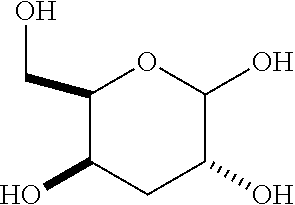 |
222 | ||
 |
223 | ||
 |
227 | ||
 |
228 | ||
 |
229 | ||
 |
230 | ||
 |
234 | ||
 |
236 | ||
 |
239 | ||
 |
242 | ||
 |
243 | ||


[(1R,2R,3R,4R,5R)-3,4-bis(methoxymethoxy)-6,8-dioxabicyclo[3.2.1]octan-2-yl] 4-methylbenzenesulfonate (215) (2.10 g, 5.19 mmol, 1.00 eq) was stirred in tetrabutylammonium fluoride (1M in THF, 55 mL, 10 equiv.) under reflux for 5 days. The black mixture was cooled and evaporated. The residue was diluted with water (100 mL) and the mixture was extracted with ethyl acetate (3×50 mL). The combined organic phases were washed with brine (100 mL), dried over sodium sulfate, filtered, and concentrated under reduced pressure. The crude material was purified by flash column chromatography (silica gel, ethyl acetate/cyclohexane, 0-30%) to give (1R,2S,3R,4R,5R)-2-fluoro-3,4-bis(methoxymethoxy)-6,8-dioxabicyclo[3.2.1]octane (216) as a pale-yellow oil (470 mg, 25% yield, 70% purity). This inseparable mixture containing the desired fluoro product and an unknown other product was used for the next step without further purification. Rf=0.51 (silica, ethyl acetate/cyclohexane 2:3). 1H NMR (400 MHz, CDCl3) was consistent with the product (215) as the major component (˜70% pure).


1,2:5,6-Di-O-isopropylidene-alpha-D-glucofuranose (218) (5000 mg, 19.2 mmol, 1.00 eq) was dissolved in pyridine (30 mL) and 4-(dimethylamino)pyridine (235 mg, 1.92 mmol, 0.1000 eq) was added followed by p-toluenesulfonyl chloride (7.32 g, 38.4 mmol, 2.00 eq). The pale-yellow reaction mixture was stirred at room temperature overnight. TLC analysis (EtOAc/cyclohexane 1:2) showed ˜1:1 starting material to product. Additional 4-(dimethylamino)pyridine (235 mg, 1.92 mmol, 0.1000 eq) was added and the mixture was stirred for 72 h and the solvent was removed in vacuo. The residue was dissolved in EtOAc and the solution washed with water (3× to remove residual pyridine), brine, dried and evaporated. The crude material was purified by silica chromatography (silica 120 g, EtOAc in cyclohexane 0-20%) which removed unreacted TsCl and the product was eluted. Product fractions were combined and evaporated to give the title compound as a white crystalline substance (219) (7 g, 88%). 1H NMR (400 MHz, CDCl3): δ 7.84 (d, J=8.3 Hz, 2H), 7.34 (d, J=8.1 Hz, 2H), 5.92 (d, J=3.7 Hz, 1H), 4.84 (d, J=3.8 Hz, 1H), 4.79 (d, J=2.4 Hz, 1H), 4.06-3.89 (m, 4H), 2.46 (s, 3H), 1.48 (s, 3H), 1.31 (s, 3H), 1.20 (s, 3H), 1.15 (s, 3H).

[(3aR,5R,6S,6aR)-5-[(4R)-2,2-dimethyl-1,3-dioxolan-4-yl]-2,2-dimethyl-3a,5,6,6a-tetrahydrofuro[2,3-d][1,3]dioxol-6-yl] 4-methylbenzenesulfonate (219) (7.00 g, 16.9 mmol, 1.00 eq) was dissolved in toluene (250 mL) and potassium hydroxide (2.94 g, 52.4 mmol, 3.10 eq) (crushed to a fine powder) was added. The reaction was heated under reflux for 5 h. TLC (25% EtOAc in cyclohexane) showed the product as the most non-polar spot with starting material just below and a more polar side product (unidentified). Heating was continued until all starting material was consumed. The reaction mixture was cooled to room temperature and water (250 mL) was added. The layers were separated, and the organic layer was washed with brine, dried (MgSO4) and the solvent removed in vacuo to give a pale-yellow oil, which was purified by silica chromatography (80 g, eluting with EtOAc/cyclohexane 0-30%) to give the title compound (220) as a clear oil (2.9 g, 70%) which crystallized to give a white solid on standing. 1H NMR (400 MHz, CDCl3): 6.08 (d, J=5.2 Hz, 1H), 5.32-5.29 (m, 1H), 5.25-5.24 (m, 1H), 4.60-4.57 (m, 1H), 4.15 (dd, J=6.8, 8.4 Hz, 1H), 3.97 (dd, J=5.7, 8.4 Hz, 1H), 1.47 (s, 6H), 1.45 (s, 3H), 1.39 (s, 3H).


(3R,5R,6R)-6-(hydroxymethyl)tetrahydropyran-2,3,5-triol (222) (90% pure, 1.20 g, 6.58 mmol, 1.00 eq) was suspended in pyridine (21.93 mL) and acetic anhydride (3.7 mL, 39.5 mmol, 6.00 eq) and 4-(dimethylamino)pyridine (80 mg, 0.658 mmol, 0.100 eq) were added. Addition of DMAP led to a slight exotherm which persisted for ˜20 minutes. The pale-yellow solution was stirred for 1 h. TLC (ethyl acetate-cyclohexane 1:1) showed one major product. The solution was concentrated in vacuo, the residue dissolved in ethyl acetate and washed with water (3×), dried (brine, sodium sulfate) and evaporated. The residue was purified on silica using 0-50% ethyl acetate in cyclohexane to give the product (0.62 g) as a clear oil. 1H NMR was consistent with a mixture of 3-4 isomeric products. The oil was re-purified on silica (40 g, 15 μm) using 0-50% TBDME in cyclohexane to give: (a) (223) (220 mg white solid, 10%): 1H NMR (400 MHz, CDCl3) consistent with desired product (axial acetate, pyran) d, 6.29 (d, J=3.1 Hz, 1H), 5.24-5.17 (m, 2H), 4.20-4.03 (m, 3H), 2.16 (s, 3H), 2.13 (s, 3H), 2.06 (s, 3H), 2.02 (s, 3H), 2.18-2.04 (m, 2H, partially hidden under acetates); and b) (223) (enriched sample was further purified by crystallization from ether) 200 mg 10% consistent with product (equatorial acetate, pyran) d, 5.71 (d, J=8.3 Hz, 1H), 5.14-5.02 (m, 2H), 4.21-4.00 (m, 3H), 2.45 (ddd, J=3.5, 5.1, 14.2 Hz, 1H), 2.13 (s, 6H), 2.06 (s, 3H), 2.05 (s, 3H), 1.80 (ddd, J=3.1, 11.3, 14.3 Hz, 1H).


(1R,2S,6S,8R,9S)-8-(fluoromethyl)-4,4,11,11-tetramethyl-3,5,7,10,12-pentaoxatricyclo[7.3.0.02,6]dodecane (368 mg, 1.40 mmol, 1.00 eq) (226) was dissolved in 90% TFA (4 mL) and the mixture was stirred at room temperature for 15 minutes. The solvent was removed in vacuo and co-evaporated with toluene twice and dried in vacuo. 1H NMR (400 MHz, MeOD-d4) was consistent with the product (227) (255 mg, 1.40 mmol, 100%) as a mixture of anomers. This polar material was taken to the next step without further purification.


[(3aR,4S,7S,7aR)-2-ethoxy-6-methoxy-4-methyl-2-phenyl-4,6,7,7a-tetrahydro-3aH-[1,3]dioxolo[4,5-c]pyran-7-yl] benzoate (232) (11.77 g, 28.4 mmol, 1.00 eq.) was treated with acetic acid (56 mL) and water (14.00 mL) and the reaction mixture was stirred overnight at room temperature. The reaction mixture was concentrated, and the residue dissolved in ethyl acetate and poured into aqueous saturated NaHCO3. The organic phase was separated and dried (Na2SO4), filtered and the volatiles evaporated to give a crude product (12.5 g). Recrystallization from ethyl acetate/dichloromethane, gave the title compound (234) (3.3 g, 30%) as a white solid. The mother liquors were further recrystallized from ethyl acetate: dichloromethane to give a second crop of the desired product (234) (2.46 g, 22%) as a white solid. The second mother liquors were concentrated to give an oily product (4.6 g) purified by flash chromatography, (80 silica cartridge eluted with cyclohexane: ethyl acetate (2-35%)) to give after evaporation more of the title compound (234) (1 g, 9%) as a white solid. 1H NMR (300 MHz, CDCl3): δ 8.19-8.08 (m, 4H), 7.63-7.44 (m, 6H), 5.58 (dd, J=1.2, 3.6 Hz, 1H), 5.37 (dd, J=3.6, 10.4 Hz, 1H), 5.13 (d, J=3.7 Hz, 1H), 4.54-4.46 (m, 1H), 4.30-4.22 (m, 1H), 3.46 (s, 3H), 2.22 (d, J=6.1 Hz, 1H), 1.27 (d, J=6.6 Hz, 3H).

[(2S,3S,4R,5S)-5-benzoyloxy-4-hydroxy-6-methoxy-2-methyl-tetrahydropyran-3-yl] benzoate (234) (3.30 g, 8.54 mmol, 1.00 eq.) was dissolved in toluene (30 mL) and treated with 1,1-thiocarbonyldiimidazole (1826 mg, 10.2 mmol, 1.20 eq). The reaction was heated at 70° C. and monitored by LCMS. After 4 h, the reaction mixture was concentrated to give a crude product purified by flash chromatography, (40 g silica cartridge eluted with cyclohexane: ethyl acetate (1-35%)) to give the title compound (235) (4.08 g, 95%) as white solid. 1H NMR (300 MHz, CDCl3): δ 8.13-8.09 (m, 3H), 8.02-7.98 (m, 2H), 7.69-7.62 (m, 1H), 7.60-7.49 (m, 3H), 7.46-7.39 (m, 2H), 7.36-7.34 (m, 1H), 6.86-6.84 (m, 1H), 6.41 (dd, J=3.3, 10.7 Hz, 1H), 5.90-5.88 (m, 1H), 5.79 (dd, J=3.8, 10.5 Hz, 1H), 5.23 (d, J=3.6 Hz, 1H), 4.45-4.38 (m, 1H), 3.52 (s, 3H), 1.32 (d, J=6.5 Hz, 3H).


1,2:5,6-Di-O-isopropylidene-α-D-gulofuranose (237) (3.00 g, 11.5 mmol, 1 eq.) was dissolved in dichloromethane (20 mL) and the solution cooled to −10° C. 4-(Dimethylamino)pyridine (2.82 g, 23.1 mmol, 2.00 eq) was added to the reaction mixture followed by slow addition of (Diethylamino)sulfur trifluoride (3.0 mL, 23.1 mmol, 2.00 eq). The reaction mixture was allowed to warm to room temperature and monitored by TLC (7:3 cyclohexane: ethyl acetate). After 24 h, a new spot at Rf 0.7 was observed and the reaction mixture was cooled to −20° C., MeOH was slowly added while the temperature was maintained between −20° C. and −10° C. The mixture was allowed to warm to room temperature and then was partitioned between aqueous saturated NaHCO3 and dichloromethane. The organic layer was passed through a phase separator cartridge and the solvent evaporated to give a crude product (4.1 g) purified by flash chromatography using cyclohexane: ethyl acetate (1 to 35%) to give the title compound (238) (3.0 g, 99%) as a colorless oil which later crystallized. 1H NMR (300 MHz, CDCl3): d, 5.94 (d, J=3.8 Hz, 1H), 4.85 (dd, J=3.6, 40.8 Hz, 1H), 4.74 (dd, J=3.9, 3.9 Hz, 1H), 4.39-4.32 (m, 1H), 4.20-4.06 (m, 2H), 3.84 (dd, J=6.6, 8.3 Hz, 1H), 1.56 (s, 3H), 1.47 (s, 3H), 1.40 (s, 3H), 1.37 (s, 3H).

3-Deoxy-3-fluoro-1,2:5,6-di-O-isopropylidene-α-D-galactofuranose (3aR,5S,6S,6aS)-5-[(4R)-2,2-dimethyl-1,3-dioxolan-4-yl]-6-fluoro-2,2-dimethyl-3a,5,6,6a-tetrahydrofuro[2,3-d][1,3]dioxole (238) (380 mg, 1.45 mmol, 1.00 eq) was dissolved in ethanol (16 mL) and water (33.00 mL). Amberlite IR-120 (H+) (ca. 3 mL) was added, and the reaction mixture was stirred at 60-65° C. and monitored by TLC (1:1 ethyl acetate: cyclohexane). After 4 h, TLC indicated the disappearance of starting material. The reaction mixture was filtered and concentrated in vacuo to give a crude product (216 mg) as the expected pyranose which was confirmed by 1H NMR. The crude material was dissolved in dry pyridine (3.00 mL), cooled to 0° C. under a nitrogen atmosphere and treated with acetic anhydride (0.68 mL, 7.24 mmol, 5.00 eq). The reaction mixture was allowed to warm to room temperature and monitored by TLC (3:7 ethyl acetate: cyclohexane). After 24 h, TLC showed a major sport at Rf 0.5 for the expected product. The reaction mixture was concentrated, and the residue evaporated from toluene (5 mL). The crude oil was partitioned between ethyl acetate and aqueous saturated NaHCO3. The organic layer was separated, dried (Na2SO4), filtered and the volatiles evaporated to give an oil (385 mg) which was purified by flash chromatography (12 g silica cartridge eluted with cyclohexane: ethyl acetate (2 to 50%)) gave the title compound (239) as an anomeric mixture (258 mg) of a colorless dense oil. 1H NMR (400 MHz, CDCl3): δ 6.42 (t, J=4.2, 1H), 5.72-5.68 (m, 1H), 5.67 (d, J=8.3 Hz, 1H), 5.62 (m, 1H), 5.48-5.39 (m, 2H), 4.97 (ddd, J=3.8, 10.2, 48.4 Hz, 1H), 4.71 (ddd, J=3.8, 9.7, 47.3 Hz, 1H), 4.33-4.29 (m, 1H), 4.25-4.07 (m, 4H), 4.00 (tt, J=1.5, 6.5 Hz, 1H), 2.21 (s, 3H), 2.20 (s, 3H), 2.18 (s, 3H), 2.16 (s, 3H), 2.13 (s, 3H), 2.10 (s, 3H), 2.09 (s, 3H), 2.08 (s, 3H).


(1S,2R,6R,8S,9R)-8-(fluoromethyl)-4,4,11,11-tetramethyl-3,5,7,10,12-pentaoxatricyclo[7.3.0.02,6]dodecane (241) (913 mg, 3.48 mmol, 1.00 eq) was treated with a mixture of trifluoroacetic acid (8.0 mL, 0.104 mol, 30.0 eq) and water (0.92 mL). The reaction mixture was stirred at room temperature and monitored by TLC (ethyl acetate: cyclohexane 1:1). After 0.5 h the reaction was diluted with toluene and concentrated under reduced pressure to give the crude title compound (242) (1.0 g) as a pale beige syrup taken directly into the next synthetic step.

(3R,4S,5R,6S)-6-(fluoromethyl)tetrahydropyran-2,3,4,5-tetrol (634 mg, 3.48 mmol, 1.00 eq) (242) was dissolved in dry pyridine (10 mL), cooled at 0° C. and treated with acetic anhydride (3.3 mL, 34.8 mmol, 10.0 eq). The reaction mixture was stirred at room temperature under nitrogen and monitored by TLC (1:4 ethyl acetate: dichloromethane). After 5h, the reaction was diluted with toluene (3×) and concentrated under reduced pressure to remove any excess reagent. The oily residue was purified by flash chromatography (12 g cartridge eluted with ethyl acetate: dichloromethane (1:9)) to give the title compound (243) (960 mg, 79%) (anomeric mixture) as a colorless oil.
LCMS Methods:
Claims (6)


Priority Applications (2)
| Application Number | Priority Date | Filing Date | Title |
|---|---|---|---|
| US17/944,019 US11897915B2 (en) | 2021-09-13 | 2022-09-13 | Sugar derivatives and uses thereof to prepare novel senolytic agents |
| US18/403,174 US20240182506A1 (en) | 2021-09-13 | 2024-01-03 | Sugar Derivatives and Uses Thereof to Prepare Novel Senolytic Agents |
Applications Claiming Priority (2)
| Application Number | Priority Date | Filing Date | Title |
|---|---|---|---|
| US202163243542P | 2021-09-13 | 2021-09-13 | |
| US17/944,019 US11897915B2 (en) | 2021-09-13 | 2022-09-13 | Sugar derivatives and uses thereof to prepare novel senolytic agents |
Related Child Applications (1)
| Application Number | Title | Priority Date | Filing Date |
|---|---|---|---|
| US18/403,174 Continuation US20240182506A1 (en) | 2021-09-13 | 2024-01-03 | Sugar Derivatives and Uses Thereof to Prepare Novel Senolytic Agents |
Publications (2)
| Publication Number | Publication Date |
|---|---|
| US20230096764A1 US20230096764A1 (en) | 2023-03-30 |
| US11897915B2 true US11897915B2 (en) | 2024-02-13 |
Family
ID=85507608
Family Applications (2)
| Application Number | Title | Priority Date | Filing Date |
|---|---|---|---|
| US17/944,019 Active US11897915B2 (en) | 2021-09-13 | 2022-09-13 | Sugar derivatives and uses thereof to prepare novel senolytic agents |
| US18/403,174 Abandoned US20240182506A1 (en) | 2021-09-13 | 2024-01-03 | Sugar Derivatives and Uses Thereof to Prepare Novel Senolytic Agents |
Family Applications After (1)
| Application Number | Title | Priority Date | Filing Date |
|---|---|---|---|
| US18/403,174 Abandoned US20240182506A1 (en) | 2021-09-13 | 2024-01-03 | Sugar Derivatives and Uses Thereof to Prepare Novel Senolytic Agents |
Country Status (4)
| Country | Link |
|---|---|
| US (2) | US11897915B2 (en) |
| EP (1) | EP4380945A4 (en) |
| JP (1) | JP2024534989A (en) |
| WO (1) | WO2023039292A2 (en) |
Families Citing this family (1)
| Publication number | Priority date | Publication date | Assignee | Title |
|---|---|---|---|---|
| WO2023039293A1 (en) * | 2021-09-13 | 2023-03-16 | Rubedo Life Sciences, Inc. | Coumarin derivatives of sugar analogs and uses thereof |
Citations (3)
| Publication number | Priority date | Publication date | Assignee | Title |
|---|---|---|---|---|
| US6706888B2 (en) | 2002-02-08 | 2004-03-16 | Yuhan Corporation | Processes for preparing imidazole derivatives and salts thereof |
| US20160339019A1 (en) | 2014-01-28 | 2016-11-24 | Buck Institute For Research On Aging | Methods and compositions for killing senescent cells and for treating senescence-associated diseases and disorders |
| US20200016185A1 (en) * | 2018-07-11 | 2020-01-16 | Rubedo Life Sciences, Inc. | Senolytic compositions and uses thereof |
Family Cites Families (2)
| Publication number | Priority date | Publication date | Assignee | Title |
|---|---|---|---|---|
| DK2890981T3 (en) * | 2012-08-28 | 2019-03-04 | Univ Tuebingen Medizinische Fakultaet | Senescence tracers |
| WO2023039600A1 (en) * | 2021-09-13 | 2023-03-16 | Rubedo Life Sciences, Inc. | Drug conjugates of sugar derivatives and uses thereof as senolytic agents |
-
2022
- 2022-09-13 US US17/944,019 patent/US11897915B2/en active Active
- 2022-09-13 JP JP2024515578A patent/JP2024534989A/en active Pending
- 2022-09-13 EP EP22868207.6A patent/EP4380945A4/en active Pending
- 2022-09-13 WO PCT/US2022/043370 patent/WO2023039292A2/en not_active Ceased
-
2024
- 2024-01-03 US US18/403,174 patent/US20240182506A1/en not_active Abandoned
Patent Citations (4)
| Publication number | Priority date | Publication date | Assignee | Title |
|---|---|---|---|---|
| US6706888B2 (en) | 2002-02-08 | 2004-03-16 | Yuhan Corporation | Processes for preparing imidazole derivatives and salts thereof |
| US20160339019A1 (en) | 2014-01-28 | 2016-11-24 | Buck Institute For Research On Aging | Methods and compositions for killing senescent cells and for treating senescence-associated diseases and disorders |
| US20200016185A1 (en) * | 2018-07-11 | 2020-01-16 | Rubedo Life Sciences, Inc. | Senolytic compositions and uses thereof |
| US11026963B2 (en) | 2018-07-11 | 2021-06-08 | Rubedo Life Sciences, Inc. | Senolytic compositions and uses thereof |
Non-Patent Citations (15)
| Title |
|---|
| Childs, B., Gluscevic, M., Baker, D. et al. Senescent cells: an emerging target for diseases of ageing. Nat Rev Drug Discov 16, 718-735 (2017). <https://doi.org/10.1038/nrd.2017.116>. |
| Demaria M, O'Leary MN, Chang J, Shao L, Liu S, Alimirah F, Koenig K, Le C, Mitin N, Deal AM, Alston S, Academia EC, Kilmarx S, Valdovinos A, Wang B, de Bruin A, Kennedy BK, Melov S, Zhou D, Sharpless NE, Muss H, Campisi J. Cellular Senescence Promotes Adverse Effects of Chemotherapy and Cancer Relapse. Cancer Discov. Feb. 2017;7(2):165-176. doi: 10.1158/2159-8290.CD-16-0241. Epub Dec. 15, 2016. PMID: 27979832; PMCID: PMC5296251. |
| Fuhrmann-Stroissnigg, H., Ling, Y.Y., Zhao, J. et al. Identification of HSP90 inhibitors as a novel class of senolytics. Nat Commun 8, 422 (2017). <https://doi.org/10.1038/s41467-017-00314-z>. |
| Grindley, T. Bruce, and Rasiah Thangarasa. "Selective mono-esterification and alkylation of 1, 6-anhydro-ß-d-glucopyranose via its dibutylstannylene derivative." Carbohydrate research 172.2 (1988): 311-318. |
| Guillory, K., Chapter 5, pp. 202-205 in Polymorphism in Pharmaceutical Solids, (Brittain, H. ed.), Marcel Dekker, Inc., New York, NY, 1999). |
| Holodiag, Pharmaparc II, Voie de l'Innovation, 27 100 Val de Reuil, France; accessed Jun. 29, 2023 http://www.holodiag.com. |
| Laberge RM, Sun Y, Orjalo AV, Patil CK, Freund A, Zhou L, Curran SC, Davalos AR, Wilson-Edell KA, Liu S, Limbad C, Demaria M, Li P, Hubbard GB, Ikeno Y, Javors M, Desprez PY, Benz CC, Kapahi P, Nelson PS, Campisi J. MTOR regulates the pro-tumorigenic senescence-associated secretory phenotype by promoting IL1A translation. Nat Cell Biol. Aug. 2015;17(8):1049-61. doi: 10.1038/ncb3195. Epub Jul. 6, 2015. Erratum in: Nat Cell Biol. May 2021;23(5):564-565. PMID: 26147250; PMCID: PMC4691706. |
| Samaraweera, L., Adomako, A., Rodriguez-Gabin, A. et al. A Novel Indication for Panobinostat as a Senolytic Drug in NSCLC and HNSCC. Sci Rep 7, 1900 (2017). <https://doi.org/10.1038/s41598-017-01964-1>. |
| Schafer, M., White, T., Iijima, K. et al. Cellular senescence mediates fibrotic pulmonary disease. Nat Commun 8, 14532 (2017). <https://doi.org/10.1038/ncomms14532>. |
| U.S. Appl. No. 17/943,824, filed Sep. 13, 2022, First Named Inventor : Marco Quarta; 152 pages. |
| U.S. Appl. No. 17/943,836, filed Sep. 13, 2022, First Named Inventor : Paul Keitz; 86 pages. |
| Whittaker SR, Mallinger A, Workman P, Clarke PA. Inhibitors of cyclin-dependent kinases as cancer therapeutics. Pharmacol Ther. May 2017;173:83-105. doi: 10.1016/j.pharmthera.2017.02.008. Epub Feb. 5, 2017. PMID: 28174091; PMCID: PMC6141011. |
| Yosef R, Pilpel N, Tokarsky-Amiel R, Biran A, Ovadya Y, Cohen S, Vadai E, Dassa L, Shahar E, Condiotti R, Ben-Porath I, Krizhanovsky V. Directed elimination of senescent cells by inhibition of BCL-W and BCL-XL. Nat Commun. Apr. 6, 2016;7:11190. doi: 10.1038/ncomms11190. PMID: 27048913; PMCID: PMC4823827. |
| Zhu Y, Doomebal EJ, Pirtskhalava T, Giorgadze N, Wentworth M, Fuhrmann-Stroissnigg H, Niedernhofer LJ, Robbins PD, Tchkonia T, Kirkland JL. New agents that target senescent cells: the flavone, fisetin, and the BCL-XL inhibitors, A1331852 and A1155463. Aging (Albany NY). Mar. 8, 2017;9(3):955-963. doi: 10.18632/aging.101202. PMID: 28273655; PMCID: PMC5391241. |
| Zhu Y, Ichkonia I, Pirtskhalava I, Gower AC, Ding H, Giorgadze N, Palmer AK, Ikeno Y, Hubbard GB, Lenburg M, O'Hara SP, LaRusso NF, Miller JD, Roos CM, Verzosa GC, LeBrasseur NK, Wren JD, Farr JN, Khosla S, Stout MB, McGowan SJ, Fuhrmann-Stroissnigg H, Gurkar AU, Zhao J, Colangelo D, Dorronsoro A, Ling YY, Barghouthy AS, Navarro DC, Sano T, Robbins PD, Niedernhofer LJ, Kirkland JL. The Achilles' heel of senescent cells: from transcriptome to senolytic drugs. Aging Cell. Aug. 2015;14(4):644-58. doi: 10.1111/acel.12344. Epub Apr. 22, 2015. |
Also Published As
| Publication number | Publication date |
|---|---|
| US20240182506A1 (en) | 2024-06-06 |
| WO2023039292A3 (en) | 2023-04-13 |
| US20230096764A1 (en) | 2023-03-30 |
| WO2023039292A2 (en) | 2023-03-16 |
| JP2024534989A (en) | 2024-09-26 |
| EP4380945A4 (en) | 2025-07-09 |
| EP4380945A2 (en) | 2024-06-12 |
Similar Documents
| Publication | Publication Date | Title |
|---|---|---|
| EP3663292B1 (en) | Diphenylmethane derivative in crystalline form | |
| EP0656360B1 (en) | Trifluoromethylpyrroloindole carboxylic ester derivative and process for producing the same | |
| EP2597090A1 (en) | Crystalline dapagliflozin hydrate | |
| RS55555B1 (en) | PROCEDURES FOR PREPARING SGLT2 INHIBITOR | |
| TW202102509A (en) | Compounds targeting prmt5 | |
| US10815228B2 (en) | Aztreonam derivatives and uses thereof | |
| JP2022510424A (en) | Quaternary ammonium salt as an inhibitor of trimethylamine production | |
| US20250340532A1 (en) | Heterocyclic compound ccr4 inhibitor and user thereof | |
| US20260078109A1 (en) | Method for preparing sglt inhibitor | |
| EA020566B1 (en) | Spirocyclic amide derivatives | |
| US20240182506A1 (en) | Sugar Derivatives and Uses Thereof to Prepare Novel Senolytic Agents | |
| US20260007684A1 (en) | Amide derivatives for inhibiting nlrp3 and uses thereof | |
| CN103974965B (en) | Sialic acid analogues | |
| CA2895829A1 (en) | Novel methysergide derivatives | |
| US20220340599A1 (en) | Ampk activators | |
| JP4590268B2 (en) | Epothilone derivatives | |
| US20240208968A1 (en) | Alpha v beta 6 and alpha v beta 1 integrin inhibitors and uses thereof | |
| CA2996263A1 (en) | Sulfonamide compounds as voltage-gated sodium channel modulators | |
| US20130217640A1 (en) | Glycosylated acetaminophen pro-drug | |
| US20230138729A1 (en) | Coumarin Derivatives of Sugar Analogs and Uses Thereof | |
| EP3735233A1 (en) | Artemisinic acid glycoconjugate compounds, process for preparation and use thereof | |
| Matsushima et al. | A versatile route to 2, 4, 6-trideoxy-4-aminohexoses: Stereoselective syntheses of D-vicenisamine and its epimers via iodocyclization of carbamate | |
| WO1998011105A1 (en) | New pharmaceutically active compounds | |
| US8957097B2 (en) | Hemi-phorboxazole A derivatives and methods of their use | |
| US20200339507A1 (en) | Methods of synthesizing aztreonam derivatives |
Legal Events
| Date | Code | Title | Description |
|---|---|---|---|
| FEPP | Fee payment procedure |
Free format text: ENTITY STATUS SET TO UNDISCOUNTED (ORIGINAL EVENT CODE: BIG.); ENTITY STATUS OF PATENT OWNER: SMALL ENTITY |
|
| FEPP | Fee payment procedure |
Free format text: ENTITY STATUS SET TO SMALL (ORIGINAL EVENT CODE: SMAL); ENTITY STATUS OF PATENT OWNER: SMALL ENTITY |
|
| STPP | Information on status: patent application and granting procedure in general |
Free format text: DOCKETED NEW CASE - READY FOR EXAMINATION |
|
| AS | Assignment |
Owner name: RUBEDO LIFE SCIENCES, INC., CALIFORNIA Free format text: ASSIGNMENT OF ASSIGNORS INTEREST;ASSIGNORS:KEITZ, PAUL;BERGNES, GUS;GALLOP, MARK A.;AND OTHERS;SIGNING DATES FROM 20220922 TO 20221105;REEL/FRAME:061733/0400 |
|
| STPP | Information on status: patent application and granting procedure in general |
Free format text: NON FINAL ACTION MAILED |
|
| STPP | Information on status: patent application and granting procedure in general |
Free format text: RESPONSE TO NON-FINAL OFFICE ACTION ENTERED AND FORWARDED TO EXAMINER |
|
| STPP | Information on status: patent application and granting procedure in general |
Free format text: NOTICE OF ALLOWANCE MAILED -- APPLICATION RECEIVED IN OFFICE OF PUBLICATIONS |
|
| STPP | Information on status: patent application and granting procedure in general |
Free format text: PUBLICATIONS -- ISSUE FEE PAYMENT RECEIVED |
|
| STPP | Information on status: patent application and granting procedure in general |
Free format text: PUBLICATIONS -- ISSUE FEE PAYMENT VERIFIED |
|
| STCF | Information on status: patent grant |
Free format text: PATENTED CASE |
|
| CC | Certificate of correction |