US11893495B2 - Dual neural network architecture for determining epistemic and aleatoric uncertainties - Google Patents
Dual neural network architecture for determining epistemic and aleatoric uncertainties Download PDFInfo
- Publication number
- US11893495B2 US11893495B2 US16/948,183 US202016948183A US11893495B2 US 11893495 B2 US11893495 B2 US 11893495B2 US 202016948183 A US202016948183 A US 202016948183A US 11893495 B2 US11893495 B2 US 11893495B2
- Authority
- US
- United States
- Prior art keywords
- neural network
- uncertainty
- output
- geological formation
- unknown
- Prior art date
- Legal status (The legal status is an assumption and is not a legal conclusion. Google has not performed a legal analysis and makes no representation as to the accuracy of the status listed.)
- Active, expires
Links
Images




Classifications
-
- G—PHYSICS
- G06—COMPUTING OR CALCULATING; COUNTING
- G06N—COMPUTING ARRANGEMENTS BASED ON SPECIFIC COMPUTATIONAL MODELS
- G06N3/00—Computing arrangements based on biological models
- G06N3/02—Neural networks
- G06N3/08—Learning methods
- G06N3/084—Backpropagation, e.g. using gradient descent
-
- G—PHYSICS
- G06—COMPUTING OR CALCULATING; COUNTING
- G06F—ELECTRIC DIGITAL DATA PROCESSING
- G06F18/00—Pattern recognition
- G06F18/20—Analysing
- G06F18/21—Design or setup of recognition systems or techniques; Extraction of features in feature space; Blind source separation
- G06F18/214—Generating training patterns; Bootstrap methods, e.g. bagging or boosting
- G06F18/2155—Generating training patterns; Bootstrap methods, e.g. bagging or boosting characterised by the incorporation of unlabelled data, e.g. multiple instance learning [MIL], semi-supervised techniques using expectation-maximisation [EM] or naïve labelling
-
- G—PHYSICS
- G06—COMPUTING OR CALCULATING; COUNTING
- G06F—ELECTRIC DIGITAL DATA PROCESSING
- G06F18/00—Pattern recognition
- G06F18/20—Analysing
- G06F18/24—Classification techniques
- G06F18/241—Classification techniques relating to the classification model, e.g. parametric or non-parametric approaches
- G06F18/2413—Classification techniques relating to the classification model, e.g. parametric or non-parametric approaches based on distances to training or reference patterns
- G06F18/24133—Distances to prototypes
-
- G—PHYSICS
- G06—COMPUTING OR CALCULATING; COUNTING
- G06F—ELECTRIC DIGITAL DATA PROCESSING
- G06F18/00—Pattern recognition
- G06F18/20—Analysing
- G06F18/24—Classification techniques
- G06F18/241—Classification techniques relating to the classification model, e.g. parametric or non-parametric approaches
- G06F18/2415—Classification techniques relating to the classification model, e.g. parametric or non-parametric approaches based on parametric or probabilistic models, e.g. based on likelihood ratio or false acceptance rate versus a false rejection rate
- G06F18/24155—Bayesian classification
-
- G—PHYSICS
- G06—COMPUTING OR CALCULATING; COUNTING
- G06N—COMPUTING ARRANGEMENTS BASED ON SPECIFIC COMPUTATIONAL MODELS
- G06N3/00—Computing arrangements based on biological models
- G06N3/02—Neural networks
- G06N3/04—Architecture, e.g. interconnection topology
- G06N3/045—Combinations of networks
-
- G—PHYSICS
- G06—COMPUTING OR CALCULATING; COUNTING
- G06N—COMPUTING ARRANGEMENTS BASED ON SPECIFIC COMPUTATIONAL MODELS
- G06N3/00—Computing arrangements based on biological models
- G06N3/02—Neural networks
- G06N3/04—Architecture, e.g. interconnection topology
- G06N3/047—Probabilistic or stochastic networks
-
- G—PHYSICS
- G06—COMPUTING OR CALCULATING; COUNTING
- G06N—COMPUTING ARRANGEMENTS BASED ON SPECIFIC COMPUTATIONAL MODELS
- G06N3/00—Computing arrangements based on biological models
- G06N3/02—Neural networks
- G06N3/04—Architecture, e.g. interconnection topology
- G06N3/0499—Feedforward networks
-
- G—PHYSICS
- G06—COMPUTING OR CALCULATING; COUNTING
- G06N—COMPUTING ARRANGEMENTS BASED ON SPECIFIC COMPUTATIONAL MODELS
- G06N3/00—Computing arrangements based on biological models
- G06N3/02—Neural networks
- G06N3/08—Learning methods
-
- G—PHYSICS
- G06—COMPUTING OR CALCULATING; COUNTING
- G06N—COMPUTING ARRANGEMENTS BASED ON SPECIFIC COMPUTATIONAL MODELS
- G06N3/00—Computing arrangements based on biological models
- G06N3/02—Neural networks
- G06N3/08—Learning methods
- G06N3/09—Supervised learning
-
- G—PHYSICS
- G06—COMPUTING OR CALCULATING; COUNTING
- G06N—COMPUTING ARRANGEMENTS BASED ON SPECIFIC COMPUTATIONAL MODELS
- G06N5/00—Computing arrangements using knowledge-based models
- G06N5/04—Inference or reasoning models
-
- G—PHYSICS
- G06—COMPUTING OR CALCULATING; COUNTING
- G06N—COMPUTING ARRANGEMENTS BASED ON SPECIFIC COMPUTATIONAL MODELS
- G06N3/00—Computing arrangements based on biological models
- G06N3/02—Neural networks
- G06N3/08—Learning methods
- G06N3/082—Learning methods modifying the architecture, e.g. adding, deleting or silencing nodes or connections
Definitions
- the present disclosure relates to deep learning techniques.
- Bayesian Neural Networks have been traditionally used for uncertainty estimation in supervised learning settings, for both regression and classification problems. This method works by determining the posterior weight distributions of deep neural networks, and therefore providing both a mean and a variance of the estimated outputs. As these weight distributions provide the epistemic (model) uncertainty, Bayesian Neural Networks can be used to differentiate in and out of distribution (OOD) predictions. See Kendall et al., “What uncertainties do we need in Bayesian deep learning for computer vision?”, Advances in neural information processing systems, 2017, hereinafter Kendall.
- This model enables the tuning of the standard deviation ( ⁇ i ), with respect to the mean square error while the second term prevents the assignment of very high uncertainty values for all data points.
- Neural network systems and related machine learning methods use a dual neural network architecture to determined epistemic and aleatoric uncertainties associated with predicted output data.
- a neural network system includes a first neural network and a second neural network.
- the first neural network can be configured to predict a mean value output and epistemic uncertainty of the output given input data.
- the second neural network can be configured to predict total uncertainty of the output of the first neural network.
- a module can be configured to determine aleatoric uncertainty of the output of the first neural network based on the epistemic uncertainty of the output and the total uncertainty of the output.
- the first neural network of the system can be a Bayesian neural network or an artificial neural network with dropout.
- the second neural network of the system can be an artificial neural network or an additional Bayesian neural network.
- the aleatoric uncertainty of the output can be sensitive to heteroscedastic noise in the input data.
- the second neural network of the system can be trained to predict total uncertainty of the output of the first neural network given the input data.
- the error of the first neural network can be used to train the second neural network to learn a mapping between the input data and total uncertainty of the output of the first neural network.
- the same input data can be applied to both the first neural network and the second neural network simultaneously or in a parallel manner.
- the second neural network of the system can be trained by minimizing a cost function that involves differences between a predicted mean value output of the first neural network and a ground-truth value of the output.
- the first neural network of the system can be trained by minimizing a cost function that involves a ground-truth value of the output.
- the first neural network of the system can be trained to predict a mean value and epistemic uncertainty of an unknown geophysical property of a geological formation given a vector of measurement data of the geological formation as input.
- the second neural network can be trained to predict total uncertainty of the unknown geophysical property of the geological formation given the same vector of measurement data of the geological formation as input.
- the module can be configured to determine aleatoric uncertainty of the unknown geophysical property of the geological formation based on the epistemic uncertainty of the unknown geophysical property of the geological formation and the total uncertainty of the unknown geophysical property of the geological formation.
- At least one of the first neural network, the second neural network and the module of the system can be realized by a processor.
- a machine learning method in another aspect, involves a training phase and an inference phase.
- a first neural network is trained to predict a mean value output and epistemic uncertainty of the output given input data
- a second neural network is trained to predict total uncertainty of the output of the first neural network.
- input data is supplied to the trained first neural network to predict a mean value output as well as the epistemic uncertainty of the output given said input data
- the trained second neural network is used to predict total uncertainty of the output of the trained first neural network
- aleatoric uncertainty of the output of the first neural network is determined based on the epistemic uncertainty of the output and the total uncertainty of the output.
- the first neural network of the method can be a Bayesian neural network or an artificial neural network with dropout.
- the second neural network of the method can be an artificial neural network or an additional Bayesian neural network.
- the aleatoric uncertainty of the output can be sensitive to heteroscedastic noise in the input data.
- the training phase of the method can further comprise training the second neural network to predict total uncertainty of the output of the first neural network given the input data.
- the training phase of the method can further comprise using error of the first neural network to train the second neural network to learn a mapping between the input data and total uncertainty of the output of the first neural network.
- the training phase of the method can further comprise training the second neural network by minimizing a cost function that involves differences between a predicted mean value of the output of the first neural network and a ground-truth value of the output.
- the training phase of the method can further comprise training the first neural network by minimizing a cost function that involves a ground-truth value of the output.
- the same input data can be applied to both the first neural network and the second neural network simultaneously or in a parallel manner.
- a machine learning method for geological formation modeling involves a training phase and an inference phase.
- a first neural network is trained to predict a mean value and epistemic uncertainty of an unknown geophysical property of a geological formation given a vector of measurement data of the geological formation as input
- a second neural network is trained to predict total uncertainty of the unknown geophysical property of the geological formation given the same vector of measurement data of the geological formation as input.
- At least one vector of measurement data of a geological formation is input to the trained Bayesian neural network to predict a mean value and epistemic uncertainty of the unknown geophysical property of the geological formation
- the trained second neural network is used to predict total uncertainty of the unknown geophysical property of the geological formation
- aleatoric uncertainty of the unknown geophysical property of the geological formation is determined based on the epistemic uncertainty and the total uncertainty of the unknown geophysical property of the geological formation.
- the first neural network of the method for geological formation modeling can be a Bayesian neural network or an artificial neural network with dropout.
- the second neural network of the method for geological formation modeling can be an artificial neural network or an additional Bayesian neural network.
- the aleatoric uncertainty of the unknown geophysical property of the geological formation can be sensitive to heteroscedastic noise in the measurement data of the geological formation.
- the training phase of the method can further comprise training the first neural network by minimizing a cost function that involves a ground-truth value of the geophysical property of the geological formation.
- the training phase of the method can further comprise training the second neural network by minimizing a cost function that involves differences between a predicted mean value of the unknown geophysical property of the geological formation from the first neural network and a ground-truth value of the geophysical property of the geological formation.
- At least one of the first neural network and the second neural network of the method for geological formation modeling can be realized by a processor.
- the training phase of the method can involve applying the vector of measurement data of the geological formation to both the first neural network and the second neural network simultaneously or in a parallel manner.
- the method for geological formation modeling can further comprise performing the operations of the inference phase over a plurality of vectors of measurement data of the geological formation at varying depths to predict the geophysical property of the geological formation and associated epistemic uncertainty and aleatoric uncertainty at the varying depths.
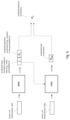
- FIG. 1 is a schematic diagram of a neural network system including a Bayesian Neural Network (BNN) and Artificial Neural Network (ANN).
- the BNN is configured to predict or estimate a mean output and associated standard deviation (epistemic uncertainty) given a vector of feature data input to the BNN.
- the error of the BNN is used to train a second network (ANN) which is configured to estimate total uncertainty ( ⁇ tot ) of the output of the BNN given the same vector of feature data as input.
- the difference between this total uncertainty ( ⁇ tot ) and the epistemic uncertainty ( ⁇ 1 ) as output by the BNN reflects aleatoric uncertainty ( ⁇ 2 ) of the output data of the BNN.
- FIG. 2 depicts a pair plot of the in-distribution (ID) feature data used for training and testing the neural network system of FIG. 1 along with out-of-distribution (OOD) feature data used for testing the neural network system of FIG. 1 .
- ID in-distribution
- OOD out-of-distribution
- FIG. 3 A depicts a plot which shows the root mean square error (RMSE) of the BNN of FIG. 1 as a function of iteration number for the training and testing of the BNN of FIG. 1 using the ID feature data as well as the testing of the BNN of FIG. 1 using the OOD feature data 1 ; this plots reflects the higher accuracy of the training and testing using the ID feature data in comparison to the testing using OOD feature data.
- RMSE root mean square error
- FIG. 3 B depicts a plot that shows the correlation of the epistemic uncertainty with the absolute error for the training and testing of the BNN of FIG. 1 using the ID feature data.
- FIG. 3 C depicts a plot that shows the correlation of the epistemic uncertainty with the absolute error for the testing of the BNN of FIG. 1 using the OOD feature data.
- FIG. 4 A depicts a plot which shows the RMSE for the total uncertainty predicted by the ANN as a function of iteration number for the training and testing of the ANN of FIG. 1 using the ID feature data as well as the testing of the ANN of FIG. 1 using the OOD feature data; this plot reflects the higher accuracy of the training and testing of the ANN of FIG. 1 using the ID feature data in comparison to the testing of the ANN of FIG. 1 using the OOD feature data.
- FIG. 4 B depicts a plot that shows the correlation of the aleatoric uncertainties ( ⁇ 2 ) with the absolute error for the training and testing of the ANN of FIG. 1 using the ID feature data.
- FIG. 4 C depicts a plot that shows the correlation of the aleatoric uncertainties ( ⁇ 2 ) with the absolute error for the testing of the ANN of FIG. 1 using the OOD feature data.
- FIG. 5 A is a plot of the epistemic uncertainty ⁇ 1 predicted by the dual network system of FIG. 1 for training datasets that include the addition of synesthetic low noise and high noise.
- FIG. 5 B is a plot of the aleatoric uncertainty ⁇ 2 predicted by the dual network system of FIG. 1 for training datasets that include the addition of synesthetic low noise and high noise.
- FIG. 6 is a schematic diagram of a neural network system including a Bayesian Neural Network (BNN) and Artificial Neural Network (ANN), which is configured to infer or predict mean formation property data along with epistemic uncertainty, aleatoric uncertainty and total uncertainty associated therewith given a vector of measurement data of a geological formation as input.
- BNN Bayesian Neural Network
- ANN Artificial Neural Network
- FIG. 7 is a diagram illustrating an example training iteration of the BNN of FIG. 6 .
- FIG. 8 is a diagram illustrating an example training iteration of the ANN of FIG. 6 .
- FIG. 9 is a schematic diagram of an exemplary neural network.
- FIG. 10 is block diagram of an exemplary computer processing system.
- Deep learning techniques have been shown to be extremely effective for various classification and regression problems, but quantifying the uncertainty of their predictions and, separating them into the epistemic and aleatoric fractions is still considered challenging. Understanding the source of the uncertainty and reducing the uncertainty is key to designing intelligent applications, such as automated log interpretation answer products for oil and gas exploration and field development.
- a challenge of importance in such petrophysical applications is the ability to identify out of distribution testing data (that is data which has not been seen while training the model), or the ability to be sensitive to heteroscedastic aleatoric noise in the feature space arising from tool and geological conditions.
- BNN Bayesian Neural Network
- ANN Artificial Neural Network
- a neural network is a computational model that includes a collection of layers of nodes interconnected by edges with weights and activation functions associated with the nodes. Inputs are applied to one or more input nodes of the neural network and propagate through the neural network in a manner influenced by the weights and activation functions of the nodes, e.g., the output of a node is related to the application of the activation function to the weighted sum of its inputs). As a result, one or more outputs are obtained at corresponding output node(s) of the neural network. As shown in FIG.
- the layer(s) of nodes between the input nodes and the output node(s) are referred to as hidden layers, and each successive layer takes the output of the previous layer as input.
- Parameters of the neural network including the weights associated with the nodes of the neural network, are learnt during a training phase.
- the BNN differs from the ANN in that the weights associated with the nodes of the BNN are assigned a probability distribution instead of a single value or point estimate. These probability distributions describe the variance in weights and can be used to estimate uncertainty in predictions. Training a Bayesian neural network via variational inference learns the parameters of these weight distributions instead of the weights directly.
- the BNN is a neural network that is trained to perform Bayesian inference by determining the posterior distribution of the weights of the BNN given training data, p(w
- This distribution of weights enables it to answer predictive queries about unseen data.
- the predictive distribution of an unknown label or output ⁇ which can be defined by a mean value output and standard deviation, for a test data sample ⁇ circumflex over (x) ⁇ is given by P( ⁇
- ⁇ circumflex over (x) ⁇ ) p(w
- the Bayesian Neural Network (BNN) is trained to estimate the mean value and standard deviation of the predictive distribution of the output ⁇ given the test data sample ⁇ circumflex over (x) ⁇ as input using variational inference.
- the probability distribution of weights of the BNN are assumed to be Gaussian.
- the standard deviation of the predictive distribution of the output ⁇ represents epistemic uncertainty ⁇ 1 in the predictive distribution of the output ⁇ .
- the BNN is trained to map the test data sample ⁇ circumflex over (x) ⁇ to the output ⁇ with some error.
- the mean of the output ⁇ is used to train the ANN to estimate the total standard deviation or total uncertainty ⁇ tot in the output ⁇ given the same test data sample ⁇ circumflex over (x) ⁇ as input.
- the ANN is trained to map the test data sample ⁇ circumflex over (x) ⁇ to the total standard deviation or total uncertainty ⁇ tot in the output ⁇ of the BNN.
- the ANN can be trained to estimate the total standard deviation or total uncertainty ⁇ tot using the Direct Estimation method as described in Adler et al., “Deep Bayesian inversion.” arXiv preprint arXiv:1811.05910, 2018.
- the total uncertainty can be based on the Law of total variance and can be trained to be well correlated to the mean square error of the output of the BNN as shown in Eq. (2).
- the ANN can be trained by adjusting the weights of the ANN to minimize the cost function of Eqn. (2) below:
- the BNN and the ANN can be trained and optimized together or in series.
- the same input data can be applied to both the BNN and the ANN simultaneously or in a parallel manner.
- the BNN estimates the mean value and the epistemic uncertainty ⁇ 1 of the unknown output ⁇
- the ANN outputs the total uncertainty ⁇ tot of the unknown output ⁇ .
- the aleatoric uncertainty ⁇ 2 of the unknown output ⁇ can be determined from the combination of the epistemic uncertainty ⁇ 1 and the total uncertainty ⁇ tot , for example, according to the relation of Eqns. (3a) and (3b).
- ⁇ tot 2 ⁇ 1 2 + ⁇ 2 2 Eqn. (3a)
- ⁇ 2 ⁇ square root over ( ⁇ tot 2 ⁇ 1 2 ) ⁇ Eqn. (3b)
- the total uncertainty ⁇ tot can be calibrated to get better results for the training datasets. See Kuleshov et al., “Accurate uncertainties for deep learning using calibrated regression”, arXiv preprint arXiv:1807.00263 (2016), hereinafter Kuleshov.
- One of the key benefits of this approach is a better understanding of the components of the uncertainty, as the epistemic uncertainty ⁇ 1 is a good metric to differentiate in and out of distribution (OOD) datasets (especially valuable for testing models in different geological formations), while the aleatoric uncertainty ⁇ 2 is sensitive to the heteroscedastic noise within the training feature space. Understanding the aleatoric uncertainty ⁇ 2 originating from the heteroscedastic noise in the feature space can also help with experimental design and to optimize sampling schemes. This workflow therefore is a more complete method for uncertainty quantification and separation in deep learning models.
- Test datasets 1 and 2 were created with in-distribution (ID) data which has input features following the same distribution as the training data, and out of distribution (OOD) data with features having only a mild overlap with the training set, respectively.
- ID in-distribution
- OOD out of distribution
- FIG. 2 shows a pair plot of the input features of the train and test datasets.
- FIGS. 3 A, 3 B and 3 C The output of the BNN during training and testing is shown in FIGS. 3 A, 3 B and 3 C .
- the plot of FIG. 3 A is the learning curve showing the root-mean-square-error (RMSE) as a function of iterations, reflecting the accuracy of the BNN network.
- the plots of FIGS. 3 B and 3 C show the correlation of the epistemic uncertainty ⁇ 1 with the absolute error for the training and testing using the ID and OOD datasets.
- the epistemic uncertainties ⁇ 1 determined by the BNN are higher for the out-of-distribution data sets in comparison to the in-distribution datasets. Additionally, the epistemic uncertainties ⁇ 1 determined by the BNN are not well correlated with absolute error.
- FIGS. 4 A, 4 B and 4 C The output of the ANN during training and testing is shown in FIGS. 4 A, 4 B and 4 C .
- the plot of FIG. 4 A shows the root mean square error of the prediction of total standard deviation or total uncertainty ⁇ tot for the training and testing using the ID and OOD datasets.
- the plots of FIGS. 4 B and 4 C show the estimated aleatoric uncertainties ⁇ 2 determined from the epistemic uncertainty ⁇ 1 and the total uncertainty ⁇ tot according to the relation of Eqns. (3a) and (3b) versus the absolute error for the training, ID and OOD datasets. It can be seen from FIGS. 4 B and 4 C that the aleatoric uncertainty ⁇ 2 is well correlated to the absolute error.
- the BNN of the system can be replaced by ANN network with dropout to obtain the mean output and epistemic uncertainty.
- the ANN of the system can be configured as an additional BNN or a dropout-ANN network to obtain the total uncertainty.
- FIGS. 5 A and 5 B A demonstration of the impact of heteroscedastic noise on the datasets of FIG. 2 is shown in FIGS. 5 A and 5 B .
- the epistemic uncertainty ⁇ 1 predicted by the dual network system for the training datasets with low noise and high noise is plotted in FIG. 5 A .
- the aleatoric uncertainty ⁇ 2 predicted by the dual network system for the training datasets with low noise and high noise is plotted in FIG. 5 B . While the epistemic uncertainty will not separate the low and high noise datasets, the aleatoric uncertainty separates the two datasets.
- practical applications of the embodiments disclosed include determination of answer products for formation evaluation, such as permeability or other formation parameters, along with the associated uncertainty.
- tools consisting of seismic, sonic, magnetic resonance, resistivity, dielectric and/or nuclear sensors are sent downhole through boreholes to probe the earth's rock and fluid properties.
- the measurements from these tools are used to build reservoir models that are subsequently used for estimation and optimization of hydrocarbon production.
- Machine learning algorithms are often used to estimate the rock and fluid properties from the measured downhole data. Quantifying uncertainties of these properties is crucial for rock and fluid evaluation and subsequent reservoir optimization and production decisions.
- a neural network system including a BNN and ANN as shown in FIG. 6 can be trained to infer an unknown geophysical petrophysical or fluid property of a geological formation and its associated epistemic uncertainty, aleatoric uncertainty and total uncertainty given a vector ⁇ circumflex over (x) ⁇ of measurement data as input.
- the vector ⁇ circumflex over (x) ⁇ can include measurement data obtained directly or indirectly from measurements such as seismic, sonic, magnetic resonance, resistivity, dielectric and/or nuclear sensors that sent downhole through boreholes to probe a geological formation.
- the vector ⁇ circumflex over (x) ⁇ can also possibly include measurement data obtained from laboratory analysis of core samples obtained from the geological formation or other useful physical measurement data of the geological formation.
- the geophysical property inferred by the neural network system can include a rock property or fluid property of the geological formation.
- the geophysical property can be permeability, porosity, bound fluid volume, free fluid volume, mineralogy, etc. of the formation.
- the geophysical property can be fluid quantities, viscosity, composition, rock geometry, fluid types, flow properties, or other suitable geophysical property of the formation.
- the neural network system includes a BNN and ANN similar to the embodiment described above with respect to FIG. 1 .
- the BNN is trained to estimate the mean value ( ⁇ ) and standard deviation ( ⁇ 1 ) of an unknown geophysical property given the vector ⁇ circumflex over (x) ⁇ of measurement data as input using variational inference.
- the standard deviation of the unknown geophysical property as output by the BNN represents epistemic uncertainty ⁇ 1 in the unknown geophysical property.
- the error in the prediction of the mean value ( ⁇ ) of the unknown geophysical property as output from the BNN is used to train the ANN to estimate the total standard deviation or total uncertainty ⁇ tot in the unknown geophysical property given the vector ⁇ circumflex over (x) ⁇ of measurement data as input.
- the ANN can be trained based on the error of the BNN (i.e., based on the differences between the ground-truth of the formation property and the mean formation property data ( ⁇ ) output by the BNN) and is therefore sensitive to the heteroskedastic aleatoric uncertainty. In this manner, the neural network system of FIG. 6 can provide sensitivity to the different possible uncertainties in the computational model.
- one application could be the determination of the formation permeability together with its epistemic uncertainty, aleatoric uncertainty and total uncertainty predicted from magnetic resonance measurements (relaxation distributions) and elemental information from inelastic capture spectroscopy measurements.
- FIG. 7 illustrates a training iteration of the BNN where one or more samples of vector 2 of measurement data (along with ground-truth data for the relevant formation property) are supplied as training data (input) to the BNN.
- the predicted mean formation property data generated by the BNN and the ground-truth for the formation property data are used to compute a cost function.
- the parameters (e.g., probability distribution of weights) of the BNN are adjusted to minimize this cost function. This process can be repeated until the minimization of the cost function converges.
- This training iteration including the posterior sampling and parameter optimization operations of the BNN, can be repeated for a number of samples (or sample batches) of the vector ⁇ circumflex over (x) ⁇ of measurement data and associated ground truth data.
- each training iteration of the BNN can be logically partitioned into two parts referred to as a forward-pass and backward-pass.
- a forward-pass one or more samples of vector ⁇ circumflex over (x) ⁇ of measurement data (along with ground-truth data for the relevant formation property) is drawn from the posterior distribution. It is used to evaluate the cost function.
- the backward-pass gradient functions of the probability distribution of weights of the BNN are calculated via backpropagation so that their values can be updated by optimization of the cost function.
- FIG. 8 illustrates a training iteration of the ANN where one or more samples of vector 2 of measurement data are supplied as training data (input) to the ANN.
- the predicted total uncertainty ⁇ tot as output by the ANN and the error (or difference) between the ground-truth for the formation property data and the mean formation property data ( ⁇ ) generated by the BNN for the same vector ⁇ circumflex over (x) ⁇ of measurement data are used to compute a cost function.
- the parameters (e.g., weights) of the ANN are adjusted to minimize this cost function. This process can be repeated until the minimization of the cost function converges.
- each training iteration of the ANN can be logically partitioned into two parts referred to as a forward-pass and backward-pass.
- a forward-pass one or more samples of the vector ⁇ circumflex over (x) ⁇ of measurement data is drawn from the posterior distribution. It is used to evaluate the cost function.
- a gradient function of the weights of the ANN is calculated via backpropagation so that their values can be updated by optimization of the cost function.
- the vector ⁇ circumflex over (x) ⁇ of measurement data can be applied to both the BNN and the ANN simultaneously or in a parallel manner.
- the BNN can be configured to infer or estimate the mean value ( ⁇ ) and standard deviation ( ⁇ 1 ) of an unknown geophysical property given a vector ⁇ circumflex over (x) ⁇ of measurement data as input.
- the standard deviation of the unknown geophysical as output by the BNN represents epistemic uncertainty ⁇ 1 in the unknown geophysical property.
- the ANN can be configured to estimate the total standard deviation or total uncertainty ⁇ tot in the unknown geophysical property given the same vector ⁇ circumflex over (x) ⁇ of measurement data as input.
- the aleatoric uncertainty ⁇ 2 of the unknown geophysical property can be determined from both the epistemic uncertainty ⁇ 1 and the total uncertainty ⁇ tot , for example, according to the relation of Eqns. (3a) and (3b) above.
- the vector ⁇ circumflex over (x) ⁇ of measurement data can be applied to both the BNN and the ANN simultaneously or in a parallel manner.
- the epistemic uncertainty ⁇ 1 can be evaluated to automatically flag data as ‘out of distribution’ from new geologies that the model was not trained upon.
- the aleatoric uncertainty ⁇ 2 is sensitive to heteroscedastic noise in the feature space arising from the combination of tool and geological conditions or environmental factors. Understanding both epistemic uncertainty ⁇ 1 and aleatoric uncertainty ⁇ 2 can aid in designing intelligent tools and applications such as automated log interpretation answer products for exploration and field development.
- a number of vectors ⁇ circumflex over (x) ⁇ of measurement data obtained at varying well depths in the geological formation can be supplied to the neural network system of FIG. 6 in order to infer the mean value ( ⁇ ) of the unknown geophysical property and the associated uncertainties (including epistemic uncertainty ⁇ 1 , aleatoric uncertainty ⁇ 2 and total uncertainty ⁇ tot ) for each one of the varying well depths in the geological formation.
- This analysis can be repeated for multiple wells of a geological formation and/or over different geological formations.
- FIG. 10 illustrates an example device 2500 , with a processor 2502 and memory 2504 that can be configured to implement various embodiments of the neural network inference systems and associated training methods and workflows as discussed in this disclosure.
- Memory 2504 can also host one or more databases and can include one or more forms of volatile data storage media such as random-access memory (RAM), and/or one or more forms of nonvolatile storage media (such as read-only memory (ROM), flash memory, and so forth).
- RAM random-access memory
- ROM read-only memory
- flash memory and so forth.
- Device 2500 is one example of a computing device or programmable device and is not intended to suggest any limitation as to scope of use or functionality of device 2500 and/or its possible architectures.
- device 2500 can comprise one or more computing devices, programmable logic controllers (PLCs), etc.
- PLCs programmable logic controllers
- device 2500 should not be interpreted as having any dependency relating to one or a combination of components illustrated in device 2500 .
- device 2500 may include one or more of computers, such as a laptop computer, a desktop computer, a mainframe computer, etc., or any combination or accumulation thereof.
- Device 2500 can also include a bus 2508 configured to allow various components and devices, such as processors 2502 , memory 2504 , and local data storage 2510 , among other components, to communicate with each other.
- bus 2508 configured to allow various components and devices, such as processors 2502 , memory 2504 , and local data storage 2510 , among other components, to communicate with each other.
- Bus 2508 can include one or more of any of several types of bus structures, including a memory bus or memory controller, a peripheral bus, an accelerated graphics port, and a processor or local bus using any of a variety of bus architectures. Bus 2508 can also include wired and/or wireless buses.
- Local data storage 2510 can include fixed media (e.g., RAM, ROM, a fixed hard drive, etc.) as well as removable media (e.g., a flash memory drive, a removable hard drive, optical disks, magnetic disks, and so forth).
- fixed media e.g., RAM, ROM, a fixed hard drive, etc.
- removable media e.g., a flash memory drive, a removable hard drive, optical disks, magnetic disks, and so forth.
- One or more input/output (I/O) device(s) 2512 may also communicate via a user interface (UI) controller 2514 , which may connect with I/O device(s) 2512 either directly or through bus 2508 .
- UI user interface
- a network interface 2516 may communicate outside of device 2500 via a connected network.
- a media drive/interface 2518 can accept removable tangible media 2520 , such as flash drives, optical disks, removable hard drives, software products, etc.
- removable tangible media 2520 such as flash drives, optical disks, removable hard drives, software products, etc.
- logic, computing instructions, and/or software programs comprising elements of module 2506 may reside on removable media 2520 readable by media drive/interface 2518 .
- input/output device(s) 2512 can allow a user (such as a human annotator) to enter commands and information to device 2500 , and also allow information to be presented to the user and/or other components or devices.
- a user such as a human annotator
- Examples of input device(s) 2512 include, for example, sensors, a keyboard, a cursor control device (e.g., a mouse), a microphone, a scanner, and any other input devices known in the art.
- Examples of output devices include a display device (e.g., a monitor or projector), speakers, a printer, a network card, and so on.
- Computer-readable media can be any available data storage medium or media that is tangible and can be accessed by a computing device. Computer readable media may thus comprise computer storage media. “Computer storage media” designates tangible media, and includes volatile and non-volatile, removable and non-removable tangible media implemented for storage of information such as computer readable instructions, data structures, program modules, or other data.
- Computer storage media include, but are not limited to, RAM, ROM, EEPROM, flash memory or other memory technology, CD-ROM, digital versatile disks (DVD) or other optical storage, magnetic cassettes, magnetic tape, magnetic disk storage or other magnetic storage devices, or any other tangible medium which can be used to store the desired information, and which can be accessed by a computer.
- processor can be performed by a processor.
- the term “processor” should not be construed to limit the embodiments disclosed herein to any particular device type or system.
- the processor may include a computer system.
- the computer system may also include a computer processor (e.g., a microprocessor, microcontroller, digital signal processor, general-purpose computer, special-purpose machine, virtual machine, software container, or appliance) for executing any of the methods and processes described above.
- the computer system may further include a memory such as a semiconductor memory device (e.g., a RAM, ROM, PROM, EEPROM, or Flash-Programmable RAM), a magnetic memory device (e.g., a diskette or fixed disk), an optical memory device (e.g., a CD-ROM), a PC card (e.g., PCMCIA card), or other memory device.
- a semiconductor memory device e.g., a RAM, ROM, PROM, EEPROM, or Flash-Programmable RAM
- a magnetic memory device e.g., a diskette or fixed disk
- an optical memory device e.g., a CD-ROM
- PC card e.g., PCMCIA card
- the computer program logic may be embodied in various forms, including a source code form or a computer executable form.
- Source code may include a series of computer program instructions in a variety of programming languages (e.g., an object code, an assembly language, or a high-level language such as C, C++, or JAVA).
- Such computer instructions can be stored in a non-transitory computer readable medium (e.g., memory) and executed by the computer processor.
- the computer instructions may be distributed in any form as a removable storage medium with accompanying printed or electronic documentation (e.g., shrink wrapped software), preloaded with a computer system (e.g., on system ROM or fixed disk), or distributed from a server or electronic bulletin board over a communication system (e.g., the Internet or World Wide Web).
- a removable storage medium with accompanying printed or electronic documentation (e.g., shrink wrapped software), preloaded with a computer system (e.g., on system ROM or fixed disk), or distributed from a server or electronic bulletin board over a communication system (e.g., the Internet or World Wide Web).
- a communication system e.g., the Internet or World Wide Web
- the processor may include discrete electronic components coupled to a printed circuit board, integrated circuitry (e.g., Application Specific Integrated Circuits (ASIC)), and/or programmable logic devices (e.g., a Field Programmable Gate Arrays (FPGA)). Any of the methods and processes described above can be implemented using such logic devices.
- ASIC Application Specific Integrated Circuits
- FPGA Field Programmable Gate Arrays
Landscapes
- Engineering & Computer Science (AREA)
- Theoretical Computer Science (AREA)
- Physics & Mathematics (AREA)
- Data Mining & Analysis (AREA)
- Artificial Intelligence (AREA)
- General Engineering & Computer Science (AREA)
- Evolutionary Computation (AREA)
- General Physics & Mathematics (AREA)
- Life Sciences & Earth Sciences (AREA)
- Software Systems (AREA)
- Computational Linguistics (AREA)
- Mathematical Physics (AREA)
- Computing Systems (AREA)
- Biophysics (AREA)
- Molecular Biology (AREA)
- General Health & Medical Sciences (AREA)
- Biomedical Technology (AREA)
- Health & Medical Sciences (AREA)
- Probability & Statistics with Applications (AREA)
- Bioinformatics & Cheminformatics (AREA)
- Bioinformatics & Computational Biology (AREA)
- Computer Vision & Pattern Recognition (AREA)
- Evolutionary Biology (AREA)
- Geophysics And Detection Of Objects (AREA)
Abstract
Description

-
- where the term h∂(xi,ytrue) represents the predicted total uncertainty from the second neural network;
- where the second term ŷi−ytrue represents the difference between the output of the BNN and the corresponding ground-truth provided as part of the training data; and
- where the cost function minimizes the difference between the first term and the second term over all the training data.
σtot 2=σ1 2+σ2 2 Eqn. (3a)
σ2=√{square root over (σtot 2−σ1 2)} Eqn. (3b)
y i=sin(x 1)+x 2 2−2x 1 x 3 2+√{square root over (x 4)}+e −x
with ε˜N(0,σnoise) and σnoise˜U[0,2], where U refers to a uniform distribution.
Claims (24)
Priority Applications (1)
| Application Number | Priority Date | Filing Date | Title |
|---|---|---|---|
| US16/948,183 US11893495B2 (en) | 2019-09-05 | 2020-09-08 | Dual neural network architecture for determining epistemic and aleatoric uncertainties |
Applications Claiming Priority (2)
| Application Number | Priority Date | Filing Date | Title |
|---|---|---|---|
| US201962896339P | 2019-09-05 | 2019-09-05 | |
| US16/948,183 US11893495B2 (en) | 2019-09-05 | 2020-09-08 | Dual neural network architecture for determining epistemic and aleatoric uncertainties |
Publications (2)
| Publication Number | Publication Date |
|---|---|
| US20210073631A1 US20210073631A1 (en) | 2021-03-11 |
| US11893495B2 true US11893495B2 (en) | 2024-02-06 |
Family
ID=74850979
Family Applications (1)
| Application Number | Title | Priority Date | Filing Date |
|---|---|---|---|
| US16/948,183 Active 2042-07-07 US11893495B2 (en) | 2019-09-05 | 2020-09-08 | Dual neural network architecture for determining epistemic and aleatoric uncertainties |
Country Status (1)
| Country | Link |
|---|---|
| US (1) | US11893495B2 (en) |
Cited By (1)
| Publication number | Priority date | Publication date | Assignee | Title |
|---|---|---|---|---|
| US20250384694A1 (en) * | 2024-06-17 | 2025-12-18 | Qualcomm Incorporated | Occlusion and uncertainty sensitive model training for vehicle applications |
Families Citing this family (10)
| Publication number | Priority date | Publication date | Assignee | Title |
|---|---|---|---|---|
| US11676027B2 (en) * | 2019-12-11 | 2023-06-13 | Raytheon Company | Classification using hyper-opinions |
| US11727209B2 (en) * | 2020-04-27 | 2023-08-15 | Adobe Inc. | Systems for role classification |
| US12619866B2 (en) * | 2020-12-23 | 2026-05-05 | Intel Corporation | Methods and apparatus to facilitate continuous learning |
| US20220383117A1 (en) * | 2021-05-25 | 2022-12-01 | Qualcomm Incorporated | Bayesian personalization |
| KR20230049275A (en) * | 2021-10-06 | 2023-04-13 | 삼성전자주식회사 | Training method, electronic apparatus, and operating method of the electronic apparatus |
| CN114298300A (en) * | 2021-11-18 | 2022-04-08 | 华能新能源股份有限公司 | Uncertainty prediction method, uncertainty prediction device, electronic device, and storage medium |
| DE102023207709A1 (en) | 2023-08-10 | 2025-02-13 | Continental Automotive Technologies GmbH | Improving the Accuracy of a Neural Network |
| US12494052B2 (en) | 2023-08-25 | 2025-12-09 | Rockwell Collins, Inc. | System and method for determining incoming observation to be out-of-distribution (OOD) sample during neural network (NN) inference |
| US20250163802A1 (en) * | 2023-11-21 | 2025-05-22 | Saudi Arabian Oil Company | System and method for data-driven hydrocarbon fluid property prediction using physics-based and correlation models |
| KR20260018478A (en) * | 2024-07-31 | 2026-02-09 | 현대자동차주식회사 | Method and device for learning artificial intelligence model to estimating epistemic uncertainty based on single model |
Citations (4)
| Publication number | Priority date | Publication date | Assignee | Title |
|---|---|---|---|---|
| US20160378863A1 (en) * | 2015-06-24 | 2016-12-29 | Google Inc. | Selecting representative video frames for videos |
| US20170132512A1 (en) * | 2015-11-06 | 2017-05-11 | Google Inc. | Regularizing machine learning models |
| US20200051309A1 (en) * | 2018-08-10 | 2020-02-13 | Intel Corporation | Graphics architecture including a neural network pipeline |
| DE102019209457A1 (en) * | 2019-06-28 | 2020-12-31 | Robert Bosch Gmbh | Method for training an artificial neural network, artificial neural network, use of an artificial neural network and a corresponding computer program, machine-readable storage medium and corresponding device |
-
2020
- 2020-09-08 US US16/948,183 patent/US11893495B2/en active Active
Patent Citations (4)
| Publication number | Priority date | Publication date | Assignee | Title |
|---|---|---|---|---|
| US20160378863A1 (en) * | 2015-06-24 | 2016-12-29 | Google Inc. | Selecting representative video frames for videos |
| US20170132512A1 (en) * | 2015-11-06 | 2017-05-11 | Google Inc. | Regularizing machine learning models |
| US20200051309A1 (en) * | 2018-08-10 | 2020-02-13 | Intel Corporation | Graphics architecture including a neural network pipeline |
| DE102019209457A1 (en) * | 2019-06-28 | 2020-12-31 | Robert Bosch Gmbh | Method for training an artificial neural network, artificial neural network, use of an artificial neural network and a corresponding computer program, machine-readable storage medium and corresponding device |
Non-Patent Citations (7)
| Title |
|---|
| Adler, Jonas et al., "Deep Bayesian Inversion," arXiv preprint arXiv:1811.05910 (2018), 34 pages. |
| Gurevich, P., & Stuke, H. (2017). Pairing an arbitrary regressor with an artificial neural network estimating aleatoric uncertainty. arXiv preprint arXiv:1707.07287. (Year: 2017). * |
| Kendall, A. et al., "What Uncertainties Do We Need in Bayesian Deep Learning for Computer Vision", Advances in neural information processing systems., 31st Conference on Neural Information Processing Systems (NIPS), Long Beach, California, USA, 2017, 11 pages. |
| Kendall, A., & Gal, Y. (2017). What uncertainties do we need in bayesian deep learning for computer vision?. Advances in neural information processing systems, 30. (Year: 2017). Provided by Applicant in accordance with IDS dated Jul. 1, 2021. * |
| Kuleshov, V. et al., "Accurate Uncertainties for Deep Learning Using Calibrated Regression," arXiv preprint arXiv:1807.00263, Proceedings of the 35th International Conference on Machine Learning, Stockholm, Sweeden, 2018, 9 pages. |
| Swiler, L., Paez, T., Mayes, R., & Eldred, M. (2009). Epistemic uncertainty in the calculation of margins. In 50th AIAA/ASME/ASCE/AHS/ASC Structures, Structural Dynamics, and Materials Conference 17th AIAA/ASME/AHS Adaptive Structures Conference 11th AIAA No. (p. 2249). (Year: 2009). * |
| Translated copy of DE102019209457A1 from Google Patent. https://patents.google.com/patent/DE102019209457A1/en?oq=DE+102019209457+A1 (Year: 2020). * |
Cited By (1)
| Publication number | Priority date | Publication date | Assignee | Title |
|---|---|---|---|---|
| US20250384694A1 (en) * | 2024-06-17 | 2025-12-18 | Qualcomm Incorporated | Occlusion and uncertainty sensitive model training for vehicle applications |
Also Published As
| Publication number | Publication date |
|---|---|
| US20210073631A1 (en) | 2021-03-11 |
Similar Documents
| Publication | Publication Date | Title |
|---|---|---|
| US20210073631A1 (en) | Dual neural network architecture for determining epistemic and aleatoric uncertainties | |
| Tian et al. | Inversion of well logs into lithology classes accounting for spatial dependencies by using hidden markov models and recurrent neural networks | |
| CN111783825A (en) | Well logging lithology identification method based on convolutional neural network learning | |
| Male et al. | Lessons for machine learning from the analysis of porosity-permeability transforms for carbonate reservoirs | |
| Lee et al. | Electrofacies characterization and permeability predictions in complex reservoirs | |
| Aleardi et al. | 1D elastic full‐waveform inversion and uncertainty estimation by means of a hybrid genetic algorithm–Gibbs sampler approach | |
| Feng et al. | Variational inference in Bayesian neural network for well-log prediction | |
| Long et al. | Pseudo density log generation using artificial neural network | |
| Cranganu et al. | Artificial intelligent approaches in petroleum geosciences | |
| Wang et al. | Data-driven S-wave velocity prediction method via a deep-learning-based deep convolutional gated recurrent unit fusion network | |
| CN114207550A (en) | System and method for supervised learning of permeability of a formation | |
| Bhattacharya | A primer on machine learning in subsurface geosciences | |
| Song et al. | Geologist-level wireline log shape identification with recurrent neural networks | |
| US10197697B2 (en) | Modeling subterranean formation permeability | |
| Bhattacharya | Unsupervised time series clustering, class-based ensemble machine learning, and petrophysical modeling for predicting shear sonic wave slowness in heterogeneous rocks | |
| Hou et al. | Identification of carbonate sedimentary facies from well logs with machine learning | |
| Deng et al. | Deep Learning-Driven Analysis of Petrophysical Dynamics in Pay Zone Quality and Reservoir Characterization: C. Deng et al. | |
| Brown et al. | Machine learning on Crays to optimize petrophysical workflows in oil and gas exploration | |
| Sun et al. | Enabling uncertainty quantification in a standard full-waveform inversion method using normalizing flows | |
| US20160231451A1 (en) | Modeling subterranean fluid viscosity | |
| Asedegbega et al. | Application of machine learniing for reservoir facies classification in port field, Offshore Niger Delta | |
| Chen et al. | Shear-wave velocity prediction method via a gate recurrent unit fusion network based on the spatiotemporal attention mechanism | |
| Saleh et al. | Convolutional neural network approach for automated well zonation in the Lower Bahariya member north Western Desert Egypt | |
| EP4196825B1 (en) | Machine learning-based differencing tool for hydrocarbon well logs | |
| Hossain et al. | Epistemic uncertainty and model transparency in rock facies classification using Monte Carlo dropout deep learning |
Legal Events
| Date | Code | Title | Description |
|---|---|---|---|
| FEPP | Fee payment procedure |
Free format text: ENTITY STATUS SET TO UNDISCOUNTED (ORIGINAL EVENT CODE: BIG.); ENTITY STATUS OF PATENT OWNER: LARGE ENTITY |
|
| STPP | Information on status: patent application and granting procedure in general |
Free format text: APPLICATION DISPATCHED FROM PREEXAM, NOT YET DOCKETED |
|
| STPP | Information on status: patent application and granting procedure in general |
Free format text: DOCKETED NEW CASE - READY FOR EXAMINATION |
|
| AS | Assignment |
Owner name: SCHLUMBERGER TECHNOLOGY CORPORATION, TEXAS Free format text: ASSIGNMENT OF ASSIGNORS INTEREST;ASSIGNORS:KADAYAM VISWANATHAN, RAVINATH KAUSIK;VENKATARAMANAN, LALITHA;PRADO, AUGUSTIN;SIGNING DATES FROM 20200910 TO 20221102;REEL/FRAME:061643/0301 |
|
| STPP | Information on status: patent application and granting procedure in general |
Free format text: NON FINAL ACTION MAILED |
|
| STPP | Information on status: patent application and granting procedure in general |
Free format text: RESPONSE TO NON-FINAL OFFICE ACTION ENTERED AND FORWARDED TO EXAMINER |
|
| STPP | Information on status: patent application and granting procedure in general |
Free format text: EX PARTE QUAYLE ACTION MAILED |
|
| STPP | Information on status: patent application and granting procedure in general |
Free format text: RESPONSE TO EX PARTE QUAYLE ACTION ENTERED AND FORWARDED TO EXAMINER |
|
| STPP | Information on status: patent application and granting procedure in general |
Free format text: NOTICE OF ALLOWANCE MAILED -- APPLICATION RECEIVED IN OFFICE OF PUBLICATIONS |
|
| STPP | Information on status: patent application and granting procedure in general |
Free format text: AWAITING TC RESP., ISSUE FEE NOT PAID |
|
| STPP | Information on status: patent application and granting procedure in general |
Free format text: NOTICE OF ALLOWANCE MAILED -- APPLICATION RECEIVED IN OFFICE OF PUBLICATIONS |
|
| STPP | Information on status: patent application and granting procedure in general |
Free format text: PUBLICATIONS -- ISSUE FEE PAYMENT RECEIVED |
|
| STPP | Information on status: patent application and granting procedure in general |
Free format text: PUBLICATIONS -- ISSUE FEE PAYMENT VERIFIED |
|
| STCF | Information on status: patent grant |
Free format text: PATENTED CASE |