US11891352B2 - Aminomethyl-functionalized denatonium derivatives, their preparation and use - Google Patents
Aminomethyl-functionalized denatonium derivatives, their preparation and use Download PDFInfo
- Publication number
- US11891352B2 US11891352B2 US16/975,077 US201916975077A US11891352B2 US 11891352 B2 US11891352 B2 US 11891352B2 US 201916975077 A US201916975077 A US 201916975077A US 11891352 B2 US11891352 B2 US 11891352B2
- Authority
- US
- United States
- Prior art keywords
- compound
- general formula
- group
- peptide
- hydrogen
- Prior art date
- Legal status (The legal status is an assumption and is not a legal conclusion. Google has not performed a legal analysis and makes no representation as to the accuracy of the status listed.)
- Active, expires
Links
- 238000002360 preparation method Methods 0.000 title abstract description 6
- VWTINHYPRWEBQY-UHFFFAOYSA-N denatonium Chemical class [O-]C(=O)C1=CC=CC=C1.C=1C=CC=CC=1C[N+](CC)(CC)CC(=O)NC1=C(C)C=CC=C1C VWTINHYPRWEBQY-UHFFFAOYSA-N 0.000 title description 37
- 150000001875 compounds Chemical class 0.000 claims abstract description 140
- 108090000765 processed proteins & peptides Proteins 0.000 claims abstract description 58
- 230000008878 coupling Effects 0.000 claims abstract description 57
- 238000010168 coupling process Methods 0.000 claims abstract description 57
- 238000005859 coupling reaction Methods 0.000 claims abstract description 57
- 238000000034 method Methods 0.000 claims abstract description 49
- 102000004169 proteins and genes Human genes 0.000 claims abstract description 40
- 108090000623 proteins and genes Proteins 0.000 claims abstract description 40
- 150000003839 salts Chemical class 0.000 claims abstract description 37
- 229910052739 hydrogen Inorganic materials 0.000 claims abstract description 30
- 239000001257 hydrogen Substances 0.000 claims abstract description 30
- 125000004435 hydrogen atom Chemical group [H]* 0.000 claims abstract description 20
- 125000002577 pseudohalo group Chemical group 0.000 claims abstract description 18
- 239000000126 substance Substances 0.000 claims abstract description 15
- 150000004820 halides Chemical class 0.000 claims abstract description 14
- DTQVDTLACAAQTR-UHFFFAOYSA-M Trifluoroacetate Chemical compound [O-]C(=O)C(F)(F)F DTQVDTLACAAQTR-UHFFFAOYSA-M 0.000 claims abstract description 13
- 125000003178 carboxy group Chemical group [H]OC(*)=O 0.000 claims abstract description 12
- WPYMKLBDIGXBTP-UHFFFAOYSA-N benzoic acid Chemical compound OC(=O)C1=CC=CC=C1 WPYMKLBDIGXBTP-UHFFFAOYSA-N 0.000 claims abstract description 11
- 229910052736 halogen Inorganic materials 0.000 claims abstract description 10
- 150000002367 halogens Chemical class 0.000 claims abstract description 10
- QTBSBXVTEAMEQO-UHFFFAOYSA-M Acetate Chemical compound CC([O-])=O QTBSBXVTEAMEQO-UHFFFAOYSA-M 0.000 claims abstract description 9
- QAOWNCQODCNURD-UHFFFAOYSA-L Sulfate Chemical compound [O-]S([O-])(=O)=O QAOWNCQODCNURD-UHFFFAOYSA-L 0.000 claims abstract description 9
- 229910021653 sulphate ion Inorganic materials 0.000 claims abstract description 9
- 239000003814 drug Substances 0.000 claims abstract description 6
- 125000000008 (C1-C10) alkyl group Chemical group 0.000 claims abstract description 5
- 125000000229 (C1-C4)alkoxy group Chemical group 0.000 claims abstract description 5
- 125000006527 (C1-C5) alkyl group Chemical group 0.000 claims abstract description 5
- CVHZOJJKTDOEJC-UHFFFAOYSA-M 1,1-dioxo-1,2-benzothiazol-3-olate Chemical compound C1=CC=C2C([O-])=NS(=O)(=O)C2=C1 CVHZOJJKTDOEJC-UHFFFAOYSA-M 0.000 claims abstract description 5
- XLYOFNOQVPJJNP-UHFFFAOYSA-M hydroxide Chemical compound [OH-] XLYOFNOQVPJJNP-UHFFFAOYSA-M 0.000 claims abstract description 5
- 150000002431 hydrogen Chemical class 0.000 claims abstract 2
- DTQVDTLACAAQTR-UHFFFAOYSA-N Trifluoroacetic acid Chemical compound OC(=O)C(F)(F)F DTQVDTLACAAQTR-UHFFFAOYSA-N 0.000 claims description 27
- JGFZNNIVVJXRND-UHFFFAOYSA-N N,N-Diisopropylethylamine (DIPEA) Chemical group CCN(C(C)C)C(C)C JGFZNNIVVJXRND-UHFFFAOYSA-N 0.000 claims description 18
- 125000004178 (C1-C4) alkyl group Chemical group 0.000 claims description 15
- 125000004202 aminomethyl group Chemical group [H]N([H])C([H])([H])* 0.000 claims description 10
- 125000002496 methyl group Chemical group [H]C([H])([H])* 0.000 claims description 10
- 239000000203 mixture Substances 0.000 claims description 9
- 239000007821 HATU Substances 0.000 claims description 7
- 125000001584 benzyloxycarbonyl group Chemical group C(=O)(OCC1=CC=CC=C1)* 0.000 claims description 7
- 125000002924 primary amino group Chemical group [H]N([H])* 0.000 claims description 7
- 125000003088 (fluoren-9-ylmethoxy)carbonyl group Chemical group 0.000 claims description 6
- -1 O-(7-azabenzotriazol-1-yl)-N,N,N′,N′-tetramethyluronium-hexafluorphosphate Chemical group 0.000 claims description 5
- 239000007822 coupling agent Substances 0.000 claims description 5
- 125000001495 ethyl group Chemical group [H]C([H])([H])C([H])([H])* 0.000 claims description 5
- 238000004519 manufacturing process Methods 0.000 claims description 5
- 125000005931 tert-butyloxycarbonyl group Chemical group [H]C([H])([H])C(OC(*)=O)(C([H])([H])[H])C([H])([H])[H] 0.000 claims description 3
- UYWQUFXKFGHYNT-UHFFFAOYSA-N phenylmethyl ester of formic acid Natural products O=COCC1=CC=CC=C1 UYWQUFXKFGHYNT-UHFFFAOYSA-N 0.000 claims description 2
- UFHFLCQGNIYNRP-UHFFFAOYSA-N Hydrogen Chemical compound [H][H] UFHFLCQGNIYNRP-UHFFFAOYSA-N 0.000 claims 8
- 102000004196 processed proteins & peptides Human genes 0.000 abstract description 11
- 125000003277 amino group Chemical group 0.000 abstract description 7
- 239000000047 product Substances 0.000 description 38
- 229940125782 compound 2 Drugs 0.000 description 27
- RTZKZFJDLAIYFH-UHFFFAOYSA-N Diethyl ether Chemical compound CCOCC RTZKZFJDLAIYFH-UHFFFAOYSA-N 0.000 description 18
- XEKOWRVHYACXOJ-UHFFFAOYSA-N Ethyl acetate Chemical compound CCOC(C)=O XEKOWRVHYACXOJ-UHFFFAOYSA-N 0.000 description 18
- 229960001610 denatonium benzoate Drugs 0.000 description 17
- 238000010511 deprotection reaction Methods 0.000 description 14
- 235000019658 bitter taste Nutrition 0.000 description 13
- VLKZOEOYAKHREP-UHFFFAOYSA-N n-Hexane Chemical compound CCCCCC VLKZOEOYAKHREP-UHFFFAOYSA-N 0.000 description 13
- 239000002904 solvent Substances 0.000 description 12
- WEVYAHXRMPXWCK-UHFFFAOYSA-N Acetonitrile Chemical compound CC#N WEVYAHXRMPXWCK-UHFFFAOYSA-N 0.000 description 9
- YMWUJEATGCHHMB-UHFFFAOYSA-N Dichloromethane Chemical compound ClCCl YMWUJEATGCHHMB-UHFFFAOYSA-N 0.000 description 9
- ZMXDDKWLCZADIW-UHFFFAOYSA-N N,N-Dimethylformamide Chemical compound CN(C)C=O ZMXDDKWLCZADIW-UHFFFAOYSA-N 0.000 description 9
- YXFVVABEGXRONW-UHFFFAOYSA-N Toluene Chemical compound CC1=CC=CC=C1 YXFVVABEGXRONW-UHFFFAOYSA-N 0.000 description 9
- 230000015572 biosynthetic process Effects 0.000 description 9
- 238000006243 chemical reaction Methods 0.000 description 8
- 238000007306 functionalization reaction Methods 0.000 description 8
- 239000007787 solid Substances 0.000 description 7
- CSCPPACGZOOCGX-UHFFFAOYSA-N Acetone Chemical compound CC(C)=O CSCPPACGZOOCGX-UHFFFAOYSA-N 0.000 description 6
- IAZDPXIOMUYVGZ-UHFFFAOYSA-N Dimethylsulphoxide Chemical compound CS(C)=O IAZDPXIOMUYVGZ-UHFFFAOYSA-N 0.000 description 6
- 229960004132 diethyl ether Drugs 0.000 description 6
- 239000003480 eluent Substances 0.000 description 6
- 238000004366 reverse phase liquid chromatography Methods 0.000 description 6
- WYURNTSHIVDZCO-UHFFFAOYSA-N Tetrahydrofuran Chemical compound C1CCOC1 WYURNTSHIVDZCO-UHFFFAOYSA-N 0.000 description 5
- 229940006275 denatonium Drugs 0.000 description 5
- 125000000999 tert-butyl group Chemical group [H]C([H])([H])C(*)(C([H])([H])[H])C([H])([H])[H] 0.000 description 5
- AFVFQIVMOAPDHO-UHFFFAOYSA-N Methanesulfonic acid Chemical compound CS(O)(=O)=O AFVFQIVMOAPDHO-UHFFFAOYSA-N 0.000 description 4
- 239000007795 chemical reaction product Substances 0.000 description 4
- 238000004587 chromatography analysis Methods 0.000 description 4
- 238000005259 measurement Methods 0.000 description 4
- 239000011541 reaction mixture Substances 0.000 description 4
- 239000011877 solvent mixture Substances 0.000 description 4
- 238000003786 synthesis reaction Methods 0.000 description 4
- JOXIMZWYDAKGHI-UHFFFAOYSA-N toluene-4-sulfonic acid Chemical compound CC1=CC=C(S(O)(=O)=O)C=C1 JOXIMZWYDAKGHI-UHFFFAOYSA-N 0.000 description 4
- QTBSBXVTEAMEQO-UHFFFAOYSA-N Acetic acid Chemical compound CC(O)=O QTBSBXVTEAMEQO-UHFFFAOYSA-N 0.000 description 3
- LFQSCWFLJHTTHZ-UHFFFAOYSA-N Ethanol Chemical compound CCO LFQSCWFLJHTTHZ-UHFFFAOYSA-N 0.000 description 3
- NNJVILVZKWQKPM-UHFFFAOYSA-N Lidocaine Chemical compound CCN(CC)CC(=O)NC1=C(C)C=CC=C1C NNJVILVZKWQKPM-UHFFFAOYSA-N 0.000 description 3
- 239000013543 active substance Substances 0.000 description 3
- 125000000217 alkyl group Chemical group 0.000 description 3
- 150000001413 amino acids Chemical class 0.000 description 3
- 150000002430 hydrocarbons Chemical group 0.000 description 3
- 239000000155 melt Substances 0.000 description 3
- 125000006239 protecting group Chemical group 0.000 description 3
- 238000001228 spectrum Methods 0.000 description 3
- 239000007858 starting material Substances 0.000 description 3
- 235000019640 taste Nutrition 0.000 description 3
- UYGBIHFTZHBDEQ-UHFFFAOYSA-N tert-butyl n-[[4-(bromomethyl)phenyl]methyl]carbamate Chemical compound CC(C)(C)OC(=O)NCC1=CC=C(CBr)C=C1 UYGBIHFTZHBDEQ-UHFFFAOYSA-N 0.000 description 3
- 125000002221 trityl group Chemical group [H]C1=C([H])C([H])=C([H])C([H])=C1C([*])(C1=C(C(=C(C(=C1[H])[H])[H])[H])[H])C1=C([H])C([H])=C([H])C([H])=C1[H] 0.000 description 3
- FWMNVWWHGCHHJJ-SKKKGAJSSA-N 4-amino-1-[(2r)-6-amino-2-[[(2r)-2-[[(2r)-2-[[(2r)-2-amino-3-phenylpropanoyl]amino]-3-phenylpropanoyl]amino]-4-methylpentanoyl]amino]hexanoyl]piperidine-4-carboxylic acid Chemical compound C([C@H](C(=O)N[C@H](CC(C)C)C(=O)N[C@H](CCCCN)C(=O)N1CCC(N)(CC1)C(O)=O)NC(=O)[C@H](N)CC=1C=CC=CC=1)C1=CC=CC=C1 FWMNVWWHGCHHJJ-SKKKGAJSSA-N 0.000 description 2
- CPELXLSAUQHCOX-UHFFFAOYSA-M Bromide Chemical compound [Br-] CPELXLSAUQHCOX-UHFFFAOYSA-M 0.000 description 2
- VEXZGXHMUGYJMC-UHFFFAOYSA-M Chloride anion Chemical compound [Cl-] VEXZGXHMUGYJMC-UHFFFAOYSA-M 0.000 description 2
- VEXZGXHMUGYJMC-UHFFFAOYSA-N Hydrochloric acid Chemical compound Cl VEXZGXHMUGYJMC-UHFFFAOYSA-N 0.000 description 2
- LOUPRKONTZGTKE-WZBLMQSHSA-N Quinine Chemical compound C([C@H]([C@H](C1)C=C)C2)C[N@@]1[C@@H]2[C@H](O)C1=CC=NC2=CC=C(OC)C=C21 LOUPRKONTZGTKE-WZBLMQSHSA-N 0.000 description 2
- 230000021736 acetylation Effects 0.000 description 2
- 238000006640 acetylation reaction Methods 0.000 description 2
- 239000000654 additive Substances 0.000 description 2
- 230000000996 additive effect Effects 0.000 description 2
- 125000001246 bromo group Chemical group Br* 0.000 description 2
- RYYVLZVUVIJVGH-UHFFFAOYSA-N caffeine Chemical compound CN1C(=O)N(C)C(=O)C2=C1N=CN2C RYYVLZVUVIJVGH-UHFFFAOYSA-N 0.000 description 2
- 125000004432 carbon atom Chemical group C* 0.000 description 2
- 125000001309 chloro group Chemical group Cl* 0.000 description 2
- 230000000694 effects Effects 0.000 description 2
- 125000000524 functional group Chemical group 0.000 description 2
- XMBWDFGMSWQBCA-UHFFFAOYSA-N hydrogen iodide Chemical compound I XMBWDFGMSWQBCA-UHFFFAOYSA-N 0.000 description 2
- 125000002346 iodo group Chemical group I* 0.000 description 2
- 229960004194 lidocaine Drugs 0.000 description 2
- 125000005647 linker group Chemical group 0.000 description 2
- 238000010534 nucleophilic substitution reaction Methods 0.000 description 2
- 238000005897 peptide coupling reaction Methods 0.000 description 2
- 229920001184 polypeptide Polymers 0.000 description 2
- 150000003856 quaternary ammonium compounds Chemical class 0.000 description 2
- 230000035484 reaction time Effects 0.000 description 2
- 230000000284 resting effect Effects 0.000 description 2
- 238000010561 standard procedure Methods 0.000 description 2
- YLQBMQCUIZJEEH-UHFFFAOYSA-N tetrahydrofuran Natural products C=1C=COC=1 YLQBMQCUIZJEEH-UHFFFAOYSA-N 0.000 description 2
- 238000001644 13C nuclear magnetic resonance spectroscopy Methods 0.000 description 1
- 238000005160 1H NMR spectroscopy Methods 0.000 description 1
- BMYNFMYTOJXKLE-UHFFFAOYSA-N 3-azaniumyl-2-hydroxypropanoate Chemical compound NCC(O)C(O)=O BMYNFMYTOJXKLE-UHFFFAOYSA-N 0.000 description 1
- 102000004400 Aminopeptidases Human genes 0.000 description 1
- 108090000915 Aminopeptidases Proteins 0.000 description 1
- 239000005711 Benzoic acid Substances 0.000 description 1
- 239000004215 Carbon black (E152) Substances 0.000 description 1
- 235000001258 Cinchona calisaya Nutrition 0.000 description 1
- 241000282412 Homo Species 0.000 description 1
- 206010022998 Irritability Diseases 0.000 description 1
- LPHGQDQBBGAPDZ-UHFFFAOYSA-N Isocaffeine Natural products CN1C(=O)N(C)C(=O)C2=C1N(C)C=N2 LPHGQDQBBGAPDZ-UHFFFAOYSA-N 0.000 description 1
- 206010057342 Onychophagia Diseases 0.000 description 1
- 239000004952 Polyamide Substances 0.000 description 1
- 239000002253 acid Substances 0.000 description 1
- 150000001298 alcohols Chemical class 0.000 description 1
- 150000003863 ammonium salts Chemical class 0.000 description 1
- 239000007864 aqueous solution Substances 0.000 description 1
- 125000003118 aryl group Chemical group 0.000 description 1
- 230000009286 beneficial effect Effects 0.000 description 1
- 235000010233 benzoic acid Nutrition 0.000 description 1
- 125000001797 benzyl group Chemical group [H]C1=C([H])C([H])=C(C([H])=C1[H])C([H])([H])* 0.000 description 1
- DMRHOZBCVOAFHR-UHFFFAOYSA-N benzyl-[2-(2,6-dimethylanilino)-2-oxoethyl]-diethylazanium 1-oxido-1-oxo-1,2-benzothiazol-3-one Chemical compound CC[N+](CC)(CC1=CC=CC=C1)CC(=O)NC2=C(C=CC=C2C)C.C1=CC=C2C(=C1)C(=O)N=S2(=O)[O-] DMRHOZBCVOAFHR-UHFFFAOYSA-N 0.000 description 1
- 229960001948 caffeine Drugs 0.000 description 1
- VJEONQKOZGKCAK-UHFFFAOYSA-N caffeine Natural products CN1C(=O)N(C)C(=O)C2=C1C=CN2C VJEONQKOZGKCAK-UHFFFAOYSA-N 0.000 description 1
- 125000002091 cationic group Chemical group 0.000 description 1
- 239000000919 ceramic Substances 0.000 description 1
- LOUPRKONTZGTKE-UHFFFAOYSA-N cinchonine Natural products C1C(C(C2)C=C)CCN2C1C(O)C1=CC=NC2=CC=C(OC)C=C21 LOUPRKONTZGTKE-UHFFFAOYSA-N 0.000 description 1
- 239000012459 cleaning agent Substances 0.000 description 1
- 238000003776 cleavage reaction Methods 0.000 description 1
- 239000005515 coenzyme Substances 0.000 description 1
- 239000002537 cosmetic Substances 0.000 description 1
- 238000000354 decomposition reaction Methods 0.000 description 1
- 230000007613 environmental effect Effects 0.000 description 1
- 230000007717 exclusion Effects 0.000 description 1
- 125000001153 fluoro group Chemical group F* 0.000 description 1
- 239000011521 glass Substances 0.000 description 1
- 150000004676 glycans Chemical class 0.000 description 1
- 238000010438 heat treatment Methods 0.000 description 1
- 229930195733 hydrocarbon Natural products 0.000 description 1
- 125000000959 isobutyl group Chemical group [H]C([H])([H])C([H])(C([H])([H])[H])C([H])([H])* 0.000 description 1
- 125000001449 isopropyl group Chemical group [H]C([H])([H])C([H])(*)C([H])([H])[H] 0.000 description 1
- 239000003446 ligand Substances 0.000 description 1
- 238000004811 liquid chromatography Methods 0.000 description 1
- 238000004895 liquid chromatography mass spectrometry Methods 0.000 description 1
- 239000002184 metal Substances 0.000 description 1
- 229940098779 methanesulfonic acid Drugs 0.000 description 1
- 125000004108 n-butyl group Chemical group [H]C([H])([H])C([H])([H])C([H])([H])C([H])([H])* 0.000 description 1
- 125000004123 n-propyl group Chemical group [H]C([H])([H])C([H])([H])C([H])([H])* 0.000 description 1
- 102000039446 nucleic acids Human genes 0.000 description 1
- 108020004707 nucleic acids Proteins 0.000 description 1
- 150000007523 nucleic acids Chemical class 0.000 description 1
- 229920001542 oligosaccharide Polymers 0.000 description 1
- 150000002482 oligosaccharides Chemical class 0.000 description 1
- 230000008447 perception Effects 0.000 description 1
- 229920002647 polyamide Polymers 0.000 description 1
- 229920000728 polyester Polymers 0.000 description 1
- 229920000642 polymer Polymers 0.000 description 1
- 229920001282 polysaccharide Polymers 0.000 description 1
- 239000005017 polysaccharide Substances 0.000 description 1
- 230000001376 precipitating effect Effects 0.000 description 1
- 238000001556 precipitation Methods 0.000 description 1
- 238000000746 purification Methods 0.000 description 1
- 229960000948 quinine Drugs 0.000 description 1
- 230000007017 scission Effects 0.000 description 1
- 238000003756 stirring Methods 0.000 description 1
- 235000000346 sugar Nutrition 0.000 description 1
- 150000008163 sugars Chemical class 0.000 description 1
- 230000009747 swallowing Effects 0.000 description 1
- WROMPOXWARCANT-UHFFFAOYSA-N tfa trifluoroacetic acid Chemical compound OC(=O)C(F)(F)F.OC(=O)C(F)(F)F WROMPOXWARCANT-UHFFFAOYSA-N 0.000 description 1
- 239000002966 varnish Substances 0.000 description 1
Images


Classifications
-
- C—CHEMISTRY; METALLURGY
- C07—ORGANIC CHEMISTRY
- C07C—ACYCLIC OR CARBOCYCLIC COMPOUNDS
- C07C237/00—Carboxylic acid amides, the carbon skeleton of the acid part being further substituted by amino groups
- C07C237/02—Carboxylic acid amides, the carbon skeleton of the acid part being further substituted by amino groups having the carbon atoms of the carboxamide groups bound to acyclic carbon atoms of the carbon skeleton
- C07C237/04—Carboxylic acid amides, the carbon skeleton of the acid part being further substituted by amino groups having the carbon atoms of the carboxamide groups bound to acyclic carbon atoms of the carbon skeleton the carbon skeleton being acyclic and saturated
-
- C—CHEMISTRY; METALLURGY
- C07—ORGANIC CHEMISTRY
- C07C—ACYCLIC OR CARBOCYCLIC COMPOUNDS
- C07C231/00—Preparation of carboxylic acid amides
- C07C231/10—Preparation of carboxylic acid amides from compounds not provided for in groups C07C231/02 - C07C231/08
-
- C—CHEMISTRY; METALLURGY
- C07—ORGANIC CHEMISTRY
- C07C—ACYCLIC OR CARBOCYCLIC COMPOUNDS
- C07C231/00—Preparation of carboxylic acid amides
- C07C231/12—Preparation of carboxylic acid amides by reactions not involving the formation of carboxamide groups
-
- C—CHEMISTRY; METALLURGY
- C07—ORGANIC CHEMISTRY
- C07K—PEPTIDES
- C07K1/00—General methods for the preparation of peptides, i.e. processes for the organic chemical preparation of peptides or proteins of any length
- C07K1/10—General methods for the preparation of peptides, i.e. processes for the organic chemical preparation of peptides or proteins of any length using coupling agents
Definitions
- the present invention is directed to aminomethyl (NH 2 —CH 2 —)-functionalized derivatives of the known quaternary ammonium compound denatonium, as well as to a method for the synthesis of these compounds.
- the compounds of the present invention are stable and provide a bitter taste despite the functionalization.
- the amino-group of these compounds is useful for the coupling of the compounds with peptides and proteins. This has application potential in the field of medicine, biology, pharmaceutics and cosmetics.
- bitter substances such as quinine and caffeine
- quaternary ammonium compounds [A. Saroli, Z. Lebensm. Unters. Forsch. 182, 1986, 118-120].
- benzyldiethyl(2,6-xylyl-carbamoyl)methylammonium benzoate also designated as denatonium benzoate, a product marketed by Veranova under the tradename Bitrex®, which has the following structure:
- denatonium saccharide U.S. Pat. No. 4,652,577 A
- capsaicinate DE 698 24 191 T2
- denatonium benzoate is used as an additive in common household products in order to avoid unintentional swallowing. Moreover, it is useful for denaturing ethanol and other alcohols, which are used as solvents and cleaning agents. Furthermore, it is useful as an additive in nail varnish against nail biting.
- denatonium derivatives are known, which are chloro-substituted in ortho- or para-position of the benzyl group. However, it is not disclosed in US 2009/0306429 A1 if and how these denatonium compounds can be further functionalized.
- denatonium derivatives which can be coupled to a metal, ceramic, glass or polymeric surface via a peptide residue or a hydrocarbon residue, optionally via an additional linker group being a peptide, polyester, polyamide, hydrocarbon or polyethylenglycol linker group.
- a salt of the compound of formula (I) refers to an ammonium salt of the compound of formula (I), which has a structure according to the following formula (Ia):
- Alkyl as used herein, means linear and, if applicable in view of the number of carbon atoms in the alkyl group, also branched hydrocarbon residues of the general formula C n H 2n+1 , wherein n indicates the number of carbon atoms of the alkyl residue.
- C3-alkyl comprises for example n-propyl and iso-propyl.
- C4-alkyl comprises n-butyl, iso-butyl and tert-butyl.
- Corresponding constitutional isomers exist also for C5-C10-alkyl, C3-C4-alkoxy and C3-C20-alkoxycarbonyl.
- halide means in particular chloride (Cl ⁇ ), bromide (Br ⁇ ) and iodide (I ⁇ ).
- pseudohalide means in particular tosylate (p-Me-C 6 H 4 —SO 3 ⁇ ) and mesylate (MeSO 3 ⁇ ).
- halogen means in particular fluoro (F), chloro (Cl), bromo (Br) and iodo (I).
- Preferred in the present invention are compounds of formula (I) or the salts thereof, wherein
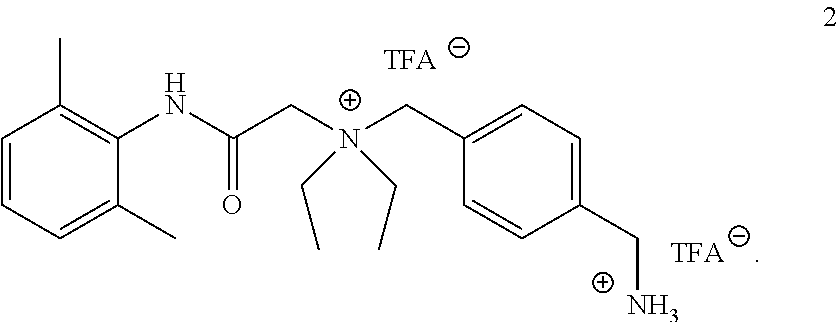
- a particularly preferred compound of general formula (I) represents a trifluoroacetic acid (TFA) salt, which is disclosed herein as “compound 2” and has the following structure (TFA ⁇ means F 3 CCO 2 ⁇ ):
- FIG. 1 is a graphical illustration of the potentials measured for compound 2 (“DenatDer”) of the invention and denatonium benzoate (“Denat”) at different concentrations, using an electronic tongue, in particular the sensors SB2AC0 and SB2AN0.
- FIG. 2 illustrates the sequence applied in Example 4 for the coupling of triphenylmethyl (Trt)-protected peptide “QPVV” (SEQ ID NO: 2) with compound 2 of the invention and subsequent deprotection of the coupling product.
- FIG. 3 illustrates the sequence applied in Example 5 for the coupling of tert-butyl (tBu)-protected peptide “DAPV” (SEQ ID NO: 4) with compound 2 of the invention and subsequent deprotection of the coupling product.
- FIG. 4 is a further graphical illustration of potentials measured for compound 2 of the invention (“DenatCH2”) and denatonium benzoate (“Denat”) at different concentrations, using an electronic tongue, in particular the sensors SB2AC0 and SB2AN0.
- FIG. 5 illustrates the reaction sequence applied in Example 6 for the synthesis of a coupling product of compound 2 according to this invention and the peptide “GPQGIAGA” (SEQ ID NO: 5).
- FIG. 6 is a graphical illustration of potentials measured for the coupling product (“SL10K”) prepared in Example 6 and denatonium benzoate (“Denat”) at different concentrations, using an electronic tongue, in particular the sensors SB2AC0 and SB2AN0.
- Determining the bitter taste of the compounds of the present invention can for example be achieved using an “electronic tongue”, which includes determining the electronic potentials of the substance in aqueous solution in a defined concentration. This method is known to the skilled person, and is also illustrated in the examples provided herein.
- an electronic tongue For carrying out the measurement of the electronic potentials using the electronic tongue, it is necessary to protect the free amino group of the compounds disclosed herein, e.g. by means of acetylation.
- the acetylation of the free amino group is thus part of the analytics and can be achieved by routine reactions known to the skilled person.
- the results measured with the acetylated compounds are indicative for the bitter taste of the unprotected compounds disclosed herein.
- halogen is in particular chloro (Cl), bromo (Br) or iodo (I).
- Pseudohalogen in the compound of general formulae (II) is in particular p-Me-C 6 H 4 —SO 3 — or MeSO 3 —.
- the bromo-substituted compound of general formula (II) is used in the method according to the present invention (wherein thus Y ⁇ Br).
- halide is in particular chloride (Cl ⁇ ), bromide (Br ⁇ ) or iodide (I ⁇ ).
- Pseudohalide in the compound of general formulae (IV) is in particular tosylate (p-Me-C 6 H 4 —SO 3 ⁇ ) or mesylate (MeSO 3 ⁇ ).
- Boc tert-butyloxycarbonyl
- Cbz benzyloxycarbonyl
- Fmoc fluorenylmethoxycarbonyl
- alloc allyloxycarbonyl
- R 1 to R 10 in the compounds of general formulae (I), (II), (III) and (IV) in the method according to the present invention are defined as follows:
- R 1 to R 10 in the compounds of general formulae (I), (II), (III) and (IV) in the method according to the present invention are defined as follows:
- the compounds of general formulae (II) and (III) react in step a) in a nucleophilic substitution to give the compound of general formula (IV).
- This reaction can be performed by using a solvent, wherein the skilled person selects a suitable solvent from the range of common solvents known to him, comprising for example, but not limited thereto, dichloromethane, ethyl acetate, tetrahydrofurane, toluene and di methylformamide.
- the reaction according to step a) of the method according to the invention is however preferably performed without using a solvent, i.e. solvent-free.
- the starting compounds are mixed and heated to a melt, which typically requires heating of the mixture of starting compounds to temperatures of from 60 to 120° C., preferably from 70 to 110° C., particularly preferred from 80 to 100° C.
- the reaction in the melt has the advantage that the reaction times are short, which means that they are in the range of from 1 to 30 min, preferably from 2 to 20 min, particularly preferred from 5 to 15 min.
- Carrying out step a) solvent-free contributes to the environmental friendliness and cost-efficiency of the method of the present invention.
- reaction according to step a) of the method according to the invention is performed with 1 molar equivalent of the compound of general formula (II) and 1.4-1.8 molar equivalents, preferably 1.5-1.7 molar equivalents of the compound of general formula (III).
- the reaction mixture comprising the reaction product of general formula (IV) is typically added to a solvent or a solvent mixture, which leads to the precipitation of the product, which can then be filtered off.
- the reaction product of general formula (IV) should thus be poorly soluble in the solvent or solvent mixture of choice.
- a suitable solvent or a solvent mixture for precipitating the compound of general formula (IV) from the spectrum of the common solvents known to him, comprising for example, but not limited to ethyl acetate, hexane, diethylether, dichloromethane, acetone, tetrahydrofuran and toluene.
- step b) of the method according to the present invention which means that the amino protection group is cleaved in order to provide the compound of formula (I), i.e. the compound of the present invention.
- the deprotection of Boc-, Cbz-, Fmoc- and alloc-protected amino groups can be achieved by applying routine methods known to the skilled person.
- the compound of formula (I) or a salt thereof according to formula (Ia) results from the cleaving step b).
- a Boc-group is used as the amino protecting group in the method according to the present invention.
- This has the advantage that the deprotection can be carried out solvent-free, preferably by reacting the compound of general formula (IV) at room temperature in trifluoroacetic acid without using additional solvent.
- reaction product of the deprotection step b), i.e. the compound of general formula (I), is then typically precipitated from a suitable solvent or solvent mixture, which the skilled person selects from the range of common solvents known to him, comprising, but not limited to ethyl acetate, hexane, diethylether, dichloromethane, acetone, tetrahydrofuran and toluene.
- a suitable solvent or solvent mixture which the skilled person selects from the range of common solvents known to him, comprising, but not limited to ethyl acetate, hexane, diethylether, dichloromethane, acetone, tetrahydrofuran and toluene.
- tert-butyl-4-(bromomethyl)benzylcarbamate and 1.5-1.6 equivalents of lidocaine are heated under stirring at 80° C. until they are melted. After a few minutes the molten mixture becomes highly viscous, up to solid. After a resting period of 10 minutes, at 80° C., a mixture consisting of ethyl acetate and n-hexane (1:1) was added to the obtained yellow solid. This solid is stirred for 10 minutes at 80° C. in the mixture and the white residue resulting therefrom is filtered off. For the deprotection, the white solid is treated with trifluoroacetic acid and stirred for 1 hour. The raw product is subsequently precipitated from diethylether and filtered off.
- the compounds of general formula (I) or salts thereof provide a bitter taste despite the functionalization with an aminomethyl-group. Therefore, the compounds of general formula (I) or salts thereof according to the present invention are suitable for use as bitter substances.
- the compounds of general formula (I) or salts thereof are particularly suitable for the coupling to peptides and proteins applying peptide-coupling chemistry.
- the present invention thus also provides a coupling product of a compound according to formula (I) as defined in claims 1 to 3 and a peptide or a protein, wherein the compound of general formula (I) and the peptide or the protein are connected via a peptide bond between the aminomethyl-group of the compound of formula (I) and the carboxyl-group (COOH-group) of the peptide or protein.
- Peptides refers a chain of amino acids comprising less than 50 amino acids.
- the chain can be branched or unbranched.
- a “protein”, as used herein, refers to a biomolecules comprising at least one polypeptide chain, which contains at least 50 amino acids.
- the at least one polypeptide chain can be branched or unbranched.
- the peptides and proteins for use herein have a terminal carboxyl-group.
- the peptide or protein can also be bound to other molecules, such as sugars (e.g. oligosaccharides, polysaccharides), polymers, nucleic acids (e.g. DNA and RNA), ligands, coenzymes and cofactors.
- the coupling product of the present invention is reacted with an aminopeptidase, the peptide bonds in the peptide or protein moiety of the coupling product are hydrolyzed and the peptide or protein degrades. This leads to the release of the compound of the present invention, which can then be perceived by a human patient in terms of its bitter taste.
- This reaction can be used for diagnostic purposes. Accordingly the coupling product of the present invention can be used in medicine, pharmaceutics and/or diagnostics.
- the present invention also provides a method for producing the coupling product of the invention, said method comprising coupling a compound of general formula (I) or a salt thereof with a peptide or protein by forming a peptide bond between the aminomethyl-group of the compound of general formula (I) or the salt thereof and a carboxyl-group of the protein or peptide.
- “Forming a peptide bond” between a carboxyl-group of the protein or peptide and the aminomethyl-group of the compound of general formula (I) thus means that the protein or peptide and the compound of general formula (I) of the invention are coupled.
- the peptide or protein can optionally be used in protected form in the coupling with the compound of general formula (I) or the salt thereof, i.e. has to be protected by a protection group.
- the skilled person will choose the protection group according to his needs on the basis of his common general knowledge.
- the protection group can then be cleaved from the coupling product after the coupling. Such a procedure is illustrated in Examples 4 and 5 provided herein.
- the method for producing the coupling product is preferably carried out in the presence of a coupling agent, preferably HATU, and a base, preferably DIPEA.
- a peptide or protein is shaken under light exclusion with the coupling agent HATU ([0-(7-azabenzotriazol-1-yl)-N,N,N′,N′-tetramethyluronium-hexafluorphosphate]), DIPEA (diisopropylethylamine) and a compound of general formula (I) or a salt thereof in dry DMF overnight.
- HATU [0-(7-azabenzotriazol-1-yl)-N,N,N′,N′-tetramethyluronium-hexafluorphosphate]
- DIPEA diisopropylethylamine
- the procedure disclosed herein is for example useful for the coupling of compounds of the present invention with a peptide-based active agent, i.e. to a compound with pharmaceutical activity, said active agent being a peptide itself or at least comprising a peptide residue with a terminal carboxyl-group.
- the present invention also relates to compounds of general formula (I) as disclosed herein for use as a bitter substance in medicine, pharmaceutics and/or diagnostics, in particular if they are coupled to compounds with pharmaceutical activity, such as peptide-based active agents, providing the coupling products of the present invention. After cleavage of the coupling product, the compound of the present invention will be released and the bitter taste will be perceived by a human patient.
- pharmaceutical activity such as peptide-based active agents
- the present invention is directed to:
- FIG. 1 A graphic illustration of these results is provided in FIG. 1 , wherein (acetylated) compound 2 of the invention is abbreviated as “DenatDer” and denatonium benzoate abbreviated as “Denat”.
- the sensors SB2AC0 and SB2AN0 measure bitter cationic substances.
- Denatonium benzoate is known to the skilled person, and it represents the corresponding non-substituted compound (which does not have an aminomethyl-functionalization, contrary to compound 2 according to the present invention).
- Example 4 Coupling of Compound 2 with the Peptide QPVV (SEQ ID NO: 1)
- the peptide QPVV (SEQ ID NO: 1) used in this example for the coupling with compound 2 of the present invention was synthesized by the inventors using standard techniques. It has the following structure:
- the resulting product was subsequently lyophilized.
- the lyophilized product was dissolved in trifluoroacetic acid and shaken at room temperature for 1 hour.
- the obtained product was precipitated in diethylether and purified by chromatography under the same conditions as used before.
- the sequence applied in this example (including the coupling step and the deprotection step) is illustrated in FIG. 2 .
- the coupling product was obtained as the TFA salt.
- Example 5 Coupling of Compound 2 with the Peptide DAPV (SEQ ID NO: 3)
- the peptide DAPV (SEQ ID NO: 3) used in this example for the coupling with compound 2 of the present invention was synthesized by the inventors using standard techniques. It has the following structure:
- Example 6 Taste Testing of Compound 2 Coupled with the Peptide GPQGIAGA (SEQ ID NO: 5)
- Compound 2 of the present invention was coupled with the peptide “GPQGIAGA” (SEQ ID NO: 5), which has the following structure:
- the lyophilized product was dissolved in trifluoroacetic acid and shaken at room temperature for 1 hour.
- the obtained product was precipitated in diethylether and purified by chromatography (Akta purifier (GE Healthcare), reversed-phase chromatography (RPC), Eluent A: 0.1% TFA in water, Eluent B: 0.1% TFA in acetonitrile)
- FIG. 5 This reaction sequence is graphically illustrated in FIG. 5 , which also shows the resulting product of this coupling (in the following referred to as the coupling product or “SL10K”).
- the potential of the coupling product was determined in comparison with denatonium benzoate using an electronic tongue, in particular the sensors SB2AC0 and SB2AN0.
- the following potentials were determined (wherein the values for the denatonium benzoate are given in brackets):
- the data according to FIG. 6 shows that for denatonium benzoate, the mV values increase with higher concentration of the compound. This indicates that the perception of the bitter taste of the compound increases at higher concentration.
- the mV values decrease with higher concentration. This indicates that the denatonium derivative according to compound 2 is not perceived as a bitter compound when coupled to the peptide.
- the bitter taste is only perceivable when the coupling product is cleaved and the denatonium derivative according to compound 2 is released (as has been shown in Example 3 above). This is particularly useful for diagnostic purposes.
Landscapes
- Chemical & Material Sciences (AREA)
- Organic Chemistry (AREA)
- Medicinal Chemistry (AREA)
- Molecular Biology (AREA)
- Biochemistry (AREA)
- Biophysics (AREA)
- General Health & Medical Sciences (AREA)
- Genetics & Genomics (AREA)
- Health & Medical Sciences (AREA)
- Life Sciences & Earth Sciences (AREA)
- Proteomics, Peptides & Aminoacids (AREA)
- Analytical Chemistry (AREA)
- Chemical Kinetics & Catalysis (AREA)
- Organic Low-Molecular-Weight Compounds And Preparation Thereof (AREA)
- Peptides Or Proteins (AREA)
- Polymers With Sulfur, Phosphorus Or Metals In The Main Chain (AREA)
Abstract

wherein X− is halide, pseudohalide, sulphate, benzoate, acetate, trifluoroacetate, hydroxide, saccharinate or capsaicinate; R10 is hydrogen or C1-C10-alkyl; and R1-R9 independently are hydrogen, halogen, C1-C5-alkyl, C1-C4-alkoxy, C1-C20-alkoxycarbonyl. The invention is furthermore directed to a method for the preparation of these compounds. The compounds can be used as bitter substances in medicine, pharmaceutics and/or diagnostics. They can furthermore be used for the coupling to proteins and peptides by means of forming a peptide bond between the amino-group of the compounds of the present invention and a carboxyl-group of the protein or peptide.
Description


wherein
-
- X− is halide, pseudohalide, sulphate, benzoate, acetate, trifluoroacetate, hydroxide, saccharinate or capsaicinate,
- R10 is hydrogen or C1-C10-alkyl,
- R1-R9 independently are hydrogen, halogen, C1-C5-alkyl, C1-C4-alkoxy, C1-C20 alkoxycarbonyl.

-
- A− in the compound of formula (Ia) can be halide, pseudohalide, sulphate, benzoate, acetate, trifluoroacetate, hydroxide, saccharinate or capsaicinate, and is preferably identical with X−. Accordingly, the preferred embodiments for X− which will be described herein below correspond to the preferred embodiments for K.
-
- X− is halide, pseudohalide, sulphate, benzoate, acetate or trifluoroacetate,
- R10 is C1-C4-alkyl,
- R1-R4 is hydrogen,
- R5 is C1-C4-alkyl,
- R6-R8 is hydrogen,
- R9 is C1-C4-alkyl.
-
- X− is trifluoroacetate,
- R10 is ethyl,
- R5 is methyl,
- R9 is methyl,
- R1-R4 is hydrogen,
- R6-R8 is hydrogen.
-
- a) reacting a compound of general formula (II)

-
-
- with a compound of general formula (III)
-

-
-
- resulting in the formation of a compound of general formula (IV)
-

-
- b) deprotecting the compound of general formula (IV) resulting in the formation of the compound of general formula (I) or a salt thereof,
wherein in the compounds of general formulae (I), (II), (III) and (IV) - R10 is hydrogen or C1-C10-alkyl,
- R1-R9 independently are hydrogen, halogen, C1-C5-alkyl, C1-C4-alkoxy, C1-C20-alkoxycarbonyl,
- Y is halogen or pseudohalogen,
- Y− is the halide or pseudohalide corresponding to Y, and
- PG is an amino protection group, selected from the group Boc, Cbz, Fmoc and alloc.
- b) deprotecting the compound of general formula (IV) resulting in the formation of the compound of general formula (I) or a salt thereof,
-
- R10 is C1-C4-alkyl,
- R1-R4 is hydrogen,
- R5 is C1-C4-alkyl,
- R6-R8 is hydrogen,
- R9 is C1-C4-alkyl.
-
- R10 is ethyl,
- R5 is methyl,
- R9 is methyl,
- R1-R4 is hydrogen,
- R6-R8 is hydrogen.

is prepared in a nucleophilic substitution with subsequent deprotection from the commercially available starting compounds tert-butyl-4-(bromomethyl)benzylcarbamate and lidocaine (2-diethylamino-N-(2,6-dimethylphenyl)acetamide) and as illustrated below:

-
- (i). Compound of general formula (I) (as shown above) or a salt thereof, wherein
- X− is halide, pseudohalide, sulphate, benzoate, acetate, trifluoroacetate, hydroxide, saccharinate or capsaicinate,
- R10 is hydrogen or C1-C10-alkyl,
- R1-R9 independently are hydrogen, halogen, C1-C5-alkyl, C1-C4-alkoxy, C1-C20-alkoxycarbonyl.
- (ii). Compound according to item (i), wherein in general formula (I)
- X− is halide, pseudohalide, sulphate, benzoate, acetate or trifluoroacetate,
- R10 is C1-C4-alkyl,
- R1-R4 is hydrogen,
- R5 is C1-C4-alkyl,
- R9 is C1-C4-alkyl,
- R6-R8 is hydrogen.
- (iii). Compound according to item (i) or (ii), wherein in general formula (I)
- X− is trifluoroacetate,
- R10 is ethyl,
- R5 is methyl,
- R9 is methyl,
- R1-R4 is hydrogen,
- R6-R8 is hydrogen.
- (iv). Method for the preparation of a compound of general formula (I) (as shown above) or a salt thereof, comprising the following steps:
- a) reacting a compound of general formula (II) (as shown above) with a compound of general formula (III) (as shown above) resulting in the formation of a compound of general formula (IV) (as shown above),
- b) deprotecting the compound of general formula (IV) resulting in the formation of the compound of general formula (I) or a salt thereof,
- wherein in the compounds of general formulae (I), (II), (III) and (IV)
- R1-R10 are defined as in item (i), preferably as in item (iii), and particularly preferably as in item (iii),
- Y is halogen or pseudohalogen,
- Y− is the halide or pseudohalide corresponding to Y, and
- PG is an amino protection group, selected from the group Boc, Cbz, Fmoc and alloc.
- (v). Method according to item (iv), wherein step a) is performed in a solvent-free melt.
- (vi). Method according to item (v), wherein a mixture of the compound of general formula (II) and the compound of general formula (III) is heated for 1 to 30 min at temperatures in the range of 60 to 120° C.
- (vii). Method according to any of items (iv) to (vi), wherein 1 equivalent of the compound of general formula (II) is reacted with 1.4 to 1.8 equivalents of the compound of general formula (III).
- (viii). Method according to any of items (iv) to (vii), wherein in the compound of general formula (II) Y is Br and in the compound of general formula (IV) Y− is Br−.
- (ix). Method according to any one of items (iv) to (viii), wherein PG in the compound of general formulae (II) and (IV) is Boc.
- (x). Method according to item (ix), wherein the deprotection of the compound of general formula (IV) in step b) is performed solvent-free using trifluoroacetic acid.
- (xi). Use of a compound according to items (i) to (iii) as a bitter substance.
- (xii). Coupling product of a compound according to formula (I) as defined in items (i) to (iii) and a peptide or a protein, wherein the compound of general formula (I) and the peptide or the protein are connected via a peptide bond between the aminomethyl-group of the compound of formula (I) and the carboxyl-group (COOH-group) of the peptide or protein.
- (xiii). Method for producing a coupling product as defined in item (xii), comprising coupling a compound of general formula (I) or a salt thereof with a peptide or protein by forming a peptide bond between the aminomethyl-group of the compound of general formula (I) or the salt thereof and a carboxyl-group of the protein or peptide.
- (xiv). Method according to item (xiii), wherein the peptide or protein used in the coupling with the compound of general formula (I) or the salt thereof is protected by a protection group, and the protection group is cleaved after the coupling.
- (xv). Method according to item (xiii) or (xiv), wherein the compound of general formula (I) or the salt thereof and the peptide or protein is coupled in the presence of a coupling agent, preferably HATU, and a base, preferably DIPEA.
- (i). Compound of general formula (I) (as shown above) or a salt thereof, wherein


Claims (18)


Applications Claiming Priority (4)
| Application Number | Priority Date | Filing Date | Title |
|---|---|---|---|
| EP18157816.2 | 2018-02-21 | ||
| EP18157816 | 2018-02-21 | ||
| EP18157816 | 2018-02-21 | ||
| PCT/EP2019/054140 WO2019162289A1 (en) | 2018-02-21 | 2019-02-20 | Aminomethyl-functionalized denatonium derivatives, their preparation and use |
Publications (2)
| Publication Number | Publication Date |
|---|---|
| US20210087138A1 US20210087138A1 (en) | 2021-03-25 |
| US11891352B2 true US11891352B2 (en) | 2024-02-06 |
Family
ID=61256661
Family Applications (1)
| Application Number | Title | Priority Date | Filing Date |
|---|---|---|---|
| US16/975,077 Active 2041-06-08 US11891352B2 (en) | 2018-02-21 | 2019-02-20 | Aminomethyl-functionalized denatonium derivatives, their preparation and use |
Country Status (6)
| Country | Link |
|---|---|
| US (1) | US11891352B2 (en) |
| EP (1) | EP3755685B1 (en) |
| CA (1) | CA3090224A1 (en) |
| ES (1) | ES2943833T3 (en) |
| PT (1) | PT3755685T (en) |
| WO (1) | WO2019162289A1 (en) |
Families Citing this family (2)
| Publication number | Priority date | Publication date | Assignee | Title |
|---|---|---|---|---|
| US20230091608A1 (en) * | 2019-03-19 | 2023-03-23 | Julius-Maximilians-Universitaet Wuerzburg | Compound and diagnostic system comprising said compound for the gustatory detection of inflammations in the oral cavity |
| EP4360658A1 (en) | 2022-10-28 | 2024-05-01 | Julius-Maximilians-Universität Würzburg | Compounds for detection of oral inflammation |
Citations (1)
| Publication number | Priority date | Publication date | Assignee | Title |
|---|---|---|---|---|
| US20190185416A1 (en) * | 2016-08-11 | 2019-06-20 | Julius-Maximilians-Universitaet Wuerzburg | Production of bitter principle derivatives |
Family Cites Families (3)
| Publication number | Priority date | Publication date | Assignee | Title |
|---|---|---|---|---|
| US4652577A (en) | 1984-11-02 | 1987-03-24 | Atomergic Chemetals Corporation | Denatonium saccharide, compositions and method of use |
| US5891919A (en) | 1997-09-19 | 1999-04-06 | Burlington Bio-Medical & Scientific Corp. | Denatonium capsaicinate and methods of producing the same |
| US20090306429A1 (en) | 2004-12-06 | 2009-12-10 | Henk Pluim | Preparation of a quaternary ammonium hydroxide and use thereof for the preparation of a quaternary ammonium salt |
-
2019
- 2019-02-20 WO PCT/EP2019/054140 patent/WO2019162289A1/en not_active Ceased
- 2019-02-20 PT PT197089592T patent/PT3755685T/en unknown
- 2019-02-20 US US16/975,077 patent/US11891352B2/en active Active
- 2019-02-20 EP EP19708959.2A patent/EP3755685B1/en active Active
- 2019-02-20 CA CA3090224A patent/CA3090224A1/en active Pending
- 2019-02-20 ES ES19708959T patent/ES2943833T3/en active Active
Patent Citations (1)
| Publication number | Priority date | Publication date | Assignee | Title |
|---|---|---|---|---|
| US20190185416A1 (en) * | 2016-08-11 | 2019-06-20 | Julius-Maximilians-Universitaet Wuerzburg | Production of bitter principle derivatives |
Non-Patent Citations (1)
| Title |
|---|
| Saroli, Alfred, "Struktur-Aktivitätsbeziehung von Bitterverbindungen im Hinblick zu Denatoniumchlorid und Dipeptidmethylesters", Zeitschrift Fuer Lebensmitteluntersuchung Und Forschung, vol. 182, No. 2, pp. 118-120 (Feb. 1, 1986). |
Also Published As
| Publication number | Publication date |
|---|---|
| EP3755685A1 (en) | 2020-12-30 |
| US20210087138A1 (en) | 2021-03-25 |
| CA3090224A1 (en) | 2019-08-29 |
| WO2019162289A1 (en) | 2019-08-29 |
| PT3755685T (en) | 2023-05-11 |
| ES2943833T3 (en) | 2023-06-16 |
| EP3755685B1 (en) | 2023-04-05 |
Similar Documents
| Publication | Publication Date | Title |
|---|---|---|
| Albericio | Developments in peptide and amide synthesis | |
| JP6334399B2 (en) | Method for producing self-assembled peptide derivative | |
| US12129222B2 (en) | Production of bitter principle derivatives | |
| TW202235429A (en) | Method for preparing peptide compounds containing n-substited amino acid residue | |
| KR100861031B1 (en) | Process for rapid solution synthesis of peptides | |
| JP7196087B2 (en) | Method for producing peptide compound | |
| JP2018512415A (en) | A liquid phase method for the preparation of ethercarcetide. | |
| JP6703669B2 (en) | Method for producing leuprorelin | |
| CA1188297A (en) | Methods and compositions for preparation of h-arg-x-z- y-tyr-r | |
| US20210087138A1 (en) | Aminomethyl-functionalized denatonium derivatives, their preparation and use | |
| CN111770930B (en) | Method for preparing peptides | |
| JP3579038B2 (en) | Method for producing peptide | |
| CN114901673B (en) | Preparation method of solution phase peptide nucleic acid oligomer | |
| AU683714B2 (en) | PNA synthesis using a base-labile amino protecting group | |
| WO2011027897A1 (en) | Method for manufacturing a lipidic peptide compound | |
| EP0600996A1 (en) | Preparation of peptides by a solid-phase synthesis and intermediates therefor | |
| KR20160120345A (en) | Process for the liquid phase synthesis of h-inp-(d)bal-(d)trp-phe-apc-nh2, and pharmaceutically acceptable salts thereof | |
| Lescrinier et al. | α‐Amino acids derived from ornithine as building blocks for peptide synthesis | |
| JP2748897B2 (en) | Novel arginine derivative and method for producing peptide using the same | |
| CN100469787C (en) | Method for the synthesis of derivatives of (2S,3AS,7AS)-1-[(S)-alanyl]-octahydro-1H-indole-2-carboxylic acid and use thereof for the synthesis of perindopril | |
| NZ193471A (en) | Method for preparation of h-sar-lys-sar-gln-nh2;dipeptide and protected tetrapeptide intermediates | |
| JPH085812B2 (en) | Method for producing acid amide compound | |
| JP2000290285A (en) | Novel linker and solid-phase synthesis of glycopeptides using it | |
| JPH0380147B2 (en) | ||
| WO2006097698A1 (en) | Inverse solid phase peptide synthesis with additional capping step |
Legal Events
| Date | Code | Title | Description |
|---|---|---|---|
| FEPP | Fee payment procedure |
Free format text: ENTITY STATUS SET TO UNDISCOUNTED (ORIGINAL EVENT CODE: BIG.); ENTITY STATUS OF PATENT OWNER: SMALL ENTITY |
|
| FEPP | Fee payment procedure |
Free format text: ENTITY STATUS SET TO SMALL (ORIGINAL EVENT CODE: SMAL); ENTITY STATUS OF PATENT OWNER: SMALL ENTITY |
|
| AS | Assignment |
Owner name: JULIUS-MAXIMILIANS-UNIVERSITAET WUERZBURG, GERMANY Free format text: ASSIGNMENT OF ASSIGNORS INTEREST;ASSIGNORS:MEINEL, LORENZ;LUEHMANN, TESSA;RASCHIG, MARTINA;SIGNING DATES FROM 20200813 TO 20200816;REEL/FRAME:054723/0457 |
|
| STPP | Information on status: patent application and granting procedure in general |
Free format text: APPLICATION DISPATCHED FROM PREEXAM, NOT YET DOCKETED |
|
| STPP | Information on status: patent application and granting procedure in general |
Free format text: DOCKETED NEW CASE - READY FOR EXAMINATION |
|
| STPP | Information on status: patent application and granting procedure in general |
Free format text: NOTICE OF ALLOWANCE MAILED -- APPLICATION RECEIVED IN OFFICE OF PUBLICATIONS |
|
| STPP | Information on status: patent application and granting procedure in general |
Free format text: PUBLICATIONS -- ISSUE FEE PAYMENT VERIFIED |
|
| STCF | Information on status: patent grant |
Free format text: PATENTED CASE |