US11878968B2 - Aryl compounds and pharmaceutical compositions that modulate IKZF2 - Google Patents
Aryl compounds and pharmaceutical compositions that modulate IKZF2 Download PDFInfo
- Publication number
- US11878968B2 US11878968B2 US18/052,462 US202218052462A US11878968B2 US 11878968 B2 US11878968 B2 US 11878968B2 US 202218052462 A US202218052462 A US 202218052462A US 11878968 B2 US11878968 B2 US 11878968B2
- Authority
- US
- United States
- Prior art keywords
- compound
- pharmaceutically acceptable
- acceptable salt
- stereoisomer
- tautomer
- Prior art date
- Legal status (The legal status is an assumption and is not a legal conclusion. Google has not performed a legal analysis and makes no representation as to the accuracy of the status listed.)
- Active, expires
Links
Classifications
-
- A—HUMAN NECESSITIES
- A61—MEDICAL OR VETERINARY SCIENCE; HYGIENE
- A61P—SPECIFIC THERAPEUTIC ACTIVITY OF CHEMICAL COMPOUNDS OR MEDICINAL PREPARATIONS
- A61P35/00—Antineoplastic agents
-
- C—CHEMISTRY; METALLURGY
- C07—ORGANIC CHEMISTRY
- C07D—HETEROCYCLIC COMPOUNDS
- C07D401/00—Heterocyclic compounds containing two or more hetero rings, having nitrogen atoms as the only ring hetero atoms, at least one ring being a six-membered ring with only one nitrogen atom
- C07D401/14—Heterocyclic compounds containing two or more hetero rings, having nitrogen atoms as the only ring hetero atoms, at least one ring being a six-membered ring with only one nitrogen atom containing three or more hetero rings
-
- A—HUMAN NECESSITIES
- A61—MEDICAL OR VETERINARY SCIENCE; HYGIENE
- A61K—PREPARATIONS FOR MEDICAL, DENTAL OR TOILETRY PURPOSES
- A61K31/00—Medicinal preparations containing organic active ingredients
- A61K31/33—Heterocyclic compounds
- A61K31/395—Heterocyclic compounds having nitrogen as a ring hetero atom, e.g. guanethidine or rifamycins
- A61K31/435—Heterocyclic compounds having nitrogen as a ring hetero atom, e.g. guanethidine or rifamycins having six-membered rings with one nitrogen as the only ring hetero atom
- A61K31/44—Non condensed pyridines; Hydrogenated derivatives thereof
- A61K31/445—Non condensed piperidines, e.g. piperocaine
- A61K31/4523—Non condensed piperidines, e.g. piperocaine containing further heterocyclic ring systems
- A61K31/454—Non condensed piperidines, e.g. piperocaine containing further heterocyclic ring systems containing a five-membered ring with nitrogen as a ring hetero atom, e.g. pimozide, domperidone
-
- G—PHYSICS
- G01—MEASURING; TESTING
- G01N—INVESTIGATING OR ANALYSING MATERIALS BY DETERMINING THEIR CHEMICAL OR PHYSICAL PROPERTIES
- G01N33/00—Investigating or analysing materials by specific methods not covered by groups G01N1/00 - G01N31/00
- G01N33/48—Biological material, e.g. blood, urine; Haemocytometers
- G01N33/50—Chemical analysis of biological material, e.g. blood, urine; Testing involving biospecific ligand binding methods; Immunological testing
- G01N33/53—Immunoassay; Biospecific binding assay; Materials therefor
- G01N33/543—Immunoassay; Biospecific binding assay; Materials therefor with an insoluble carrier for immobilising immunochemicals
- G01N33/54306—Solid-phase reaction mechanisms
-
- G—PHYSICS
- G01—MEASURING; TESTING
- G01N—INVESTIGATING OR ANALYSING MATERIALS BY DETERMINING THEIR CHEMICAL OR PHYSICAL PROPERTIES
- G01N33/00—Investigating or analysing materials by specific methods not covered by groups G01N1/00 - G01N31/00
- G01N33/48—Biological material, e.g. blood, urine; Haemocytometers
- G01N33/50—Chemical analysis of biological material, e.g. blood, urine; Testing involving biospecific ligand binding methods; Immunological testing
- G01N33/68—Chemical analysis of biological material, e.g. blood, urine; Testing involving biospecific ligand binding methods; Immunological testing involving proteins, peptides or amino acids
- G01N33/6893—Chemical analysis of biological material, e.g. blood, urine; Testing involving biospecific ligand binding methods; Immunological testing involving proteins, peptides or amino acids related to diseases not provided for elsewhere
-
- G—PHYSICS
- G01—MEASURING; TESTING
- G01N—INVESTIGATING OR ANALYSING MATERIALS BY DETERMINING THEIR CHEMICAL OR PHYSICAL PROPERTIES
- G01N33/00—Investigating or analysing materials by specific methods not covered by groups G01N1/00 - G01N31/00
- G01N33/48—Biological material, e.g. blood, urine; Haemocytometers
- G01N33/50—Chemical analysis of biological material, e.g. blood, urine; Testing involving biospecific ligand binding methods; Immunological testing
- G01N33/84—Chemical analysis of biological material, e.g. blood, urine; Testing involving biospecific ligand binding methods; Immunological testing involving inorganic compounds or pH
Definitions
- This disclosure provides for compounds and salts thereof that bind to cereblon, thereby modulating cereblon activity.
- certain compounds described herein bind to cereblon, resulting in a reduction of cellular IKAROS Family Zinc Finger (IKZF) protein levels.
- certain compounds described herein bind to cereblon, but do not result in a reduction of cellular IKZF protein levels.
- compounds disclosed herein bind to cereblon, thereby initiating degradation of IKZF proteins (e.g., IKZF2).
- pharmaceutical compositions comprising the compounds, or a salt (e.g., a pharmaceutically acceptable salt) thereof, and methods of using such compounds and/or their salts in the treatment of various IKZF2-mediated diseases or disorders.
- IKAROS Family Zinc Finger 2 (IKZF2) (also known as Helios) is one of the five members of the Ikaros family of transcription factors found in mammals. IKZF2 is a critical regulator of T cell activity and function. Genetic deletion of Helios resulted in an enhanced anti-tumor immune response (Kim et al., Science 350:334-339 (2015)). Notably, Helios is highly expressed in regulatory T cells (Tregs) (Elkord et al., Expert Opin. Biol. Ther. 12:1423-1425 (2012)), a subpopulation of T cells that restricts the activity of effector T cells.
- Tregs regulatory T cells
- CTLA4 Anti-CTLA4 antibodies are used in the clinic to target Tregs in tumors.
- targeting CTLA4 often causes systemic activation of T-effector cells, resulting in excessive toxicity and limiting therapeutic utility.
- CCAE Common Terminology for Adverse Events
- an IKZF2-specific modulator or degrader would have the potential to focus an enhanced immune response to areas within or near tumors providing a potentially more tolerable and less toxic therapy for the treatment of diseases mediated by IKZF2.
- IKZF IKAROS Family Zinc Finger
- certain compounds described herein bind to cereblon, but do not result in a reduction of cellular IKZF protein levels.
- certain compounds disclosed herein bind to cereblon, thereby initiating degradation of IKZF proteins (e.g., IKZF2).
- compositions comprising the compounds, or a salt (e.g., a pharmaceutically acceptable salt) thereof, and methods of using such compounds and/or their salts in the treatment of various IKZF2-mediated diseases or disorders, including e.g., cancers.
- a salt e.g., a pharmaceutically acceptable salt
- the disclosed compounds that bind to and modulate cereblon, and, in some instances, degrade IKZF2 are represented by formula I:
- R 1 , R 2 , R 3 , R 4 , R 11 , X, Y, Z, Z 1 , m, n, p, q, r, s, and t of formula I are as defined in the detailed description and throughout the specification.
- the disclosed compounds that bind to and modulate cereblon, and, in some instances, degrade IKZF2 are represented by formula II:
- R 1 , R 2 , R 3 , R 4 , R 11 , X, Y, Z, Z 1 , m, n, p, s, and t of formula II are as defined in the detailed description and throughout the specification.
- the disclosed compounds that bind to and modulate cereblon, and, in some instances, degrade IKZF2 are represented by formula III:
- R 1 , R 2 , R 3 , R 4 , R 11 , X, Y, Z, Z 1 , m, q, r, s, and t of formula III are as defined in the detailed description and throughout the specification.
- the disclosed compounds that bind to and modulate cereblon, and, in some instances, degrade IKZF2 are represented by formula IV:
- R 1 , R 2 , R 3 , R 4 , R 11 , X, Y, Z, Z 1 , m, s, and t of formula IV are as defined in the detailed description and throughout the specification.
- the disclosed compounds that bind to and modulate cereblon, and, in some instances, degrade IKZF2 are represented by formula V:
- R 1 , R 2 , R 3 , R 4 , R 11 , X, Y, Z, Z 1 , m, q, r, s, and t of formula V are as defined in the detailed description and throughout the specification.
- the disclosed compounds that bind to and modulate cereblon, and, in some instances, degrade IKZF2 are represented by formula VI:
- R 1 , R 2 , R 3 , R 4 , R 11 , X, Y, Z, Z 1 , m, s, and t of formula VI are as defined in the detailed description and throughout the specification.
- a compound of formula I or a sub-formulae thereof which selectively modulates IKZF (e.g., over translation termination factor GSPT1 (G1 to S phase transition 1 protein)).
- GSPT1 translation termination factor
- a compound of formula I or a sub-formulae thereof which selectively modulates IKZF2 over GSPT1.
- composition comprising a compound of formula I or any sub-formulae thereof, or a pharmaceutically acceptable salt, solvate, stereoisomer, or tautomer of a compound of formula I or any sub-formulae thereof.
- “Compound of formula I and sub-formulae thereof” refers to compounds of formula I, II or subformula thereof, III, IV, V, and VI as defined herein.
- this disclosure provides for a method for modulating cereblon, which method comprises contacting cereblon with an effective amount of a compound of formula I, II or subformula thereof, III, IV, V, or VI, or a pharmaceutically acceptable salt, solvate, stereoisomer, or tautomer thereof under conditions wherein cereblon is modulated.
- this disclosure provides for a method for degrading IKZF2, which method comprises contacting IKZF2 with an effective amount of a compound of formula I, II or subformula thereof, III, IV, V, or VI, or a pharmaceutically acceptable salt, solvate, stereoisomer, or tautomer thereof under conditions wherein IKZF2 is degraded.
- a method to degrade IKZF2 in a subject comprises administering to said subject an effective amount of a compound of formula I, II or subformula thereof, III, IV, V, or VI, or a pharmaceutically acceptable salt, solvate, stereoisomer, or tautomer thereof, or administering to said subject a pharmaceutical composition comprising a pharmaceutically acceptable excipient and an effective amount of a compound of formula I, II or subformula thereof, III, IV, V, or VI, or a pharmaceutically acceptable salt, solvate, stereoisomer, or tautomer thereof.
- a method to treat cancer in a subject in need thereof comprises selecting a subject whose cancer is mediated at least in part by IKZF2 and administering to said subject an effective amount of a compound of formula I, II or subformula thereof, III, IV, V, or VI, or a pharmaceutically acceptable salt, solvate, stereoisomer, and/or tautomer thereof, or administering to said subject a pharmaceutical composition comprising a pharmaceutically acceptable excipient and an effective amount of a compound of formula I, II or subformula thereof, III, IV, V, or VI, or a pharmaceutically acceptable salt, solvate, stereoisomer, or tautomer thereof.
- This disclosure provides for compounds, pharmaceutical compositions comprising such compounds, and methods of using such compounds and compositions to treat diseases, disorders, or conditions mediated, at least in part, by IKZF2 transcription factors.
- IKZF2 transcription factors IKZF2 transcription factors
- a dash (“-”) that is not between two letters or symbols is used to indicate a point of attachment for a substituent. For example, —C(O)NH 2 is attached through the carbon atom.
- a dash at the front or end of a chemical group is a matter of convenience; chemical groups may be depicted with or without one or more dashes without losing their ordinary meaning.
- a wavy line or a dashed line drawn through a line in a structure indicates a specified point of attachment of a group. Unless chemically or structurally required, no directionality or stereochemistry is indicated or implied by the order in which a chemical group is written or named.
- C u-v indicates that the following group has from u to v carbon atoms.
- C 1-6 alkyl indicates that the alkyl group has from 1 to 6 carbon atoms.
- compositions and methods are intended to mean that the compositions and methods include the recited elements, but not excluding others.
- compositions and methods when used to define compositions and methods, shall mean excluding other elements of any essential significance to the combination for the stated purpose. Thus, a composition consisting essentially of the elements as defined herein would not exclude other materials or steps that do not materially affect the basic and novel characteristic(s) of the claimed disclosure.
- Consisting of shall mean excluding more than trace elements of other ingredients and substantial method steps. Embodiments defined by each of these transition terms are within the scope of this disclosure.
- Alkyl refers to an unbranched or branched saturated hydrocarbon chain. As used herein, alkyl has 1 to 20 carbon atoms (i.e., C 1-20 alkyl), 1 to 12 carbon atoms (i.e., C 1-12 alkyl), 1 to 8 carbon atoms (i.e., C 1-8 alkyl), 1 to 6 carbon atoms (i.e., C 1-6 alkyl) or 1 to 4 carbon atoms (i.e., C 1-4 alkyl).
- alkyl groups include, e.g., methyl, ethyl, propyl, isopropyl, n-butyl, sec-butyl, iso-butyl, tert-butyl, pentyl, 2-pentyl, isopentyl, neopentyl, hexyl, 2-hexyl, 3-hexyl, and 3-methylpentyl.
- butyl includes n-butyl (i.e., —(CH 2 ) 3 CH 3 ), sec-butyl (i.e., —CH(CH 3 )CH 2 CH 3 ), isobutyl (i.e., —CH 2 CH(CH 3 ) 2 ), and tert-butyl (i.e., —C(CH 3 ) 3 ); and “propyl” includes n-propyl (i.e., —(CH 2 ) 2 CH 3 ) and isopropyl (i.e., —CH(CH 3 ) 2 ).
- a divalent group such as a divalent “alkyl” group, a divalent “aryl” group, a divalent heteroaryl group, etc.
- a divalent group such as a divalent “alkyl” group, a divalent “aryl” group, a divalent heteroaryl group, etc.
- an “alkylene” group or an “alkylenyl” group for example, methylenyl, ethylenyl, and propylenyl
- an “arylene” group or an “arylenyl” group for example, phenylenyl or napthylenyl, or quinolinyl for heteroarylene
- Alkenyl refers to an alkyl group containing at least one (e.g., 1-3, or 1) carbon-carbon double bond and having from 2 to 20 carbon atoms (i.e., C 2-20 alkenyl), 2 to 12 carbon atoms (i.e., C 2-12 alkenyl), 2 to 8 carbon atoms (i.e., C 2-8 alkenyl), 2 to 6 carbon atoms (i.e., C 2-6 alkenyl), or 2 to 4 carbon atoms (i.e., C 2-4 alkenyl).
- alkenyl groups include, e.g., ethenyl, propenyl, butadienyl (including 1,2-butadienyl and 1,3-butadienyl).
- Alkynyl refers to an alkyl group containing at least one (e.g., 1-3, or 1) carbon-carbon triple bond and having from 2 to 20 carbon atoms (i.e., C 2-20 alkynyl), 2 to 12 carbon atoms (i.e., C 2-12 alkynyl), 2 to 8 carbon atoms (i.e., C 2-8 alkynyl), 2 to 6 carbon atoms (i.e., C 2-6 alkynyl), or 2 to 4 carbon atoms (i.e., C 2-4 alkynyl).
- alkynyl also includes those groups having one triple bond and one double bond.
- Alkoxy refers to the group “alkyl-O—”. Examples of alkoxy groups include, e.g., methoxy, ethoxy, n-propoxy, iso-propoxy, n-butoxy, tert-butoxy, sec-butoxy, n-pentoxy, n-hexoxy, and 1,2-dimethylbutoxy.
- Alkylthio refers to the group “alkyl-S—”.
- Alkylsulfinyl refers to the group “alkyl-S(O)—”.
- Alkylsulfonyl refers to the group “alkyl-S(O) 2 —”.
- Alkylsulfonylalkyl refers to -alkyl-S(O) 2 -alkyl.
- acyl refers to a group —C(O)R y , wherein R y is hydrogen, alkyl, alkenyl, alkynyl, cycloalkyl, heterocyclyl, aryl, heteroalkyl, or heteroaryl; each of which may be unsubstituted or substituted, as defined herein.
- acyl include, e.g., formyl, acetyl, cyclohexylcarbonyl, cyclohexylmethyl-carbonyl, and benzoyl.
- “Amido” refers to both a “C-amido” group which refers to the group —C(O)NR y R z and an “N-amido” group which refers to the group —NR y C(O)R z , wherein R y and R z are independently hydrogen, alkyl, alkenyl, alkynyl, cycloalkyl, heterocyclyl, aryl, heteroalkyl, or heteroaryl; each of which may be unsubstituted or substituted, as defined herein, or R y and R z are taken together to form a cycloalkyl or heterocyclyl; each of which may be unsubstituted or substituted, as defined herein.
- Amino refers to the group —NR y R z wherein R y and R z are independently hydrogen, alkyl, alkenyl, alkynyl, cycloalkyl, heterocyclyl, aryl, heteroalkyl, or heteroaryl; each of which may be unsubstituted or substituted, as defined herein.
- “Amidino” refers to —C(NR y )(NR z 2 ), wherein R y and R z are independently hydrogen, alkyl, alkenyl, alkynyl, cycloalkyl, heterocyclyl, aryl, heteroalkyl, or heteroaryl; each of which may be unsubstituted or substituted, as defined herein.
- Aryl refers to an aromatic carbocyclic group having a single ring (e.g., monocyclic) or multiple rings (e.g., bicyclic or tricyclic) including fused systems.
- aryl has 6 to 20 ring carbon atoms (i.e., C 6-20 aryl), 6 to 12 carbon ring atoms (i.e., C 6-12 aryl), or 6 to 10 carbon ring atoms (i.e., C 6-10 aryl).
- Examples of aryl groups include, e.g., phenyl, naphthyl, fluorenyl, and anthryl.
- Aryl does not encompass or overlap in any way with heteroaryl defined below.
- the resulting ring system is heteroaryl regardless of point of attachment. If one or more aryl groups are fused with a heterocyclyl, the resulting ring system is heterocyclyl regardless of point of attachment. If one or more aryl groups are fused with a cycloalkyl, the resulting ring system is cycloalkyl regardless of point of attachment.
- Carbamoyl refers to both an “O-carbamoyl” group which refers to the group —O—C(O)NR y R z and an “N-carbamoyl” group which refers to the group —NR y C(O)OR z , wherein R y and R z are independently hydrogen, alkyl, alkenyl, alkynyl, cycloalkyl, heterocyclyl, aryl, heteroalkyl, or heteroaryl; each of which may be unsubstituted or substituted, as defined herein.
- Carboxyl ester or “ester” refer to both —OC(O)R x and —C(O)OR x , wherein R x is alkyl, alkenyl, alkynyl, cycloalkyl, heterocyclyl, aryl, heteroalkyl, or heteroaryl; each of which may be unsubstituted or substituted, as defined herein.
- Cycloalkyl refers to a saturated or partially unsaturated cyclic alkyl group having a single ring or multiple rings including fused, bridged, and spiro ring systems.
- the term “cycloalkyl” includes cycloalkenyl groups (i.e., the cyclic group having at least one double bond) and carbocyclic fused ring systems having at least one sp 3 carbon atom (i.e., at least one non-aromatic ring).
- cycloalkyl has from 3 to 20 ring carbon atoms (i.e., C 3-20 cycloalkyl), 3 to 14 ring carbon atoms (i.e., C 3-4 cycloalkyl), 3 to 12 ring carbon atoms (i.e., C 3-12 cycloalkyl), 3 to 10 ring carbon atoms (i.e., C 3-10 cycloalkyl), 3 to 8 ring carbon atoms (i.e., C 3-8 cycloalkyl), or 3 to 6 ring carbon atoms (i.e., C 3-6 cycloalkyl).
- Monocyclic groups include, for example, cyclopropyl, cyclobutyl, cyclopentyl, cyclohexyl, cycloheptyl, and cyclooctyl.
- Polycyclic groups include, for example, bicyclo[2.2.1]heptanyl, bicyclo[2.2.2]octanyl, adamantyl, norbornyl, decalinyl, 7,7-dimethyl-bicyclo[2.2.1]heptanyl, and the like.
- cycloalkyl is intended to encompass any non-aromatic ring which may be fused to an aryl ring, regardless of the attachment to the remainder of the molecule.
- cycloalkyl also includes “spirocycloalkyl” when there are two positions for substitution on the same carbon atom, for example spiro[2.5]octanyl, spiro[4.5]decanyl, or spiro[5.5]undecanyl.
- “Imino” refers to a group —C(NR y )R z , wherein R y and R z are each independently hydrogen, alkyl, alkenyl, alkynyl, cycloalkyl, heterocyclyl, aryl, heteroalkyl, or heteroaryl; each of which may be unsubstituted or substituted, as defined herein.
- “Imido” refers to a group —C(O)NR y C(O)R z , wherein R y and R z are each independently hydrogen, alkyl, alkenyl, alkynyl, cycloalkyl, heterocyclyl, aryl, heteroalkyl, or heteroaryl; each of which may be unsubstituted or substituted, as defined herein.
- Halogen or “halo” refers to atoms occupying group VITA of the periodic table, such as fluoro, chloro, bromo, or iodo.
- Haloalkyl refers to an unbranched or branched alkyl group as defined above, wherein one or more (e.g., 1 to 6 or 1 to 3) hydrogen atoms are replaced by a halogen.
- a residue is substituted with more than one halogen, it may be referred to by using a prefix corresponding to the number of halogen moieties attached.
- Dihaloalkyl and trihaloalkyl refer to alkyl substituted with two (“di”) or three (“tri”) halo groups, which may be, but are not necessarily, the same halogen.
- haloalkyl examples include, e.g., trifluoromethyl, difluoromethyl, fluoromethyl, trichloromethyl, 2,2,2-trifluoroethyl, 1,2-difluoroethyl, 3-bromo-2-fluoropropyl, 1,2-dibromoethyl, and the like.
- Haloalkoxy refers to an alkoxy group as defined above, wherein one or more (e.g., 1 to 6 or 1 to 3) hydrogen atoms are replaced by a halogen.
- Hydroalkyl refers to an alkyl group as defined above, wherein one or more (e.g., 1 to 6 or 1 to 3) hydrogen atoms are replaced by a hydroxy group.
- Heteroalkyl refers to an alkyl group in which one or more of the carbon atoms (and any associated hydrogen atoms), excluding any terminal carbon atom(s), are each independently replaced with the same or different heteroatomic group, provided the point of attachment to the remainder of the molecule is through a carbon atom.
- the term “heteroalkyl” includes unbranched or branched saturated chain having carbon and heteroatoms. By way of example, 1, 2 or 3 carbon atoms may be independently replaced with the same or different heteroatomic group.
- Heteroatomic groups include, but are not limited to, —NR y —, —O—, —S—, —S(O)—, —S(O) 2 —, and the like, wherein R y is hydrogen, alkyl, alkenyl, alkynyl, cycloalkyl, heterocyclyl, aryl, heteroalkyl, or heteroaryl; each of which may be unsubstituted or substituted, as defined herein.
- heteroalkyl groups include, e.g., ethers (e.g., —CH 2 OCH 3 , —CH(CH 3 )OCH 3 , —CH 2 CH 2 OCH 3 , —CH 2 CH 2 OCH 2 CH 2 OCH 3 , etc.), thioethers (e.g., —CH 2 SCH 3 , —CH(CH 3 )SCH 3 , —CH 2 CH 2 SCH 3 , —CH 2 CH 2 SCH 2 CH 2 SCH 3 , etc.), sulfones (e.g., —CH 2 S(O) 2 CH 3 , —CH(CH 3 )S(O) 2 CH 3 , —CH 2 CH 2 S(O) 2 CH 3 , —CH 2 CH 2 S(O) 2 CH 2 CH 2 OCH 3 , etc.), and amines (e.g., —CH 2 NR y CH 3 , —CH(CH 3 )NR y CH 3 ,
- Heteroaryl refers to an aromatic group having a single ring, multiple rings or multiple fused rings, with one or more ring heteroatoms independently selected from nitrogen, oxygen, and sulfur.
- heteroaryl includes 1 to 20 ring carbon atoms (i.e., C 1-20 heteroaryl), 3 to 12 ring carbon atoms (i.e., C 3-12 heteroaryl), or 3 to 8 carbon ring atoms (i.e., C 3-8 heteroaryl), and 1 to 5 ring heteroatoms, 1 to 4 ring heteroatoms, 1 to 3 ring heteroatoms, 1 to 2 ring heteroatoms, or 1 ring heteroatom independently selected from nitrogen, oxygen, and sulfur.
- heteroaryl includes 5-10 membered ring systems, 5-7 membered ring systems, or 5-6 membered ring systems, each independently having 1 to 4 ring heteroatoms, 1 to 3 ring heteroatoms, 1 to 2 ring heteroatoms, or 1 ring heteroatom independently selected from nitrogen, oxygen, and sulfur.
- heteroaryl groups include, e.g., acridinyl, benzimidazolyl, benzothiazolyl, benzindolyl, benzofuranyl, benzothiazolyl, benzothiadiazolyl, benzonaphthofuranyl, benzoxazolyl, benzothienyl (benzothiophenyl), benzotriazolyl, benzo[4,6]imidazo[1,2-a]pyridyl, carbazolyl, cinnolinyl, dibenzofuranyl, dibenzothiophenyl, furanyl, isothiazolyl, imidazolyl, indazolyl, indolyl, indazolyl, isoindolyl, isoquinolyl, isoxazolyl, naphthyridinyl, oxadiazolyl, oxazolyl, 1-oxidopyridinyl, 1-oxidopyrimidinyl, 1-oxide
- fused-heteroaryl rings include, but are not limited to, benzo[d]thiazolyl, quinolinyl, isoquinolinyl, benzo[b]thiophenyl, indazolyl, benzo[d]imidazolyl, pyrazolo[1,5-a]pyridinyl, and imidazo[1,5-a]pyridinyl, where the heteroaryl can be bound via either ring of the fused system. Any aromatic ring, having a single or multiple fused rings, containing at least one heteroatom, is considered a heteroaryl regardless of the attachment to the remainder of the molecule (i.e., through any one of the fused rings). Heteroaryl does not encompass or overlap with aryl as defined above.
- Heterocyclyl used interchangeably with “heterocycloalkyl”—refers to a saturated or partially unsaturated cyclic alkyl group, with one or more ring heteroatoms independently selected from nitrogen, oxygen, and sulfur.
- heterocyclyl includes heterocycloalkenyl groups (i.e., the heterocyclyl group having at least one double bond), bridged-heterocyclyl groups, fused-heterocyclyl groups, and spiro-heterocyclyl groups.
- a heterocyclyl may be a single ring or multiple rings wherein the multiple rings may be fused, bridged, or spiro, and may comprise one or more (e.g., 1 to 3) oxo ( ⁇ O) or N-oxide (—O—) moieties.
- Any non-aromatic ring containing at least one heteroatom is considered a heterocyclyl, regardless of the attachment (i.e., can be bound through a carbon atom or a heteroatom).
- the term heterocyclyl is intended to encompass any non-aromatic ring containing at least one heteroatom, which ring may be fused to a cycloalkyl, an aryl, or heteroaryl ring, regardless of the attachment to the remainder of the molecule.
- heterocyclyl has 2 to 20 ring carbon atoms (i.e., C 2-20 heterocyclyl), 2 to 12 ring carbon atoms (i.e., C 2-12 heterocyclyl), 2 to 10 ring carbon atoms (i.e., C 2-10 heterocyclyl), 2 to 8 ring carbon atoms (i.e., C 2-8 heterocyclyl), 3 to 12 ring carbon atoms (i.e., C 3-12 heterocyclyl), 3 to 8 ring carbon atoms (i.e., C 3-8 heterocyclyl), or 3 to 6 ring carbon atoms (i.e., C 3-6 heterocyclyl); having 1 to 5 ring heteroatoms, 1 to 4 ring heteroatoms, 1 to 3 ring heteroatoms, 1 to 2 ring heteroatoms, or 1 ring heteroatom independently selected from nitrogen, sulfur, or oxygen.
- ring carbon atoms i.e., C 2-20 heterocyclyl
- 2 to 12 ring carbon atoms i
- heterocyclyl groups include, e.g., azetidinyl, azepinyl, benzodioxolyl, benzo[b][1,4]dioxepinyl, 1,4-benzodioxanyl, benzopyranyl, benzodioxinyl, benzopyranonyl, benzofuranonyl, dioxolanyl, dihydropyranyl, hydropyranyl, thienyl[1,3]dithianyl, decahydroisoquinolyl, furanonyl, imidazolinyl, imidazolidinyl, indolinyl, indolizinyl, isoindolinyl, isothiazolidinyl, isoxazolidinyl, morpholinyl, octahydroindolyl, octahydroisoindolyl, 2-oxopiperazinyl, 2-ox
- heterocyclyl also includes “spiroheterocyclyl” when there are two positions for substitution on the same carbon atom.
- spiro-heterocyclyl rings include, e.g., bicyclic and tricyclic ring systems, such as oxabicyclo[2.2.2]octanyl, 2-oxa-7-azaspiro[3.5]nonanyl, 2-oxa-6-azaspiro[3.4]octanyl, and 6-oxa-1-azaspiro[3.3]heptanyl.
- fused-heterocyclyl rings include, but are not limited to, 1,2,3,4-tetrahydroisoquinolinyl, 4,5,6,7-tetrahydrothieno[2,3-c]pyridinyl, indolinyl, and isoindolinyl, where the heterocyclyl can be bound via either ring of the fused system.
- the heterocycloalkyl may be substituted with oxo group(s) on a heteroatom (e.g., S ⁇ O, S( ⁇ O) 2 ).
- Oxime refers to the group —CR y ( ⁇ NOH) wherein R y is hydrogen, alkyl, alkenyl, alkynyl, cycloalkyl, heterocyclyl, aryl, heteroalkyl, or heteroaryl; each of which may be unsubstituted or substituted, as defined herein.
- Oxo refers to the moiety ⁇ O.
- “Sulfonyl” refers to the group —S(O) 2 R y , where R y is hydrogen, alkyl, alkenyl, alkynyl, cycloalkyl, heterocyclyl, aryl, heteroalkyl, or heteroaryl; each of which may be unsubstituted or substituted, as defined herein.
- Examples of sulfonyl are methylsulfonyl, ethylsulfonyl, phenylsulfonyl, and toluenesulfonyl.
- “Sulfinyl” refers to the group —S(O)R y , where R y is hydrogen, alkyl, alkenyl, alkynyl, cycloalkyl, heterocyclyl, aryl, heteroalkyl, or heteroaryl; each of which may be unsubstituted or substituted, as defined herein.
- Examples of sulfinyl are methylsulfinyl, ethylsulfinyl, phenylsulfinyl, and toluenesulfinyl.
- “Sulfonamido” refers to the groups —SO 2 NR y R z and —NR y SO 2 R z , where R y and R z are each independently hydrogen, alkyl, alkenyl, alkynyl, cycloalkyl, heterocyclyl, aryl, heteroalkyl, or heteroaryl; each of which may be unsubstituted or substituted, as defined herein.
- substituted means any of the above groups (i.e., alkyl, alkenyl, alkynyl, alkylene, alkoxy, haloalkyl, haloalkoxy, cycloalkyl, aryl, heterocyclyl, heteroaryl, and/or heteroalkyl) wherein at least one (e.g., 1 to 5 or 1 to 3) hydrogen atom is replaced by a bond to a non-hydrogen atom such as, but not limited to alkyl, alkenyl, alkynyl, alkoxy, alkylthio, acyl, amido, amino, amidino, aryl, aralkyl, azido, carbamoyl, carboxyl, carboxyl ester, cyano, cycloalkyl, cycloalkylalkyl, guanadino, halo, haloalkyl, haloalkoxy, hydroxyalkyl, heteroal
- substituted includes any of the above alkyl, alkenyl, alkynyl, cycloalkyl, heterocyclyl, aryl, or heteroaryl groups in which one or more (e.g., 1 to 5 or 1 to 3) hydrogen atoms are independently replaced with deuterium, halo, cyano, nitro, azido, oxo, alkyl, alkenyl, alkynyl, haloalkyl, cycloalkyl, heterocyclyl, aryl, heteroaryl, —NR g R h , —NR g C(O)R h , —NR g C(O)NR g R h , —NR g C(O)OR h , —NR g S(O) 1-2 R h , —C(O)R g , —C(O)OR g , —OC(O)OR g , —OC(O)OR g , —OC
- substituted also means any of the above groups in which one or more (e.g., 1 to 5 or 1 to 3) hydrogen atoms are replaced with —C(O)R g , —C(O)OR g , —C(O)NR g R h , —CH 2 SO 2 R g , or —CH 2 SO 2 NR g R h .
- R g and R h are the same or different and independently hydrogen, alkyl, alkenyl, alkynyl, alkoxy, thioalkyl, aryl, aralkyl, cycloalkyl, cycloalkylalkyl, haloalkyl, heterocyclyl, heterocyclylalkyl, heteroaryl, and/or heteroarylalkyl.
- substituted also means any of the above groups in which one or more (e.g., 1 to 5 or 1 to 3) hydrogen atoms are replaced by a bond to an amino, cyano, hydroxy, imino, nitro, oxo, thioxo, halo, alkyl, alkoxy, alkylamino, thioalkyl, aryl, aralkyl, cycloalkyl, cycloalkylalkyl, haloalkyl, heterocyclyl, N-heterocyclyl, heterocyclylalkyl, heteroaryl, and/or heteroarylalkyl, or two of R g and R h are taken together with the atoms to which they are attached to form a heterocyclyl ring unsubstituted or substituted with oxo, halo, or alkyl unsubstituted or substituted with oxo, halo, amino, hydroxy, or alk
- impermissible substitution patterns e.g., methyl substituted with 5 fluorines or heteroaryl groups having two adjacent oxygen ring atoms. Such impermissible substitution patterns are well known to the skilled artisan.
- substituted may describe other chemical groups defined herein.
- the phrase “one or more” refers to one to five. In certain embodiments, as used herein, the phrase “one or more” refers to one to three.
- any compound or structure given herein is also intended to represent unlabeled forms as well as isotopically labeled forms of the compounds. These forms of compounds may also be referred to as “isotopically enriched analogs.” Isotopically labeled compounds have structures depicted herein, except that one or more atoms are replaced by an atom having a selected atomic mass or mass number.
- isotopes that can be incorporated into the disclosed compounds include isotopes of hydrogen, carbon, nitrogen, oxygen, phosphorous, fluorine, chlorine, and iodine, such as 2 H, 3 H, 11 C, 13 C, 14 C, 13 N, 15 N, 15 O, 17 O, 18 O, 31 P, 32 P, 35 S, 18 F, 36 Cl, 123 I, and 125 I, respectively.
- isotopically labeled compounds of the present disclosure for example those into which radioactive isotopes such as 3 H and 14 C are incorporated.
- Such isotopically labelled compounds may be useful in metabolic studies, reaction kinetic studies, detection or imaging techniques, such as positron emission tomography (PET) or single-photon emission computed tomography (SPECT) including drug or substrate tissue distribution assays or in radioactive treatment of patients.
- PET positron emission tomography
- SPECT single-photon emission computed tomography
- isotopically enriched analogs includes “deuterated analogs” of compounds described herein in which one or more hydrogens is/are replaced by deuterium, such as a hydrogen on a carbon atom. Such compounds exhibit increased resistance to metabolism and are thus useful for increasing the half-life of any compound when administered to a mammal, particularly a human. See, for example, Foster, “Deuterium Isotope Effects in Studies of Drug Metabolism,” Trends Pharmacol. Sci. 5(12):524-527 (1984). Such compounds are synthesized by means well known in the art, for example by employing starting materials in which one or more hydrogens have been replaced by deuterium.
- Deuterium labelled or substituted therapeutic compounds of the disclosure may have improved DMPK (drug metabolism and pharmacokinetics) properties, relating to absorption, distribution, metabolism, and excretion (ADME). Substitution with heavier isotopes such as deuterium may afford certain therapeutic advantages resulting from greater metabolic stability, for example increased in vivo half-life, reduced dosage requirements, and/or an improvement in therapeutic index.
- An 18 F, 3 H, or 11 C labeled compound may be useful for PET or SPECT or other imaging studies.
- Isotopically labeled compounds of this disclosure and prodrugs thereof can generally be prepared by carrying out the procedures disclosed in the schemes or in the examples and preparations described below by substituting a readily available isotopically labeled reagent for a non-isotopically labeled reagent. It is understood that deuterium in this context is regarded as a substituent in a compound described herein.
- the concentration of such a heavier isotope, specifically deuterium may be defined by an isotopic enrichment factor.
- any atom not specifically designated as a particular isotope is meant to represent any stable isotope of that atom.
- a position is designated specifically as “H” or “hydrogen”, the position is understood to have hydrogen at its natural abundance isotopic composition.
- any atom specifically designated as a deuterium (D) is meant to represent deuterium.
- the compounds of this disclosure are capable of forming acid and/or base salts by virtue of the presence of amino, and/or carboxyl groups, or groups similar thereto.
- “Pharmaceutically acceptable” or “physiologically acceptable” refer to compounds, salts, compositions, dosage forms, and other materials which are useful in preparing a pharmaceutical composition that is suitable for veterinary or human pharmaceutical use.
- pharmaceutically acceptable salt of a given compound refers to salts that retain the biological effectiveness and properties of the given compound and which are not biologically or otherwise undesirable.
- “Pharmaceutically acceptable salts” or “physiologically acceptable salts” include, for example, salts with inorganic acids, and salts with an organic acid.
- the free base can be obtained by basifying a solution of the acid salt.
- an addition salt, particularly a pharmaceutically acceptable addition salt may be produced by dissolving the free base in a suitable organic solvent and treating the solution with an acid, in accordance with conventional procedures for preparing acid addition salts from base compounds.
- Pharmaceutically acceptable acid addition salts may be prepared from inorganic or organic acids. Salts derived from inorganic acids include, e.g., hydrochloric acid, hydrobromic acid, sulfuric acid, nitric acid, phosphoric acid, and the like.
- Salts derived from organic acids include, e.g., acetic acid, propionic acid, gluconic acid, glycolic acid, pyruvic acid, oxalic acid, malic acid, malonic acid, succinic acid, maleic acid, fumaric acid, tartaric acid, citric acid, benzoic acid, cinnamic acid, mandelic acid, methanesulfonic acid, ethanesulfonic acid, p-toluene-sulfonic acid, salicylic acid, and the like.
- pharmaceutically acceptable base addition salts can be prepared from inorganic or organic bases.
- Salts derived from inorganic bases include, by way of example only, sodium, potassium, lithium, aluminum, ammonium, calcium, and magnesium salts.
- Salts derived from organic bases include, but are not limited to, salts of primary, secondary, and tertiary amines, such as alkyl amines (i.e., NH 2 (alkyl)), dialkyl amines (i.e., HN(alkyl) 2 ), trialkyl amines (i.e., N(alkyl) 3 ), substituted alkyl amines (i.e., NH 2 (substituted alkyl)), di(substituted alkyl) amines (i.e., HN(substituted alkyl) 2 ), tri(substituted alkyl) amines (i.e., N(substituted alkyl) 3 ), alkenyl amines (i.e., NH 2 (alkenyl
- Suitable amines include, by way of example only, isopropylamine, trimethyl amine, diethyl amine, tri(iso-propyl) amine, tri(n-propyl) amine, ethanolamine, 2-dimethylaminoethanol, piperazine, piperidine, morpholine, N-ethylpiperidine, and the like.
- Tautomers are in equilibrium with one another.
- amide containing compounds may exist in equilibrium with imidic acid tautomers. Regardless of which tautomer is shown and regardless of the nature of the equilibrium among tautomers, the compounds are understood by one of ordinary skill in the art to comprise both amide and imidic acid tautomers. Thus, the amide containing compounds are understood to include their imidic acid tautomers. Likewise, the imidic acid containing compounds are understood to include their amide tautomers.
- the compounds, or their pharmaceutically acceptable salts include an asymmetric center and may thus give rise to enantiomers, diastereomers, and other stereoisomeric forms that may be defined, in terms of absolute stereochemistry, as (R)- or (S)- or, as (D)- or (L)- for amino acids.
- the present disclosure is meant to include all such possible isomers, as well as their racemic and optically pure forms.
- Optically active (+) and ( ⁇ ), (R)- and (S)-, or (D)- and (L)-isomers may be prepared using chiral synthons or chiral reagents, or resolved using conventional techniques, for example, chromatography and/or fractional crystallization.
- stereoisomer refers to a compound made up of the same atoms bonded by the same bonds but having different three-dimensional structures, which are not interchangeable.
- the present disclosure contemplates various stereoisomers, or mixtures thereof, and includes “enantiomers,” which refers to two stereoisomers whose molecules are nonsuperimposeable mirror images of one another.
- “Diastereomers” are stereoisomers that have at least two asymmetric atoms, but which are not mirror-images of each other.
- Prodrugs means any compound which releases an active parent drug according to a structure described herein in vivo when such prodrug is administered to a mammalian subject.
- Prodrugs of a compound described herein are prepared by modifying functional groups present in the compound described herein in such a way that the modifications may be cleaved in vivo to release the parent compound.
- Prodrugs may be prepared by modifying functional groups present in the compounds in such a way that the modifications are cleaved, either in routine manipulation or in vivo, to the parent compounds.
- Prodrugs include compounds described herein wherein a hydroxy, amino, carboxyl, or sulfhydryl group in a compound described herein is bonded to any group that may be cleaved in vivo to regenerate the free hydroxy, amino, or sulfhydryl group, respectively.
- Examples of prodrugs include, but are not limited to esters (e.g., acetate, formate, and benzoate derivatives), amides, guanidines, carbamates (e.g., N,N-dimethylaminocarbonyl) of hydroxy functional groups in compounds described herein, and the like. Preparation, selection, and use of prodrugs is discussed in T. Higuchi and V.
- provided herein is a compound which binds to and modulates cereblon, and, in some instances, degrades IKZF2, of formula I:
- provided herein is a compound which binds to and modulates cereblon, and, in some instances, degrades IKZF2, of formula I:
- R 1 , R 2 , R 3 , R 4 , R 11 , X, Y, Z, Z 1 , m, n, p, q, r, s, and t are as defined herein.
- the compound which binds to and modulates cereblon, and, in some instances, degrades IKZF2, of formula I has the structure of formula II:
- R 1 , R 2 , R 3 , R 4 , R 11 , X, Y, Z, Z 1 , m, n, p, s, and t are as defined herein.
- the compound which binds to and modulates cereblon, and, in some instances, degrades IKZF2, of formula I has the structure of formula II-1:
- R 1 , R 2 , R 3 , R 4 , R 11 , X, Y, Z, Z 1 , m, n, p, s, and t are as defined herein.
- the compound which binds to and modulates cereblon, and, in some instances, degrades IKZF2, of formula I has the structure of formula II-2:
- R 1 , R 2 , R 3 , R 4 , R 11 , X, Y, Z, Z 1 , m, n, p, s, and t are as defined herein.
- the compound which binds to and modulates cereblon, and, in some instances, degrades IKZF2, of formula I has the structure of formula II-A:
- R 1 , R 2 , R 3 , R 4 , R 11 , m, n, p, and t are each independently as defined herein.
- the compound which binds to and modulates cereblon, and, in some instances, degrades IKZF2, of formula I has the structure of formula II-A1:
- R 1 , R 2 , R 3 , R 4 , R 11 , m, n, p, and t are each independently as defined herein.
- the compound which binds to and modulates cereblon, and, in some instances, degrades IKZF2, of formula I has the structure of formula II-A2:
- R 1 , R 2 , R 3 , R 4 , R 11 , m, n, p, and t are each independently as defined herein.
- the compound which binds to and modulates cereblon, and, in some instances, degrades IKZF2, of formula I has the structure of formula II-B:
- R 1 , R 2 , R 3 , R 4 , R 11 , m, n, and t are each independently as defined herein.
- the compound which binds to and modulates cereblon, and, in some instances, degrades IKZF2, of formula I has the structure of formula II-B1:
- R 1 , R 2 , R 3 , R 4 , R 11 , m, n, and t are each independently as defined herein.
- the compound which binds to and modulates cereblon, and, in some instances, degrades IKZF2, of formula I has the structure of formula II-B2:
- R 1 , R 2 , R 3 , R 4 , R 11 , m, n, and t are each independently as defined herein.
- the compound which binds to and modulates cereblon, and, in some instances, degrades IKZF2, of formula I has the structure of formula II-C:
- R 1 , R 2 , R 3 , R 4 , R 11 , m, and t are each independently as defined herein.
- the compound which binds to and modulates cereblon, and, in some instances, degrades IKZF2, of formula I has the structure of formula II-C1:
- R 1 , R 2 , R 3 , R 4 , R 11 , m, and t are each independently as defined herein.
- the compound which binds to and modulates cereblon, and, in some instances, degrades IKZF2, of formula I has the structure of formula II-C2:
- R 1 , R 2 , R 3 , R 4 , R 11 , m, and t are each independently as defined herein.
- the compound which binds to and modulates cereblon, and, in some instances, degrades IKZF2, of formula I has the structure of formula II-D:
- R 1 , R 3 , and R 4 are each independently as defined herein.
- the compound which binds to and modulates cereblon, and, in some instances, degrades IKZF2, of formula I has the structure of formula II-D1:
- R 1 , R 3 , and R 4 are each independently as defined herein.
- the compound which binds to and modulates cereblon, and, in some instances, degrades IKZF2, of formula I has the structure of formula II-D2:
- R 1 , R 3 , and R 4 are each independently as defined herein.
- the compound which binds to and modulates cereblon, and, in some instances, degrades IKZF2, of formula I has the structure of formula II-E:
- R 7 is as defined herein.
- the compound which binds to and modulates cereblon, and, in some instances, degrades IKZF2, of formula I has the structure of formula II-E1:
- R 7 is as defined herein.
- the compound which binds to and modulates cereblon, and, in some instances, degrades IKZF2, of formula I has the structure of formula II-E2:
- R 7 is as defined herein.
- X is hydrogen or deuterium. In some embodiments, X is hydrogen. In some embodiments, X is deuterium. In some embodiments, X is tritium.
- X is fluoro
- p is 1. In some embodiments, in a compound of formula I or formula II, or a pharmaceutically acceptable salt, solvate, stereoisomer, and/or tautomer thereof, p is 2. In some embodiments, in a compound of formula I or formula II, or a pharmaceutically acceptable salt, solvate, stereoisomer, and/or tautomer thereof, p is 3.
- n in a compound of formula I or formula II or any subformula thereof, or a pharmaceutically acceptable salt, solvate, stereoisomer, and/or tautomer thereof, n is 0. In some embodiments, in a compound of formula I or formula II, or a pharmaceutically acceptable salt, solvate, stereoisomer, and/or tautomer thereof, n is 1. In some embodiments, in a compound of formula I or formula II, or a pharmaceutically acceptable salt, solvate, stereoisomer, and/or tautomer thereof, n is 2. In some embodiments, in a compound of formula I or formula II, or a pharmaceutically acceptable salt, solvate, stereoisomer, and/or tautomer thereof, n is 3.
- R 4 is hydrogen. In some embodiments, in a compound of formula I or formula II, or a pharmaceutically acceptable salt, solvate, stereoisomer, and/or tautomer thereof, R 4 is —CH 2 —O—C(O)—R 9 or —CH 2 —O—P(O)(OR 1 ) 2 .
- R 4 is —CH 2 —O—C(O)—CH 3 , —CH 2 —O—C(O)—CH 2 CH 3 , —CH 2 —O—C(O)—CH 2 CH 2 CH 3 , or —CH 2 —O—C(O)—CH(CH 3 ) 2 .
- R 4 is —CH 2 —O—P(O)(OCH 3 ) 2 , —CH 2 —O—P(O)(OCH 2 CH 3 ) 2 , —CH 2 —O—P(O)(OCH 2 CH 2 CH 3 ) 2 , or —CH 2 —O—P(O)(O(CH(CH 3 ) 2 ) 2 .
- Z and Z 1 are each C—R 1 . In some of such embodiments, Z and Z 1 are each C—H. In some embodiments, in a compound of formula I or formula II, or a pharmaceutically acceptable salt, solvate, stereoisomer, and/or tautomer thereof, Z and Z 1 are each C—R 1 , wherein one R 1 is a halo, such as bromo, fluoro, or chloro, and the other R 1 is hydrogen.
- Z and Z 1 are each N.
- one of Z or Z 1 is C—R 1 and the other of Z or Z 1 is N.
- one of Z or Z 1 is C—H and the other of Z or Z 1 is N.
- R 1 is H.
- one R 1 is H, and the other R 1 is F.
- one R 1 is H, and the other R 1 is CL.
- Z and Z 1 are each CH and R 1 is hydrogen.
- m in a compound of formula I or formula II or any subformula thereof, or a pharmaceutically acceptable salt, solvate, stereoisomer, and/or tautomer thereof, m is zero. In some embodiments, in a compound of formula I or formula II, or a pharmaceutically acceptable salt, solvate, stereoisomer, and/or tautomer thereof, m is 1. In some embodiments, in a compound of formula I or formula II, or a pharmaceutically acceptable salt, solvate, stereoisomer, and/or tautomer thereof, m is 2.
- q is 1, and r is 1. In some embodiments, in a compound of formula I or formula II, or a pharmaceutically acceptable salt, solvate, stereoisomer, and/or tautomer thereof, q is 1 and r is 0.
- a compound of formula I which binds to and modulates cereblon, and, in some instances, degrades IKZF2 has the structure of formula III:
- R 1 , R 2 , R 3 , R 4 , R 11 , X, Y, Z, Z 1 , m, q, r, s, and t are as defined herein.
- Y is O.
- Y is NR.
- Z and Z 1 are each C—H.
- a compound of formula III which binds to and modulates cereblon, and, in some instances, degrades IKZF2, has the structure of formula IV:
- R 1 , R 2 , R 3 , R 4 , R 11 , X, Y, Z, Z 1 , m, s, and t are as defined herein.
- Y is O.
- Y is NR.
- Z and Z 1 are each C—H.
- a compound of formula I which binds to and modulates cereblon, and, in some instances, degrades IKZF2, has the structure of formula V:
- R 1 , R 2 , R 3 , R 4 , R 11 , X, Y, Z, Z 1 , m, q, r, s, and t are as defined herein.
- Y is O.
- Y is NR.
- Z and Z 1 are each C—H.
- a compound of formula V which binds to and modulates cereblon, and, in some instances, degrades IKZF2 has the structure of formula VI:
- R 1 , R 2 , R 3 , R 4 , R 11 , X, Y, Z, Z 1 , m, s, and t are as defined herein.
- Y is O.
- Y is NR.
- Z and Z 1 are each C—H.
- R 3 substituent can be located at any position on the heterocycloalkyl ring, other than the nitrogen.
- q is one
- r is one
- s is zero
- Y is O. In some embodiments, for any compound of formula I or sub-formulae thereof, or a pharmaceutically acceptable salt, solvate, stereoisomer, and/or tautomer thereof, Y is NR. In some embodiments, for any compound of formula I or sub-formulae thereof, or a pharmaceutically acceptable salt, solvate, stereoisomer, and/or tautomer thereof, R 2 is halo, e.g., fluoro.
- R 2 is C 1 -C 4 alkyl, e.g., methyl.
- t is zero.
- t is 1 and R 11 is hydroxyl.
- provided herein is a compound selected from Table 1, or a pharmaceutically acceptable salt, solvate, stereoisomer, and/or tautomer thereof.
- provided herein is a compound which binds cereblon selected from Table 1A, or a pharmaceutically acceptable salt, solvate, stereoisomer, and/or tautomer thereof.
- provided herein is a compound which degrades IKZF2 selected from Table 1B, or a pharmaceutically acceptable salt, solvate, stereoisomer, and/or tautomer thereof.
- protecting groups may be necessary to prevent certain functional groups from undergoing undesired reactions.
- Suitable protecting groups for various functional groups as well as suitable conditions for protecting and deprotecting particular functional groups are well known in the art. For example, numerous protecting groups are described in T. W. Greene and P. G. M. Wuts, Protecting Groups in Organic Synthesis , Third Edition, Wiley, New York, 1999, and references cited therein.
- intermediate and final compounds obtained as enantiomeric mixtures may be separated into their separate enantiomers by liquid chromatography using a chiral stationary phase to give chiral selectivity.
- Suitable chiral stationary phases as well as suitable conditions for chiral separation are well known in the art. For example, numerous methods are described in F. Toda, Enantiomeric Separation: Fundamentals and Practical Methods , First Edition, Springer, Dordrecht, 2004, and references cited therein.
- the starting materials for the following reactions are generally known compounds or can be prepared by known procedures or obvious modifications thereof.
- many of the starting materials are available from commercial suppliers such as Sigma Aldrich (St. Louis, Missouri, USA), Bachem (Torrance, California, USA), Emka-Chemce (St. Louis, Missouri, USA).
- a stoichiometric equivalent of thionyl chloride is combined with compound 3 in a diluent such as methanol, ethanol and the like.
- a diluent such as methanol, ethanol and the like.
- the reaction is typically maintained at from 50° C. to 80° C. until it is substantially complete.
- isolation/purification processes such as crystallization, chromatography, high performance liquid chromatography (HPLC), and the like to provide for compound 6.
- the t-butoxycarbonyl (BOC) protecting group is removed by conventional conditions.
- the BOC group is illustrative only and other conventional amino blocking groups such as benzyl, 9-fluorenylmethoxycarbonyl (Fmoc), benzyloxycarbonyl (Cbz), p-nitrobenzyloxycarbonyl and the like could be used.
- conventional workup of the reaction solution can be followed by isolation/purification processes such as crystallization, chromatography, high performance liquid chromatography (HPLC), and the like to provide for compound 7 which serves as an intermediate for the synthesis of compounds of formula I.
- the first step is a conventional acetylation reaction wherein at least a stoichiometric equivalent of an acetylating reagent is combined with an aryl acetate, compound 8, in an inert diluent such as THF, MeCN and the like in the presence of a suitable base such as sodium hydride, LDA, n-BuLi and the like.
- the reaction is typically maintained at from 0° C. to 70° C. until it is substantially complete.
- Conventional workup of the reaction solution can be followed by isolation/purification processes such as crystallization, chromatography, high performance liquid chromatography (HPLC), and the like to provide for compound 9.
- reaction In the next step, at least a stoichiometric amount of compound 9, in an inert diluent such as THF, MeCN, toluene and the like in the presence of a suitable reducing reagent such as lithium aluminum hydride, borane, and the like.
- a suitable reducing reagent such as lithium aluminum hydride, borane, and the like.
- the reaction is typically maintained at from 0° C. to 30° C. until it is substantially complete.
- Conventional workup of the reaction solution can be followed by isolation/purification processes such as crystallization, chromatography, high performance liquid chromatography (HPLC), and the like to provide for compound 10.
- the diol is converted to a suitable leaving group, at least a stoichiometric amount of tosyl chloride is added to compound 10, in an inert diluent such as THF, MeCN, toluene and the like in the presence of a suitable base such as triethylamine, diisopropylethylamine, pyridine and the like.
- a suitable base such as triethylamine, diisopropylethylamine, pyridine and the like.
- the reaction is typically maintained at from 0° C. to 30° C. until it is substantially complete.
- the Ts group is illustrative only and other conventional leaving groups such as iodo, bromo, triflate, mesylate and the like could be used.
- Conventional workup of the reaction solution can be followed by isolation/purification processes such as crystallization, chromatography, high performance liquid chromatography (HPLC), and the like to provide for compound 11.
- At least a stoichiometric amount of compound 11 is added to compound 7, in an inert diluent such as THF, MeCN, toluene and the like in the presence of a suitable base such as triethylamine, diisopropylethylamine, pyridine and the like.
- a suitable base such as triethylamine, diisopropylethylamine, pyridine and the like.
- the reaction is typically maintained at from 80° C. to 120° C. until it is substantially complete.
- Conventional workup of the reaction solution can be followed by isolation/purification processes such as crystallization, chromatography, high performance liquid chromatography (HPLC), and the like to provide compounds of formula I.
- the first step is a conventional esterification and chlorination reaction wherein at least a stoichiometric equivalent of thionyl chloride is combined with 5-bromoisobenzo-1(3H)-one, CAS #64169-34-2 (where R 1 ⁇ H; Z and Z 1 are each CH), compound 1a in a diluent such as methanol, ethanol and the like.
- the reaction is typically maintained at from 50° C. to 80° C. until it is substantially complete.
- Conventional workup of the reaction solution can be followed by isolation/purification processes such as crystallization, chromatography, high performance liquid chromatography (HPLC), and the like to provide for compound 2a.
- At least a stoichiometric amount of compound 5a is combined with compound 4a in an inert diluent such as THF, MeCN, toluene and the like, typically in the presence of a suitable catalyst such as Ir, Cu(OAc) 2 , SmI 2 , and the like.
- a suitable catalyst such as Ir, Cu(OAc) 2 , SmI 2 , and the like.
- the reaction is typically maintained at from 60° C. to 80° C. until it is substantially complete.
- Conventional workup of the reaction solution can be followed by isolation/purification processes such as crystallization, chromatography, high performance liquid chromatography (HPLC), and the like to provide for compound 6a.
- an oxidizing reagent is combined with compound 6a under conventional oxidation reaction conditions well known in the art including the use of Jones Reagent, mCPBA, Dess-Martin periodinane.
- the reaction is typically conducted in an inert solvent such as MeCN, THF, methylene chloride, toluene, and the like.
- the reaction is typically conducted at from about 0° C. to about 30° C. for a period of time sufficient for substantial completion of the reaction as evidenced by e.g., thin layer chromatography.
- conventional workup of the reaction solution can be followed by isolation/purification processes such as crystallization, chromatography, high performance liquid chromatography (HPLC), and the like to provide for compound 7a.
- a stoichiometric amount of a suitable amine, compound 8a is combined with compound 7a under conventional reductive amination reaction conditions well known in the art including the use of NaCNBH 3 , NaBH(OAc) 3 , NaBH 4 and the like.
- the reaction is typically conducted in an inert solvent such as MeCN, MeOH, THF, and the like.
- the reaction is typically conducted at from about 0° C. to about 30° C. for a period of time sufficient for substantial completion of the reaction as evidenced by e.g., thin layer chromatography.
- conventional workup of the reaction solution can be followed by isolation/purification processes such as crystallization, chromatography, high performance liquid chromatography (HPLC), and the like are optionally used to provide a compound of formula I.
- the first step is a conventional protection reaction wherein at least a stoichiometric equivalent of 2-(trimethylsilyl)ethoxymethyl chloride is combined with compound 4a, CAS #1010100-26-1 (where R 1 and X ⁇ H; Z and Z 1 are each CH, q and s are each 1 and r is 0), in a diluent such as DMF, THF, 1,4-dioxane and the like, typically in the presence of a suitable base, such as triethylamine, DBU, DIEA, pyridine, and the like.
- the reaction is typically maintained at from 0° C. to 30° C. until it is substantially complete.
- Conventional workup of the reaction solution can be followed by isolation/purification processes such as crystallization, chromatography, high performance liquid chromatography (HPLC), and the like to provide for compound 12.
- a Miyuaura borylation reaction J. Org. Chem., 1995, 60, 75008, at least a stoichiometric amount of compound 12 and bis(pinacolato)diboron are combined, in an inert diluent such as DMSO, 1,4-dioxane, and the like, in the presence of a suitable catalyst such as PdCl 2 (dppf) 2 , PdCl 2 (PPh 3 ) 2 , and the like.
- the reaction is typically maintained at from 80° C. to 110° C. until it is substantially complete.
- Conventional workup of the reaction solution can be followed by isolation/purification processes such as crystallization, chromatography, high performance liquid chromatography (HPLC), and the like.
- the intermediate boronic acid pinacol ester is added to an aqueous diluent such as acetone:H 2 O, THF:H 2 O, acetonitrile:H 2 O, and the like, in the presence of a sodium perborate tetrahydrate, dihydrogen peroxide, and the like.
- the reaction is typically maintained at from 20° C. to 40° C. until it is substantially complete.
- Conventional workup of the reaction solution can be followed by isolation/purification processes such as crystallization, chromatography, high performance liquid chromatography (HPLC), and the like, to provide for compound 13, which serves as an intermediate for the synthesis of compounds of formula I.
- the first step is a conventional Mitsunobu reaction, wherein at least a stoichiometric equivalent of 4-nitrobenzoic acid is combined with tert-butyl ((1S,2S)-2-hydroxycyclohexyl)carbamate, compound 14, CAS #145166-06-9, under conventional reaction conditions [Hughes, D. L. (2004). The Mitsunobu Reaction, Organic Reactions, (Ed.).] well known in the art, including the use diethylazodicarboxylate and triphenylphosphine.
- the reaction is typically conducted in an inert solvent such as acetonitrile, THF, toluene, and the like.
- the reaction is typically maintained at from 0° C. to 30° C. until it is substantially complete.
- Conventional workup of the reaction solution can be followed by isolation/purification processes such as crystallization, chromatography, high performance liquid chromatography (HPLC), and the like to provide for compound 15.
- the t-butoxycarbonyl (BOC) protecting group is removed by conventional conditions.
- the BOC group is illustrative only, and other conventional amino blocking groups, such as benzyl, 9-fluorenylmethoxycarbonyl (Fmoc), benzyloxycarbonyl (Cbz), p-nitrobenzyloxycarbonyl, and the like could be used.
- conventional workup of the reaction solution can be followed by isolation/purification processes such as crystallization, chromatography, high performance liquid chromatography (HPLC), and the like to provide for compound 16.
- At least a stoichiometric amount of compound 11 is added to compound 16, in an inert diluent such as THF, MeCN, toluene, and the like, in the presence of a suitable base such as triethylamine, diisopropylethylamine, pyridine, and the like.
- a suitable base such as triethylamine, diisopropylethylamine, pyridine, and the like.
- the reaction is typically maintained at from 80° C. to 120° C. until it is substantially complete.
- Conventional workup of the reaction solution can be followed by isolation/purification processes such as crystallization, chromatography, high performance liquid chromatography (HPLC), and the like to provide for compound 17.
- the 4-nitrophenyl ester protecting group is removed under basic hydrolytic conditions to provide for compound 18.
- the 4-nitrophenyl ester group is illustrative only, and other conventional carboxylic acid protecting groups such as benzyl, ethyl, tert-butyl, and the like can be used.
- conventional workup of the reaction solution can be followed by isolation/purification processes such as crystallization, chromatography, high performance liquid chromatography (HPLC), and the like to provide for compound 18.
- At least a stoichiometric amount of compound 18 is combined with compound 13 under conventional Mitsunobu reaction conditions well known in the art [Hughes, D. L. (2004). The Mitsunobu Reaction, Organic Reactions, (Ed.).], including the use diethylazodicarboxylate and triphenylphosphine.
- the reaction is typically conducted in an inert solvent such as acetonitrile, THF, toluene, and the like.
- the reaction is typically maintained at from 0° C. to 30° C. until it is substantially complete.
- conventional workup of the reaction solution can be followed by isolation/purification processes such as crystallization, chromatography, high performance liquid chromatography (HPLC), and the like to provide a compound of formula I.
- the compounds of formula I, II, III, IV, V, and/or VI, and compositions described herein are useful in methods for modulating cereblon activity.
- the methods comprise administering to a subject an effective amount of a compound, or a pharmaceutically acceptable salt, solvate, stereoisomer, and/or tautomer thereof or a pharmaceutical composition comprising said compound, or a pharmaceutically acceptable salt, solvate, stereoisomer, and/or tautomer thereof as described herein.
- the compounds of formula I, II, III, IV, V and/or VI, and compositions described herein are useful in methods for treating a IKZF2 dependent disease or disorder or a disease or disorder that is mediated, at least in part by, IKZF2.
- the methods comprise administering to a subject suffering from a IKZF2 dependent disease or disorder an effective amount of a compound, or a pharmaceutically acceptable salt, solvate, stereoisomer, and/or tautomer thereof or a pharmaceutical composition comprising said compound, or a pharmaceutically acceptable salt, solvate, stereoisomer, and/or tautomer thereof as described herein.
- the compounds of formula I, II, III, IV, V, and/or VI, and compositions described herein selectively modulate IKZF (e.g. over translation termination factor GSPT1). In some embodiments, the compounds of formula I, II, III, IV, V, and/or VI, and compositions described herein selectively modulate IKZF2 over GSPT1.
- a compound, or a pharmaceutically acceptable salt, solvate, stereoisomer, and/or tautomer thereof or a pharmaceutical composition comprising said compound, or a pharmaceutically acceptable salt, solvate, stereoisomer, and/or tautomer thereof as described herein for use in treating an IKZF2 dependent disease or disorder.
- the method relates a compound, or a pharmaceutically acceptable salt, solvate, stereoisomer, and/or tautomer thereof or a pharmaceutical composition comprising said compound, or a pharmaceutically acceptable salt, solvate, stereoisomer, and/or tautomer thereof as described herein for use in manufacture of a medicament for reducing IKZF2 protein levels where reduction of such protein levels treats or ameliorates the diseases or disorder.
- the methods described herein comprise use of a prodrug of the compounds described herein.
- the method relates to a compound, or a pharmaceutically acceptable salt, solvate, stereoisomer, and/or tautomer thereof or a pharmaceutical composition comprising said compound, or a pharmaceutically acceptable salt, solvate, stereoisomer, and/or tautomer thereof as described herein for use as described herein, wherein the concentration of compound required for cereblon target engagement dose response IC 50 is in the range of about 0.003 ⁇ M to about 0.06 ⁇ M.
- the cereblon target engagement dose response IC 50 is measured by the assay described in the biological example.
- the cereblon binding concentration is from about 0.003 ⁇ M to about 0.006 ⁇ M, from about 0.005 ⁇ M to about 0.008 ⁇ M, from about 0.007 ⁇ M to about 0.01 ⁇ M, from about 0.009 ⁇ M to about 0.012 ⁇ M, from about 0.012 ⁇ M to about 0.015 ⁇ M, from about 0.015 ⁇ M to about 0.018 ⁇ M, from about 0.018 ⁇ M to about 0.021 ⁇ M, from about 0.021 ⁇ M to about 0.024 ⁇ M, from about 0.024 ⁇ M to about 0.027 ⁇ M, or from about 0.027 ⁇ M to about 0.030 ⁇ M.
- the cereblon binding concentration is less than 0.015 ⁇ M.
- the cereblon binding concentration is less than 0.010 ⁇ M.
- the cereblon binding concentration is less than 0.005 ⁇ M.
- the method relates a compound, or a pharmaceutically acceptable salt, solvate, stereoisomer, and/or tautomer thereof or a pharmaceutical composition comprising said compound, or a pharmaceutically acceptable salt, solvate, stereoisomer, and/or tautomer thereof as described herein for use as described herein, wherein the IKZF2 degradation at 1 ⁇ M concentration of the compounds described herein is in the range of about 25%-99%.
- the IKZF2 degradation is measured by the assay described in the biological example. In some embodiments, the IKZF2 degradation is from about 25% to about 50%, from about 45% to about 70%, from about 65% to about 90% or from about 75% to about 99%.
- the IKZF2 degradation is from about 25% to about 35%, from about 35% to about 45%, from about 45% to about 55%, from about 55% to about 65%, from about 65% to about 75%, from about 75% to about 85%, from about 85% to about 99%. In some embodiments, the IKZF2 degradation is more than 60%. In some embodiments, the IKZF2 degradation is more than 70%. In some embodiments, the IKZF2 degradation is more than 80%. In some embodiments, the IKZF2 degradation is more than 90%.
- IKZF2 dependent diseases or disorders include proliferative diseases or disorders which may be non-cancerous or cancerous.
- non-cancerous conditions or disorders include, but are not limited to, rheumatoid arthritis; inflammation; autoimmune disease; lymphoproliferative conditions; acromegaly; rheumatoid spondylitis; osteoarthritis; gout, other arthritic conditions; sepsis; septic shock; endotoxic shock; gram-negative sepsis; toxic shock syndrome; asthma; adult respiratory distress syndrome; chronic obstructive pulmonary disease; chronic pulmonary inflammation; inflammatory bowel disease; Crohn's disease; psoriasis; eczema; ulcerative colitis; pancreatic fibrosis; hepatic fibrosis; acute and chronic renal disease; irritable bowel syndrome; pyresis; restenosis; cerebral malaria; stroke and ischemic injury; neural trauma; Alzheimer's disease; Huntington's disease; Parkinson's disease; acute and chronic pain; allergic rhinitis; allergic conjunctivitis; chronic heart failure; acute heart
- the compounds or compositions described herein are useful in the treatment of cancers and other proliferative disorders, including, but not limited to breast cancer, cervical cancer, colon and rectal cancer, leukemia, lung cancer, melanoma, multiple myeloma, non-Hodgkin's lymphoma, ovarian cancer, pancreatic cancer, prostate cancer, and gastric cancer.
- compounds or compositions described herein are active against solid tumors.
- the compounds or compositions described herein are useful for the treatment of cancer (including, but not limited to, glioblastoma, retinoblastoma, breast cancer, cervical cancer, colon and rectal cancer, leukemia, lymphoma, lung cancer (including, but not limited to small cell lung cancer), melanoma and/or skin cancer, multiple myeloma, non-Hodgkin's lymphoma, ovarian cancer, pancreatic cancer, prostate cancer and gastric cancer, bladder cancer, uterine cancer, kidney cancer, testicular cancer, stomach cancer, brain cancer, liver cancer, or esophageal cancer).
- cancer including, but not limited to, glioblastoma, retinoblastoma, breast cancer, cervical cancer, colon and rectal cancer, leukemia, lymphoma, lung cancer (including, but not limited to small cell lung cancer), melanoma and/or skin cancer, multiple myeloma, non-Hodgkin's lymphoma, ova
- examples of cancers include, but are not limited to, adrenocortical carcinoma, AIDS-related cancers, AIDS-related lymphoma, anal cancer, anorectal cancer, cancer of the anal canal, appendix cancer, childhood cerebellar astrocytoma, childhood cerebral astrocytoma, basal cell carcinoma, skin cancer (non-melanoma), biliary cancer, extrahepatic bile duct cancer, intrahepatic bile duct cancer, bladder cancer, urinary bladder cancer, bone and joint cancer, osteosarcoma and malignant fibrous histiocytoma, brain cancer, brain tumor, brain stem glioma, cerebellar astrocytoma, cerebral astrocytoma/malignant glioma, ependymoma, medulloblastoma, supratentorial primitive neuroectodermal tumors, visual pathway and hypothalamic glioma, breast cancer, bronchial aden
- the compounds described herein are useful for the treatment of cancer (including, but not limited to, glioblastoma, retinoblastoma, breast cancer, cervical cancer, colon and rectal cancer, leukemia, lymphoma, lung cancer (including, but not limited to small cell lung cancer), melanoma and/or skin cancer, multiple myeloma, non-Hodgkin's lymphoma, ovarian cancer, pancreatic cancer, prostate cancer and gastric cancer, bladder cancer, uterine cancer, kidney cancer, testicular cancer, stomach cancer, brain cancer, liver cancer, or esophageal cancer) and/or any other cancer described herein.
- cancer including, but not limited to, glioblastoma, retinoblastoma, breast cancer, cervical cancer, colon and rectal cancer, leukemia, lymphoma, lung cancer (including, but not limited to small cell lung cancer), melanoma and/or skin cancer, multiple myeloma, non-Hodgkin's
- the compounds described herein are useful in the treatment of cancers and other proliferative disorders, including, but not limited to breast cancer, cervical cancer, colon and rectal cancer, leukemia, lung cancer, melanoma, multiple myeloma, non-Hodgkin's lymphoma, ovarian cancer, pancreatic cancer, prostate cancer, and gastric cancer.
- the compounds are active against solid tumors.
- the compounds and compositions described herein are useful in treating IKZF2 dependent diseases or disorders such as liposarcoma, glioblastoma, bladder cancer, adrenocortical cancer, multiple myeloma, colorectal cancer, non-small cell lung cancer, Human Papilloma Virus-associated cervical, oropharyngeal, penis, anal, thyroid, or vaginal cancer or Epstein-Barr Virus-associated nasopharyngeal carcinoma, gastric cancer, rectal cancer, thyroid cancer, Hodgkin lymphoma or diffuse large B-cell lymphoma.
- IKZF2 dependent diseases or disorders such as liposarcoma, glioblastoma, bladder cancer, adrenocortical cancer, multiple myeloma, colorectal cancer, non-small cell lung cancer, Human Papilloma Virus-associated cervical, oropharyngeal, penis, anal, thyroid, or vaginal cancer or Epstein
- the cancer may be selected from prostate cancer, breast carcinoma, lymphomas, leukemia, myeloma, bladder carcinoma, colon cancer, cutaneous melanoma, hepatocellular carcinoma, endometrial cancer, ovarian cancer, cervical cancer, lung cancer, renal cancer, glioblastoma multiform, glioma, thyroid cancer, parathyroid tumor, nasopharyngeal cancer, tongue cancer, pancreatic cancer, esophageal cancer, cholangiocarcinoma, gastric cancer, soft tissue sarcomas, rhabdomyosarcoma (RMS), synovial sarcoma, osteosarcoma, rhabdoid cancers, cancer for which the immune response is deficient, an immunogenic cancer, and Ewing's sarcoma.
- the IKZF2-dependent disease or disorder is a disease or disorder is selected from non-small cell lung cancer (NSCLC), melanoma, triple-negative breast cancer (TNBC), nasopharyngeal cancer (NPC), microsatellite stable colorectal cancer (mssCRC), thymoma, carcinoid, and gastrointestinal stromal tumor (GIST).
- NSCLC non-small cell lung cancer
- TNBC triple-negative breast cancer
- NPC nasopharyngeal cancer
- mssCRC microsatellite stable colorectal cancer
- thymoma thymoma
- carcinoid gastrointestinal stromal tumor
- the cancer is selected from non-small cell lung cancer (NSCLC), melanoma, triple-negative breast cancer (TNBC), nasopharyngeal cancer (NPC), microsatellite stable colorectal cancer (mssCRC), thymoma, carcinoid, acute myelogenous leukemia, and gastrointestinal stromal tumor (GIST).
- the IKZF2-dependent disease or disorder is a disease or disorder is selected from non-small cell lung cancer (NSCLC), melanoma, triple-negative breast cancer (TNBC), nasopharyngeal cancer (NPC), and microsatellite stable colorectal cancer (mssCRC).
- the compounds of the disclosure can be administered in effective amounts to treat or prevent a disorder and/or prevent the development thereof in subjects.
- methods of using the compounds of the present application comprise administering to a subject in need thereof a therapeutically effective amount of a compound as described herein.
- compounds as described herein are useful in the treatment of proliferative diseases (e.g., cancer, benign neoplasms, inflammatory disease, and autoimmune diseases).
- proliferative diseases e.g., cancer, benign neoplasms, inflammatory disease, and autoimmune diseases.
- levels of cell proteins of interest e.g., pathogenic and oncogenic proteins are modulated, or their growth is inhibited or the proteins are degraded by contacting said cells with an compound or composition, as described herein.
- the compounds are useful in treating cancer.
- methods for the treatment of cancer comprising administering a therapeutically effective amount of compound or composition, as described herein, to a subject in need thereof.
- a method for the treatment of cancer comprising administering a therapeutically effective amount of a compound, or a pharmaceutical composition comprising a compound as described herein to a subject in need thereof, in such amounts and for such time as is necessary to achieve the desired result.
- the compounds of present application are administered orally or intravenously.
- a “therapeutically effective amount” of the compound or pharmaceutical composition is that amount effective for killing or inhibiting the growth of tumor cells.
- the compounds and compositions, according to the method of the present application may be administered using any amount and any route of administration effective for killing or inhibiting the growth of tumor cells.
- the expression “amount effective to kill or inhibit the growth of tumor cells,” as used herein, refers to a sufficient amount of agent to kill or inhibit the growth of tumor cells. The exact amount required will vary from subject to subject, depending on the species, age, and general condition of the subject, the severity of the disease, the particular anticancer agent, its mode of administration, and the like.
- a “therapeutically effective amount” of the-compound or pharmaceutical composition described herein is that amount effective for reducing the levels of target proteins.
- a “therapeutically effective amount” of the compound or pharmaceutical composition is that amount effective to kill or inhibit the growth of skin cells.
- the method involves the administration of a therapeutically effective amount of the compound or a pharmaceutically acceptable derivative thereof to a subject (including, but not limited to a human or other mammal in need of it.
- the present application provides pharmaceutically acceptable derivatives of the compounds, and methods of treating a subject using these compounds, pharmaceutical compositions thereof, or either of these in combination with one or more additional therapeutic agents.
- Another aspect of the application relates to a method of treating or lessening the severity of a disease or condition associated with a proliferation disorder in a patient, said method comprising a step of administering to said patient, a compound of Formula I or a composition comprising said compound.
- the compounds and compositions, according to the method of the present application may be administered using any amount and any route of administration effective for the treatment of cancer and/or disorders associated with cell hyperproliferation.
- the expression “effective amount” as used herein refers to a sufficient amount of agent to inhibit cell proliferation, or refers to a sufficient amount to reduce the effects of cancer.
- the exact amount required will vary from subject to subject, depending on the species, age, and general condition of the subject, the severity of the diseases, the particular anticancer agent, its mode of administration, and the like.
- the present application provides methods for the treatment of a proliferative disorder in a subject in need thereof by administering to a subject in need of such treatment, a therapeutically effective amount of a compound of the present application, or a pharmaceutically acceptable salt, solvate, stereoisomer, and/or tautomer thereof.
- the proliferative disorder can be cancer or a precancerous condition.
- the present application further provides the use of a compound of the present application, or a pharmaceutically acceptable salt, salt, solvate, stereoisomer, and/or tautomer thereof, for the preparation of a medicament useful for the treatment of a proliferative disorder.
- the present application also provides methods of protecting against a proliferative disorder in a subject in need thereof by administering a therapeutically effective amount of compound of the present application, or a pharmaceutically acceptable salt, salt, solvate, stereoisomer, and/or tautomer thereof, to a subject in need of such treatment.
- the proliferative disorder can be cancer or a precancerous condition.
- the present application also provides the use of compound of the present application, or a pharmaceutically acceptable salt, salt, solvate, stereoisomer, and/or tautomer thereof, for the preparation of a medicament useful for the prevention of a proliferative disorder.
- proliferative disorder refers to conditions in which unregulated or abnormal growth, or both, of cells can lead to the development of an unwanted condition or disease, which may or may not be cancerous.
- exemplary proliferative disorders of the application encompass a variety of conditions wherein cell division is deregulated.
- Exemplary proliferative disorder include, but are not limited to, neoplasms, benign tumors, malignant tumors, pre-cancerous conditions, in situ tumors, encapsulated tumors, metastatic tumors, liquid tumors, solid tumors, immunological tumors, hematological tumors, cancers, carcinomas, leukemias, lymphomas, sarcomas, and rapidly dividing cells.
- a proliferative disorder includes a precancer or a precancerous condition.
- a proliferative disorder includes cancer.
- the methods provided herein are used to treat or alleviate a symptom of cancer.
- cancer includes solid tumors, as well as hematologic tumors and/or malignancies.
- precancer cell or “precancerous cell” is a cell manifesting a proliferative disorder that is a precancer or a precancerous condition.
- cancer cell or “cancerous cell” is a cell manifesting a proliferative disorder that is a cancer. Any reproducible means of measurement may be used to identify cancer cells or precancerous cells. Cancer cells or precancerous cells can be identified by histological typing or grading of a tissue sample (e.g., a biopsy sample). Cancer cells or precancerous cells can be identified through the use of appropriate molecular markers.
- a “proliferative disorder of the hematologic system” is a proliferative disorder involving cells of the hematologic system.
- a proliferative disorder of the hematologic system can include lymphoma, leukemia, myeloid neoplasms, mast cell neoplasms, myelodysplasia, benign monoclonal gammopathy, lymphomatoid granulomatosis, lymphomatoid papulosis, polycythemia vera, chronic myelocytic leukemia, agnogenic myeloid metaplasia, and essential thrombocythemia.
- a proliferative disorder of the hematologic system can include hyperplasia, dysplasia, and metaplasia of cells of the hematologic system.
- compositions of the present application may be used to treat a cancer selected from the group consisting of a hematologic cancer of the present application or a hematologic proliferative disorder of the present application.
- a hematologic cancer of the present application can include multiple myeloma, lymphoma (including Hodgkin's lymphoma, non-Hodgkin's lymphoma, childhood lymphomas, and lymphomas of lymphocytic and cutaneous origin), leukemia (including childhood leukemia, hairy-cell leukemia, acute lymphocytic leukemia, acute myelocytic leukemia, chronic lymphocytic leukemia, chronic myelocytic leukemia, chronic myelogenous leukemia, and mast cell leukemia), myeloid neoplasms and mast cell neoplasms.
- lymphoma including Hodgkin's lymphoma, non-Hodgkin's lymphoma, childhood lymphomas, and lymphomas of lymphocytic and cutaneous origin
- leukemia including childhood leukemia, hairy-cell leukemia, acute lymphocytic leukemia, acute myelocytic leukemia, chronic
- a “proliferative disorder of the lung” is a proliferative disorder involving cells of the lung.
- Proliferative disorders of the lung can include all forms of proliferative disorders affecting lung cells.
- Proliferative disorders of the lung can include lung cancer, a precancer or precancerous condition of the lung, benign growths or lesions of the lung, and malignant growths or lesions of the lung, and metastatic lesions in tissue and organs in the body other than the lung.
- compositions of the present application may be used to treat lung cancer or proliferative disorders of the lung.
- Lung cancer can include all forms of cancer of the lung.
- Lung cancer can include malignant lung neoplasms, carcinoma in situ, typical carcinoid tumors, and atypical carcinoid tumors.
- Lung cancer can include small cell lung cancer (“SCLC”), non-small cell lung cancer (“NSCLC”), squamous cell carcinoma, adenocarcinoma, small cell carcinoma, large cell carcinoma, adenosquamous cell carcinoma, and mesothelioma.
- Lung cancer can include “scar carcinoma”, bronchioalveolar carcinoma, giant cell carcinoma, spindle cell carcinoma, and large cell neuroendocrine carcinoma.
- Lung cancer can include lung neoplasms having histologic and ultrastructural heterogeneity (e.g., mixed cell types).
- Proliferative disorders of the lung can include all forms of proliferative disorders affecting lung cells.
- Proliferative disorders of the lung can include lung cancer, precancerous conditions of the lung.
- Proliferative disorders of the lung can include hyperplasia, metaplasia, and dysplasia of the lung.
- Proliferative disorders of the lung can include asbestos-induced hyperplasia, squamous metaplasia, and benign reactive mesothelial metaplasia.
- Proliferative disorders of the lung can include replacement of columnar epithelium with stratified squamous epithelium, and mucosal dysplasia. Individuals exposed to inhaled injurious environmental agents such as cigarette smoke and asbestos may be at increased risk for developing proliferative disorders of the lung.
- Prior lung diseases that may predispose individuals to development of proliferative disorders of the lung can include chronic interstitial lung disease, necrotizing pulmonary disease, scleroderma, rheumatoid disease, sarcoidosis, interstitial pneumonitis, tuberculosis, repeated pneumonias, idiopathic pulmonary fibrosis, granulomata, asbestosis, fibrosing alveolitis, and Hodgkin's disease.
- a “proliferative disorder of the colon” is a proliferative disorder involving cells of the colon.
- the proliferative disorder of the colon is colon cancer.
- compositions of the present application may be used to treat colon cancer or proliferative disorders of the colon.
- Colon cancer can include all forms of cancer of the colon.
- Colon cancer can include sporadic and hereditary colon cancers.
- Colon cancer can include malignant colon neoplasms, carcinoma in situ, typical carcinoid tumors, and atypical carcinoid tumors.
- Colon cancer can include adenocarcinoma, squamous cell carcinoma, and adenosquamous cell carcinoma.
- Colon cancer can be associated with a hereditary syndrome selected from the group consisting of hereditary nonpolyposis colorectal cancer, familial adenomatous polyposis, Gardner's syndrome, Peutz-Jeghers syndrome, Turcot's syndrome and juvenile polyposis.
- Colon cancer can be caused by a hereditary syndrome selected from the group consisting of hereditary nonpolyposis colorectal cancer, familial adenomatous polyposis, Gardner's syndrome, Koz-Jeghers syndrome, Turcot's syndrome and juvenile polyposis.
- Proliferative disorders of the colon can include all forms of proliferative disorders affecting colon cells.
- Proliferative disorders of the colon can include colon cancer, precancerous conditions of the colon, adenomatous polyps of the colon and metachronous lesions of the colon.
- a proliferative disorder of the colon can include adenoma.
- Proliferative disorders of the colon can be characterized by hyperplasia, metaplasia, and dysplasia of the colon.
- Prior colon diseases that may predispose individuals to development of proliferative disorders of the colon can include prior colon cancer.
- Current disease that may predispose individuals to development of proliferative disorders of the colon can include Crohn's disease and ulcerative colitis.
- a proliferative disorder of the colon can be associated with a mutation in a gene selected from the group consisting of p53, ras, FAP and DCC.
- An individual can have an elevated risk of developing a proliferative disorder of the colon due to the presence of a mutation in a gene selected from the group consisting of p53, ras, FAP and DCC.
- a “proliferative disorder of the pancreas” is a proliferative disorder involving cells of the pancreas.
- Proliferative disorders of the pancreas can include all forms of proliferative disorders affecting pancreatic cells.
- Proliferative disorders of the pancreas can include pancreas cancer, a precancer or precancerous condition of the pancreas, hyperplasia of the pancreas, and dysplasia of the pancreas, benign growths or lesions of the pancreas, and malignant growths or lesions of the pancreas, and metastatic lesions in tissue and organs in the body other than the pancreas.
- Pancreatic cancer includes all forms of cancer of the pancreas.
- Pancreatic cancer can include ductal adenocarcinoma, adenosquamous carcinoma, pleomorphic giant cell carcinoma, mucinous adenocarcinoma, osteoclast-like giant cell carcinoma, mucinous cystadenocarcinoma, acinar carcinoma, unclassified large cell carcinoma, small cell carcinoma, pancreatoblastoma, papillary neoplasm, mucinous cystadenoma, papillary cystic neoplasm, and serous cystadenoma.
- Pancreatic cancer can also include pancreatic neoplasms having histologic and ultrastructural heterogeneity (e.g., mixed cell types).
- a “proliferative disorder of the prostate” is a proliferative disorder involving cells of the prostate.
- Proliferative disorders of the prostate can include all forms of proliferative disorders affecting prostate cells.
- Proliferative disorders of the prostate can include prostate cancer, a precancer or precancerous condition of the prostate, benign growths or lesions of the prostate, and malignant growths or lesions of the prostate, and metastatic lesions in tissue and organs in the body other than the prostate.
- Proliferative disorders of the prostate can include hyperplasia, metaplasia, and dysplasia of the prostate.
- a “proliferative disorder of the skin” is a proliferative disorder involving cells of the skin.
- Proliferative disorders of the skin can include all forms of proliferative disorders affecting skin cells.
- Proliferative disorders of the skin can include a precancer or precancerous condition of the skin, benign growths or lesions of the skin, melanoma, malignant melanoma and other malignant growths or lesions of the skin, and metastatic lesions in tissue and organs in the body other than the skin.
- Proliferative disorders of the skin can include hyperplasia, metaplasia, and dysplasia of the skin.
- a “proliferative disorder of the ovary” is a proliferative disorder involving cells of the ovary.
- Proliferative disorders of the ovary can include all forms of proliferative disorders affecting cells of the ovary.
- Proliferative disorders of the ovary can include a precancer or precancerous condition of the ovary, benign growths or lesions of the ovary, ovarian cancer, malignant growths or lesions of the ovary, and metastatic lesions in tissue and organs in the body other than the ovary.
- Proliferative disorders of the skin can include hyperplasia, metaplasia, and dysplasia of cells of the ovary.
- a “proliferative disorder of the breast” is a proliferative disorder involving cells of the breast.
- Proliferative disorders of the breast can include all forms of proliferative disorders affecting breast cells.
- Proliferative disorders of the breast can include breast cancer, a precancer or precancerous condition of the breast, benign growths or lesions of the breast, and malignant growths or lesions of the breast, and metastatic lesions in tissue and organs in the body other than the breast.
- Proliferative disorders of the breast can include hyperplasia, metaplasia, and dysplasia of the breast.
- a cancer that is to be treated can be staged according to the American Joint Committee on Cancer (AJCC) TNM classification system, where the tumor (T) has been assigned a stage of TX, T1, T1mic, T1a, T1b, T1c, T2, T3, T4, T4a, T4b, T4c, or T4d; and where the regional lymph nodes (N) have been assigned a stage of NX, N0, N1, N2, N2a, N2b, N3, N3a, N3b, or N3c; and where distant metastasis (M) can be assigned a stage of MX, M0, or M1.
- AJCC American Joint Committee on Cancer
- a cancer that is to be treated can be staged according to an American Joint Committee on Cancer (AJCC) classification as Stage I, Stage IIA, Stage IIB, Stage IIIA, Stage IIB, Stage IIIC, or Stage IV.
- AJCC American Joint Committee on Cancer
- a cancer that is to be treated can be assigned a grade according to an AJCC classification as Grade GX (e.g., grade cannot be assessed), Grade 1, Grade 2, Grade 3 or Grade 4.
- a cancer that is to be treated can be staged according to an AJCC pathologic classification (pN) of pNX, pN0, PN0 (I ⁇ ), PN0 (I+), PN0 (mol ⁇ ), PN0 (mol+), PN1, PN1 (mi), PN1a, PN1b, PN1c, pN2, pN2a, pN2b, pN3, pN3a, pN3b, or pN3c.
- pN AJCC pathologic classification
- a cancer that is to be treated can include a tumor that has been determined to be less than or equal to about 2 centimeters in diameter.
- a cancer that is to be treated can include a tumor that has been determined to be from about 2 to about 5 centimeters in diameter.
- a cancer that is to be treated can include a tumor that has been determined to be greater than or equal to about 3 centimeters in diameter.
- a cancer that is to be treated can include a tumor that has been determined to be greater than 5 centimeters in diameter.
- a cancer that is to be treated can be classified by microscopic appearance as well differentiated, moderately differentiated, poorly differentiated, or undifferentiated.
- a cancer that is to be treated can be classified by microscopic appearance with respect to mitosis count (e.g., amount of cell division) or nuclear pleomorphism (e.g., change in cells).
- a cancer that is to be treated can be classified by microscopic appearance as being associated with areas of necrosis (e.g., areas of dying or degenerating cells).
- a cancer that is to be treated can be classified as having an abnormal karyotype, having an abnormal number of chromosomes, or having one or more chromosomes that are abnormal in appearance.
- a cancer that is to be treated can be classified as being aneuploid, triploid, tetraploid, or as having an altered ploidy.
- a cancer that is to be treated can be classified as having a chromosomal translocation, or a deletion or duplication of an entire chromosome, or a region of deletion, duplication or amplification of a portion of a chromosome.
- a cancer that is to be treated can be evaluated by DNA cytometry, flow cytometry, or image cytometry.
- a cancer that is to be treated can be typed as having 10%, 20%, 30%, 40%, 50%, 60%, 70%, 80%, or 90% of cells in the synthesis stage of cell division (e.g., in S phase of cell division).
- a cancer that is to be treated can be typed as having a low S-phase fraction or a high S-phase fraction.
- a “normal cell” is a cell that cannot be classified as part of a “proliferative disorder”.
- a normal cell lacks unregulated or abnormal growth, or both, that can lead to the development of an unwanted condition or disease.
- a normal cell possesses normally functioning cell cycle checkpoint control mechanisms.
- compounds of the application are useful in the treatment of proliferative diseases (e.g., cancer, benign neoplasms, inflammatory disease, and autoimmune diseases).
- proliferative diseases e.g., cancer, benign neoplasms, inflammatory disease, and autoimmune diseases.
- levels of cell proteins of interest e.g., pathogenic and oncogenic proteins are modulated, or their growth is inhibited by contacting said cells with an compound or composition, as described herein.
- the compounds are useful in treating cancer.
- the method involves the administration of a therapeutically effective amount of the compound or a pharmaceutically acceptable derivative thereof to a subject (including, but not limited to a human or animal) in need of it.
- the present application provides pharmaceutically acceptable derivatives of the compounds, and methods of treating a subject using these compounds, pharmaceutical compositions thereof, or either of these in combination with one or more additional therapeutic agents.
- therapies or anticancer agents that may be used in combination with the compounds disclosed herein including surgery, radiotherapy, endocrine therapy, biologic response modifiers (interferons, interleukins, and tumor necrosis factor (TNF), to name a few), hyperthermia and cryotherapy, agents to attenuate any adverse effects (e.g., antiemetics), and other approved chemotherapeutic drugs, including, but not limited to, alkylating drugs (mechlorethamine, chlorambucil, Cyclophosphamide, Melphalan, Ifosfamide), antimetabolites (Methotrexate), purine antagonists and pyrimidine antagonists (6-Mercaptopurine, 5-Fluorouracil, Cytarabine, Gemcitabine), spindle poisons (Vinblastine, Vincristine, Vinorelbine, Paclitaxel), podophyllotoxins (Etoposide, Irinotecan, Topotecan), antibiotics (Doxorubicin,
- the pharmaceutical compositions comprising the compounds disclosed herein further comprise one or more additional therapeutically active ingredients (e.g., chemotherapeutic and/or palliative).
- additional therapeutically active ingredients e.g., chemotherapeutic and/or palliative.
- palliative refers to treatment that is focused on the relief of symptoms of a disease and/or side effects of a therapeutic regimen, but is not curative.
- palliative treatment encompasses painkillers, antinausea medications and anti-sickness drugs.
- chemotherapy, radiotherapy and surgery can all be used palliatively (that is, to reduce symptoms without going for cure; e.g., for shrinking tumors and reducing pressure, bleeding, pain and other symptoms of cancer).
- Administration of the disclosed compounds and pharmaceutical compositions can be accomplished via any mode of administration for therapeutic agents.
- These modes include systemic or local administration such as oral, nasal, parenteral, transdermal, subcutaneous, vaginal, buccal, rectal or topical administration modes.
- compositions can be in solid, semi-solid or liquid dosage form, such as, for example, injectables, tablets, suppositories, pills, time-release capsules, elixirs, tinctures, emulsions, syrups, powders, liquids, suspensions, or the like, sometimes in unit dosages and consistent with conventional pharmaceutical practices.
- injectables tablets, suppositories, pills, time-release capsules, elixirs, tinctures, emulsions, syrups, powders, liquids, suspensions, or the like, sometimes in unit dosages and consistent with conventional pharmaceutical practices.
- they can also be administered in intravenous (both bolus and infusion), intraperitoneal, subcutaneous or intramuscular form, and all using forms well known to those skilled in the pharmaceutical arts.
- Illustrative pharmaceutical compositions are tablets and gelatin capsules comprising a compound of the disclosure and a pharmaceutically acceptable carrier, such as a) a diluent, e.g., purified water, triglyceride oils, such as hydrogenated or partially hydrogenated vegetable oil, or mixtures thereof, corn oil, olive oil, sunflower oil, safflower oil, fish oils, such as EPA or DHA, or their esters or triglycerides or mixtures thereof, omega-3 fatty acids or derivatives thereof, lactose, dextrose, sucrose, mannitol, sorbitol, cellulose, sodium, saccharin, glucose and/or glycine; b) a lubricant, e.g., silica, talcum, stearic acid, its magnesium or calcium salt, sodium oleate, sodium stearate, magnesium stearate, sodium benzoate, sodium acetate, sodium chloride, and/or polyethylene glycol; for tablets also;
- Liquid, particularly injectable, compositions can, for example, be prepared by dissolution, dispersion, etc.
- the disclosed compound is dissolved in or mixed with a pharmaceutically acceptable solvent such as, for example, water, saline, aqueous dextrose, glycerol, ethanol, and the like, to thereby form an injectable isotonic solution or suspension.
- a pharmaceutically acceptable solvent such as, for example, water, saline, aqueous dextrose, glycerol, ethanol, and the like.
- Proteins such as albumin, chylomicron particles, or serum proteins can be used to solubilize the disclosed compounds.
- the disclosed compounds can be also formulated as a suppository that can be prepared from fatty emulsions or suspensions; using polyalkylene glycols such as propylene glycol, as the carrier.
- the disclosed compounds can also be administered in the form of liposome delivery systems, such as small unilamellar vesicles, large unilamellar vesicles, and multilamellar vesicles.
- Liposomes can be formed from a variety of phospholipids, containing cholesterol, stearylamine or phosphatidylcholines.
- a film of lipid components is hydrated with an aqueous solution of drug to a form lipid layer encapsulating the drug, as described in U.S. Pat. No. 5,262,564, which is hereby incorporated by reference in its entirety.
- Disclosed compounds can also be delivered by the use of monoclonal antibodies as individual carriers to which the disclosed compounds are coupled.
- the disclosed compounds can also be coupled with soluble polymers as targetable drug carriers.
- Such polymers can include polyvinylpyrrolidone, pyran copolymer, polyhydroxypropylmethacrylamide-phenol, polyhydroxyethylaspanamidephenol, or polyethyleneoxidepolylysine substituted with palmitoyl residues.
- the disclosed compounds can be coupled to a class of biodegradable polymers useful in achieving controlled release of a drug, for example, polylactic acid, polyepsilon caprolactone, polyhydroxy butyric acid, polyorthoesters, polyacetals, polydihydropyrans, polycyanoacrylates, and cross-linked or amphipathic block copolymers of hydrogels.
- a polymer e.g., a polycarboxylic acid polymer, or a polyacrylate.
- Parental injectable administration is generally used for subcutaneous, intramuscular or intravenous injections and infusions.
- Injectables can be prepared in conventional forms, either as liquid solutions or suspensions or solid forms suitable for dissolving in liquid prior to injection.
- compositions comprising a compound of Formula (I), and a pharmaceutically acceptable carrier.
- the pharmaceutical acceptable carrier may further include an excipient, diluent, or surfactant.
- compositions can be prepared according to conventional mixing, granulating or coating methods, respectively, and the present pharmaceutical compositions can contain from about 0.1% to about 99%, from about 5% to about 90%, or from about 1% to about 20% of the disclosed compound by weight or volume.
- the disclosure provides a kit comprising two or more separate pharmaceutical compositions, at least one of which contains a compound of the present disclosure.
- the kit comprises means for separately retaining said compositions, such as a container, divided bottle, or divided foil packet.
- An example of such a kit is a blister pack, as typically used for the packaging of tablets, capsules and the like.
- the kit of the disclosure may be used for administering different dosage forms, for example, oral and parenteral, for administering the separate compositions at different dosage intervals, or for titrating the separate compositions against one another.
- the kit of the disclosure typically comprises directions for administration.
- compositions of this disclosure can include one or more physiologically acceptable inactive ingredients that facilitate processing of active molecules into preparations for pharmaceutical use.
- compositions are comprised of, in general, a compound of this disclosure in combination with at least one pharmaceutically acceptable excipient.
- Acceptable excipients are nontoxic, aid administration, and do not adversely affect the therapeutic benefit of the claimed compounds.
- excipient may be any solid, liquid, semi-solid or, in the case of an aerosol composition, gaseous excipient that is generally available to one of skill in the art.
- Solid pharmaceutical excipients include starch, cellulose, talc, glucose, lactose, sucrose, gelatin, malt, rice, flour, chalk, silica gel, magnesium stearate, sodium stearate, glycerol monostearate, sodium chloride, dried skim milk and the like.
- Liquid and semi-solid excipients may be selected from glycerol, propylene glycol, water, ethanol and various oils, including those of petroleum, animal, vegetable or synthetic origin, e.g., peanut oil, soybean oil, mineral oil, sesame oil, etc.
- liquid carriers, particularly for injectable solutions include water, saline, aqueous dextrose, and glycols.
- Compressed gases may be used to disperse a compound of this disclosure in an aerosol form.
- Inert gases suitable for this purpose are nitrogen, carbon dioxide, etc.
- Other suitable pharmaceutical excipients and their formulations are described in Remington's Pharmaceutical Sciences, edited by E. W. Martin (Mack Publishing Company, 18th ed., 1990).
- compositions of this disclosure may, if desired, be presented in a pack or dispenser device containing one or more unit dosage forms containing the active ingredient.
- a pack or device may, for example, comprise metal or plastic foil, such as a blister pack, or glass, and rubber stoppers such as in vials.
- the pack or dispenser device may be accompanied by instructions for administration.
- Compositions comprising a compound of this disclosure that can be formulated in a compatible pharmaceutical carrier may also be prepared, placed in an appropriate container, and labeled for treatment of an indicated condition.
- the amount of the compound in a formulation can vary within the full range employed by those skilled in the art. Typically, the formulation will contain, on a weight percent (wt %) basis, from about 0.01-99.99 wt % of a compound of this disclosure based on the total formulation, with the balance being one or more suitable pharmaceutical excipients. In one embodiment, the compound is present at a level of about 1-80 wt %. Representative pharmaceutical formulations are described below.
- the following ingredients are mixed to form a suspension for oral administration.
- Ingredient Amount compound of this disclosure 1.0 g fumaric acid 0.5 g sodium chloride 2.0 g methyl paraben 0.15 g propyl paraben 0.05 g granulated sugar 25.0 g sorbitol (70% solution) 13.00 g Veegum K (Vanderbilt Co.) 1.0 g Flavoring 0.035 mL Colorings 0.5 mg distilled water q.s. to 100 mL
- the following ingredients are mixed to form an injectable formulation.
- Ingredient Amount compound of this disclosure 0.2 mg-20 mg sodium acetate buffer solution, 0.4 M 2.0 mL HC1 (1N) or NaOH (1N) q.s. to suitable pH water (distilled, sterile) q.s. to 20 mL
- a suppository of total weight 2.5 g is prepared by mixing the compound of this disclosure with Witepsol® H-15 (triglycerides of saturated vegetable fatty acid; Riches-Nelson, Inc., New York), and has the following composition:
- the dosage regimen utilizing the disclosed compound is selected in accordance with a variety of factors including type, species, age, weight, sex, and medical condition of the patient; the severity of the condition to be treated; the route of administration; the renal or hepatic function of the patient; and the particular disclosed compound employed.
- a physician or veterinarian of ordinary skill in the art can readily determine and prescribe the effective amount of the drug required to prevent, counter or arrest the progress of the condition.
- Effective dosage amounts of the disclosed compounds when used for the indicated effects, range from about 0.5 mg to about 5000 mg of the disclosed compound as needed to treat the condition.
- Compositions for in vivo or in vitro use can contain about 0.5, 5, 20, 50, 75, 100, 150, 250, 500, 750, 1000, 1250, 2500, 3500, or 5000 mg of the disclosed compound, or, in a range of from one amount to another amount in the list of doses.
- the compositions are in the form of a tablet that can be scored.
- Method A Experiments were performed using a Phenomenex Luna C 18 150 ⁇ 30 mm ⁇ 5 ⁇ m, at a flow rate of 20 mL/min, and a mass spectrometer using ESI as ionization source.
- the solvent A was 4.0 mL of TFA in 4 L of water
- solvent B was 4.0 mL of TFA in 4 L of acetonitrile.
- the gradient consisted of 10-45% solvent B over 8 minutes, LC column temperature was 40° C. UV absorbance was collected at 220 nm and 254 nm.
- Method B Experiments were performed using a Waters Xbridge C 18 150 ⁇ 50 mm ⁇ 10 ⁇ m, at a flow rate of 20 mL/min, and a mass spectrometer using ESI as ionization source.
- the solvent A was 4.0 mL of TFA in 4 L of water
- solvent B was 4.0 mL of TFA in 4 L of acetonitrile.
- the gradient consisted of 40-60% solvent B over 10 minutes, LC column temperature was 40° C. UV absorbance was collected at 220 nm and 254 nm.
- the stereocenter at the 3-position of the piperidine-2,6-dione may epimerize in vivo.
- the epimers of the stereocenter at the 3-position of the piperidine-2,6-dione product can be separated by chiral HPLC (column: (S,S)-WHELK-01, (250 mm ⁇ 30 mm ⁇ 10 ⁇ m); mobile phase: (0.1% IPAm in IPA).
- HEK293T cells were harvested ca. 75% confluent with trypsin and plated (500,000 cells/well) in a 6-well tissue culture plate in 2 mL of Dulbecco's Modified Eagle Medium (DMEM)+10% Fetal Bovine Serum (FBS) and incubated overnight at 37° C.
- DMEM Dulbecco's Modified Eagle Medium
- FBS Fetal Bovine Serum
- the NanoLuc-CRBN fusion vector contains the coding region of human E3 ligase component cereblon (CRBN) fused to the C-terminus of the NanoLuc luciferase coding region.
- CRBN human E3 ligase component cereblon
- a mixture of 10 ng Nluc-CRBN and 990 ng DDB1 Expression Vector was added to 125 ⁇ L Opti-Minimum Essential Medium (Opti-MEMTM; Thermo Fisher) along with 2 ⁇ L P3000 reagent (Thermo Fisher) in a 1.5 mL epppendorf tube.
- This solution was added to Lipofectamine 3000 transfection reagent (5 ⁇ L; Thermo Fisher) in Opti-MEM (125 ⁇ L), mixed well, and incubated for 15 minutes at room temperature. The transfection mixture was added dropwise to cells and incubated overnight at 37° C., 5% CO 2 . Following transfection, cells were washed once with PBS, and trypsin (250 ⁇ L) was added and incubated 30-45 sec to dislodge cells. Complete media (2 mL) was added to resuspend cells to form a single cell suspension.
- Test compounds were added in a 11-point dilution series (typically 10 ⁇ M to 100 ⁇ M) using a TECAN D300e Digital Dispenser. Plates were shaken for 2 minutes on a microplate shaker to mix compounds. Plates were centrifuged at 320 ⁇ g for 1 min at room temperature, and subsequently incubated for 2 hours at 37° C.
- Polycistronic plasmids were constructed for the mammalian expression of fluorescent reporter fusions of human transcription factors IKZF1 (Ikaros), IKZF2 (Helios), and IKZF3 (Aiolos).
- the respective protein sequences had their C-terminal end joined to a GGGGS linker repeated three times followed by mNeonGreen, P2A sequence, and mScarlet.
- the DNA sequences of the open reading frames are as follows:
- IKZF1-mNeonGreen-P2A-mScarlet coding sequence (SEQ ID NO: 1): ATGGATGCTGATGAGGGTCAAGACATGTCCCAAGTTTCAGGGAAGGAAAGC CCCCCTGTAAGCGATACTCCAGATGAGGGCGATGAGCCCATGCCGATCCCCG AGGACCTCTCCACCACCTCGGGAGGACAGCAAAGCTCCAAGAGTGACAGAG TCGTGGCCAGTAATGTTAAAGTAGAGACTCAGAGTGATGAAGAGAATGGGC GTGCCTGTGAAATGAATGGGAATGCGGAGGATTTACGAATGCTTG ATGCCTCGGGAGAGAAAATGAATGGCTCCCACAGGGACCAAGGCAGCTCGG CTTTGTCGGGAGTTGGAGGCATTCGACTTCCTAACGGAAAACTAAAGTGTGA TATCTGTGGGATCATTTGCATCGGGCCCAATGTGCTCATGGTTCACAAAAGA AGCCACACTGGAGAACGGCCCTTCCATGTGCTCATGGTTCACAAAA
- IKZF1, IKZF2, and IKZF3 constructs were cloned into the UCOE Hygromycin expression vectors (Millipore Sigma). Reporter constructs were transfected using cationic lipid reagents into adherent HEK 293T cells and stable integrants were selected by treatment with 200 ⁇ g/mL hygromycin B. Clonal populations were obtained from the population of stable integrants either by limiting dilution or fluorescence activated cell sorting.
- the clonal stable cell lines were maintained under constant 200 ⁇ g/mL hygromycin B selection while being passaged for use in the degradation assays.
- Flow analysis on a BD Accuri C6 showed the HEK 293T CMV-IKZF1 Clone 7 cell line to have an average Fluorescein isothiocyanate mean fluorescence intensity (FITC MFI) of 230,000 and phycoerythrin mean fluorescence intensity (PE MFI) of 33,000.
- FITC MFI Fluorescein isothiocyanate mean fluorescence intensity
- PE MFI phycoerythrin mean fluorescence intensity
- HEK 293T EF1a-IKZF2 Clone 9 had an average FITC MFI of 150,000 and PE MFI of 26,000.
- HEK 293T EF1a-IKZF3 Clone 9 had an average FITC MFI of 400,000 and PE MFI of 60,000.
- the fluorescence intensity of the IKZF1/2/3-mNeonGreen (FITC channel) and mScarlet (PE channel) reporters were routinely analyzed by flow cytometry to confirm consistent expression levels between experiments.
- the IKZF1/IKZF2/IKZF3 degradation assays were carried out by harvesting the HEK 293T reporter cell lines and resuspending the cells in media formulated for reduced background fluorescence (FluoroBrite; Thermo Fisher).
- the respective cell lines were seeded at a density of 4000 cells/well into black-walled 384-well optical grade assay tissue culture plates. The cells were incubated overnight at 37° C. to allow for attachment to the assay plate.
- Dilutions of the compounds were prepared in DMSO from 10 mM compound stocks.
- the assay plates were treated with appropriate concentrations of the compounds by dispensing the DMSO dilutions in quadruplicate wells with an upper limit of 0.5% final DMSO.
- the assay plates were imaged on an ImageXpress Pico microscopy system (cells maintained at 37° C. during imaging) to obtain the fluorescent readouts.
- the assay plates were imaged in the FITC and Tetramethylrhodamine (TRITC) channels to obtain the mNeonGreen fluorescence intensity (reporter degradation data) and mScarlet fluorescence intensity (for cell segmentation).
- 293T-IKZF1 and 293T-IKZF3 reporter cell lines were imaged with exposures of 500 milliseconds (ms) for both FITC and TRITC channels, while the 293T-IKZF2 reporter cell line was imaged with exposures of 1000 ms for FITC and 1250 ms for TRITC.
- the resulting data was analyzed with Cell Reporter Xpress software using the 2-channel cell scoring analysis with a “percent positive” readout.
- the TRITC channel was selected for the “nuclei” segmentation with a threshold of 20 while the FITC channel was selected for the “Marker 1” segmentation and a threshold of 100 for the IKZF1 and IKZF3 reporter lines.
- the IKZF2 reporter line had a threshold of 120 set for the FITC channel, and 20 for TRITC.
- the minimum segmentation width was set to 6 micrometers and the maximum segmentation width was set to 15 micrometers for all cell lines.
- the DC 50 calculations were determined by regression to best fit four-parameter logistic curves using GraphPad Prism.
- Table 3 shows results from the assays described above.
- Table 4 shows further results from the assays described above.
- HEK293_hGSPT1_HiBiT-tagged cells were generated using CRISPR-Cas12a technology. Briefly, ⁇ 400,000 HEK293 cells were transiently co-transfected with precomplexed ribonuclear proteins (RNPs) consisting of 80 pmol of crRNA (IDT), 62 pmol of Cas12a protein (IDT), 3 ⁇ g of ssODN donor (IDT; AltRTM modifications), 78 pmol of electroporation enhancer (IDT), and 200 ng of pMaxGFP (Lonza).
- RNPs ribonuclear proteins
- the transfection was performed via nucleofection (Lonza, 4D-Nucleofector X-unit) using solution P3 and program CM-130 in a (20 ⁇ L) cuvette.
- Five days post-nucleofection cells were single-cell-sorted for GFP+ (transfected) cells by FACs in 96-well plates and clonally selected. Clones were screened and verified for the desired modification via targeted deep sequencing using gene-specific primers with partial Illumina adapter overhangs as previously described. In brief, clonal cell pellets were harvested, lysed, and used to generate gene-specific amplicons with partial Illumina adapters in PCR #1.
- Amplicons were indexed in PCR #2 and pooled with other targeted amplicons for other loci to create sequence diversity. Additionally, 10% PhiX sequencing control V3 (Illumina) was added to the pooled amplicon library prior to running the sample on a Miseq Sequencer System (Illumina) to generate paired 2 ⁇ 250 bp reads. Samples were demultiplexed using the index sequences, fastq files were generated, and NGS analysis was performed using CRIS.py. Final clones were authenticated using the PowerPlex fusion system (Promega) and tested negative for mycoplasma by the MycoAlertTMPlus mycoplasma detection kit (Lonza).
- hGSPT1Cas12acrRNA CAGE635.GSPT1.g1: TTTCTCTGGAACCAGTTTCAGAACT (SEQ ID NO: 4); CAGE635.g1.anti.ssODN: ttcctcacagtattgtgcagggtcatcaagaaaatgcttaGCTAATCTTCTTGAACAGCCGC CAGCCGCTCACgtcCttctctggaaccagtttcagaacttttccaattgcaatggtcttacctagaaatgaaatttttaa (HiBiT tag and silent blocking modifications to prevent Cas12a recutting after integration are in upper case) (SEQ ID NO: 5); CAGE635.hGSPT1.DS.F: GGTTTGGCAGTAAAGCTAGTTAAT; (SEQ ID NO: 6) CAGE635.hGSPT
- the GSPT1 degradation assay was carried out by harvesting the HEK 293T reporter cell lines and resuspending the cells in media formulated for reduced background fluorescence (FluoroBrite; Thermo Fisher).
- the respective cell lines were seeded at a density of 8,000 cells/well into white-opaque 384-well optical grade assay tissue culture plates (Greiner 781080-20). The cells were incubated overnight at 37° C. to allow for attachment to the assay plate. Dilutions of the compounds were prepared in DMSO from 10 mM compound stocks.
- Test compounds were added in a 10-point dilution series (typically 10 ⁇ M to 100 pM) using a TECAN D300e Digital Dispenser with an upper limit of 0.5% final DMSO. Plates were centrifuged at 320 ⁇ g for 2 minutes at room temperature, and subsequently incubated at 37° C.
- Table 5 shows results from the assays described above for certain compounds described herein demonstrating selectivity.
- Cells were seeded in 6-well plates (5 ⁇ 10 ⁇ circumflex over ( ) ⁇ 5 cells per well). After overnight incubation, the cells were treated with indicated concentrations for 24 hr. The harvested cells were spinned down, washed with PBS, and lysed with RIPA Lysis buffer and Extraction Buffer (Thermo Scientific Cat 89900) per the manufacturer's instructions. Protein quantitation was performed using the Pierce Rapid Gold BCA Protein Assay Kit (Cat A53225) using the Microplate Procedure per the manufacturer's instructions. Cell lysates were analyzed with the WES/Jess Simple Western System according to the manufacturer's instructions. The primary antibodies used were anti-IKZF2 (Abcam, ab129434, 1:25), anti-GSPT1 (Abcam, ab49878).
- the primary antibodies used were anti-IKZF2 (Abcam, ab129434, 1:25), anti-GSPT1 (Abcam, ab49878).
Landscapes
- Chemical & Material Sciences (AREA)
- Health & Medical Sciences (AREA)
- Life Sciences & Earth Sciences (AREA)
- Organic Chemistry (AREA)
- Engineering & Computer Science (AREA)
- Immunology (AREA)
- General Health & Medical Sciences (AREA)
- Medicinal Chemistry (AREA)
- Hematology (AREA)
- Molecular Biology (AREA)
- Urology & Nephrology (AREA)
- Biomedical Technology (AREA)
- Animal Behavior & Ethology (AREA)
- Pharmacology & Pharmacy (AREA)
- Public Health (AREA)
- Veterinary Medicine (AREA)
- Chemical Kinetics & Catalysis (AREA)
- Nuclear Medicine, Radiotherapy & Molecular Imaging (AREA)
- General Chemical & Material Sciences (AREA)
- Biotechnology (AREA)
- General Physics & Mathematics (AREA)
- Pathology (AREA)
- Analytical Chemistry (AREA)
- Biochemistry (AREA)
- Physics & Mathematics (AREA)
- Food Science & Technology (AREA)
- Microbiology (AREA)
- Cell Biology (AREA)
- Epidemiology (AREA)
- Proteomics, Peptides & Aminoacids (AREA)
- Inorganic Chemistry (AREA)
- Pharmaceuticals Containing Other Organic And Inorganic Compounds (AREA)
- Medicines That Contain Protein Lipid Enzymes And Other Medicines (AREA)
- Steroid Compounds (AREA)
- Pyridine Compounds (AREA)
Abstract

Description

or a pharmaceutically acceptable salt, solvate, stereoisomer, and/or tautomer thereof, wherein R1, R2, R3, R4, R11, X, Y, Z, Z1, m, n, p, q, r, s, and t of formula I are as defined in the detailed description and throughout the specification.

or a pharmaceutically acceptable salt, solvate, stereoisomer, and/or tautomer thereof, wherein R1, R2, R3, R4, R11, X, Y, Z, Z1, m, n, p, s, and t of formula II are as defined in the detailed description and throughout the specification.

or a pharmaceutically acceptable salt, solvate, stereoisomer, and/or tautomer thereof, wherein R1, R2, R3, R4, R11, X, Y, Z, Z1, m, q, r, s, and t of formula III are as defined in the detailed description and throughout the specification.

or a pharmaceutically acceptable salt, solvate, stereoisomer, and/or tautomer thereof, wherein R1, R2, R3, R4, R11, X, Y, Z, Z1, m, s, and t of formula IV are as defined in the detailed description and throughout the specification.

or a pharmaceutically acceptable salt, solvate, stereoisomer, and/or tautomer thereof, wherein R1, R2, R3, R4, R11, X, Y, Z, Z1, m, q, r, s, and t of formula V are as defined in the detailed description and throughout the specification.

or a pharmaceutically acceptable salt, solvate, stereoisomer, and/or tautomer thereof, wherein R1, R2, R3, R4, R11, X, Y, Z, Z1, m, s, and t of formula VI are as defined in the detailed description and throughout the specification.

-
- or a pharmaceutically acceptable salt, solvate, stereoisomer, and/or tautomer thereof,
- wherein:
- m, n, and p are independently zero, one, two, or three;
- q is one, two, or three;
- r is zero, one, or two;
- s is zero when r is not zero and is one when r is zero;
- t is zero or one;
- X is hydrogen, deuterium, or fluoro;
- Y is oxygen or NR where R is hydrogen or C1-C4 alkyl;
- Z and Z1 are each independently CR1 or N;
- each R1 is independently selected from hydrogen, amino, (C1-C4 alkyl)amino unsubstituted or substituted with from one to three R5 substituents, di-(C1-C4 alkyl)amino unsubstituted or substituted with from one to three R5 substituents on each alkyl group, cyano, halo, hydroxyl, C1-C4 alkyl unsubstituted or substituted with from one to three R5 substituents, and C1-C4 alkoxy unsubstituted or substituted with from one to three R5 substituents; or
- when Z1 is CR1, then two adjacent R1 together with the carbon atoms to which they are attached form a C3-C7 cycloalkyl, a C6-C10 aryl, a 4- to 7-membered heterocycloalkenyl having from one to three heteroatoms selected from oxygen, nitrogen, or sulfur, or a 5- to 6-membered heteroaryl having 1 to 3 heteroatoms selected from oxygen, nitrogen, and sulfur wherein each of said cycloalkyl, heterocycloalkenyl, aryl, and heteroaryl are independently substituted with one to three R6 groups; each R2 is independently selected from cyano, halo, hydroxyl, amino, C1-C4 alkylamino unsubstituted or substituted with from one to three R5 substituents, di-(C1-C4 alkyl)amino unsubstituted or substituted with from one to three R5 substituents on each alkyl group, C1-C4 alkyl unsubstituted or substituted with from one to three R5 substituents, and C1-C4 alkoxy unsubstituted or substituted with from one to three R5 substituents;
- R3 is C6-C10 aryl unsubstituted or substituted with 1 to 3 R7 substituents;
- R4 is selected from hydrogen and —CH2—OR8 where R8 is C(O)—R9 or —P(O)(OR10)2, where R9 is C1-C4 alkyl, or C1-C4 alkoxy, and where each R10 is independently H or C1-C4 alkyl;
- each R5 is independently hydrogen, amino, (C1-C4 alkyl)amino, di-(C1-C4 alkyl)amino, cyano, halo, hydroxyl, or C1-C4 alkoxy;
- each R6 is independently selected from amino, (C1-C4 alkyl)amino, di-(C1-C4 alkyl)amino, cyano, halo, hydroxyl, and oxo;
- each R7 is independently selected from amino, C1-C4 alkyl unsubstituted or substituted with 1 to 3 halo, C1-C4 alkoxy unsubstituted or substituted with 1 to 3 halo, (C1-C4 alkyl)amino, di-(C1-C4 alkyl)amino, cyano, halo, hydroxyl, nitro, oxo, C5-C6 heteroaryl having from 1 to 3 heteroatoms selected from O, NR, and/or S, 4- to 7-membered heterocycloalkyl having from 1 to 3 heteroatoms selected from oxygen, nitrogen, and/or sulfur, and —C(O)CH3; and
- R11 is hydroxyl, halo, or cyano.

or a pharmaceutically acceptable salt, solvate, stereoisomer, and/or tautomer thereof wherein R1, R2, R3, R4, R11, X, Y, Z, Z1, m, n, p, q, r, s, and t are as defined herein.

or a pharmaceutically acceptable salt, solvate, stereoisomer, and/or tautomer thereof wherein R1, R2, R3, R4, R11, X, Y, Z, Z1, m, n, p, s, and t are as defined herein.

or a pharmaceutically acceptable salt, solvate, stereoisomer, and/or tautomer thereof wherein R1, R2, R3, R4, R11, X, Y, Z, Z1, m, n, p, s, and t are as defined herein.

or a pharmaceutically acceptable salt, solvate, stereoisomer, and/or tautomer thereof wherein R1, R2, R3, R4, R11, X, Y, Z, Z1, m, n, p, s, and t are as defined herein.

or a pharmaceutically acceptable salt, solvate, stereoisomer, and/or tautomer thereof wherein R1, R2, R3, R4, R11, m, n, p, and t are each independently as defined herein.

or a pharmaceutically acceptable salt, solvate, stereoisomer, and/or tautomer thereof wherein R1, R2, R3, R4, R11, m, n, p, and t are each independently as defined herein.

or a pharmaceutically acceptable salt, solvate, stereoisomer, and/or tautomer thereof wherein R1, R2, R3, R4, R11, m, n, p, and t are each independently as defined herein.

or a pharmaceutically acceptable salt, solvate, stereoisomer, and/or tautomer thereof wherein R1, R2, R3, R4, R11, m, n, and t are each independently as defined herein.

or a pharmaceutically acceptable salt, solvate, stereoisomer, and/or tautomer thereof wherein R1, R2, R3, R4, R11, m, n, and t are each independently as defined herein.

or a pharmaceutically acceptable salt, solvate, stereoisomer, and/or tautomer thereof wherein R1, R2, R3, R4, R11, m, n, and t are each independently as defined herein.

or a pharmaceutically acceptable salt, solvate, stereoisomer, and/or tautomer thereof wherein R1, R2, R3, R4, R11, m, and t are each independently as defined herein.

or a pharmaceutically acceptable salt, solvate, stereoisomer, and/or tautomer thereof wherein R1, R2, R3, R4, R11, m, and t are each independently as defined herein.

or a pharmaceutically acceptable salt, solvate, stereoisomer, and/or tautomer thereof wherein R1, R2, R3, R4, R11, m, and t are each independently as defined herein.

or a pharmaceutically acceptable salt, solvate, stereoisomer, and/or tautomer thereof wherein R1, R3, and R4 are each independently as defined herein.

or a pharmaceutically acceptable salt, solvate, stereoisomer, and/or tautomer thereof wherein R1, R3, and R4 are each independently as defined herein.

or a pharmaceutically acceptable salt, solvate, stereoisomer, and/or tautomer thereof wherein R1, R3, and R4 are each independently as defined herein.

or a pharmaceutically acceptable salt, solvate, stereoisomer, and/or tautomer thereof wherein R7 is as defined herein.

or a pharmaceutically acceptable salt, solvate, stereoisomer, and/or tautomer thereof wherein R7 is as defined herein.

or a pharmaceutically acceptable salt, solvate, stereoisomer, and/or tautomer thereof wherein R7 is as defined herein.

or a pharmaceutically acceptable salt, solvate, stereoisomer, and/or tautomer thereof wherein R1, R2, R3, R4, R11, X, Y, Z, Z1, m, q, r, s, and t are as defined herein. In some embodiments of formula III, Y is O. In some embodiments of formula III, Y is NR. In some embodiments of formula III, Z and Z1 are each C—H.

or a pharmaceutically acceptable salt, solvate, stereoisomer, and/or tautomer thereof wherein R1, R2, R3, R4, R11, X, Y, Z, Z1, m, s, and t are as defined herein. In some embodiments of formula IV, Y is O. In some embodiments of formula IV, Y is NR. In some embodiments of formula IV, Z and Z1 are each C—H.

or a pharmaceutically acceptable salt, solvate, stereoisomer, and/or tautomer thereof wherein R1, R2, R3, R4, R11, X, Y, Z, Z1, m, q, r, s, and t are as defined herein. In some embodiments of formula V, Y is O. In some embodiments of formula V, Y is NR. In some embodiments of formula V, Z and Z1 are each C—H.

or a pharmaceutically acceptable salt, solvate, stereoisomer, and/or tautomer thereof wherein R1, R2, R3, R4, R11, X, Y, Z, Z1, m, s, and t are as defined herein. In some embodiments of formula VI, Y is O. In some embodiments of formula VI, Y is NR. In some embodiments of formula VI, Z and Z1 are each C—H.

is selected from


comprises a bridged ring system. In some of such embodiments, q is one, r is one, and s is zero, and the moiety

comprises a bridged ring system. In some embodiments, for any compound of formula I or sub-formulae thereof, or a pharmaceutically acceptable salt, solvate, stereoisomer, and/or tautomer thereof, where r is zero, the moiety

comprises a monocyclic ring and s is one.
| TABLE 1 | ||
| # | Structure | Nomenclature |
| 1 |
 |
3-(1-oxo-5-(((1S,2S)-2-(3- phenylpyrrolidin-1- yl)cyclohexyl)oxy)isoindolin-2- yl)piperidine-2,6-dione |
| 2 |
 |
3-(1-oxo-5-(((1R,2S)-2-((R)-3- phenylpyrrolidin-1- yl)cyclohexyl)oxy)isoindolin-2- yl)piperidine-2,6-dione |
| 3 |
 |
3-(1-oxo-5-(((1S,2S)-2-((R)-3- phenylpyrrolidin-1- yl)cyclohexyl)oxy)isoindolin-2- yl)piperidine-2,6-dione |
| 4 |
 |
3-(1-oxo-5-(((1R,2R)-2-((R)-3- phenylpyrrolidin-1- yl)cyclohexyl)oxy)isoindolin-2- yl)piperidine-2,6-dione |
| 5 |
 |
3-(1-oxo-5-(((1R,2S)-2-((S)-3- phenylpyrrolidin-1- yl)cyclohexyl)oxy)isoindolin-2- yl)piperidine-2,6-dione |
| 6 |
 |
3-(1-oxo-5-(((1S,2R)-2-((S)-3- phenylpyrrolidin-1- yl)cyclohexyl)oxy)isoindolin-2- yl)piperidine-2,6-dione |
| 7 |
 |
3-(1-oxo-5-(((1R,2R)-2-((S)-3- phenylpyrrolidin-1- yl)cyclohexyl)oxy)isoindolin-2- yl)piperidine-2,6-dione |
| 8 |
 |
3-(1-oxo-5-(((1S,2S)-2-((S)-3- phenylpyrrolidin-1- yl)cyclohexyl)oxy)isoindolin-2- yl)piperidine-2,6-dione |
| 9 |
 |
3-(1-oxo-5-(((1S,2R)-2-((R)-3- phenylpyrrolidin-1- yl)cyclohexyl)oxy)isoindolin-2- yl)piperidine-2,6-dione |
| 10 |
 |
(S)-3-(1-oxo-5-(((1S,2S)-2-(3- phenylazetidin-1- yl)cyclohexyl)oxy)isoindolin-2- yl)piperidine-2,6-dione |
| 11 |
 |
3-(1-oxo-5-(((1R,2R)-2-(3- phenylazetidin-1- yl)cyclohexyl)oxy)isoindolin-2- yl)piperidine-2,6-dione |
| 12 |
 |
3-(1-oxo-5-(((1S,2R)-2-(3- phenylazetidin-1- yl)cyclohexyl)oxy)isoindolin-2- yl)piperidine-2,6-dione |
| 13 |
 |
3-(1-oxo-5-(((1R,2S)-2-(3- phenylazetidin-1- yl)cyclohexyl)oxy)isoindolin-2- yl)piperidine-2,6-dione |
| 14 |
 |
(S)-3-(1-oxo-5-(((1R,2R)-2-(3- phenylazetidin-1- yl)cyclohexyl)oxy)isoindolin-2- yl)piperidine-2,6-dione |
| 15 |
 |
3-(5-(((1S,2S)-2-(3-(2- chlorophenyl)azetidin-1- yl)cyclohexyl)oxy)-1- oxoisoindolin-2-yl)piperidine-2,6- dione |
| 16 |
 |
3-(5-(((1S,2R)-2-(3-(2- chlorophenyl)azetidin-1- yl)cyclohexyl)oxy)-1- oxoisoindolin-2-yl)piperidine-2,6- dione |
| 17 |
 |
3-(5-(((1R,2S)-2-(3-(2- chlorophenyl)azetidin-1- yl)cyclohexyl)oxy)-1- oxoisoindolin-2-yl)piperidine-2,6- dione |
| 18 |
 |
3-(5-(((1R,2R)-2-(3-(2- chlorophenyl)azetidin-1- yl)cyclohexyl)oxy)-1- oxoisoindolin-2-yl)piperidine-2,6- dione |
| 19 |
 |
3-(5-(((1S,2S)-2-(3-(2- methoxyphenyl)azetidin-1- yl)cyclohexyl)oxy)-1- oxoisoindolin-2-yl)piperidine-2,6- dione |
| 20 |
 |
3-(5-(((1R,2S)-2-(3-(2- methoxyphenyl)azetidin-1- yl)cyclohexyl)oxy)-1- oxoisoindolin-2-yl)piperidine-2,6- dione |
| 21 |
 |
3-(5-(((1R,2R)-2-(3-(2- methoxyphenyl)azetidin-1- yl)cyclohexyl)oxy)-1- oxoisoindolin-2-yl)piperidine-2,6- dione |
| 22 |
 |
3-(5-(((1S,2R)-2-(3-(2- methoxyphenyl)azetidin-1- yl)cyclohexyl)oxy)-1- oxoisoindolin-2-yl)piperidine-2,6- dione |
| 23 |
 |
3-(5-(((1S,2S)-2-(3-(3,4- difluorophenyl)azetidin-1- yl)cyclohexyl)oxy)-1- oxoisoindolin-2-yl)piperidine-2,6- dione |
| 24 |
 |
3-(5-(((1R,2S)-2-(3-(3,4- difluorophenyl)azetidin-1- yl)cyclohexyl)oxy)-1- oxoisoindolin-2-yl)piperidine-2,6- dione |
| 25 |
 |
3-(5-(((1R,2R)-2-(3-(3,4- difluorophenyl)azetidin-1- yl)cyclohexyl)oxy)-1- oxoisoindolin-2-yl)piperidine-2,6- dione |
| 26 |
 |
3-(5-(((1S,2R)-2-(3-(3,4- difluorophenyl)azetidin-1- yl)cyclohexyl)oxy)-1- oxoisoindolin-2-yl)piperidine-2,6- dione |
| 27 |
 |
3-(5-(((1S,2S)-2-(3-(2- fluorophenyl)azetidin-1- yl)cyclohexyl)oxy)-1- oxoisoindolin-2-yl)piperidine-2,6- dione |
| 28 |
 |
3-(5-(((1R,2S)-2-(3-(2- fluorophenyl)azetidin-1- yl)cyclohexyl)oxy)-1- oxoisoindolin-2-yl)piperidine-2,6- dione |
| 29 |
 |
3-(5-(((1R,2R)-2-(3-(2- fluorophenyl)azetidin-1- yl)cyclohexyl)oxy)-1- oxoisoindolin-2-yl)piperidine-2,6- dione |
| 30 |
 |
3-(5-(((1S,2R)-2-(3-(2- fluorophenyl)azetidin-1- yl)cyclohexyl)oxy)-1- oxoisoindolin-2-yl)piperidine-2,6- dione |
| 31 |
 |
3-(5-(((1S,2S)-2-(3-(4-(1H- pyrazol-1-yl)phenyl)azetidin-1- yl)cyclohexyl)oxy)-1- oxoisoindolin-2-yl)piperidine-2,6- dione |
| 32 |
 |
3-(5-(((1R,2S)-2-(3-(4-(1H- pyrazol-1-yl)phenyl)azetidin-1- yl)cyclohexyl)oxy)-1- oxoisoindolin-2-yl)piperidine-2,6- dione |
| 33 |
 |
3-(5-(((1R,2R)-2-(3-(4-(1H- pyrazol-1-yl)phenyl)azetidin-1- yl)cyclohexyl)oxy)-1- oxoisoindolin-2-yl)piperidine-2,6- dione |
| 34 |
 |
3-(5-(((1S,2R)-2-(3-(4-(1H- pyrazol-1-yl)phenyl)azetidin-1- yl)cyclohexyl)oxy)-1- oxoisoindolin-2-yl)piperidine-2,6- dione |
| 35 |
 |
3-(1-oxo-5-(((1S,2S)-2-(3-(3- (trifluoromethoxy)phenyl)azetidin- 1-yl)cyclohexyl)oxy)isoindolin-2- yl)piperidine-2,6-dione |
| 36 |
 |
3-(1-oxo-5-(((1S,2S)-2-(3-(2- (trifluoromethoxy)phenyl)azetidin- 1-yl)cyclohexyl)oxy)isoindolin-2- yl)piperidine-2,6-dione |
| 37 |
 |
5-chloro-2-(1-((1R,2S)-2-((2-(2,6- dioxopiperidin-3-yl)-1- oxoisoindolin-5- yl)oxy)cyclohexyl)azetidin-3- yl)benzonitrile |
| 38 |
 |
5-chloro-2-(1-((1S,2S)-2-((2-(2,6- dioxopiperidin-3-yl)-1- oxoisoindolin-5- yl)oxy)cyclohexyl)azetidin-3- yl)benzonitrile |
| 39 |
 |
5-chloro-2-(1-((1S,2S)-2-((2-(2,6- dioxopiperidin-3-yl)-1- oxoisoindolin-5- yl)oxy)cyclohexyl)azetidin-3- yl)benzonitrile |
| 40 |
 |
5-chloro-2-(1-((1S,2R)-2-((2-(2,6- dioxopiperidin-3-yl)-1- oxoisoindolin-5- yl)oxy)cyclohexyl)azetidin-3- yl)benzonitrile |
| 41 |
 |
3-(4-chloro-1-oxo-5-(((1S,2S)-2- (3-phenylazetidin-1- yl)cyclohexyl)oxy)isoindolin-2- yl)piperidine-2,6-dione |
| 42 |
 |
3-(4-chloro-1-oxo-5-(((1S,2S)-2- (3-phenylazetidin-1- yl)cyclohexyl)oxy)isoindolin-2- yl)piperidine-2,6-dione |
| 43 |
 |
2-(1-((1R,2R)-2-((2-(2,6- dioxopiperidin-3-yl)-1- oxoisoindolin-5- yl)oxy)cyclohexyl)azetidin-3-yl)- 5-fluorobenzonitrile |
| 44 |
 |
2-(1-((1S,2S)-2-((2-(2,6- dioxopiperidin-3-yl)-1- oxoisoindolin-5- yl)oxy)cyclohexyl)azetidin-3-yl)- 5-fluorobenzonitrile |
| 45 |
 |
2-(1-((1S,2S)-2-((2-(2,6- dioxopiperidin-3-yl)-1- oxoisoindolin-5- yl)oxy)cyclohexyl)azetidin-3-yl)- 5-fluorobenzonitrile |
| 46 |
 |
2-(1-((1S,2R)-2-((2-(2,6- dioxopiperidin-3-yl)-1- oxoisoindolin-5- yl)oxy)cyclohexyl)azetidin-3-yl)- 5-fluorobenzonitrile |
| 47 |
 |
3-chloro-4-(1-((1S,2S)-2-((2-(2,6- dioxopiperidin-3-yl)-1- oxoisoindolin-5- yl)oxy)cyclohexyl)azetidin-3- yl)benzonitrile |
| 48 |
 |
3-chloro-4-(1-((1S,2S)-2-((2-(2,6- dioxopiperidin-3-yl)-1- oxoisoindolin-5- yl)oxy)cyclohexyl)azetidin-3- yl)benzonitrile |
| 49 |
 |
3-chloro-4-(1-((1S,2R)-2-((2-(2,6- dioxopiperidin-3-yl)-1- oxoisoindolin-5- yl)oxy)cyclohexyl)azetidin-3- yl)benzonitrile |
| 50 |
 |
3-(5-(((1S,2S)-2-(3-(4- fluorophenyl)azetidin-1- yl)cyclohexyl)oxy)-1- oxoisoindolin-2-yl)piperidine-2,6- dione |
| 51 |
 |
3-(5-(((1S,2S)-2-(3-(4- fluorophenyl)azetidin-1- yl)cyclohexyl)oxy)-1- oxoisoindolin-2-yl)piperidine-2,6- dione |
| 52 |
 |
3-(6-fluoro-1-oxo-5-(((1S,2S)-2- (3-phenylazetidin-1- yl)cyclohexyl)oxy)isoindolin-2- yl)piperidine-2,6-dione |
| 53 |
 |
3-(6-fluoro-1-oxo-5-(((1S,2S)-2- (3-phenylazetidin-1- yl)cyclohexyl)oxy)isoindolin-2- yl)piperidine-2,6-dione |
| 54 |
 |
3-(1-oxo-5-(((1R,2R)-2-(2- phenylazetidin-1- yl)cyclohexyl)oxy)isoindolin-2- yl)piperidine-2,6-dione |
| 55 |
 |
3-(1-oxo-5-(((1S,2S)-2-(2- phenylazetidin-1- yl)cyclohexyl)oxy)isoindolin-2- yl)piperidine-2,6-dione |
| 56 |
 |
3-(1-oxo-5-(((1S,2R)-2-(2- phenylazetidin-1- yl)cyclohexyl)oxy)isoindolin-2- yl)piperidine-2,6-dione |
| 57 |
 |
3-(5-(((1S,2S)-2-(3-(2,4- difluorophenyl)azetidin-1- yl)cyclohexyl)oxy)-1- oxoisoindolin-2-yl)piperidine-2,6- dione |
| 58 |
 |
3-(1-oxo-5-(((1S,2S)-2-(3-(4- (trifluoromethyl)phenyl)azetidin- 1-yl)cyclohexyl)oxy)isoindolin-2- yl)piperidine-2,6-dione |
| 59 |
 |
3-(1-oxo-5-(((1R,2S)-2-(3-(4- (trifluoromethyl)phenyl)azetidin- 1-yl)cyclohexyl)oxy)isoindolin-2- yl)piperidine-2,6-dione |
| 60 |
 |
Rac-3-(1-oxo-5-(((trans)-2-(3-(4- (trifluoromethoxy)phenyl)azetidin- 1-yl)cyclohexyl)oxy)isoindolin-2- yl)piperidine-2,6-dione |
| 61 |
 |
Rac-3-(1-oxo-5-(((cis)-2-(3-(4- (trifluoromethoxy)phenyl)azetidin- 1-yl)cyclohexyl)oxy)isoindolin-2- yl)piperidine-2,6-dione |
| 62 |
 |
Rac-3-(1-oxo-5-(((trans)-2-(3-(3- (trifluoromethyl)phenyl)azetidin- 1-yl)cyclohexyl)oxy)isoindolin-2- yl)piperidine-2,6-dione |
| 63 |
 |
Rac-3-(1-oxo-5-(((cis)-2-(3-(3- (trifluoromethyl)phenyl)azetidin- 1-yl)cyclohexyl)oxy)isoindolin-2- yl)piperidine-2,6-dione |
| 64 |
 |
3-(5-(((1S,2S)-2-(3-(2,3- difluorophenyl)azetidin-1- yl)cyclohexyl)oxy)-1- oxoisoindolin-2-yl)piperidine-2,6- dione |
| 65 |
 |
3-(4-fluoro-1-oxo-5-(((1S,2S)-2- (3-phenylazetidin-1- yl)cyclohexyl)oxy)isoindolin-2- yl)piperidine-2,6-dione |
| 66 |
 |
3-(4-fluoro-1-oxo-5-(((1S,2S)-2- (3-phenylazetidin-1- yl)cyclohexyl)oxy)isoindolin-2- yl)piperidine-2,6-dione |
| 67 |
 |
3-(1-oxo-5-((2-(3-(3- (trifluoromethoxy)phenyl)azetidin- 1-yl)cyclohexyl)oxy)isoindolin-2- yl)piperidine-2,6-dione |
| 68 |
 |
3-(1-oxo-5-((2-(3-(2- (trifluoromethoxy)phenyl)azetidin- 1-yl)cyclohexyl)oxy)isoindolin-2- yl)piperidine-2,6-dione |
| 69 |
 |
3-(1-oxo-5-((2-(3-(2- (trifluoromethyl)phenyl)azetidin- 1-yl)cyclohexyl)oxy)isoindolin-2- yl)piperidine-2,6-dione |
| 70 |
 |
Rac-2-(1-((cis)-2-((2-(2,4-dioxo-3- azabicyclo[3.1.1]heptan-1-yl)-1- oxoisoindolin-5- yl)oxy)cyclopentyl)azetidin-3-yl)- 5-fluorobenzonitrile |
| 71 |
 |
Rac-2-(1-((trans)-2-((2-(2,4-dioxo- 3-azabicyclo[3.1.1]heptan-1-yl)-1- oxoisoindolin-5- yl)oxy)cyclopentyl)azetidin-3-yl)- 5-fluorobenzonitrile |
| 72 |
 |
3-(1-oxo-5-(((1S,2S)-2-(4- phenylpiperidin-1- yl)cyclopentyl)oxy)isoindolin-2- yl)piperidine-2,6-dione |
| 73 |
 |
3-(5-(((1S,2S)-2-(3-(4-(1H- pyrazol-1-yl)phenyl)azetidin-1- yl)cyclopentyl)oxy)-1- oxoisoindolin-2-yl)piperidine-2,6- dione |
| 74 |
 |
Rac-3-chloro-4-(1-((trans)-2-((2- (2,6-dioxopiperidin-3-yl)-1- oxoisoindolin-5- yl)oxy)cyclohexyl)azetidin-3- yl)benzonitrile |
| 75 |
 |
Rac-3-chloro-4-(1-((cis)-2-((2- (2,6-dioxopiperidin-3-yl)-1- oxoisoindolin-5- yl)oxy)cyclohexyl)azetidin-3- yl)benzonitrile |
| 76 |
 |
Rac-3-(1-((cis)-2-((2-(2,6- dioxopiperidin-3-yl)-1- oxoisoindolin-5- yl)oxy)cyclohexyl)azetidin-3- yl)benzonitrile |
| 77 |
 |
Rac-3-(1-((cis)-2-((2-(2,4-dioxo-3- azabicyclo[3.1.1]heptan-1-yl)-1- oxoisoindolin-5- yl)oxy)cyclohexyl)azetidin-3- yl)benzonitrile |
| 78 |
 |
Rac-3-(1-((trans)-2-((2-(2,4-dioxo- 3-azabicyclo[3.1.1]heptan-1-yl)-1- oxoisoindolin-5- yl)oxy)cyclohexyl)azetidin-3- yl)benzonitrile |
| 79 |
 |
3-(1-oxo-5-(((1S,2S)-2-(4- phenylpiperidin-1- yl)cyclohexyl)oxy)isoindolin-2- yl)piperidine-2,6-dione |
| 80 |
 |
3-(5-(((1S,2S)-2-(3-(3- (difluoromethoxy)phenyl)azetidin- 1-yl)cyclohexyl)oxy)-1- oxoisoindolin-2-yl)piperidine-2,6- dione |
| 81 |
 |
3-(5-(((1S,2S)-2-(3-(4- (difluoromethoxy)phenyl)azetidin- 1-yl)cyclohexyl)oxy)-1- oxoisoindolin-2-yl)piperidine-2,6- dione |
| 82 |
 |
1-(5-(((1S,2S)-2-(3-(2- chlorophenyl)azetidin-1- yl)cyclopentyl)oxy)-1- oxoisoindolin-2-yl)-3- azabicyclo[3.1.1]heptane-2,4- dione |
| 83 |
 |
Rac-5-chloro-2-(1-((trans)-2-((2- (2,6-dioxopiperidin-3-yl)-1- oxoisoindolin-5- yl)oxy)cyclopentyl)azetidin-3- yl)benzonitrile |
| 84 |
 |
Rac-5-chloro-2-(1-((cis)-2-((2- (2,6-dioxopiperidin-3-yl)-1- oxoisoindolin-5- yl)oxy)cyclopentyl)azetidin-3- yl)benzonitrile |
| 85 |
 |
1-(5-(((1S,2S)-2-(3-(2-chloro-4- fluorophenyl)azetidin-1- yl)cyclohexyl)oxy)-1- oxoisoindolin-2-yl)-3- azabicyclo[3.1.1]heptane-2,4- dione |
| 86 |
 |
1-(5-(((1S,2S)-2-(3-(2-chloro-4- fluorophenyl)azetidin-1- yl)cyclopentyl)oxy)-1- oxoisoindolin-2-yl)-3- azabicyclo[3.1.1]heptane-2,4- dione |
| 87 |
 |
1-(5-(((1S,2S)-2-(3-(3- fluorophenyl)azetidin-1- yl)cyclopentyl)oxy)-1- oxoisoindolin-2-yl)-3- azabicyclo[3.1.1]heptane-2,4- dione |
| 88 |
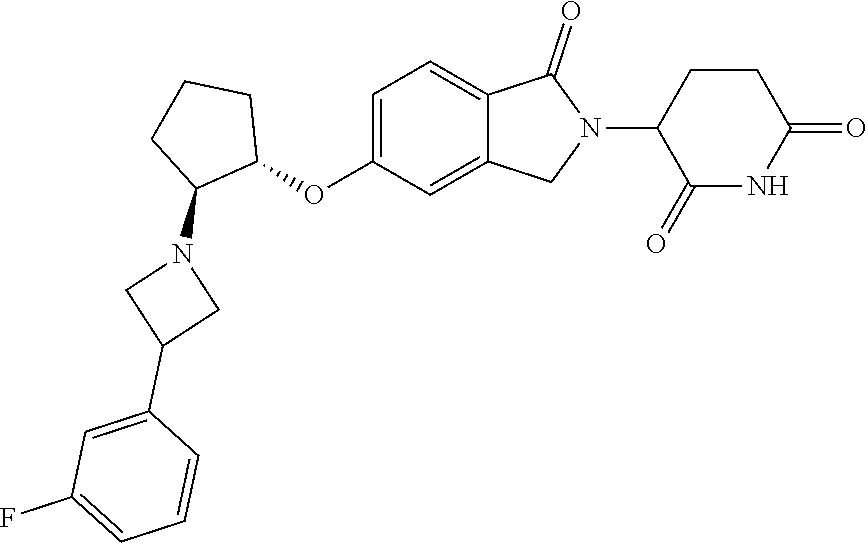 |
3-(5-(((1S,2S)-2-(3-(3- fluorophenyl)azetidin-1- yl)cyclopentyl)oxy)-1- oxoisoindolin-2-yl)piperidine-2,6- dione |
| 89 |
 |
1-(5-(((1S,2S)-2-(3-(3- fluorophenyl)azetidin-1- yl)cyclohexyl)oxy)-1- oxoisoindolin-2-yl)-3- azabicyclo[3.1.1]heptane-2,4- dione |
| 90 |
 |
Rac-4-(1-((cis)-2-((2-(2,4-dioxo-3- azabicyclo[3.1.1]heptan-1-yl)-1- oxoisoindolin-5- yl)oxy)cyclohexyl)azetidin-3-yl)- 3-fluorobenzonitrile |
| 91 |
 |
Rac-4-(1-((trans)-2-((2-(2,4-dioxo- 3-azabicyclo[3.1.1]heptan-1-yl)-1- oxoisoindolin-5- yl)oxy)cyclohexyl)azetidin-3-yl)- 3-fluorobenzonitrile |
| 92 |
 |
Rac-4-(1-((cis)-2-((2-(2,4-dioxo-3- azabicyclo[3.1.1]heptan-1-yl)-1- oxoisoindolin-5- yl)oxy)cyclohexyl)azetidin-3- yl)benzonitrile |
| 93 |
 |
Rac-4-(1-((trans)-2-((2-(2,4-dioxo- 3-azabicyclo[3.1.1]heptan-1-yl)-1- oxoisoindolin-5- yl)oxy)cyclohexyl)azetidin-3- yl)benzonitrile |
| 94 |
 |
Rac-2-(1-((cis)-2-((2-(2,4-dioxo-3- azabicyclo[3.1.1]heptan-1-yl)-1- oxoisoindolin-5- yl)oxy)cyclohexyl)azetidin-3- yl)benzonitrile |
| 95 |
 |
Rac-2-(1-((trans)-2-((2-(2,4-dioxo- 3-azabicyclo[3.1.1]heptan-1-yl)-1- oxoisoindolin-5- yl)oxy)cyclohexyl)azetidin-3- yl)benzonitrile |
| 96 |
 |
Rac-3-(5-(((trans)-2-(3-hydroxy-3- phenylazetidin-1- yl)cyclohexyl)oxy)-1- oxoisoindolin-2-yl)piperidine-2,6- dione |
| 97 |
 |
Rac-3-(5-(((cis)-2-(3-hydroxy-3- phenylazetidin-1- yl)cyclohexyl)oxy)-1- oxoisoindolin-2-yl)piperidine-2,6- dione |
| 98 |
 |
4-(1-(2-((2-(2,6-dioxopiperidin-3- yl)-1-oxoisoindolin-5- yl)oxy)cyclopentyl)azetidin-3- yl)benzonitrile |
| 99 |
 |
Rac-5-chloro-2-(1-((trans)-2-((2- (2,6-dioxopiperidin-3-yl)-1- oxoisoindolin-5- yl)oxy)cyclohexyl)azetidin-3- yl)benzonitrile |
| 100 |
 |
Rac-5-chloro-2-(1-((cis)-2-((2- (2,6-dioxopiperidin-3-yl)-1- oxoisoindolin-5- yl)oxy)cyclohexyl)azetidin-3- yl)benzonitrile |
| 101 |
 |
Rac-2-(1-((trans)-2-((2-(2,6- dioxopiperidin-3-yl)-1- oxoisoindolin-5- yl)oxy)cyclohexyl)azetidin-3-yl)- 5-fluorobenzonitrile |
| 102 |
 |
Rac-2-(1-((cis)-2-((2-(2,6- dioxopiperidin-3-yl)-1- oxoisoindolin-5- yl)oxy)cyclohexyl)azetidin-3-yl)- 5-fluorobenzonitrile |
| 103 |
 |
3-(5-(((1S,2S)-2-(3-(2-chloro-4- fluorophenyl)azetidin-1- yl)cyclohexyl)oxy)-1- oxoisoindolin-2-yl)piperidine-2,6- dione |
| 104 |
 |
3-(5-(((1S,2S)-2-(3-(2-chloro-4- fluorophenyl)azetidin-1- yl)cyclopentyl)oxy)-1- oxoisoindolin-2-yl)piperidine-2,6- dione |
| 105 |
 |
1-(1-oxo-5-(((1S,2S)-2-(3- phenylazetidin-1- yl)cyclopentyl)oxy)isoindolin-2- yl)-3-azabicyclo[3.1.1]heptane- 2,4-dione |
| 106 |
 |
1-(1-oxo-5-(((1S,2S)-2-(3- phenylpyrrolidin-1- yl)cyclohexyl)oxy)isoindolin-2- yl)-3-azabicyclo[3.1.1]heptane- 2,4-dione |
| 107 |
 |
1-(1-oxo-5-(((1S,2S)-2-(3- phenylpyrrolidin-1- yl)cyclopentyl)oxy)isoindolin-2- yl)-3-azabicyclo[3.1.1]heptane- 2,4-dione |
| 108 |
 |
Rac-2-(1-((trans)-2-((2-(2,6- dioxopiperidin-3-yl)-1- oxoisoindolin-5- yl)oxy)cyclohexyl)azetidin-3- yl)benzonitrile |
| 109 |
 |
Rac-2-(1-((cis)-2-((2-(2,6- dioxopiperidin-3-yl)-1- oxoisoindolin-5- yl)oxy)cyclohexyl)azetidin-3- yl)benzonitrile |
| 110 |
 |
4-(1-(2-((2-(2,6-dioxopiperidin-3- yl)-1-oxoisoindolin-5- yl)oxy)cyclopentyl)azetidin-3-yl)- 2-fluorobenzonitrile |
| 111 |
 |
3-(5-(((1S,2S)-2-(3-(3- fluorophenyl)azetidin-1- yl)cyclohexyl)oxy)-1- oxoisoindolin-2-yl)piperidine-2,6- dione |
| 112 |
 |
3-(5-(((1S,2S)-2-(3-(3- morpholinophenyl)azetidin-1- yl)cyclohexyl)oxy)-1- oxoisoindolin-2-yl)piperidine-2,6- dione |
| 113 |
 |
3-(1-((1S,2S)-2-((2-(2,6- dioxopiperidin-3-yl)-1- oxoisoindolin-5- yl)oxy)cyclohexyl)azetidin-3- yl)benzonitrile |
| 114 |
 |
1-(1-oxo-5-(((1S,2S)-2-(3- phenylazetidin-1- yl)cyclohexyl)oxy)isoindolin-2- yl)-3-azabicyclo[3.1.1]heptane- 2,4-dione |
| 115 |
 |
Rac-4-(1-((cis)-2-((2-(2,6- dioxopiperidin-3-yl)-1- oxoisoindolin-5- yl)oxy)cyclohexyl)azetidin-3-yl)- 3-fluorobenzonitrile |
| 116 |
 |
Rac-4-(1-((trans)-2-((2-(2,6- dioxopiperidin-3-yl)-1- oxoisoindolin-5- yl)oxy)cyclohexyl)azetidin-3-yl)- 3-fluorobenzonitrile |
| 117 |
 |
4-(1-(2-((2-(2,6-dioxopiperidin-3- yl)-1-oxoisoindolin-5- yl)oxy)cyclohexyl)azetidin-3- yl)benzonitrile |
| 118 |
 |
3-(1-oxo-5-((2-(3-phenylazetidin- 1-yl)cyclohexyl)oxy)isoindolin-2- yl)piperidine-2,6-dione |
| 119 |
 |
Rac-4-(1-((trans)-2-((2-(2,6- dioxopiperidin-3-yl)-1- oxoisoindolin-5- yl)oxy)cyclohexyl)azetidin-3-yl)- 2-fluorobenzonitrile |
| 120 |
 |
3-(1-oxo-5-(((1S,2S)-2-(3- phenylazetidin-1- yl)cyclopentyl)oxy)isoindolin-2- yl)piperidine-2,6-dione |
| 121 |
 |
3-(1-oxo-5-(((1S,2S)-2-(3- phenylpyrrolidin-1- yl)cyclopentyl)oxy)isoindolin-2- yl)piperidine-2,6-dione |
| 122 |
 |
Rac-4-(1-((cis)-2-((2-(2,6- dioxopiperidin-3-yl)-1- oxoisoindolin-5- yl)oxy)cyclohexyl)azetidin-3-yl)- 2-fluorobenzonitrile |
| 123 |
 |
3-(5-(((1S,2S)-2-(3-(4- fluorophenyl)azetidin-1- yl)cyclohexyl)oxy)-1- oxoisoindolin-2-yl)piperidine-2,6- dione |
| 124 |
 |
3-(5-(((1S,2S)-2-(3-(4- morpholinophenyl)azetidin-1- yl)cyclohexyl)oxy)-1- oxoisoindolin-2-yl)piperidine-2,6- dione |
| 125 |
 |
(R)-3-(1-oxo-5-(((1S,2S)-2-(3- phenylazetidin-1- yl)cyclohexyl)oxy)isoindolin-2- yl)piperidine-2,6-dione |
| 126 |
 |
3-(5-(((1S,2S)-2-(3-(3- methoxyphenyl)azetidin-1- yl)cyclohexyl)oxy)-1- oxoisoindolin-2-yl)piperidine-2,6- dione |
| 127 |
 |
3-(1-oxo-5-(((1S,2S)-2-(3- phenylazetidin-1- yl)cyclohexyl)oxy)isoindolin-2- yl)piperidine-2,6-dione |
| 128 |
 |
3-(1-oxo-5-(((1S,2R)-2-(3- phenylazetidin-1- yl)cyclohexyl)oxy)isoindolin-2- yl)piperidine-2,6-dione |
| 129 |
 |
3-(1-oxo-5-(((1S,2S)-2-(3-(2- (trifluoromethyl)phenyl)azetidin- 1-yl)cyclohexyl)oxy)isoindolin-2- yl)piperidine-2,6-dione |
| 130 |
 |
3-(1-oxo-5-(((1S,2S)-2-(3- phenylazetidin-1- yl)cyclohexyl)oxy)isoindolin-2- yl)piperidine-2,6-dione 2- hydroxypropane-1,2,3- tricarboxylate |
| 131 |
 |
3-(1-oxo-5-(((1S,2S)-2-(3- phenylazetidin-1- yl)cycloheptyl)oxy)isoindolin-2- yl)piperidine-2,6-dione |
| 132 |
 |
3-(5-(((1S,2S)-2-(3-(4- hydroxyphenyl)azetidin-1- yl)cyclohexyl)oxy)-1- oxoisoindolin-2-yl)piperidine-2,6- dione |
| 133 |
 |
3-(5-(((1S,2S)-2-(3-(2- hydroxyphenyl)azetidin-1- yl)cyclohexyl)oxy)-1- oxoisoindolin-2-1)piperidine-2,6- dione |
| 134 |
 |
3-(5-(((1S,2S)-2-(3-(3- hydroxyphenyl)azetidin-1- yl)cyclohexyl)oxy)-1- oxoisoindolin-2-yl)piperidine-2,6- dione |
| TABLE 1A |
| Structure |
 |
 |
 |
 |
 |
 |
 |
 |
 |
 |
 |
 |
 |
 |
 |
 |
 |
 |
 |
 |
 |
 |
 |
 |
 |
 |
 |
 |
 |
 |
 |
 |
 |
 |
 |
 |
 |
 |
 |
 |
 |
 |
 |
 |
 |
 |
 |
 |
 |
 |
 |
 |
 |
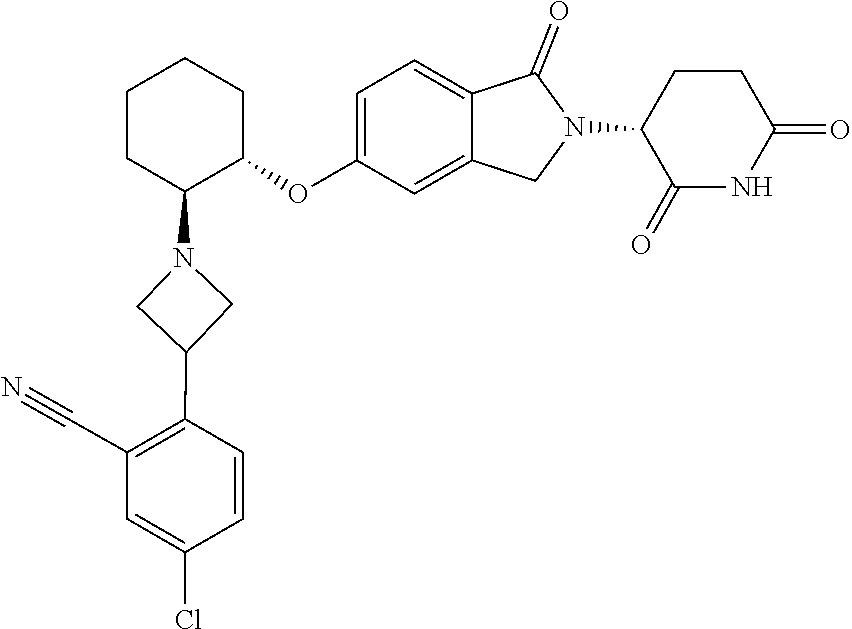 |
 |
 |
 |
 |
 |
 |
 |
 |
 |
 |
 |
 |
 |
 |
 |
 |
 |
 |
 |
 |
 |
 |
 |
 |
 |
 |
 |
 |
 |
 |
 |
 |
 |
 |
 |
 |
 |
 |
 |
 |
 |
 |
 |
 |
 |
 |
 |
 |
 |
 |
 |
 |
 |
 |
 |
 |
 |
 |
 |
 |
 |
 |
 |
 |
 |
 |
 |
 |
 |
 |
 |
 |
 |
 |
 |
 |
 |
 |
 |
 |
 |
 |
 |
 |
 |
 |
 |
 |
 |
 |
 |
 |
 |
 |
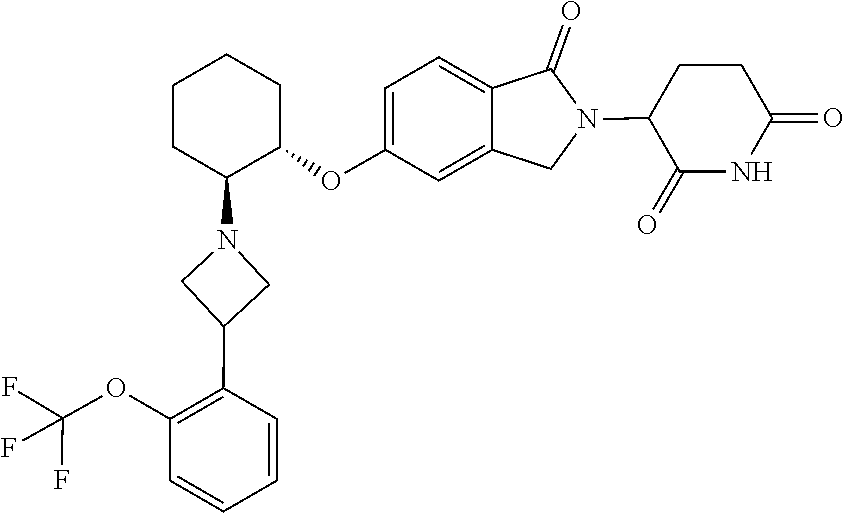 |
 |
 |
 |
 |
 |
 |
 |
 |
 |
 |
 |
 |
 |
 |
 |
 |
 |
 |
 |
 |
 |
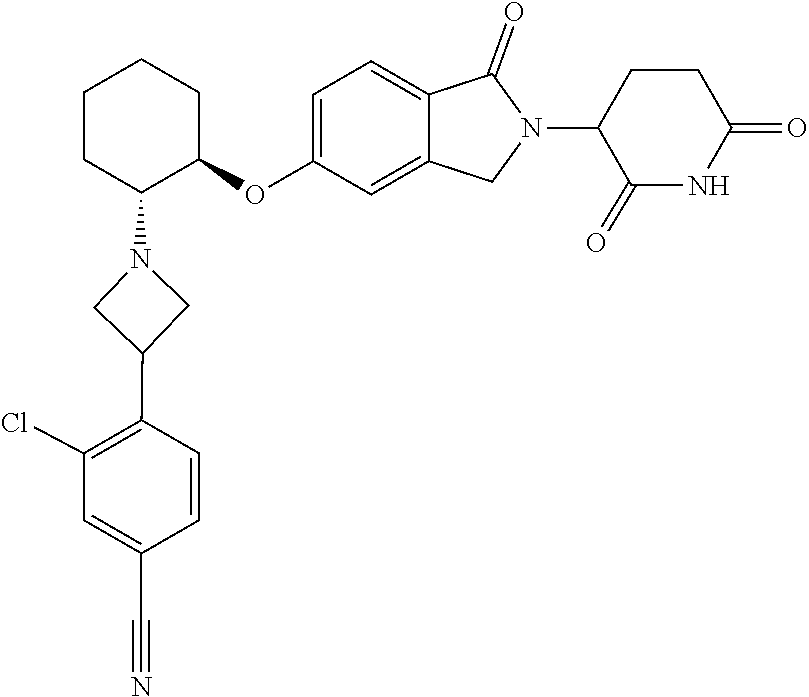 |
 |
 |
 |
 |
 |
 |
 |
 |
 |
 |
 |
 |
 |
 |
 |
 |
 |
 |
 |
 |
 |
 |
 |
 |
 |
 |
 |
 |
 |
 |
 |
 |
 |
 |
 |
 |
 |
 |
 |
 |
 |
 |
 |
 |
 |
 |
 |
 |
 |
 |
 |
 |
 |
 |
 |
 |
 |
 |
 |
 |
 |
 |
 |
 |
 |
 |
 |
 |
 |
 |
 |
 |
 |
 |
 |
 |
 |
 |
 |
 |
 |
 |
 |
 |
 |
 |
 |
 |
 |
 |
 |
 |
 |
 |
 |
 |
 |
 |
 |
 |
 |
 |
 |
 |
 |
 |
 |
 |
 |
 |
 |
 |
 |
 |
 |
 |
 |
 |
 |
 |
 |
 |
 |
 |
 |
 |
 |
 |
 |
 |
 |
 |
 |
 |
 |
 |
 |
 |
 |
 |
 |
 |
 |
 |
 |
 |
 |
 |
 |
 |
 |
 |
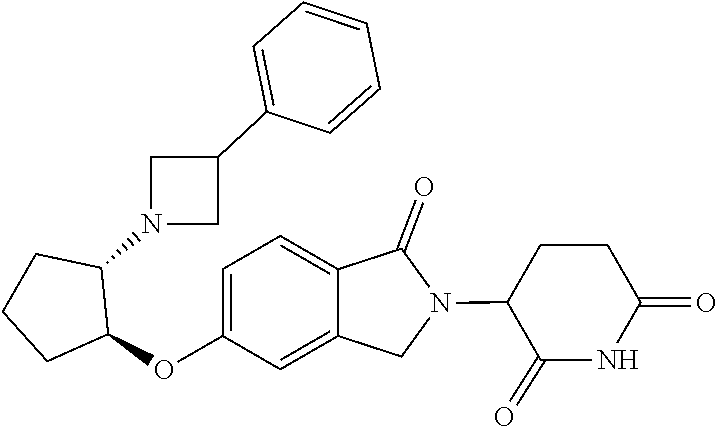 |
 |
 |
 |
 |
 |
 |
 |
 |
 |
 |
 |
 |
 |
 |
 |
 |
 |
 |
 |
 |
 |
 |
 |
 |
 |
 |
 |
 |
 |
 |
 |
 |
 |
 |
 |
 |
 |
 |
 |
 |
 |
 |
 |
 |
 |
 |
 |
| TABLE 1B | |
| # | Structure |
| 1 |  |
| 10 |  |
| 15 |  |
| 19 |  |
| 23 |  |
| 27 |  |
| 31 |  |
| 35 |  |
| 36 |  |
| 38 |  |
| 39 |  |
| 44 |  |
| 45 |  |
| 47 |  |
| 48 |  |
| 50 |  |
| 51 |  |
| 52 |  |
| 53 |  |
| 55 |  |
| 57 |  |
| 58 |  |
| 59 |  |
| 60 |  |
| 61 |  |
| 62 |  |
| 63 |  |
| 64 |  |
| 65 |  |
| 66 |  |
| 67 |  |
| 68 |  |
| 72 |  |
| 73 |  |
| 74 |  |
| 75 |  |
| 76 |  |
| 80 |  |
| 81 |  |
| 83 |  |
| 88 |  |
| 96 |  |
| 99 |  |
| 101 |  |
| 103 |  |
| 104 |  |
| 108 |  |
| 110 |  |
| 111 |  |
| 112 |  |
| 113 |  |
| 115 |  |
| 119 |  |
| 120 |  |
| 121 |  |
| 123 |  |
| 124 |  |
| 125 |  |
| 126 |  |
| 127 |  |
| 129 |  |
| 130 |  |
| 131 |  |
| 132 |  |
| 133 |  |
| 134 |  |
General Synthetic Methods


| Quantity per | |||
| Ingredient | tablet, mg | ||
| compound of this disclosure | 400 | ||
| Cornstarch | 50 | ||
| croscarmellose sodium | 25 | ||
| Lactose | 120 | ||
| magnesium stearate | 5 | ||
| Quantity per | |||
| Ingredient | capsule, mg | ||
| compound of this disclosure | 200 | ||
| lactose, spray-dried | 148 | ||
| magnesium stearate | 2 | ||
| Ingredient | Amount | ||
| compound of this disclosure | 1.0 | g | ||
| fumaric acid | 0.5 | g | ||
| sodium chloride | 2.0 | g | ||
| methyl paraben | 0.15 | g | ||
| propyl paraben | 0.05 | g | ||
| granulated sugar | 25.0 | g | ||
| sorbitol (70% solution) | 13.00 | g | ||
| Veegum K (Vanderbilt Co.) | 1.0 | g | ||
| Flavoring | 0.035 | mL | ||
| Colorings | 0.5 | mg | ||
| distilled water | q.s. to 100 | mL | ||
| Ingredient | Amount | ||
| compound of this disclosure | 0.2 mg-20 mg | ||
| sodium acetate buffer solution, 0.4 M | 2.0 mL | ||
| HC1 (1N) or NaOH (1N) | q.s. to suitable pH | ||
| water (distilled, sterile) | q.s. to 20 mL | ||
| Ingredient | Amount | ||
| Compound of this disclosure | 500 mg | ||
| Witepsol ® H-15 | balance | ||
| Abbreviation | Meaning |
| δ | chemical shift (ppm) |
| ACN or MeCN | acetonitrile |
| Boc | tert-butoxycarbonyl |
| BPD | bis(pinacolato)diboron |
| BRET | Bioluminescence Resonance Energy Transfer |
| Cbz | benzyloxycarbonyl |
| CDCl3 | deuterated chloroform |
| DBU | 1,8-diazabicyclo[5.4.0]undec-7-ene |
| DC50 | concentration that resulted in a 50% targeted protein degradation |
| DCM | dichloromethane |
| DEAD | diethyl azodicarboxylate |
| DHA | docosahexaenoic acid |
| DIAD | diisopropyl azodicarboxylate |
| DIEA | diisopropylethylamine |
| DMA | dimethylacetamide |
| DMAP | 4-dimethylaminopyridine |
| DMF | N,N-dimethylformamide |
| DMP | Dess-Martin periodinane |
| DMSO | dimethylsulfoxide |
| d6-DMSO | deuterated dimethylsulfoxide |
| dtbbpy | 4,4′-di-tert-butyl-2,2′-dipyridyl |
| EPA | eicosapentaenoic acid |
| eq. | equivalent(s) |
| ESI | electrospray ionization |
| EtOAc | ethyl acetate |
| EtOH | ethanol |
| FBS | fetal Bovine Serum |
| FITC | fluorescein isothiocyanate |
| Fmoc | fluorenylmethyloxycarbonyl |
| g | grams |
| 1H NMR | proton nuclear magnetic resonance spectroscopy |
| h | hour(s) |
| HPLC | high performance liquid chromatography |
| Ir[(dF(CF3)ppy)2dtbbpy]PF6 | [4,4′-Bis(1,1-dimethylethyl)-2,2′-bipyridine-N1,N1′]bis[3,5- |
| difluoro-2-[5-(trifluoromethyl)-2-pyridinyl-N]phenyl-C]Iridium(III) | |
| hexafluorophosphate | |
| L | liter |
| LAH | lithium aluminum hydride |
| LC | liquid chromatography |
| LC-MS | liquid chromatography-mass spectrometry |
| LDA | lithium diisopropylamide |
| M | molar |
| mCPBA | meta-Chloroperoxybenzoic acid |
| MeOD | deuterated methanol |
| MeOH | methanol |
| mg | milligram |
| mmol | millimole |
| mL | milliliter |
| UL | microliter |
| umol or mmol | micromole |
| mM | micromolar |
| μm | micron |
| m/z | mass-to-charge ratio |
| MsOH | methanesulfonic acid |
| min | minute(s) |
| N | normal |
| n-BuLi | n-butyllithium |
| nm | nanometer |
| PBS | Phosphate-buffered saline |
| Pd2(dba)3 | tris(dibenzylideneacetone)dipalladium(0) |
| pM | picomolar |
| q.s. | amount which is sufficient |
| rt | room temperature |
| t-Bu | tert-butyl |
| TBME | tert-butyl methyl ether |
| TEA | triethylamine |
| TFA | trifluoroacetic acid |
| TfOH | trifluoromethanesulfonic acid |
| TFP | tri(2-furyl)phosphine |
| THF | tetrahydrofuran |
| TMP | 2,2,6,6-tetramethylpiperidine |
| TRITC | tetramethyIrhodamine |
| TsCl | 4-toluenesulfonyl chloride |
| UV | ultraviolet |
| v/v | volume/volume ratio |
| wt % | weight percent |
| NMR abbreviations | br = broad |
| d = doublet | |
| dd = doublet of doublets | |
| ddd = doublet of doublet of doublets | |
| dt = doublet of triplets | |
| m = multiplet | |
| q = quartet | |
| s = singlet | |
| t = triplet | |
LC-MS Methods (General Method)


Step 1:


Step 1:


Step 1:


Step 1:


| TABLE 2 | ||
| # | Nomenclature | 1H NMR/MS |
| 1 | 3-(1-oxo-5-(((1S,2S)-2-(3- | (400 MHZ, d4-MeOD) δ 1.22-1.28 (m, 1H), |
| phenylpyrrolidin-1- | 1.37-1.58 (m, 3H), 1.66-1.80 (m, 1H), 1.84 (br | |
| yl)cyclohexyl)oxy)isoindolin-2- | s, 1H), 1.99 (br s, 1H), 2.06-2.25 (m, 2H), 2.36 | |
| yl)piperidine-2,6-dione | (br s, 2H), 2.42-2.55 (m, 2H), 2.74-2.82 (m, | |
| 1H), 2.85-3.03 (m, 1H), 3.33-3.40 (m, 1H), | ||
| 3.43-3.65 (m, 2H), 3.70-3.87 (m, 2H), 4.39-4.54 | ||
| (m, 2H), 4.69-4.80 (m, 1H), 5.13 (br dd, | ||
| J = 13.29, 5.19 Hz, 1H), 7.19-7.53 (m, 7H), 7.74- | ||
| 7.79 (m, 1H) | ||
| 10 | (S)-3-(1-oxo-5-(((1S,2S)-2-(3- | (400 MHZ, d6-DMSO) δ 1.07-1.19 (m, 1 H) |
| phenylazetidin-1- | 1.20-1.32 (m, 1 H) 1.34-1.44 (m, 2 H) 1.65 (br | |
| yl)cyclohexyl)oxy)isoindolin-2- | s, 2 H) 1.78-1.89 (m, 1 H) 1.92-2.05 (m, 2 H) | |
| yl)piperidine-2,6-dione | 2.35-2.45 (m, 2 H) 2.55-2.63 (m, 1 H) 2.84- | |
| 2.96 (m, 1 H) 3.12 (br s, 1 H) 3.26 (br d, J = 7.15 | ||
| Hz, 1 H) 3.45-3.55 (m, 1 H) 3.62 (m, 2 H) 4.20- | ||
| 4.32 (m, 2 H) 4.33-4.42 (m, 1 H) 5.06 (m, 1 | ||
| H) 7.04 (br d, J = 8.58 Hz, 1 H) 7.16-7.21 (m, 2 | ||
| H) 7.26-7.34 (m, 4 H) 7.60 (d, J = 8.58 Hz, 1 H) | ||
| 10.97 (s, 1 H). | ||
| 11 | 3-(1-oxo-5-(((1R,2R)-2-(3-phenylazetidin- | (400 MHZ, d6-DMSO) δ 1.07-1.19 (m, 1 H) |
| 1-yl)cyclohexyl)oxy)isoindolin-2- | 1.20-1.32 (m, 1 H) 1.34-1.44 (m, 2 H) 1.65 (br | |
| yl)piperidine-2,6-dione | s, 2 H) 1.78-1.89 (m, 1 H) 1.92-2.05 (m, 2 H) | |
| 2.35-2.45 (m, 2 H) 2.55-2.63 (m, 1 H) 2.84- | ||
| 2.96 (m, 1 H) 3.12 (br s, 1 H) 3.26 (br d, J = 7.15 | ||
| Hz, 1 H) 3.45-3.55 (m, 1 H) 3.62 (m, 2 H) 4.20- | ||
| 4.32 (m, 2 H) 4.33-4.42 (m, 1 H) 5.06 (m, 1 | ||
| H) 7.04 (br d, J = 8.58 Hz, 1 H) 7.16-7.21 (m, 2 | ||
| H) 7.26-7.34 (m, 4 H) 7.60 (d, J = 8.58 Hz, 1 H) | ||
| 10.97 (s, 1 H) | ||
| 14 | (S)-3-(1-oxo-5-(((1R,2R)-2-(3- | m/z (ESI+) 474.1 (M + H)+ |
| phenylazetidin-1- | ||
| yl)cyclohexyl)oxy)isoindolin-2- | ||
| yl)piperidine-2,6-dione | ||
| 15 | 3-(5-(((1S,2S)-2-(3-(2- | (400 MHZ, d4-methanol) δ 1.31-1.57 (m, 4H), |
| chlorophenyl)azetidin-1- | 1.81-1.98 (m, 2H), 2.14-2.57 (m, 4H), 2.74-2.99 | |
| yl)cyclohexyl)oxy)-1-oxoisoindolin-2- | (m, 2H), 3.62 (br s, 1H), 4.19-4.72 (m, 8H), | |
| yl)piperidine-2,6-dione | 5.09-5.19 (m, 1H), 7.14-7.28 (m, 2H), 7.31-7.51 | |
| (m, 4H), 7.74-7.81 (m, 1H) | ||
| 19 | 3-(5-(((1S,2S)-2-(3-(2- | (400 MHZ, d6-DMSO) δ 1.14-1.50 (m, 4H), |
| methoxyphenyl)azetidin-1- | 1.66-1.85 (m, 2H), 1.93-2.04 (m, 1H), 2.13 (br | |
| yl)cyclohexyl)oxy)-1-oxoisoindolin-2- | s, 1H), 2.19 (br s, 1H), 2.31-2.46 (m, 2H), 2.53- | |
| yl)piperidine-2,6-dione | 2.70 (m, 2H), 2.85-2.98 (m, 1H), 3.57-3.72 (m, | |
| 2H), 3.73-3.85 (m, 3H), 4.02-4.14 (m, 1H), | ||
| 4.19-4.57 (m, 5H), 5.08 (dd, J = 13.26, 5.00 Hz, | ||
| 1H), 6.96-7.07 (m, 2H), 7.12-7.21 (m, 1H), | ||
| 7.22-7.43 (m, 3H), 7.65-7.72 (m, 1H), 10.40 (br | ||
| s, 1H), 10.97 (s, 1H) | ||
| 23 | 3-(5-(((1S,2S)-2-(3-(3,4- | (400 MHZ, d4-methanol) δ 1.20-1.52 (m, 4H), |
| difluorophenyl)azetidin-1- | 1.68-1.85 (m, 2H), 1.94-1.98 (m, 1H), 1.99-2.03 | |
| yl)cyclohexyl)oxy)-1-oxoisoindolin-2- | (m, 1H), 2.06-2.16 (m, 1H), 2.22 (br s, 1H), | |
| yl)piperidine-2,6-dione | 2.31-2.47 (m, 2H), 2.56-2.70 (m, 2H), 2.85-2.97 | |
| (m, 1H), 3.77 (br d, J = 7.67 Hz, 1H), 4.22-4.56 | ||
| (m, 1H), 4.22-4.56 (m, 5H), 5.08 (dd, J = 13.37, | ||
| 4.82 Hz, 1H), 7.11-7.20 (m, 1H), 7.29 (br d, | ||
| J = 7.23 Hz, 2H), 7.40-7.51 (m, 1H), 7.56-7.75 | ||
| (m, 2H), 10.43 (br s, 1H), 10.97 (s, 1H) | ||
| 27 | 3-(5-(((1S,2S)-2-(3-(2- | (400 MHZ, d6-DMSO) δ 1.17-1.51 (m, 5 H) |
| fluorophenyl)azetidin-1- | 1.69-1.82 (m, 2 H) 1.98 (br dd, J = 11.13, 4.75 | |
| yl)cyclohexyl)oxy)-1-oxoisoindolin-2- | Hz, 1 H) 2.09-2.26 (m, 3 H) 2.86-2.95 (m, 1 | |
| yl)piperidine-2,6-dione | H) 3.64-3.77 (m, 1 H) 4.07-4.46 (m, 6 H) | |
| 4.48-4.56 (m, 2 H) 5.04-5.13 (m, 1 H) 7.15- | ||
| 7.33 (m, 4 H) 7.36-7.44 (m, 1 H) 7.56 (br t, | ||
| J = 7.25 Hz, 1 H) 7.67 (br d, J = 7.88 Hz, 1 H) | ||
| 10.41-10.55 (m, 1 H) 10.98 (s, 1 H) | ||
| 3 | 3-(5-(((1S,2S)-2-(3-(4-(1H-pyrazol-1- | (400 MHZ, d6-DMSO) δ 10.98 (br s, 1H), 10.56- |
| yl)phenyl)azetidin-1-yl)cyclohexyl)oxy)- | 10.19 (m, 1H), 8.92-8.42 (m, 1H), 7.95-7.46 | |
| 1-oxoisoindolin-2-yl)piperidine-2,6-dione | (m, 5H), 7.36-6.93 (m, 2H), 6.64-6.47 (m, | |
| 1H), 5.11-5.02 (m, 1H), 4.63-4.17 (m, 5H), | ||
| 4.12-3.96 (m, 1H), 3.83-3.70 (m, 1H), 3.01- | ||
| 2.81 (m, 1H), 2.69-2.53 (m, 3H), 2.46-2.11 (m, | ||
| 4H), 2.03-1.91 (m, 1H), 1.87-1.68 (m, 2H), | ||
| 1.56-1.13 (m, 4H) | ||
| 35 | 3-(1-oxo-5-(((1S,2S)-2-(3-(3- | (400 MHZ, d6-DMSO) δ 10.96 (s, 1H), 8.19 (s, |
| (trifluoromethoxy)phenyl)azetidin-1- | 1H), 7.60 (d, J = 8.4 Hz, 1H), 7.47-7.35 (m, | |
| yl)cyclohexyl)oxy)isoindolin-2- | 2H), 7.31 (s, 1H), 7.21-7.15 (m, 2H), 7.04 (br | |
| yl)piperidine-2,6-dione | d, J = 8.4 Hz, 1H), 5.06 (dd, J =5.0, 13.3 Hz, | |
| 1H), 4.41-4.20 (m, 3H), 3.68-3.55 (m, 3H), | ||
| 3.15 (br t, J = 6.3 Hz, 3H), 2.97-2.84 (m, 1H), | ||
| 2.59 (br d, J = 17.4 Hz, 1H), 2.37 (br d, J = 13.5 | ||
| Hz, 1H), 2.06-1.93 (m, 2H), 1.83 (br d, J = | ||
| 12.0 Hz, 1H), 1.65 (br s, 2H), 1.44-1.34 (m, | ||
| 2H), 1.29-1.04 (m, 2H). | ||
| 36 | 3-(1-oxo-5-(((1S,2S)-2-(3-(2- | (400 MHZ, d6-DMSO) δ 10.97 (s, 1H), 8.19 (s, |
| (trifluoromethoxy)phenyl)azetidin-1- | 1H), 7.69-7.53 (m, 2H), 7.44-7.33 (m, 2H), | |
| yl)cyclohexyl)oxy)isoindolin-2- | 7.31-7.26 (m, 1H), 7.18 (s, 1H), 7.04 (br d, J = | |
| yl)piperidine-2,6-dione | 8.3 Hz, 1H), 5.07 (dd, J = 5.0, 13.2 Hz, 1H), | |
| 4.44-4.34 (m, 1H), 4.34-4.22 (m, 2H), 3.79- | ||
| 3.61 (m, 3H), 2.99-2.81 (m, 1H), 2.60 (br d, J = | ||
| 17.8 Hz, 1H), 2.55-2.52 (m, 3H), 2.41 (br d, | ||
| J = 7.0 Hz, 2H), 2.09-1.92 (m, 2H), 1.84 (br d, | ||
| J = 11.1 Hz, 1H), 1.66 (br d, J = 8.1 Hz, 2H), | ||
| 1.44-1.32 (m, 2H), 1.26 (br d, J = 12.0 Hz, | ||
| 1H), 1.19-1.05 (m, 1H). | ||
| 37 | 5-chloro-2-(1-((1R,2S)-2-((2-(2,6- | m/z (ESI+) 533.1 (M + H)+ |
| dioxopiperidin-3-yl)-1-oxoisoindolin-5- | ||
| yl)oxy)cyclohexyl)azetidin-3- | ||
| yl)benzonitrile | ||
| Diastereomer 1 | ||
| 38 | 5-chloro-2-(1-((1S,2S)-2-((2-(2,6- | m/z (ESI+) 533.1 (M + H)+ |
| dioxopiperidin-3-yl)-1-oxoisoindolin-5- | ||
| yl)oxy)cyclohexyl)azetidin-3- | ||
| yl)benzonitrile | ||
| Diastereomer 2 | ||
| 39 | 5-chloro-2-(1-((1S,2S)-2-((2-(2,6- | m/z (ESI+) 533.1 (M + H)+ |
| dioxopiperidin-3-yl)-1-oxoisoindolin-5- | ||
| yl)oxy)cyclohexyl)azetidin-3- | ||
| yl)benzonitrile | ||
| Diastereomer 3 | ||
| 40 | 5-chloro-2-(1-((1S,2R)-2-((2-(2,6- | m/z (ESI+) 533.1 (M + H)+ |
| dioxopiperidin-3-yl)-1-oxoisoindolin-5- | ||
| yl)oxy)cyclohexyl)azetidin-3- | ||
| yl)benzonitrile | ||
| Diastereomer 4 | ||
| 41 | 3-(4-chloro-1-oxo-5-(((1S,2S)-2-(3- | m/z (ESI+) 508.1 (M + H)+ |
| phenylazetidin-1- | ||
| yl)cyclohexyl)oxy)isoindolin-2- | ||
| yl)piperidine-2,6-dione | ||
| Diastereomer 1 | ||
| 42 | 3-(4-chloro-1-oxo-5-(((1S,2S)-2-(3- | m/z (ESI+) 508.1 (M+H)+ |
| phenylazetidin-1- | ||
| yl)cyclohexyl)oxy)isoindolin-2- | ||
| yl)piperidine-2,6-dione | ||
| Diastereomer 2 | ||
| 43 | 2-(1-((1R,2R)-2-((2-(2,6-dioxopiperidin-3- | m/z (ESI+) 517.1 (M + H)+ |
| yl)-1-oxoisoindolin-5- | ||
| yl)oxy)cyclohexyl)azetidin-3-yl)-5- | ||
| fluorobenzonitrile | ||
| Diastereomer 1 | ||
| 44 | 2-(1-((1S,2S)-2-((2-(2,6-dioxopiperidin-3- | m/z (ESI+) 517.1 (M + H)+ |
| yl)-1-oxoisoindolin-5- | ||
| yl)oxy)cyclohexyl)azetidin-3-yl)-5- | ||
| fluorobenzonitrile | ||
| Diastereomer 2 | ||
| 45 | 2-(1-((1S,2S)-2-((2-(2,6-dioxopiperidin-3- | m/z (ESI+) 517.1 (M + H)+ |
| yl)-1-oxoisoindolin-5- | ||
| yl)oxy)cyclohexyl)azetidin-3-yl)-5- | ||
| fluorobenzonitrile | ||
| Diastereomer 3 | ||
| 46 | 2-(1-((1S,2R)-2-((2-(2,6-dioxopiperidin-3- | m/z (ESI+) 517.1 (M + H)+ |
| yl)-1-oxoisoindolin-5- | ||
| yl)oxy)cyclohexyl)azetidin-3-yl)-5- | ||
| fluorobenzonitrile | ||
| Diastereomer 4 | ||
| 47 | 3-chloro-4-(1-((1S,2S)-2-((2-(2,6- | m/z (ESI+) 533.3 (M + H)+ |
| dioxopiperidin-3-yl)-1-oxoisoindolin-5- | ||
| yl)oxy)cyclohexyl)azetidin-3- | ||
| yl)benzonitrile | ||
| Diastereomer 1 | ||
| 48 | 3-chloro-4-(1-((1S,2S)-2-((2-(2,6- | m/z (ESI+) 533.3 (M + H)+ |
| dioxopiperidin-3-yl)-1-oxoisoindolin-5- | ||
| yl)oxy)cyclohexyl)azetidin-3- | ||
| yl)benzonitrile | ||
| Diastereomer 2 | ||
| 49 | 3-chloro-4-(1-((1S,2R)-2-((2-(2,6- | m/z (ESI+) 533.3 (M + H)+ |
| dioxopiperidin-3-yl)-1-oxoisoindolin-5- | ||
| yl)oxy)cyclohexyl)azetidin-3- | ||
| yl)benzonitrile | ||
| Diastereomer 3 | ||
| 50 | 3-(5-(((1S,2S)-2-(3-(4- | (400 MHZ, d6-DMSO) δ 10.96 (s, 1H), 7.60 (d, |
| fluorophenyl)azetidin-1- | J = 8.4 Hz, 1H), 7.38-7.33 (m, 2H), 7.17 (d, J = | |
| yl)cyclohexyl)oxy)-1-oxoisoindolin-2- | 1.6 Hz, 1H), 7.14-7.08 (m, 2H), 7.03 (dd, J = | |
| yl)piperidine-2,6-dione | 2.2, 8.4 Hz, 1H), 5.06 (dd, J = 5.1, 13.3 Hz, | |
| Diastereomer 1 | 1H), 4.41-4.33 (m, 1H), 4.31-4.21 (m, 2H), | |
| 3.67-3.56 (m, 2H), 3.53-3.48 (m, 1H), 3.24- | ||
| 3.20 (m, 1H), 3.10 (t, J = 6.8 Hz, 1H), 2.95- | ||
| 2.84 (m, 1H), 2.60 (br d, J = 2.9 Hz, 2H), 2.43 | ||
| (br d, J = 2.3 Hz, 1H), 2.03-1.93 (m, 2H), 1.83 | ||
| (br dd, J = 2.5, 9.4 Hz, 1H), 1.65 (br d, J = 4.1 | ||
| Hz, 2H), 1.43-1.35 (m, 2H), 1.23 (br s, 1H), | ||
| 1.15-1.09 (m, 1H). | ||
| 51 | 3-(5-(((1S,2S)-2-(3-(4- | (400 MHZ, d6-DMSO) δ 11.06-10.85 (m, 1H), |
| fluorophenyl)azetidin-1- | 7.60 (d, J = 8.5 Hz, 1H), 7.38-7.33 (m, 2H), | |
| yl)cyclohexyl)oxy)-1-oxoisoindolin-2- | 7.17 (d, J = 1.5 Hz, 1H), 7.14-7.08 (m, 2H), | |
| yl)piperidine-2,6-dione | 7.03 (dd, J = 2.0, 8.5 Hz, 1H), 5.06 (dd, J = 5.0, | |
| Diastereomer 2 | 13.5 Hz, 1H), 4.40-4.31 (m, 1H), 4.30-4.22 | |
| (m, 2H), 3.66-3.62 (m, 1H), 3.61-3.56 (m, | ||
| 1H), 3.23-3.20 (m, 1H), 3.17 (d, J = 5.0 Hz, | ||
| 1H), 3.10 (br t, J = 6.8 Hz, 1H), 2.96-2.84 (m, | ||
| 2H), 2.60 (br d, J = 2.5 Hz, 1H), 2.43-2.37 (m, | ||
| 1H), 1.99 (br d, J = 5.5 Hz, 1H), 1.83 (br d, J = | ||
| 11.5 Hz, 1H), 1.65 (br s, 2H), 1.42-1.34 (m, | ||
| 2H), 1.28-1.22 (m, 2H), 1.17-1.09 (m, 1H). | ||
| 52 | 3-(6-fluoro-1-oxo-5-(((1S,2S)-2-(3- | m/z (ESI+) 492.3 (M + H)+ |
| phenylazetidin-1- | ||
| yl)cyclohexyl)oxy)isoindolin-2- | ||
| yl)piperidine-2,6-dione | ||
| Diastereomer 1 | ||
| 53 | 3-(6-fluoro-1-oxo-5-(((1S,2S)-2-(3- | m/z (ESI+) 492.3 (M + H)+ |
| phenylazetidin-1- | ||
| yl)cyclohexyl)oxy)isoindolin-2- | ||
| yl)piperidine-2,6-dione | ||
| Diastereomer 2 | ||
| 54 | 3-(1-oxo-5-(((1R,2R)-2-(2-phenylazetidin- | m/z (ESI+) 474.1 (M + H)+ |
| 1-yl)cyclohexyl)oxy)isoindolin-2- | ||
| yl)piperidine-2,6-dione | ||
| 55 | 3-(1-oxo-5-(((1S,2S)-2-(2-phenylazetidin- | m/z (ESI+) 474.1 (M + H)+ |
| 1-yl)cyclohexyl)oxy)isoindolin-2- | ||
| yl)piperidine-2,6-dione | ||
| 56 | 3-(1-oxo-5-(((1S,2R)-2-(2-phenylazetidin- | m/z (ESI+) 474.1 (M + H)+ |
| 1-yl)cyclohexyl)oxy)isoindolin-2- | ||
| yl)piperidine-2,6-dione | ||
| 57 | 3-(5-(((1S,2S)-2-(3-(2,4- | (400 MHZ, d6-DMSO) δ 10.96 (s, 1H), 7.61 (d, |
| difluorophenyl)azetidin-1- | J = 8.4 Hz, 1H), 7.52-7.44 (m, 1H), 7.23-6.97 | |
| yl)cyclohexyl)oxy)-1-oxoisoindolin-2- | (m, 4H), 5.06 (br dd, J = 4.6, 13.2 Hz, 1H), 4.43- | |
| yl)piperidine-2,6-dione | 4.33 (m, 1H), 4.32-4.21 (m, 2H), 3.64 (td, J = | |
| 3.8, 7.6 Hz, 3H), 3.27 (br s, 1H), 3.13 (br s, | ||
| 1H), 2.97-2.84 (m, 1H), 2.59 (br d, J = 16.8 | ||
| Hz, 2H), 2.40 (br s, 1H), 1.98 (br d, J = 5.6 Hz, | ||
| 2H), 1.82 (br d, J = 11.3 Hz, 1H), 1.64 (br s, | ||
| 2H), 1.37 (br s, 2H), 1.25 (br d, J = 10.7 Hz, | ||
| 1H), 1.17-1.01 (m, 1H). | ||
| 58 | 3-(1-oxo-5-(((1S,2S)-2-(3-(4- | m/z (ESI+) 542.1 (M + H)+ |
| (trifluoromethyl)phenyl)azetidin-1- | ||
| yl)cyclohexyl)oxy)isoindolin-2- | ||
| yl)piperidine-2,6-dione | ||
| 59 | 3-(1-oxo-5-(((1R,2S)-2-(3-(4- | m/z (ESI+) 542.1 (M + H)+ |
| (trifluoromethyl)phenyl)azetidin-1- | ||
| yl)cyclohexyl)oxy)isoindolin-2- | ||
| yl)piperidine-2,6-dione | ||
| 60 | Rac-3-(1-oxo-5-(((trans)-2-(3-(4- | m/z (ESI+) 558.1 (M + H)+ |
| (trifluoromethoxy)phenyl)azetidin-1- | ||
| yl)cyclohexyl)oxy)isoindolin-2- | ||
| yl)piperidine-2,6-dione | ||
| 61 | Rac-3-(1-oxo-5-(((cis)-2-(3-(4- | m/z (ESI+) 558.1 (M + H)+ |
| (trifluoromethoxy)phenyl)azetidin-1- | ||
| yl)cyclohexyl)oxy)isoindolin-2- | ||
| yl)piperidine-2,6-dione | ||
| 62 | Rac-3-(1-oxo-5-(((trans)-2-(3-(3- | (400 MHZ, d4-methanol) 1.12-1.48 (m, 4H), |
| (trifluoromethyl)phenyl)azetidin-1- | 1.80 (br d, J = 9.88 Hz, 1H), 2.05 (br d, J = 13.26 | |
| yl)cyclohexyl)oxy)isoindolin-2- | Hz, 1H), 2.10-2.23 (m, 2H), 2.47 (qd, J = 13.17, | |
| yl)piperidine-2,6-dione | 4.63 Hz, 1H), 2.68-2.80 (m, 2H), 2.83-2.95 (m, | |
| 1H), 3.46-3.54 (m, 1H), 3.64-3.73 (m, 1H), 3.81 | ||
| (quin, J = 7.85 Hz, 1H), 3.93 (br s, 2H), 4.31- | ||
| 4.52 (m, 3H), 4.57-4.59 (m, 1H), 5.07-5.17 (m, | ||
| 1H), 7.09 (dd, J = 8.50, 2.13 Hz, 1H), 7.16 (s, | ||
| 1H), 7.49-7.56 (m, 2H), 7.59 (s, 2H), 7.71 (d, | ||
| J = 8.38 Hz, 1H). | ||
| 63 | Rac-3-(1-oxo-5-(((cis)-2-(3-(3- | (400 MHZ, d4-methanol) 1.26-1.60 (m, 4H), |
| (trifluoromethyl)phenyl)azetidin-1- | 1.72-1.85 (m, 2H), 2.08-2.24 (m, 2H), 2.48 (qd, | |
| yl)cyclohexyl)oxy)isoindolin-2- | J = 13.03, 4.57 Hz, 1H), 2.68 (s, 1H), 2.73-2.82 | |
| yl)piperidine-2,6-dione | (m, 1H), 2.86-3.06 (m, 1H), 3.39-3.42 (m, 1H), | |
| 3.80-3.90 (m, 2H), 4.38-4.51 (m, 2H), 4.58 (s, | ||
| 3H), 4.79-4.80 (m, 1H), 5.13 (br d, J = 5.25 Hz, | ||
| 1H), 7.16 (dd, J = 8.44, 1.94 Hz, 1H), 7.20 (s, | ||
| 1H), 7.47-7.54 (m, 2H), 7.55-7.61 (m, 2H), 7.72 | ||
| (d, J = 8.50 Hz, 1H). | ||
| 64 | 3-(5-(((1S,2S)-2-(3-(2,3- | m/z (ESI+) 510.1 (M + H)+ |
| difluorophenyl)azetidin-1- | ||
| yl)cyclohexyl)oxy)-1-oxoisoindolin-2- | ||
| yl)piperidine-2,6-dione | ||
| 65 | 3-(4-fluoro-1-oxo-5-(((1S,2S)-2-(3- | m/z (ESI+) 492.1 (M + H)+ |
| phenylazetidin-1- | ||
| yl)cyclohexyl)oxy)isoindolin-2- | ||
| yl)piperidine-2,6-dione | ||
| Diastereomer 1 | ||
| 66 | 3-(4-fluoro-1-oxo-5-(((1S,2S)-2-(3- | m/z (ESI+) 492.1 (M + H)+ |
| phenylazetidin-1- | ||
| yl)cyclohexyl)oxy)isoindolin-2- | ||
| yl)piperidine-2,6-dione | ||
| Diastereomer 2 | ||
| 67 | 3-(1-oxo-5-((2-(3-(3- | (400 MHZ, d6-DMSO) δ 10.96 (s, 1H), 8.19 (s, |
| (trifluoromethoxy)phenyl)azetidin-1- | 1H), 7.60 (d, J = 8.4 Hz, 1H), 7.47-7.35 (m, | |
| yl)cyclohexyl)oxy)isoindolin-2- | 2H), 7.31 (s, 1H), 7.21-7.15 (m, 2H), 7.04 (br | |
| yl)piperidine-2,6-dione | d, J = 8.4 Hz, 1H), 5.06 (dd, J =5.0, 13.3 Hz, | |
| 1H), 4.41-4.20 (m, 3H), 3.68-3.55 (m, 3H), | ||
| 3.15 (br t, J = 6.3 Hz, 3H), 2.97-2.84 (m, 1H), | ||
| 2.59 (br d, J = 17.4 Hz, 1H), 2.37 (br d, J = 13.5 | ||
| Hz, 1H), 2.06-1.93 (m, 2H), 1.83 (br d, J = | ||
| 12.0 Hz, 1H), 1.65 (br s, 2H), 1.44-1.34 (m, | ||
| 2H), 1.29-1.04 (m, 2H). | ||
| 68 | 3-(1-oxo-5-((2-(3-(2- | (400 MHZ, d6-DMSO) δ 10.97 (s, 1H), 8.19 (s, |
| (trifluoromethoxy)phenyl)azetidin-1- | 1H), 7.69-7.53 (m, 2H), 7.44-7.33 (m, 2H), | |
| yl)cyclohexyl)oxy)isoindolin-2- | 7.31-7.26 (m, 1H), 7.18 (s, 1H), 7.04 (br d, J = | |
| yl)piperidine-2,6-dione | 8.3 Hz, 1H), 5.07 (dd, J = 5.0, 13.2 Hz, 1H), | |
| 4.44-4.34 (m, 1H), 4.34-4.22 (m, 2H), 3.79- | ||
| 3.61 (m, 3H), 2.99-2.81 (m, 1H), 2.60 (br d, | ||
| J = 17.8 Hz, 1H), 2.55-2.52 (m, 3H), 2.41 (br d, | ||
| J = 7.0 Hz, 2H), 2.09-1.92 (m, 2H), 1.84 (br d, | ||
| J = 11.1 Hz, 1H), 1.66 (br d, J = 8.1 Hz, 2H), | ||
| 1.44-1.32 (m, 2H), 1.26 (br d, J = 12.0 Hz, | ||
| 1H), 1.19-1.05 (m, 1H). | ||
| 69 | 3-(1-oxo-5-((2-(3-(2- | (400 MHZ, d6-DMSO) δ 10.98 (s, 1H), 10.85- |
| (trifluoromethyl)phenyl)azetidin-1- | 10.54 (m, 1H), 7.92 (br d, J = 7.9 Hz, 1H), 7.84- | |
| yl)cyclohexyl)oxy)isoindolin-2- | 7.73 (m, 2H), 7.67 (d, J = 8.3 Hz, 1H), 7.58 | |
| yl)piperidine-2,6-dione | (br t, J = 7.6 Hz, 1H), 7.30 (br s, 1H), 7.21- | |
| 7.12 (m, 1H), 5.09 (dd, J = 5.0, 13.2 Hz, 1H), | ||
| 4.70-4.46 (m, 3H), 4.45-4.18 (m, 5H), 3.75 | ||
| (br s, 1H), 2.99-2.82 (m, 1H), 2.53 (d, J = 1.8 | ||
| Hz, 2H), 2.28-2.08 (m, 2H), 2.04-1.93 (m, | ||
| 1H), 1.88-1.67 (m, 2H), 1.45 (br d, J = 12.0 | ||
| Hz, 1H), 1.38-1.20 (m, 3H). | ||
| 70 | Rac-2-(1-((cis)-2-((2-(2,4-dioxo-3- | m/z (ESI+) 515.1 (M + H)+ |
| azabicyclo[3.1.1]heptan-1-yl)-1- | ||
| oxoisoindolin-5- | ||
| yl)oxy)cyclopentyl)azetidin-3-yl)-5- | ||
| fluorobenzonitrile | ||
| 71 | Rac-2-(1-((trans)-2-((2-(2,4-dioxo-3- | m/z (ESI+) 515.1 (M + H)+ |
| azabicyclo[3.1.1]heptan-1-yl)-1- | ||
| oxoisoindolin-5- | ||
| yl)oxy)cyclopentyl)azetidin-3-yl)-5- | ||
| fluorobenzonitrile | ||
| 72 | 3-(1-oxo-5-(((1S,2S)-2-(4- | (400 MHZ, d6-DMSO) δ 10.98 (s, 1H), 10.85- |
| phenylpiperidin-1- | 10.54 (m, 1H), 7.92 (br d, J = 7.9 Hz, 1H), 7.84- | |
| yl)cyclopentyl)oxy)isoindolin-2- | 7.73 (m, 2H), 7.67 (d, J = 8.3 Hz, 1H), 7.58 | |
| yl)piperidine-2,6-dione | (br t, J = 7.6 Hz, 1H), 7.30 (br s, 1H), 7.21- | |
| 7.12 (m, 1H), 5.09 (dd, J = 5.0, 13.2 Hz, 1H), | ||
| 4.70-4.46 (m, 3H), 4.45-4.18 (m, 5H), 3.75 | ||
| (br s, 1H), 2.99-2.82 (m, 1H), 2.53 (d, J = 1.8 | ||
| Hz, 2H), 2.28-2.08 (m, 2H), 2.04-1.93 (m, | ||
| 1H), 1.88-1.67 (m, 2H), 1.45 (br d, J = 12.0 | ||
| Hz, 1H), 1.38-1.20 (m, 3H). | ||
| 73 | 3-(5-(((1S,2S)-2-(3-(4-(1H-pyrazol-1- | (400 MHZ, d6-DMSO) δ 10.97 (s, 1H), 10.53- |
| yl)phenyl)azetidin-1-yl)cyclopentyl)oxy)- | 10.18 (m, 1H), 9.27-8.92 (m, 1H), 8.68-8.37 | |
| 1-oxoisoindolin-2-yl)piperidine-2,6-dione | (m, 1H), 7.87 (t, J = 8.7 Hz, 2H), 7.82-7.73 | |
| (m, 1H), 7.72-7.49 (m, 3H), 7.29-7.04 (m, | ||
| 2H), 6.63-6.52 (m, 1H), 5.82 (s, 1H), 5.57- | ||
| 5.53 (m, 1H), 5.13-4.84 (m, 2H), 4.63-3.82 | ||
| (m, 7H), 2.98-2.85 (m, 1H), 2.66-2.56 (m, | ||
| 2H), 2.41-2.38 (m, 1H), 2.27-2.11 (m, 2H), | ||
| 2.03-1.93 (m, 1H), 1.88-1.56 (m, 4H). | ||
| 74 | Rac-3-chloro-4-(1-((trans)-2-((2-(2,6- | (400 MHZ, d6-DMSO) δ 11.00-10.92 (m, 1H), |
| dioxopiperidin-3-yl)-1-oxoisoindolin-5- | 10.57-10.17 (m, 1H), 8.80-8.71 (m, 1H), 8.33- | |
| yl)oxy)cyclohexyl)azetidin-3- | 8.17 (m, 1H), 7.82-7.73 (m, 1H), 7.70-7.62 | |
| yl)benzonitrile | (m, 1H), 7.34-7.24 (m, 1H), 7.22-7.09 (m, | |
| 1H), 5.15-4.69 (m, 2H), 4.64-3.97 (m, 7H), | ||
| 3.84-3.61 (m, 1H), 2.96-2.86 (m, 1H), 2.64- | ||
| 2.57 (m, 1H), 2.41-2.36 (m, 1H), 2.29-2.04 | ||
| (m, 2H), 2.03-1.92 (m, 1H), 1.88-1.68 (m, | ||
| 2H), 1.54-1.17 (m, 4H). | ||
| 75 | Rac-3-chloro-4-(1-((cis)-2-((2-(2,6- | (400 MHZ, d6-DMSO) δ 10.97 (s, 1H), 10.19- |
| dioxopiperidin-3-yl)-1-oxoisoindolin-5- | 9.94 (m, 1H), 8.79-8.71 (m, 1H), 8.24-8.19 | |
| yl)oxy)cyclohexyl)azetidin-3- | (m, 1H), 7.82-7.74 (m, 1H), 7.72-7.66 (m, | |
| yl)benzonitrile | 1H), 7.31-7.27 (m, 1H), 7.22-7.14 (m, 1H), | |
| 5.13-5.04 (m, 1H), 5.03-4.90 (m, 1H), 4.60- | ||
| 4.07 (m, 7H), 3.84-3.70 (m, 1H), 2.96-2.85 | ||
| (m, 1H), 2.63-2.57 (m, 1H), 2.43-2.36 (m, | ||
| 1H), 2.13-1.94 (m, 2H), 1.92-1.76 (m, 2H), | ||
| 1.70-1.57 (m, 1H), 1.53-1.25 (m, 4H). | ||
| 76 | Rac-3-(1-((cis)-2-((2-(2,6-dioxopiperidin- | m/z (ESI+) 499.1 (M + H)+ |
| 3-yl)-1-oxoisoindolin-5- | ||
| yl)oxy)cyclohexyl)azetidin-3- | ||
| yl)benzonitrile | ||
| 77 | Rac-3-(1-((cis)-2-((2-(2,4-dioxo-3- | m/z (ESI+) 511.1 (M + H)+ |
| azabicyclo[3.1.1]heptan-1-yl)-1- | ||
| oxoisoindolin-5- | ||
| yl)oxy)cyclohexyl)azetidin-3- | ||
| yl)benzonitrile | ||
| Rac-3-(1-((trans)-2-((2-(2,4-dioxo-3- | m/z (ESI+) 511.1 (M + H)+ | |
| azabicyclo[3.1.1]heptan-1-yl)-1- | ||
| oxoisoindolin-5- | ||
| yl)oxy)cyclohexyl)azetidin-3- | ||
| yl)benzonitrile | ||
| 79 | 3-(1-oxo-5-(((1S,2S)-2-(4- | (400 MHZ, d6-DMSO) δ 10.99 (s, 1H), 8.97 (br |
| phenylpiperidin-1- | t, J = 7.6 Hz, 1H), 7.73 (d, J = 8.3 Hz, 1H), 7.38 | |
| yl)cyclohexyl)oxy)isoindolin-2- | (br s, 1H), 7.35-7.30 (m, 2H), 7.29-7.15 (m, | |
| yl)piperidine-2,6-dione | 4H), 5.15-5.05 (m, 1H), 4.90-4.79 (m, 1H), | |
| 4.51-4.23 (m, 2H), 3.73-3.51 (m, 3H), 3.23- | ||
| 3.13 (m, 1H), 2.99-2.73 (m, 2H), 2.61 (br d, | ||
| J = 17.5 Hz, 1H), 2.45-2.35 (m, 2H), 2.29-2.09 | ||
| (m, 3H), 2.03-1.81 (m, 5H), 1.77-1.59 (m, | ||
| 2H), 1.51-1.28 (m, 3H). | ||
| 80 | 3-(5-(((1S,2S)-2-(3-(3- | (400 MHZ, d6-DMSO) δ 10.96 (s, 1H), 8.17 (s, |
| (difluoromethoxy)phenyl)azetidin-1- | 1H), 7.60 (d, J = 8.5 Hz, 1H), 7.42-7.39 (m, | |
| yl)cyclohexyl)oxy)-1-oxoisoindolin-2- | 1H), 7.38-7.31 (m, 1H), 7.24-7.16 (m, 2H), | |
| yl)piperidine-2,6-dione | 7.13 (s, 1H), 7.07-6.97 (m, 2H), 5.06 (dd, J = | |
| 5.3, 12.8 Hz, 1H), 4.42-4.33 (m, 1H), 4.32- | ||
| 4.21 (m, 2H), 3.67-3.57 (m, 2H), 3.56-3.48 | ||
| (m, 1H), 3.26-3.23 (m, 1H), 3.18-3.09 (m, | ||
| 1H), 2.96-2.84 (m, 1H), 2.63-2.54 (m, 1H), | ||
| 2.40-2.34 (m, 1H), 2.05-1.93 (m, 2H), 1.87- | ||
| 1.79 (m, 1H), 1.66 (br dd, J = 4.0, 5.5 Hz, 2H), | ||
| 1.45-1.33 (m, 2H), 1.32-1.21 (m, 1H), 1.18- | ||
| 1.07 (m, 1H). | ||
| 1 | 3-(5-(((1S,2S)-2-(3-(4- | m/z (ESI+) 540.1 (M + H)+ |
| (difluoromethoxy)phenyl)azetidin-1- | ||
| yl)cyclohexyl)oxy)-1-oxoisoindolin-2- | ||
| yl)piperidine-2,6-dione | ||
| 82 | 1-(5-(((1S,2S)-2-(3-(2- | m/z (ESI+) 506.1 (M + H)+ |
| chlorophenyl)azetidin-1- | ||
| yl)cyclopentyl)oxy)-1-oxoisoindolin-2-yl)- | ||
| 3-azabicyclo[3.1.1]heptane-2,4-dione | ||
| 83 | Rac-5-chloro-2-(1-((trans)-2-((2-(2,6- | m/z (ESI+) 519.1 (M + H)+ |
| dioxopiperidin-3-yl)-1-oxoisoindolin-5- | ||
| yl)oxy)cyclopentyl)azetidin-3- | ||
| yl)benzonitrile | ||
| 84 | Rac-5-chloro-2-(1-((cis)-2-((2-(2,6- | m/z (ESI+) 519.1 (M + H)+ |
| dioxopiperidin-3-yl)-1-oxoisoindolin-5- | ||
| yl)oxy)cyclopentyl)azetidin-3- | ||
| yl)benzonitrile | ||
| 85 | 1-(5-(((1S,2S)-2-(3-(2-chloro-4- | m/z (ESI+) 538.1 (M + H)+ |
| fluorophenyl)azetidin-1- | ||
| yl)cyclohexyl)oxy)-1-oxoisoindolin-2-yl)- | ||
| 3-azabicyclo[3.1.1]heptane-2,4-dione | ||
| 86 | 1-(5-(((1S,2S)-2-(3-(2-chloro-4- | m/z (ESI+) 538.1 (M + H)+ |
| fluorophenyl)azetidin-1- | ||
| yl)cyclopentyl)oxy)-1-oxoisoindolin-2-yl)- | ||
| 3-azabicyclo[3.1.1]heptane-2,4-dione | ||
| 87 | 1-(5-(((1S,2S)-2-(3-(3- | m/z (ESI+) 492.1 (M + H)+ |
| fluorophenyl)azetidin-1- | ||
| yl)cyclopentyl)oxy)-1-oxoisoindolin-2-yl)- | ||
| 3-azabicyclo[3.1.1]heptane-2,4-dione | ||
| 88 | 3-(5-(((1S,2S)-2-(3-(3- | m/z (ESI+) 492.1 (M + H)+ |
| fluorophenyl)azetidin-1- | ||
| yl)cyclopentyl)oxy)-1-oxoisoindolin-2- | ||
| yl)piperidine-2,6-dione | ||
| 89 | 1-(5-(((1S,2S)-2-(3-(3- | m/z (ESI+) 492.1 (M + H)+ |
| fluorophenyl)azetidin-1- | ||
| yl)cyclohexyl)oxy)-1-oxoisoindolin-2-yl)- | ||
| 3-azabicyclo[3.1.1]heptane-2,4-dione | ||
| 90 | Rac-4-(1-((cis)-2-((2-(2,4-dioxo-3- | (400 MHZ, d6-DMSO) δ 10.96 (s, 1H), 8.17 (s, |
| azabicyclo[3.1.1]heptan-1-yl)-1- | 1H), 7.60 (d, J = 8.5 Hz, 1H), 7.42-7.39 (m, | |
| oxoisoindolin-5- | 1H), 7.38-7.31 (m, 1H), 7.24-7.16 (m, 2H), | |
| yl)oxy)cyclohexyl)azetidin-3-yl)-3- | 7.13 (s, 1H), 7.07-6.97 (m, 2H), 5.06 (dd, J = | |
| fluorobenzonitrile | 5.3, 12.8 Hz, 1H), 4.42-4.33 (m, 1H), 4.32- | |
| 4.21 (m, 2H), 3.67-3.57 (m, 2H), 3.56-3.48 | ||
| (m, 1H), 3.26-3.23 (m, 1H), 3.18-3.09 (m, | ||
| 1H), 2.96-2.84 (m, 1H), 2.63-2.54 (m, 1H), | ||
| 2.40-2.34 (m, 1H), 2.05-1.93 (m, 2H), 1.87- | ||
| 1.79 (m, 1H), 1.66 (br dd, J = 4.0, 5.5 Hz, 2H), | ||
| 1.45-1.33 (m, 2H), 1.32-1.21 (m, 1H), 1.18- | ||
| 1.07 (m, 1H). | ||
| 91 | Rac-4-(1-((trans)-2-((2-(2,4-dioxo-3- | (400 MHZ, d6-DMSO) δ 1.28-1.48 (m, 4 H) |
| azabicyclo[3.1.1]heptan-1-yl)-1- | 1.59-1.70 (m, 1 H) 1.77-1.92 (m, 2 H) 2.06 | |
| oxoisoindolin-5- | (br d, J = 10.01 Hz, 1 H) 2.80-2.85 (m, 4 H) | |
| yl)oxy)cyclohexyl)azetidin-3-yl)-3- | 3.07 (br s, 1 H) 3.70 (br t, J = 8.76 Hz, 1 H) 4.23- | |
| fluorobenzonitrile | 4.36 (m, 4 H) 4.48 (br t, J = 7.75 Hz, 2 H) 4.51- | |
| 4.57 (m, 1 H) 4.92-5.06 (m, 1 H) 7.20 (m, 1 | ||
| H) 7.27 (s, 1 H) 7.61-7.73 (m, 2 H) 7.83 (m, 1 | ||
| H) 7.91 (m, 1 H) 10.16 (br s, 1 H) 10.94 (d, | ||
| J = 2.00 Hz, 1 H). | ||
| 92 | Rac-4-(1-((cis)-2-((2-(2,4-dioxo-3- | (400 MHZ, d6-DMSO) δ 1.22-1.35 (m, 3 H) |
| azabicyclo[3.1.1]heptan-1-yl)-1- | 1.39-1.50 (m, 1 H) 1.69-1.84 (m, 2 H) 2.07- | |
| oxoisoindolin-5- | 2.16 (m, 1 H) 2.16-2.26 (m, 1 H) 2.82 (br s, 4 | |
| yloxy)cyclohexyl)azetidin-3- | H) 3.07 (br s, 1 H) 3.70-3.81 (m, 1 H) 4.09- | |
| yl)benzonitrile | 4.18 (m, 1 H) 4.29-4.37 (m, 4 H) 4.44-4.54 | |
| (m, 2 H) 7.17 (m, 1 H) 7.23-7.28 (m, 1 H) 7.61 | ||
| (d, J = 8.50 Hz, 1 H) 7.68 (d, J = 8.00 Hz, 2 H) | ||
| 7.88-7.93 (m, 2 H) 10.41-10.53 (m, 1 H) | ||
| 10.93 (d, J = 2.50 Hz, 1 H). | ||
| 93 | Rac-4-(1-((trans)-2-((2-(2,4-dioxo-3- | (400 MHz, d6-DMSO) δ 1.29-1.50 (m, 4 H) |
| azabicyclo[3.1.1]heptan-1-yl)-1- | 1.59-1.70 (m, 1 H) 1.78-1.93 (m, 2 H) 2.03- | |
| oxoisoindolin-5- | 2.12 (m, 1 H) 2.79-2.86 (m, 4 H) 3.07 (br s, 1 | |
| yl)oxy)cyclohexyl)azetidin-3- | H) 3.71-3.81 (m, 1 H) 4.10-4.21 (m, 1 H) | |
| yl)benzonitrile | 4.25-4.35 (m, 3 H) 4.37-4.48 (m, 3 H) 4.95 | |
| (br s, 1 H) 7.19 (m, 1 H) 7.26 (s, 1H)7.64(m, | ||
| 3 H) 7.90 (d, J = 8.50 Hz, 2 H) 10.12 (br s, 1 H) | ||
| 10.94 (d, J = 2.00 Hz, 1 H). | ||
| 94 | Rac-2-(1-((cis)-2-((2-(2,4-dioxo-3- | m/z (ESI+) 511.1 (M + H)+ |
| azabicyclo[3.1.1]heptan-1-yl)-1- | ||
| oxoisoindolin-5- | ||
| yl)oxy)cyclohexyl)azetidin-3- | ||
| yl)benzonitrile | ||
| 95 | Rac-2-(1-((trans)-2-((2-(2,4-dioxo-3- | m/z (ESI+) 511.1 (M + H)+ |
| azabicyclo[3.1.1]heptan-1-yl)-1- | ||
| oxoisoindolin-5- | ||
| yl)oxy)cyclohexyl)azetidin-3- | ||
| yl)benzonitrile | ||
| 96 | Rac-3-(5-(((trans)-2-(3-hydroxy-3- | (400 MHZ, d6-DMSO) δ 1.29-1.50 (m, 4 H) |
| phenylazetidin-1-yl)cyclohexyl)oxy)-1- | 1.59-1.70 (m, 1 H) 1.78-1.93 (m, 2 H) 2.03- | |
| oxoisoindolin-2-yl)piperidine-2,6-dione | 2.12 (m, 1 H) 2.79-2.86 (m, 4 H) 3.07 (br s, 1 | |
| H) 3.71-3.81 (m, 1 H) 4.10-4.21 (m, 1 H) | ||
| 4.25-4.35 (m, 3 H) 4.37-4.48 (m, 3 H) 4.95 | ||
| (br s, 1 H) 7.19 (m, 1 H) 7.26 (s, 1 H) 7.64 (m, | ||
| 3 H) 7.90 (d, J = 8.50 Hz, 2 H) 10.12 (br s, 1 H) | ||
| 10.94 (d, J = 2.00 Hz, 1 H). | ||
| 97 | Rac-3-(5-(((cis)-2-(3-hydroxy-3- | (400 MHZ, d6-DMSO) δ 10.98 (s, 1H), 10.66- |
| phenylazetidin-1-yl)cyclohexyl)oxy)-1- | 10.47 (m, 1H), 9.89-9.71 (m, 1H), 7.74-7.66 | |
| oxoisoindolin-2-yl)piperidine-2,6-dione | (m, 1H), 7.59-7.51 (m, 2H), 7.48-7.33 (m, | |
| 3H), 7.31-7.25 (m, 1H), 7.22-7.14 (m, 1H), | ||
| 6.72-6.62 (m, 1H), 5.09 (br dd, J = 4.2, 12.6 | ||
| Hz, 1H), 4.99 (br s, 1H), 4.75-4.53 (m, 2H), | ||
| 4.46-4.16 (m, 3H), 4.01-3.91 (m, 1H), 3.72 | ||
| (br d, J = 7.3 Hz, 1H), 2.99-2.84 (m, 1H), 2.60 | ||
| (br d, J = 16.8 Hz, 2H), 2.40 (dt, J = 4.6, 13.4 | ||
| Hz, 1H), 2.15-2.03 (m, 1H), 1.98 (br dd, J = | ||
| 6.9, 9.9 Hz, 1H), 1.90-1.72 (m, 2H), 1.54- | ||
| 1.25 (m, 4H). | ||
| 98 | 4-(1-(2-((2-(2,6-dioxopiperidin-3-yl)-1- | (400 MHZ, CDCl3) δ 11.00 (s, 1H), 10.20-9.88 |
| oxoisoindolin-5- | (m, 1H), 7.98-7.85 (m, 2H), 7.71 (d, J =8.3 | |
| yl)oxy)cyclopentyl)azetidin-3- | Hz, 1H), 7.68-7.62 (m, 2H), 7.30 (s, 1H), 7.20 | |
| yl)benzonitrile | (br d, J = 7.9 Hz, 1H), 5.18-5.03 (m, 1H), 4.97 | |
| (br s, 1H), 4.54-4.37 (m, 4H), 4.36-4.23 (m, | ||
| 2H), 4.20-4.07 (m, 1H), 3.88-3.71 (m, 1H), | ||
| 3.02-2.86 (m, 1H), 2.18-1.94 (m, 3H), 1.93- | ||
| 1.78 (m, 2H), 1.73-1.59 (m, 1H), 1.55-1.31 | ||
| (m, 4H). | ||
| 99 | Rac-5-chloro-2-(1-((trans)-2-((2-(2,6- | m/z (ESI+) 533.1 (M + H)+ |
| dioxopiperidin-3-yl)-1-oxoisoindolin-5- | ||
| yl)oxy)cyclohexyl)azetidin-3- | ||
| yl)benzonitrile | ||
| 100 | Rac-5-chloro-2-(1-((cis)-2-((2-(2,6- | m/z (ESI+) 533.1 (M + H)+ |
| dioxopiperidin-3-yl)-1-oxoisoindolin-5- | ||
| yl)oxy)cyclohexyl)azetidin-3- | ||
| yl)benzonitrile | ||
| 101 | Rac-2-(1-((trans)-2-((2-(2,6- | m/z (ESI+) 517.1 (M + H)+ |
| dioxopiperidin-3-yl)-1-oxoisoindolin-5- | ||
| yl)oxy)cyclohexyl)azetidin-3-yl)-5- | ||
| fluorobenzonitrile | ||
| 102 | Rac-2-(1-((cis)-2-((2-(2,6-dioxopiperidin- | m/z (ESI+) 517.1 (M + H)+ |
| 3-yl)-1-oxoisoindolin-5- | ||
| yl)oxy)cyclohexyl)azetidin-3-yl)-5- | ||
| fluorobenzonitrile | ||
| 103 | 3-(5-(((1S,2S)-2-(3-(2-chloro-4- | m/z (ESI+) 538.1 (M + H)+ |
| fluorophenyl)azetidin-1- | ||
| yl)cyclohexyl)oxy)-1-oxoisoindolin-2- | ||
| yl)piperidine-2,6-dione | ||
| 104 | 3-(5-(((1S,2S)-2-(3-(2-chloro-4- | m/z (ESI+) 538.1 (M + H)+ |
| fluorophenyl)azetidin-1- | ||
| yl)cyclopentyl)oxy)-1-oxoisoindolin-2- | ||
| yl)piperidine-2,6-dione | ||
| 105 | 1-(1-oxo-5-(((1S,2S)-2-(3-phenylazetidin- | (400 MHZ, CDCl3) δ 11.00 (s, 1H), 10.20-9.88 |
| 1-yl)cyclopentyl)oxy)isoindolin-2-yl)-3- | (m, 1H), 7.98-7.85 (m, 2H), 7.71 (d, J = 8.3 | |
| azabicyclo[3.1.1]heptane-2,4-dione | Hz, 1H), 7.68-7.62 (m, 2H), 7.30 (s, 1H), 7.20 | |
| (br d, J = 7.9 Hz, 1H), 5.18-5.03 (m, 1H), 4.97 | ||
| (br s, 1H), 4.54-4.37 (m, 4H), 4.36-4.23 (m, | ||
| 2H), 4.20-4.07 (m, 1H), 3.88-3.71 (m, 1H), | ||
| 3.02-2.86 (m, 1H), 2.18-1.94 (m, 3H), 1.93- | ||
| 1.78 (m, 2H), 1.73-1.59 (m, 1H), 1.55-1.31 | ||
| (m, 4H). | ||
| 106 | 1-(1-oxo-5-(((1S,2S)-2-(3- | m/z (ESI+) 500.1 (M + H)+ |
| phenylpyrrolidin-1- | ||
| yl)cyclohexyl)oxy)isoindolin-2-yl)-3- | ||
| azabicyclo[3.1.1]heptane-2,4-dione | ||
| 107 | 1-(1-oxo-5-(((1S,2S)-2-(3- | m/z (ESI+) 500.1 (M + H)+ |
| phenylpyrrolidin-1- | ||
| yl)cyclopentyl)oxy)isoindolin-2-yl)-3- | ||
| azabicyclo[3.1.1]heptane-2,4-dione | ||
| 108 | Rac-2-(1-((trans)-2-((2-(2,6- | m/z (ESI+) 499.1 (M + H)+ |
| dioxopiperidin-3-yl)-1-oxoisoindolin-5- | ||
| yl)oxy)cyclohexyl)azetidin-3- | ||
| yl)benzonitrile | ||
| 109 | Rac-2-(1-((cis)-2-((2-(2,6-dioxopiperidin- | m/z (ESI+) 499.1 (M + H)+ |
| 3-yl)-1-oxoisoindolin-5- | ||
| yl)oxy)cyclohexyl)azetidin-3- | ||
| yl)benzonitrile | ||
| 110 | 4-(1-(2-((2-(2,6-dioxopiperidin-3-yl)-1- | (400 MHZ, CDCl3) δ 11.00 (s, 1H), 10.20-9.88 |
| oxoisoindolin-5- | (m, 1H), 7.98-7.85 (m, 2H), 7.71 (d, J = 8.3 | |
| yl)oxy)cyclopentyl)azetidin-3-yl)-2- | Hz, 1H), 7.68-7.62 (m, 2H), 7.30 (s, 1H), 7.20 | |
| fluorobenzonitrile | (br d, J = 7.9 Hz, 1H), 5.18-5.03 (m, 1H), 4.97 | |
| (br s, 1H), 4.54-4.37 (m, 4H), 4.36-4.23 (m, | ||
| 2H), 4.20-4.07 (m, 1H), 3.88-3.71 (m, 1H), | ||
| 3.02-2.86 (m, 1H), 2.18-1.94 (m, 3H), 1.93- | ||
| 1.78 (m, 2H), 1.73-1.59 (m, 1H), 1.55-1.31 | ||
| (m, 4H). | ||
| 111 | 3-(5-(((1S,2S)-2-(3-(3- | m/z (ESI+) 492.2 (M + H)+ |
| fluorophenyl)azetidin-1- | ||
| yl)cyclohexyl)oxy)-1-oxoisoindolin-2- | ||
| yl)piperidine-2,6-dione | ||
| 112 | 3-(5-(((1S,2S)-2-(3-(3- | (400 MHZ, CDCl3) δ 11.00 (s, 1H), 10.20-9.88 |
| morpholinophenyl)azetidin-1- | (m, 1H), 7.98-7.85 (m, 2H), 7.71 (d, J = 8.3 | |
| yl)cyclohexyl)oxy)-1-oxoisoindolin-2- | Hz, 1H), 7.68-7.62 (m, 2H), 7.30 (s, 1H), 7.20 | |
| yl)piperidine-2,6-dione | (br d, J = 7.9 Hz, 1H), 5.18-5.03 (m, 1H), 4.97 | |
| (br s, 1H), 4.54-4.37 (m, 4H), 4.36-4.23 (m, | ||
| 2H), 4.20-4.07 (m, 1H), 3.88-3.71 (m, 1H), | ||
| 3.02-2.86 (m, 1H), 2.18-1.94 (m, 3H), 1.93- | ||
| 1.78 (m, 2H), 1.73-1.59 (m, 1H), 1.55-1.31 | ||
| (m, 4H). | ||
| 113 | 3-(1-((1S,2S)-2-((2-(2,6-dioxopiperidin-3- | m/z (ESI+) 499.1 (M + H)+ |
| yl)-1-oxoisoindolin-5- | ||
| yl)oxy)cyclohexyl)azetidin-3- | ||
| yl)benzonitrile | ||
| 114 | 1-(1-oxo-5-(((1S,2S)-2-(3-phenylazetidin- | (400 MHZ, CDCl3) δ 11.00 (s, 1H), 10.20-9.88 |
| 1-yl)cyclohexyl)oxy)isoindolin-2-yl)-3- | (m, 1H), 7.98-7.85 (m, 2H), 7.71 (d, J = 8.3 | |
| azabicyclo[3.1.1]heptane-2,4-dione | Hz, 1H), 7.68-7.62 (m, 2H), 7.30 (s, 1H), 7.20 | |
| (br d, J = 7.9 Hz, 1H), 5.18-5.03 (m, 1H), 4.97 | ||
| (br s, 1H), 4.54-4.37 (m, 4H), 4.36-4.23 (m, | ||
| 2H), 4.20-4.07 (m, 1H), 3.88-3.71 (m, 1H), | ||
| 3.02-2.86 (m, 1H), 2.18-1.94 (m, 3H), 1.93- | ||
| 1.78 (m, 2H), 1.73-1.59 (m, 1H), 1.55-1.31 | ||
| (m, 4H). | ||
| 115 | Rac-4-(1-((cis)-2-((2-(2,6-dioxopiperidin- | (400 MHZ, CDCl3) δ 11.00 (s, 1H), 10.20-9.88 |
| 3-yl)-1-oxoisoindolin-5- | (m, 1H), 7.98-7.85 (m, 2H), 7.71 (d, J = 8.3 | |
| yl)oxy)cyclohexyl)azetidin-3-yl)-3- | Hz, 1H), 7.68-7.62 (m, 2H), 7.30 (s, 1H), 7.20 | |
| fluorobenzonitrile | (br d, J = 7.9 Hz, 1H), 5.18-5.03 (m, 1H), 4.97 | |
| (br s, 1H), 4.54-4.37 (m, 4H), 4.36-4.23 (m, | ||
| 2H), 4.20-4.07 (m, 1H), 3.88-3.71 (m, 1H), | ||
| 3.02-2.86 (m, 1H), 2.18-1.94 (m, 3H), 1.93- | ||
| 1.78 (m, 2H), 1.73-1.59 (m, 1H), 1.55-1.31 | ||
| (m, 4H). | ||
| 116 | Rac-4-(1-((trans)-2-((2-(2,6- | (400 MHZ, d6-DMSO) δ 11.00 (s, 1H), 10.21- |
| dioxopiperidin-3-yl)-1-oxoisoindolin-5- | 9.91 (m, 1H), 7.96-7.88 (m, 1H), 7.87-7.78 | |
| yl)oxy)cyclohexyl)azetidin-3-yl)-3- | (m, 1H), 7.76-7.66 (m, 2H), 7.31 (s, 1H), 7.21 | |
| fluorobenzonitrile | (br d, J = 8.5 Hz, 1H), 5.21-5.04 (m, 1H), 4.97 | |
| (br s, 1H), 4.61-4.43 (m, 3H), 4.40 (br d, J = | ||
| 6.8 Hz, 1H), 4.37-4.19 (m, 3H), 3.71 (br t, J = | ||
| 9.4 Hz, 1H), 3.01-2.85 (m, 1H), 2.13-1.95 | ||
| (m, 3H), 1.92-1.75 (m, 2H), 1.73-1.58 (m, | ||
| 1H), 1.53-1.21 (m, 5H). | ||
| 117 | 4-(1-(2-((2-(2,6-dioxopiperidin-3-yl)-1- | (400 MHZ, CDCl3) δ 11.00 (s, 1H), 10.20-9.88 |
| oxoisoindolin-5- | (m, 1H), 7.98-7.85 (m, 2H), 7.71 (d, J = 8.3 | |
| yl)oxy)cyclohexyl)azetidin-3- | Hz, 1H), 7.68-7.62 (m, 2H), 7.30 (s, 1H), 7.20 | |
| yl)benzonitrile | (br d, J = 7.9 Hz, 1H), 5.18-5.03 (m, 1H), 4.97 | |
| (br s, 1H), 4.54-4.37 (m, 4H), 4.36-4.23 (m, | ||
| 2H), 4.20-4.07 (m, 1H), 3.88-3.71 (m, 1H), | ||
| 3.02-2.86 (m, 1H), 2.18-1.94 (m, 3H), 1.93- | ||
| 1.78 (m, 2H), 1.73-1.59 (m, 1H), 1.55-1.31 | ||
| (m, 4H). | ||
| 118 | 3-(1-oxo-5-((2-(3-phenylazetidin-1- | m/z (ESI+) 474.1 (M + H)+ |
| yl)cyclohexyl)oxy)isoindolin-2- | ||
| yl)piperidine-2,6-dione | ||
| 119 | Rac-4-(1-((trans)-2-((2-(2,6- | (400 MHZ, CDCl3) δ 11.00 (s, 1H), 10.20-9.88 |
| dioxopiperidin-3-yl)-1-oxoisoindolin-5- | (m, 1H), 7.98-7.85 (m, 2H), 7.71 (d, J = 8.3 | |
| yl)oxy)cyclohexyl)azetidin-3-yl)-2- | Hz, 1H), 7.68-7.62 (m, 2H), 7.30 (s, 1H), 7.20 | |
| fluorobenzonitrile | (br d, J = 7.9 Hz, 1H), 5.18-5.03 (m, 1H), 4.97 | |
| (br s, 1H), 4.54-4.37 (m, 4H), 4.36-4.23 (m, | ||
| 2H), 4.20-4.07 (m, 1H), 3.88-3.71 (m, 1H), | ||
| 3.02-2.86 (m, 1H), 2.18-1.94 (m, 3H), 1.93- | ||
| 1.78 (m, 2H), 1.73-1.59 (m, 1H), 1.55-1.31 | ||
| (m, 4H). | ||
| 120 | 3-(1-oxo-5-(((1S,2S)-2-(3-phenylazetidin- | m/z (ESI+) 460.1 (M + H)+ |
| 1-yl)cyclopentyl)oxy)isoindolin-2- | ||
| yl)piperidine-2,6-dione | ||
| 121 | 3-(1-oxo-5-(((1S,2S)-2-(3- | (400 MHZ, CDCl3) δ 11.00 (s, 1H), 10.20-9.88 |
| phenylpyrrolidin-1- | (m, 1H), 7.98-7.85 (m, 2H), 7.71 (d, J = 8.3 | |
| yl)cyclopentyl)oxy)isoindolin-2- | Hz, 1H), 7.68-7.62 (m, 2H), 7.30 (s, 1H), 7.20 | |
| yl)piperidine-2,6-dione | (br d, J = 7.9 Hz, 1H), 5.18-5.03 (m, 1H), 4.97 | |
| (br s, 1H), 4.54-4.37 (m, 4H), 4.36-4.23 (m, | ||
| 2H), 4.20-4.07 (m, 1H), 3.88-3.71 (m, 1H), | ||
| 3.02-2.86 (m, 1H), 2.18-1.94 (m, 3H), 1.93- | ||
| 1.78 (m, 2H), 1.73-1.59 (m, 1H), 1.55-1.31 | ||
| (m, 4H). | ||
| 122 | Rac-4-(1-((cis)-2-((2-(2,6-dioxopiperidin- | (400 MHZ, d6-DMSO) δ 10.97 (s, 1H), 10.14- |
| 3-yl)-1-oxoisoindolin-5- | 9.91 (m, 1H), 7.99 (t, J = 7.5 Hz, 1H), 7.77- | |
| yl)oxy)cyclohexyl)azetidin-3-yl)-2- | 7.65 (m, 2H), 7.53-7.42 (m, 1H), 7.28 (s, 1H), | |
| fluorobenzonitrile | 7.22-7.14 (m, 1H), 5.12-5.04 (m, 1H), 4.98- | |
| 4.89 (m, 1H), 4.57-4.01 (m, 7H), 3.85-3.70 | ||
| (m, 1H), 2.98-2.85 (m, 1H), 2.63-2.57 (m, | ||
| 1H), 2.41-2.36 (m, 1H), 2.13-1.94 (m, 2H), | ||
| 1.93-1.75 (m, 2H), 1.71-1.56 (m, 1H), 1.51- | ||
| 1.23 (m, 4H). | ||
| 123 | 3-(5-(((1S,2S)-2-(3-(4- | (400 MHZ, d6-DMSO) δ 11.06-10.85 (m, 1H), |
| fluorophenyl)azetidin-1- | 7.60 (d, J = 8.5 Hz, 1H), 7.38-7.33 (m, 2H), | |
| yl)cyclohexyl)oxy)-1-oxoisoindolin-2- | 7.17 (d, J = 1.5 Hz, 1H), 7.14-7.08 (m, 2H), | |
| yl)piperidine-2,6-dione | 7.03 (dd, J = 2.0, 8.5 Hz, 1H), 5.06 (dd, J = 5.0, | |
| 13.5 Hz, 1H), 4.40-4.31 (m, 1H), 4.30-4.22 | ||
| (m, 2H), 3.66-3.62 (m, 1H), 3.61-3.56 (m, | ||
| 1H), 3.23-3.20 (m, 1H), 3.17 (d, J = 5.0 Hz, | ||
| 1H), 3.10 (br t, J = 6.8 Hz, 1H), 2.96-2.84 (m, | ||
| 2H), 2.60 (br d, J = 2.5 Hz, 1H), 2.43-2.37 (m, | ||
| 1H), 1.99 (br d, J = 5.5 Hz, 1H), 1.83 (br d, J = | ||
| 11.5 Hz, 1H), 1.65 (br s, 2H), 1.42-1.34 (m, | ||
| 2H), 1.28-1.22 (m, 2H), 1.17-1.09 (m, 1H). | ||
| 124 | 3-(5-(((1S,2S)-2-(3-(4- | (400 MHZ, d6-DMSO) δ 1.15-1.49 (m, 4 H) |
| morpholinophenyl)azetidin-1- | 1.69-1.84 (m, 2 H) 1.93-2.02 (m, 1 H) 2.09- | |
| yl)cyclohexyl)oxy)-1-oxoisoindolin-2- | 2.27 (m, 2 H) 2.36-2.45 (m, 1 H) 2.60 (br d, | |
| yl)piperidine-2,6-dione | J = 16.69 Hz, 2 H) 2.86-2.95 (m, 1 H) 3.04- | |
| 3.12 (m, 4 H) 3.69-3.75 (m, 5 H) 3.83-3.94 | ||
| (m, 1 H) 4.22-4.43 (m, 5 H) 4.46-4.56 (m, 1 | ||
| H) 5.08 (m, 1 H) 6.95 (d, J = 9.06 Hz, 2 H) 7.12- | ||
| 7.19 (m, 1 H) 7.25-7.30 (m, 1 H) 7.33 (d, | ||
| J = 8.11 Hz, 1 H) 7.66 (m, 1 H) 10.05-10.43 (m, | ||
| 1 H) 10.97 (s, 1 H). | ||
| 125 | (R)-3-(1-oxo-5-(((1S,2S)-2-(3- | m/z (ESI+) 474.1 (M + H)+ |
| phenylazetidin-1- | ||
| yl)cyclohexyl)oxy)isoindolin-2- | ||
| yl)piperidine-2,6-dione | ||
| 126 | 3-(5-(((1S,2S)-2-(3-(3- | (400 MHZ, d6-DMSO) δ 1.13-1.50 (m, 4H), |
| methoxyphenyl)azetidin-1- | 1.67-1.86 (m, 2H), 1.94-2.03 (m, 1H), 2.08- | |
| yl)cyclohexyl)oxy)-1-oxoisoindolin-2- | 2.28 (m, 2H), 2.31-2.47 (m, 2H), 2.52-2.70 | |
| yl)piperidine-2,6-dione | (m, 2H), 2.85-2.97 (m, 1H), 3.79 (s, 3H), 3.91- | |
| 4.05 (m, 1H), 4.23-4.46 (m, 5H), 4.54 (br d, J = | ||
| 9.01 Hz, 1H), 5.08 (br dd, J = 13.32, 4.94 Hz, | ||
| 1H), 6.85-6.93 (m, 1H), 6.99-7.07 (m, 2H), | ||
| 7.14-7.20 (m, 1H), 7.25-7.35 (m, 2H), 7.66 | ||
| (dd, J = 8.44, 1.56 Hz, 1H), 10.63 (br s, 1H), | ||
| 10.96 (s, 1H), 10.91-11.00 (m, 1H). | ||
| 127 | 3-(1-oxo-5-(((1S,2S)-2-(3-phenylazetidin- | (400 MHZ, d6-DMSO) δ 10.96 (s, 1H), 7.60 (d, |
| 1-yl)cyclohexyl)oxy)isoindolin-2- | J = 8.4 Hz, 1H), 7.38-7.25 (m, 4H), 7.23-7.14 | |
| yl)piperidine-2,6-dione | (m, 2H), 7.04 (br d, J = 8.4 Hz, 1H), 5.06 (dd, | |
| J = 4.9, 13.3 Hz, 1H), 4.45-4.17 (m, 3H), 3.82- | ||
| 3.46 (m, 3H), 3.30-3.04 (m, 2H), 2.96-2.82 | ||
| (m, 1H), 2.59 (br d, J = 17.0 Hz, 1H), 2.48- | ||
| 2.27 (m, 2H), 2.09-1.92 (m, 2H), 1.92-1.80 | ||
| (m, 1H), 1.66 (br s, 2H), 1.45-1.33 (m, 2H), | ||
| 1.32-1.21 (m, 1H), 1.20-1.07 (m, 1H). | ||
| 128 | 3-(1-oxo-5-(((1S,2R)-2-(3-phenylazetidin- | (400 MHZ, d6-DMSO) δ 10.98 (s, 1H), 10.03 |
| 1-yl)cyclohexyl)oxy)isoindolin-2- | (br dd, J = 3.2, 4.3 Hz, 1H), 7.78-7.62 (m, 1H), | |
| yl)piperidine-2,6-dione | 7.48-7.25 (m, 6H), 7.20 (dd, J = 1.7, 8.2 Hz, | |
| 1H), 5.09 (br dd, J = 4.9, 12.9 Hz, 1H), 4.98 (br | ||
| s, 1H), 4.47-4.21 (m, 5H), 4.15-3.90 (m, 1H), | ||
| 3.78 (br d, J = 10.3 Hz, 1H), 3.01-2.80 (m, | ||
| 1H), 2.60 (br d, J = 17.8 Hz, 2H), 2.39 (br dd, | ||
| J = 4.3, 12.9 Hz, 1H), 2.15-1.63 (m, 3H), 1.73- | ||
| 1.58 (m, 1H), 1.66-1.57 (m, 1H), 1.53-1.24 | ||
| (m, 4H). | ||
| 129 | 3-(1-oxo-5-(((1S,2S)-2-(3-(2- | (400 MHZ, d6-DMSO) δ 10.98 (s, 1H), 10.85- |
| (trifluoromethyl)phenyl)azetidin-1- | 10.54 (m, 1H), 7.92 (br d, J = 7.9 Hz, 1H), 7.84- | |
| yl)cyclohexyl)oxy)isoindolin-2- | 7.73 (m, 2H), 7.67 (d, J = 8.3 Hz, 1H), 7.58 | |
| yl)piperidine-2,6-dione | (br t, J = 7.6 Hz, 1H), 7.30 (br s, 1H), 7.21- | |
| 7.12 (m, 1H), 5.09 (dd, J = 5.0, 13.2 Hz, 1H), | ||
| 4.70-4.46 (m, 3H), 4.45-4.18 (m, 5H), 3.75 | ||
| (br s, 1H), 2.99-2.82 (m, 1H), 2.53 (d, J = 1.8 | ||
| Hz, 2H), 2.28-2.08 (m, 2H), 2.04-1.93 (m, | ||
| 1H), 1.88-1.67 (m, 2H), 1.45 (br d, J = 12.0 | ||
| Hz, 1H), 1.38-1.20 (m, 3H). | ||
| 130 | 3-(1-oxo-5-(((1S,2S)-2-(3-phenylazetidin- | m/z (ESI+) 474.1 (M + H)+ |
| 1-yl)cyclohexyl)oxy)isoindolin-2- | ||
| yl)piperidine-2,6-dione 2- | ||
| hydroxypropane-1,2,3-tricarboxylate | ||
| 131 | 3-(1-oxo-5-(((1S,2S)-2-(3-phenylazetidin- | m/z (ESI+) 488.1 (M + H)+ |
| 1-yl)cycloheptyl)oxy)isoindolin-2- | ||
| yl)piperidine-2,6-dione | ||
| 132 | 3-(5-(((1S,2S)-2-(3-(4- | m/z (ESI+) 490.3 (M + H)+ |
| hydroxyphenyl)azetidin-1- | ||
| yl)cyclohexyl)oxy)-1-oxoisoindolin-2- | ||
| yl)piperidine-2,6-dione | ||
| 133 | 3-(5-(((1S,2S)-2-(3-(2- | m/z (ESI+) 490.2 (M + H)+ |
| hydroxyphenyl)azetidin-1- | ||
| yl)cyclohexyl)oxy)-1-oxoisoindolin-2- | ||
| yl)piperidine-2,6-dione | ||
| 134 | 3-(5-(((1S,2S)-2-(3-(3- | m/z (ESI+) 490.2 (M + H)+ |
| hydroxyphenyl)azetidin-1- | ||
| yl)cyclohexyl)oxy)-1-oxoisoindolin-2- | ||
| yl)piperidine-2,6-dione | ||
| IKZF1-mNeonGreen-P2A-mScarlet coding sequence (SEQ ID NO: 1): | |
| ATGGATGCTGATGAGGGTCAAGACATGTCCCAAGTTTCAGGGAAGGAAAGC | |
| CCCCCTGTAAGCGATACTCCAGATGAGGGCGATGAGCCCATGCCGATCCCCG | |
| AGGACCTCTCCACCACCTCGGGAGGACAGCAAAGCTCCAAGAGTGACAGAG | |
| TCGTGGCCAGTAATGTTAAAGTAGAGACTCAGAGTGATGAAGAGAATGGGC | |
| GTGCCTGTGAAATGAATGGGGAAGAATGTGCGGAGGATTTACGAATGCTTG | |
| ATGCCTCGGGAGAGAAAATGAATGGCTCCCACAGGGACCAAGGCAGCTCGG | |
| CTTTGTCGGGAGTTGGAGGCATTCGACTTCCTAACGGAAAACTAAAGTGTGA | |
| TATCTGTGGGATCATTTGCATCGGGCCCAATGTGCTCATGGTTCACAAAAGA | |
| AGCCACACTGGAGAACGGCCCTTCCAGTGCAATCAGTGCGGGGCCTCATTCA | |
| CCCAGAAGGGCAACCTGCTCCGGCACATCAAGCTGCATTCCGGGGAGAAGC | |
| CCTTCAAATGCCACCTCTGCAACTACGCCTGCCGCCGGAGGGACGCCCTCAC | |
| TGGCCACCTGAGGACGCACTCCGTTGGTAAACCTCACAAATGTGGATATTGT | |
| GGCCGAAGCTATAAACAGCGAAGCTCTTTAGAGGAACATAAAGAGCGCTGC | |
| CACAACTACTTGGAAAGCATGGGCCTTCCGGGCACACTGTACCCAGTCATTA | |
| AAGAAGAAACTAATCACAGTGAAATGGCAGAAGACCTGTGCAAGATAGGAT | |
| CAGAGAGATCTCTCGTGCTGGACAGACTAGCAAGTAACGTCGCCAAACGTA | |
| AGAGCTCTATGCCTCAGAAATTTCTTGGGGACAAGGGCCTGTCCGACACGCC | |
| CTACGACAGCAGCGCCAGCTACGAGAAGGAGAACGAAATGATGAAGTCCCA | |
| CGTGATGGACCAAGCCATCAACAACGCCATCAACTACCTGGGGGCCGAGTCC | |
| CTGCGCCCGCTGGTGCAGACGCCCCCGGGCGGTTCCGAGGTGGTCCCGGTCA | |
| TCAGCCCGATGTACCAGCTGCACAAGCCGCTCGCGGAGGGCACCCCGCGCTC | |
| CAACCACTCGGCCCAGGACAGCGCCGTGGAGAACCTGCTGCTGCTCTCCAAG | |
| GCCAAGTTGGTGCCCTCGGAGCGCGAGGCGTCCCCGAGCAACAGCTGCCAA | |
| GACTCCACGGACACCGAGAGCAACAACGAGGAGCAGCGCAGCGGTCTCATC | |
| TACCTGACCAACCACATCGCCCCGCACGCGCGCAACGGGCTGTCGCTCAAGG | |
| AGGAGCACCGCGCCTACGACCTGCTGCGCGCCGCCTCCGAGAACTCGCAGG | |
| ACGCGCTCCGCGTGGTCAGCACCAGCGGGGAGCAGATGAAGGTGTACAAGT | |
| GCGAACACTGCCGGGTGCTCTTCCTGGATCACGTCATGTACACCATCCACAT | |
| GGGCTGCCACGGCTTCCGTGATCCTTTTGAGTGCAACATGTGCGGCTACCAC | |
| AGCCAGGACCGGTACGAGTTCTCGTCGCACATAACGCGAGGGGAGCACCGC | |
| TTCCACATGAGCGGTGGAGGCGGTTCAGGTGGCGGAGGAAGCGGGGGAGGT | |
| GGAAGTATGGTGTCTAAAGGAGAAGAAGATAATATGGCTTCTCTGCCTGCTA | |
| CACACGAACTGCATATTTTCGGATCTATTAATGGCGTGGATTTCGATATGGTG | |
| GGACAGGGAACAGGAAACCCTAACGATGGATACGAAGAACTGAATCTGAAG | |
| TCTACCAAAGGAGATCTGCAATTCTCTCCTTGGATCCTGGTCCCTCACATTGG | |
| ATATGGATTCCATCAATATCTGCCTTACCCTGACGGAATGTCTCCTTTCCAAG | |
| CTGCTATGGTCGATGGCTCTGGATATCAGGTCCACAGAACAATGCAATTTGA | |
| AGATGGCGCCTCTCTGACAGTGAATTACAGATATACATACGAAGGCTCTCAT | |
| ATTAAAGGCGAAGCCCAAGTGAAAGGCACAGGCTTTCCTGCCGACGGCCCT | |
| GTGATGACCAACTCTCTGACCGCTGCCGATTGGTGCAGATCTAAGAAGACCT | |
| ACCCTAATGATAAAACCATTATCTCTACCTTCAAATGGTCTTACACAACAGG | |
| CAATGGCAAGAGATACAGATCTACCGCCAGAACCACCTATACCTTTGCTAAG | |
| CCTATGGCTGCCAATTACCTGAAAAATCAGCCTATGTATGTGTTCAGAAAAA | |
| CCGAACTGAAACACTCTAAAACCGAACTGAATTTCAAAGAATGGCAAAAGG | |
| CTTTCACAGATGTGATGGGAATGGATGAACTGTACAAGGGAAGCGGAGCTA | |
| CAAATTTTAGTCTTCTTAAACAAGCCGGTGACGTGGAGGAAAATCCCGGCCC | |
| AATGGTGAGCAAGGGCGAGGCCGTGATCAAGGAGTTCATGCGCTTCAAGGT | |
| GCACATGGAGGGCAGCATGAACGGCCACGAGTTCGAGATCGAGGGCGAGGG | |
| CGAGGGCCGCCCCTACGAGGGCACCCAGACCGCCAAGCTGAAGGTGACCAA | |
| GGGCGGCCCCCTGCCCTTCTCTTGGGACATCCTGAGCCCCCAGTTCATGTACG | |
| GCAGCCGCGCCTTCACCAAGCACCCCGCCGACATCCCCGACTACTACAAGCA | |
| GAGCTTCCCCGAGGGCTTCAAGTGGGAGCGCGTGATGAACTTCGAGGACGG | |
| CGGCGCCGTGACCGTGACCCAGGACACCAGCCTGGAGGACGGCACCCTGAT | |
| CTACAAGGTGAAGCTGCGCGGCACCAACTTCCCCCCCGACGGCCCCGTGATG | |
| CAGAAGAAGACCATGGGCTGGGAGGCCAGCACCGAGCGCCTGTACCCCGAG | |
| GACGGCGTGCTGAAGGGCGACATCAAGATGGCCCTGCGCCTGAAGGACGGC | |
| GGCAGATACCTGGCCGACTTCAAGACCACCTACAAGGCCAAGAAGCCCGTG | |
| CAGATGCCCGGCGCCTACAACGTGGACCGCAAGCTGGACATCACCAGCCAC | |
| AACGAGGACTACACCGTGGTGGAGCAGTACGAGCGCAGCGAGGGCCGCCAC | |
| AGCACCGGCGGCATGGACGAGCTGTACAAGTGA | |
| IKZF2-mNeonGreen-P2A-mScarlet coding sequence (SEQ ID NO: 2): | |
| ATGGAAACAGAGGCTATTGATGGCTATATAACGTGTGACAATGAGCTTTCAC | |
| CCGAAAGGGAGCACTCCAATATGGCAATTGACCTCACCTCAAGCACACCCAA | |
| TGGACAGCATGCCTCACCAAGTCACATGACAAGCACAAATTCAGTAAAGCTA | |
| GAAATGCAGAGTGATGAAGAGTGTGACAGGAAACCCCTGAGCCGTGAAGAT | |
| GAGATCAGGGGCCATGATGAGGGTAGCAGCCTAGAAGAACCCCTAATTGAG | |
| AGCAGCGAGGTGGCTGACAACAGGAAAGTCCAGGAGCTTCAAGGCGAGGGA | |
| GGAATCCGGCTTCCGAATGGTAAACTGAAATGTGACGTCTGTGGCATGGTTT | |
| GCATTGGGCCCAATGTGCTTATGGTACATAAAAGGAGTCACACTGGTGAACG | |
| CCCCTTCCACTGTAACCAGTGTGGAGCTTCTTTTACTCAGAAGGGCAACCTTC | |
| TGAGACACATAAAGTTACACTCTGGAGAGAAGCCGTTCAAATGTCCTTTCTG | |
| TAGCTACGCCTGTAGAAGAAGGGACGCCCTCACAGGACACCTCAGGACCCA | |
| TTCTGTGGGTAAACCTCACAAGTGCAACTACTGTGGACGAAGCTACAAGCAG | |
| CGCAGTTCACTGGAGGAGCACAAGGAACGCTGCCACAACTATCTCCAGAAT | |
| GTCAGCATGGAGGCTGCTGGGCAGGTCATGAGTCACCATGTACCTCCTATGG | |
| AAGATTGTAAGGAACAAGAGCCTATTATGGACAACAATATTTCTCTGGTGCC | |
| TTTTGAGAGACCTGCTGTCATAGAGAAGCTCACGGGGAATATGGGAAAACGT | |
| AAAAGCTCCACTCCACAAAAGTTTGTGGGGGAAAAGCTCATGCGATTCAGCT | |
| ACCCAGATATTCACTTTGATATGAACTTAACATATGAGAAGGAGGCTGAGCT | |
| GATGCAGTCTCATATGATGGACCAAGCCATCAACAATGCAATCACCTACCTT | |
| GGAGCTGAGGCCCTTCACCCTCTGATGCAGCACCCGCCAAGCACAATCGCTG | |
| AAGTGGCCCCAGTTATAAGCTCAGCTTATTCTCAGGTCTATCATCCAAATAG | |
| GATAGAAAGACCCATTAGCAGGGAAACTGCTGATAGTCATGAAAACAACAT | |
| GGATGGCCCCATCTCTCTCATCAGACCAAAGAGTCGACCCCAGGAAAGAGA | |
| GGCCTCTCCCAGCAATAGCTGCCTGGATTCCACTGACTCAGAAAGCAGCCAT | |
| GATGACCACCAGTCCTACCAAGGACACCCTGCCTTAAATCCCAAGAGGAAAC | |
| AAAGCCCAGCTTACATGAAGGAGGATGTCAAAGCTTTGGATACTACCAAGG | |
| CTCCTAAGGGCTCTCTGAAGGACATCTACAAGGTCTTCAATGGAGAAGGAGA | |
| ACAGATTAGGGCCTTCAAGTGTGAGCACTGCCGAGTCCTTTTCCTAGACCAT | |
| GTCATGTACACCATTCACATGGGTTGCCATGGCTACCGGGACCCACTGGAAT | |
| GCAACATCTGTGGCTACAGAAGCCAGGACCGTTATGAGTTTTCATCACACAT | |
| TGTTCGAGGGGAGCACACATTCCACCTCGACGGTGGAGGCGGTTCAGGTGGC | |
| GGAGGAAGCGGGGGAGGTGGAAGTATGGTGTCTAAAGGAGAAGAAGATAA | |
| TATGGCTTCTCTGCCTGCTACACACGAACTGCATATTTTCGGATCTATTAATG | |
| GCGTGGATTTCGATATGGTGGGACAGGGAACAGGAAACCCTAACGATGGAT | |
| ACGAAGAACTGAATCTGAAGTCTACCAAAGGAGATCTGCAATTCTCTCCTTG | |
| GATCCTGGTCCCTCACATTGGATATGGATTCCATCAATATCTGCCTTACCCTG | |
| ACGGAATGTCTCCTTTCCAAGCTGCTATGGTCGATGGCTCTGGATATCAGGTC | |
| CACAGAACAATGCAATTTGAAGATGGCGCCTCTCTGACAGTGAATTACAGAT | |
| ATACATACGAAGGCTCTCATATTAAAGGCGAAGCCCAAGTGAAAGGCACAG | |
| GCTTTCCTGCCGACGGCCCTGTGATGACCAACTCTCTGACCGCTGCCGATTGG | |
| TGCAGATCTAAGAAGACCTACCCTAATGATAAAACCATTATCTCTACCTTCA | |
| AATGGTCTTACACAACAGGCAATGGCAAGAGATACAGATCTACCGCCAGAA | |
| CCACCTATACCTTTGCTAAGCCTATGGCTGCCAATTACCTGAAAAATCAGCCT | |
| ATGTATGTGTTCAGAAAAACCGAACTGAAACACTCTAAAACCGAACTGAATT | |
| TCAAAGAATGGCAAAAGGCTTTCACAGATGTGATGGGAATGGATGAACTGT | |
| ACAAGGGAAGCGGAGCTACAAATTTTAGTCTTCTTAAACAAGCCGGTGACGT | |
| GGAGGAAAATCCCGGCCCAATGGTGAGCAAGGGCGAGGCCGTGATCAAGGA | |
| GTTCATGCGCTTCAAGGTGCACATGGAGGGCAGCATGAACGGCCACGAGTTC | |
| GAGATCGAGGGCGAGGGCGAGGGCCGCCCCTACGAGGGCACCCAGACCGCC | |
| AAGCTGAAGGTGACCAAGGGCGGCCCCCTGCCCTTCTCTTGGGACATCCTGA | |
| GCCCCCAGTTCATGTACGGCAGCCGCGCCTTCACCAAGCACCCCGCCGACAT | |
| CCCCGACTACTACAAGCAGAGCTTCCCCGAGGGCTTCAAGTGGGAGCGCGTG | |
| ATGAACTTCGAGGACGGCGGCGCCGTGACCGTGACCCAGGACACCAGCCTG | |
| GAGGACGGCACCCTGATCTACAAGGTGAAGCTGCGCGGCACCAACTTCCCCC | |
| CCGACGGCCCCGTGATGCAGAAGAAGACCATGGGCTGGGAGGCCAGCACCG | |
| AGCGCCTGTACCCCGAGGACGGCGTGCTGAAGGGCGACATCAAGATGGCCC | |
| TGCGCCTGAAGGACGGCGGCAGATACCTGGCCGACTTCAAGACCACCTACA | |
| AGGCCAAGAAGCCCGTGCAGATGCCCGGCGCCTACAACGTGGACCGCAAGC | |
| TGGACATCACCAGCCACAACGAGGACTACACCGTGGTGGAGCAGTACGAGC | |
| GCAGCGAGGGCCGCCACAGCACCGGCGGCATGGACGAGCTGTACAAGTGA | |
| IKZF3-mNeonGreen-P2A-mScarlet coding sequence (SEQ ID NO: 3): | |
| ATGGAAGATATACAAACAAATGCGGAACTGAAAAGCACTCAGGAGCAGTCT | |
| GTGCCCGCAGAAAGTGCAGCGGTTTTGAATGACTACAGTTTAACCAAATCTC | |
| ATGAAATGGAAAATGTGGACAGTGGAGAAGGCCCAGCCAATGAAGATGAAG | |
| ACATAGGAGATGATTCAATGAAAGTGAAAGATGAATACAGTGAAAGAGATG | |
| AGAATGTTTTAAAGTCAGAACCCATGGGAAATGCAGAAGAGCCTGAAATCC | |
| CTTACAGCTATTCAAGAGAATATAATGAATATGAAAACATTAAGTIGGAGAG | |
| ACATGTTGTCTCATTCGATAGTAGCAGGCCAACCAGTGGAAAGATGAACTGC | |
| GATGTGTGTGGATTATCCTGCATCAGCTTCAATGTCTTAATGGTTCATAAGCG | |
| AAGCCATACTGGTGAACGCCCATTCCAGTGTAATCAGTGTGGGGCATCTTTT | |
| ACTCAGAAAGGTAACCTCCTCCGCCACATTAAACTGCACACAGGGGAAAAA | |
| CCTTTTAAGTGTCACCTCTGCAACTATGCATGCCAAAGAAGAGATGCGCTCA | |
| CGGGGCATCTTAGGACACATTCTGTGGAGAAACCCTACAAATGTGAGTTTTG | |
| TGGAAGGAGTTACAAGCAGAGAAGTTCCCTTGAGGAGCACAAGGAGCGCTG | |
| CCGTACATTTCTTCAGAGCACTGACCCAGGGGACACTGCAAGTGCGGAGGCA | |
| AGACACATCAAAGCAGAGATGGGAAGTGAAAGAGCTCTCGTACTGGACAGA | |
| TTAGCAAGCAATGTGGCAAAACGAAAAAGCTCAATGCCTCAGAAATTCATTG | |
| GTGAGAAGCGCCACTGCTTTGATGTCAACTATAATTCAAGTTACATGTATGA | |
| GAAAGAGAGTGAGCTCATACAGACCCGCATGATGGACCAAGCCATCAATAA | |
| CGCCATCAGCTATCTTGGCGCCGAAGCCCTGCGCCCCTTGGTCCAGACACCG | |
| CCTGCTCCCACCTCGGAGATGGTTCCAGTTATCAGCAGCATGTATCCCATAG | |
| CCCTCACCCGGGCTGAGATGTCAAACGGTGCCCCTCAAGAGCTGGAAAAGA | |
| AAAGCATCCACCTTCCAGAGAAGAGCGTGCCTTCTGAGAGAGGCCTCTCTCC | |
| CAACAATAGTGGCCACGACTCCACGGACACTGACAGCAACCATGAAGAACG | |
| CCAGAATCACATCTATCAGCAAAATCACATGGTCCTGTCTCGGGCCCGCAAT | |
| GGGATGCCACTTCTGAAGGAGGTTCCCCGCTCTTACGAACTCCTCAAGCCCC | |
| CGCCCATCTGCCCAAGAGACTCCGTCAAAGTGATCAACAAGGAAGGGGAGG | |
| TGATGGATGTGTATCGGTGTGACCACTGCCGCGTCCTCTTCCTGGACTATGTG | |
| ATGTTCACGATTCACATGGGCTGCCACGGCTTCCGTGACCCTTTCGAGTGTAA | |
| CATGTGTGGATATCGAAGCCATGATCGGTATGAGTTCTCGTCTCACATAGCC | |
| AGAGGAGAACACAGAGCCCTGCTGAAGCTCGACGGTGGAGGCGGTTCAGGT | |
| GGCGGAGGAAGCGGGGGAGGTGGAAGTATGGTGTCTAAAGGAGAAGAAGA | |
| TAATATGGCTTCTCTGCCTGCTACACACGAACTGCATATTTTCGGATCTATTA | |
| ATGGCGTGGATTTCGATATGGTGGGACAGGGAACAGGAAACCCTAACGATG | |
| GATACGAAGAACTGAATCTGAAGTCTACCAAAGGAGATCTGCAATTCTCTCC | |
| TTGGATCCTGGTCCCTCACATTGGATATGGATTCCATCAATATCTGCCTTACC | |
| CTGACGGAATGTCTCCTTTCCAAGCTGCTATGGTCGATGGCTCTGGATATCAG | |
| GTCCACAGAACAATGCAATTTGAAGATGGCGCCTCTCTGACAGTGAATTACA | |
| GATATACATACGAAGGCTCTCATATTAAAGGCGAAGCCCAAGTGAAAGGCA | |
| CAGGCTTTCCTGCCGACGGCCCTGTGATGACCAACTCTCTGACCGCTGCCGA | |
| TTGGTGCAGATCTAAGAAGACCTACCCTAATGATAAAACCATTATCTCTACC | |
| TTCAAATGGTCTTACACAACAGGCAATGGCAAGAGATACAGATCTACCGCCA | |
| GAACCACCTATACCTTTGCTAAGCCTATGGCTGCCAATTACCTGAAAAATCA | |
| GCCTATGTATGTGTTCAGAAAAACCGAACTGAAACACTCTAAAACCGAACTG | |
| AATTTCAAAGAATGGCAAAAGGCTTTCACAGATGTGATGGGAATGGATGAA | |
| CTGTACAAGGGAAGCGGAGCTACAAATTTTAGTCTTCTTAAACAAGCCGGTG | |
| ACGTGGAGGAAAATCCCGGCCCAATGGTGAGCAAGGGCGAGGCCGTGATCA | |
| AGGAGTTCATGCGCTTCAAGGTGCACATGGAGGGCAGCATGAACGGCCACG | |
| AGTTCGAGATCGAGGGCGAGGGCGAGGGCCGCCCCTACGAGGGCACCCAGA | |
| CCGCCAAGCTGAAGGTGACCAAGGGCGGCCCCCTGCCCTTCTCTTGGGACAT | |
| CCTGAGCCCCCAGTTCATGTACGGCAGCCGCGCCTTCACCAAGCACCCCGCC | |
| GACATCCCCGACTACTACAAGCAGAGCTTCCCCGAGGGCTTCAAGTGGGAGC | |
| GCGTGATGAACTTCGAGGACGGCGGCGCCGTGACCGTGACCCAGGACACCA | |
| GCCTGGAGGACGGCACCCTGATCTACAAGGTGAAGCTGCGCGGCACCAACTT | |
| CCCCCCCGACGGCCCCGTGATGCAGAAGAAGACCATGGGCTGGGAGGCCAG | |
| CACCGAGCGCCTGTACCCCGAGGACGGCGTGCTGAAGGGCGACATCAAGAT | |
| GGCCCTGCGCCTGAAGGACGGCGGCAGATACCTGGCCGACTTCAAGACCAC | |
| CTACAAGGCCAAGAAGCCCGTGCAGATGCCCGGCGCCTACAACGTGGACCG | |
| CAAGCTGGACATCACCAGCCACAACGAGGACTACACCGTGGTGGAGCAGTA | |
| CGAGCGCAGCGAGGGCCGCCACAGCACCGGCGGCATGGACGAGCTGTACAA | |
| GTGA |
| TABLE 3 | ||||||
| IKZF2 % | ||||||
| IKZF1 | IKZF2 | IKZF3 | Degradation | |||
| # | DC50 (μM) | DC50 (μM) | DC50 (μM) | @ 1 μM | ||
| 1 | >30.0 | 0.024 | >30.0 | 79.9 | ||
| 10 | >30.0 | 0.006 | >30.0 | 78.7 | ||
| 11 | >30.0 | >30.0 | >30.0 | — | ||
| 13 | >30.0 | >30.0 | >30.0 | — | ||
| 14 | >30.0 | 0.292 | >30.0 | 33.5 | ||
| 15 | >30.0 | 0.004 | >30.0 | 78.9 | ||
| 19 | >30.0 | 0.004 | >30.0 | 84.5 | ||
| 23 | >30.0 | 0.005 | >30.0 | 79.2 | ||
| 27 | >30.0 | 0.005 | >30.0 | 82.1 | ||
| 31 | >30.0 | 0.0005 | >30.0 | 83.3 | ||
| TABLE 4 | ||
| CRBN | IKZF2 % | |
| Binding | Degradation | |
| # | EC50 (μM) | @ 1 μM |
| 35 | 0.017 | 84.6 |
| 36 | 0.031 | 82.3 |
| 37 | 0.025 | <15 |
| 38 | 0.052 | 84.9 |
| 39 | 0.008 | 84.6 |
| 40 | 0.011 | <15 |
| 41 | 0.061 | <15 |
| 42 | 0.043 | <15 |
| 43 | 0.042 | <15 |
| 44 | 0.065 | 85.6 |
| 45 | 0.022 | 88 |
| 46 | 0.022 | <15 |
| 47 | 0.005 | 86.7 |
| 48 | 0.045 | 78.9 |
| 49 | 0.011 | <15 |
| 50 | 0.004 | 73.6 |
| 51 | 0.018 | 74.2 |
| 52 | 0.011 | 90.5 |
| 53 | 0.029 | 86.9 |
| 54 | 0.089 | <15 |
| 55 | 0.158 | 38.1 |
| 56 | 0.239 | <15 |
| 57 | 0.006 | 85.8 |
| 58 | 0.071 | 85.8 |
| 59 | 0.011 | 32.7 |
| 60 | 0.015 | 84.9 |
| 61 | 0.014 | 36.3 |
| 62 | 0.046 | 87.5 |
| 63 | 0.015 | 44.9 |
| 64 | 0.011 | 76.3 |
| 65 | 0.052 | 75.1 |
| 66 | 0.024 | 74.8 |
| 67 | 0.017 | 37.8 |
| 68 | 0.026 | 42.5 |
| 69 | 0.025 | <15 |
| 70 | >10.0 | — |
| 71 | 0.037 | <15 |
| 72 | 0.007 | 38.2 |
| 73 | 0.005 | 63.6 |
| 74 | 0.02 | 63 |
| 75 | 0.012 | 36.8 |
| 76 | 0.022 | 73.7 |
| 77 | >10.0 | — |
| 78 | >10.0 | — |
| 79 | 0.012 | <15 |
| 80 | 0.008 | 76.7 |
| 81 | 0.009 | 77.6 |
| 82 | 0.921 | — |
| 83 | 0.036 | 48.8 |
| 84 | 0.014 | <15 |
| 85 | >10.0 | — |
| 86 | >10.0 | — |
| 87 | >10.0 | — |
| 88 | 0.0302 | 71.4 |
| 89 | 6.81 | — |
| 90 | >10.0 | — |
| 91 | >10.0 | — |
| 92 | >10.0 | — |
| 93 | >10.0 | — |
| 94 | >10.0 | — |
| 95 | >10.0 | — |
| 96 | 0.042 | 78.9 |
| 97 | 0.031 | <15 |
| 98 | 0.032 | <15 |
| 99 | 0.044 | 80.2 |
| 100 | 0.025 | <15 |
| 101 | 0.033 | 79.2 |
| 102 | 0.024 | — |
| 103 | 0.015 | 73.4 |
| 104 | 0.018 | 71.2 |
| 105 | >10.0 | — |
| 106 | >10.0 | — |
| 107 | >10.0 | — |
| 108 | 0.058 | 71.3 |
| 109 | 0.037 | <15 |
| 110 | 0.019 | 48.8 |
| 111 | 0.006 | 76.5 |
| 112 | 0.025 | 72.6 |
| 113 | 0.013 | 73.7 |
| 115 | 0.012 | 63.6 |
| 116 | 0.024 | <15 |
| 117 | 0.031 | <15 |
| 118 | 0.036 | <15 |
| 119 | 0.008 | 63.8 |
| 120 | 0.011 | 78.8 |
| 121 | 0.006 | 75.9 |
| 122 | 0.02 | <15 |
| 123 | 0.011 | 74.4 |
| 124 | 0.002 | 70.2 |
| 125 | 0.006 | 83.2 |
| 126 | 0.005 | 84.3 |
| 127 | 0.004 | 77.9 |
| 128 | 0.018 | <15 |
| 129 | 0.017 | 83.8 |
| 130 | 0.004 | 84.8 |
| 131 | 0.011 | 92.3 |
| 132 | 0.011 | 77.2 |
| 133 | 0.014 | 56.4 |
| 134 | 0.012 | 75 |
GSPT1 Degradation Assay
Generation of Stable Cell Lines
| TABLE 5 | ||
| GSPT1 | GSPT1 % | |
| Degradation | Degradation | |
| # | DC50 (μM) | @ 1 μM (%) |
| 1 | >30.0 | — |
| 10 | >30.0 | — |
| 23 | >30.0 | — |
| 35 | >30.0 | — |
| 36 | >30.0 | — |
| 50 | >30.0 | — |
| 52 | >30.0 | — |
| 64 | >30.0 | — |
| 65 | >30.0 | — |
| 66 | >30.0 | — |
| 100 | >30.0 | — |
| 111 | >30.0 | — |
| 124 | >30.0 | — |
| 125 | >30.0 | — |
| 127 | >30.0 | — |
| 129 | >30.0 | — |
| 130 | >30.0 | — |
| 131 | >30.0 | — |
| 132 | >30.0 | — |
| 133 | >30.0 | — |
| 134 | >30.0 | — |
Claims (40)


Priority Applications (2)
| Application Number | Priority Date | Filing Date | Title |
|---|---|---|---|
| US18/052,462 US11878968B2 (en) | 2021-07-09 | 2022-11-03 | Aryl compounds and pharmaceutical compositions that modulate IKZF2 |
| US18/496,709 US20240246935A1 (en) | 2021-07-09 | 2023-10-27 | Aryl compounds and pharmaceutical compositions that modulate ikzf2 |
Applications Claiming Priority (4)
| Application Number | Priority Date | Filing Date | Title |
|---|---|---|---|
| US202163220323P | 2021-07-09 | 2021-07-09 | |
| US202263314992P | 2022-02-28 | 2022-02-28 | |
| US202217860922A | 2022-07-08 | 2022-07-08 | |
| US18/052,462 US11878968B2 (en) | 2021-07-09 | 2022-11-03 | Aryl compounds and pharmaceutical compositions that modulate IKZF2 |
Related Parent Applications (1)
| Application Number | Title | Priority Date | Filing Date |
|---|---|---|---|
| US202217860922A Continuation | 2021-07-09 | 2022-07-08 |
Related Child Applications (1)
| Application Number | Title | Priority Date | Filing Date |
|---|---|---|---|
| US18/496,709 Continuation US20240246935A1 (en) | 2021-07-09 | 2023-10-27 | Aryl compounds and pharmaceutical compositions that modulate ikzf2 |
Publications (2)
| Publication Number | Publication Date |
|---|---|
| US20230265071A1 US20230265071A1 (en) | 2023-08-24 |
| US11878968B2 true US11878968B2 (en) | 2024-01-23 |
Family
ID=82703117
Family Applications (2)
| Application Number | Title | Priority Date | Filing Date |
|---|---|---|---|
| US18/052,462 Active 2042-07-08 US11878968B2 (en) | 2021-07-09 | 2022-11-03 | Aryl compounds and pharmaceutical compositions that modulate IKZF2 |
| US18/496,709 Pending US20240246935A1 (en) | 2021-07-09 | 2023-10-27 | Aryl compounds and pharmaceutical compositions that modulate ikzf2 |
Family Applications After (1)
| Application Number | Title | Priority Date | Filing Date |
|---|---|---|---|
| US18/496,709 Pending US20240246935A1 (en) | 2021-07-09 | 2023-10-27 | Aryl compounds and pharmaceutical compositions that modulate ikzf2 |
Country Status (10)
| Country | Link |
|---|---|
| US (2) | US11878968B2 (en) |
| EP (1) | EP4367112A1 (en) |
| JP (1) | JP2024529298A (en) |
| KR (1) | KR20240035820A (en) |
| AU (1) | AU2022306297A1 (en) |
| CA (1) | CA3226162A1 (en) |
| IL (1) | IL309666A (en) |
| MX (1) | MX2024000313A (en) |
| TW (1) | TW202317546A (en) |
| WO (1) | WO2023283425A1 (en) |
Families Citing this family (4)
| Publication number | Priority date | Publication date | Assignee | Title |
|---|---|---|---|---|
| CA3237577A1 (en) | 2021-12-22 | 2023-06-29 | Gilead Sciences, Inc. | Ikaros zinc finger family degraders and uses thereof |
| EP4493554A1 (en) | 2022-03-17 | 2025-01-22 | Gilead Sciences, Inc. | Ikaros zinc finger family degraders and uses thereof |
| WO2025024823A1 (en) * | 2023-07-27 | 2025-01-30 | Plexium, Inc. | Salts and solid forms of compounds that modulate ikzf2 |
| KR102834908B1 (en) * | 2023-09-02 | 2025-07-16 | 브리스톨-마이어스 스큅 컴퍼니 | Substituted phenyl oxooxazolyl piperidine dione compounds |
Citations (213)
| Publication number | Priority date | Publication date | Assignee | Title |
|---|---|---|---|---|
| JPS6250751A (en) | 1985-08-29 | 1987-03-05 | Konishiroku Photo Ind Co Ltd | Silver halide photographic sensitive material |
| EP0516588A1 (en) | 1991-05-30 | 1992-12-02 | Ciba-Geigy Ag | Substituted diaminophtalimides and analogues |
| WO1993008799A1 (en) | 1991-11-05 | 1993-05-13 | Smithkline Beecham Corporation | Endothelin receptor antagonists |
| WO1994008962A1 (en) | 1992-10-14 | 1994-04-28 | Merck & Co., Inc. | Fibrinogen receptor antagonists |
| WO1998000412A1 (en) | 1996-07-01 | 1998-01-08 | Schering Corporation | Muscarinic antagonists |
| JPH11335283A (en) | 1998-04-16 | 1999-12-07 | Pfizer Prod Inc | Inhibition of rejection of allogenic transplanted tissue in mammal |
| WO2000076969A1 (en) | 1999-06-10 | 2000-12-21 | Warner-Lambert Company | Method of inhibiting amyloid protein aggregation and imaging amyloid deposits using isoindoline derivatives |
| WO2001057020A1 (en) | 2000-02-01 | 2001-08-09 | Cor Therapeutics, Inc. | INDOLE AND BENZIMIDAZOLE INHIBITORS OF FACTOR Xa |
| WO2001058871A1 (en) | 2000-02-14 | 2001-08-16 | Bayer Aktiengesellschaft | Piperidyl carboxylic acids as integrin antagonists |
| WO2001077075A2 (en) | 2000-04-06 | 2001-10-18 | Inotek Corporation | Inhibitors of inflammation and reperfusion injury |
| WO2002000612A1 (en) | 2000-06-23 | 2002-01-03 | Novo Nordisk A/S | Glucagon antagonists/inverse agonists |
| WO2002028850A1 (en) | 2000-10-05 | 2002-04-11 | Takeda Chemical Industries, Ltd. | Promoters for the proliferation and differentiation of stem cells and/or neuron precursor cells |
| WO2002040445A1 (en) | 2000-11-17 | 2002-05-23 | Novo Nordisk A/S | Glucagon antagonists/inverse agonists |
| WO2002060426A2 (en) | 2001-01-03 | 2002-08-08 | President And Fellows Of Harvard College | Compounds regulating cell proliferation and differentiation |
| WO2002068406A2 (en) | 2001-01-12 | 2002-09-06 | Amgen Inc. | Substituted amine derivatives and their use for the treatment of angiogenesis |
| WO2002072549A1 (en) | 2001-03-12 | 2002-09-19 | Millennium Pharmaceuticals, Inc. | Functionalized heterocycles as modulators of chemokine receptor function and methods of use therefor |
| WO2003048140A1 (en) | 2001-12-03 | 2003-06-12 | Japan Tobacco Inc. | Azole compound and medicinal use thereof |
| US6593322B1 (en) | 1999-03-17 | 2003-07-15 | Signal Pharmaceuticals, Inc. | Compounds and methods for modulation of estrogen receptors |
| WO2003074046A1 (en) | 2002-03-01 | 2003-09-12 | Takeda Chemical Industries, Ltd. | Antidepressant |
| WO2003077914A1 (en) | 2002-03-13 | 2003-09-25 | Array Biopharma, Inc | N3 alkylated benzimidazole derivatives as mek inhibitors |
| US20030203946A1 (en) | 2000-11-17 | 2003-10-30 | Carsten Behrens | Glucagon antagonists/inverse agonists |
| US20030203922A1 (en) | 2001-01-12 | 2003-10-30 | Amgen Inc. | Substituted amine derivatives and methods of use |
| WO2003091258A1 (en) | 2002-04-26 | 2003-11-06 | Pfizer Products Inc. | N-substituted-heteroaryloxy-aryl-spiro-pyrimidine-2,4,6-trione metalloproteinase inhibitors |
| WO2004002984A2 (en) | 2002-07-01 | 2004-01-08 | Commissariat A L'energie Atomique | Marked maleimide compounds, method for preparing same and use thereof for marking macromolecules |
| DE10238002A1 (en) | 2002-08-20 | 2004-03-04 | Merck Patent Gmbh | benzimidazole derivatives |
| WO2004039318A2 (en) | 2002-10-25 | 2004-05-13 | Genesoft Pharmaceuticals, Inc. | Anti-infective biaryl compounds |
| WO2004041277A1 (en) | 2002-11-01 | 2004-05-21 | Merck & Co., Inc. | Carbonylamino-benzimidazole derivatives as androgen receptor modulators |
| GB2396154A (en) | 2002-10-15 | 2004-06-16 | Merck Patent Gmbh | 4,5-Dicyanoimidazole derivatives and their use in liquid crystal media and liquid crystal devices |
| US20040116710A1 (en) | 2002-03-13 | 2004-06-17 | Wallace Eli M. | N3 alkylated benzimidazole derivatives as MEK inhibitors |
| WO2004063147A1 (en) | 2003-01-10 | 2004-07-29 | Novo Nordisk A/S | Salts and solvates of glucagon antagonists |
| WO2004074253A1 (en) | 2003-02-22 | 2004-09-02 | Merck Patent Gmbh | Cyanopyridone derivatives as liquid crystals |
| WO2004096210A1 (en) | 2003-05-01 | 2004-11-11 | Glaxo Group Limited | Acylated indoline and tetrahydroquinoline derivatives as hcv inhibitors |
| WO2004098494A2 (en) | 2003-04-30 | 2004-11-18 | Cytokinetics, Inc. | Compounds, compositions, and methods |
| CA2524027A1 (en) | 2003-05-19 | 2004-12-29 | Irm Llc | Immunosuppressant compounds and compositions |
| JP2005053058A (en) | 2003-08-04 | 2005-03-03 | Fuji Photo Film Co Ltd | Optical information recording medium and information recording method |
| WO2005021510A2 (en) | 2003-07-29 | 2005-03-10 | Bristol-Myers Squibb Company | Benzimidazole c-2 heterocycles as kinase inhibitors |
| US20050075358A1 (en) | 2003-10-06 | 2005-04-07 | Carboni Joan M. | Methods for treating IGF1R-inhibitor induced hyperglycemia |
| WO2005051300A2 (en) | 2003-11-19 | 2005-06-09 | Array Biopharma Inc. | Bicyclic inhibitors of mek and methods of use thereof |
| WO2005063738A1 (en) | 2003-12-29 | 2005-07-14 | Banyu Pharmaceutical Co.,Ltd | Novel 2-heteroaryl-substituted benzimidazole derivative |
| WO2005074375A2 (en) | 2004-02-06 | 2005-08-18 | Insight Biopharmaceuticals Ltd | Heparanase inhibitors and uses thereof |
| WO2005082089A2 (en) | 2004-02-24 | 2005-09-09 | Irm Llc | Immunosuppressant compounds and compositions |
| WO2005086754A2 (en) | 2004-03-08 | 2005-09-22 | Georgia State University Research Foundation, Inc. | Dicationic compounds for activity against trichomonas vaginalis |
| WO2006047237A2 (en) | 2004-10-25 | 2006-05-04 | Merck & Co., Inc. | Heterocyclic indanone potentiators of metabotropic glutamate receptors |
| WO2006049304A1 (en) | 2004-11-02 | 2006-05-11 | Banyu Pharmaceutical Co., Ltd | Aryloxy-substituted benzimidazole derivatives |
| WO2006061193A1 (en) | 2004-12-07 | 2006-06-15 | Glaxo Group Limited | Indenyl derivatives and use thereof for the treatment of neurological disorders |
| WO2006091496A2 (en) | 2005-02-24 | 2006-08-31 | Merck & Co., Inc. | Benzazole potentiators of metabotropic glutamate receptors |
| WO2006099256A2 (en) | 2005-03-11 | 2006-09-21 | Vertex Pharmaceuticals Incorporated | Modulators of atp-binding cassette transporters |
| US20060247263A1 (en) | 2005-04-19 | 2006-11-02 | Amgen Inc. | Substituted heterocyclic compounds and methods of use |
| EP1726589A2 (en) | 2005-05-20 | 2006-11-29 | University Of North Carolina At Chapel Hill | 5,5'-bis-(4-amidinophenyl)-2,2'-bifuran derivatives and related compounds as antiprotozoal agent and prodrugs thereof |
| WO2007007910A1 (en) | 2005-07-13 | 2007-01-18 | Banyu Pharmaceutical Co., Ltd. | Heterocycle-substituted benzimidazole derivative |
| JP2007022937A (en) | 2005-07-13 | 2007-02-01 | Banyu Pharmaceut Co Ltd | Heterocyclic substituted benzimidazole derivatives |
| WO2007016485A2 (en) | 2005-07-29 | 2007-02-08 | Athersys, Inc. | Use of a gsk-3 inhibitor to maintain potency of cultured cells |
| WO2007099423A1 (en) | 2006-03-02 | 2007-09-07 | Pfizer Products Inc. | 1-pyrrolidine indane derivatives as histamine-3 receptor antagonists |
| WO2007117262A2 (en) | 2005-07-29 | 2007-10-18 | Athersys, Inc. | Culture of non-embryonic cells at high cell density |
| WO2007140222A2 (en) | 2006-05-26 | 2007-12-06 | Novartis Ag | Pyrrolopyrimidine compounds and their uses |
| WO2008008020A1 (en) | 2006-07-12 | 2008-01-17 | Astrazeneca Ab | 3-oxoisoindoline-1-carboxamide derivatives as analgesic agents |
| WO2008029168A2 (en) | 2006-09-08 | 2008-03-13 | Summit Corporation Plc | Treatment of duchenne muscular dystrophy |
| WO2008048991A2 (en) | 2006-10-18 | 2008-04-24 | Novartis Ag | Organic compounds |
| US20080267879A1 (en) | 2007-04-27 | 2008-10-30 | The General Hospital Corporation | Novel Imaging Tracers for Early Detection and Treatment of Amyloid Plaques Caused by Alzheimer's Disease and Related Disorders |
| WO2008130669A1 (en) | 2007-04-20 | 2008-10-30 | The Research Foundation Of State University Of New York | Benzimidazoles and pharmaceutical compositions thereof |
| KR20090007075A (en) | 2007-07-13 | 2009-01-16 | 제일모직주식회사 | Compound for organic light emitting device and organic electronic device using same |
| WO2009029622A2 (en) | 2007-08-27 | 2009-03-05 | Siga Technologies, Inc. | Antiviral drugs for treatment of arenavirus infection |
| WO2009112445A1 (en) | 2008-03-10 | 2009-09-17 | Novartis Ag | Method of increasing cellular phosphatidyl choline by dgat1 inhibition |
| WO2009127321A1 (en) | 2008-04-18 | 2009-10-22 | Merck Patent Gmbh, | Benzofurane, benzothiophene, benzothiazol derivatives as fxr modulators |
| WO2009142732A2 (en) | 2008-05-20 | 2009-11-26 | Cephalon, Inc. | Substituted pyridazinone derivatives as histamine-3 (h3) receptor ligands |
| KR20100007143A (en) | 2008-07-11 | 2010-01-22 | 주식회사 엘지화학 | New anthracene derivatives and organic electronic device using the same |
| WO2010075376A2 (en) | 2008-12-23 | 2010-07-01 | Abbott Laboratories | Anti-viral compounds |
| WO2010120935A1 (en) | 2009-04-15 | 2010-10-21 | Abbott Laboratories | Anti-viral compounds |
| WO2010138791A1 (en) | 2009-05-29 | 2010-12-02 | Schering Corporation | Antiviral compounds composed of three linked aryl moieties to treat diseases such as hepatitis c |
| US20100316607A1 (en) | 2009-06-16 | 2010-12-16 | Yat Sun Or | Hepatitis c virus inhibitors |
| WO2010148006A1 (en) | 2009-06-16 | 2010-12-23 | Enanta Pharmaceuticals, Inc. | Hepatitis c virus inhibitors |
| WO2011017561A1 (en) | 2009-08-05 | 2011-02-10 | Biogen Idec Ma Inc. | Bicyclic aryl sphingosine 1-phosphate analogs |
| US20110190343A1 (en) | 2010-01-15 | 2011-08-04 | Touro University | Hiv-1 fusion inhibitors and methods |
| WO2011116356A2 (en) | 2010-03-19 | 2011-09-22 | Sanford-Burnham Medical Research Institute | Positive allosteric modulators of group ii mglurs |
| EP2371828A1 (en) | 2010-04-01 | 2011-10-05 | Samsung Mobile Display Co., Ltd. | Condensed-Cyclic Compound and Organic Light-Emitting Device Including the Same |
| WO2011146401A1 (en) | 2010-05-17 | 2011-11-24 | Intermune, Inc. | Novel inhibitors of hepatitis c virus replication |
| WO2012016133A2 (en) | 2010-07-29 | 2012-02-02 | President And Fellows Of Harvard College | Ros1 kinase inhibitors for the treatment of glioblastoma and other p53-deficient cancers |
| WO2012026766A2 (en) | 2010-08-25 | 2012-03-01 | (주)네오팜 | Novel heterocyclic compound, and composition for treating inflammatory diseases using same |
| WO2012030990A1 (en) | 2010-09-01 | 2012-03-08 | Gilead Connecticut, Inc. | Pyridazinones, method of making, and method of use thereof |
| WO2012031004A1 (en) | 2010-09-01 | 2012-03-08 | Gilead Connecticut, Inc. | Pyridinones/pyrazinones, method of making, and method of use thereof |
| WO2012041987A1 (en) | 2010-10-01 | 2012-04-05 | Bayer Pharma Aktiengesellschaft | Substituted n-(2-arylamino)aryl sulfonamide-containing combinations |
| WO2012054535A2 (en) | 2010-10-18 | 2012-04-26 | Cerenis Therapeutics Sa | Compounds, compositions and methods useful for cholesterol mobilisation |
| WO2012075381A1 (en) | 2010-12-03 | 2012-06-07 | Epizyme, Inc. | Substituted purine and 7 - deazapurine compounds as modulators of epigenetic enzymes |
| WO2012083061A2 (en) | 2010-12-15 | 2012-06-21 | Abbott Laboratories | Anti-viral compounds |
| JP2012123292A (en) | 2010-12-10 | 2012-06-28 | Konica Minolta Advanced Layers Inc | Optical film, and polarizing plate and liquid crystal display device using the same |
| KR20120079616A (en) | 2011-01-05 | 2012-07-13 | 한국과학기술연구원 | Antibacterial agents containing diphenyl derivatives |
| WO2012119949A1 (en) | 2011-03-04 | 2012-09-13 | Vib Vzw | Means and methods for the treatment of neurodegenerative disorders |
| WO2012122891A1 (en) | 2011-03-16 | 2012-09-20 | 中国人民解放军军事医学科学院毒物药物研究所 | Oxime-containing amino derivative, pharmaceutical composition, preparation method and use thereof |
| WO2012130829A1 (en) | 2011-03-29 | 2012-10-04 | Biolog Life Science Institute Forschungslabor Und Biochemica-Vertrieb Gmbh | New boranophosphate analogues of cyclic nucleotides |
| WO2012154777A1 (en) | 2011-05-12 | 2012-11-15 | Bristol-Myers Squibb Company | Hepatitis c virus inhibitors |
| WO2012162580A2 (en) | 2011-05-26 | 2012-11-29 | Abbvie Inc | Anti-viral compounds |
| WO2012167053A1 (en) | 2011-06-01 | 2012-12-06 | Janus Biotherapeutics, Inc. | Novel immune system modulators |
| WO2013056079A1 (en) | 2011-10-13 | 2013-04-18 | The Johns Hopkins University | High affinity beta lactamase inhibitors |
| AU2012204508A1 (en) | 2011-01-03 | 2013-04-18 | Curis, Inc. | Hedgehog antagonists having zinc binding moieties |
| WO2013059278A2 (en) | 2011-10-17 | 2013-04-25 | Enanta Pharmaceuticals, Inc. | Hepatitis c virus inhibitors |
| JP2013084945A (en) | 2011-09-29 | 2013-05-09 | Toyo Ink Sc Holdings Co Ltd | Resin composition for solar battery sealing material |
| US20130112948A1 (en) | 2011-11-03 | 2013-05-09 | Samsung Mobile Display Co., Ltd. | Heterocyclic compound and organic light-emitting diode including the same |
| WO2013106409A1 (en) | 2012-01-10 | 2013-07-18 | Merck Patent Gmbh | Benzamide derivatives as modulators of the follicle stimulating hormone |
| WO2013116823A1 (en) | 2012-02-02 | 2013-08-08 | The Research Foundation Of State University Of New York | Benzimidazoles and uses thereof |
| WO2013118855A1 (en) | 2012-02-09 | 2013-08-15 | 塩野義製薬株式会社 | Heterocyclic ring and carbocyclic derivative |
| WO2013142817A2 (en) | 2012-03-23 | 2013-09-26 | Dennis Brown | Compositions and methods to improve the therapeutic benefit of indirubin and analogs thereof, including meisoindigo |
| US20130313536A1 (en) | 2012-05-28 | 2013-11-28 | Idemitsu Kosan Co., Ltd. | Organic electroluminescence device |
| WO2013182519A1 (en) | 2012-06-04 | 2013-12-12 | Universitaet Basel | Combination of lysosomotropic or autophagy modulating agents and a gsk-3 inhibitor for treatment of cancer |
| WO2013191866A1 (en) | 2012-06-22 | 2013-12-27 | E. I. Du Pont De Nemours And Company | Fungicidal heterocyclic compounds |
| US20140027744A1 (en) | 2012-07-25 | 2014-01-30 | Idemitsu Kosan Co., Ltd. | Organic electroluminescence device |
| WO2014066318A1 (en) | 2012-10-25 | 2014-05-01 | The General Hospital Corporation | Combination therapies for the treatment of alzheimer's disease and related disorders |
| KR20140111214A (en) | 2013-03-08 | 2014-09-18 | 에스에프씨 주식회사 | An electroluminescent compound and an electroluminescent device comprising the same |
| WO2014153001A1 (en) | 2013-03-14 | 2014-09-25 | Epizyme, Inc. | Combination therapy for treating cancer |
| KR20140141337A (en) | 2013-05-31 | 2014-12-10 | 제일모직주식회사 | Organic compound and organic optoelectric device and display device |
| WO2014202763A1 (en) | 2013-06-20 | 2014-12-24 | Ab Science | Benzimidazole derivatives as selective proteine kinase inhibitors |
| WO2015001726A1 (en) | 2013-07-03 | 2015-01-08 | 保土谷化学工業株式会社 | Organic electroluminescent element |
| WO2015062486A1 (en) | 2013-10-31 | 2015-05-07 | Sunshine Lake Pharma Co., Ltd. | Biphenyl compounds and uses thereof |
| US20150148375A1 (en) | 2013-11-26 | 2015-05-28 | Incyte Corporation | Bicyclic heterocycles as bet protein inhibitors |
| US20150168415A1 (en) | 2013-12-12 | 2015-06-18 | Academia Sinica | Compounds and methods for analysis and synthesis of saccharide compounds |
| WO2015161016A1 (en) | 2014-04-17 | 2015-10-22 | Merck Sharp & Dohme Corp. | Bicyclic cgrp receptor antagonists |
| WO2015187850A2 (en) | 2014-06-03 | 2015-12-10 | Duke University | Compounds and methods for treatment of ocular disorders |
| WO2015193506A1 (en) | 2014-06-20 | 2015-12-23 | Institut Pasteur Korea | Anti-infective compounds |
| WO2016016421A1 (en) | 2014-07-31 | 2016-02-04 | Institut Pasteur Korea | 2-amino-benzimidazole derivatives and their use as 5-lipoxygenase and/or prostaglandin e synthase inhibitors |
| WO2016033445A1 (en) | 2014-08-29 | 2016-03-03 | Chdi Foundation, Inc. | Probes for imaging huntingtin protein |
| WO2016105518A1 (en) | 2014-12-23 | 2016-06-30 | Dana-Farber Cancer Institute, Inc. | Methods to induce targeted protein degradation through bifunctional molecules |
| WO2016164487A1 (en) | 2015-04-08 | 2016-10-13 | Merial, Inc. | Extended release injectable formulations comprising an isoxazoline active agent, methods and uses thereof |
| WO2016175624A1 (en) | 2015-04-29 | 2016-11-03 | 희성소재(주) | Heterocyclic compound and organic light emitting element using same |
| US20170012214A1 (en) | 2015-07-09 | 2017-01-12 | Sfc Co., Ltd. | Organic light-emitting diode with high efficiency and long lifetime |
| WO2017039318A1 (en) | 2015-09-01 | 2017-03-09 | Kainos Medicine, Inc. | Benzimidazole derivatives for dna methylation inhibitors |
| WO2017044858A2 (en) | 2015-09-09 | 2017-03-16 | Dana-Farber Cancer Institute, Inc. | Inhibitors of cyclin-dependent kinases |
| WO2017048197A1 (en) | 2015-09-16 | 2017-03-23 | Agency For Science, Technology And Research | Use of niclosamide in the treatment of p53-deficient cells |
| WO2017051319A1 (en) | 2015-09-21 | 2017-03-30 | Glenmark Pharmaceuticals S.A. | Aryl and heteroaryl ether compounds as ror gamma modulators |
| WO2017117449A1 (en) | 2015-12-29 | 2017-07-06 | Sabic Global Technologies B.V. | Methods for the manufacture of an aromatic bisimide and a polyetherimide |
| WO2017176957A1 (en) | 2016-04-06 | 2017-10-12 | The Regents Of The University Of Michigan | Mdm2 protein degraders |
| WO2017176958A1 (en) | 2016-04-06 | 2017-10-12 | The Regents Of The University Of Michigan | Monofunctional intermediates for ligand-dependent target protein degradation |
| US20170352817A1 (en) | 2016-06-02 | 2017-12-07 | Samsung Display Co., Ltd. | Polycyclic compound and organic electroluminescence device including the same |
| WO2018010142A1 (en) | 2016-07-14 | 2018-01-18 | Shanghai Meton Pharmaceutical Co., Ltd | Iso-citrate dehydrogenase (idh) inhibitor |
| WO2018052949A1 (en) | 2016-09-13 | 2018-03-22 | The Regents Of The University Of Michigan | Fused 1,4-diazepines as bet protein degraders |
| WO2018052945A1 (en) | 2016-09-13 | 2018-03-22 | The Regents Of The University Of Michigan | Fused 1,4-oxazepines as bet protein degraders |
| CN107827809A (en) | 2017-10-31 | 2018-03-23 | 长春海谱润斯科技有限公司 | A kind of aromatic amine compound and its organic luminescent device |
| US20180099940A1 (en) | 2016-10-11 | 2018-04-12 | Arvinas, Inc. | Compounds and methods for the targeted degradation of androgen receptor |
| CN107973742A (en) | 2016-10-24 | 2018-05-01 | 重庆文理学院 | The method for preparing 3- indole ketone compounds |
| WO2018081108A1 (en) | 2016-10-24 | 2018-05-03 | Translational Drug Development, Llc | Amide compounds as kinase inhibitors |
| CN108003089A (en) | 2016-10-27 | 2018-05-08 | 江苏三月光电科技有限公司 | Using anthracene as core compound and organic electroluminescence device and its application |
| KR20180064861A (en) | 2016-12-06 | 2018-06-15 | 주식회사 두산 | Organic compound and organic electroluminescent device using the same |
| WO2018119441A1 (en) | 2016-12-23 | 2018-06-28 | Arvinas, Inc. | Egfr proteolysis targeting chimeric molecules and associated methods of use |
| US20180215731A1 (en) | 2017-01-31 | 2018-08-02 | Arvinas, Inc. | Cereblon ligands and bifunctional compounds comprising the same |
| WO2018189679A1 (en) | 2017-04-10 | 2018-10-18 | Universita' Di Pisa | Isoindoline derivatives for use as ampk activators |
| WO2018191146A1 (en) | 2017-04-10 | 2018-10-18 | Navitor Pharmaceuticals, Inc. | Heteroaryl rheb inhibitors and uses thereof |
| CN108689942A (en) | 2017-04-11 | 2018-10-23 | 广东东阳光药业有限公司 | Nitrogenous dicyclic compound and its preparation method and application |
| WO2018208985A2 (en) | 2017-05-10 | 2018-11-15 | Forge Therapeutics, Inc. | Antibacterial compounds |
| WO2019001572A1 (en) | 2017-06-30 | 2019-01-03 | 北京泰德制药股份有限公司 | Rho-associated protein kinase inhibitor, pharmaceutical composition comprising same, and preparation method and use thereof |
| WO2019023651A2 (en) | 2017-07-28 | 2019-01-31 | Massachusetts Institute Of Technology | Small molecule modulators of the androgen receptor |
| WO2019032671A1 (en) | 2017-08-10 | 2019-02-14 | Coty Inc. | Oxidative dye couplers with novel auxochrome substituents and azomethine dyes and leuco forms thereof |
| US20190062310A1 (en) | 2017-08-28 | 2019-02-28 | Enanta Pharmaceuticals, Inc. | Tetrazole containing apoptosis signal-regulating kinase 1 inhibitors and methods of use thereof |
| WO2019038717A1 (en) | 2017-08-23 | 2019-02-28 | Novartis Ag | 3-(1-oxoisoindolin-2-yl)piperidine-2,6-dione derivatives and uses thereof |
| JP2019034904A (en) | 2017-08-17 | 2019-03-07 | 保土谷化学工業株式会社 | Compound having aromatic hydrocarbon group and two phthalimide groups, and organic electroluminescence device |
| US20190081253A1 (en) | 2017-09-14 | 2019-03-14 | Chuanjun Xia | Silicon containing organic fluorescent materials |
| CN109553608A (en) | 2017-09-26 | 2019-04-02 | 北京大学 | The purposes of a kind of five yuan of 6-membered heterocyclic compounds and preparation method thereof and treatment tumour |
| WO2019124345A1 (en) | 2017-12-22 | 2019-06-27 | Dic株式会社 | Polymerizable liquid crystal composition, liquid crystal display element, and polymerizable compound |
| CN110092804A (en) | 2019-03-29 | 2019-08-06 | 广州盈升生物科技有限公司 | A kind of purine compound and preparation method thereof containing bicyclic radicals |
| US20190248744A1 (en) | 2016-10-24 | 2019-08-15 | Translational Drug Development, Llc | Amide compounds as kinase inhibitors, compositions and methods of treatment |
| WO2019164932A1 (en) | 2018-02-20 | 2019-08-29 | Dana-Farber Cancer Institute, Inc. | Degraders of egfr and methods of use thereof |
| WO2019164953A1 (en) | 2018-02-20 | 2019-08-29 | Dana-Farber Cancer Institute, Inc. | Degraders of egfr and methods of use thereof |
| WO2019190101A1 (en) | 2018-03-29 | 2019-10-03 | 덕산네오룩스 주식회사 | Compound for organic electric element, organic electric element using same, and electronic device therefor |
| WO2019193541A1 (en) | 2018-04-06 | 2019-10-10 | Glaxosmithkline Intellectual Property Development Limited | Bicyclic aromatic ring derivatives of formula (i) as atf4 inhibitors |
| WO2019199816A1 (en) | 2018-04-13 | 2019-10-17 | Arvinas Operations, Inc. | Cereblon ligands and bifunctional compounds comprising the same |
| WO2019222349A1 (en) | 2018-05-15 | 2019-11-21 | Dana-Farber Cancer Institute, Inc. | Compounds for treating dengue virus infections and other infections |
| WO2020014599A1 (en) | 2018-07-13 | 2020-01-16 | Teqla Therapeutics, Inc. | Use of bcl6 inhibitors for treating autoimmune diseases |
| WO2020012337A1 (en) | 2018-07-10 | 2020-01-16 | Novartis Ag | 3-(5-amino-1-oxoisoindolin-2-yl)piperidine-2,6-dione derivatives and their use in the treatment of i karos family zinc finger 2 (ikzf2)-dependent diseases |
| WO2020012334A1 (en) | 2018-07-10 | 2020-01-16 | Novartis Ag | 3-(5-hydroxy-1-oxoisoindolin-2-yl)piperidine-2,6-dione derivatives and their use in the treatment of ikaros family zinc finger 2 (ikzf2)-dependent diseases |
| WO2020017552A1 (en) | 2018-07-17 | 2020-01-23 | 保土谷化学工業株式会社 | Organic electroluminescent element |
| WO2020023782A1 (en) | 2018-07-27 | 2020-01-30 | Biotheryx, Inc. | Bifunctional compounds as cdk modulators |
| WO2020041405A1 (en) | 2018-08-22 | 2020-02-27 | Newave Pharmaceutical Inc. | Bcl-2 inhibitors |
| CN110885332A (en) | 2019-12-06 | 2020-03-17 | 中国人民解放军第二军医大学 | A kind of PDEδ protein degradation targeting chimera and preparation method and application thereof |
| WO2020081450A1 (en) | 2018-10-15 | 2020-04-23 | Nurix Therapeutics, Inc. | Bifunctional compounds for degrading btk via ubiquitin proteosome pathway |
| WO2020081695A1 (en) | 2018-10-17 | 2020-04-23 | Nikang Therapeutics, Inc. | Indane derivatives as hypoxia inducible factor-2(alpha) inhibitors |
| US20200157078A1 (en) | 2018-11-21 | 2020-05-21 | Accutar Biotechnology Inc. | Novel compounds having estrogen receptor alpha degradation activity and uses thereof |
| WO2020118036A1 (en) | 2018-12-06 | 2020-06-11 | The Children's Medical Center Corporation | Antibacterial compounds and uses thereof |
| WO2020117759A1 (en) | 2018-12-03 | 2020-06-11 | Dana-Farber Cancer Institute, Inc. | Small molecule degraders of helios and methods of use |
| WO2020128972A1 (en) | 2018-12-20 | 2020-06-25 | Novartis Ag | Dosing regimen and pharmaceutical combination comprising 3-(1-oxoisoindolin-2-yl)piperidine-2,6-dione derivatives |
| WO2020140959A1 (en) | 2019-01-04 | 2020-07-09 | 江苏恒瑞医药股份有限公司 | 6-oxo-1,6-dihydropyridazine derivative, preparation method therefor and medical use thereof |
| KR20200084172A (en) | 2019-01-02 | 2020-07-10 | 덕산네오룩스 주식회사 | Compound for organic electronic element, organic electronic element using the same, and an electronic device thereof |
| WO2020162725A1 (en) | 2019-02-07 | 2020-08-13 | 한국화학연구원 | Target protein eed degradation-inducing degraducer, preparation method thereof, and pharmaceutical composition for preventing or treating diseases related to eed, ezh2, or prc2, comprising same as active ingredient |
| WO2020165834A1 (en) | 2019-02-15 | 2020-08-20 | Novartis Ag | Substituted 3-(1-oxoisoindolin-2-yl)piperidine-2,6-dione derivatives and uses thereof |
| WO2020165833A1 (en) | 2019-02-15 | 2020-08-20 | Novartis Ag | 3-(1-oxo-5-(piperidin-4-yl)isoindolin-2-yl)piperidine-2,6-dione derivatives and uses thereof |
| WO2020176424A1 (en) | 2019-02-25 | 2020-09-03 | Chdi Foundation, Inc. | Compounds for targeting mutant huntingtin protein and uses thereof |
| WO2020198435A1 (en) | 2019-03-26 | 2020-10-01 | The Regents Of The University Of Michigan | Small molecule degraders of stat3 |
| WO2020225398A1 (en) | 2019-05-09 | 2020-11-12 | Merck Patent Gmbh | Aromatic compounds |
| WO2020228649A1 (en) | 2019-05-10 | 2020-11-19 | 上海海雁医药科技有限公司 | Substituted phenylpropenylpyridine derivative, and preparation method therefor and medical use thereof |
| CN112010858A (en) | 2019-05-31 | 2020-12-01 | 四川海思科制药有限公司 | BTK inhibitor, preparation method and pharmaceutical application thereof |
| CN112047932A (en) | 2019-06-05 | 2020-12-08 | 中国药科大学 | Pyrazole spleen tyrosine kinase inhibitor and preparation method and use thereof |
| WO2020252041A1 (en) | 2019-06-10 | 2020-12-17 | Washington University | Swell1-lrrc8 complex modulators |
| WO2020253860A1 (en) | 2019-06-21 | 2020-12-24 | 江苏豪森药业集团有限公司 | Aryl phosphorus oxide derivative inhibitor, preparation method therefor and use thereof |
| CN112125885A (en) | 2019-06-25 | 2020-12-25 | 中国药科大学 | Benzoindole bifunctional molecular derivative and preparation method and application thereof |
| WO2021011913A1 (en) | 2019-07-17 | 2021-01-21 | Arvinas Operations, Inc. | Tau-protein targeting compounds and associated methods of use |
| WO2021016388A1 (en) | 2019-07-23 | 2021-01-28 | Dana-Farber Cancer Institute, Inc. | Inhibitors of cyclin-dependent kinase 7 and uses thereof |
| CN112430216A (en) | 2020-11-23 | 2021-03-02 | 苏州帆木云智能科技有限公司 | Preparation method of benzimidazole compound in pesticide and pesticide |
| WO2021051034A1 (en) | 2019-09-13 | 2021-03-18 | Biotheryx, Inc. | Ras protein degraders, pharmaceutical compositions thereof, and their therapeutic applications |
| WO2021055756A1 (en) | 2019-09-19 | 2021-03-25 | The Regents Of The University Of Michigan | Spirocyclic androgen receptor protein degraders |
| CN112552293A (en) | 2019-09-25 | 2021-03-26 | 珠海宇繁生物科技有限责任公司 | PROTAC small molecular compound and application thereof |
| WO2021066873A1 (en) | 2019-10-03 | 2021-04-08 | Newave Pharmaceutical Inc. | Condensed heterocycles as bcl-2 inhibitors |
| WO2021078227A1 (en) | 2019-10-25 | 2021-04-29 | 江苏恒瑞医药股份有限公司 | Fused heteroaryl derivative, preparation method therefor, and application thereof in medicine |
| WO2021096238A1 (en) | 2019-11-15 | 2021-05-20 | Yuhan Corporation | Novel derivatives having 2,3-dihydro-1h-indene or 2,3-dihydrobenzofuran moiety or pharmaceutically acceptable salt thereof and pharmaceutical compositions comprising the same |
| WO2021101919A1 (en) | 2019-11-19 | 2021-05-27 | Bristol-Myers Squibb Company | Compounds useful as inhibitors of helios protein |
| CN113013346A (en) | 2021-02-25 | 2021-06-22 | 上海蓝骋光电科技有限公司 | Ternary composition, organic electroluminescent element containing ternary composition and application of ternary composition |
| WO2021126974A1 (en) | 2019-12-17 | 2021-06-24 | Orionis Biosciences, Inc. | Bifunctional agents for protein recruitment and/or degradation |
| WO2021126973A1 (en) | 2019-12-17 | 2021-06-24 | Orionis Biosciences, Inc. | Compounds modulating protein recruitment and/or degradation |
| WO2021129653A1 (en) | 2019-12-23 | 2021-07-01 | 上海济煜医药科技有限公司 | Protein degradation agent compound preparation method and application |
| WO2021142450A1 (en) | 2020-01-09 | 2021-07-15 | Sah Rajan | Suppression of inflammasome activation |
| WO2021170078A1 (en) | 2020-02-28 | 2021-09-02 | 上海润石医药科技有限公司 | Use of csf-1r kinase inhibitor |
| WO2021194914A1 (en) | 2020-03-23 | 2021-09-30 | Bristol-Myers Squibb Company | Substituted oxoisoindoline compounds for the treatment of cancer |
| WO2021194320A1 (en) | 2020-03-27 | 2021-09-30 | Uppthera | Pyrazolo quinazoline derivative compounds inducing selective degradation of plk1 |
| WO2021205391A1 (en) | 2020-04-09 | 2021-10-14 | 嘉兴优博生物技术有限公司 | Targeted protease degradation (ted) platform |
| WO2021236885A1 (en) | 2020-05-21 | 2021-11-25 | Dana-Farber Cancer Institute, Inc. | Piperidine-2,6-diones as small molecule degraders of helios and methods of use |
| WO2021260528A1 (en) | 2020-06-23 | 2021-12-30 | Novartis Ag | Dosing regimen comprising 3-(1-oxoisoindolin-2-yl)piperidine-2,6-dione derivatives |
| WO2022029573A1 (en) | 2020-08-03 | 2022-02-10 | Novartis Ag | Heteroaryl substituted 3-(1-oxoisoindolin-2-yl)piperidine-2,6-dione derivatives and uses thereof |
| WO2022081976A1 (en) | 2020-10-16 | 2022-04-21 | Dana-Farber Cancer Institute, Inc. | Piperidinyl small molecule degraders of helios and methods of use |
Family Cites Families (1)
| Publication number | Priority date | Publication date | Assignee | Title |
|---|---|---|---|---|
| US5262564A (en) | 1992-10-30 | 1993-11-16 | Octamer, Inc. | Sulfinic acid adducts of organo nitroso compounds useful as retroviral inactivating agents anti-retroviral agents and anti-tumor agents |
-
2022
- 2022-07-08 MX MX2024000313A patent/MX2024000313A/en unknown
- 2022-07-08 EP EP22747902.9A patent/EP4367112A1/en active Pending
- 2022-07-08 TW TW111125808A patent/TW202317546A/en unknown
- 2022-07-08 JP JP2024500179A patent/JP2024529298A/en active Pending
- 2022-07-08 IL IL309666A patent/IL309666A/en unknown
- 2022-07-08 CA CA3226162A patent/CA3226162A1/en active Pending
- 2022-07-08 KR KR1020247004093A patent/KR20240035820A/en active Pending
- 2022-07-08 AU AU2022306297A patent/AU2022306297A1/en active Pending
- 2022-07-08 WO PCT/US2022/036511 patent/WO2023283425A1/en not_active Ceased
- 2022-11-03 US US18/052,462 patent/US11878968B2/en active Active
-
2023
- 2023-10-27 US US18/496,709 patent/US20240246935A1/en active Pending
Patent Citations (218)
| Publication number | Priority date | Publication date | Assignee | Title |
|---|---|---|---|---|
| JPS6250751A (en) | 1985-08-29 | 1987-03-05 | Konishiroku Photo Ind Co Ltd | Silver halide photographic sensitive material |
| EP0516588A1 (en) | 1991-05-30 | 1992-12-02 | Ciba-Geigy Ag | Substituted diaminophtalimides and analogues |
| WO1993008799A1 (en) | 1991-11-05 | 1993-05-13 | Smithkline Beecham Corporation | Endothelin receptor antagonists |
| WO1994008962A1 (en) | 1992-10-14 | 1994-04-28 | Merck & Co., Inc. | Fibrinogen receptor antagonists |
| US5559127A (en) | 1992-10-14 | 1996-09-24 | Merck & Co., Inc. | Fibrinogen receptor antagonists |
| WO1998000412A1 (en) | 1996-07-01 | 1998-01-08 | Schering Corporation | Muscarinic antagonists |
| JPH11335283A (en) | 1998-04-16 | 1999-12-07 | Pfizer Prod Inc | Inhibition of rejection of allogenic transplanted tissue in mammal |
| US6593322B1 (en) | 1999-03-17 | 2003-07-15 | Signal Pharmaceuticals, Inc. | Compounds and methods for modulation of estrogen receptors |
| WO2000076969A1 (en) | 1999-06-10 | 2000-12-21 | Warner-Lambert Company | Method of inhibiting amyloid protein aggregation and imaging amyloid deposits using isoindoline derivatives |
| WO2001057020A1 (en) | 2000-02-01 | 2001-08-09 | Cor Therapeutics, Inc. | INDOLE AND BENZIMIDAZOLE INHIBITORS OF FACTOR Xa |
| WO2001058871A1 (en) | 2000-02-14 | 2001-08-16 | Bayer Aktiengesellschaft | Piperidyl carboxylic acids as integrin antagonists |
| WO2001077075A2 (en) | 2000-04-06 | 2001-10-18 | Inotek Corporation | Inhibitors of inflammation and reperfusion injury |
| WO2002000612A1 (en) | 2000-06-23 | 2002-01-03 | Novo Nordisk A/S | Glucagon antagonists/inverse agonists |
| WO2002028850A1 (en) | 2000-10-05 | 2002-04-11 | Takeda Chemical Industries, Ltd. | Promoters for the proliferation and differentiation of stem cells and/or neuron precursor cells |
| WO2002040445A1 (en) | 2000-11-17 | 2002-05-23 | Novo Nordisk A/S | Glucagon antagonists/inverse agonists |
| US20030203946A1 (en) | 2000-11-17 | 2003-10-30 | Carsten Behrens | Glucagon antagonists/inverse agonists |
| WO2002060426A2 (en) | 2001-01-03 | 2002-08-08 | President And Fellows Of Harvard College | Compounds regulating cell proliferation and differentiation |
| WO2002068406A2 (en) | 2001-01-12 | 2002-09-06 | Amgen Inc. | Substituted amine derivatives and their use for the treatment of angiogenesis |
| US20030203922A1 (en) | 2001-01-12 | 2003-10-30 | Amgen Inc. | Substituted amine derivatives and methods of use |
| WO2002072549A1 (en) | 2001-03-12 | 2002-09-19 | Millennium Pharmaceuticals, Inc. | Functionalized heterocycles as modulators of chemokine receptor function and methods of use therefor |
| WO2003048140A1 (en) | 2001-12-03 | 2003-06-12 | Japan Tobacco Inc. | Azole compound and medicinal use thereof |
| WO2003074046A1 (en) | 2002-03-01 | 2003-09-12 | Takeda Chemical Industries, Ltd. | Antidepressant |
| WO2003077914A1 (en) | 2002-03-13 | 2003-09-25 | Array Biopharma, Inc | N3 alkylated benzimidazole derivatives as mek inhibitors |
| US20040116710A1 (en) | 2002-03-13 | 2004-06-17 | Wallace Eli M. | N3 alkylated benzimidazole derivatives as MEK inhibitors |
| WO2003091258A1 (en) | 2002-04-26 | 2003-11-06 | Pfizer Products Inc. | N-substituted-heteroaryloxy-aryl-spiro-pyrimidine-2,4,6-trione metalloproteinase inhibitors |
| WO2004002984A2 (en) | 2002-07-01 | 2004-01-08 | Commissariat A L'energie Atomique | Marked maleimide compounds, method for preparing same and use thereof for marking macromolecules |
| DE10238002A1 (en) | 2002-08-20 | 2004-03-04 | Merck Patent Gmbh | benzimidazole derivatives |
| GB2396154A (en) | 2002-10-15 | 2004-06-16 | Merck Patent Gmbh | 4,5-Dicyanoimidazole derivatives and their use in liquid crystal media and liquid crystal devices |
| WO2004039318A2 (en) | 2002-10-25 | 2004-05-13 | Genesoft Pharmaceuticals, Inc. | Anti-infective biaryl compounds |
| WO2004041277A1 (en) | 2002-11-01 | 2004-05-21 | Merck & Co., Inc. | Carbonylamino-benzimidazole derivatives as androgen receptor modulators |
| WO2004063147A1 (en) | 2003-01-10 | 2004-07-29 | Novo Nordisk A/S | Salts and solvates of glucagon antagonists |
| WO2004074253A1 (en) | 2003-02-22 | 2004-09-02 | Merck Patent Gmbh | Cyanopyridone derivatives as liquid crystals |
| WO2004098494A2 (en) | 2003-04-30 | 2004-11-18 | Cytokinetics, Inc. | Compounds, compositions, and methods |
| WO2004096210A1 (en) | 2003-05-01 | 2004-11-11 | Glaxo Group Limited | Acylated indoline and tetrahydroquinoline derivatives as hcv inhibitors |
| CA2524027A1 (en) | 2003-05-19 | 2004-12-29 | Irm Llc | Immunosuppressant compounds and compositions |
| WO2004113330A1 (en) | 2003-05-19 | 2004-12-29 | Irm Llc | Immunosuppressant compounds and compositions |
| WO2005021510A2 (en) | 2003-07-29 | 2005-03-10 | Bristol-Myers Squibb Company | Benzimidazole c-2 heterocycles as kinase inhibitors |
| JP2005053058A (en) | 2003-08-04 | 2005-03-03 | Fuji Photo Film Co Ltd | Optical information recording medium and information recording method |
| US20050075358A1 (en) | 2003-10-06 | 2005-04-07 | Carboni Joan M. | Methods for treating IGF1R-inhibitor induced hyperglycemia |
| WO2005051300A2 (en) | 2003-11-19 | 2005-06-09 | Array Biopharma Inc. | Bicyclic inhibitors of mek and methods of use thereof |
| WO2005063738A1 (en) | 2003-12-29 | 2005-07-14 | Banyu Pharmaceutical Co.,Ltd | Novel 2-heteroaryl-substituted benzimidazole derivative |
| WO2005074375A2 (en) | 2004-02-06 | 2005-08-18 | Insight Biopharmaceuticals Ltd | Heparanase inhibitors and uses thereof |
| WO2005082089A2 (en) | 2004-02-24 | 2005-09-09 | Irm Llc | Immunosuppressant compounds and compositions |
| WO2005086754A2 (en) | 2004-03-08 | 2005-09-22 | Georgia State University Research Foundation, Inc. | Dicationic compounds for activity against trichomonas vaginalis |
| WO2006047237A2 (en) | 2004-10-25 | 2006-05-04 | Merck & Co., Inc. | Heterocyclic indanone potentiators of metabotropic glutamate receptors |
| WO2006049304A1 (en) | 2004-11-02 | 2006-05-11 | Banyu Pharmaceutical Co., Ltd | Aryloxy-substituted benzimidazole derivatives |
| WO2006061193A1 (en) | 2004-12-07 | 2006-06-15 | Glaxo Group Limited | Indenyl derivatives and use thereof for the treatment of neurological disorders |
| WO2006091496A2 (en) | 2005-02-24 | 2006-08-31 | Merck & Co., Inc. | Benzazole potentiators of metabotropic glutamate receptors |
| WO2006099256A2 (en) | 2005-03-11 | 2006-09-21 | Vertex Pharmaceuticals Incorporated | Modulators of atp-binding cassette transporters |
| US20060247263A1 (en) | 2005-04-19 | 2006-11-02 | Amgen Inc. | Substituted heterocyclic compounds and methods of use |
| EP1726589A2 (en) | 2005-05-20 | 2006-11-29 | University Of North Carolina At Chapel Hill | 5,5'-bis-(4-amidinophenyl)-2,2'-bifuran derivatives and related compounds as antiprotozoal agent and prodrugs thereof |
| WO2007007910A1 (en) | 2005-07-13 | 2007-01-18 | Banyu Pharmaceutical Co., Ltd. | Heterocycle-substituted benzimidazole derivative |
| JP2007022937A (en) | 2005-07-13 | 2007-02-01 | Banyu Pharmaceut Co Ltd | Heterocyclic substituted benzimidazole derivatives |
| WO2007117262A2 (en) | 2005-07-29 | 2007-10-18 | Athersys, Inc. | Culture of non-embryonic cells at high cell density |
| WO2007016485A2 (en) | 2005-07-29 | 2007-02-08 | Athersys, Inc. | Use of a gsk-3 inhibitor to maintain potency of cultured cells |
| WO2007099423A1 (en) | 2006-03-02 | 2007-09-07 | Pfizer Products Inc. | 1-pyrrolidine indane derivatives as histamine-3 receptor antagonists |
| WO2007140222A2 (en) | 2006-05-26 | 2007-12-06 | Novartis Ag | Pyrrolopyrimidine compounds and their uses |
| WO2008008020A1 (en) | 2006-07-12 | 2008-01-17 | Astrazeneca Ab | 3-oxoisoindoline-1-carboxamide derivatives as analgesic agents |
| WO2008029168A2 (en) | 2006-09-08 | 2008-03-13 | Summit Corporation Plc | Treatment of duchenne muscular dystrophy |
| WO2008048991A2 (en) | 2006-10-18 | 2008-04-24 | Novartis Ag | Organic compounds |
| WO2008130669A1 (en) | 2007-04-20 | 2008-10-30 | The Research Foundation Of State University Of New York | Benzimidazoles and pharmaceutical compositions thereof |
| US20080267879A1 (en) | 2007-04-27 | 2008-10-30 | The General Hospital Corporation | Novel Imaging Tracers for Early Detection and Treatment of Amyloid Plaques Caused by Alzheimer's Disease and Related Disorders |
| KR20090007075A (en) | 2007-07-13 | 2009-01-16 | 제일모직주식회사 | Compound for organic light emitting device and organic electronic device using same |
| WO2009029622A2 (en) | 2007-08-27 | 2009-03-05 | Siga Technologies, Inc. | Antiviral drugs for treatment of arenavirus infection |
| WO2009112445A1 (en) | 2008-03-10 | 2009-09-17 | Novartis Ag | Method of increasing cellular phosphatidyl choline by dgat1 inhibition |
| WO2009127321A1 (en) | 2008-04-18 | 2009-10-22 | Merck Patent Gmbh, | Benzofurane, benzothiophene, benzothiazol derivatives as fxr modulators |
| WO2009142732A2 (en) | 2008-05-20 | 2009-11-26 | Cephalon, Inc. | Substituted pyridazinone derivatives as histamine-3 (h3) receptor ligands |
| KR20100007143A (en) | 2008-07-11 | 2010-01-22 | 주식회사 엘지화학 | New anthracene derivatives and organic electronic device using the same |
| WO2010075376A2 (en) | 2008-12-23 | 2010-07-01 | Abbott Laboratories | Anti-viral compounds |
| WO2010120935A1 (en) | 2009-04-15 | 2010-10-21 | Abbott Laboratories | Anti-viral compounds |
| WO2010138791A1 (en) | 2009-05-29 | 2010-12-02 | Schering Corporation | Antiviral compounds composed of three linked aryl moieties to treat diseases such as hepatitis c |
| US20100316607A1 (en) | 2009-06-16 | 2010-12-16 | Yat Sun Or | Hepatitis c virus inhibitors |
| WO2010148006A1 (en) | 2009-06-16 | 2010-12-23 | Enanta Pharmaceuticals, Inc. | Hepatitis c virus inhibitors |
| WO2011017561A1 (en) | 2009-08-05 | 2011-02-10 | Biogen Idec Ma Inc. | Bicyclic aryl sphingosine 1-phosphate analogs |
| US20110190343A1 (en) | 2010-01-15 | 2011-08-04 | Touro University | Hiv-1 fusion inhibitors and methods |
| WO2011116356A2 (en) | 2010-03-19 | 2011-09-22 | Sanford-Burnham Medical Research Institute | Positive allosteric modulators of group ii mglurs |
| EP2371828A1 (en) | 2010-04-01 | 2011-10-05 | Samsung Mobile Display Co., Ltd. | Condensed-Cyclic Compound and Organic Light-Emitting Device Including the Same |
| WO2011146401A1 (en) | 2010-05-17 | 2011-11-24 | Intermune, Inc. | Novel inhibitors of hepatitis c virus replication |
| WO2012016133A2 (en) | 2010-07-29 | 2012-02-02 | President And Fellows Of Harvard College | Ros1 kinase inhibitors for the treatment of glioblastoma and other p53-deficient cancers |
| WO2012026766A2 (en) | 2010-08-25 | 2012-03-01 | (주)네오팜 | Novel heterocyclic compound, and composition for treating inflammatory diseases using same |
| WO2012030990A1 (en) | 2010-09-01 | 2012-03-08 | Gilead Connecticut, Inc. | Pyridazinones, method of making, and method of use thereof |
| WO2012031004A1 (en) | 2010-09-01 | 2012-03-08 | Gilead Connecticut, Inc. | Pyridinones/pyrazinones, method of making, and method of use thereof |
| WO2012041987A1 (en) | 2010-10-01 | 2012-04-05 | Bayer Pharma Aktiengesellschaft | Substituted n-(2-arylamino)aryl sulfonamide-containing combinations |
| WO2012054535A2 (en) | 2010-10-18 | 2012-04-26 | Cerenis Therapeutics Sa | Compounds, compositions and methods useful for cholesterol mobilisation |
| WO2012075381A1 (en) | 2010-12-03 | 2012-06-07 | Epizyme, Inc. | Substituted purine and 7 - deazapurine compounds as modulators of epigenetic enzymes |
| JP2012123292A (en) | 2010-12-10 | 2012-06-28 | Konica Minolta Advanced Layers Inc | Optical film, and polarizing plate and liquid crystal display device using the same |
| WO2012083061A2 (en) | 2010-12-15 | 2012-06-21 | Abbott Laboratories | Anti-viral compounds |
| AU2012204508A1 (en) | 2011-01-03 | 2013-04-18 | Curis, Inc. | Hedgehog antagonists having zinc binding moieties |
| KR20120079616A (en) | 2011-01-05 | 2012-07-13 | 한국과학기술연구원 | Antibacterial agents containing diphenyl derivatives |
| WO2012119949A1 (en) | 2011-03-04 | 2012-09-13 | Vib Vzw | Means and methods for the treatment of neurodegenerative disorders |
| WO2012122891A1 (en) | 2011-03-16 | 2012-09-20 | 中国人民解放军军事医学科学院毒物药物研究所 | Oxime-containing amino derivative, pharmaceutical composition, preparation method and use thereof |
| WO2012130829A1 (en) | 2011-03-29 | 2012-10-04 | Biolog Life Science Institute Forschungslabor Und Biochemica-Vertrieb Gmbh | New boranophosphate analogues of cyclic nucleotides |
| WO2012154777A1 (en) | 2011-05-12 | 2012-11-15 | Bristol-Myers Squibb Company | Hepatitis c virus inhibitors |
| WO2012162580A2 (en) | 2011-05-26 | 2012-11-29 | Abbvie Inc | Anti-viral compounds |
| WO2012167053A1 (en) | 2011-06-01 | 2012-12-06 | Janus Biotherapeutics, Inc. | Novel immune system modulators |
| JP2013084945A (en) | 2011-09-29 | 2013-05-09 | Toyo Ink Sc Holdings Co Ltd | Resin composition for solar battery sealing material |
| WO2013056079A1 (en) | 2011-10-13 | 2013-04-18 | The Johns Hopkins University | High affinity beta lactamase inhibitors |
| WO2013059278A2 (en) | 2011-10-17 | 2013-04-25 | Enanta Pharmaceuticals, Inc. | Hepatitis c virus inhibitors |
| US20130112948A1 (en) | 2011-11-03 | 2013-05-09 | Samsung Mobile Display Co., Ltd. | Heterocyclic compound and organic light-emitting diode including the same |
| WO2013106409A1 (en) | 2012-01-10 | 2013-07-18 | Merck Patent Gmbh | Benzamide derivatives as modulators of the follicle stimulating hormone |
| WO2013116823A1 (en) | 2012-02-02 | 2013-08-08 | The Research Foundation Of State University Of New York | Benzimidazoles and uses thereof |
| WO2013118855A1 (en) | 2012-02-09 | 2013-08-15 | 塩野義製薬株式会社 | Heterocyclic ring and carbocyclic derivative |
| WO2013142817A2 (en) | 2012-03-23 | 2013-09-26 | Dennis Brown | Compositions and methods to improve the therapeutic benefit of indirubin and analogs thereof, including meisoindigo |
| US20160243077A1 (en) | 2012-03-23 | 2016-08-25 | Dennis M. Brown | Compositions and methods to improve the therapeutic benefit of indirubin and analogs thereof, including meisoindigo |
| US20130313536A1 (en) | 2012-05-28 | 2013-11-28 | Idemitsu Kosan Co., Ltd. | Organic electroluminescence device |
| WO2013182519A1 (en) | 2012-06-04 | 2013-12-12 | Universitaet Basel | Combination of lysosomotropic or autophagy modulating agents and a gsk-3 inhibitor for treatment of cancer |
| WO2013191866A1 (en) | 2012-06-22 | 2013-12-27 | E. I. Du Pont De Nemours And Company | Fungicidal heterocyclic compounds |
| US20140027744A1 (en) | 2012-07-25 | 2014-01-30 | Idemitsu Kosan Co., Ltd. | Organic electroluminescence device |
| WO2014066318A1 (en) | 2012-10-25 | 2014-05-01 | The General Hospital Corporation | Combination therapies for the treatment of alzheimer's disease and related disorders |
| KR20140111214A (en) | 2013-03-08 | 2014-09-18 | 에스에프씨 주식회사 | An electroluminescent compound and an electroluminescent device comprising the same |
| WO2014153001A1 (en) | 2013-03-14 | 2014-09-25 | Epizyme, Inc. | Combination therapy for treating cancer |
| KR20140141337A (en) | 2013-05-31 | 2014-12-10 | 제일모직주식회사 | Organic compound and organic optoelectric device and display device |
| WO2014202763A1 (en) | 2013-06-20 | 2014-12-24 | Ab Science | Benzimidazole derivatives as selective proteine kinase inhibitors |
| WO2015001726A1 (en) | 2013-07-03 | 2015-01-08 | 保土谷化学工業株式会社 | Organic electroluminescent element |
| WO2015062486A1 (en) | 2013-10-31 | 2015-05-07 | Sunshine Lake Pharma Co., Ltd. | Biphenyl compounds and uses thereof |
| US20150148375A1 (en) | 2013-11-26 | 2015-05-28 | Incyte Corporation | Bicyclic heterocycles as bet protein inhibitors |
| US20150168415A1 (en) | 2013-12-12 | 2015-06-18 | Academia Sinica | Compounds and methods for analysis and synthesis of saccharide compounds |
| WO2015161016A1 (en) | 2014-04-17 | 2015-10-22 | Merck Sharp & Dohme Corp. | Bicyclic cgrp receptor antagonists |
| WO2015187850A2 (en) | 2014-06-03 | 2015-12-10 | Duke University | Compounds and methods for treatment of ocular disorders |
| WO2015193506A1 (en) | 2014-06-20 | 2015-12-23 | Institut Pasteur Korea | Anti-infective compounds |
| WO2016016421A1 (en) | 2014-07-31 | 2016-02-04 | Institut Pasteur Korea | 2-amino-benzimidazole derivatives and their use as 5-lipoxygenase and/or prostaglandin e synthase inhibitors |
| WO2016033445A1 (en) | 2014-08-29 | 2016-03-03 | Chdi Foundation, Inc. | Probes for imaging huntingtin protein |
| WO2016105518A1 (en) | 2014-12-23 | 2016-06-30 | Dana-Farber Cancer Institute, Inc. | Methods to induce targeted protein degradation through bifunctional molecules |
| WO2016164487A1 (en) | 2015-04-08 | 2016-10-13 | Merial, Inc. | Extended release injectable formulations comprising an isoxazoline active agent, methods and uses thereof |
| WO2016175624A1 (en) | 2015-04-29 | 2016-11-03 | 희성소재(주) | Heterocyclic compound and organic light emitting element using same |
| US20170012214A1 (en) | 2015-07-09 | 2017-01-12 | Sfc Co., Ltd. | Organic light-emitting diode with high efficiency and long lifetime |
| WO2017039318A1 (en) | 2015-09-01 | 2017-03-09 | Kainos Medicine, Inc. | Benzimidazole derivatives for dna methylation inhibitors |
| WO2017044858A2 (en) | 2015-09-09 | 2017-03-16 | Dana-Farber Cancer Institute, Inc. | Inhibitors of cyclin-dependent kinases |
| WO2017048197A1 (en) | 2015-09-16 | 2017-03-23 | Agency For Science, Technology And Research | Use of niclosamide in the treatment of p53-deficient cells |
| WO2017051319A1 (en) | 2015-09-21 | 2017-03-30 | Glenmark Pharmaceuticals S.A. | Aryl and heteroaryl ether compounds as ror gamma modulators |
| WO2017117449A1 (en) | 2015-12-29 | 2017-07-06 | Sabic Global Technologies B.V. | Methods for the manufacture of an aromatic bisimide and a polyetherimide |
| WO2017176957A1 (en) | 2016-04-06 | 2017-10-12 | The Regents Of The University Of Michigan | Mdm2 protein degraders |
| WO2017176958A1 (en) | 2016-04-06 | 2017-10-12 | The Regents Of The University Of Michigan | Monofunctional intermediates for ligand-dependent target protein degradation |
| US20170352817A1 (en) | 2016-06-02 | 2017-12-07 | Samsung Display Co., Ltd. | Polycyclic compound and organic electroluminescence device including the same |
| WO2018010142A1 (en) | 2016-07-14 | 2018-01-18 | Shanghai Meton Pharmaceutical Co., Ltd | Iso-citrate dehydrogenase (idh) inhibitor |
| WO2018010637A1 (en) | 2016-07-14 | 2018-01-18 | Shanghai Meton Pharmaceutical Co., Ltd | Iso-citrate dehydrogenase (idh) inhibitor |
| WO2018052949A1 (en) | 2016-09-13 | 2018-03-22 | The Regents Of The University Of Michigan | Fused 1,4-diazepines as bet protein degraders |
| WO2018052945A1 (en) | 2016-09-13 | 2018-03-22 | The Regents Of The University Of Michigan | Fused 1,4-oxazepines as bet protein degraders |
| US20180099940A1 (en) | 2016-10-11 | 2018-04-12 | Arvinas, Inc. | Compounds and methods for the targeted degradation of androgen receptor |
| CN107973742A (en) | 2016-10-24 | 2018-05-01 | 重庆文理学院 | The method for preparing 3- indole ketone compounds |
| WO2018081108A1 (en) | 2016-10-24 | 2018-05-03 | Translational Drug Development, Llc | Amide compounds as kinase inhibitors |
| US20190248744A1 (en) | 2016-10-24 | 2019-08-15 | Translational Drug Development, Llc | Amide compounds as kinase inhibitors, compositions and methods of treatment |
| CN108003089A (en) | 2016-10-27 | 2018-05-08 | 江苏三月光电科技有限公司 | Using anthracene as core compound and organic electroluminescence device and its application |
| KR20180064861A (en) | 2016-12-06 | 2018-06-15 | 주식회사 두산 | Organic compound and organic electroluminescent device using the same |
| WO2018119441A1 (en) | 2016-12-23 | 2018-06-28 | Arvinas, Inc. | Egfr proteolysis targeting chimeric molecules and associated methods of use |
| US20180215731A1 (en) | 2017-01-31 | 2018-08-02 | Arvinas, Inc. | Cereblon ligands and bifunctional compounds comprising the same |
| WO2018189679A1 (en) | 2017-04-10 | 2018-10-18 | Universita' Di Pisa | Isoindoline derivatives for use as ampk activators |
| WO2018191146A1 (en) | 2017-04-10 | 2018-10-18 | Navitor Pharmaceuticals, Inc. | Heteroaryl rheb inhibitors and uses thereof |
| CN108689942A (en) | 2017-04-11 | 2018-10-23 | 广东东阳光药业有限公司 | Nitrogenous dicyclic compound and its preparation method and application |
| WO2018208985A2 (en) | 2017-05-10 | 2018-11-15 | Forge Therapeutics, Inc. | Antibacterial compounds |
| WO2019001572A1 (en) | 2017-06-30 | 2019-01-03 | 北京泰德制药股份有限公司 | Rho-associated protein kinase inhibitor, pharmaceutical composition comprising same, and preparation method and use thereof |
| WO2019023651A2 (en) | 2017-07-28 | 2019-01-31 | Massachusetts Institute Of Technology | Small molecule modulators of the androgen receptor |
| WO2019032671A1 (en) | 2017-08-10 | 2019-02-14 | Coty Inc. | Oxidative dye couplers with novel auxochrome substituents and azomethine dyes and leuco forms thereof |
| JP2019034904A (en) | 2017-08-17 | 2019-03-07 | 保土谷化学工業株式会社 | Compound having aromatic hydrocarbon group and two phthalimide groups, and organic electroluminescence device |
| WO2019038717A1 (en) | 2017-08-23 | 2019-02-28 | Novartis Ag | 3-(1-oxoisoindolin-2-yl)piperidine-2,6-dione derivatives and uses thereof |
| US20190062310A1 (en) | 2017-08-28 | 2019-02-28 | Enanta Pharmaceuticals, Inc. | Tetrazole containing apoptosis signal-regulating kinase 1 inhibitors and methods of use thereof |
| US20190081253A1 (en) | 2017-09-14 | 2019-03-14 | Chuanjun Xia | Silicon containing organic fluorescent materials |
| CN109553608A (en) | 2017-09-26 | 2019-04-02 | 北京大学 | The purposes of a kind of five yuan of 6-membered heterocyclic compounds and preparation method thereof and treatment tumour |
| CN107827809A (en) | 2017-10-31 | 2018-03-23 | 长春海谱润斯科技有限公司 | A kind of aromatic amine compound and its organic luminescent device |
| WO2019124345A1 (en) | 2017-12-22 | 2019-06-27 | Dic株式会社 | Polymerizable liquid crystal composition, liquid crystal display element, and polymerizable compound |
| WO2019164932A1 (en) | 2018-02-20 | 2019-08-29 | Dana-Farber Cancer Institute, Inc. | Degraders of egfr and methods of use thereof |
| WO2019164953A1 (en) | 2018-02-20 | 2019-08-29 | Dana-Farber Cancer Institute, Inc. | Degraders of egfr and methods of use thereof |
| WO2019190101A1 (en) | 2018-03-29 | 2019-10-03 | 덕산네오룩스 주식회사 | Compound for organic electric element, organic electric element using same, and electronic device therefor |
| WO2019193541A1 (en) | 2018-04-06 | 2019-10-10 | Glaxosmithkline Intellectual Property Development Limited | Bicyclic aromatic ring derivatives of formula (i) as atf4 inhibitors |
| WO2019199816A1 (en) | 2018-04-13 | 2019-10-17 | Arvinas Operations, Inc. | Cereblon ligands and bifunctional compounds comprising the same |
| WO2019222349A1 (en) | 2018-05-15 | 2019-11-21 | Dana-Farber Cancer Institute, Inc. | Compounds for treating dengue virus infections and other infections |
| WO2020012337A1 (en) | 2018-07-10 | 2020-01-16 | Novartis Ag | 3-(5-amino-1-oxoisoindolin-2-yl)piperidine-2,6-dione derivatives and their use in the treatment of i karos family zinc finger 2 (ikzf2)-dependent diseases |
| WO2020012334A1 (en) | 2018-07-10 | 2020-01-16 | Novartis Ag | 3-(5-hydroxy-1-oxoisoindolin-2-yl)piperidine-2,6-dione derivatives and their use in the treatment of ikaros family zinc finger 2 (ikzf2)-dependent diseases |
| WO2020014599A1 (en) | 2018-07-13 | 2020-01-16 | Teqla Therapeutics, Inc. | Use of bcl6 inhibitors for treating autoimmune diseases |
| WO2020017552A1 (en) | 2018-07-17 | 2020-01-23 | 保土谷化学工業株式会社 | Organic electroluminescent element |
| WO2020023782A1 (en) | 2018-07-27 | 2020-01-30 | Biotheryx, Inc. | Bifunctional compounds as cdk modulators |
| WO2020041405A1 (en) | 2018-08-22 | 2020-02-27 | Newave Pharmaceutical Inc. | Bcl-2 inhibitors |
| WO2020041406A1 (en) | 2018-08-22 | 2020-02-27 | Newave Pharmaceutical Inc. | Bcl-2 inhibitors |
| WO2020081450A1 (en) | 2018-10-15 | 2020-04-23 | Nurix Therapeutics, Inc. | Bifunctional compounds for degrading btk via ubiquitin proteosome pathway |
| WO2020081695A1 (en) | 2018-10-17 | 2020-04-23 | Nikang Therapeutics, Inc. | Indane derivatives as hypoxia inducible factor-2(alpha) inhibitors |
| US20200157078A1 (en) | 2018-11-21 | 2020-05-21 | Accutar Biotechnology Inc. | Novel compounds having estrogen receptor alpha degradation activity and uses thereof |
| WO2020117759A1 (en) | 2018-12-03 | 2020-06-11 | Dana-Farber Cancer Institute, Inc. | Small molecule degraders of helios and methods of use |
| WO2020118036A1 (en) | 2018-12-06 | 2020-06-11 | The Children's Medical Center Corporation | Antibacterial compounds and uses thereof |
| WO2020128972A1 (en) | 2018-12-20 | 2020-06-25 | Novartis Ag | Dosing regimen and pharmaceutical combination comprising 3-(1-oxoisoindolin-2-yl)piperidine-2,6-dione derivatives |
| KR20200084172A (en) | 2019-01-02 | 2020-07-10 | 덕산네오룩스 주식회사 | Compound for organic electronic element, organic electronic element using the same, and an electronic device thereof |
| WO2020140959A1 (en) | 2019-01-04 | 2020-07-09 | 江苏恒瑞医药股份有限公司 | 6-oxo-1,6-dihydropyridazine derivative, preparation method therefor and medical use thereof |
| WO2020162725A1 (en) | 2019-02-07 | 2020-08-13 | 한국화학연구원 | Target protein eed degradation-inducing degraducer, preparation method thereof, and pharmaceutical composition for preventing or treating diseases related to eed, ezh2, or prc2, comprising same as active ingredient |
| WO2020165834A1 (en) | 2019-02-15 | 2020-08-20 | Novartis Ag | Substituted 3-(1-oxoisoindolin-2-yl)piperidine-2,6-dione derivatives and uses thereof |
| WO2020165833A1 (en) | 2019-02-15 | 2020-08-20 | Novartis Ag | 3-(1-oxo-5-(piperidin-4-yl)isoindolin-2-yl)piperidine-2,6-dione derivatives and uses thereof |
| WO2020176424A1 (en) | 2019-02-25 | 2020-09-03 | Chdi Foundation, Inc. | Compounds for targeting mutant huntingtin protein and uses thereof |
| WO2020198435A1 (en) | 2019-03-26 | 2020-10-01 | The Regents Of The University Of Michigan | Small molecule degraders of stat3 |
| CN110092804A (en) | 2019-03-29 | 2019-08-06 | 广州盈升生物科技有限公司 | A kind of purine compound and preparation method thereof containing bicyclic radicals |
| WO2020225398A1 (en) | 2019-05-09 | 2020-11-12 | Merck Patent Gmbh | Aromatic compounds |
| WO2020228649A1 (en) | 2019-05-10 | 2020-11-19 | 上海海雁医药科技有限公司 | Substituted phenylpropenylpyridine derivative, and preparation method therefor and medical use thereof |
| CN112010858A (en) | 2019-05-31 | 2020-12-01 | 四川海思科制药有限公司 | BTK inhibitor, preparation method and pharmaceutical application thereof |
| CN112047932A (en) | 2019-06-05 | 2020-12-08 | 中国药科大学 | Pyrazole spleen tyrosine kinase inhibitor and preparation method and use thereof |
| WO2020252041A1 (en) | 2019-06-10 | 2020-12-17 | Washington University | Swell1-lrrc8 complex modulators |
| WO2020253860A1 (en) | 2019-06-21 | 2020-12-24 | 江苏豪森药业集团有限公司 | Aryl phosphorus oxide derivative inhibitor, preparation method therefor and use thereof |
| CN112125885A (en) | 2019-06-25 | 2020-12-25 | 中国药科大学 | Benzoindole bifunctional molecular derivative and preparation method and application thereof |
| WO2021011913A1 (en) | 2019-07-17 | 2021-01-21 | Arvinas Operations, Inc. | Tau-protein targeting compounds and associated methods of use |
| WO2021016388A1 (en) | 2019-07-23 | 2021-01-28 | Dana-Farber Cancer Institute, Inc. | Inhibitors of cyclin-dependent kinase 7 and uses thereof |
| WO2021051034A1 (en) | 2019-09-13 | 2021-03-18 | Biotheryx, Inc. | Ras protein degraders, pharmaceutical compositions thereof, and their therapeutic applications |
| WO2021055756A1 (en) | 2019-09-19 | 2021-03-25 | The Regents Of The University Of Michigan | Spirocyclic androgen receptor protein degraders |
| CN112552293A (en) | 2019-09-25 | 2021-03-26 | 珠海宇繁生物科技有限责任公司 | PROTAC small molecular compound and application thereof |
| WO2021066873A1 (en) | 2019-10-03 | 2021-04-08 | Newave Pharmaceutical Inc. | Condensed heterocycles as bcl-2 inhibitors |
| WO2021078227A1 (en) | 2019-10-25 | 2021-04-29 | 江苏恒瑞医药股份有限公司 | Fused heteroaryl derivative, preparation method therefor, and application thereof in medicine |
| WO2021096238A1 (en) | 2019-11-15 | 2021-05-20 | Yuhan Corporation | Novel derivatives having 2,3-dihydro-1h-indene or 2,3-dihydrobenzofuran moiety or pharmaceutically acceptable salt thereof and pharmaceutical compositions comprising the same |
| WO2021101919A1 (en) | 2019-11-19 | 2021-05-27 | Bristol-Myers Squibb Company | Compounds useful as inhibitors of helios protein |
| CN110885332A (en) | 2019-12-06 | 2020-03-17 | 中国人民解放军第二军医大学 | A kind of PDEδ protein degradation targeting chimera and preparation method and application thereof |
| WO2021126973A1 (en) | 2019-12-17 | 2021-06-24 | Orionis Biosciences, Inc. | Compounds modulating protein recruitment and/or degradation |
| WO2021126974A1 (en) | 2019-12-17 | 2021-06-24 | Orionis Biosciences, Inc. | Bifunctional agents for protein recruitment and/or degradation |
| WO2021129653A1 (en) | 2019-12-23 | 2021-07-01 | 上海济煜医药科技有限公司 | Protein degradation agent compound preparation method and application |
| WO2021142450A1 (en) | 2020-01-09 | 2021-07-15 | Sah Rajan | Suppression of inflammasome activation |
| WO2021170078A1 (en) | 2020-02-28 | 2021-09-02 | 上海润石医药科技有限公司 | Use of csf-1r kinase inhibitor |
| WO2021194914A1 (en) | 2020-03-23 | 2021-09-30 | Bristol-Myers Squibb Company | Substituted oxoisoindoline compounds for the treatment of cancer |
| WO2021194320A1 (en) | 2020-03-27 | 2021-09-30 | Uppthera | Pyrazolo quinazoline derivative compounds inducing selective degradation of plk1 |
| WO2021205391A1 (en) | 2020-04-09 | 2021-10-14 | 嘉兴优博生物技术有限公司 | Targeted protease degradation (ted) platform |
| WO2021236885A1 (en) | 2020-05-21 | 2021-11-25 | Dana-Farber Cancer Institute, Inc. | Piperidine-2,6-diones as small molecule degraders of helios and methods of use |
| WO2021260528A1 (en) | 2020-06-23 | 2021-12-30 | Novartis Ag | Dosing regimen comprising 3-(1-oxoisoindolin-2-yl)piperidine-2,6-dione derivatives |
| WO2022029573A1 (en) | 2020-08-03 | 2022-02-10 | Novartis Ag | Heteroaryl substituted 3-(1-oxoisoindolin-2-yl)piperidine-2,6-dione derivatives and uses thereof |
| WO2022081976A1 (en) | 2020-10-16 | 2022-04-21 | Dana-Farber Cancer Institute, Inc. | Piperidinyl small molecule degraders of helios and methods of use |
| CN112430216A (en) | 2020-11-23 | 2021-03-02 | 苏州帆木云智能科技有限公司 | Preparation method of benzimidazole compound in pesticide and pesticide |
| CN113013346A (en) | 2021-02-25 | 2021-06-22 | 上海蓝骋光电科技有限公司 | Ternary composition, organic electroluminescent element containing ternary composition and application of ternary composition |
Non-Patent Citations (3)
| Title |
|---|
| Hsieh et al., "Convergent Synthesis of Polyimide Dendrimers from an ABB' Intermediate," Advanced Materials Research, Jul. 2013, vol. 76, pp. 438-442. |
| International Search Report and Written Opinion, dated Oct. 20, 2022, regarding International Application No. PCT/US2022/036511, 13 pages. |
| Wang et al., "Acute pharmacological degradation of Helios destabilizes regulatory T cells," Nature Chemical Biology, Jun. 2021, vol. 17, pp. 711-717. |
Also Published As
| Publication number | Publication date |
|---|---|
| TW202317546A (en) | 2023-05-01 |
| MX2024000313A (en) | 2024-03-06 |
| EP4367112A1 (en) | 2024-05-15 |
| AU2022306297A1 (en) | 2024-02-08 |
| WO2023283425A1 (en) | 2023-01-12 |
| CA3226162A1 (en) | 2023-01-12 |
| US20240246935A1 (en) | 2024-07-25 |
| IL309666A (en) | 2024-02-01 |
| JP2024529298A (en) | 2024-08-06 |
| KR20240035820A (en) | 2024-03-18 |
| US20230265071A1 (en) | 2023-08-24 |
Similar Documents
| Publication | Publication Date | Title |
|---|---|---|
| US20230265071A1 (en) | Aryl compounds and pharmaceutical compositions that modulate ikzf2 | |
| EP3943485B1 (en) | Aryl- or heteroaryl-substituted benzene compounds | |
| EP4366835A1 (en) | Heterocycloalkyl and heteroaryl compounds and pharmaceutical compositions that modulate ikzf2 | |
| WO2023239629A1 (en) | Compounds and pharmaceutical compositions that degrade cdk2 | |
| US20240287037A1 (en) | Cycloalkyl compounds and pharmaceutical compositions that modulate ikzf2 | |
| EP4526303A1 (en) | N6-adenosine-methyltransferase protacs and methods of use thereof | |
| WO2024259341A2 (en) | Compounds and pharmaceutical compositions that degrade swi/snf-related matrix-associated actin-dependent regulator of chromatin subfamily a | |
| AU2024304006A1 (en) | Compounds and pharmaceutical compositions that degrade swi/snf-related matrix-associated actin-dependent regulator of chromatin subfamily a | |
| EP4540242A1 (en) | Compounds and pharmaceutical compositions that degrade swi/snf-related matrix-associated actin-dependent regulator of chromatin subfamily a | |
| AU2024206123A1 (en) | Spirocycloalkyl compounds and pharmaceutical compositions that modulate ikzf2 | |
| CN117836288A (en) | Aryl compounds and pharmaceutical compositions that modulate IKZF2 | |
| TW202410889A (en) | Cycloalkyl compounds and pharmaceutical compositions that modulate ikzf2 | |
| HK40103254A (en) | Aryl- or heteroaryl-substituted benzene compounds | |
| HK40068083A (en) | Aryl- or heteroaryl-substituted benzene compounds | |
| HK40068083B (en) | Aryl- or heteroaryl-substituted benzene compounds | |
| HK40009077A (en) | Aryl- or heteroaryl-substituted benzene compounds | |
| WO2025024823A1 (en) | Salts and solid forms of compounds that modulate ikzf2 | |
| AU2018200826A1 (en) | Aryl-or heteroaryl-substituted benzene compounds | |
| HK1230589A1 (en) | Aryl- or heteroaryl-substituted benzene compounds | |
| HK1230589B (en) | Aryl- or heteroaryl-substituted benzene compounds | |
| HK1193804B (en) | Aryl-or heteroaryl-substituted benzene compounds |
Legal Events
| Date | Code | Title | Description |
|---|---|---|---|
| FEPP | Fee payment procedure |
Free format text: ENTITY STATUS SET TO UNDISCOUNTED (ORIGINAL EVENT CODE: BIG.); ENTITY STATUS OF PATENT OWNER: SMALL ENTITY |
|
| FEPP | Fee payment procedure |
Free format text: ENTITY STATUS SET TO SMALL (ORIGINAL EVENT CODE: SMAL); ENTITY STATUS OF PATENT OWNER: SMALL ENTITY |
|
| STPP | Information on status: patent application and granting procedure in general |
Free format text: NON FINAL ACTION MAILED |
|
| STPP | Information on status: patent application and granting procedure in general |
Free format text: RESPONSE TO NON-FINAL OFFICE ACTION ENTERED AND FORWARDED TO EXAMINER |
|
| STPP | Information on status: patent application and granting procedure in general |
Free format text: NOTICE OF ALLOWANCE MAILED -- APPLICATION RECEIVED IN OFFICE OF PUBLICATIONS |
|
| AS | Assignment |
Owner name: PLEXIUM, INC., CALIFORNIA Free format text: ASSIGNMENT OF ASSIGNORS INTEREST;ASSIGNORS:YANG, PENGYU;BAILEY, SIMON;SIGNING DATES FROM 20220922 TO 20220930;REEL/FRAME:065250/0049 |
|
| STPP | Information on status: patent application and granting procedure in general |
Free format text: PUBLICATIONS -- ISSUE FEE PAYMENT RECEIVED |
|
| STPP | Information on status: patent application and granting procedure in general |
Free format text: PUBLICATIONS -- ISSUE FEE PAYMENT VERIFIED |
|
| STPP | Information on status: patent application and granting procedure in general |
Free format text: PUBLICATIONS -- ISSUE FEE PAYMENT VERIFIED |
|
| STCF | Information on status: patent grant |
Free format text: PATENTED CASE |
|
| CC | Certificate of correction |