US11873315B2 - Chiral n-heterocyclic phosphorodiamidic acids (NHPAS) and derivatives as novel Brønsted acid catalysts - Google Patents
Chiral n-heterocyclic phosphorodiamidic acids (NHPAS) and derivatives as novel Brønsted acid catalysts Download PDFInfo
- Publication number
- US11873315B2 US11873315B2 US17/583,159 US202217583159A US11873315B2 US 11873315 B2 US11873315 B2 US 11873315B2 US 202217583159 A US202217583159 A US 202217583159A US 11873315 B2 US11873315 B2 US 11873315B2
- Authority
- US
- United States
- Prior art keywords
- further aspect
- alkyl
- present
- independently selected
- alkylamino
- Prior art date
- Legal status (The legal status is an assumption and is not a legal conclusion. Google has not performed a legal analysis and makes no representation as to the accuracy of the status listed.)
- Active
Links
- 239000003054 catalyst Substances 0.000 title description 10
- 239000007848 Bronsted acid Substances 0.000 title description 3
- 125000004178 (C1-C4) alkyl group Chemical group 0.000 claims description 348
- 125000000449 nitro group Chemical group [O-][N+](*)=O 0.000 claims description 331
- 125000004093 cyano group Chemical group *C#N 0.000 claims description 324
- 125000003282 alkyl amino group Chemical group 0.000 claims description 313
- 125000000229 (C1-C4)alkoxy group Chemical group 0.000 claims description 305
- 229910052736 halogen Inorganic materials 0.000 claims description 301
- 150000002367 halogens Chemical class 0.000 claims description 301
- 125000004001 thioalkyl group Chemical group 0.000 claims description 295
- 125000004767 (C1-C4) haloalkoxy group Chemical group 0.000 claims description 293
- 125000004765 (C1-C4) haloalkyl group Chemical group 0.000 claims description 292
- 125000006656 (C2-C4) alkenyl group Chemical group 0.000 claims description 292
- 125000006650 (C2-C4) alkynyl group Chemical group 0.000 claims description 292
- 125000002853 C1-C4 hydroxyalkyl group Chemical group 0.000 claims description 292
- 150000001356 alkyl thiols Chemical class 0.000 claims description 292
- 125000004103 aminoalkyl group Chemical group 0.000 claims description 292
- 125000004966 cyanoalkyl group Chemical group 0.000 claims description 292
- 125000004663 dialkyl amino group Chemical group 0.000 claims description 292
- 229910052739 hydrogen Inorganic materials 0.000 claims description 196
- 239000001257 hydrogen Substances 0.000 claims description 196
- 150000001875 compounds Chemical class 0.000 claims description 167
- 125000001997 phenyl group Chemical group [H]C1=C([H])C([H])=C(*)C([H])=C1[H] 0.000 claims description 159
- 125000001072 heteroaryl group Chemical group 0.000 claims description 115
- 125000003118 aryl group Chemical group 0.000 claims description 81
- 150000002431 hydrogen Chemical class 0.000 claims description 57
- 150000003839 salts Chemical class 0.000 claims description 44
- 125000004435 hydrogen atom Chemical group [H]* 0.000 claims description 26
- 125000000041 C6-C10 aryl group Chemical group 0.000 claims description 15
- 239000000543 intermediate Substances 0.000 abstract description 188
- -1 arylalkyl phosphonates Chemical class 0.000 abstract description 100
- 238000000034 method Methods 0.000 abstract description 29
- 238000006243 chemical reaction Methods 0.000 abstract description 28
- 238000003786 synthesis reaction Methods 0.000 abstract description 23
- 230000015572 biosynthetic process Effects 0.000 abstract description 21
- YCWSUKQGVSGXJO-NTUHNPAUSA-N nifuroxazide Chemical group C1=CC(O)=CC=C1C(=O)N\N=C\C1=CC=C([N+]([O-])=O)O1 YCWSUKQGVSGXJO-NTUHNPAUSA-N 0.000 abstract description 17
- 239000000463 material Substances 0.000 abstract description 9
- 238000002360 preparation method Methods 0.000 abstract description 5
- 239000003063 flame retardant Substances 0.000 abstract description 4
- 230000000670 limiting effect Effects 0.000 abstract description 4
- 239000003591 leukocyte elastase inhibitor Substances 0.000 abstract description 3
- 102000004257 Potassium Channel Human genes 0.000 abstract description 2
- 108020001213 potassium channel Proteins 0.000 abstract description 2
- 125000002496 methyl group Chemical group [H]C([H])([H])* 0.000 description 240
- 125000004429 atom Chemical group 0.000 description 196
- 125000001495 ethyl group Chemical group [H]C([H])([H])C([H])([H])* 0.000 description 181
- UFHFLCQGNIYNRP-UHFFFAOYSA-N Hydrogen Chemical compound [H][H] UFHFLCQGNIYNRP-UHFFFAOYSA-N 0.000 description 115
- 125000001449 isopropyl group Chemical group [H]C([H])([H])C([H])(*)C([H])([H])[H] 0.000 description 97
- 125000000592 heterocycloalkyl group Chemical group 0.000 description 95
- 125000004123 n-propyl group Chemical group [H]C([H])([H])C([H])([H])C([H])([H])* 0.000 description 92
- 125000000217 alkyl group Chemical group 0.000 description 68
- 125000004432 carbon atom Chemical group C* 0.000 description 54
- 125000000753 cycloalkyl group Chemical group 0.000 description 52
- 125000000956 methoxy group Chemical group [H]C([H])([H])O* 0.000 description 49
- 125000005915 C6-C14 aryl group Chemical group 0.000 description 48
- 125000001309 chloro group Chemical group Cl* 0.000 description 48
- 125000000999 tert-butyl group Chemical group [H]C([H])([H])C(*)(C([H])([H])[H])C([H])([H])[H] 0.000 description 48
- 125000002816 methylsulfanyl group Chemical group [H]C([H])([H])S[*] 0.000 description 41
- 125000000160 oxazolidinyl group Chemical group 0.000 description 41
- 125000004705 ethylthio group Chemical group C(C)S* 0.000 description 39
- 125000004108 n-butyl group Chemical group [H]C([H])([H])C([H])([H])C([H])([H])C([H])([H])* 0.000 description 38
- 125000000959 isobutyl group Chemical group [H]C([H])([H])C([H])(C([H])([H])[H])C([H])([H])* 0.000 description 36
- 125000002914 sec-butyl group Chemical group [H]C([H])([H])C([H])([H])C([H])(*)C([H])([H])[H] 0.000 description 36
- 125000001246 bromo group Chemical group Br* 0.000 description 34
- 125000000876 trifluoromethoxy group Chemical group FC(F)(F)O* 0.000 description 31
- 125000006582 (C5-C6) heterocycloalkyl group Chemical group 0.000 description 28
- HSFWRNGVRCDJHI-UHFFFAOYSA-N alpha-acetylene Natural products C#C HSFWRNGVRCDJHI-UHFFFAOYSA-N 0.000 description 28
- 125000002534 ethynyl group Chemical group [H]C#C* 0.000 description 28
- 125000004076 pyridyl group Chemical group 0.000 description 27
- 125000005469 ethylenyl group Chemical group 0.000 description 26
- YMWUJEATGCHHMB-UHFFFAOYSA-N Dichloromethane Chemical compound ClCCl YMWUJEATGCHHMB-UHFFFAOYSA-N 0.000 description 21
- VUWZPRWSIVNGKG-UHFFFAOYSA-N fluoromethane Chemical compound F[CH2] VUWZPRWSIVNGKG-UHFFFAOYSA-N 0.000 description 21
- ZMANZCXQSJIPKH-UHFFFAOYSA-N Triethylamine Chemical compound CCN(CC)CC ZMANZCXQSJIPKH-UHFFFAOYSA-N 0.000 description 19
- 239000002585 base Substances 0.000 description 19
- HEMHJVSKTPXQMS-UHFFFAOYSA-M Sodium hydroxide Chemical compound [OH-].[Na+] HEMHJVSKTPXQMS-UHFFFAOYSA-M 0.000 description 18
- 239000002253 acid Substances 0.000 description 17
- 125000001424 substituent group Chemical group 0.000 description 17
- 239000000203 mixture Substances 0.000 description 16
- AZQWKYJCGOJGHM-UHFFFAOYSA-N para-benzoquinone Natural products O=C1C=CC(=O)C=C1 AZQWKYJCGOJGHM-UHFFFAOYSA-N 0.000 description 14
- 125000004368 propenyl group Chemical group C(=CC)* 0.000 description 13
- 125000002568 propynyl group Chemical group [*]C#CC([H])([H])[H] 0.000 description 13
- XXJGBENTLXFVFI-UHFFFAOYSA-N 1-amino-methylene Chemical compound N[CH2] XXJGBENTLXFVFI-UHFFFAOYSA-N 0.000 description 11
- WYURNTSHIVDZCO-UHFFFAOYSA-N Tetrahydrofuran Chemical compound C1CCOC1 WYURNTSHIVDZCO-UHFFFAOYSA-N 0.000 description 11
- WBLIXGSTEMXDSM-UHFFFAOYSA-N chloromethane Chemical compound Cl[CH2] WBLIXGSTEMXDSM-UHFFFAOYSA-N 0.000 description 11
- CBOIHMRHGLHBPB-UHFFFAOYSA-N hydroxymethyl Chemical compound O[CH2] CBOIHMRHGLHBPB-UHFFFAOYSA-N 0.000 description 11
- IJGRMHOSHXDMSA-UHFFFAOYSA-N nitrogen Substances N#N IJGRMHOSHXDMSA-UHFFFAOYSA-N 0.000 description 11
- 239000002904 solvent Substances 0.000 description 11
- 125000004055 thiomethyl group Chemical group [H]SC([H])([H])* 0.000 description 11
- WEVYAHXRMPXWCK-UHFFFAOYSA-N Acetonitrile Chemical compound CC#N WEVYAHXRMPXWCK-UHFFFAOYSA-N 0.000 description 10
- KFZMGEQAYNKOFK-UHFFFAOYSA-N Isopropanol Chemical compound CC(C)O KFZMGEQAYNKOFK-UHFFFAOYSA-N 0.000 description 10
- 125000006575 electron-withdrawing group Chemical group 0.000 description 10
- OKKJLVBELUTLKV-UHFFFAOYSA-N Methanol Chemical compound OC OKKJLVBELUTLKV-UHFFFAOYSA-N 0.000 description 9
- KWYUFKZDYYNOTN-UHFFFAOYSA-M Potassium hydroxide Chemical compound [OH-].[K+] KWYUFKZDYYNOTN-UHFFFAOYSA-M 0.000 description 9
- 150000007513 acids Chemical class 0.000 description 9
- 150000001412 amines Chemical class 0.000 description 9
- 125000005842 heteroatom Chemical group 0.000 description 9
- 238000011065 in-situ storage Methods 0.000 description 9
- 229910052757 nitrogen Inorganic materials 0.000 description 9
- 229910052760 oxygen Inorganic materials 0.000 description 9
- QTBSBXVTEAMEQO-UHFFFAOYSA-N Acetic acid Chemical compound CC(O)=O QTBSBXVTEAMEQO-UHFFFAOYSA-N 0.000 description 8
- RTZKZFJDLAIYFH-UHFFFAOYSA-N Diethyl ether Chemical compound CCOCC RTZKZFJDLAIYFH-UHFFFAOYSA-N 0.000 description 8
- LFQSCWFLJHTTHZ-UHFFFAOYSA-N Ethanol Chemical compound CCO LFQSCWFLJHTTHZ-UHFFFAOYSA-N 0.000 description 8
- XEKOWRVHYACXOJ-UHFFFAOYSA-N Ethyl acetate Chemical compound CCOC(C)=O XEKOWRVHYACXOJ-UHFFFAOYSA-N 0.000 description 8
- 238000006845 Michael addition reaction Methods 0.000 description 8
- HEDRZPFGACZZDS-MICDWDOJSA-N Trichloro(2H)methane Chemical compound [2H]C(Cl)(Cl)Cl HEDRZPFGACZZDS-MICDWDOJSA-N 0.000 description 8
- 238000010534 nucleophilic substitution reaction Methods 0.000 description 8
- XHXFXVLFKHQFAL-UHFFFAOYSA-N phosphoryl trichloride Chemical compound ClP(Cl)(Cl)=O XHXFXVLFKHQFAL-UHFFFAOYSA-N 0.000 description 8
- 239000000126 substance Substances 0.000 description 8
- 229910052717 sulfur Chemical group 0.000 description 8
- 125000001544 thienyl group Chemical group 0.000 description 8
- 230000009466 transformation Effects 0.000 description 8
- VEXZGXHMUGYJMC-UHFFFAOYSA-N Hydrochloric acid Chemical compound Cl VEXZGXHMUGYJMC-UHFFFAOYSA-N 0.000 description 7
- 125000002947 alkylene group Chemical group 0.000 description 7
- 238000013459 approach Methods 0.000 description 7
- 125000001301 ethoxy group Chemical group [H]C([H])([H])C([H])([H])O* 0.000 description 7
- 239000011541 reaction mixture Substances 0.000 description 7
- 125000006413 ring segment Chemical group 0.000 description 7
- YNAVUWVOSKDBBP-UHFFFAOYSA-N Morpholine Chemical compound C1COCCN1 YNAVUWVOSKDBBP-UHFFFAOYSA-N 0.000 description 6
- CDBYLPFSWZWCQE-UHFFFAOYSA-L Sodium Carbonate Chemical compound [Na+].[Na+].[O-]C([O-])=O CDBYLPFSWZWCQE-UHFFFAOYSA-L 0.000 description 6
- NINIDFKCEFEMDL-UHFFFAOYSA-N Sulfur Chemical group [S] NINIDFKCEFEMDL-UHFFFAOYSA-N 0.000 description 6
- DTQVDTLACAAQTR-UHFFFAOYSA-N Trifluoroacetic acid Chemical compound OC(=O)C(F)(F)F DTQVDTLACAAQTR-UHFFFAOYSA-N 0.000 description 6
- QVGXLLKOCUKJST-UHFFFAOYSA-N atomic oxygen Chemical group [O] QVGXLLKOCUKJST-UHFFFAOYSA-N 0.000 description 6
- 125000001797 benzyl group Chemical group [H]C1=C([H])C([H])=C(C([H])=C1[H])C([H])([H])* 0.000 description 6
- 125000005843 halogen group Chemical group 0.000 description 6
- 239000012038 nucleophile Substances 0.000 description 6
- 239000001301 oxygen Chemical group 0.000 description 6
- 239000000376 reactant Substances 0.000 description 6
- 239000011593 sulfur Chemical group 0.000 description 6
- XLYOFNOQVPJJNP-UHFFFAOYSA-N water Substances O XLYOFNOQVPJJNP-UHFFFAOYSA-N 0.000 description 6
- 229910001868 water Inorganic materials 0.000 description 6
- 238000006957 Michael reaction Methods 0.000 description 5
- ZMXDDKWLCZADIW-UHFFFAOYSA-N N,N-Dimethylformamide Chemical compound CN(C)C=O ZMXDDKWLCZADIW-UHFFFAOYSA-N 0.000 description 5
- 238000005481 NMR spectroscopy Methods 0.000 description 5
- NBIIXXVUZAFLBC-UHFFFAOYSA-N Phosphoric acid Chemical compound OP(O)(O)=O NBIIXXVUZAFLBC-UHFFFAOYSA-N 0.000 description 5
- QAOWNCQODCNURD-UHFFFAOYSA-N Sulfuric acid Chemical compound OS(O)(=O)=O QAOWNCQODCNURD-UHFFFAOYSA-N 0.000 description 5
- 125000003342 alkenyl group Chemical group 0.000 description 5
- 125000000304 alkynyl group Chemical group 0.000 description 5
- 239000003795 chemical substances by application Substances 0.000 description 5
- ANCLJVISBRWUTR-UHFFFAOYSA-N diaminophosphinic acid Chemical compound NP(N)(O)=O ANCLJVISBRWUTR-UHFFFAOYSA-N 0.000 description 5
- 238000007363 ring formation reaction Methods 0.000 description 5
- YLQBMQCUIZJEEH-UHFFFAOYSA-N tetrahydrofuran Natural products C=1C=COC=1 YLQBMQCUIZJEEH-UHFFFAOYSA-N 0.000 description 5
- 125000006273 (C1-C3) alkyl group Chemical group 0.000 description 4
- 125000004169 (C1-C6) alkyl group Chemical group 0.000 description 4
- 229910019213 POCl3 Inorganic materials 0.000 description 4
- PMZURENOXWZQFD-UHFFFAOYSA-L Sodium Sulfate Chemical compound [Na+].[Na+].[O-]S([O-])(=O)=O PMZURENOXWZQFD-UHFFFAOYSA-L 0.000 description 4
- UIIMBOGNXHQVGW-UHFFFAOYSA-M Sodium bicarbonate Chemical compound [Na+].OC([O-])=O UIIMBOGNXHQVGW-UHFFFAOYSA-M 0.000 description 4
- 125000006242 amine protecting group Chemical group 0.000 description 4
- 150000001502 aryl halides Chemical class 0.000 description 4
- 230000008901 benefit Effects 0.000 description 4
- 229910052799 carbon Inorganic materials 0.000 description 4
- 239000003153 chemical reaction reagent Substances 0.000 description 4
- 125000000113 cyclohexyl group Chemical group [H]C1([H])C([H])([H])C([H])([H])C([H])(*)C([H])([H])C1([H])[H] 0.000 description 4
- 238000006471 dimerization reaction Methods 0.000 description 4
- 229910052751 metal Inorganic materials 0.000 description 4
- 239000002184 metal Substances 0.000 description 4
- 125000002950 monocyclic group Chemical group 0.000 description 4
- 238000000746 purification Methods 0.000 description 4
- 239000000243 solution Substances 0.000 description 4
- 150000003512 tertiary amines Chemical class 0.000 description 4
- 238000000844 transformation Methods 0.000 description 4
- WWZKQHOCKIZLMA-UHFFFAOYSA-N Caprylic acid Natural products CCCCCCCC(O)=O WWZKQHOCKIZLMA-UHFFFAOYSA-N 0.000 description 3
- VGGSQFUCUMXWEO-UHFFFAOYSA-N Ethene Chemical class C=C VGGSQFUCUMXWEO-UHFFFAOYSA-N 0.000 description 3
- WHXSMMKQMYFTQS-UHFFFAOYSA-N Lithium Chemical compound [Li] WHXSMMKQMYFTQS-UHFFFAOYSA-N 0.000 description 3
- WMFOQBRAJBCJND-UHFFFAOYSA-M Lithium hydroxide Chemical compound [Li+].[OH-] WMFOQBRAJBCJND-UHFFFAOYSA-M 0.000 description 3
- SJRJJKPEHAURKC-UHFFFAOYSA-N N-Methylmorpholine Chemical compound CN1CCOCC1 SJRJJKPEHAURKC-UHFFFAOYSA-N 0.000 description 3
- NQRYJNQNLNOLGT-UHFFFAOYSA-N Piperidine Chemical compound C1CCNCC1 NQRYJNQNLNOLGT-UHFFFAOYSA-N 0.000 description 3
- RWRDLPDLKQPQOW-UHFFFAOYSA-N Pyrrolidine Chemical compound C1CCNC1 RWRDLPDLKQPQOW-UHFFFAOYSA-N 0.000 description 3
- YXFVVABEGXRONW-UHFFFAOYSA-N Toluene Chemical compound CC1=CC=CC=C1 YXFVVABEGXRONW-UHFFFAOYSA-N 0.000 description 3
- 150000001408 amides Chemical class 0.000 description 3
- 125000003277 amino group Chemical class 0.000 description 3
- 125000002393 azetidinyl group Chemical group 0.000 description 3
- 150000003935 benzaldehydes Chemical class 0.000 description 3
- 238000001460 carbon-13 nuclear magnetic resonance spectrum Methods 0.000 description 3
- 125000001511 cyclopentyl group Chemical group [H]C1([H])C([H])([H])C([H])([H])C([H])(*)C1([H])[H] 0.000 description 3
- 235000019439 ethyl acetate Nutrition 0.000 description 3
- LEQAOMBKQFMDFZ-UHFFFAOYSA-N glyoxal Chemical class O=CC=O LEQAOMBKQFMDFZ-UHFFFAOYSA-N 0.000 description 3
- 125000004438 haloalkoxy group Chemical group 0.000 description 3
- 125000001188 haloalkyl group Chemical group 0.000 description 3
- IXCSERBJSXMMFS-UHFFFAOYSA-N hydrogen chloride Substances Cl.Cl IXCSERBJSXMMFS-UHFFFAOYSA-N 0.000 description 3
- 229910000041 hydrogen chloride Inorganic materials 0.000 description 3
- 125000003253 isopropoxy group Chemical group [H]C([H])([H])C([H])(O*)C([H])([H])[H] 0.000 description 3
- 125000005647 linker group Chemical group 0.000 description 3
- 150000007522 mineralic acids Chemical class 0.000 description 3
- 150000007524 organic acids Chemical class 0.000 description 3
- 235000011007 phosphoric acid Nutrition 0.000 description 3
- 238000000425 proton nuclear magnetic resonance spectrum Methods 0.000 description 3
- 150000003384 small molecules Chemical class 0.000 description 3
- 229910000029 sodium carbonate Inorganic materials 0.000 description 3
- 229910052938 sodium sulfate Inorganic materials 0.000 description 3
- 238000010189 synthetic method Methods 0.000 description 3
- LWIHDJKSTIGBAC-UHFFFAOYSA-K tripotassium phosphate Chemical compound [K+].[K+].[K+].[O-]P([O-])([O-])=O LWIHDJKSTIGBAC-UHFFFAOYSA-K 0.000 description 3
- 125000000391 vinyl group Chemical group [H]C([*])=C([H])[H] 0.000 description 3
- KWGRBVOPPLSCSI-WPRPVWTQSA-N (-)-ephedrine Chemical compound CN[C@@H](C)[C@H](O)C1=CC=CC=C1 KWGRBVOPPLSCSI-WPRPVWTQSA-N 0.000 description 2
- 238000005160 1H NMR spectroscopy Methods 0.000 description 2
- 125000004200 2-methoxyethyl group Chemical group [H]C([H])([H])OC([H])([H])C([H])([H])* 0.000 description 2
- VHYFNPMBLIVWCW-UHFFFAOYSA-N 4-Dimethylaminopyridine Chemical compound CN(C)C1=CC=NC=C1 VHYFNPMBLIVWCW-UHFFFAOYSA-N 0.000 description 2
- NSPMIYGKQJPBQR-UHFFFAOYSA-N 4H-1,2,4-triazole Chemical compound C=1N=CNN=1 NSPMIYGKQJPBQR-UHFFFAOYSA-N 0.000 description 2
- XKRFYHLGVUSROY-UHFFFAOYSA-N Argon Chemical compound [Ar] XKRFYHLGVUSROY-UHFFFAOYSA-N 0.000 description 2
- FERIUCNNQQJTOY-UHFFFAOYSA-N Butyric acid Chemical compound CCCC(O)=O FERIUCNNQQJTOY-UHFFFAOYSA-N 0.000 description 2
- OKTJSMMVPCPJKN-UHFFFAOYSA-N Carbon Chemical compound [C] OKTJSMMVPCPJKN-UHFFFAOYSA-N 0.000 description 2
- HEDRZPFGACZZDS-UHFFFAOYSA-N Chloroform Chemical compound ClC(Cl)Cl HEDRZPFGACZZDS-UHFFFAOYSA-N 0.000 description 2
- FEWJPZIEWOKRBE-JCYAYHJZSA-N Dextrotartaric acid Chemical compound OC(=O)[C@H](O)[C@@H](O)C(O)=O FEWJPZIEWOKRBE-JCYAYHJZSA-N 0.000 description 2
- ROSDSFDQCJNGOL-UHFFFAOYSA-N Dimethylamine Chemical compound CNC ROSDSFDQCJNGOL-UHFFFAOYSA-N 0.000 description 2
- 238000003747 Grignard reaction Methods 0.000 description 2
- 101001001272 Homo sapiens Prostatic acid phosphatase Proteins 0.000 description 2
- DGAQECJNVWCQMB-PUAWFVPOSA-M Ilexoside XXIX Chemical compound C[C@@H]1CC[C@@]2(CC[C@@]3(C(=CC[C@H]4[C@]3(CC[C@@H]5[C@@]4(CC[C@@H](C5(C)C)OS(=O)(=O)[O-])C)C)[C@@H]2[C@]1(C)O)C)C(=O)O[C@H]6[C@@H]([C@H]([C@@H]([C@H](O6)CO)O)O)O.[Na+] DGAQECJNVWCQMB-PUAWFVPOSA-M 0.000 description 2
- 229910021578 Iron(III) chloride Inorganic materials 0.000 description 2
- AFVFQIVMOAPDHO-UHFFFAOYSA-N Methanesulfonic acid Chemical compound CS(O)(=O)=O AFVFQIVMOAPDHO-UHFFFAOYSA-N 0.000 description 2
- BAVYZALUXZFZLV-UHFFFAOYSA-N Methylamine Chemical compound NC BAVYZALUXZFZLV-UHFFFAOYSA-N 0.000 description 2
- LRHPLDYGYMQRHN-UHFFFAOYSA-N N-Butanol Chemical compound CCCCO LRHPLDYGYMQRHN-UHFFFAOYSA-N 0.000 description 2
- SRGXTYBSVFIWFA-UHFFFAOYSA-N OP1(=O)N(CCN1C1=CC=CC=C1)C1=CC=CC=C1 Chemical compound OP1(=O)N(CCN1C1=CC=CC=C1)C1=CC=CC=C1 SRGXTYBSVFIWFA-UHFFFAOYSA-N 0.000 description 2
- XYFCBTPGUUZFHI-UHFFFAOYSA-N Phosphine Chemical compound P XYFCBTPGUUZFHI-UHFFFAOYSA-N 0.000 description 2
- ABLZXFCXXLZCGV-UHFFFAOYSA-N Phosphorous acid Chemical compound OP(O)=O ABLZXFCXXLZCGV-UHFFFAOYSA-N 0.000 description 2
- FEWJPZIEWOKRBE-UHFFFAOYSA-N Tartaric acid Natural products [H+].[H+].[O-]C(=O)C(O)C(O)C([O-])=O FEWJPZIEWOKRBE-UHFFFAOYSA-N 0.000 description 2
- 230000002378 acidificating effect Effects 0.000 description 2
- 230000003213 activating effect Effects 0.000 description 2
- 125000005073 adamantyl group Chemical group C12(CC3CC(CC(C1)C3)C2)* 0.000 description 2
- 150000004703 alkoxides Chemical class 0.000 description 2
- 125000003545 alkoxy group Chemical group 0.000 description 2
- XXROGKLTLUQVRX-UHFFFAOYSA-N allyl alcohol Chemical compound OCC=C XXROGKLTLUQVRX-UHFFFAOYSA-N 0.000 description 2
- 229910000147 aluminium phosphate Inorganic materials 0.000 description 2
- 125000006598 aminocarbonylamino group Chemical group 0.000 description 2
- 125000004397 aminosulfonyl group Chemical group NS(=O)(=O)* 0.000 description 2
- 125000005605 benzo group Chemical group 0.000 description 2
- WPYMKLBDIGXBTP-UHFFFAOYSA-N benzoic acid Chemical compound OC(=O)C1=CC=CC=C1 WPYMKLBDIGXBTP-UHFFFAOYSA-N 0.000 description 2
- 230000004071 biological effect Effects 0.000 description 2
- GDTBXPJZTBHREO-UHFFFAOYSA-N bromine Chemical compound BrBr GDTBXPJZTBHREO-UHFFFAOYSA-N 0.000 description 2
- 229910052794 bromium Inorganic materials 0.000 description 2
- 125000003917 carbamoyl group Chemical group [H]N([H])C(*)=O 0.000 description 2
- 239000011203 carbon fibre reinforced carbon Substances 0.000 description 2
- 125000002915 carbonyl group Chemical group [*:2]C([*:1])=O 0.000 description 2
- 150000001735 carboxylic acids Chemical class 0.000 description 2
- 230000003197 catalytic effect Effects 0.000 description 2
- 238000010276 construction Methods 0.000 description 2
- 230000008878 coupling Effects 0.000 description 2
- 238000010168 coupling process Methods 0.000 description 2
- 238000005859 coupling reaction Methods 0.000 description 2
- 125000001995 cyclobutyl group Chemical group [H]C1([H])C([H])([H])C([H])(*)C1([H])[H] 0.000 description 2
- 125000001559 cyclopropyl group Chemical group [H]C1([H])C([H])([H])C1([H])* 0.000 description 2
- 238000011161 development Methods 0.000 description 2
- JQVDAXLFBXTEQA-UHFFFAOYSA-N dibutylamine Chemical compound CCCCNCCCC JQVDAXLFBXTEQA-UHFFFAOYSA-N 0.000 description 2
- XBDQKXXYIPTUBI-UHFFFAOYSA-N dimethylselenoniopropionate Natural products CCC(O)=O XBDQKXXYIPTUBI-UHFFFAOYSA-N 0.000 description 2
- 239000003814 drug Substances 0.000 description 2
- 238000000132 electrospray ionisation Methods 0.000 description 2
- 150000002148 esters Chemical class 0.000 description 2
- 150000002171 ethylene diamines Chemical class 0.000 description 2
- 238000003818 flash chromatography Methods 0.000 description 2
- 238000010575 fractional recrystallization Methods 0.000 description 2
- 125000000524 functional group Chemical group 0.000 description 2
- 238000007429 general method Methods 0.000 description 2
- 150000004820 halides Chemical class 0.000 description 2
- 125000003187 heptyl group Chemical group [H]C([*])([H])C([H])([H])C([H])([H])C([H])([H])C([H])([H])C([H])([H])C([H])([H])[H] 0.000 description 2
- 125000004051 hexyl group Chemical group [H]C([H])([H])C([H])([H])C([H])([H])C([H])([H])C([H])([H])C([H])([H])* 0.000 description 2
- 238000004128 high performance liquid chromatography Methods 0.000 description 2
- BHEPBYXIRTUNPN-UHFFFAOYSA-N hydridophosphorus(.) (triplet) Chemical compound [PH] BHEPBYXIRTUNPN-UHFFFAOYSA-N 0.000 description 2
- 238000007866 imination reaction Methods 0.000 description 2
- 230000005764 inhibitory process Effects 0.000 description 2
- RBTARNINKXHZNM-UHFFFAOYSA-K iron trichloride Chemical compound Cl[Fe](Cl)Cl RBTARNINKXHZNM-UHFFFAOYSA-K 0.000 description 2
- 229960004592 isopropanol Drugs 0.000 description 2
- JVTAAEKCZFNVCJ-UHFFFAOYSA-N lactic acid Chemical compound CC(O)C(O)=O JVTAAEKCZFNVCJ-UHFFFAOYSA-N 0.000 description 2
- 238000004895 liquid chromatography mass spectrometry Methods 0.000 description 2
- 229910052744 lithium Inorganic materials 0.000 description 2
- UPRXAOPZPSAYHF-UHFFFAOYSA-N lithium;cyclohexyl(propan-2-yl)azanide Chemical compound CC(C)N([Li])C1CCCCC1 UPRXAOPZPSAYHF-UHFFFAOYSA-N 0.000 description 2
- 238000004949 mass spectrometry Methods 0.000 description 2
- 229910052987 metal hydride Inorganic materials 0.000 description 2
- 150000004681 metal hydrides Chemical class 0.000 description 2
- BDAGIHXWWSANSR-UHFFFAOYSA-N methanoic acid Natural products OC=O BDAGIHXWWSANSR-UHFFFAOYSA-N 0.000 description 2
- 125000004433 nitrogen atom Chemical group N* 0.000 description 2
- FBUKVWPVBMHYJY-UHFFFAOYSA-N nonanoic acid Chemical compound CCCCCCCCC(O)=O FBUKVWPVBMHYJY-UHFFFAOYSA-N 0.000 description 2
- 231100000252 nontoxic Toxicity 0.000 description 2
- 230000003000 nontoxic effect Effects 0.000 description 2
- 230000000269 nucleophilic effect Effects 0.000 description 2
- 125000002347 octyl group Chemical group [H]C([*])([H])C([H])([H])C([H])([H])C([H])([H])C([H])([H])C([H])([H])C([H])([H])C([H])([H])[H] 0.000 description 2
- 239000003921 oil Substances 0.000 description 2
- 235000005985 organic acids Nutrition 0.000 description 2
- 230000008520 organization Effects 0.000 description 2
- VCAFTIGPOYBOIC-UHFFFAOYSA-N phenyl dihydrogen phosphite Chemical class OP(O)OC1=CC=CC=C1 VCAFTIGPOYBOIC-UHFFFAOYSA-N 0.000 description 2
- AQSJGOWTSHOLKH-UHFFFAOYSA-N phosphite(3-) Chemical class [O-]P([O-])[O-] AQSJGOWTSHOLKH-UHFFFAOYSA-N 0.000 description 2
- FAIAAWCVCHQXDN-UHFFFAOYSA-N phosphorus trichloride Chemical compound ClP(Cl)Cl FAIAAWCVCHQXDN-UHFFFAOYSA-N 0.000 description 2
- 125000003386 piperidinyl group Chemical group 0.000 description 2
- 125000003367 polycyclic group Chemical group 0.000 description 2
- BWHMMNNQKKPAPP-UHFFFAOYSA-L potassium carbonate Chemical compound [K+].[K+].[O-]C([O-])=O BWHMMNNQKKPAPP-UHFFFAOYSA-L 0.000 description 2
- 159000000001 potassium salts Chemical class 0.000 description 2
- 239000002244 precipitate Substances 0.000 description 2
- 125000002924 primary amino group Chemical group [H]N([H])* 0.000 description 2
- 125000003226 pyrazolyl group Chemical group 0.000 description 2
- 230000009467 reduction Effects 0.000 description 2
- 230000002829 reductive effect Effects 0.000 description 2
- 238000004007 reversed phase HPLC Methods 0.000 description 2
- 238000000926 separation method Methods 0.000 description 2
- 229910052708 sodium Inorganic materials 0.000 description 2
- 239000011734 sodium Substances 0.000 description 2
- 229910000030 sodium bicarbonate Inorganic materials 0.000 description 2
- 235000011152 sodium sulphate Nutrition 0.000 description 2
- 238000003756 stirring Methods 0.000 description 2
- 238000006467 substitution reaction Methods 0.000 description 2
- 239000000758 substrate Substances 0.000 description 2
- 125000004089 sulfido group Chemical group [S-]* 0.000 description 2
- 238000001308 synthesis method Methods 0.000 description 2
- 239000011975 tartaric acid Substances 0.000 description 2
- 235000002906 tartaric acid Nutrition 0.000 description 2
- CXWXQJXEFPUFDZ-UHFFFAOYSA-N tetralin Chemical compound C1=CC=C2CCCCC2=C1 CXWXQJXEFPUFDZ-UHFFFAOYSA-N 0.000 description 2
- 238000004809 thin layer chromatography Methods 0.000 description 2
- JOXIMZWYDAKGHI-UHFFFAOYSA-N toluene-4-sulfonic acid Chemical compound CC1=CC=C(S(O)(=O)=O)C=C1 JOXIMZWYDAKGHI-UHFFFAOYSA-N 0.000 description 2
- ITMCEJHCFYSIIV-UHFFFAOYSA-M triflate Chemical compound [O-]S(=O)(=O)C(F)(F)F ITMCEJHCFYSIIV-UHFFFAOYSA-M 0.000 description 2
- GETQZCLCWQTVFV-UHFFFAOYSA-N trimethylamine Chemical compound CN(C)C GETQZCLCWQTVFV-UHFFFAOYSA-N 0.000 description 2
- NQPDZGIKBAWPEJ-UHFFFAOYSA-N valeric acid Chemical compound CCCCC(O)=O NQPDZGIKBAWPEJ-UHFFFAOYSA-N 0.000 description 2
- 229920002554 vinyl polymer Polymers 0.000 description 2
- FMCGSUUBYTWNDP-ONGXEEELSA-N (1R,2S)-2-(dimethylamino)-1-phenyl-1-propanol Chemical compound CN(C)[C@@H](C)[C@H](O)C1=CC=CC=C1 FMCGSUUBYTWNDP-ONGXEEELSA-N 0.000 description 1
- QBYIENPQHBMVBV-HFEGYEGKSA-N (2R)-2-hydroxy-2-phenylacetic acid Chemical compound O[C@@H](C(O)=O)c1ccccc1.O[C@@H](C(O)=O)c1ccccc1 QBYIENPQHBMVBV-HFEGYEGKSA-N 0.000 description 1
- DNISEZBAYYIQFB-PHDIDXHHSA-N (2r,3r)-2,3-diacetyloxybutanedioic acid Chemical compound CC(=O)O[C@@H](C(O)=O)[C@H](C(O)=O)OC(C)=O DNISEZBAYYIQFB-PHDIDXHHSA-N 0.000 description 1
- 125000006583 (C1-C3) haloalkyl group Chemical group 0.000 description 1
- PPTXVXKCQZKFBN-UHFFFAOYSA-N (S)-(-)-1,1'-Bi-2-naphthol Chemical compound C1=CC=C2C(C3=C4C=CC=CC4=CC=C3O)=C(O)C=CC2=C1 PPTXVXKCQZKFBN-UHFFFAOYSA-N 0.000 description 1
- MIOPJNTWMNEORI-GMSGAONNSA-N (S)-camphorsulfonic acid Chemical compound C1C[C@@]2(CS(O)(=O)=O)C(=O)C[C@@H]1C2(C)C MIOPJNTWMNEORI-GMSGAONNSA-N 0.000 description 1
- BJEPYKJPYRNKOW-REOHCLBHSA-N (S)-malic acid Chemical compound OC(=O)[C@@H](O)CC(O)=O BJEPYKJPYRNKOW-REOHCLBHSA-N 0.000 description 1
- 125000003088 (fluoren-9-ylmethoxy)carbonyl group Chemical group 0.000 description 1
- 125000005919 1,2,2-trimethylpropyl group Chemical group 0.000 description 1
- 125000004502 1,2,3-oxadiazolyl group Chemical group 0.000 description 1
- 125000004511 1,2,3-thiadiazolyl group Chemical group 0.000 description 1
- 125000001399 1,2,3-triazolyl group Chemical group N1N=NC(=C1)* 0.000 description 1
- 125000004504 1,2,4-oxadiazolyl group Chemical group 0.000 description 1
- 125000004514 1,2,4-thiadiazolyl group Chemical group 0.000 description 1
- 125000001376 1,2,4-triazolyl group Chemical group N1N=C(N=C1)* 0.000 description 1
- 125000001781 1,3,4-oxadiazolyl group Chemical group 0.000 description 1
- 125000004520 1,3,4-thiadiazolyl group Chemical group 0.000 description 1
- GYSCBCSGKXNZRH-UHFFFAOYSA-N 1-benzothiophene-2-carboxamide Chemical compound C1=CC=C2SC(C(=O)N)=CC2=C1 GYSCBCSGKXNZRH-UHFFFAOYSA-N 0.000 description 1
- 238000001644 13C nuclear magnetic resonance spectroscopy Methods 0.000 description 1
- QWENRTYMTSOGBR-UHFFFAOYSA-N 1H-1,2,3-Triazole Chemical compound C=1C=NNN=1 QWENRTYMTSOGBR-UHFFFAOYSA-N 0.000 description 1
- RAXXELZNTBOGNW-UHFFFAOYSA-N 1H-imidazole Chemical compound C1=CNC=N1 RAXXELZNTBOGNW-UHFFFAOYSA-N 0.000 description 1
- YBYIRNPNPLQARY-UHFFFAOYSA-N 1H-indene Natural products C1=CC=C2CC=CC2=C1 YBYIRNPNPLQARY-UHFFFAOYSA-N 0.000 description 1
- LFHLEABTNIQIQO-UHFFFAOYSA-N 1H-isoindole Chemical compound C1=CC=C2CN=CC2=C1 LFHLEABTNIQIQO-UHFFFAOYSA-N 0.000 description 1
- UZYQSNQJLWTICD-UHFFFAOYSA-N 2-(n-benzoylanilino)-2,2-dinitroacetic acid Chemical compound C=1C=CC=CC=1N(C(C(=O)O)([N+]([O-])=O)[N+]([O-])=O)C(=O)C1=CC=CC=C1 UZYQSNQJLWTICD-UHFFFAOYSA-N 0.000 description 1
- IJXJGQCXFSSHNL-UHFFFAOYSA-N 2-amino-2-phenylethanol Chemical compound OCC(N)C1=CC=CC=C1 IJXJGQCXFSSHNL-UHFFFAOYSA-N 0.000 description 1
- KMGUEILFFWDGFV-UHFFFAOYSA-N 2-benzoyl-2-benzoyloxy-3-hydroxybutanedioic acid Chemical compound C=1C=CC=CC=1C(=O)C(C(C(O)=O)O)(C(O)=O)OC(=O)C1=CC=CC=C1 KMGUEILFFWDGFV-UHFFFAOYSA-N 0.000 description 1
- ZFFBIQMNKOJDJE-UHFFFAOYSA-N 2-bromo-1,2-diphenylethanone Chemical compound C=1C=CC=CC=1C(Br)C(=O)C1=CC=CC=C1 ZFFBIQMNKOJDJE-UHFFFAOYSA-N 0.000 description 1
- 125000006290 2-hydroxybenzyl group Chemical group [H]OC1=C(C([H])=C([H])C([H])=C1[H])C([H])([H])* 0.000 description 1
- 125000004493 2-methylbut-1-yl group Chemical group CC(C*)CC 0.000 description 1
- VHMICKWLTGFITH-UHFFFAOYSA-N 2H-isoindole Chemical compound C1=CC=CC2=CNC=C21 VHMICKWLTGFITH-UHFFFAOYSA-N 0.000 description 1
- BMYNFMYTOJXKLE-UHFFFAOYSA-N 3-azaniumyl-2-hydroxypropanoate Chemical compound NCC(O)C(O)=O BMYNFMYTOJXKLE-UHFFFAOYSA-N 0.000 description 1
- OSWFIVFLDKOXQC-UHFFFAOYSA-N 4-(3-methoxyphenyl)aniline Chemical compound COC1=CC=CC(C=2C=CC(N)=CC=2)=C1 OSWFIVFLDKOXQC-UHFFFAOYSA-N 0.000 description 1
- 125000004172 4-methoxyphenyl group Chemical group [H]C1=C([H])C(OC([H])([H])[H])=C([H])C([H])=C1* 0.000 description 1
- OTLNPYWUJOZPPA-UHFFFAOYSA-N 4-nitrobenzoic acid Chemical compound OC(=O)C1=CC=C([N+]([O-])=O)C=C1 OTLNPYWUJOZPPA-UHFFFAOYSA-N 0.000 description 1
- AWQSAIIDOMEEOD-UHFFFAOYSA-N 5,5-Dimethyl-4-(3-oxobutyl)dihydro-2(3H)-furanone Chemical compound CC(=O)CCC1CC(=O)OC1(C)C AWQSAIIDOMEEOD-UHFFFAOYSA-N 0.000 description 1
- 125000006163 5-membered heteroaryl group Chemical group 0.000 description 1
- ZCYVEMRRCGMTRW-UHFFFAOYSA-N 7553-56-2 Chemical compound [I] ZCYVEMRRCGMTRW-UHFFFAOYSA-N 0.000 description 1
- HBAQYPYDRFILMT-UHFFFAOYSA-N 8-[3-(1-cyclopropylpyrazol-4-yl)-1H-pyrazolo[4,3-d]pyrimidin-5-yl]-3-methyl-3,8-diazabicyclo[3.2.1]octan-2-one Chemical class C1(CC1)N1N=CC(=C1)C1=NNC2=C1N=C(N=C2)N1C2C(N(CC1CC2)C)=O HBAQYPYDRFILMT-UHFFFAOYSA-N 0.000 description 1
- 241001120493 Arene Species 0.000 description 1
- BHELIUBJHYAEDK-OAIUPTLZSA-N Aspoxicillin Chemical compound C1([C@H](C(=O)N[C@@H]2C(N3[C@H](C(C)(C)S[C@@H]32)C(O)=O)=O)NC(=O)[C@H](N)CC(=O)NC)=CC=C(O)C=C1 BHELIUBJHYAEDK-OAIUPTLZSA-N 0.000 description 1
- 239000005711 Benzoic acid Substances 0.000 description 1
- WKBOTKDWSSQWDR-UHFFFAOYSA-N Bromine atom Chemical compound [Br] WKBOTKDWSSQWDR-UHFFFAOYSA-N 0.000 description 1
- 229940127291 Calcium channel antagonist Drugs 0.000 description 1
- 125000006605 Cn-m alkenyl group Chemical group 0.000 description 1
- XDTMQSROBMDMFD-UHFFFAOYSA-N Cyclohexane Chemical compound C1CCCCC1 XDTMQSROBMDMFD-UHFFFAOYSA-N 0.000 description 1
- GHVNFZFCNZKVNT-UHFFFAOYSA-N Decanoic acid Natural products CCCCCCCCCC(O)=O GHVNFZFCNZKVNT-UHFFFAOYSA-N 0.000 description 1
- YZCKVEUIGOORGS-OUBTZVSYSA-N Deuterium Chemical compound [2H] YZCKVEUIGOORGS-OUBTZVSYSA-N 0.000 description 1
- QUSNBJAOOMFDIB-UHFFFAOYSA-N Ethylamine Chemical compound CCN QUSNBJAOOMFDIB-UHFFFAOYSA-N 0.000 description 1
- 241000282414 Homo sapiens Species 0.000 description 1
- 108010028275 Leukocyte Elastase Proteins 0.000 description 1
- 102000016799 Leukocyte elastase Human genes 0.000 description 1
- 238000005684 Liebig rearrangement reaction Methods 0.000 description 1
- FYYHWMGAXLPEAU-UHFFFAOYSA-N Magnesium Chemical compound [Mg] FYYHWMGAXLPEAU-UHFFFAOYSA-N 0.000 description 1
- 241001465754 Metazoa Species 0.000 description 1
- 238000005654 Michaelis-Arbuzov synthesis reaction Methods 0.000 description 1
- JGFZNNIVVJXRND-UHFFFAOYSA-N N,N-Diisopropylethylamine (DIPEA) Chemical compound CCN(C(C)C)C(C)C JGFZNNIVVJXRND-UHFFFAOYSA-N 0.000 description 1
- FMCGSUUBYTWNDP-UHFFFAOYSA-N N-Methylephedrine Natural products CN(C)C(C)C(O)C1=CC=CC=C1 FMCGSUUBYTWNDP-UHFFFAOYSA-N 0.000 description 1
- LIWAQLJGPBVORC-UHFFFAOYSA-N N-ethyl-N-methylamine Natural products CCNC LIWAQLJGPBVORC-UHFFFAOYSA-N 0.000 description 1
- GVWISOJSERXQBM-UHFFFAOYSA-N N-methyl-N-n-propylamine Natural products CCCNC GVWISOJSERXQBM-UHFFFAOYSA-N 0.000 description 1
- QCOGKXLOEWLIDC-UHFFFAOYSA-N N-n-butyl-N-methylamine Natural products CCCCNC QCOGKXLOEWLIDC-UHFFFAOYSA-N 0.000 description 1
- 150000001204 N-oxides Chemical class 0.000 description 1
- 239000007832 Na2SO4 Substances 0.000 description 1
- 229910020889 NaBH3 Inorganic materials 0.000 description 1
- GRYLNZFGIOXLOG-UHFFFAOYSA-N Nitric acid Chemical compound O[N+]([O-])=O GRYLNZFGIOXLOG-UHFFFAOYSA-N 0.000 description 1
- LTBRACVJRXLQHC-UHFFFAOYSA-N OP(=O)OCC1=CC=CC=C1 Chemical class OP(=O)OCC1=CC=CC=C1 LTBRACVJRXLQHC-UHFFFAOYSA-N 0.000 description 1
- OAICVXFJPJFONN-UHFFFAOYSA-N Phosphorus Chemical compound [P] OAICVXFJPJFONN-UHFFFAOYSA-N 0.000 description 1
- WTKZEGDFNFYCGP-UHFFFAOYSA-N Pyrazole Chemical compound C=1C=NNC=1 WTKZEGDFNFYCGP-UHFFFAOYSA-N 0.000 description 1
- JUJWROOIHBZHMG-UHFFFAOYSA-N Pyridine Chemical group C1=CC=NC=C1 JUJWROOIHBZHMG-UHFFFAOYSA-N 0.000 description 1
- IWYDHOAUDWTVEP-UHFFFAOYSA-N R-2-phenyl-2-hydroxyacetic acid Natural products OC(=O)C(O)C1=CC=CC=C1 IWYDHOAUDWTVEP-UHFFFAOYSA-N 0.000 description 1
- 229910006069 SO3H Inorganic materials 0.000 description 1
- VYPSYNLAJGMNEJ-UHFFFAOYSA-N Silicium dioxide Chemical compound O=[Si]=O VYPSYNLAJGMNEJ-UHFFFAOYSA-N 0.000 description 1
- KEAYESYHFKHZAL-UHFFFAOYSA-N Sodium Chemical compound [Na] KEAYESYHFKHZAL-UHFFFAOYSA-N 0.000 description 1
- UIIMBOGNXHQVGW-DEQYMQKBSA-M Sodium bicarbonate-14C Chemical compound [Na+].O[14C]([O-])=O UIIMBOGNXHQVGW-DEQYMQKBSA-M 0.000 description 1
- YZCKVEUIGOORGS-NJFSPNSNSA-N Tritium Chemical compound [3H] YZCKVEUIGOORGS-NJFSPNSNSA-N 0.000 description 1
- 241000607479 Yersinia pestis Species 0.000 description 1
- 239000000370 acceptor Substances 0.000 description 1
- 125000002777 acetyl group Chemical group [H]C([H])([H])C(*)=O 0.000 description 1
- 230000004913 activation Effects 0.000 description 1
- 239000000654 additive Substances 0.000 description 1
- 150000001298 alcohols Chemical class 0.000 description 1
- 150000001299 aldehydes Chemical class 0.000 description 1
- 239000003513 alkali Substances 0.000 description 1
- 125000004453 alkoxycarbonyl group Chemical group 0.000 description 1
- 125000004949 alkyl amino carbonyl amino group Chemical group 0.000 description 1
- 125000004471 alkyl aminosulfonyl group Chemical group 0.000 description 1
- 125000005115 alkyl carbamoyl group Chemical group 0.000 description 1
- 125000003806 alkyl carbonyl amino group Chemical group 0.000 description 1
- 125000004448 alkyl carbonyl group Chemical group 0.000 description 1
- 150000001350 alkyl halides Chemical class 0.000 description 1
- 125000004644 alkyl sulfinyl group Chemical group 0.000 description 1
- 125000004390 alkyl sulfonyl group Chemical group 0.000 description 1
- 125000004656 alkyl sulfonylamino group Chemical group 0.000 description 1
- 125000004414 alkyl thio group Chemical group 0.000 description 1
- 208000026935 allergic disease Diseases 0.000 description 1
- 150000004808 allyl alcohols Chemical class 0.000 description 1
- OBETXYAYXDNJHR-UHFFFAOYSA-N alpha-ethylcaproic acid Natural products CCCCC(CC)C(O)=O OBETXYAYXDNJHR-UHFFFAOYSA-N 0.000 description 1
- BJEPYKJPYRNKOW-UHFFFAOYSA-N alpha-hydroxysuccinic acid Natural products OC(=O)C(O)CC(O)=O BJEPYKJPYRNKOW-UHFFFAOYSA-N 0.000 description 1
- 125000002178 anthracenyl group Chemical group C1(=CC=CC2=CC3=CC=CC=C3C=C12)* 0.000 description 1
- 230000003466 anti-cipated effect Effects 0.000 description 1
- 229910052786 argon Inorganic materials 0.000 description 1
- 150000004982 aromatic amines Chemical class 0.000 description 1
- 125000002029 aromatic hydrocarbon group Chemical group 0.000 description 1
- 150000004945 aromatic hydrocarbons Chemical class 0.000 description 1
- 238000006254 arylation reaction Methods 0.000 description 1
- 238000011914 asymmetric synthesis Methods 0.000 description 1
- 239000012298 atmosphere Substances 0.000 description 1
- ZSIQJIWKELUFRJ-UHFFFAOYSA-N azepane Chemical compound C1CCCNCC1 ZSIQJIWKELUFRJ-UHFFFAOYSA-N 0.000 description 1
- 125000003725 azepanyl group Chemical group 0.000 description 1
- XYOVOXDWRFGKEX-UHFFFAOYSA-N azepine Chemical compound N1C=CC=CC=C1 XYOVOXDWRFGKEX-UHFFFAOYSA-N 0.000 description 1
- 125000004567 azetidin-3-yl group Chemical group N1CC(C1)* 0.000 description 1
- SRSXLGNVWSONIS-UHFFFAOYSA-N benzenesulfonic acid Chemical compound OS(=O)(=O)C1=CC=CC=C1 SRSXLGNVWSONIS-UHFFFAOYSA-N 0.000 description 1
- 229940092714 benzenesulfonic acid Drugs 0.000 description 1
- 235000010233 benzoic acid Nutrition 0.000 description 1
- 125000003236 benzoyl group Chemical group [H]C1=C([H])C([H])=C(C([H])=C1[H])C(*)=O 0.000 description 1
- GONOPSZTUGRENK-UHFFFAOYSA-N benzyl(trichloro)silane Chemical compound Cl[Si](Cl)(Cl)CC1=CC=CC=C1 GONOPSZTUGRENK-UHFFFAOYSA-N 0.000 description 1
- HQABUPZFAYXKJW-UHFFFAOYSA-N butan-1-amine Chemical compound CCCCN HQABUPZFAYXKJW-UHFFFAOYSA-N 0.000 description 1
- 230000002213 calciumantagonistic effect Effects 0.000 description 1
- MIOPJNTWMNEORI-UHFFFAOYSA-N camphorsulfonic acid Chemical class C1CC2(CS(O)(=O)=O)C(=O)CC1C2(C)C MIOPJNTWMNEORI-UHFFFAOYSA-N 0.000 description 1
- 150000001721 carbon Chemical group 0.000 description 1
- 125000003178 carboxy group Chemical group [H]OC(*)=O 0.000 description 1
- 125000003636 chemical group Chemical group 0.000 description 1
- 239000007795 chemical reaction product Substances 0.000 description 1
- 239000003638 chemical reducing agent Substances 0.000 description 1
- 229910052801 chlorine Inorganic materials 0.000 description 1
- 150000001805 chlorine compounds Chemical class 0.000 description 1
- 238000012790 confirmation Methods 0.000 description 1
- 238000007796 conventional method Methods 0.000 description 1
- 238000006880 cross-coupling reaction Methods 0.000 description 1
- 238000006352 cycloaddition reaction Methods 0.000 description 1
- 125000002188 cycloheptatrienyl group Chemical group C1(=CC=CC=CC1)* 0.000 description 1
- 125000000582 cycloheptyl group Chemical group [H]C1([H])C([H])([H])C([H])([H])C([H])([H])C([H])(*)C([H])([H])C1([H])[H] 0.000 description 1
- 125000003678 cyclohexadienyl group Chemical group C1(=CC=CCC1)* 0.000 description 1
- SSJXIUAHEKJCMH-UHFFFAOYSA-N cyclohexane-1,2-diamine Chemical compound NC1CCCCC1N SSJXIUAHEKJCMH-UHFFFAOYSA-N 0.000 description 1
- 125000000596 cyclohexenyl group Chemical group C1(=CCCCC1)* 0.000 description 1
- 125000002433 cyclopentenyl group Chemical group C1(=CCCC1)* 0.000 description 1
- KWGRBVOPPLSCSI-UHFFFAOYSA-N d-ephedrine Natural products CNC(C)C(O)C1=CC=CC=C1 KWGRBVOPPLSCSI-UHFFFAOYSA-N 0.000 description 1
- 230000001687 destabilization Effects 0.000 description 1
- 229910052805 deuterium Inorganic materials 0.000 description 1
- AQEFLFZSWDEAIP-UHFFFAOYSA-N di-tert-butyl ether Chemical class CC(C)(C)OC(C)(C)C AQEFLFZSWDEAIP-UHFFFAOYSA-N 0.000 description 1
- 150000004985 diamines Chemical class 0.000 description 1
- HPNMFZURTQLUMO-UHFFFAOYSA-N diethylamine Chemical compound CCNCC HPNMFZURTQLUMO-UHFFFAOYSA-N 0.000 description 1
- IJKVHSBPTUYDLN-UHFFFAOYSA-N dihydroxy(oxo)silane Chemical compound O[Si](O)=O IJKVHSBPTUYDLN-UHFFFAOYSA-N 0.000 description 1
- WEHWNAOGRSTTBQ-UHFFFAOYSA-N dipropylamine Chemical compound CCCNCCC WEHWNAOGRSTTBQ-UHFFFAOYSA-N 0.000 description 1
- DLNKOYKMWOXYQA-UHFFFAOYSA-N dl-pseudophenylpropanolamine Natural products CC(N)C(O)C1=CC=CC=C1 DLNKOYKMWOXYQA-UHFFFAOYSA-N 0.000 description 1
- 239000002552 dosage form Substances 0.000 description 1
- 238000010828 elution Methods 0.000 description 1
- 239000012156 elution solvent Substances 0.000 description 1
- 229960002179 ephedrine Drugs 0.000 description 1
- 238000003682 fluorination reaction Methods 0.000 description 1
- 229910052731 fluorine Inorganic materials 0.000 description 1
- 125000001153 fluoro group Chemical group F* 0.000 description 1
- 235000019253 formic acid Nutrition 0.000 description 1
- 238000009472 formulation Methods 0.000 description 1
- 238000001640 fractional crystallisation Methods 0.000 description 1
- 125000002541 furyl group Chemical group 0.000 description 1
- HNJBEVLQSNELDL-UHFFFAOYSA-N gamma-butyrolactam Natural products O=C1CCCN1 HNJBEVLQSNELDL-UHFFFAOYSA-N 0.000 description 1
- 230000014509 gene expression Effects 0.000 description 1
- DMEGYFMYUHOHGS-UHFFFAOYSA-N heptamethylene Natural products C1CCCCCC1 DMEGYFMYUHOHGS-UHFFFAOYSA-N 0.000 description 1
- 125000000623 heterocyclic group Chemical group 0.000 description 1
- 150000004677 hydrates Chemical class 0.000 description 1
- 150000002430 hydrocarbons Chemical group 0.000 description 1
- XMBWDFGMSWQBCA-UHFFFAOYSA-N hydrogen iodide Chemical compound I XMBWDFGMSWQBCA-UHFFFAOYSA-N 0.000 description 1
- 238000006460 hydrolysis reaction Methods 0.000 description 1
- 238000005927 hydrophosphonylation reaction Methods 0.000 description 1
- XLYOFNOQVPJJNP-UHFFFAOYSA-M hydroxide Chemical compound [OH-] XLYOFNOQVPJJNP-UHFFFAOYSA-M 0.000 description 1
- 125000002632 imidazolidinyl group Chemical group 0.000 description 1
- 125000002883 imidazolyl group Chemical group 0.000 description 1
- 150000002466 imines Chemical class 0.000 description 1
- 125000003392 indanyl group Chemical group C1(CCC2=CC=CC=C12)* 0.000 description 1
- 125000003454 indenyl group Chemical group C1(C=CC2=CC=CC=C12)* 0.000 description 1
- 230000006698 induction Effects 0.000 description 1
- 239000003112 inhibitor Substances 0.000 description 1
- 229910052500 inorganic mineral Inorganic materials 0.000 description 1
- 229910052740 iodine Inorganic materials 0.000 description 1
- 239000011630 iodine Substances 0.000 description 1
- 230000007794 irritation Effects 0.000 description 1
- 125000000555 isopropenyl group Chemical group [H]\C([H])=C(\*)C([H])([H])[H] 0.000 description 1
- 125000004628 isothiazolidinyl group Chemical group S1N(CCC1)* 0.000 description 1
- 125000001786 isothiazolyl group Chemical group 0.000 description 1
- 125000003965 isoxazolidinyl group Chemical group 0.000 description 1
- 125000000842 isoxazolyl group Chemical group 0.000 description 1
- 150000002576 ketones Chemical class 0.000 description 1
- 239000004310 lactic acid Substances 0.000 description 1
- 235000014655 lactic acid Nutrition 0.000 description 1
- 239000012280 lithium aluminium hydride Substances 0.000 description 1
- AFRJJFRNGGLMDW-UHFFFAOYSA-N lithium amide Chemical compound [Li+].[NH2-] AFRJJFRNGGLMDW-UHFFFAOYSA-N 0.000 description 1
- XGZVUEUWXADBQD-UHFFFAOYSA-L lithium carbonate Chemical compound [Li+].[Li+].[O-]C([O-])=O XGZVUEUWXADBQD-UHFFFAOYSA-L 0.000 description 1
- 229910052808 lithium carbonate Inorganic materials 0.000 description 1
- 229910000103 lithium hydride Inorganic materials 0.000 description 1
- 238000003760 magnetic stirring Methods 0.000 description 1
- 239000001630 malic acid Substances 0.000 description 1
- 235000011090 malic acid Nutrition 0.000 description 1
- 229960002510 mandelic acid Drugs 0.000 description 1
- 238000001819 mass spectrum Methods 0.000 description 1
- 230000007246 mechanism Effects 0.000 description 1
- 230000001404 mediated effect Effects 0.000 description 1
- 229940098779 methanesulfonic acid Drugs 0.000 description 1
- LGRLWUINFJPLSH-UHFFFAOYSA-N methanide Chemical compound [CH3-] LGRLWUINFJPLSH-UHFFFAOYSA-N 0.000 description 1
- 238000013508 migration Methods 0.000 description 1
- 230000005012 migration Effects 0.000 description 1
- 235000010755 mineral Nutrition 0.000 description 1
- 239000011707 mineral Substances 0.000 description 1
- NOUUUQMKVOUUNR-UHFFFAOYSA-N n,n'-diphenylethane-1,2-diamine Chemical compound C=1C=CC=CC=1NCCNC1=CC=CC=C1 NOUUUQMKVOUUNR-UHFFFAOYSA-N 0.000 description 1
- DAZXVJBJRMWXJP-UHFFFAOYSA-N n,n-dimethylethylamine Chemical compound CCN(C)C DAZXVJBJRMWXJP-UHFFFAOYSA-N 0.000 description 1
- CYQYCASVINMDFD-UHFFFAOYSA-N n,n-ditert-butyl-2-methylpropan-2-amine Chemical compound CC(C)(C)N(C(C)(C)C)C(C)(C)C CYQYCASVINMDFD-UHFFFAOYSA-N 0.000 description 1
- 125000004370 n-butenyl group Chemical group [H]\C([H])=C(/[H])C([H])([H])C([H])([H])* 0.000 description 1
- UTLDDSNRFHWERZ-UHFFFAOYSA-N n-ethyl-n-methylpropan-2-amine Chemical compound CCN(C)C(C)C UTLDDSNRFHWERZ-UHFFFAOYSA-N 0.000 description 1
- AGVKXDPPPSLISR-UHFFFAOYSA-N n-ethylcyclohexanamine Chemical compound CCNC1CCCCC1 AGVKXDPPPSLISR-UHFFFAOYSA-N 0.000 description 1
- FUZZWVXGSFPDMH-UHFFFAOYSA-N n-hexanoic acid Natural products CCCCCC(O)=O FUZZWVXGSFPDMH-UHFFFAOYSA-N 0.000 description 1
- 125000001280 n-hexyl group Chemical group C(CCCCC)* 0.000 description 1
- RIWRFSMVIUAEBX-UHFFFAOYSA-N n-methyl-1-phenylmethanamine Chemical compound CNCC1=CC=CC=C1 RIWRFSMVIUAEBX-UHFFFAOYSA-N 0.000 description 1
- 229940073569 n-methylephedrine Drugs 0.000 description 1
- 125000000740 n-pentyl group Chemical group [H]C([H])([H])C([H])([H])C([H])([H])C([H])([H])C([H])([H])* 0.000 description 1
- 125000003506 n-propoxy group Chemical group [H]C([H])([H])C([H])([H])C([H])([H])O* 0.000 description 1
- 125000001624 naphthyl group Chemical group 0.000 description 1
- 229910017604 nitric acid Inorganic materials 0.000 description 1
- 150000002825 nitriles Chemical class 0.000 description 1
- QJGQUHMNIGDVPM-UHFFFAOYSA-N nitrogen group Chemical group [N] QJGQUHMNIGDVPM-UHFFFAOYSA-N 0.000 description 1
- 239000012457 nonaqueous media Substances 0.000 description 1
- 125000002868 norbornyl group Chemical group C12(CCC(CC1)C2)* 0.000 description 1
- 125000005482 norpinyl group Chemical group 0.000 description 1
- 239000003960 organic solvent Substances 0.000 description 1
- 125000002971 oxazolyl group Chemical group 0.000 description 1
- 125000003566 oxetanyl group Chemical group 0.000 description 1
- 230000003647 oxidation Effects 0.000 description 1
- 238000007254 oxidation reaction Methods 0.000 description 1
- 230000036961 partial effect Effects 0.000 description 1
- RGSFGYAAUTVSQA-UHFFFAOYSA-N pentamethylene Natural products C1CCCC1 RGSFGYAAUTVSQA-UHFFFAOYSA-N 0.000 description 1
- 125000003538 pentan-3-yl group Chemical group [H]C([H])([H])C([H])([H])C([H])(*)C([H])([H])C([H])([H])[H] 0.000 description 1
- 125000001792 phenanthrenyl group Chemical group C1(=CC=CC=2C3=CC=CC=C3C=CC12)* 0.000 description 1
- CGNKSELPNJJTSM-UHFFFAOYSA-N phenylphosphonous acid Chemical class OP(O)C1=CC=CC=C1 CGNKSELPNJJTSM-UHFFFAOYSA-N 0.000 description 1
- DLNKOYKMWOXYQA-APPZFPTMSA-N phenylpropanolamine Chemical compound C[C@@H](N)[C@H](O)C1=CC=CC=C1 DLNKOYKMWOXYQA-APPZFPTMSA-N 0.000 description 1
- 229960000395 phenylpropanolamine Drugs 0.000 description 1
- REJGOFYVRVIODZ-UHFFFAOYSA-N phosphanium;chloride Chemical compound P.Cl REJGOFYVRVIODZ-UHFFFAOYSA-N 0.000 description 1
- XYFCBTPGUUZFHI-UHFFFAOYSA-O phosphonium Chemical compound [PH4+] XYFCBTPGUUZFHI-UHFFFAOYSA-O 0.000 description 1
- 150000003013 phosphoric acid derivatives Chemical class 0.000 description 1
- 150000003016 phosphoric acids Chemical class 0.000 description 1
- 229910000073 phosphorus hydride Inorganic materials 0.000 description 1
- 238000001394 phosphorus-31 nuclear magnetic resonance spectrum Methods 0.000 description 1
- 125000004585 polycyclic heterocycle group Chemical group 0.000 description 1
- 229910000027 potassium carbonate Inorganic materials 0.000 description 1
- NTTOTNSKUYCDAV-UHFFFAOYSA-N potassium hydride Chemical compound [KH] NTTOTNSKUYCDAV-UHFFFAOYSA-N 0.000 description 1
- 229910000105 potassium hydride Inorganic materials 0.000 description 1
- 239000012286 potassium permanganate Substances 0.000 description 1
- 229910000160 potassium phosphate Inorganic materials 0.000 description 1
- 235000011009 potassium phosphates Nutrition 0.000 description 1
- 150000003141 primary amines Chemical class 0.000 description 1
- 230000008569 process Effects 0.000 description 1
- 239000000047 product Substances 0.000 description 1
- 230000001737 promoting effect Effects 0.000 description 1
- 235000019260 propionic acid Nutrition 0.000 description 1
- WGYKZJWCGVVSQN-UHFFFAOYSA-N propylamine Chemical compound CCCN WGYKZJWCGVVSQN-UHFFFAOYSA-N 0.000 description 1
- 125000006239 protecting group Chemical group 0.000 description 1
- 230000005588 protonation Effects 0.000 description 1
- 238000005086 pumping Methods 0.000 description 1
- 125000004309 pyranyl group Chemical group O1C(C=CC=C1)* 0.000 description 1
- 125000003373 pyrazinyl group Chemical group 0.000 description 1
- 125000003072 pyrazolidinyl group Chemical group 0.000 description 1
- 125000002098 pyridazinyl group Chemical group 0.000 description 1
- 125000000714 pyrimidinyl group Chemical group 0.000 description 1
- HNJBEVLQSNELDL-YZRHJBSPSA-N pyrrolidin-2-one Chemical group O=C1CC[14CH2]N1 HNJBEVLQSNELDL-YZRHJBSPSA-N 0.000 description 1
- 125000000719 pyrrolidinyl group Chemical group 0.000 description 1
- 125000000168 pyrrolyl group Chemical group 0.000 description 1
- IUVKMZGDUIUOCP-BTNSXGMBSA-N quinbolone Chemical compound O([C@H]1CC[C@H]2[C@H]3[C@@H]([C@]4(C=CC(=O)C=C4CC3)C)CC[C@@]21C)C1=CCCC1 IUVKMZGDUIUOCP-BTNSXGMBSA-N 0.000 description 1
- 239000013557 residual solvent Substances 0.000 description 1
- 229930195734 saturated hydrocarbon Natural products 0.000 description 1
- 150000003335 secondary amines Chemical class 0.000 description 1
- 239000000741 silica gel Substances 0.000 description 1
- 229910002027 silica gel Inorganic materials 0.000 description 1
- ODZPKZBBUMBTMG-UHFFFAOYSA-N sodium amide Chemical compound [NH2-].[Na+] ODZPKZBBUMBTMG-UHFFFAOYSA-N 0.000 description 1
- 235000017557 sodium bicarbonate Nutrition 0.000 description 1
- BEOOHQFXGBMRKU-UHFFFAOYSA-N sodium cyanoborohydride Chemical compound [Na+].[B-]C#N BEOOHQFXGBMRKU-UHFFFAOYSA-N 0.000 description 1
- 239000012312 sodium hydride Substances 0.000 description 1
- 229910000104 sodium hydride Inorganic materials 0.000 description 1
- 239000007787 solid Substances 0.000 description 1
- 239000012453 solvate Substances 0.000 description 1
- 238000001228 spectrum Methods 0.000 description 1
- 230000000707 stereoselective effect Effects 0.000 description 1
- 125000003107 substituted aryl group Chemical group 0.000 description 1
- 125000000446 sulfanediyl group Chemical group *S* 0.000 description 1
- 125000000565 sulfonamide group Chemical group 0.000 description 1
- 125000001273 sulfonato group Chemical group [O-]S(*)(=O)=O 0.000 description 1
- 125000000472 sulfonyl group Chemical group *S(*)(=O)=O 0.000 description 1
- 125000004213 tert-butoxy group Chemical group [H]C([H])([H])C(O*)(C([H])([H])[H])C([H])([H])[H] 0.000 description 1
- DHHKPEUQJIEKOA-UHFFFAOYSA-N tert-butyl 2-[6-(nitromethyl)-6-bicyclo[3.2.0]hept-3-enyl]acetate Chemical compound C1C=CC2C(CC(=O)OC(C)(C)C)(C[N+]([O-])=O)CC21 DHHKPEUQJIEKOA-UHFFFAOYSA-N 0.000 description 1
- 238000012360 testing method Methods 0.000 description 1
- 125000003718 tetrahydrofuranyl group Chemical group 0.000 description 1
- 125000005958 tetrahydrothienyl group Chemical group 0.000 description 1
- 125000003831 tetrazolyl group Chemical group 0.000 description 1
- 125000001984 thiazolidinyl group Chemical group 0.000 description 1
- 125000000335 thiazolyl group Chemical group 0.000 description 1
- 125000002088 tosyl group Chemical group [H]C1=C([H])C(=C([H])C([H])=C1C([H])([H])[H])S(*)(=O)=O 0.000 description 1
- 231100000419 toxicity Toxicity 0.000 description 1
- 230000001988 toxicity Effects 0.000 description 1
- 125000004306 triazinyl group Chemical group 0.000 description 1
- IMFACGCPASFAPR-UHFFFAOYSA-N tributylamine Chemical compound CCCCN(CCCC)CCCC IMFACGCPASFAPR-UHFFFAOYSA-N 0.000 description 1
- RKBCYCFRFCNLTO-UHFFFAOYSA-N triisopropylamine Chemical compound CC(C)N(C(C)C)C(C)C RKBCYCFRFCNLTO-UHFFFAOYSA-N 0.000 description 1
- 125000000026 trimethylsilyl group Chemical group [H]C([H])([H])[Si]([*])(C([H])([H])[H])C([H])([H])[H] 0.000 description 1
- 229910000404 tripotassium phosphate Inorganic materials 0.000 description 1
- YFTHZRPMJXBUME-UHFFFAOYSA-N tripropylamine Chemical compound CCCN(CCC)CCC YFTHZRPMJXBUME-UHFFFAOYSA-N 0.000 description 1
- 229910052722 tritium Inorganic materials 0.000 description 1
- 238000012800 visualization Methods 0.000 description 1
- 239000003039 volatile agent Substances 0.000 description 1
- 235000012431 wafers Nutrition 0.000 description 1
Images


Classifications
-
- C—CHEMISTRY; METALLURGY
- C07—ORGANIC CHEMISTRY
- C07F—ACYCLIC, CARBOCYCLIC OR HETEROCYCLIC COMPOUNDS CONTAINING ELEMENTS OTHER THAN CARBON, HYDROGEN, HALOGEN, OXYGEN, NITROGEN, SULFUR, SELENIUM OR TELLURIUM
- C07F9/00—Compounds containing elements of Groups 5 or 15 of the Periodic Table
- C07F9/02—Phosphorus compounds
- C07F9/547—Heterocyclic compounds, e.g. containing phosphorus as a ring hetero atom
- C07F9/6564—Heterocyclic compounds, e.g. containing phosphorus as a ring hetero atom having phosphorus atoms, with or without nitrogen, oxygen, sulfur, selenium or tellurium atoms, as ring hetero atoms
- C07F9/6581—Heterocyclic compounds, e.g. containing phosphorus as a ring hetero atom having phosphorus atoms, with or without nitrogen, oxygen, sulfur, selenium or tellurium atoms, as ring hetero atoms having phosphorus and nitrogen atoms with or without oxygen or sulfur atoms, as ring hetero atoms
- C07F9/6584—Heterocyclic compounds, e.g. containing phosphorus as a ring hetero atom having phosphorus atoms, with or without nitrogen, oxygen, sulfur, selenium or tellurium atoms, as ring hetero atoms having phosphorus and nitrogen atoms with or without oxygen or sulfur atoms, as ring hetero atoms having one phosphorus atom as ring hetero atom
- C07F9/65848—Cyclic amide derivatives of acids of phosphorus, in which two nitrogen atoms belong to the ring
-
- B—PERFORMING OPERATIONS; TRANSPORTING
- B01—PHYSICAL OR CHEMICAL PROCESSES OR APPARATUS IN GENERAL
- B01J—CHEMICAL OR PHYSICAL PROCESSES, e.g. CATALYSIS OR COLLOID CHEMISTRY; THEIR RELEVANT APPARATUS
- B01J31/00—Catalysts comprising hydrides, coordination complexes or organic compounds
- B01J31/02—Catalysts comprising hydrides, coordination complexes or organic compounds containing organic compounds or metal hydrides
- B01J31/0234—Nitrogen-, phosphorus-, arsenic- or antimony-containing compounds
- B01J31/0255—Phosphorus containing compounds
- B01J31/0264—Phosphorus acid amides
-
- C—CHEMISTRY; METALLURGY
- C07—ORGANIC CHEMISTRY
- C07F—ACYCLIC, CARBOCYCLIC OR HETEROCYCLIC COMPOUNDS CONTAINING ELEMENTS OTHER THAN CARBON, HYDROGEN, HALOGEN, OXYGEN, NITROGEN, SULFUR, SELENIUM OR TELLURIUM
- C07F9/00—Compounds containing elements of Groups 5 or 15 of the Periodic Table
- C07F9/02—Phosphorus compounds
- C07F9/28—Phosphorus compounds with one or more P—C bonds
- C07F9/30—Phosphinic acids [R2P(=O)(OH)]; Thiophosphinic acids ; [R2P(=X1)(X2H) (X1, X2 are each independently O, S or Se)]
- C07F9/32—Esters thereof
- C07F9/3205—Esters thereof the acid moiety containing a substituent or a structure which is considered as characteristic
- C07F9/3241—Esters of arylalkanephosphinic acids
-
- C—CHEMISTRY; METALLURGY
- C07—ORGANIC CHEMISTRY
- C07F—ACYCLIC, CARBOCYCLIC OR HETEROCYCLIC COMPOUNDS CONTAINING ELEMENTS OTHER THAN CARBON, HYDROGEN, HALOGEN, OXYGEN, NITROGEN, SULFUR, SELENIUM OR TELLURIUM
- C07F9/00—Compounds containing elements of Groups 5 or 15 of the Periodic Table
- C07F9/02—Phosphorus compounds
- C07F9/28—Phosphorus compounds with one or more P—C bonds
- C07F9/38—Phosphonic acids [RP(=O)(OH)2]; Thiophosphonic acids ; [RP(=X1)(X2H)2(X1, X2 are each independently O, S or Se)]
- C07F9/40—Esters thereof
- C07F9/4003—Esters thereof the acid moiety containing a substituent or a structure which is considered as characteristic
- C07F9/4056—Esters of arylalkanephosphonic acids
-
- C—CHEMISTRY; METALLURGY
- C07—ORGANIC CHEMISTRY
- C07F—ACYCLIC, CARBOCYCLIC OR HETEROCYCLIC COMPOUNDS CONTAINING ELEMENTS OTHER THAN CARBON, HYDROGEN, HALOGEN, OXYGEN, NITROGEN, SULFUR, SELENIUM OR TELLURIUM
- C07F9/00—Compounds containing elements of Groups 5 or 15 of the Periodic Table
- C07F9/02—Phosphorus compounds
- C07F9/547—Heterocyclic compounds, e.g. containing phosphorus as a ring hetero atom
- C07F9/6553—Heterocyclic compounds, e.g. containing phosphorus as a ring hetero atom having sulfur atoms, with or without selenium or tellurium atoms, as the only ring hetero atoms
- C07F9/655345—Heterocyclic compounds, e.g. containing phosphorus as a ring hetero atom having sulfur atoms, with or without selenium or tellurium atoms, as the only ring hetero atoms the sulfur atom being part of a five-membered ring
-
- B—PERFORMING OPERATIONS; TRANSPORTING
- B01—PHYSICAL OR CHEMICAL PROCESSES OR APPARATUS IN GENERAL
- B01J—CHEMICAL OR PHYSICAL PROCESSES, e.g. CATALYSIS OR COLLOID CHEMISTRY; THEIR RELEVANT APPARATUS
- B01J2231/00—Catalytic reactions performed with catalysts classified in B01J31/00
- B01J2231/40—Substitution reactions at carbon centres, e.g. C-C or C-X, i.e. carbon-hetero atom, cross-coupling, C-H activation or ring-opening reactions
-
- B—PERFORMING OPERATIONS; TRANSPORTING
- B01—PHYSICAL OR CHEMICAL PROCESSES OR APPARATUS IN GENERAL
- B01J—CHEMICAL OR PHYSICAL PROCESSES, e.g. CATALYSIS OR COLLOID CHEMISTRY; THEIR RELEVANT APPARATUS
- B01J2531/00—Additional information regarding catalytic systems classified in B01J31/00
- B01J2531/001—General concepts, e.g. reviews, relating to catalyst systems and methods of making them, the concept being defined by a common material or method/theory
- B01J2531/002—Materials
Definitions
- the invention in one aspect, relates to N-heterocyclic phosphorodiamidic acids and methods of using these complexes for the generation of, for example, ortho-quinone methides, which are versatile building blocks of pharmaceuticals and other biologically significant small molecules.
- each occurrence of is a single covalent bond; wherein each of R 1a , R 1b , R 1a′ , and R 1b′ , when present, is independently selected from hydrogen, C1-C4 alkyl, and Ar 1 ; wherein each occurrence of Ar 1 , when present, is independently selected from C6-C14 aryl and 4-10 membered heteroaryl, and is substituted with 0, 1, 2, or 3 groups independently selected from halogen, —NO 2 , —CN, —OH, —SH, —NH 2 , C1-C4 alkyl, C2-C4 alkenyl, C2-C4 alkynyl, C1-C4 haloalkyl, C1-C4 cyanoalkyl, C1-C4 hydroxyalkyl, C1-C4 haloalkoxy, C1-C4 alkoxy, C1-C4 thioalkyl, C1-C4 alkylthiol, C1-C4 amino
- each of R 1a and R 1b are hydrogen and R 2 and R 3 are Ar 2 , then each occurrence of Ar 2 is substituted with 1, 2, or 3 groups independently selected from halogen, —NO 2 , —CN, —OH, —SH, —NH 2 , C1-C4 haloalkyl, C1-C4 cyanoalkyl, C1-C4 hydroxyalkyl, C1-C4 haloalkoxy, C1-C4 thioalkyl, C1-C4 alkylthiol, C1-C4 aminoalkyl, C1-C4 alkylamino, and (C1-C4)(C1-C4) dialkylamino, or wherein each of R 1a and R 1b are hydrogen, R 2 and R 3 are independently —C(R 21a )(R 21b )Ar 2 , and Ar 2 is unsubstituted C10 aryl, then each occurrence of R 21a is not hydrogen, or wherein
- n is selected from 0 and 1; wherein each of R 101a and R 101b is independently selected from hydrogen, halogen, —NO 2 , —CN, —OH, —SH, —NH 2 , C1-C4 alkyl, C2-C4 alkenyl, C2-C4 alkynyl, C1-C4 haloalkyl, C1-C4 cyanoalkyl, C1-C4 hydroxyalkyl, C1-C4 haloalkoxy, C1-C4 alkoxy, C1-C4 thioalkyl, C1-C4 alkylthiol, C1-C4 aminoalkyl, C1-C4 alkylamino, and (C1-C4)(C1-C4) dialkylamino, provided that at least one of R 101a and R 101b is —OH, —SH, or C1-C4 alkylamino; wherein each of R 102a , R 102b ,
- FIG. 1 shows a representative schematic of a diastereoselective phospha-Michael addition reaction of dialkyl phenylphosphites to o-QMs.
- FIG. 2 A shows a representative schematic illustrating the purification of diastereomers by flash column chromatography.
- FIG. 2 B shows a representative Newman projection of a phosphonium intermediate and the proposed diastereoselectivity.
- FIG. 3 A and FIG. 3 B show representative data from an in situ 1 H NMR study of a crude reaction mixture.
- FIG. 3 A shows an 1 H NMR spectrum of the reaction mixture of the scheme as shown in the section entitled “In Situ NMR Study.”
- FIG. 3 B shows an 1 H NMR spectrum of the reaction mixture of the scheme as shown in the section entitled “In Situ NMR Study” with the addition of iPrOH.
- FIG. 4 A and FIG. 4 B show representative data from an in situ 13 C NMR study of a crude reaction mixture.
- FIG. 4 A shows an 13 C NMR spectrum of the reaction mixture of the scheme as shown in the section entitled “In Situ NMR Study.”
- FIG. 4 B shows an 13 C NMR spectrum of the reaction mixture of the scheme as shown in the section entitled “In Situ NMR Study” with the addition of iPrOH.
- FIG. 5 shows representative data illustrating the scope of the phospha-Michael reaction as disclosed herein.
- FIG. 6 shows a representative proposed mechanism of the phospha-Michael reaction as disclosed herein.
- FIG. 7 shows a representative schematic illustrating the synthetic utility of diaryl phosphonate adducts.
- Ranges can be expressed herein as from “about” one particular value, and/or to “about” another particular value. When such a range is expressed, a further aspect includes from the one particular value and/or to the other particular value. Similarly, when values are expressed as approximations, by use of the antecedent “about,” it will be understood that the particular value forms a further aspect. It will be further understood that the endpoints of each of the ranges are significant both in relation to the other endpoint, and independently of the other endpoint. It is also understood that there are a number of values disclosed herein, and that each value is also herein disclosed as “about” that particular value in addition to the value itself. For example, if the value “10” is disclosed, then “about 10” is also disclosed. It is also understood that each unit between two particular units are also disclosed. For example, if 10 and 15 are disclosed, then 11, 12, 13, and 14 are also disclosed.
- references in the specification and concluding claims to parts by weight of a particular element or component in a composition denotes the weight relationship between the element or component and any other elements or components in the composition or article for which a part by weight is expressed.
- X and Y are present at a weight ratio of 2:5, and are present in such ratio regardless of whether additional components are contained in the compound.
- a weight percent (wt. %) of a component is based on the total weight of the formulation or composition in which the component is included.
- the terms “optional” or “optionally” means that the subsequently described event or circumstance can or cannot occur, and that the description includes instances where said event or circumstance occurs and instances where it does not.
- All compounds, and salts thereof can be found together with other substances such as water and solvents (e.g., hydrates and solvates).
- Tautomeric forms result from the swapping of a single bond with an adjacent double bond together with the concomitant migration of a proton.
- Tautomeric forms include prototropic tautomers that are isomeric protonation states having the same empirical formula and total charge.
- Example prototropic tautomers include ketone-enol pairs, amide-imidic acid pairs, lactam-lactim pairs, enamine-imine pairs, and annular forms where a proton can occupy two or more positions of a heterocyclic system, for example, 1H- and 3H-imidazole, 1H-, 2H- and 4H-1,2,4-triazole, 1H- and 2H-isoindole, and 1H- and 2H-pyrazole.
- Tautomeric forms can be in equilibrium or sterically locked into one form by appropriate substitution.
- Compounds provided herein can also include all isotopes of atoms occurring in the intermediates or final compounds.
- Isotopes include those atoms having the same atomic number but different mass numbers.
- isotopes of hydrogen include hydrogen, tritium, and deuterium.
- phrases “pharmaceutically acceptable” is employed herein to refer to those compounds, materials, compositions, and/or dosage forms that are, within the scope of sound medical judgment, suitable for use in contact with the tissues of human beings and animals without excessive toxicity, irritation, allergic response, or other problem or complication, commensurate with a reasonable benefit/risk ratio.
- pharmaceutically acceptable salts of the compounds described herein refers to derivatives of the disclosed compounds wherein the parent compound is modified by converting an existing acid or base moiety to its salt form.
- pharmaceutically acceptable salts include, but are not limited to, mineral or organic acid salts of basic residues such as amines; alkali or organic salts of acidic residues such as carboxylic acids; and the like.
- the pharmaceutically acceptable salts of the compounds provided herein include the conventional non-toxic salts of the parent compound formed, for example, from non-toxic inorganic or organic acids.
- the pharmaceutically acceptable salts of the compounds provided herein can be synthesized from the parent compound that contains a basic or acidic moiety by conventional chemical methods. Generally, such salts can be prepared by reacting the free acid or base forms of these compounds with a stoichiometric amount of the appropriate base or acid in water or in an organic solvent, or in a mixture of the two. In various aspects, a non-aqueous media like ether, ethyl acetate, alcohols (e.g., methanol, ethanol, iso-propanol, or butanol) or acetonitrile (ACN) can be used.
- a non-aqueous media like ether, ethyl acetate, alcohols (e.g., methanol, ethanol, iso-propanol, or butanol) or acetonitrile (ACN) can be used.
- the compounds provided herein, or salts thereof are substantially isolated.
- substantially isolated is meant that the compound is at least partially or substantially separated from the environment in which it was formed or detected.
- Partial separation can include, for example, a composition enriched in the compounds provided herein.
- Substantial separation can include compositions containing at least about 50%, at least about 60%, at least about 70%, at least about 80%, at least about 90%, at least about 95%, at least about 97%, or at least about 99% by weight of the compounds provided herein, or salt thereof. Methods for isolating compounds and their salts are routine in the art.
- chemical structures that contain one or more stereocenters depicted with dashed and bold bonds are meant to indicate absolute stereochemistry of the stereocenter(s) present in the chemical structure.
- bonds symbolized by a simple line do not indicate a stereo-preference.
- chemical structures, which include one or more stereocenters, illustrated herein without indicating absolute or relative stereochemistry encompass all possible stereoisomeric forms of the compound (e.g., diastereomers and enantiomers) and mixtures thereof. Structures with a single bold or dashed line, and at least one additional simple line, encompass a single enantiomeric series of all possible diastereomers.
- An exemplary method includes fractional recrystallization using a chiral resolving acid that is an optically active, salt-forming organic acid.
- Suitable resolving agents for fractional recrystallization methods are, for example, optically active acids, such as the D and L forms of tartaric acid, diacetyltartaric acid, dibenzoyltartaric acid, mandelic acid, malic acid, lactic acid, or the various optically active camphorsulfonic acids such as camphorsulfonic acid.
- resolving agents suitable for fractional crystallization methods include stereoisomerically pure forms of methylbenzylamine (e.g., S and R forms, or diastereomerically pure forms), 2-phenylglycinol, norephedrine, ephedrine, N-methylephedrine, cyclohexylethylamine, 1,2-diaminocyclohexane, and the like.
- Resolution of racemic mixtures can also be carried out by elution on a column packed with an optically active resolving agent (e.g., dinitrobenzoylphenylglycine).
- an optically active resolving agent e.g., dinitrobenzoylphenylglycine
- Suitable elution solvent compositions can be determined by one skilled in the art.
- ambient temperature and “room temperature” as used herein are understood in the art and refer generally to a temperature, e.g., a reaction temperature, that is about the temperature of the room in which the reaction is carried out, for example, a temperature from about 20° C. to about 30° C.
- divalent linking substituents are described. It is specifically intended that each divalent linking substituent include both the forward and backward forms of the linking substituent.
- —NR(CR′R′′) n — includes both —NR(CR′R′′) n — and —(CR′R′′) n NR—.
- the Markush variables listed for that group are understood to be linking groups.
- n-membered where n is an integer typically describes the number of ring-forming atoms in a moiety where the number of ring-forming atoms is n.
- piperidinyl is an example of a 6-membered heterocycloalkyl ring
- pyrazolyl is an example of a 5-membered heteroaryl ring
- pyridyl is an example of a 6-membered heteroaryl ring
- 1,2,3,4-tetrahydro-naphthalene is an example of a 10-membered cycloalkyl group.
- the phrase “optionally substituted” means unsubstituted or substituted.
- substituted means that a hydrogen atom is removed and replaced by a substituent. It is to be understood that substitution at a given atom is limited by valency.
- C n-m indicates a range that includes the endpoints, wherein n and m are integers and indicate the number of carbons. Examples include C 1-4 , C 1-6 , and the like.
- C n-m alkyl refers to a saturated hydrocarbon group that may be straight-chain or branched, having n to m carbons.
- alkyl moieties include, but are not limited to, chemical groups such as methyl, ethyl, n-propyl, isopropyl, n-butyl, tert-butyl, isobutyl, sec-butyl; higher homologs such as 2-methyl-1-butyl, n-pentyl, 3-pentyl, n-hexyl, 1,2,2-trimethylpropyl, and the like.
- the alkyl group contains from 1 to 6 carbon atoms, from 1 to 4 carbon atoms, from 1 to 3 carbon atoms, or 1 to 2 carbon atoms.
- C n-m alkenyl refers to an alkyl group having one or more double carbon-carbon bonds and having n to m carbons.
- Example alkenyl groups include, but are not limited to, ethenyl, n-propenyl, isopropenyl, n-butenyl, sec-butenyl, and the like.
- the alkenyl moiety contains 2 to 6, 2 to 4, or 2 to 3 carbon atoms.
- C n-m alkynyl refers to an alkyl group having one or more triple carbon-carbon bonds and having n to m carbons.
- Example alkynyl groups include, but are not limited to, ethynyl, propyn-1-yl, propyn-2-yl, and the like.
- the alkynyl moiety contains 2 to 6, 2 to 4, or 2 to 3 carbon atoms.
- C n-m alkylene refers to a divalent alkyl linking group having n to m carbons.
- alkylene groups include, but are not limited to, ethan-1,2-diyl, propan-1,3-diyl, propan-1,2-diyl, butan-1,4-diyl, butan-1,3-diyl, butan-1,2-diyl, 2-methyl-propan-1,3-diyl, and the like.
- the alkylene moiety contains 2 to 6, 2 to 4, 2 to 3, 1 to 6, 1 to 4, or 1 to 2 carbon atoms.
- C n-m alkoxy refers to a group of formula —O-alkyl, wherein the alkyl group has n to m carbons.
- Example alkoxy groups include methoxy, ethoxy, propoxy (e.g., n-propoxy and isopropoxy), tert-butoxy, and the like.
- the alkyl group has 1 to 6, 1 to 4, or 1 to 3 carbon atoms.
- C n-m alkylamino refers to a group of formula —NH(alkyl), wherein the alkyl group has n to m carbon atoms. In various aspects, the alkyl group has 1 to 6, 1 to 4, or 1 to 3 carbon atoms.
- C n-m alkoxycarbonyl refers to a group of formula —C(O)O-alkyl, wherein the alkyl group has n to m carbon atoms. In various aspects, the alkyl group has 1 to 6, 1 to 4, or 1 to 3 carbon atoms.
- C n-m alkylcarbonyl refers to a group of formula —C(O)— alkyl, wherein the alkyl group has n to m carbon atoms. In various aspects, the alkyl group has 1 to 6, 1 to 4, or 1 to 3 carbon atoms.
- C n-m alkylcarbonylamino refers to a group of formula —NHC(O)-alkyl, wherein the alkyl group has n to m carbon atoms. In various aspects, the alkyl group has 1 to 6, 1 to 4, or 1 to 3 carbon atoms.
- C n-m alkylsulfonylamino refers to a group of formula —NHS(O) 2 -alkyl, wherein the alkyl group has n to m carbon atoms. In various aspects, the alkyl group has 1 to 6, 1 to 4, or 1 to 3 carbon atoms.
- aminosulfonyl refers to a group of formula —S(O) 2 NH 2 .
- C n-m alkylaminosulfonyl refers to a group of formula —S(O) 2 NH(alkyl), wherein the alkyl group has n to m carbon atoms. In various aspects, the alkyl group has 1 to 6, 1 to 4, or 1 to 3 carbon atoms.
- di(C n-m alkyl)aminosulfonyl refers to a group of formula —S(O) 2 N(alkyl) 2 , wherein each alkyl group independently has n to m carbon atoms. In various aspects, each alkyl group has, independently, 1 to 6, 1 to 4, or 1 to 3 carbon atoms.
- aminosulfonylamino refers to a group of formula —NHS(O) 2 NH 2 .
- C n-m alkylaminosulfonylamino refers to a group of formula —NHS(O) 2 NH(alkyl), wherein the alkyl group has n to m carbon atoms. In various aspects, the alkyl group has 1 to 6, 1 to 4, or 1 to 3 carbon atoms.
- di(C n-m alkyl)aminosulfonylamino refers to a group of formula —NHS(O) 2 N(alkyl) 2 , wherein each alkyl group independently has n to m carbon atoms. In various aspects, each alkyl group has, independently, 1 to 6, 1 to 4, or 1 to 3 carbon atoms.
- aminocarbonylamino employed alone or in combination with other terms, refers to a group of formula —NHC(O)NH 2 .
- C n-m alkylaminocarbonylamino refers to a group of formula —NHC(O)NH(alkyl), wherein the alkyl group has n to m carbon atoms. In various aspects, the alkyl group has 1 to 6, 1 to 4, or 1 to 3 carbon atoms.
- di(C n-m alkyl)aminocarbonylamino refers to a group of formula —NHC(O)N(alkyl) 2 , wherein each alkyl group independently has n to m carbon atoms. In various aspects, each alkyl group has, independently, 1 to 6, 1 to 4, or 1 to 3 carbon atoms.
- C n-m alkylcarbamyl refers to a group of formula —C(O)—NH(alkyl), wherein the alkyl group has n to m carbon atoms. In various aspects, the alkyl group has 1 to 6, 1 to 4, or 1 to 3 carbon atoms.
- thio refers to a group of formula —SH.
- C n-m alkylthio refers to a group of formula —S-alkyl, wherein the alkyl group has n to m carbon atoms. In various aspects, the alkyl group has 1 to 6, 1 to 4, or 1 to 3 carbon atoms.
- C n-m alkylsulfinyl refers to a group of formula —S(O)— alkyl, wherein the alkyl group has n to m carbon atoms. In various aspects, the alkyl group has 1 to 6, 1 to 4, or 1 to 3 carbon atoms.
- C n-m alkylsulfonyl refers to a group of formula —S(O) 2 — alkyl, wherein the alkyl group has n to m carbon atoms. In various aspects, the alkyl group has 1 to 6, 1 to 4, or 1 to 3 carbon atoms.
- amino refers to a group of formula —NH 2 .
- carbonyl employed alone or in combination with other terms, refers to a —C( ⁇ O)— group, which may also be written as C(O).
- cyano-C 1-3 alkyl refers to a group of formula —(C 1-3 alkylene)-CN.
- HO—C 1-3 alkyl refers to a group of formula —(C 1-3 alkylene)-OH.
- C 1-3 alkoxy-C 1-3 alkyl refers to a group of formula —(C 1-3 alkylene)-O(C 1-3 alkyl).
- carboxy refers to a group of formula —C(O)OH.
- di(C n-m -alkyl)amino refers to a group of formula —N(alkyl) 2 , wherein the two alkyl groups each has, independently, n to m carbon atoms. In various aspects, each alkyl group independently has 1 to 6, 1 to 4, or 1 to 3 carbon atoms.
- di(C n-m -alkyl)carbamyl refers to a group of formula —C(O)N(alkyl) 2 , wherein the two alkyl groups each has, independently, n to m carbon atoms. In various aspects, each alkyl group independently has 1 to 6, 1 to 4, or 1 to 3 carbon atoms.
- halo refers to F, Cl, Br, or I. In various aspects, the halo group is F or C1.
- C n-m haloalkoxy refers to a group of formula —O-haloalkyl having n to m carbon atoms.
- An example haloalkoxy group is OCF 3 .
- the haloalkoxy group is fluorinated only.
- the alkyl group has 1 to 6, 1 to 4, or 1 to 3 carbon atoms.
- C n-m haloalkyl refers to an alkyl group having from one halogen atom to 2s+1 halogen atoms which may be the same or different, where “s” is the number of carbon atoms in the alkyl group, wherein the alkyl group has n to m carbon atoms.
- the haloalkyl group is fluorinated only.
- the alkyl group has 1 to 6, 1 to 4, or 1 to 3 carbon atoms.
- amine base refers to a mono-substituted amine group (i.e., primary amine base), di-substituted amine group (i.e., secondary amine base), or a tri-substituted amine group (i.e., tertiary amine base).
- Example mono-substituted amine bases include methyl amine, ethyl amine, propyl amine, butyl amine, and the like.
- Example di-substituted amine bases include dimethylamine, diethylamine, dipropylamine, dibutylamine, pyrrolidine, piperidine, azepane, morpholine, and the like.
- the tertiary amine has the formula N(R′) 3 , wherein each R′ is independently C 1-6 alkyl, 3-10 member cycloalkyl, 4-10 membered heterocycloalkyl, 1-10 membered heteroaryl, and 5-10 membered aryl, wherein the 3-10 member cycloalkyl, 4-10 membered heterocycloalkyl, 1-10 membered heteroaryl, and 5-10 membered aryl are optionally substituted by 1, 2, 3, 4, 5, or 6 C 1-6 alkyl groups.
- Example tertiary amine bases include trimethylamine, triethylamine, tripropylamine, triisopropylamine, tributylamine, tri-tert-butylamine, N,N-dimethylethanamine, N-ethyl-N-methylpropan-2-amine, N-ethyl-N-isopropylpropan-2-amine, morpholine, N-methylmorpholine, and the like.
- the term “tertiary amine base” refers to a group of formula N(R) 3 , wherein each R is independently a linear or branched C 1-6 alkyl group.
- cycloalkyl refers to non-aromatic cyclic hydrocarbons including cyclized alkyl and/or alkenyl groups.
- Cycloalkyl groups can include mono- or polycyclic (e.g., having 2, 3 or 4 fused rings) groups and spirocycles. Cycloalkyl groups can have 3, 4, 5, 6, 7, 8, 9, or 10 ring-forming carbons (C 3-10 ). Ring-forming carbon atoms of a cycloalkyl group can be optionally substituted by oxo or sulfido (e.g., C(O) or C(S)). Cycloalkyl groups also include cycloalkylidenes.
- Example cycloalkyl groups include cyclopropyl, cyclobutyl, cyclopentyl, cyclohexyl, cycloheptyl, cyclopentenyl, cyclohexenyl, cyclohexadienyl, cycloheptatrienyl, norbornyl, norpinyl, norcarnyl, and the like.
- cycloalkyl is cyclopropyl, cyclobutyl, cyclopentyl, cyclohexyl, cyclopentyl, or adamantyl.
- the cycloalkyl has 6-10 ring-forming carbon atoms.
- cycloalkyl is cyclohexyl or adamantyl. Also included in the definition of cycloalkyl are moieties that have one or more aromatic rings fused (i.e., having a bond in common with) to the cycloalkyl ring, for example, benzo or thienyl derivatives of cyclopentane, cyclohexane, and the like.
- a cycloalkyl group containing a fused aromatic ring can be attached through any ring-forming atom including a ring-forming atom of the fused aromatic ring.
- heterocycloalkyl refers to non-aromatic monocyclic or polycyclic heterocycles having one or more ring-forming heteroatoms selected from O, N, or S. Included in heterocycloalkyl are monocyclic 4-, 5-, 6-, and 7-membered heterocycloalkyl groups. Heterocycloalkyl groups can also include spirocycles.
- Example heterocycloalkyl groups include pyrrolidin-2-one, 1,3-isoxazolidin-2-one, pyranyl, tetrahydropuran, oxetanyl, azetidinyl, morpholino, thiomorpholino, piperazinyl, tetrahydrofuranyl, tetrahydrothienyl, piperidinyl, pyrrolidinyl, isoxazolidinyl, isothiazolidinyl, pyrazolidinyl, oxazolidinyl, thiazolidinyl, imidazolidinyl, azepanyl, benzazapene, and the like.
- Ring-forming carbon atoms and heteroatoms of a heterocycloalkyl group can be optionally substituted by oxo or sulfido (e.g., C(O), S(O), C(S), or S(O) 2 , etc.).
- the heterocycloalkyl group can be attached through a ring-forming carbon atom or a ring-forming heteroatom.
- the heterocycloalkyl group contains 0 to 3 double bonds.
- the heterocycloalkyl group contains 0 to 2 double bonds.
- heterocycloalkyl moieties that have one or more aromatic rings fused (i.e., having a bond in common with) to the cycloalkyl ring, for example, benzo or thienyl derivatives of piperidine, morpholine, azepine, etc.
- a heterocycloalkyl group containing a fused aromatic ring can be attached through any ring-forming atom including a ring-forming atom of the fused aromatic ring.
- the heterocycloalkyl has 4-10, 4-7 or 4-6 ring atoms with 1 or 2 heteroatoms independently selected from nitrogen, oxygen, or sulfur and having one or more oxidized ring members.
- aryl refers to an aromatic hydrocarbon group, which may be monocyclic or polycyclic (e.g., having 2, 3 or 4 fused rings).
- C n-m aryl refers to an aryl group having from n to m ring carbon atoms.
- Aryl groups include, e.g., phenyl, naphthyl, anthracenyl, phenanthrenyl, indanyl, indenyl, and the like.
- aryl groups have from 6 to about 20 carbon atoms, from 6 to about 15 carbon atoms, or from 6 to about 10 carbon atoms.
- the aryl group is a substituted or unsubstituted phenyl.
- heteroaryl refers to a monocyclic or polycyclic aromatic heterocycle having at least one heteroatom ring member selected from sulfur, oxygen, and nitrogen.
- the heteroaryl ring has 1, 2, 3, or 4 heteroatom ring members independently selected from nitrogen, sulfur and oxygen.
- any ring-forming N in a heteroaryl moiety can be an N-oxide.
- the heteroaryl has 5-10 ring atoms and 1, 2, 3 or 4 heteroatom ring members independently selected from nitrogen, sulfur and oxygen.
- the heteroaryl has 5-6 ring atoms and 1 or 2 heteroatom ring members independently selected from nitrogen, sulfur and oxygen.
- the heteroaryl is a five-membered or six-membered heteroaryl ring.
- a five-membered heteroaryl ring is a heteroaryl with a ring having five ring atoms wherein one or more (e.g., 1, 2, or 3) ring atoms are independently selected from N, O, and S.
- Exemplary five-membered ring heteroaryls are thienyl, furyl, pyrrolyl, imidazolyl, thiazolyl, oxazolyl, pyrazolyl, isothiazolyl, isoxazolyl, 1,2,3-triazolyl, tetrazolyl, 1,2,3-thiadiazolyl, 1,2,3-oxadiazolyl, 1,2,4-triazolyl, 1,2,4-thiadiazolyl, 1,2,4-oxadiazolyl, 1,3,4-triazolyl, 1,3,4-thiadiazolyl, and 1,3,4-oxadiazolyl.
- a six-membered heteroaryl ring is a heteroaryl with a ring having six ring atoms wherein one or more (e.g., 1, 2, or 3) ring atoms are independently selected from N, O, and S.
- Exemplary six-membered ring heteroaryls are pyridyl, pyrazinyl, pyrimidinyl, triazinyl and pyridazinyl.
- the definitions or aspects refer to specific rings (e.g., an azetidine ring, a pyridine ring, etc.). Unless otherwise indicated, these rings can be attached to any ring member provided that the valency of the atom is not exceeded. For example, an azetidine ring may be attached at any position of the ring, whereas an azetidin-3-yl ring is attached at the 3-position.
- rings e.g., an azetidine ring, a pyridine ring, etc.
- EWG electron withdrawing group
- Example electron withdrawing groups include, but are not limited to, halo groups (e.g., fluoro, chloro, bromo, iodo), nitriles (e.g., —CN), carbonyl groups (e.g., aldehydes, ketones, carboxylic acids, acid chlorides, esters, and the like), nitro groups (e.g., —NO 2 ), haloalkyl groups (e.g., —CH 2 F, —CHF 2 , —CF 3 , and the like), alkenyl groups (e.g., vinyl), alkynyl groups (e.g., ethynyl), sulfonyl groups (e.g., S(O)R, S(O) 2 R), sulfonate groups (e.g., —SO 3 H), and sulfonamide groups (e.g., S(O)N(R) 2 , S(O) 2 N(R)
- the electron withdrawing group is selected from the group consisting of halo, C 2 ._alkenyl, C 2 ._alkynyl, C 1-3 haloalkyl, CN, NO 2 , C( ⁇ O)OR a1 , C( ⁇ O)R b1 , C( ⁇ O)NR c1 R d1 , C( ⁇ O)SR e1 , —NR c1 S(O)R e1 , —NR c1 S(O) 2 R e1 , S( ⁇ O)R e1 , S( ⁇ O) 2 R e1 , S( ⁇ O)NR c1 R d1 , S( ⁇ O) 2 NR c1 R d1 , and P(O)(OR a1 ) 2 .
- the electron withdrawing group is selected from the group consisting of C( ⁇ O)OR a1 , C( ⁇ O)R b1 , C( ⁇ O)NR c1 R d1 , C( ⁇ O)SR e1 , S( ⁇ O)R e1 , S( ⁇ O) 2 R e1 , S( ⁇ O)NR c1 R d1 , and S( ⁇ O) 2 NR c1 R d1 .
- the electron withdrawing group is C( ⁇ O)OR a1 .
- the electron withdrawing group is C( ⁇ O)OR a1 , wherein R a1 is C 1-6 alkyl or (C 6-10 aryl)-C 1-3 alkylene. In various aspects, the electron withdrawing group is an ester.
- Example acids can be inorganic or organic acids and include, but are not limited to, strong and weak acids.
- Example acids include, but are not limited to, hydrochloric acid, hydrobromic acid, sulfuric acid, phosphoric acid, p-toluenesulfonic acid, 4-nitrobenzoic acid, methanesulfonic acid, benzenesulfonic acid, trifluoroacetic acid, and nitric acid.
- Example weak acids include, but are not limited to, acetic acid, propionic acid, butanoic acid, benzoic acid, tartaric acid, pentanoic acid, hexanoic acid, heptanoic acid, octanoic acid, nonanoic acid, and decanoic acid.
- Example bases include, without limitation, lithium hydroxide, sodium hydroxide, potassium hydroxide, lithium carbonate, sodium carbonate, potassium carbonate, sodium bicarbonate, and amine bases.
- Example strong bases include, but are not limited to, hydroxide, alkoxides, metal amides, metal hydrides, metal dialkylamides and arylamines, wherein; alkoxides include lithium, sodium and potassium salts of methyl, ethyl and t-butyl oxides; metal amides include sodium amide, potassium amide and lithium amide; metal hydrides include sodium hydride, potassium hydride and lithium hydride; and metal dialkylamides include lithium, sodium, and potassium salts of methyl, ethyl, n-propyl, iso-propyl, n-butyl, t-butyl, trimethylsilyl and cyclohexyl substituted amides (e.g., lithium N-isopropylcyclohexylamide).
- alkoxides include lithium, sodium and potassium salts of methyl, ethyl and t-butyl oxides
- metal amides include sodium amide,
- the invention relates to compounds useful as Bronsted acid catalysts. More specifically, the disclosed N-heterocyclic phosphorodiamidic acids (NHPAs) are useful in, for example, promoting phospha-Michael addition reaction of trialkylphosphites to in situ generated ortho-quinone methides (o-QMs) for the construction of diaryl phosphonates. As provided herein, one application of NHPAs in organic synthesis is in the formation of diaryl and arylalkyl phosphonates.
- NHPAs N-heterocyclic phosphorodiamidic acids
- Diaryl and arylalkyl phosphonates have demonstrated a broad spectrum of biological activities including, but not limited to, as human prostatic acid phosphatase inhibitors, leukocyte elastase inhibitors, and calcium antagonists. Additionally, diaryl and arylalkyl phosphonates are useful in, for example, the preparation of chemiluminescence materials and flame retardants.
- each disclosed derivative can be optionally further substituted. It is also contemplated that any one or more derivative can be optionally omitted from the invention. It is understood that a disclosed compound can be provided by the disclosed methods. It is also understood that the disclosed compounds can be employed in the disclosed methods of using.
- each occurrence of is a single covalent bond; wherein each of R 1a , R 1b , R 1a′ , and R 1b′ , when present, is independently selected from hydrogen, C1-C4 alkyl, and Ar 1 ; wherein each occurrence of Ar 1 , when present, is independently selected from C6-C14 aryl and 4-10 membered heteroaryl, and is substituted with 0, 1, 2, or 3 groups independently selected from halogen, —NO 2 , —CN, —OH, —SH, —NH 2 , C1-C4 alkyl, C2-C4 alkenyl, C2-C4 alkynyl, C1-C4 haloalkyl, C1-C4 cyanoalkyl, C1-C4 hydroxyalkyl, C1-C4 haloalkoxy, C1-C4 alkoxy, C1-C4 thioalkyl, C1-C4 alkylthiol, C1-C4 amino
- each of R 1a and R 1b are hydrogen and R 2 and R 3 are Ar 2 , then each occurrence of Ar 2 is substituted with 1, 2, or 3 groups independently selected from halogen, —NO 2 , —CN, —OH, —SH, —NH 2 , C1-C4 haloalkyl, C1-C4 cyanoalkyl, C1-C4 hydroxyalkyl, C1-C4 haloalkoxy, C1-C4 thioalkyl, C1-C4 alkylthiol, C1-C4 aminoalkyl, C1-C4 alkylamino, and (C1-C4)(C1-C4) dialkylamino, or wherein each of R 1a and R 1b are hydrogen, R 2 and R 3 are independently —C(R 21a )(R 21b )Ar 2 , and Ar 2 is unsubstituted C10 aryl, then each occurrence of R 21a is not hydrogen, or wherein
- the compound has a structure represented by a formula:
- the compound has a structure represented by a formula:
- the compound has a structure represented by a formula:
- the compound has a structure represented by a formula:
- the compound has a structure represented by a formula:
- the compound has a structure represented by a formula:
- the compound has a structure represented by a formula:
- the compound has a structure represented by a formula:
- the compound has a structure represented by a formula:
- the compound has a structure represented by a formula:
- the compound has a structure represented by a formula:
- the compound has a structure represented by a formula:
- the compound has a structure represented by a formula:
- R 31 is selected from C1-C4 alkyl, Ar 3 , and —C(R 22a )(R 22b )Ar 3 ; and wherein R 32 is selected from C1-C4 alkyl, Ar 4 , and —C(R 23a )(R 21b )Ar 4 .
- the compound has a structure represented by a formula:
- the compound has a structure represented by a formula selected from:
- each of R 31 and R 31′ when present, is independently selected from C1-C4 alkyl, Ar 3 , and —C(R 22a )(R 22b )Ar 3 ; and wherein each of R 32 and R 32′ , when present, is independently selected from C1-C4 alkyl, Ar 4 , and —C(R 23a )(R 23b )Ar 4 .
- the compound has a structure represented by a formula selected from:
- the compound is selected from:
- the compound is selected from:
- the compound is selected from:
- the compound is selected from:
- the compound has a structure represented by a formula selected from:
- R 2 , R 2′ , R 3 , and R 3′ is simultaneously a structure selected from:
- the compound has a structure represented by a formula:
- R 33 , R 33′ , R 34 , and R 34′ is simultaneously a structure selected from:
- the compound has a structure represented by a formula:
- each occurrence of R 31 , R 31′ , R 32 , and R 32′ is simultaneously selected from methyl, isopropyl, t-butyl, phenyl, and benzyl.
- each of R 1a , R 1b , R 1a′ , and R 1b′ when present, is independently selected from hydrogen, C1-C4 alkyl, and Ar 1 .
- each of R 1a , R 1b , R 1a′ , and R 1b′ when present, is hydrogen.
- each of R 1a and R 1b are optionally covalently bonded together and, together with the intermediate atoms, comprise a 5- to 6-membered cycloalkyl substituted with 0, 1, 2, or 3 groups independently selected from halogen, —NO 2 , —CN, —OH, —SH, —NH 2 , C1-C4 alkyl, C2-C4 alkenyl, C2-C4 alkynyl, C1-C4 haloalkyl, C1-C4 cyanoalkyl, C1-C4 hydroxyalkyl, C1-C4 haloalkoxy, C1-C4 alkoxy, C1-C4 thioalkyl, C1-C4 alkylthiol, C1-C4 aminoalkyl, C1-C4 alkylamino, and (C1-C4)(C1-C4) dialkylamino.
- each of R 1a and R 1b are optionally covalently bonded together and, together with the intermediate atoms, comprise a 5- to 6-membered cycloalkyl substituted with 0, 1, or 2 groups independently selected from halogen, —NO 2 , —CN, —OH, —SH, —NH 2 , C1-C4 alkyl, C2-C4 alkenyl, C2-C4 alkynyl, C1-C4 haloalkyl, C1-C4 cyanoalkyl, C1-C4 hydroxyalkyl, C1-C4 haloalkoxy, C1-C4 alkoxy, C1-C4 thioalkyl, C1-C4 alkylthiol, C1-C4 aminoalkyl, C1-C4 alkylamino, and (C1-C4)(C1-C4) dialkylamino.
- each of R 1a and R 1b are optionally covalently bonded together and, together with the intermediate atoms, comprise a 5- to 6-membered cycloalkyl substituted with 0 or 1 group selected from halogen, —NO 2 , —CN, —OH, —SH, —NH 2 , C1-C4 alkyl, C2-C4 alkenyl, C2-C4 alkynyl, C1-C4 haloalkyl, C1-C4 cyanoalkyl, C1-C4 hydroxyalkyl, C1-C4 haloalkoxy, C1-C4 alkoxy, C1-C4 thioalkyl, C1-C4 alkylthiol, C1-C4 aminoalkyl, C1-C4 alkylamino, and (C1-C4)(C1-C4) dialkylamino.
- halogen —NO 2 , —CN, —OH, —SH, —
- each of R 1a and R 1b are optionally covalently bonded together and, together with the intermediate atoms, comprise a 5- to 6-membered cycloalkyl monosubstituted with a group selected from halogen, —NO 2 , —CN, —OH, —SH, —NH 2 , C1-C4 alkyl, C2-C4 alkenyl, C2-C4 alkynyl, C1-C4 haloalkyl, C1-C4 cyanoalkyl, C1-C4 hydroxyalkyl, C1-C4 haloalkoxy, C1-C4 alkoxy, C1-C4 thioalkyl, C1-C4 alkylthiol, C1-C4 aminoalkyl, C1-C4 alkylamino, and (C1-C4)(C1-C4) dialkylamino.
- each of R 1a and R 1b are optionally covalently bonded together and, together
- each of R 1a′ and R 1b′ when present, are optionally covalently bonded together and, together with the intermediate atoms, comprise a 5- to 6-membered cycloalkyl substituted with 0, 1, 2, or 3 groups independently selected from halogen, —NO 2 , —CN, —OH, —SH, —NH 2 , C1-C4 alkyl, C2-C4 alkenyl, C2-C4 alkynyl, C1-C4 haloalkyl, C1-C4 cyanoalkyl, C1-C4 hydroxyalkyl, C1-C4 haloalkoxy, C1-C4 alkoxy, C1-C4 thioalkyl, C1-C4 alkylthiol, C1-C4 aminoalkyl, C1-C4 alkylamino, and (C1-C4)(C1-C4) dialkylamino.
- each of R 1a′ and R 1b′ when present, are optionally covalently bonded together and, together with the intermediate atoms, comprise a 5- to 6-membered cycloalkyl substituted with 0, 1, or 2 groups independently selected from halogen, —NO 2 , —CN, —OH, —SH, —NH 2 , C1-C4 alkyl, C2-C4 alkenyl, C2-C4 alkynyl, C1-C4 haloalkyl, C1-C4 cyanoalkyl, C1-C4 hydroxyalkyl, C1-C4 haloalkoxy, C1-C4 alkoxy, C1-C4 thioalkyl, C1-C4 alkylthiol, C1-C4 aminoalkyl, C1-C4 alkylamino, and (C1-C4)(C1-C4) dialkylamino.
- each of R 1a′ and R 1b′ when present, are optionally covalently bonded together and, together with the intermediate atoms, comprise a 5- to 6-membered cycloalkyl substituted with 0 or 1 group selected from halogen, —NO 2 , —CN, —OH, —SH, —NH 2 , C1-C4 alkyl, C2-C4 alkenyl, C2-C4 alkynyl, C1-C4 haloalkyl, C1-C4 cyanoalkyl, C1-C4 hydroxyalkyl, C1-C4 haloalkoxy, C1-C4 alkoxy, C1-C4 thioalkyl, C1-C4 alkylthiol, C1-C4 aminoalkyl, C1-C4 alkylamino, and (C1-C4)(C1-C4) dialkylamino.
- halogen —NO 2 , —CN, —OH,
- each of R 1a′ and R 1b′ when present, are optionally covalently bonded together and, together with the intermediate atoms, comprise a 5- to 6-membered cycloalkyl monosubstituted with a group selected from halogen, —NO 2 , —CN, —OH, —SH, —NH 2 , C1-C4 alkyl, C2-C4 alkenyl, C2-C4 alkynyl, C1-C4 haloalkyl, C1-C4 cyanoalkyl, C1-C4 hydroxyalkyl, C1-C4 haloalkoxy, C1-C4 alkoxy, C1-C4 thioalkyl, C1-C4 alkylthiol, C1-C4 aminoalkyl, C1-C4 alkylamino, and (C1-C4)(C1-C4) dialkylamino.
- each of R 1 is optionally covalently bonded together and, together
- each of R 1a and R 2 are optionally covalently bonded together and, together with the intermediate atoms, comprise a 5- or 6-membered heterocycloalkyl substituted with 0, 1, 2, or 3 groups independently selected from halogen, —NO 2 , —CN, —OH, —SH, —NH 2 , C1-C4 alkyl, C2-C4 alkenyl, C2-C4 alkynyl, C1-C4 haloalkyl, C1-C4 cyanoalkyl, C1-C4 hydroxyalkyl, C1-C4 haloalkoxy, C1-C4 alkoxy, C1-C4 thioalkyl, C1-C4 alkylthiol, C1-C4 aminoalkyl, C1-C4 alkylamino, (C1-C4)(C1-C4) dialkylamino, Ar 3 , and —C(R 22a )(R 22b )Ar
- each of R 1a and R 2 are optionally covalently bonded together and, together with the intermediate atoms, comprise a 5- or 6-membered heterocycloalkyl substituted with 0, 1, or 2 groups independently selected from halogen, —NO 2 , —CN, —OH, —SH, —NH 2 , C1-C4 alkyl, C2-C4 alkenyl, C2-C4 alkynyl, C1-C4 haloalkyl, C1-C4 cyanoalkyl, C1-C4 hydroxyalkyl, C1-C4 haloalkoxy, C1-C4 alkoxy, C1-C4 thioalkyl, C1-C4 alkylthiol, C1-C4 aminoalkyl, C1-C4 alkylamino, (C1-C4)(C1-C4) dialkylamino, Ar 3 , and —C(R 22a )(R 22b )A
- each of R 1a and R 2 are optionally covalently bonded together and, together with the intermediate atoms, comprise a 5- or 6-membered heterocycloalkyl substituted with 0 or 1 groups independently selected from halogen, —NO 2 , —CN, —OH, —SH, —NH 2 , C1-C4 alkyl, C2-C4 alkenyl, C2-C4 alkynyl, C1-C4 haloalkyl, C1-C4 cyanoalkyl, C1-C4 hydroxyalkyl, C1-C4 haloalkoxy, C1-C4 alkoxy, C1-C4 thioalkyl, C1-C4 alkylthiol, C1-C4 aminoalkyl, C1-C4 alkylamino, (C1-C4)(C1-C4) dialkylamino, Ar 3 , and —C(R 22a )(R 22b )
- each of R 1a and R 2 are optionally covalently bonded together and, together with the intermediate atoms, comprise a 5- or 6-membered heterocycloalkyl monosubstituted with a group selected from halogen, —NO 2 , —CN, —OH, —SH, —NH 2 , C1-C4 alkyl, C2-C4 alkenyl, C2-C4 alkynyl, C1-C4 haloalkyl, C1-C4 cyanoalkyl, C1-C4 hydroxyalkyl, C1-C4 haloalkoxy, C1-C4 alkoxy, C1-C4 thioalkyl, C1-C4 alkylthiol, C1-C4 aminoalkyl, C1-C4 alkylamino, (C1-C4)(C1-C4) dialkylamino, Ar 3 , and —C(R 22a )(R 22b
- each of R 1a′ and R 2′ when present, are optionally covalently bonded together and, together with the intermediate atoms, comprise a 5- or 6-membered heterocycloalkyl substituted with 0, 1, 2, or 3 groups independently selected from halogen, —NO 2 , —CN, —OH, —SH, —NH 2 , C1-C4 alkyl, C2-C4 alkenyl, C2-C4 alkynyl, C1-C4 haloalkyl, C1-C4 cyanoalkyl, C1-C4 hydroxyalkyl, C1-C4 haloalkoxy, C1-C4 alkoxy, C1-C4 thioalkyl, C1-C4 alkylthiol, C1-C4 aminoalkyl, C1-C4 alkylamino, (C1-C4)(C1-C4) dialkylamino, Ar 3 , and —C(R 22a )(
- each of R 1a′ and R 2′ when present, are optionally covalently bonded together and, together with the intermediate atoms, comprise a 5- or 6-membered heterocycloalkyl substituted with 0, 1, or 2 groups independently selected from halogen, —NO 2 , —CN, —OH, —SH, —NH 2 , C1-C4 alkyl, C2-C4 alkenyl, C2-C4 alkynyl, C1-C4 haloalkyl, C1-C4 cyanoalkyl, C1-C4 hydroxyalkyl, C1-C4 haloalkoxy, C1-C4 alkoxy, C1-C4 thioalkyl, C1-C4 alkylthiol, C1-C4 aminoalkyl, C1-C4 alkylamino, (C1-C4)(C1-C4) dialkylamino, Ar 3 , and —C(R 22a )
- each of R 1a′ and R 2′ when present, are optionally covalently bonded together and, together with the intermediate atoms, comprise a 5- or 6-membered heterocycloalkyl substituted with 0 or 1 groups independently selected from halogen, —NO 2 , —CN, —OH, —SH, —NH 2 , C1-C4 alkyl, C2-C4 alkenyl, C2-C4 alkynyl, C1-C4 haloalkyl, C1-C4 cyanoalkyl, C1-C4 hydroxyalkyl, C1-C4 haloalkoxy, C1-C4 alkoxy, C1-C4 thioalkyl, C1-C4 alkylthiol, C1-C4 aminoalkyl, C1-C4 alkylamino, (C1-C4)(C1-C4) dialkylamino, Ar 3 , and —C(R 22a
- each of R 1a′ and R 2′ when present, are optionally covalently bonded together and, together with the intermediate atoms, comprise a 5- or 6-membered heterocycloalkyl monosubstituted with a group selected from halogen, —NO 2 , —CN, —OH, —SH, —NH 2 , C1-C4 alkyl, C2-C4 alkenyl, C2-C4 alkynyl, C1-C4 haloalkyl, C1-C4 cyanoalkyl, C1-C4 hydroxyalkyl, C1-C4 haloalkoxy, C1-C4 alkoxy, C1-C4 thioalkyl, C1-C4 alkylthiol, C1-C4 aminoalkyl, C1-C4 alkylamino, (C1-C4)(C1-C4) dialkylamino, Ar 3 , and —C(R 22a)
- each of R 1b and R 3 are optionally covalently bonded together and, together with the intermediate atoms, comprise a 5- or 6-membered heterocycloalkyl substituted with 0, 1, 2, or 3 groups independently selected from halogen, —NO 2 , —CN, —OH, —SH, —NH 2 , C1-C4 alkyl, C2-C4 alkenyl, C2-C4 alkynyl, C1-C4 haloalkyl, C1-C4 cyanoalkyl, C1-C4 hydroxyalkyl, C1-C4 haloalkoxy, C1-C4 alkoxy, C1-C4 thioalkyl, C1-C4 alkylthiol, C1-C4 aminoalkyl, C1-C4 alkylamino, (C1-C4)(C1-C4) dialkylamino, Ar 4 , and —C(R 23a )(R 23b )Ar
- each of R 1b and R 3 are optionally covalently bonded together and, together with the intermediate atoms, comprise a 5- or 6-membered heterocycloalkyl substituted with 0, 1, or 2 groups independently selected from halogen, —NO 2 , —CN, —OH, —SH, —NH 2 , C1-C4 alkyl, C2-C4 alkenyl, C2-C4 alkynyl, C1-C4 haloalkyl, C1-C4 cyanoalkyl, C1-C4 hydroxyalkyl, C1-C4 haloalkoxy, C1-C4 alkoxy, C1-C4 thioalkyl, C1-C4 alkylthiol, C1-C4 aminoalkyl, C1-C4 alkylamino, (C1-C4)(C1-C4) dialkylamino, Ar 4 , and —C(R 23a )(R 23b )A
- each of R 1b and R 3 are optionally covalently bonded together and, together with the intermediate atoms, comprise a 5- or 6-membered heterocycloalkyl substituted with 0 or 1 group selected from halogen, —NO 2 , —CN, —OH, —SH, —NH 2 , C1-C4 alkyl, C2-C4 alkenyl, C2-C4 alkynyl, C1-C4 haloalkyl, C1-C4 cyanoalkyl, C1-C4 hydroxyalkyl, C1-C4 haloalkoxy, C1-C4 alkoxy, C1-C4 thioalkyl, C1-C4 alkylthiol, C1-C4 aminoalkyl, C1-C4 alkylamino, (C1-C4)(C1-C4) dialkylamino, Ar 4 , and —C(R 23a )(R 23b )A
- each of R 1b and R 3 are optionally covalently bonded together and, together with the intermediate atoms, comprise a 5- or 6-membered heterocycloalkyl monosubstituted with a group selected from halogen, —NO 2 , —CN, —OH, —SH, —NH 2 , C1-C4 alkyl, C2-C4 alkenyl, C2-C4 alkynyl, C1-C4 haloalkyl, C1-C4 cyanoalkyl, C1-C4 hydroxyalkyl, C1-C4 haloalkoxy, C1-C4 alkoxy, C1-C4 thioalkyl, C1-C4 alkylthiol, C1-C4 aminoalkyl, C1-C4 alkylamino, (C1-C4)(C1-C4) dialkylamino, Ar 4 , and —C(R 23a )(R 23b
- each of R 1b′ and R 3′ when present, are optionally covalently bonded together and, together with the intermediate atoms, comprise a 5- or 6-membered heterocycloalkyl substituted with 0, 1, 2, or 3 groups independently selected from halogen, —NO 2 , —CN, —OH, —SH, —NH 2 , C1-C4 alkyl, C2-C4 alkenyl, C2-C4 alkynyl, C1-C4 haloalkyl, C1-C4 cyanoalkyl, C1-C4 hydroxyalkyl, C1-C4 haloalkoxy, C1-C4 alkoxy, C1-C4 thioalkyl, C1-C4 alkylthiol, C1-C4 aminoalkyl, C1-C4 alkylamino, (C1-C4)(C1-C4) dialkylamino, Ar 4 , and —C(R 23a )(
- each of R 1b′ and R 3′ when present, are optionally covalently bonded together and, together with the intermediate atoms, comprise a 5- or 6-membered heterocycloalkyl substituted with 0, 1, or 2 groups independently selected from halogen, —NO 2 , —CN, —OH, —SH, —NH 2 , C1-C4 alkyl, C2-C4 alkenyl, C2-C4 alkynyl, C1-C4 haloalkyl, C1-C4 cyanoalkyl, C1-C4 hydroxyalkyl, C1-C4 haloalkoxy, C1-C4 alkoxy, C1-C4 thioalkyl, C1-C4 alkylthiol, C1-C4 aminoalkyl, C1-C4 alkylamino, (C1-C4)(C1-C4) dialkylamino, Ar 4 , and —C(R 23a )
- each of R 1b′ and R 3′ when present, are optionally covalently bonded together and, together with the intermediate atoms, comprise a 5- or 6-membered heterocycloalkyl substituted with 0 or 1 group selected from halogen, —NO 2 , —CN, —OH, —SH, —NH 2 , C1-C4 alkyl, C2-C4 alkenyl, C2-C4 alkynyl, C1-C4 haloalkyl, C1-C4 cyanoalkyl, C1-C4 hydroxyalkyl, C1-C4 haloalkoxy, C1-C4 alkoxy, C1-C4 thioalkyl, C1-C4 alkylthiol, C1-C4 aminoalkyl, C1-C4 alkylamino, (C1-C4)(C1-C4) dialkylamino, Ar 4 , and —C(R 23a )
- each of R 1b′ and R 3′ when present, are optionally covalently bonded together and, together with the intermediate atoms, comprise a 5- or 6-membered heterocycloalkyl monosubstituted with a group selected from halogen, —NO 2 , —CN, —OH, —SH, —NH 2 , C1-C4 alkyl, C2-C4 alkenyl, C2-C4 alkynyl, C1-C4 haloalkyl, C1-C4 cyanoalkyl, C1-C4 hydroxyalkyl, C1-C4 haloalkoxy, C1-C4 alkoxy, C1-C4 thioalkyl, C1-C4 alkylthiol, C1-C4 aminoalkyl, C1-C4 alkylamino, (C1-C4)(C1-C4) dialkylamino, Ar 4 , and —C(R 23a
- each of R 1a and R 1b is independently selected from hydrogen, C1-C4 alkyl, and Ar 1 .
- each of R 1a and R 1b is independently selected from hydrogen, methyl, ethyl, isopropyl, n-propyl, isobutyl, n-butyl, sec-butyl, t-butyl, and Ar 1 .
- each of R 1a and R 1b is independently selected from hydrogen, methyl, ethyl, isopropyl, n-propyl, and Ar 1 .
- each of R 1a and R 1b is independently selected from hydrogen, methyl, ethyl, and Ar 1 . In a still further aspect, each of R 1a and R 1b is independently selected from hydrogen, methyl, isopropyl, n-propyl, and Ar 1 .
- each of R 1a and R 1b is independently selected from hydrogen and Ar 1 .
- each of R 1a and R 1b are the same. In a still further aspect, each of R 1a and R 1b is Ar 1 . In yet a further aspect, each of R 1a and R 1b is phenyl. In an even further aspect, each of R 1a and R 1b is unsubstituted phenyl. In yet a further aspect, each of R 1a and R 1b is hydrogen. In a still further aspect, each of R 1a and R 1b are different.
- each of R 1a′ and R 1b′ when present, is independently selected from hydrogen, C1-C4 alkyl, and Ar 1 .
- each of R 1a′ and R 1b′ when present, is independently selected from hydrogen, methyl, ethyl, isopropyl, n-propyl, isobutyl, n-butyl, sec-butyl, t-butyl, and Ar 1 .
- each of R 1a′ and R 1b′ when present, is independently selected from hydrogen, methyl, ethyl, isopropyl, n-propyl, and Ar 1 .
- each of R 1a′ and R 1b′ when present, is independently selected from hydrogen, methyl, ethyl, and Ar 1 . In a still further aspect, each of R 1a′ and R 1b′ , when present, is independently selected from hydrogen, methyl, isopropyl, n-propyl, and Ar 1 .
- each of R 1a′ and R 1b′ when present, is independently selected from hydrogen and Ar 1 .
- each of R 1a′ and R 1b′ when present, are the same. In a still further aspect, each of R 1a′ and R 1b′ , when present, is Ar 1 . In yet a further aspect, each of R 1a′ and R 1b′ , when present, is phenyl. In an even further aspect, each of R 1a′ and R 1b′ , when present, is unsubstituted phenyl. In yet a further aspect, each of R 1a′ and R 1b′ , when present, is hydrogen. In an even further aspect, each of R 1a′ and R 1b′ , when present, are different.
- each of R 1a and R 1b are optionally covalently bonded together and, together with the intermediate atoms, comprise a 5-membered cycloalkyl substituted with 0, 1, 2, or 3 groups independently selected from halogen, —NO 2 , —CN, —OH, —SH, —NH 2 , C1-C4 alkyl, C2-C4 alkenyl, C2-C4 alkynyl, C1-C4 haloalkyl, C1-C4 cyanoalkyl, C1-C4 hydroxyalkyl, C1-C4 haloalkoxy, C1-C4 alkoxy, C1-C4 thioalkyl, C1-C4 alkylthiol, C1-C4 aminoalkyl, C1-C4 alkylamino, and (C1-C4)(C1-C4) dialkylamino.
- each of R 1a and R 1b are optionally covalently bonded together and, together with the intermediate atoms, comprise a 5-membered cycloalkyl substituted with 0, 1, or 2 groups independently selected from halogen, —NO 2 , —CN, —OH, —SH, —NH 2 , C1-C4 alkyl, C2-C4 alkenyl, C2-C4 alkynyl, C1-C4 haloalkyl, C1-C4 cyanoalkyl, C1-C4 hydroxyalkyl, C1-C4 haloalkoxy, C1-C4 alkoxy, C1-C4 thioalkyl, C1-C4 alkylthiol, C1-C4 aminoalkyl, C1-C4 alkylamino, and (C1-C4)(C1-C4) dialkylamino.
- each of R 1a and R 1b are optionally covalently bonded together and, together with the intermediate atoms, comprise a 5-membered cycloalkyl substituted with 0 or 1 group selected from halogen, —NO 2 , —CN, —OH, —SH, —NH 2 , C1-C4 alkyl, C2-C4 alkenyl, C2-C4 alkynyl, C1-C4 haloalkyl, C1-C4 cyanoalkyl, C1-C4 hydroxyalkyl, C1-C4 haloalkoxy, C1-C4 alkoxy, C1-C4 thioalkyl, C1-C4 alkylthiol, C1-C4 aminoalkyl, C1-C4 alkylamino, and (C1-C4)(C1-C4) dialkylamino.
- halogen —NO 2 , —CN, —OH, —SH, —NH 2
- each of R 1a and R 1b are optionally covalently bonded together and, together with the intermediate atoms, comprise a 5-membered cycloalkyl monosubstituted with a group selected from halogen, —NO 2 , —CN, —OH, —SH, —NH 2 , C1-C4 alkyl, C2-C4 alkenyl, C2-C4 alkynyl, C1-C4 haloalkyl, C1-C4 cyanoalkyl, C1-C4 hydroxyalkyl, C1-C4 haloalkoxy, C1-C4 alkoxy, C1-C4 thioalkyl, C1-C4 alkylthiol, C1-C4 aminoalkyl, C1-C4 alkylamino, and (C1-C4)(C1-C4) dialkylamino.
- each of R 1a and R 1b are optionally covalently bonded together and, together with the
- each of R 1a and R 1b are optionally covalently bonded together and, together with the intermediate atoms, comprise a 6-membered cycloalkyl substituted with 0, 1, 2, or 3 groups independently selected from halogen, —NO 2 , —CN, —OH, —SH, —NH 2 , C1-C4 alkyl, C2-C4 alkenyl, C2-C4 alkynyl, C1-C4 haloalkyl, C1-C4 cyanoalkyl, C1-C4 hydroxyalkyl, C1-C4 haloalkoxy, C1-C4 alkoxy, C1-C4 thioalkyl, C1-C4 alkylthiol, C1-C4 aminoalkyl, C1-C4 alkylamino, and (C1-C4)(C1-C4) dialkylamino.
- each of R 1a and R 1b are optionally covalently bonded together and, together with the intermediate atoms, comprise a 6-membered cycloalkyl substituted with 0, 1, or 2 groups independently selected from halogen, —NO 2 , —CN, —OH, —SH, —NH 2 , C1-C4 alkyl, C2-C4 alkenyl, C2-C4 alkynyl, C1-C4 haloalkyl, C1-C4 cyanoalkyl, C1-C4 hydroxyalkyl, C1-C4 haloalkoxy, C1-C4 alkoxy, C1-C4 thioalkyl, C1-C4 alkylthiol, C1-C4 aminoalkyl, C1-C4 alkylamino, and (C1-C4)(C1-C4) dialkylamino.
- each of R 1a and R 1b are optionally covalently bonded together and, together with the intermediate atoms, comprise a 6-membered cycloalkyl substituted with 0 or 1 group selected from halogen, —NO 2 , —CN, —OH, —SH, —NH 2 , C1-C4 alkyl, C2-C4 alkenyl, C2-C4 alkynyl, C1-C4 haloalkyl, C1-C4 cyanoalkyl, C1-C4 hydroxyalkyl, C1-C4 haloalkoxy, C1-C4 alkoxy, C1-C4 thioalkyl, C1-C4 alkylthiol, C1-C4 aminoalkyl, C1-C4 alkylamino, and (C1-C4)(C1-C4) dialkylamino.
- halogen —NO 2 , —CN, —OH, —SH, —NH 2
- each of R 1a and R 1b are optionally covalently bonded together and, together with the intermediate atoms, comprise a 6-membered cycloalkyl monosubstituted with a group selected from halogen, —NO 2 , —CN, —OH, —SH, —NH 2 , C1-C4 alkyl, C2-C4 alkenyl, C2-C4 alkynyl, C1-C4 haloalkyl, C1-C4 cyanoalkyl, C1-C4 hydroxyalkyl, C1-C4 haloalkoxy, C1-C4 alkoxy, C1-C4 thioalkyl, C1-C4 alkylthiol, C1-C4 aminoalkyl, C1-C4 alkylamino, and (C1-C4)(C1-C4) dialkylamino.
- each of R 1a and R 1b are optionally covalently bonded together and, together with the
- each of R 1a′ and R 1b′ when present, are optionally covalently bonded together and, together with the intermediate atoms, comprise a 5-membered cycloalkyl substituted with 0, 1, 2, or 3 groups independently selected from halogen, —NO 2 , —CN, —OH, —SH, —NH 2 , C1-C4 alkyl, C2-C4 alkenyl, C2-C4 alkynyl, C1-C4 haloalkyl, C1-C4 cyanoalkyl, C1-C4 hydroxyalkyl, C1-C4 haloalkoxy, C1-C4 alkoxy, C1-C4 thioalkyl, C1-C4 alkylthiol, C1-C4 aminoalkyl, C1-C4 alkylamino, and (C1-C4)(C1-C4) dialkylamino.
- each of R 1a′ and R 1b′ when present, are optionally covalently bonded together and, together with the intermediate atoms, comprise a 5-membered cycloalkyl substituted with 0, 1, or 2 groups independently selected from halogen, —NO 2 , —CN, —OH, —SH, —NH 2 , C1-C4 alkyl, C2-C4 alkenyl, C2-C4 alkynyl, C1-C4 haloalkyl, C1-C4 cyanoalkyl, C1-C4 hydroxyalkyl, C1-C4 haloalkoxy, C1-C4 alkoxy, C1-C4 thioalkyl, C1-C4 alkylthiol, C1-C4 aminoalkyl, C1-C4 alkylamino, and (C1-C4)(C1-C4) dialkylamino.
- each of R 1a′ and R 1b′ when present, are optionally covalently bonded together and, together with the intermediate atoms, comprise a 5-membered cycloalkyl substituted with 0 or 1 group selected from halogen, —NO 2 , —CN, —OH, —SH, —NH 2 , C1-C4 alkyl, C2-C4 alkenyl, C2-C4 alkynyl, C1-C4 haloalkyl, C1-C4 cyanoalkyl, C1-C4 hydroxyalkyl, C1-C4 haloalkoxy, C1-C4 alkoxy, C1-C4 thioalkyl, C1-C4 alkylthiol, C1-C4 aminoalkyl, C1-C4 alkylamino, and (C1-C4)(C1-C4) dialkylamino.
- halogen —NO 2 , —CN, —OH, —SH
- each of R 1a′ and R 1b′ when present, are optionally covalently bonded together and, together with the intermediate atoms, comprise a 5-membered cycloalkyl monosubstituted with a group selected from halogen, —NO 2 , —CN, —OH, —SH, —NH 2 , C1-C4 alkyl, C2-C4 alkenyl, C2-C4 alkynyl, C1-C4 haloalkyl, C1-C4 cyanoalkyl, C1-C4 hydroxyalkyl, C1-C4 haloalkoxy, C1-C4 alkoxy, C1-C4 thioalkyl, C1-C4 alkylthiol, C1-C4 aminoalkyl, C1-C4 alkylamino, and (C1-C4)(C1-C4) dialkylamino.
- each of R 1a′ are optionally covalently bonded together and, together
- each of R 1a′ and R 1b′ when present, are optionally covalently bonded together and, together with the intermediate atoms, comprise a 6-membered cycloalkyl substituted with 0, 1, 2, or 3 groups independently selected from halogen, —NO 2 , —CN, —OH, —SH, —NH 2 , C1-C4 alkyl, C2-C4 alkenyl, C2-C4 alkynyl, C1-C4 haloalkyl, C1-C4 cyanoalkyl, C1-C4 hydroxyalkyl, C1-C4 haloalkoxy, C1-C4 alkoxy, C1-C4 thioalkyl, C1-C4 alkylthiol, C1-C4 aminoalkyl, C1-C4 alkylamino, and (C1-C4)(C1-C4) dialkylamino.
- each of R 1a′ and R 1b′ when present, are optionally covalently bonded together and, together with the intermediate atoms, comprise a 6-membered cycloalkyl substituted with 0, 1, or 2 groups independently selected from halogen, —NO 2 , —CN, —OH, —SH, —NH 2 , C1-C4 alkyl, C2-C4 alkenyl, C2-C4 alkynyl, C1-C4 haloalkyl, C1-C4 cyanoalkyl, C1-C4 hydroxyalkyl, C1-C4 haloalkoxy, C1-C4 alkoxy, C1-C4 thioalkyl, C1-C4 alkylthiol, C1-C4 aminoalkyl, C1-C4 alkylamino, and (C1-C4)(C1-C4) dialkylamino.
- each of R 1a′ and R 1b′ when present, are optionally covalently bonded together and, together with the intermediate atoms, comprise a 6-membered cycloalkyl substituted with 0 or 1 group selected from halogen, —NO 2 , —CN, —OH, —SH, —NH 2 , C1-C4 alkyl, C2-C4 alkenyl, C2-C4 alkynyl, C1-C4 haloalkyl, C1-C4 cyanoalkyl, C1-C4 hydroxyalkyl, C1-C4 haloalkoxy, C1-C4 alkoxy, C1-C4 thioalkyl, C1-C4 alkylthiol, C1-C4 aminoalkyl, C1-C4 alkylamino, and (C1-C4)(C1-C4) dialkylamino.
- halogen —NO 2 , —CN, —OH, —SH
- each of R 1a′ and R 1b′ when present, are optionally covalently bonded together and, together with the intermediate atoms, comprise a 6-membered cycloalkyl monosubstituted with a group selected from halogen, —NO 2 , —CN, —OH, —SH, —NH 2 , C1-C4 alkyl, C2-C4 alkenyl, C2-C4 alkynyl, C1-C4 haloalkyl, C1-C4 cyanoalkyl, C1-C4 hydroxyalkyl, C1-C4 haloalkoxy, C1-C4 alkoxy, C1-C4 thioalkyl, C1-C4 alkylthiol, C1-C4 aminoalkyl, C1-C4 alkylamino, and (C1-C4)(C1-C4) dialkylamino.
- each of R 1a′ are optionally covalently bonded together and, together
- each of R 1a and R 2 are optionally covalently bonded together and, together with the intermediate atoms, comprise a 5-membered heterocycloalkyl substituted with 0, 1, 2, or 3 groups independently selected from halogen, —NO 2 , —CN, —OH, —SH, —NH 2 , C1-C4 alkyl, C2-C4 alkenyl, C2-C4 alkynyl, C1-C4 haloalkyl, C1-C4 cyanoalkyl, C1-C4 hydroxyalkyl, C1-C4 haloalkoxy, C1-C4 alkoxy, C1-C4 thioalkyl, C1-C4 alkylthiol, C1-C4 aminoalkyl, C1-C4 alkylamino, (C1-C4)(C1-C4) dialkylamino, Ar 3 , and —C(R 22a )(R 22b )Ar
- each of R 1a and R 2 are optionally covalently bonded together and, together with the intermediate atoms, comprise a 5-membered heterocycloalkyl substituted with 0, 1, or 2 groups independently selected from halogen, —NO 2 , —CN, —OH, —SH, —NH 2 , C1-C4 alkyl, C2-C4 alkenyl, C2-C4 alkynyl, C1-C4 haloalkyl, C1-C4 cyanoalkyl, C1-C4 hydroxyalkyl, C1-C4 haloalkoxy, C1-C4 alkoxy, C1-C4 thioalkyl, C1-C4 alkylthiol, C1-C4 aminoalkyl, C1-C4 alkylamino, (C1-C4)(C1-C4) dialkylamino, Ar 3 , and —C(R 22a )(R 22b )Ar
- each of R 1a and R 2 are optionally covalently bonded together and, together with the intermediate atoms, comprise a 5-membered heterocycloalkyl substituted with 0 or 1 group selected from halogen, —NO 2 , —CN, —OH, —SH, —NH 2 , C1-C4 alkyl, C2-C4 alkenyl, C2-C4 alkynyl, C1-C4 haloalkyl, C1-C4 cyanoalkyl, C1-C4 hydroxyalkyl, C1-C4 haloalkoxy, C1-C4 alkoxy, C1-C4 thioalkyl, C1-C4 alkylthiol, C1-C4 aminoalkyl, C1-C4 alkylamino, (C1-C4)(C1-C4) dialkylamino, Ar 3 , and —C(R 22a )(R 22b )Ar 3
- each of R 1a and R 2 are optionally covalently bonded together and, together with the intermediate atoms, comprise a 5-membered heterocycloalkyl monosubstituted with a group selected from halogen, —NO 2 , —CN, —OH, —SH, —NH 2 , C1-C4 alkyl, C2-C4 alkenyl, C2-C4 alkynyl, C1-C4 haloalkyl, C1-C4 cyanoalkyl, C1-C4 hydroxyalkyl, C1-C4 haloalkoxy, C1-C4 alkoxy, C1-C4 thioalkyl, C1-C4 alkylthiol, C1-C4 aminoalkyl, C1-C4 alkylamino, (C1-C4)(C1-C4) dialkylamino, Ar 3 , and —C(R 22a )(R 22b )Ar
- each of R 1a and R 2 are optionally covalently bonded together and, together with the intermediate atoms, comprise an oxazolidinyl substituted with 0, 1, 2, or 3 groups independently selected from halogen, —NO 2 , —CN, —OH, —SH, —NH 2 , C1-C4 alkyl, C2-C4 alkenyl, C2-C4 alkynyl, C1-C4 haloalkyl, C1-C4 cyanoalkyl, C1-C4 hydroxyalkyl, C1-C4 haloalkoxy, C1-C4 alkoxy, C1-C4 thioalkyl, C1-C4 alkylthiol, C1-C4 aminoalkyl, C1-C4 alkylamino, (C1-C4)(C1-C4) dialkylamino, Ar 3 , and —C(R 22a )(R 22b )Ar 3 .
- each of R 1a and R 2 are optionally covalently bonded together and, together with the intermediate atoms, comprise an oxazolidinyl substituted with 0, 1, or 2 groups independently selected from halogen, —NO 2 , —CN, —OH, —SH, —NH 2 , C1-C4 alkyl, C2-C4 alkenyl, C2-C4 alkynyl, C1-C4 haloalkyl, C1-C4 cyanoalkyl, C1-C4 hydroxyalkyl, C1-C4 haloalkoxy, C1-C4 alkoxy, C1-C4 thioalkyl, C1-C4 alkylthiol, C1-C4 aminoalkyl, C1-C4 alkylamino, (C1-C4)(C1-C4) dialkylamino, Ar 3 , and —C(R 22a )(R 22b )Ar 3 .
- each of R 1a and R 2 are optionally covalently bonded together and, together with the intermediate atoms, comprise an oxazolidinyl substituted with 0 or 1 group selected from halogen, —NO 2 , —CN, —OH, —SH, —NH 2 , C1-C4 alkyl, C2-C4 alkenyl, C2-C4 alkynyl, C1-C4 haloalkyl, C1-C4 cyanoalkyl, C1-C4 hydroxyalkyl, C1-C4 haloalkoxy, C1-C4 alkoxy, C1-C4 thioalkyl, C1-C4 alkylthiol, C1-C4 aminoalkyl, C1-C4 alkylamino, (C1-C4)(C1-C4) dialkylamino, Ar 3 , and —C(R 22a )(R 22b )Ar 3 .
- each of R 1a and R 2 are optionally covalently bonded together and, together with the intermediate atoms, comprise an oxazolidinyl monosubstituted with a group selected from halogen, —NO 2 , —CN, —OH, —SH, —NH 2 , C1-C4 alkyl, C2-C4 alkenyl, C2-C4 alkynyl, C1-C4 haloalkyl, C1-C4 cyanoalkyl, C1-C4 hydroxyalkyl, C1-C4 haloalkoxy, C1-C4 alkoxy, C1-C4 thioalkyl, C1-C4 alkylthiol, C1-C4 aminoalkyl, C1-C4 alkylamino, (C1-C4)(C1-C4) dialkylamino, Ar 3 , and —C(R 22a )(R 22b )Ar 3 .
- each of R 1a and R 2 are optionally covalently bonded together and, together with the intermediate atoms, comprise a 6-membered heterocycloalkyl substituted with 0, 1, 2, or 3 groups independently selected from halogen, —NO 2 , —CN, —OH, —SH, —NH 2 , C1-C4 alkyl, C2-C4 alkenyl, C2-C4 alkynyl, C1-C4 haloalkyl, C1-C4 cyanoalkyl, C1-C4 hydroxyalkyl, C1-C4 haloalkoxy, C1-C4 alkoxy, C1-C4 thioalkyl, C1-C4 alkylthiol, C1-C4 aminoalkyl, C1-C4 alkylamino, (C1-C4)(C1-C4) dialkylamino, AP, and —C(R 22a )(R 22b )Ar 3
- each of R 1a and R 2 are optionally covalently bonded together and, together with the intermediate atoms, comprise a 6-membered heterocycloalkyl substituted with 0, 1, or 2 groups independently selected from halogen, —NO 2 , —CN, —OH, —SH, —NH 2 , C1-C4 alkyl, C2-C4 alkenyl, C2-C4 alkynyl, C1-C4 haloalkyl, C1-C4 cyanoalkyl, C1-C4 hydroxyalkyl, C1-C4 haloalkoxy, C1-C4 alkoxy, C1-C4 thioalkyl, C1-C4 alkylthiol, C1-C4 aminoalkyl, C1-C4 alkylamino, (C1-C4)(C1-C4) dialkylamino, Ar 3 , and —C(R 22a )(R 22b )Ar
- each of R 1a and R 2 are optionally covalently bonded together and, together with the intermediate atoms, comprise a 6-membered heterocycloalkyl substituted with 0 or 1 group selected from halogen, —NO 2 , —CN, —OH, —SH, —NH 2 , C1-C4 alkyl, C2-C4 alkenyl, C2-C4 alkynyl, C1-C4 haloalkyl, C1-C4 cyanoalkyl, C1-C4 hydroxyalkyl, C1-C4 haloalkoxy, C1-C4 alkoxy, C1-C4 thioalkyl, C1-C4 alkylthiol, C1-C4 aminoalkyl, C1-C4 alkylamino, (C1-C4)(C1-C4) dialkylamino, Ar 3 , and —C(R 22a )(R 22b )Ar 3
- each of R 1a and R 2 are optionally covalently bonded together and, together with the intermediate atoms, comprise a 6-membered heterocycloalkyl monosubstituted with a group selected from halogen, —NO 2 , —CN, —OH, —SH, —NH 2 , C1-C4 alkyl, C2-C4 alkenyl, C2-C4 alkynyl, C1-C4 haloalkyl, C1-C4 cyanoalkyl, C1-C4 hydroxyalkyl, C1-C4 haloalkoxy, C1-C4 alkoxy, C1-C4 thioalkyl, C1-C4 alkylthiol, C1-C4 aminoalkyl, C1-C4 alkylamino, (C1-C4)(C1-C4) dialkylamino, Ar 3 , and —C(R 22a )(R 22b )Ar
- each of R 1a and R 2 are optionally covalently bonded together and, together with the intermediate atoms, comprise a 5-membered heterocycloalkyl substituted with 1 group selected from C1-C4 alkyl, Ar 3 , and —C(R 22a )(R 22b )Ar 3 .
- each of R 1a and R 2 are optionally covalently bonded together and, together with the intermediate atoms, comprise a 5-membered heterocycloalkyl substituted with 1 group selected from methyl, ethyl, isopropyl, n-propyl, isobutyl, n-butyl, sec-butyl, t-butyl, Ar 3 , and —C(R 22a )(R 22b )Ar 3 .
- each of R 1a and R 2 are optionally covalently bonded together and, together with the intermediate atoms, comprise a 5-membered heterocycloalkyl substituted with 1 group selected from methyl, ethyl, isopropyl, n-propyl, Ar 3 , and —C(R 22a )(R 22b )Ar 3 .
- each of R 1a and R 2 are optionally covalently bonded together and, together with the intermediate atoms, comprise a 5-membered heterocycloalkyl substituted with 1 group selected from methyl, ethyl, Ar 3 , and —C(R 22a )(R 22b )Ar 3 .
- each of R 1a and R 2 are optionally covalently bonded together and, together with the intermediate atoms, comprise a 5-membered heterocycloalkyl substituted with 1 group selected from methyl, Ar 3 , and —C(R 22a )(R 22b )Ar 3 .
- each of R 1a and R 2 are optionally covalently bonded together and, together with the intermediate atoms, comprise an oxazolidinyl substituted with 1 group selected from C1-C4 alkyl, Ar 3 , and —C(R 22a )(R 22b )Ar 3 .
- each of R 1a and R 2 are optionally covalently bonded together and, together with the intermediate atoms, comprise an oxazolidinyl substituted with 1 group selected from methyl, ethyl, isopropyl, n-propyl, isobutyl, n-butyl, sec-butyl, t-butyl, Ar 3 , and —C(R 22a )(R 22b )Ar 3 .
- each of R 1a and R 2 are optionally covalently bonded together and, together with the intermediate atoms, comprise an oxazolidinyl substituted with 1 group selected from methyl, ethyl, isopropyl, n-propyl, Ar 3 , and —C(R 22a )(R 22b )Ar 3 .
- each of R 1a and R 2 are optionally covalently bonded together and, together with the intermediate atoms, comprise an oxazolidinyl substituted with 1 group selected from methyl, ethyl, Ar 3 , and —C(R 22a )(R 22b )Ar 3 .
- each of R 1a and R 2 are optionally covalently bonded together and, together with the intermediate atoms, comprise an oxazolidinyl substituted with 1 group selected from methyl, Ar 3 , and —C(R 22a )(R 22b )Ar 3 .
- each of R 1a and R 2 are optionally covalently bonded together and, together with the intermediate atoms, comprise a 6-membered heterocycloalkyl substituted with 1 group selected from C1-C4 alkyl, AP, and —C(R 22a )(R 22b )Ar 3 .
- each of R 1a and R 2 are optionally covalently bonded together and, together with the intermediate atoms, comprise a 6-membered heterocycloalkyl substituted with 1 group selected from methyl, ethyl, isopropyl, n-propyl, isobutyl, n-butyl, sec-butyl, t-butyl, Ar 3 , and —C(R 22a )(R 22b )Ar 3 .
- each of R 1a and R 2 are optionally covalently bonded together and, together with the intermediate atoms, comprise a 6-membered heterocycloalkyl substituted with 1 group selected from methyl, ethyl, isopropyl, n-propyl, Ar 3 , and —C(R 22a )(R 22b )Ar 3 .
- each of R 1a and R 2 are optionally covalently bonded together and, together with the intermediate atoms, comprise a 6-membered heterocycloalkyl substituted with 1 group selected from methyl, ethyl, Ar 3 , and —C(R 22a )(R 22b )Ar 3 .
- each of R 1a and R 2 are optionally covalently bonded together and, together with the intermediate atoms, comprise a 6-membered heterocycloalkyl substituted with 1 group selected from methyl, Ar 3 , and —C(R 22a )(R 22b )Ar 3 .
- each of R 1a′ and R 2′ when present, are optionally covalently bonded together and, together with the intermediate atoms, comprise a 5-membered heterocycloalkyl substituted with 0, 1, 2, or 3 groups independently selected from halogen, —NO 2 , —CN, —OH, —SH, —NH 2 , C1-C4 alkyl, C2-C4 alkenyl, C2-C4 alkynyl, C1-C4 haloalkyl, C1-C4 cyanoalkyl, C1-C4 hydroxyalkyl, C1-C4 haloalkoxy, C1-C4 alkoxy, C1-C4 thioalkyl, C1-C4 alkylthiol, C1-C4 aminoalkyl, C1-C4 alkylamino, (C1-C4)(C1-C4) dialkylamino, Ar 3 , and —C(R 22a )(
- each of R 1a′ and R 2′ when present, are optionally covalently bonded together and, together with the intermediate atoms, comprise a 5-membered heterocycloalkyl substituted with 0, 1, or 2 groups independently selected from halogen, —NO 2 , —CN, —OH, —SH, —NH 2 , C1-C4 alkyl, C2-C4 alkenyl, C2-C4 alkynyl, C1-C4 haloalkyl, C1-C4 cyanoalkyl, C1-C4 hydroxyalkyl, C1-C4 haloalkoxy, C1-C4 alkoxy, C1-C4 thioalkyl, C1-C4 alkylthiol, C1-C4 aminoalkyl, C1-C4 alkylamino, (C1-C4)(C1-C4) dialkylamino, Ar 3 , and —C(R 22a )(
- each of R 1a′ and R 2′ when present, are optionally covalently bonded together and, together with the intermediate atoms, comprise a 5-membered heterocycloalkyl substituted with 0 or 1 group selected from halogen, —NO 2 , —CN, —OH, —SH, —NH 2 , C1-C4 alkyl, C2-C4 alkenyl, C2-C4 alkynyl, C1-C4 haloalkyl, C1-C4 cyanoalkyl, C1-C4 hydroxyalkyl, C1-C4 haloalkoxy, C1-C4 alkoxy, C1-C4 thioalkyl, C1-C4 alkylthiol, C1-C4 aminoalkyl, C1-C4 alkylamino, (C1-C4)(C1-C4) dialkylamino, Ar 3 , and —C(R 22a )(R
- each of R 1a′ and R 2′ when present, are optionally covalently bonded together and, together with the intermediate atoms, comprise a 5-membered heterocycloalkyl monosubstituted with a group selected from halogen, —NO 2 , —CN, —OH, —SH, —NH 2 , C1-C4 alkyl, C2-C4 alkenyl, C2-C4 alkynyl, C1-C4 haloalkyl, C1-C4 cyanoalkyl, C1-C4 hydroxyalkyl, C1-C4 haloalkoxy, C1-C4 alkoxy, C1-C4 thioalkyl, C1-C4 alkylthiol, C1-C4 aminoalkyl, C1-C4 alkylamino, (C1-C4)(C1-C4) dialkylamino, Ar 3 , and —C(R 22a )(
- each of R 1a′ and R 2′ when present, are optionally covalently bonded together and, together with the intermediate atoms, comprise an oxazolidinyl substituted with 0, 1, 2, or 3 groups independently selected from halogen, —NO 2 , —CN, —OH, —SH, —NH 2 , C1-C4 alkyl, C2-C4 alkenyl, C2-C4 alkynyl, C1-C4 haloalkyl, C1-C4 cyanoalkyl, C1-C4 hydroxyalkyl, C1-C4 haloalkoxy, C1-C4 alkoxy, C1-C4 thioalkyl, C1-C4 alkylthiol, C1-C4 aminoalkyl, C1-C4 alkylamino, (C1-C4)(C1-C4) dialkylamino, Ar 3 , and —C(R 22a )(R 22b
- each of R 1a′ and R 2′ when present, are optionally covalently bonded together and, together with the intermediate atoms, comprise an oxazolidinyl substituted with 0, 1, or 2 groups independently selected from halogen, —NO 2 , —CN, —OH, —SH, —NH 2 , C1-C4 alkyl, C2-C4 alkenyl, C2-C4 alkynyl, C1-C4 haloalkyl, C1-C4 cyanoalkyl, C1-C4 hydroxyalkyl, C1-C4 haloalkoxy, C1-C4 alkoxy, C1-C4 thioalkyl, C1-C4 alkylthiol, C1-C4 aminoalkyl, C1-C4 alkylamino, (C1-C4)(C1-C4) dialkylamino, Ar 3 , and —C(R 22a )(R 22b
- each of R 1a′ and R 2′ when present, are optionally covalently bonded together and, together with the intermediate atoms, comprise an oxazolidinyl substituted with 0 or 1 group selected from halogen, —NO 2 , —CN, —OH, —SH, —NH 2 , C1-C4 alkyl, C2-C4 alkenyl, C2-C4 alkynyl, C1-C4 haloalkyl, C1-C4 cyanoalkyl, C1-C4 hydroxyalkyl, C1-C4 haloalkoxy, C1-C4 alkoxy, C1-C4 thioalkyl, C1-C4 alkylthiol, C1-C4 aminoalkyl, C1-C4 alkylamino, (C1-C4)(C1-C4) dialkylamino, Ar 3 , and —C(R 22a )(R 22b
- each of R 1a′ and R 2′ when present, are optionally covalently bonded together and, together with the intermediate atoms, comprise an oxazolidinyl monosubstituted with a group selected from halogen, —NO 2 , —CN, —OH, —SH, —NH 2 , C1-C4 alkyl, C2-C4 alkenyl, C2-C4 alkynyl, C1-C4 haloalkyl, C1-C4 cyanoalkyl, C1-C4 hydroxyalkyl, C1-C4 haloalkoxy, C1-C4 alkoxy, C1-C4 thioalkyl, C1-C4 alkylthiol, C1-C4 aminoalkyl, C1-C4 alkylamino, (C1-C4)(C1-C4) dialkylamino, Ar 3 , and —C(R 22a )(R 22b
- each of R 1a′ and R 2′ when present, are optionally covalently bonded together and, together with the intermediate atoms, comprise a 6-membered heterocycloalkyl substituted with 0, 1, 2, or 3 groups independently selected from halogen, —NO 2 , —CN, —OH, —SH, —NH 2 , C1-C4 alkyl, C2-C4 alkenyl, C2-C4 alkynyl, C1-C4 haloalkyl, C1-C4 cyanoalkyl, C1-C4 hydroxyalkyl, C1-C4 haloalkoxy, C1-C4 alkoxy, C1-C4 thioalkyl, C1-C4 alkylthiol, C1-C4 aminoalkyl, C1-C4 alkylamino, (C1-C4)(C1-C4) dialkylamino, Ar 3 , and —C(R 22a )(
- each of R 1a′ and R 2′ when present, are optionally covalently bonded together and, together with the intermediate atoms, comprise a 6-membered heterocycloalkyl substituted with 0, 1, or 2 groups independently selected from halogen, —NO 2 , —CN, —OH, —SH, —NH 2 , C1-C4 alkyl, C2-C4 alkenyl, C2-C4 alkynyl, C1-C4 haloalkyl, C1-C4 cyanoalkyl, C1-C4 hydroxyalkyl, C1-C4 haloalkoxy, C1-C4 alkoxy, C1-C4 thioalkyl, C1-C4 alkylthiol, C1-C4 aminoalkyl, C1-C4 alkylamino, (C1-C4)(C1-C4) dialkylamino, Ar 3 , and —C(R 22a )(
- each of R 1a′ and R 2′ when present, are optionally covalently bonded together and, together with the intermediate atoms, comprise a 6-membered heterocycloalkyl substituted with 0 or 1 group selected from halogen, —NO 2 , —CN, —OH, —SH, —NH 2 , C1-C4 alkyl, C2-C4 alkenyl, C2-C4 alkynyl, C1-C4 haloalkyl, C1-C4 cyanoalkyl, C1-C4 hydroxyalkyl, C1-C4 haloalkoxy, C1-C4 alkoxy, C1-C4 thioalkyl, C1-C4 alkylthiol, C1-C4 aminoalkyl, C1-C4 alkylamino, (C1-C4)(C1-C4) dialkylamino, Ar 3 , and —C(R 22a )(R
- each of R 1a′ and R 2′ when present, are optionally covalently bonded together and, together with the intermediate atoms, comprise a 6-membered heterocycloalkyl monosubstituted with a group selected from halogen, —NO 2 , —CN, —OH, —SH, —NH 2 , C1-C4 alkyl, C2-C4 alkenyl, C2-C4 alkynyl, C1-C4 haloalkyl, C1-C4 cyanoalkyl, C1-C4 hydroxyalkyl, C1-C4 haloalkoxy, C1-C4 alkoxy, C1-C4 thioalkyl, C1-C4 alkylthiol, C1-C4 aminoalkyl, C1-C4 alkylamino, (C1-C4)(C1-C4) dialkylamino, Ar 3 , and —C(R 22a )(
- each of R 1a′ and R 2′ when present, are optionally covalently bonded together and, together with the intermediate atoms, comprise a 5-membered heterocycloalkyl substituted with 1 group selected from C1-C4 alkyl, Ar 3 , and —C(R 22a )(R 22b )Ar 3 .
- each of R 1a′ and R 2′ when present, are optionally covalently bonded together and, together with the intermediate atoms, comprise a 5-membered heterocycloalkyl substituted with 1 group selected from methyl, ethyl, isopropyl, n-propyl, isobutyl, n-butyl, sec-butyl, t-butyl, Ar 3 , and —C(R 22a )(R 22b )Ar 3 .
- each of R 1a′ and R 2′ when present, are optionally covalently bonded together and, together with the intermediate atoms, comprise a 5-membered heterocycloalkyl substituted with 1 group selected from methyl, ethyl, isopropyl, n-propyl, Ar 3 , and —C(R 22a )(R 22b )Ar 3 .
- each of R 1a′ and R 2′ when present, are optionally covalently bonded together and, together with the intermediate atoms, comprise a 5-membered heterocycloalkyl substituted with 1 group selected from methyl, ethyl, Ar 3 , and —C(R 22a )(R 22b )Ar 3 .
- each of R 1a′ and R 2′ when present, are optionally covalently bonded together and, together with the intermediate atoms, comprise a 5-membered heterocycloalkyl substituted with 1 group selected from methyl, Ar 3 , and —C(R 22a )(R 22b )Ar 3 .
- each of R 1a′ and R 2′ when present, are optionally covalently bonded together and, together with the intermediate atoms, comprise an oxazolidinyl substituted with 1 group selected from C1-C4 alkyl, Ar 3 , and —C(R 22a )(R 22b )Ar 3 .
- each of R 1a′ and R 2′ when present, are optionally covalently bonded together and, together with the intermediate atoms, comprise an oxazolidinyl substituted with 1 group selected from methyl, ethyl, isopropyl, n-propyl, isobutyl, n-butyl, sec-butyl, t-butyl, Ar 3 , and —C(R 22a )(R 22b )Ar 3 .
- each of R 1a′ and R 2′ when present, are optionally covalently bonded together and, together with the intermediate atoms, comprise an oxazolidinyl substituted with 1 group selected from methyl, ethyl, isopropyl, n-propyl, Ar 3 , and —C(R 22a )(R 22b )Ar 3 .
- each of R 1a′ and R 2′ when present, are optionally covalently bonded together and, together with the intermediate atoms, comprise an oxazolidinyl substituted with 1 group selected from methyl, ethyl, Ar 3 , and —C(R 22a )(R 22b )Ar 3 .
- each of R 1a′ and R 2′ when present, are optionally covalently bonded together and, together with the intermediate atoms, comprise an oxazolidinyl substituted with 1 group selected from methyl, Ar 3 , and —C(R 22a )(R 22b )Ar 3 .
- each of R 1a′ and R 2′ when present, are optionally covalently bonded together and, together with the intermediate atoms, comprise a 6-membered heterocycloalkyl substituted with 1 group selected from C1-C4 alkyl, Ar 3 , and —C(R 22a )(R 22b )Ar 3 .
- each of R 1a′ and R 2′ when present, are optionally covalently bonded together and, together with the intermediate atoms, comprise a 6-membered heterocycloalkyl substituted with 1 group selected from methyl, ethyl, isopropyl, n-propyl, isobutyl, n-butyl, sec-butyl, t-butyl, Ar 3 , and —C(R 22a )(R 22b )Ar 3 .
- each of R 1a′ and R 2′ when present, are optionally covalently bonded together and, together with the intermediate atoms, comprise a 6-membered heterocycloalkyl substituted with 1 group selected from methyl, ethyl, isopropyl, n-propyl, Ar 3 , and —C(R 22a )(R 22b )Ar 9 .
- each of R 1a′ and R 2′ when present, are optionally covalently bonded together and, together with the intermediate atoms, comprise a 6-membered heterocycloalkyl substituted with 1 group selected from methyl, ethyl, Ar 3 , and —C(R 22a )(R 22b )Ar 3 .
- each of R 1a′ and R 2′ when present, are optionally covalently bonded together and, together with the intermediate atoms, comprise a 6-membered heterocycloalkyl substituted with 1 group selected from methyl, Ar 3 , and —C(R 22a )(R 22b )Ar 3 .
- each of R 1b and R 3 are optionally covalently bonded together and, together with the intermediate atoms, comprise a 5-membered heterocycloalkyl substituted with 0, 1, 2, or 3 groups independently selected from halogen, —NO 2 , —CN, —OH, —SH, —NH 2 , C1-C4 alkyl, C2-C4 alkenyl, C2-C4 alkynyl, C1-C4 haloalkyl, C1-C4 cyanoalkyl, C1-C4 hydroxyalkyl, C1-C4 haloalkoxy, C1-C4 alkoxy, C1-C4 thioalkyl, C1-C4 alkylthiol, C1-C4 aminoalkyl, C1-C4 alkylamino, (C1-C4)(C1-C4) dialkylamino, Ar 4 , and —C(R 23a )(R 23b )Ar
- each of R 1b and R 3 are optionally covalently bonded together and, together with the intermediate atoms, comprise a 5-membered heterocycloalkyl substituted with 0, 1, or 2 groups independently selected from halogen, —NO 2 , —CN, —OH, —SH, —NH 2 , C1-C4 alkyl, C2-C4 alkenyl, C2-C4 alkynyl, C1-C4 haloalkyl, C1-C4 cyanoalkyl, C1-C4 hydroxyalkyl, C1-C4 haloalkoxy, C1-C4 alkoxy, C1-C4 thioalkyl, C1-C4 alkylthiol, C1-C4 aminoalkyl, C1-C4 alkylamino, (C1-C4)(C1-C4) dialkylamino, Ar 4 , and —C(R 23a )(R 23b )Ar
- each of R 1b and R 3 are optionally covalently bonded together and, together with the intermediate atoms, comprise a 5-membered heterocycloalkyl substituted with 0 or 1 group selected from halogen, —NO 2 , —CN, —OH, —SH, —NH 2 , C1-C4 alkyl, C2-C4 alkenyl, C2-C4 alkynyl, C1-C4 haloalkyl, C1-C4 cyanoalkyl, C1-C4 hydroxyalkyl, C1-C4 haloalkoxy, C1-C4 alkoxy, C1-C4 thioalkyl, C1-C4 alkylthiol, C1-C4 aminoalkyl, C1-C4 alkylamino, (C1-C4)(C1-C4) dialkylamino, Ar 4 , and —C(R 23a )(R 23b )Ar 4
- each of R 1b and R 3 are optionally covalently bonded together and, together with the intermediate atoms, comprise a 5-membered heterocycloalkyl monosubstituted with a group selected from halogen, —NO 2 , —CN, —OH, —SH, —NH 2 , C1-C4 alkyl, C2-C4 alkenyl, C2-C4 alkynyl, C1-C4 haloalkyl, C1-C4 cyanoalkyl, C1-C4 hydroxyalkyl, C1-C4 haloalkoxy, C1-C4 alkoxy, C1-C4 thioalkyl, C1-C4 alkylthiol, C1-C4 aminoalkyl, C1-C4 alkylamino, (C1-C4)(C1-C4) dialkylamino, Ar 4 , and —C(R 23a )(R 23b )Ar
- each of R 1b and R 3 are optionally covalently bonded together and, together with the intermediate atoms, comprise an oxazolidinyl substituted with 0, 1, 2, or 3 groups independently selected from halogen, —NO 2 , —CN, —OH, —SH, —NH 2 , C1-C4 alkyl, C2-C4 alkenyl, C2-C4 alkynyl, C1-C4 haloalkyl, C1-C4 cyanoalkyl, C1-C4 hydroxyalkyl, C1-C4 haloalkoxy, C1-C4 alkoxy, C1-C4 thioalkyl, C1-C4 alkylthiol, C1-C4 aminoalkyl, C1-C4 alkylamino, (C1-C4)(C1-C4) dialkylamino, Ar 4 , and —C(R 23a )(R 23b )Ar 4 .
- each of R 1b and R 3 are optionally covalently bonded together and, together with the intermediate atoms, comprise an oxazolidinyl substituted with 0, 1, or 2 groups independently selected from halogen, —NO 2 , —CN, —OH, —SH, —NH 2 , C1-C4 alkyl, C2-C4 alkenyl, C2-C4 alkynyl, C1-C4 haloalkyl, C1-C4 cyanoalkyl, C1-C4 hydroxyalkyl, C1-C4 haloalkoxy, C1-C4 alkoxy, C1-C4 thioalkyl, C1-C4 alkylthiol, C1-C4 aminoalkyl, C1-C4 alkylamino, (C1-C4)(C1-C4) dialkylamino, Ar 4 , and —C(R 23a )(R 23b )Ar 4 .
- each of R 1b and R 3 are optionally covalently bonded together and, together with the intermediate atoms, comprise an oxazolidinyl substituted with 0 or 1 group selected from halogen, —NO 2 , —CN, —OH, —SH, —NH 2 , C1-C4 alkyl, C2-C4 alkenyl, C2-C4 alkynyl, C1-C4 haloalkyl, C1-C4 cyanoalkyl, C1-C4 hydroxyalkyl, C1-C4 haloalkoxy, C1-C4 alkoxy, C1-C4 thioalkyl, C1-C4 alkylthiol, C1-C4 aminoalkyl, C1-C4 alkylamino, (C1-C4)(C1-C4) dialkylamino, Ar 4 , and —C(R 23a )(R 23b )Ar 4 .
- each of R 1b and R 3 are optionally covalently bonded together and, together with the intermediate atoms, comprise an oxazolidinyl monosubstituted with a group selected from halogen, —NO 2 , —CN, —OH, —SH, —NH 2 , C1-C4 alkyl, C2-C4 alkenyl, C2-C4 alkynyl, C1-C4 haloalkyl, C1-C4 cyanoalkyl, C1-C4 hydroxyalkyl, C1-C4 haloalkoxy, C1-C4 alkoxy, C1-C4 thioalkyl, C1-C4 alkylthiol, C1-C4 aminoalkyl, C1-C4 alkylamino, (C1-C4)(C1-C4) dialkylamino, Ar 4 , and —C(R 23a )(R 23b )Ar 4 .
- each of R 1b and R 3 are optionally covalently bonded together and, together with the intermediate atoms, comprise a 6-membered heterocycloalkyl substituted with 0, 1, 2, or 3 groups independently selected from halogen, —NO 2 , —CN, —OH, —SH, —NH 2 , C1-C4 alkyl, C2-C4 alkenyl, C2-C4 alkynyl, C1-C4 haloalkyl, C1-C4 cyanoalkyl, C1-C4 hydroxyalkyl, C1-C4 haloalkoxy, C1-C4 alkoxy, C1-C4 thioalkyl, C1-C4 alkylthiol, C1-C4 aminoalkyl, C1-C4 alkylamino, (C1-C4)(C1-C4) dialkylamino, Ar 4 , and —C(R 23a )(R 23b )Ar
- each of R 1b and R 3 are optionally covalently bonded together and, together with the intermediate atoms, comprise a 6-membered heterocycloalkyl substituted with 0, 1, or 2 groups independently selected from halogen, —NO 2 , —CN, —OH, —SH, —NH 2 , C1-C4 alkyl, C2-C4 alkenyl, C2-C4 alkynyl, C1-C4 haloalkyl, C1-C4 cyanoalkyl, C1-C4 hydroxyalkyl, C1-C4 haloalkoxy, C1-C4 alkoxy, C1-C4 thioalkyl, C1-C4 alkylthiol, C1-C4 aminoalkyl, C1-C4 alkylamino, (C1-C4)(C1-C4) dialkylamino, Ar 4 , and —C(R 23a )(R 23b )Ar
- each of R 1b and R 3 are optionally covalently bonded together and, together with the intermediate atoms, comprise a 6-membered heterocycloalkyl substituted with 0 or 1 group selected from halogen, —NO 2 , —CN, —OH, —SH, —NH 2 , C1-C4 alkyl, C2-C4 alkenyl, C2-C4 alkynyl, C1-C4 haloalkyl, C1-C4 cyanoalkyl, C1-C4 hydroxyalkyl, C1-C4 haloalkoxy, C1-C4 alkoxy, C1-C4 thioalkyl, C1-C4 alkylthiol, C1-C4 aminoalkyl, C1-C4 alkylamino, (C1-C4)(C1-C4) dialkylamino, Ar 4 , and —C(R 23a )(R 23b )Ar 4
- each of R 1b and R 3 are optionally covalently bonded together and, together with the intermediate atoms, comprise a 6-membered heterocycloalkyl monosubstituted with a group selected from halogen, —NO 2 , —CN, —OH, —SH, —NH 2 , C1-C4 alkyl, C2-C4 alkenyl, C2-C4 alkynyl, C1-C4 haloalkyl, C1-C4 cyanoalkyl, C1-C4 hydroxyalkyl, C1-C4 haloalkoxy, C1-C4 alkoxy, C1-C4 thioalkyl, C1-C4 alkylthiol, C1-C4 aminoalkyl, C1-C4 alkylamino, (C1-C4)(C1-C4) dialkylamino, Ar 4 , and —C(R 23a )(R 23b )Ar
- each of R 1b and R 3 are optionally covalently bonded together and, together with the intermediate atoms, comprise a 5-membered heterocycloalkyl substituted with 1 group selected from C1-C4 alkyl, Ar 4 , and —C(R 23a )(R 23b )Ar 4 .
- each of R 1b and R 3 are optionally covalently bonded together and, together with the intermediate atoms, comprise a 5-membered heterocycloalkyl substituted with 1 group selected from methyl, ethyl, n-propyl, isopropyl, n-butyl, isobutyl, sec-butyl, t-butyl, Ar 4 , and —C(R 23a )(R 23b )Ar 4 .
- each of R 1b and R 3 are optionally covalently bonded together and, together with the intermediate atoms, comprise a 5-membered heterocycloalkyl substituted with 1 group selected from methyl, ethyl, n-propyl, isopropyl, Ar 4 , and —C(R 23a )(R 23b )Ar 4 .
- each of R 1b and R 3 are optionally covalently bonded together and, together with the intermediate atoms, comprise a 5-membered heterocycloalkyl substituted with 1 group selected from methyl, ethyl, Ar 4 , and —C(R 23a )(R 23b )Ar 4 .
- each of R 1b and R 3 are optionally covalently bonded together and, together with the intermediate atoms, comprise a 5-membered heterocycloalkyl substituted with 1 group selected from methyl, Ar 4 , and —C(R 23a )(R 23b )Ar 4 .
- each of R 1b and R 3 are optionally covalently bonded together and, together with the intermediate atoms, comprise an oxazolidinyl substituted with 1 group selected from C1-C4 alkyl, Ar 4 , and —C(R 23a )(R 23b )Ar 4 .
- each of R 1b and R 3 are optionally covalently bonded together and, together with the intermediate atoms, comprise a oxazolidinyl substituted with 1 group selected from methyl, ethyl, n-propyl, isopropyl, n-butyl, isobutyl, sec-butyl, t-butyl, Ar 4 , and —C(R 23a )(R 23b )Ar 4 .
- each of R 1b and R 3 are optionally covalently bonded together and, together with the intermediate atoms, comprise an oxazolidinyl substituted with 1 group selected from methyl, ethyl, n-propyl, isopropyl, Ar 4 , and —C(R 23a )(R 23b )Ar 4 .
- each of R 1b and R 3 are optionally covalently bonded together and, together with the intermediate atoms, comprise an oxazolidinyl substituted with 1 group selected from methyl, ethyl, Ar 4 , and —C(R 23a )(R 23b )Ar 4 .
- each of R 1b and R 3 are optionally covalently bonded together and, together with the intermediate atoms, comprise an oxazolidinyl substituted with 1 group selected from methyl, Ar 4 , and —C(R 23a )(R 23a )Ar 4 .
- each of R 1b and R 3 are optionally covalently bonded together and, together with the intermediate atoms, comprise a 6-membered heterocycloalkyl substituted with 1 group selected from C1-C4 alkyl, Ar 4 , and —C(R 23a )(R 23b )Ar 4 .
- each of R 1b and R 3 are optionally covalently bonded together and, together with the intermediate atoms, comprise a 6-membered heterocycloalkyl substituted with 1 group selected from methyl, ethyl, n-propyl, isopropyl, n-butyl, isobutyl, sec-butyl, t-butyl, Ar 4 , and —C(R 23a )(R 23b )Ar 4 .
- each of R 1b and R 3 are optionally covalently bonded together and, together with the intermediate atoms, comprise a 6-membered heterocycloalkyl substituted with 1 group selected from methyl, ethyl, n-propyl, isopropyl, Ar 4 , and —C(R 23a )(R 23b )Ar 4 .
- each of R 1b and R 3 are optionally covalently bonded together and, together with the intermediate atoms, comprise a 6-membered heterocycloalkyl substituted with 1 group selected from methyl, ethyl, Ar 4 , and —C(R 23a )(R 23b )Ar 4 .
- each of R 1b and R 3 are optionally covalently bonded together and, together with the intermediate atoms, comprise a 6-membered heterocycloalkyl substituted with 1 group selected from methyl, Ar 4 , and —C(R 23a )(R 23b )Ar 4 .
- each of R 1b and R 3 when present, are optionally covalently bonded together and, together with the intermediate atoms, comprise a 5-membered heterocycloalkyl substituted with 0, 1, 2, or 3 groups independently selected from halogen, —NO 2 , —CN, —OH, —SH, —NH 2 , C1-C4 alkyl, C2-C4 alkenyl, C2-C4 alkynyl, C1-C4 haloalkyl, C1-C4 cyanoalkyl, C1-C4 hydroxyalkyl, C1-C4 haloalkoxy, C1-C4 alkoxy, C1-C4 thioalkyl, C1-C4 alkylthiol, C1-C4 aminoalkyl, C1-C4 alkylamino, (C1-C4)(C1-C4) dialkylamino, Ar 4 , and —C(R 23a )(R 23
- each of R 1b′ and R 3′ when present, are optionally covalently bonded together and, together with the intermediate atoms, comprise a 5-membered heterocycloalkyl substituted with 0, 1, or 2 groups independently selected from halogen, —NO 2 , —CN, —OH, —SH, —NH 2 , C1-C4 alkyl, C2-C4 alkenyl, C2-C4 alkynyl, C1-C4 haloalkyl, C1-C4 cyanoalkyl, C1-C4 hydroxyalkyl, C1-C4 haloalkoxy, C1-C4 alkoxy, C1-C4 thioalkyl, C1-C4 alkylthiol, C1-C4 aminoalkyl, C1-C4 alkylamino, (C1-C4)(C1-C4) dialkylamino, Ar 4 , and —C(R 23a )(
- each of R 1b′ and R 3′ when present, are optionally covalently bonded together and, together with the intermediate atoms, comprise a 5-membered heterocycloalkyl substituted with 0 or 1 group selected from halogen, —NO 2 , —CN, —OH, —SH, —NH 2 , C1-C4 alkyl, C2-C4 alkenyl, C2-C4 alkynyl, C1-C4 haloalkyl, C1-C4 cyanoalkyl, C1-C4 hydroxyalkyl, C1-C4 haloalkoxy, C1-C4 alkoxy, C1-C4 thioalkyl, C1-C4 alkylthiol, C1-C4 aminoalkyl, C1-C4 alkylamino, (C1-C4)(C1-C4) dialkylamino, Ar 4 , and —C(R 23a )(R
- each of R 1b′ and R 3′ when present, are optionally covalently bonded together and, together with the intermediate atoms, comprise a 5-membered heterocycloalkyl monosubstituted with a group selected from halogen, —NO 2 , —CN, —OH, —SH, —NH 2 , C1-C4 alkyl, C2-C4 alkenyl, C2-C4 alkynyl, C1-C4 haloalkyl, C1-C4 cyanoalkyl, C1-C4 hydroxyalkyl, C1-C4 haloalkoxy, C1-C4 alkoxy, C1-C4 thioalkyl, C1-C4 alkylthiol, C1-C4 aminoalkyl, C1-C4 alkylamino, (C1-C4)(C1-C4) dialkylamino, Ar 4 , and —C(R 23a )(
- each of R 1b′ and R 3′ when present, are optionally covalently bonded together and, together with the intermediate atoms, comprise an oxazolidinyl substituted with 0, 1, 2, or 3 groups independently selected from halogen, —NO 2 , —CN, —OH, —SH, —NH 2 , C1-C4 alkyl, C2-C4 alkenyl, C2-C4 alkynyl, C1-C4 haloalkyl, C1-C4 cyanoalkyl, C1-C4 hydroxyalkyl, C1-C4 haloalkoxy, C1-C4 alkoxy, C1-C4 thioalkyl, C1-C4 alkylthiol, C1-C4 aminoalkyl, C1-C4 alkylamino, (C1-C4)(C1-C4) dialkylamino, Ar 4 , and —C(R 23a )(R 23b
- each of R 1b′ and R 3′ when present, are optionally covalently bonded together and, together with the intermediate atoms, comprise an oxazolidinyl substituted with 0, 1, or 2 groups independently selected from halogen, —NO 2 , —CN, —OH, —SH, —NH 2 , C1-C4 alkyl, C2-C4 alkenyl, C2-C4 alkynyl, C1-C4 haloalkyl, C1-C4 cyanoalkyl, C1-C4 hydroxyalkyl, C1-C4 haloalkoxy, C1-C4 alkoxy, C1-C4 thioalkyl, C1-C4 alkylthiol, C1-C4 aminoalkyl, C1-C4 alkylamino, (C1-C4)(C1-C4) dialkylamino, Ar 4 , and —C(R 23a )(R 23b
- each of R 1b′ and R 3′ when present, are optionally covalently bonded together and, together with the intermediate atoms, comprise an oxazolidinyl substituted with 0 or 1 group selected from halogen, —NO 2 , —CN, —OH, —SH, —NH 2 , C1-C4 alkyl, C2-C4 alkenyl, C2-C4 alkynyl, C1-C4 haloalkyl, C1-C4 cyanoalkyl, C1-C4 hydroxyalkyl, C1-C4 haloalkoxy, C1-C4 alkoxy, C1-C4 thioalkyl, C1-C4 alkylthiol, C1-C4 aminoalkyl, C1-C4 alkylamino, (C1-C4)(C1-C4) dialkylamino, Ar 4 , and —C(R 23a )(R 23b
- each of R 1b′ and R 3′ when present, are optionally covalently bonded together and, together with the intermediate atoms, comprise an oxazolidinyl monosubstituted with a group selected from halogen, —NO 2 , —CN, —OH, —SH, —NH 2 , C1-C4 alkyl, C2-C4 alkenyl, C2-C4 alkynyl, C1-C4 haloalkyl, C1-C4 cyanoalkyl, C1-C4 hydroxyalkyl, C1-C4 haloalkoxy, C1-C4 alkoxy, C1-C4 thioalkyl, C1-C4 alkylthiol, C1-C4 aminoalkyl, C1-C4 alkylamino, (C1-C4)(C1-C4) dialkylamino, Ar 4 , and —C(R 23a )(R 23b
- each of R 1b′ and R 3′ when present, are optionally covalently bonded together and, together with the intermediate atoms, comprise a 6-membered heterocycloalkyl substituted with 0, 1, 2, or 3 groups independently selected from halogen, —NO 2 , —CN, —OH, —SH, —NH 2 , C1-C4 alkyl, C2-C4 alkenyl, C2-C4 alkynyl, C1-C4 haloalkyl, C1-C4 cyanoalkyl, C1-C4 hydroxyalkyl, C1-C4 haloalkoxy, C1-C4 alkoxy, C1-C4 thioalkyl, C1-C4 alkylthiol, C1-C4 aminoalkyl, C1-C4 alkylamino, (C1-C4)(C1-C4) dialkylamino, Ar 4 , and —C(R 23a )(
- each of R 1b′ and R 3′ when present, are optionally covalently bonded together and, together with the intermediate atoms, comprise a 6-membered heterocycloalkyl substituted with 0, 1, or 2 groups independently selected from halogen, —NO 2 , —CN, —OH, —SH, —NH 2 , C1-C4 alkyl, C2-C4 alkenyl, C2-C4 alkynyl, C1-C4 haloalkyl, C1-C4 cyanoalkyl, C1-C4 hydroxyalkyl, C1-C4 haloalkoxy, C1-C4 alkoxy, C1-C4 thioalkyl, C1-C4 alkylthiol, C1-C4 aminoalkyl, C1-C4 alkylamino, (C1-C4)(C1-C4) dialkylamino, Ar 4 , and —C(R 23a )(
- each of R 1b′ and R 3′ when present, are optionally covalently bonded together and, together with the intermediate atoms, comprise a 6-membered heterocycloalkyl substituted with 0 or 1 group selected from halogen, —NO 2 , —CN, —OH, —SH, —NH 2 , C1-C4 alkyl, C2-C4 alkenyl, C2-C4 alkynyl, C1-C4 haloalkyl, C1-C4 cyanoalkyl, C1-C4 hydroxyalkyl, C1-C4 haloalkoxy, C1-C4 alkoxy, C1-C4 thioalkyl, C1-C4 alkylthiol, C1-C4 aminoalkyl, C1-C4 alkylamino, (C1-C4)(C1-C4) dialkylamino, Ar 4 , and —C(R 23a )(R
- each of R 1b′ and R 3′ when present, are optionally covalently bonded together and, together with the intermediate atoms, comprise a 6-membered heterocycloalkyl monosubstituted with a group selected from halogen, —NO 2 , —CN, —OH, —SH, —NH 2 , C1-C4 alkyl, C2-C4 alkenyl, C2-C4 alkynyl, C1-C4 haloalkyl, C1-C4 cyanoalkyl, C1-C4 hydroxyalkyl, C1-C4 haloalkoxy, C1-C4 alkoxy, C1-C4 thioalkyl, C1-C4 alkylthiol, C1-C4 aminoalkyl, C1-C4 alkylamino, (C1-C4)(C1-C4) dialkylamino, Ar 4 , and —C(R 23a )(
- each of R 1b′ and R 3′ when present, are optionally covalently bonded together and, together with the intermediate atoms, comprise a 5-membered heterocycloalkyl substituted with 1 group selected from C1-C4 alkyl, Ar 4 , and —C(R 23a )(R 23b )Ar 4 .
- each of R 1b′ and R 3′ when present, are optionally covalently bonded together and, together with the intermediate atoms, comprise a 5-membered heterocycloalkyl substituted with 1 group selected from methyl, ethyl, n-propyl, isopropyl, n-butyl, isobutyl, sec-butyl, t-butyl, Ar 4 , and —C(R 23a )(R 23b )Ar 4 .
- each of R 1b′ and R 3′ when present, are optionally covalently bonded together and, together with the intermediate atoms, comprise a 5-membered heterocycloalkyl substituted with 1 group selected from methyl, ethyl, n-propyl, isopropyl, Ar 4 , and —C(R 23a )(R 23b )Ar 4 .
- each of R 1b′ and R 3′ when present, are optionally covalently bonded together and, together with the intermediate atoms, comprise a 5-membered heterocycloalkyl substituted with 1 group selected from methyl, ethyl, Ar 4 , and —C(R 23a )(R 23b )Ar 4 .
- each of R 1b′ and R 3′ when present, are optionally covalently bonded together and, together with the intermediate atoms, comprise a 5-membered heterocycloalkyl substituted with 1 group selected from methyl, Ar 4 , and —C(R 23a )(R 23b )Ar 4 .
- each of R 1b′ and R 3′ when present, are optionally covalently bonded together and, together with the intermediate atoms, comprise an oxazolidinyl substituted with 1 group selected from C1-C4 alkyl, Ar 4 , and —C(R 23a )(R 23b )Ar 4 .
- each of R 1b′ and R 3′ when present, are optionally covalently bonded together and, together with the intermediate atoms, comprise a oxazolidinyl substituted with 1 group selected from methyl, ethyl, n-propyl, isopropyl, n-butyl, isobutyl, sec-butyl, t-butyl, Ar 4 , and —C(R 23a )(R 23b )Ar 4 .
- each of R 1b′ and R 3′ when present, are optionally covalently bonded together and, together with the intermediate atoms, comprise an oxazolidinyl substituted with 1 group selected from methyl, ethyl, n-propyl, isopropyl, Ar 4 , and —C(R 23a )(R 23b )Ar 4 .
- each of R 1b and R 3 when present, are optionally covalently bonded together and, together with the intermediate atoms, comprise an oxazolidinyl substituted with 1 group selected from methyl, ethyl, Ar 4 , and —C(R 23a )(R 23b )Ar 4 .
- each of R 1b′ and R 3′ when present, are optionally covalently bonded together and, together with the intermediate atoms, comprise an oxazolidinyl substituted with 1 group selected from methyl, Ar 4 , and —C(R 23a )(R 23b )Ar 4 .
- each of R 1b′ and R 3′ when present, are optionally covalently bonded together and, together with the intermediate atoms, comprise a 6-membered heterocycloalkyl substituted with 1 group selected from C1-C4 alkyl, Ar 4 , and —C(R 23a )(R 23b )Ar 4 .
- each of R 1b and R 3 when present, are optionally covalently bonded together and, together with the intermediate atoms, comprise a 6-membered heterocycloalkyl substituted with 1 group selected from methyl, ethyl, n-propyl, isopropyl, n-butyl, isobutyl, sec-butyl, t-butyl, Ar 4 , and —C(R 23a )(R 23b )Ar 4 .
- each of R 1b′ and R 3′ when present, are optionally covalently bonded together and, together with the intermediate atoms, comprise a 6-membered heterocycloalkyl substituted with 1 group selected from methyl, ethyl, n-propyl, isopropyl, Ar 4 , and —C(R 23a )(R 23b )Ar 4 .
- each of R 1b′ and R 3′ when present, are optionally covalently bonded together and, together with the intermediate atoms, comprise a 6-membered heterocycloalkyl substituted with 1 group selected from methyl, ethyl, Ar 4 , and —C(R 23a )(R 23b )Ar 4 .
- each of R 1b′ and R 3′ when present, are optionally covalently bonded together and, together with the intermediate atoms, comprise a 6-membered heterocycloalkyl substituted with 1 group selected from methyl, Ar 4 , and —C(R 23a )(R 23b )Ar 4 .
- each of R 1a , R 1b , R 1a′ , and R 1b′ when present, is the same.
- each of R 1a , R 1b , R 1a′ , and R 1b′ when present, is Ar 1 .
- each of R 1a , R 1b , R 1a′ , and R 1b′ when present, is phenyl.
- each of R 1a , R 1b , R 1a′ , and R 1b′ when present, is unsubstituted phenyl.
- each of R 1a , R 1b , R 1a′ , and R 1b′ when present, is hydrogen. In a still further aspect, each of R 1a , R 1b , R 1a′ , and R 1b′ , when present, is different.
- each of R 2 , R 3 , R 2′ , and R 3′ when present, are independently selected from —Si(R 20a )(R 20b )R 20c , Ar 2 , and —C(R 21a )(R 21b )Ar 2 .
- each of R 2 and R 3 are independently selected from —Si(R 20a )(R 20b )R 20c , Ar 2 , and —C(R 21a )(R 21b )Ar 2 .
- each of R 2 and R 3 are the same. In a still further aspect, each of R 2 and R 3 are —Si(R 20a )(R 20b )R 20c . In yet a further aspect, each of R 2 and R 3 are Ar 2 . In an even further aspect, each of R 2 and R 3 are —C(R 21a )(R 21b )Ar 2 . In a still further aspect, each of R 2 and R 3 are different.
- each of R 2 and R 3 are independently —Si(R 20a )(R 20b )R 20c . In a still further aspect, each of R 2 and R 3 are —Si(Ph) 3 .
- each of R 2 and R 3 are independently selected from Ar 2 and —C(R 21a )(R 21 )Ar 2 .
- each of R 2 and R 3 are independently Ar 2 . In a still further aspect, each of R 2 and R 3 are phenyl.
- each of R 2 and R 3 are independently —C(R 21a )(R 21b )Ar 2 . In a still further aspect, each of R 2 and R 3 are independently —CH(R 21b )Ar 2 . In yet a further aspect, each of R 2 and R 3 are independently —CH(CH 3 )Ar 2 . In an even further aspect, each of R 2 and R 3 are independently —CH 2 Ar 2 .
- each of R 2′ and R 3′ when present, are independently selected from —Si(R 20a )(R 20b )R 20c , Ar 2 , and —C(R 21a )(R 21b )Ar 2 .
- each of R 2 and R 3 when present, are the same.
- each of R 2 and R 3 are —Si(R 20a )(R 20b )R 20c .
- each of R 2′ and R 3′ when present, are Ar 2 .
- each of R 2′ and R 3′ when present, are —C(R 21a )(R 21b )Ar 2 .
- each of R 2′ and R 3′ when present, are different.
- each of R 2 and R 3′ when present, are independently —Si(R 20a )(R 20b )R 20c . In a still further aspect, each of R 2′ and R 3′ , when present, are —Si(Ph) 3 .
- each of R 2′ and R 3′ when present, are independently selected from Ar 2 and —C(R 21a )(R 21b )Ar 2 .
- each of R 2′ and R 3′ when present, are independently Ar 2 . In a still further aspect, each of R 2′ and R 3′ , when present, are phenyl.
- each of R 2 and R 3 when present, are independently —C(R 21a )(R 21b )Ar 2 .
- each of R 2′ and R 3′ when present, are independently —CH(R 21b )Ar 2 .
- each of R 2′ and R 3′ when present, are independently —CH(CH 3 )Ar 2 .
- each of R 2′ and R 3′ when present, are independently —CH 2 Ar 2 .
- each occurrence of R 2 , and R 3 is independently a structure selected from:
- each occurrence of R 2 and R 3 is simultaneously a structure selected from:
- each occurrence of R 2′ and R 3′ is independently a structure selected from:
- each occurrence of R 2′ and R 3′ is simultaneously a structure selected from:
- each occurrence of R 2 , R 2′ , R 3 , and R 3′ is independently a structure selected from:
- each occurrence of R 2 , R 2′ , R 3 , and R 3′ is simultaneously a structure selected from:
- R 4 when present, is selected from —OH and —NHR 24 . In a still further aspect, R 4 , when present, is —OH. In yet a further aspect, R 4 , when present, is —NHR 24 . In an even further aspect, R 4 , when present, is —NHTf.
- each occurrence of R 20a , R 20b , and R 20c when present, is independently selected from C1-C4 alkyl and phenyl.
- each occurrence of R 20a , R 20b , and R 20c when present, is independently selected from methyl, ethyl, n-propyl, isopropyl, n-butyl, isobutyl, sec-butyl, t-butyl, and phenyl.
- each occurrence of R 20a , R 20b , and R 20c when present, is independently selected from methyl, ethyl, n-propyl, isopropyl, and phenyl.
- each occurrence of R 20a , R 20b , and R 20c when present, is independently selected from methyl, ethyl, and phenyl. In an even further aspect, each occurrence of R 20a , R 20b , and R 20c , when present, is independently selected from ethyl and phenyl. In a still further aspect, each occurrence of R 20a , R 20b , and R 20c , when present, is independently selected from methyl and phenyl.
- each occurrence of R 20a , R 20b , and R 20c when present, is independently selected from methyl, ethyl, n-propyl, isopropyl, n-butyl, isobutyl, sec-butyl, and t-butyl.
- each occurrence of R 20a , R 20b , and R 20c when present, is independently selected from methyl, ethyl, n-propyl, and isopropyl.
- each occurrence of R 20a , R 20b , and R 20c when present, is independently selected from methyl and ethyl.
- each occurrence of R 20a , R 20b , and R 20c when present, is ethyl. In a still further aspect, each occurrence of R 20a , R 20b , and R 20c , when present, is methyl.
- each occurrence of R 20a , R 20b , and R 20c when present, is the same. In a still further aspect, each occurrence of R 20a , R 20b , and R 20 , when present, is phenyl. In yet a further aspect, each occurrence of R 20a , R 20b , and R 20c , when present, is different.
- each occurrence of R 21a and R 21b when present, is independently selected from hydrogen and C1-C4 alkyl. In a further aspect, each occurrence of R 21a and R 21b , when present, is hydrogen.
- each occurrence of R 21a and R 21b when present, is independently selected from hydrogen, methyl, ethyl, n-propyl, isopropyl, n-butyl, isobutyl, sec-butyl, and t-butyl.
- each occurrence of R 21a and R 21b when present, is independently selected from hydrogen, methyl, ethyl, n-propyl, and isopropyl.
- each occurrence of R 21a and R 21b when present, is independently selected from hydrogen, methyl, and ethyl.
- each occurrence of R 21a and R 21b when present, is independently selected from hydrogen and ethyl. In a still further aspect, each occurrence of R 21a and R 21b , when present, is independently selected from hydrogen and methyl.
- each occurrence of R 21a and R 21b when present, is independently selected from methyl, ethyl, n-propyl, isopropyl, n-butyl, isobutyl, sec-butyl, and t-butyl.
- each occurrence of R 21a and R 21b when present, is independently selected from methyl, ethyl, n-propyl, and isopropyl.
- each occurrence of R 21a and R 21b when present, is independently selected from methyl, and ethyl.
- each occurrence of R 21a and R 21b when present, is ethyl.
- each occurrence of R 21a and R 21b when present, is methyl.
- each occurrence of R 2a when present, is hydrogen and each occurrence of R 21b , when present, is independently C1-C4 alkyl.
- each occurrence of R 21a when present, is hydrogen and each occurrence of R 21b , when present, is independently selected from methyl, ethyl, n-propyl, isopropyl, n-butyl, isobutyl, sec-butyl, and t-butyl.
- each occurrence of R 21a when present, is hydrogen and each occurrence of R 21b , when present, is independently selected from methyl, ethyl, n-propyl, and isopropyl.
- each occurrence of R 21a when present, is hydrogen and each occurrence of R 21b , when present, is independently selected from methyl and ethyl.
- each occurrence of R 21a when present, is hydrogen and each occurrence of R 21b , when present, is ethyl.
- each occurrence of R 21a when present, is hydrogen and each occurrence of R 21b , when present, is t-butyl.
- each occurrence of R 21a when present, is hydrogen and each occurrence of R 21b , when present, is methyl.
- each occurrence of R 21a when present, is the same. In a still further aspect, each occurrence of R 21a , when present, is different.
- each occurrence of R 21b when present, is the same. In a still further aspect, each occurrence of R 21b , when present, is different.
- each occurrence of R 22a and R 22b when present, is independently selected from hydrogen and C1-C4 alkyl. In a further aspect, each occurrence of R 22a and R 22b , when present, is hydrogen.
- each occurrence of R 22a and R 22b when present, is independently selected from hydrogen, methyl, ethyl, n-propyl, isopropyl, n-butyl, isobutyl, sec-butyl, and t-butyl.
- each occurrence of R 22a and R 22b when present, is independently selected from hydrogen, methyl, ethyl, n-propyl, and isopropyl.
- each occurrence of R 22a and R 22b when present, is independently selected from hydrogen, methyl, and ethyl.
- each occurrence of R 22a and R 22b when present, is independently selected from hydrogen and ethyl. In a still further aspect, each occurrence of R 22a and R 22b , when present, is independently selected from hydrogen and methyl.
- each occurrence of R 22a and R 22b when present, is independently selected from methyl, ethyl, n-propyl, isopropyl, n-butyl, isobutyl, sec-butyl, and t-butyl.
- each occurrence of R 22a and R 22b when present, is independently selected from methyl, ethyl, n-propyl, and isopropyl.
- each occurrence of R 22a and R 22b when present, is independently selected from methyl, and ethyl.
- each occurrence of R 22a and R 22b when present, is ethyl.
- each occurrence of R 22a and R 22b when present, is methyl.
- each occurrence of R 22a when present, is hydrogen and each occurrence of R 22b , when present, is independently C1-C4 alkyl.
- each occurrence of R 22a when present, is hydrogen and each occurrence of R 22b , when present, is independently selected from methyl, ethyl, n-propyl, isopropyl, n-butyl, isobutyl, sec-butyl, and t-butyl.
- each occurrence of R 22a when present, is hydrogen and each occurrence of R 22b , when present, is independently selected from methyl, ethyl, n-propyl, and isopropyl.
- each occurrence of R 22b when present, is hydrogen and each occurrence of R 22b , when present, is independently selected from methyl and ethyl.
- each occurrence of R 22a when present, is hydrogen and each occurrence of R 22b , when present, is ethyl.
- each occurrence of R 22a when present, is hydrogen and each occurrence of R 22b , when present, is t-butyl.
- each occurrence of R 22a when present, is hydrogen and each occurrence of R 22b , when present, is methyl.
- each occurrence of R 22a when present, is the same. In a still further aspect, each occurrence of R 22a , when present, is different.
- each occurrence of R 22b when present, is the same. In a still further aspect, each occurrence of R 22b , when present, is different.
- each occurrence of R 23a and R 23b when present, is independently selected from hydrogen and C1-C4 alkyl. In a further aspect, each occurrence of R 23a and R 23b , when present, is hydrogen.
- each occurrence of R 23a and R 23b when present, is independently selected from hydrogen, methyl, ethyl, n-propyl, isopropyl, n-butyl, isobutyl, sec-butyl, and t-butyl.
- each occurrence of R 23a and R 23b when present, is independently selected from hydrogen, methyl, ethyl, n-propyl, and isopropyl.
- each occurrence of R 23a and R 23b when present, is independently selected from hydrogen, methyl, and ethyl.
- each occurrence of R 23a and R 23b when present, is independently selected from hydrogen and ethyl. In a still further aspect, each occurrence of R 23a and R 23b , when present, is independently selected from hydrogen and methyl.
- each occurrence of R 23a and R 23b when present, is independently selected from methyl, ethyl, n-propyl, isopropyl, n-butyl, isobutyl, sec-butyl, and t-butyl.
- each occurrence of R 23a and R 23b when present, is independently selected from methyl, ethyl, n-propyl, and isopropyl.
- each occurrence of R 23a and R 23b when present, is independently selected from methyl, and ethyl.
- each occurrence of R 23a and R 23b when present, is ethyl.
- each occurrence of R 23a and R 23b when present, is methyl.
- each occurrence of R 23a when present, is hydrogen and each occurrence of R 23b , when present, is independently C1-C4 alkyl.
- each occurrence of R 23a when present, is hydrogen and each occurrence of R 23b , when present, is independently selected from methyl, ethyl, n-propyl, isopropyl, n-butyl, isobutyl, sec-butyl, and t-butyl.
- each occurrence of R 23a when present, is hydrogen and each occurrence of R 23b , when present, is independently selected from methyl, ethyl, n-propyl, and isopropyl.
- each occurrence of R 23a when present, is hydrogen and each occurrence of R 23b , when present, is independently selected from methyl and ethyl.
- each occurrence of R 23a when present, is hydrogen and each occurrence of R 23b , when present, is ethyl.
- each occurrence of R 23a when present, is hydrogen and each occurrence of R 23b , when present, is t-butyl.
- each occurrence of R 23a when present, is hydrogen and each occurrence of R 23b , when present, is methyl.
- each occurrence of R 23a when present, is the same. In a still further aspect, each occurrence of R 23a , when present, is different.
- each occurrence of R 23b when present, is the same. In a still further aspect, each occurrence of R 23b , when present, is different.
- R 24 when present, is an amine protecting group.
- amine protecting groups include, but are not limited to, carboxybenzyl (Cbz), t-butoxycarbonyl (Boc), 9-fluorenylmethyloxycarbonyl (Fmoc), acetyl, benzoyl (Bz), benzyl (Bn), para-methoxybenzyl (PMB), tosyl (Ts), and triflate (Tf).
- R 24 is triflate.
- R 31 is selected from C1-C4 alkyl, Ar 3 , and —C(R 22a )(R 22b )Ar 3 .
- each of R 31 and R 31′ when present, is independently selected from C1-C4 alkyl, Ar 3 , and —C(R 22a )(R 22b )Ar 3 .
- R 31 is selected from methyl, ethyl, n-propyl, isopropyl, n-butyl, isobutyl, sec-butyl, t-butyl, Ar 3 , and —C(R 22a )(R 22b )Ar 3 .
- R 31 is selected from methyl, ethyl, n-propyl, isopropyl, Ar 3 , and —C(R 22a )(R 22b )Ar 3 .
- R 31 is selected from methyl, ethyl, Ar 3 , and —C(R 22a )(R 22b )Ar 3 .
- R 31 is selected from methyl, Ar 3 , and —C(R 22a )(R 22b )Ar 3 .
- R 31 is selected from methyl, ethyl, n-propyl, isopropyl, n-butyl, isobutyl, sec-butyl, and t-butyl. In a still further aspect, R 31 is selected from methyl, ethyl, n-propyl, and isopropyl. In yet a further aspect, R 31 is selected from methyl and ethyl. In an even further aspect, R 31 is ethyl. In a still further aspect, R 31 is methyl.
- R 31 is selected from Ar 3 and —C(R 22a )(R 22b )Ar 3 . In a still further aspect, R 31 is Ar 3 . In yet a further aspect, R 31 is —C(R 22a )(R 22b )Ar 3 .
- each of R 31 and R 31′ when present, is independently selected from methyl, ethyl, n-propyl, isopropyl, n-butyl, isobutyl, sec-butyl, t-butyl, Ar 3 , and —C(R 22a )(R 22b )Ar 3 .
- each of R 31 and R 31′ when present, is independently selected from methyl, ethyl, n-propyl, isopropyl, Ar 3 , and —C(R 22a )(R 22b )Ar 3 .
- each of R 31 and R 31′ when present, is independently selected from methyl, ethyl, Ar 3 , and —C(R 22a )(R 22b )Ar 3 .
- each of R 31 and R 31′ when present, is independently selected from methyl, Ar 3 , and —C(R 22a )(R 22b )Ar 3 .
- each of R 31 and R 31′ when present, is independently selected from methyl, ethyl, n-propyl, isopropyl, n-butyl, isobutyl, sec-butyl, and t-butyl.
- each of R 31 and R 31′ when present is independently selected from methyl, ethyl, n-propyl, and isopropyl.
- each of R 31 and R 31′ when present, is independently selected from methyl and ethyl.
- each of R 31 and R 31′ when present, is ethyl.
- each of R 31 and R 31′ when present, is methyl.
- each of R 31 and R 31′ when present, is independently selected from Ar 3 and —C(R 22a )(R 22b )Ar 3 .
- each of R 31 and R 31′ when present, is Ar 3 .
- each of R 31 and R 31′ when present, is —C(R 22a )(R 22b )Ar 3 .
- each of R 31 and R 31′ when present, is the same. In a still further aspect, each of R 31 and R 31′ , when present, is different.
- each occurrence of R 31 , R 31′ , R 32 , and R 32′ is simultaneously selected from methyl, isopropyl, t-butyl, phenyl, and benzyl.
- each occurrence of R 31 , R 31′ , R 32 , and R 32′ is independently selected from methyl, isopropyl, t-butyl, phenyl, and benzyl.
- each of R 31 and R 31′ when present, are the same and each of R 32 and R 32′ , when present, are the same.
- each of R 31 , R 31′ , R 32 , and R 32′ are the same.
- each of R 31 , R 31′ , R 32 , and R 32′ are different.
- R 32 is selected from C1-C4 alkyl, Ar 4 , and —C(R 23a )(R 23b )Ar 4 .
- each of R 32 and R 32′ when present, is independently selected from C1-C4 alkyl, Ar 4 , and —C(R 23a )(R 23b )Ar 4 .
- R 32 is selected from methyl, ethyl, n-propyl, isopropyl, n-butyl, isobutyl, sec-butyl, t-butyl, Ar 4 , and —C(R 23a )(R 23b )Ar 4 .
- R 32 is selected from methyl, ethyl, n-propyl, isopropyl, Ar 4 , and —C(R 23a )(R 23b )Ar 4 .
- R 32 is selected from methyl, ethyl, Ar 4 , and —C(R 23a )(R 23b )Ar 4 .
- R 32 is selected from methyl, Ar 4 , and —C(R 23a )(R 23b )Ar 4 .
- R 32 is selected from methyl, ethyl, n-propyl, isopropyl, n-butyl, isobutyl, sec-butyl, and t-butyl. In a still further aspect, R 32 is selected from methyl, ethyl, n-propyl, and isopropyl. In yet a further aspect, R 32 is selected from methyl and ethyl. In an even further aspect, R 32 is ethyl. In a still further aspect, R 32 is ethyl.
- R 32 is selected from Ar 4 and —C(R 23a )(R 23b )Ar 4 .
- R 32 is Ar 4 .
- R 32 is —C(R 23a )(R 23b )Ar 4 .
- each of R 32 and R 32′ when present, is independently selected from methyl, ethyl, n-propyl, isopropyl, n-butyl, isobutyl, sec-butyl, t-butyl, Ar 4 , and —C(R 23a )(R 23b )Ar 4 .
- each of R 32 and R 32′ when present, is independently selected from methyl, ethyl, n-propyl, isopropyl, Ar 4 , and —C(R 23a )(R 23b )Ar 4 .
- each of R 32 and R 32′ when present, is independently selected from methyl, ethyl, Ar 4 , and —C(R 23a )(R 23b )Ar 4 .
- each of R 32 and R 32′ when present, is independently selected from methyl, Ar 4 , and —C(R 23a )(R 23b )Ar 4 .
- each of R 32 and R 32′ when present, is independently selected from methyl, ethyl, n-propyl, isopropyl, n-butyl, isobutyl, sec-butyl, and t-butyl.
- each of R 32 and R 32′ when present, is independently selected from methyl, ethyl, n-propyl, and isopropyl.
- each of R 32 and R 32′ when present, is independently selected from methyl and ethyl.
- each of R 32 and R 32′ when present, is ethyl.
- each of R 32 and R 32′ when present, is ethyl.
- each of R 32 and R 32′ when present, is independently selected from Ar 4 and —C(R 23a )(R 23b )Ar 4 .
- each of R 32 and R 32′ when present, is Ar 4 .
- each of R 32 and R 32′ when present, is —C(R 23a )(R 23b )Ar 4 .
- each of R 32 and R 32′ when present, is the same. In a still further aspect, each of R 32 and R 32′ , when present, is different.
- each occurrence of R 33 , R 33′ , R 34 , and R 3′ is simultaneously a structure selected from:
- each occurrence of R 33 , R 33′ , R 34 , and R 34′ is independently a structure selected from:
- each occurrence of Ar 1 when present, is independently selected from C6-C14 aryl and 4-10 membered heteroaryl, and is substituted with 0, 1, 2, or 3 groups independently selected from halogen, —NO 2 , —CN, —OH, —SH, —NH 2 , C1-C4 alkyl, C2-C4 alkenyl, C2-C4 alkynyl, C1-C4 haloalkyl, C1-C4 cyanoalkyl, C1-C4 hydroxyalkyl, C1-C4 haloalkoxy, C1-C4 alkoxy, C1-C4 thioalkyl, C1-C4 alkylthiol, C1-C4 aminoalkyl, C1-C4 alkylamino, and (C1-C4)(C1-C4) dialkylamino.
- each occurrence of Ar 1 when present, is independently selected from C6-C14 aryl and 4-10 membered heteroaryl, and is substituted with 0, 1, or 2 groups independently selected from halogen, —NO 2 , —CN, —OH, —SH, —NH 2 , C1-C4 alkyl, C2-C4 alkenyl, C2-C4 alkynyl, C1-C4 haloalkyl, C1-C4 cyanoalkyl, C1-C4 hydroxyalkyl, C1-C4 haloalkoxy, C1-C4 alkoxy, C1-C4 thioalkyl, C1-C4 alkylthiol, C1-C4 aminoalkyl, C1-C4 alkylamino, and (C1-C4)(C1-C4) dialkylamino.
- each occurrence of Ar 1 when present, is independently selected from C6-C14 aryl and 4-10 membered heteroaryl, and is substituted with 0 or 1 group selected from halogen, —NO 2 , —CN, —OH, —SH, —NH 2 , C1-C4 alkyl, C2-C4 alkenyl, C2-C4 alkynyl, C1-C4 haloalkyl, C1-C4 cyanoalkyl, C1-C4 hydroxyalkyl, C1-C4 haloalkoxy, C1-C4 alkoxy, C1-C4 thioalkyl, C1-C4 alkylthiol, C1-C4 aminoalkyl, C1-C4 alkylamino, and (C1-C4)(C1-C4) dialkylamino.
- halogen —NO 2 , —CN, —OH, —SH, —NH 2 , C1-C4 al
- each occurrence of Ar 1 when present, is independently selected from C6-C14 aryl and 4-10 membered heteroaryl, and is monosubstituted with a group selected from halogen, —NO 2 , —CN, —OH, —SH, —NH 2 , C1-C4 alkyl, C2-C4 alkenyl, C2-C4 alkynyl, C1-C4 haloalkyl, C1-C4 cyanoalkyl, C1-C4 hydroxyalkyl, C1-C4 haloalkoxy, C1-C4 alkoxy, C1-C4 thioalkyl, C1-C4 alkylthiol, C1-C4 aminoalkyl, C1-C4 alkylamino, and (C1-C4)(C1-C4) dialkylamino.
- each occurrence of Ar 1 when present, is independently selected from C6-C14 aryl and 4-10 membered heteroaryl,
- each occurrence of Ar 1 when present, is independently 4-10 membered heteroaryl, and is substituted with 0, 1, 2, or 3 groups independently selected from halogen, —NO 2 , —CN, —OH, —SH, —NH 2 , C1-C4 alkyl, C2-C4 alkenyl, C2-C4 alkynyl, C1-C4 haloalkyl, C1-C4 cyanoalkyl, C1-C4 hydroxyalkyl, C1-C4 haloalkoxy, C1-C4 alkoxy, C1-C4 thioalkyl, C1-C4 alkylthiol, C1-C4 aminoalkyl, C1-C4 alkylamino, and (C1-C4)(C1-C4) dialkylamino.
- each occurrence of Ar 1 when present, is independently 4-10 membered heteroaryl, and is substituted with 0, 1, or 2 groups independently selected from halogen, —NO 2 , —CN, —OH, —SH, —NH 2 , C1-C4 alkyl, C2-C4 alkenyl, C2-C4 alkynyl, C1-C4 haloalkyl, C1-C4 cyanoalkyl, C1-C4 hydroxyalkyl, C1-C4 haloalkoxy, C1-C4 alkoxy, C1-C4 thioalkyl, C1-C4 alkylthiol, C1-C4 aminoalkyl, C1-C4 alkylamino, and (C1-C4)(C1-C4) dialkylamino.
- each occurrence of Ar 1 when present, is independently 4-10 membered heteroaryl, and is substituted with 0 or 1 group selected from halogen, —NO 2 , —CN, —OH, —SH, —NH 2 , C1-C4 alkyl, C2-C4 alkenyl, C2-C4 alkynyl, C1-C4 haloalkyl, C1-C4 cyanoalkyl, C1-C4 hydroxyalkyl, C1-C4 haloalkoxy, C1-C4 alkoxy, C1-C4 thioalkyl, C1-C4 alkylthiol, C1-C4 aminoalkyl, C1-C4 alkylamino, and (C1-C4)(C1-C4) dialkylamino.
- halogen —NO 2 , —CN, —OH, —SH, —NH 2 , C1-C4 alkyl, C2-C4 alkenyl
- each occurrence of Ar 1 when present, is independently 4-10 membered heteroaryl, and is monosubstituted with a group selected from halogen, —NO 2 , —CN, —OH, —SH, —NH 2 , C1-C4 alkyl, C2-C4 alkenyl, C2-C4 alkynyl, C1-C4 haloalkyl, C1-C4 cyanoalkyl, C1-C4 hydroxyalkyl, C1-C4 haloalkoxy, C1-C4 alkoxy, C1-C4 thioalkyl, C1-C4 alkylthiol, C1-C4 aminoalkyl, C1-C4 alkylamino, and (C1-C4)(C1-C4) dialkylamino.
- each occurrence of Ar 1 when present, is independently 4-10 membered heteroaryl, and is unsubstituted
- each occurrence of Ar 1 when present, is independently 6-membered heteroaryl, and is substituted with 0, 1, 2, or 3 groups independently selected from halogen, —NO 2 , —CN, —OH, —SH, —NH 2 , C1-C4 alkyl, C2-C4 alkenyl, C2-C4 alkynyl, C1-C4 haloalkyl, C1-C4 cyanoalkyl, C1-C4 hydroxyalkyl, C1-C4 haloalkoxy, C1-C4 alkoxy, C1-C4 thioalkyl, C1-C4 alkylthiol, C1-C4 aminoalkyl, C1-C4 alkylamino, and (C1-C4)(C1-C4) dialkylamino.
- each occurrence of Ar 1 when present, is independently 6-membered heteroaryl, and is substituted with 0, 1, or 2 groups independently selected from halogen, —NO 2 , —CN, —OH, —SH, —NH 2 , C1-C4 alkyl, C2-C4 alkenyl, C2-C4 alkynyl, C1-C4 haloalkyl, C1-C4 cyanoalkyl, C1-C4 hydroxyalkyl, C1-C4 haloalkoxy, C1-C4 alkoxy, C1-C4 thioalkyl, C1-C4 alkylthiol, C1-C4 aminoalkyl, C1-C4 alkylamino, and (C1-C4)(C1-C4) dialkylamino.
- each occurrence of Ar 1 when present, is independently 6-membered heteroaryl, and is substituted with 0 or 1 group selected from halogen, —NO 2 , —CN, —OH, —SH, —NH 2 , C1-C4 alkyl, C2-C4 alkenyl, C2-C4 alkynyl, C1-C4 haloalkyl, C1-C4 cyanoalkyl, C1-C4 hydroxyalkyl, C1-C4 haloalkoxy, C1-C4 alkoxy, C1-C4 thioalkyl, C1-C4 alkylthiol, C1-C4 aminoalkyl, C1-C4 alkylamino, and (C1-C4)(C1-C4) dialkylamino.
- halogen —NO 2 , —CN, —OH, —SH, —NH 2 , C1-C4 alkyl, C2-C4 alkenyl,
- each occurrence of Ar 1 when present, is independently 6-membered heteroaryl, and is monosubstituted with a group selected from halogen, —NO 2 , —CN, —OH, —SH, —NH 2 , C1-C4 alkyl, C2-C4 alkenyl, C2-C4 alkynyl, C1-C4 haloalkyl, C1-C4 cyanoalkyl, C1-C4 hydroxyalkyl, C1-C4 haloalkoxy, C1-C4 alkoxy, C1-C4 thioalkyl, C1-C4 alkylthiol, C1-C4 aminoalkyl, C1-C4 alkylamino, and (C1-C4)(C1-C4) dialkylamino.
- each occurrence of Ar 1 when present, is independently 6-membered heteroaryl, and is unsubstituted.
- each occurrence of Ar 1 when present, is independently pyridinyl, and is substituted with 0, 1, 2, or 3 groups independently selected from halogen, —NO 2 , —CN, —OH, —SH, —NH 2 , C1-C4 alkyl, C2-C4 alkenyl, C2-C4 alkynyl, C1-C4 haloalkyl, C1-C4 cyanoalkyl, C1-C4 hydroxyalkyl, C1-C4 haloalkoxy, C1-C4 alkoxy, C1-C4 thioalkyl, C1-C4 alkylthiol, C1-C4 aminoalkyl, C1-C4 alkylamino, and (C1-C4)(C1-C4) dialkylamino.
- each occurrence of Ar 1 when present, is independently pyridinyl, and is substituted with 0, 1, or 2 groups independently selected from halogen, —NO 2 , —CN, —OH, —SH, —NH 2 , C1-C4 alkyl, C2-C4 alkenyl, C2-C4 alkynyl, C1-C4 haloalkyl, C1-C4 cyanoalkyl, C1-C4 hydroxyalkyl, C1-C4 haloalkoxy, C1-C4 alkoxy, C1-C4 thioalkyl, C1-C4 alkylthiol, C1-C4 aminoalkyl, C1-C4 alkylamino, and (C1-C4)(C1-C4) dialkylamino.
- each occurrence of Ar 1 when present, is independently pyridinyl, and is substituted with 0 or 1 group selected from halogen, —NO 2 , —CN, —OH, —SH, —NH 2 , C1-C4 alkyl, C2-C4 alkenyl, C2-C4 alkynyl, C1-C4 haloalkyl, C1-C4 cyanoalkyl, C1-C4 hydroxyalkyl, C1-C4 haloalkoxy, C1-C4 alkoxy, C1-C4 thioalkyl, C1-C4 alkylthiol, C1-C4 aminoalkyl, C1-C4 alkylamino, and (C1-C4)(C1-C4) dialkylamino.
- halogen —NO 2 , —CN, —OH, —SH, —NH 2 , C1-C4 alkyl, C2-C4 alkenyl, C
- each occurrence of Ar 1 when present, is independently pyridinyl, and is monosubstituted with a group selected from halogen, —NO 2 , —CN, —OH, —SH, —NH 2 , C1-C4 alkyl, C2-C4 alkenyl, C2-C4 alkynyl, C1-C4 haloalkyl, C1-C4 cyanoalkyl, C1-C4 hydroxyalkyl, C1-C4 haloalkoxy, C1-C4 alkoxy, C1-C4 thioalkyl, C1-C4 alkylthiol, C1-C4 aminoalkyl, C1-C4 alkylamino, and (C1-C4)(C1-C4) dialkylamino.
- each occurrence of Ar 1 when present, is independently pyridinyl, and is unsubstituted.
- each occurrence of Ar 1 when present, is independently C6-C14 aryl, and is substituted with 0, 1, 2, or 3 groups independently selected from halogen, —NO 2 , —CN, —OH, —SH, —NH 2 , C1-C4 alkyl, C2-C4 alkenyl, C2-C4 alkynyl, C1-C4 haloalkyl, C1-C4 cyanoalkyl, C1-C4 hydroxyalkyl, C1-C4 haloalkoxy, C1-C4 alkoxy, C1-C4 thioalkyl, C1-C4 alkylthiol, C1-C4 aminoalkyl, C1-C4 alkylamino, and (C1-C4)(C1-C4) dialkylamino.
- each occurrence of Ar 1 when present, is independently C6-C14 aryl, and is substituted with 0, 1, or 2 groups independently selected from halogen, —NO 2 , —CN, —OH, —SH, —NH 2 , C1-C4 alkyl, C2-C4 alkenyl, C2-C4 alkynyl, C1-C4 haloalkyl, C1-C4 cyanoalkyl, C1-C4 hydroxyalkyl, C1-C4 haloalkoxy, C1-C4 alkoxy, C1-C4 thioalkyl, C1-C4 alkylthiol, C1-C4 aminoalkyl, C1-C4 alkylamino, and (C1-C4)(C1-C4) dialkylamino.
- each occurrence of Ar 1 when present, is independently C6-C14 aryl, and is substituted with 0 or 1 group selected from halogen, —NO 2 , —CN, —OH, —SH, —NH 2 , C1-C4 alkyl, C2-C4 alkenyl, C2-C4 alkynyl, C1-C4 haloalkyl, C1-C4 cyanoalkyl, C1-C4 hydroxyalkyl, C1-C4 haloalkoxy, C1-C4 alkoxy, C1-C4 thioalkyl, C1-C4 alkylthiol, C1-C4 aminoalkyl, C1-C4 alkylamino, and (C1-C4)(C1-C4) dialkylamino.
- halogen —NO 2 , —CN, —OH, —SH, —NH 2 , C1-C4 alkyl, C2-C4 alkenyl
- each occurrence of Ar 1 when present, is independently C6-C14 aryl, and is monosubstituted with a group selected from halogen, —NO 2 , —CN, —OH, —SH, —NH 2 , C1-C4 alkyl, C2-C4 alkenyl, C2-C4 alkynyl, C1-C4 haloalkyl, C1-C4 cyanoalkyl, C1-C4 hydroxyalkyl, C1-C4 haloalkoxy, C1-C4 alkoxy, C1-C4 thioalkyl, C1-C4 alkylthiol, C1-C4 aminoalkyl, C1-C4 alkylamino, and (C1-C4)(C1-C4) dialkylamino.
- each occurrence of Ar 1 when present, is independently C6-C14 aryl, and is unsubstituted
- each occurrence of Ar 1 when present, is independently C6 aryl, and is substituted with 0, 1, 2, or 3 groups independently selected from halogen, —NO 2 , —CN, —OH, —SH, —NH 2 , C1-C4 alkyl, C2-C4 alkenyl, C2-C4 alkynyl, C1-C4 haloalkyl, C1-C4 cyanoalkyl, C1-C4 hydroxyalkyl, C1-C4 haloalkoxy, C1-C4 alkoxy, C1-C4 thioalkyl, C1-C4 alkylthiol, C1-C4 aminoalkyl, C1-C4 alkylamino, and (C1-C4)(C1-C4) dialkylamino.
- each occurrence of Ar 1 when present, is independently C6 aryl, and is substituted with 0, 1, or 2 groups independently selected from halogen, —NO 2 , —CN, —OH, —SH, —NH 2 , C1-C4 alkyl, C2-C4 alkenyl, C2-C4 alkynyl, C1-C4 haloalkyl, C1-C4 cyanoalkyl, C1-C4 hydroxyalkyl, C1-C4 haloalkoxy, C1-C4 alkoxy, C1-C4 thioalkyl, C1-C4 alkylthiol, C1-C4 aminoalkyl, C1-C4 alkylamino, and (C1-C4)(C1-C4) dialkylamino.
- each occurrence of Ar 1 when present, is independently C6 aryl, and is substituted with 0 or 1 group selected from halogen, —NO 2 , —CN, —OH, —SH, —NH 2 , C1-C4 alkyl, C2-C4 alkenyl, C2-C4 alkynyl, C1-C4 haloalkyl, C1-C4 cyanoalkyl, C1-C4 hydroxyalkyl, C1-C4 haloalkoxy, C1-C4 alkoxy, C1-C4 thioalkyl, C1-C4 alkylthiol, C1-C4 aminoalkyl, C1-C4 alkylamino, and (C1-C4)(C1-C4) dialkylamino.
- halogen —NO 2 , —CN, —OH, —SH, —NH 2 , C1-C4 alkyl, C2-C4 alkenyl, C2-
- each occurrence of Ar 1 when present, is independently C6 aryl, and is monosubstituted with a group selected from halogen, —NO 2 , —CN, —OH, —SH, —NH 2 , C1-C4 alkyl, C2-C4 alkenyl, C2-C4 alkynyl, C1-C4 haloalkyl, C1-C4 cyanoalkyl, C1-C4 hydroxyalkyl, C1-C4 haloalkoxy, C1-C4 alkoxy, C1-C4 thioalkyl, C1-C4 alkylthiol, C1-C4 aminoalkyl, C1-C4 alkylamino, and (C1-C4)(C1-C4) dialkylamino.
- each occurrence of Ar 1 when present, is independently C6 aryl, and is unsubstituted.
- each occurrence of Ar 1 when present, is the same. In a still further aspect, each occurrence of Ar 1 , when present, is unsubstituted C6 aryl. In yet a further aspect, each occurrence of Ar 1 , when present, is different.
- each occurrence of Ar 2 when present, is independently selected from C6-C14 aryl and 4-10 membered heteroaryl, and is substituted with 0, 1, 2, or 3 groups independently selected from halogen, —NO 2 , —CN, —OH, —SH, —NH 2 , C1-C4 alkyl, C2-C4 alkenyl, C2-C4 alkynyl, C1-C4 haloalkyl, C1-C4 cyanoalkyl, C1-C4 hydroxyalkyl, C1-C4 haloalkoxy, C1-C4 alkoxy, C1-C4 thioalkyl, C1-C4 alkylthiol, C1-C4 aminoalkyl, C1-C4 alkylamino, (C1-C4)(C1-C4) dialkylamino, and phenyl.
- each occurrence of Ar 2 when present, is independently selected from C6-C14 aryl and 4-10 membered heteroaryl, and is substituted with 0, 1, or 2 groups independently selected from halogen, —NO 2 , —CN, —OH, —SH, —NH 2 , C1-C4 alkyl, C2-C4 alkenyl, C2-C4 alkynyl, C1-C4 haloalkyl, C1-C4 cyanoalkyl, C1-C4 hydroxyalkyl, C1-C4 haloalkoxy, C1-C4 alkoxy, C1-C4 thioalkyl, C1-C4 alkylthiol, C1-C4 aminoalkyl, C1-C4 alkylamino, (C1-C4)(C1-C4) dialkylamino, and phenyl.
- each occurrence of Ar 2 when present, is independently selected from C6-C14 aryl and 4-10 membered heteroaryl, and is substituted with 0 or 1 group selected from halogen, —NO 2 , —CN, —OH, —SH, —NH 2 , C1-C4 alkyl, C2-C4 alkenyl, C2-C4 alkynyl, C1-C4 haloalkyl, C1-C4 cyanoalkyl, C1-C4 hydroxyalkyl, C1-C4 haloalkoxy, C1-C4 alkoxy, C1-C4 thioalkyl, C1-C4 alkylthiol, C1-C4 aminoalkyl, C1-C4 alkylamino, (C1-C4)(C1-C4) dialkylamino, and phenyl.
- halogen —NO 2 , —CN, —OH, —SH, —NH 2 , C
- each occurrence of Ar 2 when present, is independently selected from C6-C14 aryl and 4-10 membered heteroaryl, and is monosubstituted with a group selected from halogen, —NO 2 , —CN, —OH, —SH, —NH 2 , C1-C4 alkyl, C2-C4 alkenyl, C2-C4 alkynyl, C1-C4 haloalkyl, C1-C4 cyanoalkyl, C1-C4 hydroxyalkyl, C1-C4 haloalkoxy, C1-C4 alkoxy, C1-C4 thioalkyl, C1-C4 alkylthiol, C1-C4 aminoalkyl, C1-C4 alkylamino, (C1-C4)(C1-C4) dialkylamino, and phenyl.
- each occurrence of Ar 2 when present, is independently selected from C6-C14 aryl and 4-10 membere
- each occurrence of Ar 2 when present, is independently 4-10 membered heteroaryl, and is substituted with 0, 1, 2, or 3 groups independently selected from halogen, —NO 2 , —CN, —OH, —SH, —NH 2 , C1-C4 alkyl, C2-C4 alkenyl, C2-C4 alkynyl, C1-C4 haloalkyl, C1-C4 cyanoalkyl, C1-C4 hydroxyalkyl, C1-C4 haloalkoxy, C1-C4 alkoxy, C1-C4 thioalkyl, C1-C4 alkylthiol, C1-C4 aminoalkyl, C1-C4 alkylamino, (C1-C4)(C1-C4) dialkylamino, and phenyl.
- each occurrence of Ar 2 when present, is independently 4-10 membered heteroaryl, and is substituted with 0, 1, or 2 groups independently selected from halogen, —NO 2 , —CN, —OH, —SH, —NH 2 , C1-C4 alkyl, C2-C4 alkenyl, C2-C4 alkynyl, C1-C4 haloalkyl, C1-C4 cyanoalkyl, C1-C4 hydroxyalkyl, C1-C4 haloalkoxy, C1-C4 alkoxy, C1-C4 thioalkyl, C1-C4 alkylthiol, C1-C4 aminoalkyl, C1-C4 alkylamino, (C1-C4)(C1-C4) dialkylamino, and phenyl.
- each occurrence of Ar 2 when present, is independently 4-10 membered heteroaryl, and is substituted with 0 or 1 group selected from halogen, —NO 2 , —CN, —OH, —SH, —NH 2 , C1-C4 alkyl, C2-C4 alkenyl, C2-C4 alkynyl, C1-C4 haloalkyl, C1-C4 cyanoalkyl, C1-C4 hydroxyalkyl, C1-C4 haloalkoxy, C1-C4 alkoxy, C1-C4 thioalkyl, C1-C4 alkylthiol, C1-C4 aminoalkyl, C1-C4 alkylamino, (C1-C4)(C1-C4) dialkylamino, and phenyl.
- halogen —NO 2 , —CN, —OH, —SH, —NH 2 , C1-C4 alkyl, C2-C
- each occurrence of Ar 2 when present, is independently 4-10 membered heteroaryl, and is monosubstituted with a group selected from halogen, —NO 2 , —CN, —OH, —SH, —NH 2 , C1-C4 alkyl, C2-C4 alkenyl, C2-C4 alkynyl, C1-C4 haloalkyl, C1-C4 cyanoalkyl, C1-C4 hydroxyalkyl, C1-C4 haloalkoxy, C1-C4 alkoxy, C1-C4 thioalkyl, C1-C4 alkylthiol, C1-C4 aminoalkyl, C1-C4 alkylamino, (C1-C4)(C1-C4) dialkylamino, and phenyl.
- each occurrence of Ar 2 when present, is independently 4-10 membered heteroaryl, and is un
- each occurrence of Ar 2 when present, is independently 6-membered heteroaryl, and is substituted with 0, 1, 2, or 3 groups independently selected from halogen, —NO 2 , —CN, —OH, —SH, —NH 2 , C1-C4 alkyl, C2-C4 alkenyl, C2-C4 alkynyl, C1-C4 haloalkyl, C1-C4 cyanoalkyl, C1-C4 hydroxyalkyl, C1-C4 haloalkoxy, C1-C4 alkoxy, C1-C4 thioalkyl, C1-C4 alkylthiol, C1-C4 aminoalkyl, C1-C4 alkylamino, (C1-C4)(C1-C4) dialkylamino, and phenyl.
- each occurrence of Ar 2 when present, is independently 6-membered heteroaryl, and is substituted with 0, 1, or 2 groups independently selected from halogen, —NO 2 , —CN, —OH, —SH, —NH 2 , C1-C4 alkyl, C2-C4 alkenyl, C2-C4 alkynyl, C1-C4 haloalkyl, C1-C4 cyanoalkyl, C1-C4 hydroxyalkyl, C1-C4 haloalkoxy, C1-C4 alkoxy, C1-C4 thioalkyl, C1-C4 alkylthiol, C1-C4 aminoalkyl, C1-C4 alkylamino, (C1-C4)(C1-C4) dialkylamino, and phenyl.
- each occurrence of Ar 2 when present, is independently 6-membered heteroaryl, and is substituted with 0 or 1 group selected from halogen, —NO 2 , —CN, —OH, —SH, —NH 2 , C1-C4 alkyl, C2-C4 alkenyl, C2-C4 alkynyl, C1-C4 haloalkyl, C1-C4 cyanoalkyl, C1-C4 hydroxyalkyl, C1-C4 haloalkoxy, C1-C4 alkoxy, C1-C4 thioalkyl, C1-C4 alkylthiol, C1-C4 aminoalkyl, C1-C4 alkylamino, (C1-C4)(C1-C4) dialkylamino, and phenyl.
- halogen —NO 2 , —CN, —OH, —SH, —NH 2 , C1-C4 alkyl, C2-C4
- each occurrence of Ar 2 when present, is independently 6-membered heteroaryl, and is monosubstituted with a group selected from halogen, —NO 2 , —CN, —OH, —SH, —NH 2 , C1-C4 alkyl, C2-C4 alkenyl, C2-C4 alkynyl, C1-C4 haloalkyl, C1-C4 cyanoalkyl, C1-C4 hydroxyalkyl, C1-C4 haloalkoxy, C1-C4 alkoxy, C1-C4 thioalkyl, C1-C4 alkylthiol, C1-C4 aminoalkyl, C1-C4 alkylamino, (C1-C4)(C1-C4) dialkylamino, and phenyl.
- each occurrence of Ar 2 when present, is independently 6-membered heteroaryl, and is unsubstituted with a group selected from halogen,
- each occurrence of Ar 2 when present, is independently pyridinyl, and is substituted with 0, 1, 2, or 3 groups independently selected from halogen, —NO 2 , —CN, —OH, —SH, —NH 2 , C1-C4 alkyl, C2-C4 alkenyl, C2-C4 alkynyl, C1-C4 haloalkyl, C1-C4 cyanoalkyl, C1-C4 hydroxyalkyl, C1-C4 haloalkoxy, C1-C4 alkoxy, C1-C4 thioalkyl, C1-C4 alkylthiol, C1-C4 aminoalkyl, C1-C4 alkylamino, (C1-C4)(C1-C4) dialkylamino, and phenyl.
- each occurrence of Ar 2 when present, is independently pyridinyl, and is substituted with 0, 1, or 2 groups independently selected from halogen, —NO 2 , —CN, —OH, —SH, —NH 2 , C1-C4 alkyl, C2-C4 alkenyl, C2-C4 alkynyl, C1-C4 haloalkyl, C1-C4 cyanoalkyl, C1-C4 hydroxyalkyl, C1-C4 haloalkoxy, C1-C4 alkoxy, C1-C4 thioalkyl, C1-C4 alkylthiol, C1-C4 aminoalkyl, C1-C4 alkylamino, (C1-C4)(C1-C4) dialkylamino, and phenyl.
- each occurrence of Ar 2 when present, is independently pyridinyl, and is substituted with 0 or 1 group selected from halogen, —NO 2 , —CN, —OH, —SH, —NH 2 , C1-C4 alkyl, C2-C4 alkenyl, C2-C4 alkynyl, C1-C4 haloalkyl, C1-C4 cyanoalkyl, C1-C4 hydroxyalkyl, C1-C4 haloalkoxy, C1-C4 alkoxy, C1-C4 thioalkyl, C1-C4 alkylthiol, C1-C4 aminoalkyl, C1-C4 alkylamino, (C1-C4)(C1-C4) dialkylamino, and phenyl.
- halogen —NO 2 , —CN, —OH, —SH, —NH 2 , C1-C4 alkyl, C2-C4 al
- each occurrence of Ar 2 when present, is independently pyridinyl, and is monosubstituted with a group selected from halogen, —NO 2 , —CN, —OH, —SH, —NH 2 , C1-C4 alkyl, C2-C4 alkenyl, C2-C4 alkynyl, C1-C4 haloalkyl, C1-C4 cyanoalkyl, C1-C4 hydroxyalkyl, C1-C4 haloalkoxy, C1-C4 alkoxy, C1-C4 thioalkyl, C1-C4 alkylthiol, C1-C4 aminoalkyl, C1-C4 alkylamino, (C1-C4)(C1-C4) dialkylamino, and phenyl.
- each occurrence of Ar 2 when present, is independently pyridinyl, and is unsubstituted with a group selected from halogen, —NO
- each occurrence of Ar 2 when present, is independently C6-C14 aryl, and is substituted with 0, 1, 2, or 3 groups independently selected from halogen, —NO 2 , —CN, —OH, —SH, —NH 2 , C1-C4 alkyl, C2-C4 alkenyl, C2-C4 alkynyl, C1-C4 haloalkyl, C1-C4 cyanoalkyl, C1-C4 hydroxyalkyl, C1-C4 haloalkoxy, C1-C4 alkoxy, C1-C4 thioalkyl, C1-C4 alkylthiol, C1-C4 aminoalkyl, C1-C4 alkylamino, (C1-C4)(C1-C4) dialkylamino, and phenyl.
- each occurrence of Ar 2 when present, is independently C6-C14 aryl, and is substituted with 0, 1, or 2 groups independently selected from halogen, —NO 2 , —CN, —OH, —SH, —NH 2 , C1-C4 alkyl, C2-C4 alkenyl, C2-C4 alkynyl, C1-C4 haloalkyl, C1-C4 cyanoalkyl, C1-C4 hydroxyalkyl, C1-C4 haloalkoxy, C1-C4 alkoxy, C1-C4 thioalkyl, C1-C4 alkylthiol, C1-C4 aminoalkyl, C1-C4 alkylamino, (C1-C4)(C1-C4) dialkylamino, and phenyl.
- each occurrence of Ar 2 when present, is independently C6-C14 aryl, and is substituted with 0 or 1 group selected from halogen, —NO 2 , —CN, —OH, —SH, —NH 2 , C1-C4 alkyl, C2-C4 alkenyl, C2-C4 alkynyl, C1-C4 haloalkyl, C1-C4 cyanoalkyl, C1-C4 hydroxyalkyl, C1-C4 haloalkoxy, C1-C4 alkoxy, C1-C4 thioalkyl, C1-C4 alkylthiol, C1-C4 aminoalkyl, C1-C4 alkylamino, (C1-C4)(C1-C4) dialkylamino, and phenyl.
- halogen —NO 2 , —CN, —OH, —SH, —NH 2 , C1-C4 alkyl, C2-C
- each occurrence of Ar 2 when present, is independently C6-C14 aryl, and is monosubstituted with a group selected from halogen, —NO 2 , —CN, —OH, —SH, —NH 2 , C1-C4 alkyl, C2-C4 alkenyl, C2-C4 alkynyl, C1-C4 haloalkyl, C1-C4 cyanoalkyl, C1-C4 hydroxyalkyl, C1-C4 haloalkoxy, C1-C4 alkoxy, C1-C4 thioalkyl, C1-C4 alkylthiol, C1-C4 aminoalkyl, C1-C4 alkylamino, (C1-C4)(C1-C4) dialkylamino, and phenyl.
- each occurrence of Ar 2 when present, is independently C6-C14 aryl, and is un
- each occurrence of Ar 2 when present, is independently C6 aryl, and is substituted with 0, 1, 2, or 3 groups independently selected from halogen, —NO 2 , —CN, —OH, —SH, —NH 2 , C1-C4 alkyl, C2-C4 alkenyl, C2-C4 alkynyl, C1-C4 haloalkyl, C1-C4 cyanoalkyl, C1-C4 hydroxyalkyl, C1-C4 haloalkoxy, C1-C4 alkoxy, C1-C4 thioalkyl, C1-C4 alkylthiol, C1-C4 aminoalkyl, C1-C4 alkylamino, (C1-C4)(C1-C4) dialkylamino, and phenyl.
- each occurrence of Ar 2 when present, is independently C6 aryl, and is substituted with 0, 1, or 2 groups independently selected from halogen, —NO 2 , —CN, —OH, —SH, —NH 2 , C1-C4 alkyl, C2-C4 alkenyl, C2-C4 alkynyl, C1-C4 haloalkyl, C1-C4 cyanoalkyl, C1-C4 hydroxyalkyl, C1-C4 haloalkoxy, C1-C4 alkoxy, C1-C4 thioalkyl, C1-C4 alkylthiol, C1-C4 aminoalkyl, C1-C4 alkylamino, (C1-C4)(C1-C4) dialkylamino, and phenyl.
- each occurrence of Ar 2 when present, is independently C6 aryl, and is substituted with 0 or 1 group selected from halogen, —NO 2 , —CN, —OH, —SH, —NH 2 , C1-C4 alkyl, C2-C4 alkenyl, C2-C4 alkynyl, C1-C4 haloalkyl, C1-C4 cyanoalkyl, C1-C4 hydroxyalkyl, C1-C4 haloalkoxy, C1-C4 alkoxy, C1-C4 thioalkyl, C1-C4 alkylthiol, C1-C4 aminoalkyl, C1-C4 alkylamino, (C1-C4)(C1-C4) dialkylamino, and phenyl.
- halogen —NO 2 , —CN, —OH, —SH, —NH 2 , C1-C4 alkyl, C2-C4 alken
- each occurrence of Ar 2 when present, is independently C6 aryl, and is monosubstituted with a group selected from halogen, —NO 2 , —CN, —OH, —SH, —NH 2 , C1-C4 alkyl, C2-C4 alkenyl, C2-C4 alkynyl, C1-C4 haloalkyl, C1-C4 cyanoalkyl, C1-C4 hydroxyalkyl, C1-C4 haloalkoxy, C1-C4 alkoxy, C1-C4 thioalkyl, C1-C4 alkylthiol, C1-C4 aminoalkyl, C1-C4 alkylamino, (C1-C4)(C1-C4) dialkylamino, and phenyl.
- each occurrence of Ar 2 when present, is independently C6 aryl, and is unsubstituted.
- each occurrence of Ar 2 when present, is independently C10 aryl, and is substituted with 0, 1, 2, or 3 groups independently selected from halogen, —NO 2 , —CN, —OH, —SH, —NH 2 , C1-C4 alkyl, C2-C4 alkenyl, C2-C4 alkynyl, C1-C4 haloalkyl, C1-C4 cyanoalkyl, C1-C4 hydroxyalkyl, C1-C4 haloalkoxy, C1-C4 alkoxy, C1-C4 thioalkyl, C1-C4 alkylthiol, C1-C4 aminoalkyl, C1-C4 alkylamino, (C1-C4)(C1-C4) dialkylamino, and phenyl.
- each occurrence of Ar 2 when present, is independently C10 aryl, and is substituted with 0, 1, or 2 groups independently selected from halogen, —NO 2 , —CN, —OH, —SH, —NH 2 , C1-C4 alkyl, C2-C4 alkenyl, C2-C4 alkynyl, C1-C4 haloalkyl, C1-C4 cyanoalkyl, C1-C4 hydroxyalkyl, C1-C4 haloalkoxy, C1-C4 alkoxy, C1-C4 thioalkyl, C1-C4 alkylthiol, C1-C4 aminoalkyl, C1-C4 alkylamino, (C1-C4)(C1-C4) dialkylamino, and phenyl.
- each occurrence of Ar 2 when present, is independently C10 aryl, and is substituted with 0 or 1 group selected from halogen, —NO 2 , —CN, —OH, —SH, —NH 2 , C1-C4 alkyl, C2-C4 alkenyl, C2-C4 alkynyl, C1-C4 haloalkyl, C1-C4 cyanoalkyl, C1-C4 hydroxyalkyl, C1-C4 haloalkoxy, C1-C4 alkoxy, C1-C4 thioalkyl, C1-C4 alkylthiol, C1-C4 aminoalkyl, C1-C4 alkylamino, (C1-C4)(C1-C4) dialkylamino, and phenyl.
- halogen —NO 2 , —CN, —OH, —SH, —NH 2 , C1-C4 alkyl, C2-C4 alken
- each occurrence of Ar 2 when present, is independently C10 aryl, and is monosubstituted with a group selected from halogen, —NO 2 , —CN, —OH, —SH, —NH 2 , C1-C4 alkyl, C2-C4 alkenyl, C2-C4 alkynyl, C1-C4 haloalkyl, C1-C4 cyanoalkyl, C1-C4 hydroxyalkyl, C1-C4 haloalkoxy, C1-C4 alkoxy, C1-C4 thioalkyl, C1-C4 alkylthiol, C1-C4 aminoalkyl, C1-C4 alkylamino, (C1-C4)(C1-C4) dialkylamino, and phenyl.
- each occurrence of Ar 2 when present, is independently C10 aryl, and is unsubstituted.
- each occurrence of Ar 2 when present, is independently C14 aryl, and is substituted with 0, 1, 2, or 3 groups independently selected from halogen, —NO 2 , —CN, —OH, —SH, —NH 2 , C1-C4 alkyl, C2-C4 alkenyl, C2-C4 alkynyl, C1-C4 haloalkyl, C1-C4 cyanoalkyl, C1-C4 hydroxyalkyl, C1-C4 haloalkoxy, C1-C4 alkoxy, C1-C4 thioalkyl, C1-C4 alkylthiol, C1-C4 aminoalkyl, C1-C4 alkylamino, (C1-C4)(C1-C4) dialkylamino, and phenyl.
- each occurrence of Ar 2 when present, is independently C14 aryl, and is substituted with 0, 1, or 2 groups independently selected from halogen, —NO 2 , —CN, —OH, —SH, —NH 2 , C1-C4 alkyl, C2-C4 alkenyl, C2-C4 alkynyl, C1-C4 haloalkyl, C1-C4 cyanoalkyl, C1-C4 hydroxyalkyl, C1-C4 haloalkoxy, C1-C4 alkoxy, C1-C4 thioalkyl, C1-C4 alkylthiol, C1-C4 aminoalkyl, C1-C4 alkylamino, (C1-C4)(C1-C4) dialkylamino, and phenyl.
- each occurrence of Ar 2 when present, is independently C14 aryl, and is substituted with 0 or 1 group selected from halogen, —NO 2 , —CN, —OH, —SH, —NH 2 , C1-C4 alkyl, C2-C4 alkenyl, C2-C4 alkynyl, C1-C4 haloalkyl, C1-C4 cyanoalkyl, C1-C4 hydroxyalkyl, C1-C4 haloalkoxy, C1-C4 alkoxy, C1-C4 thioalkyl, C1-C4 alkylthiol, C1-C4 aminoalkyl, C1-C4 alkylamino, (C1-C4)(C1-C4) dialkylamino, and phenyl.
- halogen —NO 2 , —CN, —OH, —SH, —NH 2 , C1-C4 alkyl, C2-C4 alken
- each occurrence of Ar 2 when present, is independently C14 aryl, and is monosubstituted with a group selected from halogen, —NO 2 , —CN, —OH, —SH, —NH 2 , C1-C4 alkyl, C2-C4 alkenyl, C2-C4 alkynyl, C1-C4 haloalkyl, C1-C4 cyanoalkyl, C1-C4 hydroxyalkyl, C1-C4 haloalkoxy, C1-C4 alkoxy, C1-C4 thioalkyl, C1-C4 alkylthiol, C1-C4 aminoalkyl, C1-C4 alkylamino, (C1-C4)(C1-C4) dialkylamino, and phenyl.
- each occurrence of Ar 2 when present, is independently C14 aryl, and is unsubstituted.
- each occurrence of Ar 2 when present, is independently C6 aryl substituted with 0, 1, 2, or 3 groups independently selected from halogen, —NO 2 , C1-C4 alkyl, and phenyl.
- each occurrence of Ar 2 when present, is independently C6 aryl substituted with 0, 1, or 2 groups independently selected from halogen, —NO 2 , C1-C4 alkyl, and phenyl.
- each occurrence of Ar 2 when present, is independently C6 aryl substituted with 0 or 1 group selected from halogen, —NO 2 , C1-C4 alkyl, and phenyl.
- each occurrence of Ar 2 when present, is independently C6 aryl monosubstituted with a group selected from halogen, —NO 2 , C1-C4 alkyl, and phenyl.
- each occurrence of Ar 2 when present, is the same. In a still further aspect, each occurrence of Ar 2 , when present, is different.
- each occurrence of Ar 3 when present, is independently selected from C6-C14 aryl and 4-10 membered heteroaryl, and is substituted with 0, 1, 2, or 3 groups independently selected from halogen, —NO 2 , —CN, —OH, —SH, —NH 2 , C1-C4 alkyl, C2-C4 alkenyl, C2-C4 alkynyl, C1-C4 haloalkyl, C1-C4 cyanoalkyl, C1-C4 hydroxyalkyl, C1-C4 haloalkoxy, C1-C4 alkoxy, C1-C4 thioalkyl, C1-C4 alkylthiol, C1-C4 aminoalkyl, C1-C4 alkylamino, and (C1-C4)(C1-C4) dialkylamino.
- each occurrence of Ar 3 when present, is independently selected from C6-C14 aryl and 4-10 membered heteroaryl, and is substituted with 0, 1, or 2 groups independently selected from halogen, —NO 2 , —CN, —OH, —SH, —NH 2 , C1-C4 alkyl, C2-C4 alkenyl, C2-C4 alkynyl, C1-C4 haloalkyl, C1-C4 cyanoalkyl, C1-C4 hydroxyalkyl, C1-C4 haloalkoxy, C1-C4 alkoxy, C1-C4 thioalkyl, C1-C4 alkylthiol, C1-C4 aminoalkyl, C1-C4 alkylamino, and (C1-C4)(C1-C4) dialkylamino.
- each occurrence of Ar 3 when present, is independently selected from C6-C14 aryl and 4-10 membered heteroaryl, and is substituted with 0 or 1 group selected from halogen, —NO 2 , —CN, —OH, —SH, —NH 2 , C1-C4 alkyl, C2-C4 alkenyl, C2-C4 alkynyl, C1-C4 haloalkyl, C1-C4 cyanoalkyl, C1-C4 hydroxyalkyl, C1-C4 haloalkoxy, C1-C4 alkoxy, C1-C4 thioalkyl, C1-C4 alkylthiol, C1-C4 aminoalkyl, C1-C4 alkylamino, and (C1-C4)(C1-C4) dialkylamino.
- halogen —NO 2 , —CN, —OH, —SH, —NH 2 , C1-C4 al
- each occurrence of Ar 3 when present, is independently selected from C6-C14 aryl and 4-10 membered heteroaryl, and is monosubstituted with a group selected from halogen, —NO 2 , —CN, —OH, —SH, —NH 2 , C1-C4 alkyl, C2-C4 alkenyl, C2-C4 alkynyl, C1-C4 haloalkyl, C1-C4 cyanoalkyl, C1-C4 hydroxyalkyl, C1-C4 haloalkoxy, C1-C4 alkoxy, C1-C4 thioalkyl, C1-C4 alkylthiol, C1-C4 aminoalkyl, C1-C4 alkylamino, and (C1-C4)(C1-C4) dialkylamino.
- each occurrence of Ar 3 when present, is independently selected from C6-C14 aryl and 4-10 membered heteroaryl,
- each occurrence of Ar 3 when present, is independently 4-10 membered heteroaryl, and is substituted with 0, 1, 2, or 3 groups independently selected from halogen, —NO 2 , —CN, —OH, —SH, —NH 2 , C1-C4 alkyl, C2-C4 alkenyl, C2-C4 alkynyl, C1-C4 haloalkyl, C1-C4 cyanoalkyl, C1-C4 hydroxyalkyl, C1-C4 haloalkoxy, C1-C4 alkoxy, C1-C4 thioalkyl, C1-C4 alkylthiol, C1-C4 aminoalkyl, C1-C4 alkylamino, and (C1-C4)(C1-C4) dialkylamino.
- each occurrence of Ar 3 when present, is independently 4-10 membered heteroaryl, and is substituted with 0, 1, or 2 groups independently selected from halogen, —NO 2 , —CN, —OH, —SH, —NH 2 , C1-C4 alkyl, C2-C4 alkenyl, C2-C4 alkynyl, C1-C4 haloalkyl, C1-C4 cyanoalkyl, C1-C4 hydroxyalkyl, C1-C4 haloalkoxy, C1-C4 alkoxy, C1-C4 thioalkyl, C1-C4 alkylthiol, C1-C4 aminoalkyl, C1-C4 alkylamino, and (C1-C4)(C1-C4) dialkylamino.
- each occurrence of Ar 3 when present, is independently 4-10 membered heteroaryl, and is substituted with 0 or 1 group selected from halogen, —NO 2 , —CN, —OH, —SH, —NH 2 , C1-C4 alkyl, C2-C4 alkenyl, C2-C4 alkynyl, C1-C4 haloalkyl, C1-C4 cyanoalkyl, C1-C4 hydroxyalkyl, C1-C4 haloalkoxy, C1-C4 alkoxy, C1-C4 thioalkyl, C1-C4 alkylthiol, C1-C4 aminoalkyl, C1-C4 alkylamino, and (C1-C4)(C1-C4) dialkylamino.
- halogen —NO 2 , —CN, —OH, —SH, —NH 2 , C1-C4 alkyl, C2-C4 alkenyl
- each occurrence of Ar 3 when present, is independently 4-10 membered heteroaryl, and is monosubstituted with a group selected from halogen, —NO 2 , —CN, —OH, —SH, —NH 2 , C1-C4 alkyl, C2-C4 alkenyl, C2-C4 alkynyl, C1-C4 haloalkyl, C1-C4 cyanoalkyl, C1-C4 hydroxyalkyl, C1-C4 haloalkoxy, C1-C4 alkoxy, C1-C4 thioalkyl, C1-C4 alkylthiol, C1-C4 aminoalkyl, C1-C4 alkylamino, and (C1-C4)(C1-C4) dialkylamino.
- each occurrence of Ar 3 when present, is independently 4-10 membered heteroaryl, and is unsubstituted
- each occurrence of Ar 3 when present, is independently 6-membered heteroaryl, and is substituted with 0, 1, 2, or 3 groups independently selected from halogen, —NO 2 , —CN, —OH, —SH, —NH 2 , C1-C4 alkyl, C2-C4 alkenyl, C2-C4 alkynyl, C1-C4 haloalkyl, C1-C4 cyanoalkyl, C1-C4 hydroxyalkyl, C1-C4 haloalkoxy, C1-C4 alkoxy, C1-C4 thioalkyl, C1-C4 alkylthiol, C1-C4 aminoalkyl, C1-C4 alkylamino, and (C1-C4)(C1-C4) dialkylamino.
- each occurrence of Ar 3 when present, is independently 6-membered heteroaryl, and is substituted with 0, 1, or 2 groups independently selected from halogen, —NO 2 , —CN, —OH, —SH, —NH 2 , C1-C4 alkyl, C2-C4 alkenyl, C2-C4 alkynyl, C1-C4 haloalkyl, C1-C4 cyanoalkyl, C1-C4 hydroxyalkyl, C1-C4 haloalkoxy, C1-C4 alkoxy, C1-C4 thioalkyl, C1-C4 alkylthiol, C1-C4 aminoalkyl, C1-C4 alkylamino, and (C1-C4)(C1-C4) dialkylamino.
- each occurrence of Ar 3 when present, is independently 6-membered heteroaryl, and is substituted with 0 or 1 group selected from halogen, —NO 2 , —CN, —OH, —SH, —NH 2 , C1-C4 alkyl, C2-C4 alkenyl, C2-C4 alkynyl, C1-C4 haloalkyl, C1-C4 cyanoalkyl, C1-C4 hydroxyalkyl, C1-C4 haloalkoxy, C1-C4 alkoxy, C1-C4 thioalkyl, C1-C4 alkylthiol, C1-C4 aminoalkyl, C1-C4 alkylamino, and (C1-C4)(C1-C4) dialkylamino.
- halogen —NO 2 , —CN, —OH, —SH, —NH 2 , C1-C4 alkyl, C2-C4 alkenyl,
- each occurrence of Ar 3 when present, is independently 6-membered heteroaryl, and is monosubstituted with a group selected from halogen, —NO 2 , —CN, —OH, —SH, —NH 2 , C1-C4 alkyl, C2-C4 alkenyl, C2-C4 alkynyl, C1-C4 haloalkyl, C1-C4 cyanoalkyl, C1-C4 hydroxyalkyl, C1-C4 haloalkoxy, C1-C4 alkoxy, C1-C4 thioalkyl, C1-C4 alkylthiol, C1-C4 aminoalkyl, C1-C4 alkylamino, and (C1-C4)(C1-C4) dialkylamino.
- each occurrence of Ar 3 when present, is independently 6-membered heteroaryl, and is unsubstituted.
- each occurrence of Ar 3 when present, is independently pyridinyl, and is substituted with 0, 1, 2, or 3 groups independently selected from halogen, —NO 2 , —CN, —OH, —SH, —NH 2 , C1-C4 alkyl, C2-C4 alkenyl, C2-C4 alkynyl, C1-C4 haloalkyl, C1-C4 cyanoalkyl, C1-C4 hydroxyalkyl, C1-C4 haloalkoxy, C1-C4 alkoxy, C1-C4 thioalkyl, C1-C4 alkylthiol, C1-C4 aminoalkyl, C1-C4 alkylamino, and (C1-C4)(C1-C4) dialkylamino.
- each occurrence of Ar 3 when present, is independently pyridinyl, and is substituted with 0, 1, or 2 groups independently selected from halogen, —NO 2 , —CN, —OH, —SH, —NH 2 , C1-C4 alkyl, C2-C4 alkenyl, C2-C4 alkynyl, C1-C4 haloalkyl, C1-C4 cyanoalkyl, C1-C4 hydroxyalkyl, C1-C4 haloalkoxy, C1-C4 alkoxy, C1-C4 thioalkyl, C1-C4 alkylthiol, C1-C4 aminoalkyl, C1-C4 alkylamino, and (C1-C4)(C1-C4) dialkylamino.
- each occurrence of Ar 3 when present, is independently pyridinyl, and is substituted with 0 or 1 group selected from halogen, —NO 2 , —CN, —OH, —SH, —NH 2 , C1-C4 alkyl, C2-C4 alkenyl, C2-C4 alkynyl, C1-C4 haloalkyl, C1-C4 cyanoalkyl, C1-C4 hydroxyalkyl, C1-C4 haloalkoxy, C1-C4 alkoxy, C1-C4 thioalkyl, C1-C4 alkylthiol, C1-C4 aminoalkyl, C1-C4 alkylamino, and (C1-C4)(C1-C4) dialkylamino.
- halogen —NO 2 , —CN, —OH, —SH, —NH 2 , C1-C4 alkyl, C2-C4 alkenyl, C
- each occurrence of Ar 3 when present, is independently pyridinyl, and is monosubstituted with a group selected from halogen, —NO 2 , —CN, —OH, —SH, —NH 2 , C1-C4 alkyl, C2-C4 alkenyl, C2-C4 alkynyl, C1-C4 haloalkyl, C1-C4 cyanoalkyl, C1-C4 hydroxyalkyl, C1-C4 haloalkoxy, C1-C4 alkoxy, C1-C4 thioalkyl, C1-C4 alkylthiol, C1-C4 aminoalkyl, C1-C4 alkylamino, and (C1-C4)(C1-C4) dialkylamino.
- each occurrence of Ar 3 when present, is independently pyridinyl, and is unsubstituted.
- each occurrence of Ar 3 when present, is independently C6-C14 aryl, and is substituted with 0, 1, 2, or 3 groups independently selected from halogen, —NO 2 , —CN, —OH, —SH, —NH 2 , C1-C4 alkyl, C2-C4 alkenyl, C2-C4 alkynyl, C1-C4 haloalkyl, C1-C4 cyanoalkyl, C1-C4 hydroxyalkyl, C1-C4 haloalkoxy, C1-C4 alkoxy, C1-C4 thioalkyl, C1-C4 alkylthiol, C1-C4 aminoalkyl, C1-C4 alkylamino, and (C1-C4)(C1-C4) dialkylamino.
- each occurrence of Ar 3 when present, is independently C6-C14 aryl, and is substituted with 0, 1, or 2 groups independently selected from halogen, —NO 2 , —CN, —OH, —SH, —NH 2 , C1-C4 alkyl, C2-C4 alkenyl, C2-C4 alkynyl, C1-C4 haloalkyl, C1-C4 cyanoalkyl, C1-C4 hydroxyalkyl, C1-C4 haloalkoxy, C1-C4 alkoxy, C1-C4 thioalkyl, C1-C4 alkylthiol, C1-C4 aminoalkyl, C1-C4 alkylamino, and (C1-C4)(C1-C4) dialkylamino.
- each occurrence of Ar 3 when present, is independently C6-C14 aryl, and is substituted with 0 or 1 group selected from halogen, —NO 2 , —CN, —OH, —SH, —NH 2 , C1-C4 alkyl, C2-C4 alkenyl, C2-C4 alkynyl, C1-C4 haloalkyl, C1-C4 cyanoalkyl, C1-C4 hydroxyalkyl, C1-C4 haloalkoxy, C1-C4 alkoxy, C1-C4 thioalkyl, C1-C4 alkylthiol, C1-C4 aminoalkyl, C1-C4 alkylamino, and (C1-C4)(C1-C4) dialkylamino.
- halogen —NO 2 , —CN, —OH, —SH, —NH 2 , C1-C4 alkyl, C2-C4 alkenyl
- each occurrence of Ar 3 when present, is independently C6-C14 aryl, and is monosubstituted with a group selected from halogen, —NO 2 , —CN, —OH, —SH, —NH 2 , C1-C4 alkyl, C2-C4 alkenyl, C2-C4 alkynyl, C1-C4 haloalkyl, C1-C4 cyanoalkyl, C1-C4 hydroxyalkyl, C1-C4 haloalkoxy, C1-C4 alkoxy, C1-C4 thioalkyl, C1-C4 alkylthiol, C1-C4 aminoalkyl, C1-C4 alkylamino, and (C1-C4)(C1-C4) dialkylamino.
- each occurrence of Ar 3 when present, is independently C6-C14 aryl, and is unsubstituted
- each occurrence of Ar 3 when present, is independently C6 aryl, and is substituted with 0, 1, 2, or 3 groups independently selected from halogen, —NO 2 , —CN, —OH, —SH, —NH 2 , C1-C4 alkyl, C2-C4 alkenyl, C2-C4 alkynyl, C1-C4 haloalkyl, C1-C4 cyanoalkyl, C1-C4 hydroxyalkyl, C1-C4 haloalkoxy, C1-C4 alkoxy, C1-C4 thioalkyl, C1-C4 alkylthiol, C1-C4 aminoalkyl, C1-C4 alkylamino, and (C1-C4)(C1-C4) dialkylamino.
- each occurrence of Ar 3 when present, is independently C6 aryl, and is substituted with 0, 1, or 2 groups independently selected from halogen, —NO 2 , —CN, —OH, —SH, —NH 2 , C1-C4 alkyl, C2-C4 alkenyl, C2-C4 alkynyl, C1-C4 haloalkyl, C1-C4 cyanoalkyl, C1-C4 hydroxyalkyl, C1-C4 haloalkoxy, C1-C4 alkoxy, C1-C4 thioalkyl, C1-C4 alkylthiol, C1-C4 aminoalkyl, C1-C4 alkylamino, and (C1-C4)(C1-C4) dialkylamino.
- each occurrence of Ar 3 when present, is independently C6 aryl, and is substituted with 0 or 1 group selected from halogen, —NO 2 , —CN, —OH, —SH, —NH 2 , C1-C4 alkyl, C2-C4 alkenyl, C2-C4 alkynyl, C1-C4 haloalkyl, C1-C4 cyanoalkyl, C1-C4 hydroxyalkyl, C1-C4 haloalkoxy, C1-C4 alkoxy, C1-C4 thioalkyl, C1-C4 alkylthiol, C1-C4 aminoalkyl, C1-C4 alkylamino, and (C1-C4)(C1-C4) dialkylamino.
- halogen —NO 2 , —CN, —OH, —SH, —NH 2 , C1-C4 alkyl, C2-C4 alkenyl, C2-
- each occurrence of Ar 3 when present, is independently C6 aryl, and is monosubstituted with a group selected from halogen, —NO 2 , —CN, —OH, —SH, —NH 2 , C1-C4 alkyl, C2-C4 alkenyl, C2-C4 alkynyl, C1-C4 haloalkyl, C1-C4 cyanoalkyl, C1-C4 hydroxyalkyl, C1-C4 haloalkoxy, C1-C4 alkoxy, C1-C4 thioalkyl, C1-C4 alkylthiol, C1-C4 aminoalkyl, C1-C4 alkylamino, and (C1-C4)(C1-C4) dialkylamino.
- each occurrence of Ar 3 when present, is independently C6 aryl, and is unsubstituted.
- each occurrence of Ar 3 when present, is the same. In a still further aspect, each occurrence of Ar 3 , when present, is unsubstituted C6 aryl. In yet a further aspect, each occurrence of Ar 3 , when present, is different.
- each occurrence of Ar 4 when present, is independently selected from C6-C14 aryl and 4-10 membered heteroaryl, and is substituted with 0, 1, 2, or 3 groups independently selected from halogen, —NO 2 , —CN, —OH, —SH, —NH 2 , C1-C4 alkyl, C2-C4 alkenyl, C2-C4 alkynyl, C1-C4 haloalkyl, C1-C4 cyanoalkyl, C1-C4 hydroxyalkyl, C1-C4 haloalkoxy, C1-C4 alkoxy, C1-C4 thioalkyl, C1-C4 alkylthiol, C1-C4 aminoalkyl, C1-C4 alkylamino, and (C1-C4)(C1-C4) dialkylamino.
- each occurrence of Ar 4 when present, is independently selected from C6-C14 aryl and 4-10 membered heteroaryl, and is substituted with 0, 1, or 2 groups independently selected from halogen, —NO 2 , —CN, —OH, —SH, —NH 2 , C1-C4 alkyl, C2-C4 alkenyl, C2-C4 alkynyl, C1-C4 haloalkyl, C1-C4 cyanoalkyl, C1-C4 hydroxyalkyl, C1-C4 haloalkoxy, C1-C4 alkoxy, C1-C4 thioalkyl, C1-C4 alkylthiol, C1-C4 aminoalkyl, C1-C4 alkylamino, and (C1-C4)(C1-C4) dialkylamino.
- each occurrence of Ar 4 when present, is independently selected from C6-C14 aryl and 4-10 membered heteroaryl, and is substituted with 0 or 1 group selected from halogen, —NO 2 , —CN, —OH, —SH, —NH 2 , C1-C4 alkyl, C2-C4 alkenyl, C2-C4 alkynyl, C1-C4 haloalkyl, C1-C4 cyanoalkyl, C1-C4 hydroxyalkyl, C1-C4 haloalkoxy, C1-C4 alkoxy, C1-C4 thioalkyl, C1-C4 alkylthiol, C1-C4 aminoalkyl, C1-C4 alkylamino, and (C1-C4)(C1-C4) dialkylamino.
- halogen —NO 2 , —CN, —OH, —SH, —NH 2 , C1-C4 al
- each occurrence of Ar 4 when present, is independently selected from C6-C14 aryl and 4-10 membered heteroaryl, and is monosubstituted with a group selected from halogen, —NO 2 , —CN, —OH, —SH, —NH 2 , C1-C4 alkyl, C2-C4 alkenyl, C2-C4 alkynyl, C1-C4 haloalkyl, C1-C4 cyanoalkyl, C1-C4 hydroxyalkyl, C1-C4 haloalkoxy, C1-C4 alkoxy, C1-C4 thioalkyl, C1-C4 alkylthiol, C1-C4 aminoalkyl, C1-C4 alkylamino, and (C1-C4)(C1-C4) dialkylamino.
- each occurrence of Ar 4 when present, is independently selected from C6-C14 aryl and 4-10 membered heteroaryl,
- each occurrence of Ar 4 when present, is independently 4-10 membered heteroaryl, and is substituted with 0, 1, 2, or 3 groups independently selected from halogen, —NO 2 , —CN, —OH, —SH, —NH 2 , C1-C4 alkyl, C2-C4 alkenyl, C2-C4 alkynyl, C1-C4 haloalkyl, C1-C4 cyanoalkyl, C1-C4 hydroxyalkyl, C1-C4 haloalkoxy, C1-C4 alkoxy, C1-C4 thioalkyl, C1-C4 alkylthiol, C1-C4 aminoalkyl, C1-C4 alkylamino, and (C1-C4)(C1-C4) dialkylamino.
- each occurrence of Ar 4 when present, is independently 4-10 membered heteroaryl, and is substituted with 0, 1, or 2 groups independently selected from halogen, —NO 2 , —CN, —OH, —SH, —NH 2 , C1-C4 alkyl, C2-C4 alkenyl, C2-C4 alkynyl, C1-C4 haloalkyl, C1-C4 cyanoalkyl, C1-C4 hydroxyalkyl, C1-C4 haloalkoxy, C1-C4 alkoxy, C1-C4 thioalkyl, C1-C4 alkylthiol, C1-C4 aminoalkyl, C1-C4 alkylamino, and (C1-C4)(C1-C4) dialkylamino.
- each occurrence of Ar 4 when present, is independently 4-10 membered heteroaryl, and is substituted with 0 or 1 group selected from halogen, —NO 2 , —CN, —OH, —SH, —NH 2 , C1-C4 alkyl, C2-C4 alkenyl, C2-C4 alkynyl, C1-C4 haloalkyl, C1-C4 cyanoalkyl, C1-C4 hydroxyalkyl, C1-C4 haloalkoxy, C1-C4 alkoxy, C1-C4 thioalkyl, C1-C4 alkylthiol, C1-C4 aminoalkyl, C1-C4 alkylamino, and (C1-C4)(C1-C4) dialkylamino.
- halogen —NO 2 , —CN, —OH, —SH, —NH 2 , C1-C4 alkyl, C2-C4 alkenyl
- each occurrence of Ar 4 when present, is independently 4-10 membered heteroaryl, and is monosubstituted with a group selected from halogen, —NO 2 , —CN, —OH, —SH, —NH 2 , C1-C4 alkyl, C2-C4 alkenyl, C2-C4 alkynyl, C1-C4 haloalkyl, C1-C4 cyanoalkyl, C1-C4 hydroxyalkyl, C1-C4 haloalkoxy, C1-C4 alkoxy, C1-C4 thioalkyl, C1-C4 alkylthiol, C1-C4 aminoalkyl, C1-C4 alkylamino, and (C1-C4)(C1-C4) dialkylamino.
- each occurrence of Ar 4 when present, is independently 4-10 membered heteroaryl, and is unsubstituted
- each occurrence of Ar 4 when present, is independently 6-membered heteroaryl, and is substituted with 0, 1, 2, or 3 groups independently selected from halogen, —NO 2 , —CN, —OH, —SH, —NH 2 , C1-C4 alkyl, C2-C4 alkenyl, C2-C4 alkynyl, C1-C4 haloalkyl, C1-C4 cyanoalkyl, C1-C4 hydroxyalkyl, C1-C4 haloalkoxy, C1-C4 alkoxy, C1-C4 thioalkyl, C1-C4 alkylthiol, C1-C4 aminoalkyl, C1-C4 alkylamino, and (C1-C4)(C1-C4) dialkylamino.
- each occurrence of Ar 4 when present, is independently 6-membered heteroaryl, and is substituted with 0, 1, or 2 groups independently selected from halogen, —NO 2 , —CN, —OH, —SH, —NH 2 , C1-C4 alkyl, C2-C4 alkenyl, C2-C4 alkynyl, C1-C4 haloalkyl, C1-C4 cyanoalkyl, C1-C4 hydroxyalkyl, C1-C4 haloalkoxy, C1-C4 alkoxy, C1-C4 thioalkyl, C1-C4 alkylthiol, C1-C4 aminoalkyl, C1-C4 alkylamino, and (C1-C4)(C1-C4) dialkylamino.
- each occurrence of Ar 4 when present, is independently 6-membered heteroaryl, and is substituted with 0 or 1 group selected from halogen, —NO 2 , —CN, —OH, —SH, —NH 2 , C1-C4 alkyl, C2-C4 alkenyl, C2-C4 alkynyl, C1-C4 haloalkyl, C1-C4 cyanoalkyl, C1-C4 hydroxyalkyl, C1-C4 haloalkoxy, C1-C4 alkoxy, C1-C4 thioalkyl, C1-C4 alkylthiol, C1-C4 aminoalkyl, C1-C4 alkylamino, and (C1-C4)(C1-C4) dialkylamino.
- halogen —NO 2 , —CN, —OH, —SH, —NH 2 , C1-C4 alkyl, C2-C4 alkenyl,
- each occurrence of Ar 4 when present, is independently 6-membered heteroaryl, and is monosubstituted with a group selected from halogen, —NO 2 , —CN, —OH, —SH, —NH 2 , C1-C4 alkyl, C2-C4 alkenyl, C2-C4 alkynyl, C1-C4 haloalkyl, C1-C4 cyanoalkyl, C1-C4 hydroxyalkyl, C1-C4 haloalkoxy, C1-C4 alkoxy, C1-C4 thioalkyl, C1-C4 alkylthiol, C1-C4 aminoalkyl, C1-C4 alkylamino, and (C1-C4)(C1-C4) dialkylamino.
- each occurrence of Ar 4 when present, is independently 6-membered heteroaryl, and is unsubstituted.
- each occurrence of Ar 4 when present, is independently pyridinyl, and is substituted with 0, 1, 2, or 3 groups independently selected from halogen, —NO 2 , —CN, —OH, —SH, —NH 2 , C1-C4 alkyl, C2-C4 alkenyl, C2-C4 alkynyl, C1-C4 haloalkyl, C1-C4 cyanoalkyl, C1-C4 hydroxyalkyl, C1-C4 haloalkoxy, C1-C4 alkoxy, C1-C4 thioalkyl, C1-C4 alkylthiol, C1-C4 aminoalkyl, C1-C4 alkylamino, and (C1-C4)(C1-C4) dialkylamino.
- each occurrence of Ar 4 when present, is independently pyridinyl, and is substituted with 0, 1, or 2 groups independently selected from halogen, —NO 2 , —CN, —OH, —SH, —NH 2 , C1-C4 alkyl, C2-C4 alkenyl, C2-C4 alkynyl, C1-C4 haloalkyl, C1-C4 cyanoalkyl, C1-C4 hydroxyalkyl, C1-C4 haloalkoxy, C1-C4 alkoxy, C1-C4 thioalkyl, C1-C4 alkylthiol, C1-C4 aminoalkyl, C1-C4 alkylamino, and (C1-C4)(C1-C4) dialkylamino.
- each occurrence of Ar 4 when present, is independently pyridinyl, and is substituted with 0 or 1 group selected from halogen, —NO 2 , —CN, —OH, —SH, —NH 2 , C1-C4 alkyl, C2-C4 alkenyl, C2-C4 alkynyl, C1-C4 haloalkyl, C1-C4 cyanoalkyl, C1-C4 hydroxyalkyl, C1-C4 haloalkoxy, C1-C4 alkoxy, C1-C4 thioalkyl, C1-C4 alkylthiol, C1-C4 aminoalkyl, C1-C4 alkylamino, and (C1-C4)(C1-C4) dialkylamino.
- halogen —NO 2 , —CN, —OH, —SH, —NH 2 , C1-C4 alkyl, C2-C4 alkenyl, C
- each occurrence of Ar 4 when present, is independently pyridinyl, and is monosubstituted with a group selected from halogen, —NO 2 , —CN, —OH, —SH, —NH 2 , C1-C4 alkyl, C2-C4 alkenyl, C2-C4 alkynyl, C1-C4 haloalkyl, C1-C4 cyanoalkyl, C1-C4 hydroxyalkyl, C1-C4 haloalkoxy, C1-C4 alkoxy, C1-C4 thioalkyl, C1-C4 alkylthiol, C1-C4 aminoalkyl, C1-C4 alkylamino, and (C1-C4)(C1-C4) dialkylamino.
- each occurrence of Ar 4 when present, is independently pyridinyl, and is unsubstituted.
- each occurrence of Ar 4 when present, is independently C6-C14 aryl, and is substituted with 0, 1, 2, or 3 groups independently selected from halogen, —NO 2 , —CN, —OH, —SH, —NH 2 , C1-C4 alkyl, C2-C4 alkenyl, C2-C4 alkynyl, C1-C4 haloalkyl, C1-C4 cyanoalkyl, C1-C4 hydroxyalkyl, C1-C4 haloalkoxy, C1-C4 alkoxy, C1-C4 thioalkyl, C1-C4 alkylthiol, C1-C4 aminoalkyl, C1-C4 alkylamino, and (C1-C4)(C1-C4) dialkylamino.
- each occurrence of Ar 4 when present, is independently C6-C14 aryl, and is substituted with 0, 1, or 2 groups independently selected from halogen, —NO 2 , —CN, —OH, —SH, —NH 2 , C1-C4 alkyl, C2-C4 alkenyl, C2-C4 alkynyl, C1-C4 haloalkyl, C1-C4 cyanoalkyl, C1-C4 hydroxyalkyl, C1-C4 haloalkoxy, C1-C4 alkoxy, C1-C4 thioalkyl, C1-C4 alkylthiol, C1-C4 aminoalkyl, C1-C4 alkylamino, and (C1-C4)(C1-C4) dialkylamino.
- each occurrence of Ar 4 when present, is independently C6-C14 aryl, and is substituted with 0 or 1 group selected from halogen, —NO 2 , —CN, —OH, —SH, —NH 2 , C1-C4 alkyl, C2-C4 alkenyl, C2-C4 alkynyl, C1-C4 haloalkyl, C1-C4 cyanoalkyl, C1-C4 hydroxyalkyl, C1-C4 haloalkoxy, C1-C4 alkoxy, C1-C4 thioalkyl, C1-C4 alkylthiol, C1-C4 aminoalkyl, C1-C4 alkylamino, and (C1-C4)(C1-C4) dialkylamino.
- halogen —NO 2 , —CN, —OH, —SH, —NH 2 , C1-C4 alkyl, C2-C4 alkenyl
- each occurrence of Ar 4 when present, is independently C6-C14 aryl, and is monosubstituted with a group selected from halogen, —NO 2 , —CN, —OH, —SH, —NH 2 , C1-C4 alkyl, C2-C4 alkenyl, C2-C4 alkynyl, C1-C4 haloalkyl, C1-C4 cyanoalkyl, C1-C4 hydroxyalkyl, C1-C4 haloalkoxy, C1-C4 alkoxy, C1-C4 thioalkyl, C1-C4 alkylthiol, C1-C4 aminoalkyl, C1-C4 alkylamino, and (C1-C4)(C1-C4) dialkylamino.
- each occurrence of Ar 4 when present, is independently C6-C14 aryl, and is unsubstituted
- each occurrence of Ar 4 when present, is independently C6 aryl, and is substituted with 0, 1, 2, or 3 groups independently selected from halogen, —NO 2 , —CN, —OH, —SH, —NH 2 , C1-C4 alkyl, C2-C4 alkenyl, C2-C4 alkynyl, C1-C4 haloalkyl, C1-C4 cyanoalkyl, C1-C4 hydroxyalkyl, C1-C4 haloalkoxy, C1-C4 alkoxy, C1-C4 thioalkyl, C1-C4 alkylthiol, C1-C4 aminoalkyl, C1-C4 alkylamino, and (C1-C4)(C1-C4) dialkylamino.
- each occurrence of Ar 4 when present, is independently C6 aryl, and is substituted with 0, 1, or 2 groups independently selected from halogen, —NO 2 , —CN, —OH, —SH, —NH 2 , C1-C4 alkyl, C2-C4 alkenyl, C2-C4 alkynyl, C1-C4 haloalkyl, C1-C4 cyanoalkyl, C1-C4 hydroxyalkyl, C1-C4 haloalkoxy, C1-C4 alkoxy, C1-C4 thioalkyl, C1-C4 alkylthiol, C1-C4 aminoalkyl, C1-C4 alkylamino, and (C1-C4)(C1-C4) dialkylamino.
- each occurrence of Ar 4 when present, is independently C6 aryl, and is substituted with 0 or 1 group selected from halogen, —NO 2 , —CN, —OH, —SH, —NH 2 , C1-C4 alkyl, C2-C4 alkenyl, C2-C4 alkynyl, C1-C4 haloalkyl, C1-C4 cyanoalkyl, C1-C4 hydroxyalkyl, C1-C4 haloalkoxy, C1-C4 alkoxy, C1-C4 thioalkyl, C1-C4 alkylthiol, C1-C4 aminoalkyl, C1-C4 alkylamino, and (C1-C4)(C1-C4) dialkylamino.
- halogen —NO 2 , —CN, —OH, —SH, —NH 2 , C1-C4 alkyl, C2-C4 alkenyl, C2-
- each occurrence of Ar 4 when present, is independently C6 aryl, and is monosubstituted with a group selected from halogen, —NO 2 , —CN, —OH, —SH, —NH 2 , C1-C4 alkyl, C2-C4 alkenyl, C2-C4 alkynyl, C1-C4 haloalkyl, C1-C4 cyanoalkyl, C1-C4 hydroxyalkyl, C1-C4 haloalkoxy, C1-C4 alkoxy, C1-C4 thioalkyl, C1-C4 alkylthiol, C1-C4 aminoalkyl, C1-C4 alkylamino, and (C1-C4)(C1-C4) dialkylamino.
- each occurrence of Ar 4 when present, is independently C6 aryl, and is unsubstituted.
- each occurrence of Ar 4 when present, is the same. In a still further aspect, each occurrence of Ar 4 , when present, is unsubstituted C6 aryl. In yet a further aspect, each occurrence of Ar 4 , when present, is different.
- a compound is selected from:
- a compound is selected from:
- a compound can be selected from:
- a compound can be selected from:
- a compound can be selected from:
- a compound can be selected from:
- R 2 , R 2′ , R 3 , and R 3′ is simultaneously a structure selected from:
- a compound can be selected from:
- R 33 , R 33′ , R 34 , and R 34′ is simultaneously a structure selected from:
- a compound can be selected from:
- each occurrence of R 31 , R 31′ , R 32 , and R 32′ is simultaneously selected from methyl, isopropyl, t-butyl, phenyl, and benzyl, or a salt thereof.
- a compound can be selected from:
- the invention relates to diaryl and arylalkyl phosphonates useful in, for example, the synthesis of leukocyte elastase inhibitors, potassium channel modulators, chemiluminescence materials, and flame retardants.
- the use of the disclosed diaryl and arylalkyl phosphonates in the synthesis of other pharmaceutically active compounds is also envisioned.
- each disclosed derivative can be optionally further substituted. It is also contemplated that any one or more derivative can be optionally omitted from the invention. It is understood that a disclosed compound can be provided by the disclosed methods. It is also understood that the disclosed compounds can be employed in the disclosed methods of using.
- n is selected from 0 and 1; wherein each of R 101a and R 101b is independently selected from hydrogen, halogen, —NO 2 , —CN, —OH, —SH, —NH 2 , C1-C4 alkyl, C2-C4 alkenyl, C2-C4 alkynyl, C1-C4 haloalkyl, C1-C4 cyanoalkyl, C1-C4 hydroxyalkyl, C1-C4 haloalkoxy, C1-C4 alkoxy, C1-C4 thioalkyl, C1-C4 alkylthiol, C1-C4 aminoalkyl, C1-C4 alkylamino, and (C1-C4)(C1-C4) dialkylamino, provided that at least one of R 101a and R 101b is —OH, —SH, or C1-C4 alkylamino; wherein each of R 102a , R 102b ,
- the compound has a structure represented by a formula:
- each of R 120a , R 120b , R 120c , R 120d , and R 120e are independently selected from hydrogen, halogen, —NO 2 , —CN, —OH, —SH, —NH 2 , C1-C4 alkyl, C2-C4 alkenyl, C2-C4 alkynyl, C1-C4 haloalkyl, C1-C4 cyanoalkyl, C1-C4 hydroxyalkyl, C1-C4 haloalkoxy, C1-C4 alkoxy, C1-C4 thioalkyl, C1-C4 alkylthiol, C1-C4 aminoalkyl, C1-C4 alkylamino, (C1-C4)(C1-C4) dialkylamino, and phenyl.
- the compound has a structure represented by a formula:
- each of R 130a , R 130b , R 130c , R 130d , and R 130e are independently selected from hydrogen, halogen, —NO 2 , —CN, —OH, —SH, —NH 2 , C1-C4 alkyl, C2-C4 alkenyl, C2-C4 alkynyl, C1-C4 haloalkyl, C1-C4 cyanoalkyl, C1-C4 hydroxyalkyl, C1-C4 haloalkoxy, C1-C4 alkoxy, C1-C4 thioalkyl, C1-C4 alkylthiol, C1-C4 aminoalkyl, C1-C4 alkylamino, and (C1-C4)(C1-C4) dialkylamino.
- the compound has a structure represented by a formula selected from:
- the compound has a structure represented by a formula selected from:
- the compound is selected from:
- the compound is selected from:
- the compound is selected from:
- the compound is selected from:
- the compound is selected from:
- n is selected from 0 and 1. In a still further aspect, n is 0. In yet a further aspect, n is 1.
- R 101a is —OH
- R 103 is C6 aryl
- R 104 is ethoxy
- R 105 is ethyl
- R 101a is —OH
- R 103 is C6 aryl
- R 104 is ethoxy
- R 105 is ethyl then R 103 is substituted with 2 or 3 groups.
- n 0, R 101a is —OH, R 103 is C6 aryl, R 104 is ethoxy, and R 105 is ethyl then at least one of R 101b , R 201a , R 102b , and R 102c is not hydrogen and R 103 is substituted with 1, 2, or 3 groups.
- R 101b is —OH
- R 103 is C6 aryl or C6 heteroaryl
- each of R 102a and R 102b is hydrogen
- R 101b is —OH
- R 103 is C6 aryl or C6 heteroaryl
- one of R 102a and R 102b is hydrogen and R 104 is not the same as —OR 5 .
- each of R 101a and R 101b is independently selected from hydrogen, halogen, —NO 2 , —CN, —OH, —SH, —NH 2 , C1-C4 alkyl, C2-C4 alkenyl, C2-C4 alkynyl, C1-C4 haloalkyl, C1-C4 cyanoalkyl, C1-C4 hydroxyalkyl, C1-C4 haloalkoxy, C1-C4 alkoxy, C1-C4 thioalkyl, C1-C4 alkylthiol, C1-C4 aminoalkyl, C1-C4 alkylamino, and (C1-C4)(C1-C4) dialkylamino, provided that at least one of R 101a and R 101b is —OH, —SH, or C1-C4 alkylamino.
- each of R 101a and R 101b is independently selected from hydrogen, —F, —Cl, —NO 2 , —CN, —OH, —SH, —NH 2 , methyl, ethyl, n-propyl, isopropyl, ethylenyl, propenyl, ethynyl, propynyl, —CH 2 F, —CHF 2 , —CF 3 , —CH 2 CH 2 F, —CH 2 CH 2 CH 2 F, —CH(CH 3 )CH 2 F, —CH 2 Cl, —CHCl 2 , —CCl 3 , —CH 2 CH 2 Cl, —CH 2 CH 2 CH 2 Cl, —CH(CH 3 )CH 2 Cl, —CH 2 CN, —CH 2 CH 2 CN, —CH 2 CH 2 CH 2 CN, —CH(CH)CH 2 CN, —CH 2 OH, —CH 2 CH 2
- each of R 101a and R 101b is independently selected from hydrogen, —F, —Cl, —NO 2 , —CN, —OH, —SH, —NH 2 , methyl, ethyl, ethylenyl, ethynyl, —CH 2 F, —CHF 2 , —CF 3 , —CH 2 CH 2 F, —CH 2 Cl, —CHCl 2 , —CCl 3 , —CH 2 CH 2 Cl, —CH 2 CN, —CH 2 CH 2 CN, —CH 2 OH, —CH 2 CH 2 OH, —CH 2 OCF 3 , —CH 2 CH 2 OCF 3 , —CH 2 OCH 3 , —CH 2 CH 2 OCH 3 , —SCH 3 , —SCH 2 CH 3 , —CH 2 SH, —CH 2 CH 2 SH, —CH 2 NH 2 , —CH 2 CH 2 NH 2
- each of R 101a and R 101b is independently selected from hydrogen, —F, —Cl, —NO 2 , —CN, —OH, —SH, —NH 2 , methyl, —CH 2 F, —CHF 2 , —CF 3 , —CH 2 Cl, —CHCl 2 , —CCl 3 , —CH 2 CN, —CH 2 OH, —CH 2 OCF 3 , —CH 2 OCH 3 , —SCH 3 , —SCH 2 CH 3 , —CH 2 SH, —CH 2 NH 2 , —NHCH 3 , and —N(CH 3 ) 2 .
- each of R 101a and R 101b is independently selected from hydrogen, —OH, —SH, and C1-C4 alkylamino.
- each of R 101a and R 101b is independently selected from hydrogen, —OH, —SH, —NHCH 3 , —NHCH 2 CH 3 , —NHCH 2 CH 2 CH 3 , —NHC(CH 3 ) 2 , —NHCH 2 CH 2 CH 2 CH 3 , and —NHC(CH 3 ) 3 .
- each of R 101a and R 101b is independently selected from hydrogen, —OH, —SH, —NHCH 3 , —NHCH 2 CH 3 , —NHCH 2 CH 2 CH 3 , and —NHC(CH 3 ) 2 .
- each of R 101a and R 101b is independently selected from hydrogen, —OH, —SH, —NHCH 3 , and —NHCH 2 CH 3 .
- each of R 101a and R 101b is independently selected from hydrogen, —OH, —SH, and —NHCH 3 .
- one of R 101a and R 101b is —OH. In a further aspect, one of R 101a and R 101b is —SH. In a still further aspect, one of R 101a and R 101b is C1-C4 alkylamino. In yet a further aspect, one of R 101a and R 101b is —NHCH 3 , —NHCH 2 CH 3 , —NHCH 2 CH 2 CH 3 , —NHC(CH 3 ) 2 , —NHCH 2 CH 2 CH 2 CH 3 , or —NHC(CH 3 ) 3 .
- one of R 101a and R 101b is —NHCH 3 , —NHCH 2 CH 3 , —NHCH 2 CH 2 CH 3 , or —NHC(CH 3 ) 2 .
- one of R 101a and R 101b is —NHCH 3 or —NHCH 2 CH 3 .
- one of R 101a and R 101b is —NHCH 2 CH 3 .
- one of R 101a and R 101b is —NHCH 3 .
- one of R 101a and R 101b is hydrogen and one of R 101a and R 101b is selected from —OH, —SH, and C1-C4 alkylamino.
- one of R 101a and R 101b is hydrogen and one of R 101a and R 101b is selected from —OH, —SH, —NHCH 3 , —NHCH 2 CH 3 , —NHCH 2 CH 2 CH 3 , —NHC(CH 3 ) 2 , —NHCH 2 CH 2 CH 2 CH 3 , and —NHC(CH 3 ) 3 .
- one of R 101a and R 101b is hydrogen and one of R 101a and R 101b is selected from —OH, —SH, —NHCH 3 , —NHCH 2 CH 3 , —NHCH 2 CH 2 CH 3 , and —NHC(CH 3 ) 2 .
- one of R 101a and R 101b is hydrogen and one of R 101a and R 101b is selected from —OH, —SH, —NHCH 3 , and —NHCH 2 CH 3 .
- one of R 101a and R 101b is hydrogen and one of R 101a and R 101b is selected from —OH, —SH, and —NHCH 3 .
- R 101b is hydrogen and R 101a is selected from —OH, —SH, and C1-C4 alkylamino.
- R 101b is hydrogen and R 101a is selected from —OH, —SH, —NHCH 3 , —NHCH 2 CH 3 , —NHCH 2 CH 2 CH 3 , —NHC(CH 3 ) 2 , —NHCH 2 CH 2 CH 2 CH 3 , and —NHC(CH 3 ) 3 .
- R 101b is hydrogen and R 101a is selected from —OH, —SH, —NHCH 3 , —NHCH 2 CH 3 , —NHCH 2 CH 2 CH 3 , and —NHC(CH 3 ) 2 .
- R 101b is hydrogen and R 101a is selected from —OH, —SH, —NHCH 3 , and —NHCH 2 CH 3 .
- R 101b is hydrogen and R 101a is selected from —OH, —SH, and —NHCH 3 .
- R 101a is hydrogen and R 101b is selected from —OH, —SH, and C1-C4 alkylamino.
- R 101a is hydrogen and R 101b is selected from —OH, —SH, —NHCH 3 , —NHCH 2 CH 3 , —NHCH 2 CH 2 CH 3 , —NHC(CH 3 ) 2 , —NHCH 2 CH 2 CH 2 CH 3 , and —NHC(CH 3 ) 3 .
- R 101a is hydrogen and R 101b is selected from —OH, —SH, —NHCH 3 , —NHCH 2 CH 3 , —NHCH 2 CH 2 CH 3 , and —NHC(CH 3 ) 2 .
- R 101a is hydrogen and R 101b is selected from —OH, —SH, —NHCH 3 , and —NHCH 2 CH 3 .
- R 101a is hydrogen and R 101b is selected from —OH, —SH, and —NHCH 3 .
- R 101a is selected from —OH, —SH, and C1-C4 alkylamino.
- R 101a is selected from —OH, —SH, —NHCH 3 , —NHCH 2 CH 3 , —NHCH 2 CH 2 CH 3 , —NHC(CH 3 ) 2 , —NHCH 2 CH 2 CH 2 CH 3 , and —NHC(CH 3 ) 3 .
- R 101a is selected from —OH, —SH, —NHCH 3 , —NHCH 2 CH 3 , —NHCH 2 CH 2 CH 3 , and —NHC(CH 3 ) 2 .
- R 101a is selected from —OH, —SH, —NHCH 3 , and —NHCH 2 CH 3 . In a still further aspect, R 101a is selected from —OH, —SH, and —NHCH 3 .
- R 101a is selected from —OH and —SH. In a further aspect, R 101a is —OH. In a still further aspect, R 101a is —SH.
- R 101a is C1-C4 alkylamino.
- R 101a is selected from —NHCH 3 , —NHCH 2 CH 3 , —NHCH 2 CH 2 CH 3 , —NHC(CH 3 ) 2 , —NHCH 2 CH 2 CH 2 CH 3 , and —NHC(CH 3 ) 3 .
- R 101a is selected from —NHCH 3 , —NHCH 2 CH 3 , —NHCH 2 CH 2 CH 3 , and —NHC(CH 3 ) 2 .
- R 101a is selected from —NHCH 3 and —NHCH 2 CH 3 .
- R 101a is —NHCH 2 CH 3 .
- R 101a is —NHCH 3 .
- R 101b is selected from —OH, —SH, and C1-C4 alkylamino.
- R 101b is selected from —OH, —SH, —NHCH 3 , —NHCH 2 CH 3 , —NHCH 2 CH 2 CH 3 , —NHC(CH 3 ) 2 , —NHCH 2 CH 2 CH 2 CH 3 , and —NHC(CH 3 ) 3 .
- R 101b is selected from —OH, —SH, —NHCH 3 , —NHCH 2 CH 3 , —NHCH 2 CH 2 CH 3 , and —NHC(CH 3 ) 2 .
- R 101b is selected from —OH, —SH, —NHCH 3 , and —NHCH 2 CH 3 . In a still further aspect, R 101b is selected from —OH, —SH, and —NHCH 3 .
- R 101b is selected from —OH and —SH. In a further aspect, R 101b is —OH. In a still further aspect, R 101b is —SH.
- R 101b is C1-C4 alkylamino.
- R 101b is selected from —NHCH 3 , —NHCH 2 CH 3 , —NHCH 2 CH 2 CH 3 , —NHC(CH 3 ) 2 , —NHCH 2 CH 2 CH 2 CH 3 , and —NHC(CH 3 ) 3 .
- R 101b is selected from —NHCH 3 , —NHCH 2 CH 3 , —NHCH 2 CH 2 CH 3 , and —NHC(CH 3 ) 2 .
- R 101b is selected from —NHCH 3 and —NHCH 2 CH 3 .
- R 101b is —NHCH 2 CH 3 .
- R 101b is —NHCH 3 .
- each of R 102a , R 102b , and R 102c is independently selected from hydrogen, halogen, —NO 2 , —CN, —OH, —SH, —NH 2 , C1-C4 alkyl, C2-C4 alkenyl, C2-C4 alkynyl, C1-C4 haloalkyl, C1-C4 cyanoalkyl, C1-C4 hydroxyalkyl, C1-C4 haloalkoxy, C1-C4 alkoxy, C1-C4 thioalkyl, C1-C4 alkylthiol, C1-C4 aminoalkyl, C1-C4 alkylamino, and (C1-C4)(C1-C4) dialkylamino.
- each of R 102a , R 102b , and R 102c is hydrogen.
- each of R 102a , R 102b , and R 102c is independently selected from hydrogen, —F, —Br, —Cl, —NO 2 , —CN, —OH, —SH, —NH 2 , methyl, ethyl, n-propyl, isopropyl, ethylenyl, propenyl, ethynyl, propynyl, —CH 2 F, —CHF 2 , —CF 3 , —CH 2 CH 2 F, —CH 2 CH 2 CH 2 F, —CH(CH 3 )CH 2 F, —CH 2 Cl, —CHCl 2 , —CCl 3 , —CH 2 CH 2 Cl, —CH 2 CH 2 CH 2 Cl, —CH(CH 3 )CH 2 Cl, —CH 2 CN, —CH 2 CH 2 CH 2 CN, —CH(CH 3 )CH 2 Cl, —CH 2 CN, —CH 2
- each of R 102a , R 102b , and R 102c is independently selected from hydrogen, —F, —Br, —Cl, —NO 2 , —CN, —OH, —SH, —NH 2 , methyl, ethyl, ethylenyl, ethynyl, —CH 2 F, —CHF 2 , —CF 3 , —CH 2 CH 2 F, —CH 2 Cl, —CHCl 2 , —CCl 3 , —CH 2 CH 2 Cl, —CH 2 CN, —CH 2 CH 2 CN, —CH 2 OH, —CH 2 CH 2 OH, —OCF 3 , —OCH 2 F, —OCH 2 CH 2 F, —OCH 3 , —OCH 2 CH 3 , —SCH 3 , —SCH 2 CH 3 , —CH 2 SH, —CH 2 CH 2 SH, —CH 2 CH 2 SH, —
- each of R 102a , R 102b , and R 102c is independently selected from hydrogen, —F, —Br, —Cl, —NO 2 , —CN, —OH, —SH, —NH 2 , methyl, —CH 2 F, —CHF 2 , —CF 3 , —CH 2 Cl, —CHCl 2 , —CCl 3 , —CH 2 CN, —CH 2 OH, —OCF 3 , —OCH 2 F, —OCH 3 , —SCH 3 , —SCH 2 CH 3 , —CH 2 SH, —CH 2 NH 2 , —NHCH 3 , and —N(CH 3 ) 2 .
- each of R 102a , R 102b , and R 102c is independently selected from hydrogen, halogen, —NO 2 , —CN, —NH 2 , C1-C4 alkyl, C2-C4 alkenyl, C2-C4 alkynyl, C1-C4 haloalkyl, C1-C4 cyanoalkyl, C1-C4 haloalkoxy, C1-C4 aminoalkyl, C1-C4 alkylamino, and (C1-C4)(C1-C4) dialkylamino.
- each of R 102a , R 102b , and R 102c is independently selected from hydrogen, —F, —Br, —Cl, —NO 2 , —CN, —NH 2 , methyl, ethyl, n-propyl, isopropyl, ethylenyl, propenyl, ethynyl, propynyl, —CH 2 F, —CHF 2 , —CF 3 , —CH 2 CH 2 F, —CH 2 CH 2 CH 2 F, —CH(CH 3 )CH 2 F, —CH 2 Cl, —CHCl 2 , —CCl 3 , —CH 2 CH 2 Cl, —CH 2 CH 2 CH 2 Cl, —CH(CH 3 )CH 2 Cl, —CH 2 CN, —CH 2 CH 2 CN, —CH 2 CH 2 CH 2 CN, —CH(CH 3 )CH 2 CN, —CH 2 CH 2 CH 2
- each of R 102a , R 102b , and R 102c is independently selected from hydrogen, —F, —Br, —Cl, —NO 2 , —CN, —NH 2 , methyl, ethyl, ethylenyl, ethynyl, —CH 2 F, —CHF 2 , —CF 3 , —CH 2 CH 2 F, —CH 2 Cl, —CHCl 2 , —CCl 3 , —CH 2 CH 2 Cl, —CH 2 CN, —CH 2 CH 2 CN, —CH 2 NH 2 , —CH 2 CH 2 NH 2 , —NHCH 3 , —NHCH 2 CH 3 , —N(CH 3 ) 2 , and —N(CH 2 CH 3 ) 2 .
- each of R 102a , R 102b , and R 102c is independently selected from hydrogen, —F, —Br, —Cl, —NO 2 , —CN, —NH 2 , methyl, —CH 2 F, —CHF 2 , —CF 3 , —CH 2 Cl, —CHCl 2 , —CCl 3 , —CH 2 CN, —CH 2 NH 2 , —NHCH 3 , and —N(CH 3 ) 2 .
- each of R 102a , R 102b , and R 102c is independently selected from hydrogen, halogen, —OH, —SH, C1-C4 alkyl, C2-C4 alkenyl, C2-C4 alkynyl, C1-C4 haloalkyl, C1-C4 hydroxyalkyl, C1-C4 haloalkoxy, C1-C4 alkoxy, C1-C4 thioalkyl, and C1-C4 alkylthiol.
- each of R 102a , R 102b , and R 102c is independently selected from hydrogen, —F, —Br, —Cl, —OH, —SH, methyl, ethyl, n-propyl, isopropyl, ethylenyl, propenyl, ethynyl, propynyl, —CH 2 F, —CHF 2 , —CF 3 , —CH 2 CH 2 F, —CH 2 CH 2 CH 2 F, —CH(CH 3 )CH 2 F, —CH 2 Cl, —CHCl 2 , —CCl 3 , —CH 2 CH 2 Cl, —CH 2 CH 2 CH 2 Cl, —CH(CH 3 )CH 2 Cl, —CH 2 OH, —CH 2 CH 2 OH, —CH 2 CH 2 CH 2 OH, —CH(CH 3 )CH 2 OH, —OCF 3 , —OCH 2
- each of R 102a , R 102b , and R 102c is independently selected from hydrogen, —F, —Br, —Cl, —OH, —SH, methyl, ethyl, ethylenyl, ethynyl, —CH 2 F, —CHF 2 , —CF 3 , —CH 2 CH 2 F, —CH 2 Cl, —CHCl 2 , —CCl 3 , —CH 2 CH 2 Cl, —CH 2 OH, —CH 2 CH 2 OH, —OCF 3 , —OCH 2 F, —OCH 2 CH 2 F, —OCH 3 , —OCH 2 CH 3 , —SCH 3 , —SCH 2 CH 3 , —CH 2 SH, and —CH 2 CH 2 SH.
- each of R 102a , R 102b , and R 102c is independently selected from hydrogen, —F, —Br, —Cl, —OH, —SH, methyl, —CH 2 F, —CHF 2 , —CF 3 , —CH 2 Cl, —CHCl 2 , —CCl 3 , —CH 2 CN, —CH 2 OH, —OCF 3 , —OCH 2 F, —OCH 3 , —SCH 3 , —SCH 2 CH 3 , and —CH 2 SH.
- each of R 102a , R 102b , and R 102c is independently selected from hydrogen, —NO 2 , —CN, —OH, —SH, —NH 2 , C1-C4 alkyl, C2-C4 alkenyl, C2-C4 alkynyl, C1-C4 cyanoalkyl, C1-C4 hydroxyalkyl, C1-C4 haloalkoxy, C1-C4 alkoxy, C1-C4 thioalkyl, C1-C4 alkylthiol, C1-C4 aminoalkyl, C1-C4 alkylamino, and (C1-C4)(C1-C4) dialkylamino.
- each of R 102a , R 102b , and R 102c is independently selected from hydrogen, —NO 2 , —CN, —OH, —SH, —NH 2 , methyl, ethyl, n-propyl, isopropyl, ethylenyl, propenyl, ethynyl, propynyl, —CH 2 CN, —CH 2 CH 2 CN, —CH 2 CH 2 CH 2 CN, —CH(CH 3 )CH 2 CN, —CH 2 OH, —CH 2 CH 2 OH, —CH 2 CH 2 CH 2 OH, —CH(CH 3 )CH 2 OH, —OCF 3 , —OCH 2 F, —OCH 2 CH 2 F, —OCH 2 CH 2 CH 2 F, —OCH(CH 3 )CH 2 F, —OCH 3 , —OCH 2 CH 3 , —OCH 2 CH 2 CH 2 F,
- each of R 102a , R 102b , and R 102c is independently selected from hydrogen, —NO 2 , —CN, —OH, —SH, —NH 2 , methyl, ethyl, ethylenyl, ethynyl, —CH 2 CN, —CH 2 CH 2 CN, —CH 2 OH, —CH 2 CH 2 OH, —OCF 3 , —OCH 2 F, —OCH 2 CH 2 F, —OCH 3 , —OCH 2 CH 3 , —SCH 3 , —SCH 2 CH 3 , —CH 2 SH, —CH 2 CH 2 SH, —CH 2 NH 2 , —CH 2 CH 2 NH 2 , —NHCH 3 , —NHCH 2 CH 3 , —N(CH 3 ) 2 , and —N(CH 2 CH 3 ) 2 .
- each of R 102a , R 102b , and R 102c is independently selected from hydrogen, —NO 2 , —CN, —OH, —SH, —NH 2 , methyl, —CH 2 CN, —CH 2 OH, —OCF 3 , —OCH 2 F, —OCH 3 , —SCH 3 , —SCH 2 CH 3 , —CH 2 SH, —CH 2 NH 2 , —NHCH 3 , and —N(CH 3 ) 2 .
- each of R 102a , R 102b , and R 102c is independently selected from hydrogen, halogen, C1-C4 alkyl, and C1-C4 alkoxy.
- each of R 102a , R 102b , and R 102c is independently selected from hydrogen, —F, —Br, —Cl, methyl, ethyl, n-propyl, isopropyl, —OCH 3 , —OCH 2 CH 3 , —OCH 2 CH 2 CH 3 , and —OCH(CH 3 )CH 3 .
- each of R 102a , R 102b , and R 102c is independently selected from hydrogen, —F, —C1, methyl, ethyl, —OCH 3 and —OCH 2 CH 3 .
- each of R 102a , R 102b , and R 102c is independently selected from hydrogen, —F, —Br, —Cl, methyl, and —OCH 3 .
- each of R 102a , R 102b , and R 102c is independently selected from hydrogen and halogen. In a still further aspect, each of R 102a , R 102b , and R 102c is independently selected from hydrogen, —F, —Br, and —Cl. In yet a further aspect, each of R 102a , R 102b , and R 102c is independently selected from hydrogen and —F. In an even further aspect, each of R 102a , R 102b , and R 102c is independently selected from hydrogen and —Br. In a still further aspect, each of R 102a , R 102b , and R 102c is independently selected from hydrogen and —Cl.
- each of R 102a , R 102b , and R 102c is independently selected from hydrogen and C1-C4 alkyl. In a still further aspect, each of R 102a , R 102b , and R 102c is independently selected from hydrogen, methyl, ethyl, n-propyl, isopropyl, n-butyl, isobutyl, sec-butyl, and tert-butyl. In yet a further aspect, each of R 102a , R 102b , and R 102c is independently selected from hydrogen, methyl, ethyl, n-propyl, and isopropyl.
- each of R 102a , R 102b , and R 102c is independently selected from hydrogen, methyl, and ethyl. In yet a further aspect, each of R 102a , R 102b , and R 102c is independently selected from hydrogen and t-butyl. In an even further aspect, each of R 102a , R 102b , and R 102c is independently selected from hydrogen and ethyl. In a still further aspect, each of R 102a , R 102b , and R 102c is independently selected from hydrogen and methyl.
- each of R 102a , R 102b , and R 102c is independently selected from hydrogen and C1-C4 alkoxy. In a still further aspect, each of R 102a , R 102b , and R 102c is independently selected from hydrogen, —OCH 3 , —OCH 2 CH 3 , —OCH 2 CH 2 CH 3 , and —OCH(CH 3 )CH 3 . In yet a further aspect, each of R 102a , R 102b , and R 102c is independently selected from hydrogen, —OCH 3 , and —OCH 2 CH 3 .
- each of R 102a , R 102b , and R 102c is independently selected from hydrogen and —OCH 2 CH 3 . In a still further aspect, each of R 102a , R 102b , and R 102c is independently selected from hydrogen and —OCH 3 .
- R 102a is selected from halogen, —NO 2 , —CN, —OH, —SH, —NH 2 , C1-C4 alkyl, C2-C4 alkenyl, C2-C4 alkynyl, C1-C4 haloalkyl, C1-C4 cyanoalkyl, C1-C4 hydroxyalkyl, C1-C4 haloalkoxy, C1-C4 alkoxy, C1-C4 thioalkyl, C1-C4 alkylthiol, C1-C4 aminoalkyl, C1-C4 alkylamino, and (C1-C4)(C1-C4) dialkylamino.
- R 102a is selected from —F, —Br, —Cl, —NO 2 , —CN, —OH, —SH, —NH 2 , methyl, ethyl, n-propyl, isopropyl, ethylenyl, propenyl, ethynyl, propynyl, —CH 2 F, —CHF 2 , —CF 3 , —CH 2 CH 2 F, —CH 2 CH 2 CH 2 F, —CH(CH 3 )CH 2 F, —CH 2 Cl, —CHCl 2 , —CCl 3 , —CH 2 CH 2 Cl, —CH 2 CH 2 CH 2 Cl, —CH(CH 3 )CH 2 Cl, —CH 2 CN, —CH 2 CH 2 CN, —CH 2 CH 2 CH 2 CN, —CH(CH 3 )CH 2 CN, —CH 2 OH, —CH 2 CH 2
- R 102a is selected from —F, —Br, —Cl, —NO 2 , —CN, —OH, —SH, —NH 2 , methyl, ethyl, ethylenyl, ethynyl, —CH 2 F, —CHF 2 , —CF 3 , —CH 2 CH 2 F, —CH 2 Cl, —CHCl 2 , —CCl 3 , —CH 2 CH 2 Cl, —CH 2 CN, —CH 2 CH 2 CN, —CH 2 OH, —CH 2 CH 2 OH, —OCF 3 , —OCH 2 F, —OCH 2 CH 2 F, —OCH 3 , —OCH 2 CH 3 , —SCH 3 , —SCH 2 CH 3 , —CH 2 SH, —CH 2 CH 2 SH, —CH 2 NH 2 , —CH 2 CH 2 NH 2 , —CH 2 CH 2 NH
- R 102a is selected from —F, —Br, —Cl, —NO 2 , —CN, —OH, —SH, —NH 2 , methyl, —CH 2 F, —CHF 2 , —CF 3 , —CH 2 Cl, —CHCl 2 , —CCl 3 , —CH 2 CN, —CH 2 OH, —OCF 3 , —OCH 2 F, —OCH 3 , —SCH 3 , —SCH 2 CH 3 , —CH 2 SH, —CH 2 NH 2 , —NHCH 3 , and —N(CH 3 ) 2 .
- R 102a is C1-C4 alkyl. In a still further aspect, R 102a is selected from methyl, ethyl, n-propyl, isopropyl, n-butyl, isobutyl, sec-butyl, and tert-butyl. In yet a further aspect, R 102a is selected from methyl, ethyl, n-propyl, and isopropyl. In a still further aspect, R 102a is selected from methyl, and ethyl. In yet a further aspect, R 102a is 1-butyl. In an even further aspect, R 102a is ethyl. In a still further aspect, R 102a is methyl.
- R 102a is not hydrogen.
- R 103 is selected from C4-C8 alkyl and Ar 101 , provided that when R 103 is C4-C8 alkyl, then either (a) at least one of R 101a and R 101b is —SH or C1-C4 alkylamino, or (b) R 101b is —OH.
- R 103 when R 103 is C4-C8 alkyl, then at least one of R 101a and R 101b is —SH or C1-C4 alkylamino. In a still further aspect, when R 103 is C4-C8 alkyl, then R 101b is —OH.
- R 103 is selected from C4-C7 alkyl and Ar 101 . In a still further aspect, R 103 is selected from C4-C6 alkyl and Ar 101 . In yet a further aspect, R 103 is selected from C4-C5 alkyl and Ar 101 . In an even further aspect, R 103 is selected from C8 alkyl and Ar 101 . In a still further aspect, R 103 is selected from C7 alkyl and Ar 101 . In yet a further aspect, R 103 is selected from C6 alkyl and Ar 101 . In an even further aspect, R 103 is selected from C5 alkyl and Ar 101 . In a still further aspect, R 103 is selected from C4 alkyl and Ar 101 .
- R 103 is C4-C8 alkyl. In a still further aspect, R 103 is C4-C7 alkyl. In yet a further aspect, R 103 is C4-C6 alkyl. In an even further aspect, R 103 is C4-C5 alkyl. In a still further aspect, R 103 is C8 alkyl. In yet a further aspect, R 103 is C7 alkyl. In a still further aspect, R 103 is C6 alkyl. In an even further aspect, R 103 is C5 alkyl. In a still further aspect, R 103 is C4 alkyl.
- R 103 is Ar 101 .
- R 104 is selected from C1-C4 alkoxy and phenyl substituted with 0, 1, 2, or 3 groups independently selected from halogen, —NO 2 , —CN, —OH, —SH, —NH 2 , C1-C4 alkyl, C2-C4 alkenyl, C2-C4 alkynyl, C1-C4 haloalkyl, C1-C4 cyanoalkyl, C1-C4 hydroxyalkyl, C1-C4 haloalkoxy, C1-C4 alkoxy, C1-C4 thioalkyl, C1-C4 alkylthiol, C1-C4 aminoalkyl, C1-C4 alkylamino, and (C1-C4)(C1-C4) dialkylamino.
- R 104 is selected from C1-C4 alkoxy and phenyl substituted with 0, 1, or 2 groups independently selected from halogen, —NO 2 , —CN, —OH, —SH, —NH 2 , C1-C4 alkyl, C2-C4 alkenyl, C2-C4 alkynyl, C1-C4 haloalkyl, C1-C4 cyanoalkyl, C1-C4 hydroxyalkyl, C1-C4 haloalkoxy, C1-C4 alkoxy, C1-C4 thioalkyl, C1-C4 alkylthiol, C1-C4 aminoalkyl, C1-C4 alkylamino, and (C1-C4)(C1-C4) dialkylamino.
- R 104 is selected from C1-C4 alkoxy and phenyl substituted with 0 or 1 group selected from halogen, —NO 2 , —CN, —OH, —SH, —NH 2 , C1-C4 alkyl, C2-C4 alkenyl, C2-C4 alkynyl, C1-C4 haloalkyl, C1-C4 cyanoalkyl, C1-C4 hydroxyalkyl, C1-C4 haloalkoxy, C1-C4 alkoxy, C1-C4 thioalkyl, C1-C4 alkylthiol, C1-C4 aminoalkyl, C1-C4 alkylamino, and (C1-C4)(C1-C4) dialkylamino.
- R 104 is selected from C1-C4 alkoxy and phenyl monosubstituted with a group selected from halogen, —NO 2 , —CN, —OH, —SH, —NH 2 , C1-C4 alkyl, C2-C4 alkenyl, C2-C4 alkynyl, C1-C4 haloalkyl, C1-C4 cyanoalkyl, C1-C4 hydroxyalkyl, C1-C4 haloalkoxy, C1-C4 alkoxy, C1-C4 thioalkyl, C1-C4 alkylthiol, C1-C4 aminoalkyl, C1-C4 alkylamino, and (C1-C4)(C1-C4) dialkylamino.
- R 104 is selected from C1-C4 alkoxy and unsubstituted phenyl.
- R 104 is selected from —OCH 3 , —OCH 2 CH 3 , —OCH 2 CH 2 CH 3 , —OCH(CH 3 )CH 3 , and phenyl substituted with 0, 1, 2, or 3 groups independently selected from halogen, —NO 2 , —CN, —OH, —SH, —NH 2 , C1-C4 alkyl, C2-C4 alkenyl, C2-C4 alkynyl, C1-C4 haloalkyl, C1-C4 cyanoalkyl, C1-C4 hydroxyalkyl, C1-C4 haloalkoxy, C1-C4 alkoxy, C1-C4 thioalkyl, C1-C4 alkylthiol, C1-C4 aminoalkyl, C1-C4 alkylamino, and (C1-C4)(C1-C4) dialkylamino.
- R 104 is selected from —OCH 3 , —OCH 2 CH 3 , and phenyl substituted with 0, 1, 2, or 3 groups independently selected from halogen, —NO 2 , —CN, —OH, —SH, —NH 2 , C1-C4 alkyl, C2-C4 alkenyl, C2-C4 alkynyl, C1-C4 haloalkyl, C1-C4 cyanoalkyl, C1-C4 hydroxyalkyl, C1-C4 haloalkoxy, C1-C4 alkoxy, C1-C4 thioalkyl, C1-C4 alkylthiol, C1-C4 aminoalkyl, C1-C4 alkylamino, and (C1-C4)(C1-C4) dialkylamino.
- R 104 is selected from —OCH 2 CH 3 and phenyl substituted with 0, 1, 2, or 3 groups independently selected from halogen, —NO 2 , —CN, —OH, —SH, —NH 2 , C1-C4 alkyl, C2-C4 alkenyl, C2-C4 alkynyl, C1-C4 haloalkyl, C1-C4 cyanoalkyl, C1-C4 hydroxyalkyl, C1-C4 haloalkoxy, C1-C4 alkoxy, C1-C4 thioalkyl, C1-C4 alkylthiol, C1-C4 aminoalkyl, C1-C4 alkylamino, and (C1-C4)(C1-C4) dialkylamino.
- R 104 is selected from —OCH 3 and phenyl substituted with 0, 1, 2, or 3 groups independently selected from halogen, —NO 2 , —CN, —OH, —SH, —NH 2 , C1-C4 alkyl, C2-C4 alkenyl, C2-C4 alkynyl, C1-C4 haloalkyl, C1-C4 cyanoalkyl, C1-C4 hydroxyalkyl, C1-C4 haloalkoxy, C1-C4 alkoxy, C1-C4 thioalkyl, C1-C4 alkylthiol, C1-C4 aminoalkyl, C1-C4 alkylamino, and (C1-C4)(C1-C4) dialkylamino.
- R 104 is C1-C4 alkoxy. In a still further aspect, R 104 is selected from methoxy, ethoxy, n-propoxy, and isopropoxy. In yet a further aspect, R 104 is selected from methoxy and ethoxy. In an even further aspect, R 104 is isopropoxy. In a still further aspect, R 104 is ethoxy. In yet a further aspect, R 104 is methoxy.
- R 104 is phenyl substituted with 0, 1, 2, or 3 groups independently selected from halogen, —NO 2 , —CN, —OH, —SH, —NH 2 , C1-C4 alkyl, C2-C4 alkenyl, C2-C4 alkynyl, C1-C4 haloalkyl, C1-C4 cyanoalkyl, C1-C4 hydroxyalkyl, C1-C4 haloalkoxy, C1-C4 alkoxy, C1-C4 thioalkyl, C1-C4 alkylthiol, C1-C4 aminoalkyl, C1-C4 alkylamino, and (C1-C4)(C1-C4) dialkylamino.
- R 104 is phenyl substituted with 0, 1, or 2 groups independently selected from halogen, —NO 2 , —CN, —OH, —SH, —NH 2 , C1-C4 alkyl, C2-C4 alkenyl, C2-C4 alkynyl, C1-C4 haloalkyl, C1-C4 cyanoalkyl, C1-C4 hydroxyalkyl, C1-C4 haloalkoxy, C1-C4 alkoxy, C1-C4 thioalkyl, C1-C4 alkylthiol, C1-C4 aminoalkyl, C1-C4 alkylamino, and (C1-C4)(C1-C4) dialkylamino.
- R 104 is phenyl substituted with 0 or 1 group selected from halogen, —NO 2 , —CN, —OH, —SH, —NH 2 , C1-C4 alkyl, C2-C4 alkenyl, C2-C4 alkynyl, C1-C4 haloalkyl, C1-C4 cyanoalkyl, C1-C4 hydroxyalkyl, C1-C4 haloalkoxy, C1-C4 alkoxy, C1-C4 thioalkyl, C1-C4 alkylthiol, C1-C4 aminoalkyl, C1-C4 alkylamino, and (C1-C4)(C1-C4) dialkylamino.
- R 1′ is phenyl monosubstituted with a group selected from halogen, —NO 2 , —CN, —OH, —SH, —NH 2 , C1-C4 alkyl, C2-C4 alkenyl, C2-C4 alkynyl, C1-C4 haloalkyl, C1-C4 cyanoalkyl, C1-C4 hydroxyalkyl, C1-C4 haloalkoxy, C1-C4 alkoxy, C1-C4 thioalkyl, C1-C4 alkylthiol, C1-C4 aminoalkyl, C1-C4 alkylamino, and (C1-C4)(C1-C4) dialkylamino.
- R 104 is unsubstituted phenyl.
- R 104 and —OR 105 are the same. In a still further aspect, R 104 and —OR 105 are different.
- R 105 is C1-C4 alkyl. Ina further aspect, R 105 is selected from methyl, ethyl, n-propyl, and isopropyl. In a still further aspect, R 105 is selected from methyl and ethyl. In yet a further aspect, R 105 is isopropyl. In an even further aspect, R 105 is ethyl. In a still further aspect, R 105 is methyl.
- each of R 120a , R 120b , R 120c , R 120d , and R 120e are independently selected from hydrogen, halogen, —NO 2 , —CN, —OH, —SH, —NH 2 , C1-C4 alkyl, C2-C4 alkenyl, C2-C4 alkynyl, C1-C4 haloalkyl, C1-C4 cyanoalkyl, C1-C4 hydroxyalkyl, C1-C4 haloalkoxy, C1-C4 alkoxy, C1-C4 thioalkyl, C1-C4 alkylthiol, C1-C4 aminoalkyl, C1-C4 alkylamino, (C1-C4)(C1-C4) dialkylamino, and phenyl.
- each of R 120a , R 120b , R 120d , and R 120e is hydrogen.
- each of R 120a , R 120b , R 120c , R 120d , and R 120e is independently selected from hydrogen, —F, —Br, —Cl, —NO 2 , —CN, —OH, —SH, —NH 2 , methyl, ethyl, n-propyl, isopropyl, ethylenyl, propenyl, ethynyl, propynyl, —CH 2 F, —CHF 2 , —CF 3 , —CH 2 CH 2 F, —CH 2 CH 2 CH 2 F, —CH(CH 3 )CH 2 F, —CH 2 Cl, —CHCl 2 , —CCl 3 , —CH 2 CH 2 Cl, —CH 2 CH 2 CH 2 Cl, —CH(CH 3 )CH 2 Cl, —CH 2 CN, —CH 2 CH 2 CH 2 CN, —CH 2 CH 2 CH 2 CN, —CH 2 CH
- each of R 120a , R 120b , R 120c , R 120d , and R 120c is independently selected from hydrogen, —F, —Br, —Cl, —NO 2 , —CN, —OH, —SH, —NH 2 , methyl, ethyl, ethylenyl, ethynyl, —CH 2 F, —CHF 2 , —CF 3 , —CH 2 CH 2 F, —CH 2 Cl, —CHCl 2 , —CCl 3 , —CH 2 CH 2 Cl, —CH 2 CN, —CH 2 CH 2 CN, —CH 2 OH, —CH 2 CH 2 OH, —OCF 3 , —OCH 2 F, —OCH 2 CH 2 F, —OCH 3 , —OCH 2 CH 3 , —SCH 3 , —SCH 2 CH 3 , —CH 2 SH, —CH 2 CH
- each of R 120a , R 120b , R 120c , R 120d , and R 120e is independently selected from hydrogen, —F, —Br, —Cl, —NO 2 , —CN, —OH, —SH, —NH 2 , methyl, —CH 2 F, —CHF 2 , —CF 3 , —CH 2 Cl, —CHCl 2 , —CCl 3 , —CH 2 CN, —CH 2 OH, —OCF 3 , —OCH 2 F, —OCH 3 , —SCH 3 , —SCH 2 CH 3 , —CH 2 SH, —CH 2 NH 2 , —NHCH 3 , —N(CH 3 ) 2 , and phenyl.
- each of R 120a , R 120b , R 120c , R 120d , and R 120e are independently selected from hydrogen, halogen, —NO 2 , —CN, —NH 2 , C1-C4 alkyl, C2-C4 alkenyl, C2-C4 alkynyl, C1-C4 haloalkyl, C1-C4 cyanoalkyl, C1-C4 aminoalkyl, C1-C4 alkylamino, (C1-C4)(C1-C4) dialkylamino, and phenyl.
- each of R 120a , R 120b , R 120c , R 120d , and R 120e is independently selected from hydrogen, —F, —Br, —Cl, —NO 2 , —CN, —NH 2 , methyl, ethyl, n-propyl, isopropyl, ethylenyl, propenyl, ethynyl, propynyl, —CH 2 F, —CHF 2 , —CF 3 , —CH 2 CH 2 F, —CH 2 CH 2 CH 2 F, —CH(CH 3 )CH 2 F, —CH 2 Cl, —CHCl 2 , —CCl 3 , —CH 2 CH 2 Cl, —CH 2 CH 2 CH 2 Cl, —CH(CH 3 )CH 2 Cl, —CH 2 CN, —CH 2 CH 2 CN, —CH 2 CH 2 CH 2 CN, —CH(CH 3 )CH 2 Cl, —CH
- each of R 120a , R 120b , R 120c , R 120d , and R 120e is independently selected from hydrogen, —F, —Br, —Cl, —NO 2 , —CN, —NH 2 , methyl, ethyl, ethylenyl, ethynyl, —CH 2 F, —CHF 2 , —CF 3 , —CH 2 CH 2 F, —CH 2 Cl, —CHCl 2 , —CCl 3 , —CH 2 CH 2 Cl, —CH 2 CN, —CH 2 CH 2 CN, —CH 2 NH 2 , —CH 2 CH 2 NH 2 , —NHCH 3 , —NHCH 2 CH 3 , —N(CH 3 ) 2 , —N(CH 2 CH 3 ) 2 , and phenyl.
- each of R 120a , R 120b , R 120c , R 120d , and R 120e is independently selected from hydrogen, —F, —Br, —Cl, —NO 2 , —CN, —NH 2 , methyl, —CH 2 F, —CHF 2 , —CF 3 , —CH 2 Cl, —CHCl 2 , —CCl 3 , —CH 2 CN, —CH 2 NH 2 , —NHCH 3 , —N(CH 3 ) 2 , and phenyl.
- each of R 120a , R 120b , R 120c , R 120d , and R 120e are independently selected from hydrogen, halogen, —OH, —SH, C1-C4 alkyl, C2-C4 alkenyl, C2-C4 alkynyl, C1-C4 haloalkyl, C1-C4 hydroxyalkyl, C1-C4 haloalkoxy, C1-C4 alkoxy, C1-C4 thioalkyl, C1-C4 alkylthiol, and phenyl.
- each of R 120a , R 120b , R 120c , R 120d , and R 120e is independently selected from hydrogen, —F, —Br, —Cl, —OH, —SH, methyl, ethyl, n-propyl, isopropyl, ethylenyl, propenyl, ethynyl, propynyl, —CH 2 F, —CHF 2 , —CF 3 , —CH 2 CH 2 F, —CH 2 CH 2 CH 2 F, —CH(CH 3 )CH 2 F, —CH 2 Cl, —CHCl 2 , —CCl 3 , —CH 2 CH 2 Cl, —CH 2 CH 2 CH 2 Cl, —CH(CH 3 )CH 2 Cl, —CH 2 OH, —CH 2 CH 2 OH, —CH 2 CH 2 CH 2 OH, —CH(CH 3 )CH 2 OH, —OCF 3
- each of R 120a , R 120b , R 120c , R 120d , and R 120e is independently selected from hydrogen, —F, —Br, —Cl, —OH, —SH, methyl, ethyl, ethylenyl, ethynyl, —CH 2 F, —CHF 2 , —CF 3 , —CH 2 CH 2 F, —CH 2 Cl, —CHCl 2 , —CCl 3 , —CH 2 CH 2 Cl, —CH 2 OH, —CH 2 CH 2 OH, —OCF 3 , —OCH 2 F, —OCH 2 CH 2 F, —OCH 3 , —OCH 2 CH 3 , —SCH 3 , —SCH 2 CH 3 , —CH 2 SH, —CH 2 CH 2 SH, and phenyl.
- each of R 120a , R 120b , R 120c , R 120d , and R 120e is independently selected from hydrogen, —F, —Br, —Cl, —OH, —SH, methyl, —CH 2 F, —CHF 2 , —CF 3 , —CH 2 Cl, —CHCl 2 , —C 3 , —CH 2 OH, —OCF 3 , —OCH 2 F, —OCH 3 , —SCH 3 , —SCH 2 CH 3 , —CH 2 SH, and phenyl.
- each of R 120a , R 120b , R 120c , R 120d , and R 120e are independently selected from hydrogen, —NO 2 , —CN, —OH, —SH, —NH 2 , C1-C4 alkyl, C2-C4 alkenyl, C2-C4 alkynyl, C1-C4 cyanoalkyl, C1-C4 hydroxyalkyl, C1-C4 haloalkoxy, C1-C4 alkoxy, C1-C4 thioalkyl, C1-C4 alkylthiol, C1-C4 aminoalkyl, C1-C4 alkylamino, (C1-C4)(C1-C4) dialkylamino, and phenyl.
- each of R 120a , R 120b , R 120c , R 120d , and R 120e is independently selected from hydrogen, —Cl, —NO 2 , —CN, —OH, —SH, —NH 2 , methyl, ethyl, n-propyl, isopropyl, ethylenyl, propenyl, ethynyl, propynyl, —CH 2 CN, —CH 2 CH 2 CN, —CH 2 CH 2 CH 2 CN, —CH(CH 3 )CH 2 CN, —CH 2 OH, —CH 2 CH 2 OH, —CH 2 CH 2 CH 2 OH, —CH(CH 3 )CH 2 OH, —OCF 3 , —OCH 2 F, —OCH 2 CH 2 F, —OCH 2 CH 2 CH 2 F, —OCH(CH 3 )CH 2 F, —OCH, —OCH 2 CH
- each of R 120a , R 120b , R 120c , R 120d , and R 120e is independently selected from hydrogen, —Cl, —NO 2 , —CN, —OH, —SH, —NH 2 , methyl, ethyl, ethylenyl, ethynyl, —CH 2 CN, —CH 2 CH 2 CN, —CH 2 OH, —CH 2 CH 2 OH, —OCF 3 , —OCH 2 F, —OCH 2 CH 2 F, —OCH 3 , —OCH 2 CH 3 , —SCH 3 , —SCH 2 CH 3 , —CH 2 SH, —CH 2 CH 2 SH, —CH 2 NH 2 , —CH 2 CH 2 NH 2 , —NHCH 3 , —NHCH 2 CH 3 , —N(CH 3 ) 2 , —N(CH 2 CH 3 ) 2 , and
- each of R 120a , R 120b , R 120c , R 120d , and R 120e is independently selected from hydrogen, —NO 2 , —CN, —OH, —SH, —NH 2 , methyl, —CH 2 CN, —CH 2 OH, —OCF 3 , —OCH 2 F, —OCH 3 , —SCH 3 , —SCH 2 CH 3 , —CH 2 SH, —CH 2 NH 2 , —NHCH 3 , —N(CH 3 ) 2 , and phenyl.
- each of R 120a , R 120b , R 120c , R 120d , and R 120e are independently selected from hydrogen, halogen, C1-C4 alkyl, C1-C4 alkoxy, C1-C4 thioalkyl, and phenyl.
- each of R 120a , R 120b , R 120c , R 120d , and R 120e is independently selected from hydrogen, —F, —Cl, methyl, ethyl, n-propyl, isopropyl, —OCH 3 , —OCH 2 CH 3 , —OCH 2 CH 2 CH 3 , —OCH(CH 3 )CH 3 , —SCH 3 , —SCH 2 CH 3 , —SCH 2 CH 2 CH 3 , —SCH(CH 3 )CH 3 , and phenyl.
- each of R 120a , R 120b , R 120c , R 120d , and R 120e is independently selected from hydrogen, —F, —Cl, methyl, ethyl, —OCH 3 , —OCH 2 CH 3 , —SCH 3 , —SCH 2 CH 3 , and phenyl.
- each of R 120a , R 120b , R 120c , R 120d , and R 120e is independently selected from hydrogen, —F, —Cl, methyl, —OCH 3 , —SCH 3 , and phenyl.
- each of R 120a , R 120b , R 120d , and R 120e is hydrogen.
- R 120c is selected from halogen, —NO 2 , —CN, —OH, —SH, —NH 2 , C1-C4 alkyl, C2-C4 alkenyl, C2-C4 alkynyl, C1-C4 haloalkyl, C1-C4 cyanoalkyl, C1-C4 hydroxyalkyl, C1-C4 haloalkoxy, C1-C4 alkoxy, C1-C4 thioalkyl, C1-C4 alkylthiol, C1-C4 aminoalkyl, C1-C4 alkylamino, (C1-C4)(C1-C4) dialkylamino, and phenyl.
- R 120c is selected from —F, —Br, —Cl, —NO 2 , —CN, —OH, —SH, —NH 2 , methyl, ethyl, n-propyl, isopropyl, ethylenyl, propenyl, ethynyl, propynyl, —CH 2 F, —CHF 2 , —CF 3 , —CH 2 CH 2 F, —CH 2 CH 2 CH 2 F, —CH(CH 3 )CH 2 F, —CH 2 Cl, —CHCl 2 , —CCl 3 , —CH 2 CH 2 Cl, —CH 2 CH 2 CH 2 Cl, —CH(CH 3 )CH 2 Cl, —CH 2 CN, —CH 2 CH 2 CN, —CH 2 CH 2 CH 2 CN, —CH(CH 3 )CH 2 CN, —CH 2 OH, —CH 2 CH 2 OH, —CH 2
- R 120c is selected from —F, —Br, —Cl, —NO 2 , —CN, —OH, —SH, —NH 2 , methyl, ethyl, ethylenyl, ethynyl, —CH 2 F, —CHF 2 , —CF 3 , —CH 2 CH 2 F, —CH 2 Cl, —CHCl 2 , —CCl 3 , —CH 2 CH 2 Cl, —CH 2 CN, —CH 2 CH 2 CN, —CH 2 OH, —CH 2 CH 2 OH, —OCF 3 , —OCH 2 F, —OCH 2 CH 2 F, —OCH 3 , —OCH 2 CH 3 , —SCH 3 , —SCH 2 CH 3 , —CH 2 SH, —CH 2 CH 2 SH, —CH 2 NH 2 , —CH 2 CH 2 NH 2 , —NH 2 , —NH
- R 120c is selected from —F, —Br, —Cl, —NO 2 , —CN, —OH, —SH, —NH 2 , methyl, —CH 2 F, —CHF 2 , —CF 3 , —CH 2 Cl, —CHCl 2 , —CCl 3 , —CH 2 CN, —CH 2 OH, —OCF 3 , —OCH 2 F, —OCH 3 , —SCH 3 , —SCH 2 CH 3 , —CH 2 SH, —CH 2 NH 2 , —NHCH 3 , —N(CH 3 ) 2 , and phenyl.
- R 120c is selected from halogen, C1-C4 alkyl, C1-C4 alkoxy, C1-C4 thioalkyl, and phenyl.
- R 120c is selected from —F, —Cl, methyl, ethyl, n-propyl, isopropyl, —OCH 3 , —OCH 2 CH 3 , —OCH 2 CH 2 CH 3 , —OCH(CH 3 )CH 3 , —SCH 3 , —SCH 2 CH 3 , —SCH 2 CH 2 CH 3 , —SCH(CH 3 )CH 3 , and phenyl.
- R 120c is selected from —F, —Cl, methyl, ethyl, —OCH 3 , —OCH 2 CH 3 , —SCH 3 , —SCH 2 CH 3 , and phenyl. In yet a further aspect, R 120c is selected from —F, —Cl, methyl, —OCH 3 , —SCH 3 , and phenyl.
- each of R 120a , R 120c , and R 120e is hydrogen.
- each of R 120b and R 120d are independently selected from halogen, —NO 2 , —CN, —OH, —SH, —NH 2 , C1-C4 alkyl, C2-C4 alkenyl, C2-C4 alkynyl, C1-C4 haloalkyl, C1-C4 cyanoalkyl, C1-C4 hydroxyalkyl, C1-C4 haloalkoxy, C1-C4 alkoxy, C1-C4 thioalkyl, C1-C4 alkylthiol, C1-C4 aminoalkyl, C1-C4 alkylamino, (C1-C4)(C1-C4) dialkylamino, and phenyl.
- each of R 120b and R 120d are independently selected from —F, —Br, —Cl, —NO 2 , —CN, —OH, —SH, —NH 2 , methyl, ethyl, n-propyl, isopropyl, ethylenyl, propenyl, ethynyl, propynyl, —CH 2 F, —CHF 2 , —CF 3 , —CH 2 CH 2 F, —CH 2 CH 2 CH 2 F, —CH(CH 3 )CH 2 F, —CH 2 Cl, —CHCl 2 , —CCl 3 , —CH 2 CH 2 Cl, —CH 2 CH 2 CH 2 Cl, —CH(CH 3 )CH 2 Cl, —CH 2 CN, —CH 2 CH 2 CN, —CH 2 CH 2 CH 2 CN, —CH(CH 3 )CH 2 CN, —CH 2 OH,
- each of R 120b and R 120d are independently selected from —F, —Br, —Cl, —NO 2 , —CN, —OH, —SH, —NH 2 , methyl, ethyl, ethylenyl, ethynyl, —CH 2 F, —CHF 2 , —CF 3 , —CH 2 CH 2 F, —CH 2 Cl, —CHCl 2 , —CCl 3 , —CH 2 CH 2 Cl, —CH 2 CN, —CH 2 CH 2 CN, —CH 2 OH, —CH 2 CH 2 OH, —OCF 3 , —OCH 2 F, —OCH 2 CH 2 F, —OCH 3 , —OCH 2 CH 3 , —SCH 3 , —SCH 2 CH 3 , —CH 2 SH, —CH 2 CH 2 SH, —CH 2 NH 2 , —CH 2 CH 2 SH, —CH 2
- each of R 120b and R 120d are independently selected from —F, —Br, —Cl, —NO 2 , —CN, —OH, —SH, —NH 2 , methyl, —CH 2 F, —CHF 2 , —CF 3 , —CH 2 Cl, —CHCl 2 , —CCl 3 , —CH 2 CN, —CH 2 OH, —OCF 3 , —OCH 2 F, —OCH 3 , —SCH 3 , —SCH 2 CH 3 , —CH 2 SH, —CH 2 NH 2 , —NHCH 3 , —N(CH 3 ) 2 , and phenyl.
- each of R 120b and R 120d are independently selected from halogen, C1-C4 alkyl, C1-C4 alkoxy, C1-C4 thioalkyl, and phenyl.
- each of R 120b and R 120d are independently selected from —F, —Cl, methyl, ethyl, n-propyl, isopropyl, —OCH 3 , —OCH 2 CH 3 , —OCH 2 CH 2 CH 3 , —OCH(CH 3 )CH 3 , —SCH 3 , —SCH 2 CH 3 , —SCH 2 CH 2 CH 3 , —SCH(CH 3 )CH 3 , and phenyl.
- each of R 120b and R 120d are independently selected from —F, —Cl, methyl, ethyl, —OCH 3 , —OCH 2 CH 3 , —SCH 3 , —SCH 2 CH 3 , and phenyl.
- each of R 120b and R 120d are independently selected from —F, —Cl, methyl, —OCH 3 , —SCH 3 , and phenyl.
- each of R 130a , R 130b , R 130c , R 130d , and R 130e are independently selected from hydrogen, halogen, —NO 2 , —CN, —OH, —SH, —NH 2 , C1-C4 alkyl, C2-C4 alkenyl, C2-C4 alkynyl, C1-C4 haloalkyl, C1-C4 cyanoalkyl, C1-C4 hydroxyalkyl, C1-C4 haloalkoxy, C1-C4 alkoxy, C1-C4 thioalkyl, C1-C4 alkylthiol, C1-C4 aminoalkyl, C1-C4 alkylamino, and (C1-C4)(C1-C4) dialkylamino.
- each of R 130a , R 130b , R 130c , R 130d , and R 130e are hydrogen.
- each of R 130a , R 130b , R 130c , R 130d , and R 130e are independently selected from hydrogen, —F, —Br, —Cl, —NO 2 , —CN, —OH, —SH, —NH 2 , methyl, ethyl, n-propyl, isopropyl, ethylenyl, propenyl, ethynyl, propynyl, —CH 2 F, —CHF 2 , —CF 3 , —CH 2 CH 2 F, —CH 2 CH 2 CH 2 F, —CH(CH 3 )CH 2 F, —CH 2 Cl, —CHCl 2 , —CCl 3 , —CH 2 CH 2 Cl, —CH 2 CH 2 CH 2 Cl, —CH(CH 3 )CH 2 Cl, —CH 2 CN, —CH 2 CH 2 CH 2 CN, —CH 2 CH 2 CH 2 CN, —CH 2 CH
- each of R 130a , R 130b , R 130c , R 130d , and R 130e are independently selected from hydrogen, —F, —Br, —Cl, —NO 2 , —CN, —OH, —SH, —NH 2 , methyl, ethyl, ethylenyl, ethynyl, —CH 2 F, —CHF 2 , —CF 3 , —CH 2 CH 2 F, —CH 2 Cl, —CHCl 2 , —CCl 3 , —CH 2 CH 2 Cl, —CH 2 CN, —CH 2 CH 2 CN, —CH 2 OH, —CH 2 CH 2 OH, —OCF 3 , —OCH 2 F, —OCH 2 CH 2 F, —OCH 3 , —OCH 2 CH 3 , —SCH 3 , —SCH 2 CH 3 , —CH 2 SH, —CH 2 CH
- each of R 130a , R 130b , R 130c , R 130d , and R 130e are independently selected from hydrogen, —F, —Br, —Cl, —NO 2 , —CN, —OH, —SH, —NH 2 , methyl, —CH 2 F, —CHF 2 , —CF 3 , —CH 2 Cl, —CHCl 2 , —CCl 3 , —CH 2 CN, —CH 2 OH, —OCF 3 , —OCH 2 F, —OCH 3 , —SCH 3 , —SCH 2 CH 3 , —CH 2 SH, —CH 2 NH 2 , —NHCH 3 , and —N(CH 3 ) 2 .
- Ar 101 when present, is selected from C6-C10 aryl and C5-C6 heteroaryl, and is substituted with 0, 1, 2, or 3 groups independently selected from halogen, —NO 2 , —CN, —OH, —SH, —NH 2 , C1-C4 alkyl, C2-C4 alkenyl, C2-C4 alkynyl, C1-C4 haloalkyl, C1-C4 cyanoalkyl, C1-C4 hydroxyalkyl, C1-C4 haloalkoxy, C1-C4 alkoxy, C1-C4 thioalkyl, C1-C4 alkylthiol, C1-C4 aminoalkyl, C1-C4 alkylamino, (C1-C4)(C1-C4) dialkylamino, and phenyl.
- Ar 101 when present, is selected from C6-C10 aryl and C5-C6 heteroaryl, and is substituted with 0, 1, or 2 groups independently selected from halogen, —NO 2 , —CN, —OH, —SH, —NH 2 , C1-C4 alkyl, C2-C4 alkenyl, C2-C4 alkynyl, C1-C4 haloalkyl, C1-C4 cyanoalkyl, C1-C4 hydroxyalkyl, C1-C4 haloalkoxy, C1-C4 alkoxy, C1-C4 thioalkyl, C1-C4 alkylthiol, C1-C4 aminoalkyl, C1-C4 alkylamino, (C1-C4)(C1-C4) dialkylamino, and phenyl.
- Ar 101 when present, is selected from C6-C10 aryl and C5-C6 heteroaryl, and is substituted with 0 or 1 group selected from halogen, —NO 2 , —CN, —OH, —SH, —NH 2 , C1-C4 alkyl, C2-C4 alkenyl, C2-C4 alkynyl, C1-C4 haloalkyl, C1-C4 cyanoalkyl, C1-C4 hydroxyalkyl, C1-C4 haloalkoxy, C1-C4 alkoxy, C1-C4 thioalkyl, C1-C4 alkylthiol, C1-C4 aminoalkyl, C1-C4 alkylamino, (C1-C4)(C1-C4) dialkylamino, and phenyl.
- halogen —NO 2 , —CN, —OH, —SH, —NH 2 , C1-C4 al
- Ar 101 when present, is selected from C6-C10 aryl and C5-C6 heteroaryl, and is monosubstituted with a group selected from halogen, —NO 2 , —CN, —OH, —SH, —NH 2 , C1-C4 alkyl, C2-C4 alkenyl, C2-C4 alkynyl, C1-C4 haloalkyl, C1-C4 cyanoalkyl, C1-C4 hydroxyalkyl, C1-C4 haloalkoxy, C1-C4 alkoxy, C1-C4 thioalkyl, C1-C4 alkylthiol, C1-C4 aminoalkyl, C1-C4 alkylamino, (C1-C4)(C1-C4) dialkylamino, and phenyl.
- Ar 101 when present, is selected from C6-C10 aryl and
- Ar 101 when present, is C5-C6 heteroaryl substituted with 0, 1, 2, or 3 groups independently selected from halogen, —NO 2 , —CN, —OH, —SH, —NH 2 , C1-C4 alkyl, C2-C4 alkenyl, C2-C4 alkynyl, C1-C4 haloalkyl, C1-C4 cyanoalkyl, C1-C4 hydroxyalkyl, C1-C4 haloalkoxy, C1-C4 alkoxy, C1-C4 thioalkyl, C1-C4 alkylthiol, C1-C4 aminoalkyl, C1-C4 alkylamino, (C1-C4)(C1-C4) dialkylamino, and phenyl.
- Ar 101 when present, is C5-C6 heteroaryl substituted with 0, 1, or 2 groups independently selected from halogen, —NO 2 , —CN, —OH, —SH, —NH 2 , C1-C4 alkyl, C2-C4 alkenyl, C2-C4 alkynyl, C1-C4 haloalkyl, C1-C4 cyanoalkyl, C1-C4 hydroxyalkyl, C1-C4 haloalkoxy, C1-C4 alkoxy, C1-C4 thioalkyl, C1-C4 alkylthiol, C1-C4 aminoalkyl, C1-C4 alkylamino, (C1-C4)(C1-C4) dialkylamino, and phenyl.
- Ar 101 when present, is C5-C6 heteroaryl substituted with 0 or 1 group selected from halogen, —NO 2 , —CN, —OH, —SH, —NH 2 , C1-C4 alkyl, C2-C4 alkenyl, C2-C4 alkynyl, C1-C4 haloalkyl, C1-C4 cyanoalkyl, C1-C4 hydroxyalkyl, C1-C4 haloalkoxy, C1-C4 alkoxy, C1-C4 thioalkyl, C1-C4 alkylthiol, C1-C4 aminoalkyl, C1-C4 alkylamino, (C1-C4)(C1-C4) dialkylamino, and phenyl.
- halogen —NO 2 , —CN, —OH, —SH, —NH 2 , C1-C4 alkyl, C2-C4 alkenyl, C2-
- Ar 101 when present, is C5-C6 heteroaryl monosubstituted with a group selected from halogen, —NO 2 , —CN, —OH, —SH, —NH 2 , C1-C4 alkyl, C2-C4 alkenyl, C2-C4 alkynyl, C1-C4 haloalkyl, C1-C4 cyanoalkyl, C1-C4 hydroxyalkyl, C1-C4 haloalkoxy, C1-C4 alkoxy, C1-C4 thioalkyl, C1-C4 alkylthiol, C1-C4 aminoalkyl, C1-C4 alkylamino, (C1-C4)(C1-C4) dialkylamino, and phenyl.
- Ar 101 when present, is unsubstituted C5-C6 heteroaryl.
- Ar 101 when present, is C5 heteroaryl substituted with 0, 1, 2, or 3 groups independently selected from halogen, —NO 2 , —CN, —OH, —SH, —NH 2 , C1-C4 alkyl, C2-C4 alkenyl, C2-C4 alkynyl, C1-C4 haloalkyl, C1-C4 cyanoalkyl, C1-C4 hydroxyalkyl, C1-C4 haloalkoxy, C1-C4 alkoxy, C1-C4 thioalkyl, C1-C4 alkylthiol, C1-C4 aminoalkyl, C1-C4 alkylamino, (C1-C4)(C1-C4) dialkylamino, and phenyl.
- groups independently selected from halogen, —NO 2 , —CN, —OH, —SH, —NH 2 , C1-C4 alkyl, C2-C4 alkeny
- Ar 101 when present, is C5 heteroaryl substituted with 0, 1, or 2 groups independently selected from halogen, —NO 2 , —CN, —OH, —SH, —NH 2 , C1-C4 alkyl, C2-C4 alkenyl, C2-C4 alkynyl, C1-C4 haloalkyl, C1-C4 cyanoalkyl, C1-C4 hydroxyalkyl, C1-C4 haloalkoxy, C1-C4 alkoxy, C1-C4 thioalkyl, C1-C4 alkylthiol, C1-C4 aminoalkyl, C1-C4 alkylamino, (C1-C4)(C1-C4) dialkylamino, and phenyl.
- Ar 101 when present, is C5 heteroaryl substituted with 0 or 1 group selected from halogen, —NO 2 , —CN, —OH, —SH, —NH 2 , C1-C4 alkyl, C2-C4 alkenyl, C2-C4 alkynyl, C1-C4 haloalkyl, C1-C4 cyanoalkyl, C1-C4 hydroxyalkyl, C1-C4 haloalkoxy, C1-C4 alkoxy, C1-C4 thioalkyl, C1-C4 alkylthiol, C1-C4 aminoalkyl, C1-C4 alkylamino, (C1-C4)(C1-C4) dialkylamino, and phenyl.
- halogen —NO 2 , —CN, —OH, —SH, —NH 2 , C1-C4 alkyl, C2-C4 alkenyl, C2-C4 al
- Ar 101 when present, is C5 heteroaryl monosubstituted with a group selected from halogen, —NO 2 , —CN, —OH, —SH, —NH 2 , C1-C4 alkyl, C2-C4 alkenyl, C2-C4 alkynyl, C1-C4 haloalkyl, C1-C4 cyanoalkyl, C1-C4 hydroxyalkyl, C1-C4 haloalkoxy, C1-C4 alkoxy, C1-C4 thioalkyl, C1-C4 alkylthiol, C1-C4 aminoalkyl, C1-C4 alkylamino, (C1-C4)(C1-C4) dialkylamino, and phenyl.
- Ar 101 when present, is unsubstituted C5 heteroaryl.
- Ar 101 when present, is thiophenyl substituted with 0, 1, 2, or 3 groups independently selected from halogen, —NO 2 , —CN, —OH, —SH, —NH 2 , C1-C4 alkyl, C2-C4 alkenyl, C2-C4 alkynyl, C1-C4 haloalkyl, C1-C4 cyanoalkyl, C1-C4 hydroxyalkyl, C1-C4 haloalkoxy, C1-C4 alkoxy, C1-C4 thioalkyl, C1-C4 alkylthiol, C1-C4 aminoalkyl, C1-C4 alkylamino, (C1-C4)(C1-C4) dialkylamino, and phenyl.
- groups independently selected from halogen, —NO 2 , —CN, —OH, —SH, —NH 2 , C1-C4 alkyl, C2-C4 alken
- Ar 101 when present, is thiophenyl substituted with 0, 1, or 2 groups independently selected from halogen, —NO 2 , —CN, —OH, —SH, —NH 2 , C1-C4 alkyl, C2-C4 alkenyl, C2-C4 alkynyl, C1-C4 haloalkyl, C1-C4 cyanoalkyl, C1-C4 hydroxyalkyl, C1-C4 haloalkoxy, C1-C4 alkoxy, C1-C4 thioalkyl, C1-C4 alkylthiol, C1-C4 aminoalkyl, C1-C4 alkylamino, (C1-C4)(C1-C4) dialkylamino, and phenyl.
- Ar 101 when present, is thiophenyl substituted with 0 or 1 group selected from halogen, —NO 2 , —CN, —OH, —SH, —NH 2 , C1-C4 alkyl, C2-C4 alkenyl, C2-C4 alkynyl, C1-C4 haloalkyl, C1-C4 cyanoalkyl, C1-C4 hydroxyalkyl, C1-C4 haloalkoxy, C1-C4 alkoxy, C1-C4 thioalkyl, C1-C4 alkylthiol, C1-C4 aminoalkyl, C1-C4 alkylamino, (C1-C4)(C1-C4) dialkylamino, and phenyl.
- halogen —NO 2 , —CN, —OH, —SH, —NH 2 , C1-C4 alkyl, C2-C4 alkenyl, C2-C4
- Ar 101 when present, is thiophenyl monosubstituted with a group selected from halogen, —NO 2 , —CN, —OH, —SH, —NH 2 , C1-C4 alkyl, C2-C4 alkenyl, C2-C4 alkynyl, C1-C4 haloalkyl, C1-C4 cyanoalkyl, C1-C4 hydroxyalkyl, C1-C4 haloalkoxy, C1-C4 alkoxy, C1-C4 thioalkyl, C1-C4 alkylthiol, C1-C4 aminoalkyl, C1-C4 alkylamino, (C1-C4)(C1-C4) dialkylamino, and phenyl.
- Ar 101 when present, is unsubstituted thiophenyl.
- Ar 101 when present, is C6 heteroaryl substituted with 0, 1, 2, or 3 groups independently selected from halogen, —NO 2 , —CN, —OH, —SH, —NH 2 , C1-C4 alkyl, C2-C4 alkenyl, C2-C4 alkynyl, C1-C4 haloalkyl, C1-C4 cyanoalkyl, C1-C4 hydroxyalkyl, C1-C4 haloalkoxy, C1-C4 alkoxy, C1-C4 thioalkyl, C1-C4 alkylthiol, C1-C4 aminoalkyl, C1-C4 alkylamino, (C1-C4)(C1-C4) dialkylamino, and phenyl.
- groups independently selected from halogen, —NO 2 , —CN, —OH, —SH, —NH 2 , C1-C4 alkyl, C2-C4 alkeny
- Ar 101 when present, is C6 heteroaryl substituted with 0, 1, or 2 groups independently selected from halogen, —NO 2 , —CN, —OH, —SH, —NH 2 , C1-C4 alkyl, C2-C4 alkenyl, C2-C4 alkynyl, C1-C4 haloalkyl, C1-C4 cyanoalkyl, C1-C4 hydroxyalkyl, C1-C4 haloalkoxy, C1-C4 alkoxy, C1-C4 thioalkyl, C1-C4 alkylthiol, C1-C4 aminoalkyl, C1-C4 alkylamino, (C1-C4)(C1-C4) dialkylamino, and phenyl.
- Ar 101 when present, is C6 heteroaryl substituted with 0 or 1 group selected from halogen, —NO 2 , —CN, —OH, —SH, —NH 2 , C1-C4 alkyl, C2-C4 alkenyl, C2-C4 alkynyl, C1-C4 haloalkyl, C1-C4 cyanoalkyl, C1-C4 hydroxyalkyl, C1-C4 haloalkoxy, C1-C4 alkoxy, C1-C4 thioalkyl, C1-C4 alkylthiol, C1-C4 aminoalkyl, C1-C4 alkylamino, (C1-C4)(C1-C4) dialkylamino, and phenyl.
- halogen —NO 2 , —CN, —OH, —SH, —NH 2 , C1-C4 alkyl, C2-C4 alkenyl, C2-C4 al
- Ar 101 when present, is C6 heteroaryl monosubstituted with a group selected from halogen, —NO 2 , —CN, —OH, —SH, —NH 2 , C1-C4 alkyl, C2-C4 alkenyl, C2-C4 alkynyl, C1-C4 haloalkyl, C1-C4 cyanoalkyl, C1-C4 hydroxyalkyl, C1-C4 haloalkoxy, C1-C4 alkoxy, C1-C4 thioalkyl, C1-C4 alkylthiol, C1-C4 aminoalkyl, C1-C4 alkylamino, (C1-C4)(C1-C4) dialkylamino, and phenyl.
- Ar 101 when present, is unsubstituted C6 heteroaryl.
- Ar 101 when present, is pyridinyl substituted with 0, 1, 2, or 3 groups independently selected from halogen, —NO 2 , —CN, —OH, —SH, —NH 2 , C1-C4 alkyl, C2-C4 alkenyl, C2-C4 alkynyl, C1-C4 haloalkyl, C1-C4 cyanoalkyl, C1-C4 hydroxyalkyl, C1-C4 haloalkoxy, C1-C4 alkoxy, C1-C4 thioalkyl, C1-C4 alkylthiol, C1-C4 aminoalkyl, C1-C4 alkylamino, (C1-C4)(C1-C4) dialkylamino, and phenyl.
- groups independently selected from halogen, —NO 2 , —CN, —OH, —SH, —NH 2 , C1-C4 alkyl, C2-C4 alken
- Ar 101 when present, is pyridinyl substituted with 0, 1, or 2 groups independently selected from halogen, —NO 2 , —CN, —OH, —SH, —NH 2 , C1-C4 alkyl, C2-C4 alkenyl, C2-C4 alkynyl, C1-C4 haloalkyl, C1-C4 cyanoalkyl, C1-C4 hydroxyalkyl, C1-C4 haloalkoxy, C1-C4 alkoxy, C1-C4 thioalkyl, C1-C4 alkylthiol, C1-C4 aminoalkyl, C1-C4 alkylamino, (C1-C4)(C1-C4) dialkylamino, and phenyl.
- Ar 101 when present, is pyridinyl substituted with 0 or 1 group selected from halogen, —NO 2 , —CN, —OH, —SH, —NH 2 , C1-C4 alkyl, C2-C4 alkenyl, C2-C4 alkynyl, C1-C4 haloalkyl, C1-C4 cyanoalkyl, C1-C4 hydroxyalkyl, C1-C4 haloalkoxy, C1-C4 alkoxy, C1-C4 thioalkyl, C1-C4 alkylthiol, C1-C4 aminoalkyl, C1-C4 alkylamino, (C1-C4)(C1-C4) dialkylamino, and phenyl.
- halogen —NO 2 , —CN, —OH, —SH, —NH 2 , C1-C4 alkyl, C2-C4 alkenyl, C2-C4
- Ar 101 when present, is pyridinyl monosubstituted with a group selected from halogen, —NO 2 , —CN, —OH, —SH, —NH 2 , C1-C4 alkyl, C2-C4 alkenyl, C2-C4 alkynyl, C1-C4 haloalkyl, C1-C4 cyanoalkyl, C1-C4 hydroxyalkyl, C1-C4 haloalkoxy, C1-C4 alkoxy, C1-C4 thioalkyl, C1-C4 alkylthiol, C1-C4 aminoalkyl, C1-C4 alkylamino, (C1-C4)(C1-C4) dialkylamino, and phenyl.
- Ar 101 when present, is unsubstituted pyridinyl.
- Ar 101 when present, is C6-C10 aryl substituted with 0, 1, 2, or 3 groups independently selected from halogen, —NO 2 , —CN, —OH, —SH, —NH 2 , C1-C4 alkyl, C2-C4 alkenyl, C2-C4 alkynyl, C1-C4 haloalkyl, C1-C4 cyanoalkyl, C1-C4 hydroxyalkyl, C1-C4 haloalkoxy, C1-C4 alkoxy, C1-C4 thioalkyl, C1-C4 alkylthiol, C1-C4 aminoalkyl, C1-C4 alkylamino, (C1-C4)(C1-C4) dialkylamino, and phenyl.
- Ar 101 when present, is C6-C10 aryl substituted with 0, 1, or 2 groups independently selected from halogen, —NO 2 , —CN, —OH, —SH, —NH 2 , C1-C4 alkyl, C2-C4 alkenyl, C2-C4 alkynyl, C1-C4 haloalkyl, C1-C4 cyanoalkyl, C1-C4 hydroxyalkyl, C1-C4 haloalkoxy, C1-C4 alkoxy, C1-C4 thioalkyl, C1-C4 alkylthiol, C1-C4 aminoalkyl, C1-C4 alkylamino, (C1-C4)(C1-C4) dialkylamino, and phenyl.
- Ar 101 when present, is C6-C10 aryl substituted with 0 or 1 group selected from halogen, —NO 2 , —CN, —OH, —SH, —NH 2 , C1-C4 alkyl, C2-C4 alkenyl, C2-C4 alkynyl, C1-C4 haloalkyl, C1-C4 cyanoalkyl, C1-C4 hydroxyalkyl, C1-C4 haloalkoxy, C1-C4 alkoxy, C1-C4 thioalkyl, C1-C4 alkylthiol, C1-C4 aminoalkyl, C1-C4 alkylamino, (C1-C4)(C1-C4) dialkylamino, and phenyl.
- halogen —NO 2 , —CN, —OH, —SH, —NH 2 , C1-C4 alkyl, C2-C4 alkenyl, C2-
- Ar 101 when present, is C6-C10 aryl monosubstituted with a group selected from halogen, —NO 2 , —CN, —OH, —SH, —NH 2 , C1-C4 alkyl, C2-C4 alkenyl, C2-C4 alkynyl, C1-C4 haloalkyl, C1-C4 cyanoalkyl, C1-C4 hydroxyalkyl, C1-C4 haloalkoxy, C1-C4 alkoxy, C1-C4 thioalkyl, C1-C4 alkylthiol, C1-C4 aminoalkyl, C1-C4 alkylamino, (C1-C4)(C1-C4) dialkylamino, and phenyl.
- Ar 101 when present, is unsubstituted C6-C10 aryl.
- Ar 101 when present, is C6 aryl substituted with 0, 1, 2, or 3 groups independently selected from halogen, —NO 2 , —CN, —OH, —SH, —NH 2 , C1-C4 alkyl, C2-C4 alkenyl, C2-C4 alkynyl, C1-C4 haloalkyl, C1-C4 cyanoalkyl, C1-C4 hydroxyalkyl, C1-C4 haloalkoxy, C1-C4 alkoxy, C1-C4 thioalkyl, C1-C4 alkylthiol, C1-C4 aminoalkyl, C1-C4 alkylamino, (C1-C4)(C1-C4) dialkylamino, and phenyl.
- Ar 101 when present, is C6 aryl substituted with 0, 1, or 2 groups independently selected from halogen, —NO 2 , —CN, —OH, —SH, —NH 2 , C1-C4 alkyl, C2-C4 alkenyl, C2-C4 alkynyl, C1-C4 haloalkyl, C1-C4 cyanoalkyl, C1-C4 hydroxyalkyl, C1-C4 haloalkoxy, C1-C4 alkoxy, C1-C4 thioalkyl, C1-C4 alkylthiol, C1-C4 aminoalkyl, C1-C4 alkylamino, (C1-C4)(C1-C4) dialkylamino, and phenyl.
- Ar 101 when present, is C6 aryl substituted with 0 or 1 group selected from halogen, —NO 2 , —CN, —OH, —SH, —NH 2 , C1-C4 alkyl, C2-C4 alkenyl, C2-C4 alkynyl, C1-C4 haloalkyl, C1-C4 cyanoalkyl, C1-C4 hydroxyalkyl, C1-C4 haloalkoxy, C1-C4 alkoxy, C1-C4 thioalkyl, C1-C4 alkylthiol, C1-C4 aminoalkyl, C1-C4 alkylamino, (C1-C4)(C1-C4) dialkylamino, and phenyl.
- Ar 101 when present, is C6 aryl monosubstituted with a group selected from halogen, —NO 2 , —CN, —OH, —SH, —NH 2 , C1-C4 alkyl, C2-C4 alkenyl, C2-C4 alkynyl, C1-C4 haloalkyl, C1-C4 cyanoalkyl, C1-C4 hydroxyalkyl, C1-C4 haloalkoxy, C1-C4 alkoxy, C1-C4 thioalkyl, C1-C4 alkylthiol, C1-C4 aminoalkyl, C1-C4 alkylamino, (C1-C4)(C1-C4) dialkylamino, and phenyl.
- Ar 101 when present, is unsubstituted C6 aryl.
- Ar 101 when present, is C10 aryl substituted with 0, 1, 2, or 3 groups independently selected from halogen, —NO 2 , —CN, —OH, —SH, —NH 2 , C1-C4 alkyl, C2-C4 alkenyl, C2-C4 alkynyl, C1-C4 haloalkyl, C1-C4 cyanoalkyl, C1-C4 hydroxyalkyl, C1-C4 haloalkoxy, C1-C4 alkoxy, C1-C4 thioalkyl, C1-C4 alkylthiol, C1-C4 aminoalkyl, C1-C4 alkylamino, (C1-C4)(C1-C4) dialkylamino, and phenyl.
- Ar 101 when present, is C10 aryl substituted with 0, 1, or 2 groups independently selected from halogen, —NO 2 , —CN, —OH, —SH, —NH 2 , C1-C4 alkyl, C2-C4 alkenyl, C2-C4 alkynyl, C1-C4 haloalkyl, C1-C4 cyanoalkyl, C1-C4 hydroxyalkyl, C1-C4 haloalkoxy, C1-C4 alkoxy, C1-C4 thioalkyl, C1-C4 alkylthiol, C1-C4 aminoalkyl, C1-C4 alkylamino, (C1-C4)(C1-C4) dialkylamino, and phenyl.
- Ar 101 when present, is C10 aryl substituted with 0 or 1 group selected from halogen, —NO 2 , —CN, —OH, —SH, —NH 2 , C1-C4 alkyl, C2-C4 alkenyl, C2-C4 alkynyl, C1-C4 haloalkyl, C1-C4 cyanoalkyl, C1-C4 hydroxyalkyl, C1-C4 haloalkoxy, C1-C4 alkoxy, C1-C4 thioalkyl, C1-C4 alkylthiol, C1-C4 aminoalkyl, C1-C4 alkylamino, (C1-C4)(C1-C4) dialkylamino, and phenyl.
- halogen —NO 2 , —CN, —OH, —SH, —NH 2 , C1-C4 alkyl, C2-C4 alkenyl, C2-C4 al
- Ar 101 when present, is C10 aryl monosubstituted with a group selected from halogen, —NO 2 , —CN, —OH, —SH, —NH 2 , C1-C4 alkyl, C2-C4 alkenyl, C2-C4 alkynyl, C1-C4 haloalkyl, C1-C4 cyanoalkyl, C1-C4 hydroxyalkyl, C1-C4 haloalkoxy, C1-C4 alkoxy, C1-C4 thioalkyl, C1-C4 alkylthiol, C1-C4 aminoalkyl, C1-C4 alkylamino, (C1-C4)(C1-C4) dialkylamino, and phenyl.
- Ar 101 when present, is unsubstituted C10 aryl.
- a compound is selected from:
- a compound is selected from:
- a compound is selected from:
- a compound is selected from:
- a compound can be selected from:
- a compound can be selected from:
- the invention relates to methods of making N-heterocyclic phosphorodiamidic acids.
- the N-heterocyclic phosphorodiamidic acids of this invention can be prepared by employing reactions as shown in the following schemes, in addition to other standard manipulations that are known in the literature, exemplified in the experimental sections or clear to one skilled in the art. For clarity, examples having a single substituent are shown where multiple substituents are allowed under the definitions disclosed herein.
- substituted N-heterocyclic phosphorodiamidic acids can be prepared as shown below.
- N-heterocyclic phosphorodiamidic acids can begin with an ethylene derivative.
- Ethylene derivatives are commercially available or readily prepared by one skilled in the art.
- compounds of type 1.6, and similar compounds can be prepared according to reaction Scheme 1B above.
- Compounds of type 1.5 can be prepared by a cyclization reaction of an appropriate ethylene derivative, e.g., 1.4 as shown above.
- the cyclization reaction is carried out in the presence of an appropriate phosphorous trihalide, e.g., POCl 3 as shown above, and an appropriate base, e.g., triethylamine, in an appropriate solvent, e.g., dichloromethane, for an appropriate period of time, e.g., 12 hours.
- an appropriate phosphorous trihalide e.g., POCl 3 as shown above
- an appropriate base e.g., triethylamine
- an appropriate solvent e.g., dichloromethane
- Compounds of type 1.6 can be prepared by a nucleophilic substitution reaction of an appropriate halide, e.g., 1.5 as shown above, with a basic reagent, e.g., sodium hydroxide as shown above.
- the nucleophilic substitution is carried out in the presence of an appropriate solvent, e.g., tetrahydrofuran, at an appropriate temperature, e.g., 65° C., for an appropriate period of time, e.g., 18 hours.
- an appropriate solvent e.g., tetrahydrofuran
- an appropriate temperature e.g., 65° C.
- an appropriate period of time e.g. 18 hours.
- the above reaction provides an example of a generalized approach wherein compounds similar in structure to the specific reactants above (compounds similar to compounds of type 1.1 and 1.2), can be substituted in the reaction to provide substituted N-heterocyclic phosphorodiamidic acids similar to Formula 1.3.
- substituted N-heterocyclic phosphorodiamidic acids can be prepared as shown below.
- N-heterocyclic phosphorodiamidic acids can begin with an oxalaldehyde derivative and an amine derivative.
- Oxalaldehyde derivatives and amine derivatives are commercially available or readily prepared by one skilled in the art.
- compounds of type 2.14, and similar compounds can be prepared according to reaction Scheme 2B above.
- Compounds of type 2.10 can be prepared by imination of an appropriate amine derivative, e.g., 2.9 as shown above, with an appropriate oxalaldehyde derivative, e.g., 2.8 as shown above.
- the imination is carried out in the presence of an appropriate acid, e.g., formic acid, and an appropriate base, e.g., sodium sulphate, in an appropriate solvent, e.g., dichloromethane, for an appropriate amount of time, e.g., 12 hours.
- Compounds of type 2.11 can be prepared by reduction of an appropriate imine, e.g., 2.10 as shown above. The reduction is carried out in the presence of an appropriate reducing agent, e.g., lithium aluminium hydride, in an appropriate solvent, e.g., tetrahydrofuran, for an appropriate period of time, e.g., 3 hours.
- Compounds of type 2.12 can be prepared by cyclization of an appropriate diamine, e.g., 2.10 as shown above. The cyclization is carried out in the presence of an appropriate phosphorous trihalide, e.g., POCl 3 as shown above, an appropriate base, e.g., triethylamine, and an appropriate activating agent, e.g., 4-dimethylaminopyridine.
- Compounds of type 2.14 can be prepared by nucleophilic substitution of an appropriate halide, e.g., 2.12 as shown above, with an appropriate amine, e.g., 2.13 as shown above. The nucleophilic substitution is carried out at an appropriate temperature, e.g., 100° C.
- the above reaction provides an example of a generalized approach wherein compounds similar in structure to the specific reactants above (compounds similar to compounds of type 2.1, 2.2, 2.3, 24, 2.5, and 2.6), can be substituted in the reaction to provide substituted N-heterocyclic phosphorodiamidic acids similar to Formula 2.7.
- substituted N-heterocyclic phosphorodiamidic acids can be prepared as shown below.
- Organophosphonate compounds and their derivatives have shown a wide range of applications in medicinal chemistry (Mucha et al. (2011) J. Med. Chem. 54: 5955-5980; McGrath et al. (2013) Nat Rev Micro 11: 412-419; Horsman and Zechel (2017) Chem. Rev. 117: 5704-5783), agrochenmistry (Nowack, B. (2003) Water Res. 37: 2533-2546; Duke and Powles (2008) Pest Manage. Sci. 64: 319-325), and organic synthesis (Martin and Buchwald (2008) Acc. Chem. Res. 41: 1461-1473).
- diaryl phosphonates exhibit a broad spectrum of significant biological activities such as human prostatic acid phosphatase inhibition (Schwender et al. (1996) Bioorg. Med Chem. Lett. 6: 311-314), leukocyte elastase inhibition (Durette and MacCoss (1992) U.S. Pat. No. 5,104,862), and calcium antagonistic activity (Younes et al. (1993) Eur. J. Med. Chem. 28: 943-948). They are also used for the preparation of chemiluminescence materials (Motoyoshiya et al. (2003) J. Org. Chem. 68: 5950-5955) and flame retardants (Harada et al. (2014) E.P.
- Patent No. EP2681281 A1 serve as versatile building blocks for the synthesis of vinyl-based functional compounds such as fluorescent materials (Chiang et al. (2005) Org. Lett. 7: 3717-3720) and OLED emitters (Mao et al. (2009) Mater. Chem . Phys. 115: 378-384).
- o-QMs have been regarded as highly versatile synthetic intermediates in organic synthesis (Wang and Sun (2015) Synthesis 47: 3629-3644; Van De Water and Pettus (2002) Tetrahedron 58: 5367-5405; Amouri and Le Bras (2002) Acc. Chem. Res. 35: 501-510; Bai et al. (2014) Acc. Chem. Res. 47: 3655-3664). They have been utilized in various synthetic transformations such as [4+n] cycloaddition reaction (Wang et al. (2017) Org. Lett. 19: 4126-4129; Wang and Sun (2017) Org. Lett. 19: 2334-2337; Jaworski and Scheidt (2016) J. Org.
- N-heterocyclic phosphorodiamidic acids were synthesized and their exceptional catalytic activity in phospha-Michael reactions discovered.
- NHPAs N-heterocyclic phosphorodiamidic acids
- the NHPA-catalyzed phospha-Michael addition reaction of o-QMs with trialkylphosphites and dialkyl phenylphosphonites for the synthesis of diaryl phosphonates and phosphinates, respectively is disclosed.
- this transformation demonstrates the first diastereoselective phospha-Michael addition reaction of dialkyl phenylphosphites to o-QMs ( FIG. 1 ).
- the disclosed NHPAs are useful in making diaryl and arylalkyl phosphonates as further disclosed herein.
- the diaryl and arylalkyl phosphonates of this invention can be prepared by employing reactions as shown in the following schemes, in addition to other standard manipulations that are known in the literature, exemplified in the experimental sections or clear to one skilled in the art. For clarity, examples having a single substituent are shown where multiple substituents are allowed under the definitions disclosed herein.
- quinone methides can be prepared as shown below.
- the synthesis of quinone methides can begin with a benzaldehyde derivative and an alkyl or aryl halide.
- Benzaldehyde derivatives and alkyl or aryl halides are commercially available or readily prepared by one skilled in the art.
- compounds of type 4.6 and similar compounds can be prepared according to reaction Scheme 4B above.
- Compounds of type 4.6 can be prepared by a Grignard reaction of an appropriate benzaldehyde derivative, e.g., 4.5 as shown above, and an appropriate alkyl or aryl halide, e.g., 4.4 as shown above.
- the Grignard reaction is carried out in the presence of magnesium metal and an appropriate activating agent, e.g., iodide, in an appropriate solvent, e.g., ether, for an appropriate period of time, e.g., 30 minutes, followed by addition of an appropriate solvent, e.g., tetrahydrofuran, for an appropriate period of time, e.g., 1 hour.
- an appropriate solvent e.g., tetrahydrofuran
- diaryl and arylalkyl phosphonates can be prepared as shown below.
- diaryl and arylalkyl phosphonates can begin with a quinone methide derivative.
- Quinone methide derivatives are commercially available or readily prepared by one skilled in the art.
- compounds of type 5.8, and similar compounds can be prepared according to reaction Scheme 5B above.
- Compounds of type 5.8 can be prepared by a phospha-Michael addition reaction of an appropriate quinone methide derivative, e.g., 5.5 as shown above, and an appropriate trialkyl phosphite or appropriate dialkylphenyl phosphite, e.g., 5.6 as shown above.
- phospha-Michael addition reaction is carried out in the presence of an appropriate N-heterocyclic phosphorodiamidic acid as disclosed herein, e.g., 5.7 as shown above, in an appropriate solvent, e.g., dichloromethane.
- the above reaction provides an example of a generalized approach wherein compounds similar in structure to the specific reactants above (compounds similar to compounds of type 5.1, 5.2, 5.3, and 5.3′), can be substituted in the reaction to provide substituted diaryl and arylalkyl phosphonates similar to Formula 5.4.
- the disclosed NHPAs are useful in the synthesis of a variety of building blocks of pharmaceuticals and biologically significant small molecules.
- the disclosed NHPAs are useful in synthetic reactions including, but not limited to, the dimerization of quinone methides, the fluorination of quinone methides, the tandem cyclization of quinone methides, and nucleophilic substitution reactions.
- substituted N-heterocyclic phosphorodiamidic acids can be used to catalyze the dimerization of quinone methides as shown below.
- compounds of type 6.8, and similar compounds can be prepared according to reaction Scheme 6B above.
- Compounds of type 6.8 can be prepared by dimerization of an appropriate quinone methide, e.g., 6.5 as shown above. Appropriate quinone methide derivatives are commercially available or readily prepared by one skilled in the art. The dimerization is carried out in the presence of an appropriate dicarbamate, e.g., 6.6 as shown above, and an appropriate N-heterocyclic phosphorodiamidic acid as disclosed herein, e.g., 6.7 as shown above.
- the above reaction provides an example of a generalized approach wherein compounds similar in structure to the specific reactants above (compounds similar to compounds of type 6.1, 6.2, 6.3, and 6.3′), can be substituted in the reaction to provide substituted dimerized quinone methides similar to Formula 6.4.
- substituted N-heterocyclic phosphorodiamidic acids can be used to catalyze a nucleophilic substitution reaction as shown below.
- R is alkyl, for example, a C1-C4 alkyl
- Nu is a nucleophile
- LG is a leaving group.
- compounds of type 7.8, and similar compounds can be prepared according to reaction Scheme 7B above.
- Compounds of type 7.8 can be prepared by nucleophilic substitution of an appropriate allyl alcohol, e.g., 7.5 as shown above. Appropriate allyl alcohols are commercially available or readily prepared by one skilled in the art. The nucleophilic substitution is carried out in the presence of an appropriate nucleophile, e.g., 7.6 as shown above, and an appropriate N-heterocyclic phosphorodiamidic acid as disclosed herein, e.g., 7.7 as shown above.
- the above reaction provides an example of a generalized approach wherein compounds similar in structure to the specific reactants above (compounds similar to compounds of type 7.1, 7.2, and 7.3), can be substituted in the reaction to provide substituted aryl derivatives similar to Formula 7.4.
- aryl derivatives that can be prepared using a disclosed NHPA catalyst include, but are not limited to:
- exemplary aryl derivatives that can be prepared using a disclosed NHPA catalyst can be selected from
- exemplary aryl derivatives that can be prepared using a disclosed NHPA catalyst can be selected from
- substituted N-heterocyclic phosphorodiamidic acids can be prepared as shown below.
- reaction products were carried out under atmospheric conditions in oven-dried glassware with magnetic stirring bar. Dry solvents (THF, toluene, and DCM) were obtained by solvent purification system under argon. All commercially available reagents were used as received without further purification. Purification of reaction products was carried out by flash column chromatography using silica gel 60 (230-400 mesh). Analytical thin layer chromatography was performed on 0.25 mm aluminum-backed silica gel 60-F plates. Visualization was accompanied with UV light and KMnO 4 solution.
- Concentration under reduced pressure refers to the removal of volatiles using a rotary evaporator attached to a dry diaphragm pump (10-15 mm Hg) followed by pumping to a constant weight with an oil pump ( ⁇ 300 mTorr).
- Infrared (IR) spectra were recorded on an IR spectrometer with KBr wafers or a film on KBr plate.
- High-resolution mass spectra (HRMS) were recorded on LCMS-IT-TOF mass spectrometer using ESI (electrospray ionization).
- 1 H NMR spectra were recorded in CDCl 3 on 400 MHz NMR spectrometer.
- the 1 H chemical shifts are referenced to residual solvent signals at ⁇ 7.26 (CHCl 3 ) or ⁇ 0.00 (TMS).
- 1 H NMR coupling constants (J) are reported in Hertz (Hz) and multiplicities are indicated as follows: s (singlet), bs (broad singlet), d (doublet), t (triplet), m (multiplet), dd (doublet of doublet), dt (doublet of triplet).
- 13 C NMR spectra were proton decoupled and recorded in CDCl 3 on 100.5 MHz NMR spectrometer.
- the 13 C chemical shifts are referenced to solvent signals at ⁇ 77.16 (CDCl 3 ).
- 31 P NMR spectra were proton decoupled and recorded in CDCl 3 on 162 MHz NMR spectrometer.
- 31 P chemical shifts are reported relative to 85% H 3 PO 4 (0.00 ppm) as an external standard.
- this modular synthesis enables fast approach to sterically and electronically diverse NHPAs such as, for example, NHPAs having Ph, 4-MeOPh, 4-FPh, and tert-butyl substituents on the nitrogen atom.
- NHPAs having Ph, 4-MeOPh, 4-FPh, and tert-butyl substituents on the nitrogen atom.
- the NHPA with alkyl substituents on the nitrogen atom is less stable than that with aryl groups, which can be due, for example, to the destabilization of the NHPA.
- N 1 ,N 2 -diphenylethane-1,2-diamine (1.02 g, 5.0 mmol) in anhydrous THF (20 mL) were added Et 3 N (1.36 mL, 10 mmol), and POCl 3 (511 ⁇ L, 5.5 mmol) at 0° C. After stirring for 24 h at room temperature, a 15 N NaOH solution (0.7 mL) were added. The mixture was refluxed for 12 h at 65° C. (oil bath). After stirring for 12 h at 65° C., the reaction mixture was cooled down to room temperature and then concentrated under reduced pressure.
- N 1 ,N 2 -diphenylethane-1,2-diamine 211 mg, 1.0 mmol
- Et3N 0.56 mL, 4.0 mmol
- POCl 3 100 ⁇ L, 1.1 mmol
- anhydrous CH 3 CN 15 mL
- DMAP 122 mg, 1.0 mmol
- TfNH 2 149 mg, 1.0 mmol
- Nucleophilic additives are usually required in phospha-Michael reaction with trialkylphosphites for the transformation of P(III) to P(V) (Ibrahem et al. (2008) Adv. Synth. Catal. 350: 1875-1884; Maerten et al. (2007) J. Org. Chem. 72: 8893-8903).
- NHPA-catalyzed phospha-Michael reaction of o-QM with P(OEt) 3 generates the target Michael adducts without the nucleophile additives.
- FIG. 7 A representative schematic illustrating the synthetic utility of diaryl phosphonate adducts is shown in FIG. 7 .
Landscapes
- Chemical & Material Sciences (AREA)
- Organic Chemistry (AREA)
- Health & Medical Sciences (AREA)
- Life Sciences & Earth Sciences (AREA)
- Biochemistry (AREA)
- General Health & Medical Sciences (AREA)
- Molecular Biology (AREA)
- Engineering & Computer Science (AREA)
- Materials Engineering (AREA)
- Chemical Kinetics & Catalysis (AREA)
- Pharmaceuticals Containing Other Organic And Inorganic Compounds (AREA)
Abstract
Description

wherein each occurrence of


wherein each of R1a and R1b are hydrogen and R2 and R3 are Ar2, then each occurrence of Ar2 is substituted with 1, 2, or 3 groups independently selected from halogen, —NO2, —CN, —OH, —SH, —NH2, C1-C4 haloalkyl, C1-C4 cyanoalkyl, C1-C4 hydroxyalkyl, C1-C4 haloalkoxy, C1-C4 thioalkyl, C1-C4 alkylthiol, C1-C4 aminoalkyl, C1-C4 alkylamino, and (C1-C4)(C1-C4) dialkylamino, or wherein each of R1a and R1b are hydrogen, R2 and R3 are independently —C(R21a)(R21b)Ar2, and Ar2 is unsubstituted C10 aryl, then each occurrence of R21a is not hydrogen, or wherein each of R1a and R1b are optionally covalently bonded together and, together with the intermediate atoms, comprise an unsubstituted 6-membered cycloalkyl, R2 and R3 are independently —C(R21a)(R21b)Ar2, and Ar2 is unsubstituted C10 aryl, then each occurrence of R21a is not hydrogen, or a salt thereof.

or a salt thereof.

or a salt thereof.

wherein n is selected from 0 and 1; wherein each of R101a and R101b is independently selected from hydrogen, halogen, —NO2, —CN, —OH, —SH, —NH2, C1-C4 alkyl, C2-C4 alkenyl, C2-C4 alkynyl, C1-C4 haloalkyl, C1-C4 cyanoalkyl, C1-C4 hydroxyalkyl, C1-C4 haloalkoxy, C1-C4 alkoxy, C1-C4 thioalkyl, C1-C4 alkylthiol, C1-C4 aminoalkyl, C1-C4 alkylamino, and (C1-C4)(C1-C4) dialkylamino, provided that at least one of R101a and R101b is —OH, —SH, or C1-C4 alkylamino; wherein each of R102a, R102b, and R102c is independently selected from hydrogen, halogen, —NO2, —CN, —OH, —SH, —NH2, C1-C4 alkyl, C2-C4 alkenyl, C2-C4 alkynyl, C1-C4 haloalkyl, C1-C4 cyanoalkyl, C1-C4 hydroxyalkyl, C1-C4 haloalkoxy, C1-C4 alkoxy, C1-C4 thioalkyl, C1-C4 alkylthiol, C1-C4 aminoalkyl, C1-C4 alkylamino, and (C1-C4)(C1-C4) dialkylamino; wherein R103 is selected from C4-C8 alkyl and Ar101, provided that when R103 is C4-C8 alkyl, then either: (a) at least one of R101a and R101b is —SH or C1-C4 alkylamino, or (b) then R101b is —OH; wherein Ar101, when present, is selected from C6-C10 aryl and C5-C6 heteroaryl, and is substituted with 0, 1, 2, or 3 groups independently selected from halogen, —NO2, —CN, —OH, —SH, —NH2, C1-C4 alkyl, C2-C4 alkenyl, C2-C4 alkynyl, C1-C4 haloalkyl, C1-C4 cyanoalkyl, C1-C4 hydroxyalkyl, C1-C4 haloalkoxy, C1-C4 alkoxy, C1-C4 thioalkyl, C1-C4 alkylthiol, C1-C4 aminoalkyl, C1-C4 alkylamino, (C1-C4)(C1-C4) dialkylamino, and phenyl; wherein R104 is selected from C1-C4 alkoxy and phenyl substituted with 0, 1, 2, or 3 groups independently selected from halogen, —NO2, —CN, —OH, —SH, —NH2, C1-C4 alkyl, C2-C4 alkenyl, C2-C4 alkynyl, C1-C4 haloalkyl, C1-C4 cyanoalkyl, C1-C4 hydroxyalkyl, C1-C4 haloalkoxy, C1-C4 alkoxy, C1-C4 thioalkyl, C1-C4 alkylthiol, C1-C4 aminoalkyl, C1-C4 alkylamino, and (C1-C4)(C1-C4) dialkylamino; and wherein R105 is C1-C4 alkyl, provided that when n is 0, R101a is —OH, R103 is C6 aryl, R104 is ethoxy, and R103 is ethyl, then either: (c) at least two of R101b, R102a, R102b, and R102c are not hydrogen, (d) R103 is substituted with 2 or 3 groups, or (e) at least one of R101b, R201a, R102b, and R102c is not hydrogen and R103 is substituted with 1, 2, or 3 groups; and provided that when n is 0, R101b is —OH, and R103 is C6 aryl or C6 heteroaryl, then either: (f) each of R102a and R102b is hydrogen; or (g) one of R102a and R102b is hydrogen and R104 is not the same as —OR5, or a pharmaceutically acceptable salt thereof.

or a pharmaceutically acceptable salt thereof.


wherein each occurrence of

wherein each of R1a and R1b are hydrogen and R2 and R3 are Ar2, then each occurrence of Ar2 is substituted with 1, 2, or 3 groups independently selected from halogen, —NO2, —CN, —OH, —SH, —NH2, C1-C4 haloalkyl, C1-C4 cyanoalkyl, C1-C4 hydroxyalkyl, C1-C4 haloalkoxy, C1-C4 thioalkyl, C1-C4 alkylthiol, C1-C4 aminoalkyl, C1-C4 alkylamino, and (C1-C4)(C1-C4) dialkylamino, or wherein each of R1a and R1b are hydrogen, R2 and R3 are independently —C(R21a)(R21b)Ar2, and Ar2 is unsubstituted C10 aryl, then each occurrence of R21a is not hydrogen, or wherein each of R1a and R1b are optionally covalently bonded together and, together with the intermediate atoms, comprise an unsubstituted 6-membered cycloalkyl, R2 and R3 are independently —C(R21a)(R21b)Ar2, and Ar2 is unsubstituted C10 aryl, then each occurrence of R21, is not hydrogen, or a salt thereof.

or a salt thereof.

or a salt thereof.


wherein R31 is selected from C1-C4 alkyl, Ar3, and —C(R22a)(R22b)Ar3; and wherein R32 is selected from C1-C4 alkyl, Ar4, and —C(R23a)(R21b)Ar4.


wherein each of R31 and R31′, when present, is independently selected from C1-C4 alkyl, Ar3, and —C(R22a)(R22b)Ar3; and wherein each of R32 and R32′, when present, is independently selected from C1-C4 alkyl, Ar4, and —C(R23a)(R23b)Ar4.


wherein each occurrence of R2, R2′, R3, and R3′ is simultaneously a structure selected from:


wherein each occurrence of R33, R33′, R34, and R34′ is simultaneously a structure selected from:


wherein each occurrence of R31, R31′, R32, and R32′ is simultaneously selected from methyl, isopropyl, t-butyl, phenyl, and benzyl.


or a salt thereof.

or a salt thereof.
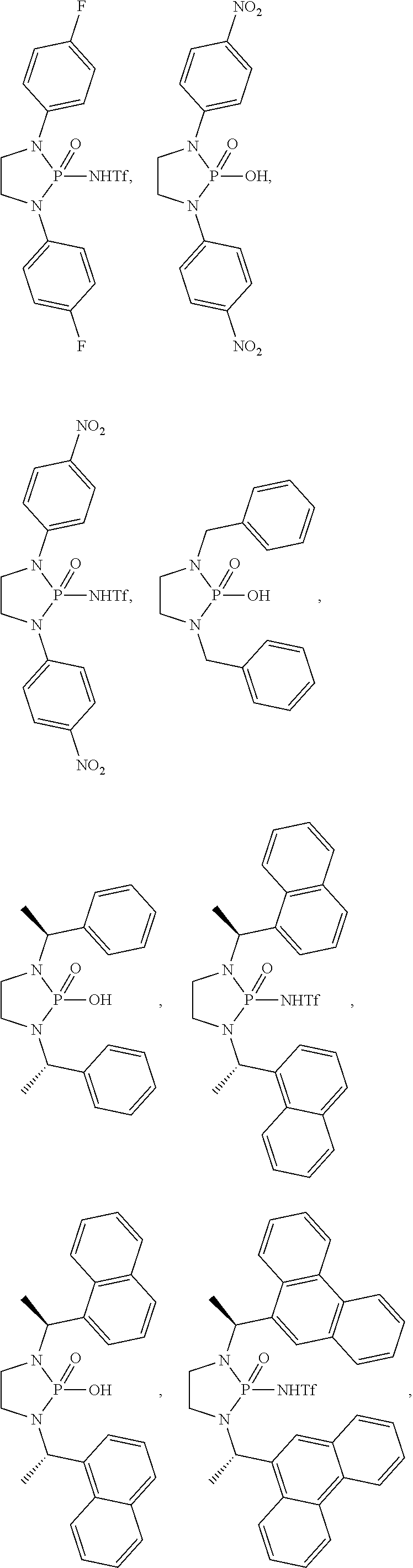

or a salt thereof.


or a salt thereof.

or a salt thereof.

wherein each occurrence of R2, R2′, R3, and R3′ is simultaneously a structure selected from:

or a salt thereof.

wherein each occurrence of R33, R33′, R34, and R34′ is simultaneously a structure selected from:

or a salt thereof.

wherein each occurrence of R31, R31′, R32, and R32′ is simultaneously selected from methyl, isopropyl, t-butyl, phenyl, and benzyl, or a salt thereof.

or a salt thereof.

wherein n is selected from 0 and 1; wherein each of R101a and R101b is independently selected from hydrogen, halogen, —NO2, —CN, —OH, —SH, —NH2, C1-C4 alkyl, C2-C4 alkenyl, C2-C4 alkynyl, C1-C4 haloalkyl, C1-C4 cyanoalkyl, C1-C4 hydroxyalkyl, C1-C4 haloalkoxy, C1-C4 alkoxy, C1-C4 thioalkyl, C1-C4 alkylthiol, C1-C4 aminoalkyl, C1-C4 alkylamino, and (C1-C4)(C1-C4) dialkylamino, provided that at least one of R101a and R101b is —OH, —SH, or C1-C4 alkylamino; wherein each of R102a, R102b, and R102c is independently selected from hydrogen, halogen, —NO2, —CN, —OH, —SH, —NH2, C1-C4 alkyl, C2-C4 alkenyl, C2-C4 alkynyl, C1-C4 haloalkyl, C1-C4 cyanoalkyl, C1-C4 hydroxyalkyl, C1-C4 haloalkoxy, C1-C4 alkoxy, C1-C4 thioalkyl, C1-C4 alkylthiol, C1-C4 aminoalkyl, C1-C4 alkylamino, and (C1-C4)(C1-C4) dialkylamino; wherein R103 is selected from C4-C8 alkyl and Ar101, provided that when R103 is C4-C8 alkyl, then either: (a) at least one of R101a and R101b is —SH or C1-C4 alkylamino, or (b) then R101b is —OH; wherein Ar101, when present, is selected from C6-C10 aryl and C5-C6 heteroaryl, and is substituted with 0, 1, 2, or 3 groups independently selected from halogen, —NO2, —CN, —OH, —SH, —NH2, C1-C4 alkyl, C2-C4 alkenyl, C2-C4 alkynyl, C1-C4 haloalkyl, C1-C4 cyanoalkyl, C1-C4 hydroxyalkyl, C1-C4 haloalkoxy, C1-C4 alkoxy, C1-C4 thioalkyl, C1-C4 alkylthiol, C1-C4 aminoalkyl, C1-C4 alkylamino, (C1-C4)(C1-C4) dialkylamino, and phenyl; wherein R104 is selected from C1-C4 alkoxy and phenyl substituted with 0, 1, 2, or 3 groups independently selected from halogen, —NO2, —CN, —OH, —SH, —NH2, C1-C4 alkyl, C2-C4 alkenyl, C2-C4 alkynyl, C1-C4 haloalkyl, C1-C4 cyanoalkyl, C1-C4 hydroxyalkyl, C1-C4 haloalkoxy, C1-C4 alkoxy, C1-C4 thioalkyl, C1-C4 alkylthiol, C1-C4 aminoalkyl, C1-C4 alkylamino, and (C1-C4)(C1-C4) dialkylamino; and wherein R105 is C1-C4 alkyl, provided that when n is 0, R101a is —OH, R103 is C6 aryl, R104 is ethoxy, and R105 is ethyl, then either: (c) at least two of R101b, R102a, R102b, and R102c are not hydrogen, (d) R103 is substituted with 2 or 3 groups, or (e) at least one of R101b, R201a, R102b, and R102c is not hydrogen and R103 is substituted with 1, 2, or 3 groups; and provided that when n is 0, R101b is —OH, and R103 is C6 aryl or C6 heteroaryl, then either: (f) each of R102a and R102b is hydrogen; or (g) one of R102a and R102b is hydrogen and R104 is not the same as —OR5, or a pharmaceutically acceptable salt thereof.


or a pharmaceutically acceptable salt thereof.

wherein each of R120a, R120b, R120c, R120d, and R120e are independently selected from hydrogen, halogen, —NO2, —CN, —OH, —SH, —NH2, C1-C4 alkyl, C2-C4 alkenyl, C2-C4 alkynyl, C1-C4 haloalkyl, C1-C4 cyanoalkyl, C1-C4 hydroxyalkyl, C1-C4 haloalkoxy, C1-C4 alkoxy, C1-C4 thioalkyl, C1-C4 alkylthiol, C1-C4 aminoalkyl, C1-C4 alkylamino, (C1-C4)(C1-C4) dialkylamino, and phenyl.

wherein each of R130a, R130b, R130c, R130d, and R130e are independently selected from hydrogen, halogen, —NO2, —CN, —OH, —SH, —NH2, C1-C4 alkyl, C2-C4 alkenyl, C2-C4 alkynyl, C1-C4 haloalkyl, C1-C4 cyanoalkyl, C1-C4 hydroxyalkyl, C1-C4 haloalkoxy, C1-C4 alkoxy, C1-C4 thioalkyl, C1-C4 alkylthiol, C1-C4 aminoalkyl, C1-C4 alkylamino, and (C1-C4)(C1-C4) dialkylamino.


or a salt thereof.

or a salt thereof.

or a salt thereof.


or a salt thereof.


or a salt thereof.

or a salt thereof.


| TABLE 1 |
 |
 |
| | Additive | Yield | |
| 1 | |
99 | |
| 2 | 4 Å MS | 66 | |
| 3 | 5 Å |
78 | |
| 4 | MgSO4 | 72 | |


| TABLE 2 |
 |
 |
| Entry | acids (x mol %) | solvent | yield (%)b |
| 1 | NHPA1 (10.0) | DCM | >99(92)c |
| 2 | CH3COOH (10.0) | DCM | 69 |
| 3 | CF3COOH (10.0) | |
94 |
| 4 | 4-NO2PhCOOH (10.0) | DCM | 98 |
| 5 | TfOH (10.0) | |
78 |
| 6 | Conc. HCl (10.0) | DCM | NR |
| 7 | TsOH (10.0) | DCM | 69 |
| 8 | NHPA1 (3.0) | DCM | >99(91)c |
| 9 | NHPA1 (1.5) | DCM | >99(91)c |
| 10 | NHPA2 (1.5) | DCM | 63 |
| 11 | NHPA3 (1.5) | DCM | >99(90)c |
| 12 | NHPA4 (1.5) | |
90 |
| 13 | NHPA5 (1.5) | DCM | 69 |
| 14 | BPA (1.5) | |
65 |
| 15 | NHPA1 (1.5) | |
65 |
| 16 | NHPA1 (1.5) | |
93 |
| 17 | NHPA1 (1.5) | CH3CN | 80 |
| 18 | NHPA1 (1.5) | THF | 59 |
| 19 | NHPA1 (1.5) | CHCl3 | 16 |
| 20 | NHPA1 (1.5) | EtOH | 27 |
| aReaction condition: 1a (0.1 mmol), acids (× mol %) and P(OEt)3 2a (0.1 mmol) in solvent (0.5 mL) for 18 h; NR = No Reaction | |||
| bYield was determined by 1H NMR on the crude reaction mixture using 1,3,5-trimethylbenzene as an internal standard. | |||
| cIsolated yield. | |||
| TABLE 3 |
 |
 |
| Yield (%)b | |||||
| Entry | R105 | R101b | R103 | Product | (dr)c |
| 1 | Me | H | Ph | 4a | 85 (4:1) |
| 2 | Et | H | Ph | 4b | 84 (3:1) |
| 3 | iPr | H | Ph | 4c | 83 (4:1) |
| 4 | Me | Me | Ph | 4d | 80 (4:1) |
| 5 | Me | Cl | Ph | 4e | 76 (4:1) |
| 6 | Me | Br | Ph | 4f | 74 (4:1) |
| 7 | Me | H | 4-MePh | 4g | 84 (4:1) |
| 8 | Me | H | 4-MeSPh | 4h | 82 (4:1) |
| 9 | Me | H | 4-FPh | 4i | 81 (4:1) |
| 10 | Me | H | 4-PhPh | 4j | 69 (4:1) |
| 11 | Me | H | 2-NAP | 4k | 58 (4:1) |
| (dr > 99:1)d | |||||
| aReaction condition: 1 (0.1 mmol), 2 (0.1 mmol) and NHPA1 (1.5 mol %) in DCM (0.5 mL) at rt for 18 h. | |||||
| bIsolated yield. | |||||
| cdr value of the isolated product by flash column chromatography on a silica column. | |||||
- Taylor, M. S.; Jacobsen, E. N., Asymmetric Catalysis by Chiral Hydrogen-Bond Donors. Angew. Chem., Int. Ed. 2006, 45 (10), 1520-1543.
- Yu, X.; Wang, W., Hydrogen-Bond-Mediated Asymmetric Catalysis. Chem.-Asian J. 2008, 3 (3), 516-532.
- Doyle, A. G.; Jacobsen, E. N., Small-Molecule H-Bond Donors in Asymmetric Catalysis. Chem. Rev. 2007, 107(12), 5713-5743.
- Parmar, D.; Sugiono, E.; Raja, S.; Rueping, M., Complete Field Guide to Asymmetric BINOL-Phosphate Derived Brønsted Acid and Metal Catalysis: History and Classification by Mode of Activation; Brønsted Acidity, Hydrogen Bonding, Ion Pairing, and Metal Phosphates. Chem. Rev. 2014, 114 (18), 9047-9153.
- Bernardi, L.; Fochi, M.; Comes Franchini, M.; Ricci, A., Bioinspired organocatalytic asymmetric reactions. Org. Biomol. Chem. 2012, 10 (15), 2911-2922.
- Shibasaki, M.; Matsunaga, S., Design and application of linked-BINOL chiral ligands in bifunctional asymmetric catalysis. Chem. Soc. Rev. 2006, 35 (3), 269-279; (b) Chen, Y.; Yekta, S.; Yudin, A. K., Modified BINOL Ligands in Asymmetric Catalysis. Chem. Rev. 2003, 103 (8), 3155-3212.
- Xie, J.-H.; Zhou, Q.-L., Chiral Diphosphine and Monodentate Phosphorus Ligands on a Spiro Scaffold for Transition-Metal-Catalyzed Asymmetric Reactions. Acc. Chem. Res. 2008, 41 (5), 581-593.
- Zhu, S.-F.; Zhou, Q.-L., Transition-Metal-Catalyzed Enantioselective Heteroatom-Hydrogen Bond Insertion Reactions. Acc. Chem. Res. 2012, 45 (8), 1365-1377.
- Puntigam, O.; Könczöl, L.; Nyulászi, L.; Gudat, D., Specific Photochemical Dehydrocoupling of N-Heterocyclic Phosphanes and Their Use in the Photocatalytic Generation of Dihydrogen. Angew. Chem., Int. Ed. 2015, 54 (39), 11567-11571.
- Chong, C. C.; Hirao, H.; Kinjo, R., Metal-Free σ-Bond Metathesis in 1,3,2-Diazaphospholene-Catalyzed Hydroboration of Carbonyl Compounds. Angew. Chem., Int. Ed. 2015, 54 (1), 190-194.
- Chong, C. C.; Kinjo, R., Hydrophosphination of CO2 and Subsequent Formate Transfer in the 1,3,2-Diazaphospholene-Catalyzed N-Formylation of Amines. Angew. Chem., Int. Ed. 2015, 54 (41), 12116-12120.
- Chong, C. C.; Hirao, H.; Kinjo, R., A Concerted Transfer Hydrogenolysis: 1,3,2-Diazaphospholene-Catalyzed Hydrogenation of NN Bond with Ammonia-Borane. Angew. Chem., Int. Ed. 2014, 53 (13), 3342-3346.

- Ackermann, L.; Spatz, J. H.; Gschrei, C. J.; Born, R; Althammer, A., A Diaminochlorophosphine for Palladium-Catalyzed Arylations of Amines and Ketones. Angew. Chem., Int. Ed. 2006, 45 (45), 7627-7630.
- Ackermann, L.; Born, R., Modular Diamino- and Dioxophosphine Oxides and Chlorides as Ligands for Transition-Metal-Catalyzed C—C and C—N Couplings with Aryl Chlorides. Angew. Chem., Int. Ed. 2005, 44 (16), 2444-2447.
- Huang, H.; Kang, J. V., Amine-Catalyzed Phospha-Michael Reaction of α,β-Unsaturated Aldehydes and Ketones with Multifunctional N-Heterocyclic Phosphine-Thioureas as Phosphonylation Reagent. Org. Lett. 2016, 18 (17), 4372-4375.
- Huang, H.; Kang, J. Y., Oxidation-Reduction Condensation of Diazaphosphites for Carbon-Heteroatom Bond Formation Based on Mitsunobu Mechanism. Org. Lett. 2017, 19 (3), 544-547.
- Huang, H.; Palmas, J.; Kang, J. Y., A Reagent-Controlled Phospha-Michael Addition Reaction of Nitroalkenes with Bifunctional N-Heterocyclic Phosphine (NHP)-Thioureas. J. Org. Chem. 2016, 81 (23), 11932-11939.
- Molleti, N.; Bjomberg, C.; Kang, J. Y., Phospha-Michael addition reaction of maleimides employing N-heterocyclic phosphine-thiourea as a phosphonylation reagent: synthesis of 1-aryl-2,5-dioxopyrrolidine-3-yl-phosphonate derivatives. Org. Biomol. Chem. 2016, 14, 10695-10704.
- Molleti, N.; Kang, J. Y., Catalyst-free synthesis of [small alpha]1-oxindole-[small alpha]-hydroxy phosphonates via phospha-aldol reaction of isatins employing N-heterocyclic phosphine (NHP)-thiourea. Org. Biomol. Chem. 2016, 14 (38), 8952-8956.
- Molleti, N.; Kang, J. Y., Synthesis of Diaryl Diazaphosphonates via 1,6-Hydrophosphonylation of p-Quinone Methides with N-Heterocyclic Phosphine-Thioureas. Org. Lett. 2017, 19 (4), 958-961.
- Mulla, K.; Aleshire, K. L.; Forster, P. M.; Kang, J. Y., Utility of Bifunctional N-Heterocyclic Phosphine (NHP)-Thioureas for Metal-Free Carbon-Phosphorus Bond Construction toward Regio- and Stereoselective Formation of Vinylphosphonates. J. Org. Chem. 2016, 81 (1), 77-88.
- Mulla, K.; Kang, J. Y., 1,3,2-Diazaphospholidine (N-Heterocyclic Phosphine)-Mediated Carbon-Phosphorus Bond-Forming, One-Pot Tandem Reaction: A Route to α-Amino Phosphonates. J. Org. Chem. 2016, 81 (11), 4550-4558.
- Campbell, C. D.; Concellón, C.; Smith, A. D., Catalytic enantioselective Steglich rearrangements using chiral N-heterocyclic carbenes. Tetrahedron: Asymmetry 2011, 22 (7), 797-811.
- Burck, S.; Gudat, D.; Nieger, M.; Du Mont, W.-W., P-Hydrogen-Substituted 1,3,2-Diazaphospholenes: Molecular Hydrides. J. Am. Chem. Soc. 2006, 128 (12), 3946-3955.
- Durette, P. L.; MacCoss, M., U.S. Pat. No. 5,104,862 A1992.
- Gouliaev, A. H.; SlO K, F. A.; Teuber, L.; Demnitz, J., US Patent WO2003059873 A12003.
- Motoyoshiya, J.; Ikeda, T.; Tsuboi, S.; Kusaura, T.; Takeuchi, Y.; Hayashi, S.; Yoshioka, S.; Takaguchi, Y.; Aoyaama, H., Chemiluminescence in Autoxidation of Phosphonate Carbanions. Phospha-1,2-dioxetanes as the Most Likely High-Energy Intermediates. J Org. Chem. 2003, 68 (15), 5950-5955.
- Harada, T.; Yamanaka, Y.; Matsushita, Y.; Fukushima, K., Patent EP2681281 A12014
- Bhattacharya, A. K.; Thyagarajan, G., Michaelis-Arbuzov rearrangement. Chem. Rev. 1981, 81 (4), 415-430.
- Rajeshwaran, G. G.; Nandakumar, M.; Sureshbabu, R.; Mohanakrishnan, A. K., Lewis Acid-Mediated Michaelis-Arbuzov Reaction at Room Temperature: A Facile Preparation of Arylmethyl/Heteroarylmethyl Phosphonates. Org. Lett. 2011, 13 (6), 1270-1273.
- Pallikonda, G.; Chakravarty, M., FeCl3-Mediated Arylation of α-Hydroxyphosphonates with Unactivated Arenes: Pseudo-Umpolung in Allylic Phosphonates. Eur. J. Org. Chem. 2013, 2013 (5), 944-951.
- Montel, S.; Jia, T.; Walsh, P. J., Palladium-Catalyzed α-Arylation of Benzylic Phosphine Oxides. Org. Lett. 2014, 16 (1), 130-133.
Claims (9)


Priority Applications (1)
| Application Number | Priority Date | Filing Date | Title |
|---|---|---|---|
| US17/583,159 US11873315B2 (en) | 2017-06-16 | 2022-01-24 | Chiral n-heterocyclic phosphorodiamidic acids (NHPAS) and derivatives as novel Brønsted acid catalysts |
Applications Claiming Priority (6)
| Application Number | Priority Date | Filing Date | Title |
|---|---|---|---|
| US201762521086P | 2017-06-16 | 2017-06-16 | |
| US201762566834P | 2017-10-02 | 2017-10-02 | |
| US201762568645P | 2017-10-05 | 2017-10-05 | |
| PCT/US2018/037868 WO2018232315A1 (en) | 2017-06-16 | 2018-06-15 | Chiral n-heterocyclic phosphorodiamidic acids (nhpas) and derivatives as novel bronsted acid catalysts |
| US201916622451A | 2019-12-13 | 2019-12-13 | |
| US17/583,159 US11873315B2 (en) | 2017-06-16 | 2022-01-24 | Chiral n-heterocyclic phosphorodiamidic acids (NHPAS) and derivatives as novel Brønsted acid catalysts |
Related Parent Applications (2)
| Application Number | Title | Priority Date | Filing Date |
|---|---|---|---|
| PCT/US2018/037868 Continuation WO2018232315A1 (en) | 2017-06-16 | 2018-06-15 | Chiral n-heterocyclic phosphorodiamidic acids (nhpas) and derivatives as novel bronsted acid catalysts |
| US16/622,451 Continuation US11248014B2 (en) | 2017-06-16 | 2018-06-15 | Chiral n-heterocyclic phosphorodiamidic acids (NHPAS) and derivatives as novel bronsted acid catalysts |
Publications (2)
| Publication Number | Publication Date |
|---|---|
| US20220144868A1 US20220144868A1 (en) | 2022-05-12 |
| US11873315B2 true US11873315B2 (en) | 2024-01-16 |
Family
ID=64659377
Family Applications (2)
| Application Number | Title | Priority Date | Filing Date |
|---|---|---|---|
| US16/622,451 Active US11248014B2 (en) | 2017-06-16 | 2018-06-15 | Chiral n-heterocyclic phosphorodiamidic acids (NHPAS) and derivatives as novel bronsted acid catalysts |
| US17/583,159 Active US11873315B2 (en) | 2017-06-16 | 2022-01-24 | Chiral n-heterocyclic phosphorodiamidic acids (NHPAS) and derivatives as novel Brønsted acid catalysts |
Family Applications Before (1)
| Application Number | Title | Priority Date | Filing Date |
|---|---|---|---|
| US16/622,451 Active US11248014B2 (en) | 2017-06-16 | 2018-06-15 | Chiral n-heterocyclic phosphorodiamidic acids (NHPAS) and derivatives as novel bronsted acid catalysts |
Country Status (2)
| Country | Link |
|---|---|
| US (2) | US11248014B2 (en) |
| WO (1) | WO2018232315A1 (en) |
Families Citing this family (2)
| Publication number | Priority date | Publication date | Assignee | Title |
|---|---|---|---|---|
| US11248014B2 (en) | 2017-06-16 | 2022-02-15 | The Board Of Regents Of The Nevada System Of Higher Education On Behalf Of The University Of Nevada, Las Vegas | Chiral n-heterocyclic phosphorodiamidic acids (NHPAS) and derivatives as novel bronsted acid catalysts |
| EP4605461A2 (en) * | 2022-10-19 | 2025-08-27 | The Board of Regents of The Nevada System of Higher Education on behalf of the University of Nevada, Las Vegas | Thiophosphoric acids as novel organocatalysts and synthetic methods of thiophosphonate derivatives as pharmaceutical agents |
Citations (3)
| Publication number | Priority date | Publication date | Assignee | Title |
|---|---|---|---|---|
| JP2008157980A (en) * | 2006-12-20 | 2008-07-10 | Ricoh Co Ltd | Electrostatic latent image carrier, image forming apparatus, image forming method, and process cartridge |
| WO2014093723A2 (en) | 2012-12-12 | 2014-06-19 | Nanjing University | Group-assistant-purification (gap) synthesis of velcade, dimeric analogs, and amino compounds |
| WO2018232315A1 (en) | 2017-06-16 | 2018-12-20 | The Board Of Regents Of The Nevada System Of Higher Education On Behalf Of The University Of Nevada, Las Vegas | Chiral n-heterocyclic phosphorodiamidic acids (nhpas) and derivatives as novel bronsted acid catalysts |
-
2018
- 2018-06-15 US US16/622,451 patent/US11248014B2/en active Active
- 2018-06-15 WO PCT/US2018/037868 patent/WO2018232315A1/en not_active Ceased
-
2022
- 2022-01-24 US US17/583,159 patent/US11873315B2/en active Active
Patent Citations (3)
| Publication number | Priority date | Publication date | Assignee | Title |
|---|---|---|---|---|
| JP2008157980A (en) * | 2006-12-20 | 2008-07-10 | Ricoh Co Ltd | Electrostatic latent image carrier, image forming apparatus, image forming method, and process cartridge |
| WO2014093723A2 (en) | 2012-12-12 | 2014-06-19 | Nanjing University | Group-assistant-purification (gap) synthesis of velcade, dimeric analogs, and amino compounds |
| WO2018232315A1 (en) | 2017-06-16 | 2018-12-20 | The Board Of Regents Of The Nevada System Of Higher Education On Behalf Of The University Of Nevada, Las Vegas | Chiral n-heterocyclic phosphorodiamidic acids (nhpas) and derivatives as novel bronsted acid catalysts |
Non-Patent Citations (5)
| Title |
|---|
| D'Auria et al. "Reactivity of Thienyl Phosphonyl Carbinols in Acidic Medium: Synthesis of Aryl—and Alkoxy-Thienyl Methan Derivatives" Synthetic Communications, vol. 22, Issue 5, pp. 699-727. (Year: 1992). * |
| Huang et al., Organocatalytic Phosphonylation of in Situ Formed o-Quinone Methides, Organic Letters, vol. 19, No. 21, Oct. 24, 2017. Retrieved from the Internet: <URL: https://pubs.acs.org/doi/suppl/10.1021/acs.orglett.7b03019>. |
| Kattuboina, et al. (2008) "Chiral N-phosphonyl imine chemistry: new reagents and their applications for asymmetric reactions" Tetrahedron Letters, vol. 49, No. 10, pp. 1573-1577. |
| Pubchem, Substance Record for SID 104130235, Available Date: Jan. 20, 2011 [retrieved on Aug. 6, 2018]. Retrieved from the Internet: <URL: https://pubchem.ncbi.nlm.nih.gov/substance/104130235>. |
| Pubchem, Substance Record for SID 274528142, Available Date: Dec. 18, 2015 [retrieved on Aug. 6, 2018]. Retrieved from the Internet: <URL: https://pubchem.ncbi.nlm.nih.gov/substance/274528142>. |
Also Published As
| Publication number | Publication date |
|---|---|
| WO2018232315A1 (en) | 2018-12-20 |
| US11248014B2 (en) | 2022-02-15 |
| US20210147457A1 (en) | 2021-05-20 |
| US20220144868A1 (en) | 2022-05-12 |
Similar Documents
| Publication | Publication Date | Title |
|---|---|---|
| Yoshida et al. | Synthesis of diverse aromatic oxophosphorus compounds by the Michaelis–Arbuzov-type reaction of arynes | |
| US11873315B2 (en) | Chiral n-heterocyclic phosphorodiamidic acids (NHPAS) and derivatives as novel Brønsted acid catalysts | |
| WO1999006418A1 (en) | Selective synthesis of organodiphosphite compounds | |
| US20100317866A1 (en) | Imidazole group-containing phosphorus compounds | |
| US10633403B2 (en) | N-heterocyclic phosphines | |
| US10927135B2 (en) | Metal-free direct arylation of dialkyl phosphonates for the synthesis of mixed alkyl aryl phosphonates | |
| Ash et al. | Metal-and chloride reagent-free synthesis of mixed thiophosphates | |
| Carella et al. | Betti's base for crystallization-induced deracemization of substituted aldehydes: synthesis of enantiopure amorolfine and fenpropimorph | |
| EP0299484B1 (en) | Process for the preparation of intermediates for the synthesis of fosfomycin | |
| Kaboudin et al. | ZnCl 2-mediated stereo-and chemoselective synthesis of vinylphosphonates | |
| US6600067B2 (en) | Process for preparing ethylenediphosphonic acids | |
| US11174278B2 (en) | Functionalized phosphonates via Michael addition | |
| WO2015130660A1 (en) | Synthesis of racemic amphetamine derivatives by cuprate addition reaction with aziridine phosphoramidate compounds | |
| JP5480131B2 (en) | Method for producing phosphine oxide vitamin D precursor | |
| CA2306000A1 (en) | Process for producing phosphineoxide vitamin d precursors | |
| US8816112B2 (en) | Process for making novel chiral phosphorus ligands | |
| Zhang et al. | An efficient and green method for the synthesis of N‐phosphoramino o‐hydroxylphenyl α‐aminophosphonic monoesters | |
| US11891409B2 (en) | Trifluoromethyl alkenylphosphonate and preparation method therefor | |
| US9200018B2 (en) | Process for preparation of aryl phosphorous compounds | |
| SU1558919A1 (en) | Method of obtaining dichloranhydrides of alkenylphosphoric acids | |
| US10087204B2 (en) | Methods and compositions for substituted alpha-aminophosphonate analogues | |
| Mondal | Exploring Molecular Chirality Transfer | |
| JPS6332077B2 (en) | ||
| SU1177305A1 (en) | Method of producing alpha-alkulthioalkylphosphonates | |
| AU2006244125A1 (en) | Organometal benzenephosphonate coupling agents |
Legal Events
| Date | Code | Title | Description |
|---|---|---|---|
| FEPP | Fee payment procedure |
Free format text: ENTITY STATUS SET TO UNDISCOUNTED (ORIGINAL EVENT CODE: BIG.); ENTITY STATUS OF PATENT OWNER: SMALL ENTITY |
|
| FEPP | Fee payment procedure |
Free format text: ENTITY STATUS SET TO SMALL (ORIGINAL EVENT CODE: SMAL); ENTITY STATUS OF PATENT OWNER: SMALL ENTITY |
|
| STPP | Information on status: patent application and granting procedure in general |
Free format text: DOCKETED NEW CASE - READY FOR EXAMINATION |
|
| STPP | Information on status: patent application and granting procedure in general |
Free format text: NON FINAL ACTION MAILED |
|
| STPP | Information on status: patent application and granting procedure in general |
Free format text: RESPONSE TO NON-FINAL OFFICE ACTION ENTERED AND FORWARDED TO EXAMINER |
|
| STPP | Information on status: patent application and granting procedure in general |
Free format text: NOTICE OF ALLOWANCE MAILED -- APPLICATION RECEIVED IN OFFICE OF PUBLICATIONS |
|
| STPP | Information on status: patent application and granting procedure in general |
Free format text: PUBLICATIONS -- ISSUE FEE PAYMENT VERIFIED |
|
| STCF | Information on status: patent grant |
Free format text: PATENTED CASE |