US11871343B2 - Optimized parent and path selection for battery powered devices within a wireless network - Google Patents
Optimized parent and path selection for battery powered devices within a wireless network Download PDFInfo
- Publication number
- US11871343B2 US11871343B2 US17/888,448 US202217888448A US11871343B2 US 11871343 B2 US11871343 B2 US 11871343B2 US 202217888448 A US202217888448 A US 202217888448A US 11871343 B2 US11871343 B2 US 11871343B2
- Authority
- US
- United States
- Prior art keywords
- node
- battery life
- path
- nodes
- metric
- Prior art date
- Legal status (The legal status is an assumption and is not a legal conclusion. Google has not performed a legal analysis and makes no representation as to the accuracy of the status listed.)
- Active
Links
Images



Classifications
-
- H—ELECTRICITY
- H04—ELECTRIC COMMUNICATION TECHNIQUE
- H04W—WIRELESS COMMUNICATION NETWORKS
- H04W52/00—Power management, e.g. Transmission Power Control [TPC] or power classes
- H04W52/02—Power saving arrangements
- H04W52/0203—Power saving arrangements in the radio access network or backbone network of wireless communication networks
- H04W52/0206—Power saving arrangements in the radio access network or backbone network of wireless communication networks in access points, e.g. base stations
-
- H—ELECTRICITY
- H04—ELECTRIC COMMUNICATION TECHNIQUE
- H04W—WIRELESS COMMUNICATION NETWORKS
- H04W40/00—Communication routing or communication path finding
- H04W40/02—Communication route or path selection, e.g. power-based or shortest path routing
- H04W40/04—Communication route or path selection, e.g. power-based or shortest path routing based on wireless node resources
- H04W40/10—Communication route or path selection, e.g. power-based or shortest path routing based on wireless node resources based on available power or energy
-
- Y—GENERAL TAGGING OF NEW TECHNOLOGICAL DEVELOPMENTS; GENERAL TAGGING OF CROSS-SECTIONAL TECHNOLOGIES SPANNING OVER SEVERAL SECTIONS OF THE IPC; TECHNICAL SUBJECTS COVERED BY FORMER USPC CROSS-REFERENCE ART COLLECTIONS [XRACs] AND DIGESTS
- Y02—TECHNOLOGIES OR APPLICATIONS FOR MITIGATION OR ADAPTATION AGAINST CLIMATE CHANGE
- Y02D—CLIMATE CHANGE MITIGATION TECHNOLOGIES IN INFORMATION AND COMMUNICATION TECHNOLOGIES [ICT], I.E. INFORMATION AND COMMUNICATION TECHNOLOGIES AIMING AT THE REDUCTION OF THEIR OWN ENERGY USE
- Y02D30/00—Reducing energy consumption in communication networks
-
- Y—GENERAL TAGGING OF NEW TECHNOLOGICAL DEVELOPMENTS; GENERAL TAGGING OF CROSS-SECTIONAL TECHNOLOGIES SPANNING OVER SEVERAL SECTIONS OF THE IPC; TECHNICAL SUBJECTS COVERED BY FORMER USPC CROSS-REFERENCE ART COLLECTIONS [XRACs] AND DIGESTS
- Y02—TECHNOLOGIES OR APPLICATIONS FOR MITIGATION OR ADAPTATION AGAINST CLIMATE CHANGE
- Y02D—CLIMATE CHANGE MITIGATION TECHNOLOGIES IN INFORMATION AND COMMUNICATION TECHNOLOGIES [ICT], I.E. INFORMATION AND COMMUNICATION TECHNOLOGIES AIMING AT THE REDUCTION OF THEIR OWN ENERGY USE
- Y02D30/00—Reducing energy consumption in communication networks
- Y02D30/70—Reducing energy consumption in communication networks in wireless communication networks
Definitions
- Various embodiments of the present disclosure relate generally to wireless network communications and, more specifically, to optimized parent and path selection for battery powered devices within a wireless network.
- a conventional wireless network includes a plurality of nodes configured to communicate with one another.
- different types of nodes communicate and interact with one another within the network, including mains powered device (MPD) nodes and battery powered device (BPD) nodes.
- MPD nodes typically are coupled to a power grid and have continuous access to power (except during power outages), which allows MPD nodes to receive and transmit data more or less continuously.
- BPD nodes are powered by batteries and therefore have only a finite supply of power. To manage the finite supply of power, BPD nodes normally remain in a powered-down state and power on only at intermittent intervals.
- MPD nodes and BPD nodes perform a discovery process to determine the existence of nearby nodes within the network and establish communication links (or “pair”) with one or more other nodes that allow the node to transmit and receive messages from another device, such as a remotely located control center.
- a given node usually transmits a discovery beacon request (DBR) to one or more nodes, and, upon receiving the DBR, a receiving node transits a discovery beacon (DB) back to the given node.
- DBR discovery beacon request
- DB discovery beacon
- MPD nodes can operate continuously, pairing with MPD nodes is considerably easier than pairing with BPD nodes, which are powered down far more often than not. Accordingly, when a given BPD node is operational, the BPD node preferentially pairs with a nearby MPD node in order to quickly gain access to the network. Among other things, quickly completing the discovery process conserves battery life because the discovery process can consume quite a bit of energy. In many operating scenarios, though, a BPD node cannot quickly locate a nearby MPD node during the discovery process. For example, a BPD node could reside at the fringes of a wireless network where communications with centrally located MPD nodes are difficult or impossible. To address this type of situation, a given BPD node can be configured to automatically discover and pair with an upstream BPD node that has already gained network access.
- BPD nodes when installed, are guaranteed to last in the field for a particular duration of time, such as twenty years.
- conventional BPD nodes communicate in a deterministic manner. For example, a BPD node may transmit a message every fifteen seconds, where each message included a fixed number of bits. Because the BPD node transmits messages at regular intervals, and each message has a fixed length, the amount of energy consumed for each message may be accurately determined. The total energy consumed over the guaranteed lifetime may then be determined by multiplying the energy consumption per message times the number of messages transmitted over the guaranteed lifetime of the BPD node. The manufacturer may then select a battery for installation in the BPD node, where the battery capacity is able to supply this total energy consumed over the guaranteed lifetime. In practice, however, the battery life may be reduced below the guaranteed lifetime of the BPD node due to several factors.
- the discovery process described above may occur more often than anticipated. This situation may arise for a BPD node that resides within the wireless network where communications quality is poor. As a result, the BPD node may need to perform multiple discovery processes to pair with another node. Further, the communications channel may drop between the BPD node and the paired node, causing the BPD node to perform another discovery process to reestablish communications with another node. These additional discovery processes consume energy, leading to shorter battery life.
- a BPD node may be tasked to relay network messages for MPD nodes and/or other BPD nodes within the wireless network. Routing messages for other nodes also consumes energy, further reducing battery life.
- channel hopping sequences change dynamically over time. When one or more channel hopping sequences change, the number and size of messages relayed by a particular BPD node may likewise increase and/or decrease over time. Such increases and decrease may result from changes in radio frequency signal propagation conditions, adding devices to the wireless network, removing devices from the wireless network, and/or the like. As a result, the battery life of the battery in the BPD node may be difficult to determine with accuracy.
- BPD nodes expend a great deal of energy during discovery and when routing data for other nodes, which can substantially reduce the operational lifetime of those BPD nodes.
- BPD nodes may fail prior to the guaranteed lifetime, leading to expensive repair and/or replacement costs.
- Various embodiments of the present disclosure set forth a first node that resides within a wireless network, where the first node computes a metric based on the remaining battery life of one or more nodes in a path that includes the first node.
- the first node includes a memory storing instructions; and a processor that is coupled to the memory.
- the processor receives data associated with remaining battery life of one or more other nodes that reside within the wireless network.
- the processor further determines a value representing a remaining battery life of the first node.
- the processor further computes a metric based on the remaining battery life of the one or more other nodes and the remaining battery life of the first node.
- the processor further transmits the metric to a second node within the wireless network.
- Various embodiments of the present disclosure set forth a first node that resides within a wireless network, where the first node selects a parent node based on a metric that represents remaining battery life of one or more nodes in a path that includes the parent node.
- the first node includes a memory storing instructions; and a processor that is coupled to the memory. When executing the instructions, the processor receives a first metric from a first potential parent node included in the wireless network, the first metric indicating a remaining battery life associated with a first path to a head node that includes the first potential parent node.
- the processor When executing the instructions, the processor further receives a second metric from a second potential parent node included in the wireless network, the second metric indicating a remaining battery life associated with a second path that includes the second potential parent node. When executing the instructions, the processor further selects a parent node from the first potential parent node or the second potential parent node based on the first metric and the second metric.
- inventions include, without limitation, a method that implements one or more aspects of the disclosed techniques, and one or more computer readable media including instructions for performing one or more aspects of the disclosed techniques.
- At least one technical advantage of the disclosed techniques relative to the prior art is that, with the disclosed techniques, nodes within a wireless network can select a parent and a path based on remaining battery life of nodes in the wireless network. As a result, energy consumption of nodes in the wireless network is managed with greater accuracy, thereby extending the operational lifetime of BPD nodes.
- FIG. 1 illustrates a network system configured to implement one or more aspects of the various embodiments
- FIG. 2 illustrates a node configured to transmit and receive data within the network system of FIG. 1 , according to various embodiments;
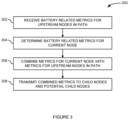
- FIG. 3 sets forth a flow diagram of method steps for determining a path cost metric based on battery life data for a set of nodes, according to various embodiments.
- FIG. 4 sets forth a flow diagram of method steps for selecting a potential parent node with which to pair, according to various embodiments.
- the disclosed techniques apply to any system of networked nodes, where at least some nodes are battery powered.
- Such systems include a wireless network of utility meters, Internet of things (IoT) devices, and/or the like.
- IoT Internet of things
- conventional parent and path selection processes implemented by a conventional node suffers from numerous inefficiencies.
- conventional processes for parent and path selection do not consider the remaining battery life of the nodes in the selected path.
- BPD nodes that consume excessive energy due to repeated discovery processes and/or routing data for other nodes may consume excessive energy relative to other nodes in the wireless network.
- Such excessive energy consumption shortens the operational lifetime of BPD nodes, leading to leading to expensive repair and/or replacement costs.
- various embodiments include a wireless network that includes a plurality of nodes, each of which is configured to implement an improved parent and path selection process in order to efficiently and reliably manage battery life of the plurality of nodes.
- a given node implements a technique to determine a metric based on remaining battery life of the nodes in the currently selected path.
- the metric may be a composite of the battery metrics for the given node and the upstream nodes in the currently selected path.
- the given node Upon request from another node, the given node transmits the metric to the requesting node.
- the requesting node is able to determine the desirability of the path that includes the given node, based upon the remaining battery life of the nodes in the path that includes the given node.
- the requesting node may further determine the desirability of the path that includes the given node based upon metrics not related to battery life, including remaining message capacity, remaining child node connections, number of hops to a control center, signal quality, and/or the like.
- the node When a given node selects a new path, the node transmits requests to multiple nodes, each of which is a potential parent node for the given node. In response to the requests, each potential parent node transmits a metric to the requesting node, where the metric is indicative of the remaining battery life of the nodes in the path that includes the respective potential parent node. After receiving the metrics from the potential parent nodes, the given node selects a parent node, and corresponding path, based on the metrics. More specifically, the given node selects a path, where at least one node on the selected path is less likely to prematurely exhaust the remaining battery capacity of the node, relative to the nodes in the other potential paths. As a result, the given node selects a path that optimizes battery consumption of the various BPD nodes in the wireless network.
- FIG. 1 illustrates a network system configured to implement one or more aspects of the present embodiments.
- network system 100 includes a field area network (FAN) 110 , a wide area network (WAN) backhaul 120 , and a control center 130 .
- FAN 110 is coupled to control center 130 via WAN backhaul 120 .
- Control center 130 is configured to coordinate the operation of FAN 110 .
- control center 130 is also referred to herein as the head node or the head end.
- FAN 110 includes personal area network (PANs) A, B, and C.
- PANs A and B are organized according to a mesh network topology
- PAN C is organized according to a star network topology.
- each of PANs A, B, and C may be organized according to any network topology, including a mesh network topology, a star network topology, a ring network topology, and/or the like.
- each of PANs A, B, and C may be organized according to a hybrid network topology based on any technically feasible combination of a mesh network topology, a star network topology, a ring network topology, and/or the like.
- Each of PANs A, B, and C includes at least one border router node 112 and one or more mains powered device (MPD) nodes 114 .
- PANs B and C further include one or more battery powered device (BPD) nodes 116 .
- BPD battery powered device
- one or more border router nodes 112 may be battery powered.
- MPD nodes 114 draw power from an external power source, such as mains electricity or a power grid. MPD nodes 114 typically operate on a continuous basis without powering down for extended periods of time. BPD nodes 116 draw power from an internal power source, such as a battery. BPD nodes 116 typically operate intermittently and power down for extended periods of time in order to conserve battery power. MPD nodes 114 and BPD nodes 116 are configured to gather sensor data, process the sensor data, and communicate data processing results and other information to control center 130 . Border router nodes 112 operate as access points to provide MPD nodes 114 and BPD nodes 116 with access to control center 130 .
- border router nodes 112 , MPD nodes 114 , and BPD nodes 116 are configured to communicate directly with one or more adjacent nodes via bi-directional communication links.
- the communication links may be wired or wireless links, although in practice, adjacent nodes of a given PAN exchange data with one another by transmitting data packets via wireless radio frequency (RF) communications.
- RF radio frequency
- the various node types are configured to perform a technique known in the art as “channel hopping” in order to periodically receive data packets on varying channels.
- a “channel” may correspond to a particular range of frequencies.
- a node may compute a current receive channel by evaluating a Jenkins hash function based on a total number of channels, the media access control (MAC) address of the node, and other information associated with the node.
- MAC media access control
- Each node within a given PAN may implement a discovery protocol to identify one or more adjacent nodes or “neighbors.”
- a node that has identified an adjacent, neighboring node may establish a bi-directional communication link with the neighboring node.
- Each neighboring node may update a respective neighbor table to include information concerning the other node, including the MAC address of the other node as well as a received signal strength indication (RSSI) of the communication link established with that node.
- RSSI received signal strength indication
- Nodes may compute the channel hopping sequences of adjacent nodes to facilitate the successful transmission of data packets to those nodes.
- a node computes a current receive channel of an adjacent node using the total number of channels, the MAC address of the adjacent node, and a time slot number assigned to a current time slot of the adjacent node.
- any of the nodes discussed above may operate as a source node, an intermediate node, or a destination node for the transmission of data packets.
- a given source node may generate a data packet and then transmit the data packet to a destination node via any number of intermediate nodes.
- the data packet may indicate a destination for the packet and/or a particular sequence of intermediate nodes to traverse in order to reach the destination node.
- each intermediate node may include a forwarding database indicating various network routes and cost metrics associated with each route.
- Nodes may transmit data packets across a given PAN and across WAN backhaul 120 to control center 130 .
- control center 130 may transmit data packets across WAN backhaul 120 and across any given PAN to a particular node included therein.
- numerous routes may exist which traverse any of PANs A, B, and C and include any number of intermediate nodes, thereby allowing any given node or other component within network system 100 to communicate with any other node or component included therein.
- Control center 130 includes one or more server machines (not shown) configured to operate as sources for, or destinations of, data packets that traverse within network system 100 .
- the server machines may query nodes within network system 100 to obtain various data, including raw or processed sensor data, energy consumption data, node/network throughput data, status information, and so forth.
- the server machines may also transmit commands and/or program instructions to any node within network system 100 to cause those nodes to perform various operations.
- each server machine is a computing device configured to execute, via a processor, a software application stored in a memory to perform various network management operations.
- Nodes may likewise include computing device hardware configured to perform processing operations and execute program code. Each node may further include various analog-to-digital and digital-to-analog converters, digital signal processors (DSPs), harmonic oscillators, transceivers, and any other components generally associated with RF-based communication hardware.
- FIG. 2 illustrates an exemplary node that may operate within the network system 100 .
- FIG. 2 illustrates a node 200 configured to transmit and receive data within the network of FIG. 1 , according to various embodiments.
- a node 200 includes a computing device 210 coupled to a transceiver 250 and an oscillator 260 .
- Computing device 210 coordinates the operations of node 200 .
- Transceiver 250 is configured to transmit and receive data packets across network system 100 using a range of channels and power levels.
- Oscillator 260 provides one or more oscillation signals according to which the transmission and reception of data packets can be scheduled.
- Node 200 may be used to implement any of border router nodes 112 , MPD nodes 114 , and BPD nodes 116 of FIG. 1 .
- Computing device 210 includes a processor 220 , input/output (I/O) devices 230 , and memory 240 , coupled together.
- Processor 220 may include any hardware configured to process data and execute software applications, such as software application 242 .
- processor 220 retrieves and executes programming instructions stored in memory 240 .
- Processor 220 may be any technically feasible form of processing device configured to process data and execute program instructions.
- Processor 220 could be, for example, one or more central processing units (CPUs), digital signal processors (DSPs), graphics processing units (GPUs), application-specific integrated circuits (ASICs), field-programmable gate arrays (FPGAs), and/or the like.
- Processor 220 stores and retrieves application data residing in the memory 240 .
- Processor 220 is included to be representative of a single processor, multiple processors, a single processor having multiple processing cores, and the like. In operation, processor 220 is the master processor of node 200 , controlling and coordinating operations of other system components. Memory 240 stores software applications and data for use by processor 220 . Processor 220 executes software applications, such as software application 242 , also referred to herein as software application programs, stored within memory 240 and optionally an operating system. In particular, processor 220 executes software instructions and then performs one or more of the functions and operations set forth in the present application.
- Processor 220 may include a real-time clock (RTC) (not shown) according to which processor 220 maintains an estimate of the current time.
- the estimate of the current time may be expressed in Universal Coordinated Time (UTC), although any other standard of time measurement can also be used.
- I/O devices 230 include devices configured to receive input, devices configured to provide output, and devices configured to both receive input and provide output.
- Memory 240 may be implemented by any technically feasible storage medium.
- Memory 240 includes, without limitation, a software application 242 and a database 244 , coupled together.
- Software application 242 includes program instructions that, when executed by processor 220 , performs any one or more of the computer-based techniques described herein.
- Software application 242 may also interface with transceiver 250 to coordinate the transmission and reception of data packets across network system 100 based on timing signals generated by oscillator 260 .
- Database 244 may include various data structures retrieved by and/or stored by the software application 242 .
- software application 242 executing on processor 220 of node 200 implements the discovery process discussed above in conjunction with FIG. 1 in order to establish adjacency with one or more neighboring nodes.
- Software application 242 performs the discovery process under two conditions. First, software application 242 performs the discovery process when node 200 initially joins the wireless network, such as when node 200 is powered on. Second, software application 242 performs the discovery process at regular maintenance intervals, such as once per day, once per week, once per month, once per year, and/or the like. By performing the discovery process at regular maintenance intervals, software application 242 is able to change the route, also referred to herein as the path, from node 200 to control center 130 as conditions change over time.
- route also referred to herein as the path
- Nodes on the path between node 200 and control center 130 are referred to herein as upstream nodes. Conditions change over time due to various factors, including changes in radio frequency signal propagation conditions, adding devices to the wireless network, removing devices from the wireless network, and/or the like. In this manner, software application 242 dynamically selects new paths in order to optimize for signal quality, length of the path, remaining battery life of the nodes, and/or the like.
- software application 242 performs two functions when selecting a path from node 200 to control center 130 .
- software application 242 receives metrics related to remaining battery life of intermediate nodes between node 200 and control center 130 .
- Software application 242 combines these metrics with metrics related to remaining battery life of node 200 and transmits the combined metrics to potential child nodes.
- Second, software application 242 selects a path based on metrics received from multiple potential parent nodes.
- software application 242 receives metrics related to remaining battery life of intermediate nodes between node 200 and control center 130 .
- Software application 242 computes these metrics for node 200 .
- the metrics may be any technically feasible measure related to battery life of a BPD node.
- the battery burn rate measures a short-term average of daily battery consumption over a recent period, such as two months, three months, six months, and/or the like.
- a low battery burn rate is indicative of a node that experiences good signal quality when communicating with neighboring nodes, resulting in fewer discovery processes due to loss of signal and/or a node that relays relatively few messages for other nodes.
- a high battery burn rate is indicative of a node that experiences poor signal quality and/or relays a relatively large number of messages for other nodes.
- a higher battery burn rate results in a shorter remaining battery life, relative to a lower battery burn rate. More specifically, assuming that the current battery burn rate continues at a relatively steady pace, the remaining battery life may be approximated by dividing the remaining battery capacity by the current battery burn rate.
- Another exemplary metric is a measure of composite consumption of the battery over the guaranteed or target lifetime of node 200 .
- a BPD node 200 configured as a gas meter may be deployed with a battery that has a total capacity of approximately 3 amp-hours.
- a composite consumption of less than 100% indicates that the battery is at risk of exhaustion prior to the target lifetime.
- a composite consumption of 100% indicates that the battery is expected to last until the target lifetime.
- a composite consumption of more than 100% indicates that the battery is expected to last longer than the target lifetime.
- Yet another exemplary metric is an indication that a node is designated as a sacrificial node.
- a node that is designated as a sacrificial node is expected to be more heavily used for relaying messages for other nodes, even if such heavy use negatively impacts the total lifetime of the node.
- a node may be designated as a sacrificial node at the time of manufacture, during field installation of the node, by a remote command received from control center 130 , by the node itself, and/or the like.
- a node may be designated as a sacrificial device because the node is an MPD node that is not subject to battery depletion. Additionally or alternatively, a node may be designated as a sacrificial device because the device is specifically designed for relaying messages for other nodes as a primary purpose. Such nodes may not be subject to a guaranteed or target lifetime. Further, such nodes may include additional battery capacity to support increased energy consumption due to relaying a large volume of messages. Additionally or alternatively, a node may be designated as a sacrificial device because the device is unlikely to last until the target lifetime, due to prior energy consumption rates. Designating such a node as a sacrificial node may concentrate and reduce the number of nodes that fail prior to the target lifetime and allow other nodes to last until the target lifetime.
- a node that is designated as a sacrificial node indicates the designation via any one or more techniques.
- a node designated as a sacrificial node may publish the designation as one of the metrics published to child nodes and/or potential child nodes. Additionally or alternatively, the node may publish a deration value based on the designation as a sacrificial node.
- the deration value may be expressed as a percentage a child node and/or potential child node may adjust the battery burn rate and/or the composite consumption by a certain deration value.
- a deration value of 0% indicates no deration, such as when a node is not designated as a sacrificial device.
- a deration value of 100% indicates that the node is designated as a sacrificial node, with little to no concern regarding remaining battery life, such as when the node is an MPD node.
- a high deration value such as 80% or 90%, indicates that the node is designated as a sacrificial node, with somewhat reduced concern regarding remaining battery life, such as when the node is a BPD node with surplus battery capacity and/or a BPD node that is powered by a solar panel with a backup battery.
- the node may set the battery burn rate and/or the composite consumption to a fixed value based on the designation as a sacrificial node. Additionally or alternatively, the node may increase the value representing the remaining battery life of the potential parent node.
- Additional metrics may include an indication of the number of additional messages that node 200 is able to relay for other nodes, a number of remaining child node connections that node 200 is able to accept, a path length indicating the number of hops from node 200 to control center 130 , an indicator of signal quality currently experienced by node 200 , and/or the like.
- Node 200 transmits battery life metrics to child nodes and potential child nodes via any one or more technically feasible techniques.
- node 200 transmits a table or similar data structure that includes an entry for the metrics for node 200 and an additional entry for each node in the path to control center 130 , where each additional entry includes the metrics for a corresponding intermediate node between node 200 and control center 130 .
- Each entry in the table includes any one or more of battery burn rate, composite consumption, sacrificial node designation, sacrificial node deration value, remaining message capacity, remaining child node connections, number of hops to control center 130 , signal quality, and/or the like, for the corresponding node.
- Transmitting metrics for each node in the path provides all the data needed for a child to select a parent node and corresponding path from among multiple potential parent nodes and corresponding paths. Even so, in some embodiments, transmitting metrics for each node may consume excessive energy due to increased bandwidth used to transmit the metrics, cause increased transmission latency, and increase complexity for the child when selecting a parent node and corresponding path.
- node 200 may transmit metrics for the node that exhibits the worst case set of metrics with respect to remaining battery life.
- the worst-case node may be node 200 or may be any intermediate node between node 200 and control center 130 .
- the amount of data transmitted by node 200 is reduced relative to transmitting a table with metrics for all nodes in the path.
- node 200 may transmit a composite metric that represents the remaining battery life for the set of nodes along the path from node 200 to control center 130 , exclusive of node 200 .
- node 200 receives a composite metric from the parent node of node 200 .
- Node 200 combines various metrics for 200 , such as battery burn rate, composite consumption, sacrificial node designation, sacrificial node deration value, and/or the like, into a composite metric representing remaining battery life for node 200 .
- Node 200 combines the metric received from the parent node with the metric for node 200 to generate a metric that represents the remaining battery life for the set of nodes along the path from node 200 to control center 130 , inclusive of node 200 .
- T-norms are operations that are performed on two or more operands, where the operands are in the range of 0 to 1, inclusive.
- T-norms are commutative, associative, and monotonic.
- a t-norm used to generate the composite metric for a set of nodes in a path may combine the metrics in any order without changing the value of the composite metric.
- a composite metric representing the remaining battery life for the set of nodes along the path from node 200 to control center 130 , exclusive of node 200 may be combined with the metric for node 200 using a t-norm to generate the composite metric for the set of nodes along the path that also includes node 200 .
- the resulting composite metric represents the remaining battery life for the set of nodes along the path from node 200 to control center 130 , inclusive of node 200 . This characteristic holds regardless of the number of nodes between node 200 and control center 130 .
- t-norm is a product t-norm.
- a product t-norm generates a value that represents the product obtained by multiplying the values of all the operands. For example, a product t-norm applied to the values 0.5, 0.3, and 0.6 generates a result of 0.09. Similarly, a product t-norm applied to the values 0.75 and 0.44 generates a result of 0.33. Note that, because each operand is in the range of 0 to 1 inclusive, a product t-norm generally decreases as the number of operands increases.
- a node is designated as a sacrificial node
- software application 242 selects a path based on metrics received from multiple potential parent nodes.
- the preferential path may change over time due to additional nodes joining or leaving the wireless network, changes in radio frequency signal propagation over time, and changes in the data load requested from various nodes. Therefore, each node periodically reevaluates an objective function that measures the path cost for each potential path, as further described herein.
- software application 242 evaluates paths that existed as of the last discovery process and discovers new potential parents and paths that developed since the last discovery process.
- software application 242 After joining the wireless network, software application 242 periodically performs the discovery process at regular maintenance intervals, such as, once per day, once per week, once per month, once per year, and/or the like. In this manner, software application 242 may select a new parent node and corresponding path in order to ensure that the goals of battery optimization are maintained.
- Software application 242 applies the objective function to the current parent node and corresponding path to determine whether the current parent node and corresponding path are still valid. Additionally or alternatively, software application 242 determines other potential parent nodes and corresponding paths by performing a discovery process.
- Software application 242 applies the objective function to each potential parent node and corresponding path to determine whether to maintain the current parent node and corresponding path or to select an alternative parent node and corresponding path.
- software application 242 initially performs to join the wireless network when node 200 is powered on.
- software application 242 discovers and receives metrics from potential parent nodes A, B, C, and D.
- Software application 242 applies the objective function to the metrics and, as a result, selects node C as the parent node.
- Software application 242 joins the wireless network with node C as the parent node until a better path is subsequently discovered.
- software application 242 may determine that node C and/or the corresponding path is no longer available or is performing sub-optimally. For example, one or more nodes in the path corresponding to node C may have experienced increased energy consumption and/or may no longer have excess battery capacity.
- x1 may represent the battery burn rate
- x2 may represent the composite consumption
- x3 may represent the sacrificial node deration value for the corresponding node.
- Additional metrics, such as xn may represent other factors, such as the number of additional messages the is able to relay, a number of remaining child node connections, a number of hops to control center 130 , an indicator of signal quality, and/or the like.
- the weights A, B, and C may be 0.0002, 1, and 5, indicating the relative importance of each of the metrics included in the objective function. Any one or more of the weights may be increased or decreased based on the goals, operating situation, and use case for the nodes in the wireless network.
- software application 242 may apply a first rule to determine whether any potential parent node is associated with a path that includes a sacrificial node with a deration value that is greater than 50%. If one potential parent node includes such a sacrificial node, then software application 242 selects that potential parent node. If more than one potential parent node includes such a sacrificial node, then software application 242 applies a second rule to compare the deration values. If the highest deration value for a potential parent node is at least 10% above the deration values for other potential parent nodes, then software application 242 may select the potential parent node with the highest deration value.
- software application 242 may apply a third rule to select a potential parent node associated with a node that has the lowest composite consumption. If the two lowest composite consumptions are within 5% of each other, then software application applies a fourth rule to select the potential parent node with the lowest battery burn rate. Similarly, if no potential parent node is associated with a path that includes a sacrificial node with a deration value that is greater than 50%, then software application 242 may apply a fifth rule to select a potential parent node associated with a node that has the lowest composite consumption.
- software application applies a sixth rule to select the potential parent node with the lowest battery burn rate.
- the order of any of the rules may be changed and/or the thresholds associated with any one or more of the rules may be increased or decreased based on the goals, operating situation, and use case for the nodes in the wireless network.
- software application 242 may apply a first rule to compare the composite metrics for the potential parent nodes and select the potential parent node with the highest composite metric. If two potential parent nodes have the same composite metric, or have composite metrics that are within 5% of each other, then software application 242 may apply a first rule to select the potential parent node with the highest sacrificial node deration value.
- one or more of the border router nodes 112 of FIG. 1 may be deployed as battery powered device nodes.
- node 200 may include metrics associated with battery powered border router nodes 112 when selecting a path between node 200 and control center 130 . For example, node 200 may select a path that includes the battery powered border router node 112 that has the highest remaining battery life relative to other battery powered border router nodes 112 .
- FIG. 3 sets forth a flow diagram of method steps for determining a path cost metric based on battery life data for a set of nodes, according to various embodiments. Although the method steps are described in conjunction with the systems of FIGS. 1 - 2 , persons skilled in the art will understand that any system may be configured to perform the method steps in any order.
- Software application 242 may receive a table of metrics that includes an entry for each upstream node between node 200 and control center 130 . Alternatively, software application 242 may receive metrics for a single upstream node that is associated with the lowest remaining battery life. Additionally or alternatively, the software application 242 may receive a composite metric that represents the remaining battery life associated with the set of upstream nodes.
- the battery related metrics may include a battery burn rate, a composite consumption, a sacrificial node indicator, and a deration value.
- software application 242 determines a composite metric for the current node 200 by combining the composite metric received from the parent node with the metric for current node 200 , such as by using a t-norm. Software application 242 replaces the received composite metric with the new composite metric that also factors in the metric for current node 200 .
- software application 242 transmits the combined metrics to child nodes and potential child nodes.
- Software application 242 may transmit a table of metrics that includes an entry for each upstream node, inclusive of node 200 .
- software application 242 may transmit metrics for the node that is associated with the lowest remaining battery life, which may either be node 200 or an upstream node.
- the software application 242 may transmit the composite metric generated from the upstream composite metric and the metric for the current node 200 .
- Software application 242 may transmit the metrics on a periodic basis, such as once per day, once per week, once per month, once per year, and/or the like.
- node 200 transmits metrics to a child node or potential child node in response to receiving a request for such metrics from a child node or potential child node.
- FIG. 4 sets forth a flow diagram of method steps for selecting a potential parent node with which to pair, according to various embodiments. Although the method steps are described in conjunction with the systems of FIGS. 1 - 2 , persons skilled in the art will understand that any system may be configured to perform the method steps in any order.
- a method 400 begins at step 402 , where a software application 242 executing on a processor 220 included in a node 200 receives metrics from potential parent nodes.
- the metrics may include a battery burn rate that measures a short-term average of daily battery consumption over a recent period, such as two months, three months, six months, and/or the like.
- the metrics may further include a composite consumption of the battery over the guaranteed or target lifetime of node 200 .
- the metrics may further include an indicator that one or more upstream nodes are designated as sacrificial nodes.
- the metrics may further include a deration value indicating an amount by which to derate one or more metrics associated with a sacrificial node.
- the metrics may include other values, such as remaining message capacity, remaining child node connections, number of hops to control center 130 , signal quality, and/or the like.
- Software application 242 may receive a table of metrics that includes an entry for each upstream node between node 200 and control center 130 . Alternatively, software application 242 may receive metrics for a single upstream node that is associated with the lowest remaining battery life. Additionally or alternatively, the software application 242 may receive a composite metric that represents remaining battery life associated with the set of upstream nodes.
- software application 242 computes a value for an objective function for each potential parent node.
- the objective function may be a weighted equation that applies weights to one or more metrics, such as a battery burn rate, composite consumption, sacrificial node deration value, remaining message capacity, remaining child node connections, number of hops to control center 130 , signal quality, and/or the like.
- the objective function may be a sequential rule-based technique, where the objective function may be expressed as a series of steps to perform for each potential parent node.
- software application 242 applies a first rule to one or more metrics and compares the result of the rule for each potential parent.
- software application 242 applies a second rule. If two or more potential parent nodes produce equal, or substantially equal, results after applying the second rule, then software application 242 applies a third rule, and so on.
- software application 242 selects a parent node based on the computed values for the object objective function for each potential parent node. In some embodiments, software application 242 selects the parent node associates with a path that has the highest remaining battery life, based on the values generated from the objective function.
- a wireless network includes a plurality of nodes, each of which is configured to implement an improved parent and path selection process to efficiently and reliably manage battery life of the plurality of nodes.
- a given node implements a technique to determine a metric based on remaining battery life of the nodes in the currently selected path.
- the given node Upon request from another node, the given node transmits the metric to the requesting node.
- the node When a given node selects a new path, the node transmits requests to multiple nodes, each of which is a potential parent node for the given node. In response to the requests, each potential parent node transmits a metric to the requesting node, where the metric is indicative of the remaining battery life of the nodes in the path that includes the respective potential parent node. After receiving the metrics from the potential parent nodes, the given node selects a parent node, and corresponding path, based on the metrics. As a result, the given node selects a path that optimizes battery consumption of the various BPD nodes in the wireless network. The given node may further select a path based upon metrics not related to battery life, including remaining message capacity, remaining child node connections, number of hops to control center 130 , signal quality, and/or the like
- At least one technical advantage of the disclosed techniques relative to the prior art is that, with the disclosed techniques, nodes within a wireless network can select a parent and a path based on remaining battery life of nodes in the wireless network.
- the path selection process preferentially selects a routing path that includes BPD nodes that are less likely to prematurely exhaust the remaining battery life, relative to the nodes in the other potential paths.
- the disclosed techniques may thereby reduce the number of BPD nodes that need repair and/or replacement due to battery failure prior to the guaranteed or target lifetime of the BPD node. As a result, energy consumption of nodes in the wireless network is managed with greater accuracy, thereby extending the operational lifetime of BPD nodes.
- a first node resides within a wireless network, the first node comprising: a memory storing instructions; and a processor that is coupled to the memory and, when executing the instructions: receives data associated with remaining battery life of one or more other nodes that reside within the wireless network; determines a value representing a remaining battery life of the first node; computes a metric based on at least one of the remaining battery life of the one or more other nodes or the remaining battery life of the first node; and transmits the metric to a second node within the wireless network.
- a first node resides within a wireless network, the first node comprising: a memory storing instructions; and a processor that is coupled to the memory and, when executing the instructions: receives a first metric from a first potential parent node included in the wireless network, the first metric indicating a remaining battery life associated with a first path to a head node that includes the first potential parent node; receives a second metric from a second potential parent node included in the wireless network, the second metric indicating a remaining battery life associated with a second path that includes the second potential parent node; and selects a parent node from the first potential parent node or the second potential parent node based at least in part on the first metric and the second metric.
- one or more non-transitory computer-readable media store program instructions that, when executed by one or more processors, cause the one or more processors to perform the steps of: receiving data associated with remaining battery life of one or more other nodes that reside within a wireless network; determining a value representing a remaining battery life of a first node; computing a metric based on at least one of the remaining battery life of the one or more other nodes or the remaining battery life of the first node; and transmitting the metric to a second node within the wireless network.
- aspects of the present embodiments may be embodied as a system, method, or computer program product. Accordingly, aspects of the present disclosure may take the form of an entirely hardware embodiment, an entirely software embodiment (including firmware, resident software, micro-code, etc.) or an embodiment combining software and hardware aspects that may all generally be referred to herein as a “module” or “system.” Furthermore, aspects of the present disclosure may take the form of a computer program product embodied in one or more computer readable medium(s) having computer readable program code embodied thereon.
- a computer readable storage medium may be any tangible medium that can contain, or store a program for use by or in connection with an instruction execution system, apparatus, or device.
- each block in the flowchart or block diagrams may represent a module, segment, or portion of code, which comprises one or more executable instructions for implementing the specified logical function(s).
- the functions noted in the block may occur out of the order noted in the figures. For example, two blocks shown in succession may, in fact, be executed substantially concurrently, or the blocks may sometimes be executed in the reverse order, depending upon the functionality involved.
Landscapes
- Engineering & Computer Science (AREA)
- Computer Networks & Wireless Communication (AREA)
- Signal Processing (AREA)
- Mobile Radio Communication Systems (AREA)
Abstract
Description
Z=A x1 +B x2 +C x3 . . . +N xn (1)
where x1, x2, x3, . . . xn are values for various parameters, A, B, C, . . . N are the corresponding weights for the various parameters and Z is the value of the objective function. For each potential parent node,
Claims (20)
Priority Applications (1)
| Application Number | Priority Date | Filing Date | Title |
|---|---|---|---|
| US17/888,448 US11871343B2 (en) | 2020-07-15 | 2022-08-15 | Optimized parent and path selection for battery powered devices within a wireless network |
Applications Claiming Priority (2)
| Application Number | Priority Date | Filing Date | Title |
|---|---|---|---|
| US16/930,228 US11452037B2 (en) | 2020-07-15 | 2020-07-15 | Optimized parent and path selection for battery powered devices within a wireless network |
| US17/888,448 US11871343B2 (en) | 2020-07-15 | 2022-08-15 | Optimized parent and path selection for battery powered devices within a wireless network |
Related Parent Applications (1)
| Application Number | Title | Priority Date | Filing Date |
|---|---|---|---|
| US16/930,228 Continuation US11452037B2 (en) | 2020-07-15 | 2020-07-15 | Optimized parent and path selection for battery powered devices within a wireless network |
Publications (2)
| Publication Number | Publication Date |
|---|---|
| US20220394611A1 US20220394611A1 (en) | 2022-12-08 |
| US11871343B2 true US11871343B2 (en) | 2024-01-09 |
Family
ID=79293150
Family Applications (2)
| Application Number | Title | Priority Date | Filing Date |
|---|---|---|---|
| US16/930,228 Active 2041-03-15 US11452037B2 (en) | 2020-07-15 | 2020-07-15 | Optimized parent and path selection for battery powered devices within a wireless network |
| US17/888,448 Active US11871343B2 (en) | 2020-07-15 | 2022-08-15 | Optimized parent and path selection for battery powered devices within a wireless network |
Family Applications Before (1)
| Application Number | Title | Priority Date | Filing Date |
|---|---|---|---|
| US16/930,228 Active 2041-03-15 US11452037B2 (en) | 2020-07-15 | 2020-07-15 | Optimized parent and path selection for battery powered devices within a wireless network |
Country Status (3)
| Country | Link |
|---|---|
| US (2) | US11452037B2 (en) |
| AU (1) | AU2021204829A1 (en) |
| CA (1) | CA3124201A1 (en) |
Families Citing this family (1)
| Publication number | Priority date | Publication date | Assignee | Title |
|---|---|---|---|---|
| CN117764258B (en) * | 2024-02-22 | 2024-07-09 | 广东电网有限责任公司广州供电局 | Power supply path optimization method and device |
Citations (1)
| Publication number | Priority date | Publication date | Assignee | Title |
|---|---|---|---|---|
| US20200264236A1 (en) | 2019-02-15 | 2020-08-20 | Johnson Controls Technology Company | Building management system with remaining battery energy estimation for wireless devices |
-
2020
- 2020-07-15 US US16/930,228 patent/US11452037B2/en active Active
-
2021
- 2021-07-07 CA CA3124201A patent/CA3124201A1/en active Pending
- 2021-07-09 AU AU2021204829A patent/AU2021204829A1/en active Pending
-
2022
- 2022-08-15 US US17/888,448 patent/US11871343B2/en active Active
Patent Citations (1)
| Publication number | Priority date | Publication date | Assignee | Title |
|---|---|---|---|---|
| US20200264236A1 (en) | 2019-02-15 | 2020-08-20 | Johnson Controls Technology Company | Building management system with remaining battery energy estimation for wireless devices |
Also Published As
| Publication number | Publication date |
|---|---|
| US11452037B2 (en) | 2022-09-20 |
| US20220022131A1 (en) | 2022-01-20 |
| US20220394611A1 (en) | 2022-12-08 |
| AU2021204829A1 (en) | 2022-02-03 |
| CA3124201A1 (en) | 2022-01-15 |
Similar Documents
| Publication | Publication Date | Title |
|---|---|---|
| Boukerche et al. | Efficient green protocols for sustainable wireless sensor networks | |
| WO2016116989A1 (en) | Network of nodes, battery-powered node and method for managing battery-powered node | |
| US12315022B2 (en) | Real-time validation of distributed energy resource device commitments | |
| Bechkit et al. | A new weighted shortest path tree for convergecast traffic routing in WSN | |
| US11770738B2 (en) | Targeted parent selection for battery-powered devices | |
| JP2017112593A (en) | Network of nodes and computer-implemented method for managing battery-powered nodes (BPN) | |
| US20250047580A1 (en) | Determining network reliability using message success rates | |
| US10506536B2 (en) | Time distribution scheme for wireless mesh networks | |
| US11871343B2 (en) | Optimized parent and path selection for battery powered devices within a wireless network | |
| JP5975509B2 (en) | Wireless communication system, wireless communication method, wireless communication device, wireless communication device control method, and wireless communication device control program | |
| US20250317373A1 (en) | Determining network reliability using message success rates | |
| Baranidharan et al. | EECDC: Energy efficient coverage aware data collection in wireless sensor networks | |
| US12439327B2 (en) | Reboot time metric determination for access points | |
| US20230291217A1 (en) | Operations management of battery-powered devices | |
| Kumar et al. | Optimal multipath routing using BFS for wireless sensor networks | |
| US20240364608A1 (en) | Determining network reliability using message success rates | |
| US12068931B2 (en) | Determining network reliability using message success rates | |
| Moon et al. | Energy-efficient flow control and routing for clustered wireless sensor networks | |
| More | Residual energy based distributed coverage protocol for wireless sensor networks | |
| Gao et al. | Clustering algorithm based on fuzzy weight for wireless sensor networks | |
| CN114125984A (en) | Efficient opportunistic routing method and device |
Legal Events
| Date | Code | Title | Description |
|---|---|---|---|
| FEPP | Fee payment procedure |
Free format text: ENTITY STATUS SET TO UNDISCOUNTED (ORIGINAL EVENT CODE: BIG.); ENTITY STATUS OF PATENT OWNER: LARGE ENTITY |
|
| STPP | Information on status: patent application and granting procedure in general |
Free format text: DOCKETED NEW CASE - READY FOR EXAMINATION |
|
| AS | Assignment |
Owner name: ITRON, INC., WASHINGTON Free format text: ASSIGNMENT OF ASSIGNORS INTEREST;ASSIGNORS:OSTERLOH, CHRISTOPHER LLOYD;BARNES, KEITH WAYNE;UHLING, THOMAS;SIGNING DATES FROM 20200710 TO 20200714;REEL/FRAME:061323/0562 |
|
| STPP | Information on status: patent application and granting procedure in general |
Free format text: NON FINAL ACTION MAILED |
|
| STPP | Information on status: patent application and granting procedure in general |
Free format text: RESPONSE TO NON-FINAL OFFICE ACTION ENTERED AND FORWARDED TO EXAMINER |
|
| STPP | Information on status: patent application and granting procedure in general |
Free format text: NOTICE OF ALLOWANCE MAILED -- APPLICATION RECEIVED IN OFFICE OF PUBLICATIONS |
|
| STPP | Information on status: patent application and granting procedure in general |
Free format text: PUBLICATIONS -- ISSUE FEE PAYMENT RECEIVED |
|
| STPP | Information on status: patent application and granting procedure in general |
Free format text: PUBLICATIONS -- ISSUE FEE PAYMENT VERIFIED |
|
| STCF | Information on status: patent grant |
Free format text: PATENTED CASE |
|
| AS | Assignment |
Owner name: WELLS FARGO BANK, NATIONAL ASSOCIATION, NORTH CAROLINA Free format text: SECURITY INTEREST;ASSIGNOR:ITRON, INC.;REEL/FRAME:072870/0873 Effective date: 20250912 |