US11865111B2 - Antiviral drugs targeting the N-terminal domain (NTD) of the coronavirus spike receptor binding domain (RBD) - Google Patents
Antiviral drugs targeting the N-terminal domain (NTD) of the coronavirus spike receptor binding domain (RBD) Download PDFInfo
- Publication number
- US11865111B2 US11865111B2 US17/819,178 US202217819178A US11865111B2 US 11865111 B2 US11865111 B2 US 11865111B2 US 202217819178 A US202217819178 A US 202217819178A US 11865111 B2 US11865111 B2 US 11865111B2
- Authority
- US
- United States
- Prior art keywords
- cov
- sars
- rbd
- carboxamide
- biphenyl
- Prior art date
- Legal status (The legal status is an assumption and is not a legal conclusion. Google has not performed a legal analysis and makes no representation as to the accuracy of the status listed.)
- Active, expires
Links
Images


Classifications
-
- A—HUMAN NECESSITIES
- A61—MEDICAL OR VETERINARY SCIENCE; HYGIENE
- A61K—PREPARATIONS FOR MEDICAL, DENTAL OR TOILETRY PURPOSES
- A61K31/00—Medicinal preparations containing organic active ingredients
- A61K31/33—Heterocyclic compounds
- A61K31/395—Heterocyclic compounds having nitrogen as a ring hetero atom, e.g. guanethidine or rifamycins
- A61K31/435—Heterocyclic compounds having nitrogen as a ring hetero atom, e.g. guanethidine or rifamycins having six-membered rings with one nitrogen as the only ring hetero atom
- A61K31/44—Non condensed pyridines; Hydrogenated derivatives thereof
- A61K31/445—Non condensed piperidines, e.g. piperocaine
-
- A—HUMAN NECESSITIES
- A61—MEDICAL OR VETERINARY SCIENCE; HYGIENE
- A61K—PREPARATIONS FOR MEDICAL, DENTAL OR TOILETRY PURPOSES
- A61K31/00—Medicinal preparations containing organic active ingredients
- A61K31/33—Heterocyclic compounds
- A61K31/395—Heterocyclic compounds having nitrogen as a ring hetero atom, e.g. guanethidine or rifamycins
- A61K31/41—Heterocyclic compounds having nitrogen as a ring hetero atom, e.g. guanethidine or rifamycins having five-membered rings with two or more ring hetero atoms, at least one of which being nitrogen, e.g. tetrazole
- A61K31/4164—1,3-Diazoles
- A61K31/4184—1,3-Diazoles condensed with carbocyclic rings, e.g. benzimidazoles
-
- A—HUMAN NECESSITIES
- A61—MEDICAL OR VETERINARY SCIENCE; HYGIENE
- A61K—PREPARATIONS FOR MEDICAL, DENTAL OR TOILETRY PURPOSES
- A61K31/00—Medicinal preparations containing organic active ingredients
- A61K31/33—Heterocyclic compounds
- A61K31/395—Heterocyclic compounds having nitrogen as a ring hetero atom, e.g. guanethidine or rifamycins
- A61K31/435—Heterocyclic compounds having nitrogen as a ring hetero atom, e.g. guanethidine or rifamycins having six-membered rings with one nitrogen as the only ring hetero atom
- A61K31/44—Non condensed pyridines; Hydrogenated derivatives thereof
- A61K31/445—Non condensed piperidines, e.g. piperocaine
- A61K31/4468—Non condensed piperidines, e.g. piperocaine having a nitrogen directly attached in position 4, e.g. clebopride, fentanyl
-
- A—HUMAN NECESSITIES
- A61—MEDICAL OR VETERINARY SCIENCE; HYGIENE
- A61K—PREPARATIONS FOR MEDICAL, DENTAL OR TOILETRY PURPOSES
- A61K31/00—Medicinal preparations containing organic active ingredients
- A61K31/33—Heterocyclic compounds
- A61K31/395—Heterocyclic compounds having nitrogen as a ring hetero atom, e.g. guanethidine or rifamycins
- A61K31/55—Heterocyclic compounds having nitrogen as a ring hetero atom, e.g. guanethidine or rifamycins having seven-membered rings, e.g. azelastine, pentylenetetrazole
-
- A—HUMAN NECESSITIES
- A61—MEDICAL OR VETERINARY SCIENCE; HYGIENE
- A61P—SPECIFIC THERAPEUTIC ACTIVITY OF CHEMICAL COMPOUNDS OR MEDICINAL PREPARATIONS
- A61P31/00—Antiinfectives, i.e. antibiotics, antiseptics, chemotherapeutics
- A61P31/12—Antivirals
- A61P31/14—Antivirals for RNA viruses
-
- C—CHEMISTRY; METALLURGY
- C07—ORGANIC CHEMISTRY
- C07D—HETEROCYCLIC COMPOUNDS
- C07D409/00—Heterocyclic compounds containing two or more hetero rings, at least one ring having sulfur atoms as the only ring hetero atoms
- C07D409/02—Heterocyclic compounds containing two or more hetero rings, at least one ring having sulfur atoms as the only ring hetero atoms containing two hetero rings
- C07D409/04—Heterocyclic compounds containing two or more hetero rings, at least one ring having sulfur atoms as the only ring hetero atoms containing two hetero rings directly linked by a ring-member-to-ring-member bond
Definitions
- the present invention is directed at antiviral drugs targeting the N-terminal domain (NTD) of the spike receptor binding domain (RBD) and methods of treating a subject suffering from coronavirus.
- NTD N-terminal domain
- RBD spike receptor binding domain
- Coronavirus disease has led to a global pandemic. Coronavirus disease-19 (COVID-19) was reportedly first identified in Wuhan (Hubei province, China) at the end of 2019 and later, the International Committee on Taxonomy of Viruses (ITVC) named it SARS-CoV-2 due to its similarity to SARS-CoV.
- IVC International Committee on Taxonomy of Viruses
- a method for treatment of SARS-COV-1, SARS-CoV-2 (Covid-19) and MERS-CoV, and variants within each, in a mammalian subject in need thereof comprising administering to the subject an effective amount of N-(2,2,2-trifluoroethyl)-9-(4-(4-(4′-(trifluoromethyl)-[1,1′-biphenyl]-2-carboxamido)piperidin-1-yl)butyl)-9H-fluorene-9-carboxamide, or a pharmaceutically acceptable salt thereof, optionally in a pharmaceutically acceptable carrier.
- FIG. 1 SARS-CoV-2 Spike glycoprotein RBD-NTD-SD1 chimera model.
- the RBD-NTD-SD1 model was created by overlaying a high resolution RBD structure with chain B of the SARS-CoV-2 S trimer (PDB ID: 6VSB), and extracting the SD1 from chain B, the NTD from chain C.
- FIG. 2 A shown the RBD-NTD-SD1 model used to search for binding inhibitors is shown in ribbon representation in two views, (left) a view looking down from above the Spike glycoprotein, and (right) rotated 180°, view internal to the Spike glycoprotein.
- FIG. 2 B shows the RBD-NTD-SD1 model with surface representation, and four compounds identified from the in-silico search.
- FIG. 2 C provides a zoom-in view of the putative binding sites for four compounds, with close contact residues shown in stick representation and labelled.
- FIG. 3 is the dose response curve for Compound 1, methyl 3-(((3-(5-(1H-benzo[d]imidazol-2-yl)thiophen-3-yl)benzyl)amino)methyl)benzoate.
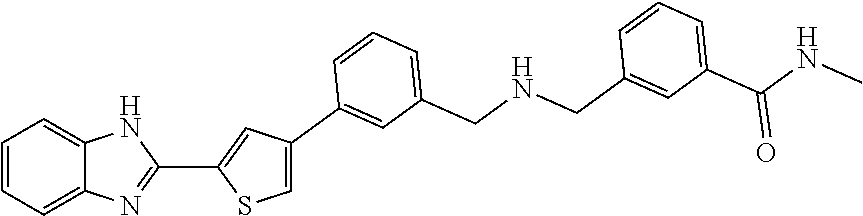
- FIG. 4 is the dose response curve for Compound 2, 3-(((3-(5-(1H-benzo[d]imidazol-2-yl)thiophen-3-yl)benzyl)amino)methyl)-N-methylbenzamide
- FIG. 5 is the dose response curve for Compound 3, methyl 3-((3-(5-(1H-benzo[d]imidazol-2-yl)thiophen-3-yl)benzamido)methyl)benzoate.
- FIG. 6 is the is the dose response curve for Compound 4, 1-(3-ethoxy-4-hydroxybenzyl)-N-(3′-fluoro-[1,1′-biphenyl]-3-yl)piperidine-4-carboxamide.
- FIG. 7 is the dose response curve for Compound 5, 1-(3-ethoxy-4-hydroxybenzyl)-N-(3′-(trifluoromethyl)-[1,1′-biphenyl]-3-yl)piperidine-4-carboxamide.
- FIG. 8 is the dose response curve for Compound 6, 1-(3-ethoxy-4-hydroxybenzyl)-N-(3′-methoxy-[1,1′-biphenyl]-3-yl)piperidine-4-carboxamide.
- FIG. 9 is the dose response curve for Compound 7, N-(3′-chloro-[1,1′-biphenyl]-3-yl)-1-(4-hydroxybenzyl)piperidine-4-carboxamide.
- FIG. 10 is the dose response curve for Compound 8, N-(3′-chloro-[1,1′-biphenyl]-3-yl)-1-(3-hydroxy-4-methoxybenzyl)piperidine-4-carboxamide.
- FIG. 11 is the dose response curve for Compound 9, N-(3′-chloro-[1,1′-biphenyl]-3-yl)-1-(3-ethoxy-4-hydroxybenzyl)piperidine-4-carboxamide.
- FIG. 12 is the dose response curve for Compound 10, N-(4′-chloro-[1,1′-biphenyl]-3-yl)-1-(3-ethoxy-4-hydroxybenzyl)piperidine-4-carboxamide.
- FIG. 13 is the dose response curve for Compound 11, dilazep.
- FIG. 14 is the dose response curve for N-(2,2,2-trifluoroethyl)-9-(4-(4-(4′-(trifluoromethyl)-[1,1′-biphenyl]-2-carboxamido)piperidin-1-yl)butyl)-9H-fluorene-9-carboxamide.
- compositions and methods of treating a subject suffering from SARS-COV-1, SARS-CoV-2 (Covid-19) and MERS-CoV, and variants within each, are provided, which targets the N-terminal domain (NTD) of the spike receptor binding domain (RBD).
- NTD N-terminal domain
- RBD spike receptor binding domain
- Reference to a subject, individual, host or patient herein are interchangeable and refer to any mammalian subject for which diagnosis, treatment is therapy is desired, particularly humans.
- Treatment may be any treatment of a disease in a mammal and includes preventing the disease from occurring, inhibiting the disease, arresting its development, or relieving or causing regression of the disease.
- VeroE6 cells ATCC CRL-1586 were seeded at a density of 4000 cells/well in a 384 well imaging plates (Aurora Microplates, ABE2-31101A). Next day cells were pre-treated with the compound for two hours and then infected with SARS-CoV-2 (USA-WA1/2020) at a multiplicity of infection (MOI) of 0.01. After 32 hours following infection, cells were fixed in 10% formalin.
- Plates that have Z′>0.5 were considered for data analysis.
- the Acapella generated cell data is imported to Spotfire (visual analysis statistical software, Perkin Elmer Inc., MA).
- Spotfire visual analysis statistical software, Perkin Elmer Inc., MA.
- Compounds that exhibited greater than 50% inhibition of SARS-CoV-2 infection relative to infected control (infected and DMSO treated) wells and those that did not reduce the number of cells more than 20% relative to the infected control were considered as “Hits”.
- the hit compounds were then selected for dose-response assays.
- coronaviruses infect humans causing significant illness and disease, highlighted by the recent zoonotic emergence of SARS-CoV-2.
- Coronaviruses have a typical Spike glycoprotein molecule located on the virion surface.
- the SARS-CoV-2 Spike glycoprotein is a Type I fusion glycoprotein made up of three intercalating monomers to form a metastable trimer. Each Spike monomer is cleaved into S1 and S2 by furin enzymatic activity.
- the S1 region contains an N-terminal domain (NTD), and a receptor-binding domain (RBD).
- NTD N-terminal domain
- RBD receptor-binding domain
- the process of human infection and viral-cell entry is initiated by binding of the RBD to the human Angiotensin-converting enzyme 2 (ACE2) receptor.
- ACE2 Angiotensin-converting enzyme 2
- the SARS-CoV-2 RBD adopts two main conformations in relation to the Spike, referred to as the “up” conformation (where the RBD ACE2 binding site is accessible) and the “down” conformation (where the ACE2 binding site is inaccessible).
- the coronavirus spike glycoprotein is essential for SARS-CoV-2.
- the intercalated nature of the three spike glycoprotein monomers means that the RBD from one chain is side-by-side with the NTD from another chain. This domain organization was contemplated to allow for flexibility and hinging of the RBD receptor site from an inaccessible “down” location to a fully accessible “up” conformation.
- the antiviral targeting of the Spike RBD involved two rationales, (i) blocking the ACE2 binding site, and (ii) hindering the transition of the RBD into an “up” conformation and thus preventing accessibility of the ACE2 binding site.
- the ACE2 binding site on the RBD contains hydrophobic patches while there is also a subtle conformational transition of the flexible 476-486 loop upon ACE2 binding.
- This site has been targeted by peptide-based inhibitors (utilizing short stretches of residues from the ACE2 protein such as 22-44) that interrupt the ACE2-RBD interaction [PMID: 32917884] and have antiviral activity [PMID: 33310780]. More recent analysis of the SARS-CoV-2 Spike structure has identified a “Free fatty acid binding pocket” in the locked structure of SARS-CoV-2 spike protein (PDB ID: 6ZB4) [PMID: 32958580], largely involving the RBD but in essence stabilizing the “closed” conformation of the Spike.
- This model was made up of the high resolution RBD structure (residues 321-526, including water molecules and glycans) and the NTD-SD1 structure (residues 27-294, 321-331, 527-591) from the EM model.
- This hybrid model allowed identification of compounds adjacent to RBD residues 355, 396, 428, 462, 464 and NTD residues 197, 201, 231, 331.
- FIGS. 2 A, 2 B and 2 C which shows the SARS-CoV-2 Spike glycoprotein RBD-NTD-SD-1 model and putative small molecule binding sites. These binding pockets are constructed from discontinuous regions of both the RBD and NTD.
- WR415028 is Compound 4 herein, 1-(3-ethoxy-4-hydroxybenzyl)-N-(3′-fluoro-[1,1′-biphenyl]-3-yl)piperidine-4-carboxamide.
- WR300740 is reference to Dilazep or 3-(4- ⁇ 3-[(3,4,5-Trimethoxyphenyl)carbonyloxy]propyl ⁇ -1,4-diazepan-1-yl)propyl 3,4,5-trimethoxybenzoate.
- Lomitapide mesylate is reference to N-(2,2,2-Trifluoroethyl)-9-[4-[4-[[[4′-(trifluoromethyl)[1,1′-biphenyl]-2-yl]carbonyl]amino]-1-piperidinyl]butyl]-9H-fluorene-9-carboxamide methanesulfonate.
- Imatinib is reference to 4-[(4-methylpiperazin-1-yl)methyl]-N-(4-methyl-3- ⁇ [4-(pyridin-3-yl)pyrimidin-2-yl]amino ⁇ phenyl)benzamide.
- the present invention is directed at antiviral drugs targeting and methods of treating a subject suffering from SARS-COV-1, SARS-CoV-2 (Covid-19) and MERS-CoV, and variants within each, in a mammalian subject.
- the method comprises administering to the subject the compounds identified herein, or a pharmaceutically acceptable salt thereof, optionally in a pharmaceutically acceptable carrier.
- the pharmaceutically acceptable carrier may comprise a dosage form suitable for oral administration, such as in a solution or suspension.
- the dosage form may be in a solid dosage form such as a tablet, capsule or gel cap.
- the pharmaceutically acceptable carrier may also include a dosage suitable for intravenous delivery.
- the administration is contemplated to provide a reduction in the subject's viral load (which can be evaluated via PCR), an improvement in one or more of the subjects viral infection symptoms (e.g. fever, decreased oxygen saturation, shortness of breath, difficulty breathing, fatigue, muscle aches, body aches, chest pain or pressure, headache, loss of taste, loss of smell, sore throat, congestion, nausea, vomiting, diarrhea, confusion, cough or rash) and/or clinical status.
- Clinical status may be evaluated utilizing the WHO Ordinal Scale for Clinical Improvement.
- the antiviral drug targeting the N-terminal domain (NTD) of the spike receptor binding domain (RBD) of SARS-COV-1, SARS-CoV-2 (Covid-19) and MERS-CoV, and variants within each comprises benzimidazoles or pharmaceutically acceptable salts therefore identified in Formula I below:
- X can be —CH 2 — or C ⁇ O
- R can be —OCH 3 or —NHCH 3 .
- the antiviral drugs in Formula I herein comprise:
- EC 50 is reference to the dose that provides a half-maximal response.
- EC 90 is reference to the dose that provides a 90% maximal response.
- CC 50 is the concentration required for reduction of cell viability by 50%.
- the dose response curves for Compounds 1-3 are provided in FIGS. 3 - 5 , respectively.
- the antiviral drug targeting the N-terminal domain (NTD) of the spike receptor binding domain (RBD) of SARS-COV-1, SARS-CoV-2 (Covid-19) and MERS-CoV, and variants within each comprises piperdines or pharmaceutically acceptable salts therefore identified in Formula 2 below:
- R 1 or R 2 can be a hydroxy and the other is H, methoxy (—OCH 3 ) or ethoxy (—OCH 2 CH 3 ) and R 3 and R 4 are independently H, F, Cl, CF 3 or —OCH 3 .
- the antiviral drugs in Formula 2 herein comprise:
- the dose response curves for Compounds 4-10 are provided in FIGS. 6 - 12 , respectively.
- the antiviral drug which targets the N-terminal domain (NTD) of the spike receptor binding domain (RBD) of SARS-COV-1, SARS-CoV-2 (Covid-19) and MERS-CoV, and variants within each comprises Formula 3, dilazep, otherwise known as 3-[4-[3-(3,4,5-trimethoxybenzoyl)oxypropyl]-1,4-diazepan-1-yl]propyl 3,4,5-trimethoxybenzoate, or a pharmaceutically acceptable salt thereof, optionally in a pharmaceutically acceptable carrier.
- Dilazep has the following general structure:
- Dilazep indicated an EC 50 value of 3.89 uM+/ ⁇ 2.1, an EC 90 value of 19.8 uM, a CC 50 value of >30.0 uM and a SI of >7.7, against the SARS-CoV-2 strain.
- the dose response curve appears in FIG. 13 .
- the antiviral drug which targets the N-terminal domain (NTD) of the spike receptor binding domain (RBD) of SARS-COV-1, SARS-CoV-2 (Covid-19) and MERS-CoV, and variants within each comprises N-(2,2,2-trifluoroethyl)-9-(4-(4-(4′-(trifluoromethyl)-[1,1′-biphenyl]-2-carboxamido)piperidin-1-yl)butyl)-9H-fluorene-9-carboxamide, having the following general structure:
- N-(2,2,2-trifluoroethyl)-9-(4-(4-(4′-(trifluoromethyl)-[1,1′-biphenyl]-2-carboxamido)piperidin-1-yl)butyl)-9H-fluorene-9-carboxamide indicated an EC50 value of 1.61, an EC90 value of 2.83 uM, a CC50 value of 9.56 uM and a SI of 5.92, against the SARS-CoV-2 strain.
- the dose response curve is provided in FIG. 14 .
Landscapes
- Health & Medical Sciences (AREA)
- Chemical & Material Sciences (AREA)
- Life Sciences & Earth Sciences (AREA)
- Public Health (AREA)
- Veterinary Medicine (AREA)
- General Health & Medical Sciences (AREA)
- Animal Behavior & Ethology (AREA)
- Pharmacology & Pharmacy (AREA)
- Medicinal Chemistry (AREA)
- Epidemiology (AREA)
- Organic Chemistry (AREA)
- Virology (AREA)
- General Chemical & Material Sciences (AREA)
- Chemical Kinetics & Catalysis (AREA)
- Nuclear Medicine, Radiotherapy & Molecular Imaging (AREA)
- Oncology (AREA)
- Communicable Diseases (AREA)
- Molecular Biology (AREA)
- Pharmaceuticals Containing Other Organic And Inorganic Compounds (AREA)
- Medicines That Contain Protein Lipid Enzymes And Other Medicines (AREA)
- Medicinal Preparation (AREA)
Abstract
Description

-
- wherein, X can be —CH2— or C═O, and R can be —OCH3 or —NHCH3;
- or a pharmaceutically acceptable salt thereof, optionally in a pharmaceutically acceptable carrier.

-
- wherein R1 or R2 can be a hydroxy and the other is H, methoxy (—OCH3) or ethoxy (—OCH2CH3) and R3 and R4 are independently H, F, Cl, CF3 or —OCH3;
- or a pharmaceutically acceptable salt thereof, optionally in a pharmaceutically acceptable carrier.
(Z′=(1−(3×STDEV of Signalmax(neutral/infection only control)+3×STDEV Signalmin(inhibitor/no infection control))/ABS(mean Signalmax−mean of Signalmin)).

-
- 1. Compound 1: methyl 3-(((3-(5-(1H-benzo[d]imidazol-2-yl)thiophen-3-yl)benzyl)amino)methyl)benzoate, which has the following general structure:

-
- 2. Compound 2: 3-(((3-(5-(1H-benzo[d]imidazol-2-yl)thiophen-3-yl)benzyl)amino)methyl)-N-methylbenzamide, which has the following general structure:
-
- 3. Compound 3: methyl 3-((3-(5-(1H-benzo[d]imidazol-2-yl)thiophen-3-yl)benzamido)methyl)benzoate, which has the following general structure:

| TABLE 1 | ||||
| Compound | EC50 (μM) | EC90 (μM) | CC50 (μM) | SI |
| 1 | 5.66 | 9.50 | >30.0 | >5.30 |
| 2 | 7.43 | 13.10 | >30.0 | >4.04 |
| 3 | 7.50 | 12.64 | >30.0 | >4.00 |

-
- 4. Compound 4: 1-(3-ethoxy-4-hydroxybenzyl)-N-(3′-fluoro-[1,1′-biphenyl]-3-yl)piperidine-4-carboxamide, which has the following general structure:

-
- 5. Compound 5: 1-(3-ethoxy-4-hydroxybenzyl)-N-(3′-(trifluoromethyl)-[1,1′-biphenyl]-3-yl)piperidine-4-carboxamide, which has the following general structure:

-
- 6. Compound 6: 1-(3-ethoxy-4-hydroxybenzyl)-N-(3′-methoxy-[1,1′-biphenyl]-3-yl)piperidine-4-carboxamide, which has the following general structure:

-
- 7. Compound 7: N-(3′-chloro-[1,1′-biphenyl]-3-yl)-1-(4-hydroxybenzyl)piperidine-4-carboxamide, which has the following general structure:

-
- 8. Compound 8: N-(3′-chloro-[1,1′-biphenyl]-3-yl)-1-(3-hydroxy-4-methoxybenzyl)piperidine-4-carboxamide, which has the following general structure:

-
- 9. Compound 9: N-(3′-chloro-[1,1′-biphenyl]-3-yl)-1-(3-ethoxy-4-hydroxybenzyl)piperidine-4-carboxamide, which has the following general structure:

-
- 10. Compound 10: N-(4′-chloro-[1,1′-biphenyl]-3-yl)-1-(3-ethoxy-4-hydroxybenzyl)piperidine-4-carboxamide, which has the following general structure:

| Compound | EC50 (μM) | EC90 (μM) | CC50 (μM) | SI |
| 4 | 6.10 | 10.10 | >30.0 | >4.92 |
| 5 | 4.91 | 7.47 | 15.6 | 3.20 |
| 6 | 7.16 | 11.45 | 26.30 | 3.70 |
| 7 | 6.40 | 11.00 | 21.00 | 3.36 |
| 8 | 6.90 | 11.70 | 17.00 | 2.48 |
| 9 | 5.80 | 8.90 | 16.00 | 2.80 |
| 10 | 6.20 | 9.10 | 16.00 | 2.65 |


Claims (6)

Priority Applications (1)
| Application Number | Priority Date | Filing Date | Title |
|---|---|---|---|
| US17/819,178 US11865111B2 (en) | 2021-08-17 | 2022-08-11 | Antiviral drugs targeting the N-terminal domain (NTD) of the coronavirus spike receptor binding domain (RBD) |
Applications Claiming Priority (2)
| Application Number | Priority Date | Filing Date | Title |
|---|---|---|---|
| US202163260342P | 2021-08-17 | 2021-08-17 | |
| US17/819,178 US11865111B2 (en) | 2021-08-17 | 2022-08-11 | Antiviral drugs targeting the N-terminal domain (NTD) of the coronavirus spike receptor binding domain (RBD) |
Publications (2)
| Publication Number | Publication Date |
|---|---|
| US20230074535A1 US20230074535A1 (en) | 2023-03-09 |
| US11865111B2 true US11865111B2 (en) | 2024-01-09 |
Family
ID=85385884
Family Applications (1)
| Application Number | Title | Priority Date | Filing Date |
|---|---|---|---|
| US17/819,178 Active 2042-08-11 US11865111B2 (en) | 2021-08-17 | 2022-08-11 | Antiviral drugs targeting the N-terminal domain (NTD) of the coronavirus spike receptor binding domain (RBD) |
Country Status (4)
| Country | Link |
|---|---|
| US (1) | US11865111B2 (en) |
| EP (1) | EP4387735A4 (en) |
| JP (1) | JP2024530904A (en) |
| WO (1) | WO2023039330A2 (en) |
Families Citing this family (2)
| Publication number | Priority date | Publication date | Assignee | Title |
|---|---|---|---|---|
| MX2023002233A (en) | 2020-08-24 | 2023-03-15 | Gilead Sciences Inc | Phospholipid compounds and uses thereof. |
| TWI811812B (en) | 2020-10-16 | 2023-08-11 | 美商基利科學股份有限公司 | Phospholipid compounds and uses thereof |
Citations (1)
| Publication number | Priority date | Publication date | Assignee | Title |
|---|---|---|---|---|
| US20210079008A1 (en) | 2019-09-17 | 2021-03-18 | University Of Utah Research Foundation | Benzimidazoles and Methods of Using Same |
Family Cites Families (1)
| Publication number | Priority date | Publication date | Assignee | Title |
|---|---|---|---|---|
| WO2008054454A2 (en) * | 2006-02-10 | 2008-05-08 | Transtech Pharma, Inc. | Nitrogen-containing heterocycle derivatives, pharmaceutical compositions, and methods of use thereof as antiviral agents |
-
2022
- 2022-08-11 WO PCT/US2022/074840 patent/WO2023039330A2/en not_active Ceased
- 2022-08-11 EP EP22868219.1A patent/EP4387735A4/en active Pending
- 2022-08-11 JP JP2024505316A patent/JP2024530904A/en active Pending
- 2022-08-11 US US17/819,178 patent/US11865111B2/en active Active
Patent Citations (1)
| Publication number | Priority date | Publication date | Assignee | Title |
|---|---|---|---|---|
| US20210079008A1 (en) | 2019-09-17 | 2021-03-18 | University Of Utah Research Foundation | Benzimidazoles and Methods of Using Same |
Non-Patent Citations (7)
| Title |
|---|
| "SID 400226951", PubChem, downloaded Feb. 14, 2023, concise explanation of relevancy can be found in the Invitation to Pay Additional Fees submitted herewith. |
| "SID 400226951", PubChem, Modify date Feb. 17, 2021, downloaded Mar. 24, 2023, concise explanation of relevancy can be found in the International Search Report and Written Opinion submitted herewith herewith. |
| "SID 85862052", PubChem, downloaded Feb. 14, 2023, concise explanation of relevancy can be found in the Invitation to Pay Additional Fees submitted herewith. |
| Gelemanovic et al., Identification of 37 Heterogeneous Drug Candidates for Treatment of COVID-19 via a Rational Transcriptomics-Based Drug REpurposing Approach, Pharmaceuticals, vol. 14, No. 2, 87 (Year: 2021). * |
| International Search Report and Written Opinion from corresponding PCT Appln. No. PCT/US2022/074840, dated Apr. 13, 2023. |
| Invitation to Pay Additional Fees from corresponding PCT Appln. No. PCT/US2022/074840, dated Feb. 14, 2023. |
| Pinto et al., Screening of World Approved Drugs Against Highly Dynamical Spike Glycoprotein SARS-CoV-2 using CaverDock and Machine Learning, ChemRxiv, 2020 pp. 1-19 (Year: 2020). * |
Also Published As
| Publication number | Publication date |
|---|---|
| EP4387735A2 (en) | 2024-06-26 |
| JP2024530904A (en) | 2024-08-27 |
| EP4387735A4 (en) | 2025-08-27 |
| WO2023039330A3 (en) | 2023-06-01 |
| US20230074535A1 (en) | 2023-03-09 |
| WO2023039330A2 (en) | 2023-03-16 |
Similar Documents
| Publication | Publication Date | Title |
|---|---|---|
| US8927545B2 (en) | Inhibiting Eph B-3 kinase | |
| US20230074535A1 (en) | Antiviral drugs targeting the n-terminal domain (ntd) of the coronavirus spike receptor binding domain (rbd) | |
| US20150164910A1 (en) | Antiviral compounds and methods of use | |
| CA3182306A1 (en) | Methods and compositions for the treatment of sars-cov-2 | |
| JP2023522688A (en) | AAK1 inhibitors used to treat viral infections | |
| US9561239B2 (en) | Compositions and methods for inhibiting norovirus infection | |
| EP3525789A1 (en) | Fgfr regulation for the treatment of viral infections | |
| US11963959B2 (en) | Inhibitors for coronavirus | |
| Huang et al. | Effect of resveratrol on herpesvirus encephalitis: evidences for its mechanisms of action | |
| US11666575B2 (en) | Pyrazolo[1,5]pyrimidine-based compounds and methods of their use to treat viral infections | |
| EP2956134A2 (en) | Helicase-primase inhibitors for treating alzheimer's disease | |
| US20240277730A1 (en) | Suppression of covid-19 replication by covid-19 entry inhibitors | |
| CN115776886A (en) | Compounds useful in the treatment of COVID-19 | |
| WO2015054612A1 (en) | Treating organ-specific t cell mediated autoimmune diseases | |
| US11517581B2 (en) | Zika virus protease inhibitors and methods of use thereof | |
| Royer et al. | Small Molecule Targeting of Atypical p38 Protects Against Viral Infection | |
| Brush et al. | Papiine herpesvirus 2 as a predictive model for drug sensitivity of Macacine herpesvirus 1 (monkey B virus) | |
| US10363254B2 (en) | Methods for treating cryptosporidiosis using triazolopyridazines | |
| TWI799923B (en) | Use of thioimidazolidinone drugs in the treatment of covid-19 disease | |
| JP6335877B2 (en) | Methods and compositions for treating viral infections | |
| HK40079565A (en) | Cysteamine for the treatment of sars-cov-2 infection |
Legal Events
| Date | Code | Title | Description |
|---|---|---|---|
| FEPP | Fee payment procedure |
Free format text: ENTITY STATUS SET TO UNDISCOUNTED (ORIGINAL EVENT CODE: BIG.); ENTITY STATUS OF PATENT OWNER: LARGE ENTITY |
|
| AS | Assignment |
Owner name: UNITED STATES GOVERNMENT, MARYLAND Free format text: CONFIRMATORY LICENSE;ASSIGNOR:HENRY M. JACKSON FDN FOR THE ADV MIL/MED;REEL/FRAME:060965/0542 Effective date: 20220826 |
|
| STPP | Information on status: patent application and granting procedure in general |
Free format text: DOCKETED NEW CASE - READY FOR EXAMINATION |
|
| FEPP | Fee payment procedure |
Free format text: PETITION RELATED TO MAINTENANCE FEES GRANTED (ORIGINAL EVENT CODE: PTGR); ENTITY STATUS OF PATENT OWNER: LARGE ENTITY |
|
| AS | Assignment |
Owner name: THE GOVERNMENT OF THE UNITED STATES, AS REPRESENTED BY THE SECRETARY OF THE ARMY, MARYLAND Free format text: ASSIGNMENT OF ASSIGNORS INTEREST;ASSIGNORS:CAMPBELL, ROBERT F.;PANCHAL, REKHA;REEL/FRAME:062404/0967 Effective date: 20230118 |
|
| AS | Assignment |
Owner name: SOUTHWEST RESEARCH INSTITUTE, TEXAS Free format text: ASSIGNMENT OF ASSIGNORS INTEREST;ASSIGNORS:BOHMANN, JONATHAN A.;GUTIERREZ, NADEAN M.;MCDONOUGH, JOSEPH A.;SIGNING DATES FROM 20210820 TO 20220218;REEL/FRAME:063108/0702 Owner name: THE HENRY M. JACKSON FOUNDATION FOR THE ADVANCEMENT OF MILITARY MEDICINE, INC., MARYLAND Free format text: ASSIGNMENT OF ASSIGNORS INTEREST;ASSIGNORS:JOYCE, MICHAEL GORDON;SANKHALA, RAJESHWER;SIGNING DATES FROM 20221006 TO 20221222;REEL/FRAME:063108/0774 |
|
| STPP | Information on status: patent application and granting procedure in general |
Free format text: NON FINAL ACTION MAILED |
|
| STPP | Information on status: patent application and granting procedure in general |
Free format text: RESPONSE TO NON-FINAL OFFICE ACTION ENTERED AND FORWARDED TO EXAMINER |
|
| STPP | Information on status: patent application and granting procedure in general |
Free format text: NOTICE OF ALLOWANCE MAILED -- APPLICATION RECEIVED IN OFFICE OF PUBLICATIONS |
|
| STPP | Information on status: patent application and granting procedure in general |
Free format text: PUBLICATIONS -- ISSUE FEE PAYMENT RECEIVED |
|
| STPP | Information on status: patent application and granting procedure in general |
Free format text: PUBLICATIONS -- ISSUE FEE PAYMENT VERIFIED |
|
| STCF | Information on status: patent grant |
Free format text: PATENTED CASE |