US11864190B2 - Method and apparatus for configuring and determining transmission block scheduling interval, and base station - Google Patents
Method and apparatus for configuring and determining transmission block scheduling interval, and base station Download PDFInfo
- Publication number
- US11864190B2 US11864190B2 US17/266,593 US201817266593A US11864190B2 US 11864190 B2 US11864190 B2 US 11864190B2 US 201817266593 A US201817266593 A US 201817266593A US 11864190 B2 US11864190 B2 US 11864190B2
- Authority
- US
- United States
- Prior art keywords
- scheduling
- mtc
- transport block
- current
- interval
- Prior art date
- Legal status (The legal status is an assumption and is not a legal conclusion. Google has not performed a legal analysis and makes no representation as to the accuracy of the status listed.)
- Active, expires
Links
Images


Classifications
-
- H—ELECTRICITY
- H04—ELECTRIC COMMUNICATION TECHNIQUE
- H04L—TRANSMISSION OF DIGITAL INFORMATION, e.g. TELEGRAPHIC COMMUNICATION
- H04L5/00—Arrangements affording multiple use of the transmission path
- H04L5/0091—Signalling for the administration of the divided path, e.g. signalling of configuration information
- H04L5/0092—Indication of how the channel is divided
-
- H—ELECTRICITY
- H04—ELECTRIC COMMUNICATION TECHNIQUE
- H04W—WIRELESS COMMUNICATION NETWORKS
- H04W72/00—Local resource management
- H04W72/20—Control channels or signalling for resource management
-
- H—ELECTRICITY
- H04—ELECTRIC COMMUNICATION TECHNIQUE
- H04W—WIRELESS COMMUNICATION NETWORKS
- H04W72/00—Local resource management
- H04W72/20—Control channels or signalling for resource management
- H04W72/23—Control channels or signalling for resource management in the downlink direction of a wireless link, i.e. towards a terminal
-
- H—ELECTRICITY
- H04—ELECTRIC COMMUNICATION TECHNIQUE
- H04L—TRANSMISSION OF DIGITAL INFORMATION, e.g. TELEGRAPHIC COMMUNICATION
- H04L5/00—Arrangements affording multiple use of the transmission path
- H04L5/003—Arrangements for allocating sub-channels of the transmission path
- H04L5/0058—Allocation criteria
-
- H—ELECTRICITY
- H04—ELECTRIC COMMUNICATION TECHNIQUE
- H04L—TRANSMISSION OF DIGITAL INFORMATION, e.g. TELEGRAPHIC COMMUNICATION
- H04L5/00—Arrangements affording multiple use of the transmission path
- H04L5/003—Arrangements for allocating sub-channels of the transmission path
- H04L5/0078—Timing of allocation
-
- H—ELECTRICITY
- H04—ELECTRIC COMMUNICATION TECHNIQUE
- H04W—WIRELESS COMMUNICATION NETWORKS
- H04W4/00—Services specially adapted for wireless communication networks; Facilities therefor
- H04W4/70—Services for machine-to-machine communication [M2M] or machine type communication [MTC]
-
- H—ELECTRICITY
- H04—ELECTRIC COMMUNICATION TECHNIQUE
- H04W—WIRELESS COMMUNICATION NETWORKS
- H04W72/00—Local resource management
- H04W72/12—Wireless traffic scheduling
- H04W72/1263—Mapping of traffic onto schedule, e.g. scheduled allocation or multiplexing of flows
-
- H—ELECTRICITY
- H04—ELECTRIC COMMUNICATION TECHNIQUE
- H04W—WIRELESS COMMUNICATION NETWORKS
- H04W72/00—Local resource management
- H04W72/50—Allocation or scheduling criteria for wireless resources
- H04W72/51—Allocation or scheduling criteria for wireless resources based on terminal or device properties
-
- H—ELECTRICITY
- H04—ELECTRIC COMMUNICATION TECHNIQUE
- H04L—TRANSMISSION OF DIGITAL INFORMATION, e.g. TELEGRAPHIC COMMUNICATION
- H04L5/00—Arrangements affording multiple use of the transmission path
- H04L5/003—Arrangements for allocating sub-channels of the transmission path
- H04L5/0058—Allocation criteria
- H04L5/0076—Allocation utility-based
Definitions
- the present disclosure relates to the field of communication technologies, and in particular, relates to methods and apparatuses for cSubsonfiguring a transport block scheduling interval, and methods and apparatuses for determining a transport block scheduling interval, base stations, user equipment and computer-readable storage media.
- MTC Machine Type Communication
- 3GPP 3rd Generation Partnership Project
- a singly-scheduling and multiply-transmitting way is submitted for scheduling data of CAT-M1 (Category M1) user equipment (UE), which, for descriptive purposes, is called a single-to-multiple transport block (TB) scheduling.
- CAT-M1 Category M1
- UE user equipment
- TB transport block
- MTC UE are obviously distinguished from mobile UE because the MTC UE are applicable to widely different situations. For example, some MTC UE are only to transmit a little data, while the others are on the contrary. Thus, how to set transport block scheduling intervals for various UE is a technical problem that is expected to be solved.
- the present disclosure discloses methods and apparatuses for configuring a transport block scheduling interval, methods and apparatuses for determining a transport block scheduling interval, base stations, UE, and computer-readable storage media.
- a method of configuring a transport block scheduling interval being applicable to a base station, includes: in response to that scheduling of current MTC UE is in a preset type, determining a corresponding transport block scheduling interval based on current capability information of the current MTC UE, where the current capability information includes a parameter indicating a scheduling processing capability level of the current MTC UE; and sending scheduling information to the current MTC UE through a physical downlink control channel (PDCCH), where the scheduling information includes the corresponding transport block scheduling interval.
- PDCCH physical downlink control channel
- a method of determining a transport block scheduling interval, being applicable to MTC UE includes: receiving scheduling information from a base station through a PDCCH, where the scheduling information includes a transport block scheduling interval corresponding to the MTC UE; parsing out the transport block scheduling interval from the scheduling information; and receiving data from scheduled physical downlink shared channels (PDSCHs) of the PDCCH in accordance with the transport block scheduling interval.
- PDSCHs physical downlink shared channels
- a base station includes: a processor; and a memory for storing instructions executable by the processor; where the processor is configured to: in response to that scheduling of current MTC UE is in a preset type, determine a corresponding transport block scheduling interval based on current capability information of the current MTC UE, where the current capability information includes a parameter indicating a scheduling processing capability level of the current MTC UE; and send scheduling information to the current MTC UE through a PDCCH, where the scheduling information includes the corresponding transport block scheduling interval.
- FIG. 1 is a flowchart illustrating a method of configuring a transport block scheduling interval according to an example of the present disclosure.
- FIG. 2 is a flowchart illustrating another method of configuring a transport block scheduling interval according to an example of the present disclosure.
- FIG. 3 is a flowchart illustrating a method of determining a transport block scheduling interval according to an example of the present disclosure.
- FIG. 4 is a flowchart illustrating another method of determining a transport block scheduling interval according to an example of the present disclosure.
- FIG. 5 is a signaling flowchart illustrating a method of determining a transport block scheduling interval according to an example of the present disclosure.
- FIG. 6 is a block diagram illustrating an apparatus for configuring a transport block scheduling interval according to an example.
- FIG. 7 is a block diagram illustrating another apparatus for configuring a transport block scheduling interval according to an example.
- FIG. 8 is a block diagram illustrating another apparatus for configuring a transport block scheduling interval according to an example.
- FIG. 9 is a block diagram illustrating an apparatus for determining a transport block scheduling interval according to an example.
- FIG. 10 is a block diagram illustrating another apparatus for determining a transport block scheduling interval according to an example.
- FIG. 11 is a block diagram applicable to a device for configuring a transport block scheduling interval illustrated according to an example.
- FIG. 12 is a block diagram applicable a device for determining a transport block scheduling interval illustrated according to an example.
- first, second, third, and the like may be used herein to describe various information, the information should not be limited by these terms. These terms are only used to distinguish one category of information from another. For example, without departing from the scope of the present disclosure, first information may be termed as second information; and similarly, second information may also be termed as first information. As used herein, the term “if” may be understood to mean “when” or “upon” or “in response to” depending on the context.
- FIG. 1 is a flowchart illustrating a method of configuring a transport block scheduling interval according to an example of the present disclosure, which is described from a base station side. As shown in FIG. 1 , the method of configuring a transport block scheduling interval includes the following steps.
- a corresponding transport block scheduling interval is determined based on current capability information of the current MTC UE.
- the current capability information includes a parameter indicating a distinctive scheduling processing capability level of the current MTC UE.
- the scheduling in the preset type refers to that TB scheduling information of a plurality of PDSCHs is carried by one PDCCH, shortened to a single-to-multiple TB scheduling.
- the corresponding transport block scheduling interval is determined based on current capability information of the current MTC UE includes: determining a first time interval as the corresponding transport block scheduling interval if the current capability information indicates that the scheduling processing capability level of the current MTC UE is a first level, and determining a second time interval as the corresponding transport block scheduling interval if the current capability information indicates that the scheduling processing capability level of the current MTC UE is a second level.
- the first level is lower than the second level and the first time interval is greater than the second time interval. That is, the TB scheduling interval configured for the MTC UE with a low capacity is larger, while the TB scheduling interval configured for the MTC UE with a high capacity is smaller.
- scheduling information is sent to the current MTC UE through a PDCCH, where the scheduling information includes the determined corresponding transport block scheduling interval.
- determining a corresponding transport block scheduling interval based on current capability information of current MTC UE when scheduling the current MTC UE is in a preset type, and sending scheduling information that includes the determined corresponding transport block scheduling interval to the current MTC UE through a PDCCH configuring the TB scheduling interval flexibly can be effectively realized, and thereby to support a single-to-multiple TB scheduling for the MTC UE.
- FIG. 2 is a flowchart illustrating another method of configuring a transport block scheduling interval according to an example of the present disclosure. As shown in FIG. 2 , before step S 101 , the method may further include the following step.
- step S 100 capability information reported by the current MTC UE is received.
- the capability information reported by the current MTC UE may also to receive updated capability information reported by the current MTC UE.
- FIG. 3 is a flowchart illustrating a method of determining a transport block scheduling interval according to an example of the present disclosure, which is described from an MTC UE side. As shown in FIG. 3 , the method includes the following steps.
- scheduling information is received from a base station through a PDCCH.
- the scheduling information includes a transport block scheduling interval corresponding to current MTC UE.
- the transport block scheduling interval is parsed out from the scheduling information.
- step S 303 data is received from scheduled PDSCHs of the PDCCH in accordance with the transport block scheduling interval.
- FIG. 4 is a flowchart illustrating another method of determining a transport block scheduling interval according to an example of the present disclosure. As shown in FIG. 4 , before step S 301 , the method may further include the following step.
- the capability information includes a parameter indicating a distinctive scheduling processing capability level of the current MTC UE.
- its own capability information may be also reported to the base station so as to adapt to changes in the application scenario of the MTC UE.
- the base station can adjust the transport block scheduling interval of the UE based on the current capability information.
- the base station can determine a corresponding transport block scheduling interval based on current capability information of current MTC UE.
- FIG. 5 is a signaling flowchart illustrating a method of determining a transport block scheduling interval according to an example of the present disclosure, which is described from the perspective of interaction between a base station and MTC UE. As shown in FIG. 5 , the method includes the following steps.
- the MTC UE reports its own capability information to the base station.
- the capability information includes a parameter indicating a distinctive scheduling processing capability level of the current MTC UE.
- the base station receives the capability information reported by the MTC UE.
- the base station determine a corresponding transport block scheduling interval based on current capability information of the current MTC UE if scheduling the current MTC UE is in a preset type.
- the base station sends scheduling information to the current MTC UE through a PDCCH.
- the scheduling information includes the determined corresponding transport block scheduling interval.
- the MTC UE parses out the transport block scheduling interval from the scheduling information.
- the MTC UE receives data from scheduled PDSCHs of the PDCCH in accordance with the transport block scheduling interval.
- FIG. 6 is a block diagram of an apparatus for configuring a transport block scheduling interval according to an example.
- the configuring apparatus may be located in a base station. As shown in FIG. 6 , the apparatus includes: a determining module 61 and a sending module 62 .
- the determining module 61 is configured to determine a corresponding transport block scheduling interval based on current capability information of current MTC UE when scheduling the current MTC UE is in a preset type.
- the current capability information includes a parameter indicating a distinctive scheduling processing capability level of the current MTC UE.
- the scheduling in the preset type refers to that TB s scheduling information of a plurality of PDSCHs is carried by one PDCCH, shortened to a single-to-multiple TB scheduling.
- the sending module 62 is configured to send scheduling information to the current MTC UE through a PDCCH.
- the scheduling information includes the transport block scheduling interval determined by the determining module 61 .
- determining a corresponding transport block scheduling interval based on current capability information of current MTC UE when scheduling the current MTC UE is in a preset type, and sending scheduling information that includes the determined corresponding transport block scheduling interval to the current MTC UE through a PDCCH configuring the TB scheduling interval flexibly can be effectively realized, and thereby to support a single-to-multiple TB scheduling for the MTC UE.
- FIG. 7 is a block diagram of another apparatus for configuring a transport block scheduling interval according to an example. As shown in FIG. 7 , on the basis of the example shown in FIG. 6 , the apparatus may further include: a receiving module 60 .
- the receiving module 60 is configured to receive capability information reported by the current MTC UE before the determining module 61 determines the corresponding transport block scheduling interval.
- the receiving module 60 may be further configured to receive updated capability information reported by the current MTC UE after receiving the capability information reported by the current MTC UE.
- FIG. 8 is a block diagram illustrating another apparatus for configuring a transport block scheduling interval according to an example.
- the determining module 61 may include: a first determining submodule 611 and a second determining submodule 612 .
- the first determining submodule 611 is configured to determine a first time interval as the corresponding transport block scheduling interval when the current capability information indicates that the scheduling processing capability level of the current MTC UE is a first level.
- the second determining submodule 612 is configured to determine a second time interval as the corresponding transport block scheduling interval when the current capability information indicates that the scheduling processing capability level of the current MTC UE is a second level.
- the first level is lower than the second level and the first time interval is greater than the second time interval.
- FIG. 9 is a block diagram of an apparatus for determining a transport block scheduling interval according to an example.
- the determining apparatus may be located in MTC UE.
- the apparatus includes: a first receiving module 91 , a parsing module 92 , and a second receiving module 93 .
- the first receiving module 91 is configured to receive scheduling information from a base station through a PDCCH.
- the scheduling information includes a transport block scheduling interval corresponding to current MTC UE.
- the parsing module 92 is configured to parse out the transport block scheduling interval from the scheduling information received by the first receiving module 91 .
- the second receiving module 93 is configured to receive data from scheduled PDSCHs of the PDCCH in accordance with the transport block scheduling interval parsed out by the parsing module 92 .
- FIG. 10 is a block diagram of another apparatus for determining a transport block scheduling interval according to an example. As shown in FIG. 10 , on the basis of the example shown in FIG. 9 , the apparatus may further include: a reporting module 90 .
- the reporting module 90 is configured to report its own capability information to the base station before the first receiving module 91 receives the scheduling information.
- the capability information includes a parameter indicating a distinctive scheduling processing capability level of the current MTC UE.
- the reporting module 90 may be further configured to report its own updated capability information to the base station after reporting its own capability information to the base station, so as to adapt to changes in the application scenario of the MTC UE. Thereby, the base station can adjust the transport block scheduling interval of the UE based on the current capability information.
- the base station can determine a corresponding transport block scheduling interval based on current capability information of current MTC UE.
- FIG. 11 is a block diagram applicable to a device for configuring a transport block scheduling interval illustrated according to an example.
- the device 1100 may be provided as a base station. As shown in FIG. 11 , the device 1100 includes a processing component 1122 , a wireless transmitting/receiving component 1124 , an antenna component 1126 , and a signal processing part unique to a wireless interface.
- the processing component 1122 may further include one or more processors.
- One of the processors of the processing component 1122 may be configured to:
- a non-transitory computer-readable storage medium including instructions is provided, and the instructions may be executed by the processing component 1122 of the device 1100 to complete the method of configuring a transport block scheduling interval.
- the non-transitory computer-readable storage medium may be a Read-Only Memory (ROM), a Random Access Memory (RAM), CD-ROM, a magnetic tape, a floppy disk, an optical data storage device, and the like.
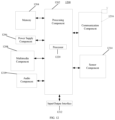
- FIG. 12 is a block diagram applicable to a device for determining a transport block scheduling interval illustrated according to an example.
- a device 1200 may be a mobile phone, a computer, a digital broadcast terminal, a message receiving and transmitting device, a game console, a tablet device, a medical device, a fitness device, a personal digital assistant, and other user equipment.
- the device 1200 may include one or more of the following components: a processing component 1202 , a memory 1204 , a power supply component 1206 , a multimedia component 1208 , an audio component 1210 , an input/output (I/O) interface 1212 , a sensor component 1214 , and a communication component 1216 .
- the processing component 1202 generally controls the overall operation of the device 1200 , such as operations associated with display, telephone calls, data communications, camera operations, and recording operations.
- the processing component 1202 may include one or more processors 1220 to execute instructions to complete all or part of the steps of the above methods.
- the processing component 1202 may include one or more modules which facilitate the interaction between the processing component 1202 and other components.
- the processing component 1202 may include a multimedia module to facilitate the interaction between the multimedia component 1208 and the processing component 1202 .
- One of the processors 1220 of the processing component 1202 may be configured to:
- the memory 1204 is configured to store various types of data to support the operation of the device 1200 . Examples of such data include instructions for any application or method operated on the device 1200 , contact data, phonebook data, messages, pictures, videos, and the like.
- the memory 1204 may be implemented by any type of volatile or non-volatile storage device or a combination thereof, such as static random access memory (SRAM), electrically erasable programmable read only memory (EEPROM), erasable programmable Read Only Memory (EPROM), programmable Read Only Memory (PROM), Read Only Memory (ROM), Magnetic Memory, Flash Memory, Disk or Optical Disk.
- SRAM static random access memory
- EEPROM electrically erasable programmable read only memory
- EPROM erasable programmable Read Only Memory
- PROM programmable Read Only Memory
- ROM Read Only Memory
- Magnetic Memory Flash Memory
- Disk Disk or Optical Disk.
- the power supply component 1206 supplies power for different components of the device 1200 .
- the power supply component 1206 may include a power supply management system, one or more power supplies, and other components associated with generating, managing and distributing power for the device 1200 .
- the multimedia component 1208 includes a screen providing an output interface between the device 1200 and a user.
- the screen may include a Liquid Crystal Display (LCD) and a Touch Panel (TP). If the screen includes the TP, the screen may be implemented as a touch screen to receive input signals from the user.
- the TP may include one or more touch sensors to sense touches, swipes, and gestures on the TP. The touch sensors may not only sense a boundary of a touch or swipe, but also sense a duration and a pressure associated with the touch or swipe.
- the multimedia component 1208 may include a front camera and/or a rear camera. The front camera and/or rear camera may receive external multimedia data when the device 1200 is in an operating mode, such as a photographing mode or a video mode. Each front camera and rear camera may be a fixed optical lens system or have focal length and optical zooming capability.
- the audio component 1210 is configured to output and/or input an audio signal.
- audio component 1210 includes a microphone (MIC) that is configured to receive an external audio signal when the device 1200 is in an operational mode, such as a call mode, a recording mode, and a voice recognition mode.
- the received audio signal may be further stored in the memory 1204 or sent via the communication component 1216 .
- the audio component 1210 also includes a speaker for outputting an audio signal.
- the I/O interface 1212 provides an interface between the processing component 1202 and a peripheral interface module.
- the above peripheral interface module may be a keyboard, a click wheel, buttons, or the like. These buttons may include but not limited to, a home button, a volume button, a start button and a lock button.
- the sensor component 1214 includes one or more sensors for providing the device 1200 with a status assessment of various aspects.
- the sensor component 1214 may detect the on/off status of the device 1200 , and relative positioning of components, such as a display and a keypad of the device 1200 .
- the sensor component 1214 may also detect a change in position of the device 1200 or a component of the device 1200 , the presence or absence of user contact with the device 1200 , orientation or acceleration/deceleration of the device 1200 , and temperature change of the device 1200 .
- the sensor component 1214 may include a proximity sensor configured to detect the presence of nearby objects without any physical contact.
- the sensor component 1214 may also include a light sensor, such as a CMOS or CCD image sensor, for use in imaging applications.
- the sensor component 1214 may also include an acceleration sensor, a gyro sensor, a magnetic sensor, a pressure sensor, or a temperature sensor.
- the communication component 1216 is configured to facilitate wired or wireless communication between the device 1200 and other devices.
- the device 1200 may access a wireless network based on a communication standard, such as WiFi, 2G or 3G, or a combination thereof.
- the communication component 1216 receives a broadcast signal or broadcast-associated information from an external broadcast management system via a broadcast channel.
- the communication component 1216 may further include a Near Field Communication (NFC) module for facilitate short-range communication.
- the NFC module may be implemented based on a radio frequency identification (RFID) technology, an infrared data association (IrDA) technology, an ultra-wideband (UWB) technology, a Bluetooth® (BT) technology and other technologies.
- RFID radio frequency identification
- IrDA infrared data association
- UWB ultra-wideband
- BT Bluetooth®
- the device 1200 may be implemented by one or more Application Specific Integrated Circuits (ASICs), Digital Signal Processors (DSPs), Digital Signal Processing Devices (DSPDs), programmable Logic Devices (PLDs), Field Programmable Gate Arrays (FPGAs), controllers, microcontrollers, microprocessors, or other electronic components for performing the above methods.
- ASICs Application Specific Integrated Circuits
- DSPs Digital Signal Processors
- DSPDs Digital Signal Processing Devices
- PLDs programmable Logic Devices
- FPGAs Field Programmable Gate Arrays
- controllers microcontrollers, microprocessors, or other electronic components for performing the above methods.
- non-transitory computer-readable storage medium including instructions, such as the memory 1204 including instructions.
- the above instructions may be executed by the processor 1220 of the device 1200 to complete the above methods.
- the non-transitory computer-readable storage medium may be a Read-Only Memory (ROM), a Random Access Memory (RAM), CD-ROM, a magnetic tape, a floppy disk, an optical data storage device, and the like.
- the apparatus examples essentially correspond to the method examples, reference may be made to the description of related parts of the method examples.
- the apparatus examples described above are merely illustrative, where the units described as separate members may be or not be physically separated, and the members displayed as units may be or not be physical units, i.e., may be located in one place, or may be distributed to a plurality of network units. Some or all of the modules may be selected according to actual needs to achieve the objectives of the implementations of the examples. It can be understood and implemented by those of ordinary skill in the art without any creative effort.
Landscapes
- Engineering & Computer Science (AREA)
- Signal Processing (AREA)
- Computer Networks & Wireless Communication (AREA)
- Mobile Radio Communication Systems (AREA)
Abstract
Description
-
- in response to that scheduling of current MTC UE is in a preset type, determine a corresponding transport block scheduling interval based on current capability information of the current MTC UE, where the current capability information includes a parameter indicating a distinctive scheduling processing capability level of the current MTC UE; and
- send scheduling information to the current MTC UE through a PDCCH, where the scheduling information includes the determined corresponding transport block scheduling interval.
-
- receive scheduling information from a base station through a PDCCH, where the scheduling information includes a transport block scheduling interval corresponding to current MTC UE;
- parse out the transport block scheduling interval from the scheduling information; and
- receive data from scheduled PDSCHs of the PDCCH in accordance with the transport block scheduling interval.
Claims (9)
Applications Claiming Priority (1)
| Application Number | Priority Date | Filing Date | Title |
|---|---|---|---|
| PCT/CN2018/099225 WO2020029085A1 (en) | 2018-08-07 | 2018-08-07 | Method and apparatus for configuring and determining transmission block scheduling interval, and base station |
Publications (2)
| Publication Number | Publication Date |
|---|---|
| US20210314996A1 US20210314996A1 (en) | 2021-10-07 |
| US11864190B2 true US11864190B2 (en) | 2024-01-02 |
Family
ID=64806288
Family Applications (1)
| Application Number | Title | Priority Date | Filing Date |
|---|---|---|---|
| US17/266,593 Active 2039-10-16 US11864190B2 (en) | 2018-08-07 | 2018-08-07 | Method and apparatus for configuring and determining transmission block scheduling interval, and base station |
Country Status (4)
| Country | Link |
|---|---|
| US (1) | US11864190B2 (en) |
| EP (1) | EP3836455B1 (en) |
| CN (1) | CN109155727B (en) |
| WO (1) | WO2020029085A1 (en) |
Families Citing this family (6)
| Publication number | Priority date | Publication date | Assignee | Title |
|---|---|---|---|---|
| BR112021021078A2 (en) * | 2019-04-25 | 2021-12-28 | Beijing Xiaomi Mobile Software Co Ltd | Method and apparatus for programming transport blocks, base station, terminal, and computer-readable storage medium |
| WO2020220266A1 (en) | 2019-04-30 | 2020-11-05 | 华为技术有限公司 | Information transmission method and communication device |
| WO2021159531A1 (en) * | 2020-02-14 | 2021-08-19 | 华为技术有限公司 | Gap determining method and device |
| CN113592059A (en) * | 2020-04-30 | 2021-11-02 | 伊姆西Ip控股有限责任公司 | Method, apparatus and computer program product for processing data |
| CN115606276A (en) * | 2020-09-04 | 2023-01-13 | 北京小米移动软件有限公司(Cn) | Method and device for configuring size of transmission block and storage medium |
| WO2022082384A1 (en) | 2020-10-19 | 2022-04-28 | 北京小米移动软件有限公司 | Method and apparatus for determining data processing duration, communication device and storage medium |
Citations (13)
| Publication number | Priority date | Publication date | Assignee | Title |
|---|---|---|---|---|
| CN101272388A (en) | 2007-03-20 | 2008-09-24 | 阿尔卡特朗讯 | A method for scheduling of service data in uplink, a base station, a user terminal and a communication network therefor |
| CN101400072A (en) | 2007-09-30 | 2009-04-01 | 大唐移动通信设备有限公司 | Transmission method, system and apparatus for enhancing coverage capability |
| CN103248598A (en) | 2012-02-01 | 2013-08-14 | 华为技术有限公司 | Communication method, base station and user equipment |
| WO2014023024A1 (en) | 2012-08-10 | 2014-02-13 | Mediatek Singapore Pte. Ltd. | Methods for disparity vector derivation |
| US9326290B2 (en) | 2010-12-16 | 2016-04-26 | Datang Mobile Communications Equipment Co., Ltd. | Resource scheduling method, apparatus and base station |
| CN107155181A (en) | 2016-03-04 | 2017-09-12 | 华为技术有限公司 | Handle method, user equipment and the base station of capability information of user facility |
| WO2017171398A1 (en) | 2016-03-29 | 2017-10-05 | Lg Electronics Inc. | Method and apparatus for configuring frame structure for new radio access technology in wireless communication system |
| CN107371265A (en) | 2016-05-13 | 2017-11-21 | 展讯通信(上海)有限公司 | A kind of base station and the method for transmitting and scheduling |
| CN107484251A (en) | 2016-06-08 | 2017-12-15 | 中国移动通信有限公司研究院 | Reporting method and acquisition method of terminal capability information, terminal and network side equipment |
| WO2018009037A1 (en) | 2016-07-07 | 2018-01-11 | Lg Electronics Inc. | Method and apparatus for signaling ue capability for new radio access technology in wireless communication system |
| WO2018119756A1 (en) | 2016-12-28 | 2018-07-05 | Motorola Mobility Llc | Gap period configuration |
| CN109075961A (en) | 2018-07-31 | 2018-12-21 | 北京小米移动软件有限公司 | Transport block processing method, device, electronic device, and computer-readable storage medium |
| US20200044768A1 (en) * | 2017-03-22 | 2020-02-06 | Sharp Kabushiki Kaisha | Terminal apparatus, base station apparatus, and communication method |
-
2018
- 2018-08-07 US US17/266,593 patent/US11864190B2/en active Active
- 2018-08-07 WO PCT/CN2018/099225 patent/WO2020029085A1/en not_active Ceased
- 2018-08-07 CN CN201880001640.0A patent/CN109155727B/en active Active
- 2018-08-07 EP EP18929216.2A patent/EP3836455B1/en active Active
Patent Citations (13)
| Publication number | Priority date | Publication date | Assignee | Title |
|---|---|---|---|---|
| CN101272388A (en) | 2007-03-20 | 2008-09-24 | 阿尔卡特朗讯 | A method for scheduling of service data in uplink, a base station, a user terminal and a communication network therefor |
| CN101400072A (en) | 2007-09-30 | 2009-04-01 | 大唐移动通信设备有限公司 | Transmission method, system and apparatus for enhancing coverage capability |
| US9326290B2 (en) | 2010-12-16 | 2016-04-26 | Datang Mobile Communications Equipment Co., Ltd. | Resource scheduling method, apparatus and base station |
| CN103248598A (en) | 2012-02-01 | 2013-08-14 | 华为技术有限公司 | Communication method, base station and user equipment |
| WO2014023024A1 (en) | 2012-08-10 | 2014-02-13 | Mediatek Singapore Pte. Ltd. | Methods for disparity vector derivation |
| CN107155181A (en) | 2016-03-04 | 2017-09-12 | 华为技术有限公司 | Handle method, user equipment and the base station of capability information of user facility |
| WO2017171398A1 (en) | 2016-03-29 | 2017-10-05 | Lg Electronics Inc. | Method and apparatus for configuring frame structure for new radio access technology in wireless communication system |
| CN107371265A (en) | 2016-05-13 | 2017-11-21 | 展讯通信(上海)有限公司 | A kind of base station and the method for transmitting and scheduling |
| CN107484251A (en) | 2016-06-08 | 2017-12-15 | 中国移动通信有限公司研究院 | Reporting method and acquisition method of terminal capability information, terminal and network side equipment |
| WO2018009037A1 (en) | 2016-07-07 | 2018-01-11 | Lg Electronics Inc. | Method and apparatus for signaling ue capability for new radio access technology in wireless communication system |
| WO2018119756A1 (en) | 2016-12-28 | 2018-07-05 | Motorola Mobility Llc | Gap period configuration |
| US20200044768A1 (en) * | 2017-03-22 | 2020-02-06 | Sharp Kabushiki Kaisha | Terminal apparatus, base station apparatus, and communication method |
| CN109075961A (en) | 2018-07-31 | 2018-12-21 | 北京小米移动软件有限公司 | Transport block processing method, device, electronic device, and computer-readable storage medium |
Non-Patent Citations (8)
| Title |
|---|
| "3rd Generation Partnership Project; Technical Specification Group Radio Access Network; NR; NR and NG-RAN Overall Description; Stage 2 (Release 15)", 3GPP TS 38.300, 3GPP, France, Jun. 20, 2018, 87 pages. |
| Ericsson, Huawei, "New WID on Rel-16 enhancements for NB-IoT", 3GPP TSG RAN Meeting #80, La Jolla, USA, RP-181451, Jun. 11-14, 2018, 4 pages. |
| European Patent Office, Extended European Search Report Issued in Application No. 18929216.2, dated Aug. 5, 2021, Germany, 12 pages. |
| INOA, Hearing Notice in Reference of Application No. 202147008556, dated Jul. 18, 2022 with English translation, (2p). |
| Intellectual property India, Office Action Issued in Application No. 202147008556, dated Jan. 20, 2022, (7 pages). (Submitted with Partial Machine Translation). |
| International Search Report of PCT Application No. PCT/CN2018/099225 dated Apr. 16, 2019 with English translation (4p). |
| ISA State Intellectual Property Office of the People's Republic of China, Written Opinion of the International Searching Authority Issued in Application No. PCT/CN2018/099225, dated Apr. 16, 2019, WIPO, 9 pages. |
| State Intellectual Property Office of the People's Republic of China, Office Action and Search Report Issued in Application No. 201880001640.0, dated Aug. 3, 2021, 22 pages. |
Also Published As
| Publication number | Publication date |
|---|---|
| US20210314996A1 (en) | 2021-10-07 |
| EP3836455A1 (en) | 2021-06-16 |
| CN109155727B (en) | 2022-05-13 |
| WO2020029085A1 (en) | 2020-02-13 |
| EP3836455A4 (en) | 2021-09-08 |
| EP3836455B1 (en) | 2026-01-21 |
| CN109155727A (en) | 2019-01-04 |
Similar Documents
| Publication | Publication Date | Title |
|---|---|---|
| EP3745790B1 (en) | Information configuration method and device, method and device for determining time-frequency location, and base station | |
| US11864190B2 (en) | Method and apparatus for configuring and determining transmission block scheduling interval, and base station | |
| US12369048B2 (en) | Measurement configuration method and method for reporting measurement information | |
| EP3706349A1 (en) | Hybrid automatic repeat request feedback indication and feedback method, device, and base station | |
| US20180192319A1 (en) | Method and apparatus for triggering reporting buffer status report and user equipment | |
| US20210153195A1 (en) | Method and device for identifying downlink transmissions | |
| US11812407B2 (en) | Method and apparatus for sending and receiving information, base station and user equipment | |
| US11729767B2 (en) | Method of indicating uplink feedback information and method of transmitting uplink feedback information | |
| US11665719B2 (en) | Method and apparatus for transmitting data | |
| KR102697389B1 (en) | Method and device for processing transmission blocks, electronic components and computer-readable storage media | |
| US12126566B2 (en) | System information reception method and apparatus, and system information transmission method and apparatus | |
| US11968716B2 (en) | Information configuration methods, and information reporting methods, base station, and user equipment | |
| US11864205B2 (en) | Scheduling method, base station, terminal and storage medium | |
| US11503642B2 (en) | Method and device for determining an uplink-downlink switching point | |
| US12219565B2 (en) | Buffer indication methods and apparatuses, resource transmission methods and apparatuses and user equipment | |
| US11937296B2 (en) | Monitoring method and apparatus, device, and storage medium | |
| US12041590B2 (en) | Carrier configuration method and device | |
| US11394495B2 (en) | Hybrid automatic repeat request (HARQ) feedback method and device and data receiving apparatus | |
| WO2019227318A1 (en) | Physical downlink control channel monitoring configuration method and apparatus, physical downlink control channel monitoring method and apparatus, and base station | |
| US20210152280A1 (en) | Methods and apparatuses for determining number of times of blind decoding schedule signaling, user equipment and base station | |
| US20210051492A1 (en) | Methods and apparatuses for sending and reading configuration parameters, base station and user equipment | |
| EP3989468A1 (en) | Receiving state feedback method and device |
Legal Events
| Date | Code | Title | Description |
|---|---|---|---|
| AS | Assignment |
Owner name: BEIJING XIAOMI MOBILE SOFTWARE CO., LTD., CHINA Free format text: ASSIGNMENT OF ASSIGNORS INTEREST;ASSIGNOR:LIU, YANG;REEL/FRAME:055172/0449 Effective date: 20201130 |
|
| FEPP | Fee payment procedure |
Free format text: ENTITY STATUS SET TO UNDISCOUNTED (ORIGINAL EVENT CODE: BIG.); ENTITY STATUS OF PATENT OWNER: LARGE ENTITY |
|
| STPP | Information on status: patent application and granting procedure in general |
Free format text: DOCKETED NEW CASE - READY FOR EXAMINATION |
|
| STPP | Information on status: patent application and granting procedure in general |
Free format text: NON FINAL ACTION MAILED |
|
| STPP | Information on status: patent application and granting procedure in general |
Free format text: RESPONSE TO NON-FINAL OFFICE ACTION ENTERED AND FORWARDED TO EXAMINER |
|
| STPP | Information on status: patent application and granting procedure in general |
Free format text: NOTICE OF ALLOWANCE MAILED -- APPLICATION RECEIVED IN OFFICE OF PUBLICATIONS |
|
| STPP | Information on status: patent application and granting procedure in general |
Free format text: PUBLICATIONS -- ISSUE FEE PAYMENT RECEIVED |
|
| STPP | Information on status: patent application and granting procedure in general |
Free format text: PUBLICATIONS -- ISSUE FEE PAYMENT VERIFIED |
|
| STCF | Information on status: patent grant |
Free format text: PATENTED CASE |