US11858938B2 - Imidazo-fused heterocycles and uses thereof - Google Patents
Imidazo-fused heterocycles and uses thereof Download PDFInfo
- Publication number
- US11858938B2 US11858938B2 US17/071,273 US202017071273A US11858938B2 US 11858938 B2 US11858938 B2 US 11858938B2 US 202017071273 A US202017071273 A US 202017071273A US 11858938 B2 US11858938 B2 US 11858938B2
- Authority
- US
- United States
- Prior art keywords
- optionally substituted
- compound
- alkyl
- group
- hydrogen
- Prior art date
- Legal status (The legal status is an assumption and is not a legal conclusion. Google has not performed a legal analysis and makes no representation as to the accuracy of the status listed.)
- Active, expires
Links
Classifications
-
- C—CHEMISTRY; METALLURGY
- C07—ORGANIC CHEMISTRY
- C07D—HETEROCYCLIC COMPOUNDS
- C07D487/00—Heterocyclic compounds containing nitrogen atoms as the only ring hetero atoms in the condensed system, not provided for by groups C07D451/00 - C07D477/00
- C07D487/02—Heterocyclic compounds containing nitrogen atoms as the only ring hetero atoms in the condensed system, not provided for by groups C07D451/00 - C07D477/00 in which the condensed system contains two hetero rings
- C07D487/04—Ortho-condensed systems
Definitions
- Some of the disclosed embodiments include compounds, compositions and methods of using imidazo-fused heterocycles. Some of the disclosed embodiments include imidazo-fused heterocycles useful to treat hematological malignancy.
- Fms-like tyrosine kinase 3 (Flt3), also termed as fatal liver kinase-2 (Flt2) is a cytokine receptor whose signaling is part of the normal development of hematopoietic stem cells and progenitor cells.
- Flt3 is a proto-oncogene and its mutation can lead to certain types of leukemia.
- Internal tandem duplications of Flt3 (Flt3-ITD) are the most common mutations associated with acute myelogenous leukemia (AML), often associated with a poor prognosis, and has been considered as a therapeutic target (See C. C. Smith, et al. Nature 485: 260-263 (2012)).
- Flt3 inhibitors have been developed in different stages of clinical trials for treatment of AML patients with Flt3-ITD mutations.
- Quizartinib is a small molecule selective class III tyrosine kinase inhibitor including Flt-3 (see C. Qi, et al. J Med Chem 52(23): 7808-16 (2009)).
- quizartinib has shown a high rate of response as monotherapy in relapsed/refractory Flt3-ITD positive patients, although quizartinib-resistance mutantions can be developed.
- heterocycle amines Compounds, compositions and methods of using heterocycle amines are disclosed. Some of the disclosed embodiments include imidazo-fused hetereoaryls useful to treat hematopoietic disorders.
- the compound of Formula (I) is also represented by Formula (II):
- the compound of Formula (I) is also represented by Formula (III):
- compositions comprising a compound of Formula (I), (II) or (III) as described herein, or a pharmaceutically acceptable salt, ester, amide, or prodrug thereof, and a pharmaceutically acceptable carrier, diluent, excipient or combinations thereof.
- Some embodiments described herein are directed to methods of treating a disorder responsive to inhibition of Flt3-mediated signal transduction comprising administering to a subject in need thereof an effective amount of a compound of Formula (I), (II) or (III) as described herein, or a pharmaceutically acceptable salt, ester, amide, or prodrug thereof, or a pharmaceutical composition thereof.
- Some embodiments described herein are directed to methods of treating a hematopoietic disorder comprising administering to a subject in need thereof an effective amount of a compound of Formula (I), (II) or (III) as described herein, or a pharmaceutically acceptable salt, ester, amide, or prodrug thereof, or a pharmaceutical composition thereof.
- the hematopoietic disorder is selected from the group consisting of certain forms of leukemia, for example, acute myelogenous leukemia (AML).
- Some of the disclosed embodiments include compounds, compositions and methods of using heterocycle amines. Some of the disclosed embodiments include heterocycle amines useful to treat hematopoietic disorders.
- Standard chemical symbols are used interchangeably with the full names represented by such symbols. Thus, for example, the terms “hydrogen” and “H” are understood to have identical meaning.
- Standard techniques may be used for chemical syntheses, chemical analyses, pharmaceutical preparation, formulation, and delivery, and treatment of patients. Standard techniques may be used for recombinant DNA, oligonucleotide synthesis, and tissue culture and transformation (e.g., electroporation, lipofection).
- Reactions and purification techniques may be performed e.g., using kits according to manufacturer's specifications or as commonly accomplished in the art or as described herein.
- the foregoing techniques and procedures may be generally performed according to conventional methods well known in the art and as described in various general and more specific references that are cited and discussed throughout the present specification. See e.g., Sambrook et al. Molecular Cloning: A Laboratory Manual (2d ed., Cold Spring Harbor Laboratory Press, Cold Spring Harbor, N.Y. (1989)), which is incorporated herein by reference in its entirety for any purpose.
- Solidvate refers to the compound formed by the interaction of a solvent and a compound described herein or salt thereof. Suitable solvates are pharmaceutically acceptable solvates including hydrates.
- pharmaceutically acceptable salt refers to salts that retain the biological effectiveness and properties of a compound and, which are not biologically or otherwise undesirable for use in a pharmaceutical.
- the compounds disclosed herein are capable of forming acid and/or base salts by virtue of the presence of amino and/or carboxyl groups or groups similar thereto.
- Pharmaceutically acceptable acid addition salts can be formed with inorganic acids and organic acids. Inorganic acids from which salts can be derived include, for example, hydrochloric acid, hydrobromic acid, sulfuric acid, nitric acid, phosphoric acid, and the like.
- Organic acids from which salts can be derived include, for example, acetic acid, propionic acid, glycolic acid, pyruvic acid, oxalic acid, maleic acid, malonic acid, succinic acid, fumaric acid, tartaric acid, citric acid, benzoic acid, cinnamic acid, mandelic acid, methanesulfonic acid, ethanesulfonic acid, p-toluenesulfonic acid, salicylic acid, and the like.
- Pharmaceutically acceptable base addition salts can be formed with inorganic and organic bases.
- Inorganic bases from which salts can be derived include, for example, sodium, potassium, lithium, ammonium, calcium, magnesium, iron, zinc, copper, manganese, aluminum, and the like; particularly preferred are the ammonium, potassium, sodium, calcium and magnesium salts.
- Organic bases from which salts can be derived include, for example, primary, secondary, and tertiary amines, substituted amines including naturally occurring substituted amines, cyclic amines, basic ion exchange resins, and the like, specifically such as isopropylamine, trimethylamine, diethylamine, triethylamine, tripropylamine, and ethanolamine. Many such salts are known in the art, as described in WO 87/05297, Johnston et al., published Sep. 11, 1987 (incorporated by reference herein in its entirety).
- C a to C b or “C a-b ” in which “a” and “b” are integers refer to the number of carbon atoms in the specified group. That is, the group can contain from “a” to “b”, inclusive, carbon atoms.
- a “C 1 to C 4 alkyl” or “C 1-4 alkyl” group refers to all alkyl groups having from 1 to 4 carbons, that is, CH 3 —, CH 3 CH 2 —, CH 3 CH 2 CH 2 —, (CH 3 ) 2 CH—, CH 3 CH 2 CH 2 CH 2 —, CH 3 CH 2 CH(CH 3 )— and (CH 3 ) 3 C—.
- halogen or “halo,” as used herein, means any one of the radio-stable atoms of column 7 of the Periodic Table of the Elements, e.g., fluorine, chlorine, bromine, or iodine, with fluorine and chlorine being preferred.
- alkyl refers to a straight or branched hydrocarbon chain that is fully saturated (i.e., contains no double or triple bonds).
- the alkyl group may have 1 to 20 carbon atoms (whenever it appears herein, a numerical range such as “1 to 20” refers to each integer in the given range; e.g., “1 to 20 carbon atoms” means that the alkyl group may consist of 1 carbon atom, 2 carbon atoms, 3 carbon atoms, etc., up to and including 20 carbon atoms, although the present definition also covers the occurrence of the term “alkyl” where no numerical range is designated).
- the alkyl group may also be a medium size alkyl having 1 to 9 carbon atoms.
- the alkyl group could also be a lower alkyl having 1 to 4 carbon atoms.
- the alkyl group may be designated as “C 1-4 alkyl” or similar designations.
- C 1-4 alkyl indicates that there are one to four carbon atoms in the alkyl chain, i.e., the alkyl chain is selected from the group consisting of methyl, ethyl, propyl, iso-propyl, n-butyl, iso-butyl, sec-butyl, and t-butyl.
- Typical alkyl groups include, but are in no way limited to, methyl, ethyl, propyl, isopropyl, butyl, isobutyl, tertiary butyl, pentyl, hexyl, and the like.
- alkoxy refers to the formula —OR a wherein R a is an alkyl as is defined above, such as “C 1-9 alkoxy”, including but not limited to methoxy, ethoxy, n-propoxy, 1-methylethoxy (isopropoxy), n-butoxy, iso-butoxy, sec-butoxy, and tert-butoxy, and the like.
- the term “straight-chain alkoxy” refers to a group comprising the formula: —(CH 2 ) p O— wherein p is any integer. Straight-chain alkoxy does not include substituted or branched alkoxy groups.
- alkenyl refers to a straight or branched hydrocarbon chain containing one or more double bonds.
- the alkenyl group may have 2 to 20 carbon atoms, although the present definition also covers the occurrence of the term “alkenyl” where no numerical range is designated.
- the alkenyl group may also be a medium size alkenyl having 2 to 9 carbon atoms.
- the alkenyl group could also be a lower alkenyl having 2 to 4 carbon atoms.
- the alkenyl group may be designated as “C 2-4 alkenyl” or similar designations.
- C 2-4 alkenyl indicates that there are two to four carbon atoms in the alkenyl chain, i.e., the alkenyl chain is selected from the group consisting of ethenyl, propen-1-yl, propen-2-yl, propen-3-yl, buten-1-yl, buten-2-yl, buten-3-yl, buten-4-yl, 1-methyl-propen-1-yl, 2-methyl-propen-1-yl, 1-ethyl-ethen-1-yl, 2-methyl-propen-3-yl, buta-1,3-dienyl, buta-1,2,-dienyl, and buta-1,2-dien-4-yl.
- Typical alkenyl groups include, but are in no way limited to, ethenyl, propenyl, butenyl, pentenyl, and hexenyl, and the like.
- alkynyl refers to a straight or branched hydrocarbon chain containing one or more triple bonds.
- the alkynyl group may have 2 to 20 carbon atoms, although the present definition also covers the occurrence of the term “alkynyl” where no numerical range is designated.
- the alkynyl group may also be a medium size alkynyl having 2 to 9 carbon atoms.
- the alkynyl group could also be a lower alkynyl having 2 to 4 carbon atoms.
- the alkynyl group may be designated as “C 2-4 alkynyl” or similar designations.
- C 2-4 alkynyl indicates that there are two to four carbon atoms in the alkynyl chain, i.e., the alkynyl chain is selected from the group consisting of ethynyl, propyn-1-yl, propyn-2-yl, butyn-1-yl, butyn-3-yl, butyn-4-yl, and 2-butynyl.
- Typical alkynyl groups include, but are in no way limited to, ethynyl, propynyl, butynyl, pentynyl, and hexynyl, and the like.
- haloalkyl refers to an alkyl in which at least one hydrogen atom is replaced with a halogen atom. In certain of the embodiments in which two or more hydrogen atoms are replaced with halogen atoms, the halogen atoms are all the same as one another. In certain of such embodiments, the halogen atoms are not all the same as one another.
- heteroalkyl refers to a straight or branched hydrocarbon chain containing one or more heteroatoms, that is, an element other than carbon, including but not limited to, nitrogen, oxygen and sulfur.
- the heteroalkyl group may have 1 to 20 carbon atom, although the present definition also covers the occurrence of the term “heteroalkyl” where no numerical range is designated.
- the heteroalkyl group may be designated as “C 1-4 heteroalkyl” or similar designations. By way of example only, “C 1-4 heteroalkyl” indicates that there are one to four carbon atoms in the heteroalkyl chain and additionally one or more heteroatoms.
- heteroalkyl refers to an alkyl group comprising two or more carbon atoms in which at least one —CH 2 — unit of the alkyl group is replaced with a substituent selected from —C ⁇ O, —NH—, —S— or —O—; or at least one
- heteroalkyls include, but are not limited to, CH 3 C( ⁇ O)CH 2 —, CH 3 C( ⁇ O)CH 2 CH 2 —, CH 3 CH 2 C( ⁇ O)CH 2 CH 2 —, CH 3 C( ⁇ O)CH 2 CH 2 CH 2 —, CH 3 NHC( ⁇ O)CH 2 —, CH 3 C( ⁇ O)NHCH 2 —, CH 3 OCH 2 CH 2 —, CH 3 NHCH 2 —, and the like.
- aromatic refers to a ring or ring system having a conjugated pi electron system and includes both carbocyclic aromatic (e.g., phenyl) and heterocyclic aromatic groups (e.g., pyridine).
- carbocyclic aromatic e.g., phenyl
- heterocyclic aromatic groups e.g., pyridine
- the term includes monocyclic or fused-ring polycyclic (i.e., rings which share adjacent pairs of atoms) groups provided that the entire ring system is aromatic.
- the term “carbocycle” or “carbocyclyl” refers to non-aromatic cyclic ring or ring system containing only carbon atoms in the ring system backbone. Carbocylic rings may be formed by three, four, five, six, seven, eight, nine, or more than nine carbon atoms.
- the carbocyclyl group may have 3 to 20 carbon atoms, although the present definition also covers the occurrence of the term “carbocyclyl” where no numerical range is designated.
- the carbocyclyl group may also be a medium size carbocyclyl having 3 to 10 carbon atoms.
- the carbocyclyl group could also be a carbocyclyl having 3 to 6 carbon atoms.
- the carbocyclyl group may be designated as “C 3-6 carbocyclyl” or similar designations.
- Examples of carbocyclyl rings include, but are not limited to, cyclopropyl, cyclobutyl, cyclopentyl, cyclohexyl, cyclohexenyl, 2,3-dihydro-indene, bicycle[2.2.2]octanyl, adamantyl, and spiro[4.4]nonanyl.
- cycloalkyl means a fully saturated carbocyclyl ring or ring system. Examples include cyclopropyl, cyclobutyl, cyclopentyl, and cyclohexyl.
- a “(carbocyclyl)alkyl” is a carbocyclyl group connected, as a substituent, via an alkylene group, such as “C 4-10 (carbocyclyl)alkyl” and the like, including but not limited to, cyclopropylmethyl, cyclobutylmethyl, cyclopropylethyl, cyclopropylbutyl, cyclobutylethyl, cyclopropylisopropyl, cyclopentylmethyl, cyclopentylethyl, cyclohexylmethyl, cyclohexylethyl, cycloheptylmethyl, and the like.
- the alkylene group is a lower alkylene group.
- aryl refers to an aromatic ring or ring system (i.e., two or more fused rings that share two adjacent carbon atoms) containing only carbon in the ring backbone. When the aryl is a ring system, every ring in the system is aromatic.
- the aryl group may have 6 to 18 carbon atoms, although the present definition also covers the occurrence of the term “aryl” where no numerical range is designated. In some embodiments, the aryl group has 6 to 10 carbon atoms.
- the aryl group may be designated as “C 6-10 aryl,” “C 6 or C 10 aryl,” or similar designations. Examples of aryl groups include, but are not limited to, phenyl, naphthyl, azulenyl, and anthracenyl.
- an “aralkyl” or “arylalkyl” is an aryl group connected, as a substituent, via an alkylene group, such as “C 7-14 aralkyl” and the like, including but not limited to benzyl, 2-phenylethyl, 3-phenylpropyl, and naphthylalkyl.
- the alkylene group is a lower alkylene group (i.e., a C 1-4 alkylene group).
- heteroaryl refers to an aromatic ring or ring system (i.e., two or more fused rings that share two adjacent atoms) that contain(s) one or more heteroatoms, that is, an element other than carbon, including but not limited to, nitrogen, oxygen and sulfur, in the ring backbone.
- heteroaryl is a ring system, every ring in the system is aromatic.
- the heteroaryl group may have 5-18 ring members (i.e., the number of atoms making up the ring backbone, including carbon atoms and heteroatoms), although the present definition also covers the occurrence of the term “heteroaryl” where no numerical range is designated.
- the heteroaryl group has 5 to 10 ring members or 5 to 7 ring members.
- the heteroaryl group may be designated as “5-7 membered heteroaryl,” “5-10 membered heteroaryl,” or similar designations.
- heteroaryl rings include, but are not limited to, furyl, thienyl, phthalazinyl, pyrrolyl, oxazolyl, thiazolyl, imidazolyl, pyrazolyl, isoxazolyl, isothiazolyl, triazolyl, thiadiazolyl, pyridinyl, pyridazinyl, pyrimidinyl, pyrazinyl, triazinyl, quinolinyl, isoquinlinyl, benzimidazolyl, benzoxazolyl, benzothiazolyl, indolyl, isoindolyl, and benzothienyl.
- heteroarylkyl or “heteroarylalkyl” is heteroaryl group connected, as a substituent, via an alkylene group. Examples include but are not limited to 2-thienylmethyl, 3-thienylmethyl, furylmethyl, thienylethyl, pyrrolylalkyl, pyridylalkyl, isoxazollylalkyl, and imidazolylalkyl.
- the alkylene group is a lower alkylene group (i.e., a C 1-4 alkylene group).
- heterocycle or “heterocyclyl” means a non-aromatic cyclic ring or ring system containing at least one heteroatom in the ring backbone. Heterocyclyls may be joined together in a fused, bridged or spiro-connected fashion. Heterocyclyls may have any degree of saturation provided that at least one ring in the ring system is not aromatic. The heteroatom(s) may be present in either a non-aromatic or aromatic ring in the ring system.
- the heterocyclyl group may have 3 to 20 ring members (i.e., the number of atoms making up the ring backbone, including carbon atoms and heteroatoms), although the present definition also covers the occurrence of the term “heterocyclyl” where no numerical range is designated.
- the heterocyclyl group may also be a medium size heterocyclyl having 3 to 10 ring members.
- the heterocyclyl group could also be a heterocyclyl having 3 to 6 ring members.
- the heterocyclyl group may be designated as “3-6 membered heterocyclyl” or similar designations.
- the heteroatom(s) are selected from one up to three of O, N or S, and in preferred five membered monocyclic heterocyclyls, the heteroatom(s) are selected from one or two heteroatoms selected from O, N, or S.
- heterocyclyl rings include, but are not limited to, azepinyl, acridinyl, carbazolyl, cinnolinyl, dioxolanyl, imidazolinyl, imidazolidinyl, morpholinyl, oxiranyl, oxepanyl, thiepanyl, piperidinyl, piperazinyl, dioxopiperazinyl, pyrrolidinyl, pyrrolidonyl, pyrrolidionyl, 4-piperidonyl, pyrazolinyl, pyrazolidinyl, 1,3-dioxinyl, 1,3-dioxanyl, 1,4-dioxinyl, 1,4-dioxanyl, 1,3-oxathianyl, 1,4-oxathiinyl, 1,4-oxathianyl, 2H-1,2-oxazinyl, trioxanyl, hexahydr
- a “(heterocyclyl)alkyl” is a heterocyclyl group connected, as a substituent, via an alkylene group. Examples include, but are not limited to, imidazolinylmethyl and indolinylethyl.
- heteroatom refers to an atom other than carbon or hydrogen. Heteroatoms, typically, are independently selected from oxygen, sulfur, nitrogen, and phosphorus, but heteroatoms are not limited to those atoms. In embodiments in which two or more heteroatoms are present, the two or more heteroatoms may all be the same as one another, or some or all of the two or more heteroatoms may each be different from the others.
- R refers to a substituent selected from hydrogen, C 1-6 alkyl, C 2-6 alkenyl, C 2-6 alkynyl, C 3-7 carbocyclyl, C 6-10 aryl, 5-10 membered heteroaryl, and 5-10 membered heterocyclyl, as defined herein.
- R A and R B appearing by itself and without a number designation refers to a substituent independently selected from hydrogen, C 1-6 alkyl, C 2-6 alkenyl, C 2-6 alkynyl, C 3-7 carbocyclyl, C 6-10 aryl, 5-10 membered heteroaryl, and 5-10 membered heterocyclyl, as defined herein.
- O-carboxy refers to the group consisting of formula RC( ⁇ O)O—.
- C-carboxy refers to the group consisting of formula —C( ⁇ O)OR.
- acyl refers to —C( ⁇ O)R, wherein R is hydrogen, C 1-6 alkyl, C 2-6 alkenyl, C 2-6 alkynyl, C 3-7 carbocyclyl, C 6-10 aryl, 5-10 membered heteroaryl, and 5-10 membered heterocyclyl, as defined herein.
- R is hydrogen, C 1-6 alkyl, C 2-6 alkenyl, C 2-6 alkynyl, C 3-7 carbocyclyl, C 6-10 aryl, 5-10 membered heteroaryl, and 5-10 membered heterocyclyl, as defined herein.
- Non-limiting examples include formyl, acetyl, propanoyl, benzoyl, and acryl.
- acetyl refers to the group consisting of formula —C( ⁇ O)CH 3 .
- trihalomethanesulfonyl refers to the group consisting of formula X 3 CS( ⁇ O) 2 — where X is a halogen.
- cyano refers to the group consisting of formula —CN.
- cyanato refers to the group consisting of formula —OCN.
- isocyanato refers to the group consisting of formula —NCO.
- isothiocyanato refers to the group consisting of formula —NCS.
- sulfinyl refers to the group consisting of formula —S( ⁇ O)—R.
- sulfonyl refers to the group consisting of formula —S(O) 2 R.
- S-sulfonamido refers to the group consisting of formula —S( ⁇ O) 2 NR A R B .
- N-sulfonamido refers to the group consisting of formula R A S( ⁇ O) 2 NR B —.
- O-carbamyl refers to the group consisting of formula —OC( ⁇ O)—NR A R B .
- N-carbamyl refers to the group consisting of formula R B OC( ⁇ O)N(R A )—.
- O-thiocarbamyl refers to the group consisting of formula —OC( ⁇ S)—NR A R B .
- N-thiocarbamyl refers to the group consisting of formula R B OC( ⁇ S)N(R A )—.
- C-amido refers to the group consisting of formula —C( ⁇ O)—NR A R B .
- N-amido refers to the group consisting of formula R B C( ⁇ O)N(R A )—.
- oxo refers to the group consisting of formula ⁇ O.
- carbonyl refers to the group consisting of formula —C( ⁇ O)—.
- thiocarbonyl refers to the group consisting of formula —C( ⁇ S)—.
- esters refers to a chemical moiety with formula —COOR, where R is selected from hydrogen, C 1-6 alkyl, C 2-6 alkenyl, C 2-6 alkynyl, C 3-7 carbocyclyl, C 6-10 aryl, 5-10 membered heteroaryl, and 5-10 membered heterocyclyl, as defined herein.
- amino group refers to a “—NR A R B ” group in which R A and R B are each independently selected from hydrogen, C 1-6 alkyl, C 2-6 alkenyl, C 2-6 alkynyl, C 3-7 carbocyclyl, C 6-10 aryl, 5-10 membered heteroaryl, and 5-10 membered heterocyclyl, as defined herein.
- R A and R B are each independently selected from hydrogen, C 1-6 alkyl, C 2-6 alkenyl, C 2-6 alkynyl, C 3-7 carbocyclyl, C 6-10 aryl, 5-10 membered heteroaryl, and 5-10 membered heterocyclyl, as defined herein.
- a non-limiting example includes free amino (i.e., —NH 2 ).
- aminoalkyl refers to an amino group connected via an alkylene group.
- alkoxyalkyl refers to an alkoxy group connected via an alkylene group, such as a “C 2-8 alkoxyalkyl” and the like.
- An “O-carboxy” group refers to a “—OC( ⁇ O)R” group in which R is selected from hydrogen, C 1-6 alkyl, C 2-6 alkenyl, C 2-6 alkynyl, C 3-7 carbocyclyl, C 6-10 aryl, 5-10 membered heteroaryl, and 5-10 membered heterocyclyl, as defined herein.
- C-carboxy refers to a “—C( ⁇ O)OR” group in which R is selected from hydrogen, C 1-6 alkyl, C 2-6 alkenyl, C 2-6 alkynyl, C 3-7 carbocyclyl, C 6-10 aryl, 5-10 membered heteroaryl, and 5-10 membered heterocyclyl, as defined herein.
- R is selected from hydrogen, C 1-6 alkyl, C 2-6 alkenyl, C 2-6 alkynyl, C 3-7 carbocyclyl, C 6-10 aryl, 5-10 membered heteroaryl, and 5-10 membered heterocyclyl, as defined herein.
- a non-limiting example includes carboxyl (i.e., —C( ⁇ O)OH).
- a substituted group is derived from the unsubstituted parent group in which there has been an exchange of one or more hydrogen atoms for another atom or group.
- substituents independently selected from C 1 -C 6 alkyl, C 1 -C 6 alkenyl, C 1 -C 6 alkynyl, C 1 -C 6 heteroalkyl, C 3 -C 7 carbocyclyl (optionally substituted with halo, C 1 -C 6 alkyl, C 1 -C 6 alkoxy, C 1 -C 6 haloalkyl, and C 1 -C 6 haloalkoxy), C 3 -C 7 -carbocyclyl-C 1 -C 6 -alkyl (optionally substituted with halo, C 1 -C 6 alkyl, C 1 -C 6 alkoxy, C 1
- radical naming conventions can include either a mono-radical or a di-radical, depending on the context.
- a substituent requires two points of attachment to the rest of the molecule, it is understood that the substituent is a di-radical.
- a substituent identified as alkyl that requires two points of attachment includes di-radicals such as —CH 2 —, —CH 2 CH 2 —, —CH 2 CH(CH 3 )CH 2 —, and the like.
- Other radical naming conventions clearly indicate that the radical is a di-radical such as “alkylene” or “alkenylene.”
- pharmaceutically acceptable carrier or “pharmaceutically acceptable excipient” as used herein, means one or more compatible solid or liquid filler diluents or encapsulating substances, which are suitable for administration to a mammal.
- compatible means that the components of the composition are capable of being commingled with the subject compound, and with each other, in a manner such that there is no interaction, which would substantially reduce the pharmaceutical efficacy of the composition under ordinary use situations.
- Pharmaceutically-acceptable carriers must, of course, be of sufficiently high purity and sufficiently low toxicity to render them suitable for administration preferably to an animal, preferably mammal being treated.
- a pharmaceutical agent refers to a chemical compound or composition capable of inducing a desired therapeutic effect in a patient.
- a pharmaceutical agent comprises an active agent, which is the agent that induces the desired therapeutic effect.
- a pharmaceutical agent comprises a prodrug.
- a pharmaceutical agent comprises inactive ingredients such as carriers, excipients, and the like.
- therapeutically effective amount refers to an amount of a compound sufficient to cure, ameliorate, slow progression of, prevent, or reduce the likelihood of onset of the identified disease or condition, or to exhibit a detectable therapeutic, prophylactic, or inhibitory effect.
- the effect can be detected by, for example, the assays disclosed in the following examples.
- the precise effective amount for a subject will depend upon the subject's body weight, size, and health; the nature and extent of the condition; and the therapeutic or combination of therapeutics selected for administration.
- Therapeutically and prophylactically effective amounts for a given situation can be determined by routine experimentation that is within the skill and judgment of the clinician.
- prodrug refers to a pharmaceutical agent that is converted from a less active form into a corresponding more active form in vivo.
- Isotopes may be present in the compounds described. Each chemical element as represented in a compound structure may include any isotope of said element.
- a hydrogen atom may be explicitly disclosed or understood to be present in the compound.
- the hydrogen atom can be any isotope of hydrogen, including but not limited to hydrogen-1 (protium) and hydrogen-2 (deuterium).
- reference herein to a compound encompasses all potential isotopic forms unless the context clearly dictates otherwise.
- the compounds disclosed herein may exist as individual enantiomers and diastereomers or as mixtures of such isomers, including racemates. Separation of the individual isomers or selective synthesis of the individual isomers is accomplished by application of various methods which are well known to practitioners in the art. Unless otherwise indicated, all such isomers and mixtures thereof are included in the scope of the compounds disclosed herein. Furthermore, compounds disclosed herein may exist in one or more crystalline or amorphous forms. Unless otherwise indicated, all such forms are included in the scope of the compounds disclosed herein including any polymorphic forms. In addition, some of the compounds disclosed herein may form solvates with water (i.e., hydrates) or common organic solvents. Unless otherwise indicated, such solvates are included in the scope of the compounds disclosed herein.
- pharmaceutically acceptable refers to a formulation of a compound that does not significantly abrogate the biological activity, a pharmacological activity and/or other properties of the compound when the formulated compound is administered to a patient. In certain embodiments, a pharmaceutically acceptable formulation does not cause significant irritation to a patient.
- co-administer refers to administering more than one pharmaceutical agent to a patient.
- co-administered pharmaceutical agents are administered together in a single dosage unit.
- co-administered pharmaceutical agents are administered separately.
- co-administered pharmaceutical agents are administered at the same time.
- co-administered pharmaceutical agents are administered at different times.
- patient includes human and animal subjects.
- substantially pure means an object species (e.g., compound) is the predominant species present (i.e., on a molar basis it is more abundant than any other individual species in the composition).
- a substantially purified fraction is a composition wherein the object species comprises at least about 50 percent (on a molar basis) of all species present.
- a substantially pure composition will comprise more than about 80%, 85%, 90%, 95%, or 99% of all species present in the composition.
- the object species is purified to essential homogeneity (contaminant species cannot be detected in the composition by conventional detection methods) wherein the composition consists essentially of a single species.
- Some embodiments disclosed herein relate to a compound of formula (I) as described above or a pharmaceutically acceptable salt thereof.
- X is N
- X′ is CR 4b
- Y is CR 5a
- Y′ is CR 5b
- R 4b is hydrogen
- R 5a is hydrogen
- R 5b is hydrogen.
- X′ is N
- X is CR 4a
- Y is CR 5a
- Y′ is CR 5b
- R 4a is hydrogen
- R 5a is hydrogen
- R 5b is hydrogen.
- Y is N
- X is CR 4a
- X′ is CR 4b
- Y′ is CR 5b
- R 4a is hydrogen
- R 4b is hydrogen
- R 5b is hydrogen.
- Y is N
- X is CR 4a
- X′ is CR 4b
- Y is CR 5a
- R 4a is hydrogen
- R 4b is hydrogen
- R 5a is hydrogen.
- the compound of Formula (I) is also represented by Formula (II):
- each R 4a and R 4b is hydrogen.
- the compound of Formula (I) is also represented by Formula (III):
- each R 4a and R 5a is hydrogen.
- R 1 is an optionally substituted (5 to 7 membered heterocyclyl)alkyl. In some such embodiments, R 1 is an optionally substituted (5 membered heterocyclyl)alkyl. In some such embodiments, R 1 is pyrrolidyl-CH 2 —. In one embodiment, R 1 is 1-pyrrolidinyl-CH 2 —. In some embodiments, R 1 is an optionally substituted (6 membered heterocyclyl)alkyl. In some such embodiments, R 1 is selected from piperidinyl-CH 2 — or morpholine-CH 2 —. In one embodiment, R 1 is 1-piperidinyl-CH 2 —. In another embodiment, R 1 is 1-morpholino-CH 2 —.
- R 1 is an optionally substituted 5 to 7 membered heterocyclyl. In some sucy embodiments, R 1 is an optionally substituted 6 membered heterocyclyl. In some such embodiments, R 1 is selected from optionally substituted morpholinyl, optionally substituted piperazinyl, or optionally substituted piperidinyl. In one embodiment, R 1 is 1-morpholinyl. In another embodiment, R 1 is 4-substituted-piperazin-1-yl. In yet another embodiment, R 1 is and 1-substituted-piperidin-4-yl.
- R 2 is hydrogen. In some embodiments, R 3 is hydrogen. In some further embodiments, both R 2 and R 3 are hydrogen.
- R 5a is hydrogen and R 5b is selected from CN or an optionally substituted 5 to 10 membered heteroaryl. In some such embodiments, R 5b is an optionally substituted 6 membered heteroaryl. In some such embodiments, R 5b is selected from pyridyl, pyrimidyl, pyrazinyl, or pyridazinyl. In some other embodiments, R 5b is an optionally substituted 5 membered heteroaryl. In one such embodiment, R 5b is pyrazolyl.
- the compound of formula (I) is selected from
- compounds of the present invention can by synthesized using the following Schemes.
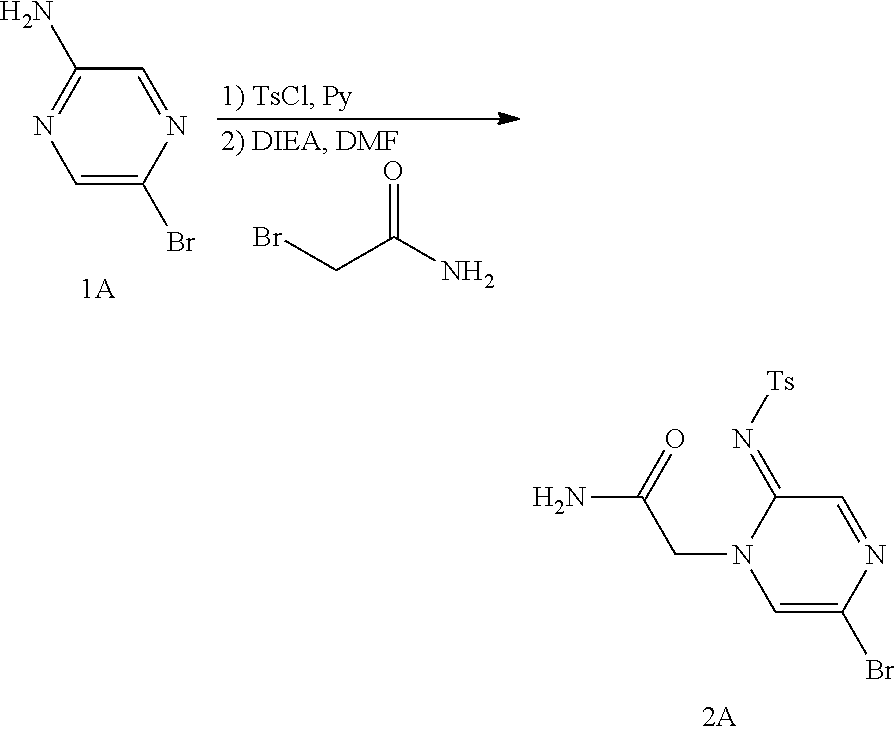
- Scheme I describes general synthesis of the 2-(2-pyridinylamino)imidazo[1,2-a]pyrazines or 2-(2-pyridinylamino)imidazo[1,2-a]pyridazines of structure 6.
- An aminopyridazine of structure 1 is treated sequentially with TsCl and 2-bromoacetamide in the presence of bases to afford an intermediate o structure 2.
- Treatment of the intermediate of structure 2 with trifluoroacetic acid generates a bicyclic compound of structure 3.
- Palladium catalyzed coupling of structure 3 with a boronic acid affords a compound of structure 4.
- Deprotection of the trifluoroacetyl group followed by treatment of a 2-chloropyridine compound of structure 5 yield the final product of structure 6.
- compositions comprising: (a) a safe and therapeutically effective amount of a compound described herein (including enantiomers, diastereoisomers, tautomers, polymorphs, and solvates thereof), or pharmaceutically acceptable salts thereof; and (b) a pharmaceutically acceptable carrier, diluent, excipient or combination thereof.
- the compounds useful as described above can be formulated into pharmaceutical compositions for use in treatment of these conditions.
- Standard pharmaceutical formulation techniques are used, such as those disclosed in Remington's The Science and Practice of Pharmacy, 21st Ed., Lippincott Williams & Wilkins (2005), incorporated by reference in its entirety.
- a pharmaceutical composition comprising one or more compounds of the present embodiments is prepared using known techniques, including, but not limited to mixing, dissolving, granulating, dragee-making, levigating, emulsifying, encapsulating, entrapping or tabletting processes.
- a pharmaceutical composition comprising one or more compounds of the present embodiments is a liquid (e.g., a suspension, elixir and/or solution).
- a liquid pharmaceutical composition comprising one or more compounds of the present embodiments is prepared using ingredients known in the art, including, but not limited to, water, glycols, oils, alcohols, flavoring agents, preservatives, and coloring agents.
- a pharmaceutical composition comprising one or more compounds of the present embodiments is a solid (e.g., a powder, tablet, and/or capsule).
- a solid pharmaceutical composition comprising one or more compounds of the present embodiments is prepared using ingredients known in the art, including, but not limited to, starches, sugars, diluents, granulating agents, lubricants, binders, and disintegrating agents.
- a pharmaceutical composition comprising one or more compounds of the present embodiments is formulated as a depot preparation.
- Certain such depot preparations are typically longer acting than non-depot preparations.
- such preparations are administered by implantation (for example subcutaneously or intramuscularly) or by intramuscular injection.
- depot preparations are prepared using suitable polymeric or hydrophobic materials (for example an emulsion in an acceptable oil) or ion exchange resins, or as sparingly soluble derivatives, for example, as a sparingly soluble salt.
- a pharmaceutical composition comprising one or more compounds of the present embodiments comprises a delivery system.
- delivery systems include, but are not limited to, liposomes and emulsions. Certain delivery systems are useful for preparing certain pharmaceutical compositions including those comprising hydrophobic compounds. In certain embodiments, certain organic solvents such as dimethylsulfoxide are used.
- a pharmaceutical composition comprising one or more compounds of the present embodiments comprises a sustained-release system.
- a sustained-release system is a semi-permeable matrix of solid hydrophobic polymers.
- sustained-release systems may, depending on their chemical nature, release compounds over a period of hours, days, weeks or months.
- compositions of the present embodiments may be provided as pharmaceutically acceptable salts with pharmaceutically compatible counterions.
- Pharmaceutically compatible salts may be formed with many acids, including but not limited to hydrochloric, sulfuric, acetic, lactic, tartaric, malic, succinic, etc.
- a pharmaceutical composition comprising one or more compounds of the present embodiments comprises an active ingredient in a therapeutically effective amount.
- the therapeutically effective amount is sufficient to prevent, alleviate or ameliorate symptoms of a disease or to prolong the survival of the subject being treated. Determination of a therapeutically effective amount is well within the capability of those skilled in the art.
- a pharmaceutical composition comprising one or more compounds of the present embodiments is formulated as a prodrug.
- prodrugs are useful because they are easier to administer than the corresponding active form.
- a prodrug may be more bioavailable (e.g., through oral administration) than is the corresponding active form.
- a prodrug may have improved solubility compared to the corresponding active form.
- a prodrug is an ester.
- such prodrugs are less water soluble than the corresponding active form.
- such prodrugs possess superior transmittal across cell membranes, where water solubility is detrimental to mobility.
- the ester in such prodrugs is metabolically hydrolyzed to carboxylic acid.
- the carboxylic acid containing compound is the corresponding active form.
- a prodrug comprises a short peptide (polyaminoacid) bound to an acid group.
- the peptide is metabolized to form the corresponding active form.
- a pharmaceutical composition comprising one or more compounds of the present embodiments is useful for treating a condition or disorder in a mammal, such as a human.
- Suitable administration routes include, but are not limited to, oral, rectal, transmucosal, intestinal, enteral, topical, suppository, through inhalation, intrathecal, intraventricular, intraperitoneal, intranasal, intraocular and parenteral (e.g., intravenous, intramuscular, intramedullary, and subcutaneous).
- pharmaceutical intrathecals are administered to achieve local rather than systemic exposures.
- pharmaceutical compositions may be injected directly in the area of desired effect (e.g., in the renal or cardiac area).
- a pharmaceutical composition comprising a compound of the present embodiments is prepared for oral administration.
- a pharmaceutical composition is formulated by combining one or more compounds of the present embodiments with one or more pharmaceutically acceptable carriers.
- pharmaceutically acceptable carriers enable compounds of the present embodiments to be formulated as tablets, pills, dragees, capsules, liquids, gels, syrups, slurries, suspensions and the like, for oral ingestion by a patient.
- pharmaceutical compositions for oral use are obtained by mixing one or more compounds of the present embodiments and one or more solid excipient.
- Suitable excipients include, but are not limited to, fillers, such as sugars, including lactose, sucrose, mannitol, or sorbitol; cellulose preparations such as, for example, maize starch, wheat starch, rice starch, potato starch, gelatin, gum tragacanth, methyl cellulose, hydroxypropylmethyl-cellulose, sodium carboxymethylcellulose, and/or polyvinylpyrrolidone (PVP).
- PVP polyvinylpyrrolidone
- such a mixture is optionally ground and auxiliaries are optionally added.
- pharmaceutical compositions are formed to obtain tablets or dragee cores.
- disintegrating agents e.g., cross-linked polyvinyl pyrrolidone, agar, or alginic acid or a salt thereof, such as sodium alginate are added.
- dragee cores are provided with coatings.
- concentrated sugar solutions may be used, which may optionally contain gum arabic, talc, polyvinyl pyrrolidone, carbopol gel, polyethylene glycol, and/or titanium dioxide, lacquer solutions, and suitable organic solvents or solvent mixtures.
- Dyestuffs or pigments may be added to tablets or dragee coatings.
- compositions for oral administration are push-fit capsules made of gelatin.
- Certain of such push-fit capsules comprise one or more compounds of the present embodiments in admixture with one or more filler such as lactose, binders such as starches, and/or lubricants such as talc or magnesium stearate and, optionally, stabilizers.
- pharmaceutical compositions for oral administration are soft, sealed capsules made of gelatin and a plasticizer, such as glycerol or sorbitol.
- one or more compounds of the present embodiments are be dissolved or suspended in suitable liquids, such as fatty oils, liquid paraffin, or liquid polyethylene glycols.
- stabilizers may be added.
- a pharmaceutical composition is prepared for administration by injection (e.g., intravenous, subcutaneous, intramuscular, etc.).
- a pharmaceutical composition comprises a carrier and is formulated in aqueous solution, such as water or physiologically compatible buffers such as Hanks's solution, Ringer's solution, or physiological saline buffer.
- other ingredients are included (e.g., ingredients that aid in solubility or serve as preservatives).
- injectable suspensions are prepared using appropriate liquid carriers, suspending agents and the like.
- compositions for injection are suspensions, solutions or emulsions in oily or aqueous vehicles, and may contain formulatory agents such as suspending, stabilizing and/or dispersing agents.
- Certain solvents suitable for use in pharmaceutical compositions for injection include, but are not limited to, lipophilic solvents and fatty oils, such as sesame oil, synthetic fatty acid esters, such as ethyl oleate or triglycerides, and liposomes.
- Aqueous injection suspensions may contain substances that increase the viscosity of the suspension, such as sodium carboxymethyl cellulose, sorbitol, or dextran.
- such suspensions may also contain suitable stabilizers or agents that increase the solubility of the compounds to allow for the preparation of highly concentrated solutions.
- a pharmaceutical composition is prepared for rectal administration, such as a suppositories or retention enema.
- Certain of such pharmaceutical compositions comprise known ingredients, such as cocoa butter and/or other glycerides.
- a pharmaceutical composition is prepared for topical administration.
- Certain of such pharmaceutical compositions comprise bland moisturizing bases, such as ointments or creams.
- suitable ointment bases include, but are not limited to, petrolatum, petrolatum plus volatile silicones, lanolin and water in oil emulsions such as EucerinTM, available from Beiersdorf (Cincinnati, Ohio).
- Exemplary suitable cream bases include, but are not limited to, NiveaTM Cream, available from Beiersdorf (Cincinnati, Ohio), cold cream (USP), Purpose CreamTM, available from Johnson & Johnson (New Brunswick, New Jersey), hydrophilic ointment (USP) and LubridermTM, available from Pfizer (Morris Plains, New Jersey).
- the formulation, route of administration and dosage for a pharmaceutical composition of the present embodiments can be chosen in view of a particular patient's condition.
- a pharmaceutical composition is administered as a single dose.
- a pharmaceutical composition is administered as a series of two or more doses administered over one or more days.
- a pharmaceutical composition of the present embodiments is administered for a period of continuous therapy.
- a pharmaceutical composition of the present embodiments may be administered over a period of days, weeks, months, or years.
- a pharmaceutical composition may be presented in a pack or dispenser device which may contain one or more unit dosage forms containing the active ingredient.
- the pack may for example comprise metal or plastic foil, such as a blister pack.
- the pack or dispenser device may be accompanied by instructions for administration.
- the pack or dispenser may also be accompanied with a notice associated with the container in form prescribed by a governmental agency regulating the manufacture, use, or sale of pharmaceuticals, which notice is reflective of approval by the agency of the form of the drug for human or veterinary administration. Such notice, for example, may be the labeling approved by the U.S. Food and Drug Administration for prescription drugs, or the approved product insert.
- Compositions comprising a compound of the present embodiments formulated in a compatible pharmaceutical carrier may also be prepared, placed in an appropriate container, and labeled for treatment of an indicated condition.
- a pharmaceutical composition is in powder form for constitution with a suitable vehicle, e.g., sterile pyrogen-free water, before use.
- a suitable vehicle e.g., sterile pyrogen-free water
- a daily dose for most of the compounds described herein is from about 0.25 mg/kg to about 120 mg/kg or more of body weight, from about 0.5 mg/kg or less to about 70 mg/kg, from about 1.0 mg/kg to about 50 mg/kg of body weight, or from about 1.5 mg/kg to about 10 mg/kg of body weight.
- the dosage range would be from about 17 mg per day to about 8000 mg per day, from about 35 mg per day or less to about 7000 mg per day or more, from about 70 mg per day to about 6000 mg per day, from about 100 mg per day to about 5000 mg per day, or from about 200 mg to about 3000 mg per day.
- the amount of active compound administered will, of course, be dependent on the subject and disease state being treated, the severity of the affliction, the manner and schedule of administration and the judgment of the prescribing physician.
- Administration of the compounds disclosed herein or the pharmaceutically acceptable salts thereof can be via any of the accepted modes of administration for agents that serve similar utilities including, but not limited to, orally, subcutaneously, intravenously, intranasally, topically, transdermally, intraperitoneally, intramuscularly, intrapulmonarilly, vaginally, rectally, or intraocularly.
- Oral and parenteral administrations are customary in treating the indications that are the subject of the preferred embodiments.
- Some compounds and compositions provided herein, such as compounds and/or compositions comprising Formula I are useful for the treatment of a variety of diseases and disorders malignant or benign hematopoietic disorders.
- leukemia include acute lymphocytic leukemia (ALL), chronic lymphocytic leukemia (CLL), acute myelogenous leukemia, chronic myelogenous leukemia (CML), chronic idiopathic myelofibrosis, chronic neutrophilic leukemia (CNL), and acute monocytic leukemia.
- the compounds and compositions provided herein can be administered in combination with one or more additional anticancer agent(s) or treatment.
- additional anticancer agent(s) or treatment examples include HDAC inhibitors, chemotherapy, immunotherapy, VEGFR modulators, bone marrow transplant, and stem cell transplant.
- the following inhibitory assay is useful for evaluating test compounds for inhibition of Flt3 kinase activity.
- the assay is performed using traditional radioisotope filtration binding.
- a base reaction buffer is prepared consisting of 20 mM Hepes (pH 7.5), 10 mM MgCl 2 , 1 mM EGTA, 0.02% Brij35, 0.02 mg/ml BSA, 0.1 mM Na 3 PO 4 , 2 mM DTT, 1% DMSO.
- the peptide substrate abltide [EAIYAAPFAKKK] is added to the base reaction buffer to yield a final concentration of 5 ⁇ M.
- Additional cofactors 1.5 mM CaCl 2 , 16 ug/ml Calmodulin, and 2 mM MnCl 2 ) are added to the buffer/substrate solution.
- Recombinant human FLT3 (baculovirus expression system using a C-terminal His6-tag) is added to the solution and gently mixed.
- Test compounds are dissolved in DMSO and added to the buffer/kinase solution to yield a final concentration of 5 ⁇ M.
- Compounds were tested in a 10-dose IC50 in duplicate with 3-fold serial dilution starting at 1 ⁇ M to yield a full dose response curve.
- Staurosporine was used as positive control with a 10-dose IC50 with 3-fold serial dilution starting at 20 ⁇ M to yield a dose response curve.
- the reaction is initiated by the addition of 33 P-ATP (specific activity 500 Ci/ ⁇ l) into the reaction mixture to a final concentration of 10 ⁇ M.
- the kinase reaction was incubated for 120 minutes at room temperature.
- the reactions are spotted onto P81 ion exchange paper (Whatman #3698-915) and the filter papers are extensively washed in 0.75% Phosphoric acid and beta emissions are measured.
- Flt3 inhibition IC50 values of the compounds are in the table below.
Landscapes
- Chemical & Material Sciences (AREA)
- Organic Chemistry (AREA)
- Pharmaceuticals Containing Other Organic And Inorganic Compounds (AREA)
Abstract
Description

-
- or a salt, ester, amide, or prodrug thereof,
- wherein X is selected from N or CR4a; X′ is selected from N or CR4b; Y is selected from N or CR5a; Y′ is selected from N or CR5b; provided at least one of X, X′, Y, and Y′ is N;
- R1 is selected from the group consisting of hydrogen, halogen, —OR6, —CN, —NR7R8, —CH2OR6, —CH2NR7R8, an optionally substituted C1-6 alkyl, an optionally substituted C1-6 haloalkyl, an optionally substituted C2-6 alkenyl, an optionally substituted C2-6 alkynyl, an optionally substituted (5 to 7 membered heterocyclyl)alkyl, an optionally substituted 5 to 7 membered heterocyclyl, an optionally substituted aralkyl; an optionally substituted (5 or 6 membered heteroaryl)alkyl, an optionally substituted C1-6 heteroalkyl, —C(═O)R6, —C(═O)OR6, —C(═O)NR7R8, —NHC(═O)R6, —SO2R6, and —SO2NR7R8;
- each of R2, R3, R4a and R4b is independently selected from the group consisting of hydrogen, halogen, C1-6 alkyl, OH, and C1-6 alkoxy;
- each of R5a and R5b is independently selected from the group consisting of hydrogen, halogen, —OR6, —CN, —NR7R8, —CH2OR6, an optionally substituted aryl, an optionally substituted 5 to 10 membered heteroaryl, an optionally substituted 5-10 membered heterocyclyl, an optionally substituted C3-7 carbocyclyl, an optionally substituted C1-6 alkyl, an optionally substituted C1-6 haloalkyl, an optionally substituted C1-6 heteroalkyl, —C(═O)R6, —C(═O)OR6, —C(═O)NR7R8, —NHC(═O)R6, —SO2R6, and —SO2NR7R8;
- each R6 is independently selected from hydrogen, an optionally substituted C1-10 alkyl, an optionally substituted C1-10 haloalkyl, or an optionally substituted C1-6 heteroalkyl; and
- each R7 and R8 is independently selected from hydrogen; an optionally substituted C1-10 alkyl; an optionally substituted C1-10 haloalkyl; or an optionally substituted C1-6 heteroalkyl; or R7 and R8 are joined together with the nitrogen atom to which they are attached to form an optionally substituted C3-7 cycloalkyl or 3 to 7 membered heterocyclyl ring.


unit is replaced with

Examples of heteroalkyls include, but are not limited to, CH3C(═O)CH2—, CH3C(═O)CH2CH2—, CH3CH2C(═O)CH2CH2—, CH3C(═O)CH2CH2CH2—, CH3NHC(═O)CH2—, CH3C(═O)NHCH2—, CH3OCH2CH2—, CH3NHCH2—, and the like.

-
- wherein D, E, F, and G independently represent a heteroatom. Each of D, E, F, and G may be the same or different from one another.

In some such embodiments, each R4a and R4b is hydrogen.

In some such embodiments, each R4a and R5a is hydrogen.

or pharmaceutically acceptable salts, esters, amides, or prodrugs thereof.
Exemplary Synthetic Methods




| Number | Flt3 inhibition IC50 (nM) | ||
| Compound 101 | 0.11 | ||
| Compound 102 | 0.25 | ||
| Staurosporine | <1.0 | ||
Claims (19)


Priority Applications (1)
| Application Number | Priority Date | Filing Date | Title |
|---|---|---|---|
| US17/071,273 US11858938B2 (en) | 2015-03-16 | 2020-10-15 | Imidazo-fused heterocycles and uses thereof |
Applications Claiming Priority (3)
| Application Number | Priority Date | Filing Date | Title |
|---|---|---|---|
| US201562133935P | 2015-03-16 | 2015-03-16 | |
| US15/070,718 US10807983B2 (en) | 2015-03-16 | 2016-03-15 | Imidazo-fused heterocycles and uses thereof |
| US17/071,273 US11858938B2 (en) | 2015-03-16 | 2020-10-15 | Imidazo-fused heterocycles and uses thereof |
Related Parent Applications (1)
| Application Number | Title | Priority Date | Filing Date |
|---|---|---|---|
| US15/070,718 Division US10807983B2 (en) | 2015-03-16 | 2016-03-15 | Imidazo-fused heterocycles and uses thereof |
Publications (2)
| Publication Number | Publication Date |
|---|---|
| US20210040102A1 US20210040102A1 (en) | 2021-02-11 |
| US11858938B2 true US11858938B2 (en) | 2024-01-02 |
Family
ID=57112502
Family Applications (2)
| Application Number | Title | Priority Date | Filing Date |
|---|---|---|---|
| US15/070,718 Active 2037-05-17 US10807983B2 (en) | 2015-03-16 | 2016-03-15 | Imidazo-fused heterocycles and uses thereof |
| US17/071,273 Active 2036-11-11 US11858938B2 (en) | 2015-03-16 | 2020-10-15 | Imidazo-fused heterocycles and uses thereof |
Family Applications Before (1)
| Application Number | Title | Priority Date | Filing Date |
|---|---|---|---|
| US15/070,718 Active 2037-05-17 US10807983B2 (en) | 2015-03-16 | 2016-03-15 | Imidazo-fused heterocycles and uses thereof |
Country Status (1)
| Country | Link |
|---|---|
| US (2) | US10807983B2 (en) |
Families Citing this family (4)
| Publication number | Priority date | Publication date | Assignee | Title |
|---|---|---|---|---|
| US10807983B2 (en) | 2015-03-16 | 2020-10-20 | Ligand Pharmaceuticals, Inc. | Imidazo-fused heterocycles and uses thereof |
| WO2019148055A1 (en) * | 2018-01-26 | 2019-08-01 | Yale University | Imide-based modulators of proteolysis and methods of use |
| CN111217760B (en) * | 2020-03-27 | 2021-11-26 | 湖南吴赣药业有限公司 | Synthetic method of sulfachloropyrazine sodium |
| US20250197406A1 (en) * | 2022-03-25 | 2025-06-19 | 1ST Biotherapeutics, Inc. | Indazoles as hematopoietic progenitor kinase 1 (hpk1) inhibitors and methods for using same |
Citations (30)
| Publication number | Priority date | Publication date | Assignee | Title |
|---|---|---|---|---|
| JPS4878166A (en) | 1972-01-27 | 1973-10-20 | ||
| WO1987005297A1 (en) | 1986-03-03 | 1987-09-11 | The University Of Chicago | Cephalosporin derivatives |
| WO1997049704A1 (en) | 1996-06-27 | 1997-12-31 | Janssen Pharmaceutica N.V. | N-[4-(heteroarylmethyl)phenyl]-heteroarylamines |
| WO1999024035A1 (en) | 1997-11-10 | 1999-05-20 | Bristol-Myers Squibb Company | Benzothiazole protein tyrosine kinase inhibitors |
| JP2000086641A (en) | 1998-09-11 | 2000-03-28 | Kyorin Pharmaceut Co Ltd | 2-Substituted benzothiazole derivatives and method for producing the same |
| WO2003082272A1 (en) | 2002-03-29 | 2003-10-09 | Chiron Corporation | Substituted benzazoles and use thereof as raf kinase inhibitors |
| WO2004085425A1 (en) | 2003-03-21 | 2004-10-07 | Amgen Inc | Fused azoles such as 2,5-disubstituted benzimidazoles, benzoxazoles and benzothiazoles as kinase inhibitors |
| WO2005037285A1 (en) | 2003-10-16 | 2005-04-28 | Chiron Corporation | 2,6-disubstituted quinazolines, quinoxalines, quinolines and isoquinolines as inhibitors of raf kinase for treatment of cancer |
| US20050153984A1 (en) | 2003-09-30 | 2005-07-14 | Amgen Inc. | Vanilloid receptor ligands and their use in treatments |
| WO2005070906A1 (en) | 2004-01-21 | 2005-08-04 | Novartis Ag | Organic compounds |
| EP1674466A1 (en) | 2004-12-27 | 2006-06-28 | 4Sc Ag | 2,5- and 2,6-disubstituted benzazole analogues useful as protein kinase inhibitors |
| WO2007016392A2 (en) | 2005-08-01 | 2007-02-08 | Bristol-Myers Squibb Company | Benzothiazole and azabenzothiazole compounds useful as kinase inhibitors |
| US20070066577A1 (en) | 2003-04-03 | 2007-03-22 | Hea Young Park Choo | Benzoxazole derivative or analogue thereof for inhibiting 5-lipoxygenase and pharmaceutical composition containing same |
| WO2007058482A1 (en) | 2005-11-16 | 2007-05-24 | Lg Life Sciences, Ltd. | Novel inhibitors of protein kinase |
| WO2007084542A2 (en) | 2006-01-17 | 2007-07-26 | Barrier Therapeutics, Inc. | Treatment of inflammatory disorders with triazole compounds |
| WO2007089512A1 (en) | 2006-01-27 | 2007-08-09 | Array Biopharma Inc. | Glucokinase activators |
| WO2008030584A2 (en) | 2006-09-07 | 2008-03-13 | Biogen Idec Ma Inc. | Indazole derivatives as modulators of interleukin- 1 receptor-associated kinase |
| WO2008030579A2 (en) | 2006-09-07 | 2008-03-13 | Biogen Idec Ma Inc. | Irak modulators for treating an inflammatory condition, cell proliferative disorder, immune disorder |
| JP2008255024A (en) | 2007-04-02 | 2008-10-23 | Banyu Pharmaceut Co Ltd | Biarylamine derivatives |
| WO2009126635A1 (en) | 2008-04-09 | 2009-10-15 | Abbott Laboratories | 2-amino-benzothiazole derivates useful as inhibitors of rock kinases |
| WO2009128520A1 (en) | 2008-04-18 | 2009-10-22 | 塩野義製薬株式会社 | Heterocyclic compound having inhibitory activity on p13k |
| US20100023218A1 (en) | 2008-07-28 | 2010-01-28 | Nissan Motor Co., Ltd. | Vehicle driving control apparatus and vehicle driving control method |
| WO2010057121A1 (en) | 2008-11-14 | 2010-05-20 | Amgen Inc. | Pyrazine compounds as phosphodiesterase 10 inhibitors |
| WO2010100144A1 (en) | 2009-03-04 | 2010-09-10 | Merck Serono S.A. | Fused bicyclic compounds as inhibitors for pi3 kinase |
| WO2010106016A1 (en) | 2009-03-17 | 2010-09-23 | Glaxo Group Limited | Pyrimidine derivatives used as itk inhibitors |
| WO2010135014A1 (en) | 2009-02-27 | 2010-11-25 | Vertex Pharmaceuticals Incorporated | Tri-cyclic pyrazolopyridine kinase inhibitors |
| WO2010144909A1 (en) | 2009-06-12 | 2010-12-16 | Novartis Ag | Fused heterocyclic compounds and their uses |
| WO2011110575A1 (en) | 2010-03-11 | 2011-09-15 | Glaxo Group Limited | Derivatives of 2-[2-(benzo- or pyrido-) thiazolylamino]-6-aminopyridine, useful in the treatment of respiratoric, allergic or inflammatory diseases |
| WO2012035055A1 (en) | 2010-09-17 | 2012-03-22 | Glaxo Group Limited | Novel compounds |
| US10807983B2 (en) | 2015-03-16 | 2020-10-20 | Ligand Pharmaceuticals, Inc. | Imidazo-fused heterocycles and uses thereof |
-
2016
- 2016-03-15 US US15/070,718 patent/US10807983B2/en active Active
-
2020
- 2020-10-15 US US17/071,273 patent/US11858938B2/en active Active
Patent Citations (32)
| Publication number | Priority date | Publication date | Assignee | Title |
|---|---|---|---|---|
| JPS4878166A (en) | 1972-01-27 | 1973-10-20 | ||
| WO1987005297A1 (en) | 1986-03-03 | 1987-09-11 | The University Of Chicago | Cephalosporin derivatives |
| WO1997049704A1 (en) | 1996-06-27 | 1997-12-31 | Janssen Pharmaceutica N.V. | N-[4-(heteroarylmethyl)phenyl]-heteroarylamines |
| RU2190611C2 (en) | 1996-06-27 | 2002-10-10 | Жансен Фармасетика Н.В. | N-[4-(heteroarylmethyl)phenyl]-heteroarylamines |
| WO1999024035A1 (en) | 1997-11-10 | 1999-05-20 | Bristol-Myers Squibb Company | Benzothiazole protein tyrosine kinase inhibitors |
| JP2000086641A (en) | 1998-09-11 | 2000-03-28 | Kyorin Pharmaceut Co Ltd | 2-Substituted benzothiazole derivatives and method for producing the same |
| WO2003082272A1 (en) | 2002-03-29 | 2003-10-09 | Chiron Corporation | Substituted benzazoles and use thereof as raf kinase inhibitors |
| WO2004085425A1 (en) | 2003-03-21 | 2004-10-07 | Amgen Inc | Fused azoles such as 2,5-disubstituted benzimidazoles, benzoxazoles and benzothiazoles as kinase inhibitors |
| US20070066577A1 (en) | 2003-04-03 | 2007-03-22 | Hea Young Park Choo | Benzoxazole derivative or analogue thereof for inhibiting 5-lipoxygenase and pharmaceutical composition containing same |
| US20050153984A1 (en) | 2003-09-30 | 2005-07-14 | Amgen Inc. | Vanilloid receptor ligands and their use in treatments |
| WO2005037285A1 (en) | 2003-10-16 | 2005-04-28 | Chiron Corporation | 2,6-disubstituted quinazolines, quinoxalines, quinolines and isoquinolines as inhibitors of raf kinase for treatment of cancer |
| WO2005070906A1 (en) | 2004-01-21 | 2005-08-04 | Novartis Ag | Organic compounds |
| EP1674466A1 (en) | 2004-12-27 | 2006-06-28 | 4Sc Ag | 2,5- and 2,6-disubstituted benzazole analogues useful as protein kinase inhibitors |
| WO2007016392A2 (en) | 2005-08-01 | 2007-02-08 | Bristol-Myers Squibb Company | Benzothiazole and azabenzothiazole compounds useful as kinase inhibitors |
| WO2007058482A1 (en) | 2005-11-16 | 2007-05-24 | Lg Life Sciences, Ltd. | Novel inhibitors of protein kinase |
| WO2007084542A2 (en) | 2006-01-17 | 2007-07-26 | Barrier Therapeutics, Inc. | Treatment of inflammatory disorders with triazole compounds |
| WO2007089512A1 (en) | 2006-01-27 | 2007-08-09 | Array Biopharma Inc. | Glucokinase activators |
| WO2008030579A2 (en) | 2006-09-07 | 2008-03-13 | Biogen Idec Ma Inc. | Irak modulators for treating an inflammatory condition, cell proliferative disorder, immune disorder |
| WO2008030584A2 (en) | 2006-09-07 | 2008-03-13 | Biogen Idec Ma Inc. | Indazole derivatives as modulators of interleukin- 1 receptor-associated kinase |
| JP2008255024A (en) | 2007-04-02 | 2008-10-23 | Banyu Pharmaceut Co Ltd | Biarylamine derivatives |
| WO2009126635A1 (en) | 2008-04-09 | 2009-10-15 | Abbott Laboratories | 2-amino-benzothiazole derivates useful as inhibitors of rock kinases |
| EP2277881A1 (en) | 2008-04-18 | 2011-01-26 | Shionogi&Co., Ltd. | Heterocyclic compound having inhibitory activity on p13k |
| WO2009128520A1 (en) | 2008-04-18 | 2009-10-22 | 塩野義製薬株式会社 | Heterocyclic compound having inhibitory activity on p13k |
| US20100023218A1 (en) | 2008-07-28 | 2010-01-28 | Nissan Motor Co., Ltd. | Vehicle driving control apparatus and vehicle driving control method |
| WO2010057121A1 (en) | 2008-11-14 | 2010-05-20 | Amgen Inc. | Pyrazine compounds as phosphodiesterase 10 inhibitors |
| WO2010135014A1 (en) | 2009-02-27 | 2010-11-25 | Vertex Pharmaceuticals Incorporated | Tri-cyclic pyrazolopyridine kinase inhibitors |
| WO2010100144A1 (en) | 2009-03-04 | 2010-09-10 | Merck Serono S.A. | Fused bicyclic compounds as inhibitors for pi3 kinase |
| WO2010106016A1 (en) | 2009-03-17 | 2010-09-23 | Glaxo Group Limited | Pyrimidine derivatives used as itk inhibitors |
| WO2010144909A1 (en) | 2009-06-12 | 2010-12-16 | Novartis Ag | Fused heterocyclic compounds and their uses |
| WO2011110575A1 (en) | 2010-03-11 | 2011-09-15 | Glaxo Group Limited | Derivatives of 2-[2-(benzo- or pyrido-) thiazolylamino]-6-aminopyridine, useful in the treatment of respiratoric, allergic or inflammatory diseases |
| WO2012035055A1 (en) | 2010-09-17 | 2012-03-22 | Glaxo Group Limited | Novel compounds |
| US10807983B2 (en) | 2015-03-16 | 2020-10-20 | Ligand Pharmaceuticals, Inc. | Imidazo-fused heterocycles and uses thereof |
Non-Patent Citations (32)
| Title |
|---|
| Altland, 1976, Smiles rearrangement of 2-tetrazolylthio-3-aminopyridines, Journal of Organic Chemistry, 41(21):3395-3399. |
| Arya et al., 1973, Synthesis of new heterocycles. X. Syntheses of thiazolo[5,4-b] pyridines and certain related condensed pyridines, Indian Journal of Chemistry, 11(8):744-746 (abstract). |
| Balant et al., 1996, Metabolic considerations in prodrug design, in Wolff et al. Burger's Medicinal Chemistry and Drug Discovery, 5th ed. vol. 1: Principles and Practice, pp. 949-982. |
| Caleta et al., 2009, Novel Cyano- and Amidinobenzothiazole Derivatives: Synthesis, Antitumor Evaluation, and X-ray and Quantitative Structure—Activity Relationship (QSAR) Analysis, J. Med. Chem. 52:1744-1756. |
| Das et al., Aug. 4, 2003, Discovery of 2-amino-heteroaryl-benzothiazole-6-anilides as potent p56lck inhibitors, Bioorg Med Chem Lett. 13(15):2587-2590. |
| Dasu et al., 2010, Increased Toll-Like Receptor (TLR) Activation and TLR Ligands in Recently Diagnosed Type 2 Diabetic Subjects, Diabetes Care, 33(4):861-868. |
| Deng et al, 2003, IL-1 Receptor-associated kinase 1 regulates susceptibility to organ-specific autoimmunity, J Immunol 170:2833-2842. |
| Dorwald, 2005, Side Reactions in Organic Synthesis, Wiley: VCH Weinheim Preface, pp. 1-15 and 279-308. |
| Ettmayer et al. May 6, 2004, Lessons Learned from Marketed and Investigational Prodrugs, J. Med. Chem., 47(10):2393-2404. |
| Greene et al., 1999, Protective Groups in Organic Synthesis, 3rd Edition, John Wiley & Sons, New York, NY, Chapter 1, p. 1-17. |
| Jordan, Mar. 2003, Tamoxifen: a most unlikely pioneering medicine, Nature Rev. 2:205-213. |
| Kato et al., 1974, Studies on ketene and its derivatives. LXI. Reaction of primary amine with chloroketene diethylacetal, Kajugaku Zasshi (Journal of the Pharmaceutical Society of Japan), 94(5):627-632. |
| Khadse et al., 1976, Synthesis and study of 2-arylaminopyrido (3, 2-d)thiazoles as possible anthelmintic agents, Bulletin of Haffkine Institute, 4(1):16-19 (abstract). |
| Li, 2008, IRAK4 in TLR/IL-1R Signaling: Possible Clinical Applications, European J Immunol, 38:614-618. |
| Pereira et al., 1987, Dissymmetry of certain substitute dipyrodotetraazapentalenes, Tetrahedron, 43(21):4931-4046. |
| Qi et al., 2009, Identification of N-(5-tert-Butyl-isoxazol-3-yl)-N'-{4-[7-(2-morpholin-4-yl-ethoxy)imidazo-[2, 1-b][1,3]benzothiazol-2-yl]phenyl}urea dihydrochloride (AC220), a uniquely potent, selective and efficacious FMS-like tyrosine kinase-3 (FLT) inhibitors, J. Med. Chem. 52:7808-7816, and supporting information. |
| Remington's The Science and Practice of Pharmacy, 21st Ed., Lippincott Williams & Wilkins (2006), Table of Content. |
| Ringwood et al, 2008, The involvement of the interleukin-1 receptor-associated kinases (IRAKs) in cellular signaling networks controlling inflammation, Cytokine 42:1-7. |
| Sambrook et al. Molecular Cloning: A Laboratory Manual, 2d ed., Cold Spring Harbor Laboratory Press, Cold Spring Harbor, N.Y. (1989). |
| Sanmiguel et al., 2009, Interleukin-1 regulates keratinocyte expression of T cell targeting chemokines through interleukin-1 receptor associated kinase-1 (IRAK1) dependent and independent pathways, Cellular Signaling, 21:685-694. |
| Smith et al., 2012, Validation of ITD mutations in FLT3 as a therapeutic target in human acute myeloid leukemia, Nature, 485(7397):260-263. |
| Song et al., 2009, The kinase activities of interleukin-1 receptor associated kinase (IRAK)-1 and 4 are redundant in the control of inflammatory cytokine expression in human cells, Mol Immunol, 46:1458-1466. |
| Staschke et al., 2009, IRAK4 kinase activity is required for Th17Differentiation and Th17-mediated disease, J Immunol, 183:568-577. |
| Stella, 2004, Prodrugs as therapeutics, Expert Opin. Ther. Patents, 14(3):277-280. |
| Testa, 2004, Prodrug research: futile or fertile? Biochemical Pharmacology, 68:2097-2106. |
| Vaughan et al., 2010, Molecular mechanism underlying the inflammatory complication of leptin in macrophages, Mol Immunol, 47:2515-2518. |
| Wang et al., 2006, Crystal Structures of IRAK-4 Kinase in Complex with Inhibitors: A Serine/Threonine Kinase with Tyrosine as a Gatekeeper, Structure, 14:1835-1844. |
| Wang et al., 2009, IRAK-4 Inhibitors for Inflammation, Curr Topics in Med Chem, 9:724-737. |
| Yin et al., 2002, Pd-Catalyzed N-Arylation of Heteroarylamines, Org. Lett. 4(20):3481-3484. |
| Zhang et al., 2009, A Modeling-Derived Hypothesis on Chronicity in Respiratory Diseases: Desensitized Pathogen Recognition Secondary to Hyperactive IRAK/TRAF6 Signaling, PLOS One 4(4):1-7. |
| Zhang et al., Mar. 24, 2011, Aminothiazolomorphinans with Mixed κ and μ Opioid Activity, J. Med Chem, 54:1903-1913. |
| Zhu et al., 2010, Toll-Like Receptor Signaling Pathways—Therapeutic Opportunities, Mediators of Inflammation vol. 2010, Article ID 781235, 7 pp. |
Also Published As
| Publication number | Publication date |
|---|---|
| US10807983B2 (en) | 2020-10-20 |
| US20210040102A1 (en) | 2021-02-11 |
| US20160297824A1 (en) | 2016-10-13 |
Similar Documents
| Publication | Publication Date | Title |
|---|---|---|
| TWI871397B (en) | Kras mutein inhibitors | |
| CN113286794B (en) | KRAS mutant protein inhibitors | |
| US11858938B2 (en) | Imidazo-fused heterocycles and uses thereof | |
| TW202144345A (en) | Kras mutant protein inhibitors | |
| KR100774855B1 (en) | Condensed heteroaryl derivatives | |
| CN102816175B (en) | A kind of heterocycle pyridine compounds, its intermediate, preparation method and purposes | |
| CN114585623A (en) | Bis[N-((5-carbamoyl)-1H-benzo[d]imidazol-2-yl)pyrazole-5-carboxamide] derivatives and related compounds as STING (stimulator of interferon genes) agonists used to treat cancer | |
| WO2019069293A1 (en) | Chemical compounds | |
| KR20160038891A (en) | Novel fused pyrimidine compound or salt thereof | |
| CN113164475A (en) | Macrocyclic inhibitors of DYRK1A | |
| KR20210090173A (en) | Tricyclic Janus kinase 1 inhibitors and compositions and methods thereof | |
| CN117561058A (en) | CDK2 inhibitors and methods of use | |
| CN119173505A (en) | Antiviral heterocyclic compounds | |
| KR20210066839A (en) | FGFR4 inhibitors and uses thereof | |
| WO2023226964A1 (en) | Heterocyclic derivatives, compositions and uses thereof | |
| CN113248497B (en) | Fused ring derivatives useful as FGFR4 inhibitors | |
| WO2023109909A1 (en) | Aromatic heterocyclic compounds, preparation method therefor and uses thereof | |
| CN113891880A (en) | Amide substituted imidazo compounds as selective inhibitors of indoleamine 2, 3-dioxygenase | |
| CN104822658B (en) | Fused Tricyclic Amides as Multiple Kinase Inhibitors | |
| CN117658983A (en) | Selective PARP1 inhibitor | |
| CN114599655A (en) | Imidazolidinone compound and its preparation method and application | |
| TW202138352A (en) | Substituted bicyclic and tricyclic ureas and amides, analogues thereof, and methods using same | |
| WO2024199524A1 (en) | Compound as pkmyt1 inhibitor | |
| CN119661531A (en) | Imidazolone compounds and preparation methods and applications thereof | |
| HK40048642A (en) | Fused ring derivative used as fgfr4 inhibitor |
Legal Events
| Date | Code | Title | Description |
|---|---|---|---|
| FEPP | Fee payment procedure |
Free format text: ENTITY STATUS SET TO UNDISCOUNTED (ORIGINAL EVENT CODE: BIG.); ENTITY STATUS OF PATENT OWNER: LARGE ENTITY |
|
| STPP | Information on status: patent application and granting procedure in general |
Free format text: APPLICATION DISPATCHED FROM PREEXAM, NOT YET DOCKETED |
|
| STPP | Information on status: patent application and granting procedure in general |
Free format text: DOCKETED NEW CASE - READY FOR EXAMINATION |
|
| STPP | Information on status: patent application and granting procedure in general |
Free format text: NON FINAL ACTION MAILED |
|
| AS | Assignment |
Owner name: LIGAND PHARMACEUTICALS, INC., CALIFORNIA Free format text: ASSIGNMENT OF ASSIGNORS INTEREST;ASSIGNOR:ZHI, LIN;REEL/FRAME:061305/0780 Effective date: 20150714 |
|
| STPP | Information on status: patent application and granting procedure in general |
Free format text: RESPONSE TO NON-FINAL OFFICE ACTION ENTERED AND FORWARDED TO EXAMINER |
|
| STPP | Information on status: patent application and granting procedure in general |
Free format text: NON FINAL ACTION MAILED |
|
| STPP | Information on status: patent application and granting procedure in general |
Free format text: RESPONSE TO NON-FINAL OFFICE ACTION ENTERED AND FORWARDED TO EXAMINER |
|
| STPP | Information on status: patent application and granting procedure in general |
Free format text: NOTICE OF ALLOWANCE MAILED -- APPLICATION RECEIVED IN OFFICE OF PUBLICATIONS |
|
| AS | Assignment |
Owner name: CITIBANK, N.A., AS ADMINISTRATIVE AGENT, TEXAS Free format text: SECURITY INTEREST;ASSIGNORS:CYDEX PHARMACEUTICALS, INC.;LIGAND PHARMACEUTICALS INCORPORATED;METABASIS THERAPEUTICS, INC.;AND OTHERS;REEL/FRAME:065271/0025 Effective date: 20231012 |
|
| STPP | Information on status: patent application and granting procedure in general |
Free format text: PUBLICATIONS -- ISSUE FEE PAYMENT RECEIVED |
|
| STPP | Information on status: patent application and granting procedure in general |
Free format text: PUBLICATIONS -- ISSUE FEE PAYMENT VERIFIED |
|
| STCF | Information on status: patent grant |
Free format text: PATENTED CASE |
|
| CC | Certificate of correction |