US11839976B2 - Control system for continuum robot, control method for continuum robot, and storage medium - Google Patents
Control system for continuum robot, control method for continuum robot, and storage medium Download PDFInfo
- Publication number
- US11839976B2 US11839976B2 US17/378,284 US202117378284A US11839976B2 US 11839976 B2 US11839976 B2 US 11839976B2 US 202117378284 A US202117378284 A US 202117378284A US 11839976 B2 US11839976 B2 US 11839976B2
- Authority
- US
- United States
- Prior art keywords
- bendable portion
- wire
- angle
- length
- continuum robot
- Prior art date
- Legal status (The legal status is an assumption and is not a legal conclusion. Google has not performed a legal analysis and makes no representation as to the accuracy of the status listed.)
- Active, expires
Links
Images




Classifications
-
- A—HUMAN NECESSITIES
- A61—MEDICAL OR VETERINARY SCIENCE; HYGIENE
- A61B—DIAGNOSIS; SURGERY; IDENTIFICATION
- A61B34/00—Computer-aided surgery; Manipulators or robots specially adapted for use in surgery
- A61B34/70—Manipulators specially adapted for use in surgery
- A61B34/71—Manipulators operated by drive cable mechanisms
-
- B—PERFORMING OPERATIONS; TRANSPORTING
- B25—HAND TOOLS; PORTABLE POWER-DRIVEN TOOLS; MANIPULATORS
- B25J—MANIPULATORS; CHAMBERS PROVIDED WITH MANIPULATION DEVICES
- B25J9/00—Program-controlled manipulators
-
- B—PERFORMING OPERATIONS; TRANSPORTING
- B25—HAND TOOLS; PORTABLE POWER-DRIVEN TOOLS; MANIPULATORS
- B25J—MANIPULATORS; CHAMBERS PROVIDED WITH MANIPULATION DEVICES
- B25J9/00—Program-controlled manipulators
- B25J9/16—Program controls
- B25J9/1615—Program controls characterised by special kind of manipulator, e.g. planar, scara, gantry, cantilever, space, closed chain, passive/active joints and tendon driven manipulators
- B25J9/1625—Truss-manipulator for snake-like motion
-
- B—PERFORMING OPERATIONS; TRANSPORTING
- B25—HAND TOOLS; PORTABLE POWER-DRIVEN TOOLS; MANIPULATORS
- B25J—MANIPULATORS; CHAMBERS PROVIDED WITH MANIPULATION DEVICES
- B25J9/00—Program-controlled manipulators
- B25J9/0009—Constructional details, e.g. manipulator supports, bases
-
- B—PERFORMING OPERATIONS; TRANSPORTING
- B25—HAND TOOLS; PORTABLE POWER-DRIVEN TOOLS; MANIPULATORS
- B25J—MANIPULATORS; CHAMBERS PROVIDED WITH MANIPULATION DEVICES
- B25J9/00—Program-controlled manipulators
- B25J9/06—Program-controlled manipulators characterised by multi-articulated arms
- B25J9/065—Snake robots
-
- B—PERFORMING OPERATIONS; TRANSPORTING
- B25—HAND TOOLS; PORTABLE POWER-DRIVEN TOOLS; MANIPULATORS
- B25J—MANIPULATORS; CHAMBERS PROVIDED WITH MANIPULATION DEVICES
- B25J9/00—Program-controlled manipulators
- B25J9/10—Program-controlled manipulators characterised by positioning means for manipulator elements
- B25J9/104—Program-controlled manipulators characterised by positioning means for manipulator elements with cables, chains or ribbons
-
- B—PERFORMING OPERATIONS; TRANSPORTING
- B25—HAND TOOLS; PORTABLE POWER-DRIVEN TOOLS; MANIPULATORS
- B25J—MANIPULATORS; CHAMBERS PROVIDED WITH MANIPULATION DEVICES
- B25J9/00—Program-controlled manipulators
- B25J9/10—Program-controlled manipulators characterised by positioning means for manipulator elements
- B25J9/104—Program-controlled manipulators characterised by positioning means for manipulator elements with cables, chains or ribbons
- B25J9/1045—Program-controlled manipulators characterised by positioning means for manipulator elements with cables, chains or ribbons comprising tensioning means
-
- B—PERFORMING OPERATIONS; TRANSPORTING
- B25—HAND TOOLS; PORTABLE POWER-DRIVEN TOOLS; MANIPULATORS
- B25J—MANIPULATORS; CHAMBERS PROVIDED WITH MANIPULATION DEVICES
- B25J9/00—Program-controlled manipulators
- B25J9/16—Program controls
-
- A—HUMAN NECESSITIES
- A61—MEDICAL OR VETERINARY SCIENCE; HYGIENE
- A61B—DIAGNOSIS; SURGERY; IDENTIFICATION
- A61B34/00—Computer-aided surgery; Manipulators or robots specially adapted for use in surgery
- A61B34/20—Surgical navigation systems; Devices for tracking or guiding surgical instruments, e.g. for frameless stereotaxis
- A61B2034/2046—Tracking techniques
- A61B2034/2051—Electromagnetic tracking systems
-
- A—HUMAN NECESSITIES
- A61—MEDICAL OR VETERINARY SCIENCE; HYGIENE
- A61B—DIAGNOSIS; SURGERY; IDENTIFICATION
- A61B34/00—Computer-aided surgery; Manipulators or robots specially adapted for use in surgery
- A61B34/30—Surgical robots
- A61B2034/301—Surgical robots for introducing or steering flexible instruments inserted into the body, e.g. catheters or endoscopes
-
- A—HUMAN NECESSITIES
- A61—MEDICAL OR VETERINARY SCIENCE; HYGIENE
- A61B—DIAGNOSIS; SURGERY; IDENTIFICATION
- A61B90/00—Instruments, implements or accessories specially adapted for surgery or diagnosis and not covered by any of the groups A61B1/00 - A61B50/00, e.g. for luxation treatment or for protecting wound edges
- A61B90/06—Measuring instruments not otherwise provided for
- A61B2090/061—Measuring instruments not otherwise provided for for measuring dimensions, e.g. length
-
- A—HUMAN NECESSITIES
- A61—MEDICAL OR VETERINARY SCIENCE; HYGIENE
- A61B—DIAGNOSIS; SURGERY; IDENTIFICATION
- A61B90/00—Instruments, implements or accessories specially adapted for surgery or diagnosis and not covered by any of the groups A61B1/00 - A61B50/00, e.g. for luxation treatment or for protecting wound edges
- A61B90/06—Measuring instruments not otherwise provided for
- A61B2090/067—Measuring instruments not otherwise provided for for measuring angles
-
- G—PHYSICS
- G05—CONTROLLING; REGULATING
- G05B—CONTROL OR REGULATING SYSTEMS IN GENERAL; FUNCTIONAL ELEMENTS OF SUCH SYSTEMS; MONITORING OR TESTING ARRANGEMENTS FOR SUCH SYSTEMS OR ELEMENTS
- G05B2219/00—Program-control systems
- G05B2219/30—Nc systems
- G05B2219/40—Robotics, robotics mapping to robotics vision
- G05B2219/40234—Snake arm, flexi-digit robotic manipulator, a hand at each end
-
- G—PHYSICS
- G05—CONTROLLING; REGULATING
- G05B—CONTROL OR REGULATING SYSTEMS IN GENERAL; FUNCTIONAL ELEMENTS OF SUCH SYSTEMS; MONITORING OR TESTING ARRANGEMENTS FOR SUCH SYSTEMS OR ELEMENTS
- G05B2219/00—Program-control systems
- G05B2219/30—Nc systems
- G05B2219/41—Servomotor, servo controller till figures
- G05B2219/41413—Forward kinematics
Definitions
- the present disclosure relates to a control system for a continuum robot including a bendable portion configured to be bent by driving of a wire, a control method for the continuum robot, and a storage medium storing a program for causing a computer to function as the control system.
- a minimally invasive medical treatment for reducing a burden on a patient and improving the quality of life (QOL) after treatment or examination has been attracting attention.
- Typical examples of the minimally invasive medical treatment include surgery or examination using an endoscope.
- laparoscopic surgery enables a surgical wound to be made smaller than in the case of conventional laparotomy surgery, and is thus advantageous not only in that the hospitalization period required after surgery can be shortened, but also in that the laparoscopic surgery is cosmetically superior.
- a flexible endoscope is known as an example of the endoscope used for the minimally invasive medical treatment.
- Such a flexible endoscope includes an insertion portion functioning as a bendable portion formed of a bendable member.
- the flexible endoscope can thus reach a deep portion of the body without pressuring the tissue of a tortuous organ, such as an esophagus, a large intestine, or a lung, which makes it possible to reduce the burden on the patient.
- a drive unit such as an actuator to drive the bendable portion serving as the insertion portion, and automatically controlling the attitude of the bendable portion along a path in the body. Accordingly, the search and development of a mechanism and a control method for a continuum robot that can be used as the flexible endoscope have been actively conducted.
- a drive unit such as an actuator for driving a wire
- the wire is used as a driving force transmission mechanism for bending the bendable portion, thereby decreasing the diameter of the bendable portion.
- This method enables a continuum robot to reach a deep portion of the body.
- the rigidity of the bendable portion of the continuum robot decreases as the diameter of the bendable portion is decreased. Accordingly, if the bendable portion of the continuum robot comes into contact with an inner wall of a body cavity or the like, the continuum robot (bendable portion) may be twisted about a central axis of the continuum robot.
- Japanese Patent Application Laid-Open No. 2019-122491 discusses a technique in which, even when the bendable portion of the continuum robot is twisted, the driving displacement amount of the wire is controlled based on the torsional amount of the bendable portion, so that the attitude of the bendable portion is matched with a target attitude.
- the length of the wire that passes through the bendable portion is calculated assuming that a value of the phase angle of the wire that passes through the position (proximal end) of the bendable portion closest to the base, which is obtained considering the torsional amount, is a new phase angle.
- the wire moves linearly from the proximal end of the bendable portion to a wire guide located at the position (distal end) of the bendable portion farthest from the base.
- the present disclosure is directed to providing a mechanism that can achieve an improvement in the control performance of a continuum robot even when a bendable portion of the continuum robot is twisted.
- a control system for a continuum robot including a bendable portion configured to be bent by driving of a wire, and a drive unit configured to drive the wire includes a torsional angle acquisition unit configured to acquire a torsional angle of the bendable portion, and a kinematics calculation unit configured to calculate a length of the wire in the bendable portion based on the torsional angle acquired by the torsional angle acquisition unit.
- the kinematics calculation unit includes a wire length calculation unit configured to calculate, for each of a plurality of minute sections obtained by dividing the bendable portion in a longitudinal direction thereof, a length of the wire in the minute section based on a bending angle, a turning angle, and a torsional angle of the minute section, and an addition unit configured to add the lengths of the wire in the plurality of minute sections obtained by the wire length calculation unit to calculate the length of the wire in the bendable portion.
- the present disclosure also includes a control method for the continuum robot using the above-described control system, and a storage medium storing a program for causing a computer to function as the above-described control system.
- the length of a wire in a bendable portion of a continuum robot can be accurately calculated even when the bendable portion is twisted, which leads to an improvement in the control performance of the continuum robot.
- FIG. 1 is a diagram illustrating an example of an external configuration of a continuum robot used in a first exemplary embodiment of the present disclosure.
- FIG. 2 is an enlarged diagram illustrating a schematic configuration of a bendable portion illustrated in FIG. 1 .
- FIG. 3 is a diagram illustrating an example of a model for the bendable portion illustrated in FIG. 1 .
- FIG. 4 is a diagram illustrating an example of a model for a j-th minute section illustrated in FIG. 3 .
- FIG. 5 is a block diagram illustrating an example of a functional configuration of a continuum robot control system according to the first exemplary embodiment.
- FIG. 6 is a block diagram illustrating an example of a functional configuration of a kinematics calculation unit illustrated in FIG. 5 according to the first exemplary embodiment.
- FIG. 7 is a diagram illustrating a result of a simulation using the continuum robot control system according to the first exemplary embodiment.
- FIG. 8 is a graph illustrating the result of the simulation using the continuum robot control system according to the first exemplary embodiment.
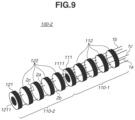
- FIG. 9 is a diagram illustrating an example of an external configuration of a continuum robot used in a second exemplary embodiment of the present disclosure.
- FIG. 10 is a diagram illustrating an example of a model for each of a first bendable portion and a second bendable portion illustrated in FIG. 9 .
- FIG. 11 is a block diagram illustrating an example of a functional configuration of a continuum robot control system according to the second exemplary embodiment.
- FIG. 12 is a diagram illustrating an example of an external configuration of a continuum robot control system according to a third exemplary embodiment of the present disclosure.
- FIG. 13 is a block diagram illustrating an example of a functional configuration of the kinematics calculation unit illustrated in FIG. 5 according to the third exemplary embodiment.
- a continuum robot uses a wire as a driving force transmission mechanism for bending a bendable portion.
- a control system and a control method according to an exemplary embodiment of the present disclosure are applied to the continuum robot.
- the length of a wire in the bendable portion is calculated assuming that the wire moves in a spiral along a central axis of the continuum robot (the bendable portion), thereby improving the control performance of the continuum robot.
- FIG. 1 illustrates an example of an external configuration of a continuum robot 100 used in the present exemplary embodiment.
- the continuum robot 100 according to the present exemplary embodiment is hereinafter referred to as a “continuum robot 100 - 1 ”.
- the continuum robot 100 - 1 illustrated in FIG. 1 includes a bendable portion 110 including a wire 1 a , a wire 1 b , and a wire 1 c , a long portion 120 , and actuators 130 - 1 a to 130 - 1 c (hereinafter also collectively referred to as actuators 130 ).
- the bendable portion 110 is a component configured to be bent three-dimensionally by driving of at least one of the wires 1 a to 1 c .
- the continuum robot 100 - 1 includes a single bendable portion (the bendable portion 110 ) configured to be bent three-dimensionally is assumed and described.
- a distal end 111 (see FIG. 2 ) of the bendable portion 110 is provided with a small sensor coil 1111 for detecting a torsional angle ⁇ 1 indicating a torsional amount about a central axis 113 (see FIG. 3 ) of the bendable portion 110 .
- the long portion 120 is a component that includes the wires 1 a to 1 c and is configured to be bent passively by, for example, an external force.
- the bendable portion 110 ranges from a proximal end corresponding to a front end face 1201 of the long portion 120 to the distal end 111 at which the sensor coil 1111 is provided.
- the actuators 130 - 1 a to 130 - 1 c are drive units that drive the wires 1 a to 1 c . More specifically, the actuator 130 - 1 a drives the wire 1 a , the actuator 130 - 1 b drives the wire 1 b , and the actuator 130 - 1 c drives the wire 1 c.
- FIG. 2 is an enlarged diagram illustrating a schematic configuration of the bendable portion 110 illustrated in FIG. 1 .
- components similar to those illustrated in FIG. 1 are denoted by the same reference numerals and the detailed descriptions thereof will be omitted.
- the wires 1 a to 1 c are guided by a plurality of wire guides 112 illustrated in FIG. 2 and a hole formed in the long portion 120 illustrated in FIG. 1 .
- Each of the wires 1 a to 1 c has one end that is connected to the distal end 111 (the wire guide provided with the sensor coil 1111 ) of the bendable portion 110 illustrated in FIG. 2 , and the other end that is connected to the corresponding one of the actuators 130 - 1 a to 130 - 1 c illustrated in FIG. 1 .
- the actuators 130 - 1 a to 130 - 1 c are driven in the direction of the central axis 113 of the bendable portion 110 , the wires 1 a to 1 c are each pushed or pulled, thereby enabling the bendable portion 110 to be bent three-dimensionally.
- FIG. 3 illustrates an example of a model for the bendable portion 110 illustrated in FIG. 1 . More specifically, FIG. 3 is a diagram for deriving a model in which the wires 1 a to 1 c move in a spiral along the central axis 113 of the bendable portion 110 of the continuum robot 100 - 1 .
- the model illustrated in FIG. 3 is used to consider a twist of the bendable portion 110 of the continuum robot 100 - 1 , and a continuum robot control device 200 (see FIG. 5 ) that provides a control input for matching the attitude of the bendable portion 110 with a target attitude is designed.
- r g Distance from the central axis 113 of the bendable portion 110 to each of the wires 1 a to 1 c
- each of the wires 1 a to 1 c in the bendable portion 110 is indicated by a thick solid line, and the central axis 113 of the bendable portion 110 is indicated by a dashed-dotted line.
- each cross section obtained by virtually dividing the bendable portion 110 into m 1 minute sections in the longitudinal direction of the bendable portion 110 i.e., the direction of the central axis 113 is indicated by a thin solid line (wherein m 1 is the number of minute sections).
- the center of the front end face 1201 of the long portion 120 corresponding to the proximal end of the bendable portion 110 illustrated in FIG. 1 is defined as an origin O 1 .
- a Z 1 -axis is provided in the direction of the central axis 113 in the front end face 1201
- an X 1 -axis is provided in the direction from the origin O 1 to the position of the wire 1 a in the front end face 1201
- a Y 1 -axis is provided in the direction orthogonal to each of the X 1 -axis and the Z 1 -axis.
- a Z 2 -axis is provided in the direction of the central axis 113 at the distal end 111 of the bendable portion 110 , and an angle formed between the Z 1 -axis and the Z 2 -axis is defined as the bending angle ⁇ 1 of the bendable portion 110 .
- a W 1 -axis is provided in the direction from the origin O 1 to the center of the distal end 111 within an X 1 -Y 1 plane, and an angle formed between the X 1 -axis and the W 1 -axis is defined as the turning angle ⁇ 1 of the bendable portion 110 .
- the wires 1 a to 1 c move on a plane parallel to a W 1 -Z 1 plane. Accordingly, the length of each of the wires 1 a to 1 c can be easily calculated even when the wires 1 a to 1 c are treated as a continuum.
- each of the wires 1 a to 1 c moves in a spiral along the central axis 113 in the longitudinal direction of the bendable portion 110 . Accordingly, if the length of each of the wires 1 a to 1 c is calculated while the wires 1 a to 1 c are treated as a continuum, complicated calculations become involved, which leads to an increase in the calculation load on the continuum robot control device 200 . Therefore, in the present exemplary embodiment, a discretization is performed by virtually dividing the bendable portion 110 into a plurality of minute sections in the longitudinal direction (the direction of the central axis 113 ) as illustrated in FIG. 3 .
- each of the wires 1 a to 1 c is approximated to a linear shape to calculate the length of each of the wires 1 a to 1 c .
- a Z 1,j -axis is provided in the direction of the distal end 111 with a center on the front end face 1201 side as an origin O 1,j , an X 1,j -axis is provided on a plane that is orthogonal to the Z 1,j -axis and is flush with the X 1 -axis, and a Y 1,j -axis is provided in the direction orthogonal to each of the X 1,j -axis and the Z 1,j -axis. Furthermore, a W 1,j -axis is provided on the line of intersection of an X 1,j -Y 1,j plane and the W 1 -Z 1 plane.
- FIG. 4 illustrates an example of a model for the j-th minute section illustrated in the FIG. 3 .
- an intersection between the W 1,j -axis and a W 1,j+1 -axis is defined as a point T 1,j .
- an angle formed between a vector connecting the origin O 1,j and the point T 1,j and a vector connecting an origin O 1,j+1 and the point T 1,j is defined as the bending angle ⁇ 1,j of the j-th minute section as illustrated in FIG. 4 .
- an intersection between the wire 1 a and a plane closer to the front end face 1201 in the j-th minute section is defined as a point P 1a1,j
- an angle formed between the X 1,j -axis and a vector connecting the origin O 1,j and the point P 1a1,j is defined as a wire torsional angle (also referred to as a “torsional angle”) ⁇ 1,j .
- an intersection between the wire 1 a and a plane closer to the distal end 111 in the j-th minute section is defined as a point P 1a1,j+1
- a projected point on the X 1,j -Y 1,j plane at the point P 1a1,j+1 is defined as a point P′ 1a1,j
- an angle formed between the X 1,j -axis and a vector connecting the origin O 1,j and the point P′ 1a1,j is defined as a torsional angle ⁇ 1,j+1 of the (j+1)-th minute section.
- Each of the wires 1 a to 1 c has a linear shape in each minute section.
- a length l 1a1,j of the wire 1 a that passes through the j-th minute section of the bendable portion 110 is derived. Based on Assumption 1, the length l 1a1,j of the wire 1 a corresponds to the length of a line segment P 1a1,j -P 1a1,j+1 illustrated in FIG. 4 .
- a vector p 1a1,j from the origin O 1,j to the point P 1a1,j is represented by the following expression (1).
- p 1a1,j [r g cos( ⁇ 1,j ) r g sin( ⁇ 1,j ) O] T (1)
- a vector p′ 1a1,j from the origin O 1,j to the point P′ 1a1,j is represented by the following expression (2).
- p 1a1,j [r g cos( ⁇ 1,j+1 ) r g sin( ⁇ 1,j+1 ) O] T (2)
- a vector t 1,j from the origin O 1,j to the point T 1,j is represented by the following expression (3).
- the length ⁇ l 1,j of the j-th minute section is represented by the following expression (4).
- the bending angle ⁇ 1,j , a turning angle ⁇ 1,j , and the torsional angle ⁇ 1,j of the j-th minute section are respectively represented by the following expressions (5), (6), and (7) using the bending angle ⁇ 1 , the turning angle ⁇ 1 , and the torsional angle ⁇ 1 of the bendable portion 110 .
- the point P 1a1,j+1 is a point obtained by rotating the point P′ 1a1,j about an axis that passes through the point T 1,j and is orthogonal to a W 1,j -Z 1,j plane, by the amount corresponding to the bending angle ⁇ 1,j .
- a rotation matrix for rotating the point about the Z 1,j -axis by the amount corresponding to the turning angle ⁇ 1,j with the origin O 1,j+1 as a center is represented by Rz( ⁇ 1,j ) and a rotation matrix for rotating the point about the Y 1,j -axis by the amount corresponding to the bending angle ⁇ 1,j is represented by Ry( ⁇ 1,j )
- a vector p 1a1,j+1 from the origin O 1,j to the point P 1a1,j+1 is represented by the following expression (8) using the vector p′ 1a1,j and the vector t 1,j .
- p 1a1,j+1 R z ( ⁇ 1,j ) R y ( ⁇ 1,j ) R Z ( p′ 1a1,j ⁇ t 1,j )+ t 1,j (8)
- the matrix Rz( ⁇ 1,j ) and the matrix Ry( ⁇ 1,j ) are obtained by the following expressions (9) and (10), respectively.
- R z ( ⁇ 1 , j ) [ cos ⁇ ( ⁇ 1 , j ) - sin ⁇ ( ⁇ 1 , j ) 0 sin ⁇ ( ⁇ 1 , j ) cos ⁇ ( ⁇ 1 , j ) 0 0 0 1 ] ( 9 )
- R y ( ⁇ ⁇ ⁇ 1 , j ) [ cos ⁇ ( ⁇ ⁇ ⁇ 1 , j ) 0 sin ⁇ ( ⁇ ⁇ ⁇ 1 , j ) 0 1 0 - s ⁇ in ⁇ ( ⁇ ⁇ ⁇ 1 , j ) 0 cos ⁇ ( ⁇ ⁇ ⁇ 1 , j ) ] ( 10 )
- the length l 1a1 of the wire lain the bendable portion 110 (i.e., the overall length of the wire 1 a that passes through the bendable portion 110 ) is the sum of the lengths of the wire 1 a in the respective minute sections of the bendable portion 110 . Accordingly, the length l 1a1 of the wire 1 a in the bendable portion 110 is represented by the following expression (12).
- wires 1 b and 1 c will be described, similarly to the case of the wire 1 a described above.
- a point P 1b1,j an intersection between the wire 1 b and a plane closer to the front end face 1201 in the j-th minute section
- an intersection between the wire 1 c and a plane closer to the front end face 1201 in the j-th minute section is defined as a point P 1c1,j
- a vector p 1b1,j from the origin O 1,j to the point P 1b1,j is represented by the following expression (13)
- a vector p 1c1,j from the origin O 1,j to the point P 1c1,j is represented by the following expression (14).
- a vector p′ 1b1,j from the origin O 1,j to a projected point P′ 1b1,j and a vector p′ 1c1,j from the origin O 1,j to a projected point P′ 1c1,j are represented by the following expressions (15) and (16), respectively.
- a vector p 1b1,j+1 from the origin O 1,j to an intersection P 1b1,j+1 between the wire 1 b and a plane closer to the distal end 111 in the j-th minute section, and a vector p 1c1,j+1 from the origin O 1,j to an intersection P 1c1,j+1 between the wire 1 c and a plane closer to the distal end 111 in the j-th minute section are represented by the following expressions (17) and (18), respectively.
- the length l 1b1 of the wire 1 b in the bendable portion 110 and the length l 1c1 of the wire 1 c in the bendable portion 110 are represented by the following expressions (19) and (20), respectively.
- FIG. 5 is a block diagram illustrating an example of a functional configuration of a continuum robot control system 10 according to the present exemplary embodiment.
- the continuum robot control system 10 according to the present exemplary embodiment is hereinafter referred to as a “continuum robot control system 10 - 1 ”.
- components similar to those illustrated in FIGS. 1 and 3 are denoted by the same reference numerals and the detailed descriptions thereof will be omitted.
- the continuum robot control system 10 - 1 includes the continuum robot 100 (more specifically, the continuum robot 100 - 1 illustrated in FIG. 1 ), the continuum robot control device 200 , and an input device 310 . More specifically, the continuum robot control system 10 - 1 is a control system for the continuum robot 100 - 1 including the bendable portion 110 configured to be bent by the driving of the wires 1 a to 1 c , and the actuators (drive units) 130 - 1 a to 130 - 1 c configured to drive the wires 1 a to 1 c , respectively.
- the input device 310 inputs information to the continuum robot control device 200 , and includes an input unit 311 and a magnetic sensor unit 312 .
- the input unit 311 is a component that inputs the bending angle (target bending angle) ⁇ 1 of the bendable portion 110 and the turning angle (target turning angle) ⁇ 1 of the bendable portion 110 to the continuum robot control device 200 .
- the magnetic sensor unit 312 is a component that measures the torsional angle ⁇ 1 about the central axis 113 of the bendable portion 110 based on the intensity and attitude of a magnetic field obtained by the sensor coil 1111 provided at the distal end 111 of the bendable portion 110 , and inputs the measured torsional angle as the torsional angle ⁇ 1 of the bendable portion 110 to the continuum robot control device 200 .
- the magnetic sensor unit 312 and the sensor coil 1111 constitute a “torsional angle acquisition unit” that acquires the torsional angle ⁇ 1 of the bendable portion 110 .
- the continuum robot control device 200 controls the continuum robot 100 (more specifically, the continuum robot 100 - 1 illustrated in FIG. 1 ) based on the information input from the input device 310 , and includes a kinematics calculation unit 211 and a position control unit 221 .
- the kinematics calculation unit 211 is a component that calculates the lengths l 1a1 , l 1b1 , and l 1c1 of the wires 1 a , 1 b , and 1 c in the bendable portion 110 , respectively based on the bending angle ⁇ 1 , the turning angle ⁇ 1 , and the torsional angle ⁇ 1 of the bendable portion 110 that are input from the input device 310 .
- the position control unit 221 is a component that outputs drive commands f 1a , f 1b , and f 1c to the actuators 130 - 1 a , 130 - 1 b , and 130 - 1 c in the continuum robot 100 - 1 , respectively so that the lengths of the wires 1 a , 1 b , and 1 c in the bendable portion 110 match the lengths l 1a1 , l 1b1 , and l 1c1 , respectively.
- the position control unit 221 controls the actuators 130 - 1 a to 130 - 1 c to drive the wires 1 a to 1 c , based on the lengths l 1a1 to l 1c1 of the wires 1 a to 1 c in the bendable portion 110 , respectively, which are obtained by the kinematics calculation unit 211 .
- FIG. 6 is a block diagram illustrating an example of a functional configuration of the kinematics calculation unit 211 illustrated in FIG. 5 according to the present exemplary embodiment.
- components similar to those illustrated in FIG. 5 are denoted by the same reference numerals and the detailed descriptions thereof will be omitted.
- FIG. 6 illustrates a configuration example in which only the length l 1a1 of the wire 1 a , among those of the wires 1 a to 1 c for bending the bendable portion 110 , is calculated.
- components similar to those for the wire 1 a are also included for the wires 1 b and 1 c.
- the kinematics calculation unit 211 includes an angle calculation unit 610 , a wire length calculation unit 620 , and an addition unit 630 .
- the angle calculation unit 610 calculates, for each of a plurality of minute sections obtained by dividing the bendable portion 110 in the longitudinal direction as described above with reference to FIG. 3 , a bending angle ⁇ , a turning angle ⁇ , and a torsional angle ⁇ of the minute section, based on the bending angle ⁇ 1 , the turning angle ⁇ 1 , and the torsional angle ⁇ 1 of the bendable portion 110 that are input from the input device 310 . More specifically, FIG.
- the angle calculation unit 610 calculates the bending angle ⁇ 1,j , the turning angle ⁇ 1,j , and the torsional angle ⁇ 1,j of each minute section by using the expressions (5) to (7).
- the wire length calculation unit 620 calculates, for each of the plurality of minute sections obtained by dividing the bendable portion 110 in the longitudinal direction, the length l 1a1 (l 1a1,j ⁇ 1 , l 1a1,j , l 1a1,j+1 , and . . . ) of the wire 1 a in the minute section, based on the bending angle ⁇ , the turning angle ⁇ , and the torsional angle ⁇ of the minute section. More specifically, the wire length calculation unit 620 calculates the lengths l 1a1,j ⁇ 1 , l 1a1,j , l 1a1,j+1 , and . . .
- the wire length calculation unit 620 illustrated in FIG. 6 includes a plurality of wire length calculators 621 each corresponding to a different one of the plurality of minute sections.
- the wire length calculation unit 620 calculates the length l 1a1,j of the wire 1 a in the j-th minute section by using the expressions (1) to (4) and the expressions (8) to (11).
- the addition unit 630 calculates the length l 1a1 of the wire 1 a in the bendable portion 110 by adding the lengths l 1a1,j ⁇ 1 , l 1a1,j , l 1a1,j+1 , and . . . of the wire 1 a in the respective minute sections, which are obtained by the wire length calculation unit 620 .
- the addition unit 630 calculates the length l 1a1 of the wire 1 a in the bendable portion 110 (i.e., the length of the wire 1 a that passes through the bendable portion 110 ) by using the expression (12).
- a simulation has been performed using the model for the continuum robot 100 - 1 derived in the above-described ⁇ 1-1. Modeling>, and using the continuum robot control system 10 - 1 presented in the above-described ⁇ 1-2. Control System>.
- the number m 1 of minute sections is 20
- the length l 10 of the bendable portion 110 is 0.03 m
- the distance r g from the central axis 113 of the bendable portion 110 to each of the wires 1 a to 1 c is 0.002 m.
- FIG. 7 illustrates a result of the simulation using the continuum robot control system 10 - 1 according to the present exemplary embodiment. More specifically, FIG. 7 illustrates a model for the bendable portion 110 assuming that the bending angle ⁇ 1 of the bendable portion 110 is 90 degrees, the turning angle ⁇ 1 of the bendable portion 110 is 0 degree, and the torsional angle ⁇ 1 of the bendable portion 110 is 180 degrees.
- the shape of a wire 710 (hereinafter referred to as the “wire 710 according to the present exemplary embodiment”) derived using the model for the continuum robot control system 10 - 1 according to the present exemplary embodiment is indicated by a solid line.
- the shape of a wire 720 (hereinafter referred to as the “wire 720 according to Japanese Patent Application Laid-Open No. 2019-122491”) derived using a calculation method according to Japanese Patent Application Laid-Open No. 2019-122491 is indicated by a broken line
- the shape of a wire 730 (hereinafter referred to as the “wire 730 not considering a twist”) derived without taking into consideration a twist is indicated by a dotted line.
- a point P 1a1,0 which is the position of the wire 1 a at the front end face 1201 corresponding to the proximal end of the bendable portion 110 , is located on the inner periphery of the bendable portion 110 .
- a point P 1a1,m which is the position of the wire 1 a at the distal end 111 of the bendable portion 110 , is located on the outer periphery of the bendable portion 110 . As indicated by the solid line in FIG.
- the wire 710 moves in a spiral from the point P 1a1,0 to the point P 1a1,m along the central axis 113 of the bendable portion 110 .
- the position of the wire 1 a at the front end face 1201 corresponding to the proximal end of the bendable portion 110 corresponds to a point P′′ 1a1,0 obtained by rotating the point P 1a1,0 about the Z 1 -axis by the torsional angle ⁇ 1 of 180 degrees.
- the wire 720 according to Japanese Patent Application Laid-Open No.
- the wire 730 not considering a twist the position of the wire 1 a at the distal end 111 of the bendable portion 110 corresponds to a point P′′ 1a1,m obtained by rotating the point P 1a1,m about a Z 1,m+1 -axis by minus 180 degrees. Accordingly, as indicated by the dotted line in FIG. 7 , the wire 730 not considering a twist moves from the point P 1a1,0 to the point P′′ 1a1,m on the inner periphery of the bendable portion 110 along the central axis 113 of the bendable portion 110 .
- FIG. 8 is a graph illustrating the result of the simulation using the continuum robot control system 10 according to the present exemplary embodiment. More specifically, FIG. 8 illustrates how the length l 1a1 of the wire 1 a changes when the bending angle ⁇ 1 of the bendable portion 110 is 90 degrees, the turning angle ⁇ 1 of the bendable portion 110 is 0 degree, and the torsional angle ⁇ 1 of the bendable portion 110 is changed from 0 to 180 degrees.
- the length l 1a1 of the wire 710 according to the present exemplary embodiment illustrated in FIG. 7 is indicated by a solid line
- a length l 1a1_pr of the wire 720 according to Japanese Patent Application Laid-Open No. 2019-122491 illustrated in FIG. 7 is indicated by a broken line
- a length l 1a1_wo of the wire 730 not considering a twist illustrated in FIG. 7 is indicated by a dotted line.
- the length l 1a1 of the wire 710 according to the present exemplary embodiment increases as the torsional angle ⁇ 1 increases because the pitch of the spiral decreases.
- the wire 720 according to Japanese Patent Application Laid-Open No. 2019-122491 moves on the outer peripheral of the bendable portion 110 more than the wire 710 according to the present exemplary embodiment, and thus the length l 1a1_pr of the wire 720 according to Japanese Patent Application Laid-Open No. 2019-122491 is longer than the length l 1a1 of the wire 710 according to the present exemplary embodiment. Furthermore, as indicated by the dotted line in FIG.
- the wire 730 not considering a twist moves on the inner periphery of the bendable portion 110 regardless of the torsional angle ⁇ 1 , and thus the length l 1a1_wo of the wire 730 is shorter than the length l 1a1 of the wire 710 according to the present exemplary embodiment.
- the wire length calculation unit 620 calculates the lengths l 1a1,j ⁇ 1 , l 1a1,j , l 1a1,j+1 , and . . . of the wire 1 a in the respective plurality of minute sections obtained by dividing the bendable portion 110 in the longitudinal direction, based on the bending angle ⁇ , the turning angle ⁇ , and the torsional angle ⁇ of each of the plurality of minute sections.
- the addition unit 630 calculates the length l 1a1 of the wire 1 a in the bendable portion 110 by adding the lengths l 1a1,j ⁇ 1 , l 1a1,j , l 1a1,j+1 , and . . . of the wire 1 a in the respective minute sections, which are obtained by the wire length calculation unit 620 .
- the length l 1a1 of the wire 1 a in the bendable portion 110 can be accurately calculated. Processing similar to that for the wire 1 a is performed on the other wires 1 b and 1 c for bending the bendable portion 110 , thereby making it possible to accurately calculate the length l 1b1 of the wire 1 b and the length l 1c1 of the wire 1 c in the bendable portion 110 even when the bendable portion 110 is twisted. As a result, an improvement in the control performance of the continuum robot 100 - 1 can be achieved.
- the above-described configuration of the continuum robot control system 10 - 1 according to the present exemplary embodiment makes it possible to reduce an error between the target attitude of the bendable portion 110 and the actual attitude of the bendable portion 110 even when the bendable portion 110 is twisted, which leads to an improvement in the safety and operability of the bendable portion 110 .
- the configuration in which the continuum robot 100 - 1 includes the single bendable portion 110 configured to be bent three-dimensionally has been assumed and described
- a configuration in which the continuum robot 100 includes a plurality of the bendable portions 110 two bendable portions 110 - 1 and 110 - 2 ) will be assumed and described.
- FIG. 9 illustrates an example of an external configuration of the continuum robot 100 used in the present exemplary embodiment.
- the continuum robot 100 according to the present exemplary embodiment is hereinafter referred to as a “continuum robot 100 - 2 ”.
- components similar to those illustrated in FIGS. 1 and 2 are denoted by the same reference numerals.
- FIG. 9 illustrates only the two bendable portions 110 - 1 and 110 - 2 in the continuum robot 100 - 2 used in the present exemplary embodiment.
- the continuum robot 100 - 2 used in the present exemplary embodiment includes not only the two bendable portions 110 - 1 and 110 - 2 illustrated in FIG. 9 , but also components corresponding to the long portion 120 and the actuators 130 illustrated in FIG. 1 .
- the continuum robot 100 - 2 illustrated in FIG. 9 includes the first bendable portion 110 - 1 and the second bendable portion 110 - 2 as a plurality of bendable portions arranged in series.
- the first bendable portion 110 - 1 corresponds to the bendable portion 110 illustrated in FIGS. 1 and 2 .
- the second bendable portion 110 - 2 is provided at a position farther from the actuators 130 serving as drive units than the first bendable portion 110 - 1 . While in the present exemplary embodiment, the example where two bendable portions, i.e., the first bendable portion 110 - 1 and the second bendable portion 110 - 2 are included as the plurality of bendable portions is illustrated, a configuration including three or more bendable portions can also be used.
- the first bendable portion 110 - 1 is a component configured to be bent three-dimensionally by the driving of at least one of the wires 1 a to 1 c .
- the distal end 111 of the first bendable portion 110 - 1 is provided with the small sensor coil 1111 for detecting the torsional angle ⁇ 1 indicating the torsional amount about the central axis 113 of the first bendable portion 110 - 1 .
- the wires 1 a to 1 c illustrated in FIG. 9 are guided by the plurality of wire guides 112 illustrated in FIG. 9 and the hole formed in the long portion 120 illustrated in FIG. 1 .
- the first bendable portion 110 - 1 ranges from the proximal end corresponding to the front end face 1201 of the long portion 120 illustrated in FIG. 1 to the distal end 111 at which the sensor coil 1111 is provided.
- the wires 1 a to 1 c illustrated in FIG. 9 each have one end that is connected to the distal end 111 (the wire guide provided with the sensor coil 1111 ) of the first bendable portion 110 - 1 illustrated in FIG. 9 , and the other end that is connected to the corresponding one of the actuators 130 - 1 a to 130 - 1 c illustrated in FIG. 1 .
- the actuators 130 - 1 a to 130 - 1 c are driven in the central axis direction of the first bendable portion 110 - 1 , the wires 1 a to 1 c are each pushed or pulled, thereby enabling the first bendable portion 110 - 1 to be bent three-dimensionally.
- the second bendable portion 110 - 2 is a component configured to be bent three-dimensionally by driving of at least one of wires 2 a , 2 b , and 2 c .
- a distal end 121 of the second bendable portion 110 - 2 is provided with a small sensor coil 1211 for detecting a torsional angle 12 indicating a torsional amount about a central axis of the second bendable portion 110 - 1 .
- the wires 2 a to 2 c illustrated in FIG. 9 are guided by a plurality of wire guides 122 illustrated in FIG. 9 , the distal end 11 I and the plurality of wire guides 112 of the first bendable portion 110 - 1 , and the hole formed in the long portion 120 illustrated in FIG. 1 .
- the distal end 11 I and the plurality of wire guides 112 of the first bendable portion 110 - 1 are provided with not only holes for guiding the wires 1 a to 1 c , but also holes for guiding the wires 2 a to 2 c .
- the second bendable portion 110 - 2 ranges from the proximal end corresponding to the distal end 11 I of the first bendable portion 110 - 1 illustrated in FIG. 9 to the distal end 121 provided with the sensor coil 1211 .
- the actuators 130 - 2 a to 130 - 2 c are driven in the central axis direction of the second bendable portion 110 - 2
- the wires 2 a to 2 c are each pushed or pulled, thereby enabling the second bendable portion 110 - 2 to be bent three-dimensionally.
- FIG. 10 illustrates an example of a model for each of the first bendable portion 110 - 1 and the second bendable portion 110 - 2 illustrated in FIG. 9 .
- components similar to those illustrated in FIGS. 3 and 9 are denoted by the same reference numerals and the detailed descriptions thereof will be omitted.
- the distal end 111 of the first bendable portion 110 - 1 is defined as an origin O 2
- the Z 2 -axis is provided in the normal direction to the distal end 111
- an X 2 -axis is provided in a circumferential direction
- a Y 2 -axis is provided in the direction orthogonal to each of the X 2 -axis and the Z 2 -axis.
- a W 2 -axis is provided in the direction from the origin O 2 to a central point O 3 of the distal end 121 of the second bendable portion 110 - 2 within an X 2 -Y 2 plane, and an angle formed between the X 2 -axis and the W 2 -axis is defined as a turning angle ⁇ 2 of the second bendable portion 110 - 2 .
- the symbol “ ⁇ ” used for the turning angle ⁇ 2 of the second bendable portion 110 - 2 indicates a relative coordinate system.
- the reference symbol ( ⁇ ) indicating a relative coordinate system is added to the top of each element.
- the reference symbol ( ⁇ ) is added to the side of each element, for example, like the turning angle “ ⁇ 2 ”, because of the format.
- the reference symbol ( ⁇ ) added to the side of each element indicates the same meaning as the reference symbol ( ⁇ ) added to the top of each element.
- the central point O 3 of the distal end 121 of the second bendable portion 110 - 2 is defined as an origin, and a Z 3 -axis is provided in the normal direction to the distal end 121 . Furthermore, an angle formed between the Z 2 -axis and the Z 3 -axis is defined as a relative bending angle ⁇ 2 of the second bendable portion 110 - 2 relative to the first bendable portion 110 - 1 .
- a length l 2a1 of a portion that passes through the first bendable portion 110 - 1 and a length l 2a2 of a portion that passes through the second bendable portion 110 - 2 are calculated using a method similar to that used in the first exemplary embodiment.
- an overall length l 2a of the wire 2 a in the first bendable portion 110 - 1 and the second bendable portion 110 - 2 is calculated by adding the length l 2a1 and the length l 2a2 .
- the length l 2a1 of the wire 2 a in the first bendable portion 110 - 1 (i.e., the length of the wire 2 a that passes through the first bendable portion 110 - 1 ) is derived.
- a length l 2a1,j of the wire 2 a in the j-th minute section of the first bendable portion 110 - 1 corresponds to the difference between a vector p 2a1,j from the origin O 1,j to the front end face 1201 corresponding to the proximal end and a vector p 2a1,j+1 from the origin O 1,j to the distal end 111 .
- the length l 2a1,j is represented by the following expression (21).
- l 2a1,j
- the vector p 2a1,j is represented by the following expression (22), similarly to the expression (1).
- p 2a1,j [r g cos( ⁇ 1,j + ⁇ 2 ) r g sin( ⁇ 1,j + ⁇ 2 ) O] T (22)
- the vector p 2a1,j+1 is represented by the following expression (23) using a vector p′ 2a1,j from the origin O 1,j to a point P′ 2a1,j obtained by projecting a point P 2a1,j+1 onto the X 1,j -Y 1,j plane.
- p 2a1,j+1 R z ( ⁇ 1,j ) R y ( ⁇ 1,j ) R z ( ⁇ 1,j )( p′ 2a1,j ⁇ t 1,j )+ t 1,j (23)
- the vector p′ 2a1,j is represented by the following expression (24).
- p′ 2a1,j [r g cos( ⁇ 1,j+1 + ⁇ 2 ) r g sin( ⁇ 1,j+1 + ⁇ 2 ) O] T (24)
- the length l 2a1 is obtained by adding the lengths l 2a1,j in all minute sections by using the following expression (25).
- the length l 2a2 of the wire 2 a in the second bendable portion 110 - 2 (i.e., the length of the wire 2 a that passes through the second bendable portion 110 - 2 ) is derived.
- the length l 2a2,k is represented by the following expression (26), similarly to the expression (11).
- l 2a2,k
- the vector p 2a2,k is represented by the following expression (27) using a torsional angle ⁇ 2,k of the k-th minute section.
- p 2a2,k [r g cos( ⁇ 2,k + ⁇ 2 ) r g sin( ⁇ 2,k + ⁇ 2 ) O] T (27)
- the vector p 2a2,k+1 is represented by the following expression (28) using a bending angle ⁇ 2,k and a vector p′ 2a2,k from the origin O 2,k to a point P′ 2a2,k obtained by projecting a point P 2a2,k+1 onto an X 2,k —Y 2,k plane.
- p 2a2,k+1 R Z ( ⁇ 2,k ) R y ( ⁇ tilde over ( ⁇ ) ⁇ 2,k ) R z ( ⁇ 2,k )( p′ 2a2,k ⁇ t 2,k )+ t 2,k (28)
- the vector p′ 2a2,k is represented by the following expression (29).
- p′ 2a2,k [r g cos( ⁇ 2,k+1 + ⁇ 2 ) r g sin( ⁇ 2,k+1 + ⁇ 2 ) O] T (29)
- t 2,k , ⁇ l 2,k , ⁇ ⁇ 2,k , ⁇ 2,k and ⁇ 2,k are obtained by using the following expressions (30) to (34), respectively, in the present exemplary embodiment.
- the length l 2a2 is obtained by adding the lengths l 2a2,k in all minute sections by using the following expression (35).
- the length of a portion that passes through the first bendable portion 110 - 1 and the length of a portion that passes through the second bendable portion 110 - 2 are calculated separately and added together, so that the overall length l 2b of the wire 2 b and the overall length l 2c of the wire 2 c in the first bendable portion 110 - 1 and the second bendable portion 110 - 2 can be calculated.
- FIG. 11 is a block diagram illustrating an example of a functional configuration of the continuum robot control system 10 according to the present exemplary embodiment.
- the continuum robot control system 10 according to the present exemplary embodiment is hereinafter referred to as a “continuum robot control system 10 - 2 ”.
- FIG. 11 components similar to those illustrated in FIGS. 5 and 10 are denoted by the same reference numerals and the detailed descriptions thereof will be omitted.
- the continuum robot control system 10 - 2 includes the continuum robot 100 (more specifically, the continuum robot 100 - 2 illustrated in FIG. 9 ), the continuum robot control device 200 , the input device 310 , and an input device 320 .
- the continuum robot control system 10 - 2 is a control system for the continuum robot 100 - 2 including the first bendable portion 110 - 1 configured to be bent by the driving of the wires 1 a to 1 c , the second bendable portion 110 - 2 configured to be bent by the driving of the wires 2 a to 2 c , the actuators (drive units) 130 - 1 a to 130 - 1 c configured to drive the wires 1 a to 1 c , respectively, and the actuators (drive units) 130 - 2 a to 130 - 2 c configured to drive the wires 2 a to 2 c , respectively.
- the continuum robot control system 10 - 2 illustrated in FIG. 11 has a configuration in which the input device 320 is added to the continuum robot control system 10 - 1 illustrated in FIG. 5 .
- the input unit 311 of the input device 310 is a component that inputs the bending angle (target bending angle) ⁇ 1 of the first bendable portion 110 - 1 and the turning angle (target turning angle) ⁇ 1 of the first bendable portion 110 - 1 to the continuum robot control device 200 .
- the magnetic sensor unit 312 of the input device 310 is a component that measures the torsional angle ⁇ 1 about the central axis 113 of the first bendable portion 110 - 1 based on the intensity and attitude of a magnetic field obtained by the sensor coil 1111 provided at the distal end 111 of the first bendable portion 110 - 1 , and inputs the measured torsional angle as the torsional angle ⁇ 1 of the first bendable portion 110 - 1 to the continuum robot control device 200 .
- the magnetic sensor unit 312 and the sensor coil 1111 constitute the “torsional angle acquisition unit” that acquires the torsional angle ⁇ 1 of the bendable portion 110 .
- the input device 320 inputs information to the continuum robot control device 200 , and includes an input unit 321 and a magnetic sensor unit 322 .
- the input unit 321 is a component that inputs a bending angle (target bending angle) ⁇ 2 of the second bendable portion 110 - 2 and a turning angle (target turning angle) ⁇ 2 of the second bendable portion 110 - 2 to the continuum robot control device 200 .
- the magnetic sensor unit 322 is a component that measures the torsional angle ⁇ 2 about the central axis 113 of the second bendable portion 110 - 2 based on the intensity and attitude of a magnetic field obtained by the sensor coil 1211 provided at the distal end 121 of the second bendable portion 110 - 2 , and inputs the measured torsional angle as the torsional angle ⁇ 2 of the second bendable portion 110 - 2 to the continuum robot control device 200 .
- the magnetic sensor unit 322 and the sensor coil 1211 constitute the “torsional angle acquisition unit” that acquires the torsional angle ⁇ 2 of the bendable portion 110 .
- the continuum robot control device 200 illustrated in FIG. 11 controls the continuum robot 100 (more specifically, the continuum robot 100 - 2 illustrated in FIG. 9 ) based on the information input from the input device 310 and the input device 320 .
- the continuum robot control device 200 illustrated in FIG. 11 includes kinematics calculation units 211 to 213 , position control units 221 to 222 , and an addition unit 231 .
- the kinematics calculation unit 211 and the position control unit 221 illustrated in FIG. 11 perform processing similar to that performed by the kinematics calculation unit 211 and the position control unit 221 illustrated in FIG. 5 , respectively, and thus the descriptions thereof will be omitted.
- the kinematics calculation unit 212 is a component that calculates lengths l 2a1 , l 2b1 , and l 2c1 of the wires 2 a , 2 b , and 2 c in the first bendable portion 110 - 1 by using the expression (25), respectively, based on the bending angle ⁇ 1 , the turning angle ⁇ 1 , and the torsional angle ⁇ 1 of the first bendable portion 110 - 1 that are information input from the input device 310 .
- the kinematics calculation unit 213 is a component that calculates lengths l 2a2 , l 2b2 , and l 2c2 of the wires 2 a , 2 b , and 2 c in the second bendable portion 110 - 2 by using the expression (35), respectively, based on the bending angle ⁇ 2 , the turning angle ⁇ 2 , and the torsional angle ⁇ 2 of the second bendable portion 110 - 2 that are information input from the input device 320 .
- the addition unit 231 calculates the overall lengths l 2a to l 2c of the wires 2 a to 2 c in the first bendable portion 110 - 1 and the second bendable portion 110 - 2 , respectively by adding the lengths l 2a1 , l 2b1 , and l 2c1 of the wires 2 a , 2 b , and 2 c in the first bendable portion 110 - 1 calculated by the kinematics calculation unit 212 and the lengths l 2a2 , l 2b2 , and l 2c2 of the wires 2 a , 2 b , and 2 c in the second bendable portion 110 - 2 calculated by the kinematics calculation unit 213 , respectively.
- the position control unit 222 is a component that outputs drive commands f 2a , f 2b , and f 2c to the actuators 130 - 2 a , 130 - 2 b , and 130 - 2 c of the continuum robot 100 - 2 , respectively so that the lengths of the wires 2 a , 2 b , and 2 c in the second bendable portion 110 - 2 match the lengths l 2a , l 2b , and l 2c calculated by the addition unit 231 , respectively.
- the position control unit 222 controls the actuators 130 - 2 a to 130 - 2 c to drive the wires 2 a to 2 c , respectively, based on the lengths l 2a1 , l 2b1 , and l 2c1 of the wires 2 a , 2 b , and 2 c in the first bendable portion 110 - 1 and the lengths l 2a2 , l 2b2 , and l 2c2 of the wires 2 a , 2 b , and 2 c in the second bendable portion 110 - 2 , which are obtained by the kinematics calculation unit 212 and the kinematics calculation unit 213 .
- the length of each wire in each of the plurality of bendable portions 110 can be accurately calculated.
- an improvement in the control performance of the continuum robot 100 - 2 can be achieved.
- it is possible to reduce an error between the target attitude and the actual attitude of each of the plurality of bendable portions 110 which leads to an improvement in the safety and operability of the bendable portions 110 .
- a control system for the continuum robot 100 in which the distribution of each of the bending angle ⁇ , the turning angle ⁇ , and the torsional angle ⁇ of the bendable portion 110 is not uniform is applied.
- the torsional angle ⁇ of each minute section is derived assuming that the torsional angle ⁇ indicating the torsional amount of the bendable portion 110 is uniformly distributed.
- the bending angle ⁇ of each minute section is derived assuming that the bendable portion 110 is bent with a constant curvature.
- a path in an organ such as a large intestine or a lung, is bent in a complicated manner. Accordingly, the above-described assumptions are not always satisfied in the bendable portion 110 that enters into such an organ.
- the control system first stores the bending angle ⁇ , the turning angle ⁇ , and the torsional angle ⁇ of when the distal end 111 of the bendable portion 110 of the continuum robot 100 passes through a certain point on a narrow space. Then, when the minute section of the bendable portion 110 reaches the point, the stored angles are read out and used to calculate the length of each wire in the bendable portion 110 .
- FIG. 12 illustrates an example of an external configuration of the continuum robot control system 10 according to the present exemplary embodiment.
- the continuum robot control system 10 according to the present exemplary embodiment is hereinafter referred to as a “continuum robot control system 10 - 3 ”.
- FIG. 12 components similar to those illustrated in FIG. 1 are denoted by the same reference numerals and the detailed descriptions thereof will be omitted.
- the continuum robot control system 10 - 3 illustrated in FIG. 12 includes the bendable portion 110 , the long portion 120 , an actuator/control system built-in box 1210 , a direct-acting guide mechanism portion 1220 , and a position sensor portion 1230 .
- the actuator/control system built-in box 1210 is a component that incorporates, for example, the actuators 130 - 1 a to 130 - 1 c illustrated in FIG. 1 , and the continuum robot control device 200 and the input device 310 illustrated in FIG. 5 .
- the direct-acting guide mechanism portion 1220 is a component that guides the actuator/control system built-in box 1210 , which is provided with the long portion 120 and the bendable portion 110 , in a direct-acting manner. More specifically, the actuator/control system built-in box 1210 moves forward or backward in the longitudinal direction of the bendable portion 110 .
- the position sensor portion 1230 detects a position Z b in the forward/backward direction of the bendable portion 110 of the continuum robot 100 . More specifically, the position sensor portion 1230 detects a displacement Z b from an initial position of the bendable portion 110 .
- the continuum robot control system 10 - 3 according to the present exemplary embodiment is similar to the continuum robot control system 10 - 1 according to the first exemplary embodiment illustrated in FIG. 5 .
- FIG. 13 is a block diagram illustrating an example of a functional configuration of the kinematics calculation unit 211 illustrated in FIG. 5 according to the present exemplary embodiment.
- components similar to those illustrated in FIG. 6 are denoted by the same reference numerals and the detailed descriptions thereof will be omitted.
- the kinematics calculation unit 211 according to the present exemplary embodiment illustrated in FIG. 13 differs from the kinematics calculation unit 211 according to the first exemplary embodiment illustrated in FIG. 5 in that the displacement Z b from the initial position of the bendable portion 110 detected by the position sensor portion 1230 illustrated in FIG. 12 is additionally input to the angle calculation unit 610 .
- the angle calculation unit 610 calculates, for each of a plurality of minute sections obtained by dividing the bendable portion 110 in the longitudinal direction, the bending angle ⁇ , the turning angle ⁇ , and the torsional angle ⁇ of the minute section based not only on the bending angle ⁇ 1 , the turning angle ⁇ 1 , and the torsional angle ⁇ 1 of the bendable portion 110 that are input from the input device 310 , but also on the displacement Z b from the initial position of the bendable portion 110 detected by the position sensor portion 1230 .
- the angle calculation unit 610 acquires from the position sensor portion 1230 the displacement Z b from the initial position of the bendable portion 110 and stores the acquired displacement Z b , and also acquires from the input device 310 the bending angle ⁇ 1 , the turning angle ⁇ 1 , and the torsional angle ⁇ 1 of the bendable portion 110 corresponding to the displacement Z b , and stores the acquired angles.
- a position Z b1,j at the proximal end side of the j-th minute section of the bendable portion 110 is represented by the following expression (37).
- Z b1,j Z b ⁇ ( m 1 ⁇ j+ 1) ⁇ l 1,j (37)
- the angle calculation unit 610 calculates the bending angle ⁇ 1,j , the turning angle ⁇ 1,j , and the torsional angle ⁇ 1,j of the j-th minute section of the bendable portion 110 by the following expressions (38) to (40).
- ⁇ 1,j ⁇ 1 ( Z b1,j+1 ) ⁇ 1 ( Z b1,j ) (38)
- ⁇ 1,j ⁇ 1 ( Z b1,j ) (39)
- ⁇ 1,j ⁇ 1 ( Z b1,j ) (40)
- the wire length calculation unit 620 can calculate the length of the wire in each minute section based on the bending angle ⁇ , the turning angle ⁇ , and the torsional angle ⁇ of the bendable portion 110 that passes through the position Z b1,j along a narrow space. Therefore, the control performance of the continuum robot 100 can be improved even when the bendable portion 110 enters into a narrow space that is bent in a complicated manner.
- the length of each wire can also be calculated by taking into consideration factors other than the external force.
- the torsional angle ⁇ 1,j is calculated by using the following expression (41) with a coefficient ⁇ 1,j corresponding to the torsional rigidity of the j-th minute section, so that the length of each wire can be calculated considering the rigidity distribution.
- the configuration of the continuum robot control system 10 in which the bending angle, the turning angle, and the torsional angle of the bendable portion 110 are acquired using the input unit and the magnetic sensor unit included in the input device is not limited thereto.
- a configuration in which these angles are acquired using a displacement sensor for measuring the amount of deformation of the bendable portion 110 and image information obtained by capturing an image of the shape of the bendable portion 110 may also be used.
- a configuration in which the bending angle, the turning angle, and the torsional angle of the bendable portion 110 are calculated and acquired based on the shape of a narrow space into which the bendable portion 110 enters may be used.
- the configuration where three wires for bending a single bendable portion 110 are pushed or pulled to bend the bendable portion 110 has been described
- the configuration is not limited thereto. More specifically, while in the above-described first to third exemplary embodiments, the example of the continuum robot 100 that three-dimensionally drives a single bendable portion 110 has been described, continuum robots to be bent on a plane and continuum robots with a different number of wires may also be used.
- the exemplary embodiments of the present disclosure can also be implemented by processing in which a program for implementing one or more functions according to the above-described exemplary embodiments is supplied to a system or an apparatus via a network or a storage medium, and one or more processors in a computer of the system or the apparatus read out and execute the program.
- the exemplary embodiments can also be implemented by a circuit (e.g., an application specific integrated circuit (ASIC)) for implementing one or more functions according to the above-described exemplary embodiments.
- ASIC application specific integrated circuit
- the program and a computer-readable storage medium storing the program are also included in the exemplary embodiments of the present disclosure.
- Embodiment(s) of the present disclosure can also be realized by a computer of a system or apparatus that reads out and executes computer executable instructions (e.g., one or more programs) recorded on a storage medium (which may also be referred to more fully as a ‘non-transitory computer-readable storage medium’) to perform the functions of one or more of the above-described embodiment(s) and/or that includes one or more circuits (e.g., application specific integrated circuit (ASIC)) for performing the functions of one or more of the above-described embodiment(s), and by a method performed by the computer of the system or apparatus by, for example, reading out and executing the computer executable instructions from the storage medium to perform the functions of one or more of the above-described embodiment(s) and/or controlling the one or more circuits to perform the functions of one or more of the above-described embodiment(s).
- computer executable instructions e.g., one or more programs
- a storage medium which may also be referred to more fully as a
- the computer may comprise one or more processors (e.g., central processing unit (CPU), micro processing unit (MPU), or the like), circuitry, or combinations thereof, and may include a network of separate computers or separate processors to read out and execute the computer executable instructions.
- the computer executable instructions may be provided to the computer, for example, from a network or the storage medium.
- the storage medium may include, for example, one or more memories of a hard disk, a random-access memory (RAM), a read only memory (ROM), a storage of distributed computing systems, an optical disk (such as a compact disc (CD), digital versatile disc (DVD), or Blu-ray Disc (BD)TM), a flash memory device, a memory card, and the like.
Landscapes
- Engineering & Computer Science (AREA)
- Robotics (AREA)
- Mechanical Engineering (AREA)
- Health & Medical Sciences (AREA)
- General Health & Medical Sciences (AREA)
- Orthopedic Medicine & Surgery (AREA)
- Life Sciences & Earth Sciences (AREA)
- Surgery (AREA)
- Nuclear Medicine, Radiotherapy & Molecular Imaging (AREA)
- Biomedical Technology (AREA)
- Heart & Thoracic Surgery (AREA)
- Medical Informatics (AREA)
- Molecular Biology (AREA)
- Animal Behavior & Ethology (AREA)
- Public Health (AREA)
- Veterinary Medicine (AREA)
- Manipulator (AREA)
- Endoscopes (AREA)
Abstract
Description
p 1a1,j =[r g cos(τ1,j)r g sin(τ1,j)O] T (1)
p 1a1,j =[r g cos(τ1,j+1)r g sin(τ1,j+1)O] T (2)
p 1a1,j+1 =R z(ζ1,j)R y(Δθ1,j)R Z(p′ 1a1,j −t 1,j)+t 1,j (8)
l 1a1,j =|p 1a1,j+1 −p 1a1,j| (11)
p 1b1,j+1 R z(ζ1,j)R y(Δθ1,j)R z(−ζ1,j)(p′ 1b1,j −t 1,j)+t 1,j (17)
p 1c1,j+1 R z(ζ1,j)R y(Δθ1,j)R z(−ζ1,j)(p′ 1c1,j −t 1,j)+t 1,j (18)
<1-2. Control System>
l 2a1,j =|p 2a1,j+1 −p 2a1,j| (21)
p 2a1,j =[r g cos(τ1,j+ξ2)r g sin(τ1,j+ξ2)O] T (22)
p 2a1,j+1 =R z(ζ1,j)R y(Δθ1,j)R z(−ζ1,j)(p′ 2a1,j −t 1,j)+t 1,j (23)
p′ 2a1,j =[r g cos(τ1,j+1+ξ2)r g sin(τ1,j+1+ξ2)O] T (24)
l 2a2,k =|p 2a2,k+1 −p 2a2,k| (26)
p 2a2,k =[r g cos(τ2,k+ξ2)r g sin(τ2,k+ξ2)O] T (27)
p 2a2,k+1 =R Z(ζ2,k)R y(Δ{tilde over (θ)}2,k)R z(−ζ2,k)(p′ 2a2,k −t 2,k)+t 2,k (28)
p′ 2a2,k =[r g cos(τ2,k+1+ξ2)r g sin(τ2,k+1+ξ2)O] T (29)
l 2a =l 2a1 +l 2a2 (36)
Z b1,j =Z b−(m 1 −j+1)Δl 1,j (37)
Δθ1,j=θ1(Z b1,j+1)−θ1(Z b1,j) (38)
ζ1,j=ζ1(Z b1,j) (39)
τ1,j=τ1(Z b1,j) (40)
Claims (7)
Applications Claiming Priority (2)
| Application Number | Priority Date | Filing Date | Title |
|---|---|---|---|
| JP2020-128130 | 2020-07-29 | ||
| JP2020128130A JP7458929B2 (en) | 2020-07-29 | 2020-07-29 | Continuum robot control system, its operating method, and program |
Publications (2)
| Publication Number | Publication Date |
|---|---|
| US20220032456A1 US20220032456A1 (en) | 2022-02-03 |
| US11839976B2 true US11839976B2 (en) | 2023-12-12 |
Family
ID=77021097
Family Applications (1)
| Application Number | Title | Priority Date | Filing Date |
|---|---|---|---|
| US17/378,284 Active 2042-07-14 US11839976B2 (en) | 2020-07-29 | 2021-07-16 | Control system for continuum robot, control method for continuum robot, and storage medium |
Country Status (4)
| Country | Link |
|---|---|
| US (1) | US11839976B2 (en) |
| EP (1) | EP3944833B1 (en) |
| JP (1) | JP7458929B2 (en) |
| CN (1) | CN114055430B (en) |
Families Citing this family (5)
| Publication number | Priority date | Publication date | Assignee | Title |
|---|---|---|---|---|
| JP2023117519A (en) * | 2022-02-14 | 2023-08-24 | キヤノン株式会社 | continuum robot |
| JP2023117757A (en) | 2022-02-14 | 2023-08-24 | キヤノン株式会社 | Continuous robot control system and continuous robot control method |
| CN115844544B (en) * | 2023-02-16 | 2023-08-04 | 极限人工智能有限公司 | Intervention robot catheter bending control method, system, device and storage medium |
| CN118490365B (en) * | 2024-05-17 | 2025-03-18 | 北京航空航天大学 | A remote-operated tracheal intubation robot system |
| CN119655694B (en) * | 2025-02-24 | 2025-05-02 | 青蓝集创医疗设备(成都)有限公司 | Externally-driven electric-assisted endoscope operation part structure and endoscope |
Citations (7)
| Publication number | Priority date | Publication date | Assignee | Title |
|---|---|---|---|---|
| CN1250516A (en) | 1997-03-17 | 2000-04-12 | 加拿大宇航局 | Topological and motion measuring tool |
| CN1258826A (en) | 1998-12-14 | 2000-07-05 | 江刺正喜 | Moving slender pipe and method for producing the same pipe |
| EP1267701B1 (en) | 2000-04-03 | 2007-10-17 | Neoguide Systems, Inc. | Steerable endoscope and improved method of insertion |
| US7477965B2 (en) * | 2003-10-27 | 2009-01-13 | Moshe Soham | Twisting wire actuator |
| JP2010104426A (en) | 2008-10-28 | 2010-05-13 | Olympus Medical Systems Corp | Medical equipment |
| US20180140168A1 (en) | 2015-07-23 | 2018-05-24 | Olympus Corporation | Manipulator, medical system, and medical system control method |
| JP2019122491A (en) | 2018-01-12 | 2019-07-25 | キヤノン株式会社 | Control device of continuum robot, control method thereof, and program |
Family Cites Families (1)
| Publication number | Priority date | Publication date | Assignee | Title |
|---|---|---|---|---|
| US8918212B2 (en) | 2009-06-24 | 2014-12-23 | Intuitive Surgical Operations, Inc. | Arm with a combined shape and force sensor |
-
2020
- 2020-07-29 JP JP2020128130A patent/JP7458929B2/en active Active
-
2021
- 2021-07-16 US US17/378,284 patent/US11839976B2/en active Active
- 2021-07-21 EP EP21186861.7A patent/EP3944833B1/en active Active
- 2021-07-28 CN CN202110856714.2A patent/CN114055430B/en active Active
Patent Citations (8)
| Publication number | Priority date | Publication date | Assignee | Title |
|---|---|---|---|---|
| CN1250516A (en) | 1997-03-17 | 2000-04-12 | 加拿大宇航局 | Topological and motion measuring tool |
| CN1258826A (en) | 1998-12-14 | 2000-07-05 | 江刺正喜 | Moving slender pipe and method for producing the same pipe |
| EP1267701B1 (en) | 2000-04-03 | 2007-10-17 | Neoguide Systems, Inc. | Steerable endoscope and improved method of insertion |
| US7477965B2 (en) * | 2003-10-27 | 2009-01-13 | Moshe Soham | Twisting wire actuator |
| JP2010104426A (en) | 2008-10-28 | 2010-05-13 | Olympus Medical Systems Corp | Medical equipment |
| JP5259340B2 (en) | 2008-10-28 | 2013-08-07 | オリンパスメディカルシステムズ株式会社 | Medical equipment |
| US20180140168A1 (en) | 2015-07-23 | 2018-05-24 | Olympus Corporation | Manipulator, medical system, and medical system control method |
| JP2019122491A (en) | 2018-01-12 | 2019-07-25 | キヤノン株式会社 | Control device of continuum robot, control method thereof, and program |
Also Published As
| Publication number | Publication date |
|---|---|
| JP2022025355A (en) | 2022-02-10 |
| CN114055430B (en) | 2024-04-09 |
| CN114055430A (en) | 2022-02-18 |
| EP3944833A1 (en) | 2022-02-02 |
| JP7458929B2 (en) | 2024-04-01 |
| US20220032456A1 (en) | 2022-02-03 |
| EP3944833B1 (en) | 2026-04-08 |
Similar Documents
| Publication | Publication Date | Title |
|---|---|---|
| US20220032456A1 (en) | Control system for continuum robot, control method for continuum robot, and storage medium | |
| Gao et al. | Laser-profiled continuum robot with integrated tension sensing for simultaneous shape and tip force estimation | |
| US11531726B2 (en) | Puncture planning apparatus and puncture system | |
| US12156634B2 (en) | Continuum robot control device, continuum robot control method, and program | |
| US11839973B2 (en) | Continuum robot control system and continuum robot control method | |
| US10849699B2 (en) | Control apparatus for a continuum robot system | |
| US11465289B2 (en) | Apparatus and method for controlling continuum robot, and computer-readable storage medium | |
| US20260022931A1 (en) | Calculation of redundant bend in multi-core fiber for safety | |
| US20250064297A1 (en) | Continuum robot control device, continuum robot control method, and program | |
| US20160213432A1 (en) | Hub design and methods for optical shape sensing registration | |
| CN114452507B (en) | Method for detecting and adjusting external force action of medical catheter tail end | |
| CN114451998B (en) | Medical catheter, shape control system and method thereof and surgical robot | |
| JP2024512990A (en) | Devices, systems, and methods for placing medical devices within body lumens | |
| WO2019171471A1 (en) | Flexible tube insertion device, rigidity control device, method of operating rigidity control device, and recording medium in which rigidity control program is recorded | |
| Bui et al. | A novel curvature-controllable steerable needle for percutaneous intervention | |
| US12484900B2 (en) | Systems and subsystems for rolling a surgical instrument including articulation cables | |
| KR20200009377A (en) | Method for estimating deformation degree of endoscope by tendon-based actuating system and system using the same | |
| US20190374090A1 (en) | Wire-driven manipulator | |
| CN108697485A (en) | Effector system | |
| US20250073898A1 (en) | Interventional robotic system with curve tracking | |
| US20220409309A1 (en) | Method for generating an actuation signal for a robotic system for robot-assisted navigation of a medical object and overall system | |
| JP6715949B2 (en) | Flexible manipulator | |
| CN117179894B (en) | Device, system and storage medium for assisting in selecting and positioning interventional operation support | |
| US20250160611A1 (en) | Method, computer program, and apparatus for controlling endoscopic scope | |
| Shang et al. | Modeling and constant-curvature design of a 120° spirally notched neurosurgical device using finite element method |
Legal Events
| Date | Code | Title | Description |
|---|---|---|---|
| FEPP | Fee payment procedure |
Free format text: ENTITY STATUS SET TO UNDISCOUNTED (ORIGINAL EVENT CODE: BIG.); ENTITY STATUS OF PATENT OWNER: LARGE ENTITY |
|
| AS | Assignment |
Owner name: CANON KABUSHIKI KAISHA, JAPAN Free format text: ASSIGNMENT OF ASSIGNORS INTEREST;ASSIGNOR:KOSE, HIDEKAZU;REEL/FRAME:057395/0211 Effective date: 20210811 |
|
| STPP | Information on status: patent application and granting procedure in general |
Free format text: DOCKETED NEW CASE - READY FOR EXAMINATION |
|
| STPP | Information on status: patent application and granting procedure in general |
Free format text: NOTICE OF ALLOWANCE MAILED -- APPLICATION RECEIVED IN OFFICE OF PUBLICATIONS |
|
| STPP | Information on status: patent application and granting procedure in general |
Free format text: NOTICE OF ALLOWANCE MAILED -- APPLICATION RECEIVED IN OFFICE OF PUBLICATIONS |
|
| STPP | Information on status: patent application and granting procedure in general |
Free format text: PUBLICATIONS -- ISSUE FEE PAYMENT RECEIVED |
|
| STPP | Information on status: patent application and granting procedure in general |
Free format text: PUBLICATIONS -- ISSUE FEE PAYMENT VERIFIED |
|
| STCF | Information on status: patent grant |
Free format text: PATENTED CASE |